Chapter Seven: Fascism’s Rise to Power
Herr Brüning has expressed it very clearly; once they (the Nazis) are in power, the united front of the proletariat will emerge and make a clean sweep of everything… We are not afraid of the fascists. They will shoot their bolt quicker than any other government.
Hermann Remmele, speaking in the Reichstag, October 1931
The coming to power of the National Socialists would mean first of all the extermination of the flower of the German proletariat, the destruction of its organizations, the eradication of its belief in itself and in its future. Considering the far greater maturity and acuteness of the social contradictions in Germany, the hellish work of Italian fascism would probably appear as a pale and almost humane experiment in comparison with the work of the German National Socialists.
Leon Trotsky, November 1931
Until late 1928, the fascist groups had no real social base except on the fringes of German society. They had consisted ever since the war of a multitude of small groups and petty military leagues, established by disgruntled army officers and made up of Freikorps elements, freebooters, fanatics, anti-Semites and other such human debris. Hitler’s fascist organisation, the DNSAP, was just one amongst many conspiratorial groups, practically unknown to anyone outside a circle of would-be plotters. Other organisations included such groups as the Viking Bund, Oberland League, Thule Society, the Pan German League, and others with even stranger sounding names, inspired by the Teutonic Knights. Along with these, the Nazis were very much a fringe group.
Hitler’s party was established in 1919 and in the following year took the name National Socialist German Workers’ Party, from which the name ‘Nazi’ was abbreviated. The word ‘Socialist’ was included in the title to broaden the party’s appeal to disgruntled workers. It had, of course, nothing to do with genuine socialism. It was based on the strange ideas of Karl Lueger, the anti-Semitic, monarchist charlatan and demagogue, for whom Hitler showed some admiration. In fact, the Nazi party was very much anti-socialist and anti-labour movement, which were regarded as foreign Jewish imports. Bolshevism, likewise, was considered a foreign conspiracy, promoted by international Jewry, a reflection of the party’s virulent anti-Semitism. Nevertheless, it paraded itself as ‘anti-capitalist’ and the idealists in the party looked forward to a ‘Second Revolution’ where the final ‘socialist’ vision would be implemented. Of course, this was never going to happen, as was shown when the troublesome demagogues of the SA were eliminated.
In its precarious early existence, the Nazi party attracted disaffected reactionary elements from the old army, consumed with a hatred of Bolshevism, the workers’ organisations and the humiliating Versailles Treaty. Yet apart from attracting a small number of disgruntled cranks and psychopaths, its influence was extremely limited. In the early days, few people would even have known of the existence of this small anti-Semitic Bavarian party.
Hitler soon realised that his small group alone had little future, and only by uniting with other fascist groupings would there be any possibility of advance. Therefore, in 1923 he joined forces with a number of paramilitary nationalist groupings and disaffected Freikorps units in Bavaria, which together formed the Deutscher Kampfbund (German Fighting Union), with himself as one of its three main leaders. Mussolini’s victory and march on Rome the previous year had led them to believe they could do the same in Germany.
On 9 November 1923, without the support of the army tops, Hitler, Röhm and Ludendorff staged an abortive putsch, known as the ‘Beer Hall putsch’, which failed miserably. The fascists were easily dispersed and Hitler arrested. The fiasco was a massive blow to the Nazis. Ernst Hanfstängl, one of the first to provide respectable hospitality to the fascists, complained to his friends about the thousand dollars, a fabulous sum in those days, he had loaned to the party: “What good is it now to have a receipt and a mortgage on the office furniture?” (J. Pool and S. Pool, p. 131.) Recruits became scarce and so did money. Splits opened up in the fascists’ ranks and there were numerous desertions. During his spell in prison, in comfortable confinement in Landsberg Castle, Hitler spent his time thinking and whiling away the hours by writing his autobiography, Mein Kampf (‘My Struggle’). This period can be regarded as the ‘dog days’ of the fascist movement, isolated, weakened and very much in the doldrums.
On Hitler’s premature release from Landsberg prison in December 1924 things were not any better, in fact they were decidedly worse. Hitler was faced with the demoralising news that the Social Democrats had massively increased their vote by thirty per cent (to nearly eight million) in the general election. By contrast, the Nazi party, together with a number of fascist groups under the name of Nationalist Socialist German Freedom Movement, saw their vote plunge, halved from two million in May 1924 to less than a million in December. This was hardly a movement that was going to march on Berlin and seize power.
With the collapse of his attempted coup in Bavaria, Hitler was forced to reconsider new tactics for the Nazi party. The idea of a seizure of power on the lines of Mussolini had flopped badly and had to be abandoned for the time being. Hitler was reported to have said:
When I resume active work, it will be necessary to pursue a new policy. Instead of working to achieve power by an armed coup, we shall have to hold our noses and enter the Reichstag against the Catholic and Marxist deputies. If outvoting them takes longer than out-shooting them, at least the result will be guaranteed by their own Constitution. Any lawful process is slow… Sooner or later we shall have a majority – and after that, Germany. (A. Bullock, p. 130.)
This perspective was based more on hope than certainty; more on luck than judgement. For now, there seemed little alternative.
At this point, Nazism was facing a dead end. Despite Hitler’s overblown ambitions, as was explained in a previous chapter, the services of fascism were not required, as yet, by Germany’s ruling class. The bourgeoisie were still pursuing other ways of getting what they wanted, which meant resting on their traditional parliamentary parties. “The Nazis were able to attract few new members under such conditions,” wrote James and Suzanne Pool. “But if new recruits were scarce in 1925, money was even harder to come by.” (D. Guerin, p. 133.) While the German bourgeoisie were not prepared at this stage to bankroll the fascists, big business nevertheless supplied them with just enough funds to keep them in existence as a reserve weapon or insurance policy. They were kept on the payroll, as a nightclub owner employs a couple of bouncers on the door.
By the time of the general election in May 1928 Nazi support had shrunk even further to a mere 2.6 per cent of the total vote. This did not augur well for Hitler or the future of his party. The movement was not growing, but was in retreat. “At the end of 1928 Hitler was still a small-time politician,” remarked Alan Bullock, “little known outside the south and even there regarded as part of the lunatic-fringe of Bavarian politics.” (A. Bullock, p. 144.)
Big Business Turns to Hitler
Small-time politicians, however, can play a key role when the conditions are ripe. And, in 1930, conditions were about to drastically change and provide the fascists with new opportunities. By the end of year, the economic situation had fallen off a cliff edge with the withdrawal of American funds following the Wall Street Crash. In the same year, the United States introduced the Smoot Hawley Tariff Act, which raised U.S. tariffs on over 20,000 imported goods and provoked a series of beggar thy neighbour policies worldwide. The economies of Central Europe, as well as German industry, had borrowed heavily from French and British banks. They began to default on their debts, driving the banking system into crisis. In May 1931, the Austrian bank, the Credit-Anstalt, collapsed, the first major bank failure that initiated the Great Depression, sending shock waves through Germany and the world. In July, this was followed by the failure of one of Germany’s principal banks, the Darmstädter und Nationalbank, which was forced to suspend payments. Imports from Europe decreased from a 1929 high of $1.3 billion to just $390 million during 1932, while US exports to Europe decreased from $2.3 billion in 1929 to $784 million in 1932. Overall, world trade decreased by some sixty-six per cent between 1929 and 1934. The world economy was caught up in a maelstrom as a chain reaction of competitive devaluations took hold. Thus began the Great Depression, the likes of which the world had never seen before.
Germany experienced its deepest slump, part of the general world collapse of the productive forces. Given its more vulnerable position on world markets, it was the hardest hit of any other major country, resulting in a massive contraction of national output of nearly forty per cent. Mass unemployment rose to new heights – 6, 7 million and more – as one unstable government gave way to another. The living standards of the middle class suddenly collapsed, without any trade union organisation to furnish the least protection. Discontent and bitterness were rife as the Weimar Republic was racked with instability at all levels. Every attempt to correct the economic equilibrium simply produced social and political disequilibrium. The regime was suffering from an existential crisis. The traditional bourgeois parties, which the ruling class relied upon, were in serious crisis and had become ineffective. Governments lurched towards Bonapartist rule. The bourgeoisie once again felt threatened by proletarian revolution. As a consequence, sections of the big bourgeoisie began to look beyond the paralysis of parliamentary democracy. They instead turned towards the idea of a dictatorship that would allow them to place the full burden of the crisis onto the backs of the working class.
The German bourgeoisie, along with the ruling classes of Europe and elsewhere, were great admirers of Mussolini. He had brought to power a pro-business authoritarian government, which had suppressed the workers’ movement, driven down wage costs and boosted profits. They reasoned that if ‘order’ could be restored to Italy, why not in Germany? It was clearly an example to be followed as parliamentary democracy had exhausted its role. Consequently, German big business put its weight behind the fascists, pouring millions into their coffers and lavishly financing their propaganda. Apart from the seemingly unlimited resources, state institutions – the courts, army authorities, top civil servants, police chiefs – were used as a cover for fascist activities, whilst simultaneously clamping down on the Labour movement.
Fritz Thyssen, who was the chairman of the United Steel works (Vereinigte Stahlwerke), openly boasted in his book, I Paid Hitler, of personally handing over one million marks to Hitler. Thyssen had supported the fascists ever since 1923, but only formally joined the Nazi party in December 1931. He was instrumental in winning over important sections of the bourgeoisie to the Nazis. In particular, he was responsible for the connections between Hitler and the entire body of Rhenish-Westphalian industrialists. He wrote:
I have personally given altogether one million marks to the Nazi party. It was during the last years preceding the Nazi seizure of power that the big industrial corporations began to make their contributions. But they did not give directly to Hitler; they gave them direct to Dr. Alfred Hugenberg, the leader of the Nationalists, who placed at the disposal of the Nazi party about one-fifth of the amounts given. All in all, the amounts given by heavy industry to the Nazis may be estimated at two million marks a year. (Quoted in ibid., p. 175.)
According to the historian William Shirer:
[T]he coal and steel interests were the principal sources of the funds which came from the industrialists to help Hitler over his last hurdles to power in the period between 1930-33. (W.L. Shirer, p. 144.)
Bullock writes:
In addition to Emil Kirdorf, the biggest figure in the Ruhr coal industry, Fritz Thyssen and Albert Vögler of the United Steel works, [Walter] Funk mentions Friedrich Springorum and Tengelmann, Ernst Buskühl and H.G. Knepper of the Gelsenkirchen Mine Company. Among bankers and financiers who, according to Funk, met Hitler in 1931-32 and, in some cases at least, helped him, were Stein and Schroder of the Stein Bank in Cologne; E.G. von Strauss, of the Deutsche Bank; Hilgard, of the Allianz Insurance Corporation; and two more bankers, Otto Christian Fischer and Fr. Reinhart. (A. Bullock, p. 173.)
Explaining the importance of these lavish subsidies, Hitler pointed out that:
Without automobiles, airplanes and loud speakers, we could not have conquered Germany. These three technical means enabled National Socialism to carry on an amazing campaign. (Quoted in T. Grant, The Menace of Fascism, p. 27.)
The Fascist Henry Ford
Hitler received not only the backing of rich German capitalists, but also support from international capitalists, such as Henry Ford, the car manufacturer and at that time the world’s most prominent industrialist. Like Hitler, he was an extreme anti-Semite. Ford’s newspaper, The Independent, carried out a constant diatribe against the Jews and Jewish influence. On 22 May, 1920, the paper lashed out with an editorial entitled ‘The International Jew: The World’s Problem’. The following ninety-one articles covered a range of topics from Jews in a world government to Jews in American finance, in communism, theatre, movies, baseball, bootlegging and song writing. It produced inflammatory headlines such as ‘The Gentle Art of Changing Jewish Names’, ‘What Jews Attempted When They Had Power’, ‘The All-Jewish Mark on Red Russia’, and ‘Taft Once Tried to Resist the Jews – and Failed’. He, like Hitler, believed that communism was a Jewish conspiracy to take over the world.
It is no wonder that when Hitler heard that Ford might run for American President, he said:
I wish that I could send some of my shock troops to Chicago and other big American cities to help in the elections… We look to Heinrich Ford as the leader of the growing fascist movement in America… We have just had his anti-Jewish articles translated and published. The book is being circulated to millions throughout Germany. (Quoted in J. Pool and S. Pool, p. 90.)
Hitler, in fact, praised Henry Ford in Mein Kampf.
“That Henry Ford, the famous automobile manufacturer gave money to the National Socialists directly or indirectly has never been disputed,” said Konrad Heiden, one of the first biographers of Hitler. (ibid., p. 111.) The novelist Upton Sinclair wrote in Flivver King, a book about Ford, that the Nazis got $40,000 from him to translate and reprint his anti-Jewish pamphlets, and that an additional $300,000 were later sent to Hitler through a grandson of the ex-Kaiser who acted as intermediary. Other intermediaries were White Russians. The US Ambassador to Germany, William E. Dodd, said in an interview that “certain American industrialists had a great deal to do with bringing fascist regimes into being in both Germany and Italy.” (Quoted in ibid., p. 111.)
Henry Ford’s reward from Hitler finally came in July 1938, when on his seventy-fifth birthday he was awarded the Grand Cross of the Supreme Order of the German Eagle. The presentation was made in Ford’s Dearborn office in Detroit. He said:
They [the Germans] sent me this ribbon band. They [the critics] told me to return it or else I’m not an American. I’m going to keep it. (ibid., p. 130.)
Mussolini had been given the honour by Hitler earlier in the year.
Reichstag Election in September 1930
Up until September 1930, the Nazi party, although a threat, did not pose an existential threat to the existence of the labour movement. However, the situation was to change. Within the space of two years from 1928, the fascist party was to go from the smallest group in the Reichstag to the second largest.
In the middle of September 1930, 30 million Germans went to the polls, 4 million more than in 1928. In this election, ten parties received over 1 million votes each. This division of electoral support between so many different parties meant that there could never be a stable coalition. Following this election, no government would again rest upon a parliamentary majority in the Weimar republic.
The Social Democratic Party was still the largest group in the Reichstag with 24.5 per cent of the popular vote, but this had fallen by six per cent since September 1928. The KPD vote at 13.1 per cent had risen substantially by forty per cent, providing the party with 1,250,000 more votes. Their number of deputies increased from fifty-four to seventy-seven. This increased support was not, however, on account of the policies of the KPD, but, on the contrary, reflected the depth of the crisis of German capitalism. Overall, the combined percentage vote for the SPD and KPD fell a few percentage points from 40.4 per cent in 1928 to 37.6 per cent in 1930.
The three bourgeois parties, the Democrats, the People’s Party, and the Economic Party (its full name was the Economic Party of the German Middle Classes) had, between them, lost 1.25 million of their 1928 vote. The German Nationalist Party had suffered the most, losing 2 million votes, with their percentage of the vote falling from 14.2 per cent in 1928 to only seven per cent in 1930. Its number of deputies fell from seventy-three to forty-one.
However, the outstanding change this time was in the massive rise in the vote for the Nazi party, which increased by 700 per cent, amounting to over six million votes, taking it from ninth largest to second largest party in the Reichstag. Their number of deputies rose from twelve to 107.
Their election campaign resonated among those who were being crushed by the economic depression, especially the peasants and small farmers. They were suffering from low prices and the burden of mortgage and loan repayments. Hitler put forward a programme of state credits, reduction and remission of taxes, higher tariffs and the revision of the inheritance laws to attract support.
The British newspapers were fawning over the rise of the Nazis. The Times of London printed Hitler’s assurances of goodwill at length, while Lord Rothermere’s Daily Mail welcomed Hitler’s success as a bulwark against the evils of Bolshevism.
Astonishingly, the KPD described the election as a victory for the communists and “the beginning of the end” for the Nazis. This stupidity represented a blind refusal to recognise the cold reality of a sharp increase in electoral support for Hitler’s movement, despite the modest rise in support for the communists.
The membership of the Nazis had increased steadily from 27,000 in 1925 to 178,000 in 1929. By March 1930, it had grown to 210,000 and was still rising. At the time Röhm took over, in January 1931, the paramilitary brown-shirted SA numbered roughly 100,000. In 1932, the Brownshirts had risen to 300,000. Most of the recruits to the SA detachments came from the unemployed, the lumpen-proletariat and declassed elements, and were held together with soup kitchens and schnapps. “They were set up exclusively for the purpose of protecting the party in its propaganda,” stated Hitler, “not to fight against the State.” (A. Bullock, p. 165.) Hitler was careful not to clash with the forces of the state, which he attempted to woo to his side.
To be forewarned is to be forearmed. It was Leon Trotsky who sounded the alarm bells over the election results:
The official press of the Comintern is now depicting the results of the German elections as a prodigious victory of Communism, which places the slogan of a Soviet Germany on the order of the day. The bureaucratic optimists do not want to reflect upon the meaning of the relationship of forces which is disclosed by the election statistics. They examine the figure of Communist votes gained independently of the revolutionary tasks created by the situation and the obstacles it sets up.
The Communist Party received around 4,600,000 votes as against 3,300,000 in 1928. From the viewpoint of ‘normal’ parliamentary mechanics, the gain of 1,300,000 votes is considerable even if we take into consideration the rise in the total number of voters. But the gain of the party pales completely beside the leap of fascism from 800,000 to 6,400,000 votes.
He went on to argue that the only way forward was on the basis of a united front against fascism:
No matter how true it is that the Social Democracy prepared the blossoming of fascism by its whole policy, it is no less true that fascism comes forward as a deadly threat primarily to that same Social Democracy, all of whose magnificence is inextricably bound up with parliamentary-democratic-pacifist forms and methods of government…
There can be no doubt that at the crucial moment the leaders of the Social Democracy will prefer the triumph of fascism to the revolutionary dictatorship of the proletariat. But precisely the approach of such a choice creates exceptional difficulties for the Social Democratic leaders among their own workers. The policy of a united front of the workers against fascism flows from this whole situation. It opens up tremendous possibilities for the Communist Party. A condition for success, however, is the rejection of the theory and practice of ‘social fascism,’ the harm of which becomes a positive menace under the present circumstances. (L. Trotsky, The Struggle Against Fascism, p. 57 and p. 70.)
The massive vote for fascism in September 1930 constituted a serious change in the balance of forces. This was a deeply alarming development, which called for decisive action. The need for a united front of workers’ organisations, to defend all proletarian organisations from fascism, was posed point blank. The fascists appeared on the verge of seizing power. The German labour movement was therefore faced with the life or death question of either to struggle with arms in hand to defeat fascism or see the mighty working class crushed.
But the Stalinists were blind to this reality. They had lost all sense of proportion, dismissed the gains of the fascists, and declared the September elections a massive victory for communism. A prominent party leader, Hermann Remmele, stated: “the only victor in the September elections is the Communist Party.” The KPD issued an official statement on 16 September saying:
Hitler’s electoral success bears within itself with inescapable certainty the germ of his future defeat. The 14th of September was the highest point of the National Socialist movement in Germany. What comes afterwards can only be decline and fall. (B. Fowkes [ed.], pp. 131-132.)
They held fast to the line of ‘social fascism’, the most destructive policy under the circumstances. As the Nazis became the second largest party in the Reichstag, the Stalinists still regarded the Social Democrats as the main enemy: “Socialists are again the largest party and the capitalists will continue to use them in order to gain time while the plans for the open Fascist dictatorship are maturing.”
Trotsky and the International Left Opposition, aware of the rapidly deteriorating situation, immediately issued an appeal to the KPD to organise a united front with the Social Democrats to stop the fascists. This was no sudden warning. Throughout his exile in Turkey, he continually wrote articles appealing to the German workers. In his evidence to the Dewey Commission in 1937, he explained:
I published, at that time, ‘Germany, The Key to the International Situation,’ written in 1931; ‘What Next, The Problems of the German Proletariat,’ published in New York; ‘The Only Road,’ a pamphlet. All of them are devoted to the fight against German fascism, and they were published in New York. The articles – ‘The Impending Danger of Fascism in Germany,’ 9 January 1932; ‘What Is Fascism,’ 6 January 1932; ‘I See War with Germany,’ 13 July 1932; ‘How Can Fascism be Smashed in Germany,’ 20 February 1933; ‘The Tragedy of the German Proletariat,’ 8 April 1933; ‘Hitler and the Red Army,’ 8 April 1933. (L. Trotsky, The Case of Leon Trotsky, p. 28.)
The Nazis represented not only a grizzly threat to the proletariat of Germany, but also a deadly threat to the workers of Europe and Russia. Trotsky predicted that a fascist victory in Germany would inevitably mean war with the USSR.
The Stalinists nevertheless replied in the following terms:
In his pamphlet on the question, How will National Socialism be Defeated?, Trotsky gives always but one reply: “The German Communist Party must make a block with the social democracy…” In framing this block, Trotsky sees the only way for completely saving the German working class against fascism. Either the CP will make a block with the social democracy or the German working class is lost for 10-20 years. This is the theory of a completely ruined fascist and counter-revolutionary. This theory is the worst theory, the most dangerous theory and the most criminal that Trotsky has constructed in the last years of his counter-revolutionary propaganda. (E. Thälmann, ‘Closing Speech at the Thirteenth Plenum’, September 1932, Communist International, No. 17-18, p. 1329.)
From the lips of Thälmann himself we get the following:
Trotsky wants in all seriousness a common action of the Communists with the murderer of Liebknecht and Rosa (Luxemburg), and more, with Mr Zörgiebel and those police chiefs whom the Papen regime leaves in office to oppress the workers. Trotsky has attempted several times in his writings to turn aside the working class by demanding negotiations between the chiefs of the German Communist Party and the Social Democratic Party. (E. Thälmann’s ‘Closing Speech at the Twelfth Plenum, September 1932, ECCI, Communist International, No 17-18, p. 1329.)
In their hysteria, the main enemy for the Stalinists was not Hitler, but the Social Democrats. In fact, the party, through Heinz Neumann, proclaimed that: “Fascist dictatorship is no longer merely a threat, it is already here.” The KPD issued orders for ‘social fascist’ meetings to be broken up.
On this basis, there could no talk of working-class unity. Even when the KPD leaders tilted towards ‘unity’, they only called for a united front ‘from below’, which was never going to happen.
Neurosis of the Petty Bourgeoisie
The capitalist crisis was forcing the working class to search for a way out, but the failure to change society only served to aggravate the situation. The crisis was crushing the middle layers of society and driving them into a frenzy. These layers were being caught between the two major classes, the capitalists and the workers, but were, as Marx explained, themselves incapable of playing an independent role.
In times of acute crisis, the frenzied petty bourgeoisie look for a swift, and, if need be, violent solution to their problems. When the aroused working class takes the lead and shows the way forward, it can draw in its wake large sections of the middle class. In their turmoil, the middle class was prepared to look towards the working class for a way out. Should it fail to find such leadership, however, the atomised and depressed masses of the petty bourgeoisie look for some other way out. Disillusioned with the proletariat, they can turn to reaction and be drawn into the whirlwind of fascism.
The despair of the petty bourgeoisie, its yearning for change; the collective neurosis of the petty bourgeoisie, its readiness to believe in miracles; its readiness for violent measures; the growth of hostility towards the proletariat which has deceived its expectations.
These were all characteristics of this period, explained Trotsky. (Writings 1939-40, p. 412.)
Disillusioned by the failure of the working class to take power in 1918, 1919, 1920 and 1923, the desperate middle layers of society were turning elsewhere for a solution. The fascists, with their national hysteria, were offering hope and even miracles. But the fascists could not solve the problems of the middle class, they could only organise and regiment them in the service of monopoly capitalism.
By the end of 1930, the fascists had drawn significant sections of the despairing middle class to their banner by their demagogic appeals. The petty bourgeois searched in vain for a way out of the impasse, and the fascists seemed to offer solutions in abundance. The deeper the crisis, the more these ruined layers were prepared to believe in anything. They suffered from a neurosis, as Trotsky explained, a mental disease associated with depression, anxiety, derangement and chronic instability.
The ‘socialist’ demagogy of the Nazis became increasingly vocal, without which they could not have won a mass base. Hitler recognised the “anti-capitalist longing of the masses,” and directed his propaganda accordingly. Fascism gave these downtrodden sections a feeling of hope, of national identity, even glory, which they were desperate to grasp on to, especially in a situation of complete hopelessness. “Not every petty bourgeois could become Hitler, but a particle of Hitler is lodged in every petty bourgeois,” stated Trotsky. (The Struggle Against Fascism in Germany, p. 399.) Hitler appealed to their aspirations to become something. “Give me the power and I will do everything for you that you cannot do yourself,” he stated. (E. Anderson, p. 138.)
As we have seen, unemployment was rising rapidly. It reached 4 million in 1931, 5 million in 1932 and then 6 million the following year. On this basis, large layers of unemployed people faced a bleak future of penury and destitution. Many professionals’ living standards now fell below that of skilled workers. Cuts and austerity meant that a university professor was paid less than an unskilled worker. Not a few ruined professionals were turned into vagabonds, who scavenged in rubbish bins for food. Bankrupt shopkeepers, unemployed professionals, and those on depreciated fixed incomes became penniless overnight. At least for those workers who were organised, they could fall back on the limited protection of trade union contracts and unemployment allowances.
The rationalisation of German industry during the period of ‘stabilisation’ created an enormous concentration of capital, as many small businesses were rapidly swallowed up by the giant corporations. In previous crises, sections of the middle class were thrown into the ranks of the working class. Now, with the existence of mass unemployment, many from the middle class instead became paupers, and part of the lumpen-proletariat. After 1923, ninety-seven per cent of Germans were without any savings, which meant that they were literally living from hand to mouth. With the Depression, they had no cushion to sustain them. This was clearly a factor for the dramatic increase in the suicide rate.
The Nazis played on the frustrations and anger of those crushed by the banks and monopolies. The Jews became a scapegoat for their plight. The frenzied middle classes became completely disenchanted with the traditional capitalist politicians who stood for the status quo of hunger and destitution. Therefore, the ruling class had to shape a new means of duping the middle class. This was, in essence, the role of fascism.
“We need a Führer,” sighed Moeller van den Bruck as early as 1923. In the late 1920s, many industrialists began to yearn for a “strong man of destiny to liberate us from our misery”. By the end of 1928, they financed the fascists, built them up, and used them to exploit the problems and discontent of the petty-bourgeois layers. Through their anti-capitalist demagogy, the fascists were able to pull together this despairing mass, imbue it with a mission of salvation, and fill it with an intense hatred for the organised labour movement.
The fascist groups originated, not as a mass force, but simply anti-labour gangs, harassing and terrorising workers’ organisations. These bands of mercenary thugs from the dregs of society formed the basis of Hitler’s Stormtroopers, the Sturmabteilung (SA), and the SS (Elite Guard). This riffraff, made up of the lumpen-proletariat in the main, was able to become a mass force under certain circumstances. These circumstances were to mature in the late 1920s: a deep economic crisis combined with complete disillusionment with the traditional political parties, which also affected the workers’ parties, as these, having raised the hopes of the masses in the past, had now dashed those very same hopes.
In the previous period, the fascist paramilitary groups had mainly been used as auxiliaries to the police to break up workers’ meetings. Now their activities were much broader. The fascist gangs were employed on the streets to break up demonstrations, attack workers, and carry out indiscriminate assassinations. Shootings and political assassinations now became commonplace. Oskar Hippe, a Communist Party member in Berlin, described how in March 1928 the infamous SA Storm Troop Thirty-Three shot at people attending a KPD meeting in Ahlert’s Room in Berliner Strasse.
The SA Stormtroopers had shot at those leaving the hall from their position in Lohmeyer Strasse. There were two dead and several injured. The police did nothing. Our attempts to catch the Stormtroopers failed when we were shot at ourselves, even though we had no weapons. (O. Hippe, p. 110.)
Clearly, the intention of these attacks and murders was to threaten and intimidate the working class, to create a climate of fear and paralysis.
Despite the advances of the fascists, the balance of forces was still heavily in favour of the workers’ organisations. If the labour and trade union leaders had acted swiftly, the fascists could have been easily crushed at that moment. Even Hitler himself confessed:
Only one thing could have broken our movement – if the adversary had understood its principle and from the first day had smashed, with the most extreme brutality, the nucleus of our new movement. (D. Guerin, pp. 111-112.)
This same admission was made by Goebbels:
If the enemy had known how weak we were, it would probably have reduced us to jelly… It would have crushed in blood the very beginning of our work. (ibid., p. 112.)
But instead of mobilising the movement to sweep away this human debris, the workers’ leaders turned to the bourgeois state for help in the very moment when it was fully backing the fascists.
Stalinism and Fascism
This was not the only problem. Rather than a workers’ united front, in a bizarre twist, the communists and the fascists would on occasions unite against the Social Democrats, namely the ‘social fascists’. This only served to further poison relations between the workers’ parties and disorientate the proletariat. This madness was revealed by the experience of Jan Valtin:
A temporary truce and a combining of forces were agreed upon by the followers of Stalin and Hitler whenever they saw an opportunity to raid and break up meetings and demonstrations of the democratic front. During 1931 alone, I participated in dozens of such terroristic enterprises in concert with the rowdiest Nazi elements. I and my comrades simply followed party orders. (J. Valtin, p. 226.)
Valtin vividly describes in detail the breaking up of a Social Democratic transport workers’ union conference in the spring of 1931:
The conference took place in the House of Labour in Bremen. It was public and the workers were invited to listen to the proceedings. The Communist Party sent a courier to the headquarters of the Nazi party with a request for co-operation in the blasting of a Trade Union Conference. Hitlerites agreed, as they always did in such cases. When the conference opened, the galleries were packed with two or three hundred Communists and Nazis. I was in charge of operations for the Communist Party and the Stormtrooper leader Walter Tidow for the Nazis. In less than two minutes, we had agreed on a plan of action. As soon as the conference of Social Democrats was well underway, I got up and launched a harangue from the gallery. In another part of the hall Tidow did the same. The trade union delegates were at first speechless. Then the chairman gave the order to eject the two troublemakers, me and Tidow, from the building. We sat quietly, derisively watching two squads of husky trade unionists advance towards us with the intention of throwing us out. We refused to budge. As soon as the first trade union delegate touched one of us, our followers rose and bedlam started. The furniture was smashed, the participants beaten, the hall turned into a shambles… The next day, both Nazi and our own party press brought front-page accounts of how ‘socialist’ workers, incensed over the ‘treachery’ of their own corrupt leaders had given them a thoroughly ‘proletarian rub-down’. (ibid., pp. 226-227.)
This insane position was fully supported by the leaders of the Comintern: “Without isolating Social Democracy there cannot be victorious struggle against Fascism and the capitalist offensive,” proclaimed the ECCI (B. Fowkes [ed.], p. 197.)
The Stalinists went on:
For the bourgeoisie the question is not fascism or Social Democracy but fascism… The bankrupt bourgeois democracy and its chief representative the Social Democratic Party are in this fight unconditionally on the side of fascism. (Daily Worker, 18 August 1930.)
They failed to grasp that Social Democracy was not compatible with fascism. That the fascists, if they came to power, would destroy the Social Democrats along with all other working-class organisations.
Violence Spreads
As a result of this sectarianism, the Stalinists continued to openly incite the communist workers to attack and beat up Social Democratic workers, and physically break up their meetings. Thälmann even put forward the hysterical demand, “Chase the social fascists from their jobs in the plants and the trade unions”. Following on this line from the communist leaders, the Young Communist organ The Young Guard advocated the slogan: “Drive the social fascists from the plants, the employment exchanges, and the apprentice schools.”
The Drum, the organ of the Young Pioneers, which catered for the communist children, urged its members to carry the fight to the school children of Social Democrats in the playgrounds. Copying their adult comrades, they adopted the ‘unifying’ slogan: “Strike the little Zörgiebels in the schools and the playgrounds.” This was indeed taking the fight against ‘social fascism’ to a new level.
The fountain head of this criminal policy was Stalin, who had rapidly consolidated his power within the USSR, and was the driving force behind this ultra-leftism. He argued that:
Fascism is the fighting organisation of the bourgeoisie, which rests upon the active support of the Social Democracy. Objectively, the Social Democracy is the moderate wing of fascism. There is no reason to admit that the fighting organisation of the bourgeoisie could obtain decisive successes either in the struggles or in the government of the country without the active support of the Social Democracy… There is also little reason to admit that Social Democracy can obtain decisive successes either in struggles or in the government of the country without the active support of the fighting organisations of the bourgeoisie. These organisations are not mutually exclusive, but on the contrary are mutually complementary. They are not antipodes but twins. Fascism is a shapeless bloc of these two organisations. Without this bloc the bourgeoisie could not remain at the helm. (J. Stalin, quoted in Die Internationale, February 1932.)
This bankrupt policy was faithfully echoed by his puppet Manuilsky, who explained at the Eleventh Plenum of the Communist International in April 1931:
The Social Democrats, in order to deceive the masses, deliberately proclaim that the chief enemy of the working class is fascism… Is it not true that the whole theory of the ‘lesser evil’ rests on the presupposition that fascism of the Hitler type represents the chief enemy? (D. Manuilsky, The Communist Parties and the Crisis of Capitalism, p. 112.)
The tragedy of all this was that this fratricidal struggle between the two workers’ parties – the Stalinists versus the Social Democrats – reduced the working class to impotence in the face of the fascist hangman.
The ‘Red’ Referendum
The sectarianism of the KPD went from bad to worse. In August 1931, to capitalise on their growing popularity, the Nazi party joined forces again with Hugenberg’s Nationalists to launch a referendum to overthrow the Social Democratic-Centre Party government of Prussia, the most powerful state in Germany. At first, the KPD correctly attacked the plebiscite. Then, three weeks before the vote, under orders from Stalin, they joined forces with the fascists to bring down the main enemy, the Social Democrats. They then changed the name of the plebiscite to the ‘Red Referendum’ and referred to the fascists and the members of the SA as ‘working people’s comrades’. The Stalinists worked to collect the necessary signatures to make the fascist-inspired referendum legally binding. This created the disgusting spectacle of joint activity against the Social Democracy. This only served to alienate Social Democratic workers, and bind them even more to their reformist leaders.
Jan Valtin wrote:
The Communist co-operation with the Hitler movement for reasons of political expediency did not stop at wrecking the meetings and demonstrations of opponents. In the spring of 1931, the German Nationalists moved for a plebiscite to oust the Social Democratic government of Prussia. Together with the followers of Hitler, they collected the number of signatures required by law to force the Berlin government to make the plebiscite mandatory. Tensely we Communists awaited the answer to the questions. ‘How are we to vote? If we vote with the Nazis, the Socialist government of Prussia might fall, and a combination of Hitlerites and Monarchists will come to power in Prussia, the dominant state within the Reich. Surely we are not to give our votes to make Hitler ruler of Prussia?’
The Communist high command, under Dimitrov, gave us the answer by telegram and letter, and through circulars, pamphlets and headlines in the party press! ‘Down with the Social Democrats, the chief enemy of the workers! Communists, your duty is to sweep the Socialist traitors out of the government offices!’ So, while Communists and Nazi terror groups blazed away at each other in nightly skirmishes, Communists went loyally to the polls to give their votes in support of a drive launched by the Monarchist Hugenberg and the Fascist Hitler. (J. Valtin, pp. 227-228.)
Their twisted logic demanded the defeat of Social Democracy before the Nazis could be beaten. “Without isolating Social Democracy there cannot be a victorious struggle against Fascism and the capitalist offensive,” stated a resolution from the ECCI on 16 September 1931.
It continued:
The ‘left’ Social Democrats have been forced to reveal themselves openly as a buffer between the KPD and the mass of Social Democratic workers, and the Brandlerist and Trotskyist renegades have openly revealed themselves as a direct agency of social fascism. (B. Fowkes, pp. 197-198.)
At the Executive Committee of the Communist International, Piatnitsky even boasted how the line was changed:
You know, for example, that the leadership of the party opposed taking part in the referendum on the dissolution of the Prussian Landtag. A number of party newspapers published leading articles opposing participation in that referendum. But when the Central Committee of the party jointly with the Comintern arrived at the conclusion that it was necessary to take an active part in the referendum, the German comrades in the course of a few days roused the whole party. Not a single party, except the CPSU could do that. (From Guide to the XII Plenum, ECCI, September 1932, p. 42.)
It is true, as Piatnitsky says, no other party could shamelessly carry out such a volte face, except the Stalinists. But that reflected nothing more than the bureaucratic make up of the party.
When the referendum was held, despite the joint campaign of communists and fascists, it failed to get a majority. This was very fortunate, as a victory in the referendum would have simply brought Hitler to power in 1931, two years earlier. However, the Stalinists learned nothing from this episode, only that their actions were ‘revolutionising’ the situation. It was a hair-brained adventure that served only to confuse the working class and facilitate the success of the fascists. The old line was maintained. “Today the Social Democrats are the most active factor in creating fascism in Germany,” declared Ernst Thälmann.
The British Daily Worker, the organ of the British Communist Party, applauded this criminal role:
The most important decision of the recent plenary session of the Central Committee of the Communist Party of Germany was to take over the leadership of the campaign for the referendum of the dissolution of the Prussian Diet. This decision of great international importance may have a profound effect on the relations between the imperialist powers. In any case, it will undoubtedly serve as a great stimulus to the revolutionary energy of the German masses.
The overthrow of the Prussian Social Democratic coalition, which is the backbone of the Brüning government and the pacemaker in the reactionary struggle against the workers’ revolution, will be a great blow to German capitalism. Originally the referendum was raked up by the fascists as a demagogic manoeuvre to side-track the mass indignation into fascist channels.
The action of the Communist Party, however, will turn this swindle into a mass challenge to Brüning, the Prussian government and fascism. The bourgeois press is greatly perturbed at this brilliant piece of Communist tactics. Hard hit too are the Social Democratic leaders who are now snivelling at what they term the Fascist-Communist united front. (Daily Worker, 25 July 1931, emphasis added.)
The referendum campaign was claimed as a victory for KPD tactics:
The fascist leadership which had initiated the referendum had to a great extent abandoned the campaign for it after the Communist Party decided to enter the lists and had mainly concentrated on attacking the Communists. Despite intensive police terror the Red mobilisation under the leadership of the Communist Party was a great success. In Berlin and all the industrial centres of Prussia, the referendum was completely under the leadership of the Communist Party. (Daily Worker, 11 August 1931.)
When the German Communist Party finally adopted the proposal for a united front, it became a meaningless slogan, insisting that it was only ‘from below’, and specifically excluded the SPD leaders. Such an approach meant that it was a united front consisting of the Communist Party and nobody else. Trotsky aptly described the Stalinists’ call as “a united front with itself.”
This ultra-left policy of the ‘Third period’ was adopted everywhere by all sections of the Comintern. In Britain, the Communist Party attempted to break up Labour Party meetings and engage in hooligan actions. But the British Stalinists were only a few thousand strong and therefore inflicted minor damage. Their language was nevertheless as hysterical as elsewhere.
Echoing its German counterpart, the British Daily Worker of 8 May 1931, explained: “fascism cannot be fought by supporting Social Democracy, for this means supporting fascism and the capitalist offensive”. Again, the same newspaper declared, “the socialists are the left and the fascists are the right hand of the same capitalist body”.
Berlin Transport Strike
In November 1931, we witnessed another Alice in Wonderland spectacle of the German Stalinists organising a ‘united front’ with the Nazis in the Berlin transport workers’ strike. The strike was one of the most significant strikes in the last days of the Weimar Republic. However, it illustrated, in the words of Evelyn Anderson, “the agony, disunity and disintegration of the German Labour movement.” (E. Anderson, p. 147.) The tram workers had taken unofficial action over a proposed wage cut, after a majority voted to strike. As the vote had failed to reach the necessary threshold of seventy-five per cent of the members, their action was declared ‘unofficial’ by the union leadership. The strike was nevertheless given full support by the KPD’s ‘red’ trade union, the Revolutionäre Gewerkschafts-Opposition (RGO). For purely opportunist reasons, the strike was supported, to everyone’s surprise, by the Nazis’ trade union group, Nationalsozialistische Betriebszellenorganisation, the National Socialist Factory Cell Organisation (NSBO).
In the dispute, the fascists joined forces with the Communist Party in attacking scab trams and ripping up tram lines. Street collections were organised for strike funds. In Berlin, Communist and Nazi Party members stood together, rattling their collecting tins, and shouting in unison: “For the strike fund of the RGO” – “For the strike fund of the NSBO”.
On 4 November, the strike was declared illegal and armed police were placed on the few trams that ran. The strikers blocked depots, ripped up track and fought with the police. There were hundreds of arrests and four people were killed by the police.
The Daily Worker carried a report with the headline: ‘Unofficial strike ties up Berlin. Strike under leadership of opposition’. The article claimed:
Despite the threats of the traffic trusts and the dismissal of over a thousand strikers, despite the open strikebreaking appeals of the trade unions and the Social Democratic press, despite the brutal police terror and over 700 arrests, the overwhelming majority of Berlin’s traffic workers are firmly behind the revolutionary strike leadership. (Daily Worker, 7 November 1932.)
The strike lasted less than a week before it came to an end on Monday 7 November, the day after the elections to the Reichstag. This sight of KPD members and fascists linking up arm-in-arm added to the repulsion felt by many ordinary socialists and trade unionists.
By the end of 1932, the British Stalinists published a series of questions and answers about Germany. One of them was as follows:
Question: Cannot the socialists and communists unite? Cannot all workers’ organisations – the Communist Party, the Socialist Party and the trade unions and the co-operatives come together and do something to resist the drive of fascism?
Answer: It is undoubtedly necessary to create working class unity but this must be unity between the workers in the factories and the streets, and not unity between the Communist Party and the Social Democratic Party, which is not a working-class party… for the Communist Party to unite with such a party would be to become an accomplice in the drive to fascist dictatorship. (Daily Worker, 13 August, 1932.)
The early British Trotskyists, who were part of the Communist Party, argued for the united front policy in Germany and in Britain, and were promptly expelled in 1932.
Critical Situation
The situation in Germany was reaching a critical stage, with an ever-deepening sense of frustration and despair. The feeling that ‘so kann es nicht weitergehen’ (things can’t go on like this) became widespread. The mood was one of growing dejection, disillusionment and anger. While the Nazis were able to capitalise on this mood and succeed in attracting the millions of petty bourgeois facing horrendous conditions, they nevertheless failed to win support amongst the organised working class. In 1931, the Nazis only achieved five per cent of the vote in the factory committee elections. By March 1933, despite all their efforts, it had declined to a mere three per cent. Hitler’s appeal was mainly to the ruined middle layers, the bankrupt, the peasants, the long-term unemployed – and the amorphous non-political mass who did not bother to vote.
The crisis in Germany resulted in a series of unstable semi-Bonapartist governments. The fall of the Müller Government in March 1930, was followed by the even more right-wing administration of Heinrich Brüning. It was his unpopular deflationary policies, which prepared the way for Hitler’s electoral successes in September 1930. The Brüning government, with its lack of a parliamentary majority, ruled by decree, but was nevertheless supported by the SPD Reichstag deputies “as the lesser evil”. Between 1930 and 1932, the Social Democrats pursued a “policy of toleration” (tolerierung politik) towards Brüning, which ruled out any form of extra-parliamentary action. As Erich Ollenhauer explained in 1931, “the use of the vote is the only way to fight Fascism which is in line with the traditions of Social Democracy.” (B. Fowkes, p. 109.)
But under Brüning, the Social Democrats accepted everything, even the suspension of the Reichstag. This temporary dissolution of the Reichstag was a major step in undermining parliamentary democracy, which caused much alarm within the SPD. In their discussions with Brüning, the SPD leaders pleaded and grovelled, but soon accepted it. Dr. Breitscheid fretted that too much was being expected from the Social Democrats, including their ability to hold back the working class:
One should, after all, also reflect on what it would mean for the SPD if the Reichstag vanished from the scene until October. The SPD would not [be able] make any objection to emergency powers… (ibid., p. 135.)
Despite their concerns, the Social Democrats swallowed everything in the end and dutifully abstained in the vote to bring down the government and suspend the Reichstag. The policy of ‘toleration’ had led to complete capitulation. On 8 December 1931, the President’s decree enabled Brüning to introduce further reductions in wages and increase taxes. Those who raised objections in the SPD about their support for Brüning were soon expelled and went on to form the small SAP (Socialist Workers’ Party) of about 20,000 members, which evolved in a centrist direction. A Brandlerite tendency, headed by Walcher and Frölich, entered the SAP and became dominant within the party. Willy Brandt at that time also joined the SAP, but eventually moved to the right, later becoming leader of the Social Democratic Party in 1964 and then elected West German Chancellor in 1969. The SAP came close to Trotsky’s Left Opposition for a period, but did not formally join.
In August 1931, the German Trotskyists had issued an appeal in their newspaper, Permanent Revolution, addressed to all communists and the revolutionary workers of Germany:
Even today the position of the German bourgeoisie is not certain… It makes every attempt to hang on to its social order that has long since been outdated… How is it possible for the German bourgeoisie, whose weaknesses are so manifest, to stand up so strongly to the working class? The responsibility for this must lie firstly with the SPD and the trade union leaders who have held the workers back in their fight against the bourgeoisie, because they had to support ‘the lesser evil’ of Brüning. The bourgeoisie not only achieved its goals without meeting resistance, but Fascism has also managed to continue growing… The role played by the SPD was made much easier by the incorrect policies of the present leadership of the KPD and Comintern. (O. Hippe, p. 126.)
But the Comintern learned nothing.
In December 1931, Trotsky made an urgent appeal to the ranks of the KPD:
Worker-Communists, you are hundreds of thousands, millions; you cannot leave for any place; there are not enough passports for you. Should fascism come to power, it will ride over your skulls and spines like a terrific tank. Your salvation lies in merciless struggle. And only a fighting unity with the social democratic workers can bring victory. Make haste, worker-Communists, you have very little time left!
He went on to warn:
It is the duty of the Left Opposition to sound the alarm: the leadership of the Comintern is leading the German proletariat towards an enormous catastrophe, the core of which is the panicky capitulation to Fascism!
The coming to power of the German ‘National Socialists’ would mean above all the extermination of the flower of the German proletariat, the disruption of its organisations, the expiration of its belief in itself and in its future. (L. Trotsky, ‘Germany: The Key…’, Revolutionary Communist Party edition, December 1944, p. 23.)
This was no idle warning. The workers were anxious and willing to fight the Nazis and prevent them coming to power. Millions had been armed and trained in the Socialist and Communist defence organisations, a legacy of the German revolution. Without doubt, the organised working class constituted the mightiest power in Germany. However, what was lacking was a revolutionary policy, allowing them to defend themselves and then to pass over on to the counter-offensive. The necessary leadership was lacking and the working class was paralysed in the face of the fascist executioner. Instead, the leaders appealed to the capitalist state to help them, the very state machine that was protecting and shielding the fascists.
They had misjudged everything. Fascism was a serious threat, but they failed to appreciate this fact. Even on the very eve of the Nazis’ accession to power, Schiffrin, one of the leaders of the Social Democrats wrote: “We no longer perceive anything but the odour of a rotting corpse. Fascism is definitely dead: it will never arise again.” (D. Guerin, p. 120.) But the “corpse” rose up and crushed them. The line of the leaders of the Communist Party was, if anything, even worse. They declared that fascism was already in power in Germany and that the coming to power of Hitler would make no difference. In the Reichstag, Remmele, one of their leaders, declared, on 14 October 1931:
“Herr Brüning has put it very plainly once they [the fascists] are in power, then the united front of the proletariat will be established and it will make a clean sweep of everything.” (Violent applause from the communists.) “We are not afraid of the Fascist gentlemen. They will shoot their bolt quicker than any other government.” (“Right you are!” from the Communists.) (C.L.R. James, World Revolution 1917-1936, p. 334.)
Once again, the German Trotskyists issued an appeal to the leadership of the KPD in the October-November 1931 issue of their paper:
We are writing this letter in the full knowledge of the seriousness of the present situation. The events of the last few months have brought the crisis to such a point that we most likely face a decision now: either the seizure of power by the revolutionary proletariat, or, for the bourgeoisie, the possibility of crushing the workers’ movement in blood with the terror of a Fascist regime…
In the KPD’s assessment of the danger, there are two main lines of thought:
a) The victory of Fascism is the necessary prerequisite for the victory of the proletariat under the present conditions; we cannot ‘leap over’ this stage. We are not throwing ourselves into the fire, but are rather playing a waiting game, by observing the unavoidable victory of Fascism and its equally inevitable collapse; then and only then will it be our turn. The rule of Fascism does not frighten us; it will destroy the economy faster than any other government!
b) The victory of Fascism signifies the suffocation of the German revolution for years to come and also the certain death of the USSR; to prevent Fascism from coming to power is the revolutionary duty of the German proletariat; the fate of the proletariat is totally bound up with this task.
We consider that the idea of retreating and so letting the Fascists seize power ‘provisionally’, so that we can strengthen ourselves at its expense, is a betrayal of the proletariat. The experience of Italy speaks volumes. The Italian experience is as nothing compared to what European Fascism can achieve when supported by the bourgeois classes and the lumpen-proletariat. Even if we accept that the proletariat will suffer a defeat in the decisive battle against Fascism, then this fight is still unavoidable and absolutely necessary. A defeat in battle is still preparation for the future. But to be defeated after a powerless capitulation simply means burying the future for decades to come.
In addition to all that, we have no reason to believe that the decisive battle against Fascism before its seizure of power must necessarily end in defeat. The Fascists undoubtedly have the support of the professional fighting cadres of the officers; but the great mass of its hangers-on is largely composed of human dross, and their fighting qualities are significantly less than those of the proletariat.
Victory is possible, victory is probable, we must do everything to secure it. That is the only possible way for revolutionaries to pose the question in the present situation. (O. Hippe, pp. 126-127.)
This appeal from what they called the gang of ‘Trotsky fascists’, was of course ignored by the Stalinist leaders of the Communist Party, who continued to argue for the same destructive policy.
In 1932 Thälmann, in a speech to the Central Committee, once again ridiculed the danger of fascism and condemned “the opportunistic over-estimation of Hitler fascism.” This failure to recognise the imminent danger of Hitler, combined with extreme sectarianism, permeated their outlook. This policy would eventually lead to disaster.
Hindenburg Returned
No fewer than five elections took place in 1932. Following a grim winter, new presidential elections were held in March, where the aging Hindenburg, now eighty-four, was persuaded to seek re-election. Hitler was not keen to challenge him as, being a conservative military man, Hindenburg would clearly gain the nationalist vote.
However, to maintain the momentum behind the fascist movement, Hitler had little choice but to stand. Hitler did have to overcome his little problem of being an Austrian and not a German citizen. Through a manoeuvre, he became a citizen of Brunswick and hence Germany. Having disposed of this minor problem, he was thus free to stand.
Nevertheless, a serious challenge would require a well-financed and well-organised campaign. This they carried out. The Nazi party launched into it with fervour, organising meetings and mass rallies everywhere. Even films and records were made and played to large audiences, a new innovation. It was estimated that the Nazis spent 200,000 marks per week on propaganda alone.
| (7.1) German Presidential Election, 1932 – First Round | ||
|---|---|---|
| Name | Votes | Percentage |
| Paul von Hindenburg | 18,651,000 | 49.6 |
| Adolf Hitler | 11,339,400 | 30.1 |
| Ernst Thälmann | 4,983,300 | 13.2 |
| Theodor Duesterberg | 2,557,700 | 6.8 |
Apart from Hindenburg and Hitler, there were two other candidates: Thälmann for the KPD and Duesterberg for the Nationalists. The Social Democrats, who had opposed the arch-militarist Hindenburg in 1925 as the ‘greater evil’, now decided to support him ‘as the lesser evil’ in this new election. The election results are shown in Table 7.1.
When the votes were counted, the Nazis had increased their number from just under six-and-a-half million in the federal election of September 1930 to just under eleven-and-a-half million in the Presidential race – an increase of eighty-six per cent. This now gave Hitler nearly one-third of the total German vote. However, this was still more than seven million votes behind Hindenburg. “Party circles badly depressed and dejected,” wrote Goebbels in his diary. (W.L. Shirer, p. 158.)
But as Hindenburg failed by a whisker to get an absolute majority, the three with the most votes took part in a runoff in April. The result in this election is shown in Table 7.2.
| (7.2) German Presidential Election, 1932 – Second Round | ||
|---|---|---|
| Name | Votes | Percentage |
| Paul von Hindenburg | 19,360,000 | 53.0 |
| Adolf Hitler | 13,418,500 | 36.8 |
| Ernst Thälmann | 3,706,800 | 10.2 |
Although Hindenburg was victorious, the Hitler movement had doubled its electoral strength in seventeen months. Hitler had added more than two million votes from the first round of the Presidential election. Even the former Crown Prince, Friedrich Wilhelm, voted for Hitler. In contrast, the KPD vote had fallen by over a million votes. While the Social Democratic leaders, who completely underestimated the seriousness of the situation, consoled themselves with Hindenburg’s victory. To their relief, the arch-militarist had beaten the fascist candidate. Now with Hindenburg back in power, they could sleep more soundly in their beds at night.
With the ground shifting under its feet, fearing that the Nazis could get too strong, even launching a coup, the Brüning government decided to ban the fascist SA and SS. This resulted in extreme commotion in the ranks of the Nazis, especially amongst the paramilitaries. Röhm urged resistance. They were disgruntled anyway at the political strategy of the party, which was based on the perspective of winning elections. Instead, these elements wanted to seize power by force, in the manner of Mussolini, but were being reluctantly held back by promises of electoral victory. Hitler urged caution. In any case, the ban would be ineffective. The Brownshirts disappeared from the streets. But instead of ‘dissolving’ their gangs, the fascists simply reinvented themselves and paraded instead as ordinary party members. The generals demanded, in equal measure, the banning of the Reichsbanner, the Social Democratic military organisation. In fact, Schleicher renewed his contacts with the SA and Röhm. Although his idea was to incorporate them into the army.
The Brüning regime prevaricated. It had outlived its usefulness and needed to vacate the scene. Within six weeks of the order to dissolve the military groups, on 30 May, 1932, Hindenburg dismissed Brüning and in his stead appointed Franz von Papen and his government of ‘barons and junkers’, which included five appointed ministers from the nobility. In revenge, Brüning had Papen expelled from his Centre Party. This change in government was carried out after much behind the scenes manoeuvres involving General von Schleicher. Schleicher himself was keen to strike a deal with the Nazis and thought that von Papen would be the means of achieving this aim. He thought he could use them as a stepping stone for his own ambitions. The new Chancellor was told to construct a cabinet ‘above the parties’, which, given the fact that he was not even a member of the Reichstag, was the only thing he could do. Von Papen was going to rule in true Bonapartist fashion. After a short interval, he rescinded the ban on the fascist military organisations, which became a licence to kill trade unionists, KPD and SPD members. It served to unleash a terror campaign without parallel, leaving hundreds dead or wounded, and with every locality reporting deaths from assassinations by the Nazis. In Prussia alone between 1 and 20 June, there were 461 pitched street battles that cost eighty-two lives and 400 seriously wounded. However, this act earned Papen a measure of support from the Nazis, though this was nothing more than the support of a rope that supported a hanged man.
Despite this growing danger, the Stalinists still refused to organise a united front pact with the Social Democrats:
To build up a steel united front with the Social Democratic and reformist trade union workers – that is the immediate and pressing task of the German Party and that alone can prevent the imposition of a fascist dictatorship in Germany such as already exists in Poland and Italy.
However, there was the inevitable qualification:
Not of course a united front with the Social Democratic leaders but with the rank and file. As Thälmann recently put it: “Between the class content of the Social Democratic Party policy and ours there exists fundamental differences of principle. Under no circumstances can we consider a united front with Severing, Zörgiebel or Hilferding. Between us and the SPD leaders lies the barricades and the blood of 33 workers murdered on the bloody May Day of 1929 under the instructions of the Social Democratic leaders.” (Daily Worker, 28 June 1932.)
Papen moved quickly to shore up his position. On the pretext of a violent street battle with the Nazis in the working-class suburb of Altona in Hamburg, where nineteen lives were lost and 285 wounded, von Papen used emergency powers to ban all political parades prior to the 31 July elections. He also dismissed the long-standing Social Democratic coalition government of Prussia, with the excuse of their failure to halt the violence, and appointed himself the new Reich Commissioner. Martial law was declared in Berlin. This was nothing less than a coup carried out with the aid of only one lieutenant and ten armed men who were sent to clear out the government and make the necessary arrests. This act represented a serious blow to the SPD, which had continuously governed Prussia. Workers throughout the country looked eagerly to the Social Democratic leaders for a call to action to defend the elected government, as they had done against the Kapp Putsch of 1920. It was a decisive moment for German labour.
The ‘Iron Front’ had pledged itself to fight in defence of the Republic and were ready to move. “Rest assured that I shall mobilise the Reichsbanner as auxiliary police and arm them when the hour of danger comes,” said the Socialist Minister of the Interior. But there was no mobilisation. Thus, the weakness of the labour leaders was laid bare.
The SPD leaders, while protesting against the “violation of the Constitution”, rejected armed resistance or a general strike. Instead they looked for redress to the Supreme Court in Leipzig. They firmly held to the belief in the ‘neutrality’ of the bourgeois state and even hoped that the militarist Hindenburg would intervene on their behalf. The trade union leaders also turned down the call for a protest strike, and called for calm. Instead, the SPD raised the slogan of safeguarding the elections for the Reichstag promised in July. Vorwärts published on 20 July issued the rallying cry: “Everyone to the polls on 31st! Thus, will the politically-conscious working class of Germany put an end to the regime of the Barons.” (A.R. Oliveira, p. 162.)
The Social Democratic leaders had capitulated without even a whimper. There was widespread disappointment. It was a glimpse of what was to occur months later when Hitler was appointed Chancellor.
The KPD issued a call for a general strike against the coup but, without the support of the unions, it was a sterile gesture. In any case, the Stalinists made it clear that one of the aims of such a strike would be “to strengthen still more the unmasking of the SPD, on the shoulders of which the Fascists have come to power.” (B. Fowkes [ed.], p. 177.)
Once again, the opportunity to strike back was lost. The overthrow of the SPD-led Prussian government without any resistance was met with jubilation by the fascists. But for the workers, it was a humiliating experience.
Oskar Hippe wrote that:
On that day, it became clear to us that the victory of Fascism was inevitable. A party which had the support of the Prussian police – at least, that is what they always said – as well as millions of factory workers, but was still unwilling to fight in such a situation, is condemned to defeat. The only tragic thing was that, with the SPD, millions of workers were also disenfranchised. (O. Hippe, p. 133.)
Within days of the Prussian coup, the KPD reverted to its attacks on the ‘social fascists’. “The ‘Anti-Fascist Action’ does not signify even the slightest lessening of the struggle against social fascism,” stated the Central Committee of the KPD. (B. Fowkes [ed.], p. 199.)
July 1932 Election
Von Papen’s rule, along with the Weimar Republic, was crumbling, and he was forced to promise new elections for the end of July 1932. He would only remain Chancellor for little more than three months. These elections provided a further turning point, as the Nazi Party leapt forward to become the largest party in the Reichstag. The results for the major parties are shown in Table 7.3.
Once again, it represented a stunning victory for the fascists, who had dramatically increased their vote at the expense of all the other bourgeois parties, except the Centre Party. The combined vote for the People’s Party, the Democrats, and the Economic Party of the German Middle Classes in 1928 was 5,582,500, but in 1932 it had fallen to 954,700 votes. The Nationalist Party’s vote fell by 1.5 million. These votes went to the Nazis.
| (7.3) German Federal Election, July 1932 | ||
|---|---|---|
| Party | Votes | Percentage |
| National Socialists | 13,745,800 | 37.4 |
| Social Democrats | 7,959,700 | 21.6 |
| KPD | 5,282,600 | 14.6 |
| Centre Party | 4,589,300 | 12.5 |
| Nationalist Party | 2,177,400 | 5.9 |
As a whole, the working-class electorate remained solidly behind the workers’ organisations, and there was a steady increase in support for the KPD at the expense of the Social Democrats. The Communists became the third largest party. True to form, the Communists declared themselves as the ‘sole victor’ of the election, ignoring the massive rise of the Nazis. It was clear from the vote that the middle and upper classes had gone over to Hitler. When the Reichstag met on 12 September, von Papen received a vote of censure, resulting in the Reichstag once more being dissolved and new elections called for 6 November. The Weimar Republic was in the process of collapse, ground between the class contradictions.
Hitler’s Stormtroopers, crazed with victory, went on the rampage as Nazi terror swept through the country. In eastern Prussia, Silesia, and other cities, the Nazis engaged in a pogrom against their opponents. In Potempa, five Stormtroopers dragged the communist worker Pietrzuch from his bed and beat him to death in front of his mother.
The KPD leaders still refused to take the initiative in calling for a united front:
The Communist Party is opposed, however, to a pact with the Social Democratic Party whose whole policy has helped Hitlerism. On what basis could the Communists have united with the Social Democratic Party? On the basis of voting for Hindenburg? On the basis of handing Prussia over to Papen without a struggle? The real united front is being built by the Communists in the factories and in the streets. The mobilising of workers against the fascists and the chasing of the Nazis from the streets show that the front is beginning to march forward. (Daily Worker, 2 August 1932.)
Delirious, Thälmann once again warned against “opportunist exaggeration of Hitler Fascism,” and again reiterated the Party’s strategy of directing its “main thrust” against the Social Democracy. (D. Guerin, p. 120.) Even where the Communist Party leaders partially recognised the strength of fascism, they dismissed it out of hand. They even went so far as to declare that, if Hitler came to power, he would not last long, and coined the phrase: ‘After Hitler, our turn!’ This simply revealed their frivolous and arrogant attitude.
November 1932 Election
But the Hitler movement was also becoming overconfident. They believed that their support would increase indefinitely. But they were in for a massive shock. They had been so used to making gains in the Reichstag elections that the setback in the November election came as a tremendous blow. The fascist movement had peaked early, losing two million votes, with a loss of thirty-five seats. It resulted in turmoil in their ranks, who had been promised an easy victory. “Great hopelessness reigns among the party comrades,” wrote Goebbels. (W.L. Shirer, p. 169.) The election results in November are shown in Table 7.4.
The Nazis’ vote was now less than the combined SPD-KPD vote. This was the last ‘free’ election of the Weimar Republic, where two-thirds of the population had voted against Hitler. The Nazis still remained the Reichstag’s largest party, with 196 seats, but were far from having an outright majority. The Social Democrats had picked up 121 seats, while the Communist Party won 100 seats. The new support for the Communists came from disillusioned supporters of the Nazis and the Social Democrats looking for a genuine revolutionary party.
This election was the apex of the Nazi movement. On 3 December, elections in Thuringia showed nearly a forty per cent drop in the Nazi vote since July. It was a dangerous moment for them. “This year has brought us eternal bad luck… The past was sad, and the future looks dark and gloomy; all chances and hopes have quite disappeared,” wrote Goebbels. (A. Bullock, p. 243.) They were in danger of losing their momentum. Without a continual movement forward, they could suffer a collapse in their febrile support. Everything was finely balanced. Unfortunately, the Stalinists drew insane conclusions from the vote, claiming once again that they were the winners.
| (7.4) German Federal Election, November 1932 | ||
|---|---|---|
| Party | Votes | Percentage |
| National Socialists | 11,737,000 | 33.1 |
| Social Democrats | 7,248,000 | 20.4 |
| KPD | 5,980,000 | 16.9 |
| Centre Party | 4,231,000 | 11.9 |
| Nationalist Party | 2,959,000 | 8.8 |
Yet again, the Stalinists stressed that the Social Democrats were the main enemy:
Undoubtedly the Social Democratic Party received a good share of those petty bourgeois votes which fell away from the fascists. However, this fact makes no difference to the role of the Social Democratic Party as the main social prop of the von Papen regime. On the contrary, the heavy defeat of the Hitler movement increases the significance of Social Democracy as the bulwark of capitalism against the proletarian revolution. (Daily Worker, 10 November 1932.)
The Stalinist O. Kuusinen, a few months before Hitler seized power, stated:
The main blow, as I have already stated in my report, must in the present period of preparing for the revolution be directed against social fascism and the reformist trade union bureaucracy. (O. Kuusinen, Prepare for Power, p. 141.)
A mere ten weeks before Hitler assumed power in January 1933, the Stalinists proclaimed:
The decline of the Social Democratic Party in no way reduces its role as the main social buttress of the bourgeoisie, but on the contrary, precisely because the Hitler party is at present losing followers from the ranks of the workers, instead of penetrating more deeply into the proletariat, the importance of the Social Democratic Party for the fascist policy of finance capital increases. (International Press Correspondence, 17 November 1932, p. 1100.)
At the eleventh hour, just before Hitler assumed the Chancellorship, Ralph Fox wrote in the Communist Review of December 1932:
The Communist Party of Germany has now succeeded in winning the majority of the working class in the decisive industrial areas, where it is now the first party in Germany. The only exceptions are Hamburg and Saxony, but even here the Party vote has enormously increased at the expense of the Social Democrats.
These successes have been won only by the most unswerving carrying through of the line of the Party and the Comintern. Insisting all the time that Social Democracy is the chief social support of capitalism, the Party has carried on intense and unceasing struggle against the German Social Democratic Party, and the new ‘Independent Socialist Labour Party’, as well as against the right wing and Trotskyist renegades who wanted the party of the proletariat to make a united front with social fascism against fascism.
A few days before the 6 November election, the Nazis and Communists had joined forces over the Berlin transport workers’ strike. This had caused businessmen to withdraw their financial support from the Nazi Party. Goebbels wrote in his diary:
Scarcity of money has become a chronic illness with us. We lack enough to really carry out a big campaign. Many bourgeois circles have been frightened off by our participation in the strike. Even many of our party comrades are beginning to have their doubts. (W.L. Shirer, p. 172.)
On 17 November 1932, von Papen and his government resigned. Hindenburg immediately sent for Hitler, as leader of the largest party in the Reichstag. But the Nazis did not have a working majority. In the end, on 2 December, Schleicher was appointed Chancellor, with Hindenburg’s support. There was much intrigue behind the scenes. “As the strife-ridden year of 1932 approached its end, Berlin was full of cabals, and of cabals within cabals,” explained Shirer. (ibid., p. 175.) Without any sound parliamentary base, Schleicher’s Bonapartist regime of crisis was to last only fifty-seven days, first reaching out to the ‘left’ Nazis, by offering Gregor Strasser the Vice-Chancellorship, then the trade union leaders, asking Theodor Leipart to enter the government. “I stayed in power only fifty-seven days,” Schleicher remarked to the French ambassador, “and on each and every one of them I was betrayed fifty-seven times.” (ibid., p. 175.)
In the meantime, on 5 January 1933, the Nazis staged a protest demonstration at Bülowplatz, directly opposite Karl Liebknecht House, the headquarters of the KPD. This was a direct provocation to the labour movement in this working-class neighbourhood, but the fascists had the consent of the Berlin police president, in contrast to the banned May Day 1929 demonstration. The Communist Party called a counter-demonstration to protect the building. Tens of thousands answered the call. The police tried to break up the demonstration, but were unsuccessful. The SA columns nevertheless remained firm. Oskar Hippe, who was present, wrote:
Finally, the police deployed two armoured cars, but again without success. The workers controlled the streets of the Central district until late at night. It was the last big demonstration in which the Berlin working class showed its willingness to fight. (And Red is the Colour of Our Flag, p. 137.)
Repression and Bonapartism
For the ruling class, repressive, brutal measures in defence of their interests were nothing new. They were always prepared, when necessary, to take the most ruthless action in defence of their property, power and income. But their turn towards fascism marked a decisive step in their attitude. Fascism was not simply a reactionary force; it was a special form of reaction connected to the decay and terminal decline of capitalism. Trotsky once correctly described it as “the distilled essence of imperialism”. Fascism had its own unique features, which differed from all other repressive regimes. It constituted a deadly mass movement of the enraged middle class, the lumpen-proletariat, ruined peasants and even declassed workers, financed and organised by finance capital as a battering ram against the working class. Its prime task was to destroy the organisations of the labour movement, the elements of the new society within the old. “If the Communist Party is the party of revolutionary hope, then fascism, as a mass movement, is the party of counter-revolutionary despair,” explained Trotsky. (The Struggle Against Fascism, p. 59.)
Under ‘normal’ conditions, the best form of government is its cheapest form: namely bourgeois democracy with its parliamentary system. The capitalists regard the state apparatus – with its armed bodies of men and their appendages – as costly, but necessary. However, if not held in check, the state bureaucracy and military caste can swell beyond recognition and consume an enormous amount of the surplus value. The advantages of bourgeois democracy are that it provides a safety valve for the discontent of the masses, as it allows them to blow off steam in a harmless fashion, and it allows the ruling class to detect any growing social discontent more easily. To paraphrase Marx, the masses can say and vote what they like every five years as long as the monopolies decide what happens.
Capitalism in crisis, however, forces the bourgeoisie to drive down wages even to below subsistence levels, forcing the worker into a semi-slave like existence. On the other hand, the workers, have fought for and won a series of democratic rights – freedom of speech, the right to organise, to strike, to vote. These rights become obstacles to the capitalist class in their efforts to push down living standards. However limited these rights may be, they do serve to obstruct the bourgeoisie in their unfettered drive to force down conditions and increase exploitation. As the crisis deepens, bourgeois democracy becomes incompatible with the needs of capitalism, and the capitalists turn towards greater repression and ultimately the establishment of Bonapartist regimes (military-police dictatorships). The next step along the road is the fascist dictatorship.
Under Bonapartism, the capitalist state rises above the classes, becoming semi-independent of them, while balancing between the classes. It represents a regime of extreme crisis. Prior to Hitler coming to power, these were the regimes of Brüning, Schleicher and von Papen, which ruled without a parliamentary majority, by decree. To be more accurate, the Brüning government was a precursor or pre-Bonapartist government. Full blown Bonapartism came onto the scene in the form of the Papen-Schleicher governments. This type is different from the Bonapartism of capitalism’s youth and the rise of the bourgeoisie. The Bonapartism of Napoleon I and even of Napoleon III had a social base in an expanding economy, which provided it with a certain stability. Bonapartism in the epoch of capitalist decline and senile decay has little social base and rests increasingly on state repression. The regimes of Brüning and General Schleicher shifted from one crisis to another without providing the bourgeoisie with any stability. This reflected the insoluble crisis at all levels of society.
It is clear that there are many forms that the bourgeois state can assume under capitalism, ranging from monarchy to parliamentary democracy, republic to autocracy, and fascism to Bonapartism. They all have a common thread in that each one, in the final analysis, bases itself on the defence of capitalist property relations, which determines their class character as bourgeois states. Bonapartism, as defined by Marx, is “rule by the sword”. This is normally a military-police dictatorship, with the state, while remaining an instrument of the ruling class, abrogating to itself the role of ‘arbiter’ between the classes. To play this role, the ‘arbiter’ has to balance between the classes, striking a blow firstly at one side then the other. The Bonapartist regime rules by decree, standing above society and parliament, as a bureaucratic-police state.
History shows that, before the bourgeoisie is able to move towards Bonapartist rule, there are a host of variants in between which contain elements of Bonapartism. These have enhanced executive or presidential powers, cabinet government, or any formation where powers are drained away from parliament.
Trotsky explains Bonapartism in the following way:
The government becomes ‘independent’ of society. Let us once more recall: if two forks are stuck symmetrically into a cork, the latter can stand even on the head of a pin. That is precisely the schema of Bonapartism. To be sure, such a government does not cease being the clerk of the property owners. Yet the clerk sits on the back of the boss, rubs his neck raw and does not hesitate at times to dig his boots into his face. (ibid., p. 276.)
Yet Bonapartism, despite its repressive nature, was still insufficient to completely destroy the organisations of the working class, as its social base – a military-police apparatus – was too narrow. To accomplish such a task, a special form of reaction was required, namely fascism, which has a mass base.
As Trotsky explains:
In the epoch of imperialist decline a pure Bonapartist Bonapartism is completely inadequate; imperialism finds it indispensable to mobilise the petty bourgeoisie and crush the proletariat under its weight. (Writings, 1939-40, p. 410.)
He continued:
At the moment that the ‘normal’ police and military resources of the bourgeois dictatorship, together with their paramilitary screens, no longer suffice to hold society in a state of equilibrium – the turn of the fascist regime arrives. Through the fascist agency, capitalism sets in motion the masses of the crazed petty bourgeoisie, and bands of the declassed and demoralised lumpen-proletariat; all the countless human beings whom finance capital itself has brought to desperation and frenzy. From fascism the bourgeoisie demands a thorough job; once it has resorted to methods of civil war, it insists on having peace for a period of years. And the fascist agency, by utilising the petty bourgeoisie as a battering ram, by overwhelming all obstacles in its path, does a thorough job. After fascism is victorious, finance capital gathers into its hands, as in a vice of steel, directly and immediately, all the organs and institutions of sovereignty, the executive, administrative, and educational powers of the state: the entire state apparatus together with the army, the municipalities, the universities, the schools, the press, the trade unions, and the co-operatives. When the state turns fascist, it doesn’t only mean that the forms and methods of government are changed in accordance with the patterns set by Mussolini – the changes in this sphere ultimately play a minor role – but it means, primarily and above all, that the workers’ organisations are annihilated; that the proletariat is reduced to an amorphous state; and that a system of administration is created which penetrates deeply into the masses and which serves to frustrate the independent crystallization of the proletariat. Therein precisely is the gist of fascism. (L. Trotsky, The Struggle Against Fascism, pp. 155-156.)
Hitler Becomes Chancellor
Mass unemployment, a bitter winter, no coal, no bread, misery: What is to be done? The ruling class believed that only by bringing Hitler into government could there be any hope of stability. But he was not interested in a junior position in a coalition. He demanded to become the Chancellor. Nevertheless, he was prepared to compromise over the composition of the government, namely a coalition. Therefore, on 4 January, the decision to allow Hitler to become Chancellor was taken in a meeting in the home of von Schröder, a large Cologne banker, who had connections with Rhenish-Westphalian heavy industry. Those present were Schröder, Hitler and Papen. “We shall stake everything on one throw to win back the streets of Berlin,” wrote Goebbels. The Nazis staged a mass demonstration in front of the Communist headquarters, Karl Liebknecht Haus, on 22 January. The government banned a Communist counter-demonstration as 10,000 SA Brownshirts, under armed police escort, paraded on the Bülowplatz to listen to Hitler and Goebbels.
Kurt von Schleicher’s reign was even briefer than Papen’s. A ring of iron was closing in on Schleicher. He alienated everyone. Without support within or outside of parliament, Schleicher could not remain long in office. The deadline was approaching when on, 31 January, the Reichstag was to reassemble or be dissolved if he could get Hindenburg’s authorisation. In desperation, he even reached out to the trade union leader Leipart, with a plan involving the Reichswehr and a general strike, but Leipart turned it down fearing it to be ‘unconstitutional’.
On 23 January, Schleicher asked Hindenburg for power to dissolve the Reichstag and rule by emergency decree. The President refused. A similar request on 28 January was likewise rejected. His fate was sealed. He was dismissed and forced to resign as Chancellor. He would be murdered a few months later by Hitler. On 29 January, 100,000 demonstrated in the centre of Berlin in opposition to making Hitler Chancellor. Sixty-three per cent of the German people were opposed to him.
Leon Trotsky wrote:
It is quite possible that Hitler’s courtesies to democratic parliamentarism may, moreover, help to set up some sort of coalition in the immediate future in which the fascists will obtain the most important posts and employ them in turn for their coup d’etat. (L. Trotsky, ‘For a Workers’ United Front Against Fascism’, The Struggle Against Fascism, p. 133.)
This prognosis was amply confirmed by events within a short space of time.
But behind the scenes intense negotiations were complete and, on 30 January 1933, the deed was done: Hindenburg appointed Adolf Hitler, the petty official’s son from Austria, as Chancellor of a coalition cabinet of Nazis and the Nationalists, in the same way as the King of Italy had appointed Mussolini as Prime Minister. The fascists were in a minority, but were given ministerial posts under Hitler: Wilhelm Frick as Minister of the Interior, and Hermann Göring, Minister Without Portfolio and Commissioner of Aviation.1
Von Papen was to serve as Hitler’s Vice-Chancellor in a majority conservative Cabinet. He nurtured the illusion that he could ‘tame’ Hitler and his representatives. After all, Hitler had promised to abide by the Constitution. The bourgeoisie hoped to use the fascists to smash the labour movement, but at the same time keeping a firm grip on the state machine. But it was Papen who was tamed. On 22 February 1933, Sir Horace Rumbold, British Ambassador in Berlin, wrote, “Hitler may be no statesman but he is an uncommonly clever and audacious demagogue and fully alive to every popular instinct,” and he informed the Foreign Office that he had no doubt that the Nazis had “come to stay.” (G. Liebmann, Diplomacy Between the Wars: Five Diplomats and the Shaping of the Modern World, p. 74.) In fact, Hitler would soon boast that the Third Reich under fascism would last a thousand years.
Hitler’s appointment as Chancellor was greeted with wild elation in the fascist movement. To celebrate, 15,000 members of the SA and SS led a torch-lit parade through the Wilhelmstrasse, which was a show of strength to make clear who was master. It was a foretaste of what was to come that would leave Papen and the others reeling. They were to discover, like the young lady of Riga, the dangers of taking a ride on the back of a tiger.2
Understandably, Hitler’s assumption of power caused panic and strife in the working-class neighbourhoods. As Oskar Hippe explained:
There was pandemonium; workers came into the building from Wall Strasse and the streets around – Wall Strasse being a workers’ street – and everyone wanted to know: what happens now? We put forward the proposal that party officials and known members of the party should keep away from their homes, for we had to expect massive arrests.
The place was full to bursting, hundreds more comrades and sympathisers stood out on the street. Then the word raced through the crowd: some columns of SA and SS, who had been screaming their adulation of Hitler at the Chancellery, were now marching back to their districts. And indeed, after a short time, we heard the marching columns, singing the ‘Horst Wessel’ and shouting ‘Death to the Communists!’, and getting closer. One column, including Storm Troop 33, now came up Berliner Strasse from the ‘Knee’. They turned into Wall Strasse and, as they tried several times before, they launched an attack on ‘Werner’. But on this evening of 30 January, once more the Nazis were sent home with bloody heads. (O. Hippe, p. 138.)
Alongside reports of street murders, arrests, tortures and the smashing up of meetings, the KPD clung to the old line:
At the present time when it is necessary by extra-parliamentary mass action of the working class to overthrow the fascist dictatorship before it can fully set going the state apparatus of power, the social fascist clique of leaders oppose the fight. It has thereby become the most valuable buttress of the Hitler-Papen-Hindenburg dictatorship. The most important thing now is for the Communists in the factories and labour exchanges to overcome the sabotage of the Social Democratic and trade union leaders and lead the masses on the streets and into the fight. (Daily Worker, 3 February 1933.)
At the same time the paper reported on violent attacks by fascists on the so-called social fascists, namely the Social Democrats:
In Stassfurt, the Social Democratic Mayor Hermann Kasten was shot down and killed in cold blood by a young fascist who had lain in wait for him. Numerous other collisions took place in various parts of Germany. (Daily Worker, 7 February 1933.)
An article by Harry Pollitt, the general secretary of the British Communist Party, explained:
We Communists are for the united front – a united front with workers of all views in factories, trade unions, the Labour Party, the Independent Labour Party and on the streets. But not the united front from the top with those leaders who have so cruelly deceived the masses, who have led them to the position where they are today. (Daily Worker, 11 February 1933.)
With Hitler’s rise to power, Leon Trotsky and his supporters called for armed resistance and the mobilisation of the full resources of the whole German labour movement in a life and death struggle with fascism. This meant the combined forces of the communists and the Social Democrats. Had they been prepared to face the issue of civil war, Hitler would have been crushed by the working class. But this required a firm leadership. Spontaneous demonstrations took place throughout all the main cities in Germany, and expectations were high that the labour leaders would call them into action. The workers waited impatiently as their leaders dithered and prevaricated at this critical time.
‘Legal Means’
So confident was Hitler of victory, he was prepared to use ‘legal means’ as a stepping stone to absolute power. He was willing initially to make the compromise of heading a coalition government, with the Nazis holding only three of the eleven cabinet posts. This was effectively grabbing power by the back door, a bridge to dictatorship. Hitler was now in a decisive position as Chancellor from which he could prepare the ground for his next move.
In these conditions, instead of rallying the masses for a fight, the German Social Democratic leaders scandalously issued “an appeal for calm.” On 7 February, the head of the Berlin Federation of the SPD gave instructions: “Above all do not let yourselves be provoked. The life and health of the Berlin workers are too dear to be jeopardised lightly; they must be preserved for the day of struggle”. They justified their actions by explaining that Hitler’s appointment was “constitutional”, as if the question was a legal nicety. The Constitution was a piece of paper, nothing more. But the workers’ leaders were mesmerised by it.
The Social Democrats feared using their combined strength against Hitler as this would have meant civil war, and consequently revolution. They had serious doubts about being able to control the workers’ movement once fighting had broken out on the streets. Workers’ councils would have been thrown up. It was this fear of revolution that forced them to surrender submissively to Hitler’s executioners. As they feared to die by another hand, they instead committed suicide.
Otto Braun, Otto Wels, Breitscheid, Hermann Müller, Crispien, Löbe, Severing, Leipart, Grossmann, and the rest of the Social Democratic hierarchy could be considered good Social Democrats and good administrators, but did not have an ounce of fight between them. In the end, as workers’ leaders, they played a treacherous role.
Hitler continued to manoeuvre. Having deliberately failed in negotiations to win over the Centre Party to support his government, he twisted Hindenburg’s arm to declare elections for 5 March 1933. Goebbels wrote in his diary on 3 February:
Now it will be easy to carry on the fight, for we can call on all the resources of the state. Radio and press are at our disposal. We shall stage a masterpiece of propaganda. And this time, naturally, there is no lack of money. (W.L. Shirer, p. 189.)
In seeking further financial backing from the German industrialists, Hitler promised in a secret meeting to swiftly ‘eliminate’ Bolshevism. Göring, now Minister of the Interior for Prussia, stressed the need for financial sacrifices as this election would be “much easier for industry to bear if it realised that the election of 5 March will surely be the last one for the next ten years, probably even for the next hundred years.” (ibid., p. 190.) The Nazis got their cash from big business, thrilled at the thought of putting the working class in its place. The meeting of businessmen collected three million marks for the election coffers.
Goebbels wrote:
In a conference with the Führer we lay down the line for the fight against the Red terror. For the moment we shall abstain from direct countermeasures. The Bolshevik attempt at revolution must first burst into flame. At a proper moment we shall strike. (ibid., p. 190.)
Within a month, the Reichstag burned down.
On 1 February 1933, Göring issued a decree against communist propaganda. On 4 February, there was an emergency decree passed “for the protection of the German people”, aimed at all anti-fascist forces. Göring then remodelled the state by purging hundreds of republican officials and replacing them with SA and SS officers. He then issued a statement to the police to avoid at all costs hostility towards the fascist military organisations, but to show no mercy to those hostile to the state. He then organised an auxiliary police force of 50,000 men, of whom 40,000 were drawn from the SA and SS. All they had to do was to put white arm-bands over their Brown or Black Shirts. “It was the equivalent of handing over police powers to the razor and cosh gangs,” remarked Alan Bullock. (A Study in Tyranny, p. 261.) Prior to the election, the Hitler government banned all Communist Party meetings and closed down their press. Social Democratic rallies were either banned or broken up by SA gangs. The fascists instilled fear everywhere. The scale of violence was indicated by the fact that fifty-one anti-fascists, overwhelmingly communists, were murdered during the election campaign.
On 24 February, Göring’s police raided the KPD headquarters, Karl Liebknecht Haus, which was stripped of propaganda and materials that were used as ‘evidence’ of a communist conspiracy to launch an immediate putsch. The place was empty, as the communists had abandoned the building, while some leaders had slipped across the border and headed for Moscow. The whole plot was fabricated as an excuse to clamp down on all opposition. Shamefully, Pieck, one of the KPD leaders, wrote: “Let the workers beware of giving the government any pretext for new measures against the Communist Party!” (D. Guerin, p. 127.)
The Reichstag Fire
On 27 February, 1933, the Reichstag building was mysteriously burnt to the ground. This was a decisive event. The question of who was responsible has continued to be a subject of controversy to this day. The communists blamed the fascists and the fascists blamed the communists. The individual who was caught and charged with the fire was the former Dutch communist, Marinus van der Lubbe, who, it is claimed, acted alone.
But according to the historian, William Shirer, General Franz Halder, Chief of the German General Staff during the early part of World War Two, recalled at Nuremberg how on one occasion Göring had boasted of his deed:
At a luncheon on the birthday of the Führer in 1942 the conversation turned to the topic of the Reichstag building and its artistic value. I heard with my own ears when Göring interrupted the conversation and shouted: “The only one who really knows about the Reichstag is I, because I set it on fire!” With that he slapped his thigh with the flat of his hand.
Van der Lubbe, it seems clear was a dupe of the Nazis. (W.L. Shirer, p. 193.)
Certainly, the circumstantial evidence points to this conclusion. But we cannot be absolutely certain. Nonetheless, whoever was to blame, the event was nevertheless extremely opportune for Hitler. It could not have come at a better time for the fascists, who placed the entire blame for the fire on the shoulders of the KPD. This led to the accusation that the fire was part of a communist coup, which became the pretext to launch widespread violent repression against the communists and their allies.
Lubbe, together with three other Bulgarian communists, were put on trial. Lubbe was found guilty and the others were acquitted. He was sentenced to death and, a few months before his twenty-fifth birthday, he was beheaded. Later, the Stalinists engaged in a campaign against Lubbe, describing him as a Nazi agent. Whatever the exact truth behind the blaze, it was clearly the fascists who gained from the arson.
Following the fire at the Reichstag, Göring declared a final solution:
This is the beginning of the Communist revolution! We must not wait a minute. We will show no mercy. Every Communist must be shot where he is found. Every Communist deputy must this very night be strung up. (ibid., p. 192.)
The SA and SS immediately went into action. More than 4,600 Communist and Socialist leaders were arrested on the night of the fire. An unspecified number were shot. The next day, President Hindenburg signed a decree suspending those sections of the Constitution that covered free speech, free press, assembly, etc. Armed with these powers, Hitler and Göring were able to take whatever action they pleased against opponents. The Communist Party urgently called on all anti-fascists to “fight the counter-revolution” but offered no physical resistance. They were now between hammer and anvil.
A swarm of Stormtroopers rushed through the streets of Germany, breaking down doorways, torturing and beating suspected communists. The fascists were flexing their muscles. The hammer was about to smash the movement into pieces.
These actions came as a terrible shock to the Stalinists and, within a few days, in a panic-stricken move, the Kremlin ordered a political about-turn. The idea of a united front ‘from below’ was unceremoniously dropped. The Party now called for unity with the Social Democrats, including their leaders, without conditions. Under the banner headline, ‘Momentous Call for united front’, the call was made for united action:
A united front of the working class to struggle against the fascist offensive is proposed in a manifesto issued by the Executive Committee of the Communist International. The manifesto proposes that Labour and Social Democratic parties should join such a united front on the basis of the class struggle…
“Owing to the peculiarity of the conditions”, said the manifesto, “as well as the difference in the concrete fighting tasks confronting the working class in the various countries, an agreement between the Communist and Social Democratic parties for definite actions against the bourgeoisie can be carried out most successfully within the confines of each individual country. The Executive Committee of the Communist International recommends the Communist parties of the various countries to approach the central committees of the Social Democratic parties belonging to the Labour and Socialist International with proposals regarding joint actions against fascism and against capitalist offensive…” (Daily Worker, 8 March 1933.)
But this was a case of too little, too late. After years of vicious attacks on the ‘social fascists’, to make such a call two whole months after Hitler had come to power was certain to fail.
Throughout the election campaign, only the Nazis and the Nationalist Party were able to campaign without interference. On election day, 80,000 Brownshirts kept guard. The mass ranks of the petty bourgeoisie were stirred up into an absolute frenzy against the ‘Bolshevik plotters’ and the need for the Nazis to restore order throughout Germany.
According to Daniel Guerin in Fascism and Big Business, on the night of 5 March, the leaders of the Reichsbanner divisions in the principal cities of Germany went to Berlin begging to be given the order to fight. They received the reply from the Social Democratic leaders: “Be calm! Above all no bloodshed.” (D. Guerin, p. 127.)
March 1933 Election
On 5 March the election results were known. They are shown in Table 7.5. Despite all the murders, terror, intimidation and destruction of the opposition, Hitler had failed to win an absolute majority. The vote for the Centre Party increased, the Social Democrats held steady, while the KPD lost a little more than a million, but still polled 4,848,000 votes. Oskar Hippe, who was a member of the small group of German Trotskyists, remarked:
Fascism had succeeded in confusing sections of the working class. But they did not convince the broad layers, as was shown by the elections of 5 May [March] 1933,3 the last ‘free elections’. The KPD could only conduct illegal campaigns. Karl Liebknecht House was occupied at the end of February; machinery, matrices and manuscripts were confiscated. No one campaigning for the KPD was allowed to stand outside the polling stations; despite this, 10.5 million people still voted for the Communists and Social Democrats on 5 May [March] 1933. (O. Hippe, p. 148.)
| (7.5) German Federal Election, March 1933 | ||
|---|---|---|
| Party | Votes | Percentage |
| National Socialists | 17,277,000 | 43.9 |
| Social Democrats | 7,182,000 | 18.3 |
| KPD | 4,848,000 | 12.3 |
| Centre | 4,425,000 | 11.7 |
| Nationalist Party | 3,137,000 | 3.8 |
The election was far from ‘free’, given the intimidation and violence. It was not the fascists, however, that confused the working class, but the workers’ leaders. The German workers, leaderless, were now helplessly staring into a bottomless pit.
The results gave the Nazis 288 seats in the new Reichstag, which, together with its coalition partners, the Nationalists, amounted to a total number of 340 seats – a bare majority of sixteen – well short of the two-thirds majority needed to ‘legally’ change the Constitution and establish totalitarian rule.
However, unlike the Social Democrats, the fascists did not see this as a problem. They had already boasted that, whatever the result of the polls, they would remain in power. In any case, firstly, the KPD were now illegal and their deputies in hiding or ‘detained’ in prison. Secondly, Göring felt the SPD deputies could be dealt with simply “by refusing admittance” to the Reichstag. On 24 March, Hitler put forward an Enabling Act granting him full powers to legislate “without following the procedure established by the Constitution”. With Nazi paramilitaries encircling the Reichstag building, Hitler said: “It is for you, gentlemen of the Reichstag to decide between war and peace”. (A. Bullock, pp. 147-148.) The Act was passed with 441 in favour to ninety-four against, including the opposition of eighty-one Social Democrats.
Otto Wels declared that the government may strip the Socialists of their power, but could not strip them of their honour. Hitler, furious, stood up and howled:
You come late, but yet you come! … You are no longer needed… The star of Germany will rise and yours will sink. Your death knell has sounded… I do not want your votes. Germany will be free, but not through you! [Stormy applause.] (W.L. Shirer, p. 199.)
The Act allowed Hitler and his Cabinet to rule by emergency decree for four years. What took Mussolini two years to accomplish was carried out in a few weeks in Germany. The Nazi deputies, joined by the Stormtroopers, stamped their feet frantically and then burst into the ‘Horst Wessel’ song. The Führer had become dictator of Germany, but the trade union and workers’ leaders, paralysed, refused to act.
The Stalinists again drew radically false conclusions from the situation. Fritz Heckert, a member of the Central Committee of the German Communist Party and dizzy with optimism, made a report to the Comintern, which declared that the German workers were on the eve of revolutionary battles. At the same time, he blamed the Social Democrats entirely for Hitler’s victory:
On 1 April the presidium of the Executive Committee of the Communist International heard a report by Comrade Fritz Heckert on the situation in Germany. Having heard the report the presidium declared “that the political line and the organisational policy in Germany, led by Comrade Thälmann, before and at the time of the Hitler coup was quite correct”.
The resolution of the presidium laid the blame for the victory of Hitler squarely on the shoulders of Social Democracy.
… the mass of the Social Democratic workers who carried with them the majority of the working class of Germany, being fettered by their Social Democratic leaders, who were opposed to the revolutionary united front, and who maintained their reactionary united front with the bourgeoisie, rejected the united front with the Communists on every occasion, and disrupted the struggle of the working class.
Meanwhile the Communists insisted on a revolutionary united front of the working class against the bourgeoisie, against fascism, the Social Democrats, on the contrary, impelled the workers in the direction of a reactionary united front with the bourgeoisie, against the Communists, against the Communist workers, destroying and repressing Communist organisations whenever and wherever this was possible…
The Communist Party was right in giving the name of social fascists to the Social Democrats …
Every day of the Hitler government will reveal with greater clearness the manner in which the masses who follow Hitler have been tricked… The revolutionary upsurge in Germany will inevitably grow… (Daily Worker, 10 April 1933.)
Then, in July 1933, after the complete destruction of the organisations of the working class and the establishment of totalitarian rule, the same Fritz Heckert stated:
[T]he complete elimination of the social fascists from the state apparatus and the brutal suppression of the Social Democratic organisation and of its press do not alter the fact that they represent now as before the main social buttress of the dictatorship of capital. (E. Anderson, p. 157, emphasis added.)
The Social Democrats and their apologists fared no better. A few months later, at the Brighton Congress of the TUC, the Chairman, Walter Citrine, defended the reformist trade union leaders in Germany and their failure to call a general strike or offer resistance to Hitler in January 1933. He said:
Shortly after the elections the campaign of terror developed. The Socialist movement and the trade union movement were virtually suppressed on 2 May. There had been a great deal of concern about the apparent absence of resistance to the advent of the Nazi dictatorship. German trade union leaders and German Socialist leaders were openly attacked and criticised on platforms because of the absence of effective resistance. All we could say was that we knew from first-hand knowledge that very adequate means of resistance were prepared.
All we could say was that a general strike was definitely planned and projected, but the German leaders had to give consideration to the fact that a general strike, after the atmosphere created by the Reichstag fire, and with six and a quarter million people unemployed at the least, was an act fraught with the gravest consequences, consequences which might be described as nothing less than civil war. We hoped they would never be put into a similar position in this country. We hoped they would never have to face that position. (W. Citrine, The Menace of Dictatorship, p. 8, quoted in The Menace of Fascism, p. 34.)
This represents a miserable capitulation. The labour and trade union leaders trembled in their boots before the fascist regime. This was where their ‘lesser evilism’ had led them – to the slaughter house. But it was, in the vast majority, the German working class that was asked to pay the price for fascism. Working class political life had come to an end, except in whispers in corners, and in the shadows of the underground struggle.
[1] He was, however, made Minister of the Interior for Prussia, in reality Prime Minister.
[2] There was a young lady of Riga
Who smiled as she rode on a tiger;
They returned from a ride
With the lady inside,
And a smile on the face of the tiger.
[3] Hippe has here confused the election date, which was not 5 May, but 5 March.
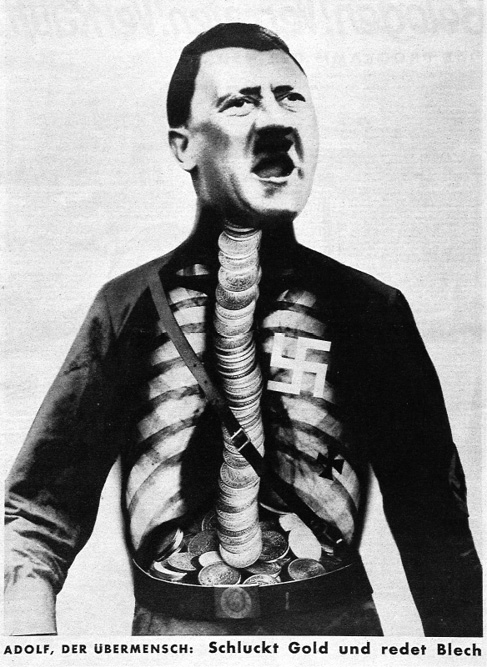
Adolf Hitler with a spine of coins. Originally printed in Arbeiter-Illustrierte-Zeitung, it was created by the artist and communist John Heartfield
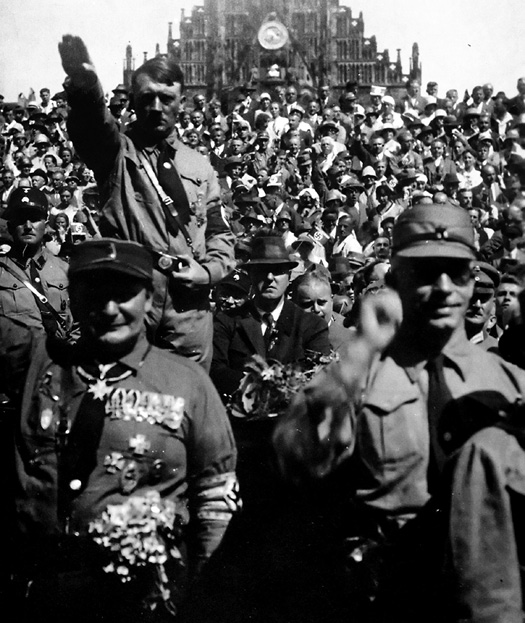
Adolf Hitler at a Nazi Party rally in Nuremberg
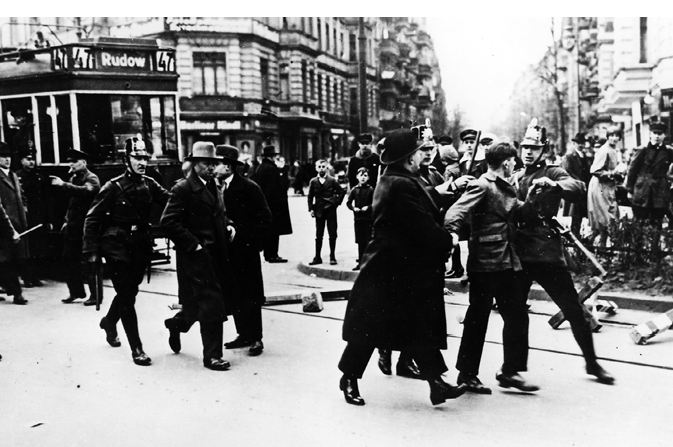
May Day 1929
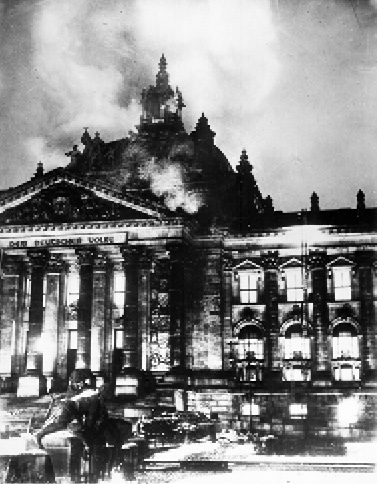
The Reichstag fire
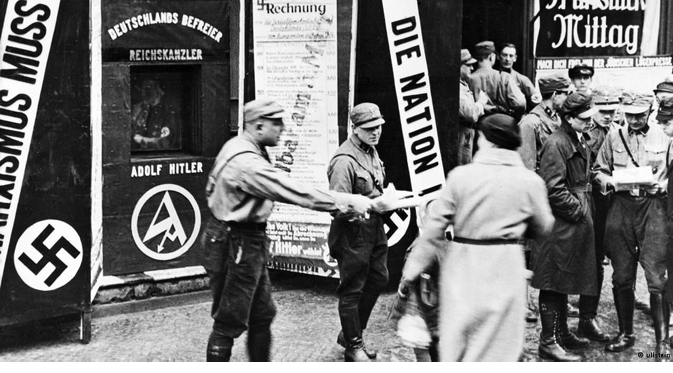
A German polling station in the middle of the Nazi terror