Chapter Eight: The Nazi Terror
Personally, I regard it as a great honour when Mr. Trotsky calls upon German Communism at any price to act together with the Social Democrats, since National Socialism must be regarded as the one real danger for Bolshevism.
Adolf Hitler
I was beaten and tortured continually for ten days after my arrest by the Gestapo. Only complete exhaustion halted their curiosity about La Verité and the Fourth International. If I had dropped a single unwarranted word, it meant death. Tortures of all kinds were common in the camp, from marches in the snow to typhus injections… It’s the return to barbarism, the inevitable consequences of the morbid will to survive of a class condemned to oblivion. As long as capitalism remains, such barbarism is bound to grow. In all cases – the Poulo Condor camp, where thousands of Indo-Chinese revolutionists perished, the Gurs camp, where the Spanish revolutionaries starved to death, and this most monstrous one of all at Buchenwald, first created for German Communists – the responsibility lies with the same decadent bourgeoisie.
Marcel Beaufrere, May 1945
In the words of one historian, with the advent of fascism, “the gutter had come to power.” But this was not simply a rabble; it had become a ferocious battering ram, a mailed fist, a deadly tool of finance capital. A united front of the SPD, the KPD and the trade unions, as Trotsky argued for, could have entirely transformed the situation and blocked Hitler’s path. This is no idle speculation. The German labour movement was the strongest in the world in terms of numbers, organisation and revolutionary traditions. It had every chance of success in defeating Hitler.
The potential for resistance was ever present, as the previous seven chapters of this book amply demonstrate. The problem was that this powerful working class faced the mighty obstacle of its own leadership. The united movement of the workers had smashed the Kapp Putsch in 1920 and they could even have taken power. Such a united force could have fought the Nazis, splitting the wavering middle classes from its ranks, and trampled the Hitler movement under foot. The working class would have fought like lions if the call had gone out from the leadership, but there was no call. It was their duty to resist Hitler, with guns in hand if necessary.
Julius Braunthal wrote that:
If only the thirteen million, who had constantly supported the two socialist parties in the elections from the birth of the German Republic to the last vote before Hitler seized power, had been a united army, a genuine workers’ alliance, a real band of brothers, the reactionaries, even if they had dared to raise their head, could certainly not have triumphed over the workers without a struggle. (J. Braunthal, History of the International, p. 390.)
This would have been a struggle with no holds barred. “But this would mean civil war!” argued the reformists. The reformists, in the name of avoiding violence and bloodshed, preferred to give up without a fight, preparing the nightmare that was to come.
Given the strength of the German working class, any such struggle would have been brief and the working class would have emerged victorious, especially with a resolute leadership. The only alternative to capitulation was to fight. It was infinitely more preferable than the horrors of the Holocaust and the Second World War, with fifty-five million dead and countless maimed and injured. World War could have been avoided if the working class had come to power. The responsibility for the victory of fascism lay squarely with the German labour leaders.
The workers were not pacifists. The Reichsbanner alone had around three million members in 1932, organised into more than 5,000 groups. They had access to arms. They were part of the military formation, the ‘Iron Front’, which could have been mobilised. They outnumbered the Reichswehr, Stahlhelm and Hitler’s forces put together. A general strike, as in 1920, would have paralysed the army’s operations. The workers were waiting for a signal for an all-out general strike from their leaders, but none came.
On the evening of 30 January 1933, with the news that Hitler was made Chancellor, spontaneous demonstrations took place throughout Germany. Delegations of workers arrived in Berlin requesting orders to fight. The same evening, a joint conference of trade union executives, the SPD, the SPD Parliamentary faction and the leaders of the Reichsbanner and Iron Front met and decided to act against Hitler. But following further deliberations, the leaders drew back and pleaded caution. Instead they proposed to act as soon as there was a breach of the Constitution. However, Hitler was cunning and pledged to uphold the Constitution. Vorwärts stated on 30 January:
In the face of this government and its threats of a coup d’etat, the Social Democrats and the whole ‘Iron Front’ stands squarely on the ground of the Constitution and of legality. (ibid., p. 381.)
This was a programme of paralysis.
The crisis in Germany was, as Trotsky had warned repeatedly throughout this period, a crisis of leadership. In the end, the workers were like lambs led to the slaughter, but in this case they were led to the concentration camps, with their hands tied behind their backs. Others disappeared into the cellars of the Gestapo. This failure of leadership meant the beginning of a long and ghastly nightmare.
The Social Democratic leaders had supported every reactionary government and presidential candidate with their bankrupt policy of ‘the lesser evil’. The problem, however, inevitably emerged when the ‘lesser evil’ became the ‘greater evil’. These leaders, after clinging onto the coat-tails of Ebert, then clung onto the militarist, von Hindenburg. They held onto the coat-tails of every bourgeois politician, including Brüning, then Papen, while holding up the fascists as a scarecrow to justify their policy of capitulation. They were busy sowing illusions, instead of mobilising the working class. In this way, they disorientated, confused and demoralised the German working class.
They never understood the real meaning or nature of fascism, with all its implications, and shied away from fighting it. Instead, they appealed to the state to save them. But the state – the bourgeois state – was not neutral, and in the final analysis represented the ruling class. They thought the Constitution would save them. But this was a pipe dream. The crisis of capitalism was a crisis of the bourgeois regime. They failed to understand that fascism was a product of this crisis, in effect a mincing machine of finance capital. Only Leon Trotsky, the exiled Russian revolutionary, isolated in Prinkipo, clearly understood the phenomenon and sounded the alarm. He spelled out what was needed in plain language:
Fascism is not merely a system of reprisals, of brutal force, and of police terror. Fascism is a particular governmental system based on the uprooting of all elements of proletarian democracy within bourgeois society. The task of fascism lies not only in destroying the communist vanguard but in holding the entire class in a state of forced disunity. To this end the physical annihilation of the most revolutionary section of the workers does not suffice. It is also necessary to smash all independent and voluntary organizations, to demolish all the defensive bulwarks of the proletariat, and to uproot whatever has been achieved during three-quarters of a century by the Social Democracy and the trade unions.
He continued:
Nevertheless, says Hilferding, had the Social Democracy voted against Brüning’s government and thereby overthrown it, the consequence would have been the coming of the fascists to power. That is the way, perhaps, the matter may appear on a parliamentary plane; but the matter itself does not rest on a parliamentary plane. The Social Democracy could refuse to support Brüning only in the event that it decided to enter upon the road of revolutionary struggle. Either support Brüning, or fight for the dictatorship of the proletariat. No third course is given. The Social Democracy, by voting against Brüning, would change at once the correlation of forces – not on the parliamentary chessboard, whose chess pieces might surprisingly enough be found underneath the table – but on the arena of the revolutionary struggle of the classes. After such an about-face, the forces of the working class would increase not twofold but tenfold, for the moral factor holds by no means the last place in the class struggle, particularly during great historical upheavals. Under the impact of this moral force, the masses of the people, one stratum after another, would be charged to the point of highest intensity. The proletariat would say to itself with assurance, that it alone was called to give a different and a higher direction to the life of this great nation. Disintegration and decomposition in Hitler’s army would set in before the decisive battles. Battles of course could not be avoided; but with a firm resolution to fight to victory, by attacking boldly, victory might be achieved infinitely more easily than the most extreme revolutionary optimist now imagines. (L. Trotsky, The Struggle Against Fascism, p. 144 and p. 152.)
But Trotsky’s clear advice was ignored by the leaders of both the Social Democracy and the Stalinists. Instead, they jointly prepared, in their own way, the greatest betrayal in history. The Stalinists blamed the Social Democrats and the Social Democrats blamed the Stalinists, resulting in complete paralysis. In this way they were slaughtered.
No Resistance
Shamefully, the National Socialists were able to seize power without any resistance. There was not a shot fired, no general strike, no barricades, nothing. The labour movement were given months, even years, to prepare for this outcome, but the workers’ leaders lulled the working class to sleep with fairy tales. They preferred to take the line of least resistance, which did not exist, and this led them into the deepest of chasms.
Up until Hitler came to power, and beyond, the Communist leaders continued their relentless attacks on ‘social fascism’ as the main enemy. They therefore rejected a united front against fascism, unless it was ‘from below’. On 30 January, while the KPD did not regard Hitler becoming Chancellor as decisive, they did issue a call for a general strike, but there was no response. This was hardly surprising given their continuous attack on the Social Democrats as being accomplices of Hitler. After this fiasco, the party made no further attempt to fight. Instead they continued to blame the Social Democrats.
In their declaration, entitled ‘The Guilt of the Social Democrats’, they declared:
[T]hat careful examination of the overall situation showed that in February and March 1933 the conditions were not yet ripe for a victorious proletarian revolution… One of the basic conditions for successful insurrection was not yet present: the KPD had not yet captured the majority of the workers. Millions of workers were still under the spell of social fascism. They were not yet prepared to join the communists in a revolutionary struggle for power without, or against, the approval of their leaders. (J. Braunthal, History of the International, p. 389.)
The socialist leaders behaved in the exact same fashion, blaming the communists. Instead of resistance, they called for calm as the totalitarian state took shape before their very eyes. With this paralysis they prepared the ground for violence on an unheard-of scale, and rivers of blood would flow as a consequence. They cry, “Peace, peace, when there is no peace,” states the Bible. (Jeremiah, 6:14.) All these leaders had to offer was a miserable whitewash to cover up their crimes.
The plebeian, fascist scum had risen to the top, assisted and financed by big business. The bourgeoisie thought they could control them, like some hired mafia gang. But they were badly mistaken. The fascists in power, while doing the bidding of the monopolies in crushing the working class, nevertheless had their own agenda. They were now in the saddle, with the full resources of the state behind them. In their eyes, they deserved a big slice of the pie and weren’t going to give it up. “Once we have the power we will never give it up,” stated Goebbels. “They will have to carry our dead bodies out of the ministries.” (W.L. Shirer, p. 167.) They were now masters of the state and they would determine society’s fate. They had their noses firmly in the trough and refused to budge. The bourgeoisie had knowingly unleashed this fascist gang and would reap what they had sown. While they would keep their economic power, they would be forced to relinquish their political power to the fascist gang. They would still remain the ruling class, with their property intact, but would lose their political control. Some would even end up in prison; others kidnapped; others murdered. That was the price they paid for fascist counter-revolution.
The middle-class organisations were trampled underfoot. Even the ‘Combat League of Middle-class Tradespeople’, which had hopes of nationalisation measures and the running of industry, was swiftly dissolved, and the rule of Krupps, Thyssen and other heads of industry was secure, under fascist management.
The middle-class organisations were trampled under foot. Even the ‘Combat League of Middle-class Tradespeople’, which had hopes of nationalisation measures and the running of industry, was swiftly dissolved, and the rule of Krupps, Thyssen and other heads of industry was secure, under fascist management.
The fascist bureaucracy, however, while standing above society, was never an entirely independent entity. In the final analysis, it represented the bourgeoisie, but only in the final analysis, and in its own way. The bourgeoisie had hoped they could put the fascist sword back into its scabbard once the task of destroying the German labour movement had been carried out. But this was not to be. They were forced to live with the results of their actions, including the liquidation of all the bourgeois parties. Only the fascist party would remain. They had unknowingly conjured up forces that they could not control. It would be a long time before the fascist hydra would relinquish its domination over the state and society, and at a staggering cost.
In the face of this almighty calamity, the leadership of the German labour movement displayed complete bankruptcy. All they could do was wring their hands and grovel before the strongman Hitler, the Führer. This meant they were prepared to do anything to survive, even cut their own throats, as long as it did not mean breaking the Constitution.
Towards the end of March, well after the International Socialist press had exposed the Nazi atrocities in Germany, a number of members of the SPD Executive volunteered to go abroad, with assistance from Göring, so as to stop the negative publicity because it was “apt to harm the position of the anti-fascists in Germany”. (E. Anderson, p. 154.)
To appease the Nazis, Otto Wels, the chairman of the SPD, resigned from the Bureau of the Labour and Socialist International, but this did not save him. Disgracefully, the SPD leaders took disciplinary action against the Berlin Socialist Youth and others who undertook clandestine measures against the fascist regime. “Don’t provoke the fascists!” they demanded. “You will only make matters worse.” But it was their own inaction that made matters worse. As a result, the leaders sank deeper and deeper. The lower they sank, the more they debased themselves and the movement they were supposed to represent. They even ended up denouncing their own comrades abroad who attacked Hitler and his crimes, least they cause offence. They wallowed in self-pity as the iron heel of fascist reaction bore down on the necks of the German working class. It was a shameful spectacle of betrayal, worse than in August 1914.
May Day Appeal
While the KPD was banned, the party issued a May Day manifesto, but there was no mention or call for unity of the workers’ organisations. It was instead full of platitudes and bravado.
The German Communist Party has broadcast an appeal to the German workers, although they were working under conditions of terrorism, in which every action or even remark of a nature hostile to fascism is threatened with arrest and torture:
“Who is giving the answer to your questions in this hour? Who is leading you on the way to socialism? Nobody – except the only party, which did not capitulate, the only party that did not and will never make its peace with the fascist bloodhounds, the only party which despite all terror will lift the Red Banner of proletarian internationalism higher than ever on this May Day 1933 – the Communist Party!
“Make this May Day your first great trial of strength between the fascist dictatorship of Hitler and Göring and the unconquered giant, the German proletariat. The world must know that the German working class has not been defeated.” (Daily Worker, 1 May 1933.)
Such hyperbole was clearly out of place as the axe fell. Within twenty-four hours, the German trade unions had been crushed, with not so much as a finger being raised.
While the KPD were driven underground, their property and assets confiscated, the SPD were allowed a temporary ‘legal’ existence, which was a deliberate attempt to play one off against the other. The Social Democrats participated in the new election and sent their deputies to the Reichstag circus. They tried to preserve this precarious status through collaboration with the Nazis.
‘Weakness invites aggression’ is the old adage, and the more they grovelled, the more the Nazis stamped on them. In early May, the fascist police occupied the SPD buildings and its press and confiscated its property. Yet the leaders accepted their lot and bowed their heads lower. On 17 May, the SPD leadership, broken, humiliated and enfeebled, voted for Hitler’s foreign policy, the ‘Peace Resolution’, in the Reichstag. But even this open display of ‘support’ would not save them.
A month later, in a reign of terror, the SPD was outlawed. The Catholic Bavarian People’s Party dissolved itself, as did the Centre Party, followed by the People’s Party and the Democrats. Better to liquidate themselves, they thought, than face liquidation. On 29 June, Hitler’s coalition partners, the National Party, ‘voluntarily liquidated itself’ as the SA took over its buildings and offices. Despite this, there was not a peep from the workers’ leaders. They were dead men walking, blindly accepting their fate.
Destroying the Unions
On 7 February, 1933, Künstler, head of the Berlin Federation of the Social Democratic Party, gave this instruction to the Socialist workers:
Above all do not let yourselves be provoked. The life and health of the Berlin workers are too dear to be jeopardised lightly; they must be preserved for the day of struggle. (Quoted in T. Grant, The Menace of Fascism.)
But the “day of struggle” never came. Only the day of capitulation arrived.
Following the March election, the trade union leaders made their feelings known. On 13 April, Hans Ehrenteit stated in the Provincial Congress of the Free Trades Unions of Hamburg:
We are ready and able to fulfil the hopes and desires of the proletariat in the economic-social sphere, in agreement with the present rulers. We do not doubt for one moment that the events of 5 March represent a revolution of enormous depth and scope; a revolution which is to surpass the liberal and capitalist economic system; a revolution putting an end to that democratic parliamentarianism which for the past few years has been so deceptive. The trade unions have built bridges to the state and to its rulers. We must now proclaim our attitude in respect of the state and the nation. This attitude will have a foundation. The best course, in our opinion, is to build bridges for those who, through ignorance, would wish, today more than yesterday, to destroy the trade union movement, and we hope to be able to assist in this. The function of the trade unions must be to continue to fulfil their social and economic mission. This same duty has been carried out by the present government of the Reich, and collaboration between the trade unions and the government is therefore possible. (Freie Gewerkschaft, No. 14, quoted in A.R. Oliveira, p. 196.)
This was nothing more than the official signing of the death warrant of the ‘Free’ trade union movement in Germany. This fawning gave increased succour to Hitler.
Cynically, Hitler declared 1 May a ‘National’ Labour Day, to which the trade union leaders humbly offered their full support. Even through the spring of 1933, the German trade union leaders humiliatingly co-operated with the fascist government. They issued a statement breaking off their links with the SPD and called on their members to take part in the rallies organised by the Hitler government. These celebrations were nothing more than a farce to further legitimise the regime. Finally, the German trade union leaders urgently telegraphed the International Federation of Trade Unions in an attempt to prevent it, as members, from protesting against the Nazi government’s murder and torture of thousands of German workers. When the International refused, they resigned from the body, in the hope that by such grovelling they would escape persecution.
The official organ of the German TUC, Gewerkschaftszeitung, published an article for its May Day edition by Walter Pahl with the following scandalous statement:
We certainly need not strike our colours in order to recognise that the victory of National Socialism, though won in struggle against a party [the Social Democrats] which we used to consider as the embodiment of the idea of Socialism, is our victory as well; because, today, the Socialist task is put to the whole nation. (E. Anderson, p. 155.)
To claim that Hitler’s victory was also “our victory” was a vile statement that flew in the faces of those millions who opposed the fascists. It was to hoist the white flag of surrender. There was no talk of resistance, as resistance in their eyes was futile. These bureaucrats were only interested in saving their own skins. But the fascist regime was never going to let this happen. After the National Labour Day mass demonstration of 100,000, Goebbels wrote: “Tomorrow we will occupy the trade union buildings. There will be little resistance”. (W.L. Shirer, p. 202.)
The next day, 2 May, the Stormtroopers occupied the trade union headquarters, the People’s Houses, and turned them instead into ‘Houses of German Labour’. As Goebbels had predicted, there was no resistance. On 10 May, the ‘German Labour Front’ was set up, the only legal entity allowed, which included the ‘co-ordinated’ organisations, grouped into fourteen trade federations. On 16 May, the right to strike was abolished. Eventually, the federations were dissolved. The industrial organisations of the German working class had disappeared. With the trade unions ‘reorganised’ (dissolved) and their funds confiscated, the former leaders were arrested, loaded into trucks and taken off to Nazi concentration camps. It was simply a mopping up operation. They accepted their fate, heads bowed, in silence. Even in this darkest hour, Theodor Leipart and Peter Grossman, leaders of the Trade Union Confederation, still proclaimed their readiness to co-operate with Hitler. It was a miserable gesture. Despite their protests of loyalty to the Führer, the Nazis felt that Grossman and Leipart were better off elsewhere.
“The Leiparts and Grossmans,” declared Doctor Robert Ley, assigned by Hitler to reorganise the trade unions into a German Labour Front, “may hypocritically declare their devotion to the Führer as much as they like but it is better that they should be in prison.” (ibid., p. 202.) And it was to Plötzensee prison they went, where they prostrated themselves.
SPD Banned
The end, when it came, was shameful and inglorious, the worst of all capitulations. There was no resistance to the totalitarian nightmare, only abject humiliation by the labour and trade union leaders, who were servile before Hitler. As we have seen, he cynically used them and then sent them, along with two million others, to the concentration camps.
Once the labour movement had been completely discredited, they destroyed it. The mightiest working-class movement in the world was obliterated. Not one stone upon another was left of its organisations. Even the workers’ chess clubs were dissolved. The fascists created a network of spies and informers in every building, workplace, school and estate, a totalitarian vice that penetrated into every nook and cranny of life. The working class was atomised. This was the real meaning of fascism, as Trotsky had warned. The workers’ movement was being reduced to particles of dust.
Hitler moved quickly. On 23 June, the SPD was officially banned. Its leaders were arrested, including the arch-appeaser, Paul Löbe. Their usefulness in creating the maximum demoralisation and confusion was over. The organised labour movement had vanished from the scene. On 27 June, Hitler expelled Alfred Hugenberg from the government, as the whole economy passed into the control of the Nazis.
On 14 July a new law was decreed which simply stated: “The National Socialist German Workers’ Party constitutes the only political party in Germany”. A one-party, totalitarian regime was in place and all opposition was mercilessly crushed. The regime was given a new name, the Third Reich. “The first Reich was that of Bismarck,” explained Hitler, “the second that of the Weimar Republic, and the third is myself.” (Quoted in A.R. Oliveira, p. 200.)
Jan Valtin related:
Communists were hunted down like mad dogs. Weaklings in our own ranks capitulated. Spies stepped from obscurity. The majority of the party’s top-rank leaders saved their own hides by bolting across the frontiers to neutral countries. But some were captured…
Overnight the Communist Party had taken on the appearance of an ant-heap smashed by a sudden hail of sledge-hammer blows. On 2 March, the new terror laws against the Communist Party were decreed. Hitler’s technique of victory was simple: concentration of the whole ferocity of the National Socialist movement against one enemy at a time, while manoeuvring the others into a false sense of security. (J. Valtin, p. 345.)
It was the Communist Party rank and file, along with the socialist workers, who bore the brunt of the Nazi terror. Once in power, the Nazis accomplished in months what had taken the Italian fascists four years to accomplish. The political parties were banned; the trade unions were destroyed; and the funds of the workers’ organisations were confiscated for the benefit of the Nazis. The first concentration camp in Germany, Dachau, was founded in March 1933. Others were opened at Oranienburg, Esterwegen and other places, and a reign of terror commenced against the working-class Socialists and communists on a scale never witnessed in modern history.
A press announcement said that:
[T]he first concentration camp is to be opened in Dachau with an accommodation for 5,000 people. All Communists and – where necessary – Reichsbanner and Social Democratic functionaries who endanger state security are to be concentrated there, as in the long run it is not possible to keep individual functionaries in the state prisons without overburdening these prisons. (Münchner Neueste Nachrichten, 21 March 1933. The Holocaust History Project. Archived from the original on 6 May 2013.)
Himmler then expanded the role of the camps to hold so-called “racially undesirable elements”, such as Jews, Romanis, Serbs, Poles, disabled people, and criminals.
The role of fascism was to root out every trace of socialist consciousness. Smashing the labour movement was the first task. Then all socialist, communist, and progressive literature was seized and destroyed. The Nazis even organised public book burnings, like scenes from the Middle Ages and the Spanish Inquisition.
Those workers caught by the Gestapo machine faced a most brutal end. Within a short period of time, two-and-a-half thousand communists were murdered on the spot. A further 130,000 were taken off to the concentration camps, to meet their death in the gas chambers, through beheadings, through the torture chambers of the SS, worked or starved to death, or simply shot.
Valtin describes the horrors of torture and murder that took place in the cellars of the Gestapo, which captured the very essence of fascism. He witnessed the situation in Plötzensee Prison:
Those among us who awoke early in the morning, waiting for the bell to command us to rise, soon learnt to recognise the sounds accompanying an execution: the clatter of feet on Death Row at six in the morning, the creaking doors of the shed at the other end of the cobbled square facing Death Row – the shed where the guillotine stood hidden behind a canvas curtain: The sudden rattling of keys in ponderous doors, sometimes the sounds of a futile struggle, roars of rage and screams for help, or a booming voice singing the Internationale and ending with a hoarse shout of farewell from the hundreds who lay listening in their cells still alive. (J. Valtin, p. 571.)
The Stalinist Response
The Stalinists were incapable of recognising the catastrophic defeat that had taken place; they simply talked wildly of a new revolutionary upswing. In the midst of defeat, their organisation smashed to pieces, the Comintern leaders still declared:
The current calm after the victory of fascism is only temporary. Inevitably, despite fascist terrorism, the revolutionary tide in Germany will grow… The establishment of an open fascist dictatorship, which is destroying all democratic illusions among the masses and freeing them from the influence of the Social Democracy, will speed up Germany’s progress towards the proletarian revolution. (‘The Situation in Germany’: Resolution of the Presidium of the ECCI, adopted 1 April 1933, International Press Correspondence, 13 April 1933, p. 378, quoted in J. Braunthal, History of the International, p. 394, emphasis added.)
In other words, the victory of Hitler, with the annihilation of all the organisations of the working class, was regarded by the Stalinists as an advantage to the revolutionary movement. This ridiculous chest-beating was repeated by the Stalinist stooge Kuusinen:
Even fascist demagogy can now have a two-fold effect. It can, in spite of the fascists, help us to free the masses of the toilers from the illusions of parliamentary democracy and peaceful evolution. (International Press Correspondence, 30 January 1934, p. 109, emphasis added.)
And then finally in May 1934, more than a year after Hitler’s victory, Manuilsky states:
Fascism does not only make the struggle of the working class more difficult; it also accelerates the processes of the maturing revolutionary crisis. (International Press Correspondence, 7 May 1934, p. 712, emphasis added.)
This lunacy simply reflected the further degeneration of the Stalinists who proved incapable of distinguishing between revolution and counter-revolution. They simply continued as though nothing fundamental had happened, only with increased hysteria. Despite the fact that the SPD was banned, its leaders imprisoned and its organisations wrecked, the German Communists still declared the ‘social fascists’ as the main enemy. The KPD Central Committee at the end of May brazenly declared:
The total removal of social fascists from the state machine and the brutal suppression of the Social Democratic organisations and their press, can do nothing to change the fact that the Social Democrats were, and still remain, the chief prop of capitalist dictatorship… The Nazis beat the Social Democrats as they would beat a faithful dog who had outlived his usefulness. (J. Braunthal, History of the International 1914-1943, p. 395, emphasis added.)
Given the seeming contradiction, even to many communists, an article appeared in Rundschau in July 1933, seeking to support this argument:
The suppression of the Social Democratic Party by the fascist dictatorship, while certainly changing the forms and the methods of the social fascists’ betrayal of the workers, does nothing to stop the betrayal itself… The ban on the SPD does not really operate against the policy and leadership of the party – despite the arrests [sic] – but against the Social Democratic workers and trade unionists and their efforts to fight together with the communists against fascism… Social fascist influence among the workers will not be destroyed by fascism, the twin brother of social fascism, but only by achieving Communist Party hegemony in the working class. (Quoted in ibid., p. 395.)
Madness was heaped on more madness. They were completely oblivious to the consequences of this crushing defeat. For the sake of prestige – their line was always correct – they denied reality. They were in denial about their erroneous policies which had split the labour movement and led to this disaster. On the contrary, the Comintern Executive met in April 1933 and noted with approval, “That the political line and the organisational policy followed by the Central Committee of the German Communist Party up to and during Hitler’s coup was perfectly correct”. (ibid., p. 388.) These leaders of the Comintern simply asserted that black was white, and Pravda described its German policy as a “resounding success”. (ibid., p. 388.) Thus, as with the Second International in 1914, so now, the Stalinist Third International had become ‘a stinking corpse’, an obstacle to the Socialist revolution. All the lessons learnt during the days of the Comintern under Lenin and Trotsky – the first five years – where the International played a revolutionary role had been completely buried and forgotten.
Defiance
The Nazis beat their victims to death or beheaded them in front of their comrades. But despite these horrors, many openly defied the butcher’s axe. Valtin again described one scene:
First to be led from his cell was Johnny Dettmer… Cries came from the many cell windows: “Good-bye, Johnny!” – “Long live the revolution!” – “Nieder mit Hitler!” Cries of rage and cries of terror. When the headsman’s assistants seized Johnny Dettmer, our comrade fought wildly. He fought silently, with all his strength. But his hands were shackled on his back. Guards tied his ankles together and strapped him in upright position to a board. The board swung to a horizontal position. Johnny’s head protruded over the edge of the board…
“Good-bye Johnny, good-bye, good-bye.” Most eyes were tearless. They were wide open and dry and staring. Before I could realise what was happening, the headsman raised his axe over comrade Dettmer’s head. He did not strike. He simply let it fall on Johnny’s neck.
“Your head will roll, too,” Arthur Schmidt said to Prosecutor Jauch, straightening in sudden defiance. They then strapped him to the board… “All men must die sometime… I die for the proletariat… They can kill the worker Arthur Schmidt, but they can’t kill his spirit…” [Then] the axe fell. (J. Valtin, pp. 518-519.)
In the meantime, Hitler talked of abolishing unemployment, doing away with misery and restoring ‘German honour’. As expected, in the election of November 1933, the Nazi party, the only party remaining, won 92.2 per cent of the vote, with 3.3 million election cards declared void and 2.1 million abstaining. These were, of course, official figures. Nevertheless, the result reflected the terror and demoralisation in society. A polling station had even been established in the notorious Nazi concentration camp at Dachau, where most of the prisoners, mostly communists, were political opponents of the fascists. Following the election result, it was officially announced that a majority of inmates had voted for Hitler’s party.
The Communist Party in spite of all this, once again refused to face up to reality. They explained the election result in the following terms:
The election result… represents a great victory of Thälmann’s party… This army of millions of brave anti-fascists confirms the correctness of the statement, made already in October by the Central Committee of the German Communist Party, that a new revolutionary upsurge has begun in Germany. (‘The Meaning of the Elections of 12 November in Germany’, Rundschau, No. 43, 17 November 1933, quoted in E. Anderson, p. 159.)
Stalin was still pursuing friendly relations with Germany, even after the victory of Hitler and the crushing of the Communist Party. The German Ambassador in Moscow, Dirksen, noted that the Soviet Union’s attitude towards the Hitler regime remained friendly, even to the point of suppressing open displays of hostility towards the regime. In a report to Berlin in May 1933, Dirksen said that:
…a strong attack on Communism in Germany itself is entirely compatible with preserving friendly German-Russian relations… Yesterday [May Day] passed off without incident. Voroshilov’s speech offered no occasion for special objections; the throngs of demonstrators refrained from calumniations of National Socialism or of leading Germans. The ceremony at the Embassy was extraordinarily well-attended (550 persons): after my speech three or four German [exile] Communists apparently sent to start a row, tried to ‘heckle’ me, but they were gently ousted. (Quoted by R. Blick, Fascism in Germany, appendix 111.)
On 16 May, Dirksen reported an interview with Litvinov, the Soviet Foreign Minister, where he stated that “the basic attitude of the Soviet government toward Germany had remained entirely the same: The Soviet government was convinced that it could have just as friendly relations with a Nazi Germany as with a fascist Italy”. On 4 August, Molotov repeated this policy: “The Soviet government [is] striving for [a] friendly relation not only with other countries, but also with Germany, regardless of their internal political structure…” This provoked Dirksen to comment, “Molotov’s statements, as one of the really authoritative men and closest co-workers of Stalin, undoubtedly deserves serious consideration”. Molotov went even further in his fawning towards the Hitler regime, made public at the September 1933 session of the All-Union Central Executive Committee:
We of course sympathise with the sufferings of our German comrades, but we Marxists are the last who can be reproached with allowing our feelings to dictate our policy. The whole world knows that we can and do maintain good relations with the capitalist states of any brand, including the fascist. (ibid.)
Night of the Long Knives
After suppressing organised labour, Hitler then moved to crush the restless idealists inside the Nazi party who were demanding a ‘Second Revolution’ to achieve ‘National Socialism’, by nationalising the monopolies, the banks, breaking up the department stores, etc. They were so deluded that they actually believed their own propaganda, not realising that it was all a sham, a ploy to fool the ruined middle class. In reality, the reverse was happening. The bourgeoisie ruthlessly used its supremacy in the factories after the destruction of the trade unions to organise a regime of terror. Wages were cut, conditions driven down, rights withdrawn, and strikes forbidden. The capitalists now had the whip hand to do as they wished. Exploitation increased and the rate of profit rose. The fascist dictatorship was, in the final analysis, a brutal dictatorship of the monopolies. Hitler gave the capitalists everything they desired and, in turn, they gave him the freedom to do as he wished. As long as profits were booming and wages were driven down, they were content. The only promise Hitler kept was the persecution of the Jews, who were used as a scapegoat and an outlet for the growing disillusionment of the petty bourgeoisie.
While Hitler betrayed the middle-class base of fascism, he needed to deal with the threat from the SA. This paramilitary organisation, under Röhm, now numbered more than two million members – twenty times more than the army. “We are the incorruptible guarantors of the fulfilment of the German revolution,” stated Röhm. (W.L. Shirer, p. 205.) Its ranks were made up of hard-line fanatics who demanded the ‘Second Revolution’, but they were to be disarmed and liquidated by Hitler in June 1934 in the famous ‘Night of the Long Knives’. These mercenaries, Röhm, Strasser, Schleicher and hundreds more, were ruthlessly murdered after their dirty work was done. “The revolution is not a permanent state of affairs,” explained Hitler, “and it must not be allowed to develop into such a state.” (ibid., p.205) Hitler compared the ‘Second Revolution’ to ‘national Bolshevism’. It was a threat, an embarrassing legacy of the years of struggle, that had to be eliminated. Behind the purge stood the army, which regarded the SA as a rival. More than 1,000 lost their lives in the blood-letting. However, in the place of the SA now came the SS, Hitler’s elite, as a reward for carrying out the executions. To play down the purge, Goebbels forbade German newspapers from carrying obituaries of those who had been executed.
The Sozialistische Aktion, the illegal organ of the SPD, published abroad and smuggled into Germany, published an article on 12 July 1934 with the headline, ‘Suicide of the Dictatorship’. The following issue stated, “The 30 June is the beginning of the end of National Socialism”. (E. Anderson, pp. 169-170.) The Stalinists also said the same thing. But they were woefully deluded. As Trotsky had explained, such a terrible defeat at the hands of fascism meant the working class would not recover in two or three years, but for fifteen years.
The Nazi state apparatus was now fully in place. Into their clutches came the state organs, the judiciary, the civil service, the education system, the Church, everything down to the nurseries. All opposition was mercilessly eliminated.
Once in power, however, fascism began to lose its mass base and began to increasingly resemble a Bonapartist police state. Its mission had been accomplished and the proletariat atomised. The multi-million strong German labour movement – with a Marxist tradition extending over seventy-five years – had been smashed to smithereens.
In a macabre twist, Stalin was suitability impressed by the news of Hitler’s Night of the Long Knives and was inspired to come up with his own bloody purge in the Soviet Union. Months later, in December 1934, Stalin had Sergei Kirov, a high-ranking bureaucrat, assassinated. It would be the opening prelude to the infamous Moscow Show Trials, in which the Old Bolsheviks were judicially tried for supporting fascism, and executed. A river of blood now separated the regime of Stalin from the regime of Soviet Democracy under Lenin and Trotsky.
Stalin and Hitler
Stalin was now particularly concerned that German communists could be a source of criticism of his leadership. Therefore, he would not be satisfied until all the KPD leaders, those thought to be inwardly critical of his policy in particular, had been eliminated. Thus, those whom the Nazis failed to hunt down and murder were butchered by Stalin’s GPU gangsters in the cellars of the Lubyanka. Stalin and Hitler between them could, by 1937, claim to have massacred the majority of the KPD Central Committee, and untold thousands more of its middle- and lower-party cadres. In fact, Stalin succeeded in murdering more of the top party leaders than Hitler, as the following figures illustrate:
German Politburo: those murdered by Stalin: Hermann Remmele, Heinz Neumann, Fritz Schulte, Hermann Schubert – four.
German Politburo: those murdered by Hitler: Ernst Thälmann, John Scheer – two.
German Central Committee: those murdered by Stalin: Hugo Eberlein (founder member of the Comintern), Hans Kippenberger (head of the KPD military apparatus), Leo Flieg (KPD Organisations Secretary), Willy Leow (head of the Red Front Fighters’ League), Willi Koska (head of Red Aid), Heinrich Susskind and Werner Hirsch (chief editors of Rote Fahne, the KPD daily), Erich Birkenhauer, Alfred Rebe, Theodor Beutling, Heinrich Kurella (on the staff of Rote Fahne), Kurt Sauerland, August Creutzburg. Total – eleven.
German Central Committee: those murdered by Hitler – nine. (Figures supplied by R. Blick, Fascism in Germany.)
According to Leopold Trepper, the leader of the ‘Red Orchestra’, the Soviet Intelligence network that functioned in occupied Europe during the Second World War, the German communists who fled to the Soviet Union were murdered by Stalin. “By 1937, not one of the principal leaders of the German Communist Party was left, except for Wilhelm Pieck and Walter Ulbricht”. (L. Trepper, The Great Game, p. 55.)
‘Left’ Historians
The attempts by the bourgeois historians to explain the rise of fascism and the victory of Hitler are more than worthless. They are mere descriptions of events. In the realm of understanding, they generally meander into the subjective qualities of Hitler and the ‘mistakes’ of his opponents. As for the ‘left’ historians, they fair little better. For instance, the late professor Eric Hobsbawm in his book The Age of Extremes attempted to explain the victory of Hitler by blaming the Great Depression. It was a factor, but it is impossible to understand the reason why the mighty German labour movement was paralysed and crushed by Nazism without understanding the disastrous role of the leadership of both the Social Democracy and, above all, the Stalinists who deliberately split the working class.
Hobsbawm skates around this subject as if on very thin ice:
The strengthening of the radical Right was reinforced, at least during the worst period of the slump, by the spectacular setbacks for the revolutionary Left. So far from initiating another round of social revolution, as the Communist International had expected, the Depression reduced the international communist movement outside the USSR to a state of unprecedented feebleness. This was admittedly due in some measure to the suicidal policy of the Comintern, which not only grossly underestimated the danger of National Socialism in Germany, but pursued a policy of sectarian isolation that seems quite incredible in retrospect, by deciding that its main enemy was the organized mass labour movement of Social Democratic and labour parties (described as ‘social fascist’). (E. Hobsbawm, Age of Extremes – The Short Twentieth Century 1914-1991, pp. 104-5, emphasis added.)
With just a few short lines, which appear almost as a footnote, Hobsbawm sweeps aside with a slap on the wrist the disastrous role of the Communist Party in handing victory to Hitler, one of the greatest calamities of modern times. What Hobsbawm fails to understand is that it was not the Depression that “reduced the international communist movement outside the USSR to a state of unprecedented feebleness,” but precisely the criminal ultra-left line of the Comintern, which was in turn dictated by Stalin as part of his struggle against ‘Trotskyism’ in Russia.
In another work, Hobsbawm explained that:
The history of the KPD is tragic. Perhaps it failed for German reasons: because of the inability of the German left to overcome the historic weaknesses of both the bourgeoisie and the proletariat of that great and ambiguous country. (E. Hobsbawm, Revolutionaries, p. 64.)
Once again, our apologist speaks in riddles, saying everything except laying the blame where it belongs, at the feet of Stalinism and the stooges he once fawned upon. Such ‘historians’ cannot accept that the policy of Stalin did more for Hitler’s victory than the policy of Hitler himself.
Austrian Uprising
Following the breakup of the Austro-Hungarian empire, the fate of Austria was always very closely linked to Germany. A day after the Kaiser abdicated, the Austrian Emperor followed suit. The Austrian Republic was formed under a new Social Democratic government, with the line of ‘No bloodshed! For law and order!’ They favoured the unification of Austria and Germany, not on the basis of a Soviet Republic, but on the basis of the Weimar Republic.
In Austria, in the 1920s, the fascists organised around the ‘Heimwehr’, a type of Home Guard, which specialised in strikebreaking and terrorising workers. The Social Democrats simply ridiculed them, but nothing more.
In 1926, following Mussolini’s final declaration of the fascist dictatorship and the attempted coup in Bavaria, the Social Democratic Party pledged itself to take up arms if there was a fascist attack or coup in Austria. But this pledge was to prove to be just words. When the Heimwehr started killing and assaulting members of the Republican Defence League, nothing was done.
Repeatedly, fascist murderers would always get released without a sentence. Workers’ tempers inevitably rose. In July 1927, when it became known that four fascist murderers had been released after killing two Defence League members, workers struck work and marched on the building of the fascist newspaper, setting it ablaze. They then marched on the Court House and set it on fire. Street battles broke out and the city was on the verge of a general strike. But when the Social Democratic leaders arrived on the scene, they urged everyone to go home.
It was becoming increasingly obvious that a showdown was inevitable. Then came news of Hitler’s electoral victory on 5 March 1933 in Germany. Two days later, the Austrian Federal Chancellor, Engelbert Dollfuss, a devout Catholic, who only had a majority of one in parliament, carried out a coup in Austria. Socialist workers were ordered, under the threat of the sack, to join Dollfuss’ new party, the ‘Patriotic Front’, which was to replace all parties in the name of ‘national unity’. Dollfuss declared that Austria would be the first country in the world to be ruled according to the ideas of Catholicism and the Pope.
While the fascist movement in Austria was weaker and more divided than in Germany, it started to grow in influence. Again, Austrian workers had shown they were prepared to fight. The Social Democrats were the strongest party in the country, proportionally bigger than its German counterpart and had the support of two-fifths of the electorate.
But when faced with the Dollfuss coup, they trembled at the thought of civil war. They were wringing their hands at the idea of an armed struggle, for which they were not mentally prepared. Instead, the leadership of the Party under Otto Bauer, the pioneer of so-called Austro-Marxism, put their hopes in negotiations and a peaceful solution. They therefore fell over themselves in making one concession after another to the Dollfuss government, all in the name of avoiding bloodshed.
Rebuffed by Hitler, who wanted complete capitulation, Dollfuss turned to Mussolini, who urged him to crush the Social Democrats. In effect, Austria had become an Italian protectorate. And yet, the Social Democrats still hesitated to call on the workers to act. Explaining the party’s tactics to the Executive Committee, Otto Bauer stated:
We knew that in an unequal battle against the tremendous powerful forces of the state, we could only win if the whole of the working class rose up together, with literally every single village where there was a handful of workers joining in. Hence we did not wish to give the signal for battle unless the dictatorship went to a point which was bound to raise popular anger and bitterness to a crescendo. (Quoted in J. Braunthal, History of the International, p. 409.)
So, the Social Democratic Party decided to wait and wait. They finally decided to call on the workers to take up arms as soon as the government proclaimed a fascist constitution or tried to suppress the organisations of the working class. But Dollfuss was not so stupid. He simply chipped away one piece at a time, and the Social Democrats remained silent.
The 6 February 1934, the day when the French fascists engaged in street violence against the Republic on the Place de la Concorde, heralded the collapse of Austria’s democracy.
“Tomorrow,” said vice-Chancellor Fey, “we are going to start cleaning up Austria; we shall make a complete job of it.” (A. Sturmthal, p. 176.) Finally, on 12 February 1934, a year after Dollfuss had become dictator, the struggle broke out. Incredibly, the Social Democrats still hesitated and tried to delay. But the Executive of the party was forced to act when the police and Heimwehr stormed their headquarters and shots were fired. The news spread rapidly throughout the country.
The next day, the party’s Fighting Command mobilised the Republican Defence League and a general strike was called. The inevitable struggle had begun.
P. Berger wrote:
It was ten o’clock in the morning, on 14 February, 1934, when the power in our little workshop in Vienna stopped. Our noisy machinery turned unusually quiet.
“What’s that?” I asked my foreman. “General strike!”
Already, a neighbour was in to ask if our power had stopped as well. There was no argument. Everybody had expected some action of the Austrian working class, long famous for its militancy.
When the three of us – my boss who was a little Polish Jew as poor as any worker, my foreman, a Hungarian engineer, and myself, the errand boy – walked through the town, the trams were dragged by army lorries to the depot to prevent the workers using them as barricades. All the bridges across the Danube Canal which divided the working-class suburbs from the city, were in the hands of the army. Nobody could leave the city without identification. Machine guns and barbed wire were placed in front of important buildings in the main roads. Soldiers in battledress were patrolling the streets. Great activity was manifested at the entrance of the war office. Everything was ready to smash capitalist democracy, under which the workers possessed some rights, and to establish a fascist dictatorship. This was the final moment for twenty years of Social Democratic ‘constitutional leadership’. (P. Berger, ‘Lessons of the 1934 Revolt in Austria: An Account of a Participant’, Fourth International, p. 211.)
However, the general strike call fell on deaf ears. The working class had been continually held back, after a long series of defeats and humiliations which the Social Democrats had swallowed. They delayed and delayed, until finally it was too late. They failed to strike when the iron was hot. The working class was disorientated. The government then declared a State of Emergency and ordered the arrest of the leaders of the Social Democrats and the trade unions, including all its representatives and officials.
Only the Defence League took to arms and barricades were put up in Vienna. Dollfuss used artillery to crush the resistance. After three days of fighting, the insurgents were overwhelmed. The Austrian working class was not defeated by the class enemy. It was let down by its own leaders.
Otto Bauer and Julius Deutsch, the leaders of the revolt, fled to Czechoslovakia, and by 16 February the fighting was all over. Hundreds died in the fighting, while thousands were taken to concentration camps. Eleven members of the Defence League were hanged, including the deputy Koloman Wallisch. One of the wounded was brought to the gallows on a stretcher.
Once again, although there was armed resistance to Dollfuss, the Social Democratic leaders had played a dismal role by acting as a brake on the movement until it was too late. This was a product of their opportunism, dressed up as ‘Austro-Marxism’. Like all the mandarins of Social Democracy, their appeals for negotiations, respect for the Constitution, and compromise, all served to sign the workers’ death warrants. A few thousand heroic workers did take up arms, but the struggle was hopeless under the circumstances. They should have risen sooner, in March 1933. Again, the Austrian Social Democrats had been a bastion of international Social Democracy. But now they were finished, crushed and driven underground.
Underground Resistance
A whole generation, composed of many of the best revolutionary fighters, paid dearly for the crimes of the bankrupt leadership of Stalinism and Social Democracy – whose actions and policies bear complete responsibility for the victory of Hitler.
Despite the monstrosity of fascist barbarism, there was an underground resistance by heroic individuals. In fact, thousands and thousands of former members of the old organisations refused to betray their convictions. With spies on every corner, in every workplace, such opposition was obviously extremely dangerous. At first, given their inexperience, many were caught and found themselves in the cellars of the Gestapo. Those individuals who were caught were replaced by others and cells of resistance were gradually formed that carried on propaganda against the fascist regime. But given the risks, such voices were few and far between.
In early 1934, the following report was smuggled out of Germany, drafted by a person who was actively engaged in underground work. It is a detailed account of the mood and extreme difficulties of such illegal work in fascist Germany, a regime that was all-embracing and all-penetrating:
One year only after the collapse, most of the remnants of the old organisations have largely been annihilated. I am not suggesting that their members have given up their faith or that all organised connections have ceased to exist. But it does mean that the movement and its activities have been reduced to microscopic size.
The communist movement seemed to be better prepared and, on the whole, more willing to offer resistance than the rest. They never questioned whether or not they should continue their work. Of course, they too, had traitors in their ranks, and men who willingly and quickly made their peace with Hitler – at least as many as any other section of the movement. Communist illusions as to their own exaggerated significance persisted also under the new conditions.
For the many tens of thousands who actively worked within the ranks of the Communist movement, the effect of these illusions was as devastating as the effect of reformist sluggishness had been in the Social Democrat camp. Nothing remains which resembles a coherent movement. Central as well as district and local headquarters have been hunted down by the police, time and again.
The basic units are, of course, the most active ones, the cells and little groups of purely local character, the so-called street-cells. They produce their own material, write it and duplicate and distribute it themselves in the houses of their districts or at the Labour Exchange. Increasingly they are reduced to maintaining contacts only in their closest vicinity. They have had too much bitter experience. Many, only too many, are caught – as recently in the Chaussee Strasse in Berlin – in the course of surprise raids on the huge working-class tenements. In that case as in most, every single person present, men, women and children, were questioned and searched by the police.
Camouflaged as study-circles for foreign languages some groups continue their theoretical political discussions, casually on a deplorably low level; they seem to have learnt as little as they have forgotten. Still, they are the most advanced section of the old communist movement, trying to remain politically alive and to serve the cause. Some are more than critical of the official Comintern line, but under the new conditions it seems no longer so dangerous to be a critical communist.
Even more bitterly they all complain of the failure of the central leadership in regard to organisation problems. In the case of Alfred Kattner, who was to be chief witness for the prosecution in the forthcoming Thälmann trial, it was found out that he had contacts with one of the illegal central headquarters. Two or three headquarters with whom he maintained contact were caught. Even after that, he remained in his position until later he was shot.
Kattner’s betrayal of Johnny Scheer (a member of one of the central headquarters which were taken), of Steinfurt and others, has very seriously undermined morale – nothing is discussed more in illegal communist circles than the spy plague; still, they go on with their work.
There are instances of great heroism and devotion. A funeral of a comrade was attended by many workers. Within hearing of the police, the widow said at the grave: “I know you were not shot in an attempt to escape.” And a worker said: “You fell for the worker’s cause, you shall be revenged.” The police did not intervene – they merely took photographs of a number of those present…
Of the former Social Democratic movement, it is, above all, the young who maintain contacts. Numerically few are left. In the borough of a large town which used to have an organisation of several thousand members, there is today a group of eight or nine younger party members. They maintain contact with a similar group in the neighbouring borough, consisting of only three. For protection they have joined one of the tolerated charity organisations to cover their frequent meetings. They are on the look-out for ‘illegals’ who, they understand, have firmer organisational relationship. Persons who are supposed, rightly or wrongly, to be associated with the ‘illegals’ are approached for advice and help. They are looking for an experienced instructor who could help them with their study circle and whose political views would be on the Left of the former party. Without knowing very much what it is all about, this group distributes a duplicated broadsheet issued by one of the illegal organisations. This then is the remnant of a formerly strong party organisation. It is a typical example – typical for its attitude, for the isolation of the individual, but also for the chance to reorganise the best elements, few though they may be in numbers.
In another district, regular meetings actually take place in the flat of a formerly well-known comrade. Here, too, an organisation once numbering many thousands can now assemble without difficulty in one room. They have many discussions, and are seeking a new way in serious political talks among young people conscious of their responsibility and aware of the possible consequences of their actions: concentration camp, torture and even death.
In a third district, meetings are held regularly in private houses and flats. Here they are more careful and therefore have far fewer casualties. They have refused to distribute material smuggled from abroad. “They don’t know, anyhow, what conditions in Germany are like nowadays; that stuff isn’t worth risking your head for.” They also learnt from the sad experiences in their neighbouring district of Y. Their badly organised attempt to recommence the work resulted in many arrests. Among those who were left, there was abject depression and an atmosphere of mutual suspicion, general anxiety and fear. Now they say: “The last arrests have shown that you cannot trust even your oldest comrades.” Or, “It’s no use; none of the former comrades will go on doing anything.”
In one of the districts mentioned above, they believe that today as of old, activities can be increased and strengthened by success. But under present conditions success means above all not to be discovered, to expand as fast as one’s own forces can ‘digest’ and not to try doing things with which one cannot cope and which tend to get out of control. They think it vital to give all comrades as much security as is humanly possible, to avoid senseless sacrifices and to assure steady progress by careful selection of the best individuals.
Many of those who with courage and energy took part in some badly organised activities have never recovered from their depression following the arrests of their friends. The mere news that the police got hold of a list of names has meant for many a complete breakdown in which some lost their nerves so completely that they even, though without malice, betrayed their friends to the Gestapo.
The younger ones of course learn quickest of all. A year ago, they merely kept in contact, met for outings or social evenings and went out hiking through the country. In the meantime, many of them have learnt more than they could have learnt during many years under normal conditions. Slowly they are acquiring political maturity and organisational skill. They are but few compared with the millions of German youth. But these few are the core of a new generation which can defeat fascism… (Quoted in E. Anderson, pp. 166-169.)
Situation Reassessed
With the victory of Hitler, the German tragedy was laid bare for all to see. However, the Stalinists abroad continued to justify their suicidal position. Their role was summed up by Trotsky:
Since 1923, that is, since the beginning of the struggle against the Left Opposition, the Stalinist leadership, although indirectly, assisted the Social Democracy with all its strength to derail, to befuddle, to enfeeble the German proletariat: it restrained and hindered the workers when the conditions dictated a courageous revolutionary offensive; it proclaimed the approach of the revolutionary situation when it had already passed; it worked up agreements with petty-bourgeois phrase mongers and windbags; it limped impotently at the tail of the Social Democracy under cover of the policy of the united front; it proclaimed the ‘third period’ and the struggle for the conquest of the streets under conditions of political ebb and the weakness of the Communist Party; it replaced the serious struggle by leaps, adventures or parades; it isolated the communists from the mass trade unions; it identified the Social Democracy with fascism and rejected the united front with the mass workers’ organizations in face of the aggressive bands of the National Socialists; it sabotaged the slightest initiative for the united front for local defence, at the same time it systematically deceived the workers as to the real relationship of forces, distorted the facts, passed off friends as enemies and enemies as friends – and drew the noose tighter and tighter around the neck of the party, not permitting it to breathe freely any longer, nor to speak, nor to think. (L. Trotsky, The Struggle Against Fascism, p. 376.)
Despite everything, the Stalinists continued to claim they were correct and Germany was on the verge of revolution. Of course, they continued to denounce Trotsky. Even after the victory of Hitler, the Stalinists became increasingly rabid against Trotsky.
Trotsky, the lackey of the counter-revolutionary bourgeoisie, is unsuccessfully trying to prevent the Social Democratic workers coming over to the side of communism by his despicable attempts to form a Fourth International and by spreading anti-Soviet slanders. (Minutes of the Thirteenth Plenum of the ECCI, December 1933.)
In a long article by Fritz Heckert, a Stalinist leader of the KPD, Trotsky is subjected to the vilest of slanders:
The enormous treachery of the Social Democracy has called forth such a storm of indignation among the workers of all countries that other parties of the Second International have even declined to come forward in their defence.
But the Social Democrats have found one ally. And this is Trotsky. As a political cypher in the working-class movement he has nothing to lose. He slobbers over the fascist jackboot, calculating that he can make people talk about him, with the object of reappearing from his political oblivion for even one small hour at any price whatsoever. (Daily Worker, 4 May 1933.)
Trotsky hoped that the catastrophe and betrayal in Germany would shake the Communist International to its senses and give hope for its regeneration on Bolshevik lines. The Trotskyists had always regarded themselves as a Left Opposition within the Communist Party, despite being expelled. However, as for the KPD, the German Party had been smashed. Its activities now constituted the convulsions of a dying organism. More importantly, it had utterly failed to understand what had happened in Germany, confusing counter-revolution for revolution. Therefore, rather than continuing with the idea of ‘reform’ of the KPD, Trotsky raised the idea of a new party.
Reform or New Party?
In an article entitled ‘KPD or New Party?’ written on 29 March 1933, Trotsky explained:
We started out from the proposition that the key to the situation was in the hands of the KPD. That was correct. Only a timely turn on the part of the KPD could have saved the situation. Under such conditions, to oppose the party and, in advance, to declare it to be dead would have meant to proclaim a priori the inevitability of the victory of fascism. We could not do that. We had to fully exhaust all the possibilities of the old situation.
Now the situation has changed fundamentally. The victory of fascism is a fact, and so is the breakdown of the KPD. It is no longer a question of making a prognosis or a theoretical criticism, but it is a question of an important historical event which will penetrate ever deeper into the consciousness of the masses, including the communists…
It would be inadmissible to have any kind of illusions as to the illegal perspectives for the Stalinist apparatus or, in meeting it face to face, to be guided by sentimental instead of political-revolutionary considerations. This apparatus is corroded by paid functionaries, adventurists, careerists, and yesterday’s or today’s agents of fascism. The honest elements will have no compass. The Stalinist leadership will institute in the illegal party a regime even more contemptible and disreputable than in the legal party. Under such conditions the illegal work will be only a flash, although a heroic one; the result, however, can only be rottenness.
The Left Opposition must place itself entirely on the basis of the new historical situation created by the victory of fascism. There is nothing more dangerous, at the time of sharp turns of history, than to hang on to the old customary and comfortable formulas; this is the direct road to decay. (L. Trotsky, Writings 1932-33, pp. 161-162.)
Trotsky, at this stage, still left open the fate of the Communist International. Could it be reformed, as before, or not? He hoped that the events in Germany would provoke a debate and re-evaluation within the ranks of the communist parties internationally. But that never happened. There was a monolithic silence. Instead, the ECCI, as we have seen, passed a resolution unanimously stating that the policies pursued in Germany were absolutely correct. But it was precisely this ‘infallible’ policy that guaranteed Hitler’s victory. The Stalinist leaders then prohibited all discussion on what had happened in Germany. There would be no international congresses and no discussion in party meetings or the press.
As a result, Trotsky concluded:
An organisation which was not roused by the thunder of fascism and which submits docilely to such outrageous acts of the bureaucracy demonstrates thereby that it is dead and that nothing can ever revive it. To say this openly and publicly is our direct duty towards the proletariat and its future. In all our subsequent work it is necessary to take as our point of departure the historical collapse of the official Communist International. (L. Trotsky, Writings 1932-33, pp. 305-306.)
The conclusion posed the question of a new International. By 1935, Trotsky wrote in his diary of how, by some accident, everything now depended upon him. One by one, his old collaborators had fallen victim to Stalin’s Terror during the Moscow Trials. Those who refused to recant were physically liquidated. Even those who thought they could escape through capitulation were not spared. One of the last to hold out was the great Balkan Marxist and veteran revolutionary Christian Rakovsky. As soon as Trotsky heard the news of Rakovsky’s capitulation, he wrote down the following words in his diary:
Rakovsky was virtually my last contact with the old revolutionary generation. After his capitulation there is nobody left. Even though my correspondence with Rakovsky stopped, for reasons of censorship, at the time of my deportation, nevertheless the image of Rakovsky has remained a symbolic link with my old comrades-in-arms. Now nobody remains. For a long time now, I have not been able to satisfy my need to exchange ideas and discuss problems with someone else. I am reduced to carrying on a dialogue with the newspapers, or rather through the newspapers with facts and opinions.
And still I think that the work in which I am engaged now, despite its extremely insufficient and fragmentary nature, is the most important work of my life ‒ more important than 1917, more important than the period of the Civil War or any other.
For the sake of clarity, I would put it this way. Had I not been present in 1917 in Petersburg, the October Revolution would still have taken place ‒ on the condition that Lenin was present and in command. If neither Lenin nor I had been present in Petersburg, there would have been no October Revolution: the leadership of the Bolshevik Party would have prevented it from occurring ‒ of this I have not the slightest doubt! If Lenin had not been in Petersburg, I doubt whether I could have managed to conquer the resistance of the Bolshevik leaders. The struggle with ‘Trotskyism’ (i.e., with the proletarian revolution) would have commenced in May 1917, and the outcome of the revolution would have been in question. But I repeat, granted the presence of Lenin the October Revolution would have been victorious anyway. The same could by and large be said of the Civil War, although in its first period, especially at the time of the fall of Simbirsk and Kazan, Lenin wavered and was beset by doubts. But this was undoubtedly a passing mood which he probably never even admitted to anyone but me.
Thus, I cannot speak of the ‘indispensability’ of my work, even about the period from 1917 to 1921. But now my work is ‘indispensable’ in the full sense of the word. There is no arrogance in this claim at all. The collapse of the two Internationals has posed a problem which none of the leaders of these Internationals is at all equipped to solve. The vicissitudes of my personal fate have confronted me with this problem and armed me with important experience in dealing with it. There is now no one except me to carry out the mission of arming a new generation with the revolutionary method over the heads of the leaders of the Second and Third International. And I am in a complete agreement with Lenin (or rather Turgenev) that the worst vice is to be more than 55 years old! I need at least about five more years of uninterrupted work to ensure the succession. (L. Trotsky, Diary in Exile, pp. 53-4.)
Germany Prepares for War
German capitalism was in a parlous state, the worst country affected in Europe. The only way the fascist regime could survive was on the basis of a war economy. Thus, on 9 April 1934, Hitler publicly announced that he was rearming Germany – in defiance of the provisions of the Versailles Treaty. British arms manufacturers helped in this. Of course, as the military might of Germany was strengthened, it meant a massive spiralling of public debt and an unfavourable trade balance. It was a question of “guns, not butter,” explained Hermann Göring. “Guns will make us powerful; butter will only make us fat,” he said in a radio broadcast in the summer 1936.
The arms industry was busy making super profits. Colonel Thomas, head of the ‘war economy’ department of the Ministry of War, declared:
The execution is left as far as possible to private initiative. German war economy will not socialize war industry… The entrepreneur and the merchant should make money. That is what they are for. (Quoted in D. Guerin, p. 244.)
In 1935, military expenditure amounted to approximately half of government spending. Such expenditure put enormous strain on the economy, constituted a colossal drain, and was clearly unsustainable. The policy did, however, allow Hitler to eradicate mass unemployment, but at an enormous cost. By 1939, some sixty-eight per cent of the German economy was made up of war production, which took the economy to the verge of collapse. Hitler was therefore faced with the stark choice of waging war or facing oblivion. The only way forward for the regime was conquest and plunder, which made war inevitable.
From late 1939, Germany waged war and conquered most of Europe, with all its resources, which were systematically plundered. With these plundered resources Germany increased its power and wealth, hoping to extend its domination. Hitler’s vision was the unification of Europe under the heel of German fascism. In preparing for this, Hitler manoeuvred between the powers, resting on Britain for its rearmament. In July 1934, Britain and Germany concluded the Anglo-German Transfer Agreement – which was one of the pillars of British policy towards the Third Reich. By the end of the decade, Nazi Germany had become Britain’s principal trading partner. “In 1937, for example, she provided a market for more British goods than any other two continents combined and for four times the amount taken by the United States,” explained Guido Giacomo Preparata. (Conjuring Hitler: How Britain and America Made the Third Reich, p. 224.)
Furthermore, in December 1934, Montagu Norman, the Governor of the Bank of England from 1920 to 1944, advanced the Nazis a loan of about $4 million in order to “facilitate the mobilisation of German commercial credits”, that is new money to pay old debts.
Both Britain and the US went on to make a number of highly lucrative arms deals with Hitler. For example, Vickers-Armstrong, the well-known British arms manufacturer, provided Germany with heavy weaponry. When asked in 1934 to give assurance that the company was not used for the secret rearmament of Germany, the Chairman of Vickers, Herbert Lawrence, answered: “I cannot give you assurance in definite terms, but I can tell you that nothing is done without the complete sanction and approval of our own government.” In 1935, an Anglo-German Society was founded in which Unilever, Dunlop Rubber, the British Steel Export Association, and British Petroleum all participated.
At the same time, the United States was selling Hitler the most advanced aircraft engines, while American companies Pratt & Whitney, Douglas, Bendix Aviation, among others, provided German companies – BMW, Siemens and others – with patents and military secrets. All this is substantiated in Conjuring Hitler: How Britain and America Made the Third Reich.
Second World War
In March 1938, German troops entered Vienna. The following March, Hitler took war seriously and seized Czechoslovakia with the excuse of protecting the rights of the Sudeten Germans. The British attempted to appease him by abandoning the Czechs, hoping to contain his ambitions, and so Chamberlain came back from talks with a piece of paper saying “peace in our time”. But the paper was worthless, simply a manoeuvre by Hitler to gain time and wrong foot Britain. In late August 1939, to everyone’s surprise, he made a Pact with Stalin, which was advantageous to him economically and strategically. At a banquet to celebrate the Pact toasts were made:
Toasts: In the course of the conversation, Herr Stalin spontaneously proposed to the Führer, as follows: “I know how much the German nation loves its Führer; I should therefore like to drink to his health”. Herr Molotov drank to the health of the Reich Foreign Minister and of the Ambassador, Count von der Schulenburg. Herr Molotov raised his glass to Stalin, remarking that it had been Stalin who – through his speech of March of this year which had been well understood in Germany – had brought about the reversal in political relations. Herren Molotov and Stalin drank repeatedly to the Non-aggression Pact, the new era of German-Russian relations, and to the German nation. (A. Hencke, Nazi-Soviet Relations, quoted in R. Black, Stalinism in Britain, p. 130.)
The Pact provided for the division of Poland between Germany and Russia. The Polish Communist Party did not object as it had been dissolved by Stalin in 1938, and its leaders branded as ‘fascists’! Nearly all its leaders, in exile in Moscow, were murdered. Then, when the time was right, Hitler launched an attack on Poland, with Stalin’s agreement, on 1 September. On 9 September, the Soviet Foreign Minister despatched the following telegram to the Nazi Ambassador in Moscow, Schulenburg:
I have received your communication regarding the entry of German troops into Warsaw. Please convey my congratulations and greetings to the German Reich Government. Molotov. (ibid., p. 139.)
The Pact was hailed by the Communist Parties. In Moscow, Walter Ulbricht, head of the Central Committee of the German Communist Party wrote an article stating:
If Hilferding and the other former Social Democratic leaders direct their war propaganda against the German-Soviet Pact, they do so because the English plan to bring about war between Germany and the Soviet Union will succeed the less, the more deeply rooted is the friendship between the German people and the Soviet people in the toiling masses.
He continued:
It is for this reason that not only the communists but also many Social Democrats and National Socialist workers regard it as their duty not to allow the Pact to be broken under any circumstances. Whoever intrigues against the friendship of the German and the Soviet peoples is an enemy of the German people and is being branded as an accomplice of English imperialism. Among the toiling people of Germany, the efforts increase to unearth the supporters of the Thyssen clique, these enemies of the Soviet-German Pact. In many cases the demand was raised to remove those enemies from the Army and the State apparatus and to confiscate their property. (Quoted in A. Sturmthal, p. 284.)
For Ulbricht and the other Stalinists, the prime duty, as they saw it, was to fight the so-called Thyssen clique among the Nazis, while the rest of the Nazi Party, including Hitler and Ribbentrop, had ceased for now to be an enemy of the working class.
From 3 September 1939, Germany was at war with France and Britain. For the British, Hitler’s expansionist ambitions threatened the British empire, and that was something that they could not tolerate. After the conquest of France, where the ruling class preferred capitulation to revolution, Hitler turned his military attentions towards the USSR in June 1941. A key element in Hitler’s calculation was the state of the Red Army, which had been weakened by Stalin’s decapitation of its military leaders who he saw as being a threat to his own position.
The Nazi attack on the Soviet Union was not ‘unexpected’, as Stalin claimed. Stalin had been repeatedly warned of an imminent attack, but refused to believe it. “However, Stalin took no heed of these warnings,” stated Khrushchev in his ‘secret speech’ to the Twentieth Party Congress in 1956. “What is more, Stalin ordered that no credence be given to information of this sort, in order not to provoke the initiation of military operations.” (P. Black, Stalinism in Britain, p. 147.) As a result, huge swathes of Soviet territory were lost in the first days of the war.
Napoleon once remarked that war was the most complex of equations. This was most certainly the case with the Second World War. In the end, the war was reduced to a titanic struggle between Hitler’s Germany, with the entire resources of Europe at its disposal, and Stalin’s Russia. The Americans and British hoped that, in this fight, both Germany and the Soviet Union would mutually exhaust themselves, allowing the Allies to intervene at the last moment and mop up. But the planned economy of the USSR – in spite of its bureaucratic deformations – showed its superiority in practice, allowing for a rapid restructuring of the economy for the needs of war. This allowed the Red Army to drive back the Germans, starting with the battle of Stalingrad in 1943. Eventually, the Red Army drove the German army all the way back to Berlin, to the horror of the Allies, who were forced to immediately launch the Second Front. Failure to have done so would have meant the Red Army could have met them on the Channel.
At this time, the British government published a confidential document in 1943, to aid top officials and civil servants who were being sent to Germany. It confirmed the role of German big business in supporting the Nazis and how Hitler’s policies were benefiting them:
Fritz Thyssen and Kirdorf in the Ruhr, and Ernst von Borsig in Berlin, chairman of the German Employers’ Federation (Vereinigung Deutscher Arbeitgeberverbände), were the extreme supporters of Hitler. Among other financial supporters of earlier Hitler days were the famous piano manufacturers, Karl Bechstein (Berlin), the printer Bruckmann (Munich), the well-known art dealer and publisher, Hanfstaengl (Munich), and the Reemtsma Cigarette combine in Hamburg which, after Hitler came to power was granted an exclusive monopoly.
But it was not only during the big crisis preceding the Nazi government that financial support by great industrial corporations began on a larger scale…
At the meeting of the Düsseldorf Club of industrialists on 27 January 1932, after Hitler had enlightened them about his programme, the pact between heavy industry and the Nazi party was sealed. Here Hitler convinced his audience that they had nothing to fear from his ‘socialism’, and then he commended himself with his semi-military organisation as the bulwark against any kind of ‘Bolshevism’.
The economic policy carried on by the ‘National-Socialists’ nevertheless completely justified the confidence which the big industrialists had placed in Hitler. Hitler has in every other respect carried out their policy. He has destroyed the workers’ organisations. He has introduced the ‘leadership principle’ in the factories. He has brought about an expansion of heavy industry in western Germany by means of an immense rearmament programme and has brought the firms enormous profits. The profits which the manufacturers of the Ruhr and Rhineland were able to make are clearly shown in the so-called ‘Decree’ regarding the surrender of ‘dividends’ of 1941. (Dividend en abgabeverordnung). This Decree, which like so many Nazi Decrees, means the opposite of what its name indicates, enabled the joint stock companies to realise profits which they had accumulated during 1933-38 and which had not been paid out in dividends by way of so-called ‘rectification’. About 5,000,000,000 Rms. of accumulated profits, which had been made in the pre-war years were distributed to the shareholders in the form of bonus shares. (Quoted in T. Grant, The Menace of Fascism, pp. 28-29.)
General’s Plot
Despite all this, Hitler was a law unto himself and was not fully under the control of the very class whose interests he defended. Although he saved German capitalism from the real threat of Bolshevism, he later went on to threaten the interests of the capitalists with the way he conducted the war, and therefore needed to be reined in, otherwise everything would be lost.
In the hands of the Nazi bureaucracy, the state apparatus became independent of its class base. Hitler became increasingly consumed with his own self-importance, and pursued policies which ultimately rebounded on the German capitalist class. He was interested in pursuing his own vision of a thousand-year Reich, which did not coincide with the interests of the bourgeoisie. In the words of Lord Acton, the nineteenth century British politician, “power corrupts; absolute power corrupts absolutely”. As time went on, Hitler became mentally unbalanced. Cushioned by his henchmen, he gradually lost touch with reality. He became mad in the same way that Stalin had become mentally unbalanced.
The German bourgeoisie attempted to regain control by ousting Hitler in the ‘General’s Plot’ of 1944. But they failed. This allowed Hitler to pursue his reckless adventures to the very end. But with Germany in sight of losing the war, and the Red Army rapidly advancing towards Berlin, Hitler’s blind refusal to come to a ‘deal’ with the allied Anglo-American powers resulted in the collapse of the Third Reich, victory of the Red Army and the loss of half of Germany to the camp of Stalinism.
Whereas the ruling class was able to restore the situation in Italy by replacing Mussolini with Marshal Badoglio in 1943, in Germany, a similar attempt failed. Fascism proved a costly experiment for the bourgeoisie in which they lost control of everything. The capitalists internationally learned a painful lesson from that experience, which they would not be keen to repeat.
It was also no accident that the rise of fascist barbarism in Germany was mirrored in the USSR by the consolidation of Stalinist totalitarianism, the Purge Trials and the murder of all the old Bolsheviks. Both phenomena were products of an extreme delay in the world revolution, in particular of the defeat of the German revolution.
Fourth International
As an instrument of revolution and world socialism, the Third International, founded in 1919, was now dead. This was confirmed by Stalin himself when in 1943 he officially dissolved the International. Paradoxically, in the 1930s, a political ferment arose, not within the Communist Parties, but within the ranks of the Social Democracy internationally, resulting in the formation of centrist currents. It was towards these fresh layers that Trotsky urged his followers to turn, where they could get a ready audience for their ideas. In the five years that followed on from the 1933 defeat in Germany, despite all the setbacks on an international scale, Trotsky worked to establish a new international, the Fourth International. This was finally established at a Founding World Congress in Paris in September 1938. The ‘Fourth’ was heralded as the ‘World Party of Socialist Revolution’, and based upon the documents of the first five years of the Communist International.
The decision was taken to found the International largely on the basis of the prognosis of world revolution as a result of the coming world war. Trotsky explained in the Manifesto on the Imperialist War and the Proletarian Revolution:
The Fourth International has already arisen out of great events: the greatest defeats of the proletariat in history. Although comprising small forces internationally, it looked to the future with confidence and determination. Above all, it was strong in terms of doctrine, programme, tradition, and in the tempering of its cadres. It adopted a Transitional Programme on which it aimed to develop a mass revolutionary current internationally.
In the last twenty years, it is true, the proletariat has suffered one defeat after another, each graver than the preceding one, became disillusioned with its old parties and met the war undoubtedly in depressed spirits. One should not, however, overestimate the stability or durability of such moods. Events created them, events will dispel them. (L. Trotsky, Writings 1939-1940, p. 217.)
Future Prospects
Following Trotsky’s death, however, the leaders of the Fourth International failed to understand the change in the international situation. The perspective in 1938 was correct, but the prognosis was falsified by the complexity and multiplicity of historical factors – above all, the outcome of the war and the role of Stalinism and Social Democracy. Stalinism emerged from the war enormously strengthened due to its advances into Eastern Europe, which allowed the Stalinists to create the illusion that they were spreading ‘international revolution’.
The leaders of the International failed to learn from the method of Trotsky and succumbed to the pressures of the epoch of reaction, namely the upswing of capitalism and the strengthening of Stalinism on the one hand and the strengthening of reformism on the other. The Fourth International therefore suffered a political degeneration and split into different sects.
The International, however, is first and foremost a programme, policy, tradition and method, while the organisation is the means of carrying these through. The great ideas elaborated by Trotsky at that time, and the tradition that he established, still remain today in the writings of Marx, Engels, Lenin and Trotsky. As with the Third International, built in the tumultuous events following the First World War, so a new revolutionary International will be forged in the storms and class battles of the period that lies ahead.
We are marking the centenary of the November Revolution of 1918. One hundred years on, we must reflect on past experiences, learn from them and also act, as Marx urged us to do. In drawing comparisons between then and now, it is also essential to have a sense of proportion, unlike those who cry ‘fascism’ at every rightward turn or shift of events. They remind one of the little boy who cried wolf too often. In the end, he met a sorry end when the wolf actually appeared and gobbled him up. This was precisely the mistake of the Communist Party, which declared different regimes ‘fascist’ after 1923, ten years before Hitler had come to power.
Something similar is present today within the left when fascism is seen everywhere, from Trump in the United States to Salvini in Italy. This merely reveals the total lack of any sense of proportion or understanding of what fascism really is. Despite the growth of some right-wing parties in the recent period, primarily due to a lack of a revolutionary alternative, there is no prospect of mass fascist reaction on the lines of the 1930s. The reason for that is to be found in the disappearance of the petty-bourgeois layers that Hitler and Mussolini leaned on, and also in the thinking of the capitalist class who are not willing to hand all power over the crazed fascist elements of today. Many of yesterday’s fascists have sought electoral ‘respectability’, transforming themselves into right-wing reactionary conservative parties without the trappings of genuine mass fascist forces. The fascists of today are reduced to playing an auxiliary role at the service of the capitalist class. That does not mean that where such far-right or neo-fascist groups appear that they should be ignored. Far from it. The labour movement must mobilise its members to drive such groups off the streets.
Inevitably, with this deep crisis of capitalism, there will be sharp swings of opinion to the left and to the right. However, the working class is far from defeated and the crisis will furnish many revolutionary opportunities for the left. This will intensify in the coming period. The peasantry, which formed the main social base of reaction, comprised forty per cent of the population in many countries in the pre-war period. Today, however, it is less than two per cent. Moreover, with a completely different international balance of forces, the basis for extreme reaction has been weakened. Its reserves have been undermined everywhere. The middle classes have largely become ‘proletarianised’ with many white-collar workers becoming drawn into the trade unions. The students, who were a bastion of reaction in the past, have now become radicalised and have moved to the left. The proletariat is the crushing majority of the population.
The bourgeoisie also, having burnt their fingers in Germany and Italy, if faced with a choice, now prefer the instrument of military-police dictatorship to fascism. We see this in such regimes, as in Chile under Pinochet, which attempted to ape the methods of fascism, while lacking its mass base. The military officer caste is considered far more trustworthy by the capitalist class because, unlike the plebeian fascist gangs, they have far greater ties and links with the ruling class, and therefore are far more under their control.
Nevertheless, the ruling class would hesitate a thousand times before thinking of handing over power to the military or any mad dogs. In modern day conditions, with the proletariat being so preponderant in society, this would mean civil war. Given the balance of forces, they would be unsure whether they could win. That is why today the bourgeoisie is looking not to Bonapartism as a solution, but they prefer to lean as far as possible on the labour and trade union leaders to do their dirty work, in much the same way that they leaned on Ebert, Scheidemann and Noske in the early days of the crisis.
The present crisis – ushered in by the slump of 2008-9 – represents a fundamental turning point and is preparing revolutionary convulsions in Europe and on a world scale. The barriers to social progress still remain the private ownership of the means of production and the nation state. The present crisis of capitalism is preparing the conditions for a period similar to 1918-1923. Especially with the beginnings of trade war, the outlines of a new economic crisis and a likely Depression are already visible, but it will be a crisis on a far higher level than before. However, given the weakness of the bourgeoisie, and its inability to immediately move towards imposing social order, alongside the strength of the proletariat, the process will be protracted, unfolding over a longer historical period compared to what we saw in the 1920s and 1930s.
A Marxist analysis of the period of revolution and counter-revolution in Germany in the 1920s and 1930s will serve the new generation very well for the storms that lie ahead. Theory is the generalised historical experience of the working class, and therein lies its great importance. The present new generation of workers and youth must learn the lessons of Germany between 1918 and 1933, through the years of heroic revolution and bitter counter-revolution, in order to arm themselves for the titanic events that will unfold in the coming period. The older generation is largely exhausted, ground between the heavy millstones of Stalinism and the ideological counter-offensive of the bourgeoisie. It is for the youth, especially the young workers, to pick up the banner of Revolutionary Marxism.
The present profound instability worldwide is but a prelude to a deeper revolutionary crisis. In this epoch of capitalist decline, the ruling class will be compelled to place democracy on the scales, weighing up its advantages against its drawbacks. The choice now as then will be between Socialism or Barbarism, to quote the famous words of Rosa Luxemburg.
The same task that faced Luxemburg and Liebknecht still faces us today, namely the need to build a strong revolutionary tendency. To begin with, it is necessary to win the advanced layers of workers and youth and arm them with a Marxist programme. On that basis, we can construct a fighting leadership that is capable of mobilising the colossal power of the working class to put an end to this system of exploitation of man by man, and put an end to the bankrupt system that spawned the monstrous fascist regimes of the inter-war period.
We leave the concluding remarks to Rosa Luxemburg speaking at the Founding Congress of the German Communist Party. They are as relevant today as when they were first pronounced:
The ninth of November was an attempt, a weakly, half-hearted, half-conscious, and chaotic attempt, to overthrow the existing public authority and to put an end to ownership rule. What is now incumbent upon us is that we should deliberately concentrate all the forces of the proletariat for an attack upon the very foundations of capitalist society… It is well, I think, that we should be perfectly clear as to all the difficulties and complications in the way of revolution. For I hope that, as in my own case, so in yours also, the description of the difficulties we have to encounter, of the augmenting tasks we have to undertake, will neither abate zeal nor paralyse energy. Far from it, the greater the task, the more fervently will you gather up your forces. Nor must we forget the revolution is able to do its work with extraordinary speed. I shall make no attempt to foretell how much time will be required. Who among us cares about the time, so long only as our lives suffice to bring it to pass? Enough for us to know clearly the work we have to do; and to the best of my ability I have endeavoured to sketch, in broad outline, the work that lies before us. [Tumultuous applause.] (R. Luxemburg, Rosa Luxemburg Speaks, p. 427.)
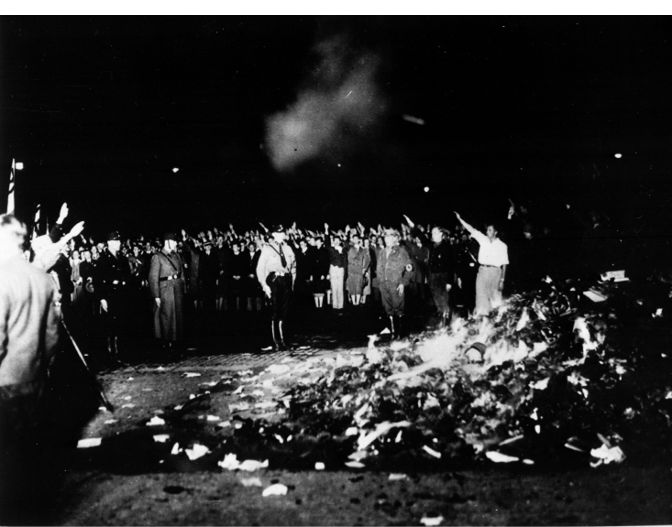
The public burning of books in Berlin by students
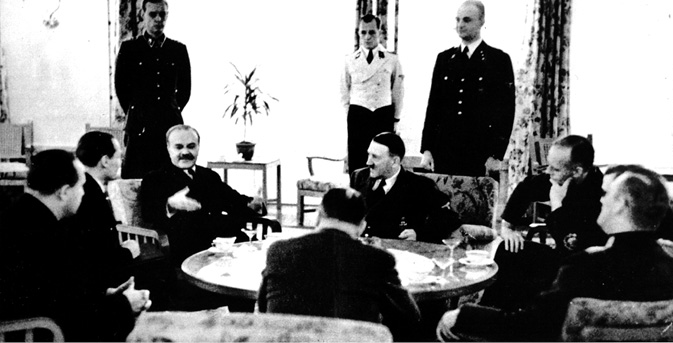
A cocktail party in Berlin, 1940, with Molotov and Adolf Hitler sat adjacent
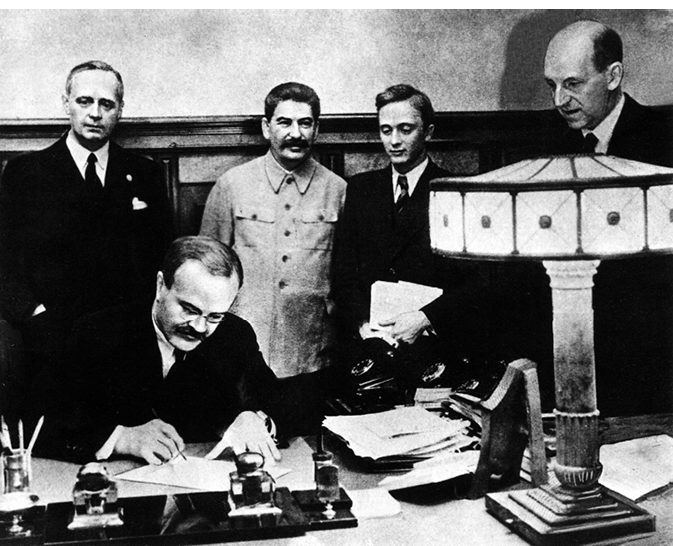
Vyacheslav Molotov, Soviet foreign minister, signs the Nazi-Soviet Non-Aggression Treaty in the Kremlin, Moscow on 23 August 1939. Stalin, Nazi foreign minister von Ribbentrop and others look on contentedly