Chapter Six: The Interregnum
After the period of turbulent high tide in 1923, began the period of a long-lasting ebb. In the language of strategy this meant an orderly retreat, rear-guard battles, the strengthening of our positions within the mass organisations, the re-inspection of our own ranks, and the cleansing and sharpening of our theoretical and political weapons.
Leon Trotsky, The Third International After Lenin
The humiliating defeat of October 1923 proved to be an important turning point. The situation had been ripe for revolution, and hopes for success were very high. Such hopes, however, were again dashed and workers were robbed of victory as in 1918, 1919 and 1920. This time, defeat was especially hard and another opportunity had been squandered because of the lack of decisive revolutionary leadership.
As with past defeats, it affected the morale of sections of the working class and further demoralised the ruined petty bourgeoisie, who were desperately seeking a way out of the crisis. The ‘Proletarian Hundreds’, the shock troops of the insurrection, after being made illegal, simply disappeared. But out of the ashes a new military defence formation called the ‘Red League of Front Fighters’ emerged. Rather than operating as the advanced guard of the revolution, the League now acted largely as a defence force, providing protection for street demonstrations and rallies. In the same year, the Reichsbanner, a Social Democratic military organisation, was formed, which, although based mainly on Social Democratic workers, also drew some limited support from the Centre and the Democrats. This military formation recruited hundreds of thousands of members and supporters, organising mass processions to demonstrate their strength. It was directly established to defend the republic and as a counterweight to the reactionary Stahlhelm.
This fact showed that the working class was still capable of resistance and was far from being crushed, which partly explains the fears and hesitations of the bourgeoisie in provoking the situation, and why they did not back Hitler’s failed coup.
The defeat of 1923 provided a temporary breathing space and the grounds for a certain stabilisation for German capitalism. The bourgeoisie had been staring into the abyss, but with the defeat of the revolution, they managed to escape being overthrown. The stalemate in the class struggle provided the Weimar Republic with an interregnum, which the representatives of German capitalism used to shore up the system.
The German defeat had profound international repercussions. It cast a dark shadow over the workers’ movement, not only in Germany. Within the Soviet Union, it undermined the hopes of the Russian masses, exhausted and isolated. They had been following the events in Germany with intense interest and anticipation. This defeat meant that their suffering would continue. The growing bureaucracy within the state and party fed from this demoralisation, allowing them to further consolidate their position, standing above the working class. The bureaucracy had arisen out of the isolation of the revolution under conditions of extreme economic and cultural backwardness. Composed of the millions of officials largely from the tsarist regime, this bureaucratic caste was strengthened each time the working class suffered setbacks and defeats. With each retreat, they assumed greater control over state and party. For them, the machinery of administration, the apparatus, became an end in itself, and was the basis of its bloated incomes and privileges. It was a parasitic growth on the workers’ state. As Engels explained, when government, art, science and culture become the property of a small minority, it uses and abuses its position for its own ends.
The Soviet regime was afflicted early on with bureaucratic deformations, which was a product of the backwardness of the economy. This problem was explained honestly by Lenin, who never tried to conceal or prettify the situation:
The apparatus we call ours is, in fact, still quite alien to us; it is a bourgeois and tsarist hotchpotch… we took it over from tsarism and slightly anointed [it] with Soviet oil. (LCW, vol. 36, pp. 605-606.)
Lenin knew full well what Marx meant in the German Ideology, when he said “when want is generalised all the old crap revives”. With every setback, every difficulty, and every defeat, the bureaucracy grew in strength and confidence. Unlike other bureaucracies in the west, the Soviet bureaucracy was a parasitic cast that fed off of the gains of the nationalised planned economy. It represented a Thermidorian reaction to the October Revolution, which would eventually end up with the victory of Stalinism, a bureaucratic political counter-revolution, but based upon nationalised property relations.
It is no accident that Lenin’s last struggle, in a political bloc with Trotsky, was against the bureaucracy. His last writings, including Better Fewer, But Better (2 March, 1923), are a testimony to this struggle. He was planning a ‘bombshell’ against Stalin, but was prevented in carrying this out by a series of strokes which forced him to give up political activity. Lenin finally died on 21 January 1924, a few months after the defeat of the ‘German October’.
These two events – the defeat in Germany and the death of Lenin – came as devastating shocks that severely undermined the morale of the Soviet working class. These were followed by a further disappointment in December 1924, when the Estonian rising also went down to defeat.
Victor Serge explained:
Everything, in the last analysis, depends on the international situation. After the failure of the revolution in Germany in 1923 (the Chemnitz Conference, the Hamburg insurrection, the violent repression of the workers’ government of Saxony, the dictatorship of General von Seeckt) a wave of depression passed over Russia, and the bureaucracy had its own way for three years. (V. Serge, From Lenin to Stalin, p. 42.)
The German Revolution had, as a consequence, more influence on Stalin than Stalin on the German revolution, noted Trotsky.
Struggle Sharpens
These events were to signal a sharpening of the struggle between Stalin, who had formed an unprincipled bloc with Zinoviev and Kamenev, against Trotsky’s Left Opposition, which demanded a return to Leninism. The troika intrigued and conspired at every opportunity behind Trotsky’s back to discredit him. They feared that the Opposition’s criticisms would now be linked with the debacle in Germany and have repercussions throughout the International. For them, this was something that had to be prevented at all costs.
Trotsky wrote:
The first palace coup, the result of a systematic organised conspiracy, was carried off in 1923-24, after being carefully prepared during the months when Lenin was struggling against death. Behind the party’s back six members of the Politburo organised a conspiracy against the seventh. They bound themselves by a pledge of mutual discipline; they communicated by means of coded telegrams with their agents and reliable groups in all parts of the country. (L. Trotsky, Writings 1930, p. 256.)1
The 1923 Opposition was formed by a leading layer of Old Bolsheviks who fought for, among other things, the restoration of internal party democracy and a plan to co-ordinate a more rapid development of industry and agriculture. The Opposition’s slogans were: ‘Against the merchant, the rich peasant, and the bureaucrat!’ and ‘Carry out Lenin’s Testament!’
The Left Opposition was faced with a ferocious campaign by the apparatus, which cynically used all the old long-forgotten differences between Lenin and Trotsky, resolved in practice by the experience of the October Revolution, to discredit Trotsky. As Zinoviev later admitted, they had deliberately invented the term ‘Trotskyism’ as a means of driving an artificial wedge between Leninism and the views of Trotsky. Following Lenin’s death in early 1924, the campaign against ‘Trotskyism’ began in earnest and was taken into the ranks of the Communist International.
In an article entitled Bolshevism or Trotskyism, Zinoviev asked:
What is then needed?
What is needed is that the party should guarantee itself against the repetition of ‘assaults’ on Leninism. Serious party guarantees are needed that the decisions of the party shall be binding on comrade Trotsky. The party is no discussion club, but a party – and a party operating in the complicated environment in which ours finds itself. The watchword of the day is:
Bolshevisation of all strata of the party!
Ideological struggle against Trotskyism!
Above all, enlightenment, enlightenment and once more enlightenment! (E.H. Carr, Socialism in One Country, vol. 2, p. 28.)
But there was no “enlightenment”, only a campaign of denigration and falsehood against Trotsky and the Opposition. This went hand in hand with demands for loyalty to the ruling group.
Socialism in One Country
One thing inevitably led to another. Following these defeats, the bureaucracy, growing more confident, began to flex its muscles. It was a period of bureaucratic retrenchment within the Soviet Union. With this, Stalin came forward in October 1924 as its spokesman with the anti-Marxist, anti-Bolshevik theory of ‘Socialism in one country’. The theory was a direct reflection of the growing desire of the bureaucracy for stability. They wanted to put an end to the revolutionary upheavals of the past. Up until that moment Stalin had argued, along with everyone else, that socialism could only be attained with the support of several advanced industrial countries. As late as spring 1924, Stalin outlined Lenin’s views on the building of socialism, as follows:
The overthrow of the power of the bourgeoisie and the establishment of a proletarian government in one country does not yet guarantee the complete victory of socialism. The main task of socialism – the organisation of socialist production – still remains ahead. Can this task be accomplished, can the final victory of socialism in one country be attained, without the joint efforts of the proletariat of several countries? No, this is impossible. To overthrow the bourgeoisie, the efforts of one country are sufficient – the history of our revolution bears this out. For the final victory of socialism, for the organisation of socialist production, the efforts of one country, particularly of such a peasant country as Russia are insufficient. For this the efforts of the proletarians of several advanced countries are necessary…
Such, on the whole, are the characteristic features of the Leninist theory of the proletarian revolution. (J. Stalin, Lenin and Leninism, p. 40, quoted in L. Trotsky, The Third International After Lenin [Union Books ed.], pp. 34-35, also E.H. Carr, The Interregnum, pp. 358-359.)
With Lenin dead, there were no longer any restraints on Stalin. Within the space of months, this classic Leninist position had been abandoned in favour of the theory of ‘Socialism in One Country’. The idea of the ‘permanent revolution’, closely associated with Trotsky and the early years of the Communist International, became an anathema to this bureaucratic stratum, which was demanding increased comforts and privileges on the back of the workers’ state. In one fell swoop, if socialism could be built within the borders of a single country, the whole concept of world revolution could be thrown out of the window. Each defeat reinforced this outlook.
This abandonment of Marxism for political empiricism resulted in a series of zig-zags in party policy. The empirical reaction to events was reflected in swings between opportunism and ultra-leftism.
Trotsky had brilliantly predicted that the adoption of the theory of ‘Socialism in One Country’ at the Sixth World Congress of the Comintern in 1928 would inevitably lead to the reformist and nationalist degeneration of the Communist International. This prognosis was stunningly born out in subsequent years with the shift towards popular frontism and the abandonment of internationalism. Moreover, in the end, the Communist International, which had been founded in 1919 as the World Party of Socialist Revolution, was dissolved by Stalin in 1943, as a gesture to his Allies, Roosevelt and Churchill.
Stabilisation
In Germany, following the turmoil of 1923 and the October events, the bourgeoisie demanded drastic action to stabilise the political and economic situation. A state of emergency was introduced by Ebert, who invoked Clause Forty-Eight of the Weimar Constitution, which granted emergency powers to Gessler, the Minister of Defence, and the Commander-in-Chief, General von Seeckt. This state of emergency, which also banned the Communist Party and its activities, was to remain in place until February 1924.
Emergency economic measures were also taken. In order to squeeze hyperinflation out of the system, a new currency was introduced, the Rentenmark, by the Finance Minister, Hans Luther. This revaluation, which proved extremely painful, did help to squeeze out the excess liquidity from the system and helped stabilise things. On 15 November, the currency was stabilised on the basis of an exchange rate of 1,000,000,000,000 paper marks for one gold mark (one Rentenmark). While on 16 November 1923, the dollar exchanged for 2,520 billion marks, three days later the dollar was quoted in the new currency at 4.2 Rentenmarks. This shock therapy was welcomed by the serious sections of the ruling class, despite resulting in a wave of bankruptcies, especially amongst small and medium enterprises. These were mostly swallowed up by the big corporations, further increasing the concentration of capital.
Those capitalists who had made fortunes out of inflation and built new business empires overnight, now regarded stabilisation as a means of consolidating their power. While the measures served to stabilise the mark, borrowers had to repay their loans valued in inflated marks with lower-denominated Rentenmarks. The deflation squeezed the fictitious cash out of the system, but at a massive social cost.
The Enabling Act pushed through by Hans Luther limited the revaluation of the paper currency debts to fifteen per cent of their original value. He also made sure that the government was exempt from the revaluation of its own debts until the reparations had been duly paid. This provoked great resentment, especially in the eyes of the ruined middle classes who were being driven down into the ranks of the proletariat and even lumpen-proletariat.
Eight-Hour Day Abolished
Since December 1923, the government had been dominated by two bourgeois parties, the People’s Party and the Catholic Centre Party, whose leader, Dr. Wilhelm Marx, became head of the government. Dr. Marx had ruled by decree, increasing indirect taxes while cutting taxes for the rich, and other such deflationary measures to assist the programme of ‘economic recovery’. The eight-hour day, introduced during the 1918 Revolution, was finally abolished, to the great delight of big business. The Nationalists, who were absent from government, now felt excluded and wanted in, despite their ambivalence towards the Dawes Plan. Pressure therefore mounted for new elections. The Reichstag was soon dissolved and a new general election arranged for May 1924.
The most telling result of these elections was the humiliating defeat for the Social Democrats, who lost seventy-one seats and were reduced to 100 seats in the new parliament. They had been duly punished by the working class for their involvement in the discredited coalition of Stresemann in the autumn 1923.
The communists, on the other hand, who had been legalised shortly before the election, benefited from the political polarisation and radicalisation that had taken place, and succeeded in increasing their number of seats from seventeen to sixty-two. While the Social Democrats received six million votes, the communists saw their vote rise to nearly four million.
This changed again when further elections were called in December, by which time the effects of the stabilisation began to be felt. With the return of some semblance of hope, the fortunes of the Social Democrats also improved. This saw the SPD increase its number of seats in December from 100 to 137, and its vote rose to eight million, a substantial rise on May’s result. In contrast, the relatively stable conditions had the opposite effect on the communists, who lost seventeen of their sixty-two seats and their vote went down to 2.7 million.
Another coalition government was formed, this time with Hans Luther as Chancellor and Stresemann as Foreign Minister. They were now joined in the Coalition by the German Nationalists (DNVP), who had also made sweeping gains at the expense of the German Democrats (DDP) and the People’s Party (DVP). This, however, proved to be a very unstable government. The parties, especially the Nationalists, were wracked by a whole series of resignations and splits, which reflected the continuing political impasse in Germany.
The imperialist powers, especially the United States and Britain, had become alarmed by the revolutionary events of 1923, which came so close to overthrowing capitalism. They were alarmed by the prospect of Bolshevism sweeping through Germany and Europe unless the crisis over reparations was quickly resolved. Even in France the opinion of the majority was in favour of withdrawing its troops from the Ruhr. The victor powers were therefore forced to change their approach to Germany. This need for change was further strengthened by the election of the Left Bloc in France, which was keen to reach an agreement with the Germans.
Following the London conference of August 1924 and the acceptance of the Dawes Plan, the idea of squeezing the Germans ‘until the pips squeak’ was abandoned. The new London agreement secured the withdrawal of French troops, while American imperialism poured in colossal sums of cash in the form of loans to rebuild German industry. As a consequence, the payment of reparations was drastically reduced, while German big business received a loan of 5,000 million dollars to strengthen its gold reserves and help stabilise the economy. This loan was also used to underpin the new currency, the Rentenmark. The Dawes Plan marked the beginning of a German economic recovery.
Economic Revival
With industry returning to ‘normal’, as workers began to regain their confidence, trade union struggles also returned, with the number of industrial disputes rising sharply. The employers resorted to lockouts, resulting in a ferocious class struggle. So, in 1924, there were more working days lost in strikes and lockouts than in any other year between the two world wars: 13.2 million days were lost through strikes and 22.6 million days due to lock-outs. The strikes were an attempt by the working class to claw back the lost ground, including efforts to restore the eight-hour day. Despite this increase in trade union activity, the membership of the trade union federations declined, falling from 7.8 million in 1922 to around 4.6 million in 1924. The terrible crisis of 1923 was mainly responsible for this state of affairs.
However, this upturn of industrial militancy did not last. In the period after 1924, strike figures fell sharply as state arbitration was increasingly used to settle disputes. A major factor in this development was the dramatic rise of unemployment and the fear of workers losing their jobs. The capitalists now held the whip hand. By December 1924, 1.5 million were registered unemployed, with a quarter of trade union members out of work and forty-seven per cent working short-time. Increasingly, the trade unions grew to rely, not upon their own strength, but on help from state intervention and arbitration.
The German economic recovery was described as ‘an Indian summer’. The boom/slump cycle was certainly experiencing an upward phase in Europe and in America. In arguing against the ultra-lefts, Lenin and Trotsky had explained that a capitalist economy could not simply keep on shrinking. There would inevitably come a point when the laws of capitalism would sooner or later assert themselves and produce a recovery, however limited. The ‘creative destruction’ of capitalism would eliminate overproduction, and would lead to a renewal of investment and capital expenditure. This, in turn, would lay the foundations for a boom. And this is precisely what happened between 1924 and 1928 in Germany, as elsewhere.
Therefore, while German output in 1923 was fifty-five per cent of 1913 levels (the peak of pre-war production), by 1927 it was 122 per cent of the 1913 levels. By 1927, the average monthly production of iron ore and steel amounted to 1,136 million tonnes and 1,395 million tonnes respectively, as against 1,397 million tonnes and 1,429 million tonnes in 1913. Production levels rose rapidly in 1928 which resulted in a considerable increase of German exports by forty per cent. This economic upturn, largely based on international credit and loans, together with the new currency, eventually resulted in the reduction of inflation and the return to a period of economic growth.
By 1929, given the relative stability, Germany was able to pay 8,000 million Rentenmarks in reparations and in return had received 13,000 million Rentenmarks in loans of various types. Of course, these loans came with strings attached. The Reichsbank – the Central Bank – became an ‘independent’ institution, closely tied to its American creditors. For all intents and purposes, Germany had become a kind of appendage of the New York Stock Exchange. Despite this imposition, it was a price worth paying from the point of view of German capitalism, which had been rescued by the influx of dollars. Trading agreements, such as the Rapallo Treaty with the USSR, also offered new investment opportunities abroad, which further stimulated the economy.
The recovery, however, stood on weak legs. It was a period of ‘borrowed prosperity’, as it became known. The foreign indebtedness of Germany had increased to one half of its national income by this time. Many felt that they were living on borrowed money and borrowed time. Others felt that they were living on false hopes.
The economic growth, mostly artificially sustained, could not last on such a basis. It was far from being a ‘Golden Age’, or even the ‘Roaring Twenties’, and would finally be shattered with the arrival of the Great Depression from 1930 onwards. It was a depression that would hit Germany extremely hard.
It is no accident that it was in 1928, at the height of the boom, that the well-known economist Werner Sombart, who started his career as a ‘Marxist’, ended up revising all of Marx’s ideas, published his own Modern Capitalism as opposed to Marx’s Capital. It was translated into many languages and became the best know exposition of bourgeois economic apologetics at that time. He dismissed all of Marx’s prognoses as false. According to Sombart:
Capitalism will continue to transform itself internally in the same direction in which it has already begun to transform itself, at the time of its apogee: as it grows older, it will become more and more calm, sedate, reasonable.
Unfortunately for Sombart, his book appeared on the bookshop shelves not long before the greatest crash ever experienced by capitalism. Rather than becoming more ‘sedate’, capitalism was embarking on a catastrophic crisis, which would throw millions of workers on to the scrapheap, not least in Germany.
Soviet-German Relations
Germany had been crippled by the Versailles Treaty, not only economically, but also in terms of the severe military restrictions placed on its activities. The Reichswehr, as we have seen, was officially limited to only 100,000 men. The victors were determined that Germany was not to be crushed, but contained.
The Soviet Republic was also surrounded by hostile imperialist powers, led by Britain and France, and was searching for potential allies. Therefore, a degree of co-operation between the Soviet Republic and Germany was considered beneficial, although military matters had to be kept secret. Thus, the Treaty of Rapallo was signed on 16 April 1922 between Germany and the Russian Soviet Federative Socialist Republic (RSFSR), under which each party renounced all territorial and financial claims against the other. This meant the cancellation of the Treaty of Brest-Litovsk imposed by German imperialism in 1918. Both governments agreed to normalise their diplomatic relations and to “co-operate in a spirit of mutual goodwill in meeting the economic needs of both countries”. While publicly denying such close co-operation, they secretly established elaborate military partnerships between the two powers.
The Treaty of Rapallo now allowed the Germans to evade many of the stringent provisions of the Versailles Treaty. For example, as Germany was not allowed to maintain an air force, those Germans interested in aviation could get their initial training in Russia. The Treaty also provided a boost to the Soviet armaments industry by extending the co-operation with the German military and industrial experts. For instance, a new tank factory called Kama was established near Kazan as a joint enterprise of the Reichswehr and the Red Army. This was supplemented by the establishment of a tank training school on the river Kama. A German factory in Moscow manufactured 30mm. guns for the Reichswehr, as well as the Red Army. A large airfield was placed at the disposal of the Germans at Lipetsk in central Russia, north of Voronezh. This had two functions: training German pilots in military aviation, and the testing of modern military plans. The establishment was entirely a German creation. During the summer flying season, about fifty pilots and up to 100 technicians came from Germany for training. Clearly, such collaboration greatly benefited the young Soviet state, having faced years of blockade, civil war, and imperialist aggression.
Uprising Still Remains on the Agenda
The communist movement was also experiencing upheaval. The October 1923 debacle had direct consequences for the KPD. In November, the party had been banned by General von Seeckt, and its members were subject to widespread repression and arrest. But, as we have seen, the seriousness of the defeat was very much played down in Moscow.
Zinoviev, now zigzagging back towards an ultra-left position, proclaimed that the situation in Germany had not changed, and that the insurrection and the conquest of power were still very much on the agenda. The Executive Committee resolution of 19 January 1924 stated:
The fundamental estimation of the situation in Germany which was given in September [1923] by the ECCI remains essentially the same. The KPD must not strike off from its agenda the question of the uprising and the conquest of power. (B. Fowkes [ed.], p. 102.)
The resolution went on to proclaim that:
The leading layers of German Social Democracy are at present nothing other than a faction of German Fascism under a socialist mask… The KPD rejects negotiations with the SPD, and also with the ‘Left’ SPD leaders until they have the guts to break with the SPD leadership. The turn in tactics is therefore expressed in the words: United Front from Below! (ibid., p. 102.)
This leftist tone pre-dates the theory of ‘social fascism’, which was crudely elaborated by Stalin some months later in October 1924, when he said, “Fascism is the fighting organisation of the bourgeoisie buttressed on the active support of Social Democracy. Social Democracy is objectively the moderate wing of fascism.” (E.H. Carr, Socialism in One Country, p. 86.) Stalin was simply echoing the views of Zinoviev. He was certainly no theoretician and borrowed his ideas from Zinoviev, then from Bukharin.
This ultra-left talk marked a decisive shift from the approach taken by the German party twelve months earlier. In February 1923, it had adopted a genuine approach towards the united front, not from above or below, or any other such gimmick, but in a genuine appeal to unite the mass organisations in a common front. A resolution from 1922 explained:
The united front tactic is not a manoeuvre to unmask the reformists. Rather the reverse: the unmasking of the reformists is the means to building a firmly United fighting front of the proletariat… In every serious situation, the Communist Party must turn both to the masses and to the leaders of all proletarian organisations with the invitation to undertake a common struggle for the construction of the proletarian united front. The notion that the establishment of the united front is possible only through an appeal to masses to struggle (only ‘from below’) or only by negotiations with other organisations at the summit (only ‘from above’) is undialectical and rigid… (ibid., p. 123.)
This wild optimism about immediate revolution in Germany emanating from Moscow lasted for months. Even Stalin, who had little first-hand knowledge of the situation, but loyal to the others in the troika, insisted that the German revolution was undefeated and revolution was still on the order of the day.
It is false to say that the decisive battles have already occurred, that the proletariat has suffered a defeat and that the revolution has been postponed for an indefinite period. (Quoted in L. Trotsky, The Third International After Lenin, p. 116.)
He even had the effrontery to accuse Trotsky of Liquidationism.
Trotsky answered Stalin:
Liquidationism is the renunciation of the revolution, the attempt to substitute the roads and methods of reformism for the roads and methods of revolution… The Leninist policy has nothing in common with liquidationism; but it has just as little to do with a disregard of the changes in the objective situation and with maintaining verbally the course towards the armed insurrection after the revolution has already turned its back upon us, and when it is necessary to resume the road of long, stubborn, systematic, and laborious work among the masses in order to prepare the party for a new revolution ahead.
On ascending the stairs, a different type of movement is required from that which is needed to descend. Most dangerous is such a situation as finds a man, with the lights out, raising his foot to ascend when the steps before him lead downwards. Falls, injuries, and dislocations are then inevitable. The leadership in 1924 did everything in its power to suppress both the criticism of the experiences of the German October and all criticism in general. And it kept stubbornly repeating: the workers are heading directly for the revolution – the stairs lead upward. Small wonder that the directives… applied during the revolutionary ebb, led to cruel political falls and dislocations! (ibid., pp. 116-117.)
The Comintern leaders could not keep denying that the October fiasco was not a defeat. Instead, they manoeuvred to shift the blame away from themselves. After all, they could not be held responsible for the debacle, especially at a time when they faced criticisms from the Left Opposition. This became their overriding concern.
Fifth World Congress
In the summer of 1924, the Fifth Congress of the Comintern was held in the shadow of Lenin’s death and the German defeat. This time, instead of twenty, the German party sent a delegation of forty, representing all the party’s tendencies. There were 406 delegates from forty-one countries, of whom 341 were full delegates with voting rights.
When Trotsky appeared on the podium at the opening session of the Congress, he was greeted with loud applause, and was duly elected to the presidium of the Congress. But this warmness was soon curbed in the delegation meetings, where national leaderships were instructed to condemn the Russian Opposition.
In opening the Congress, Zinoviev repeated the words of Trotsky at the Third Congress, when he said, “We misjudged the tempo; we counted in months when we had to count in years.” (E.H. Carr, Socialism in One Country, p. 74.) Despite this admission, he went on to place the full responsibility for the German failure onto the Brandlerite deviation to the Right, a position that had already been adopted by the ECCI and the German party.
In the debate, Radek put forward a defence of Brandler. He was then answered by Ruth Fischer, who declared that Radek and his Brandlerite supporters no longer had any belief in the German or European revolution. (ibid., p. 78.) Brandler intervened to defend himself, but his arguments had little effect, if any.
This emboldened the German Lefts, who went on to criticise the draft theses of the ECCI, which had raised the idea that German capitalism could enjoy a temporary recovery, saying it was a dangerous illusion. The Lefts had stuck to the position they held in 1921, when they asserted that a recovery was impossible.
Not a single delegate raised any support for the Russian Opposition, including Radek. On the contrary, after being suitably primed, the leaders of the national parties joined in the chorus of denunciation of the Opposition. The Congress then formally endorsed the resolutions of the Russian party conference and congress, which had condemned the Opposition platform.
The key issue arising at the Congress was the ‘Bolshevisation’ of the Communist Parties, which was raised in Zinoviev’s speech. In condemning Trotsky, the Russian leaders had proclaimed themselves the true Bolsheviks. The cure for any such possible deviations was an infusion of ‘Bolshevism’.
When Zinoviev summed up the debate, he said it was “more extensive than ever before”. To cover himself, he leaned to the Left by sharply attacking both Radek and the Social Democrats.
It was at this Congress that Trotsky and Radek were voted off the Executive Committee of the Communist International. Stalin, who played no role in Comintern affairs, was elected for the first time to the Executive.
Thus, the ‘Bolshevisation’ of the Communist Parties was the prime message that emerged from the Congress. Albert Treint, one of the French Party leaders, summed up the position with an attack against the Russian Opposition in an article: “Our motto is clear: no de-Bolshevism of the Russian Party, but on the contrary Bolshevism of all the communist parties.” (ibid., p. 94.) It would not be long before he himself was expelled for his ‘leftist opposition’.
The most important party outside the Soviet Union, was purged of ‘Brandlerism’ and then placed in the hands of the ultra-lefts, Ruth Fischer and Arkadi Maslow. In April 1924, the Ninth German Party Convention elected both of them as co-chairs of the Communist Party. Brandler did not win a single vote, meaning the party’s right was completely defeated. With this shift, the ‘centre’ also collapsed. In the Congress, there was a sharp discussion on the trade unions, where a number of delegates said that it was not possible to work in the reformist unions. However, a compromise resolution was passed that agreed party members would continue to work in the unions. This sharp turn to the left within the KPD served to throw the party from the frying pan into the fire.
Since the Fifth Congress in the summer of 1924, Brandler, Thalheimer and four other Rightists had been recalled to Moscow for ‘other duties’ to prevent them from intervening in KPD affairs. This allowed Fischer and Maslow a free hand, to the chagrin of the International leadership.
The resolution of the ECCI in April 1926 recorded that the Comintern “was obliged… to the transfer of leadership to the Left, in spite of the fact that it knew that Maslow, Ruth Fischer and Scholem were capable of committing the greatest ultra-left errors.” (ibid., p. 98.) These leaders were repeatedly called to order, but with varying success.
In November 1923, a conference of the opposition within the trade unions, two-thirds of whom were communists, took place in Erfurt. Given the bitterness following the October defeat, the decision to formally leave the ADGB ‘Free’ Trade Union Federation was only narrowly defeated. In this atmosphere Fischer and Maslow conducted an active campaign against the reformist unions. In response, the leaders of the ADGB organised a campaign of mass expulsions of the communists from their ranks. Both the ‘lefts’ and the bureaucrats leaned upon one another.
In January 1924, the trade union leaders voted to expel anyone conducting communist propaganda. As a result, the expulsion of communists from the unions was a regular occurrence. This in turn stirred up feelings that communists should turn their backs on these ‘yellow’ trade unions. This feeling became widespread in the party. There were, however, repeated attempts to combat this tendency. Even Lozovsky from the Comintern stated that to leave a trade union was a “desertion in battle”, but this seemed to have little effect. By March 1924, it was estimated that not more than twenty or thirty per cent of party members were enrolled in the unions as against seventy per cent a year earlier. Fischer and Maslow were complicit in this situation. They continually encouraged these ultra-left moods, and when combined with a rejection of the united front, this simply served to further isolate the party.
This saw the party’s influence in the trade union movement fall dramatically. It was most evident in the fall in the number of communist delegates to the national Congress of the General German Federation of Trade Unions, the Allgemeiner Deutscher Gewerkschaftsbund (ADGB): in 1922 they had eighty-eight delegates out of 692, but by September 1925 they were reduced dramatically to only three delegates.
Under the Fischer and Maslow leadership, the German party’s decline was catastrophic. The policies of ultra-leftism proved to be a complete disaster. Even the Comintern leaders were forced to recognise this calamity with growing impatience. As expected, the ground was cleared for their removal in the Zinovievite manner.
Removal of Fischer-Maslow
Zinoviev used the ECCI to issue an ‘open letter’ to the German party criticising the ‘Ruth Fischer-Maslow group’. This reached the German party by the end of August 1925, and was immediately endorsed by the central committee of the KPD “without reservation”. The political ground began to shift. An article appeared in Pravda accusing ‘the Ruth Fischer-Maslow group’ of wishing to be “more to the Left than Leninism” and condemned their failure to win over the Social Democratic workers in the unions.
Nearer to the Social Democratic workers! Real application of united front tactics, not in words but in deeds! Energetic strengthening of trade union unity! That is the political meaning of the ECCI letter! (ibid., p. 340.)
Thus began the general offensive against Maslow and Fischer, which did not let up until they were finally removed.
“The attitude of the group of Comrade Maslow to the Comintern has been incorrect and un-Bolshevik since the Third World Congress,” stated the ECCI in a circular to all members of the KPD. Zinoviev described them as intellectuals of the Left who had their own ambitions and it was necessary to put them in their place: “the pretension of these intellectuals was to lead not only the KPD, but the Comintern as well.” (E.H. Carr, Socialism in One Country, p. 338.) This was followed by the KPD Congress passing a resolution condemning the party’s ultra-left tendencies. On the instructions of Zinoviev, Fischer was summoned to Moscow as part of a German delegation in September 1925 and was held there for months. Meanwhile, Maslow had been in prison in Berlin since May 1924 on a charge of high treason, but this did not stop him from writing or communicating with party members.
Zinoviev and his entourage began to groom Ernst Thälmann, the chairman of the party, to become its new leader. He was viewed as the ‘proletarian’ and the true leader of German communism. He, in turn, tried to establish his credentials by immediately recognising the importance of the trade union work, in contrast to Fischer and Maslow. Eventually, Fischer and Maslow were duly expelled in August 1926 for “indiscipline” and “preparing a split”. They were then replaced by Thälmann, who was altogether more pliant to the needs of Moscow. The ‘centre’ led by Ernst Meyer was essentially brought to heel. Meyer stated:
It will hasten clarification. Whatever its ambiguities it indicates the right road. It is now our task to do the rest… It would be foolish on our part to deny Thälmann our wholehearted support, when the Central Committee genuinely accepts the new course. We must help the party to overcome the present crisis with the least amount of damage. We could not refuse to collaborate, for this was the policy we ourselves have been advocating for a long time. (R. Leviné-Meyer, Inside German Communism, p. 87.)
Hugo Urbahns took over the leadership of the German Lefts, but later came out in support of the United Opposition of Trotsky and Zinoviev and was duly expelled.
The apologist of Stalinism, the historian Eric Hobsbawm, tried to justify these manoeuvres which destroyed the internal life of the Communist Parties. He wrote: “Direct Comintern intervention in 1925 deposed the left leaders. Nothing else could have been done, and this established a sinister precedent.” (E. Hobsbawm, Revolutionaries, p. 57, emphasis in original.) Hobsbawm, belonging to the Stalinist tradition himself, was incapable of understanding that with such methods you could only build a movement of ‘obedient fools’, and not thinking Marxist cadres.
Fischer and Maslow went on to help found the Leninbund in April 1928, an opposition group, based on support for the ‘United Opposition’. However, following Zinoviev’s capitulation, they withdrew. By 1926, Zinoviev and Kamenev had in fact broken with Stalin and had come over to Trotsky, but this only lasted eighteen months, before they capitulated. Fischer and Maslow then formed a small ‘International Group’, which adhered to the International Communist League established by Trotsky, following a meeting with him in early 1934. They both participated in the Movement for the Fourth International, but quit the movement sometime in 1936. They eventually shifted to the right and ended up breaking with Communism.
The removal of Fischer and Maslow from the German leadership saw the end of a sectarian approach to the trade unions but, as was now becoming the norm, ultra-leftism gave way to a swing in the opposite direction. Within a year, a new, more opportunist policy was adopted by the Comintern, reflected in the formation of the Anglo-Soviet Trade Union Committee in Britain. The latter was an agreement between the British Trade Union congress (TUC) and the Russian trade unions to oppose war and carry out general co-operation. All this achieved was to provide a ‘left’ cover for the TUC leaders, especially the lefts on the General Council, to betray the 1926 General Strike.
In China, the same policy led to the Communist Party dissolving itself into the Kuomintang and supporting the so-called ‘progressive bourgeoisie’. This led to the defeat of the Chinese Revolution at the hands of the nationalist butcher, Chiang-Kai-Shek. So far did the opportunism of Stalin go, that Chiang-Kai-Shek was even made an honorary member of the Executive Committee of the Communist International, with Trotsky’s solitary vote against. This opportunist phase would last from 1925 to 1928, when the Sixth World Congress would see a further zigzag with a change of line and the adoption of the disastrous ultra-left madness of the ‘Third’ period.
From 1924 onwards, Zinovievite methods were used to crush all independence of thought and action within the German Communist Party. The same policy was applied throughout the Communist International. Meanwhile, the campaign within the International against ‘Trotskyism’ caused havoc, with expulsions, splits and resignations. In the Soviet Union, it ended up not only with the expulsion of the Left Opposition, but also, within a short period of time, with the expulsion of the Right Opposition of Bukharin, and the eventual domination of the Stalin clique.
There had been purges of the party in Lenin’s time, but not of this character. Then, it was a question of removing careerists and place-seekers. Between the Tenth Party Congress in March 1921 and the Eleventh Congress in March 1922, the party membership had been reduced from 730,000 to 515,000. These purges were used to eliminate those undesirable elements charged with corruption, bribery, ambition, drunkenness, chauvinism, anti-Semitism and abuse of confidence. “No profound and powerful popular movement in all history has taken place without its share of mud, without adventurers and rogues, without swaggering and noisy elements,” explained Lenin. However, under Zinoviev and Stalin, the purges were carried out for political reasons, where opponents were framed and expelled for their ideas, which was a massive affront to genuine Bolshevism.
After such purges, the German leadership became a willing tool of the leadership in Moscow, and accepted every twist and turn of policy without question. Luxemburg was partially rehabilitated, but stress was still laid on her failings. According to Martynov, Stalin’s henchman, despite Luxemburg’s great service to communism, she was a semi-Menshevik who did not understand Marxism. (A. Martynov, Luxemburg to Lenin or Luxemburg to Kautsky? The Communist International, 6 July, 1929.) Stalin even claimed that Luxemburg and Parvus had developed the ‘criminal’ theory of ‘permanent revolution’, and not Trotsky. He wrote:
They [Parvus and Luxemburg] invented a Utopian and semi-Menshevik scheme of the permanent revolution (a monstrous distortion of the Marxian scheme of revolution). (J. Stalin, Some Questions Regarding the History of Bolshevism, The Communist International, 20 August, 1931.)
This was a ‘dastardly act’ for which they were falsely accused.
Trotsky replied to Stalin’s slurs about Luxemburg, who described the attack by him as “a vile and barefaced calumny about Rosa Luxemburg.” He explained:
Lenin understood Rosa Luxemburg’s mistakes more profoundly than Stalin; but it was not accidental that Lenin once quoted the old couplet in relation to Luxemburg: “Although the eagles do swoop down and beneath the chickens fly, chickens with outspread wings never will soar amid clouds in the sky.”
Precisely the case! Precisely the point! For this very reason Stalin should proceed with caution before employing his vicious mediocrity when the matter touches figures of such status as Rosa Luxemburg. (L. Trotsky, ‘Hands off Rosa Luxemburg!’)
1925 Presidential Election
The death of Ebert in February 1925 resulted in a new election for President. Seven candidates took part in the first ballot. The right-wing parties had put up a joint candidate, Dr. Jarres, the Burgomaster of Duisburg, a conservative, who won the first round of voting with 10.5 million votes. In second place came the Social Democrat, Otto Braun (the then-Prime Minister of Prussia), with almost eight million votes. Dr. Wilhelm Marx, the leader of the Catholic Centre Party, got less than four million votes. He had headed a government in early 1924 which introduced severe deflationary measures against the working class and ruled by emergency decree. Then came Ernst Thälmann, the Communist candidate who received barely two million. They were followed by General von Ludendorff, who had been nominated by the Nazis, with less than 300,000 votes. This election marked the lowest level reached by the Nazi party up until this point. The Democrats and the Bavarian People’s Party also put forward candidates who received respectively 1.5 and one million votes.
A second ballot became necessary, which saw a dramatic realignment of candidates. In the second round, the Social Democrats, despite gaining eight million votes, withdrew their candidate in favour of Dr. Wilhelm Marx of the Centre Party. Far from being a frontrunner, Dr. Marx had only received half as many votes as the Social Democrat, Otto Braun. The right had also changed their candidate from Jarres to the seventy-eight-year old Field Marshal von Hindenburg (advertised as ‘the Saviour’), the former commander-in-chief of the Imperial Army, who newly entered the race. The Social Democrats had justified their support for the reactionary Dr. Marx as a policy of the ‘lesser evil’, where the evil Dr. Marx was considered more acceptable than the even more evil von Hindenburg. In reality, this was like choosing between Beelzebub and Satan, a bankrupt policy, which had fatal consequences in the pre-Hitler years. If Dr. Marx had been elected President, he would have been a willing tool of the generals and the capitalists, as he had been as Chancellor. This policy of appeasement on the part of the Social Democrats based upon alliances with the enemies of the working class could only lead to confusion and eventual capitulation. The Communist Party again put up Ernst Thälmann as their candidate. Although this was simply a show of strength, the Communists had no other choice but to stand. There was no fundamental or principled difference between the reactionary camps of either Dr. Marx or von Hindenburg, neither of which could be supported.
In the first election the Hindenburg-supporting parties had polled about 12 million votes. In the second election in April, the Field-Marshal received 14.6 million votes, followed by Marx with 13.7 million votes and Thälmann with barely two million. Thus, by a very small margin, the militarist von Hindenburg was elected President of the German Republic. Seeing himself as the real Commander-in-Chief of the Reichswehr, his election served to increase further military influence in German affairs. Once again, the Social Democrats were left with egg on their faces.
In a bizarre twist, the economic recovery had stimulated the old Hohenzollern monarchy, which had been dethroned, to demand indemnities for the ‘troubles’ in the 1918 revolution. This aristocratic elite demanded compensation for the act of revolution! After all, the revolution had caused them to leave in a rush without the question of their property claims being resolved. In the turbulent years prior to 1924, they dared not raise this vexed question. But with renewed stability and American loans, these princes chose to press their demands. If the indemnities were refused by the states, then these princely families threatened to bring legal action against them. This provoked absolute outrage, as the Imperial family engaged in a furious open quarrel with its former subjects over ‘compensation’.
Open Letter
In reply to these outrageous demands, the left raised the idea of the complete expropriation of their estates. The campaign for expropriation was first launched by the KPD, which then appealed in an Open Letter to the Social Democrats to organise a joint campaign for a plebiscite. At first, the reformist leaders refused, but under pressure from their rank and file, finally agreed. They were joined in this campaign by the well-known physicist and socialist Albert Einstein.
The SPD and the KPD agreed to join forces in introducing a bill in the Reichstag to end this scandal once and for all, by putting the matter to a plebiscite in accordance with the Constitution. The campaign was one of the most successful ever mounted by the workers’ parties, and one of the few occasions when the united front was successfully implemented.
Both parties campaigned boldly for the complete expropriation of the property of the old nobility, without compensation, with the proceeds used to establish a fund for war invalids, old age pensioners and the unemployed. The expropriated property would be put to social use for the public good.
The joint SPD-KPD proposals for the expropriations determined that:
The whole of the property of the princes who ruled in the parts of the German empire until the overthrow of that state in 1918, as well as the whole of the property of the princely houses, their families and their dependants, is to be confiscated without compensation for the benefit of the community…
The castles, manor houses and other buildings expropriated will be used for general purposes of welfare, culture and education, and in particular for the establishment of convalescence and care homes for the war-wounded and surviving dependants, and state pensioners, as well as for the children’s homes and educational establishments. (B. Fowkes [ed.], pp. 158-159.)
In this campaign, the Princes and their supporters managed to enlist the aid of Hindenburg, the President of the Republic, together with all those who feared for their property. After all, appetite comes with eating. It would begin with the property of the Hohenzollerns, but where would it end? In a widely distributed statement, Hindenburg stated:
By exciting the instincts of the masses and by exploiting the misery of the people with regard to the individual case now in question, there may arise the method of continuing on the road of expropriation, with the aid of a similar plebiscite, which would rob the German nation of the very foundations of its culture, economic and State life. (E. Anderson, p. 119.)
The Social Democratic Party hit back with its own declaration:
What connection is there between justice or morals and the fact that Wilhelm ll, who possesses property in Holland worth many millions, now demands a further 300,000 morgen2 of German land together with castles and other valuables worth 183 million gold Marks? (Quoted in ibid., p. 119.)
When the plebiscite was finally held in March 1926, it was a great success with 12.5 million supporting the princely expropriations. Nevertheless, according to the Constitution, in order for the plebiscite to succeed it would need to be followed by a further referendum, where more than half the entire electorate would need to support the proposal.
In the new referendum, a campaign was now organised by the pro-monarchist forces to force people not to vote so as the threshold would not be reached and the plebiscite nullified. The Right, through the big landowners, exerted massive pressure on the rural population, in an attempt to frighten them to stay away from the poll. These threats certainly had an effect. In East Prussia, the home of the landowning Junkers, only twenty per cent of the electorate voted.
The second round of voting took place in June 1926. Although the campaign for expropriation failed to achieve the necessary threshold of 20 million votes to succeed, namely half the electorate, the combined left forces won a very impressive 16.5 million votes. This certainly compared very favourably with the combined 10.5 million the two parties had recorded in the December 1924 general election. It was the most successful joint action between the left parties since the Rathenau murder in 1922 or the Kapp putsch of 1920. Unfortunately, it proved to be the last occasion for such a fruitful collaboration.
While a coalition government between the SPD and KPD was ruled out nationally, there was certain co-operation at a state level, most notably in Saxony and Thuringia, where the state government relied on communist support. But in other areas of the country, the SPD, mostly dominated by right-wing deputies, preferred coalitions with the Centre Party and the German Democratic Party (DDP). In Hamburg in 1927 the elections produced a ‘red majority’, but rather than unite with the KPD, the Social Democrats shamefully preferred a coalition with the Democratic People’s Party (DVP), the more conservative wing of the liberals.
Following Gessler’s resignation as Reichswehr Minister, Hindenburg appointed his former wartime chief of staff, General Groener in his place. Therefore, Generals von Hindenburg and Groener – the heads of the Supreme Command on 9 November 1918 – having outlived Ebert, were once again in control of the German Republic. Despite all of what had happened, how little the personnel had changed.
The period 1925 to 1929 were years of maximum stability for the Weimar Republic. Unemployment had fallen to 650,000 by September 1928, and retail sales were up twenty per cent over their 1925 level. It appeared that prosperity had begun to return to Germany. But this was not to last. It was the calm before the storm.
The 1928 General Election
By the time of the general election in May 1928, the boom was reaching its peak. Living standards had started to rise. Germany had been admitted into the League of Nations and the Dawes Plan was functioning. War and hyperinflation were now seen as things of the past. This gave rise to feelings of a certain relief, which once again resulted in electoral gains for the Social Democrats. In the 1928 election the SPD had polled over 9 million votes, an increase of 1.3 million over the previous election, and managed to win 153 seats. They were once again the largest party in the Reichstag.
The KPD also increased its vote to 3.2 million, a rise of half a million votes. The party had gained an extra nine seats, making fifty-four in total. Together with the Social Democrats, they were the only winners of that election, with just over forty-two per cent of the seats in the Reichstag – ironically, almost the exact number obtained by the Nazis in the terror election of March 1933.
Without exception, it was a bad election for the bourgeois parties, all of which faced a decline in support. The National Party lost thirty seats; the People’s Party lost six seats; the Democratic Party seven seats. Hitler’s Nazi party lost two seats, leaving it with only twelve seats (out of 474), and 810,000 votes. This reflected the political impasse in which the fascists found themselves. They were electorally at their lowest point, with a loss of 120,000 votes compared to the December 1924 election. The Nationalist Party’s vote also fell by one third to four million, a considerable fall.
After four years of being out of office, the Social Democrats now returned to enter a ‘Grand Coalition’, headed by Herman Müller, the Social Democrat who had tasted power before. Despite the SPD being the largest party in the Reichstag, the new Grand Liberal-Social Democratic Coalition contained a minority of Social Democratic ministers. These included the former radical, now conservative, Rudolf Hilferding as Minister of Finance, with Karl Severing as Minister of the Interior, and Rudolf Wissell as Minister of Labour.
The ‘Grand Coalition’ was a very conservative government, which pursued pro-capitalist policies on all questions, especially on the economy. The Social Democrats, who had shifted further to the right, continued with their policy of ‘toleration’ towards the bourgeoisie, its system and its representatives. This whole approach was underlined in what would become known as the ‘armoured cruisers affair’.
The previous bourgeois government had included in its budget for 1928 the building of armoured cruisers. This policy became a prime target of derision during the election campaign, especially at the hands of the SPD. The socialists campaigned under the slogan: ‘Food for school children or armoured Cruisers?’
With the formation of the new government, it was presumed that the plan to build the cruisers would be dropped. However, the General Staff were firmly opposed to this. They demanded the battleships’ construction be completed as agreed. This placed the Social Democrats in a dilemma: either capitulate to the General Staff or provoke a Cabinet crisis and resign from the government. They preferred to remain in government, express their opposition, then reluctantly acquiesce. Given their minority position in the Cabinet, they would be outvoted and they could wash their hands of the final decision.
However, the pressure on the Social Democrats became intense. To make matters worse, the Democratic Party decided to oppose the construction. This meant that, together with the Social Democrats, there would be a majority in the Cabinet in favour of abandoning the project. Despite this, the Social Democrats changed their decision, and the Cabinet voted to go ahead with the cruisers.
This created a storm of protest throughout the German labour movement. Even the SPD Parliamentary party disavowed its own Ministers and tabled their own motion in the Reichstag demanding that the construction of the battleships be scrapped. The motion was defeated by a narrow majority. To save their embarrassment, the four Social Democratic Ministers absented themselves during the vote. As could be expected, there was widespread disillusionment with this ‘Grand Coalition’ government in the working class. The coalition would stagger along in office for a further twenty-one months.
Franz Petrich, a leading member of the party, wrote:
Hilferding’s activities in the Ministry of Finance, demonstrated every day that he was the prisoner of finance capital, and that he existed on its charity. The moment that he became superfluous to finance capital’s needs he was removed from office. (B. Fowkes [ed.], p. 165.)
Hilferding was not so much a prisoner as a willing tool. Ironically, he had written a well-known book entitled Finance Capital more than a decade earlier, under the heat of the 1905 revolution. Now he had become the stooge of finance capital.
The SPD decided to withdraw from the ‘Grand Coalition’, which precipitated its collapse. New elections on 14 September 1930 resulted in a defeat for the Social Democrats and brought to power the right-wing government of Heinrich Brüning.
Young Plan
In June 1929, an international committee under the chairmanship of the American banker, Owen D. Young, signed a report, which supposedly placed Germany’s reparations obligations on a new, more favourable, basis. For the first time, the Young Plan placed a time limit on the reparations. However, the expiry date for these payments was 1988, fifty years in the future. Most Germans regarded this as grossly unacceptable. It would mean that their grandchildren and great-grandchildren would still be paying Germany’s reparations from the 1914-1918 War. This issue was taken up with vigour by the fascists and the right-wing Nationalists.
Thyssen remarked:
I turned to the National Socialist Party only after I became convinced that the fight against the Young Plan was unavoidable if a complete collapse of Germany was to be prevented. (J. Pool and S. Pool, Who Financed Hitler, p. 225.)
The Plan so enraged Hugenberg, leader of the German National Party, that he resolved to fight it to the bitter end. Hitler, ever the opportunist, offered to take up the struggle as long as he had access to a large share of the resources and could act independently. They organised a joint nationwide plebiscite to defeat the Young Plan, but were heavily defeated. However, Hitler made maximum use of Hugenberg’s newspapers to enhance his popularity.
By the late 1920s, Stalin had enormously strengthened his grip in the Soviet Union. Lenin’s Testament, which called for the removal of Stalin as General Secretary, had been suppressed. In the troika, Zinoviev and Kamenev thought they were using Stalin, but in fact it was the other way around. Stalin used them in the fight against Trotsky and then he outmanoeuvred them. It was, after all, Zinoviev who had invented ‘Trotskyism’. While Zinoviev and Kamenev were far superior theoretically to Stalin, they lacked his single-minded and ruthless character. Stalin controlled the apparatus, which he used to great effect to build up his support. He appointed those who showed loyalty towards the General Secretary to positions. Eventually, Zinoviev and Kamenev broke with Stalin over his rightward shift. He then entered into an alliance with Bukharin, who advanced the idea of socialism “at a snail’s pace”.
By this time, the Communist International had become increasingly transformed into a foreign policy tool of the bureaucracy. ‘Bolshevisation’, carried through by Zinoviev and Stalin, had made the Communist parties completely subservient.
Trotsky wrote:
Beginning in late 1923 the same work was carried out in all the parties of the Comintern, some leaders were dethroned and others appointed in their places exclusively on the basis of their attitude toward Trotsky. A strenuous, artificial process of selection was accomplished, selection not of the best but of the most adaptable. The general policy was to replace independent and gifted people with mediocrities who owed their positions entirely to the apparatus. And the highest expression of that mediocrity of the apparatus came to be Stalin himself. (L. Trotsky, Writings 1929, p. 42.)
Boris Souvarine, a former leader of the French party, wrote:
First in Paris and Berlin and then from New York to Shanghai, all communists who persisted in distinguishing between discipline and servility, all men capable and guilty of independent or original thinking were henceforth to be treated as suspect, denounced as opportunists, classed with counter-revolutionaries, and expelled, first singly and then in groups. Thus, a continuous series of expulsions and splits eliminated, in turn and by differing methods, the initiators of the contemporary communist movement in two hemispheres. (B. Souvarine, Stalin: A Critical Survey of Bolshevism, pp. 367-368.)
The defeat of both the British General Strike in 1926 and the Chinese Revolution of 1925-27, due to the false policies of Stalin and Bukharin, created further disappointment and reinforced the position of the bureaucracy. These international defeats were one of the chief psychological sources and strengths of Stalinism. With each international retreat, the Stalinist bureaucracy raised itself even further above the working class as an independent arbiter. Alarmed by these developments, in 1926, Zinoviev and Kamenev broke with Stalin and joined forces with Trotsky’s Left Opposition, the backbone of which was a group of old revolutionaries. Lenin’s widow, Krupskaya, who temporarily joined this ‘United Opposition’, warned in 1926 that if Lenin had lived he would have been in one of Stalin’s prisons.
Stalin was determined to silence the new Opposition and so unleashed a terror campaign against it, which culminated in the expulsion of the leaders of the Opposition in November 1927. Within a few months, under Stalin’s orders, Trotsky had been forcibly deported as a ‘counter-revolutionary’ to Alma-Ata in Central Asia and then exiled to Prinkipo.
In 1928, the Russian bureaucracy was faced with an acute crisis. This arose from Bukharin’s policy, supported by Stalin, to move gradually to socialism, which resulted in concessions to capitalist interests in town and country. By 1928, the kulaks had enriched themselves sufficiently to threaten the Soviet government by withholding grain supplies.
This resulted in a panic and a 380 degree shift of policy. Concessions to the kulaks was replace with forced collectivisation of the land, which met with massive opposition from the peasantry. This policy was in marked contrast to Lenin’s idea of voluntary collectivisation, assisted by mechanisation and other investments. In retaliation to Stalin’s policy, the peasants slaughtered their cattle and livestock, resulting in famine and mass starvation in which millions died. In addition, a Five Year Plan was introduced, which the Stalinists ordained had to be completed in four years.
Within a few years, by 1930, Stalin had in turn broken with Bukharin and began a purge of all opposition elements, including the Right Opposition. Likewise, the Stalinists carried through a further purge throughout the Comintern, appointing in their place loyal, pliant, obedient stooges. Between 1928-1930, the Comintern had been completely housebroken and accepted without protest a whole series of zigzags in policy.
The Third Period
The Sixth World Congress took place in August 1928, which ushered in a new left turn in international policy. The Comintern leaders had burnt their fingers with opportunist policies in Britain and China, and now precipitated a new shift towards ultra-leftism. As Lenin had explained, opportunism and ultra-leftism were head and tail of the same coin.
At the Sixth Congress a key resolution was passed stating that the period of capitalist stability had ended and a new ‘Third period’ had opened up. According to the mechanical schema of the Comintern leaders, the so-called ‘First period’ (1917-1924) was that of the revolutionary upsurge of the immediate post-war, the ‘Second period’ (1925-1928) was one of relative stability, and now the ‘Third period’ (1928-onwards) was one of wars and proletarian revolutions.
The reality, however, was very different. In 1928, capitalism was at the height of an economic boom, which was accompanied by relative political stability. This was to last until the stock market crash in October 1929. The so-called ‘Third Period’ was an empirical reaction to the opportunist line of the previous period. Its adoption prepared the way for an absolute catastrophe internationally and particularly in Germany.
The ‘Third Period’ introduced the madness of ‘social fascism’ and the idea that the main danger now emanated from Social Democracy, especially its left wing. The Communist parties were therefore instructed to break with the reformist trade unions and establish ‘red’ trade unions wherever possible. Collaboration with Social Democracy became the worst possible crime, and the policy of the united front was abandoned altogether. In fact, everyone to the right of the communists was, in one form or other denounced as ‘fascist’. We therefore had ‘social fascists’, ‘liberal fascists’, ‘radical fascists’ and ‘Trotsky fascists’, as well as the real fascists. It was not possible, in the famous words of Stalin, to regard fascism and Social Democracy as opposites, but only as twins.
The term ‘social fascists’, as we have seen, had originally been put forward by Zinoviev as early as 1924, when he accused the Social Democrats of behaving like fascists, but this was used very loosely. Shortly afterwards, Stalin stumbled upon the idea and turned it into a theory. According to him:
Fascism is a fighting organisation of the bourgeoisie dependent upon the active support of Social Democracy. Objectively, Social Democracy is the moderate wing of fascism. (Quoted in A. Sturmthal, The Tragedy of European Labour 1918-1939, p. 79.)
This pernicious idea had its most disastrous effects in Germany, where it was taken up enthusiastically by Ernst Thälmann, the party’s leading light. The KPD issued a pamphlet entitled, ‘What is social fascism?’, which explained that workers had to concentrate on “the struggle against fascism in its present most dangerous form, i.e. its Social Democratic form.” This was simply a rehash of the position of the ECCI, which stated in July 1929:
In countries where there are strong Social Democratic parties, fascism assumes the particular form of social fascism, which to an ever-increasing extent serves the bourgeoisie as an instrument for paralysing the activity of the masses in the struggle against the regime of fascist dictatorship. (ibid., p. 80.)
To add to the confusion, Thälmann stated in February 1930, with the formation of the Müller coalition government, “the rule of fascism has already been established in Germany.”
It was a clear that this ‘theory’ only served to confuse and disorientate the communist workers. The idea that Social Democracy was fascist was complete nonsense. While the Social Democracy works to subordinate the working class to the enslavement of capitalism, it also needs to preserve its base within the working class, through the activities of the party, the trade unions, educational and sports clubs, co-operatives, and many more. Its interests are therefore served by the preservation of bourgeois democracy, which fascism, on the contrary, seeks to destroy. Therefore, there exists a fundamental difference between fascism and Social Democracy. The latter rests on workers’ organisations and their rights, while the former aims to destroy them.
The capitalist crisis radically transformed the situation. The growing numbers of unemployed in the severe winter of 1928-1929 were swollen by the increased numbers of sackings and layoffs. By February 1929, the unemployment levels rapidly climbed to over three million. This resulted in acute hardship, as up to half a million of those unemployed were excluded from state benefits. The winter was particularly cold and miserable, which added to the growing distress. The KPD attempted to capitalise on the hardship by facing towards the unemployed and organising hunger marches and demonstrations.
Faced with this situation, the trade union leaders put forward a job creation programme called the WTB Plan, from the initials of its authors. They hoped that this Plan, involving state expenditure, would alleviate some of the worst affected areas. Rather than giving it support, even critically, the SPD leaders repudiated the Plan, as they believed increased state spending would lead to rising inflation. They were committed to orthodox economic policies. In the end, the only political party to support the trade union Plan was Hitler’s Nazi party.
The German Communists’ swing to ultra-leftism and adventurism simply isolated the party from the broad labour movement. Under these conditions, the communists soon became a party, not of the industrial workers, as in the past, but a party of the unemployed. The percentage of unemployed members in the party rose from twenty-one per cent in 1927, to about eighty-five per cent at the end of 1932. This change in the social composition also reinforced the ultra-left mood in the party.
In conditions of economic and social crisis, the social and political tensions grew rapidly. Political violence was becoming a regular occurrence.
May Day 1929
May Day in Berlin had always been a traditional demonstration of the united German labour movement. However, as a result of the poisonous theory of ‘social fascism’, the communists refused to march together with the Social Democrats. May Day 1929 was the first time that communists and socialists held separate events.
This division was reinforced by the decision of Karl Zörgiebel, the Social Democratic police chief of Berlin, to ban outdoor May Day demonstrations on the grounds of public safety. This ban was backed up by the Interior Minister of Prussia who threatened to use force to enforce the ban. This act was regarded as a blatant provocation to the working class of Berlin, as elsewhere. The ban not only angered the communists, but also the rank and file of the SPD, whose party had initiated May Day as part of the struggle for an eight-hour day. As expected, the KPD repudiated the ban and called on the workers to demonstrate in defence of their democratic rights as they had done under Bismarck and the Kaiser. This appeal found a big response.
The Rote Fahne of 13 April printed a statement:
The 1 May 1929 is a day of struggle. The 1 May 1929 is a symbol of the proletarian offensive against the crimes of capital, of the bourgeoisie and of Social Democracy. The Communist International and the Communist Party are the only force that can call on the workers to demonstrate on 1 May under the time-honoured slogans of proletarian solidarity and proletarian class struggle. Take up the fight in all the factories, in all the trade unions and mass organisations! Vote unanimously for work stoppages and the revolutionary mass demonstration!
No demonstration for ‘battleship socialism’ [as we have seen, Müller’s SPD government had voted funds for the construction of battleship cruisers], for economic peace or economic democracy!
Demonstrate on 1 May in town and country under the slogans of the revolutionary class struggle, under the slogans of the Communist Party! Ignore the bans!
For the defence and strengthening of the Communist Party and the Red Front League of Fighters against the threatened bans of the bourgeoisie and Social Democracy! Against the social fascist policies of coalition, against the dictatorship plans of the bourgeoisie and their Social Democratic henchmen! For the dictatorship of the proletariat and for socialism! (O. Hippe, And Red is the Colour of Our Flag, p. 114.)
While the Social Democrats reluctantly kept to the ban on outdoor activities, they did organise mass indoor rallies. However, the KPD defied the order and instructed its members to take to the streets. On May Day, thousands of workers and unemployed streamed out of the proletarian districts and flooded the squares, paralysing the roads and traffic.
As the communists gathered for their processions in Berlin, the police were under strict orders to disperse the crowds. As a result, they were attacked by the demonstrators and shots were fired. The Social Democratic workers, who were also incensed by the ban, joined in the fighting alongside the communists as soon as their rallies had ended. Running street battles went on throughout the night and the following day. Soon, barricades were erected and the police started shooting indiscriminately. They set about beating and arresting innocent bystanders and protesters alike. In the days following May Day, whole areas were placed under martial law. Following the police clampdown, 1,228 were arrested, 194 wounded and twenty-five had been killed. At least six of the dead were shot in their own homes after being hunted down by the authorities.
The Twelfth Congress of the KPD declared that these events were the opening of an immediate revolutionary situation:
The Berlin May struggle represented a turning point in the political developments in Germany. The preconditions emerged for the approach of an immediate revolutionary situation with whose development the question of armed insurrection inevitably gets placed on the agenda. The May struggle was the first test for the KPD.
The Tenth Plenum of the ECCI held in Moscow in July 1929 concurred with these immediate revolutionary perspectives:
On the background of the unfolding strike battles and the new revolutionary upsurge, the action of the Berlin proletariat on May Day acquires the very greatest significance. This struggle not only revealed the fighting initiative of the German proletariat, but also the strength of the influence of the Communist Party of Germany which, notwithstanding the prohibition of the demonstration by Zörgiebel and the reformist trade unions, succeeded in leading nearly 20,000 workers into the street. The party has not retreated one step under the onslaught of the reaction, nor did it allow itself to be provoked by the bourgeoisie to an armed insurrection which in the then existing situation would have led to the isolation of the revolutionary vanguard and the loss of its position.
The Berlin May Days constitute a turning point in the class struggle in Germany and accelerate the tempo of the revolutionary upward trend of the German working class movement. (J. Degras, The Communist International, 1919-1943, Documents, vol. 3, p. 47.)
With ‘revolution’ supposedly on the agenda, the German Communist Party immediately launched a concerted attack on the ‘social fascists’ and their accomplices in the state, despite the fact that many of the dead and wounded in May were ‘social fascist’ workers. Rather than appeal to the Social Democrats for a united front against the repression, their ultra-left attacks simply increased the divisions in the working class.
May Day 1929 can be considered the high point of resistance when German Communists erected barricades and engaged in extensive street battles with the police. After this, there would be skirmishes but not of the same magnitude as those following May Day in Berlin.
The brutality of the police and the attitude of Zörgiebel was regarded with disgust. Zörgiebel, instead of apologising, simply blamed the workers for the violence. Very quickly, Zörgiebel became a symbol of hatred for German workers, as Noske had been in the early years of the revolution.
However, the KPD used this hatred to brand all Social Democrats as ‘social fascists’. This also included the left-wing Social Democrats, who, according to the KPD, were even worse than the right-wing variety. Despite this, the communist leaders still persisted in describing the May Day confrontations as a clear indication of a revolutionary upsurge. This was typical of the Stalinists in this ultra-left period, where every counter-revolutionary danger was played down and every revolutionary opportunity was over-exaggerated. They constantly talked about the radicalisation of the workers and imminent prospect of revolution, but this spurious optimism had no basis in reality, especially given the deep divisions in the working class.
This ultra-leftism of the ‘Third Period’ was beginning to create a certain disquiet amongst sections of the communist rank and file, and even among some of the party leadership. Clara Zetkin, for instance, was opposed to it, but she only voiced her disagreements in private letters, memos and conversations. In a letter to Piatnitsky in June 1929, she wrote:
The policy of the present Central Committee is harmful and dangerous. It stands in sharpest contradiction to the principles of Communist policy established under Lenin’s leadership. (B. Fowkes, p. 176.)
She expressed all the old instincts of a Social Democrat, defending the ‘old, tested policy’ she had learned by rote. She had little independence of thought. For a long period, she had followed Rosa Luxemburg. After that, she followed Paul Levi, then to a certain extent Brandler. Within the Comintern she ended up as an increasingly decorative figure. In public she remained silent, suppressed her thoughts, and submitted loyally to the party line. Most of Clara Zetkin’s work was conducted in Moscow on behalf of the International Executive Committee, where she lived after 1924. In the Russian disputes, she lined up behind Bukharin and Stalin against the United Opposition, forcefully calling for their expulsion. When Bukharin’s Right Opposition was expelled, Zetkin, who opposed the ultra-left line, was completely isolated. As she took no part in deciding questions, Stalin left her alone and used her authority to further his own position. Growing old and in ill-health, she finally died in Moscow in June 1933.
The KPD rank and file, while harbouring certain misgivings, had little choice but to submit. Any dissent was suppressed. By 1929, only two members of the KPD’s Politburo had survived from the 1924 period – Thälmann and Remmele. Even Remmele was subsequently eliminated.
The 1929 Crash
The development of German capitalism throughout this period, based on investments and massive foreign loans, had by 1929 produced an industry that was the most advanced in the world.
Huge combines were built up with a productive capacity for which the internal German market was completely insufficient. Such companies were world giants in their own right. The industrialist, Gustav Krupp, who was to become a ‘super Nazi’, grumbled:
We need markets, but the markets of the world are closed to us. Great Britain has erected tariff walls. In France, Italy, Sweden, the Balkans, in fact everywhere, German trade is up against barriers which little by little are becoming insurmountable. (A.R. Oliveira, p. 150.)
In October 1929, the Wall Street crash and the following slump in world production, then Depression, proved a catastrophe for German capitalism. In 1929, German exports amounted to 13,000 million marks, but by 1933 they had slumped by more than half to 5,000 million marks. Banks failed, foreign credit evaporated and Germany lurched into a deep crisis.
The Germans were not so much reliant on exports as they were on American loans, which had been propping up the Weimar economy since 1924. However, there were no further loans issued from late 1929, as American financiers began to call in existing loans. This had an immediate impact on the German economy, which could not cope with such retrenchment.
The German banking system was hit hard by the crisis as it struggled with demand for credit drying up. In 1931, there were several runs on German and Austrian banks and a whole host of them went bankrupt. The Credit-Anstalt was the most important. The German economy, as with the rest of the capitalist world, entered into a spiral of decline.
In the summer of 1930, the United States, which was the largest market for German industrial exports, put up tariff barriers to protect its own agriculture and industries. Therefore, German capitalists lost their access to US markets and found credit rapidly drying up. The economic crisis went hand in hand with a financial and banking crisis. Many industries went bankrupt and were swallowed up by bigger conglomerates. By 1932, German industrial production was at fifty-eight per cent of its 1928 levels, a decline of nearly fifty per cent. The German bourgeoisie responded to the crisis with mass sackings and a general assault on the working class. Germany was once again thrown into the cauldron of profound social and political upheaval.
The introduction of the Young Plan by the Allies, which was strongly supported by the Social Democrats, was expected to last no more than a decade. But the world slump cut across the initiative and, in June 1931, reparation payments were suspended for twelve months under the ‘Hoover Moratorium’. This was no more than a sticking plaster on a gaping wound. Then, in June 1932, at the Lausanne Conference, reparations were finally abandoned altogether.
The German ‘recovery’ had been abruptly snuffed out under the impact of the world crisis. With the slump, everything began to unwind. The sharp contraction in world trade meant that Germany could no longer attempt to export her way out of her difficulties, as all her rivals were trying to do the same thing. As in 1923, Germany fell into a severe crisis, which, by 1931-32, was the deepest crisis ever experienced by world capitalism.
In the first fortnight of January 1930, 40,000 workers were thrown out of work; Krupp had reduced his workforce from 100,000 to 50,000; the Gutehoffnungshütte from 80,000 to 36,000. Within six months unemployment had increased from just over one million to three million, and by early 1933, unemployment in Germany reached a staggering six million. This considered only the officially registered unemployed. Tens of millions were affected if you include whole families, possibly in the region of one-third of the population. With the rise of mass unemployment, destitution rose dramatically. The children suffered worst, with thousands dying from malnutrition and hunger-related diseases. Bread and potatoes, mostly bread, became the staple diet. In the words of one historian, “Germany became once more a country of beggars”. (ibid., p. 151.)
The economic crisis produced a political crisis. The ‘Grand Coalition’ felt that the depression should “run its natural course”. This laissez faire approach played a major role in its collapse.
Brüning Government
With the collapse of the ‘Grand Coalition’, the last Weimar government to rest on a parliamentary majority would come to an end. The Social Democrats would never share governmental power again.
Germany now faced an economic and social catastrophe, with mass unemployment and discontent spiralling. A decisive section of the German bourgeoisie began to realise that parliamentary democracy, together with its mass workers’ organisations, was more of a hindrance than a help. The ‘normal’ methods of parliamentarism had revealed their limitations. Even extra-parliamentary Bonapartist rule was likewise proving itself inefficient. They concluded that the only possible solution to the crisis would be an authoritarian one. Their callous attitude was summed up by Krupp, when he said he wanted only loyal workers who were “grateful from the bottom of their hearts for the bread we let them earn”. In 1918, the German capitalists had been forced to give big concessions: the eight-hour day, trade union recognition, unemployment insurance, universal suffrage and other reforms, in order to prevent revolution. They gave these concessions with gritted teeth. Now it was time for revenge.
The apparent equilibrium in German society was crumbling. Once the Müller coalition had collapsed, Hindenburg asked Heinrich Brüning of the Centre Party to become Chancellor. Without a majority, the new government was forced to rule by emergency decree, under the provision of Paragraph Forty-Eight of the Weimar Constitution. It was a form of parliamentary Bonapartism, which balanced between the contending forces, but still using the formal trappings of parliament.
To avoid financial collapse, Brüning immediately decreed additional taxes, cut salaries and wages, and slashed unemployment benefits, which affected the living standards of millions of people. However, on 16 July, his fiscal budget was overturned in the Reichstag by a block vote of SPD, KPD, and Nazi deputies, among others. Then, in true Bonapartist fashion, the President used the Constitution to force the budget through parliament. But this budget met with further challenges in the Reichstag, which eventually passed a motion abrogating the decrees. Given this ongoing crisis, Brüning had no other recourse than to dissolve the Reichstag and call new elections for September 1930. This election was to prove a further turning point in the unfolding crisis.
In the autumn of 1930, the fascist Otto Strasser and others introduced a Nazi-sponsored bill in the Reichstag calling for a four per cent ceiling on interest rates, the expropriation of the holdings of “the bank and stock exchange magnates” and “eastern Jews” without compensation, as well as the nationalisation of the banks.
These proposed expropriations provoked serious divisions within the Nazi party. The original ideas of the National Socialists had been rooted in radical ‘anti-capitalist’ propaganda, as a means of appealing to the ‘small man’, and nothing more. They certainly were not supposed to be taken seriously.
When Hitler heard about the expropriation bill he was horrified. Such radical measures would alienate his big business backers, from which the party received a great proportion of its money. Threats of nationalisation and other radical measures would repel the likes of Thyssen, Cuno and Vögler, without whose help the Nazis would get nowhere. Hitler denounced the nationalisation bill as “Bolshevism” and demanded its immediate removal. The Nazi deputies carried out his instruction and withdrew it. Thereupon, the Communist deputies reintroduced it word for word in the Reichstag, but Hitler ordered his deputies to vote it down. Hitler clearly knew which side his bread was buttered on.
In reply to Strasser, who demanded nationalisation of industry, Hitler replied:
Democracy has laid the world in ruins, and nevertheless you want to extend it to the economic sphere. It would be the end of the German economy… The capitalists have worked their way to the top through their capacity, and on the basis of this selection, which again only proves their higher race, they have a right to lead. (A. Bullock, A Study in Tyranny, p. 158.)
Strasser was soon driven out of the Nazi party and then set up his own Union of Revolutionary National Socialists, later known as the ‘Black Front’, but it soon disappeared. It was Hitler and not Strasser who captured the vote. With the backing of the German capitalists and bankers, within six months, the Nazis would win a series of spectacular elections. With the working class deeply split and the worldwide depression deepening, the rise of Hitler’s fascism prepared the doom of the Weimar Republic and the emergence of the Third Reich.
[1] The seven members of the Politburo were Zinoviev, Kamenev, Stalin, Bukharin, Rykov, Tomsky, and Trotsky.
[2] 300,000 morgen equals 180,000 acres.
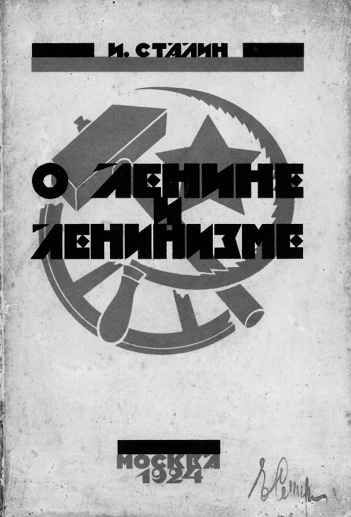
Stalin’s book Lenin and Leninism
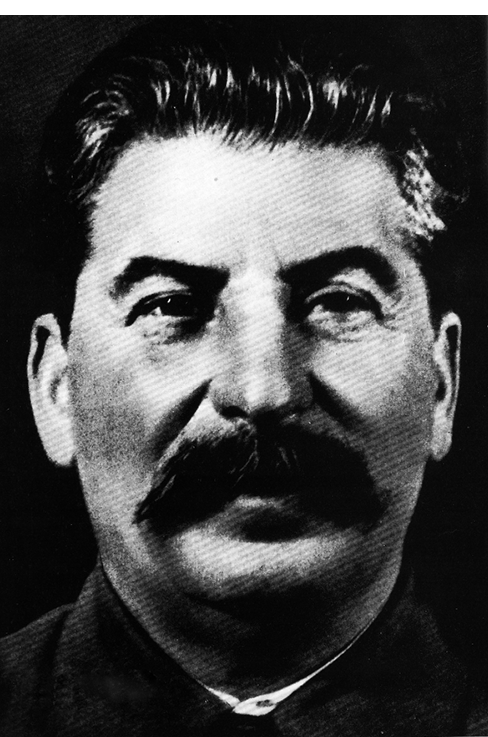
Joseph Stalin
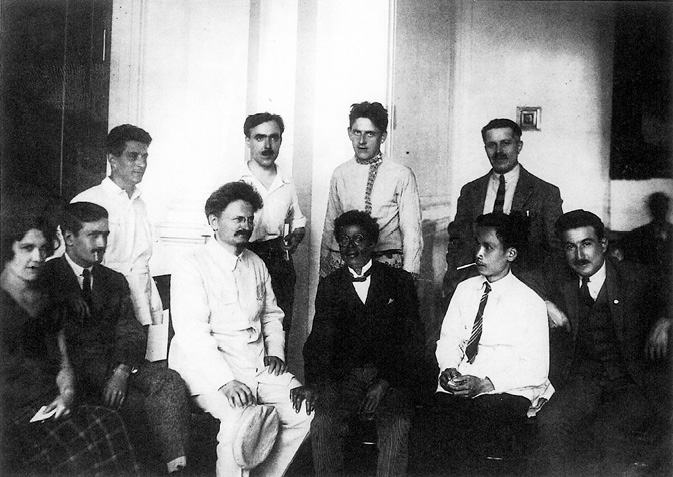
Trotsky with young leaders of recently-founded Communist Parties around the world at the Fifth Congress of the Comintern in Moscow 1924
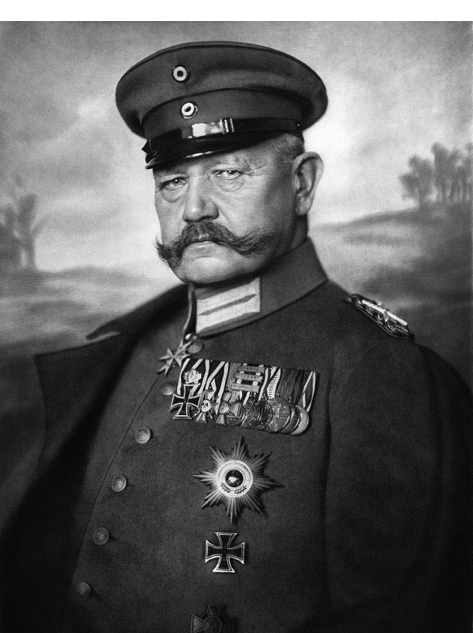
Paul von Hindenburg