Chapter Five: The Spoils of War
The proletarian revolution is knocking at the door in Germany: one must be blind not to see this. The coming events will have world-historical significance. We shall soon see that the autumn of 1923 marks a turning-point, not only for Germany, but for the whole of humanity. With trembling hands, the working class is turning the decisive page of the history of its world struggle. A new chapter in the history of the world proletarian revolution is opening.
Grigory Zinoviev, Probleme der Deutschen Revolution
The defeat of Germany in the ‘Great War’ of 1914-18 had serious consequences. The ‘war to end all wars’ had transformed Germany into one of the weakest links in the chain of world capitalism. The Allies, for their part, were determined to take the maximum advantage of this weakness. The Ruhr region had been occupied by Allied troops in the immediate aftermath of the First World War, as a buffer zone in the Rhineland. They were determined to extract their pound of flesh, and more, by imposing the brutal Treaty of Versailles in the summer of 1919. The aim of these victorious ‘men of peace’, the leaders of the Entente, was simply to bleed Germany white and reduce the country to a semi-vassal state. Thus, the Versailles Treaty was one of the most oppressive and predatory treaties in history, an act of plunder perpetrated by a gang of thieves against a weak and defenceless German people, all in the name of ‘Justice’, ‘Liberty’ and ‘Democracy’, the hallmarks of capitalist hypocrisy.
Although the Armistice was signed in November 1918, the formal end to hostilities between Germany and the Allied Powers only came in the summer of 1919 with the signing of the Versailles Treaty. The Treaty document was made up of fifteen parts and 440 articles and was symbolically signed by all parties on 28 June, exactly five years after the assassination of Archduke Franz Ferdinand, and forty-eight years since the end of the Franco-Prussian war.
According to the leaders of the Entente, the German people and the Central Powers bore the full responsibility for the war and, therefore, had to pay the full cost for their heinous and treacherous acts. This revenge of the victors was to sow the seeds of hatred within Germany for years to come and helped to fan the flames of German nationalism. In this way, it also helped to prepare the way for the rise of Hitler and the nightmare of the Second World War.
While the champagne flowed like water at the victory celebrations in Paris, the spectre of revolution cast a long shadow over the festivities. The imperialists were haunted by Bolshevism, which had already conquered Russia and – as we have seen in previous chapters – was now threatening Germany, Bavaria and Hungary. But for now, what was uppermost in their minds was the dismemberment of Germany, and what share of the plunder they would each get.
Naturally, the defeated Central Powers, Germany, Austria, and Hungary were not invited to the Peace negotiations. Likewise, Bolshevik Russia was excluded, having concluded a separate peace agreement with Germany. The important powers around the table in Paris were Britain, France and the United States, the so-called Big Three. Italy had left the proceedings by this time and therefore the Big Three decided everything. But their differing war aims and national interests soon led to disagreements and conflicts.
After nearly six months of deliberations, the draft Treaty was finally finished. In the great hall of the Trianon were gathered the representatives of twenty-seven nations that had defeated the Central Empires. Presiding over the ceremony was Clemenceau. On one side of him sat President Wilson and on the other was Lloyd George.
The master of protocol announced: “Messieurs les délégués allemands!” The German representatives, after being kept out of the proceedings, were finally ushered in like prisoners at the dock. After being allowed in to hear their guilt, they were told, in no uncertain terms, of the demands contained in the Treaty, including the so-called ‘War Guilt Clause’, which weighed like a massive millstone on Germany’s conscience. Following this humiliation, they were forced to listen to Clemenceau in his role as judge, jury and executioner of the vanquished:
In the view of the Allied and Associated Powers, the war which began on the first of August, 1914, was the greatest crime against humanity and the freedom of the peoples that any nation calling itself civilised has ever consciously committed … Germany’s responsibility, however, is not confined to having planned and started the war. She is no less responsible for the savage and inhumane manner in which it was conducted.
He concluded:
The conduct of Germany is almost unexampled in history. The terrible responsibility which lies at her doors can be seen in the fact that not less than seven million dead lie buried in Europe, while more than twenty million others carry upon them the evidence of wounds and suffering, because Germany saw fit to gratify her lust for tyranny by a resort to war.
The Allied and Associated powers believe that they will be false to those who have given their all to save the freedom of the world if they consent to treat the war on any other basis than as a crime against humanity and right. (A. Read, pp. 229-230.)
The truth is that Britain had gone to war because Germany had become too strong and threatened British interests, dragging in France and the others who hoped to benefit from the conflict. In the past, Britain had relied on a foreign policy that played off one power against another. But simply giving support to France against Germany was no longer possible. Therefore, Britain had to depart from her traditional policy and go to war. It was nothing to do with ‘democracy’ or ‘saving little Belgium’, and everything to do with power, prestige and profits, and the protection of the British Empire. But the war had changed the balance of forces. With Germany’s defeat, France was given more power, which it used to demand greater concessions from Germany. Britain objected as she wanted a weakened, but not a totally ruined Germany, to play off against France, whereas the United States needed a powerful France to counter Britain. Such were the real material interests involved in the game of imperialist diplomacy.
There was of course no discussion, only further humiliation, as the Germans were handed a single copy of the Treaty to ratify, in French and English, but not in German. Ulrich Graf von Brockdorff–Rantzau summed up the feeling from the German side: “We know the full brunt of hate that confronts us here. You demand from us to confess we were the only guilty party of war; such a confession in my mouth would be a lie.”
The American Colonel Edward House observed that the proceedings were “not unlike what was done in olden times when the conqueror dragged the conquered at his chariot wheels.” (R. Watt, p. 10.) All that was missing were the chariots.
According to R.T. Clarke, who summed things up perfectly, “Germany was to remain pilloried to eternity as the one great and horrible example and from that new world order the new revolutionary Germany was to be barred as a moral leper.” (Quoted in E. Anderson, p. 63.)
On the other hand, despite the Treaty being clearly draconian, prominent figures on the Allied side, such as the French Marshal, Ferdinand Foch, who thought it too lenient and pursued a far tougher approach. The French were particularly hard on the Germans. There was even talk amongst the French of breaking up Germany piece by piece if they fell behind on their reparation payments, with France taking a major slice. The Americans, fearing this was a step too far, attempted to dissuade them from such lunacy.
The German delegation, Count Brockdorff-Rantzau, Foreign Minister of the Reich, followed by the other representatives, withdrew from the Paris Conference after being subjected to gross humiliation. They were given a fortnight to make any observations, but only in the form of notes.
The Social Democratic Chancellor, Philipp Scheidemann, refused to sign the Treaty and resigned as Chancellor. In a passionate speech before the National Assembly on 12 March 1919, Scheidemann called the Treaty a “murderous plan” and exclaimed: “Which hand, trying to put us in chains like these, would not wither? The Treaty is unacceptable.” But the speech was all bluff and bluster. He offered no alternative. A refusal to sign would have meant an immediate Allied offensive against a broken Germany, which could only result in further humiliation. The German military command had been approached as to the possibility of resistance, but this proved impossible under the circumstances.
Therefore, on 2 June, the National Assembly in Berlin voted in favour of signing the Treaty by 237 votes to 138, with five abstentions. Within a matter of weeks, the Foreign Minister, Hermann Müller, and Johannes Bell travelled to Versailles to sign the Treaty in solemn circumstances on behalf of the German nation. As Müller stepped forward to sign the document, he was offered a fountain pen, a gift from a French city for this special occasion. But he refused the gift and used his own pen.
The Treaty was then ratified by the German National Assembly ten days later on 9 July 1919 by a vote of 209 to 116. Thus was born the national ‘sell-out’ of Germany, for which the right-wing nationalists and ex-military leaders immediately blamed the politicians, socialists, and communists for the betrayal. This was then used by the Nazis and other nationalists for the next thirteen years, who specifically laid the blame on Jews and ‘traitors’ for the growing plight of the German people.
Squeeze until the Pips Squeak
The most belligerent power opposed to Germany, as we have seen, was France, which had lost much more than any of the other victors during the conflict. The French ruling class therefore demanded retribution. The French Prime Minister, Clemenceau, was determined to take his tribute and more. The cunning British Prime Minister, Lloyd George, also wanted a slice, but instead preferred to bleed Germany by reducing its economic and military power, and thereby protecting Britain’s markets and Empire. He had gone to Paris promising to “squeeze the German lemon until the pips squeak.” But his overarching aim was to prevent France becoming a dominant power in Europe at Germany’s expense.
Nevertheless, they both came up against what they regarded as Woodrow Wilson’s so-called idealism. The American President’s proposal for ‘self-determination’, while lacking any content, did not go down well with Lloyd George. The British and the French wanted to keep their empires and dominions and any talk of self-determination, however hollow, was considered a threat, which it was. They were not going to relinquish their old European empires for the benefit of the United States. Again, the US had arrived late in the war and had not been touched by German destruction. While the British and French fought tirelessly in the trenches, the Americans, in the words of Lloyd George, had been “loitering in the way” for three years.
But America was conscious of its own interests and was determined to pursue them. The reason why the United States entered the war late was to allow Germany and Britain to mutually exhaust themselves and then she would graciously step in. She had assumed the role that Britain had taken in previous wars, namely, to weaken one camp by playing it off against the other, and only intervening militarily to secure all the advantages for herself. As a growing imperialist power, the United States would soon displace both Germany and Britain to become the dominant power globally.
Although prone to more isolationist feelings, the United States worked to play off Britain and France by taking a softer approach toward the issue of German reparations. To add to the manoeuvres, Woodrow Wilson, simply to demonstrate that the United States was boss, put forward his own Fourteen Points. They included proposals that all “future world agreements” would be covenants of peace, “openly arrived at”; there was the insistence upon “absolute freedom of the seas”; the restoration of Alsace-Lorraine to France; the promise of “an independent Polish state”; and, the fourteenth point, the establishment of “a general association of nations”, namely the League of Nations, dubbed by Lenin as “a gang of thieves.” He could afford to be magnanimous to the Germans, as long as the United States got what it wanted, including the repayment of its loans made to its European Allies, plus the interest. The Europeans were annoyed but were forced to keep their mouths shut in public. Of course, each knew the duplicity of the others, which was intended to conceal or distort their real intentions.
As compensation to the Allies in recompense for their destruction and hardship during the four years of war, Germany’s colonies were divided up between the victors: Italy, France, Belgium, Japan and Britain, with the latter taking the lion’s share. The Cameroons were divided up between France and Britain; Togoland was given to Britain, and Western Africa to Britain and Belgium. In the Pacific, Japan received the Marshall Islands and the Shantung Peninsula in China. Samoa was given to New Zealand, New Guinea to Australia, and the island of Nauru to Britain.
Germany was also to be dismembered: the Saar mines were transferred to France, as was Alsace-Lorraine, with its two million population and the three-quarters of German iron production that accompanied it. The southern part of Silesia, with its industries and mines were ceded to Poland, whereas the northern part of Schleswig went to Denmark. Other parts were distributed accordingly, through smaller ‘adjustments’ at the expense of Germany and its allies. The Rhineland was to become a demilitarised zone administered by Great Britain and France jointly. The port of Danzig with the delta of the Vistula River at the Baltic Sea was made the Free City of Danzig under the permanent governance of the League of Nations, without of course a plebiscite.
The victor powers carved up the military equipment between themselves, including 5,000 cannons, 30,000 machine guns, 3,000 mine throwers, 2,000 aeroplanes, 100 submarines and eight cruisers. The bulk of the German High Seas Fleet was disarmed and sent to England, then onwards to the Orkney Islands. However, the hot breath of the German revolution remained on board the ships, as German sailors established a ‘Supreme Sailors’ Soviet’, which the British authorities refused to recognise. The fleet was then held in quarantine for fear that British sailors would be infected by the virus of revolution. The German army was drastically reduced to 100,000 men, an adequate number, it was deemed, to be used if need be against revolution. All monies taken from foreign banks were to be handed over. The naval blockade would, of course, remain in force.
But this stripping of Germany’s military power would continue to be a deep source of resentment amongst the officer caste, many of whom turned towards the nationalist right, as the Versailles Treaty fanned the embers of German nationalism. Brockdorff-Rantzau never personally forgot the humiliation of the treaty. On his deathbed, in 1928, his last words to his brother were, “Do not mourn. After all, I have really been dead ever since Versailles.” (R. Watt, p. 523.)
Carthaginian Peace
There were more sane voices who preached caution about the harsh policy of retribution, such as the economist John Maynard Keynes, who was present at Versailles as a representative of the British Treasury. He understood that simply squeezing Germany could lead to serious – and revolutionary – consequences. But the victor powers seemed oblivious to this fact. They were only concerned with the size of the booty they were going to get.
On 5 June, 1919, just a few weeks before the signing of the Treaty, Keynes tendered his resignation to Lloyd George. “I’ve gone on hoping even through these last dreadful weeks, that you’d find some way to make of the Treaty a just and expedient document,” he wrote. “But now it’s apparently too late. The battle is lost.”
Keynes described the treaty as a “Carthaginian peace,” left the Paris Peace Conference and retired to write his The Economic Consequences of the Peace, a scathing attack on the Conference and the Treaty’s reparation terms. The opening chapter conveys Keynes’ feelings in no uncertain terms:
The spokesmen of the French and British peoples have run the risk of completing the ruin, which Germany began, by a Peace which, if it is carried into effect, must impair yet further, when it might have restored, the delicate, complicated organisation, already shaken and broken by war, through which alone the European peoples can employ themselves and live.
The Versailles Treaty simply bound together the German and European economies in a downward spiral and laid the foundation of further revolutionary upheavals. Keynes was alarmed by this state of affairs:
Germany cannot export coal in the near future if she is to continue as an industrial nation […] and will not furnish the Allies with a contribution of 40,000,000 tons annually […] If the distribution of the European coal supplies is to be a scramble in which France is satisfied first, Italy next, and everyone else takes their chance, the industrial future of Europe is black and the prospects of revolution very good. (J.M. Keynes, The Economic Consequences of the Peace, emphasis added.)
These stone-faced politicians, Clemenceau, Wilson and Lloyd George, refused to grasp the implications of their actions. Keynes described Clemenceau as “dry in soul and empty of hope,” Woodrow Wilson as “this blind and deaf Don Quixote,” and Lloyd George as “a goat-footed bard”. But behind these gentlemen, no matter their personal faults, there stood the material class interests of their respective imperialist powers, each vying for its own prestige, power and profits. They were determined to extract their ‘just’ rewards, nothing more, nothing less, from the German people for their ‘barbaric’ actions.
As Keynes had predicted, the German government was unable to honour the reparation payments to France. France, in turn, had depended on German reparations to pay back her medium and long-term debts to the British and American governments, while the French government was churning out national defence bonds. From 1920 onwards, France’s interest payments on foreign and domestic debt accounted for a staggering twenty-six per cent of the government’s budget, government bonds lost sixty-two per cent of their value, and devaluation of the franc prompted a flight of capital.
Article 231 of the Treaty demanded Germany pay reparations. In 1921 the total cost of these reparations was assessed at 132 billion marks (then $31.4 billion or £6.6 billion, roughly equivalent to US $442 billion or UK £284 billion in 2018), a sum that was impossible for Germany to pay without completely destroying the country. In May of that year the hard-headed Allies demanded the full payment of 132,000 million gold marks in reparations. To soften the blow and demonstrate the Allies’ generosity, the Germans were allowed to pay the reparations in kind, whereby Britain would receive tonnage for tonnage and class for class all her lost shipping during the war. The French were given 5,000 locomotive engines, 150,000 railway wagons, 10,000 lorries and 140,000 cows. The Belgians also received their payment in cattle. Germany was being economically stripped bare by the Allies. While the German nation, that is the working class, bore the brunt of this colossal burden, the bourgeoisie was able to make enormous profits from the inflation.
In November 1921, such was the dire situation, Germany requested a moratorium on the reparations. But there was no agreement as the negotiations between France, Germany, and Britain broke down. As German debts mounted, they had growing difficulty in honouring the reparation payments throughout 1922. These reparations led to acute shortages at home, as meat consumption fell to only thirty-seven per cent of pre-war levels; flour consumption fifty-six per cent; and coffee consumption twenty-eight per cent. The shattered German economy was so weak that only a small percentage of reparations were paid in hard currency. The bulk was in kind, made up of anything the Allies could carry. However, even the payment of a small percentage of the original reparations still placed an intolerable burden on the state. The government’s response was to print more and more money, so that the amount of paper money in circulation rose six-fold from 1913. This was a two-edged blessing. While the devaluation of the currency meant a lighter burden of reparations, it resulted in hyperinflation that became rampant as the mark to the dollar exchange rate spiralled out of control.
French Occupation of the Ruhr
The economy went over a cliff in January 1923, when Germany finally defaulted on its reparation payments. This set in motion a chain reaction, causing the new French Prime Minister, Poincaré, to immediately dispatch General Degoutte at the head of 60,000 troops to occupy the Ruhr and seize its coal. They were accompanied by Belgian forces, who also wanted a share. This represented a devastating blow to Germany, as the Ruhr was the industrial heart of the country, where eighty per cent of its steel and seventy-one per cent of its coal production was concentrated. This colonial-type occupation was the gravest situation faced by Germany since 1918.
The reaction was instantaneous. The mood changed abruptly as national revulsion spread like wildfire throughout the length and breadth of Germany, with 500,000 people taking to the streets in Berlin alone. The ruling class were hoping that, as with the crisis of August 1914, l’union sacrée, national unity, would again emerge. The government of Cuno, the German industrialist, announced a campaign of ‘passive resistance’, in which all forms of co-operation with the occupying forces would be completely forbidden. Cuno called for a vote of confidence for the ‘resistance’, which was endorsed by the Reichstag by 284 votes to twelve, the Communists voting against. In other words, there was to be no collaboration and no reparation payments. It was like a state of war.
Ironically, it was the bourgeois parties that led the resistance campaign in its early stages. In fact, the Ruhr industrialists had organised a number of mass demonstrations against the French. But many workers were not fooled by the so-called patriotism of the likes of Krupp and Stinnes, who had already made sure that the cost of the resistance would be shouldered by the workers. During the occupation, the employers denounced wage rises as ‘unpatriotic’, as prices and profits soared. While the price of coal (calculated in stable currency) was twice as high as the peacetime price, miners’ real wages had fallen by one-third of peacetime wages.
As the resistance intensified, the mood was becoming increasingly desperate and angry. The bourgeois parties, fearing the turmoil that passive resistance was causing, began to vacillate. In the meantime, the Communist Party swung behind the resistance and began to take a lead in the fight. The workers wanted to get rid of the occupation by French troops, but they also demanded the immediate stabilisation of the currency, which was eating away their wages at an ever-increasing speed.
The caution sounded by the Comintern Third Congress came abruptly to an end. The slow, patient work gave way to feverish activity. Revolutionary events, which seemed to have been postponed indefinitely, were now back onto the agenda.
Workers in the Ruhr were forbidden to co-operate with the French authorities. Measures of resistance, strikes, go-slows and sabotage, bogged down the French authorities, who announced draconian measures to break the resistance by expelling some 10,000 in the first six months of 1923. In the Ruhr, the French occupation forces expelled 1,400 German railway workers from the area, and on 29 January, they proclaimed martial law.
This simply poured petrol on to the fire as a wave of militancy swept through the towns of central Germany. Acts of sabotage followed as power lines and telephone cables were cut, and railway lines pulled up. Arrests followed but they did not calm the situation. In fact, the entire Council of the Essen postal workers were arrested for planning a strike against the occupation. There were disturbances and shootings in Essen and other places.
“The struggle which had begun as national resistance against the French,” wrote Evelyn Anderson, “ended in a period of the fiercest class war that Germany had ever experienced.” (E. Anderson, p. 91.)
While the SPD lined up behind the Cuno government, the KPD took an independent position, calling on the workers to resist the occupation, but also resist the ruling class, which was deceiving them. Above all, they were opposed to the German nationalism espoused by the authorities and echoed by the extreme right. The ultra-left within the KPD, true to form, wanted the party to adopt a neutral position in the struggle, as they had done at the beginning of the Kapp Putsch; they even threatened to split the party over it. Only the intervention of the Comintern, which put the ‘Left’ in its place, avoided such an outcome. At the Eighth Congress of the KPD, held in Leipzig in late January, Brandler was chosen to replace Meyer as party chairman, while Thalheimer became its chief ‘theorist’. This placed the German party firmly in the hands of the ‘right wing’, which continued to uphold the united front tactic, despite opposition from Maslow, Fischer and Thälmann.
The situation was becoming extremely favourable for the Communists, as long as they could reorientate themselves correctly. With bourgeois society shaken to its foundations, the objective situation was becoming pregnant with revolutionary potential. Marx explained there were times when “twenty years are more than a day – though, later on, days may come again in which twenty years are embodied.” (K. Marx and F. Engels, Selected Correspondence, p. 140.) This was such a time, when events moved swiftly. What was now needed was a degree of vision and a bold leadership that could seize the moment.
Hyperinflation
As we have seen, inflation was giving way to hyperinflation as the situation deteriorated and living standards were cut to the bone. The price of a single loaf of bread in Berlin escalated from sixty-three pfennigs in 1918 to 250 marks in January 1923. Then prices rose at an astronomical rate – a loaf of bread cost 3,465 marks in July, 1.5 million in September, reaching a peak of 201,000 million marks in November 1923. The official dollar exchange rate is shown in Table 5.1.
| (5.1) Official Dollar Exchange Over Time | ||
|---|---|---|
| Date | Marks | U.S. Dollars |
| 1919 | 4.2 | 1 |
| 1921 | 75.0 | 1 |
| 1922 | 400.0 | 1 |
| Jan. 1923 | 7,000.0 | 1 |
| Jul. 1923 | 160,000.0 | 1 |
| Aug. 1923 | 1,000,000.0 | 1 |
| 1 Nov. 1923 | 1,300,000,000.0 | 1 |
| 15 Nov. 1923 | 1,300,000,000,000.0 | 1 |
| 16 Nov. 1923 | 4,200,000,000,000.0 | 1 |
At this point, inflationary figures lost their meaning. The printing presses worked continuously to produce banknotes. By mid-1923, the Reichsbank was using 300 paper factories and 150 printing firms to supply Germany with the necessary paper money.
Soon, barrowfuls of rapidly devaluing money were required to buy the basic necessities, as workers dashed off as soon as they were paid before their wages became worthless. Million-mark notes were used to paper walls. Bundles of notes were sold as scrap paper. Wads of money were used to light stoves. As one commentator explained, “An object which had been previously worth twenty-four cents now cost a sum which would formally have equalled three times the entire wealth of Germany!” Dr. Schacht, Germany’s National Currency Commissioner, explained that at the end of the Great War one could in theory have bought 500,000,000 eggs for the same price as one egg five years later. Those on fixed incomes literally starved as their incomes became worthless. War loans, mortgages, savings, insurance policies, etc., were all wiped out. Poverty became widespread overnight. The peasants refused to sell their crops and the shops and markets were empty. Pensioners received 10,800 marks in July 1923, enough only for two journeys on a tram, if they were quick enough to spend it. A metal worker who earned 3,000 marks at the end of 1922, received 500,000 in March 1923, then four million marks in July.
Throughout the spring and summer, the crisis intensified. A clear indication of the suffering was the rise in the number of suicides, which reached record levels. Babies were abandoned on the doorsteps of children’s homes and starving children were left to fend for themselves. As a consequence, the figures for infant mortality rose above the highest war-time level. One children’s hospital reported that thirty per cent of its patients died within twenty-four hours of their admittance.
Larissa Reissner, an eyewitness, explained the situation:
Berlin is starving. In the street everyday people who have fainted from exhaustion are being picked up on the trams and in the queues. Starving drivers drive the trams, starving motormen urge their trains on along the infernal corridors of the underground, starving men go off to work or roam without work for days and nights around the parks and the city’s outlying areas.
Starvation hangs on the buses, shutting its eyes on the spinning staircase to the upper deck while advertisements, desolation and motor horns reel past like drunks. Starvation stands guard over Wertheim’s majestic counters, taking in twenty thousand million a week when a pound of bread costs roughly ten thousand million. Starvation serves fussily and attentively in the hundreds of deserted department stores that are crammed with riches, golden in the light and as clean and as respectable as the international banks. That young miss on whose pointed triangle of a face there are only bluish recesses for eyes, a little powder and an obsequious smile, points like a hunting dog to some ten-dollar boots and a thirty-dollar rug. While faint with hunger she is selling herself for a penny ha’penny at the old rate and yet she can calculate with a purely German thoroughness and at lightning speed the speculator’s billions and trillions, enter them in the account in that exquisite handwriting possessed by this entire nation of highly literate people; as she waits for the next round of staff cuts, she resignedly undoes her shop assistant’s overall but still without daring to detach that fawning hungry smile from her face. (L. Reissner, Hamburg at the Barricades.)
The German petty-bourgeoisie were ruined, destitute and in absolute turmoil. Peasants, shopkeepers, and even professionals looked desperately to the labour movement for a way out of the crisis. The Social Democratic workers increasingly looked to the Communists. In such an acute economic crisis, the trade unions were collapsing. The membership dues from workers were now completely worthless. Newspapers and magazines disappeared as newsprint needed to be paid for in gold, but the newspapers sold for nothing. Remarkably, the Communist press made progress, given the thirst for ideas, far outstripping its Social Democratic rivals. The French occupation now seemed to be a minor problem in comparison to the struggle for survival.
While the masses suffered, the German bourgeoisie were able use these circumstances to accumulate vast fortunes. They received their profits in dollars and gold and paid their debts with paper money. Until 1922, the Central Bank interest rate was five per cent a year. In August 1923 it was raised to thirty per cent, and in September 1923 to ninety per cent. However, anyone with access to central bank loans could borrow money and pay it back with devalued currency. But only big business, the likes of Krupp and Thyssen, had access to such funds. Small firms were starved of credit. Industry, especially exporters, boomed as they could undercut competitors in devalued marks, while earning foreign currency. Hugo Stinnes, a wealthy businessman, used the inflation to buy up a vast industrial empire on credit that was later repaid with worthless paper marks. He would also ask for payment for his goods in dollars or gold. Rubbing his hands, he argued forcefully that “the weapon of inflation would have to be used in the future too”. Likewise, industrialists such as Thyssen and Krupp accrued greater and greater profits.
On 5 October, the industrialists, including Stinnes, met in a conference with the leaders of the French occupation forces in which their spokesman Klöckner stated:
The Rhenish-Westphalian coal industry has decided to reintroduce the pre-war working time, as from Monday next… The industry is, however, not in the position to carry out its plans without the support of the Occupation Forces. (E. Anderson, p. 99.)
But the French authorities refused to comply with this request, not wishing to get even more embroiled in an already difficult situation. However, when news of this request leaked out, there was widespread indignation. Vorwärts summed up the mood: “With the aid of French bayonets Stinnes tried to subject the German workers to the dictatorship of ruthless industrial exploitation.” (ibid., p. 100.) The Ruhr industrialists were even accused of high treason.
While the capitalists lived off the fat of the land, the rest of society was being plunged into destitution. The struggle that had begun as one of national resistance against the French turned now into a bitter class struggle. On 31 March, 53,000 Krupp workers at Essen attempted to stop French troops requisitioning lorries carrying food supplies. The incident resulted in thirteen dead and forty wounded. On 13 April, at Mülheim, the workers seized the town hall, established a Workers’ Council and attempted to organise a workers’ militia.
Revolutionary Situation
On May Day in Berlin, the mass procession was led by a vanguard of the ‘Proletarian Hundreds’ military formation, where 25,000 workers marched shoulder to shoulder with red armbands.
In May, a huge strike wave swept across the country demanding the overthrow of the Cuno government. The situation was becoming increasingly revolutionary. An unstable government was faced with an explosive movement from below. Moreover, the German workers were turning increasingly to the Communist Party for leadership. “At no moment were revolutionary aspirations so deep as in Germany during the summer of 1923,” wrote Arthur Rosenberg. (P. Broué, p. 715.) All the objective conditions for socialist revolution, as outlined by Lenin, were rapidly crystallising in Germany: the ruling class was split; the working class was searching for a way forward; the middle class were in ferment and looking to the workers’ parties. The situation was crying out for a revolutionary party.
Unfortunately, the KPD was now dragging its feet. After its previous ultra-left adventurism, it swung the other way and became overcautious. The erratic Radek, speaking at a meeting of the German Central Committee in May completely misread the situation:
Today we are not in a position to institute the proletarian dictatorship because the necessary preconditions, the revolutionary will amongst the majority of the working class, do not yet exist. (ibid., p. 707.)
But the very next day, he was forced to eat his own words as the situation in the Ruhr exploded, with widespread strikes and street fighting.
The party had badly burned its fingers in the failed ‘March Action’ of 1921 and was determined not to repeat the same mistake. This shaped the psychology of the leadership. They feared leaping too far ahead of the working class. They had become too defensive and were bending the stick in the other direction. The party’s correct opposition to putschism now seemed to extend to the very idea of insurrection. It was true that the tactic of patiently winning over the working class through the united front approach had been highly successful. But the new situation demanded that a new turn was needed. While the KPD leaders were wedded to a more cautious approach, sections of the bourgeoisie were growing increasingly alarmed at the situation. On 26 May, a senior German official, the deputy to the District President of Düsseldorf, Dr. Lütterbeck, wrote to the French General Denvignes, for permission for German police to enter the occupied zone to restore order:
In the presence of these dangers, I take the liberty of emphasising the heavy responsibilities which the French High Command would incur if it showed itself to be indulgent towards anarchy. If it does not itself act, its duty is at least to leave the hands of the German authorities free to accomplish theirs… I take the liberty of recalling in this connection that at the time of the Paris Commune, the German Command did all it could to meet the needs of the French authorities taking repressive action. (ibid., p. 708.)
In response, the Communist Party issued a statement at the end of May which called for the removal of the Cuno government, the need for a workers’ government and the arming of the working class. It concluded its call with the slogans:
Down with the government of national shame and treachery!
Down with a government which turns to the executioners of the Entente to ask for permission to shoot German workers!
Down with a government which wants to hand over the railways to private capitalists!
Down with a government which lets workers, craftsmen and small officials starve while it fattens up the capitalists!
Up with the united front of all working people, workers by hand and brain in town and country!
Up with a government of working people, enjoying the trust of the masses abroad, and in a position either to secure peace, even at the cost of sacrifices, or to organise the resistance of the German people if French imperialism refuses to agree to peace!
To prison with the government’s representative, Dr. Lütterbeck! Let him be brought before a People’s Court, charged with treason!
Let those who gave him the order to present the shameful request to the French generals also face a People’s Court!
Workers of the whole German Reich! Say what you think of this government in gigantic meetings and demonstrations!
Arm to support the workers of the Ruhr! Arm to fight against the burdens the big capitalist capitulators are proposing to lay upon you!
(B. Fowkes [ed.], pp. 216-217.)
In June, at the enlarged meeting of the Executive of the Comintern, Jakob Walcher estimated that over 2.4 million workers in the trade unions were under the influence of the communists. Heckert believed that between thirty and thirty-five per cent of organised workers were under the party’s direction, roughly 2.5 million. However, Zinoviev, the head of the Comintern, zigzagging from left to right, was now arguing for a more cautious approach: “Germany is on the eve of revolution,” he said, adding, however, that, “This does not mean that revolution will come in a month or in a year. Perhaps much more time will be required. But in the historical sense Germany is on the eve of the proletarian revolution.” (E.H. Carr, The Interregnum, p. 178.) Zinoviev was putting off the revolution for the indefinite future precisely when the mass of the workers were throwing their weight behind the Communist Party. The leadership of the party, unfortunately, was hopelessly out of touch with the mood that was developing, and was tied into an entirely different perspective. As often occurs in revolutionary situations, the masses had moved far to the left of the party, and the party ranks to the left of the party leadership.
Looking the Wrong Way
Zinoviev saw the approach of the revolution, but as in October 1917, balked at the idea of an insurrection, which he and Kamenev opposed. In fact, the main focus of the discussion at the June meeting of the ECCI was not about preparing for the struggle for power, but about the danger of fascism. Only a moment or two were devoted to the revolution in Germany. This fact alone clearly demonstrated they were seriously lagging behind events, which were changing by the hour. It should have been clear to these leaders that Germany was now in the grip of a revolutionary situation.
At the ECCI meeting, Clara Zetkin had delivered a statement on ‘the struggle against fascism’, which seemed to be the main preoccupation of the international leadership. In the debate that followed her speech, Radek made a very strange contribution, which referred to the upsurge of nationalism in Germany following the French occupation of the Ruhr:
Throughout comrade Clara Zetkin’s speech, I was obsessed with the name of Schlageter and his tragic fate. The fate of this martyr of German nationalism must not be passed over in silence or honoured only by a passing word. He has much to teach us as well as the German people. We are not sentimental romantics who forget hatred in front of a corpse, or diplomats who say that at a grave one must praise or be silent. Schlageter, the valiant soldier of the counter-revolution deserves a sincere homage from us soldiers of the revolution. His co-thinker Freks published a novel in 1920 in which he described the life of an officer who died in the struggle against the Spartacists. It was called The Wanderer into Nothingness. If those German fascists who want to serve their people faithfully do not understand the meaning of Schlageter’s fate, then indeed he died in vain and they can inscribe on his tomb: ‘Wanderer into Nothingness’. (A. Rosmer, Lenin’s Moscow, pp. 196-197.)
Alfred Rosmer, who was present at the meeting, reported that the “delegates were disconcerted. What did this strange preamble mean?” (ibid., p. 197.) The meaning soon became clear. There was to be a ‘turn’ towards the fascists in an attempt to win over their periphery. Behind Radek’s initiative stood Zinoviev, who endorsed the policy. This new orientation became known as the ‘Schlageter line’ and was soon adopted by the KPD. As a result, the communists sought public debates with the fascists over the following month. After two or three debates with communist speakers, the Nazi Party formally forbid its members to enter into debates with the communists.
“You’re fighting Jewish finance,” stated Remmele to the fascists, “Good! But also fight the other finance, that of Thyssen, Krupp, Stinnes, Klöckner and so on!”, and he made the anti-Semites applaud the class struggle. “You are fighting the workers because your masters, the big capitalists, want to divide and rule, want to divide you people from the ruined proletarianised middle classes, from us proletarians!”, and he got these reactionaries to applaud the united front of all the exploited. “Are you patriots?”, he asked, and he showed how big German industry was linked in many profitable deals with French capital, selling it its manufacturing secrets, like the Baden aniline trust, preparing the way for the colonisation of Germany, and getting rich from the falling value of the mark. “Which of you wants to get killed for capitalist Germany?”, and he got the whole hall to shout out: “None of us!” (Quoted by V. Serge, ‘Observations in Germany’.)
While this campaign had a certain success, fascism was not going to be defeated in an ideological debate over who could best defend the national interests of Germany. The debates did, however, give ammunition to the Social Democratic leaders who denounced “the collusion of communist and fascist leaders”. They even reproduced Radek’s ECCI speech, as did the ‘liberal’ papers. Vorwärts headed its article, ‘Radek celebrates Schlageter’.
The ‘Schlageter line’, while making some inroads into the base of the fascists, was not focusing the party on the real needs of the situation, namely the concrete preparations for revolution. The ECCI meeting was a missed opportunity to put the party back on track, but unfortunately neither Lenin, who was lying incapacitated, nor Trotsky were present.
Within a few weeks, while the Communist leadership were talking about fascism, Stresemann, a leading German bourgeois politician, and later Reich Chancellor, was talking of the dangers of socialist revolution. “We are dancing on a volcano and the revolution confronts us,” he warned. (W. Held, ‘Why the German Revolution Failed’, from Fourth International, Vol. 3, No. 12, pp. 377-382 and Vol. 4 No. 1, pp. 21-26.) This bourgeois politician understood the situation in Germany more than the World Party of Socialist Revolution.
There was only one election held during the crisis of 1923, which was indicative of the real mood that existed. That was in the rural region of Mecklenburg-Strelitz in July, therefore not the most politically advanced area. The vote cast for the bourgeois parties in the election fell from 18,000 (in 1920) to 11,000. The Social Democratic vote similarly fell from 23,000 to 12,800, despite the reunification with the right-wing Independents the year before. While the Independents in 1920, regarded as the extreme left, won 2,257 votes, the Communist Party, standing for the first time in a region where they had no base, now received 10,853 votes, or about twenty per cent of the total vote cast. This was an astonishing result in such a rural area and reflected the massive radicalisation taking place.
The membership of the Communist Youth had increased from 30,000 in the autumn of 1922 to more than 70,000 by the summer of 1923. The number of communist factions in the trade unions grew from 4,000 in June to 6,000 in October. The KPD held a majority within the 2,000 factory committees. These factory committees went far beyond the limits of the factory council legislation and were becoming the principal points of support for the revolution. They in turn linked up with ‘control committees’, which were formed by housewives’ groups set up to control prices, thereby deepening their roots in the working class. The communists also organised the ‘Red’ or ‘Proletarian Hundreds’, militant defence organisations of 100 men, which developed into extensive military organisations in Thuringia and Saxony. This was part of their call to establish workers’ self-defence groups throughout the country. These, together with the shop committees, could provide the basis for organs of potential dual power, and a new workers’ revolutionary government.
Meanwhile, hyperinflation continued to cripple economic life. “Paper money began to flow like water,” wrote Philips Price. “Seven billion marks were printed in less than two and a half months. It was a paradise – of paper and on paper.” He later reported:
Prices are rushing upwards in a way that once would have seemed incredible, but to which we are now becoming accustomed. Food prices in the shops are higher at noon than in the morning, higher in the evening than at noon. And nobody thinks of tomorrow. Under these circumstances the centre parties are losing their hold and their morale. The drift is more and more to the extreme Right or to the extreme Left, because nobody sees any room for hope in the existing order. (M. Philips Price, Dispatches, pp. 157-158 and p. 160.)
The extreme political polarisation in society, together with the loss of hope in the existing order, were characteristics of a revolutionary situation. The economic and social collapse had reached unbelievable proportions, with hardly a facet of ‘normal’ civilised life remaining. The comfortable living standards of the middle class had been completely wiped out. Doctors and professors were evicted from their apartments. Having sold their family heirlooms for bread and soap, many had been forced into the ranks of the swollen unemployed, which had consumed half the workforce. Yet unemployment benefit was not enough to buy a bottle of milk each week. The old and sick desperately rummaged through piles of rubbish for something to eat. The illusions in capitalist democracy were being forcibly torn away in this ongoing nightmare. In this struggle for survival, many were drawing the conclusions that a revolution was necessary. Demonstrations and strikes were clearly not enough, although there were those who, out of desperation, resorted to food riots, and shops were regularly looted. These layers naturally looked to the Communist Party for a revolutionary lead out of the situation, as tens of thousands of workers were attracted to the party through the factory committees and the unemployed workers’ movement. They also joined through the ‘Hundreds’, which were being formed in every area in preparation for the coming showdown. By July, the Cuno government was on the brink of collapse.
Anti-Fascist Day
The Reichswehr troops were in Bavaria. In Saxony, the bourgeois deputies had already walked out of the Landtag in protest at the ‘Bolshevik’ policies of the government. There were clear preparations being made to act against the left governments of Saxony and Thuringia.
The party felt there needed to be a show of strength against the increasing activities of the fascists. They therefore decided to call an ‘Anti-Fascist day’ for Sunday 29 July, with street demonstrations planned in all major the cities.
The bourgeois press immediately denounced the planned protests as an act of civil war. On 23 July, the Prussian government issued a ban on all open-air processions and demonstrations on 29 July. This was then followed by a ban throughout Germany, except in Saxony and Thuringia. Brandler, the chairman of the party, recognising the seriousness of the situation, and, preferring not to take lone responsibility, sought advice from Moscow.
By this time, Lenin had suffered a third stroke on 9 March 1923 and was no longer involved politically. Meanwhile, the intrigues in the politburo had also hardened against Trotsky, who was opposed by the secret faction of Stalin, Zinoviev and Kamenev. The conspirators were determined to keep Trotsky from becoming Lenin’s successor and manoeuvred to undermine him at every opportunity. “The year 1923 was the first year of the intense but still silent stifling and routing of the Bolshevik party,” wrote Trotsky. (My Life, p. 432.)
When Brandler’s telegram arrived concerning the ban on the anti-fascist demonstrations, only Radek was present in Moscow. Zinoviev, Bukharin, and Trotsky were on vacation in the Caucasus. However, when contacted, Zinoviev and Bukharin telegraphed their wholehearted support for the demonstrations and were in favour of breaking the government ban.
It is only by such methods as the appeal issued on 12 July that the German Communist Party can become, in the eyes of the whole of the workers, the generally acknowledged champion and the united centre of the whole proletariat in the struggle against fascism. Without this, the sad experience suffered by Italy and Bulgaria will be repeated.
They concluded by attacking the apparent conservatism in the German leadership. “In the German Zentrale there are more than enough retarding elements, and elements standing for prudence and caution.” (Communist Party of Great Britain, Errors of Trotskyism, p. 346.)
Radek was opposed to defying the ban, feeling it was too risky. Alarmed, he telegraphed Zinoviev and Bukharin warning that to force the struggle in Germany meant “steering towards a defeat in July for fear of a repetition of the Bulgarian events”. Trotsky said he could not give a definite opinion as he was not sufficiently informed about what was happening on the ground. However, Stalin shared Radek’s scepticism, and wrote a letter to Zinoviev and Bukharin, saying he was opposed to defying the ban and instead urged caution:
Should the [German] Communists strive, at the present stage, to seize power without the Social Democrats? Are they sufficiently ripe for that? That is the question, in my opinion. When we seized power, we had in Russia such resources in reserve as (a) the promise [of] peace; (b) the slogan ‘land to the peasants’; (c) the support of the great majority of the working class; and (d) the sympathy of the peasantry. At the moment, the German Communists have nothing of the kind. They have, of course, a Soviet country as neighbour, which we did not have; but what can we offer them? … If the Government in Germany topple over now, in a manner of speaking, and the Communists were to seize hold of it, they would end up in a crash. That, in the ‘best’ case. Whilst, at worst, they will be smashed to smithereens and thrown way back. The whole point is not that Brandler wants to ‘educate the masses’ but that the bourgeoisie plus the right-wing Social Democrats are bound to turn such lessons – the demonstration – into a general battle (at present all the odds are on their side) and exterminate them [the German Communists]. Of course, the Fascists are not asleep; but it is to our advantage to let them attack first: that will attract the whole working class to the Communists (Germany is not Bulgaria). Besides, all our information indicates that in Germany fascism is weak. In my opinion, we should restrain the Germans, not spur them on. (L. Trotsky, Stalin, p. 530, emphasis added.)
Although this letter is not in the Stalin Collected Works, its authenticity was verified by Brandler, who translated the letter from Russian into German. Brandler at this time was the vice-chairman of the Comintern. (See I. Deutscher, Marxism, Wars and Revolutions, p. 137.)
Following this, Radek, together with Stalin, telegraphed Brandler on behalf of the presidium of the Comintern to advise him to abandon the street demonstrations, fearing the party was heading for another abortive insurrection as in March 1921.
The retreat was announced publicly in Rote Fahne. It stated that “the workers were not sufficiently prepared,” and that “we not only cannot offer a general battle, but should avoid everything that might give the enemy the chance to destroy us piecemeal.” (E.H. Carr, The Interregnum, p. 188.)
The Comintern’s advice was in complete contrast to the heightened revolutionary mood in Germany. On 26 July, the Kreuz-Zeitung newspaper wrote:
Without any doubt we are on the eve of another revolution – who could still be mistaken after seeing what is unfolding before our eyes.
The next day, Germania stated:
Confidence in the government of the Reich is deeply shaken… Discontent has reached a dangerous level. Fury is general. The atmosphere is electric. One spark and there will be an explosion… This is the mood of 9 November. (Quoted in P. Broué, p. 742.)
Politics may be defined as the art of taking advantage of favourable situations. The situation in Germany, according to many, was extremely favourable. However, Radek, once again, urged caution. “But do not let us seek a premature confrontation. Such is the situation in Germany. Such are the duties of the Communist Party.” (ibid., p. 744.) As a result, this cautious position was adopted by Brandler at the Central Committee on 5-6 August. Being naturally hesitant, it was a line he felt comfortable with. He looked forward to the collapse of the bourgeois government, but believed that it was premature to struggle for a proletarian revolution. He also thought that a section of the Social Democrats could still be won over by propaganda. He failed to understand that the Social Democratic workers were already looking to the Communists.
By August, inflation had accelerated even further. Prices were now doubling every few hours. Spontaneous strike movements, numbering roughly three million workers, culminated in a spontaneous general strike which began in Berlin on 11 August and rapidly spread throughout the country. Its central aim was the overthrow of the Cuno government, which epitomised all that was rotten in Germany.
Apart from the movement against the Kapp putsch, this strike was the largest and most intense ever experienced in Germany. Whereas in March 1920 the trade union leaders called for strike action from above, now the movement arose spontaneously from below.
Shipyards, gas, electricity, transport, even the printers printing the government’s banknotes stopped work. The Reichsbank announced it was closing its operation, as it had run out of paper notes. Out of utter desperation and yearning for a revolutionary solution, hundreds of thousands of workers shifted from supporting the Social Democrats to supporting the KPD. The hour had arrived to strike. This was the equivalent of the month of October in Russia in 1917.
The storm was about to break, and finally on 12 August, faced by a widespread general strike, the Cuno government finally collapsed. As a result, the Communist leaders could no longer ignore the seriousness that faced the party. The majority of workers were behind them. All they needed to do was to act, but that was the problem.
Ebert tried to seize the initiative by calling on Gustav Stresemann of the National People’s Party to form a new government. Stresemann represented the party of the industrialists and was a personal friend of Stinnes. He reflected the views of the Ruhr industrialists in particular, who were keen to abandon the Cuno policy of passive resistance. He cleverly pulled together a government of all parties, including the SPD, but which excluded, of course, the KPD and the extreme right. Four Social Democrats joined the government with the expressed intention of creating political stability. As they calculated, with Cuno gone, the mass movement would tend to dissipate. The Social Democrats and trade union leaders did all they could to restore order and defuse the situation, including putting an end to the strike.
In the middle of August, Zinoviev and the other Comintern leaders had woken up to the fact that Germany was on the brink of revolution. Trotsky, hearing the news of the strike against the Cuno government and then the formation of the Stresemann government, invited two members of the German party, August Enderle and Jakob Walcher, who were in Moscow attending the Executive Committee of the Profintern, to visit him urgently in the Caucasus. “If Brandler is writing proclamations like this… then we are almost there,” Trotsky told the two Germans. (I. Deutscher, Marxism, Wars and Revolutions, p. 162.) After the meeting, he asked one of them to return to Berlin as a point of contact. Within a week, the Russian leaders had all returned to Moscow to evaluate the situation in Germany.
The German leadership, including Brandler, were also hastily summoned to Moscow to discuss the abrupt turn of events. When they arrived, they were surprised to see the city covered in banners greeting the German comrades with the slogans: “Russian Youth Learn German! The German October is Approaching!” The German leaders were taken aback by the welcome.
On 23 August, in the extraordinary meeting of the Politburo, Radek gave an updated report on the situation in Germany. Trotsky, who had already realised the significance of what was happening, intervened decisively to explain that the German October was staring them in the face. For him, there were only a few weeks left to prepare for an insurrection. Zinoviev, however, preferred to count in months rather than weeks, but nevertheless broadly agreed. Stalin saw no revolution in the autumn; it might break out in the spring, but even that was dubious, he thought.
However, such doubts were put aside. The common feeling was that the German Revolution demanded urgent action. Maslow and Fischer, the Left leaders, were summoned to Moscow to play their part in the preparations and bind them to the agreement. There could be no loose ends left open which the Lefts could use to cause trouble.
Preparing the Insurrection
There is a tide in the affairs of men
Which, taken at the flood, leads on to fortune;
Omitted, all the voyage of their life
Is bound in shallows and in miseries.
On such a full sea are we now afloat,
And we must take the current when it serves,
Or lose our ventures.(W. Shakespeare, Julius Caesar.)
The leaders of the International in discussions with the German Communists concluded that technical preparations for the insurrection should be undertaken immediately. The ECCI set up a commission to oversee the preparations, composed of Radek, in charge of party relations; Pyatakov, who supervised military affairs; while Shmidt was to establish links with the trade unions.
In a secret meeting at the end of September 1923, Trotsky introduced the report by proposing that the German party set a date for the insurrection, which he proposed, as the symbolic date of the 7 November. Lenin had adopted the same attitude in pushing the Bolsheviks to set a date for their insurrection, saying that the success of the Russian and world revolution would be measured in days.
And yet Radek and Brandler rejected Trotsky’s proposal. They were clearly equivocal about the revolutionary character of the situation in Germany. In private Brandler expressed doubts about whether the party was sufficiently prepared, politically or technically, for the revolution. He wanted to delay the plans. The same went for Radek and Stalin. Reluctantly, they went along with the general view.
Trotsky went into writing about the question of an insurrection in Pravda on 23 September, entitled ‘Can a counter-revolution or a revolution be made on schedule?’ Referring to the experiences of the Jacobins in 1789, the Bolsheviks in 1917, the coups of Mussolini, and those in Spain and Bulgaria, he explained that they had all set a date in advance. To adopt a waiting attitude in face of “the growing revolutionary movement of the proletariat” was Menshevism, he said. However, he deliberately avoided mentioning Germany in the article for diplomatic and security reasons.
Nevertheless, Brandler was adamant that the timing should be left to those on the ground, which, in a compromise suggested by Zinoviev, was eventually agreed. Brandler, who was feeling the weight of the task on his shoulders, requested that Trotsky, who he greatly admired, be sent to Germany to lead the decisive battle. This was firmly opposed by Zinoviev, who rejected the idea for prestige reasons. Behind the scenes, the troika were attempting to discredit Trotsky. The very idea that he should be sent to Germany to guarantee the success of the revolution, and all that meant, would only enhance his massive standing. For the troika, this would have been intolerable. They decided to send the German Commission instead.
The German party had already established its secret military organisation, the M-Apparat, which had been strengthened by Red Army experts. As we have already seen, in many towns and factories, armed defence groups had been established throughout the year, the ‘Proletarian Hundreds’. These had first come into being during the Rathenau Campaign of 1922, but had arisen again. They were considered the shock troops of the revolution, numbering 300 in May and by October their number had reached 800, with more than 100,000 men under arms in total. They were not simply made up of communists, but contained many from the trade unions and even members of the SPD.
According to Broué:
The whole party was on a war footing. From the first days of September, with the help of several dozen specialists sent by the ECCI, tens of thousands of activists had gone underground. Members of the shock groups of the hundreds had left their factories, and known activists had changed their names and addresses. In all the big cities, men were sleeping, and sometimes spending entire days and nights, in apartments converted into dormitories or clandestine headquarters, where they studied maps of the cities and the region, and the location of the forces of order and of communications. Periodically, by action groups and hundreds, they carried out exercises in response to orders. (The German Revolution, p. 772.)
Within the leadership of the German party, however, there were those who still took a more cautious, longer-term perspective, such as Thalheimer. At the end of August, when the situation was still critical, he wrote:
Consequently, we shall have to travel a long road, both on the political and the organisational plane, before we meet the conditions which will ensure the victory of the working class. History will decide how long the necessary interval will be. (ibid., p. 774.)
This statement would appear in the October issue of the British Labour Monthly, edited by Palm Dutt, when the German party should have been launching an insurrection.
By the end of September, inflation now spiralled completely out of control. A day’s wage of a Hamburg docker came to 17 billion marks. Industrial production began to decline drastically and the ‘resistance’ in the Ruhr was becoming extremely costly for the German bourgeoisie. As a result, on 26 September, the new Stresemann government announced the end of passive resistance and the need for greater self-sacrifice, which opened up the possibility of a deal with Britain and the USA to help stabilise the currency, which was subsequently agreed.
As the passive resistance came to an end, a coup was carried out in Bavaria by the monarchist, von Kahr, who now installed himself as the High Commissioner. He then immediately declared martial law. In response to this threat to the unity of the Reich, Ebert declared martial law throughout the whole of Germany, with the full support of the Social Democratic ministers. In the ensuing conflict between von Kahr and the central government, the Bavarian army was ordered to oust Kahr, but General Lossow refused to obey the orders from Berlin. This meant an open rebellion. But instead of sending the Reichswehr into Bavaria to restore order, Stresemann ordered the army to move instead against the left governments of Saxony and Thuringia, despite the fact they were perfectly constitutional.
These factors now entered into the tactics of the German party. Rather than in Berlin, the capital, insurrection would begin in Saxony. This was a surprise, as the party was much stronger in most other areas, including Hamburg, Berlin, or the Ruhr. The reason why Saxony was chosen was due to the fact that in the Saxon elections, the left – the SPD and KPD – had gained a combined majority over all other parties in the Landtag. There could have been an SPD-KPD coalition government, but this was vetoed by the ECCI, which pushed the Social Democrats into forming a coalition with the bourgeois parties. This coalition, however, broke down quickly, with the bourgeois parties abandoning the government. Therefore, since the beginning of 1923, a minority Social Democratic government under Zeigner ruled with the votes of the KPD. It was also made clear that if the KPD wanted to join the government in a coalition, they could do so whenever they wished.
October Days
On 1 October, a telegram was sent by Zinoviev on behalf of the ECCI to the German party, calling for them to enter the state governments of Saxony and Thuringia and use them as a springboard for the coming Revolution. He explained that:
Since we estimate the situation in such a way that the decisive moment will come in four, five, six weeks, we think it necessary to seize at once every position which can be directly utilised. The situation compels us to raise in a practical form the question of our entry into the Saxon Government. On the condition that the Zeigner people are really prepared to defend Saxony against Bavaria and the Fascists, [then] we must enter. Carry out at once the arming of 50,000 to 60,000 men, [and] ignore General Müller. The same in Thuringia. (E.H. Carr, The Interregnum, pp. 207-208.)
The headquarters of the party was to be moved from Berlin to Saxony, with certain members of the Central Committee.
Brandler strongly opposed this plan:
I kept on explaining to them that the Saxon government was in no position to arm the workers because since the Kapp Putsch all weapons had been taken away from Saxony and neighbouring provinces, so much so that even the police were not armed. (I. Deutscher, Marxism, Wars and Revolutions, p. 137.)
But Zinoviev rejected Brandler’s objections. The Comintern leadership reasoned that any military force used against these left governments could be used as the pretext for launching a revolutionary counter-offensive. Plans were then laid for a national general strike which would provide the basis for an insurrection. According to Ruth Fischer:
After this brief, preparatory stage, a general uprising would be declared… The Red Army of Saxony would march to Berlin, and the Thuringians to Munich, the centres of the counter-revolution, and during its march the Red Army of central Germany would rally around itself all forces willing to overthrow the government. (Quoted in J. Braunthal, The History of the International 1914-1943, p. 280.)
Again, according to Brandler:
I told myself that these people had made three revolutions. To me their decisions seemed nonsensical. However, not I but they were considered seasoned revolutionaries and I was just about to try to make one. Well, I had to follow their instructions. (I. Deutscher, Marxism, Wars and Revolutions, p. 138.)
Apart from Maslow, who remained in Moscow to prevent him from interfering, the other KPD leaders quickly headed back to Germany. On Brandler’s arrival, on 12 October, he and two other communist state deputies entered the Saxon ‘government of proletarian defence’.
Precious months that were needed to politically prepare the working class for the seizure of power had been lost due to the incapacity of the KPD leaders to judge the situation correctly. While the party’s military preparations went ahead with feverish haste, the party’s political preparations were largely carried on at the same pace as before.
Some time later, Brandler explained:
During my return journey from Moscow to Berlin I bought a newspaper at the railway station in Warsaw. From this newspaper I learned that I had become a Minister in the Saxon government. What a situation! Things were being done behind my back and I knew nothing. (ibid., p. 138.)
In the Saxon government, Brandler became Assistant Secretary in charge of the state chancellery, Paul Bottcher became Minister of Finance, and Fritz Heckert became Minister of the Economy. Three days later, three other KPD deputies entered the government of Thuringia. But in neither case did the KPD control the government, so they were at the mercy of the Social Democrats. Their task, as they saw it, was to use these ministerial positions to speak over the heads of the reformist ministers to demand the requisitioning of food, the establishment of factory committees, and the arming of the working class. The intention was to prepare the population for a life or death struggle with the regime nationally. But this strategy turned out to be very risky.
The situation was clearly coming to a head. On 20 October, the Reichswehr issued an ultimatum to the Saxon government to dissolve the ‘Proletarian Hundreds’ within its jurisdiction. They were given three days to comply. Zeigner, the head of the Saxon government, assured the Landtag that he was determined to resist these threats. Following this, the Landtag rejected General Müller’s ultimatum. On 21 October, with the full backing of Stresemann, Müller’s troops entered Saxony ‘to restore public order’. It was a make or break situation. In the face of this, the KPD leaders acted to alert the party and implement the plans for an insurrection.
That same day, on Brandler’s initiative, a trade union conference at Chemnitz was hastily chosen as the launching pad for a national general strike in defence of the left-led governments. The problem was there were no guarantees that the conference would back such a call. In effect, the delegates at the conference were handed a veto over the insurrection plans. The strategy was especially risky given that the trade union ranks tended to lag behind the real situation. It should be recalled that in Russia, the Mensheviks still controlled many trade unions even after the Bolsheviks had taken power in October 1917.
As feared, the delegates lagged behind the real mood in society. According to Rosa Leviné-Meyer, “it [the conference] was chiefly composed of moderate delegates equal to dealing only with current problems of workers’ welfare.” (R. Leviné-Meyer, Inside German Communism, p. 53.)
The Chemnitz conference opened with routine reports from three Landtag Ministers. Then Brandler intervened. He addressed the conference for several hours outlining the case for a general strike to oppose Müller’s troops. He demanded that a vote on the strike call be taken immediately. But the vote was blocked by strong objections from the Social Democratic leaders. They argued that a general strike would simply provoke the army and play into their hands. “We must not provoke the reaction!” they cried. Georg Graupe, the Social Democratic Minister of Labour, argued that the conference was not competent to take a decision about a general strike. Such opposition was not unexpected. The Social Democrats were not prepared to lead a struggle against Berlin, nor organise a revolutionary general strike.
Graupe then held a pistol to the head of Brandler by threatening that the Social Democrats would walk out of the conference if the question of a general strike was put to the meeting. Instead, he proposed the setting up of a parity commission of the SPD and KPD to ‘consider’ in more detail the proposal of the general strike. Thalheimer later commented that Brandler’s proposal for a general strike had been met with an “icy” reception. “None of those present, not even Brandler himself, took it seriously,” explained Rosa Leviné-Meyer. (ibid., p. 53.)
After this stonewalling, Brandler felt that there was no alternative but to abandon the plans for a general strike as well as the insurrection. This was now quickly endorsed by Radek and the other Comintern representatives. The party had been outmanoeuvred by the reformist leaders and was now completely disoriented with no alternative plans. The decision of the Chemnitz conference could not have been more calculated to produce the maximum confusion. Brandler and Thalheimer, in particular, had bungled the affair. But behind them stood the foot-dragging advice of the Comintern leaders, not least of all Stalin.
As expected, this debacle gave added encouragement to the military authorities. Within days, government troops under General Müller were able to remove the head of the Saxon government, Zeigner, without meeting any resistance. He was simply arrested and the state government deposed. This was followed by the government in Thuringia. The resistance simply crumbled.
General Müller assumed full powers in Saxony and placed a ban on all meetings and strikes. This open attack needed to be met head on, as with the Bolsheviks against Kornilov, if the reaction was to be stopped in its tracks. Facing this threat, the working class should have been armed, but Zeigner refused. In face of the onslaught, the Social Democrats put up a feeble verbal protest against Müller, but did nothing more. Under the circumstances, the call for a general strike by the communists was only partially supported and soon petered out. Despite one of the most favourable opportunities for taking power that had existed in Germany, it was completely wasted and the revolution was derailed.
In an interview with C.L.R. James in 1939, Trotsky briefly summed up the situation:
I had many interviews with Brandler. He told me that what was troubling him was not the seizure of power, but what to do after. I told him “Look here, Brandler, you say the prospects are good, but the bourgeoisie is in power, in control of the state, the army, police, etc. The question is to break that power…” Brandler took many notes during many discussions with me. But this very boldness of his was only a cover for his secret fears. It is not easy to lead a struggle against bourgeois society. He went to Chemnitz and there met the leaders of the Social Democracy, a collection of little Brandlers. He communicated to them in his speech his secret fears by the very way he spoke to them. Naturally they drew back and this mood of defeatism permeated to the workers. (L. Trotsky, Writings 1938-39, p. 261.)
After the disastrous Chemnitz conference, and the decision to call off the uprising, KPD emissaries were despatched throughout Germany to carry the news of the change of plans. But inexplicably Thälmann and Remmele, two Central Committee members, had left the conference before the end, under the impression that they had secured a majority for the general strike. They arrived in Hamburg on the evening of 22 October, and gave the go ahead for the uprising.
Hamburg Uprising
In Hamburg, as elsewhere, expectations were rising amongst the communists for a successful revolution. Tens of thousands had been involved in pitched battles with the police over their right to protest in the streets. Such was the revolutionary mood, even the police were affected and showed some sympathy with the starving workers. But the workers were also becoming anxious. A Hamburg worker described a telling incident on Monday 22 October:
A fellow worker, standing in front of a butcher’s shop, looking at the meat, caught me by the hand and said, “If the Communists don’t do something and do it at once, their party will fall apart”.
That evening there was a women’s meeting in a district of Hamburg. On the agenda was one item: Hunger. The meeting was packed and tempers were high after having spent the day vainly looking for something to eat. They were prepared for anything, including battle.
The Communist Party held a meeting that night to discuss the insurrection, news of which was awaited hourly from Chemnitz. The uprising was scheduled for the following day but, apparently, there had been little in the way of concrete preparations, apart from a general strike and the taking of police stations.
On 23 October, while the Reichswehr was advancing on Dresden, the capital of Saxony, 1,300 KPD members seized seventeen Hamburg police stations before 5:30 in the morning, and a number of barricades were erected in workers’ districts. During the night, telephone lines had been cut to disrupt government communications.
Those without weapons were sent to the railway station and factory gates to get the workers to join the general strike. However, the response was muted and the workers remained generally passive, although 10,000 dockworkers did go on strike. During the uprising, most factories and workplaces worked normally. The reality was, a small number of communists fought in single combat with the state forces, while the masses passively looked on.
Clara Zetkin described the events in Hamburg:
Thousands went past these fighters every day, tens and tens of thousands of strikers. We were assured that in their heart they were sympathetic… but they themselves kept their hands in their pockets. (J. Braunthal, History of the International, p. 282.)
Those who participated in the action believed they were part of a general mass uprising throughout Germany. For three days, hundreds of brave communists fought heroically against the police in the Barmbeck and Schiffbek districts of Hamburg. Nevertheless, eventually the insurrection collapsed, as troops quickly arrived to crush the rebellion. A total of twenty-one insurgents lost their lives, 165 were wounded and 102 were taken prisoner.
Jan Valtin took part in the abortive uprising in Hamburg and described the scenes in his autobiography:
I could still hear the sounds of rifle fire interspersed with heavier explosions. I wondered what the party was doing in Berlin, in Saxony, in Silesia, elsewhere. Like my comrades, I took it for granted that the Red Hundreds had gone into battle all over Germany…
A thought burned in my brain: ‘If the insurrection in other parts of the country had failed, we in Hamburg are lost.’ The masses, idle in strike, were not willing to fill the gaps of our ranks. The Communist vanguard fought. The masses were passive. Perhaps the workers really did not want a revolution? I brushed the doubts aside. A skirmish line blocked the street ahead. (J. Valtin, pp. 70-71.)
He managed to escape, however.
Rosa Leviné-Meyer described what happened:
There are conflicting versions about the origin of the ‘Hamburg Barricades’. Some attribute it to a misinterpreted wave of Thälmann’s hand at the Conference, others to his explicit order: it was alleged that he had to leave the Conference at an earlier hour and, without any doubt in his mind that an insurrection would take place, gave the signal. When the news of the misunderstanding reached him ‘he had not the heart to terminate the battle…’
Characteristically, even this abortive battle was looked upon with pride. The workers cherished the memory of ‘The Hamburg Barricades’, and it greatly enhanced, rather than damaged, the prestige of Thälmann, its unwitting initiator. (Inside German Communism, p. 54.)
In reality, the Hamburg events were simply one more abortive episode in the German revolution. The German Communist Party had been put to the test once more but had failed to live up to the challenge. The humiliating collapse of the general strike, the crushing defeat in Saxony and Thuringia, and now the bloody shambles in Hamburg, was a demoralising blow for the workers who looked to the communists for a lead. The missed opportunity was disastrous for the German and international working class, but above all for the Russian workers, who looked to the German revolution as a way out of their isolation.
The Zentrale of the German party met on 23 October and adopted a resolution which attempted to justify calling off the insurrection, but attempted to cover their tracks by placing the blame on the shoulders of the working class. At this time, the Hamburg uprising was still going on. Furthermore, the governments in Saxony and Thuringia had not yet been overthrown, but the KPD had already sounded the retreat.
It declared:
The social and political antagonisms grow increasingly sharp by the day. Each day may bring decisive battles between the revolution and the counter-revolution.
The vanguard of the working class – the Communists and part of the Social Democratic workers – wishes to engage in the struggle, but the working class as a whole is not ready to fight, despite its immense bitterness and appalling poverty.
It then continued:
This is why it is necessary, by resolute agitation, to raise the reserves of the proletariat nearer to its vanguard. The party must develop a special approach that can help increase its influence amongst the strata of the proletariat which showed themselves disposed to fight, such as metalworkers, miners, railway workers, agricultural workers and clerks. The technical preparations must be continued with particular energy. In order to bring about the unity of the proletariat in the struggle, we must immediately begin discussions with Social Democracy at the central and local levels, in order either to force the Social Democrats to struggle, or to separate the Social Democratic workers from their treacherous leaders.
In these circumstances, the party must as far as possible restrain the comrades from armed struggle, in order to gain time for preparation. If, however, extensive proletarian struggles break out spontaneously, the party will support them with every means at its disposal. It must also ward off the blows of the counter-revolution by means of mass struggles, such as demonstrations and political strikes. As far as possible, it must avoid armed struggle in these conflicts.
The party throughout the Reich must call for protest strikes against the Stresemann ultimatum. Armed insurrection is ruled out during these activities. If the Social Democratic Party in Saxony does not undertake to struggle against the Stresemann ultimatum, our comrades in the Saxon government must break with it, and engage in struggle against it. (P. Broué, pp. 812-813.)
The instruction that the party should ‘break’ with the Saxon government unless it adhered to an ultimatum was a sign of weakness not strength and this ambivalence only added to the confusion. The party brushed over the question of insurrection by talking of a defensive united front with the Social Democrats against the forces of reaction. But the Saxon government was driven out by force by the military under Müller. The Communist Party called a general strike from below, but it collapsed after three days. This reflected the confusion and demoralisation which had followed the Chemnitz conference and the betrayal of Zeigler. Within days, in Saxony a new Social Democratic government was sworn in under the right-wing Dr. Alfred Fellisch to replace the ‘untrustworthy’ Zeigner. Once again, the right-wing Social Democrats had, when called upon, played second fiddle to reaction and stepped into the breach.
The whole experienced was summed up by R. Albert:
In Germany, in September, October and November, we lived through a profound revolutionary experience, still little known and often little understood. We were on the threshold of a revolution. The night watches were long. Zero hour was not signalled… A silent and hardly probable drama. A million revolutionaries were ready, awaiting the word to attack. Behind them were millions of jobless, starving, bruised, desperate, a whole suffering people, murmuring: ‘We too! We too!’ The muscles of this crowd were tense, their hands gripped the rifles with which they were to oppose the armoured cars of the Reichswehr… Nothing happened. There was nothing but the bloody clowning at Dresden, where a corporal with a few soldiers turned out of their ministries the workers’ ministers who had made bourgeois Germany tremble. There were a few puddles of blood – sixty dead in all – on the streets of the industrial cities of Saxony. Now bankrupt Social Democracy can rejoice at having emerged from the massive and passive adventure, still ponderously loyal to its old abjurations. (Ibid., pp. 815-816.)
The missed revolutionary opportunity had turned into another fiasco, and the counter-revolution took full advantage of the debacle. On 23 November, the KPD was declared illegal and its press closed down. Arrests soon followed. By the middle of November order had been restored, as General Seeckt, Commander in Chief of the Reichswehr, used his forces to crush all opposition and consolidate the position of the central government. He even went so far as to dissolve the Black Reichswehr, which he himself had established, as it was becoming a threat to his authority.
The party’s Zentrale again met on 28 October and in the light of the news from Hamburg discussed three alternatives – from Ruth Fischer’s call for an immediate mass strike and armed insurrection to simply a general strike and, lastly, to take no action at all. Instead, amid the confusion, it was decided to establish a commission of three to look for a way forward. The Zentrale meeting was still in session when Dr. Fellisch’s Social Democratic government was being installed.
A resolution was then adopted which painted a very bleak picture of the situation, including the victory of fascism. In mitigation, it should be said that the term ‘fascism’ was used rather loosely at this time in the Comintern:
Over the whole territory of unoccupied Germany, the November Republic has been delivered over to Fascism… The Fascist headquarters was established in Berlin itself, in the shape of the dictatorship of General Seeckt… The responsibility for the victory of Fascism falls completely on the leaders of the SPD…
The resolution proclaimed that the party, “calmly, resolutely and with iron self-belief declares a war to the death against the Fascist dictatorship.” It then went on to raise the ultra-left idea that “the united front will be set up from below.” (B. Fowkes [ed.], pp. 98-99.)1
The KPD hoped in this way to bypass the leadership of the trade unions and the SPD, but this was wishful thinking. If they were strong enough to bypass them, then there would be no need at all for a united front. This thesis of the Brandlerite Zentrale, which was an attempt to cover their tracks with verbal radicalism, was passed by forty votes to sixteen, as against the Left’s thesis which sharply condemned Brandler.
The events of 1923 proved to be a turning point in the history of the German working class. It was a massive defeat from which the KPD leaders refused to draw the correct lessons. As a result, it was to prepare the ground, not for victories, but for future setbacks.
Hitler’s Beer Hall Putsch
In October 1922, a 30,000-strong counter-revolutionary gang of fascists had marched on Rome and, with the full approval of the King, managed to install Mussolini as premier. This followed the failure of the Italian revolution, when in September 1920, 500,000 metalworkers and others had occupied the factories, but failed to seize the reins of power due to the treacherous role of the reformist leadership of the movement. Terrified, the Italian bourgeois took fright and financed and organised the fascists to murder trade unionists, burn down their headquarters and generally terrorise the working class. This brought Mussolini’s fascisti to their feet.
This Italian experience provided a model for the German fascists, who hoped to do the same thing by marching on Berlin and set up a fascist state. They hoped to capitalise on the deep-felt humiliation against the Versailles Treaty, which was being used to whip up right-wing nationalism throughout Germany.
However, Germany was not Italy. The Italian working class had been defeated and the conditions for smashing the revolution had matured by 1922. That explains why Mussolini had large well-armed and well-financed gangs of thugs under his command. Even then, Mussolini still had to govern through parliament and was only able to declare his dictatorship four years later in 1926. In Germany, the bourgeoisie was aware of the fact that they had to tread carefully. To hand over power to Hitler at that stage could have unleashed a backlash of the much more powerful German working class.
Adolf Hitler’s National Socialist German Workers’ Party (NSDAP) was one of several right-wing groups operating in Bavaria that wanted to establish a totalitarian state. The upstart son of an Austrian clerk built up his reputation using inflammatory writings and speeches, the more inflammatory the better. “How can we help the Fatherland?” yelled Hitler to a meeting. “I’ll tell you how. By hanging the criminals of November 1918!” (Quoted by M. Philips Price, Dispatches, p. 155.)
Munich, the capital of Bavaria, became the centre of these conspiracies. Some years earlier, the Soviet Republic under Eugen Leviné had been overthrown by the reactionary forces of the Freikorps, transforming Bavaria into the centre of the counter-revolution. The Ehrhardt Brigade sought refuge there, following the failed Kapp putsch. Ludendorff and other disgruntled officers also settled there. It was in Munich that political murders were planned, including that of Walther Rathenau, the Jewish Foreign Minister, shot dead in the street. It therefore provided fertile ground for Hitler and his anti-Semitic following.
By 1922, at the time when Mussolini had seized power, the NSDAP had established itself as the most active group in Bavaria. At that time, an assessment of the political situation in the region was made by Captain Smith to the United States Embassy in Berlin, which was forwarded to Washington on 25 November. Following the Versailles Treaty, and the danger of Bolshevism, the Americans were keen to keep their finger on the pulse of what was happening in Germany.
Smith’s report explained:
The most active political force in Bavaria at the present time is the National Socialist Labor Party.2 Less a political party than a popular movement, it must be considered as the Bavarian counterpart to the Italian fascisti… It has recently acquired a political influence quite disproportionate to its actual numerical strength… (W.L. Shirer, The Rise and Fall of the Third Reich, p. 47.)
It was also at this time that the Nazis established their military wing, the SA or Sturm-Abteilung, largely from Strasser’s National ex-combatants in Bavaria, in preparation for their bid for power.
The considerable increase in inflation, as well as an intensification of the crisis in 1922, alerted Hitler to the possibility of uniting the anti-republican forces to bring down the discredited Weimar Republic, as Mussolini had done. Hitler also attempted to channel to his own advantage the support for right-wing nationalism that the occupation of the Ruhr by the French was generating. “No – not down with France, but down with the traitors of the Fatherland, down with the November criminals! That must be our slogan,” stated Hitler. (ibid., p. 63.)
During 1923, the Nazis joined forces with other armed ‘patriotic leagues’, which began to hold rallies and mass meetings in Nuremberg. The plan to march on Berlin, or at least the idea of a putsch, crystallised in Hitler’s mind. Given the crisis consuming Germany, now, he thought, was the time to act. His idea of seizing power involved a plan which included the retired general Ludendorff, who he hoped would become the figurehead of the revolt.
As the crisis deepened further throughout the Autumn, the monarchist, Gustav von Kahr, had seized power in Bavaria and made himself State Commissioner and proclaimed martial law. And, as we have seen, the Stresemann government reacted to this state of affairs by declaring a state of emergency throughout the Reich, which theoretically should have annulled the martial law in Bavaria. But the orders from Berlin for General Lossow to mobilise Bavarian divisions against Kahr were ignored. In fact, the Bavarian troops swore a new oath of allegiance to the Bavarian regime. There were fears Kahr would secede and was therefore left to his own devices.
Conspiracies were rife in the army, but the generals, who had assumed enormous powers already, preferred to bide their time before launching their own bid for power. They had burned their fingers in the failed Kapp Putsch and wanted to be sure of success next time. Ebert wanted to know where the army stood. General von Seeckt told him bluntly: “The Army, Herr. President, stands with me.” (ibid., p. 64.) This was a reminder of where the real power was.
With von Kahr in charge of Bavaria, and in conflict with Berlin, Hitler saw this as an opportunity to ally his fascist movement with the Bavarian state. Such an alliance would provide an important springboard for his ambitions. Kahr, who was looking for points of support, was open to an alliance. But Hitler was also under intense pressure from his own rank and file fanatics. He had promised them his fascist party would carry out a coup, as Mussolini had done. They were demanding action and were getting increasingly restless. If there was no immediate progress, then Hitler could face opposition, rebellion or even the disintegration of his movement. “The day is coming,” warned a SA commander, “when I won’t be able to hold the men back. If nothing happens now, they’ll run away from us.” (ibid., p. 66.)
However, Kahr was having second thoughts about the upstart Hitler and was growing increasingly cool towards his rebellious plans. He instead preferred to wait for the generals to act, men that he felt were more in tune with the interests of the bourgeoisie. This meant that Hitler had no alternative but to go it alone, or face the disintegration of his movement. He still hoped to win over Kahr to support him, and with his help, would be able to march against Berlin. But the preparatory work for such a scenario had not been done. There were a lot of loose ends, starting with Kahr himself.
On 4 November, Germany’s Memorial Day, there was a large military parade in the centre of Munich. Hitler chose this moment to act. He decided to use his ranks of stormtroopers to surround the proceedings and declare his ‘national revolution’. When the day arrived, they were met with a heavy police presence and he was forced to postpone the plot for another six days. On 10-11 November, the new plan was that the fascists would march on the city at strategic points. This was again changed when Kahr announced a mass meeting at a beer hall on the outskirts of the city for 8 November. Hitler now chose this moment as the time for his ‘Revolution’.
He had arranged for his stormtroopers to march in and surround the beer hall. As the rally began, Hitler mounted the platform in an attempt to persuade Kahr and the other dignitaries to join him in a rebellion. However, rather than using sound arguments, he brandished a gun, perhaps to show he meant business, in order to persuade them. Astonished, they nevertheless refused. Hitler then introduced former general Ludendorff, who he had brought along. His presence influenced the dignitaries and they reluctantly acquiesced. “The Bavarian Ministry is therefore removed,” Hitler shouted. But unexpectedly, the meeting began to break up. This created doubts in the minds of Kahr and his reticent company. With the reactionaries divided, the whole business now turned into a farce. Despite Ludendorff’s help, Hitler was clearly isolated.
Very soon, the whole plot unravelled. The coup foundered as von Kahr and his supporters decided to oppose the adventure. “Of course, I want to march, but I shall not do so unless there is a fifty-one per cent probability of success,” said General Lossow. (E. Anderson, p. 104.) Kahr ordered in the police and army to disperse the fascists, who were caught by surprise at this turn of events. At the first exchange of gunfire, sixteen fascists were shot dead and more were wounded. The rest cowered on the pavement to save their lives, including Adolf Hitler. Within days, all the leaders were arrested and the NSDAP was proscribed. Hitler was sentenced to five years’ imprisonment, but was soon released after serving eight months. The fascist party was then reconstituted in February 1925 and was again allowed to operate legally. So ended the famous ‘Beer Hall Putsch’. It had not been defeated involving a mass movement, as with the Kapp Putsch, but simply fizzled out due to lack of support.
It is quite evident that the same laws for revolution hold good for counter-revolution. The objective situation, balance of forces, planning and timing, but especially leadership, are vital ingredients for its success or failure. The army had backed Hitler in 1933, but in 1923 they wanted to pursue their own agenda, without reliance on a mediocrity. Later on, the ruling class would come to realise that they needed a mass movement to deal with the working class. But for now, Hitler had completely miscalculated, and his first attempt to seize power ended in ignominious defeat.
The Aftermath of 1923 Defeat
The fact remains that the German revolution of October 1923 was far more important than the ‘Beer Hall Putsch’ which was more of a local scuffle, and had little importance on the scale of things. The balance of class forces had not yet swung sufficiently to the right to permit a Nazi takeover.
The real question here is what led to the outcome of the October events, where defeat had been ripped from the jaws of victory? All the elements for a successful revolution were present, including a mass revolutionary party. Conditions could not have been riper.
Rather than an honest appraisal, combined with an attempt to learn the lessons of that experience, the Comintern leaders attempted to cover their tracks. Zinoviev, in particular, was more concerned about his own prestige than drawing the necessary lessons. Thus, the blame for the defeat was deflected onto the leaders of the German party. While Zinoviev had approved the tactics and the decision to retreat in October, this was all to be buried and forgotten about. It was a prime example of prestige politics, which Zinoviev was an expert in.
At first, as the memory of what had happened was still fresh in the minds of all involved, Zinoviev and the Comintern leaders had accepted some responsibility, but still laid the blame on the Germans:
Events have shown that our calculations were exaggerated. The KPD revealed many weaknesses and made a number of serious mistakes during those critical weeks, but we do not think it mistaken in not throwing the proletariat into a general battle in October… The retreat should have been less passive. But the abstention from fighting a decisive battle was, in the, circumstances, inevitable. (P. Broué, p. 818, emphasis added.)
Within two months, however, the Comintern’s position began to change. The reason is crystal clear. Trotsky had written a letter on 8 October to the Russian Central Committee denouncing the rise of bureaucracy within the party and state. This pronouncement struck fear into the troika of Zinoviev, Kamenev and Stalin. This was the first open assault by Trotsky and was followed by a joint letter signed by forty-six leading Communists on 15 October, a week before the German defeat. This had put a similar line to Trotsky’s. Up until then, the conflict with Trotsky had been behind closed doors, but now it was out in the open. This led to a sharpening polemic, which was even carried in the pages of Pravda.
The intervention of Karl Radek in the dispute served to raise the temperature. He openly sided with the Left Opposition, provocatively stating that the leaders of the most important Communist Parties, including the French and German, agreed with Trotsky’s criticisms. Radek was also in close touch with Brandler. This fact greatly alarmed Zinoviev, who feared the creation of a political alliance. He therefore engaged in an offensive, this time shifting the entire blame for the October defeat squarely on the leadership of the German party, including Radek. In a confidential letter to the KPD Zentrale, Zinoviev stated:
The political error was a necessary consequence of your over-estimation of the degree of political and technical preparation. We here in Moscow, as you must be well aware, regarded the entry of Communists into the Saxon government only as a military-strategic manoeuvre. You turned it into a political bloc with the ‘left’ Social Democrats, which tied your hands. We thought of your entry into the Saxon government as a way of winning a jumping-off ground from which to deploy the forces of our army. You turned participation in the Saxon Cabinet into a banal parliamentary coalition with the Social Democrats. The result was our political defeat. And what was still worse, there was an element of comedy in the business. We can stand a defeat in battle, but when a revolutionary party on the eve of revolt gets into a ridiculous position, that is worse than a defeat. In the Reich, the party did not pursue a policy which could be and had to be the overture to decisive struggle. Not a single decisive revolutionary step. Not one even partially clear communist speech. Not a single serious measure to expedite the arming of the Saxon workers, not a single practical measure to create soviets in Saxony. Instead of that, a ‘gesture’ by Böttcher; who declared that he would not leave the government building until he was ejected by force.
He then concluded:
No, comrades, that is not the way to prepare a revolution! (ibid., p. 821.)
Brandler and Thalheimer strenuously defended themselves against these attacks. According to them, the defeat was due to the change in the objective situation and not the mistakes of the party leadership. They insisted that the working class was not prepared for a revolution and therefore a retreat was inevitable. The Lefts around Ruth Fischer and Maslow saw this as an opportunity to capitalise on this assault on the “right-wing leadership” and remove Brandler. Under pressure, Brandler’s majority in the Zentrale began to crumble. The majority of the German leadership (the ‘centre’) decided instead to vote in favour of Zinoviev’s position, but refused to support the Left, which only won six votes out of nineteen. Only two votes went to Brandler and Thalheimer, their own votes. They were completely isolated as the weight of the Comintern bore down on the German party. The Russian Politburo then voted to condemn Radek for supporting the ‘right wing’.
This vote left Brandler and Thalheimer dangling in mid-air. The battle was taken into the Comintern leadership, the ECCI, which, after behind the scenes pressure, supported Zinoviev’s line. The Germans were made the scapegoat for the defeat. Both Brandler and Thalheimer were removed from the party leadership under the campaign of so-called ‘Bolshevisation’, led by Zinoviev.
In March 1924, at the Fifth Congress of the Communist International, the leaders of the KPD were condemned for the defeat, which served to shift the blame from the Comintern leaders. While blaming Brandler, they reasoned that the situation in 1923 had been ‘overestimated’. It is true that Brandler and the others were certainly not blameless, but neither were the leaders in Moscow. They were responsible, in the final analysis, for the preparation and conduct of the German party. The leaders of the International, particularly Zinoviev and Bukharin, had a duty to correct the mistakes of the German Communists. But they vacillated and transmitted this vacillation to Brandler and Thalheimer.
There is no doubt that Brandler, and the rest of the KPD leaders, were terrified of a repetition of the ultra-left mistakes of 1921, and tended to bend the stick towards the policy of the united front and the need to gradually win over the masses. This tactic had been correct up until the beginning of 1923, but then the situation changed. Despite this, the KPD leaders still clung to the policy of yesterday, rather than reorienting the party towards the new revolutionary possibilities. When the German leaders first asked for advice, they were met by Zinoviev and Stalin, who ‘curbed’ the Germans. Together with Bukharin and Radek, they deliberately held back the KPD at the crucial time.
After the defeat, instead of drawing out all the necessary lessons, Zinoviev, Bukharin, Stalin and the other leaders talked of the debacle as simply an ‘episode’. They continued to believe throughout 1924 that Germany still continued to march towards revolution. They failed to recognise that the revolution had ebbed. In fact, the KPD had been banned and forced underground. They managed to turn everything on its head.
The next KPD National Congress took place in April 1924, a month after the Comintern Congress, which saw the ‘Left’ win a majority and where a resolution was passed calling for “all traces of ‘Brandlerism’ to be extirpated” from the party. The Congress recorded a membership of 121,400, compared to 267,000 in September 1923, a stark reflection of the severe defeat the party had suffered.
A new Zentrale was chosen by the Central Committee, formed of two members of the ‘Left’ and five from the ‘Centre’. Remmele replaced Brandler, while Thälmann was reduced to a candidate member. In an attempt to prove themselves, the Zentrale immediately took a position against the “anti-Leninist” tendencies in the Russian Left Opposition. The fact that Brandler and Thalheimer felt obliged to join in the attack on the Opposition did not save them.
There are some even today who argue that Brandler, Thalheimer, and Walcher were correct and that by October 1923 the situation had changed and revolution was no longer on the agenda. This was the argument also of Isaac Deutscher in his later years, who was close to Brandler. (See ‘Dialogue with Heinrich Brandler’, Marxism, Wars and Revolutions, pp. 164-165.) The Brandlerite school believed that the fall of the Cuno government was the turning point when the mood of the masses subsided. Therefore, Brandler was facing an ebb in the movement and was correct in calling off the insurrection. If he had not done so, in their opinion, it would have been another defeat on the lines of the Paris Commune. The idea of a revolutionary situation in October was therefore a ‘myth’ in their eyes.3
No one can deny the fact that, by October 1923, the upsurge of the preceding months had begun to wane. It can be said, in hindsight, that a revolutionary situation had been in existence from May onwards. By its very nature, however, a revolutionary situation cannot last indefinitely, lasting weeks or possibly months. The situation had certainly been riper for an insurrection throughout the summer months until mid-August. The resignation of the Cuno government was the height of the movement. There was a degree of exhaustion by October. But a revolutionary situation, if we compare the Russian events from February to October, is not a straight-line; it unfolds erratically. Within the revolutionary curve, there are sudden breaks. One of these was seen in July. However, by October, after the Bolsheviks had won majorities in the Petrograd and Moscow soviets following the Kornilov rebellion, there was a further surge. Lenin was urging the party leadership to take power and was worried that they were dragging their feet. Finally, the insurrection was carried through on 25 October, under Trotsky’s supervision, to coincide with the Congress of Soviets. In October 1923 in Germany, there was nothing to prevent the German Communists from seizing power, only the leadership’s inertia, which proved fatal.
According to the eyewitness Philips Price, writing on 18 October, a few days before the fateful Chemnitz conference:
The condition of Germany now literally beggar’s description. That is no exaggeration but naked truth. I have lived through some very critical times during the Russian Revolution in 1917-1918, but I do not remember a time quite as bad as this which has now befallen Germany. Even in the worst times in Russia one could always have a feeling that the suffering was for some ideal which would make it all worthwhile. Today in Germany the economic catastrophe is worse than in Russia then, and in addition to that there is scarcely a ray of light on the horizon… The government of the Reich is bankrupt… The volcano is smouldering. (M. Philips Price, Dispatches, pp. 169-170.)
The situation in October was still clearly extremely unstable, as Price testifies. Trotsky remarked that the crisis was probably “without precedent in world history”. The Stresemann government was a government of crisis and a state of emergency was in force. All the characteristics of a revolutionary situation were present. There was still a very deep crisis and inflation was raging. In fact, it was not until the middle of November that the currency stabilised. The Stresemann government collapsed in December, giving way to the government of Wilhelm Marx, who also ruled by emergency decree. The ‘stabilisation’, which was relative, only came after the introduction of the Dawes Plan in 1924.
The situation in October 1923 was still very favourable for the carrying through of a proletarian revolution. While the window of opportunity was closing, there was ample time, given correct leadership, for a successful transfer of power to the working class. It was a question of the Communist Party seizing the initiative. But this was lost by prevarication and misjudgement. As we have seen, Walcher and Brandler completely underestimated the situation in 1923 and tried to cover up their mistake by saying there was no revolutionary situation. Brandler and Thalheimer had vacillated in the same way as Zinoviev and Kamenev had vacillated in Russia in October 1917, believing the time was not ripe. But Brandler and Co. could not grasp this fact. Trotsky wrote:
From this – the greatest experience of their lives – they learned nothing. Since they were obliged to defend themselves for quite some time, they collected all the arguments for turning a revolutionary situation into a non-revolutionary situation. (L. Trotsky, Writings Supplement 1934-1940, p. 576, emphasis added.)
He continued:
Here we had a classical example of a missed revolutionary situation. The Communist Party executed the turn very irresolutely and after a very long delay… (they) viewed rather fatalistically the process of revolutionary development up to September/October 1923.
In Trotsky’s view a real political ebb set in following the October defeat, in November. But the failure had nothing to do with the lack of revolutionary conditions. It was a question of leadership, which at critical junctures, can be decisive. It reflects the critical role of the subjective factor in history. When all other factors are present, leadership becomes decisive.
The fundamental responsibility for the October defeat rested with the Comintern leadership, which had colossal authority. The vacillations of Zinoviev and Stalin had devastating consequences. This had nothing to do with deliberately sabotaging the revolution. They all desired a successful revolution in Germany. However, without Lenin, they lacked a clear policy and firmness to carry it through. They were affected by inertia and conservatism. Had Rosa Luxemburg and Karl Liebknecht not been murdered, there is little doubt that they could have provided the necessary revolutionary leadership to guarantee the victory of the working class. Without them, there was no one in the German leadership that was capable of fulfilling this role. The Comintern could have helped, but under Zinoviev and the troika, they were not up to the task.
Trotsky was sharply critical, not only of Brandler’s temporising, but also of the conduct of Radek and Pyatakov, the Comintern representatives in Germany, who gave 100 per cent support to Brandler. This had led to some confusion at the time of the January 1924 ECCI The troika tried to link Trotsky with Radek’s failings. Unfortunately, Trotsky was ill and could not attend the executive meeting. Radek contacted him by phone and pleaded with him to put his name to the Radek-Pyatakov theses on Germany. This he agreed to do, which was then used to attack and slander Trotsky. In the compilation of articles entitled Errors of Trotskyism, issued in 1925 by the British Communist Party, O.W. Kuusinen, explained:
At that time, the Executive of the Comintern, with the collaboration of leading German comrades representing all three tendencies, had drawn the balance of the unhappy German revolution. It is true that Comrade Trotsky did not participate personally in these sessions, but Comrade Radek submitted theses drafted, according to his official declaration, “by Comrade Trotsky and Pyatakov, and by me (Radek).”
This thesis draft from the Right minority was rejected by the Executive of the Comintern, and has not been published to this day. In one part of these theses we read:
“The Executive decidedly rejects the demand made by the leaders of the Berlin organisation, to the effect that the retreat made by the party in October is to be regarded as unjustified and even traitorous. If the party had proclaimed the insurrection in October, as proposed by the Berlin comrades, it would now be lying prone with a broken neck. The party committed grave errors during the retreat, and these errors are the object of our present criticism. But the retreat itself corresponded to the objective situation, and is approved by the Executive.”
We thus see that in January of this year, Comrade Trotsky was seriously of the opinion that the retreat was right during the German October, and was in accordance with the objective situation. The leaders of the Berlin organisation considered the retreat “entirely unjustified and even traitorous.” But Comrade Trotsky protested most decidedly against this view of the matter. He demanded, together with Radek, Pyatakov and the chairman of the German party Central, Brandler, that the Executive should approve the retreat. (Errors of Trotskyism, pp. 339-340.)
This is a distortion. Trotsky never believed the retreat arose from the objective situation, but subjective failings. In 1931, while in exile, Trotsky clarified his earlier support for Radek, saying he had mistakenly allowed his name to be appended, in his absence, to Radek’s thesis on the German revolution.
These theses were erroneous – to tell the truth, not so grossly in error as were the theses of the Comintern – and were in conflict with everything that I wrote and said prior, during, and after their compilation by Radek. Doubtless it was a blunder on my part. But there was nothing ‘principled’ in this mistake. The plenum of the Executive Committee of the Communist International found me ill in a village, forty kilometres away from Moscow. Radek communicated with me by phone, which functioned very poorly in winter. Radek was being hounded at the plenum. He was seeking support. He declared categorically that the views presented by the theses were identical with those I developed in my speeches and articles, and that Pyatakov had already signed them. He asked me to add my signature without insisting upon reading the theses since he had only half an hour before the decisive session. I agreed – not without inner wavering – to give my signature. Yes, I committed an error in placing too much confidence in the judgment of two comrades, Radek and Pyatakov. For, as a matter of fact, the two of them, perhaps even in agreement with Brandler, introduced into the theses a number of formulations which were intended to mitigate Brandler’s guilt, and to justify the conduct of Pyatakov and Radek themselves, who supported Brandler in many things.
Trotsky emphasised that he had:
[N]othing in common with Radek’s thesis (on the German revolution). This appraisal, which I arrived at approximately in July 1923, I have upheld unaltered in its essentials to this very day. (Writings, 1930-1931, pp. 310-311.)
Trotsky’s mistake in supporting the theses of Radek and Pyatakov was used repeatedly by Zinoviev, Stalin and their supporters to brand Trotsky incorrectly as a political ally of Brandler. This was never the case. What Trotsky objected to was the way in which Brandler was used as a scapegoat.
Lessons of October
The German defeat was not the first time that the Comintern leaders had faltered. In Bulgaria, in June 1923, a right-wing coup led by Alexander Tsankov was launched against the Peasant Union government of Alexander Stambulisky. The Communist Party remained neutral, as was the case initially in the Kapp Putsch. As soon as Tsankov defeated the Peasant Union government, he turned on the communists. In September, when the movement was on the retreat, the Bulgarian communists prepared their own ‘March Action’. It was a disaster and ruthlessly crushed. However, this adventurism was supported by the Comintern leaders, Zinoviev and Radek. As in Germany, they had allowed a favourable situation to go by the board in Bulgaria in June. Having missed the opportunity, they pushed for an unprepared insurrection. By this adventurism, many of its most loyal comrades were killed, imprisoned or tortured. Nearly a hundred were publicly hanged. After the debacle, those critical of the attempted rising were removed from the Bulgarian leadership.
The Bulgarian revolution ought to have been a prelude to the German revolution. Unfortunately, the bad Bulgarian prelude led to an even worse sequel in Germany itself. (L. Trotsky, ‘Lessons of October’, Left Opposition 1923-25, p. 201.)
While the leaders of the Comintern attempted to cover up their hesitations and mistakes in relation to Germany (and Bulgaria), Trotsky used every possible avenue to spell out the lessons of the defeat, in particular drawing on the experience of the October revolution.
Trotsky’s broadside against the Zinoviev-Kamenev-Stalin troika came in December 1923, with the publication of The New Course, a damning indictment of the regime, some of which had appeared as articles in Pravda. In the work, he dealt with a whole host of questions concerning the traditions of Bolshevism as well as internal democracy within the Russian Communist Party, which had been systematically undermined. In The New Course, he also dealt with the events in Germany:
If the Communist Party had abruptly changed the pace of its work and had profited by the five or six months that history accorded it for direct political, organisational, technical preparation for the seizure of power, the outcome of the events could have been quite different from the one we witnessed in November. There was the problem: the German party had entered the new, brief period of this crisis, perhaps without precedent in world history, with the ready methods of the two preceding years of propagandistic struggle for the establishment of its influence over the masses. Here a new orientation was needed, a new tone, a new way of approaching the masses, a new interpretation and application of the united front, new methods of organisation and of technical preparation in a word, a brusque tactical change. The proletariat should have seen a revolutionary party at work, marching directly to the conquest of power.
But the German party continued, at bottom, its propaganda policy of yesterday, even if on a larger scale. It was only in October that it adopted a new orientation. But by then it had too little time left to develop its dash. Its preparations were speeded up feverishly, the masses were unable to follow it, the lack of assurance of the party communicated itself to both sides, and at the decisive moment, the party retreated without giving battle. (L. Trotsky, Left Opposition 1923-25, p. 95.)
In a later article entitled ‘Through What Stage are we Passing?’ he explained:
It is very difficult for a revolutionary party to make the transition from a period of agitation and propaganda, prolonged over many years, to the direct struggle for power through the organisation of an armed insurrection. This turn inevitably gives rise to a crisis within the party. Every responsible communist must be prepared for this. One of the ways of being prepared is to make a thorough study of the entire factual history of the October revolution. Up to now extremely little has been done in this connection, and the experience of October was most inadequately utilised by the German party… a growth in the party’s political influence was taking place automatically. A sharp tactical turn was needed. It was necessary to show the masses, and above all the party itself, that this time it was a matter of immediate preparation for the seizure of power.
Trotsky then went on to elaborate a number of changes that would have to take place to meet the new situation:
It was necessary to consolidate the party’s growing influence organisationally and to establish a basis of support for a direct assault on the state. It was necessary to shift the full party organisation onto the basis of factory cells. It was necessary to form cells on the railways. It was necessary to raise sharply the question of work in the army. It was necessary, especially necessary, to adapt the united front tactic fully and completely to these tasks, to give it a firmer and more decisive tempo and a more revolutionary character. On the basis of this, work of a military-technical nature should have been carried on.
The question of setting a date for the uprising can have significance only in this connection and with this perspective. Insurrection is an art. An art presumes a clear aim, a precise plan, and consequently a schedule. The most important thing, however, was this: to ensure in good time the decisive tactical turn toward the seizure of power. And this was not done. This was the chief and fatal omission.
Trotsky went on to explain that the KPD, having burnt its fingers in the March Action in 1921, avoided for a protracted period of time the very idea of organising the revolution:
The party’s political activity was carried on at a peacetime tempo at a time when the denouement was approaching. The timing for the uprising was fixed when, in essentials, the enemy had already made use of the time lost by the party and strengthened his position. The party’s military preparation, began at feverish speed, was divorced from the party’s political activity, which was carried on at previous peacetime tempo. The masses did not understand the party and did not keep step with it. The party at once felt its severance from the masses, and proved to be paralysed. From this resulted the sudden withdrawal from first class positions without a fight – the bitterest of all possible defeats. (L. Trotsky, Left Opposition 1923-25, pp. 170-171.)
These valuable observations were later developed extensively in Trotsky’s brilliant introduction to his Collected Works, called Lessons of October, published in September 1924, which compared the vacillations of the German leadership with that of Zinoviev and Kamenev on the eve of the October Revolution. In Russia, Lenin was able to overcome this vacillation; in Germany, there was no one like Lenin able to accomplish this task. The essay drew out the essential lessons of the Bolshevik Revolution and underlined the need for a far-sighted and resolute leadership, a factor that was missing in Germany and the Comintern.
… the leading comrades in the German party, in their attempt to explain away their retreat last year without striking a blow, especially emphasised the reluctance of the masses to fight. But the very crux of the matter lies in the fact that a victorious insurrection becomes, generally speaking, most assured when the masses have had sufficient experience not to plunge headlong into the struggle but to wait and demand a resolute and capable fighting leadership… The transition from an illusory, exuberant, elemental mood to a more critical and conscious frame of mind necessarily implies a pause in revolutionary continuity. Such a progressive crisis in the mood of the masses can be overcome only by a proper party policy, that is to say, above all by the genuine readiness and ability of the party to lead the insurrection of the proletariat. On the other hand, a party which carries on a protracted revolutionary agitation, tearing the masses away from the influence of the conciliationists, and then, after the confidence of the masses has been raised to the utmost, begins to vacillate, to split hairs, to hedge, and to temporise – such a party paralyses the activity of the masses, sows disillusionment and disintegration among them, and brings ruin to the revolution; but in return it provides itself with the ready excuse – after the debacle – that the masses were insufficiently active. (L. Trotsky, Left Opposition, 1923-25, p. 234.)
Trotsky explained that:
The fundamental instrument of proletarian revolution is the party. On the basis of our experience – even taking only one year, from February 1917 to February 1918 – and on the basis of the supplementary experience in Finland, Hungary, Italy, Bulgaria, and Germany, we can posit as almost an unalterable law that a party crisis is inevitable in the transition from preparatory revolutionary activity to the immediate struggle for power. Generally speaking, crises arise in the party at every serious turn in the party’s course, either as a prelude to the turn or as a consequence of it. The explanation for this lies in the fact that every period in the development of the party has special features of its own and calls for specific habits and methods of work. A tactical turn implies a greater or lesser break in these habits and methods. Herein lies the direct and most immediate root of internal party frictions and crises…
Hence the danger arises that if the turn is too abrupt or too sudden, and if in the preceding period too many elements of inertia and conservatism have accumulated in the leading organs of the party, then the party will prove itself unable to fulfil its leadership at that supreme and critical moment for which it has been preparing itself in the course of years or decades. The party is ravaged by a crisis, and the movement passes the party by – and heads toward defeat.
Trotsky goes on to stress the importance of timing in the revolution:
If time is, generally speaking, a prime factor in politics, then the importance of time increases a hundredfold in war and in revolution. It is not at all possible to accomplish on the morrow everything that can be done today. To rise in arms, to overwhelm the enemy, to seize power, may be possible today, but tomorrow may be impossible.
But to seize power is to change the course of history. Is it really true that such a historic event can hinge upon an interval of twenty-four hours? Yes, it can. When things have reached the point of armed insurrection, events are to be measured not by the long yardstick of politics, but by the short yardstick of war. To lose several weeks, several days, and sometimes even a single day, is tantamount under certain conditions to the surrender of the revolution, to capitulation.
He ends the book with the advice:
Much has been spoken and written lately on the necessity of ‘Bolshevising’ the Comintern. This is a task that cannot be disputed or delayed; it is made particularly urgent after the cruel lessons of Bulgaria and Germany a year ago. Bolshevism is not a doctrine (i.e., not merely a doctrine) but a system of revolutionary training for the proletarian uprising. What is the Bolshevisation of Communist parties? It is giving them such a training, and effecting such a selection of the leading staff, as would prevent them from drifting when the hour for their October strikes. “That is the whole of Hegel, and the wisdom of books, and the meaning of all philosophy …” (L. Trotsky, Left Opposition, 1923-25, p. 256.)
The appearance of ‘The Lessons of October’ enormously intensified the struggle within the Russian party leadership, evoking a new campaign against ‘Trotskyism’ far more intense than the previous spring.
The campaign of Zinovievite so-called ‘Bolshevisation’ of the Communist parties, rather than turning them into real revolutionary parties, was used by Zinoviev to transform them instead into pliant tools of Moscow. It was used in Germany by the ‘Left’ to eventually remove the opposition from the ‘Centre’ and ‘Right’ of the party. It was even used to undermine the legacy of Rosa Luxemburg, viewed as supposedly leaning too much towards Social Democracy and away from Leninism. Fischer claimed that “The Brandlerist deviations are the legitimate offspring of Luxemburgism.” The struggle for this ‘Bolshevisation’, in the hands of these epigones, had a tremendously negative effect in Germany, as elsewhere. The policy of removing leaders who were out of favour was disastrous. The rank and file had no opportunity to learn from experience which leaders were good and those who were unsuitable for leadership. There is no short-cut, as the experience of Bolshevism showed. It was important to learn from mistakes, rather than attempt to establish the so-called infallibility of the leadership. In Germany, such methods paved the way for the rise of Ernst Thälmann as the Comintern’s stooge in the leadership. After 1923, the German party was effectively transformed in a series of stages from a revolutionary party, that was a living organism, to a mouthpiece for the emerging Stalinist bureaucracy. “The practise of scapegoating was entering a new era,” remarked Pierre Broué. (The German Revolution, p. 865.) This would effectively seal the fate of the German revolution, as well as the fate of the Communist International.
[1] Trotsky answered this point about ‘from below’ in his theses on the united front in March 1922: “Does the united front extend only to the working masses or does it also include the opportunist leaders? The very posing of the question is a product of misunderstanding. If we were able simply to unite the working masses around our own banner our practical immediate slogans, and skip over reformist organisations, whether party or trade union, that would of course be the best thing in the world. But then the very question of the united front would not exist in its present form.” (L. Trotsky, The First Five Years, vol.2, pp. 93-94.)
[2] A rough translation of the NSDAP.
[3] See M. Jones, ‘Germany 1923’, Revolutionary History, Spring 1994, and ‘The Decline, Disorientation and Decomposition of a Leadership’, Autumn 1989, where he defends the Brandlerite mythology, mainly relying on ‘Notes on Discussion with Trotsky’ by Walcher.
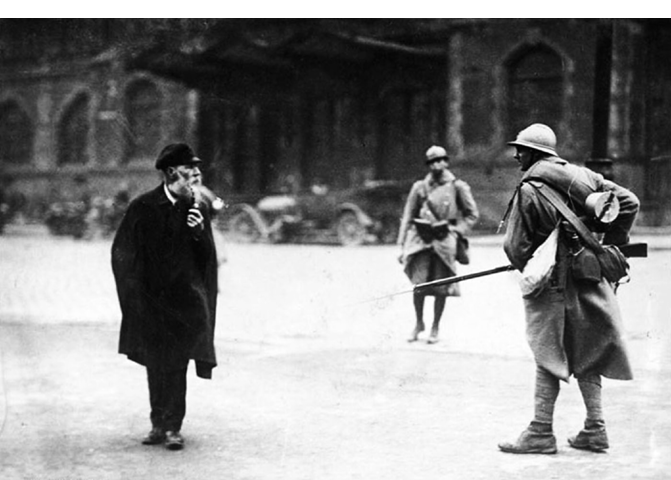
French soldiers in the Ruhr, 1923
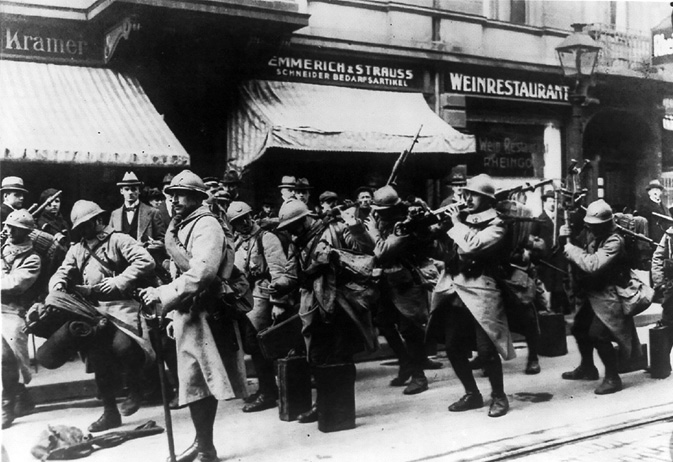
French machine gun squad bound for guard duty in the Ruhr coal mines
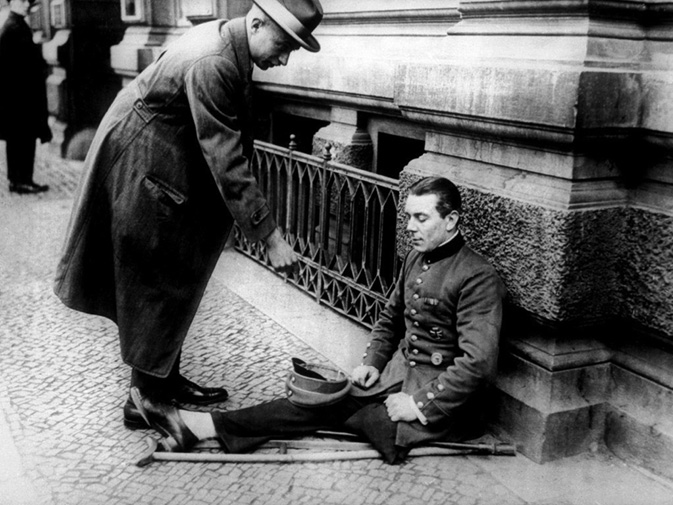
A one-legged soldier begging on the streets of Berlin
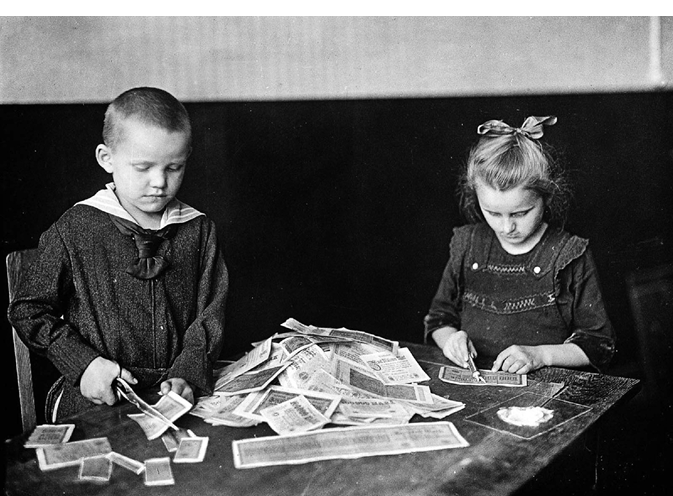
Children play with worthless bank notes