Chapter Four: The Kapp Putsch March 1920
The Party of Order… knew neither how to rule nor how to serve; neither how to live nor how to die; neither how to suffer the republic nor how to overthrow it.
Karl Marx, The Eighteenth Brumaire of Louis Bonaparte
When we started the international revolution, we did so not because we were convinced that we could forestall its development, but because a number of circumstances compelled us to start it. We thought: either the international revolution comes to our assistance, and in that case our victory will be fully assured, or we shall do our modest revolutionary work in the conviction that even in the event of defeat we shall have served the cause of the revolution and that our experience will benefit other revolutions.
LCW, vol. 32, pp. 479-80
The first post-war revolutionary wave almost put an end to capitalism. The masses had come onto the scene of history and had taken power into their hands at different moments. The old order was facing collapse. But the working class found itself betrayed by its own reformist leaders, who rushed to rescue the capitalist system. Moreover, the inexperienced, young communist parties had hardly time to form, and were overtaken by events. They proved too weak to take advantage of the situation and made many mistakes. Within a few years the powerful mass ferment had begun to ebb.
Once the immediate threat of revolution had subsided, the capitalists plotted to get back control. The revolution had forced them to make enormous concessions to save their system. Part of the plan to get back to ‘normal’ was the removal of the Noske-Scheidemann-Ebert government. The reformists had fulfilled their role willingly as a colossal brake on the revolution, but for the German ruling class it was time they stepped aside, as they were no longer needed.
“Democracy with us represents – nothing,” stated the industrialist Fritz Thyssen. (D. Guerin, p. 35.) At best, it was an inconvenient cloak to fool the masses. But revolution had shown things had gone too far.
This was a similar picture to Russia in August 1917, when there was an attempt to get rid of the ‘democratic’ Kerensky government by General Kornilov. As in Russia, the capitalists and landlords looked to the installation of a strong militarist government that could eradicate any vestiges of the revolution and restore ‘law and order’.
General Ludendorff expressed the collective contempt of the Generals for the reformists, who they tolerated only so long as they played a useful role in holding back the revolution:
It would be the greatest stupidity for the revolutionaries to allow us all to remain alive.
Why, if ever I come to power again, there will be no pardon. Then, with an easy conscience, I would have Ebert, Scheidemann and company hanged and watch them dangle. (R. Watt, p. 273.)
Thus, spoke the authentic voice of the German military caste. Behind this mailed fist stood the bourgeoisie, which did not rest on ceremony.
The threat from the military establishment had been present since the November Revolution. The air was thick with intrigues, plots, and conspiracies aimed at overthrowing the Social Democratic-led government. The General Staff had been chafing at the bit to settle scores with the working class and put an end to the feeble Weimar Republic. Military coups had been attempted on two occasions in December 1918, but had been foiled by the diligence of revolutionary soldiers. Four others had been organised between September 1919 and March 1920. Eventually, they believed they would succeed. Then the Social Democrats and their communist friends would ‘dangle’ at the end of a noose.
In early 1920, the right-wing Social Democrat, Gustav Noske, acting as Commander-in-Chief, ordered the disbandment of one of the most feared of the Freikorps units, the Ehrhardt Brigade. But General Lüttwitz, the commanding general in Berlin, refused to obey the order. Instead, he demanded the dissolution of the National Assembly and the establishment of a dictatorship. When Noske and Ebert refused the general’s request, Lüttwitz instructed the Freikorps to enter Berlin, overthrow the government, National Assembly and the Constitution, and institute military rule.
On 13 March, 12,000 Freikorps troops from the Ehrhardt Brigade and the Baltikum Brigade under General Lüttwitz’s command marched on the capital. They were the crack troops of the counter-revolution. Their stated aim was the arrest of the ministers and to proclaim Wolfgang Kapp, a right-wing nationalist politician and founder of the old Fatherland Party, as the new Chancellor of a military government, who would act as their stooge.
Noske, who had proved his undying loyalty to the military establishment, called upon Reichswehr1 officers to put down the rebellion of their fellow officers. This they refused point blank. The Berlin government was now faced with an open revolt by the entire military command. This posed a clear threat to the government’s own survival. The head of the regular army, General Hans von Seeckt, simply washed his hands of the mutiny, saying “troops do not fire on troops,” and announced he was going on “indefinite leave”. It was quite obvious that the military High Command would not lift a finger to defend the Republic, which they viewed with complete disdain, and were in favour of the coup.
Terrified, the first act of the Social Democratic government ministers was to flee from Berlin, firstly to Dresden, where a Freikorps general threatened to put the entire cabinet under arrest, and then to Stuttgart. In face of the military coup, instead of arming the workers, they fled like rats leaving a sinking ship.
The conservative trade union leaders, also fearing for their lives, were forced to take difficult decisions. They too could also abandon Berlin and leave the workers to the tender mercy of the Freikorps. Or they could put up some kind of token resistance before acquiescing. Neither option looked very appealing and, in the end, they chose a token resistance.
On 13 March, they issued an appeal for every worker to oppose the putsch and rally to the defence of the Republic. “We are therefore calling on all workers to go on strike everywhere immediately. All factories must be brought to a standstill,” stated the appeal. (B. Fowkes [ed.], p. 113.)
Wels, one of the very few Social Democratic leaders left behind, took the initiative to attach the names of the departed government ministers to a proclamation, which backed the call for a general strike. Karl Legien, the patriarch of the revisionists, who had previously opposed general strikes as “general nonsense”, now felt he had no alternative but to reluctantly call on such ‘nonsense’. This was the first time for such expressions of ‘bravery’ on their part, but it would be the last. To their absolute astonishment, the strike call was energetically taken up by the militant workers of Berlin, many under the influence of the left-wing Independent Socialists.
The workers responded to the call as one united body. The response was so solid that it completely paralysed Berlin. By noon on the first day, everything had ground to a halt. “From midday on, no trams ran and all factories closed down; and what is more, the strike order was obeyed,” observed Philips Price at first hand. (My Three Revolutions, p. 176.) Nothing moved. There was no supply of water, gas, or electricity. The sailors of Wilhelmshaven immediately mutinied and arrested their Admiral, together with 400 officers. Other regiments, in a display of solidarity, followed suit.
When ‘Chancellor’ Kapp threatened to shoot workers who had set up picket lines, he was firmly put in his place and told to be quiet for fear of provoking a civil war, which they were not likely to win.
In the end, the strike was so effective that a humiliated Wolfgang Kapp, the ‘Chancellor’ in-waiting, could not find a printer to print a poster proclaiming his new government. What’s more, with the telegraph clerks on strike, even if he wanted to, there was nobody to issue any decrees. The military coup, despite its initial show of strength and bravado, had collapsed within the space of four short days. It reflected accurately the real balance of class forces at that time, where the working class had colossal reserves of energy.
Two Counter-Revolutionary Wings
Unfortunately, the young KPD had not shaken off its ultra-leftism. Its initial response to the general strike call was to issue a statement on 14 March, saying that the workers should remain neutral in this struggle “between two counter-revolutionary wings”. The party statement declared:
This bankrupt group [the trade union and Social Democratic leaders] calls on the workers to mount a general strike for the ‘salvation of the Republic’. The revolutionary proletariat knows that it will have to enter a life-and-death struggle against the military dictatorship. But it will not lift a finger for the government of murderers of Liebknecht and Luxemburg, a government which has collapsed in ignominy and infamy. It will not lift a finger for the democratic republic, which was only a paltry mask for the dictatorship of the bourgeoisie.
What was needed, it said, “is to take up the struggle for the proletarian dictatorship.” (Quoted in B. Fowkes [ed.], p. 115.)
In Leipzig, the Communists refused to sign the document calling for a general strike drafted by the other organisations. This ultra-left infantile stance only served to isolate the party. The idea that there was no difference between monarchist reaction and the republic was clearly absurd, especially for the workers who had been prepared to lay down their lives for the republic.
The Communist International’s representative in Germany, M.J. Braun, tried to cover up this childish position by explaining that the KPD only reflected the “momentary mood of the Berlin workers.” In reality, it was a major blunder.
Fortunately, in the space of twenty-four hours, and in the face of a highly successful general strike, the party was forced to carry out a 180 degree about turn. The following day, on 15 March, the Zentrale of the KPD issued a declaration, this time in favour of the general strike, but making it clear that such action could not be construed as support for the government. But the mass of German workers did not see it like that. It took unified action to defeat the military coup, defend the republic and defend their democratic rights. For ordinary workers, it was not simply the fate of the government that was at stake, but, more importantly, the gains of the Revolution, including the Republic. Given this unanimous response, the Communists had little alternative but to participate in the struggle and lend support to the strike called by the reformist trade union leaders.
The Kapp Putsch served to electrify the whole country. From Berlin, the strike spread throughout the Ruhr, central Germany and Bavaria. Such was the reaction to the coup that in nearly every city and town, the military were driven out by mass demonstrations of workers and even the middle class. The sheer scale of the resistance to General Lüttwitz’s adventure was something the country had never witnessed before. On 17 March, the coup had completely collapsed and the Ehrhardt Brigade was forced to march out of Berlin, briefly pausing twice to fire on some unarmed bystanders, more a display of its own impotence. The coup had provoked a revolutionary response. If the workers’ leaders had wanted, they could have taken power peacefully. There was no force that could have stopped them.
In the hotbed of the Ruhr, armed strikers began to join forces in a ‘Red Army’ that put the Reichswehr to flight. The fighting force of this ‘Red Army’ was estimated as 80,000 strong, fully equipped with modern weapons and artillery left over from the war. On 18 March, the whole of the Westphalian sector of the Ruhr had been liberated from the military, and within the next four days, Essen also fell. The ‘Red Army’ became, for a period, real masters of the Ruhr, the centre of gravity of the workers’ struggle.
Workers took action all over Germany. In Chemnitz, the post office, railway station and town hall were occupied by armed workers. The Executive Council of Chemnitz was established on 15 March and was made up of ten KPD members, nine SPD, one USPD and one Democrat, and extended its authority over a radius of fifty kilometres. It was a typical scene of workers’ power throughout the country.
The success of the general strike was a testimony to the power of the German working class. After the coup d’etat was defeated, the first demand was for the immediate removal of the notorious collaborators in the government. These were Noske, as well as two other ministers, Wolfgang Heine and Eugene Schiffer. Events had meant that Noske’s shameful role was now at an end and his political career was in effect over.
Noske subsequently became Governor of the Province of Hanover from 1920 onwards. From there, he ended up supporting the reactionary von Hindenburg in the elections for Reich President in 1925 and 1932. He was discharged from his post on 1 October 1933 by the Nazi government. He then moved to Frankfurt, but in 1944 was arrested by the Gestapo under suspicion of involvement in the 20 July plot against Hitler and imprisoned in the Ravensbrück concentration camp. He was finally freed by advancing Allied troops from a Gestapo prison in Berlin. He died in Hanover on 30 November 1946 from natural causes while preparing for a lecture tour of the United States. Noske has gone down in history as a treacherous man who will never be forgiven for his dirty role in betraying the German working class, including the murder of Liebknecht and Luxemburg.
In Berlin, as elsewhere, the general strike remained in force. Before the Strike Committee was prepared to call the strike off, they demanded a meeting with government representatives. At this meeting, they issued a series of demands, the most important being: (1) the creation of a new government in which the trade unions were to have a decisive influence; (2) severe punishment for the instigators and participants of the rebellion; (3) a thorough purge of the armed forces; (4) a thorough purge of the civil service; (5) the socialisation of all industries ‘ripe for socialisation’. The government in a state of paralysis had no alternative but to accept these demands, and the strike was called off on 23 March 1920.
The trade unions, under pressure from the workers, had demanded a genuine workers’ government composed of all workers’ parties. However, nothing came of this demand as the Left Independents refused to co-operate or join a government with the Majority Socialists. This again allowed the SPD to form another coalition with bourgeois parties, but with Hermann Müller, the Social Democrat, replacing Gustav Bauer of the Centre Party as Chancellor.
Learning the Lessons
The movement of the masses against the Kapp Putsch has clear historical parallels. It was strikingly similar to the heroic uprising of the Spanish proletariat against the revolt of General Franco in July 1936. As in Spain, with a genuine revolutionary leadership, the German workers could have taken power very easily. Power was in effect in the streets. All they needed to do was to pick it up. Unfortunately, the lack of the subjective factor, the revolutionary party, proved once again decisive in saving capitalism.
Lenin compared the Kapp putsch to the Kornilov uprising of August 1917 in Russia. In a similar way the forces of counter-revolution attempted to overthrow the Kerensky government and restore the old regime of the tsarist monarchy. However, unlike the German communists, the Bolshevik Party did not hesitate and immediately threw itself into the front line in a ‘united front’ in defence of the revolution. In such a front, the Bolsheviks adopted the motto: march separately, but strike together. They did not hold back from the struggle, despite their fundamental political differences with Kerensky, but offered a united front to the Mensheviks and Social Revolutionaries to defeat the reaction. In so doing, they showed in practice the superiority of their tactics, determination and propaganda in defeating the attempted coup.
It was clearly a mistake of historical proportions on the part of the German KPD to advocate neutrality in such a life-and-death struggle of this kind. If the coup had succeeded then the precursor of fascism would have come to power much sooner. It would have been a deadly regime, like the Horthy regime in Hungary. In face of this, a neutral position was the height of sectarianism and guaranteed the KPD’s political isolation. Fortunately, as we have seen, this lunacy was very quickly abandoned.
In the end, the defeated Wolfgang Kapp fled abroad to Sweden. He then returned to Germany, was arrested but died before his trial had started. He was given a posthumous amnesty by President Hindenburg in 1925, ‘for services rendered’ to the ruling class. The Herculean efforts by the working class over four days guaranteed the collapse of the coup, but power still eluded them.
Equally, the defeat of the putsch did not mean the end of the Freikorps. These armed mercenaries continued to pose a constant threat to the government and the working class. The intentions of this ‘Black Reichswehr’ were encapsulated in a song composed at the time:
Why should we cry when a Putsch goes wrong?
There’s another one coming before very long.
So say goodbye – but remember, men,
In a couple of weeks we will try it again.(R. Watt, p. 507.)
The first to challenge the false line of the KPD was Paul Levi, who was serving time in prison during the events of the Kapp Putsch, and was angry at the abstentionist line taken by the party. As a result, he wrote a sharp criticism to the Zentrale from his prison cell on 16 March:
I have just read the leaflets. My judgement: the KPD is under threat of moral and political bankruptcy… It means you are attacking the greatest-ever action undertaken by the German proletariat from the rear. I always thought we were clear and united about the following point: if an action does come about – even for the stupidest of goals! – we support the action, and endeavour to push it on beyond its foolish objective. We do not cry at the outset “we will not lift a finger” if the goal does not suit us…
These must be the party’s demands: (1) Arming of the proletariat, that is to say the distribution of weapons to the politically organised workers, so as to secure the Republic; (2) Unconditional capitulation of Kapp and Lüttwitz. This is of the greatest importance, for sordid attempts at haggling with them are already being made. (3) The leaders of the putsch must be immediately arrested and condemned by an emergency proletarian court. Nothing more. What the Zentrale writes in its leaflet of 16 March is unusable. (B. Fowkes [ed.], p. 117.)
Paul Levi’s criticisms were certainly damning. Levi had joined the Spartacus League in 1916 and assumed the leadership of the young Communist Party after the death of Liebknecht and Luxemburg. The party had initially attracted a whole number of confused and romantic elements who rejected participation in the trade unions and parliament, and who regarded armed rebellion as the only ‘revolutionary’ way forward. Levi believed the party needed to be purged of such individuals so as to overcome these ultra-left tendencies, just as Lenin had expelled the ‘Liquidators’2 from the party in 1912.
The Split
At the Second Congress of the German Party in October 1919, Levi managed to push through a ‘Declaration of Communist Principles and Tactics’ and other important resolutions, which reaffirmed the need for parliamentary and trade union participation as well as the importance of building a centralised party. He laid down an ultimatum to the ultra-left elements within the party: either accept these communist principles and tactics or leave. “Members of the KPD who do not share these views on the nature, the organisation and the activity of the party must resign from it,” stated the ‘Declaration’, which was adopted by thirty-one votes to eighteen at the Second Congress in October 1919. (ibid., p. 87.) Levi was to later find support for his actions in Lenin’s 1920 work ‘Left-wing’ Communism: An Infantile Disorder, which argued against the German ultra-lefts by name. Levi provoked a breach which led to a large split in the party, including within the leadership. The ultra-lefts, who were forced out of the KPD, took nearly half the membership with them, some 50,000, who went on to set up the Communist Workers’ Party of Germany (KAPD) in April 1920.
Lenin, however, was not happy with Levi’s methods. He thought that those with ultra-left tendencies, especially those displaying a healthy reaction to reformism, could be gradually won over and integrated into the Communist Party. He therefore preferred conciliation, not expulsion.
If the split was inevitable, efforts should be made not to deepen it, but to approach the executive committee of the Third International for mediation and to make the ‘Lefts’ formulate their differences in theses and in a pamphlet. (LCW, vol. 30, pp. 89-90.)
He believed it much better to allow the ultra-lefts to put their position in writing so that it could be answered properly, and hopefully win them over in the process. That was the reason he wrote ‘Left-Wing’ Communism, not as a stick to beat them with, but to convince them. He implored the German leadership to re-establish unity with the ‘Lefts’. But Levi refused to budge.
The split was damaging as the largest districts, with the exception of Chemnitz, supported the ‘Lefts’. In Essen, for example, only a mere forty-three members out of 2,000 supported the theses of the Zentrale. Hamburg, Bremen, Berlin and Dresden were strongholds of the ultra-left. In order to assert their authority, the Zentrale acted swiftly to expel en bloc all those areas that rejected the leadership’s political line. From February 1920 onwards, the party districts of North, North-East, West Saxony and Berlin-Brandenburg, comprising thousands of workers, were expelled.
Under pressure from Zinoviev, the KAPD was recognised as a ‘sympathising section’ of the Comintern. Lenin also supported their participation as a ‘sympathising’ group. Both parties co-existed, and there were attempts by the Comintern leadership to bring the KAPD back into the fold. However, given the acrimonious split, it would require a certain amount of time and preparation before such a fusion could take place. While the Comintern was politically very critical of the positions of the KAPD, they were welcome to participate in the Second Congress of the Communist International in the summer of 1920, to which they sent two delegates, Otto Rühle and August Merges.
The idea behind their participation was that genuine differences could be resolved, as far as possible, through discussion and debate, as long as there was good faith on both sides. The difference over participating in parliament, for example, was not a question of principle, but of approach, which did not justify two organisations. Such a view was stressed by the International: “There was no basis for splitting on this secondary question,” explained the ECCI circular. However, this conciliatory attitude did not bring the sides closer. In fact, the differences grew wider as the ultra-leftism of the ‘Lefts’ became increasingly ingrained and even organic.
The existence of two separate parties affiliated to the International, whatever their exact status, was also confusing for German workers. Sooner or later there would be a fusion of the two parties or a parting of the ways. A long co-existence was untenable. As it turned out, there was a rapid parting of the ways.
The fate of the KAPD was sealed when its delegates to the Second Congress refused to accept the Twenty-One Conditions, describing them as “opportunist” and “centralist”. In a typically ultra-left fashion, they walked out of the Congress. The fortunate side of this departure was that it diffused a potential row with the official German section, which was violently opposed to the participation of the ‘Lefts’. Within a few years, the KAPD had split and later disappeared, their members scattered to the four winds. The official party, once again, became the sole authoritative voice of communism in Germany.
Lenin later realised that making the KAPD a sympathising section of the Comintern had been a mistake. This was brought home when, in early January 1921, the leadership of the KPD sent an Open Letter to the national trade unions, the SPD and the remains of the USPD, in an attempt to forge unity in action over immediate questions. But this was derided by the German ‘Lefts’, as well as Zinoviev and Bukharin. Bukharin had been a consistent ultra-left in the first years of the Russian Revolution. Zinoviev was also open to these leftist moods. Lenin was always attempting to curb these excesses. On this occasion, he was forced to intervene and force the Comintern leaders to withdraw their objections and support the Open Letter initiative.
Lenin regarded this as a fundamental touchstone, a principled question, and the basis for the united front policy adopted at the following World Congress. On 10 June 1921, Lenin wrote a letter to Zinoviev regarding the Open Letter where he stated:
Hence: the tactic of the Open Letter should definitely be applied everywhere. This should be said straight out, clearly and exactly, because wavering in regard to the ‘Open Letter’ is extremely harmful, extremely shameful, and extremely widespread. We may as well admit this. All those who have failed to grasp the necessity of the Open Letter tactic should be expelled from the Communist International within a month after its Third Congress. I clearly see my mistake in voting for the admission of the KAPD. It will have to be rectified as quickly and fully as possible. (J. Riddell [ed.], To the Masses: Proceedings of the Third Congress of the Communist International: 1921, pp. 1098-1099, emphasis in original.)
Political Polarisation
Meanwhile, events were unfolding elsewhere in Germany. Bavaria had been convulsed by political upheaval ever since the November Revolution. At this time, General von Nohl, ungrateful for past services, forced out Johannes Hoffmann, the SPD Bavarian Premier, and established a more right-wing government led by the maverick Gustav von Kahr. Despite the provocation, the central government sat on its hands.
In the Ruhr, the workers of the ‘Red Army’, who had succeeded in stopping the Freikorps and the Reichswehr forces in their tracks, refused to lay down their arms until the state forces had completely withdrawn. A deal, called the Bielefeld Treaty, was brokered, which promised not only withdrawal but a democratisation of the army and the creation of local militias. In return, the Red Army would stand down its forces. But the deal broke down as the more radical elements within the Red Army regrouped and refused to disarm.
This time, in complete contrast, the government in Berlin, headed by Hermann Müller, used the breakdown to despatch troops – precisely those who had supported the Kapp Putsch – to the Ruhr to put down the rebellious units. The government forces carried out their task with relish and much brutality, which led to the slaughter of over 1,000 workers. Most of these were killed in battle but others were rounded up, placed against the wall and shot.
“The whole thing was so outrageous that I could hardly believe what I now saw,” wrote Philips Price, “the Majority Social Democratic leaders, using the people who had just overthrown them, to suppress the people who wanted to help them.” (My Three Revolutions, p. 176.)
The state judiciary also colluded with the forces of reaction. More than eighteen months after the Kapp episode, 412 of those arrested for treason had been amnestied and walked away scot-free. Only one person had been sentenced to five years imprisonment by the courts for their involvement. This showed how the state apparatus, the judiciary, courts and their appendages, were completely fused with the military hierarchy.
However, the ramifications of the Kapp Putsch resulted in a shift in the political landscape. Given the growing disillusionment with the coalition government and its capitulation to the military, the government parties suffered a crushing defeat at the general election on 6 June 1920. The vote for the right-wing Social Democrats fell sharply from 11.5 million in January 1919 to 5.6 million in June 1920. This reflected a growing disillusionment with the coalition government and the right-wing socialists. It was also a reaction to the Kapp Putsch. The situation was summed up by Rudolf Wissell, a former SPD Minister for the Economy, when he said:
Despite the Revolution, the people have been disappointed in their expectations. We have extended formal political democracy further, to be sure. But we have still done nothing more than continue the programme already initiated by the Imperial German government of Prince Max of Baden. (Quoted in B. Fowkes [ed.], p. 34.)
Workers transferred their allegiances to the more radical parties of the left, particularly the USPD. The Left Independents became the second largest party in the Reichstag with eighty-one deputies; in the Landtags of Saxony, Thuringia and Brunswick it became the largest party. Nationally, the USPD had managed to more than double its Reichstag vote from 2.3 million in 1919 to 4.9 million in 1920. The USPD membership had also grown spectacularly to 800,000, the biggest party in Germany. It published some fifty-five daily newspapers and was a mass organisation in the true sense of the word.
While the SPD still remained the biggest party in the Reichstag, the vote for the extreme right also doubled at the expense of the liberals, indicating a growing political polarisation within Germany. The Democratic Party lost proportionately even more, as did the Centre Party. A new coalition minority government was formed of centre-right parties, from which the Social Democrats were now excluded. It was the first time since the November Revolution that representatives of the SPD were out of government.
The Communist Party, which took part in the elections for the first time, gained a little less than half a million votes. The combined vote for the workers’ parties had fallen from 13.4 million to 11 million, but this disguised a significant swing to the left in the working-class vote, as well as a sharp swing to the right in the bourgeois camp. The two Rightist parties, the German People’s Party and the German National Party, one based on big business and the other on landed interests, had a combined vote of 7.3 million, as against 4.5 million in 1919.
This sharp polarisation in society reflected the deep political crisis affecting Germany. The defeated coup d’etat added to this instability, as one governmental crisis followed another. This set the scene for the following decade and reflected a growing disillusionment with the results of the Weimar Republic and its inability to solve any of the burning questions facing the masses.
Building the Comintern
In this period, the Founding Congress of the International, or ‘Comintern’, was held in Moscow over four days in March 1919. It was attended by fifty-one delegates, from thirty-five organisations representing twenty-two countries. Many were exile groups living in Russia, as well as others from the national minorities within the former tsarist empire, including Ukraine, Estonia, Latvia, Lithuania and Belorussia. The arrival of a relatively modest number of delegates from abroad – only nine – was no mean achievement given the extreme difficulties of travel as well as the Allied blockade which meant that many were not able to make the journey, while some Communist groups were still in the process of formation.
It is true that Rosa Luxemburg had her doubts about the founding of a new International at this time. She felt it was premature and preferred to wait until more mass parties had been won over. In fact, Hugo Eberlein, the sole German delegate, was sent with a mandate to oppose its founding, preferring instead to call the international gathering a preliminary conference. The comrades of the KPD were certainly committed to building a new international, but for them, it was a question of timing. The other delegates were clearly in favour of going ahead. After lengthy discussions with Lenin and other leaders, Eberlein was persuaded to abstain in the vote and allow the formation of the Third International to take place, with no votes against. With all other full delegates voting in favour, the new international was launched. Accepting the decision of the Congress, the German party duly agreed to affiliate to the Third International and pledged itself to building the International.
This Founding Congress was extremely important in drawing a sharp line between the revolutionary internationalists and the ‘social chauvinists’ of the Second International. In complete contrast to the old International, the Congress highlighted the importance of the proletarian revolution and the principles of soviet power. Its principal resolutions and theses, the key ones being drafted by Lenin and Trotsky, were discussed in the Congress, and placed the International on firm theoretical foundations.
The success of the Russian Revolution and the unfolding revolutions in Europe were having an electrifying effect on the working class, including within the parties of Social Democracy. Mass left-wing oppositions crystallised within these parties, which fought to break their parties away from the old Second International and join the new Third International. As a result, negotiations over affiliation involved a whole series of mass workers’ organisations: The Independent Labour Party in Britain, the French Socialist Party, the USPD of Germany, the Italian Socialist Party, the Norwegian Labour Party, to name a few.
By 1920, a year after the Founding Congress, the possibility of creating a mass Communist International was finally taking shape. However, there were dangers. In particular, the greatest danger was allowing reformist and centrist figures into the new International. Many of the centrist leaders of the old organisations felt the ground shifting under their feet, and tried to reinvent themselves politically. Their verbal radicalism was an attempt to keep a firm grip on their leftward moving rank and file. Affiliation to the new Third International could serve to give these leaders a ‘communist’ colouring and would help burnish their tarnished political credentials. “The Communist International is, to a certain extent, becoming the vogue,” noted Lenin, who was concerned about letting these centrist leaders in. (LCW, vol. 31, p. 201.)
Old leaders, like the Germans Wilhelm Dittmann and Arthur Crispien, took a semi-pacifist and opportunist line during the war; the French leaders, Cachin and Fossard, were also extremely patriotic; the Czech, Šmeral, had been an agent of the Habsburg monarchy;3 and finally, Ramsay MacDonald, head of the Independent Labour Party, was reformist through and through. They were all now sniffing at the door of the Third International.
To prevent such an influx of unwanted charlatans, while welcoming the rank and file workers, the Second Congress of the Communist International formulated Nineteen Conditions, under Lenin’s guidance, for affiliation to the new International. These conditions included the recognition of soviet power, the dictatorship of the proletariat, the need to fight against social chauvinism, and the subordination of parliamentary struggle to the revolutionary struggle of the working class. One explicitly stated:
It is the duty of parties wishing to belong to the Communist International to recognise the need for a complete and absolute break with reformism and ‘Centrist’ policy, and to conduct propaganda among the party membership for that break.
Another called for:
Communist parties in countries where communists can conduct their work legally must carry out periodic membership purges (re-registrations) with the aim of systematically ridding the party of petty-bourgeois elements that inevitably percolate into them.
While these conditions were tough, an assortment of old centrist leaders were still seeking entry into the International, and were prepared to swallow the Nineteen Conditions. As a result, two extra conditions were added to ensure they were excluded. The final condition, the most stringent of all, was proposed by the Italian delegate, Amadeo Bordiga.
While Lenin was prepared to be flexible, he drew the line at creating a new version of the Second International or even a new ‘Centrist’ halfway house. In the words of Zinoviev, this meant they “put a lock on the doors of the Communist International… [and regarded it] necessary to put a reliable guard on the gate.” (E.H. Carr, The Bolshevik Revolution, vol. 3, pp. 186-187.)
The extra two conditions stipulated that:
Those parties that now wish to enter the Communist International but have not yet radically altered their previous tactics must, before they join the Communist International, see to it that no less than two-thirds of the Central Committee and of all their most important central institutions consist of comrades who even before the Second Congress of the Communist International spoke out unambiguously in public in favour of the entry of the party into the Communist International.
Finally, the last clause stipulated:
Those party members who fundamentally reject the Conditions and Theses laid down by the Communist International are to be expelled from the party.
These Twenty-One Conditions would therefore “lock the door” and exclude such “notorious opportunists” as Kautsky, Hilferding, Turati, Modigliani, MacDonald, Longuet, and Hilquit, who were specifically named in the resolution. “We need an International to act as an international general staff of workers in all countries,” read the ECCI statement. “We cannot transform the Communist International into a mere letterbox.” (P. Broué, p. 437.) The reference to “letterbox” was the characterisation given to the Second International, which received many written reports from national sections, but did nothing with them.
Another condition made it clear that there was “the obligation to wage a stubborn struggle against the Amsterdam ‘International’ of yellow trade union organisations.” This was the reformist International Federation of Trade Unions (IFTU), formed in 1913, which was linked to the Second International and had given its full backing to the imperialist war. In fact, it collapsed when two of its largest components (the British TUC and the German ADGB) backed their ‘own’ government on the outbreak of the war. It was the stronghold of the right wing. The IFTU, as expected, was in conflict with the Communist controlled trade unions, and carried out expulsions of Communist members. In July 1921, The Red International of Labour Unions (RILU), also known as the Profintern, was formed with the aim of co-ordinating communist activities within the trade unions and as a counterweight to the reformist federation. The Red International, from its origins, opposed the ultra-left idea that groups or individuals should secede from the IFTU unions. A resolution at its first Congress resolved:
This tactic of the withdrawal of revolutionary elements from the unions … plays into the hands of the counter-revolutionary trade union bureaucracy and therefore should be sharply and categorically rejected.
Following on the expulsions of Communists, the RILU declared:
This offensive tactic of the partisans of Amsterdam must be fought with firm and decisive resistance in the local branches, with the slogan ‘Down with the splitters, long live the unity of the trade union movement!’ In no case should we favour the aspirations of Amsterdam by willingly abandoning the trade unions: that would be too easy for the supporters of Amsterdam and too damaging for the left wing of the labour movement. (Quoted in R. Sewell, In the Cause of Labour, p. 169.)
It nevertheless also sought to get militant trade unions to disaffiliate from the IFTU and join the ranks of the RILU, with the perspective of replacing the reformist trade union international altogether. But this was easier said than done.
The Halle Conference
The KPD had grown from around 3-4,000 members nationally in January 1919 to 78,000 immediately following the Kapp Putsch, despite the split with the ultra-lefts. It was, nevertheless, small in comparison to the two other mass parties, the SPD and USPD, each of which had hundreds of thousands of members. Under the impact of events, the ranks of the USPD were moving to the left, from reformism towards revolutionary Marxism. A new generation of leaders had emerged within the Left Independents and, at its Leipzig conference in March 1919, the party voted in favour of the dictatorship of the proletariat and a soviet republic. More importantly, it decided to send a delegation to the Second Congress of the Communist International in Moscow, which was being held in the summer of 1920. Finally, in December, the Left Independents voted by 227 to fifty-four to break with the Second International and begin serious negotiations with the Comintern with a view to affiliation. Given the mass membership of the USPD, this was an important turning point. As a result, Radek urged the KPD to take a bold orientation towards the Independents, and actively try to win them over. If it was possible to win the bulk of the USPD, it would transform the German Communist Party into a truly mass party of the German working class.
The affiliation question was debated at the USPD Congress in Halle in October 1920, following their participation in the Second Congress of the International. The President of the Comintern, Zinoviev, was present at Halle and addressed the delegates in German for four hours, urging them to accept the Twenty-One Conditions and affiliate to the Communist International. It was left to Hilferding, the centrist heavyweight, to oppose Zinoviev. Martov also spoke against affiliation, but seemed to have little effect. After considerable debate, a vote was finally taken, with 237 votes in favour of affiliation and 156 votes against. After the vote, Hilferding led a right split away from the USPD, which kept the name and lasted a couple of years as an independent grouping before dissolving back into the SPD.
More importantly, immediate negotiations with the KPD opened up following the decision, with a view to the founding of a new United Communist Party of Germany (VKPD). The new party was established in December, and had a combined membership of nearly 500,000 workers. This meant that German Communism had become transformed into a mass party overnight. From the outset, it owned thirty-three daily newspapers and could claim a quarter of the vote of the old SPD. In fact, outside of Russia, the German party was now the biggest Communist Party in the world. Under the guidance of Lenin and Trotsky, the party began to prepare itself for the coming revolution in Germany. This started with a turn to united front work under the guidance of Paul Levi and Ernst Däumig, the joint leaders of the new party.
Again, in December 1920, the 140,000-strong French Socialist Party also voted to accept the Twenty-One Conditions and affiliate to the Third International. The whole of the old Socialist Party apparatus, its headquarters, its secretariat, and its daily paper, L’Humanité, with a circulation of 200,000, were transferred to the new Communist Party of France. In Czechoslovakia, a mass Communist Party was formed out of a split in the Socialist Party, which joined forces with a split in the Sudetenland, and numbered more than 200,000 members. The Italian Socialist Party had rallied to the Third International in March 1919, but its leaders refused to turn the party into a Communist Party, even in name. While Serrati, the centrist, carried the decisive majority, a clumsily-handled split took place, and the pro-Third International Bordiga faction walked out of the Socialist Party with around 60,000 members to form the new Italian Communist Party.
As we can see, these mass communist parties did not emerge from small sectarian groups on the fringes of the movement, but arose from deep crises within the traditional mass organisations of the working class. These parties were going through political turmoil due to the colossal events – revolution and counter-revolution – of the period. It again demonstrated that the mass of workers learns from bitter experience. It was the turmoil and revolutionary upheaval of the post-war period that served to transform these organisations and laid the basis for mass communist parties.
The Founding Congress of the Third International took place amid great hopes of a rapid victory of the European revolution. A year later, at the time of the Second Congress in 1920, it became obvious that more serious organisational and political preparation would be needed for the proletariat to gain victories in western Europe. Along with the creation of mass communist parties went the urgent necessity of educating and imbuing them with a real communist understanding of strategy and tactics.
As Trotsky warned:
It would, however, be a mistake to expect of these young and just risen communist parties that they immediately master the art of revolutionary strategy. No! Last year’s tactical experience testifies all to clearly to the contrary.
He went on to explain that:
The art of tactics and strategy, the art of revolutionary struggle can be mastered only through experience, through criticism and self-criticism… The revolutionary struggle for power has its own laws, its own usages, its own tactics, its own strategy. Those who do not master this art will never taste victory. (L. Trotsky, The First Five Years, vol. 2, pp. 9-10.)
School of Communism
The Congresses of the Communist International acted as a class-conscious school of the world proletariat. Their task was to educate and arm the communist ranks with a rounded out understanding and prepare the working class for the conquest of power. The International stood on a higher political level than its national sections, and was based upon a far richer experience than any individual national party. It therefore debated and decided on the main policies of the world communist movement. In the same way as the ruling classes had their military academies for the training of their general staff, so the working class needed its own schools and academies for the training of future leaders of the proletariat. The Bolsheviks understood that revolution was a serious business, which could not be improvised. Dedication and self-sacrifice, although essential, were not in themselves sufficient for victory. A revolutionary party needed to know how to struggle, manoeuvre, advance, as well as retreat, just like a professional army. It needed to know how to win over the working class and how to direct it to the conquest of power. In order to acquire this knowledge, it needed above all to assimilate the lessons of Bolshevism, the richest concentration of Marxism, which had proved itself in practice.
In 1919 and 1920, a number of ultra-left tendencies had appeared within the ranks of the newly-formed communist parties, not just in Germany. This reflected a certain revolutionary impatience, a kind of childlike simplicity, which, in turn, was a reaction against the opportunism of the old reformist leaderships. This ultra-leftism was an attempt to find a short-cut to success, which, however, did not exist. There was a tendency to exaggerate things and run ahead of the situation. There was the danger of mixing up the fifth month of pregnancy with the ninth, as Trotsky had pointed out. In effect, it was an attempt to deny reality and its difficulties. Verbal radicalism was a cover for the movement’s weaknesses.
As we have seen, one of Lenin’s most important works, ‘Left-Wing’ Communism: An Infantile Disorder, was devoted to this problem. Lenin understood the problem as a healthy reaction to the opportunism and parliamentary cretinism of the old reformist leaders. He compared this tendency to a childhood illness which was an inevitable part of growing up. Lenin’s book, together with the discussions at the Second Congress of the Comintern, was aimed at educating this layer in genuine Bolshevism.
Lenin wrote his book almost 100 years ago, and in it he explained:
It is beyond doubt… those who try to deduce the tactics of the revolutionary proletariat from principles such as: “the Communist Party must keep its doctrine pure and its independence of reformism inviolate: its mission is to lead the way without stopping or turning, by the direct road to the communist revolution” – will inevitably fall into error. Such principles are merely a repetition of the mistake made by the French Blanquist Communards, who, in 1874, ‘repudiated’ all compromises and all intermediate stages. (LCW, vol. 31, p. 89.)
The task of the newly-formed communist parties was to absorb the method, tactics and strategy of Bolshevism as quickly as possible. The main task was to win a majority of the working class to the side of the Communist Party. One of the key tactics to achieve this end was to turn towards the masses by using the united front. This was a temporary agreement between mass organisations for practical ends. It was aimed at showing in practice the superiority of the communist methods of struggle over reformism. As the SPD had, at least nominally, more support in the working class, it was essential to turn towards them and offer them a programme of unity in action. Such an approach arose from the need for the maximum unity in the struggle. No successes would be possible without temporary agreements among various sections of the working class. This policy was taken up and championed in Germany by Paul Levi, who was chairman of the party.
In early January 1921, the leadership of the KPD4 sent an Open Letter to the national trade unions, the SPD and the remains of the USPD, appealing to them to work together on immediate actions. This was a very important step forward.
While proposing this basis for action, we do not conceal for one moment, either from ourselves or from the working masses, that the demands put forward by us cannot remove their misery and deprivation. Nor do we give up for one moment our endeavours to spread the idea of the struggle for the dictatorship, which is the only road to salvation. Nor shall we desist from summoning the working masses at every favourable moment to the struggle for the dictatorship, and leading them in that struggle. The VKPD is ready, along with the other parties which draw support from the proletariat, to carry out joint actions to achieve the measures indicated above.
We will not hide the differences that divide us from the other parties. We declare instead that we do not want from them lip service to the proposed basis for action, but action itself. We do not ask the parties whether they regard these demands as justified. We assume this. We ask them rather: are you ready immediately to undertake an unyielding struggle for these demands, together with us?
We expect this clear and unambiguous question to receive a similarly unambiguous answer. The situation itself requires a rapid answer. We therefore expect a reply by 13 January 1921.
If the other parties and trade unions do not want to take up the struggle, the VKPD will regard itself as duty bound to lead the fight alone, and is convinced that the working masses will follow it. From this day forward the VKPD addresses itself to all the proletarian organisations in Germany and the masses of workers gathered around them with the call to proclaim publicly their desire for joint defence against capitalism and reaction, and for the protection of their interests. (B. Fowkes [ed.], pp. 121-122.)
This united front approach served to extend the reach of the Communist Party into the working class, especially those who were under the influence of the SPD. While the Open Letter was rejected by the hierarchies of other workers’ parties and trade unions, it had an effect among the rank and file. At the same time, the ultra-left tendencies within the German party were on the retreat, although a layer still resented the approach of the Open Letter, and by and large the party seemed to be on the correct path.
However, the Open Letter was sharply attacked by Zinoviev and Bukharin, who regarded the appeal as opportunist. “I do not believe that one can call on the workers to form an alliance with other workers’ parties. I do not think real masses were drawn into this move. It was more a literary fantasy than a mass movement”, stated Zinoviev. While Bukharin described it as “an opportunistic blabbering of Levi.” (J. Riddell [ed.], To the Masses, p. 1064 and p. 1066.) Against the opposition of Radek, they actually persuaded the Presidium of the Executive Committee of the International, which ran its day-to-day affairs, to condemn the Letter. When Lenin found out, he reacted angrily and hastily intervened to get the decision overturned, urging that the matter be referred to the Third Congress. After a tumultuous year, the Comintern was to officially endorse the tactic of the united front and the turn towards the masses.
New VKPD Leadership
After the unification of the KPD and majority of the USPD to create the United Communist Party, a Zentrale was elected under the joint chairmanship of Ernst Däumig and Paul Levi. Levi had been a close friend of Luxemburg and had also met Lenin during the war, who was impressed by him. Levi had successfully pulled the KPD together throughout 1919, under grave difficulties, ridding the party of its ultra-left wing and steering it towards the masses.
However, in February 1921, after a violent disagreement over the Comintern’s decision to split the Italian Socialist Party (PSI), Levi resigned his position within the German leadership together with four supporters, including Clara Zetkin and the party’s co-chairman Ernst Däumig. Levi had advocated a more patient approach towards the centrist majority of the PSI under Serrati rather than rushing to a split, but Rákosi, the ECCI representative, managed to sway the majority of the CC behind the tough line. Consequently, the leadership of the newly formed Italian Communist Party was in the hands of the ultra-left Bordiga.
New leaders were brought into the Zentrale to replace those who had resigned with Levi. These were Eberlein, Meyer, Wegmann, Sievers and Frölich, who joined the likes of Heinrich Brandler and August Thalheimer. Radek tells how Frölich, who was somewhat of a hothead, charged onto the scene declaring: “Today we shall break from the traditions of the party. Until now we have waited, and now we are taking the initiative and forcing the revolution.” (P. Broué, p. 497.) This change of personnel served to tilt the party towards taking more risky adventures.
When Lenin heard about these resignations from the Zentrale, he was absolutely furious:
Tell me, how could you commit such a capital stupidity, yes, indeed, a capital stupidity, as to leave the Central Committee?5 Where was your understanding? I was angry about it, terribly angry. To act so senselessly, without regard to the effects of such a step and without letting us know anything at all about the matter or asking our opinion. Why didn’t you write to Zinoviev? Why not to me? You could at least have sent a telegram…
He went on:
That was simply stupid, quite stupid… But always look to the workers, to the masses, dear Clara. Think always of them and of the goal which we shall achieve, and such trivialities fade away into nothing. Which of us has been spared them? I have had to choke down my share of them, you can believe that. Do you think that the Bolshevik Party which you so admire, was ready and finished in one blow? Even friends have sometimes done most unwise things. But back to your sins. You must promise me never to take such unconsidered steps again, otherwise our friendship is at an end. (C. Zetkin, Reminiscences of Lenin.)
It is clear that Lenin had a friendly relationship with Clara Zetkin and appreciated her views on the German party. He was, nevertheless, quite firm with her and pulled no punches whenever it was necessary.
By August 1921, following Lenin’s advice, Zetkin had been once again elected onto the Zentrale. Lenin continued to keep a close eye on developments within the German party, until a series of strokes severely restricted his political involvement.
The Comintern was very keen to help the German communists, given their vital importance to the European revolution. The apparatus of the International, which was headed by Zinoviev, was filled with émigrés of the Hungarian revolution, ‘red’ exiles in Moscow, together with others with limited experience. They were to use their considerable authority as functionaries to push the International in a more leftist direction. They were, unfortunately, revolutionaries of limited vision, lacking the necessary experience to guide the International. Thus, Hungarian Communist leader Béla Kun, who, ever since the crushing of the Hungarian Soviet Republic in August 1919, had been in Moscow, was now despatched to Berlin, with Zinoviev’s blessing.6
This appointment of the Hungarian was to prove a grave error. As leader of the Hungarian Soviet Republic, Béla Kun had made very serious mistakes, including uniting their forces with the reformists. In fact, he had made one mistake after another, and as a result of his previous opportunism was now infected with ultra-left ideas after the defeat. His failure in Hungary had made him even more determined to prove his ‘revolutionary’ credentials, whatever the cost. Nevertheless, it also suited Zinoviev, who wanted pliable people, yes-men, who he could rely on to obediently carry out his orders. He placed Béla Kun and his comrades József Pogány and Matyas Rakosi, as well as August Guralsky, a veteran of the Jewish Bund in Ukraine, as the Comintern representatives in Germany. They were all open to ultra-left tendencies, which were encouraged by Zinoviev, Bukharin and even at times by Radek, to attack the ‘passive’ and ‘defensive’ positions of the SPD organisations.
Theory of the Offensive
The new leaders of the United Communist Party, with the encouragement of the new Comintern representatives, looked increasingly for an excuse to wage a revolutionary struggle with the government. They were intoxicated with romantic notions. While Levi, Zetkin and others were out of the Zentrale, this tendency heroic for action was greatly reinforced.
The arrival of Béla Kun proved decisive. The Executive Bureau of the International in Moscow was dominated by these ‘Lefts’, who were eager for the German party to take the initiative, regardless of the objective conditions, regardless of the effects of the previous setbacks. Kun, with the full backing of the Bureau, immediately began by exaggerating the possibilities in the situation, as well as the need to come to the assistance of the Soviet Republic. According to Levi, who wrote to Lenin, Kun had told him that Russia found itself in a very difficult situation and it was therefore absolutely necessary that the country be relieved by revolutionary movements in the West, and, on that basis, the German Communist Party should immediately go into action to ‘galvanise’ the workers. According to Levi, Kun told him:
“Today, the VKPD has 500,000 members and with that one could mobilise 1.5 million proletarians to bring down the government.” He therefore favoured immediately joining battle with the slogan: ‘Bring down the government!’ (Quoted in P. Broué, p. 508.)
This ultra-left policy became the framework of the new so-called ‘theory of the offensive’, the whole essence of which was that the advance guard – the revolutionary party – could by its own actions ‘electrify’ the passive proletariat into taking revolutionary action. By these actions they would help save Soviet Russia from the difficulties it faced. The German leadership, under pressure from Béla Kun, Zinoviev and Bukharin, was eager to translate this ‘theory’ into practise at the earliest opportunity.
The situation in Germany was certainly becoming extremely tense following the occupation of Düsseldorf by French troops when the German government failed to pay its reparations in full. The leaders of the United Communist Party were now desperately searching for any pretext to launch an offensive action. The ground was laid by the party’s press Rote Fahne which proclaimed the readiness of the workers to fight. It was not long before they found the pretext.
The head of the provincial government in Saxony, Otto Hörsing, a Social Democrat, decided to send security police into the area of central Germany to confront the miners, who were strongly under the influence of the communists, and put an end to “wildcat strikes, looting, robbery, terrorist and other expressions of lawlessness.” This provocation took place ten days before the Easter holidays, making any counter-protest action more difficult.
The action centred around the Mansfeld copper mines, which was now occupied by the security police with instructions to pacify the area. The whole episode was of course a provocation. Philips Price states:
It is as if Winston Churchill sent 5,000 Royal Irish Constabulary to occupy the Rhondda Valley on the excuse that the South Wales miners refused to accept a wage reduction. The result is the mining villages have risen to one man. (Dispatches, p. 97.)
Miners and their families resisted the police occupation arms in hand under the leadership of Max Hölz, a militant legendary figure, who had more in common with the ideas of Robin Hood than Karl Marx, and had been expelled from the Communist Party after the Kapp Putsch. He was, despite his wild excesses, an honest revolutionary. The year before, he had waged guerrilla war single-handedly against the Berlin government throughout the Vogtland area of Saxony.
The battles now led by Hölz were chiefly local in character, which included robbing banks, stealing property from the rich, and fighting with the security forces. The Prussian government had therefore put 60,000 marks on Hölz’s head. Despite their adventurous character, these struggles attracted sympathy from the broader working class, who were vehemently opposed to the police actions of Hörsing. Not unexpectedly, the armed resistance attracted the support of the ultra-left KAPD, who hailed Hölz as a popular hero. Not to be outdone, the KPD also rushed to support him.
The Communist Party immediately called for a general strike throughout central Germany and a full mobilisation in support of the miners. On 18 March, its paper brazenly proclaimed that every worker must defy the law, and immediately arm themselves. “Those who are not with us are against us,” they said. This put the party on a collision course. “What followed was the famous Märzaktion (‘March Action’),” writes Evelyn Anderson, “without doubt one of the most pathetic chapters in the history of the German Labour movement.” (E. Anderson, p. 9.)
While there was certainly sympathy for the miners, the party leaders had completely misjudged the mood and how far the workers were prepared to go. Even the call for a general strike, planned the day before Good Friday, fell on deaf ears, not least because the factories were to be closed for a four-day Easter break. The VKPD simply expected the working class to respond to calls for action from above, without any preparation from below. They were to discover that it was not possible to turn the working class on and off like a tap. Nonetheless, the party leaders ploughed on regardless, so blinded were they with the ‘theory of the offensive’. Those who dared raise any doubts or put forward the need for defensive actions were ridiculed and condemned by the party leadership.
Once the ‘offensive’ had begun, the party became even more reckless and adventurous. For example, the VKPD leader, Hugo Eberlein, was sent “to provoke an uprising in mid-Germany,” and even went so far as to organise sham ‘kidnappings’ of Communists, which were then blamed on the government, dynamiting a munitions depot, blowing up a workers’ co-operative in Halle, all of which was blamed on the police in order to fuel the anger of the workers.
Friesland later admitted that the idea was:
[O]f making the revolution with the minority of the proletariat against the majority… And there is now a fatal idea which underlies the other, that we can also organise strikes against the majority of the proletariat. (P. Broué, p. 510.)
This attempt of a minority to force its will on the majority was always going to end in disaster. As Trotsky explained:
If the majority of workers favour a strike, they can of course always compel the minority by forcibly shutting down the factories and thus achieving the general strike in action. This has happened more than once, it will happen in the future and only simpletons can raise objections to it. But when the crushing majority of the working class has no clear conception of the movement, or is unsympathetic to it, or does not believe it can succeed, but a minority rushes ahead and seeks to drive workers to strike by mechanical measures, then such an impatient minority can, in the person of the party, come into a hostile clash with the working class and break its own neck. (L. Trotsky, The First Five Years, vol. 1, p. 22.)
This was definitely a real danger facing the young party. On 24 March, groups of Communist Party workers were instructed by the leadership to occupy the huge nitrogen plant at Leuna, with rifles and grenades, but were driven out after a bitter confrontation. The party then organised the occupation of the docks in Hamburg in support of a partial strike, but once again it was soon dispersed. In the ensuing battles, isolated members of the VKPD were left to fight it out in single combat with the police. In Berlin, the strike was practically non-existent. In other cases, unemployed workers clashed with workers on their way to work. Nothing could have been more designed to split and divide the working class. One participant described these fratricidal battles when “broad masses turned against those in struggle, not only with words but by wielding iron bars in the factories to drive out those who called for a strike”. (J. Riddell [ed.], To the Masses, p. 20.)
Unmitigated Disaster
While, fortunately, the foolhardiest plans of the German party came to nothing, the damage was nevertheless far-reaching. The government acted with brute force as military and police reinforcements flooded into the affected areas. Within ten days, the most exposed workers were mercilessly crushed. The ‘March Action’, launched by the ‘Lefts’, turned into an unmitigated disaster, which resulted in hundreds of deaths and thousands being imprisoned for their involvement. Victimisation of workers became rife as thousands were dismissed from their jobs. The ultra-left actions of many sincere communists only served to produce a serious division in the working class.
The German party became totally isolated. In the end, over 200,000 members, half its membership had dropped out or deserted the VKPD in disgust. This was a calamity of the first order, which if continued, threatened to wreck the entire party.
Max Hölz, the leading light of the miners, was caught and tried on charges of murder, arson, highway-robbery and fifty other counts and sentenced to life imprisonment. He was held in Breslau prison, but was eventually released and travelled to Moscow. There he was welcomed as a hero, awarded the Order of the Red Banner, and a factory in Leningrad was named after him. But when Hitler came to power in 1933, he asked for permission to leave Russia. The Stalinist authorities refused and he became furious and tried to create a stink. W.G. Krivitsky, who knew Hölz, wrote:
A little later an insignificant notice appeared in the Pravda announcing that Hölz had been found drowned in a stream outside Moscow. In the OGPU7 I was told that after the rise of Hitler, Hölz had been seen coming out of the German Embassy in Moscow. The fact is that Hölz was killed by the OGPU because his glorious revolutionary past made him a potential leader of the revolutionary opposition to the Comintern. (W.G. Krivitsky, I Was Stalin’s Agent, p. 52.)
Embarrassingly, eight months after the March debacle, the SPD newspaper Vorwärts on 25 November took delight in publishing an internal report of the ‘March Action’ plans of the Communist Party, which had fallen into their hands. The document had been apparently seized from Clara Zetkin by police while she was on her way to Moscow to attend the Third Congress of the Communist International. It was then passed on to the Social Democrats.
The shocking report revealed an astonishing scale of adventurism. It read:
20 March 1921: A session of the District Directorate was held in Halle. The mood, it was reported, was so bad and so pessimistic that artificial measures would be needed to bring matters to a head.
23 March 1921: Eberlein arrived in Halle. He suggested that comrades Lemke and Bowitzky get themselves arrested in order to entice the Halle workers out into the streets. Attempts should be made to whip up tension among the workers so as to pull them into the struggle… There were, he said, two wagons full of grenades in Halle railway station. They should be dynamited…
On 22 March Eberlein proposed that the munitions depot in Seefen should be blown up, as well as the newly-acquired building of the Producers’ Cooperative Society. For technical reasons it was impossible to carry out either of these plans. The Cooperative Society was not blown up because of a shortage of detonators… Lemke and I were supposed to disappear so that the news could be put out that we had been wounded and arrested by a SiPo unit8 and taken to an unknown place… Eberlein repeated the order to blow up the Cooperative Society on two further occasions; the third time the District Directorate of the party energetically resisted this madness… If the building had gone up during daytime twenty of our comrades would have been killed. (Quoted in B. Fowkes [ed.], pp. 89-90.)
The Social Democrats took great pleasure in exposing and ridiculing the activities of the communists. It simply reinforced the stereotype image that the communists were capable of underhand, violent and unscrupulous deeds to obtain their objectives.
Ecci Supports German ‘Lefts’
The debacle in Germany provoked a serious crisis within the International, where supporters of the German ‘Lefts’ rallied to their cause, including some within the Comintern leadership. It had all the makings of a split. “The ‘German Question’ had become the question of the whole Communist International,” remarked Clara Zetkin.
To begin with, the German party leadership was utterly blind to the consequences of the defeat and regarded the ‘March Action’, not as a setback, but as a tremendous advance, thus standing reality on its head!
A thesis was drafted by Thalheimer and presented to the Zentrale on 7-8 April 1921, which dressed up defeat as a victory. It stated:
The revolutionary offensive ended with a defeat for the VKPD, viewed from outside. The VKPD is temporarily isolated from broad sections of the working class. But in truth this result contains the fruitful germs of new, broader revolutionary actions. The fortifications have been breached; revolutionary propaganda can enter through the gaps, and in the final analysis the action must strengthen the confidence of the workers in the VKPD and with it the revolutionary impetus of the working class… Whereas in 1918 and 1919 the revolutionary vanguard conducted a defensive struggle, it is now on the offensive. That is a tremendous advance. The ‘March Action’ is the first step the VKPD has taken in leading the German working class towards the revolutionary offensive. (ibid., p. 93, emphasis added.)
The thesis concluded:
The ZA [Central Commission] sees the March campaign of the party as an action corresponding to this tactical situation, an action which was necessary… if the party wanted to become a party of revolutionary action rather than a party of revolutionary phrase-making. The ZA therefore approves the political and tactical position of the Zentrale and condemns with the utmost severity the passive and active opposition of certain comrades during the Action. It invites the Zentrale to place the organisation on a footing of the greatest possible fighting strength and to implement all the organisational measures for this. (ibid., p. 93, emphasis in original.)
They saw the ‘Action’ as a success and those who opposed had to be ruthlessly condemned! The thesis was adopted by twenty-six votes to fourteen, with the opposition being led by Clara Zetkin.
Even more serious was the fact that the ‘Action’ was immediately supported by the Executive Committee of the Comintern. Zinoviev sent a telegram on behalf of the ECCI on 6 April:
The Communist International says to you: You acted rightly! The working class can never win victory by a single blow. You have turned a new page in the history of the German working class. Prepare for new struggles. (J. Degras [ed.], The Communist International, vol. 1, p. 218.)
Lenin had not been involved in this decision as his attention was taken up with the introduction of the NEP and the rebellion at Kronstadt. It was all therefore in the hands of Zinoviev and the group around him, who had been consistently pushing the ‘offensive’ line.
As soon as Lenin found out what was happening, he intervened to restore a sense of reality. He tried to steer a course that would prevent a split, while at the same time reigning in the ultra-lefts. He had to use all his political authority and tactical skill to bring the situation under control.
Levi and Zetkin wrote to Lenin at the end of March, where they raised their criticisms of the German leadership. Lenin’s reply, dated 16 April 1921, was very revealing. In his letter he admitted that he had no knowledge of the events surrounding the ‘March Action’, although he was willing to believe the “silly tactics” likely came from Béla Kun. However, Lenin’s instincts were clear and so were his criticisms of the ‘Lefts’.
Thank you very much for you letters, dear Friends. Unfortunately, I have been so busy and so overworked in the last few weeks that I have had practically no opportunity to read the German press. The only thing I have seen is the Open Letter, which I think is perfectly correct tactics (I have condemned the contrary opinion of our ‘Lefts’ who were opposed to the letter). As for the recent strike movement and the action in Germany, I have read absolutely nothing about it. I readily believe that the representative of the Executive Committee [of the Communist International] defended the silly tactics, which were too much to the left – to take immediate action ‘to help the Russians’: this representative is very often too Left. I think that in such cases you should not give in but should protest and immediately bring up this question officially at the plenary meeting of the Executive Bureau. (LCW, vol. 45, p. 124.)
Lenin was clearly resting on Levi and Zetkin to carry out a struggle, not least in the leadership of the International, but this plan was cut across when Levi created a row in the German party by publishing a sharp critique of the ‘March Action’.
Radek got a hint of the impending struggle and on 1 April, wrote to the German leaders:
Levi will doubtless raise the accusation of putschism, and the whole uproar will be revealed for what it is: the start of the clear crystallisation of the right-wing faction. (B. Fowkes [ed.], pp. 181-182.)
Clearly, Radek had no time for ‘the rightist’ Paul Levi, but he was correct about the “uproar”.
Levi had taken the drastic step of publishing his fierce criticism of the March debacle in a pamphlet called Unser Weg: wider den Putschismus (Our Path: Against Putschism). His language was particularly sharp, even merciless, which did not sit well with the party’s rank and file, who had, after all gone through this tough battle. He described the events as “the biggest Bakuninist putsch in history,” which only angered the German leadership. He attacked Béla Kun without actually naming him.
The initiative for this action did not come from the German party. We do not know who bears the responsibility for it. It has already happened often enough that emissaries from the Executive Committee [of the CI] have exceeded their powers, that is, we have observed after the event that the emissaries had not been granted full powers to deal with this or that affair… So there has been a certain pressure exerted on the Zentrale to launch itself into action, now, immediately and at all costs. (P. Broué, p. 513.)
The tone, however, only served to alienate those it was supposed to influence. The language was not of a comrade-in-arms, but an outsider. Moreover, he took the fateful step of producing his criticisms, not as an internal contribution, but as a public pamphlet outside the structures of the party, which broke party discipline.
Levi could have achieved much more with a verbal discussion than simply rushing into print. But it was now too late. The German leadership immediately seized upon the pamphlet to expel him for breach of discipline, “gross disloyalty and severe damage to the party”. After his expulsion, he was asked to resign his position as Communist deputy in the Reichstag. But he refused to comply, which added to the rancour.
Lenin on Germany
As we have seen, Lenin was very concerned about developments in the German party. After all, it was the main party of the International outside of Russia. He was hoping to rectify the problem of the ultra-lefts without causing too much damage. But when he heard of Levi’s intention to produce a pamphlet outlining his criticisms, he was very angry.
Now, Comrade Levi wants to write a pamphlet, i.e., to deepen the contradiction! What is the use of all this? I am convinced that it is a big mistake.
Why not wait? The Congress opens here on 1 June. Why not have a private discussion here, before the Congress? Without public polemics, without withdrawals, without pamphlets on differences. We are so short of tried and tested forces that I am really indignant when I hear comrades announcing their withdrawal, etc. There is need to do everything possible and a few things that are impossible to avoid withdrawals and aggravation of differences at all costs. (LCW, vol. 45, pp. 124-125.)
Lenin’s sound advice to cool things down and correct the mistakes one step at a time came too late. When he wrote this, he was totally unaware that the pamphlet had already been published and that Levi had been expelled by the Zentrale.
Lenin’s discussions with Clara Zetkin are also very revealing, not only about Paul Levi and the ‘Lefts’, but about the internal situation within the German party. She revealed these conversations with Lenin in her Reminiscences, written in January 1924:
Lenin smiled, his kind, self-confident smile.
“Since when have you joined the pessimists?” he asked. “Don’t worry, the plant of the ‘theory of the offensive’ will not take root at the [Third] Congress. We are still here. Do you think that we could have ‘made’ the revolution without learning from it? And we want you to learn from it, too. Is it a theory anyway? Not at all, it is an illusion, it is romanticism, sheer romanticism. That is why it was manufactured in the ‘land of poets and thinkers,’ with the help of my dear Béla, who also belongs to a poetically gifted nation and feels himself obliged to be always more left than the left. We must not versify and dream. We must observe the world economic and political situation soberly, quite soberly, if we wish to take up the struggle against the bourgeoisie and to triumph. And we shall triumph, we must triumph.”
He then continued:
“The Congress decision on the tactics of the Communist International and on all the disputed points connected with it must be consistent with, and considered in conjunction with, our theses on the international economic situation. They must form a whole together… At the moment we still pay more attention to Marx than to Thalheimer and Béla, although Thalheimer is a good and well-informed theoretician and Béla an excellent and true revolutionary. More can be learnt from the Russian Revolution than from the German ‘March Action.’ As I said, I am not afraid about the attitude that will be taken at the Congress.”
While Lenin displayed an over-generous conciliatory tone towards Thalheimer and Béla Kun in this private conversation with Clara Zetkin, even mistakenly describing Thalheimer as a “well-informed theoretician”, he gave a far blunter assessment of them in the Third Congress, where their ideas posed a grave danger to the movement:
The theses of Thalheimer and Béla Kun are radically false. That a representative of the Executive proposed a lunatic ultra-left tactic of immediate action ‘to help the Russians’ I can believe without difficulty: this representative [Béla Kun] is often too far to the left.
Lenin’s appraisal of Béla Kun was accurate. Interestingly, in a conversation between Lenin and Trotsky, it was Trotsky who tried to defend Béla Kun against excessively harsh attacks. Lenin answered: “I do not dispute that he is a fighter, but as a politician he is worthless; the comrades must be taught not to trust him.” (L. Trotsky, The Challenge of the Left Opposition 1928-1929, p. 185.)
In any case, it was Zinoviev, as head of the International, who was responsible for promoting Kun and giving him a key role in advising the German Communist Party. Zinoviev was keen to do this as he also agreed with Kun’s Leftist ideas and the need for an ‘offensive’. He believed the German party needed some encouragement in this regard. This position gave Béla Kun colossal political authority in the eyes of the German leadership – something he did not deserve – and influenced them to engage in the ‘March Action’. It was a massive blunder but it suited Zinoviev’s prestige politics.
Lenin continued to reassure Clara Zetkin about the situation, but also stressed the need for a ‘compromise’. A ’compromise’ would help to calm the ‘Lefts’ while condemning the policy. This showed Lenin’s method. After a sharp polemic, he would offer a few friendly words to his adversaries so as to eliminate frictions and restore comradely relations. He had no intention of rubbing their noses in their defeat.
He also fully appreciated the fact that the communist workers were not to blame for the debacle and therefore should be treated with respect.
“You opponents of the ‘March Action’ are yourselves to blame for not having done that. You only saw the distorted policy of the Centre and its bad effects, and not the militant workers of central Germany. Moreover, Paul Levi’s entirely negative criticism, which lacked that ‘feeling of oneness’ with the party, and embittered the comrades rather more by its tone than by its content, diverted attention from [the] most important aspects of the problem. As far as the probable attitude of the Congress to the ‘March Action’ is concerned, you must realise that it is essential to have a basis for compromise.”
Clearly, Clara Zetkin was somewhat surprised by this suggestion of a ‘compromise’. But Lenin continued this argument:
“Don’t look at me with such amazement, and reproach; you and your friends will have to swallow a compromise. You will have to be content with the lion’s share of the Congress spoils. The principles of your policy will triumph, triumph brilliantly. And that will prevent a repetition of the ‘March Action.’ The decisions of the Congress must be strictly carried out. The Executive will see to that. I have no doubts on the matter.”
Lenin was trying to get the opposition to appreciate its responsibilities and to heal the wounds of the dispute. He went on to stress the tasks at hand, which were the most important thing, as well as to reassure Clara Zetkin of his support. Above all, Lenin was interested in the whole picture as well as safeguarding the general interests of the Communist International. The lessons of the ‘March Action’ could not be swept under the carpet and would be acted upon. At the same time, Lenin believed, the comrades needed now to move on to other more pressing matters. But for the moment he stressed:
“The Congress will utterly destroy the famous ‘theory of the offensive,’ will adopt the tactics which correspond to your ideas. But for that very reason it must also distribute some crumbs of consolation to the adherents of that theory. If, in criticising the ‘March Action’ we emphasise the fact that the workers fought under provocation from the lackeys of the bourgeoisie, and if, in general, we show a somewhat fatherly ‘historical’ leniency, that will be possible. You, Clara, will condemn that as hushing it up and so on. But that won’t help you. If the tactics to be decided upon by the Congress are agreed upon as quickly as possible, and with no great friction, becoming the guiding principle for the activity of the Communist Parties, our dear Leftists will go back not too mortified and not too embittered. We must also – and indeed first and before all – consider the feelings of the real revolutionary workers both within and outside the party. You once wrote to me that we Russians should learn to understand western psychology a little and not thrust our hard, rugged methods upon people all at once. I took notice of that.”
Lenin smiled:
“Well, we shan’t deal roughly with the Leftists, we shall put some balm on their wounds instead. Then they will soon be working happily and energetically with you in carrying out the policy of the Third Congress of our International. For that means rallying large sections of workers to your policy, mobilising them under Communist leadership and bringing them into the struggle against the bourgeoisie and for the seizure of power.”
Lenin concluded:
“The basis of the tactics to be followed was clearly stated in the resolution which you placed before the Central Committee. The resolution was not in the least negative, like Paul Levi’s pamphlet; its criticism was positive throughout. How could it have been rejected, and after what discussion and on what grounds? And what a non-political attitude! Instead of using the difference between positive and negative to separate you from Levi, you were forced on to his side.” (C. Zetkin, Reminiscences.)
Lines Drawn
The ‘theory of the offensive’ did not simply have its supporters in the German leadership. As we have seen, it also had firm support from Zinoviev, Bukharin, and Béla Kun. This circle also often included Radek, who tended to advocate these ideas behind the scenes. This problem in the International leadership, which included Russian leaders, was a much thornier question for Lenin. Such a dangerous situation had not existed before in the short years of the International.
The internal differences within the Russian Politburo were revealed by Trotsky in his ‘Letter to the Bureau of Party History’. These differences showed how far things were finely balanced within the Russian leadership. The following is Trotsky’s speech in the minutes of the Politburo soon after the Fourteenth Russian Party Congress:
There was a danger at that time that the policy of the Comintern would follow the line of the March 1921 events in Germany. That is, the attempt to create a revolutionary situation artificially – to ‘galvanise’ the proletariat, as one of the German comrades expressed it… Before the Congress I wrote my impression of the March events to comrade Radek in a letter of which Vladimir Ilyich knew nothing. Considering the ticklish situation, and not knowing the opinion of Vladimir Ilyich and knowing that Zinoviev, Bukharin and Radek were in general for the German Left, I naturally did not express myself publicly but wrote a letter (in the form of a theses) to comrade Radek, asking him to give me his opinion. Radek and I did not agree. Vladimir Ilyich heard about this, sent for me, and characterised the situation in the Comintern as one involving the very greatest dangers. In appraising the situation and its problems, we were in full accord.
After this conference, Vladimir Ilyich sent for comrade Kamenev in order to assure a majority in the Politburo. There were then five members in the Politburo. With comrade Kamenev, we were three and consequently a majority, but in our delegation to the Comintern, there were, on one side, comrades Zinoviev, Bukharin and Radek; on the other, Vladimir Ilyich, comrade Kamenev and myself. And, by the way, we had formal sittings of these groups. Vladimir Ilyich said at that time: “Well, we are forming a faction”. During further negotiations as to the text of the resolution to be introduced, I served as the representative of the Lenin faction while Radek represented the Zinoviev faction.
Zinoviev: “Now the state of affairs is changed.”
Trotsky: “Yes, it has changed. Moreover, comrade Zinoviev rather categorically accused comrade Radek at that time of ‘betraying’ his faction in those negotiations; that is, of making presumably too great concessions. There was an intense struggle throughout all the parties of the Comintern, and Vladimir Ilyich conferred with me as to what we should do if the Congress voted against us. Should we submit to the Congress whose decisions might be ruinous, or should we not submit?
The reflection of that conference you can find in the stenographic report of my speech. I said at that time, in agreement with Ilyich, that if you, the Congress, adopt a decision against us, I trust you will leave us a sufficient framework in which to defend our point of view in the future. The meaning of this warning was perfectly clear. I ought to add, however, that the relations then existing within our delegation, thanks to the leadership of Vladimir Ilyich, continued to be perfectly comradely. (‘Minutes of the Politburo of the CPSU’, 18 March, 1926, quoted in L. Trotsky, The Stalin School of Falsification, pp. 33-34.)
Trotsky later commented in a letter about Paul Levi, “The Central Committee of our own party, even before the opening of the Congress, had to correct certain leftist deviations in our own midst.” (L. Trotsky, The First Five Years, vol. 2, p. 88.) In the end, the negotiations within the Politburo produced satisfactory results, and a common position was agreed, which was critical of the ‘Lefts’ and the ‘March Action’, but made the concession that it was ‘a step forward’ as a means of appeasing the Lefts.
Victor Serge, given his knowledge of languages, was in Moscow helping to prepare the Third Congress. He recalls a session of the ECCI where Lenin took Béla Kun to task over the ‘March Action’:
There were few present, because of the confidential nature of the discussion. Béla Kun kept his big, round, puffy face well lowered; his sickly smile gradually faded away. Lenin spoke in French, briskly and harshly. Ten or more times, he used the phrase ‘les betises de Béla Kun’:9 little words that turned his listeners to stone. My wife took down the speech in shorthand, and afterwards we had to edit it somewhat: after all it was out of the question for the symbolic figure of the Hungarian Revolution to be called an imbecile ten times over in a written record. (V. Serge, Memoirs of a Revolutionary, p. 140.)
This controversy over the ‘March Action’ could only be resolved by an International Congress, where a common line could be agreed. It was only in such a Congress that the errors of the Left could be firmly rebutted, and the experience could be used to raise the entire political level of the International. It was at this point, let us remember, just before the Third Congress that Lenin realised it had been a mistake to call in 1920 for the KAPD to become part of the International as a sympathising section.
Third Comintern Congress
The Third Congress of the Comintern took take place from 22 June to 12 July 1921 in Moscow. Over 600 delegates from more than fifty countries gathered to discuss the world situation, the events in Germany, and many issues related to the building of the International. It was the biggest and most representative World Congress to date, much larger than the previous two years.
The ‘Left’ Communist supporters of the ‘March Action’ were very strongly represented, with delegates not only from Germany, but Austria, Italy and other sections, and even appeared at one point to have majority support at the Congress. That is why Lenin and Trotsky came out firmly on what they described as the ‘Right Wing’ at the Congress.
This is not the place for a detailed analysis of the Congress, only to say the main political reports, as usual, were given by Lenin and Trotsky. The Third Congress opened with a report by Zinoviev of the Executive Committee, which dealt with the work of the Comintern in various countries and lasted throughout the first day. He raised the slogan agreed with Lenin, ‘to the masses’, which became the central theme of the Congress. The report was overwhelmingly endorsed by the delegates. As an aside, Stalin did not attend the Congress.
The political report given by Trotsky on ‘The Economic Situation and the New Tasks of the Communist International’, was the main discussion and took up most of the sessions during the Congress. He apparently spoke for nine hours, where he presented his speech in Russian, then translated it himself into French and German. This opened up a debate on the fundamental developments in the world situation, the character of the period, the unstable equilibrium, the boom and slump cycle and how this affected the class struggle, especially in Europe, as well as the necessary change of tactics that arose.
The first phase of the revolutionary advance 1917-1921 had clearly come to an end, resulting in a relative stability and renewed confidence of the bourgeoisie. The capitalists had successfully resisted the first flush of revolution and brought about a realisation that the tasks of the proletarian revolution were far more complicated and complex than were originally believed. “The situation has become more complicated, but it remains favourable from a revolutionary point of view,” explained Trotsky. However, the world revolution had been delayed and was not a question of months but “perhaps a matter of years”. He explained that the struggles under present conditions of an employers’ offensive would be defensive in character, which the communists should seek to lead.
He concluded:
We do not yet have the majority of the world proletariat on our side. However, we have a much greater portion than was the case one or two years ago. Analysing this situation tactically – an important task of this congress – we must conclude that the struggle will perhaps be prolonged and perhaps will not stride forward as feverishly as one might wish; the struggle will be difficult, demanding many sacrifices. Accumulated experience has made us more astute. We will be able to manoeuvre in and through this struggle. We will know how to apply not only the mathematical line, but also how to utilise the changing situation for a purely revolutionary line. We will also know how to manoeuvre during the decay of the capitalist class, always with the goal of bringing the working-class forces together for social revolution. In my view, both our successes and our failures have shown that the difference between ourselves and the Social Democrats and Independents does not consist in the fact that we said we will make the revolution in 1919 and they responded that it will come only later. That was not the difference. The difference is that, in every situation, the Social Democrats and Independents support the bourgeoisie against the revolution, whereas we are ready and will remain ready to utilise every situation, whatever form it takes, for the revolutionary offensive and for the conquest of political power. (Thunderous applause.) (J. Riddell [ed.], To the Masses, p. 133.)
Trotsky’s speech set the entire tone for the Congress. While many political questions were raised and debated, it was the ‘March Action’ and the ‘Theory of the offensive’ that dominated the proceedings.
Radek was next to deliver the report on ‘Tactics of the Communist International’, including an assessment of the ‘March Action’. While he saw the actions of the German party as a “step forward”, they were also accompanied by mistakes that, if repeated, would lead to “even greater defeats”. While rejecting the “theory of the offensive”, he did present a defence of the “March Action”, which “showed a willingness to struggle”. He went on to stress that the immediate task was not the conquest of power, but the conquest of the masses, and he put forward the idea of a transitional programme that would serve the needs of the movement.
We have to point out to them, of course, that they cannot gain any lasting improvement in their situation unless we win power and take possession of the factories. But we must link up with what they are struggling for right now. (ibid., p. 440.)
The draft thesis on the ‘March Action’ was introduced by the Russian delegation, and was redrafted several times on Lenin’s insistence, in order to strengthen it.
It gave rise to a heated debate, where the German ‘Lefts’ and others intervened to defend the ‘March Action’ and attack their opponents. According to Ernst Friesland, the German delegate, there was no harm caused to the German party:
We did not lose any influence with the German working masses; on the contrary, our influence is growing from day-to-day, despite the errors, despite the poisonous campaign that you have carried out, despite the fact that everywhere you held the working masses back from preparing for new struggles. Despite all this, the Communist Party’s ties with the working masses are growing. (ibid., p. 524.)
As expected, the Russian draft attracted a series of amendments, tabled by the Lefts from the German, Austrian and Italian sections, which attempted to justify the ‘March Action’ that “far from having impaired the organisation, has, on the contrary, strengthened its fighting spirit…” (L. Trotsky, The First Five Years, vol. 1, p. 272.) They also tried to delete references to the Open Letter, references to winning the masses, as well as talk of a struggle against left sectarianism. At one point, the Congress seemed in the balance and the Left amendments had looked likely to succeed. Umberto Terracini, the Italian delegate, gave a passionate speech in defence of the amendments, calling for their endorsement. Instead of a struggle against Leftist tendencies, he instead urged a further struggle against Centrist and opportunist tendencies, which he regarded as the main danger.
Lenin then took the floor of the Congress to answer the Leftists, including Terracini’s arguments. He spoke with great authority:
Comrades! To my deep regret, I must confine myself to the defensive. (Laughter.) I say ‘to my deep regret’ because, after hearing Comrade Terracini’s speech and reading the amendments introduced by three delegations, I had a very strong desire to take the offensive. For faced with views such as those defended by Terracini and these three delegations, it is really essential to take the offensive. If the Congress is not going to wage a vigorous offensive against such errors, against such ‘leftist’ stupidities, the whole movement is doomed… We Russians are already sick and tired of these leftist phrases. (ibid., p. 465.)
He continued:
Then comes the following amendment: “On page 4, column 1, line 10, the words ‘Open Letter’, etc., should be deleted.” I have already heard one speech today in which I found the same idea. But there it was quite natural. It was the speech of Comrade Hempel of the KAPD. He said: “The Open Letter was an act of opportunism.” To my deep regret and shame, I have already heard such views privately. But when, at the Congress, after such prolonged debates, the Open Letter is declared opportunist – that is a shame and a disgrace. And now Comrade Terracini comes forward on behalf of the three delegations and wants to delete the words ‘Open Letter’. What is the good then of the fight against the KAPD? The Open Letter is a model. This is stated in our theses and we must absolutely stand by it. It is a model because it is the first step in a practical method to win over the majority of the working class. In Europe, where almost all the proletarians are organised, we must win the majority of the working class. Anyone who fails to understand this is lost to the Communist movement; he will never learn anything if he has failed to learn that much three years after the great revolution. (ibid., p. 467.)
According to Zetkin, the whole Congress was following Lenin’s every word. He continued:
It would, of course, be pedantic to say that not a letter in them must be altered. I have read many resolutions, and I am well aware that very good amendments could be introduced, perhaps in every line of them. But that would be pedantry. If, however, I declare now that, politically, not a single letter can be altered, it is because the amendments, as I see them, are of a quite definite political nature and because they lead us along a path that is harmful and dangerous to the Communist International. Therefore, I and all of the Russian delegation must insist that not a single letter in the theses be altered. We have not only condemned our rightist elements – we have driven them out. But if, like Terracini, people turn the fight against the rightists into a sport, then we must say: Stop! Otherwise we will be in very grave danger.
Lenin then drew his contribution to a conclusion:
The amendments do not contain any trace of Marxism, any trace of political experience, or of reasoning. It is very important to be critical of one’s mistakes. (ibid., pp. 468-469.)
Following Lenin, Trotsky also intervened in the debate. He had not been entirely happy with the compromise made in the Russian Politburo and strove to weaken the characterisation that the ‘March Action’ was a ‘step forward’. Nevertheless, he began firstly by recognising the courageous conduct of the German Communist Party, which had shown itself “to be the party of the revolutionary proletariat of Germany”. The courage of the party was never in doubt; they showed that they were prepared to go to the end. What was at issue was not courage but the policy, namely the ‘March Action’.
Trotsky first of all replied to Thälmann and others who had protested that the International had wanted to disown them. Trotsky dismissed the suggestion by saying:
[W]e don’t want in any way to disavow the German party for it is one of our best parties. But the entire March offensive, the conditions of struggle and of victory are developed here in such a way that some of the articles, some of the speeches, some of the circulars of the German Central Committee and of its members must be understood as something that is very grave and dangerous. This is the main thing. (L. Trotsky, The First Five Years, vol. 1, p. 275.)
He continued:
It is our duty to say clearly and precisely to the German workers that we consider this philosophy of the offensive to be the greatest danger. And in its practical application to be the greatest political crime. (ibid., p. 277.)
When we say that the ‘March Action’ was a step forward, we understand by this – at least I do – the fact that the Communist Party… stands… as a united, independent, integrated and centralised party which has the possibility of independently intervening in the struggles of the proletariat. (Protokol des III. Kongress, p. 640, quoted in W. Held, Why the German Revolution Failed.)
Trotsky took the German leaders firmly to task for their whole approach, reflected in their attitude to the general strike:
A general strike is not something to which the working class responds easily, at the party’s very first call – especially if the workers have recently suffered a number of defeats, and, all the less so in a country where alongside the Communist Party there exist two mass Social Democratic parties and where the trade union apparatus is opposed to us.
Yet, if we examine the issues of Rote Fahne, central publication of the Communist Party, throughout this period, day-by-day, we will see that the call for the general strike came completely unprepared. During the period of revolution there were not a few blood-lettings in Germany and the police offensive against central Germany could not in and of itself have immediately raised the entire working class to its feet. Every serious mass action must obviously be preceded by large-scale energetic agitation, centring around action slogans, all hitting on one and the same point. Such agitation can lead to more decisive calls for action if it reveals, after probing, that the masses have already been touched to the quick and are ready to march forward on the path of revolutionary action. (L. Trotsky, The First Five Years, vol. 2, p. 20.)
He concluded:
To defend the March Action… will not succeed… If we now say that we are throwing Paul Levi out of the window, and utter only confused phrases about the March Action being the first attempt, a step forward, in short if we cover up criticism with phrase-mongering, then we have not fulfilled our duty. (Protokol des III. Kongress, pp. 643, 645-646, quoted in W. Held.)
Given the authority of Lenin and Trotsky, everyone present felt that the decisive blow had been struck. The ‘theory of the offensive’ had been defeated and laid to rest.
Of course, the perpetrators of the ‘offensive’ still occupied key positions within the Communist International. The immediate leadership of the affairs of the International was entrusted to Zinoviev, Radek, and Bukharin. However, in all questions of any great substance, Lenin and Trotsky would take part. That was the case with the March Action, which forced the others to retreat under pressure. But they still remained and continued with their manoeuvres. The ‘Lefts’ also held sway within the German party, which proved an on-going danger.
Clara Zetkin wrote to Paul Levi at the beginning of the Congress to update him on the situation.
It seems that a page has been turned. At first, we were treated like dead dogs, but now they wag their tails at us as if we are living creatures. I have spoken at length, very frankly, and without restraint with Trotsky and with Lenin, who came to me after his return along with Comrade Kamenev and has since then discussed the situation with me again. Trotsky and Lenin share our evaluation of the March Action, but they strongly reject your pamphlet in terms of their sense of party discipline and the party’s character.
She went to urge Levi to co-operate and show restraint:
So, things are not going at all badly for us. On the other hand, your case is ‘hopeless’, for now. Of course, I will strongly oppose your expulsion in the Expanded Executive and the congress as a whole. Our friends will support me. But I must not sow any illusions on the chances of success. I urge you to assess the situation in all its seriousness but also with insight into the fact that it will change, as demanded by the interests of the party. Lenin and Trotsky hold you in high esteem and are convinced that the door must be left open for you to become a leader of the party once again, as soon as possible. A rumour is going around that your expulsion will be upheld only for form’s sake and for a brief period. I have reason to believe that this is more than mere talk. I implore you, in the interests of our cause, not to slam the door of the party violently and unwisely. You should keep a low profile for now, at least until I return with more precise information. I know this is a difficult sacrifice, but you must do this for the cause. After having jumped so bravely into the abyss, because you wanted to save the party, you must also now summon up the self-control to wait for a time and be silent, although there is nothing more dreadful than waiting. (J. Riddell [ed.], To the Masses, p. 1149 and p. 1151)
Lenin, of course, hoped that the youth of the party would learn the lessons of the mistakes in Germany. In a conversation that Lenin and Trotsky had with Zetkin following the March events, Lenin kept repeating to her, mildly and insistently: “The youth will commit many stupidities, but they will nevertheless make a good revolution.” Zetkin replied: “They will not even make a bad one.” Lenin and Trotsky looked at each other and were unable to restrain their laughter. (L. Trotsky, Left Opposition 1928-1929, p. 188.) In this case, history proved her right. But in 1923, faced with a real revolution, Zetkin neither understood the sharp change in the situation nor the need for a bold change in policy. She looked this time to Brandler, who was clearly not up to task of leading the party, and proceeded in a routinist manner.
The KAPD had been invited to send delegates to the Third Congress. Although they made no impact, Lenin was concerned that there was always the potential of the two ultra-left wings combining. However, their failure to build a left wing within the Communist International resulted in their decision to break and create their own ‘Communist Workers’ International’, directed against the Comintern. But it proved a dying gasp on their part, and the KAPD soon split and went into decline. This was a satisfactory conclusion to the debate, although it did not eliminate the problem of ultra-leftism within the KPD itself.
The Third Congress had nevertheless shown that the ‘March Action’ was a dangerous and foolhardy strategy. Without calling a halt to this, it would have resulted in the smashing to pieces of the young communist parties. In the debates, as was shown, Lenin and Trotsky answered their opponents politically and never reverted to organisational measures to resolve political differences. This was in complete contrast to the methods used by Zinoviev, who tended to use organisational methods to solve political questions as well as using bureaucratic methods to place pliant individuals into positions. Lenin had warned both Bukharin and Zinoviev about such methods:
If you drive away all not particularly amenable, but intelligent, people and leave yourselves only obedient fools, you will surely destroy the party. (E.H. Carr, Socialism in One Country, vol. 3, p. 305, emphasis in the original.)
However, despite Lenin’s warning, when he was ill and incapacitated, Zinoviev developed these bureaucratic methods further, which allowed him free reign in the International. After Lenin’s death in January 1924, these methods were reinforced. With every change of line, individuals and whole leaderships were bureaucratically removed and new pliant leaders put in their place. In Germany, the Brandler Zentrale was removed. Later, the Maslow-Fischer leadership was expelled. In France, the central groups of several Central Committees were expelled – Loriot, Souvarine, Rosmer, Monatte, Treint, Suzanne Girault, and others. The same was the case in other parties.
Instead of allowing a Central Committee to be formed as a result of a serious party selection on the basis of the party’s own experience, and with careful thought and assistance of the Comintern, they were simply dismissed. Increasingly, the Comintern was staffed with yes-men and yes-women. This allowed the Comintern to impose a change of political line with the least opposition. These Zinovievite methods of replacing independent-minded leaders with pliant, ‘obedient fools’ proved disastrous. It pushed out many good cadres, but also contributed to demoralising many of the rank and file, who saw their natural leaders being removed bureaucratically, leading to a negative selection of the membership, with the most critical minded often abandoning the parties and leaving behind a membership which was being educated to accept such bureaucratic methods. This policy was all done in the name of so-called ‘Bolshevisation’, but in reality, it was laying the basis for Stalinisation.
The United Front Tactic
The Third Congress was an historic congress. Above all, it registered a new turn in the international situation and ordered a retreat from the direct line of fire. The first great revolutionary wave of 1917-1920 had now ebbed and capitalism had succeeded temporarily in stabilising itself. That meant that the revolution had been delayed for a period. Trotsky explained:
We did not know whether it would be a matter of one, two, three or ten years, but we knew that we were at the beginning of an epoch of serious and prolonged preparation. (L. Trotsky, Tasks before the Twelfth Congress of the Russian Communist Party, p. 5.)
Given that the immediate struggle for power had been temporarily postponed, the tactics of the Comintern needed to change. The task of the Communist parties was to concentrate on the struggle for influence within the masses, with the aim of winning a majority. This would be assisted by putting forward a transitional programme and united front strategy to connect with the immediate day-to-day struggles of the working class and link them to the need for the socialist revolution.
“Had the Red Army of Soviet Russia in 1920 taken Warsaw,” stated Zinoviev, “the tactics of the Communist International today would be other than they are.” (E.H. Carr, The Bolshevik Revolution, vol. 3, p. 424.) Had the Red Army taken Warsaw, then the Soviets would have been on the border of Germany, and in the best possible position to give aid to the German revolution. But the pushing back of the Red Army from Poland, together with the ebb in the revolutionary wave, had placed the working class on the defensive.
For the Communist parties, this meant, for the most part, concentrating on the policy of the united front, based upon the drive for the maximum unity of working-class forces against capitalism. Such a policy was always implicit in the approach of the Bolsheviks in 1917, with their campaign in the soviets to break the coalition between the bourgeois and working-class parties, linked with the call for soviet power. In order to accomplish this ‘unity in action’ the Communist parties would need to appeal to the reformist organisations, especially the trade unions, to unite in a common struggle over wages, conditions, employers’ attacks, etc. In this way, the united front – a programme for action – would draw the party ever closer to the mass of workers in struggle.
This change of tactics inevitably raised questions in the ranks of the Communist parties about whether it was correct to call for united action with the reformist organisations. “But, after all, didn’t we split with them? Yes, because we disagree with them on fundamental questions of the working-class movement,” Trotsky explained. He then went on to stress the importance of the united front:
A policy aimed to secure the united front does not of course contain automatic guarantees that unity in action will actually be attained in all instances. On the contrary, in many cases and perhaps even the majority of cases, organisational agreements will be only half-attained or perhaps not at all. But it is necessary that the struggling masses should always be given the opportunity of convincing themselves that the non-achievement of unity in action was not due to our formalistic irreconcilability but to the lack of real will to struggle on the part of the reformists. (The First Five Years, vol. 2, p. 95.)
“It is not enough to possess the sword,” explained Trotsky, “one must give it an edge; it is not enough to give the sword an edge, one must know how to wield it.” (ibid., p. 93.) That was the application of the united front, namely to unify the workers’ organisations – the political parties and trade unions – in action against a common enemy.
The reformist strives toward conciliation with the bourgeoisie. But in order not to lose their influence over the workers, reformists are compelled, against the innermost desires of their own leaders, to support the partial movements of the exploited against the exploiters. (ibid., p. 94.)
Such a policy did not mean the abandonment of the communist programme or mutual criticism under the pretext of united action. It was not permissible for the communists to dissolve themselves into the united front and become indistinguishable from everyone involved. They were to function within the united front as an independent force. In essence, the united front boiled down to the slogan: ‘March separately under your own banners, but strike together!’ It was precisely through this joint action of the mass parties that the KPD could demonstrate the superiority of its militant action over the limitations and half-measures of the reformist leaders. In this new period of temporary, relative stability, the communist parties needed to engage with workers in their partial, defensive struggles in order to win them over. The new KPD slogan following the Third Congress became: ‘Face Towards the Masses!’
The change in tempo was also summed up by Zinoviev in a speech to the enlarged session of the International Executive Committee of the Comintern in February 1922, where he stressed the double-sided consequences for the workers’ movement:
The strategic setback was followed by a political setback for the whole workers’ movement. The Russian proletarian party was compelled to make extensive concessions to the peasantry, and in part also to the bourgeoisie [in the New Economic Policy]. That slowed down the tempo of the proletarian revolution, but the reverse is also true: the setback which the proletarians of the western European countries suffered from 1919 to 1921 influenced the policy of the first proletarian state, and slowed down the tempo in Russia. It is therefore a double-sided process. (Quoted in E.H. Carr, The Bolshevik Revolution 1917-1923, vol. 3, p. 424.)10
The Case of Paul Levi
There remained the question of how to deal with Paul Levi. Clara Zetkin asked Lenin, “And Paul Levi! What about him?” This was clearly a thorny question. Again, Zetkin outlined Lenin’s response in her memoirs about Lenin:
“Paul Levi,” Lenin answered. “Unfortunately, that has become a case in itself. The reason for that lies principally in Paul himself. He has isolated himself from us and run obstinately into a blind alley. You must have become aware of that in your work of propaganda among the delegations.
“There is no need to try and convince me. You know how highly I value Paul Levi and his capacity. I got to know him in Switzerland and placed great hopes in him. He proved true in the times of worst persecution, was brave, clever, unselfish. I believed that he was firmly bound to the proletariat, although I was aware of a certain coolness in his attitude to the workers. Something of a ‘please keep your distance.’ Since the appearance of his pamphlet I have had doubts about him. I am afraid that there is a strong inclination towards solitariness and self-sufficiency in him, and something of literary vanity.”
Lenin continued:
“Ruthless criticism of the ‘March Action’ was necessary. But what did Paul Levi give? He tore the party to pieces. He did not criticise, but was one-sided, exaggerated, even malicious; he gave nothing to which the party could usefully turn. He lacks the spirit of solidarity with the party. And it is that which has made the rank and file comrades so angry, and made them deaf and blind to the great deal of truth in Levi’s criticism, particularly to his correct political principles. And so, a feeling arose – it also extended to non-German comrades – in which the dispute concerning the pamphlet, and concerning Levi himself, became the sole subject of this contention, instead of the false theory and bad practice of the ‘offensive theory’ and the ‘leftists’. They have to thank Paul Levi that up to the present they have come out so well, much too well. Paul Levi is his own worst enemy.”
As can be seen, Lenin pulled no punches in his assessment. Clara Zetkin was forced to agree with Lenin’s remark that Levi was his own worst enemy. However, she did not accept his judgement that Levi was vain or conceited. She was very close to Levi and defended him, saying he did not want to become the leader of the party at such a young age, but took on the responsibilities. In other words, too much responsibility had been thrust upon him.
That is a fact. Even if he is not very warm in his dealings with our comrades, but rather a recluse, I am still convinced that every fibre of his being is at one with the party, with the workers. The unfortunate ‘March Action’ shook him to the depths. He firmly believed that the very existence of the party was frivolously put at stake and everything for which Karl, Rosa, Leo, and so many others gave their lives, squandered away. He cried, literally cried with pain at the thought that the party was lost. He thought that it could only be saved by using the sharpest methods. He wrote his pamphlet in the spirit of the legendary Roman who willingly threw himself into the yawning abyss to save the fatherland by the sacrifice of his life. Paul Levi’s intentions were the purest, the most unselfish.
Lenin said that he was not prepared to argue with her over this, as it was not the central point. “You are a better advocate for Levi than he is for himself,” he explained.
“But you surely know that in politics we are not concerned with intentions, but with effects. Haven’t you a saying which runs ‘the road to hell is paved with good intentions’? The Congress will condemn Paul Levi, will be hard on him. That is unavoidable. But his condemnation will be only on account of breach of discipline, not of his basic political principles. How could that be possible at the very moment when those principles will be recognised as correct? The way is open for Paul Levi to find his way back to us, if he himself does not block the road. His political future lies in his own hands. He must obey the decision of the Congress as a disciplined Communist, and disappear for a time from political life. That will be extremely bitter to him. I sympathise with him and am truly sorry about it. You may believe that. But I cannot save him this period of heavy trial.”
Lenin continued:
“Paul must accept it as we Russians accepted exile and prison under Tsarism. It can be a period for diligent study and calm self-understanding. He is still young in years and young in the party. His theoretical knowledge is full of gaps; he is still in the elementary stage of the study of Marxian economics. He will come back to us with deeper knowledge, firm in his principles and as a better, wiser party leader. We must not lose Levi. For his own sake and for our cause. We are not over-blessed with talent and must keep as much of what we can. And if your opinion of Paul is correct, a complete separation from the revolutionary vanguard of the workers would be an incurable wound for him. Speak to him in a friendly way; help him to see the matter as it appears from the general standpoint and not from his personal viewpoint of ‘being right’. I will help you in this. If Levi submits to discipline, bears himself well – he can, for example, write anonymously in the party press, or write some pamphlets – then in three- or four-months’ time I shall demand his readmission [to the party] in an open letter. He has his trial by fire before him. Let us hope that he will survive it.”
Unfortunately, Paul Levi did not survive the test. He wasn’t prepared to follow Lenin’s advice and he took the matter personally. Eight months after the Third Congress, Lenin wrote:
I did all I could to defend Levi. I suggested that perhaps he had lost his head (I did not deny that he had lost his head) because he had been very frightened by the mistakes of the ‘Lefts’… Instead of honestly admitting that it was necessary for him to appeal for readmission to the party after the Third Congress of the Communist International, as every person who had temporarily lost his head when irritated by some mistakes committed by the Lefts’ should have done, Levi began to play sly tricks on the party, to try to put a spoke in its wheel, i.e., actually he began to serve those agents of the bourgeoisie, the Second and Two-and-a-Half Internationals.11 (LCW, vol. 33, pp. 208-209.)
This view of Levi was confirmed by Trotsky, who in his work, Germany: What Next? explained:
During the intimate conferences on the events of March 1921 in Germany, Lenin said about Levi, “The man has lost his head entirely… He, at least, had something to lose, one can’t say even that about the others”. The term “others” denoted Béla Kun, Thalheimer, etc. (L. Trotsky, Germany 1931-1932, pp. 131-132.)
We can see Lenin’s initial friendly and comradely attitude towards Levi, even being prepared to campaign for his readmission into the party after three or four months. But Lenin could also be very sharp in his dealings when necessary. As Trotsky once said of Lenin, he could use the brush, but he also knew when to use the razor. But Levi refused to grasp the olive branch offered by Lenin. He took his expulsion from the party badly. Rather than seeking to work his way back, he took the decision to slam the door shut by publishing Rosa Luxemburg’s book on the Russian Revolution, against Luxemburg’s wishes. Lenin was furious when he heard about this.
Paul Levi now wants to get into the good books of the bourgeoisie – and, consequently, of its agents, the Second and Two-and-a-Half Internationals – by republishing precisely those writings of Rosa Luxemburg in which she was wrong. We shall reply to this by quoting two lines from a good old Russian fable: “Eagles may at times fly lower than hens, but hens can never rise to the height of eagles” … But in spite of her mistakes, she was – and remains for us – an eagle. (LCW, vol. 33, p. 201.)
After that, Levi’s political evolution towards the right was almost inevitable, although he always remained part of the left-wing current. Very soon he returned to the rump of the USPD and, from there, into the left wing of Social Democracy. In effect, he jumped from communism into the swamp of reformism. It marked the end for Paul Levi. This desertion severed his links with the communist movement once and for all. He committed suicide in 1930 by jumping from a window in a deranged state of mind.
Battle Lines Drawn
In the year or so following the Third Congress, the KPD experienced a series of internal crises as a result of the abortive ‘March Action’. After Levi was expelled, all those who openly supported him were also purged. Zinoviev was clearly behind this move. Friesland took over as general secretary of the party soon afterwards and Ernst Meyer became its president. However, Ernst Friesland began to draw similar conclusions to Levi, having studied the decisions of the Third Congress, and soon came into conflict with the ultra-left elements within the party. Within a matter of months, in January 1922, he was also removed from his post and then expelled from the party along with his supporters.
These splits were followed by other resignations such as those of Ernst Däumig and Adolf Hoffmann, both Reichstag deputies, who left to join Paul Levi’s new group, the Communist Working Collective (KAG). In fact, a further ten deputies resigned and joined Levi, which reduced the KPD Reichstag faction to only fourteen members. By this time, Levi was moving to the right and Friesland was following in his footsteps.
The KPD leadership now fell into the hands of Brandler, Thalheimer, Walcher and Meyer, all of whom resisted the continual lurch to the Left. Their fingers had been badly burned by the March experience and they were determined not to repeat the adventure. The only problem was that they tended to bend the stick too far in the other direction. This was also to have serious consequences in the not too distant future. Pierre Broué pointed out that:
From then onwards, they would be resolute ‘rightists’, systematically persisting in an attitude of prudence, armed with precautions against putschist temptation or even a simple leftist reflex. Convinced by the leadership of the International of the magnitude of their blunder, they lost confidence in their own ability to think, and often failed to defend their viewpoint, so that they systematically accepted that of the Bolsheviks, who had at least been able to win their revolutionary struggle. (P. Broué, p. 577.)
The factional atmosphere increased within the German party as two Berlin-based ‘Lefts’, Ruth Fischer and Arkadi Maslow engaged in a bitter struggle against the leadership, accusing it of political accommodation to centrism, especially to Levi’s KAG. As expected, they vehemently opposed the Third Congress compromise, and continued to firmly defend the offensive tactic. In the ensuing struggle within the party they were able to whip up such ultra-left feelings that they won over almost half the membership to their side. The fact they were able to exercise such influence once again reflected the politically unstable character of the party, which was still open to bouts of ultra-leftism.
Lenin was getting very frustrated with the situation within the German party, especially with the behaviour of the ultra-lefts around Fischer and Maslow. On 14 August 1921, he openly challenged Maslow in his Letter to the German Communists, in which he accused him of “playing with Leftism,” and wishing to occupy himself by “hunting Centrists”. Maslow’s unreasonableness (to put it mildly) was also revealed while he was in Moscow, a fact that led Trotsky to remark that he should be kept out of harm’s way by remaining in the Russian capital.
Lenin’s Letter accused Maslow and his Leftist supporters of having “more zeal than sense,” and urged the German Communists to “end the internal dissension, get rid of the quarrelsome elements on both sides, forget about Paul Levi and the KAPists12 and get down to real work.” (LCW, vol. 32, p. 519.)
Trotsky also had a very low opinion of Maslow and his supporters. They had failed to learn anything at the Third Congress, starting with a false understanding of the nature of the period. As with all the ultra-lefts, they denied that capitalism could experience any kind of revival. All they could see was slump and immediate revolution. They had no sense of proportion and stubbornly refused to face up to the reality of the situation. Both Maslow and Ruth Fischer proved to be inherent ultra-lefts who, following the debacle of 1923, would be propelled into the leadership of the party, with the full support of Zinoviev. “It is out of the question to consider them as Marxists,” wrote Trotsky on 6 January 1922. “They convert Marx’s historic theory into automatism and for good measure they add to it unbridled revolutionary subjectivism.” (L. Trotsky, The First Five Years, vol. 2, pp. 87-88.)
The whole of Lenin’s Letter to the Germans is full of important analysis and sound advice. Again, it deserves to be quoted extensively:
What the German proletariat must and will do – and this is the guarantee of victory – is keep their heads; systematically rectify the mistakes of the past; steadily win over the mass of the workers both inside and outside the trade unions; patiently build up a strong and intelligent Communist Party capable of giving real leadership to the masses at every turn of events; and work out a strategy that is on a level with the best international strategy of the most advanced bourgeoisie, which is ‘enlightened’ by age-long experience in general, and the ‘Russian experience’ in particular…
Lenin continued:
Here I must explain to the German comrades why I defended Paul Levi so long at the Third Congress. Firstly, because I made Levi’s acquaintance through Radek in Switzerland in 1915 or 1916. At that time Levi was already a Bolshevik. I cannot help entertaining a certain amount of distrust towards those who accepted Bolshevism only after its victory in Russia, and after it had scored a number of victories in the international arena. But, of course, this reason is relatively unimportant, for, after all, my personal knowledge of Paul Levi is very small. Incomparably more important was the second reason, namely, that essentially much of Levi’s criticism of the March Action in Germany in 1921 was correct (not, of course, when he said that the uprising was a ‘putsch’; that assertion of his was absurd).
It is true that Levi did all he possibly could, and much besides, to weaken and spoil his criticism, and make it difficult for himself and others to understand the essence of the matter, by bringing in a mass of details in which he was obviously wrong. Levi couched his criticism in an impermissible and harmful form. While urging others to pursue a cautious and well-considered strategy, Levi himself committed worse blunders than a schoolboy, by rushing into battle so prematurely, so unprepared, so absurdly and wildly that he was certain to lose any ‘battle’ (spoiling or hampering his work for many years), although the ‘battle’ could and should have been won. Levi behaved like an ‘anarchist intellectual’ (if I am not mistaken, the German term is Edelanarchist), instead of behaving like an organised member of the proletarian Communist International. Levi committed a breach of discipline.
By this series of incredibly stupid blunders Levi made it difficult to concentrate attention on the essence of the matter. And the essence of the matter, i.e., the appraisal and correction of the innumerable mistakes made by the United Communist Party of Germany during the March Action of 1921, has been and continues to be of enormous importance. In order to explain and correct these mistakes (which some people enshrined as gems of Marxist tactics) it was necessary to have been on the right wing during the Third Congress of the Communist International. Otherwise the line of the Communist International would have been a wrong one.
I defended and had to defend Levi, insofar as I saw before me opponents of his who merely shouted about ‘Menshevism’ and ‘Centrism’ and refused to see the mistakes of the March Action and the need to explain and correct them. These people made a caricature of revolutionary Marxism, and a pastime of the struggle against ‘Centrism’. They might have done the greatest harm to the whole cause, for ‘no one in the world can compromise the revolutionary Marxists, if they do not compromise themselves’.
I said to these people: Granted that Levi has become a Menshevik. As I have scant knowledge of him personally, I will not insist, if the point is proved to me. But it has not yet been proved. All that has been proved till now is that he has lost his head. It is childishly stupid to declare a man a Menshevik merely on these grounds. The training of experienced and influential party leaders is a long and difficult job. And, without it, the dictatorship of the proletariat, and its ‘unity of will’, remain a phrase. In Russia, it took us fifteen years (1903-17) to produce a group of leaders – fifteen years of fighting Menshevism, fifteen years of tsarist persecution, fifteen years, which included the years of the first revolution (1905), a great and mighty revolution. Yet we have had our sad cases, when even fine comrades have ‘lost their heads’. If the West-European comrades imagine that they are insured against such ‘sad cases’ it is sheer childishness, and we cannot but combat it…
At the Third Congress it was necessary to start practical, constructive work, to determine concretely, taking account of the practical experience of the communist struggle already begun, exactly what the line of further activity should be in respect of tactics and of organisation. We have taken this third step. We have an army of Communists all over the world. It is still poorly trained and poorly organised. It would be extremely harmful to forget this truth or be afraid of admitting it. Submitting ourselves to a most careful and rigorous test, and studying the experience of our own movement, we must train this army efficiently; we must organise it properly, and test it in all sorts of manoeuvres, all sorts of battles, in attack and in retreat. We cannot win without this long and hard schooling…
Comrades, German Communists, permit me to conclude by expressing the wish that your Party Congress on 22 August will with a firm hand put a stop once and for all to the trivial struggle against those who have broken away on the left and the right. Inner-party struggles must stop! Down with everyone who wants to drag them out, directly or indirectly. We know our tasks today much more clearly, concretely and thoroughly than we did yesterday; we are not afraid of pointing openly to our mistakes in order to rectify them. We shall now devote all the party’s efforts to improving its organisation, to enriching the quality and content of its work, to creating closer contact with the masses, and to working out increasingly correct and accurate working-class tactics and strategy. (LCW, vol. 32, pp. 512-523.)
Following the Third Congress, the orientation of the German Communists towards united front work saw a steady revival in the party’s fortunes. It was recovering from much lost ground. The mistakes of the past were being rectified step by step, although an ultra-left opposition still remained. The annual report presented to the Leipzig Party Conference in 1922 painted a picture of consistent progress: amongst women, youth and children’s sections, the co-operatives and trade unions. Alongside its press agency, the party now had thirty-eight daily newspapers and numerous periodicals. They had papers for women, youth and even children. The party had sixty-six deputies at a state level in different Landtags. They possessed over 12,000 municipal councillors, with an absolute majority in eighty town councils and were the biggest party in a further 170 authorities. In the trade unions, they possessed nearly 1,000 organised fractions with 400 members in leadership positions. Out of 694 delegates to the National Congress of the ADGB (trade union federation), ninety were Communist Party members. There was also a rebirth of the factory committees, in which the Communists played an important role. 1922 was also the year which marked the maximum number of strikes, where 1.6 million workers were involved in 4,338 strikes, and the party vigorously intervened.
Even according to the testimony of the ultra-left Ruth Fischer:
In the second half of 1922 the party was gaining in numbers and influence. In the third quarter of 1922 it had 218,555 members. It showed a sharp rise from the 180,443 of the previous year, just after the March Action.
The KPD was by far the biggest Communist Party in Western Europe and the composition of its membership was ninety per cent proletarian.
On 24 June 1922, the Foreign Minister, Walter Rathenau was murdered by the secret, extreme right-wing ‘Organisation Consul’, a cabal of reactionary ex-army officers. Although not a socialist, Rathenau was regarded as a man of principle. The gang that carried out the murder was a continuation of the political espionage department of the Schutzen Division, which held Berlin in a state of Terror for most of 1919 and helped organise the murders of Liebknecht, Luxemburg and others.
The murder of Rathenau therefore provoked a massive reaction. It was the culmination of hundreds of other political murders and there were growing fears of another attempted coup. As with the Kapp Putsch there was a massive movement from below, in which the workers were bound together in a unified struggle. In such a situation, the KPD was able to use the united front tactic to maximum effect. On 27 June, a demonstration over the murder took place involving a million strong turnout. The next day, there was a twelve-hour general stoppage throughout the whole of Germany. On 4 July, a massive demonstration, organised by all the workers’ organisations also proved to be an outstanding success. The KPD had successfully engaged with the SPD over this action, but precisely because of its success, the worried Social Democratic leaders broke off relations with the Communists after only four days, which, according to the reformists, had “placed itself outside the united action”.
| (4.1) Political Murders Committed (January 1919 - June 1922) | ||
|---|---|---|
| Left | Right | |
| No. political murders committed | 22 | 354 |
| No. persons sentenced for these murders | 38 | 24 |
| Death sentences | 10 | - |
| Confessed assassins found ‘Not Guilty’ | - | 23 |
| Political assassins subsequently promoted by the army | - | 3 |
| Average length of prison term for murder | 15 years | 4 months |
| Average fine per murder | - | 2 Marks |
| (E.J. Gumbel, Vier Jahre Politischer Mord, quoted in E. Anderson, p. 87.) | ||
Alongside this political turmoil, price inflation had begun to increase in the summer of 1922, which would soon turn into hyperinflation. Years of successive governments reverting to the printing press to pay for the war and plug their budget deficits had completely undermined the currency. This was Keynesianism before Keynes.13 In November, the price of meat, eggs and margarine doubled in price. Butter and bread trebled in cost. There were 300 marks to the dollar in June; in August 1,000 marks to the dollar; by December, it was 8,000 marks, and by January 1923, 18,000 marks to the dollar. The resulting inflation had a shattering effect not only on the workers but also on the middle classes, particularly those on fixed incomes, who faced absolute ruin.
By this time, the German capitalists were very determined to take back all the concessions won by the working class in the November Revolution. In October 1922, as inflation reached new heights, the German bourgeoisie prepared their offensive. Their stated aim was to abolish the right of trade union recognition, tear up agreements, not to support company unions, de-recognise shop stewards’ committees, end universal suffrage, and, above all, abolish the eight-hour working day. The powerful industrialist Fritz Thyssen addressed an open letter to the government which stated, “Germany’s salvation can only come from a return to the ten-hour working day.” (E. Anderson, p. 87.)
Two weeks later another leading industrialist, Hugo Stinnes, declared open class war:
I do not hesitate to say that I am convinced that the German people will have to work two extra hours per day for the next 10 or 15 years… the preliminary conditions for any successful stabilisation is, in my opinion, that wage struggles and strikes be excluded for a long period… we must have the courage to say to the people: “for the present and for some time to come you will have to work overtime without overtime payment.” (E. Anderson, p. 87.)
He went on:
You cannot both lose the War and work two hours less. It’s impossible. You must work, work and work again… (P. Broué, p. 623.)
The German bourgeoisie was clear in its intentions that only by driving down living standards to starvation levels could German capitalism be put back on its feet. Faced with hyperinflation and the state on the verge of bankruptcy, the government’s days were numbered and the SPD-Liberal coalition of Dr. Wirth soon collapsed. This gave way to the right-wing bourgeois government led by Wilhelm Cuno, director of the Hamburg-Amerika Line.
This meant that there were no longer any Social Democrats in the government. The coming to power of the bourgeois Cuno government provided the green light for an all-out assault on the working class. But within less than two months, the government had defaulted on its reparations and the French army had occupied the Ruhr. Within two years of the decision to adopt the united front policy, Europe was again convulsed by a mighty paroxysm. A new convulsive chapter opened up in Germany, which again posed the question of the proletarian revolution.
[1] The Reichswehr was the German army, established in 1919. The Versailles Treaty limited the standing army to 100,000 men, and a navy of 15,000.
[2] The ‘Liquidators’ were a current within the Russian Social Democratic Labour Party who advocated the abandonment of the illegal party organisations.
[3] This did not prevent him eventually entering the Communist Party and rising to become a member of the presidium of the Executive Committee of the Communist International under Stalin.
[4] The KPD was briefly known as VKPD, which means United Communist Party. However, the V was dropped within a few months.
[5] Lenin uses the term Central Committee as a substitute for the Zentrale, which was the term used for the elected leadership in Germany until 1925.
[6] On 21 March 1919, the Hungarian Soviet Republic was declared, composed jointly of Social Democrats and Communists. The rotten regime of Count Michael Karolyi had simply handed over its power to Béla Kun. Not a shot was fired. The Soviet Republic lasted 133 days, before the White Romanian army entered Budapest, bringing with it the counter-revolutionary government of Admiral Horthy. Had the Hungarian workers’ state held out a few more months, revolution could have spread to Vienna and Berlin. Unfortunately, due to the ultra-left mistakes of Béla Kun, especially over the agrarian question, this heroic episode was drowned in blood in a reign of repression and a wave of White Terror.
[7] The OGPU was the name given to the Russian secret service from 1922 to 1934. Later, it had other names such as NKVD and GPU.
[8] The Sicherheitspolizei (Security Police), often abbreviated as SiPo, was a term used in Germany for the security police.
[9] ‘The foolery of Béla Kun’.
[10] The attack on Soviet Russia by Poland in 1920 was beaten back by the Red Army. The Reds then advanced rapidly into Poland towards Warsaw. But overstretched, they were beaten back and forced to sign a harsh treaty. This was a decisive turning point and set the seal on Russia’s isolation. After the end of the Civil War, the Soviet government abandoned the policy of War Communism and in 1921 introduced the New Economic Policy, which made concessions to the market and capitalism, although the decisive levers of the economy remained in the hands of the state. Nevertheless, Lenin honestly described the introduction of the NEP as a ‘retreat’.
[11] The ‘Two-and-a-Half’ International was constituted in February 1921, and the main component was the Austrian Social Democracy, the so-called Austro-Marxists, and other centrists. It maintained a precarious existence, mainly on paper, and collapsed with the outbreak of the Second World War.
[12] The ‘KAPists’ Lenin refers to is the ultra-left KAPD.
[13] John Maynard Keynes (1883-1946), was a British bourgeois economist. He advocated increased government spending and budget deficits to stimulate demand and thereby pull the economy out of the depression.
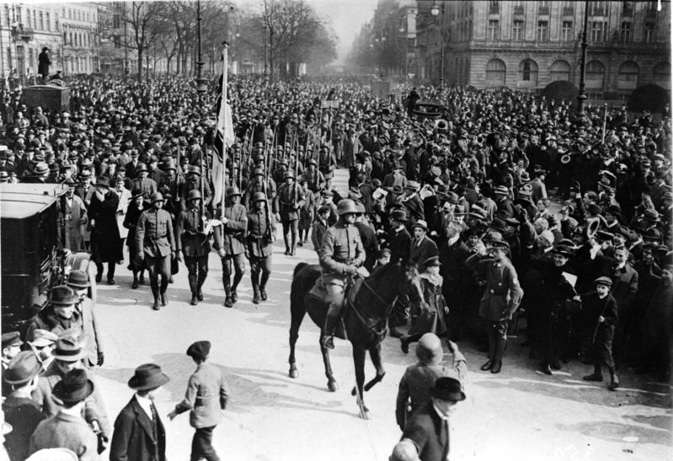
The Ehrhardt Brigade march on Berlin
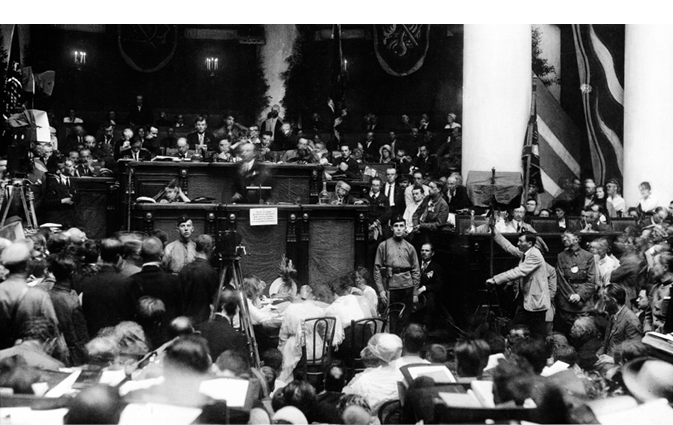
Lenin’s opening speech at the Second Congress of the Third International
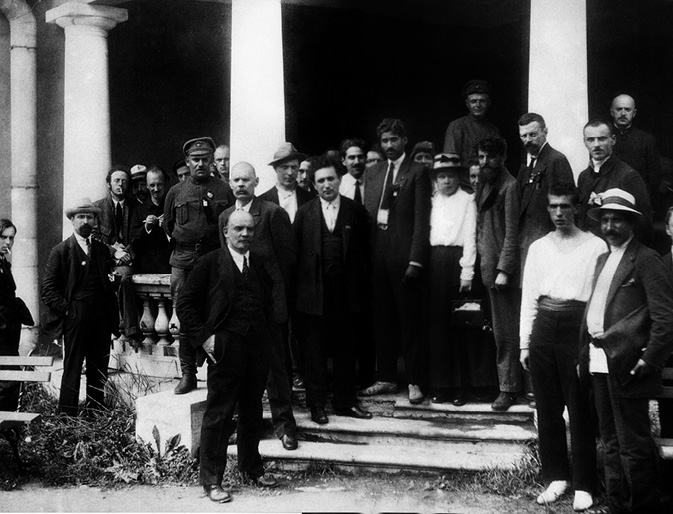
Delegates to the second congress of the Comintern at the Uritsky Palace in Petrograd. Amongst those pictured are: Karl Radek (third from the left); Nikolai Bukharin (fifth); Vladimir Lenin (tenth); Grigory Zinoviev (thirteenth); and Maria Ulyanova (nineteenth)
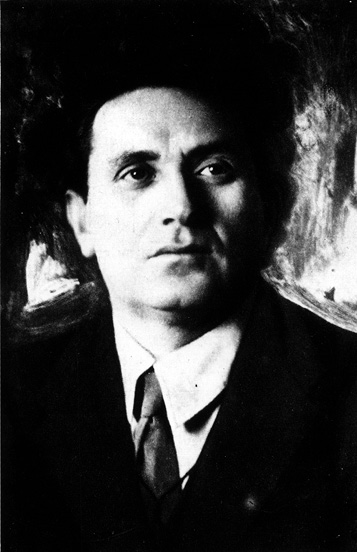
Grigory Zinoviev
Paul Levi