Chapter Three: Counter-Revolution Raises its Head
The revolution, which is not achieved at a single stroke but is the long and stubborn fight of a class oppressed for millennia and therefore not fully conscious from the outset of its task and its strengths, is subject to ups and downs, ebbs and flows.
Paul Levi, October 1919
…it is unquestionable that in the era of the First Congress (1919) many of us reckoned – some more, others less – that the spontaneous onset of the workers and in part of the peasant masses would overthrow the bourgeoisie in the near future.
Leon Trotsky, The First Five Years, vol. 2
In all revolutions, the internal dynamics are very similar. In particular, where events are drawn out, especially after the initial flush of victory, the masses can feel the gains of the revolution slipping through their fingers. The November Revolution in Germany was only half-completed, which left power still in the hands of the bourgeoisie. Even the French Jacobins had warned that “those who half make a revolution dig their own graves”. The advanced sections of the proletariat, realising the revolution was in danger of unravelling, attempted to retake the initiative. Such was the situation in late December 1918 and early January 1919 in Berlin, where the forces of revolution and counter-revolution battled it out for supremacy.
As Pierre Broué explained:
The break-up of the coalition government and the dispersion of the myth of unity, together with the suicide of the Councils at their own Congress, left the Berlin workers with nothing but their weapons and a sharp feeling of imminent danger for which they could see no political remedy. In December 1918 in Berlin, as in Petrograd in July 1917, the radicalised masses saw in armed struggle the simplifying short-cut which would cut the Gordian knot of the political arguments in which they no longer wanted to be involved. But, in Berlin, there was no Bolshevik party to open up a perspective of political struggle, nor to lead them into a necessary retreat after the setbacks of the first armed demonstrations and the consequences thereof, which could easily have been foreseen. (P. Broué, p. 236.)
As Broué explained, there are clear parallels which can be drawn between the Russian and German revolutions, especially in regards to the ‘July Days’. During the Russian Revolution, in June and early July 1917, advanced layers of workers, particularly in Petrograd, moved in the direction of overthrowing the Provisional Government. At this time, workers in revolutionary Petrograd organised armed mass demonstrations against Kerensky in response to the attempt by the Provisional Government to provocatively move out the Machine Gun Regiment to the front. Lenin nevertheless saw the dangers of a premature move to seize power: “We must be especially attentive and careful, so as not to be drawn into a provocation… one wrong move on our part can wreck everything…” (Quoted in A. Rabinowitch, Prelude to Revolution, pp. 121-122.)1
The Bolsheviks, however, did not stand aside from the revolutionary workers of Petrograd but, on the contrary, intervened at the head of the demonstrations in order to ensure their peaceful and organised character. That did not prevent reaction moving against the Bolshevik Party in early July, but at least it was able to maintain intact the advance guard of the Russian proletariat. The repression against the Bolsheviks, which forced Lenin into hiding, and the arrest of a number of Bolshevik leaders, became known as the ‘July Days’. However, the Bolshevik Party’s actions won it enormous prestige amongst the working class, and prepared the ground for winning the majority of workers and peasants to the side of the party and preparing the ground for the success of the October Revolution.
Again, similar processes can be seen in the Spanish Revolution during May 1937 in Barcelona. There the Republican government, under the pressure of the Stalinists, who acted as a counter-revolutionary force, attempted to seize back the Barcelona telegraph exchange from the anarchists. This provocation resulted in a prolonged armed clash with the Republican government, and ended with the bloody suppression of the revolt, the banning of the workers’ organisation, the POUM, and the murder of its leaders. This time, because there was no strong Bolshevik Party, the defeat in May was a crushing blow to the advanced sections of the Spanish working class. It was to lay the basis for the defeat of the Spanish Revolution and the final victory of Franco in 1939.
The Spartacist Uprising
Every day after 9 November gave the German workers a vivid feeling as though of something slipping from their hands, being withdrawn, sliding through their fingers. The desire to keep what they had won, to fortify themselves, to put up resistance, was growing from day to day. And this defensive tendency lay at the bottom of the January fights of 1919. (L. Trotsky, The History of the Russian Revolution, vol. 2, p. 88.)
In Berlin in early January, there existed a state of acute crisis. The three USPD ministers had not long resigned from the government. Fears and rumours of a military coup had begun to circulate, the campaign by the extreme right against the Spartacists was in full swing, and an anxious and frustrated mood began to develop amongst the advanced workers. After its formation, the German Communist Party began to conduct a campaign against the Social Democratic government and for the workers to seize power and complete the socialist revolution. The military top brass, in league with the right-wing Social Democratic ministers, was preparing a bloody reckoning with the Spartacists and the ranks of the Left Independents in order to strike a decisive blow against the revolution as a whole and prepare the way for a military ‘solution’.
This plan was later revealed in 1925 by General Groener at the so-called Dolchstoss trial in Munich. He described under oath the conspiracy hatched between the General Staff and Ebert and Noske:
On 29 December Ebert summoned Noske to lead the troops against the Spartacists. On that same day the volunteer corps assembled, and everything was now ready for the opening of hostilities.
Again, another general, General Georg Maercker, in his memoirs recorded:
In the very first days of January, a meeting attended by Noske, who had just returned from Kiel, took place at General-Staff Headquarters in Berlin with the Freikorps leaders concerning the details of the march (into Berlin). (Quoted in P. Frölich, Rosa Luxemburg, Pluto Press ed., pp. 285-286.)
Gustav Noske, who, on 6 January, had assumed the title of ‘People’s Commissar of Defence’, answered the call to deal with the Berlin workers with the words: “One of us has to be the bloodhound. I won’t shirk the responsibility!” (R. Watt, p. 239.) Noske was to relish this new-found role as the minister for the counter-revolution.
At the end of December, a price of 10,000 German marks had been put on the head of Karl Radek, the Bolshevik representative in Germany, by the Anti-Bolshevik League, which had been founded by exiled Russian aristocrats. This counter-revolutionary organisation had its own intelligence service, which, according to its founder, constituted an “active anti-communist counter-espionage organisation”. (P. Broué, p. 171.)
Dismissal of Eichhorn
At the same time, a campaign of denigration was carried out against Emil Eichhorn, the left-wing police president of Berlin and a member of the Left Independents. This was used to lay the basis for his removal. Eichhorn was regarded as a threat because he had organised a new ‘left’ police force of 2,000 workers and soldiers committed to the revolution, and of course posed an obstacle to the central authorities. The potential danger was accentuated especially after the Left Independents had withdrawn from the government. The action against Eichhorn was to be used as the provocation to push the Spartacists, the ranks of the Left Independents and the Berlin workers into an armed rebellion. This would be the justification for the military to step in and crush the movement. This was, nonetheless, a very risky strategy, given the recent fiasco over the Naval Division.2
On 4 January, 1919, after a series of false charges, Eichhorn was called upon by the Ministry of the Interior to resign his post. The right-wing Social Democrat, Eugen Ernst, was to be appointed in his place. This was a man who a few years later supported the Kapp Putsch, an indication of his true political loyalties. Eichhorn, who had mass support, refused to move. As far as he was concerned, he had been installed by the revolution and would only leave at the behest of the revolution, not the orders of the Minister of the Interior.
At the time of this provocation, the Berlin Executive Committee of the USPD, already in discussions with the Revolutionary Shop Stewards, immediately adopted a resolution supporting Eichhorn. They shortly met with the leaders of the newly-founded KPD to discuss joint action over this blatant attack on the revolution. With the refusal of the SPD government to back down, the Berlin Executive Committee, together with the Revolutionary Shop Stewards and the KPD, called for a mass protest demonstration on 5 January. This resulted in hundreds of thousands of workers marching to the police headquarters. A ‘Revolutionary Committee’ was established representing the organisations in Berlin: Left Independents, the KPD and the Revolutionary Shop Stewards. They were informed that the capital’s garrison was supporting their stand and that they could rely on military assistance from Spandau and Frankfurt. The Committee therefore decided, with this apparent support, to resist the dismissal and use the opportunity to overthrow the Ebert-Scheidemann government. Liebknecht, carried away by the movement, supported the idea.
At the same time, groups of armed workers had occupied the editorial offices of the hated Vorwärts, the SPD newspaper. Apparently, agents provocateurs were also at work, urging on the workers. But the workers needed little encouragement and were eager for action. After a period, the armed protesters were persuaded to end their occupation, but this did not last long. Following the stalemate, a further occupation was carried out which faced little resistance. Other important bourgeois news printing offices in the newspaper district were also occupied. These actions were never planned or directed by the Spartacist League, although many of its members were involved.
The next day 500,000 workers took to the streets, many armed, as many large factories went on strike. It was one of the biggest demonstrations of the revolution. This situation had clear parallels with the June demonstrations in Russia in 1917 and signalled the beginning of the so-called ‘Spartacist Revolution’. The next twenty-four hours would decide everything.
Emil Eichhorn, as Radek recalls:
[H]ad armed the Berlin workers, the Independents and the Spartacists… There were such tremendous masses participating in the demonstration that it appeared possible to seize power in Berlin. Only unarmed crowds of Social Democratic workers guarded the government in the Wilhelmstrasse. There were no soldiers round the governmental buildings… (J. Braunthal, History of the International 1914-1943, p. 129.)
Another eyewitness, Arthur Rosenberg, recalled:
There is a general feeling in Berlin that the second revolution had begun… We supposed that the three [revolutionary] organisations would now jointly set up a Red government and carry the revolution through to the bitter end… (ibid., p. 129.)
Further demonstrations were called by the Revolutionary Committee, which then went into permanent session, but without clear plans or objectives. The masses were ready, but the leadership began to dither. Finally, a decision was taken by the Committee, headed by Georg Ledebour, Karl Liebknecht and Paul Scholze, to overthrow the Ebert government and replace it with a new workers’ government. They even prepared a typewritten declaration to that effect to be made public as soon as the overturn was accomplished:
The Ebert-Scheidemann government has made itself intolerable. The undersigned Revolutionary Committee representing revolutionary workers and soldiers (Independent Social Democratic Party and Communist Party) announces that it has been deposed. The undersigned Revolutionary Committee provisionally assumes the functions of government. Comrades! Workers! Close ranks round the decisions of the Revolutionary Committee! Signed: Liebknecht, Ledebour, Scholze. (P. Broué, p. 245.)
Given the turn of events, the communiqué was never published. Nevertheless, a copy found its way into the hands of the SPD, which published it on 14 January, as part of the witch-hunt against the Spartacists, and ‘proof’ of the conspiracy.
The workers not only occupied the offices of Vorwärts and the press quarter, but also the Reich printing office, the railway headquarters, food warehouses, and other such buildings. Even the Reichstag was occupied for a brief period. Gustav Noske later wrote:
Great masses of workers… answered the call to struggle. Their favourite slogan ‘Down, down, down’ (with the government) resounded once more. I had to cross the procession at the Brandenburg Gate, in the Tiergarten, and again in front of general staff headquarters. Many marchers were armed. Several trucks with machine guns stood at the Siegessaule. Repeatedly, I politely asked to be allowed to pass, as I had an urgent errand. Obligingly, they allowed me to cross through. If the crowds had had determined, conscious leaders, instead of windbags, by noon that day Berlin would have been in their hands. (J. Riddell [ed.], The German Revolution, p. 248.)
This really summed up the situation. The government was hanging by a thread. Fearing the end, the petrified members of the government had abandoned their office buildings for the safety of a private home.
Morgan Philips Price, a British reporter with Bolshevik sympathies, also witnessed the events and wrote in his diary:
7 January
Great demonstrations both sides again. Workers occupy some railway stations. Government brings in troops. Fraternisation. Some firing and casualties. Groups in street discussions, questions such as wages, hours, capitalist system. Masses appear to be realising economic issues of Revolution. Went to Vorwärts office.
8 January
Went to Vorwärts office. Chaos! Impression that no organisation exists. Wrote article. Demonstration, firing and fraternising continue. Most of the troops declare themselves neutral. Independents mediating.
9 January
General feeling of depression everywhere. Shooting begins at midday around Anhalter station and newspaper quarter. Government trying to hold railway station till fresh troops arrive. Hopes of Left and Red Guards depend on fraternisation. Government is organising White Guards from officers and sons of bourgeoisie. Kurfürstendamm is full of military, calling for volunteers in street. Counter-revolutionary front is slowly uniting. (M. Phillips Price, Dispatches, p. 29.)
Traitors to the Proletariat
The official position of the KPD at this time, while supporting the movement, was against a premature attempt to overthrow the Social Democratic government. This was clearly correct given the balance of forces nationally. A leaflet issued by the KPD at the time explained that:
[I]f Berlin workers were today to disperse the National Assembly and throw the Ebert-Scheidemann people into prison, while the workers of the Ruhr and Upper Silesia and the rural workers of Germany east of the Elbe remained inactive, the capitalists would be able tomorrow to subdue Berlin through hunger. (J. Riddell [ed.], The German Revolution, p. 244.)
The general content of the KPD’s newspaper Rote Fahne, however, was full of attacks on the government and urged the workers to take ever-more militant action. The line between a mass armed demonstration, occupations and an insurrection became increasingly blurred. A joint appeal issued on 9 January began by denouncing Ebert and Scheidemann, “both stained with the blood of their brothers,” as “traitors to the proletariat, these miserable underlings of capitalist intrigue, these embodiments of the counter-revolution.” It continued, “They belong in prison, or on the scaffold. But instead they intend to establish their domination on the very corpses of their victims, and create a violent regime resting on bayonets, machine guns and cannons…” It concluded by urging the workers:
We must fight to the last! … Onwards to the decisive struggle! … Show the scoundrels your strength! Take up arms! Use your weapons against your deadly enemies, the Eberts and Scheidemanns! … Be armed, be ready, take action, take action, take action! … Out onto the streets for the final battle, for victory! (Quoted in B. Fowkes [ed.], pp. 79-81.)
This was signed in the name of the Revolutionary Shop Stewards and the representatives of the big factories of Greater Berlin, the Central Leadership of the Independent Social Democratic organisations of Berlin and surrounding districts, and finally, the Zentrale3 of the Communist Party (Spartacus League).
The very fiery language, which called for the use of arms against the government, left little to the imagination, and appealed to the masses to go to the end.
Alarmed by this turn of events, Radek wrote to the Central Committee of the party urging them to stage an organised and orderly retreat.
The Berlin movement has landed in a blind alley. I was therefore compelled as early as Monday [6 January] to bring to the attention of various Central Committee comrades my opinion that it was necessary to break off the fight… The only restraining force that can prevent this misfortune is you, the Communist Party. You have enough insight to know that the fight is hopeless… Of course, I am aware of how difficult it is now, after so many sacrifices, to stand up before the masses and sound the retreat. I know that this will lead to a decline in morale. But such depression is nothing compared to what the masses will say to themselves after the blood-letting. They will say that blind leaders incited them to hopeless battle, or that leaders saw the abyss but that out of revolutionary egotism they could not make up their minds to call, ‘Halt!’ All considerations of revolutionary egotism must take a secondary position to the real relationship of forces. (J. Riddell [ed.], The German Revolution, pp. 256-257.)
But, Radek’s advice was rejected. The Left Independents and the Revolutionäre Obleute who were close to Eichhorn were pressing for more militant action. The two KPD representatives on the committee, Karl Liebknecht and Wilhelm Pieck, without the Party’s mandate, backed the resolution supporting the overthrow of the Ebert government. For them, decisions had to be made under fire. They had no time to consult, and appeared to have been carried away by the situation. They had either misjudged things, or felt they had no other choice, but in so doing they had fallen for the government’s provocation without any necessary preparation. Liebknecht was in the midst of the action and in constant danger. He was a direct part of the struggle and this suited his character. He was an instinctive workers’ leader, a man of action. The revolution was not simply an event, but something that affected him deeply and personally. He did not consider himself a theoretician and perhaps lacked a deeper understanding of the tactics and strategy that were needed to carry through a successful revolution. The situation caught him unprepared. He lacked the political insight and perspicacity to enable him to understand the overall situation, weigh it up and act accordingly. The movement paid a great price for this serious lack of judgement.
Deliberations
The Revolutionary Committee had endless discussions, but failed to give any coherent direction to the mass movement, which eventually began to dissipate. The masses after all, could not be kept in a permanent state of readiness. What they needed at this time was firm leadership and direction. The continual vacillation had catastrophic consequences in confusing and disorientating the Berlin workers. As Marx had warned, insurrection is an art, and not to be played with. But the Revolutionary Committee was oblivious to such advice and things were carried out without any regard for the consequences.
To make matters worse, the Central Committee of the Councils and the Berlin Executive Committee actually came out in support of Eichhorn’s dismissal. The Marstall sailors also protested that they were involved in decisions against their will, which added further to the confusion. The mass movement began to fracture and the initiative was slipping away.
Rote Fahne later described the demonstration as “the greatest worker’s mass action in history.” The workers and soldiers “were ready to do anything, to sacrifice anything for the revolution, even their lives. It was an army of 200,000 men, such as no Ludendorff had ever beheld,” continued the paper. But it then went on to describe what happened:
And then an outrage took place. From 9:00 a.m. the masses stood in the cold and light drizzle. And somewhere the leaders sat and deliberated. The drizzle intensified and still the masses stood there. But the leaders were deliberating. Midday arrived, and to the cold was now added hunger. And the leaders deliberated. The masses were feverish with excitement: they wanted a deed, even merely a word to appease their anxiety. But no one knew what to do. For the leaders were deliberating. The drizzle picked up again, and it was twilight. Sadly, the masses went home. They had intended a great deed, but had accomplished nothing. For the leaders had been deliberating… Deliberating, deliberating, and deliberating. (Quoted in ibid., pp. 248-249.)
Rosa Luxemburg also attacked the Revolutionary Committee for failing to provide leadership. “We see and hear nothing,” she said. “The workers’ representatives may well be thoroughly and extensively discussing but now is the time to act…” (ibid., p. 251.)
The national USPD leaders, who had nothing to do with the action in Berlin, decided to go behind the backs of the Revolutionary Committee and negotiate a truce directly with the government. When informed of these negotiations, the Berlin Independents on the Revolutionary Committee supported the initiative of their national leadership. Liebknecht and Pieck strongly opposed the idea. How could anyone negotiate with a government that they had twenty-four hours earlier planned to overthrow? The proposal to negotiate was taken to the Shop Stewards meeting, which also voted in favour. When negotiations began at midnight 6-7 January, the government demanded that all the newspaper buildings had to be vacated before any further talks could take place. The talks soon broke down. To complicate matters even further, once those workers occupying the buildings found out about the negotiations, they were furious and demanded their leaders be removed. The confused situation propelled the occupying forces into open physical clashes with the military authorities. For the Ebert government, the negotiations were simply a ploy to string things along until the military were ready to move.
‘Dogs of War’
While the workers’ leaders talked aimlessly, the forces of counter-revolution, under the direction of Noske, were preparing for a bloody confrontation with the Berlin workers. The Freikorps had been gathering outside the capital. Now was the moment, in the words of Shakespeare, for them to unleash ‘the dogs of war’. It was the start of a terror campaign, similar to those unleashed in Finland against the revolutionaries. The government’s task, as they saw it, was to ‘pacify’ the city before the National Assembly elections which were scheduled for 19 January, just over a week away.
On 10 January, the Freikorps entered Berlin and an attack was opened up by the Potsdam regiment, led by Major von Stephani. Stephani was later to become one of the leaders of the notorious Stahlhelm organisation, but for now was fighting under the black, red and gold republican flag. But the revolutionary workers remained defiant saying, “Rather than surrender we will let ourselves be buried in the ruins of the building!” On 11 January, Noske moved in with a further contingent of Freikorps troops led by the monarchist Generals, von Röder, von Wissel, and von Hülsen. The government was determined to take back the Vorwärts building by military force, no matter the bloodshed. The building was mercilessly shelled from the early hours of the morning. Heavy artillery and mortar attacks by government troops resulted in enormous damage and scores of injuries. In the end, the situation became hopeless for the occupying rebels and the 350 or so who remained in the building had no alternative but to surrender. After two hours of constant bombardment, the white flag was hoisted, but they were shown no mercy.
Rosa Luxemburg wrote:
The massacred mediators, who had been trying to negotiate the surrender of the Vorwärts building, were clubbed beyond recognition by the rifle butts of the government’s rampaging troops so that their bodies cannot be identified. Prisoners were put up against the wall and slaughtered so violently that bits of skull and brain tissue splattered everywhere. (ibid., pp. 264-265.)
As far as the counter-revolution was concerned, there were to be no negotiations.
By 12 January the siege was over. Within a matter of days, officially, 156 people had been killed and hundreds wounded, but this was a gross underestimate. The Monarchists in charge avenged themselves on the Communists. Of the 300 or so prisoners captured in the Vorwärts building, groups were marched to the nearby Dragoon barracks and maltreated. An undisclosed number were shot in the courtyard. This was the meaning of the Freikorps ‘pacification’. Noske quipped: “It is quite true that many of them are monarchists, but when you want to reconstruct you must fall back on the men whose profession it is [to deal with the situation].” (R. Watt, p. 263.)
Noske and the Generals had hatched a plan to reconquer Berlin by force and teach the workers a lesson they would never forget. To quote Paul Frölich, “The White Terror had begun”.
It was clear that the so-called ‘Spartacist Rebellion’ was not a conscious strategy pursued by the Spartacists. The events were certainly started by government provocation, intended as a pretext to crush the movement. But this was not the only element involved. There was anger in the Berlin working class and in January it reached boiling point. There was also a feeling of frustration that the revolution was being lost. Although the ‘uprising’ did not have the approval of the Spartacist leadership, they were not prepared to abandon those risking their lives on the front line. Once the defence of the Vorwärts building was underway, the Spartacists felt they were obliged to give it unconditional support. In fact, the occupation of the Vorwärts building was headed by Eugen Leviné of the KPD. Therefore, the defence of the uprising became a point of principle for the party. Despite Radek’s appeal, things had now gone too far to pull back.
Leon Trotsky explained:
Spartacist Week began, not in the manner of a strategy calculated by the party, but in the manner of a pressure from the indignant lower ranks. It developed around a question of third-rate importance, that of retaining the office of chief of police, although it was in its tendencies the beginning of a new revolution. Both organisations participating in the leadership, the Spartacus League and the Left Independents were taken unawares; they went further than they intended and at the same time did not go through to the end. The Spartacus men were still too weak for independent leadership. The Left Independents baulked at those methods which could alone have brought them to the goal, vacillated, and played with the insurrection, combining it with diplomatic negotiations. (L. Trotsky, The History of the Russian Revolution, vol. 2, p. 88.)
How Could You?
When Liebknecht returned to the offices of Rote Fahne with news of what had happened, Luxemburg was very critical of him for taking matters too far and endorsing the insurrection. “But Karl, how could you? What about our programme?” she protested. (R. Watt, p. 266.) Radek too was opposed to the action, using the example of the Bolsheviks in July 1917. “Nothing can stop him who is weaker from retreating before a stronger force,” he said. He was also supported in this by Paul Levi.
But it was too late. The damage had been done. The Berlin action, although heroic, was the action of a small group of hundreds, without active support, or more importantly, without clear revolutionary leadership. The majority of the organised working class of Berlin remained passive. There was certainly sympathy for the struggle, especially in the face of the brutal repression by the authorities, but that was not the same as willing active support.
In a final article, Luxemburg attempted to draw a balance sheet of the ‘Spartacist Week’, the title of which, ‘Order Prevails in Berlin’, summed up the situation:
What was this recent ‘Spartacus week’ in Berlin? What has it brought? What does it teach us? While we are still in the midst of battle, while the counter-revolution is still howling about their victory, revolutionary proletarians must take stock of what happened and measure the events and their results against the great yardstick of history.
Was the ultimate victory of the revolutionary proletariat to be expected in this conflict? Could we have expected the overthrow [of] Ebert-Scheidemann and the establishment of a socialist dictatorship? Certainly not, if we carefully consider all the variables that weigh upon the question. The weak link in the revolutionary cause is the political immaturity of the masses of soldiers, who still allow their officers to misuse them, against the people, for counter-revolutionary ends. This alone shows that no lasting revolutionary victory was possible at this juncture. On the other hand, the immaturity of the military is itself a symptom of the general immaturity of the German revolution…
Does that mean that the past week’s struggle was an ‘error’? The answer is yes if we were talking about a premeditated ‘raid’ or ‘putsch.’ But what triggered this week of combat? As in all previous cases, such as 6 December and 24 December, it was a brutal provocation by the government…
Faced with the brazen provocation by Ebert-Scheidemann, the revolutionary workers were forced to take up arms. Indeed, the honour of the revolution depended upon repelling the attack immediately, with full force in order to prevent the counter-revolution from being encouraged to press forward, and lest the revolutionary ranks of the proletariat and the moral credit of the German revolution in the International be shaken.
She concluded:
The leadership failed. But a new leadership can and must be created by the masses and from the masses. The masses are the crucial factor. They are the rock on which the ultimate victory of the revolution will be built. The masses were up to the challenge, and out of this ‘defeat’ they have forged a link in the chain of historic defeats, which is the pride and strength of international socialism. That is why future victories will spring from this ‘defeat.’
‘Order prevails in Berlin!’ You foolish lackeys! Your ‘order’ is built on sand. Tomorrow the revolution will ‘rise up again, clashing its weapons,’ and to your horror it will proclaim with trumpets blazing:
‘I was, I am, I shall be!’ (R. Luxemburg, ‘Order Prevails in Berlin’, published in Rote Fahne, 14 January 1919.)
Despite Rosa Luxemburg’s optimism, brutal ‘Order’ did very much prevail. The Social Democratic leaders were prepared to stoop to new depths to crush the revolution and ‘Democracy’ was made secure over the backs of revolutionary workers.
The counter-revolution quickly took revenge on behalf of the capitalists, who had been terrified by the revolution. The Spartacists were to pay dearly for their support of militant action. In a short space of time, two leading KPD members, Leo Jogiches and Hugo Eberlein, were arrested. The government minister Philipp Scheidemann, in echoing the demands of the reaction, had put an unofficial price of 100,000 German marks on the heads of Liebknecht and Luxemburg, on top of the previous offer of the ‘Association for Combating Bolshevism’ of 10,000 marks for anyone aiding in the arrest of Liebknecht. As in the ‘July Days’ in Russia, the slanders poured down over the heads of the Spartacists like the waters of Niagara, to quote Trotsky, unbridled and shameless. The SPD paper Vorwärts joined in the hue and cry against the Spartacist leaders. On 13 January this ‘socialist’ newspaper, to incite murder, published a poem which ended with a verse:
Many hundred corpses in a row,
Proletarians!
Karl, Radek, Rosa and company.
Not one of them is there, not one of them is there,
Proletarians!(J. Riddell [ed.], The German Revolution, p. 263.)
Another played on anti-Semitic feelings using Germanised equivalents of the original Jewish names of Trotsky (Bronstein) and Radek (Sobelson):
I saw the masses marauding
Behind Karl, blind war god,
Dancing to the Pied Piper’s flute,
Who slyly promised them the world.
They bowed before blooded idols,
Grovelled before all that humanity scorns,
Before Russia’s Asiatics and Mongols,
Before Braunstein,4 Luxemburg, and Sobelson.
Go back, you raging hoards!
You cry for freedom, only to kill it!(ibid., p. 263.)
Philips Price again briefly records the situation as it unfolded on a daily basis:
14 January
Talked with Däumig who says workers very depressed. Whole tactics of Spartacus he considers disastrous. Mass of soldiery not ready for next step of revolution.
15 January
Reign of White Terror. Arrests everywhere. Meanwhile railway strike for higher wages. That is when the victors will find their victory is Pyrrhic.
Luxemburg, Liebknecht Murdered
Then came the tragic news:
16 January
Stunned by appalling news of foul murder of Liebknecht and Luxemburg. Too staggered to conceive the fact, except to feel instinctively that this fiendish crime will do more than anything else to unite all ranks of Revolution against this accursed hydra of Prussian militarism which Allies cannot kill because they are themselves brother hydra. Saw Müller Senior [Richard], who saw Liebknecht’s body and can affirm that shots were fired from a short distance. (M. Philips Price, Dispatches, pp. 30-31.)
The final article written by Karl Liebknecht was published on 15 January, the very day that he and Rosa Luxemburg were tracked down and murdered by the Freikorps. The main content of the article was to lay bare the hysterical campaign against the Spartacists. It began:
All-out war on the Spartacist League! ‘Down with the Spartacists!’ they howl through the streets. ‘Catch them! Whip them! Stab them! Shoot them! Run them through! Run them down! Tear them to shreds!’
He then warned:
Yes! The revolutionary workers of Berlin were beaten…
And every drop of their blood is a seed of discord for today’s victors, like dragon’s teeth, because from them will grow those who will avenge the fallen; from every shredded fibre, new warriors will arise to carry on the lefty cause, a cause as eternal and everlasting as the firmament.
The vanquished of today shall be the victors of tomorrow, for they will learn from defeat…
Whether or not we are alive when it arrives, our programme will live, and it will reign in a world of redeemed humanity. Despite everything!
(J. Riddell [ed.], The German Revolution, pp. 269-271.)
In the previous days the atmosphere had become extremely dangerous following the ‘Spartacist Uprising’. The slanders multiplied by the hour. It clearly wasn’t safe and Luxemburg spent a few nights at various hostels, only calling at her flat to pick up clothes and letters. Each night, the Spartacist leaders were housed secretly by different comrades and sympathisers. Now the government was hunting them and they were on the run.
More seriously, as we have seen, they had a price on their heads. Following the ‘Uprising’, the KPD headquarters were occupied and ransacked by the military, and this led to the arrest of Jogiches and Eberlein. Despite Luxemburg and Liebknecht being kept in a ‘safe’ house in Berlin, the Freikorps tightened their grip on the city. The searches were stepped up and Liebknecht’s wife and son were taken into custody. It was like a tightening noose. Eventually, their whereabouts were discovered and troops broke into the apartment and arrested them on 15 January at nearly nine in the evening.
When they were seized, both Liebknecht and Luxemburg were taken to the Eden Hotel, headquarters of the Cavalry Guards Division for ‘investigation’, before supposedly being transferred to the Moabit prison. But the transfer was a deception, as the officers had already agreed on their assassination. “See to it that these swine do not reach the prison alive,” Captain Lieutenant Heinz von Pflugk-Harttung was reported to have said. In the headquarters, the revolutionaries were mistreated, faced hysterical denunciations and a torrent of abuse. From then on, their fate was sealed. They would not be allowed to escape the iron grip of their captives alive.
Liebknecht was the first to be taken out of the back door of the building, escorted by Captain Pflugk-Harttung and other soldiers. As he stepped on to the pavement, Otto Runge, a sentinel, beat him over the head with a rifle butt. Liebknecht placed his hands over the wound from which blood was pouring freely. He was then bundled into a waiting car. He was driven a short distance to the Tiergarten, before he was forced out and shot, allegedly ‘trying to escape’. At 23:20 that night, an unknown man deposited his lifeless body at the Kurfürstendamm Infirmary.
Rosa Luxemburg suffered a similar fate. She was led out of the Hotel after being beaten. As she left the building a soldier used the butt of his rifle to beat her semi-conscious to the ground. She was likewise bundled into a car, struck with the handle of a revolver and then a bullet was put through her head. On the orders of Lieutenant Kurt Vogel her blood-stained body was thrown into the ice-covered waters of the Landwehr Canal from the Lichtenberg Bridge, where her remains were not recovered until 31 May.
The counter-revolution had carried out its bloody revenge of beheading the revolution. The bourgeois paper Tägliche Rundschau simply stated that “The day of judgement on Luxemburg and Liebknecht is over. Germany has peace, it can breathe again.” (J.P. Nettl, pp. 775-776.)
A travesty of a court-martial trial was held on 9 May 1919 for the killers of Luxemburg and Liebknecht. The two principal defendants, Captain Lieutenant von Pflugk-Harttung and Lieutenant Kurt Vogel arrived in court “laughing, their chests decorated with medals. They gave the impression of going to a wedding rather than a murder trial,” stated a witness. The court was packed full. During the trial, Pflugk-Harttung, the barefaced liar, admitted shooting Liebknecht “for trying to escape”. He was then acquitted “with great applause at the verdict”. Meanwhile, Vogel admitted driving Luxemburg’s body to the canal, but claimed another officer had been the one to shoot her. The jury could not make up its mind whether Luxemburg had already died from the earlier blows to the head. He was therefore sentenced to two years and four months in prison.
He didn’t serve his sentence, however, as Vogel was allowed to escape from prison and cross the border to Holland, where he laid low until everything had blown over. He then returned to Germany a free man. Another defendant, Private Runge, who had bludgeoned the captives, escaped a murder verdict and was sentenced to two years imprisonment. In the end, only the private soldier went to prison, but he only served several months for his crime before being released. (A. Read, pp. 201-202.)
The general staff officer of the Cavalry Guard, a man named Captain Waldemar Pabst, who arrested Luxemburg and Liebknecht, gave an interview to Der Spiegel in 1962. He claimed he interrogated Luxemburg and Liebknecht, as well as Wilhelm Pieck, at the Eden Hotel. He also claimed that Pieck betrayed his comrades and as a result was released, but this cannot be confirmed. He ordered that the prisoners be delivered to the governor at Moabit prison. The Spiegel interview then records, in his view, what happened next.
Pabst: At the entrance of the Eden Hotel there was a guard, soldier Runge. That man hit Rosa Luxemburg over the head with the butt of his gun when she left the hotel. This was not included in my programme. Someone who is now dead bribed the soldier to kill Liebknecht and Luxemburg.
Question: Did you not order yourself that these two should be murdered?
Pabst: You mean the actual order? I refuse to say anything about this.
Question: Did you give any order that those two should be, let us say, killed?
Pabst: I tell you I refuse to say anything about this… You know exactly what the situation was. The whole of Germany knew…
Question: The whole of Germany knew that they had been murdered.
Pabst: The essential thing is this: was it necessary or was it not?
Question: You thought it was necessary and your order went further than “Hand them over to Moabit”?
Pabst: That was the order I gave in the presence of my orderly office. What I discussed with the gentlemen who had volunteered for the transport – and they were all volunteers – is a matter between them and myself.
Question: You did not discuss anything with the soldier Runge?
Pabst: Really, gentlemen, you don’t think that I would have given such a stupid order as to bash Luxemburg’s head outside the hotel coram publico? I was not that stupid. The Transport Command reported that Liebknecht had been shot while trying to escape. And that Luxemburg had been shot by an unknown man who had jumped on the running board of the car after she had been hit by a soldier and was unconscious. The leader of the Transport Command had then thrown her into the canal…
Question: What did your superiors say about your orders?
Pabst: That it was right the way I had done it… There were proceedings before a tribunal according to the wishes of Herr Noske.
Question: The soldier got two years’ imprisonment but the officer who shot Rosa Luxemburg and then threw her body in the canal got a suspended sentence which he never served. Who helped him?
Pabst: An order by Herr Noske.
(Der Spiegel, 20 April 1962, quoted in Tribune, 17 August 1962.)
The German proletariat had lost two of its most outstanding leaders at the hands of the counter-revolution and with the full compliance of the Social Democratic ministers. The revolutionary movement would neither forget nor forgive this treachery.
“Today, we hear the subterranean rumbling of the volcano; tomorrow will come the explosion that will bury them all in glowing ash and rivers of lava,” concluded Liebknecht in his last article on 15 January. (J. Riddell [ed.], The German Revolution, p. 271.) It was a fitting epitaph.
Three days later, on 18 January 1919, Trotsky addressed the Petrograd Soviet as word arrived confirming the murders of Luxemburg and Liebknecht. He paid them the highest tribute:
For us Liebknecht was not just a German leader. For us Luxemburg was not just a Polish socialist who stood at the head of the German workers. No, they are both kindred of the world proletariat and we are all tied to them with an indissoluble spiritual link. Till their last breath they belonged not to a nation but to the International! (L. Trotsky, Political Profiles, p. 139.)
Friedrichsfelde
On 25 January, 1919, thirty-two individuals killed in the January fighting were buried alongside Karl Liebknecht in the Friedrichsfelde Central Cemetery in Berlin. A mass of Berlin workers followed his hearse, walking shoulder to shoulder. At Liebknecht’s side was placed an empty coffin. This was reserved for Rosa Luxemburg’s body, which was finally laid to rest on 13 June, almost five months later. On 10 March, Leo Jogiches, who took over the leadership of the KPD, was arrested and shot in cold blood. He was also laid to rest at Friedrichsfelde. Out of spite, the cemetery was raised to the ground by the Nazis, but was later restored by the East German regime, and remains a place of vigil to this day.
It is a tragedy that Luxemburg and Liebknecht did not go into hiding away from Berlin. Liebknecht had already experienced an attempt on his life on 7 December, after being seized, but was later released. Death threats had also been made against Luxemburg.
Lenin and the Bolsheviks were faced with a similar deadly situation in July 1917. Fortunately, the party decided that Lenin would go into hiding, given the warrant for his arrest and the threats on his life. He left Petrograd and went to Finland. This was not ‘desertion’ but a responsible act of self-preservation of the Bolshevik leader that was taken by the party. If Lenin had not gone into hiding, he would have certainly suffered the same fate as Luxemburg and Liebknecht. This would have had fatal consequences for the Russian Revolution. Likewise, if Luxemburg and Liebknecht had lived, it would probably have guaranteed the success of the German Revolution and changed the course of history. Marxism does not deny the role of the individual in history. The examples of the Russian and German revolutions show in positive and negative ways the key role of individuals under critical historical conditions, where the subjective factor becomes decisive.
Without Lenin, there would have been no October Revolution. This is not a sentimental question. Leadership and political authority reach their highest importance in a revolutionary period. Lenin in April 1917 had to rearm the party, and orientate it towards a second revolution. There was much resistance from the old guard. Only Lenin, with his decades of political authority was able to overcome this. This authority was again used to sweep aside resistance within the Bolshevik leadership.
This assessment applies especially to Luxemburg who had great authority. Her loss was a terrible blow. The others who followed her in the leadership of Communist Party were of a lesser stature and ability. Paul Levi was certainly very intelligent, but he was still young and very much full of himself. The others, like Brandler and Thalheimer, were also lacking politically and later became scapegoats, incapable of resisting the pressures of Zinoviev or Stalin, which led to even more terrible defeats.
The deaths of Rosa Luxemburg and Karl Liebknecht marked an end to the first phase of the German Revolution. It was an important turning point, where the initiative now swung over to the forces of reaction.
Luxemburg’s ‘Error’
There are those who have drawn completely erroneous conclusions from the so-called ‘Spartacist Uprising’. Undoubtedly, had the existence of a mass revolutionary party on the lines of the Bolsheviks been in existence in 1918-19, this could have transformed entirely the situation in Berlin and the rest of the country. But this was not the case. The question therefore arises of why such a party was built in time in Russia, but not in Germany. Chris Harman in his book, The Lost Revolution, takes Rosa Luxemburg to task:
Her tactical error is not to be explained by anything that happened in December or January, but by a much earlier error – when in 1912 and 1916 she underrated the importance of building an independent revolutionary socialist party… The contrast with Lenin’s repeated insistence on the political and organisational independence of revolutionaries from ‘centrists’ could not have been sharper, and helped prepare the ground for the tragic quandary faced by Rosa Luxemburg and the German revolution in 1919. (C. Harman, p. 95.)
But this is a false and simplistic way of looking at the situation, and repudiates the whole experience of Bolshevism. It is certainly true that Rosa Luxemburg failed to build a strong organisation. There is no doubt about this. This was not due to the fact that she had not broken earlier with Social Democracy to form an independent group, but arose from her failure to create a well-organised and politically homogeneous faction within the SPD at a much earlier date. This was her real failing. The Internationale Group was not established until early 1916, and even then, it was a very loose federation of small groupings. In that sense, unlike Lenin, she underestimated the importance of organisation and the building of a strong opposition faction within the SPD and then the USPD.
If Rosa Luxemburg and Karl Liebknecht had organised such a faction from, say 1905, things could have been completely different. As explained, she shied away from such an organisation until very late in the day.
As Paul Levi explained:
[I]t can be advantageous for radical or Communist groups in opposition to stay within the large parties, so long as it remains possible for them to present themselves openly, and to carry on their agitation and propaganda work unhampered. (P. Broué, p. 453.)
In other words, the German revolutionaries should have followed the example of Lenin and the Bolsheviks. But that did not happen and there lies the weakness.
Chris Harman fails to recognise that Bolshevism evolved not as a separate party, but acted between 1903 and 1912 as a faction within the framework of the Russian Social Democratic Labour Party. Lenin’s Bolsheviks formed the revolutionary wing of Social Democracy and carried out a theoretical and political struggle with the Mensheviks within the same organisation. It was not until 1912 that the Bolshevik faction constituted itself as an independent party.
As explained, on the international arena Lenin still considered himself a supporter of Karl Kautsky, right up to 1914. Up until then, Lenin regarded the German SPD under the Bebel-Kautsky leadership as the model for every party of the Second International. The Bolshevik criticism of the Mensheviks was seen in the same light as Kautsky’s attacks on the revisionists around Bernstein.
The creation of the Bolshevik faction after 1903 served to fuse together a group of cadres around Lenin. Despite its weaknesses, it laid the basis for the independent party to emerge in 1912 and, under the leadership of Lenin and Trotsky, providing the means by which to politically win over the majority of the working class in 1917.
When mass Communist parties were formed in Germany, France, Czechoslovakia and Italy, between 1920-21, they did not emerge from small groupings or sects, isolated from the mass organisations, but emerged from enormous splits within the old Social Democracy – the traditional parties of the working class. The reason why the British Communist Party remained a small grouping was because of its failure to win over a significant layer of workers in the Labour Party. Even after its formation as an independent party in 1920, Lenin forcefully argued that the new Communist Party should affiliate to the British Labour Party. This, too, was the position adopted, after a thorough debate, at the Second Congress of the Communist International.
This experience stands in complete contradiction to Harman’s misinterpretation of Lenin. The approach of Lenin and Trotsky was an attempt to create a mass British Communist Party by winning over Labour’s rank and file on the basis of events. This would be best served by the British Communists entering the Labour Party. Lenin’s approach was to combat the ideas of reformism and revisionism, but never to isolate the forces of Marxism from the ranks of the working class. Harman fails to grasp the essence of what Lenin was raising, for he cannot understand the need for a prolonged period of organised work within the old organisations of the working class.
National Assembly Election
Following the blood-letting in Berlin during the ‘Spartacist Week’, new elections for the National Assembly took place on 19 January. This was only four days after the tragic assassination of Liebknecht and Luxemburg. However, the KPD wrongly boycotted the elections, against Luxemburg’s advice, and completely isolated themselves from the struggle on the electoral front. The SPD, in contrast, polled 11.5 million votes, whereas the Left Independents got just under 2.5 million votes. Thus, the two main workers’ parties, which at least formally stood for ‘Marxism’ and socialism, polled around forty-five per cent of all the votes cast. The right-wing bourgeois parties only managed to scrape together a mere fifteen per cent of the vote. Again, this reflected the favourable class balance of forces that existed at the time. Such was the turmoil that brought the Weimar Republic into being.
The first act of the SPD, the largest party, was to approach the Left Independents to explore the possibilities of them entering a new coalition government. They were again looking for a left cover. But when the Independents refused, approaches were made to the bourgeois parties: The Democratic Party and the Centre Party, which agreed not only to participate, but even accepted the programme of socialisation of those ‘industries ripe for socialisation’, at least in words. The fact that these capitalist parties were forced to embrace nationalisation and ‘socialism’ in words reflected the intense heat still emanating from of the November Revolution.
The National Assembly met on 4 February, when Ebert was elected President, while Scheidemann was appointed Chancellor on 11 February.
Freikorps Intervene
January 1919 had been the month of retribution. Noske, as Minister of War, had obtained the consent of the Assembly to allow him to reorganise the army. Using these new powers, he immediately scrapped the Seven Hamburg points to democratise the armed forces, abolished the power of the Councils and fully restored the authority of the officer caste. This was in preparation for the army to destroy the revolution and finally do away with the elements of ‘dual power’ represented by the Workers’ Councils. According to the Cabinet minutes of 21 January 1919, Noske said:
[F]or Berlin we require 10,000 men… Maercker’s corps will protect Weimar, and it will re-establish order in Halle and Braunschweig in passing. We will restore order in Bremen in the course of this week, and then only Cuxhaven will be left, because we are prevented from attacking via Altonia. We might restore order there via Schleswig, and if necessary the resistance in Hamburg will be put down by force… (S. Taylor, p. 19.)
Over the next few months, one punitive bloody assault after another was carried out by the Freikorps and other ‘loyal’ army divisions, beginning, as planned, in Bremen in early February 1919, where government troops marched in and removed the Workers’ and Soldiers’ Council. Such counter-revolutionary actions followed in Bremerhaven and Cuxhaven. From there, Freikorps troops were dispatched to central Germany, moving from town to town destroying the Councils and ‘restoring’ law and order. The workers did not give up their gains without a fierce struggle in which thousands of courageous workers lost their lives in prolonged street battles. The legacy of bitterness continued in these areas for years to come.
Julius Braunthal was asked to go to Berlin to convey to Noske the horror with which the Austrian forces watched the organisation of the Freikorps:
The first impression which I received from Berlin was of a big city in the midst of a civil war. Here and there, there was still barbed wire in the streets. Big posters on the walls called Noske a counter-revolutionary bloodhound, while other posters cursed the Bolsheviks as the scourge of the earth. There were many nationalist posters, calling on the German youth to join the Free Corps. The streets in which the offices of the daily newspapers were housed displayed the scars of recent street battles.
“Don’t talk about the Anschluss,” Noske said to me when I had my interview with him. “I’m not interested in Austria. I’ve enough to do to restore order in Germany.”
During the conversation in his office in the Bendlerstrasse I received a little lesson in how he did it. While we were talking, the telephone rang, and Noske, after having listened for a while, shouted into the mouthpiece, “Why bother with the fear of strikes? Forget about them and go to it! You are responsible to me that order is restored at once!” A little later this Adjutant came in and whispered something to him, and Noske, in his booming voice, commanded him to send some more troops to Merseburg.
“There you have your Workers’ Councils,” he said angrily to me. “They’re making trouble everywhere. They’re ruining Germany.”
When I interposed that we, too, had trouble, but that we were anxious to avoid bloodshed, he became furious and struck the desk with his fist.
“We try to persuade the workers, and mostly we succeed,” I said.
“But they set the whole of Germany ablaze!” he shouted.
I felt that the continuation of the conversation was a waste of time. When I pointed to the dismay his Free Corps had caused among the Austrian socialists, he indicated that we should mind our own business. When I predicted that his Free Corps would break the neck of the Republic, he retorted, “Leave it to me, the leaders of the Free Corps are better Germans than the revolutionaries.” (J. Braunthal, In the Search of the Millennium, pp. 239-241.)
The Freikorps became the spearhead of the counter-revolutionary offensive, organised and financed by business. Ignoring the Reich government, capitalists paid and armed these gangs of veterans, outcasts and adventurers as a weapon against the working class, and, where possible, military support for the White forces of counter-revolution. In June 1919, for example, they dispatched the 50,000 strong ‘Baltikum’ corps to fight in Lithuania against the Soviets. In Latvia, they burned, raped and pillaged. They burned houses, destroyed bridges and telephone poles. They threw bodies into wells, followed by hand grenades. According to Ernst von Salomon:
We killed what fell into our hands… We saw red, we had nothing in the heart of human emotions… what were earlier houses, were rubble, ash and smouldering beams, like festering sores in the bare field… We had lit a bonfire, there was burning more than dead material, there also was burning our hopes, our desires… the laws and values of the civilised world… We retreated, bragging, intoxicated, loaded with booty. (E. von Salomon, Die Geächteten, quoted in G.L. Waite, Vanguard of Nazism.)
In 1923 their ‘volunteer corps’ were used to resist the French occupation of the Ruhr, and deflect the struggle on nationalist lines. These paramilitary outfits were grouped together in four main formations. Firstly, there was the Landesjägerkorps led by General Märker, who had taken part in the suppression of the ‘Spartacist uprising’ in Berlin and then moved his forces to middle Germany. Then there was the Marinebrigade Erhardt, which had broken up the People’s Marine Division in Berlin and carried out the murders of Luxemburg and Liebknecht. Next was the Garde Kavalerie Schützen Division. And lastly, the Orgesh, formed in the summer of 1919, under the command of Colonel Escherish.
At this time, another organisation was formed called the Stahlhelm, Bund der Frontsoldaten, the German word for ‘Steel Helmet, League of Front Soldiers’, which was created to carry out the serious military training of the forces of the counter-revolution. It became part of the ‘Black Reichswehr’, and operated as the armed wing of the National Party (DNVP).
The Freikorps were made up from the most degenerate mercenary elements, many of whom had cut their teeth fighting the Bolsheviks in the Baltic States. These hired thugs, like the Black Hundreds in Russia, had helped to brutally put down the proletarian revolution in Finland. Many of these soldiers from General Rüdiger von der Goltz’s ‘Iron Division’ still wore the swastika emblems of the Baltic Freikorps on their steel helmets. Noske was to rely on them to restore ‘law and order’ throughout Germany.
According to Rudolf Mann, an officer in the notorious Erhardt Brigade:
The Majority Socialist Noske was the man who helped us. It was his service in putting the right men in the right military posts, gave them complete authority and abundant money for their work. Without this, the Revolution would have overwhelmed Germany. We were never sworn in and were spared that notorious oath to the Constitution, although it was asked of us by the Government. (M. Philips Price, My Three Revolutions, p. 169.)
‘Schiessbefehl’
The Freikorps became notorious for their brutality and barbaric actions against the working population. Such actions led to a further radicalisation on the left. Such was the feeling in Berlin that the idea of a general strike was raised to help defend the workers of central Germany from these mercenaries. At the end of February 1919, 1,500 delegates gathered at the general assembly of the Berlin Workers’ Councils to discuss solidarity action. The political composition of these Councils had changed since November 1918 as the Social Democratic delegates were replaced increasingly by Left Independents and Communists. Therefore, the policy agreed at the reconvened assembly included such radical demands as the organisation of a workers’ militia, the dissolution of the Freikorps and the freeing of all political prisoners. To carry out these demands, ninety per cent of those present at the assembly favoured the calling of a general strike. Within the space of twenty-four hours a massive strike had gripped the whole of Berlin.
During the general strike in Berlin, barricades were erected and fighting broke out. The response of the government was very swift, granting Noske, as Commander-in-Chief, dictatorial powers over the whole of Berlin. He immediately banned all meetings and demonstrations and dispatched troops to the capital. On 4 March, he gave orders for 30,000 Freikorps troops to enter the city. This action provoked hand-to-hand fighting, which involved workers and sailors. On 9 March, the Workers’ and Soldiers’ Council decided to call an end to the strike based on several conditions, but this failed to placate Noske and the Freikorps. On the contrary, he announced his ‘Schiessbefehl’, an instruction that stated “The brutality and bestiality of the Spartacists who fight against us compel me to give the following order: any person who is caught with arms in his hands in the struggle against the government will be shot on the spot.” (P. Broué, p. 276.) In one engagement alone, over 1,200 people were shot down in cold blood, including a group of twenty-nine sailors. By the time the fighting had ended, some 3,000 workers had been killed and at least 10,000 wounded. On 10 March, Jogiches, the chairman of the Communist Party, was murdered in a police station, again, supposedly “while trying to escape”. The young KPD had in effect lost its leadership, including Franz Mehring, who died broken-hearted after Rosa Luxemburg’s murder.
The repression was described by the eyewitness Philips Price in his book Germany in Transition:
Noske called the Berlin press representatives on 8 March and told them that the government troops were fighting Spartacus. He gave them a long list of names of sixty policemen5 said to have been murdered in the most bestial manner in the Lichtenberg suburbs by ‘Red Guards’. The effect was instantaneous… within twenty-four hours the few Spartacist leaders who had survived the January week, and among whom was the able friend of Rosa Luxemburg, Leo Jogiches, were arrested and brutally murdered by agents of the secret police. The necessary atmosphere in which this murder could be shrouded has been created. Under the cover of this hue and cry against Spartacus the non-Spartacist Republican Guards were disarmed and carried off, and in large numbers mown down before machine-guns against the walls of the Berlin prisons. (Quoted in M. Philips Price, Dispatches, p. 38.)
Count Harry Kesller noted that:
The last two days have seen more bloodshed in Berlin than any since the start of the revolution… All the abominations of a merciless civil war are being perpetrated on both sides. The hatred and bitterness being sown now will bear harvest. The innocent will expiate these horrors. It is the beginning of Bolshevism.
But it was a one-sided ‘civil war’, with the reaction baying for blood. “They must all be killed,” General Lüttwiz told an American reporter. “I am glad they are still fighting for it gives us a chance to kill more of them.” (A. Read, pp. 122-123.)
Amid the destruction, a new young leadership was to emerge within the Communist Party around Paul Levi, with Ernst Meyer, Wilhelm Pieck and Hugo Eberlein, who was still in Moscow. Of the older generation, only Clara Zetkin remained. Given the reactionary situation, the party spent the majority of the year working in underground conditions.
It was during these events that Kammerherr Elard von Oldenburg-Januschau, a rich landowner and close friend of von Hindenburg, commented ironically in the newspapers:
Well, and who is now protecting the government and the Fatherland against [the] Spartacists? The very same people whom the Vorwärts is accustomed to denounce as Junkers and the friends of the Junkers. (Quoted in E. Anderson, p. 59.)
Following from the first shock of the revolution, the big industrialists and landowners were preparing to recover what they had lost in an all-out offensive against the proletariat. They had been forced to grant reforms during the Revolution, including granting the eight-hour day, recognition of union agreements, unemployment insurance, elected ‘works committees’, etc., but the tide was now turning. They now used force to take back what they had given. Stinnes, the iron and steel magnates of the Ruhr, declared openly:
Big business and all those who rule over industry will someday recover their influence and power. They will be called back by a disillusioned people, half-dead with hunger, who will need bread and not phrases. (D. Guerin, Fascism and Big Business, pp. 34-35.)
As former government Minister, Dernburg, who was close to the industrialists, declared openly: “Every eight-hour day is a nail in Germany’s coffin!” (ibid., p. 35.)
The view of the German capitalists was summed up by Krupp, an armament magnate. He told his workers: “We want only loyal workers who are grateful from the bottom of their hearts for the bread which we let them earn.” (ibid., p. 34.)
Works Councils
The Social Democrats were always keen to play the role of guardians of capitalism. They wanted a return to the ‘normality’ that existed before the war. Part and parcel of this was an attempt to do away with the Workers’ and Soldiers’ Councils. Instead, they put forward the idea of Works Councils which were enshrined in Article 165 of the Weimar Constitution.
The Social Democrats, in cahoots with the trade union leaders, were desperate to promote these Works Councils or ‘shop committees’, which would be far easier to control. They would also provide a valuable link in the machinery of class collaboration, based on the ‘common interests’ between employers and workers. The proposed legislation would give the workers some illusory ‘control’, but in reality, it was an attempt to bind them to the capitalist system. In turn, these Works Councils were to be overseen by a National Economic Council and officially incorporated into the Constitution. But things didn’t go as planned.
There was an enormous struggle over the Works Council Bill that was being presented to the Reichstag. While it made certain cosmetic concessions to the workers, it had been emasculated by a series of pro-business amendments, so much so that the Independents said it was “simply anchored to the existing private capitalist system without any regard to the interests of the community in general.” (M. Philips Price, Dispatches, p. 62.)
The capitalists, who were now in no mood to concede, were vehemently opposed to giving up any of their rights to manage, however limited. The workers also regarded the idea Works Councils with suspicion and even hostility. They were completely different to the Workers’ Councils thrown up by the November revolution. Reflecting this growing opposition, the Left Independents, the Communists, and the Central Committee of the Berlin Workers’ Council vigorously opposed their introduction, and organised mass demonstrations and strikes in protest outside the Reichstag building.
Price, who was present, described the aftermath of the scenes of commotion on 13 January 1920:
The pavements round the Reichstag buildings last night were covered with blood, following on a struggle between the soldiers and the crowd… In order to press their views on the Reichstag the workers of Berlin and district: metal, transport, water, gas, railway and shop industries – in fact the greater part of the working-class population of the city – struck work yesterday morning for one day. Great processions began towards midday to move from all parts of Berlin towards the centre of the city. By two o’clock the scene round the Reichstag resembled those of the revolution in 1918.
Certain delegates of the Workers’ Councils tried to get access to the Reichstag to hand the President a memorandum and resolutions passed at meetings held outside. A force of Noske’s White Guards posted round the building, however, allowed no one inside. After some jostling a number of the workers’ delegates succeeded in pushing through into the building but were ejected by reinforcements of troops sent in three automobiles. These troops then began to drive back the crowd from the Reichstag. It was difficult to see what followed, but I witnessed a number of serious collisions between workers and troops between the Bismarck Monument and the Reichstag steps. A number of the Noske troops were disarmed by the crowds, but I did not see any of them assaulted or injured at this stage.
About three o’clock the troops suddenly opened fire from the steps of the Reichstag and a terrible pandemonium followed. A large number of demonstrators fell, and isolated detachments of troops were set on by the crowd and seriously handled. The tumult lasted some time, but the troops ultimately succeeded in driving the demonstrators away. The sitting of the Reichstag was suspended. (ibid., p. 63.)
The violence of the troops had left forty-two unarmed demonstrators dead.
As the Works Council Act was pushed through the Reichstag, Prussia was placed under martial rule, and powers were handed over to the military. Noske then declared that all public meetings would be dispersed by force and Independent Socialist and Communist newspapers were suppressed.
Although the Works Councils legislation was passed, these bodies survived in a limited form and with limited influence, mainly dealing with secondary matters, such as individual working conditions. Much of the ‘industrial democracy’ machinery was discarded by the employers, who did not care for state intervention and interference in their affairs.
Meanwhile, the Social Democrats were only interested in maintaining stability and avoiding “precipitated experiments [that] might destroy the last chance of saving the people from starvation.” (Quoted in E. Anderson, p. 62.) But stability rather than ‘experiments’ were to deliver very little for the working class.
The government hoped that with ‘order’ restored and the new Weimar Constitution established, things would simply fall into place. The Constitution gave strong Presidential powers to Ebert, including the appointment of the Chancellor as well as his Ministers. This was to ensure stability. But, for the next sixteen months, the coalition government stumbled from one expedient to another. The minority position of the Social Democrats within the Cabinet provided them with some excuse for their lack of action. “Our hands are tied by the need to co-operate with the bourgeois parties,” they would say. However, their defence of the status quo and their failure to tackle the problems facing the working class, was leading to increased despondency.
Bavarian Soviet Republic
By early 1919 the workers’ movement in Berlin was under Noske’s iron heel, while the rest of Germany was still in a state of continual upheaval. Mass strikes were affecting the industrial heartland of the Ruhr; Bremen and Hamburg were beyond the government’s writ; there were revolts in Oldenburg and East Frisa; Workers’ and Soldiers’ Councils in Rhine-Hesse, Oberhessen, the Palatinate, Hesse-Nassau and Württemberg decided to break away and form a Hessian Soviet Republic. However, it was in Munich where the most serious events were unfolding, described by Noske as a “carnival of madness”.
Ever since the beginning of the German Revolution, Munich, the capital of Bavaria, had been at the epicentre of revolutionary upheavals. Bavaria had been the first state in the German confederation to overthrow its monarchy. On 7 November 1918, Kurt Eisner, a member of the USPD and recently released from jail, became the first head of the Bavarian Republic in Munich. While it provided a dangerous precedent for others to follow, it was nevertheless an extremely unstable regime. In the ensuing Landtag state elections, Kurt Eisner and the USPD were humiliated, having gained only three seats. However, despite this defeat, he refused to stand down and for the following month maintained his position by manoeuvring between his own party, the SPD, and the Workers’ and Soldiers’ Councils. On 21 February, 1919, he was assassinated by a fanatical right-wing officer, Count Arco-Valley.
The news of the assassination shook Bavaria and provoked enormous turmoil throughout the region. The Bavarian Diet broke up in complete confusion. In Nuremberg and Munich general strikes broke out and armed workers patrolled the streets. Once again, they were facing a revolutionary situation in the province. After a brief interlude, the Social Democrats managed to fill the vacuum and created a government under Johannes Hoffmann on 17 March. But this government became rapidly unpopular and was forced to flee Munich, where it sought assistance from Noske, the Defence Minister, and the Freikorps.
Munich was plunged into a state of semi-anarchy. With economic conditions deteriorating rapidly, the number of unemployed rose to 45,000. However, as soon as the news reached Munich of the establishment of a Soviet Republic in Hungary, Ernst Toller, a playwright and leader of the USPD, proposed the establishment of a government of Workers’ and Soldiers’ Councils. With the political vacuum, such a government came to power without any resistance. Initially, the Bavarian Soviet Republic was ruled by USPD members such as Ernst Toller, and anarchists like the writer Gustav Landauer. However, it had a very eccentric character. Artists and poets, rather than those with a political understanding, were the driving force. The first act of the new Foreign Minister, Dr. Franz Lipp, was to declare war on Württemberg and Switzerland because of a refusal to loan sixty steam-locomotives to Bavaria! Perhaps not surprisingly, he had suffered from mental illness and had been admitted several times to psychiatric hospitals. To make matters worse, the government alienated the peasantry, which constituted the bulk of the population. Given its bizarre character, the KPD refused to enter such a government.
However, on the 13 April an unsuccessful right-wing coup attempt was made to reinstall Hoffmann, which was repelled by armed resistance led by the Communists. Following this, Toller’s regime unceremoniously collapsed, and, once again, left another power vacuum. Such was the radicalisation, mass meetings throughout the city passed resolutions demanding that the government be handed over to the Communists. Even the Munich garrison declared itself in favour of a Soviet Republic.
At first the KPD leaders were extremely reluctant to accept, but the pressure from the workers became overwhelming. As a result, a new government was reconstituted, and although involving Toller, it was now dominated by the Communists, led by Eugen Leviné.
By this time, Hoffmann had gathered 8,000 troops ready to march on Munich. The danger of counter-revolution pushed the masses sharply to the left. It confirmed the prophetic words of Marx, “revolution sometimes needs the whip of counter-revolution to push it forward.”
As with the Paris Commune of 1871, exceptional conditions had placed power in the hands of the working class. The Communists were faced with limited choices. The question was either retreat, which seemed impossible, or take the initiative. Therefore, a new Bavarian Soviet Republic was declared on 13-14 April. It was based on newly-elected Workers’ Councils in the factories, whose immediate task was to organise resistance against the imminent threat from Hoffmann’s troops.
On the 16 April at Dachau, Soviet forces managed to beat back a Freikorps advance. But on 20 April, the counter-revolution marched on Augsburg and took the city.
The Communist government made a number of serious mistakes. This included the calling of a ten-day general strike when the working class had already seized power and the key question was defence.
Leviné put a brave face on things, but was pessimistic about the eventual outcome of the struggle. The Soviet republic was isolated in one part of Germany and surrounded by the forces of reaction under the direction of the central government. Unless the revolution could be spread, its fate was sealed.
The mood in the capital became very volatile. Fear began to grip sections of the population. “They have not yet come face to face with the counter-revolution but they feel threatened and come to us for help,” explained Leviné.
He then went on to sketch out the likely outcome:
We cannot avert the catastrophe, but a revolutionary leadership is responsible for the state in which the workers emerge from it: an honourable death and experience for the future is all we can salvage from the present situation.
He concluded:
We shall have to pay the bloody price either way for there can be no peaceful solution. But we must not die in vain. (E. Leviné-Meyer, The Life of a Revolutionary, p. 98, emphasis in original.)
Leviné understood that this could only come by spreading the revolution to other major cities of Bavaria and beyond. But there seemed little prospect of that.
Lenin had received greetings from the Bavarian Soviet Republic and replied with a message of solidarity. He was desperate for information. His letter was dated 27 April, only a matter of days before the Bavarian Republic was overthrown. It is short and worth quoting in full:
We thank you for your message of greetings, and on our part whole heartedly greet the Soviet Republic of Bavaria.
We ask you insistently to give us more frequent, definite information on the following. What measures have you taken to fight the bourgeois executioners, the Scheidemann’s and Co.; have councils of workers and servants been formed in the different sections of the city; have the workers been armed; have the bourgeoisie been disarmed; has use been made of the stocks of clothing and other items for immediate and extensive aid to the workers, and especially to the farm labourers and small peasants; have the capitalist factories and wealth in Munich and the capitalist farms in its environs been confiscated; have mortgage and rent payments by small peasants been cancelled; have the wages of farm labourers and unskilled workers been doubled or trebled; have all paper stocks and all printing-presses been confiscated so as to enable popular leaflets and newspapers to be printed for the masses; has the six-hour working day with two or three-hour instruction in state administration been introduced; have the bourgeoisie in Munich been made to give up surplus housing so that workers may be immediately moved into comfortable flats; have you taken over all the banks; have you taken hostages from the ranks of the bourgeoisie; have you introduced higher rations for the workers than for the bourgeoisie; have all the workers been mobilised for defence and for ideological propaganda in the neighbouring villages?
Lenin continued:
The most urgent and most extensive implementation of these and similar measures, coupled with the initiative of workers’, farm labourers’ and – acting apart from them – small peasants’ councils, should strengthen your position. An emergency tax must be levied on the bourgeoisie, and an actual improvement affected in the condition of the workers, farm labourers and small peasants at once and at all costs.
With sincere greetings and wishes of success. Lenin. (LCW, Vol. 29, pp. 325-326.)
The workers of Munich gritted their teeth for the struggle and took inspiration from the newly-formed Soviet Republic in Hungary. There was little choice but to defend their Soviet Republic with everything at their disposal. They knew full well that if they simply surrendered they would all be hanged or shot. Therefore, they felt that it was better to go down fighting, and leave a Communist tradition behind them, than to capitulate without a struggle. The main task now was to arm the proletariat and organise a serious defence. There were certain parallels here between the struggle in Munich and the Dublin Uprising of Easter 1916, where James Connolly led the insurrectionists, who would inevitably be defeated, but at least they would leave behind a tradition.
As Hoffmann’s butchers closed in on Munich, however, divisions opened up within the revolutionary camp. The more faint-hearted types looked once again to Ernst Toller to help save them. Shamefully, Toller opened up a barrage of fierce criticism against Leviné, mixed in with lies and slanders. Toller favoured negotiations with Hoffmann, but Hoffmann demanded unconditional surrender. Toller had been placed in charge of the defence of the western part of Munich, but deliberately undermined the defence efforts by raising the restrictions on the bourgeois press, allowing them to spread their poison; denationalising requisitioned vehicles and releasing counter-revolutionary prisoners. The news of these treacherous deeds soon reached Hoffmann through his various spies, which added to his lust for revenge. The atmosphere within the besieged city quickly deteriorated but Leviné refused to give up or leave.
Hoffmann’s troops encircled the city and placed it under siege, denying it food and fuel. “The Munich insane asylum must be put in order,” demanded Noske, “even at the cost of bloodshed.” Ebert also urged a speedy intervention. The leadership of the SPD played a treacherous role by vouching that “the troops of Hoffmann’s Socialist Government are not enemies of the workers, not White Guards. They come to safeguard public order and security”.
Scandalously, the Social Democrats appealed to the workers not to resist but to “help the soldiers to carry out their arduous task… to obey the orders of surrendering arms.” (E. Leviné-Meyer, The Life of a Revolutionary, p. 132.) As suffering mounted and discontent and panic spread, the counter-revolutionary troops were reinforced by 20,000 more soldiers sent by Noske to Bavaria. With other Freikorps forces, their numbers had swollen to 35,000.
On May Day 1919, they finally entered the city and Munich was declared ‘liberated’. The battle was relatively brief but bloody. The final Communist declaration stated: “Don’t make the hangman’s task easy. Sell your lives dearly.” Some estimates stated that 2,000 workers were killed during the street battles and mopping up operations by the Freikorps. Gustav Landauer, one of the leaders, was shot with a pistol and then kicked to death. There was still some resistance in the south of Munich until 3 May. Martial law was imposed, and people could be shot on the spot, a policy that had the full support of the SPD leaders.
A price of 10,000 marks was put on the head of Communist leader Eugen Leviné. His hideout was eventually found and he was arrested and put on trial. He used the court as a platform to make a revolutionary appeal. Defiant to the last, Leviné made a final speech against the counter-revolution and ended with the words:
We Communists are all but dead men on leave. Of this I am fully aware. I do not know whether you will extend my leave or whether I shall have to join Karl Liebknecht and Rosa Luxemburg. In any case I await your verdict with composure and inner serenity. For I know that, whatever your verdict, events cannot be stopped…
And yet I know, sooner or later, other judges will sit in this hall and then those will be punished for high treason, [those] who have transgressed against the dictatorship of the proletariat.
Pronounce your verdict if you deem it proper. I have only striven to foil your attempt to stain my political activity, the name of the Soviet Republic with which I feel myself so closely bound up, and the good name of the workers of Munich. They – and I together with them – we have all of us tried to the best of our knowledge and conscience to do our duty towards the International, the Communist World Revolution. (E. Leviné-Meyer, The Life of a Revolutionary, pp. 217-218.)
Leviné was shot for high treason in defending the Soviet Republic on 5 June, another revolutionary martyr in the cause of Communism. As a mark of defiance, a protest general strike took place in Berlin.
To completely subdue the city, scores of revolutionary workers were shot by impromptu Freikorps court-martials, while others were simply brutally murdered. The working class was now completely disarmed and defenceless. Few leaders escaped the ‘White Terror’. The ruthless ruling class, not for the first or last time, showed no mercy.
Following the defeats in Berlin and the crushing of the Bavarian Soviet Republic, another stage of the German revolution came to an end. The first initial assault of the working class in the direction of taking power had failed.
The young Communist Party leaders were being forced to learn how to struggle under the harsh blows of reaction. As Trotsky explained:
It is quite self-evident that such a road calls for enormous exertions and demands countless sacrifices. But there is no choice. It is the one and only road along which the class uprising of the German proletariat can unfold till final victory. (Pravda, 23 April 1918, The First Five Years, vol. 1, p. 46.)
The drive of the counter-revolution throughout 1919 in Germany coincided with an intensification of the Civil War in Soviet Russia. The Russian White Armies, backed by twenty-one foreign armies of imperialist intervention, were making gains at this time against Bolshevik government forces. In the words of Trotsky, the revolution was caught “between hammer and anvil”. Such was the imminent threat, there was even talk of abandoning Petrograd and shifting the government to Moscow, but that idea was rejected at the insistence of the head of the Red Army, Trotsky.
In this war to the death between Red and White forces, Germany provided an important recruiting ground for the counter-revolutionary offensive against the Bolshevik government, involving German, Russian and British backers. On 19 August, 1919, Price wrote of the situation in the following terms:
The evidence that Germany is becoming a recruiting ground for the armies of the Holy Alliance against Soviet Russia increases every day. On the one hand half a million Russian workmen and peasants who are prisoners of war are held back from returning to their homes, and according to reliable information I have received, in West Prussia [they] are being used by the Junkers to work on their estates at 2 marks a day as strikebreakers because the German peasants demand better conditions. On the other hand, the Allied governments have no objection to Russians, and even Germans, entering military detachments that are being formed here as reinforcements for Kolchak, Denikin and Yudenich.
Last night the Freiheit [the USPD newspaper] published information about this public scandal. At the Russischer Hof hotel in Berlin there is a recruiting office for the Russian counter-revolutionary armies. The recruits receive 50 marks per head, uniforms and all outfit. At Jena another recruiting office is opening where recruits receive 300 marks and are promised all they can get from the Jewish population when they get to Russia. Last Saturday, 110 German recruits were sent in this way to the Baltic Provinces and more are following. In Latvia the 6th German Reserve Corps are reported to have joined Yudenich. In Hamburg, according to the Freiheit, recruits have been supplied with outfits from German war stores.
The alliance between Russian monarchists, Prussian Junkers and British brass hats is becoming daily more impudent and shameless. (M. Philips Price, Dispatches, p. 47.)
Meanwhile, the counter-revolution continued its rampage throughout Germany. In Berlin, the Central Bureau of the Workers’ Councils was occupied by Noske’s White Guards, who seized money and papers, sealed the building and ejected the Executive Committee members onto the street. In November, on the anniversary of the German Revolution, Noske arrested the strike leaders of the Berlin metal workers and declared the Workers’ Councils abolished. He was determined to eradicate the last vestiges of the Revolution. The capitalists and militarists were once again to be masters of Germany.
Throughout Germany, a state of open civil war between the forces of revolution and counter-revolution existed, and the central government was determined to impose ‘order’ on a radicalised and battle-hardened working class, whatever the cost.
These events had served to radicalise the advanced sections of the German working class. The right-wing Social Democratic leaders were becoming discredited in their eyes. As a consequence, there was an explosive growth in the membership of the USPD, which more than doubled from 300,000 to 750,000. At its second party conference in November 1919, they adopted a new radical party programme, agreed unanimously, stating that “the Independent Socialist Party stands for the Soviet system and aims at the building up of Councils […] as organs for realising the dictatorship of the proletariat.” Parliamentary action was permissible, it explained, as long as it was with a view to destroying the capitalist system. The adoption of this programme took them very close politically to the Bolsheviks and the German Communists. This radicalisation also led them to take the decision to leave the Second International and declare their support for the Third International.
A year later, Lenin surveyed the situation:
History, incidentally, has now confirmed on a vast and worldwide scale the opinion we have always advocated, namely, that German revolutionary Social Democracy… came closest to being the party the revolutionary proletariat needs in order to achieve victory. Today, in 1920, after all the ignominious failures and crises of the war period and the early post-war years, it can be plainly seen that, of all the western parties, the German revolutionary Social Democrats produced the finest leaders, and recovered and gained new strength more rapidly than the others did. This may be seen in the instances both of the Spartacists and the left, proletarian wing of the Independent Social Democratic Party of Germany, which is waging an incessant struggle against the opportunism and spinelessness of the Kautskys, Hilferdings, Ledebours and Crispiens. (LCW, vol. 31, pp. 33-34.)
In the same year, 1920, within a few months of Lenin’s statement, the USPD finally took the historic decision to join the Third International, accept its Twenty-One Conditions, and create the largest Communist Party in the world, outside of Soviet Russia. It seemed that the basis was now being laid for a successful future socialist revolution in Germany.
[1] This speech is not contained in Lenin’s Collected Works.
[2] See pp. 127-130 of this book.
[3] The Zentrale was the name given to the leading body elected by the party conferences in the early years of the KPD. From 1925, it was called the Zentralkomitee (ZK), or Central Committee.
[4] ‘Braunstein’ is used in the original to mean Bronstein.
[5] In fact, this number was deliberately exaggerated for effect. Five police officers were killed in street fighting in Lichtenberg.
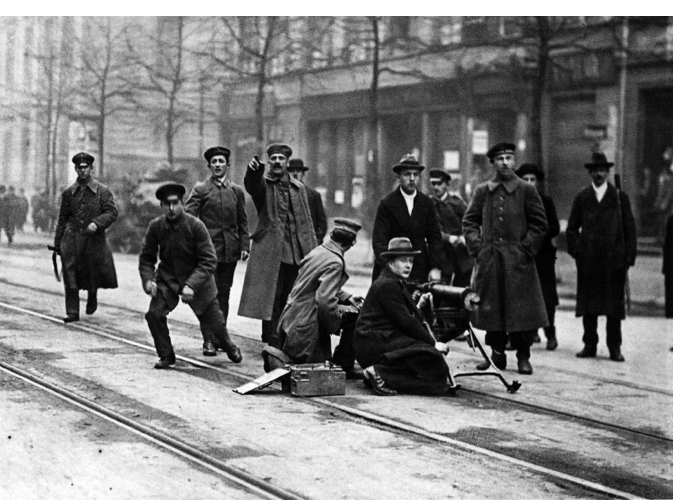
Spartacists in Berlin preparing defensive positions
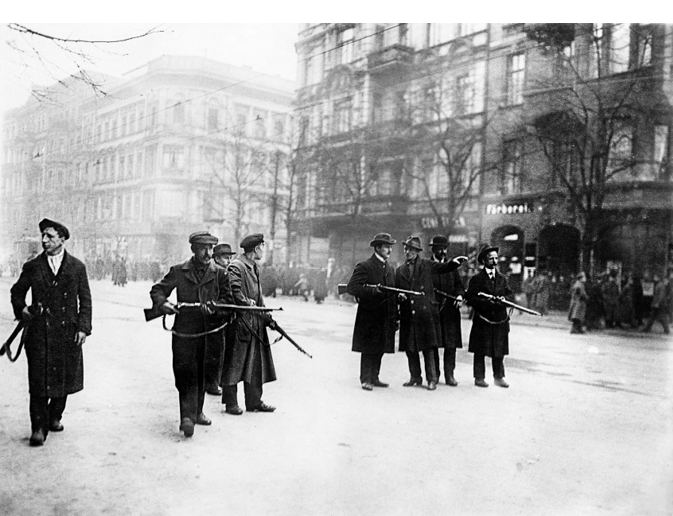
Spartacist irregulars holding a street in Berlin
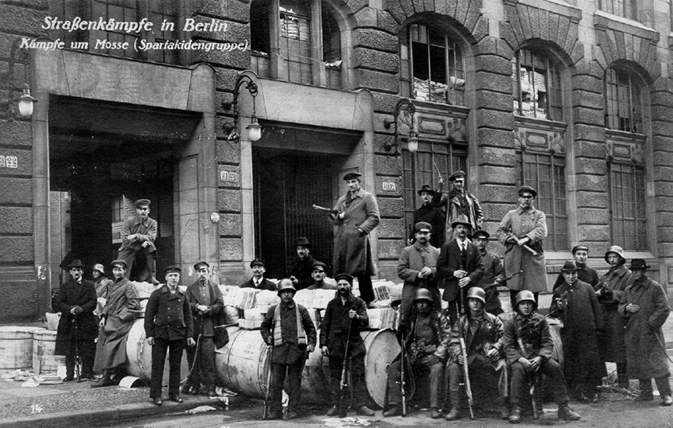
Spartacists form barricades
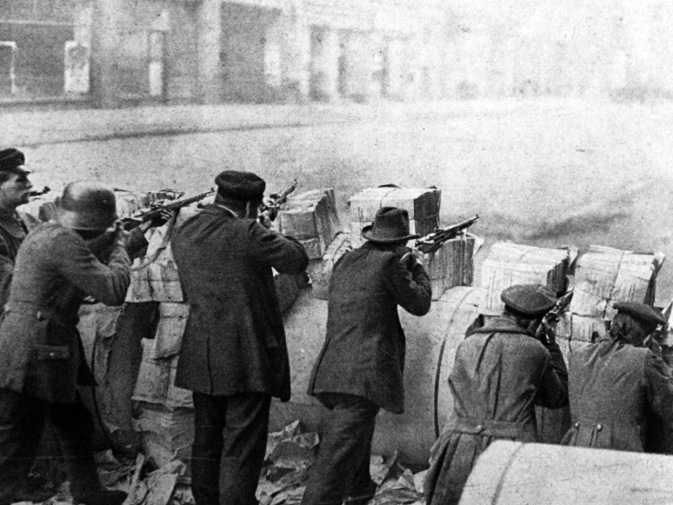
Spartacists behind a barricade made out of newspapers during the uprising
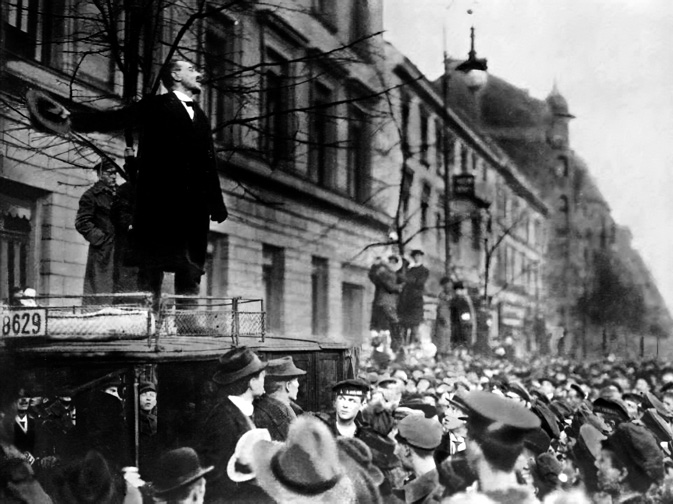
Karl Liebknecht speaking in Berlin in 1919