Chapter Two: In the throes of Revolution
We are all extremely glad that you, comrade Mehring and the other ‘Spartacist comrades’ in Germany are with us, ‘head and heart’. This gives us confidence that the best elements of the West European working class – in spite of all the difficulties – will nevertheless come to our assistance.
Lenin to Clara Zetkin, 26 July 1918
The wind blows the tops of the trees first. The November Revolution of 1918 was no exception; it began as all revolutions do – at the top. The ancien régime was caught between the shocks of world war, the approaching revolution and the rigid demands of autocratic rule.
The impending collapse had signalled the destruction of yesterday’s national ‘unity’ of August 1914, which, as the war wore on, had evaporated like droplets of water on a hot stove.
Violently muzzled and restrained by military censorship, mass pressures were finally bursting through to the surface, like the “old mole of revolution” that Marx spoke about. The whole edifice of the Hohenzollern monarchy began to crumble as the ground, once so solid, shifted under its feet.
Consciousness, which is normally very conservative, was being tested by events and rapidly transformed. The picture quickly changed as all the pent-up contradictions in German society reached a critical state. A sudden movement would bring the whole thing crashing down.
While the old order, weighed down with contradictions, was facing collapse, this did not prevent the ruling elite from desperately clinging to power. Everything was being held together by no more than inertia. No amount of cosmetic changes, soothing words or ‘reforms’ were going to save the situation. The regime’s attempt to extradite itself from crisis simply made matters worse.
On the war front, Germany had experienced some important advances at the beginning of 1918. On 3 March, the Central Powers had just imposed a humiliating treaty on the Russians at Brest-Litovsk, seizing huge swathes of territory including control of Poland, the Baltic States, and the Ukraine. The German attacks of late March produced the most significant gains on the Western Front since 1914. The ‘Ludendorff Offensive’, named after the honoured General Erich Ludendorff, consisted of a series of German military strikes along the Front. It came so near to breaking the Allied line, that Ludendorff tried a second attack. Despite the advantage of troops released from the Russian front, it was not the breakthrough they had hoped for. The Germans were unable to move supplies and reinforcements fast enough to maintain their advance, which soon petered out. “Ludendorff is a man of absolute determination,” Crown Prince Rupprecht noted, “but determination alone is not enough, if it is not combined with clear-headed intelligence.” (H. Strachan, The First World War, p. 286.) Confronted with a counter-offensive supported by one or two million fresh American troops using new artillery techniques, surrender, rather than victory, now stared Germany in the face.
Of course, such a perspective was utterly unacceptable to the German High Command, which refused to accept reality or defeat. Instead, they simply demanded a further 200,000 men each month to ‘make good’ the losses suffered. Between 21 March and 4 April 1918, German forces suffered over 240,000 casualties. It was a futile waste of life. For the generals, it was just a question of greater effort. They demanded ‘more severe internal discipline’ until victory was assured. The war had become a gigantic mincing machine of men and supplies. By the autumn, the situation had grown steadily worse. The defeat at Montdidier on the Western Front on 8 August revealed that military victory was not possible. By the end of the Allied offensive on 4 September, the Germans had sustained 100,000 casualties and the Allies just over 42,000.
The alliance of the Central Powers was starting to come apart. Turkey signed an armistice at the end of October, and Austria-Hungary followed suit. Germany was left increasingly isolated in the face of the renewed Allied onslaught.
Faced with a deteriorating situation, the military chiefs had reluctantly accepted the need to sue for peace, but it was the terms that were in doubt. Although the generals accepted an armistice, they still needed time to prepare for an ‘honourable’ end to the war. Breathing space was required before opening negotiations with the Allies. But this perspective was to prove too optimistic and was quickly overtaken by events, namely the mighty German Revolution. War – not for the first time in history – was turning out to be the mother of revolution. The Hohenzollern regime was coming to an end.
The German autocracy’s eventual demise had similar parallels with the collapse of the tsarist regime in February 1917. As with all doomed regimes, desperate measures were introduced from the top to save the situation, but the situation could not be saved. The strategy facing the ruling clique was expressed in the words of minister Hintze: “we must forestall an upheaval from below by a revolution from above.” (P. Broué, p. 130.) Hintze knew which way the wind was blowing and his words revealed a particularly sharp sense of smell.
“When the house is burning you may have to put out the fire with water from a cesspool, even if it stinks a bit afterwards”, stated Robert Bosch, a trusted friend of minister Haussman, the Secretary of State. In this instance, the ‘cesspool stink’ was democracy, while the services of the Social Democrats were to be used to ‘put out the fire’. (Quoted in S. Taylor, p. 6.)
Prince Von Baden
As a result, General Ludendorff, head of the army, realised that the game was up and was asked to fall on his sword. He was shunted aside and ‘parliamentary’ government was quickly established on 3 October 1918 with the Kaiser’s cousin, Prince Max von Baden, appointed as Chancellor. This was of course nothing more than a swift manoeuvre, a cosmetic change to buy time. “It seemed revolution was at the gates: the choice was to face up to it with dictatorship or with a degree of compliance… Parliamentary government seemed the best defence,” explained General von Hindenburg, after weighing up the former option. (J. Braunthal, History of the International, p. 118.) Dictatorship would, under the circumstances, simply add petrol to the flames. It seemed that there was no alternative to a ‘revolution’ from above.
Partly to appease the masses, the new Imperial government included in its ranks the Social Democrats, Philipp Scheidemann and Gustav Bauer, who greatly relished their new roles as honourable wartime statesmen. These Social Democrats were once again prepared to do their ‘duty’ for king and country, as long as they were granted a seat at the table of the ruling class. With the German Empire clearly on the verge of collapse, the support of the Social Democrats was needed as a left prop to ease the ‘transition’ to stability. In reality, the new ‘liberal’ government of Prince von Baden was hardly distinguishable from the previous one. The faces had changed but the content was just the same.
The new Chancellor rushed off an urgent request to President Wilson in the United States designed to secure “a speedy and honourable peace of justice and reconciliation.” (Quoted in R. Watt, p. 150.) They hoped this road was open to them as they agreed to accept Wilson’s Fourteen Point Peace Programme as a basis for negotiations. But Wilson’s reply, some weeks later – dated 23 October – simply poured cold water on their offer of talks, stating that it was not possible for the Allies to “deal with the military masters and monarchical autocrats of Germany.” The war dragged on. After being shown the note from Wilson, Kaiser Wilhelm exclaimed angrily: “Read it! It aims to overthrow my house, and the complete overthrow of monarchy!” (ibid., p. 32 and p. 151.)
Nevertheless, the ruling class knew full well that certain sacrifices were needed to save themselves and what was left of the old regime. The dilemma was outlined clearly by Konrad Haenisch, a Social Democrat, in a confidential letter to a friend:
The problem is to resist the Bolshevik Revolution, which is rising, ever more threatening, and which means chaos. The Imperial question is closely linked to that of Bolshevism. We must sacrifice the Kaiser to save the country. (P. Broué, p. 144.)
It was either lose the monarch or lose everything. The old regime had no choice but to act swiftly to save itself. On 23 October, the same day as they received the reply from Wilson, the government announced an amnesty for political prisoners. This included Karl Liebknecht, who was greeted on his release by 20,000 Berlin workers. He addressed the crowd, hailing the Russian Revolution and calling for a proletarian revolution in Germany. Lenin sent a message of congratulations to him, which was read out by the Soviet ambassador and diplomat Adolf Joffe.
A week earlier, a demonstration called by leaders of the USPD attracted more than 5,000 workers, who faced police attacks. They marched on the Reichstag demanding, ‘Down with the war; down with the government; long live Liebknecht!’
The Bolsheviks had sent Nikolai Bukharin undercover to Germany to discuss and build links with the Spartacists and the USPD leaders. He even met the revisionist Eduard Bernstein. Bukharin told him: “You are on the verge of revolution.” But Bernstein, the ‘realist’, shook his head and ridiculed the suggestion. (J. Riddell [ed.], The German Revolution, p. 30.)
The government had hoped that concessions would be enough to stabilise the situation, but they were badly mistaken. The Social Democrats had persuaded the government to release Liebknecht as, in their view, it was more dangerous to keep him in prison as a martyr, than set him free. But granting freedom to such a legendary figure was a risky business. Scheidemann, who had supported his release, was subsequently astonished to see Liebknecht carried shoulder high by ‘patriotic’ soldiers who had been awarded the Iron Cross. But this outward public display was nothing more than an expression of the Revolution that was about to shake Germany to its very foundations.
Not surprisingly, Karl Liebknecht was immediately co-opted onto the action committee of the Revolutionary Shop Stewards, the Revolutionäre Obleute, which worked in solidarity with the Spartacists. However, the government’s amnesty did not apply to Rosa Luxemburg, who continued to be held in ‘protective custody’ and not released until the Revolution itself burst open her prison cell on 9 November.
Weeks earlier, as the regime reeled from one crisis to another, steps had been taken to unify the various small revolutionary groups. The initiative was taken by the Spartacists, who organised an underground national conference that was attended by representatives of the Bremen Left. The conference agreed that the subsequent “collapse of German imperialism” had “created a revolutionary situation.” They put forward a programme which included the expropriation of bank capital, the mines, mills, and “all large and medium sized agricultural holdings.” The gathering led to greater co-ordination and they agreed to promote a campaign to set up workers’ councils “where they do not already exist”. They also agreed to fight for the establishment of a German Socialist Republic, “standing in solidarity with the Russian Soviet Republic, and thereby to unleash the world proletarian struggle against the world bourgeoisie for a proletarian dictatorship against the capitalist League of Nations”. (J. Riddell [ed.], The German Revolution, p. 31.) News of the conference reached Lenin in Moscow, who personally wrote a letter of greetings to the participants:
We have had news today that the Spartacus group, together with the Bremen Left Radicals, has taken the most energetic steps to promote the setting up of Workers’ and Soldiers’ Councils throughout Germany. I take this opportunity to send our best wishes to the German revolutionary internationalist Social Democrats. The work of the German Spartacus group, which has carried on systematic revolutionary propaganda in the most difficult conditions, has really saved the honour of German socialism and the German proletariat.
He went on:
Now the decisive hour is at hand: the rapidly maturing German revolution calls on the Spartacus group to play the most important role, and we all firmly hope that before long the German socialist proletarian republic will inflict a decisive blow on world imperialism. (LCW, vol. 35, p. 369.)
Talk of Insurrection
The mood was rapidly changing, especially with the release of hundreds of political prisoners. The weakness of the regime was being openly exposed, so much so that there was talk on the left of an insurrection. While the Social Democrats wanted a ‘reform’ of the state and the establishment of bourgeois democracy, the Spartacists, the Revolutionäre Obleute, and the left-wing Independents were determined to go much further. They wanted a full-blown socialist revolution, the overthrow of the state, and the creation of a German Soviet Republic as a step towards world revolution.
On 2 November, at a joint meeting of the leaders of the USPD and the Revolutionary Shop Stewards in Berlin, an officer from the Second Guards’ battalion was present who placed himself and his unit at the disposal of the meeting for the purpose of an insurrection. He was enthusiastically welcomed by the meeting, which only needed to settle on a date. Hugo Haase, the chairman of the Independent Socialists, who was prone to waver, was now intoxicated at the thought of revolution, and proposed 11 November. Others thought that the date for the seizure of power should be 4 November. Liebknecht, however, was against a premature rising without the necessary preparations. In the end, they agreed to call for a general strike and see how the movement developed afterwards. In the end, the Revolution was to break out on 3 November, earlier than ‘planned’, with the naval mutiny at the northern port of Kiel.
In the period leading up to the Revolution, the regime was split and in the process of disintegration, each proposed change from above only serving to hasten its demise. The government ministers were staring into the abyss and it was impossible to think rationally. All they thought about was saving themselves, but all they succeeded in doing was to open the floodgates. As the celebrated eighteenth-century French historian, Alexis de Tocqueville, once explained: “experience teaches us that, generally speaking, the most perilous moment for a bad government is one when it seeks to mend its ways.”
Trouble started to brew on the war front as the army began to collapse; disaffection spread and desertions became more frequent. During the Ludendorff Offensive, Germany had already suffered more than 300,000 casualties, about one-fifth of available troops. The loss of life continued to mount up on a daily basis. In the autumn, the defeat of the Central Powers was looking increasingly likely. But the heads of the Allied Entente were fearful, not so much of the eventual outcome of the war, as of the outbreak of Bolshevik revolution.
On 18 October, French Foreign Minister Stephen Pichon told Lord Derby, the British Ambassador, that he was disturbed that Germany was on the brink of revolution. “What frightens him [most] is the fact, as he says, that Bolshevism is very contagious…” (A. Read, p. 25.)
Lenin was also very confident that a worldwide revolution was imminent, and he wrote:
In these past few days world history has given tremendous momentum to the world workers’ revolution… The crisis in Germany has only begun. It will inevitably end in the transfer of power to the German proletariat. The Russian proletariat is following events with the keenest attention and enthusiasm. Now even the blindest workers in the various countries will see that the Bolsheviks were right in basing their whole tactics on the support of the world workers’ revolution. (LCW, vol. 28, pp. 100-102.)
These prophetic words were written on 3 October 1918, exactly one month before the mutiny at Kiel and the beginning of the German revolution.
Generals Ludendorff and Hindenburg of the Supreme Military Command, the effective dictators of wartime Germany, took measures to deflect blame for Germany’s approaching defeat away from themselves. On 28 October 1918, the German High Command, without informing the Chancellor, demanded immediate action. They ordered a decisive naval battle in the North Sea, which, if successful, would sever all British communications with the Continent and alter the balance of forces. They thought that such a brave endeavour, whatever the outcome, would save the ‘honour’ of Germany. “Better an honourable death than a shameful peace,” the naval officers were reported as saying. But this reckless gamble would put in peril the lives of tens of thousands of sailors.
Feelings were already running high among the crews who serviced the battleships, cruisers and destroyers anchored in the Baltic sea ports. The news of the Russian Revolution had already had its effect amongst the sailors. When the orders came to launch the North Sea offensive, it provoked demonstrations and a mutiny. The men on the battleships Thüringen and Helgoland refused to raise anchor for what they described as a ‘death cruise’, a mission without rhyme or reason. The mutiny then rapidly spread as sailors disarmed their officers and took control of the ships. Naval Command at once ordered that the mutinous ships be retaken by crack naval troops. The mutiny was finally put down and the 600-strong crews were rounded up to face immediate court martial. Rather than put an end to the disturbances, it served to set off a chain reaction. Immediately, men at Kiel and Wilhelmshaven refused to provision the ships or put out to sea. This in turn set off a major revolt that quickly escalated into a full-scale mutiny involving the entire German fleet of 100,000. The whole situation rapidly changed from a revolt into a revolution.
Mutiny Spreads
The revolutionary uprising spread to the workers onshore, who immediately set up workers’ councils, stormed the prisons and released the inmates, many of whom were political prisoners. Hamburg, Lübeck, Bremen and Cuxhaven were directly affected. Posters supporting the uprising and putting forward political demands appeared everywhere. They not only called for peace but, according to a police report, “the destruction of militarism, the ending of social injustice and the overthrow of the ruling class.” (S. Taylor, p. 6.)
Jan Valtin,1 a member of the Spartacist League of Youth, relates what happened in his autobiography Out of the Night:
That night I saw the mutinous sailors roll in to Bremen in caravans of commandeered trucks – red flags and machine guns mounted on the trucks. Thousands milled in the streets. Often the trucks stopped and the sailors sang and roared for free passage. The workers cheered, particularly a short, burly young man in grimy blue. The man swung a carbine over his head to return the salute. He was the stoker who had hoisted the first red flag over the fleet. His name was Ernst Wollweber…
I circled toward the Brill, a square in the western centre of the town. From there on I had to push my bicycle through the throngs. The population was in the streets. From all sides masses of humanity, a sea of swinging, pushing bodies and distorted faces was moving toward the centre of the town. Many of the workers were armed with guns, with bayonets, with hammers. I felt then, and later, that the sight of armed workers sets off a roar in the blood of those who sympathise with the marchers. Singing hoarsely was a sprawling band of demonstrating convicts freed by a truckload of sailors from Oslebshausen prison, most of them wore soldiers’ grey coats over their prison garb. But the true symbol of this revolution, which is really nought but a revolt, were neither the armed workers nor the singing convicts – but the mutineers from the fleet with their reversed headbands and carbines slung over their shoulders, butts up and barrels down…
At the foot of the Roland statue a frightened old woman crouched. “Ach du liebe gott”, she wailed piercingly “what is all this? What is the world coming to?” A huge-framed young worker who gave intermittent bellows of triumph and whom I had followed from the Brill, grasped the old woman’s shoulders. He laughed resoundingly. “Revolution”, he rumbled. “Revolution, Madam.” (J. Valtin, Out of the Night, pp. 9-10.)
The date of the German Revolution is normally given as 9 November 1918. But the real impetus to revolution had begun on 3 November, when the workers and sailors mutinied at Kiel, where much of the fleet was based. This was followed by the sailors at Wilhelmshaven and Hamburg. It was then that the dam broke, and the masses began to pour onto the scene.
A left radical sailor, Ernst Schneider describes the scene at Wilhelmshaven as follows:
On their return to their ships and barracks some of the comrades heard the heavy tramp of marching troops. Shots were fired, and the cry went up, “down with the war” … Continuing towards the battleship Baden, it was seen that the small units had also been taken over by the revolutionary sailors. On board the Baden they elected a new commander. He was a member of the committee. (E. Schneider, The Wilhelmshaven Revolt: A Chapter of the Revolutionary Movement in the German Navy 1918-1919.)
It was the date when the battleship König had also provocatively raised the imperial flag, and mutineers opened fire until it was replaced with the red flag. Now the entire fleet flew the red flag of rebellion. Ashore, the sailors began to hunt down their officers, many of whom were caught, stripped of their insignia and thrown into prison. Others simply fled the scene.
Twenty thousand sailors and workers surged through the streets, stormed the armouries, seized the weapons and released prisoners. On their own initiative the revolutionaries established a Workers’ and Sailors’ Council, which took control of the town. The speeches of revolutionary agitators were met with roars of approval from crowded assemblies. The revolutionary mood was highly infectious. In the night, workers and sailors carrying torches swept through the narrow streets singing the ‘Internationale’, meeting with no resistance as they went on with their business. The following day, power was firmly in the hands of the workers in this naval stronghold. Nothing moved or happened without their permission.
The historian, Richard Watt, writes:
In the centre of the town, a huge sailor directed traffic wearing a red sash around his waist, into which he had stuck eight officers’ dirks [daggers] and two pistols. He carried a rifle and around his neck he wore the Pour le Mérite, Germany’s highest military decoration, which he had snatched from a famous submarine captain. (R. Watt, pp. 166-167.)
Revolution Spreads
The Völkische Zeitung of Schleswig-Holstein wrote:
The Revolution is on the march. What has happened in Kiel will happen in other places during the next few days, giving impetus to a movement which will traverse the whole of Germany. (Quoted in A.R. Oliveira, p. 93.)
On 4 November, the flames of revolution continued to spread, characterised by red flags flying over official Imperial buildings. On 6 November, Sailors’, Soldiers’ and Workers’ Councils had now taken power in Hamburg, Bremen and Lübeck. On 7 and 8 November, Dresden, Leipzig, Chemnitz, Magdeburg, Brunswick, Frankfurt, Cologne, Stuttgart, Nuremberg, and Munich all followed suit. In Brunswick, the chairman of the Workers’ and Soldiers’ Council, August Merges, a member of the Spartacist League, assumed the title of President of the Socialist Republic of Brunswick. Its government was composed of eight ‘People’s Commissars’. However, it was not until 9 November, the official date of the revolution, that Workers’ and Soldiers’ councils were established in Berlin, the capital, at none other than the Supreme Army headquarters! For their own protection, the military started to go about in civilian clothes, while the bourgeoisie stayed indoors.
Paul Frölich, a Spartacist, at the head of a group of armed sailors, occupied the offices and print-works of the daily Hamburger Echo and proceeded to publish the first paper of the Workers’ and Soldiers’ Council of Hamburg, entitled Die Rote Fahne, (The Red Flag). He summed up the universal feeling:
This is the beginning of the German Revolution, of the world revolution. Hail the most powerful action of the world revolution! Long live socialism! Long live the German workers’ republic! Long live world Bolshevism! (P. Broué, p. 142.)
The German revolution was also spurred on with the news that revolution had broken out in Austria, where the old regime had been overthrown and a Provisional government was formed under the Social Democrat, Karl Renner, with Victor Adler as Foreign Secretary and Otto Bauer as his deputy. The soldiers had established a Soldiers’ Council and deputies were elected from every garrison to a National Executive, which called for the setting up of an Austrian Socialist Republic. Braunthal, who was at that time a member of the Austrian War Ministry, wrote:
The same trend of feeling which moved the soldiers was operating among the workers. They were also strongly affected by the Bolshevik temptation, and they, too, would have preferred a Soviet Austria. (Millennium, p. 230.)
But, in the end, the ‘Austro-Marxists’ would act no better than the German Social Democrats or the Mensheviks in Russia.
The British journalist Morgan Philips Price, who worked for the Manchester Guardian, travelled to Berlin to write an eyewitness account of the revolution. His account provides a glimpse of the mood at the time, especially of the ordinary soldiers:
At Eyktunen I passed through the German customs, which was run by common soldiers only. During the journey through East Prussia soldiers boarded the train, turned the officers out of the compartments and made them stand in the corridors. The trains were packed with troops returning home, and the atmosphere became more revolutionary as I approached Berlin, which I reached after six days’ journey. (Dispatches from the Weimar Republic, p. 21.)
“Events at Kiel, Lübeck, Altona, Hamburg and Hanover have as yet passed off fairly bloodlessly,” wrote Count Harry Kessler, whose Royal title now counted for little. “That is the way all revolutions start.” He then went on to offer his opinion: “The thirst for blood grows gradually with the strains involved in setting up the new order… The shape of the revolution is becoming clear: progressive encroachment, as by a patch of oil, by the mutinous sailors from the coast to the interior. Berlin is being isolated and will soon be only an island…” In fact, the bloodshed was not introduced by the revolution, which met no resistance, as the Count relates. Only fifteen people lost their lives in Berlin on 9 November. The bloodshed was introduced by the brutality of the counter-revolution that was to later sweep Germany, led by the infamous Freikorps.2 It was not long before the ‘patch of oil’ did reach Berlin, as it spread throughout the whole of Germany.
On 4 November, Gustav Noske, an SPD deputy, had arrived in the port of Kiel, having been sent by an alarmed government eager to exert some calming influence over the town. However, Noske was soon recognised by the crowd, which sparked unexpected uproar and was carried shoulder high by boisterous workers and soldiers. In the vain hope of exercising some influence, he was forced to go along with the wishes of the insurgents, and even to accept the position of Kiel’s revolutionary governor. On 5 November he broke the news by telephone to Berlin: “I have been obliged to accept the post of governor and have already had some success.” (R. Watt, p. 181.) So as not to undo this ‘success’, he pleaded with Berlin not to send troops. He admitted later, “I had to work hard at Kiel to prevent the formation of red troop detachments.” (B. Fowkes [ed.], p. 232.) For the moment, all Noske could do was to mollify the revolutionaries. Later, he would send the Freikorps to restore order in the most violent manner.
The ‘liberal’ cabinet of von Baden met in emergency session on 7 November, with the SPD ministers increasingly shocked by the spread of anarchy. “We have done all we can to keep the masses on the halter,” stated Scheidemann. (S. Taylor, p. 8.) But far more was needed to subdue the revolution and these leaders proved to be willing and obedient tools.
Workers’ and Soldiers’ Councils
With the collapse of the old state apparatus, power had fallen into the hands of the armed workers, sailors and soldiers. As in Russia in 1905 and 1917, the masses set up workers’ councils or Soviets, the embryos of workers’ power. No party or group had called them into being; they were simply a spontaneous creation of the masses brought to their feet by the revolution. The Arbeiter und Soldaten Räte (the workers’ and soldiers’ councils) were genuine grassroots organisations, which were established wherever workers and soldiers were present and organised. In a display of working-class democracy, factories and workplaces elected their own representatives at the point of production.
The author Evelyn Anderson explained:
During the first days of the November Revolution, workers’ and soldiers’ councils were elected in all workshops, mines, docks and barracks. The people were in motion. Wherever crowds assembled, they nominated spokesmen and elected delegates, who were to speak and act on their behalf as their direct representatives. This happened all over the country. (E. Anderson, p. 43.)
This was the basis of workers’ democracy. Unlike bourgeois democracy, where you could, to paraphrase Marx, choose every five years which members of the ruling class were going to misrepresent you in Parliament, the delegates from these Councils were directly accountable and subject to immediate recall. Delegates were under the control of mass meetings where everyone was allowed to have their say. No one was elected for life or was in a privileged position. As there were no privileges, there was no careerism. Depending on the democratic will, representatives could be immediately replaced with others who were more in tune with the majority feeling. This was genuine proletarian democracy in action.
As Lenin explained:
[T]he Soviets, as the organ of struggle of the oppressed masses, reflected and expressed the moods and changes of opinion of the masses ever so much more quickly, fully, and faithfully than any other institution (that, incidentally, is one of the reasons why Soviet democracy is the highest type of democracy). (V. Lenin, The Proletarian Revolution and the Renegade Kautsky, LCW, vol. 28, p. 271.)3
The Councils or Soviets were the most flexible and democratic system ever devised. They were elected, not on the basis of geographical constituencies, but in factories, offices, farms and other places of work. It was a prime example of what Rosa Luxemburg called mass spontaneity and workers’ self-expression. It was a product of the masses in action. As Ernst Däumig explained:
[T]he storm of November 1918 saw workers’ and soldiers’ councils emerge all over Germany, spontaneously and without any preparation. The revolution created its own expression with elementary force. (Quoted in G. Kuhn, p. 51.)
If democracy means the rule of the majority, then the Soviets fitted this description perfectly. The will of millions, expressed through tens of thousands of workers’ assemblies, was far and away more democratic than any bourgeois parliament. As Broué explains:
They took upon themselves powers at every level, those of the judiciary as well as of the legislature or the executive, in accordance with the very character of soviet power. (The German Revolution, p. 162.)
Events were moving very quickly and the situation of ‘dual power’ coloured everything. The Revolution had given birth to workers’ and soldiers’ councils throughout the country, which dispensed orders, directives and instructions. Not a wheel turned, not a whistle blew, without their say-so. The revolution was like a strike, but on a massive scale. Workers who were on strike would elect strike committees, the revolutionary masses elected their workers’ councils. Within a short space of time their responsibilities and functions expanded, as their duties further encroached upon those of the old state. In some areas they even set up their own armed force, red guard or police, as in Frankfurt-am-Main, Hamburg, Düsseldorf and Halle.
In Berlin, new revolutionary committees were being set up. A Berlin Executive Committee of Workers’ and Soldiers’ Councils had been established, which acted as a national centre for the Councils that had been thrown up throughout the country. In the absence of any elected parliament or assembly, this body was the most representative national body in existence.
Hate It Like Sin
The head of the government, Prince Max von Baden, looking for points of support, approached Ebert, the Social Democrat, and asked: “If I should succeed in persuading the Kaiser [to abdicate], do I have you on my side in the battle against the social revolution?” Ebert replied: “If the Kaiser does not abdicate the social revolution is inevitable. I do not want it – in fact I hate it like sin.” (R. Watt, p. 183.)
As the ancien régime collapsed around him, the Kaiser was determined initially to hang on to his crown. But he had lost touch with reality. Armed soldiers were roaming the streets of Berlin, but still the Kaiser dithered, and refused to abdicate.
“The Kaiser must abdicate, otherwise we shall have a revolution,” fretted the Social Democrats. (ibid., p. 184.) Max von Baden needed to act fast as the Social Democrats, under growing pressure, were forced to resign from the government. The time for talking was over.
The armed mass demonstrations in Berlin terrified von Baden so much that he decided to tender his resignation as Chancellor with immediate effect, and hand over the reins of government to the right-wing Social Democrats. But before departing, very astutely, he pondered the options that confronted the ruling class:
The revolution is on the verge of winning. We cannot crush it but perhaps we can strangle it… if Ebert is presented to me from the streets as the people’s leader, then we will have a republic; if it is Liebknecht, then Bolshevism. But if the abdicating Kaiser appoints Ebert as Reich Chancellor, then there is still a little hope for the monarchy. Perhaps it will be possible to divert the revolutionary energies into the legal channels of an election campaign. (J. Riddell [ed.], The German Revolution, p. 40.)
Ebert, on behalf of the Social Democrats, replied to Prince von Baden’s offer: “For the preservation of peace and order… we regard it as indispensable that the office of Imperial Chancellor and the Brandenburg command be held by members of our party.” (R. Watt, p. 195.) Baden quickly agreed, believing this would be the best outcome.
Ebert Becomes Chancellor
For his part, Ebert was prepared to become Chancellor “within a monarchical constitution,” but needed to consult the others leaders. They would have agreed, but they were placed in an impossible position. As the editor of Vorwärts explained, “We wanted to save the monarchy, but if someone called ‘Long live the Republic!’ there was nothing left for us to do but call with them.” (ibid., p. 184.)
Without any further delay, Prince Max von Baden pre-empted the Emperor’s decision by announcing the abdication on his behalf. Uninformed and bewildered, Wilhelm was astonished to hear the news of his downfall second-hand. By the 9 November, the monarchy was at an end, and the next day the Kaiser, bags packed, was at the Dutch border. He did not formally recognise his abdication until nearly three weeks later, possibly hoping that someone had made a dreadful mistake.
The power vacuum had to be filled urgently with a safe pair of ‘reformist’ hands. And as willing servants, the Social Democratic leaders were thus thrust into power. The SPD leader’s first act as Chancellor was to ask Prince von Baden to accept the Regent’s office, hoping to maintain a constitutional monarchy. But the prince was not keen to seize hold of a poisoned chalice and so gracefully declined. He departed with the final words, “Herr Ebert, I commit the German Empire to your keeping.” (ibid., p. 199.)
Of course, as a good Social Democrat, Ebert had made no secret of his undying support, not for the revolution, but for the Hohenzollern monarchy. He had hoped that the abdication of the Kaiser would have been replaced by some form of regency, but the revolution put an end to this idea.
This episode clearly revealed the whole psychology of Ebert and the Social Democratic leaders. Their aim was the establishment of a bourgeois democracy, with or without a monarchy, where they would play the role of loyal democrats.
Ebert began to piece together a new government. He was astute enough to realise that he needed a ‘left’ cover if he was to succeed. Therefore, in his proclamation he announced: “The Kaiser has abdicated; his eldest son has renounced the throne. The Social Democratic Party has assumed responsibility for government,” but he had additionally “invited the Independent Social Democratic Party to join it on a wholly equal basis.” (J. Riddell [ed.], The German Revolution, p. 44.)
An all-socialist government would be formed, hoping it would be enough to stem the tide of revolution. Ebert, as Chancellor, would always keep the left wing in check. His first act was a direct appeal to the revolutionary masses, not to urge them on, but to calm them down:
Fellow Citizens! I invite you to help us in our difficult task, for you all know to what extent the food supply of the people is in danger. It is the primary duty of everyone to remain in the fields or the towns, and not to place obstacles in the way of the production of food or of its transport to the cities. The lack of food means misery for all. The poorest would suffer terribly, and the industrial workers would endure unheard-of hardships.
Fellow Citizens! I beg of you leave the streets. A city of law and order! (Vorwärts, 9 November 1918, special edition, quoted in A.R. Oliveira, p. 95.)
But the masses did not stay away from the streets. On the contrary, after the factories had been saturated with leaflets calling for an insurrection, meetings were held and workers began marching to the centre of Berlin. Groups of socialists had occupied the Post Office, the Telegraph building, the Wolff Agency, the Military Command and the Palace. As described by Pierre Broué:
“The day which Marx and his friends described all their lives had come at last”, explained E.O. Volkmann. “The Revolution was on the march in the capital of the empire. The firm tread, in step, of the workers’ battalions echoed in the streets. They came from Spandau, from the workers’ districts, from the north and east, and marched towards the city centre, the symbol of imperial power. To the fore were Barth’s assault troops, revolvers and grenades in their hands, with the women and children preceding them. Then came the masses in tens of thousands, radicals, Independents, Majority Socialists, all mingled together.” (P. Broué, p. 146.)
Long Live the Republic!
As the masses assembled, Scheidemann, the other Majority Socialist leader and the Prince’s Vice-Chancellor, was eating soup in the Reichstag restaurant when he heard loud cries from the enormous crowds that had encircled the Reichstag building. While Liebknecht and the Spartacists were setting themselves up in the Royal Palace, ready to proclaim a workers’ republic, Scheidemann stepped in. Later he wrote: “I saw the Russian madness before me, the replacement of the tsarist terror by the Bolshevist one. No! Not in Germany.” (A. Read, p. 32.) From the balcony, so as to gain the support of the ranks of the assembled workers below, he announced the news that Ebert had now agreed to become Chancellor of a socialist government.
These enemies of the people are finished forever. The Kaiser has abdicated. He and his friends have disappeared; the people have won over all of them, in every field. Prince Max von Baden has handed over the office of Reich chancellor to representative Ebert. Our friend will form a new government consisting of workers of all socialist parties. This new government may not be interrupted in their work, to preserve peace and to care for work and bread. Workers and soldiers, be aware of the historic importance of this day: exorbitant things have happened. Great and incalculable tasks are waiting for us. Everything for the people. Everything by the people. Nothing may happen to the dishonour of the labour movement. Be united, faithful, and conscientious. The old and rotten, the monarchy has collapsed. The new may live. Long live the German Republic! (J. Riddell [ed.], The German Revolution, pp. 41-42.)
Following Scheidemann’s intervention, Karl Liebknecht then climbed onto the Reichstag balcony and made a proclamation on behalf of the Spartacist League, which ended with the call for a German Socialist Republic:
The rule of capitalism, which turned Europe into a cemetery, is henceforward broken. We remember our Russian brothers. They told us when they left: “If within a month you haven’t done as we did, we shall break you.” It only took four days. We must not imagine that our task is ended because the past is dead. We now have to strain our strength to construct the workers’ and soldiers’ government and a new proletarian state, a state of peace, joy and freedom for our German brothers throughout the whole world. We stretch out our hands to them, and call on them to carry to completion the world revolution. Those of you who want to see the free German Socialist Republic and German Revolution, raise your hands! (P. Broué, p. 149.)
Amongst the assembled masses, a sea of hands was raised in favour of revolution. Shortly afterwards, a symbolic red flag was hoisted on the Emperor’s flag pole.
As soon as Ebert had found out that Scheidemann had proclaimed the Republic he was furious. According to Scheidemann’s memoirs:
Ebert went red in the face with anger when he heard of my act. He struck the table with his fist and shouted at me “Is this true?” When I replied that it was not only true but was the obvious thing to do, he made such a scene that I stood speechless. “You have no right to proclaim the Republic!”, he shouted.
“What becomes of Germany – whether she becomes a republic or something else – a national assembly must decide.” (J. Braunthal, History of the International, p. 122.)
The revolutionary tide was sweeping aside all before it and the proletariat was on the move, with or without a national assembly. In Berlin, the forces at the police headquarters surrendered to Emil Eichhorn’s left-wing supporters, handing over their weapons, and installing Eichhorn of the USPD as the new chief of police. The jails were thrown open and hundreds of prisoners were set free, including Leo Jogiches, the Spartacist organiser. Another, Rosa Luxemburg, was also released from Breslau prison. On that day, the Reichstag building surrendered without a shot being fired. If the masses had wanted to, they could have taken power peacefully at this time, but they lacked a revolutionary leadership.
The revolutionary fervour gripping the masses did not slacken, despite the appeals of the Social Democratic leaders, but increased. The wife of Prince von Blücher, horrified by the spectacle, described the scene in her diary:
Across the compact masses of the moving crowd big military lorries urged their way, full to overflowing with soldiers and sailors, who waved red flags and uttered ferocious cries. They were evidently trying to excite the workers to violence. These cars, crowded with young fellows in uniform or mufti, carrying loaded rifles or red flags, seemed to me characteristic. These young men constantly left their places to force officers or soldiers to tear off their [imperial] badges and took the task upon themselves if they refused… About two hundred of these big lorries must have passed beneath our windows in two hours. (R. Watt, p. 197.)
The revolution had conquered the streets and workers and soldiers could feel the potential power in their hands. The old state, gravely weakened, was helplessly suspended in mid-air. But the masses, as with their Russian counterparts after February 1917, were not fully conscious of their power. They had set up soviets or councils in every factory, barracks, and workplace. If they had been completely conscious of their power, they could have easily swept away the old order and established a workers’ state in the centre of Europe. Their instincts told them that this was the direction they should take.
Traditional Parties
However, in the vast majority of cases, the revolutionary workers looked to the leaders of their traditional parties, the SPD and USPD, for a way forward. The misdeeds and betrayals of the past were forgotten, or at least put aside. There was a powerful instinctive feeling amongst the workers for unity. While they gave enthusiastic support to the slogans of the Spartacists, the broad masses awakened by the revolution, did not differentiate between the rival socialists. They tended to adhere to their old parties, which had served them well in the past.
Out of sheer loyalty, hundreds of thousands of workers stuck to their old party which they had helped to build, no matter how violently they disagreed with its policy… loyalty to his organisation has become a matter of instinct to the worker. (E. Anderson, pp. 36-37.)
Again, as in Russia in February, the revolutionaries were in a small minority. The Mensheviks and Social Revolutionaries initially dominated the soviets in Russia, while the Bolsheviks were relatively isolated. Lenin adopted a policy of ‘patient explanation’, as experience and events would win over the workers. In Germany, it was the Majority Socialists and Left Independents who dominated the Councils, Soviets in all but name, while the Spartacists were a tiny minority. In fact, at the beginning of the revolution, they only had around fifty members in Berlin. It would take great events and a direct experience of the actions of the reformist leaders before the balance would change. In the short-term, despite the role of the SPD leaders who actually opposed the revolution, the masses remained faithful to their traditional organisations. In this context, the USPD, which also had a significant following, played an important but secondary role.
Richard Müller, the leader of the Berlin Shop Stewards, observed:
Social Democrats were elected as members of the workers’ councils who the day before had been driven out of the factories with blows because they would not join the general strike. (S. Taylor, p. 8.)
On 10 November, a meeting of the Berlin Workers’ and Soldiers’ Councils, in the presence of 3,000 delegates, officially proclaimed itself the representative of the revolutionary people. Furthermore, in the absence of an elected government, it took the decision to appoint a Council of People’s Commissars under the control of the Executive Council. This was a clear reference to the experience of the Russian Revolution.
However, the only problem was that Ebert had already been appointed the head of the Imperial government by Prince von Baden the previous day. In addition, the Majority Socialists vehemently rejected any suggestion that they should be accountable to the Council’s Executive Committee, calling it ‘unconstitutional’. The ministers were members of the government and a power unto themselves, as there was no constitution in existence. This meant nothing to the masses. However, the leaders of the SPD and the USPD had come to an agreement to set up a six-member cabinet, which adopted the name ‘Council of People’s Representatives’ (Rat der Volksbeauftragten). This was then ratified by the Berlin Workers’ and Soldiers’ Council. The first German socialist government consisted of Ebert as Chancellor, responsible for Army and Interior ministry; Haase for Foreign Affairs and Colonies; Scheidemann for Treasury; Dittmann for Demobilisation and Health; Landsberg for Press and Information; and Barth for Social Policy.
‘Their Government’
The Ebert government was viewed by the majority of workers as a government of the revolution. For the Workers’ Councils, it was ‘their’ socialist government, appointed by them.
The workers in the factories, who had developed a collective consciousness, were more politically advanced than the soldier masses, returning from the trenches. The workers were more organised and were in tune with the revolutionary mood and its aspirations. They tended to look towards the Independent Socialists, but were also open to the agitation of the Spartacists. The soldiers, on the other hand, who were in the process of being demobilised, were more under the influence of the SPD leaders. They proved to be more dominant in the councils outside of Berlin.
The headquarters of the Executive Council was installed in the building of the Prussian Landtag, the state parliament, in effect, the heart of the revolution, and was subjected to its daily pressures, while the Council of People’s Commissars operated in a separate building, surrounded by former bourgeois ministries and advisers, the heart of the counter-revolution, which suited Ebert.
Rather than clear out the Augean stables of the old regime, purge the civil service of their monarchist trappings and replace them with trustworthy socialists and democrats, the government chose to rely on a discredited bureaucratic apparatus, the leftovers of Prince Max von Baden. Such ‘technical assistants’ included men such as General von Schëuch at the War Ministry and Dr. Solf at Foreign Affairs, who carried great influence in the corridors of power. Government ministers soon came increasingly to rely upon these figures, pillars of the old establishment.
However, given the impact of the revolution, the government tried to balance between these competing forces. It simultaneously rested on the apparatus of the old ruling class but it also had to take account of the power of the Workers’ Councils. This peculiar development was a direct product of the ‘dual power’ situation existing in the country. The revolution had given birth nominally to a government, but that same government was forced to look in two directions, one facing towards the workers, while the other faced towards the bourgeoisie and the army. In practice, the new Social Democratic government was the continuation of the government of von Baden and the old regime, but it was forced to cover itself with the cloak of revolution, including its phrases, take the name of Council of People’s Commissars, and seek to embroil the Independent Socialists in the responsibilities of government.
As a result of Ebert’s offer, the Executive Committee of the USPD went into emergency session to discuss the party’s proposed entry into the new government. They were under pressure to join such a government, not least from the SPD-dominated workers’ and soldiers’ councils. They initially decided to stipulate certain conditions, firstly, that Germany should be a Socialist Republic, but such conditions were soon brushed aside. Eventually, the Independent Socialists agreed to enter the government “to safeguard the gains of the socialist revolution”. Liebknecht had been offered a place in this new cabinet as part of the USPD, but, despite strong pressure and a strong feeling for workers’ unity, he turned down the offer.
People’s Commissars
In the end, the government was composed exclusively of members of the two socialist parties: three Majority Socialists (SPD): Friedrich Ebert, Philipp Scheidemann, Otto Landsberg; and three Independent Socialists (USPD): Hugo Haase, Wilhelm Dittmann and Emil Barth. Barth was incidentally the only leader of the Shop Stewards who could be persuaded to serve in the government.
Once formed, under pressure from the mass movement, the ‘Council of People’s Representatives’ (Rat de Volksbeauftragten) did not wait for a National Assembly before issuing a number of decrees. On 12 November, the new government issued a proclamation addressed to the German people: “The government which has emerged from the revolution, the political leadership of which is purely socialist, has set itself the task of putting into effect the socialist programme.” It issued nine points with immediate legal effect which included the right of assembly, freedom of expression, abolition of censorship, amnesty for political offences, provisions to protect labour and other reforms. Above all, it stipulated that “a maximum working day of eight hours will enter into force on 1 January 1919.” (B. Fowkes [ed.], p. 17.)
The German bosses had no other choice but to make concessions – despite their previous opposition – as a result of the pressure of the revolution. They therefore had no alternative but to come to an agreement with the trade unions on 15 November, which included union recognition, the setting up of factory committees in enterprises of more than fifty workers, the introduction of collective agreements, as well as the eight-hour day with no loss of pay. For now, the employers were forced to stomach these concessions until such time as they could be taken back.
On the same day, as concessions were granted to workers, a government telegram was sent to the German High Command, which in part read:
Officers’ disciplinary authority remains in force. Unconditional obedience while in service is of decisive importance if the army’s return to the German homeland is to succeed. Military order and discipline in the army must therefore be maintained under all circumstances… Their highest duty is to work to prevent disorder and mutiny. (J. Riddell [ed.], The German Revolution, p. 52.)
This message to the High Command made it clear that they had the full backing of the new government and against any signs of ‘disorder’. They knew it was in the army that the real power lay.
While the ‘socialist unity’ government of Ebert talked in radical terms, even promising socialisation of certain industries, its aim was not the overthrow of German landlordism and capitalism, but the introduction of measures to stabilise the situation. The inclusion of the Independent Socialists allowed the right Social Democrats to lean on the masses and provided Ebert a ‘left’ cover for his actions. ‘Independent’ ministers had very little independence, but operated largely under the shadow of right-wing ministers. As Ebert remarked, “Democracy is the only rock upon which the working class can erect the edifice of Germany’s future.” (B. Fowkes, p. 15.) But this rock left intact the power of the ruling class.
The SPD loudly trumpeted their achievements in the press and in propaganda posters:
Already, in only a few days!
A people’s republic. Equal suffrage. Women’s suffrage. The right to vote at twenty years.
All dynasties and royal courts have vanished. A Socialist national government.
Workers’ and Soldiers’ councils everywhere. The privileged House of Lords eliminated. The three-class parliament dissolved.
Freedom of assembly. Freedom of association. Freedom of the press. Freedom of religion.
Militarism smashed. Dismissal of personages from the past. Soldiers’ salaries increased.
The eight-hour day. The law on servants abolished. Workers and employers have equal rights.
So much has already been gained. Much more must still to be achieved.
Close your ranks. Do not let yourselves be divided.
Unity!
(J. Riddell [ed.], The German Revolution, p. 54.)
Nobody could deny these were important gains of the revolution, but militarism had not been eradicated and the power of the old regime was still in place. These reforms were the inevitable by-product of the revolution itself. The capitalists were forced to grant big concessions or face the likely overthrow of capitalism.
Despite these reforms, Liebknecht and Luxemburg demanded the completion of the revolution and the establishment of a German Workers’ Republic, but they were in a minority.
New Breed
Over the previous period, people like Friedrich Ebert, Gustav Noske and Philipp Scheidemann had gradually risen to the top of the Social Democratic Party. It was like scum rising to the top of a stagnant pool. As opportunists, they had adapted themselves well to the new conditions. Ebert had been appointed general secretary of the party in 1906 and then took over as party chairman on the death of August Bebel in 1913. He was an up and coming party functionary who had ambitions for the party as well as himself. Such individuals were very much from the revisionist school, in words as well as deeds.
For this new breed of right-wing Social Democrats, bourgeois democracy was the only road to sovereign government. Over the years, their minds and instincts had become increasingly conservative. They had become in essence nothing more than liberal democrats who still happened to call themselves ‘socialists’ for old times’ sake. They saw their role in November 1918 as putting a brake on the revolution, which they regarded as full of extremes and ‘excesses’. There was a need to re-establish ‘law and order’ as quickly as possible. In fact, Ebert’s first proclamation as Chancellor to the German people was an appeal for exactly that – calm and law and order.
A close friend of Ebert’s was once asked, “Did not Ebert and Scheidemann experience a secret pleasure on this day [9 November] at the outbreak of the revolution?” “Oh, no,” was the answer, “not at all. They were seized with deadly fear.” (R. Watt, p. 219.) This was an accurate description of these ‘leaders’.
Their role in government was driven precisely by this ‘deadly fear’. An indication of the depths they were prepared to go to was revealed when Ebert rejected an offer of grain from the Soviet government in favour of an offer of American grain. While the Soviet offer came with no conditions, the US offer of help came with strings attached: food shipments would be guaranteed “on condition that public order in Germany is genuinely re-established and maintained.” In other words, if the revolution continued, the grain would be cut off. But the French newspaper Le Temps revealed: “It was not Mr. Wilson who thought up the condition that he set. It was urged on him by the German Reich Chancellor himself.” (J. Riddell [ed.], The German Revolution, p. 66.)
The right-wing Social Democrats increasingly acted as a mouthpiece of ‘law and order’, behind which stood the capitalists and the military chiefs. They were willing collaborators of the most reactionary section of society, namely the High Command of the Imperial Army. Of course, this treacherous collaboration was carried out in secret behind the backs of the party membership, who were far to the left of these so-called leaders. While the Left openly welcomed the workers’ councils, the Right detested them. Ebert, Scheidemann and the others were determined to sweep them away.
The right wing were quite prepared to use the forces of the old regime, irrespective of the bloodshed, to achieve this aim. However, Ebert understood very well that the government could not use these forces immediately. They had to bide their time for fear of provoking the masses. Therefore, rather than dispatch the Freikorps to crush the sailors and workers at Kiel, they sent the Social Democrat, Gustav Noske, to contain the situation until the movement had exhausted itself. In Berlin, the unfortunate Scheidemann had to put a brave face on the humiliation of being paraded shoulder-high by revolutionary soldiers. They had no alternative but to accept things until ‘normality’ was restored and the revolution subsided. “We have done all within our power to keep the masses in check,” stated Scheidemann. (R. Watt, p. 183.)
Ebert and the Generals
Most ordinary Social Democratic members had no trust in the General Staff and were in favour of some kind of people’s army. This was especially the case with the soldiers’ councils. Of course, this was an anathema to the generals. As a result, the new ‘socialist’ government did not dare to demobilise the Imperial Army and organise new republican armed forces for fear of alienating the General Staff.
When Ebert, as Chancellor, met with General Groener to seek assurances of the loyalty of the armed forces, Groener explained that loyalty came with a price:
The officer corps could only co-operate with a government which undertook the struggle against Bolshevism. The officer corps expects that the Imperial government will fight against Bolshevism and [therefore] places itself at the disposal of the government for such a purpose.
Ebert concurred, simply saying: “convey the thanks of the government to the Field Marshall.” (ibid., p. 200.) The deal was done, but it was clear that the real power rested with the generals.
Some years later, general Groener shrewdly related what had happened:
We made an alliance against Bolshevism… There existed no other party which had enough influence upon the masses to enable the re-establishment of a governmental power with the help of the army. (P. Broué, p. 169.)
Behind Ebert stood the old order masquerading as ‘democrats’, and behind them stood the Freikorps, the reactionary dregs of society. The velvet glove of ‘democracy’ covered over, for the moment, the mailed fist of a threatening dictatorship.
What Kind of Democracy?
While the paramount aim of Ebert, Scheidemann, and the other Social Democratic leaders was the calling of a National Assembly and the establishment of a bourgeois democracy, the Spartacist League fought to transfer power to a national congress of workers’ and soldiers’ councils and to create a genuine socialist workers’ republic. For the reformist leaders, this was Bolshevism, the very thing they wanted to eradicate; they therefore worked energetically to divert the movement into harmless constitutional channels.
As the immediate threat of revolution began to subside, the German bourgeoisie and their political representatives, who yesterday had solidly supported the autocracy, now came forward as ardent ‘democrats’. They had changed their monarchist colours for republican ones, anything to save the system. “I am no Socialist, but a democrat. I always was,” said Prince Leopold. “Only the black, red, and gold flag4 can save us,” said Herr Wulle, who later became a leader of fascism. “I submit to the authority of the government, which I will support with all my power,” explained Prince Adalbert of Prussia. “Only a government chosen by impeccable methods ensuring the triumph of the people’s will can have any authority,” stated the former pro-monarchist Deutsche Tageszeitung, which prior to 11 November 1918 had the subtitle, “for the Kaiser and the Reich!” (A.R. Oliveira, p. 114.)
The bourgeois parties were reorganised and renamed, so as to give them a ‘democratic’ image. The old Conservative Party, for example, full of monarchists and restorationists, reappeared under the title of ‘German National People’s Party’, while the former Catholic Centre Party emerged as the ‘Christian People’s Party’. They knew which way the wind was blowing and changed their colours accordingly. In turn, they put their full weight behind the call for a National Assembly, which would be used to usher in parliamentary elections and render the workers’ councils superfluous.
The question of calling a Constituent or National Assembly naturally gave rise to a bitter controversy, where the right and left took diametrically opposing sides. For or against the calling of a National Assembly became the central argument. The revolutionary left were vehemently against. In the words of Richard Müller, “The way to the National Assembly leads over my dead body!” (E. Anderson, p. 46.) The Majority Socialist leaders, with equal determination, were very much in favour of the National Assembly. The slogan of the Social Democratic paper Vorwärts was not ‘All power to the soviets!’ but ‘All power to the people!’
Historically, in its struggle with the Junker autocracy, the demand for such a National Assembly, along with a Republic, had been a traditional part of the programme of German Social Democracy. Even Engels, in his criticisms of the Erfurt Programme of 1891, did not suggest that it was wrong, only that it did not go far enough. Amongst the broad masses, who detested the old regime, there was a natural support for a democratic assembly or parliament.
But events had turned out differently. The November Revolution had thrown up another revolutionary power in the form of the workers’ and soldiers’ councils, which in Russia had become the basis of workers’ self-rule. Therefore, the Spartacists strongly opposed the convening of a National Assembly, arguing instead for a government of workers’ and soldiers’ councils or Räterepublik. Such a soviet republic would, in their view, be based upon representatives not elected on a geographical basis, but in the factories, offices and workplaces, involving those who toiled. The Soviet Republic in Russia provided a living example of such a system of proletarian rule and it was this road that the Spartacists wanted the German workers to follow.
The Problem of the National Assembly
The question of the National Assembly stuck in the throats of the revolutionaries like an unwanted fish bone. The Spartacists were vehemently opposed in principle, no matter what the decision of the Congress of Workers’ and Soldiers’ Councils. For them, it was a question of do or die.
When Karl Radek arrived in Germany in mid-December 1918, after illegally entering the country, he was shocked by the shrill tone of their propaganda:
Dirty and ragged, I feverishly bought a copy of Rote Fahne. As I drove to the hotel I looked the paper over. I was seized with alarm. The tone of the paper sounded as if the final conflict were upon us. It could not be more shrill. If only they can avoid overdoing it! …
It was the question of how to relate to the National Assembly that sparked controversy… It was a very tempting idea to counter-pose the slogan of the councils to that of a National Assembly. But the congress of councils itself was in favour of the National Assembly. You could hardly skip over that stage. Rosa and Liebknecht recognised that… But the party youth were decidedly against it, “we will break it up with machine guns”. (Quoted in J. Riddell [ed.], The German Revolution, p. 159 and p. 162.)
Lenin had constantly warned the communists against running too far ahead of the masses. The revolutionary party needed to maintain its links with the mass movement and this required flexible tactics. He explained that it was one thing to have a fully worked-out theoretical position and another to apply it to concrete conditions. This, after all, was the essence of Bolshevism.
While in Germany, the call for a National Assembly was still linked, in the eyes of the masses, with revolutionary aspirations and democracy, in Russia it turned out differently. In Russia in early 1918, when the soviets, the real democratic organs of the masses, had already carried through a social transformation, the National Assembly was seized on by the landlords, capitalists, and supporters of the ‘White’ generals as a vehicle for counter-revolution. With a completely changed relationship of forces, the formal ‘democratic’ rights of a counter-revolutionary National Assembly could not be allowed to threaten the socialist revolution.
The choice then was either that the Constituent Assembly would endorse the decisions of the Congress of Soviets or the body would be dissolved, as Oliver Cromwell had done with the English Parliament. In the event, given its refusal to endorse soviet power, it was dissolved and, as with Cromwell’s dissolution, ‘not a dog barked’.
The dissolution of the Constituent Assembly had nothing to do with the fact that the Bolsheviks and their supporters were in a minority. Even if they had won a majority in the Constituent Assembly elections, they would have taken a vote to dissolve the body in favour of the Soviets. The Assembly by this time was superfluous to the needs of the revolution.
Under the conditions prevailing in Germany in 1918, where the working class had not yet taken power, the question of the National Assembly was posed in an entirely different way. With the masses supporting the National Assembly, it was necessary to march shoulder to shoulder with them, participating in the elections while offering a revolutionary programme of action.
Renegade Kautsky
The dissolution of the Constituent Assembly in Russia led to fierce condemnation of the Bolsheviks, especially by the reformist leaders abroad. The most vocal of these critics was Karl Kautsky, who had, in the summer of 1918, denounced the Bolsheviks and refused to recognise the soviets as the organs of workers’ democracy and self-rule. For him, they were only ad-hoc ephemeral organisations. In his book, The Dictatorship of the Proletariat, he deliberately twisted the ideas of Marx about workers’ self-rule, omitting his idea of the dictatorship of the proletariat and the lessons of the Paris Commune. Kautsky argued from the standpoint of a bourgeois liberal in favour of ‘democracy’ in the abstract. He was answered very forcefully in a rebuttal by Lenin in his book The Proletarian Revolution and the Renegade Kautsky, where he argued against the distortions of Marx in relation to the state, and explained that ‘democracy’ was itself a form of class rule. Democracy was not simply ‘democracy’, but a class question: you can have bourgeois democracy or workers’ democracy, based on opposing class interests.
Lenin explained:
Bourgeois democracy, although a great historical advance in comparison with medievalism, always remains, and under capitalism cannot but remain, restricted, truncated, false and hypocritical, a paradise for the rich and a snare and deception for the exploited, for the poor. (V. Lenin, The Proletarian Revolution and the Renegade Kautsky, LCW, vol. 28, p. 243.)
The victorious Russian workers could not use the old tsarist state machine, which needed to be done away with, but needed to create a new semi-state that would represent their own class interests, and suppress any attempts by the bourgeoisie to restore its rule.
In Germany, Kautsky’s argument deliberately ignored the irreconcilable class interests represented by the workers’ and soldiers’ councils on the one hand, and the bourgeoisie, reflected in the Ebert government, on the other. Kautsky was not willing to recognise the situation of ‘dual power’ that had arisen after the November revolution. Instead he argued not for workers’ rule but the need to combine the workers’ councils with the bourgeois state. “Therefore, it is not a question of national assembly or workers’ councils, but both,” he argued. (J. Riddell [ed.], The German Revolution, p. 101.) But this was impossible as their interests were as incompatible as fire and water. The situation in Germany meant that either the workers’ and soldiers’ councils would consolidate their position and lay the basis for a workers’ democracy, or the German bourgeoisie would re-establish its power and thereby dissolve the councils. There was no middle road.
National Congress of Councils
Finally, on 16 December, the National Congress of the Workers’ and Soldiers’ Councils was held in Berlin. It was to be a key turning point in the Revolution and was to last five days until 21 December 1918. Delegates attended from all over Germany, on the basis of one representative per 1,000 workers and one delegate per battalion. The rules for the election of delegates, however, were left to regional bodies, which resulted in a Congress that was, in many ways, out of step with the proletarian centres. The soldiers’ councils also tended to lag politically behind the organised proletariat in the factories. More importantly, of the 488 delegates, only 187 were waged workers, while ninety-five delegates were party or trade union full-time officials, mostly from the SPD. This certainly coloured its outlook and eventually affected its decisions. Out of the 488 delegates in attendance, 289 supported the SPD, ninety the USPD (including ten Spartacists) and ten the Bremen Lefts. The Majority Socialists also exploited the desire for unity, which affected large layers, especially of the politically inexperienced mass.
“The first All-German Congress which opened here on Monday,” wrote Morgan Philips Price, “in respect of the balance of parties, resembles the first All-Russian Soviet Congress in June 1917.” (M. Philips Price, Dispatches, p. 22.)
This domination of the Majority Socialists proved decisive. After a heated debate, the Congress came out strongly in support of the calling of a National Assembly and demanded that its opening should be brought forward to 19 January, 1919. This was a blow to the revolutionaries, whose slogans were having an increasing echo in the working class. It now looked as if the revolution was slipping through their fingers.
The proposal to establish a soviet republic was outlined by Heinrich Laufenberg, the chairman of the Hamburg Workers’ and Soldiers’ Council and supported by Ernst Däumig, from the Revolutionary Shop Stewards. In his speech, Laufenberg uncompromisingly argued that:
The old system of government collapsed on 9 November. It must be replaced by the system of workers’ and soldiers’ councils. This is where power must lie, the power that we have conquered for ourselves.
He went on:
If we proceed from this assumption, Germany can be reconstructed on the basis of the governmental power created by the Revolution, the workers’ and soldiers’ councils. We call it a ‘Socialist Republic’ but as yet that is merely a decorative title. We no longer have a monarchy, but we don’t yet have a republic. The socialist state formation still needs to be created… What we have done so far is only the first step.
He then warned:
[I]n the first few days of the revolution the bourgeoisie was too terrified to do anything. Now it is emerging from all corners. (B. Fowkes [ed.], pp. 48-49.)
But other delegates, including the soldier delegates, strongly argued for the rapid convening of a National Assembly to consolidate – in their eyes – the important gains of the revolution. Even Ebert, on behalf of the government, was allowed to speak and throw his weight in favour of the National Assembly.
The Congress was deeply under the influence of the SPD, which had paradoxically, inherited the leadership of the revolution, a revolution which Ebert and Scheidemann opposed. The growing support for the Spartacists was reflected in the mass demonstration of Berlin workers outside on the streets, but not in the delegates inside the Congress. With few delegates supporting the Spartacists, the only hope they had of influencing the Congress was with pressure exerted from outside. The demonstration was called explicitly in support of a soviet republic and was attended by an impressive 240,000, which was notably larger than the one called by the SPD, whose supporters dominated the Congress. This confirmed the comments of Paul Frölich, the Spartacist, who said that, compared to inside, the “social reality outside the Congress doors was very different.” It reflected the fact that the capital was politically more advanced than the provinces, while the provinces provided a counterweight to the feelings of ‘Red Berlin’, where the USPD had influence. It also reflected the weight of the more conservative soldier representatives, compared to those from the factories.
This was one of the reasons why the Spartacists had a limited following in the workers’ and soldiers’ councils, which was mainly confined to Brunswick and Stuttgart – and they had no one on the Executive of the Councils in Berlin. Nationally, such bodies were dominated by the Majority Socialists, who were the equivalent broadly of the Mensheviks and Social Revolutionaries in Russia.
While the Congress heard Ebert, as head of the government, call for the power of the councils to be transferred to a National Assembly, the proposal submitted by the Stuttgart Council to allow Liebknecht and Luxemburg to attend with speaking rights was rejected by a considerable majority. Again, this reflected the more conservative layers in attendance. While this was a setback, it did not prevent the mass Spartacist demonstration outside sending a delegation to present its views to the Congress. Their representatives strongly demanded “all power to the workers’ and soldiers’ councils” and the replacement of the Council of People’s Representatives, including Ebert, with an elected Executive Committee of the councils as “the highest legislative and governmental body.” (J. Riddell [ed.], The German Revolution, p. 142.)
The Congress, however, took a more conservative line. After a heated debate, it voted to support a parliamentary democracy rather than a soviet republic. In fact, out of those present, only ninety-eight delegates were in favour of the call for a soviet republic. The Congress went on to endorse by an overwhelming majority, the proposal to turn its powers over to the new government until the election of a National Assembly, which should be brought forward from 16 February to 19 January 1919:
The General Congress of the Workers’ and Soldiers’ Councils of Germany, holding all power in the country, transfers the legislative and executive authority to the Council of People’s Delegates until an elected national assembly will establish a new division of power.
The General Congress of the Workers’ and Soldiers’ Councils of Germany shall also appoint a Central Council of the Workers’ and Soldiers’ Councils whose task it will be to monitor the German and the Prussian cabinets. This Central Council will take on the role of parliament. It has the right to monitor the people’s delegates of Germany and – until the new political structure will be finalized – the people’s delegates of Prussia.
To monitor the ministries, the Council of People’s Delegates will appoint assistants to the state secretaries. Two assistants will be sent to each ministry, one from the SPD and one from the USPD. Before appointing the ministers and their assistants, the Central Council has to be consulted. (Quoted in G. Kuhn, pp. 73-74.)
This proposal was passed by a massive 344 votes to ninety-one. It was to effectively bring the early first stage of the revolution to a close. With the dissolution of the Executive Council, a new Central Council was elected in its place, which became a puppet of the government. Accordingly, the Independents chose to boycott it, which effectively eliminated all opposition.
This caused the Revolutionary Shop Steward, Ernst Däumig, to remark that the workers’ and soldiers’ councils had voted their own “death sentence”. (J. Riddell [ed.], The German Revolution, p. 144.) Paul Frölich concurred:
With this the workers’ and soldiers’ councils had committed political suicide and appointed the bourgeoisie their heir. (Rosa Luxemburg, pp. 307-308.)
Frölich, however, was very much on the ultra-left of the movement. In fact, the Spartacists, left-wing Independents and others went so far as to organise protests and meetings against the decisions of the Congress. The cry went up: “We have been cheated! Once more into the streets!”
The weakness of the revolutionary wing, however, meant that, with these decisions, the die had now been cast. The Congress of Workers’ and Soldiers’ Councils had refused to establish a soviet republic. While opposing the decisions, this should have been a signal to the Spartacists to modify their tactics towards the National Assembly, which was definitely going to take place. Rather than continue to denounce it, they should have agreed to participate in it and argued for the acceptance of a revolutionary programme from within. But they refused to go down this road.
Tactical Mistake
There is a great difference between recognising the need for soviet power and the ability to deliver it. The revolution would not be carried through to a conclusion by simply denouncing those in favour of a National Assembly. All this did was to alienate those who regarded the Assembly as a stepping stone to a democratic republic. The Spartacists regarded the National Assembly as a betrayal of the revolution, which could only succeed through the transfer of power to the workers’ councils. But the masses did not fully understand this, especially the more politically backward layers. All they wanted was an end to autocratic rule and the introduction of democracy. The frustrations of the Spartacists, who could see the victory slipping away, were pushing them to make a tactical mistake. As long as large sections, especially of the soldiers, looked to a National Assembly, it was incorrect for them to reject on principle any idea of a struggle around it.
The illusions of the masses in a National Assembly could not simply be dismissed or denounced. Such illusions could only be dispelled on the basis of events, and, in the first instance, it was necessary for the revolutionaries to go through the experience with them.
Instead, the leaders of the SPD and the USPD were denounced as “disguised agents of the bourgeoisie” for supporting an Assembly, a policy that failed to connect with the masses, especially the ordinary Social Democratic workers. Rosa Luxemburg called the National Assembly a “cowardly detour” and “an empty shell”, which it undoubtedly was. (J. Riddell [ed.], The German Revolution, pp. 92-93.) But the masses regarded it differently. The more conservative or traditional sections saw it as an embodiment of their wishes. The National Assembly was certainly a ‘detour’ in the context of the proletarian revolution, but there existed no straight line to victory, especially in the absence of a mass revolutionary party. Later, Luxemburg came out in favour of participating in this ‘empty shell’, on a revolutionary basis.
While the arguments for a soviet or Räte Republic had been vital in the early stages of the German Revolution, when the masses were directly open to revolutionary ideas, as soon as it became clear that the National Assembly was going to become a reality, the Spartacists should have made a tactical change. Rather than opposing the National Assembly outright, they could have combined their approach: arguing for a soviet republic, but stating at the same time that if the Assembly elections were to take place, they would participate and put forward a revolutionary alternative.
‘We have done away with the reactionary monarchy, and we have established political liberty,’ is what they should have said, explaining, however, that the only way they could safeguard their victory was if they were to break the power of the enemies of democracy, who were the enemies of progress. They should have argued for a revolutionary government that would expropriate the landed estates, banks and basic industries, under workers’ control. The state would need to be purged and renewed with reliable representatives of the people. Such a programme should have been carried through by the workers’ and soldiers’ councils, but as these were not willing to do so, then it should have been posed as a demand on the workers’ parties in a revolutionary National Assembly. The main task was to explain the need to urgently implement the revolutionary programme. Only in this way could the problems of the working class be solved.
Unfortunately, the majority of Spartacists took an ultra-left approach, as did the Bremen Left – who even walked out en bloc from the Dresden Workers’ and Soldiers’ Council as they could not be associated with the ‘counter-revolutionary elements’ of the SPD. This was a huge mistake, which served no purpose, only to further isolate their forces. It was a clear case of ‘infantile leftism’, which Lenin criticised so forcefully. Although members of the revolutionary left were courageous class fighters, they lacked a clear understanding of strategy and tactics. It is true that Rosa Luxemburg attempted to curb their excesses, but even she found this very difficult. They were being swept along by the revolutionary movement and were intoxicated by events. Unfortunately, they had not gone through the rich school of Bolshevism, which had prepared the Bolsheviks to skilfully win a majority and lead the working class to power.
Socialisation
Later on, the national Congress of Workers’ and Soldiers’ Councils debated the issue of nationalisation or the ‘socialisation of the economy’, which was one of the key demands of the November Revolution. Of course, the government, while not directly opposing the measure, tried to steer it into safe channels with the proposal to set up a Commission to study the question. For the government, the longer it could be delayed the better. Rudolf Hilferding, who supported the proposal, tried to discourage the idea of immediate nationalisation:
It’s [the economy’s] productive capacity is practically in ruins, and the working class has been weakened by undernourishment and crippled by the war. All these circumstances render the task of socialisation uncommonly difficult. This does not mean that the undertaking is impossible; but it does mean that we need longer to complete it. Our first task is to set the economy in motion again.
Hilferding continued: “We cannot take over the whole of industry at one stroke… I am convinced that the idea of simple confiscation would be incorrect.” He instead argued for a wealth tax that “would yield copious amounts, and it would achieve as much as we might attain, unevenly and incompletely, by confiscation.” (B. Fowkes [ed.], pp. 24-25.)
Hilferding’s gradualist approach was opposed later in the debate by his fellow USPD comrade and government minister, Emil Barth, who called for “socialisation not in months but in a few short days.” Despite his forceful intervention, Hilferding’s cautious line was endorsed by the Congress majority, again a reflection of the composition and mood of the delegates. Of course, all future promises of socialisation were very quickly forgotten about and were never to see the light of day.
The decision again showed how out of step with the mood within the wider working class the majority of the Congress was. They were lagging behind the real mood, especially in the factories. In fact, the deeper down you went into society, the more radical the mood was. However, there was one question that the delegates took a very radical, if not revolutionary, stand on. This was the character of the army. This certainly reflected the influence of the soldier masses attending the Congress, who were far more revolutionary on issues that directly affected them.
While the majority of the Congress were influenced by the SPD, their politics were far from ‘conservative’, especially over this question. The mass demonstration which converged on the Congress demanded, among other things, the democratic transformation of the army. This time it struck home and the Congress debate shifted dramatically to the left. In the end, the Congress supported almost unanimously the Seven Hamburg Points, a bill of rights for democratising the military. The soldiers and workers were as one in agreeing a resolution demanding: (1) the abolition of the standing army and the establishment of a people’s militia, (2) that all badges of rank be removed, (3) that all soldiers be allowed to elect their officers with immediate right of recall, and furthermore (4) soldiers’ councils would be responsible for the maintenance of discipline throughout the armed forces. Moreover, higher ranks should not to be recognised outside the Service.
The implementation of these points, especially the one calling for a ‘People’s Army’, would have constituted a revolution in the armed forces, and immediately destroyed the power of the reactionary officer caste. The SPD ministers, led by Ebert, desperate to reassure General Groener that the resolution was meaningless, was instead faced with an officers’ revolt. The officer caste could not tolerate such interference in the armed forces. As expected, the Social Democrats capitulated to the generals and refused to carry out this decision of the Congress. Instead, they set out to establish even closer links with the German High Command. To further this relationship, they flagrantly defied the demands and decisions of the Congress, which was at the time the highest political authority in Germany. ‘Democracy’ only suited them when it was in their interests to do so.
But Wilhelm Dittmann warned Ebert:
If the Central Committee [of the Workers’ and Soldiers’ Councils] agrees to General Groener’s proposals [to ditch the Hamburg Points], it will sign its own death warrant, and so will the government.
Yet Ebert was not moved by such threats. He showed nothing but contempt towards the councils and the revolution, which he compared to a lunatic asylum:
Things cannot go on like this. We are making ourselves ridiculous in the face of history and the whole world… The conduct of the Reich’s affairs is exclusively a matter for the government… Workers’ and soldiers’ councils all over the country must stop interfering and poking around in government matters… We can take no responsibility for pranks that belong in the madhouse. (Quoted in ibid., pp. 52-53.)
Left-Wing Communism
The ultra-left tendencies within the revolutionary left were not confined to Germany. Lenin had to deal many times with such tendencies within the young Communist parties internationally. This was the reason he wrote his book ‘Left-Wing’ Communism: An Infantile Disorder, precisely to deal with this question in the light of the experiences and history of Bolshevism. In order to educate the new fresh layers gravitating towards communism, Lenin explained: “Tactics must be based on a sober and strictly objective appraisal of all the class forces…” He continued, “It is very easy to show one’s ‘revolutionary’ temper merely by hurling abuse at parliamentary opportunism.” (LCW, vol. 31, p. 63.)
More seriously, it was necessary to take into consideration the existing consciousness and outlook of the working class:
You must not sink to the level of the masses, to the level of the backward strata of the class. That is incontestable. But, at the same time, you must soberly follow the actual state of the class consciousness and preparedness of the entire class (not only of its commonest vanguard), and of all the working people (not only of their advanced elements).
In dealing directly with the German ‘Left’ communists’ attitudes towards the National Assembly, he explained:
We must not regard what is obsolete to us as something that is obsolete to the class, to the masses… How can one say that ‘parliamentarianism is politically obsolete’, when ‘millions’ and ‘legions’ of proletarians are not only in favour of parliamentarianism in general, but are downright [according to the German Lefts] ‘counter revolutionary’!? It is obvious that parliamentarianism is not yet politically obsolete. It is obvious that the ‘lefts’ in Germany have mistaken their desire, their political ideological attitude, for objective reality. That is the most dangerous mistake for revolutionaries to make. (LCW, vol. 31, p. 58.)
Lenin felt it essential to keep a finger on the pulse of the working class so as to achieve the best results from the party’s propaganda. The illusions of the masses could not be overcome by simply repeating abstract ideas. It was necessary to put forward a correct programme that would connect with the workers.
Of course, this did not concern the sectarian, who would be content to shout from the side-lines. The communists, in contrast, would seek to engage with the working class, taking their aspirations and illusions into account. This did not mean fostering such illusions, but to use them as a starting point, so as to challenge them. As the Communist Manifesto explained, the communists do not set up any sectarian principles of their own by which to shape or mould the proletarian movement. They distinguish themselves by bringing out the common interests of the proletariat as a whole. They are the most advanced sections which have a clear line of march. They are not separate, but an integral part of the movement.
The attempt to boycott the National Assembly when the masses were overwhelmingly in favour of participation was clearly wrong; it was an attempt to cover over their impotence with radical-sounding gestures. There was a long history of this boycott tactic within the Bolshevik Party from which to learn. In general, the only time to boycott a parliament is when you are strong enough to replace it, otherwise it is pointless. The Bolsheviks had made a mistake, for example, in supporting a boycott of the Duma in 1907, when the revolution had clearly ebbed. Lenin fought against this boycott, arguing it was more correct under the circumstances to utilise every legal opportunity to advance the revolutionary cause. But he was in a minority of one and even voted with the Mensheviks to secure its rejection. Barring a revolutionary wave against the government, which was absent, there could be no successful outcome of a boycott. Under the circumstances, the Bolsheviks needed to use every opportunity, however small, which also meant participating in a reactionary Duma. Later, the Bolsheviks came over to Lenin’s position and the boycott question was forgotten. This lesson had clear relevance for Germany.
A boycott of the National Assembly under the conditions in Germany in December 1918 and January 1919 could only guarantee the isolation of the revolutionaries from the masses who looked to the Assembly. This was particularly so when universal suffrage was being introduced for elections at national and local level. In the end, despite the boycott campaign, a massive eighty-three per cent of the population participated in the vote of January 1919, a far bigger percentage turnout than at any time in the previous history of Germany.
Similarly, the Spartacists also demanded ‘Down with the Ebert Government’, a slogan that in the circumstances was incorrect, and was likely to lead to adventurism. They were still a small minority and it would have been far better to have placed demands on the socialist government. This was the method of the Bolsheviks, who demanded initially not the immediate overthrow of the Provisional Government, but to kick out ‘the ten capitalist ministers’ and for a majority Soviet government to peacefully carry through the revolution. Lenin had warned against the misuse of such a slogan in Russia on 22 April (5 May) 1917:
The slogan ‘Down with the Provisional Government’ is an incorrect one at the present moment because, in the absence of a solid (i.e. a class conscious and organised) majority of the people on the side of the revolutionary proletariat, such a slogan is either an empty phrase, or, objectively, amounts to attempts of an adventurous character. (LCW, vol. 24, pp. 210-211.)
He went on to explain that the tasks of the Bolsheviks were: (1) To explain the proletarian line; (2) To criticise the petty-bourgeois policy; (3) To carry on propaganda and agitation; (4) To organise, organise, and once again organise.
The Provisional Government must be overthrown, but not now, and not in the usual way. We agree with Comrade Kamenev. But we must explain. It is this word that Comrade Kamenev has been harping on. Nevertheless, this is the only thing we can do. (LCW, vol. 24, p. 246.)
This was only six months before the Bolshevik revolution, and it would have been very sound advice for the young German communists, who needed to adopt not a shrill tone, but a sober attitude to the mass movement.
Lenin fought against any traits of putschism or Blanquism5 within the Bolshevik Party, which would only have served to isolate and endanger the party. The party’s main task was to win a majority to their side by patient explanation, and not by ultra-left talk which could seriously miseducate the cadres and disorientate the party. Again, on 24 April (4 May) 1917, Lenin wrote:
What can be more absurd and ridiculous than this fairytale about ‘civil warmongering’ on our part, when we have declared in the clearest, most formal and unequivocal manner that all our work should be focused on patiently explaining the proletarian policy as opposed to petty-bourgeois defencist craze with its faith in the capitalists? (LCW, vol. 24, p. 207.)
Once again, in summing up the whole experience of Bolshevism in ‘Left-Wing’ Communism, Lenin reiterated the flexible tactics that the Bolsheviks needed to pursue in order to guarantee success.
At the beginning of the period mentioned, we did not call for the overthrow of the government but explained that it was impossible to overthrow it without first changing the composition and the temper of the Soviets. We did not proclaim a boycott of the bourgeois parliament, the Constituent Assembly, but said – and following the April (1917) Conference of our party began to state officially in the name of the party – that a bourgeois republic with a Constituent Assembly would be better than a bourgeois republic without a Constituent Assembly, but that a workers’ and peasants’ republic, a Soviet republic, would be better than any bourgeois-democratic, parliamentary republic. Without such thorough, circumspect and long preparations, we could not have achieved victory in October 1917, or have consolidated that victory. (LCW, vol. 31, p. 31.)
Unfortunately, it was the failure of Luxemburg and Liebknecht to train the Spartacist cadres sufficiently in such strategy and tactics that allowed the ultra-left elements to hold a disproportionate sway over the Spartacist League. However, we should be careful in apportioning too much blame to Liebknecht and Luxemburg, as for much of the war they were either in prison or in ‘protective custody’. Nevertheless, these weaknesses would lead to serious consequences.
On 11 November 1918, the Spartacists had formally changed their name from the Internationale Group to the Spartacists League and they opened up negotiations with the Revolutionary Shop Stewards and the USPD for joint work. Although they had a much wider influence than their membership, they were still a small group. The task was still how to win over a majority, and this required skilful tactics and a certain flexibility, which they lacked at the time.
Counter-Revolution Raises Its Head
After the first flush of the November Revolution, the German High Command, in connivance with Ebert, made plans to occupy Berlin with a number of hand-picked divisions of ‘loyal’ troops to establish a reliable and ‘firm government’. Berlin was considered as being in the grip of anarchy by the right-wing ministers that needed to be pacified. General Groener later explained:
A scheme was hatched where ten divisions were to march into Berlin to take power from the workers’ and soldiers’ councils. Ebert was in agreement with this… We worked out a programme for cleaning up Berlin and the disarming of the Spartacists. (Quoted in C. Harman, The Lost Revolution, p. 58.)
An attempted military coup took place on 6 December 1918, when reactionary troops marched on the Chancellery, proclaiming Ebert as President. At the same time, another group stormed the House of Deputies and arrested the members of the Greater Berlin Executive Council of Workers’ and Soldiers’ Councils, the majority of whom were Left Independents.
Hermann Müller wrote:
This coup was planned in support of the Ebert-Haase government to counter the campaign of the Spartacist group. The leading spirit, a certain Spiro, who was neither socialist nor communist, had called on Ebert some days previously with other members of his regiment, and had said that he would demonstrate with the soldiers in favour of the government. Spiro did his best to obtain Ebert’s consent, but the latter considered such a manifestation unnecessary and explained to his visitors the desirability in such cases of workers taking their part with the soldiers. In spite of the Chancellor’s recommendations, however, Spiro got his own way – a proof that reaction was still abroad. (Quoted in A.R. Oliveira, p. 100.)
While Ebert refused the Presidency under these circumstances, the coup was already in motion. Groups of government soldiers had raided the Spartacist newspaper Rote Fahne, arrested Liebknecht and attacked a Spartacist-led demonstration, killing sixteen workers. Spontaneously, this provoked a massive backlash. A gigantic crowd of angry sailors and workers marched on the troops, freed the executive members and foiled the coup attempt.
Rote Fahne proclaimed:
Workers, soldiers, comrades! The Revolution is in danger! …
Preserve your handiwork of 9 November! … The criminals are Wels6 and company, Scheidemann, Ebert and company… Throw the guilty men out of the government! … We must foil the conspiracy of Wels, Ebert and Scheidemann. The Revolution must be saved… Down with the coward organisers of mutinies! … Forward to the task! To the fight! (Quoted in ibid., pp. 100-101.)
However, the editorial of the SPD newspaper Vorwärts of 8 December 1918 played down the events, and even blamed the Spartacists for staging a provocation:
The supporters of Spartacus know, however, that an attempted coup would have no prospect of success, and that even in the wholly improbable event of its succeeding, a Liebknecht-Luxemburg government wouldn’t even last three days because it would have the whole nation against it.
The paper then went on to put the blame elsewhere:
The declaration of the Reich government which was affixed to the columns yesterday gives in brief the results of the investigation made of Friday’s events. It emerges from this that a couple of petty officials of the Foreign Office with high-sounding aristocratic names set in motion this impertinent pseudo-coup. They are the ones who led the soldiers astray. One hardly knows what to be more amazed at: these gentlemen’s lack of scruples or their incomprehensible stupidity. The harm they have done is immense. The Social Democratic government is taking pains to work in co-operation with the officials of the old regime, and an obvious prerequisite for this is naturally those officials’ obedience to superior authority. (B. Fowkes [ed.], pp. 22-23, emphasis in original.)
This mealy-mouthed response to a coup showed how far the Social Democrats leaned upon the elements of the old regime. Seizing the opportunity, the Spartacists organised mass demonstrations and even strikes against the attempted putsch, much to the dismay of the ‘socialist’ government. The feeling of anger amongst the Berlin workers was palpable and was reflected by the 150,000 strong armed demonstration called on 8 December. The Spartacists issued an urgent appeal:
Workers, soldiers, comrades! Attention! The revolution stands in great danger! Be on your guard! Our most vital interests are at stake! Everything for the revolution and socialism!
Everything – even life! Defeat the attack! Down with the conspirators! Long live socialism! The future, the final victory will be ours! (J. Riddell [ed.], The German Revolution, p. 117.)
Groener’s troops – the shock troops of the counter-revolution – began to arrive in the capital, greeted by Ebert. It was hoped he would restore order. But within a short space of time, things began to unravel. The ordinary soldiers began to fraternise with the radicalised Berlin workers, sharing their common problems. This had the necessary effect. “The soldiers so much desired to go home that one could do nothing with these ten divisions,” stated Groener. “The programme of purging Berlin of the Bolshevik elements and of ordering arms to be handed in could not be carried out.” (P. Broué, p. 230.) The troops had become totally unreliable, which destroyed any plans to impose a dictatorship and forced the generals to retreat and wait for better times.
The threat of civil war from the General Staff was not without foundation. However, given the balance of forces, and the effects of the revolution, there was a certain amount of caution. If it came down to an open clash, it was not certain who would win. The initiative was still in the hands of the revolutionary masses and the forces of counter-revolution were still very much on the defensive. Groener’s move proved premature.
As Hermann Müller, a staunch defender of Ebert, asked: “Where were the forces of counter-revolution?” He went on: “The bourgeoisie stood to lose everything in a civil war; the Monarchists did not even dream of counter-revolution. They were glad that the Revolution had spared their lives.” (Quoted in E. Anderson, p. 52.)
While the military had no alternative but to bide its time, this did not prevent them from testing the ground. But it had become clear that they were in too much of a hurry to reassert their control. The army was in the process of demobilisation, as war-weary soldiers returned home in their droves to take part in, or be affected by the revolution.
Thus, the government had to increasingly lean on the Freikorps to assert their control. As we have seen, the latter were ultra-reactionary gangs of White-Guardist elements whose officers were drawn from the pro-monarchist military, the sons of the aristocracy, who had formed the student corps at the universities. These paramilitary gangs which had their first taste of blood fighting alongside the Whites against the Bolsheviks, were now engaged in terrorist acts against strikers and local trade union leaders who had leftist sympathies. From 1918 onwards, they formed the backbone of the armed forces used by the Weimar republic to carry through the counter-revolution. By 1923, they formed the nucleus of the ‘Black Reichswehr’, the illegal paramilitary formations, which later became the basis of the fascist gangs of Adolf Hitler.
Peoples’ Naval Division
Berlin was the centre of extreme turbulence and instability. There were continual strikes and demonstrations. As far as the Ebert government was concerned, instead of the centre of government, Berlin was very much in the grip of anarchy. Therefore, there were continuous appeals from on high for law and order.
Following on from the 6 December failed coup, the military leaders, in league with the Chancellor, once more decided to assert themselves. The pretext for this intervention came on 23 and 24 December, when open clashes occurred between regular army troops and rebel sailors of the Peoples’ Naval Division. The Division consisted of sailors mainly from the Kiel navy port who had come to Berlin to defend the capital against the forces of counter-revolution. At this time, they were stationed at the Imperial Palace, in the centre of Berlin. The government clearly saw them as a threat to their authority. They feared their presence and therefore hatched a plan to dislodge them from the Palace, which only served to provoke them. Large groups of marines defiantly paraded outside the headquarters of the Military Command, but they came under fire. One marine was killed and three seriously wounded. In response, the angry sailors broke into the Command Headquarters, seized the Chief of Command, Otto Wels, and demanded he sign a document stating the division would not be transferred. But Wels refused and was held hostage by the marines.
According to the minutes of the Cabinet meeting of 26 December, Scheidemann banged the table saying, “in short, we must decide where we stand on the question of deserters… a completely unscrupulous gang.” (S. Taylor, p. 12.)
The government was lining up for another confrontation. On the pretext of releasing Wels, Ebert ordered government troops under General Lequis to intervene using force. But, after an ultimatum was delivered to the marines to hand over Wels, an artillery bombardment started, which destroyed parts of the building. In the exchanges, dozens of combatants lost their lives. This bloodshed caused outrage and large crowds encircled Lequis’ soldiers, and fraternised with them. Late arrivals began to side with the mutineers. Under such pressure, the troops became increasingly unreliable and groups of soldiers began to lay down their weapons. Many refused to obey their officers and the assault on the Naval Division came to a chaotic end. In the end, despite the casualties, the rebellious sailors were victorious and Wels was released. Four days later, he resigned his post.
On Christmas Day, Spartacists and marines occupied the Vorwärts building, claiming it had published an article attacking the marines. On 26 December, an issue of the Vorwärts printed in red ink appeared for the first time in Berlin.
The General Staff were furious at this ignominious retreat and Lequis was relieved of his command. They were hell-bent on revenge for the humiliation they had suffered. This was not the first time that the army was deployed in this way, and it would not be the last. But the Berlin workers were particularly embittered by the use of regular troops against revolutionary sailors.
The outrage over this attack had serious political repercussions. On 29 December 1918, the USPD ministers resigned from the government in protest at this “bloodbath”. This represented a deep governmental crisis, in which half the ministers had handed in their resignations. But the government did not fall as there was no political alternative. In the end, Ebert rushed to replace the Independent ministers with Majority Socialists, which included Gustav Noske, the ‘bloodhound’ of the counter-revolution, who was put in charge of military and naval affairs.
The right-wing Social Democrats now took full responsibility for pursuing the course of counter-revolution. They had clearly demonstrated their willingness, as and when necessary, to spill workers’ blood with the aid of the military.
Noske was about to play a particularly pernicious role. He was appointed the new Minister of Defence from where he built up an intimate relationship with the German High Command. In this capacity, he was put in charge of the notorious Freikorps, and was soon to become the most hated man in Germany. “I won’t shirk from the responsibility!” he exclaimed. Noske turned to Ebert, “Don’t worry! Now you will see that the wheel is going to turn!” (P. Broué, p. 238.)
The new right-wing Social Democratic government gave increased confidence to the counter-revolution. Towards the end of December 1918 an alliance of monarchists and counter-revolutionary elements of various descriptions (together with the SPD leaders), conducted a vicious witch-hunt against the Spartacist League, the representatives of German Bolshevism. An organisation called the ‘Anti-Bolshevik League’, financed with government money, plastered walls with posters in towns and villages, slandering the Spartacist leaders. The Majority Socialists, especially in the newspaper Vorwärts, took an active role in this witch-hunt and strenuous efforts were made to mobilise the forces of counter-revolution.
The burial of the victims of the assault on the People’s Naval Division took place on 29 December. At one procession organised by the SPD, the so-called ‘Vigilant Committee’ distributed leaflets blaming the Spartacists for the deaths and inciting the murder of Karl Liebknecht and his comrades:
The Christmas provocations of the Spartacists will lead the people into the abyss… The brutal violence of this band of criminals can be met only by counter-violence… Do you want peace? Then see to it, every man of you, that the violence of Spartacists is ended… Do you want liberty? Then do away with the armed loafers who follow Liebknecht… (P. Frölich, p. 318.)
Witch-Hunt Begins
A murderous atmosphere was being deliberately fostered against Liebknecht and Luxemburg, regarded as the leaders of the revolutionary movement. It was the equivalent of the July Days in Russia, where the Bolsheviks were driven underground and Lenin was forced into hiding. Huge sums of money were poured into the campaign against the Spartacists, which openly advocated the assassination of its leaders. Giant posters appeared like this one:
Workers! Citizens!
The downfall of the Fatherland is imminent!
Save it!
It is not being threatened from without, but from within:
By the Spartacist Group.
Strike its leader dead!
Kill Liebknecht!
You will then have peace, work and bread!
Signed: Soldiers from the Front.
(J. Riddell [ed.], The German Revolution, p. 263.)
Many politically backward and reactionary layers were driven into a frenzy by such propaganda, especially those disgruntled and embittered soldiers returning from the front who had never heard of Liebknecht or the Spartacists. They were consciously worked up into a state of hysteria about the Spartacists, who were falsely accused of starting a bloody rebellion aimed at plunging the country into chaos. The counter-revolution was displaying its teeth as it prepared to strike.
Communist Party Founded
The situation in Germany became extremely polarised. The Spartacist League, using the authority of Liebknecht and Luxemburg, sought to spread its revolutionary message to the masses. Despite addressing mass rallies and demonstrations on a daily basis, their support was still relatively limited. The masses were still very much under the influence of the Majority Social Democrats and the Left Independents, although there was a growing shift to the left, especially among the more advanced layers.
The whirlwind of events plunged the Spartacist League into exhausting daily interventions. Eventually, the printers at the Scherl refused to set up Rote Fahne, so from 18 November it was printed at Kleines Journal. The new paper bore the words, “Editors: Karl Liebknecht and Rosa Luxemburg.” The first of the new issue boldly proclaimed in an article by Luxemburg:
The abolition of capitalist rule and the creation of a socialist order of society – this and nothing else is the historical theme of the German Revolution. It is a tremendous task and it cannot be performed overnight with a few decrees from above, but only by the conscious action of the toiling masses in town and country, and the highest degree of intellectual maturity and idealism on the part of those masses pursuing their aim through all vicissitudes until final victory. (Quoted in P. Frölich, p. 294.)
In late December 1918, under the influence of the October Revolution in Russia, pressure mounted within the Spartacist League to transform itself from a loose-knit federal organisation into a centralised Communist Party on the lines of the Bolsheviks. Initially, they were going to wait for the normal conference of the USPD before advancing the idea of a new party, but this plan was discarded under pressure from Radek, who wanted the process sped up. Given his links with the Bolsheviks, he had a great deal of authority.
Ever since the 9 November Revolution, heated political debate had taken place in the USPD, especially involving the Spartacists. On 14 December, at a Berlin conference of the USPD, a massive argument broke out over the question of the National Assembly. So heated was the discussion, that Haase, the chairman, appealed to the Spartacists to leave the party. This was hardly a comradely gesture. Although the left wing was defeated over their opposition to the National Assembly, it led to a very polarised situation, leading to sharp exchanges. The League seized on this to demand that the USPD leaders organise an emergency National Congress to discuss the critical situation in the country. This was in the form of an ultimatum and they demanded a reply within twenty-four hours.
As expected, the USPD leadership feared a Congress. If they were defeated, they could lose support to the left wing, namely the Spartacists. They therefore rejected the call. In response, the Spartacists went ahead and organised their own conference which opened on 29 December. This was attended by 127 delegates, including delegates from the Free Socialist Youth, the Bremen Left and the Hamburg Left Radicals. It was here that they took the decision to set up the Communist Party of Germany (Spartacist League), Kommunistische Partei Deutschlands, (KPD).
Rosa Luxemburg was initially against the idea of launching a new party, fearing they would be politically isolated. Leo Jogiches, another experienced leader, was also firmly against the proposal. They could see the masses flooding in their millions into the trade unions. They could also see the advanced layers of workers moving into the USPD, which they saw as a revolutionary party. There were still very favourable opportunities for fruitful work in these organisations, especially the Independents, and yet they were deciding to abandon this party. However, the setting up of a new German Communist Party was championed by Karl Radek, whose arguments, backed with the authority of the October Revolution, carried the day.
Luxemburg’s hesitation cannot be dismissed out of hand. This had nothing to do with a sentimental attachment to the old party. The potential for fruitful faction work in the USPD was self-evident. The rank and file Spartacists were still quite confused politically, as well as being very ultra-left, and would benefit from testing out their ideas with the rank and file of the Independents. There was still much work to be done in educating these layers. But these layers were very impatient and keen to leave the ‘reformist’ USPD and form a revolutionary Communist Party.
Luxemburg had a point about the danger of political isolation, as the subsequent events were to prove. It was not a principled question whether the Spartacists were an open, independent party or not. Lenin’s call for a split in the Second International from 1914 onwards was in order to pull the masses away from the reformist leaders, but it had nothing to do with salving the conscience of revolutionaries. It was a political question.
The Spartacists were, after all, a very small group of at most a few thousand. For them to launch an independent party was not going to change the political balance of forces in Germany or offer an easy solution to the impasse of the revolution. In Britain, for example, the communists were also a small group. Although they organised the Communist Party of Great Britain in August 1920, Lenin immediately called on them to apply for affiliation to the Labour Party, so as to get closer to its radicalised rank and file. This showed Lenin’s complete organisational and tactical flexibility. The real Lenin was always firm on principles, but flexible on tactics and organisation.
At the beginning of the revolution, the Spartacists had decided to remain inside the USPD for as long as possible. But it was the pressures and frustrations arising from the revolution that created the mood of impatience. Rosa Luxemburg was attempting to combat this impatience, but it proved a losing battle.
It could be justifiably argued that if the Spartacists had remained within the USPD, and organised a more coherent faction earlier, the mass split within the USPD in October 1920 would have come far sooner – and so would the creation of a mass Communist Party in Germany.
While operating as the Spartacist left opposition within the USPD, this could have given them a certain ‘protective’ cover. Striking out on their own as a small group made them much more vulnerable and exposed to the blows of the state and the counter-revolution. “The Spartacist League was still rudimentary, and consisted chiefly of innumerable small and almost autonomous groups scattered all over the country,” explained Paul Frölich. (Rosa Luxemburg, p. 293.) Although their influence was a lot larger, they were not in a position to lead a revolution. There was a lot of ground work still to be done to build up their forces. Furthermore, the building of a revolutionary organisation in the middle of a revolution is extremely difficult. While the masses are open to revolutionary ideas, the pull of the traditional mass organisations is enormous. Cadres, the backbone of a revolutionary party, cannot be created overnight; it can take years to create a cadre. This was precisely the strength of Russian Bolshevism, which created the organisation and cadres before the 1917 revolution. Lenin was indispensable for the revolution’s success, but without the party he would not have been able to shape events. Clearly, since her release from prison, Luxemburg’s prime consideration was to assemble, as quickly as possible, the cadres of a proletarian vanguard. This task, which took the Bolsheviks nearly two decades to accomplish, needed to be completed in a matter of months or a few years at most. Thus, the small group of Spartacists were thrown into the maelstrom of events, desperately hoping to affect the course of the revolution with insufficient forces.
A revolution acts to rapidly transform the consciousness of the masses. But, experience shows that there needed to be a conscious revolutionary leadership to lead the masses to power. Such a leadership cannot be simply improvised, but has to be built with the material at hand, and that was the uphill task confronting Rosa Luxemburg. This was on top of the multitude of other tasks on her shoulders.
Rebellious Youth
The Spartacist League had attracted many rebellious young people to its banner, hostile to reformism, but politically raw with very little knowledge of Marxism.
Rosa Leviné-Meyer wrote:
Like many other ardent communists, I knew very little of its programme and felt no compulsion to study its procedures. It is surprising how little one wants to know when one hardly knows nothing. (R. Leviné-Meyer, The Life of a Revolutionary, p. 71.)
Frölich also summed up the difficulty quite well:
The Spartacist League was a loose organisation of a few thousand members only. Its core was the old Left Wing of Social Democracy, a Marxist elite schooled in Rosa Luxemburg’s tactical ideas. The majority of the Socialist Youth joined forces with the League, which then recruited additional supporters amongst the many young people who had been driven to the Left Wing of the working-class movement by their opposition to war. During the war years, all these elements had run risks and incurred dangers quite new to the working-class movement in western Europe. They were all enthusiastic adherents of the Revolution, though many of them still had very romantic ideas about it. (Rosa Luxemburg, p. 310.)
Frölich himself held ‘romantic’ ideas at this time. The leadership around Luxemburg tried to temper this ‘romanticism’ and impatience – which included ultra-left moods in the direction of putschism – by stressing the need to win a political majority within the working class as a prelude to the conquest of power. The programme, drafted by Rosa Luxemburg, strongly emphasised this central idea:
The proletarian revolution can only win through to full clarity and maturity by stages, step by step, by taking the road to Golgotha, through its own bitter experience, through defeats and victories. The victory of the Spartacist League stands not at the beginning but at the end of the revolution: it is identical with the victory of the great mass of the millions of the socialist proletariat…
The Spartacist League will never take over the government in any other way than through the clear, unambiguous will of the great majority of the proletarian masses in Germany, never otherwise than by virtue of the proletarians’ conscious assent to its ideas, goals and methods of struggle. (Quoted in B. Fowkes [ed.], p. 284.)
Many of the young members, however, were not so convinced by such an approach. Few were politically educated and were largely driven by their own instincts. As with other newly-formed Communist parties, the German party was saturated with ultra-left tendencies, opposing participation in parliament or in the trade unions, and even some favouring a loose federal organisation instead of a party based on democratic centralism. It was very much a mixed bag of rather raw material which needed to be educated and knocked into shape.
New Born
Once the decision to form a separate Communist Party was taken, both Luxemburg and Liebknecht were fully committed to it. The founding Congress of the German Communist Party opened in Berlin on 30 December 1918. There were eighty-three delegates from the Spartacist League and twenty-nine from the International Communists of Germany (IKD). This was the new name taken by the Bremen Left and other independent groupings. They had remained outside of the USPD and their ideas were influenced by anarcho-syndicalism.
Ernst Meyer wrote:
As a result of the tumultuous events of those days, the founding Congress was as good as completely unprepared. Most delegates were organisers of small local groups. A firm and united ideology was entirely absent. (J. Riddell, [ed.], The German Revolution, p. 167.)
Most of the delegates were young, with three-quarters under the age of thirty-five and only one (Jogiches) was over fifty years old. Half were industrial workers.
Apart from voting to establish the party and then choosing its name, the Congress went on to debate the most contentious point, namely their attitude to the National Assembly.
Firstly, Paul Levi moved the proposal to participate in the Assembly elections, but was interrupted many times throughout his contribution. Then Otto Rühle intervened to oppose participation.
In moving the boycott resolution, he said “we have had enough of compromises and opportunism”. He continued, “We will establish the new government here in Berlin. We still have fourteen days left [before the elections].” (ibid., p. 175.)
Rosa Luxemburg intervened energetically to support Levi. She welcomed the enthusiasm on display at the Congress, but with certain reservations. “I am happy and yet I am dismayed. I am convinced that you want a sort of radicalism that is a little too quick and easy. In particular, this is shown by the interjections.” (ibid., p. 177.) She said that there were no real differences as to their aims, but only how to achieve them. The task she said was “to blow up that bastion from within.” But the majority of the delegates were not convinced.
Despite the caution of the party’s programme against adventurism, delegates were swayed by emotional speeches laced with verbal ultra-leftism. Why participate in a reactionary assembly which should be overthrown, they reasoned? Despite Rosa Luxemburg’s intervention, they voted overwhelmingly to boycott the National Assembly elections due in January by sixty-two votes to twenty-three.
Following the vote, she stated, “Comrades, you take your radicalism rather too easily.” Leo Jogiches was so shocked, he thought the setting up of the Communist Party was premature. But Rosa simply shrugged her shoulders, declaring that a new-born baby always squalled at first. In a letter to Clara Zetkin, Rosa Luxemburg described the vote as “somewhat childish, half-baked, narrow-minded radicalism,” but she hoped this would soon subside. (J.P. Nettl, pp. 757-758.)
In this viewpoint she was supported by Lenin, who later wrote that:
[C]ontrary to the opinion of such outstanding political leaders as Rosa Luxemburg and Karl Liebknecht, the German ‘Lefts’, as we know, considered parliamentarianism ‘politically obsolete’ even in January 1919. We know that the ‘Lefts’ were mistaken. (LCW, vol. 31, p. 57.)
Two further ultra-left motions were debated at the Congress, which tried to declare membership of the trade unions incompatible with membership of the Communist Party. According to them, Communists were not to join the trade unions, but to join the workers’ councils instead, and “continue in the most determined manner the work of fighting against the trade unions.” Frölich declared in his intervention that the slogan should be “Get out of the unions!” (J. Riddell, [ed.], The German Revolution, p. 188.) Rieger, from Berlin, stated that belonging to the reformist trade unions was incompatible with communist membership. The congress seemed to be shifting more and more towards an extreme ultra-left position the longer it went on.
This majority feeling to abstain from the unions was expressed at a time when millions of radicalised workers were streaming into the unions! Before the November revolution there had been 1.5 million trade union members; by the end of December 1918, there were 2.2 million; by the end of 1919, 7.3 million. The trade unions were being filled out and transformed by the masses. By 1920, the ‘Free’ Trade Unions (ADGB) reached a peak of over 8 million members. In addition, there were other unions, such as the ‘Christian’ Union Federation (CGB) that gathered over a million members by 1920.
The task of communists was not to boycott these radicalised millions who were entering the unions, but precisely to join and participate in their struggles. To boycott the unions would simply mean boycotting the masses. But many in the newly-formed German Communist Party, intoxicated by the revolution, failed to recognise this fact. They failed to understand that if the party wanted to win the masses, it would need to do serious work in the unions. It was with the greatest of difficulty that the party leadership managed to prevent these ultra-left resolutions being put to the vote by placing them in the hands of a trade union commission. “It demonstrated glaringly the youth and inexperience of the party,” observed Radek, who, along with Bukharin, Rakovsky, Joffe and Ignatov, attended the Congress as a fraternal delegation from the Bolshevik Party. (P. Broué, p. 221.)
The correct orientation to the trade unions was not carried out until the Congress in October 1919, nearly a year later, where the KPD finally agreed to carry out revolutionary work in the SPD-led reformist unions.
Following in the footsteps of the Russian party, they decided to adopt Communist Party as their name. They discarded the old label of ‘Social Democrat’, which had now become associated with the reformists and betrayers of socialism. This represented a move back to the early years of the Marxist movement, when Marx and Engels changed the name of the League of the Just to the Communist League in 1847.
Faced with the youthful exuberance laced with ultra-leftism of the German Communist Party, Luxemburg and Liebknecht had no alternative but to bide their time. They hoped that events would show the leadership had been correct and the majority of the ranks of the party would learn from their own experience. Unfortunately, while this was the first phase of the Revolution, time was nevertheless not on their side.
Despite all these weaknesses, the founding of the Communist Party of Germany, under Luxemburg and Liebknecht, was a very important turning point internationally. Outside of Russia, the German party, despite its size, was still the strongest and most authoritative of all the communist groups abroad. Its founding congress proved an important step in the decision of the Bolsheviks to bring forward the founding of the Third International in March 1919.
Within two weeks of the KPD Congress, the newly-formed party was to experience a baptism of fire in the events known as the ‘Spartacist week’ and the tragic murder of their historical leaders, Liebknecht and Luxemburg.
[1] Valtin’s real name was Richard Krebs, who was a former member of the German seamen’s union, Seamen’s International and German Communist Party.
[2] The Freikorps (Free Corps) were volunteer forces from the reactionary dregs of society. They were ultra-reactionary gangs of White-Guardist elements whose officers were drawn from the pro-monarchist military and sons of the aristocracy.
[3] Evelyn Anderson made the same point. “One important feature of the Räte (workers’ councils) system is the direct and permanent control of elector over deputy. The deputy can be deprived of his mandate at a moment’s notice if and when he does not exercise it in accordance with the will of his electors. The Räte system is therefore an even more extreme and direct form of democracy than a parliamentary system. It is the very opposite of dictatorship.” (E. Anderson, p. 44.)
[4] The flag of the Weimar Republic.
[5] Louis Auguste Blanqui (1805-1881) was a French socialist and political activist, notable for his theory of Blanquism, which was the idea that the seizure of power should be carried out by a small revolutionary minority.
[6] Otto Wels was the Social Democratic Chief of the Berlin Military Command, regarded by the Spartacists as the man behind the coup attempt.
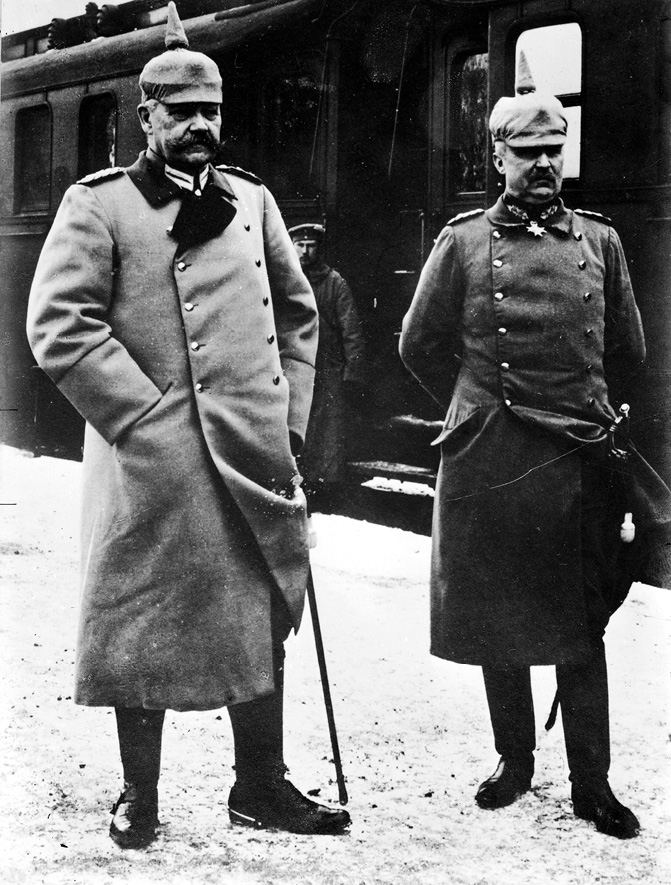
Generals Paul von Hindenburg (left) and Erich Ludendorff (right)
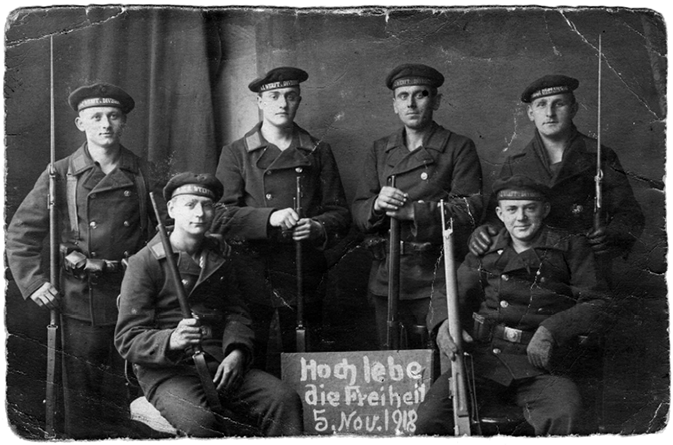
Six sailors armed with guns. They are grouped around a blackboard, which reads “Long live freedom 5. Nov. 1918”
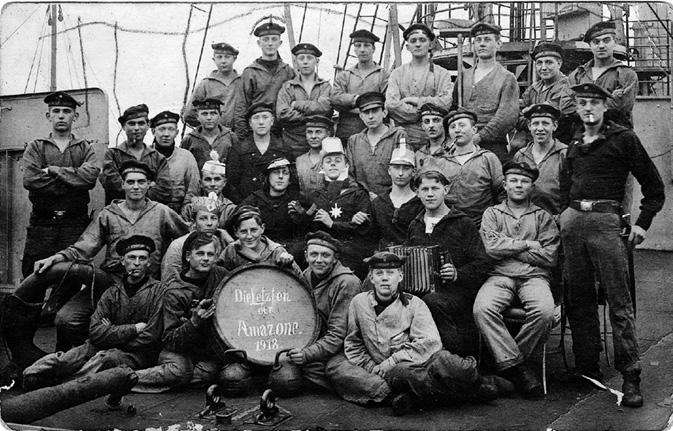
More de-mobilised sailors, holding up the message “the last of the Amazone”. The Amazone was a barracks ship based in Kiel
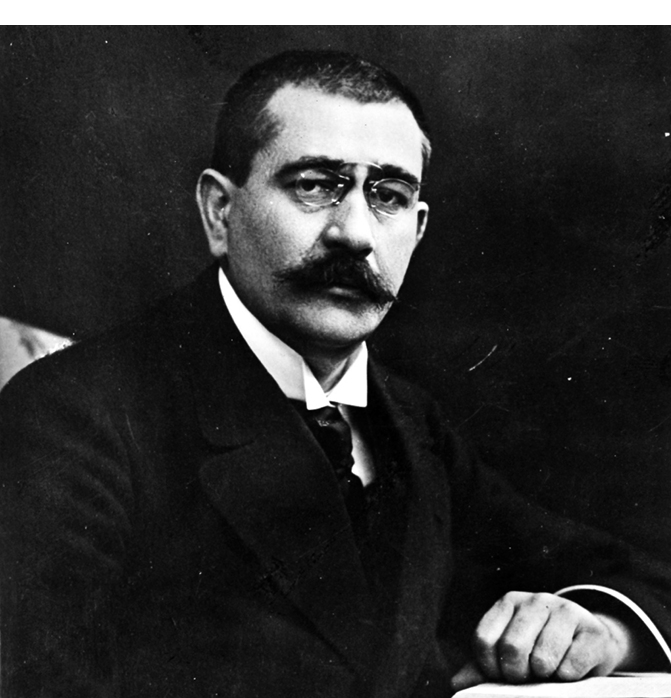
Gustav Noske
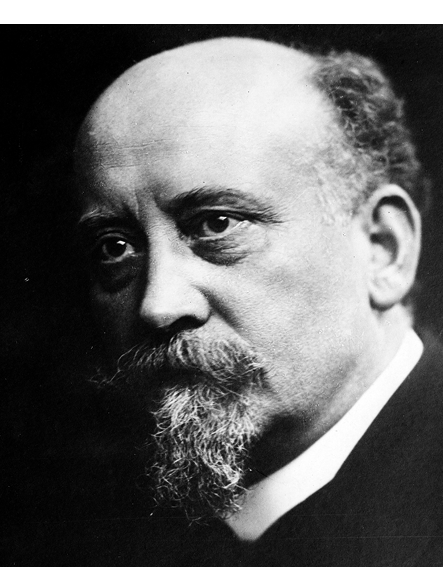
Philipp Scheidemann
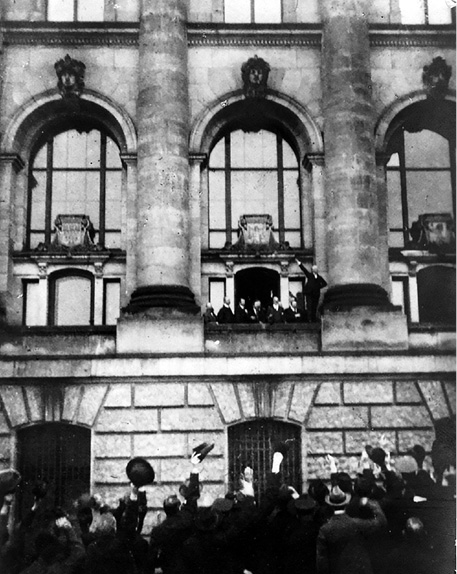
Philipp Scheidemann proclaims the German Republic at the Reichstag building