Chapter One: The Rise of German Social Democracy
It was the best of times, it was the worst of times, it was the age of wisdom, it was the age of foolishness, it was the epoch of belief, it was the epoch of incredulity…
Charles Dickens, The Tale of Two Cities
Germany, the birthplace of Marxism. It was here that Marx and Engels originally developed the ideas of scientific socialism. This eventually led to the establishment of the Communist League, the publication of the Communist Manifesto and the birth of the Marxist movement.
While living in exile, both Marx and Engels paid special interest to the developing movement in Germany, regarded in many ways as their adopted ‘child’. Before 1860, there was no real organised labour movement in this patchwork of states, kingdoms and principalities. It was through their preparatory work, especially during the years of the International Workingmen’s Association, that the foundations were laid for the creation of organisations of the proletariat, including in Germany. It is no accident that Marx acted as the corresponding secretary for Germany on the General Council of the First International.
Two socialist groups had crystallised in Germany, one based around Ferdinand Lassalle1, which held progressive but confused views, and the other around August Bebel and Wilhelm Liebknecht, which was known as the Eisenach Party. The latter were the followers of Marx and Engels. Following unity negotiations, in the spring of 1875, the founding Congress of the German Social Democratic Party was held at Gotha, that fused the two groups together. The unified party was viewed as the embodiment of revolutionary Social Democracy. Marx and Engels worked to maintain the revolutionary line within the new party. They helped combat the influences of Lassalleanism and then the revisionist ideas of Herr Dühring, described by Engels as “bumptious pseudo-science”, which were becoming fashionable in certain quarters. Thus appeared Engels’ classic work entitled Anti-Dühring, which became a textbook of scientific socialism. As a result of its historic links with Marx and Engels, German Social Democracy2 was considered the most authentic representative of ‘orthodox’ Marxism in the international workers’ movement.
The German party became the most powerful section of the Second International, which was established in 1889 and grouped together all the socialist parties prior to the First World War. Standing at the head of the International, the party was greatly admired by millions worldwide, including Lenin, who regarded it as a model party.
While the Russians, Poles and others were struggling to assemble handfuls of members and supporters into small party organisations, the German party was a mass party par excellence. In practice, it formed the epicentre of the world socialist movement around which all others gathered.
Friedrich Adler, the Austrian leader, wrote:
The German Social Democratic Party was the very ideal of all the socialist parties of the International. It brought to life what others visualised as an idea. This magnificent movement, consciously striving for the realisation of its historic mission to the world, undeflectable and unconquerable in its progress, concentrated all its strength and thought on a single aim: the emancipation of the working class. (J. Braunthal, In Search of the Millennium, p. 100.)
By 1912, the German Social Democracy had reached its pinnacle. The Socialist revolution seemed assured. It had one million members and millions of supporters, making it the biggest party adhering to Marxism in the world. Its apparatus numbered almost 4,000 full-time party workers, assets worth more than 21 million gold marks, ninety daily newspapers with a circulation of over 1.4 million subscribers, and sixty-two printing offices. It had dozens of periodicals, together with its own socialist news agency, and an impressive Central Socialist School for the education of party members. In the election of 1912, the SPD achieved a vote of 4.3 million, more than one third of the total electorate, which provided it with 110 deputies in the Reichstag, or parliament. The trade unions, which the party helped to organise and sustain, had a membership of over 3 million, which made them among the largest in the world, a reflection of the general strength of the German proletariat.
Despite the existence of the Reichstag, Germany was ruled by a reactionary autocracy with a monarchy at its head. In 1871, the king of Prussia was proclaimed emperor of the newly united Germany. The Reichstag, or ‘Imperial Assembly’, was aptly described by Wilhelm Liebknecht as “the fig-leaf of absolutism”. Power rested with the Emperor, the Kaiser, and the landed Prussian Junkers, who presided over a patchwork of duchies, principalities and kingdoms. The Reichstag was nothing more than an inconsequential talking shop, where the Emperor had the sole right to appoint the chancellor, or head of the government. The Imperial government served the interests, not only of the landed aristocracy, but also the industrialists, bankers and financiers, who had grown very powerful over the years. The head of the Kaiser’s government was the faithful Otto von Bismarck, the ‘Iron Chancellor’, who could not be toppled, even with a majority vote.
The rising workers’ organisations were feared and regarded as a threat by these powerful class interests. Therefore, in order to curb the socialist movement, Bismarck introduced an Anti-Socialist Law (‘The Exceptional Law Against the Socialists’) in October 1878, which outlawed and shackled the activities of the SPD and the trade unions. According to Bismarck’s legislation, these organisations were “designed to subvert the existing political and social order” and therefore had to be curtailed. “The pathological ideas of Socialism”, states the draft Bill, “the enemy of Society and the State, cannot be stamped out by common law. Hence the urgency of this law of exclusion.” (A.R. Oliveira, A People’s History of Germany, p. 52.) Using the full force of the law, Bismarck moved quickly to clamp down on all working-class political and cultural organisations, and shut down its press. During the twelve long, repressive years under the Anti-Socialist Law, 1,500 worker activists were imprisoned and 150 Social Democratic newspapers closed down. Many other activists escaped abroad, out of the way of the authorities. From there, underground papers were edited, produced and smuggled back into Germany. Such papers were passed from hand to hand, satisfying the growing thirst for radical ideas from the working class.
But Bismarck’s law, rather than weakening the workers’ organisations, provoked great sympathy for the socialists, who emerged greatly strengthened. Social Democracy grew substantially in these underground conditions and became increasingly recognised as the focal point of opposition to the autocratic regime. Despite the law, the Social Democratic Party, in accordance with the Constitution was allowed to maintain its group in the Reichstag. This allowed them to skilfully combine legal and illegal methods of work.
As their popularity grew, so did their votes, their membership and party organisation. During this period, the SPD had increased its membership by more than a million. On the trade union front, the Free Trade Unions, later known as the Allgemeiner Deutscher Gewerkschaftsbund, or ADGB, which had close links to the Social Democrats, saw their membership rise from 50,000 in 1878 to 278,000 by 1891, a year after the anti-socialist laws were finally repealed. At the time of the introduction of the law, there were forty-two Social Democratic newspapers; following the repeal the number had risen to sixty.
The repeal itself was forced upon Bismarck because the law was becoming increasingly counterproductive. This did not mean, however, that the socialist movement was free from harassment and persecution. On the contrary, the successes of German Social Democracy caused great alarm in ruling circles. The Emperor even issued a personal warning that if the Social Democrats should gain a majority, they would immediately “proceed to plunder the citizens”. He went on bizarrely, “I shall have loopholes cut in the palace walls and we’ll see how much plundering will take place.” (Quoted in R. Watt, p. 113). The Emperor’s alarmist tactics, however, only served to increase the support for the socialists.
The repeal of the Anti-Socialist Law allowed the party to more fully capitalise on its growing popularity and establish wider points of support, especially on the parliamentary front. At each successive election, the party increased its representation in the Reichstag and the provincial legislatures. In 1871, when the Reichstag was first set up, there were only two Social Democrat deputies out of 397, elected with 124,000 votes. But in the elections of 1890, the SPD’s popular vote jumped to one-and-a-half million (twenty per cent of the popular vote), and the number of its deputies rose from twelve to thirty-five. Bismarck, having failed to suppress the movement by legislation, now considered crushing the movement using ‘blood and iron’, but was overruled by the Kaiser, who feared a backlash. Humiliated, von Bismarck resigned.
The SPD was able to use its electoral gains as an important platform in the Reichstag for propaganda and as a focal point for the struggle against the government. As a result, the democratic struggle against the autocracy assumed the character of a class struggle. Their deputies, such as Bebel and Liebknecht, would make revolutionary speeches in the Reichstag, which would then be printed and distributed in their hundreds of thousands. In early 1893, a debate on the socialist society of the future lasted five days. Such was the impact of Bebel’s speech, it was published as a pamphlet in 3.5 million copies and sold for five pfennigs each.
Growth of German Capitalism
The unification of Germany under Bismarck in 1871 paved the way for an immense industrial expansion. German capitalism took giant steps forward, and with the development of modern technique and huge industrial and commercial enterprises, it was threatening to outstrip Britain, the dominant imperialist power of the time. The production of iron ore rose from 1.5 million tons in 1871 to 14.8 million in 1910. Steel production increased between 1886 and 1912 by a massive 1,335 per cent, coal production by 218 per cent (as against Britain’s seventy-three per cent), while total exports rose by 185 per cent. Before the First World War, industrial production in Germany had increased six-fold over the previous four decades, leaving her second only to the United States both in industrial production and in the production of iron and steel. At the same time, Germany was ranked first in the export of machinery and electrical equipment. It was emerging as a major imperialist power in its own right. But Germany had come onto the scene very late in the day. Her colonial possessions – which were all held down brutally – only amounted to some areas of China and a slice of south-west Africa, the Cameroons, Togoland, New Guinea and a few others. The world had already been carved up by the other imperialist powers, which was soon to lead to frictions and, eventually, a head-on collision.
The expansion of German industry meant that the percentage of the population employed on the land dropped from fifty per cent in 1870 to thirty-three per cent in 1913. This development also gave rise to a fresh young working class, free from weighty traditions, unlike the British workers. This lack of baggage allowed them to quickly develop a militant working-class consciousness, as well as a loyalty to their newly-founded organisations.
The growth of capitalism, while creating a powerful labour movement, also gave rise to a period of relative social peace, which remained the case in Europe from the defeat of the Paris Commune in 1871 to the end of the upswing in 1912. This relative stability certainly assisted the growth of the trade unions and social democratic parties.
However, the rise of social democracy during a period of general upswing of the capitalist system had another side to it, which was to have unfortunate consequences for the movement. It helped shape the conservative outlook of the top layers of the Social Democracy and the trade unions. They became increasingly convinced of the longevity of the capitalist system and its ability to grant reforms. The more they adapted to capitalism, the more they came under its pressures.
Instead of preparing the German workers for the conquest of power, the leadership concentrated on winning reforms within the confines of capitalism. Such gains certainly added to the prestige of the Social Democracy. Even the welfare reforms introduced by Bismarck, such as old age pensions and health and accident insurance, known as ‘state socialism’, were widely regarded as due to the pressure of organised labour despite the fact they were intended to cut the ground from under the workers’ movement. This then also strengthened the illusions in reformism, and the idea that life for the working class could be improved incrementally, without the overthrow of capitalism.
The fight for reforms is an essential part of the workers’ struggle for emancipation. Every advance, however small, whether over improved pay or conditions, is a step forward. The struggle to change society is unthinkable without the day-to-day struggles of the working class for advancement under capitalism. As Rosa Luxemburg explained:
Can we contrapose the social revolution, the transformation of the existing order, our final goal, to social reforms? Certainly not. The daily struggle for reforms, for the amelioration of the condition of the workers within the framework of the existing social order, and for democratic institutions, offers to the Social Democracy an indissoluble tie. The struggle for reforms is its means; the social revolution, its aim. (R. Luxemburg, Reform or Revolution.)
The struggle for reforms, as Rosa Luxemburg correctly said, must be linked to the need to overthrow the capitalist system as reforms under capitalism cannot be considered permanent. What is given by the left hand can be easily taken away by the right hand, especially in times of crisis. That was the case in 1918 when the German bourgeoisie were forced to grant the eight-hour day and other important concessions, which were then snatched back starting in 1923. The problem was that, for the leaders of Social Democracy, the struggle for reforms became an end in itself. They lost sight of the ultimate aim of changing society. Over time, the actions of the Social Democratic and trade union leaders became completely devoid of any revolutionary content or perspective. They had adapted themselves to their environment.
The character of the social democratic movement also began to change. The apparatus of both unions and party had increased enormously in the pre-war period. The party and its press had more than 10,000 full-time staff. Added to this were more than 3,000 trade union officials. That constituted a formidable force. But with the very successes in building powerful organisations, with their increased membership, greater resources and funds, came an ever-more powerful bureaucracy. In turn, it increasingly attracted place-seekers and careerists, which began to infest the movement.
The labour and trade union bureaucracy began to develop its own conservative vested interests as the revolution became increasingly distant from its daily experience. The methods and habits of administration, which is the main social function of the bureaucracy and the source of its pre-eminence, inevitably leave powerful imprints on its entire way of thinking. Thus, the movement was being transformed gradually from an instrument for social revolution into a reformist apparatus whose function was to mediate between the classes.
The author Evelyn Anderson observed that:
While all these successes – direct and indirect – strengthened the prestige of the labour movement, they also affected its political outlook. Gradually, workers began to realise that they had very much more to lose than their chains. Even most of those who had received a thorough socialist and Marxist training at the party schools and trade union colleges were impressed by the success of the industrial struggles, which gave them the feeling that there was no limit to perpetual progress, provided Germany could rid herself of the remnants of an obsolete feudalism. (E. Anderson, p. 11.)
Before the War, German Social Democracy, especially its upper echelons, went through a process of political adaptation and degeneration. For the party leaders and functionaries, the language of socialist revolution was used mostly at May Days and at labour movement celebrations, but in their daily lives they grew accustomed to bourgeois society. Marx had long ago explained the process in the following words: “social being determines social consciousness”.
This dichotomy between reform and revolution also reflected itself in the party’s programme, which was divided into two distinct parts, independent of each other. There was a ‘minimum’ programme that limited itself to demands for reforms within the framework of capitalism; and there was a separate ‘maximum’ programme that argued for the ultimate goal of socialism in the indefinite future. This dual approach was developed by Karl Kautsky, the party’s leading theoretician, and embodied in the decisions of the first Social Democratic Congress at Erfurt in 1891.
Between the ‘minimum’ and ‘maximum’ programmes there was no transitional bridge with which to link both together. There was nothing to help the masses in their daily struggle to find the road to the socialist revolution. But social democracy had no need of such a bridge, as the overthrow of capitalism was not considered as a practical proposition. “This separation was to dominate the theory and practice of social democracy for decades,” wrote the Marxist historian Pierre Broué. (The German Revolution 1917-1923, p. 17.)
Marx and Engels
This incipient opportunism had been noticed by Marx and Engels during their involvement with the party. They were very well aware of such dangers and tried to curb them. From the beginning, Marx and Engels had taken the German leadership to task for their backsliding, reflected in political softness and ideological weakness, and especially in their tendency to sacrifice principles for short-term gains. The Critique of the Gotha Programme written by Marx in 1875 is the most well-known example of their critical attitude to the German leaders. As Marx wrote:
After the Unity Congress has been held, Engels and I will publish a short statement to the effect that our position is altogether remote from the said programme of principles and that we have nothing to do with it…
Apart from this, it is my duty not to give recognition, even by diplomatic silence, to what in my opinion is a thoroughly objectionable programme that demoralises the party. (‘Letter to W. Bracke’, 5 May 1875, Marx and Engels Collected Works,3 vol. 45, p. 70.)
At one point, so sharp were the exchanges that they threatened to break off all political relations. This was due to the fact that the German leaders made too many political concessions to the Lassalleans within the party.
In the voluminous Correspondence of Marx and Engels we can find far sharper criticisms of such opportunism. While they loyally defended the leadership of the German party in public, neither of them were prepared to sacrifice their principles for anyone’s expediency. The Correspondence shows that there were many other occasions when they threatened a break with their co-thinkers in Germany. Despite these sharp differences, Marx and Engels nevertheless preferred to correct these mistakes by exerting pressure through individual advice and correspondence, hoping that by such means the German leadership would learn from their own mistakes.
While Marx and Engels firmly criticised the opportunist tendencies within the party, they also attacked with equal firmness those who engaged in ultra-leftism and phrase-mongering, such as Johann Most, who had come under anarchist influences. Marx’s scrupulous attitude to ideas and principles meant that nothing was left unturned.
In the late 1870s, due to Marx’s growing health problems, it was left to Engels to answer the extremely muddled ideas of Professor Dühring, who had acquired a certain following within the German Social Democracy. This resulted in a brilliant defence and exposition of scientific socialism, later published in book form under the title of Anti-Dühring, a classic of Marxist literature. A section of the leadership, especially the intellectuals and academics whom Engels contemptuously branded as the “Katheder Sozialisten” (armchair socialists) used the Anti-Socialist Laws to water down the party’s programme and cover up its goals on the grounds of expediency. It was this opportunist tendency in Germany that worried Marx and Engels the most. From London, they mercilessly criticised the opportunists and put pressure on Bebel and Kautsky to keep the party on the right track.
This opportunist tendency revealed itself most sharply, and not accidentally, in the Social Democratic Parliamentary group. The rarefied atmosphere of bourgeois parliaments was always a problem for the revolutionary movement. It was in such places that the pressures of alien ideas were at their most intense and the heat of the class struggle at their weakest. Therefore, in such an environment there was always the threat that Social Democratic deputies would bend under pressure or even become corrupted. Marx and Engels were extremely critical of these layers within the German party, who tended to be opportunist in nature and displayed an eagerness for political independence from the party.
“They are already so far infected with parliamentary cretinism as to believe themselves above criticism,” wrote Marx angrily to Sorge. (MECW, vol. 45, p. 414.) “Or has German Social Democracy indeed been infected with the parliamentary disease, believing that, with the popular vote, the Holy Ghost is poured upon those elected…?” they both jointly wrote to the German leaders. (MECW, vol. 45, p. 400.)
The party, due to its successes, had attracted a petty-bourgeois layer that had little understanding of Marxism, but nevertheless rose to key positions within the movement. They tended to bring all kinds of alien ideas from their middle-class backgrounds with them. On one occasion, in September 1879, Marx and Engels were so angry about such influences that they wrote a ‘Circular Letter’ to Bebel, Liebknecht and other party leaders in the sharpest fashion possible. It had come to light that the Social Democratic newspaper produced in Zürich under the control of young revisionists (Karl Höchberg, Kaul August Schramm, and the young Eduard Bernstein) was coming out with hair-raising ideas. Höchberg, who, as Marx expressed it, had “bought” his way into the party by his money, demanded that socialism should be made a movement of “humanity in general” based on the “sense of justice” of both the oppressed and the representatives of the “upper classes”. (K. Marx and F. Engels, Selected Correspondence, p. 309.)
Marx and Engels were so angry that they accused Liebknecht of a cover-up. They then launched an attack on these petty-bourgeois literary types, who had wormed their way into positions and become a law unto themselves, as “counter-revolutionaries”. This Zürich editorial board of three showed utter contempt for the ‘uneducated’ working class in its editorials and articles and even went as far as to urge the party to recruit instead the “enlightened bourgeois”. They also declared that the party had correctly rejected “the path of forcible, bloody revolution,” and instead decided “to tread the path of legality, i.e., of reform.” (MECW, vol. 45, p. 404.)
“If they think as they write, they ought to leave the party or at least resign from office,” complained Marx and Engels. “If they don’t, it is tantamount to admitting that they intend to use their official position to combat the party’s proletarian character. Hence the party is betraying itself if it allows them to remain in office.” (MECW, vol. 45, p. 403.)
Marx and Engels continued:
[W]hen people of this kind, from different classes, join the proletarian movement, the first requirement is that they should not bring with them the least remnant of bourgeois, petit-bourgeois, etc., prejudices, but should unreservedly adopt the proletarian outlook. These gentlemen, however, as already shown, are chock-full of bourgeois and petty-bourgeois ideas.
They added:
How the party can suffer the authors of this article to remain any longer in their midst seems to us incomprehensible. (MECW, vol. 45, pp. 407-408.)
They went on to warn the German leaders:
So, the gentlemen are forewarned and, moreover, are well enough acquainted with us to know that this means bend or break! If they wish to compromise themselves tant pis [so much the worse]! In no circumstances shall we allow them to compromise us. (MECW, vol. 45, p. 414.)
Höchberg was removed from the editorial committee and all the influential leaders of the party – Bebel, Liebknecht, Bracke, etc. – repudiated his ideas. Subsequently, Höchberg and Schramm left the workers’ movement, but Bernstein, temporarily refrained from advocating opportunism, rose to become one of the leaders of German Social Democracy. It would be only after Engels’ death that Bernstein would come out clearly with a revision of Marxism.
This was not the last time that Marx and Engels criticised the opportunist backsliding of the Germans, who had failed to defend revolutionary Marxism or display the necessary resoluteness, firmness, and revolutionary spirit. This attitude was displayed in their complete unpreparedness for illegal struggle, especially in response to the Anti-Socialist Law. Therefore, Marx and Engels took it on themselves to school the German leadership, praising them when deserved, but criticising them when necessary. “Again, you know that Marx and I have voluntarily conducted the defence of the party against its opponents abroad throughout the party’s existence, and that we have never asked anything of the party in return, save that it should not be untrue to itself,” explained Engels to Bebel. (MECW, vol. 45, p. 420.)
And further, in December 1879:
We regret very much being unable, at this time of repression, to give you our unqualified support. So long as the party in Germany remains true to its proletarian character, we were prepared to set aside all other considerations. But now that the petty-bourgeois elements you have admitted have come out in their true colours, it’s a different matter. The moment they are permitted to insinuate their petty-bourgeois ideas piecemeal into the organ of the German party, that organ, by the same token, is closed to us, no more nor less. (MECW, vol. 45, p. 430.)
Despite these pressures, things did not improve to any real extent. In regard to Vorwärts, the party’s daily, Engels was disgusted. “Never had a large party such a miserable organ,” he wrote to Laura Lafargue, Marx’s daughter. (MECW, vol. 49, p. 154.)
This gives a clear indication of the approach by the founders of scientific socialism to the German Social Democracy and its defects, and how they tried to deal with it.
Engels Distorted
Following Marx’s death, Engels repeatedly came face to face with this crass opportunism. He made a number of criticisms of the ‘Erfurt Programme’ of 1891. Although much improved on the ‘Gotha Programme’, it still had its weaknesses and a tendency towards opportunism.
This forgetting of the past, the principal considerations for the momentary interests of the day, this struggling and striving for the success of the moment regardless of later consequences, this sacrifice of the future of the movement for its present, maybe ‘honestly’ meant, but it is and remains opportunism, and ‘honest’ opportunism is perhaps the most dangerous of all! (MECW, vol. 27, p. 227.)
The same features are present when, later on, he was approached by Richard Fischer, the Executive secretary of the party, with a request to water down his language in the ‘Introduction’ to Karl Marx’s The Class Struggles in France, 1848 to 1850. Fischer feared that certain terminology would be used by the government to reimpose restrictions on the party. On this occasion, Engels felt obliged to accept the request to omit certain passages, which dealt mainly with the armed struggle of the working class. Engels, however, felt the ‘Introduction’ “suffered somewhat” as a result of these omissions.
He wrote to Fischer:
I have taken as much account as possible of your grave objections although I cannot for the life of me see what is objectionable about, say, half of the instances you cite. For I cannot after all assume that you intend to subscribe heart and soul to absolute legality, legality under any circumstances, legality even vis-à-vis laws infringed by their promulgators, in short, to the policy of turning the left cheek to him, who has struck you on the right. True, the Vorwärts sometimes expends almost as much energy on repudiating revolution as once it did – and may soon do again – on advocating the same. But I cannot regard that as a criterion.
My view is that you have nothing to gain by advocating complete abstention from force. Nobody would believe you, nor would any party in any country go as far as to forfeit the right to resist illegality by force of arms. (MECW, vol. 50, p. 457.)
It must have been embarrassing to make such basic points to the Executive secretary of the party. But the epigones of the Second International were attempting to transform Marx and Engels from revolutionaries into garden-variety evolutionists. But Engels didn’t leave it there. In fact, he wrote a letter of protest to Karl Kautsky about the censorship:
I was amazed to see today in the Vorwärts an excerpt from my ‘Introduction’ that had been printed without my prior knowledge and tricked out in such a way as to present me as a peace-loving proponent of legality quand même [come what may]. Which is all the more reason why I should like it to appear in its entirety in the Neue Zeit in order that this disgraceful impression may be erased. I shall leave Liebknecht in no doubt as to what I think about it and the same applies to those who, irrespective of who they may be, gave him this opportunity of perverting my views and, what’s more, without so much as a word to me about it. (MECW, vol. 50, p. 486.)
He also wrote to Paul Lafargue in France on 3 April 1895:
[Wilhelm] Liebknecht has just played a fine trick on me. He has taken from my introduction to Marx’s articles on France 1848-50 everything that could serve his purpose in support of peaceful and anti-violent tactics at any price which he has chosen to preach for some time now… (MECW, vol. 50, pp. 489-490.)4
Engels was of course in favour of using universal suffrage and parliament to promote the revolutionary cause, but he nevertheless rejected parliamentary cretinism and opportunism. For him, the use of parliament was always linked to the overthrow of capitalism. But the revolution, in defending itself, should use all means necessary. He wrote to Paul Lafargue:
Do you realise now what a splendid weapon you in France have in your hands for forty years in universal suffrage; if only people had known how to use it! It’s slower and more boring than the call to revolution, but it’s ten times more sure, and what is even better, it indicates with the most perfect accuracy the day when a call to armed revolution has to be made; it’s even ten to one that universal suffrage, intelligently used by the workers, will drive the rulers to overthrow legality, that is, to put us in the most favourable position to make the revolution. (MECW, vol. 50, p. 29, emphasis added.)
Even here we see how Engels carefully takes up the question of violence, in putting the blame on the ruling class who will act “to overthrow legality” when the time comes, and when the call to defend the revolution will be necessary.
Despite Engels’ wishes, his ‘Introduction’ was never published in full. When he wrote to Lafargue, Engels told him to “wait for the complete article before judging it – it will probably appear in Neue Zeit.” (MECW, vol. 50, p. 490.) But when Kautsky eventually published the piece in Neue Zeit, it contained the same omissions. Engels’ protests were deliberately hidden from the rank and file of the German party. In fact, it was not until 1924 that Riazanov brought Engels’ manuscripts to light and published them in their original form. While the leadership used Engels’ politically diluted ‘Introduction’ to advance their opportunist and reformist standpoint, it was only Rosa Luxemburg, to her credit, who instinctively refused to accept this truncated version as a true reflection of Engels’ views, despite being unaware of Engels’ criticisms. She explained:
Engels did not live to see the results, the practical consequences of the use of his introduction. I am certain that if one knows the works of Marx and Engels, just as if one knows the living revolutionary spirit which breathes from all their work, one is bound to be convinced that Engels would have been the first… to protest with all his power against the interpretation which led to Titan reliance on parliamentary means. He would have pulled back the coach with all the means at his disposal, to prevent it slipping into the mud… (J.P. Nettl, Rosa Luxemburg, p. 754.)
Revisionism
The opportunist tendencies were therefore certainly present. However, the growing conservatism of the German Social Democracy found its clearest expression in the late 1890s in the ideas of Eduard Bernstein, a party leader, who, as we have seen, began to argue for a complete revision of Marxism. These ideas simply articulated the outlook of the party bureaucracy and out-and-out reformist layers within the SPD. Let us not forget that Bernstein was one of the Zürich editors who Marx and Engels had previously criticised so sharply. While they were alive, Bernstein kept suitably quiet and hid his ideas, briefly becoming an editor of another party newspaper. Such was his influence within the party leadership that he even became one of the executors of Engels’ estate, which was placed at the disposal of the Socialist International. After Engels’ death, Bernstein felt more confident in openly challenging and revising the principles of the Marxist movement.
It is clear that Bernstein had been very impressed by the economic boom that was taking place in Germany at the time. During the stagnation of 1873-1882, the economy had grown by a mere three per cent over the course of a decade. By comparison, the boom period between 1887 to 1896 saw a thirty-six per cent growth in the economy. This upswing served to strengthen the revisionist tendencies within the labour and trade union movement, which were mesmerised by a ‘golden age’ of uninterrupted growth.
Bernstein began his assault against Marxist ‘orthodoxy’ in a series of articles entitled ‘The Problems of Socialism’, published in the theoretical journal of the party, Die Neue Zeit, between 1896 and 1897. Kautsky was the editor of this theoretical journal, and gave Bernstein a free hand to express his views without bothering to furnish a reply. He was also a personal friend of Bernstein and even thanked him for his “contribution”, which he regarded as a thoughtful addition to a wider discussion. Another SPD paper, Leipziger Volkszeitung, again took a very soft approach to Bernstein’s criticisms:
Interesting observations which nonetheless terminate in a mistaken conclusion; something that is always liable to happen especially to lively and critical people, but there is no more to it than that. (Quoted in Rosa Luxemburg Speaks, p. 35.)
“No more to it than that”! This mealy-mouthed response – or lack of it – simply emboldened the revisionist tendency within the party. As with all revisionists, Bernstein urged the German Social Democracy to recognise the “new reality” that had emerged since Marx’s time. For him, Marx’s ideas were rendered obsolete by the march of events. They were out of date and needed to be discarded. This was the first step to a complete abandonment of revolutionary Marxism. Bernstein argued that capitalism had been able to adapt, and with the development of the credit system and improvement in communications, it was now able to avoid catastrophic slumps and crises of overproduction. In fact, according to him, with the development of trusts and cartels, capitalism was able to resolve its contradictions and develop more harmoniously. In other words, capitalism was no longer a system which was inherently crisis prone, as Marx had claimed. Furthermore, according to Bernstein, class lines were becoming increasingly blurred as the trade unions became successful vehicles for winning reforms. Thus, the class struggle was becoming more obsolete. Capitalists, rather than a ruling class, were becoming mere managers and administrators, a foretaste of the later theory of ‘managerial capitalism’. He rejected Marx’s ‘theory of impoverishment’, which was – and has been ever since – the subject of a fierce ideological barrage against Marxism.
The mistake of Bernstein was to take a fleeting tendency of improvement as a permanent feature; he also mistakenly identified the conditions of the aristocracy of labour as those of the proletariat as a whole. Along with rejecting Marx’s theory of crisis, he also challenged the philosophical foundations of Marxism, namely dialectical materialism. From criticising this or that aspect, he ended up rejecting the whole of Marxism. So, he urged Social Democracy to find the courage to “emancipate itself from outworn phraseology, and to come out in its true colours as a democratic socialist reform party.” (Quoted in R. Watt, p. 115.)
Bernstein formulated his opportunism in his famous, but meaningless phrase: “The final goal, no matter what it is, is nothing; the movement is everything.” He was the early forerunner of all those later reformist leaders who capitulated to capitalism. Today’s bourgeois apologists have therefore invented nothing new, but simply rehash those ideas better expressed by Bernstein more than 100 years ago. This revisionism – directly linked to opportunism – has served as the theoretical basis for the assault on Marxism ever since.
It is perhaps no accident that Eduard Bernstein had spent many years in exile in London, and had been influenced by the reformist trade unions, the Fabians and British liberal democracy. This experience helped shape his ideas. But it was in Germany that his assault on Marxism caused the most excitement, especially his articles carried in the party press. For a growing layer within the party, Bernstein’s ideas were more in tune with the times than the prognosis of the Communist Manifesto. He found support for his ideas from a number of prominent trade union leaders as well as SPD deputies, not least from southern Germany. The latter had a particular interest in revisionism.
The Social Democrats of south Germany had developed their own opportunist leanings. Although at a national level, the party was effectively excluded from all government involvement, on a state level, particularly in the south, it was invited to support the liberals in coalition agreements. Traditionally, the SPD refused to vote for any budget that raised taxes on workers and peasants to uphold the tyranny of the German state. But SPD deputies in Bavaria, Baden and Württemberg pleaded ‘special conditions’ to vote for provincial budgets, allowing them to squeeze out concessions and get a ‘better’ budget. This became known as ‘South German exceptionalism’ and was eventually permitted following decisions of the party Congresses of 1894 and 1895. These right-wing tendencies within the party became the bedrock of Bernstein’s support.
International Response
As soon as Bernstein’s revisionism had garnered support it was attacked not only in Germany but throughout the International. Plekhanov, the father of Russian Marxism, wrote an article entitled ‘Why should we thank him?’, which not only attacked Bernstein but also criticised Kautsky for not answering these ideas sooner. Plekhanov even wrote to Kautsky directly:
You say your readers have no interest in philosophy… then you must force them to take an interest… If you want me to write against Bernstein you must give me full freedom of speech. Bernstein must be destroyed… and I will gladly undertake this task if you let me. (Plekhanov to Kautsky, dated 16 September 1898, as quoted in J.P. Nettl.)
Kautsky’s failure to respond was not simply a short delay of a matter of weeks, or even months, which would be long enough, but it took this key ‘theoretician’ about eighteen months to offer a reply. This irresponsible delay allowed Bernstein’s ideas to circulate freely and widely without any official response. His articles were even produced as a book, Die Voraussetzungen des Sozialismus und die Aufgaben der Sozialdemokratie. Kautsky had started publishing Bernstein’s articles in 1896, but the above letter from Plekhanov offering to “destroy” Bernstein was written in September 1898, almost two years later.
During Kautsky’s eighteen-month delay in publicly replying to Bernstein there was an exchange of letters between the two which is quite revealing. In a letter Kautsky wrote to Bernstein on 28 January 1898 he explained that Bernstein’s supporters were concerned more that he would lose the prestige he had within the party, than with the content of his ideas. And most significantly he wrote, “It seems to me that what divides us is not opinions and conclusions, but the tone with which we espouse them.” (Quoted in M. Waldenberg, Il Papa Rosso Karl Kautsky, p. 138.)
Throughout these eighteen months, Kautsky was in fact trying to get Bernstein to tone down his articles, but Bernstein would have none of it. In a reply to Kautsky a week later on 5 February, he states clearly that he considers himself a “social reformer” and does not believe in “a radical change”. (ibid., p. 139.) The reason why Bernstein refuses to change anything in his articles is that he was fully aware of the fact that he was merely expressing in a theoretical manner what many SPD bureaucrats were already doing in practice. The problem for leaders like Bebel was that such open discussion of the reformist essence of the policy of the party risked opening up a sharp debate within the SPD. In Germany the first public criticism of Bernstein came from Parvus, who stated that “if Bernstein were right, it would mean the end of socialism.” (ibid., p. 137.)
Thus, Bebel also appealed to Kautsky to reply to Bernstein, warning him that if he didn’t then the more ‘extreme’ wing would do it. Above all, Bebel wanted to bury the debate with an authoritative statement from Kautsky and then get back to business as usual. The party congress was coming up in October 1898, and the last thing he wanted was a debate on the floor of the congress on the ideas raised by Bernstein, which would involve discussing party tactics, reform and revolution, the nature of the capitalist state and so on. Parvus had tried to get a resolution passed along these lines at a branch of the party in Saxony, but to Bebel’s satisfaction it was not passed.
In spite of Bebel’s manoeuvres, however, the wider debate could not be stopped. Plekhanov was joined in battle by others, including Antonio Labriola in Italy and Jules Guesde, and even the reformist Jean Jaurès in France. But the most searing criticisms of Bernstein was to come from the German revolutionary left, headed first and foremost by Rosa Luxemburg, who achieved international recognition for her political firmness and determination. This is precisely what Bebel had feared and explains why he wanted Kautsky to deal with Bernstein.
Of Polish origin, Rosa Luxemburg had earned her political authority working in underground conditions, being a founding member of the Social Democratic Party of Poland and Lithuania. She moved to Berlin in 1898, just in time to play a full role in answering Eduard Bernstein’s revisionism. She was politically very astute and understood that these theories, if accepted by Social Democracy, would inevitably lead to a complete break with Marxism.
Rosa Luxemburg also recognised the international significance and meaning of Bernstein’s revisionism:
Bernstein’s book is of great importance to the German and the international labour movement. It is the first attempt to give a theoretic basis to the opportunist currents common in the Social Democracy.
These currents may be said to have existed for a long time in our movement… But it is only since about 1890, with the suppression of the Anti-Socialist Laws, that we have had a trend of opportunism of a clearly defined character. (‘Reform or Revolution’, in Rosa Luxemburg Speaks, p. 86.)
The SPD leaders prevaricated for almost two years and hoped that the whole dispute would blow over. But the opposite was the case. Finally, when Karl Kautsky and August Bebel could not delay any longer, they were eventually forced to come out openly against Bernstein’s revisionism. Up until that time not a single one of the party’s newspapers or journals were actually answering Bernstein’s ideas – apart from Sächsische Arbeiterzeitung, edited by Parvus, a Russian émigré. But this became untenable.
Karl Kautsky
Karl Kautsky and August Bebel led what could be called the ‘Centre’ grouping within the party, standing between Bernstein’s open revisionists and the party’s Left Wing lead by Rosa Luxemburg. The ‘Centre’ controlled the party, with Kautsky being seen as the intellectual and theoretician and Bebel, with his proletarian roots, as a key leader dedicated to the building of the party. They made up the Old Guard. But this ‘Centre’ tended to bend opportunistically for the sake of ‘unity’. It was precisely this that alarmed Marx and Engels, when they were alive.
Even when Kautsky eventually responded politically to Bernstein, the response was somewhat reserved. This was very characteristic of the ‘Centre’ group. There was clearly hesitation on Kautsky’s part in criticising his old friend Bernstein, possibly for fear of causing offence. But Kautsky’s reluctance had deeper political roots. Bernstein was only expressing sharply in theory what the SPD was actually carrying out in practice, namely a reformist policy. They had increasingly ceased to be revolutionary Marxists, but, like the Catholic Church, which had broken from the communism of the early Christians, they needed to maintain an outward appearance and loyalty to the past. Kautsky was therefore reluctant to engage in an all-out fight against Bernstein on the lines of the party’s Left Wing. Deep down he regarded Rosa Luxemburg’s full-frontal attack on revisionism, with all the clarity of her ideas, with disdain. Above all, he was irritated by such an unwarranted intervention that only served to cast light on his own deficiencies.
Even at the Stuttgart Congress in 1898, Kautsky’s attack on Bernstein was rather muted. He explained that:
Social Democracy will do everything possible to carry out democratic and economic reforms and to organise the proletariat. And Bernstein has a completely false idea of the party. He believes that we are contemplating a clash with armed authority, and that development will not be so rapid as many suppose. This is a question of temperament, not of viewpoints. (A.R. Oliveira, p. 60, emphasis added.)
For old times’ sake, Kautsky was not willing to renounce the ‘Marxist’ tradition, at least not in words. His criticism of Bernstein boiled down to a refusal to renounce the party’s heritage, to which they still had a sentimental attachment. This was not a defence of genuine Marxism but a conservative defence of the status quo, which reduced the ideas of scientific socialism to some kind of icon. In Kautsky’s hands, Marx’s legacy had become a tablet of stone, rather than a revolutionary guide to action. It had an abstract, scholastic character, and lacked any revolutionary content. Bebel too revealed his philistinism and theoretical weakness by regarding Bernstein as a threat, not because of his erroneous ideas, but because it encouraged disunity and damaged the morale of the party. For Bebel, the party, for better or worse, was everything, even if it meant sacrificing its principles. “Up to now we see no reason to change our point of view, our tactics or our name,” stated Bebel at the Hanover Congress. “We remain what we were.” (Quoted in A.R. Oliveira, p. 62.)
As Rosa Luxemburg later wrote, the party ‘Centre’ was hostile to revisionism chiefly because it was itself incurably conservative. For her, the ‘Centre’ was the axis of Kautsky and Bebel, which dominated the party. Her close friend, Clara Zetkin, put it succinctly:
What they want, it sounds laughable I know, is revolution without revolution… the revolutionary vocabulary of Marxism is maintained with religious fervour, but its meaning has evaporated. (S. Taylor, Germany 1918-1933: Revolution, Counter-Revolution and the Rise of Hitler, p. 7.)
Rosa Luxemburg’s attack on Bernstein was more strident and far sharper than that of Kautsky and Bebel. She did not pull her punches. “In the controversy with Bernstein and his followers,” she wrote, “everybody in the party ought to understand clearly it is not a question of this or that method of struggle, or the use of this or that set of tactics, but of the very existence of the Social Democratic movement.” (Rosa Luxemburg Speaks, p. 36.) In other words, for Luxemburg, it was not a secondary matter, but a life and death struggle. Her articles were collected and published in 1900 under the title, Reform or Revolution. Her writings soon established her as one of the foremost Marxist theoreticians.
The party leadership considered Bernstein not as someone to be fought and defeated, but as a misguided comrade in arms who should be coaxed back into the fold. Kautsky’s attitude is clearly revealed in a letter he wrote to Axelrod on the 9 March 1898, congratulating him on his articles on Bernstein in the following terms:
I am most interested in your opinion of Eddie [Bernstein]. Indeed, I’m afraid we’re losing him… However, I have still not given him up as a bad job and I hope that when he enters into personal – if only written – contact with us, then something of the old fighter will return to our Hamlet (sic), and he will once again direct his criticism against the enemy and not against us. (Quoted by A. Woods, ‘Rosa Luxemburg – Reform or Revolution’.)
Karl Kautsky had become a typical centrist. He espoused ‘Marxism’ in words and phrases, but had become reformist in deeds. He could talk with great authority about the Roman Republic and the rise of Christianity, but the nearer he approached present-day affairs, the more ambiguous and vaguer he would become. He presented himself as a faithful disciple of Marx and Engels, which gave him colossal authority. After all, he was regarded as the party’s key theoretician, an intelligent journalist, economist and historian. He was the editor of Die Neue Zeit, and the author of many theoretical works on Marxism. While Rosa Luxemburg saw his weaknesses at close hand, and therefore fully recognised them, Kautsky was still regarded internationally as a great authority and theorist of Marxism.
These weaknesses were to be laid bare in the midst of the reality of war and revolution. During the First World War, in complete contrast to Luxemburg and Liebknecht, he put forward, not an internationalist position, but a semi-pacifist one. Of course, this was still dressed up in Marxist language. And instead of welcoming the October Russian Revolution, he vehemently opposed it. The living reality of revolution did not correspond with his armchair view of the class struggle. In his book, The Dictatorship of the Proletariat, he attacked the Soviet Republic, using not the method of Marxism, but of abstract petty-bourgeois liberalism. He simply repeated the ideas of the Mensheviks, who became sworn enemies of Bolshevism.
Kautsky’s later works reflected this theoretical degeneration and are characterised by theoretical and political decline. In essence, he robbed Marxism of its revolutionary living spirit. He recognised everything in Marxism except its revolutionary methods of struggle. He therefore reduced scientific socialism to a barren theory devoid of its revolutionary essence. This vulgarised Marxism was an attempt to reconcile reform and revolution. It was a ‘Marxism’ that could get by in the epoch of reforms, but as soon as that epoch came to an end and entered an epoch of capitalist crisis and shocks, it revealed its reactionary nature. It was this new epoch of crisis that exposed the reformist character of the German Social Democracy, including the bankruptcy of its main theoretician, Karl Kautsky.
Rosa Luxemburg understood the role of Kautsky long before Lenin, and that was because she was able to see his opportunism at close quarters. In October 1914, Lenin wrote to Shlyapnikov:
I hate and despise Kautsky now more than anyone, with his vile, dirty, self-satisfied hypocrisy… Rosa Luxemburg was right when she wrote, long ago, that Kautsky has the “subservience of a theoretician” – servility, in plainer language, servility to the majority of the party, to opportunism. Just now there is nothing in the world more harmful and dangerous for the ideological independence of the proletariat than this rotten self-satisfaction and disgusting hypocrisy of Kautsky, who wants to smother and cover up everything, to tranquillise the awakened conscience of the workers by sophistries and pseudo-scientific chatter. (LCW, vol. 35, pp. 167-168.)
Differences With Lenin
Rosa Luxemburg had her political differences with Lenin, including his drive to build a centralised party of professional revolutionaries in Russia. But her views on this question were clearly coloured by her negative experiences of the monolithic German Social Democracy, which acted as a leaden weight on the shoulders of the working class. She feared that the degree of centralism proposed by Lenin would choke the life out of the party, as was happening in Germany. Instead, she laid stress on the spontaneous movement of the proletariat in opposition to the conservative and ossified machinery of the German Social Democratic Party. It is no accident that her criticisms of Lenin in 1904, published in Die Neue Zeit and the Menshevik-controlled Iskra, were peppered with numerous references to the problems of the German party. What she failed to see was that this party was displaying, not democratic centralism, but the traits of bureaucratic centralism. She feared that what Lenin was offering was a version of this. Thus, she warned, “Granting, as Lenin wants, such absolute powers of a negative character to the top organ of the party, we strengthen, to a dangerous extent, the conservatism inherent in such an organ.” (Rosa Luxemburg Speaks, p. 122.)
Rosa Luxemburg was not alone in these criticisms of centralism. The young Trotsky also had grave doubts at this time. But he later recognised the absolute correctness of Lenin’s position. As Trotsky explained:
Lenin was right again. Without a strong centralised party, we could never have taken power. Centralism means focusing the maximum organisational effort toward the ‘goal’. It is the only means of leading millions of people in combat against the possessing classes. (L. Trotsky, The Crisis of the French Section 1935-36, p. 68.)
History was to prove Lenin correct in practice. The Bolshevik Party, based on democratic centralism, led the Russian proletariat to power, while Rosa Luxemburg’s loose grouping failed to displace the leadership of the German reformists, and this weakness eventually led to the shipwreck of the German revolution of 1918. She underestimated the importance of the centralised party, but to be fair, she was not alone. Out of all the leaders of the Second International, it was only Lenin who really understood the question of the importance of the party. In 1918, just before her death, Rosa Luxemburg learnt a painful lesson in her belated efforts to construct a centralised revolutionary party, the German Communist Party. These differences, however, did not prevent their common struggle against opportunism, for instance at the Stuttgart International conference in 1907, nor from having cordial relations. The German party Congresses of 1898, 1899, 1901, 1903, as well as the 1904 Congress of the Second International, passed resolutions condemning the revisionism of Bernstein. But these resolutions meant very little in practice. They were simply ticking the boxes. The Hanover resolution entitled ‘Attacks on the Fundamental Views and Tactics of the Party’, passed in October 1899, by 216 votes to twenty-one, rejected the demands of the revisionists, but failed to criticise and expose Bernsteinism as such.
“…the views expounded by Bebel have the support of the vast majority of the Congress,” stated a report. A few lines later, “…David defended Bernstein’s views… First of all, he tried to show that… Bernstein and his friends, after all is said and done, stand on the basis of the class struggle…” (Rabocheye Dyelo, No. 4-5, December 1899, quoted in V. Lenin, What is to be Done?, p. 15.)
“It is debatable, from the standpoint of the interests of the German party,” warned Lenin, “whether diplomacy was appropriate and whether, in this case, a bad peace is better than a good quarrel.” (ibid., p. 15.)
Lenin could see the tendency to paper over differences in the cause of ‘diplomacy’. Revisionism still persisted and was even tolerated in the movement as Lenin had feared. The SPD secretary, Ignaz Auer, expressing the real cynical feelings of the party bureaucracy, wrote to Bernstein in 1899, “My dear Ede, one does not formally make a decision to do the things you suggest, one doesn’t say such things, one simply does them.” (Quoted in Luxemburg Speaks, p. 35.) This clearly shows how rotten things had become at the top of the party, characterised by a growing cynicism and a lack of principle.
The Dresden Congress of 1903 closed the debate on Bernstein, at least formally, by condemning the revisionists’ attempt to “replace the policy of conquering power through victory by a policy which accommodates itself to the existing order.” But these were just words and nobody believed them, least of all the leadership.
The ‘revisionist’ Dr. Eduard David welcomed the outcome of the Congress with the words:
The short flowering of revisionism has, most fortunately, passed… The party can now devote itself to positively exploiting and extending its parliamentary power. (P. Broué, p. 19.)
In other words, let us put aside our disagreements and get down to the real work of developing the important parliamentary work. This outcome also suited the party bureaucracy, who wanted peace and quiet to get on with their daily routine.
Lenin and Kautsky
In the Second International, Kautsky was regarded by his political foes as the ‘Pope of Marxism’, such was his ‘infallible’ authority. Prior to 1914, he was regarded as the outstanding and unchallenged leader, not only of the German party, but also of the International. His struggle against Bernstein was supported by Lenin, who was an ardent follower of Kautsky. “Until 1914 Lenin regarded Kautsky as an authority – in foreign affairs,” noted Trotsky. (L. Trotsky, Notebooks, 1933-1935, p. 82.) Prior to 1914, Lenin viewed the Bolsheviks as the ‘Bebel-Kautsky’ wing of the Russian Social Democracy in opposition to the Menshevik opportunists. August Bebel was a founding member, greatly admired by Engels for his instincts, who presided alongside Kautsky as the party’s main leaders. Bebel was first and foremost a party man, who tended to look for a compromise to problems, hoping to paper over differences for the sake of unity.
Lenin had quoted Kautsky as an authority in his 1902 book, What is to be Done?, even borrowing from him the mistaken idea that the working class cannot develop a socialist consciousness. Lenin later admitted that on this question he had bent the stick a bit too far.
To show the affinity between Lenin and the German party leaders, it is worth looking at some of his quotes. In his pamphlet, Two Tactics of Social Democracy in the Democratic Revolution, written in 1905, Lenin protested:
When and where did I ever claim to have created any sort of special trend in international Social Democracy not identical with the trend of Bebel and Kautsky? When and where have there been brought to light differences between me, on the one hand, and Bebel and Kautsky, on the other…? (LCW, vol. 9, p. 66.)
Lenin stated on 7 December 1906:
The fact is that right from the very beginning we declared we are not creating a special ‘Bolshevik’ trend, always and everywhere we merely uphold the point of view of the revolutionary Social Democracy. And right up to the social revolution there will inevitably always be an opportunist wing and a revolutionary wing of Social Democracy. (LCW, vol. 11, pp. 361-362.)
Two weeks later, on 20 December 1906, Lenin greeted Kautsky’s answer to Plekhanov’s questions on the character of the Russian revolution. “Kautsky’s analysis satisfies us completely,” he wrote. “He has fully confirmed our contention that we are defending the position of revolutionary Social Democracy against opportunism, and not creating any ‘peculiar’ Bolshevik trend.” (LCW, vol. 11, p. 373.)
This view of the German party was summed up by Trotsky, when he said:
For us Russians, the German Social Democracy was mother, teacher, and living example. We idealised it from a distance. The names of Bebel and Kautsky were pronounced reverently. (L. Trotsky, My Life, p. 186.)
This solidarity was quite understandable when viewed from afar, but Rosa Luxemburg had no such illusions. She was a friend of Kautsky and his family and knew him very well, especially his opportunism. But this was not simply the case of one individual, for the whole party was infected.
Luxemburg wrote to Clara Zetkin at the beginning of 1907:
I feel the pettiness and the hesitancy of our party regime more clearly and more painfully than ever before. However, I can’t get so excited about the situation as you do because I see with depressing clarity that neither things nor people can be changed – until the whole situation has changed, and even then, we shall just have to reckon with the inevitable resistance of such people if we want to lead the masses on. I have come to that conclusion after mature reflection. The plain truth is that August [Bebel], and still more the others, have completely pledged themselves to parliament and parliamentarism, and whenever anything happens which transcends the limits of parliamentary action they are hopeless – no, worse than hopeless, because they then do their utmost to force the movement back into parliamentary channels, and they will furiously defame as ‘an enemy of the people’ anyone who dares to venture beyond their own limits. I feel that the masses of the people, and, of course, still more the masses who are organised in the party, are tired of parliamentarism, and would welcome a new line in party tactics, but the party leaders and still more the upper stratum of opportunist editors, deputies, and trade union leaders are like an incubus. We must protest vigorously against this general stagnation, but it is quite clear that in doing so we shall find ourselves against the opportunists as well as the party leaders and August [Bebel]. As long as it was a question of defending themselves against Bernstein and his friends, August and Co. were glad of our assistance, because they were shaking in their shoes. But when it is a question of launching an offensive against opportunism then August and the rest are with Eddie [Bernstein], Vollmar, and David against us. That’s how I see matters, but the chief thing is to keep your chin up and not get too excited about it. Our job will take years. (P. Frölich, Rosa Luxemburg, p. 148-149.)
Break With Kautsky
“Kautsky’s friendship with Rosa Luxemburg coincided with the best period of his intellectual activity”, noted Trotsky. (L. Trotsky, My Life, p. 187.) But as can be seen, Rosa Luxemburg had no illusions about the party, its leadership, nor the difficulties ahead. Her fight against opportunism within the party was especially heated after 1905, when she raised the importance of the general strike as a weapon. But the struggle really burst out openly in 1910, when the party leadership refused to publish her articles in favour of a political strike. It was at this time that a break came with Kautsky. A very bitter argument broke out between them over the question of the fight for the suffrage in Prussia, where the electoral system was clearly rigged against Social Democracy. While in the elections to the Prussian Diet (assembly) in 1908 the Social Democrats gained six deputies, with 600,000 votes, the Conservatives gained 212 seats with only 418,000 votes. This scandal led to widespread demonstrations all over Prussia demanding electoral change. Under these circumstances Luxemburg raised the idea of a general strike to advance the movement. The party leadership, led by Kautsky, argued against any strike, a line which was then confirmed at the party Conference.
“Bolshevism and Menshevism and the left wing of the German and international Social Democracy,” explained Trotsky, “took definite shape on the analysis of the experiences, mistakes, and tendencies of the 1905 revolution.” (L. Trotsky, The Third International After Lenin, p. 167.)
Out of this sharp struggle emerged the need for a more organised opposition within the party. It forced Rosa Luxemburg to found a left grouping, along with Clara Zetkin, Pannekoek, Franz Mehring and Julian Marchlewski (alias Julius Karski). However, this group was more a circle of political friends than a real organised tendency. They didn’t even have a newspaper or journal. Given the traditions of the SPD, there was always an aversion to establishing any kind of organised faction. Such feelings certainly held them back.
Pierre Broué wrote that:
This fundamental conception of activity, this identification of the party with the mass movement, and their deep devotion to the organisation in which, despite its bureaucratic excrescences, they continued to see the expression of the revolutionary Social Democratic workers’ movement, led them to reject the prospect of organising a faction. They rejected the possibility of setting up, even in an informal and loosely-defined manner, a revolutionary tendency in Germany or international Social Democracy which would bring them into association with the Bolsheviks. (P. Broué, pp. 39-40.)
This weakness, in contrast to Lenin’s organisation of the Bolshevik faction in the RSDLP, was to have grave consequences in the future. Rather than a conscious plan, it took major revolutionary events – much later – to push them further in the direction of the organisation of the Spartacus League, and then onto the formation of the Communist Party.
Ironically, Luxemburg’s break with Kautsky received no support from the Russian Social Democrats, not even from Lenin, who thought her criticisms at the time were exaggerated. But it was Rosa Luxemburg and not Lenin who was correct on this point.
Luxemburg not only criticised the opportunism of Kautsky and the so-called ‘Centre’, but she also came out forcefully against the conservative conduct and approach of the trade union bureaucracy. “Thanks to objective processes at work in capitalist society, (the trade union struggle) is transformed into a kind of labour of Sisyphus,” explained Rosa Luxemburg. “However, this labour of Sisyphus is indispensable if the work is to obtain at all the wage-rate due to him in the given situation of the labour market,” she continued. (P. Frölich, p. 77.) The trade union leaders, however, did not take too kindly to this comparison to Sisyphus, a king in Greek mythology who was condemned to roll an immense boulder up a hill, only to watch it roll back down again, repeating this action for eternity. In fact, they were furious. Their narrow trade-union outlook excluded any possibility of revolutionary understanding or perspective. Their heads were filled with negotiations, compromises and class collaboration. It was therefore no accident that these ‘leaders’ would end up supporting their own ruling class in the imperialist war.
Millerandism
At the turn of the century, the International was shaken by events in France. In 1899, the French Socialists took the unprecedented decision – the first time ever in the workers’ movement – to enter a bourgeois government, the Radical Ministry of Waldeck-Rousseau. Alexandre Millerand accepted the position of Minister of Commerce, sitting side-by-side in a cabinet with the Minister of War, General Gallifet, who was responsible for the execution of some 30,000 Communards in 1871. For many, the entry of socialists into such a blood-stained government was a step too far. Jean Jaurès, the leader of the Socialist Party, however, naively praised this entry “into the fortress of bourgeois government”. The French Socialist leaders tried to justify their actions using the Dreyfus scandal5 to call for a defence of the republic. “The Republic must be defended!” was their cry, but this only served as a cover for their class collaborationist policies.
This entry of Socialist representatives into a bourgeois government was condemned by the revolutionary wing of the International but was greeted enthusiastically by reformists everywhere. For them, it simply demonstrated the ‘common ground’ between the classes and their united defence of bourgeois democracy.
Lenin wrote:
If Bernstein’s theoretical criticism and political yearnings were still unclear to anyone, the French took the trouble strikingly to demonstrate the ‘new method’.
Millerand has furnished an excellent example of practical Bernsteinism. Not without reason did Bernstein and Vollmar rush so zealously to defend and laud him. Indeed, if Social Democracy, in essence, is merely a party of reform and must be bold enough to admit this openly, then not only has a socialist the right to join a bourgeois cabinet, but he must always strive to do so. (V. Lenin, What is to be Done?, p. 9.)
The Left denounced this entry as a betrayal and a trap for the workers. The Socialists, they said, were simply being used by the bourgeoisie as a cover for a government amnesty for the Dreyfus criminals, its imperialist intervention against China and its support for Russian tsarism. As expected, as soon as the Socialists were discredited by these actions, they were contemptuously cast aside. The whole episode served to simply compromise the Socialists in the eyes of the working class.
“Jaurès, the tireless defender of the republic, is preparing the way for Caesarism,” stated Luxemburg bluntly. “It sounds like a bad joke, but the course of history is strewn with such bad jokes.” (Quoted in P. Frölich, p. 84.)
But a few years later, even Jaurès became disenchanted with such collaboration and broke his ties with Millerand, Briand and Vivani who had also joined the bourgeois cabinet. They were eventually expelled from the Socialist Party and denounced by Jaurès as “traitors who let themselves be used to serve the interests of capitalism.”
The Millerand episode in France, as with the Bernstein controversy in Germany, went down in the history of the International as a major watershed. What these episodes illustrated was the fact that the same process of political degeneration that was affecting German Social Democracy was also taking place in the other parties of the Second International. Opportunism was an international phenomenon, as would be glaringly revealed in August 1914.
The General Strike
The question of the general strike had had a long history in the workers’ movement. It had been raised by the English Chartists who called for a month-long general strike, a ‘Sacred Month’. It was raised in the First International. It was in particular championed by the syndicalists as a revolutionary alternative to the parliamentary method of struggle. The Marxist wing had always opposed the syndicalists on this, arguing instead for a political movement to advance the socialist revolution. Nevertheless, there were those on the left in Germany who raised the general strike, not as an alternative, but as an additional weapon in the arsenal of the working class. As a result, in 1904, Karl Liebknecht and Clara Zetkin moved a resolution at the party’s annual Congress arguing that the party should review afresh the use of the general strike as a political weapon. This proposal was defeated. The same proposal was submitted again in early 1905 and was again defeated. However, within a few months, a similar resolution, this time moved by August Bebel, was passed overwhelmingly at the Jena Congress. The reason for this change was the widespread sympathy for the 1905 Russian Revolution and its impact in Germany. “The Red ghost of the Russian revolution,” remarked Luxemburg, “hovered over the deliberations at Jena.” (J. Riddell [ed.], Lenin’s Struggle for a Revolutionary International, 1907-1916, p. 32.)
Luxemburg, who had seen first-hand the events in Russia, was so inspired by the broad sweep and intensity of the Russian strike wave that she wrote a pamphlet entitled The Mass Strike, the Political Party and the Trade Unions, highlighting the vital importance of such a movement in the transformation of society. Above all, she underlined the importance of spontaneity in the working class, which was a positive characteristic of the class struggle. She felt these had important lessons for the German working class. However, with the defeat of the 1905 revolution, opinion in the German party now swung in the direction of the trade union leaders, who argued that, in the words of Karl Legien, a “general strike was general nonsense”.
They were hostile to the idea of a general strike for a number of reasons. Many viewed the role of the trade unions as industrial and not political. They were also committed to a policy of class collaboration rather than class confrontation. But the main reason for their opposition was that an all-out general strike posed the question of power, namely, who controls society, and it was this that terrified them more than anything else. They wanted to reform capitalism, not overthrow it.
Moreover, in 1906, at a secret meeting, the party leaders, together with the trade union leaders, agreed that a general strike would never be used without the approval of the trade unions. This meant in practice that the general strike would be a dead issue, which suited the interests of the Social Democratic leaders, who were more interested in parliamentarism than extra-parliamentary action. The Mannheim Party Congress in 1906 confirmed this decision and showed clearly that the party leadership was strongly under the influence of the trade unions. The platform stated:
If the Executive Committee [of the party] considers that the situation demands a general revolutionary strike, it will get into contact with the General Commission of Trade Unions and will adopt the necessary measures to achieve the desired victory.
Therefore, the division in the labour movement between ‘Marxists’ and ‘revisionists’ was deceptive. The real division was between revolutionaries and the different varieties of reformism, which based themselves on capitalism.
Anti-War Feelings
Opposition to war and militarism had become burning questions during these years. They had been discussed at a special session of the International Congress at Stuttgart in 1907, where four resolutions on this question were submitted to the Congress Commission. For the most part, they shared a common analysis, but differed sharply over the course of action needed in the event of war. Two resolutions mentioned a general strike, but the other two by August Bebel and Jules Guesde left the tactics open. The one presented by Bebel and drafted by the Executive Committee of the German party concluded that:
[S]hould war threaten to break out, the workers and their parliamentary representatives in the affected countries are duty bound to do everything possible to prevent the outbreak of war, using the means that they consider to be most effective. Should war break out nonetheless, they will intervene for its rapid termination. (J. Riddell [ed.], Lenin’s Struggle, p. 23.)
In the Commission debate, Bebel stated that, in the event of war, the German Social Democracy would struggle against the prevailing militarism. “Beyond that, however, we must not allow ourselves to be pressured into using methods of struggle that could gravely threaten the activity and, under certain conditions, the very existence of the party,” he stated. Preserving the legality of the party seemed to override everything for him. In replying to Rosa Luxemburg’s criticisms, he said: “If such a war breaks out, then much more will be at stake than mere trifles like insurrection and mass strikes.” (J. Riddell [ed.], Lenin’s Struggle, p. 26 and p. 33.)
This view reflected the abstract notions of the German centrist leaders, who were fond of talking in generalities about war and peace. Lenin and Luxemburg both recognised the weakness of Bebel’s resolution, whose ‘tactics’ were open to different interpretations. “This made it possible to read Bebel’s orthodox propositions through opportunist spectacles,” remarked Lenin at the time. As a result, Rosa Luxemburg proposed a series of concrete amendments to strengthen and clarify Bebel’s original resolution on behalf of herself, Lenin and Julius Martov. In addition, the amendments also went further than the two other resolutions proposed by the French.
Lenin, who was on the Commission dealing with resolutions on Militarism and International Conflicts, reported:
The remarkable and sad feature in this connection was that German Social Democracy, which hitherto had always upheld the revolutionary standpoint in Marxism, proved to be unstable, or took an opportunist stand. The trade union half of the German delegation were the most adamant supporters of opportunist views. (LCW, vol. 13, p. 79.)
This was in 1907, seven years before the outbreak of war.
The amendments were drafted and then shown to Bebel to see if he would accept them. Originally, they were harder hitting in terms of revolutionary action and agitation. “I cannot endorse this,” said Bebel, “for if I did the prosecutor’s office would outlaw our party organisation, and we want to avoid that unless something really serious has happened.” (J. Riddell [ed.], Lenin’s Struggle, p. 47.) Lenin consulted with lawyers and there were repeated alterations to keep the text within the law. Bebel then agreed to the final draft.
The amendments put forward by Lenin, Luxemburg and also Martov, which served to strengthen the resolution, stated 1) that militarism is the chief weapon of class rule and subjugation of the working class; 2) the need for propaganda in the spirit of socialism among the youth; 3) it was the duty of the International “to exert every effort in order to prevent its outbreak. They must employ the means they consider most effective, which naturally vary according to the sharpening of the class struggle and the general political situation” and that “in case war should break out anyway, it is their duty to intervene for its speedy termination and to strive with all their power to utilise the economic and political crisis created by the war to rouse the masses and thereby to hasten the downfall of capitalist class rule.” (J. Riddell [ed.], Lenin’s Struggle, p. 35.)
The resolution, as amended, was passed unanimously, amid prolonged, stormy applause. They had agreement, but it was only on paper.
Over the next few years, in the run up to 1914, many speeches would be made attacking militarism and the dangers of war. On 9 November 1911, the ageing August Bebel made a rousing speech to the Reichstag, which concluded:
And so, on all sides, armament and rearmament; and they will arm to the point when, one day one side or the other will say: ‘Better an end to this fear than fear without end’… Then will come catastrophe! (H. Afflerbach and D. Stevenson [ed.], An Improbable War?: The Outbreak of World War I and European Political Culture Before 1914, p. 194.)
The catastrophe of war eventually came, as Bebel had predicted, but accompanying it came the catastrophe and collapse of the Second Socialist International.
A similar hard-hitting, anti-war Manifesto was endorsed at the Extraordinary International Congress held in Basel in 1912. It openly stated that nothing can serve to justify a war “for the sake of the profits of the capitalists and the ambitions of dynasties,” which is the basis of the imperialist, predatory policy of the Great Powers. The Basel Manifesto repeats the words of the Stuttgart resolution that, in the event of war, socialists must take advantage of the “economic and political crisis” it causes so as to “hasten the downfall of capitalism.” In fact, the only item on the agenda of the Congress was the struggle against the danger of war. After Jean Jaurès delivered his report, a radically worded resolution was adopted, which called on the working class to use its power for a revolutionary struggle against war. On the opening day of the Congress, such was the feeling that a large anti-war demonstration took place, accompanied by a big international protest meeting.
The Great Betrayal
Even as late as 29 July 1914, a few days before the declaration of war, the Bureau of the Socialist International met in Brussels and passed a resolution stating that, “The International Socialist Bureau charges proletarians of all nations concerned not only to pursue but even to intensify their demonstrations against war…” But such protests were simply symbolic. The leaders of the International in reality felt themselves completely helpless. Some were looking for a miracle to get them out of their predicament, but none came. Their plight only reflected their political and moral bankruptcy. These leaders were supposed to be ‘Marxists’ and ‘revolutionaries’, but they were nothing of the kind. Marx had sown dragon’s teeth, but had harvested flees.
Within two days of the Socialist Bureau meeting, Jaurès was assassinated in Paris by a right-wing fanatic, Raoul Villain. The International was completely paralysed. The resolutions proved to be just meaningless words. They were facing a calamity, which would put everyone and everything to the test, with war being the greatest test of all. Despite all the anti-war pronouncements, the declaration of war at the beginning of August 1914, instead of marking a collective call for international opposition, resulted in a deafening capitulation. All the resolutions, promises and speeches against the war, once it finally arrived, were rejected one after the other as leaders from different countries lined up behind their national bourgeoisie.
The International, which began so promisingly, was shattered on 4 August 1914. A paralysed working class, disorientated by the situation, was bound over to militarism and imperialism, all in the name of ‘national defence’. They not only faced the full weight of militarism, but the mighty apparatus of their own parties and the prestige of the International. It was the greatest tragedy – the greatest betrayal – to have befallen the international socialist movement.
Given the inevitable war hysteria, and the patriotic fever that gripped the country, the call for a general strike to stop war would have been pointless. However, that was no excuse for not doing anything. A real International leadership would have at least made a stand. They would have opposed it politically, argued against it, which would have put down a marker for the future and preserved the clean banner of Social Democracy. It would have preserved the political integrity of the international working-class movement until the tide had turned. As leaders this was their first and foremost responsibility. But they failed miserably.
As Leon Trotsky wrote in War and the International, written in 1915:
Had the socialists limited themselves to expressing condemnation of the present war, had they declined all responsibility for it and refused the vote of confidence in their governments as well as the vote for the war credits, they would have done their duty at the time…
The ties binding the International together would have been preserved, the banner of socialism would have been unstained. Although weakened for the moment, the Social Democracy would have preserved a free hand for a decisive interference in affairs as soon as the change in the feelings of the working masses came about. And it is safe to assert that whatever influence the Social Democracy might have lost by such an attitude at the beginning of the war, it would have regained several times over once the inevitable turn in public sentiment had come about. (L. Trotsky, pp. 52-53.)
When war came, Kautsky attacked the left for supposedly urging the masses, in reply to war, to organise a revolution “in twenty-four hours”, and institute “socialism”, otherwise the masses would be displaying “spinelessness and treachery”.
Lenin replied to this nonsense:
Kautsky’s Left opponents know perfectly well that a revolution cannot be ‘made’, that revolutions develop from objectively (i.e., independently of the will of parties and classes) mature crises and turns in history, that without organisation the masses lack unity of will, and that the struggle against a centralised state’s powerful terrorist military organisation is a difficult and lengthy business. Owing to the treachery of their leaders, the masses could not do anything at this crucial moment, whereas this ‘handful’ of leaders were in an excellent position and in duty bound to vote against the war credits, take a stand against a ‘class truce’ and justification of the war, express themselves in favour of the defeat of their own governments, set up an international apparatus for the purpose of carrying on propaganda in favour of fraternisation in the trenches, organise the publication of illegal literature on the necessity of starting revolutionary activities, etc. (LCW, vol. 21, pp. 240-241.)
But the leaders of the International were not up to the task of opposing the war. They lacked the will to carry out such an honourable and courageous stand. Years of opportunist adaptation had taken its toll. It took a calamity to expose the reality. They had long ceased to be revolutionaries, but now they had shamelessly become open servants of the bourgeoisie, not opposing, but justifying the imperialist war and slaughter.
Epoch of Imperialism
After a period of intense rivalry and international tension, the world war had finally erupted. The world conflagration was a clear indication of the impasse of world capitalism, where the productive forces – the key to the development of society – had outgrown the nation state and private ownership of the means of production. They were in rebellion against the confines of the system, which had now reached its limits. The imperialist war marked a turning point. It marked the dividing line between one epoch and another, and marked the end of the progressive stage of capitalism. The world war represented its highest stage, the epoch of imperialism, as Lenin had explained. This stage was characterised by the domination of international finance capital, world rivalries, world war and world revolution.
The planet had been divided up by the imperialist powers, so that only a redivision was possible.
Monopolies, oligarchy, the striving for domination and not for freedom, the exploitation of an increasing number of powerful nations – all these have given birth to those distinctive characteristics of imperialism which compel us to define it as a parasitic or decaying capitalism. (LCW, vol. 22, p. 300.)
Imperialism had opened up an epoch of wars and proletarian revolutions.
Interestingly, the centrist Kautsky had developed his own theory of imperialism – so-called ultra-imperialism – which, given the domination of monopolies would lead not to intense rivalry, in his view, but a more harmonious, peaceful and ‘planned’ development of capitalism. This theory was completely blown apart by events.
German capitalism, which had arrived on the scene historically very late, had effectively missed out on the division of the globe by the imperialist powers, especially Britain. By the time of the First World War, Germany’s empire was one tenth of the size of Great Britain’s, with a population of only 12.3 million, compared to Britain’s empire of 393.5 million.
The more highly-geared the productive forces of Germany become, and the more dynamic power they acquire the more they are strangled within the state system of Europe – a system akin to some ‘system’ of cages within an impoverished provincial zoo. (L. Trotsky, Germany 1931-32, p. 45.)
The only way German capitalism could break out of the straitjacket of its national confinement was by a violent redivision of the world.
This explains the emergence of military blocs, with the formation of the British ‘Entente Cordiale’ treaty of friendship with France in 1904 and the Anglo-Russian Treaty of 1911, with Britain forming the linchpin. World war was only a matter of time. The assassination of Archduke Franz Ferdinand on 28 July 1914 was simply the excuse for the Austrian declaration of war on Serbia. In reality, any incident could have triggered the outbreak of war. It clearly reveals the relationship, in Marxist terminology, between accident and necessity. The assassination was an ‘accident’, which could or could not have happened. However, the accident revealed the deeper ‘necessity’ of the contradictions of imperialism that were ready to explode. All the objective factors were present. The ‘accident’ simply set in motion a series of events, resulting in a far wider conflagration, a war between the great powers. It was to last for four years and three months.
All Eyes on German SPD
In every belligerent country, with a tiny exception, the leaders of Social Democracy capitulated to their own bourgeoisie, jettisoning the ideas of class struggle, solidarity and internationalism. On 1 August, Germany declared war on Russia. Millions of German and Russian troops were on the move and European war was inevitable. The eyes of the world’s socialists were fixed on the German Social Democracy, which had pledged not to submit to the war without resistance. Its official position had long been a policy of “not a man nor a farthing for this system”, including its wars.
On 4 August, the SPD chairman, Hugo Haase, read out a statement in the Reichstag on behalf of the parliamentary party:
We are faced with the iron fact of war. We are threatened with the horrors of hostile invasions. We do not decide today for or against war; we have merely to decide on the necessary means for the defence of the country. Much, if not everything, is at stake for our people and their freedom, in view of the possibility of a victory of Russian despotism which has soiled itself with the blood of the best of its own people.
It is for us to ward off this danger and to safeguard the culture and independence of our country. Thus, we honour what we have always pledged: in the hour of danger we shall not desert our fatherland. We feel ourselves in agreement with the International which has always recognised the right of every nation to national independence and self-defence, just as we condemn also in agreement with the International, any war of conquest. We demand that, as soon as the aim of security has been achieved and the opponents show themselves ready for peace, this war should be ended by a peace which makes it possible to live in friendship with neighbouring countries…
Guided by these principles, we shall vote for the war credits. (E. Anderson, pp. 17-18.)
The statement was loudly and enthusiastically applauded by the bourgeois deputies. Despite its references to the International, opposition to wars of conquest and national independence, the intention was clear: support for the imperialist war. Not a single voice of dissent was heard in the Reichstag. For the International Socialist movement, it came like a hammer blow. With one single act it would shatter everything they supposedly stood for.
Of course, they attempted to cover up their guilt. But nothing could disguise the betrayal of internationalism and the cause of the International. Nothing could hide their defence of the capitalist fatherland, including their alliance with the reactionary Junker aristocrats and bourgeois parties. They even tried to use selected quotations ripped out of context from Marx and Engels written in 1848 and 1859 and later to justify their actions.
Marx and Engels were talking in the context of the progressive bourgeois-democratic revolutions of 1848. These had the aim of destroying the forces of feudalism and absolutism. The revolution’s aim was to put an end to the backwardness of Germany, which consisted of dozens of petty and despotic principalities, together with Prussia and Austria, by uniting all Germans into one democratic republic. But the 1848 revolution was defeated.
This was a period of national-democratic movements and the creation of nation states. The quotes from Marx and Engels can only be understood with reference to this historical background. When war did finally break out in 1870-1871, between France and Germany, it was an historically progressive war on the part of Germany for national unification, until Napoleon III was defeated. The French bourgeoisie and Russian tsarism had oppressed Germany for decades, keeping it in a state of disunity. Even then, at the beginning of the war, Marx and Engels approved of the refusal by Bebel and Liebknecht to vote for war credits and to uphold the independent class interests of the proletariat. Once Germany won the 1870 war and laid the foundations for a united Germany, it proceeded to annex two French provinces of Alsace and Lorraine, which was a reactionary turning-point. As soon as the war turned into one of occupation and plunder of French territory, Marx and Engels came out emphatically against the Germans. That period of national-democratic revolution ended in 1871.
Nevertheless, the SPD leaders used these same quotes to justify their support for imperialist aggression. But these quotes could not erase the anti-war resolutions the whole International had agreed earlier, but now conveniently discarded.
Russian tsarism – which was certainly the bastion of autocracy and reaction – was viewed as the ‘aggressor’ by the SPD leaders, while German war aims were considered ‘just’, namely a defensive war against foreign aggression. But it is not who fired the first shot that matters in a war, which is full of provocations on either side, but what class interests are involved in that war. As the great military theorist Clausewitz explained, “war is the continuation of politics by other means”. In reality, the Kaiser’s so-called ‘defensive war’ was simply a pretext for the High Command’s military ambitions and the expansionist and imperialist desires of the German ruling elite.
Slyly, the German military waited before ordering a full-scale mobilisation so as to allow the Russians to mobilise first, thereby pinning the blame on them. This is what is called the art of bourgeois diplomacy, the application of trickery and deceit, so as to place the responsibility on your opponents. This then provided the cover that guaranteed the support of the SPD for a ‘defensive’ war. The war aims of the adversaries involved the redivision of the world between the imperialist powers, in which German capitalism was demanding a bigger share at the expense of Britain and the other gangsters. It was a predatory war on all sides over the redivision of the spoils.
The German Social Democratic parliamentary group took its fateful decision to support the war after a soul-searching debate, and even some opposition. Some deputies advocated simply abstaining on the vote for war credits, as Bebel and Wilhelm Liebknecht had done during the Franco-Prussian war of 1870-71. But this was rejected on the grounds that this war constituted the biggest crisis in the history of the German people, and the Social Democrats, as the largest party in the Reichstag, could not abandon their responsibilities and remain neutral. Then Kautsky suggested that they could vote for the war credits on condition that the government waged a ‘defensive war’, but this too was rejected. The majority of deputies had made up their mind to support a ‘just’ war in defence of the fatherland.
At the parliamentary group meeting, out of 110 deputies, only fourteen refused to vote for the credits, which included Karl Liebknecht. The opposition, however, decided not to openly break party discipline in the Reichstag and dutifully, but reluctantly, voted in favour of the war credits. Even Liebknecht was pressured to go along with this line. Fortunately for him, the ageing August Bebel had been spared this indignity by his timely death a year earlier.
To add to the air of confusion and hypocrisy, as the SPD deputies voted for war credits, they also declared their continued adherence to the International, socialism and peace! In this surreal atmosphere, where the ‘national interest’ prevailed, they had no feelings of conscious betrayal or the abandonment of socialism. The war was only seen by them as a necessary defensive measure to save German civilisation and to fight against the reactionary forces that threatened the country. Some, like Haase and Kautsky, saw the conflict as a temporary affair and that things would soon return to normal. But events showed that this was make-believe.
On 2 August, barely twenty-four hours after the declaration of war, the trade union leaders – even more eager than the SPD deputies to oblige – rushed to sign an agreement with the employers that banned strikes and lockouts for the duration of the hostilities. Collective agreements would be simply extended for that period of time. Thus, was sealed the trade union and political truce “in the national interest” (Burgfrieden), which meant the class struggle was suspended until the end of the war. With a collective sigh of relief, these bureaucrats had protected themselves and their organisations from illegality, which they sought to avoid at all costs. For them, opposition to the war was regarded as foolish, and would have solved nothing. Opposition would put at risk, in their eyes, all that had been built up, and might mean personal imprisonment or exile. They felt comfortable in betraying their principles, because these principles had in reality been betrayed long ago.
The German government and the general staff had in fact made secret plans to arrest the Social Democratic leaders on the outbreak of war. But that proved unnecessary. “I know no more parties, I know only Germans,” remarked the Emperor, in a statement to the Reichstag that even impressed many of the Social Democratic and trade union leaders.
Stunning Blow
Elsewhere, the news of the German Social Democracy’s support for war came as a shocking calamity. Pavel Axelrod, the leader of the Mensheviks at the Zimmerwald Conference, stated:
For us, the news was a terrible, stunning blow. It appeared as if an earthquake had overcome the international proletariat. The tremendous authority of the German Social Democracy had disappeared at one stroke.
Hermann Greulich of the Swiss socialists said:
When the news came that the Social Democrats had unanimously sanctioned the military credits we did not believe it. It was a dumbfounding blow. (J. Braunthal, History of the International, p. 7.)
Even Bernstein, who had adopted a pacifist approach, said some years later that “the fourth of August, 1914 was the blackest day of my life.” (B. Fowkes [ed.], The German Left and the Weimar Republic, Selection of Documents, p. 207.)
The prestige of the German party within the International had been so boundless, that Lenin, who was in Switzerland, first thought the issue of the SPD journal Vorwärts announcing the news that the SPD had voted for the Kaiser’s war credits was a forgery of the German general staff. The Romanian Socialist Party’s newspaper also declared the Vorwärts report a monstrous lie. “During the last war,” wrote Trotsky, “not only the proletariat as a whole, but also its vanguard, and, in a certain sense, the vanguard of this vanguard was caught unawares.” (L. Trotsky, ‘Bonapartism, Fascism and War’, Writings 1939-1940, p. 411.)
The vote by the German Social Democracy in favour of war and their decision to side with Prussian militarism was widely condemned by the other Social Democratic leaders of the western democracies. But this condemnation had nothing to do with a defence of internationalism and socialism. It simply provided them with the excuse they needed to line up behind their own capitalist class, “to make the world safe for democracy,” as they put it. Following the German vote, the French government’s request for war credits was accepted unanimously without a debate. The French socialists, like the Germans, voted unanimously in favour and joined the union sacrée. The Belgians followed suit, as did the British. Only the Russian and the Serbian socialists, to their credit, voted to oppose the war. In their eyes, the British, French, and Belgian Social Democrats were as guilty as the Germans for this act of treachery. However, they tended to place the chief blame on the shoulders of German Social Democracy, the self-proclaimed leaders of the world movement. This was not because they were considered any worse than the others, but because they had been thought of as superior. They were, after all, the model party of the International.
A more principled stand was taken by the Italian Socialist Party through its newspaper Avanti. “It opposed chauvinism and exposed the selfish secret motives behind the appeals for war”, explained Krupskaya. “It was backed by the majority of advanced workers.” (N. Krupskaya, Reminiscences of Lenin, p. 291.) But on the whole, the voices against chauvinism, those of the internationalists, were still very weak and isolated.
The bitter feelings of betrayal were summed up by Rosa Luxemburg:
German Social Democracy was regarded as the embodiment of Marxian socialism. It claimed and possessed a special position as the teacher and leader of the Second International… as the Vienna Arbeiter Zeitung wrote on 5 August, 1914: ‘German Social Democracy had been the jewel in the organisation of the class-conscious proletariat’. It served as a model for French, Italian and Belgian Social Democracy and for the working-class movements of Holland, Scandinavia, Switzerland and the United States; and the Slavic countries, the Russians and the Balkan Social Democrats looked up to it with a boundless admiration which hardly admitted any criticism… With a blind confidence did the International accept the leadership of the admired and powerful German party, which had become the pride of all socialists and the terror of the ruling classes in all countries. (E. Anderson, pp. 21-22.)
These shattered illusions were all the more bitter as the German Social Democrats were now being unashamedly and ceremoniously used by the German Emperor, Kaiser Wilhelm, to promote his imperial war aims, which he pursued to the end.
“The character of German Social Democracy did not change on 4 August, it merely revealed itself to everyone,” said Friedrich Stampfer. “What did break down was the dream-wish of a revolutionary mass party which, in reality, had never existed.” (ibid., p. 22.)
While there was a minority in the party who were opposed to the war, from ordinary members to local and provincial committees and even some newspaper editors, it is difficult to assess its strength due to the tough censorship imposed on the first day of the war. But the fact that even fourteen deputies were in favour of voting against, indicated certain unrest and opposition in the party.
Despite this, the bulk of the German Social Democratic newspapers rapidly fell into line in August 1914, or were purged, regurgitating all the anti-Russian propaganda from years gone by. Here are some extracts:
Bielefelder Volkswacht, 4 August: “The slogan is the same everywhere: against Russian despotism and treachery!”
Braunschweiger Volksfreund, 5 August: “The irresistible pressure of military power affects everyone. However, the class-conscious workers are not merely driven by force. In defending the soil on which they live against the invasion from the East, they follow their own conviction.”
Hamburger Echo, 11 August: “We have to wage war above all against Tsarism, and this war we shall be waging enthusiastically. For it is a war for culture.” (ibid., p. 18.)
After this monstrous betrayal, Rosa Luxemburg, who felt shell-shocked and isolated, described the Second International as a “stinking corpse”, which had in reality delivered the proletariat bound, hand and foot, to the Kaiser’s military machine.
It was naked chauvinism that now asserted itself, not only in Germany, but in other countries, a chauvinism that would burn itself out in the bloody conflagration of world war. Despite all the pious declarations of being ‘just’ and ‘defensive’, events would expose the real nature and horror of imperialist war. All the justifications became increasingly hollow as time went on. The war eventually gave birth to revolution. But this was some years away.
Zimmerwald
The Second International was dead. In fact, it had split into two hostile groups on the lines of the warring parties and held separate meetings. Those parties that were part of the Entente met in London in February 1915. Those parties that were in the camp of the Central Powers met two months later in Vienna.
Apostasy was rife. It even affected Plekhanov, the father of Russian Marxism, and the old anarchist Kropotkin, who put the necessity of an Entente victory before the principles of anarchism.
In August 1914, the numbers who remained true to the ideas of revolutionary internationalism on a world scale were reduced to a tiny handful. The betrayal had left them completely isolated and atomised. Lenin, Trotsky, Liebknecht, Luxemburg, John MacLean in Scotland and James Connolly in Ireland, together with other internationalists had been reduced to tiny groups. Nevertheless, they struggled against all the odds, including imprisonment and exile, to maintain the principles of Marxism and the ideas of internationalism.
When they finally gathered in the tiny Swiss village of Zimmerwald for an anti-war conference in the autumn of 1915, Lenin joked that the total sum of the world’s internationalists could be grouped together in a few stagecoaches. Only forty-two anti-war socialists attended from twelve countries. The internationalists sought to distinguish themselves from the ‘social chauvinists’, or ‘social patriots’, as the labour and socialist leaders, who supported ‘their own’ ruling classes, were called. In contrast to the apostasy, they defended the fundamental principles of scientific socialism; of the class nature of imperialist war; the class nature of the state; the right of nations to self-determination and the need, above all, for international socialism.
Neither Luxemburg nor Liebknecht were present at the Zimmerwald conference, as both were in prison. Liebknecht had, however, sent a letter of solidarity to the conference which stated:
You have two serious tasks, a hard task of grim duty and a sacred one of enthusiasm and hope.
Settlement of accounts, inexorable settlement of accounts with the
deserters and turncoats of the International in Germany, England, France, and elsewhere, is imperative.It is our duty to promote mutual understanding, encouragement, and inspiration among those who remain true to the flag, who are determined not to give way one inch before international imperialism, even if they fall victims to it, and to create order in the ranks of those who are determined to hold out…
Civil war, not civil peace! Exercise international solidarity for the proletariat against pseudo-national, pseudo-patriotic class harmony, and for international class war for peace, for the socialist revolution…
The new International will arise; it can arise on the ruins of the old, on a new and firmer foundation. Today, friends, socialists from all countries, you have to lay the foundation stone for the future structure. (‘Draft Manifesto of the Zimmerwald Left’, in Sotsial Demokrat, No. 45-46, 11 October, 1915.)
While the delegates applauded, there were clear political divisions even within this gathering. The Zimmerwald Left, led by Lenin, held a consistent revolutionary position, and pushed for the vision of establishing a future Third International. In fact, it was only the Bolsheviks who called for a complete break with the Second International, now utterly bankrupt, and an organisation which could not be revived in any form. However, the majority of delegates present tended towards centrism and pacifism, and looked towards re-establishing a reformed Socialist International. They were quite politically confused. Most moved to the right and ended up in the halfway house of the ‘Two-and-a-Half International’, which gathered together a layer of the centrists for a time. Formally, the ‘Two-and-a-Half’ was constituted in February 1921, and the main component was the Austrian Social Democracy, the so-called ‘Austro-Marxists’. It maintained a precarious existence, mainly on paper, and collapsed with the outbreak of the Second World War.
As Trotsky explained:
The Zimmerwald conference was a conference of very confused elements in its majority. In the deep recesses of the masses, in the trenches and so on, there was a new mood, but it was so deep and terrorised that we could not reach it and give it an expression. That is why the movement seemed to itself to be very poor and even this element that met in Zimmerwald, in its majority, moved to the right in the next year, in the next month. I will not liberate them from their personal responsibility, but still the general explanation is that the movement had to swim against the current. (L. Trotsky, Writings, 1938-9, p. 253.)
Lenin at Zimmerwald
Lenin was far more clear-headed and convinced of what needed to be done:
The Second International is dead, overcome by opportunism. Down with opportunism, and long live the Third International, purged not only of ‘turncoats’… but of opportunism as well. The Second International did its share of useful preparatory work in [the] preliminary organising [of] the proletarian masses during the long ‘peaceful’ period of the most brutal capitalist slavery and the most rapid capitalist progress in the last third of the nineteenth and beginning of the twentieth centuries. To the Third International falls the task of organising the proletarian forces for a revolutionary onslaught against the capitalist governments, for civil war against the bourgeoisie of all countries, for the capture of political power, for the triumph of socialism. (LCW, vol. 21, pp. 40-41.)
But Lenin and the Bolsheviks were in a minority at Zimmerwald. Their language, given the isolation of the movement, tended to be a little ultra-left. After all, they were not speaking to the masses, but to small groups, and to the cadres. They needed to be very sharp in the midst of all this confusion and make a clear distinction between themselves, the revolutionaries, and the social chauvinists who had betrayed the movement. There could be no halfway house, explained Lenin; there needed to be a clean break and a spotless banner. However, at this point, the revolutionary Left did not have sufficient forces to declare a new International. To do this, new independent Marxist parties would need to be established in a number of countries. And new conditions and big events would be needed before such a development could happen. Nevertheless, they took part in the Zimmerwald conference, raising the banner of a new international, and helping to form a left wing of the international movement that would become the basis of the Third International.
When Lenin proposed a new International and to “turn the imperialist war into a civil war”, he only got seven votes against thirty, and among the Germans present only one, Borchardt. The other German delegates, while sympathetic to his criticisms of the Second International, and the German Social Democracy in particular, were unwilling as yet to break and declare for a new International.
While the Zimmerwald Manifesto, produced by the conference, came out against the imperialist war, not one of Lenin’s ideas – the struggle against the ‘social-patriotic’ leaders, the transformation of the imperialist war into a civil war, the establishment of a Third International – found any echo in the document. As Zinoviev wrote:
The last thing the Conference wished was to declare open war on opportunism… The conveners of the conference and the majority of those present declared, and still declare, that they did not wish to create a Third International. (J. Braunthal, History of the International, p. 49.)
The Manifesto did not say all that it should have said, but it represented a step forward. In the end, the Manifesto, drafted by Trotsky, was adopted unanimously, both by the pacifist majority and, despite their criticisms, the revolutionary left led by Lenin.
The three-page manifesto concluded with the words:
Working men and women! Mothers and fathers! Widows and orphans! Wounded and crippled! To all who are suffering from the war or in consequence of war, we cry out over the frontiers, over the smoking battlefields, over the devastated cities and hamlets: ‘Workers of all countries unite!’ (L. Trotsky, The War and the International, p. 89.)
The Zimmerwald Manifesto was published in socialist newspapers in Britain, Italy and the neutral countries, but it only circulated clandestinely in Germany, France and Russia. The Manifesto’s appeal nevertheless evoked a powerful response to the anti-war movement, as its internationalist message echoed everywhere. As expected, the leaders of the Second International contemptuously brushed the Zimmerwald conference aside. Camille Huysmans, the secretary of the Second International, said that the gathering at Zimmerwald was a “party of sharpshooters without troops”, and the official International would have nothing to do with them.
However, the Zimmerwald conference laid the basis for a second conference at Kienthal in Easter 1916, attended by forty-four delegates. The conference saw a certain shift to the left, which saw it edge closer to the position of the Bolsheviks, though they were still in a minority.
According to Zinoviev:
[T]he second Zimmerwald conference undoubtedly represented a step forward. But can one say that the die is cast, that the Zimmerwald comrades have now finally taken the road towards a break with the official Socialist parties, that Zimmerwald has become the nucleus of a Third International? No, in all good conscience this cannot yet be said. (Quoted in J. Braunthal, p. 51.)
Lenin also had a sober view about the prospects of a new international, which he expressed in his pamphlet Socialism and War:
It is perfectly clear that to create an international Marxist organisation, there must be a readiness to form independent Marxist parties in various countries. As a country with the oldest and strongest working-class movement, Germany is of decisive importance. The immediate future will show whether conditions are mature for the formation of a new and Marxist International. If they are, our party will gladly join such a Third International, purged of opportunism and chauvinism. If they are not, then that will show that a more or less protracted period of evolution is needed for that purging to be effective. Our party will form the extreme opposition within the old International, pending the time when the conditions in various countries make possible the formation of an international workingmen’s association standing on the basis of revolutionary Marxism. (LCW, vol. 21, p. 330.)
Meanwhile, the centrist Kautsky was busy trying to hide the shame of the old International by trying to excuse its behaviour in wartime: “The International is not an effective weapon in war-time,” he said, “it is essentially a weapon of peace.” In other words, at a time when the International is needed most, it is useless.
The Spartacists
On the eve of the First World War, the leftists within the German SPD had crystallised into a loose grouping, which enjoyed certain sympathy throughout the party. By the time of the outbreak of war, this grouping became the basis of the small anti-war opposition led by Franz Mehring, Karl Liebknecht and Rosa Luxemburg. But the group was far from consolidated, which caused Luxemburg to complain bitterly at the state of the opposition:
I want to undertake the sharpest possible action against the activities of the [Reichstag] delegates. Unfortunately, I get little co-operation from my [collection of] incoherent personalities… Karl [Liebknecht] can’t ever be got hold of, since he dashes about like a cloud in the sky; Franz [Mehring] has little sympathy for any but literary campaigns. [Clara Zetkin’s] reaction is hysteria and the blackest despair. But in spite of all this I intend to try to see what can be achieved. (J.P. Nettl, p. 611.)
Franz Mehring, a party veteran, had broken from liberalism after studying the works of Marx and Engels. He joined the party in 1891 and began work for the Neue Zeit, to which he made many important contributions on history, philosophy and literature. It is true he came to the movement late in life, and only after a great internal struggle, but once he came over to Marxism, he remained firmly committed to the end of his life. Mehring had immediately joined the fight against revisionism as soon as it emerged. Between 1906 and 1911 he was a lecturer at the party school in Berlin, which revealed his political abilities. He became one of the leaders of the left wing and was one of the first to come out openly against the Kaiser’s war. During the 1918 revolution he helped to found the Communist Party, but became ill and he finally died in January 1919, a few days after the murder of Rosa Luxemburg and Karl Liebknecht. The tragic news of the fate of his comrades certainly shortened his life.
Karl Liebknecht did not so much join the Social Democratic Party, but was very much born into it. He was the son of Wilhelm Liebknecht, one of the party’s founders and a close friend of Marx and Engels. In his youth, Karl championed the anti-military struggle, the principles of which were spelled out in his pamphlet Militarism and Anti-militarism, which was submitted to the first youth congress of the party in 1906. The publication of the pamphlet earned him an eighteen-month prison sentence, which turned him into a symbol of revolutionary internationalism and irreconcilable opposition to imperialist war. After a further term of imprisonment, he was finally released in 1912, when he was elected as a Reichstag deputy for the SPD.
Trotsky, who knew Karl Liebknecht quite well, explained:
Although he was an educated Marxist, he was not a theorist but a man of action. His was an impulsive, passionate and heroic nature; he had, moreover, real political intuition, a sense of the masses and of the situation, and an incomparable courage of initiative. He was a revolutionary. It was because of this that he was always a half-stranger in the house of the German Social Democracy, with its bureaucratic faith in measured progress and its ever-present readiness to draw back. (L. Trotsky, My Life, p. 218.)
Rosa Luxemburg, on the other hand, was a key theoretician of the party, and was the author of several theoretical works on economics, politics and other questions. Being of Polish origin, ‘our Rosa’, as she was affectionately known, had participated in the Polish and Russian revolutionary movements. She later became a naturalised German by a marriage of convenience, and her subsequent activity became concentrated within the German Social Democracy. It was there that she participated in the debates against Bernstein and revisionism, her articles in the party press on this question being compiled and published in pamphlet form, Reform or Revolution in 1898. This was her first important political work against reformism.
However, Luxemburg was no novice. She was imprisoned for three months in July 1904 for ‘insulting the emperor’. She had also served time in Russian Poland for her activities in the 1905-1906 revolution. Following the experience of the Russian revolution of 1905, Luxemburg drew the lessons for German workers in a work entitled The Mass Strike, the Political Party and the Trade Unions. In this, she stressed the importance of the spontaneous movement of the working class, which arose naturally in the course of the class struggle. However, her view of spontaneity was not a mechanical concept that excluded a conscious leadership. She was not ‘anti-leadership’ or against ‘centralism’ and had no truck with anarchism. She understood the importance and dialectical relationship of the party, leadership and the masses. She nevertheless placed her confidence in the movement of the masses, which was the motive force of history. If Luxemburg leaned towards spontaneity, it was only to counter the stultifying bureaucratic nature of the mass organisations – as they evolved in Germany during the upswing of German capitalism – which acted as a brake on the movement.
A glimpse of this monolithic character of German Social Democracy was given by Gustav Noske, a Social Democratic deputy, when the party was accused of undermining the discipline in the armed forces due to its actions. Noske simply answered: “Where in Germany is there a greater measure of discipline than in the Social Democratic Party and in the modern trade unions?” (Quoted in R. Watt, p. 114.) This was true, but such ‘discipline’ could be both bureaucratic and oppressive.
Much has been made out of Luxemburg’s ‘theory’ of spontaneity, which is completely false. The whole bogus idea was mischievously put into circulation by Zinoviev, the then-head of the Communist International, in the first part of the 1920s, claiming it was part of ‘Luxemburgism’. The object of this legend was to increase the prestige of the Russian Communist Party and the Communist International. It was supposed to demonstrate Luxemburg’s lack of understanding of the importance of the party as well as an uncritical worship of the masses, both of which was untrue.
Writing in 1913, she declared:
Leaders who hang back will undoubtedly be pushed to one side by the advancing masses, but to wait first patiently for this definite sign that the situation is ripe may be alright for a lonely philosopher, but for the political leadership of a revolutionary party it would spell moral bankruptcy. The task of Social Democracy and its leaders is not to let themselves be dragged along in the wake of events, but deliberately to forge ahead of them, to foresee the trend of events, to shorten the period of development by conscious action, and to accelerate its progress. (P. Frölich, p. 168.)
Rosa Luxemburg was an important figure at all the congresses of the International, and was a member of the International Socialist Bureau. She even participated in the Russian party whenever possible and attended the London Congress of the RSDLP in 1907, where she met with Lenin, Trotsky, Martov, Plekhanov and the other leaders. From 1910 onwards, Rosa Luxemburg became the leader of the opposition within the German Social Democracy. While she made some mistakes in theory, these arose from genuine revolutionary considerations. She was not afraid to grapple with problems. In the words of Joseph Conrad, “It’s only those who do nothing that make no mistakes, I suppose.” But despite the mistakes, Lenin viewed her with great admiration, “she was – and remains for us – an eagle,” he said. After her death, Lenin defended her against her so-called ‘Marxist’ critics, who twisted her ideas. Their relationship was the solidarity shown between one revolutionary and another. Without doubt, Luxemburg was the most outstanding representative of the Marxist left in Germany, a remarkable figure, and a giant internationally.
These two figures, Luxemburg and Liebknecht, were destined to play a towering role right up to the moment of their deaths in January 1919, which sadly provided the German revolutionary movement and the workers’ International with its finest martyrs.
Paul Frölich, a participant at the time, wrote:
Whilst Rosa Luxemburg gave the struggle its theoretical basis, Karl Liebknecht was undoubtedly the leader in action. During the last few years before the war, during the war itself, and in the early days of the Revolution they stood shoulder to shoulder – unto death. (P. Frölich, p. 208.)
Internationale Group
Within weeks of the war, Liebknecht quickly came to realise that he had made a mistake in voting for the war credits out of loyalty, a stand which had been criticised by party activists. “Your criticisms are absolutely justified,” he admitted. “I ought to have shouted ‘No!’ in the plenary session of the Reichstag. I made a serious mistake.” (P. Broué, p. 51.) But Liebknecht was not going to repeat such a mistake ever again. In early December the Kaiser’s government demanded new war credits. On 3 December, a few months after the calamitous vote on 4 August, Liebknecht broke party discipline and became the sole SPD deputy in the Reichstag to openly vote against them, the famous ‘one against 110’.
Liebknecht stated:
This war is not being waged for the benefit of the German or any other peoples. It is an imperialist war, a war over the capitalist domination of the world market. We must demand a speedy peace, a peace without conquest. (J. Riddell [ed.], Lenin’s Struggle, p. 175.)
Within a short space of time, dissent spread through the Social Democratic Party, with provincial groups passing resolutions against the war policy of the leadership. While party officials placed obstacles in the way of organising these meetings, the military authorities also banned public meetings and demonstrations. In many ways the Socialist bureaucracy had joined hands with the forces of the state. Newspapers were gagged, and Vorwärts was suspended for three days. Liebknecht’s lone opposition in the Reichstag shone out as a beacon, despite the double repression of party machine and military machine. He would become a focal point for the growing anti-war feeling.
Although Liebknecht was called up for military service in February 1915, this did not prevent him from conducting revolutionary work. But such activities were restricted by the prohibition of public demonstrations and meetings, all intended to silence any opposition. On 19 February, Rosa Luxemburg was arrested and sent to a women’s prison in the Barnim Strasse in Berlin. Other arrests followed. Clara Zetkin was picked up in July, as was Wilhelm Pieck, Ernst Meyer, Hugo Eberlein and Friedrich Westermeyer. By April, Luxemburg was smuggling revolutionary manuscripts out of prison. They could lock her up but they were not going to silence her.
In May, Liebknecht issued a leaflet advancing the slogan, “the main enemy is at home”, which was then taken up by Lenin. The repression, however, intensified. In April 1915 the first and only issue of the journal Die Internationale edited by Rosa Luxemburg and Franz Mehring appeared, in which Rosa plainly stated the International had collapsed and needed to be rebuilt afresh. As expected, the journal was promptly suppressed by government censorship and its editors, publishers and printers were indicted on charges of high treason.
But the mood was beginning to change as rationing was introduced. Hunger was now affecting sections of the population. On 28 May 1915, over a thousand women demonstrated for peace in front of the Reichstag. A few months later, women workers demonstrated in Stuttgart and in Leipzig.
Another direct appeal against the war came in June with the publication of the so-called ‘Appeal of the Thousand’, which was a letter directed at the Executive Committee of the SPD, and signed by 1,000 members and officials of the party. This declared that the war had now clearly revealed its imperialist nature, and called for the party to break the political truce and declare an immediate peace. This appeal created a stir when it appeared in one of the most important party newspapers, signed by respected leaders, Karl Kautsky, Eduard Bernstein and Hugo Haase, who was both president of the party and the parliamentary party at this time.
The Luxemburg-Mehring-Liebknecht tendency within the SPD, became known as the ‘Internationale Group’, and was the nucleus around which the future German Communist Party was to crystallise. From a loose current in the party, it began to reach out into the working class. By mid-1915, the group had established links in 300 localities and created a substantial underground network for the distribution of literature. Even so, this should not be exaggerated, as the group was still relatively small and uninfluential as far as the masses were concerned.
On New Year’s Day 1916, at Rosa Luxemburg’s insistence, the group’s first underground conference was held in Liebknecht’s house, a very modest affair, which took the decision to launch a clandestine journal called Spartacus, named after the great revolutionary slave leader. From its first appearance, the group’s members became known as the ‘Spartacists’, a name that would identify them and remain with them throughout the war years and even after the formation of the Communist Party. Rosa Luxemburg had drawn up a list of ‘guiding principles’ which were smuggled out of prison, discussed, agreed and then became the programme of the Spartacist League. She was released a month after the conference, but within six months she was re-arrested and imprisoned without trial in July 1916. She remained there until she was released by the November 1918 Revolution.
The Socialist Youth, the youth wing of the Social Democracy, which had held a secret conference at Easter 1916 in Jena, came out overwhelmingly behind the Spartacist League, not least because of Liebknecht’s influence. Apart from the Spartacists, there were also some smaller left-wing groups, the most well-known was the ‘International Socialists’ of Julian Borchardt and the ‘Bremen Left’ led by Jan Knief and Karl Radek. These groups were, however, more politically aligned to the Bolsheviks than Rosa’s group, which tended to maintain its independence.
Growing Opposition
Within months of the war, a far larger opposition grouping began to crystallise within the ranks of the SPD. This reflected itself in growing opposition amongst the Reichstag deputies. In December 1914, only one voted against the war credits, Liebknecht. However, in March 1915, twenty-five SPD deputies voted against, including Otto Rühle, while other Social Democratic deputies walked out before the vote. This policy of physical absence was one that the party was forced to accept. In August 1915, the rebellion rose to thirty-six, and by December of that year, forty-three of the 108 SPD deputies said they would no longer respect group discipline.
Following the December 1915 vote, Karl Legien, the President of the trade union confederation, the Generalkommission der Gewerkschaften, demanded the expulsion of those who had broken party discipline. Although this was rejected, shortly afterwards, as a concession to the trade union bureaucracy, Karl Liebknecht was ceremoniously expelled as an example to the other dissidents.
Nevertheless, disillusionment with the war began to affect the masses, who became more and more restive by the day. The Spartacist League issued an appeal in the name of Liebknecht:
Workers, party comrades and women of the people! Do not let the second Mayday of the war pass without making it into a demonstration of international socialism and protest against the imperialist slaughter. On the first of May we stretch out a fraternal hand, beyond all frontiers and battlefields, to the people of France, Belgium, Russia, England, Serbia, and the whole world. On the first of May we call in a thousand voices:
“Make an end to the vile crime of nation murdering nation! Down with all who organise it, incite to it and profit from it! Our enemies are not the French or the Russian people – our enemies are German Junkers, German capitalists and their executive committee – the German Government.
“Into battle against these mortal enemies of freedom, into battle for everything that constitutes the well-being and the future of the workers’ cause, of humanity and civilisation!
“End the War! We want peace.
“Long live Socialism! Long live the workers’ International! Workers of the world unite!”
(E. Anderson, p. 32.)
On May Day 1916, after agitation conducted by the Spartacists in the factories of Berlin, a mass demonstration took place on the Potsdamer Platz of 10,000 workers demanding: ‘Down with the War! Down with the government!’ The tide was clearly beginning to turn.
This protest against the war was unprecedented. For this act of defiance, Karl Liebknecht, while in uniform, was arrested by the authorities at the demonstration for his anti-war agitation. Workers attempted to release him, but were unsuccessful. In June, he was sentenced to two years and six months hard labour, despite his supposed immunity as a member of the Reichstag. The reason being that his former SPD colleagues spitefully voted to strip him of his parliamentary immunity. The degree of degeneration of this gang was shown by the speech of SPD deputy Landsburg:
Gentlemen… in Liebknecht we are dealing with a man who wanted, through an appeal to the masses, to force the government to make peace, a government moreover which has repeatedly expressed its sincere desire for peace before the whole world… This war is a war for our very homes… how grotesque was this enterprise… how can anyone imagine that [Liebknecht] could influence the fate of the world, play at high policy by shovelling handbills at people, by creating a demonstration in the Potsdamer Platz… Contrast this pathological instability with our [party’s official] clear-headed and sensible calm… (J.P. Nettl, p. 649.)
On the day of his trial, some 55,000 munition workers downed tools and demonstrations took place in Stuttgart. There were further strikes in Bremen and Braunschweig. “Extremism corresponds to the present needs of the uneducated masses,” wrote Karl Kautsky contemptuously, but he couldn’t help admitting that, “Today in the trenches, Liebknecht is the most popular man.” (P. Broué, p. 60.) But Liebknecht was simply personifying the revolution. He had become a symbol of hatred towards the Imperial government and the continuing slaughter.
As a result, the authorities clamped down, arresting dozens of Spartacist workers who were given harsh prison sentences and even dispatched to the front. But all the authorities succeeded in doing was to spread revolutionary ideas further afield into the regiments. As mentioned, in July 1916, Rosa Luxemburg was re-arrested, followed by the seventy-year-old Franz Mehring. But repression was too late, the ice had already broken, and in November, 30,000 workers demonstrated in Frankfurt-am-Main against the war.
Junius Pamphlet
The Luxemburg-Liebknecht group issued a number of documents in a series entitled ‘Spartacist Letters’, mostly written by Luxemburg. The most famous of these appeared in April 1916 under the title ‘The Crisis of Social Democracy’, but was better known as the ‘Junius Pamphlet’, written by Rosa Luxemburg in prison, with ‘Junius’ being her pseudonym. The pamphlet was written a year before its publication and was originally intended to be submitted to the Zimmerwald conference, but there was confusion about the dates. Such was its impact that this remarkable document, which called for class struggle during the war, became a socialist classic in its own right.
Luxemburg did not deal in depth with the crisis in the German Social Democracy, but concentrated on the roots and causes of the war. It destroyed the arguments of the leadership’s justification for its support of the butchery.
When Lenin received a copy of the pamphlet he responded with great enthusiasm: “At last there has appeared in Germany, illegally, without any adaptation to the despicable Junker censorship, a social democratic pamphlet dealing with questions of the war!” He continued, “The author, who evidently belongs to the ‘Left-radical’ wing of the party takes the name of Junius,” unaware at this time of the identity of the author. “On the whole, the Junius pamphlet is a splendid Marxist work, and its defects are, in all probability, to a certain extent accidental.” (LCW, vol. 22, pp. 305-306.)
One of Lenin’s criticisms was the lack of organisation of the revolutionary left in Germany. “A very great defect in revolutionary Marxism in Germany as a whole is its lack of a compact illegal organisation that would systematically pursue its own line and educate the masses in the spirit of the new tasks,” explained Lenin. (LCW, vol. 22, p. 307.)
With many of the Spartacist leaders in prison, the practical leadership of the League now fell to Leo Jogiches, a very capable individual. In particular, he took the initiative of launching a regular printed publication, the Spartakus-briefe, which was transformed from an information bulletin for a small group into a political organ for the wider movement. Other key figures who assisted the organisation included Crispin, Hoernle, Niebuhr, Ernst Meyer and Clara Zetkin.
Birth of USPD
The growing discontent amongst the workers at the nightmare of the trenches and the hardships at home also reflected itself in pressure on the rank and file of the SPD. This served to embolden further the opposition, not only within the Reichstag, but throughout the party at large. By March 1916 those who refused to vote for the budget in the Reichstag continued to grow. In May, Hugo Haase, clearly under pressure, launched a savage attack against this state of siege, resulting in thirty-three deputies voting with him against its renewal. Increasingly bitter, the loyal deputies, who constituted the majority, now demanded that the minority face disciplinary measures. When the majority declared that the opposition had forfeited its right to belong to the parliamentary group, it effectively expelled them. This resulted in a split, which then forced the opposition to form their own parliamentary group in the Reichstag known as the Sozialdemokratische Arbeitsgemeinschaft. There were now two parliamentary groups in the Reichstag representing the Social Democratic Party.
This expelled faction won widespread support from the party membership and it succeeded in taking control of party organisations in Berlin, Bremen and Leipzig, as well as other key industrial centres. As a result, the national leadership of the SPD engaged in a witch-hunt to drive all opposition out of the party. These attacks led to a purge of the editorial boards of newspapers, which were under the influence of the opposition. On 17 October 1916, a successful coup was carried out against the editors of Vorwärts; on 5 December the Bremer Bürgerzeitung and on 30 March 1917 the Brunswick Volksfreund editors were also removed. Haase called it “a second anti-socialist law”. Among the major papers, only the Leipziger Volkszeitung remained under the control of the centrist opposition.
Vorwärts had become increasingly identified with the growing parliamentary opposition and the SPD leadership could no longer tolerate such a display of disloyalty. In collusion with the military censors, the old staff was removed and Herman Müller was chosen as editor with complete responsibility for the paper. From this time onwards, Vorwärts became a tool of the right wing. It was no accident that, when workers moved in January 1919 against the government, their first act was to occupy the buildings of Vorwärts.
In response to these attacks, the centrist opposition held a national conference on 7 January 1917 in Berlin. Out of 157 delegates present, thirty-five were Spartacists. The tactics of the Spartacists were simply to exert pressure on the opposition to remain within the SPD and fight for its renewal. A day before the conference, Luxemburg warned against the opposition splitting away from the party, as she had always been opposed to premature splits. She feared that good workers would be left behind, and left to the mercy of the old right wing.
Understandable and praiseworthy as the impatience and bitter anger of our best elements may be… flight is flight. For us it is a betrayal of the masses, who will merely be handed over helpless into the stranglehold of a Scheidemann or a Legien [the right-wing SPD and trade union leaders] … into the hands of the bourgeoisie, to struggle but to be strangled in the end. One can ‘leave’ sects or conventicles when these no longer suit and one can always found new sects and conventicles. But it is nothing but childish fantasy to talk of liberating the whole mass of proletarians from their bitter and terrible fate by simply ‘leaving’ and in this way setting them a brave example. Throwing away one’s party card as a gesture of liberation is nothing but a mad caricature of the illusion that the party card is in itself an instrument of power. Both are nothing but the opposite poles of organisational cretinism, this constitutional disease of the old German Social Democracy… (Quoted in J.P. Nettl, pp. 656-657.)
However, it was not up to Luxemburg or the opposition. The decision about a split was in the hands of a majority on the Executive Committee of the SPD, which took swift measures against the opposition for “factionalism”. It abruptly announced that the opposition had “placed itself outside of the party”, for holding a conference, without any right of appeal. The opposition was bureaucratically expelled from all bodies, and where they held a majority, those bodies were closed down and reorganised. In this way, ninety-one local organisations were expelled.
The split was therefore imposed upon the opposition. They had no real intention of splitting, but they were now faced with no alternative but to set up a new party. It was a fait accompli. This new party was founded in Gotha at Easter 1917. This was no small split-off grouping, as the opposition took a huge chunk from the old party. The new Independent Social Democratic Party of Germany (known by its initials as the USPD or Left Independents) began with 120,000 members. At the same time, the split damaged the so-called majority, who were left with around 170,000 members. From then on, the old SPD was generally referred to as the ‘Majority Socialists’.
February Revolution
The split in the German Social Democracy took place as exciting news of the February Russian Revolution reached Germany and spread rapidly throughout its industrial heartlands and the armed forces. The Minister of the Interior spoke in terms of “the intoxicating effect of the Russian Revolution.” (P. Broué, p. 90.) The fact that a reactionary autocracy had been brought down by a popular uprising of the people did not go unnoticed by the war weary masses of Germany. The “German proletariat must draw the lessons of the Russian Revolution and take their own destiny in hand,” declared the Spartacist, Fritz Heckert. (ibid., p. 91.)
By July, the Left Independents had won support in key areas, including Greater Berlin, Halle, Leipzig, Bremen and Brunswick. The Independents, however, were a heterogeneous organisation, which included both revolutionaries and reformists. The right and left of the movement suddenly found themselves united in their general opposition to the war. Individuals like Karl Kautsky and Bernstein (who had moved to a pacifist position) decided to join the new party to provide a counterbalance to the radicals, Rosa Luxemburg and Karl Liebknecht. But the new party also attracted tens of thousands of militant workers who were seeking a revolutionary alternative to the old SPD leaders. While the right wing of the new party was politically close to the Majority Socialists, the left wing became more aligned with the Revolutionäre Obleute. The Spartacists, after some debate, also decided to join the new party and constitute itself as an independent group, hoping to win it over to a revolutionary position. A smaller, but influential current, the Bremen Left, remained outside, hoping to build a separate revolutionary party, but it proved too weak to carry out this task on its own.
The Independent Socialists’ break with the SPD in effect reflected a growing ferment, not only in the ranks of the SPD, but also in the ranks of the working class, radicalised by the war and the events of the February Revolution. Under this impact, the party evolved rapidly in a centrist direction, between the position of Marxism and reformism.
Centrism has a clear political meaning for Marxists. As Trotsky explained:
Centrism is composed of all those trends within the proletariat and on its periphery, which are distributed between reformism and Marxism, and which most often represent various stages of evolution from reformism to Marxism – or vice versa. (L. Trotsky, Germany, What Next, p. 145.)
As a phenomenon it normally arises in a pre-revolutionary period, resulting in political radicalisation and turmoil in the mass organisations. As a political current, centrism is an unstable entity which straddles different tendencies, from left reformism – representing the labour aristocracy – to Marxism – representing the interests of the proletariat. What is of key importance is the direction of travel in which a centrist party is moving. Due to its unstable character, it can either go over completely to become a revolutionary party or it can revert back to a classical reformist organisation. It is only a transition from one radical stage to the next, but for individual politicians and leaders, centrism can become a settled way of life. They can too often end up as ingrained centrists, continually wavering between two political poles. The new USPD was being pushed by events, step-by-step, towards a more revolutionary standpoint, although its leaders remained very confused.
These centrist leaders did not fear so much the criticisms of Rosa Luxemburg, as the growing influence of Karl Liebknecht. While they welcomed the prestige he gave to the new party, Liebknecht also represented a pole of opposition and therefore a threat to their leadership. His revolutionary reputation had not only grown in Germany, but much further afield. Such was his fame that the war-weary French soldiers talked about him in the trenches.
“And yet,” said one French soldier, “look! There is one person who has risen above the whole dastardly war; who stands illuminated with all the beauty and importance of great courage… Liebknecht…” (Quoted in J.P. Nettl, p. 660.)
Lenin also increasingly came to identify the opposition to war in Germany with the name of Liebknecht. “The Spartacus group is intensifying its revolutionary propaganda. The name of Liebknecht, a tireless fighter for proletarian ideals, is daily gaining in popularity in Germany,” he noted. (LCW, vol. 26, p. 291.)
Strike Wave
By 1917, hunger and war weariness had engulfed the mass of the German population. On 15 April 1917, the government announced a reduction in bread rations from 1,350 grams to 450 grams. The next day, the mood became angry as demonstrations and strikes broke out affecting 300,000 workers, half of them women. “Our worst enemies are in our midst… the agitators for strikes… Whoever goes on strike when our armies are facing the enemy is a cur,” snarled General Groener. The trade union leaders agreed with him. “Strikes must be avoided,” they declared. (P. Broué, p. 96.)
In the trenches loss of life reached astronomical levels. The French military calculated that, between August 1914 and February 1917, one Frenchman was killed every single minute. About 465,000 German soldiers died each year of the war. Soldiers at the front were increasingly sickened by the war, its bloodshed, brutality, poison gas, hunger, lice and, above all, the incompetent general staff. The result was mutiny, riots and strikes. Protests broke out in the navy, such as the hunger strike on the Prinzregent Luitpold and a walkout on the Pillau. The ringleaders were arrested, court martialed, imprisoned and then shot. Although these protests were suppressed by the authorities, they were threatening to turn into something altogether more dangerous.
In July, the Reichstag passed a famous ‘Peace Resolution’, in favour of a negotiated peace without annexations. But this resolution simply remained on paper. Generals Hindenburg and Ludendorff, the real power in Germany, thought the resolution treasonable. The leaders of the Majority Socialists nevertheless continued to cling onto the coat-tails of the government – which in turn clung to those of the generals – who were determined to continue the war.
Given the economic blockade surrounding Germany, the conditions of the working class in the factories were becoming intolerable. There had been a catastrophic collapse in living standards. This ‘war to end all wars’ was turning into a living nightmare as real earnings dropped by between twenty and thirty per cent. Average meat consumption fell in July 1918 to a mere twelve per cent of its pre-war level, while fish consumption fell to just five per cent. Only potatoes were available and became the staple diet. Supplies of coal began to run out, and in the bitter winter of 1917-18, thousands of starving children froze to death. The people were exhausted.
Discontent rose especially in the infamous ‘turnip winter’ of 1916-1917. Rations were continually cut by the authorities. Prices continued to climb, while the black market flourished for the wealthy. Adult consumption stood at 1,000 calories a day and infant mortality increased by fifty per cent compared to 1913 levels. Food riots became increasingly common, as shop owners selling at speculative prices were paraded through the streets by angry crowds. Stores were plundered and set on fire as desperation rose. In Russia, however, such ‘troubles’ were leading not only to strikes but to revolution.
The Russian Revolution
The news of the 1917 February Revolution in Russia provided a great impetus to revolt everywhere. The overthrow of tsarism – the bastion of autocracy and European reaction – and the establishment of soviets of workers, peasants and soldiers provided enormous inspiration to all those suffering at home and in the trenches. Despite power being handed over to a bourgeois provisional government, the revolution represented only the first stage.
Rosa Luxemburg wrote to Hans Diefenbach from prison:
You can imagine how deeply the news from Russia has stirred me. So many of my old friends who have been in prison for years in Moscow, Petersburg, Orel and Riga are now walking the streets as free men. That is some consolation to me… Although it makes my own chances of release smaller, I am overjoyed at the freedom of the others. (P. Frölich, p. 262.)
The effects of the Russian February revolution (March in the new calendar) were widespread. In Germany, in April 1917, a wave of strikes spread to the munition industries and beyond. In Berlin alone, hundreds of thousands went on strike. Strikes then took place in Leipzig in April involving 200,000 workers, where the call went up to establish workers’ councils. However, as the movement subsided, the more militant elements were arrested and despatched to the front. But these measures only provoked greater discontent and served to spread it further afield.
Nine months later, news arrived of a second successful revolution in October 1917 (November in the new calendar) which had placed Lenin and the Bolsheviks in power. This had a further electrifying effect in Germany, as in every other country. In every barracks and factory, workers discussed the victory of the Russian working class. It constituted a massive sea change in the situation; the revolution in Russia was a ray of hope in the darkness and horror of world war. Most significantly, the Soviet government’s first decree was an appeal to the peoples of the world for an immediate cessation of the war and a democratic peace based on self-determination and the renunciation of annexations. The Bolsheviks then went on to publish all the secret agreements of the tsarist regime and the old Kerensky government with the Allies – exposing their duplicity – and then rejected all the territory that had been promised to Russia. Soviet Russia was defiant in leaving the war.
Brest-Litovsk
In December 1917, however, the Soviet government was forced to negotiate a separate peace with German imperialism, which had advanced its armies into Russian territory. The young workers’ state was in a very weak position and the Bolsheviks hoped revolution in other countries would soon come to their rescue. Negotiations between Russia and Germany were held at Brest-Litovsk, where the Bolshevik delegation, led by Trotsky, attempted at every turn to make a revolutionary appeal over the heads of the military chiefs to the war-weary masses.
With him travelled Karl Radek, whose luggage bags were packed with revolutionary pamphlets and leaflets, and as soon as their train stopped at Brest-Litovsk, Radek, before the eyes of the diplomats and officers assembled on the platform to greet them, began to distribute the pamphlets among the German soldiers. (I. Deutscher, The Prophet Armed, p. 360.)
From the first day, the Soviets made internationalist appeals to the workers of the world. They took immediate steps to produce a German language newspaper, The Torch, for distribution to German soldiers in the trenches of the Eastern Front. Some 500,000 copies of each issue were printed for distribution.
The announcements and proclamations at Brest-Litovsk had a powerful effect on the psychology of the international working class. In January 1918, one of the greatest strikes broke out in the munition factories in Germany, which involved more than a million workers. It was a political strike called in opposition to the Treaty of Brest-Litovsk. It was led by the metal workers’ leader Richard Müller, who was also the head of the Revolutionäre Obleute (The Revolutionary Shop Stewards). He had called a meeting of metal workers which decided to take strike action over a whole series of demands, including peace without annexations or indemnities and the right of self-determination of peoples, as defined at Brest-Litovsk by the Russian representatives. These trade union militants organised themselves in opposition to the war and the political truce of the trade union and socialist leaders. Many of their members had emerged from a small group of Berlin metal workers. This organisation of revolutionary shop stewards was later to join the Independent Socialists and, like the Spartacist League, carry on a separate existence within the party.
The accumulation of hardship and suffering caused massive discontent, especially among the workers and sailors. The deprivation of basic rights, such as the right to strike, the military dictatorship, hunger and rationing as a result of the blockade, the continuation of the war, sparked off a wave of strikes throughout Germany.
In Berlin alone, 400,000 workers went on strike. Meetings took place in different factories, from which a conference was called and an Action Committee was established, which included the workers’ parties. This attempt to spread the strike further, in wartime conditions, led to a clash with the government. The dominant feeling amongst the workers related by Müller was: “We need arms. We need propaganda in the army. Revolution is the only way out.” (P. Broué, p. 109.) In the end, 1 million workers were involved in this political strike. However, the government was too strong to be overthrown by a strike alone.
The government threatened the strikers with martial law unless they returned to work. Under such conditions, the workers’ leaders had no alternative but to end the strike without negotiations. But this soon resulted in government repression, with over 50,000 former strikers being drafted into the armed forces. Lenin commented that this strike marked:
[A] turn of sentiment among the German proletariat. We cannot say what course the revolutionary movement in Germany will take. One thing is certain, and that is the existence of a tremendous revolutionary force there that must by iron necessity make its presence felt. (LCW, vol. 27, pp. 546-547.)
At the same time, 1 million workers in Austria-Hungary joined a general strike in support of the Bolshevik’s peace proposals in January and February 1918. Tens of thousands struck in Hungary. In the factories, workers eagerly followed every scrap of news from Brest-Litovsk with profound interest. The hope for peace had generated an explosive mood. “These were the first large-scale revolts of the peoples in the Habsburg and Hohenzollern empires,” wrote Julius Braunthal. (Millennium, p. 208.) In February, Austro-Hungarian sailors joined in the protests, temporarily controlling half of the war fleet. A sailor condemned to death for his actions in the mutiny stated before his execution, “What happened in Russia emboldened us. Over there, a new sun has risen that will shine not only for the Slavs but for all the nations, and it will bring them peace and justice.” (Quoted in J. Riddell [ed.], The German Revolution, p. 17.)
The Brest-Litovsk Treaty was finally signed on 3 March 1918, but at terrible cost to the Soviet government. It was a humiliating agreement forced on the weak workers’ state by an aggressive Germany, with the Soviets unable to resist its military advance. The old Russian army did not exist and the new Red Army was only just being assembled. In other words, they were practically defenceless. That is why they were forced to sign a harsh deal with Germany. As a result, in the north-west they lost Poland, Lithuania, and the Baltic States of Estonia, Livonia and Courland. Finland took the opportunity to cede from Russia. The Ukraine did the same. The Turks regained their 1878 frontiers in the Caucasus. German imperialism had conquered Russian territory of a million square miles in total. This robbed her of one third of Russia’s population, some 55 million people. Germany seized one half of Russia’s industry and nine-tenths of its coal mines, three-quarters of its iron-ore, coupled with an indemnity of six billion marks. It was a blood-price the Bolsheviks had no choice but to pay to ensure the regime’s very survival. “You must sign this shameful peace,” said Lenin to the Congress of Soviets, “in order to save the world revolution by preserving its most important and at present its only fulcrum, the Soviet Republic.” (Quoted in E. Wollenberg, The Red Army, p. 12.)
The mass strikes against the war and those that followed the Brest-Litovsk Treaty demonstrated the powerful effect of the revolutionary propaganda conducted by Trotsky during the negotiations. As Karl Liebknecht wrote from his prison cell:
Thanks to the Russian delegates, Brest has become a revolutionary platform with reverberations felt far and wide. It has denounced the Central European powers. It has exposed the German spirit of brigandage, lying, cunning and hypocrisy. It has delivered a crushing judgement on the peace policy of the German Majority, a policy which is not so much hypocritical as cynical. (P. Broué, pp. 102-103.)
Luxemburg and the Russian Revolution
Luxemburg was in prison when news of the second Russian revolution reached her. She was ecstatic that the Russian workers had taken power. It was the breakthrough she had worked for. The war had given birth to a successful revolution, which was the beginning of a new world socialist revolution. The Russian Revolution was an international beacon to the workers of the world, who had been betrayed and pitted against one another since 1914. Although still in prison, and would remain there for the next twelve months, Luxemburg was overcome with joy and emotion. The Bolsheviks had put theory into practise, the very antithesis of the actions of the reformist leaders of the German Social Democracy. Paul Frölich explained in his biography of Luxemburg that she was always sparing with her praise, but had never praised the Bolshevik revolution with such enthusiasm.
This elation was expressed by her in writings while sitting in her prison cell. She explained that the Bolshevik Party grasped the mandate and duty of a truly revolutionary party. Luxemburg, her views so distorted, should speak for herself:
Only a party which knows how to lead, that is, to advance things, wins support in stormy times. The determination with which, at the decisive moment, Lenin and his comrades offered the only solution which could advance things (‘all power in the hands of the proletariat and peasantry’), transformed them almost overnight from a persecuted, slandered, outlawed minority whose leader had to hide like Marat in cellars, into the absolute master of the situation…
Whatever a party could offer of courage, revolutionary far-sightedness and consistency in an historic hour, Lenin and Trotsky and the other comrades have given in good measure. All the revolutionary honour and capacity which western Social Democracy lacked were represented by the Bolsheviks. Their October uprising was not only the actual salvation of the Russian Revolution; it was also the salvation of the honour of international Socialism. (R. Luxemburg, ‘The Russian Revolution’, in Rosa Luxemburg Speaks, pp. 374-375, emphasis added.)
She concluded her essay:
What is in order is to distinguish the essential from the non-essential, the kernel from the accidental excrescences in the policies of the Bolsheviks. In the present period, when we face decisive final struggles in all the world, the most important problem of socialism was and is the burning question of our time. It is not a matter of this or that secondary question of tactics, but of the capacity for action of the proletariat, the strength to act, the will to power of socialism as such. In this, Lenin and Trotsky and their friends were the first who went ahead as an example to the proletariat of the world; they are still the only ones up to now who can cry with Hutten: ‘I have dared!’
This is the essential and enduring in Bolshevik policy. (ibid., p. 395, emphasis in original.)
While in prison, Luxemburg was nevertheless getting frustrated with her confinement. “I expect great things to come in the next few years, but how I wish that I did not have to admire world history only through the bars of my cage,” she wrote. (Quoted in J.P. Nettl, p. 689.)
This incarceration was a major problem for her. Isolated in prison, lacking real information, while she certainly agreed with their principles, she began to question some of the tactics of the Bolsheviks. Unfortunately, she had no means of discussing with the Russian comrades and so could not clarify her ideas and doubts. These played on her mind and, while in prison, she wrote down her criticisms with the intention of producing a pamphlet on the revolution. Luxemburg’s criticism had nothing in common with the attacks of the enemies of the revolution, including the Mensheviks. Her thoughts were the thoughts of a comrade and friend of the Russian Revolution. However, they were not based on a sound knowledge of the real situation, which was denied to her. Without question, a dialogue with the Bolshevik leaders would have certainly cleared up such doubts. Time allowing, she would have certainly travelled to Moscow and discussed personally with Lenin and Trotsky, as did Clara Zetkin. As always, Rosa Luxemburg would have been open to being convinced.
Naturally, she was careful not to express her criticisms in public as she was afraid that they could be unscrupulously used by the enemies of the movement to attack the Revolution, which she wholeheartedly supported. Those Spartacists not in prison were extremely cautious of any criticisms of the Bolsheviks, given the difficulty of obtaining unbiased and accurate information, and the need to defend the proletarian revolution against its many enemies.
When Rosa Luxemburg wrote a letter from prison for the paper somewhat critical of the Bolsheviks, the editors turned it down, and Paul Levi made a special trip to see her to dissuade her from publishing it. According to Levi, she agreed without reservation. When she was released from prison, Luxemburg never published or tried to publish her unfinished work on the Russian Revolution. In an unfinished form, they were her isolated opinions, untested in discussion.
That would have been the end of the matter but, after her tragic death, the manuscript was published, despite her wishes, by Paul Levi in 1922, under the title of The Russian Revolution. Levi had been a leader of the Communist Party, but was expelled in 1921 for breaking discipline. The decision to publish the manuscript appeared to be a case of sour grapes. The publication was unfair to Rosa Luxemburg, who had no say in the matter. And, as she had feared, her criticisms were subsequently taken out of context by reformists and anarchists to attack Lenin and the Bolsheviks. Leo Jogiches, Rosa’s closest associate, was very much opposed to its publication, knowing full well that Luxemburg had changed her opinions and she intended to write a new book on the subject. Thus, Levi’s motivation to publish can be seen to be vindictive and was not strictly honourable. The attempt to use Luxemburg to attack the Russian Revolution was criminal. Lenin was justifiably angry at its publication.
Rosa Luxemburg was completely in favour of the Russian Revolution. There can be no doubt about this. On her release from prison, she had revised her views about the dispersing of the Constituent Assembly, especially after her own experience of how the issue of a National Assembly was used in Germany. She was disturbed about the ‘Red Terror’, but saw it as an inevitable consequence of imperialist encirclement and civil war. She admitted to her friend and comrade Adolf Warszawski that she had changed her opinions about these concerns since her release. On the basis of experience, in the few short months she had to live, she had resolved these questions in her own mind. Luxemburg wholeheartedly and without reservation embraced the Russian Revolution and Bolshevism.
Paul Frölich underlined this point in his biography:
Never at any time did she campaign against the Bolsheviks, and she never had the faintest intention of doing so. She was always sparing with her praise, and she has never praised a party with such enthusiasm as she praises the Bolsheviks in this work. It is a misrepresentation, and one which has been sedulously spread by the reformists, to say that she condemned the whole Bolshevik policy, including the November Revolution, and that she rejected the idea of the proletarian dictatorship, and thereby justified the policy of the Mensheviks. (P. Frölich, p. 272.)
The enemies of Bolshevism have continued to this day to distort Luxemburg’s ideas and dress them up as something completely different. Her ideas have been chopped up and seized upon to justify anti-Bolshevism and anti-Leninism. She has been portrayed as an implacable opponent of Lenin and Bolshevism. But this is completely false. These epigones of ‘Luxemburgism’ would have been completely repudiated by Luxemburg herself. We must rescue Rosa Luxemburg from such pseudo-revolutionaries, who base themselves on her doubts and mistakes, which she later repudiated.
Luxemburg had in fact grown much closer to Lenin in the last two months of her life as a friend and equal. All the old disputes had melted away into irrelevance. The brief letter she wrote to him on 20 December 1918 reveals her sentiments:
Dear Vladimir,
I am profiting from uncle’s journey to send you all hearty greetings from the family, from Karl, Franz [Mehring] and the others. May God grant that the coming year will fulfil all our wishes. All the best! Uncle will report about our life and doings, meantime I press your hand.
With best regards, Rosa.
(Quoted in J.P. Nettl, p. 782.)
‘Uncle’ is a code reference for Hugo Eberlein, who was the only German delegate to make the journey to Moscow for the founding Congress of the Communist International.
Although Rosa Luxemburg thought the founding of the new Third International premature under the circumstances, nevertheless, together with the Bolsheviks, she saw the Russian Revolution as the beginning of the world revolution and fully embraced it. Despite her private thoughts, which were misplaced, she nevertheless concluded her assessment with tremendous praise for of the Bolshevik Revolution.
In this sense theirs is the immortal historical service of having marched at the head of the international proletariat with the conquest of political power and the practical placing of the problem of the realisation of socialism, and of having advanced mightily the settlement of the score between capital and labour in the entire world. In Russia the problem could only be posed. It could not be solved in Russia. And in this sense, the future everywhere belongs to ‘Bolshevism’. (R. Luxemburg, ‘The Russian Revolution’, in Rosa Luxemburg Speaks, p. 395.)
This is Rosa Luxemburg’s last judgement and is a fitting testament of her real feelings towards Lenin and Bolshevism.
[1] Ferdinand Lassalle had been the President of the General Association of German Workers, which was established in May 1863. He was a born leader, embraced the cause of the working class, but his ‘socialism’ was of the more romantic and opportunist kind. He was killed in a duel the following year, August 1864.
[2] The term Social Democracy at this time meant revolutionary socialist. All the revolutionary Marxists were called Social Democrats before 1914. It was in 1919, with the creation of the Communist Third International that they began to call themselves Communists.
[3] Henceforth referred to as MECW.
[4] In spite of Engels’ request that his text be published in its entirety in the Neue Zeit, Kautsky continued the censorship by publishing the same version that had been published in the Vorwärts, a clear indication of his own opportunist tendencies.
[5] The Dreyfus Affair began in 1894 when Captain Alfred Dreyfus, a Jewish officer, was convicted in a secret court martial of selling secrets to a foreign power, and sentenced to life on Devil’s Island. This was a frame-up to protect another officer – a non-Jewish aristocrat – involving the General Staff. A scandal erupted that shook French society, pitting the army, clergy and aristocracy against the liberals led by Zola and the socialists led by Jaurès. At its peak, Waldeck-Rousseau headed a government to pardon Dreyfus to “defend the Republic” and defuse the situation. He was finally released from prison in 1899 and fully vindicated in 1906. Lenin believed the scandal was of such proportions that it could have provoked a revolutionary situation and the overthrow of French capitalism.
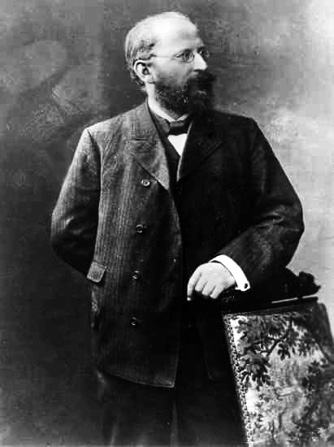
Eduard Bernstein
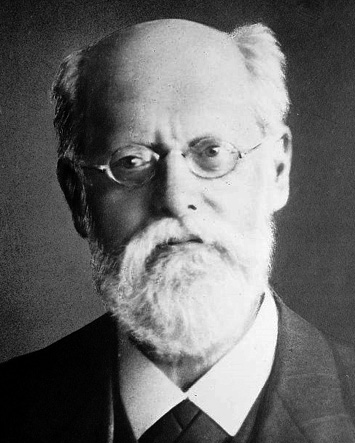
Karl Kautsky
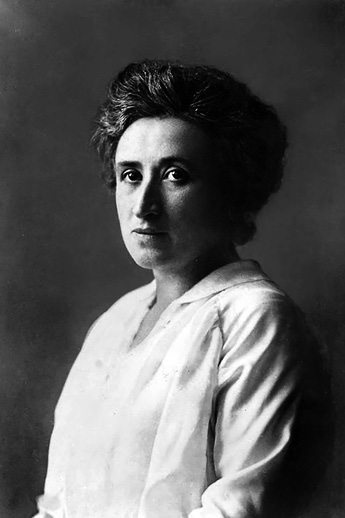
Rosa Luxemburg
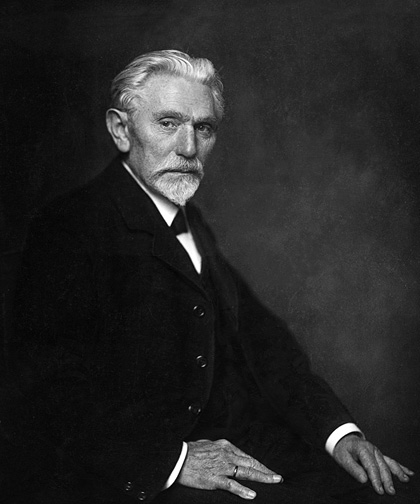
August Bebel
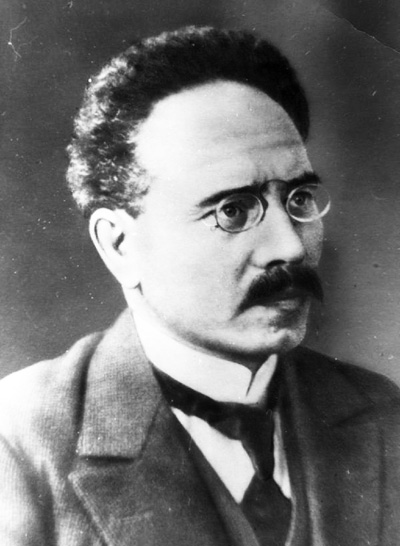
Karl Liebknecht