1857
Dear Frederic,
Today I emptied the 6th and last medicine-BOTTLE. Pretty well again on the whole, save for persistent and highly perfidious piles.
I haven't touched on Cobden's pamphlet [2] in my ARTICLES, because I have devoted many tedious columns exclusively to the HISTORY of the DANUBIAN PROVINCES and Sweden. [3] I should be very glad if you would take on Cobden.
I shall add a short piece to your article [3] as soon as I have seen the 2nd edition of The Times. Its ANNOUNCEMENT yesterday AS TO THE 'UNCONDITIONAL ACCEPTANCE-[4] was a sheer Stock Exchange swindle which brought it in a great deal of money. As early as 1772, at the Congress of Focgani,[5] Catherine II had already proposed to the Turks THE INDEPENDENCE OF THE PRINCIPALITIES UNDER THE COMMON PROTECTION OF THE PRINCIPAL POWERS OF EUROPE'. At the Library b I discovered a work of Herrmann ' s which appeared in Germany in 184l. c H e got hold of a manuscript of Field Marshal Münnich's on the Crimean campaign under Anna [6] in one of the German libraries and published it with a foreword. I shall make excerpts from it for you if you are interested.
You may, perhaps, have seen in the Augsburger the high praise Fallmerayer accords to Murait for his history of Byzantium from the 6th to the 16th century, which won a Petersburg Academy prize.d
a F. Engels, 'The European War'. - b of the British Museum - c E. Herrmann,
Beiträge zur Geschichte des russischen Reiches, Leipzig, 1843 (wrong date in the original). - d E. de Muralt, Essai de Chronographie Byzantine pour servir à l'examen des annales du Bas-Empire et particulièrement des chronographes slavons de 395 à 1057. Fallmerayer's review of this book was published in the Augsburg Allgemeine Zeitung, Nos. 11 and 12 (supplement), 11 and 12 January 1856.
Have seen Bruno[3] again on various occasions. Romanticism increasingly turns out to be a 'prerequisite' for the critical criticism. In economics expresses enthusiasm for the Physiocrats, whom he misconstrues, and believes in the specifically beneficial effects of landed property. Moreover he rates very high the economic fantasies of Adam Müller, the German romantic.[7] In military science his summits princepsb is the 'genius' Bülow. I told him that these latest disclosures of his had fully enlightened me regarding his arduous work of ratiocination. As TO RUSSIA he says that the old state of affairs in the West must be swept away and that this could only be done from the East, since the Easterner alone feels real hatred — for the Westerner, that is — and Russia is the only close-knit power in the East, BESIDES being the only country in Europe where there is still 'cohesion'. As to our illusions about internal class struggles, he maintains that 1. the workers feel no 'hatred'; 2. if they did feel hatred, they would never have achieved anything by it; 3. they are a 'rabble' (who have no interest in the Synoptics[8]) and ought to be curbed and directed solely by force and cunning; 4. with tliem one silver groschen rise in pay is enough to settle 'the whole caboodle'. In any case, no one who was not a 'descendant of the conquerors' could play an historical role, except in the field of theory. And there something had doubdess been done during the past 16 years, though only in Germany and, indeed, by Bruno alone. It was thanks to him that 'scientific' theology had ceased to exist in Germany, the only place where it had existed, and that 'Tholuck was writing no longer'. Voilà un résultat immense![1] In other respects, a pleasant old gendeman. Proposes to stay a year in England. I believe he is planning to introduce into England the 'scientific theology' which has ceased to exist in Germany. He declares Humboldt to be a complete ass because he has fraudulently arrogated to himself abroad the fame due to Bruno.
You should write to old Harvey about your ears. He is also treating Linad from afar and, having heard that she is merely a GOVERNESS in spef has not even charged her a centime. Herewith Lina's first report, which you should return.
I am sending you a scrawl of Urquhart'sf which they sent me before the paper came out.[9] The 'revelations' about the HISTORY OF CHARTISM [are] INDEED highly naive, since Urquhart turns out to be
40. Marx to Engels. 10 January
DEAR Frederic,
D'abord" my best wishes for the New Year, albeit retrospective. As a result of watery ink and several nights' writing, one of my eyes is so inflamed that writing is irksome to me.
Both the £5 (the second) and the MOUNTAIN WARFAREb received. For both of them MY BEST THANKS.
Is it true that Lupus has again been attacked and robbed by Manchester highwaymen? Or is the rumour circulating here simply an indiscriminate rehash of the old story?
The best thing old Hill can do is retire, either to paradise or to some idyllic Swiss HILL, SO that he has to be replaced once and for all in your office and can no longer saddle you with double the work under the FALSE PRETENCE of his 'temporary' illnesses.
The Neuchâtel question n 0 isn't quite so close to settlement as some papers make out. Both sides may already have gone too far with their braggadocio. Both have already brought discredit upon themselves: our Hohenzollernc with his déférence for Bonaparte, the Swiss with their 'dignified' attitude. Thus the rascals have deported several hundred factory workers to Piedmont because of their propagandist demonstrations. In this way the 'lenders'd hope to secure the esteem of Bonaparte and of Austria, TOO. What do you make of Lamoricière and Bedeau offering their épées" to the Swiss burghers? Obviously just an anti-Bonaparte gesture, since the fellows could be sure the lenders of Switzerland would not take them at their word.
There is great excitement in the petite démocratie. Just the kind of clash they want. On top of that, of course, your South German patriot regards the Swiss as kinsmen and in fact sees in the present clash nothing but a sequel to the 1849 campaign for the Constitution.[1 6] In addition, risings are expected in the Black Forest, etc. The Prussian, for his part, is certainly doing everything in his power to prevent A BREACH OF THE PEACE'. That is why Fattya wrote to his brother-in-lawb in Petersburg in terms reminiscent of the man who bade his wife stay him lest he jump out of the window. 'Stay me!' is a call our hereditary monarch has addressed to each of the great powers in turn. The question is whether they want to 'hold him back' and whether East and West, delighting equally in his discomfiture, will not add fuel to the flames. Whichever way the thing turns out, there will be no lack of red faces.
Proudhon is in process of bringing out an 'economic bible'd in Paris. Destruam et aedificabo.[6] The first part, or so he says, was set forth in the Philosophie de la misère." The second he is about to 'reveal'. The scribble is appearing in German, translated by Ludwig Simon now duly installed as clerk with Königswärter (or some such name, the well-known banker to the National) in Paris. I have here a recent piece by one of Proudhon's disciples: De la Réforme des Banques par Alfred Darimon, 1856. Same old tale. The démonétisa-tion de l'or et de l'argent, or rather que toutes les marchandises should be transformed into instruments d'échange au même titre que l'or et l'argent.e
The piece has an introduction by Emil Girardin and betrays evident admiration for Isaac Péreire. Hence it enables one to get some idea of the kind of socialist coups d'état Bonaparte thinks himself capable of resorting to, even at the eleventh hour.
I have a whole LOT [OF] PAMPHLETS written by Bruno Bauer during the Russian war.[117] Feeble and pretentious. In company with his brother Egbert the worthy fellow has now rented from the Berlin municipality 50 acres of land outside Berlin. The intention is that the London Edgar'sf mother-in-law — an old washerwoman or 10 1857
SOMETHING OF THE SORT — should look after the 'market side'. Bruno has written to Edgar telling him that this is the way to 'independence'. He is paying a rent of 5 reichstalers PER ACRE, i.e. 250 reichstalers a year. It's old fallow land. Bruno hopes that the profit and the produce from this land will enable him to write at leisure his Geschichte des Urchristentums,[1] ]8 intended as an 'historical' test-piece for his critique of the Gospels.[3] Nice critical fantasies these, and to some extent Bruno may have been influenced by the recollection that in Part 2 Faust becomes a land-owner. b Only he forgets that Faust obtained the money for that transformation from the Devil.
Lallerstedt, La Scandinavie, ses craintes et ses espérances, Swedish pendant to Mieroslawski's book.c Contains one or two FACTS of interest. In particular Lallerstedt recognises that, during the last century, England was constantly playing Russian tricks on Sweden. Recounts how Admiral Norris, sent by England on an ostensibly anti-Russian mission after the death of Charles XII, was bribed by Peter I with a precious stone of great value. Also has new material that throws light on the behaviour of Bernadotte.
Nothing new here. I go out little and hear little.
Salut.
Your
K. M.
Mr Faucher from Berlin is one of the PRINCIPAL SUB-EDITORS of The Morning Star. In a diatribe against Lupus in the London Illustrated News, Horace Mayhew writes inter alia:
* 'Symptoms of being a confirmed old Bachelor: When a man cannot go anywhere without his umbrella, that's a symptom. When a man thinks every one is cheating him, that's a symptom. When a man does all the shopping himself etc.'*d
41. Marx to Engels. 14 January
41
MARX TO ENGELS
IN MANCHESTER
[London,] 14 January 1857 9 Grafton Terrace, Maitland Park, Haverstock Hill
Dear Engels,
Edgar von Westphalen has sent over a man — address enclosed — with two letters, one for me, and one for you. This man Erich wishes to establish connections with London business men and then return to New York. He has recommendations from New York, but none from England. With regard to Edgar's letter, he has given you and myself as references, you as an English merchant, me as correspondent of the New-York Tribune. I told him that we couldn't possibly provide information about his financial circumstances, since we knew nothing of them. REPLY: neither were we required to do so, but only to confirm, if asked, that he was 'Erich' of New York and had been 'recommended' to us from that quarter. IT IS ALTOGETHER A SILLY BUSINESS of the kind often initiated by Edgar. The fellow seems to be a decent sort of chap and I couldn't, of course, tell him that a recommendation from my brother-in-law was likely to be more of a hindrance than a help, even in our case. As regards yourself, I naturally made no promises but merely undertook to send you Edgar's letter, at the same time informing you that the 'recommendation', if requested, should au fond" be restricted to confirming the man's identity.
Cornelius will shortly be leaving London. Is to be manager of a joint stock mining company in Nassau. He has offered Roesgen's cousin what is said to be a good position (in an emigration agency) in Le Havre. Guardians received. The FACT concerning the floods is
[119] INTERESTING.
Salut.
Your
K. M.
Works, First Russian Edition, Vol. XXII, Moscow, 1929
42. Marx to Engels. 20 January
42
MARX TO ENGELS[20]
IN MANCHESTER
[London,] 20 January 1857 9 Grafton Terrace, Maitland Park,
Haverstock Hill
Dear Engels,
I really have monumentally bad luck! For the past 3 weeks or so Mr Dana has been sending me the daily Tribune—obviously with the sole intention of showing me that they aren't publishing any more of my stuff. Except for some 40 lines on the MOVES of the Banque de France,a not a single line of mine has been included. Week after week I have put off drawing anything on the Tribune in the belief that the articles would sooner or later appear. BUT NOTHING OF THE SORT. My articles on Prussia, Persia, Austria all regularly REJECTED.b" Having for some 4 years printed all my things (and yours TOO) under their own name, the curs have succeeded in eclipsing the name I was making for myself among the Yankees and which would have enabled me to find another paper, or to hold over their heads the threat of transferring to one. Que faire?c
Good advice is valuable IN THESE CIRCUMSTANCES. As soon as I draw something they will make it a pretext to get rid of me once and for all; and writing two articles a week in the hope of having perhaps one in ten published and paid for is a procedure too ruinous to carry on. And how can I draw anything unless something is published?
And then another piece of bad luck. I've had a look at the November, December and January numbers of Putnam's. No sign of the article on d Bazancourt.[60] Either it has got lost (although I took it to the main POST OFFICE myself) or it will not be coming out until later. I can't believe that the fellows had got the thing, don't want to publish it and fail to notify me out of sheer bad manners!
I have not yet succeeded in arranging any definite terms with the Urquhartites,a and besides, theirs is a tiny little sheet which may bring out short fragments of an article over a month and often not finish it off for 5 to 6 weeks.[61] At best they can serve only as a small, secondary source of income. The Tribune, in exceedingly poor and insipid LEADERS, is moreover adopting a view almost diametrically opposed to all that I write. RUSSIAN INFLUENCE is unmistakable.b
So here I am, without any prospects and with growing domestic liabilities, completely stranded in a house into which I have put what little cash I possessed and where it is impossible to scrape along from day to day as we did in DEAN STREET. '" I am utterly at a loss what to do, being, indeed, in a more desperate situation than 5 years ago. I thought I had tasted the bitterest dregs of life. Mais
non! And the worst of it is that this is no mere passing crisis. I cannot see how I am to extricate myself.
The miserable collapse of Switzerland's braggadocio [121] was only to be anticipated. In no way were the fellows driven TO EAT DIRT by force supérieure. For, as Cornelius saw with his own eyes in Paris, the discontent, not only among Parisians, but in the army as well, was so great that in no circumstances could Bonaparte have permitted the Prussians to carry out serious military operations— on the French frontier least of all. Hence his EFFORTS to settle the affair. The discredit of the Swiss is only matched by that of Bonaparte, who first offered to stand surety for Switzerland vis-à-vis the Prussians and vented his spleen in the Moniteur when Switzerland repudiated his authority; then offered to stand surety for Prussia vis-à-vis Switzerland, and now finds himself compelled to admit, in little semi-official articles, that Prussia refuses to enter into any obligation towards himself. He has virtually endorsed the démenti he received from the Neue Preussische Zeitung.[122] So low has the fellow sunk. In the meantime his half-brother, Morny, has had the foresight to secure for himself a post in the Russian service.
I don't know whether you've seen that Mr Ledru-Rollin has publicly invited the French 'Republicans' to take part in the elections of Boustrapa's[40] Corps législatif[123]? So he has descended to the naïveté of legal opposition. While this shows on the one hand that he has relinquished the grandiloquent title of pretender, it shows beyond a doubt on the other that opposition is again considered feasible actually inside France, and that the bourgeois Republicans are hastening to resume, along with the Orleanists,[124]
a position in parliament that will enable them to shuffle the next revolution under the carpet.
I think I have already told you that the Brussels Nation has gone under, being now replaced by its rival the National, an inane, uninteresting Belgian gossip sheet. The noble L'Homme, too, has breathed its last. In its stead there appeared a Journal des Proscrits which proved incapable of surviving for more than a fortnight. In addition, diminutive pamphlets after the manner of Pyat's Ave Maria are published from time to time by the French réfugiés— inflated, hollow verbiage — printed crinoline save that they cost less to produce and are harder to sell.
The Tribune has discovered that, during the past 30 years (up till 1851), France has enriched herself far more than England and thus is now also her superior politically.* The proof. In France, the value (i.e. nominal) of landed property has increased twofold, in England not so much. True, the French estimate included houses while the English one did not; but since the English population increased by only 33 per cent in the area concerned, the same could be assumed of the number of houses (which the Tribune appears to equate with their value).
Erich has achieved his purpose here without any need for further references.
Your
K. M.
Your military exposé [125] WAS BEAUTIFUL. The Augsburger contained an article in which the passage at Constance is described as very difficult.b I have only skimmed over it.
43. Engels to Marx. About 22 January
43
ENGELS TO MARX
IN LONDON
[Manchester, about 22 January 1857][126]
Dear Marx,
Your letter arrived like a bolt from the blue. I had believed that everything was going splendidly at last — you in a decent house and the whole BUSINESS settled; and now it turns out that everything's in doubt. What damned stingy fellows these Yankees are; the people on the Tribune seem to imagine that, having squeezed you like a lemon, they must now proceed to squeeze another one. But the manner in which they are trying to break things off is particularly mean and cowardly. They want to force you to take the initiative. Furthermore, ever since Cluss fell so strangely silent, we've not had one reliable man in the whole of America.
Que faire cependant?" Since the Tribune is definitely intent on breaking with you this time, I think the best thing would be to establish connections with another New York paper. Might not something be arranged with the Herald or the Times?b In your place I would at once make a move and keep the chaps on the Tribune dangling until everything is arranged. In view of the fellows' shabby behaviour you need only consult your own interests and show no consideration for them. If you think that an indirect move w.ould be better, let me know. I will gladly carry out the negotiations in my name, so that you shan't be compromised; I could write saying I have reason to believe that you don't get on as well as you used to with the Tribune people and that some arrangement might perhaps be made, etc., etc. Enfin" anytfiing you want, pourvu que quelque chose soit faite.d
I wouldn't put it beyond the Tribune fellows to have stirred up trouble with Putnam too. I should write at once to Putnam to clear the matter up. One doesn't even know whether to write the article on coastal fortifications or not.e At all events it would be advisable to keep this source of income open as well.
I shall send you £5 early in February and for the time being you can count on getting this every month. Even if it means my
44. Marx to Engels. 23 January
facing the new financial year with a load of debts, c'est égal? I only wish you had told me about the business a fortnight earlier. For my Christmas present my old man gave me the money to buy a horse and, as there was a good one going, I bought it last week. If I'd known about this business of yours I would have waited a month or two and saved the cost of its keep. But NEVER MIND, that doesn't have to be paid for straight away. But I'm exceedingly vexed that I should be keeping a horse here while you and your family are down on your luck in London. It goes without saying, by the way, that you shouldn't let the promise of £5 a month deter you from approaching me again in case of hardships, for if anything can be done I shall do it. Anyhow, I've got to turn over a new leaf; I've been leading far too frivolous an existence of late.
Warm regards to your wife and children and let me know soon what you propose to do and how things stand.
Your
F. E.
Vol. XXII, Moscow, 1929
44
MARX TO ENGELS[82]
IN MANCHESTER
[London,] 23 January 1857 9 Grafton Terrace, Maitland Park, Haverstock Hill
Dear Engels,
D'abord,b very many thanks for your kind letter. I wrote to Olmsted about 10 days ago; am therefore awaiting his reply. It strikes me that Dana's annoyance over Freiligrath's blabbing his secret has something to do with the Tribunes 23 1857
behaviour, or rather with the fact that Dana has not brought his influence to bear.[127]
To work for The New-York Herald is out of the question; The New-York Times is the one to go for. I am thinking of approaching them unobtrusively through Dr Abraham Jacobi, who is at least discreet and whose quiet manner seems to impress the Yankees GENERALLY. I intend to write to him next Tuesday, and at the same time to Dana in such a manner as will at any rate involve him in a contretemps more disagreeable than he had bargained for. I should be grateful if you could let me have by Tuesday — after Tuesday I shall probably discontinue the articles for the Tribune pending further news from New York — a military article on Persia.[11] No need for much detail this time. Just a few general strategic VIEWS. The Tribune probably imagines that, now they have turned me out, I shall resign myself to abandoning the American camp altogether. The prospect of their 'military' and 'financial' monopoly going over to another paper is hardly likely to please them. Accordingly, I have today sent them a 'financial' piece. [28] An introduction to the Persian war,[129] however cursory, would be important because it would give them to understand that we still have a 'WAR' up our sleeves with which other papers could be helped to make a splash. The (military) prospects of the Russians and English need only be hinted at, of course.
So I shall postpone any outright rupture until I find out whether I can fix anything up elsewhere in New York. If I cannot and the Tribune, for its part, does not change its attitude, then the break will have to be made, of course. But in a sordid contest like this I believe it important to gain time. It seems to me the Tribune has come to believe that, since the 'great turn' taken by events in America,1S0 it can dispense with all special editions (European ones, at least). It's truly nauseating that one should be condemned to count it a blessing when taken aboard by a blotting-paper vendor such as this. To crush up bones, grind them and make them into soup like PAUPERS in the WORKHOUSE — that's what the political work to which one is condemned in such large measure in a CONCERN like this boils down to. I am aware I have been an ass in giving these laddies more than their money's worth — not just recently but for years past.
Pieper is taking a schoolmaster's post SOMEWHERE between Portsmouth and Brighton; has been chasing after something of the kind for months.
45. Marx to Engels. 6 February
What about that ADVENTURE of Lupus'? You forgot to say anything about it.
Your
K. M.
P.S. I envy fellows who can turn somersaults. It must be a splendid way of ridding the mind of vexation and bourgeois ordure.
I saw in The Morning Advertiser an excerpt, strategic in content, from the Grenzboten concerning the Persian business.
45
MARX TO ENGELS
IN MANCHESTER
[London,] 6 February 1857
Dear Engels,
An ACKNOWLEDGMENT, in great haste, of the pounds that arrived today.
Enclosed a letter from Miquel. I wrote to him at once. The situation as regards the Tribune is as I foresaw. Once again not a word. So today I wrote the fellows a forthright letter as I had originally intended but did not tell them that meanwhile — until their answer arrives — I shall discontinue my articles entirely.
Salut
Your
K. M.
46. Marx to Engels. 16 February
46
MARX TO ENGELS
IN MANCHESTER
[London,] 16 February 1857 9 Grafton Terrace, Maitland Park, Haverstock Hill, N. W.
Dear Engels,
Enclosed a letter from Olmsted in reply to my inquiry. So this particular ARTICLE wasn't accepted.[131] However, even after this letter I believe that they will be glad to publish 'SHIPS AGAINST WALLS'.3 The question is, have you got the time to write it? No doubt we ought to try Putnam again before giving up altogether. At any rate it was exceedingly impertinent of that gendeman not to let me know what the position was until after 4 months. Since I shall in any case have to write to Olmsted, see if you can make out his Christian name from this letter.
You will probably have had Miquel's letter. Freiligrath tells me that, besides Ruge and Hess, Oppenheim and other disreputable good-for-nothings write for the Jahrhundert.
Freiligrath requests you not to let the matter of Weerth remain dormant. Assuming that that Jew Steinthal has got his hands on Weerth's diaries (about which the noble Campe has already written to Weerth's brother6), there is the additional danger that, should Weerth's relations get hold of them, they might in usum delphini" publish them amended and censored. It is to be hoped that Weerth's brother will approach you direct. If the diaries eventually turn up, this would also mean that you could appeal to the philistines' consciences. Incidentally, it is exceedingly mean of Steinthal to have no more than bluntly notified the old woman d of Weerth's death, without any details and without either preamble or postscript. That haggler with his saccharine smirk!
I have been rereading (but haven't quite finished) your essays on Pan-Slavism, " partly for my own edification, partly in order to note the passages which, in the event of a German version, would necessitate your referring to sources not readily available in 16 1857
England save at the British Museum. While thus engaged I discovered that the same unknown hand (provisionally I make so bold as to ascribe it to the Polish renegade Gurowski) which wrote above my rejected DANUBIAN PRINCIPALITIES articles," 'Tout ces chiffrés sont éxagérés',b etc., etc. (nice French), has also adorned the Pan-Slavism articles with marginal glosses, viz.:
adc article I. At the end: 2 . C'est ni bon.d (What the £ is supposed to be (German C?) is beyond me.) (Nice French sentence!
C'est ni bon. Period.)
ad article IX. Written at the top: Changez l'introduction[11] and, as heading: 'Southern Slavï. Again, re the sentence, 'BY THIS LOGIC ETC. IT WOULD FOLLOW THAT THE HINDOOS ARE THE MOST YOUTHFUL PEOPLE ETC' he comments, 'THIS DEDUCTION
IS ILLOGICAL'.
On the statistical survey of the Serbian race: 'GERMAN (instead of
GERMAN) INFLUENCES DESTROYED THEM IN OTHER BRANCHES UNDER AUSTRIAN DOMINION.' (Nice English!) Again, on your censure of Montenegrin BRIGANDAGE, THIS (instead of 'TIS) NOT TRUE'.
Again, on 'CROATIA ETC. HAVE FOR CENTURIES PAST BEEN ANNEXED TO HUNGARY', he comments, 'BUT HUNGARY IS A COMPOUND OF THOSE VARIOUS LANDS'.
T h e passage about the M o h a m m e d a n Bosnians, 'THEY WILL HAVE TO BE EXTERMINATED, NO DOUBT ABOUT THAT' is distorted in true Russian fashion by striking out the next passage: 'THESE ARE, HOWEVER, BUT THE INTERNAL DIFFICULTIES OPPOSING THE ERECTION OF A SOUTH SLAVONIC EMPIRE ETC'
T h a t these notes are all of Russian inspiration is obvious. Likewise, that no Frenchman could have written French with this kind of ACCENTUATION and such mistakes; likewise and no less, that a Yankee would never talk about 'Southern Slavi' and would express himself altogether differently. Hence I should say that the provenance of these notes is beyond doubt. And if, as Olmsted's (Yankee) travelling companion maintained in front of myself, Freiligrath and Olmsted, Gurowski is in the direct pay of the Russian Embassy in Washington, the whole crisis with the Tribune becomes perfecdy explicable. By the by, from the notes a n d deletions it transpires that originally it was still intended to publish a modified version of the articles on Pan-Slavism (up to and perhaps including No. 9), and that the idea was not completely abandoned until the fellow realised what we were driving at. Hence, too, Dana's belated decision.
a See this volume, pp. 68, 81. - b All these figures are exaggerated. - c re - d It's neither good. - e Change the introduction
47. Marx to Engels. 24 February
Since, in the midst of my own crisis, it is very edifying for me to hear about crises, drop me a few lines telling me how things are in the industrial districts. Not at all well, according to the reports in the London papers.
The two final volumes of Tooke's History of Prices—from 1849 onwards — have come out. It is, of course, a pity that in his unrelenting battle with the CURRENCY chaps and Peel's Acts,[132] the old gentleman is too exclusively concerned with the question of circulation. Still, it's interesting at this particular juncture.
Salut.
Your
K. M.
47
MARX TO ENGELS
IN MANCHESTER
[London,] 24 February [1857] 9 Grafton Terrace, Maitland Park,
Haverstock Hill
Dear Engels,
Are you laughing, are you weeping, are you waking, are you sleeping?(1) Have had no reply to the various letters I have sent to Manchester over the past 3 weeks. However, I assumé they have arrived. Send me back what I enclosed in my last — Olmsted's letter — since I must answer it ONE WAY OR THE OTHER.
Salut.
Your
K. M.
49. Engels to Marx. 11 March
48. Engels to Ferdinand Freiligrath. Not later than 25 February
...The only literary piece of Weerth's that has arrived here so far is a humoristic history of trade (a fragment from the Brussels-Bradford period, 1845-47),a but Steinthal is expecting a further packing case of papers. I shall most willingly do all I can to get the things, but it is important that Weerth's brotherb should write a letter for me, so that I shall have some kind of authorisation. There should hardly be much difficulty; Steinthal is perfectly willing to help. But as regards details probably more than one point of disagreement will crop up.
The diaries, as far as my knowledge of them from Weerth's last stay here goes, contain only matter-of-fact notes.
Meanwhile, as I have already said, as soon as I am authorised to collect the things, I shall certainly make sure that I get everything....
49
ENGELS TO MARX
IN LONDON
Manchester, 11 March 1857 Dear Marx,
It's rather as though God and the universe had conspired to stop me writing to you. Whenever I think I have caught up to some extent with my commercial rubbish, I discover a whole pile of unsuspected arrears, am overrun by chaps, have to reply to hundreds of business queries on behalf of my old man and pander to fresh whims of Mr Gottfr.'s.a Just to make sure that I am sitting really fast, Freiligrath saddles me with Prussian ex-lieutenants, dabblers in bonds, who spend the entire day trying to borrow money (something he, Freiligrath, himself thought fit to warn me against) and who, after their departure, send me pawn tickets so that I can redeem their watches at my own expense. I am not in the least obliged to Freiligrath for landing me with the importunate fellow.b What is more I wrote to him today about my adventure with the brute. Let him clear the business up himself.
Last Fridayc Mr Ernst Dronke turned up at the office all of a sudden from Glasgow. He was here for only an hour or two on business. I saw him almost exclusively in the presence of Charles,d
when it wouldn't have done to argue with him or treat him roughly. On top of that his arrival was so sudden that I was unable to recall all of his intrigues. I treated him with reserve, just as I would treat an ordinary commercial traveller with whom I was only superficially acquainted and confined my remarks to trifling matters, and he was extremely careful to avoid any subject relating to the party. He shoved off during the afternoon and intends to come back in May, at which time I shall probably be in London. I hope he will remain a commerçant all his days; he certainly looks the part and the carefree existence seems greatly to his liking.
I presume you got the £5 note I sent you last Friday (or was it Thursday?).
The TORIES, FREETRADERS and Peelites could have done Pam no greater favour than put him in a minority over this question.[134]
What luck the fellow has and how stupid are his opponents! There is a great deal of agitation up here just now, but since 4,000 new VOTERS are on the register, all small SHOPKEEPERS and CLERKS and OVERLOOKERS, and therefore predominantly pro-Bright, it is unlikely that there will be any change. Bob Lowe and Sir J. Potter (A BORN ALDERMAN [135] and once a mighty wencher) are to be nominated here. WILL NOT DO. YOU could probably let me have some details about Bob Lowe's early exploits in Australia and elsewhere. These would be very useful just now. [136] What is the price of Mieroslawski's thick book on Poland?[3] It's really essential to have a compendium of this kind — and what is the price of Lelewel's work on which it is based,b if you can find this out?
I shall, by the way, send you a few more Guardians, they contain some really capital witticisms. I suppose you got the six copies I sent you recently (IN 2 LOTS)? Morny has already smelt a rat good and proper; these purchases the fellow is making in Russia must worry Bonaparte to death. That was also a fine to-do over the Docks Napoléon, Berryer jeunec and Fox,Henderson & Co.[137]—you must have read about it in The Times?
I'm most anxious to hear how the Tribune affair is progressing and likewise what you wrote to Olmsted. I think that I shall shortly be able to start work again and will see whether anything can be made out of China. The affair is bound to yield some interesting military aspect/ But no hope of that so long as I have to slave away in the office until 8 o'clock each evening and can't start work till 10 o'clock, after SUPPER, etc., etc., is over. At present I have to be at the office by 10 o'clock in the morning at the very latest and ACCORDINGLY go to bed at about one. C'est embêtant!* Just when one has really got into one's stride, one has to go to bed; cela ne va pas. Enfin, nous verrons? This summer things have got to be reorganised, otherwise there'll be a rumpus at the office. I intend to organise myself in such a way that I work from 10 to 5 or 6 and then leave and be damned to the business.
Warm regards to your wife and children. You are all well, I hope?
Tout à toi.h
F. E.
Engels, Works, First Russian Edition, Vol. XXII, Moscow, 1929
time
50. Marx to Engels. 18 March
50
MARX TO ENGELS
IN MANCHESTER
London, 18 March [1857] 9 Grafton Terrace, Maitland Park, Haverstock Hill
Dear Engels,
You must excuse me for not having acknowledged receipt of the £5 or of your letter before now. My wife is very unwell and our domestic arrangements generally are in such a state of crisis that I am quite bemused and cannot write.
Guardians received today. No answer yet from the New-York Tribune. The only thing I could say to Olmsted, of course, was that if he had failed to place the article[60] with Harper, he should send it back.
Proudhon's new book on economics, not yet to hand, has already run into 7 editions.3
How Miquel could believe I could write for the Jahrhundert is beyond my comprehension — a weekly rag whose contributors are Rüge, L. Simon, Meyen, B. Oppenheim, M. Hess, etc. I haven't read any of it but have seen the cover of No. 1, Vol. 2, on which is printed the following list of contents: 'Nach dem Kriege, vor der Entscheidung. IV. Von Arnold Rüge'. 'Briefe aus Paris, der Schweiz und London' (i.e., L. Simon, Kolatschek, Meyen). 'Der Geist unserer Zeit; zum Neujahrsgruss. Von Arnold Rüge'. 'Naturwissenschaft und Gesellschaftslehre. V. Von M. Hess'. 'Erziehung zum Glauben und Erziehung zur Humanität'. 'Notiz'.
Edgar Bauer is putting out a book, Englische Eindrücke}' Should be splendid.
I shall find out the price of Mieroslawski's and LelewePs books (the latter's first volume nothing but a children's history).0
Concerning the blackguard — Bob Lowe — I have no information at present, but might find out something this week. He's the kind of fellow who would have been at home in the Société du dix Décembre.[138]
Every day brings fresh revelations about Pam's 'liberal' foreign policy. First, the 'SECRET TREATY' with Austria.[139] Now, the fact that he has given Bonaparte his word to suppress any kind of revolution in Naples. The latter, however, wanted this done only in so far as a 'Murat' restoration [140] was not subsumed under the heading 'revolution'. It was this 'MISUNDERSTANDING' which scuppered the Naples expedition.[103] In the COMMONS yesterday Pam denied the charge in a very 'AMBIGUOUS MANNER'. (1) But this week is likely to see the appearance of further documents which will give him the lie.
The Russians haven't acted with quite their usual circumspection this time. The first Continental paper since the crisis in Parliament[134] to defend Pam as a 'TRULY BRITISH MINISTER' [141]
is the Nord, which usually affects a fanatical hatred of Pam. Even the Neue Preussische Zeitung speaks of 'UNPRINCIPLED COALITION'.
The Persian affair has fizzled out as I supposed: England has gained nothing, apart from a few nominal concessions; rather she has given way to the Persian court on the main issue.[129] Russia, on the other hand, has obtained a small piece of territory, as Layard yesterday confided to the gaping COCKNEYS. Needless to say, he did not have the courage to place these two FACTS in their correct causal nexus. He also repeated the assertion (already made by Disraeli in the Lower House without eliciting a word from Pam in reply) that, during the war with Russia, Pam forbade the Persians to take an offensive stand against the Russians as had been their intention. For at the time the fellows had hopes of recapturing the provinces that had been wrested from them. He had had the same admonition conveyed to them at the time of the Polish revolution (1830).
In order to assess correctly the Persian, as also the Chinese fracas, both should be compared with Pam's earlier doings in these REGIONS, since both are merely repetitions.[142] So long as he was at the helm, the first Chinese war was conducted in such a way that it could have gone on for 100 years without any result save an increase in the RUSSIAN OVERLAND TEA-TRADE and a growth of Russian influence in Pekin. It was only under Sir Robert Peel that this war was given an 'English' twist by Ellenborough.
18 1857
It is to be h o p e d — and is indeed probable — that this time a parliament will be returned which will pledge itself to nothing save passive obedience to Pam. The dissolution of the former parties expressed as a coalition ministry, like that of Aberdeen, 1 4 S seemed rather to make the MIDDLE CLASS feel able to rest on its laurels than to alarm it. This same dissolution expressed as Pam's dictatorship is bound to lead, not only to the most gratifying fiascos and complications abroad, but also to the most violent agitation if not to revolution at home. T h e old boy, who was pardy responsible for the Manchester 'massacre en miniature' and helped to draw u p the 6 'GAGGING ACTS', [144] won't so much as turn a hair. Mutatis mutandis, Pam's DICTATORSHIP will be to the coalition ministry what the rule of the Royalists, who coalesced in the last French Assemblée, was to the rule of Bonaparte. [1 4 5] In England, things will at last be brought to a head.
Apropos Bangya. Since 1855 this same Bangya has been Sefer Pasha's adlatus.a H e has married the daughter of a Circassian chief (which must be equally gratifying to his lawful wife in Pest and his unlawful one in Paris), and is now himself a Circassian chief. T h r o u g h his connections in London he has recruited 300 Poles and shipped them to the BLACK SEA together with supplies of ammunition, etc. According to the news in the papers, they have run the gauntlet of the Russian CRUISERS and safely reached Sefer Pasha. WHAT DO YOU THINK OF THAT? The fellow, realising that his role was played out in the West, has embarked on a new one in the Orient. Whether again as a democratic mouchardh or in good faith is another question.
Write soon, as your letters are now essential TO [help me] PLUCK
UP. T h e SITUATION is horrible.
Salut (to Lupus as well).
Your
K. M.
51. Engels to Marx. 20 March
51
ENGELS T O MARX
IN LONDON
Manchester, 20 March 1857
Dear Marx,
It had already occurred to me that you might once again be in something of a hole. Whatever can be done by me, will be done. If at all possible I'll send you another five-pound note next week or, if I can't get hold of one, a POST OFFICE ORDER. In the latter case, be sure to let me know at what POST OFFICE I should make it payable. I've had very heavy debts to pay this month, with people tracking me down to the office, so that there was no option but to stump up. Otherwise you'd have had the five pounds straight away. It's lucky, by the way, that this parliament business has begun, with China thrown in for good measure 1S4; at this juncture the Tribune will need help again and will be forced to come to TERMS.
I've been sounding the Guardian chap about the possibility of making contact with REVIEWS and MAGAZINES up here. But this chap, too, seems to be hunting round in the hope of fixing up something for himself and there's not much to be got out of him. However, I shall see. Since he knows my opinion of Palmerston and declares it to be PREPOSTEROUS he is all the less likely to give us a recommendation in politicis.a All the same, I have a certain HOLD ON THE FELLOW but as yet haven't devised any way of exploiting it.
I share your view of Palmerston's intentions and prospects in the new parliament. Bonapartist despotism wielded by Pam together with a Corps législatif.[123] We shall see what that leads to.
According to the Augsburg Allgemeine Zeitung? the Circassians (which, not specified) have actually appointed Bangya 'head of the house'; he was selected for this snug berth precisely because he is a foreigner, so that none of the native chiefs could complain of having been slighted. What has become of Sefer Pasha (a man of quite a different stamp to Koscielski) is far from clear. I regard the whole thing as a stroke of genius on the part of the Russians, and we shall probably hear no more of the 300 Polish Spartans. H6
The Nord must have changed its mind again. The Guardian's Brussels correspondent quotes passages that are violently anti-
52. Marx to Engels. 24 March
Palmerston. Can you let me have the most relevant bit? That sort of thing never comes my way here and in any controversy I must always have CHAPTER AND VERSE immediately to hand.
While putting my old newspapers in order recently, I discovered the loss of one of the main bundles of English papers and cuttings from the Guardian, Free Press, etc., etc. Nothing, luckily, connected with our party archives — they are safely stored away. But everything, with a few exceptions, relating to Palmerston—Tucker's pamphlets,[147] the cuttings containing your articles you had sent me (many of these are also being sat on by Lupus, etc.). I needed and was looking for them precisely in order to refresh my memory as to detail. Have you got any duplicates you could send me, likewise the full text of your articles which appeared in Urquhart's London paper[61]? These should be fairly easy to get hold of. I would find the things particularly handy just now.
Bob Lowe's prospects up here are poor. Some of the philistines have come out against Bright; however I believe he will scrape through this time. Lowe will make an ass of himself as soon as he arrives here. But it would be splendid were he to get in.[136]
Warm regards to your wife and children. Write again soon and tell me how your wife is.
Your
F. E.
52
MARX TO ENGELS[20]
IN MANCHESTER
London, 24 March 1857 9 Grafton Terrace, Maitland Park, Haverstock Hill
Dear Engels,
Herewith some anti-Palmerstoniana, viz.: 1. Betrayal of England, 2 COPIES. (NB. The self-same Coningham who here reproduces
Published in English for the first time excerpts from Anstey's speech[2] is now an ultra-PALMERSTONiAN candidate in Brighton.) 2. TVCKER-PAMPHLETS,a*b 8 COPIES. 3. Anstey's speech} 4. Palmerston for Premier. 5. Palmerston in Three Epochs.c
(With the exception of the Hungarian affair, cribbed from Urquhart, the remainder has been lifted by Mr Wilks — just like him, of course — from my articles in the Tribune.[14]*) No need for you to preserve numbers 1 and 2; but possibly numbers 3, 4 and 5. Tomorrow, if I can find them, I shall send a few other pamphlets. As TO THE Nord, note that the Post itself (in one of the numbers appearing between 4 and 9 March) carried the article I have mentioned.*[1] Later, however, it changed its tune.
Now for PRIVATE AFFAIRS. D'abord' a letter has arrived from the Tribune, which I shall send you as soon as I have answered it. My threat to write to another paper has worked after all, at least up to a point. Despite its very friendly tone, the letter shows that I was not mistaken about these gentlemen. For what they propose is to pay for one article a week, whether or not they print it; the second I send at my own risk, and draw on it if printed. Thus they are au fait[1] cutting me down by one half. However I shall agree to it and must agree to it Also, if things in England take the course I think they will, it won't be long before my income reaches its former level again.
I'm very sorry that, in the meantime, I must continue to depend on you, having so greatly fallen into arrears that everything that could be pawned has been pawned and the drop in income cannot be made up until I have found some new resource. On top of that, and since I cannot after all withhold the FACT from you, my wife is IN HIGHLY INTERESTING CIRCUMSTANCES. However, all I intended in my last was to explain why I hadn't answered for so long— certainly not ANY I HING ELSE. YOU will understand that even the most equable of men — and in a mess such as this I do INDEED possess a great deal of equanimity — will sometimes lose patience and let himself go, especially vis à vis his friends.
I should be most grateful if you could let me have a few 'humorous' LINES, SAY SO OR IOO ONES, on the Orlandian bravery e evinced by the English in Persia and before Canton.[134] The Bushire expedition,f as you will have seen, pivoted mainly on the 25 1857
espionage of one Captain Jones, who was sent to Bushire under IALSE PRETENCES as POLITICAL AGENT. Probably more tomorrow, as I want to send you the pamphlets today.
Salut.
Your
K. M.
NB. It does after all make a difference whether one stages a coup d'état first and elections afterwards, or elections first with a subsequent coup d'état in view. Without doubt Palmerston, or at least his PAPERS, have OVERDONE THEIR PART. Take the Advertiser, for instance, wallowing in filth u p to its eyebrows. This has, OF COURSE, evoked a measure of reaction.
53. Marx to Collet Dobson Collet. 25 March
Dear Sir,
Enclosed Chapter V of the diplomatic relations.[61] T h e forward-ing of the gratification due for the printed contributions would oblige me. Should your time permit, you would oblige me by calling at my house any day except Friday. I have to communicate you some highly important information. [3]
T h e illness of Mrs Marx does not allow m e seeing you at Ampton-place.
Mr D. Collet
Yours truly
etc.
54. Marx to Engels. 31 March
54
MARX T O ENGELS
IN MANCHESTER
London, 31 March 1857 9 Grafton Terrace, Maitland Park, Haverstock Hill
Dear Engels,
Received the £ 5 . I should like you to send me some Manchester Examiners if convenient. The BRIGHT PARTY'S EXPLANATIONS are of interest to me just now. It is only through their defeat that the election has acquired any historical POINT.[134] Palmerston's position will become dangerous only now, when he has a commanding majority inside Parliament, whereas outside Parliament there is a recrudescence— for the first time since the Anti-Corn Law League [15]°—of SERIOUS ANTI-MINISTERIAL AGITATION. England is entering upon a sérieuse crisis — as The Times already intimates, with its reference to the CLOUD WHICH IT SEES GATHERING a — and if the MOVE is resumed on the Continent, John Bull will not maintain the stance of supercilious detachment he adopted in 1848. Pam's victory marks the culmination of events which began in June 1848.[151] Amongst the more intelligent members of the London PUBLIC the news from Manchester, accompanied as it was by a commentary in the shape of Pam's brazen address and speech,b was greeted with a kind of stupefaction. Seen from here — a n d all are unanimous on this point — Manchester has brought disgrace, serious disgrace, upon itself. Had Punch not been bought by Pam—Taylor, a chief editor thereof, has been given a post at the General Board of Health at a salary of £1,000 — Potter, Turner, and Garnett, at any rate, would have figured in it next Wednesday. Send me some particulars about these laddies and their WHEREABOUTS.
Mr Dronke has written to Freiligrath telling him that he 'will break with his Jew and set u p as an independent agent'.
I have provided Urquhart with some notes on Bangya c—in view of the latter's connections with Constantinople and Circassia.
55. Engels to Marx. 31 March
Enclosed a cutting from Reynolds about the editor of The Morning Advertiser—-Mr Grant. Every word of it true.
Also Dana's letter. Let me have it back. In his enumeration of the articles published he mentions only the last ones,(1) and even some of these he didn't publish until 5 or 6 weeks after their arrival in New York when he saw that things were taking a new turn.[152] His proposal re money is the best possible indication that I was not mistaken about the gentleman's intentions. His remark about the length of the articles suits me well. I shall have all the less to send. What strikes me, though, is that for months past he has been able to find 2 or 3 columns for the most insipid London
GOSSIP.
In Prussia too there is a minor parliamentary crisis. Once AGAIN the dictum 'Geniality leaves off where money matters begin'15S
would seem to be proving true there.
It seems highly probable that the Swiss will agree to expel all the refugees.
Salut.
Your
K. M.
Did you take note of the bubbles that burst last week — the Australian Agricultural Company, the London and Eastern Bank, and the North of Europe Steam Company, one of the directors being Mr Peto?
55
ENGELS TO MARX
IN LONDON
Manchester, 31 March 1857 Dear Marx,
You will have received the £5 note, K/S 84562, this morning. As regards 'depending on' me, don't give it another thought. I should take umbrage if you were not to inform me when the SOVEREIGNS' armed intervention is required. I shall see how my finances go in April; I think I shall be able to manage a bit more during the second half, at any rate.
The Tribune's proposal is most cunning and, since the chaps are practically certain to print only one article a week, I shouldn't send two save on special occasions such as the present elections, etc., etc. However, circumstances will come to your aid, and in all probability the good Yankees will have no reason to complain about the DULLNESS OF EUROPEAN POLITICS this summer and autumn, while their own merry-go-round will gradually come to a halt.
I have hardly followed the Persian and Chinese military ventures[3] at all, indeed there has been a great dearth of detail. About Captain Jones I know nothing. It would now be utterly impossible to get together the necessary material, but when we get fuller news about the last big cavalry attack in Persia I shall see what can be done.
The pamphlets have arrived.b If only I could get hold of your old Tribune articles![148] Most of the stuff is in them. Washington Wilksd and Palmerston for Premier contain only generalities, and Chisholm Anstey's speech*e is fearfully décousu* though very important, more especially by reason of the personal matters relating to the Portfolio[154] but also, here and there, by reason of its contents. The only really cogent pamphlets are your two Tucker pamphlets, especially Unklar Skelessi.f If you can supply me with any more material, tant mieux* I have taken steps to improve the storage arrangements.
The eight thousand philistines who voted for the fattest man in Manchester (Potter) because he makes up for his lack of brains by the size of his bottom, are already ashamed of their victory. All the same, the elections have made an enormous impression here, and the 'Manchester' Party[134] is beginning to take stock of its performance over the past 6 years and to discover in what it has railed. I don't think we shall hear very much more of PEACE-PARTY TALK [155] for the time being, while on the other hand Bright (if he rallies) will, with one or two others, undoubtedly advocate a more far-reaching electoral reform and, before long, Jones may well receive some propositions from these bourgeois. For Pam the most gratifying thing must be his triumph over Bright, Gibson, Cobden, 31 1857
Miall and Fox (Oldham); I am inclined to believe that the fellow will get a WORKING MAJORITY of 60-100. But be that as it may, wot« aurons du Palmerston tout pur* and WITH A VENGEANCE I've found one of the passages from the Nord in The Morning Post, but only eulogising his abilities.b T h e one in which he appears as a 'TRULY BRITISH MINISTER' is not to be found. Our local Palmerstonians and bourgeois offered Bob Lowe, should h e be defeated here, the sum of £2,000 to cover his election expenses in some other wretched hole. T h e ass refused, preferring the safety of Kidderminster, only to be trounced there. But never again will he be able to come to Manchester; he has behaved like a real blackguard — first he allows the philistines to compromise themselves on his behalf, then cries off and, at the same time, writes an article for The Times in which he says it would be scandalous if Manchester were not to return Bright.c
This time Philistia was tremendously divided. T h e vast majority of the bourgeoisie, a small majority of the lower-middle class, against Bright and Gibson. Quakers ' d and Catholics for Bright to a man; the Greeks likewise; the established Germans against him. A drunken anti-Bright m a n shouted: ' W E WONT HAVE HOME POLICY, WE WANT FOREIGN POLICY.' What the rationale of the local elections more or less amounts to is: T o hell with all questions of reform and class matters. After all, we philistines form the majority of voters, cela suffit.[6] T h e clamour against the aristocracy, etc., is tedious and produces no tangible result. W E DEARLY LOVE A LORD FOR ALL THAT. We've got FREE TRADE and as much bourgeois social reform as we require. We're flourishing like mad, especially since Pam reduced war INCOME TAX. So let's all foregather on territory where we are all equal, and let's be ENGLISHMEN, John Bulls, under the leadership of that TRULY BRITISH MINISTER Pam. Such is the present mood of the majority of philistines.
What is piquant about the business u p here is the burial of the Anti-Corn Law League [1 5 0]; Smith P. Robinson (HON. SEC) and George Wilson, 'THAT RESPECTABLE FIXTURE' are being thrown out of Newalls Buildings [1 5] and the GREAT LIBERAL PARTY is casting about for a new organisation. G. Wilson loses his snug berth and his status on the strength of which he rose to be CHAIRMAN of the Lancashire and Yorkshire railways at a salary of £1,000 per annum — a n o t h e r snug berth that will soon go west, permitting
56. Engels to Marx. 2 April
Wilson to go back to starch manufacturing as in the days of PROTECTION. But your Manchester philistine — even if a partisan of Bright — heaves a sigh of relief at the long-awaited demise of that old incubus, THE LEAGUE[136]!
Apropos, I believe that the Ch. Anstey pamphlet contains only a small part of Pam's replya—the debate lasted 4 days. Couldn't you get hold of the rest? And could you send me a copy of Urquhart's new rag, The Free Press" or whatever it's called? What is there in it by you?
NB. You might also, s'il y a lieu,b send me the tides of anything else of any use concerning the Pam affair; I could then get them myself up here.
Hearty congratulations on your family prospects. What are the girls doing? They must be quite big by now. I look forward very much to seeing them at Whitsun. Warm regards to them and your wife.
Your
F. E.
Vol. XXII, Moscow, 1929
56
ENGELS TO MARX
IN LONDON
Manchester, 2 April 1857
D. M.,
Potter is a great big, enormously fat fellow, aged about 46 years, red haired and red faced, has been mayor of Manchester 3 times, VERY JOLLY,' HAS NO BRAINS, but plenty of belly and bottom, introduced robes into the corporation here on the occasion OF THE QUEENS VISIT, for which he was dubbed a knight, is a lifelong whoremonger (a
57. Marx to Engels. 9 April
BACHELOR still), on particularly intimate terms with the celebrated Miss Chester (alias Polly Evans) whose brothel he has twice fitted out and towards whose LAW EXPENSES he allegedly contributed £50 when she appeared before the Liverpool Assizes on a charge of abortion and was acquitted. A man who will greatly please the COUNTRY SQUIRES and whose reputation rests solely on the fact that his father, Sir Thomas Potter, KNIGHT, was once leader of the local liberal movement and introduced Milner Gibson here. He himself is popular with whores, CAB-DRIVERS, PUBLICANS, street urchins and the less respectable variety of philistine GENERALLY. While he was MAYOR the police left the whores in peace. Views — moderate liberal.
J. A. Turner is a respectable philistine who has never forgotten that he once went bankrupt and who, within his restricted circle, makes himself plus ou moins(1) useful as chairman of the COMMERCIAL ASSOCIATION (the rival of the more liberal CHAMBER OF COMMERCE). Might also gain some influence in the House of Commons by his detailed knowledge of commercial questions. Is a Tory (moderate) and very rich. His elder son, Jack Turner, COMMONLY CALLED THE FAT BOY, is a great toper and a good billiards player. His second, an impudent lad, is a FOXHUNTER with considerable pretensions to good horse-manship, an ugly mug and red moustache. To the horror of his family, he married the ballet dancer Annie Payne.[158]
Your
F. E.
57
MARX TO ENGELS
IN MANCHESTER
London, 9 April 1857 9 Grafton Terrace, Maitland Park,
Haverstock Hill
Dear Engels,
You must excuse me for being so late in answering. For a fortnight my wife has been in worse health than for many months past, and there has been great TROUBLE in the house. Be so good as to let me have Dana's letter back.
I am sending you through the parcels company a small bottle of eye lotion. Cornelius brought me a bottle of it from Paris, where he had had trouble with his eyes. For several weeks I had myself been suffering from inflammation of the eyes due to intensive work at night. The lotion put me right within a few days and will do you a similar service. All you have to do is put a few drops into the bad eye on getting up and on going to bed.
Conrad Schramm has died in Philadelphia of a chest complaint. I hear that in New York the Neue Zeit announcing his death has published an obituary of sorts. I haven't yet seen it.[159]
The apparent improvement on the Stock Exchanges is again petering out. Bank rate is rising again. Crédit mobilier[45] and French rentes are again going DOWN, while revelations of commercial sharp practice by joint stock companies in London and Paris are becoming increasingly frequent. In the latter place, I'm glad to say, the government is directly involved. You have, I suppose, read about the row between Péreire and Féline? I'd have copied it out for you had I not assumed that The Manchester Guardian's [woman] correspondent CHRONICLES everything of that nature. I now see the Paris Figaro from time to time, the only real journal of the Empire; it has cast off all semblance of respectability.
I don't know whether I have already drawn your attention to the two new pieces of evidence against Pam. First, Herbert told his CONSTITUENTS in South Wiltsa that he had given orders for the bombardment of Odessa[160]; upon his resigning, Pam sent an order written with his own hand to SPARE it. Secondly, Russell told the City electorateb that Palmerston had given him written instructions on how to conduct himself at the Congress of Vienna,[161]
instructions which Clarendon forbade him to make public and in the execution of which LITTLE JOHN so splendidly BROKE DOWN. It's typical of old Pam to keep harping in his newspapers on Herbert's Odessa TREASON (it was Pam's popular rag, the Advertiser, that first drew attention to Herbert's family ties with Vorontsovc) and on Russell's Vienna TREASON.[162] I shall search out more anti-Palmerstoniana for you. Pam's speech against Anstey (a fat pamphlet) ought to be in my possession if Pieper hasn't pinched it from me. Lengthier works are Parish, Diplomatic History of Greece and Urquhart, Central Asia.[11] On the first topic you might also read the EXPOSITIONS by Thierscha and Maurenbrecherb which came out in 1836 (?). (It's a long time since I set eyes on them.) Of all the Blue Books,[38] the one that has impressed me most strongly is that on the second Syro-Turkish War.c
I've only had 5 articles in The Free Press.[61] Liebknecht, etc., have filched them from me. However I'll get them together for you. In the last one I used the text of one of your articles, in which you speak of Peter I.16S I've only just completed the introduction. But at first the chaps dragged their feet for months. Later, they brought it out rather more quickly. But now, when the first payment is due, I dun them in vain. If they don't do better on this POINT than hitherto, I shall have to sever the CONNECTION ALTOGETHER. They have given me a new contract, but what good is a contract to me if they don't abide by it in puncto punctid?
Salut.
Your
K. M.
Regards to Lupus. Tell him that in Grimme I have found the scientific derivation of Farina, the Eau de Cologne manufacturer, viz. Sanscrit: vârif—Gen. vârinas.
Vol. XXII, Moscow, 1929
58. Engels to Jenny Marx. About 16 April
58
ENGELS T O JENNY MARX[164]
IN LONDON
[Manchester, about 16 April 1857]
Dear Mrs Marx,
Herewith the article," and at the same time 4 Guardians. A new map of London has now at last enabled me to locate your Grafton Terrace. You really are right out in the country, at the foot of Hampstead Hills and, if the hachures on the map are correct, in a highly romantic district. But if the result is nothing but ill-health, toothaches, swellings of the head and digestive upsets, it doesn't say much for country air and romanticism. At all events, I hope that both you and the Moor are by now feeling very much better.
Lupus suggests that the Moor's etymology of Farina is quite wrong and that the Sanscrit vârinas is, rather, the root of Varina shag.b This answer will certainly come as no surprise to the Moor and should therefore not be withheld from him. A new chapter is about to open in old Lupus' life. Don't be alarmed — it isn't marriage. On the contrary, it's divorce, for he's leaving the LANDLADY he's been with for 3 years, and moving closer to where I live. The old gent is now very popular with a group of German clerks who come to the Chatsworth from time to time, and over whom he presides with great dignity every Sunday night. They simply couldn't live without Lupus, any more than the English philistines who patronise the pub.
All eyes up here are fixed on fat Potter in anticipation of the day when he seconds the address in Parliament; a fine spectacle that will be!
Again, best wishes for your recovery. Warm regards to the girls — the air out there will undoubtedly suit them better. How they must have grown!
With warm regards,
Your
F. Engels
59. Marx to Engels. 21 April
60. Engels to Marx. 22 April
59
MARX TO ENGELS[82]
IN MANCHESTER
[London,] 21 April 1857 Dear Engels,
Be so kind as to write by return, telling me how to reply to the enclosed letter from Dana.[165] I must send off an answer by Friday's post.
By following Christ's precept 'if thy tooth offend thee, pluck it out',a I have at last found relief, at the same time discovering that this wretched tooth was the source of all the other ailments that have been plaguing me for months. You have located our house correctly. The title of Mr Edgar'sc book is not Englische Eindrücke but Englische Freiheit0 l/[4] of it is said to be about Mormonism. The whole claims to provide the physiognomy OR, IF YOU LIKE, physiology of the national character. I haven't read any of it. Will write to you
IN SOME DAYS.
Salut.
Your
K. M.
60
ENGELS TO MARX
IN LONDON
[Manchester, 22 April 1857][166]
Dear Moor,
This business of the Cyclopaedia[165] has come as a real boon to me, and to you too, no doubt. Voilà enfind a prospect of making good your loss of earnings and, for me, a prospect of a regular occupation in the evenings. La paix allait me démoraliser*; ever since there have been no more articles to write for the Tribune I have been doing far too much loafing, for which there is every inducement up here. As to the militaria, Dana must provide an immediate answer to the following questions:
1. How many volumes, roughly, will the whole amount to and how far does he propose to get in Vol. 1 or Vols. 1 and 2?
2. Are the military articles to be confined primarily to defining technical terms, e.g. ARTILLERY, CASTRAMETATION, COLUMN, with historical notes and a brief synopsis of the individual branches of military science — thus e.g. artillery: 1. Definition. 2. History and present state. 3. Résumé of the branches of the modern science of artillery (gunnery, personnel, transport, use in the field and before fortresses, etc., etc.)?
3. Or is the intention to have additional articles on military history, e.g. under the HEAD Austerlitz, Arbela, etc., etc., brief comptes rendusb of the actual battles, and under Alexander, Caesar, Carnot, etc., etc., military biographies together with particulars in each case of any epoch-making progress?
Next, you must write to Steffen at once and ask him for the title or author of an encyclopaedia of military science, as short and complete as possible; one that has the most but also the shortest articles would be best, since all I want is to know at once what articles to do and to have the alphabetical material as complete and HANDY as possible. As soon as I have this I can start work on Letters A and B — perhaps even sooner, since I can do a lot of articles from Brockhausc alone and a few more without it.
The PAY is quite profitable, even at $2 per large page; a lot of the stuff will only have to be copied or translated and the longer articles won't involve a great deal of work. I shall take a look at one or two English encyclopaedias straight away to see what military articles they contain, but then concentrate on Brockhaus which, after all, not only provides a better basis but is also more complete and is evidently looked upon by Dana as a model.
Should there be any philological sections for the taking, e.g. the Germanic languages, Middle High German, Old High German, etc., etc., literature (likewise in the Romance languages, especially Provençal), no harm would be done. Either the Jakob woman or Mr Gurowski will have taken on the Slav things; the former knows more about those languages than I do.
22 1857
Which articles shall you be taking on? German philosophy, at any rate — biographies of modern English and French statesmen? Some financial pieces? Chartism? Communism? Socialism? Aristotle — Epicurus — Code Napoleon — and the like. Themes certainly harder to handle without any PARTY TENDENCY WHATEVER than the good old military stuff, where needless to say one always sides with the victor.
Take as many articles as you can and set up an office by degrees. Mr Pieper can toil away, too; he will do well enough for biographical pieces and will, at the same time, get some plain wholesome information into his genius' noddle. Lupus might also be prepared to do something in the early classical field; je verrai![3]
Even though the work won't be very interesting (most of it, at any rate), I'm immensely tickled by the whole thing since it will mean an enormous LIFT for you. I was really hellish anxious this time about how the Tribune business would turn out, particularly when Dana tried to put you on half-pay. But now everything is going to be all right again and even though there's no immediate prospect of payment, it's still a very secure berth and one need have no qualms about doing one or two letters of the alphabet in advance; the money will arrive in its own good time.
Haven't you heard anything from Olmsted about Putnam's'? I should very much like to have the article on Bazancourt[60]; maybe I can do something with it here through Acton. Apart from that there may be a possibility of doing something further with Putnam's—PROGRESS IN THE ART OF WAR, IMPROVEMENTS IN ARTILLERY, SMALL ARMS, etc., etc., SHIPS AGAINST STONE WALLS; I'm willing to do anything so long as the fellows undertake to publish it. Dana would certainly arrange it to make you less dependent on the Tribune. By the way, get the EDITOR of Putnam's to write in person, cela vaut mieux.b
You must also find out from Dana whether the articles should in general take up more or less space than e.g. in Brockhaus, and whether the whole is intended to be bigger or smaller than
Brockhaus. Then we shall know what we are about. Also when they will pay — and by when the job must be completed. It's as well to know all this.
In your place I should offer to do the whole encyclopaedia alone; we could manage it all right. At dll events, take whatever you can get. If we have 100 to 200 pages in each volume it won't be too much. We can easily supply that amount of 'unalloyed'
a I shall see! - b that would be better
61. Marx to Engels. 23 April
erudition so long as unalloyed Californian gold is substituted for it.
But now, warm regards to your wife and children; let me hear from you again soon.
Your
F. Engels
Most obliged for the eye lotion. I'm still having some trouble but think it's because I've recently been drinking more port than usual — DROP THAT!
61
MARX TO ENGELS
IN MANCHESTER
London, 23 April 1857 9 Grafton Terrace, Maitland Park,
Haverstock Hill
Dear Fred,
I shall write to Dana not later than tomorrow. For me, the thing has come as a godsend, as you can imagine. It has also reassured my wife, which is important in her present SITUATION. I shall write to Steffen straight away (the fellow has changed his lodgings without notifying me, but is still in Brighton). Pieper, as you will remember from one of my previous letters,(1) has been a schoolmaster in Bognor since Christmas, AND I SHALL CERTAINLY LEAVE HIM THERE. He was becoming daily more vacuous, idle, useless and expensive. Under the iron rod of the parson in whose service he now is, he will again come to his senses. Moreover, the laddie left me just at a time when, because of my wife's condition, he thought himself indispensable and did not seem averse to the idea of my pressing him to remain on more favourable terms. I DID NOTHING OF THE SORT but merely expressed my satisfaction at his having at long last found a post. In the event, it transpired that his 'indispensabil-ity' was merely a figment of his own imagination. My wife fulfils the function of secretary without all the BOTHER created by the noble youth. As tutor to the girls he was quite unsuitable. So both parties have benefited from the change and, if the fellow again becomes serviceable, as I am convinced he will, he'll be much fortified by the realisation that I do not need him in any way.
Hence there can be no question of setting up an office in London. There is no one here who is any good. It's possible — and this I shall know within a day or two — that Dana has approached Freiligrath direct. Our Freiligrath is again MALCONTENT with his post though it enables him to earn £300 very comfortably with little or nothing to do. What he finds tedious is, for one thing, the moaning and groaning of the shareholders, who vent their displeasure on him, and, for another, his admittedly ambiguous position, which places a great deal of responsibility on him while allowing him barely a semblance of autonomy. That, AT LEAST, is the interpretation he himself puts on his FEELINGS. What in fact LURKS beneath all this is, or so it seems to me, a general distaste for RESPONSIBILITY. A clerical post which would relieve him of it, as at Hood's, is and always will be his dream. Then, too, he is tormented by the conflict between his renown as a poet and the rate of exchange. So far as I can gather from his occasional CONFESSIONS, all these Crédits mobiliers[45] are privily assailed by considerable MISGIVINGS. He was assured by an old hand on the Stock Exchange that never, in a practice of 40 YEARS' STANDING, had he experienced a chronic state of crisis such as now prevails. I haven't yet got round to it, but some time I must really investigate the relationship between the rate of exchange and BULLION. The role played by money as such in determining the bank rate and
t h e MONEY MARKET IS SOMETHING STRIKING AND QUITE ANTAGONISTIC T O ALL LAWS OF POLITICAL ECONOMY. Worthy of note are the 2 newly published volumes of Tooke's History of Prices. A pity the old man's head-on collision with the CURRENCY PRINCIPLE chaps [132] should lead him to give such a one-sided TURN to all his disquisitions.
I wrote to Dana as much as a fortnight ago asking for the return of your Bazancourt.[60]
The Urquhartites — who have asked me to send them a detailed BILL — have paid me £10 on account[3]; this was most welcome, since I owed that much to baker and butcher alone. The girls are growing up very quickly and their education, too, is becoming expensive. At the LADIES SEMINARY they frequent, they are having PRIVATE LESSONS with an Italian, a Frenchman and a DRAWING MASTER. Now I have also got to find a chap for music. They learn extraordinarily fast. The youngest one — the BABYa—is an astonish-ingly witty little thing and claims that SHE HAS GOT TWO BRAINS.
For my own part I would much prefer to supply Dana with articles on, say, Ricardo, Sismondi, etc. That sort of thing does at least admit of objective treatment from the Yankee point of view. German philosophy is difficult to write about in English. However, I shall suggest various things to Dana and leave the choice to him.
For the past six months I've been constantly having to call in the doctor for my wife. She is, indeed, very much run down.
Apropos. * Dr Freund has passed through the court of bankruptcy — assets £200, debts £3,000.*
The Bright and Cobden party cannot help but thrive now that Faucher is the foreign editor of their London paper, The Morning Star. I'm now on speaking terms with the chap since I can't help encountering him sometimes at Edgar Bauer's. The man considers himself the finest fellow in the world. 'Bruno Bauer has lost his self-confidence. He feels that it is I, not he, who will conquer Prussia.' He is A CURIOUS FREETRADER TOO, who doesn't even know what the MIDDLE CLASSES are. Prussia is, and ought to be, ruled by 'the officer and the student', 'I bowl over any English meeting at which I speak', 'I have made history. It was I who drew up Cobden's Canton MOTION',[167] to cite only a few of his tropes. The chap's a veritable Munchausen of mendacity, a veritable Ancient Pistol6 of braggadocio, and once in 6 months it's amusing to listen to his boasting.
Have you — or Lupus — heard anything about a Römische Geschichte published somewhere near Heidelberg, which is said to contain much that is newc?
How goes it with the landlord of the Golden LION? Salut. Your
K. M.
62. Marx to Engels. 8 May[20]
DEAR Frederick,
The £5 received.
Herewith a letter from Lassallea which, when Lupus has seen it, you should return to me at the beginning of next week. What should I do about fellow? Reply or not reply? You'll be amused by the comical vanity of the laddie, who will do anything to become famous and, entirely without provocation, writes 75 sheets on Greek philosophy.13
I have written to Dana in exactly the terms you suggested. As regards your Bazancourt,[60] I had already urged him to return it. Steffen doesn't know of any book such as you require; he himself appears to be engaged on an English translation of Rüstow's Cäsars Heerwesen.
Pieper is on the point of falling back into his former foolishness. Has written me a 'genius's' letter. The enthusiasm — not the enthusiasm inspired in him by his new post, but that which he inspired in his new post cum attendant principal — appears AS ist ALLY to have waned. He wishes to go to Switzerland as a 'courier', or else sever connections with his principal at mid-summer and once again cut a dash in London with £20 in his pocket. When I next write I >hall pour cold water on the genius. If he is ever to become 'serviceable' again this young man must endure the parson's lash for some while yet.
Have you read the Crédit mobilier'*[45] last report? It was in The TimesS Indicates a DECLINE.
Pam AS REFORMER! He'll reform those boys WITH A VENGEANCE. If you possibly can, write a military piece on Persia or China next week. My wife is drawing ever closer to the catastrophe and is finding her secretarial duties increasingly onerous.
As regards your toothache, I would advise you to have recourse to the same means as I did after eighteen months' hesitation. Pull
63. Engels to Marx. 11 May
the bugger out! I, too, always supposed my toothache to be rheumatic. Yet in the end a corpus delicti was discovered after all. When are you coming down here?
Salut.
Your
K. M.
With the coming of spring the children always go down with various ailments. So it has been again, first the youngesta and Laura and now it's little Jenny's turn.
63
ENGELS T O MARX
IN LONDON
[Manchester,] Monday, 11 May 1857
My dear Moor,
I return Lassalle's letter herewith. Effery eench the puerile Jew. What a pretty compilation it must be, likewise the thing that is going to 'set things alight' and about which he is so mysterious.[168]
We know, of course, that there is nothing to the fellow but it is difficult to find any positive reason for breaking with him, particularly as we have heard nothing further from the Düsseldorf workers.b From this letter he would appear to have ceased all intercourse with them, or rather they with him, since he finds nothing positive to say about how things are going with the workers in Germany. But whether he wouldn't again make use of a letter from you to regain some kudos in their eyes is another matter. In your place I should write to him — you can't very well do otherwise — but ask him outright how things stand with the workers' movement on the Rhine and especially in Düsseldorf, so
64. Engels to Marx. 20 May
working your letter that he will keep his mouth shut about it and must either plus ou moins* declare himself or be deterred from corresponding with you. Lupus was much amused by the letter but our discussion on the subject was interrupted. I should, by the way, also make a point of asking him how he comes to slip your letters into the hands of the police.
There is absolutely nothing to say about Persia; the campaign itself was rotten and the accounts are even more so. There was, of course, something to be said about China on the arrival of the last MAIL as there still is, but now, ten days after the last MAIL, it's too late to do anything. So I shall wait until the next MAIL arrives, when I shall at once set to work so that the articlea will reach you in time for Friday or the following Tuesday. As far as possible, then, make your arrangements accordingly. I think the MAIL arrives at the end of this week.
WHAT'S THE MATTER WITH THE CHILDREN? I trust little Jenny is ALL RIGHT again. Warm regards to them all and also to your wife.
Your
F. E.
Vol. XXII, Moscow, 1929
64
ENGELS TO MARX
IN LONDON
Manchester, 20 May 1857
Dear Marx,
As you will no doubt see from the enclosed article,b it was written UNDER DIFFICULTIES. Each time I propose to do a Tribune article, it seems to bring out all the evil humours latent in my frame. On this occasion I'm sitting at home with linseed poultices on the left-hand side of my face in the hope of getting the better of a nasty abscess; I've been put on a frugal diet and forbidden beer, but by good fortune ordered to take a glass of wine. It's alleged that I've been eating too much roast beef; at all events I have had continual trouble with my face for the past month — first toothache, then a swollen cheek, then more toothache and now the whole thing has blossomed out into a furuncle, as little Heckscher calls it. In addition, I have to drink mineral water and — great fun, this — go out at 7 o'clock each morning.
Everyone up here is an art lover just now and the talk is all of the pictures at the exhibition. The thing is proving plus ou moins3
a FAILURE, financially, at any rate. Admittedly there are some very fine pictures, though most of those by the better or very best artists are no more than SECOND-RATE. Among the finest is a magnificent portrait of Ariosto by Titian. The later German and French schools very poor, hardly represented at all. Three-quarters consists of English trash. Best represented are the Spanish and Flemish and, after them, the Italians. S'il y a moyen? you and your wife ought to come up this summer and see the thing. It wouldn't do to write about it for the Tribune; and I wouldn't know where to begin — the Tribune can find the usual chit-chat in any paper.
Lupus, as I believe I told you, has moved out and is again fighting the good fight with his LANDLADY. To make matters worse, his new LANDLADY was brought to bed a week after he moved in. Next door there's a chap who not only has a fiddle which he plays badly but also a French horn which he plays completely out of tune. Hence the study of the pedagogic sciences is attended by enormous difficulties, so that the old chap is spending more time than usual at the Chatsworth.
I shall be in London in a fortnight or 3 weeks' time, either during Whitsuntide or the week after.[169]
Warm regards to your wife and children.
Your
F. E.
65. Marx to Engels. 22 May
65
MARX TO ENGELS[20]
IN MANCHESTER
[London,] 22 May 1857 9 Grafton Terrace, Maitland Park, Haverstock Hill
Dear Engels,
It may be some consolation to you to learn that for the past 3 weeks right up to this very day, I have been submerged in pills and potions as a result of my old and, as I believe, hereditary LIVER COMPLAINTS. Only by dint of the utmost exertions have I been able to supply the 'goods'—for the Tribune I mean — being otherwise QUITE DISABLED. In order that my time should not be entirely wasted I have, faute de mieux," been mastering the dansk sprogb and am presenüy applying myself to Af mit Livs og min Tids Historie, a colossal state haemorrhoid, afc (ex-minister) 0rsted. Opening oysters would be an altogether more amusing proposition. However, if the doctor's promises are anything to go by, I have prospects of becoming a human being again next week. Meanwhile I'm still as yellow as a quince, and vastly more crabbed.
As regards your own tribulations, I am firmly convinced that they all stem from a hollow tooth which ought to come out and which, by a series of concatenations, underlies all the other unpleasant symptoms. Heckscher will deny this, OF COURSE. However, when you come down here — which I greatly look forward to — it can do you no harm at least to accompany me to a really first-rate dentist and get him to examine your teeth. My view is based on the fact that two years ago, when I was suffering from very much the same trouble, Dr Freund also declared I had been eating too much meat, yet a few months ago a courageous visit to the dentist at last uncovered the source of the trouble. Your intermittent toothache is, of course, the main factor in my argument.
My wife expects to be confined at the end of the month, this time in not altogether agreeable CIRCUMSTANCES. It will be a long time now — another 3 weeks at very best — before I have accumulated enough to be able to draw on the Tribune. I tried to draw a bill on myself to cover the interim period, but failed with éclat. The actual HOUSEHOLD debts I can put off paying, but in the case of the rates this is possible only up to a certain point, and besides, the afore-mentioned circumstances call for certain preparations which have to be paid for on the nail.
As you will have seen in the papers, a second director of the Crédit mobilier[45]—the first was Place — viz. the BANKER Thurneys-sen, has decamped leaving massive debts of ABOUT 30-40 million frs. This splendid institution's latest report[170]—that of 28 April ul-timo"—reveals that, although the NET PROFIT still amounts to 23%, it has nevertheless fallen by about a half compared with 1855. According to Mr Péreire, the fall is due 1. to the ordre in the
Moniteur of March 1856 by which Bonaparte forbade the Crédit to skim the cream off the excessive speculation then going on in France; 2. to the fact that, by an oversight, this 'ordre de la sagesse suprême'b extended only to sociétés anonymes,' thus laying the Crédit open to highly improper competition in the shape of sociétés de
commandite ; 3. to the crisis during the last 3 months of 1856. True, the Crédit sought to exploit that crisis to bring off a few financial coups de main, but was obstructed in this 'patriotic' work by the NARROW SELFISHNESS of the Banque de France and the syndicate of Paris BANKERS headed by Rothschild; 4. Bonaparte has still not permitted them to make the statutory ISSUE of 600 millions in paper money of their own devising. *That issue is still looming in the future.* Péreire seems to be exerting severe pressure on Bonaparte. Should the latter shrink from giving his authorisation, a MIDDLE COURSE would seem to be envisaged, namely to turn the Banque de France into the instrument of the Crédit by loftier means, i. e. new draft legislation. From this report it further transpires that the Credit's business is still vastly disproportionate to its capital and that it has used the capital loaned by the public exclusively to further its gambles on the Bourse. As a quasi-state institution of Bonaparte's on the one hand, the Crédit mobilier declares that it is called upon to maintain the prices of FUNDS, SHARES, BONDS, in short, of all securities on the national Bourse, by advancing the money borrowed from the public to COMPANIES or INDIVIDUAL STOCK-JOBBERS for their operations on the Bourse. As a 'private institution', on the other hand, its main business consists in speculating on the rises and falls in the stock-market. Péreire reconciles this contradiction by something Moses Hess might well call 'social philosophy'.[171]
66. Marx to Engels. 23 May
I have omitted only one or two small items from your China-Persia article,a and altered an expression here and there. I agree with the whole thing, only I don't think that the troops stationed in Persia will be sent to China so soon. The treaty expressly stipulates that they will not leave Persia until the Persians evacuate Herat.[129] Pam won't spare them the hot season. That his instructions in this respect were again highly 'incomprehensible' would seem to follow from the fact that the Governor-General of India — Canning — tendered his resignation at the same time as the British general and the British admiralb committed suicide. Meanwhile, as announced in the Vienna newspapers, the main object has been attained. Persia has ceded two STRIPS OF LAND to Russia.
I have heard from Mickelc and shall send you his letter one of these days. Trusting I shall soon hear that you are fit and well again.
Salut.
Your
K. M.
Vol. XXII, Moscow, 1929
66
MARX TO ENGELS
IN MANCHESTER
[London,] 23 May 1857
Dear Engels,
The enclosed arrived from Dana this morning. It puzzles me how the Yankee can expect the stuff for Vol. I to be in New York by the beginning of July if he doesn't let us know what he wants until the end of May.
67. Engels to Marx. 28 May
You might reconsider which articles one should offer to do, apart from the military. Philosophical stuff is, in fact, too badly paid and also difficult when it has TO BE DONE IN ENGLISH. Do you know if there happens to be any German or French book on the biographies of big industrialists?
I'm equally puzzled as to how aesthetics is to be dealt with in 1 PAGE, FUNDAMENTALLY, and on a Hegelian basis.
Does Lupus feel inclined to take something on? Enclosed also a letter from Miquel. I do not, in fact, understand his theory of 'non-overproduction' and yet of 'lack of the wherewith to pay for production', unless it be that the utterly superficial blather of the utterly wretched CURRENCY chaps1S2 has taken root in Germany.
Saint
Your
K. M.
67
ENGELS T O MARX
IN LONDON
Manchester, 28 May 1857
Dear Marx,
Dana must be out of his mind to stipulate 1 page for aesthetics. Nor has the chap any inkling of military matters. See list of articles overleaf, occurring to me exclusively from Brockhaus and from memory. But since I must first check it against an English military encyclopaedia it can't be final; how could anyone remember all the technical expressions which in English begin with A? Apropos, there is an encyclopaedia of this kind by a hack of the most wretched variety, one J. H. Stocqueler.(1) Could you make inquiries about price, scope, etc., etc.?
And then, if you please, he wants to have the articles — of the desired thoroughness and brevity — over there by 1 July. Once again, typical Yankee. Anyway, it proves that they are counting more on SHOW than on real substance, as is already evident from the $2 per page.
Send Dana the list—as a provisional one—and point out that since it's impossible to work ON SPECULATION at this PAY, he must say what he wants. (It's precisely these patched together articles, being the easiest, that make the PAY acceptable.) A 2nd list of technical expressions for A will follow very shortly. Once this is SETTLED he might just as well let us have the list up to D, E or G so that we can get on with it.
I know nothing about Airey's (General) former career. You might look it up in an ARMY LIST, which will at least provide the bare bones.
I know nothing about the Spanish Armada either, but this could be found — likewise Ayacucho.
I'm not yet in sufficiently good shape to be able to come up tomorrow, and propose to leave on Saturday.[169] Can one take a CAB from Camden STATION (to which one books the TICKETS) to your place? And how far is it?
I shall bring Miquel's letter with me; because of my illness I haven't seen Lupus for a whole week.
More when we meet. As you can imagine, I have my hands really full, what with arrears, etc., etc.
Your
F. E.
«Abensberg (battle of 1809) V[4] p. Abukir ditto V4 p. Axle (artillery) '/g ditto Acre (St. Jean-d'-Sièges of) V4 ditto à V2 Actium (battle of) ]!»-lU Adjutant V4-V2 Afghanistan (invasion by English) 2 Aland Isles see Bomarsund Albuera (battle) [1]/[4] Aldenhoven ditto 1797 >/[4] Alessandria (fortress and sieges) V4 Algeria (French conquest of and English
68. Engels to Marx. 5 June
Anglesey (Marquis of) V2 Attack (in battle and siege) V2 Antwerp (fortress & sieges) I Approaches V2 fully Arbela (battle of) 'A, Arquebusier Vs Aspern and Essling (battle 1809) [3]/[4] Augereau (Marshal) V2 Advanced guard V2* " [2]
68
ENGELS TO MARX[173]
IN LONDON
[London,] Friday morning [5 June 1857]
Dear Moor,
Instead of coming to see you I am once more condemned to no less than four days of hot poultices. My face is again very bad and the whole business has begun all over again. But this time I intend to get rid of it for good. This will, of course, postpone my departure for Manchester ad infinitum. If the thing clears up quickly I might be able to go out for a bit on Monday.
In case you have any news for me in the meantime, drop me a line. The address you know: 7 Grove Hill, Camberwell.
I am RATHER annoyed by this business, as you can imagine, but que fairea?
Warm regards to your wife and children.
Your
F. E.
69. Marx to Collet Dobson Collet. About 10 June
IN LONDON
[Draft] [London, about 10 June 1857] (1)
Dear Sir,
According to your wish I send you the account for my contributions to The Free Press." They fill somewhat more than 27 columns. You will excuse me for having interrupted. Since I had the pleasure to see you last, I was constantly labouring under serious liver complaints, and thus forced to interrupt my contributions to The Free Press which, however, I hope to be able to resume next week.
Yours truly
D. K. M.
Contributed to the London Free Press 26 columns; the column at li Guinea; makes 13 Guineas. Received on them 10£. St.; remains due to me 3£. St. 13sh.
Published for the first time Reproduced from the original
70. Marx to Collet Dobson Collet. After 10 June[175]
Dear Sir,
Having myself not made up, but only copied the account forwarded to you, I felt, on receiving your note, very anxious, indeed, lest my claims should have been overstated. Consequently,
71. Marx to Engels. 15 June
I reexamined the reckonings. The case is simply this, that you make 22]/3 columns, that you have omitted No. 34,a and that the only mistake on my part consists in having put down 4 columns for No. 34, which really amounts to 5V2 columns.
Yours truly
K. Marx
D. Collet, Esq.
Published for the first time Reproduced from the original
71
MARX TO ENGELS
[IN LONDON]
[London,] 15 June 1857
Dear Engels,
Are you laughing or are you weeping, Are you waking or are you sleeping?b We here are seriously concerned about you. So write and tell us how you are. I hope you aren't being given any more hot poultices which, as a method of treatment, is quite out-of-date and has now more or less fallen into disrepute. But assuming you are using internal remedies only — as is rational and up-to-date — I fail to see why you have to keep yourself so anxiously secluded.
My wife very unwell. But she sounded the bugle too soon and as yet nothing has happened.
Salut
Your
K. M.
Works, First Russian Edition, Vol. XXII, Moscow, 1929
72. Marx to Engels. 29 June
72
MARX TO ENGELSI76
IN MANCHESTER
[London,] 29 June 1857
Dear Engels,
From the enclosed letter you will see that Dana is expecting the manuscript soon.(1) What am I to tell him? I can't plead sickness, since I am continuing to send ARTICLES to the Tribune. It's a very awkward CASE.
My wife is still in the status quo. On top of that, a nasty cough and domestic worries, serious ones. I hope you are recovering. Steffen was here yesterday.
Your
K. M.
73. Marx to Engels. 3 July
Dear Engels,
Shall be writing tomorrow. This is just to inform you that -the second half of the note had still not arrived by this evening. Considering the bad luck which has been dogging me of late, it
74. Marx to Engels. 3 July
75. Marx to Engels. 6 July
may well have got lost. I couldn't go to Williams' since my wife's condition has meant — pretty well ever since you left[169]—that I can't leave her on her own.
Your
K. M.
Works, First Russian Edition, Vol. XXII, Moscow, 1929
74
MARX TO ENGELS
IN MANCHESTER
[London,] 3 July [18571
DEAR Frederic,
I am writing again TO GAINSAY my earlier note. No. II arrived on the stroke of 6. No letter has ever arrived so late before, and hence I wrote in order to avert possible MISCHIEF.
Salut. ., Your
K. M.
75
MARX T O ENGELS
IN MANCHESTER
[London,] 6 July 1857 9 Grafton Terrace, Maidand Park, Haverstock Hill Dear Engels,
Rüstow[3] is not to be had at Williams'. And I wouldn't care to write to Steffen on this score for, being himself engaged on an English rendering of the book, he tends to be mistrustful. So far as the ancient world is concerned, I believe you could restrict yourself to a few generalities and simply say — in the article itselfa—that these themes are to be discussed under the headings 'Greek Army' and 'Roman Army'.This will save time,during which it will be possible not only to procure Rüstow but also to send you a mass of other data, for I have now discovered at the Museum,b
after prolonged searching, a complete list of sources on the military history of Antiquity. But at the moment speed is the main consideration. As you know, I took your advice and sent Dana a second list.[177] So what excuse can I offer the man? I cannot plead illness, for if I do I shall have to interrupt my writing for the Tribune altogether and so reduce to nothing my already exiguous income. At a pinch Dana could have recourse to the man who already provides him with some of the military articles. In which case I would be elbowed out. To obviate this I shall have to write on Friday. But the difficulty is, what?
As you will understand, nothing could be more distasteful to me than TO PRESS UPON YOU while you are ill; nor, indeed, when you left here did I have any inkling that, in the state you are in, you would at once resume — and so SERIOUSLY at that — your work in the office.
My own situation is such that everything depends on whether I can persuade little Bamberger to discount a bill on myself this week. The end of the quarter has come, and all hell will now be let loose.
Freiligrath has written me a note from which I can see the Crédit mobilier's scare.[45] The constant fall in securities on the Paris Bourse, despite the prospect of a good harvest, has given rise to a veritable PANIC amongst the financiers.
The Indian affair is delicious.[178] Mazzini's putsch quite in the old official style.[179] The ass might at least have avoided dragging in Genoa!
Salut. .. Your
K. M. There is a cheap Dictionary of Military Science by Campbell. First published abridged in Der Briefwech-Printed according to the original sei zwischen F. Engels und K. Marx, Bd. 2, Stuttgart, 1913 and in full in: Marx and Published in English for the first Engels, Works, First Russian Edition, t l m e
Vol. XXII, Moscow, 1929
76. Marx to Engels. 8 July
77. Engels to Marx. 11 July
76
MARX TO ENGELS[82]
IN MANCHESTER
[London,] 8 July 1857
Dear Frederic,
My wife has at last been brought to bed. The CHILD, however, not being viable, died immediately. In itself, this was no disaster. Yet partly because of the circumstances immediately attendant on it, which have branded themselves on my mind, and partly because of the circumstances responsible for this result, it is agonizing to look back upon. Nor is it possible to go into such matters in a letter.
Salut. Give my regards to Lupus and pass on the news to him.
Your
K. M.
77
ENGELS TO MARX
IN LONDON
Manchester, Saturday, [11] July 1857(1)
Dear Marx,
It was only this morning that your short note was brought to me from the office. The WAREHOUSEMAN who generally brings me my mail thought it more convenient to run his errand the next morning instead of the previous night. I was deeply affected by the contents of your letter, cryptic though it was, knowing how painful it must be for you to write like that. You yourself may be taking the child's death stoically, but hardly your wife. How she is, you don't say, and hence I assume that all is well, but let me know for certain or I shan't have a moment's peace of mind. In this respect, your mysterious insinuations leave too much room for conjecture. Providing she herself is well it is perhaps better that it should now all be over.
Today I can definitely promise you the manuscripts for Dana for Friday, i.e. the articles 'Alma', 'Abensberg', 'Adjutant', 'Ammunition' and more such small stuff, thus pretty well finishing off the whole of A (except 'Algeria' and 'Afghanistan') up to Ap and Aq.(2)
I have got together the material for all this and should be able to work without interruption since, as a result of my breathing fresh air again, my illness has suddenly taken a turn for the better, which in all likelihood will finally put paid to the thing. This turn t-ook place last night and, since I've been ordered to take exercise in the open air outside the town, I shall not be going to the office until Thursday. As soon as I've finished these first articles, I'll tackle 'Army' (modern times, 1300 to 1850) and 'Artillery'; the first part of 'Army' I shall do last and, at the same time, let you have the list of B's. 'Artillery' will be ready to go off on Friday week, 'Army' as well perhaps. I may send you some of the shorter things tomorrow for Tuesday's post.
A couple of days ago Lupus left for France and Switzerland. The French vice-consul here, a businessman, gave him a passport without further ado. On his return he will probably pay you a visit (in approx. 3 weeks).
I dare not show my face at the office, but as soon as I can put in an appearance there I shall send you some more money.
Give my warm regards to your wife and assure her of my sincerest sympathy. Love to the girls, and see that they keep in good health.
Your old friend,
F. E.
jgj3 Published in English for the first time
78. Marx to Engels. 11 July
79. Marx to Engels. 14 July
78
MARX T O ENGELS
IN MANCHESTER
[London,] 11 July 1857
DEAR Frederic,
The chief thing for you at present is naturally to recover your health. I shall have to see how I can put Dana off again. Don't worry your head about it. Next week I'll send you something on the military systems of Antiquity.
Hastings, or so I hear, is the only resort in England that is of real benefit to complaints like yours. So that's where you must go, the time having come to tackle your illness seriously.—The use of iron to inhibit further development of the malady is at any rate rational, WHATEVER MR HECKSCHER MAY THINK OF IT. YOU ought to consult yet a third doctor about this too. Assuming that none of the chaps knows more than half of his job, it's advisable to check one against the other.
My wife is getting better. However, her condition still makes it difficult for me to leave the house.
The revolution marches on apace AS SHOWN BY THE MARCH OP THE Credit mobilier[45] and Bonaparte's FINANCES IN GENERAL.
With best wishes for your recovery,
Your
K. M.
79
MARX T O ENGELS
IN MANCHESTER
[London,] 14 July 1857 Dear Engels,
You may be certain that despite all mishaps I and my wife (who, by the by, is well on the way to recovery) found our own AFFAIRS less disquieting than your latest report on the state of your health. While delighted beyond measure that you should be improving, I am thoroughly alarmed to learn that you intend to return to the office — and to do so this very week. If nothing else, the whole course of your illness should have shown you that what you needed physically was to rest, recuperate and temporarily shake off the dust of the office. You must go to the seaside AS SOON AS POSSIBLE. If, at this crucial moment, you should be so childish (pardon the expression) as to shut yourself up in the office again, you will suffer further relapses, and your resistance to the disease will at the same time be progressively impaired. Such relapses might ultimately lead to an infection of the lungs, in which case all attempts at a cure would be fruitless. Surely it is not your ambition to go down to posterity as one who sacrificed himself on the altar of Ermen & Engels' office? One would feel sorry for a person with your complaint if he were compelled by circumstances to chain himself anew to his business rather than restore his health. In your case, however, all that is needed is a vigorous decision to do what is medically necessary. Only consider how long the trouble has been dragging on already, and how many relapses you've had, and you will see how necessary it is FOR SOME TIME TO LET MR ERMEN SHIFT FOR HIMSELF and to restore your health by breathing the sea air and enjoying relative leisure. I hope you will take the thing seriously and abandon your former mistaken system of alternating between medicine bottle and office. It would be unpardonable for you to persist in it.
I can only relate verbally the circumstances that attended my wife's confinement and UNNERVED ME FOR SOME DAYS. I cannot write about such things.
I have received your articles.[3] MY BEST THANKS FOR THEM. The Indian revolt " a has placed me in something of a quandary. As far as the Tribune is concerned, I am EXPECTED TO HAVE SOME SUPERIOR VIEW OF MILITARY AFFAIRS. If you can supply me with a few general axioms, I can easily combine them with the stuff I've already got together to make a readable article.b The situation of the insurgents in Delhi and the MOVES of the British army are the only points on which a few military generalities are needed. All the rest is MATTER OF FACT.
Mr Bamberger has kept me dangling for the past fortnight by
80. Marx to Engels. 16 July Ł
making bogus rendezvous at which he never appears. I shall now give the laddie up, of course.
Jones' wife died last April; he seems to be keeping relatively well.
A letter received from Imandt today. He has the EXPECTATION of a post which he puts at £300 a year. Regarding Dronke he tells me that he is said to be living en famille with a woman who is pregnant by him. It isn't Miss Smith, however.
Salut.
Your
K. M.
80
MARX TO ENGELS
IN MANCHESTER
[London,] 16 July 1857
Dear Frederic,
I have today sent you the Rüstow," which you should return as soon as possible, since Steffen is working on it just now. I told him I wanted it for myself.
The enclosed notes are of little value, EXCEPT PERHAPS for a quotation or two.[180] I did, in fact, take a look at the Encyclopaedia
Britannica but there was no time to read it properly. I fear that the notes will contain little that is new to you. Were taken from: Ersch and Gruber: Encyclopédie universelle^ ; Pauly: Realencyclopädie der classischen Alterthumswissenschaft (1844-52). Impossible for me to read the works themselves just now. Pity I didn't apply myself to them sooner. The Encyclopaedia Britannica seems to have been
81. Marx to Engels. 24 July
copied pretty well word for word from the German and French works and hence is difficult to get away from unless one reads the specialised writings.
My wife better physically; however still in bed; also extraordinarily out of temper for which, au fond de coeur3 and UNDER PRESENT AUSPICES, I don't blame her though I find it wearisome.
Salut.
Your
K. M.
I trust your health keeps improving.
81
MARX TO ENGELS
IN MANCHESTER
[London,] 24 July 1857
Dear Engels,
Received the Cyclopaedia stuff To-DAY.b181
If at all possible will you send me some money? On Monday I'm threatened with the BROKER on account of rates and LANDLORD. Besides this the total WANT OF CASH during the past fortnight has made it impossible to obtain the small COMFORTS the doctor has prescribed for my wife, whose RECOVERY is very slow — indeed, she would seem to be getting weaker every day.
During this time I have been trying with conspicuous lack of success either to discount a bill or, as is quite customary in London, to raise a LOAN from a LOAN SOCIETY.[182] The latter operation calls for two respectable guarantors and my attempts to find them have been a total failure.
The money outstanding to me from the Tribune is so insignificant that I cannot think of drawing a bill on them for
82. Engels to Marx. 29 July
another 2 weeks. It would have been more if, on the one hand, I hadn't been previously compelled to overdraw and, on the other, the troubles at home had not caused some loss of earnings.
Nothing could be more distasteful to me than to burden you with my woes during your illness, but I'm so completely isolated that there is nothing else I can do.
I trust that, at the seaside, you will soon recuperate. Don't forget to let me have your address straight away.
Salut.
Your
K. M.
Have attended to the enclosed letter for Imandt.
82
ENGELS TO MARX
IN LONDON
Waterloo near Liverpool, 29 July[3] (Wednesday) 1857
Dear Marx,
Hefe I am at last at the seaside, where I have been since the evening of the day before yesterday.[183] It's 3 miles beyond New Brighton, but to the north of the Mersey. Unfortunately I arrived with a raging cold which has temporarily aggravated the glandular trouble, caused me a great deal of pain and spoilt my sleep. The worst of it is that for a day or two I shall be pretty well incapable of work, my daily report for Heckscher and other such unavoidable notes being as much as I can manage. In the evening I'm in such intense pain and so enervated that up till now I haven't even been able to read. That this damned thing should have had to happen now! Thus, since Friday evening or Saturday morning all my time has been wasted first by interruptions, then
83. Marx to Engels. 9 August
by my illness. I'm one of your really miserable figures, stooped, lame and weak and — e.g. as at present — beside myself with pain.
I had a hamper of wine sent to you from Manchester which will do your wife good: 6 bottles of Bordeaux, 3 of port, 3 of sherry. It should be there by now if the thing was properly attended to. Let me know the colour of the seals on the port and sherry so that I can keep a check on my wine merchant. Sherry ought to be yellow, port, I think, green. The Bordeaux bears the label Co. Destournel; I have just imported it.
You will have the militaria" as soon as at all possible. Unfortunately I don't know whether the post reaches London in 1 day; I shall only discover that from experience within the next few days.
I hope that the sea air will soon make me fit again for the usual drudgery. As things are now, I'm bored to death.
Warmest regards to your wife and daughters.
Your
F. E.
You'll have received the £5 note.
Address: F. E., care of Mr Swingwood, Bath St., Waterloo near Liverpool
83
MARX TO ENGELS
IN WATERLOO NEAR LIVERPOOL
[London,] 9 August 1857
Dear Engels,
Today I am prevented from writing more than a few lines— just my best wishes for your recovery. My ANXIETY for your
84. Marx to Engels. 15 August
BODILY welfare is as great as if I myself were ill — greater, perhaps.
How are things in regard to 'coughing'? So far as I can judge from your letters, at least you're not much troubled with it.
My doctor, who has treated a great many CASES such as yours, says that if a patient's condition does not permit of his bathing in the sea, he has successfully prescribed washing all over in heated (TEPID) sea water, the temperature being gradually reduced.
Let me know whether you are taking iron. In cases such as yours, as in many others, iron has proved stronger than the affliction.(1)
Salut.
Your
K. M.
84
MARX TO ENGELS[184]
IN WATERLOO NEAR LIVERPOOL
[London,] 15 August 1857
Dear Frederick,
I am delighted to hear that the sea is doing you good, as was to be expected. As soon as you are fit enough to bathe, it will take effect even more quickly.
The sea itself is, of course, the principal remedy. However, some medicaments ought to be taken internally, partly preventive, partly curative, so as to introduce into the blood those substances it lacks. As opposed to your assumptions in your letter to my wife [185] and basing myself on the most recent French, English and German literature, which I have been reading on the subject of your illness, I put forward the following, which you may submit to the scrutiny of any college of physicians or pharmacists:
1. Whereas cod-liver oil requires 3 months to take effect, iron does so in 3 weeks.
2. Cod-liver oil and iron are not mutually exclusive but complement each other during treatment.
3. A temporary iron shortage in the blood is the primary characteristic of your disease. Besides bathing in the sea, you must take iron, even should there no longer be any outward sign of the disease.
4. In your case the therapeutic element in cod-liver oil is iodine, since the oil's fattening properties are of no moment to you. Hence IODIDE OF IKON combines both the elements you need, one of which you would obtain from cod-liver oil. At the same time, it would spare your stomach the extra ballast inevitable in the case of cod-liver oil.
Voilà mes thèses,a and I hope you will give them your serious consideration so that, once cured, you do not suffer subsequent relapses which are said to be EXCEEDINGLY disagreeable.
As to the Delhi affair, it seems to me that the English ought to begin their retreat as soon as the RAINY SEASON HAS SET IN in real earnest. Being obliged for the present to hold the fort for you as the Tribunes military correspondent,b I have taken it upon myself to put this forward.[186] NB, ON THE SUPPOSITION that the REPORTS to date have been true. It's possible that I shall make an ass of myself. But in that case one can always get out of it with a little dialectic. I have, of course, so worded my proposition as to be right either way. The persistent rumours about the fall of Delhi are being circulated throughout India by the government in Calcutta, no less, and are intended, as I see from the Indian papers, as the chief means of preventing unrest in the Madras and Bombay PRESIDENCIES. For your diversion I enclose herewith a plan of Delhi which, however, you must let me have back.
From most of the reports of the Banque de Francec it is already apparent that, in place of d'Argout, there is a Bonapartistd at the helm who makes little difficulty about discounting operations and note issues. The financial débâcle in France must inevitably assume vast proportions, since a frenzied activity is contributing to it on every hand.
Imandt's presence has seriously disrupted my work. The POT is
85. Engels to Marx. 21 August
in effect the only medium through which one can establish any rapport with these SPIRIT-RAPPERS.
With best wishes for your health from myself and wife.
Your
K. M.
Vol. XXII, Moscow, 1929
85
ENGELS TO MARX
IN LONDON
Waterloo, 21 August 1857
Dear Moor,
You will have received the articles this morning.[187]
I do, indeed, regard your theses as OPEN TO SOME OBSERVATIONS. That iron takes effect in 3 weeks as compared with 3 months for cod-liver oil is surely not to be taken literally. There could be absolutely no question of a disease of this kind being cured in 3 weeks; on the contrary, I should say that, iron or no iron, cases have more often been known to take 3 years rather than 3 weeks to cure.
That lack of iron in the blood is a primary characteristic of scrofula is certainly news to me. But whatever the literature on the subject, there is no doubt that, for some time past, it has become increasingly the fashion to reduce all diseases to lack of iron in the blood, a fashion which is already beginning to evoke a reaction; as to the disease of which, more than any other, this is known to be the primary characteristic — anaemia — some Frenchmen have latterly declared that iron has nothing at all to do with it. Exactly what the primary characteristic of scrofula is would seem to be still far from clear.
That iodine is one amongst others of the principal elements responsible for the effect of cod-liver oil is not in doubt. But it is by no means the only one. If one takes iodine in other forms one doesn't make such good progress. Besides, cod-liver oil contains chlorine and bromine, both of which have a direct or indirect effect on the disorder, and to what extent that effect is helped by the gall constituents and volatile fatty acids has not yet been established. All I know is that Norwegian cod-liver oil, which has the bitter taste of gall, has done me more good than the Newfoundland or English product, which does not taste of it.
I took iron iodide all the time I was in Manchester (in between London[169] and Waterloo[183]) along with cod-liver oil, and the inflammation grew steadily worse until finally it became chronic. Since I have been here I haven't taken any more iron iodide and Heckscher and I agreed long ago that either iron iodide or Quévenne's iron should be used in after-treatment.
The fat in cod-liver oil is, pour le moment,(1) by no means useless ballast so far as I am concerned. Since regaining my strength, I am again accumulating fat. Needless to say, my diet may contain only a small proportion of ready-formed animal fats. Consequently I have to eat more starch flour and, in fact, I sometimes feel a positive craving for bread; I am eating twice as much meat, but four times as much bread as I usually do. The fat in cod-liver oil is an invaluable aid to this battening process, being taken in an exceedingly innocuous form and less of an irritant than animal fat or things cooked in fat.
So you see, iron has never been completely out of our view and, even after I had been taking it for more than 3 weeks without any result (and it may, indeed, in the then circumstances, have made matters worse), we have nevertheless already reserved it for my after-treatment. Heckscher, to whom I spoke about iron last Sunday, was definitely against my taking it again at this juncture, in view of previous experience, and I must agree with him. Later, of course. I repeat that, despite the unanimity of the literature on the subject, I shall continue to entertain grave doubts about the reduction of all diseases to iron shortage until we know more than we now do about the condition and the normal level of iron in the blood. At all events, / had sufficient iron in my blood at the start of this business, as any of the doctors who saw me at the time can testify. I am perfectly willing to believe that people of definitely scrofular habit — pallor, transparent skin, etc.—may be suffering from a shortage of iron.
But admis? that this is the basic character, the INDISCRIMINATE and immediate use of iron is by no means indicated. It is extremely difficult to introduce iron into the blood otherwise than in the small amounts contained in ordinary food. Assuming, then, that the nature of my disease was the inability of the blood to assimilate the iron in food, how much less would it assimilate the iron in medicine? Sea air and sea bathing so invigorate the system as to restore the blood's ability in this respect. Thus it again assimilates the iron in meat and bread and, since I am eating more than formerly, concomitantly more iron. It is now, when this ability has been restored, that iron taken medicinally can help, although I believe that [9]/i0 of it passes through the body unused and, even if one accepts the iron theory, the use of iron during every phase of the disease has been shown to be incorrect. On top of which one has to consider the wide variety of individual cases and constitu-tions. I myself, for instance, appear to be particularly sensitive to all metals; even the external application of quicksilver to prevent the local spread of the inflammation took effect very rapidlyfin my case, and it is quite possible that iron iodide, taken at a time when my blood was too disorganised to assimilate it, helped aggravate the inflammation.
At all events, and even admitting the iron theory, I don't see how your theses materially confute the assumptions in my previous letter,0 in which I was, by the way, considering only the immediate use of iron, not in any specific form, and ruling out cod-liver oil.
Today I bathed in the sea for the first time. It did me no end of good and made me ravenously hungry. For the time being I am to bathe only every other day.
But now it's time for the post. Am working on 'Army'. Many regards to your wife and children.
Your
F. E.
86. Engels to Marx. 25 August
86
ENGELS TO MARX
IN LONDON
Waterloo, 25 August 1857
Dear Marx,
My last letter was abruptly broken off because the post was leaving. I had meant to teil you about Lupus' adventures in France. He had neither time nor money enough to stop in London and therefore travelled straight through to Manchester, arriving with 2/- in his pocket. At Lille he was spotted by the French police and from then on they harried him. With his usual luck he arrived slap in the middle of the elections and a nice little assassination plot. He went to a small hotel near the Louvre, intending to visit Versailles. On this trip 2 mouchards" took possession of him, pushed their wav into his carriage both on the way there and on the way back, and never let him out of their sight. Back at the hotel two mouchards, one an Alsatian Jew, sat at his table while he ate supper, and passed remarks about him in German, French and broken English. *'That chap eats with much appetite and his head is not worth a farthing. The telegraphic despatch has just arrived',* b etc. Lupus kept mum — compelled, of course, by his bad political conscience, else he'd have been dragged off to clink and made to establish in the Préfecture what kind of a wolf he was — and drowned his anger in drink, after which he went up to his room and stationed himself by the window—au premier!1 From there he caught sight of his Versailles friends in the gateway. The gang, growing ever larger, shouted loud remarks to him while their chief parleyed with the landlady. Subsequently the fellows took over the whole house and roistered and caroused half the night through. They occupied the rooms above and to the left and right of Lupus who, as you can imagine, was in a fine STEW — on top of which it was stiflingly hot. The fellows woke him early in the morning, banging on the walls on either side and dragging tables, beds, etc., etc., across the floor above so that he almost took leave of his senses. Presently Lupus plucked up sufficient courage to visit the w.c. The Jew and his mate were sitting on the stairs and in a loud voice the Jew said 'The fellow's going for a shit now'. He ordered breakfast in his room and inquired when the train left for Strasbourg. One by one the fellows disappeared, for it was the day of the by-elections and they had achieved their aim of hounding Lupus out of Paris. Once again his Versailles friend was on the train and accompanied him in the same carriage as far as the fourth or fifth station, where another man took over. So conspicuously did the fellows push their way into the packed carriage that a French philistine jocularly remarked: 'Il y a donc un criminel parmi nous?'a In this way he was escorted to Lyons, the Versailles chap having reappeared on the steamer from Chalons on the Saône. At Lyons Lupus went to the first hotel but discovered that waiters and all were on the pay-roll, pointed him out and notified the chaps by telegraph when he was arriving. Whenever he left the room the waiter gave a whistle while the man in the office shouted out: 'Le voilà!'b, whereupon he was compelled to pass in review before the mouchard élite. They continued to harry him on the train to Seyssel as far as the point at which a line branches off in the direction of Plombières, where Mr Bonaparte happened to be. From then on, as soon as they saw that he was not going to Plombières, Lupus was free. On the return journey he wasn't harried at all.
One can see what Mr Bonaparte has set in train with the Société du dix Décembre.[138] There is no mistaking the types, particularly as regards their roistering and the playful manner in which they make life a misery for suspects visiting Paris. Had Lupus not left, one of them would probably have started a brawl so as to have a pretext for taking him to the Préfecture. Just imagine how many chaps must be on the pay-roll if an entire cohort can be set on to Lupus, who is COMPARATIVELY unknown to them. And then the roping in of landlords, waiters, BOOTS, etc., etc., as collabo-rators.
I have just been bathing again which, while generally most invigorating and refreshing, seems at first rather to aggravate the inflammation. But that was only to be expected. On the whole I feel very well and the sores don't trouble me much. My old man is probably in Manchester by now; I shall know definitely tomorrow,
87. Marx to Engels. 26 August
in which case I shall at once go to Manchester and then, within a few days, to a more bracing seaside resort, possibly the Isle of Man. So write to Manchester in the meantime. As soon as I'm completely recovered and no longer require such regular sea-bathing I intend to take a sea trip, probably by STEAMER via Dublin to Portsmouth and the Isle of Wight, where we could hold a council of war together. But that will depend on circumstances.
'Army' is making progress; Antiquity is done, Middle Ages will be short and then modern times. However, Antiquity alone will run to 6 or 7 pages; I shall have to see what further deletions can be made. But we can't be bound too strictly by Mr Dana's conditions. It won't be possible to let you have the thing by Friday because of the disruption caused by my old man — but by Tuesday, I hope. Apropos, hasn't Dana said anything at all about the manuscripts or the list for B? Why, I wonder? It would certainly be curious if one were not to hear anything at all from him. Kindest regards.
Your
F. E.
MARX TO ENGELS
IN MANCHESTER
| London,] 26 August 1857
Dear Engels,
Herewith a note for you from Schramm. Drop him a line or two. I don't suppose there's much hope for him now.[188]
Lupus' adventure most amusing. Why not go to Hastings, which is famed for its efficacy in cases like yours. It's the only specific watering-place of the kind in England. The Isle of Man, in so far as I had the pleasure of 26 1857
seeing it in your company — not much of it, to be sure — is remarkable chiefly for its stench.
The situation in regard to Dana is a little awkward. During the acute phase of your illness I thought it ^inopportune to keep you informed of the details of the affair. It was quite some time ago that Dana sent me the enclosed B list (in which there are only two non-military articles, 'Blum' and 'Bourrienne'). On the same occasion he said that the sooner they got the contributions to the ensuing volumes, the better they would be pleased, while I, for my part, could always receive my fee immediately after sending in the articles. But what was I to do, at a time when the contributions to A could not be sent off, and any failure to respond to so urgent a request — on terms so favourable to myself — would inevitably have aroused suspicion? My only recourse was to refrain for a time from writing to New York, and then do so only at longish intervals — SAY, EVERY FORTNIGHT — so that later on it would still be open to me to tell them with some plausibility that domestic TROUBLES and my own indisposition had made any sort of writing very difficult for me, as the paucity of my contributions to the papera also went to show. To send your B list to Dana in such circumstances would have been QUITE inexpedient and would have placed me in an even more invidious position. In the meantime I had also learned that Major Ripleyb had become co-editor of the Tribune, so that in case of need Dana had a pis allerc for the Cyclopaedia.
WELL, on 24 July I despatched your first pieces.[181] August was nearly upon us and your condition seemed to have deteriorated again. On 11 August another package arrived from you.d Instinct warned me that a letter from New York was now imminent and would place me in something of a quandary since your illness meant that it was OUT OF ITHE] QUESTION to speed up the work. So in order to leave a loophole for myself, I sent the package off to Dana together with a letter[189] in which I 1. informed him that the BULK of the contributions had gone off on 7 August (to make him think the manuscript had gone astray), at the same time telling him that the tardiness and delay were due to an indisposition which had not yet quite SUBSIDED. I took this step because it covered any eventuality. Thus, when Dana protests (probably at the beginning of September) the manuscript for A either will or will not be ready. In the first case, he either will or will not still be
[3] New-York Daily Tribune - b Marx seems mistakenly to identify George Ripley, editor of The New American Cyclopaedia, with the military writer Roswell Sabine Ripley. - c stop-gap - d the articles 'Abatis' and 'Afghanistan'
7*
88. Engels to Marx. 8 September
able to use it. If the former, nothing will have been lost. If the latter, the blame will be seen to attach to the post office. If not READY at all, then all the more need for him to be hood-winked.
On 17 August" I received the enclosed letter from Dana. As regards B, there can now be no question of adding to the list; rather, it must be polished off as quickly as possible. Otherwise we'll have to abandon the whole thing.
As a result my economic position has become completely untenable and even my position on the Tribune has grown precarious.
Be so good as to return the plan of Delhi and write and let me know what you think of the INDIAN AFFAIR.b
Your
K. M.
88
ENGELS TO MARX
IN LONDON
Ryde, Isle of Wight, 8 September 1857 Kelston Cottage, Trinity St.
Dear Marx,
I finally arrived today at my new lodgings [183] in the middle of a frightful downpour and tomorrow shall at once get down to the army again. Yesterday in Portsmouth I noted what was worth seeing on the military side, so all that now remains is the navy, which at this moment looks distinctly sparse. My health continues good and if the weather improves I hope I shall soon be completely cured. It takes half an hour to get here from Portsmouth and it's a very aristocratic little spot, though lodgings are not as dear as in Waterloo. At the end of the week I shall doubtless know what the situation is as regards food. However the hotels, etc., etc., are scandalously expensive.
In Portsmouth one might almost be at home in Germany. One is barely aware of the NAVY in the town, which, by contrast, is lorded over by the subaltern — the false dignity, the affectation of reserve and the strangulated English that go to make up your OFFICER AND GENTLEMAN. Moreover, almost everyone goes around in uniform. I watched the 47th Regiment drilling, all of them bemedalled veterans of the Crimea,(1) newly arrived from the Mediterranean. The more simple evolutions were passable but the intricate 'model' manoeuvres, of which there are so many in the English manual, were carried out very shakily. Square formation from marching in open order, each file proceeding diagonally, thus /////, was botched completely and the most hellish confusion arose. By contrast the march past in line, with the entire battalion deployed, was very well done. The commanding officer was very calm but as with us there was cursing and swearing within the companies. All movements were executed at the same gait as ours, somewhat longer paces perhaps, but performed rapidly though with great nonchalance on the part of individual men. A Prussian lieutenant's comment would be: The chaps lack drill. Still very poor at the double. Shoot as though half-asleep. Conclusion: Manual rotten, men better than manual. So far little learnt from the French in the Crimea. The moderri stuff either not introduced at all or else rottenly done.
I shall send you 'Army' as soon as it is finished. Warmest regards to your wife and children.
Your
F. E.
89. Engels to Marx. 10 September
89
ENGELS TO MARX[190]
IN LONDON
[Ryde,] 10 September [1857,] Thursday
Dear Marx,
Herewith 'Bennigsen' and 'Barclay'." I am taking a closer look at the Napoleonic generals, who will follow tomorrow or the day after. 'Army' ready shortly.
Your
F. E.
All that I know about Bennigsen is that in 1807, at the beginning of the campaign under Kamenski, he commanded the First Army (there were 2 of them, the 2nd under Buxhövden); on 26 December 1806, he was attacked by Lannes near Pultusk and, having the superiority in numbers, he held out (because Napoleon attacked the other army with the main force) and then, assuming himself to be the victor, wanted to attack in strength. He was soon given the supreme command and attacked Napoleon's winter quarters at the end of January 1807; was soon pressed hard and by mere chance evaded the trap which Napoleon had set for him; he fought at Eylau on 7 and 8 February. On the 7th Napoleon captured Eylau (Barclay de Tolly, who directed the defence, distinguishing himself), and on the 8th the main engagement took place, Bennigsen being obliged to give battle in order to evade hot pursuit by Napoleon, and being saved from total defeat only by the toughness of his troops, the arrival of the Prussians under Lestock and the slowness with which Napoleon's individual corps appeared on the battlefield. In the spring Bennigsen entrenched himself at Heilsberg, because he was the weaker; he did not attack Napoleon while part of the French army was absent, engaged in the siege of Danzig[192]; but when Danzig had fallen and the French army was united, he attacked (!), let himself be held up by Napoleon's vanguard, which had only '/a the strength he had, and then be manoeuvred back into his entrenched camp by Napoleon. This Napoleon attacked without success on 10 [June] with only 2 corps and several battalions of the Guard, but on the very next day he forced Bennigsen out of his camp and caused him to beat a hasty retreat; however, Bennigsen suddenly went over to the offensive without waiting for a corps of 28,000 men, which was already in Tilsit, occupied Friedland and established himself there, with his back to the river and therefore with only one line of retreat, the Friedland bridge (always wrong to give battle before a defile). Instead of advancing rapidly before Napoleon could concentrate his corps, he let himself be held up for 5-6 hours by Lannes and Mortier ('coupe-gorge dans lequel Bennigsen s'était engagé',a says Jomini of this position) until at about 5 o'clockb Napoleon was ready and gave the order for the attack. The Russians were thrown back to the river, Friedland was captured, the bridge having been destroyed by the Russians themselves while their whole right wing was still on the other side and escaped only over fords and with the loss of its artillery. 20,000 men lost. Bennigsen
'avait fait fautes sur fautes dans cette journée ... il y eut dans sa conduite un mélange d'imprudence téméraire et d'irrésolution'.c
In 1812 he followed Russian headquarters around inveighing against Barclay in order to get his place, intriguing against him until Alexander relieved Bennigsen of his post. In 1813 he was ordered to lead the reserve army out of Russia into Bohemia, and when it arrived it was disbanded and Bennigsen disappeared.
Barclay de Tolly commanded a brigade at Eylau, etc. (see above); in 1812 commanded the First West Army and was War Minister; after Alexander's departure until Kutuzov's arrival was General-in-Chief, directed the retreat of the Russian army skilfully and had the great merit of resisting the clamourous demands of the Russians and of the whole headquarters to give battle. When he had to fight, as at Smolensk, he took up such a position that hë could not be involved in a decisive battle,[193] and when this could no longer be avoided — shortly before Moscow — he selected a position by Gzhatsk which was almost impregnable from the front and could be bypassed only by a very big detour. The army had already occupied this position when Kutuzov arrived, and naturally he would not agree to it because it was not he who had chosen it, and so the Russians had to fight in the unfavourable position at
90. Engels to Marx. 11 or 12 September
Borodino.[194] In 1813 and 1814 Barclay commanded not an independent corps, but all the Russians in the Allied Army under Schwarzenberg, and as these were in separate corps and often split up, it was an administrative and diplomatic rather than a combatant position,[195] and he proved himself, as earlier, to be one of the better of the average generals — having bon sens'a and staying power — and at any rate the best of the older generals that the Russians had.
90
ENGELS TO MARX[196]
IN LONDON
[Ryde, 11 or 12 September 1857]
[...] Berthier was a mere CLERK without an idea in his head, but frightfully zealous in the service and punctilious; when Napoleon sent him to Bavaria in 1809 to organise the troops before his own arrival, his ordres et contreordresb split the army into three. Half of it was with Davout at Regensburg, the remainder with Masséna at Augsburg, and the Bavarians in between at Abensberg, so that a rapid advance by Archduke Charles would have enabled him to defeat the various corps one by one. It was only Napoleon's arrival and the slowness of the Austrians that saved the French.
In 1813 Bernadotte was not a general at all but a diplomat. He prevented the generals under him from attacking and when, in contravention of this order, Bülow won his two victories at Grossbeeren and Dennewitz,[197] Bernadotte stopped the pursuit. He was in constant touch with the French. When Blücher marched to the Elbe to join up with him and to force him at last to act, he continued to prevaricate until Sir Ch. Stewart (the English commissary in his camp) told him that if he didn't march immediately, he wouldn't pay out another penny. This helped— nevertheless it was purely honoris causa that the Swedes appeared in the firing-line at Leipzig,[198] and during the whole campaign they lost less than 200 men in battle.— In 1798 Bernadotte was French ambassador in Vienna; to celebrate the anniversary of a victory over the Austrians he hoisted the tricolor, whereupon the populace stormed his residence and burned the flag. He left, but Napoleon decided against him and persuaded the Directory ' " TO
LET THE MATTER DROP.a [...] [...] Jomini, Vie politique et militaire de Napoléon, t. II, p. 60 qq. (Napoleon says)b
'Bernadotte ... un homme fin, d'un extérieur brillant; les plans d'opération qu'il avait faits comme ministre de la guerre, prouvaient qu'il était meilleur lieutenant, que général en chef'c [p. 60].
'Marmont, jadis mon aide de camp et officier d'artillerie' [pp. 60-61]. 'Davout, qui avait reçu une bonne éducation, avait la tête fortement organisée et des idées de guerre très justes. Ses manières rudes et un caractère à la fois soupçonneux et dur lui ont fait beaucoup d'ennemis, et dans les graves circonstances où il s'est trouvé, l'esprit de parti s'est déchaîné contre lui avec une grande injustice. Sévère, mais juste envers ses subordonnés, mieux qu'aucun autre il sut maintenir la discipline parmi ses soldats; aucun de mes maréchaux n'exigeait plus de ses subordonnés, et aucun ne les fit servir avec tant d'exactitude' [p. 61'].
'Soult, d'un physique mâle, d'un esprit étendu, laborieux, actif, infatigable, avait fait preuve de talents supérieurs' [p. 61].
'Lannes; couvert de gloire et de blessures, ce brave manquait de principes faits sur la guerre; mais il y suppléait par un jugement admirable et sur le champ de bataille il ne le cédait à aucun de ses collègues' [p. 61].
'Ney. Lannes fut peut être aussi brillant que lui dans maintes attaques; mais la force d'âme que Ney déploya dans le grand désastre de 1812 où il commanda successivement tous les corps de l'armée, lui assigne le premier rang parmi les braves de tous les jours. De même que plusieurs de ses collègues il n'entendait point la guerre en grand sur la cartel; mais sur le terrain, rien n'égalait son assurance, son coup d'oeil et son aplomb' [p. 62].
'Murât, qui avait dû à sa bonne mine, à son courage et à son activité l'honneur d'être mon aide de camp et mon beau-frère, n'a jamais été à la hauteur de la réputation colossale que je lui avais faite. Du reste, il avait de l'esprit naturel, un courage brillant et une grande activité' [p. 63],
'Masséna reçut de la nature tout ce qui fait un excellent homme de guerre, doué d'un grand caractère, d'un courage éprouvé et d'un coup d'oeil qui inspirait les résolutions les plus promptes et les plus heureuses, on ne peut lui refuser une place distinguée parmi les capitaines modernes. Cependant il faut avouer qu'il brillait plus dans les combats que dans le conseil' [p. 63].
'Brune ne manquait pas de certain mérite, c'était pourtant pour tout prendre un général de tribune bien plus qu'un militaire redoutable'e [p. 64], 'Mortier, moins brillant, était pourtant plus solide, son calme et son sang-froid, passés en proverbe parmi les soldats, lui avaient valu plus d'un succès et il était du nombre de ceux qui pouvaient conduire un corps sous ma direction' [p. 64].
'Bessières avait fait ses preuves près de moi à l'armée d'Italie où il commandait mes guides à cheval. Il n'avait pour lui qu'un grand esprit d'ordre et une valeur reconnue. Il était méthodique et d'une timidité exessive dans le conseil' [p. 64].
'Lefebvre, duc de Dantzic, était un vrai grenadier. Enfant de la nature, il ne devait rien qu'à son esprit naturel, à une grande bravoure, et à un caractère simple et naif. Il savait se faire aimer du soldat et le mener droit à une position; c'était tout son mérite' [p. 64].
'Jourdan avait dû à la fortune une grande partie de sa réputation. Bon administrateur, laborieux, homme d'ordre et intègre. Et ayant de l'instruction, il eût été fort bon chef d'état major d'une grande armée sous un chef qui l'eut bien dirigé' [p. 64].
'Macdonald ... avait fort mal manoeuvré à la Trebbia' [...]» [p. 65].
Berthier is not mentioned in this collection. Apropos: what about your material on Bern? Of him it must be said that he excelled in command of smaller corps of 5-10,000 men and could inspire younger troops with self-assurance by good
a 'Bernadotte ... a man of refinement, of brilliant appearance; the plans of operations which he drew up in his capacity as War Minister proved him to be better as a subaltern than as a general-in-chief (p. 60).
'Marmont, formerly my ADC and artillery officer' (pp. 60-61). 'Davout, who had a good education, possessed a well-organised brain and very correct ideas about war. His rough ways and a disposition at once suspicious and harsh earned him many enemies, and in the grave circumstances in which he found himself the spirit of prejudice broke loose against him with great injustice. Severe but fair towards his subordinates, he knew better than anyone else how to maintain discipline among his men; not one of my marshals demanded so much of his subordinates, and not one of them induced them to serve with such punctiliousness' (p. 61).
'Soult, with his manly build, his broad, hard-working, active and untiring mind, had demonstrated superior talents' (p. 61).
'Lannes; covered with glory and with wounds, this brave man lacked set principles concerning war; but he made up for this with his admirable judgment, and on the battlefield he was second to none of his colleagues' (p. 61).
'Ney. Lannes was perhaps as brilliant as he in many an attack; but the fortitude which Ney displayed in the great disaster of 1812, when he commanded all the corps of the army in succession, ranks him first among the brave men of all times. Like many of his colleagues, he understood nothing about war on a large scale on the map; but on the ground his assurance, his sharpsightedness and his poise were unequalled' (p. 62).
'Murat, who was indebted to his good looks, his courage and his activity for the honour of being my ADC and my brother-in-law, never lived up to the colossal reputation which I had made for him. For the rest, he had a natural wit, brilliant courage and great energy' (p. 63).
use of natural cover and [artillery] support; that he particularly distinguished himself in the small [mountain] warfare into which the whole of the first Transylvanian campaign[200] developed, but that he had A CONSIDERABLE DASH OF THE PARTISAN, which made him incapable of commanding bigger armies. In the second Transylvanian campaign, when masses of Russians invaded, he operated again with rash raids after the manner of partisans without any consideration for the relative strength of the opposing forces and thus lost not only Transylvania but the whole of his army too. His march into the Banat (before the second Transylvanian campaign) achieved nothing[201]; he seems to have been unable to cope with the greater masses he was in command of. Praise is due to his great fortitude and his art of arousing the men's confidence in his otherwise unmartial-looking person. He could quickly achieve superficial organisation and discipline, but was satisfied at that. He neglected to build up a body of picked troops, for which the first Transylvanian campaign provided time enough and which was the greatest necessity, and hence all the outward organisation — and relative discipline — disappeared at the first setback. His bigger campaign plans all bear a heavy empreinte(1) of partisan warfare; the basic features are mostly correct but presuppose far different means from those available, and even supposing that they were available they could be put to better use. E.g. his plan to abandon Hungary and break through to Italy via Trieste. Had the means for this been at his disposal and capable of being concentrated, the forces would thus have been provided with which to defeat Haynau,
'Brune was not without a certain merit, but all considered, he was a tribune general rather than a formidable soldier' (p. 64).
'Mortier, less brilliant, was however more reliable; his calm and sangfroid,which became proverbial among his soldiers, won him success more than once, and he was one of those who could lead a corps under my direction' (p. 64).
'Bessières had proved his worth with me in the army of Italy, in which he commanded my mounted guides. All he had to distinguish him was a great spirit of order and a recognised valour. He was methodical and excessively timid at the council table' (p. 64).
'Lefebvre, Duke of Danzig, was a true grenadier. A child of nature, he owed everything to his natural wit, to his great bravery and his straightforward, naive character. He knew how to win the soldiers' love and lead them straight into action; that was where his merit lay' (p. 64).
'Jourdan owed much of his reputation to fortune. A good administrator, hard-working, a man of order and integrity. And had he had training, he would have made a very good chief of staff of a great army under a commander who directed him well' (p. 64).
91. Marx to Engels. 15 September
whereupon the Russians, instead of concentrating, would have been obliged to split up in order to hold what they had captured, and hence could have been defeated piecemeal. It must not be forgotten, however, that in an insurrectionary war these partisan methods are partially justified precisely because of the uncertainty concerning the means really available; the bigger the scale of the war, however, the less appropriate they become.a
[...] Can you find out what Bockbrücken (ponts à chevaletsb) are in English? I should also like to have a description of the Austrian Birago pontoons and a brief excerpt — merely an outline — on the design of pontoons in the various armies (SEE Sir Howard Douglas, Military Bridges), also whether the Russians and Prussians still have canvas pontoons. I have no material here, and such as I have in Manchester is very old. I have something on English pontoons [...].
91
MARX TO ENGELS
IN RYDE
[London,] 15 September [1857]
Dear Engels,
You must excuse my silence and non-ACKNowLEDGMENT of your various packages, due firstly to a great deal of work and secondly to numerous time-consuming errands in which 'inner compulsion' played no part whatever. I trust your health continues to improve despite the bad weather, and have still not abandoned the NOTION that you will be taking iron in the end. Only I'm afraid all this writing may be harmful to you.
I expect a letter from Dana on Friday. Today I sent him 'Barclay', 'Berthier', 'Blum', 'Bourrienne' and your contributions.c It is important that I should send off the 2nd lot of B's next week. I have certain queries to put to you in my next about the
92. Marx to Engels. 17September
French generals who are next on my list. As to Bern's Polish DEEDS have found the following[3]:
Distinguished himself at the battle of Iganin, when he engaged 40 Russian heavy calibre cannon with 12 light and 4 heavy guns, and subsequently at the battle of Ostrolenka.[203] Here he galloped his battery up to the line of Russian skirmishers, subjected the detachments which had crossed the Narev to devastating fire, withstood a hail of shot from 80 guns, and forced the enemy to withdraw. After this engagement promoted to colonel, shortly afterwards to command of the entire artillery and, when the Polish forces were concentrating at Warsaw, to general. During 5 and 6 September Bern committed all his guns to battle, siting his field pieces between the separate defensive works of the outer line. On the 6th, he advanced with 40 guns until he was just below Wola, already in Russian hands, but, having neither infantry nor cavalry in support, was compelled to retire. When the Polish army fell back on Praga during the night of the 7th, he occupied the bridge with 40 guns. On the morning of the 8th, however, he was informed of the agreement made with the Russians and of Malachowski's order to proceed with the artillery to Modlin. Cf. his memoir, Allgemeine Augsburger Zeitung, 1831, in which he discusses recent developments and attacks Krukowiecki.'a
I don't trust the above authority an inch and would therefore ask you to investigate and to do me a short, amended version of the passage concerned, if possible putting it straight into English. I shall look up the information you ask for at the Museum tomorrow.b
Your
K. M.
92
MARX TO ENGELS
IN RYDE
[London,] 17 Septemberc [1857] Dear Engels,
'Bernadotte' is a difficult subject. The French generals who wrote under Louis Philippe are mostly his unqualified PARTISANS, just as the present writers under Boustrapa[40] are his unqualified opponents. The main points at issue upon which I should appreciate information from you are:
1. His part in the battle of Austerlitz[204] as a consequence of the manoeuvres he executed before the same.
2. His conduct at the batde of Jena[46]; and before the batüe of Eylau.a
3. His conduct at the battle of Wagram.[206]
As regards his embassy in Vienna, things were not quite as you present them." It has been shown (by inter alia Schlosser, Zur
Beurtheilung Napoleons) that the Bonapartist journals in Paris denounced Bernadotte as a royalist because he did not hang out the French flag. They drove him into taking the step which Bonaparte subsequently disavowed.
All in all, Bonaparte sensed that Bernadotte was the 'statesman' amongst his generals and one intent on pursuing his 'own plans'. He, and more notably his brothers, by their base and petty intrigues against Bernadotte, gave him greater prominence than he could otherwise have laid claim to.
Napoleon was, in general, beastly to anyone he suspected of 'self-seeking'.
Your
K. M.
Blücher. I'd like you to write something about his principal battles, his military qualities generally and, finally, the tactical merits upon which Griesheim lays so much stress.b
Bessières, Brune, Brown, Bugeaud, ditto. Bosquet in the Crimean campaign. Let me have Dana's list of B's as I have lost my copy.
Your
K. M.
93. Engels to Marx. 18September
93
ENGELS TO MARX
IN LONDON
Ryde, Friday, 18 September 1857
Dear Marx,
Your letter arrived yesterday afternoon, too late for me to get anything done for B. Moreover, I was in Portsmouth when the letter got here, so that more time was lost, otherwise I'd have been able to translate the Bern thing for you.a You seem to be having bad weather; here it's persistently fine, only too hot; last week there was an occasional heavy shower, but apart from that it was fine and warm all the time. The climate here is really marvellous and the vegetation, except for things needing very hot sunshine, is so southern one might almost be in Naples. The hedges are laurel. I'm improving rapidly, the actual complaint is quite over, there's no longer a sign of inflamed glands and my one concern now is the process — admittedly a lengthy one — of patching up, getting the sores to heal, and putting on flesh and fat. Bathing does me a great deal of good and I find I can swim like a fish again — proof of how well my treatment is going. I've been to see Pieper at Bognor; quite a nice little place, but not a patch on Ryde; I wonder how long he'll stay there — he's lucky, but for that very reason his 'yeenius' is again reasserting itself; he attributes his luck to personal merit and already half fancies himself king of Bognor. He's coming over on Sunday and Steffen too, perhaps. I am going to Brighton SOMETIME NEXT WEEK and sailing from there to Jersey; Schramm is also going there,[188] or so he writes. Why don't you slip down to Brighton and, if it can be fitted in with the work, come to Jersey too? Anyhow the sea-trip would do you good. What do you think? I shall stay here until Tuesday at any rate, perhaps even longer: je verrai}b
As to Bern, all I should say is this: *At the battle of Iganin, where he commanded the artillery, he was noticed for the skill and perseverance with which he fought it against the superior Russian batteries. At Ostrolenka, he again commanded the artillery in this capacityc; when the Polish army had been finally repulsed in its attacks against the Russians who had passed the Narev, he covered the retreat by a bold advance with the whole of his guns.[203] He was now created colonel, soon after general and called to the command in chief of the whole Polish artillery. When the Russians assaulted the entrenchments of Warsaw and took Wola, Bern advanced with forty guns against this, the principal work of the whole line, but the superior force of Russian artillery opposed to him prevented the Polish infantry from returning to the assault and compelled Bern to retire.*a
The other matters are quite trivial. I have no material to hand about Iganin; it was a quite unimportant engagement, the defence of a dam, rendered fruitless as usual by an outflanking movement — the 40 cannon of heavy calibre are certainly a figment, likewise the Russian retreat at Ostrolenka, which can only have referred to tirailleursb and soutiens,c or a couple of exposed battalions. What I have said above puts the thing in the most favourable light, for Diebitsch forbade any pursuit.
Many thanks for the thing on bridges.d Wholly adequate. On Sunday or Monday I shall be sending you 'Battle', 'Battery' and any other B's I have finished, and then get on smartly with the remainder. I shall also let you have something on Blücher one of these days, as soon as I've read through Miif-fling.e
Which French generals and which of their exploits do you wish me to investigate more particularly? Allow me as much time as possible since I can't work very well for more than 2 hours at a stretch.
Your
F. E.
94. Marx to Engels. 21 September
94
MARX TO ENGELS
IN RYDE
[London,] 21 September 1857 9 Grafton Terrace, Maitland Park, Haverstock Hill Dear Engels,
Nothing could please me more than to hear that your health is progressing.
Last Friday, a letter arrived from Dana, cool and curt. I replied that I would complain to the POST OFFICE at once. Further, having 'Algeria' and 'Ammunition' to hand, I sent them off[207] with the comment that I had copies of them; also that I had 'Army' in the original, and would send it off immediately a fresh copy had been made (I did this because in recent letters you have several times mentioned that 'Army' was almost finished); also, that 'Artillery' would for the most part come under the HISTORY OF CANNON and that I no longer had the manuscript. The only A's now remaining—and these I would send on the off-chance, although it is probably by now too late — were, all told, 'Army', 'Armada' and 'Ayacucho'. I mentioned the last 2 because you can keep them quite short, while the material I have sent you will provide some original stuff on the Armada and Ayacucho (about Espartero). That's how matters stand.
Tomorrow I shall send off 3 more biographies.* My circumstances won't permit me to come to Brighton, still less accompany you to Jersey.
On closer examination I find that all I want from you on the generals under B is an answer to my question about Bernadotte together with the essentials concerning Blücher, Bugeaud, Bosquet (in the Crimean War). I have enough on the other Frenchmen. Finally, Sir G. Brown, about whom I know nothing. Not much needed on the man.
I have sent Dana your B and C lists. Salut.
Your
K. M. First published in Der Briefwechsel zwischen Printed according to the original F. Engels und K. Marx, Bd. 2, Stuttgart, iQ|« Published in English for the first time 'Bennigsen' by Marx and Engels and 'Blum' and 'Bourrienne' by Marx
95. Engels to Marx. 21 September
95
ENGELS TO MARX
IN LONDON
Ryde, 21 September 1857
Dear Marx,
Steffen and Pieper have been here in company with a friend of Pieper's and, as the two last have only just left, I've hardly any time before the post goes to take a look at the enclosed articlea or write to you about 'Bernadotte'.
Austerlitz.[204] He was sent to Iglaub by Napoleon in order to keep an eye on the Archduke Ferdinand in Bohemia. Having received in good time Napoleon's order to come to Brünn,c which he did, he was placed with his corps between Soult and Lannes (in the centre) where he helped repulse the outflanking movement of the allied right wing. I don't recall any particularly important action of Bernadotte's on this occasion, nor can I find anything in Jomini.d
Jena?ob Here it is a fact that Bernadotte did indeed receive orders from Napoleon to march from Naumburg to Dornburg while Davout, who was also in Naumburg, was to march to Apolda. The order received by Davout stated that, if Bernadotte had already joined him, they might both march to Apolda together. Davout was in favour of the latter, having reconnoitred the Prussian lines of advance in person and satisfied himself that Bernadotte wouldn't meet the enemy in the Dornburg direction. He even offered to place himself under Bernadotte's command. The latter, however, insisted that, in the orders he had received, the passage relating to Apolda did not appear, and he moved off. The result was that on the 14th he spent the whole day marching round without meeting the enemy, while Davout was compelled to fight alone at Auerstedt. Had Bernadotte been there, or had he simply marched towards the thunder of the cannon on the 14th, this au fonde indecisive victory could have been every bit as decisive as the one at Jena. Only because of the meeting of the Auerstedt Prussian army with the fugitives from Jena and also because of the strategic preparations Napoleon had made for the battle, did the affair prove decisive after all in its consequences. Why Bernadotte did this nobody has ever found out. Jomini calls it une exactitude trop scrupuleuse? Probably Bernadotte was glad to discredit Napoleon by sticking rigidly to his instructions, for in this instance the latter had undoubtedly acted on false premises.
Eylau.a When Bennigsen moved off to engage Ney's troops, who had ventured too far forward, Bernadotte being to their left rear, Napoleon laid a trap for him. Ney withdrew to the south and Bernadotte to the south-west with orders to lure Bennigsen towards the Vistula, while Napoleon marched north from Poland towards Bennigsen's communications. An orderly officer carrying written orders for Bernadotte was captured by the Cossacks and in this way Bennigsen learnt of the impending danger, which he just managed to elude. Bernadotte, on the other hand, remained without instructions as a result of the same incident and accordingly stayed to the rear of the line. I don't see that there is anything to reproach him with on this score.
Wagram.[206] On the first day of the battle
'Eugèneb déboucha près de Wagram; mais, donnant ici au milieu des réserves ennemies, et n'étant pas soutenu par Bernadotte qui ne s'était engagé ni assez tôt ni assez franchement, il fut attaqué de front et en flanc, et ramené vertement jusqu'à ma garde.'c
I can discover nothing of special moment about Bernadotte on the 2nd day of the battle.
At all events Monsieur Bernadotte was not a great general; nowhere did he distinguish himself and even as a politician there was much of the Gascon in him — what an idea, wanting to become Emperor after Napoleon!d
I have absolutely nothing to say about Bessières save that for the most part he was in command of the Guard, in particular the cavalry, a post that hardly demanded a superfluity of intelligence. He was brave, voilà tout.c
I intend to finish B this week if possible, or at any rate break
96. Engels to Marx. 22 September
the back of the letter, after which I shall send you what is needed on Blücher. It's time for the post now. Warm regards to your wife and children.
Your
F. E.
What's the position as regards your trip? Havelock seems to be the best chap in India, and it is a really tremendous feat to have marched 126 miles in a week in that climate, not to mention fighting 5 or 6 engagements. That it would end in a general outbreak of cholera might have been predicted.
I hardly see The Times at all here, otherwise I could write to you at greater length about India, but getting hold of newspapers to read here is altogether too difficult.
time
96 ENGELS TO MARX
IN LONDON
Ryde, 22 September 1857 Dear Marx,
Here is a bit more about Bernadotte at Wagram[206]: On 5 July, when the French attack had been halted — largely as a result of his irresolute conduct — Bernadotte was occupying the village of Aderklaa in the centre, and slightly in advance of the French line. On the morning of the 6th, when the Austrians moved up for a concentric attack, he was out in the open plain in front of Aderklaa instead of occupying the village in strength and positioning his front to the rear of it. When the Austrians arrived on the scene he thought this position too hazardous (on the previous day his troops had ultimately suffered severe losses owing to his irresolute conduct) and withdrew to a plateau behind Aderklaa, yet left the village unoccupied, whereupon Bellegarde's Austrians promptly occupied it in strength.
This endangered the French centre, and Masséna, who commanded it, sent forward a division which recaptured the place only to be thrown out by d'Aspre's grenadiers. Then Napoleon himself arrived, assumed command and devised a new battle plan, thereby foiling the manoeuvres of the Austrians. If Jomini's account is at all accurate,(1) there can be absolutely no dispute about Bernadotte's blunders on this occasion.
'Army' is finished, so far as the historical side is concerned, up to the French Revolution. I shall now get on with the modern period and questions of organisation generally, with which I conclude, and then, as soon as possible, go back to doing B's so that you can keep on sending stuff, thus putting Mr Dana into a better humour. Meanwhile I have received a little more money and enclose a £5 note. Perhaps you will manage to spend one or two days in Brighton after all; I shall stay here a day or two longer and let you know when I am going there.
Bugeaud. Most of this is already implicit in the article 'Algeria'. He was a mediocre general whose victories in Algeria and Morocco are of no great significance. That he conquered Algeria with 100,000 men, adapted his conduct of the war there to the terrain and the enemy, and broke, or rather suppressed, the resistance of the Arabs (not the Kabyles), does not, to my mind, earn him a very high rating, for I don't believe he was responsible for the plans. He was something of a sabreur(2) and, on the Tafna,[208]
showed not only that he was venal but also that he was irresolute when in a tight corner. With 100,000 men and subordinates such as Lamoricière, Changarnier, Cavaignac, Négrier and Duvivier, who had ten years of warfare behind them, he would not need very much natural ability to achieve something — especially since the French General Staff is very good; furthermore, his activity was largely confined to making dispositions (where there's no knowing how much was done for him by the staff) and to commanding the reserve, since only individual divisions and brigades were operat-ing at any one spot.
Bosquet. On the Alma[209] he led the French right wing in an outflanking movement against the Russian left wing with a determination and speed which earned the recognition of the Russians; he even succeeded in getting the artillery onto the plateau up trackless defiles regarded as impassable. For this he would deserve high praise had he not been facing a numerically very much inferior opponent.—At Balaklava he was immediately at hand to help disengage the English right wing, thus enabling the rest of the English light cavalry to withdraw under cover of his troops and discouraging the Russians from advancing any further. At Inkerman,[34] in the early hours of the morning, he was ready to intervene with 3 battalions and 2 batteries, but, his help having been refused, he placed 3 brigades in reserve behind the English right wing (on the Chernaya slope) and at 11 o'clock moved up with 2 of them into the firing line, whereupon the Russians began to withdraw. The English had committed all their troops whereas the Russians still had 16 battalions at their disposal and, but for Bosquet, the English would have been lost. The 16 intact Russian battalions covered the retreat. There could be little question of pursuit in this case, there being no more than 3,000 paces between the battle field and the edge of the plateau. On each occasion, then, Bosquet showed himself quick off the mark, alert, active, in short, an exemplary corps commander — as he did also throughout the time he led the covering corps on the Chernaya slope.[3]
Whether he's up to much as a general en chef is hard to say; he has a number of qualities and if, as in his case, a man is a first-rate vanguard general, all that remains is for him to prove his strategic ability, but for this there was not much opportunity throughout the whole of the Sebastopol campaign.[210]
Blücher. During the 1794 campaign in the Palatinate[211] he distinguished himself as an outpost general and light cavalry commander. The best proof of this is to be found in his published diary, still regarded as a classic despite the bad German.a He kept the French constantly on the qui vive, while providing his headquarters with first-rate intelligence on the movements of the enemy, and he was continually carrying out coups de main and surprise attacks, for the most part successfully. At Auerstedt in 1806,[205] when his cavalry charge miscarried, his advice that it be repeated using all available reinforcements was rejected (this from memory). His withdrawal to Lübeck and the stubborn stand he put up is one of the few honourable episodes in this affair, though during the course of it his strategic moves were often of the Hussar type. Nor was it his fault that he was finally captured for, like the whole of the Prussian army, he was cut off and had, moreover, the longest detour to make round the rearguard. During the period up to 1813 he was regarded by Scharnhorst and the Tugendbund[212] (being one of its known leaders, Gneisenau remained throughout his life SUSPECT in the King'sa eyes) as the only possible and suitable leader and was dubbed a hero by them, as Hecker was by Blind and Co.[213] Nor could they have picked on a better man. He was, as Muffling says,b THE MODEL OF A SOLDIER while at the same time sharing to the full the intense popular antipathy to Napoleon and the French. Plebeian in his appetites, dialect, turns of phrase and manners, he had a tremendous gift for inspiring the common soldier with enthusiasm. As a soldier he possessed reckless courage, a keen eye for terrain, quickness of decision and enough intelligence to discover for himself what was best in more simple situations, and to rely on Gneisenau and Muffling in more complex ones. Of strategy, he had no inkling.
*'It was no secret to Europe, that Prince Blücher who had now, 1815, passed his 70th year, understood nothing whatever of the conduct of a war; so little, indeed, that when a plan was laid before him for approval, even relating to some unimportant operation, he could not form any clear idea of it or judge whether it was good or bad.'*
For he was quite incapable of reading a map, a strategical disability he shared with almost half of Napoleon's marshals. On the other hand he had Gneisenau, whom he trusted implicitly. Without Blücher, the campaign of 1813 and 1814 would have ended very differendy; no other general of that time could have done what he did — namely, by means of a victory and a skilfully conducted pursuit (Katzbachc) weld the most refractory elements
(Langeron and York in open rebellion against him) into a homogeneous army[214] capable of anything and with which, on his own responsibility, he could risk marching on Wartenburg and the Saale — militarily a most audacious but politically (because of Bernadotte) an essential move, thereby abandoning all his communications and compelling the sluggish large army (which he had saved in Silesia after the battle of Dresden, [5] by pursuing the French as far as Bautzen so that Napoleon had to turn against him) to chance its arm too at Leipzig.[198] Altogether it was a somewhat rebellious time, and Blücher had agreed with SU of the Army of the North (Bülow, Tauentzien, Wintzingerode) that if Bernadotte made no move they would, on their own responsibility, join up with Blücher. After the batde of Leipzig, Blücher was the only one who applied himself in any way to the pursuit, though even this wasn't what it should have been — he was hampered by the presence of the princes. The strategic blunders that were so severely punished in the Montmirail region in 1814 must be laid at the door of Gneisenau and Muffling,[216] while the decision to march on Paris, coûte que coûte* which resolved the campaign, must be credited to Blücher. The march on Waterloo in 1815 after the batde of Ligny[217] is another considerable feather in Blücher's cap; here he is almost without equal and no general except Blücher could have spurred his troops on to such EFFORTS — namely, to embark forthwith on the exemplary pursuit to Paris which ranks equally with that from Jena[46] to Stettinb as a classic prototype. That Blücher was able to overawe even abler generals is evident from his attitude to Langeron (who had commanded a large army against the Turks and was a cultivated French émigré) and to York, both of whom, for all their initial refractoriness, not only soon submitted to him, but actually went right over onto his side, becoming his best subordinates. Au fondc Blücher was a cavalry general; that was his speciality and in it he excelled because this is a purely tactical role which does not presuppose any strategic knowledge. He asked a great deal of his troops but they did it, and willingly, and I don't suppose any other 19th-century general save Napoleon and, more latterly, Radetzky, could have exacted from them what Blücher did. It should further be recognised that nowhere and at no time did he lose head or heart, that he was as dogged in defence as he was resolute in attack and that in difficult situations he was quick to make up his mind. Enfin,6 in the 1813-15 war, which was half way to being an insurrectionary-war, he was quite the right man and was well complemented by his staff; and such being the case he was a very dangerous adver-sary.6
Your
F. E.
Note O/H 06012, Manchester, 15 Jan. 1857
97. Marx to Engels. 23 September
97
MARX TO ENGELS
IN RYDE
[London,] 23 September [1857]
Dear Engels,
Very many thanks for the letter and enclosure. I would, of course, very much like to see you before you leave. // at all feasible I shall come down to Brighton. The trouble is that the end of the quarter brings an accumulation of all the DIFFICULTIES one has been staving off throughout the summer. The main thing — and the only way out of my quandary — is to get on quickly with the Cyclopaedia. The coming of autumn also means redeeming this and that from the pawnshops.
I hope to have done with the biographies (all of them) by next week.[218] (Is there anything to be said about that jackass, Sir G. Brovm?)
I have begun a SERIES in the Tribune on the Bonaparte regime's deeds of financial derring-do.[219] To this I devote the days when there is no Indian news. I should like also to have a personal discussion with you about India, MAP IN HAND. Up till now I have always managed instinctively to hit the nail on the head. But soon it will be time for me to provide a kind of general military summary of the affair.
A few days ago, on my way to the Museum,(1) I came such a purler that my forehead is still complaining.
I trust you are taking iron. A day or two ago I was talking to Dr Lichtenberg at the German hospital, a very knowledgable little chap. He said that it was indispensable in after-treatment.
Your
K. M.
98. Engels to Marx. 24 September
98
ENGELS TO MARX[220]
IN LONDON
Ryde, 24 September 1857
Dear Marx,
Depicted above is the castle where Cromwell incarcerated Charles I for a while. I shall inspect it more closely on Sunday.
Your wishes concerning India coincided with an idea I had that you might perhaps like to have my views on the business. At the same time I took the opportunity of going over the contents of the latest MAIL map in hand and voici ce qui en résulte.(1)
The situation of the English in the middle and upper reaches of the Ganges is so incongruous that militarily speaking the only right course would be to effect a junction between Havelock's column and the one from Delhi, if possible at Agra, after each had done everything possible to evacuate the detached or invested garrisons in the area; to man, besides Agra, only the neighbouring stations south of the Ganges, especially Gwalior (on account of the Central Indian princes) and to hold the stations lower down the Ganges — Allahabad, Benares, Dinapur — with the existing garrisons and reinforcements from Calcutta; meanwhile to escort women and non-combatants down river, so that the troops again become mobile; and to employ mobile columns to instil respect in the region and to obtain supplies. If Agra cannot be held, there must be a withdrawal to Cawnpore or Allahabad; the latter to be held at all costs since it is the key to the territory between the Ganges and the Jumna.
If Agra can be held and the Bombay army remains available, the armies of Bombay and Madras must hold the peninsula proper up to the latitude of Ahmedabad and Calcutta and send out columns to establish communications with the north — the Bombay army via Indor and Gwalior to Agra, the Madras army via Saugor and Gwalior to Agra, and via Jubbulpore to Allahabad. The other lines of communication would then run to Agra from the Punjab, assuming it is held, and from Calcutta via Dinapur and Allahabad, so that there would be 4 lines of communication and, excluding the Punjab, 3 lines of withdrawal, to Calcutta, Bombay and Madras. Concentrating the troops arriving from the south at Agra would, therefore, serve the dual purpose of keeping the Central Indian princes in check and subduing the insurgent districts astride the line of march.
If Agra cannot be held, the Madras army must first establish communications with Allahabad and then make for Agra with the Allahabad troops, while the Bombay army makes for Gwalior.
The Madras army would seem to have been recruited exclusively from the ragtag and bobtail and to that extent is reliable. In Bombay they have 150 or more Hindus to a battalion and these are dangerous in that they may disaffect the rest. If the Bombay army revolts, all military calculations will temporarily cease to apply, and then nothing is more certain than that there'll be one colossal MASSACRE from Kashmir to Cape Comorin. If the situation in Bombay is such that in future also the army cannot be used against the insurgents, then at least the Madras columns, which will by now have pushed on beyond Nagpur, will have to be reinforced and communications established as speedily as possible with Allahabad or Benares.
The absurdity of the position in which the English have now been placed by the total absence of any real supreme command is demonstrated mainly by 2 complementary circumstances, namely, 1. that they permit themselves to be invested when dispersed over a host of small, far flung stations while 2. they tie down their one and only mobile column in front of Delhi where not only can it do nothing but is actually going to pot. The English general who ordered the march on Delhi3 deserves to be cashiered and hanged, for he must have known what we have only just learned, viz. that the British had strengthened the old fortifications to the point where the place could only be taken by a systematic siege, for which a minimum of 15-20,000 men would be required, and far more if it was well defended. Now that they are there they will have to stick it out for political reasons; a withdrawal would be a defeat and will nevertheless be difficult to avoid.b
Havelock's troops have worked wonders. 126 miles in 8 days including 6 to 8C engagements in that climate and at this time of year is truly superhuman. But they're also quite played out; he, too, will probably have to let himself be invested after exhausting himself still further by excursions over a narrow radius round Cawnpore. Or he will have to return to Allahabad.
The actual route of reconquest will run up the valley of the Ganges. Bengal proper will be easier to hold since the population has so greatly degenerated; the really dangerous region begins at Dinapur. Hence the positions at Dinapur, Benares, Mirzapur and particularly Allahabad are of the utmost importance; from Allahabad, it would first be necessary to take the Doab (between the Ganges and the Jumna) and the cities on these two rivers, then Oudh, then the rest. The lines from Madras and Bombay to Agra and Allahabad can only be secondary lines of operations.
The main thing, as always, is concentration. The reinforcements sent up the Ganges are scattered all over the place and so far not one man has reached Allahabad. Unavoidable, perhaps, if these , stations were to be made secure and then again, perhaps not.d At all events, the number of stations to be held must be reduced to a minimum and forces must be concentrated for the field. If C. Campbell, about whom we know nothing save that he is a brave man, wants to distinguish himself as a general, he must create a mobile army, coûte que coûte,* whether or not Delhi is abandoned.
And where, summa summarum, there are 25-30,000 European soldiers, no situation is so desperate that 5,000 at least cannot be mustered for a campaign, their losses being made good by the garrisons withdrawn from the stations. Only then will Campbell be able to see how he stands and what kind of enemy is actually confronting him. THE ODDS ARE, HOWEVER, that LIKE A FOOL he will se blottir devant[3] Delhi and watch his men go to pot AT THE RATE OF 100 A DAY, in which case it will be all the more 'brave' simply to stay there until everyone has cheerfully met his doom. Now as in the past brave stupidity is the order of the day.b
Concentration of forces for the fighting in the north, vigorous support from Madras and, if possible, from Bombay, that's all. Even if the Mahratta princes[221] on the Nerbudda defect it can do little harm save by way of an example, for their troops are already with the insurgents. Certainly the very most that can be done is to hold out until the first reinforcements arrive from Europe at the end of October. But if a few more Bombay regiments revolt, that will be the end of strategy and tactics; it's there that the decision lies.[222]
I leave for Brighton on Tuesday at the latest and set out from there for Jersey at 10 o'clock on Wednesday night, but will let you have further details, and hope that you will come. Tomorrow shall start on 'Battery', etc.[223] Today I drove round the island and, as I again slogged away until 3 o'clock yesterday, now propose to have a good long sleep.
Your
F. E.
Russian Edition, Vol. XXII, Moscow, 1929
99. Marx to Engels. 25 September
99
MARX TO ENGELS[224]
IN RYDE
[London,] 25 September 1857
Dear Engels,
I presume you will have received today my letter of the day before yesterday acknowledging the £5. I cannot understand the delay, having myself taken it to the post on time.
Your 'Army' is capital; except that I was thunderstruck by the sheer bulk of it — so much work can't possibly be good for you. And if I'd known that you would work late into the night I would rather have let the whole thing go to the devil.
More graphically than anything else the history of the ARMY demonstrates the Tightness of our views as to the connection between the productive forces and social relations. Altogether, the ARMY is of importance in economic development. E.g. it was in the army of Antiquity that the salaire* was first fully developed. Likewise the peculium castrense in Rome, the first legal form according recognition to the movable property of others than fathers of families. Likewise the guild system in the corporation of the fabri.[225] Here too the first use of machinery on a large scale. Even the special value of metals and their USE as money would seem to have been based originally — as soon as Grimm's Stone Age was over — on their significance in war. Again, the division of labour within a branch was first put into practice by armies. All this, moreover, a very striking epitome of the whole history of civil societies. If you ever have the time, you might work the thing out from that point of view.
The only points I think you have overlooked in your account are: 1. the earliest manifestation of a ready-made mercenary system on a large scale AND AT ONCE among the Carthaginians (for our own PRIVATE USE I shall take a look at a work — previously unknown to me — by a Berlin man on the Carthaginian armiesb); 2. the development of the army system in the 15th and early 16th centuries in Italy, where tactical ruses, at any rate, were perfected. Likewise an extremely humorous description of Machiavelli's
100. Engels to Marx. 6 October
(which I shall extract for you) in his History of Florence3 of how the condottieri[226] fought. (But if I come and meet you in Brighton (when?),[227] perhaps I had better bring you the Machiavelli. The History of Florence is a masterpiece.) Lastly, 3. the Asiatic military system as it first appeared in Persia and subsequently in various much modified forms among, inter alia, the Mongols and Turks.
In writing my biographies, etc., I naturally had to consult all sorts of encyclopaedias, including German ones. In so doing I discovered that, under the headings 'Labour', 'Classes', 'Production', etc., much had been systematically if stupidly cribbed from us. On the other hand, everyone had eschewed all mention of ourselves, even when devoting whole columns to Mr Edgar Bauer and other such panjandrums. Tant mieux pour nous} The biographies in the German encyclopaedias are written for children under 8 years of age. The French, if biased, are at least urbane. The English encyclopaedias crib systematically from the French and German. In the latter, the same fellows appear to unload the same twaddle onto different publishers. Ersch and Gruber0 not much good except in the later volumes, wherein many learned articles.
Salut.
Your
K. M.
Pauly's Realencyclopädie des Alterthums is reliable.
100
ENGELS TO MARX[228]
IN LONDON
St. Hélier, Jersey, 6 October 1857 3 Edward Place
Dear Marx,
L'affaire Harney resolved itself when the noble fellow called on Schramm yesterday evening while I was there. He has grown a big, jet-black beard thereby giving himself a strange appearance in some ways not unlike that of the greasy Jew in the boat that brought us ashore from the STEAMER; CERTAINLY an IMPROVEMENT. He made rather light of his Jersey POLITICS, saying he got A GREAT DEAL OF FUN out of them, etc.[229]; the more serious view he certainly takes of them will no doubt emerge later on. Afterwards he and I went on a mild spree and I got him to tell me about the constitution, etc., etc., here; not a word was said about the old days. For the time being he seems DAMD GLAD to have withdrawn from high politics into his little royaume des aveugles. As a borgne* he's king of the opposition here, on his right THE FIRST GROCER, on his left THE FIRST TALLOW-CHANDLER IN THE TOWN. The battles are fought out in Royal Square and it was here that the GROCER knocked DOWN the rédacteur en chef of the Impartial de Jersey, a Bonapartist spy called Lemoine, the upshot of which was a lawsuit that has gone on for the past year and is to be decided on Monday. The Impartial has been suspended since the beginning of the monetary crisis in Paris and, so long as this lasts, will remain so. In Harney's view the whole history of Jersey may be divided into 2 periods: before and after the Hejira, or the expulsion of the crapauds.[230] They are noteworthy for the fact that nothing happened during either of them.
Schramm is busy with plans for new lodgings but will probably stay where he is after all. I urged him to move further south but, like most people in his condition, he tends to be contrary and also says that it is a question of money and that his relatives were already doing what they could. From Harney's description it's often downright cold here in winter when there's an east wind, and Schramm lives on the side of the town most exposed to the north-west winds. If, as he says, his difficulty in walking is no greater than it was three years ago, the disease may of course drag on for some time yet. Proof that here, too, people can contract consumption and die of it is provided by a case in this very house, for the daughter of my fat landlady succumbed to it. I hardly like to speak to him any more about moving south; it rubs him up the wrong way and he is after all very tetchy, as is only natural. As things stand I have not yet got down to work and there is also a mass of letters to be written; but tomorrow I shall make a start.
Yesterday I walked to the north coast — 5 or 6 miles from here, very good roads, a pretty avenue here and there, magnificent blackberries en masse and a few very lovely small inlets on the coast. The island forms a plateau and once you're on top, it rises very gently almost as far as the north coast, and the beds of the streams are quite shallow. From the northern end you can see a long stretch of France (west coast of the Département de la Manche) and the island of Sark. I couldn't see Guernsey.
Schramm's brothera has informed him that a friend of his, a (probably Prussian) lawyer by the name of Berger,b about 50 years old, will be arriving in a few days and will spend the winter here. Do you know this individual? Presumably the fellow lives in London, and it is always as well to be informed to some extent about Mr Rudolf Schramm's acquaintances. I have a vague recollection that a fellow of this description bumped into us once in London.
I have also tracked down Steffen's guerrilla warfare in respect of Berg and the Mark: Holleben, Militairische Betrachtungen aus den Erfahrungen eines preussischen Offiziers. This book is his chief authority and maintains that the hedge and ditch country in parts of the Mark and Cleves recalls La Vendée,[231] and is admirably suited to a people's war. Not so the people who live there, unfortunately — this being the flat, agricultural part of the Mark. For the rest the book is a good one, but just the thing to encourage Steffen's predilection for skirmishes and guerrilla warfare; it leans too far in this direction.
Enclosed the list for C with comments [232]
Kindest regards to your wife and children.
Your
F. E.
101. Engels to Marx. 19 October
101
ENGELS TO MARX[233]
IN LONDON
[St. Hélier,] Jersey, 19 October 1857 3 Edward Place
Dear Marx,
Herewith the BALANCE of the old sins of omission, also the original notes on the Armada. I couldn't quite decipher some of the names, which you will have to try and fill in. [34] I am now going on to the HISTORY OF CANNON.
Schramm seems to me to be getting rather worse, though his condition changes from day to day. At present he has Bergera
with him, a philistine sent by his brother,b who has taken lodgings in the same house and to whom he is giving English lessons. He's a dirty-minded old Prussian who tells lewd jokes devoid of wit about all the court rabble in Berlin, que le diable l'einporte!c I haven't seen FRIEND Harney for a week. He's awfully stupid and feels very COMFORTABLE indeed in his philistine role here, although even on his PAPER"1 he is clearly subject to the owner's censorship. He anticipates, of course, that sooner or later the English workers will do something or other, but that it won't be at all in the Chartist line, and anyway what he says is so much theoretical hot air and he would undoubtedly detest being jolted out of his petty philistine agitation here. HE IS VERY BUSY, BUT BUSY DOING NOTHING. His friend the GROCER, who thrashed the French spy,e has been fined £5.
Besides the HISTORY OF CANNON, I intend to do a few of the shorter things and send them to you from time to time so that Dana may see that we're keeping the ball rolling. But do send me those notes about which I wrote to you, and the list of military articles for D. I presume you got the letter containing the copy of the C list,[232] and also the article 'Military Bridges'' sent off later.
I have firmly resolved to return to Manchester in a fortnight's time. Business has taken a very nasty turn and it's important for
102. Marx to Engels. 20 October
me to be there. Moreover, my health is now good; yesterday, I spent 7 hours in the saddle, and I have also bidden farewell to virtue.
Your
F. E.
102
MARX TO ENGELS
IN ST. HÉLIER IN JERSEY
[London,] 20 October 1857
DEAR Frederick,
You must excuse my long silence. In the first place, we've had a visitor for the past week, to wit Imandt junior (aged 13), who has arrived here from Trier en route to his uncle,3 and I have had to show the lad round. In the second, much work.
Now d'abord^ your plan to return to Manchester. You must know whether or not your presence is necessary. It certainly won't do your health any good, for the weather over here is ABOMINABLE. Allen thinks that you owe it to yourself to spend far more time recuperating in a better climate than the Manchester ONE, since any relapse might be fatal. But it must be supposed that you consult your doctorc before coming to a decision.
The American crisis — its outbreak in New York was forecast by us in the November 1850 Revued—is BEAUTIFUL and has had IMMEDIATE repercussions on French industry, since silk goods are now being sold in New York more cheaply than they are produced in Lyons. The lamentations of the English MONEY ARTICLE WRITERS, who complain that, while their English TRADE is SOUND, their customers abroad are UNHEALTHY, are as original as they are diverting. How are the Manchester manufacturers getting on? Those in Glasgow have, it now transpires, sent off a great deal on consignment.
What do you think of the English in India? As usual the chaps are lucky even in adversity. I now have a pretty detailed list of their troop shipments since 18 June, along with the dates on which, by the government's reckoning, they ought to arrive and the locus* of arrival. The following is a resume:
DAY OF ARRIVAL TOTAL Calcutta Ceylon Bombay Karachi Madras
SEPTEMBER 20 214 214
OCTOBER 2 300 300 15 17
1,906
288
124 288.
1,782
20 4,235 3,845 390 30 2,028 479 1,549
OCTOBER 8,757 5,036 3,721
NOVEMBER 1 5
3,495
879
1,234
879
1,629 632
10 12
2,700 1,633
904 1,633
340 400 1,056
15 19
2,610 234
2,132 478
234 20 24 25
1,216
406 1,276
278 406
938
1,276 30 666 462 204 NOVEMBER 15,115 6,782 3,593 1,542 1,922 1,276
DECEMBER 1 354 354 5 459 201 258 10 14
1,758 1,057
607
1,057
1,151
15 948 647 301 20 25
693 624
185 300 208 624
DECEMBER 5,893 185 607 2,559 2,284 258
JANUARY 1 5 15 20
340 220 140 220
340
220 140 220 20 1857
DAY OF ARRIVAL TOTAL Calcutta Ceylon Bombay Karachi Madras
OCTOBER
TROOPS DESPATCHED BY OVERLAND MAIL 2 235 ENGIN-117
EERS 12 221 Artill-
erymen
14 244 ENGIN. 122 EERS
OCTOBER 700 460
118
122
240
The 30,899 men are composed of:
INFANTRY: 24,739
ARTILLERY: 2,334
CAVALRV: 3,826
Of the ARTILLERY, only 100 men arrive at Calcutta in October. The actual ARRIVALS commence on 15 November. The first cavalry arrives on 10 November."
Now that I'm onto figures, here are a few more particulars about Bonaparte's economy. T h e FUNDED DEBT authentic. T h e FLOATED for 1856 and 1857 based on an AVERAGE estimate; for the other years, the Moniteur. (The French maintain that this FLOATED DEBT is 2,000 mill., which is what it seems to work out at.)
FUNDED DEBT
Year 1831 1832 1841 1844 1847
Louis Philippe (18 years)
Total AVERAGE for 18 years:
Mill, frs
.... 162>/[2] .... 150
.... 187V[2] .... 325
.... 87V[2]
912V[2]
50
Bonaparte (6 years 1852-57)
Year Mill, frs
DECREE OF APRIL 1852 100
MARCH 1853 250
DECEMBER 1854 500
J U L Y 1 8 5 5 750 August 1855 (Filiated from EXCESS
of the SUBSCRIPTION) 3l'A,
1857(BANKOFFRANCECOIN) 100 20 1857
FLOATING DEBT
Increases under Bonaparte
Mill, frs Mill, frs
Louis Philippe ABOUT 1,000 1852 50 Republic end of 1851 no more 53 262'/4 than [7] 0 ° 54 2053/4 55 152'A,
Total 1,005 and FRACTION
Increases since the time of the Republic 700
1,705 mill.
In addition, all MUNICIPAL and DEPARTMENTAL treasuries also u p to their eyes in debt, par ordre de Muphti.[3]
If one reflects that, at the fellow's accession, the FUNDED DEBT was ABOUT 4,000 mill, frs — i.e. from the time of the First Republic's Tiers consolide[6] onwards — and that in 6 years he increased the FUNDED and FLOATING DEBT by ABOUT 2,700 millions, there can be no contesting that his stay in London was a fruitful one. Moreover, in his estimate of the dette flottante such curious tricks are played with the SINKING FUND, etc., that the AUDITING is exceedingly equivocal. But the fellow is not without a certain gambler's humour. By his reckoning there was n o deficit whatever and n o FLOATING DEBT in 1852 — the 1st year of the imperial millennium. For he placed 50 million frs to the ACCOUNT of 1851 (in accordance with the absurd French practice, the 1851 budget was FIXED in August 1850, but not CLOSED until 1854), and debited 1853 with the balance. Unlike Louis Philippe, he ushered in his régime with a No DEFICIT, but in 1853, the very next year, unblushingly presented the biggest FLOATING DEBT France h a d known since 1800. When in 1849 the Finance Minister, Passy, proposed that he limit and fund the FLOATING DEBT, he dismissed him forthwith and appointed Achille Fould. Come to that, his financial system is the same as Louis Philippe's save that it is sans gêne,c is taken to extremes, and SLEIGHTS OF HAND are the rule.
I shall send you what you require for the Cyclopaedia as soon as I have a moment to spare. v
K. M.
103. Engels to Marx. 29 October
Thank you for sending the articles decipher was Lord Burleigh. Best regards to Schramm.
103
ENGELS TO MARX[236]
IN LONDON
[St. Hélier,] Jersey, 29 October 1857 3 Edward Place
Dear Marx,
I shall be returning to Manchester a week from today,[183] but don't yet know what route I shall take. Your letter induced me to question Heckscher again (I had, of course, already consulted him concerning my return) about the possibility of a fatal relapse. From his reply I can only conclude that he believes a relapse might be fatal only if the lungs were affected, and is willing to guarantee that this will not be so in my case. At all events, he doesn't think Jersey is of much benefit to me any more; either the thing's over, or I must go much further south, and should anyhow return to Manchester, if only as an experiment, since I can always go away again. Now I'm simply waiting for some money and then I'll be off. By that time the HISTORY OF CANNON [235] will be finished and I'd rather do the other things — with possibly a few small exceptions — in Manchester where my books are. I should like to have the D list soon, otherwise Mr Dana will steal a march on us. What else does the noble fellow have to say, or haven't you heard from him?
So drastically has the iron acted on my blood that my pulse has begun racing madly and the blood is always rising to my head; it's as though I'd been drinking — I feel quite fuddled and my excitation is such that I can't sleep at night. So for the time being I've had to stop taking it again. When I go back onto it in Manchester I shall have to reduce the dose considerably.
The advancing season is having a most debilitating effect on Schramm. Needless to say, he can only go out very little now and seldom comes into the town and only at the cost of considerable effort. The old philistine3 sent to him by his brotherb is a very bawdy fellow, who knows all the Berlin gossip, but in other ways stupid and boring. However, he'll be able to pester Konrad's worthy brother on Konrad's behalf, and this he has promised me to do. Schramm has had a door made in the wall between his bedroom and living-room which enables him to heat the former a bit and avoid going out into the hall in winter. This has put an end to the house-hunting. He'll hardly outlast the spring, poor devil.
Harney grows more stupid every day. Considering the nature of the feudal arrangements here,[237] he should be able to make A DEAL OF POLITICAL CAPITAL out of them, but he doesn't even begin to understand them and, moreover, ruins all the best points made by the little lawyer who supplies him with material and even complete articles. There is, by the way, much that is funny about this dead-and-alive feudal set-up, and the whole business is preposterous to a degree. A modern lawyerc for Seigneur and St. Hélier SHOPKEEPERS for vassals — the masquerade is altogether grotesque. Just now the fellows are holding feudal courts of justice; the
prévôt du Seigneur is a CARVER and GILDER who doesn't know a word of French and, although he's the second personage here, hasn't an inkling of what's going on. The Seigneur threatens to confiscate the houses of his unruly vassals, who make up some 60-70 per cent of the total number, while the vassals — DRAPERS and TALLOW-CHANDLERS — threaten to meet force with force. Voilà* the present state of affairs.
If you write to me on Monday, but IN TIME FOR THE MAIL, your letter will still find me here; whether I shall still be here on Thursday, I am not quite sure.
Warmest regards to your wife and children.
Your
F. E.
104. Marx to Engels. 31 October
The Sepoys must have defended the ENCEINTE of Delhi very badly[238]; the real joke was the house-to-house fighting when, presumably, the NATIVE TROOPS were sent in first. So the actual siege — what came afterwards could hardly be described as such — lasted from the 5th to the 14th, long enough for breaches to be made in the unprotected wall by heavy naval guns firing at a range of 300-400 yards. These were already in position by the 5th or 6th. The cannon on the walls do not appear to have been effectively manned, otherwise the English wouldn't have been able to make so swift an approach.
The AMERICAN CRASH is superb and not yet over by a long chalk. We still have to see the collapse of the better part of the import houses; so far only one here and there would appear to have crashed. The repercussion in England would seem to have begun with the Liverpool Borough Bank. Tant mieux.a That means that, for the next 3 or 4 years, commerce will again be in a bad way.
Nous avons maintenant de la chance.b
I haven't got a STAMP in the house and it is now midnight.
104
MARX TO ENGELS
IN ST. HÉLIER IN JERSEY
[London,] 31 October 1857
DEAR Frederic,
Have received two letters from Dana. Says first, that 'Arviy' arrived in good time. Secondly, that, because of the COMMERCIAL CRISIS, notice has been given to all European correspondents except for myself and Bayard Taylor; I, however, am to confine myself STRICTLY to 1 ARTICLE PER WEEK — lately I had been trying to break 31 1857
through this limitation — and for the time being write exclusively about the INDIAN WAR and the FINANCIAL CRISIS.
If you could let me have the HISTORY OF CANNON 2 3 5 by Friday, IT WOULD BE A GREAT BOON. As soon as the next mail arrives from India, you must write to me at some length about the Delhi affair or rather, IF POSSIBLE, d o the whole articlea since this time it has to be purely technical.
I sent the chaps ABOUT 8 sheets under the heading 'Blücher', the same being sub-titled 'THE SILESIAN ARMY IN THE CAMPAIGNS ETC.'.239 A S I had to spend so much time reading Clausewitz, Müffling,b etc., some degree of compensation was called for.
So far as your resolution as to Manchester is concerned, it seems to me QUITE RATIONAL, within Heckscher's LIMITATIONS. Allen, too, says that fatal consequences are likely to result only if the lung is affected but that, in the early days after such a business, it behoves anyone to take care of himself.
T h e doses of iron may have been somewhat too strong. At all events it should have an excellent effect on your BODY. T h e weather here has improved during the past few days.
I SHOULD MUCH LIKE, OLD BOY, TO SEE YOU BEFORE YOUR RETURN TO MANCHESTER. There is a certain irony of fate in my being personally embroiled in these damned crises. What SATISFACTION it would give Heinzen s'il le savaitc\
T h e news AS TO Schramm is no less saddening for being predictable. What do you say to Cavaignac's DEATH and the idiocy of o u r liege-lord d?
With warm regards from the WHOLE FAMILY.
Your
K. M.
1913 Published in English for the first time
105. Marx to Engels. 13 November
105
MARX TO ENGELS
IN MANCHESTER
[London,] 13 November 1857
Dear Engels,
A week ago on Thursday[240] I waited at both the appointed places — which, however, was one too many — from 11 o'clock to 3. Then I gave the whole thing up IN DESPAIR.
I can write no more than a line or two, the article(1) having left me only a few minutes until posting time. Let me know definitely when I can have 'Cannon'.[235] It's a matter of getting the goods off to America at what is (for me) a crucial moment.
Meanwhile I haven't written a word about India. I have got to have some accurate military stuff on the subject, EVENTS having to some extent discredited myself and the Tribune.[241]
Though my own FINANCIAL DISTRESS may be dire indeed, never, since 1849, have I felt so COSY as during this OUTBREAK. Furthermore you can set Lupus' mind at rest by telling him that, NOW THAT THE WHOLE STATEMENT is BEFORE us, I have written an exhaustive ARTICLE for the Tribune* in which I show, if only on the basis of the table of DISCOUNT-RATES for 1848-54, that the crisis ought by rights to have set in 2 years earlier. Moreover the DELAYS are now explicable in such rational terms that even Hegel might, to his great SATISFACTION, have rediscovered the 'concept' in the 'empirical diversity of the world of finite interests'.
Salut.
Your
K. M.
Go on sending me, as you started to do, as many Manchester papers as possible. Not only for the Tribune. I am thinking of writing about the crisis for the benefit of the fatherland.
106. Engels to Marx. 15 November
106
ENGELS TO MARX
IN LONDON
Manchester, 15 November 1857
Dear Marx,
I'm sorry about your waiting for me last Monday — I didn't arrive at Euston Square until after 6, THANKS TO BAD ARRANGEMENTS OF THE RAILWAY COMPANY IN BRIGHTON, and travelled on to Manchester the same evening.
I'm in good health and everyone, even Heckscher, is surprised that I should have recovered so well. My memory is still poor, the DULLNESS persists to some extent, and alcohol no longer agrees with me. My last sore is healing up beautifully, a process which riding and a reduction of work at the office cannot fail to help; as to the latter I have agreed with our factory to put myself on SHORT TIME.
You should have 'Cannon'[235] for certain by next Friday's post. It can't be done before that and will amount to about 10 full sheets. The rest of C ought to follow shortly; most of it is trifling stuff which can be done quickly with the books I have here.
As soon as I can see daylight in my financial affairs (now in great confusion) I shall send you some money.
This time the crisis is developing in rather a curious way. For almost a year now, speculative share dealings in France and Germany have been in a state of what might be described as pre-crisis; only now, with the collapse of the main speculative share dealings in New York, has everything come to a head. As always, of course, the Yankees have been doing their swindling with foreign capital, but the really remarkable thing is that this time the capital has come predominantly from the Continent. The bureaucrats and rentiers in Germany, who have been eagerly buying up everything provided it was American, will be well and truly bled. Because of the above-mentioned pre-crisis and the few direct points of contact between continental and American stock-exchange swindles, the destructive repercussions of the latter are not immediately making themselves felt. But they soon will.
Speculation has affected not only shares but all raw materials and colonial produce, hence also all manufactured goods where the cost of the raw material is still strongly reflected in the price; hence the closer they are to the raw material and the dearer the raw material, the more they are affected. Yarns more than grey goods, the latter more than printed or coloured goods, silk goods more than cotton goods. Here, we have had a pre-crisis in silk since August; approximately 20 manufactures have failed for an amount I would hesitate to put at less than £200,000 and of which only 35% to 40% at the most will be recovered. We are in for £6,000, which makes my share £300!!! or, taking the most optimistic view, £180 after payment of dividends. In these circumstances I shall probably have to come to a new agreement with my old man. That is by the way. The crisis in silk continues. The failure of Bennoch, Twentyman & Rigg (competitors of Blank's) has caught 5 silk ribbon manufacturers in Coventry to the tune of £100,000, the biggest sum being £40,000 and the smallest £6,000. In addition T. S. Reed & Co. of Derby, important silk spinners, doublers and manufacturers, became insolvent immediately after, and in consequence of, Bennoch's failure. In Glasgow a whole crowd of small and medium firms, besides those mentioned in the papers, have come a cropper without eliciting the least comment or inquiry. Whether the Maison Ernst Dronke is among them I don't know. Maybe he didn't have the sense to take advantage of the moment to make an honourable exit.
The enclosed chart,[3] which I have prepared from official printed reports supplied by our broker, will show you how the cotton market has fared this year. Whenever the horizontal black line passes between two of the eighths this means that the price was midway between, or Vi6th, thus e.g. between 7[3]/sd and 7[1]/id means 7[7]/i6d.
As far as industrial production itself is concerned, America's excess stocks would seem to be mainly in the west; from all I hear, stocks of manufactured goods in the eastern ports are very low. But that these are already A DRUG ON THE MARKET is borne out by the return of entire shipments from New York to Liverpool. [3]U of the local spinners are making for stock and only V4 at the most have orders on their books. SHORT TIME pretty well general. A very active yarn commission house here, which 3 weeks ago had contracts worth £45,000, now has only £3,000 worth, so quickly have the spinners been able to deliver, despite SHORT TIME.
The peculiarly favourable advices from Madras and Bombay (sales with profit, which has not been the case since 1847) have revived the Indian trade. Everyone who possibly can is rushing into it. To the annoyance of the other commission houses, S. Mendel, INDIAN agent, has the whole of his big WAREHOUSE lit up
a See this volume, p. 205.
until 10 o'clock every night and sends out stuff for all he's worth. No DOUBT hundreds of spinners and weavers are shipping goods there on consignment. So we have a reserve crisis up our sleeve there in case this first impact proves incapable of overturning the old muck.[242]
The general appearance of the Exchange here was truly delightful last week. The fellows are utterly infuriated by my sudden and inexplicable onset of high spirits. INDEED, the Exchange is the one place where my current DULLNESS is transformed into resilience and BOUNCING. On top of that my predictions are, of course, always gloomy, which makes the asses doubly furious. On Thursday the situation was at its most dismal, on Friday the gentlemen were mulling over the possible effects of the suspension of the Bank Act[132] and, with COTTON rising another Id., word went round that the worst was over. By yesterday, however, the most delectable DESPONDENCY again prevailed; all the hosannas had been so much hot air and, since hardly anyone wanted to buy, the market here remained as bad as ever.
What promises this crisis a brilliant future is the immediate necessity of suspending the Bank Act at the first impact. The direct effect of this will be to land the Bank itself in Queer Street. In 1847 it was still possible to let things drag on as they had done since 1845, and not to resort to this measure until the very last and grimmest moment.
The extension and prolongation of the crisis are also assured. The combination of SHORT TIME and the silk crisis, which latter has already deprived the vast mass of the silk (HAND-LOOM) weavers of their livelihood, will of itself suffice to ruin the HOME TRADE completely this winter — up till the end of October it was still doing well. The American crisis is playing havoc with the Barmen and Elberfeld SMALLWARE MANUFACTURERS, the Elberfeld, Krefeld and Lyons silk manufacturers and the German, French and Belgian cloth manufacturers. The SMALLWARE MANUFACTURERS of Barmen are suffering particularly also due to Bennoch and Twentyman, while Draper, Pietroni & Co. are causing difficulties in Italy, especially Milan, the Duchies,(1) Bologna, etc.
Unless cotton comes down to 6d per pound even a momentary revival of the cotton industry here is out of the question. And at present it is still as high as 7 to 7 'Ad. From this you will see how remote here is the prospect of any change in the state of affairs. Nevertheless a momentary change in the spring is possible and, indeed, probable. Not that this will mean 'good business', but rather that business can again be done so that the machinery of trade keeps turning and doesn't rust up. Never before has any crisis exhausted itself so rapidly and abruptly, and this one, coming after 10 years of prosperity and speculation, is least apt to do so. Nor is there another Australia or California to come to the rescue, while China will be in the doldrums for the next 20 years.[243] However the violence of this initial blow shows what colossal dimensions the thing is assuming. And in view of the recent enormous output of gold and the correspondingly vast expansion of industry, it could not be otherwise.
We can only hope that this 'improvement' in the crisis from the acute to the chronic stage sets in before a second and really decisive blow falls. A period of chronic pressure is needed to get the people's blood up. The proletariat will then fight better, with better connaissance de cause(2) and in greater unison, just as a cavalry attack succeeds much better if the horses have to cover the first 500 paces at the trot before arriving within charging distance of the enemy. I shouldn't care for anything to happen prematurely before Europe as a whole has been affected; the subsequent struggle would be harder, more tedious and fluctuating. Even May or June would be somewhat too early. The long period of prosperity is bound to have made the masses damned lethargic. However, sight drafts for a revolution will now be presented to us by our friends Kinkel & Co. for payment; that is to be expected, but NEVER MIND, we shall honour them soon enough, as these gentlemen will see.
It's capital that you should be collecting material on this crisis. I am sending you another 2 Guardians today. You shall have it regularly, and the Examiner and Times too now and again. I shall also advise you as frequently as possible of everything I learn so that we have a good STOCK OF FACTS.
I must say I feel just as you do. When the bubble burst in New York I grew very restless in Jersey and in the midst of this GENERAL DOWNBREAK I fell tremendously cheerful. The bourgeois filth of the last seven years has undoubtedly clung to me to some extent; now it will be washed away and I shall become a changed man. Physically, the crisis will do me as much good as a bathe in the sea; I can sense it already. In 1848 we were saying: Now our time is coming, and so IN A CERTAIN SENSE it was, but this time it is coming properly; now it's a case of do or die. This will at once give a more
107. Engels to Marx. 16 November
practical slant to my military studies. I shall apply myself without delay to the existing organisation and elementary tactics of the Prussian, Austrian, Bavarian and French armies, and apart from that confine my activities to riding, i.e. fox-hunting, which is the best school of all.
My kindest regards to your wife and children. They, too, will be in high spirits despite your bad luck. Day and night I worry over my inability to get you out of it.
Your
F. E.
In Failsworth, 4 miles from here, a manufacturer by the name of Liddle was yesterday hanged in effigy optima forma" while a weaver dressed as a parson read the BURIAL SERVICE. In place of the words 'MAY THE LORD HAVE MERCY UPON YOUR SOUL' he read: 'MAY THE LORD BLAST YOUR SOUL'.—Now is THE TIME FOR JONES, if only he knows how to make use of it.
107
ENGELS TO MARX
IN LONDON
Manchester, 16 November 1857 7 Southgate
Dear Marx,
Enclosed the tableb I forgot yesterday. I have just seen that today's Guardian has everything on Delhi. I'm going home now (6 o'clock) and shall do my best to go through it and get the article,0
if only a short one, done for you; it can go off by the 2nd post as I think I shall have finished it by 12 o'clock. At such short NOTICE there can be no question of tidying it up or correcting the style.
a with due formality - b See p. 205. - c F. Engels, 'The Capture of Delhi'.
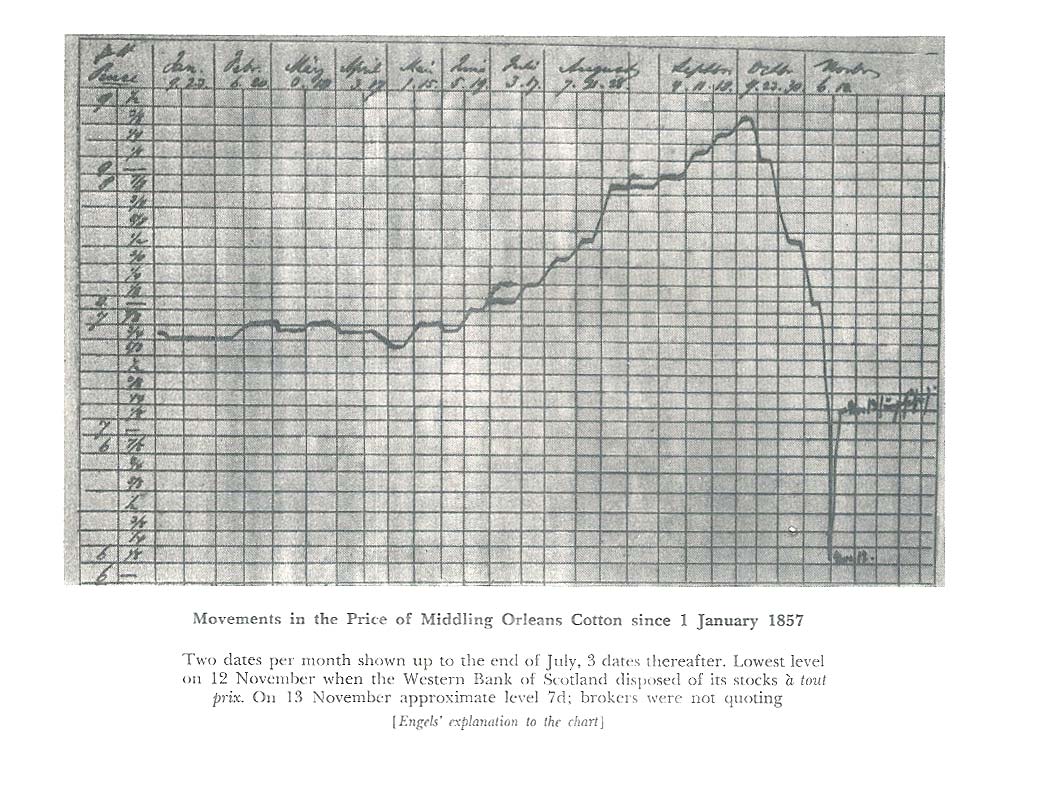
108. Engels to Marx. 17 November
In these circumstances it's most doubtful whether I shall be able to send you 'Cannon'[235] by Thursday. I have only two evenings left and I can't write every evening without my head starting to spin. So it will have to wait until a week today.
Your
F. E.
108
ENGELS TO MARX
IN LONDON
Manchester, 17 November 1857 7 South gate
Dear Marx,
I doubt whether yesterday's article(1) reached you soon enough. When I went to the post it had just turned midnight and the BOX was closed, so I dropped it in the EXTRA BOX, which means it must have left here at 9.15 this morning and arrived in London at 3.45, hence been delivered to you at about 6 o'clock.
About a month ago there was a share CRASH in Vienna, on which occasion 105 houses are said to have failed there to the tune of Fl. 14,000,000, or £1,400,000.
Nothing has been done here today. Tomorrow you will receive a whole bundle of Guardians and also some money from me, I hope.
Your
F. E.
109. Marx to Engels. 24 November
109
MARX T O ENGELS [1]
IN MANCHESTER
[London,] 24 November 1857
DEAR Frederick,
You must excuse me for not having acknowledged receipt either of the money, or of the article [3] or of various letters. T h e comings and goings connected with DOMESTIC AFFAIRS have made such demands on my time that little was left for work.
T h e MONETARY PANIC in London has SUBSIDED to some extent during the past few days but will soon begin afresh with the assistance of, among others, Fould, who has come over here with a French bank director in order to regulate the export of gold from England to France. T h e actual SUSPENSION of the Bank Act1S2 could, of course, only be effective in so far as it did away with the PANIC SURPLUS artificially created by the Bank Act. The BANKING DEPARTMENT should have had to declare itself insolvent the following day since the reserve fund amounted to no more than four or five hundred thousand pounds, whereas DEPOSITS — PUBLIC and PRIVATE — exceeded 17 millions. O n the other hand this danger was created solely by the Act itself in that the metal reserve in the ISSUING DEPARTMENT was not much below one-third of the ISSUED NOTES. The Act precipitated the outbreak of the MONEY PANIC, thereby perhaps reducing its intensity. However, lendings by the Bank u p to a maximum of 10% (on FIRST-RATE PAPERS) will keep a mass of transactions going which must ultimately lead to another CRASH. If, for instance, the price of corn, sugar, etc., is currently being maintained it is because their OWNERS are discounting the bills drawn on them for the same instead of selling the commodities. A fall in the price of these commodities seems to me inevitable and hence I believe that these chaps are simply heading straight for serious bankruptcies. T h a t was EXACTLY THE CASE [INJ MAY 1847. As distinct from earlier crises, what is still to some extent supporting the so-called MONEY-MARKET in London is the existence of JOINT-STOCK BANKS which didn't really begin to expand until the last ten years. T h e interest they pay the philistines, small rentiers, etc., is 1% less than the Bank of England's official rate. T h e lure of 9% is too great to meet with any serious resistance. So the City mob has the philistines' small capital at its disposal to a greater degree than ever before. If just one of these BANKS were now to collapse, there would be a general uproar. Hence it is greatly to be regretted that the ROYAL BRITISH BANK should have crashed prematurely.
As for America, it seems almost certain that the PROTECTIONISTS will prevail as a result of the crisis. This will have lasting and disagreeable repercussions so far as the worthy English are concerned.
I don't know whether Steffen has already told you that he is leaving England. This is because the crisis has caused his sister (how, I don't know) to lose what little money she had. He is going to Germany to join forces with her, so that they can scrape along together. I think he's doing quite the wrong thing. I have it from a reliable source that Mrs Ruge (all she speaks is a kind of Saxon patois) is the only teacher of German in Brighton and, so greatly does demand exceed supply, that she is now launching her daughter[3] in the same TRADE. SO Steffen's sister would find good EMPLOYMENT in Brighton were Steffen himself able to get on better with people. Apropos Ruge. Some months ago the old jackass sent out a prospectus for the resuscitation of the ci-devantb Deutsche Jahrbücher,[244] the main object of which is to combat materialism in the natural sciences and in industry; idem the proliferation of comparative linguistics, etc.— everything, in short, that calls for exact knowledge. To carry out his scheme he requires 1,000 subscribers à 10 talers. Over a period of 2 months summa summarum 40, I repeat 40, enthusiasts for 'intellectual freedom' have come forward. The muster-roll of his adherents in Germany is, CONSEQUENTLY, far from creditable.
I know nothing about Mr Dronke save that some months ago he urged Freiligrath to play the middleman (viz. the discounter) in a kite-flying operation upon which he thought to embark with old Naut. Freiligrath, of course, sent him away with a flea in his ear. Shortly afterwards he wrote saying that, though his circumstances were 'quite good', he was prepared to work anywhere as a clerk at a salary of £200-250, and asked Freiligrath to look out for a post of this kind. All this would seem to indicate that he is about to make his exit from the world of commerce.
Beckerc has been released from prison; Bürgers, on the other hand, has been subjected to additional restrictions.
In one of your letters you say that the manufacturers will be able to make headway only when cotton is at 6d.d But won't the substantial curtailment of production soon bring COTTON prices down to that point anyway? a Hedwig Ruge - b former - c Hermann Heinrich Becker - d See this volume, p. 202.
Jones is playing a very inane role. As you know, long before the crisis and with no particular end in view unless to provide a pretext for agitation during the lull, he proposed to hold a Chartist conference to which bourgeois radicals (not just Bright, but even men like Cunningham) were also to be invited.[245] The general idea was to come to a' compromise with the bourgeois whereby they were to be given the BALLOT and, in return, accord MANHOOD SUFFRAGE to the workers. This proposal gave rise to splits in the Chartist Party and these in turn involved Jones even more deeply in his project. Now, instead of making use of the crisis and substituting genuine agitation for an ill-chosen pretext for agitation, he clings to his NONSENSE; he shocks the working-men by preaching co-operation with the bourgeois while in no way inspiring in the latter the slightest degree of confidence. To complete his ruin he is being cajoled by some of the radical papers. In his own sheeta that old ass Frost, whom he himself proclaimed a hero and appointed chairman of his conference, has attacked him in a brutally outspoken letter in which inter alia he tells him that if he considers that the co-operation of the MIDDLE CLASS is necessary — and nothing can be done without it — he should speak out bona fide. Who, Frost goes on to ask, gave him the right to draw up the programme for the conference without consulting his allies, and who empowered him to appoint Frost chairman and himself to play the dictator, etc.?b So now he's in hot water and, for the first time, is playing a role that is not merely inane but also ambiguous. I haven't seen him for some while but now intend to call on him. I believe him to be an honest man and, since in England it is impossible for A PUBLIC CHARACTER to render himself 'impossible' by his stupidities, all he has to do is extricate himself as soon as he can from his self-laid snare. The ass should begin by forming a party, for which purpose he must go to the manufacturing districts. Then the radical bourgeois will come to him in search of compromise.
Salut. Your
K. M.
Firsf published abridged in Der Briefwechsel zwischen F. Engels und K. Marx, Bd. 2, Stuttgart, 1913 and in full in: Marx and Engels, Works, First Russian Edition, Vol. XXII, Moscow, 1929
110. Engels to Marx. 7 December
110
ENGELS TO MARX
IN LONDON
Manchester, 7 December 1857
Dear Marx,
Last week, what with prices eternally fluctuating and stocks building up, I was forced by the crisis to do a great deal of quill-pushing and so couldn't write to you but only send you Guardians.
In your last there's a SLIGHT MISTAKE. YOU say that if 'the price of corn, sugar, etc., is currently being maintained it is because their OWNERS are discounting the bills drawn on them for the same instead of selling the commodities'.a They, as the drawees, cannot discount the bills; all they have to do with bills is accept them and pay them when they fall due. The HOLDERS of commodities can only protect themselves against forced selling by obtaining advances on the commodities. UNDER THE CIRCUMSTANCES this will be difficult, and in any case the amount of these advances will be reduced by the tremendous fall in the price of commodities (35% in the case of sugar!) and the certain knowledge that, as soon as some degree of forced selling becomes unavoidable, the value of the commodities will fall still further. So whereas the HOLDERS formerly received advances amounting to [2]/s or [3]At of the higher value of the commodities, they will now receive at most V2 of the reduced value, i.e. about half the previously obtainable advance. This will inevitably precipitate the crash. But there is also a possibility that the MINCING LANE AND MARK LANE TRADE b will continue a little longer in a slow decline before a few major bankruptcies occur. And come they will, as surely as in Liverpool and other ports. The amounts being lost on sugar, coffee, cotton, hides, dye-stuffs, silk, etc., etc., are colossal. The whole LOT of the 1857 cotton crop, estimated at 3 mill, bales (will be 3 V4), is now worth £15,000,000 less than in September. One of the houses here has in transit 35,000 sacks of coffee on each of which there will be a loss of £1. The loss on Indian cotton is just as great — 33%. As the bills 7 1857
drawn in respect of these goods fall due, bankruptcies cannot fail to occur.
T h e big American house which, after 2 days of negotiation with the Bank of England, recently obtained a million-pound advance, thereby saving its skin, belonged to Mr Peabody, the 4TH JULY ANNIVERSARY DINNER man. [246] Latterly even Suse & Sibeth, the soundest of houses and the only people besides Frühling & Göschen whose bills continued to be negotiable in India after 1847 without a bill of lading as guarantee, have allegedly been compelled to appeal to the Bank for help. This firm, S. & S., are the greatest skinflints and so easily scared that they'd rather do no business at all than run any kind of risk.
Here things still look much as they did before. Some 8 to 10 days ago Indian and Levantine buyers suddenly appeared in the market, procured what they wanted at the lowest prices and thus helped some manufacturers heavily overstocked with cotton, yarn and cloth out of the worst of their predicament. Since Tuesday (Nov. 4th? (1)) everything has been quiet again. As for the manufacturers their expenses go on, SHORT time AND FULL TIME, coal and lubricants, etc., etc., remain just as before, and only WAGES have been reduced by Vs to '/2- Moreover, nothing is being sold, most of our SPINNERS AND MANUFACTURERS are getting very short of FLOATING CAPITAL and many of them are rotten to the core. 8 to 9 of the smaller ones have already come a cropper in the past few days, but that is only the first sign that the crisis has caught u p with this class. Today I heard that the Cookes, who own the huge factory in Oxford Road (Oxford Road Twist Company), have sold their HUNTERS, FOXHOUNDS, GREYHOUNDS, etc., etc., and that one of them has dismissed his servants and left his palace, which is now TO BE LET. They haven't gone bust yet, but will undoubtedly be in for it soon. Another fortnight, and the dance will really be in full swing here.
Sewell's and Neck's failure will have serious repercussions in Norway, which has not been affected hitherto.
Things in Hamburg look splendid. Ulberg and Cramer (Sweden), whose debts when they failed amounted to 12,000,000 banco marks (of which 7 mill, were bills on themselves!), had a capital of not more than 300,000 marks!! A whole lot of chaps have got into hot water simply for want of sufficient cash when a single bill fell due, although they might have had in their desks a h u n d r e d times that amount in currently worthless bills. Never has panic assumed so perfect and classic a form as in Hamburg just now. Everything is worthless, utterly worthless, save for silver and gold. Last week also saw the failure of Christ. Matth. Schröder, a very old and wealthy house. J. H. Schröder & Co., London (his brother), telegraphed saying that if 2 million banco marks would be enough, he would send the equivalent in silver. Came the reply: 3 millions or nothing. He couldn't spare the 3 millions and Christian Matthias crashed.[247] We have debtors in Hamburg and have no idea whether they still exist or whether they've gone bust. In Hamburg the whole imbroglio is the result of the most colossal kite-flying operations that have ever been seen. They were at their most outrageous in the dealings between Hamburg, London, Copenhagen and Stockholm. Then, with the American CRASH and the fall in the price of goods, the whole business came to light and, for the moment, Hamburg is done for commercially. The German industrialists, especially those in Berlin, Saxony and Silesia, will be very hard hit.
Cotton is now 6[9]/i6d for MIDDLING and will no doubt soon come down to 6d. But the mills here will only be able to go on full time again provided increased production does not promptly force the price above 6d. Yet that is what would immediately happen just now.
Among our local philistines the crisis has induced a strong desire for the bottle. No one can bear to stay at home alone with his cares and his family. The clubs are livening up and the consumption of LIQUOR is rising sharply. The worse of a jam a chap is in, the more frenzied his efforts to cheer himself up. And then, the morning after, what more striking example of remorse, both alcoholic and moral!
This week I shall again apply myself to the Cyclopaedia and do as many of the C articles as possible. Just now I can't work much or for very long at a stretch, but I'll do what I can.
Warmest regards to your wife and children.
Your
F. E.
Lupus is also involved in the crisis — but it will be his luck: his Samson has gone bankrupt, so his mornings are free.
111. Marx to Engels. 8 December
111
MARX T O ENGELS
IN MANCHESTER
[London,] 8 December 1857
DEAR Frederick,
While I was upstairs busy writing my last letter to you,a my wife down below was besieged by hungry wolves all of whom used the PRETEXT of the HEAVY TIMES- to dun her for money which she had not got. (Luckily £ 1 5 arrived from Germany a few days afterwards, thus enabling us TO SHIFT OFF THE EVIL DAY FOR A WEEK OR A FORTNIGHT.) WELL, in the above-mentioned circumstances I may have been a RATHER confused correspondent, but not too confused to recall my confusion that self-same evening, after posting the letter, and remark to my wife what a wry face you would pull at my bit about debtors receiving money on bills payable by themselves, etc. Ever since I have been keeping u p her spirits, which have been much depressed by this 'petite guerre'b with sundry scoundrels, by reflecting on how you would break it to me in the most gracious possible way. But I could hardly go so far as to expect that you would tone down the RIDICULOUS BLUNDER to a SLIGHT MISTAKE.0 MY BEST THANKS FOR THIS GRACE, SIR.
But to return to the matter in hand. According to The Economist it is true that the chaps in Mincing Lane and Mark Lane d had again been receiving LOANS on their PRODUCE, but this MOVE ceased last Wednesday or thereabouts. Corn, in particular, even showed an UPWARD TENDENCY for a day or two, but (flour actually) then dropped 3/- per 280 lbs as a result of the FRENCH DECREES permitting the free export of corn and flour, and significandy so yesterday as a result of the DOWNBREAK of corn prices in the Baltic. (Nota bene: In France, Bonaparte's measure had no more than a transient effect; though prices rose a little there, the rise immediately resulted in INCREASED SUPPLIES, which have still to find their way on to the French market.) A few corn merchants have failed here, but as yet only insignificant houses and then only OPERATORS UPON GRAIN FOR DISTANT DELIVERY. The big American SHIPMENTS arrive in the SPRING; the French will bombard England with corn AT ANY PRICE as soon as PRESSURE over 8 1857
there grows MORE SERIOUS. In my opinion — and always supposing that, in accordance with the old adage, there are several good autumns in succession—only now will the effects of the REPEAL of the CORN LAWS [150] begin to tell on LANDLORDS and FARMERS in England and the ANTIQUATED AGRICULTURAL DISTRESS recur in n o mean fashion. The satisfactory state of the HOME TRADE resulting from industrial PROSPERITY, and the succession of bad autumns have combined to make the experiment of 1847-57 inoperative and turn REPEAL TO A DEAD LETTER.248
I've had a gratifying experience with the Tribune. O n 6 November I wrote an exposé for them of the 1844 Bank Act,[132] in which I said that the next few days would see the FARCE of SUSPENSION, but that not too much should be made of this MONETARY PANIC, the real affaire being the impending INDUSTRIAL CRASH c T h e Tribune published this as a LEADER. 3 DAYS LATER The New-York Times (which has entered into a feudal relationship with the London Times) replied to the Tribune to the effect that, firstly, the Bank Act would not be suspended, extolled the Act after the manner of the MONEY-ARTICLE WRITERS of Printing House Square,[13] and declared the TALK of an 'INDUSTRIAL CRASH' in England to be 'SIMPLY ABSURD'. This was on the 24th. T h e following day the N.Y.T. received a telegram from the Atlantic with the news that the Bank Act had been suspended, and likewise news of 'INDUSTRIAL DISTRESS'. It's nice, by the by, to see Loyd-Overstone coming out with the true reason for his fanatical advocacy of the 1844 legislation — because it permitted the 'HARD CALCULATORS' to squeeze 20-30% out of the COMMERCIAL WORLD0
Nice, too, that the capitalists, who so vociferously opposed the 'droit au travail',"d are now everywhere demanding 'public support' from their governments a n d hence advocating the 'droit au profitc
at public expense in Hamburg, Berlin, Stockholm, Copenhagen and even England (in the form of SUSPENSION of the Acts). Also, that the philistines of Hamburg should have refused to hand out any more alms to the capitalists.
The astonishing thing about the whole business is the affaire in France and the attitude adopted towards it by most of the English press. Just as, after the American COLLAPSE, John Bull was represented as the calm, SELF-POSSESSED MERCHANT vis-à-vis his brother Jonathan, so now Jacques Bonhomme vis-à-vis John Bull. The Paris correspondent of the London Economist comments most ingenuously:
•'There has been not the slightest disposition to have a panic, though circumstances certainly appeared to justify one, and though the French have heretofore been extremely ready to rush into panics on the smallest pretexts.'*a
The PANIC now felt by the French bourgeoisie, despite their sanguine temperament, at the very notion of panic, is surely the best indication of what panic means in France on this occasion. The virtuous disposition of the Parisian bourgeois will, however, prove no more effective than the Hamburg ASSOCIATION FOR DISCOUNTING THE PANIC.[249] Last Sunday's Observer relates how the dissemination of horrible rumours about the Crédit mobilier[45] sent everyone rushing to the Bourse to rid themselves à tout prixb of their SHARES. French capital, despite the cosmopolitan nature therein descried by Mr Péreire, is still timid, niggardly and cautious in actual COMMERCE as it has always been. Crooked dealing (which, to be sure, has IN ITS TURN become the sine qua non of respectable trade and industry) actually exists only in branches in which the State is the real EMPLOYER, whether directly or indirectly. But there is no doubt that even an inherently — or, as Hegel would say, 'in himself — bankrupt capitalist of the magnitude of the French GOVERNMENT can make SHIFT for rather longer than a PRIVATE CAPITALIST. The police measures against BULLION EXPORTS, now pretty well IN FULL VIGOR in France, and to an even greater extent the export, AT WHICH PRICES WHATEVER, of the products of the corn, silk and wine harvests, etc., have put off for a week or two the drain of BULLION from the Bank of France. Nevertheless, THE DRAIN WILL SET IN and even if, as in 1856 (October), it gets no further than the gutter, the catastrophe will be complete. Meanwhile French manufacturers are treating their workers as ruthlessly as though there had never been a revolution. THIS WILL DO GOOD. On the other hand Mr Bonaparte is using the bank as an entrepreneur for the construction of railways, now at a standstill. Doubtless the next step will be the issue of assignatsc as soon as the DRAIN begins. If the fellow has the courage, and always providing he can pay the army properly, we may yet witness a pretty prologue.
Your information about conditions in Manchester is of the greatest interest to me, the newspapers having chosen to draw a veil over them.
8 1857
I am working like mad all night and every night collating my economic studies so that I at least get the outlines clear before the
déluge.[250]
Salut.
Your
K. M.
How is your health"? It's a long time since you supplied a bulletin.
Since Lupus keeps a regular record of our crisis forecasts, tell him that last Saturday's Economist maintains that, during the final months of 1853, throughout 1854, the autumn of 1855 and 'THE SUDDEN CHANGES OF 1856', Europe has never had more than a HAIR-BREADTH ESCAPE from the IMPENDING CRASH3
112. Marx to Conrad Schramm. 8 December[5 1]
Dear Schramm,
Write soon and tell us how Jersey suits you. I did not see Engels when he passed through London on his return journey because he gave me the wrong time for o u r meeting at the RAILWAYSTATION.*5 Did that ass Revenüow reply? Not that I suppose there's anything at all to the whole affair, since in any case these AMERICANS are incapable of paying just now; I only ask because of the BEHAVIOUR of this mighty hero. And how about Mr Faucher? Has he paid u p yet? T h a t CRAZY Berlinois^ GROWS FROM DAY TO DAY STUPIDER. WITNESS THE FOREIGN
113. Engels to Marx. 9 December
NEWS OF THE MORNING STAR, a name that bears a certain analogy with lucus a non lucendo? In fact the entire English press gets worse every day, even without German assistance. Quite apart from the seismic effects of the GENERAL CRISIS which must delight every connoisseur, it is truly a relief when one is no longer forced to listen every day to the ENGLISH SELF-LAUDATIONS AS TO THE BRAVERY' OF THEIR ENGLISH IN INDIA-. It was really getting on one's nerves, * this overtrading in other people's courage on the part of the English paterfamilias and penny-a-liner who lives quietly at home and is uncommonly averse to anything threatening him with the remotest chance of obtaining military glory*.
Apart from the family circle, I am now pretty well cut off here. I seldom see my few acquaintances nor, on the whole, is this any great loss. T h e life you lead in Jersey can hardly be much quieter. I fear that as time goes on you will weary of your stay, or have you struck u p acquaintanceships OF ANY KIND? True, Harney is so FAR quite a companionable fellow, but toujours perdrixb is, of course, apt to pall. I hope to see you again in the spring, provided you don't move further south. In any case DROP ONE OR TWO LINES.
Salut.
Your
K. M.
113
ENGELS T O MARX
IN LONDON
Manchester, 9 December 1857
Dear Moor,
In haste, a few more particulars about the crisis. In Hamburg, where the crisis has been grossly exacerbated by the pedantry of
a Literally: 'a grove from not being light'. The expression, first used by Quintilian in De institutione oratoria (I, 6, 34), illustrates the practice ascribed to ancient Roman etymologists of deriving words from their semantic opposites, as lucus ('grove') from lucere ('to shine, be light') because a grove is not light. Marx means that despite its name The Morning Star is rather unilluminating. - •> Literally: always partridge. Here: always the same thing. The phrase is attributed to the confessor of King Henry IV of France.
the old and much-famed clearing bank, this is what has happened: Schunck, Souchay & Co. here had drawn bills on Hamburg. So as to be really on the safe side, and although the bills were on goods, etc., etc., they sent the drawees BANK OF ENGLAND SEVEN DAY BILLS. These were indignantly returned AS SO MUCH WASTE PAPER, and the bills drawn on Hamburg duly protested with the comment that only silver now had any value! Bills bearing the endorsements of Schunck, Souchay & Co. and 2 other equally good houses, maturing in 2 months, could not be discounted last week at less than 12/2 per cent.
NB. If I give you the names of the houses concerned, it is on the understanding that this remains strictly between ourselves. I could get into the devil of a row if such an abuse of confidential information were to come to light.
The Liverpool and London PRODUCE houses will come a cropper before long. Things look grim in Liverpool; the chaps are stone broke and can't even summon up the energy to go bankrupt, while at the Exchange, or so I am told by someone who was there on Monday, faces are three times as long as they are here, though here too the storm clouds are growing steadily darker. Spinners and manufacturers are paying wages and buying coal with the money they get in for their goods and when that's gone they're sure to collapse. Yesterday the market was more listless and depressed than it had ever been before.
Someone told me he knew of 5 or 6 Indian houses whose stocks are such that they cannot fail to go to the wall in the very near future.
Only now are the fellows beginning to realise that the monetary speculation was the least important factor in the crisis, and the more they see this, the gloomier they look.
Health good. More tomorrow or the day after. Herewith a bundle of Guardians. Take a look at the little bits of local news, in which you'll find some very interesting facts.
Your
F. E.
114. Engels to Marx. 11 December
114
ENGELS TO MARX
IN LONDON
Manchester, 11 December 1857
Dear Moor,
Still VERY BUSY with bad debts and price reductions. Never before has overproduction been so general as during the present crisis, and there's no denying that this applies to colonial produce and also to corn. That's what's so splendid, and is bound to have tremendous consequences. After all, so long as overproduction was confined to industry the thing was only half-way there, but as soon as agriculture is also affected, and in the tropics as well as in the temperate zone, it will become spectacular.
The outward and visible sign of overproduction is more or less always expansion of credit, but this time it's especially kite-flying: This system of making money by means of drafts on bankers or 'bill-brokers', which are either met or not before maturity according to how the thing has been arranged, is the rule on the Continent and among the continental houses in England. The commission houses here all do it. The system was taken to the most enormous lengths in Hamburg, where bills amounting to more than 100 million banco marks were in circulation. But there was some fearful kite-flying elsewhere and it was because of this that Sieveking, Sillam, Karr, Josling & Co., Draper, Pietroni & Co. and other London houses went under. For the most part they were the drawees in this LINE. Among the manufacturing businesses over here and in the HOME TRADE the thing was so arranged that instead of paying CASH IN A MONTH the fellows negotiated bills on themselves at 3 months and paid the interest. In silk manufacturing the practice increased proportionately to the rise in the price of silk. In short everyone operated in excess of his resources, OVERTRADED. Admittedly OVERTRADING is not synonymous with overproduction,- but it amounts to exactly the same thing. A MERCANTILE COMMUNITY which has a capital of £20,000,000 thereby possesses an ability to produce, trade and consume measured by this sum. If, on this capital and as a result of kite-flying, it does business presupposing a capital of £30,000,000, production will rise by 50% and consumption will also rise as a result of prosperity, but by no means to the same degree, disons* 25%. At the end of a certain period there will inevitably be an accumulation of goods of an order 25% in excess of bona fide, i.e. of average requirements, even at a time of prosperity. This alone would be bound to precipitate the crisis, even if the money market, the weathercock of trade, were not already pointing in that direction. All that's needed is a CRASH and then, in addition to this 25%, a further 25% at least of STOCKS of all NECESSARIES will become A DRUG ON THE MARKET. The present crisis provides an opportunity for a detailed study of how overproduction is generated by the expansion of credit and by OVERTRADING. There's nothing new about the thing as such, save for the remarkably clear-cut lines along which it is now developing. In 1837-42 and 1847 they were by no means so clear-cut.
That is the pretty situation in which Manchester and the cotton industry now find themselves. Prices are low enough to permit of what the philistines call A SOUND BUSINESS. But as soon as there is the slightest increase in production, cotton will start going up, since there's none to be had in Liverpool. So they'll have to carry on working SHORT TIME, orders or no orders. Now admittedly there are orders, but they're from places that have not yet felt the intensity of the crisis; the commission houses know this and so they aren't buying, for to do so would involve endless wrangles, and bad debts into the bargain.
Today the market was again very depressed. Yarn worth 14 to 14'/2cl is offered at ll'/^d and anyone offering 10[3]/(1)d can have it. The Indians are out of the market. The Greeks are stuck with their corn — almost all of them deal in this, it being their chief return freight (from Galatz and Odessa). The Germans can't buy for the reasons just mentioned. The HOME TRADE houses have forbidden their BUYERS to order anything at all. AMERICA OUT OF THE QUESTION. Italy is suffering from the general fall in price of her raw materials. Another month, and there'll be a very nasty situation here. Small spinners and manufacturers are going under every day.
Mercks in Hamburg only survived because of the 15 mill, advance from the government and on one day at least their house here sent away the spinners whose accounts were due. Mercks' head man in Hamburg is the ex-imperial minister Dr Ernst Merck, a lawyer but also partner.
115. Engels to Marx. 17 December
Kindest regards to your wife and children. There's been no time today to go into your letter about France, etc., etc; il faudrait trop réfléchir.a
Your
F. E.
Vol. XXII, Moscow, 1929
115
ENGELS TO MARX
IN LONDON
Manchester, 17 December 1857
Dear Marx,
This crisis is keeping me hellishly en haleine.h Prices falling every day. Moreover we ourselves are already beginning to feel it. My old man was in a fix not long ago and we had to advance him money. However I don't imagine that it will prove serious, but that's neither here nor there just now.
Manchester is becoming ever more deeply involved. The effect of the constant pressure on the market is really tremendous. Nobody can sell anything. Every day we hear of lower offers, and anyone with a sense of the proprieties stops offering his goods for sale. Things look grim among the spinners and manufacturers. Yarn agents are no longer selling to factories except for CASH or against security. A few of the smaller people have already come a cropper but that's nothing compared with what's in store.[252]
Despite two substantial subventions, Mercks are in a complete fix, both here and in Hamburg. They are expected to go under any day, and only an extraordinary fluke could save them. The capital of the Hamburg house is said to total 4 to 5 million banco marks against LIABILITIES of 22 million (13 inarks=£l). According to other reports the crisis has already whittled down the capital to 600,000 marks.
17 1857
We shall have 4 more distinct crises: 1. colonial produce, 2. corn, 3. spinners and manufacturers, 4. HOME TRADE — this not before next spring. In the woollen districts things are already beginning, and very nicely too.
Don't forget to make a note of the BALANCE-SHEETS of the firms that have failed — Bennoch, Twentyman, Reed of Derby, Mendes da Costa, Hoare, Buxton, etc. All of them most edifying.
Your views on France have since been borne out by the newspapers almost to the letter. There is sure to be a CRASH over there and the first to be involved will be the speculators of central and northern Germany.
You will presumably have made a note of the proceedings relating to Macdonald, Monteith, Stevens (London and Exchange Bank).(1) The story of the London and Exchange Bank and the BORROWED NOTES counting as SECURITY is the most splendid I have ever read.
Apart from Hamburg, northern Germany has hitherto hardly been drawn into the crisis at all. But it's beginning there now too. Heimendahl (silk doubler and merchant) has gone under in Elberfeld, and Linde & Trappenberg (SMALL WARE MANUFACTURERS) in Barmen. Both respectable firms. So far the north Germans have suffered virtually nothing but losses; in their case, as over here, the temporary disruption of the money market has a less severe effect than the protracted period over which goods have been unsaleable.
Vienna's turn will also come. Lupus is eating humble pie; we were right. Distress has also begun to set in among the proletariat. There are as yet few signs of revolution, for the long period of prosperity has been fearfully demoralising. The unemployed on the streets continue to beg and to idle away their time. ROBBERIES by garrotters are on the increase, but not to any serious extent.
I now have to do so much running round seeing people in order to keep track of the crisis that there's damned little time left to do any work for Dana. That, too, must be attended to in the intervals. What has he to say? And how are his payments going?
Warm regards to your wife and children.
Your
F. E.
116. Marx to Engels. 18 December
T h e Guardian always publishes the Manchester market reports on Wednesdays and Saturdays. A whole bundle goes off to you today. This morning it also published some more labour statistics.
Congratulations on your prediction about the Bank Act.b
116
MARX T O ENGELS [2 0]
IN MANCHESTER
[London,] 18 December 1857
DEAR Frederick,
Just a few lines written in great haste. I've just received a 3rd and final warning from the rotten rate collector to the effect that, if I haven't paid by Monday, they'll put a BROKER in the house on Monday afternoon. IF possible, THEREFORE, send me a few pounds before Monday. Financial PRESSURE is now even greater than is USUALLY the case with me because, for ABOUT 3 weeks, I have had to pay for everything in cash and ANYTHING LIKE CREDIT has ceased, while ' at the same time /$ of all the money I receive immediately goes to meet floating DEBTS. Moreover, there is only a very little coming in, since I have hitherto been unable to send the Tribune more than one article.c So FAR AS TO PRIVATE MATTERS.
I am working enormously, as a rule until 4 o'clock in the morning. I am engaged on a twofold task: 1. Elaborating the outlines of political economy.[250] (For the benefit of the public it is absolutely essential to go into the matter aufondf as it is for my own, INDIVIDUALLY, TO GET RID OF THIS NIGHTMARE.)
2. T h e present crisis. Apart from the articles for the Tribune, all I do is keep records of it,which, however, takes u p a considerable amount of time. I think that, somewhere ABOUT the spring, we ought to do a pamphlet together about the affair[253] as a reminder to the German public that we are still there as always, and ALWAYS THE SAME. I have started 3 large record books — ENGLAND, GERMANY, FRANCE. All the material on the American affair is available in the Tribune, and can be collated subsequently. By the by, I should be glad if you would send me the Guardian, if possible, every day. It not only doubles the work but also disrupts it if I have to deal with a week or so's arrears all at once.
In France, and specially at Havre,' the fun (commercial) will probably be started by the 'Germans', whom one cannot altogether help taking into account now. Moreover — apart from the GENERAL ROTTENNESS of the bankrupt State — trade itself would seem to be exceptionally rotten in Marseilles and Bordeaux, everywhere, that is, where infiltration and intervention by foreign elements has stung the beasdy crapauds*a out of their lousy, mean penny-pinching and TIMIDITY. Au fond,b only in such an immobile country was a Crédit mobilier[45] both possible and inevitable. THE
MORE YOU BECOME ACQUAINTED WITH THE M E S S I A S OF NATIONS', THE LESS YOU
LIKE HIM.
Write to me whenever you have the time, for later on you're sure to forget all the 'chronique scandaleuse' of the crisis which is so invaluable to us. I make excerpts from your letters and enter them in the principal record books.
Salut. Kind regards to Lupus. Pieper has the satisfaction of knowing that his ex-principal Saalfeld, with whose wife he had such a tremendous row, HAS GONE TO THE WALL.
Your
K. M.
117. Marx to Ferdinand Lassalle. 21 December[82]
Of the various letters you mention I have received only one, that sent via Freiligrath. I didn't answer, or rather was awaiting a private occasion for answering which, for reasons that cannot very well be committed to paper, did not present itself. I would point out, by the by, that it was you who first broke off the correspondence by failing for such a long time to answer a letter dated Manchester.a
MY THANKS FOR Heraclitus.b I have always felt a great TENDERNESS for this philosopher, whom I prefer above all the Ancients save Aristotle. [Later]c philosophy — Epicurus (him in particular), Stoa and Scepticism — [I] had made the object of special study,d but for [political] rather than philosophical [...] reasons. While [tendering] my thanks, [I] must at the same time [say] that the work has not yet reached me.
Doubtless [Nutt's] will send it as soon as it comes into their [...] [...] to write [... Ministry. My views on Palmerston you know, and these have not changed. Besides, I know nothing whatever about the paperf since Austrian journals are nowhere on display here, and am thus quite ignorant of its general line. Whatever the case, I should be interested to see one or two numbers.[254]
I live in great isolation here, all my friends except Freiligrath having left London. Anyway, I have no desire for intercourse. Relativement parlant,' Freiligrath is doing quite well as MANAGER of the Swiss Bank and is still the same good-natured, sterling fellow he has always been. Lupus and Engels are in Manchester as before. We still lament the loss of Weerth.
The present commercial crisis has impelled me to set to work seriously on my outlines of political economy,[250] and also to prepare something on the present crisis. I am forced to fritter away [...] my days earning a living. [Only] the nights remain free for real work and that is disrupted by ill-health. I [have] not yet looked round for a publisher as I know from experience the [...] come of it [...] when I [...]. I cannot send you any news, living as I do like a hermit. Throughout last winter and summer my wife was very unwell, but has now recovered in some measure.
If you know Dr Eisner's address please send him my regards.
118. Marx to Engels. 22 December
That old ass Ruge has, I am told, made an attempt to resuscitate his Deutsche Jahrbücher.[244] History will not put the clock back far enough to make this feasible.
Your
K. M.
118
MARX TO ENGELS[20]
IN MANCHESTER
[London,] 22 December 1857
DEAR Frederick,
Thou hast triumphantly snatched me out of the clutches of the Exchequer, praised be thy name — halleluiah!
Herewith a letter (with enclosure) from the great Lassalle[254] who now positively assures me that he is SERIOUSLY beginning to be known in Berlin by reason of his fame. These EFFUSIONS of a beautiful soul will amuse you and Lupus. The worthy Lassalle took up philosophy and Heraclitusa as he took up the Hatzfeldt case[35]
and, if he is to be believed, eventually won his 'case'. It would, indeed, seem that the old school — both philologists and Hegelians — were surprised to see such a posthumous blossoming of a by-gone epoch. But we shall be seeing the thing for ourselves and, gift-horse or no, shall look it long and searchingly in the mouth — ON THE EXPRESS CONDITION, OF COURSE, that Heraclitus doesn't reek of garlic. * Fancy only this fellow going up and down the streets of Berlin and 'asking for himself strutting like a peacock, a stride and a stand: biting his lips, with 'a political regard' as who should say: 'This is the man who has written Heraclit.'* The laddie might be of some service to us in finding a publisher, unless, perhaps, he's afraid that competition might endanger the reputation to which he also aspires in the field of economics, thereby losing him his 'case'. I have replied to Friedländer
119. Marx to Engels. 25 December
through Mr Lassalle saying that, while I, too, am 'anti-French', I am no less 'anti-English', and that the last thing I could do would be to write in favour of 'Lord Pam'. So I have turned the thing down. Should Friedländer send me the Presse so that I can see beforehand whose spiritual offspring it is, and if the fellows want no more than one MONEY ARTICLE a week — for which they would, of course, have to shell out — I might perhaps agree. There can be no question of POLITICS in this CASE.
I have written to Lassalle, brief and cool, to say that, while I had received the letter sent through Freiligrath, I hadn't answered it for reasons that could hardly be committed to paper. For the rest a few words, no more.'
Schramm has written to my wife from Jersey; an extremely witty letter. For his sins, Kosmos Leiden has lost 3 of his children; 2 daughters (including Mrs Mevissen) died of consumption and one of his sons went down with the Pacific.
In last Sunday's issue of Reynold's there is a significant attack upon those APOSTATES who advocate UNION with the MIDDLE CLASS. Meaning Jones. I haven't seen the laddie for a long time. He seems to be avoiding me, for which he must have his 'raysons'. However, I shall probably surprise him — ONE FINE MORNING.
Regards to Lupus.
Your
K. M.
119
MARX TO ENGELS
IN MANCHESTER
[London,] 25 December 1857
DEAR Frederick,
Since our first task now is to get a clear idea of conditions in France, I have been re-examining all my extracts on FRENCH 25 1857
COMMERCE, INDUSTRY AND CRISES and reached certain conclusions which I shall briefly oudine for you:
1. English, North European and American crises have never directly given rise in France to a 'French crisis'; rather the effects have been entirely passive—chronic DISTRESS, LIMITATION OF PRODUCTION, STAGNATION OF TRADE, and GENERAL UNEASINESS. The reason: France has a favourable balance of trade with the United States, the HANSEATIC TOWNS, England, Denmark. With Sweden and Norway the balance is unfavourable, but this is more than offset by Hamburg. CONSEQUENTLY these crises can never generate a DRAIN OF BULLION from France and hence will not create A PROPERLY SO-CALLED MONETARY PANIC there. If the Bank, notwithstanding, increases the bank rate, as has happened this time, it does so merely to prevent the capitalists from placing their money more advantageously in those countries. But so long as the EXPORT OF BULLION is the inevitable consequence, not of the balance of trade but simply of the avarice of the PROFITMONGERS, it can, as Bonaparte has now once more demonstrated, be stopped by the gendarmerie. If the country with the favourable balance of trade has not granted long-term credits or ACCUMULATED PRODUCE FOR THE EXPORT TO THE CENTRES OF THE CRISES — and both are repugnant to the PEDLAR-likea nature of your French manufacturer a n d merchant — it will have to e n d u r e losses, etc., but not an acute crisis. Louis Philippe, too, was misled by the apparent good fortune with which France emerges from the first phase of a GENERAL CRISIS. In his inaugural address before the Chambers on the eve of the February revolution, he congratulated 'la belle France'
UPON THIS PRIVILEGE.
2. Admitting all this, the first phase of the crisis has already affected FRENCH INDUSTRY and COMMERCE more seriously than on any similar occasion in the past.
3. In France the first effect of the crisis — AGREEABLE TO THE NATURE OF THE crapaud[81]—is the timorous curtailment of EXPENDITURE and BUSINESS. Hence an accumulation of money in the Bank of France coinciding with a huge drop in the circulation of BANK DISCOUNTS. Hence — owing to the circumstance that crises always happen in the autumn and that every French government fears political disturbances at the year's e n d should the bank rate be high at the SETTLEMENT of ACCOUNTS — reduction of the bank rate in December. In December 1847 Louis Philippe ordered the Bank to reduce the bank rate to 4%.
a Marx used the word 'pedlarmassig' here, formed of the English word 'pedlar' and the German 'massig' meaning 'after the fashion of.
25 1857
4. T h e greater availability of capital in COMMERCE and industry simultaneously gives rise to greater BUOYANCY on the Bourse. This has been the case under Boustrapa [4 0] to an even greater extent than under Louis Philippe because he compelled the Bank by the Decree of 1852 to make ADVANCES ON RAILWAY SECURITIES a n d fonds* and Crédit foncier papiers, to rediscount the speculative BILLS discounted by the Comptoir National d'escompte,[255] and likewise to make him a further advance on the SECURITIES on which that institution had made advances already. Hence, e.g. the high price of French RAILWAY SHARES and BONDS although the RECEIPTS of the French railways since the outbreak of the crises in England have fallen disproportionately more than those over here. E.g. Orleans Railway RECEIPTS dropped by 24% between 29 October and 26 November and subsequently even further. Nevertheless on 22 December Orleans Railway was quoted at 1,355 whereas on 29 October it was at 2,985.b It also emerges from the MONTHLY REPORT of the BANK OF FRANCE for December that, while DISCOUNTS in December have dropped by 94,236,520 frs compared with October and 49,955,500 compared with November, ADVANCES ON RAILWAY SECURITIES have risen.c
5. T h e French crisis proper does not break out until the GENERAL CRISIS has attained a certain level in Holland, Belgium, the Zollverein,[256] Italy (including Trieste), the Levant and Russia (Odessa), because in these countries the balance of trade is distinctly unfavourable to France; hence the direct effect of PRESSURE is MONETARY PANIC in France. Once it has hit France, it recoils on those countries d'une manière vraiment admirable^ With Switzerland, France is on the same footing as the United States with England. The short-term balance of trade is consistently in France's favour. But since France is substantially in debt to Switzerland, the latter is always apt HEAVILY TO DRAW UPON IT in times of crisis.
6. When the French crisis proper breaks out, it will play the very devil both with the SECURITY MARKET and the SECURITY of that market, the State. (This will also TELL UPON England, which AT THE a stocks - b See 'Bourse du Jeudi 26 novembre 1857', Le Moniteur universel, No. 331, 27 November 1857; 'Bourse du Mardi 22 décembre 1857', Le Moniteur universel, No. 357, 23 December 1857; 'Bourse du Jeudi 29 octobre 1857', Le Moniteur universel. No. 303, 30 October 1857. In these sources the figure 2,985 refers to the shares of the Bank of France. The corresponding figure for Orleans Railways is 1,300, which bears out Marx's argument on the buoyancy of railway stock. - c 'Situation de la banque de France et de ses succursales', Le Moniteur universel, Nos. 282, 317, 345, 9 October, 13 November, 11 December 1857. - d in truly grand style 25 1857
PRESENT MOMENT is again gambling in FOREIGN SECURITIES in a m a n n e r splendid to behold.) T h e swindling, which in Hamburg, England, the United States has been the province of PRIVATE CAPITALISTS, is practised in France by the State itself, and the French PEDLARS IN TRADE were all of them GAMBLERS on the Bourse. The RECOIL from the Anglo-American crisis sufficed to bring the railways TO A DEADLOCK. What does Mr Bonaparte do? Compels the Bank TO BECOME IN FACT [AJ RAILWAY CONTRACTOR and to make advances to the fellows on the BONDS they were authorised to ISSUE by the SETTLEMENT of 30 November 1856. In 1858 these BONDS will run to ABOUT £ 9 million. Thus the Crédit mobilier,[45] which on 3 December was u p to its ears in trouble, is preparing to amalgamate with the Crédit fonder and the Comptoir National d'escompte. Why? Because both the latter are legally entitled to receive ADVANCES from the Bank on their SECURITIES and to have, their DISCOUNTS REDISCOUNTED. So Boustrapa's plan is clear, namely to make the BANK OF FRANCE the entrepreneur for all his fraudulent schemes with the help, not of its own capital, but of the capital which it has merely on deposit and which will drain away ON THE FIRST SIGNAL GIVEN IN THE NEIGHBOURING COUNTRIES. IN FACT, this is also an admirable way of ruining the Bank. However it would hardly occur even to Mr Bona to have the CALLS of the SHAREHOLDERS paid by the BANK OF FRANCE. In 1858 these CALLS will amount to over £ 1 0 million for French railways alone under the SETTLEMENT of 30 November 1856. They will run to at least £ 3 0 million for the host of speculative concerns SUCH AS the MERCANTILE
AND INDUSTRIAL C O OF MADRID (Rothschilds), the French-American Shipping Company, the Victor Emmanuel Railway, Herserange Ironworks Co., Austrian Railways, Saragossa Co., French-Swiss Railway, LAUSANNE-FRIBOURG RAILWAY, NASSAU COMPANY, Société Générale des Tanneries, Compagnie de la Carbonisation des Houilles, CHIMAY
TO MARIENBOURG RAILWAY, Lombard-Venetian RAILWAY, South American STEAM NAVIGATION CO., etc. The French haven't an earthly hope of paying these CALLS. Moreover the GERMANS, HOLLANDERS, SWISS, the LARGE HOLDERS OF FRIENCH] SECURITIES, will sell them AT ANY PRICE on the Paris Bourse at the first sign of SERIOUS ALARM, be it in France or due to PRESSURE AT HOME. SO it seems that Boustrapa will hardly be able to extricate himself in 1858 unless h e holds out for a bit longer with the help of martial law and assignats.* T h e whole rotten old structure is falling to pieces and the ludicrously rash surge hitherto manifested
a Paper money issued by the French revolutionary government in 17H9: withdrawn in 1797.
25 1857
by the SECURITY MARKET in England, etc., will likewise end in disaster.[257]
Salut.
Your
K. M.
Pieper arrived today on a visit. As regards the Comptoir National d'escompte de Paris, be it also noted that this institution, which was set u p by the provisional government for the purpose of making bills discountable on the basis of only two signatures and similar less stringent requirements, was empowered by Boustrapa in 1851, only a day or two after the coup d'état, TO MAKE ADVANCES ON Rentes Françaises, les actions et obligations industrielles ou de crédit constituées en sociétés anonymes.[11]
Advances on these SECURITIES amounted to £940,000 in 1854/55 and nearly £1,500,000 in 1855/56. Moreover, in 1851 it was given the right TO ESTABLISH un 'Sous Comptoir des Chemins de Fer',h whose sole BUSINESS was to make advances on RAILWAY SHARES and BONDS. At the end of JUNE 1852 its ADVANCES were £520,000, at the end of 1852 £1,240,000, 1852/53—£3,600,000; at the end of 1854: £4,560,000, i.e. ABOUT 9 x t h e ADVANCES in 1851. It's the same delectable business that broke the neck of the Scotch Exchange Banks in 1846/47.
* Has Dr Borchardt not yet suspended his payments? * I trust you won't go out tippling too much during the holiday and these exciting times in Manchester and that you'll pay due attention to your health. Warmest regards to Lupus. WHAT is FRIEND CHARLEYC about? and OLD Hill?
a French government stocks, the shares and bonds of industrial and banking concerns incorporated with limited liability. - b a railway suboffice - c presumably Charles Roesgen
120. Marx to Engels. 30 December
121. Engels to Marx. 31 December
120
MARX TO ENGELS
IN MANCHESTER
[London,] 30 December [1857]
Dear Frederick,
Come what may I shall have to deal with the Lucknow-Oudh affair on FRIDAY (1ST OF JANUARY). Could you let me have ANY ARTICLE, HOWEVER SHORT, on this subject by the day after tomorrow." IT WOULD
BE EXTREMELY SEASONABLE.
A happy New Year to you.
Your
K. M.
The enclosed greetings are not to be handed to Lupus until New Year's Day.
121
ENGELS T O MARX[184]
IN LONDON
[Manchester,] 31 December 1857
Dear Moor,
I have searched the whole town for newspapers containing INDIAN NEWS, having sent you my Guardians on the subject the day before yesterday. I can't get hold of the relevant numbers, either from the Guardian itself or from the Examiner & Times, nor has Belfield any left. I thought you had already dealt with this affair on Tuesday. In the circumstances I cannot do the article,b which is all the more vexing in that this is the first afternoon in 4 weeks on which I'd have been able to do it without having to neglect urgent business. In future, let me know as early as possible what your intentions are as to military articles; just now 24 hours makes quite a difference to me.
In any case, detailed information is so frightfully scarce, what there is being based almost wholly on telegraphic despatches from Cawnpore to Calcutta, that it's virtually impossible to write a critical analysis.[288] The only points I can think of are these: It is 40 MILES from Cawnpore to Lucknow (Alam Bagh)—Havelock's forced marches show that in India 15 miles a day over a protracted period is a very long march. Accordingly, with only 2-3 marches ahead of him, Colina ought to have arrived at Alam Bagh no later than the 3rd day after his departure from Cawnpore, WITH PLENTY OF DAYLIGHT STILL LEFT TO ATTACK AT ONCE. It is by these standards that Colin's march must be judged; I can no longer recall the dates. 2. He had, after all, some 7,000 men (far more had been counted on, so between Calcutta and Cawnpore the march must have gone atrociously badly and a great many men been lost) and if he beat the Oudhi with approximately 7,000 men (including the garrisons of Alam Bagh and Lucknow), it was no great feat. *An army of 5-7,000 Englishmen has always been thought fully sufficient to go anywhere and do anything in the open field in India. That stamps the opponents at once.* A further consideration is that the Oudhi, although the most warlike race of the Ganges valley, were greatly inferior to the Sepoys as regards discipline, cohesion, weapons, etc., etc., precisely because they had never come under direct European organisation. Hence the main battle took the form of *a running fight, that is to say a skirmishing engagement in which the Oudhians were pushed back from post to post. Now it is true the British are, with the Russians, the worst light infantry in Europe, but they have learnt something in the Crimea, and at all events they had this great advantage over the Oudhians that their line of skirmishers was properly and regularly supported by pickets and lines the whole under one individual commander and cooperating towards a single end; while their opponents in the normal Asiatic manner, dispersed in irregular clusters, everyone pressing to the front, thus offering a sixfold aim to the British, having no regular supports or reserves and each cluster commanded by its own clannish chief, acting independently of every other clan. For it must be repeated, up to now we have not heard in a single instance that any insurrectionary army in India had been properly constituted under a recognized chief.* No other indication as to the nature of the fighting is given in the despatches nor, for that matter, any description of the terrain or particulars about the employment of troops, so that it's absolutely impossible for me to say anything further (let alone from memory).
As to France, you are right IN EVERY PARTICULAR, so far as I can judge. There, too, things have taken a normal course up till now. Over here the affair is in its infancy so far as HOME TRADE is concerned; it is to this category that the two London houses in the Manchester TRADE belong. But that's only a beginning. This kind of firm can only become seriously embroiled when the pressure has lasted for 8-12 months. The course of the present crisis would seem to me to have more affinity with that of 1837-42 than with any other — if one disregards the splendid universality and all-embracing nature of the present one. Just now people here are deluding themselves into thinking that THE CRISIS IS OVER because the first phase, the monetary crisis with its immediate consequences, is over. AM fond[3] each individual bourgeois still believes that his particular branch of business, and notably his own business, has been THOROUGHLY SOUND and, being able to measure themselves against the STANDARD of such splendid swindlers as Monteith, Macdonald, etc., etc., they naturally imagine themselves to be uncom-monly virtuous. Nevertheless, this will not compensate Mr. Troost for losing [2]/[3] to [3]/a of his fortune on his 35,000 sacks of coffee, nor Mr SENATOR Merck for the fact that his shipments and other such operations to the tune of 22 million banco marks will eat up the whole of his capital. John Pondu, a Scot who has shot up here like a gigantic mushroom over the past 5 years, has, together with 5 others, 7,000 bales of silk in transit on which the loss will be £300,000. All this will not come to a head until March or April, and the tremendous efforts to push up prices on the commodity market will be frustrated at regular intervals as vessels arrive. It would seem that icy weather and east winds are at present preventing ships from arriving here. Should this continue for a week or a fortnight, the price of all produce will undoubtedly rise, only to fall all the more precipitously as soon as a west wind brings in an entire fleet. Voilà ce qui s'appelle l'offre et la demande en temps de cm«.b STOCKS of cotton, too, are beginning to pile up in Liverpool — 400,000 bales by today's count, A RATHER MORE THAN AVERAGE STOCK. There's still better to come and COTTON is sure to fall again in the spring; it has just risen il?d because de Jersey & Co.—a local firm which supplies almost the whole of the Russian market — having heard last week that their cancellation of all the orders they had placed in America had duly arrived — went and bought about 6,000 bales in Liverpool. That livened up the market, and any spinners who could afford to do so went in and bought something so as to supply their needs at the low prices. This alarmed, or rather put heart into, some other houses here and they, too, bought yarn and cloth so as to come in at the 'bottom'. It won't last long; to start with we shall, I think, have moderate UPS AND DOWNS here, the tendency being generally down-ward, perhaps also rising a little — one can't say exacdy — until somewhere or other the lightning strikes again. At all events, there's a bad year ahead for spinners and manufacturers, if only because of insufficient demand and excessive supply. Stagnating pressure — that is the greatest danger so far as our local bourgeois are concerned. Monetary crises are of small account here, since all credits are extremely short-term (2-6 weeks).
On Saturday I went fox-hunting — 7 hours in the saddle. That sort of thing always keeps me in a state of devilish exhilaration for several days; it's the greatest physical pleasure I know. I saw only 2 out of the whole FIELD who were better horsemen than myself, but then they were also better mounted. This will really put my health to rights. At least 20 of the chaps fell off or came down, 2 horses were done for, 1 fox killed (I was in AT THE DEATH); otherwise no mishaps. Admittedly there were no real fox-hunters at the meet; they ride far better than I do, of course. I shall pass your thing on to Lupus.
And now, a happy New Year to all your family and to the year of strife 1858.
Your
F. E.
Endnotes
[8] ceased contributing altogether, mainly because the Tribune had come under the
[16] have not been preserved.—5, 14, 51, 68, 73, 81, 100 12 Further in his letter Engels cites facts showing that opposition to Napoleon Ill's regime in France was mounting. Marx used them in his article 'The American Difficulty.—Affairs of France', published in the New-York Daily Tribune on 25 February 1856 (present edition, Vol. 14, pp. 602-04).—5 3 Sire de Franc Boissy—a French song containing satirical allusions to royalty and the government.—6 4 A reference to the repressions that were part of the Bonapartist coup d'état of 2 December 1851 in France.—6 5 Engels here refers to the discussion of the so-called Five Points or preliminary terms for peace between Russia and the coalition that fought Russia in the Crimean war (Britain, France, Turkey and Piedmont). The Five Points were presented to the Russian government through Austria in the form of an ultimatum by the Allied Powers in December 1855. They called for replacement of the Russian protectorate over the Danubian principalities by a protectorate of all the contracting parties, a revision of the Bessarabian border involving Russia's relinquishment of the territory along the Danube, neutralisa-tion of the Black Sea, closure of the Straits to warships, a ban on the maintenance by Russia and Turkey of arsenals and navies in the Black Sea, and collective protection of the Sultan's Christian subjects by the Great Powers. The Allied Powers also reserved themselves the right to impose additional demands. The terms were accepted by the Russian government and provided the basis for the Paris peace talks. The Turkish fortress of Kars in Transcaucasia was captured, after a long siege, by the Russians on 28 November 1855. The fall of Kars, the last major event of the Crimean war, speeded up the termination of hostilities. Under the Paris peace treaty (March 1856) Kars was returned to Turkey in exchange for the evacuation of Sevastopol and the other Russian towns held by die Allies.—7, 21 6 The Aliens Bill audiorised the deportation of aliens from England at any time by decision of the British government. Enacted by Parliament in 1793, it was valid for one year and was renewed in 1802, 1803, 1816, 1818 and, in connection with revolutionary events on the Continent and Chartist demonstrations in England, in 1848. In later years too, conservative circles repeatedly sought its renewal. In particular, the question was discussed for several months from the autumn of 1855, following the publication on 10 October by L'Homme, a refugee newspaper appearing in Jersey, of an open letter by the French petty-bourgeois democrat Félix Pyat to Queen Victoria on the occasion of her visit to France in August of that year. The letter sharply attacked Britain's alliance with the Second Empire and was used as a pretext for the expulsion of the publisher of L'Homme and some other French refugees from the island and for press attacks on refugees in general. However, protests by progressive circles forces the authorities to refrain from further steps. On 1 February 1856 Palmerston declared in the House of Commons that the
[117] i' 7 On the eve of and during the Crimean war Bruno Bauer published the
[119] Rußland
[121] orientalische Frage, Charlottenburg, 1853; Deutschland und das Russenthum,
[122] Charlottenburg, 1854; Die jetzige Stellung Rußlands, Charlottenburg, 1854;
[124] l'Angleterre, Charlottenburg, 1854). These works, particularly the last two, were
[125] criticised in Marx's unfinished draft 'Pamphlets über die russische Kollision von B. Bauer', written in January 1857 (see present edition, Vol. 15).—90 l18 This study by Bauer was first published in Berlin in 1874 under the tide Philo, Strauss und Renan und das Urchristenthum.—91 u 9 In the spring of 1856 floods occurred in the valleys of the Rhône and the Loire. Feigning concern for the victims, Napoleon III visited a number of the affected towns and villages in a boat and personally handed out money. He also directed a message to the Minister of Public Works recommending measures to prevent such calamities.—92 120 "The Marx family lived in Dean Street, Soho, an overcrowded and unhealthy London district where poorer refugees lived, from December 1850 to the autumn of 1856.—94 121 Marx means the concessions made by Switzerland to Prussia in the conflict over Neuchâtel (see Note 110). Initially, the Swiss government had flatly refused to comply with Prussia's demand for the release of the arrested royalists who had rebelled in Neuchâtel in September 1856, and declared it was prepared to resist the threatened Prussian invasion. However, under pressure from Napoleon III, who did not want a war near the French frontier, the Swiss government released those arrested on 16 January 1857. The King of Prussia replied by rescinding the mobilisation order. The conflict was settled through diplomatic channels.—94 122 Marx presumably means the Swiss government's official report to the Federal Diet on the Prusso-Swiss conflict over Neuchâtel (see Note 110) published in the Neue Preussische Zeitung on 1 January 1857. It maintained, in particular, that contrary to the assurances of the French government, the King of Prussia had assumed no commitments vis-à-vis the Emperor of France concerning renunciation of his claims to Neuchâtel and Valangin.—94 123 xhe Corps législatif was established, alongside the State Council and the Senate, under the Constitution of 14 February 1852, following the Bonapartist coup d'état of 1851. The members of the State Council and the Senate were appointed by the head of state, while the Corps législatif was an elected body, the elections being supervised by state officials and the police, so that a docile majority was always ensured. As its powers were confined to endorsing bills drawn up by the State Council, the Corps législatif was, in effect, a screen for Napoleon Ill's unlimited rule.—94, 109 124 The Orleanists were supporters of the Orleans dynasty which held power in France during the July monarchy (1830-48). They upheld the interests of the financial aristocracy and the big industrial bourgeoisie.—95, 291, 552 125 Marx means the second of Engels' articles entided 'Mountain Warfare in the Past and Present' (see present edition, Vol. 15). The New-York Daily Tribune did not publish it. A copy of the article, written in Marx's hand, has reached us. Engels discusses the possibility of hostilities breaking out in the Swiss Alps,
[126] particularly in the area between the city of Constance, near the Lake
[127] Constance, and Basle, in the event of the Prusso-Swiss conflict over Neuchâtel
[28] the Mongol invasion in the mid-thirteenth century some of them fled to
[131] Count Gurowski, a Polish pan-Slavist journalist, of which he had been informed
[135] has reached us. Engels' letter was written in reply to Freiligrath's request of 11
[137] diaries, which his relatives wanted to publish in Germany. In a letter to Engels
[139] 1S9 xhe secret treaty guaranteeing Turkey's frontiers was signed by Britain, France
[140] and Austria in Paris on 15 April 1856.—107 140 From 1806 to 1808 the King of Naples was Joseph Bonaparte, elder brother of
[103] which resisted progressive bourgeois reforms. The Guizot government of
[141] Napoleon I, and from 1808 to 1815 Joachim Murat, one of Napoleon's
[142] marshals.—107 141 "Truly British Minister"—an allusion to Lord Russell's description of Palmerston
[144] 1850, in which he sought to justify Palmerston's military and diplomatic moves
[145] against Greece in connection with the burning in Athens in 1847 of the house of
[147] that Palmerston was motivated by the need to uphold the prestige of British citizens. The actual aim of Palmerston's moves was to make Greece surrender several strategic islands in the Aegean.—107, 116, 276, 431 142 Marx means the policy of Britain's ruling quarters towards Persia, Afghanistan, China and other Asian countries during Palmerston's first term as Foreign Secretary (1830-41). Thus the British government declared the siege of Herat in November 1837 by Persian troops an act of hostility towards Britain and took advantage of it to send a naval squadron to the Persian Gulf. The Shah of Persia was forced to lift the siege in August 1838 and later to conclude a trade agreement with Britain advantageous to the latter. Palmerston was also Foreign Secretary when Britain unleashed what came to be known as the First Opium War (1840-42), which marked the first stage in turning China into a semi-colony of West European capitalist states.—107 143 -p n e Aberdeen coalition ministry (1852-55) consisted mainly of Peelites (break-away. group of Tories) and Whigs. Junior posts were held by Radicals and leaders of the Irish faction in the House of Commons. Marx and Engels described the bankruptcy of this government of 'All the Talents' in the article 'The Late British Government' (present edition, Vol. 13, pp. 620-26).—108 144 Marx means the massacre by government troops of participants in a mass meeting for electoral reform in St. Peter's Field near Manchester on 16 August 1819. By analogy with the battle of Waterloo it was called Peterloo. The 6 gagging acts—the six exceptional laws passed by the British Parliament in 1819 after the massacre in St. Peter's Field. Introduced by the Tory ministry, of which Palmerston was a member, they virtually abolished habeas corpus and freedom of the press and of assembly.—108 145 An allusion to the power struggle in France that preceded the Bonapartist coup d'état of 2 December 1851. Louis Bonaparte, President of the Second Republic, was in conflict with the party of Order, the bloc of the two monarchist factions — the Legitimists, supporters of the Bourbons overthrown in 1830, and the Orleanists (see Note 124), who supported the junior (Orleans) branch of the Bourbon dynasty. The party of Order was the strongest force in the French Legislative Assembly which was disbanded by Bonaparte's supporters on 2 December 1851.—108 146 Engels ironically compares the Polish émigrés in the Turkish service who fought on the side of the North Caucasian mountaineers against Russia to the 300 Spartans who, headed by King Leonidas, defended the Pass of Thermopylae against the army of the Persian King Xerxes I in 480 B.C.—109 147 Engels means Tucker's Political Fly-Sheets, a series of 12 issues published by the Urquhartite Tucker in London in 1853 and 1854 and republished in 1855.
[14] us.—5 1 ' Between January and May 1856 Engels wrote a series of articles on Pan-Slavism
[151] People's Paper in 1853 (see present edition, Vol. 12, pp. 341-406). The other
[152] issues carried mostly articles by David Urquhart also attacking Palmerston's
[148] Issues 1 and 2 contained the pamphlets 'Palmerston and Russia' and
[154] This refers to those articles of Marx's series Lord Palmerston which appeared in the New-York Daily Tribune. In contrast to The People's Paper, which published all eight articles and as a consecutive whole (see present edition, Vol. 12, pp. 341-406), the Tribune carried only six articles, in the form of four separate leaders under different titles: 'Palmerston', corresponding to articles 1 and 2 in The People's Paper (NYDT, 19 October 1853), 'Palmerston and Russia', corresponding to article 3 (NYDT, 4 November 1853), 'A Chapter of Modern History', corresponding to articles 4 and 5 (NYDT, 21 November 1853), and 'England and Russia', corresponding to article 7 (NYDT, 11 January 1854).— 111, 115 Marx means the seizure by British naval forces of the Iranian port of Bushire in the Persian Gulf during the 1856-57 Anglo-Persian war (see Note 129).— 111 The Anti-Corn Law League was founded in 1838 by the Manchester manufacturers and Free Trade leaders Richard Cobden and John Bright. It advocated the abolition of the high import duties on agricultural produce imposed — in the interests of the landed aristocracy — by a series of Corn Laws to maintain high prices for that produce on the home market. The struggle between the industrial bourgeoisie and the landowners over the Corn Laws ended in their repeal (June 1846), after which the League announced its dissolution. Some of its branches, however, continued in existence for several years.—113, 116, 215, 305 Marx means the June 1848 uprising of Paris workers, whose defeat largely predetermined the failure of the 1848-49 revolution and the subsequent period of political reaction in Europe in the 1850s.—113 In his letter of 5 March 1857 Charles Dana wrote that of all of Marx's articles only the second instalment of the article on mountain warfare had not been published, and this because interest in the Swiss question had subsided. The two articles on Persia, he wrote, had been merged into one and published, while the second article on Austria's trade had been set and would be published as soon as space permitted. However, it was not until 4 August 1857 that this article entitled, like the first, 'The Maritime Commerce of Austria' actually appeared in print.—114 'Geniality leaves off where money matters begin'—this remark was addressed to the King of Prussia by David Hansemann, a leader of the liberal Rhenish bourgeoisie, on 8 June 1847 at a sitting of the First United Diet, from which the government was vainly trying to obtain endorsement of a fresh loan.—114 In a speech in the House of Commons on 23 February 1848 Anstey presented the facts relating to the publication in 1835, in Urquhart's series The Portfolio, of secret documents from the archives of the Grand Duke Constantine, Viceroy of Poland. The documents had been seized by Polish insurgents in 1830 and were later handed over by Polish refugees to Palmerston. It was only at the insistence of King William IV that Palmerston made them available for publication (for details see present edition, Vol. 12, pp. 386-87).—115 155 T h e Peace Party or the Peace Society (Society for Promoting Permanent and Universal
[155] Peace) was an organisation founded by the Quakers in London in
[158] superiority and thus gain economic and political supremacy.—115 156 T h e Quakers (or Society of Friends)—a religious sect founded in England during
[159] the seventeenth-century revolution and later widespread in North America.
[160] The Quakers rejected the Established Church with its rites, and preached
[161] peace.—116 157 Newalls Buildings—premises in Manchester where the Anti-Corn Law League
[162] met from 1838 onwards.—116 158 The information contained in this letter of Engels and in those of 11, 20 and 31 March 1857 was intended for use by Marx in his articles for the New-York
[38] another, in the second half of December 1853, when he also came with a
[164] Tribune.—118 159 fne
[166] aspect. Marx and Engels wrote their articles from revolutionary-proletarian,
[167] materialist positions notwithstanding the condition laid down by the editors that
[168] they should not express their party point of view. Because of this condition
[170] on different countries, renouncing his initial intention of writing essays on the history of German philosophy, the Napoleonic Code, Chartism, socialism and communism. He held that these subjects could not be dealt with in a spirit of even apparent neutrality. It may have been for this reason also that Marx did not contribute the article 'Aesthetics', as originally planned. The articles in The New American Cyclopaedia were published anonymously, and only volumes II, V and XVI contained lists of the authors of major articles. Marx was mentioned as the author of the articles 'Army', 'Artillery', 'Bernadotte', 'Bolivar', 'Cavalry', 'Fortification', 'Infantry', and 'Navy' (actually these articles, except for 'Bernadotte' and 'Bolivar', were written by Engels). Marx's and Engels' authorship of other articles has been established on the basis of the Marx-Engels correspondence, Charles Dana's letters to Marx, Marx's notebooks, which recorded the despatch of articles to New York, and of other archive material (conspectuses, extracts for articles, etc.). In all, the authorship of 81 articles has been established. Marx and Engels contributed to The New American Cyclopaedia from July 1857 to November 1860, their articles (those we know of) appearing in volumes I-V, VII, IX and XII. They were also included, unchanged, in the 1868-69 edition of the Cyclopaedia but were not reprinted any more during the authors' lifetime. They were collected and published in 1933 in the Soviet Union in Marx and Engels, Works, First Russian Edition, Vol. XI, Part II. The most complete publications of these articles are to be found in Volumes 14 (1959) and 44 (1977) of the Second Russian Edition of the Works of Marx and Engels and in Vol. 18 of the present edition (1982). However, these publications did not include the articles 'Austerlitz', 'Augereau' and 'Badajos', of which Engels was erroneously regarded as the author. When preparing the Russian edition, the editors established the true authors of a number of articles wrongly attributed to Marx and Engels by some bibliographers. Thus the articles 'Abd-el-Kader' and 'Chartism' were written by William Humphrey, 'Austerlitz' by Henry W. Herbert, 'Epicurus' by Hermann Raster, 'Socialism' by Parke Godwin, and 'Hegel' by Henry Smith. The article 'Aesthetics' cannot be by Marx either, for it conflicts with the views on the subject expressed in his works.—122, 134 The letter is not dated. Since it was in reply to Marx's letter of 21 April 1857 and Marx answered it on 23 April, Engels must have written it between these dates.—122 On 26 February 1857, speaking in the House of Commons about the British government's unlawful actions in the Anglo-Chinese conflict, Cobden tabled a resolution condemning Britain's military operations in China. After a long debate the motion was adopted, resulting in a vote of no confidence in Palmerston's government (see Note 134).—127 While working on Die Philosophie Herakleitos des Dunklen von Ephesos, Lassalle was also writing a historical drama, Franz von Sickingen. In a letter to Marx on 26 April 1857 he said that it would in a sense 'set things alight'.—129 Engels arrived in London early in June 1857 and returned to Manchester at the end of the month.—131, 136, 141, 154 Marx analysed this report in two articles ('Crédit mobilier') published in
[171] the New-York Daily Tribune on 30 May and 1 June 1857 (present edition,
[173] of the 1840s to denote the teachings of the French Utopian socialists
[175] Proudhon.—133 172 Most of these articles were soon written and publishpd in The New American
[177] undertook to write other 'A' articles ('Alma', 'Ammunition', 'Airey' and
[178] 'Army'—all ordered by Dana in his letter to Marx of 8 May 1857). Some
[179] articles mentioned in» the list ('Axle', 'Approaches', 'Advanced Guard') were not published in the Cyclopaedia and probably not written by Engels. The articles 'Abukir', 'Anglesey' and 'Augereau' were in all probability written by other authors.—137 173 On coming to London in early June 1857, Engels had a relapse of the ailment about which he wrote to Marx on 20 May (this volume, pp. 130-31). He probably stayed with his brother-in-law Emil Blank, husband of his sister Marie. Engels gives only 'Friday morning' as the date of this letter. In earlier editions it was dated 12 June 1857. But since it was written in early June and not later than 10 June (as can be seen from the fact that Marx wrote the draft of his letter to Collet on the back of this letter not later than 10 June — see Note 174), and moreover on a Friday, the letter can only have been written on 5 June.—137 174 The extant draft of the letter (on the back of Engels' letter to Marx of 5 June 1857) is not dated. However, since Collet replied to Marx on 10 June 1857, it may be assumed that the letter was written about 10 June.—138 175 The draft letter is not dated. It was written in reply to Collet's letter to Marx of 10 June, presumably immediately after it was received.—138 176 This letter is written on Dana's letter to Marx of 11 June 1857, which Marx mentions in the first lines. Dana wrote telling Marx that he was returning the manuscript of the article 'Saint-Arnaud' (see Note 60) rejected by Putnam's Monthly; Dana did not advise him to write the article 'Ships against Walls' because the editors refused to guarantee its publication. He also wrote that he hoped to be receiving articles for The New American Cyclopaedia soon.—140 177 Marx means the list of articles for The New American Cyclopaedia which he sent to Dana following the one drawn up by Engels on 28 May 1857 (see this volume, pp. 136-37). This list is not extant.—142 178 Marx refers to the Indian uprising of 1857-59 against British rule. It flared up in May 1857 among the Sepoy units of the Bengal army and spread to large areas of Northern and Central India. (Sepoys were mercenary soldiers recruited from among the Indians and serving under British officers.) Its main strength was provided by the peasants and the poor artisans. Directed by local feudal lords, the uprising was put down owing to the country's disunity, religious and caste differences, and the military and technical superiority of the colonialists.—142, 146, 413, 566 179 Mazzini, who secretly arrived in Genoa at the end of June 1857, and other supporters of revolutionary action, attempted to start an uprising in Italy with a view to liberating and uniting the country. A detachment of revolutionaries led
[180] by Pizacono seized a ship bound for Tunis from Genoa and landed in the
[182] and Genoa but, like the expedition to the South, they also failed. Pizacono and
[185] military history of antiquity for Engels, who was working on the article 'Army'
[186] for The New American Cyclopaedia. The notes from the encyclopaedias of
[187] Ersch-Gruber and Pauly mentioned below in the text are extant. Marx also
[181] Kingdom of Naples. Attempts were also made to start uprisings in Leghorn
[189] Engels too soon came for treatment. Schramm died on 15 January 1858.—158,
[190] 171, 312 189 The letter, written presumably on 11 August 1857, when Marx despatched
[192] and Barclay which Engels made for Marx's biographical articles for The New
[193] American
[194] Cyclopaedia (see Note 165). The notes were first published—
[195] separately from the letter — in 1977, in Vol. 44 of the Second Russian Edition of the Works of Marx and Engels, under the editorial heading 'Bennigsen and Barclay'. In the present edition the letter is published in full with the notes for the first time.— 162 191 Here and below Engels describes events during the war of the Fourth Coalition (Britain, Russia, Prussia and Sweden) against Napoleonic France. After the defeat of the Prussian army by Napoleon in the spring of 1806 the main theatre of war shifted to East Prussia, where Napoleon encountered stubborn resistance from the allied army of Russia and Prussia. The battle of Preussisch-Eylau on 7-8 February 1807 between the French army and Russian and Prussian forces was indecisive.—162, 170, 175 192 The French laid siege to Danzig (Gdansk) in March 1807. The garrison, consisting of Prussian troops and a Russian detachment, offered stubborn resistance. The fortress surrendered to superior enemy forces at the end of May 1807.—162 193 The battle of Smolensk, during the Patriotic War of Russia against Napoleon, took place on 16-18 August 1812. Units of the First and Second Russian armies (commanded by Barclay de Tolly and Bagration) which had joined up on 3 August rebuffed the attacks of Napoleon's troops to cover the withdrawal of the main forces. At the cost of heavy losses Napoleon captured the city, which was abandoned by the Russian rearguard after the main forces had withdrawn.—163 194 This passage reflects the tendentious presentation of the events of the Patriotic War of Russia, 1812, in Jomini's Vie politique et militaire de Napoléon (Vols. 1-4, Paris, 1827) and other books (e.g. Bernhardi's Denkwürdigkeiten aus dem Leben ... des Grafen von Toll, Vols. 1-4, Leipzig, 1856), which Engels used as sources. In particular, they contain inaccuracies in explaining why Mikhail Kutuzov, newly appointed commander-in-chief of the Russian army, abandoned the position at Gzhatsk (more precisely at Tsarevo-Zaimishche), which it had occupied since 29 August 1812, and withdrew to Borodino. Kutuzov did so because he intended to give decisive batde with a more favourable balance of forces, for which it was necessary to win time and bring up reinforcements. The battle of Borodino was fought on 7 September. It brought about a turn in the war in Russia's favour, despite the forced but expedient abandonment of Moscow.—164 195 In the final version of their article 'Barclay de Tolly' Marx and Engels gave a more accurate description of Barclay's role. There the remark concerning the predominance of administrative and diplomatic functions in Barclay's activities during the war of the Sixth Coalition (Russia, Austria, Prussia, Britain, Spain, Sweden and other countries) against Napoleonic France, applied only to the 1814 campaign, and Barclay's role as military commander in a number of battles during the 1813 campaign is noted.—164 196 Published here are three short texts by Engels, probably fragments of a letter
[196] to Marx of 11 or 12 September 1857 which has not been preserved in full. Like
[197] other letters written at the time, they reflect Engels' help to Marx in writing
[200] the Second Russian Edition of the Works of Marx and Engels as the letter in
[201] question. The second fragment (written on two sheets) has never been published
[207] from the aristocracy. It was suppressed by the Russian army with the support
[208] of Prussia and Austria.
[209] At the battle of Iganin on 10 May 1831 the Polish insurgents were victorious in a clash with Russian troops. At the battle of Ostrolenka on 26 May 1831 the Polish insurgents were defeated by Russian forces under Dibich. The final blow was delivered when the Russians captured Warsaw (see below) after storming its suburb Vola on 6 September. The remnants of the insurgent army fled to Prussia and Austria.—169, 172 204 T h e battle of Austerliti (see Note 46) was an important event in die war of the Third Coalition (Austria, Russia, Britain and Sweden) against Napoleonic France (1805).—170, 174 205 On the battle of Jena on 14 October 1806 see Note 46. The same day Marshal Davout's army defeated the main Prussian forces at Auerstädl The defeat of Prussia in these two battles led to the quick occupation of the Kingdom of Prussia by die French and to the retreat of the remnants of the Prussian army to the eastern frontier. These battles occurred during the war of the Fourth Coalition against Napoleonic France (see Note 191).-—1^4, 178 206 At the battle of Wagram (Austria) on 5-6 July 1809 during the war of the Fifth Coalition (Austria, Britain), Napoleon's army defeated the Austrians.—170, 175, 176 207 An entry in Marx's notebook shows that he sent Engels' articles 'Algeria' and 'Ammunition' to New York on 18 September 1857.—173 208 A reference to the Treaty of the Tafna of 30 May 1837 between Bugeaud and Abd-el-Kader, the leader of the Algerian liberation war which lasted, with short intervals, from 1832 to 1847. The French had resumed operations against Abd-el-Kader in 1835 in violation of the peace treaty concluded a year earlier. Under the treaty of the Tafna France again recognised the independence of Abd-el-Kader's state in Western Algeria, except for a few coastal towns. In 1839 the peace was again violated by the French, and the Algerian liberation struggle was resumed. When working on the article 'Bugeaud', Marx took into account Engels' opinion of this general. In particular, enlarging upon Engels' remark about Bugeaud's venality, Marx wrote: 'A secret article, not reduced to writing, stipulated that 30,000 boojoos (about $12,000) should be paid to Gen. Bugeaud' (present edition, Vol. 18, p. 212).—177 209 The battle of the Alma took place on 20 September 1854 between the Russian forces and the numerically superior allied forces of the French, British and Turks. It was the first batde after the Allies' landing in the Crimea (at Eupatoria) on 14 September. The defeat and withdrawal of the Russian forces left the road to Sevastopol open for the Allies. The battle of Balaklava (mentioned below in the text) between die Russian and the allied Anglo-French and Turkish forces took place on 25 October 1854. Units of the Russian army tried to cut off the English and Turkish troops
[210] taking part in the siege of Sevastopol from their base in Balaklava. They
[211] succeeded in inflicting serious losses on the enemy, especially on the English
[205] liberation uprising of November 1830-October 1831. The majority of its
[212] cavalry, but failed to achieve their main objective.—177, 297 21° A reference to the siege of Sevastopol by the French and British troops during
[213] the Crimean War (1853-56) which lasted from September 1854 to August 1855
[214] (349 days).—178 211 This campaign took place during the war of the European coalition (Austria,
[216] chies) (1792-97) against the French Republic. Prussia, a member of the coalition
[217] from 1792, concluded a separate peace with France in Basle in 1795.—178 21 2 The Tugendbund (Union of Virtue)—one of the patriotic societies founded in
[218] Prussia after its defeat by Napoleonic France in 1806-07. It united representa-
[219] tives of the liberal nobility and the bourgeois intelligentsia and aimed at spreading the idea of an anti-Napoleonic liberation war and supporting moderate liberal reforms in Prussia. The Tugendbund was banned on Napoleon's demand on 31 December 1809 by Frederick William III, who also feared its activities. However, it continued to exist secretly until the end of the Napoleonic wars.—178 213 An allusion to the 1848-49 revolutionary movement in Baden. The German petty-bourgeois democrat and journalist Blind took part in it, while the German republican Hecker was a military leader in the Baden uprising in April 1848.—179 2 , 4 The battle of the Katzbach (Silesia) was fought on 26 August 1813 during the war of the Sixth Coalition (Russia, Prussia, Austria, Britain, Sweden, Spain and Portugal) against Napoleonic France. The Silesian army, commanded by Blücher and consisting of a Prussian corps under York and two Russian corps under Langeron and Sacken, defeated the French army of Marshal Macdonald.—179 215 At the battle of Dresden on 26-27 August 1813 Napoleon's army routed the allied forces of Austria, Prussia and Russia (the Bohemian or chief army), commanded by the Austrian Field Marshal Schwarzenberg.—179 2 ) 6 In a number of batUes in the Montmirail region (east of Paris) Napoleon defeated separate units of Blücher's Silesian army in mid-February 1814 by taking advantage of their isolation from one another.—180 217 At the battle of Waterloo on 18 June 1815 the Anglo-Dutch and Prussian forces commanded by the Duke of Wellington and Blücher defeated Napoleon's army, thus deciding the allies' final victory over Napoleonic France. The outcome of the battle of Waterloo is credited to Blücher's army which was defeated by Napoleon at Ligny on 16 June but managed to escape French pursuit and join up with the Anglo-Dutch forces.—180, 357 218 Marx's notebook contains an entry of 29 September 1857 about the despatch to New York of his article 'Bessières' and the articles 'Bern' and 'Bosquet' written joindy with Engels.—181 219 As is seen from Marx's notebook, in September and October 1857 he wrote for the New-York Daily Tribune a series of five articles on the state of the Second Empire's finances and Napoleon Ill's financial policy. The articles were not printed. The manuscripts have not been found.—181, 297 220 "phe letter is written on notepaper bearing a picture of the ruins of a castle and
[220] the inscription: 'Carisbrooke Castle, Isle of Wight'.
[221] On the first English publication of this letter see Note 184.—182 221 The Mahratta principalities (the Mahrattas or Marathas inhabited a large
[222] territory in Western India) were formed on the territory of the Mahratta state,
[223] which arose in the latter half of the seventeenth century during the struggle
[224] against the Empire of the Great Moguls. Later, particularly in the 1730s and
[225] 1740s, it underwent a process of feudal decentralisation. The confederation of
[226] the Mahratta principalities thus formed disintegrated in the second half of the
[227] eighteenth century. Weakened by the struggle with the Afghans and internal strife the principalities fell prey to the British East India Company which annexed a considerable part of their territories in the three Anglo-Mahratta wars (1775-82, 1803-05 and 1817-18) and made the remaining princes its vassals.—185 222 Marx used the contents of Engels' letter for his two articles, 'The Revolt in India', written on 29 September and 6 October 1857 (see present edition, Vol. 15). The purely military evaluation of possible British operations intended by Engels for Marx's information was supplemented with the political assessment of the aims of the Indian national liberation movement and the efforts of the British colonialists to preserve their rule in India.—185 223 As is seen from entries in Marx's notebook, on 29 September 1857 he sent to New York, besides 'Battery', three articles received from Engels: 'Bivouac', 'Blindage' and 'Bonnet'; on 6 October, he despatched one more batch of 'B' articles: 'Bomb'; 'Bomb-Ketch', 'Bomb-Proof, 'Bomb Vessel', 'Bombardier' and 'Bombardment'.—185 22** An abridged English translation of this letter was first published in Karl Marx and Friedrich Engels, Correspondence. 1846-1895. A Selection with Commentary and Notes, Martin Lawrence Ltd., London [1934]. The letter was published in full in The Letters of Karl Marx, selected and translated with explanatory notes and an introduction by Saul K. Padover, Prentice-Hall, Inc., Englewood Cliff, New Jersey, 1979.—186 225 Peculium castrense (lit. camp property) (Roman law)—property given by fathers to sons during and for military service and which they could dispose of as they liked independendy of their fathers' will. Fabri—craftsmen in the Roman army engaged in building bridges, putting up defence and siege works, making arms, etc. They were formed into special detachments.—186 226 Condottieri—leaders of mercenary troops in the service of princes, city republics and Popes in Italy in the fourteenth to sixteenth centuries. Some of them usurped power in individual Italian states and founded new princely dynasties.—187 227 Engels' letter to Marx of 24 September 1857 shows that he proposed to stay in Brighton on 29-30 September, on his way to Jersey to complete his medical treatment (see Note 183). Available sources do not establish with certainty whether Engels and Marx met at the appointed time, but we know from Marx's own words (see present edition, Vol. 17, p. 85) that he and Engels visited their sick friend Conrad Schramm in Jersey, most probably at the beginning of October 1857.—187 228 The letter is written on notepaper bearing a view of the Gulf of St. Catherine
[228] in Jersey from the pier.—187 229 Harney, the former leader of revolutionary Chartism, withdrew from the
[229] labour movement in die first half of the 1850s, when diere was a general
[230] decline in die English proletariat's political activity. In die autumn of 1855 he
[231] went to St. Helier, die capital of Jersey, to convey an address of solidarity from
[233] him and other French emigrants from die island (see Note 16). Harney settled
[236] radical positions.—188 230 Hejira (or Hegira)—the flight of Mohammed and his followers from Mecca to
[237] Medina in 622, from which the Mohammedan era is dated. Here Engels alludes to the expulsion of French petty-bourgeois democratic refugees from Jersey in die autumn of 1855 (see Note 16), and calls diem crapauds (philistines) (see Note 81).—188 231 Vendée—a department in the west of France. During die French Revolution it was die centre of a royalist revolt in March 1793 in which the local peasant masses took part. The revolt was suppressed in 1795 but attempts to revive it were made in 1799 and later.—189 232 Engels refers to die list of articles beginning witii 'C for The New American Cyclopaedia which Dana sent Marx. Neidier the list nor Engels' comments on it have been preserved.—189, 190 233 The letter is written on notepaper bearing a picture of a cave on die Grève au Lançon in Jersey.—190 234 Engels refers to die preliminary draft of die article 'Armada' for The New American Cyclopaedia which he wrote on the basis of excerpts made by Marx from various sources. Marx put die finishing touches to Engels' text. The material Engels sent for die Cyclopaedia presumably included also die article 'Ayacucho', to which Marx added a final paragraph before sending it and die article 'Armada' to New York on 23 October 1857, as an entry in his notebook shows (for these articles see present edition, Vol. 18).—190 235 This refers to die article 'Artillery', which Charles Dana asked Marx to write for The New American Cyclopaedia early in May 1857. Engels undertook to write die article but, busy widi 'Army' and smaller articles for die Cyclopaedia, he did not begin it till after 19 October. Marx and Engels did not expect diat die article could still be included in die current volume widi die 'A' articles and diought, as diis and the following letters show, diat it could be inserted in some odier volume, under die tide 'Cannon' or as a historical part of die corresponding article ('The History of Cannon'). However, die article was finished by die end of November, despatched to New York on die 27di of diat mondi, and included in Vol. II of die Cyclopaedia under die original tide 'Artillery'.—190, 195, 198, 199, 200, 207, 251 236 The letter is written on notepaper widi a picture of Princes Tower in Jersey. On the first English publication of dm letter see Note 184.—195 237 Many remnants of feudalism still survived in Jersey at the time. Local big landowners, lawyers and bankers (François Godfrey in particular) controlled all administrative institutions and die Royal Court. The radical Reform League
[238] (consisting of local traders, small shipowners and bank clerks), founded by
[240] against their arbitrary rule and encroachments on the interests of tenants.—
[241] 196, 264, 308
[242] 2S8 Further on Engels describes the siege and storming of the insurgent-held
[243] fortress of Delhi by British troops during the Indian uprising of 1857-59 (see
[245] events in his article 'The Capture of Delhi' published in the New-York Daily Tribune on 5 December 1857 (see present edition, Vol. 15).—197 239 j-fe New American Cyclopaedia carried the article 'Blücher' by Marx and Engels without any sub-titles (see present edition, Vol. 18).—198 240 Marx proposed to meet Engels who was returning from Jersey to Manchester via London after his long stay at the seaside (see Note 183). The two friends did not meet, probably because of the 'bad arrangements of the railway Company in Brighton', as Engels wrote to Marx on 15 November 1857 (see p. 200). Marx may also have confused the date of Engels' arrival in London: he was to be there on 9 November (Monday) and not on the 5th (Thursday). So Marx's remark 'a week ago on Thursday' seems to be a mistake. Besides, from the above-mentioned letter of Engels it transpires that it was on the Monday that their meeting was to take place.—199 241 Marx seems to refer to his two articles ('The Revolt in India') published as leaders in the New-York Daily Tribune on 13 and 23 October 1857. When Marx wrote them, at the end of September and the beginning of October, he did not have sufficient information on the British siege of Delhi (which was finally captured on 20 September) and assumed that a successful storm of Delhi was hardly possible.—199 242 Engels' information on the rapid increase in exports of English textile goods to India was used by Marx in his article 'The Financial Crisis in Europe', published in the New-York Daily Tribune on 22 December 1857 (see present edition, Vol. 15).—202 243 The discovery of gold in California in 1848 and in Australia in 1851 helped to overcome the 1847 economic crisis and its aftermath. The temporary revival of industry and trade after the crisis was also due, to a certain extent, to European and American goods gaining access to the Chinese market as a result of the Anglo-Chinese war of 1840-42 (known as the first Opium War). In 1857, however, this access was hampered by a new military conflict of the European powers with China (see Note 134).—203 244 Ruge's intention to publish a new periodical to succeed to the Deutsche Jahrbücher für Wissenschaft und Kunst (published in 1841-43) did not materialise.—209, 227 2 4 5 Ernest Jones proposed as early as April 1857 to hold such a conference and to invite bourgeois radicals. In calling for an alliance with the radicals in order to campaign jointly for electoral reform Jones hoped to revive the mass Chartist movement on this basis. However, he made serious political concessions to the radicals when working out a common platform for uniting with them. Of the six points of the People's Charter (universal suffrage, annual Parliaments, vote by secret ballot, equal constituencies, abolition of property qualifications for candidates to Parliament, and payment of M.P.s) he retained only the demand
[246] for universal manhood suffrage. Jones' conciliatory policy caused discontent
[247] among the rank-and-file of the National Charter Association. After repeated
[13] business reports to his father mentioned in die letter have not come down to
[249] convened in London on 8 February 1858. Marx and Engels regarded Jones'
[51] who were still influenced by guild prejudices and mistrusted the revolutionary
[252] again adopted a revolutionary stand.—210, 249, 264, 375 246 George Peabody was a big American financier. Frorn 1851 onwards, he gave annual dinners in London to British aristocrats and American guests to mark the anniversary of US independence (proclaimed on 4 July 1776).—212, 567 247 Engels' information on Hamburg bankruptcies was reproduced almost word for word by Marx in his article 'The Crisis in Europe', published in the New-York Daily Tribune on 5 January 1858 (see present edition, Vol. 15).—213 248 Marx dealt in greater detail with the consequences of the repeal of the Corn Laws during the crisis in his article 'The Financial Crisis in Europe', published in the New-York Daily Tribune on 22 December 1857 (see present edition, Vol. 15).—215 249 This refers to the Hamburger Garantie-Diskonto-Verein founded at the end of November 1857 in connection with the money crisis in Hamburg, to facilitate the circulation of bills and banknotes bearing the stamp of this association.— 216 250 In the summer of 1857 Marx began to write a series of economic manuscripts in order to sum up and systematise the results of his extensive economic research started in the 1840s and continued most intensively in the 1850s. (In the first half of the 1850s he filled 24 paginated and several unpaginated notebooks with excerpts from the works of bourgeois economists, books of statistics, documents and periodicals.) These manuscripts were preliminary versions of an extensive economic work in which he intended to investigate the laws governing the development of capitalist production and to criticise bourgeois political economy. Marx oudined the main points of this treatise in an unfinished draft of the 'Introduction' (one of the first manuscripts of the series) and in letters to Engels, Lassalle and Weydemeyer (see pp. 298-304, 269-71, 286-87, 376-78). Further economic study prompted Marx to specify and change his original plan. The central place in the series is occupied by the extensive manuscript, Critique of Political Economy (widely known as the Grundrisse), on which Marx worked from October 1857 to May 1858. In this preliminary draft of his future Capital Marx expounded his theory of surplus value. After the first instalment had been prepared for publication in 1859 under the title A Contribution to the Critique of Political Economy, Marx added several more manuscripts to the series in 1861. The manuscripts of 1857-61 were first published in German by the Institute of Marxism-Leninism of the CC CPSU in 1939 under the editorial heading Grundrisse der Kritik der politischen Ökonomie (Rohentwurf). These manuscripts and A Contribution to the Critique of Political Economy. Part One are included in Vols. 29 and 30 of the present edition.—217, 224, 226, 238, 244, 249, 256, 270, 287, 307, 499, 566. 251 This is a postscript to Mrs Marx's letter of 8 December 1857 to Conrad Schramm (see pp. 566-68).—217 252 Marx slightly changed the wording of this passage in his article 'The Crisis in
[253] Europe' published in the New-York Daily Tribune on 5 January 1858, quoting it
[35] Kralodvorsky Rukopis in 1819, and in 1829 in Czech and in German, translated by the Czech poet Vaclav Alois Swoboda. Marx probably had the latter edition in mind. In the 1880s the manuscript was revealed to be a recent imitation.—19, 26 29 This apparendy refers to 'Bogarodzica', a medieval Polish hymn to the Virgin first recorded in 1407. It is attributed to Adalbert (Wojciech), Bishop of Prague (957-997).—19 30 Chambre introuvable was the name given by King Louis XVIII to the French Chamber of Deputies, which in 1815-16 consisted of extreme conservatives. It attacked the government from the right and was eventually disbanded by the King because of its arch-reactionary views. Here Marx calls the Prussian Chamber of Representatives Chambre introuvable because it was dominated by the Junkers, whose extreme reactionary attitudes were worrying the government which feared they might provoke revolutionary tendencies.—20 31 The expression 'the crazy year' ('das tolle Jahr') was first used by Johann Heinrich von Falkenstein in a chronicle published in 1739 to describe the popular unrest in Erfurt in 1509. Later it was widely used in literature to designate the revolutionary year 1848.—20 32 This refers to the struggle in the French "National Convention (which met on 20 September 1792) between the Girondists, i.e. the party of the big bourgeoisie (a number of whose leaders came from the department of Gironde), and the Montagnards, commonly referred to as the Mountain, who occupied the upper seats in the Convention, i.e. the Jacobins, which represented the progressive bourgeoisie and the masses. As a result of the popular uprising of 31 May-2 June 1793, the Girondist government was overthrown and the Jacobin revolutionary democratic dictatorship was established.—21 33 The words 'take- care of Dowb' were originally used by, and then popularly added to the name of, the British Secretary of War Panmure who, in an official dispatch of June 1855 informing General Simpson of his appointment as commander-in-chief in the Crimea, asked him to look after Panmure's nephew, the young officer Dowbiggin.—21 34 At the battle of Inkerman in the Crimea (5 November 1854) the Anglo-French forces defeated the Russian army, but the latter's vigorous action prevented the Allies from storming Sevastopol, to which they lay siege instead. Engels describes the battle in detail in his article 'The Battle of Inkerman' (see present edition, Vol. 13, pp. 528-35).—21, 178, 297 35 From 1846 to 1854 Ferdinand Lassalle handled Countess Sophie von Hatzfeldt's divorce suit against Count Edmund Hatzfeldt-Wildenburg. The
[81] Crapauds (literally: toads) was the nickname of a group of opportunist deputies
[255] Vol. 15).—222 253 This idea did not materialise.—224 254 In his letter of 17 December 1857 to Marx, Lassalle enclosed a letter from his
[256] cousin Max Friedländer to Marx inviting him to contribute to the Vienna
[257] newspaper, Die Presse. Friedländer became one of its editors in 1856. Previously
[288] 1802, for his article 'The French Trials in London' published in the New-
[2] and Notes, Martin Lawrence Ltd., London [1934].—3, 8, 19, 34, 37, 85, 208,
[3] 258, 296, 325, 343, 345, 374, 391, 393, 434 2 This refers to Robert Cobden's pamphlet What Next and Next? published in London in early 1856. It attacked Britain's foreign policy during the Crimean War waged by Britain, France, Turkey and Piedmont against Russia (1853-56). In particular, Cobden condemned die draft peace treaty with Russia as failing to guarantee stable peace.—3 3 This presumably refers to Marx's articles on the Danubian Principalities of Moldavia and Wallachia written for the New-York Daily Tribune. As can be seen from Marx's letter to Engels of 22 September 1856 (this volume, p. 68), they were not published, and have never been found. The articles touched on Swedish history, probably in connection with the conclusion on 21 November 1855 of a defence treaty aimed at Russia between the Kingdom of Sweden and Norway on die one hand, and Britain and France on the other. Marx contributed to the New-York Daily Tribune from August 1851 to March 1862. At his request many of the articles for the Tribune were written by Engels. In fact it was not until August 1852 that Marx began sending his own articles. By agreement with the editors some of the articles dealing with individual European countries were datelined Paris, Berlin or Vienna (see this volume, pp. 352, 361, 368 and 410). Marx's and Engels' articles in the New-York Daily Tribune dealt with key issues of foreign and domestic policy, the working-class movement, the economic development of European countries, colonial expansion, and the national liberation movement in colonial and dependent countries. Many of them were reprinted in die Tribunes special editions — the New-York Weekly Tribune and the New-York Semi-Weekly Tribune—and were quoted by other American newspapers, in particular by The New-York Times. Some were reproduced in the Chartist Peoples Paper, London. The Tribune editors sometimes took liberties with the articles, printing them unsigned in the form of editorials, and making insertions, some of which were in direct contradiction to the content of the articles (see, e.g., this volume, pp. 81 and 100-01). A
[4] number of articles were not printed at all. Marx repeatedly protested against
[5] these practices. In the autumn of 1857 he was forced to reduce the number of
[6] his contributions in view of the Tribune's financial difficulties resulting from the
[7] economic crisis in the USA. After the outbreak of the American Civil War, he
[1] and Friedrich Engels, Correspondence. 1846-1895. A Selection with Commentary
[9] sway of people who advocated a compromise with the slave-owning states and
[20] Russian Ambassador to France, and Count Nesselrode, the Russian Chancellor
[60] partly published in the New-York Daily Tribune (see present edition, Vol. 12),
[61] appeared in Sheffield under the title The Story of the Life of Lord Palmerston ( The
[40] the proletarian circles in the Rhine Province continued to regard Marx and
[123] Rußland und England, Charlottenburg, 1854 (French edition: La Russie et
[82] (the 'Bog') in the French Convention (1793-95) who vacillated between the
[11] assumed the post in the early 1850s, largely because he wanted to be able to
[129] January 1857 and was answered by Marx on 23 January, it was presumably
[132] by Olmsted, an agent of Putnam's Monthly. Marx attributed to his influence the
[134] in Detmold and brother of Georg Weerth, who died in Havana in July 1856,
[136] February for enquiries to be made about Georg Weerth's papers, including his
[138] on 16 February Marx also mentioned Freiligrath's request (see this volume, pp. 100-01). On receipt of Engels' reply, Freiligrath, as he said in his letter to Karl Weerth, at once wrote to Detmold. It may therefore be assumed that Engels' letter was posted shortly before, probably about 25 February.—103 34 Engels means the vote of no confidence in Palmerston's government after a debate on the Anglo-Chinese conflict in the House of Commons lasting from 26 February to 3 March 1857. The conflict has been provoked by the bombardment of Canton in October 1856 in retaliation for the Chinese authorities' arrest of a contraband vessel sailing under the British flag. The bombardment was the prelude to another colonial war by Britain — later in alliance with France — against China, the Second Opium War (1856-60). After the vote Palmerston dissolved Parliament, and in the new election his candidates, who supported the aggression against China, beat the Opposition even in their stronghold, Manchester, securing a majority for Palmerston in the House of Commons. Marx dealt with these events in several articles published in the New-York Daily Tribune in March and April 1857 (see present edition, Vol. 15). The Free Traders advocated non-interference of the state in the economy. Their stronghold was Manchester (hence the Manchester School and the Manchester Party). In the 1840s and 1850s the Free Traders were an independent political group which later formed the Left wing of the Liberal Party. The Peelites were moderate Tories advocating concessions to the commercial and industrial bourgeoisie. The repeal of the Corn Laws in 1846 by their leader, Robert Peel, caused a split in the Tory party, with the Peelites forming an independent group that allied itself with the Whigs. In the late 1850s they joined the Liberal Party.—104, 107, 109, 111, 113, 115 38 Aldermen—members of local government in Britain chosen by borough am! county councils.— 104 136 The facts connected with the election campaign in Manchester and some data concerning Robert Lowe, John Potter and other candidates for Parliament related by Engels in this letter and those of 11, 20 and 31 March were used by Marx in his article 'The Defeat of Cobden, Bright and Gibson' (present edition, Vol. 15).—104, 110, 117 137 The fraudulent machinations of the Docks Napoleon joint-stock company and the breach by Napoleon Ill's government of its promise to keep young Arthur Berryer, who was implicated in the machinations, out of trouble if his father, the well-known lawyer Pierre Antoine Berryer, refrained from denunciations embarrassing to the ruling quarters, were later discussed by Marx in his article 'Portents of the Day' (present edition, Vol. 15).—105 138 The Société du dix Décembre (Society of December 10) was a secret Bonapartist society consisting mainly of déclassé elements and political adventurists. Set up in 1849, it owed its name to the election of Louis Napoleon to the Presidency of the French Republic on 10 December 1848. Marx gives a detailed description of the Society in The Eighteenth Brumaire of Louis Bonaparte (see present edition, Vol. 11, pp. 149-51, 180-82, 186, 193-96).—107, 157, 436
[15] for the New-York Daily Tribune, which did not print them. The manuscripts
[150] articles 3, 4 and 5 of Marx's 8-article series on Palmerston published in The
[45] conferences or elect leaders, but that he, Jones, and James Finlen should be
[165] rumour about Schramm's death proved to be false.—119 160 x n e bombardment of Odessa by an Anglo-French squadron took place on 22 April 1854, soon after Britain and France joined Turkey in the war against Russia (the Crimean war, 1853-56). It was essentially a military demonstration.—119 161 Marx refers to the Vienna Conference of 1855, which was to work out the terms for peace between the participants in the Crimean war (1853-56). It was attended by representatives of Russia, Britain, France, Austria and Turkey and lasted, with intervals, from 15 March to 4 June 1855. The conference was preceded by several rounds of talks between the Ambassadors held in 1853 and 1854 on the initiative of Austrian Foreign Minister Buol, who sought to mediate between the belligerents. The conference produced no results. Britain was represented by its Special Envoy Lord John Russell.—119 162 The facts mentioned in this paragraph were dealt with in greater detail by Marx in his article 'Result of the Election', published in the New-York Daily Tribune on 22 April 1857.—119 163 Marx probably means one of the articles on Pan-Slavism written by Engels for the New-York Daily Tribune but not published (see Note 11).—120 164 Engels wrote this letter in reply to Jenny Marx's of 12 April (see this volume, p. 563). The manuscript is not dated. However, the article 'Changes in the Russian Army', which was enclosed in the letter and was published in the New York Daily Tribune on 6 May 1857, was presumably sent to New York from London not later than Friday, 17 April, so the letter was probably written on about 16 April.—121 165 A reference to Dana's letter to Marx of 6 April 1857 inviting him to contribute to The New American Cyclopaedia, 'a popular dictionary of general knowledge' prepared by a group of progressive bourgeois journalists and publishers on the New-York Daily Tribune editorial staff and edited by Charles Dana and George Ripley. It was published in 16 volumes by D. Appleton and Company, New York, in 1858-63 and reprinted in 1868-69. A number of prominent US and European scholars wrote for it. On Engels' advice Marx agreed to contribute a number of articles. But Engels wrote most of them himself so that Marx could complete his economic research. Marx wrote mainly biographical essays on military and political figures with help from Engels in dealing with the military
[169] Marx limited the range of his subjects mainly to military matters and to studies
[183] many of his associates perished in clashes with Neapolitan troops. Mazzini
[184] managed to avoid arrest and return to London.—142 180 xhis refers to excerpts which Marx made from the various sources on the
[188] made excerpts, probably later, from Wilkinson's three-volume Manners and Customs of the Ancient Egyptians, London, 1837.—147, 565 181 A reference to the second batch of 'A' articles which Engels wrote for The New American Cyclopaedia in accordance with his list (see this volume, pp. 136-37). Judging by an entry in Marx's notebook made on 24 July 1857, Marx sent these articles to New York with the first batch of 'A' articles received from Engels on 14 July (see this volume, p. 146).—148, 159 i82 The Loan Societies—a variety of the Friendly Societies in England (see Note 76)—granted workers low-interest loans repayable in instalments. Their funds, like those of the Friendly Societies, consisted of membership dues. Loans could be made to non-members, provided they had two reliable guarantors.— 148, 328 183 From 27 July to 8 November 1857 Engels underwent medical treatment at the seaside: at Waterloo near Liverpool (until the end of August, when he returned to Manchester for a fortnight in view of his father's arrival there), at Ryde on the Isle of Wight (from the 8th to the end of September), and in Jersey (until 8 November), whence he returned to Manchester.—149, 154, 160, 195 i84 An excerpt from this letter was first published in English in K. Marx and F. Engels, The First Indian War of Independence 1857-1859, Foreign Languages Publishing House, Moscow [1959].—151, 233 185 The letter Engels sent to Jenny Marx from Waterloo, presumably about 11 August 1857, has not been found. It was written in reply to Marx's letter to Engels of 9 August.—151 186 Marx based his assumption of the possible retreat of the British troops from Delhi on the numerical superiority of the insurgents, who had captured this important fortress in the middle of May 1857, soon after the beginning of the Indian uprising (see Note 178). But the insurgents, who adhered to the tactics of passive defence and were demoralised by the treacherous behaviour of the local feudal lords, failed to take advantage of their superiority. This enabled the British to hold out until they received reinforcements. In mid-September they took Delhi.—152 187 T h e reference is presumably to articles for The New American Cyclopaedia or to material for articles which Marx intended to write for it with Engels' help on military questions.—153 i88 Conrad Schramm, a member of the Communist League and a close friend of Marx and Engels, was ill with tuberculosis. In 1852 he went to the USA hoping to earn a living and improve his health. In the summer of 1857 he returned to London and, his condition having worsened, he was immediately placed in a hospital for German refugees. On 20 September he moved to Jersey where
[198] biographical articles for The New American Cyclopaedia.
[203] despatch to New York that day. As is seen from Marx's notebook, they were
[204] sent off to Charles Dana on 22 September 1857.—168 203 Here and below Marx writes about Bern's participation in the Polish national
[46] recognised for life as the only members of its Executive. Jones believed that this
[206] participants were revolutionary gentry (srdachta) and its leaders came mostly
[34] (in German: Königinhof) in 1817. It was published in Czech under the title
[232] British radicals to Victor Hugo on die occasion of the British decision to expel
[235] almost entirely to local problems, criticising the local system from bourgeois-
[244] Note 178). The city fell on 19-20 September 1857. Engels dealt with these
[250] conciliation with the radicals as a manifestation of his political vacillation and
[254] as a passage from a private letter from Manchester (see present edition,