1858
122. Marx to Engels. 1 January
123. Marx to Engels. 5 January
Dear Engels,
Have had your note. You don't say whether you have received my letter enclosing those of Lassalle and Friedländer.b I'd like to be sure that both will be preserved.
As to C, I am IN FACT in a considerable quandary. Nothing more has been sent to Dana since 27 November,[259] as I finished my own share of it (i.e. the non-military stuff) long ago. If circumstances in Manchester don't admit of your seriously applying yourself to the business this month, I shall have to give it up altogether and tell Dana on some PRETEXT or other that I can't go on with the Cyclopaedia. The fact that I send him long, new lists before polishing off the old ones cannot fail in the end to arouse his suspicions and compromise me. CONSEQUENTLY he's not even answering, let alone sending anything fresh. Nor can work of this kind be remunerative when there are constant hiatuses of a month or more.
STILL, I try to avoid mentioning the matter to you because the last thing I want is to subject you to any strain that might damage your health. YET sometimes it seems to me that, if you could manage to do a little every two days or so, it might act as a CHECK on your junketings which, from what I know of Manchester and AT THE PRESENT EXCITED TIMES, seem to me 'unavoidable' and far from good for you.
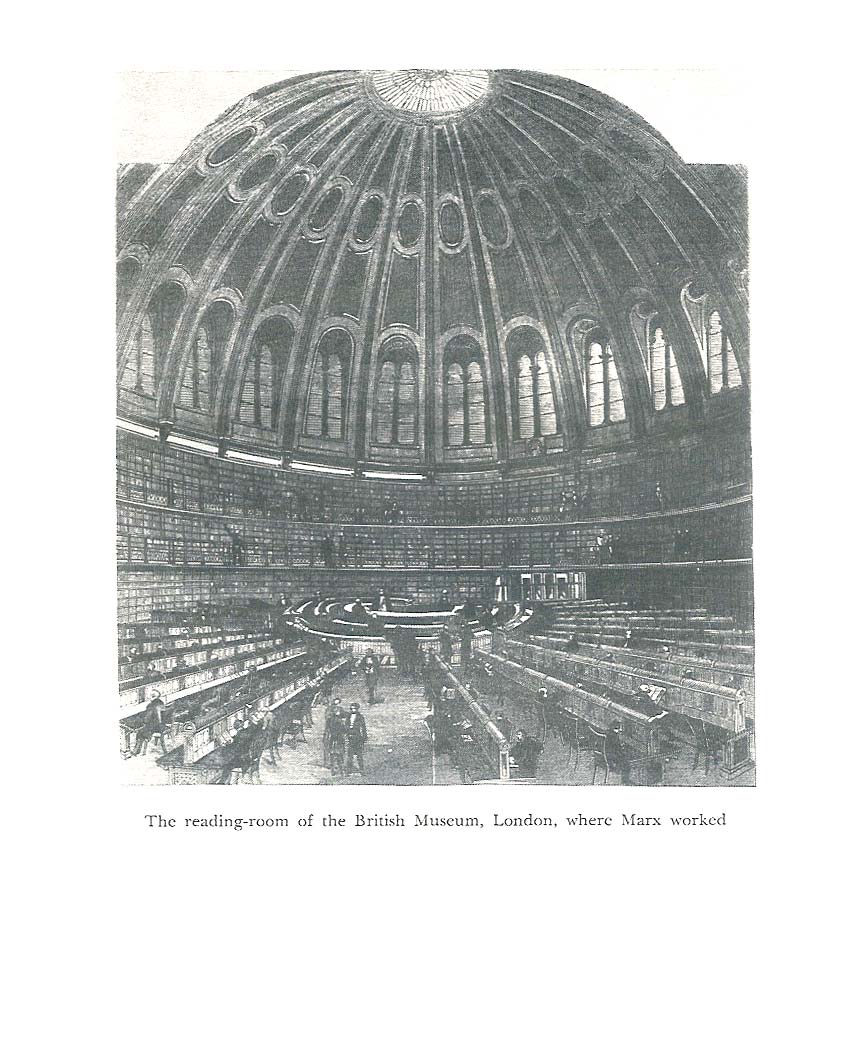
Nor can there be any question at present of my taking over the military stuff, which would entail spending a great deal of time at the Museum(1) to no real effect, for it's absolutely essential that I should finish off my other work[250]—and it takes up all my time — even if the house should come tumbling about my ears!
So, *my boy, try to come to a definitive resolution — one way or the other*.
Warm regards.
Your
K. M.
124. Engels to Marx. 6 January
124
ENGELS TO MARX
IN LONDON
Manchester, 6 January 1858
Dear Moor,
You will have had the article[3] in good time, at any rate, as I posted it before midnight on Monday, which means that it must have been delivered between 12 and 1 o'clock.
I received Lassalle's letter and also wrote to tell you how amused Lupus and I were at the man who wrote Heraclitus.a Can my letter have gone astray?[260]
During the worst of the crisis it was absolutely impossible for me to think of anything but the GENERAL CRASH. I could neither read nor write and was, moreover, still irritable as a result of my illness. Then came the HOLIDAYS with fox-hunting and other such frivolities, but now that's all over and I am beginning to feel in need of a quieter occupation and way of life. Such being the case — with the added inducement of a good bout of catarrh — the letter C has come as a boon to me, and I shall embark on it this very evening. I don't imagine it will take me very long; at any rate I shall put my best foot forward and you will be able to send something off each week. Come to that, if 'Army' arrived in October and in time for Volume I[261] then surely C, arriving in January, will be in time for Volume III. In view of the crisis the chaps won't be hurrying into print, otherwise Dana would have written long ago. If you hear from him, by the way, let me know.
Incidentally the crisis, presently at a standstill, is about to take a new turn, at least so far as Manchester and the COTTON industry are concerned. On Monday a great many spinners went to Liverpool and bought 12,000 bales in order to restock to some extent, since many of them had nothing left. This pushed up the price of cotton, and at the same time the Greeks entered the market here and bought a fair amount, which brought about a corresponding rise locally. In Manchester and in Liverpool, the price has already risen by Ad (per lb) above the lowest point. Now the buyers are shying away again but, if the easterlies persist, cotton and yarn will get even lower before the arrival of full shiploads round about February or March. What à thing to do, pushing up the price of yarn and cotton WITH FACTORIES ON SHORT TIME! It can only result in restricting demand more than ever and, if this has no immediate effect on prices, it is merely because production rises and falls with demand. The price of MIDDLING is again somewhere between 6 U and 6[3]/8 — today probably ô'Ad, although I haven't yet seen the closing prices.
As regards produce, too, the difficulty of investing money seems to have enabled the chaps to effect once again a small, temporary rise which will last until the wind goes round to the west.
The vast amount of surplus capital in the market is, by the way, truly astounding and proves yet again what colossal dimensions everything has assumed since 1847. It would not surprise me in the least if, even before the crisis has passed through its remaining phases, this superfluity of FLOATING CAPITAL were to bring about renewed speculation in shares. This superfluity of disposable capital has undoubtedly helped to keep speculation going in France, and to such good effect that now, having survived the panic, the Crédit mobilier[45] can claim to be one of the soundest institutions in the world.
The letter about Lassalle must have reached you; have another look for it. I wrote it 2 or 3 days after receiving Lassalle's letter.
Enclosed with my day-before-yesterday's article were a few lines from Lupus to your wife and the girls. Cordial regards to them from me.
Your
F. E.
Today a line or two from Schramm saying that he had been rather worse but has now improved again. His worthy brothers now seem to be making the crisis a pretext for leaving him very much in the lurch. He talks of going either to Krefeld or to Virginia so as not to have to worry about where his next meal is coming from! I shall send him five pounds.
125. Engels to Marx. 7 January
125
ENGELS TO MARX
IN LONDON
Manchester, 7 January 1858
Dear Moor,
Herewith the beginning of C.[262] I shall try and do a few more articles tomorrow evening. It seems to me that there are only 2 articles for which material will be difficult to obtain — perhaps impossible in sufficient quantity — namely, CAPS (PERCUSSION)a and 'CAMP' (ROMAN, HEBREW, GREEK). The excerpts I made from Riistow about Caesar's camp" amount to very little for, though I had ordered my own copy of Riistow, the bookseller supplied an altogether different book. In the case of PERCUSSION CAPS, what I chiefly need is the story of the discovery of potassium tetrachlorate and its explosive qualities, likewise the dates when percussion fire-arms were introduced into the various armies. These two things would be useful to have. If you could manage to go to the British Museum and rout out something on this for me I could soon have these articles ready also, otherwise they'll hang fire since the libraries I use up here have no information on the subject.
If, by the way, Monsieur Dana can't be bothered to reply when we send him our lists, he has only himself to blame. He could have sent a list for D long ago. Now I shall make one out myself. At all events the chap seems to be taking the whole business very lightly; I only hope he's sent you some money for it, otherwise it's high time to start kicking up a fuss.
Charleyb is in Holland and will be going to Switzerland. Luckily the shortage of orders makes it possible for me to leave most of the tasks connected with the year's end to the office boys, so that I'm not unduly burdened with work. THAT'S ONE GOOD JOB.
I enclose today's Guardian from which you will see that there is still a lot of SHORT TIME here. Next week it may ease again somewhat. At present I am sending you only those Guardians in which there's something of commercial interest.
I am reading, inter alia, Clausewitz's Vom Kriege. An odd way of philosophising, but per se very good. On the question as to whether one should speak of the art or the science of war, he says that, more than anything else, war resembles commerce. Combat is
126. Marx to Engels. 7 January
to war what cash payment is to commerce; however seldom it need happen in reality, everything is directed towards it and ultimately it is bound to occur and proves decisive.a
Many regards to your wife and little ones.
Your
F. E.
Vol. XXII, Moscow, 1929
126
MARX T O ENGELS
IN MANCHESTER
[London,] 7 January 1858
DEAR Frederic,
I received your article[1]" at 5 o'clock on Tuesday afternoon. It is HIGHLY AMUSING and will delight the Yankees. The news from India, by the by, is no longer quite so favourable to the worthy English. POOR Havelock!
I have definitely not had your letter about Lassalle.b So it has either got held up somewhere in Manchester or has been intercepted down here.[260]
Lupus' letter to the family, who send you their regards, HAS
PRODUCED A GREAT SENSATION.
Pieper was here during the Christmas holidays. He arrived in a state of alcoholic remorse and was more vapid and boring THAN EVER. The older the fellow grows the worse he becomes. He seems to have acquired the pleasant habit of drinking first thing in the morning, not tea or coffee, but a PINT [OFJ STOUT, which gives him A SHEEPS EYE for the rest of the day. Indeed, the combination of dilettantism and sententiousness, fadaised and pedantry makes him ever harder to stomach. And, as often in the case of such laddies, 7 1858
there lurks, beneath an apparently sunny temperament, much irritability, moodiness and crapulous despondency. H e has presented the children with two daguerreotypes of his charming person which are truly sublime and might be entitled 'Pieper with countenance exposed'. Both confected on the very morning of his arrival by rail in London. T h e first, still drunk with sleep, A MOST ABJECT PICTURE OF MENTAL AND MORAL DEJECTION: great, big mouth, flaccid jowl, blurred, sprawling features, in his eyes A STUPENDOUS EXPRESSION OF NOTHINGNESS. In the 2nd our friend had already pulled himself together and remembered that he was the handsome and aimable Pieper. It is the awakening of complacency and its victory over L ITER DEGRADATION. T h e first portrait — PIEPER AS HE IS, the 2nd AS HE APPEARS TO HIMSELF and the world in general. As little Jenny aptly remarked, all that was wanting to put the fellow in a nutshell was his drama, WHAT IS THE MATTER? I enclose an interesting document which the Urquhartites, with that IMPERTURBABLE importunity of theirs, have extracted from the BOARD OF TRADE.264 In addition to the BAD STATE of England's balance of trade during the past 3 years, it will show you inter alia how much money was being made by Prussia at the time of the Russian war; further, that our HANSA TOWNS are AT THE HEAD of those regions whose balance of trade favours England. T h e momentary LULL in the crisis is, or so it seems to me, most advantageous to our interests — PARTY INTERESTS, I mean. Even in 1848, after the first LULL, England suffered some very severe blows at 2 or 3 INTERVALS, and at that time the crater had already shifted from where it had been in April 1847, etc.
The 'Neapolitan Question',[1] [3] which has caused earnest politi-cians such a lot of head-scratching, has now been resolved by the EARTHQUAKE IN A MOST DELIGHTFUL MANNER. At least that's what the POTHOUSE POLITICIANS OF THE MORNING ADVERTISER say. You won't forget to send the Guardian, will you? Above all I beg you to take care of your health. Times will get better and will make considerable CLAIMS on your BODY. SO temper it and see that it comes to no harm.
Salut.
Your
K. M.
Apropos. In his last number of the Pionier Heinzen remarks that, while it was quite comprehensible that the stultified workers in Germany should have been deluded by two sophists into believing they formed a distinct class because they plied a plane, it
127. Marx to Engels. 11 January
was altogether too much of a good thing when, as now, the cry of class was raised among the workers at every MEETING in America! H e shouts about the obfuscation of the masses, who are not susceptible of wisdom. Proclaims 'spiritual revolution' and, in opposition to the class prophets, a new triumvirate—Goethe, G. St.-Hilaire and Karl Heinzen!!! In recent weeks the Credit mobilier[45] has pushed u p the price of its shares to an exceptional height by the ANNOUNCEMENT OF A DIVIDEND
OF 25 p.c., THIS TIME undoubtedly paid OUT OF CAPITAL.
Vol. XXII, Moscow, 1929
127
MARX T O ENGELS
IN MANCHESTER
[London,] 11 January [1858]
Dear Frederick,
'Campaign', etc.[262] received. In the next day or so I shall go to the Museum a to look u p the matters in question.[1]"
Affairs in India — with Windham for HERO — are again taking an interesting TURN. If we have fuller particulars this week, by Wednesday or thereabouts, I shall have to send off something on the subject to the Tribune.[265]
In elaborating the PRINCIPLES of economics [2 5 0] I have been so damnably held u p by errors in calculation that in DESPAIR I have applied myself to a rapid revision of algebra." I have never felt at home with arithmetic. But by making a detour via algebra, I shall quickly get back into the way of things.
Your health bulletins are too cursory. I'd like you to go into more detail, FOR INSTANCE, have all your sores healed up?
More in my next.
Your
K. M.
a the British Museum Library - b See this volume, p. 241.
128. Engels to Marx. 14 January
I hunted .through Clausewitz,a more or less, when doing Blücher. The fellow possesses a COMMON SENSE bordering on the ingenious.
128
ENGELS T O MARX
IN LONDON
Manchester, 14 January 1858 7 Southgate
Dear Marx,
Herewith the article,b though it has just occurred to me that by a ludicrous slip I have written Wilson throughout instead of Inglis; perhaps you would alter this as there's no time to do so now.
I shall do a few more C's for Tuesday, and finish 'Cavalry', which should make a good article and also be somewhat longer.
Apropos, have you done 'Coehoorn' (Baron)? If not I have some excellent material.
NB. I've no material whatever on 'Catapults'—there should be something in Ersch and Gruber.c
The Lucknow garrison's greatest act of heroism consisted in the fact THAT THEY HAD TO FACE EVERY DAY THE COARSE BEEF' COOKED BY THE LADIES,
•ENTIRELY UNAIDED: Must have been damned badly cooked. The Daily News has something on Windham, but not enough. Kindest regards to your wife and children.
Your
F. E.
My health is good. The sores have all been healed for the last 6 weeks. Heckscher is very satisfied with the way the thing is
129. Engels to Marx. 15 January
130. Marx to Engels. 16 January
what I eat and drink — not so
129
ENGELS TO MARX
IN LONDON
[Manchester,] 15 January 1858
Dear Marx,
Judging by the enclosed letter from Harney, it seems most doubtful whether Schramm is still alive. I wrote to Harney straight away. As soon as I hear anything further I shall let you know.
Your
F. E.
130
MARX TO ENGELS[266]
IN MANCHESTER
[London,] 16 January 1858
Dear Frederick,
You, too, will have had a letter from Harney about friend Schramm. There was no prospect of recovery. A pity, though, that money worries — for which the fat London philistine(1) is to blame — should have clouded his last days.
Your article[3] is SPLENDID and IN STYLE and MANNER altogether reminiscent of the Neue Rheinische Zeitung in its heyday. As for Windham, he may be a very bad general, but on this occasion the man was undone by what was the making of him at the Redan[267]—unseasoned troops. I am generally of the opinion that in terms of bravery, self-reliance and STEADINESS this, the second army England has committed to India (and of which not a man will return), will not be able to hold a candle to the first, which seems to have dwindled away almost entirely. As regards the effect of the climate on the troops, while temporarily in charge of the military DEPARTMENT I showed in various articles by exact calculations that mortality was DISPROPORTIONATELY higher than stated in the official English despatches.[268] In view of the DRAIN OF MEN and BULLION which she will cost the English, India is now our best ally.
On Monday I shall again visit the Museum,b after which I shall send you 'Catapult'—along with the other stuff you ask for— drawn from the best sources. I have not done 'Coehoorn', as it would have taken me too much time to unearth the correct sources.
I am EXCEEDINGLY glad to learn that your health is progressing WELL. For the past 3 weeks I, too, have again been dosing myself and only stopped doing so today. I had been overdoing very much my nocturnal labours, accompanied, it is true, by mere lemonade on the one hand, but AN IMMENSE DEAL OF TOBACCO on the other. I am, by the way, discovering some nice arguments.[250] E.g. I have completely demolished the theory of profit as hitherto pro-pounded. What was of great use to me as regards method of treatment was Hegel's Logic at which I had taken another look BY MERE ACCIDENT, Freiligrath having found and made me a present of several volumes of Hegel, originally the property of Bakunin. If ever the time comes when such work is again possible, I should very much like to write- 2 or 3 sheets making accessible to the common reader the rational aspect of the method which Hegel not only discovered but also mystified.
Of all recent economists, Monsieur Bastiat with his Harmonies économiques represents the very dregs of fatuity at their most concentrated. Only a crapaud[61] could have concocted an harmoni-ous pot-au-feu"c of this kind.
What do you think of our friend Jones[245]? I still refuse to believe that the chap has sold himself. Perhaps his experience of 16 1858
1848 lies heavy on his stomach. So great is his faith in himself that he may think himself capable of exploiting the MIDDLE CLASS or imagine that if only, ONE WAY OR THE OTHER, Ernest Jones could be got into Parliament, world history could not fail to take A NEW TURN. T h e best of it all is that — out of SPITE against Jones, OF COURSE — Reynolds is now posing in his paper a as the most rabid opponent of the MIDDLE CLASS and of all compromise. Mr B. O'Brien has likewise become an IRREPRESSIBLE CHARTIST AT ANY PRICE. Jones' only excuse is the enervation now rampant among the working class in England. However that may be, if he goes on as at present he will become either DUPE of the MIDDLE CLASS or RENEGADE. T h e FACT that he should now seek to avoid me as anxiously as he once used to consult me over the merest trifle is evidence of anything but a good conscience.
Herewith a letter for Lupus from Laura and Jenny. T h e two GIRLS naturally imagine that you might take umbrage at Lupus appearing to be preferred as a correspondent. Hence they have earnestly admonished me not to forget to tell you THAT YOURS SHALL
BE THE NEXT TURN.
I shall wait another 3 weeks until the situation has pretty well come to a head a n d then write to Mr Dana saying that I cannot go on working for the Tribune if I'm restricted to 4 articles a month, and that 6 is the minimum. In fact I am now invariably obliged to compress into 1 article sufficient material for 2, and hence am doing double the work for HALF THE PRICE. THIS WILL
NEVER DO.
Did you enclose Lassalle's and Friedländer's letters b in the one about Lassalle[260] which went astray? For political reasons, it would be desirable to preserve them.
Salut.
Your
K. M.
131. Marx to Engels. 23 January
131
MARX T O ENGELS
IN MANCHESTER
[London,] 23 January 1858
Dear Engels,
I have received: 1. Copies of the Guardian; 2. C ('Carabine', etc.[269]). You have not told me whether you got my letter, together with an enclosure for Lupus, sent off a week ago today.[3]
Herewith a letter from Dana which you must return as it has not yet been answered. O n e disagreeable consequence so far as I am concerned is that I am already considerably in the fellows' debt, having miscalculated what was due to me and drawn a further amount after sending off 'Cannon'. [2 3 5] T h e PAY, by the by, isn't even A PENNY THE LINE.
As regards the new B articles Dana is asking for — and for me the main thing is to pay off as quickly as possible what 1 have overdrawn on Appleton, otherwise I shall be unable to draw anything on the Tribune and hence be stone broke — they are, with one exception, taken from the list you drew up. As regards that one exception—'THE HISTORY OF THE BENGAL REBELLION'—I suggest the most appropriate course would be tell Dana straight out it can't be done. How get hold of the sources at such short notice? Since it 'SHALL BE SF.XT AT ONCE' and must be 'AS BRIEF AS POSSIBLE', the work involved would be out of all proportion to the PAY and it would simply prevent us from getting on with the other articles. What is your opinion? T h e military side is the more important, but it seems to me that the whole, whether military or political, has not yet reached the stage where it could be 'sent AT ONCE'.
I cannot recall the MISTAKE IN IIHEI BAITI.E OF-ALBLERA' to which Dana refers.[270]
Freiligrath writes to say that the great Ernst Dronke has arrived in London from Paris, having left the latter place for the first time on account of the attempted assassination.[271]
Salut.
Your
K. M.
a See this volume, p. 250.
132. Engels to Marx. 25 January
There were some nice things from the Paris correspondent in The Manchester Guardian you sent me. How is business in Manchester? Everything seems to be going better than expected.
Vol. XXII, Moscow, 1929
132
ENGELS TO MARX
IN LONDON
Manchester, 25 January 1858
Dear Marx,
The letters have all arrived safely. It will be utterly impossible to do the BENGAL REBELLION in the time stipulated and I would advise you, while you are about it, to point out to Mr Dana that, had he been more prompt in agreeing to our proposals and the list we sent him, he would have had all these articles long ago. He can perfectly well fit in BENGAL REBELLION as HINDUSTAN REBELLION or something of the sort.[272] As to the alleged howler,[270] I can't look into it this moment, there being no time, but shall do so tomorrow. The item was taken from Brockhaus' so it will probably be correct.
Lassalle's letter is still up here. I have the material ready for 'Blenheim', 'Borodino' and many more and you will be receiving a LOT on Friday, provided the Indian MAIL doesn't necessitate my doing an article, which seems unlikely judging by the telegraphic despatch. I shall have to look up 'Bidassoa', etc. But what is all this about Dana saying he had already asked for these articles? It's the first I've heard of it.
Harney will have written to tell you that poor Schramm died a week ago on Friday. I have no details yet. I wrote and asked
•' Brockhaus' Konversations-Lexikon 25 1858
Harney, [2 7 3] should he find anything in your handwriting or mine, to take it away and hold it at our disposal — it would be too bad if anything of that kind were allowed to fall into the hands of Mr Rudolf,[3] who has become an out-and-out Prussian. I had not thought Schramm would have any serious attacks before the spring. T h e poor fellow was putting u p a splendid fight against the disease while I was there and, from what I hear, continued to do so until the end. Our old guard is rapidly dwindling away during this long spell of peace!
Business here is very shaky. Every fortnight an attempt is made to push u p cotton prices, the moment chosen being when a few spinners have to buy. It succeeds for three or four days and then prices fall again. Generally speaking we are now [5]/sd above the lowest point. It's much the same with ourselves. As soon as prices become thoroughly depressed as a result of a fortnight's stagna-tion, the Indian and Levantine buyers step into the market and force everything up; after that no one wants to buy and prices gradually fall again. Everything is still far from normal. T h e spinners are going on to full time, not because there is any real demand, but because others are doing so and because they're heartily sick of SHORT TIME. On the whole the spinners' position has deteriorated because the difference in price between raw cotton and yarn has diminished. T h e Germans are still buying very little. Prospects here are far from brilliant; every day trade suffers a CHECK because of attempts to force u p prices and, if that doesn't happen, they say that THERE IS AN IMPROVED FEELING IN THE MARKET. IMPROVED BE DAMNED!
T h e enclosure for Lupus was a source of great pride and joy to the old man. b He sends his warmest regards to the writers. By the way I hardly saw him at all last week; we kept missing one another and later he h a d a slight touch of tic douloureux? Warm regards to the FAMILY.
Your
F. E.
a Rudolf Schramm - b See this volume, p. 250. - c facial neuralgia
10-194
133. Engels to Marx. 28 January
134. Marx to Engels. 28 January
133
ENGELS TO MARX
IN LONDON
Manchester, 28 January 1858
Dear Moor,
Herewith 3 B articles.[274] I had meant, if possible, to do Windham[3] as well today, but in the first place the PARTICULARS are still very confused and it is absolutely essential to wait for the official report on the affair, for hitherto everything has been glossed over; and, secondly, I had no time this afternoon, was barely able to look over the 3 articles. Also, I have too bad a cold to risk going into town at midnight to post the letter. Tell Dana that the material is still incomplete.
Have you sent Dana my C list? If not, do so now so that he can reply in good time. Once again his C is LUDICROUSLY INCOMPLETE.
Unfortunately I couldn't make 'Borodino' any shorter since all previous accounts of the battle have been quite wrong.
Your
F. E.
134
MARX TO"ENGELS[20]
IN MANCHESTER
[London,] 28 January [1858] 9 Grafton Terrace, Maitland Park, Haverstock Hill
DEAR Frederick,
The freezing weather which has set in here and the real shortage of coal in this house compels me — although there's nothing in the world I loathe more — to impose on you again. I have brought
[11] F. Engels, 'Windham's Defeat'.
myself to do so only after HEAVY PRESSURE FROM WITHOUT. My wife has pointed out to me that you had miscalculated through having sent a remittance from Jersey earlier than usual, and hence would not send anything this month unless I wrote expressly; that she had pawned her SHAWL, etc., etc., and was at a loss where to turn. In short, I must write, which is why I am doing so. Indeed, if these conditions persist, I'd sooner be miles under the ground than go on scraping along in this way. Always to be a burden on others while constantly tormented oneself by beastly trifles becomes unbearable in the long run. I personally can bury myself in my work and escape the misère by devoting my attention to universalities. My wife, OF COURSE, has no such refuge, etc., etc.
Lassalle's book arrived today"; it cost 2/ not the book, but the carriage. This circumstance ensured it a bad reception. 2 volumes of 30 sheets EACH. Have no more than squinted at it. In his preface the fellow deludes readers into believing that he has been gestating it since 1846. Seems altogether Old Hegelian. Very possibly the legal tradition of hermeneutics came in useful for the interpretation and comparison of passages. Nous verrons? though the thing's too bulky to be read from cover to cover.
I have also heard from Mr Pieper. He imparts the interesting secret that, while here, he was suffering from 'abdominal difficulties' and hence 'may' have seemed a bore.
The Orsini, etc., conspiracy[271] might well put paid to the Prussian amnesty.[275] The day before yesterday the police here forced their way into Orsini's rooms at midnight, and INVEIGLED his maidc into accompanying them to Scotland Yard, where she was interrogated by Mr Richard Mayne and some French mouchards? This escapade, besides compromising Mr Pam, failed in its purpose even more lamentably in that Martin Bernard has taken possession of all letters addressed to Orsini in London since the latter's arrest, Orsini himself having burned all the rest before leaving here.
Salut. ..
Your
K. M. First published slightly abridged in Der Printed according to the original Briefwechsel zwischen F. Engels und . . . . r „ r K. Marx, Bd. 2, Stuttgart, 1913 and in l ^ t l t "* g ' " full in: Marx and Engels, Works, First Russian Edition, Vol. XXII, Moscow, 1929
first time
a F. Lassalle, Die Philosophie Herakleitos des Dunklen von Ephesos. - b We shall see - c Eliza Cheney - d police spies
135. Marx to Engels. 29 January
135
MARX T O ENGELS
IN MANCHESTER
[London,] 29 January 1858
DEAR Frederick,
T h e 3 B articles received.[3] It's excellent that you should have made 'Borodino' longer. Since the fellows' columns are so IMMENSE and their PAY so bad, the only remedy is to lengthen the articles. I hope that when you come to do 'Cavalry' you will spin it out as much as possible so that I can get rid of my DEBTS to those curs.
In France things are splendid. T h e COOLNESS with which the épiciersb responded to the news of the attempted assassination[271]
has exasperated the fellow.c T h e secret of this indifference of the épiciers is doubtless the unspoken desire of many of them that some sudden political event should get them out of their mess. T h e majority of the laddies had had their bills renewed by the Bank, Discount Association, etc., which were acting on the ORDERS of Boustrapa. [4 0] However, to put off is not to write off. A large number of French bourgeois, with commercial ruin staring them in the face, are anxiously awaiting the day of reckoning. They now find themselves in much the same STATE as Boustrapa before the coup d'état.[276] ANY POLITICAL PRETEXT FOR MAKING AN HONOURABLE EXIT WILL,
CONSEQUENTLY, BE EAGERLY SEIZED UPON BY THE DAMNED FELLOWS JUSt aS i t WaS 10 years ago. Boustrapa knows this and now wishes to act the real 'despot'. Nous verrons? If he pins his faith on Magnan, Castellane, etc., he will be left high and dry.[277]
In my economic work [2 5 0] I have now reached a point at which I could do with some information on practical matters from you, since nothing of the kind is to be found in theoretical writings. I mean, the circulation of capital — how it varies in various kinds of business; the effect of the same on profit and prices. If you can provide me with any information on the subject, it would be VERY welcome.
Mr Lassalle, in his preface to Die Philosophie Herakleitos des Dunklen von Ephesos, says inter alia :
'All but a small part of the same' (the book) 'was completed early in 1846, and I was on the point of putting the concluding touches to it when suddenly an interest of a different kind — how true in every respect is Sophocles' dictum:
a F. Engels, 'Berme', 'Blenheim', 'Borodino'. - b grocers - c Napoleon III - d We shall see.
136. Engels to Marx. 30 January
"iroXXà Ta ôeivà, xoùBèu àu6p<!>iToi> Seiwrepou irèXei"*
— precipitated me into a welter of practical strife and prevented me over a period of nearly 10 years from devoting myself to the completion of this work.'
Do you suppose that Sophocles' verse, put into German by Lassalle, means: 'There's no more frightful specimen of human-kind than the Countess Hatzfeldt!'[35]
Salut.
Your
K. M.
136
ENGELS TO MARX
IN LONDON
Manchester, 30 January 1858
Dear Marx,
Your two letters arrived together this morning. I enclose a fiver; unfortunately I'm very tight for money myself and Schramm touched me for five pounds at the beginning of January — in the circumstances there was absolutely no question of refusing, but in consequence I was even more broke. 'Windham'a will be ready for Tuesday.
Apropos, would you send me another copy of the B articles Dana asked for (both the original ones and those subsequently ordered) as I have mislaid mine.
How goes it with 'Camp', 'Catapults' and 'Caps' (Percussion)?b
Well, the would-be assassins[271] may not have bagged Bonaparte, but they caught K. Heinzen all right. . You will recall his bloodthirsty threats of destruction in 1848 and his big talk about
137. Marx to Engels. 1 February
the deadly weapons of modern science concerning which he, of course, knew nothing. Kossuth is a great man, but Kossuth forgot fulminating silver, etc. Eli bien,' after this business we shall hear no more of fulminating silver. I said at once, judging by the appalling number of injured and relatively few dead, that the bombs had been overfilled and had therefore burst into a mass of small splinters, none of which had much force. The asses went about it with more stupidity than cunning. With a filling of ordinary powder the bombs would inevitably have had a much greater effect. Instead they cram in as much fulminating mercury as the things will hold, thereby producing a hail of small, relatively innocuous splinters. Dr Larrey confirms my view. So MUCH FOR Heinzen.
On the 21st courantb there was another attempt on Bonaparte's life in the Bois de Boulogne, with a pistol; the fellow was arrested before he could pull the trigger. The affair has been hushed up. As soon as I can dispense with the relevant Guardian you shall have it.
I shall send for Charras' Cent jours.c Mightn't we go in for literary criticism in America? An article on the subject would certainly be interesting and not difficult to do.
Warm regards to your wife and children.
Your
F. E.
137
MARX TO ENGELS[1]
IN MANCHESTER
[London,] 1 February 1858 9 Grafton Terrace, Maitland Park, Haverstock Hill
Dear Frederick,
£5 arrived. The simultaneous arrival of two letters, of which I sent off one on Thursday, the other on Friday, would seem to 1 1858
indicate that refugees' letters are being held back, examined, etc., by the Post Office.
New B's are: 'Bidassoa' (BATTLE OF), 'Blenheim' (ditto), 'Burmah' (WAR IN), 'Bomarsund' (SIEGE), 'Borodino' (BATTLE), 'Brescia' (ASSAULT), 'Bridge-head', 'Bülow', 'Buda' (SIEGE OF), 'Beresford', 'Berme'.* When Dana says, 'MOST OF THEM I ASKED YOU BEFORE-, he is mistaken, and is confusing your list of B's with his own. All he himself ordered was:
'Barbette', 'Bastion', 'Bayonet', 'Barclay de Tolly', 'Battery', 'Battle', 'Bern', 'Bennigsen', 'Berthier', 'Bernadotte', 'Bessières', 'Bivouac', 'Blindage', 'Blücher', 'Blum', 'Bolivar', 'Bomb', 'Bombardier', 'Bombardment', 'Bomb (Ketch, Proof, Vessel)', 'Bonnet', 'Bosquet', 'Bourrienne', 'Bridge' (pontoon), Brown (Sir George), 'Brune', 'Bugeaud'.[3] (The ass has received the lot.)
I have done 'Catapult' for you (not very much). Likewise the better part of 'Castrum'a (but I still have to look up Greek camps in Wachsmuth, Hellenische Alterthumskunde, and Jewish in de Wetteb). It's a lengthy business where PERCUSSION CAPSc are concerned because there are so many different types of gun-locks, etc., to be listed. I'd have already finished the job if it hadn't been for the new order from Dana. I'll send you all the rubbish at the same time. Besides, whenever I'm at the Museum,d there's such a LOT of stuff to look up that it's closing-time (now 4 o'clock) before I've so much as looked round. Then there's the journey there. So much time lost.
Heraclitus, the Dark Philosopher by Lassalle the Luminous One is, au fond,e a very silly concoction. Every time Heraclitus uses an image to demonstrate the unity of AFFIRMATION and NEGATION — and this is often — IN STEPS Lassalle and makes the most of the occasion by treating us to some passage from Hegel's Logic which is HARDLY improved in the process; always at great length too, like a schoolboy who must show in his essay that he has thoroughly understood his 'essence' and 'appearance' as well as the 'dialectical process'. Once he has got this into his speculative noddle, one may be sure that the schoolboy will nevertheless be able to carry out the process of ratiocination only in strict accord with the prescribed formula and the formes sacramentales.f Just so our Lassalle. The fellow seems to have tried to puzzle out Hegelian logic via Heraclitus, nor ever to have tired of beginning the process all over again. As for learning, there is a tremendous display of it. But, as any well-informed person will know, provided one has the time and the money and, like Mr Lassalle, can have Bonn University Library delivered ad libitum to one's home, it is easy enough to assemble such an array of quotations. One can see what an amazing swell the fellow himself thinks he is in this philological finery, and how he moves with all the grace of a man wearing FASHIONABLE DRESS for the first time in his life. Since most philologists are not possessed of the speculative thinking dominant in Heraclitus, every Hegelian has the incontestable advantage of understanding what the philologist does not. (It would, by the by, be strange indeed if, by learning Greek, a fellow were to become a philosopher in Greek without being one in German.) Instead of simply taking this for granted, Mr Lassalle proceeds to lecture us in a quasi-Lessingian manner. In long-winded, lawyer's style he vindicates the Hegelian interpretation as opposed to the erroneous exegeses of the philologists — erroneous for want of specialised knowledge. Thus we are accorded the twofold gratification, first, of having dialectical matters which we had all but forgotten expounded to us at considerable length and, secondly, of seeing this 'speculative heritage' vindicated (qua special province of Mr Lassalle's philological-jurisprudential astute-ness and erudition) vis-à-vis the unspeculative philologists. Despite the fellow's claim, by the way, that hitherto Heraclitus has been a book with 7 seals, he has to all intents and purposes added nothing whatever that is new to what Hegel says in the History of Philosophy." All he does is to enlarge on points of detail which could, of course, have been accomplished quite adequately in two sheets of print. Still less does it occur to the laddie to come out with any critical reflections -on dialectics as such. If all the fragments by Heraclitus were put together in print, they would HARDLY fill half a sheet. Only a chap who brings out his books at the expense of the frightful 'specimen of humankind'b can presume to launch upon the world 2 volumes of 60 sheets on such a pretext.
Heraclitus, the Dark Philosopher, is quoted as saying in an attempt to elucidate the transformation of all things into their opposite: 'Thus gold changeth into all things, and all things change into gold.' Here, Lassalle says, gold means money (c'est justec) and money is value.d Thus the Ideal, Universality, the One (value), and things, the Real, Particularity, the Many. He makes use of this surprising insight to give, in a lengthy note, AN EARNEST OF HIS
138. Engels to Marx. 8 February
DISCOVERIES IN THE SCIENCE OF POLITICAL ECONOMY. Every other word a howler, but set forth with remarkable pretentiousness. It is plain to me from this one note that, in his second grand opus, the fellow intends to expound political economy in the manner of Hegel.[278] He will discover to his cost that it is one thing for a critique to take a science to the point at which it admits of a dialectical presentation, and quite another to apply an abstract, ready-made system of logic to vague presentiments of just such a system.
But, as I remarked immediately after receipt of his first self-complacent letter, the Old Hegelians and philologists must indeed have been PLEASED to discover such old-fashioned virtues in a young man who passes for a great revolutionary.[3] On top of that, he bows and scrapes to all and sundry in the hope of assuring himself a favourable reception. As soon as I've skimmed through the stuff, I'll send it too.
Salut.
Your
K. M.
Engels, Works, First Russian Edition, Vol. XXII, Moscow, 1929
first time
138
ENGELS TO MARX
IN LONDON
Manchester, 8 February 1858
Dear Moor,
At times last week I wasn't well. There would seem to be some slight vestige of my former complaint which, though too mild to take a serious hold, plagues me with all kinds of little miseries — a peculiarly sensitive skin, cuts slow to heal, abscesses on the fingers, and similar boring and idiotic things. Fortunately there is no longer any sign at all of septic glands, so I have nothing to fear on
139. Marx to Engels. 10 February
that score. These litde miseries crop up whenever I have a cold, and will doubtless continue to bother me off and on until I go to bathe in the sea again. Pending that I shall, at any rate, have to be careful. My piles, by the way, which have become something of a problem since I got back, act as a diversion; this may help at the time, but makes sitting impossible for the next day or two, except on horseback. Hence my silence last week and the dearth of contributions since Monday. Most evenings I could only lie down. However my cold is now SUBSIDING — so much so that yesterday I was again able to ride 28 miles, which means we shall be able to pitch in again tomorrow.
Au fonda Mr Lassalle doesn't seem to have taken much trouble over the dark Heraclitus. Lupus was much amused by your description of his method; it gave him some satisfaction to learn that Greek scholarship is not this gentleman's forte. When the bookb arrives I shall let him study it.
Today friend Belfield again presented himself for election to the city council and suffered a resounding defeat. 196 votes against 143 in his favour.
I still have a few Guardians at home with some nice reports from Paris and shall send them to you in the next few days.
Warm regards to the FAMILY. There'll be some more Cyclopaedia stuff for Friday.
Your
F. E.
139
MARX TO ENGELS
IN MANCHESTER
[London,] 10 February [1858]
Dear Engels,
That ass Dana (in a letter which I shall send you later and in which he leaves it UNDECIDED WHETHER OR NOT to honour the bill I drew
140. Engels to Marx. 11 February
at the end of December) writes inter alia: * ' I n the article "Artillery" in speaking of the equipment of the Prussian army, you use the words seam-horses; what are they? I d o not find them in any dictionary.'* Answer by return, so that I can write to the ass about it on Friday.
I suspected that all was not quite well with you. You really must take care of yourself. You've been overdoing things during the Manchester 'period of Sturm und Drang'.[279] More soon.
Your
K. M.
Did Harney DEAR send you also his Independent* NONSENSE? -Who do you suppose concocted Schramm'^ fife story? Harney makes out that THE CELEBRATED POET Freiligrath — alongside whom Engels ESQ looks odd — was the publisher of the Revue der Neuen Rheinischen Zeitung*
140
ENGELS T O MARX
IN LONDON
Manchester, 11 February 1858
Dear Moor,
Dana can't r e a d — the word is TEAM-HORSES, i.e. THE HORSES HARNESSED
TO ANY GUN OR CARRIAGE IN ORDER TO DRAW IT. T h e e x p r e s s i o n 'TEAM' CrOpS u p frequendy elsewhere in the articleb and if he wants an authority let him look u p the article on 'Artillery' in the Encyclopaedia Britannica. Unfortunately I can't send you anything today. Yesterday I let myself be talked into attending a COURSING MEETING at which hares are hunted with greyhounds, and spent 7 hours in the saddle. All in all, it did me a power of good though it kept me from my work, and I haven't got far enough with the stuff I've begun—'Burmah', etc., etc.—to have a hope of getting it ready in time for tonight. It's sickening to read long works on 'Burmah', yet be unable to make a decent job of the thing, AS IT MUST BE PRETTY SHORT. But I shall have my revenge with 'Cavalry'. Dana will be getting Griesheim" in toto in so far as it applies.
Lupus has apparently retired from the world of pubs. During 4 visits to the Chatsworth, his regular haunt, I only ran into him once. Since I only go there on his account, it has been a great waste of time and something will have to be done about it.
I too have been sent Harney DEARS rubbish.a For this Harro Harring, who lives in Jersey (though I never saw him), must take the chief blame. The description of Krefeld is killing. Real vintage Harney. He has turned Schramm's death into yet another great melodramatic spectacle, the principal role being played by G. J. H.b of course. The whole affair, funeral and all, his letters headed HASTE! IMMEDIATE!, etc., and then the presumption of asking me to come to Jersey to figure among the crapauds[91] and Waschlapskisd—I find the whole affair repugnant. He's a rotten little blighter and Jersey is just the right place for him; moreover he is absolutely delighted at having involved his paper in a libel action brought by François Godfrey, Jersey's feudal lord.[237]
The 'Engels ESQ' certainly does look very odd. I ought never to forgive Harney, if only because the best he has to say of me boils down to Esq. Grosse bête!e
Jones, too, is evidently up to some pretty tricks. The obese Livesay, whom he appointed CHAIRMAN of his conference,[245] is a wretched little bourgeois who swears by Miall and who, in company with Sturge & Co., engineered the COMPLETE SUFFRACE SECESSION as long ago as 1842 when all the petty bourgeois withdrew.[280]
But NEVER MIND. Mr Bonaparte travaille pour nous.' The way he is running things, we couldn't possibly ask for anything better. Espinasse, Minister of the Interior! THAT BEATS COCK FIGHTING. And on top of that, the idiocy of publishing those addresses.[281]
141. Marx to Engels. 14 February
By the way, so that you don't start getting wrong ideas about my physical condition, let me tell you that yesterday I took my horse over a hedge and bank measuring 5 feet and some inches, the highest jump I've ever done. Clearly, EFFORTS of this kind presuppose moderately sound limbs if they are to be made without discomfort. After all, we want to show the Prussian cavalry a thing or two when we get back to Germany. The gentlemen will find it difficult to keep up with me for I've already had a great deal of practice and am improving every day. I'm getting quite a reputation, as time goes on. But only now am I getting to grips with the real problems of riding over difficult country; it's a highly complicated business.
Kind regards to your wife and children. A few articles at any rate will arrive by Monday. As regards India I think we might wait for one more mail, unless anything of real interest crops up.
Your
F. E.
141
MARX TO ENGELS[20]
IN MANCHESTER
[London,] 14 February 1858
Dear Engels,
You had promised to send me the Guardian. I was therefore expecting to get it today since France is now the only possible topic for reports and the fellows prefer a few gossipy anecdotes to ANY AMOUNT OF IDEAS. I assume the numbers you promised me will arrive tomorrow but would most urgently beg that in future you always let me have the things for Thursday or for Friday at the latest. After the appointed day they are, OF COURSE, no longer of any use to me for my reports.
For 3 days I shall now be on tenterhooks until I know whether or not my bill, which does not appear to have been despatched
Published in English for the first time 14 1858
from here until several weeks AFTER ITS DRAWING, has been honoured. At very best I shan't be able to draw anything more on the Tribune against the articles I have sent in until the matter with Appleton is SETTLED.[3] My estimate of the value of the last goods despatched to him was badly out. Moreover, a longish article on 'Bolivar* elicited objections from Dana because, he said, it is written IN A PARTISAN STYLE and he asked me to cite my AUTHORITIES. This I can, of course, do, although it's a singular demand. As regards the PARTISAN STYLE, it is true that I departed somewhat from the tone of a cyclopaedia. T o see the most dastardly, most miserable and meanest of blackguards described as Napoleon I was altogether too much. Bolivar is a veritable Soulouque.[282]
I CONGRATULATE you UPON YOUR EQUESTRIAN PERFORMANCES. Only don't take too many breakneck jumps, as there will soon be more important occasion for risking your neck. You seem TO RIDE SOMEWHAT HARD THIS HOBBYHORSE. In any case I don't believe that the CAVALRY is the speciality in which you will be of the greatest service to Germany. I would venture another little objection, viz. whether OVEREXERTION IN ANY LINE is compatible with your health. Aurea mediocritasc in all types of exertion, or so at least a doctor assures me, should remain the norm for you for some time yet.
The Bonaparte affair[271] had indeed put a sorry end to the proposed Prussian amnesty.[275] Louis, by the way, is merely aping his putative uncle.[283] H e is, in fact, not only Napoleon le Petit (in Victor Hugo's sense d as opposed to Napoléon le Grand) but he PERSONATES IN A MOST ADMIRABLE WAY THE LITTLENESS o f t h e g r e a t N a p o l e o n . I have looked u p Cobbett for 1802-03 where I discover that the 'DEN OF ASSASSINS' AND ALL THAT LITERALLY appeared in the Moniteur of that time.[284] Inter alia, the Moniteur of 9 August 1802 declares word for word:
•'Either the English government authorises and tolerates these public and private crimes, in which case it cannot be said that such conduct is consistent with British generosity, civilisation, and honour; or it cannot prevent them, in which case it does not deserve the name of government; above all, if it does not possess the means of repressing assassination and calumny and protecting social order.' * e
Salut.
Your
K. M.
a See this volume, p. 251. - b K. Marx, 'Bolivar y Ponte'. - c The golden mean -d V. Hugo, Napoleon le petit (Hugo first used the phrase in a speech in the Legislative Assembly in 1851). - e This passage from an article in Le Moniteur universel, No. 320, 9 August 1802 (datelined 'Paris, le 19 thermidor') is quoted by Marx in English according to Cobbett's Annual Register. From July to December, 1802, Vol. II.
142. Engels to Marx. 18 February
If you haven't yet sent off the back numbers of the Guardian, try and let me have them by Monday, and the next ones by Friday.
142
ENGELS TO MARX
IN LONDON
[Manchester,] 18 February 1858
Dear Moor,
Every day this week I have meant to write to you, and every day the steady rise in prices has stopped me from doing so. You will remember my telling you[3] that 6d for Middling Orleans was the highest price compatible with FULL TIME. NOW, with Middling Orleans at 5[3]/4d, a/b of all spinners have gone on to FULL TIME, and the result of this asininity is that, out of sheer impatience, they've pushed Middling Orleans up to 7$Uà in 6 weeks! Yarn and cloth haven't followed in the same proportion, of course; the manufacturer's MARGIN between the price of his raw material and the finished product has been reduced to below cost price and now the asses want to revert to SHORT TIME, which they ought never to have abandoned!
The Guardians will go off today at the same time.
I trust that your bill has been honoured. Since you had in any case advised them so long in advance, they should certainly have told you long ago had there been any intention of returning it.
Enclosed another little thing for Dana.[285] If the fellow wants to lay down the law on the strength of his paltry 2 dollars, then he deserves some rough words. At all events he can't expect more than we are already providing — largely original work instead of the measly compilations he is getting from elsewhere. Urge him to pay better and que puis nous verrions}' As regards Badajos,[270] the wretched Brockhausc really led me astray.
'Burmah' is A VERY LABORIOUS ARTICLE. Could you not take over 'Bülow' and 'Beresford'? Up here even the bare bones of the biographies are lacking, but I could let you have the chief points on the military side.
I shall discuss equitation another time. Au fond" the thing is the material basis for all my military studies, as you know. The crapauds^a regard the sordid Bonaparte as a hero because he sits elegantly on a horse though only a passable rider; there are plenty of witnesses over here who know that he is A VERY INDIFFERENT FENCER b
and that he shirks many an obstacle which YOUR HUMBLE SERVANT would tackle without a second thought. Moreover riding is the only physical accomplishment in which I have acquired a modicum of competence and anyway the element of danger in hunting and jumping is so small (probability 1:10,000) that it has an irresistible attraction. Anyway, sois tranquille,' if I break my neck it won't be by falling off a horse. Warm regards to all the FAMILY.
Your
F. E.
143. Marx to Ferdinand Lassalle. 22 February[286]
Dear Lassalle,
Nutt has now sent me Heraclitus.d As soon as I have read it all I shall let you have my opinion. But you will have to wait a while since I have,exceptionally little spare time just now. As regards the Stoics, I did not myself study their relationship to Heraclitus in the matter of natural philosophy, because of the novice-like earnest-ness of their approach to this discipline. Of Epicurus, on the other hand, it can be shown en detail that, although he bases himself on the natural philosophy of Democritus, he is for ever turning the argument inside out. Cicero and Plutarch can hardly be blamed for not having grasped this since it has eluded even men of intellect such as Bayle, not to speak of Hegel ipsissimus.a Nor, for that matter, could one expect Hegel, the first to comprehend the entire history of philosophy, not to commit errors of detail.
From the papers you will have seen that Palmerston has fallen. Those best acquainted with the old rascal are generally inclined to suspect that his last BLUNDERS were deliberate, so that he could make his exit pro tempore. They affirm that le dernier but de toute sa vieb
was to engineer a war between England and France, that he now believes he has managed to do so, that at first other hands are to be concerned with the execution of his plan and that, when the imbroglio has become sufficiently involved and .is far enough advanced, THE NATION WILL BE FORCED TO CALL AGAIN UPON HIM. This latter opinion may be too recherché, but that Pam did not resign in any way against his will seems to me unquestionable.
Now, as to your cousin,c there's one thing I am willing to do, but the Presse, I assume, would not.[254] All I could commit myself to would be one article a week on trade, finance, etc., in any one of the three countries, England, France and the United States of America, depending on which is INTERESTING This is also the most practicable form in which to attack Bonaparte. It is also a form which would permit me to have absolutely nothing to do with the
Presse politically. It seems to me that just now there is widespread ignorance, especially about French financial affairs and French economic conditions in general. The question is whether the subject will be of sufficient interest to the Presse, or RATHER, to its readers. They, of course, must be the best judges of that. For a weekly article of this kind I would ask £1 STERLING. Moreover, it would be necessary for me to have a few copies of the Presse beforehand so that I could see whether MY PRINCIPLES would at all permit me to work for the paper. HOWEVER THAT MAY BE, will you thank your cousin on my behalf for having remembered me in this connection.
Now let me tell you how my political economy[2] is getting on. I have IN FACT been at work on the final stages for some months. But the thing is proceeding very slowly because no sooner does one set about finally disposing of subjects to which one has devoted years of study than they start revealing new aspects and demand to be thought out further. On top of which I am not master of my time but RATHER its slave. Only the nights are left for my own work, which in turn is often disrupted by bilious attacks or recurrences of liver trouble. All things considered it would be most convenient for me to bring out the whole work in instalments without any rigid datelines. This might also have the advantage of making it easier to find a publisher, since less working capital would be tied up in the venture. You would, OF COURSE, oblige me by trying to find someone in Berlin prepared to undertake this. By 'instalments', I mean fascicles similar to those in which Vischer's Aesthetik came out.
The work I am presently concerned with is a Critique of Economic Categories or, IF YOU LIKE, a critical exposé of the system of the bourgeois economy. It is at once an exposé and, by the same token, a critique of the system. I have very little idea how many sheets the whole thing will amount to. Had I the means, the time and the leisure to finish the whole thing off completely prior to placing it before the public, I would condense it a great deal, a method for which I have always had a predilection. But printed thus, in successive instalments — easier for readers to understand perhaps but certainly detrimental to the form — it is bound to be rather more diffuse. Nota bene: As soon as you know definitely whether or not the thing can be done in Berlin, kindly write to me, since if it's no go there I'll try Hamburg. A further point is that I must be paid by the publisher who takes the thing on — a stipulation over which it might come to grief in Berlin.
The presentation — the manner of it, I mean — is entirely scientific, hence unobjectionable to the police in the ordinary sense. The whole is divided into 6 books: 1. On Capital (contains a few introductory CHAPTERS). 2. On Landed Property. 3. On Wage Labour. 4. On the State. 5. International Trade. 6. World Market. I cannot, of course, avoid all critical consideration of other economists, in particular a polemic against Ricardo in as much as even he, qua bourgeois, cannot but commit blunders even from a strictly economic viewpoint. But generally speaking the critique and history of political economy and socialism would form the subject of another work, and, finally, the short historical outline of the development of economic categories and relations yet a third. Now 22 1858
that I am at last ready to set to work after 15 years of study, I have an uncomfortable feeling that turbulent movements from without will probably INTERFERE AFTER ALL. NEVER MIND. If I finish too late and thus find the world no longer attentive to such subjects, the fault is clearly MY OWN.
I was greatly amused by your remarks about Rudolf Schramm. [3]
Sad to say, a worthier Schramm, Conrad, brother of the above and one of my best friends, died of consumption in Jersey some 4 weeks ago. The death within the past few years of Weerth, Schramm and Dr Daniels has been a blow to their friends, amongst whom I was happy enough to count myself.
T h e r e are turbulent times in the offing. If I were merely to consult my own private inclinations, I would wish for another few years of superficial calm. There could, at any rate, be no better time for scholarly undertakings and, after all, what has happened over the last ten years must have increased any RATIONAL BEINCS contempt for the masses as for individuals to such a degree that 'odi profanum vulgus et arceo'b has almost become an inescapable maxim. However all these are themselves philistine ruminations which will be swept away by the first storm.
Your
K. M.
The connection between the latest events in France [2] ' and the commercial crisis is, perhaps, apparent only to a few. It becomes EVIDENT, however, if one considers 1. THE REAL ECONOMICAL STATE PRODUCED IN FRANCE BY THE LAST CRISIS; 2. asks oneself and conscien-cieusement0 answers, why the attempted assassination brought forth the effects it did, effects which APPARENTLY STOOD IN NO PROPORTION WHATEVER, AND EVEN IN NO NECESSARY RELATION TO THE ALLEGED CAUSE.
a in Lassalle's letter to Marx of 10 February 1858 (see this volume, p. 272) - b I detest and repudiate the common people (Horace, Odes, III, I, 1). - c conscienti-ously
144. Marx to Engels. 22 February
144
MARX T O ENGELS
IN MANCHESTER
[London,] 22 February 1858
Dear Engels,
Herewith a letter from Lassalle, INTERESTING on account of the bit about Rudolf Schramm. What the chap says about my 'logic' amounts to nothing more than a refusal to understand me. All I did was simplement inform him that I hadn't written to him because MATTERS HAD COME TO A POINT at which a verbal explanation was necessary if written INTERCOURSE were to continue. IN FACT I had DONE this ticklish PASSAGE IN A VERY DIPLOMATICAL STYLE.3
In my reply I asked him, of course, to look round for a publisher in Berlin. It is my intention to bring the thing out by instalments? having neither the time nor the means to complete the whole of it at leisure. This initial form may be detrimental to the form. Better for distribution, at any rate. Also makes it easier to find a publisher.
As for the lousy Yankees nothing, of course, could have given me greater pleasure than to write and tell Messrs Dana and Appleton t o — . But the STATE OF AFFAIRS IS SIMPLY THIS:
I had overdrawn £ 2 0 on Appleton. According to my reckoning, the amount overdrawn was at most £ 5 . However I had no alternative, since some accounts which were due at the end of December had to be paid. WELL. For the time being Mr Dana has now credited the à comptec of the Tribune with £ 2 0 — a sum which I was to draw on the Tribune EXACTLY TOMORROW — in this way virtually cutting off all my resources until the manuscript sent to Appleton has paid off the damned thing. So until then I am IN A DEADLOCK. A S soon as this chap Appleton has been paid in kind, thus enabling me to dip into the Tribunes treasure-chest again, I am all for dropping him altogether — more especially if the Vienna Presse accedes to my suggestion of a weekly article on finance.[254]
At all events I am of the opinion THAT EVEN THE MENACE TO STOP SUPPLY
WOULD BRING ROUND D A N A AND A P P L E T O N , AND INDUCE THEM T O OFFER A BETTER PAYMENT. But this move can only be made when the present DEADLOCK has been resolved. By my reckoning some 30 or 32 columns will
a See this volume, p. 228. - b See previous letter, p. 270. - c account 22 1858
still remain to be sent if the swine have taken 'Bolivar'. Until then I shall be quite literally in the air. Moreover, the rascals know that they now have m e in their power. Hence, none of the stuff that now remains to be done should be condensed more than is absolutely necessary to avoid making it insipid.
As far as 'Bülow' and 'Beresford' are concerned, I can write the biographies, but the military part should be written entirely by you, in English, in order that these articles should not stand out from the rest. Besides, mere indications are of no use to me in this case since following them u p would, after all, involve research — an impossibility just now. As soon as you have finished with B, you must get to work on 'Cavalry', since this will pay off the debt.
SUCH, MY BOY, IS THE SITUATION. Fortunately events in the outside world offer a good deal of solace just now. Otherwise, in private I
THINK I lead THE MOST TROUBLED LIFE THAT CAN BE IMAGINED. NEVER MIND! What could be more asinine for people of wide aspirations than to get married at all, thus letting themselves in for the petites misères de la vie domestique et privée.[3]
What will the good Guardian say now? T h e REVENGE of Milner Gibson and Bright is INDEED classic.[287] Between ourselves, I think that Pam HAD his 'raysons'b for dissolving his own ministry and that all the apparent BLUNDERS which led to this RESULT were calculated ones so far as he was concerned.
From a PAPER which recently appeared in the Moniteur it transpires that, IF COMPARED WITH 1855 and '56, the STORED UP COMMODITIES IN THE FRENCH CUSTOMS entrepots'[1] are enormous, while the Economists correspondent declares outright that Bonaparte caused the Bank TO MAKE ADVANCES on the same and thus ENABLED THEIR HOLDERS TO RETURN THEM. But with the approach of spring they will inevitably
BE THROWN ON THE MARKET, AND THEN, THERE IS NO DOUBT. THERE WILL BE A CRASH
IN FRANCE, ANSWERED BY CRASHES IN BELGIUM, HOLLAND, RHENISH PRUSSIA
ETCe
In Italy the economic situation is truly frightful. Side by side with INDUSTRIAL CRISIS, AGRICULTURAL DISTRESS. (This last, according to the CONCLUSIONS of an AGRICULTURAL CONGRESS IN FRANCE, very bad there too. The congress declared that THEY COULD NOT GO ON WITH 17 FRS. THE HECTOLITRE OF WHEAT.288)
a petty miseries of domestic and private life - b The original has Grind, a distorted form of the German Gründe (reasons). - c depots - d 'Situation des entrepôts à la fin du mois de décembre", Le Moniteur universel, No. 24, 24 January 1858. - e 'From Our Own Correspondent. Paris, Thursday', The Economist, No. 756, 20 February 1858.
145. Engels to Marx. 24 February
TAKEN ALL IN ALL, the crisis has been burrowing away like the good old mole it is.a
Salut.
Your
K. M.
145
ENGELS T O MARX
IN LONDON
[Manchester,] 24 February 1858
Dear Moor,
Enclosed a fiverb—unfortunately I couldn't shell out yesterday, otherwise you would have had it 24 hours earlier — and the article 'Brescia'. Now there are only 'Burmah' (half-finished — it's long job searching out the reports on the latest war[289]) and 'Bomarsund' to be done for B, and after that the two biographies. As to these I can soon get together what is needed on 'Beresford', but I'm in a quandary with 'Bülow' because I find it absolutely impossible to get hold of a good book on the wars of liberation.c His resolution at Grossbeeren (he beat the French against Bernadotte's wishes) is to be commended and the victory at Dennewitz was a most remarkable one: 40,000 Prussians beat 70,000 Frenchmen.[197]
However I shall have another look round. Once the stuff for B is finished I shall go on to 'Cavalry'.
I don't agree with the idea of dropping Appleton — unless that is, we have to go to the Continent. I find the encyclopaedic course most useful and, after all, the thing is going so slowly that it could be done entirely at one's leisure were financial circumstances not so pressing* Anyway you should threaten to resign as soon as the situation permits. I too believe that it would prove instantly beneficial.
In these circumstances the great Lassalle might be very useful. I trust he does what is necessary as regards the political economy, and likewise the Vienna Presse. He must have been very dilatory in the latter case, seeing that you had already written to him before about the financial article. I am keeping his letter here to show Lupus, since you've answered it anyway.
The historical irony whereby Mr Pam received his notice at the hands of Gibson and Bright is very pretty.[287] What the Guardian has to say about it you will be able to see from the 3 copies I am sending off at the same time as this letter. Pam, by the way, evidendy intends to eliminate any possibility of his return — the prosecution of the wretched little publishera in London, the witch hunt that ended in the cellar in Birmingham (see day before yesterday's Sun, A CAPITAL HOAX) and other gestures of subservience to Bonaparte that crop up every day cannot fail in the long run to infuriate John Bull.
In Italy the oudook can't be so very bad after all. Admittedly there are complaints about the delay in recovering outstanding debts but on the whole it's no worse than here in the HOME TRADE. We don't have very many more overdue accounts than is usually the case in Italy. Indeed the fellows are starting to order more freely again. Admittedly our own article can't be regarded as an absolute criterion, but it nevertheless provides a few pointers. Business is still bad over there, of course, but not exceedingly so. But all that can still come.
The Bonapartists must have become tremendously nervous. At Fould's bal masqué 75 sergents de villeb were ON THE PREMISES dressed as dominos. See the Guardian.
Warmest regards to the whole FAMILY.
Your
F. E.
146. Engels to Marx. 1 March
146
ENGELS TO MARX .
IN LONDON
Manchester, 1 March 1858
Dear Marx,
On Wednesday, 24 February, I sent you a registered letter containing R/J 56641, Manchester, 16 Jan. 1857; a five-pound note. I trust that it reached you. If not, STOP PAYMENT at the Bank IMMEDIATELY. This evening I shall also send DIVERSE Guardians; another batch went off last Wednesday at the same time as the letter. In today's you'll find some interesting stuff about Or si ni.
The shabby way in which Pam, as he made his exit, unleashed all manner of political persecution — first Bernard and Allsop and now that poor devil of a PUBLISHER"—was quite a lark. But even this hasn't put John Bull off his TRULY BRITISH MINISTER,[141] just a little grumbling here and there about the 2 cives Romani in Naples.[290] VERILY, the fellow has left an offensive stench behind him.
In today's Guardian you will see that in Preston, etc., etc., SHORT TIME is still the order of the day. Will soon be general again. At present prices MANUFACTURERS are losing on most things, while spinners are just able to subsist, and to subsist well in the case of a few articles. As soon as rising prices CHECK demand (hitherto the fear of still higher prices has momentarily increased it), that too will cease and the fun begin all over again.
Your
F. E.
Works, First Russian Edition, Vol. XXII, Moscow, 1929
147. Marx to Engels. 2 March
147
MARX T O ENGELS
IN MANCHESTER
[London,] 2 March 1858
Dear Frederick,
I sent you by return a note acknowledging receipt of the £5. T h e scrawl contained nothing else save a few political comments, ALTOGETHER NOT 20 LINES.291 But all the same, I find it exceedingly irritating that the post office here should be taking an immediate interest in my correspondence. Not long ago I wrote to Collet, that most respectable of men, and the letter vanished. Complaints availed me nothing. I SHALL NOW WATCH THE PROGRESS OF POST OFFICE INTERFERENCE. If there is a 3rd CASE of this kind I shall proclaim the fact above my signature in the London press. T h e canaille are welcome to read what I write about POLITICS. But my PRIVATE AFFAIRS are not such that I would care to have any old German POST OFFICE SPY go poking his nose into them; 50 swine of various nationalities are, it seems, regularly employed as interpreters by the London cabinet noir?[92] AT LEAST, THE URQUHARTITES SAY so.
The information I sent you recently about the STATE of TRADE IN ITALY, a n d Milan in particular, was taken from the T u r i n papers, which are well supplied with correspondents in that region. While it is, of course, in the interests of Turin to paint the situation in Austrian Italy in the blackest possible colours, the reports from Milan went into details which had the real ring of truth.—As regards the STATE of FRENCH TRADE, you should read the contribution from the Paris CORRESPONDENT in today's Times.* True, the chap now seems to be blaming the thing o n Orsini and the FRENCH COLONELS, mais c'est ridicule.b
I enclose a wretched scrawl by Pyat, Talandier a n d Co.,c which laddies couldn't rest for the fame accorded to Ledru-Rollin and Mazzini and Bernard, whereas they themselves had apparently been quite passed over by the French government. They believe that a revolution is in the offing and after all their 'activity' in London — Talandier had shouted himself as hoarse as quondam 2 1858
Bornstedt — it was INDEED galling for the great m e n to have the attention of revolutionary Europe diverted from them by other INCIDENTS. Therefore, JUST IN THE NICK OF TIME, THEY ISSUED the clap-trap enclosed herewith.[293] N o style, n o sense, not even French, altogether in the style of the Porte St. Martin streetwalker so typical of the former Charivari contributor a n d COMPOSITOR of little TOASTS.[294] In order that this publication should not fail in its purpose, they sent the beastly little thing to all the PAPERS. Persigny-Palmerston Jenkins OF THE MORNING POST was instantly CAUGHT in the TRAP. In a LEADER written by himself he denounced the chaps and their opusculum TO THE HONOURABLE MR WALPOLE and, as an additional precaution, HE DID THE WHOLE PAMPHLET INTO BAD ENGLISH. More than that. In his INAUGURAL SPEECH Derby informed the HOUSE OF LORDS that the CROWN advocates had been instructed to look into the thing and see if legal proceedings could be taken against it.a In this way CITIZENS Talandier, Pyat and Besson have, with their insane concoction, succeeded in puffing themselves TO A DEGREE they could hardly have dared hope for. >. As for Bernard, he will presumably have to spend a little longer in jug.
T h e insolence and IMPUDENCE with which Pam has placed himself at the head of the liberal opposition and nominated himself an HONOURABLE GENTLEMAN OPPOSITE,2 IS TRULY WONDERFUL, but he can, of course, d o exactly what he pleases with a House of Commons of his own creation.
Apropos. Can you tell me how often machinery has to be replaced in, say, your factory? Babbage maintains that in Manchester THE BULK OF MACHINERY IS RENOVATED on average EVERY 5 YEARS.*1
This seems to me somewhat STARTLING and not QUITE TRUSTWORTHY. The average period for the replacement of machinery is one important factor in explaining the multi-year cycle which has been a feature of industrial development ever since the consolidation of big industry.
What is Lupus u p to? Give him my regards.
Your
K. M.
a Derby's speech in the House of Lords of 1 March 1858 published in The Times, No. 22930, 2 March 1858. - b Ch. Babbage, On the Economy of Machinery and Manufactures, p. 285.
148. Engels to Marx. 4 March
Another BATCH OF Guardians arrived today. 'Bidassoa' also received last week.
148
ENGELS T O MARX
IN LONDON
Manchester, 4 March 1858
Dear Moor,
So once again the cabinet noir[292] has well and truly honoured you with its attentions. I had expected something of the sort but it's a bit steep to go and intercept letters. I think you would do better to have the address done in another hand, in which case they will only open the letters sent to you. I was expecting an acknowledgment from you and therefore took PARTICULAR care to ask our messenger daily and in so many words whether there were any letters for me — each time the answer was in the negative. And yet we have the asinine Félix Pyat announcing to the world qu'il n'y a pas de police politique proprement dite, en Angleterre." Rarely have I come across a more bungled concoction, style and all.[293] Still the same old faith in the Constitution of 1848; one might almost be face to face with our own jackasses of the Imperial Constitution.[296]
And what a ghastly style! Après toutb the idiots have achieved their aim and will, perhaps, earn themselves a cheap form of martyrdom. Cette bête dec Derby, falling straight into the trap like that, and allowing the riff-raff to have their way.
As to the question of machinery, it's difficult to say anything positive; at all events Babbaged is quite WRONG. The most reliable criterion is the PERCENTAGE by which a manufacturer writes down his machinery each year for wear and tear and repairs, thus recovering the entire cost of his machines within a given period. This PERCENTAGE is normally 7'/2> in which case the machinery will be paid for over 13Vs years by an annual deduction from profits, i.e. will be replaceable without loss. E.g. I have £10,000 worth of machinery. At the end of the first year, when I draw up my balance-sheet, I enter
from which I deduct V/2% for wear and £10,000 tear » 750
£9,250
Expenditure on repairs £100
Cost of machinery . £9,350
At the end of the 2nd year I deduct 7[1]/[2]% [of] £10,000, and 7V[2]% [of] £100 » 757 10
£8,593 10
Expenditure on repairs » 306 10
Present cost of entire machinery £8,900
etc. Now, I3V3 years is admittedly a long time in the course of which numerous bankruptcies and changes occur; you may enter other branches, sell your old machinery, introduce new improvements, but if this calculation wasn't more or less right, practice would have changed it long ago. Nor does the old machinery that has been sold promptly become old iron; it finds takers among the small spinners, etc., etc., who continue to use it. We ourselves have machines in operation that are certainly 20 years old and, when one occasionally takes a glance inside some of the more ancient and ramshackle CONCERNS up here, one can see antiquated stuff that must be 30 years old at least. Moreover, in the case of most machines, only a few of the components wear out to the extent that they have to be replaced after 5 or 6 years. And even after 15 years, provided the basic principle of a machine has not been superseded by new inventions, there is relatively litde difficulty in replacing worn out parts (I refer here to spinning and flyer frames), so that it is hard to set a definite term on the effective life of such machinery.- Again, over the last 20 years improvements in spinning machinery have not been such as to preclude the incorporation of almost all of them in the existing structure of the machines, since nearly all are minor innovations. (Admittedly, in the case of carding, the enlargement of the carding cylinder was a major improvement which supplanted the old machines where good qualities were concerned, but for ordinary qualities the old machinery will be perfectly adequate for a long time yet.)
Babbage's assertion is so absurd that were it true, England's industrial capital must continually diminish and money simply be thrown away. A manufacturer who turns over his capital 5 times in 4 years, hence 6V4 times in 5 years, would, in addition to his average profit of 10%, have to earn annually a further 20% on approximately [3]/[4] of his capital (the machinery) if he was to recoup without loss his outlay on the old machinery — i.e. would have to make 25%. This would, of course, vastly increase the cost price of all articles — more, almost, than it would be increased by wages— in which case where is the advantage of machinery? Annual WAGES amount to perhaps Vs the cost of the machinery — undoubtedly less in the case of the smaller spinners and weavers, and wear and tear is supposed to amount to k—the thing is ludicrous. There is certainly not a single establishment in England in the regular LINE of big industry which replaces its machinery in 5 years. Anyone foolish enough to do so would go to the wall at the first CHANGE; the old machines, even though much inferior, would certainly have the advantage over the modern ones and would be able to produce much more cheaply, for the market follows not the people who charge 15% for wear and tear on every pound of twist, but those who charge only 6% (approx. [4]/[5] of an annual depreciation of 7'/2%) and hence sell at cheaper prices.
Ten to twelve years are enough to bring about changes in the character of the BULK of machinery, thereby necessitating its replacement to a greater or lesser extent. The period of 13'/3 years will vary, of course, depending on bankruptcies, breakage of essential parts where a repair would prove too expensive, and similar contingencies, so one could make it a bit shorter. But certainly not less than 10 years.
I had finished 'Burmah' when I was ' ompelled to make DIVERSE necessary ADDITIONS from another source. So I haven't done with it yet and the thing will have to wait until Tuesday. It will run to nearly 3 pages. There are still a few details to be looked up for 'Bomarsund'. On top of that I have to snatch whatever opportunity I can, since library hours are so similar to office hours that I can't always get there. As soon as I've dealt with these wretched things — likewise 'Bülow' and 'Beresford', which suffer from the
149. Marx to Engels. 5 March
same snag — I shall again have A FAIR GALLOPING COUNTRY ahead of me and be able to clap on spurs with 'Cavalry', etc. Many regards to your wife and children.
Your
F. E.
149
MARX TO ENGELS
IN MANCHESTER
[London,] 5 March 1858
DEAR Frederic,
As regards the enclosed, which has clearly been delayed,[297] you might be so good as to discuss with Lupus the kind of answer you think would be suitable. Don't return the thing (but keep it) because such things are safer with you than with me just now. At present London is a gathering-point for mouchards3 of all nations. Hardly a day goes by when the curs aren't plus ou moinsb lynched.
MY BEST THANKS FOR YOUR éclaircissements' about machinery. The figure of 13 years corresponds closely enough to the theory, since it establishes a unit for ONE EPOCH OF INDUSTRIAL REPRODUCTION which plus
ou moins coincides with the period in which major crises recur; needless to say their course is also determined by factors of a quite different kind, depending on their period of reproduction. For me the important thing is to discover, in the immediate material postulates of big industry, one factor that determines cycles. In considering the reproduction of machinery, as distinct from capital
circulant, one is irresistibly reminded of the Moleschotts who also pay insufficient attention to the period of reproduction of the bony skeleton, contenting themselves RATHER, like the economists, with the average time taken by the human body to replace itself completely. Another question in respect of which I require only one example (approximate), is how, e.g. in your own mill or RATHER 5 1858
manufacturing business, FLOATING CAPITAL is apportioned over raw material and WAGES, and what portion on average you leave with your BANKER. Further, how you calculate turnover in your books. Here the theoretical rules are extremely simple and SELF-EVIDENT. But it is nevertheless just as well to have some inkling of how the thing looks in practice. T h e method of calculation used by businessmen is, of course, PARTLY based on illusions even greater than those of the economists; on the other hand it rectifies the latter's theoretical illusions by means of practical ones. You speak
Of 1 0 % p r o f i t . I SUPPOSE THAT YOU DO NOT TAKE INTO ACCOUNT THE INTEREST and that this is doubtless shown along with the profit. IN THE 'FIRST REPORT OF THE FACTORY COMMISSIONERS' I have found the following STATEMENT, which serves as an average example:
* Capital sunk in building and machinery £10,000 Floating capital £ 7,000 £500 interest on 10,000 fixed capital £350 interest on floating capital £150 Rents, taxes, rates £650 Sinking fund of 6V2 p-c for wear and tear of the fixed capital
£1,650
1,100 contingencies (?), carriage, coal, oil
£2,750
£2,600 wages and salaries
£5,350 £10,000 for about 400,000 lbs raw cotton at 6d
£15,350*
16,000 for 363,000 LBS TWIST SPUN. VALUE 16,000. Profit 650, OR ABOUT 4.2 P.C. Hence WAGES of OPERATIVES here ABOUT Ve-it is true that in this case the total profit only amounts to ABOUT 10%, including interest. Mr Senior, however, who after all represents the manufacturers' interests, states that in Manchester the average profit including interest amounts to 15%.a It is a great pity that the above STATEMENT does not show the number of operatives, or the proportion of actual WAGES to what appears as whenever they find themselves on the treadmill of bourgeois thought, struck me very forcibly in the following passage of Ricardo's, which I happened to come across yesterday. You will recall that A. Smith, who is still very old-fashioned, declares that by comparison with trade at home, overseas trade only gives ONE
HALF OF THE ENCOURAGEMENT TO THE PRODUCTIVE LABOUR OF A COUNTRY ETC. T a this Ricardo replies with the following example:
'Smith's argument appears to me to be fallacious; for though two CAPITALS, one Portuguese and one English, be employed, as Smith supposes, still a capital will be EMPLOYED in the foreign trade, double of what would be employed in the home trade. Suppose that Scotland employs a capital of a thousand pounds in making linen, which she exchanges for the produce of a similar capital employed in making silks in England, two thousand pounds, and a proportional quantity of labour will be employed by the two countries. Suppose now, that England discovers that she can import more linen from Germany, for the silks which she before exported to Scotland, and that Scotland discovers that she can obtain more silks from France in return for her linen, than she before obtained from England,—will not England and Scotland immediately cease trading with each other, and will not the home trade of consumption be changed for a foreign trade of consumption? But although two additional capitals will enter into this trade, the capital of Germany and that of France, will not the same amount of Scotch and of English capital continue to be employed, and will it not give motion to the same quantity of industry as when it was engaged in the home trade?'[3]
The assumption that in such circumstances Germany would buy her silks in England instead of France, and France her linen in Scotland instead of Germany is hardly what one would expect OF A
FELLOW LIKE RICARDO.
Friend Thomas Tooke has died, and with him the last English economist OF ANY VALUE.
Did you overlook, in one of the Guardians you sent me, the item in which David Urquhart figures as an infanticide? The FOOL treated his 13-month-old baby to a Turkish bath which, as chance would have it, contributed to congestion of the brain and hence its subsequent DEATH. The CORONER'S INQUEST on this CASE lasted for 3 days and it was only by the skin of his teeth that Urquhart escaped a verdict OF MANSLAUGHTER. Quel triomphe pourb Pam.
Salut.
Your
K. M.
150. Engels to Marx. 11 March
150
ENGELS TO MARX
IN LONDON
[Manchester,] 11 March 1858
Dear Moor,
Herewith something on 'Beresford' which I've been able to abstract from Napier." I couldn't find anything about his expedition to Buenos Aires at the beginning of the century, but it was a glorious one and would be worth investigating. He capitulated, RUMP AND STUMP, with the whole English force.[298]
'Bülow' is IN HAND. Ditto 'Cavalry'. Still some particulars to be looked up on 'Bomarsund'. In India there's another article brewing for which I shall be on the qui vive.
Charras' Campagne de 1815 is no longer obtainable in Brussels; said to be out of print and with no definite prospect of a reprint. In other words, Bonaparte has bought the publisher.b If you can run to ground a cheap (i. e. not exorbitant) copy in London, I'd like you to let me know; just now I'm studying this campaign.
I suspect that friend Dana is abridging our articles considerably, otherwise you couldn't possibly have miscalculated so badly. Go to Trübner's some time and have a look at the Cyclopaedia.
No news here, except that it's a ghastly winter; the weather changes I don't know how many times a day. Health very good. Am also taking iron.
Warm regards to your wife and children.
Your
F. E.
A bundle of Guardians goes off today. As often as not there's nothing from their foreign correspondents just now. In today's more statistics on the UNEMPLOYED.0
151. Marx to Ferdinand Lassalle. 11 March[299]
IN BERLIN
London, 11 March 1858 9 Grafton Terrace, Maitland Park,
Haverstock Hill
Dear Lassalle,
I was confined to bed when your letter arrived, [hence]" the delay in replying. Now I am ALL RIGHT again. D'abord^ whatever the outcome of the NEGOTIATION initiated] by you, whether successful or otherwise, I would like to express my warmest thanks for your exertions whose value is doubled by the fact that you yourself were in poor health. I hope that you are now perfectly well again. Friend Quételetc has calculated that, after Petersburg and Madrid, Berlin is the most insalubrious capital in Europe — as, indeed, having lived there 5 years, I personally can confirm by comparison with London, Brussels and Paris.
But to come to business. You will, perhaps, permit me to reply to question 4 first and then proceed in reverse.
1. The publisher shall have the right to cease publication on receipt of the second instalment, always provided I am given due notice. A proper contract, assuming he intends to publish more than one instalment, shall not be concluded before delivery of the third.d
2. As regards the fee, I shall, if necessary, agree to a minimum of 0 for the first instalment, for while I certainly cannot write the whole work gratis, I am even less prepared to see its publication come to grief over the question of money. I have no idea what authors are paid in Germany. But if you do not think 30 talers per sheet is too much, that is what you should ask,—less, if you think it excessive. Once the thing has been launched we shall see on what conditions the publisher can and will go on with it.
3. Minimum length of the instalments SAY 4 sheets; maximum 6. It is to be desired, of course, that each instalment should form a relative whole. But the separate sections vary greatly in length.
Whatever the circumstances, the first instalment would have to constitute a relative whole and, since it lays the foundations for all that follows, it could hardly be done in under 5 or 6 sheets. But that is something I shall find out when I come to finish it off. It contains 1. Value, 2. Money, 3. Capital in General (the process of production of capital; process of its circulation; the unity of the two, or capital and profit; interest). This constitutes a pamphlet in its own right. As you yourself will have discovered from your economic studies, Ricardo's exposition of profit conflicts with his (correct) definition of value, thus giving rise among his followers either to a complete departure from his basis, or to the most objectionable eclecticism. I believe that I have cleared the matter up. (On closer examination the economists will, to be sure, find that ALTOGETHER IT IS A DIRTY BUSINESS.)
4. As to the total number of sheets I am myself very much in the dark since, in my notebooks, the material for the work is entirely in the form of monographs,[250] many of which go into a wealth of detail that would disappear in the course of compilation. Nor is it my intention to elaborate to an equal degree all the 6 books into which I am dividing the whole, but rather to give no more than the broad outline in the last 3, whereas in the first 3, which contain the actual nub of the economic argument, some degree of amplification will be unavoidable. I hardly think that the whole can be done in under 30 or 40 sheets.
With kind regards.
Your
K. M.
PS. If the publisher is agreeable, I could arrange for him to have the first instalment ABOUT the end of May.
152. Marx to Engels. 15 March
153. Engels to Marx. 16 March
152
MARX TO ENGELS
IN MANCHESTER
[London,] 15 March [1858]
Dear Frederick,
'Burmah', 'Beresford', Manchester Guardian received. You haven't mentioned receiving a letter from me enclosing one from New York,[297] etc. Considering how things are with the post just now, it's important that I should know. DROP, THEREFORE, TWO LINES.
A longer letter soon.
Your
K. M.
153
ENGELS TO MARX
IN LONDON
[Manchester, 16 March 1858]
Dear Moor,
The letter with enclosure from New York" arrived here safely — when I sent off 'Beresford' last week I was in such a hurry that I completely forgot to acknowledge its receipt.
For the same reason I haven't yet been able to see Lupus and at this moment my head is again so full of damned COMMERCE that I can hardly summon what few wits I have, let alone work on Appleton's things. I shall finish 'Bomarsund' and if possible 'Bülow' in time for Friday, i. e. send off 'Bülow' tomorrow if possible, so that you'll have time to add the biographical part; the
154. Engels to Marx. 17 March
only sources I have, by the way, are Siborne and Jomini.a For 'Bomarsund' I have to refer to the press again; there's nothing further about it in my papers.
Then I'll set to work with a will on 'Cavalry'. Unfortunately I can't lay my hand on anything about the Seven Years War,[300] the heyday of the cavalry. However, nous verrons.b
I'm annoyed at being unable to get through the things faster; but the second lot of B's was really a very tiring job and I quite definitely cannot work far into the night without suffering from insomnia for several days afterwards. Two evenings in succession is the maximum I can manage but, all the same, it's easier now than it was in the beginning.
Since Saturday, nothing whatever from Paris in the Guardian.
Your
F. E.
Vol. XXII, Moscow, 1929
154
ENGELS TO MARX
IN LONDON
[Manchester,] 17 March 1858
Dear Moor,
When you get this letter and today's Guardian, sent off at the same time, give your wife the Paris report to read. It gives one quite a turn to hear a Bonapartist and official relate how 100,000 ouvriers11 in the Faubourg St. Antoine responded to Orsini's execution[271] with the cry 'Vive la République'? So deportations and arrests à tort et à travers* have borne as little fruit as the cités ouvrières' and the national ateliers en gros,g and it is gratifying, on the eve of the grand ball, to see such a roll-call take place and hear 100,000 men reply, 'Present!' I'm only sorry Orsini couldn't hear that cry.
A local philistine who was lately in Paris has returned with the news that since Orsini's attempt on Monsieur Boustrapa's[40] life two more had been made. The first was also mentioned in the English press; the fellow was arrested in the Bois de Boulogne at the moment he took aim with his pistol; the second was news to me; it appears that the fellow shot at or tried to stab him in the Tuileries gardens and was summarily shot by soldiers of the Guard in the gallery of June 1848 fame beneath the terrasse du bord de l'eau.'*a'b
It seems that all threadbare patriotic notables want to make fools of themselves: mad old Landor must needs go and write to The Times today.[302] All that remains now is for Venedey to protest against Orsini.
But Boustrapa has indeed come to a pretty pass, and it is a pity that the Constitutionnel should no longer be in a position to declare that l'horizon politique s'obscurcit.b95 What could be funnier than to find in the Moniteur, no less, a story about the officers at Châlon who, before risking rank and skin for the empereur, hurried to the sous-préfet to ask whether or not a republic had really been proclaimed in Paris?c But one can also see how, even in the army, the only genuine Bonapartists are the men at the top because these are compromised and lured on by the prospect of truly splendid bounties. For, after all, what has Boustrapa to offer the bulk of subalterns? The blackguard doubtless knows as well as we do that, aside from his Guard, there are few troops he can rely on. Unfortunately the Guard is strong and knows that, under any other government, it would either be relegated to the line or disbanded. It consists, as far as infantry is concerned, of 4 regiments of grenadiers, 2 of riflemen, 1 of gendarmes, 1 of Zouaves, 1 battalion of light infantry (17 infantry battalions all told); further, 2 regiments of cuirassiers, 2 of dragoons, 1 of mounted grenadiers, 1 of hussars, 1 of chasseurs — 21 squadrons and a strong force of artillery. In all 18,000-20,000 men with 40-50 cannon, a nucleus solid enough to stiffen a somewhat wavering line. In addition everything has been so organised as to provide for a speedy concentration of troops from the Provinces (you only have to look at a railway map of France) so that a movement, if anticipated, would undoubtedly find itself confronted by 60,000-80,000 men. Victory over such vast numbers is to be achieved in 2 ways only: either by secret societies within the army itself — and these are said to be numerous — or by a determined anti-Bonapartist stand on the part of the bourgeoisie, as in February.3 I don't believe that victory is possible in the absence of one, let alone both, of these conditions. There is no doubt that the lower echelons of the army are undermined by reds and the higher by Orleanists[124] and Legitimists,[303] nor that the loi des suspects[304] in conjunction with other repressive measures is making life impossible for the bourgeoisie. Boustrapa's mounting difficulties are daily forcing him into ever more desperate straits; he dare not risk war with Prussia, he has shut himself out of Italy; no one any longer believes in Boustrapian socialism; Algeria has no more campaigns to offer. All diversions being excluded, reste la répression croissante?' i. e. the virtual driving of the bourgeoisie into revolution. For the Orleanists and Legitimists the restoration of the constitutional republic under their joint rule must already be LOOMING IN THE DISTANCE as the most probable pis allerc should circumstances not hold out an immediate prospect of victory for either party. Le cas de soulèvement donnéd—and it's bound to come in the course of this year — there is every chance that they will follow the pattern of February 1848, sauf o lancer plus tard les troupes sur les faubourgs? And we know what will happen then. As soon as their fear of Bonaparte has made the troops unsteady enough to render the success of the insurrection inevitable, their fear of the prolétaires will make them induce the troops to put down the insurrection—trop tardf!—the flood will surge over them regardless, the troops will stand gaping — and then we shall see how much ground the water has gained since the last springtide of 1848.
Fortunately commerce in France is in such a state that it cannot improve until the chronic crisis has culminated in political revolution. I don't believe that the state of trade in France can possibly improve so long as Boustrapa remains at the helm. While the crisis lasts all the talk about 'confidence' being undermined by Orsini, Espinasse, etc., is mere idle euphemism; but under a régime of this nature it will become sober truth should the conditions responsible for the crisis cease to obtain. By the way, I have quite come round to your opinion that in France the Crédit mobilier[45] was no haphazard swindle but an altogether necessary institution, and that Morny's pilferings which it spawned were no less inevitable, for it was only the prospect of getting rich quick which made the Credit mobilier viable in France. Under these circumstances it's a TOSS-UP which falls first — Boustrapa or the Crédit mobilier.— The prolongation of bills must inevitably give rise to enormous losses. The use of such means to overcome a crisis can be of avail only if the reprise des affaires a is a real one in industry too, but the mere fact of an EASY MONEY-MARKET cannot help anyone who has no credit — and I believe that in France credit is no longer accorded save by prolonging what has already been given.
Things in Prussia look pretty rotten to me. The tinpot litde Chamber has greatly inflamed the parochial Prussian patriotism of the philistines there and even the arch-philistine, I fear, looks forward with assurance to the advent, along with the English marriage,[305] of an English constitution, albeit democratised. If only the corporalb were to make a fool of himself, and that right soon! In Prussia, I fear, it won't be too easy to get rid of the ROYAL FAMILY — unless, that is, the proletariat has made really enormous strides. The bourgeois and philistines have, at any rate, got even worse since 1848. In German Austria, too, nothing much seems to be happening. Plainly your good, honest German has not yet emerged from the hibernation that followed the strenuous exertions of 1848. Slav insurrections and the loss of Hungary and Italy will, by the way, serve their turn in Austria, and on top of that, in the big towns and industrial districts, the crisis will have repercussions which, just now and at this distance, are impossible to gauge. Après tout,c it's going to be a hard struggle.
But what if Boustrapa were to subdue the first big attempt at an uprising? I regard this as practically impossible, precisely because the measures he has adopted are such that things would not become serious save on a really major occasion. But supposing Boustrapa were to succeed, he'd be doubly in the soup. Pélissier would be empereur. The troops of the line, who would in any case show signs of weakness and irresolution, would be declared non grata and the Guard alone remain in favour — indeed more so than ever before. A sure means of fostering conspiracy in the army. Next, Boustrapa would have to go directly for the Orleanists and Legitimists, nor would Thiers get away with a couple of days in the Mazas burnishing his Brown Bess.[306] A sure means of utterly ruining commerce. If Boustrapa were ever to triumph, his downfall would be all the more assured.
I only hope the fellow won't be assassinated. In which case I believe things would turn out in the way Morny once described to him: 'Nous commencerions par jeter tous les Jérôme par la fenêtre et puis nous tacherions de nous arranger tant bien que mal avec les Orléans.'a Before the faubourgs had had time to collect their wits, Morny would have effected his palace revolution and, although the revolution from below would only be postponed for a short while, its basis would no longer be the same.
To return to our own private affairs, I've been able to find virtually nothing about Biilow in Jomini and Cathcartb and must see if I can unearth some other source. I shall try and get 'Bomarsund' done tonight. These two articles are preying on my mind.
As soon as the Indian mail brings details about Campbell's Lucknow expedition (in maybe a week or a fortnight's time), send me all the material you can lay hands on, so that I can make an immediate start. I shall be able to buy The Times up here, but not the other London papers, i. e. in single numbers.
Warm regards to your wife and children. I'd like to send you some more money but shall have to wait and see what further payments I shall have to make this month; as soon as I get some idea of this I shall do what I can, you may be sure of that.
Your
F. E.
Lupus has the solemn document from New York.[297] Isn't Kamm that Kinkelian 'proletarian' who used to run a brothel? F. Jacobi is a ridiculous little barrister from Münster who was the butt of everyone's jokes in Switzerland.
Vol. XXII, Moscow, 1929
155. Marx to Engels. 19 March
156. Engels to Marx. 26 March
155
MARX T O ENGELS
IN MANCHESTER
[London,] 19 March [1858]
Dear Engels,
My article" leaves n o time for a letter today. Only this much. Rather than let yourself be held u p any longer by a search for material, DROP'Bülow', about whom J have sufficient for A COMMON BIOGRAPHY (brief), and get ON WITH 'CAVALRY'. Periculum in mora}' Secondly, I enclose a few delectable DOCUMENTS on the ITALIAN CONGRESS HOAX from the Star.[301]
Your letter of today c largely used in my article.
Salut.
Your
K. M.
156
ENGELS T O MARX
IN LONDON
[Manchester, 26 March 1858]
Dear Moor,
Herewith a five-pound note, number as below.d 'Cavalry' progressing well. I have again found some good stuff in Mommsen's Römische Geschickte (Hannibal's cavalry). Unfortunately it's difficult to get hold of anything about the Seven Years War.[300]
157. Marx to Engels. 29 March
You'll have received the Guardians I sent off yesterday. They were the only ones containing reports from Paris or anything at all of special interest.
In haste — it's half past seven — and the office-boys are waiting to lock up.
Your
F. E.
Vol. XXII, Moscow, 1929
157
MARX T O ENGELS
IN MANCHESTER
British Museum [London,] 29 March 1858
DEAR Frederic,
T h e £ 5 most gratefully received. Today a letter from Lassalle.a Duncker is prepared to publish my political economy on the following conditions. Every few months I am to supply instalments of 3 to 6 sheets (this was my suggestion). He is to have the right to cancel the arrangement at the third instalment. Indeed, no contract is to be definitely concluded until then. In the meantime he is to pay 3 friedrichsdors per sheet. (According to Lassalle, professors in Berlin get only 2) T h e first instalment b is to be READY at the end of May, i. e. the manuscript.
In my next I must let you have an outline of the first instalment so that you can tell me what you think of it. For the past two weeks I have again been VERY SICKLY and have been taking medicine for my liver. I have been much subject to relapses of late owing to prolonged work by night and, by day, a multitude of petty annoyances RESULTING FROM THE ECONOMICAL CONDITIONS OF MY DOMESTICITY.
158. Marx to Engels. 2 April
I hope that you are quite well again. Write to me about this
POINT.
Have had a letter from Harney today, returning my wife's letter to Schramm," which is nice. T h e litde man seems annoyed at my failure to write. He no longer addresses me as DEAR M. but as Dr M. WELL. Maybe I shall send him 4 lines or so, TO CONSOLE THE LOUSY
LITTLE FELLOW.
In France, the dance is proceeding most satisfactorily. Conditions are very unlikely to remain peaceful throughout the summer. What d o you think of the 5 pashaliks?[308] Originally it was intended to make Pélissier their supreme CHIEF. But on closer consideration Bonaparte decided THAT THIS WOULD BE IN FACT AN ABDICATION OF POWER ON HIS PART. So it's only a half-measure, and one whereby the Spanish institution of CAPTAIN-GENERALSHIP[309] has been introduced into France lock, stock and barrel. Now doesn't this imply a collapse of centralisation and, IN FACT, a diminution of the power of the army? W E MUST HOPE that the French business won't take a SPANISH TURN, but rather that this decentralisation will merely reduce the resistance to be encountered by the revolution.
Salut. .
Your
K. M.
Have you ATTENDED [noticed] that of late most of the French companies set u p on the pattern of the Crédit mobilier [4 5] have appeared before the tribunal criminel?
158
MARX T O ENGELS (1)
IN MANCHESTER
[London,] 2 April 1858 2 1858
danger of being 'DEAF' in Paris, and says that all 'DEAF ENGLISHMEN' were being hounded by the police as Allsops. Also that ENGLISHMEN were leaving Paris en masse, partly because of police chicanery, partly for fear of an outbreak. For if the latter were to happen and the Bonapartists be victorious, the John Bulls feared they might be massacred by the MADDENED SOLDIERS, whereat the correspondent himself naively comments that IN SUCH A CASE [HEJ SHOULD LIKE
TO BE ANYWHERE ELSE BUT IN PARIS. T h i s DESERTION b y t h e B u l l s AT THIS MOMENT OF COMMERCIAL DEPRESSION is queering the pitch of the Parisian épicier* and householder, whores, etc. Have you seen that 300 million francs have AVOWEDLY DISAPPEARED' FROM THE BUDGET, AND NOBODY KNOWS WHAT HAS BECOME OF THEM? T h e r e will, BY AND BY, be further REVELATIONS about Bonapartist FINANCE, and then the asses on the Tribune will realise the wisdom of not having published the very ELABORATED ARTICLES I sent them on the subject six months ago.[219]
T h e fellows are asses and anything which is not, in the crudest sense, a 'question of the day' they tend to cast aside as UNINTERESTING, only to go and compile the most egregious rubbish about the selfsame subject as soon as it does become à l'ordre du jour.b
Nota bene: in the military clubs here it is being rumoured that EVIDENCE has been discovered among the papers left by Raglan that, 1. at the batde of the Alma [2 0 9] he rightly suggested to attack the Russians, not from the direction of the coast, but from the opposite flank, and drive them into the sea; 2. that he proposed to advance on Simferopol after the batde of the Alma; 3. that at Inkerman [3 4] it was only by dint of the most urgent pleas and MENACES that he extorted from Canrobert the order for Bosquet to hasten to his [Raglan's] assistance. It is further said that, if the boasting on the other side of the Channel were to continue, these PAPERS would be published, providing proof that the French were ever ready TO BETRAY THEIR DEAR ALUES. Indeed, a few HINTS which d e Lacy Evans dropped in the HOUSE OF COMMONS seem to indicate something of the kind.
I've been so ill with my bilious complaint this week that I am incapable of thinking, reading, writing or, indeed, of anything SAVE the ARTICLES for the Tribune. These, of course, cannot be allowed to lapse since I must draw on the curs as soon as possible. But my indisposition is disastrous, for I can't begin working on the thing for Duncker c until I'm better and my fingers regain their VIGOUR The following is a SHORT OUTLINE OF THE FIRST PART. The whole thing is to be divided into 6 books: 1. On Capital. 2. Landed Property. 3. Wage Labour. 4. State. 5. International Trade. 6. World Market.
1. Capital falls into 4 sections, a) Capital en general. (This is the substance of the first instalment.) b) Competition, or the interaction of many capitals, c) Credit, where capital, as against individual capitals, is shown to be a universal element, d) Share capital as the most perfected form (turning into communism) together with all its contradictions. The transition from capital to landed property is also historical, since landed property in its modern form is a product of the action of capital on feudal, etc., landed property. In the same way, the transition of landed property to wage labour is not only dialectical but historical, since the last product of modern landed property is the general introduction of wage labour, which then appears as the basis of the whole business.
WELL (IT IS DIFFICULT FOR ME TO-DAY TO WRITE), let us now come to the corpus delicti.*
I. Capital. First section: Capital in general. (Throughout this section wages are invariably assumed to be at their minimum. Movements in wages themselves and the rise and fall of that minimum will be considered under wage labour. Further, landed property is assumed to be zero, i. e. landed property as a special economic relation is of no relevance as yet. Only by this procedure is it possible to discuss one relation without discussing all the rest.)
1. Value. Simply reduced to the quantity of labour; time as a measure of labour. Use-value — whether regarded subjectively as the USEFULNESS of labour, or objectively as the UTILITY of the product — is shown here simply as the material prerequisite of value, and one which for the present is entirely irrelevant to the formal economic definition. Value as such has no 'substance' other than actual labour. This definition of value, first outlined by Petty and neatly elaborated by Ricardo,b is simply bourgeois wealth in its most abstract form. As such, it already presupposes 1. the transcending of indigenous communism (India, etc.), 2. of all undeveloped, pre-bourgeois modes of production which are not in every respect governed by exchange. Although an abstraction, it is an historical abstraction and hence feasible only when grounded on a specific economic development of society. All objections to
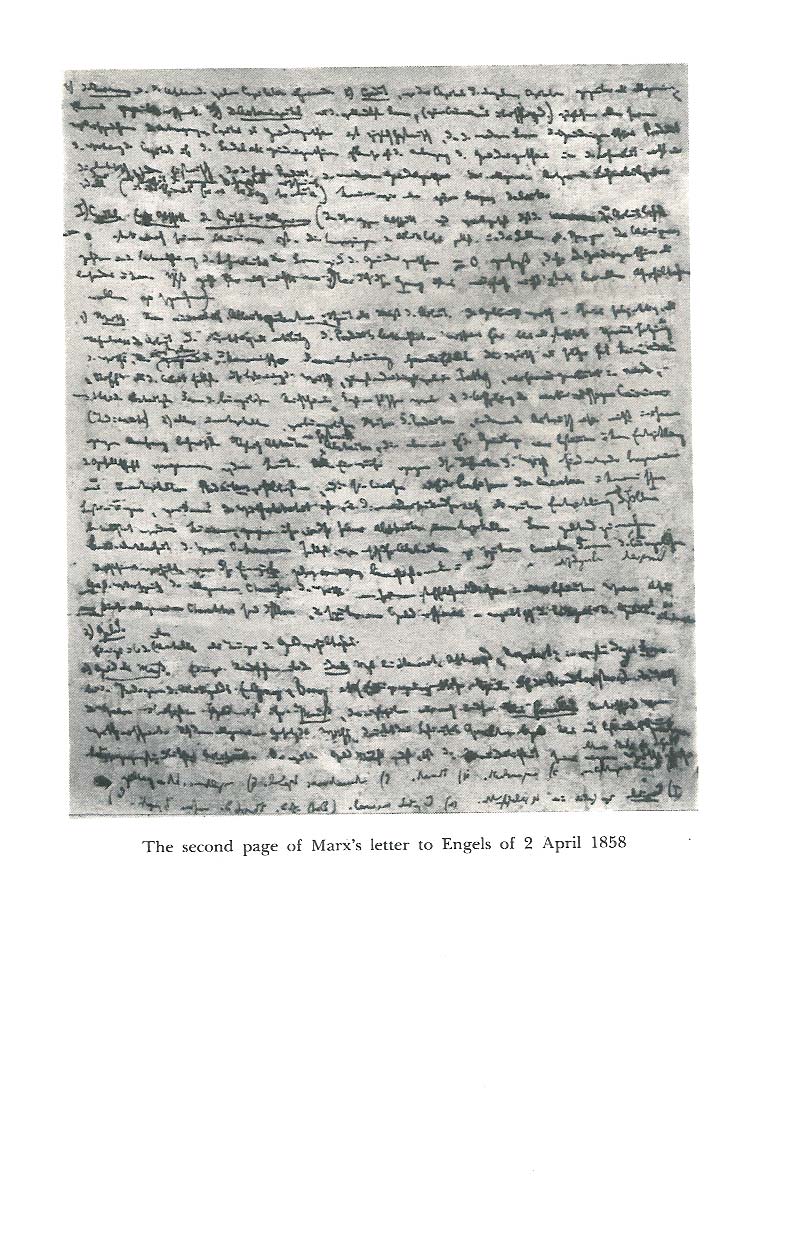
1858
this definition of value derive either from less developed relations of production or else are based on confused thinking, whereby the more concrete economic definitions from which value has been abstracted (and which may therefore also be seen, on the other hand, as a further development of the same) are upheld as against value in this its abstract, undeveloped form. In view of the uncertainty of messieurs les économistes themselves about the precise relation of this abstraction to later, more concrete forms of bourgeois wealth, these objections were plus ou moinsa
justified.
The contradiction between the general characteristics of value and its material existence in a particular commodity, etc.—these general characteristics being the same as those later appearing in money — gives rise to the category of money.
2. Money. Some discussion of precious metals as vehicles of the money relation.
a) Money as a measure. A few comments on the ideal measure in Steuart, Attwood,[310] Urquhart; in more comprehensible form among the advocates of labour money (Gray, Bray,b etc. An occasional swipe at the Proudhonists). The value of a commodity translated into money is its price. For the moment price appears only in this purely formal distinction between it and value. Thus, in accordance with the general law of value, a specific amount of money merely expresses a specific amount of objectified labour. In so far as money is a measure, the variability of its own value is of no importance.
b) Money as a means of exchange, or simple circulation.
Here we need only consider the simple form of circulation as such. All the other conditions by which it is determined are external to it, and hence will not be considered till later (presuppose more highly developed relations). If the commodity be C and money M then, although simple circulation evinces the two circuits or final points: C — M — M — C and M — C — C — M (this latter constituting the transition to c), the point of departure and the point of return in no way coincide, save by chance. Most of the so-called laws put forward by economists do not consider money circulation within its own confines, but as subsumed under, and determined by, higher movements. All this must be set aside. (Belongs in part to the theory of credit; but also calls for consideration where money appears again, but further defined.) Here, then, money as means of circulation (coin). But likewise as realisation (not simply evanescent) of price. From the simple statement that a commodity, in terms of price, has already been exchanged for money in theory before it is so exchanged in fact, there naturally follows the important economic law that the volume of the circulating medium is determined by prices, not vice versa. (Here, some historical stuff on the polemic concerning this point.) Again it follows that velocity may be a substitute for volume, but that a certain volume is essential to simultaneous acts of exchange in so far as the relation of these themselves is not that of + and —, an equalisation and consideration which will only be touched on at this juncture by way of anticipation. At this point I shall not go further into the development of this section and would only add that the lack of congruence of C — M and M — C is the most abstract and superficial form in which the possibility of crises is expressed. If the law concerning the determination of circulating volume by prices be developed, it will be found that the assumptions made here are by no means applicable to all states of society; hence the fatuity of comparing e.g. the influx of money from Asia into Rome and its effect on prices there tout bonnement" with modern commercial relations. On closer examination, the most abstract definitions invariably point to a broader, definite, concrete, historical basis. (OF COURSE, since to the extent that they are definite they have been abstracted therefrom.)
c) Money qua money. This is a development of the formula M — C — C — M. Money, the independent existence of value as opposed to circulation; material existence of abstract wealth. Already manifested in circulation in so far as it appears, not only as a means of circulation, but as realising price. In this capacity c), in which a) and b) appear to be no more than functions, money is the universal commodity of contracts (here the variability of its value acquires importance: value being determined by labour time); it becomes an object of HOARDING. (This would still seem to be an important function in Asia, as formerly in the ancient world and in the Middle Ages GENERALLY. Now persists only in a subordinate capacity within the banking system. In times of crisis money in this form again acquires importance. In this form money considered along with the world-historical DELUSIONS which it engenders, etc. Destructive properties, etc.) As the realisation of all higher forms in which value will appear; definitive forms in which all relations of value are externally concluded. Money, however, once fixed in this form, ceases to be an economic relation which is lost in its material medium, gold and silver. On the other hand, in so far as money comes into circulation and is again exchanged for C, the final process, the consumption of the commodity, again falls outside the economic relation. The principle of self-reproduction is not intrinsic to simple money circulation, which therefore implies something extrinsic to itself. Implicit in money — as the elaboration of its definitions shows — is the postulate capital, i.e. value entering into and maintaining itself in circulation, of which it is at the same time the prerequisite. This transition also historical. The antediluvian form of capital is commercial capital, which always generates money. At the same time the emergence of real capital, either from money or merchant capital, which gains control of production.
d) This simple circulation, considered as such — and it constitutes the surface of bourgeois society in which the underlying operations which gave rise to it are obliterated — evinces no distinction between the objects of exchange, save formal and evanescent ones. Here we have the realm of liberty, equality and of property based on 'labour'. Accumulation, as it appears here in the form of HOARDING, is merely greater thrift, etc. On the one hand then, the fatuity of the economic harmonists, modern free traders (Bastiat, Carey," etc.), in upholding this most superficial and most abstract relation of production as their truth, as against the more advanced relations and their antagonisms. Fatuity of the Proudhonists and suchlike socialists, in contrasting the ideas of equality, etc., corresponding to this exchange of equivalents (or presumed AS SUCH), to the inequalities, etc., to which this exchange reverts and from which it emanates. In this sphere, appropriation by labour, the exchange of equivalents, appears as the law of appropriation so that exchange simply returns the same value in another material form. In short, while everything may be 'lovely' here, it will soon come to a sticky end and this as a result of the law of equivalence. For now we come to ' 3. Capital.
This is really the most important part of the first instalment and one on which I particularly need your opinion. But today I can't go on writing. My bilious trouble makes it difficult for me to ply
159. Engels to Marx. 9 April
my pen, and keeping my head bent over the paper makes me dizzy. So FOR NEXT TIME.
Salut.
Your
K. M.
159
ENGELS TO MARX
IN LONDON
Manchester, 9 April 1858
Dear Moor,
The study of your ABSTRACT of the first half'•instalmenta has greatly exercised me; IT IS A VERY ABSTRACT ABSTRACT INDEED — inevitably so, in view of its brevity,—and I often had to search hard for the dialectical transitions, particularly since ALL ABSTRACT REASONING is now completely foreign to me. The arrangement of the whole into 6 books could hardly be better and seems to me an excellent idea, although the dialectical transition from landed property to wage labour is not yet quite clear to me. The development of the monetary business, too, is really excellent, though again there are individual bits I can't quite make out, at least until I have looked up the historical background. However, I think that I shall get a better idea of the DRIFT when I've had the last part of capital in general, and shall then write to you at greater length about it. The abstract, dialectical tone of your synopsis will, of course, disappear in the development.
Yesterday I sent you two more Guardians. Now that the price has been reduced to Id, the chaps are evidently cutting down on all expenses such as foreign correspondents, etc. Their attempt to produce a FIRST-CLASS PROVINCIAL PAPER failed completely. Hence the dearth of foreign news and the rarity of contributions from Paris.
The thing about Fould in yesterday's Guardian isn't bad. But what's even better is the COTTON SUPPLY ASSOCIATION'S[311] report. How splendid that, 10 years after its introduction, FREE TRADE[150] should be repudiated outright by the free traders themselves. For all that this COTTON SUPPLY ASSOCIATION amounts to is an institution set up by these selfsame free traders with the object of boosting the cultivation of cotton everywhere in the world where soil and climate are not entirely unsuitable — and this, in direct opposition to FREE TRADE principles, by means of rewards, advances, gifts of seed, loans of machinery, etc., etc. If the State does something of this sort, it's all wrong, but if the MANCHESTER COTTON SPINNERS, who are much further removed from the NIGGERS, Bedouins, etc., in Africa than their own monarch, do the selfsame thing, then ITS ALL RIGHT. This report is as pretty a satire on laissez-faire[3]™ clap-trap generally as one could hope to find. Very pretty, too, the admission that the import of English goods manufactured from American cotton has disrupted cotton cultivation in almost all other countries and that this last will now have to be restored by artificial means! These wretched English regard their monopoly in cotton spinning and weaving as something fine and natural to which no one could object; whereas the cotton-growing monopoly of the United States, engendered by the selfsame world market, must be smashed, even if this means ANTI-FREE TRADE measures. The thing ought to be called * Association for enabling the single spinners to buy cotton in the dearest market, the collective spinners paying the producer the difference between the market value and his cost of production *. Of course, this is to go on only until subsidised cotton growing can stand on its own legs; but after all that is exactly what Monsieur List is also seeking to do with his protective tariffs! The thing might supply you with material for an article, since the Yankees have a direct interest in it and the Tribune, too, is ANTI-FREE TRADE.
My prognostications that fluctuations in produce would be entirely dependent on the east and west winds and that, with MIDDLING ORLEANS COTTON above 6d, there could be no question of trade being either normal or brisk, have proved remarkably accurate.[3] As regards cotton, the fulfilment of my first prognosti-cation will be apparent from the enclosed table which is a continuation of the one I sent you earlier on the price of Middling Orleans, and brings it up to date.b Sugar, coffee and tea have gone 9 1858
the same way, save that the existence of considerable stocks inhibited the temporary steep rise which the shortage of stocks made possible in the case of cotton. As for the second prognostication, there's still quite a lot of SHORT TIME, STRIKES, and stoppages d u e to unprofitable production and, since the crop will provide 3,000 M (1) bales whereas full production would now d e m a n d a minimum of 3,500 M (same ratio for other cotton producing countries), any attempt at revival by the cotton industry u p to the end of this year will be hampered — quite aside from political convulsions — by the rising price of raw material, as indeed already happened at the end of February and the beginning of March (see table). Prices in general — even though there may be an initial fall — will rise, but at the same time there will be a CHECK to production proportionate to the rise. This, always SUPPOSING THAT [THERE is] NO ROW ON THE CONTINENT, though the latter is a virtual certainty.
In one week, 19-26 February, only 62 bales of cotton of all qualities arrived in Liverpool! Normally they are counted in thousands.
What's this about the 300 million francs which are admitted to have vanished? All I remember having read is that, instead of a surplus of 40 million, Magne has a deficit — but I don't know the details. It really is priceless. Now the 'prince impérial*' is also to be given his own household and a dotation — CASH MUST BE DEVIUSH SCARCE!
I hope your bilious trouble is better. Obviously all this excitation caused by the crisis is to blame. In the evenings I am sometimes plagued by toothache as a result of the weather; but nothing worse.
Kind regards to your wife a n d children.
Your
F. E.
160. Engels to Jenny Marx. 14 April
160
ENGELS TO JENNY MARX[313]
IN LONDON
Manchester, 14 April 1858
Dear Mrs Marx,
I trust that Moor is at last on the road to recovery and will soon be able to return unhampered to his labours on political economy.[250] I was also plagued with toothache last week. By Sunday it had gone, only to return with added virulence this evening just as I was settling down to sort out some preliminary stuff on the conquest of Lucknowa for the Tribune. Whether I shall succeed in these circumstances seems very doubtful. At any rate I shall try and read up the subject this evening and if possible concoct something, even if not much, tomorrow midday while I'm at the office. But it would at any rate be a good idea if Moor were to have a sujet in petto so that, if the worst comes to the worst, there's something to send the fellows.
I still find working in the evenings very tiring and, if I go on for too long or for two evenings running, I get over-excited and suffer from insomnia, particularly when I've had a lot of writing to do during the day. And I also feel very stupid and lethargic in the evenings until I wake myself up by forcing myself to concentrate on some subject. My memory is better on the whole, although every day I still find that things I have done or heard the day before vanish so completely from my mind that they might never have happened, and it's only when I've been reminded of individual details that it all comes back to me. Otherwise I am physically strong and healthy again, able to stand up to strains and stresses and—sauf lec TOOTHACHE — to any kind of weather.
Lupus is still very lame and is having to spend more on CABS in one week than he usually does in a year. But he is improving visibly and in a week's time he'll probably again be able to stand a certain amount of walking. He sends everyone his best wishes.
How do you like the Bernard trial[314]? The French mouchards* and their worthy confrère MR Rogers are cutting a pretty figure.
161. Engels to Marx. 22 April
Yesterday's Morning Post drew a very nice picture of the trial's physiognomy. That Chevalier Estien was excellendy portrayed.[3]
I have today received from DEAR Harney 3 more Independent^ from which it transpires that his arch-enemy, Seigneur Godfrey, has begun a fresh libel suit against him.[237] The man will soon be thinking himself as 'greet' as the 'greet'c Lassalle.
'OUR FAITHFUL ALLY"* is now weighing on English commerce like a nightmare. Nobody wants to speculate or buy more than his immediate requirements because the whole of Philistia is expecting war, revolution or even more oudandish things in France.
Very best wishes to the girls and Moor,
Yours ever,
F. Engels
161
ENGELS TO MARX
IN LONDON
Manchester, 22 April 1858
Dear Moor,
I wrote to your wife last week and the following day sent an article on Lucknowd and also Guardians (or cuttings, I don't remember exactly). I hope everything arrived safely. 2 more Guardians go off today. Russell's report in Tuesday's Times[1] did not have the makings of an article, but I'm saving it up until the arrival of the next mail; this is sure to bring the last part of the Lucknow story, when the whole thing can be polished off all at one go — with, I hope, the help of Campbell's despatches as well. Meanwhile I have thrown myself into 'Cavalry' again — shall leave
162. Marx to Engels. 29 April
open bits of the historical section for the present until I can unearth the relevant sources, and shall get on with the tactical side. The article will probably take up 10 or 12 of my long double pages, and maybe more.
The affaire Bernard[314] will greatly mortify Monsieur Bonaparte and make quite an impression on the refugee crapauds in London. James' speech, by the way, was feeble and décousu3 and as usual old Campbell's summing up went against the PRISONER. The old donkey is vexed at losing the chance of an interesting legal case when he could have presided over 15 other judges.
The revelations made by Cavour and La Marmorab about their relations with Cavaignac and the latter's fear of Austria[315] will be of interest to the républicains purs. The more that comes to light about the National's period of supremacy, the more pitiful it seems.
Your
F. E.
162
MARX TO ENGELS
IN MANCHESTER
London, 29 April 1858
DEAR Frederick,
My long silence can be explained in one word — inability to write. This existed (AND TO SOME DEGREE EXISTS STILL) not only IN THE
LITERARY, b u t IN THE LITERAL SENSE OF THE WORD. T h e f e w o b l i g a t o r y articles for the Tribune" were dictated to my wife, but even that was only possible by APPLYING STRONG STIMULI. Never before have I had such a violent attaque of liver trouble and FOR SOME TIME there was a fear that it might be sclerosis of the liver. The doctor wanted me to travel but d'abord* that was incompatible with the STATE OF FINANCE, and secondly I hoped from day to day to be able to start work again. The persistent urge to get down to WORK coupled with inability to do so helped aggravate my condition. However there's been an improvement during the past week. But I'm not yet capable of working. Whenever I sit down and write for a couple of hours I have to lie quite fallow for a couple of days. I hope to heaven that this state of affairs comes to an end next week. It couldn't have happened at a more inconvenient time. Obviously I overdid my nocturnal labours last winter. Hinc illae lacrimae.b
Your letters and Guardians arrived safely. A book has appeared by Louis Blanc on the revolution of 1848.c
Evinces the most candid admiration for the 'petit'd which, or so he says, is what the workers call him. If read carefully, however, it makes the fellow look an ass for it shows that on every crucial occasion the workers acted without his knowledge or consent and generally returned him sentiment for 'sentiment', taking the view that they had thereby paid the oracle of Luxembourg his FULL
PRICE.316
The movement for the emancipation of the serfs in Russia strikes me as important in so far as it indicates the beginning of an internal development that might run counter to the country's traditional foreign policy. Herzen, of course, has discovered afresh that 'liberty' has emigrated from Paris to Moscow.
Friend Bangya, AS IT SEEMS, has been caught out by Sefer Pasha's sone engaging in unauthorised correspondence with Philipson, the Russian general. It is said that he HAS BEEN SHOT together with a number of his Hungarian and Polish accomplices.[3]
Regards to Lupus.
Your
K. M.
163. Engels to Marx. 30 April
163
ENGELS TO MARX
IN LONDON
Manchester, 30 April 1858 7 Southgate
Dear Moor,
If travel you must, why not travel to Manchester, THATS EASY ENOUGH. Should the note I sent you yesterday have already disappeared, ce qui serait bien possible,' let me know; for 21/- you can now get an 8-day RETURN TICKET FIRST CLASS, and then, of course, you just disregard the RETURN. I shall try and arrange for a spare bed at my house, which should be possible for a few days, anyhow. For the rest we shall see. If you still have the money for the journey, come up straight away. We shall immediately send off to your wife anything you borrow from her; I've had no time to get a POST OFFICE ORDER today. I shall give the necessary instructions when I get home this evening. Come straight to No 6 Thorncliffe Grove, Oxford Road. If you don't actually leave tomorrow evening (there's a train at about 5 o'clock), let me know on Monday morning when you are arriving and I'll pick you up at the station — but say whether by NORTH WESTERN or GREAT NORTHERN RAILWAY.
If you are arriving on Sunday, telegraph me tomorrow — it costs 2/6d for 20 words excluding the address. Send the telegram to my house.
Your
F. E.
164. Marx to Engels. 1 May
164
MARX TO ENGELS
IN MANCHESTER
[London,] 1 May [1858]
DEAR Frederick,
*I shall part on Thursdaya by the Great Northern, leaves London at half past 2, arrives at Manchester at 7 p.m.S18
Yours *
K. M.
Since yesterday I have been feeling much better and au fondb it was my intention to start work sérieusement on Monday. However AFTER CONSULTATION WITH THE DOCTOR, who thinks that I still need a week of gadding about, I have let my duty go hang.
165. Engels to Rudolf Schramm. 6 May
To Mr R. Schramm in London
I have just received your note dated the 3rd. After the death of my friend, Conrad Schramm,[188] I instructed Mr Harney to return to us, not you, the letters from Marx and myself found among his papers,c since those letters were not intended for you. And this indeed was done.
I can see no reason whatever why I should discuss with you matters which concerned no one but myself and my late friend
166. Engels to Jenny Marx. 11 May
and party comrade. While Conrad was still alive your own friends were surprised at the indifference you showed towards his financial circumstances.
In so far as I had anything to say about the disposal of Conrad's effects, I have said it to his only possible executor, Mr Harney.
As to my 'sense of justice', which has nothing whatever to do with the case, you may perhaps have occasion to become better acquainted with it some day in Germany.
I am, Sir, your obedient servant,
F. E.
166
ENGELS TO JENNY MARX
IN LONDON
Manchester, 11 May 1858
Dear Mrs Marx,
Moor has been out riding for two hours today and feels so well after it that he's waxing quite enthusiastic about the thing. He has left town and gone home, and has asked me to drop you a line about that fool Cluss.(1) He thinks it might be a good thing for you to go and see Pfänder, who would probably elicit something from him. The main thing is that Monsieur Cluss should come up here, for we have got to know how we stand with him, and either he must declare himself IN A SATISFACTORY MANNER or else we must break with him. What good is the ass to us if he's so unreliable as first to come to you, his heart brimful and overflowing, stay for 3 hours with no other apparent object than to get back on to the old footing again, and then suddenly write you a letter as confused as it is ill-bred in which he retracts? We're only sorry that, in the midst of what is a far from rosy spell, such dolts should come and add to your troubles.
167. Engels to Jenny and Laura Marx. 11 May
If at all possible, see that the man comes up here so that we at least have the satisfaction of telling him exactly what we think of him.
I hope that Moor will persevere with his riding, for if he does he'll be able to write again in a week. Lupus' leg is much better too.
Your devoted
F. Engels
167
ENGELS TO JENNY AND LAURA MARX
IN LONDON
Manchester, 11 May 1858
Dear Jenny and Laura,
I cannot allow this note to go off to your mama without thanking you for the two lovely portraits which you asked Moor to bring me. They have found a temporary home on the CHIMNEY-PIECE in front of the looking-glass, but in a day or two will be given a splendid place of their own on the wall.
I hope Mr Schleiden suits you all righta; the man's far more solemn than you are, and I only hope you won't see fit to imitate him.
Dai ritratti vedo con piacere che avete molto grandito tutte le due e che, benchè siate grande signorine adesso, vi sono sempre le vecchie faccie piene di franchezza ed ingenuità; e credete pure che anch' io per voi sard sempre il vecchiob
Engels
168. Marx to Ferdinand Lassalle. 31 May[82]
IN BERLIN
London, 31 May 1858 9 Grafton Terrace, Maitland Park,
Haverstock Hill
Dear Lassalle,
Post tot discrimina rerum* at long last a sign of life. As for me, what's been happening since my wife wrote to youb is simply this:
Having been totally incapable of writing — not only IN A LITERARY, BUT IN THE LITERAL SENSE OF THE WORD — for several weeks, and striven in vain to rebel against my illness; having, moreover, been pumped full of medicine and all TO NO USE, I was positively assured by my doctor that I must have a change of air, secondly that I must DROP all INTELLECTUAL LABOUR FOR SOME TIME and, finally, engage in riding as the main form of treatment. In itself the illness wasn't dangerous — enlargement of the liver — but on this occasion the accompanying symptoms were particularly revolting; moreover, in my family it has nasty implications in that it was the starting-point of the illness which led to my father's death. WELL. With the utmost reluctance I eventually gave way to the insistence of doctor and family, joined Engels in Manchester,[318] went in for riding and other physical EXERCISES and, after spending a month up there, finally returned to London fully restored. The illness — altogether a very expensive LUXURY in my circumstances — was all the more inopportune in that I had already begun to prepare the first instalment0 for publication. I shall now settle down to this with a will. I trust you will be so kind as to tell the publisherd all about these ADVENTURES. YOU will readily be able to imagine the state of mind I was in during my illness when I tell you that liver complaints as such tend to make one hypochondriacal and that, in addition, my life was bedevilled by all manner of domestic circumstances, not to speak of the hitch over publication. Now I have recovered my accustomed good humour.
» After so many setbacks (Virgil, Aeruid, I, 204). - b See this volume, p. 570. - t K. Marx. A Contribution to the Critique of Political Economy. - d Franz Gustav Duncker During this time of tribulation I carefully perused your Heraclitus.' Your reconstruction of the system from the scattered fragments I regard as brilliant, nor was I any less impressed by the perspicacity of your polemic. In so far as I have any fault to find, it is largely formal. I believe your exposé could have been rather more condensed without in any way jeopardising the import. I should, moreover, have liked to find in the text proper some critical indications as to your attitude to Hegelian dialectic. This dialectic is, to be sure, the ultimate word in philosophy and hence there is all the more need to divest it of the mystical aura given it by Hegel. Finally, there are some details upon which I do not agree with you; e.g. your interpretation of Democritus' natural philosophy. These, however, are all minor points. I am all the more aware of the difficulties you had to surmount in this work in that ABOUT 18 years ago I myself attempted a similar work on a far easier philosopher, Epicurus b—namely the portrayal of a complete system from fragments, a system which I am convinced, by the by, was — as with Heraclitus — only implicitly present in his work, not consciously as a system. Even in the case of philosophers who give systematic form to their work, Spinoza for instance, the true inner structure of the system is quite unlike the form in which it was consciously presented by him. It is incomprehensible to me, by the by, how you found the time in the midst of all your other work to acquire so much Greek philology.
On the whole the present moment of time is a pleasing one. History is clearly about TO TAKE AGAIN A NEW START, and the signs of dissolution EVERYWHERE ARE DELIGHTFUL FOR EVERY MIND NOT BENT UPON THE
CONSERVATION OF THINGS AS THEY ARE.
Salut.
Your
K. M.
a F. Lassalle, Die Philosophie Herakleitos des Dunklen von Ephesos. - *> Marx means his doctoral dissertation Difference Between the Democritean and Epicurean Philosophy of Nature.
169. Marx to Engels. 31 May
169
MARX TO ENGELS
IN MANCHESTER
London, 31 May 1858 9 Grafton Terrace, Maitland Park, Haverstock Hill
DEAR Frederick,
It took me a week to acclimatise myself again; moreover, the abrupt discontinuation of riding did me no good to begin with. Not until this very day have I at last begun to feel as fit as I did on the day I left Manchester. I am now IN WORKING ORDER and shall at once start getting the stuff ready for publication.a All I wrote last week was 2 articles for the Tribune}* The rest of the time I kept constantly on the move, since the feeling of heaviness in my head and trouble with my bowels made me fear a relapse.
Ad vocemb Cluss. Before leaving, this young man visited Schapper again. When he got back from my house the worthy fellow discovered to his dismay that he had brought something back with him from Paris, viz. a chancre with all sorts of nasty secondary symptoms. He took to his bed and this, he told Schapper, was the reason for his withdrawal from the civilised world.
Ad vocem Pélissier. What we jokingly suggested in Manchester, namely that Pélissier would promptly enter into relations with the Orléans, has now happened IN REAL GOOD EARNEST, and become the talk of the town here.
What do you think of Bonaparte's thirst for confiscation?[319]
During my absence a book by Maclaren covering the entire history of CURRENCY came out in Londonc; to judge by the excerpts in The Economist it is FIRST-RATE.d The book isn't in the library' yet — nothing ever turns up there until months after publication. I, of course, am bound to read it before writing my treatise. So I sent my wife to the PUBLISHERf in the City. To our dismay, however, we discovered that it costs 9/6d — more than the whole of our fighting funds. Hence I should be most grateful if you could send me a POST OFFICE ORDER for that amount. There probably won't be anything that's new to me in the book, but after all the fuss The Economist has made about it and the excerpts I myself have read, my theoretical scruples won't permit me to proceed without having looked at it.
Don't you think you might have sufficient material to d o something general on the STATE OF THE BRITISH FORCES IN INDIA and also something conjectural for Friday? I T WOULD BE A GREAT BOON FOR ME since reading over my own manuscript b will take me the better part of a week. T h e damnable part of it is that my manuscript (which in print would amount to a hefty volume) is a real hotchpotch, much of it intended for much later sections. So I shall have to make an index briefly indicating in which notebook and on which page to find the stuff I want to work on first.
I have at long last written to Lassalle.c You must grant me absolution for the plaudits I was obliged to accord Heraclitus, the Dark Philosopher. In a few unobtrusive asides — for praise is taken seriously only when offset by censure — I have to some extent, if very piano-piano, hinted at the real shortcomings of the entreprise. Tomorrow or the day after I shall be getting some more Bangya n u m b e r s / 2 of which I shall send to Manchester, 1 for you and 1 for Lupus. Apropos, in an issue of the Tribune I see that Pulszky is endeavouring to forestall the nauseous REVELATIONS by representing Bangya as Metternich's spy and as one who betrayed General Stein.d So statesman Blind, WHILE GIVING A TESTIMONIUM PAUPERTATIS TO KOSSUTH, THE ILLUSTRIOUS GOVERNOR OF HUNGARY-, in the Advertiser, nevertheless found himself obliged to invite him in so many words to make a 'counter-statement'. Kossuth, OF COURSE, held his tongue.
How is Gumpert progressing in the noble art of equitation? As for me, the pity of it is that I always have to break off just when I'm again making enough progress to take an interest in the thing.
Salut.
Your
K. M.
170. Marx to Engels. 7 June
170
MARX T O ENGELS [2 0]
IN MANCHESTER
[London,] 7 June 1858
DEAR Frederick,
Enclosed 2 Bangya numbers, 3 ONE FOR YOU, THE OTHER FOR Lupus. Have received from you 1. letter with the POST OFFICE NOTE; 2. SECOND LETTER; 3. ARTICLE FOR THE TRIBUNE (VERY AMUSING ONE. TOO ). Did not acknowledge receipt before because each day 1 was expecting the 2 Bangya numbers; also a lot of PRIVATE TROUBLES which took u p my time.
Enclosed a letter from Lassalle.c It's an extremely odd business. I cannot reply until I have your own and Lupus' opinion. So I should like you to consult together at once and send m e your avisà
without delay. My own view is that Lassalle should not engage in a duel with that ass Fabrice and that, even from the standpoint of the duel, the assault by the two gentlemen from the 'High Court' has put any duelling OUT OF THE QUESTION. GENERALLY, it is my view— though having to decide whether or not the duel as such accords with principle seems to m e ludicrous, OF COURSE — that in the PRESENT CIRCUMSTANCES, AT THIS PARTICULAR JUNCTURE, etc., etc., in contemporary history, members of the revolutionary party may respond to their PRIVATE ENEMIES with clubs, kicks a n d punches, but not engage in duels. But it would seem to m e totally wrong if, after h e has come out so categorically against all duelling, Lassalle WOULD ALLOW HIMSELF
TO BE BULLIED by feudal GOSSIP.
Schapper came to see me yesterday. Told me, inter alia, that friend Caussidière, arriving drunk in a disreputable alley in New York one evening, apparently attacked a wench with his stick; h e r yells attracted half a dozen LOAFERS who promptly set upon Caussidière and beat him almost to death. T h e fat lout was PICKED UP unconscious by the police early next morning and it was 6 weeks before h e was fit enough to be u p and about again.
Seiler h a d a CASE [attack] of paralysis; at death's door for
171. Engels to Marx. 9 June
10 weeks; but weeds are indestructible. Heise is said to be dangerously ill again. .
Salut.
Your
K. M.
Vol. XXII, Moscow, 1929
171
ENGELS TO MARX
IN LONDON
[Manchester,] 9 June 1858
Dear Moor,
I return Lassalle's letter herewith.[3] Borchardt had already told me on Saturday with a look of triumph that our little Jew Braun had been in a brawl. It's extremely useful to know these details. As for our opinion, it's as clear as day that, by making so despicable an attempt on a person's life, both the gentlemen, the Intendanturrat no less than the Assessor, have adopted in toto the standpoint of the bludgeon, and that the only duel one might engage in with such laddies has already taken place during the brawl itself. If 2 chaps waylay a third and both of them set on him, I don't believe that any duelling code in the world would permit a subsequent duel with such riff-raff. If Mr Fabrice intended forcibly to provoke a duel by means of the horse-whip affair, either Mr Bor mann ought to have looked on purely passively as a witness, or his presence was altogether superfluous. But when two men simultaneously set upon one, then we are dealing with canailleh for whom honour and FAIR PLAY do not exist and who have given proof that A FAIR DUEL cannot be fought with them. Indeed one would run the risk of being treacherously murdered.
So much for my own and Lupus' opinion, if we are to take the duelling code as the basis in law.
This apart we share your view that 1. duels are, on the whole, untimely for revolutionaries just now and 2. that Lassalle, having declared himself unequivocally against duelling 'on principle', would be greatly discredited were he now to engage in a duel.
So far as we are concerned, therefore, you can safely go ahead and tell our Ephraim Artful[3] not to fight but rather tranquilly restore his 'unshakable determination' with the help of the botde, take the moon by the horns again as soon as may be and risk annihilation for the hundred and first time. As to the discovery that he appears to possess an adequate store of vanity, silence is, I think, the best form of congratulation.
Did you read the story about Fould's sona? He decamped to London with Mademoiselle Valérie' of the Gymnase and 1,600,000 francs. His old man b wrote to Pélissier and told him that he should au cas de besoin, user d'autorité.c Pélissier invited the loving couple to déjeunerd and told them: Je vous donne ma bénédiction* and wrote to the old man: Que voulez-vous? Les jeunes gens seront toujours de jeunes gens!e Whereat old Fould became the laughing-stock of Paris.
Your
F. E.
172. Marx to Ferdinand Lassalle. 10 June[82]
Haverstock Hill
Dear Lassalle,
You would have had an immediate answer to your letter, but it seemed to me advisable — not in order to formulate my own views but because très faciunt collegium3—to put the CASE to Engels and Lupus in Manchester and obtain their opinion. Since their views and my own coincide at every point, you may regard the following as our unanimous OPINION.
1. From the standpoint of the duel. It is as clear as day that by their despicable attack in the street the two gentlemen, the Intendanturrat and the Assessor, have adopted in toto the standpoint of the bludgeon and that the only duel which one might engage in with such laddies has already taken place during the brawl itself. If 2 chaps waylay a third and both of them set on him, we don't believe that any duelling code in the world would permit a subsequent duel with such riff-raff. If, by flourishing a horse-whip, Mr Fabrice intended forcibly to provoke a duel, either Mr Bormann ought to have looked on purely passively as a witness, or his presence was altogether superfluous. But when two men simultaneously set upon one, and one of them actually operates IN THE REAR of the person attacked, then we are dealing with canailleb who have given proof that A FAIR DUEL cannot be fought with them.
2. Principle of the duel. We don't believe that, generally speaking, an affair as relative as a duel can be subsumed under the category good or bad. That duelling as such is not rational there can be no doubt. Nor that it is a relic of a bygone stage of civilisation. However, a concomitant of the one-sidedness of bourgeois society is that, in opposition to the latter, certain feudal forms maintain the rights of the individual. The most striking proof of this is to be found in the United States where duelling is a civil right. Individuals may become locked in a mutual conflict so insupporta-ble that a duel seems to them the only solution. However such deadly tension is not IN FACT possible vis-à-vis an indifferent person such as an Intendanturrat, an Assessor, or a lieutenant. This would demand a significant personal relationship. Otherwise a duel is an utter farce. It is invariably a farce when performed in deference to so-called 'public opinion'.
3. We therefore regard duelling as being purely dependent on circumstances; hence recourse may be had to it as an exceptional pis aller" in exceptional circumstances. In the CASE under discussion, however, all the circumstances argue quite emphatically against it, even if the attack in the street had not put it ALTOGETHER
OUT OF THE QUESTION.
4. The really decisive factor is that you are not only opposed to all duelling on principle but have proclaimed this principle, and in
173. Marx to Engels. 2 July
Fabrice's presence at that. So you would discredit yourself were you nevertheless to engage in a duel through fear of 'public opinion'.
5. In the case under discussion, a duel would have absolutely no meaning save as the observance of a conventional formality recognised by certain privileged classes. Our party must resolutely set its face against these class ceremonies and reject with the most cynical contempt the presumptuous demand that we submit to them. The present state of affairs is far too serious to permit of your consenting to such puerilities and it would be sheer puerility to engage in a duel with Mr Fabrice because he is an 'Intendanturrat' and belongs to the clique qualified to fight duels, whereas if e.g. a tailor or cobbler were to set about you in the street, you would simply hand him over to the courts without any infringement of 'honour'. In the case under consideration you would not be fighting a duel with Fabrice, an individual who is indifferent to you, but with the 'Intendanturrat'—which would be an absurd manoeuvre. In general, the fellows' insistence that differences with them must be settled by a duel as a privilege due to them — and all FASHIONABLE duels fall under this head — should be laughed to scorn. To acknowledge this claim would be altogether counter-revolutionary.
I have given you our view in nuce.* We shall be interested to hear how the affair progresses.
Salut. Y o u r
K. M.
173
MARX TO ENGELS
IN MANCHESTER
London, 2 July 1858 9 Grafton Terrace, Maitland Park, H averstock Hill Dear Engels,
The delay in acknowledging your 'Cavalry'[320] due to great domestic TROUBLE. For weeks our youngest childb has been suffering from HOOPING-COUGH, a most alarming illness, besides which my wife is very seedy. So my work has been damnably disrupted by this and all kinds of other domestic upsets.
You will remember that, while our friend Schramm was in Jersey, I secured him the position of correspondent to an American paper. Now that he's dead and after he had dunned them on several occasions, his fee of SOME 6 POUNDS has arrived and has, of course, fallen to Mr Rudolfb as pocket-money.
Otherwise nothing new here. That little London German rag once run by Gumpert has, I believe, now fallen to 'united democracy', sub auspiciisc of the great Blind under the title Neue
Welt.d
I assume you have read the statements made in the Star b y Mr Türr and by the Hungarian émigrés in Constantinople. If not, I shall send you The Free Press* Meanwhile Kossuth still remains obdurately silent. Our excerpt from Bangya's story has appeared in the Tribune? The row in New York will force Kossuth to speak. Thus I may have to come right out into the open in this matter. Pulszky had de longue mainc provided a loophole in the Tribune when he described Bangya as a former spy of Metternich's (!).f
Klapka, whom I met for a moment or two at Freiligrath's, remarked drily of Bangya: 'Finis coronal opus.'*h He seems to be very blasé about Kossuth. Is presently dabbling in Turkish shares.
Herewith two letters from New York.[321]
I have had no word from Ephraim Artful[1] for a fortnight. Being convinced, OF COURSE, that there was small likelihood of my letter being put to discreet use by him, I worded it with the utmost caution so THAT IT WILL BE EXTREMELY DIFFICULT FOR HIM TO ABUSE IT. Apart from the special CIRCUMSTANCES of the CASE, concerning which I gave him your opinion pretty well verbatim, I censured duelling only in so far as it is claimed as privilege of caste by fellows who believe that their insults must be punished otherwise than those of a tailor, cobbler, etc. The revolutionary thing to do, I told him, when confronted with such inane presumption and laddies of this ilk, was to adopt the 'standpoint of the lout' and the 'code of the bludgeon'. On the other hand, in reply to Ephraim's pedantry, I said that duelling was among the things Aristotle described as being 'indifferent' and which one could either take or leave as one
174. Engels to Marx. 14 July
pleased; I told him he was right in saying that it was a relic of a bygone stage of development but that, 'given the one-sidedness and narrow-mindedness of bourgeois relations, individuality could sometimes assert itself only in feudal form'.a
I trust that, come what may, you will send me an article on Indiab next week. There is ample material for an article for the Tribune, which will otherwise reprint stuff from The Times, etc. Anyway, all that matters is that articles should be sent.
Salut.
Your
K. M.
Regards to Lupus. Humboldt has published a very 'flattering' letter in the Tribune addressed to Fröbel,c who has published a book of his American travels.d ,
Vol. XXII, Moscow, 1929
174
ENGELS TO MARX[1]
IN LONDON
Manchester, 14 July 1858
Dear Moor,
Up here we are now in the middle of the balance-sheet and hence I haven't had the leisure to write to you at greater length. I hope that your little Tussye is better. Gumpert tells me that in the English climate whooping-cough is seldom dangerous and, though usually chronic, is benign. All the cases they've had in the hospital so far have ended well. He gave me both the reports (Marei's) this hospital has so far produced. They are highly scientific and I wish I had had material of this kind when I was writing my book.a I also have copies of it for you which I shall be sending; individual bits may come in useful for your chapter on wage labour. No doubt you will derive some amusement from Marei's grandiose conception and sanguine expectations.
Have neither seen nor heard of the statements by Mr Türr, etc. The Star is not much read up here. So I'd be glad if you would just send The Free Pressb and also, if possible, a copy for Lupus, who is still in Buxton, whither he was sent by Borchardt, and where, out of boredom, he may well do more walking than is good for his leg.
The two letters from New York which you mention in your last were not enclosed.[321]
Apropos. Kindly let me have Hegel's Philosophy of Naturec as promised. I am presently doing a little physiology which I shall combine with comparative anatomy. Here one comes upon highly speculative things, all of which, however, have only recently been discovered; I am exceedingly curious to see whether the old man may not already have had some inkling of them. This much is certain: were he today to write a Philosophy of Nature, subjects would come flocking in on him from all directions. One has no idea, by the way, of the progress made in the natural sciences during the past, 30 years. Two things have been crucial where physiology is concerned: 1. the tremendous development of organic chemistry, 2. the microscope, which has been properly used only during the past 20 years. This last has produced even more important results than chemistry; what has been chiefly responsible for revolutionising the whole of physiology and has alone made comparative physiology possible is the discovery of the cell — in plants by Schleiden and in animals by Schwann (about 1836). Everything consists of cells. The cell is Hegelian 'being in itself and its development follows the Hegelian process step by step right up . to the final emergence of the 'idea'—i.e. each completed organism.
Another result that would have delighted old Hegel is the correlation of forces in physics, or the law whereby mechanical motion, i.e. mechanical force (e.g. through friction), is, in given conditions, converted into heat, heat into light, light into chemical affinity, chemical affinity (e.g. in the voltaic pile) into electricity, the latter into magnetism. These transitions may also take place differently, backwards or forwards. An Englishmana whose name I can't recall has now shown that these forces pass from one to the other in quite specific quantitative proportions so that e.g. a certain quantity of one, e.g. electricity, corresponds to a certain quantity of each of the others, e.g. magnetism, light, heat, chemical affinity (positive or negative — combining or separating) and motion. The idiotic theory of latent heat is thus disposed of. But isn't this splendid material proof of how the reflex categories dissolve one into the other?
This much is certain — comparative physiology gives one a healthy contempt for man's idealistic arrogance in regard to other animals. At every step it is forcibly brought home to one how completely his structure corresponds to that of other mammals; he has basic features in common with all vertebrates and even — if less distinctly — with insects, crustaceans, tapeworms, etc. Here too Hegel's stuff about the qualitative leap in the quantitative sequence fits in very nicely. Finally, with the most primitive infusoria, one reaches the original form, the single cell existing independently, which again is not perceptibly distinguishable from the lowest vegetable life (single-celled fungi such as those causing disease in potatoes, the vine, etc., etc.) or, at a higher stage of development, from the germ right up to and including the human ovum and spermatozoon, and is identical in appearance to the separate cells in the living body (blood corpuscles, the cells of the epidermis and mucous membrane, secreting cells in the glands, kidneys, etc., etc.).
Some time,you might also let me know what sort of a disease dyspepsia crapulosab is. This isn't, as it happens, a bad joke but a scientifically recognised term.
If The Times has any particulars about India tomorrow, we shall see what can be done for the Tribune, otherwise it will be no go. So you'll see from tomorrow's Times more or less what can be expected.
Warm regards to the FAMILY.
Your
F. E. The acceptance business successfully concluded.
175. Marx to Engels. 15 July
175
MARX TO ENGELS[82]
IN MANCHESTER
[London,] 15 July 1858 9 Grafton Terrace, Maitland Park
Dear Engels,
D'aborda I would beg you not to take fright at the contents of this letter since it is not in any way intended as an APPEAL-to your already unduly overloaded exchequer. On the other hand it behoves us to put our heads together to see if some way cannot be found out of the present situation, for it has become absolutely untenable. It has already resulted in my being COMPLETELY DISABLED from doing any work, partly because I have to waste most of my time running round in fruitless attempts to raise money, and partly because my abstract thinking — due rather, perhaps, to my being physically run down — is no longer a match for domestic miseries. The general unpleasantness has made a nervous wreck of my wife, and Dr Allen who, of course, suspects where the shoe PINCHES but doesn't know the real state of affairs, has now told me repeatedly and positively that he cannot rule out brain fever or something of the sort unless she is sent to a seaside resort for a longish stay. I for my part know that circumstances being what they are, this course, even if feasible, would do her no good so long as she continues to be the victim of daily pressures and haunted by the spectre of final and unavoidable catastrophe. This last, however, cannot be long postponed and, even if it be staved off for a few weeks, there still remains the unbearable day-to-day struggle for MERE NECESSARIES and a general situation such as will inevitably bring everything to wrack and ruin.
There are in London so-called LOAN-SOCIETIES [182] which advertise LOANS of £5-200, without SECURITIES and on the strength of REFERENCES alone. I therefore attempted an operation of this kind, Freiligrath and an épicierb having offered to act as REFEREES. The result was that some £2 went on FEES. The final, negative, answer arrived the day before yesterday. I don't know whether I should make a further attempt of this kind.
To give you an idea of the real state of affairs, I have asked my wife to draw up a statement in respect of the £20 advanced by you and the £24 I drew on the Tribune (of which £2 were overdrawn) on 16 June. From it you will see that, as soon as a fairly substantial sum such as this arrives, not a penny is left over even for the most urgent day-to-day expenses, let alone enjoyment of any kind; that exactly the same sickening STRUGGLE recommences the following day, and within a very short time the creditors, having received only the most meagre payments on account, once more begin to exert exactly the same pressure in respect of other bills which have accumulated in the meantime. At the same time you will see that my wife hasn't spent a FARTHING on clothes, etc., for herself, while the situation as regards the children's summer DRESSES is sub-proletarian. I think it is essential that you should go through these particulars since it would not otherwise be possible to arrive at a correct opinion of the CASE.
Statement in respect of £20 received 19 May. Paid out:
Rates (water, gas) £7 — Pawnshop, interest 3 — Redeemed from pawnshop, for 1 10 Wages 2 —
TALLYMAN (who had to be paid weekly for a coat and
trousers) — 18 Shoes and hats for the children 1 10 Baker 1 — Butcher 1 10 Epicier 1 —
CHEESEMONGER — [10] Coal — 10
Statement in respect of £24 received 16 June from the 'Tribune'
School for QUARTER February, March, April £8 — Loaned by Schapper for daily expenses over 4 weeks,
repaid 3 — Linen redeemed from pawnshop 2 — Wages 1 — Thus, after 17 June there was again not a single penny in the house and, to cover for four weeks day-to-day expenses which had to be paid in cash, we borrowed £4 from Schapper, about £2 of which, however, went on the abortive LOAN OPERATION IN FEES.
The full state of indebtedness, as it now stands in London, is as follows. (It will show you that a large part of the same consists in debts to small épiciers who have stretched their credit as far as it will go.)
Rates, due 25 June £9 — School, due 2 August 6 — Newspaperman (for a year) 6 —
TALLYMAN [3] [9] Butcher 7 14 Baker 6 — Epicier 4 —
GREENGROCER and coal 2 — Milkman G 17 Owing to previous milkman and baker in Soho 9 — Dr Allen (£7 paid out of last but one Tribune money) 10 — Lina Schaler 9 — Schapper 4 — Pawnshop 30 —
Of these debts, the only ones I don't consider urgent are those owing to Dr Allen, Lina Schöler, the old creditors in Soho and part of what is due to the pawnshop.
Thus the whole business turns on the fact that what little comes in is never earmarked for the coming month, nor is it ever more than just sufficient — after deducting regular outgoings on house, school, rates and pawnshop — to reduce debts to a level that will preclude one's actually being thrown out into the street. In some 4-5 weeks' time I shall have ABOUT £24 to draw on the Tribune. Of this £15 will immediately go on rates and rent alone. If only a minimum is paid out in respect of other debts — and it is very questionable whether the BUTCHER, etc., will be prepared to wait so long — the predicament will, on the other hand, again be compounded by the 4 weeks which have to be got through d'une manière ou d'une autre.(1) The LANDLORD is himself being harried by creditors and is dunning me for all he's worth. I fail to see what I am to do, unless it is possible to obtain a LOAN from a LOAN-SOCIETY or
176. Engels to Marx. 16 July
LIFE-INSURANCE SOCIETY. Even were I to seek to reduce expenditure to the utmost — e.g. take the children away from school, move into a wholly working-class lodging, get rid of the maids, live on potatoes — not even the auction of my household goods would suffice to satisfy the creditors in the vicinity and ensure an unhampered removal to some hidey-hole. The SHOW of RESPECTABILITY which has so far been kept up has been the only means of avoiding a collapse. I for my part wouldn't care a damn about living in Whitechapel,[322] provided I could again at last secure an hour's peace in which to attend to my work. But in view of my wife's condition just now such a metamorphosis might entail dangerous consequences, and it could hardly be suitable for growing girls.
I HAVE NOW MADE A CLEAN BREAST OF IT and I assure you that it has cost me no small effort to do so. But enfin,a I must speak my mind to somebody. I know that you yourself can do nothing to help. All I ask is your opinion on WHAT TO DO. I would not wish my worst enemy to have to wade through the QUAGMIRE in which I've been trapped for the past two months, fuming the while over the innumerable vexations that are ruining my intellect and destroying my capacity for work.
Salut.
Your
K. M. I shall send you the things you ask for.b
176
ENGELS TO MARX
IN LONDON
Manchester, 16 July 1858 Dear Moor,
It is very decent of you to have laid your difficulties plainly before me. Obviously there is need for immediate action. By my reckoning then, about £50 à £60 is urgent, and the rest can wait a while. I could at once raise £30 towards this amount by means of a fresh acceptance, provided the fellow agrees to make out the acceptance at 4 months minimum, otherwise I wouldn't be in a position to find the money. If he is willing it might also be possible to draw £20 at 4 months and another £20 at 6 months (plus interest) so that I should have to pay in November and January and you would at once get £40 clear. So go and see Freiligrath straight away and find out what can be done. It is, of course, absolutely essential that the discounter retains the acceptances in his own portfolio, otherwise I shall be ruined. The rascal ought not to ask more than the 20% I am calculating on, which already represents a loss of nearly £5.
In this way, or so it seems to me, you would be covered to the extent that you could, at a pinch, wait until it's time to draw your next bill. But in view of your wife's state of health even more will be needed, of course, and unfortunately I can't manage it. I can't even step across to Watts here in connection with his Provident Institution as I've fallen out with the fellow. However he only has a BRANCH-OFFICE up here; the head-oFFicE is in London and you can look it up in any DIRECTORY. The business is called the PEOPLES PROVIDENT ASSURANCE SOCIETY AND LIFE AND EQUITABLE INSTITUTION Freiligrath will easily get hold of a prospectus, TERMS, etc., for you and if there is anything to be done, which I doubt, he could also set the matter in train.
Though I've racked my brains I can think of no other method of raising money in England. It seems to me that the moment has come for you to have a go at your matera or one or other of the Dutchmen.b Ultimately it is a question of wiping the slate clean and making A FRESH START; all this business of LOANS merely puts matters off and ultimately leads to an even worse crisis, quite apart from all the money — what with FEES, etc.—and time that is expended in attempts to raise the cash. Moreover, an acceptance on my part anticipates the money which I would otherwise have been able to send you over a period in small amounts and, although a lump sum is worth more to you than the ODD five-pound note now and again, this will certainly mean a corresponding loss of regular income.
You must really cast aside any reservations—s'il y en auraitc—in this case and attempt a coup. It's a question of finding a further
177. Marx to Engels. 20 July
£50 or so and I can see absolutely no way of getting it other than through your relations.
Meanwhile I shall mull the thing over lor a couple of days and see if anything occurs to me. At all events it would be as well to burn this correspondence so that the matter remains between ourselves.
Your
F. E,
If absolutely necessary I would accept £20 at 3 months and £20 at 6; anything shorter wouldn't do. Interest on top of this, so you would have £40 net.
Vol. XXII, Moscow, 1929
177
MARX TO ENGELS[20]
IN MANCHESTER
London, 20 July 1858 9 Grafton Terrace, Maitland Park, Haverstock Hill
Dear Engels,
When your letter arrived on Saturday I did not reply immediately because I first wanted to see what response I got to another 'ATTEMPT' before taking advantage of the authorisation you gave me. On Monday, however, I received an answer in the negative. Hence any further delay seemed impracticable. Accordingly to Freiligrath. Today he informed me in writing that the thing could be proceeded with on the TERMS you proposed, but not until 3 August since his USURER was unable to go ahead any earlier. I shall therefore write and tell him to put the business in hand by 3 August.
On Saturday I had a long letter from my mother. For I had asked Mrs Liebknecht, who was going to Germany, to take the old girl a portrait of our youngest child(1) with a brief note in which I
178. Marx to Engels. 25 July
mentioned my being frequently ill but said nothing about o u r other circumstances. [24] T h e old girl's letter is such as to suggest the possibility of a meeting between us a few weeks hence. IF SO, I SHOULD ARRANGE THINGS. But I mustn't be too pressing IN THIS RESPECT. Otherwise she will promptly draw BACK.
T h a n k you for the Tribune article.[325] More tomorrow.
Your
K. M.
178
MARX T O ENGELS
IN MANCHESTER
[London,] 25 July [1858]
Dear Engels,
From the enclosed letter of Freiligrath you will see that further DIFFICULTIES have arisen. But the 'new' terms seem to me au fond[3]
better than the old, for though payment is nominally required in 3 months it need, IN FACT, only be made in 6 and the cost is 10% less.
Kindly reply at once ONE WAY OR THE OTHER. The matter is PRESSING. If it can be arranged in this way I shall, AT ANY RISK, immediately send my wife to a nearby seaside resort for a couple of weeks and, in the meantime, see what I can fix u p with my mater — after the more unruly creditors have been placated, OF COURSE.
Salut.
Your
K. M.
179. Marx to Engels. 8 August
179
MARX TO ENGELS[326]
IN MANCHESTER
London, 8 August 1858 9 Grafton Terrace, Maitland Park, Haverstock Hill
Dear Engels,
If I haven't written before, this was because it wasn't till yesterday that the matter was decided for certain and, indeed, in the affirmative. Every time I sat down to write to you, another letter arrived from the City to say there was nothing doing and that I should try and carry out the transaction with SOMEBODY ELSE. However, I wanted to tell you something definite ONE WAY OR THE OTHER. After he had negotiated with 6 different USURERS, and every time the fellows went back on their promise when it came to the point, Freiligrath eventually discounted the bill with his own tailor, after he had agreed to act as collateral. He had, ab initio,(1) made it payable at his own bank. The old chap went to a great deal of trouble over the matter, even to the extent of taking certain steps not altogether in keeping with his 'professional' status. So if you should happen to write to him, give him a little PAT on the back, an action to which he is not wholly impervious. The bill has been deposited with Freiligrath himself. The tailor declares that he is prepared to renew it, whatever the circumstances. But he would prefer to receive £20 in November so that he would only have to make out a new bill for the remaining £20 payable in January. (After receiving your letter,[327] I immediately informed Freiligrath that the thing could not be proceeded with unless there was a certainty of renewal.)
To my alarm I saw from your letter that you were ill again, and in the circumstances it was all the more embarrassing to me to have ANNOYED you. Please write by return saying how you are, or else get Dr Gumpert to write.
After receiving the money, I promptly paid off as much as possible and yesterday sent my wife to Ramsgate, since there was not another day to be lost. She really is extraordinarily unwell. If Ramsgate isn't too expensive, and she is thus able to have several weeks of sea bathing, I believe all will soon be RIGHT again.
MEANWHILE I shall see if there's anything to be done with my mother. How I should answer the old girl in regard to my relations with Prussia is a very ticklish point. It's just possible that she might fork out if she thought my inheritance was under threat from the authorities. But again it's just possible—since she seems to me to be making her will — that she might in that case put everything in the care of the Dutchman,a which wouldn't suit me at all. Que faire dans cette situation?*b She writes saying her days are numbered, but I believe that's just a manner of speaking. She probably wanted me to invite her to London, as indeed I would certainly have done had my time not been precious to me just now. For the past 2 months I have hardly been able to work, and the Duncker business is becoming urgent.c
I have written a lot for the Tribune of late so as to replenish my account a bit, but I'm getting damnably short of material. India isn't my department. Cherbourg[328] would have provided me with ample opportunity for political epigrams, except that I'm too ignorant of military matters to give the thing the proper depth. To me — though it's an altogether subjective opinion, not to say a prejudice — Cherbourg would seem to be no more than a DODGE, like all Boustrapa's[40] grand doings, a mere SLEIGHT OF HAND. At any rate, the Moniteur, no less, contained certain ominous hints to the effect that the military authorities are by no means happy about the choice of the spot and have raised a host of circumstantial objections to the lay-out of the works. It is, furthermore, FAR FROM BEING FINISHED and, in its present state, represents rather what's to be than what is. The only thing that is completely finished is the big equestrian statue of Napoleon. In Central India, or so it seems to me, the fall of Gwalior settles the matter. The Indian papers are all very hostile to Campbell and critical of his 'tactics'.
Enclosed a letter from Lassalle.d Ephraim Artful is a curious fellow. He demands of me AN IMMENSE DEAL OF DISCRETION and puts on a great show of secrecy, yet the whole scrawle appears substantially in the Kölner Zeitungl There's a vein of absurd grandiloquence running through the man's letters. 'Then I addressed, etc., a trenchantly cutting memoir, etc' 'I set Böckh and Humboldt in motion.' Humboldt wrote 'a fulminating letter'. 'I myself made a complaint direct to the Prince' couched in the bluntest German.' 'Truly foudroyantf arraignment of the ministerh.' 'Urgent plea.' 'In
180. Engels to Marx. 10 August
absolute confidence.' 'My biggest pistol.' 'Hopeless.' 'Utmost secrecy and discretion.' 'If that's not sauce for the gander, etc'
Our friend Bürgers will soon be out of prison again now. His main idea, it seems, is to play father to Daniels' children and to that end, first take over the post of bedfellow to Mrs Daniels. The latter has, however, written to Lina(1) saying that Bürgers isn't to be compared with her husband.
Apropos, Lupus will be interested to hear that little Jenny has received THE FIRST GENERAL PRIZE IN THE FIRST CLASS (which also includes the English prize), and little Laura the second. They are the youngest in the class. Jenny also got the prize for French.
Salut. I hope to hear some good news about your STATE OF HEALTH.
Your
K. M.
The Telegraph (enclosed) is also to be kept.
180
ENGELS TO MARX
IN LONDON
Manchester, 10 August 1858 7 Southgate
Dear Moor,
Back at the office again since yesterday. I wasn't ill, by the way, merely wounded SURGICALLY and, though the wound is not yet quite healed, the purpose has been achieved. In no circumstances shall I be in a condition to do a Tribune article before next week.
How's the Appleton affair going? You once wrote saying you were enclosing two letters from America,[321] but you forgot to do so. Did they have any bearing on it? In a fortnight's time I shall probably be going to the seaside, where I might be able to get down to some hard work on the thing.
181. Marx to Engels. 13 August
Ephraim'sa letter is strange indeed. How can anyone be so stupid as to part with something like that, actually put down in black and white? That's what I really call dubbing oneself a fool à perpétuité.
Lupus and I send our hearty congratulations to the two girlsb
on their achievements. The old chap was delighted about it. His leg is still not up to much. Borchardt undoubtedly treated the thing the wrong way and Lupus has mucked up matters by undue zeal and unnecessary foot-slogging. The thing might have other disagreeable, if not serious, consequences later on. He was in Buxton and then in Devonshire where he again had to endure the horror of bad hotels, got nothing to drink and was colossally fleeced.
I hope your wife, too, is now better. The tailor will be able to have half the amount in October.
Your
F. E.
181
MARX TO ENGELS
IN MANCHESTER
[London,] 13 August 1858
Dear Engels,
I am delighted to hear that my fears about your health were unfounded.
Of the two letters I meant to send you, one was from Weydemeyer (Milwaukee, Wisconsin) and the other from one A. Komp (New York), both of which arrived under the same cover. I had put them down on the table (my writing-table) to enclose them in my letter to you, forgot, and then couldn't find them. They are probably tucked away in one of the many notebooks that are strewn around, and will reappear when I leaf through them.[321]
I know nothing about the Cyclopaedia save that I've seen an advertisement for the second volume in the Tribune.b So it's still coming out and, if you have the leisure, you might occasionally do something for C.—subject, however, to two reservations: 1. I cannot go to the Museumc just now; 2. it would be of more immediate advantage to me to increase my balance at the Tribune. This has already decreased slightly since my wife went away and I cannot in any case write twice for them myself, as it's impossible for me to deal with subjects such as India, Montenegro, China, Bonaparte's military railway system and his installations at Cherbourg.[328] Hence, as soon as time permits (and, OF COURSE, without physical HARM to yourself), I would greatly prefer it if, in the immediate future, you were to write more often for the Tribune, ON ANY SUBJECT WHATEVER.
The sea is doing my wife a lot of good; at the beginning of this week she sent for all the children and Lenchen.d So FAR so GOOD; the only snag is that, UNDER THE CIRCUMSTANCES, I shall hardly be able to let her stay there beyond next week. Mentally she is very much refreshed, but physically (save that her nerves are stronger) she is not yet all that she might be. In Ramsgate she has made the acquaintance of refined and, horribile dictu,e clever Englishwomen. After years during which she has enjoyed only inferior company, if any at all, intercourse with people of her own kind seems to agree with her.
Have you read the review in The Times of Gladstone's book on Homer?f There is much that is amusing in it (the review). A work such as this is, by the by, typical of your Englishman's incompetence in matters of 'philology'.
I presume that TRADE IN MANCHESTER is again LOOKING UP? Indeed, over the past few weeks the world has grown damned optimistic again.
Mr Pyat, still oppressed by the fact that his name was not given due prominence during the recent political prosecutions, has published a fresh 'lettre'' about his 'lettre' to the Parliament, containing a vindication of 'regicide'.[329] In order to compel the government to prosecute, he has flouted police regulations by
182. Marx to Engels. 18 August
letting the scrawl come out without the printer's name. But the government is inexorable. Pyat is not to be made a martyr, even to the tune of a 2/6d fine with COSTS in a magistrate's court. Le pauvre
Sire!*
Warm regards to Lupus.
Your
K. M.
Engels, Worfc, First Russian Edition, Vol. XXII, Moscow, 1929
time
182
MARX TO ENGELS
IN MANCHESTER
[London,] 18 August 1858
Dear Engels,
If at all possible, let me have 1 ARTICLE on India or Cherbourg by Friday.[3]?[8] It's absolutely impossible for me to carry on any longer without an entremets of this kind. You will understand how bereft of material I am when I tell you that yesterday I wrote (via Ramsgate, where the fair copy was madeb) about the SLAVE-TRADE in Cuba.[330] On the other hand, it is now more than ever essential that I should jack up my credit a little.
Salut.
Your
K. M.
Apropos. I inserted — not directly, but through a channel viz. that of Liebknecht, who himself made use of yet another channel — Kinkel's advertisement of a trip to the LAKES in the
183. Marx to Engels. 21 September
Neue Zeit (a German rag in London).a The thing caused a scandal. Kinkel now denies it. Important you should write to me about it.
183
MARX T O ENGELS
IN MANCHESTER
[London,] 21 September 1858 9 Grafton Terrace, Maitland Park, Haverstock Hill
DEAR Frederick,
You must exercise your customary forbearance and excuse my long silence. The indisposition from which I was suffering even before leaving Manchester again became chronic — persisting throughout the entire summer — so that any kind of writing costs me a tremendous effort. For the same reason my manuscriptb is only now about to go off (IN 2 WEEKS), but there will be 2 instalments AT ONCE. Even though I had nothing to do but correct the style of what had already been written, I might sometimes sit for hours before getting this or that phrase right. For ABOUT 8 DAYS, by the by, I have been much better and on the whole I find the cooler time of year more beneficial. Moreover, there is every prospect that, with my mother's help, I shall be able to put my domestic affairs entirely in order and also start to take HORSE EXERCISE again. The latter will be my prime concern, as soon as the BUSINESS has been attended to.
Meanwhile I have been writing very regularly for the Tribune, as 1 have no desire to make these chaps a gift of any money.
Find out from Lupus or (direcdy or indirecdy) from Borchardt whether they know a Mrs von Paula (might sign herself Paulaw) who once lived in Breslau.c If so, I have something curious to tell you.
21 1858
Re Bangya, I had in my possession (but, alas, only for a few hours) some material relating to him — letters from Constantinople as well as cuttings from the Constantinople papers. T h e excerpts in The Free Press don't give such a clear idea of the thing." It's the affaire of the 'CHIEF of the dynasty' b all over again. Kossuth would appear to be directly compromised. I have now SUMMONED him in the Tribunec TO DECLARE HIMSELF! Apropos. I've h a d an amusing experience with the Tribune. By way of evaluating the 'REPORT of the COMMITTEE"1 o n the late crisis I sent the paper several articles specifically relating to banking, CURRENCY, etc., which they published as LEADERS.*[31] Along comes a BANKER, a self-styled 'BULLIONIST', and writes a letter to the Tribune" in which he says 1. that never has so COMPREHENSIVE A SUMMARY of the whole subject been PENNED, etc., but 2. raises all kinds of objections and challenges the editors to reply. So reply the POOR DEVILS must needs d o e and INDEED VERY SAD WORK they made of it. But such incidents can only d o m e good.
Our friend Jones HAS DECIDEDLY SOLD HIMSELF (BUT AT THE LOWEST POSSIBLE PRICE) TO THE BRIGHT COTERIE. The idiot has ruined himself politically without rescuing himself commercially. I'll cut out the articles relating to him in Reynolds's and send them to you. But how litde his apostasy — the laddie is preaching UNION OF THE MIDDLE AND WORKING CLASSES — has availed him (he has sold The People's Paper to the Morning Star fellows, has retained a mere couple of columns in the sheet for himself a n d is, moreover, already at loggerheads with his new allies over the financial terms) will be evident to you from the fact that the day before yesterday he went to Freiligrath and handed him a letter in German in which h e asked for £ 4 , failing which he would be 'locked up'. Freiligrath told him to address himself 'TO OUR FRIEND GILPIN'. That Gilpin is MANAGING DIRECTOR of the SWITZERLAND BANK and of the paper with which Jones has incorporated himself. If you possibly have time, write ANYTHING for Friday. I wrote about the Chinese Treaty yesterday.[332]
Lina l is now STAYING with us, having lost h e r position again. Salut. Regards to Lupus.
Your K. M.
,343
Come what may, you must arrange to spend a few days here over Christmas or the New Year.
According to the latest report in The Economist, French trade has got worse rather than better over recent months.[3] {Give the enclosed to Lupus.)
184. Engels to Marx. 7 October(1)
Dear Moor,
No doubt you will be writing about the Canning despatch tomorrow[333]; THE THING IS OUT OF MY LATITUDE ALTOGETHER. I have not read the newspapers at all regularly of late and have had a great deal to do, since Ermen has been over there for the past fortnight and I am having to cope with the whole shop on my own. Business here is tremendously good; for the past 6 weeks the spinners have been making Id à l'Ad more per pound on coarse and medium counts than for the past 3 years and — quite unprecedented this — the local market in yarn rose Id before the Liverpool chaps were able to get another 'Ad for cotton. During the past 10-12 days the rise has slowed down somewhat, but all the spinners are booked up well ahead and demand is still quite strong enough to sustain prices. If it goes on like this much longer there'll be MOVEMENTS for increased wages. In France, too, the cotton spinners have for sometime been earning more than in recent years (this is positive; I have it from a cotton agent who was over there himself); how things look in other branches of commerce there I can't say exactly, but the state of the Bourse suggests a considerable improvement. All this looks damned rosy and the devil only knows how long it will last unless there is substantial overproduction with India and China in view. Trade must be absolutely splendid in India just now; the last Bombay MAIL but one advised sales — over a 14-day period — of 320,000 pieces of cotton cloth, and the last one a further 100,000. The chaps have already sold the whole lot forward, knowing only that it had been purchased in Manchester and not yet even shipped. Judging by the way the local philistines are talking and also by the state of the market, it seems to me that India and China will provide an immediate excuse for overproduction and, if we have a good winter, it may confidently be expected that kite-flying and the unbridled granting of credit will again go ahead merrily in the spring.
The Jones business is most distasteful. He held a meeting here and the speech he made was entirely in the spirit of the new alliance.[334] After that affair one might almost believe that the English proletarian movement in its old traditional Chartist form must perish utterly before it can evolve in a new and viable form. And yet it is not possible to foresee what the new form will look like. It seems to me, by the way, that there is in fact a connection between Jones' NEW MOVE, seen in conjunction with previous more or less successful attempts at such an alliance, and the fact that the English proletariat is actually becoming more and more bourgeois, so that the ultimate aim of this most bourgeois of all nations would appear to be the possession, alongside the bourgeoisie, of a bourgeois aristocracy and a bourgeois proletariat. In the case of a nation which exploits the entire world this is, of course, justified to some extent. Only a couple of thoroughly bad years might help here, but after the discoveries of gold these are no longer so easy to engineer. For the rest it is a complete mystery to me how the massive overproduction which caused the crisis has been absorbed; never before has such heavy flooding drained away so rapidly.
Reynolds will become a prominent personage thanks to Jones' manoeuvre; he is the only 'educated' man (vulgo 'scholar') who still poses as the representative of the proletariat—au fonda he is as bourgeois as Monsieur Jones has now become, though in a different way. For him this is a GODSEND. Be sure to send me the cuttings from his paperb you promised me.
There is still something wrong with Lupus' leg; he still can't walk fast without suffering for it, though he is walking passably well again.
185. Marx to Engels. 8 October
The little German poetaster whose account of his adventures with Kinkel and Freiligrath appeared last summer in the Augsburger is called Isaak Levi, alias Julius Rodenberg, a schoolfellow of Gumpert's.
If at all possible I shall come up for Christmas. It's splendid to hear that you will be arranging money matters with your mater. I hope this has meanwhile been done or is at least cut and dried. I am writing to Freiligrath today about the bill.
Warm regards to your wife and the girls.
Your
F. E. Has the manuscript gone off?
185
MARX TO ENGELSa
IN MANCHESTER
London, Friday, [8 Octoberh] 1858
DEAR Frederick,
You will today be receiving two packages AT ONCE since not all the stuff could go into one letter. It consists of:
1. Cuttings from Reynolds's relating to Jones. You will see for yourself where Reynolds is conveying FACTS, and opinions based on FACTS, and where he is venting his spleen. Reynolds is a far greater rogue than Jones, but he is rich and a good speculator. The mere FACT THAT HE HAS TURNED AN OUT AND OUT CHARTIST shows that this position must STILL be a 'profitable' one. I have read the speech Jones made in Manchester. c Since you did not see his earlier SPEECHES in Greenwich, etc., you couldn't have detected that he is making another TURN and seeking again to bring the 'alliance' more into accord with his former attitude.
2. Pyat's new lettre," which contains one or 2 FACTS that are INTERESTING, otherwise in his former manner.[329] The marks in the 8 1858
margin have been scribbled by my BABYb and d o not, therefore, have any bearing on the contents.
3. Mazzini's new manifesto.c Still the same old jackass. Save that now h e is gracious enough not to consider le salariatd any longer as the absolute and final form. There's nothing funnier than the way he contradicts himself, on the one hand saying that in Italy the revolutionary party is organised according to his views and, on the other, proving after 'his own' fashion not only that it has the nation behind it, but also that there is every outward prospect of success — and finally fails to explain why, despite Dio e Popolo AND MAZZINI INTO THE BARGAIN, all is calm in Italy.
4. A little cutting from the Cincinnati Hochwächter containing a letter from 'General' Willich.
Considering the optimistic turn taken by world trade AT THIS MOMENT (although the vast accumulations of money in the BANKS of London, Paris and New York show that things cannot by any means be ALL RIGHT yet), it is some consolation at least that the revolution has begun in Russia, for I regard the convocation of 'NOTABLES' to Petersburg [3 3 5] as such a beginning. Similarly in Prussia things are worse than they were in 1847, and the ridiculous DELUSIONS AS TO THE MIDDLE CLASS PROPENSITIES OF THE PRINCE OF PRUSSIA will be exploded in an outburst of rage.[336] It will do the French no harm to see that, even without them, the world 'mov't' (Pennsylvania-fashion).[4] At the same time exceptional movements are on foot amongst the Slavs, notably in Bohemia, which, though counter-revolutionary, yet provide ferment for the movement. T h e Russian war of 1854-55,e wretched though it was and little though its consequences damaged the Russians (but rather the Turks), nevertheless clearly precipitated the present turn of events in Russia. T h e only circumstance which turned the Germans into mere satellites of France so far as their revolutionary movement was concerned, was the ATTITUDE of Russia. This absurdity will cease with an internal movement in Moscow. As soon as the thing assumes clearer shape there, we shall have proof of the full extent to which the worthy Regierungsrat Haxthausen has allowed himself to be hoodwinked by the 'authorities' and by the peasants those authorities have trained.[337]
T h e r e is no denying that bourgeois society has for the second time experienced its 16th century, a 16th century which, I hope, 8 1858
will sound its death knell just as the first ushered it into the world. The proper task of bourgeois society is the creation of the world market, at least in outline, and of the production based on that market. Since the world is round, the colonisation of California and Australia and the opening u p of China and Japan would seem to have completed this process. For us, the difficult QUESTION is this: on the Continent revolution is imminent and will, moreover, instantly assume a socialist character. Will it not necessarily be CRUSHED in this little corner of the earth, since the MOVEMENT of bourgeois society is still in the ASCENDANT over a far greater area?
So far as China in particular is concerned, I have, by carefully analysing the movement of trade since 1836, established first that by 1847 the surge in English and American exports between 1844 and 1846 had proved a complete fraud and that, in the 10 years that followed, the average remained pretty stationary whereas imports from China into England and America rose enormously; secondly, that the only result of the opening u p of the 5 ports [38]
and the annexation of Hong Kong was a shift of trade from Canton to Shanghai. T h e other 'EMPORIUMS' do not count. T h e main reason for the FAILURE of this market would seem to be the opium trade — to which, indeed, every increase in the export trade to China has invariably been confined; however, another factor is the country's internal economic organisation, its MINUTE AGRICULTURE, etc., to demolish which will take an enormously long time. England's present TREATY with China [3 3 2] which, in my view, was worked out by Palmerston jointly with the cabinet in Petersburg and was given to Lord Elgin to take with him on his journey, is A MOCKERY FROM BEGINNING TO END.
Can you give me your sources for the PROGRESS of the Russians in Central Asia? I shall use the articlea for The Free Press, at any rate.
My mother has suddenly and unexpectedly withdrawn into what, to me, is an inexplicable silence. I am inclined to think that third persons have put a spoke in the wheel. But the matter will resolve itself.
Regards to Lupus.
Your
K. M.
186. Engels to Marx. 21 October
186
ENGELS TO MARX
IN LONDON
Manchester, 21 October 1858
Dear Moor,
For the past fortnight I've been VERY MUCH PUT OUT OF THE WAY by sundry slings and arrows — a rumpus at my LODGINGS necessitating a move and all that entails and, for good measure, a mass of other tiresome happenings. I haven't even found new LODGINGS yet and am hardly likely to be out of the TROUBLE before the end of next week.
Much obliged for the stuff relating to Jones, Mazzini and Pyat, likewise the 'enthusiastic general'.a The latter seems to have surrendered entirely to the vulgar German-American day-dream; habeat sibi,b let him go hang. Quoadc Jones, I should say that Reynolds's is a bit short on FACTS and presupposes some degree of familiarity with preceding events. This turn things have finally taken is hardly surprising in view of the contemptible way Monsieur Jones has already long been behaving. But simply to throw oneself away like that! Duncombe did at least get his debts paid and a good position into the bargain.
Pyat and Mazzini, even by comparison with formerly, are distinguishing themselves by a surprising poverty of intelligence.
Prospects for Mr Rudolf Schramm seem exceedingly poor. Now as always, the corporald is confiscating newspapers and, if the telegraphic despatches are to be believed, did not even swear an oath on the Constitution yesterday. At any rate, the joyous day-dream which the Prussian bourgeois have deluded each other into believing will very soon evaporate, but I agree with you when you say that this won't be the end of the affair.[336] However, I'm not yet clear as to what course it will take. I should say that the bourgeoisie has not yet got over 1848 and 1849 to such an extent as to summon up sufficient courage simultaneously to confront on the one hand the aristocracy and bureaucracy, and, on the other, proletarian unrest. However, it's possible that, so long as nothing is going on in France, the proletarian movement will for a time seem too slight a threat to be very intimidating; but in that case its progress will have to be damned slow. If nothing happens in France — which, in view of the present state of the Crédit mobilier's[43] shares, is hardly to be expected — Prussia might, of course, see the formation of a movement similar to the one in Italy during the years 1846-48, with a proletarian background. But otherwise I'm afraid the bourgeoisie may come round again before it's too late.
The Russian affair is turning out very well.[335] There is unrest in the South now, too. Apropos. Could you obtain for me from Tchorzewsky, or whoever Herzen's agent is now, a few of his more recent publications? After all, these ought to contain something, e.g. his roRoca U3b Pocciu (Voices from Russia) and the KOROKOJH (Bell). Some material might be found in them, though hardly very much — but certainly now and again in the correspondents' reports, etc., etc.
My sources for the Central Asiatic stuff were Brockhaus' new volume Unsere Zeit* (partly copied from the Preußisches Wochenblatt) and Petermann's geographical Mittheilungen.h The material is all derived from Russian state papers. If you like I could write an article about the Russian treaty with China[339] (what a slap in the face for England and France!) for Tuesday, or thereabouts,' i.e. if not prevented by my exodus. Let me know, and also send your further comments on the connection you suspect exists between the Elgin treaty and Pam. Or perhaps you have already dealt with this yourself?
India is now quite outside my LATITUDE. From the military point of view nothing at all remains to be said. So desultory has everything become that it's not even possible to do a survey of one month's events. Altogether, I'm in a quandary about subjects for articles to send you.
What's the position about the manuscript for Dunckere? Nows YOUR TIME. Come what may, there'll be a new ministry which will probably be rather more hesitant about making its début with the confiscation of a scientific work. I hope it has gone off. But let me know for sure, so that I can reassure Lupus too. Last Sunday he arrived at my place very much the worse for drink, but was safely escorted home. Since then his leg has been rather worse again; no doubt it took a knock.
187. Marx to Engels. 22 October
For the past four weeks, trade here has been going through a sticky period during which the spinners have had their profits cut by '/ad per lb as a result of a fall in yarn and a rise in cotton. However, they are still doing good business and, if cotton again comes down a bit, as is quite possible, it will take only a minimal increase in demand to restore the situation. Moreover, there are signs here and there of moves by the workers to obtain higher wages and, if business continues good, these will gather force.
How are things going with your mater? Best regards to your wife and children.
Your
F. E.
Vol. XXII, Moscow, 1929
187
MARX TO ENGELS
IN MANCHESTER
[London,] Friday [22 October 1858]34,)
Dear Engels,
I haven't a moment to lose today, for it's already 2 o'clock and I've still not begun the article.[341] I am just writing you these few lines to inform you that you must send something next week. Two articles a week means my spending an enormous amount of time hunting for material. Write about China. Another subject might be the ludicrous RIFLED CANNONS article in today's Times!"
Yesterday, after ages of silence, a letter arrived from Pieper— from the hospital in Dalston (London).
My mother has written me a fatuous letter. She has postponed our discussion until such time as / 'shall' visit her. Obviously there has been interference by a third party.
The manuscripta has not gone off yet and, Lupus or no Lupus, it will be weeks before I am able to send it.
Your
K. M.
188
MARX TO ENGELS
IN MANCHESTER
[London,] 2 November 1858
DEAR Frederick,
'Montalembert'b WILL DO. Yesterday I wrote about Quasimodo's goings-on with the Portuguese.[342]
Enclosed you will find works by the great Blind, who now functions as a 'united' friend of the people. The £100 has also been remitted to him by Kinkel. Keep the stuff. You will observe that Pyat and Mazzini still stand head and shoulders above these German democrats in the matter of style, etc. Blind has also set his hand over here to the trade he learnt on the Mannheimer Abendzeitung. He gets a couple of acquaintances in Hamburg to send to English papers letters (composed by himself) in which mention is made of the stir created by his anonymous pamphlets." His friends then write more letters, this time to the German press, saying what a fuss has been made by the English papers, etc. That, you see, is what it is to be a man of action.
Paid a visit to 'unhappy' Pieper in hospital. Has a syphilitic boil on his forehead. Otherwise the same old Pieper. Probably won't be cured before the end of December, when he proposes to take a trip to Hanover.
I have the most damnable toothache and so can't write any more today.
Regards to Lupus.
Your
K. M.
189
MARX TO ENGELS
IN MANCHESTER
[London,] 10 November 1858
DEAR Frederick,
For the past 10 days I have had the most appalling toothache and ulcers all over my mouth, i.e. inflammation of the gums, etc. HENCE IN VERY BAD HUMOUR, these having come on top of all my other troubles.
Your articleb went off yesterday as of Friday, since I had sent nothing on that day. I myself wrote about the new Prussian ministry. Have now sent about six articles on Prussia dated Berlin to the Tribune^ So I don't imagine that you will be able to have ANY NEW MATTER concerning Prussia for next Tuesday. One subject that might be worth writing about, though in this case I fear our COMMON MATERIAL GOES NOT VERY FAR, would be the growth of industry in Prussia over the last 10 years. But WHENCE obtain the 'material'? As regards Japan I imagine the Yankees know more about it than we do, though in fact their knowledge is always exceedingly superficial. Those engaged in high politics (e.g. Mr Pulszky in the Tribune) are blathering away about a possible war in Italy between Austria on the one hand and Bonaparte and Piedmont on the other. I regard all that as nonsense. Might it not, on the whole, be a good idea to say something sensible for once about Bonaparte's military position vis-à-vis Germany generally? If you don't like that topic, do something on France, say, or Russia, or ANYTHING
ELSE.
I had forgotten to enclose Blind's 'pamphlets'.[343] Unfortunately I can't lay my hands on the most idiotic one, Aufruf an Schleswig-Holstein—yes, here it is at last. In addition I am sending you a speech by that clown Edgar Bauer from the London Neue Zeit? Keep the things.
Next week I have to pay more than one pound interest at the pawnshop. As it's impossible for me to draw on the Tribune just now, I'd be grateful if you would send me the pound.
Mind you write and tell me your opinion of Mr E. Bauer's 'Philosophy of History'.
Salut. Regards to Lupus.
Your
K. M.
ig 13 Published in English for the first time
190
MARX TO FERDINAND LASSALLE
IN BERLIN
London, 12 November 1858 9 Grafton Terrace, Maitland Park, Haverstock Hill
Dear Lassalle,
Post tot pericula!h My answer to your last letterc was held up by an infamous toothache. I didn't answer your letter from Frankfurtd
because you gave no address.
Well, d'abord: beatus illec who is not seen through Köster's eyes but who sees with the eyes of Köster. I and Freiligrath had explained at length to Köster himself that throughout the summer the most severe liver trouble had virtually incapacitated me for work. And as for my 'splendid circumstances', Freiligrath and I had deemed fit to conjure up the brightest of pictures for the benefit of this average German bourgeois, while altogether concealing the darker side, since we both opined that even the best bourgeois of this type could not fail to derive a certain malicious satisfaction from the knowledge of what the fuorusciti's* circumstances were really like. So FAR Köster.
As regards the delay in sending off the manuscript,a I was first prevented from doing so by illness, and subsequently had to catch up on the other 'bread and butter' work. But the real reason is this: the material was to hand and all that I was concerned with was the form. But to me the style of everything I wrote seemed tainted with liver trouble. And I have a twofold motive for not allowing this work to be spoiled on medical grounds:
1. It is the product of 15 years of research, i.e. the best years of my life.
2. In it an important view of social relations is scientifically expounded for the first time. Hence I owe it to the Party that the thing shouldn't be disfigured by the kind of heavy, wooden style proper to a disordered liver.
My aim is not to produce an elegant exposé, but only to write as I usually do, which, during these months of sickness, was impossible — at least on this subject, although over the same period I was compelled to write, and hence did write, the equivalent of at least 2 printed volumes of English leading articles de omnibus rebus et quibusdam aliis.b
I believe that even if someone less intelligent than you were to acquaint Mr Duncker with this state of affairs, he could not but sanction a mode of conduct which, so far as he as a publisher was concerned, merely signified the endeavour to give him the best value for his money.
I shall have finished about 4 weeks from now, having only just begun the actual writing.
There is a further circumstance which, however, you should not put to him until the arrival of the manuscript. The first section, 'Capital in General', is likely to run to 2 instalment's since I have discovered while elaborating it that here, at the very juncture where the most abstract aspect of political economy is to be discussed, undue brevity would render the thing indigestible to the public. But on the other hand this second instalment must come
190. Marx to Ferdinand Lassalle. 12 November
out at the same time as the first. This is demanded by their intrinsic coherence, and the whole effect depends upon it.
Apropos. In your letter from Frankfurt you said nothing about your economic work.[278] As far as our rivalry is concerned, I don't believe that the German public suffers from an embarras de richesses
in this field. IN FACT economics as a science in the German sense of the word has yet to be tackled and to that end not just the two of us but a dozen will be needed. I hope, at any rate, that my work will result in drawing a number of better brains into the same field of research.
I should be infinitely obliged to you if you could write to me from time to time about conditions in Prussia and send me the relevant newspaper clippings.
My wife sends her regards and says she is afraid Köster is as mistaken about 'her beauty' as he is about her husband's health.
Freiligrath likewise sends his regards. He is completely im-mersed in his profession of banker. Hence you should not hold his silence against him.
Salut.
Your
K. M.
191
MARX TO ENGELS
IN MANCHESTER
[London,] 24 November 1858
DEAR Frederick,
Yesterday I wrote about Prussia.(1) So for Friday you have all the rest of the world at your disposal.
Have received the £1. The 'particular' pickle in which I find myself at the moment arises from the fact that I was compelled to pay out all AT ONCE more than £8 to the newspaper man, who had been giving me credit for over a year. I'm stone broke, which in this weather is not COMFORTABLE. In Trier, my sisterb would now seem to have frustrated my mother's perfectly rational INTENTIONS, or at least to have postponed THEIR REALISATION sine die.
Blind was here the day before yesterday with wife.c It was over a year since I had seen this FAMILY. From them I learnt sundry pieces of gossip.
1. Mrs Kinkel threw herself out of the window a week ago last Monday and has since been buried. Gottfried,d with a sublimity all his own, attended the post-mortem and delivered an 'oration' at the graveside. Freiligrath is so moved that he'll shun me, as a 'frivolous' man, for a fortnight at least.
2. Fröbel is over here. Has married a rich wife. Is returning to America. According to him Russia and America must share the world between them, a point of view that makes him feel very superior. He enthuses over American 'luxury' and GENTLEMAN-LIKENESS, despises the Germans and gives practical proof of this by engaging in the German slave trade to Central America. It's really too comical that, because deeply impressed by bourgeois society in its American reality, this son of Rudolstadt should believe himself more 'advanced' than the REST OF EUROPE-. Once they HAVE FOUND THEIR BREAD AND CHEESE, all these scoundrels require is some blasé pretext to bid farewell to the struggle.
3. Asinine Ruge, in a piece for Prutz, has proved that 'Shakespeare was not a dramatic poet' because he 'had no philosophical system', whereas Schiller, being a Kantian, is a TRULY 'dramatic poet'.e Prutz then wrote a 'vindication of Shakespeare'." In addition, Ruge described Moleschott in the American papers as 'a silly ass', whereupon Heinzen sacked him from the Pionier.
However, the old bounder is now finding a place for his inanities in Börnstein's Anzeiger des Westens.
4. The foolish Ewerbeck returned to Paris two years ago, corresponds regularly with Blind. Had let himself be inveigled by Ribbentrop into marrying Ribbentrop's maid, only to discover that the former was tumbling the latter, after which came divorce, lawsuit, etc. He was assistant in a Paris library, and was sacked by the priests. Writes to say he only has 1,200 frs left, threatens to come to England having read in the Univers, etc., that 'socialism and atheism' are flourishing in the latter country.
191. Marx to Engels. 24 November
5. Dr Freund is said to be so down on his luck that he has allegedly approached people in the street for a shilling.
6. Loutish Landolphe has reappeared in England as a beggar and through Blind's intervention, has been engaged by Dr Bronner at a German school in Bradford.
Salut.
Your
K. M.
XXII, Moscow, 1929
192
MARX T O ENGELS
IN MANCHESTER
[London,] 29 November 1858
DEAR Frederick,
ARTICLE received.[3] VERY GOOD. Quoadh Bonaparte, I have lately dealt with two separate points — the SHAM PROVOCATION of England in the Portuguese affair[342] and how the fellow is GENERALLY avenging Waterloo [2 7] only in so far as he can do so by SHAM DEMONSTRATIONS within the 'limits of the English alliance' and hence, IN FACT, with the permission of the English government, although he is, in reality, England's underling. Secondly, his edict re the CORN-GRANARIES,0 by which this 'socialist' proposes to remedy the ruinously LOW PRICES OF CORN — dangerously low, in view of the grumbles of the PEASANTRY — by creating an artificial demand at the BAKERS expense. 0
GENERALLY, A VERY DANGEROUS EXPERIMENT THIS, TO RAISE THE PRICE OF CORN THROUGH GOVERNMENT UKASES. Increasing the cost of bread will do more harm to his popularity in the towns than it can do good in the country.
29 1858
I have not written about the GENERAL RISING of the bourgeoisie in Europe but did, of course, allude to it in what I wrote about Prussia. I have dealt with the Russian peasant movement ABOUT twice in 6 months, b the second time simply to show that on the first occasion my diagnosis was correct.
As regards the reform movement in England, all I have discussed latterly is Bright's meeting in Birmingham, c the gist of the article being THAT HIS PROGRAMME IS A REDUCTION OF THE PEOPLES CHARTER TO THE MIDDLE CLASS STANDARD.344 Earlier on, ABOUT 8-12 WEEKS ago (I think Parliament was actually still sitting), a piece to the effect that WHIGGISM MUST DISSOLVE AND COALESCE WITH TORYISM INTO THE PARTY OF THE ARISTOCRACY.0 That is all.
My wife is copying the manuscript d and it's hardly likely to go off before the end of this month. T h e reasons for the delay: long intervals of physical indisposition which, with the cold weather, has now come to an end. Too much domestic and financial TROUBLE. Finally, the first section is now longer because the two initial chapters, of which the first, The Commodity, did not appear at all in the rough draft while the second, Money, or Simple Circulation, was only sketched in the briefest outline, have been written at greater length than I originally planned.
Salut.
Your
K. M.
Mr Edgar Bauer is now the real, and Mr Lout and Weitlingian Scherzer the nominal, editor of the London Neue Zeit. Mr Edgar, of course, has a great deal to say on the subject of Mr Edgar and his lectures to the working men, e for he himself writes about everything concerning Mr Edgar. This CLOWN deems it necessary to take a revolutionary TURN. He presided at the Robert Blum ceremony. In an essay in the last issue the CLOWN makes the discovery that 'imperialism' has now been introduced into Prussia 11 1858
in constitutional form.(1) This same issue is not uninteresting by reason of an article from Struve's Sociale Republik* which was, however, written over here by a certain Feibel and in which Freiligrath, on the occasion of the publication of his poems in America, had himself extolled AS THE TRUE HERO OF THE PROLETARIAN PARTY.
193
192. Marx to Engels. 29 November[2 0]
IN MANCHESTER
[London,] 11 December 1858
Dear Engels,
Can you let me have an account of Bright's MEETING by Tuesday, so worded as to make it clear THAT THE WRITER WAS AT MANCHESTER?
Herewith Kinkeliana.[345] Freiligrath seems to think that, because the Kinkel woman has broken her neck, her husband has become a great man, or at very least a noble one. So melodramatically did Kinkel organise the funeral — with 'trembling hand' and 'laurel wreath', etc.—that Freiligrath, who could not wring from his lyre a single note of sorrow for the 'tragic' events, either in his own party (as at Daniels' death) or in the world GENERALLY (Cayenne,[346] Orsini AND so FORTH), suddenly goes and hymns the wretched humbug. From The Daily Telegraph cutting you will see how the coterie is exploiting the death of the NASTY, 'acrimonious shrew' (for such was the affected, speciously clever, essentially coarse personage whose meanness was GLARINGLY displayed in, e.g., her ingratitude to Strodtmann and to Mrs von Brüningk once she had squeezed the latter dry, etc.) in just the same way as the creature herself exploited 'KINKELS HAT. SHOT THROUGH AND THROUGH', and wrote to Germany from London: *'Have you an idea what it is to be looked upon as a sort of mother to all emigrants?' * That was what 11 1858
the creature wrote at a time when she and Gottfried, AS A SORT OF BEGGAR, were knocking at the doors of all the Jews in the City.
And there's something else I don't like in the palliative letter Freiligrath wrote me. I am expected to regard his opposition to the general craze for amnesty, i.e., IN FACT, to Rudolf Schramm's idiosyncrasy, as something revolutionary. But a few weeks ago our Freiligrath got himself naturalised English and would be a fool indeed were he to yearn nostalgically for the post of a badly paid clerk in Germany so long as those nice Crédits mobiliers LAST. Very vividly do I remember Mrs Freiligrath — at a time when people were already drivelling about amnesty but the GENERAL BANK
OF SWITZERLAND had as yet no place in the ROYAL EXCHANGE BUILDINGS— most earnestly seeking to persuade me not to raise any objection to the acceptance of amnesty.
All these people sense THAT THERE IS SOMETHING MOVING AGAIN. And, of course, are pushing their way onto the stage bearing banners of liberty.
Keep the enclosed poem and letter. In this house things look MORE DREARY AND DESOLATE THAN EVER. Since my wife cannot even arrange Christmas festivities for the children — instead, she is beset on all sides by dunning letters, on top of which she is having to copy my manuscript [3] and, in between whiles, to run errands to the pawnshop in town — the atmosphere is gloomy in the extreme. Moreover, my wife is quite right when she says thai, after all the misère she has had to go through, the revolution will only make things worse and afford her the gratification of seeing all the humbugs from here once again celebrating their victories over there. Women are like that. And the womanish behaviour of Freiligrath, etc., and other acquaintances justly embitters her. A la guerre comme à la guerre,(1)
she says. But THERE IS NO guerre. It's day-to-day routine.
Salut.
Your
K. M.
193. Marx to Engels. 11 December
194
MARX TO ENGELS
IN MANCHESTER
London, 16 December 1858
Dear Engels,
MY BEST THANKS. How welcome the money was you will see from the enclosed letter, which arrived at the same time. It is my belief that Schapper and I and 100 others know better what it is to 'fight' in London than do the 'scattered remnants' beside the old harridan's3 grave. The Heckscher story calls for further investiga-tion. Nice of Freiligrath to give the signal for a Kinkel REVIVAL in Germany. For Lupus' amusement I enclose some of my Berlin GOSSIP articlesh which I have cut out of the Tribune; also your article on Montalembert, which Dana included under 'Paris', so that in that particular issue of the Tribune we represent the whole of Europe AT ONCE.C
Salut.
Your
K. M.
News will soon reach Lupus that the manuscriptd has gone off, but I'll be blowed if anyone else in similar circumstances and with as rotten a liver could have got it done as soon.
Vol. XXII, Moscow, 1929 17 1858
195
MARX T O ENGELS
IN MANCHESTER
[London,] 17 December [1858]
DEAR Frederick,
£ 2 received with THANKS.
I knew about Blind's confection (just the kind of thing, as he told me himself, that Hecker used to do), although I wasn't, of course, aware of some of the nicer details. D'abord," this Telegraph Morning Express is edited by several English Seilers, and all its telegraphic despatches, or at any rate the better part of them, are reprinted from London morning papers. I can vouch for the FACT that Blind smuggled a bogus TELEGR. DESPATCHb (dated Brussels) into The Morning Advertiser. This was, OF COURSE, instantly appropriated by the Telegraph Morning Express. Secondly, Dr Bronner is not merely an but the agent of Blind, [he] having 'no other' to send. I also believe it was he himself who 'decreed' that [the missive] be sent to Lupus, since Bronner never does anything [without] official sanction. In today's Daily Telegraph also, you will find in the letter from Berlin: *'Similar petitions have been presented to the (Holstein) Diet by the German merchants resident at Bradford and Liverpool.'* T h e industry of these little Baden fleas hatched in the democratic midden is touching. Even the Ancients indulged in sundry edifying reflections on the subject of flea jumps.
I've had a satisfying experience with the Tribune. For months that rotten sheet had published as LEADERS all my articles on China (a complete history of Anglo-Chinese trade, c etc.) and had even been complimented on them. But when the official text of the Anglo-Chinese treaty[332] was finally released, I wrote an article in which I said inter alia that the Chinese 'would now legalise the import of opium, likewise put an IMPORT DUTY on opium and, LASTLY, might even permit the cultivation of opium actually in China', and thus the SECOND OPIUM WAR' would SOONER OR LATER deal a DEADLY BLOW to the English OPIUM TRADE, and notably to the INDIAN EXCHEQUER^ WELL! Mr Dana printed this article as being from an OCCASIONAL CORRESPONDENT- in London, and himself wrote a bombastic LEADER
194. Marx to Engels. 16 December
refuting his OCCASIONAL CORRESPONDENT3 NOW, [the day before yesterday] b (on Monday, RATHER), my predictions were confirmed word for word in the HOUSE OF COMMONS by Fitzgerald and Stanley in the name of the Ministry.[347] So on Tuesday, qua OCCASIONAL CORRESPONDENT I wrote a SOMEWHAT mocking though, of course, restrained piece about my castigator .
Apropos. My brother-in-law,c a tall and tedious if worthy Dutchman, is coming u p to Manchester on business. And notably to ascertain the solvency of certain individuals. Send me your private address, as he wishes to contact you. But avoid any allusion to my PRIVATE AFFAIRS.
Salut.
Your
K. M.
Little by little philistine Freiligrath is coughing u p sundry things about Gottfried.c 1. that Gottfried is sending Gerstenberg to see various MERCHANTS in the City, suggesting they subscribe to the Hermann. After all, says he, the poor man has got to 'live' and make u p for the 'loss' incurred through the death of his wife. 2. He tells me that Gottfried, immediately after the Mockel woman's death, approached him and asked whether (and how big) a deal might be done with Cotta over her literary estate. 'After all', says Gottfried, 'I enjoy the favour of the public' It could be that Blind himself is again hoodwinking The Morning Advertiser and getting friend Schütz to send bogus telegraphic despatches from Brussels.
Cluss has married someone he met at Dr Wiss's in Baltimore. Apropos, on the strength of Blind's recommendation, Bronner has found Landolphe the grec" a schoolmaster's post in Bradford.
Mr Liehknecht has introduced Edgar Bauer into the Workers' Society.[50] I WATCH HIM.
195. Marx to Engels. 17 December
196
MARX T O ENGELS
IN MANCHESTER
[London,] 22 December 1858
Dear Engels,
Yesterday I wrote about Buchanan's MESSAGE349 — REVIEWED the English PAPERS' criticism thereof.[3] I should be very glad if you could let me have an article by Friday on, say, Campbell's latest campaign, or ANYTHING ELSE. Since the manuscript (1) must go off to Duncker before the end of this year there is, quite literally, no time to lose.
Salut.
Your
K. M.
197
MARX T O ENGELS
IN MANCHESTER
London, 28 December 1858
A Happy New Year! Ditto to Lupus.
HOW WITH SERVIA? 3 5° Salut.
K. Marx
First published in: Marx and Engels, Printed according to the original Works, First Russian Edition, Vol. XXII, Moscow 1929 Published in English for the first time 198
MARX TO ENGELS
IN MANCHESTER
[London,] 30 December 1858
DEAR Frederick,
Of COLONEL Hodges it has been observed — and this puts the seal on Pam's participation in the Serbian affair — that he was a sort of Palmerstonian Bangya.
I shall for a time again be writing articles on economics for the Tribune and also on Prussia,a so all the rest of the world is at your disposal. In addition, yesterday I wrote about Ireland and the CONSPIRACIES there and the government's DoncE.b Whenever I deal with a theme other than the two mentioned above I shall always advise you.
Will you be so good as to send me Lupus' private address.
Salut, and for the 2nd time, this time seasonably, a Happy New Year.
Your
K. M.
First published abridged in Der Briefwech-Printed according to the manu-sel zwischen F. Engels und K. Marx, Bd. 2, Script Stuttgart, 1913 and in full in: Marx and Engels, Works, First Russian Edition, Published in English for the first Vol. XXII, Moscow, 1929 t i m e 1859
199
196. Marx to Engels. 22 December
197. Marx to Engels. 28 December
IN MANCHESTER
[London,] 6 January 1859a
Dear Engels,
Will you be so good as to send me Lupus' address. If you have done with Serbia,[350] there is fresh material READY to hand in the (proposed) changes in the Landwehr in Prussia, on which I shall have to report.b Today's Times contains a detailed account dated Vienna of the latest brouhaha in Serbia.c
While Mr Edgar Bauer is editord under THE AUSPICES of Scherzer and is even adopting 'class contradictions' and giving them a Berlin twist, Mr Gottfried Kinkel, who can't afford to let slip the opportunity presented by the Kinkel REVIVAL, is bringing out a weekly in London, to wit, the Hermann (not the Cheruscan, I presume, but Goethe's SIMPLETON).[352] Freiligrath, or so it seems from a brief note he sent me, is already REPENTANT of the BLUNDER e he committed. If you write, tell him (but most politely, OF COURSE, for he complains about the crude, brash tone of your letters) that in Manchester there is much talk among the Germans about his alliance with Kinkel; you might also slip in Heckscher's anecdote, quoting your source. At this particular time it is of moment to us that Freiligrath should break with these swine for good.
Apropos, Willich is now editing the gymnasts' paper in Cincinnati/ Was 'selected' as editor there. He accepted the appointment (doubtless obtained for him by Cluss so as to rid himself of the man) in a superb circular letter in which he says that the time has come for him to take charge of propaganda since the people are not in need of military leaders just now.
Salut.
Your
K. M.
Vol. XXII, Moscow, 1929
200
198. Marx to Engels. 30 December
IN MANCHESTER
[London,] 8 January 1859
DEAR Frederick,
Herewith letter from Freiligrath. (I had written him something about the Kinkel affair.) Prospectus for the Hermann.553 Mr Willich's letter.
Salut.
Your
K. M.
201
MARX TO ENGELS
IN MANCHESTER
[London, between 13 and 15 January 1859][354]
Dear Engels,
If possible, let me have an article by Tuesday (I would then do next Friday's"); this is crucial, as I'd like to be able to send Duncker
Endnotes
[259] The New American Cyclopaedia: Engels' 'Artillery' and his own 'Bugeaud'.—238 260 Engels' reply to Marx's letter of 22 December 1857 (see this volume,
[261] contribution to the Cyclopaedia see Note 165) was published not in Vol. I but in
[265] Storm of Lucknow' and 'Bolivar y Ponte'.— 241, 244
[266] 26S -phe article 'Caps (Percussion)' was not printed in The New American
[267] Cyclopaedia.—241, 257, 259 264 Marx refers to statistical data on England's balance of trade and the cost of her
[268] imports and exports during the Crimean war, 1854-56. He obtained these figures from a report of the Manchester Foreign Affairs Committee (see Note 57), which was sent to him by the editors of the Urquhartite newspaper The Free Press before it was published. The Free Press itself did not publish it until 13 January 1858. Marx used these figures in his article 'British Commerce' (see present edition, Vol. 15).—243 265 During the march of General Campbell's troops from Cawnpore to Lucknow in November 1857 to relieve the garrison besieged by the Indian insurgents (see Note 258), General Windham's force, left behind to protect Cawnpore, was defeated by the insurgents on 27 November. This forced Campbell to return hastily to retake Cawnpore instead of consolidating in Lucknow. Later Engels described these events in the article 'Windham's Defeat', published in the New-York Daily Tribune on 20 February 1858 (see present edition, Vol. 15).—244 266 The original letter is dated 14 January 1858, which is an obvious slip of the pen. In fact the letter could not have been written earlier than 16 January for in it Marx informed Engels of Conrad Schramm's death on 15 January 1858, acknowledged receipt of Engels' article 'The Relief of Lucknow' despatched from Manchester to London on 14 January, as we see from Engels' letter of that date, and answered questions put to him in that same letter. Besides, in a letter to Engels on 23 January 1858 Marx mentioned this letter, saying it was 'sent off a week ago today', i. e., 16 January. On the first English publication of this letter (datelined 14 January 1858) see Note 1.—248 267 Marx refers to the Great Redan, Bastion No. 3 of the Sevastopol fortifications, which was attacked by the British at the time of the allies' decisive storm of the fortress on 8 September 1855, during the Crimean war (1853-56) of Britain, France, Turkey and Piedmont against Russia. The storm was repulsed by Sevastopol defenders. On this episode and Windham's role in it see Engels' article 'The Great Event of the War' (present edition, Vol. 14). On Windham's defeat by the Indian insurgents in November 1857 see Note 265.-249 268 Marx wrote about this in his articles on the Indian national liberation uprising, in particular in those published in the New-York Daily Tribune: 'The Revolt in India' (4 August 1857), 'Indian News' (14 August 1857), 'State of the Indian
[61] appeared in Sheffield under the title The Story of the Life of Lord Palmerston ( The
[269] Insurrection' (18 August 1857), etc. (present edition, Vol. 15).—249 269 On 22 January 1858 Marx made an entry in his notebook about the receipt
[235] almost entirely to local problems, criticising the local system from bourgeois-
[272] The New American Cyclopaedia, in particular 'Carabine', 'Carabineers',
[273] 'Carcass', 'Carronade', 'Cartouche', 'Cartridge' and 'Case Shot' (see present
[274] edition, Vol. 18). The article 'Carabineers' was not published in the Cyclopaedia
[11] assumed the post in the early 1850s, largely because he wanted to be able to
[276] French-held fortress of Badajos (Southwestern Spain) by the allied forces of
[277] Britain, Spain and Portugal was raised the day after their victory over the
[35] Kralodvorsky Rukopis in 1819, and in 1829 in Czech and in German, translated by the Czech poet Vaclav Alois Swoboda. Marx probably had the latter edition in mind. In the 1880s the manuscript was revealed to be a recent imitation.—19, 26 29 This apparendy refers to 'Bogarodzica', a medieval Polish hymn to the Virgin first recorded in 1407. It is attributed to Adalbert (Wojciech), Bishop of Prague (957-997).—19 30 Chambre introuvable was the name given by King Louis XVIII to the French Chamber of Deputies, which in 1815-16 consisted of extreme conservatives. It attacked the government from the right and was eventually disbanded by the King because of its arch-reactionary views. Here Marx calls the Prussian Chamber of Representatives Chambre introuvable because it was dominated by the Junkers, whose extreme reactionary attitudes were worrying the government which feared they might provoke revolutionary tendencies.—20 31 The expression 'the crazy year' ('das tolle Jahr') was first used by Johann Heinrich von Falkenstein in a chronicle published in 1739 to describe the popular unrest in Erfurt in 1509. Later it was widely used in literature to designate the revolutionary year 1848.—20 32 This refers to the struggle in the French "National Convention (which met on 20 September 1792) between the Girondists, i.e. the party of the big bourgeoisie (a number of whose leaders came from the department of Gironde), and the Montagnards, commonly referred to as the Mountain, who occupied the upper seats in the Convention, i.e. the Jacobins, which represented the progressive bourgeoisie and the masses. As a result of the popular uprising of 31 May-2 June 1793, the Girondist government was overthrown and the Jacobin revolutionary democratic dictatorship was established.—21 33 The words 'take- care of Dowb' were originally used by, and then popularly added to the name of, the British Secretary of War Panmure who, in an official dispatch of June 1855 informing General Simpson of his appointment as commander-in-chief in the Crimea, asked him to look after Panmure's nephew, the young officer Dowbiggin.—21 34 At the battle of Inkerman in the Crimea (5 November 1854) the Anglo-French forces defeated the Russian army, but the latter's vigorous action prevented the Allies from storming Sevastopol, to which they lay siege instead. Engels describes the battle in detail in his article 'The Battle of Inkerman' (see present edition, Vol. 13, pp. 528-35).—21, 178, 297 35 From 1846 to 1854 Ferdinand Lassalle handled Countess Sophie von Hatzfeldt's divorce suit against Count Edmund Hatzfeldt-Wildenburg. The
[279] the title Herr Bastiat-Schulze von Delitzsch, der Ökonomische Julian, oder: Capital
[91] In the second half of August Engels went to London to meet his mother, who was visiting England.—66, 72 This refers to the legacy left to Jenny Marx by her mother, Caroline von Westphalen. Part of it consisted in shares which, at the time of the mother's death, were in the hands of her step-son, the Prussian Minister of the Interior Ferdinand von Westphalen.—68 Georg Weerth died of jungle fever on 30 July 1856 in Havana while on a tour of West Indian countries as agent of a German commercial firm. Marx and Engels did not learn of their friend's death until much later.—68, 72 Marx's information was inaccurate. The book on England, Englische Freiheit, was written not by Bruno, but by Edgar Bauer, Marx referred to it later in his letters to Engels of 18 March and 21 April 1857 (see this volume, pp. 106 and 122).—68, 122 The Old Lady of Threadneedle Street—a name for the Bank of England situated in Threadneedle Street, London. By the Paris concern Marx means the Banque de France.—71 An allusion to the French bankers Isaac and Emile Péreire, who in the 1820s and 1830s adhered to the Saint-Simonist school. In 1852 they set up the joint-stock bank, Crédit mobilier (see Note 45), which they falsely claimed gave effect to the Saint-Simonist idea of overcoming class contradictions and achieving prosperity for all by introducing a new, rational system of public credit. The practical application of the scheme, which had the support of Napoleon III and was called ironically 'Bonapartist socialism' by Marx, led to an orgy of stock-exchange speculation and corruption in France. Marx uses the term 'imperialism' further on in the sense of 'Bonapartism'.— 72 The Crystal Palace—a structure of metal and glass in London's Hyde Park built for the 1851 Great Exhibition and used for various displays and shows later.—72 Marx used the data on the state of the European money market cited in this letter in a number of articles on the approaching economic crisis in Europe which he wrote for the New-York Daily Tribune in late September and the first half of October 1856 (see present edition, Vol. 15). These articles opened the long series of his contributions on the 1857 world crisis.—72 This refers to Marx's private library which he had built up in the 1840s and left in Cologne in May 1849 in the care of his friend Roland Daniels, a member of the Communist League, when Marx was expelled by the Prussian authorities. Shortly before his arrest in 1851, Daniels hid the books in the storehouse of his brother, a
[280] und Arbeit— 261, 355, 396, 542, 547 279 Marx alludes to the peak of the 1857-58 economic crisis experienced by the
[281] Manchester businessmen. He calls it the 'Sturm- und Drangperiode' by analogy
[282] with the well-known literary movement in Germany in the last three decades of
[283] the 18th century, which reflected the discontent of progressive sections of society with the feudal absolutist systems in German states.—263 280 j n 1842 bourgeois radical Free Traders made attempts to obtain control of the Chartist movement. To divert the workers from the Chartists' social and political programme they put forward a vague demand for what they called 'complete suffrage'. Joseph Sturge, Edward Miall, Joseph Livesay and other radicals, supported by some conciliatory-minded Chartist leaders (Lovett and others), managed to convoke two conferences of bourgeois radicals and Chartists in Birmingham in 1842 to discuss a joint campaign for electoral reform. However, the Chartist majority at the conferences rejected the proposal to substitute a new 'BUI of Rights' and the 'complete suffrage' demand for the People's Charter, which led to a break between the Chartists and radicals.—264 281 After Orsini's attempt on the life of Napoleon III on 14 January 1858, Le Moniteur universel and other official newspapers began publishing chauvinistic addresses of loyalty by higher social and military circles. Many of them accused Britain of granting asylum to terrorists and assassins like Orsini and demanded that they be persecuted in their 'den'. The publication of these addresses was regarded in Britain as an indirect threat and caused an aggravation of Anglo-French relations in 1858.—264 282 when Marx wrote the article 'Bolivar y Ponte', the history of the Latin American countries' war for independence (1810-26) had not yet been adequately studied. Books and memoirs by European adventurers who had taken part in the war out of mercenary motives were widely read at the time (among them Ducoudray Holstein, a Frenchman who had become Bolivar's personal enemy, and the Englishman G. Hippisley). The authors of these books attributed numerous vices to Bolivar (perfidity, arrogance, cowardice) and presented his struggle against federalist and separatist elements for the unification of the Latin American republics as a striving for dictatorship. In reality, Simon Bolivar played an outstanding role in the struggle of several Latin American countries for liberation from the Spanish yoke, the establishment of republican forms of government and for progressive bourgeois reforms. Marx had only the above-mentioned biassed sources at his disposal. Hence his inevitably one-sided view of Bolivar's personality in his article, in this letter and in Herr Vogt written later (see present edition, Vol. 17); His attitude to Bolivar was to a certain extent determined by the fact that the sources he used exaggerated Bolivar's striving for personal power, and over-emphasised the Bonapartist features against which Marx and Engels were then waging a relendess struggle. Nevertheless, Marx pointed out the progressive aspects of Bolivar's activity, such as his emancipation of Negro slaves, and on the whole appreciated the revolutionary anti-colonial struggle for national liberation in Latin America.—266 28S Marx alludes to the rumours about the illegitimate birth of Napoleon III, whose official father was Napoleon I's brother Louis Bonaparte, King of Holland in 1806-10.—266 284 Marx refers to an article in Cobbett's Annual Register. From July to December, 1802
[284] (Vol. II, London, 1810, columns 128-33) on the aggravation of Anglo-French
[285] relations during Napoleon's consulate because of the anti-Napoleonic statements
[286] in the press by French political refugees in England. Later Marx used this article
[289] York Daily Tribune on 27 April 1858 (see present edition, Vol. 15).— 266 285 Engels presumably refers to his articles 'Camp' and 'Catapult' for The New
[197] other letters written at the time, they reflect Engels' help to Marx in writing
[141] Napoleon I, and from 1808 to 1815 Joachim Murat, one of Napoleon's
[290] American Cyclopaedia. Marx helped Engels to collect material for them (see, for
[92] wine merchant. Acquitted at the Cologne Communist trial at the end of 1852,
[294] English translation was published in London as a separate booklet), Pyat,
[292] Prussia, Austria and other states to inspect private correspondence. It existed at
[296] political power as Napoleon III had done, deserved to die a violent death and
[298] excitement among British ruling circles and in the British press. Marx sharply
[299] criticised such adventurist statements by French petty-bourgeois refugees and
[302] du Port Saint-Martin (Paris).—278 295 The Honourable Gentleman opposite—a form of address used in the British Parliament in respect of an M.P. in the opposition.—278 296 Engels means the German liberals and petty-bourgeois democrats who supported the German Imperial Constitution of 1849 (see Note 116).—279 297 Marx refers to a letter he received from Friedrich Kamm dated 19 December 1857. Kamm, a German refugee in America, wrote that he and his friends had set up a Communist Club in New York and asked Marx to send him information about the communist movement in Europe, certain theoretical works and Communist League documents. He also asked for practical advice in organising the work of a newly founded club. Marx's reply has not been found, but his letter to Joseph Weydemeyer of 1 February 1859 shows that he corresponded with Albrecht Komp, another leader of the New York Communist Club (see this volume, p. 376).—282, 288, 293, 469 298 In 1806, an English expedition under Captain Popam and General Beresford was sent to capture Buenos Aires, which belonged to Spain, then an ally of Napoleonic France. Meeting with no serious resistance from the Spanish colonial authorities, Beresford's force seized Buenos Aires but was surrounded and compelled to surrender by the Argentine patriots.—285 299 This letter is Marx's reply to Lassalle's letter of 3 March 1858, containing a number of questions regarding the publication of Marx's economic work (see this volume, pp. 269-71). On the first English publication of Marx's letter see Note 82.—286 300 f h e Seven Years War (1756-63)—a war of Britain and Prussia against Austria, France, Russia, Saxony and Sweden. As a result of it France ceded many of its colonies (including Canada and almost all its possessions in the East Indies) to Britain, while Prussia, Austria and Saxony were obliged to recognise in the main its pre-war frontiers.—289, 294, 561 301 Engels refers to the underground gallery connecting the Tuileries Palace with the Seine embankment, where some participants in the June 1848 uprising in Paris were detained after its defeat.—290 302 In his letter to the Editor of The Times, published in the newspaper on 17 March 1858 (issue No. 22943), the English poet W. S. Landor refuted the evidence of some witnesses concerning his participation in Orsini's attempt on
[124] l'Angleterre, Charlottenburg, 1854). These works, particularly the last two, were
[303] the life of Napoleon III, expressed indignation at this, 'the basest of crimes',
[304] called the Emperor 'the most legitimate sovran in the universe', and declared
[305] that he 'detests and abominates democracy'.—290 303 -["hg Legitimists—supporters of the Bourbon dynasty overthrown in 1830. They
[306] upheld the interests of the big hereditary landowners.
[301] Charivari in the 1830s and 1840s and wrote a number of plays for the Théâtre
[308] formed the 'party of Order', an influential conservative bloc in the Legislative
[309] Assembly (1849-51), which Engels has in mind when he speaks, further on in the
[219] tives of the liberal nobility and the bourgeois intelligentsia and aimed at spreading the idea of an anti-Napoleonic liberation war and supporting moderate liberal reforms in Prussia. The Tugendbund was banned on Napoleon's demand on 31 December 1809 by Frederick William III, who also feared its activities. However, it continued to exist secretly until the end of the Napoleonic wars.—178 213 An allusion to the 1848-49 revolutionary movement in Baden. The German petty-bourgeois democrat and journalist Blind took part in it, while the German republican Hecker was a military leader in the Baden uprising in April 1848.—179 2 , 4 The battle of the Katzbach (Silesia) was fought on 26 August 1813 during the war of the Sixth Coalition (Russia, Prussia, Austria, Britain, Sweden, Spain and Portugal) against Napoleonic France. The Silesian army, commanded by Blücher and consisting of a Prussian corps under York and two Russian corps under Langeron and Sacken, defeated the French army of Marshal Macdonald.—179 215 At the battle of Dresden on 26-27 August 1813 Napoleon's army routed the allied forces of Austria, Prussia and Russia (the Bohemian or chief army), commanded by the Austrian Field Marshal Schwarzenberg.—179 2 ) 6 In a number of batUes in the Montmirail region (east of Paris) Napoleon defeated separate units of Blücher's Silesian army in mid-February 1814 by taking advantage of their isolation from one another.—180 217 At the battle of Waterloo on 18 June 1815 the Anglo-Dutch and Prussian forces commanded by the Duke of Wellington and Blücher defeated Napoleon's army, thus deciding the allies' final victory over Napoleonic France. The outcome of the battle of Waterloo is credited to Blücher's army which was defeated by Napoleon at Ligny on 16 June but managed to escape French pursuit and join up with the Anglo-Dutch forces.—180, 357 218 Marx's notebook contains an entry of 29 September 1857 about the despatch to New York of his article 'Bessières' and the articles 'Bern' and 'Bosquet' written joindy with Engels.—181 219 As is seen from Marx's notebook, in September and October 1857 he wrote for the New-York Daily Tribune a series of five articles on the state of the Second Empire's finances and Napoleon Ill's financial policy. The articles were not printed. The manuscripts have not been found.—181, 297 220 "phe letter is written on notepaper bearing a picture of the ruins of a castle and
[209] At the battle of Iganin on 10 May 1831 the Polish insurgents were victorious in a clash with Russian troops. At the battle of Ostrolenka on 26 May 1831 the Polish insurgents were defeated by Russian forces under Dibich. The final blow was delivered when the Russians captured Warsaw (see below) after storming its suburb Vola on 6 September. The remnants of the insurgent army fled to Prussia and Austria.—169, 172 204 T h e battle of Austerliti (see Note 46) was an important event in die war of the Third Coalition (Austria, Russia, Britain and Sweden) against Napoleonic France (1805).—170, 174 205 On the battle of Jena on 14 October 1806 see Note 46. The same day Marshal Davout's army defeated the main Prussian forces at Auerstädl The defeat of Prussia in these two battles led to the quick occupation of the Kingdom of Prussia by die French and to the retreat of the remnants of the Prussian army to the eastern frontier. These battles occurred during the war of the Fourth Coalition against Napoleonic France (see Note 191).-—1^4, 178 206 At the battle of Wagram (Austria) on 5-6 July 1809 during the war of the Fifth Coalition (Austria, Britain), Napoleon's army defeated the Austrians.—170, 175, 176 207 An entry in Marx's notebook shows that he sent Engels' articles 'Algeria' and 'Ammunition' to New York on 18 September 1857.—173 208 A reference to the Treaty of the Tafna of 30 May 1837 between Bugeaud and Abd-el-Kader, the leader of the Algerian liberation war which lasted, with short intervals, from 1832 to 1847. The French had resumed operations against Abd-el-Kader in 1835 in violation of the peace treaty concluded a year earlier. Under the treaty of the Tafna France again recognised the independence of Abd-el-Kader's state in Western Algeria, except for a few coastal towns. In 1839 the peace was again violated by the French, and the Algerian liberation struggle was resumed. When working on the article 'Bugeaud', Marx took into account Engels' opinion of this general. In particular, enlarging upon Engels' remark about Bugeaud's venality, Marx wrote: 'A secret article, not reduced to writing, stipulated that 30,000 boojoos (about $12,000) should be paid to Gen. Bugeaud' (present edition, Vol. 18, p. 212).—177 209 The battle of the Alma took place on 20 September 1854 between the Russian forces and the numerically superior allied forces of the French, British and Turks. It was the first batde after the Allies' landing in the Crimea (at Eupatoria) on 14 September. The defeat and withdrawal of the Russian forces left the road to Sevastopol open for the Allies. The battle of Balaklava (mentioned below in the text) between die Russian and the allied Anglo-French and Turkish forces took place on 25 October 1854. Units of the Russian army tried to cut off the English and Turkish troops
[34] (in German: Königinhof) in 1817. It was published in Czech under the title
[310] text, about the joint rule of these groups under the constitutional-republican system.—291, 552 304 A reference to La loi relatif à des mesures de sûreté générale (Law on Public Security Measures) known as La loi des suspects (Suspects Law) adopted by the Corps législatif (see Note 123) on 19 February and promulgated on 28 February 1858. It gave the Emperor and his government unlimited power to exile to different parts of France or Algeria or to banish altogether from French territory any person suspected of hostility to the Second Empire.— 291 306 Engels refers to the marriage in London on 25 January 1858 of Frederick William, the son of Prince William of Prussia (later King and Emperor William I), and the English Princess Victoria Adelaide Marie Louise, Queen Victoria's eldest daughter.—292 306 In 1848, during the Second Republic, the monarchist Louis Adolphe Thiers actively supported Louis Bonaparte's candidature for the presidency. But later, as a leader of the Orleanist wing of the 'party of Order' plotting the restoration of the Orleans dynasty, he and other members of the party entered into conflict with Louis Bonaparte and his entourage During the Bonapartist coup d'état of 2 December 1851 Thiers was arrested and, after a short detention in the Mazas prison in Paris, was banished from France. Upon his return in August 1852 he became a member of the 'society opposition'.—292 SO' Marx refers to a conference of the delegates of the Italian National Constitutional League, the liberal-minded big bourgeoisie and nobility, held in London on 1 March 1858. It adopted a number of mainly declarative resolutions, proclaiming the necessity to form a federation of Italian states, introduce a Constitution preserving the monarchic government, and carry out a number of liberal reforms. A special resolution condemned Orsini's attempt on the life of Napoleon III.—294 308 Under Napoleon Ill's decree of 27 January 1858 the whole of French territory was divided into five military districts, with Paris, Nancy, Lyons, Toulouse and Tours as their centres and Marshals Magnan, Baraguay d'Hilliers, Bosquet, Castellane and Canrobert as their commanders. Marx calls these districts pashaliks (a comparison earlier used by the French republican press), to emphasise the similarity of the unlimited powers of the reactionary Marshals and the despotic power of the Turkish pashas.—296 309 Captain-generalships—administrative districts set up in Spain and its colonies in the sixteenth century, during the period of absolute monarchy. Civil and military power in these districts was concentrated in the hands of captain-generals, who acted as royal governors.—296 310 Thomas Attwood's views on the ideal unit of money were set forth in the book The Currency Question. The Gemini Letters, London, 1844, written anonymously by T. B. Wright and J. Harlow who called themselves 'Gemini'.—301 21-194 311 The Cotton Supply Association—a Free Trade organisation founded in Manches-
[311] ter in 1857 to promote the import of cotton from India, Africa and other
[150] articles 3, 4 and 5 of Marx's 8-article series on Palmerston published in The
[313] and non-intervention by the state in economic relations.—305 313 This is the reply to Mrs Marx's letter to Engels of 9 April 1858 (see this
[315] accomplice in Felice Orsini's attempt on the life of Napoleon HI (manufacture
[188] made excerpts, probably later, from Wilkinson's three-volume Manners and Customs of the Ancient Egyptians, London, 1837.—147, 565 181 A reference to the second batch of 'A' articles which Engels wrote for The New American Cyclopaedia in accordance with his list (see this volume, pp. 136-37). Judging by an entry in Marx's notebook made on 24 July 1857, Marx sent these articles to New York with the first batch of 'A' articles received from Engels on 14 July (see this volume, p. 146).—148, 159 i82 The Loan Societies—a variety of the Friendly Societies in England (see Note 76)—granted workers low-interest loans repayable in instalments. Their funds, like those of the Friendly Societies, consisted of membership dues. Loans could be made to non-members, provided they had two reliable guarantors.— 148, 328 183 From 27 July to 8 November 1857 Engels underwent medical treatment at the seaside: at Waterloo near Liverpool (until the end of August, when he returned to Manchester for a fortnight in view of his father's arrival there), at Ryde on the Isle of Wight (from the 8th to the end of September), and in Jersey (until 8 November), whence he returned to Manchester.—149, 154, 160, 195 i84 An excerpt from this letter was first published in English in K. Marx and F. Engels, The First Indian War of Independence 1857-1859, Foreign Languages Publishing House, Moscow [1959].—151, 233 185 The letter Engels sent to Jenny Marx from Waterloo, presumably about 11 August 1857, has not been found. It was written in reply to Marx's letter to Engels of 9 August.—151 186 Marx based his assumption of the possible retreat of the British troops from Delhi on the numerical superiority of the insurgents, who had captured this important fortress in the middle of May 1857, soon after the beginning of the Indian uprising (see Note 178). But the insurgents, who adhered to the tactics of passive defence and were demoralised by the treacherous behaviour of the local feudal lords, failed to take advantage of their superiority. This enabled the British to hold out until they received reinforcements. In mid-September they took Delhi.—152 187 T h e reference is presumably to articles for The New American Cyclopaedia or to material for articles which Marx intended to write for it with Engels' help on military questions.—153 i88 Conrad Schramm, a member of the Communist League and a close friend of Marx and Engels, was ill with tuberculosis. In 1852 he went to the USA hoping to earn a living and improve his health. In the summer of 1857 he returned to London and, his condition having worsened, he was immediately placed in a hospital for German refugees. On 20 September he moved to Jersey where
[318] discussed a conspiracy bill. Introduced at the request of Napoleon Ill's
[319] government, it envisaged measures against attempts on the life of foreign
[320] monarchs. During the debate on 16 and 17 April, Prime Minister Cavour and
[182] and Genoa but, like the expedition to the South, they also failed. Pizacono and
[10] abandoned its initial progressive stand.—3, 68, 73, 81 4 Marx quotes a leading article from The Times, No. 22267, of 18 January 1856, which discussed the preliminary conditions for a peace treaty with Russia. The paper commented on the report, received the day before, about Russia's acceptance of the peace proposals put to her by her opponents in the Crimean war, and urged extensive military preparations to force Russia into 'uncondi-tional acceptance' of the demands made on her.—3 5 A congress held at the Romanian town of Foc$ani in July and August 1772 aimed at ending the Russo-Turkish war started by Turkey in 1768. The Russian delegation proposed, in particular, that Wallachia and Moldavia should be granted independence under the joint protection of the European powers. No agreement having been reached at the congress, hostilities were resumed and continued until 1774.—3 6 This refers to an episode in the Russo-Turkish war of 1735-39, which had been provoked by incursions, in 1735, of the Crimean Tartars into the Ukraine and the invasion of the Caucasus by the Crimean Khan, a vassal of the Sultan. In May-June 1736, a Russian army under Field Marshal B. C. Münnich entered the Crimea and occupied the Western part of the peninsula, including Bakhchisarai, the Khan's capital. However, a shortage of provisions, forage and water and the outbreak of epidemics forced Münnich to withdraw to the Ukraine.—3 7 The principal works of Adam Müller, who belonged to the romantic school in political economy, are Die Elemente der Staatskunst. Theile I-III, Berlin, 1809 and Versuche einer neuen Theorie des Geldes mit besonderer Rücksicht auf Grossbritannien, Leipzig und Altenburg, 1816. Marx discussed Müller's views in Vols. I and III of Capital (present edition, Vols. 31 and 33).—4 8 Synoptics—the writers of the first three Gospels. Marx refers to Bruno Bauer's book Kritik der evangelischen Geschichte der Synoptiker. Bd. 1-2, Leipzig, 1841; Bd. 3, Braunschweig, 1842.—4 9 On 19 January 1856, David Urquhart's Free Press (No. 15) published under the heading 'The Chartist Correspondence' a number of documents on the Chartists' activities in 1839-41, including Urquhart's correspondence with the then British Prime Minister Lord Melbourne, Home Secretary Normanby and others. The letters show that Urquhart had abused the Chartist leaders' trust by giving the British government detailed information of Chartist plans and intentions. While publishing some works attacking the foreign policy of the British ruling circles, in particular that of Lord Palmerston, leader of the Whig oligarchy, in The Free Press and other Urquhartite publications, Marx emphatically dissociated himself from Urquhart's conservative views and criticised them in the press.—4 0 This refers to Engels' duties as corresponding clerk and general assistant in the Ermen & Engels firm in Manchester, of which his father was co-owner. He
[9] sway of people who advocated a compromise with the slave-owning states and
[322] found but we may judge of its contents by the above-mentioned letter to
[24] plupart secrets et inédits utiles à consulter dans la crise actuelle, Paris, 1854.—9 19 This work, intended by Engels for Putnam's Monthly, which published his series
[325] a letter from Friedrich Kamm, another leader of the Club, written on 19 December 1857 (see Note 297). After replying to his American correspondents,
[326] Marx forwarded their letters to Engels on 9 February 1859 (see this volume,
[327] pp. 384-85).—324, 326, 337, 339, 374, 384 322 Whitechapel—a working class district in London's East End.—331, 449 323 The People's Provident Assurance Society was founded by John Watts, an English
[8] ceased contributing altogether, mainly because the Tribune had come under the
[330] and published in the New-York Daily Tribune on 13 August. Marx made an
[31] Golden Horde, the medieval Tartar-Mongol state.—19 28 This refers to the so-called Königinhof manuscript, a collection of patriotic poems
[333] and France with China during the second Opium War (1856-60). The treaties
[334] made new ports available to foreign trade; foreign diplomatic representatives
[337] economic privileges through the introduction of new commercial rules legalising the opium trade, and were paid indemnities. Marx discussed these treaties in his articles written in August and early September for the New-York Daily Tribune: 'History of the Opium Trade' and 'The Anglo-Chinese Treaty' (see present edition, Vol. 16). However, the article mentioned in this letter was not published in the Tribune.—342, 347, 362, 387 333 Engels refers to the official despatches of Lord Canning, Governor General of India, of 17 June and 4 July 1858 to the Secret Committee of the Court of Directors of the British East India Company (they were published in The Times, No. 23117, 6 October 1858). In these despatches Canning defended his proclamation of 3 March 1858 on the confiscation, in favour of Britain, of the lands of Oudh, including the estates of the local feudal lords who had joined the Indian uprising. (Marx assessed this proclamation in his article 'The Annexation of Oudh' published in the New-York Daily Tribune on 28 May 1858; see present edition, Vol. 15.) Canning's point of view was not shared by a number of prominent colonial officials and M.P.s who favoured a more flexible policy towards the Indian feudal lords and hoped to win them over with promises to leave their domains intact. Marx did not write any article about Canning's despatches.—343 334 Engels seems to refer to Jones' speech at a Chartist meeting in Manchester on 4 October 1858, a brief account of which was published in The, Leader, No. 446, 9 October 1858, in the 'Political Foreshadowings' section. About Jones' temporary vacillations and his policy of compromise with bourgeois radicals see Note 245.—344, 345 335 Marx writes here about the revolutionary situation in Russia after her defeat in the Crimean war (1853-56). Fearing the growing peasant unrest, Alexander II's government was forced to start preparations for the abolition of serfdom. On 3 January 1857 a Secret Committee consisting of high government officials and headed by the Emperor was formed to discuss the peasant question. In January 1858 the Committee was made public and renamed the Chief Peasant Question Committee. To discuss the draft peasant reform, it was proposed to hold in St. Petersburg a congress of deputies of the Gubernia Landowners' Committees, called by Marx the 'convocation of notables' by analogy with the convocation of notables in France on the eve of the French Revolution. The congress took place in the autumn of 1859.—346, 349 336 j n v i e w 0f the insanity of Frederick William IV of Prussia the question arose of appointing Regent his brother, Prince William of Prussia (later King and Emperor William I). The Prussian bourgeoisie hoped that the Regency would lead to liberal reforms and remove Manteuffel's reactionary ministry, although the reactionary measures taken by the Prince of Prussia in 1848 gave little ground for such hopes. Nevertheless, similar illusions about the advent of 'a new era' were widespread among liberal monarchist circles. Prince William was appointed Regent on 7 October 1858.—346, 348, 410, 470, 571 337 In his book Studien über die innern Zustände, das Volksleben und insbesondere die
[38] another, in the second half of December 1853, when he also came with a
[43] reorganise the activities of the National Charter Association. Writing in The
[339] Prussian official and writer August Haxthausen who toured Russia in the
[341] advocated preservation of the peasant commune arguing that this was the only
[343] becoming proletarian. He thought that the abolition of serfdom should be
[27] South-Russian steppes from the eleventh to the thirteenth century. Following
[345] programme for electoral reform. Of the six points of the People's Charter
[346] (universal suffrage, annual Parliaments, vote by secret ballot, equal constituencies,
[347] abolition of property qualifications for candidates to Parliament, and payment of
[50] gave the name to backward elements of the German working-class movement
[350] that suffrage should be granted only to persons paying property tax; in place of
[352] Austria, he wrote the article 'German Resources for War' (on 10 February 1859) in
[354] Vol. 16).—366, 368 352 Gottfried Kinkel called his weekly after Arminius (Hermann), the leader of the
[250] conciliation with the radicals as a manifestation of his political vacillation and
[3] 258, 296, 325, 343, 345, 374, 391, 393, 434 2 This refers to Robert Cobden's pamphlet What Next and Next? published in London in early 1856. It attacked Britain's foreign policy during the Crimean War waged by Britain, France, Turkey and Piedmont against Russia (1853-56). In particular, Cobden condemned die draft peace treaty with Russia as failing to guarantee stable peace.—3 3 This presumably refers to Marx's articles on the Danubian Principalities of Moldavia and Wallachia written for the New-York Daily Tribune. As can be seen from Marx's letter to Engels of 22 September 1856 (this volume, p. 68), they were not published, and have never been found. The articles touched on Swedish history, probably in connection with the conclusion on 21 November 1855 of a defence treaty aimed at Russia between the Kingdom of Sweden and Norway on die one hand, and Britain and France on the other. Marx contributed to the New-York Daily Tribune from August 1851 to March 1862. At his request many of the articles for the Tribune were written by Engels. In fact it was not until August 1852 that Marx began sending his own articles. By agreement with the editors some of the articles dealing with individual European countries were datelined Paris, Berlin or Vienna (see this volume, pp. 352, 361, 368 and 410). Marx's and Engels' articles in the New-York Daily Tribune dealt with key issues of foreign and domestic policy, the working-class movement, the economic development of European countries, colonial expansion, and the national liberation movement in colonial and dependent countries. Many of them were reprinted in die Tribunes special editions — the New-York Weekly Tribune and the New-York Semi-Weekly Tribune—and were quoted by other American newspapers, in particular by The New-York Times. Some were reproduced in the Chartist Peoples Paper, London. The Tribune editors sometimes took liberties with the articles, printing them unsigned in the form of editorials, and making insertions, some of which were in direct contradiction to the content of the articles (see, e.g., this volume, pp. 81 and 100-01). A
[260] pp. 227-28) has not been found.—239, 242, 250 261 Engels' article 'Army' for The New American Cyclopaedia (on Marx's and Engels'
[45] conferences or elect leaders, but that he, Jones, and James Finlen should be
[262] Vol. II, which appeared in 1858.—239 262 On 7 January 1858 Engels sent Marx three ' C articles: 'Campaign',
[1] and Friedrich Engels, Correspondence. 1846-1895. A Selection with Commentary
[245] events in his article 'The Capture of Delhi' published in the New-York Daily Tribune on 5 December 1857 (see present edition, Vol. 15).—197 239 j-fe New American Cyclopaedia carried the article 'Blücher' by Marx and Engels without any sub-titles (see present edition, Vol. 18).—198 240 Marx proposed to meet Engels who was returning from Jersey to Manchester via London after his long stay at the seaside (see Note 183). The two friends did not meet, probably because of the 'bad arrangements of the railway Company in Brighton', as Engels wrote to Marx on 15 November 1857 (see p. 200). Marx may also have confused the date of Engels' arrival in London: he was to be there on 9 November (Monday) and not on the 5th (Thursday). So Marx's remark 'a week ago on Thursday' seems to be a mistake. Besides, from the above-mentioned letter of Engels it transpires that it was on the Monday that their meeting was to take place.—199 241 Marx seems to refer to his two articles ('The Revolt in India') published as leaders in the New-York Daily Tribune on 13 and 23 October 1857. When Marx wrote them, at the end of September and the beginning of October, he did not have sufficient information on the British siege of Delhi (which was finally captured on 20 September) and assumed that a successful storm of Delhi was hardly possible.—199 242 Engels' information on the rapid increase in exports of English textile goods to India was used by Marx in his article 'The Financial Crisis in Europe', published in the New-York Daily Tribune on 22 December 1857 (see present edition, Vol. 15).—202 243 The discovery of gold in California in 1848 and in Australia in 1851 helped to overcome the 1847 economic crisis and its aftermath. The temporary revival of industry and trade after the crisis was also due, to a certain extent, to European and American goods gaining access to the Chinese market as a result of the Anglo-Chinese war of 1840-42 (known as the first Opium War). In 1857, however, this access was hampered by a new military conflict of the European powers with China (see Note 134).—203 244 Ruge's intention to publish a new periodical to succeed to the Deutsche Jahrbücher für Wissenschaft und Kunst (published in 1841-43) did not materialise.—209, 227 2 4 5 Ernest Jones proposed as early as April 1857 to hold such a conference and to invite bourgeois radicals. In calling for an alliance with the radicals in order to campaign jointly for electoral reform Jones hoped to revive the mass Chartist movement on this basis. However, he made serious political concessions to the radicals when working out a common platform for uniting with them. Of the six points of the People's Charter (universal suffrage, annual Parliaments, vote by secret ballot, equal constituencies, abolition of property qualifications for candidates to Parliament, and payment of M.P.s) he retained only the demand
[270] from Engels and the despatch to New York of the second batch of 'C articles
[271] for
[5] these practices. In the autumn of 1857 he was forced to reduce the number of
[20] Russian Ambassador to France, and Count Nesselrode, the Russian Chancellor
[275] nor has the manuscript been preserved.—251 270 At the end of his article 'Albuera' Engels noted that the siege of the
[40] the proletarian circles in the Rhine Province continued to regard Marx and
[278] French at Albuera on 16 May 1811 (see present edition, Vol. 18, pp. 10-11). In fact the fortress was besieged by the allies three times during the Peninsular War between Britain and Napoleonic France. The first siege in May 1811 was lifted before the battle of Albuera because of the approaching French reserves. On 25 May, following the victory at Albuera, the allies resumed the siege but they were forced to raise it on 17 June. The allies laid siege to Badajos for the third time in March 1812 and took it on 6 April. As Engels pointed out in his letter to Marx on 18 February 1858 (see this volume, p. 267), the inaccuracy in the article 'Albuera' is accounted for by a mistake in one of the sources he used.—251, 252, 267 271 Marx refers to an attempt on the life of Napoleon III by the Italian revolutionary Felice Orsini on 14 January 1858. Orsini hoped thus to give an impetus to revolutionary actions in Europe and activate the struggle for Italy's unification. The attempt failed and Orsini was executed on 13 March of that year.—251, 255, 256, 257, 266, 271, 289 272 No special article on the 1857 national liberation uprising in India was written for The New American Cyclopaedia. Later the description of this uprising was included in the article 'Hindoostan' published in the Cyclopaedia.—252 273 Engels' letter to Harney has not been found.—253 274 As can be seen from an entry in Marx's notebook, on 29 January 1858 he sent to New York the following articles received from Engels together with this letter: 'Berme', 'Blenheim' and 'Borodino'. In view of a new request from Dana for 'B' articles, which Marx forwarded to Engels on 23 January (see this volume, p. 251), Engels put off ' C articles and began fulfilling this request.—254 275 The amnesty of political emigrants who had taken part in the 1848-49 revolution in Germany was not proclaimed by the Prussian government until early 1861.—255, 266 276 Marx refers to the position of Louis Bonaparte as President of the French Republic before the coup d'état of 2 December 1851. His term as president was to expire early in May 1852, and according to the republic's Constitution a person could be elected to the post a second time only after a four-year interval. So Louis Bonaparte was in danger not only of losing his power and salary but also of being prosecuted for numerous debts.—256 277 Marx developed these ideas in his article 'An Attempt on Bonaparte' published in the New-York Daily Tribune on 22 February 1858 (see present edition, Vol. 15).—256 278 Lassalle's book on political economy was published in Berlin only in 1864 under
[237] Medina in 622, from which the Mohammedan era is dated. Here Engels alludes to the expulsion of French petty-bourgeois democratic refugees from Jersey in die autumn of 1855 (see Note 16), and calls diem crapauds (philistines) (see Note 81).—188 231 Vendée—a department in the west of France. During die French Revolution it was die centre of a royalist revolt in March 1793 in which the local peasant masses took part. The revolt was suppressed in 1795 but attempts to revive it were made in 1799 and later.—189 232 Engels refers to die list of articles beginning witii 'C for The New American Cyclopaedia which Dana sent Marx. Neidier the list nor Engels' comments on it have been preserved.—189, 190 233 The letter is written on notepaper bearing a picture of a cave on die Grève au Lançon in Jersey.—190 234 Engels refers to die preliminary draft of die article 'Armada' for The New American Cyclopaedia which he wrote on the basis of excerpts made by Marx from various sources. Marx put die finishing touches to Engels' text. The material Engels sent for die Cyclopaedia presumably included also die article 'Ayacucho', to which Marx added a final paragraph before sending it and die article 'Armada' to New York on 23 October 1857, as an entry in his notebook shows (for these articles see present edition, Vol. 18).—190 235 This refers to die article 'Artillery', which Charles Dana asked Marx to write for The New American Cyclopaedia early in May 1857. Engels undertook to write die article but, busy widi 'Army' and smaller articles for die Cyclopaedia, he did not begin it till after 19 October. Marx and Engels did not expect diat die article could still be included in die current volume widi die 'A' articles and diought, as diis and the following letters show, diat it could be inserted in some odier volume, under die tide 'Cannon' or as a historical part of die corresponding article ('The History of Cannon'). However, die article was finished by die end of November, despatched to New York on die 27di of diat mondi, and included in Vol. II of die Cyclopaedia under die original tide 'Artillery'.—190, 195, 198, 199, 200, 207, 251 236 The letter is written on notepaper widi a picture of Princes Tower in Jersey. On the first English publication of dm letter see Note 184.—195 237 Many remnants of feudalism still survived in Jersey at the time. Local big landowners, lawyers and bankers (François Godfrey in particular) controlled all administrative institutions and die Royal Court. The radical Reform League
[254] as a passage from a private letter from Manchester (see present edition,
[2] and Notes, Martin Lawrence Ltd., London [1934].—3, 8, 19, 34, 37, 85, 208,
[287] and passages quoted in it from Le Moniteur universel, No. 320, 9 August
[293] the time of absolute monarchies in Europe.—277, 279 293 In their 'Letter to the Parliament and the Press' of 24 February 1858 (an
[4] number of articles were not printed at all. Marx repeatedly protested against
[297] that their assassination would be a justified historical act. The letter caused
[300] their terroristic ideas.—278, 279 294 An allusion to Félix Pyat, who contributed to the French satirical journal Le
[314] volume, pp. 569).—307 314 Surgeon Simon Bernard, a Frenchman living in London, was tried as an
[82] (the 'Bog') in the French Convention (1793-95) who vacillated between the
[321] General La Marmora recalled the summer 1848 events and exposed the policy of the bourgeois republican general Cavaignac, then head of the executive in France, who refused to support revolutionary Italy in her struggle against Austria.—309 316 Marx refers to the Government Commission on the Workers' Question which jnet at the Palais du Luxembourg and was presided over by Louis Blanc. The Commission was set up on 28 February 1848 by the Provisional Government of the French Republic under pressure from workers who demanded a Ministry of Labour. It consisted of workers and employers and acted as a mediator in labour conflicts, often taking the side of the employers. On the very next day after the mass actions of 15 May 1848, the government disbanded the Luxembourg Commission.—310 317 Later Marx wrote two articles on this subject: 'A Curious Piece of History' and 'Another Strange Chapter of Modern History', published in the New-York Daily Tribune on 16 June and 23 September 1858.—310 318 Marx stayed with Engels in Manchester from 6 to about 24 May. To recover his health he practised sport, riding, etc. While in Manchester Marx continued working on the economic manuscript of 1857-58 (see Note 250), intending to complete his research and begin preparations for publication of the first part of his work, A Contribution to the Critique of Political Economy.— 312, 315, 368 319 Marx refers to Napoleon Ill's representation to the Council of State on the introduction of a law on confiscation of landed property of philanthropic institutions and converting it into state interest-bearing securities. Marx discussed this problem at length in his article 'Bonaparte's Financial Manoeuvres.—Military Despotism' (present edition, Vol. 15).—317 320 Marx received Engels' article 'Cavalry', written for The New American Cyclopaedia, by 22 June 1858 and, as seen from an entry in his notebook, sent it off to New York the same day.—323 321 Marx means J. Weydemeyer's letter of 28 February 1858 from Milwaukee-and A. Komp's letter of 15 June 1858 from New York, both written tcijùjn. Marx did not enclose them m his letter to Engels and they were mislaid^Hrong h'ft ' papers. Some time later, Marx found them and replied to Weydemeyer on 1 February 1859 (see this volume, pp. 374-78). His letter to Komp has not beet)
[328] reformer and Owenite, in London in 1853. In 1857 a branch-office was opened
[329] in Manchester.—332 324 Marx's letter to his mother has not been found.—334 325 This presumably refers to Engels' article written between 16 and 20 July 1858
[332] giving its heading as 'Transport of Troops to India' (see present edition, Vol. 15). The Tribune editors introduced changes into the article and printed it under the heading 'How the Indian War has been Mismanaged'.—334 326 The original letter is dated 4 August 1858, which is presumably a slip of the pen, for in it Marx mentions events about which he could have learned from the newspapers only later: the opening of the Cherbourg naval port after its reconstruction and the actions of Napoleon Ill's government in connection with this. Engels' reply of 10 August 1858 warrants the assumption that Marx wrote the letter on 8 August. On the first English publication of the letter see Note 20.—335 327 This seems to refer to Engels' letter in reply to Marx's letter of 25 July 1858 (see this volume, p. 334). The letter has not been found.—335 328 Marx refers to the festivities on the occasion of the opening, on 4 August 1858, of the Cherbourg naval port after its reconstruction. On the invitation of the French government, Queen Victoria of the United Kingdom and the Prince Consort Albert attended the ceremony. According to Napoleon Ill's plans, the reception given them was to relax the tension in Anglo-French relations after Orsini's attempt on the life of Napoleon III (see Note 271). However, the demonstration of France's naval strength in Cherbourg aroused new British apprehensions. In this connection Napoleon declared in a Note of 7 August 1858 that the reconstruction of the naval port did not pursue any hostile aims towards Britain.— 336, 339, 340 329 Félix Pyat's letter was written on 14 July 1858 and published separately under the title Lettre au jury. Defence de la lettre au Parlement et à la Presse. It supplemented the letter of 24 February 1858 by Pyat, Besson and Talandier (see Note 293).—-339, 345 330 The article on the slave trade in Cuba written by Marx for the New-York Daily Tribune was not published.—340 331 Marx refers to his articles 'The English Bank Act of 1844' and 'Commercial Crises and Currency in Britain', printed in the New-York Daily Tribune on 23 and 28 August 1858 as leaders, and 'British Commerce and Finance', published on 4 October.—342 332 Marx refers to the unequal treaties signed in Tientsin in June 1858 by Britain 21«
[335] were authorised in Peking; foreigners were allowed to travel freely in the
[336] country for commercial or other purposes; Britain and France received
[342] way to save Russia from the revolutionary consequences of its toiling people