1856
2. Engels to Marx. 7 February
an English police spy while deluding himself that he played Cicero to Catiline. I see in the Berlin National-Zeitung that Bücher, Prussian minister in spe, has even adopted Urquhart's 'philosophy' which he repeats parrot-fashion. That's très fort* for a GERMAN. Salut.
Your
K. M.
2
ENGELS TO MARX
IN LONDON
Manchester, 7 February 1856
Dear Marx,
You will be most annoyed with me for not having written for so long. But until I've coped with a number of jobs at the office which will keep me busy for the next fortnight or so, I shall hardly be in a position to turn my mind to anything else. On top of that my old man b keeps pestering me frightfully over purchases of yarn, etc., on his behalf, and I have to send him a confidential report at least twice a week.[10]
Enclosed Pan-Slavism No. II, in which want of substance is at least partially offset by verbosity." With No. Ill I shall at last get in médias res.c
You should now read the Guardian's Paris correspondent regularly; very odd things are happening there.[12] Over the past few days the correspondent of the Examiner & Times has provided even fuller and better particulars. I have just tried to buy the latest issues for you but they had all been sold out. Perhaps I can get them from Belfield.
7 1856
Bonaparte is VERY FAST ON THE DECLINE. That Drouyn de Lhuys is missing from the official list of senators for this year you will have seen, but not, I imagine, that recently, apropos a sensational act of opposition, he left his card on an Orleanist (Rémusat, if I'm not mistaken) with a bold line drawn through the title: vice-président du Sénat. Recently, the infantry were called out against the students escorting Monsieur Nisard home. At the cry: Vive la ligne!3 the troops ordered arms and had to be speedily withdrawn lest fraternisation should become a fait accompli. The recent conspiracy in the south-west, on account of which 5,000 arrests (according to a Bonapartist statement) were made, had wide ramifications in the army; the NCO school at La Flèche was completely disbanded. Almost all the students were implicated and had to be returned to their regiments; IN FACT, it is said to have been very difficult to find reliable regiments to which they could be posted. When Bonaparte was at the Odéon recently with his spouse,b the university students who filled the pit sang the Sire de Franc Boissy[13] throughout the evening, carefully intoning some of the more embarrassing bits. In Paris the workers are singing a little ditty, having the refrain:
Voilà qu'il part, voilà qu'il part, Le petit marchand de moutarde, Voilà qu'il part pour son pays Avec tous ses outils.c
In order that there should be no doubt about the identity of the petit marchand de moutarde, the police have banned the song.d
All these impudent manifestations of oppositional and positively anti-Bonapartist impulses, and Mr. Bonaparte's corresponding feebleness are proof that a great change is under way. The measures' adopted during the coup d'étatl4 will no longer do, and the courage to apply them is no longer there. You will have seen that even The Times, on two successive days, first described Napoleon personally as a mere stopgap so far as France was concerned — BECAUSE NOT ONE SINGLE MAN WAS TO BE FOUND IN WHICH THE NATION COULD PLACE ITS CONFIDENCE AND ESTEEM — and then characterised his entire general staff of ministers, etc., as swindlers and scoundrels." In today's Guardian there is another nice story about that rascal Fiorentino, Bonapartist court feuilletonist and Knight of the Legion of Honour. Mr Espinasse, too, had to decamp from Paris; he has been involved in scandals, concerning which I shall probably hear more in a day or two. Something is also afoot with de Morny; the fellow has more or less fallen out with his worthy brothera and is once more intriguing on his own account.
This Bonaparte, for whom in the past everything, however stupid, craven and infamous, turned out so well, will now discover that henceforward everything will go badly for him. This he is already discovering in the war and peace question; everyone blamed him for the war, no one thanks him for the peaceful turn of events. Incidentally, the matter of the peace is far from being setded. The preliminaries to the preliminaries contain, au fond,b
nothing but the Bessarabian clause, and that is offset by a total disregard for Kars.[15] All the rest consists of nothing but bogus concessions. Moreover Bonaparte no longer cares a rap about the conditions upon which he makes peace. For him it is now his bread and butter that is at stake, as once with old Dolleschall,c and I'm convinced that the Russians know this better than he does himself. Never before have the French been so wholly indifferent to their gloire; since 1848 the fellows have been concerned with other things than the traditional gloire and parliamentary swindling.
So it seems as though we have safely weathered the Aliens Bill[16]—au train que les choses vont en France? there will soon be no further need to worry one's head about the aspirations of Palmerston and Co. The Bonapartist house of cards will most likely collapse this summer just as did Louis Philippe's in the year of scandal 1847, and exactly when the gust of wind comes that completely demolishes the walls is a matter of mere chance. I now lead a very sober life, but on that day I shall get drunk in Manchester, probably for the last time.
Don't be long in telling me something more about old Brunod; the fellow's new romantic turn is too amusing. Kindest regards to your wife and children. Your
F. E. First published abridged in Der Briefwech-Printed according to the original sel zxvischen F. Engels und K. Marx, Bd. 2, „ , , . , , . ,. , , c. Stuttgart, 1913 and in full in: Marx and Published in English for the first Engels, Works, First Russian Edition, t I m e
Vol. XXII, Moscow, 1929
3. Marx to Engels. 12 February
3
MARX TO ENGELS[1]
IN MANCHESTER
[London,] 12 February 1856 28 Dean Street, Soho
Dear Frederic,
I am still being plus ou moinsb persecuted by State haemorrhoids and consequent DULLNESS of spirits. On top of which Pieper has just been playing me some music of the future.[17] C'est affrevxc and makes one afraid of the 'future', including its poetical music.
At the Museumd I have made a number of historical discoveries about the end of the 17th and the early decades of the 18th centuries concerning the struggle between Peter I and Charles XII and the decisive role played in that drama by England. At that time the foreign policy of the Tories and Whigs differed quite simply in that the former sold themselves to France, the latter to Russia. This venality was taken for granted and is discussed and declared 'a matter of course' by contemporary writers. From the start, William III harboured MISGIVINGS about Sa Majesté Czarienne,e as is proved by his offensive and defensive treaty with Charles XII. Under him the ministers acted contrary to his inclination. From George I onwards things were easy for the Whigs since the ELECTORS of Hanover were already pursuing a foolish dynastic policy and regarded Verden and Bremen as the focal points of European interest. That mainly England contributed to turning Russia into a BALTIC POWER is, perhaps, less interesting than the fact that, as early as the beginning of the 18th century, this policy was already being denounced, and the future growth of the MUSCOVITE EMPIRE predicted with remarkable accuracy. Despite the unexampled indulgence of the official British and the direct aid they accorded Peter, the latter was at the same time engaging in underhand dealings with the Pretender.[6] In this his personal physician (Erskine), a relation of the Comte de Mar, acted as go-between. The main sources for the whole of this mysterious story are:
a) Truth is Truth, as it is timed, or Our Ministry's present Measures against the Muscovite vindicated by Plain and Obvious reasons, tending to prove that it is no less the interest of Our British trade, than that of Our State, that the Czar be not suffered to retain a Fleet, if needs must that he should [have] a Sea Port in the Baltick etc. London 1719.
The authora was ambassador in Petersburg from 1710-1715 and, as he says, was
*'dismissed the service because the Czar desired it; for that he had learnt, that I had given Our Court such Light into his affairs as is contain'd in this Paper',* etc.
b) Mémoire présenté à Sa Maj. Britannique par M. Wesselowsky, Ministre de Sa Maj. Czar. London 1717.
An apologia by the Russians respecting their underhand dealings with the Pretender, especially remarkable for being altogether in the style (although not yet with quite the polish) of Pozzo di Borgo and Co.,[18] hence evidence that qualitatively Russian diplomacy has made no progress since Pierre I.
c) The defensive treaty concluded in the year 1700 between His late M. King William of Glorious Memory and His Present Swedish Maj. King Charles XII, etc., to which some queries are appended (1716).
d) The Northern Crisis, or Impartial Reflections on the Policies of the Czar.... 'Parvo motu primo mox se attollit in auras'.b London 1716.
One of the most extraordinary pamphlets ever written. Might, with minor MODIFICATIONS, have appeared in the year 1853. Contains, as do also a) and c), evidence of English treachery. In a postscript the anonymous authorc says:
*'I flatter myself, that this little History is of that curious Nature, and on Matters hitherto so unobserved, that I consider it with Pride, as a valuable New-Year's Gift to the present world; and that posterity will accept it, as the like, for many years after, and read it over on the Anniversary, and call it their Warning-PUce. I must have my Exegi Monumentumd as well as others.'*
e) An Inquiry into the Reasons of the Conduct of Great Britain with Relation to the Present State of Affairs in Europe. London I727.e
Interesting only because it reveals that Ripperda, the Spanish diplomatic chevalier d'industrie, subsequently a minister, HAD A VERY PARTICULAR INTIMACY WITH THE RUSSIAN MINISTER', etc. Likewise the other leading double-dealer in the diplomatic world of the time, Baron Görtz.
f) Tagebuch Peters des Grossen vom Jahre 1698 bis zum Schlüsse des Neustädter Friedens, aus dem russischen Original übersetzt, so nach denen im Archive befindlichen und von Seiner Kaiserlichen Majestät eigenhändigen ergänzenden Handschriften gedruckt worden. With a prefatory note by the Russian editor, Prince Mikhail Shcherbatov (mep6aTOBT>) (Petersburg, 2 August 1770), in German, Berlin and Leipzig 1773.
Although Catherine II naturally had this diary censored before publication, it nevertheless contains much that confirms the FACTS given in the above-mentioned pamphlets.
g) Copies and Extracts of several letters written by the King of Sweden and his Ministers relating to the Négociations of Baron Gertz etc., published at Copenhagen by order of the King of Denmark. London 1717.
h) Letters which passed between Count Gyllenborg, the Baron Görtz, Spätre etc., published by authority. London 1717.
g) and h) are, of course, well known to all historians who, however, lack the key to the proper understanding of the same. Both publications turn more especially on Charles XII's plan, conceived as an act of vengeance upon England, to land a Swedish army on the English coast and proclaim the Pretender.
Besides these pamphlets there are a number of other writings which occasionally refer to the Swedish-English-Russian business, or English pamphlets obviously inspired by the Swedish ambassador Gyllenborg, as, for instance, Remarks on Mr Jackson's Memorial etc.
You can see what kind of means the Whigs resorted to from their having put it about
* 'that the King of Sweden was a Roman Catholic and that the Czar was a good Protestant' *.
No one can fail to notice that, at the very time the English were making such a ridiculous hullaballoo about Austria setting up the Compagnie des Indes at Ostend, they formally placed their fleet at Peter's disposal and helped him found his ports in the Baltic. Yet from the complaints of the English BALTIC MERCHANTS of that time it transpires that Monsieur Peter was very far from gentle with them. England was, moreover, the first great European power to recognize his imperial title, etc. What the above-mentioned pamphlets prove above all is that she was acting neither under an illusion nor out of ignorance.
The following anecdotes about Peter from the Memoirs of Frederick the Great's Sistera will amuse you. Peter and the Czarina were paying them a visit at Potsdam.
'La Czarine débuta par baiser la main à la reinea qu'il voulut embrasser, mais elle le repoussa. Elle lui présenta ensuite le duc et la duchesse de Mecklenbourgb
qui les avaient accompagnés et 400 soi-disant dames qui étaient à sa suite. C'était pour la plupart, des servantes allemandes, qui faisaient les fonctions de dames, de femmes de chambre, de cuisinières et de blanchisseuses. Presque toutes ces créatures portaient chacune sur les bras un enfant richement vêtu; et lorsqu'on leur demandait, si c'étaient les leurs, elles répondaient en faisant des salamalecs à la Russienne: Le Czar m'a fait l'honneur de me faire cet enfant. La reine ne voulut pas saluer ces créatures' etc.c
In one of the rooms at Potsdam there stood a Priapus
'dans une posture très indécente. Le Czar admira cette statue beaucoup et ordonna à la Czarine de la baiser. Elle voulut s'en défendre, il se fâcha et lui dit en allemand corrompu: Kop ob.... La Czarine eût si peur qu'elle fit tout ce qu'il voulut. Il demanda sans façon cette statue et plusieurs autres au roid qui ne put les lui refuser' etc.e
I should like to put to some use the curious items I have discovered at the Museum. They are too retrospective for a newspaper. So I shall try 'Putnam'. But first you must let me know when the 'IMPROVEMENTS IN MODERN WARFARE' can be ready, since Putnam will, of course, insist on having the goods he ordered first[19] before he considers any fresh offers.
I was most interested in the French business and would ask you to send me the Examiner whenever it contains similar stuff. Here the Guardian may be seen at Wylde's. Writing for the papers is at present very onerous, since nothing is happening in England and the turn economic affairs are taking is still far from clear. Crucial in this respect just now are the stock market swindles, concerning which the necessary material is wanting.
Have since seen Brunof once or twice. The fellow clearly has
4. Marx to Engels. 13 February
something in mind, having come sans le soua to his cher frère}b He's a thorough-going old bachelor, anxiously concerned for his own conservation and preservation, and not without secret MISGIVINGS about his attitude to the present. Litde by litde he is discovering that London is a remarkable place, that in it there are 'contrasts between poor and rich' and other suchlike 'discoveries'. His would-be gentility and repudiation of the world on the one hand, and his childish curiosity and rustic astonishment at EVERYTHING and ANYTHING on die other, provide a far from edifying contrast. At present he is engaged mainly in mugging up English. As soon as I have another encounter with him I shall tell you about it.
Salut.
Your
K. M.
4
MARX TO ENGELS[20]
IN MANCHESTER
London, 13 February 1856 28 Dean Street, Soho
DEAR Fred,
According to a letter I've had from Imandt, Heise is gradually approaching extinction as a result of the undue amount of 'oil' he has been pouring on the lamp of life.c Imandt himself grumbles a great deal about the Scots, with whom it is impossible to have more than 12 lessons to teach them German, whatever 13 1856
ruses he adopts. The fellows are keen on "grasping" out of avarice.
But the great event, the event which has caused me to send this second epistle following hard on the heels of the first, is the Seiler
event. You will recall what the auspices for this Sebastian Sheetanchor3 looked like when last you were here. The old GREENGROCER proved RATHER adamant, and Seiler himself, with the happy instinct characteristic of the man, soon discovered that it would be altogether foolish to lay out some £200 on amortising the past rather than greasing the wheels of the future. So he takes the heroic decision to advise his father-in-law not to pay one single creditor, but rather look on unconcernedly should he be locked up. His intention, then, was to pass through the COURT OF INSOLVENCY and, thus purged, start a new career with the old man's help. This seemed very practical to the old man. Seiler for his part was tempted by the prospect — once initiated into the crapuleuseb company of the Queen's Bench[21]—of keeping open board thanks to generous supplies from wife and mother-in-law and, incidentally, of completing his immortal work on Alexander II — consisting of extracts from the Augsburg
Allgemeine Zeitung, upon which he has spread an equivocal syrup. The matter was AT ONCE put in hand. There began a golden era of farniente" and 'business errands' into town. But what was particularly embarrassing was that, despite the WARRANTS taken out against him and despite the OSTENTATIOUS EXHIBITION of his worthy person in the streets of London, not a single creditor took steps to have Sebastian arrested. The old GREENGROCER, whose faith in the 'personality' of his son-in-law was in no way reinforced by the latter's inviolability, told him the time had come to vacate the house and withdraw with his wife to a distant COTTAGE. During the actual removal some of the effects were confiscated by vigilant creditors, among them 7 pairs of boots belonging to Sebastian. Sebastian himself took care that there should be no secret about the COTTAGE either, since a quiet and secluded existence with his cabbage of a wife had no place whatsoever in his plans. In short, to such good effect did he intrigue with the cabbage, the mother-in-law and the GREENGROCER, that it has been decided to despatch him to the 'New World'— New York, OF COURSE — whither his spouse is to follow him once he has secured a 'position'. The matter now turns — he is expected to leave this week — on the number of £s he is to take with him for his travelling expenses. He is asking for £60. The GREENGROCER reckons that half as much will suffice. Sebastian plans, once in America, to extract one 5 pound note after the other from his dear spouse, to pamper his belly, to publish his Kaspar Hauser and Alexander II, and, as a grass widower, never to forego the sweet melancholy of separation from his cabbage. It would be interesting if a creditor did catch him after all. At all events he has succeeded in leaving England too as a 'financial' fugitive, only in more respectable CIRCUMSTANCES than those attending his departure from Germany, Belgium and Switzerland. His plan was that Pieper should go with him as companion. Pieper had only pretended to fall in with this plan so as to get a share of the 7 pairs of boots, but in the event he was forestalled by the
BROKERS.
Pieper was here one evening not long ago giving lessons to the children when the POSTMAN knocked at the door downstairs. A letter for Pieper in a female hand. Invitation to a rendezvous. Since he was unfamiliar with the hand and equally with the signature, he gave himself over to great expectations and passed the letter to my wife to read. From the signature she at once recognised our ex-nurse, the fat old Irish slattern, who cannot write herself and therefore had the letter written by a third hand. You can imagine how we teased Fridolin* with our laughter. But he kept his rendezvous with the cow. Such, then, are his ADVENTURES. O King Visvamitra, what an ox you are!a
Don't forget the Pan-Slavism.b
Salut.
Your
K. M.
5. Marx to Engels. 29 February
5
MARX TO ENGELS
IN MANCHESTER
[London,] 29 February 1856 28 Dean Street, Soho
Dear Engels,
For the whole of this week I've had a visitor in the person of G. Levy from Düsseldorf, sent over as their delegate by the workers there. He only left yesterday and took up all my spare time, so that despite the best of intentions I did not succeed in writing to you. Further on I shall give you an account of the news, some of it important, of which he was the CARRIER.3
Not one of the 3 books you asked for was available at Norgate and Williams. I have ordered the Lay of Igor[22] but wanted to let you know about the other two first.
Dobrowsky's 'Slavin', Hanka edition, is very far from fulfilling the expectations aroused by its title. The book falls into 2 parts as regards the contents, if not the arrangement, viz.:
1. Short ESSAYS on Slavonic linguistic studies which, in view of more recent studies, could at most be of antiquarian interest (e.g. sample from the Wendish New Testament, Slavonic declension, on the Slavonic translation of the Old Testament, etc.).
2. An attempt, wholly devoid of polemic bite, to reconstitute the character of the Slav peoples in integrum}' This is done by taking excerpts from sundry works, mostly German writings. Here is a list of these essays, which make up the bulk of the bookc:
'Slawische Völker'. (From Herder's Ideend etc.) 'Sitten der Croaten'. (From von Engels' Geschichte von Dalma-tien, Croatien, Slavonien. Halle 1798.)
'Sitten und Gebräuche der Illyrier, der Morlaken etc' (From ditto.)
'Charakter der Illyrier'. (From Taube's Beschreibung des König-reichs Slavonien. Leipzig 1777.)
'Die Tracht der Illyrier'. (From Hacquet's Beobachtungen auf einer Reise nach Semlin.c)
'Prokops Schilderung der Slawen und Anten'. (From Stritter's 'Geschichte der Slawen nach den Byzantinern' in Schlözer's Allgemeine Nordische Geschichte.)
'Auszüge aus des Herrn Professor B. Hacquet's Abbildung und Beschreibung der Südwest- und östlichen Slawen'.
'Volkstümliches der Russen'. (From Dupré de St. Maure, Observations sur les moeurs et les usages russes. Paris 1829. 3 vols.)
'Charakter und Kultur der Slawen im Allgemeinen'. (From Schaffarik, Geschichte der slawischen Sprache, etc. Ofen(1) 1826.)
That's about all. Appended is 'Der böhmische Cato' in Czech, 'from an old manuscript described by the late Voigt in Acta litter aria'.[23]
Dobrowsky writes in a bumbling, good-natured, naive style, with the greatest cordiality towards his German colleagues, whether 'late' or still living. All that seemed of interest to me in the Slavin were a few passages in which he directly recognises the Germans as the fathers of Slavonic historical and linguistic studies.
As regards linguistic studies, he cites among others 'Schlözer, Vorschlag zu einer allgemeinen vergleichenden slawischen Sprachlehre und Wörterbuch'.[24] Further, 'Schlözer, Vorschlag, das Russische vollkommen richtig und genau mit lateinischer Schrift auszudrücken'. In general 'Herr Hofrat Schlözer' would appear to be the patriarch of whom the others profess to be the disciples.
'Schlözer's Nestor: A work indispensable to anyone wishing to acquaint himself with the critical approach to Slavonic history in general and the Russian annals in particular.'
Of Voigt's Geschichte Preussens:
'Was the first to acquaint the Bohemians with the monuments of Antiquity.'[25]
Also cited: 'Johann Leonhard Frischen's Programmen von der slawischen Literatur', 1727-1736,
'which has elucidated the history of several Slavonic dialects'.
'Slawischer Bücherdruck in Würtenberg im löten Jahrhundert. Ein literarischer Bericht von Chr. Friedr. Schnurrer, Prof. in Tübingen, 1799'—
'a very valuable book which contains the finest and most important contributions to the history of Wendish and Croat bibliography'.
Others cited are: Schlözer, Allgemeine Nordische Geschichte. Joli. Christoph de Jordan, De originibus Slavicis opus etc., Vienna 1745, fol. 2. Father Gelasius Dobner, ad Hajek, Annales Bohemorum, Prague 1761 and '63. (Of this Schlözer remarks: primus delirare desiit") Stritter, Memoriae poptdorum ad Danubium e Script. Byzan-tinis, Petersburg 1774. Gercken, Versuch in der ältesten Geschichte der Slaven, Leipzig 1771. Gatterer's Einleitung in die synchronistische Universalhistorie, Göttingen 1771, and Gebhardi, Allgemeine Welthistorie, 1789.
Of all these works only the titles are given, with the exception of the opinions extracted above. Voilà le 'Slavin'!'
As regards the 3rd work, the tide is: Dr. M. W. Heffter, Der Weltkampf der Deutschen und Slaven seit dem Ende des 5ten Jahrhunderts, 1847 (costs 7/-). Even in his preface the author admits that he only has a detailed and first-hand knowledge of Slavonic history in so far as it refers to the Prussian 'Fatherland'. More than 3/4 of his book of 481 pages is devoted to the period between the end of the 5di century and 1147. Only here and there does the remainder go beyond the 13th, or at latest the 14th, century, and then quite cursorily.
Having given you an opinion on these two works, I await your instructions whether or not to order them. Another book by Heffter has been published: Das Slawentum, Leipzig 1852 (45 pages or so). Constitutes the 10th booklet in the Brockhaus series
Unterhaltungen, Belehrungen etc? A popular compendium of Slavonic history. It was from this little book I learned that in 1849 Nicholas issued a ukase by which
'all his subjects were strictly forbidden to take part in Pan-Slavism'.
At the Museum I discovered, and made extracts from, 5 manuscript folio volumes on Russia (18th century only). They are part of the literary legacy of ARCHDEACON Coxe, known for his zeal as a collector.[26] They contain many original (hitherto unpublished) letters from English ambassadors in Petersburg to the Cabinet here, some of them VERY COMPROMISING INDEED. Amongst the papers dated 1768 there is a manuscript by one of the Embassy attachés on 'the character of the Russian nation'.d I shall send you some extracts from it. There is also interesting information on the Russian 'artels' by the Embassy chaplain, a cousin of Pitt's.e Although anti-Russian, recent French writings are, with few exceptions, almost all tinged with Pan-Slavism. Thus Desprez," but more particularly Cyprien Robert who, in Paris in 1848, published the journal, La Pologne. Annales contemporaines des peuples de l'Europe orientale, etc. The same man has published, among other things, Les Slaves de la Turquie, édition de 1844, précédée d'une introduction, etc., 8°, Paris 1852. Further, Le Monde slave, son passé, son état présent et son avenir, Paris 1852. A Parisian author,b whose
nom de guerre is Edmond, but who is said to be a Pole, is exceptional in having published an exceedingly venomous attack on Russian pretensions to socialism, and comments on their communes, etc. I haven't yet been able to trace this, but shall have a look at the Revue des deux Mondes which apparently contains extracts from it.
I began this letter today with the intention of sending you masses of gossip. But, having strayed off in another direction and time being short, I shall leave that till tomorrow and confine myself for today to telling you that Heise, under the influence of strong liquor (so Imandt writes), is rapidly approaching his end0; that Oswald — of tobacco and refugee fame — who doesn't speak a word of French, has been appointed Professor of the French Language at UNIVERSITY COLLEGE, London; that Ruge's friends are putting it around that he's suffering from 'dropsy' though it's probably nothing but water on the brain; that a number of German worthies (Faucher, Meyen, Franck, Tausenau, etc.) will be meeting tomorrow chez mine host Kerb, in order to achieve an entente cordiale as to the Fatherland's requirements, and that 'Meyen' has expressed the 'hope' that he can persuade Bûcher to 'take part' in this confabulation; finally, that Proudhon has become a director of the royal imperial French railways.
Salut.
Your
K. M.
6. Marx to Engels. 5 March
6
MARX TO ENGELS[1]
IN MANCHESTER
[LondonJ 5 March 1856 28 Dean Street, Soho
DEAR Frederic,
Next week I shall take a closer look at the Heffter.[3] If there's anything to it, I shall order it. Eichhoff's Histoire de la langue et de la littérature des Slaves, Paris 1839, is very poor indeed. Apart from the grammatical section, which I'm unable to assess (but I notice that the Lithuanians and Letts are said to be Slavs. Isn't that NONSENSE?), the rest is mostly plagiarisms from Schaffarik.a The fellow also gives samples of the Slavs' vernacular poetry in the original, together with a French translation. Indeed, it was amongst these that I found Igor's expedition.[22] In essence, the poem is a call for unity on the part of the Russian princes just before the invasion by the Mongol hordes proper. The poem contains a curious passage, 'Voici les jolies filles des Gothes entonnent leurs chants au bord de la Mer noire'.b From this it would seem that the Getae or Goths celebrated the victory of the Turkish Polovtsians[27] over the Russians. The whole poem is epic-Christian, although heathen elements are still strongly in evidence. The Bohemian epic Zaboi (Samo?), in the anthology of Bohemian epic poetry in a German translation published by Hanka and Swoboda?c is, on the other hand, fairly polemical and fanatically anti-German. Appears to be directed against a German capitano of Dagobert's who was beaten by the Bohemians. But it is a call for vengeance as much upon Christianity as upon the Germans, who are reproached in the most naively poetical terms with having, amongst other things, sought to compel the worthy Bohemians to be satisfied with only one wife. Other folk poetry I discovered (the Poles have none save for Adalbert's Prayer to the Mother of God[29]) are:
Götze, Fürst Vladimir und seine Tafelrunde* 1819. Stimmen des russischen Volkes, 1828.
Kapper (Siegfried), Slavische Melodien, Leipzig 1844. By the same, Die Gesänge der Serben, 1852. (More comprehensive than [those] of Jakob. Lastly, by Vuk Stephanovitsch, Serbische Hoch-zeitslieder. German by E. Wesely. Pest 1826.
Works which I have noted and shall be looking through for you next week are, besides the Cyprien and the Desprezc: Südslavische Wanderungen im Sommer 1850, 2 vols, Leipzig 1851.d (Has also been translated into English.) Betrachtungen über das Fürstenthum Serbien, Vienna 1851. Die serbische Bewegung in Südungarn, 1851 Berlin. Slawismus und Pseudomagyarismus. Von aller Menschen Freunde, nur der Pseudomagyaren Feinde, Leipzig 1842. Die Beschwerden und Klagen der Slaven in Ungarn, Leipzig 1843.
I don't remember whether the Neue Preussische Zeitung is to be had in Manchester. At present it is very interesting. The Prussian government has now, as once Louis XVIII, got its chambre introuvable, and the bureaucratic government is beginning to be afraid of the backwoods squires, who are taking their victory au sérieux.[30] During debates on rural parish, rural court, and land tenure relations, when, as old Dolleschall said, 'it's his bread and butter that is at stake'6—the clashes in the Prussian Chamber are becoming serious. You will have seen, among other things, that Count Pfeil claimed for landowners the privilege of flogging their people, and boasted of having himself performed heroic deeds in this line. Now the Left has dug up posters of 1848, signed by this same Pfeil in 1848, and altogether in the style of the 'crazy year'.[31]
There have even been duels between the two sides, and today the Neue Preussische Zeitung carries a LEADER' roundly declaring that there are 'depraved scoundrels' in its party just as there are very 'noble' people in the Liberal Party. It preaches 'moderation', 'conciliation', 'a battle of principles, but no personalities'. The Left is adjured to reflect that 'the Mountain will always swallow the 5 1856
Gironde' [2] and to consider that 'peace or no peace, for Prussia there lies ahead a time of very great confusion, at home or abroad' and that at this moment a 'party split' means 'suicide'. Capital, is it not? And withal no one in Prussia cares a rap about the Chamber and its splits. All the more significant, then, this admission of fear. Father Leo delivered a lecture before the Kinga on Münzer (part of which was printed in the Neue Preussischeb). One might almost think it was a direct riposte to your essay in the Revue der Neuen Rheinischen Zeitung.c Essential, of course, that the Reformation be absolved of the responsibility of having given birth to the Revolution. Münzer was a 'fanatic' who said: 'inteUigo ut credam'.d
Luther said: 'credo ut intelligam'.e The Spenersche's* reply was that in his later years Luther repented, etc., of the abject role he had played in politics. As you see, the ferment is at work even in official circles.
Apropos the Reformation, it was Austria who, from the start, laid the foundations of the Slav peril at a time when all races save the Russian were inclined to support the Reformation. With the Reformation came the translation of the Bible into all the popular Slav dialects. And thereby of course awakening national consciousness. On the other hand, deep-rooted alliance with the German Protestant North. Had Austria not suppressed this movement, Protestantism would have provided not only the foundations for the dominance of the German spirit, but also and equally, bulwarks against Greek-Orthodox Russia. Not a pitfall but Austria has driven the Germans into it and, in Germany as in the East, she paved the way for the Russians.
Did you read about last Friday's parliamentary sitting,f at which Evans reproached Palmerston for feigning incredulity when, 3 V2 months ago, he warned him about Kars ' ; at which he said that Panmure in the despatch informing Simpson, 'You ARE NOMINATED SUCCESSOR OF RAGLAN', added 'TAKE CARE OF DOWB'. The unfortunate Simpson replied: 'REPEAT YOUR DESPATCH', whereat Panmure {'Lord Carnot' as Evans calls him), TAKE CARE OF DOWBIGGIN-, a cousin of his[33]; at which, finally, Lord Hamilton slated Evans for having, after the batde of Inkerman,[34] advised Raglan to abandon cannon and TRENCHES and to embark the British army. The day before yesterday, poor Evans made amende honorable.* That there was a betrayal at Kars would seem to be pretty clear from the written account of a certain Swan,b recently returned from the East — a betrayal which took place not during the last few days but earlier, in order to bring the situation about.
Now for Seiler. Threatened with prosecution by the SHERIFF, he set off for America some 3 weeks ago by the Southampton STEAMER, fully intending on arrival in Halifax to telegraph the New-Yorker Staatszeitung (for which he once wrote) as follows: 'Sebastian Seiler, the famous author of Kaspar Hauser, has landed safely on the west coast of the Atlantic Ocean.' The great man left behind his Alexander II, 55 pages, mostly extracts from the Augsburg
Allgemeine Zeitung, one copy of which was to be sent on immediately in his wake. For it is to appear on both sides of the Atlantic. This gossipy rubbish he surrounded with a great deal of humbug, having parts of it copied out by his wife, sister-in-law, etc., so that one and all they were astounded by POOR Sebastian's untiring industry. Negotiations with the London booksellers over this Alexander II served to give a veneer of erudition to his 'business errands' to town where every day he carefully investi-gated the quality of the LOBSTER and suchlike, not forgetting the French 'omelette'. Besides this Alexander, he has left other unpleasant surprises behind. You will remember that Liebknecht signed a bill for him, lured on by the foolish hope that. Seiler would deduct a few pounds in his favour from the amount discounted. The bill fell due but was not presented. Seiler made out that he had paid it. He had only renewed it. Two days after he left, Liebknecht got a letter from a lawyer in the City requiring him to pay the bill. Pieper, whom Seiler's green-bespectacled sister-in-law loves for the sake of his glassy eyes, was despatched to the GREENGROCER. Consternation in the FAMILY. For Sebastian had already received the money to pay the bill, but had poured it down his gullet. Love, however, overcomes all obstacles, and his wife is convinced that she can lay claim to love only once, and then only from Sebastian. Hence she is trying to arrange matters. But the GREENGROCER is grave and glum, becoming daily more enlightened as to the WHEREABOUTS OF HIS DEAR SON-IN-LAW. The thing is still pending. Meanwhile fresh bills, allegedly honoured, keep arriving every day.
Levy. Sent here by the Düsseldorf workers with a twofold mission.
1. Denunciation of Lassalle. And, having considered the matter very carefully, I think they are right. Since the countessa got her 300,000 talers,[35] Lassalle has changed completely; deliberately repulsing the workers, a sybarite, coquetting with the Blues.b He is further accused of having constandy exploited the party for his filthy personal ends and wanting to make use of the workers themselves for personal crimes in the interests of the law-suit. The law-suit ended as follows: Count Hatzfeldt's head clerk, Stockum who, as you know, was subsequently sentenced at the Assizes to 5 years' penal servitude, had quarrelled with the count. He gave Lassalle to understand that he had in his possession documents which could have the count put in chains for perjury, forgery, etc. Lassalle promises him 10,000 talers. On the other hand, Lassalle persuades Kösteritz, the Chief Public Prosecutor (who has been compelled to resign as a result of this affair), to let Count Hatzfeldt know that there's a bill of indictment hanging over his head. Hatzfeldt is making a bolt for Paris when Lassalle hands him the incriminating documents in return for his signing the settlement with the countess, and withdraws the bill of indictment. (Kösteritz, of course, was acting purely as his INSTRUMENT.) Hence it was not his legal acumen that brought the law-suit to a sudden close, but a quite vulgar intrigue. Lassalle did not pay Stockum the 10,000 talers, and the workers are right in saying that such a breach of faith would be excusable only if he had handed over the money to the party instead of fraudulendy keeping it for the countess. They report a host of personal dirty tricks which I cannot repeat because too many to remember. For instance, Lassalle gambled in foreign government paper with Scheuer of Düsseldorf, who advanced him the money for the purpose. They lost. Meanwhile Scheuer went bankrupt. Lassalle wins the law-suit. Scheuer demands the money he advanced Lassalle. The latter contemptu-ously draws his attention to §6 of the Code, which forbids gam-bling on foreign Exchanges. The workers say they turned a blind eye to everything done by Lassalle because of his plea that he was involved in the law-suit for reasons of honour. Now, having won, instead of getting the countess to pay him for his work and achieving independence, he is, they say, living shamefully under her thumb as homme entretenu,c WITHOUT ANY PRETEXT WHATEVER. He had always boasted about what he would do as soon as the law-suit had been won and now he was casting them aside, deliberately and defiantly, as redundant instruments of no further use. He had attended one more (private) meeting on New Year's Day because a French colonel was present. To everyone's astonishment, he addressed 60 working-men exclusively on the subject of 'the struggle of civilisation against barbarism', the Western Powers versus Russia. Apparently he had planned to go to Berlin, play the grand gendeman there and open a salon. On his return, he promised the countess in Levy's presence to set up 'a court of literati' for her. Likewise in Levy's presence, he was constandy reiterating his 'dictatorial aspirations', etc., etc. (he seems to see himself quite differendy from the way we see him, regarding himself as able to subdue the world because of his ruthlessness in a private intrigue, as though a man of real worth would sacrifice 10 years to such a bagatelle). An instance, by the by, of how dangerous he can be: in order to smuggle a labour party man into the police, ostensibly as a spy, he gave him one of my Utters witfi instructions to say he had stolen it from Lassalle to establish his credibility. The workers further say that, being the diplomat he is, he would not have behaved so brusquely towards them had it not been his direct intention to go over to the bourgeois party. At the same time, he believes his influence is such that if he climbed onto a table at a moment of insurrection and harangued the masses, etc., he could talk them round. According to Levy, he is so much hated that, whatever we might decide, the workers would massacre him should he be in Düsseldorf at the moment of action. They are, by the by, convinced that he would lose no time in placing himself at the disposal of the other side should he hear of anything suspicious.
These are nothing but isolated points, deduced from what I heard, and only partially retained. The whole thing made a distinct impression on myself and Freiligrath, however prejudiced in Lassalle's favour and mistrustful of workers' tittle-tattle I may have been. I told Levy that it was, of course, impossible to reach any conclusion on the strength of a report from one side only; suspicion was in place whatever the circumstances; they should continue to keep an eye on the man but for the time being avoid any public row; we might perhaps find some opportunity of forcing Lassalle to make his position clear, etc., etc.
Qu'en pensez-vous?(1) I should like to have Lupus' opinion too. 2. The second purpose of Levy's mission was to give me information on how things stand with the workers in the Rhine Province. The Düsseldorf workers are still in contact with the Cologne people, amongst whom there are no longer any 'gentlemen'. But those chiefly concerned with propaganda are now the factory workers in Solingen, Iserlohn and district, Elberfeld and the ducal-Westphalia area. In the iron districts the fellows are all for force, and are held back only by the prospect of a French revolution and the fact that 'the Londoners think the time is not yet ripe'.[36] If the thing drags on much longer Levy believes that a rising will be difficult to prevent. But whatever the circumstances, an insurrection in Paris would be the signal. These people seem to be firmly convinced that we and our friends would instantly hasten to join them. They naturally feel the need for political and military leaders. Not that one can in any way blame the chaps for that. But I fear that, with their exceedingly artless plans, they would be smashed to smithereens before we had so much as a chance of leaving England. At all events, we owe it them to point out exactly what is and what isn't feasible from the military point of view. I have, OF COURSE, declared that, circumstances permitting, we would range ourselves with the Rhenish workers; that any uprising, undertaken off their own bat, without prior initiatives in Paris or Vienna or Berlin, would be idiotic; that, should Paris give the signal, it would be advisable, whatever the circumstances, to risk all, since then even the ill-effects of a momentary defeat could themselves be no more than momentary; that I and my friends would seriously consider what direct action might be taken by the working population of the Rhine Province, and that in due course they should again send someone to London, but do nothing without prior agreement.
The tanners of Elberfeld (or Barmen?) who were pretty reactionary in 1848 and '49, are now particularly eager for revolution. Levy assures me that the workers in the Wupper valley regard you, personally, as 'their' man. It would seem, by the way, that on the Rhine the belief in a revolution in France is fairly widespread, and even the philistines are saying: 'This time it will be different from 1848. This time there'll be people like Robespierre, etc., instead of the chatter-boxes of 1848.' On the Rhine at least, democracy's reputation has sunk very LOW.
Salut. Y o u r
K. M.
7. Engels to Marx. 7 March
7
ENGELS TO MARX
IN LONDON
Manchester, 7 March 1856
Dear Marx,
Much obliged to you for your exhaustive letter ad Slavica? Eichhoff is already known to me as a philological quack who has actually out-quacked Klaproth (who did know something). I shall look into the business of the Goths in Igor[22] as soon as I have got the book. However, it has been established that a number of Goths remained in the Crimea until the 10th, and possibly the 11th, century; at least they figure as Goths in Byzantine [sources]. Could you let me know the title and price of Hanka and Swoboda's Bohemian anthology?[28] It is sure to be highly uncritical, for they are both complete asses.—Polish folk songs were published somewhere or other during the 40s.— I have found quotations from Götze, Wladimir,a etc., in Grimm's translation of Wuk's Serbische Grammatik with the comment 'unfortunately without the Russian text'. Kapper is a Prague Jew who published his Südslavische Wanderungen in the Bohemian constitutionalist paperb
in 1848/49. He's a writer of belles lettres, but whether his translations are any good I couldn't say—j'en doute cependant.c All the Serbian wedding songs have been translated by the Jakob woman.d The political works you mention on the Hungarian and Turkish Serbs might be worth looking at if they are in the Museum/
The Neue Preussische Zeitung isn't available in Manchester, but I followed the Pfeil business in the Kölner and the Augsburgere and derived much joy from it. However the penitent LEADER in the N. Pr.h was, of course, new to me; really too delightful, the sudden discovery that despite all the feudal gewgaws, nobility and bourgeoisie are today au fond' one.
What you say about Austria in regard to the Slavs and Protestantism is perfectly right. Fortunately a very strong form of Protestantism has survived in Slovakia, and has greatly contributed to the inaction of the Slovaks against the Hungarians,a while in Bohemia every serious national movement other than the proletarian will in addition receive a strong admixture of Hussite historical memories which in turn will weaken the specifically national element. Pity about the Slovenian peasants who fought so splendidly in the 15th century.
I shall read about the Kars affair. What is Swan's piece called?b
The course taken by the Seileriad will assuredly please everyone except Liebknecht and the GREENGROCER. An unpleasant whiff of the cesspit.
Lassalle. It would be a pity about the fellow because of his great ability, but these goings-on are really too bad. He was always a man one had to keep a devilish sharp eye on and as a real Jew from the Slav border was always to exploit anyone for his own private ends on party pretexts. And then his urge to push his way into polite society, de parvenir,"c if only for appearance's sake, to disguise the greasy Breslau Jew with all kinds of pomade and paint was always repulsive. However all these were simply things which made it necessary to keep a sharp eye on him. But if he gets up to the kind of tricks that will actually result in his changing parties, I can't blame the Düsseldorf workers for the hatred they have conceived against him. I shall go and see Lupus this evening and put the matter to him. None of us ever trusted Lassalle but we did, of course, protect him against stupidities emanating from H. Bürgers. To my mind, everything should be allowed to proceed in the manner you prescribed for the Düsseldorfers. If he can be induced to commit a direct and OVERT ACT against the party, then we shall have him. But as yet there would seem to be none of that and in any case a row would be quite out of place.
The business of the Hatzfeldt woman and the 300,000 talers[35]
was quite new to me. I imagined she was simply receiving something monthly or yearly. He can never be forgiven for having saved Hatzfeldt from the black and yellow jacket."d I shall come back to the other matters. Your
F. E. First published abridged in Der Briefwech-Printed according to the original sei zwischen F. Engels und K. Marx, Bd. 2, Stuttgart, 1913 and in full in: Marx and Published in Enghsh for the first Engels, Works, First Russian Edition, t l m e
Vol. XXII, Moscow, 1929
8. Marx to Engels. 25 March
8
MARX TO ENGELS
IN MANCHESTER
[London,] Tuesday [25 March 1856][37]
Dear Engels,
In one of my next letters I shall reply to your last. Today simply an inquiry, to which I should like, if possible, an answer by return. I did not send any article to the Tribune today because I hadn't finished reading the BLUE BOOK[39] on Kars[3]—J only got hold of it late yesterday evening. I have to send off my articleb on Friday, at the same time as the one I am expecting from you. Well, ad remc:
A large part of the BLUE BOOK is of a purely military nature; you will be able to see later whether anything can be done with it. But there's one point on which I want your critical OPINION, since it is also material to the political-diplomatic aspect of the matter and I have got to discuss it in this Friday's article. At the end of June the Turks proposed to send reinforcements to Redoute-Kaleh d in order to operate from there in the direction of Kutais,e etc. The British government, on the other hand, wanted to send a relief force to Erzerum via Trebizond and, it seems, to abandon Kars as a place of little importance, regarding Erzerum as the centre of resistance. At all events this dispute meant that the moment propitious for action was irretrievably lost. So that you may be FULLY informed on the QUESTION I append here the crucial EXTRACTS.
Stratford de Redcliffe to Clarendon. 28th June, 1855.
Id to id., 30th June, 1855.
*'The meeting which I had previously announced, took place this morning at the Grand Vizier'sa house on the Bosphorus. In addition to his Highness, the Seraskier b and Fuad Effendi were present. I was accompanied by Brigadier-General Mansfield.... It appears, that the Russians advancing from Gumri c with an amount of force varying from 20-30,000, had presented themselves before Kars; that a partial engagement of Cavalry had taken place, followed two days later by an attack, which had been repulsed, on the part of the enemy, and that the town was threatened with a siege.... It was clear, to all present, that whether the Russians besieged or turned Kars, the Turkish army required an effort to be made for its relief with all practicable despatch, and that of 3 possible modes of acting for that purpose, the only one likely to prove effective was an expedition by Kutais into Georgia. To send reinforcements by Trebizond would be at best a palliative. To establish an entrenched camp at Redoute-Kaleh, would, at this unhealthy season, be equivalent to consigning the troops to destruction. The real question was, whether a force numerically sufficient, and in all respects effective, could be collected in time at Kutais to make an excursion into Georgia and threaten the communications of the Russian army.... The Turkish ministers proposed that the expeditionary force should be composed of 12,000 men from Batoum and the neighbouring stations; of the troops made over to General Vivian, and estimated at 10,000 of all amis; of General Beatson's Irregular Cavalry, of 10,000 men to be detracted from the army in Bulgaria as the complement of the Turkish contingent; of 5,000 more derived from the same source; of an Egyptian regiment of horse now here, and of another regiment expected from Tunis. To these the Seraskier proposed to add 2,000 Albanians by way of riflemen. These several forces ... would present a total of 44,000 men, not perhaps to be reckoned with prudence at more than 36,000 effectives.' *
Id. to id., 1st July, 1855
* '...the proposed diversion at Redoute-Kaleh originated with the Porte.'*
Clarendon to Stratford de Redcliffe. July 13th, 1855.
*'...Her Majesty'sd government are of opinion, that the wiser course would be to send reinforcements to the rear of the Turkish army, instead of sending an expedition to the rear of the Russian army. The reinforcements might go to Trebizond, and be directed from thence upon Erzeroum. The distance from Trebizond to Erzeroum is less than that from Redoute-Kaleh to Tiflis,e and the march is through a friendly instead of through a hostile country; and at Erzeroum the army would meet supporting friends instead of opposing enemies, and supplies instead of famine. If the army at Kars cannot maintain that position against the Russians, [...] it will be easier to defeat them by the whole force collected, than by divided portions of that force; and a defeat would be the more decisive, the further it took place within the Turkish frontier. Trebizond is a place where supplies of all kinds might be landed etc' *
Id. to id., 14th July, 1855 (telegraphic).
9. Marx to Engels. 10 April
operations, and if the Turkish army of Kars and Erzeroum cannot hold out at the latter place against the Russians, it might fall back on Trebizond, where it would easily be reinforced.'*
Id. to id., 16th July, 1855.
*'If, indeed, Omer Pasha ... should determine to take any part of his own army, with Tunisians and Albanians to Redoute-Kaleh, Her Majesty's government would have nothing to say to that proceeding, but as regards the contingent under General Vivian and General Beatson's Horse, Her Majesty's government abide by their opinion that they should be directed through Trebizond or Erzeroum.'*
Lord Panmure to General Vivian, 14th July, 1855.
*'...I place such full reliance on your professional ability, that I feel no anxiety lest you should undertake any expedition of a nature so wild and ill-digested as that contemplated by the Porte.... A coup de main by means of suddenly throwing an army on the coast to threaten, or even to attack an enemy's stronghold, is one thing, but a deliberate expedition to invade an enemy's country, and on his own territory to make war upon him, is quite another.'*
I must confess that Clarendon's strategy strikes me as curious in the extreme, as does also the fine distinction drawn by Lord Panmure Carnot favouring the Sevastopol 'coup de main' against the Turkish plan for a strategic move in Georgia.
If possible, then, an answer to these points by return. Salut.
Your
K. M.
1913 Published in English for the first time
9
MARX T O ENGELS [2 0]
IN MANCHESTER
[London,] 10 April 1856 10 1856
yesterday while I was out and so I shall not be seeing him for several days as he has gone to Liverpool. He had a longish conversation with my wife, the quintessence of which is contained in enclosure 2,sg composed by Madame herself. T h e M. mentioned in Levy's letter is Miquel.
In a few days' time you will receive Igor,[22] which has now arrived; Russian-German; the BLUE BOOK3; Destrilhes, Confidences sur la Turquie and a cutting from L'Homme, which I have mislaid and hence cannot send today, viz. a letter from a déporté in Cayenne, Tassilier by name, to M. le Ministre de la Marine, b in which the frightful abominations to which Boustrapa [4 0] subjects the deportees are revealed.[41] You would have had the BLUE BOOK long ago but d'abordc the PRESSURE of daily events has several times compelled me to suspend work on my articles'1 on this subject and write about other themes, so that I was unable to do without the book. Then the friends whom you know arrived. They wanted to have the NOVELTY just for one day, and had not yet returned it a week later.
As TO THESE KARS PAPERS, The Times, in three fulminating LEADERS,6
gave a rehash of the section covering August 1854 to ABOUT February 1855, i.e. did not so much as touch on the really interesting and crucial period. T h e object of this is, of course, to shift all RESPONSIBILITY from the Ministry onto Redcliffe and the Turkish pashas in Asia. T h e best of it is that the English government, as you will see from Destrilhes, forcibly kept at the helm Redcliffe's rotten Turkish ministry, thus partly condoning and partly bringing about the abominations of which Williams complains. That, however, is only a minor matter. By a procedure similar to the one used in Stieber's case f—namely, by producing proof of FALSIFIED DATES AND FORGED PASSAGES — I have, in my view, proved irrefutably that the responsibility for planning the fall of Kars and for the systematic execution of that plan, lay with the British GOVERNMENT, which furthermore had the good fortune this time to figure in Bonaparte's eyes as zealous 'in the cause'. I have not, OF COURSE, gone into the military aspect proper, i.e. the DEFENCE OF KARS; I have some MISGIVINGS, however, about the 'stature' of Williams.
Jones, to whom I have shown my manuscript, intends IF POSSIBLE — i.e. if he can get together enough money to take St. Martin's Hall[3]—to LECTURE on the FALL OF KARS at the said venue before the debate on it in Parliament begins.
* There is now going on a bitter controversy between the Chartists and the Urquhartites at Newcastle upon Tyne, London, Birmingham, and several other places.*[42] As you will have heard, Jones, with Finlen for shadow, has proclaimed himself dictator of Chartism and set up a new organisation which, INDEED, is in process of growing but has, on the other hand, evoked a great storm of indignation against him.[43]
The 'speculation upon speculation'—not in ideas but in shares— which has invaded the Rhine Province and Berlin from France would appear to be proliferating as viciously there as on the other side of the Rhine. Jeremiads about this social MISCHIEF, this infatuation, are appearing in the Ministry's Preussische Correspondent, in which the imminence of an 'inevitable' and general financial crisis is SERIOUSLY AND EMPHATICALLY hinted at.
You will know about Heine's death, but not about Ludwig Simon of Trier pissing — passing water, I mean — on his grave in the New York Neue Zeit run by Löwe, quondam lionb of the Parliament of the 'Cherman' Nation[44] after its retreat to Stuckert.c
This poet or minnesinger of the female Yid, Madame Hohenscheisse-esche or-linden of Frankfurt am Main, is naturally of the opinion that Heine was no poet; he had 'no sensibility', was full of 'malevolence' and calumniated not only Kobes I,d but even Berne'se lady friend, the great Berne's 'mouse', muse or moose— the Strauss woman.'
Down here there is A SOCIETY FOR THE PROTECTION OF SMALL TRADESMEN. This SOCIETY publishes a weekly rag g for the said protection. In that weekly our friend Seiler 'along with his wife' is pilloried as a 'SWINDLER'.
BUT greater things are afoot. Pieper, thanks to his genius, has again been living a freebooter's existence since January and, despite the not inconsiderable SUBSIDIES provided by me, has been daily on the qui vive vis-à-vis his LANDLADY. NOW it has suddenly occurred to him that all he requires to become a great man is a a a venue of public gatherings in London. The inaugural meeting of the International Working Men's Association was held there in September 1864. - b Löwe von Calbe - c Stuttgart (Marx deliberately uses this word and a number of others in this paragraph in their South German dialectal form). - d Nickname of Jakob Venedey under which he was ridiculed by Heine in his poem 'Kobes I' (Kobes means Jakob in the Cologne dialect). - e Ludwig Börne - f Jeanette Wohl-Straus. Heine described Berne's relations with her in his 'Ludwig Börne'. - g Protection for Trade 10 1856
litde capital. Seiler's SISTER-IN-LAW, die GREENGROCER'S 2nd daughter, a tallow-candle in green spectacles, has long been mortally in love with the said Pieper. H e r entire person green like verdigris rather than veg., and GREENS to boot without ANY MEAT or FLESH WHATEVER. While declaring her to be ugly as the day, Pieper has nevertheless discovered that she is not without intelligence, of which she gives incontrovertible proof by regarding our Hanoverian lambkin as a German Byron manqué. So, the day before yesterday, therefore, Pieper, to whom this person clings, not simply like a burr b u t like a CATERPILLAR, resolved to pour out his heart to Seiler's father-in-law. H e did not wish to d o so in front of his 'beloved' for fear h e might have to kiss her, which indeed is HARD WORK for an occidental unaccustomed TO FEED UPON TALLOW. But in true Pieper-fashion, the declaration of love was combined with — a touch for a loan. Pieper could not disburden his heart to the GREENGROCER without inviting the GREENGROCER to disburden his POCKETS, not to say his till. O n the grounds, that is, of his needing a litde capital, SAY »MO POUNDS, TO CREATE HIMSELF A POSITION as a FASHIONABLE tutor. Meanwhile he intends to let his 'beloved' enjoy the pleasures of widowhood while still betrothed, nor will his compassion ever permit him to marry her. GREENS or n o GREENS, die whole business is most unsavoury, but Pieper imagines he will come out of it as a m a n of honour, i.e. AT A CERTAIN EPOCH LOOMING IN THE FUTURE repay down to the last farthing the advances h e 'hopes' to obtain from his would-be father-in-law, generously leaving him his daughter into the bargain. Since that fateful day h e has been back to my house only once, for a minute, while I was out. Called himself a 'happy man'. Litde Jenny called him 'BENEDICK THE MARRIED MAN',* but litde Laura said: 'BENEDICK WAS A
WIT, HE IS BUT -A' CLOWN-, AND -A CHEAP CLOWN- TOO.' T h e children are constandy reading Shakespeare.
Liebknecht has at last achieved something, to wit, a litde Liebknecht.
By 'His Majesty's supreme and special command' my wife has received a passport from Berlin. In May she will travel to Trier with the whole FAMILY for 3-4 months.
Salut. Regards to Lupus.
K. M.
a Shakespeare, Much Ado about Nothing, Act V, Scene 4.
10. Engels to Marx. 14 April
10
ENGELS TO MARX[1]
IN LONDON
Manchester, 14 April 1856
DEAR Marx,
I eagerly look forward to the BLUE BOOK.a But since I shall not have time for the process of chronological comparison to which you suhjected it, you might give me a few hints some time as to the main snags; I shall have to confine myself solely to the MILITARY side, which I shall go through carefully, comparing it with Sandwith's bookb when possible. Up here we've heard absolutely nothing about Jones' coup d'état[43] and the consequent pother; I must certainly start getting The People's Paper again.
Never before has the speculation shown such sparkling form in Germany. Mevissen is king of the Rhine Province, has bought the
Indépendance jointly with Morny, and is setting up an international (HURRAH!) bank in Luxembourg (!). I have seen the jeremiad in the Preussische Correspondent. However, steps have been taken to ensure that neither Manteuffel nor von der Heydt suppresses the swindle; Crédits mobiliers[45] are being set up in Hanover, Leipzig
et al. and what these fail to accomplish is sure to be made good by unofficial crookery. The final phase of the gamble is now beginning: Russia is importing capital and speculation and, given these distances, these hundreds of miles of railways, the gamble may well develop in such a way as to come to an early and sticky end. Once we hear of THE GRAND IRKUTSK TRUNK LINE WITH BRANCHES TO PEKIN, etc., etc., that will be the moment for us to pack up. This time the CRASH will be quite unprecedented; all the ingredients are there: intensity, universal scope, and the involvement of all propertied and ruling social elements. What I find funniest is your worthy Englishman's unshakable conviction, that, in view of the 'sound' state of TRADE, nothing like that could possibly happen here. It is clear enough that no one is speculating heavily in industrial production, it being common knowledge that a modest amount of investment in direct production could bring about saturation in all markets within a year, and this particularly so long as the colossal calls on capital for communications persist. But as a result of speculation in communications, even industrial production is increasing out of all proportion, though more slowly than e.g. in 1833-36 or 1842-45. This year cotton prices are rising rapidly despite a hitherto unprecedented crop of 3,500,000 bales, which looks no larger this year than e.g. 2V2 million bales would have looked in 1850. Moreover, relative to England, the Continent is taking almost 3 times as much as 5 years ago, as is proved by the following table of exports from America between 1 September and 1 April each year (in thousands of bales):
Export to England
over 7 months to France
over 7 months to other European ports
over 7 months
1856 1855 1854 1853
1,131 963 840 1,100
354 249 229 255
346 167 179 204 a
45 1 So the Continent which, in 1853, took —— = —- of the English
70 5 figure, took = — in 1856. And to this must be added what was 0 113 8 obtained by the Continent from England. As you can see, the growth of the industry on the Continent is out of all proportion to that in England, and the worthy British, BEING RATHER ON THE DECLINE, have every reason not to OVERTRADE in their cotton industry; 1853 and 1856, however, provide the best comparison, since in both years the crop was a very large one — 3,300,000 and 3,500,000 bales. The substantial exports to France are purely fictitious, for a portion goes from Le Havre to Switzerland, Baden, Frankfurt and Antwerp. But it is in this enormous leap forward of industry on the Continent that the most viable embryo of English revolution lies.
While I see the rag Protection for Trade from time to time, I didn't, alas, have a chance to admire amicumb Sebastian0 therein.
The Pieperiad is becoming distinctly distasteful. This little tale has some very amusing aspects, but also some nasty twists, and the thread of vanity running through it creates a disagreeable impression. Only let the fellow out of your sight for the space of 2 minutes and he'll go and do something idiotic on the assumption, shared by no one else, that he's a genius. I hope that he'll have to
11. Engels to Wilhelm Steffen. 15 April
marry his tallow candle and that he doesn't get that little sum; it would serve him right.
Should the case arise, we must demonstrate our gratitude for the gallantry shown to your wife by supreme and special command.a Whatever happens he b must be given his ALLOWANCE of champagne in his cachot?
I found the LassalliadsM most entertaining; the ringleted Jewish noddle must look charming indeed above the red nightshirt and the 'marquisian' drapery, while his every movement betrays the Polish Izzy. All things considered, die fellow must produce a most sordid and repulsive impression.
I am keeping Levy's letter here c and shall write to you, tomorrow if possible, about sundry matters concerning the workers' business. It would, by the way, be advisable to secure letters containing this sort of stuff with sealing wax. At the same time I shall return you Levy's letter.
I have already told you that I can hear again; three abscesses burst in my ear one after the other, and that did the trick.
Warm regards to your wife and children.
Your
F. E.
Vol. 29, Moscow, 1962
11
ENGELS TO WILHELM STEFFEN
IN BRIGHTON
Manchester, 15 April 1856
Dear Steffen,
Can you recommend a good map of Germany suitable for military studies and not too expensive — scale about 1:100,000 or, better still, 1:80,000, 1:60,000, etc. In addition a map, in rather
12. Marx to Engels. 16 April
more detail (1:60,000 to 1:40,000 would, of course, do), of the Rhine Province and Westphalia — a good one, however, and not too dear; the Prussian General Staff maps are, I believe, fearfully expensive and as yet incomplete. Even 1:150-200,000 might do for the map of Germany, that is not so important as that it should be good and really suitable. Provided it enables one to distinguish the general features of a battlefield, e.g. at Jena or Austerlitz,[46] even without an auxiliary plan, I shall be satisfied. The one for the Rhine Province and Westphalia should, of course, show what is shown on the 1 inch to the mile (about 1:60,000) English ORDNANCE
MAP.
Little that's new up here. Lupus has a great deal to do at the moment, but for him, too, the lean holiday period is approaching. Is there a chance of your coming up to these parts in the summer?
Your
F. Engels
Add. as before: Care of Mehr. Ermen & Engels
12
MARX TO ENGELS'
IN MANCHESTER
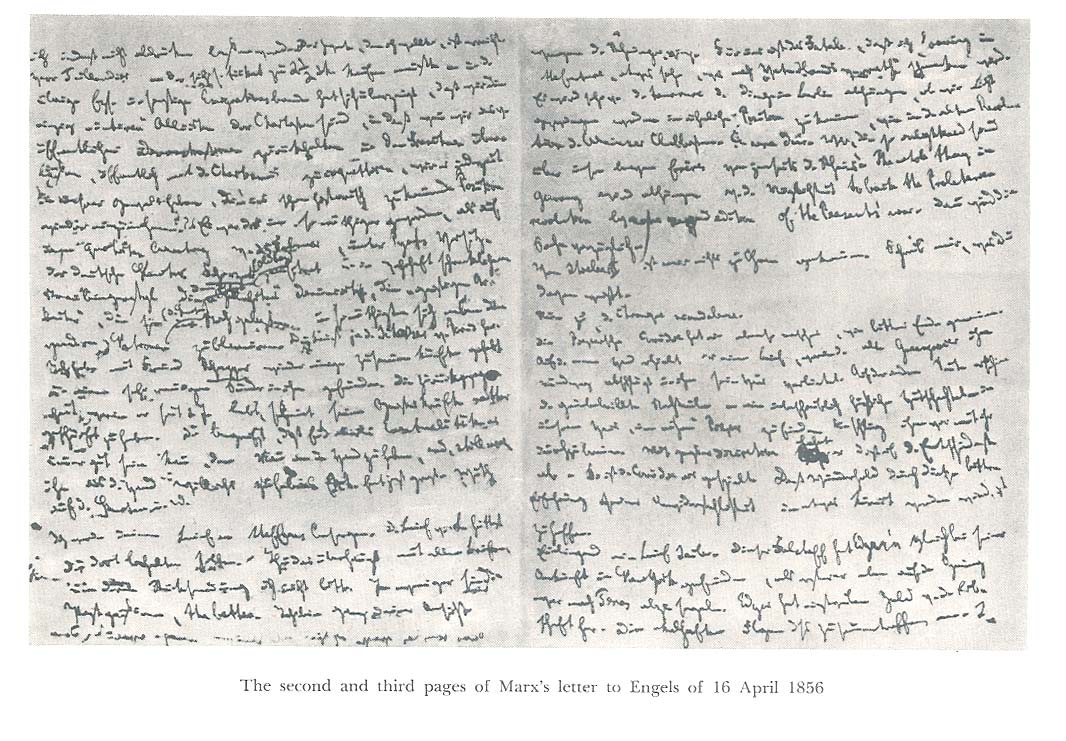
London, 16 April 1856
DEAR Frederic,
A packet went off to you today through the usual PARCELS company. It contains: 1. Kars PAPERS.(1) 2. Igor.[22] 3. Destrilhes, Confidences sur la Turquie. 4. 2 issues of L'Homme; in one, the letter from Cayenne, in the other, Pyat's litany to Marianne,[47]
which he read aloud on 25 February of this year at a Chartist meeting in honour of the French Revolution. The good fellow was, of course, hoping to see a repetition of the row caused by his 'lettre à la reine'.a Was disappointed, however. From this you will also gather how subordinate is the attitude adopted by the French would-be revolutionaries here vis-à-vis 'Marianne'. 5. 2 cuttings from The People's Paper, my first 2 articles on the Kars PAPERS." Shall also send you third and final instalments. Since the original of Article I had gone astray, and time, not to mention Ernest Jones, was pressing, I had to do a hasty rehash of the Tribune article out of my head, so that sundry bits of nonsense have crept in which will certainly not elude your keen nose. BUT NEVER MIND THAT! I mention it simply to let you know why-1 didn't send you the thing straight away.
The day before yesterday a little banquet took place to celebrate the anniversary of The People's Paper. On this occasion, the times seeming to require it, I accepted the invitation, the more so since (AS ANNOUNCED IN THE PAPER) I alone of the whole emigration was invited, and the first toast also fell to me, i.e. I was asked to propose one to the souveraineté du prolétariat dans tous les pays.b So I made a short SPEECH in English, which, however, I shall not allow to appear in print.[48] The end I sought has been achieved. Mr Talandier — who had to pay 2/6d for his TICKET — is now convinced, like the rest of the French and other émigré crews, that we are the Chartists' only 'intimate' allies and that, though we may hold aloof from public demonstrations and leave it to the FRENCHMEN to flirt openly with Chartism, it is always in our power to resume the position already allotted to us by history. This had become all the more necessary because, at the above-mentioned meeting of 25 February presided over by Pyat, the German lout Scherzer (OLD BOY) spoke and, in truly dreadful Straubingerian style,[49]
denounced the German 'scholars', the 'intellectual workers', for having left them (the louts) in the lurch, thus forcing them to make fools of themselves in the eyes of the other nationalities. You will remember Scherzer from Paris days. I have met friend Schapper again several times and have found him very much the repentant sinner. The retirement in which he has been living for the past 2 years would seem RATHER to have sharpened his wits than otherwise. As you will realise, there are all sorts of contingencies in
which it might be advantageous to have the man to hand AND, STILL MORE, to have him out of the hands of Willich. Schapper is now furiously angry with the Windmill[50] louts.
I shall forward your letter to Steffen. You ought to have kept Levy's letter" there. Do so in general witfi all letters I don't ask you to return. The less they go through the post THE BETTER. I fully agree with you about the Rhine Province. As for us, the worst of it is that, LOOMING IN THE FUTURE, I see something that looks like 'high treason'. Whether we are forced into the same kind of position as the Mainz Clubbists[51] in the old revolution will largely depend on the tournure* things take in Berlin. Ça sera dur.c We, who are so ENLIGHTENED about OUT good frères from across the Rhine! THE WHOLE THING IN GERMANY will depend on whether it is possible TO BACK
THE PROLETARIAN REVOLUTION BY SOME SECOND EDITION OF THE PEASANTS- WAR. I n which case the affair should go swimmingly.
I have heard nothing whatever about Stieber II. Write and tell me what you know on this score.
Now for the chronique scandaleuse? The Pieper comedy came to an end as abrupt as it was bitter. On the one hand, he got a letter in which the old GREENGROCER turned him down out of hand and forbade him the house. On the other, the green-bespectacled screech-owl — an indescribably hide-ous piece of baggage — turned up at our house in search of 'her' Pieper. She proposed that they should elope together. With great tact he refused quite unequivocally. So the comedy is over. It is to be hoped that this bitter experience, the result of his irresistible-ness, will have some salutory effect upon Prince Charming.
Enclosed a letter from Seiler. As soon as this Falstaff arrived in New York he caught Edgare just as the latter was about to set out for Texas. Edgar has in the meantime come into some money from the inheritance. The nasty consequences of this meeting with Seiler will be apparent to you from the letter.
A fine pair, Seiler and Conrad Schramm! Salut.
Your
K. M. First published abridged in Der Briefwechsel zwischen F. Engels und K. Marx, Bd. 2, Stuttgart, 1913 and in full in: Marx and Engels, Works, First Russian Edition, Vol. XXII, Moscow, 1929
13. Marx to Engels. 26 April
13
MARX TO ENGELS
IN MANCHESTER
London, 26 April 1856 28 Dean Street, Soho
DEAR Frederic,
Enclosed you will find
1. 2 Kars PAPERS, third and final instalments.3
2. An article on the Duke of Yorkb which I gave Jones, and in which I imitate OLD Cobbett's manner tant bien que mal.c Sent especially for Lupus' information.
3. The SPEECH made by Frost, the old Chartist, in New York.d
4. A letter from Miquel. This last to be returned. For I have not yet replied, as I should like to have your detailed 'OPINION' before doing so. It's a somewhat ticklish matter. 'Questions, sometimes insidious',e and when replying it is difficult to know how far one can properly go.[52]
Que dites-vous du discours de M. de Walewski?f5S Everyone in London is furious with the GOVERNMENT and even the SHOPKEEPERS are mouthing revolutionary slogans.
If you can, send Pieper something. It is now possible that he will get a job as CORRECTOR on The People's Paper. All. I can do now is keep him in commons. I have taken him seriously to task for his silly antics, which have landed him on the streets again. I could tell you a thing or two about politics down here, but to do so by post might be risky.
The news from Paris in today's Advertiser contains a brief but interesting report on an action brought against some members of Marianne[47]; they're conducting themselves splendidly.
In the Presse (Paris) some edifying aspersions on Bonaparte's
14. Marx to Engels. 7 May
15. Marx to Engels. 8 May
législateur poète—Belmontet — by Pelletan, in which the latter has so insulted the 'empereur' b that he will probably be expelled.
Salut.
Your
K. M.
Printed • according to the original
14
MARX T O ENGELS
IN MANCHESTER
[London,] 7 May 1856 28 Dean Street, Soho Dear Frederic,
I have another letter from Germany to send on to you. But since you haven't yet acknowledged receipt either of the PARCEL or of the letter enclosing Miquel's,c I don't know whether these things have reached you. Let me know by return. In the case of compromising letters, it's essential to be sure they are delivered.
Salut.
Your
K. M.
15
MARX T O ENGELS [5 4]
IN MANCHESTER
[London,] 8 May d 1856 28 Dean Street, Soho DEAR Frederic,
Received your letter.[55] My PRESSURE upon you in YESTERDAY'S LETTER explicable d'abord^ by the fact that an earlier parcel of my wife's did not arrive in Manchester, although sent by post. Secondly, however, you know how a man feels when he's kept on the hop by piles. And such a man am I.
I am glad to hear that you and Lupus are entirely of my opinion with regard to Miquel's letter[52]—the attempt to digest this 'wisdom' fairly 'turned my stomach'.
Unless something goes wrong with the pecuniary arrangements I have made, my family will be leaving in 10 to 14 days at the latest." A pity you are so overworked, otherwise we might have done un petit tourb to Scodand.
1 shall carry out your commissions at die Museumc as soon as I go there again.
Enclosed: 2 letters, 1. from Imandt; 2. from Cologne.[56] Would it not be best if I replied to the Cologne people through my wife? THERE EXISTS SOME JEALOUSY between Cologne and Düsseldorf AS TO THE LEADING OF THE PROLETARIAN MOVEMENT. BESIDES, I don't know whether the Cologne people are aware that the Düsseldorfers have completely broken with Lassalle who has fallen into general disrepute among them.
Yesterday the following comical missive arrived from Sheffield:
»Council Hall, Sheffield, Doctor, May 6th, '56. The Sheffield Foreign Affairs Committee instructs me to convey to you an expression of their warm thanks for the great public service you have rendered by your admirable exposé of the Kars Papers published in 77»« People's PaperA I have the Honour etc.
Cyples, Secretary.*
That is magnanimous, there being war to the death between The People's Paper and The Free Press, as between Chartism and Urquhartism generally.[42] The great Ironside went one step further and decreed THAT THE THANKS OF THE COUNTRV WERE DUE TO DR. M.e ETC. It would have been much better had the chaps sent me the money they made out by reprinting the Palmerston articles under the title Story of the Life etc. (in pamphlet form).[58]
From New York Seiler has sent me — came today—'Das Recht deutscher vereinigter Staatenbürger in Europa' in the Democrat.1
Will never be read, not in this world at any rate.
Since handing over your £2 to Pieper I haven't set eyes on him. Moreover, Jones has sent word that, up till yesterday evening, he had not delivered the work he had accepted for The People's Paper.
16. Marx to Engels. 23 May
Nous verrons.* If he wilfully throws away this opportunity as well, let him go to the devil. Now's his chance, the silly ass.
Salut.
Your
K. M.
Apropos! Have seen Heine's will[59]! A return to the 'living God', and a 'Recantation before God and man' if ever he wrote anything 'immoral'!
Didn't see Colonel Touroute again before he left for Germany. Enclosed letters not to be returned. Regards to Lupus.
16
MARX TO ENGELS[20]
IN MANCHESTER
[London,] 23 May 1856 28 Dean Street, Soho
Dear Engels,
The family went off yesterday.b I have been incapable of work this week, partly because of the TROUBLE in the house, partly because of a rheumaticky back such as I have never experienced before.
Herewith Bazancourt^the 'Napoleonic' account of the Crimean business.0 Might not something be made of it for Putnam's}[60] It's urgent that I obtain the services of this firm since the money and gear needed for the journey have compelled me to accept through Zitschke a sole bill for £30 on myself, payable in 3 months' time. A man from Putnam's has been to see Freiligrath, and they are willing to take articles.
I have only read the excerpts from Bazancourt that were published in the French papers. To judge by them, it would appear to provide much amusing matter. The thing cannot, I think, be treated other than flippantly. If done, it should not be made too short, but solely with the idea of filling up space.
Trübner, who looked like accepting my Swedish stuff two months ago but then gave no further sign of life, wrote yesterday and arranged an entrevuea on Tuesday to discuss the matter. That would provide 20 sheets of work.[61]
I am in a SERIOUS DILEMMA as to whether or not I should now go on a TRIP. On the one hand I've got to slog away at making money. On the other the doctorb has told me — and I believe he's right — that I should travel a bit and have a change of air, as my liver is again functioning irregularly. I AM NOT YET DECIDED what I should do. It's not as though staying here were especially economical, since I also have Pieper round my neck. But the main thing is my work.
As TO Bazancourt, let me know whether you need the first part as well. If nothing can be made of the thing it would be better not to buy it.
I am incapable of writing today, but must nevertheless ask you to clear up a philological doubt. In Henry IV, Shakespeare used the word 'hiren' for 'siren' and, according to a note made by that pedant, Johnson/ the form 'hiren' also occurs in other early English writers.c The substitution of h for s is QUITE in order, but might there not be some connection between 'hiren' and 'Hure',d
and hence also 'siren'? Or with 'hoeren', auris,e etc.? You can see TO WHICH LOW STATE OF SPIRIT I am DEPRESSED today from the great interest I show in this matter.
I have received some very curious information about Ruge's tragedy, the Neue Welt, in which 'the tragedy of love turns into a farce'. Shall tell you about it in my next.
Herzen is going to Switzerland. I await your COMMUNICATIONS on Ireland.
Salut.
Your
K. M.
17. Engels to Marx. 23 May
17
ENGELS T O MARX[62]
IN LONDON
Manchester, 23 May 1856
Dear Marx,
During our trip to IrelandM we travelled from Dublin to Galway on the West Coast, then 20 miles north and inland, on to Limerick, down the Shannon to Tarbert, Tralee and Killarney, and back to Dublin. In all approx. 450-500 English miles within the country itself, so we have seen approx. /s of the entire country. With the exception of Dublin, which is to London what Düsseldorf is to Berlin, bears altogether the stamp of having been a small royal seat and is, moreover, built entirely in the English style, the whole country and particularly the towns give one the impression of being in France or Northern Italy. Gendarmes, priests, lawyers, bureaucrats, lords of the manor in cheerful profusion and a total absence of any and every industry, so that one could barely conceive what all these parasitic plants live on, were there no counterpart in the wretchedness of the peasants. The 'iron hand' is visible in every nook and cranny; the government meddles in everything, not a trace of so-called SELF-GOVERNMENT. Ireland may be regarded as the earliest English colony and one which, by reason of her proximity, is still governed in exacdy the same old way; here one cannot fail to notice that the English citizen's so-called freedom is based on the oppression of the colonies. In no other country have I seen so many gendarmes, and it is in the CONSTABULARY, which is armed with carbine, bayonet and handcuffs, that the bibulous expression of your Prussian gendarme reaches its ultimate state of perfection.
Peculiar to the country are its ruins, the oldest 5th and 6th century, the most recent 19th, and every stage in between. The earliest, all churches; from 1100, churches and casdes; from 1800, farmhouses. Throughout die west, but particularly the Galway region, the countryside is strewn with these derelict farmhouses, most of which have only been abandoned since 1846. I had never imagined that famine could be so tangibly real.[64] Whole villages are deserted; in between the splendid parks of the smaller LANDLORDS, virtually the only people still living there, lawyers mosdy.
Famine, emigration and CLEARANCES[65] between them have brought this about. The fields are empty even of cattle; the countryside is a complete wilderness unwanted by anybody. In County Clare, south of Galway, things improve a bit, for there's some cattle at least and, towards Limerick, the hills are excellently cultivated, mostly by Scottish FARMERS, the ruins have been cleared away, and the country has a domesticated air. In the south-west, numerous mountains and bogs but also marvellously luxuriant woodland; further on, fine pastures again, especially in Tipperary and, approaching Dublin, increasing signs that the land is occupied by big farmers.
The English wars of conquest from 1100a to 1850 (au fondb they lasted as long as this, as did also martial law) utterly ruined the country. With regard to most of the ruins, it has been established that the destruction took place during these wars. Thus the very people have acquired their unusual character and, for all their fanatical Irish nationalism, the fellows no longer feel at home in their own country. IRELAND FOR THE SAXON! That is now becoming a reality. The Irishman knows that he cannot compete with the Englishman, who comes armed with resources in every respect superior to his own; emigration will continue until the predominantly, indeed almost exclusively, Celtic nature of the population has gone to pot. How often have the Irish set out to achieve something and each time been crushed, politically and industrially! In this artificial manner, through systematic oppression, they have come to be a completely wretched nation and now, as everyone knows, they have the job of providing England, America, Australia, etc., with whores, day labourers, maquereaux? pickpock-ets, swindlers, beggars and other wretches. Even the aristocracy are infected by this wretchedness. The landowners, wholly bourgeoisified everywhere else, are here completely down-at-heel. Their country seats are surrounded by huge and lovely parks but all around there is desolation and where the money is supposed to come from heaven only knows. These fellows are too funny for words: of mixed blood, for the most part tall, strong, handsome types, all with enormous moustaches under a vast Roman nose, they give themselves the bogus martial airs of a colonel en retraite,[6]
travel the country in search of every imaginable diversion and, on inquiry, prove to be as poor as church mice, up to their eyes
[3] More precisely, from 1169, when the English feudal lords first invaded Ireland. - b in the main - c pimps - d retired colonel
18. Engels to Marx. 26 May
in debt, and living in constant fear of the ENCUMBERED ESTATES COURT.[66]
About England's method of governing this country — repression and corruption (long before Bonaparte tried them)—more very shortly if you don't come up soon. What are the prospects?
Your
F. E.
18
ENGELS TO MARX
IN LONDON
Manchester, 26 May 1856
Dear Marx,
Herewith the article,[11] but you should read it over first. Today the office again prevented me from doing so myself.
Bazancourta will be of some use — Bonaparte's Bat-rachomyomachia.[67] But Vol. I absolutely essential. I shall send you 6/- worth of stamps for it tomorrow, or rather, they are enclosed herewith.
I would advise you to pack your bags at once, taking such papers as are absolutely necessary. Then you can work here as well as in Scotland, at least on certain subjects. We could do Bazancourt ±b together.[60] Admittedly, you would have to do most of the work for, with business expanding rapidly, commerce is making such demands on me that there can be no thought of regular and sustained work. If you finished this thing here (1 article would of course suffice), you could always either do parliamentary articles here, or else take a trip to Scotland and get down to some hard work here on your return. Until the Pan-Slavism is finished I should be reluctant to saddle myself with
19. Marx to Engels. 29 May
any other promises which I might eventually be unable to fulfil; but after all, your health is also a consideration and, as to that, I think I have something good for you — viz. light Bavarian beer and another dozen or so botdes of Bordeaux. Better, at all events — with a change of air — than HALF AND HALF, etc.
I may drop you another line tomorrow. Let me know what you decide to do.
Your
F. E.
Works, First Russian Edition, Vol. XXII, Moscow, 1929
Works, First Russian Edition, Vol. XXII, Moscow, 1929
Your
K. M.
19
MARX TO ENGELS
IN MANCHESTER
[London,] 29 May 1856a
28 Dean Street, Soho
Dear Engels,
I shall hardly be able to leave here before the end of next week, since the business with Trübner b will not have been decided before then and I must, besides, have a word with Zitschke, who is unlikely to be back in London until then. At all events I shall let you know beforehand when I shall be leaving.
Salut.
20. Marx to Engels. 5 June
20
MARX TO ENGELS
IN MANCHESTER
[London,] 5 June 1856 28 Dean Street, Soho
Dear Frederic,
I leave for Scodand at the end of this week, and shall come on to you from there after an interval of 6 days, but will of course give you prior notice. Should you write to me during this week, address the letters 'C. Marx, CARE OF P. Imandt, 29 Cowgate, Dundee'. There was a twofold reason for my decision to come to you via Scodand:
1. Medical, because I know that the sea-voyage will put me to rights and it was only the day before yesterday that I got rid of my rheumatism. Moreover, there have been other unpleasantnesses, including excessive bleeding at stool. I have, of course, also consulted my SURGEON.
2. Pieper. He will accompany me to Scotland and then return to London. Had I not agreed to this arrangement, the lad — he obtained the money for the trip from his former pupil, A. Rothschild — was fully determined to make his way to Paris on a false passport, allegedly with the intention of proceeding from there to Geneva on foot. You will realise what a strange and compromising end SUCH AN EXPEDITION LIKELY WAS TO ARRIVÉ AT.
Salut.
Your
K. M
21. Marx to Engels. 6 June
21
MARX TO ENGELS
IN MANCHESTER
[London,] 6 June 1856
Dear Engels,
PLAN AGAIN CHANGED. Why, when we meet. Pieper will accompany me to Hull, then return to London. I shall come on to you from Hull.[68]
Your
K. M.
22. Marx to Jenny Marx. 21 June[20][6 9]
My darling Sweetheart,
I am writing to you again because I am alone and because it is irksome to converse with you all the time in my head without you knowing or hearing or being able to answer me. Bad as your portrait is, it serves its end well enough, and I now understand how it is that even the least flattering portraits of the mother of God, the 'Black Madonnas',[70] could have their inveterate admir-ers— more admirers, indeed, than the good portraits. At any rate, none of these 'Black Madonna' portraits has ever been so much kissed and ogled and adored as your photograph which, while admittedly not black, has a crabbed expression and in no way reflects your dear, lovely, kissable, dolce* countenance. But I put right what the sun's rays have wrongly depicted, discovering that my eyes, spoiled though they are by lamplight and tobacco smoke, can nevertheless paint not only in the dreaming but also in the waking state. There you are before me, large as life, and I lift you up in my arms and I kiss you all over from top to toe, and I fall on my knees before you and cry: 'Madame, I love you.'a And love you I do, with a love greater than was ever felt by the Moor of Venice.b Falsely and foully doth the false and foul world all characters construe. Who of my many calumniators and venom-ous-tongued enemies has ever reproached me with being called upon to play the romantic lead in a second-rate theatre? And yet it is true. Had the scoundrels possessed the wit, they would have depicted 'the productive and social relations' on one side and, on the other, myself at your feet. Beneath it they would have written: LOOK TO THIS PICTURE AND TO THAT.C But stupid the scoundrels are and stupid they will remain, in seculum seculorum.d
Temporary absence is good, for in a person's presence things look too much alike for them to be distinguished. At close quarters even towers appear dwarfed, whereas what is petty and common-place, seen close at hand, assumes undue proportions. So, too, with the passions. Little habits which, by their very proximity, obtrude upon one, and thus assume the form of passions, vanish as soon as their immediate object is out of sight. Great passions which, by the proximity of their object, take on the form of little habits, wax large and resume their natural proportions under the magical effect of distance. So it is with my love. Mere spatial separation from you suffices to make me instantly aware that time has done for my love just what the sun and the rain do for plants — made it grow. My love for you, as soon as you are away from me, appears for what it is, a giant, and into it all the vigour of my mind and all the ardour of my heart are compressed. I feel myself once more a man because I feel intense passion, and the multifariousness in which we are involved by study and modern education, no less than the scepticism which inevitably leads us to cavil at every subjective and objective impression, is calculated to render each one of us petty and weak and fretful and vacillating. But love, not for Feuerbachian Man, not for Moleschottian metabolism, not for the proletariat, but love for a sweetheart and notably for yourself, turns a man back into a man again.
You will smile, my dear heart, and wonder 'why diis rhetoric all of a sudden?' But if I could press your sweet white bosom to mine, I would be silent and say not a word. Since I cannot kiss with my lips I must kiss with my tongue and frame words. I could, indeed, even frame verse, German Books of Sorrow after the manner of Ovid's Libri Tristium. He, however, had merely been banished by the Emperor Augustus; I have been banished from you,a and that is something Ovid could not understand.
There are, indeed, many women in the world, and a few of them are beautiful. But where else shall I find a face of which every lineament, every line even, reawakens the greatest and sweetest memories of my life? In your sweet countenance I can read even my infinite sorrows, my irreplaceable losses,b and when I kiss your sweet face I kiss away my sorrow. 'Buried in her arms, revived by her kisses'—in your arms, that is, and by your kisses — and let the Brahmins and Pythagoras keep their doctrine of re-birth, and Christianity its doctrine of resurrection.
To conclude with SOME FACTS. I have today sent Isaac Ironside the FIRST PAPER OF THE SERIES 6I and have, in addition, made notes (i.e. on the text of the despatches) in my own hand and in my own English.c I must say I felt a bit anxious when Frederic,e with that litde quizzical look he has, calmly read through the stuff before it was sent off. Mats pour la première foisf * he was quite astonished and exclaimed that this important work ought to be published in another form and, above all things, to be published in German.* I shall send the first issue to you and to old Schlosser, the historian, in Germany.
Apropos. I see from the Augsburger* which refers direcdy to our circular letters'h discussed at the communist trial in Cologne,[71] that another circular letter, 'reputedly' from the same source, has been sent out from London. It is a forgery, a miserable gallimaufry of our things, put together by Mr Stieber who, not having been accorded due honour in Prussia of late, now seeks to set himself up as a great man in Hanover. Engels and I intend to publish a counter-statement in the Augsburg Allgemeine Zeitung.[72] Farewell my dear heart. A thousand kisses to you, and the children too, from
Your
Karl
23. Marx to Isaac Ironside. 21 June[73]
Dear Sir,
I received your letter d.d. June 14 this morning only, as it had to be sent to me here to Manchester where I shall stay for some weeks.
I have duly considered your proposal, and, on the whole, accede to it.[74] In a matter like this, it is impossible to mention expressly every small particular, to agree upon the size of type pp., neither can I anticipate that any difficulties may arise therefrom, nor from the reservations to make as to 'copy used'.
I shall therefore provide you in time for next Saturday's but one's publication with fully 2 columns of matter and keep you amply supplied every week to that extent.
It would be most convenient to me (if your arrangements admit of it) to receive a remittance say after every fresh weekly publication.
As to your reprinting the papers in your serials, I have no objection, reserving to myself, of course, the right of using the materials, later on, in any way I may see it fit to use them.
As I am sure that you will not suppress historical truth out of prejudice or party-consideration [...](1)
As to the latter point you will think it only just, that should any points be suppressed, which in my conviction are of decisive historical importance, I shall consider myself obliged to stop the publication.
In thanking you for the serials you were so kind to send me, I cannot but regret that you did not think fit to communicate to me the proof-sheets of the 'Story of the life of Lord Palmerston'.[58]
Sentences, historical data, quotations from Palmerston's speeches — everything is so disfigured by errata that, in my opinion, the pamphlet, in its present form, is not only useless but positively mischievous.
A few words on the plan of the whole publicationa will suffice. I do not adopt the usual manner of opening the whole theme by general considerations, but on the contrary commence with facts.
In contradistinction to the usual manner of historical writers, I shall not commence this publication with general considerations, but with facts. The first chapter will be composed of despatches belonging to different epochs of that century, in order to show up the Russian spirit of English diplomacy during the 18th.c
I hope I need not tell you that I am no 'commercial' writer and that no [...]d
24. Marx to William C> pies. 22 July[75]
Dear Sir,
I write again myself to show that I bear not the least ill will against you for which, indeed, there would be no cause. In your
25. Marx to Engels. 28 July
letter d.d. July 19,a you say: 'It could not be satisfactory etc' Now as to my own satisfaction please to leave it altogether out of the question. As to Mr Ironside's 'satisfaction' I'll quote you the exact words of his 'note'.b Having told you, that already the first article had 'overdosed' him, he continues as follows:
'They' (Dr Marx's articles) 'are entombing the paper. This must not be. They must be brought to a close forthwith. You must not have more than two more doses — this week and the next. You had better write him at once to that effect.'
I positively decline making myself guilty of manslaughter by administering another 'dose' to Mr Isaac Ironside and 'entombing' him in the sheets of his own paper.
Yours etc.
Dr K. M.
25
MARX TO ENGELS
IN MANCHESTER
London, 28 July 1856 28 Dean Street, Soho
Dear Frederic,
A letter from my wife received today via Manchester brings news of her mother'sc death on July 23. This will hasten her return to London.
At the same time a letter from Miquel, who is thinking of coming over here in a week or 10 days' time. Highly inconvenient just now.
Pieper lost his job a fortnight ago. Not his fault this time. He kept the thing secret so long as Lupus was here. The compositors conspired together to bring in a chap who belongs to their FRIENDLY
SfX.IF.TY.
As regards Sheffield, the matter stands as follows: In the last issue the fellows made some disgraceful cuts, whereupon Pieper wrote to Cyples: * 'I am directed by Dr Marx to inform you that he cannot congratulate you upon the emenda-tions, etc' * (1)
Then the following letter arrived from Ironside[3]:
* Free Press Office, Sheffield, July 19, 1856
Dear Doctor,
It could not be satisfactory either to us or to yourself to close your article in the abrupt way which you on the instant proposed. I am sorry that I was so unsuccessful in cutting down last week's contributions, and should have hesitated in doing so had it not unfortunately happened that there was really no other alternative. As to Mr Ironside's note, permit me to say that in another letter since received from him, he expresses regret that you should have construed his scrap as he did not intend it, and intimates a doubt that J have in some way offended you? I see no reason why our professional intercourse may not continue and be pleasant; and I venture to hope to receive the usual packet of copy for next week's issue. You will be so good as to excuse my tardiness in writing. I have been so busy. Your etc. Cyples.*
Reply
*'July 22, 1856
'Dear Sir, I write again myself to show that I bear not the least ill will against you for which, indeed, there would be no cause. In your letter d.d. July 19, you say: "It could not be satisfactory etc." Now as to my own satisfaction please to leave it altogether out of the question. As to Mr Ironside's "satisfaction" I'll quote you the exact words of his "note". Having told you, that already the first article had "overdosed" him, he continues as follows:
"They" (Dr Marx's articles) "are entombing the paper. This must not be. They must be brought to a close forthwith. You must not have more than two more doses — this week and the next. You had better write him at once to that effect"
'I positively decline making myself guilty of manslaughter by administering another "dose" to Mr Isaac Ironside and "entombing" him in the sheets of his own paper. Yours etc:
Dr K. M.'*
Since then the correspondence has lapsed. But still no sign of any money. Jones tells me I could have taken the fellows to court over the whole affair AT THE OUTSET.
26. Marx to Engels. / August
As you can imagine, I am like a cat on hot bricks. I shall have to do something about lodgings when the FAMILY arrives, but have no idea how to get out of the old ones or move into new, having neither the MEANS nor any immediate prospects. My electric brush strives vainly to make my hair darker, for atra cura[3] is making it whiter than ever. Zitschke has decamped, so at least I am excused sine die from paying him.
Espartero and Pucheta in the Spanish farce — never before has history so nicely confronted the hero of the liberal bourgeoisie with the hero of the 'mob'.[78]
Salut.
Your
K. M.
Freiligrath has no one above him now apart from the BOARD OF DIRECTORS, which meets every Saturday.
26
MARX TO ENGELS[20]
IN MANCHESTER
[London,] 1 August 1856 28 Dean Street, Soho
Dear E.,
The £5 note most gratefully received but not as yet the letter you promised me. Herewith a letter from the crazy Mirbach, which I have received — via Berlin!
No money from Sheffield yet. Today I got Pieper to send a dunning letter. Meanwhile there has been the following incident: Yesterday Urquhart's bulldog — THE CELEBRATED Collet — appeared at my house. He had come, he said, at the behest of the Grand Coph-ta[79] himself. Urquhart was *very sorry, regretted, indeed, very much that Mr Ironside had interfered at all with my articles etc., which he thought of extraordinary value etc.* Then he asked me to tell him how the matter had come about. * Mr Urquhart imagined that the principal cause of the quarrel was the suppression of some parts of the copy etc.* I then told him what had happened[75]
and showed him the written corpora delicti? Next, he asked me * whether I was willing to enter upon any compromise, which question I flatly denied, telling him that I was no penny-a-liner and not to be treated like the London literary vagabonds.* It seemed he was only awaiting this statement in order to tell me with EXTRAORDINARY SOLEMNITY that Urquhart thought The Free Press 'inadequate'. * Mr Ironside was placed on the horns of a dilemma because The Free Press was, indeed, but an extract from the Sheffield Free Press—a paper, by the bye, twice the dimensions of the F. P.— and what was suited to the wants of the readers of the Sh. F. P. was not all palatable to the readers of the F. P. and vice versa. Mr Urquhart had, therefore, resolved upon starting in about a month a diplomatic journal at London.* He hoped that I would let him have the whole of the Revelations[80] and not bear him a GRUDGE. I returned a vague answer capable of being construed in the affirmative but leaving me free — if the conditions should prove too poor or the paper too crazy — to refuse. It will all depend on the nature of the paper. In London things are rather different from Sheffield, and, should Urquhart come out with his counter-revolutionary nonsense in such a way that collaboration with him would discredit me in the eyes of the revolutionaries here, I would be obliged, *of course, hard as it would be under the present miserable circumstances,* to decide against it. However, nous verrons}' At all events I have now received adequate satisfaction as regards my LITERARY POINT OF HONOUR, in as much as the chief has all but disowned his LIEUTENANT. This is a satisfactory dénouement, if only on account of Bûcher and the democratic riff-raff.
There will now be much wrangling within the Urquhartite camp itself. It seemed to me that they evinced a bad TENDENCY to make a SCAPEGOAT of poor Cyples. E.g., Collet said he wasn't sure whether it was with Ironside's knowledge that Cyples had sent me the former's letter. To this I replied that Cyples seemed to be an honest fellow who had heard SECRET DIPLOMACY- SO greatly decried that he naturally assumed PUBLIC DIPLOMACY- to be the rule at the F. P. OFFICE.
Received a letter today from my wife. She seems greatly affected by the old lady'sa death. She will have to spend a week or 10 days in Trier in order to put up for auction what little in the way of effects her mother has left and to share the PROCEEDS with Edgar.b
She has proposed the following scheme: After spending a few days more in the vicinity of Trier with a woman friend of hers, she will travel to Paris and thence direct to Jersey, having decided that we ought to spend September and October there. First, so that she herself can recuperate; secondly, because it's cheaper and pleasanter than London and, finally, so that the children should learn French, etc. She doesn't, of course, know anything about what has been taking place here. For the present I have written to say that it's a splendid scheme, although I cannot in fact see how it can be put into effect. Yesterday 1 again saw the New-York Tribune (WEEKLY). The whole paper is filled with nothing but the ELECTORAL DODGE and so it will be for months to come. We cannot hope seriously to tackle the N.-Y. T. until the presidential business is over.
Salut.
Your
K. M.
P.S. At Blind's, saw 2 volumes of Simon of Trier's émigré jeremiad.c Watered-down twaddle, every other word a solecism, callow botchery, weak-kneed affectation, foppish naive pretension, a mess of Griinian Jew's ears in beggar's broth, one long platitude — nothing of the kind has ever before appeared in print. All that was needed to give the 'German Parliament'[44] the final kick in the arse was this self-exposure on the part of one of its heroes. Needless to say, I did no more than leaf through it. I'd sooner swill soap-suds or hobnob with Zoroaster over mulled cow's piss than read through all that stuff. He and Co. are perpetually haunted by our ghost. L. Blanc, Blanqui, Marx and Engels are his Unholy Quadrinity which he never forgets. We two — the pro-pounders of 'equal economic rights'—are said inter alia to have advocated 'Armed (!) appropriation of capital'. Even the jokes we cracked about Switzerland in the Revue 'fill him with indignation'. 'No Civil List, no standing army, no millionaires, no beggars"d—
27. Engels to Marx. 4 August
'Marx and Engels hope that Germany will never sink to such depths of degradation'. It's exceedingly odd, the way he speaks of us in the singular—'Marx and Engels says', etc.
Vol. XXII, Moscow, 1929
27
ENGELS TO MARX
IN LONDON
Manchester, 4 August 1856
Dear Marx,
The letter that didn't arrive must have melted in the heat. I don't know whether you down there too have suddenly been assailed by this tropical heat which has brought everything to a standstill, apart from the continuous sluicing and bathing of the outer man with water and the inner man with a variety of other fluids. Yesterday I was totally incapable of anything and barely in a condition to go out. I haven't stopped sweating since Thursday, even in my bath; and the sordid work at the office is so exhausting that afterwards one feels utterly down. Moreover the nights are equally stifling.
It's most satisfactory that the Urquhart business should have turned out as it did.a There's no doubt that what most impresses the rabble is our resolute manner. I hope it will be possible for the piecesb to appear in Urquhart's thing, nous verrons.c
I'm daily awaiting a letter from my mater summoning me to London. I am arranging matters in such a way as to be able to leave on Saturday, should the summons come. I shall be moving out of here on Saturday though I haven't yet taken new lodgings, and still don't know whether I shall do so or spend a week knocking about, since I intend on my return to engage in all kinds of mad escapades.
My brother-in-law" has been here — a good chap, communist out of principle, bourgeois out of interest, as he himself most naively puts it, but he always uses 'we' when referring to communist matters; tried to talk me into making tentative approaches to the Prussians about an amnesty, whereupon I, of course, gave a very determined answer and finally he, too, saw that 1. I couldn't do so, and 2. that the Prussians would tell me to shove it, etc.—The man seemed to have few illusions about my frame of mind and certainly had even fewer when he left. However, he was very surprised to find me so cheerful.
I shall write to Mirbach as soon as it gets a little cooler; it's too much to expect just now. 24 degrees Reaumur is no joke when one has to traipse round in clothes proper to the Exchange.
If the Jersey scheme can be carried out — it certainly has its good points and is not entirely impossible — make sure that while in Paris, your wife finds out exactly how things stand regarding route and communications, for otherwise she might get into serious difficulties. I believe that Saint-Malo is the only place in France to which steamers go from Jersey. Get one or two of the crapauds^ to tell you what the position is. After all, you know several who have been there.
You can give the great Pieper my assurance that I read his great 'filtered' article on Spain in The People's Paperb before the original appeared in the Tribune? HANG ITT C'est beau.d By the way, the P. P. deserves to be relegated to the w.c. Just consider this stinker: WE
REGRET TO LEARN THAT LORD SO AND SO HAS CUT HIS FINGER, etC. YOU r e a l l y must get Jones to give his SUBEDITOR a damned good dressing-down for permitting such drivel.
On no account let the rabble in Sheffield sit on the money— they'll have to shell out in any case. Y
F. E.
28. Marx to jenny Marx. 8 August
28
MARX T O JENNY MARX [8 2]
IN TRIER
[London,] 8 August 1856 28 Dean Street, Soho
My one and only Sweetheart,
This morning, at the same time as your letter, I received a note from Frederic [3] containing 15 talers for Lenchen. b Acknowledge it, as he is most meticulous in such matters. More tomorrow; today I have the IMMORTAL COLLET' here in the room with me and am keeping him in check by saying * 'I am obliged to write some lines to Mrs Marx'*.
LILY-WHITE SANDY is settled IN REALITY, not IN FANCY. Much though I hanker after you and the children — and this QUITE indescribably— I should like you to stay on in Trier for another week. It would d o you and the children no end of good. More tomorrow.
Your
K. M.
P.S. T h e Urquhartites are being damned importunate. c A good thing financially. But I don't know whether, POLITICALLY, I ought to get too involved with the fellows. A thousand kisses, my beloved sweetheart.
P.S.II. Lina d has got the famous post. Won't be taking it u p for weeks yet.
It's ghastly for me, having to play the man of fashion chez Liebknecht now. HANG ITI On top of that, I have Pieper sleeping with me in your stead. HORRIBLE. In the same room, at any rate.
Engels is coming next week.ss That's a relief. For 3 weeks I've been as hypochondriacal as the devil.
29. Marx to Collet Dobson Collet. 11 August
IN LONDON
London, 11 August 1856 28 Dean St., Soho
Dear Sir,
I approve, of course, of the suggestions of your letter of the 8th inst. regarding the headings per 'chapters' and the cyphering of the notes at the bottom of the text.(1) As to the cutting of chapters into parts, you must of course use your discretion as called for by the exigences of space etc. The alterations considered necessary in Chapter II will be forwarded in the course of the week.
Y. f.
K. M. C. D. Collet, Esq.
30. Marx to Engels. 22 September[20]
Dear Engels,
I would have ACKNOWLEDGED your last letter before this, but for ABOUT a fortnight past the whole day from morn till night has been spent in search of lodgings. In no circumstances could we remain in the old hole. At last we found a place — a whole house which we have to FURNISH ourselves. It is 9 Grafton Terrace, Maitiand Park, Haverstock Hill, Hampstead Road. Rent £36. We are to move in on 29 September; this week we have to furnish it. We are in something of a quandary, as we have ABOUT £26 to pay out in town, and a great deal more for the new set-up. I.e. we are short of £10-£15 — if only for the time being, since there is still a sizeable sum due to my wife from her brother[2] in Berlin as a result of the Trier legacy.[84] Yesterday he wrote to say that he couldn't send the money because the Lower Silesian Railway Bonds in which the capital due to my wife is invested could be sold dans ce momenta only at a considerable loss. As M. le Ministre sadly remarks:
'It is, to be sure, an unfavourable moment just now, since all genuine securities such as these have fallen sharply as a result of frenzied speculation in Crédit mobilier'[15] and limited liability companies.'
If you can supply part of what is wanted, I think I can manage the remainder with the help of the pawnshop until the money arrives from Berlin. The worst of it is that there's no time to be lost.
I was terribly affected by the news of Weerth's death,[85] which I found hard to believe. Freiligrath, too, has already written to me about an obituary. But I must confess that I can't think of a likely paper in Germany. The only possibility might be an obituary in the Tribune until the times permit us to do something bigger and better. WHAT IS YOUR OPINION?
Today I have been invited to dine with the Putnam's chapb who is over here again. I don't know whether I shall go. My poor spoken English might put me to shame.
The Tribune has returned me the unpublished articles. These are, ALL IN ALL, Pan-Slavismc and my articles on the DANUBIAN PRINCIPALITIES.[3] Mr Dana says in his letter that, if I cannot place the things elsewhere, they will be legally responsible for any 'LOSS' incurred, since they failed to register their objections soon enough. In the opposite case, they expect to get PART of their EXPENSES back. Nous verrons.d
Bruno Bauer is bringing out 2 volumes of England.[86] No doubt he will write at length about his cher frère'se PIGSTY. I don't know what else he has seen in England.
Pieper, whom I threw out on my wife's return, found his way back and settled in again 2 days later which, just now, is far from pleasant. When I move into our new home, I shall leave him behind, safely installed on my surety in the little hole you know in Dean Street.
A Prussian amnesty is expected on 15 October. Otto's mother died leaving 2,000 talers; these were confiscated by the Prussian government to pay the 'costs of the Cologne trial'. a
Strohn was here last Friday. The fellow has put on an enormous amount of weight, in consequence of which his spirits seem to have improved SOMEWHAT at the expense of his wits. Nor is his expression now so wry — benevolent, RATHER.
I have heard all sorts of details concerning Heine, recounted to my wife in Paris by Reinhardt. Shall write about these at length some other time. For the present only that
'Eight had barely struck, yet she Was quaffing wine with laughter free'b
came true LITERALLY in his case. While his corpse was still in the mortuary — on the day of the funeral — the maquereauc of Mathilde the mild, angelic child, did in fact appear on the doorstep and fetch her away. The worthy 'Meissner', who doled out such sloppy rubbish about Heine to the German public,d was paid in cash by 'Mathilde' to sing the praises of this trollop who had tormented POOR Heine to death.
But now for another story about Moses Hess. That lad's fame WAS DUE TO A GREAT PART — TO Sazonov. When Hess and the Moses womane arrived in Paris, this Russian was in very sore straits, very down at heel, without money or credit and consequently very plebeian and revolutionary and receptive to ideas of world subversion. Sazonov heard that Moses was not without 'ducats'. He therefore took his stand behind Moses and in front of the Moses woman. The latter he bedded, the former he extolled AS A GREAT LITERARY LUMEN, putting him in touch with the editorial boards of reviews and newspapers. Vladimire OF COURSE, had a finger in every pie and a foot in every door. Thus he extracted enough ducats from the tight-fisted Moses to enable him to 'shine' again and to put out decoys for further credit. And with these Sazonov enticed a rich old Jewess with whom he entered into kosher WEDLOCK. From then on, however, he became a man of fashion again and turned
31. Marx to Engels. 26 September
his back on Moses, declaring him to be A VERY COMMON AND SUBORDINATE FELLOW. T h e Moses woman, however, was heartlessly abandoned and she is now running round Paris, scolding and cursing and telling anyone who will listen about the perfidious Muscovite's betrayal. Such, in a manner of speaking, is the story of the Grandeur et Décadence de la Maison Moses? Have you seen Golovin's paper, Russia etc., now appearing in London?
Faute de moyens}' L'Homme has temporarily ceased publication. La Nation has ceased to exist. T h e only thing still in the same LINE, though much poorer, is Le National. Kindest regards to Lupus.
Your
K. M.
Vol. XXII, Moscow, 1929
31
MARX T O ENGELS [2 0]
IN MANCHESTER
London, 26 September 1856 28 Dean Street, Soho
Dear Frederick,
FIRST, I must ACKNOWLEDGE with THANKS RECEIPT of the money. I would have done so yesterday had we not been in a veritable HURLY-BURLY with our removal. It remains doubtful, moreover, whether we shall be out of here before Monday since, even with your money and what the pawnshop has yielded, we still haven't QUITE got the requisite amount. T h e present crisis on the European stock exchanges has come at an awkward time for us personally.
No news apart from what you may already know, namely that Stirner has died. A letter has also reached London, or so Freiligrath tells me, from his 'ex-sweetheart'a in Australia, in which she says that she has married again but has at the same time turned religious and, by harping on the 'better life to come', has contrived to drive her novum hominemc into the 'madhouse'. This last is meant verbatim.
Well, I went to souper with the Putnam's man.e Besides myself, the only people present were Freiligrath and an old Yankee. The Putnam's man was a quiet, genial soul, the other Yankee a jaunty, witty chap. Putnam wants us if possible, after the Bazancourt,[60] to revert to the 'SHIPS AGAINST WALLS' question, as being of special interest to Americans in connection with the recent war.'f Then again, something on floating batteries and gunboats; light or heavy guns, etc. All this seems to be with an eye to an American war, at a closer or more distant time, against England. Besides these militaribus I am then to write on Heine. In short, we can now engage in REGULAR INTERCOURSE with this very 'good' house.
Considering the rent, the house I have taken is very nice and could hardly have been let so cheaply were not the immediate neighbourhood, roads, etc., SOMEWHAT UNFINISHED. When you come up to London you'll find a complete HOME.
WHAT DO YOU THINK OF THE ASPECT OF THE MONEY MARKET? There is no doubt that the increases in the discount rate on the Continent are partly associated with the appreciation of silver against gold due to the Californian and Australian gold (the Belgian Bank is now giving only 19 frs. 40 c.—silver — for one napoléon d'or") and hence bullion dealers everywhere where gold and silver are the legal STANDARD are withdrawing the latter from the banks. But whatever the reason for the increases in the discount rate, these are at least precipitating the DOWNFALL of the vast speculative transactions and, more specifically, of the GRAND PAWNINGSHOP AT PARIS.' I don't believe that the great monetary crisis will outlast the winter of 1857. Those stupid asses, the BRITISHERS, imagine that this time all is SOUND over here, as opposed to the Continent. Apart from the intimate connection between the OLD LADY OF THREADNEEDLE STREET and the Paris concern,[87] the asses overlook the fact that a large part of English capital is tied up in continental credits and that their SOUND' OVERTRADING (exports this year are expected to reach £110 million) is based on the Continent's UNSOUND' SPECULATION, just as their civilisational propaganda of 1854-56 was on the coup d'état of
32. Engels to Marx. Not before 27 September
1851. This time, however, as opposed to earlier crises, France has discovered the form in which speculation could be and has been propagated throughout the whole of Europe. In contrast to the Gallic raffinement of St. Simonism,[88] STOCKJOBBERY and imperialism, your English speculator at home appears to have reverted to the primitive form of simple and UNMITIGATED FRAUD. Witness Strahan, Paul and Bates, the TIPPERARY BANK OF SADLEIR MEMORY, the GREAT CITY FRAUDS OF Davidson, Cole and Co., now the ROYAL BRITISH BANK and, finally, the Crystal Palace affair[89] (4,000 bogus shares put into circulation). The BRITISHERS abroad speculate under continental COLOURS, those at home revert to fraude simple, and that's what the chaps call a SOUND STATE OF COMMERCE'.[90]
This time, by the by, the thing has assumed European dimensions such as have never been seen before, and I don't suppose we'll be able to spend much longer here merely as spectators. The very fact that I've at last got round to setting up house again and sending for my books[9] seems to me to prove that the 'mobilisation' of our persons is AT HAND.
Salut.
Your
K. M.
32
ENGELS TO MARX[92]
IN LONDON
[Manchester, not before 27 September 1856]
[....] As regards Weerth[85] I shall write to [....] in Berlin, who might perhaps get something into a paper, n'importe(1) which, so long as it appears. For 10 days and more after my return from London [83] Lupus did not breathe a word of the news and not until quite late, just before 11 o'clock on the eve of my old man's arrival, did he come out with it. You can imagine how staggered and annoyed I was at this idiotic conduct. For the next 8-14 days I hardly had a moment to myself and couldn't even go and see Steinthal to find out more, let alone turn my thoughts to an obituary or the like. He has probably left some written work and I shall make sure I get a sight of it.
You might send me the Pan-Slavism[11] when you have an opportunity. As soon as I have the time I shall revise the thing and knock it into reasonable shape — for Putnam's (?) or anything else that might turn up in the meantime. Now, while the mischief is still in progress, I would offer the 'PRINCIPALITIES'a to an English paper or MONTHLY. How are things going on with Urquhart [....][61]
very doubtful about it [....] I can see no possibility so far. In any case, we shall not be affected by the amnesty.
The stories about Mosesb and the Moses woman c made us laugh a great deal.d So, just like Ewerbeck, il s'est acheté une place au Père-Lachaise de la littérature française.6 9S
Have not seen Golovin's Russia. You might send one or 2 issues so that I can see what it's like; it's quite unknown up here.
Bazancourt still on the stocks.[60] I think I shall finish it in about 10 days or a fortnight. It's not going so quickly after all, you see, I had no time to do any preparatory work. If only I had my Tribune articles on the war[94]! Now all the material has to be got together again. After this, we can offer them SHIPS AGAINST WALLS and then we should manage to keep the ball rolling all right.
That gold has depreciated against silver is no longer in any doubt. However it is also a fact that silver has vanished, but where to, I cannot quite make out. Such is the state of confusion that a great deal must have been buried or tucked away in China. Again, the BALANCE OF TRADE has recently been extremely favourable to India and China vis-à-vis England, the Continent and America taken together. At all events it must be highly gratifying for John Bull to find that he is already worth 6d IN THE POUND less.
The clouds gathering over the money market are sombre indeed, and the Constitutionnel's old HORIZON POLITIQUE- may well come into its own again.[95] Last Tuesday's affair at the Bank, when 1 million in gold was withdrawn, is significant. It almost looks as though the storm is about to break, but this might, of course, be no more than a prelude. In theory, the crash cannot come until Russia is right up to the neck in speculation, but this is hardly to
33. Marx to Engels. 16 October
be expected and perhaps it is better so. Another thing which considerably restrains speculators over here is the high price of all raw materials, particularly silk, cotton and wool, where it is far from SAFE to do anything at all. When the CRASH comes, however, there'll be a rude awakening for the English. I should like to know how many of the Continent's speculative shares have found their way to England — vast numbers, I imagine. This time there'll be a dies iraeR such as has never been seen before; the whole of Europe's industry in ruins, all markets over-stocked (already nothing more is being shipped to India), all the propertied classes in the soup, complete bankruptcy of the bourgeoisie, war and profligacy to the nth degree. I, too, believe that it will all come to pass in 1857, and when I heard that you were again buying furniture, I promptly declared the thing to be a dead certainty and offered to take bets on it.
Adieu for today; cordial regards to your wife and children.
Your
F. E.
33
MARX TO ENGELS
IN MANCHESTER
London, 16 October 1856 9 Grafton Terrace, Maitland Park, Haverstock Hill
Dear Engels,
After receipt of the POST OFFICE order we moved out[96] and, for the first 2 weeks, had to do a frightful lot of running to and fro between here and town in order to put things more or less straight in the house. Hence my silence.
Herewith an excerpt from a book by Mieroslawski.b As you know he's not without esprit}c But there's also much esprit de
mauvais aloid in his writing, in particular a great deal of the style amphigouriquee which the French have been at such tremendous pains to acquire since they became 'profound' and ceased being superficial Voltairians. Also much of that enthusiastic unguent used by 'unappreciated' nationalities to glorify their passé* Hatred of Russia and even more of Germany; anti-Pan-Slavism but, on the other hand, free CONFEDERATION of Slav nations with the Poles as the
peuple Archimede?f Distinct emphasis on social revolution in Poland as the basic condition of the political one; but seeks to show by means of historical deduction, which proves exactly the reverse, that orthodoxy lies in restoring the old agrarian communes (gmina=the Russian commune latinised).
In the past few weeks I have been studying the question of silver in greater detail and shall in due course give you an account thereof.
In my view Bonaparte will hardly be able to avoid the SUSPENSION OF CASH PAYMENTS and then, va la Galère!*
Guardian received. More very soon. Otto has been pardoned.
Your
K. M.
As regards the Urquhartites (who, until the week before last, with intervals, were reprinting my old stuff revised by me ) have made no progress at all as yet. However the matter must be decided before the week is out. Urquhart has been playing the oracle in The Morning Herald by disgorging these things, which are wholly new to him, as though they were long-cherished secrets of his. In the National-Zeitung the great Bûcher — appropriating my very words — spoke of 'interesting revelations', but suppresses my name, giving the impression that they came from the English side. You can see how envious and irritating these scoundrels are.
34. Marx to Collet Dobson Collet. 23 October(1)
IN LONDON
[Draft] [London,] 23 October 1856
Dear Sir,
Having been absent from London during the last month, and seeing that your paper professed to be wanting space, I have deferred the continuation of my articles until to day. In transmitting the inclosed new manuscript it occurs to me that, from the difference in size between the old and new Free Press,[99]
it would be desirable to come to a new understanding as to the terms on which my contributions to your paper are to take place.
In answer to your last letter I have to state that it is indifferent to me whether you reprint the old pamphlets in large or small type, but as to documents never before published I consider it would be spoiling the case to put them in small type. Concerning the alleged desirability of my own comments not taking the form of notes, you will see that this is being done only where really expedient, and that under the form of introductions to the different chapters they occupy already the space of the text. Lastly as to the suggestion of drawing parallelisms between the epoch I treat upon and the present time, it has been anticipated to a certain extent in the chapters you published. To trace systematically these parallelisms more would be altering my plan, which is rather to give new materials for a new history, than new reflections on well-known materials. To satisfy the wants of his readers in that respect I hold to be rather the duty of the editor.
Works, First Russian Edition, Vol. XXV. Moscow, 1934
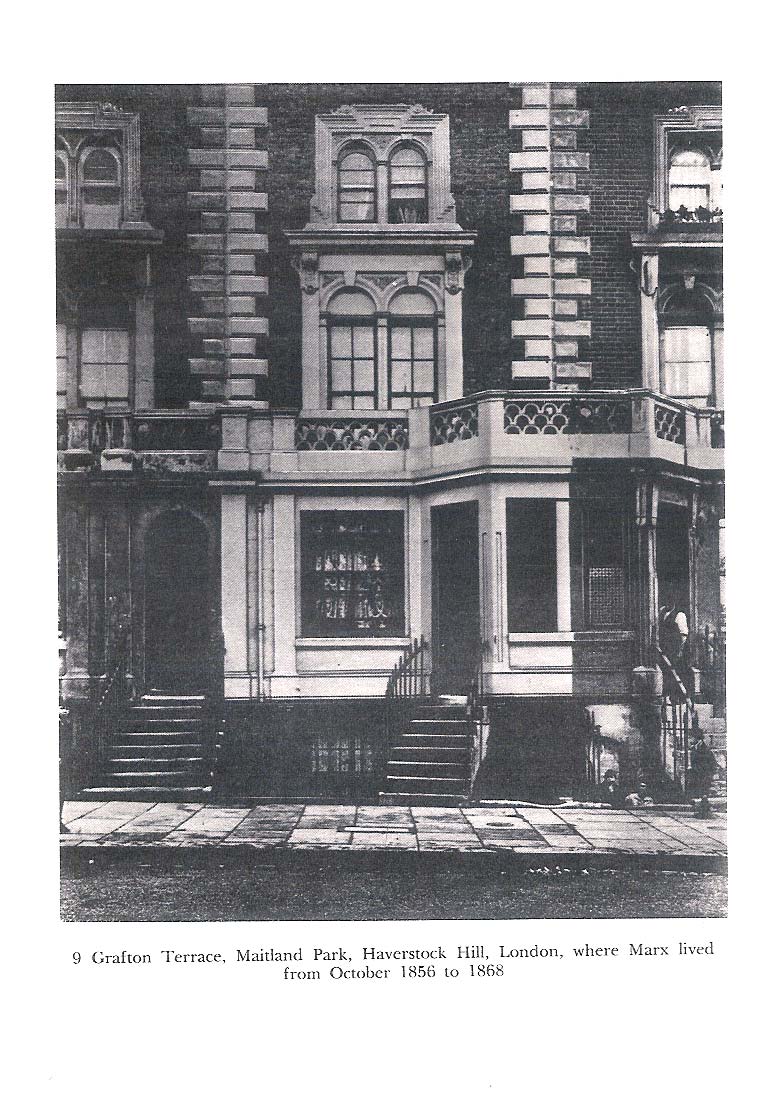
35. Marx to Engels. 30 October
35
MARX TO ENGELS
IN MANCHESTER
[London,] 30 October 1856 9 Grafton Terrace, Maitland Park, Haverstock Hill
DEAR Frederic,
I am at this moment dictating an article on Persia.a Hence no more than a line or two. Your £5 received. Could you possibly send me some military stuff on Switzerland before the week is out, for that is what's holding me up and preventing me from getting on with my articles. Will write at greater length very shortly.
Your
K. M.
Ruge is publishing:
1. Stories of the Chase for Children!' 2. Philosophical considerations on the religion of Ancient Egypt. He told this to Blind, who on the same occasion discovered that Papa Ruge hadn't so much as heard of Röth's book/
36. Marx to Engels. 30 October
36
MARX TO ENGELS[100]
IN MANCHESTER
[London,] 30 October 1856 9 Grafton Terrace, Maitland Park, Haverstock Hill
Dear Engels,
The article on Bazancourt[60] is splendid. Enclosed the last bit of the Mieroslawski.a If I have seemed lazy about writing it is largely because my wife has been ill these past few months.
As you will yourself observe in the Mieroslawski, 1. the very man who holds un royaume diplomatique* in Poland to be impossible, wanted to bring about une révolution diplomatique there, i.e. under the AUSPICFS OF Louis Bonaparte and Palmerston; 2. the fate of the 'democratic' gmina of the Lechitesb in Poland is an inevitable one; the actual dominiumc is usurped by the Crown, aristocracy, etc.; the patriarchal relations between dominium and peasant communities lead to serfdom; optional land-division creates a kind of peasant middle estate, the ordre équestre,[101] to which the peasant can rise only so long as wars of conquest and colonisation are still in progress, though both these necessarily tend to accelerate his DOWNFALL. AS soon as the borderline is reached, this ordre équestre, incapable of sustaining the role of a true middle estate, turns into the lumpenproletariat of the aristocracy. A similar fate overtakes dominium and peasant among the Romanic population of Moldavia, Wallachia, etc. This type of development is interesting in that it shows how serfdom comes into being as a result of purely economic factors, without the intermediate link of conquest or racial dualism.
Your Manchester Guardian has the singular distinction of being regarded as the immediate cause of Bonaparte's statement against the English press. Please send me X d from time to time. Having discovered that Bonaparte's 1847 is approaching, Palmerston is bending every effort to jockey him into precisely the same position as he jockeyed Louis Philippe during the Sonderbund War[102]— into an alliance with Russia against England. Whereas on the one hand he takes him in tow against Austria in the filthy Neapolitan affair, in Turkey he sides against him with Austria.[1] Once again the French newspapers are full of MISGIVINGS about the machinations of perfidious Albion. The commercial crisis would certainly seem to have reached its consummation in the Russian railways. The bankruptcy of the CONTRACTORS to the 'palace of international industry'I04 affords a GLIMPSE into the participation of English capitalists in continental enterprises. In Germany the setting-up of industrial and banking undertakings goes on briskly. The Berlin National-Zeitung contains whole columns devoted solely to enumerating the names of these CONCERNS.
I learnt from Putnam's man, Olmsted, and an American travelling companion who was with him that Gurowski (the Pole) had acquired much influence with Dana. At the same time these gentlemen told me that the said worthy fellow received regular cash grants direct from the Russian ambassade'a in Washington. This Gurowski advocated Pan-Slavism in opposition to ourselves, which was the only reason why your article ' was rejected. When returning my manuscript on the Danubian Principalities,[3] Mr Dana forgot TO BLOT OUT a comment written in French by this self-same Gurowski, who remarks on my statistical data relating to the Romanian population:
'Tous ces chiffres sont exagérés pour faire mousser l'idée de nationalité Roumaine. Ils sont démentis par les faits, l'histoire et la logique.'b"
So we can boast of having, or rather of having had, our articles inspected and censored directly by the Russian embassy. In the end Dana appears also to have seen through Gurowski.
Today a letter from Collet to whom I had sent some new stuff.c
The fellow agrees to everything, except that he doesn't say anything about MONETARY TERMS although I expressly asked him about this point in my last letter. So I shall have to PUT ON THE SCREW all over again, since this is the only point of interest to me in my
INTERCOURSE WITH THOSE CALIBANS/
37. Engels to Marx. 17 November
Write to me soon concerning yourself and those about you. With kindest regards from my wife and children. Children very well.
Your
K. M.
Vol. XXII, Moscow, 1929
37
ENGELS TO MARX
IN LONDON
Manchester, 17 November 1856
Dear Marx,
Day after day this accursed COMMERCE has prevented me from writing. I now have three lads to keep in control and am forever checking, correcting, telling off and giving orders. Add to this the running battle with manufacturers over bad yarn or late delivery, and my own work. I wish it might occur to Mr Bonaparte to rid France of his own person and me of all this turmoil.
Come to that, the said Bonaparte is in damned hot water. The spate of stories about placards and the unrest among the workers sent in by the Times correspondent, after the Moniteur article[3]
had led to his being ordered de parler plus haut,b have made an enormous impression on the English philistines here.[105] Everyone believes in his SPEEDY DOWNFALL. The explanation for the sudden discovery that, au fond,c the fellow is after all an ass and indeed of a very ordinary kind, is as follows: he used to be a genius but has now so ruined himself by his profligate way of life that it has affected his brain. While there may, of course, be something in this, the fellow's behaviour has on the whole been quite consistent, and only the English philistines can see any qualitative difference between the man he used to be and the man he is now.
Today's Guardian contains some interesting statistics about bankruptcies in France; I am sending it to you.
It looks as though the financial crisis will linger on through the winter, becoming gradually more acute though with occasional ups and downs. This means that in the spring it will be considerably worse than if it had broken out in acute form now. The greater the capital paid in to companies hitherto existing largely on paper and the greater the extent to which floating capital becomes fixed, the better. So long as the discount rate doesn't fall below 7 per cent — and the recent rise shows that it will have to be raised yet further — there is no prospect that even half the speculative companies will be able to obtain payment for their third or fourth calls. The Austrian Crédit mobilier (1) can't even collect the money for its second call, and yet the government enters into agreements in Austria, by which the Bank is compelled to resume CASH PAYMENTS! — I'd like to have the money Bonaparte has probably spent over the past 6 weeks to keep government stocks above 66 per cent; precisely because of the great efforts made towards that end, I shall account the day a turning-point when government stocks first drop below 66.[107]
The longer this chronic PRESSURE goes on, the more numerous will be the revelations concerning the dirty work of the Bonapartist clique and the greater the rage of the working-men who could not previously have been aware of the details. This chap Morny is really a prime example of a suitier,* nor would he seem to have any wish to return to Paris; for him, certainly, there could be no more appropriate way to invest his money than in Russian railways and government paper.
Never again, perhaps, will the revolution find such a fine tabula rasa as now. All socialist DODGES exhausted, the compulsory employment of labour anticipated and EXPLODED 6 years since, no opportunity for new experiments or slogans. On the other hand, however, the difficulties will be starkly in evidence; the bull will have to be taken literally by the horns, and I'd dearly like to see how the next French provisional government will set about cutting its teeth. Nothing, luckily, can be done this time except by dint of the most reckless courage, for we no longer have any reason to fear as swift an ebb as in 1848.
Strohn has been here recently; had heard sundry things about the litde man3; entre novs, the fellow is thinking seriously about setting up in business on his own! He imagines his patter will serve to entice customers away from his present principal.
I have in front of me at this moment James' Naval History of England, 1792-1820, mainly for the sake of SHIPS AGAINST WALLS. b It shows that the English had to fight very hard to gain NAVAL SUPERIORITY over the French and, more especially, the Spanish. Given parity of strength, the French and Spanish, during the early years of the war, were a match for the English on almost every occasion, and a mass of vessels was captured from the latter. Though I haven't yet got beyond 1796, I can already see that under Napoleon the French fleet reached an absolute nadir, for which he was probably partly to blame.—The superiority of the English at sea lies chiefly in their better gunnery; the French always fired too high, though the Spanish were much better. The story about the Vengeur, said to have gone down on 1 June 1794 au cri de vive la république' is, by the way, a myth. The
Vengeur surrendered to the English but, before she was actually seized, several French vessels again began to close; she rehoisted the French flag, the rescuers were beaten off and the English approached, but the ship went down, most of her crew being saved. She sank 4-6 hours after the end of the batde.
Kindest regards to your wife and children.
Your
F. E.
38. Marx to Engels. 2 December
38
MARX TO ENGELS1
IN MANCHESTER
[London,] 2 December 1856 9 Grafton Terrace, Maitland Park,
Haverstock Hill
Dear Frederic,
My wife is still dosing herself continually and hence the house is always in such a disarray that it is difficult for me to settle down and write.
As regards the Mieroslawski,3 a providential 'apportionment' would appear to have taken place, most of the excerpts intended for you (there were ABOUT two sheets) having been torn out of the middle of the manuscript, probably for spills. However, you haven't lost much. I afterwards read Lelewel's Considérations—not to be confused with his popular history.b He, together with Maciejowski (?) (I cite the name from memory), provides most of the material upon which Mieroslawski exercises his mind. By the by, in my recent studies of Polish history, what led me décidément to plump for Poland was the historical fact that the intensity and the viability of all revolutions since 1789 may be gauged with fair accuracy by their attitude towards Poland. Poland is their 'external' thermometer. This is demonstrable en détail from French history. It is conspicuous in our brief German revolutionary period, likewise in the Hungarian. Of all the revolutionary governments, including that of Napoleon I, the Comité du salut public[109] is an exception only in as much as it refused to intervene, not out of weakness, but out of 'mistrust'. In 1794 it sent for the employé' of the Polish insurgents'1 and asked this citoyen' the following questions:
'How is it diat your Kosciusko, a popular dictator, tolerates the existence alongside himself of a king' of whom, moreover, he cannot but know that he was put on the throne by Russia? How is it that your dictator does not dare effect the levée en masse of the peasants for fear of the aristocrats, who do not wish to be deprived of any of their "hands"? How is it that the revolutionary complexion of his proclamations pales in proportion to the distance his march removes him from Cracow? How is it that he immediately punished with the gallows the popular insurgents in Warsaw, whereas the aristocratic "traîtres de la patrie"" are allowed to remain at large, or are given refuge in the lengthy formalities of a trial? Answer! '
Whereat the Polish 'citoyen' could only remain silent.
Que dites-vous de Neuchâtel et Valangin?bn0 This CASE has led me to try and remedy my highly inadequate knowledge of Prussian history. INDEED AND INDEED, never has the history of the world produced anything so sordid. How the nominal kings of France came to be real kings is also one long recital of petty struggle, betrayal and intrigue, but it is the history of the birth of a nation. Austrian history — the founding of a dynasty by a vassal of the German Empire — acquires interest from the circumstance that the vassal defrauds himself in his capacity as Emperor, from involvement in the East, Bohemia, Italy, Hungary, etc., and finally, too, from the circumstance that dynasty assumes such dimensions as to arouse fears in Europe of its becoming a universal monarchy. Nothing of all this in Prussia. She failed to subdue so much as one powerful Slav nation, and took 500 years to acquire Pomerania, and then only by 'barter'.[111] Come to that, the Margraviate of Brandenburg — as it was when taken over by the Hohenzollerns— hasn't been able to boast a single conquest, with the exception of Silesia. Perhaps it is because this was her one and only conquest that Frederick II's sobriquet is 'the One and Only'.1 2 Petty theft, BRIBERY, outright purchase, succession intrigue, and such like shabby dealings is all that Prussian history really boils down to. What is interesting in feudal history elsewhere — the struggle of the monarch against his vassals, double-dealing with the towns, etc.—is all of it here dwarfed to a caricature because the towns are boringly small-minded, the feudal lords boorishly insignificant and the monarch himself a nonentity. During the Reformation, as during the French Revolution, she oscillated between perfidy, neutrality, separate peace treaties and snatching at scraps tossed to her by Russia in the course of partitions organised by the latter—vide Sweden, Poland, Saxony. Withal, a dramatis personae of rulers with only 3 masks — the Pietist,[113] the non-commissioned officer, the clown — succeeding one another as surely as night follows day, the only irregularity consisting not in the introduction of fresh characters but in the varying order of their appearance.
39. Marx to Engels. 22 December
What has kept the State on its legs nonetheless is mediocrity—aurea mediocritas*—meticulous book-keeping, an avoidance of extremes, the preciseness of the drill book, a kind of homespun vulgarity and 'ecclesial institutionalism'.[114] C'est dégoûtante
How is trade in Manchester just now? Can you let me have some particulars about the state of BUSINESS in the MANUFACTURING
DISTRICTS?
I haven't yet informed you that papa Heise passed through on his way from Utrecht. Has now rejoined Imandt. He has filled out and looks better than ever.
Götz, too, suddenly turned up here again. Disappeared with equal suddenness. Freiligrath very satisfied with his business and with himself. Valdenaire — the 'agréer'"5 manque—is over here on a visit from Trier. For what purpose, more in my next.
Finally, I have a ticklish matter to put to you. At the end of December I have some fairly substantial sums to pay out. Could you possibly let me have something before then? My wife's money has largely gone on setting up house and making up for very substantial losses in income.
When are you coming down here? What is Lupus doing?
Your
K. M.
Vol. XXII, Moscow, 1929
39
MARX TO ENGELS
IN MANCHESTER
[London,] 22 December 1856
Dear Engels,
You would oblige me greatly if you could send me the money before the week is out. I have just been to see Freiligrath and asked him whether he could advance me anything against my bill on America, which is drawable only in 2 or 3 weeks' time, mais
impossible. I was expecting the money from Putnam's today; hasn't arrived. The TRANSACTIONS with Urquhart's wretched rabble — on whom I have claims — are still in suspense." If I'm late with the first payment to my LANDLORD, I shall be entièrement discrédité.
In great haste. Salut.
Your
K. M.
P.S. Can you send me any bon mots on the military aspects of the Prussia-Neuchâtel conflict?[110] They would be very timely. I have dealt with the diplomatic part myself.b
Red Wolffc is in Blackburn, Lancashire,*d with his family. Schoolmaster at a salary of £60.
Works, First Russian Edition, Vol. XXII, Moscow, 1929
Published in English for the first time 1857
Endnotes
[10] abandoned its initial progressive stand.—3, 68, 73, 81 4 Marx quotes a leading article from The Times, No. 22267, of 18 January 1856, which discussed the preliminary conditions for a peace treaty with Russia. The paper commented on the report, received the day before, about Russia's acceptance of the peace proposals put to her by her opponents in the Crimean war, and urged extensive military preparations to force Russia into 'uncondi-tional acceptance' of the demands made on her.—3 5 A congress held at the Romanian town of Foc$ani in July and August 1772 aimed at ending the Russo-Turkish war started by Turkey in 1768. The Russian delegation proposed, in particular, that Wallachia and Moldavia should be granted independence under the joint protection of the European powers. No agreement having been reached at the congress, hostilities were resumed and continued until 1774.—3 6 This refers to an episode in the Russo-Turkish war of 1735-39, which had been provoked by incursions, in 1735, of the Crimean Tartars into the Ukraine and the invasion of the Caucasus by the Crimean Khan, a vassal of the Sultan. In May-June 1736, a Russian army under Field Marshal B. C. Münnich entered the Crimea and occupied the Western part of the peninsula, including Bakhchisarai, the Khan's capital. However, a shortage of provisions, forage and water and the outbreak of epidemics forced Münnich to withdraw to the Ukraine.—3 7 The principal works of Adam Müller, who belonged to the romantic school in political economy, are Die Elemente der Staatskunst. Theile I-III, Berlin, 1809 and Versuche einer neuen Theorie des Geldes mit besonderer Rücksicht auf Grossbritannien, Leipzig und Altenburg, 1816. Marx discussed Müller's views in Vols. I and III of Capital (present edition, Vols. 31 and 33).—4 8 Synoptics—the writers of the first three Gospels. Marx refers to Bruno Bauer's book Kritik der evangelischen Geschichte der Synoptiker. Bd. 1-2, Leipzig, 1841; Bd. 3, Braunschweig, 1842.—4 9 On 19 January 1856, David Urquhart's Free Press (No. 15) published under the heading 'The Chartist Correspondence' a number of documents on the Chartists' activities in 1839-41, including Urquhart's correspondence with the then British Prime Minister Lord Melbourne, Home Secretary Normanby and others. The letters show that Urquhart had abused the Chartist leaders' trust by giving the British government detailed information of Chartist plans and intentions. While publishing some works attacking the foreign policy of the British ruling circles, in particular that of Lord Palmerston, leader of the Whig oligarchy, in The Free Press and other Urquhartite publications, Marx emphatically dissociated himself from Urquhart's conservative views and criticised them in the press.—4 0 This refers to Engels' duties as corresponding clerk and general assistant in the Ermen & Engels firm in Manchester, of which his father was co-owner. He
[12] give material aid to the Marx family, and kept it until 1870. Engels' confidential
[13] business reports to his father mentioned in die letter have not come down to
[16] have not been preserved.—5, 14, 51, 68, 73, 81, 100 12 Further in his letter Engels cites facts showing that opposition to Napoleon Ill's regime in France was mounting. Marx used them in his article 'The American Difficulty.—Affairs of France', published in the New-York Daily Tribune on 25 February 1856 (present edition, Vol. 14, pp. 602-04).—5 3 Sire de Franc Boissy—a French song containing satirical allusions to royalty and the government.—6 4 A reference to the repressions that were part of the Bonapartist coup d'état of 2 December 1851 in France.—6 5 Engels here refers to the discussion of the so-called Five Points or preliminary terms for peace between Russia and the coalition that fought Russia in the Crimean war (Britain, France, Turkey and Piedmont). The Five Points were presented to the Russian government through Austria in the form of an ultimatum by the Allied Powers in December 1855. They called for replacement of the Russian protectorate over the Danubian principalities by a protectorate of all the contracting parties, a revision of the Bessarabian border involving Russia's relinquishment of the territory along the Danube, neutralisa-tion of the Black Sea, closure of the Straits to warships, a ban on the maintenance by Russia and Turkey of arsenals and navies in the Black Sea, and collective protection of the Sultan's Christian subjects by the Great Powers. The Allied Powers also reserved themselves the right to impose additional demands. The terms were accepted by the Russian government and provided the basis for the Paris peace talks. The Turkish fortress of Kars in Transcaucasia was captured, after a long siege, by the Russians on 28 November 1855. The fall of Kars, the last major event of the Crimean war, speeded up the termination of hostilities. Under the Paris peace treaty (March 1856) Kars was returned to Turkey in exchange for the evacuation of Sevastopol and the other Russian towns held by die Allies.—7, 21 6 The Aliens Bill audiorised the deportation of aliens from England at any time by decision of the British government. Enacted by Parliament in 1793, it was valid for one year and was renewed in 1802, 1803, 1816, 1818 and, in connection with revolutionary events on the Continent and Chartist demonstrations in England, in 1848. In later years too, conservative circles repeatedly sought its renewal. In particular, the question was discussed for several months from the autumn of 1855, following the publication on 10 October by L'Homme, a refugee newspaper appearing in Jersey, of an open letter by the French petty-bourgeois democrat Félix Pyat to Queen Victoria on the occasion of her visit to France in August of that year. The letter sharply attacked Britain's alliance with the Second Empire and was used as a pretext for the expulsion of the publisher of L'Homme and some other French refugees from the island and for press attacks on refugees in general. However, protests by progressive circles forces the authorities to refrain from further steps. On 1 February 1856 Palmerston declared in the House of Commons that the
[17] government would not seek renewal of the Aliens Bill.—7, 38 17 This may be an ironic reference to Richard Wagner, who — in his Das Kunstwerk
[18] der Zukunft (1856) and other writings — called his works the 'music of the
[19] future',—8 18 Marx refers to the diplomatic correspondence between Pozzo di Borgo, the
[21] of State. Marx knew of it from diplomatic documents published under the tide
[23] 1835 to 1837, and from the book Recueil des documents relatifs à la Russie pour la
[24] plupart secrets et inédits utiles à consulter dans la crise actuelle, Paris, 1854.—9 19 This work, intended by Engels for Putnam's Monthly, which published his series
[25] The Armies of Europe in the second half of 1855, was presumably never
[26] written.— 11 20 This letter was first published in an abridged English translation in The Letters of Karl Marx, selected and translated with explanatory notes and an introduction by Saul K. Padover, Prentice-Hall, Inc., En^lewood Cliff, New Jersey, 1979.—12, 30, 45, 54, 61, 67, 70, 93, 110, 128, 132, 224, 227, 254, 265, 319, 333, 359, 407, 430, 448, 459, 461, 518, 524 21 Queen's Bench—here the reference is to a London jail intended mainly for insolvent debtors.— 13 22 Marx means The Lay of Igor's Host, a monument of old Russian literature describing the ill-starred campaign undertaken by Igor, Prince of Novgorod Severski, against the nomadic Polovtsians in 1185. The work was published in German several times. One edition appeared in Berlin in 1854 under the title Lied vom Heerzuge Igors. As follows from Marx's later letters to Engels, he found the Lay, in the language of the original and in French translation, in F. G. Eichhoff's book Histoire de la langue et de la littérature des slaves..., and later also a bilingual German edition, which he sent to Engels in Manchester.—15, 19, 26, 31, 37 23 Acta litteraria Bohemiae et Moraviae, Pragae, 1774-1783, were literary and historical collections published by the Czech Enlightenment historian Mikulâs (Adauctus) Voigt.—16 24 Marx means Schlözer's recommendations, quoted on p. 261 of Dobrovsky's book, for the study of the Slavonic languages and the compilation of Slavonic dictionaries. The recommendations are contained in Schlözer's book Allgemeine Nordische Geschichte, p. 330.—16 25 Dobrovsky's words, taken from his book Slavin (p. 419), actually refer to Acta litteraria Bohemiae et Moraviae published by Mikulâs (Adauctus) Voigt, not to Johannes Voigt's Geschichte Preußens.—16 26 Archdeacon William Coxe, traveller, historian and writer, left his vast collection of manuscripts and books to the British Museum. Marx made excerpts from the following manuscript letters and reports of British diplomats in Russia: Various Papers on the Genius and Character of the Russians, Rondeau to Walpole, Dispatch from Mr. Fuch (Finch) to Lord Harrington, Sir George Macartney to the Earl of Sandwich, and Sir James Harris to Lord Grantham. He made ample use of them in his Revelations of the Diplomatic History of the 18th Century (see present edition, Vol. 15).—17 27 Polovtsians (Kipchaks or Cumans)—Turkic nomadic tribes who inhabited the
[27] South-Russian steppes from the eleventh to the thirteenth century. Following
[29] Hungary and the Balkans, where they were absorbed, while those remaining
[30] were subjugated by the conquerors and merged with the peoples inhabiting the
[31] Golden Horde, the medieval Tartar-Mongol state.—19 28 This refers to the so-called Königinhof manuscript, a collection of patriotic poems
[33] Hanka claimed to have discovered in a church in the village of Krâlowé Dwoîe
[34] (in German: Königinhof) in 1817. It was published in Czech under the title
[36] divorce was agreed to in July 1851. Later, the countess received 300,000 talers
[28] the Mongol invasion in the mid-thirteenth century some of them fled to
[37] under the property settlement.—23, 27, 227 36 Gustav Levy's visit to Marx in London in late February 1856 was preceded by
[39] message from Düsseldorf workers. This shows that after the 1848-49 revolution
[40] the proletarian circles in the Rhine Province continued to regard Marx and
[41] Engels as their leaders. Already during his first visit Levy maintained that an
[45] conferences or elect leaders, but that he, Jones, and James Finlen should be
[46] recognised for life as the only members of its Executive. Jones believed that this
[48] endorsed by the majority of the Chartist members, but led only to a temporary increase in membership (to about 2,000 by the beginning of March 1856) and local activation of Chartist propaganda. At the same time, Jones' attempts to act as the Association's only leader caused serious discontent among Manchester Chartists. Marx and Engels, who maintained close ties with revolutionary Chartists, criticised Jones' efforts to galvanise the Chartist movement by such artificial measures, which, they predicted, could not ensure lasting success.— 32, 34 44 This refers to the German National Assembly convened in Frankfurt am Main in May 1848 for the purpose of unifying Germany and drawing up an Imperial Constitution. Its mostly liberal deputies turned the Assembly into a mere debating club. In early June 1849 the Right-wing deputies and the moderate liberals left the Assembly after the Prussian King and other German monarchs had rejected the Constitution it had drafted. What remained of the Assembly moved to Stuttgart, where it was dispersed by Württemberg troops on 18 June 1849. The petty-bourgeois democrat Löwe von Calbe was a deputy to the Assembly in 1848-49.—32, 63 4 5 Engels means the establishment of banks similar to the Société générale du Crédit mobilier, a big French joint-stock bank founded by the Péreire brothers in 1852. The Crédit mobilier was to mediate in credit transactions and help in setting up industrial concerns and building railways in France, Spain, Austria, Russia and other countries. It was closely associated with Napoleon Ill's government and under its protection engaged in large-scale speculation. It went bankrupt in 1867 and was liquidated in 1871.—34, 68, 119, 126, 128, 133, 142, 145, 216, 225, 231, 240, 244, 291, 296, 349, 360, 437 ^ At the battle of Jena (14 October 1806) the French army, commanded by Napoleon, routed the Prussian army, thus forcing Prussia to surrender. At Austerlitz (Czech name: Slavkov) Napoleon's army defeated the Austrians and Russians on 2 December 1805.—37, 170, 180, 461 47 Marianne, founded in 1850, was a secret republican society which opposed Napoleon III during the Second Empire.—37, 42 48 On 14 April 1856 Marx was invited as an official representative of the revolutionary refugees in London to a banquet commemorating the fourth anniversary of the Chartist People's Paper. In his address he spoke of the German and other proletarian revolutionaries' solidarity with the revolutionary wing of the Chartist movement, concentrating in particular on the historic role of the proletariat. The banquet was also addressed by the German Communist Wilhelm Pieper. The other speakers were mostly Chartists (James Finlen, Ernest Jones and others). Marx did not intend to publish his speech, but it was included in the newspaper report that appeared on 19 April 1856 under the heading 'Fourth Anniversary Banquet of The People's Paper' (present edition, Vol. 14, pp. 655-56).—38 20-194
[49] Straubingers—German travelling journeymen. Marx and Engels often ironically
[50] gave the name to backward elements of the German working-class movement
[51] who were still influenced by guild prejudices and mistrusted the revolutionary
[54] founded in February 1840 by Karl Schapper, Joseph Moll and other leaders of the League of the Just (in the 1850s the Society had its premises in Windmill Street, Soho). After the reorganisation of the League of the Just in the summer of 1847 and the founding of the Communist League, the latter's local communities played a leading role in the Society. In 1847 and 1849-50 Marx and Engels took an active part in the Society's work, but on 17 September 1850 they and a number of their followers withdrew because the Willich-Schapper sectarian and adventurist faction had temporarily increased its influence in the Society and caused a split in the Communist League. Later Schapper realised the faultiness of his position and took steps towards a reconciliation with Marx. The resultant weakening of the sectarians' influence made it possible for Marx and Engels to resume their work in the Educational Society in the late 1850. In 1918, the Society was closed down by the British government.—41, 363, 451, 520 This refers to the German republican democrats who, following the capture of the fortress of Mainz by the French army in October 1792, formed the Friends of Liberty and Equality Society on the pattern of the Jacobin Club. The Mainz Clubbists joined the new administration (the Mainz Commune) and carried out a number of progressive reforms (abolition of feudal obligations, social-estate privileges and the guild system). Under the Clubbists' influence, the Rhenish German National Convention, convoked in Mainz in March 1793, proclaimed the merger of Mainz with the French Republic. The Clubbists' activity was violendy terminated in July 1793, when the French army was driven out by the forces of the counter-revolutionary European coalition.—41 In his letter of 6 April 1856 Johannes von Miquel, a former member of the Communist League, asked Marx to state his views on the attitude the proletariat should take to bourgeois parties in the event of a revolution in Germany. Miquel's own statements on this question testified to a retreat from the consistendy revolutionary standpoint. He limited the tasks of the revolution to establishing a united centralised state and ignored the need for social change. He maintained that the proletariat should ally itself not only with the petty-bourgeois democrats but also with the bourgeois liberals and refrain from such revolutionary measures as might frighten the bourgeoisie away from the revolution. No answer by Marx to Miquel is extant.—42, 44 On 8 April 1856 Count Walewski, Foreign Minister of France, made a counter-revolutionary speech at a plenary session of the Congress of Paris convened to work out the peace terms following the Crimean war. He declared that British and French troops would continue to occupy Greece, while French and Austrian troops would remain in the Papal states to combat 'anarchy' (i. e. the national liberation movement). He attacked the Belgian press, describing its support for the French republicans and criticism of Napoleon III as incitement to 'insurrection and murder'.—42 An excerpt from this letter was first published in English in K. Marx and F. Engels, Literature and Art, New York, 1947.—43 55 This letter of Engels to Marx has not been found.—43 56 The reference is to a letter of 25 April 1856 in which A. Hamacher conveyed
[55] greetings from Cologne, Elberfeld and Solingen workers and expressed their
[56] desire to maintain contact with Marx.—44 57 The
[59] mainly with the aim of opposing Palmerston's policy.—44 58 In 1856 Marx's series of articles Lord Palmerston, originally intended for and
[62] Free Press Serials, No. 5, 1856). This was a reproduction of the series as
[64] several issues of The Free Press, the Urquhartites' London paper. Apart from this, one of the articles, published in The Sheffield Free Press in November 1855, appeared as a pamphlet in Sheffield in 1856 (The Free Press Serials, No. 4a).—44, 58 59 This refers to Heine's third will, which he dictated to notaries F. L. Ducloux and Ch. L. E. Rousse on 13 November 1851.—45 60 Engels made excerpts from Bazancourt's book between June and September 1856. In the autumn of that year he summed up the results of his critical analysis in an article entitled 'Saint-Arnaud'. Marx sent the article to the American journal Putnam's Monthly, but the editors returned it unpublished.— 45, 51, 71, 73, 80, 93, 106, 124, 126, 128 61 This refers to a work planned by Marx on the history of-British and Russian diplomacy in the eighteenth century, of which he only completed five chapters of the Introduction. For these he made use of pamphlets, diplomatic documents and unpublished manuscripts, mostly of the period of the Northern War (the Russo-Swedish war of 1700-21), which he found in the British Museum Library. His negotiations with Nikolaus Trübner for publication of the work ended in failure. The chapters of the Introduction appeared by instalments in Urquhart's Sheffield Free Press from late June to early August 1856 as they were sent in by Marx. Eventually publication was stopped because of arbitrary editorial abridgements and printing errors. In June 1856 the London Free Press began reprinting the text from the Sheffield paper, and on 16 August 1856 it started reproducing the chapters from the beginning, with publication continuing until 1 April 1857. In both papers the unfinished work was printed under the title Revelations of the Diplomatic History of the 18th Century (see present edition, Vol. 15). In 1899 Eleanor Aveling, Marx's daughter, published it in London in book form under the heading Secret Diplomatic History of the Eighteenth Century.—46, 56, 73, 81, 94, 110, 112, 120 62 This letter was first published in English in Labour Monthly, No. 10, 1932, London.—49 63 Engels and his wife, Mary Burns, made a trip to Ireland in mid-May 1856.—49 64 Between 1845 and 1847 potato blight caused widespread famine in Ireland. The poverty of the small tenants ruthlessly exploited by the big landowners had made the bulk of the population almost entirely dependent on a diet of potatoes grown on their own small patches. About one million people starved to 20*
[65] death, and the wave of emigration caused by die famine swept away another
[66] million. Large areas of Ireland were depopulated. The abandoned land was
[67] turned into pastures by the English and Irish landlords.—49 65 This refers to the mass eviction of Irish tenants, a policy pursued by the
[68] English and Irish landlords since the late 1840s to turn ploughland into
[69] pasture. It was stimulated by the falling demand for Irish corn owing to the
[70] repeal of the Corn Laws in 1846, and by England's growing need for Irish
[71] cattle and animal produce.— 50 66 The Encumbered Estates Court was to enforce the Encumbered Estates Act for
[72] Ireland, passed by Parliament in 1849. This act was supplemented by a series of
[73] other acts in 1852 and 1853. The 1849 Act provided for the sale of mortgaged estates by auction if their owners were proved insolvent. As a result, the land of many ruined landlords passed into the hands of usurers, middlemen and rich tenants.—51 67 Engels compares Bazancourt's description of the Crimean war to Bat-rachomyomachia (The Battle of the Frogs and Mice), an Ancient Greek anonymous mock-heroic poem parodying Homer's Iliad.— 51 68 Marx and Wilhelm Pieper travelled to Hull on 7 June 1856. From there Marx went to see Engels in Manchester, while Pieper returned to London to carry out a number of commissions for Marx, who returned to London about 20 July 1856.—54 69 Marx's wife Jenny and their three daughters stayed in Trier from 22 May to about 10 September 1856. She went there to visit her sick mother, Caroline von Westphalen, who died on 23 July. Marx's letter was sent from Manchester, where he was staying with Engels.—54 70 Black Madonna—a name given by some art specialists to early wood carvings of the Virgin Mary. It was used, in particular, by Karl Friedrich von Rumohr in his book Italienische Forschungen (Berlin, 1827), from which Marx made excerpts in Bonn in 1842 for his planned treatise on Christian art.—54 71 The Cologne Communist Trial (4 October-12 November 1852) was a trial of a group of Communist League members charged with 'treasonable conspiracy'. It was rigged by the Prussian police on the basis of forged documents and fabricated evidence, which were used not only against the accused but also to discredit the whole proletarian organisation. Seven of the twelve defendants were sentenced to prison terms of three to six years. Marx directed the defence from London, sending material revealing the provocative methods used by the prosecution. After the trial he and Engels exposed its organisers (see Engels' article 'The Late Trial at Cologne', published in the New-York Daily Tribune, and Marx's pamphlet Revelations Concerning the Communist Trial in Cologne, present edition, Vol. 11, pp. 388-93 and 395-457).—56, 69, 376, 477, 552 72 The Allgemeine Zeitung did not publish this counter-statement.—56 73 Only part of the draft of Marx's letter to Isaac Ironside, editor of The Sheffield Free Press, has reached us. The beginning, up to and including the words 'I shall consider myself obliged to stop the publication', is written in pencil in Engels' hand with changes in ink by Marx. The rest of the text, with much struck out, is in Marx's writing. That the draft was written on 21 June 1856 can be seen from Marx's letter to his wife written on the same day. Ironside answered the letter on 23 June 1856.—57 74 This refers to the publication of Marx's Revelations of the Diplomatic History of the
[74] 18th Century in The Sheffield Free Press (see Note 61). Further on Marx speaks
[78] letter to Engels on 28 July 1856. Marx's relations with the newspaper had been
[79] complicated by the arbitrary changes made by the editors in his Revelations of
[80] the Diplomatic History of the 18th Century, which soon led him to stop publication of the work in this paper (see Note 61). The letter was first published in English as part of Marx's letter to Engels of 28 July 1856 in Der Briefwechsel zwischen F. Engels und K. Marx. 1844 bis 1883. Herausgegeben von A. Bebel und Ed. Bernstein. Verlag von J. H. W. Dietz, Bd. II, Stuttgart, 1913.—58, 62 7 6 The Friendly Societies were workers' organisations whose main purpose was to provide material aid to their members in the event of disability and old age, pay funeral expenses and the like. This was done out of membership dues.—59 77 This refers to Marx's conflict with The Sheffield Free Press over the publication of his Revelations of the Diplomatic History of the 18th Century (see Note 61). The following draft of a letter by Wilhelm Pieper to William Cyples has survived: '28 Dean Street, Soho London, 17 July 1856 'Sir, 'I am directed by Dr. Marx to inform you that he cannot congratulate you on the emendations you have thought fit to introduce in the copy destined for Saturday's publication. 'Passages that might safely have been omitted — for the sake of space — have been carefully preserved, while the most characteristic portions analyzing the policy of Peter I have been suppressed. This explains why he has interpolated about three lines of absolute importance for the understanding of the reader, in substitution for the same number of lines suppressed in another place, out of consideration for the pressure of space you allege in your letter to Dr. Marx.'—60 78 Marx means the concluding events of the fourth bourgeois revolution in Spain (1854-56): the resignation of Espartero's liberal government on 14 July 1856, the coming to power of the counter-revolutionary General O'Donnell, and the popular uprising, led by the ex-toreador Pucheta, against the new government in Madrid and a number of other cities. Espartero's refusal to support the insurgents and the weakness of their leaders contributed to the defeat of the movement. On 17 July the uprising was suppressed in Madrid and soon after in the other cities too. Marx described these events in his articles 'The Revolution in Spain' (see present edition, Vol. 15).—61 79 The Grand Cophta was the name of an omnipotent and omniscient priest who headed the non-existent Masonic 'Egyptian Lodge' which die famous eighteenth-century impostor 'Count' Cagliostro (Giuseppe Balsamo) claimed to have founded.—61 80 Contrary to Urquhart's intention to reserve the new publication of Marx's Revelations of the Diplomatic History of the 18th Century for his projected journal, the five chapters of the Introduction that had been written were republished in The Free Press, the Urquhartites' London paper (see Note 61).—62
[82] (the 'Bog') in the French Convention (1793-95) who vacillated between the
[84] in reference to French philistines, in particular French petty-bourgeois
[86] 225, 229, 249, 264, 268, 309
[87] This letter was first published in English in The Letters of Karl Marx, selected and
[88] translated with explanatory notes and an introduction by Saul K. Padover,
[89] Prentice-Hall, Inc., Englewood Cliff, New Jersey, 1979.—66, 97, 122, 143, 225,
[90] 315, 321, 328, 369, 378, 429
[9] sway of people who advocated a compromise with the slave-owning states and
[92] wine merchant. Acquitted at the Cologne Communist trial at the end of 1852,
[83] Right and the Left wing. Marx and Engels in their letters often used the name
[94] 1855. In early 1856 his widow undertook to send the books to Marx but, owing to
[95] the high carriage costs and other difficulties, Marx did not receive his library until
[96] December 1860 after some books had got lost.—72 92 The beginning of this letter has been torn off, the manuscript is damaged in a
[99] reply to Marx's letters of 22 September and 26 September, the letter could not
[100] have been written before 27 September 1856.—72 93 An allusion to Ewerbeck's inordinate literary vanity, on which Engels also
[101] commented in a letter to Marx of 15 October 1851 in connection with the publication of Ewerbeck's book L'Allemagne et les Allemands, Paris, 1851 (cf. present edition, Vol. 38, p. 478). The Père-Lachaise is a cemetery in Paris where many famous writers and artists are buried.— 73 94 Engels means the regular reviews of the Crimean war which he wrote for the New-York Daily Tribune in 1855 and 1856 (see present edition, Vols. 12-14). Since Engels was not an official correspondent of the Tribune, the reviews were sent to New York by Marx. Most of them were published as leaders. Engels made no copies of the manuscripts he sent to Marx, while issues of the Tribune carrying his articles could not always be obtained in Manchester.—73 95 In the period immediately preceding the 1848 revolution in France the Constitutionnel newspaper announced almost daily: 'L'horizon politique s'obscur-cit' ('The political horizon is darkening'). Marx cited this cliché in his article 'Bonaparte's Present Position', published in the New-York Daily Tribune on 1 April 1858 (see present edition, Vol. 15).—73, 290 96 The Marx family moved to 9 Grafton Terrace, London, about 1 October 1856.—74 97 An allusion to Mieroslawski's theory that the Poles had a special mission of liberation and were called upon to serve as an instrument of universal social change (Marx plays on Archimedes' famous words: 'Give me a fulcrum and I will move the earth').—75 98 Marx means the republication in the London Free Press of the part of the Revelations of the Diplomatic History of the 18th Century which had earlier been published with abridgments and numerous misprints in The Sheffield Free Press, and in the same form in The Free Press (see Note 61).—75 99 This refers to the continued publication of Marx's Revelations of the Diplomatic History of the 18th Century in The Free Press (see Note 61). From 16 August 1856 the paper was increased from four pages to eight. Marx and Engels called the enlarged edition the new Free Press (see, e.g., Engels' letter to Marx of 31 March 1857, this volume, p. 117).—76, 117 100 p a rt 0f this letter was first published in English in Marx and Engels, Selected Correspondence, Foreign Languages Publishing House, Moscow, 1955.—80, 380 loi The ordre équestre (literally: the order of horsemen)—the social estate of the knights. In medieval Poland peasants who turned up for military service with a warhorse and arms of their own were enlisted in the cavalry, which entided them to be elevated to knightly status.—80 102 In November 1847 Switzerland was plunged into a civil war unleashed by the
[102] Sonderbund, a separatist union of seven economically backward Catholic cantons
[105] support of the Sonderbund and the Catholic Church. However, Lord
[107] her direct intervention in Swiss affairs and thereby contributed to her further
[109] of defeats, concluded a separate peace with the French in 1795 and, under
[111] France in the war against Britain (1796-1802 and 1804-08).—84 09 Le Comité du salut public (the Committee of Public Safety)—the central body of
[113] 1793-27 July 1794).—85 10 In September 1856 there was a royalist uprising in Neuchâtel. Many of the
[114] insurgents were arrested by the Swiss authorities. The King of Prussia insisted
[110] pressure from the French Directory, and later from Napoleon, twice sided with
[1] and Friedrich Engels, Correspondence. 1846-1895. A Selection with Commentary
[15] for the New-York Daily Tribune, which did not print them. The manuscripts
[6] his contributions in view of the Tribune's financial difficulties resulting from the
[20] Russian Ambassador to France, and Count Nesselrode, the Russian Chancellor
[22] The Portfolio, or a Collection of State Papers by David Urquhart in London from
[3] 258, 296, 325, 343, 345, 374, 391, 393, 434 2 This refers to Robert Cobden's pamphlet What Next and Next? published in London in early 1856. It attacked Britain's foreign policy during the Crimean War waged by Britain, France, Turkey and Piedmont against Russia (1853-56). In particular, Cobden condemned die draft peace treaty with Russia as failing to guarantee stable peace.—3 3 This presumably refers to Marx's articles on the Danubian Principalities of Moldavia and Wallachia written for the New-York Daily Tribune. As can be seen from Marx's letter to Engels of 22 September 1856 (this volume, p. 68), they were not published, and have never been found. The articles touched on Swedish history, probably in connection with the conclusion on 21 November 1855 of a defence treaty aimed at Russia between the Kingdom of Sweden and Norway on die one hand, and Britain and France on the other. Marx contributed to the New-York Daily Tribune from August 1851 to March 1862. At his request many of the articles for the Tribune were written by Engels. In fact it was not until August 1852 that Marx began sending his own articles. By agreement with the editors some of the articles dealing with individual European countries were datelined Paris, Berlin or Vienna (see this volume, pp. 352, 361, 368 and 410). Marx's and Engels' articles in the New-York Daily Tribune dealt with key issues of foreign and domestic policy, the working-class movement, the economic development of European countries, colonial expansion, and the national liberation movement in colonial and dependent countries. Many of them were reprinted in die Tribunes special editions — the New-York Weekly Tribune and the New-York Semi-Weekly Tribune—and were quoted by other American newspapers, in particular by The New-York Times. Some were reproduced in the Chartist Peoples Paper, London. The Tribune editors sometimes took liberties with the articles, printing them unsigned in the form of editorials, and making insertions, some of which were in direct contradiction to the content of the articles (see, e.g., this volume, pp. 81 and 100-01). A
[2] and Notes, Martin Lawrence Ltd., London [1934].—3, 8, 19, 34, 37, 85, 208,
[35] Kralodvorsky Rukopis in 1819, and in 1829 in Czech and in German, translated by the Czech poet Vaclav Alois Swoboda. Marx probably had the latter edition in mind. In the 1880s the manuscript was revealed to be a recent imitation.—19, 26 29 This apparendy refers to 'Bogarodzica', a medieval Polish hymn to the Virgin first recorded in 1407. It is attributed to Adalbert (Wojciech), Bishop of Prague (957-997).—19 30 Chambre introuvable was the name given by King Louis XVIII to the French Chamber of Deputies, which in 1815-16 consisted of extreme conservatives. It attacked the government from the right and was eventually disbanded by the King because of its arch-reactionary views. Here Marx calls the Prussian Chamber of Representatives Chambre introuvable because it was dominated by the Junkers, whose extreme reactionary attitudes were worrying the government which feared they might provoke revolutionary tendencies.—20 31 The expression 'the crazy year' ('das tolle Jahr') was first used by Johann Heinrich von Falkenstein in a chronicle published in 1739 to describe the popular unrest in Erfurt in 1509. Later it was widely used in literature to designate the revolutionary year 1848.—20 32 This refers to the struggle in the French "National Convention (which met on 20 September 1792) between the Girondists, i.e. the party of the big bourgeoisie (a number of whose leaders came from the department of Gironde), and the Montagnards, commonly referred to as the Mountain, who occupied the upper seats in the Convention, i.e. the Jacobins, which represented the progressive bourgeoisie and the masses. As a result of the popular uprising of 31 May-2 June 1793, the Girondist government was overthrown and the Jacobin revolutionary democratic dictatorship was established.—21 33 The words 'take- care of Dowb' were originally used by, and then popularly added to the name of, the British Secretary of War Panmure who, in an official dispatch of June 1855 informing General Simpson of his appointment as commander-in-chief in the Crimea, asked him to look after Panmure's nephew, the young officer Dowbiggin.—21 34 At the battle of Inkerman in the Crimea (5 November 1854) the Anglo-French forces defeated the Russian army, but the latter's vigorous action prevented the Allies from storming Sevastopol, to which they lay siege instead. Engels describes the battle in detail in his article 'The Battle of Inkerman' (see present edition, Vol. 13, pp. 528-35).—21, 178, 297 35 From 1846 to 1854 Ferdinand Lassalle handled Countess Sophie von Hatzfeldt's divorce suit against Count Edmund Hatzfeldt-Wildenburg. The
[42] uprising was needed in Germany and that the factory workers were ready for it. Marx, then too, argued that, with reaction rampant in Germany, an uprising would be premature, as would a resumption of the activities of the Communist League in Germany urged by Levy.—25 37 The letter is only dated 'Tuesday', but Marx's intention, mentioned in the letter, to send an article on Kars to New York on Friday is evidence that the letter was written on Tuesday, 25 March, since the article appeared in the New-York Daily Tribune on 8 April 1856 and had to be mailed in London not later than Friday, 28 March, to arrive in time for that issue.—28 38 Blue Books—periodically published collections of documents of the British Parliament and Foreign Office. Their publication began in the seventeenth century.—28, 120, 431, 561 39 'Enclosure 2' has been preserved. Written in Jenny Marx's hand, it is the record of a talk she had with Colonel Touroute,/ who related a number of facts compromising Lassalle. He pointed out, in particular, that the extravagant life Lassalle led in Countess Hatzfeldt's house, his use of her money for stock-exchange speculation, his arrogance towards workers, his self-assurance and dictatorial demeanour roused the indignation of the Düsseldorf workers.— 31, 36 40 Boustrapa—nickname of Louis Bonaparte, composed of the first syllables of the names of the places where he and his supporters staged Bonapartist putsches: Boulogne (August 1840), Strasbourg (October 1846) and Paris (coup d'état of 2 December 1851).—31, 94, 170, 230, 256, 290, 336, 425, 435 41 Marx drew on Tassilier's letter for his article 'The France of Bonaparte the Little' (present edition, Vol. 14, pp. 615-20). Cayenne, in French Guiana, South America, a place of penal servitude for political prisoners, was dubbed the 'Dry Guillotine' on account of the high mortality among convicts caused by the harsh prison regulations and the unhealthy tropical climate. A translation of Tassilier's letter, sent by Marx to the Chartist People's Paper, was published on 12 April 1856.—31 42 Marx means the polemics between the Chartists and the Urquhartites, which had been exacerbated by the publication in Urquhart's Free Press (19 January 1856) of 'The Chartist Correspondence' (see Note 9). The Urquhartites' hostility towards the revolutionary trend in the British working-class movement found expression in attempts to represent the Chartists as demagogues and agents of the Russian Tsar. The Chartists, for their part, described the Urquhartites as reactionaries advocating a restoration of the customs and practices of the Middle Ages. A sharp controversy developed, in particular, over the future of Parliament. The Chartists held that it should be reformed on democratic principles and used as an instrument of social change, whereas the Urquhartites advocated total abolition of the representative system and a return to patriarchal forms of government.—32, 44 4 3 In February and March 1856 Ernest Jones, the Chartist leader, attempted to
[43] reorganise the activities of the National Charter Association. Writing in The
[44] People's Paper, he suggested that the Association should no longer hold
[47] form of centralisation would make for greater efficiency. His proposals were
[52] intelligentsia.—38
[58] Urquhartites in a number of English cities between the 1840s and 1860s,
[60] partly published in the New-York Daily Tribune (see present edition, Vol. 12),
[61] appeared in Sheffield under the title The Story of the Life of Lord Palmerston ( The
[11] assumed the post in the early 1850s, largely because he wanted to be able to
[75] of Ironside's intention to publish this work in the Urquhartites' Free Press
[85] refugees, some of whom lived in Jersey until 1855 and later in Guernsey.—65,