1854
Dear Engels,
Since the day you left,[461] the whole FAMILY has been prostrated by influenza, etc. Musch and I are still very much down. Thus through physical causes I have already been cheated of 3 articles for the Tribune which, considering the weather, is dur.* Let me know if you can provide me with one article for next week, on any subject you like. But I must know for certain if and when.h
Being still confined to my room, I have not, of course, been able to keep up with the newspapers. Pieper tells me that in today's Morning Herald there is a long article on the Russian plan of campaign^ The main theatre to be Asia, not Europe. They proposed to take Constantinople from the direction of Asia Minor (!) etc., etc.
Three volumes of Joseph Bonaparte's Memoirs^ have so far come out. The third contains the old Napoleon's correspondence on the Peninsular campaign.[462]
Just now I was interrupted by Musch, who is raving and thrashing about, etc., in a high fever. I hope the little man will soon recover.
202. Marx to Engels. 10 January
Received a letter from Dana on Monday. Unable to print the article under my name[463] as it would damage the 'prestige' of the paper. Your military articles have created a great stir. A rumour is circulating in New York that they were written by General Scott.[464]
Adieu,
Your
K. M.
202
MARX TO ENGELS
IN MANCHESTER
[London,] 10 January 1854
Dear Engels,
Last evening Urquhart sent me from Newry (Ulster) a speech which I got my wife to copy out, then added a word or two at the beginning and the end, and thus produced an article." So I shall cancel yours this Friday .b Should there be any further INCIDENTS that belong here,c perhaps you would be so good as to advise me of them by Friday morning so that I can give the stuff the finishing touches.
The whole family, from a to us, is still ill. The enclosed is from Cluss. I shall send you the other part of it next time, when I shall be writing at greater length.
That swine Tucker has just sent me a message. The first edition (50,000 COPIES) of 'Palmerston' is sold out. Now the gentleman
203. Marx to Engels. 18 January
sends word — he used not to be so condescending — that I should revise the thing for the second edition.[465] Write at once and tell me what you advise me to do.
Your
K. M.
203
MARX TO ENGELS
IN MANCHESTER
[London,] 18 January 1854 28 Dean Street, Soho
Dear Frederic,
You must let me have by Fridaya something of a general nature (it is hardly possible to be specific) about the Battle of Citale or Zitale.b It seems to me that:
1. The battle of Oltenitza was a misunderstanding which frustrated the armistice imposed by the Ambassadors on the Porte. Similarly the Battle of Citatea[4] was a misunderstanding which frustrated the peace proposals dictated to the Porte under the guns of the English warships.
2. The obverse of Oltenitza. In the one case the Turks entrenched, in the other the Russians, etc.
3. Same result. After a murderous set-to lasting five days, the fellows drew in their respective horns. All I see is the result. I don't know what should have happened. All I do know is that this is not the way Napoleon fought a war.
So enmeshed in their own webs have the diplomatic intriguers become that a guerre généralec is imminent. As you know, the EVENT AT Sinope — not to mention Mr Redcliffe's threats — was intended to induce the Turks to accept the Protocol of Vienna and bring Halil and Riza Pasha into the government.[467] Once all this had been engineered, Palmerston resigned.[468] On 19 December, while he was still out of office, the coalition smelt a rat and ordered a demonstration in the Black Sea. Palmerston, doubly discredited, returned to office and effected the decision of the 26th, that the entire fleet was to sail into the Black Sea, but to do no more than assume a neutral role vis-à-vis the two BELLIGERENTS; ostensibly going further than the decision of the 19th, but in fact attempting to thwart it and cut the Turks off from their Asiatic theatre of war. In the meantime, however, Mr Bonaparte, basing himself on the decision of the 19th, has already issued contrary orders and purports to interpret the decision of the 26th merely as an extension of the first. Palmerston, OF COURSE, had to make the best of a bad thing and preserve his reputation as an energetic patriot. In this way the fellows have got themselves into a pretty pickle and their dissimulation will land them in an even worse one, especially since Parliament will have to be shown on the 31st that 'energetic' steps are being taken. The Note which the fellows submitted to the Turks for signature shows that the former were prepared for a total SURRENDER TO RUSSIA and that only 'misunderstandings' frustrated this good intention.[470]
My brother-in-law—le ministrea—wrote and told my mother-in-law[11] that she was unfortunately about to relive her experience of 40 years ago, namely a general war.b '
I forwarded your letter to Steffen[472] the same day to Brussels where Steffen is still staying with his sister. I fear that, at this particular juncture, your 'Napoleon as Lieutenant of Artillery'[473]
will be rejected, as The Times has had orders to refrain from any semblance of anti-Bonaparte polemics. Since he is 'our' ally, every paper will be moved by the same patriotic considerations just now. Anyway, as soon as the thing is ready, and if the papers won't have it, we shall bring it out as a pamphlet. Where my own work is concerned, I feel embarrassed about offering it to a publisher. The same gênec would not apply to yours.
That jackass Weydemeyer has again shelved 'the noble consciousness'.'d The main thing was speed in answering. 6 weeks too late, and the thing's SILLY. I cannot understand Cluss, and why he should always pick on me of all people to be Mr Weydemeyer's victim.
Your
K. M.
204. Marx to Engels. 25 January
God bless you, Brother Straubinger. A MAN OF HICHBIRTH HONOUR PEACE PROSPERITY.
SMALL WIT'
204
MARX T O ENGELS
IN MANCHESTER
[London,] 25 January 1854 28 Dean Street, Soho
Dear Frederic,
Enclosed note for Lupus, who has written to me.[474] Absolution.b
As to the war, there will now be some snags, unless MISUNDERSTANDINGS' OCCUR that have nothing to do with, or run counter to, diplomacy. Reshid Pasha's Note [4] spells total SURRENDER TO RUSSIA. It even contains more concessions than the ORIGINAL VIENNA NOTE as a result of which Turkey declared war.[476] Palmerston has not returned to office in vain.c O n the other hand, the demonstration in the BLACK SEA would seem to be a DODGE, specially contrived for the MEETING of Parliament: if Russia accepts her own conditions incorporated in Reshid's Note and obtains everything she has demanded, she will appear to have bowed to force supérieure. That, in any case, is the plan. Otherwise, would it not be absurd to inform Nicholas of the entry of the UNITED FLEETS before h e had, or could have, pronounced upon the last VIENNA NOTE? Now only an accident of war could bring about a warlike solution. By prior agreement the Czar, far from objecting to the ENTRANCE OF THE UNITED SQUADRON, showed considerable TEMPER.477
However, there's no vouching for MISUNDERSTANDINGS'. They ARE EVER
PROBABLE.
Today's Times contains a further report from the Wanderer on The Battle of Citatea.d I EXPECT YOUR OBSERVATIONS. The advance the Russians are said to have made simultaneously at Matchin, Giurgevo and Kalafat and, indeed, the capture of Silistria, would seem MERE HUMBUG. Apropos, one more thing: your opinion, written in English. According to the French newspapers, the Turks intend to fortify Constantinople on the landward side.a Would this not be a major blow for Russia? The more so as Constantinople will always be able to communicate by sea with the Asiatic and European coasts of its EMPIRE and thus cannot be cut off from its supplies of men and materials? Large-scale fortifications would now seem to be the ANTIDOTE to large-scale warfare à la Napoleon. May this not bring about a reversion to small-scale warfare?
It is scandalous that Berlin is not being fortified. My brother-in-law, le ministre, has written to my mother-in-law warning her that now, in her ripe old age, she is about to go through the same experience as in the days of Napoleon I.b He believes, then, that there'll be war.
Cobden, the 'UMBLE- and HOMELY MAW made a considerable ass of himself in his last speech. He demonstrates that neither he nor the 'UMBLE MEN- who applaud him, are competent to govern England. The Quaker Bright will hear of nothing but the war within. Cobden's discovery that the social structure of England and Russia are analogous because there are Demidovs there and Derbys here, is worthy of a Palatinate revolutionary philistine from Neustadt.[478]
On Saturday Mr Pieper went to visit Meyer in Brighton. Unwelcome though he is to the latter, he is overstaying the time allotted him by Troupeau, because the 'sea air' suits him, and has, it seems, written the bourgeois a fatuous letter. The silly lad mistakes his lack of principles for genial high spirits. From Cluss' letter[479] you will see that this same 'genial' youth wanted to obtain an American passport to Constantinople, probably in the hope of becoming a kennelboy there. It's triste" that the lad should be so thoroughly pleased with himself as to do one silly thing after another and make a laughing-stock of himself.
On Tuesdayc Bischoffsheim will be paying me another bill through Freiligrath. In the meantime I can't raise a penny, having exhausted the possibilities of the pawnbrokers, as is regularly the case. So if you could lay your hands on £1, it would be HIGHLY DESIRABLE. Moreover, 100 copies of the 'noble consciousness'e will be
205. Marx to Engels. 9 February
arriving on Friday and I haven't the MEANS to pay the postage, since I shan't be getting any money until Tuesday.
Apropos. I am negotiating with Tucker. The next pamphlet is to be about Unkiar-Skelessi. So correct the stuff you've got (Nos. IV and V).[480] I shall then make sundry additions and send back the ALTERATIONS for you to look through.
I have received through Dana an offer from a magazine in New York, £12 per sheet, for articles on the history of German philosophy from Kant TILL NOW.[481] But they must: 1. be sarcastic and amusing; 2. contain nothing AGAINST THE RELIGIOUS FEELINGS OF THE COUNTRY. How to set about it? Now, if we 2 were together — books would be needed besides — we could quickly earn £50-£60. I wouldn't dare attempt the work on my own.
Your
K. M.
205
MARX TO ENGELS
IN MANCHESTER
[London,] 9 February 1854 28 Dean Street, Soho
DEAR Frederic,
I shall be sending you today, at the same time as this, a few copies of the 'Knight'" and three copies of the 2nd edition of the Polish rubbish,[482] which I have corrected. Give one copy of each to Lupus and Dronke. It was stupid of me not to have corrected the printing errors (Weydemeyer also contributes his fair share) in the Syrian Palmerston thingb before sending it to you.[483]
I had a meeting with Urquhart.[484] He surprised me with the compliment that the articles0 read as though written by a 'Turk',
206. Marx to Engels. 15 February
an opinion in which he was in no way confirmed when I told him that I was a 'REVOLUTIONIST'. He is an utter maniac. Is firmly convinced THAT HE WILL ONE DAY BE PREMIER of England. When everyone else is downtrodden, England will come to him and say: SAVE US, Urquhart! AND THEN HE WILL SAVE HER. While speaking, particularly if contradicted, he goes into FITS which I find all the more comical as I know by heart his every platitude and quotation. This made me regard his 'FITS' as EVEN somewhat SUSPECT and RATHER as a theatrical EXHIBITION. The fellow's most comical idea is this: Russia rules the world through having a specific superfluity of BRAIN. T O COPE WITH HER, a man must have the BRAIN of an Urquhart and, if one has the misfortune not to be Urquhart himself, one should at least be an Urquhartite, i.e. believe what Urquhart believes, his 'metaphysics', his 'POLITICAL ECONOMY' etc., etc. One should have been in the 'EAST', or at least have absorbed the Turkish 'spirit', etc.
If you can do something by Tuesday,a it would be very welcome, since I have to write to the Cape of Good Hope on the same day.b
Your
K. M.
206
MARX TO ENGELS
IN MANCHESTER
[London,] 15 February 1854 28 Dean St., Soho
DEAR Frederic, The lithographic sample enclosed herewith is all my own work.c
207. Marx to Engels. 9 March
Bonaparte's publication of his LETTER to BROTHER- Nicholas shows that he already had a negative answer in his pocket.[485]
Salut.
Your
K. M.
207
MARX TO ENGELS
IN MANCHESTER
[London,] 9 March 1854 28 Dean Street, Soho
Dear Engels,
I have not written for a long time because I have had a great deal of TROUBLE at home which has even prevented me from reading the papers properly, so that I don't know whether anything of yours has yet appeared in The Daily News or how the whole thing is going.a
As yet I have got nothing, i.e. not a single farthing, out of my 'Palmerston', nor does there seem to be any prospect of my doing so. Mr Trübner has himself told me that, quant a lui,b it is a PRINCIPLE of his never to pay for the stuff he publishes. Moreover, the thing's out of date au momenta
On Tuesdayc I shall send the last of the sample articles to the Cape.[486] (So you must let me have something for the Tribune, PERHAPS THE GREEK REVOLUTION?)d' Tuesday will be the last day of regular sailings to the Cape, since the company has fallen out with the government over charges.
I am faced with the repulsive prospect of enduring throughout the spring and summer the same chronic pressure as in previous years, since it is not possible for me to work off past debts with the
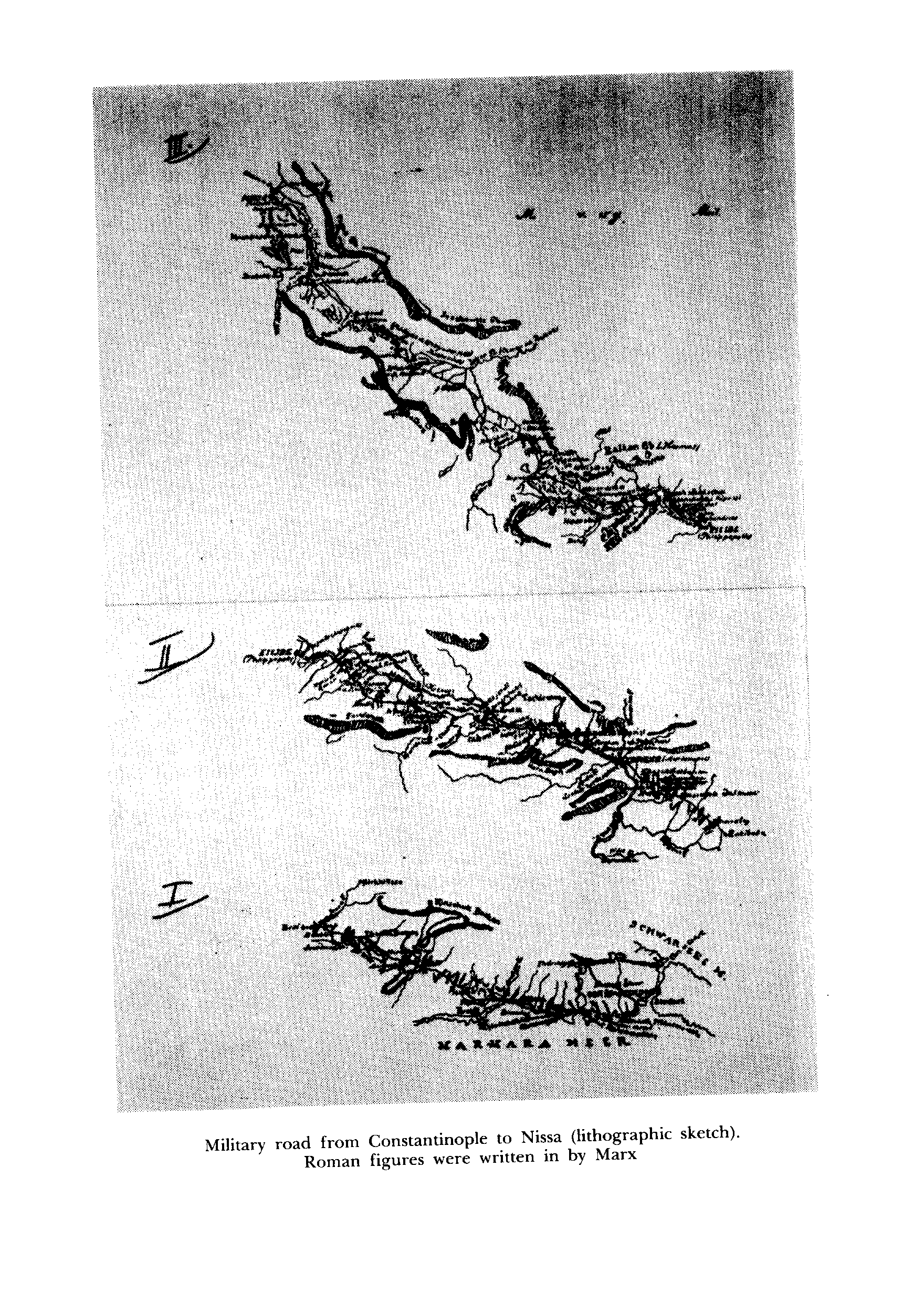
Military road from Constantinople to Nissa (lithographic sketch). Roman figures were written in by Marx
earnings from the Tribune alone. From time to time I'm driven wild by the thought that I shall never get out of this mire.
You have not returned Lassalle's letter as you indicated you had in your last.[488] I don't need it but only want to be sure that it hasn't gone astray in the post or fallen into the wrong hands.
I have received an invitation from the LABOUR PARLIAMENT[489] to sit as HONORARY DELEGATE in Manchester (Nadaud and Louis Blanc likewise). I wrote today, thanking them for it, and made a few remarks which, according to how they are construed, could be either very extreme or very moderate." I sent Jones your office address today.
The great Ruge intends to found a university (a free one) in America and, as Heinzen announces, 150 dollars has already been collected for this noble purpose.
The great Franz Sigel has become Dulon's son-in-law. What else has been happening among that crew you will discover from a parcel which will descend on you in a few days' time.
In yesterday's Advertiser there was a military (?) article by Urquhartb in which he maintains that the Turks should have sent their main army to the Dobrudja and assaulted the Russians from there. Cites General Valentini. I shall make sure to send you the issue.
I have written to Lassalle[490] and await further communications from him.
Tzschirner came to see me, didn't find me in, is going to America on a financial matter with his 80-year-old mother and will then settle over here. Claims he already knows you, or so Imandt says.
Your
K. M.
208. Marx to Engels. About 11 March
209. Marx to Engels. 17 March
208
MARX TO ENGELS
IN MANCHESTER
[London, about 11 March 1854]
DKAR Frederic,
Enclosed a letter from Lassalle.[491]
You would greatly oblige me by letting me have some military stuff for Tuesday." The 2nd edition of The Times, which you'll get on Monday, contains sundry things on Shamyl, etc. If I don't produce anything on military affairs, even though it be only tittle-tattle, A.P.C. will steal a march on me; he cribs unblushingly from the London newspapers.
Your
K. M.
209
MARX TO ENGELS
IN MANCHESTER
[London,] 17th March, 1854
DEAR Frederic,
I trust that you promptly consigned to the flames the letter I wrote you yesterday.[492] It was, of course, idiotic to make you in any way, I won't say answerable for Blanc, but even so much as to question you about him. In any case the whole thing's gone to pot et il ne vaut pasc your ever reverting to it.
210. Engels to Marx. 23 March
Is the Mr John Petzler of the Labour Parliament that mad brute, the old London Petzler? Ask Heise some time.
The parcel for you has not yet gone off because I have not yet received Urquhart's article on military affairs.
Your
K. M.
210
ENGELS TO MARX
IN LONDON
Manchester, 23 March 1854
Dear Marx,
I return Lassalle's letter herewith. At the time I forgot to enclose the first one, which is still here.[493] You'll have received the two half notes yesterday and the day before. T/B 58 166, Newcastle on Tyne, 17 August 1852, £5.
Lassalle's strategical operations are very diplomatic. His answer to the Enos and Rodosto affair is the foolish platitude, itself merely intended as dust in the eyes, that Constantinople must be protected[494]; if the 2 fleets and the Army of the Danube cannot protect it, then neither can 100,000 French and English. From his own standpoint, what he ought to have said was: if they are to be launched against Sevastopol or Odessa, they are, at any rate, closer to hand at Rodosto than in Malta or Toulon.
The notion that a move into Serbia would place the Austrians 'in the rear of the Turkish Army of the Danube' is basically wrong. The Austrians must make their crossing at Belgrade or not very far below it, or else enter Wallachia via Mehadia along the left bank of the Danube. In the first case they would find themselves in the extension of the Turkish left wing, in the second, to the front of it. That this would mean the immediate sacrifice of Kalafat and Vidin, with the exception of the garrison, is evident — but not that this Turkish left wing would be lost and its remnants compelled to fall back on the Shumla line. Au contraire,3
1. the correct tactics for the Austrians would be to march immediately on Sofia via Nissa, hence the correct tactics for the Turks would be to withdraw from Vidin, likewise to Sofia, Not having so far to go, they would be there before the Austrians and could either make a stand in the Balkans or withdraw towards Adrianople.[495]
2. Should the Austrians be stupid enough to march on Vidin, the Turks would still make for Sofia. This division of Omer Pasha's principal corps would not involve the fragmentation of his forces, since the new enemy would necessitate a new Adrianople-Sofia-Belgrade-Vidin operational line; thus the Turkish left wing would become an independent army.
3. But should Lassalle's peculiar strategy COME TO PASS, no amount of falling back on the Shumla line would avail, for the latter, having already been outflanked as a result of the sacrifice of the highway from Belgrade to Constantinople, would, on the contrary, have to be abandoned all the more precipitately in order to assemble all available reserves at Adrianople and advance against the first enemy to pass through the Balkans.
One can see, incidentally, that these lucubrations all emanate from that 'diplomatic source' which seems to enjoy showing off on the subject of strategic developments.
Tomorrow I shall be sending The Daily News a description of Kronstadt[496]; faulty though much of its fortifications may be, I'm afraid half a dozen screw ships of the line will nevertheless go to blazes before it knuckles under.
The HIGHWAYMEN have been kind enough to return Lupus his POCKET-BOOK minus 7 Prussian taler notes.b His philistines mean to do something towards making good the loss of his money and his watch, and he might even get some smart-money into the bargain. Borchardt is attending to his bruises, and so the thing is resolving itself.
'But as for the fright, the fright he got, There's no compensation for that.'
Which is why he is somewhat caducd and snappish, apparently in the belief that Heise and I were responsible for his foolishness, the drubbing he got and all.
211. Marx to Engels. 29 March
Who is this chap who is getting Heinzen to pass him off as an editor of the Neue Rheinische Zeitung?* See last batch of Reforms, No. 50 or thereabouts.
Your
F. E.
Engels, Works, First Russian Edition, Vol. XXII, Moscow, 1929
time
211
MARX TO ENGELS
IN MANCHESTER
[London,] 29 MARCH 1854 28 Dean Street, Soho
Dear Engels,
I have not yet acknowledged receipt of the £5, or used the money for the intended purpose, or written — all for the same reason. I have been saddled with Pieper. Ten days ago he was thrown out of his lodgings and I OF COURSE had to take him in here. He has drawn a bill on the Union and, if it's not protested, one of the next mails from America should bring him the money. This week Freiligrath has, BESIDES, found him a German lesson which will bring in 15/- A WEEK. And he was to have secured a similar lesson at ABOUT 10/- through Meyer — who has gone back to Germany today and asks me to send you his regards. But he didn't turn up at the appointed place. Instead, he told Meyer that he was fed up with giving lessons. Feels his vocation is to be a writer. Le malheureux!b
There's still much I don't understand about Lupus' adventure.0
Did it happen in the street? Doubtless after he'd been out on a drinking spree with you and Heise! What a DEEP IMPRESSION it made on my FAMILY you will gather from the enclosed letter of little Laura's, in which she relates the great événement[6] for Jenny and Edgar who were at school.
The diplomatic part of Lassalle — aside from the information, which is well done — is as bad as his military one. What he says about Palmerston is simply the gossip current on the Continent.49
Have you read the SECRET CORRESPONDENCE [498]? If the ministers who conducted it are allowed to conduct the war — as everything seems to indicate — the affair can only end in England's utter disgrace, although AT ALL INSTANCES the Continent will be thrown into a welcome confusion.
Enclosed an article on the war by Urquhart, of yesterday's date," and cuttings from an earlier pamphlet on his military plans. I should like your detailed opinion of both.
One of the Prussian instructors with the Turks, whom I met by chance yesterday, says that the Turkish artillery is excellent but the army as a whole no more than an ornament, inasmuch as any vigorous action has been frustrated by Constantinople.
In your essay on the Russian RETREAT from Kalafat you say that the purpose of this manoeuvre was to set up camp in Odessa, having regard to the Anglo-French army. According to the latest news, however, it would seem that the Russians have crossed the Danube on the opposite side, or intend to do so. There might be some more detailed information to hand tomorrow, in which case you could let me have something about it the day after.b In my letter of the day before yesterday[499] I forbade the Tribune, which was really overdoing things, to annex as LEADERS anything except military pieces—or else omit my name altogether, since I don't want it to appear only beneath indifferent STUFF. For it is essential — and now is the moment — to show them by military pieces that they cannot dispense with me.
If the Times commercial correspondent in Manchester has reported aright/ business must be in very poor shape. Serious FAILURES are expected down here any day. Likewise in Paris. It goes without saying that concerns which have long been laboriously staving off bankruptcy will choose the time when war is declared to go under with decorum.
I haven't yet seen your article in The Daily News and have certainly not overlooked it![496]
The Naval and Military Gazette maintains that the Russians bought a destructive device, invented in France and rejected by Louis Philippe's government, which continues to burn under water, and that they used it at Sinope, this being the explanation for the rapid and thorough destruction of the Turkish ships.
According to the Hamburger Correspondent, which must be regarded as a semi-Russian organ, Nicholas is to publish further documents, among them letters of Prince Albert.
No further news here. The 'Mader', mentioned by Mr Heinzen as being an editor of the Neue Rheinische Zeitung, is an individual quite unknown to me.a
Totus tuus,b
K. M.
I now have in my possession Hammer's Geschichte des Osmani-schen Reichs.bw Patience is needed to get through it. I've still got about XU left to read. It's at your disposal IF WANTED.
212. Engels to H. J. Lincoln, Editor of The Daily News. 30 March[501]
Perhaps I am not mistaken in supposing that at the present moment an offer to contribute to the military department of your paper may meet with some favour, even if the party offering his services be not, for the moment, an active member of the military profession, and though he be a foreigner to boot.
I suppose the actual qualifications of the party will be the main thing. As to these, nothing can show them better than half-a-dozen articles upon various military subjects, which you might submit to any military authority, if you should choose to do so. The higher the authority the better. I would ten times sooner be judged by Sir William Napier than by a subaltern martinet.
But I cannot expect you to give me even a trial, unless you know something more about nie. I beg to state, therefore, that my military school has been the Prussian Artillery, a service which, if it is not what it might be, yet has produced the men who made 'the Turkish Artillery one of the best in Europe' as our friend Nicholas has laid it down. Later on, I had an occasion of seeing some active service during the insurrectionary war in South Germany, 1849. For many years the study of military science in all its branches has been one of my chief occupations, and the success, which my articles on the Hungarian Campaign, published at the time in the German Press, were fortunate enough to obtain, encourages me in the belief that I have not studied in vain. An acquaintance, more or less familiar, with most European languages, including Russian, Serbian, and a little Wallachian, opens to me the best sources of information and may, perhaps, prove useful to you in other respects. How far I am able to write correct and fluent English, my articles, of course, themselves must show. Any other information respecting myself I shall be happy to give, or else you may obtain it from your educational contributor Dr Watts whom I have been acquainted with for more than ten years.[502]
I have for some time past thought of making you an offer of this kind, but, considered the matter hardly worth your while as long as war was not actually declared and the whole critique of Danubian strategy was confined to profound disquisitions as to what share of the blame attaching to the inconceivable proceedings in Bulgaria was due to Lord Aberdeen, and what to Omer Pasha. Now the matter is different. A local war may be a mere simulaerum of a war; an European war must be a reality. Besides this, I avow, another reason restrained me. I was not then prepared, as I am now, with the necessary maps, plans, and special information respecting the theatre of war and the belligerent parties, and I should have been sorry to send you a single line based upon other than the very best information obtainable.
My absence, not only from the seat of war, but also (for the moment, at least) from your own headquarters circumscribes pretty nearly the sort of contributions I could offer you. They would confine themselves to descriptions of those portions of the theatre of war, where actual hostilities are going on; statements of, and observations on, the military organisation, strength, chances, and possible operations of the belligerent armies; critical remarks on actual engagements, and, from time to time, resumes (to use the French word) of the operations, say of a month or six weeks, according to events. As the fullest information of what has actually happened is necessary to form a correct judgment, I should very seldom have to write on the strength of mere telegraphic dispatches, but have to wait, generally, for the arrival of more detailed news; thus the loss of a day or two would be less important for my contributions, if that would make them better; and therefore my presence in London might, for a time at least, be dispensed with. In case you should wish me to extend my contributions to a wider circle, I should have no objection and await your proposals.
Should you, however, receive my offer favourably, it may be that in a couple of months I should be enabled to come to London altogether; in the meantime, I might slip over, if desired, to confer with you.
As to politics, I should mix them up as little as possible with military criticism. There is but one good line of policy in war: to go at it with the greatest rapidity and energy, to beat your opponent, and force him to submit to your terms. If the allied governments do this, I should acknowledge it; if they should cripple or tie the hands of their commanders, I should speak out against it. I do wish the Russians may get a good beating, but if they fight well, I am that much of a soldier, that I should give the devil his due. For the remainder, I should stick to the principle, that military science, like mathematics or geography, has no particular political opinion
Now for positive proposals. I do not expect that the description of Kronstadt sent herewith will enable you to form any idea of what you may expect from me. But if it should appear to you that I may be of some service to your paper, a provisional arrangement might be come to, by which you would retain your entire liberty to refuse my further collaboration, if found unsuitable, while a fair remuneration was guaranteed to me for my labour and expenses. For you cannot but know that to write on military operations, requires the possession of numerous and expensive maps and books, for which due allowance should be made as entering into the cost of production.
Supposing, then, I sent you a series of papers giving a full account of the military and naval force of Russia, its organisation, actual strength and efficiency (as far as can be ascertained), together with a military account of the theatre of war, the lines of
213. Engels to Marx. 3 April
operation and defence on the Baltic, the Black Sea, Danubian and Polish frontiers, including the system of fortresses. The enclosed Kronstadt article would form one of the series and might be postponed till its place arrived. My information upon these subjects is, I believe, first-rate, derived exclusively from printed (and not from any mysterious) sources. I could furnish an article per week, say one or two columns, and more, if required.
Should you deem this proceeding too systematical, the account of Kronstadt might be followed up by a similar one of the permanent fortifications of Sevastopol and the other Russian fortified harbours (wherever obtainable), to be concluded by some observations on the chances of naval attacks against land batteries, drawn from history and from the best theoretical sources such as Sir Howard Douglas/
If you require reviews of military works, I could also undertake them. For instance Col. Chesney's Russo-Turkish Campaigns; for this book I am, I may say, admirably provided with materials.
I conclude this lengthy epistle in offering you, also, a few remarks on the importance or rather non-importance of the Russian passage across the Danube: these are at your service at a moment's notice.
If you take my offer into consideration, I shall be glad to receive a few lines as soon as possible so as to be enabled to set to work at once. In the meantime, etc.
213
ENGELS TO MARX
IN LONDON
^ Manchester, 3 April 1854 Dear Marx,
The crossing of the Danube is of a purely defensive nature. It is proof that the Russians are withdrawing from the greater part of Wallachia. They have had 7 infantry divisions in Wallachia, one in reserve at Ismail and, behind it, Cheodayev's corps, making 3 more divisions. Cheodayev can, at the very best, be at Jassy. The remaining 8 divisions, including cavalry, etc., etc., amount to less than 110,000 men. Hence, with the possibility of an Anglo-French landing in their rear, it behoves them to secure the most favourable position in which they will not be cut off, and with the minimum possible sacrifice of ground. Here they had only 2 alternatives: Either a direct withdrawal to the Sereth, this and the Lower Danube being chosen as the line of defence (Fokshani, Galatz, Ismail) or, 2. a DASH to the Dobrudja, shifting the front to Kustendje, Hirsova, Oltenitza and Bucharest, with Trajan's Wall, Danube and Argish as the first line of defence, Buseo as the second, and Sereth as the third. This, at any rate, is the best plan, especially since new ground would be gained on one wing to make up for that abandoned on the other, and thus the retreat would look like an advance, and military decorum would be preserved. Possession of the Dobrudja would shorten the Russian front and, if the worst came to the worst, would leave open the line of withdrawal to Chotin on the Dniester, even if there were landings at Akkerman or Odessa.[503]
Things seem to be working out with The Daily News. I didn't write until last week,[3] after I had observed the English proprieties by obtaining a REFERENCE from father Watts, who also writes for it (father Watts, BY THE BY, has given up his SHOP and is now MANAGING DIRECTOR of a PEOPLES PROVIDENT ASSURANCE CO. in which capacity he will shortly be setting himself up in your vicinity, 47 Charing Cross [Road]. He and all his officials are letting their beards grow and look like Wasserpolacken(1)). Today I've had a letter from the CHIEF EDITOR, Lincoln, who seems altogether agreeable (I had offered to start off with articles on the Russian army, navy and fortifications), and he is eager for me to send him the articles.[505] So I don't feel at all nervous. That the fellows are in a quandary as regards things military is evident from their acceptance of Schimmelpfen-nigian nonsense of a kind totally incomprehensible to anyone unacquainted with Billow's books, and my racily written and unlaboured letter will have opened up for them prospects of quite a different order. Once they have got interested in my stuff (N.B. I asked for money straight away), I intend really to impress the jackasses. Tomorrow I shall send them something no one else can provide: plans of Hirsova, Matchin, Isaktsha and Tultsha. This business has really taken a load off my mind, for a source of cash
214. Marx to Engels. 4 April
was absolutely necessary. If all goes well, in the summer, when my old man comes over, I shall chuck up commerce and move to London; but then I shall at any rate be coming over some time before Whitsun to make definite arrangements with the chaps.
Needless to say, Lupus had been out drinking with us. As usual, staggers off tight as a drum so that there's no holding him, loses his way, finds himself in a low pub at the opposite end of the town from where he lives. Treats 6 maquereaux[3] and 2 whores who were at the bar, shows his shekels, exits followed by the maquereaux, and so on. That's his ACCOUNT. However, there's more to the matter than meets the eye; for instance, on coming to his senses he didn't go home but went off with an Englishman, a total stranger, who put him up (not 200 paces from his lodgings) moyennant one shilling. In short, il y a là des choses que M. Lupus veut cacher, sans doute quelque vieille fille?
The story of the Russians' boulets asphyxiantsa is nonsense. The French have something of the kind, but it doesn't destroy ships, merely kills people. You might send me Hammer some time, particularly about the more recent times. About Urquhart one of these days. It's bad luck about Pieper. As regards the money you can, of course, dispose of it as you please. / don't give a damn whether my brother-in-law' gets it or not.
Your • F. E.
Vol. XXII, Moscow, 1929
214
MARX TO ENGELS
IN MANCHESTER
[London,] 4 April 1854 ^ [28 Dean Street, Soho] Dear Engels,
From Cluss' letter, enclosed herewith,[506] you will see what a worthy trick has been played on him by Dr Kellner and friend Weydemeyer. The latter, instead of enlightening him as to the 4 1854
status quo, has got him into a pretty fix, a service which friend Weydemeyer regularly performs for his friends.
I am delighted about The Daily News. I shall have a look today and see if they've published anything yet. I HOPE. SIR. YOU WILL LEAVE MANCHESTER, SIR, FOR EVER. SIR. One gets horribly used to this SIR (or rather SAR!) when one is compelled to read the parliamentary debates each week, especially THE SPEECHES OF Lord John Russell. The fellow can be boiled down to just the 2 words: 'Now, SAR!'
As you will see from the enclosed, Pieper has received his first bill from Washington, and yesterday evening again acquired lodgings of his own. He now struts around like a turkeycock. Not only earns money, but as an author, and not only as an author, but as a politician! For the time being he has, or at least pretends to have, forsworn London's public PETTICOATS and is on the look-out for some healthy paramour. Social standing no object. Nor yet, perhaps, age. But health. THAT IS THE THING. Experience has taught the good youth to regard the sex from a medical point of view. Depicted in a state of undress, the good youth might serve as a cautionary example. Now that he's under his own steam again, I have told him about your offer to help him should he get a negative answer or a protested bill from Weydemeyer. There could no longer be any harm in giving him your message, but the good youth who, all things considered, is bon garçon," was deeply impressed.
At this particular juncture, just when you have opened fire in The Daily News, it is vital you shouldn't leave me in the lurch over the Tribune. Otherwise the fellows, nettled as they are by my recent statement,b and likewise readers of The Daily News, might well believe that now — when all the newspapers are anxious to make a splash with their military stuff — I am selling THE BETTER PART OF MYSELF in London and the OFFAL in New York. The fellows would be capable of chucking me out, seeing that they already have one correspondent here and one in Liverpool. Their paper would be somewhat the worse for it, but £200 to the good which, after all, is worth the trouble. Hence what is necessary above all is to tempt them once more into printing a military article as a LEADER. Then I can again be sure of them. In one of its • recent issues the N. Y. Herald ridicules the 'MILITARY EDITOR OF THE TRIBUNE' for prescribing a plan of campaign for Omer Pasha and crying treason now that it is not carried out.
Palmerston in Three Epochs by Washington Wilks. This book consists of two epochs. In the first, Washington Wilks has most blatantly and stupidly cribbed from my articles in the Tribune.* The second is a longer version of the chapter on Hungary from Urquhart's Progress of Russia, padded out with the help of 'Blue Books'. Wretched though the concoction is and betraying at every turn the fellow's total lack of knowledge — true plagiarist's ignorance — it has nevertheless enabled him to shoulder his way into the London MEETINGS, to gain the protection of Urquhart and his clique and to set himself up in London as a 'PUBLIC CHARACTER'. The idea of 'betrayal' by the Ministry is beginning to spread among the philistines here and, if the fellows venture to play the same game as in 1840 and '46,[507] there may be trouble.
Your
K. Marx
215. Marx to Ferdinand Lassalle. 6 April
Dear Lassalle,
Your letter of 7 March safely received. I should like to make a few comments, firstly on your military, and secondly on your diplomatic, VIEWS.
ad 1. To my comment[508] regarding Enos and Rodosto, you reply — agreeing in this with the English ministerial papers — that
Published in English for the first time Constantinople must be protected.a If the two fleets in the Black Sea and the Army of the Danube cannot protect it, then neither can 100,000 French and English. I do not, of course, deny that, if they are to be launched against Sevastopol or Odessa, they are closer to hand at Rodosto than in Malta or Toulon.
The notion that a move into Serbia would place the Austrians 'in the rear of the Turkish Army of the Danube' does not seem to me quite correct. The Austrians must make their crossing at Belgrade or not very far below it, or else enter Wallachia via Mehadia along the left bank of the Danube. In the first case they would find themselves in the extension of the Turkish left wing, in the second to the front of it. That this would mean the immediate sacrifice of Kalafat and Vidin, with the exception of the garrison which would remain there, is evident — but not that this Turkish left wing would be lost and its remnants compelled to fall back on the Shumla line. Au contraire? the correct tactics for the Austrians would be to march immediately on Sofia via Nissa, hence the correct tactics for the Turks would be to withdraw from Vidin, likewise to Sofia. Not having so far to go, they would be there before the Austrians and could either make a stand in the Balkans or withdraw towards Adrianople.
Should the Austrians allow themselves to be enticed into marching on Vidin, the Turks would still make for Sofia. This division of Omer Pasha's principal corps would not involve the fragmentation of his forces, since the new enemy would necessitate a new Adrianople-Sofia-Belgrade-Vidin operational line. Thus the Turkish left wing would become an independent army.
Should the strategy you postulate be adopted in spite of all this, no amount of falling back on the Shumla line would avail, for the latteV, having already been outflanked as a result of the sacrifice of the highway from Belgrade to Constantinople, would have to be \ abandoned all the more precipitately in order to assemble all available reserves at Adrianople and advance against the first enemy to pass through the Balkans.
ad 2. Ad vocemb Palmerston. Your view of Palmerston is the one prevailing on the Continent and among the liberal majority of the English public.[497] As for myself, I am of the unalterable opinion that Palmerston—en passant Princess Lieven paid his debts for him in 1827, Prince Lieven got him into the FOREIGN OFFICE in 1830 and Canning, on his deathbed, told people to beware of him — is a Russian agent I came to this conclusion after the most conscienti-ous and painstaking scrutiny of the whole of his career and, indeed, of the 'Blue Books', the 'Parliamentary Debates' and the pronouncements of his own diplomatic agents.[5] Though far from amusing and very time-consuming to boot, the work has proved rewarding in so far as it provides the key to the secret diplomatic history of the past 30 years.—(En passant. Some of my Tribune articles on Palmerston have again been reprinted in London as separate pamphlets in 50,000 copies.[465])
Palmerston is no genius, a genius would not lend himself to such a role. But he is a most talented man and a consummate tactician. His artistry does not lie in serving Russia, but rather in contriving to maintain the role of a 'TRULY ENGLISH MINISTER' while so engaged. The only difference between him and Aberdeen is that Aberdeen serves Russia because he doesn't understand her, while Palmerston serves her although he does. Hence the first is Russia's avowed partisan, the second her secret agent, the first gratis, the second in return for fees received. Even if he himself now wished to do so, he could not turn against Russia because he is at her mercy and must live in constant fear of being immolated in Petersburg. This is the man who in 1829 condemned Aberdeen's policy as not pro-Russian enough,a who was told by Robert Peel in the House of Commonsb that he didn't know whose representative he was, who sacrificed the Poles in 1831, who imposed the Treaty of Unkiar-Skelessi on the Porte in 1833,[510] who abandoned the Caucasus and the Danube estuary to Russia in 1836, who engineered the treaties of 1840 and 1841[458] and a new Holy Alliance against France, who conducted the Afghan War in the Russian interest,[511] who, in 1831, 1836 and 1840, paved the way for the incorporation of Cracow, only to protest against it in 1846, etc.[507] No matter what he engaged in, he worked against his country's commercial interests on the pretext of protecting them. E.g., in the matter of Neapolitan sulphur.[512] He frustrated advantageous trade agreements which were about to be ratified with France. This is the man who delivered up Italy and Hungary.[513] Had he merely worked against revolutionary peoples, it would have been understandable. But in questions involving exclusively British' interests, he invariably contrived in the most
216. Marx to Engels. 19 April
subtle manner to betray these to Russia. Incidentally, people here are beginning to understand him. Looking forward to hearing from you soon,
Your
K. M.
216
MARX TO ENGELS
IN MANCHESTER
London, 19 April 1854 28 Dean Street, Soho
Dear Frederic,
In Cluss' letter, enclosed herewith, you will note on the one hand Schimmelpfennig's admiration of your military stuff — for which I am given the credit; on the other, his crafty critical reservations.[51]
Should today's report (in The Times) from Gorchakov and the report in the Northern Bee* on the manoeuvres on the Circassian coast[515] give you occasion to send me a LETTER for the Tribune, you might drop a few anonymous remarks about Schimmelpfennig's opinion which, by the by, is commanding much attention.
What is the significance of The Times suddenly ceasing its attacks on the ministry (quant à la guerre0)}
You will see from the American newspaper cuttings that for six months the 'Central Committee'[103]—of this I received private confirmation yesterday — had had a considerable amount of money at its disposal. The letter from Karger — Ledru's famulus— in the Pionier shows how Ledru, and with him the entire orthodox emigration, are deceiving themselves as to the significance and future prospects of this same Ledru. He and the Germans have agreed that as soon as he is Great Khan of France, he will order a
217. Engels to Marx. 20 April
French army — but under the German command of Ruge-Blind-Goegg — to invade Germany.
Enclosed also a map of Constantinople which may be of interest to you.
Schily is off to Paris with official permission. He will represent the 'house' over there and Cornelius here.
Bangya is in Erzerum — colonel, of course — is called Mohammed Bey, has had himself circumcised, and embraced the Koran. Possibly sent to General Guyon as a spy.
Damned lovely weather. A pity one can't make better use of it. According to a letter received yesterday from Trier, Edgara is leaving Texas on a six months' trip to London and Germany.
Your
K. M.
I can see that this letter will be too bulky, so shall send the cuttings in my next.
217
ENGELS TO MARX
IN LONDON
Manchester, 20 April 1854
Dear Marx,
It's all off with The Daily News[501] and, in fact, I have grounds for assuming that, by his indiscretion. Monsieur Pieper has played me a dirty trick which I shall not forget in a hurry. Everything was ALL RIGHT, only the fee to be settled, my articleb already set up in print—I have the proof copy in my pocket. As long ago as a week last Wednesday I wrote to the fellows saying I would accept their usual terms, and today the answer finally arrives saying that the articles are TOO PROFESSIONAL, that, much as they would like to, they cannot use them and concluding very politely with an offer of two guineas for my TROUBLE and the good advice that I should approach a MILITARY PAPER. Needless to say, I shall accept neither.[516]
I can think of only one explanation for this strange behaviour: Pieper who, to judge by a foolish letter he wrote me a week ago,[517]
knew about the thing, must have been talking big about it and thus, by the well-known telegraphic medium of emigre gossip, the story came to the ears of Kinkel or some other wretched German blighter acquainted with The Daily News and then, of course, nothing was easier than to represent Engels, the MILITARY MAN, as no more than a former one-year volunteer, a communist and a clerk by trade, thus putting a stop to everything. The politeness of the
refus" was not for my benefit, of course, but Watts's. The way the letter is written does not preclude my applying again, but only to be relegated to the PENNY-A-LINERS.
I should be greatly obliged if you could find out who let the cat out of the bag; needless to say, Mr Schimmelpfennig's eulogiesb
are a poor SETOFF for this échec.c
On top of that, the shilly-shallying of the Daily News chaps has meant that in the meantime some of my sources here have become known through the German press — the Moltke,d which I have found enormously helpful, is now scarcely any good to me at all and in a fortnight all the rest will have gone the same way, and I wouldn't dream of risking another £5 on the thing ON SPECULATION.
I feel very much inclined to finish the articles on Russian military power and send them to The Times. If they published them, what an ass The Daily News would look! But a second échec would have its drawbacks, for then I should look a complete ass. That's why it's so damnable my not being in London, when everything would be perfectly simple. What do you think? Write at once and let me know.e
About the other things in a day or two. I can't let you have the article on the Russian bulletin' before the next sailing; it needs to be closely studied and compared with the map, otherwise one risks making an ass of oneself here as well.
If only you could screw more money out of the Tribune, I'd turn my back on the whole, rotten English press, where blackguardly German interlopers persuade stupid editors to reject the best
218. Engels to Marx. 21 April
articles, and I'd send you one or two Tribune articles every week. But to wear our fingers to the bone writing for £200, c'est trop fort*
Write at once and tell me what you think of this rotten business; the whole affair has put me terribly out of temper. Of all the band there's nobody we can rely on except each other.
Steffen and Dronke were here at Easter; I didn't at all care for Dronke who has acquired a revolting habit of bragging like a commis-voyageur." The fellow's becoming a regular loafer.
Your
F. E.
Vol. XXII, Moscow, 1929
218
ENGELS TO MARX
IN LONDON
[Manchester, 21 April 1854]
Dear Marx,
I have just bought Monsieur Schimmelpfennig's pamphlets here.c If you would like me to review them for the Tribune, let me know soon. You shall have the article on the Danube crossing on Monday, unless something of greater importance crops up.d
Do you think Blind capable of playing a trick on me with The Daily News?" The fellow has his contacts with the paper, if I'm not mistaken. Monsieur Herzen's nonsense in today's issue of the same paper[518] proves that he, too, has connections. Is there any other German officer in London who might be in collusion with the paper?
Before approaching another newspaper I shall get some more material together, which will, mean a delay of perhaps 3 weeks. N'importe* the better the stuff I have, the better my chances and, after all, the material will still be there for the Tribune.
If I weren't so damnably stuck for cash, I'd invite you up here. But just now it's not possible and I must first move into PRIVATE LODGINGS again. Had there been a prospect of clinching matters with The Daily News, I had intended to come to London for Whitsuntide but now the journey would have little point. N'importe, perhaps I shall come all the same.
What with the war, innumerable military works to be studied, sundry drinking bouts, etc., etc., I have of late fallen very much behind with my work at the office and, precisely because my mind was full of other things, have perpetrated a mass of blunders, all of which end up in goods being refused and other disasters. I shall now have to make up for this, for the very good reason that my old man is coming over in 3 months time; moreover I have been very remiss about corresponding with him; he's still waiting for things he should have had six months ago. I am now having to make up for all this, which means a great deal of effort. However I believe that a fortnight's hard labour in the office will see me through.
Let me have the newspaper cuttings; without them, Cluss' letter is incomprehensible.1"
Bangya will be sending the Russians some fine reports from Erzerum. I wish the Prussians would finally go ahead and declare war on England, in which case the farce would be in full swing and my old man would not come over. I have neglected him horribly and in any case the financial aspect has all the makings of a row.
Enclosed the proof of the Daily News article.0 Let me have it back soon. I'm very glad I've got the thing; the fellows won't be able to make a splash with it now.
Apropos. Is 'Bericht über die Kriegs-Operationen der Russischen Truppen gegen die Ungarischen Rebellen im Jahre 1849'd— (published 1851) available in London? And if so, who has it? I
219. Marx to Engels. 22 April
have ordered the book but won't get it in under three weeks. If I had it I could at once enter into relations with The Times. It costs IV2 talers, so nothing would really be lost by buying two.
Your
F. E.
219
MARX TO ENGELS[234]
IN MANCHESTER
[London,] 22 April 1854 28 Dean Street, Soho
Dear Frederic,
Pieper, at any rate, is not to blame for the business with The Daily News? because he has had absolutely nothing to do with the émigrés for the past six months. Blind is CONNECTED WITH THE Advertiser, not The Daily News. Herzen's crew — Krapülinski Worcell,b and the blackguardly Golovin — have been positivement connected with the D. N. ever since Urquhart's influence got them thrown out of the Advertiser. Mr O. von Wenckstern has transferred from The Times to the D.N., but is no longer in London, that JUDICIOUS PAPER having sent him as MILITARY COMMISSIONER to Omer Pasha. The belletristic blighter! It's more than likely that the fellow has introduced other German blackguards out there. However it is the Russians I chiefly suspect. So WISELY MANAGED is The Daily News that, as is shown by the last RETURN of newspaper stamps, its sales have plummeted since 1851 and it now ranks after the Herald in the newspaper hierarchy.
I consider that you should immediately send the articled to The Times as it stands and without waiting for one scrap of additional material (I shall see if the 'Bericht über die Kriegs-operationen'a
is available here). The Times will still be short of material next week since the parliamentary recess, though supposed to end on 27 April, will not be over until 1 May. Hence it will be glad of anything it can get and, since the people there possess far more literary and political tact than the bunglers on the D.N. and would be prepared to accept an article from the devil himself if it were interesting enough, I fermement believe that they would publish it at once. At the same time it would be your REVENGE on the other rag. But should your approach to The Times misfire— which I doubt — you may be sure that 1. nobody will hear of it, since I shan't tell a soul; 2. the reviews will be sure to take it. Finally, I would again advise you not to wait, but to send this first article quite unchanged to The Times.
As for Schimmelpfennig,b I think it would be doing the chap too great an honour to deal with him in the Tribune. I suggest that, in one of your private letters to me, you let me have sufficient to pass on to Cluss for an article in the Reform.
Of late the Tribune has again been appropriating all my articles as LEADERS and putting my name to nothing but rubbish. It has appropriated, for example, a detailed account of Austrian finances,*c an article on the Greek insurrection,d etc. On top of that their now 'congenital' habit of making a splash with your military stuff. I positivement intend — as soon as Dana has replied to my last admonitione—to ask for a higher fee, citing in particular the EXPENSES incurred in respect of the military articles. Don't you agree? The fellows ought to pay at least £3 per article. They lay out £500 on sending Taylor to India, and the chap's reports from there are worse and shorter — what could he get to know about a country like that on a quick TRIP?—than my own sent them from here on the same subject.[520] £3 per article would enable me to get out of the mire at last.
There's been an odd business with Urquhart — whom, by the by, I have never once met in London since our first entrevue.i The ministerial Globe published on SATURDAY* [a] FURIOUS ONSLAUGHT ON HIM, saying amongst other things that, while he might pick up converts here and there, this wouldn't go on for long.
revolution, Mr Marx?' 'All these gentlemen have seen the folly of their ways, and returned to the habits of good society.'*
Then, in Thursday's issue of The Morning Advertiser, 'AN URQUHARTITE' declares that:
* 'If continuing to pose implicit confidence in Mr Urquhart's views be proof of folly these individuals have certainly not recovered their reason, and also must still be without the pale of good society.'*
And then proceeds to specify:
* 'Mr Marx, however, I am happy to say, is as energetic and valuable [a] supporter as ever of Mr Urquhart's.'*3
So far I've done nothing about this, but am biding my time. An opportunity will present itself for disowning Mr Urquhart.I find it all the more outrageous as he knows, since I have told him so, that I agree with him in nothing save the matter of Palmerston, and on that point it wasn't he who showed me the way. Mais il faut attendre}" But there is one difficulty. There is a very stupid Urquhartite by the name of Marx,c not the one meant by the Globe. If I publicly disown Urquhart, he'll say he didn't mean me, but the other Marx. Incidentally, it is evident from the Globe that Mr Palmerston has been paying me the greatest attention.
Pieper grows more vapidly complacent every day. Such is his mopping and mowing that his face is more criss-crossed with lines than a map of both the Indies. Old Malvolio! Little Jenny always refers to him now as Prince Charming, the son of Wunderhorn.d
In my next I shall tell you some comical tales about 'Prince Charming' who, as his sister's letters reveal, regards himself as Byron and Leibniz rolled into one.
Salut.
Your
K. M.
220. Engels to Marx. About 24 April
220
ENGELS TO MARX
IN LONDON
[Manchester, about 24 April 1854]
Dear Marx,
It's absolutely impossible to do the things for The Times until I have more material, i. e. in a week or fortnight. I shall then finish them off straight away.
As regards Schimmelpfennig,(1) I shall write something with Heise. The thing must be done in such a way that the fellow can't reply, hence very accurately or not at all.
Something must be done about Heise; matters cannot continue very much longer as they are. So I am writing to Cluss today,[521]
asking him to tell me whether he can put Heise in touch with an Anglo-American paper — the fellow writes passable English — and 2. whether the Reform could pay him. Both of these on condition that Eccarius will not suffer as a result, for he, after all, has first claim. I have informed Cluss that if there is any objection of this kind you will advise him by next Tuesday's STEAMER. At the same time I notified Cluss of the Schimmelpfennig article, so that they don't do anything stupid in New York.
I can't write another word today.
Your
F. E.
Kossuth — magnificent!
Works, First Russian Edition, Vol. XXII, Moscow, 1929
221. Marx to Engels. 29 April
221
MARX TO ENGELS
IN MANCHESTER
[London,] 29 April 1854 28 Dean Street, Soho
Dear Engels,
A few days before Heise left I had a scene with him in the presence of others over 'The Knight of the Noble Consciousness'. He came out against us as the Knight'sa steadfast (secret) supporter or AT LEAST as a venomous INDEPENDENT. The affair brewed up into a scandal. I thought it unnecessary to write to you about it 1. because you knew Heise well enough, 2. because he wrote to me, humbly asking to be recommended to you and I didn't want to give him a letter of Uriah.b
The man may, of course, have come over to us altogether, though I cannot regard his attaching himself to us when in need as proof of this. At all events, I feel that you, for your part, shouldn't get too deeply involved with Heise. Temper your trust in him and above all do not write anything jointly with the lad. Before he can be co-opted and thus 'set up' in the eyes of the public, MORE PROOFS OF HIS SINCERITY ARE WANTED. We have had too many beastly experiences not to have become cautious and tant soit peuc
mistrustful.
Letter enclosed with cuttings from Cluss.[523]
Imandt informs me that Blanc told him you had written to Blanc saying you would be coming up here on a visit. Is there anything in it?
Your
K. M.
Works, First Russian Edition, Vol. XXII, Moscow, 1929
222. Engels to Marx. 1 May
222
ENGELS TO MARX
IN LONDON
Manchester, 1 May 1854
Dear Marx,
The business of Heise is really rather disastrous.11 If the chap had behaved dubiously in regard to party matters, you might at least have let me know. As it was, I could only suppose that, for a new convert, he was PERFECTLY SAFE. I hadn't met him before, except for a couple of days in the Palatinate; seeing him in London as part of the intimate circle and, like Meyer, apparently a special favourite of yours, I naturally concluded that the fellow had already done penance down there, had undergone his épreuvesh
and earned your good graces. Hitherto I have treated him accordingly and, since he had nothing to do and is in other ways a cheerful sort of chap, I've been going round with him more than with anyone else.Moreover,now that the philistines have got to know that I'm living with Maryc and this has got to stop, I have taken lodgings NEXT DOOR TO HIM, though I haven't yet moved in. Well, all this is exceedingly difficult to set right now, and I can see only one way of doing it: from your letter I can only conclude that you gave him a letter for me. This I have not received? Write to me at once so that I can question him about it.
There were two reasons why I did the Schimmelpfennig article with him[524]: 1. because I wanted the fellow to be given a dressing-down without myself appearing to be working for the Reform, 2. because it was absolutely essential that Heise be given something to do to get him out of his indolent ways. The article is very good and, though marred here and there by Heise's style, gives Mr Schimmelpfennig some rough treatment. The thing can be of no further benefit to Heise, for he'll never be able to write another article of the kind; on the other hand, the business greatly impressed him by showing him how surely and on what a firm 'basis' we operate. However, even this wouldn't have happened had I been informed, and at least the fellow wouldn't have cost me so much; as it is, I have him round my neck and, au bout du compte* am more or less responsible for his household debts, etc., etc.
As regards my visit to London, it seems very questionable. I have far too much to do at the office to be able to get away easily. However, if all had gone well with The Daily News, I had indeed intended to come down and clinch the thing by word of mouth. That reason no longer obtains and, since the thing would cost me some £7-£8, which I can ill afford and I could only stay down there 3-4 days at the most, I shan't come if I can help it.
After Cluss' letter, returned herewith, I shall now send him the article on Schimmelpfennig to be used as circumstances dictate; if he has already become too involved with Schimmelpfennig,[525] it will at least serve to enlighten Cluss privately concerning Schimmelpfennig and at the same time help him not to become too deeply involved. As a soldier, give me Willich any day, rather than that clever-clever Schimmelpfennig who really has nothing to him except sheer vanity and arrogance, and whose entire stock of learning derives from a few common or garden manuals and textbooks.
I shall let you have another article on Turkey, military or otherwise,0 for next Friday's"[1] STEAMER. It is time we harked back to our first articles on the subject," including the political aspect. Here, too, we have been splendidly vindicated by circumstances; the pertinacity of the Greek insurrection[487] and the evident uneasiness of the Turks in Bulgaria prove, après tout/ that the Christian population is starting to bestir itself and that the Turkish Empire is rapidly approaching its end. On the other hand it is symptomatic of the Turks' great weakness that the larger part of their army, as was always its wont, ran away home during the winter and that as yet no amount of reform has succeeded in instilling in these fellows a soldierly spirit on the European pattern. As regards the Odessa business we shall have to have some more detailed news; up till now everything has been too contradictory. Lupus is fuming at the allies for not having cut the Russians to pieces ad majorem gloriam Aberdeeni et Bonapartiß He and Heise now vie with each other in dismaying the philistines with flat contradictions and downright rudeness. One or both of them will get a beating before long; yesterday they came close to a in the final count - b See this volume, pp. 423-26 and 427. - c F. Engels, 'News from the European Contest'. - d 5 May. See this volume, p. 448. - e K. Marx and F. Engels, 'British Politics.—Disraeli.—The Refugees.— Mazzini in London.— Turkey'; F. Engels. 'The Real Issue in Turkey', 'The Turkish Question', 'What Is to Become of Turkey in Europe?' - f after all - 8 for the greater glory of Aberdeen and Bonaparte
223. Marx to Engels. 3 May
it, whereupon I suddenly began talking in a Lancashire accent, which made the philistines laugh and provided the opportunity for a dignified retreat.
Heise, by the way, won't ever be dangerous, his writing ability is far inferior to little Dronke's, idleness is his speciality. No knowledge whatever, only a strong inclination to acquire the ABC of everything. With great difficulty he succeeded in learning the ABC of Russian, but has already forgotten it again.
Sûr ce que Dieu l'ait en sa sainte garde, habeat sibiT
Your
F. E.
Russian Edition, Vol. XXII, Moscow, 1929
223
MARX TO ENGELS[234]
IN MANCHESTER
[London,] 3 May 1854 28 Dean Street, Soho
Dear Frederic,
My use of the term 'letter of Uriah'(1) has caused a misunderstanding. I gave Heise no letter — he didn't even take his leave of me and was, incidentally, in far too tipsy a condition to do so. He wrote to me from the hole where he was lodging near Manchester, asking for my help up there. It was in this sense that I would have regarded sending you a report on him as a 'letter of Uriah', if in a somewhat 'bolder' meaning of the term. Maybe Manchester has deprived him of the main INCITEMENT of making himself out to be a 'GREAT MAN', an 'INDEPENDENT' and a 'MALCONTENT' in the eyes of Imandt and Schily. However, all you can do now is to act diplomatically and urge the man gradually to find himself an occupation. The whole time he has been in England he has been living at other people's expense and, whenever he got a chance of earning his keep, soon gave it up. Since he now has a superfluity of time on his hands he might at least write regularly for the Reform which, by the by, has as yet failed to pay even Eccarius so much as a FARTHING. However, if given enough support, it should soon be in a position to pay.
Your military things—'retreat of the Russians from Kalafat' and the situation in the Dobrudjaa have, I think, been proved splendidly right. The bombardment of Odessa[527] was, it seems, provoked by the Russians. Unless the English land troops there, little would appear to have been achieved — save to placate the bourgeois here who, inasmuch as the war is manifesting itself in the form of taxes and loans, are becoming wild about the inactivity of the ALLIED FLEETS,—PERHAPS, too, Nicholas needed a demonstration of the kind to give spice to his appeal 'to his people'.b There can no longer be any doubt about collusion between the Ministry here and Petersburg, now that the suppression of a document in the 'SECRET CORRESPONDENCE'—in which Aberdeen (1844) accepted the Russian proposals — has become common knowledge. I already had an inkling that something of the sort was going on behind the scenes because of the falsification of the dates and endorsements in the 'memorandum'c alluded to in the HOUSE OF LORDS by the Tories' EX-FOREIGN MINISTER.*1 Although the Journal de Saint-Pétersbourg itself censures these fellows for their fausse position,* it is clear from the 'DECLARATIONS IN COUNCIL'f concerning neutral, and especially Russian, shipping, that they are still agreeing their moves with Russia. Similar DECLARATIONS- appeared at the same time in St Petersburg,[528] ALMOST COUCHED IN THE SAME TERMS. Such a thing can't be a coincidence. The element they overlooked in their calculations is Bonaparte. No matter what sort of a chap he may be, the question is one of life and death for him and, being a rogue by profession, he won't allow himself to be duped as was POOR Louis Philippe in 1839 and 1840.[529] When one reads the secret documents of 1830-48, one is left in no doubt that England deposed Louis Philippe and that the worthy National, despite and because of its blind Anglophobia, was unwittingly the principal tool of precisely English policy.
As you know, the Tribune prides itself on being Christian. I was all the more tickled when the fellows used for a LEADER an article of mine in which one of the chief things I held against the Turks was the fact of their having preserved Christianity/ although I did not of course say so quite so bluntly. INDEED, one reason why the Turks are bound to come to grief is that they have allowed Byzantine theocracy to develop in a way that not even the Greek emperors would have dreamed of. There are, in effect, only 2 religious peoples left, the Turks and the Greco-Slav population of Turkey. Both are doomed, or at least the latter, along with the clerically ordered society which has been consolidated under Turkish rule.
I have, besides, sent the Tribune a scandalous story about the 'Holy Sepulchre' and the 'Protectorate' in Turkey,b in whk!h the historical matter will blind the fellows to the prank I play on Christianity.
I should be very glad if you could supply me with something for the Tribune,c since I am very busy studying the history of the New Greek Empire including King Otto,[530] but it will be a couple of weeks, perhaps, before I can present the result in a series of articles. Metaxas, who was Greek ambassador in Constantinople where he engaged in plotting — the Paris Presse published a pretty account of this Russo-Greek Bangyanade — was the principal tool of the INFAMOUS Capodistria.[531]
At odd moments I am going in for Spanish. Have begun with Calderôn from whose Magico prodigioso—the Catholic Faustus— Goethe drew not just a passage here or there but whole settings for some of scenes in his Faust. Then—horribile dictuA—I am reading in Spanish what I'd found impossible in French, Chateaubriand's Atala and René, and some stuff by Bernardin de St-Pierre. Am now in the middle of Don Quixote. I find that a dictionary is more necessary in Spanish than in Italian at the start.
224. Marx to Engels. 6 May
By chance I have got hold of the Archivio triennale délie cose d'ltalia dall'avvenimento di Pio IX all'abbandono di Venezia etc. It's the best thing about the Italian revolutionary party that I have read. Consists of a collection of secret and public documents, intercepted letters, etc. Nicely put together. Palmistone (as Thiers pronounces Palmerston) plays a leading role here as well. The fellow's machinations have been ubiquitous, and at all events his existence has been a very amusing one.
You still owe me a letter about Mr Urquhart's military stuff.3
The man can be caught out only in the 'positive' SCIENCES. I.e. here and in his economics, the superficiality of which can likewise be tangibly demonstrated.
Vale faveque^
K. M.
224
MARX TO ENGELS
IN MANCHESTER
[London,] 6 May 1854 28 Dean Street, Soho
Dear Engels,
Unfortunately your 'DISPATCH'C did not arrive yesterday until the post office had closed, and the LETTER could not be sent to New York even against payment of the customary shilling.
The Pole Miskowsky—vide the 'Knight of the Noble'—has come to a very bad end. The poor devil had long been in the most wretched circumstances, had never succeeded in raising the wherewithal for the trip to Constantinople — AS HE WAS NOT ONE OF THE 'MINIONS' OF THE 'GOVERNOR"1—and had thus sunk to being a lumpen-proletarian in Whitechapel to whom we in the WEST END FROM TIME TO TIME sent some small aid. A few days ago the pauvre diable,e together with six other refugees, was burned alive in the wooden shack he occupied with them in Whitechapel.[532] First you're reduced to beggary, then you starve, and finally you're burnt to death; what more can you expect in this 'best of worlds'/
Since Wiss, Doctor of Universal Wisdom, had launched in the Republik der Arbeiter A FURIOUS ONSLAUGHT on our 'corrupt ideas' and mindless 'frivolity',b I thought it fitting to obtain from Edgar Bauer, whom I see from time to time — a rendez-vous invariably followed by a hangover — some information on this lumen mundi,c
now a shareholder in Weitling's stables of bliss. Briefly, this is what I learned there:
Mr Wiss apparently arrived in Berlin shortly after your time.[533]
He was a vain youth with a marked aversion for 'POSITIVE' knowledge, which is why he never succeeded in passing his medical examinations and threw himself passionately into the universal wisdom which was concentrated in Stehely's.[534] Initially a Brunoistd and then a Stirnerian, he became a member of Edgar Bauer's society of 'The Free',[535] was much interested in the emancipation of women, and resolved to become 'frivolous'. In pursuance of this aim he tumbled the landlady with whom he lodged — a midwife. The midwife then set to work on the 'frivolous' one's conscience, bemoaning the loss of her 'LESSER WALLACHIA' which damage Wiss, le bonhomme,e helped make good by cohabiting with her in 'free' marriage. Much though she esteemed Mr Wiss' money-bag, the midwife thought no less highly of the 'natural' bag of a certain working man, a lusty mechanic who lodged in the same house. Here again the great Wiss helped make good the damage by permitting the working man to work the machinery while reserving for himself the pleasure of ennobling the resulting product with the name of 'Proudhon-Fourier Wiss' and, whenever the name Proudhon was mentioned in the society of The Free, it was not the one in Paris they meant but the mechanic's OFFSPRING christened by Wiss.
Since Mr Wiss spent a great deal of money, learned nothing, and extolled free marriage, his worthy papa ceased to honour his bills, after which he lived on minor literature à la Meyen and loans made to him on his 'espérances'f by philanthropists in Berlin. Came the revolution. Wiss became a popular orator, and one of the vice-chairmen of the democratic club, helped in by
225. Engels to Marx. 9 May
Edgar Bauer. Next he became a contributor to the Reform but so dim was his light that even Ruge hid it under a bushel. Au bout du comptea Wiss hastily assumed an 'ironical attitude' to the revolution, married his midwife in bourgeois-ecclesial fashion, made things up with his old man and, together with midwife and Proudhon-Fourier Wiss, departed with his tail between his legs for America where he is prospering as a doctor, philosopher and member of the communia.
Your
K. M.
225
ENGELS TO MARX
IN LONDON
Manchester, 9 May 1854 Dear Marx,
I cannot understand the late arrival of the Tribune article.b The letter was specially entrusted to the messenger-boy, who took it to the post at a quarter past 7, at the same time as the business letters, all of which arrived punctually. Even if it had not left until the 2nd post, it should have been in your hands by 2 o'clock at the latest. I can only regard it as evidence of Mr Palmerston's solicitude for you. Since the bit about the battle has not materialised in the meantime, I can- only hope you haven't sent off the article.
With regard to Urquhart's military stuff,c something in my next. I can, of course, deal with this subject only in notes, which I shall write straight off in English for you. You will then have to work them into your article.
The story of Dr Wiss is most edifying and Cluss will certainly ensure that it reaches the right people.
As for that poor devil Miskowsky, the Noble Oned can now say after all that he ultimately 'vanished without trace'.[53] When I read the story in the London papers, it immediately struck me that those who had been burnt to death were most certainly refugees.[532]
If at all possible, I shall set Heise to work — which, indeed, he cannot possibly avoid the moment I begin to hold off. The fellow's presently in Bradford, whither he was summoned by the little man b during the absence of the latter's principale and whence, in any case, he returns in an exceedingly tipsy condition, so that he has to spend a few days in quarantine before he's good for anything. I was much tickled by the little man's little articled
because of the care with which he retrieves and repeats all the
Neue Rheinische Zeitungs old chestnuts about Schleswig-Holstein, Belgium,*e etc., etc.
Feldzug der Schleswig-Holsteinischen Armee und Marine 1850, by A. Liitgen, sometime Major, is the first sensible and comprehensive book about the Willisen episode. It confirms everything I had already deduced from preliminary studies of the affaire Monsieur Willisen's original plan was a very good one,—if somewhat over-extended — so good that even the botched and belated attempt to revert to it instilled thoughts of withdrawal in the minds of the Danes, who were 36,000 strong against 26,000, almost all of their troops being already committed, whereas the Schleswig-Holsteiners had certainly '/s of their troops still uncom-mitted. But when Monsieur Willisen actually found himself face to face with the enemy, he lost his head amidst the contradictory reports and the even more confused suggestions that were being made to him. Even the night before the battle, he detached his own reserves to a point on the left, right off the battle-field, to face an imaginary enemy and at the same time deferred the order for the attack, upon which all the dispositions had been based. Thus, concentration of reserves on the left where no enemy existed, exposure of the centre, which received the main attack, confusion on the right wing, which was to launch the main counter-attack. This alone is enough to explain the outcome, and even then he might have emerged victorious had he not too hastily — as early as 8 o'clock in the morning — given everything up for lost. Even at 11 he could still have won but his horror on hearing that 2 Danish battalions were in position to the rear of his left flank (2 squadrons and 4 cannon would have sufficed to dispose of them) caused that 'strategic outflanker in maximum force' to recall the dictum 'he who outflanks is himself outflanked' and he now resolved to use all his forces to extricate himself. Our theoretician's antagonist was an old man grown grey in command, if mostly peace-time command, a mediocre pipe-clay general,a who was answerable not to a petty, philistine, moderate government devoid of power, but to a genuine kingb and ministry and, if only for that reason, stood his ground more doggedly. In this way he won the battle. The success with which the weak Schleswig-Holstein detachments fought the Danes, who outnumbered them two and three to one (even according to the official Danish report), provides ample proof that the 26,000 Schleswig-Holsteiners were fully the equal of the 36,000 Danes. The chaps fought quite splendidly, despite the numerous raw recruits in their ranks, despite the havoc wrought throughout the entire army by Willisen's new regulations introduced only a fortnight before the campaign and, above all, despite the shortage of cadres. This army would happily have trounced twice their number of Prussians.
The bombardment of Odessa[527] was a must for the allies because of the insult to the flag of truce. Not much damage appears to have been done and, since they didn't land or occupy the city, it was more of a defeat than a victory. Nicest of all is the humbug that they 'sailed in the direction of Sevastopol'.c Incidentally, with every Russian action and the RETALIATION, at least apparent or attempted, this necessitates, the war is increasingly slipping from the grasp of Aberdeen and Palmerston and will gradually assume a more warlike course. As it is, Bonaparte must soon acquire gloire of a rather more tangible sort, even though his faithful Fridolin, Saint-Arnaud,d is just the man to push him further into the soup. Had this noble fellow not had a fortune to refaire,e" the fortune he has already squandered away several times since 1851, he would never have gone East. But he and his ilk are just the men to ruin the best of troops by fraudulent supply contracts and then,
226. Marx to Engels. 22 May
through military blunders, land them in a regular mess. I expect to see some pretty results from the campaign conducted by this Bayard du bas-empire.uo
Your
F. E.
226
MARX TO ENGELS[234]
IN MANCHESTER
London, 22 May 1854 28 Dean Street, Soho
Dear Engels,
It was a good thing you didn't come on Saturday.a My trouble — now a fortnight old — had come to a head. I could hardly speak and even laughing hurt because of a great festering boil between my nose and mouth, which this morning has at least dwindled to quite reasonable dimensions. My lips, too, which were tremendously swollen, are approximately back to normal again, etc., in short, everything indicates that I shall soon be well again. It's truly devilish, having such a wretched head for a whole fortnight. Beyond a joke. For the past week I've had to give up reading and smoking altogether and today am waiting to see if Freund will allow me to try a cigar.
To compound the misery, all three childrenb have been down with measles since last Friday (Thursday night), which means that the house has become a veritable hospital.
Herewith Cluss. Collapse of the Reform deplorable.[538]
Published in English for the first time I rely on you to continue doing the American stint for me during the whole of this week since I am totally incapable of writing and have already lost £6 as a result of this wretched business, which is indeed hard to bear. I hope to have a few lines from you in the meantime.
The enclosed letter to be communicated to no one but Lupus. It would seem to be Heise's mission to compromise you in Manchester. Beware of the fellow.
Your
K. M.
Vol. XXII, Moscow, 1929
227. Marx to Ferdinand Lassalle. 1 June[539]
I have been seriously ill these past 2 or 3 weeks and, on top of that, the 3 children" went down with the measles, from which they have only just recovered, so that the whole house has been turned into a hospital. I did not start going out again until 2 days ago and, since my head was the worst affected and all conversation exhausted me, I have seen no visitors during this time. The result is that I have heard little or nothing of the émigrés' activities and intentions. As you will be aware, Mazzini is in Switzerland incognito. From letters from Washington I gather that the émigrés are, as always, dreaming ambitious dreams. The confidential reports sent to America by the gentlemen here percolate back to me through a channel in Washington.b
In my next I may be à mêmec to send you the detailed information you ask for on the doings of the émigrés.[540] Weerth is at present in California. It is rumoured that he is on the point of marrying a certain Miss Worbs or Worms, of Hamburg, the daughter of one of his former principals.
Even The Times has been poking some mild fun at the 'Cologne TRICKERS' in London who bellow from a hundred throats — bellow at the English:
'Softly sounding through my mind Many a delightful chime'3
or else,
'Lonely I am not alone'b
and more in similar vein.
As regards the 'Palmerston',—he is presently straining every nerve to gain complete control of the War Office, though he has a rival in the Duke of Newcastle, a Peelite—, only the first few of the articles I wrote for the Tribune have been printed here as pamphlets.0 I myself prevented further publication, as pamphlets by Urquhart were appearing alternately in the same series of 'Political Fly-Sheets'[541] and I do not wish to be numbered among the followers of that gentleman with whom I have only one thing in common, viz. my views on Palmerston, but to whom in all other matters I am diametrically opposed, as became apparent at our very first meeting/ He is a romantic reactionary — a Turk, and would gladly guide the West back to Turkish standards and structures. I have not sent you these few short pamphlets as the cost of posting small parcels is disproportionately high. As for the substance of the matter, you are perfectly right to abide by your opinion until wholly unequivocal facts cause you to change it. What has gone to make up my own view is not this or that isolated fact — each isolated fact admitting of a variety of interpretations— but the concatenation of all the steps taken by this man, the whole context of his activities since 1829. In it I have discovered a consistent plan that assumes various and often seemingly contradictory forms but is always directed towards the same goal, a plan uniformly executed with the same supreme disdain. As regards the specific points you raise, my comments are: 1. Pacifico Expedition.[345] In a work by one of Palmerston's former secretaries at the embassy in Athens — 1836 — namely the Diplomatic History of Greece by Mr Parish, you will find to begin with proof that, from 1830 onwards, Palmerston did all he could to turn Greece into a Russian province. In the end the Pacifico Expedition dropped her into Russia's lap. At the same time it also gained Palmerston popularity in England, thereby enabling him to further Russia's interests in the same year by concluding with Brunnow a treaty on the Danish succession, a treaty that was not made effective until 1852.[542] If, having done all the MISCHIEF he wanted, Palmerston gave way to France over this affair — the Greek one—, his compliance was simply 'diplomacy' vis-à-vis the English people. Papers hostile to him were already beginning to point out that in 1840 he had turned England into the ally of Russia and into the antagonist of France.
2. Recognition of the coup d'état.a Necessary to get Bonaparte into his toils.[74] Similarly, in connection with the Spanish troubles, he brought the Quadruple Alliance into being earlier in order to get Louis Philippe into the mire.[543]
3. The instruction of 19 June 1839 — wholly justifies my view. It was not London but Paris which suggested that in no circumstances should Russia be allowed to carry out the Treaty of Unkiar-Skelessi[510] (which, by the by, was of Mr Palmerston's making). The proof — a dispatch from Soult to the Baron de Bourqueney, 30 May 1839. Similarly 17 June 1839, etc. Palmerston, who made as if to believe that the Sultan wished to see the Treaty of Unkiar-Skelessi put into effect and the Russians in Constantinople, sent a dispatch to Earl Granville in Paris on 19 June, enclosing his 'PROPOSED INSTRUCTIONS' of even date 'TO THE ADMIRAL, SIR ROBERT STOPEORD', in which, among many other ambiguous and inane proposals, he also instructed the Admiral if necessary 'TO FORCE THE PASSAGE OF DARDANELLES'. Soult, with great bon sensb (see dispatch from Earl Granville to Viscount Palmerston, Paris, 28 June 1839), drew Palmerston's attention to the fact that it was not the Sultan but Russia who was their enemy, that this forcing of the Dardanelles was inane and that it would suffice if the English and French ambassadors in Constantinople were to ask the Sultan — who desired nothing better—to permit the entry of the United Fleets into the Dardanelles. To this Palmerston could raise no objection, but put forward a proposal even more inane, whereupon Soult wrote:
'The NOBLE LORD would seem to resign himself WITH GREAT FACILITY TO
THE CONTINGENCY OF A RUSSIAN OCCUPATION OF CONSTANTINOPLE'. And so it goes on, Palmerston always thwarting French action
228. Marx to Engels. 3 June
against Russia while seeming to rage against Mohammed Ali, until Brunnow arrives in London, and the two of them conclude the treaty of 1840, subsequently ratified in the Dardanelles treaty of 1841, which was no more than a European sanction of the Treaty of Unkiar-Skelessi.[544]
I should be greatly obliged to you if you would write to me often and at length about conditions in Germany, particularly Prussia.
Your
K. M.
228
MARX TO ENGELS
IN MANCHESTER
London, 3 June 1854 28 Dean Street, Soho
Dear Frederic,
I am back on my feet and the children out of bed again, if not yet out of the house, but now my wife has become very unwell, probably as a result of the night vigils and nursing, and the worst of it is that instead of consulting the doctor which she refuses to do, she is dosing herself — on the pretext that two years ago when she was similarly indisposed, Freund's medicines only made her worse. If matters don't improve I shall finally have to resort to force. Thus I shan't be able to do the correspondence on Tuesday, for on that day Pieper's lessons prevent him from acting as secretary and, with my wife in her present state, I can't bother her with any writing. As you can see, I've become a regular Peter Schlemihl.(1) But over the years we have all enjoyed very good health on the whole and will, I hope, do so again when this crisis is past. Au fond,3 we can be thankful that we've all gone down one after the other.
I wrote an articleb yesterday deriding the plan of campaign published in Thursday's Times.0 However, if the French papers are to be trusted, it would not appear to be an official one. The
Moniteur reports that Omer Pasha is hurrying to relieve Silistria.d
Perhaps this is simply a device to keep the Parisians in good humour and to counteract the great Boichot's presence in Paris.e I can make little of the Russian reports or of Napier's in today's paper/ Au boufi the English would again appear to have achieved nothing.
Yesterday a great raw-boned chap, a democratic loafer, introduced himself to me as Dr Otto. Danish by birth. Ostensibly now expelled from Schleswig-Holstein. Took part in the 1848/49 Schleswig-Holstein and 'Thuringian' movement. Does Lupus, by any chance, possess any particular information about the man?
Have finished reading the Archivio delle cose dltalia. The man's Considerazionih at the back of the book endeavour to demonstrate the opposite of what emerges from his collection of documents, namely that the Giovane Italia,[545] and CONSEQUENTLY Giuseppe Mazzini, were the soul of the 1848 movement. What is particularly amusing is the final section in which he proves that the movements [must] shed their narrow, national character: FRATERNISATION among the various nations that came to grief in 1848/49 as a result of their isolation; Russia or the UNITED STATES OF EUROPE. At this point comes the following revelation:
'La servitù d'Italia è patto europeo: l'Italia non puö esser libera che in seno a una libera Europa. Allora apparve manifesto doversi sancire, contro l'alleanza dei pochi oppressori, l'omnipotente alleanza degli oppressi.'' [Archivio, Vol. I, 560]
And this ' I'onnipotente alleanza degli oppress? was effectuated by Mazzini as follows:
229. Engels to Marx. 10 June
'Allora Mazzini compié l'ardua sua missione, dettando con Ledru-Rollin e Darasz e Rüge, un nuovo patto che stringa Italia, non solo alla Polonia e alla Francia, ma alla stessa Germania, serva volente finora, e quasi sacerdotessa della servitù. E cosi, dalle opposte parti e dalle più nemiche genti giungono i peregrini al santuario commune della libertà.'a [I. 560]
Have received newspapers from America, but still no letter. 'Ruge', who has concluded the 'nuovo patto' with Mazzini, declares in Dulon's little sheetb that, as a result of the war against Russia, there is now a prospect of 'liberal' development in Germany and that, even though no more may be achieved than 'freedom as in England', one ought to participate in it. To adopt a pessimistic view is 'base, idle and Russian'. As you can see, the prospect of his private fortune being exhausted within the year has made the noble man ready to attach himself to any form of 'progress' and, au cas de besoin,[12] become 'constitutional'.
Your
K. M.
229
ENGELS TO MARX
IN LONDON
Manchester, 10 June 1854
Dear Marx,
I was very sorry I was unable to send you an article for Tuesday's post,c but it was a sheer impossibility because of the many jobs to be done at the office which now absolutely preclude my writing articles for you precisely on Mondays or Thursdays. On top of that, my present lodgings are almost aU of an hour's walk away from the post, so that nothing more can be done late at night for the second post. Hence I have to work on Saturdays and on Wednesday evenings. Tomorrow I shall send you a comprehensive article on the siege of Silistriab which ought to cause a stir; maybe, too, some notes on Napier's absurd naval frolics[546] and on the condition of the army in Bulgaria.
I am now swotting the Hungarian campaign in real earnest and shall, I think, have worked my way through all the sources by October; come what may, I shall write the book this winter} The more I go into it, the prettier the thing gets on both sides. At present I am comparing Görgey and Windischgrätz,[547] and find that in his self-apology the latter is as mendacious as in his bulletins[548] he hasn't the courage to disown. Delightful, how each of the two adversaries tries to make his own army out to be worse than the opposing one. Père Windischgrätz, incidentally, proves himself the ass we know him to be — HE HAS ACTUALLY WRITTEN HIMSELF DOWN AN ASS — and was most ably abetted in his tomfoolery by men even more stupid, if such a thing is possible, than himself, namely his subordinate generals Wrbna, Csorich and, above all, the chivalrous Banus Jellacic. Görgey's cynicism enables him to record the facts much more frankly and correctly than that mendacious apologist Windischgrätz. However, it is a campaign altogether worthy of the year '48/49.
Cold feet on both sides, the old armies and the revolutionary forces both discredited. Next week I hope to receive the official Austrian bookc and one of these days I shall go through the Brockhaus catalogues to find what sources are still required. Another thing I need is Klapkad; then I shall have all the principal stuff.
The thing for The Timesc will be written next week; I now have all the sources and need only do a little more work on them. Could you find out in London what military periodicals are published there? Just in case of need.
Now I must go to the bookseller's if I am not to find it shut; let's hear from you soon.
230. Marx to Engels. 13 June
Dronke, drunk as usual, was run over by a CAB, and is now in bed; will be confined to his room for some 8 or 10 days, otherwise nothing serious.
I shall make inquiries about Otto.a
Your
F. E.
I hope your wife is well again.
230
MARX TO ENGELS
IN MANCHESTER
London, 13 June 1854 28 Dean Street, Soho Dear Frederic,
Enclosed letters from Cluss which you needn't return since they have already been made known to the competent people and have been answered.
The article on Silistriab is splendid. The request made through Austria to Russia[549] that she promise to evacuate the Danubian principalities (the intention being to conclude an armistice and convene a congress in Vienna on the strength of that promise) was of purely Russian inspiration. At the same time it was assumed that Silistria would quickly fall into Russian hands. The English public had been prepared for this event by the entire ministerial press. HENCE Paskievich's haste. The resistance of the Turks at Silistria upset these calculations — just as happened to a similar plan that had matured the previous autumn.
COLONEL Grach is an acquaintance of mine from Trier; not one of your Prussian instructors, but a talented ADVENTURER who went to Turkey as much as 19 or so years ago to seek his fortune.[550] A crapaudc in the know tells me that Boichot, who was caught in Paris," had in fact been sent to France as a political emissary by Pyat's clique and not, as Pyat declares in execrable English in the Advertiser, to pay a visit to his old mother, whom he hadn't seen for 5 years. It's really repulsive the way the crapauds continually act out of character and remain addicted to these 'melodramatic' lies calculated to appeal to the hearts of the petty bourgeois. C'est dégoûtante
You will shortly have another consignment of Pioniers. Heinzen, of course, is ranting and roaring dreadfully about the defunct Reform, and has actually managed to trot out a quotation from Catullus, no doubt picked up from a school-book complete with crib. Also contains comical diatribes against Dulon. The great Ruge writes to them both, friend 'Dulon' and friend 'Heinzen'. He informs the latter of his grand design for the foundation of a free university in Cincinnati where Ruge intends to drone away agreeably the remainder of his days as rector magnifiais in partibus.d
He can hardly wait to become a professor at last, something which, for all his servility, he was unable to 'wrest' from the Saxon Minister Lindenau or, before that, from the Prussian Minister Altenstein. 'Doctorates' will also be awarded in this glorified
contrefaçon" of a German university. All that is needed is dollars to the tune of 1,000,000 and 6 citizens of Cincinnati to administer the finances. In addition, a prospectus covering all disciplines. A wild omnium gatherum, mixtum compositum1 of headings from Hegel's Encyclopädie and the table of contents from Ersch and Gruber.g E.g. General Linguistics. (Cf. Ersch and Gruber, Pott's article on the distribution of languages.) The following are to be excluded from professorial chairs: 1. Strauss and Bruno Bauer; 2. the 'Sophists' who make stuff and nonsense of philosophy; 3. not the doctrine of communism, but the 'vile personages who have betrayed the Republic and Liberty'.[551]
In one of his rotten letters Ruge extols 2 anonymous pamphlets on Palmerston — never, of course, suspecting that one of them originated with me.h
My wife is now confined to bed. Yesterday I at last managed to persuade her to call Dr Freund. As soon as she is at all fit to do so, he wants her to take a trip to Germany, which accords with the
231. Engels to Marx. 15 June
time
wishes of my mother-in-law[3] and has been impossible hitherto only on financial grounds, but will have to be engineered somehow. The children are back at school today.
Dronke's bad luckb is tragi-comical. The fellows seem to be playing havoc in Bradford.
Your
K. M.
231
ENGELS TO MARX
IN LONDON
[Manchester,] 15 June 1854 Dear Marx,
Cluss' letter most amusing. I had wanted to write to you at greater length today, but now find it's too late, so will confine myself to telling you that I have not been able to finish by today, as I had intended, the article on relative strengths and Silistria's chances of relief. That would involve looking up a lot of old stuff and since anyhow, in view of your wife's illness, your greatest difficulty will be to have an article ready for Tuesday's steamer, I shall see what sort of a piece I can concoct for you by then.
Heise, too, is ill now; I don't yet know what ails him, but he's said to be in bed and to have all sorts of pains in his chest. Pfänder got something in his eye which will prevent him from working for a couple of days. Bad luck everywhere, je n'y vois plus
clair.c Regards to your wife and children.
Your
F. E.
232. Marx to Engels. 21 June
232
MARX TO ENGELS
IN MANCHESTER
London, 21 June 1854 28 Dean Street, Soho Dear Engels,
Your letter arrived early enough, between 2 and 3. But since I had only waited until 2, and since I had to go out of town on domestic business and my wife saw from the accompanying letter[552] that the article couldn't be sent off as it stood, it is still here. I shall use it for my Friday's article,[553] but would ask you to write to me before then — quite briefly if you are short of time — about the following points:
1. Is there anything new in the Turkish bulletins which appeared in yesterday's Daily News? Have you any more details about the events of 28 [May]-13 [June] (which is as far, I believe, as the latest, albeit fragmentary, reports go)?
2. Is there anything of military significance about the operations on the Circassian coast? No doubt the news about Shamyl needs further confirmation.[554]
3. The entry of the Austrians into Wallachia; what can be said about it from the military point de vue?
From the enclosed letter you will see that I'm over head and ears in bad luck. When my wife's illness was at its worst, the good Dr Freund kept away and sent me a bill for £26 with the request that a 'clear understanding' be reached regarding his 'professional relations' to myself. Since my wife was in a critical — and is still in a serious — condition, I was of course compelled to capitulate to the dear 'friend'b and promise him in writing that I would pay £8 down at the end of this month and the rest by six weekly instalments. Had the fellow not attacked me so much à l'imprévu, he wouldn't have caught me napping like that. But what was I to do? I should have had to pay any other respectable doctor by the visit and anyhow, even were this possible, one can't change doctors like shirts in the middle of an illness, without first inquiring into their competence, etc.
So I find myself in a FIX. I know that things are tight with you as well. Do you think Dronke might be able to advance me a few
233. Marx to Engels. 27 June
pounds for the instalment due at the end of this month? When he was here last, he gave me to understand that he could be approached at a time of real crisis. However, I'd like to have your opinion first. I must in any case pay the fellow the first instalment on the agreed date, and my bill in respect of the past months has already been drawn — all of it spent needless to say, since I had £12 to pay out for the household, and the total received was considerably reduced because of unwritten articles, besides which the chemist's bills alone swallowed up a large part of the budget.
At the end of this week, if my wife feels strong enough, she, the children and Lenchen are going to spend a fortnight at Mr Seller's villa at Edmonton. She might then be so far restored by the country air as to manage the journey to Trier.
I can assure you that these last petites misères* have turned me i n t O A VERY DULL DOG.
Beatus illeb that hath no family. Vale faveque.c
Your
K. M.
233
MARX TO ENGELS
IN MANCHESTER
[London,] 27 June 1854
Dear Engels,
I should be grateful if you would write to Dronke forthwith. Even if I manage to get the later instalments deferred, it will be difficult, if not impossible, to do so in the case of the first one, which falls due at the end of the month. A further 8-10 days at the very outside, if I write to Freund saying my bill [of exchange] has not yet arrived.
234. Engels to Marx. 6 July
I am sending only these few lines, as I am in the midst of concocting my article.[3] I was unable to write earlier because of the TROUBLES and the to-ing and fro-ing, etc., occasioned by the FAMILY exodus to Seiler's.
Your
K. M.
Your letter received today.[555]
Works, First Russian Edition, Vol. XXII, Moscow, 1929
234
ENGELS TO MARX
IN LONDON
[Manchester,] Thursday, 6 July 1854
Dear Marx,
I hope the £5 arrived. Enclosed an article for tomorrow, which covers the first phase of the war.(1)
If the fellows are really going to send French troops to the Baltic, they must at least take [the] Aland [Islands]. That would be the best thing.
Enclosed a hymn. Query:
1. What century? 2. Who wrote it? Reply by return, please.
Your
F. E.
235. Marx to Engels. 7 July
235
MARX TO ENGELS
IN MANCHESTER
[London,] 7 July 1854 28 Dean Street, Soho
Dear Engels,
You must excuse me for not having acknowledged receipt of the £5 before. This was due to much TROUBLE at home, since my wife is leaving for Trier tomorrow, an undertaking which has called for indescribable efforts.
Your articlea arrived just when I myself was concocting a scrawl on Spain.b I shall therefore put your article by until Tuesday,c the more so since Pieper is available to act as my secretary on Fridays, while on Tuesdays I now have no one to do the writing.
I had not yet had time to look at the poem. I shan't be free till after 6, when I shall send you an answer either by telegram or city post.
Your
K. M.
Works, First Russian Edition, Vol. XXII, Moscow, 1929
236. Engels to Marx. 20 July
236
ENGELS TO MARX
IN LONDON
Manchester, 20 July 1854
Dear Marx,
To judge by your total silence you must either be hard at work or making tremendous EFFORTS to raise money. En attendant* I would inform you that, after the brother of Dronke's principalb
has been to Bradford, Dronke will be in a position to shell out some money — just how much, it is impossible to say, but about £3 or £4. The brother arrives this week, so you should be able to rely on it in, say, 3 weeks' time.
Naut has been in London, here and in Bradford and, until he ran into Dronke in the street, had kept out of everyone's way. Dronke says he is hellish slack; apparently he — Naut — only saw Daniels once or twice in the street and doesn't even know whether he's living in Cologne or out in the country. Bürgers and a tailor — who, he was unable to say — are in Glatz and said to be quite well, and Becker is in Weichselmünde.[556] Otherwise all Naut could find to say was that it would be fine if in Prussia they could have a constitution like the one in England.
Dronke, by the way, has got himself into a serious scrape, so that the money may not be forthcoming after all. For when he was here 4 or 6 weeks ago he got drunk and, at one o'clock in the morning or thereabouts, made a grab at a female in the street; she, a married, middle-class woman, boxed his ears, whereupon he KNOCKED her DOWN. True, Dronke's own version of the story is slightly different, but that is what seems to have happened. The husband arrived on the scene and went to fetch the police, who didn't want to get mixed up in it. The business was protracted by Dronke's spurious excuses and now he has finally received an ATTORNEY'S letter demanding an APOLOGY AND COMPENSATION, failing which the FOREIGNER is to be made an example of. Since Buckup's brother is just due to come, you can imagine the situation. We shall try and reach an accommodation, but it will probably cost money. Keep the matter under your hat, by the way, otherwise I'll have instant trouble with the little man, since Imandt will promptly
237. Marx to Engels. 22 July
write to him about it; in general, by no means everything I write to you is intended for the crew at large.
In other ways it suits me very well that the swank and swagger of the Heise-Dronke-Imandt trio should come to an inglorious end, for otherwise one would get no respite from these people with their rumbustious drunken contentiousness. Heise, at any rate, has his SETTLER in the shape of a crooked finger which he will probably retain for the rest of his days, and Dronke, too, has doubtless had enough.
S o NO MORE FROM YOUR AFFECTIONATE
F. E.
237
MARX TO ENGELS
IN MANCHESTER
[London,] 22 July 1854 Dear Engels,
The alternative reason you suggest for my long silencea is the correct one. It would certainly have been preferable had swotting been the obstacle. I added another £3 to the 5 so as to pay the 'friend'b the first instalment and I also needed about £8 for my wife's trip, which could no longer be postponed and which called for all manner of new equipment, since she could naturally not arrive in Trier looking shabby. These extraordinary expenses again brought me into conflict with my permanent and 'decent' creditors AND SO FORTH. 'It's the old, old story.'c
Not a sign of life from Cluss for four weeks now.
Que dites-vous de ÏEspagne?d [557]
I must now quite definitely do something further on the military situation in Turkey. Firstly: The mess in Asia. Secondly: What I have been able to glean from the French Press concerning the latest developments on the Danube, though for lack of a map I have no idea whether or not the names are right: Between the 7th and the morning of the 8th there was a battle with the 30,000 strong Russian corps under Soimonov and Khrulov (or should it be e instead of o?). On the evening of the 7th, Khrulov had taken up position to the north of Giurgevo. During the night several Turkish corps passed above and below the town and advanced on the Russians from the rear, with the result that at daybreak Khrulov was compelled to break through, incurring severe casualties in the process. The Russians withdrew, though not in line. One element made for Frateshti, another for Calugemeni (?),a
another eastwards for the Argish. There they took up positions and on the 9th and 10th Selim Pasha and Iskander Bey are said to have carried out a successful attack on the Russians in Frateshti. On the 9th Gorchakov moved to Dzurdzuma (?) with 20,000 men and has been bringing in fresh troops daily. His positions: On the left bank of the Argish, the crossings over which have been fortified at Fulojci (?),Falastock (?),Korotzani (?) and Prczietsheni (?). Positions of the Russian army as a whole: Left wing from Kimpolung and Kimpina (?) along the Argish to Braila and Galatz. Turks: From Kalafat through Turna, Giurgevo to Oltenitza and (?) Kalarash. From Turna to Islaz. Here Selim Pasha in contact with Iskander Bey. Main corps at Giurgevo, corps above Giurgevo constitutes an advanced post on the left of the Argish, Oltenitza and Silistria. Thirdly: The total strength of the Russian army, from an article in The Morning Chronicleb; but contrary to the article I estimate a battalion at no more than 550 men.
Infantry.
3 divisions of 3rd corps (Osten-Sacken) 3 " " 4th " (Dannenberg I) 2 " " 5th " Lüders
8 divisions=16 brigades=128 battalions Total approx. 71,000 men
Cavalry. 3 divisions of light cavalry
1 " " " dragoons
128 squadrons each of 120 men, over 15,000 Artillery. 46 batteries (each of 10 guns = 460) ([each of] 8 guns = 368) Servicing crews and drivers =12,000 (?)
In addition: 10 regiments of Cossack regulars with 40 guns, 3 battalions of sappers, train with pontoons or reserve parks, ALL IN
ALL:
128 battalions of infantry = 71,000
3 battalions of sappers 2,000
128 squadrons 15,000
40 pieces of artillery 13,000
train 3,000
Cossacks 8,000
Wall[achian] militia 6,000
Total 118,000
Fourthly: Items which cannot be treated humorously without a map: the hitherto snail-like progress of the French and English, who, it would seem, will not cross the Danube. For what purpose has St-Arnaud ordered his troops to march from Adrianople to Burgas in the present heat? The noble fellow would seem to be perpetually shuttling to and fro between Constantinople and this place or that, simply for the sake of the travelling expenses. What is the truth realiter" about the English commissariat in Varna, Devna, etc.?
If you no longer have time to write me an article for Tuesday,b
at least send me a few notes which I can use.
Apropos. About the poem.c It probably derives from Gottfried, hight Kinkel, or else from a Silesian poet of the school of Opitz, or was it composed by Fteise himself?
I enclose a manuscript snatched from a young writer; show it to no one but Lupus. Who is this young writer?
Salut.
Your
K. M.
238. Marx to Engels. 27 July
238
MARX TO ENGELS[84]
IN MANCHESTER
[London,] 27 July 1854 28 Dean Street, Soho
Dear Engels,
Je vous attends" for Tuesday.[558] How very boastful Mr Herbert was. This same Herbert was Vorontsov's brother-in-law and at the same time English SECRETARY AT WAR. The way the English brag as though Nasmyth and Butler had held Silistria 'single-handed' is grotesque. Have you read about Monday evening's session, when Disraeli so neatly punctured LITTLE JOHN'Sb and the Times' 'Sevastopol' BUBBLE with one prick of the needle?[559]
I am, hélas,c once again saddled with Pieper who looks like a HALF-STARVED sucking pig seethed in milk, after having lived for a fortnight with a whore he describes as un bijou.d He has frittered away some £20 in a fortnight and now both his purses are equally depleted. In this heat it is a bore to have the fellow hanging around one du matin jusqu'au soir et du soir jusqu'au matin" And it disrupts one's work.
On Saturday' I got the following note from Papa Tucker:
* 'Dear Sir, There is a pretty brisk demand for the "Fly-Sheets"[541] just now. Could you send me some articles from the Tribune that could suit the taste of the public? The third on Palmerston would move the other two.« Faithfully Yours E. Tucker.' *
Incidentally I have also heard from Freiligrath that that rogue Trübner is advertising these 'Fly-Sheets' under his imprint. You will note that he asks for 'ARTICLES FROM THE TRIBUNH:' in order once AGAIN to evade the question of money. Now, 1. So far as he is concerned, not one copy of the Tribune is to be had anywhere in London, since it is sent only to subscribers and back numbers cannot even be ordered from New York; 2. Without substantial additions, none of the articles would now suit. Now I must clear up the matter with the fellow and this 'easy-going' relationship must end. If he is agreeable, and you for your part approve, I would suggest the following:
1. Of the Tribune articles, I shall give him (for publication) the critique of the 'SECRET CORRESPONDENCE'.a For this Dronke would only have to send me the 2nd article on this, which was detained by the Post Office here. The latter gratis, 2 and 3 to be paid for in cash and on delivery of the MSS, namely.
2. A GENERAL pamphlet on Palmerston, beginning with my introduction in the Tribuneb to which I should, however, add a new middle and ending.
3. A pamphlet that I would have to write in collaboration with you, i.e. on England's DIPLOMACY and MILITARY ACTION since war was declared. The articles which have appeared in the Tribune will provide us with material for both these aspects. If you agree to 3, the question arises:
How much do we ask? After all, my articles do seem to sell better than Urquhart's who is 'happy' if his stuff in the Advertiser is accepted by Tucker for the 'Fly-Sheets'.
If you agree with all this—(Nos. 2 and 3 would, of course, have to be pungent enough TO PRODUCE A REAL SENSATION in London; moreover, such is the footing we are on with Tucker that we can write anything we choose without worrying about English pre-judices)—then compose a letter for me putting these proposals to Mr Tucker. Not being sufficiently adept in business matters, I have deliberately avoided answering him either orally or in writing. But no time is to be lost.
A book that has interested me greatly is Thierry's Histoire de la formation et du progrès du Tiers Etat, 1853.[560] It is strange how this gendeman, le pèrec of the 'class struggle' in French historiography, inveighs in his Preface against the 'moderns' who, while also perceiving the antagonism between bourgeoisie and proletariat, purport to discover traces of such opposition as far back as the history of the tiers-étatd prior to 1789. He is at great pains to show that the tiers-état comprises all social ranks and estates save the noblesse and clergé and that the bourgeoisie plays the role of representative of all these other elements. Quotes, for example, from Venetian embassy reports:
clero, délia nobiltà, e del restante di quelle persone che, per voce commune, si puô chiamare popolo' [Thierry, Histoire..., Vol. I, p. III].a
Had Mr Thierry read our stuff, he would know that the decisive opposition between bourgeoisie and peuple does not, of course, crystallise until the former ceases, as tiers-état, to oppose the clergé and the noblesse. But as for the 'racines dans l'histoire ... d'un antagonisme né d'hier'* his book provides the best proof that the origin of the 'racines' coincided with the origin of the tiers-état. By the same token, this otherwise intelligent critic wou!d_ have to conclude from the 'Senatus populusque Romanus'c that in Rome there was never any opposition save that between the senatus and the populus. I was interested to discover from the documents he quotes that the term 'catalla, capitalia', capital, came into being with the rise of the communes. He has, by the by, unwittingly demonstrated that the victory of the French bourgeoisie was delayed by nothing so much as the fact that it did not decide until 1789 to make COMMON CAUSE with the peasants. Although he does not generalise, he depicts very nicely, 1. how from the beginning, or at least since the rise of the towns, the French bourgeoisie has gained undue influence by constituting itself a parliament, bureaucracy, etc., and not, as in England, by commerce and industrie alone. This undoubtedly holds true even of present-day France. 2. From his account it may be readily shown how the class rises as the various forms in which its centre of gravity has lain at different times are ruined and with them the different sections whose influence derives from these forms. In my view, this sequence of metamorphoses leading up to the domination of the class has never before been thus presented — at least so far as the material is concerned. In regard to the maîtrises, jurandes,6 etc., in short, the forms, in which the industrial bourgeoisie develops, he has, alas, restricted himself almost wholly to general, and generally known, phrases, despite the fact that here too he alone is familiar with the material. What he successfully elaborates and underlines is the conspiratorial and revolutionary nature of the municipal movement in the twelfth century. The German Emperors, e.g. Frederick I and Frederick II, issued edicts against these 'communiones', 'conspiratianes' 'conjurationes"[1] in very much the same spirit as the German Federal Diet.[561] E.g. in 1226 Frederick II takes it upon himself to declare null and void all 'consulats'b and other free municipal bodies in the towns of Provence:
'Pervenit nuper ad notitiam nostram quod quarumdam civitatum, villarum et aliorum locorum universitates exc proprio motu constituerunt juridictiones, potestates' (Potestad), 'consulatus, regimina et alia quaedam statuta ... et cum jam apud quasdam ... in abusum et pravam consuetudinem inoleverunt ... nos ex imperiali auctoritate tam juridictiones etc. atque concessiones super his, per comités Provinciae et Forcalquerii ab eis obtentas, ex certa scientia revocamus, et inania esse censemus' [II, 87].d
Further:
Conventiculas quoque omnes et conjurationes in civitatibus et extra ... inter civitatem et civitatem et inter personam et personam seu inter civitatem et personam, omnibus modis fieri prohibemus.' (Constitutio pacis Frederici I.)e
'Quod nulla civitas, nullum oppidum, communiones, constitutiones, col-ligationes, confederationes vel conjurationes aliquas, quocumque nomine censean-tur, facere possent; et quod nos, sine domini sui assensu, civitatibus seu oppidis in regno nostro constitutis, auctoritatem faciendi communiones, constitutiones ... conjurationes aliquas, quaecumque nomina imponantur eisdem, non poteramus nee debebamus impertiri.' (Henrici regis sententia contra communiones civitatum.) [II, 86]f
Is that not the raide% German professorial style to the life — the very same which later graced the fulminations of the 'Central Commission of the Confederation'[562]? In Germany, the 'commune jurée** penetrated no further than Trier where, in 1161, the Emperor Frederick I put a stop to it:
a communes, secret associations, sworn confederacies - b municipal councils -c The original has 'in comitatibus ipsis degentes' instead of 'ex'. - d 'It has recently been brought to our notice that the guilds of certain cities, market towns and other places have, of their own accord, constituted tribunals, authorities (the Podesta), consulates, administrations and certain other institutions of this kind ... and because, among certain of them ... such things have already developed into abuses and malpractices ... we hereby, in virtue of our imperial power, and by our sure knowledge, revoke these tribunals, etc., and also the concessions in regard to them obtained through the Counts of Provence and Forcalquier and declare them null and void.' - e 'We likewise prohibit conventions and sworn confederacies of whatever kind within the cities and without ... between city and city or between person and person or between city and person.' (Peace Charter of Frederick I.) - f 'That no city and no market town may organise communes, constitutions, unions, leagues or sworn confederacies of any kind.by whatever name they may be referred to, and that, without the assent of their lord, we neither can nor should allow the cities and market towns in our Empire the right to establish communes, constitutions ... sworn confederacies of any kind, whatever names may be conferred on them.' (Decree of King Henry against city communes.) - 8 stiff -^ sworn commune 'Communio quoque civium Trevirensium, quae et conjuratio dicitur, quam nos in civitate destruximus ... quae et postea, sicut audivimus, reiterata est, cassetur et in irritum revocetur.' [II, 88]a
The policy pursued by the German emperors was exploited by the French roisb who secretly supported 'conjurationes' and 'communiones' in Lorraine, Alsace, the Dauphiné, Franche-Comté, the Lyonnais, etc., thus alienating them from the German Empire:
'Sicut ad culminis nostri pervenit notitiam, rex Franciae ... sinceritatem fidei vestrae molitur corrumpere.' (Rodolphus I, epistula ad cives de Besançon.) [II, 94]d
The very same policy was used by the fellows to make Italian cities Guelphic.[563]
It's funny how the word 'communio' is often reviled in just the same way as communism nowadays. Thus, for example, the priest Guibert .of Nogent writes:
'Communio, novum ac pessimum nomen.'ti
There's often something rather pathetic about the way in which the twelfth-century philistines invite the peasants to take refuge in the towns, the communio jurata. As, for instance, in the Charter of St Quentin:
'Eux' (the burghers of St Quentin) 'jurèrent ensement chescun quemune ayde à son juré et quemun conseil et quemune détenanche et qüemune deffense. Ensement nous avons establi que quiconque en notre quemune entrera et ayde du sien nous donra, soit pour cause de fuite ou de paour des anemis ou de autre forfait ... en le quemune entrer porra, car la porte est ouverte à tous; et se son seigneur à tort ses choses aura détenu et ne le voudra détenir à droit, nous en exécuterons justice.' [II, 135]e'
Your
K. M.
239. Marx to Engels. 8 August
239
MARX TO ENGELS
IN MANCHESTER
[London,] 8 August 1854
Dear Frederic,
I have duly received your war 'OBSERVATIONS'3 and incorporated
t h e m IN TODAYS LETTER. If you can possibly see your way to getting hold of some money for me I would urgently request you to do so. The £11 extra expenditure incurred over the past 6 weeks has plunged me into the utmost DESTITUTION. Moreover, Pieper, who is sans sou? has been living and eating here all that time and will certainly be staying for another 2-3 weeks. C'est dur?
Did you see in the papers that the 2 Turkish officers sent to that 'great' democrat Shamyl Bey by the Asiatic army were accompanied by COLONEL Bangya?
Your
K. M.
240. Marx to Engels. 26 August
240
MARX TO ENGELS
IN MANCHESTER
[London,] 26 August 1854 28 Dean Street, Soho
Dear Engels,
My wife got back on Wednesday,2 quite well. In the Fatherland, she tells me, everyone is down in the dumps on account of the 'uncertain conditions'.
I cannot imagine what has become of Cluss. The fellow hasn't written for months. Perhaps it's too hot over there.
It is a very good thing that you are rid of Heise. I don't see that a 'loafer' of this sort can be of any interest. I have not, of course, seen Imandt's correspondence with Dronke and Heise, but I do know that, if he takes part in their childish nonsense, he does so at most in a 'theoretical' sense. Down here, Imandt lives the life of a sober, hard-working citizen.
I have heard from Lassalle who announces triumphantly that the Hatzfeldt woman's 7, or rather 8, years' war is now over.[356]
Enfin!h 'Victory' for the old woman, who would appear to have emerged from the campaign with her virtue and, what is more, her money bags, 'vierge'." Lassalle now intends to move his domicile to Berlin, but has already heard talk about difficulties with the police.
Meyer writes to tell me that the trial of the Berlin demagogues[564] (in which Gottfried's Gottfried played a part) has been quashed by the court in Berlin (which, he doesn't say), 'because Hentze, the principal witness for the prosecution, was "questionable" '. Qu'en dis-tu?d
I have also had a letter from Miquel in Paris. He intended to come here but first he had cholera and then a haemorrhage, whereupon his doctors suggested that he had better drop the idea of sea travel and make- for home overland with all dispatch. Bad luck.
Cherval, who under the name of 'Cramer'—this time the real name was the pseudonym — had diverse experiences in Switzerland, inter alia engraving plates for Mr Vogt, who had taken him under his wing, is now living in Paris. I have his address.
241. Marx to Engels. 2 September
Daniels has been seriously ill for months and it seems doubtful whether he'll pull through.
Reports, particularly in the Débats, suggest that there is a state of splendid anarchy in Spain. So far as I can gather from the papers, the Polish a n d Hungarian emigres in the Turkish Asiatic army d o nothing but engage in mischief, place-seeking and petty intrigues. Toujours les mêmes*
Vale faveque.b
Totus tuusc
K. M.
241
MARX T O ENGELS
IN MANCHESTER
[London,] 2 September 1854 28 Dean Street, Soho
Dear Frederic,
So now you're a member of the Exchange, and ALTOGETHER RESPECTABLE. MY GRATULATIONS. Some time I should like to hear you howling amidst that pack of wolves.
Heise has written to Imandt, telling him that factory people— where I don't know (nor does he say whether they're workers or manufacturers)—have banded together to appoint him their COMMON INSTRUCTOR, and that he can count on getting £2 a week.
Tant mieux pour lui.d
My wife — as I had good reason to fear before she left — is RATHER IN TOO INTERESTING CIRCUMSTANCES, otherwise well.
Cluss has written again at last. I enclose his letter. Has your old man arrived yet? It is probably time we said something in the Tribune about military events in Asia. I have made a bit of a howler. In one of my recent LETTERS I declared the NEWS of the total defeat of the Turks at Kars to be a Vienna INVENTION.[565] True, the telegraphic dispatch was wrong, but it was nevertheless based on fact."
My PRINCIPAL STUDY is now SPAIN. SO far I have swotted up, mainly from Spanish sources, the 1808-14 and the 1820-23 periods. Am now coming to the years 1834-43. The thing is not without complexity. It is rather more difficult to discover exactly the springs behind developments. At any rate I made a timely start with Don Quixote.b The whole thing will amount to about 6 articles for the Tribune, if much condensed.[566] At least it may be counted a step forward that AT THIS MOMENT ONE'S STUDIES are paid for.
Unfortunately the Libraryc is closed from 1-7 September. Apart from other advantages, it's the only cool place in London.
Entre nous,d Dronke, for want of other 'intellectual' stimulus, is busily engaged in investigating 'Steffen' and, in his letters to Imandt, tears him to pieces in an attempt to render him politically 'suspect'. I had no difficulty in convincing Imandt of the total absurdity of Dronke's mischievous cavilling. C'est absurde.' I consider that in Steffen our [party] has made a very good acquisition. He has character and education. His views on comparative geography, in which he has specialised, are quite original. Unfortunately a manuscript in which he elaborated his ideas on the subject was left behind in Cologne.
What is Lupus doing? Miquel didn't come over from Paris as intended because, having had 2 attacks of cholera followed by a haemorrhage, he was finally ordered by the doctors to make his way back to Germany overland with all dispatch. Vale favequeJ
K. M.
242. Marx to Engels. 13 September
242
MARX TO ENGELS
IN MANCHESTER
London, 13 September 1854 28 Dean Street, Soho
Dear Engels,
Once again I must come knocking at your door, much though I detest doing so, but compelled by PRESSURE FROM WITHOUT. I cannot draw my bills for a few weeks yet, since IN CONSEQUENCE OF some unpleasantness he has had with Bischoffsheim in this connection, Freiligrath is no longer drawing bills of less than £25. On the whole, too, this is preferable, for while the constant drawing of' small sums may cover the dette flottante,1 the fixed debt increases. On top of that, I shall have to deduct £8 for Freund from the next bill since, under the present CIRCUMSTANCES, my wife will need rather more care. The EXTRAORDINARY MEANS to which the family is wont to resort at times of crisis are AGAIN exhausted and, just as in the case of the Spanish Budget everything is in pawn.
By the by, as regards the 'budget' en general, I have reduced total indebtedness to under £50, i.e. about £30 less than it was at the beginning of the year. From this you can see that there have been some great financial sleights of hand. If a NEGOTIATION I have initiated with Lassalle succeeds, and he lends me £30, and you lend me the remainder, I would at last be independent again and reorganise all my domestic arrangements, whereas at present I have to pay out 25 per cent to the pawnshop alone, and in general am never able to get things in order because of arrears. As has once again been demonstrated in Trier, nothing will be achieved with my mater[567] until I can go and importune her in person.
Dans ce moment^ the total absence of money is the more horrible — quite apart from the fact that FAMILY WANTS do not cease for an instant — as Soho is a choice district for cholera, the MOB is croaking right and left (e.g. an average of 3 per house in Broad Street), and 'victuals'[568] are the best defence against the beastly thing.
So much for that. I am sending this letter to your private address because some strange combination of circumstances could cause precisely this by no means edifying epistle to fall into the wrong hands at your office.
As regards the Asiatic business, a considerable stir has been made here by the dispatches from that theatre of operations in The Morning Chronicle, which have also been reproduced in The Observer and other weeklies.b
I don't know whether the news about the Zouaves' cry 'A bas les singes! Il nous faut Lamoricière!'c has penetrated as far as Manchester. Espinasse, the first victim of this agitation, has been recalled to France.[569]
The party has been having a run of bad luck. Steffen has lost his post in Brighton through the bankruptcy of the schoolmaster in whose establishment he was employed. It is questionable whether he will manage to get the salary already due to him. Pieper has lost his post as correspondent to the Union, since Mr Pierce has likewise gone bankrupt, and his papers get no more money for foreign correspondents. MacGowan, Jones' printer and source of credit, has died of cholera. A blow for Jones. Au. THIS IS NOT VERY
PLEASANT.
I don't remember muck about Imandt. To inquire into it further would only make matters worse. But henceforward I shall break off the moment the gentleman makes any 'reference' to Dronke. Dronke ne vaut pas la peine d'en parlera
Your
K. M.
243. Marx to Engels. 22 September
244. Marx to Engels. 29 September
243
MARX TO ENGELS
IN MANCHESTER
London, 22 September 1854 Dear Frederic,
Just a few lines in much haste to acknowledge due receipt. Also of your letter ON THE ASIATIC WAR on Tuesday.
I have had some very important dispatches from America which I shall send you with my next letter. Je vous attends* ON TUESDAY.[571]
That fat swine Püttmann has been shipped off from here to Australia as a 'colonist', together with FAMILY.
Ebner has gone mad in Frankfurt. Pauvre diable.b
Ernest Jones has found a new printer on cheaper terms. Disraeli has written to tell him that he will bring up all Chartist petitions in Parliament.
The cholera epidemic, now much abated, is said to have been particularly severe in our district because *the sewers made in June, July and August, were driven through the pits where those who died of the plague 1668 (? I think) were buried*.
Your
K. M.
244
MARX TO ENGELS
IN MANCHESTER
London, 29 September 1854 28 Dean Street, Soho Dear Engels,
The enclosed letter from Dana will tell you about the American crisis AS FAR AS I AM AFFECTED BY IT. Upon my demanding that all or
245. Marx to Engels. 10 October
nothing should appear under my name, they replied by confining me solely to EDITORIAL ARTICLES at half the previous rate. For the time being I have written to Dana telling him that I have not yet reached any decision[572] but shall IN THE MEANWHILE go on as before sending 2 articles a week, because of the Sevastopol business,[573] on the one hand, and of my SKETCHES of the Spanish Revolution in the nineteenth century on the other, which must be completed before the Cortes meets. In the meantime we can consider what definite answer to give the gentlemen.
I cannot write more than this today since I am busy just now dictating my article,[574] but should have written to you at greater length had you not announced last Tuesday week that I would be getting a 'long' letter,[575] which I have been waiting for in order to reply to it.
Salut
Your
K. M.
245
MARX TO ENGELS
IN MANCHESTER
London, 10 October3 1854 28 Dean Street, Soho Dear Engels,
D'abord mes complimentsh on your exceedingly GLORIOUS and SOUND CRITICISM.0 It's a pity that this 'fait d'armes couldn't have been accomplished in the London Press. A coup of this nature would have assured your position in that field.
Quant à notre bon" St-Arnaud who took good care to die at the right moment, I gave the Tribune a detailed biography of him[576]
MONTHS AGO. Of this fellow it may assuredly be said: 'Non bis in idem. 'f How to explain: 1. that the English failed to station a group of warships off the Yenikale Straits in sufficient strength to prevent the Russians crossing from Anapa, etc.? Was it not perfectly possible, indeed imperative under PRESENT CIRCUMSTANCES, to gain control of the SEA OF AZOV with small vessels in order to cut off all reinforcements by water?
2. Should not a diversion in the direction of Bessarabia have been made (by Omer Pasha) to prevent the Russians from bringing reinforcements into the Crimea from that quarter? Can negligence on this score be explained otherwise than by Anglo-Austrian diplomatic trickery?
I believe, OF COURSE, that diplomacy on the part of military commanders ceases as soon as they find themselves in a mousetrap as in the Crimea. But in all that concerns the plan as a whole, I do not believe that Palmerston has as yet ceased for one moment to evince at least his 'good will'.
In one of its recent issues, the Tribune is congratulated by my rival, A.P.C.,a for its 'SPLENDID CHARACTERISATION' of Espartero.b The man, of course, has no idea that he is 'complimenting' me, but at the same time a sure instinct has led him to take HOLD of a VERY SILLY concluding sentence that belongs exclusively to the Tribune.[571]
Incidentally, they had deleted every one of my jokes about constitutional heroes en general, suspecting that, lurking behind the 'Monk-Lafayette-Espartero' trio, were certain sarcasms aimed at the noble 'Washington'. The paper's uncritical attitude is horrify-ing. First, they extolled Espartero as the ONLY STATESMAN OF SPAIN. Then they took my articles,0 which treat him if anything as a comic character, and added: From this one can see that nothing is to be expected of Spain. Then, when they got the first article on Spain — mere prolegomena leading up to 1808 — they believed it to constitute the whole and accordingly added on a completely heterogeneous but well-meaning conclusion urging the Spaniards to show themselves worthy of the Tribune's confidence. [78] How they will handle subsequent instalments, I do not know.
Liebknecht, as you know, has been vacillating most despondently between an Englishwoman who wanted to marry him and a German woman in Germany whom he wanted to marry. At last the German descended on him and he married her,—in a religious as well as a civil ceremony. Both of them seem very down-in-the-mouth. His job goes west, since the people are moving away. He spent a wretched honeymoon at No. 14 Church Street in a house where he got himself heavily in debt. But who forced the ass to get married — at this of all times since he was perfectly aware of all these circumstances. The woman had in the meantime already become engaged to someone else in Germany, so at any rate the case was by no means a pressing one.
If you want to read something really funny you must try and get hold of Saturday's Morning Advertiser, in which the LICENSED VICTUALLERS take the present editorial board of that POTHOUSE PAPER to court.a Prosecution and defence both equally amusing. The first was conducted by Mr Foster who once figured as a BARRISTER in Baron Nicholson's court.[579] All the thanks Urquhart got for having extolled the LICENSED as England's party above parties were hard words and his dismissal. Never, by the way, has the curtain been raised quite so much to reveal the innermost squalor of the SHOP-KEEPER'S soul.
I suppose you haven't -seen Bruno Bauer's L'Arrogance des pouvoirs occidentaux?11 I haven't yet managed to lay hands on it either.
Should anything important happen in the military department before Friday,' send me something to be going on with, for in that case the Spanish article, if it is to be ACCEPTABLE, will have to be preceded by a Russian one.[580]
I look forward to a letter from you soon.
Your
K. M.
246. Marx to Engels. 17 October
246
MARX TO ENGELS
IN MANCHESTER
London, 17 October 1854 28 Dean Street, Soho
Dear Engels,
Your enumeration of the Russian armed forces made today is
FORMIDABLE.3 BUT THERE REMAINS THIS ONE QUESTION TO BE ANSWERED, whether , even by exerting themselves to the utmost, they were capable of sending more than 200,000 men outside their own country. I am aware of no such instance.
From the standpoint of the old policy,— and what else do England and France advocate, even though the English Ministry is not in earnest and Napoleon III a caricature—, a distinction must be drawn between the interests of England and those of France. With the destruction of the Russian fleet in the Black Sea and the Baltic and the Russians driven out of the Crimea, the Caucasus and the provinces they had filched from Persia and Turkey, England would have ensured her supremacy at sea and her hegemony over the most cultivated part of Asia for another 50 years. It would then be just like her old self to let the continentals exhaust themselves in a seven years' and other wars — whose main theatre would be Germany and, to some extent, Italy — and, at the end of the struggle, see neither Russia nor Austria nor France supreme on the Continent. For France, on the other hand, the real struggle would only begin with the destruction of Russia's sea-power and her influence in South Asia. She would be under all the greater compulsion to break Russia's power on land in order to extend her own power on the Continent, and thus be able to cast a corresponding weight onto the scales against England, Is there any guarantee that, once England has destroyed the Russians in the BALTIC and the BLACK SEA and rendered them innocuous to herself, revolutions won't break out on the Continent and be used by England as a pretext for another official alliance with Russia against the Continent?
However, the real joke is that none of the Englishmen now in power — neither Chathams nor Pitts Jun., AND NOT EVEN Welling-tons — seriously pursue even the destruction of Russian sea-power and Russian influence in Turkey-Persia-Caucasus. If their HALF and HALF MEASURES compel them to do so, they may consider going so far; but their half-measures and villainy will probably land them in trouble, which will provoke MOVEMENTS here at home.
The following passages, quoted from the Archives des Affaires Etrangères in Paris — relating to the Seven Years' War[581]—show how English Ministers colluded with the enemy actually during the campaign and in matters relating to it. On 24 June 1762 the French Pompadour marshal Soubise,a when encamped at Wilhelmstal, had allowed himself to be surprised by the English, Prussian, Hanoverian, etc., allies and driven back across the Fulda. For parliamentary and dynastic reasons, Lord Bute, George Ill's Prime Minister, desired peace, but, in view of the nation's bellicose mood and its bias in favour of Frederick II, could not propose peace so long as the French persisted in letting themselves be beaten and in retreating instead of advancing. Choiseul, as you know, was then Minister of Foreign Affairs IN FRANCE. In authentic publications from the French archives, which I quote verbatim, we find:
Après l'affaire du 24 Juin les ministres anglais écrivirent à M. de Choiseul: Vous vous laissez battre et nous ne pouvons plus faire la paix, nous n'oserions pas la proposer au parlement. M. de Choiseul, désolé de voir rompue la négociation, engage le roi à écrire à M. de Soubise: "Mon cousin, je vous écris la présente, qu'aussitôt que vous l'aurez reçue vous passiez la rivière du Fulde et que vous attaquiez les ennemis, sans compter sur les dispositions qui vous conviendront et quelque soit le succès, vous n'en serez pas responsable. Sur ce je prie Dieu etc." M. de Choiseul écrivit: "La lettre du roi, M. le Maréchal, est trop formelle pour que j'aie rien à y ajouter. Mais je puis vous dire que quand l'armée du roi serait détruite jusqu'au dernier homme et qu'il fût obligé d'enlever une nouvelle, Sa Majesté n'en serait effrayée.' " b Here, then, we have the English Ministry demanding outright that an allied army, subsidised by them and consisting partly of Englishmen, should be buffeted by the French. They had earlier meddled in French military operations in the opposite direction because George wanted his Hanover to be spared. For in the same
extraits" we read:
'En 1762 Mrs. d'Estrées et de Soubise ont commandé l'armée du haut Rhin de 150 000 hommes, établie en Hesse, à Goettinguen, Mulhouse et Eisenach; Mr. de Condé a commandé celle du bas Rhin de 30 00Ö hommes. La cour ne leur demandait que de conserver Cassel de Goettinguen jusqu'à la fin du novembre, d'évacuer ces deux places à cette époque pour se retirer sur l'Ohm en mettant Ziegenhayn en avant de leur première ligne. Ce plan de guerre avec puissance égale, avec 180 000 contre 80 000 serait extraordinaire, s'il n'avait pas été fondé sur la promesse, que le ministère anglais nous faisait de conclure la paix avant le mois de juillet, si nous ne ferions point d'incursions dans le Hanovre.'h
This latter piece of meddling by London might, at most, be regarded as normal, had the warring powers been on the point of entering into peace negotiations; the first case, on the other hand, would have cost Lord Bute his head and George, such was the mood at the time (THINK ONLY OF WILKES' AND JUNIUS'' LETTERS[582]), his throne but, comme toujours? it was almost A CENTURY before the matter came to light. We encounter another such example just before the outbreak of the ANTI-JACOBIN WAR 58S when the 'liberal' Fox sent a secret emissarye to Catherine II telling her not to be misled by Pitt's threats, but to gobble up Poland at her leisure for, should Pitt try to go to war against Russia, he would be brought down.[584]
True, Fox was then in the 'opposition' and not the Ministry, and I adduce this example simply as evidence that the 'OUTS' are no less honourable than the 'INS'.
Hence I believe that, in assessing the allies' conduct of the war — as indeed you infer from time to time in your articles — the exchanges between Downing Street (especially as long as Palmerston is there) and Petersburg MUST always BE CONSIDERED. I AM SURE that, as soon as the armies find themselves in a critical position, the generals will sh... on the Cabinet and do their best, since Messrs the generals are seldom or never let into secrets and even risk their necks — witness the example of Admiral Byng,[585] whose instructions from the Admiralty of the day were no less deplorable than those of e.g. Dundas now.
I shall try to get hold of Bauer's latest productiona and send it to you.
I don't know whether Napierb and other historians of the Franco-Spanish war have presented in its true light a fact for which there is ample proof in Spanish works, namely that, right up to the end of the war, apart from a brief spell when Napoleon himself was in command in Spain,[586] a fully organised republican conspiracy existed in the French army, aimed at overthrowing Napoleon and restoring the republic. Apropos. Authentic sources suggest that the great 'Mina y Espoz'c was an egregious rogue, inferior to Joh. Becker, NO MILITARY TALENT AT ALL, but cunning, worldly-wise and avant tout voleur.d A careful study of Spanish revolutionary history reveals that it has taken the fellows some 40 years to subvert the material basis of the priesthood and the aristocracy, but that during this time they have also succeeded in completely revolutionising the old social order. Incidentally, the provisional governments, etc., there show about as much sense as in France, etc. Considering the hot-bloodedness of the whole race and their indifference to bloodshed, it is typical that, up to the time of the civil war of 1834-40,[587] it was precisely the revolutionary party which claimed to have a monopoly of philanthropic gentleness, and for this it was punished AGAIN and AGAIN.
Tomorrow Pieper will probably become a RESIDENT MASTER 30 miles from London. Having lost his post as correspondent to the Union, he is forced to accept this appointment. In view of my wife's 'condition' she will be able to do little as a secretary.
This is deplorable. I have had another dunning letter from the 'friendly' Freund, but no reply as yet from Lassalle.
When your old man leaves again, or if he decides not to come, I
247. Marx to Engels. 25 October
should, circumstances permitting, like to come to Manchester for a time.
Still no answer from Lassalle — nine weeks now. Nothing from Cluss.
Schnauffer has died.
Your
K. M.
247
MARX TO ENGELS
IN MANCHESTER
[London,] 25 October 1854 28 Dean Street, Soho
Dear Frederic,
Enclosed a letter from Cluss. Schnauffer is dead. Pieper is a RESIDENT MASTER just outside London, at Eltham, Kent.
SERVANT FOR ALL WORK.
If you can let me have some military stuff for Friday,a so much the better. It is time to take a rational attitude to the Allies' conduct öf the war.
The Mademoiselle Bürgers business is very funny. As you already know, before she left Cologne she got herself a child, giving out that Lassalle was its father.
The post is leaving, hence
Vale*
Your
K. M.
Works, First Russian Edition, Vol. XXII, Moscow, 1929
248. Marx to Engels. 26 October
248
MARX TO ENGELS[588]
IN MANCHESTER
[London,] 26 October 1854 28 Dean Street, Soho
Dear Frederic,
While studying the Spanish muck I have got to the bottom of the worthy Chateaubriand — a style-specialist who combines in the most repellent manner the refined scepticism and Voltairianism of the eighteenth century with the refined sentimentalism and romanticism of the nineteenth. Stylistically, of course, such a combination was bound to be epoch-making in France, though even the style has an element of spuriousness which, for all his clever tricks, frequently leaps to the eye. As for the political man, he has exposed himself utterly in his Congrès de Vérone?[69] and the only question is whether he received 'cash' from Alexander Pavlovicha or whether he was bought simply by FLATTERY to which the conceited fop was more susceptible than anyone else. AT ALL INSTANCES he received the Order of St Andrew[590] from Petersburg. Everything about M. le 'Vicomte's' (?) vanitas, notwithstanding his now Mephistophelian, now Christian coquetting with vanitatum vanitas.h You will remember that, at the time of the Congress, Villèle was Louis XVII I's Prime Minister and Chateaubriand French envoy in Verona. His Congrès de Vérone, which you may at some time have read, contains documents, transactions, etc. Begins with a short history of the Span, revolution of 1820-23. As for this 'history', all I need tell you is that he transfers Madrid to the banks of the Tagus (merely so as to quote the Span, saying that this river cria oror) and tells us that Riego led 10,000 men (realiterd
only 5,000) into the field against the 13,000 under General Freire; that Riego, having been beaten, withdrew with 15,000 men. In order to compare him with the hero of La Mancha,e he sends him to the Sierra Morena instead of the Sierra de Ronda. This I mention en passant as characteristic of his manner. Hardly a date that is right.
The best part of the joke, though, is Mr Chateaubriand's doings at the Congress of Verona, after the conclusion of which he became Foreign Minister and directed the invasion of Spain. He says d'abord*:
'Je ne me défends point d'être le principal auteur de la guerre d'Espagne'. [Chateaubriand. Congrès de Vérone, Vol. I, p. 11], 'Mr. de Villèle ne voulait point les hostilités.'[11] [I, 73]
On the contrary. The text of the instructions sent by Villèle to him and Montmorency, who at the outset was also in Verona as French Foreign Minister, reads literally:
'Nous ne nous sommes pas décidés à déclarer la guerre à l'Espagne... [I, 103], Les plénipotentiaires de S. M. doivent surtout éviter de se présenter au congrès comme rapporteurs des affaires d'Espagne. Les autres puissances peuvent les connaître aussi bien que nous... Ce rôle pouvait convenir à l'Autriche au congrès de Laybach,[591] parce qu'elle avait la volonté d'envahir Naples.'c [I, 102-03]
The fellows do precisely the opposite of what was contained in their instructions. They 'présentent"[1] themselves as 'rapporteurs des
affaires d'Espagne'? Villèle writes:
'Ils tendront à faire considérer la question d'Espagne dans ses rapports généraux avec l'Europe'f [I, 104];
they presented it from the outset as a specifically French matter. Villèle writes:
'L'opinion de nos plénipotentiaires sur la question de savoir ce qu'il convient au congrès de faire relativement à l'Espagne, sera que la France étant la seule puissance qui doive agir par ses troupes, elle sera seule juge de cette nécessité.' 8 [I, 103]
Whereas they took the line that:
'C'est sur la forme de ce concours moral' (of the other powers) 'et sur les mesures propres à lui assurer le secours matériel qui peut être réclamé par la suite, que la France croit, en définitive, nécessaire de fixer Pattentioil de ses augustes alliés.'[11]
[I, 109]
a at first - b 'I do not deny having been the principal author of the war in Spain.' 'Mr. de Villèle did not want hostilities.' - c 'We have not made up our minds to declare war on Spain... H. M.'s plenipotentiaries must above all avoid presenting themselves to the Congress as experts on Spanish affairs. The other powers may know as much about them as we do... Such a role may have befitted Austria at the Congress of Laibach because she was willing to invade Naples.' - d present -e experts on Spanish affairs - f 'Their aim must be to ensure that the Spanish question is considered in its general relationship to Europe' - s 'The opinion of our plenipotentiaries on the question of what it behoves the Congress to do in regard to Spain shall be that France, being the sole power having to engage its troops, shall also be sole judge of that necessity.' - h 'It is to the nature of this moral co-operation' (of the other powers) 'and to the measures calculated to assure her the material aid which may subsequently be demanded, that France deems it necessary finally to draw the attention of her august allies.' From the very beginning, then, Mr Chateaubriand acted directly counter to the instructions he received from Paris. Secondly, he sought to deceive Villèle about the state of affairs in Verona. Thus, for example, he wrote to Villèle:
'Le vœu très prononcé des puissances est pour la guerre d'Espagne'a [I, 145];
He also seeks to deceive him about the prospects of the war:
'Les dernières dépèches de M. de Lagarde prouvent combien le succès serait facile.'b [I, 145]
On the other hand the honest fellow tells us:
'Non seulement le Congrès n'a pas poussé la France à la guerre, mais la Prusse et surtout l'Autriche' [I, 112] (he comments: 'le prince de Metternich, feignant d'être russe en détestant la Russie' [I, 116]) 'y étaient très opposées; la Russie seule l'approuvait et promettait son appui moral et son appui matériel.' [I, 112]
'Nous disons au président du conseil que le vœu très prononcé des puissances est pour la guerre; qu'il ne s'agit pas de l'occupation de la Péninsule; qu'il n'est question que d'un mouvement rapide; nous montrons un succès facile; et pourtant nous savions que le congrès de Vérone ne voulait point la guerre; nous craignions que notre mouvement ne se prolongeât bien au delà de l'Ebre; nous pensions qu'il nous faudrait occuper longtemps l'Espagne, pour faire une, bonne besogne, mais nous ne révélions pas tout, afin d'arriver à notre but, et nous nous disions secrètement: "Une fois la Bidassoa[592] passée, il faudra bien que le président du conseil etc, aille de l'avant".'c [I, 173-74]
Thus he deceived Villèle in the name of the Congress, as previously he had deceived the Congress in the name of Villèle. And, not content with that, he proceeded to write to Canning, lying in the name of both and against both.
As a Minister he acted in the same manner. The following letter was written by Alexander to Pozzo di Borgo, envoy in Paris, for submission to Louis XVIII:
'L'empereur se flatte encore que la modération prévaudrait dans les conseils du gouvernement anglais.' If not etc., 'il regarderait l'attaque dirigée contre la France
a 'The powers are very strongly in favour of war in Spain.' - b 'The last dispatches from M. de Lagarde prove how easy success would be.' - c 'Not only did the Congress not urge France to go to war, but Prussia and, above all, Austria' (he comments: 'Prince Metternich, pretending to be Russian while detesting Russia') 'were much opposed to it; Russia alone was in favour and promised her moral support and her material support.'
'We tell the Prime Minister that the powers were strongly in favour of war; that it is not a question of occupying the Peninsula; that it is only a question of a quick move; we point to an easy success; and yet we knew that the Congress of Verona did not want war; we feared that our move would carry us far beyond the Ebro; we thought that we should have to occupy Spain for a long time to make a good job of it, but in order to achieve our aim, we did not reveal all and secretly told each other: "Once the Bidassoa has been crossed, the Prime Minister etc. will be forced to go ahead.'"
comme une attaque générale contre tous les alliés et accepterait, sans hésiter, les conséquences de ce principe... L'Empereur exhorte le roi à consommer ses propres' (!) 'déterminations et à marcher avec confiance contre les hommes des troubles et des malheurs. Agissant dans cet esprit l'Empereur rapelle la question agitée au congrès relative à la réunion d'une armée russe sur les frontières occidentales de l'Empire comme moyen de sûreté européenne.'2 [I, 477-78]
(At the Congress, Austria would not hear of it. For which reason the matter was temporarily dropped.)
His purpose, Chateaubriand alleges, was to procure glory (gloire) for the Restoration, and thus to pave the way for the violation of the Treaties of Vienna.[593] Russia's support was needed against England. But how little 1. he expected of Russian help and how much 2. he feared the war, is evident from the following utterances:
'En supposant un revers en Espagne, nous avions une révolution en France, et tous les cosaques de la terre ne nous auraient pas sauvés.''b [I, 113]
In a letter to La Ferronnays, his envoy in Petersburg, he writes:
'Nous avons mis la monarchie française sur une carte pour faire la guerre.'c [II, 8]
(This is dated 21 April 1823.) He further admits that they would have fallen flat on their faces if Canning had shipped a regiment or two out to Lisbon. To pave the way for this result they further saw to it that, following a row between War Minister the Duke of Bellune and General Guilleminot, the French Army suddenly found itself sin viveres e sin medios de transporte* after marching into Spain. Next, the pretty piece of humbug that a French victory in the name of the Holy Alliance and with its appui moral' would help liberate France from the Vienna Treaties. The 'Vicomte' is not 'si bête'1 as he here makes himself out to be. He knows very well what he is about: 'la
Russie n'a point d'ambassadeur à Constantinople'? At the time there were underhand dealings with the Greeks;[594] and war between France and England, not to speak of France's commitments in Spain and her defeat there, would have given him a free hand.
'Nous devions surtout prévoir que l'Angleterre pouvait intervenir et se poser en face de nous auprès de l'Espagne.'a [I, 112]
To Paris, he writes:
'Si c'est la guerre, c'est la guerre avec l'Angleterre.' [I, 161] 'Guerre qui pouvait devenir européenne, si elle venait à se compliquer d'une guerre en Orient et de l'attaque des colonies espagnoles par les Anglais.'b [I, 151]
Nor is he under any illusions about Alexander's intentions:
'II est certain que notre triomphe inespéré' (!) 'lui donna quelque jalousie, car il s'était secrètement flatté que nous serions force's de recourir à lui.'c [I, 383]
The 'triumph', then, was not what had been agreed. Besides, like the majority of Frenchmen, Chateaubriand believed the French Army to be very 'unreliable' so far as the Bourbons were concerned.
Moreover, the 'friendship' between Alexander and Louis XVIII was, as Chateaubriand himself relates, all the closer for
'Louis XVIH' having 'refusé, sous prétexte de religion et par quelque motif offensant, le mariage du duc de Berry avec la sœur d'Alexandre'd [I, 195]
and for Louis XVIII's having, for his part, known that at the Congress of Vienna (after Bonaparte's return from Elba) Mr Alexander had
'tout à coup demanda aux alliés, s'il ne serait pas bon de donner le duc d'Orléans pour roi à la France, quand on aurait une dernière fois vaincu Napoléon!'e [I, 196]
Having a 'grand âme de poète,'f the 'Vicomte' makes the following admissions:
'Nous osons dire qu'Alexandre est devenu notre ami.' [I, 223]
249. Marx to Engels. 10 November
'Alexandre est le seul prince pour qui nous ayons jamais éprouvé un sincère attachement.' [I, 224]
'Louis XVIII nous détestait.'' [I, 243]
Withal it is highly entertaining to see how this 'Dieu de St. Louis' speechifier, who had to preserve the Spanish throne for a 'petit fils de Henri JV',b595 writes most cavalièrement to General Guilleminot telling him not to 'be deterred' from bombarding Cadiz by the fear that Ferdinand VII might be struck by shot, etc.
At all events, it is hence to this ami intimec of the great Carrel, Lamennais, Béranger, etc., that the honour belongs of having, over a period of 10 years — in the company of friend Alexander—, created the biggest mess Spain has ever known, and this at the risk of blowing his Bourbons sky-high.
Another trait of this pilgrim to the Holy Sepulchre[596]: In the Congrès de Vérone he himself relates how he forced Louis XVIII and Villèle to send Polignac, whom both abhorred, to London as envoy. Later, under Charles X, when he himself was envoy in Rome, he suddenly and with great brio announced his resignation upon the appointment of Polignac as minister because, he alleged, 'freedom' was doomed.
If you re-read the book, your contempt for the 'crapauds'd and their 'grands hommes" is unlikely to diminish.
Adieu.
Your
K. M. First published in Der Briefwechsel zwi-Printed according to the original sehen F. Engels und K. Marx, Bd. II, . Stutteart 1913 Published in English in full for the first time
249
MARX TO ENGELS
IN MANCHESTER
London, 10 November 1854 28 Dean Street, Soho Dear Engels,
Article splendid/ As regards Tuesday or Friday,g arrange it as you wish, although I don't yet know whether I shall have a
250. Marx to Engels. 22 November
SECRETARY READY, since my wife has been confined to bed for the past three days, partly because of indisposition, partly in a fit of anger, for the worthy Dr Freund has again been bombarding us with dunning letters, which are the more odious for coming just before the impending catastrophe. GENERALLY, THE SITUATION IS NOT PLEASANT.
Père Göhringer is in the debtors' prison. His pub is closed. Bankruptcy. Hence the renewed revolutionary ardour which the noble fellow is said to have developed of late.
Pieper has to work in his institutiona from 6 in the morning until 9 at night and to pray some 20X during that time, which 'does him good'. No smoking or drinking. Takes the boys to church, etc. He was in town for an hour a few days ago. Looked very well.
Lupus has invited Dronke to Manchester for Christmas, and Dronke has invited Imandt.
No other news.
Your
K. M.
250
MARX TO ENGELS
IN MANCHESTER
London, 22 November 1854 28 Dean Street, Soho
Dear Engels,
Received the £2 YESTERDAY. Herewith letter from Dana which will show you what use the HUMBUGS are making of the military material. The book he mentions by Ripley on the MEXICAN WAR hasn't reached me yet.[597]1 shall have it fetched tomorrow, leaf through it and then send it on to you.
If you possibly can, send an article on Friday,b since I wrote about Spain on Tuesday[598] and, under PRESENT CIRCUMSTANCES, this can't be done twice in one week. On the other hand, to miss an article in my very difficult financial situation would be bad from every point of view.
No sooner had the false rumours of the fall of Sevastopol arrived than His Honour, Public Prosecutor Blind, hit on the plan of holding a German meeting — which was also to be made the occasion of a declaration of principles — against Russia and the German 'prinches' and, more particularly, ad majorem gloriam3 of the Public Prosecutor himself and the German emigration in
corpore!' It was an occasion on which the 'chiefs' of all factions were to foregather PEACEFULLY. I and Freiligrath, of course, beat off this attack, so that at first Blind's plan was frustrated. Mais comme les grands esprits se rencontrent,11 the same thing had occurred to the indefatigable Arnold Ruge — who is presendy dumping all manner of rubbish in The Morning Advertiser—and, at his written invitation, a preparatory meeting took place, COMPOSED OF: Vittinghof {chiropodist; 60 years old, a Courlander speaking no known tongue; formerly servant to Count Vittinghof of Courland, now posing as his own master. This Vittinghof, according to Arnold's plan, was to take the chair; a gang of German merchants (Gerstenzweig, etc.) were to provide the money and call the meeting and, under their auspices, German refugees were to be let loose on the platform). Römer (Becker's stepfather and a notorious mouchardd). Meyen. Buchheim. Ronge. Ruge, Blind. Geck.e—The upshot of the meeting was that Geek and Ronge more or less 'called each other out'. Public Prosecutor Blind indignantly withdrew from the meeting because Dishcloth Ruge refused to include in the programme the phrase 'republic which unites us all'. Afterwards Blind called to see me — I was out — and complained 'bitterly' to my wife about the 'contempt' in which the 'German emigration' was held, and about our preventing any 'concerted' action. As if any of us were preventing the 7 or 8 jackasses from 'uniting' or 'demonstrating'. (However, if the fellows should cause a stir with their meeting and unduly compromise 'Germany' by licking English boots, it was our secret intention — as yet unknown, by the by, to Staatsrat Blind — to enlist the aid of the London Chartists and perhaps hold a rival meeting.)
As you can see, the 'Great Men of the Exile' are once again of the opinion that something 'has got to be done'.
251. Marx to Engels. 30 November
In this connection Blind also then told my wife that 'Baden alone had had the courage to proclaim a republic' etc., etc. No other news.
Your
K. M.
Vol. XXII, Moscow, 1929
251
MARX TO ENGELS[234]
IN MANCHESTER
[London,] 30 November 1854 28 Dean Street, Soho
Dear Engels,
You forgot to return Dana's letter[3]—very important in view of my relations with the fellows. By some oversight the first two pages were omitted from your splendid article of Tuesday's date.b
However the substance was contained in the 5 following ones, so all that suffered was the style.
I have received from the worthy Dr Freund a third dunning letter which I enclose. How do you think I should reply to the fellow? It seems to me that ce bon amic has a mind to take extreme measures. With the positive decline in income from the Tribune, as a result of which I have sunk below the level of the great Dronke, prospects for the noble Freund look gloomier than ever. The worst of it is that I shall be needing him again soon. I have been invited through Tucker to work on a Retrospective Review which is appearing here in London. However have not yet had a detailed reply about the punctum puncti,d the fee.
The day before yesterday I finally received the 2 volumes of Ripley's Mexican War, about 1,200 pages, large format. As a military historian, Ripley seems to me — i.e. a strictly lay opinion—to
252. Marx to Engels. 2 December
have modelled himself plus ou moins[3] on Napier. The book is sensible and, to my mind, not uncritical. Dana has certainly not read it. Otherwise he would have seen that their hero, General Scott, appears BY NO MEANS in a favourable light, NEITHER as a commander-in-chief nor as a GENTLEMAN. The thing is of particular interest to me because not long ago I was reading about Fernando Cortes' campaign in Antonio de Solis' Conquista de Mexico. Some very interesting comparisons might be drawn between the two conquistas. By the by, although the two commanders-in-chief— Taylor as well as Scott — seem very mediocre to me, the whole war was certainly a worthy prelude to the military history of the great land of the Yankees. The vast spaces in which the action took place and the small number of men with which it was conducted— more VOLUNTEERS than REGULAR ARMY at that — impart to it an 'American' originality. As for Taylor and Scott, their only merit seems to have consisted in the conviction that Yankees would always be able to extricate themselves, however great the predicament they might be landed in. I shall send you the 2 volumes early next week. Write and tell me — for they are bulky — whether by post (I am not clear about the new regulations)
o r PARCEL C O .
Addio
Y o u r
K. M .
first time
252
MARX TO ENGELS[599]
IN MANCHESTER
[London,] 2 December 1854 28 Dean Street, Soho Dear Engels,
I THINK NOT, SIR, that your letter[600] or so much as your name, should be linked with the worthy 'friend'.b (The Jew is so pressing because an exceedingly refined educational establishment, which he has let his wife set up in St John's Wood, has brought him to THE VERY BRINK OF BANKRUPTCY. I have just learnt the details via Cornelius.) Taking my cue from your letter, I have written to him[601] that: 1. I enclose a letter from A. Dana from which he can see how the commercial crisis in America has affected me and, through me, himself; 2. However, to cover the loss, I have established new literary contacts on the strength of which I will undertake in writing to pay him £4 on the 10th of every month, starting in January 1855. The amount still outstanding is about £17. Should Mr Freund not agree to this, then he can prosecute. As he cannot fail to realise, Dana's letter would protect me in any COURT. If I involve you directly, I shall forfeit 1. my whole position vis-à-vis Freund; 2. He will tell (and promptly show my letter to) the teacher in his establishment, Mr Gottfried Kinkel, who will pass it on to Mr Gerstenberg, who will pass it on to every German Jew in the City until it reaches Blanc, which would be BY NO MEANS desirable.
I had asked Lassalle whether he could not obtain some sort of literary BUSINESS for me in Germany for I must be serious IN REGARD to my decreased income and increased expenditure. Now Lassalle puts forward the following proposal,[602] as to which I should like to have your well-considered opinion. At the beginning of this month his cousin, Dr M. Friedländer will become proprietor of the Neue Oder-Zeitung, but — in co. with Stein and Eisner. I am to become the paper's London correspondent.[60]' Friedländer doesn't think he would be able to pay more than 20 talers a month to begin with. But Lassalle believes he might be able to push him up to 30. Voilà
la proposition.3 It's a miserable pittance. However, too high a value should not be set on a litde bit of work for a German hole-and-corner rag. Even so, one might pick up £40 or £50. But Eisner and Stein — there's the rub! This calls for all the more mature consideration as these gentlemen aren't Conservatives but actually Liberals, and more directly opposed to us than the Neue
Preussische Zeitung. THAT IS THE QUESTION.b Think it over carefully.
I am sending you a copy of The People's Paper so that you can read about Jones' DODGE C with Barbes (whom, between ourselves, he took for Blanqui) and his agitation against Bonaparte for the latter's proposed visit to England.[604] The 'authorities' here are seriously concerned about the matter and the police, wherever feasible, have had the posters torn down. Even Reynolds and The Leader" have denounced him for his unpatriotic sentiments. He originally had honorary members, amongst whom myself, elected to his comité for the anti-Bonapartist movement. I chaffed him for it, in particular pointing out that if the MOVE was to be effective here and on the Continent, it must maintain its purely English character. He recognised this, as you will see from his remarks at the preliminary meeting with the FRENCH REFUGEES.[605]
On Monday I shall send you the Ripley and Solis' Conquista de Mexico by the PARCEL COMP, you mentioned. Return the latter as soon as you no longer need it, since it doesn't belong to me. I have now read the whole of Ripley (cursorily, of course, this being sufficient for my purpose). I am no longer in any doubt — and Ripley, in his 'restrained' sarcastic style, often makes it plain — that the great Scott is nothing more than a common, petty, untalented, carping, envious cur and HUMBUG who, aware that he owed everything to the bravery of his soldiers and the SKILL of his divisional commanders, played dirty tricks in order to reap the renown himself. He appears to be as great a general as the MANY-SIDED Greeley is a great PHILOSOPHER. Throughout the campaign, the fellow made a hash of things and played the kind of tricks for which any self-respecting court martial would justifiably have had him shot. But he is America's foremost (in terms of rank) general. Which is doubtless why Dana believes in him. Without question Taylor is still worth more than Scott, as the Americ. public seems to have sensed when it made the former President of the United States and rejected the latter AGAIN AND AGAIN despite all his efforts. General Worth strikes me as the most significant of them, on which point you must let me have your opinion as soon as you have read the thing. Also, and more important, on another point. Is it not CURIOUS that Scott always remains between 2 and 10 miles from the scene of ACTIVE OPERATIONS, that he never appears on the battlefield himself, but is always simply 'OBSERVING THE PROGRESS OF EVENTS' from a safe place in the rear. He himself never appears, as Taylor certainly does, when it is necessary in the interests of the army's 'morale' for the commander-in-chief to appear. After the fierce BATTLE OF Contreras, he and all his STAFF moved up only when the whole thing was over. During the fluctuations of the BATTLE OF Molino del Rey he passed a message to the 'brave' fellows to the effect that they should stand their ground, he himself would perhaps appear in person. His 'diplomatic' talents are matched only' by his military ones. If he evinces mistrust, it is always of his
253. Marx to Engels. 8 December
more talented divisional commanders, never of Santa Anna who leads him by the nose as though he were an aged child.
It seems to me to be typical of the war that, despite wrong or inadequate orders from their CHIEF, every division and every single small body of men at all times STUBBORNLY make for their objectives, SPONTANEOUSLY exploiting every incident, so that in the end a measure of wholeness emerges. A Yankee sense of independence and individual proficiency greater, perhaps, than that of the Anglo-Saxons.
The Spanish are already degenerate. But a degenerate Spaniard, a Mexican, is an ideal. AH the Spanish vices, braggadocio, swagger and Don Quixotry, raised to the third power, but little or nothing of the steadiness which the Spaniards possess. The Mexican guerrilla war a caricature of the Spanish,[606] and even the sauve qui peut of the REGULAR ARMIES infinitely surpassed. But then the Spaniards have produced no talent comparable to that of Santa Anna.
Vale?
Your
K. M. Have you seen the fulminations against Heine by Jacobus Venedey — Kobes I b of Cologne — in the feuilleton of Saturday's Kölnische Zeitung? It's a pleasure you should not deny yourself. And Kossuth's promotion to general!!!
253
MARX TO ENGELS
IN MANCHESTER
[London,] 8 December 1854 Dear Frederic,
I shall be putting an article[607] into the post today, although I know the post won't go. A week today I intend to do a report on Parliament. But still I urgently request you to send me an article on
254. Marx to Engels. 15 December
Tuesday so that I can count on getting £2 more on Friday (when I draw the bill).[608] Even without that, there are various losses to be met. If there's nothing happening, you can do something on Austrian military power."
You must write the pamphlet on the 'Teutonians and Slavism'.[609]
You should also read Bauer's England and Russia (written in French). Gustav Diezel, too, has written a 'fat' book on the subject.b Do you know Freiherr von Bode's 'Statistics on Russia'? (Appeared about six months ago.)c
Salut.
Your
K. M.
254
MARX TO ENGELS
IN MANCHESTER
[London,] 15 December 1854 28 Dean Street, Soho Dear Engels,
I have just received your note and very much look forward to seeing you here in a week's time.[610]
Article received.0
Barthélemy's end is a GLORIOUS one.[611] At yesterday's hearing (or rather CORONERS INQUEST) it was said that important papers, though not relating to the assassination, had been found on him.e It would be annoying if these included papers from the old days, so that we seemed to be connected with a fellow who — or so the louts boasted — was 'saving up' a bullet for us in the event of our returning to Paris.
I haven't read the Bauer, so bring it with you. Next week I start writing for the Neue Oder-Zeitung. 30 talers a month for the time being. I suppose, however, that the fellows will be satisfied with three articles a week. Not having the money to buy books, I cannot possibly bid adieu to my studies at the Museuma in return for 30 talers a month. Much though I dislike the thing, I've accepted it for the sake of my wife's peace of mind. Her PROSPECTS, of course, are GLOOMY. What I particularly approved of in Ripleyb was his not giving way to enthusiastic hyperbole. The strategic mistakes made in the Mexican War would seem to be self-explanatory in view of the total absence of plan. As for the nicer tactical blunders, I, OF COURSE, understand nothing of such matters. I should think that he took Napierc for his model, to judge by the way he depicts the Mexicans just as Napier does the Spaniards, and in the second place strives after FAIRNESS towards the opponents.
Tomorrow I shall be saddled with Blind and wife. This 'shinishter' Russophobe and 'repelbican' still insists that Baden is the real land of the future.
Salut. And give my regards to Lupus.
Your
K. M.
255. Marx to Moritz Eisner. 20 December
Your letter arrived here on Monday. I myself only got back today after spending a few days visiting Engels and Lupus in Manchester.
I shall begin work as correspondent on Saturday. To start off right in the middle of the final part of the 'preliminary' parliamentary session WOULD NOT DO. A resume of this short session would make a better entrée. For the past two years I have been writing — i.e. for publication — only in English. German may give me some trouble at the start.
As you are aware, I edited a Prussian newspaper[3] under censorship—for a whole year. So I am quite familiar with the torments which the Neue Oder-Zeitung may have to endure under a new form of censorship, and it is these difficulties, the UNDERHAND struggle AGAINST THE ESTABLISHED POWERS which incline me to work in the interest of this paper.
So far as I am aware, and I know pretty well all the important reading-rooms in London, the N.O.-Z. is not available in any of them. Hence, for the time being, you'll have to send it direct to me. I might perhaps be able to introduce it into a reading-room or
COFFEE-ROOM.
You would particularly oblige me if, by way of an exception, you could send me one issue of the Breslauer Zeitung. Although Edgar Bauer comes to see me every week, he has never spoken about his articles and I would like to get to know his views from one 'sample'.
Since Parliament will be going into recess, and — save for a resume of its sessions and PERHAPS of FINANCIAL MATTERS — there will be little of importance to report, I shall, if these premises hold good, write a number of consecutive articles providing a review of the conduct of the war in the Crimea so far,[612] concerning which I have seen nothing sensible, i.e. critical, either here or from Germany. Moreover, I suppose that this subject is of the greatest general interest and at the same time least liable to lead to a conflict with the indirect Royal Prussian Censorship.
Requesting you to convey my kindest regards to your wife whom I have not had the pleasure of meeting.
Yours
K. Marx
First published in: Marx and Engels, 1855
256
Endnotes
[461] July or the beginning of August 1850. An extract from it was quoted by Marx
[462] in The Knight of the Noble Consciousness (see present edition, Vol. 12, p. 486).—401 454 On 23 November 1853 Engels wrote a special letter — a statement against Willich, which Marx included in The Knight of the Noble Consciousness (see present edition, Vol. 12, pp. 489-93).—401 455 Steffen's letter of 22 November 1853, Miskowsky's letter of 24 November 1853, and Kossuth's certificate of 12 November 1853 concerning Miskowsky were included in Marx's The Knight of the Noble Consciousness (see present edition, Vol. 12, pp. 504-05 and 494-95).—401 456 j-[ e r e a n j below the reference is to the meetings organised by the Polish refugees in London on Monday and Tuesday, 28 and 29 November 1853, to mark the anniversary of the Polish insurrection of 1830-31.—401 4"" Presumably Marx refers to Engels' letter which was written on about 14 December 1853 and is not extant.—403 458 A reference to the London Convention of 15 July 1840 on support for the Turkish Sultan against the Egyptian Pasha Mohammed Ali and to the London Convention of 13 July 1841 which laid down that in peacetime the Straits would be closed to warships of all powers.—404, 432 459 Marx did not realise his plan to continue publishing the series of articles on Palmerston in the New-York Daily Tribune. The last article dispatched to New York and recorded in his notebook on 6 December 1853 was not published in that newspaper. In The People's Paper it appeared as the eighth in the series 'Lord Palmerston' and ended with the words 'To be continued'.—404 460 Marx agreed to J. C. Juta's proposal to contribute to the newspaper Zuid Afrikaan published in English and Dutch. Of the three articles sent by Marx The Zuid Afrikaan published only one—'The War in the East' (see present edition, Vol. 12).—405. 461 Engels went to London for Christmas 1853 and left for Manchester on 1 January 1854.—406 462 A reference to the war of Napoleonic France against Spain in 1808-14 which ended in France's defeat.—406 463 iviarx refers to Charles Dana's letter to Mrs Marx of 16 December 1853 in
[463] which he presumably wrote about Engels' article 'The War on the Danube'
[464] published in the New-York Daily Tribune on 16 December as a leader. A week
[467] 12).—407 464 Dana wrote to Mrs Marx about this on 16 December 1853.—407 465 About 16 December 1853 the London publisher Tucker published anonymous-
[468] ly the pamphlet Palmerston and Russia in Tucker's Political Fly-Sheets, No. 1 (a
[470] Ambassadors in Constantinople on 12 December 1853 and handed to Turkey
[472] European peoples against its rule waged up to 1814.—409 472 Engels' letter to Steffen has not been found.—409 473 when Engels was in London (see Note 461) he presumably discussed with
[473] Marx his plan to write such a work for the English Press. This plan did not
[474] materialise.—409 474 Neither Marx's note to Wilhelm Wolff, nor Wolff's letter to Marx has been
[476] Note 467).—410 476 By the original (first) Vienna Note Marx means the draft agreement between
[478] at the conference of the French, British and Prussian Ambassadors in Vienna
[479] at the end of July 1853. It obliged the Sultan to observe the terms of the
[480] Kuchuk-Kainardji (1774) and the Adrianople (1829) treaties on the rights and
[481] privileges of the Orthodox Church in the Ottoman Empire. The Turkish
[482] Sultan Abdul Mejid agreed to sign the Note but demanded a number of changes and reservations which the Russian Government found unacceptable.— 410 477 Marx alludes ironically to the leading article in The Times of 20 January 1854 which stated in particular: 'Nevertheless, to all these considerations the Emperor Nicholas opposes a proud intractable temper, heightened, perhaps, by the religious enthusiasm or hereditary excitability of his family, and stimulated by the enthusiasm of his people, which is mixed with a barbarous contempt for nations whose power they cannot compare with their own.'—410 478 Marx refers to the speeches made by Cobden and Bright at the Manchester Reform meeting on 24 January 1854 and reported in The Times, No. 21647, 25 January. The speeches, dealing mainly with the foreign policy problems, were analysed in Marx's and Engels' article 'Fortification of Constantinople.— Denmark's Neutrality.—Composition of British Parliament.—Crop Failure in Europe' (see present edition, Vol. 12).—411 479 Cluss' letter to Marx has not been found.—411 480 Here Marx writes about issue No. 11 in Tucker's Political Fly-Sheets series being prepared for publication on the basis of Marx's Lord Palmerston (see Note 465). The pamphlet was printed in February-March 1854 anonymously and entitled Palmerston, What Has He Done? It reproduced with slight amendments the text of the fourth (except the first four paragraphs) and the fifth articles of the People's Paper publication.—412 481 This offer was made by Dana in a letter to Mrs Marx of 16 December 1853. These plans did not materialise.—412 482 The reference is to the second edition of the pamphlet Palmerston and Russia in Tucker's Political Fly-Sheets series (see Note 465). In subsequent editions of this series this work was entitled Palmerston and Poland.—412 483 Marx has in mind the articles from his Lord Palmerston published in Die Reform
[483] in Cluss' translation. They corresponded to the second and third articles
[484] ('Palmerston and Russia' and 'A Chapter of Modern History') in the New-York
[485] Daily Tribune and the fourth in The People's Paper (see Note 436).—412 484 Marx wrote about this meeting also in a letter to Ferdinand Lassalle of 1 June
[486] 1854 (see this volume, p. 455).
[488] Reform on 19 December 1853 (see present edition, Vol. 12).—412 485 In a letter to Nicholas I of 29 January 1854, Napoleon III proposed as a
[489] condition of preserving peace that Russia should withdraw her troops from the Danubian Principalities. On 14 February 1854 the letter was published officially in Le Moniteur universel, No. 45. Nicholas I's reply, containing a refusal to accept Napoleon Ill's proposal, was sent off on 9 February 1854 and published in Le Moniteur universel, No. 64, 5 March 1854.—414 486 In a letter to Marx of 27 March 1854 J. J. H. Smuts, editor of The Zuid Afrikaan, refused to accept any further contributions from Marx, for, he wrote, 'the amount of remuneration claimed by [Marx] for such correspondence, entirely exceeds the means which my establishment allows me to apply to such a purpose'.—414 487 At Marx's request Engels wrote on 13 March 'Retreat of the Russians from Kalafat' (see present edition, Vol. 13). The Greek revolution—the revolt of the Greek population in Epirus, the mountain regions of Thessaly and other territories still subject to Turkey; Marx assessed these events in the article 'The Greek Insurrection' (see present edition, Vol. 13).—414, 444 488 Marx has in mind Lassalle's letter of 10 February 1854. Engels' letter to Marx mentioned here has not been found.—417 489 In 1853, with the growth of a massive strike movement of the British proletariat, a group of Chartists headed by Ernest Jones proposed to create a broad workers' organisation, The Mass Movement, which was to unite trade unions and unorganised workers with the primary aim of coordinating strikes in the various districts of the country. The organisation was to be headed by a regularly convened Labour Parliament consisting of delegates elected at meetings of both unorganised workers and of the trade unions associated with The Mass Movement. The Labour Parliament assembled in Manchester on 6 March 1854 and was in session till 18 March 1854. It discussed and adopted the programme of The Mass Movement and set up an Executive of five members. Marx, elected honorary delegate to the Parliament, sent a letter to it (see present edition, Vol. 13), in which he formulated the primary task of the British labour movement — the necessity to create an independent proletarian mass political party. Marx regarded the convocation of the Labour Parliament as an effort to free the labour movement in Britain from narrow trade union limitations. The attempt to found The Mass Movement failed because the majority of the trade union leaders did not approve of associating the trade unions with the political struggle and did not support the idea of creating a single mass workers' organisation. By the summer of 1854 the strike movement had abated and this also cut short the participation of broad masses of workers in the movement. After March 1854 the Labour Parliament never met again.
[490] Besides the 'Letter to the Labour Parliament', Marx wrote two more articles
[491] on the activity of the Labour Parliament: 'Opening of the Labour Parliament.—
[492] English War Budget' and 'The Labor Parliament' (see present edition, Vol.
[493] 13).—417 490 Marx's letter to Lassalle has not been found.—417 491 Presumably Lassalle's letter to Marx of 7 March 1854.—418 492 Marx's letter to Engels mentioned here has not been found.—418 493 Lassalle's letters to Marx of 10 February and 7 March 1854.—419 494 Enos and Rodosto—points on the European coasts of the Aegean Sea and the
[494] Sea of Marmara where the British and the French army respectively were to
[495] disembark. Marx assessed this plan in the article 'English and French War
[6] terms (see, for instance, this volume, pp. 367, 395, 404). Marx ceased
[498] and the German Powers.—Corn Prices' (see present edition, Vol. 13).—420 496 Engels sent his manuscript 'The Fortress of Kronstadt' to The Daily News on 30
[499] March with a letter in which he offered to contribute to this newspaper as a military observer (see this volume, pp. 423-26). 'The Fortress of Kronstadt' was not published during Engels' lifetime; in the present edition it is included in Vol. 13.—420, 422 497 Marx refers to Lassalle's letter of 7 March 1854 (on it see this volume, p. 419). On Palmerston Lassalle wrote in particular: 'True, Palmerston never deserved — not by a long shot — the totally usurped reputation which he enjoys, and has lately been even more primitive than before; but neither is he a Russian agent, at least not consciously. His attitude I can best describe to you in the words he said to a friend of his as early as December: Je veux la Russie, je ne dis pas ruiner, mais lui donner un soufflet pour toute sa vie! [I want — I don't say to destroy Russia — but to give it a slap in the face that it would remember for ever!] 'It is a fact that he pressed for war from December, etc., and answered every objection that Russia could not concede this or that with "Tant mieux!" ["All the better!"]? (F. Lassalle. Nachgelassene Briefe und Schriften herausgegeben von Gustav Mayer. Band III. Der Briefwechsel zwischen Lassalle und Marx. Stuttgart-Berlin, 1922, S. 73).—422, 431 498 The reference is to the secret correspondence of the British envoy to St. Petersburg, Hamilton Seymour, and the British Foreign Secretary Russell, concerning the negotiations between Seymour and Nicholas I on the Turkish question at the beginning of 1853. This correspondence and other documents pertaining to the pre-history of the Crimean War were published as a Blue Book, Correspondence Respecting the Rights and Privileges of the Latin and Greek Churches in Turkey. Presented to Both Houses of Parliament by Command of Her Majesty. Parts V, VI, London, 1854. Marx gave a detailed analysis of these documents in 'The Documents on the Partition of Turkey' and 'The Secret Diplomatic Correspondence' (see present edition, Vol. 13).—422 499 Marx's letter to the editors of the New-York Daily Tribune of 27 March has not been found. It may have been sent off to New York on 28 March 1854 with the article 'Declaration of War.—On the History of the Eastern Question'.—422
[502] Britain's Economic Situation.—St. Arnaud' (see present edition, Vol. 13).—423 1 On the outbreak of the Crimean War Engels offered his services as military
[503] observer to The Daily News and sent the editors his article 'The Fortress of
[505] of the editors, the article 'The Russian Army', which was to open a series of
[506] articles on the Russian army and navy. The article was set and Engels probably
[508] H. J. Lincoln, who asked Engels about his terms. Engels pinned great hopes on
[497] 13).—419 495 Engels' ideas expressed here were partly used by Marx in the article 'Russia
[5] practices but his financial circumstances compelled him to accept the editors'
[458] the "Urquhartiade" '. Marx's article, 'David Urquhart', was published by Cluss
[511] Turkey on 8 July (26 June) 1833. It provided for mutual aid in the event of
[512] war with a third power. A secret article of the treaty freed Turkey from the
[513] obligation to give military aid to Russia in return for an undertaking to close
[51] period of emigration, after the defeat of the 1848-49 bourgeois-democratic revolutions. From the spring of 1850 onwards he regularly visited the library of the British Museum, where he made a deep and thorough study of the economy of different countries, England in particular, critically analysed works by classic bourgeois economists, and made extracts from books by English, French, American and other economists and from official documents and periodicals. The notes and extracts made by Marx in the 1850s fill several dozen special notebooks. At that period Marx was especially interested in the history of landed property and rent, the history and theory of money circulation and prices, and economic crises. In 1851 and 1852 Marx renewed his attempts to find a publisher for his work on economics, but he could not find one either in Germany or in America. The vast stock of facts and theoretical material on political economy accumulated between 1850 and 1853 was systematised and arranged in the manuscripts of 1857-58 (also known as the Grundrisse), part of which, after a further revision, was published in 1859 as the first part of A Contribution to the Critique of Political Economy. Work on the economic manuscripts of the 1850s was an important stage in Marx's writing his main economic treatise, Capital, published in 1867.—26, 46, 69, 99, 259, 293, 367 Here Engels has in mind the Willich-Schapper faction (see Note 15) which existed till early 1853.—29 The publication of Harney's weekly, The Friend of the People, the first issue of which appeared on 14 December 1850, was discontinued at the end of July 1851. Harney seems to have sent to Marx the proofs of the first issue of the resumed publication, which came out on 7 February 1852.—30 The Amalgamated Society of Engineers was founded in 1851. Gerald Massey's article, mentioned by Marx, was published in The Friend of the People, No. 1, on 7 February 1852 and entitled 'The Engineers, Operative and Co-operative'.— 30 The reference is to Harney's speech at the Chartist meeting in London on 3 February 1852, the opening day of the English Parliament.— 31 Marx may have had in mind O'Connor's speech in the Court of Chancery (2-5 February 1852) where he and the directors of the Chartist National Land Company founded in 1845 gave evidence on the Company's financial activity, and its compliance with the parliamentary Act of August 1851 which envisaged the disbanding of this Chartist organisation. O'Connor's evidence was published in The Northern Star, No. 744, 7 February 1852.—31 The Egyptian Pasha Mohammed Ali, who had actually secured his position as independent ruler of the country and strove to secede from the Ottoman Empire, carried out a number of important socio-economic reforms in the 1820s-30s in the sphere of agrarian relations, organisation of the state apparatus, industry and the navy. In his reforms Mohammed Ali received a
[515] The First Anglo-Afghan war (1838-42) was launched by Britain with the aim of
[103] their nominal value or their exchange for papers of the same nominal price but bringing in 4 V2 per cent revenue. The measure was carried out with the help of the banking houses. The decree was published in Le Moniteur universel, No. 74, 14 March 1852.—68 ' Marx has in mind the plan suggested by Weydemeyer (in his letter to Marx of 10 March 1852), after the weekly Die Revolution ceased to appear, to publish the manuscripts held by Weydemeyer as separate pamphlets. The first issue was to contain Freiligrath's poems; the second, Marx's Eighteenth Brumaire of Louis Bonaparte; the third, Eccarius' article on the English machine-building workers' strike; the fourth, Cluss' article on the campaign for abstention from strong drinks; the fifth, his own article against Kinkel's memorandum; the sixth, Engels' article on England, and so on. However, Weydemeyer managed to issue two pamphlets only (see Note 2).— 70 18 Weydemeyer fulfilled Marx's instructions (see present edition, Vol. 11, p. 163). Marx relates, not quite accurately, the story told by the Greek writer Athenaeus (2nd-3rd cent. A.D.) in his book Deipnosophistai (Dinner-Table Philosophers). The Egyptian Pharaoh Tachos, alluding to the small stature of the Spartan King Agesilaus, who had come with his troops to the Pharaoh's help, said: 'The mountain was in labour. Zeus was afraid. But the mountain has brought forth a mouse.' Agesilaus replied: 'I seem to you now only a mouse, but the time will come when I will appear to you like a lion.'—70 19 On 23 March 1852, on Marx's instructions, Wilhelm Wolff wrote in a letter to Cluss (to be passed on to Weydemeyer) that, instead of an article against Kossuth, Szemere was going to publish a pamphlet of 10 sheets about Görgey, Batthyâny and Kossuth. Attempts to find a publisher in the USA in 1852 failed however, and only in 1853 did the newspaper Die Reform (Nos. 18-28, 1 June-6 July) publish the second section of the article, devoted to Görgey. The book appeared in Hamburg in 1853.— 70, 77 ,0 Marx refers here to the German Workers' Educational Society (see Note 24) dominated at the time by supporters of Willich and Schapper. On Pfänder's statement, see Note 24.— 72 n The reference is to preparations to start The People's Paper.— 72 '2 In February 1852 the Morning Courier and New-York Enquirer published Szemere's letter against Kossuth. Cluss informed Marx and Wolff of this in a letter at the end of February 1852.—73 13 Marx means the Central Committee of European Democracy founded in London in June 1850 on Mazzini's initiative. It included Ledru-Rollin, Darasz and Ruge and united bourgeois and petty-bourgeois refugees from different countries. In March 1852 the Central Committee of European Democracy actually dissolved
[516] colonising Afghanistan but ended in Britain's defeat.—432
[517] In 1838 the Kingdom of the Two Sicilies granted a French company a
[518] concession to extract sulphur in Sicily. In April 1840 the British Government,
[520] commercial privileges infringing British interests, ordered its Mediterranean
[521] fleet to open hostilities and compelled Naples to cancel its agreement with the
[523] book The War Between Turkey and Russia written jointly by Engels and Heise,
[524] when the newspaper ceased publication (Weydemeyer to Engels, 16 May 1854).
[525] He sent it on to Cluss who wanted to insert it in some other newspaper,
[487] Marx described Urquhart in his article 'David Urquhart' published in Die
[528] present edition have no file of Der Deutsch-Amerikaner for that period and the
[529] fate of the review is unknown.—443 525 An allusion to Schimmelpfennig's proposal to contribute military articles to Die
[530] Reform. In a letter to Marx of 13 April 1854 Cluss asked for Marx's advice on
[531] this point.—444 526 The reference is to a number of reforms carried out in the Ottoman Empire in the spheres of finance, the army, administration and legislation (known as tanzimat) between 1839 and the early 1870s. Their practical implementation met with fierce resistance on the part of feudal reaction, particularly at the first stage, prior to the Sultan's new rescript (hatti-humayouni) in 1856.—444 527 Odessa was bombarded by a united Anglo-French squadron on 22 April 1854. For details see Marx's 'The Bombardment of Odessa.—Greece.— Proclamation of Prince Daniel of Montenegro.—Manteuffel's Speech', present edition, Vol. 13.—444, 446, 452 528 Marx refers to the notice published by the Russian Ministry of Finance in a special supplement to KoMMepnemaa zaiema, Nos. 40 and 41, 6 (18) and 8 (20) April 1854 and reprinted in the Journal de Saint-Pétersbourg, No. 377, 8 (20) April 1854. Marx apparently used a report reprinted in The Times, No. 21726, 27 April 1854, from the Journal de Saint-Pétersbourg.—446 529 In 1838 and 1839 the great powers held negotiations to regulate relations between the Netherlands and Belgium which had seceded from the Kingdom of the Netherlands as a result of the 1830 revolution. Previously England supported Belgium, jointly with France, but this time it sided with Russia, Austria and Prussia who sought to impose on Belgium the peace terms worked out by the great powers. France found itself isolated and was compelled to agree to these terms. Louis Philippe's diplomatic defeat was regarded in France as a serious foreign policy humiliation. In 1839, when the Turkish-Egyptian conflict over Syria, which had been occupied by the Egyptians in 1833, flared up anew, and France supported the Egyptian Pasha Mohammed Ali, Britain, seeking to prevent a growth of French influence in that area, brought diplomatic pressure to bear on France. On 15 July 1840 a convention was signed in London by Britain, Russia, Prussia, Austria and Turkey promising to support the Sultan of Turkey (see Note 458). Louis Philippe, fearing a conflict with this coalition, made a new concession and refused any further support to Egypt.—447 530 Marx's conspectus of H. H. Parish's Diplomatic History of the Monarchy of Greece (London, 1838) made early in May 1854 when he was studying the history of Greece is extant.—447 531 The editors of this edition do not have La Presse at their disposal. Marx may have used a reprint of this material in L'Indépendance belge, No. 123, 3 May 1854.—447 532 Whitechapel—a district in London where many foreign emigrants lived. The
[533] September 1842.—449 534 Here Marx has in mind the patrons of Stehely's confectionery in Berlin in the
[534] 1840s, radical-minded men of letters, students and members of 'The Free' (see
[535] Note 535).—449 535 'The Free'—a group of Berlin Young Hegelians which came into being in the
[53] against the Sultan in order to strengthen their own position in the Middle East.
[538] the country was criticised by 'The Free' in an abstract manner, their statements
[539] were devoid of real revolutionary content, their ultra-radical form often
[540] compromised the democratic movement. Many of 'The Free' renounced
[345] Socialism.— Starvation' (see present edition, Vol. 11).—282 2 Marx refers to the speech made by John Russell, leader of the Whig Party and
[542] For a criticism of 'The Free' see K. Marx and F. Engels, The Holy Family, or Critique of Critical Criticism (present edition, Vol. 4).—449 536 xhe information on Wiss given in the previous letter was passed on to Cluss by Marx in a letter written probably in the first week of May 1854. Marx's letter has not been found.—450 537 Engels' irony is directed at Willich, who in his article 'Doctor Karl Marx und seine "Enthüllungen"' (Belletristisches Journal und New-Yorker Criminal-Zeitung, No. 33, 28 October 1853) wrote that Schramm's second Miskowsky vanished without trace after the duel between Schramm and Willich (see Note 360).—451 538 In a letter of 30 April 1854 Cluss informed Marx, among other things, that Die Reform ceased publication.—453 539 This is Marx's reply to Lassalle's letter of 20 May 1854 in which the latter asked for information on the plans of the political emigrants in England in connection with the Crimean War and also for Marx's articles on Palmerston which had been published in London as a separate pamphlet (see notes 465 and 480).—454 540 Marx's letters to Lassalle written in the second half of 1854 have not been found.—454 541 A series of twelve pamphlets under the general title Tucker's Political Fly-Sheets was published in London by Urquhart's follower Tucker in 1853 and 1854, exposing Palmerston's foreign policy. The first two issues reproduced some sections of Marx's Lord Palmerston (see notes 465 and 480). In 1855 Tucker reprinted the series in one volume.—455, 472 542 On 8 May 1852 Russia, Austria, Britain, France, Prussia, Sweden and Denmark signed the London Protocol on the integrity of the Danish monarchy, confirming the indivisibility of the Danish Crown lands, including the Duchy of Schleswig-Holstein. Among the legitimate claimants to the Danish Crown the London Protocol mentioned the Russian Emperor (as a descendant of Duke Charles Peter Ulrich of Holstein-Gottorp who reigned in Russia as Peter III). He waived his rights in favour of Duke Christian of Glücksburg who was proclaimed successor to King Frederick VII. The London Protocol thus created
[74] the resurrected Holy Alliance as Engels calls it — formed during the suppres-
[543] a precedent for the Russian Tsar to claim the Danish Crown in the event of the
[544] Glücksburg dynasty dying out.—456 543 The Quadruple Alliance was concluded in April 1834 between Britain, France,
[545] Spain and Portugal. Even at the time the treaty was concluded, conflicts of
[12] of Napoleon's Empire) were restored. The Prince President moved to the royal
[546] interests appeared between Britain and Prance which later aggravated relations
[547] between the two countries. This treaty was formally directed against the
[548] absolutist 'Northern Powers' (Russia, Prussia and Austria), but in actual fact
[549] allowed Britain to strengthen her position in Spain and Portugal under the
[550] pretext of rendering military assistance to both governments in their struggle
[551] against the pretenders to the throne, Don Carlos in Spain and Dom Miguel in
[552] Portugal.—456 544 A reference to the London conventions of 1840 and 1841 (see Note 458).—457 5 4 s Giovane Italia (Young Italy)—a secret organisation of Italian bourgeois
[553] revolutionaries founded by Mazzini. It existed in 1831-34 and 1839-48, its aim
[554] being struggle for the independence and unity of Italy.—458 546 Engels apparently refers to Napier's report published in The Times, No. 21758, 3 June 1854. It described the action between an English frigate and steamer and three Russian merchant ships near the fortress of Gustavsvaern on 23 May. Two Russian ships were sunk, the third captured. The report called this 'a very gallant feat of arms'.—460 547 In June 1854 Engels simultaneously made notes from A. Görgei, Mein Leben und Wirken in Ungarn in den Jahren 1848 und 1849 (Bd. I-II, Leipzig, 1852) and from F. Hellwald von Heller, Der Winter-Feldzug 1848-1849 in Ungarn (Wien, 1851) written on Windischgrätz's instructions.—460 548 Engels refers to military reports of the Austrian Command published in the official Wiener Zeitung and also in Der Lloyd, Österreichischer Correspondent, Die Presse and other Austrian newspapers, mostly over Windischgrätz's signature. Engels used them as his main source when writing articles for the Neue Rheinische Zeitung on the course of the 1848-49 revolutionary war in Hungary against the Austrian monarchy (see present edition, vols. 8 and 9).—460 ,49 -phe reference is to the demands presented to Chancellor Nesselrode by Austria and Prussia after the signing of the treaty on 20 April 1854 (see present edition, Vol. 13, p. 168) on the immediate evacuation of the Danubian Principalities and other territories occupied by the Russians.—461 r>o0 Marx mentions Colonel Grach here because Engels named him in the article 'The Siege of Silistria' (see present edition, Vol. 13, pp. 240-42).—461 331 An allusion by Ruge to Marx, Engels and their associates in the Communist League.—462 552 Engels' accompanying letter has not been found.— 464 :" 3 On Friday, 23 June 1854, the article written by Marx jointly with Engels was sent to New York. The New-York Daily Tribune published part of it on 10 July as a leader, 'The Russian Retreat'; the other part, containing details about military operations at Silistria, was added by the editors to Marx's article dispatched earlier (on 16 June) and published on 8 July 1854 also as a leader, 'State of the Russian War' (see present edition, Vol. 13).—464 DO4 |yiarx apparently has in mind English Press reports on the move of the Circassian troops to Tiflis (Tbilisi), which began in May, and news about the
[555] activity of the Anglo-French mission under Rear Admiral Edmund Lyons.
[556] According to The, Times, the aim of the latter was to establish contact with the
[557] Circassian leaders (primarily with Shamyl) for a joint attack on the Russian
[84] Jones and others. The League campaigned for universal suffrage and social
[558] towns of Sandjak and Anapa. This aim was attained.
[559] For an appraisal of these events see Engels' 'The War' and Marx's and
[560] Engels' 'The Russian Retreat' (present edition, Vol. 13).—464 555 This letter has not been found.—466 556 Sentenced to six-year imprisonment at the Cologne Communist Trial, Bür-
[561] gers and Becker served their terms in Glatz and Weichselmünde.—468 557 Marx refers to the fourth bourgeois revolution in Spain (1854-56) which began
[562] with a pronunciamento in Madrid on 28 June 1854. Marx analysed the
[563] revolutionary events in Spain in several articles written in 1854 (see present
[356] Speech.—Napoleon's Will' (22 February); 5. 'Parliamentary Debates.—The
[564] edition, Vol. 13).—469 558 Engels complied with Marx's request and sent (by Tuesday, 1 August) material for their joint article 'That Bore of a War' (see present edition, Vol. 13).—472 559 At the evening sitting of the House of Commons on 24 July 1854 the leader of the House, John Russell, announced that Sevastopol had been destroyed and captured by the Anglo-French squadron. However, replying to a question by Disraeli, leader of the Tory opposition, he was compelled to take his words back. The false claim of the capture of Sevastopol by the Allies was deleted from the text of Russell's speech published in The Times. At the sitting of 25 July 1854 Sidney Herbert, Secretary at War, gave reasons for the unsatisfactory food supply of the British expeditionary army and fleet and did his best to justify the Cabinet and War Administration. The speeches of Russell, Disraeli and Herbert were published in The Times, Nos. 21802 and 21803, 25 and 26 July 1854. Marx attended the debates on the war in the House of Commons on 24 and 25 July and described them in detail in 'The War Debates in Parliament' and 'The Policy of Austria.—The War Debates in the House of Commons' (see present edition, Vol. 13).—472 560 The summary of Thierry's book written by Marx in French at that time is extant.—473 561 The federal J){et—the central organ of the German Confederation formed in 1815. It met in Frankfurt am Main and consisted of representatives of the German states. The Federal Diet was a vehicle of the German governments' reactionary policy. It ceased to exist during the 1848-49 revolution, was restored in 1851, and existed till 1866.—475 562 This is presumably an allusion to the Mainz Central Investigation Commission instituted by decision of the Conference of German states in Karlsbad in 1819 for an investigation into the 'tricks of the demagogues' (see notes 139 and 307), i.e. for the struggle against the opposition movement in the German states.—475 563 The (iuelphs—a political party in Italy formed in the twelfth century, during the period of strife between the popes and the German emperors. Consisting mainly of the upper strata of merchants and artisans in the Italian towns who supported the popes, it bitterly opposed the party of the Ghibellines, who supported the emperors. The two parties existed till the fifteenth century.— 476 5fi4 See notes 380 and 139, 307.—478 565 -phe reference is to Marx's part of the article sent to the New-York Daily
[565] Tribune on 29 August 1854. The article was tampered with by the editors, who
[566] published the part concerning Bomarsund (written by Engels) as a leader in
[567] issue No. 4182 for 13 September 1854. A few sentences from Marx's text were
[568] included in the news review in the same number. News about Kars, mentioned
[569] by Marx here, was included as a separate paragraph in Pulszky's article also
[572] century Spanish revolutions. The result was a series of articles, Revolutionary
[573] Spain, written between August and November 1854 (see present edition, Vol.
[574] 13).—480 567 Marx apparently has in mind the meeting of his mother, Henriette Marx, and
[575] his wife, Jenny, in Trier in July-August 1854.—481 568 j
[576] n t n e original Lebensmittel, a term used by Marx and Engels as an economic category in a number of works, including The Condition of the Working-Class in England, Manifesto of the Communist Party and Capital.—481 569 Zouaves—French colonial light infantry. Les singes (the apes) — a derogatory nickname for the generals who supported Napoleon III. On anti-Bonapartist sentiments in the French army, the disturbances among the Zouaves in the French force at Varna in the summer of 1854, see Engels, 'The Attack on Sevastopol' (present edition, Vol. 13, p. 473).—482 570 Engels' article on the military operations in the Caucasian theatre of war sent in by Tuesday, 19 September 1854 (witness entry in Marx's notebook: 'Dienstag. 19 September') was lost, having been dispatched by the Arctic which sank in the Atlantic on 27 September 1854.—483 571 For Tuesday, 26 September 1854, Engels wrote 'The Attack on Sevastopol' (see present edition, Vol. 13).—483 572 Marx's letter to Dana has not been found.—484 573 The siege of Sevastopol by the Anglo-French-Turkish forces lasted from 13 (25) September 1854 to 27 August (8 September) 1855.—484 574 Marx refers to an article in the series Revolutionary Spain which was sent to America on 30 September 1854. The Tribune editors published it as two articles in Nos. 4220 and 4222 on 27 and 30 October 1854 as articles IV and V in Marx's series.—484 575 Engels' letter of 25 (Monday) or 26 (Tuesday) September 1854, mentioned by Marx, has not been found.—484 576 Marx wrote about Saint-Arnaud in three articles sent to New York on 6, 9 and 16 June 1854 as emerges from entries in Marx's notebook. The first article has not been found in the issues of the New-York Daily Tribune, New-York Weekly Tribune and New-York Semi-Weekly Tribune available to the editors of the present edition. The material relating to Saint Arnaud in the article of 16 June, 'State of the Russian War', was omitted by the Tribune editors, and hence only part of the biographical essay on Saint-Arnaud is extant in the article 'Reorganisation of the British War Administration.—The Austrian Summons.— Britain's Economic Situation.—St. Arnaud' (see present edition, Vol. 13).—484 577 The Tribune editors added the following sentence at the end of Marx's article
[78] expressed some of his ideas on matters of the cotton industry and the
[579] Revolutionary Spain (published on 9 September 1854): 'Let us hope that the
[580] additions now being made to their annals by the Spanish people may prove
[581] neither unworthy nor fruitless of good to themselves and to the world.'—485 579 By 'Baron Nicholson's court' Marx means a club — the Judge and Jury
[582] Society — formed by Renton Nicholson in London in 1841. Its visitors staged
[584] Baron.—486 580 xhis article was probably not written because the entry concerning its dispatch
[585] is crossed out in Marx's notebook.—486 581 A reference to the Seven Years' War (1756-63) in which almost all European
[586] countries took part.—488 582 In 1763, the English journalist John Wilkes criticised King George Ill's Speech
[587] from the Throne in his newspaper The North Briton. He was expelled from the House of Commons and outlawed. After his forced flight to France, Wilkes returned to England in 1768, was elected to Parliament four times but each time his election was declared invalid. He was not admitted to Parliament until his fifth election. In connection with 'Wilkes' case' letters published in the London newspaper The Public Advertiser from 1768 to 1772 and signed Junius became very popular. The author campaigned for Wilkes' rehabilitation and for démocrat-isation of the political system in Britain. In 1772 Junius' letters were published as a book. It was established later that they had been written by the journalist Philip Francis.—489 583 In February 1792 the coalition of European feudal and absolutist states launched a war against revolutionary France. Britain supported this coalition and after France had been proclaimed a republic on 10 August 1792 and King Louis XVI executed in January 1793, it openly entered the war on the side of the coalition in early 1793.—489 584 The suggestion that Robert Adair, British diplomat and Fox's confidential agent, was sent to St. Petersburg with the aim of upsetting William Pitt's plans was made by G. Tomline in Memoirs of the Life of the Right Honorable William Pitt, in 3 Volumes, London, 1821.—489 585 In 1756, at the beginning of the Seven Years' War, Admiral Byng was ordered to lead a squadron to the Mediterranean. The squadron was defeated at the battle of the Minorca on 20 May 1756. The government placed the entire responsibility for this on the admiral, who was brought to England under arrest, sentenced to death and shot in March 1757.—490 D86 The reference is to a short period (November-December 1808) during the Peninsular War (see Note 462) when the French forces were led by Napoleon himself.—490 587 In 1833-40 Spain was the scene of the so-called first Carlist war between the reactionary feudal and Catholic forces headed by the pretender to the Spanish throne Don Carlos (brother of Ferdinand VII) and bourgeois-liberal forces
[588] supporting the government of Regent Maria-Cristina. The Carlists were
[69] Kaiserslautern) against the Prussian troops during the campaign for the
[590] o88 This letter was published in English for the first time abridged in: K. Marx and
[591] F. Engels, Literature and Art. Selections from Their Writings, N. Y., 1947,
[592] p. 134.—492 589 The Congress of Verona of the Holy Alliance (see Note 353) was held from
[593] October to December 1822. It decided in favour of French armed intervention
[594] against revolutionary Spain and continuance of Austria's occupation of the
[596] uprisings of the Greek people against the Turkish yoke.—492 590 The Order of St Andrew, the highest order in the Russian Empire, was
[597] introduced by Peter the Great in 1698.—492 591 The Laibach Congress (January-March 1821) of the Holy Alliance openly
[598] proclaimed the principle of interference by the countries of the Alliance in the
[599] internal affairs of other states in support of feudal and monarchist regimes.—493 592 The Bidassoa—a river in the Western Pyrenees on the border between France and Spain. The allusion is to the Peace of the Pyrenees concluded by France and Spain on Faisans Island on the Bidassoa on 7 November 1659 which helped France seize supremacy in Western Europe from Spain.—494 593 A system of treaties concluded at the Congress of Vienna (1814-15) as a result of the defeat of Napoleonic France.—495 594 A reference to the diplomatic manoeuvres of the European powers in connection with the national liberation movement of the Greek people against the Turkish yoke (1821-29).—496 595 This is presumably an allusion to Chateaubriand's pamphlet De Buonaparte, des Bourbons, et de la nécessité de se rallier à nos princes légitimes pour le bonheur de la France et celui de l'Europe published in 1814. The Spanish branch of the Bourbon dynasty succeeded to the Spanish throne in accordance with the will of the childless Habsburg, King Charles II, in favour of the Duke of Anjou, grandson of Louis XIV and great-great-grandson of Henry IV, who became King Philip V of Spain in 1700.—497 596 Marx alludes ironically to Chateaubriand's journey to Jerusalem, after which he published his three-volume Itinéraire de Paris à Jérusalem in 1811.—497 897 In a letter of 1 November 1854 Charles Dana proposed that Marx should use for his military articles The War with Mexico by R. S. Ripley, a book on the operations of the American army in the war against Mexico in 1846-48. Dana wrote: 'This will gratify the national amour propre of our readers, and convince them still more thoroughly that your articles are written in all probability by Gen. Scott' (see also this volume, p. 407).—498 598 On Tuesday, 21 November, Marx sent an article to New York in the series Revolutionary Spain, as indicated in his notebook: 'Dienstag. 21. November. Spain. Intervention.' The article was not published in the New-York Daily Tribune and the manuscript has not been found.—498 3 " See Note 234. An extract from this letter was published in English also in Marx and Engels, On the United States, Progress Publishers, Moscow, 1979.— 501 600 601 602 604 605 606 607 608 609
[600] Engels' letter has not been found.—501, 510
[601] Marx's letter to Freund has not been found.—502
[602] Neither Marx's letter to Lassalle nor Lassalle's reply has been found.— 502
[60] 1849 the Assembly offered the imperial crown to Frederick William IV of
[604] for it on 29 December 1854. Marx's articles were published unsigned, but
[605] marked ' x \ As there was practically no workers' press during the years of
[606] reaction, Marx's contributing to the Neue Oder-Zeitung made it possible to
[607] maintain contact with Germany and keep German readers informed on the
[608] vital problems of international and domestic politics, the working-class and
[609] democratic movement, and economic development in the capitalist countries, primarily Britain and France. Marx regularly sent articles on the operations in the Crimean War, and made frequent use of entire reports by Engels for the New-York Daily Tribune, translating them into German; he also sent the Neu« Oder-Zeitung abridged versions of Engels' articles, with occasional changes and additions. Articles from the Neue Oder-Zeitung are published in vols. 13 and 14 of the present edition.— 502 The reference is to the Welcome and Protest Committee formed by the Chartists, headed by Jones, for Barbes' expected arrival in Britain after he was amnestied, and against Napoleon Ill's intended visit. Barbes was released from prison on Napoleon Ill's order of 3 October 1854 in acknowledgment of the chauvinist stand he took when the Crimean War broke out. Marx and Engels censured Barbes' behaviour in the article 'The Sevastopol Hoax.—General News' written on 5-6 October 1854: 'From this moment Barbes has ceased to be one of the revolutionary chiefs of France' (see present edition, Vol. 13, p. 491). On 18 October 1854 the emigrant L'Homme. Journal de la démocratie universelle, published in London, carried Barbes' letter of 11 October in which he confirmed his attitude to the war but at the same time declared his hostility to the Bonapartist regime. This statement, however, did not save his political reputation and shortly afterwards he gave up politics.— 502 At one of the meetings held by the Welcome and Protest Committee in London on 26 and 28 November 1854 Jones said among other things that 'the democracy of Britain did not own the word foreigner—it looked on the exiles not as Frenchmen, or Italians, but as men, as brothers... At the same time, it desired to give the forthcoming demonstration a truly national and English character. If exiles were on the committee, it might be said exiles have got up the affair, and that it was not a genuine manifestation of British feeling. Therefore the committee would number only British names though it hoped to gather round itself hearts from every land' (The People's Paper, No. 135, 2 December 1854).—503 Marx has in mind the national liberation war in Spain against the Napoleonic rule (1808-14).—504 The reference is to the last, the third unpublished article of Marx's series Revolutionary Spain, sent to New York on 8 December 1854. The manuscript has not been found.— 504 Marx carried out his plans in the article 'Progress of the War' which he wrote jointly with Engels on 14-15 December 1854.—505 Engels planned to write a critique of pan-Slavist ideas. Ever since his removal to Manchester in 1850 Engels had been studying the language, literature and
[611] May and 26 June 1855, Marx negotiated the publication of Engels' pamphlet in
[612] Germany (see this volume, pp. 535 and 539). But these plans of Marx and
[465] earlier, on 7 December, Dana had published another article by Engels,
[4] here, as well as the rest of the work, when publication had ceased, but with the help of Adolf Cluss he succeeded in bringing out two more issues of the 'non-periodic journal' Die Revolution in May and June 1852 which carried this work and satirical poems by Ferdinand Freiligrath (see Note 13). Weydemeyer failed to buy up from the printer even half of the 1,000 copies of the work printed. Only about 150 copies were sent to Europe, and approximately the same number sold in the USA in 1852 and 1853. Cluss and other associates of Marx in the past revolutionary struggle in Germany (Johann Schickel, Conrad Schramm, Franz Arnold and others) greatly contributed to disseminate his work among former subscribers to Die Revolution in Philadelphia, Baltimore, Richmond, Cincinnati, Washington and other large cities.—3, 391 3 Wilhelm and Ferdinand Wolff intended to write articles for Die Revolution. In a letter of 19 December 1851 Marx promised Weydemeyer (see present edition, Vol. 38, p. 519) to send him by the next steamer the following material: 1. The Eighteenth Brumaire of Louis Bonaparte by K. Marx; 2. Der Staatsstreich in Frankreich by Ferdinand Wolff; 3. Nemesis by Wilhelm Wolff. Weydemeyer announced this in the first issue of Die Revolution on 6 January 1852, being unaware as yet of Marx's decision not to publish Ferdinand Wolff's article.— 3 4 The reference is to the progressive newspaper, the New-York Daily Tribune, to which Marx contributed from August 1851 to March 1862. A large number of articles for this paper were written at his request by Engels, Marx beginning to send his own articles to New York only in August 1852. He wrote the first ones in German, and his friends, generally Engels, translated them into English. By the end of January 1853 he started writing his contributions in English. Marx's and Engels' articles in the New-York Daily Tribune dealt with major questions of foreign and home policy, the working-class movement, the economic development of European countries, colonial expansion, and the national liberation movement in oppressed and dependent countries. The articles at once attracted attention by their factual information, acute political judgment and brilliant style. This was acknowledged by the editors of the Tribune, who wrote, in a leading article on 7 April 1853, of the need 'to pay a tribute to the remarkable ability of the correspondent'. They went on: 'Mr Marx has very decided opinions of his own, with some of which we are far from agreeing; but those who do not read his letters neglect one of the most instructive sources of information on the great questions of current European politics.' In a letter to Mrs Marx of 1 July 1853, Charles Dana, one of the editors, wrote that her husband's articles were highly thought of by the Tribune owners and the reading public. Articles by Marx and Engels were widely disseminated in America, many of them being reprinted in the Tribune's special editions — the New-York Weekly Tribune and the New-York Semi-Weekly Tribune. Some of the Tribune's articles were translated into German and published in German-language American newspapers. Marx's and Engels' articles in the Tribune were also read in Europe. From 1853 to 1855 Marx wrote regularly for the newspaper sending, as a rule, one or two contributions every week. Sometimes the editors of the New-York Daily Tribune tampered with Marx's and Engels' articles, publishing them as editorial leaders and occasionally making insertions in the text. In 1855 all Marx's and Engels' articles were published without the authors' names. Marx repeatedly protested against such
[11] sending them off to the newspaper. Only in 1913, when the correspondence between Marx and Engels was published, it became known that the articles had been written by Engels. Some articles of the series were published in German refugee newspapers in America. The German translation of the first two articles appeared in the New-Yorker Abendzeitung at the end of October 1851 without any reference to the source; a free translation of the beginning of the first article was published in Weitling's Republik der Arbeiter on 1 November 1851.— 3 6 In November 1851 Cluss wrote to Marx about the need to disseminate the Neue Rheinische Zeitung. Politisch-ökonomische Revue in America, noting that Magnus Gross, the New York distributor, was not giving it sufficient publicity. When Weydemeyer went to America, he accepted Marx's proposal that he should take upon himself the sale and distribution of the Revue (see present edition, Vol. 38, p. 489). On 6 February 1852 he informed Marx that he hoped to sell about 200 copies of it at $1 instead of the $4.50 fixed by the Hamburg publisher Schuberth. Marx, however, was unable to have the necessary number of copies sent over from Europe.— 3 7 Engels alludes to his stay at the Marxes' in London from about 20 December 1851 to 3 January 1852 (see also this volume, p. 567).—4 8 The reference is to the special imperial patent of 31 December 1851, which abolished the constitution introduced by the Austrian Government on 4 March 1849. When speaking about the Prussian Constitution, Engels has in mind the one promulgated on 31 January 1850, which abolished all the democratic gains of the 1848-49 revolution and was based on high property qualification and unequal representation.—5 9 Probably an allusion to Conrad Schramm who had a duel with Willich in September 1850.—6 10 At the beginning of 1851 Conrad Schramm, wishing to play a joke on Willich, sent him a letter purportedly written by Hermann Becker, a Cologne Communist League member, reflecting the views of the Willich-Schapper group. In reply Willich sent a number of letters to Becker expounding an adventurist plan of 'revolutionising' the Rhine Province. Becker informed Marx of Willich's plans in a letter of 27 January 1851. During the Cologne trial Marx made use of these letters to expose the sectarian adventurist tactics of the Willich-Schapper group (see K. Marx, Revelations Concerning the Communist Trial in Cologne, present edition, Vol. 11, p. 452).—6, 569 11 Engels describes here the reaction of the European Press to Louis Bonaparte's policy of unrestrained social demagogy on the one hand and increased personal power on the other after the coup d'état of 2 December 1851. On 1 January 1852, a solemn service in honour of the President for which 190,000 francs were assigned was held in Notre Dame de Paris; the eagles on state banners (symbol
[496] Plans.—Greek Insurrection.— Spain.—China' (see present edition, Vol.
[501] 'Reorganisation of the British War Administration.—The Austrian Summons.—
[3] Weydemeyer received Chapter I of The Eighteenth Brumaire, mentioned
[507] received the proofs on 12 April 1854, with a letter from the editor
[510] The Unkiar-Skelessi treaty of defensive alliance was concluded by Russia and
[234] However, owing to its adventurism and to persisting discord among the
[1] and Frederick Engels, Letters to Americans. 1848-1895. A selection. International
[527] Chicago by Eduard Schläger (Cluss to Marx, 25 May 1854). The editors of the
[532] fire mentioned in this letter happened in Whitechapel on 29 April 1854.—449, 451 533 Engels lived in Berlin as an army volunteer from September 1841 to about late
[541] radicalism in the following years.
[571] Note 557), Marx made a thorough study of the history of the nineteenth-