1855
Dear Frederic,
Yesterday I sent the report on TRADE and COMMERCE to the Tribune' and must now deliver two more articles if I am to pay off my overdraft with the fellows. There are two sailings next week, on Tuesday and Friday,b and it would be most desirable if you could let me have an article on un sujet quelconque0 by Tuesday.
My wife is approaching the catastrophe with a firm tread. Nothing new here. Götz has written to Sidney Herbert asking for an 'officer's brevet' in the apochryphal 'Foreign Legion'.[613]
Salut.
Your
K. M.
257
MARX T O ENGELS[614]
IN MANCHESTER
London, 17 January 1855
Dear Frederic,
I could not, OF COURSE, write to the Tribune yesterday nor can I do so for some time à venir[6] because yesterday morning, between 6 and 7 o'clock, my wife was delivered of a bona fide TRAVELLERa— unfortunately OF THE. 'SEX' par excellence. If it had been a male child, well and good.
Did you know that red Wolffb is one of the Augsburger's London correspondents? I found out by chance, namely by reading an article in the said paperc containing all manner of fatuous elucubrations on 'house' and 'home' and 'abroad'—all this to throw light on the 'ordure' with which the British troops are contending at Balaklava. I saw Freiligrath and told him that in the Augsburg Allgemeine Zeitung I'd read some nonsense of which only Lupus Rufus could be capable. Freiligrath thereupon confirmed that Wolff was the 'REAL, IDENTICAL Kobes'.d
I now have Heine's 3 volumes at home. Amongst other things he retails at some length a lie to the effect that I, etc., went to console hime after he had been 'attacked' in the Augsburg A.Z. for having accepted money from Louis Philippe/ The good Heine deliberately forgets that my intervention on his behalf took place at the end of 1843 [614] and thus could have no connection with FACTS which came to light after the February revolution of 1848.[615] BUT
LET IT PASS. Worried by his evil conscience,—the old dog has a monstrous memory for such things,—he is trying to ingratiate himself.
I expect something from you on FRIDAY,f then. I can't write any more today, having to send out a mass of cards giving notification of the baby's birth.
Your
K. M.
258. Marx to Engels. 19 January
258
MARX TO ENGELS
IN MANCHESTER
[London,] 19 January 1855 28 Dean Street, Soho
Dear Engels,
Agree absolutely — and, indeed, most gratefully — to your scheme.
The parliamentary thing seems likely to misfire for reasons of time. BUT NEVER MIND.
Your yesterday's letter[616] didn't reach me until 4 o'clock this afternoon because the ass of a postman (this is the 2nd or 3rd time it has happened, and I shall complain to the POST OFFICE) delivered it to 28 Soho Square instead of 28 Dean Street. In future address your letters to 28 Dean Street, Soho (instead of Soho Square). Because it arrived so late, I can write you no more than these few lines today.
What's this about Barthélémy? I missed it in the Augsburg paper.a Probably a fabrication on the part of the miserable 'Oly' or 'Ody', one of the Augsburg Allgemeine Zeitungs correspondents, a blackguard from Switzerland.
Salut.
Your
K. M.
There's a tremendous panic in the City, and Freiligrath wrote yesterday telling me that even the most 'sanguine' expect things to be very bad until early spring.
259. Marx to Ferdinand Lassalle. 23 January
IN DÜSSELDORF
[London,] 23 January 1855 28 Dean Street, Soho Dear Lassalle,
This letter would have been written a week ago had not my wife been delivered of a world citizen (female)[3] and the consequent TROUBLE left me little spare time, as you can readily imagine. However, both mother and daughter are doing well.
It is not very pleasant, mon cher,b to write in such a small [...] au fona\c all one can do is produce miniature dunghills. Mais [n'importe]d that the [...] should consider [...] and make no literary pretensions, while also hoping that none will be made.
As regards the various economic questions you put to me,[617] so far as I know there are as yet no compilations, whether official or scientific. Official figures for corn imports are, of course, to be found in the BOARD OF TRADE TABLES. But nothing else. Undoubtedly there will now be a plethora of works on these matters. A period of crisis in England is also one of theoretical research. I shall at the earliest opportunity compile something for you from my note-books, in which I have collected all sorts of statistical information from various sources.[618] For the present, merely the following, of a quite general nature:
Imports of Wheat and Flour
Wheat as wheat Flour (quarters) (reduced to quarters) 1847 2,650,000 1,808,000
1848 1,865,000 351,000 1849 4,569,000 1,129,000 1850 3,778,000 1,102,000
Thus 8,285,000 [qrs] of wheat imported during the first 2 years of FREE TRADE, and 2,226,000 in the form of flour, in all 10,511,000, or an average of more than 5 million quarters over the 2 years. This amounts to far more than 1/6 of total consumption, reckoned at 1 quarter per person per year.
Now, can it be said that annual consumption increased to that extent? This clearly depends on the answer to another question: whether the same amount of wheat was produced in England as heretofore? This again can only be answered when we are in possession of the agricultural statistics, upon which work has only just begun. As regards Ireland and Scotland, we know that considerable amounts [of the la]nd have been turned over to pasture, etc., since the abolition of the corn tariffs.[72] [As regards Englanjd, no conclusion can be reached at present save by induction. If in England, a considerable area of land had not been withdrawn from cultivation, how came it that e.g. this year, despite a very good harvest, corn prices are higher than in the protectionist year, 1839, for instance, although the loss of imports from abroad in no way compensates for the difference between a good and a bad harvest, between, say, that of 1854 and that of 1853? How the tendency to withdraw land from cultivation has spread under FREE TRADE — mainly, no doubt, by turning it over to pasture — is evident from the following table, an official one (for Ireland):
1854 (up till November)
Acres [Decrease in Ce]reals 91,233
[Green Crops] ([Potatoes, roots etc.) 710
Flax 23,607
Clover 13,025
Total decrease in cultivated land 128,575
Last year (1853), on the other hand, the total decrease was only 43,867 acres. Making, for both years taken together, 172,442. This is all the more striking as the demand for all agricultural produce has risen in the past 2 years.
Now as regards the 'HANDS' employed in agriculture, we know that, of the 300,000 people who have emigrated every year from Great Britain since 1852, the great majority consisted of agricultural workers. We know that in 1853 the population decreased for the first time instead of increasing. Finally, the best proof that the number of agricultural HANDS has greatly decreased is that in 1853 wages in rural areas rose for the first time since 1815 and that mechanical reapers were more or less generally introduced in order to depress them again.
(Incidentally, I would point out that the free import of foreign corn has given England's agronomy a tre[men]dous impetus.)
What [influence] FREE TRADE has had on the price of industrial [products] is absolutely impossible to assess from the material so far available. In the woollen and linen industry, for example, the fluctuations dependent on raw material can hardly have been affected in any way by the REPEAL of the CORN-LAWS. On the whole I believe that the history of prices from 1849 to 1854 will show that the price-relations between all manufactured products and grain, as well as between individual branches of industry and the corresponding raw materials remained the same before and after the repeal of the Corn Laws (likewise the variations within each group).
As for wages in the factories (figures another time), it can be proved beyond doubt that the repeal of the Corn Laws, 1. has had no influence whatever on absolute wages, 2. has contributed to depress relative] wages. In the year of crisisa wages [had] been depressed. They were not raised in the relatively good years 1849-52 (the latter included, at least up to the last 1/3 of the year). Why weren't they raised? Because the price of foodstuffs had fallen. In the course of 1852 the great emigration began, while on the other hand demand rose appreciably in the United States, Australia, India, etc. The workers then demanded a 10 per cent rise in wages and for a short time, while prosperity was at its height (until about August 1853), were able to achieve it in almost the majority of branches of industry. However, as you know, they were soon deprived of this 10 per cent rise — remember, e.g., the Preston STRIKE[431]—although corn prices were on average higher in 1853 and 1854 than in the protectionist years 1843-45 and 1830-37. Hence the rise in wages — a very temporary rise, for already short time is being worked again and, generally speaking, the crisis has begun — is in no way attributable to FREE TRADE, but corresponds wholly to the rise that takes place in all years of prosperity. In fact FREE TRADE simply meant that from 1849 to 1852 wages did not rise. Since it was possible to buy more food with the same wages, these were not increased. What did show a relative increase, therefore, was profits. Hence relative wages, i.e. wages in relation to profits, have in fact fallen—a result which I showed to be inevitable in a pamphletb (FRENCH) written as long ago as 1847.
Of course, one cannot deny that the repeal of the Corn Laws may have in some degree contributed (together with the adjust-
260. Marx to Engels. 24 January
ment of the sugar tax, the raising of restrictions on shipping and the repeal of the protective tariffs on British North American timber) to creating new, or enlarging existing, markets for British manufactures abroad. For instance, in the United States the tendency to legislate in favour of free trade was certainly due partly to the REPEAL in England. However, too much importance should not be attached to this, since there was a decrease in English exports e.g. to Russia, whose exports to England increased enormously as a result of the REPEAL. In general, it would appear that, relatively speaking, Europe's importance as a market for English goods is steadily diminishing; since in 1854, 60 per cent of total exports (I mean total exports of British products, disregarding re-exports) were absorbed by the United States, Australia and India alone, a figure which does not include Britain's colonies outside Europe (excepting India).
I have jotted down the above information to provide a very general answer to your questions. I shall see what I can find in the way of definite statistical material in my note-books. As already mentioned, books will no doubt only begin coming out now..."
260
MARX TO ENGELS
IN MANCHESTER
[London,] 24 January [1855]
Dear Engels,
As you will see from today's Times, there is nothing to report about Parliament. No important debate until Thursday evening . So there's nothing for it but to write about 'any old sujet'.6]9
Salut.
Your
K. M.
261. Marx to Engels. 30 January
262. Marx to Engels. 31 January
261
MARX TO ENGELS
IN MANCHESTER
[London,] 30 January 1855
Dear Frederic,
I shall send you such cuttings from the Tribune as you will need for a characterisation of the Coalition, and fill in the gaps, if any, with a few written comments.[620] I shall hardly get round to it today, since I have to send the Breslau jackasses a résumé of yesterday's frightfully long sitting.a Also, the BABYb is in a very critical condition — my wife, however, very well — so that I have been held up by DOMESTIC AFFAIRS until 1 o'clock (now). Which means that in all probability my stuff won't reach you until Thursday morning.
If Palmerston becomes premier, there'll be some high jinks. Did you read Barthélemy's confession in yesterday's Advertiser?
Tout à vousc
Ch. M.
262
MARX TO ENGELS
IN MANCHESTER
London, 31 January 1855
Dear Engels,
Enclosed 2 articles on Gladstone's financial policy.[621] In the first one, the chaps have clearly misprinted some figures. However, all you are really concerned with is refreshing your memory as to the SPIRIT of the whole plan.
31 1855
Herewith a survey of the Coalition's activities:
1853
December 16? Fall of Disraeli overthrown (by a majority of 19), ostensibly because of the extension of the HOUSE-TAX and the
•EXTENSION OF THE GENERAL AREA OF DIRECT TAXATION'. T h e d e t e r m i n i n g factor, the Irish Brigade [6 2 2]
Coalition formed:
* 'We have now arrived at the commencement of the political millennium'*... ( Times).b
CHRISTMAS RECESS. February 10. Parliament reassembles. Russell's old programme of 1850. N o question of a Reform Bill[623] until they reassembled the following winter.
* 'Next session is not quite so uncertain as tomorrow'* (Times).0
O n the other hand, a mass of practical and administrative reforms promised: law reform, railway regulations, education, etc. Gladstone postpones his budget until after the EASTER RECESS.
February 18.
* 'It is no longer a Ministry of Reform: It is a Ministry of Progress, every member of which resolves to do nothing. All difficult questions are open questions'* (Disraeli).d
21 February. Clarendon FOREIGN MINISTER. Russell Minister without portfolio or salary.
February 24. Russell's Jewish bill.[624] * ' T h e Policy of Abstention' proclaimed on the Eastern question, is also the ministerial policy at home.*
4 April. RUSSELLS EDUCATIONAL REFORM BILL. 7 April. Before presentation of the budget: GLADSTONE'S FINANCIAL
SCHEME.
15 April. Debate in the House on the GUNPOWDER PLOT.380 It transpires that Palmerston is acting as GENERAL INFORMER for the
CONTINENTAL POLICE.
EASTER RECESS (don't know the date). 31 May. Russell insults Catholics in Parliament.[625] Irish members e resign from Ministry. Aberdeen's letter to them of 3 June. f
Russell retracts.
31 1855
Main items in the spring and summer session: 1. India Bill: Ministry wishes to extend EAST INDIA COMPANY CHARTER (EXPIRING ON APRIL, 1854) by 20 years. Is compelled to drop this, its bill remaining in force only provisionally and for so long as it pleases Parliament. Apart from laying down that APPOINTMENTS IN THE CIVIL SERVICE AND SCIENTIFIC MILITARY SERVICES are to be subject to open competition, this Act confines itself to the following: Sir Charles Wood (President of the BOARD OF CONTROL) is to receive £5,000 instead of £1,200 as previously, 18 DIRECTORS instead of 24. Instead of all being nominated by the COURT OF PROPRIETORS, now 12 to be nominated by the latter and 6 by the Ministry. Salary of DIRECTORS to be once more increased from £300 to £500, those of the CHAIRMAN and DEPUTY CHAIRMAN to £1,000. GOVERNOR-GENERALSHIP of India to be separated from the GOVERNORSHIP of Bengal. New PRESIDENCY ON THE INDUS. Thus, instead of the inexpensive and, as practice has shown, efficient SIMPLE COMMISSIONERS, new GOVERNORS and PRESIDENTS with LUXURIOUS COUNCILS. NEW SINECURES. A few quite insignifi-cant little reforms in the Indian judiciary.
2. Budget. Many of its FEATURES lifted from Disraeli, but whereas it removes EXCISE DUTIES for the benefit of the town, Disraeli did so ostensibly for the benefit of the FARMERS; thus the tea DUTY business, extension of direct taxation, etc., of Jewish" origin. Some of the most important decisions forced upon Gladstone after he and his opposition to them had been repeatedly voted down in Parliament. For instance, the abolition of the ADVERTISEMENT DUTY; the SUCCESSION DUTY. LICENSING SYSTEM, NEW REGULATION dropped after undergoing several transformations in the course of the session. Of the budget, which made its début with all the pretensions of a systematic encyclopaedia, nothing remains save a mixtum compositum[1]' of LITTLE ITEMS. Typical feature: the noble Gladstone includes in his BUDGET a special BILL — abolition of STAMPS ON NEWSPAPER SUPPLEMENTS — intended to buy The Times, in effect making it a present of £30-40,000 a year. Since it alone issues SUPPLEMENTS, consolidates its monopoly. c The Times gratefully abandons its campaign against his INCOME TAX and today is again demanding his inclusion in the new Cabinet.
3. Three Irish LANDLORDS and TENANTS BILLS626 Introduced by the Tory NapierA under the Derby MINISTRY Passed on 1 August after a An allusion to Disraeli. The original has 'Israelite'. - b miscellany - c See K. Marx, 'Soap for the People, a Sop for The Times.—The Coalition Budget', 'Turkey and Russia.— Connivance of the Aberdeen Ministry with Russia.—The Budget.—Tax on Newspaper Supplements.— Parliamentary Corruption'. -d J. Napier, [Speech in the House of Commons on 22 November 1852,] The Times, No. 21280, 23 November 1852.
31 1855
10 months' deliberation in the COMMONS. Aberdeen (9 August) expresses his satisfaction in the LORDS at their having been burked there. [3]
4. * Parliamentary reform, national education reform, law reform (a few trifles apart) etc. postponed. Transportation Bill,[627]
Navigation Bill * etc. inherited from the Derby MINISTRY. Jewish bill rejected. Nothing can truly be described as the MINISTRY'S own [save a] the great CAB ACT which had no sooner crossed the threshold than it required revision by Parliament because 'all the talents' of the chaps had not even sufficed to create hackney carriage regulations, ß) Gladstone's conversion of the PUBLIC DEBT,6
the FAILURE of which he had to admit before Parliament as early as 28 JULY628
August 20. (Day of Parliament's PROROGATION — 27 October.) Palmerston dismisses the Commons with the assurance that they need not worry about the Eastern affair, * 'as far as the evacuation of the principalities was concerned...* their PLEDGE was, *"his confidence in the honour and character of the Russian Emperor", which would move him to withdraw his troops voluntarily from the principalities'*.'
3 December. Sinope.
12 December. Note of the 4 POWERS to the Porte, in which au fondd
more was demanded of it than in the Vienna Note.[630]
14 December. First, Palmerston agrees in the Conseil[6] of Ministers to telegraph Vienna, saying the Sinope affair should not be allowed to upset the negotiations; then, in order to deceive the philistines, on
15 December, hands in his RESIGNATION, allegedly because opposed to Russell's REFORM BILL. Returns to office, of course, as soon as his end attained.
1854
Mid-January. Resignation of Sadleir, the BROKER to the Irish Brigade, following SCANDALOUS DISCLOSURES before an IRISH COURT OF LAW. Had been Junior Lord of the Treasury. (Later, the VIRTUOUS Gladstone wishes to dispatch to Australia as Governor his relative, Lawley, speculator in stocks while secretary to the CHANCELLOR OF THE EXCHEQUER a n d BETTING man. Discredited in Parliament. This same
a G. Aberdeen, [Speech in the House of Lords on 9 August 1853,] The Times, No. 21503, 10 August 1853. - b Gladstone, [Speech in the House of Commons on 8 April 1853,] The Times, No. 21398, 9 April 1853. - c Palmerston, [Speech in the House of Commons on 20 August 1853,] The Times, No. 21513, 22 August 1853. - d basically - e Council 31 1855
'virtuous' chap engages O'Flaherty, who makes off with the cash-box, and brings one Hajward into the POOR LAW ADMINISTRATION on the strength of a lengthy lampoon against Disraeli. All the dirt piles u p on the virtuous Gladstone.)
Beginning of February. Parliament reopens. 6 February. Palmerston announces his intention to introduce a bill for the organisation of the militia in Ireland and Scotland." 28 March. War declared. Bill not introduced until end of June.
13 February. Russell introduces his Reform Bill, which he had made both a condition and an excuse for joining the Coalition. Withdraws it 10 weeks later with 'tears in his eyes'. As a token of gratitude, again made President OF THE PRIVY COUNCIL and gets a salary.
6 March. Gladstone demands
* 'only the sum which would be required to bring back the 25,000 men about to leave the British shores'.*c
DOUBLES THE INCOME TAX FOR 6 MONTHS, MAY 8 has again to introduce a new budget.
Mid-March. T h e Czar d forces the chaps to declare war by publishing the 'SECRET AND CONFIDENTIAL CORRESPONDENCE',631 which opens with a dispatch of 11 January 1853 e and brands as deliberate lies all the statements made by the chaps during 1853.
7 April. Lord Grey (even then minded to become War Minister; notorious for having, as Colonial Minister, brought every English colony to the verge of rebellion) makes his speech in the LORDS' complaining about England's lack of military organisation. This merely provides the Ministers with an opportunity—8 June—of creating one more post and one more salary by separating the MINISTRY FOR WAR g from the COLONIAL MINISTRY without concentration of DEPARTMENTS. Cholera is likewise used as a pretext to create an INDEPENDENT President of the 'Board of Health' and thus a new ministerial post and salary.
a Palmerston, [Speech in the House of Commons on 6 February 1854,] The Times, No. 21658, 7 February 1854. - b Russell, [Speeches in the House of Commons on 13 February and 11 April 1854,] The Times, Nos. 21664 and 21713, 14 February and 12 April 1854. - c Gladstone, [Speech in the House of Commons on 6 March 1854,] The Times, No. 21682, 7 March 1854. - d Nicholas I - e Sir G. H. Seymour to Lord J. Russell. St. Petersburg, 11 January 1853, The Times, No. 21693, 20 March 1854. - f Grey, [Speech in the House of Lords on 7 April 1854,] The Times, No. 22720, 8 April 1854. - s The Office of the Secretary of State for War and Colonies was divided into the War Office and the Colonial Office in 1854. The Office of the Secretary of State at War was abolished. The term 'ministry', though used by Marx, was unusual in English in this context.
263. Marx to Engels. 2 February
May 29.
* 'Their' * (the Ministers') * 'measures were kicked overboard in a very unceremonious manner'* (Bright).a
Résumé of their domestic activities during this 2nd session: 7 major bills introduced. 3 of them * defeated: bill for the entire change of the law of settlement[632]; bill for public education in Scotland; bill on the entire reconstruction of Parliamentary oaths.[633] 3 withdrawn: Bribery Prevention Bill; bill for the complete change of the civil service; measure for Parliamentary Reform. 1 bill — Oxford Parliamentary Reform Bill * passed, in very mutilated and modified form.
August 12. Prorogation of Parliament. Extraordinary December session: Bills relating to the FOREIGN LEGION[613] and the Militia.[62]
A perusal of this list will recall enough facts to enable you to ridicule the fellows and, incidentally, cast a few aspersions on the worthy Palmerston in advance (in case he should become Premier).
263
MARX TO ENGELS
IN MANCHESTER
[London,] 2 February 1855
Dear Frederic,
Many thanks for the article.[634] Russell has been horribly discredited by Newcastle, though that ass waxed altogether too touching at the end of his speech.b My wife is getting on satisfactorily. But all is by no means well with the child,a I fear.
Enclosed 1. Letter from Lassalle; 2. from Daniels; 3. the cuttings to which Lassalle refers[635]; Goldheim has been prowling about among the workers in Solingen etc. under the name of 'Lassalle'. 4. Letter from Steffen who, however, has omitted to give his Brighton address and will begin to grumble again if, in the circumstances, I don't reply.
As a result of the Barbes business Jones, of course, got mixed up with the crapauds,b and with the crapulec among them at that. So another big banquet of all nations was arranged for the February celebrations.[636] He came to see me, too, and I laughed in his face. Meanwhile his Frenchmen (a quite unknown MOB) had dug up the ex-Schapper Association[637] which did not, OF COURSE, reject such good graces. Moreover the malcontents among the Polish and Italian émigrés — who are not accounted 'superior refugees'—are said to have organised themselves for the purpose of sending delegates to the Committee.[638] For the fun of it, Götz and I let Jones take us to their meeting yesterday, we being designated 'observers'. He introduced us as 'OLD FRIENDS OF THE CHARTIST PARTY' who, doubtless, were entitled to satisfy their curiosity. Who was there? Various crapauds of the basest sort. A Spanish tailor or tobacco manufacturer who had 'convened himself. Stechan (half crazed) and behind him three notorious German louts. Schapper himself being no longer available, Stechan, tried to ape the former's physiognomy, his morose gravity, his gesticulations, as once the butcher Legendre those of Danton. But that was not all.
Herzen the Russian went uninvited to the previous meeting, and (himself) moved that he be nominated a member of the Committee.[639] At the meeting we attended, an obsequious letter from him was read out and, because the politically wise Frenchmen thought him 'un garçon charmant',d he was admitted without further ado. The meeting, the chattering of the Frenchmen, the glazed expressions of the Germans, the gesticula-tions of the Spanish tailor were so awful that Jones (CHAIRMAN) 1. proposed that everyone should speak only once and for not more than ten minutes; 2. upon its being remarked that the Spaniard was not an émigré because democracy had triumphed there, he came out with an ambiguous compliment that 'he wished every émigré community in London a similar lot* so that thus 'no international committees need be maintained' here.
264. Marx to Engels. 13 February
Götz and I were treated to a free comedy and we smoked furiously in our role of mute onlookers. Here one could see with one's own eyes the pass to which 'la vraie démocratie'* has come.
Your
K. Marx
264
MARX TO ENGELS
IN MANCHESTER
[London,] 13 February 1855 28 Dean Street, Soho
Dear Engels,
Firstly an acknowledgement of receipt of the 'BULLION', and secondly of today's splendid article.b For the past 4-5 days I have been prevented from writing, hence also to you, by a severe inflammation of the eyes which is not yet fully cleared up: also, as a result of the cold weather my USUAL SECRETARY C has not risen from her bed again as quickly as is her wont. However I think that she will shortly be able to return to her post. My eye trouble was brought on by reading through my own note-books on economics,[618] the intention being, not so much to elaborate the thing, as at any rate to master the material and get it READY to work on.
I have told you how Herzen elbowed his way on to the 'International Committee'.*1 Enclosed is a letter from him in which he proffers thanks for the 'invitation' which 'was never made'. The letter was intended for publication in The People's Paper in order to assert his importance coram publico? This miscarried, for I immediately wheedled the scrawl out of Jones. However Herzen has had himself nominated a steward.
13 1855
Also enclosed a 2nd letter, in which this committee invites me to the banquet and 'to take part in the MEETING'. I do not want to offend the crapauds," still less the Chartists. So the question is: in what form I should couch my refusal. Tell me your view by return. The thing must be declined, 1. because such MEETINGS are, on the whole, HUMBUG; 2. because at this moment it would be to expose oneself uselessly to GOVERNMENTAL PERSECUTION, and Palmerston has his eye on me; 3. because at no time and in no place do I wish to appear alongside Herzen, not being of the view that OLD EUROPE should be rejuvenated with Russian blood.[640] Should one's reply, perhaps, include some reference to Herzen's presence?
Jones has done something infinitely 'stupid', indeed gone completely off the rails, in leaving the management of the affair to the crapauds and the German louts. He sacrificed everything to the desire to show, at a big PUBLIC MEETING, that the FOREIGN EMIGRATIONS were in the tow of the Chartists. The MEETING will be a large one and create an uproar, but as a result: 1. Urquhart and Co. (likewise The Times if the thing creates a sensation) will denounce the Chartists as being led by Russian agents. This is unavoidable. 2. It will provide the Ministry with a pretext for reviving the Aliens Bill.[75] 3. Discord within the Chartist Party. Has already broken out. A section of the London Chartists maintains that Jones has ARBITRARILY departed from the Charter and compromised their whole cause by adopting the slogan 'SOCIAL AND DEMOCRATIC REPUBLIC' when forming the branch committee which is to be the CONNECTING LINK between the Chartists and the FOREIGN EMIGRATION.1" There is no denying the extent of Jones' energy, persistence and activity, yet he goes and spoils everything by the way he cries his wares, by his tactless striving after pretexts for agitation and his anxiety to be ahead of the time. If he can't agitate in reality, he seeks an appearance of agitation, improvises MOVEMENTS after MOVEMENTS (SO that, of course, everything remains at a standstill) and periodically works himself up into a state of fictitious exaltation. I have warned him, but in vain.
Mr Golovin — Herzen's fidus Achates0—has inserted in today's Morning Advertiser, under the heading 'February Revolution', a small notice to the effect that
'he has heard that Herzen is to represent Russia, OR RATHER LIBERAL RUSSIA, at the banquet. His name alone betrays that he is a German, or rather a German Jew.
265. Marx to Engels. 3 March
In Russia the Czar is criticised for making especial use of these people. The emigration should take care not TO FALL INTO THE SAME ERROR'.3
If, as the Paris correspondent writes in the 2ND EDITION of today's Morning Chronicle^ Bonaparte minorc assumes personally the supreme command of the Army of the Rhine against Prussia, the 'campagne' might end badly for the French.
Your
K. M.
265
MARX TO ENGELS
IN MANCHESTER
[London,] 3 March 1855 28 Dean Street, Soho Dear Frederic,
On Tuesday0 you will be hearing from me at some length. Today no more than these few lines to explain the reasons for my silence:
1. Musche has had a dangerous gastric fever which he has still not shaken off (this is the worst of all).
2. The BABY^GREW EVERY DAY WORSE and was disturbing the whole household so that a few days ago a change of wet nurse became necessary.
3. My wife, although splendidly recovered from her confinement, has had a so-called whitlow on the index finger of her right hand. Though a minor affliction, it is extremely painful and irritating. The thing was operated upon yesterday.
4. First I had my eye trouble, now more or less over; then such a frightful cough that I had to swallow several bottles of medicine and even keep to my bed for a few days.
So you see the whole house was and, to some extent still is, a hospital.
I shall get you Herzen's stuff[641]; likewise yesterday's People's Paper, in which you can read about Jones' and Herzen's COMMON PROCEEDINGSa Should I throw Jones out if he comes again, or should I proceed 'diplomatically'?
The doctor says I need a change of air, not having left the PRECINCTS OF SOHO SQUARE for 2 years. So I should like to visit Manchester before my wife goes to Trier again. Should you, in view of your old man's impending arrival or for any other reason, find it awkward to put me up, I could take a room in Manchester. I must at any rate — but not, of course, until everything's all right here — get away from this place for a while, since the physical staleness also stultifies my brain.
Que dites-vous de la mort de Nicholas?b I like the way The Times insinuates that his death was partly due to fright because HIS WORST ENEMY-—Palmerston — has become Premier of England.c
Vale faveque.d
Totus tuus,e
K. M.
Have heard nothing from Cluss for months.
266. Marx to Engels. 8 March
266
MARX TO ENGELS[234]
IN MANCHESTER
[London,] 8 March 1855 28 Dean Street, Soho Dear Engels,
Received the £5. I cannot get away until COLONEL Musch is visibly recovered. However, this week he has made rapid strides towards convales-cence, today the doctor was EXCEEDINGLY PLEASED, and next week everything may be ALL RIGHT. As soon as I can depart with a good conscience, I shall write to you. Next week, I imagine.
Yesterday we were informed of A VERY HAPPY EVENT, the death of my wife's uncle, aged 90.a As a result, my mother-in-lawb will save an annual impost of 200 talers and my wife will get almost £100; more if the old dog hasn't made over to his housekeeper such of his money as is not entailed. Another question which will be settled is that of the Duke of Brunswick's manuscript on the Seven Years' War, for which old Scharnhorst has already offered large sums. My wife immediately registered a protest against any attempts by her brother' to make a present of it to 'His Most Gracious Highness'.d Let the Prussian state acquire it for cash BUT
NOT OTHERWISE.
There is a prospect of another possible source of money. My wife had deposited 1,300 talers with one Grach, a banker in Trier. The fellow went bankrupt and, in her case, had acted fraudulently, since he was already insolvent (although unbeknown to the public) when he accepted her deposit. On the urgent plea of the wife of this Grach, my wife 'relented' and refrained from pursuing the matter in the courts. The Chief Public Prosecutor had stated that Grach would otherwise be brought before the Assizes. This Grach's wife has now inherited a large fortune and, if she keeps her promise, we can count on the recovery of at least part of the loss. In any case this will mean that the 'past' has been discharged once and for all and a weight lifted from our shoulders.
Napoleon Bonaparte'se pamphlet—(Girardin denies in La Presse that he is the faiseur1)—amused me very much.[642] Despite the 8 1855
attempt to present 'le prince' in an imposing attitude, despite the French braggadocio, superficiality, and BLUNDERS in things military, the pamphlet is worth its weight in gold as a memorial to our Leroy, alias St-Arnaud, and generally as typical of the 'IMPERIAL BARNUM'11 and his round table.
T h e r e is one point you might clear u p for m e about the Crimean business, namely: General Evans declared before the committee b that the main reason for the MELTING OF THE ARMY before Sevastopol was the absence of a road from the harbour of Balaklava; 1,000 men would have sufficed to build one in 10 days, but—et c'est la question^—ALL MEN WHO COULD HAVE BEEN SPARED WERE EMPLOYED IN THE TRENCHES, and from the start the extent of the lines to be captured by the English was grossly disproportionate TO THEIR NUMERICAL STRENGTH. The question is: Could the French be regarded as the CONTRIVERS of this MISCHIEF?
A short while ago I took another look at Roman history (ancient) u p to the time of Augustus.[643] Internal history resolves itself PLAINLY into the struggle between small and large landed property, specifically modified, of course, by slavery relations. Debtor-creditor relations, which play so large a part from the origines of Roman history, figure merely as an inherent consequence of small landed property.
Today 1 saw an advertisement for 3 works by Forster, a parson, all having in common the title Original Language. As you will have seen, Mr Herzen is now having himself puffed in the Augsburg Allgemeine Zeitung also.d At the same time his SPEECH (at Jones' meeting) is appearing in The People's Paper as a fly-sheet and in père Ribeyrolles' estimable L'Homme."
Your
K. M.
a meaning Napoleon III - b G. Evans de Lacy, [Evidence given before the Committee of Inquiry into the Condition of the British Army in the Crimea,] The Times, Nos. 21994 and 21995, 6 and 7 March 1855. - c and that is the question - d i.e. 'Der Russe Herzen', Allgemeine Zeitung, No. 63, 4 March 1855. - e Discours d'Alexandre Herzen, exilé russe, prononcé au meeting tenu le 27 février 1855 dans St. Martin's Hall, à Londres, en commemoration des grands mouvements révolutionnaires de 1848 [s. 1., s. a.], published on the Island of Jersey; L'Homme, No. 14, 7 March 1855.
267. Marx to Engels. 16 March
268. Marx to Engels. 27 March
267
MARX TO ENGELS
IN MANCHESTER
[London,] 16 March 1855 28 Dean Street, Soho
Dear Engels,
I do not believe that the good Musch is going to get over his illness. You will understand how this prospect affects all of us here. My wife once again altogether DOWN. However, the issue will soon be known.
Your
K. M.
268
MARX TO ENGELS
IN MANCHESTER
[London,] 27 March 1855 28 Dean Street, Soho
Dear Engels,
Musch has been improving visibly for the past few days and the doctor sees every reason for hope. If all goes well, Musch must go into the country straight away. He is, of course, terribly weak and wasted. The fever is GOT RID OF and the constipation considerably abated. The real question now is whether his constitution is strong enough to undergo the whole treatment. However, I think it is. As soon as the doctor says he is out of danger, I shall come and visit you.
Dronke has arrived here and is applying for Freiligrath's post, Freiligrath having definitely broken with his principal."
269. Marx to Engels. 30 March
You must forgive me for not writing more than these few lines. I am dog-tired from the long night vigils, since I am Musch's nurse.
Warmest regards from the whole family, Musch included. Tell Lupus that Furrer, the Swiss with whom he used to be in touch, has gone bankrupt and actually done his resident tutor out of £14.
Vale faveque."
Totus tuus,h
K. M.
269
MARX TO ENGELS
IN MANCHESTER
[London,] 30 March 1855 28 Dean Street, Soho
Dear Engels,
From day to day I have put off sending you a bulletin0 because the ups and downs of the illness were such that I changed my opinion almost hourly. Latterly, however, the illness has assumed the character, hereditary in my family, of an abdominal consumption, and even the doctor seems to have given up hope. For the past week emotional stress has made my wife iller than ever before. As for myself, though my heart is bleeding and my head afire, I must, of course, maintain my composure. Never for one moment throughout his illness has the child been untrue to his own good-natured, and at the same time independent, self.
As for you, I cannot thank you enough for the kindness with
270. Marx to Engels. 6 April
which you have worked in my stead, and for the sympathy you have shown towards the child.
Should there be any change for the better, I shall write to you at once.
Tottts tuus*
K. M.
Notabene. There's no sailing for America next Tuesday* and it doesn't do to send the chaps two articles at once every time. So give this Tuesday a miss.
270
MARX TO ENGELS[213]
IN MANCHESTER
[London,] 6 April 1855 28 Dean Street, Soho
Dear Engels,
Poor Musch is no more. Between 5 and 6 o'clock today he fell asleep (in the literal sense) in my arms. I shall never forget how much your friendship has helped to make this ghastly time easier for us. You will understand how I grieve over the child. My wife sends her warmest regards. I might, if I come to Manchester, bring her with me for a week, in which case we should, of course, stay at an inn (or perhaps take PRIVATE LODGINGS). At any rate I must find some means of helping her over the first days.
Your
K. M.
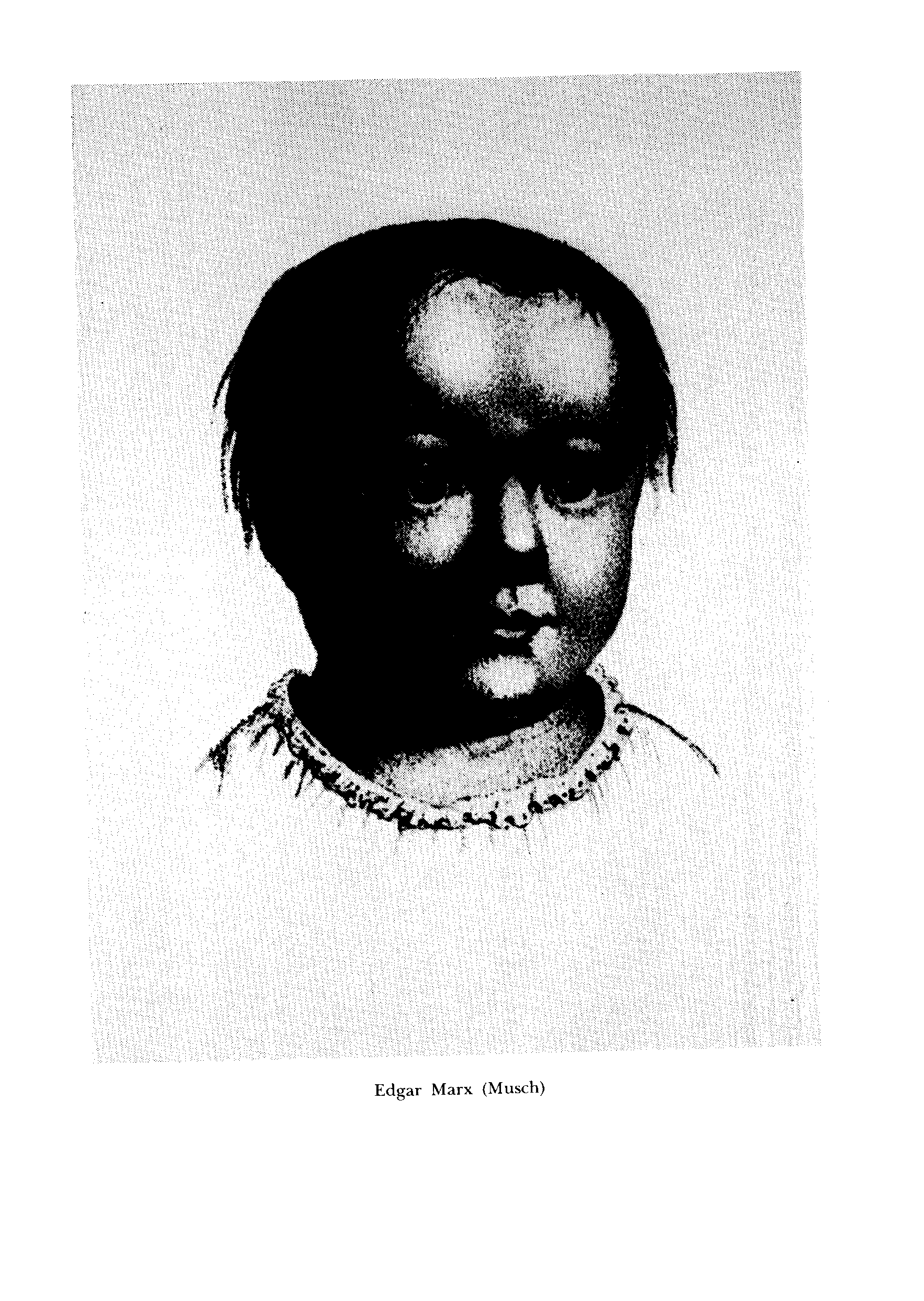
Edgar Marx (Musch)
271. Marx to Engels. 12 April
271
MARX TO ENGELS[21]*
IN MANCHESTER
[London,] 12 April 1855 28 Dean Street, Soho
Dear Engels,
I am thinking of coming up to Manchester with my wife on Wednesdaya; she must have a change of scene for a few days. Unless I let you know to the contrary, Wednesday will be the day. I shall at any rate be writing again on Monday.
Needless to say, the house has been very desolate and bereft since the death of the dear childb who was its life and soul. I cannot tell you how we miss the child at every turn. I've already had my share of bad luck but only now do I know what real unhappiness is. I feel BROKEN DOWN. Since the funeral I have been fortunate enough to have such splitting headaches that I can neither think nor hear nor see.
Amid all the fearful torments I have recently had to endure, the thought of you and your friendship has always sustained me, as has the hope that there is still something sensible for us to do together in the world.
Your
K. M.
My wife has just brought me a line or two for you, which I enclose.
272. Marx to Engels. 16 April
272
MARX TO ENGELS
IN MANCHESTER
[London,] 16 April [1855]
Dear Engels,
I shall be leaving with my wife for Manchester on Wednesday morning by the parliamentary train.[146]
Dronke and I have just seen Badinguet crossing Westminster Bridge.[644] A monkey in uniform.
Your
K. M.
273. Marx to Moritz Eisner. 17 April
I shall be away from London for a few days in company with my wife. Dronke has kindly agreed to carry on with the articles during that time. He will today be sending you a report on Bonaparte's arrival.(1) In case I don't see him again, I am writing to you separately.
The 2 enclosed articles'(2) constitute the beginning of a polemic against pan-Slavism.[609] In my view it is high time that Germany be made seriously aware of the dangers threatening her. You may
274. Marx to Engels. 16 May
print these things when you think fit, for they have nothing directly to do with our regular articles. However I'm convinced that there is no time to lose. The alarm must be sounded in Germany.
In the same context the Berlin 'Critical Criticism'a will be lambasted for its arrogant stupidity.
Your
K. M.
274
MARX TO ENGELS
IN MANCHESTER
[London,] 16 May 1855 28 Dean Street, Soho
Dear Engels,
My wife is most unwell; the household in general still very upset. From the day we left Manchester[645] the weather here has beert unremittingly awful.
Dronke, the litde fool, refuses to send you the Bruno Bauer[646]
until you have sent him his 'rubbers'. The Tetermann'b got packed by mistake. Would already have been returned to you if I hadn't wanted to send it at the same time as the Bruno Bauer. Tell me how you wish it done. If you send the little fool his shoes, you might at the same time send me the Decker, which I forgot.c
I have written to Breslau.[647] No answer yet. In the meantime write and tell me in greater detail how many sheets — whether in separate volumes or ALL TOGETHER—, charges, etc.[609]
275. Marx to Engels. 18 May
At long last a few more Tribunes from Cluss, together with a couple of lines in which he indicates that he will be writing.
Herewith 1. The Sunday Times on the 'Soho scorpions'. 2. A cutting from The People's Paper[3] in which you may read about Mr Jones' curious negotiations with the City reformers,[648] and 'how he was brought down' (clearly the chaps wanted to have the working plebs standing in the street outside their doors as mere super-numeraries, just for SHOW and to demonstrate their movement's popularity). The business is VERY CURIOUS INDEED.
Regards to Lupus.
Your
K. M.
The Political Fly-Sheetsb have now come out as a book. In the foreword Mr Tucker thanks me by namec which, with an Aliens Bill[75] in the offing, is NOT QUITE RECOMMENDATORY.
275
MARX TO ENGELS
IN MANCHESTER
[London,] 18 Mayd 1855 28 Dean Street, Soho
Dear Engels,
My wife has been confined to bed since yesterday evening. As I cannot draw a bill before a week on Tuesday (next),e I should be much obliged if you could send me some money (however little).
The devil take the Tribune] Certainly it is now absolutely essential that it should adopt an anti-pan-Slav line.[649] If it doesn't,
a i.e. E. Jones, 'Political Felony. Infamous Chicanery and Fraud of the Administrative Reform Association', The People's Paper, No. 158, 12 May 1855. - b See this volume, pp. 407-08, 432, 455 and 473. - c Tucker's Political Fly-Sheets, London, 1855, p. 1. - d March in the original. - c 22 May
276. Marx to Engels. 15 June
one might be compelled to break with the rag, which would be disastrous.
As you will have seen in an earlier no. of the Augsburg Allgemeine,a as from next August, the great Herzen will be bringing out a Russian periodical here, the Polar Star}b
My warm regards to Lupus.
Your
K. M.
276
MARX TO ENGELS
IN MANCHESTER
London, 15 June [1855] 28 Dean Street, Soho
Dear Engels,
Your articlec just arrived (4 o'clock in the afternoon). Our inebriated postman had already passed the door when Lenchen grabbed him and took away the letter. From Dana's letter,[650]
enclosed herewith, you will see that he is asking for 1. a column on the Prussian army for the Tribune, 2. a sheet on all the European armies for Putnam's Review.d If you have no time to do the latter, you must send me the material and I shall have to do it.[651] It is true that, in the latter case, my unfamiliarity with the subject would make for a sorry result, but I cannot let slip the £10 to be earned in this way, for, on the one hand, no money is yet coming in from the legacy and, on the other, expenses have been very heavy; added to which there has been a loss of earnings, since the worthy Dronke did not keep the Neue Oder-Zeitung supplied during my absence (despite his promise) and, as to the Tribune itself, there was still an overdraft outstanding (only cleared off by today's poste).
277. Marx to Engels. 26 June
With regard to the Petermann? I sent it to Manchester by Pfänder, together with a note, while you were away in the LAKES. Pfänder is now in Manchester again, so will be able to give you particulars.
For Lupus: Lost his bet. The pubs here open at 1 o'clock on Sundays, not half past twelve.
These lines in great haste. More in my next.
Your
K. M.
Apropos: Bruno Bauer has brought out a pamphlet on the Russian Church.a
277
MARX TO ENGELS
IN MANCHESTER
[London,] 26 June 1855 28 Dean Street, Soho
Dear Engels,
I did not send off any article last Fridayb because [articles dispatched] simultaneously from London and Manchester would have aroused the fellows' suspicions. On Tuesday (last)c I sent off an article of an entirely general nature on Bonaparte's diplomacy, the treaties of 1815 and the Prussian Field Marshal Knesebeck.d
For at the Congress of Vienna the latter cracked some good jokes about the Poles.e
Next Fridayf it will be virtually impossible to avoid writing a military piece about the affair at Malakhov and Redan on the anniversary of Waterloo.[652] Tomorrow and the day after I shall go
278. Marx to Engels. 29 June
to the library and look up something on the Spanish army. You shall have what I can find by the end of this week in any case. Regarding your pamphlet (1) Eisner writes to me:
'You have far too lofty an idea of our booksellers if you believe that any one of them would consent to bring out something written by Engels. All those I asked refused, no doubt because they are afraid of acquiring the reputation of being revolutionary.... Should you intend making inquiries in Berlin, perhaps Alexander Duncker would be most likely to take the work.'
Weerth could negotiate with Duncker.[653]
The demonstration in Hyde Park on Sunday afternoon had quite a revolutionary air.[654]
This short note is written to the accompaniment of an appalling toothache which has been plaguing me for a week now.
Salut!
Your
K. M.
278
MARX TO ENGELS
IN MANCHESTER
London, 29 June [1855]
Dear Engels,
When you have read the accompanying scraps, you will say: multa INSTEAD OF multum* And rightly so. I was unable to find the most important item, viz. the number and calibre of guns for Spain, although I leafed rapidly through the whole book of Ordenanlas. You'll find something in this respect about the mountain artillery in one of the notes. To judge by a passage in
279. Marx to Engels. 3 July
the Portuguese Revista militar, Spanish artillery is largely on a French footing as regards matériel.
I have got together all manner of stuff, some of which may be of use.
Salut
Your
K. M.
Where Minutoli (Baron) quoted, reference is to his book: Spanien und seine fortschreitende Entwicklung etc., Berlin, 1852.
I believe it's that swine of a policeman. Was and still may be Prussian Consul General in SPAIN and Portugal.
279
MARX TO ENGELS
IN MANCHESTER
[London,] 3 July 1855 28 Dean Street, Soho
Dear Frederic,
The £5 received on Monday. For 3 days I have been rummaging through a mass of stuff at the Museum[651] without finding anything about the Neapolitan army save for the following, which may also be found in MacCulloch's Dictionary Geographical, Statistical etc.
In 1848 the army NEARLY 49,000 strong (this seems to be its war footing, as I find it given {in a Dizionario Politico, Turin} as 26-27,000 strong in 1840). Of these, 32,000 INFANTRY OF THE LINE, 5,000 CAVALRY, 4,000 ARTILLERY AND ENGINEERS, and 8,000 gendarmes. They claim to be able to increase their army to 64,237 and this is given as the official war footing.
I discovered from Ricciardi that the son of Ferdinand I a and father of King Bombab first engaged the Swiss — in 1824 or 1825 — for 30 years (the Neapolitan army having aped the Spanish and mutinied) at 3 times the pay of the NATIVE ARMY. Since the government of the Two Sicilies relies on Swiss and lazzaroni at home and on the Austrian army abroad, and itself estimates at zero its badly paid, undisciplined, demoralised, cowardly army, I believe that in any survey of the European armies, this estimate made by its own government could be accepted, the army put at zero, and its strength mentioned only en passant.
There might be something more detailed in Mariotti. But I couldn't get hold of it as it was always 'IN HAND' whenever I asked for it.
Our tamily life here is still melancholy. My wife still very unwell. The memory of our poor, dear childc torments us, and even interposes itself in his sisters"d play. Such blows can only be mitigated slowly, with the passage of time. To me the loss is as poignant as on the first day and hence I can tell how much my wife is suffering. Should the Scotch moneye arrive in time I shall spend a few weeks in Kent, where plenty of cheap and pleasantly situated places are said to be available.
The scenes in Hyde Park last Sunday were DISGUSTING, firstly because of the CONSTABLES' brutality, and secondly because of the purely passive resistance put up by the huge crowds.[655] However, things are clearly seething and fermenting and we can only hope that great disasters in the Crimea will bring them to a head.
Your
K. M.
Vol. XXII, Moscow, 1929
280. Marx to Engels. 17 July
280
MARX TO ENGELS
IN MANCHESTER
[London,] 17 July 1855 28 Dean Street, Soho Dear Engels,
Strohn is here and, unfortunately, prevents me from sending an ARTICLE to the Tribune today. I therefore intend to send off on Friday,3 under Tuesday's date, an article on the latest ministerial crisis, and I should be very grateful if, at the same time, you would send me one on, say, the Prussian army (assuming that nothing occurs in the theatre of war),b so that 2 articles go off at once. For I shall be compelled to draw a bill on the Tribune next week, or rather overdraw and appreciably so at that, as I had already overdrawn last time, and this time several days have been missed.
A German returning from Yankeeland, Gustav Pöckel, brought me a line or two from Edgarc and more detailed news about him and other acquaintances. Of late, Edgar had been working as a farm labourer near New York and intended to sell his farm in Texas. Schramm d is said to be dying of consumption and is also in New York State. Ewerbeck passed through about eighteen months ago on his way to visit Cabet in Nauvoo. Fickler took over the Shakespeare Hotel after Lièvre went bankrupt, making the most of the occasion to do the dirty on him. JacobiV affairs are prospering; the Yankees like his 'serious' and 'reserved' manner. Field Marshal Blenker and a few other notorious swindlers from the days of the revolution comedy have bought up real estate with the stolen funds and, as regards swagger and brutality towards their workpeople, are said to put the Yankees completely in the shade. Heinzen has re-established himself in New York with his Pionier. All in all, things are going very badly for the Germans over there, at one and the same time harassed by the Maine Law, KNOW-NOTHINGS[656] and the crisis in agriculture and industry. Hence a substantial re-emigration to Germany, Canada and South America.
Through the mediation of German merchants in Paris (one of them a supporter of the Neue Rheinische Zeitung) Dronke has received an affirmative reply to his application for permission to return to Paris. He proposes to set off this week, as soon as he has recouped the 'costs of production'.
Imandt is in Scotland for 4 weeks on a visit to Heise. He has placed his COTTAGE in Camberwell at my disposal in the meantime. The whole FAMILY will move there and avail themselves of the change of air until we can afford something bigger.
As to the enclosed letters:
No. I. From Lassalle in Paris. No. II. I send you for your amusement Szeredy's Asiatic Chiefs, together with the fellow's appeal to me.[657]
No. III. Letter from Florencourt (the only one you need return). Contains an account of how things stand with the legacy.a You will observe on the one hand that the legacy has increased by £515, while on the other all manner of delays are militating against its rapid realisation. This Florencourt is not the notorious one,b but his brother.
Your
K. M.
Do you know of any book on the êtresc of LITTLE Johnny Russell?[658]
281. Marx to Ferdinand Lassalle. 28 Julyd
Dear Lassalle,
I have been staying in the country for the past few weeks in a cottage lent me by a friendc who is away in Scotland. That is why I did not get your letter until yesterday. I have, incidentally, taken
282. Marx to Engels. 7 August
steps to have my letters forwarded to me immediately from town.
I am, of course, surprised to hear that, despite your proximity to London, you are not thinking of coming over here, if only for a few days. I hope that you will think it over again and discover how short and cheap the journey from Paris to London is. If France's doors were not hermetically closed against me, I would pay you a surprise visit in Paris.
I have several friends in Paris, but I.shall not be able to send you their addresses (I am not in town at the moment of writing) until I go to Soho, where I keep them.
Bacon says that really important people have so many relations to nature and the world, so many objects of interest, that they easily get over any loss. I am not one of those important people. The death of my childa has shattered me to the very core and I feel the loss as keenly as on the first day. My poor wife is also completely BROKEN DOWN.
If you see Heine again, give him my regards.
Your
K. M.
Published in Etiglish for the first time
282
MARX TO ENGELS
IN MANCHESTER
[London,] 7 August 1855 28 Dean Street, Soho
Dear Engels,
The FAMILY (hence, for the most part, (Tlyself also) still in Camberwell. Pieper came and stayed with us for a week. I was thus prevented from writing, save for the necessary pieces for New York AND GERMANY. The article on the 'ARMIES' is splendid.0
From the enclosed letter from Steffen you will see what a bad state our friend Daniels and Bürgers are in. I am particularly sorry about the first. I don't know whether, in my résumé of the
283. Marx to Engels. 1 September
report by the visitor from Yankeeland,a I mentioned that Conrad Schramm is consumptive and is taking a cure of ass's milk chez former Field Marshal Blenker.
In the past weeks I have sent the Tribune a series of articles — i.e. 3 — about Lord John Russell in which the little man is passed in review from the very beginning.[659] However, it will soon be necessary to say SOME WORDS about the war and also, perhaps, about how the affaire is going in Asia.
Dronke has suffered a bitter disappointment. For it eventually transpired that the issue of a passport to Paris had been due to a misunderstanding on the part of the French Embassy; rather, express instructions had been given that he was not to be admitted into France. In a few days it will be decided whether or not he has obtained a post in Jersey.
Bonaparte has, within the bounds of pure reason, solved the problem I set him, namely 'to steal the whole of France in order to make a present of it to France again'.b His manoeuvrings over the loan are significant experiments in that direction.
What do you think of the Austrian concentration of troops in Italy? Have you seen the 2nd Mémoire d'un Officier Général?[660]
Your
K. M.
283
MARX TO ENGELS
IN MANCHESTER
1 September 1855 3 York Place, Denmark,c
Camberwell
Dear Frederic,
Imandt has gone off to Montrose and chucked up his whole CONCERN here for the highly dubious prospect of a post in Arbroath. I have taken over his goods and chattels and shall remain here until the arrival of the Scotch money.3 Then I shall rent some decent lodgings. Until then I shall have to keep the house in Dean Street. The country air has suited the whole FAMILY uncommonly well, my wife especially.
Received your article15 yesterday. The Russian report is now in all the Hamburg papers as well.
As regards Putnam's, we must now get a move on. In a letter I got from Dana he already evinced anxiety lest No. 2C should arrive too late. But it was there on time, as I see from a subsequent letter.d Putnam has asked for another article on 'THE IMPROVEMENTS IN MODERN WARFARE'. The New-York Times contains criticism which is generally favourable, but clearly grudging: off duty, Englishmen don't wear 'narrow trousers', their squadrons number more than 400 SABRES, and a ? after 'SABRES' too, and, lastly, the writer seems to be unaware that in England flogging is now restricted to 50 strokes and is inflicted only in exceptional cases. The business at Aldershot where, ABOUT H DAYS ago, a SOLDIER died from 30 strokes of the lash, is comment enough on the criticus concerning whose nonsense I have sent Dana the requisite observations.[661]
Have you been following Napier's row with Graham? The 1st article was in The Times, the 2nd in the Advertiser and the Herald?[62] Today the Advertiser's first LEADER contains the exchange of letters between Charley and James. A reply from Graham to Napier's first articles is also, it seems, to appear in one of today's papers.
I wonder whether you have noticed that the Austrians made use of the time they were deploying their armies in Galicia to construct, under Hess' general supervision, railways of solely strategic importance; likewise fortifications directed against Russia.
I hope that you will now write and tell me something about yourself and your doings.
Your
K. M.
Unless I am mistaken, our Koscielski also appears in Pélissier's battle report.'
284. Marx to Engels. 6 September
If Admiral Bruat's account in today's Times* is to be believed, the Russians are at STARVATION-POINT. At any rate, there would not as yet appear to be any shortage of spirits.
284
MARX TO ENGELS
IN MANCHESTER
6 September 1855 3 York Place, Denmark Street (not Hill, which is merely the GENERAL NAME for the whole place) Camberwell
Dear Engels,
You may already have read about the death of our friend Daniels in the Kölnische Zeitung.h He is no more nor less than a victim of the infamies of the Prussian Police. I shall be writing a few lines to his wife,c and you must do the same. Address: Frau Doktorin Amalie Daniels, Schildergasse, Köln. It would be desirable if Lupus did likewise. I know by experience how welcome letters from friends are at such a time. I shall write a short obituary of our poor friend for the Tribune. So far as the German-American Press is concerned, I think the best plan would be to insert in the New York Neue Zeit (nominally edited by Bernhardt, in fact by Löwe of Calbe) a brief obituary notice signed by you, Freiligrath, Lupus and myself. Also to denounce the proceedings against Bürgers.
You will have heard that O'Connor died a few days ago. Jones' wife is mortally ill. The poor devil is AT THIS MOMENT IN
DESPERATE CIRCUMSTANCES.
A STEAMER is leaving on Tuesday. It is essential in the case of Putnam's that the thing should be in New York by 10th October at
285. Marx to Amalie Daniels. 6 September
the latest. Have you received the copy that was sent you?a Those inane bits of hair-splitting did not appear in the Tribune but in The New-York Times, the RIVAL PAPER.[1]" As for Aldershot, the business was simply as follows: About a fortnight ago 2 privates were sentenced, one to 50 lashes, the other to 30, for 'disrespectful' behaviour towards their superiors. As is often the case, the CAT-o-NiNE-TAiLS was steeped in urine. The first man had to be sent to hospital after receiving 40 lashes, and the second died shortly after receiving 30. There would appear to be no further question of an inquiry.
In The Morning Advertiser, Blind continues 'TO SHAKE THE DESPOTIC
POWERS OF EUROPE TO THEIR VERY FOUNDATIONS'.
A German rag has reappeared in London, the actual rédacteur en chef" being the ill-famed Sigmund Engländer, of Paris police memory. Chief contributors: Ronge, the Russian Herzen and a drunkard by the name of Korn, allegedly an ex-captain.[663]
Vale.d
Your
K. M.
285
MARX TO AMALIE DANIELS
IN COLOGNE
London, 6 September 1855 28 Dean Street, Soho
My Dear Mrs Daniels,
It is impossible to describe the grief I felt on hearing that dear, unforgettable Roland had passed away. Although the latest news reaching me through Steffen had been far from reassuring/ I did
a Putnam's Monthly for August 1855, containing the first article in Engels' series 'The Armies of Europe', which is referred to here. - b See this volume, p. 546. - c chief editor - d Farewell. - e See this volume, pp. 544-45.
Published in English for the first time not for all that ever abandon hope of your excellent husband's recovery. His was a sensitive, finely-tuned and altogether noble nature — character, talents and physical appearance in rare harmony. Seen amongst the others in Cologne, Daniels always seemed to me like the statue of a Greek god deposited by some freak of fate in the midst of a crowd of Hottentots. His premature decease is an irreparable loss not only to his family and friends but also to science, in which he gave promise of the finest achievements, and to the great, suffering mass of humanity, who possessed in him a loyal champion.
I am sufficiently acquainted with your heroic nature to be convinced that imperishable grief will not prevent you from remaining the loyal guardian of the beloved pledges left you by Roland. In his sons you will compensate the world twice over for the loss of the father.
The news of this new loss has revived in my wife such vivid memories of the death of our only little son(1) that her state of mind does not permit of her writing to you just now. She is weeping and lamenting like a child.
Consolation I will not venture to offer you since I myself am and shall remain inconsolable for [the] loss of a friend who was more dear to me personally than any other. Grief such as this cannot be alleviated, but only shared. As soon as I get over my first stormy emotions, I shall send an obituary to the New-York Tribune for the many friends of the departed in America. It is to be hoped that circumstances will some day permit us to wreak upon those guilty of cutting short his career vengeance of a kind sterner than that of an obituary.
You will need no assurance on my part that you can always count on me as a loyal and devoted friend.
With my heartfelt sympathy,
Yours
K. Marx
286. Marx to Engels. 11 September
286
MARX TO ENGELS
IN MANCHESTER
11 September 1855 3 York Place, Denmark Street, Camberwell
Dear Engels,
Like the Russians, I have been compelled by force supérieure TO EVACUATE THE SOUTHERN SIDE without, however, blowing everything up behind me.[664] Indeed, my garrison will remain quietly here, whither I also propose to return IN A WEEK OR SO. In other words, I am obliged to withdraw to Manchester for a few days and shall arrive there tomorrow evening. I shall have to stay there incognito, so don't let anyone know about my presence — Lupus, OF COURSE, EXCEPTED, should you by chance see him.
I have amended your lettera just received, to accord with the latest telegraphic dispatches.
Salut.
Your
K. M.
287. Marx to Moritz Eisner. 11 September[665]b
It was impossible for me to write last week because of legal proceedings taken against me by the worthy Dr Freund. He has actually compelled me to leave London for a week or so. During
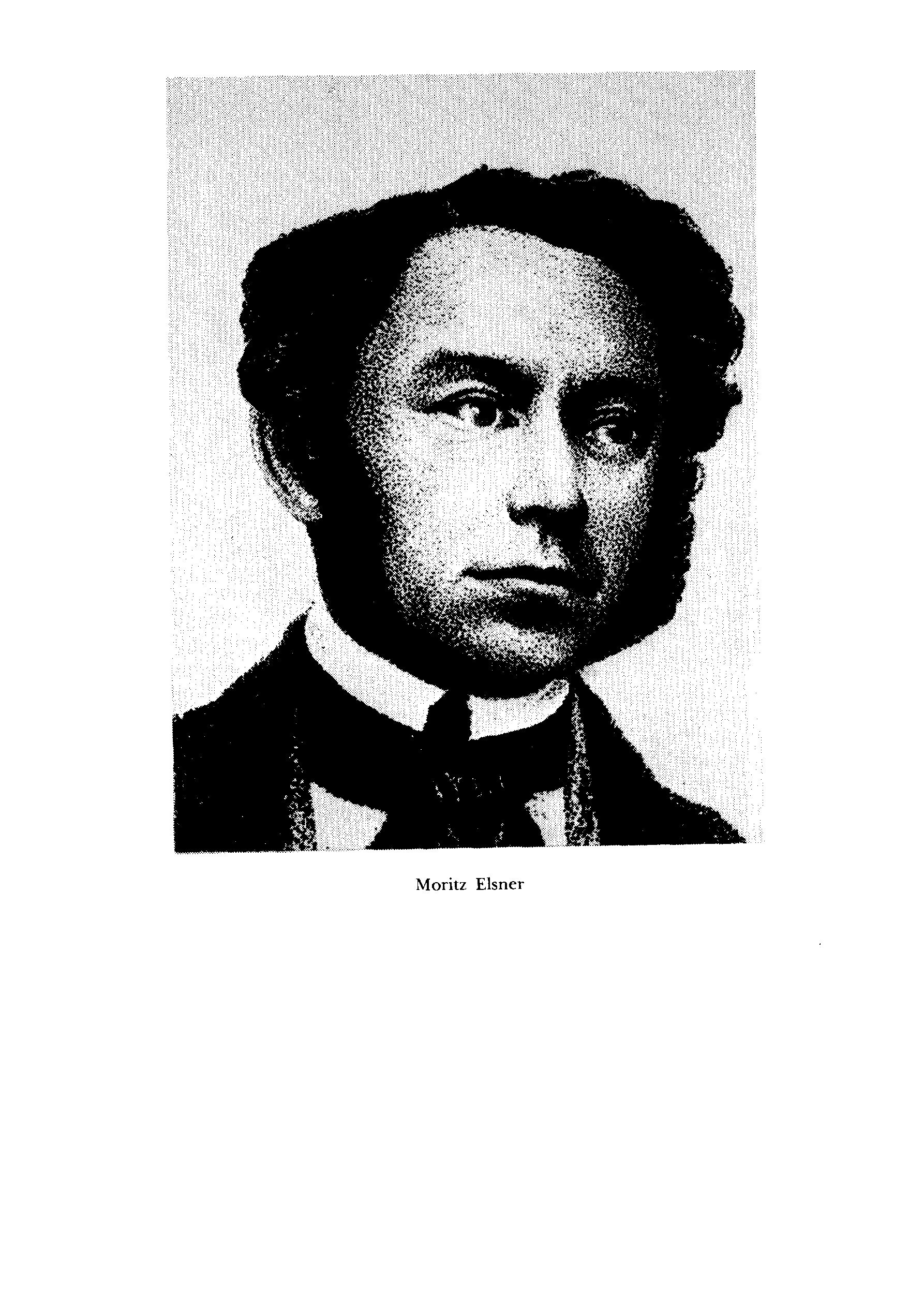
Moritz Eisner
the parliamentary recess this does not, of course, impair my efficiency as a correspondent. This month, therefore, you should not put me on your books until 11 September.
It goes without saying that, should your paper cease to pay yet still remain viable, my contributions will be at your disposal then as now.
Considering the difficult circumstances and the limited space at your disposal, your paper is, in my opinion, edited with great skill and tact, and in such a way that the intelligent reader may read between the lines. Nothing can be more fatuous than to censure you for receiving 'constitutional' money. Some very 'constitutional' citizens paid in shares for the Neue Rheinische Zeitung. If these gentlemen subsequently came to regret it, they were at least never forbidden by the editorial board to go on paying.
If I were not so afraid of compromising this or that acquaintance by the mere fact of corresponding with him, I should long since have written to the Rhine Province in the interests of your paper. At all events, Lassalle did wrong in failing to draw attention to the Neue Oder-Zeitung in Cologne, etc. Circumstances would have allowed him to do so.
Should the N. O.-Z. go under, we shall have to console ourselves with the thought that all our present doings, activities and beginnings are purely provisional and no more than a pis aller.
With kindest regards.
Yours
K. M.
A German weekly rag has been started in London, its founder being the French ex(?)-policeman and Viennese refugee, Sigmund Engländer. Contributors: the Russian Herzen, Johannes Ronge and a drunkard by the name of Korn, allegedly a capitaine^
Works, First Russian Edition, Vol. XXV, Moscow, 1934
288. Marx to Moritz Eisner. 8 November
IN BRESLAU
Manchester, 8 November 1855 34 Butler Street, Green Keys
Dear Eisner,
I have received both your letters,[666] the first somewhat belatedly because my wife accidentally delayed sending it on to Manchester. After receiving your first letter I thought you had resigned from the Neue Oder-Zeitung and for that reason at once ceased to send any articles. When your second letter arrived I was suffering from such a FIT of toothache — which persisted until a few days ago — that I could no more write than I could hear or see.
I passed on your letter of 7 October not only to friends but also to adversaries, and the latter seemed thoroughly taken aback. That I and my friends are in no way affected by the dogmas of Messrs Temme and Simon of Breslau you will readily believe without any further assurance from me.
I do not see Hoyoll, but Lupus does — from time to time. Patriotism has led this Hoyoll to introduce the Breslauer Zeitung into the Athenaeum[244] here, a circumstance which threatens to drive our little Wolffa out of what is virtually the only home of the Muses in Manchester.
I have conveyed your greetings to Borchardt, whom I know well. Borchardt maintains a regular and intimate correspondence with Citizen Simon of Breslau. Upon his first asking me whether I knew that the N. O.-Z. lived in sin with the constitutionals, I replied: 'Qu'est ce que ça me fait? h Don't you know that, in my view, constitutionals and democrats, at least of the Prussian variety, are all much of a muchness? And is a distinction now to be drawn between democrats who have accepted one royal imposition while rejecting another and those who, having submitted to the one, also submit to the other?[667] The N. O.-Z. expresses the most extreme views possible in the present condition of the Press. What more do you ask?'
I have had letters from particularly well-informed people in Paris. According to them, the Empire's stock is sinking lower and
Wilhelm Wolff - b What's that to me?
lower. In the faubourgs the slogan, 'Celui-ci s'en ira'* is said to be on everyone's lips. Indeed, the gravity of the situation may be deduced from two PUBLIC FACTS: the speech made by Rouland, the procurateur-général? and Granier de Cassagnac's article in the Constitutionnel, 'Sur les terreurs de la Révolution future'.0 The probability of the latter is beyond doubt even to Mr Granier.
As for the scandal here over the 'refugee question' (Jersey, etc.), there's more smoke to it than fire.[668] PUBLIC OPINION has definitely turned against the GOVERNMENT and, in fact, I believe that this was allowed for in the latter's calculations. So crassly, with such tragi-comical mouthings, did they accede to Bonaparte's first demands, as virtually to demonstrate that further concessions were not within the power of an English government. Had they been in earnest, they would have shown themselves more adroit and not have carried out the grotesque coup so long before the opening of Parliament. Palmerston, OF COURSE, has no love for the refugees, but regards them as wind-bags to be kept to hand so that he may occasionally threaten the Continent with a 'Quos ego!'ä His ministerial position, by the by, is exceedingly precarious. But it will still be difficult to unseat the old fox.
When you next write, kindly send your letter to my old address, 28 Dean Street, Soho, London, since I don't know how long I shall be remaining here, and letters sent to the above address will in any case come into the hands of my wife. Ronge is running kindergartens in London along with his wife; Kinkel, no less than Johanna,[6] hopes that the revolution will not be unduly precipitate; in Brighton, Ruge gives an occasional lecture, leading the English to believe that the German language is the most debased of all; Tausenau, Meyen et tutti quanti[1] abuse the French emigre 'riff-raff (not excluding Victor Hugo) for imperilling the 'right of asylum' of these 'officially authorised conspirators'.
Engels and Lupus send you their warmest regards. I haven't seen Borchardt for a fortnight.
Yours
K. M. First published in: Marx and Engels, Printed according to the original Works, First Russian Edition, Vol. XXV, Moscow, 1934 Published in English for the first '__ time a 'This fellow will go' (paraphrase of the eighteenth-century French revolutionary song Ça irai). - b [G. Rouland,] Discours de M. le Procureur Général, Journal des débats politiques et littéraires, 5 November 1855. - c 'On the terrors of the future revolution'. - d 'Those whom...' (cf. Virgil, Aeneid, I, 135). - e Kinkel's wife - f and all the rest
289. Marx to Ferdinand Lassalle. 8 November
IN DÜSSELDORF
Manchester, 8th November 1855 34 Butler Street, Green Keys
Dear Lassalle,
Herewith a very belated answer. In the first place, I did not get your letters [669] until later because I was in Manchester whereas the letters were in London and my wife did not know for certain whether I hadn't already left Manchester. For another thing, I was plagued by the most atrocious toothache, so much so that I experienced what Hegel demands of sensual consciousness at the stage at which it is said to override consciousness of self — viz. the inability to hear, see, and therefore also to write.
As regards your query about the book entitled: Les mystères de la Bourse by Coffinières, I believe that this miserable concoction is still among the books I left behind in the fatherland. During my first stay in Paris[670] the title misled me first into buying the thing and then into reading it. Mr Coffinières is a lawyer who, au fond,3
knows nothing about the Bourse and merely warns against the 'legal' swindles perpetrated by the 'agents de changé? So there's nothing to be got out of the book — neither FACTS, nor theory, nor yet even entertaining anecdotes. Moreover, it is now completely out-of-date. 'Sweet Donna, let him go'—i.e. Coffinières. 'He is not worthy of thy wrath'.c
Weerth is now back in Manchester after a lengthy journey via the Continent (he returned from the West Indies at the end of July). In a week's time he will be off to the tropics again. It's very amusing to hear him talk. He has seen, experienced and observed much. Ranged over the better part of South, West and Central America. Crossed the Pampas on horseback. Climbed Chimborazo. Likewise stayed in California. If he no longer writes feuilletons,[671] he makes up for it by recounting them, and his audience has the benefit of vivacious gesture, mime and waggish laughter. He is, by the by, full of enthusiasm for life in the West Indies and hasn't a good
290. Marx to Engels. 7 December
word to say for the human riff-raff and the weather of this northern clime. And, INDEED, things are bad here, very bad.
You will have read in the papers about the Jersey affair[668] and the general to-do over the refugee question in England. I don't believe that this affair will take a serious turn. Nor, for that matter, do I believe that the government here had a serious end in view. Otherwise the row would have been saved up until just before the opening of Parliament. As it is, PUBLIC OPINION has been given time to swing back and, in many respects, has already done so.
Send your next letter to my old address in London as I'm not sure how long I shall stay up here with friend Engels. He and Lupus send you their warm regards.
Your
K. M.
290
MARX TO ENGELS
IN MANCHESTER
London, 7 December 1855 28 Dean Street, Soho
Dear Frederic,
Jones does not appear to be in London. At least, I haven't had an answer, either oral or written, to an urgent written enquiry.[6 2]
Thus, since my arrival here, I have been incarcerated within 4 walls which, after all, I can't spend the whole day haranguing. But just now it would be too risky to venture out of doors.
The documenta did not go off to the Union Bank until the day before yesterday. The delay was caused by all sorts of little things.
No reply yet from America, i.e. New York. The gentlemen would appear to be 'deliberating*.b No letter from Washington, but a Wecker and with it a note, patently by Cluss, attacking Schimmelpfennig. Alas, I used up the Wecker during an unconsidered moment in a place where 'hard words, soft paper, etc' It contained the assertion that the Germans in America were UTILITARIANS and pursued 'bread-and-butter' because 'Mr Marx is an economist and an abstruse one'. But in Mr Marx's case this could be attributed to the 'Old Testament'. 'By a well-known trick' he had 'turned "our relations" into a philosophical system'. That thoughtful young Germans in America should follow his lead was attributable to the fact that Germans are accustomed 'to echo clever writers belonging to the nation of the Old Testament etc'
Since ABOUT the time of my return here, the Advertiser has been the arena for a cockfight between Herzen and an anonymous antagonist. His antagonist reproaches him with being a humbug and having passed himself off as a kind of Russian Silvio Pellico.a
Even the title of his book 67S is said to be a lie, inasmuch as he has never been in Siberia, etc. Feeble reply from Herzen b: the title was humbug on the PUBLISHER'S part, he [Herzen] had not been responsible for it and had immediately protested in the Globe,c etc. against the attributes wrongly ascribed to him, etc. Whereupon his antagonist came forth again (yesterday) and gave evidence of fresh lies, also in respect of the Globe.d Besides this attack, however, there was also a DEFENCE put up by an Englishman e. Even if Herzen had not been in Siberia and was no Russian Silvio Pellico, his book was nevertheless amusing, an innocuous book: *'an honest man, look you, and soon dasht! He is a marvellous good neighbour in sooth; and a very good bowler; but, for Alisander, alas, you see, how 'tis.' *f Finally, the TUB-TUB PAPER, as is its wont, declared that the contest was becoming too personal, etc., was now over and closed its columns to it.g At all events this skirmish — even though the assailants were hardly brilliant — will do Herzen a great deal of harm in the eyes of the COCKNEYS.
Linah has informed me of some fresh details concerning the Cologne trial. The list of jurymen given in my pamphlet' quite
291. Marx to Engels. 11 December
wrong, of course. Throughout the trial one of the jurymen— Joest — drew caricatures of the accused, and passed the drawings round in court. During the first week the worthy jeune* Saedt always had a dagger lying in front of him. At length the ironical laughter of the accused compelled him to 'wear the dagger under his gown'.b Can one imagine a more affected COXCOMB? Saedt with a dagger! C'est à crever de rire!1
Burgers whiles away his time sending Mrs Daniels 'endless amounts of paper'. Also writes poetry. Exchanges not a word with his fellow-sufferer.
A London daily PENNY PAPER, The Telegraph, is said to have already dropped a number of HINTS about the underhand dealings of Dr Freund and his fellow-swindler, a military man.
The 2 articles received.[674]
Salut.
Your
K. M.
I almost forgot the most important point. A few weeks ago, 3 I THINK, Zitschke came to see my wife. The conversation turned to Mirbach.d QUOTH Zitschke: 'That old loafer had a splendid chance of a passage. I had thought him long since at sea. Then I found him sitting again at a table in Bibra's pothouse and looking very down-at-heel.' Liebknecht, too, claims to have seen him recently.
291
MARX TO ENGELS
IN MANCHESTER
[London,] 11 December 1855 28 Dean Street, Soho
DEAR Frederic,
From Dana's letter, enclosed herewith, you will see that our manoeuvre has succeeded.[675]
292. Engels to Marx. 12 December
Otherwise, everything as before. I still incarcerated. Jones not yet turned up.
Bürgers will be allowed to move to another fortress if he pays the travelling expenses himself. Weerth had half promised Bürgers' mother in Cologne to send her money for him. Hasn't kept his word.
Little Dronke corresponds regularly with Freiligrath. Had a great set-to with one of the partners, was on the point of giving up his post. To make himself look important, offered it to Freiligrath.
Your
K. M.
292
ENGELS TO MARX
IN LONDON
Manchester, 12 December 1855
Dear Marx,
Something can be arranged with the good Tribune people after all, you see, and the £200 are assured. So that a start can be made straight away, I shall do a military article this evening, then you must do a political one. Both of them can then go on Friday," hoc facitb £4. I return Dana's letter herewith.[675] Au fond,0 it is all to the good that the noble Mirbach has settled down to a life of idleness in London, for after all nothing has been definitely settled with the New Yorkers about the Crimean articles.[676]. At all events, I am now relieved of any indirect obligation to the chap, and il ne me regarde plus.d I have said nothing at all here about the matter, otherwise it would give Lupus qualms of conscience in the end, and next time he would turn rebellious.
Jmeyer3 wrote to me recently, not so much to inform me that he was still awaiting a letter from you, as to let me know what to say at my brother-in-law'sb at Christmas. He has heard nothing at all from the little man.c
We shall bear in mind Mr Karl Joest and his caricatures.0 I believe I shall do an even better caricature of him when he is dangling from a lamp post.
Whether I shall be able to do an article on Tuesday' depends, of course, on events, which are now very few and far between. Kars and Omer Pasha will have to be my victims today; if anything happens tomorrow I shall add it on.[67]
The STRIKE is going ahead here. The MASTERS said that they were willing to pay/ provided the Ashton rates were taken as a basis. The HANDS replied that if the MASTERS chose Ashton, they would choose Oldham and be prepared to accept as a basis the average for the two places. Thereupon the MASTERS gave an evasive answer and proposed yet a third place in the district as a norm. This was refused and there the matter rests. The HANDS seem to me to be completely in the right; but they obviously still have in mind a few old trade union traditions whereby only this or that machine may be operated and only in the specific, time-honoured manner. But they'll soon drop this rubbish. The neighbourhood is beginning to support them.
The editorg of the Guardian, whom I've come to know, is a wise man IN HIS OWN MIND and a kind of oracle in the eyes of a number of philistines; apart from that a teller of dirty stories and a moderate carouser. He has obviously heard about me for, whenever I mention some shabby trick, he listens with attention and asks questions which show a desire to know. I shall gradually encourage the man's advances and then draw him out about the people on the Examiner and Times, after which I shall approach the latter rag. Après, on aviserai
Warmest regards to your wife and children.
Your
F. E. First published abridged in Der Briefwech-Printed according to the original sei zwischen F. Engels und K. Marx, Bd. 2, Stuttgart, 1913 and in full in: Marx and Published in English for the first Engels, Works, First Russian Edition, time Vol. XXII, Moscow, 1929
293. Marx to Engels. 14 December
293
MARX TO ENGELS
IN MANCHESTER
[London,] 14 December 1855 28 Dean Street, Soho
DEAR Frederic,
This confinement to my room is beginning to weigh on me. Not one breath of fresh air yet. Meanwhile, another 1,000 Germans sent off yesterday. Jones supposed to be coming today, at last.
The day before yesterday evening I had a visit, you'll never guess from whom. Edgar Bauer — whom I hadn't seen for about a year — came to see me, and with him — Bruno. He's already been here a fortnight and intends to remain ABOUT 6 MONTHS 'in order to prove his assumptions' which he can hardly fail to do, considering the way he's begun. The man has aged visibly, his forehead has broadened and the impression he now gives is more or less that of a pedantic old professor. For the present he is lodging with Edgar in a hovel SOMEWHERE ABOUT the far end of Highgate and there he squats, amidst the most profound petty-bourgeois misère, seeing and hearing nothing. This he takes to be London and believes that, apart from the privileged 30,000, all the English live like Edgar Bauer. Hence his hatred and 'contempt' for the country is enormous. In his view, it's like living in "Treuenbrietzen'.a To anyone coming from 'Berlin', London is a veritable 'prison'. On the same occasion it also transpired that his present ideal is the 'East Frisian', 'Altenburgian' and PARTLY 'Westphalian peasant,b
those true noblemen. He is, moreover, convinced that these clodhoppers cannot be wished away and will be the ROCKS upon which the modern, egalitarian fiddle-faddle, bemoaned by this man of the 'dissolution', will come to grief. It was most CURIOUS to hear the 'Criticism'[678] make the CONFESSION that, in the final analysis, Berthold Auerbach is its true cornerstone. He holds that, save for a few 'purely commercial towns', the towns of Germany are in decline, but that 'the country' is prospering fabulously. He knew not a thing about the rise of industry, but quietly bemoaned the fact that nothing is now being done in Germany save 'IMPROVEMENTS'.
The 'English language' is 'wretched', completely romanicised. For his consolation I proceeded to tell him that the Dutch and the Danes say the same of the German language and claim that the only fellows to have remained truly untainted by Romance are the 'Icelanders'.
The old boy has devoted much time to languages. He speaks Polish and declares in consequence the Polish language to be 'the most beautiful of all'. His linguistic studies seem to have been highly uncritical. He considers Dobrovsky, for instance, to be a far 'more important man' than Grimm,a and calls him the father of comparative linguistics. Moreover, he has let the Poles in Berlin persuade him that OLD Lelewel has refuted Grimm's Geschichte der deutschen Sprache in a recent paper.
Apropos. He also told me that a fat volume (of German provenance) had appeared in Germany attacking Grimm's dictionary.b The whole volume consists of howlers G[rimm] is shown to have perpetrated.
Despite all his efforts to adopt a humorous attitude, his gloom and despondency over the 'present' kept obtruding. In Germany— HORRIBLE INDEED!—nothing is now read or bought save miserable compilations in the field of the natural sciences. When you come,[679] we shall have great fun with the old boy.
Koppen has been working for years on a book on Buddhism.[680]
Rutenberg is the publisher of the Staats-Anzeiger. Mr Bergenroth, who used to drift about America (North and South) as commissioner (trade), has returned sans argent" but with an illness.
I am still waiting for the 2nd edition of The Times or Morning Post. The news may make it necessary to couch the thing on Kars in somewhat more hypothetical terms. However, this would only require quite minor alterations (a few words in the conditional).c ' I, for my part, believe that Kars has fallen.
Today there is a not uninteresting article in the Herald—or so my wife tells me — about Bonaparte's MISGIVINGS AS TO THE TRUE INTENTIONS OF VISCOUNT Palmerston. That Pam is in very bad odour at court you may see from the Times article against Prince Albert." At the same time, again the old manoeuvre of presenting Prince Albert as an encumbrance to the 'Ministry'. **** Salut.
Your
K. M.
1
Endnotes
[615] under the title 'Germany and Pan-Slavism' (see present edition, Vol. 14, pp.
[616] 156-62). They were published in the Neue Oder-Zeitung and under changed
[617] titles in the New-York Daily Tribune (see Note 649).— 505, 534, 535, 539
[72] of the Baden-Palatinate insurgent troops to Switzerland and was the last to
[431] Communist League members in London to help him establish contacts with the
[620] 0 The reference is to the Aberdeen Coalition Government (see Note 343) which
[621] was defeated in the House of Commons on 29 January. On the basis of the
[622] material mentioned here and sent by Marx to Engels with his next letter of 31
[623] January 1855, Engels wrote the article 'The Late British Government' for the
[624] New-York Daily Tribune on 1 February 1855. The same subject was used by
[625] Marx in the articles 'The Defeated Government' and 'Two Crises' for the Neue
[627] Gladstone's financial policy. They were published in the New-York Daily
[630] Turkey and Russia', 'The Russian Humbug.—Gladstone's Failure.—Sir Charles
[632] At the sitting of the House of Commons on 28 July 1853 Gladstone moved
[633] a resolution on measures for creating a public consolidated fund to pay for
[634] shares of the South Sea Company, which in fact meant the failure of the plan
[635] for conversion of the public debt (see K. Marx, 'Financial Failure of
[636] Government.—Cabs.— Ireland.—The Russian Question', present edition, Vol.
[637] 12).—518
[638] Here.Marx gives the date of the reception in Constantinople of the news of the battle of Sinope on 30 (18) November 1853 (see Note 467).—518 On the Note of the four powers see Note 467; on the Vienna Note see Note 476.—518 The reference is to the article 'On the History of the Eastern Question' published in the Journal de Saint-Pétersbourg, No. 336, 18 February (2 March) 1854 in connection with John Russell's speech in the House of Commons on 17 February 1854. The article alluded to the collusion of the Russian and British governments in the Turkish question supporting its statement by reference to Seymour's secret correspondence in 1853 and the memorandum of 1844. Marx analysed the position adopted by the two powers in the articles 'The Documents on the Partition of Turkey' and 'The Secret Diplomatic Correspondence' (see present edition, Vol. 13).— 519 Under a law in force in England since 1662 paupers who changed their place of residence or applied to a parish for alms could be returned to their former place of residence by court decision. On 10 February 1854 a Settlement and Removal Bill was introduced in the House of Commons envisaging prohibition of forced settlement of paupers in England and Wales. The Bill was^rejected by Parliament.—520 Under a law in force in England since the early eighteenth century newly elected MPs were to take an 'oath of abdication' denying the right of any heirs of James II to the throne; the oath contained expressions of loyalty to Christianity. Refusal to take the oath deprived an MP of the right of active participation in the work of Parliament.— 520 Engels' article 'The Late British Government' (see present edition, Vol. 13 and also Note 620).—520 The reference is to Ferdinand Lassalle's letter to Marx of 27 January containing cuttings from the January issues of the Düsseldorfer Zeitung and the Kölnische Zeitung, and Roland Daniels' letter of 16 January 1855.— 521 Marx writes about the traditional banquets of petty-bourgeois emigrants held to mark the anniversary of the February 1848 revolution in France.—521 A reference to the German Workers' Educational Society in London (see Note 24).—521 A reference to the International Committee set up by representatives of the London Chartist Organising Committee (as the Welcome and Protest Committee was called since February 1855; see Note 604) and also French, German, Polish, Hungarian, Italian and other petty-bourgeois refugees. Jones was its President. At the end of 1855 the International Committee became an
[639] independent organisation; renamed the International Association in 1856, it
[640] operated until 1859.— 521 639 Judging by extant documents, Herzen did not attend the meeting, but received
[641] a written invitation to become a member of the International Committee (see
[234] However, owing to its adventurism and to persisting discord among the
[642] Note 638).—521 640 An allusion to Herzen's view of 'old Europe' and 'young Russia' expounded
[643] most clearly in Du développement des idées révolutionnaires en Russie, par
[213] that, circumstances being what they are, he thinks he can do no better than go
[146] Vol. 11) published in that newspaper. He warned revolutionary democrats
[644] A. Iscander, Paris, 1851; La Russie et la vieux Monde. Lettres à W. Linton. Esq.,
[645] par A. Herzen; Le peuple russe et le socialisme. Lettre à Monsieur J. Michelet,
[646] professeur au Collège de France, par A. Herzen. Seconde édition, 1855, and other
[647] works. These publications were used by Marx and Engels.— 523 641 This may be a reference to Herzen's reply to Ivan Golovin's slanderous article
[648] (see this volume, pp. 523-24): 'Reply to Mr. Golovin. To the Editor of The Morning Advertiser', published in The Morning Advertiser on 15 February 1855.—525 642 Marx refers to the anonymous pamphlet De la conduite de la guerre d'Orient. Expédition de Crimée. Mémoire adressé au gouvernement de S. M. l'Empereur Napoléon III par un officier général, Bruxelles, 1855. Its authorship was ascribed to several persons, Prince Napoleon (Joseph Charles Paul Bonaparte) among them. Marx assessed it in the articles 'On the History of the French Alliance' and 'The Brussels Mémoire' and Engels in 'Fate of the Great Adventurer' (see present edition, Vol. 14).— 526 6 4 3 In January and February 1855 Marx read B. G. Niebuhr's The History of Rome, a new edition in three volumes, London, 1847-51, and simultaneously made a summary of it entitled 'Römische Geschichte'.—527 644 Badinguet—a nickname given to Napoleon III because in 1846 he escaped from prison in the clothes of the mason Badinguet. In April 1855 Napoleon III made an official visit to England.— 534 6 4 5 Marx and his wife returned to London from Manchester about 6 May 1855.—535 646 In 1854, in connection with the Crimean War and the exacerbation of the Eastern Question, Bruno Bauer published several pamphlets, among them De la dictature occidentale, Die jetzige Stellung Rußlands and Rußland und das Germanenthum. It has not been established which of these is referred to here.— 535 647 Marx may have had in mind his letter to Eisner of 17 April 1855, but he could have written to him after his return from Manchester, i.e. after 6 May 1855.—535 648 Marx has in mind the supporters of the Administrative Reform Association set up in May 1855 on the initiative of liberal circles in the City. Taking advantage of the alarm in the country caused by the plight of the British army in the Crimea, the Association hoped by means of mass rallies and with the Chartists' support to bring pressure to bear on Parliament and win broader access to government posts for members of the commercial and finance bourgeoisie. The Association failed in its strivings and soon ceased to exist. Marx repeatedly wrote about the Association's activity and its relations with the Chartists; see for instance his article 'The Agitation Outside Parliament' (present edition, Vol. 14).—536 649 Marx considered it essential to publish a critique of pan-Slavist theories in the
[649] New-York Daily Tribune in order to counteract the influence exerted on
[650] American public by the articles and pamphlets of a pan-Slavist contributor to
[652] heavy editing Engels' two articles on pan-Slavism (see Note 609) under the titles
[653] 'The European Struggle' and 'Austria's Weakness' on 5 and 7 May 1855
[654] respectively (see present edition, Vol. 14).—536 650 Dana's letter to Marx of 1 June 1855.— 537 651 Engels wrote the survey 'The Armies of Europe' (see present edition, Vol. 14)
[655] from June to September 1855. He was helped in this work by Marx, who
[656] collected material for him on various European armies, the Spanish and the
[657] Neapolitan in particular, at the British Museum library. The survey was
[658] published unsigned in Putnam's Monthly in August, September and De-
[659] cember.—537, 540 652 On 29 June Engels wrote 'From Sevastopol' (see present edition, Vol. 14) about the Allies' unsuccessful storm of Sevastopol on 18(6) June 1855 — the fortieth anniversary of Waterloo. The main French attack was directed against Malakhov Hill and the English against the Redan (Third Bastion).—538 653 In a letter of 13 August 1855 which has not survived, Engels asked Weerth, then in Hamburg, to negotiate with Duncker about his, Engels', pamphlet on pan-Slavism (see Note 609). As emerges from Weerth's reply to Engels of 24 August, his negotiations with Duncker failed.—539 654 A mass demonstration organised by the Chartists was held in Hyde Park on 24 June 1855, in protest against a series of anti-popular measures adopted by Parliament (in particular, the prohibition of Sunday trading). Marx took part in this demonstration with other German revolutionary democrats and described it in 'Anti-Church Movement.—Demonstration in Hyde Park' (see present edition, Vol. 14).—539 655 Marx has in mind the police reprisals against the participants in the second mass demonstration held, despite the police prohibition, in Hyde Park on Sunday, 1 July 1855, in protest against Sunday Trading Bill (on the first demonstration see Note 654). Marx describes the events in which he took part in 'Agitation over the Tightening-up of Sunday Observance' (see present edition, Vol. 14).—541 656 A law prohibiting the sale of spirits had been in force in the State of Maine since 1851. Know-nothings—a secret political organisation formed in the USA in 1854 against emigrants; the members of this organisation swore to answer 'I know nothing' to all questions about its activity and aims.—542 657 A reference to Szeredy's letter to Marx of 15 July 1855 containing a request for assistance in publishing and distributing his novel Asiatic Chiefs in Britain and the USA.—543 658 Marx made this request because he intended to write the pamphlet Lord John Russell (see present edition, Vol. 14).—543 659 Marx's pamphlet Lord John Russell was published in the New-York Daily Tribune on 28 August 1855 condensed into a single article. The pamphlet was published in full in German in the Neue Oder-Zeitung as a series of six articles
[660] which appeared from 28 July to 15 August 1855 (see present edition, Vol.
[661] 14).—545 660 On the first Mémoire see Note 642; the second Mémoire—Deuzième mémoire
[663] et la conduite de la guerre d'Orient, par un officier général, Genève, mai 1855 — was
[664] ascribed to the French journalist Tavernier and the Belgian officer, adjutant of
[665] the War Minister, T. F. Sterckx. Like the first Mémoire it was aimed at
[666] justifying the actions of the French Command in the Crimean campaign.— 545 661 Marx's letter to Dana has not been found.— 546 662 On 15 June 1855 Charles Napier published in The Morning Advertiser his
[244] der fahrende Ritter auf der wilden, verwegenden Jagd nach dem Schatten
[667] letters criticising the administrative system in the British Navy, the lack of talent
[669] Governor of Jersey expelled several French refugees from the island, Victor
[670] Hugo among them.—555, 557 669 Lassalle's letters to Marx of 24 September and October (exact date not
[671] established) 1855.—556 670 Marx lived in Paris from the end of October 1843 to 3 February 1845 when, on
[674] 1848-49 revolution he wrote essays and feuilletons (in verse and prose) for the
[676] October 1855. It included the second and fourth parts of My Past and Thoughts
[67] 'German-American loan' (see Note 27) to be held in Cincinnati on 3-8 February 1852. Cluss protested against being named as one of the guarantors. On Marx's instructions he exposed the adventurism of the whole idea. Cluss dispatched the text of the statement to Marx in London at the end of February 1852 and had it published in the Turn-Zeitung, No. 6, 1 March 1852.—42, 70, 92 Straubinger—German travelling journeyman. Marx and Engels ironically applied the name to some participants in the German working-class movement of the time who were connected with guild production and displayed petty-bourgeois sectarian tendencies.—43, 137, 410 On 16 February 1852, amidst alarming rumours of Louis Bonaparte's intention to invade the British Isles, Russell moved in Parliament a Local Militia Bill for England and Wales. The government was granted the right, in the event of an enemy attack, to increase the strength of militia detachments previously used only within their respective counties and to subordinate them to the regular army command. When the Bill was discussed in the House of Commons, Palmerston moved an amendment that it should apply also to Scotland and Ireland, and that the word 'Local' be deleted. Palmerston had recendy resigned from the Cabinet (see Note 74) and the adoption of the amendment moved by him was considered by Russell as an expression of non-confidence in the government and served as a pretext for Russell's resignation on 20 February 1852. The Tory Cabinet headed by Derby was formed on 23 February 1852. The Bill became law in July 1852.—44, 49, 284, 520 This name was given in England to Free Traders who advocated government non-interference in economic life. In the 1840s and 1850s the Manchester men formed a separate political group which joined the Liberal Party as its Left wing in the 1860s. The centre of Free Traders' agitation headed by two textile manufacturers, Richard Cobden and John Bright, was Manchester.—44, 69, 355 'Voting by ballot to prevent bribery and intimidation by the bourgeoisie' was the fourth point of the People's Charter published in 1838 as the programme of the General Working Men's Association in London (see F. Engels, The Condition of the Working-Class in England, present edition, Vol. 4, p. 518).—45 Marx's letters to Lassalle mentioned here have not been found.—46 Engels replies to a letter of 9 February 1852 in which Weydemeyer acknowledged receipt of Engels' first letter dated 23 January (see this volume, pp. 15-19); Engels' earlier letters had not reached Weydemeyer.—52 Engels has in mind his article 'England. I' written for Die Revolution. About the whole series see Note 17.—52 68 Engels recalls the time when he fought in the ranks of the revolutionary
[678] supplied by the publishers, Hurst and Blackett, and on about 17 October
[679] Herzen lodged a protest with them against the arbitrary change of the title. Reviews published in The Leader, (No. 290, 13 October), Critic, London Literary Journal (No. 25537, 15 October), Atlas (20 October), Athenaeum (No. 1460, 20 October), The Economist (10 November) and other papers highly appraised Herzen's book.—558 674 Engels' two articles for the New-York Daily Tribune were sent to the USA by the steamer Asia, which sailed from Liverpool and reached Halifax on 19 December. The newspaper published the first article as a leader entitled 'The State of the War' on 21 December 1855 and the second also as a leader, 'The War in Asia', on 26 December 1855. Engels' authorship of these articles was established during the preparation of this volume.— 559 6 7 5 In his letter of 20 November 1855 Dana informed Marx that the Tribune editors had agreed to publish two articles by Marx every week and to pay him 10 dollars for each.—559, 560 676 Judging by Dana's letter (see Note 675) Marx proposed to organise the dispatch of articles to the New-York Daily Tribune directly from the Crimea probably expecting that the German emigrant O. Mirbach, a former Prussian artillery officer who intended to leave for Constantinople, would be the correspondent.— 560 677 The article written by Engels on 12 December 1855 and edited by Marx was sent to the USA by the steamer Pacific on 16 December and published in the New-York Daily Tribune on 29 December 1855 under the title 'The Asiatic Campaign'. Marx's and Engels' authorship of this article was established during the preparation of this volume.— 561 A nickname given to Bruno Bauer by Marx and Engels in the first half of the 1840s. The Young Hegelians called their own trend 'critical criticism'. See Marx and Engels, The Holy Family, or Critique of Critical Criticism (present edition, Vol. 4).—562 Engels stayed in London from about 24 December 1855 to early January 1856.—563 680 681
[680] The first volume of K. F. Köppen's book appeared in Berlin in 1857 entitled
[613] Engels remained unfulfilled.
[614] In April 1855 at Marx's request Engels wrote two articles on this subject
[6] terms (see, for instance, this volume, pp. 367, 395, 404). Marx ceased
[3] Weydemeyer received Chapter I of The Eighteenth Brumaire, mentioned
[618] 0 Engels spent Christmas in London. Engels' letter written on about 15 December
[1] and Frederick Engels, Letters to Americans. 1848-1895. A selection. International
[62] Karl Vogt was a member of the Imperial Regency of five formed in Stuttgart on 7 June 1849 by the rump of the National Assembly which moved there from
[75] sion of the 1848-49 revolutions. See Marx's and Engels' article 'The New "Holy Alliance" (present edition, Vol. 8) and Engels' 'Conditions and Prospects of a War of the Holy Alliance against France in 1852' (Vol. 10).— 53 7(1 British troops under Wellington fought Napoleonic France during the Peninsular War, 1808-14.—53 71 Engels characterised this Bill in his article 'England. II' (see present edition, Vol. 11).—53 72 The Anti-Corn Law League was founded in 1838 by the manufacturers Cobden and Bright. In the interests of the industrial bourgeoisie, the League strove to repeal the Corn Laws which were introduced in England in the fifteenth century and limited or banned corn imports for the benefit of the landed aristocracy. The League's aim was to reduce corn prices on the home market and together with them workers' wages. It made wide use of the free trade slogan, demagogically preaching that the interests of workers and industrialists coincided. In 1846 the Corn Laws were repealed, which signified victory for the industrial bourgeoisie, advocates of free trade (see Note 63). That same year the League declared itself dissolved, but in fact its branches continued to exist. In February 1852, in view of the protectionist tendencies of the Derby-Ministry, attempts were made to revive the League.— 53, 56, 61, 69, 512 73 The Peelites—a group of moderate Tories who rallied around Sir Robert Peel in the 1840s and supported his policy of concessions to the commercial and industrial bourgeoisie in the economic sphere while preserving the political domination of the big landlords and financiers. In 1846, in the interests of the industrial bourgeoisie, Peel repealed the Corn Laws. This caused great dissatisfaction among the Tory protectionists and led to a split in the Tory party and the secession of the Peelites. After Peel's death (1850), the Peelites formed a political group without any definite programme; they participated in the Aberdeen Coalition Ministry (1852-55) and merged with the Liberal Party in the late 1850s and early 1860s.—54, 129 74 Palmerston, Foreign Secretary in the Whig Ministry of Russell, was dismissed because in a conversation with the French ambassador in London he had expressed his approval of the Bonapartist coup d'état of 2 December 1851, without consulting other members of the Ministry. The dismissal occurred on 19 December 1851, though in principle the British Government did not disagree with Palmerston's point of view and was the first in Europe to recognise the Bonapartist regime in France.— 54, 456 75 Aliens Bills were occasionally passed by the British Parliament on the pretext of guarding British subjects against the allegedly hostile actions of foreigners residing in England. These Bills were in fact directed against members of the 21 — 273fi
[609] democratic movement, and economic development in the capitalist countries, primarily Britain and France. Marx regularly sent articles on the operations in the Crimean War, and made frequent use of entire reports by Engels for the New-York Daily Tribune, translating them into German; he also sent the Neu« Oder-Zeitung abridged versions of Engels' articles, with occasional changes and additions. Articles from the Neue Oder-Zeitung are published in vols. 13 and 14 of the present edition.— 502 The reference is to the Welcome and Protest Committee formed by the Chartists, headed by Jones, for Barbes' expected arrival in Britain after he was amnestied, and against Napoleon Ill's intended visit. Barbes was released from prison on Napoleon Ill's order of 3 October 1854 in acknowledgment of the chauvinist stand he took when the Crimean War broke out. Marx and Engels censured Barbes' behaviour in the article 'The Sevastopol Hoax.—General News' written on 5-6 October 1854: 'From this moment Barbes has ceased to be one of the revolutionary chiefs of France' (see present edition, Vol. 13, p. 491). On 18 October 1854 the emigrant L'Homme. Journal de la démocratie universelle, published in London, carried Barbes' letter of 11 October in which he confirmed his attitude to the war but at the same time declared his hostility to the Bonapartist regime. This statement, however, did not save his political reputation and shortly afterwards he gave up politics.— 502 At one of the meetings held by the Welcome and Protest Committee in London on 26 and 28 November 1854 Jones said among other things that 'the democracy of Britain did not own the word foreigner—it looked on the exiles not as Frenchmen, or Italians, but as men, as brothers... At the same time, it desired to give the forthcoming demonstration a truly national and English character. If exiles were on the committee, it might be said exiles have got up the affair, and that it was not a genuine manifestation of British feeling. Therefore the committee would number only British names though it hoped to gather round itself hearts from every land' (The People's Paper, No. 135, 2 December 1854).—503 Marx has in mind the national liberation war in Spain against the Napoleonic rule (1808-14).—504 The reference is to the last, the third unpublished article of Marx's series Revolutionary Spain, sent to New York on 8 December 1854. The manuscript has not been found.— 504 Marx carried out his plans in the article 'Progress of the War' which he wrote jointly with Engels on 14-15 December 1854.—505 Engels planned to write a critique of pan-Slavist ideas. Ever since his removal to Manchester in 1850 Engels had been studying the language, literature and
[651] the newspaper, A. Gurowski. The New-York Daily Tribune published after
[668] among commanders, and in particular the criminal irresponsibility of James Graham, First Lord of the Admiralty, which came to light during the military operations of the Anglo-French fleet in the Baltic Sea in 1854 and 1855. The Times published Napier's article on 24 August 1855. Marx wrote about Napier's letters and his correspondence with Graham in the articles 'Napier's Letters.—Roebuck's Committee', 'Napier's Letter' and 'Another British Revela-tion' (see present edition, Vol. 14).—546 663 The information Marx had access to was presumably unreliable. It has not been established what newspaper he meant. Herzen met Engländer in 1849, but he already knew at that time that he was an agent of the French and Austrian police and would have nothing to do with him.—548, 553 664 Here Marx compares his enforced departure for Manchester (see Marx to Moritz Eisner, 11 September 1855, this volume, pp. 550-53) with the evacuation of the Southern Side of Sevastopol by the Russian troops on 28-29 August (8-9 September) 1855.—550 665 This is Marx's reply to Eisner, who wrote in his letter of 4 September 1855 about the financial straits of the Neue Oder-Zeitung to which Marx contributed during that year (see notes 603 and 612).—550 666 Eisner's letters of 3 and 7 October 1855 to Marx.—554 667 The reference is to two Prussian Constitutions. The first was imposed by King Frederick William IV simultaneously with the dissolution of the Prussian National Assembly on 5 December 1848. It introduced a two-chamber system. The King retained the right not only to rescind the Chambers' decisions but also to revise certain articles of the Constitution. The further strengthening of the reaction led in April 1849 to the dissolution of the Second Chamber elected on the basis of the 1848 Constitution, to the replacement of universal suffrage with a three-class electoral system based on a high property qualification and to the introduction of a new, still more reactionary Constitution which came into force on 31 January 1850.—554 668 On 10 October 1855 L'Homme, the French refugee newspaper printed in Jersey, carried an open letter by a leader of petty-bourgeois democratic emigrants, Felix Pyat, to Queen Victoria in connection with her visit to France in August of that year. Anti-Bonapartist in content, this letter was provocative and adventuristic like all Pyat's utterances. It caused a polemic in the English and emigrant press, and serious fears that the so-called Aliens Bill might again come into force (see Note 75). To curry favour with Napoleon III the
[675] Neue Rheinische Zeitung.—556 672 Marx's letter to Jones has not been found.— 557 673 The reference is to a book by Herzen which came out in London in early