1853
Dear Marx,
I had hoped that I might have been able to call in on you again yesterday on my way to the station for, as a result of a somewhat unpleasantly outspoken letter about my prolonged absence[313] and the work accumulating up here, I was compelled all of a sudden to pack my bags and hasten back to the office. Having scandalously neglected my business in the CITY, I had to settle it yesterday at the last moment. This held me up so long that I had no option but to set course recta via" if I was to appear today, as I needs must, AT A DECENT HOUR at the office; anyhow, I would have turned up at your house at a time in the evening when all your disciples are wont to foregather there, in which case I couldn't have answered for the consequences, i.e. pots at Göhringer's, Zimmer-mann's, Wood's and other night haunts.
It would be best if you were to make a PARCEL of the letters from Cluss, etc., etc., American newspapers and other such stuff, and send it per Pickford & Co., or Chaplin, Home & Co., addressed to me here at Ermen & Engels, so that the firm pays the carriage.
Waiting for me here was a letter from Madier, in passable English, about a patent of his which might have some impact on our industry. Whether or not the thing is any good, he has all sorts of grand ideas; however, I'll see what I can do. If the invention is a good one, it will earn him a hefty sum, the market being almost unlimited. Should you happen to run into him, tell him I should have written to him one of these days, but I am again more than fully occupied.
137. Marx to Engels. 21 January
I wish some of our lads in London would really settle down to a plus ou moinsa steady job, for they're becoming inveterate loafers and, once you get that way, it's 10 to one you'll be tipsy for 36 hours at the least, as has twice happened to me, to the great astonishment of my sister.b
In the spring or early summer I shall again come up to London. Hasn't that thingc arrived from Schabelitz yet? Warm regards to your wife and children and to the tipsy crew likewise.
Your
F. E.
137
MARX TO ENGELS
IN MANCHESTER
[London,] 21 January 1853
Dear Engels,
If at all possible, kindly translate the whole of the enclosed d and send it off direct from Manchester (signing it with my name) via Liverpool or Southampton, depending on sailings, to 'A. Dana, One of the Editors of the "New-York Tribune", New York'.
This is how matters stand: Now that our misfortunes here have reached a CLIMAX, I have drawn £20 on Greeley for 10 articles (including the enclosed) and have written, telling him that the copyist has not quite finished copying the article (which must therefore be dated Friday), and that it will be sent off to him on Tuesday. I have charged him £2 per article, which is what Dana promised in his letter of 16 December 1851, a promise he has so far failed to keep (in respect of
LETTERS).3
The little Jew Bamberger has not yet given me a centime but I have his promise and shall by degrees extract at least £15 from him against the bill (pending its arrival).
Now that we are charging £2, the above article must be sent off in its entirety. The piece about the Duchess of Sutherland will cause an uproar in America.
Apropos, Blind has already dunned me twice for Herzen's book.[3] So you must return it to me.
It is 2 o'clock in the morning. Hence I cannot now have this letter STAMPED, and must send it off unstamped.
Your
K. M.
138. Marx to Adolf Cluss. 21 January[329]
... Yesterday I read a letter from Heinzen to Bamberger. He complains of money troubles and says he has been forced to resign from the Janus. As regards Dr Kellner, he was for a time correspondent of the Neue Rheinische Zeitung. You should see if you can't make contact with him d'une manière ou d'une autre}b Once Weydemeyer has put out feelers, your first step might be to send him a 'pithy' article... The wretched Willich, who is done for here, sailed for America last week as Kinkel's agent; so it is important that at least those parts of the pamphletc which relate to him should appear in the press. It would be best if you could arrange
139. Marx to Engels. 29 January
for the pamphlet to be published in magazines; it has already come out in Switzerland, so it is no longer so important. Could not
Börnstein, who wants to catch us with 'his bait', also be of some use in this matter? From what I know of him and his compagnon" Bernays, they will be much tickled by the account of the trickery of the police. I think it politic to establish contact with these people. I can assure you that if Bernays finds the means — and we must provide him with it — to re-establish contact with us, I could have these two chaps eating out of my hand. Have you heard nothing more from Schrammh or, on the other side, from Teilering}...
139
MARX TO ENGELS
IN MANCHESTER
London, 29 January 1853 28 Dean Street, Soho
Dear Engels,
Have received the £3 and the manuscript you returned. You must excuse me for not having written for so long, the explanation being PRESSURE FROM WITHOUT.
About a fortnight ago Willich pushed off to America as Kinkel's agent.
Mrs von Brüningk was buried a few days since. As a result of clumsy manoeuvring by the Parliamentarians Reichenbach and Löwe, and negligence on Imandt's part, the £1,000 have again fallen into the hands of Mr Kinkel in the sense that the money has been deposited in the Bank of England in his name and Reichenbach is to hand over the certificate of deposit to him in May, unless the guarantors should decide otherwise. Such decisions are, of course, now quite worthless.
29 1853
Mr Bangya has been in Paris for the past three weeks. Liebknecht has obtained a very good post with the Jew O p -penheim. T h e rest of the folk, Imandt EXCEPTED, still at a loose end.
Schabelitz did not have the pamphlet a ready until 11 January. About 6 sheets. But he seems unwilling to send anything to London until the thing has been successfully dispatched to every part of Germany and receipt acknowledged.
T h e gentlemen in Cologne, notably Daniels, persist in maintaining a dignified silence. T h e answer to our having subordinated all business to their affair for the space of 4-5 weeks.
In the enclosed cutting from the Arbeiterrepublikb (editor Weitling) you will see the venom which this tailor king and dictator of the 'Communia' colony[330] expends upon the communist trial in Cologne and the Marx party and Co.
Yesterday I ventured for the first time to write an article in English for Dana.c Pieper made some corrections and, once I have a good grammar and write away gamely, I should d o passablement[6]
well.
Two apropos:
D'abord? Blind is incessantly dunning me for Herzen's book/ Second: Don't forget to enclose in your next Reichenbach's circular and his statement of accounts.[299] Dronke needs it to establish himself as a new correspondent^
T h e state ef the winter crops being what it is, I feel convinced that the crisis WILL BECOME DUE. SO long as the STAPLE ARTICLE, FOOD, remains tolerably ABUNDANT and cheap, and what with Australia, etc., the thing could have been a long time in coming. Now a STOP will be put to all that. Incidentally, is it not somewhat unusual to find e.g. The Economist vindicating the Bank of England's most recent DISCOUNT REGULATION, on the ground that its purpose is 'TO PREVENT THE EXPORTATION OF CAPITAL' ? We know very well what is intended. But could one not trouble one's FREE TRADER'S conscience by asking: Do you also wish to PREVENT 'EXPORTATION OF CAPITAL' in the form of COTTONS, YARNS, etc.? Why, then, in the form OF GOLD? IS the FREE-TRADE ECONOMY destined to revert to MERCANTILISM pure and simple and regard the EFFLUX and INFLUX OF GOLD as the nervus rerum'7
a K. Marx, Revelations Concerning the Communist Trial in Cologne. -b 'Schlußbemerkung zum Kölner Kommunistenprozeß', Republik der Arbeiter, No. 52, 25 December 1852. - c K. Marx, 'Capital Punishment.— Mr. Cobden's Pamphlet.—Regulations of the Bank of England'. - d passably - e Firstly. -f A. Herzen, Du développement des idées révolutionnaires en Russie. - s See this volume, p. 282. - h 'The Bank of England and the Rate of Discount', The Economist, No. 491, 22 January 1853. - ' prime mover 29 1853
Since Bonaparte's last speech a all the talk in the City has been of war. I have also had a letter from old Ebner in Frankfurt in which he speaks of the terror inspired in Germany's pampered puppets, especially the diplomats in Frankfurt am Main, by Bonaparte's wedding speech. T h e doltishness of our compatriots was brought home to me yesterday by, inter alia, the Frankfurter Journal in which a correspondent writing from Heidelberg remarks that, what with a propagandist war in the offing and Bonaparte throwing in his lot with 'democracy', the authorities must already be ruing their prosecution of the great Gervinus.[331] I fear that Crapulinski b will be hailed as 'friend and saviour' by German peasants a n d philistines. Apparently the vocation of this burlesque figure is to stand all traditional ranks and parties on their heads and turn them into a laughing-stock.
What is the effect of a bad harvest on an incipient war? Let me know, too, what the position is in the MANUFACTURING DEPARTMENT, particularly in cotton.
Jones' paper 0 is again en ascendant? Cobden's pamphlet c and the MANCHESTER PEACE CONFERENCE 332 are, I feel, utterly nonsensical at the present time. So now you know, says Palmerston's journal, The Morning Post, these bourgeois parvenus are totally incapable of governing a country; that's a thing only the aristocracy can do.f The Morning Herald publishes a letter addressed to itself and written, or so it asserts, at Bonaparte's own dictation, in which the latter says he would come to England only if the QUEEN needed 200,000 of his 'heroes of order' to combat the perilous growth of democracy. Which democracy, says the Herald, is you, Mr Cobden, you and associates.
Concerning The Times, I have been given the following, fairly reliable, particulars which may be of interest to you:
Mr Walter, MP for Nottingham, is still the PAPER'S constitutional monarch, still its PRINCIPAL SHAREHOLDER. Mr Mowbray Morris is The Timers LORD OF EXCHEQUER, its FINANCIAL AND POLITICAL MANAGER — a very adventurous and 'RECKLESS' FELLOW. Mr Delane JUNIOR (a friend of Disraeli's) is SECRETARY FOR THE HOME OFFICE. His father is EDITOR OF THE Morning Chronicle. Mr Dosent is SECRETARY OF FOREIGN AFFAIRS. In
a [Speech of Napoleon III in the Senate on 22 January 1853 on the occasion of his marriage to Eugénie de Montijo,] Le Moniteur universel, No. 23, 23 January 1853. - b i.e. Napoleon III thus called after a character in Heine's satirical poem 'Zwei Ritter'. - c The People's Paper- d in the ascendant - e R. Cobden, 1793 and 1853. In Three Letters. - ' 'London, Friday, Jan. 28, 1853' (leader), The Morning Post, No. 24681, 28 January 1853; 'The Peace and Arbitration Conference', The Morning Post, No. 246,82, 29 January 1853.
140. Marx to J. G. Mayer. After 3 February
addition, The Times has A SORT OF PRIVY COUNCIL, the most important member being Mr Lowe, MP for Kidderminster, an albino with pink eyes and white hair. He is said to be very talented and particularly knowledgeable about financial matters. Next to him comes Mr Henry Reeve, an admirer of Orleanist statesmen, who holds a minor post in the STATISTICAL DEPARTMENT of the BOARD OF TRADE. Mr Lampon writes the MONEY ARTICLE, but otherwise has no influence on the direction of the whole.
According to a letter from Zerffi, it is generally believed in Paris that Bonaparte is plotting with the Sultan against Austria and Russia in the Montenegro affair.[333]
Vale faveque?
K. Marx
[Note written on an enclosed illustration from an unknown Italian book]
Which Italian town does the above female belong to?
1929
140
MARX TO J. G. MAYER[334]
IN LONDON
[London, after 3 February 1853]
Charles Williams presents his compliments to Mr Mayer and he b
takes the liberty to transmit him the enclosed letter for Mr Szemere.
Works, Second Russian Edition, Vol. 50, Moscow, 1981
141. Engels to Marx. 11 February
141
ENGELS TO MARX
IN LONDON
[Manchester,] 11 February 1853
Dear Marx,
Well, here it is, the grande affaire" of Messrs Kossuth and Mazzini.[335] Our news up here is very incomplete but my own view is that tomorrow or on Monday we shall certainly hear that all is over. Milan is first-rate terrain for street-fighting, few straight streets, none connecting with the other, almost everywhere narrow, crooked alleys with tall, massive stone houses, each a fortress in itself, their walls often 3-5 feet or more thick and virtually impossible to breach, the rez-de-chaussée1' windows provided with iron grills (almost invariably) as here and there in Cologne. But much good will all this do — they don't stand a chance. After 1849 Radetzky ordered the restoration of the old citadel's fortifications and, if the work is complete — and there has been time enough for this — Milan will belong to the Austrians so long as they occupy the citadel which is impregnable to insurgents unless abetted by a military insurrection. The fact that no further news is forthcoming from Bellinzona whence, from time im-memorial, the Tessinese have inundated the world with lies in support of every Italian movement,[336] argues strongly against the spread of the insurrection in the surrounding region.
I regard the whole business as very mal à propos" since its only point d'appui, apart from Austrian tyranny IN GENERAL, is the commotion in Montenegro[333] where also, après tout? Turkish 'order' is bound to prevail over Homeric Czernogorzan barbarism. Thus these great dictators, having allowed themselves to be bamboozled, altogether à la Seiler, by the usual diplomatic melodramas, invoke the world-historical importance of the 'oriental question'! They are obviously counting on some sort of WINDFALL from Louis Napoleon but, unless everything turns out otherwise than expected, he will leave them to stew in their own juice and treat them as anarchists. It would further seem probable that, as with all insurrections organised in advance, the moment of outbreak is liable to be determined far more by the pettiest of local incidents than by crucial events.
Mazzini does at least seem to be on the spot; it could hardly be otherwise. However stupid his bombastic proclamation, it may well prove something of a hit with the grandiloquent Italians. On the other hand we have Kossuth, that man of boundless activity!
Celui-là est absolument mort, après cela? Such absurd pretensions cannot be trumpeted with impunity in the year of our Lord 1853. However preposterous Mazzini's abstract passion for insurrection may appear on this occasion, the man comes off splendidly when compared with the worthy Kossuth, who reassumes the role he played at Vidin[337] and, from the safety of the rear, decrees the liberation of the fatherland from nothing, with nothing, for nothing. The fellow really is a lâche and a misérable}"
Now we shall see what the Italian peasants will do; even if, by some unheard of and incredible stroke of luck, père Mazzini, his bourgeois and his aristocrats, should succeed, they might still be in for something very unpleasant at their hands; and should the Austrians find an opportunity to unleash these same peasants against the aristocracy they will not hesitate to do so.
The Austrians must still have 120,000 men in Italy; how, in the face of this, a rebellion can be staged unless there are mutinies among the troops, I cannot conceive. And I refuse to believe that there could be Honvedc mutinies in Italy, even on Kossuth's orders,*1 this would demand events of greater magnitude, while 3 years of discipline and peace have enabled the Austrians to flog many an unyielding Honved posterior into tractability.
The whole business is of importance, I think, only as a symptom; a reaction has set in against the state of oppression obtaining since '49 and, naturally, at the most sensitive spot. The thing has made a great impact here, and the philistines are beginning to agree that this year will not elapse without trouble.
142. Marx to Engels. 23 February
Now for a poor harvest, financial difficulties and all that goes with them, and nous verronsla
Have you had the £3 I sent you last week — on Thursday or Friday?
Your
F. E.
142
MARX TO ENGELS[338]
IN MANCHESTER
[London,] 23 February 1853
Dear Engels,
I have been sérieusement indisposed; for the 'perfidious Prussians' have not permitted me either to stand, sit or lie down. Hence my long silence and my failure so much as to acknowledge the money.
You will have seen that Kossuth, through an American filibuster, Captain Mayne Reid, has disavowed his alleged Milan proclamation.c339 Well, yesterday Szemere wrote to me from Paris, saying he knew for certain that the proclamation was authentic, as was evident in any case from its contents. The Leader (pro-Mazzini)
Kossuth.[340] The par nobile fratrum* seems to have fallen out. Kossuth is as false as he is cowardly.
You have rated Mazzini too high if you imagine he was present in person at Milan. At critical moments like these he absents himself from England so that he may be suspected of being in the theatre of war.
Pitiable finale though the Milan business is to Mazzini's eternal plotting, and despite my conviction that he has done himself personal injury, I am sure that the revolutionary movement as a whole will benefit by what is happening. I.e., by the brutal manner in which the Austrians are exploiting [...]. Had Radetzky followed Strassoldo's example, had he praised the Milanese citizenry for their 'orderly conduct', had he described the whole thing as the wretched uprising of a few 'MISCREANTS' and, as a token of his confidence, appeared to loosen the reins a little, the revolutionary party would have been discredited in the eyes of the whole world. But as it is, by introducing a system of wholesale plunder, he is turning Italy into the 'revolutionary crater' which Mazzini, for all his declaiming, was unable to conjure into existence.
And another thing. Could any one of us have believed that, after its 4 years of victory, military preparations and rodomontade, reaction should feel itself so infinitely weak that, at the first sign of a riot, it lets out a scream of genuine terror? The fellows' belief in revolution is unshakable. Once again they have testified to the whole world how insecure they feel. Whereas realiterh the 'emigration' is totally bankrupt and impotent, they loudly proclaim its power through all government papers and encourage the belief that a net of conspiracy is closing in from all sides on the worthy citizens.
Ad vocemc Bangya. Is presently in Paris. I now possess actual proof that the gallant fellow is an agent of the Austrian government. He bought his way back to France by accepting a clandestine post in the-French Police Ministry. At the same time he is in Paris as official agent for Kossuth, who wants money from Bonaparte. In Paris, by the by, the fellow has woven a net in which he himself will become ensnared. As to our manuscript,*1 he sold it to Greif, who was travelling under the name of 'Schulz'. Incidentally, both of them misled the government into believing that they had 'managed to procure'—note the professional term — this 'document' from the archives of a 'secret society'.
Still no news from Schabelitz, save that the thinga is circulating in Germany. He still doesn't dare send anything here, for fear that the French police will open the parcel and denounce the business to the Prussian police.
I have heard from a reliable source, mais c'est un secreth (which Napoleon doubtless knows as well as I do), that Ledru intends to go into action in Paris in 3-4 weeks. I have been told by an eye-witness that the first news of the rising in Milan created a great sensation in Paris. Gatherings in the streets, etc., not to rebel but to confer. On the whole the FRENCHMEN here are well content that Mr Mazzini should have discredited himself by his 'ACTION'. They see themselves avenged.0
Thanks to Cluss our appeal on behalf of the Cologne people'1—6 lines long — has appeared in all the American papers, in each case under the auspices of the local gymnastic club. ° Nous [verrons].'' Our dear acquaintances in Cologne itself have as yet given no sign of life. That's caution for you! One of them, ex-lieutenant Steffen, who figured as a defence witness at the Cologne trial, is here and promptly found himself a teaching post in Friedländer's establishment. Blind is dunning me daily for the Herzen* as is Dronke for Reichenbach's circular. " This is essential to Dronke since he wants to become a correspondent of the
Volkshalle in Cologne under another name.
What do you think of the lively sympathy shown by the clerics of the Established Church towards the unfortunate Ten Hours Movement[341]? Always the same old game. On Saturday I'll send you a parcel containing all the remaining newspapers, and letters from Cluss.
Of all LITTLE FINALITY JOHNSg PERFORMANCES, the last was probably the most classical.[342] Even The Times was forced to admit that JOHNNY
. j
EXCITES 'MIGHTILY LITTLE ENTHUSIASM'
Mrs Harney ' is dead. Likewise Mrs von Brüningk. A short while ago there was an exchange of letters between myself and
143. Engels to Marx. 10 March
Brüningk, in which everything hinged on Kinkel and Willich.a As I have already told you, Willich sailed for America 4 weeks ago.
Salut
Your
K. M.
1929
143
ENGELS TO MARX
IN LONDON
[Manchester, 10 March 1853]
Dear Marx,
Yesterday I sent off one half of a fiver to you and, at the same time, the other half under cover to Dronke. I'm really in a fix; in February I had to fork out some £50 to repay debts, etc., and there'll be another £30 or so to be paid out this month and next. Otherwise I'd have sent you more. A reform of my PERSONAL EXPENSES is urgently called for and, in a week or a fortnight's time, I shall move into cheaper LODGINGS and also resort to less potent liquor so as to prepare myself for the great moment when the balance is struck. Last year, thank God, I gobbled up half of my old man's profits from the business here. As soon as my old man's arrival becomes imminent, I shall remove to select LODGINGS, buy select cigars and wines, etc., so that we can impress him. Voilà la vie^
By his statements/ Monsieur Kossuth has utterly ruined himself in the eyes of people up here, German as well as English. Mazzini likewise, by the insurrection itself[335] and by his sordid way of 10 1853
starting a fracas with the cowardly murder of individual soldiers, this being particularly abhorrent to the English. It would be difficult to imagine anything more craven and blackguardly than these two letters of Kossuth's and withal the constant pretension: I AM A PLAIN, HONEST MAN. The gentlemen should, by the way, beware: given the evidence, ce cher* Aberdeen is just the sort of man to have them locked up and prosecuted without more ado and whether, after all this, they could be quite so sure of an acquittal, I do not know.
T h e MINISTRY OF ALL THE TALENTS 3 4 3 TURNS OUT A COMPLETE HUMBUG. Johnny,a more shrunken than ever; the great Gladstone, a self-complacent know-all à la Mevissen; Aberdeen, full of diplomatic-toryistic reminiscences and consummate courtier; the late messiah Peel's apostle John, Sidney Herbert, a wholly incompetent Secretary at War,—they're a fine LOT. At the same time they all feel somewhat out of place, except for shameless old Palmerston, who is at home everywhere and, witness the Mazzini debate in both Houses,[344] as MUTINOUS as ever. Indeed, ever since the debate on Greece,[345] the Militia Bill[62] and the debate on the Address,[346]
he has been de facto LEADER OF THE HOUSE OF COMMONS, and it is bitterly ironical that, for form's sake, poor Johnny should be given this post. But when, in this capacity, Johnny goes on to ask for a salary, it is carrying effrontery beyond all bounds; however a new post is, of course, a godsend to both parties. I shall be curious to see Master Gladstone's budget; what he said about the ESTIMATES and Hume's Tariff motion[34] leads one to expect that he will leave everything more or less as it was, which is about all that is likely to resuk from this patriotic coalition ministry. Meanwhile, the tales of corruption during the last election are really capital and will doubtless necessitate some sort of Reform Bill during the next session. If, by then, TRADE has deteriorated and the Continent bestirs itself, we can expect some fine goings-on.
I now have at home the book by Urquhart,b the mad MP who denounces Palmerston as being in the pay of Russia. The explanation is a simple one: the fellow's a Celtic Scot with a Saxon-Scottish upbringing, by inclination a Romantic, by upbringing a FREETRADER. This chap went to Greece as a Philhellene c and, after 3 years of fighting the Turks, proceeded to Turkey and went into raptures about these self-same Turks. He enthuses over Islam on the principle, 'if I wasn't a Calvinist, I could only be a Mohammedan'. Turks, particularly those of the Ottoman Empire in its heyday, are the most perfect nation on earth in every possible way. The Turkish language is the most perfect and melodious in the world. All the foolish talk of barbarism, cruelty and absurd barbaric arrogance stems solely from European ignorance of Turkey and from the biased calumnies of Greek dragomans. If a European is maltreated in Turkey, he has only himself to blame; your Turk hates neither the religion of the Frank, nor his character, but pnly his narrow trousers. Imitation of Turkish architecture, etiquette, etc. is strongly recommended. The author himself was several times kicked in the bottom by Turks, but subsequently realised that he alone was to blame. Contact with Europeans, and attempts at civilisation, have only enervated and disorganised the Turks. The Turkish Constitution in its 'purity' is the finest there is, and is almost superior to the English. The Turk enjoys SELF-GOVERNMENT through customs going back a thousand years and through the Koran. The Sultan, far from being a 'despot', is more circumscribed than the MOST GRACIOUS QUEEN.a Freedom of religion exists only in Turkey. In this paradise there are no class differences, class struggles or political parties, nor can there be, for in matters of internal politics all are of the same mind. Nowhere is there less centralisation than in Turkey. In short, only the Turk is a gentleman and freedom exists only in Turkey.
The Czarb is now intriguing against this happy land through the agency of Greek clerics, and England has constantly allowed this same Czar to lead her by the nose. England must support Turkey, etc., etc., and other commonplaces as hoary as they are trivial. On the whole this book is highly entertaining. The really choice thing about it is that it forms the basis for the entire policy of the English, anti-Palmerston liberals, e.g. all the articles in The Daily News on the Turkish mummery are simply paraphrases of Urquhart who, qua FREETRADER, enjoys absolute confidence, although he blames the English for destroying Thessaly's industry with their imports — but in a HIGHLANDER a certain licence may be permitted.
There is one good aspect to it, namely that The Times, even though primarily in the Russian interest, is at long last attacking the old philistine nonsense about Turkey's integrity.c The asinine Daily News which, in its blinkered bourgeois way, can see no further than the end of its nose, is whining about betrayal but can offer nothing better to counter it than the same old diplomatic rubbish.a If the fun goes on much longer, the gentlemen will soon have to resort to other arguments and come round to the view that only a continental revolution can put an end to the mess. Surely even the most egregious philistines must in due course come to realise that, without one, absolutely nothing can be solved.
The Austro-Prussian tariff business[350] is the only step forward Germany has succeeded in making—et encoreb\ The thing has so many strings attached, and so many vital issues have been left to later committees, while the actual tariff reductions are so minimal, that little will come of it. Come the great industrial crisis, and the whole trade agreement will vanish into thin air in the face of the general débâcle.
Here all that happens is thieving, broken bones on the railways, and flying up in the air. The local philistines are quite dumbfounded by the extraordinary events of the past week. Fortunately cotton is going down, which is why nothing is happening on the Exchange and people can concern themselves to their heart's content with these momentous occurrences. The spinning mills and most of the weaving mills are still fully occupied, but in coarse calicoes (DOMESTICS) there is total stagnation and, as from Monday, all factories in this trade will be working only 3 days a week.
Regards to your wife and children. Dronke will have received the Reichenbach thing.c
Your
F. E.
Will get the Herzen d one of these days; the snag is that just now I'm unable to write to my brother-in-law.e
1929
144. Marx to Engels. 10 March
144
MARX TO ENGELS
IN MANCHESTER
[London,] 10 March 1853
Dear Engels,
Received the £5. This week I was within an inch of kicking the bucket. From hepatitis, or something very similar. This is hereditary in my family. My old man a died of it. During the 4 years I have been in England there hasn't been a sign of the thing and I thought it had gone for good. But now the worst is over and, what is more, sans médecin!' But I am still somewhat knocked up.
Yesterday I received the following 'pleasing' letter from Basle:
'Basle, 7 March 1853. 9 o'clock in the morning.
Dear Marx,
I have just heard that the whole consignment of Revelations,c amounting to 2,000 copies, which has been lying in a village on the other side of the border for the past 6 weeks, was intercepted yesterday while being conveyed elsewhere. What will happen now, I do not know; first of all, a complaint lodged by the Baden government with the Federal Council, then, no doubt, my arrest or at least commitment for trial, etc. In either case, a terrific shindy! This briefly for your information; further communications, should I be prevented from making them myself, will reach you through a third party. When writing to me, address the envelope: "Mad. Brenner-Guéniard, magasin de modes, Basle" and, on the sealed enclosure for me, simply write "For Jacques". I shall deposit the manuscript on the coup d'état in a safe place. Adieu. Before long, I hope, I shall be able to tell you more than I now know. Let me have a safe address; yours and Bamberger's are probably known.
Yours
Jacques e
Well, qu'en pensez-vous, mon cher maître renard?1 Has the 'Suisse'8
sold me to the Prussian government for cash? 6 weeks in a village on the other side of the border, the affectation of fear, not a word about the copies still in Switzerland, not a copy sent here despite my insistence!
It's enough to put one off writing altogether. This constant toil pour le roi de Prusse3]
Que faire?b For the 'Suisse' must not be allowed to get away with it like this.
Quant àc Dana, he has honoured my bill. Originally the 'worthy' Bamberger gave me £5 against it, but then kept me traipsing to and fro between here and the City for a fortnight, and it was not until this week that he finally paid out, after weeks of 'moaning' (literally) on the part of my landlady. Since then I have sent 7 more articles to the Tribune and another one goes off tomorrow.[351] I could now begin to see my way out of the wood but for the accursed dette consolidée6 hanging round my neck. And even this would have been largely paid off had that wretched Swiss not precipitated me again into néant'
To keep in with Dana I shall now be forced to write a somewhat longer article on haute politique! In other words, the détestable question orientale, regarding which a miserable YANKEE here is trying to compete with me in the Tribune.^ But this QUESTION is primarily military and geographical, hence outside my département So you must once more exécuter? What is to become of the Turkish Empire is something I have no clue about. I cannot therefore present a general perspective.
However, for a newspaper article — in which, by the by, you must do your best to skirt the QUESTION as such in favour of its military, geographical and historical aspects — it seems to me that you should touch on the following basic points, which arise directly out of Montenegro[333]:
1. Despite all the chicanery and the political twaddle in the Press, the question orientale will never be the occasion for a European war. The diplomatists will keep quietly tinkering at it until here, too, a general hullabaloo puts an end to their tinkering.
2. ENCROACHMENTS OF RUSSIA in Turkey. Austria's greed. France's ambitions. England's interests. Commercial and military significance of this bone of contention.
3. Should there be a general hullabaloo, Turkey will compel England to come in on the revolutionary side, an Anglo-Russian clash being inevitable in such a case.
4. Inevitable disintegration of Mussulman Empire. D'une manière ou de l'autrea will fall into the hands of European civilisation.
At the present, you should dwell more particularly on the Montenegro affair, on the deplorable role England is now officially playing in it. The Sultan only yielded because France and England did not pledge their help. In this affair, both countries used the entente cordiale to mask their competing for the favours of the Holy Alliance.[353] You should point out that the ruling oligarchy in England is bound to fall if only because it has become incapable of performing its traditional role abroad, namely maintaining the pre-eminence of the English nation vis-à-vis the Continent. b
Tout ça est très pauvre, mais enfin, il me faut un ou deux articles sur cette question pour tuer mon concurrent}'
Your
K. M.
Your translation of my Sutherland articlec is splendid. I myself would seem to possess some talent for writing in English, if only I had a Flugel,d a grammar, and a better man than Mr Pieper to correct my work.
Today I shall again write to the Continent. Should I succeed, now that there's nothing doing with Schabelitz, in scraping together at least enough money to ensure my wife's peace of mind until a second bill has been drawn on Dana and returned — this time I intend to get him up to £30 — I might perhaps come and spend a few days with you in April, pour restituer mes forces' Then we could, for once, chat undisturbed about present conditions, which in my view must soon lead to an EARTHQUAKE.
According to The Morning Post, manufacturers in Lancashire have put all their hands on SHORT TIME, PROSPERITY is drawing to an end, etc.e What is the situation in this respect?
Your
K. M.
It's already 11.30 and Dronke has still not brought me No. IIf. No doubt the fellow is still in bed. What milksops these chaps are!
With their idleness, lack of stamina and inability to sustain any PRESSURE FROM WITHOUT, they are absolutely hopeless. We must recruit our party entirely anew. Cluss is a good man. Reinhardt in Paris is hardworking. Lassalle, despite his many 'buts', is dur3 and energetic. Pieper would not be without his uses if he possessed less childish vanité and more esprit de suite.h Imandt and Liebknecht are tenacious, and each is useful in his own way. But that doesn't add up to a party. Ex-lieutenant Steffen, ex-witness at the Cologne trial, at present a schoolmaster in an establishment near London, seems to me efficient. Lupus GROWS FROM DAY TO DAY OLDER AND BECOMES MORE CROTCHETY. Dronke is and ever will be a 'congenial loafer'.
145. Marx to Bertalan Szemere. 10 March
I have received your last lines. You will have read Kossuth's various statements.d Even before Mazzini's statement" was published I knew that he [Kossuth] had written a most embittered private letter about Kossuth to one of his friends here, an Englishman.' In connection with this I wrote the following to the Daily New-York Tribune: * 'As Mr Mazzini himself has now broken the ice I may as well state that Kossuth disowned his own document8 under the pressure of his Paris friends. This is not the first symptom, in Kossuth's past career, of vacillating weakness, inextricable contradictions and false duplicity. He possesses all the attractive virtues, but also all the feminine faults, of the Artist character. He is a great artist "en paroles".,h I recommend Mr Szemere's lately published biographies 'Batthyâny, Görgey and Kossuth to those who, unwilling to bow to popular superstition, are anxious to form a matter-of-fact judgment.'*" I sign all my articles. Attacks will now follow, so I shall have an opportunity to go deeper en matière}' I should be obliged if you would communicate to me in good time any news you hear about the emigrants, particularly as regards the par nobile fratrum,c With a couple of pieces of such information I can always buy myself the right to deal with the matter itself in the Tribune.
Quant <zd Zerffi, whom I have not seen for a fortnight, I told him at any rate that if I knew Kossuth personally I would have felt it was my duty to warn him against Bangya. It seems to me that Zerffi is talkative and somewhat indiscreet. But I do not by any means believe that he is to be placed on the same level as Bangya, but that he is much more honourable.
2,000 copies of my Revelations Concerning the Cologne Trial (sent to Switzerland on 6 December 1852)e were confiscated on the Baden border 3 months later. I am convinced that Bangya had something to do with that too. C'est un infâme qu'il faut écraser!
Pulszky went to America about 4 weeks ago. I think Kossuth sent him there to restore the renown he has lost with the Press and to intrigue against his opponents. Pulszky will try to get me too a bad name with the New-York Tribune, but I prophesy no great success for him.
I remain yours most respectfully
Ch. Williams
146. Engels to Marx. 11 March
146
ENGELS TO MARX
IN LONDON
[Manchester, 11 March 1853]
Dear Marx,
You shall have the articles within a few daysa; I see that my CONSIDERATION of Urquhartb was opportune. Unfortunately it's too late for tomorrow's STEAMER, since I can hardly have finished at the office before 8 o'clock and some preparation is, of course, still necessary. It's grand that père Dana is now paying £2 and promptly honouring bills; avec ça,c we shall at last be out of the wood. Incidentally, I would never have believed that you had sent off seven English articles in such a short space of timed; when you come up here, which I much look forward to, you will learn more English in a week than in 6 weeks with Mr Pieper.
As for Monsieur Jacques," it is more than likely that the little man wants to imitate the trick played on the Baden government by Mr Tenni (whom he greatly resembles), namely sell part of the edition to the German governments, and afterwards do business so much the better with what is left. I don't believe he is so bad as to have sold the whole lot outright. Booksellers established in Basle may be justified in feeling nervous; the Basle government won't stand any nonsense and is on neighbourly terms with Baden. But mind you insist on his sending you forthwith per messagerie, i. e. by train, a packet of at least a few copies addressed direct to London or, if you like, to me, CARE OF Ermen & Engels, Manchester. Nobody would think of opening such a packet, and even were this to happen, the cat is in any case already out of the bag. It's fishy that he should so far have refused to let a single copy out of his hands. Surely he must know some manufacturer in Basle who sends ribbons, etc., etc., to London, and could include some in a consignment.
There's nothing more to the Lancashire story in The Morning Post than what I told you in my yesterday's letter.g In answer to an inquiry of ours about prices, Houldsworth and Murray, the two leading fine spinners in England, told us yesterday that it was useless to quote any prices since they were booked up a long way ahead and could not accept a single new order. Between them these two have about 150,000-200,000 mule spindles in operation. In coarse WATER-TWIST, on the other hand, No. 6/16, business is very slack precisely because of conditions in DOMESTICS which are sticking not only here but also in America and Germany.
We must destroy the competing YANKEE3 with a great SHOW of omniscience. I shall take a look at a few more books on Turkey of which there are quite a LOT in the Athenaeum.[244]
It is not very pleasant to hear about the DECLINE of our friends. Nor will it be pleasant if these citoyens" go into the next affair as wise as, but no wiser than, they emerged from the last one, though when it comes to the point, the 'best' of them will no doubt pull themselves together. After Cluss, Lassalle is by far the most useful of the lot, and will be all the more so from the moment où les biens du comte Hatzfeldt seront irrévocablement réunis au domaine public.cibb
He may have his foibles, but he also has esprit de parti et ambition,6
and we are already aware that he will always make official business a pretext for indulging his lesser appetites and pursuing his own little private affairs. As for recruiting, that's the way it is; once we are back in Germany we shall, I think, find plenty of talented young fellows who have, in the meantime, and not without result, tasted the forbidden fruit. If we had had the means to conduct propaganda scientifically and steadily for the space of 2 or 3 years, writing books about n'importe quoi," as we did before 1848, we should have been appreciably better off. But that was impossible, and now the storm is already brewing. You ought to finish your Economy[45]; later on, as soon as we have a newspaper, we could bring it out in WEEKLY NUMBERS, and what the populus* could not understand, the discipuli would expound tant bien que mal, mais cependant non sans effet? This would provide all our by then restored associations with a basis for debate.
That Dana is paying £2 per article without demur is the best proof of how firmly ensconced you are at the Tribune. Anyway, there is a certain advantage in our being the only one of all the parties of European revolution to have expounded its ideas before the Eng/is/i-American public. The YANKEES know absolutely nothing
147. Marx to Engels. 22- 23 March
about the rest, for all Kossuth's twaddle amounted to was money for, and intervention on behalf of, the great man Kossuth. Doubtless Monsieur Bamberger will advance more against the next bill, the first having been paid so promptly.
Your
F. E.
147
MARX TO ENGELS
IN MANCHESTER
[London,] 22[-23] March 1853
Dear Engels,
Your article on Turkeya splendid. Sent off. I don't know if you have seen the following comments in a recent number of The Economist on the 'VALUE OF TURKEY'.
1853
Turkish dominions, including Egypt, Syria, Palestine, Moldavia and Wallachia, have progressed as follows:
£ £ £ 1840 1,440,592 1844 3,271,333 1848 3,626,241 1841 1,885,840 1845 3,134,759 1849 3,569,023
1842 2,068,842 1846 2,707,571 1850 3,762,480
1843 2,548,321 1847 3,530,589 1851 3,548,959
Our exports are therefore threefold those to Russia and nearly double those to Russia and Austria together.' * [3 5 6]
So much for The Economist* T h e r e must be a considerable row going on about the 'TURKISH QUESTION' within the English Ministry itself, for the tune being piped by Palmerston's journal, The Morning Post, is altogether different from that in The Times. Disraeli has happily been deposed from his LEADERSHIP of the 'GREAT CONSERVATIVE PARTY' and his place taken by Sir John Pakington,
A MOURNFUL MAN OTHERWISE. It is the first time since 1828 that the Tory party has possessed a 'LEADER' no less mediocre than its rank and file.
You will have seen that during the last division on the Clergy Reserves Bill, when the worthy Russell himself PROPOSED THE OMISSION OF THE 3RD of his 3 original CLAUSES, it was only the votes of the conservative minority that secured victory for the Ministry.[357] A bad sign, that.
Mazzini has been here for a few days, but for the time being incognito.
T h a t the 'GOOD ABERDEEN'11 is much inclined to pick on the refugees will be evidenfeto you from the fact that last week the English police took a kind of census of refugees. T w o or three detectives IN PLAIN CLOTHES went from SQUARE to SQUARE and from street to street, jotting down information, most of it culled from neighbours or nearby ale-house keepers. In exceptional cases, however — e.g. at Pulszky's, the blackguard himself being now in America — they actually pushed their way into the homes of the refugees on the pretext that a theft, etc., had been committed, and scrutinised their papers.
The estimable Barthélémy got away with 2 months' imprisonment.[274] The fellow had the effrontery to have Ledru-Rollin informed he would shoot him down like a dog. To this Ledru replied that he would never exchange shots with such a man. Barthélémy, for his part, retorted that, if he wanted to induce a man to exchange shots with him, he knew very well how to do it — tested methods being to box his ears in public, spit in his face, etc. Whereat Ledru sent word that, in such a case, Barthélémy would become acquainted with his stick and with an English MAGISTRATE. This Barthélémy seems intent on becoming the Rinaldo Rinaldini of the emigration. Some ambition!
Père Willich has landed in New York. Friend Weitling organised a banquet for him attended by 300 persons, at which Willich appeared in a vast red sash, made a long speech to the effect that bread is worth more than liberty, and was presented by Weitling with a sword. Then Weitling took the floor and proceeded to prove that Jesus Christ was the first communist and his successor none other than the well-known Wilhelm Weitling.
I have received a letter from Schabelitz, which I enclose and from which it emerges 1. that, though he has not betrayed us politically, he has behaved very stupidly indeed; 2. that he meant, and still means, to swindle me, at least commercially. Originally, and under the contract, he was to run off only 2,000 copies.a From his letter it appears that he has run off more. How many, he has still not divulged. At the same time Dronke has received an answer from Dr Feddersen to whom he had written about the matter. Feddersen confirms Schabelitz's letter, but at the same time states that, in his opinion, nothing would come of a judicial inquiry concerning Schabelitz. The question is, what is to be done? The Prussian government wants to hush the whole thing up, so much so that the Foreign Ministerb is looking for a Theory of Communism allegedly published by me in Basle. So even the title is to be kept from the public. Que faire?c
Schabelitz sent me 2 copies, 1 direct to me and 1 to Freiligrath, which together cost me 15/-. A fine return! So far I have not been able to drag the copies away from the gang. But I think I might succeed in getting hold of one by Wednesday (tomorrow) and will send it with the parcel that has long been waiting to go off to you.
Zerffi is here. He fled from Paris during the razzia on foreign correspondents. He believes that friend Bangya (who, by the by and en passant, is said to be finding life difficult and intends to return here in May) had denounced him as the author of a number of articles in the Kölnische Zeitung compromising to the 'Blonde Souveraine'.* Zerffi is a chatterbox, but his opinions on conditions in Hungary are more independent and accurate than any I have yet heard expressed by refugees from that country. This may be due to the fact that he is no Magyar born and bred, but a 'Swabian', and not only a Swabian but the son of a Hanover Jew, whose name was probably Cerf and was magyarised as Zerffi.
What wretchedly indolent dogs our people in Germany are! Not a word has come through from the fellows. By now they'll have seen from the newspapers that a pamphlet has been published about their case. But they don't so much as inquire about it. There's no responsiveness, no élan about the chaps. Old women—
voilà tout.h
A funny piece of news in La Nation will hardly have come your way in Manchester. That angel Montijo suffers, it seems, from a most indelicate complaint. She is passionately addicted to farting and is incapable, even in company, of suppressing it. At one time she resorted to horse-riding as a remedy. But this having now been forbidden her by Bonaparte, she 'vents' herself. Ce n'est qu'un
bruit, un petit murmure, un rien,c mais enfin, vous savez que les Français ont le nez au plus petit vent.d
Is there no news of Weerth in Manchester yet?
Your
K. M.
23 March. Yesterday, in response to our appeale consisting of three lines and all our names, Freiligrath, the treasurer, received from the gymnastic club in Washington the sum of £20 17s. for the Cologne people.
Schimmelpfennig has inherited £1,000 from the Brüningk woman.
148. Marx to Adolf Cluss. 25 March[234]
28 Dean Street, Soho
Dear Cluss,
Your complaints about our (or at least my) laziness in the matter of writing are not WHOLLY justified. I used to write — save when ill — once a week. It was you who first replaced this with a different system, and often just sent newspapers in the interval instead of letters. There are ALL IN ALL 3 letters from you that have remained unanswered. Of those 3, two came on the same day, one enclosed with the money sent to Freiligrath, one direct to myself. Hence, only 2 unanswered letters.[358] If you go back to writing once every week, whether at length or briefly, I too will again adopt this regular MANNER. Or rather, I shall do so without waiting. But then I shall expect the same of you.
Schabelitz has now written to me at length. He had printed the Revelations pamphlet 2 months ago and, for the space of 5 weeks, left it lying at Weil, a Baden village on the other side of the border. Instead of posting a reliable man there, the jackass went and left everything to the smuggler who, having gradually extracted from him a substantial sum of money, ended up by giving himself away to the Baden government. The rest you will have seen in the last issue of the Tribune? But you will be even more convinced of the interest taken by the Prussian government in this pamphlet, and hence of its importance to the 'Fatherland', when I tell you that the heroic Stieber has not only become police superintendent in Berlin but is co-opted onto every ministerial council concerned with precautionary measures against revolutionaries and revolutionary activities. I am almost beside myself with anger at the pamphlet's temporary suppression. You for your part would not appear to have handled matters on this occasion with your usual felicity. The Neu-England-Zeitung may take a year to get it out by thus printing it in dribs and drabs,[3 9]
whereas it devotes whole columns to the 'figure de fouine"2 of the wretched Ruge who, over here, has still not succeeded in acquiring more than a 'strictly circumscribed train' of 5 persons. Why didn't you put the thing into the Demokrat, a much more widely read organ, to which you yourself contribute? Next time you write you must tell me frankly whether or not the thing can be produced as a pamphlet in America. It would be for European consumption and would be tossed into Prussia via Hamburg. If I were not utterly devoid of means I would arrange for it to be printed in Altona forthwith. It is not partiality to the little lampoon, but my perfect knowledge of conditions in Prussia which prompts me to say that, at the present moment, we could deal our beloved Prussians no more telling blow.
Don't lose sight of that blackguard Willich. He is the most rabid of enemies and an idiot into the bargain.
Pulszky has not come among you simply to engage in high politics. He has also been sent across the ocean for the purpose of appeasing General Vetter who, having become DISAFFECTED, is intriguing from America against the 'GREAT Kossuth'. To my amazement I see in the Daily Tribune, received from you today, that it has accepted my attacks upon Kossuth-Mazzini.a I had thought this highly improbable, the more so since Greeley's WHITE-RED-BLACK FRIEND, the Jew Pulszky,b is over there.
Szemere wrote to me from Paris giving me the news I published in the Tribune, namely that there had been a lengthy conference between Kossuth and his Parisian PARTISANS about his now 'DISOWNED PROCLAMATION'c and that they forced the miserable little man to make a disavowal.
Barthélémy, Willich's friend, whom you will remember from his duel with Schramm[360] (the latter, by the by, lives in Cincinnati whence he has written once), has received a 2 months' sentence for fighting a duel on English soil in the course of which he killed Cournét. He got off so lightly, despite the sordid DISCLOSURES which were made during the trial, because according to English law, seconds are punished as severely as duellists and also because they didn't want to make the poor devil pay the full penalty for what he had done. The fellow had the effrontery when in prison to have a message sent to Ledru saying that as soon as he came out he would shoot him down like a dog. Ledru replied that he would not exchange shots with such a scoundrel. Barthélémy: He was very well able to induce a man to exchange shots with him by boxing his ears in the open street, and other such tested methods. Ledru (riposte): That being so, he would regale him with his stick.
The winsome warrior, Schimmelpfennig, has inherited £1,000 sterling" from the Briiningk woman. Indeed, Monsieur le Lieutenant had appointed himself to the post of sycophant, nursery-maid, fan-bearer, political oracle, companion, admirer, boots, and any other agreeable function you may care to name.
Reichenbach wants to go to America, as does — up to a point— Kalb of Löwe,b the first as a farmer, the second as a doctor.
In the West, the most important, if least conspicuous event, has been the burial of Madame Raspail in Parisc. The unexpected turn-out of 20,000 proletarians IN FULL DRESS utterly dumbfounded the Bonapartists. So you can see that the proletarian lion isn't dead. For Ledru, too, the event was a most bitter pill. Raspail is his arch-enemy.
One more FACT. Don't blame me if it is unaesthetic. The 'blonde souveraine', Montijo-Lola,d is subject to a most repellent constitutional complaint — incessant farting. It is known as tympop-tanomania. Formerly she used to combat the 'ACCIDENT' with energetic horse-riding which Bonaparte has now forbidden her on the grounds that it is beneath her station. Thus at several 'réunions' her 'détonations fortes'" have even brought blushes to the cheeks of braided Decembraillards/ And that is saying a great deal. Ce n'est qu'un petit bruit, un murmure, un riens; mais enfin, vous savez que les Français ont le nez au plus petit venu
In a year at the most you will, I think, be with us. Les choses marchent'
Your
K. M.
149. Engels to Marx. 10 April
149
ENGELS TO MARX
IN LONDON
[Manchester,] Sunday, 10 April [1853]
Dear Marx,
I return herewith Cluss' letter.[361] And there, it seems, the matter will have to rest until we have before us the whole of Hirsch's document," and also his first statementb which Weydemeyer has retained (do you know anything more about this?). The Bangya business isn't very nice; however, au bout du compte,c it is better to settle it»now than later. According to what you write you have full proof against Bangya to hand now, and, of course, there is also Zerffi to vouch for the Greif business.0 Knowing as we do now what is coming, we have time to prepare a proper answer." I shall look out Bangya's and the fictitious Collmann's letters.' So far as I am concerned, the pamphlet8 can be printed in America.
Some of the things in Hirsch's statement are perfectly correct, e.g. concerning your letter from Manchester.[362] At the same time, of course, he does his fair share of lying and keeping things under his hat. For instance, he forgets to say that he followed you to Manchester, clearly not by accident, and that, meeting us one Sunday in the Bury New Road with another loafer, he called out quite loudly as he went by: 'Good morning, Marx!' You will recall that we wondered who it might be; ce fut notre cher Hirsche Likewise the affair of Mrs Daniels' letter and the domiciliary visit.[260]
It is curious how many spies à la Cooper[363] seem to be turning up just now. Chenu, Cherval, Hirsch. It's a good thing Hirsch now testifies that Bangya was never able to report anything about you except personal tittle-tatde.
Inquiries must be made about the persons mentioned. Lanckoronski is clearly none other than the 'Count L.' denounced by you as a Russian agent in the Kossuth-Bonaparte article.2 As far as Bangya is concerned, we are fully covered by Kossuth and Szemere and, if he possessed a manuscript of Szemere's,b why not one of ours?c It's an excellent thing that we have always kept everything that came our way.
Apropos. Not long ago Dronke made a terrible fuss about my not providing him AT A MOMENTS NOTICE with the Reichenbach circular[299] and now, in the parcel of American papers, I find it reproduced at least ten times. Couldn't the lazy devil have searched it out himself?
Pour revenir.6 I don't believe anything can be done publicly for the time being, i.e. until we've had a thorough examination of the documents; preliminary steps, no more — for instance, finding out where the document came from, the present whereabouts of Hirsch and what he is doing and, if necessary, confronting the fellow in order to extract another written statement from him. I shall also take immediate steps to find out more about the business of Fleury and the theft[364]; unfortunately my informant, a personal acquaintance of his, is ill. Mind you send me without delay the requisite personal description, etc., etc.
Today I have leafed through most of the American papers sent to me. Much is very amusing but, when there's such a pile of them, it's a very trying and stultifying job. By comparison, Cluss' letters are a delight. I see that the Revelations are already appearing in the Neu-England-Zeitung[365]; it's really too bad of Weydemeyer not to have got them into the Criminal-Zeitung. The least he can now do is to catch up with the main content — drop him a heavy hint to that effect by the next STEAMER, otherwise it may never occur to him.
I have not yet read the pile of (New York) Demokrats in which Weydemeyer publishes his articles; I'm saving them up for this evening.
Between ourselves, I am now pretty well convinced that it was, after all, Monsieur Bangya who betrayed Kothes' address." It's a good thing nobody knows about it.
If the business of Hirsch and Bangya becomes any more involved, there'll be another job for us to do when you come up.
What are your prospects of a visit? I am counting on seeing you here in May at the latest.
You will have had my Friday's letter[366] and with it £3. Warm regards to your wife.
Your
F. E.
150. Engels to Joseph Weydemeyer. 12 Aprila
Dear Weydemeyer,
Herewith Marx's statement on Hirsch's Confessions" which you should immediately get into as many papers as you can. If you send Cluss a copy at once, he will undoubtedly be able to take over a large part of the task. It would, I think, do no harm if you were to append the words, 'The undersigned express their full agreement with the above, E. Dronke, F. Engels'. As far as the business of the manuscriptb is concerned, and relations with Bangya generally, we are just as responsible as Marx and it would not be right if we were to let him bear the responsibility alone. The copy that was handed overc is partly in Dronke's hand, the original almost entirely in mine. There is now a prospect of the thing being published in Switzerland.
This statement was composed solely on the strength of the excerpts made by you and sent to us by Cluss.d Whether the remainder contains anything that will necessitate a further statement, we cannot, of course, yet say, but doubtless you'll have extracted everything relating to ourselves. In a few days' time you will, I trust, send us the whole thing in print.
As for Bangya, we have him completely in our power. The fellow's so deeply implicated that he is utterly done for. Fresh grounds for suspicion kept cropping up and, in order to cover himself he was compelled to show Marx little by little his entire hoard of documents from Kossuth, Szemere, etc. This is how I come to possess the original manuscript of Szemere's pamphlet on Kossuth and Görgey. Mr Kossuth, then, has been badly compromised through Mr. Bangya. This magyarised Slav's petty cunning was foiled by Marx's tenacity and the skill with which he implicated him. We, and no one else (save perhaps Szemere, up to a point), now possess complete documentary evidence as to Bangya's character, but what purpose would be served by raising the alarm just now? The fellow is said to be returning to London in May, and then we can press him hard and possibly extract a great deal more useful information. All manner of things have been going on between Willich and Hirsch which are still very far from clear and if, as you maintain, it was through Kinkel's agency that Hirsch's manuscript found its way over there, this again conjures up the most bizarre speculations. Il faut tâcher d'y voir clair,a and Bangya can be useful there. So don't say anything about it for the moment; that apart, let the Hungarian gentlemen themselves come forward for once and speak their minds, Kossuth in particular. Why should we give them a helping hand? If they make fools of themselves in a public statement, tant mieux,b then it will be our turn.
The émigrés are carrying on as disreputably as ever, though with less public offence than hitherto. When I was in London at Christmas-time,[31]* we used to mingle sans façon with the crowd in the Kinkel-Willich-Ruge pubs, something we could scarcely have done 6 months earlier without risking a brawl. Often the small fry would come up to us quite amiably and patiently allow us to twit them, particularly the gallant Meyen-Julius Vindex.c Amongst our own people, everything is still much the same. Lupus is said to be keeping himself very much to himself. Dronke has been angling for a clerk's post these past six months and now there's a scheme afoot to get him one in Bradford, 2V2 hours by railway from here. Weerth, when I last heard from him, was in St Thomas in the West Indies, where he had survived the yellow fever season. Red Wolfa who, as you know, is a husband and father, takes his wife and child out on jaunts and seldom puts in an appearance. Freiligrath is still living in Hackney and engages in commerce under the auspices of Mr Oxenford.b As for myself, I have made substantial progress this past winter in Slavonic languages and military affairs and, by the end of the year, shall have a passable knowledge of Russian and South Slav.c In Cologne I accoutred myself at little expense with the library of a retired Prussian artillery officer and for a time felt myself quite the bombardier again, what with the old Pliimicke,d the Brigade Training Manual and other well-thumbed volumes which you will remember. However, Prussian military literature is positively the worst there is, the only tolerable stuff being what was written with the campaigns of 1813/15 still fresh in mind. But after 1822 this gives way to a repulsively pretentious pedantry, to a bogus omniscience, which is the very devil. Quite recently a number of passable things have again appeared in Prussia, but not many. Unfortunately the French stuff is completely inaccessible to me owing to my unfamiliarity with specialised literature.
I have swotted up pretty well on the old campaigns (i.e. after 1792); the Napoleonic ones are so simple that it would be difficult to go wrong on them. However, au bout du comptee Jomini gives the best account of them; despite many fine things, I can't really bring myself to like that natural genius, Clausewitz.[367] For the immediate future, i.e. for us, the Russian campaign of 1812 is the most important, the only one where important strategic problems still remain to be solved; Germany and Italy do not admit of any lines of action other than those laid down by Napoleon, whereas in Russia everything is still very confused. The question whether, originally, Napoleon's plan of operations in 1812 was to march directly on Moscow or, during the first campaign, simply advance as far as the Dnieper and Dvina, repeats itself for us with the question as to what a revolutionary army should do in the event of a successful offensive against Russia. This question — accidents apart, of course, and assuming no more than an approximately equal balance of forces — can be solved, or so it has seemed to me up till now, only by water — in the Sound and in the Dardanelles, at Petersburg, Riga and Odessa. Apart also, of course, from internal movements in Russia — and an aristocratic-bourgeois revolution in Petersburg with a resulting civil war in the interior is a possibility. Mr Herzen has made things much easier for himself (Du progrès des idées révolutionnaires en Russiea) by positing, Hegel-fashion, a democratic-social-communist-Proudhonist Republic of Russia under the triumvirate Bakunin-Herzen-Golovin, so that it cannot possibly fail. Meanwhile it is by no means certain that Bakunin is still alive and in any case Russia, with its huge expanses and sparse population, is a country that is very difficult to conquer. As to the former Polish provinces on this side of the Dvina and Dnieper, I want to hear nothing more of them, knowing as I do that the peasants there are all Ukrainians, only the aristocracy and some of the people in the towns being Polish, and that to the peasant there, as in Ukrainian Galicia in 1846,[368]
the restoration of Poland is synonymous with the restoration of the old ruling aristocracy, its powers unimpaired. In all these countries, outside the kingdom of Poland proper, there are barely 500,000 Poles!
It is a good thing, by the way, that this time the revolution should have found a respectable antagonist in Russia and not such spineless scarecrows of opponentsb as in the year 1848.
In the meantime all sorts of symptoms keep appearing. Prosperity in cotton has reached such heights as to become vertiginous, whereas certain branches of the cotton industry (coarse qualities, DOMESTICS) are completely stagnant. Speculators hope to escape this vertigo by promoting it en grosc solely in America and France (railways with English money), but over here piecemeal in penny packets, thus by degrees spreading the condition to all articles. The quite abnormal weather we've had here during the winter and spring must have damaged the corn and if, as usually happens, the summer is also abnormal, it will * spell ruin to the harvest. To my mind the present prosperity cannot last beyond the autumn. In the meantime the 3rd English ministry in 12 months — and, indeed, the last one that will be possible without the direct intervention of the radical bourgeoisie — is falling into disrepute. One after another Whigs, Tories and Coalitionists come to grief as a result, not of a tax deficit, but of a SURPLUS.[369] That typifies the whole policy of the old parties and also their extreme impotence. If the present ministers tumble, it will no longer be possible to govern England without considerably extending the pays légal3; hence, this is likely to come about at the beginning of the crisis.
The protracted tedium of prosperity has made it almost impossible for the unhappy Bonaparte to maintain his dignity; the world is bored and he bores the world. Unfortunately he cannot remarry every 4 weeks. This trickster, drunkard and cheat will come to grief through having to make a pretence of putting Engel's Fürstenspiegel into practice. The vagabond as 'father of the fatherland'! He is aux abois!' Yet he can't even start a war: everywhere serried ranks bristling with bayonets as soon as he makes the slightest move. And then this period of tranquillity affords the peasants most desirable time in which to reflect upon how the man who promised to subdue Paris for the peasants' benefit is now using the peasants' money to embellish Paris and how, despite everything, mortgages and taxes are going up rather than down. In short, this time the thing is being methodically prepared, and that's very promising.
In Prussia the government has raised a veritable hornet's nest among the bourgeoisie with its income tax. The bureaucrats have increased the rates of tax in the most barefaced manner, and you can imagine the glee with which those egregious quillpushers are now poking their noses into the trade secrets and ledgers of all the merchants. Even my old man, a dyed-in-the-wool Prussian, is fuming with rage. These fellows must now endure to the bitter end the blessings of a constitutional, fatherly, Prussian gouvernement à bon marché! Prussia's national debt,— some 67 mill, talers before 1848,—must since have swollen to four times that amount, and already they are wanting to borrow again! One can only assume that the portly monarchd would cheerfully sweat now, as once he sweated during the March days,e if only he were to be guaranteed this credit for the rest of his mortal life. Yet Louis Napoleon has helped him set the Customs Union on its feet again, Austria, fearing war, has drawn in her horns,s7° 'and now, Lord, lettest thou thy servant depart in peace into the grave'!f
The Austrians are doing everything in their power to set things in motion again in Italy, a country which, before the Milan uprising,[335] was completely given over to commerce and prosperity in so far as this was compatible with taxation; and if everything goes on like this for another few months, Europe will be in a splendid state of readiness, needing only the jog of a crisis. On top of this, one must consider that prosperity, unprecedented in its scope and duration — having begun early in 1849 — has restored the strength of the exhausted parties (in so far as these were not beyond repair, like the monarchist party in France) much more quickly than was the case after 1830, for example, when trading conditions long remained unsettled and, on the whole, indifferent. In 1848, too, only the Paris proletariat, and later Hungary and Italy, were exhausted by severe struggles; after June 1848, the insurrections that took place in France were hardly worth speaking of and, in the final count, ruined only the old monarchist parties. Add to this the curious result produced by the movement in all countries, a result in no way serious or significant save for the colossal historical irony and the concentration of Russian military resources; and in view of all this, it seems to me that, even taking the most sober view, the present state of affairs cannot possibly continue beyond the spring of 1854.
How splendid it is that on this occasion our party is taking the stage under wholly different auspices. All the socialist stupidities which one still had to advocate in 1848 vis-à-vis the pure democrats and the South German republicans, the vapourings of L. Blanc, etc., and, indeed, even the things we were compelled to propound if only to find points d'appui for our views in the confused state of affairs in Germany — all this is already being advocated by our respected opponents, by Rüge, Heinzen, Kinkel and so forth. The preliminaries to proletarian revolution, the measures by which the field of battle is being made ready and the way cleared for us — a single and indivisible republic, etc., things which originally we had to advocate in the teeth of those whose natural, normal calling it should have been to implement, or at least demand them,— all this is now convenu,b has been learnt by the gentlemen. This time we shall start off straight away with the Manifesto? thanks largely to the Cologne trial in which German communism (most notably through Röser) has passed its matricu-lation.
All this, of course, relates merely to theory; in practice we shall, as always, be reduced to insisting above all on resolute measures and absolute ruthlessness. And that's the pity of it. I have a feeling that one fine day, thanks to the helplessness and spinelessness of all the others, our party will find itself forced into power, whereupon it will have to enact things that are not immediately in our own, but rather in the general, revolutionary and specifically petty-bourgeois interest; in which event, spurred on by the proletarian populus and bound by our own published statements and plans — more or less wrongly interpreted and more or less impulsively pushed through in the midst of party strife — we shall find ourselves compelled to make communist experiments and leaps which no one knows better than ourselves to be untimely. One then proceeds to lose one's head — only physiquement parlant" I hope—, a reaction sets in and, until such time as the world is capable of passing historical judgment of this kind of thing, one will be regarded, not only as a brute beast, which wouldn't matter a rap, but also as bête^ and that's far worse. I don't very well see how it could happen otherwise. In a backward country such as Germany which possesses an advanced party and which, together with an advanced country such as France, becomes involved in an advanced revolution, at the first serious conflict, and as soon as there is real danger, the turn of the advanced party will inevitably come, and this in any case will be before its normal time. However, none of this matters a rap; the main thing is that, should this happen, our party's rehabilitation in history will already have been substantiated in advance in its literature.
We shall, by the way, cut a far more respectable figure on the stage than last time. In the first place we are happily rid of all the old idlers in the persons of Schapper, Willich and Co., secondly, we have grown somewhat stronger, thirdly, we can count on the rising generation in Germany (if nothing else, the Cologne trial is enough to guarantee us this), and finally we have all of us benefited substantially in exile. There are, of course, some amongst us who proceed on the principle: 'What need is there for us to swot? That's what père Marx is there for, it's his business to know everything.' But in general the Marx party does do a good deal of swotting, and one only has to look at the way the other émigré jackasses snap up this or that new catchword, thereby becoming more bemused than ever, to realise that our party's superiority has increased both absolutely and relatively. As indeed it must, for la besogne sera rude!"
I should like to have time before the next revolution to study and describe thoroughly at least the campaigns of 1848 and 1849 in Italy and Hungary. Generally speaking, I have a pretty clear notion of the business, despite imperfect maps, etc. But the very accuracy of detail required to depict it calls for a great deal of trouble and expense. On both occasions the Italians behaved like nincompoops. Willisen's account and analysis, while accurate on the whole, is often silly,a and the total superiority of Austrian strategy, which he stresses as early as 1848, only becomes apparent in the Novara campaign,[371] without doubt the most brilliantly fought affair in Europe since Napoleon's day (outside Europe, however, the feats performed by old General Napier in India in 1842 are of quite another order and, indeed, reminiscent of Alexander the Great; on the whole I regard Charles Napier as the foremost living general). Strange in Italy, just as in Baden in 1849, is the traditional superstitious belief in positions occupied during the campaigns of the 1790s. Nothing would have induced Mr Sigel to fight anywhere save in the position made classical by Moreau, and Charles Albert's belief in the Virgin Mary's virginity was no more steadfast than his belief in the miraculous powers of the plateau of Rivoli. So immutable was this conviction in Italy that the Austrians commenced every important manoeuvre with a feint attack on Rivoli and every time the Piedmontese fell into the trap. The joke is, of course, that the relative positions and lines of com-munication were quite different.
Despite everything, Monsieur Görgey remains the only fellow in Hungary who was superior to everyone else and to whom everyone else was hostile out of sheer envy; I think it probable that had not Görgey, despite his great military talents, been a very vain, petty chap, this for the most part stupid hostility would have finally turned him into a traitor. Ever since the Vilâgos affair[372]— entirely justified in military (but not revolutionary) terms — the fellows have subjected Görgey to such a plethora of insane accusations that the chap almost compels one's interest. The actual 'betrayal' took place after the relief of Komarom,[373] before the Russians got there, and for this Kossuth is just as much to blame as Görgey. A cloud of uncertainty still envelops Bayer, Görgey's Chief of the General Staff, who is now in London. From the memoirs of Görgeyb and other sources, it would seem that it was he who inspired Görgey's strategic plans. From what Pleyel told me, Bayer is the principal author of the official Austrian book on the campaign.c (Bayer was captured in Pest and escaped); it is said to be excellent, but I haven't yet been able to get hold of it. Görgey speaks of Klapka with great respect, but everyone admits that he was very weak. Perczel is regarded as a jackass, the 'democratic' Hungarian general. Old Bern always thought of himself only as a good partisan and commander of a detached corps intended for a definite purpose; so far as I can judge, this is all he was, but to a superlative degree. He did two stupid things, once with his fruitless expedition into the blue after Banat; next, during the great Russian invasion when he repeated, literally, the highly professional manoeuvre he had successfully executed before Hermannstadt and was trounced in consequence.[374] Père Dembiriski, however, was an incorrigible visionary and braggart, a partisan who believed himself born to conduct great campaigns and embarked on the maddest enterprises. Smitt's Polish Campaign of 1831a contains some good stories about him.
Apropos. Could you give me a short description of Cologne's fortifications with a few drawings — rough sketches — done from memory? If I remember rightly, the main wall is bastioned and the forts are said to be of the Montalembert type; is that so, and how many of them are there? You can use any military engineering terms, since I have some quite passable manuals and drawings here. Do you know details of any other Prussian fortresses? I am fairly familiar with Coblenz (Ehrenbreitstein, at least), and have seen a plan of Mainz. What interests me particularly is the manner in which the new Montalembert structures are built in Germany; it's impossible to find out anything about this owing to Prussian secretiveness.
Write soon. Warmest regards to your wifeh and to Cluss from
Your _ F. Engels.
1934
151. Marx to Adolf Cluss. 17 April[375]
... Today I have received the first 5 numbers" from New York, whether from Weydemeyer or from Kellner I do not know. With most of them I was already familiar through you. This is at least a decent paper — a rare thing in America — and a working man's paper. However, I cannot say I very much care for the chief editor's affected effusions concerning 'questions personnelles' which are at one and the same time party questions, or for his pseudo-naive gentility and biblical portentousness. But you have to take this newspaper as it comes. What I liked best of all was Weydemeyer's introduction to his 'Ökonomische Skizzen'. Good stuff that. I have approached our people here; Dronke and Pieper have, I think, already sent something. I shall speak to Jones. On the whole it is difficult to get contributions. I myself have too much to do. The others unfortunately are still somewhat put off by their earlier experiences. Lupus is in a wretched state. Eccarius has to work away at his tailoring from 5 in the morning until 8 at night and is in a dangerously hectic condition. Engels, when not stuck in the office, is completely taken up with his studies, and probably he too has not yet got over the wrongs he thinks he has suffered at the hands of the American Press. Our party is, alas, very pauvre.b I shall also approach ex-lieutenant Steffen, ex-witness for the defence at the Cologne trial, presently a schoolmaster in the vicinity of London. He has more spare time than anyone else and is very capable.
Pieper has still not finished the articles you want, which explains why you haven't yet had them.[376]
As for the Hirsch affair/ a statement11 IMMEDIATELY went off to Engels via Engels, which, etc., etc. I've known for 6 months or more that there was something fishy about Bangya. I didn't break with the fellow until, like the jackass he is, he had let me find out all about his connections, handed over all documents that put me in the right and him in the wrong, and generally placed himself at my mercy. I threw him out months ago at Szemere's.
My suspicions of Willich have only been confirmed by his latest step. D'abord,3 I know that he and Kinkel paid and continue to pay Hirsch out of revolutionary funds! Then, at the Cologne trial, soon after it began, he boasted to Fleury (who in turn passed it on to Imandt) that he had in his possession a letter of mine to Bangya dated Manchester. I challenged Bangya about this at the time. He said he was willing to be confronted with Fleury. On being informed of this by Imandt at my behest, Fleury retracted. Thus at that time Willich was illicitly consorting with Hirsch. He knew that Hirsch was illicitly consorting with Greif and that his friend Fleury was a spy. It was through these fellows that he got hold of my letter. The 'gallant worthy'—for whom, en passant? free meat and drink is le dernier butc—wanted to set a trap for me, and to that end became embroiled in intrigues with mouchards.6
True, he sent Hirsch to Cologne. True, I heard later that Hirsch was in Cologne. But why did he send Hirsch to Cologne, and when did he send him there? Firstly, when it was already too late. 2. When the police in Cologne had themselves denounced his friend Fleury. 3. When he himself, having become suspect, wished to rehabilitate himself as a 'magnanimous worthy' by means of this theatrical coup. This was Hirsch's own account of the affair on his return...
Reichenbach and family, 'clever' Lieutenant Schimmelpfennig complete with wife and Brüningk legacy of £1,000, and lastly, the artist Schmölze, set sail today for America. Bon voyage! But Reichenbach's flight has deprived poor Lupus of the last of his lessons. It's most unfortunate for' him. He's no Kinkel. Nor does he know how to lick the boots of the bourgeois like the future 'President of the German Republic' and his 'consort',e both of them consummate sycophants, humbugs and parasites. The amiable Gottfried has so far succeeded in ingratiating himself that he has been accorded the use of one of London University's lecture rooms to repeat before a London audience his old series of lectures on Christian art in the Middle Ages. He is giving them free and gratis in the hope that he will be able to worm his way into the post of Professor of Aesthetics at London University. He delivers them in ABOMINABLE English, reading from a manuscript. Though welcomed with applause at the beginning of the series, he
152. Marx to Engels. 23 April
subsequently proved such a complete failure that not even the organised claque of Jewish aesthetics-mongers could save him. Edgar Bauer, who was present — Kinkel gave his first lecture last Tuesday — told me all about it. It seems to have been a truly nauseating and wretched performance.
152
MARX TO ENGELS
IN MANCHESTER
[London,] 23 April 1853 28 Dean Street, Soho
Dear Engels,
The Pieper business is true.[377] Bangya is here again, also Stieber and Goldheim. Please return enclosed pencilled note immediately?
Qu'en dis-tu?h
I now have a further £30 to draw on New York. Bamberger refused to budge, but I have something else in prospect. If it materialises, I shall visit you from 1 to 7 May, supposé c I shan't be in your way.
If you have the time, I should very much like to have an article on Switzerland [378] by Friday.d You have dealt with the subject any number of times, whereas I am not familiar with the personalities, etc. But it should be an article without a sequel. One article on Switzerland is enough for a country of that size.
Your
K. M.
153. Marx to Engels. 26 April
153
MARX TO ENGELS
IN MANCHESTER
[London,] 26 April 1853
DEAR Frederic,
I fear that nothing will come of my proposed trip.a Bamberger cannot discount the bill for me and Friedländer, who half-promised to do so, has now definitely refused. I have written to Strohn about it,S79 but look on this as a mere formality which I complied with pour acquit de conscience^ and for my wife's sake, without expecting anything to come of it.
A paper of mine for the Tribune (which included the first Turkish article)0 about Mazzini's presence here — again denied by his friends but on his orders, I think — was made the basis for a short LEADER on Mazzini's lucky escape, followed by the comment:
* "In this connection we may properly pay a tribute to the remarkable ability of the correspondent by whom this interesting piece of intelligence is furnished. Mr Marx has very decided opinions of his own, with some of which we are far from agreeing, but those who do not read his letters neglect one of the most instructive sources of information on the great questions of current European politics.'*d
As you see, I am firmly in the saddle. I have in addition had a most interesting letter from Cluss with 2 issues containing Hirsch's confessions'* (not yet concluded). I'm not sending the stuff yet since there's still a chance that something might happen to enable me to come myself and bring the things with me. Anyhow, I won't come without notifying you beforehand. When is your old man arriving? I'd rather not cannon into him.
If only Dana would advise me of a business house here, as I have asked him three times to do, I should at least be over the worst.
Ad vocem1 Hirsch: Originally I was of the same opiniong as yourself, but the matter is somewhat different. Stieber and Goldheim are definitely here, their purpose being to 'link' Kossuth's gunpowder plot with Berlin.[380]. The same fellow who wrote me the anonymous scrawl,a wrote on the same day to Schärttner and Göhringer word-for-word as follows:
the Jew Goldheim
about 6' black, short ditto, ditto sallow, puffy features blue Wears black trousers, a light yellow and sack, black hat.
'London, 21.4.53 Announcement
Recent arrivals: Police Commissioner Stieber and the Jew Goldheim, a police lieutenant, both of Berlin (P.T.O.)
Description
Stieber Medium height (about 5 ) Hair: black" short Moustache: ditto, ditto Complexion: sallow and muddy Wears dark, narrow trousers, a
sack, a collapsible stuff hat, spectacles.
N.B. Both of them regularly go about together and are accompanied by Hirsch, a commercial assistant from Hamburg, and Haering, a postal clerk from Willich's birth-place. Today Stieber and Goldheim had a meeting with Bangya. Stieber and Goldheim visit the Prussian Embassy regularly every day between 11 and 3.'
I believe the author to be Henry de L'Aspée, friend and compatriot of O. Dietz, that same aggrieved policeman who, you will recall, was to have [a meeting] with us after your arrival here for the purpose of making further revelations. You can see what headway 'Hirsch' is making. Nothing could be more inopportune for Willich-Kinkel.
FAREWELL.
Your
K. M.
As to the pound,b I shall give them each 10/-, since so far as I know there's some prospect of Pieper's getting his money without a lawsuit. The poor devil is hellish syphilitic and at the same time in rotten CIRCUMSTANCES and too featherbrained to look after himself.
154. Marx to Adolf Cluss. 26 April
Dear Cluss,
You must by now have received three letters from me.[381]
Enclosed a Jones Paper, containing an anti- Times article by 'Englishman'.[3]
If the Cologne Revelations have not yet been printed as a pamphlet, or 'gratis' as such by the Neu-England-Zeitung, do nothing more about it, as it is now too late.
Willich has written to Herzen (the Russian) to say that everything is going 'splendidly', that he has achieved 'great results' and will soon be returning.
Mr Hentze, for one, is again implicated in the Berlin business.[1]' In any case, as Willich-Kinkel's agent, he would have been possessed of old proclamations and revolutionary recipes. Furthermore, he was destined by these great men to be military commander of Berlin.
The local Rollinists' are blushing for shame over Ruge's proclamation of which they were informed by us. In no case had Ledru given Ruge permission to publish this discreditable letter. Ruge extorted the letter from Ledru through the latter's ex-servant, the ex-Palatinate lawyer, and ex-French deputy, Savoye—one-time pedlar of German adjectival[82] At all events, Ledru has sunk lower than ever before.
Your
K. M.
155. Marx to Joseph Weydemeyer. 26 April
IN NEW YORK
[London,] 26 April 1853 28 Dean Street, Soho Dear Weydemeyer,
On 21 April I received the anonymous scrawl set out below. An identical anonymous letter was sent to the democratic tavern-keepers, Schärttner and Göringer. / have ASCERTAINED the facts contained therein. I think you should publish the thing (you may name Schärttner and Göringer) along with a few introductory remarks dated London. Messrs Stieber and Goldheim have come over here in order to Hink' Kossuth's apocryphal gunpowder plot with the Berlin affair.3 From the following you will note to what extent the 'contrite' Hirsch continues to be 'A Victim of Moucharderie'.b Let us hope the blackguard doesn't succeed in finding fresh victims in Berlin. I think this business will prove his complete undoing in America. Cluss will have received what follows below at the same time as yourself. We were all very taken with your 2 articles in the Reform^ Only see to it that Kellner doesn't exploit you without a fitting quid pro quo in terms of political influence. Well, here is a word-for-word copy of the letter received by Schärttner, etc.:
'London, 21.4.53
Announcement
Recent arrivals: Police Commissioner Stieber and the Jew Goldheim, a police lieutenant, both of Berlin.
Description
Stieber the Jew Goldheim Medium height (about 5') about 6' Hair: black, short black, short Moustache: ditto, ditto ditto, ditto Complexion: sallow and muddy sallow, puffy features Wears dark, narrow trousers, a blue Wears black trousers, a light yellow sack,
sack, a collapsible stuff hat, and black hat. spectacles.
156. Engels to Marx. 26 April
a commercial assistant from Hamburg, and Haering, a one-time postal clerk from Willich's birth-place. Today Stieber and Goldheim had a meeting with Bangya. Stieber or Goldheim visit the Prussian Embassy regularly every day between 11 and 3.'
Today's Times reports the presence here of Stieber and Goldheim.a
Many regards to you and your wife.
Your
K. M.
As that fire-eater Heinzen has again had the audacity in his Volk to invoke the 'Chartists'—who simply want universal suffrage without having to bother their heads over communists or odious class distinctions, I think it high time you published in the Reform the letter written to you by Ernest Jones.[82]
156
ENGELS TO MARX[383]
IN LONDON
[Manchester,] 26 April 1853
Dear Marx,
Herewith the article[378] and pound sterling. Even though one of the two CLAIMANTS b may suffer, fob him off until next week.
The sooner you come yourself,,the better. The bedroom in my house is ready.
Trade appears to be falling off already in France. In particular, direct imports of cotton from America have decreased. The figures for American exports are as follows: from 1 September to 6 April of each year.
1853 1852 1851 1850
To England 1,100,000 930,000 757,000 592,000
" France 257,000 302,000 246,000 192,000
All other countries 204,000 189,000 163,000 105,000
In other words, France is the only country which, despite the enormous American crop, has taken less than last year and barely more than in 1851, the year of political gloom, où l'ordre et la société allaient s'engloutir dans le gouffre socialiste? Imports in 1852 show the momentarily magical effect of the coup d'état, 1853 shows the reverse. Something was still being shipped from Liverpool to Havre, but not as much as formerly. In other respects too, industry in France would not appear to be exactly flourishing. This time the thing seems to be really serious, and connected especially with the ousting of French articles from foreign markets by domestic manufactures. The colossal proscriptions of workers in 1851/52 are beginning to bear fruit; I am convinced that they have contributed quite specifically to the expansion and improvement of the English and American factories producing Paris articles, bronzes, etc. Today it is a thousand times more difficult than before to drive the proletariat across the border with impunity on the pretext of order. Even if there were complete peace, French industry would inevitably go to the dogs owing to this perpetual exploitation of conspiracy as a moyen de gouvernement? and the constantly renewed proscription of the proletariat; the English and the Yankees certainly know how to take advantage of the more useful amongst these.
When, then, will you be coming?
Your
F. E.
157. Marx to Engels. 27 April
157
MARX TO ENGELS
IN MANCHESTER
[London,] 27 April 1853 28 Dean Street, Soho
Dear Engels,
I have just been with Freiligrath to see Gerstenberg and there is some prospect of having the bill discounted by Friday or at least of obtaining an advance on it. No go with Strohn, OF COURSE. SO there is still a possibility of coming to you — which I greatly wish to do.
I should be obliged if you would answer by return the following enquiry little Bamberger asked me to pass on to you (the fellow might come in useful now or at any time):
Madapolams for the Italian market j Good houses to Printed calicos ditto > buy from in Straw manufacturing houses ditto J Manchester
Received the article[3 8] and £1 for Pieper and Dronke.
I know now for certain that my information about Mazzini's presence in London(1) was correct.
Hirsch was at the Russian consul's the day before yesterday, and on the same day at Fleury's house with Stieber and Goldheim.
Your
K. M.
158. Engels to Marx. 27 April
159. Marx to Engels. 28 April
158
ENGELS TO MARX
IN LONDON
[Manchester,] Wednesday, [27 April 1853]
Dear Marx,
If there is nothing better you can do about the bill, send it to me by return (in time for Friday's American post). I think I can get it cashed for you by a Yankee or at any rate advance you £10 against it pending receipt of the balance — i.e., you can't have the money before 1 May, but on 2 May you will receive the £10 without fail. Write and tell me whether in these circumstances you will be able to come here, and do come if at all possible; then you can send the money to your wife yourself.
At any rate, keep me informed, so that I'm NOT OUT OF THE WAY when you arrive.
P. Ermen's old library will again be at our disposal.
Your
F. E
159
MARX TO ENGELS
IN MANCHESTER
[London,] 28 April 1853 28 Dean Street, Soho
Dear Engels,
Today Freiligrath and I went to Gerstenberg's again. He gave me a 'sealed' letter of recommendation to Spielmann in Lombard Street. Refusal. As a prominent Kinkelian, Gerstenberg was not, of course, in earnest.
160. Engels to Marx. 20 May
I am now sending you the bill which, with the stuff[3] that goes off tomorrow, amounts to £32.
Bamberger is willing to lend me £2 so that I can leave a few shillings with my wife and use the rest for my journey to you. J shall leave on Saturday morning!' Tomorrow is impossible.
Your
K. Marx
160
ENGELS TÖ MARX
IN LONDON
[Manchester,] Friday, 20 May 1853
Dear Marx,
Herewith the latest news from America. I still have several copies of the Criminal-Zeitung containing the statements by Weydemeyer and yourself,[1] which I shall send at the beginning of next week so that you and the others can make use of them; I shall keep one copy here for Dronke and the archives.
Freiligrath will, perhaps, be so good as to notify Weydemeyer or Lièvre of the receipt of the £25 enclosed herewith,[384] it being too late for me to write to Weydemeyer today. But how the fellows have managed to convert $125 into £25 is a mystery to me, for according to the last New York rate of 4 May sterling was standing at 54d. = 109a/[4] cents, thus, even at 110 cents, $125=£25. lis. 4d., hence there has been a loss of b/[2]d. for every dollar on the rate of exchange.
My old man has at last written to me. As I expected: for God's
161. Marx to Engels. 21 May
sake avoid a row, wait till he comes and then takes me to the Exchange. Business is too good to permit of an almighty rumpus. So far as I'm concerned that's perfectly in order provided my worthy papa has nothing against it; what do / care about the wretched affair?
Your
F. E.
161
MARX TO ENGELS
IN MANCHESTER
[London,] 21 May 1853 28 Dean Street, Soho
Dear Engels,
Today the bill for £25 goes off to Freiligrath, who will immediately notify Lièvre of its receipt.a
Herewith Wolff sb address; he is still sulking. By the by, now that so much has been brought out into the open, I have become convinced that Dronke has been purveying the most abject lies, rumours and gossip at my expense. The only activity, indeed, of which this self-important midget and WOULD-BE Blanqui was capable. His addiction to tittle-tattle had turned him into such a dyed-in-the-wool liar that he himself no longer knew what he was saying or had said.
Don't for God's sake send me any more copies of Weydemeyer's statement or my own.d Here alone I have 14 of each which I received the day before yesterday. It would have been more to the point had Weydemeyer sent at least 2 or 3 copies of 'Hirsch's' revelations/ E.g., Schabelitz could make use of 1 in Switzerland
162. Engels to Marx. Before 28 May
should further proceedings be taken against him. I like the inevitable Weydemeyerian misprint, where Bangya is made to say
'Ähnliches'" instead of 'Rühmliches'}'
Nothing else of interest here. I have not seen Blind recently. Have you sent him his Herzena?
The People's Paper is on the up and up and, for the time being, financially secure. Jones is convening mass meetings for 19 June et seq. at Blackstone Edge, Skurcoat Moor, Mount Sorrell and Nottingham Forest.[385]
Apropos. I was only able to give Pieper 10/-, Strohn having shown me the wrong RAILWAY GUIDE which caused me to miss the PARLIAMENTARY TRAIN,[145] so that I had to travel 2nd class.[386]
Write to me soon.
Your
K. M.
162
ENGELS TO MARX[387]
IN LONDON
[Manchester, before 28 May 1853]
Dear Marx,
So the bomb is at long last about to go off, as you will see from the enclosed scrappy proofc and Weydemeyer's letter. Willich's manner of extricating himself is strange, at any rate; you will undoubtedly be much amused by these lame circumlocutions and the awkward and embarrassed style. The fellow's been hard hit. But papa Schrammd would seem to have gravely insulted him in Cincinnati; all grist to the mill. One thing we may be sure of is that the only effect of this statement will be to compromise the chivalrous one even more.
So just because the New-Yorker-Criminal ZeitunglUU has published attacks upon him, the gallant Willich feels compelled to break his heroic silence.
'Putting the case at its highest*!' In Willich's case bodies do not fall downwards but upwards! Good-bye to gravity! The fellow's quite mad. The same old tale of assassination too! We shall now see the aforesaid Schramm leap promptly into the lists, statement in hand.[388]
To put your mind at rest, I can inform you that the Neu-England-Ztg. today advised me of the dispatch of 420 copies of Revelationsh to my address, so they may be here tomorrow or, if the parcel didn't go off by the last STEAMER, in a week at the most. The fellows have the effrontery to send me a letter signed semi-anonymously 'Office of the N.-E.-Z.' inviting me to contribute. That's the last straw!
At all events, it's a good thing that we now possess in the Reform*[89] an organ in which, if the worst comes to the worst, we can still make ourselves heard in the polemic against Willich and Co. As a result of the rumpus, Kellner is becoming more and more embroiled.
Weydemeyer's misprint shouldn't surprise you. After all, you must know that when Weydemeyer does something, it is always 'similar' rather than 'glorious'.'
The little fellowd is coming here next Sunday. I am curious to see how he is shaping as a clerk in Bradford. At all events the good Buckup seems to be working him very hard.
Yesterday I read the book on Arabian inscriptions which I told you about. 90 The thing is not without interest, repulsive though it is to find the parson and biblical apologist forever peeping through. His greatest triumph is to show that Gibbon made some mistakes in the field of ancient geography, from which he also concludes that Gibbon's theology was deplorable. The thing is called The Historical Geography of Arabia, by the Reverend Charles
Forster. The best things to emerge from it are:
1. The supposed genealogy of Noah, Abraham, etc., to be found in Genesis is a fairly accurate enumeration of the Beduin tribes of the time, according to the degree of their dialectal relationships, etc. As we all know, Beduin tribes continue to this day to call themselves Beni Saled, Beni Yusuf, etc., i.e. sons of so and so. This nomenclature, which owes its origins to the early patriarchal mode of existence, ultimately leads up to this type of genealogy. The enumeration in Genesis is plus ou moins* confirmed by ancient geographers, while more recent travellers have shown that most of the old names still exist, though in dialectally altered form. But from this it emerges that the Jews themselves were no more than a small Beduin tribe like the others, which was brought into conflict with the other Beduins by local conditions, agriculture, etc.
2. As for the great Arab invasion, you will remember our discussion when we concluded that, like the Mongols, the Beduins carried out periodic invasions and that the Assyrian and Babylo-nian Empires were founded by Beduin tribes on the very same spot as, later, the Caliphate of Baghdad. The founders of the Babylonian Empire, the Chaldeans, still exist under the same name, Beni Chaled, and in the same locality. The rapid construction of large cities, such as Nineveh and Babylon, happened in just the same way as the creation in India only 300 years ago of similar giant cities, Agra, Delhi, Lahore, Muttan, by the Afghan and/or Tartar invasions. In this way the Mohammedan invasion loses much of its distinctive character.
3. In the South-West, where the Arabs settled, they appear to have been a civilised people like the Egyptians, Assyrians, etc., as is evident from their buildings. This also explains many things about the Mohammedan invasion. So far as the religious fraud is concerned, the ancient inscriptions in the South, in which the ancient Arab national tradition of monotheism (as with the American Indians) still predominates, a tradition of which the Hebrew is only a small part, would seem to indicate that Mohammed's religious revolution, like every religious movement, was formally a reaction, a would-be return to what was old and simple.
It is now quite clear to me that the Jews' so-called Holy Writ is nothing more than a record of ancient Arab religious and tribal traditions, modified by the Jews' early separation from their tribally related but nomadic neighbours. The circumstance of Palestine's being surrounded on the Arabian side by nothing but desert, i.e. the land of the Beduins, explains its separate
163. Engels to Marx. 31 May
development. But the ancient Arabian inscriptions and traditions and the Koran, as well as the ease with which all genealogies, etc., can now be unravelled, show that the main content was Arab, or rather, generally Semitic, as in our case the Eddasgi and the German heroic saga.
Your
F. E.
163
ENGELS TO MARX
IN LONDON
Manchester, 31 May 1853
Dear Marx,
The bill on Dana has been paid; we shall have the money tomorrow and shall send it you without delay; Charles[3] missed the chap twice today. There will be some loss on the rate of exchange, but less, I think, than if the bill were to be negotiated in London.
The parcel of pamphlets'[1] has also arrived and will go off tomorrow. I shall keep 8 or 10 up here. It is fairly heavy and cost £\ 16/- which you can add on to the selling price. DUTY alone was 18/-, so, all things considered, it was a good thing it was addressed to me.
The little man c was here on Saturday and seems to be making out better than was to be expected. Buckup told Strohn that he was quite satisfied with him and that he had quickly familiarised himself with the work. I gave him a little sermon about punctuality; anyhow, conditions at Buckup's office are as favourable as he could wish. He is already doing book-keeping and, if he continues to do well for 3 or 4 months, will have a secure berth.
164. Engels to Marx. 1 June
Strohn has gone to the Continent again; he left on Saturday. It was a good thing that he was on the spot for the first fortnight. Nothing new from America this week.
Your
F. E.
164
ENGELS TO MARX
IN LONDON
[Manchester, 1 June 1853]
Dear Marx,
Herewith half the £20 note — P/E 90 138. The other half by the 2nd post as I don't know any other address.
The fellow who cashed the bill has gone away for a few days, which means we can't get the money. But so as not to keep you waiting I .have got hold of this £20. Settlement of the bill, then, will be effected early next week.
The dirty doga has docked us about £18 for cigars and wine bought from him partly by Charlesb as a speculation and partly by me for my own consumption, so this has also involved paying debts.
Yesterday I read your article on The Times and the refugees (with the quotation from Dante)c in an old number of the Tribune published at the beginning of April. Je t'en fais mon compliment.' The English isn't merely good; it's brilliant. Every now and again there's a key word which doesn't fit in quite coulant enough, but
165. Marx to Engels. 2 June
that's about the worst that can be said of the article. Pieper is hardly in evidence at all and I can't conceive what you still need him for.
Your
F. E.
165
MARX TO ENGELS[84]
IN MANCHESTER
[London,] 2 June 1853 28 Dean Street, Soho
DEAR Frederic,
The first half of the £20 note has turned up. I am writing this before going to the Museum,3 i.e. at a very early hour.
I would have sent you long ago the enclosed great Willich's statement to the Neu-England-Zeitungb had I not assumed that you'd had the thing from Weydemeyer. In conception this second statement is pure, GENUINE Willich. Others write 'essays', he writes 'facts',[392] and only if one has been on a 'personal footing' with him does the calumny lose its sting. It is the manoeuvre of your petty partisan. He does not answer for his own Hirsch.' Rather, he explains to the public Marx's 'motives' for not refuting his Hirsch. And now he has discovered a terrain where he can operate with a measure of virtuosity. And it is with 'reluctance' that the noble man reveals the facts to the 'public'. Needless to say, he has preferred to whisper them to the philistines in the privacy of the beer-parlour and, for the past three years, to peddle them 'contraband-wise' throughout two hemispheres, juvante Kinkelio? Then his manoeuvring to keep the public on tenterhooks. They forget the facts among which he twists and turns and eagerly await the facts which are to demolish the 'critical authors'. And the noble man is 'distinguished' withal, as befits a 'public figure'. When he does reply, it will not be to Marx's uncouth 'agents' but to the 'ingenious' quill-pushers themselves. Finally, he gives the public to understand that what makes his opponents so cocksure is their belief in his 'decision' to retire and, with a roll of drums, this important personage proceeds to announce that he has 'changed' his mind.
Tout ça n'est pas trop mal pour un vieux sous-lieutenant!' But as for the style of statement No. 2 — bad as it is, it is nevertheless apocryphal. Other hands have been at work on it, probably those of Madame Anneke. At all events, the necessary supplement to Tellering's pamphlet will now be published by Mr Willichc and, the dirty business having been once placed before the public, il faut aller jusqu'au bout? If Weydemeyer, Cluss and Co. operate with skill, they should now be able to put a spoke in Willich's wheel and ruin the impact and novelty of the surprises he is holding in store for the public. Nous verrons."
The praise you accord to my 'budding' English,' I find most encouraging. What I chiefly lack is first, assurance as to grammar and secondly, skill in using various secondary idioms which alone enable one to write with any pungency. Mr Tribune has given special prominence to a note about my 2nd article on Gladstone's Budget,8 drawing the attention of readers to my MASTERLY EXPOSITION' and going on to say that NOWHERE have they seen A MORE ABLE CRITICISM' and do NOT EXPECT TO SEE ONE.11 Well, that is ALL RIGHT. But in the following article it proceeds to make an ass of me by printing under my name a heading of mine1 which is quite trifling and intentionally so, whereas it appropriates your 'Swiss' thing.' I shall write and tell Dana that, 'flattering' though it may be if they occasionally use my things for a LEADER, they would oblige me by not putting my name to trifles.[393] I have now sent the jackasses, amongst other things, 2 articles on 'China' with reference to England." If you have the time and happen to feel like writing about something — Switzerland, the East, France, England or COTTON, or Denmark, say — you should do so on occasion, for I am now slogging away with an eye to the fellow's money-bags in order to make good the 3 WEEKS I have lost. If you send me something from time to time—de omnibus rebush—I shall always be able to place it, for as you know, I am the fellows' 'maid of all work', and it's always easy to relate one thing to another and to every day. riavTa èv iravTcx.'
As regards the Hebrews and Arabs,d I found yor letter most interesting. It can, by the by, be shown that 1. in the case of all eastern tribes there has been, since the dawn of history, a general relationship between the SETTLEMENT of one section and the continued nomadism of the others. 2. In Mohammed's time the trade route from Europe to Asia underwent considerable modifi-cation, and the cities of Arabia, which had had a large share of the trade with India, etc., suffered a commercial decline — a fact which at all events contributed to the process. 3. So far as religion is concerned, the question may be reduced to a general and hence easily answerable one: Why does the history of the East appear as a history of religions?
On the subject of the growth of eastern cities one could hardly find anything more brilliant, comprehensive or striking than Voyages contenant la description des états du Grand Mogol, etc. by old François Bernier (for 9 years Aurangzeb's physician). He provides in addition a very nice account of military organisation and the manner in which these large armies fed themselves, etc. Concerning both these he remarks inter alia:
'The main body consists of cavalry, the infantry not being so numerous as is commonly supposed si ce n'est qu'avec les véritables gens de guerre, on ne confond tous ces gens de service et de bazars ou marchés qui suivent l'armée; car, en ce cas-là, je croirais bien qu'ils auraient raison dé mettre les 2 et 300 000 hommes dans l'armée seule qui est avec le roi, et quelquefois encore davantage, comme quand on est assuré qu'il sera longtemps absent de la ville capitale; ce qui ne semblera pas si fort étonnant à qui saura l'étrange embarras de tentes, de cuisines, de hardes, de meubles et de femmes même assez souvent, et par conséquent d'éléphans, de chameaux, de boeufs, de chevaux, de portefaix, de fourrageurs, vivandiers, marchands de toutes sortes et de serviteurs qui traînent après soi ces armées, et à qui saura l'état et gouvernement particulier du pays, à savoir que le roi est le seul et unique propriétaire de toutes les terres du royaume, d'où vient par une certaine suite nécessaire que toute une ville capitale comme Delhi ou Agra ne vit presque que de la milice, et est par conséquent obligée de suivre le roi quand il va en campagne pour quelque temps, ces villes-là n'étant ni ne pouvant être rien moins qu'un Paris, mais n'étant proprement qu'un camp d'armée un peu mieux et plus commodément placé qu'en rase campagne.'[2]
In reference to the Grand Mogul's march on Kashmir, with an army 400,000 strong, he writes:
'La difficulté est de savoir d'où et comment peut subsister une si grande armée en campagne, une si grande quantité d'hommes et d'animaux. Il ne faut pour cela que supposer, ce qui est très vrai, que les Indiens sont fort sobres et fort simples dans leur manger, et que de tout ce grand nombre de cavaliers il n'y a pas la dixième, ni même la vingtième partie, qui, dans la marche, mange de la viande; pourvu qu'ils aient leur kicheris ou mélange de riz et d'autres légumes, sur lesquels ils versent du beurre roux quand ils sont cuits, ils sont contents. Il faut encore savoir que les chameaux résistent extrêmement au travail, à la faim et à la soif, vivent de peu et mangent de tout, et qu'aussitôt que l'armée est arrivée, les chameliers les mènent brouter à la campagne, où ils mangent tout ce qu'ils attrapent; de plus que les mêmes marchands qui entretiennent les bazars dans Delhi, sont obligés de les entretenir dans les campagnes, ebenso die petits marchands etc. ... enfin à l'égard du fourrage, tous ces pauvres gens s'en vont rôdant de tous les côtés dans les villages pour en acheter et y gagner quelque chose, et que leur grand et ordinaire refuge est de râper, avec une espèce de truelle, les campagnes entières, battre ou laver cette petite herbe qu'ils ont râpée, et l'apporter vendre à l'armée...'
Bernier rightly sees all the manifestations of the East — he mentions Turkey, Persia and Hindustan — as having a common
a 'unless all those serving-people and bazaar or market folk who follow the army are taken for true warriors; for, if such were the case, there would, I think, be good reason to put at 2 to 300,000 men the strength of that army alone that is with the king, and sometimes even more, as, for example, when it is known that he will be long absent from the capital city; which would not, indeed, seem so very surprising to anyone familiar with all the strange impedimenta of tents, kitchen, clothing, furniture, and even women quite often, and, consequently, elephants, camels, oxen, horses, porters, foragers, sutlers, merchants of all kinds and servants who follow in the wake of these armies, nor to anyone familiar with the conditions and government peculiar to the country, namely that the king is the sole and unique proprietor of all the lands in the kingdom, whence it necessarily follows that every capital city, such as Delhi or Agra, fixes almost wholly on the militia and is therefore obliged to follow the king whenever he goes campaigning for a time, these cities neither being, nor indeed able to be, in any respect a Paris, but being really nothing but an army encampment rather better and more commodiously situated than if it were in the open country.' (Marx's italics.) - b 'How and upon what so great an army can subsist in the field, or so large a concourse of men and animals, is difficult to conceive. To that end one can only surmise, and such is indeed the case, that the Indians are very sober and very simple in what they eat and that, of this 2 1853
basis, namely the absence of private landed property. This is the real clef,[3] even to the eastern heaven.
It would seem to be no go with Borchardt[394]; nevertheless I think the fellow might be prepared to try and obtain recommendations for Lupus from Steinthal, etc., to London merchants. So much, at least, you could compel him to do, and it would mean a great deal to Lupus.
What do you think about the failure of the hudibrastic Rodolphob Gladstone's 'FINANCIAL SCHEME FOR REDUCING THE NATIONAL
DEBT'?1
The day before yesterday the Journal des Débats revealed the true secret of Russia's impudence. The Continent, it says, must either expose its independence to danger from Russia, or it must expose itself to war, and that is 'la révolution sociale'. What the wretched Débats forgets, however, is that Russia is no less afraid of revolution than Mr Bertin, and that the whole question now is who can most convincingly simulate 'non-fear'. But England and France — the official ones — are so abject that Nicholas, if he sticks to his guns, will be able to do what he likes.
Vale faveque.d
C. M.
Have written to Lassalle, who will probably be READY to take receipt of a few 100 copies of the pamphlet[6] and distribute them
great number of horsemen, not one tenth, nay, not even one twentieth, eats meat during the march; provided they have their khichri, or mess of rice and other vegetables, whereon they pour brown butter when cooked, they are content. It should also be known that camels are extremely resistant to work, hunger and thirst, live on very little and eat anything and that, as soon as the army reaches camp, the camel-drivers lead them out to graze in the countryside, where they eat everything that comes their way; further, that the same merchants that keep the bazaars in Delhi are obliged to keep them in the field also, likewise the lesser merchants, etc. ... finally, concerning forage, all these poor people go roving in every direction to the villages to buy the same and to earn something there, and that their chief and habitual recourse is to scratch up whole stretches of country with a kind of trowel, pounding and washing the little herbs thus scratched up, and taking them to the army for sale...'
a key - b An allusion to Ralpho — a character in Samuel Butler's satirical poem Hudibras. - c Marx described Gladstone's financial schemes in 'The New Financial Juggle; or Gladstone and the Pennies', 'Achievements of the Ministry', 'Affairs in Holland.—Denmark.—Conversion of the British Debt.— India, Turkey and Russia', 'The Russian Humbug.—Gladstone's Failure.—Sir Charles Wood's East India Reforms'. - d Good-bye and farewell. - e K. Marx, Revelations Concerning the Communist Trial in Cologne (Boston edition).
166. Engels to Marx. 6 June
in Germany. The question now is how are we to get them across? When I was in Manchester[386] Charlesa suggested it might be done by including them in a consignment of merchandise. You might ask him about this again.
P.S. There's been a delay over the posting of this letter and so I can include an acknowledgment of the parcel of books and the other half of the NOTE.
166
ENGELS TO MARX[338]
IN LONDON
Manchester, 6 June [1853,] evening
Dear Marx,
I had intended to write to you by the first post today, but was detained at the office until 8 o'clock. You will have received both Weydemeyer's and Cluss' anti-Willich statements in the Criminal
Zeitung'' i.e. direct from America. If not, write to me at once. As usual, papa Weydemeyer is too long-winded, very seldom makes a point, then promptly blunts it with his style, and unfolds his well-known lack of verve with rare composure. Nevertheless, the man has done his best, the story about Hentze, the 'comrade-in-arms', and the influence of others on Hirsch's pen is nicely fashioned; his incredible style and his composure, regarded over there as impassibility, will appeal to the philistines, and his performance can, on the whole, be regarded as satisfactory. Cluss' statement, on the other hand, pleases me enormously. In every line we hear the chuckle of l'homme supérieurh who, through 'personal contact' with Willich, has, as it were, become physically conscious of his superiority. For lightness of style, this surpasses everything that Cluss has ever written. Never a clumsy turn of phrase, not a trace of gêne3 or embarrassment. How well it becomes him thus to ape the worthy citizen of benevolent mien who nevertheless betrays the cloven hoof at every turn. How splendid, the sentence about 'revolutionary agencies' being 'a swindle' off which, according to Willich, he lives. The chivalrous one will have been surprised to find among the uncouth 'agents'[395]
a fellow who is so dashing, so adroit, so aggressive by nature and yet so unassumingly noble in his bearing, and who returns thrust for thrust a tempo so subtly — far more subtly and deftly than himself. If only Willich had the discernment to discover this! But irritation and due reflection will, I trust, give him a little more insight.
It is obvious that we shall have to see this dirty business through to the bitter end. The more resolutely we tackle it the better. You'll find, by the way, that it won't be so bad after all. The chivalrous one has promised vastly more than he can fulfil. We shall hear of assassination attempts, etc., the Schramm affair will be glamorously tricked out,' and such chimeras will be evoked as will cause us to stare at one another in amazement, not having the faintest idea what the man is actually talking about; at worst he will tell the story about Marx and Engels arriving drunk one evening at Great Windmill Street24 (vide Kinkel in Cincinnati, coram Huzeliod). If he goes as far as that, I shall tell the scandal-loving American public what the Besançon Company39fi
used to talk about when Willich and the formosusc pastor Corydon Rauf were not present. Au bout du compte? what can a brute of this kind find to tax us with? Mark my word, it will be just as pauvre" as Tellering's smear.'
I shall be seeing Borchardt within the next few days. If any recommendations are to be had, you can trust me to get themJ But I hardly imagine that Steinthal, etc., have connections of the sort in London. It's almost .wholly outside their line of business. Besides, if only for fear of making a fool of himself, the fellow will attempt to put off doing anything about it up here. If it were not for Lupus, I'd consign the chap, etc. I can't abide him, with his
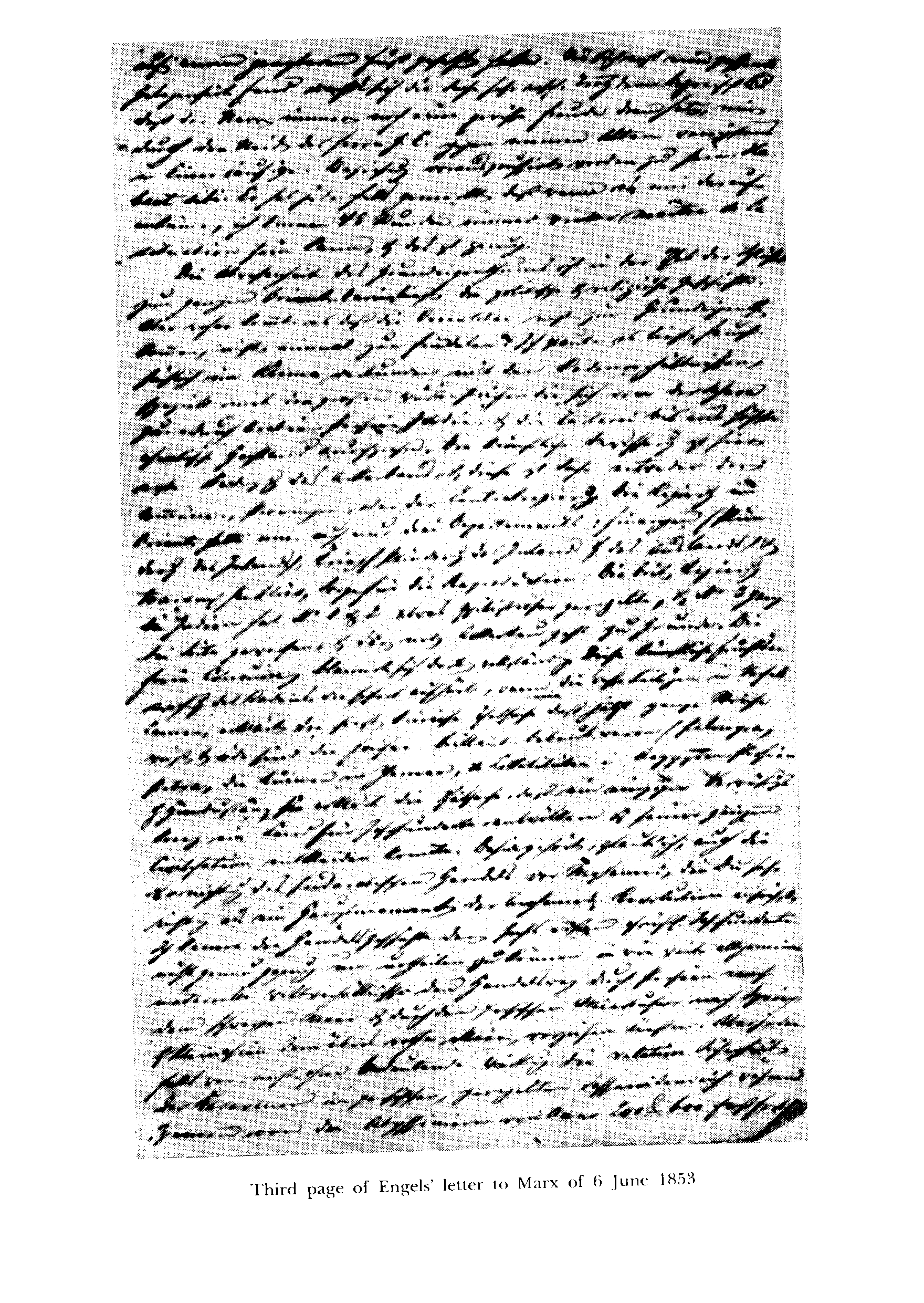
Third page age of Engels' letter to Marx of <"> June 1853
smooth, self-important, vainglorious, deceitful charlatan's physiog-nomy.
If Lassalle has given you a good, neutral address in Düsseldorf, you can send me 100 copies.3 We shall arrange for them to be packed in bales of twist by firms up here; but they should not be addressed to Lassalle himself, since the packages will go to Gladbach, Elberfeld and so on, where they will have to be stamped and sent by post to Düsseldorf. However, we cannot entrust a package for Lassalle or the Hatzfeldt woman to any local firm, because, 1. they all employ at least one Rhinelander who knows all the gossip, or 2. if that goes off all right, the recipients of the bales will get to know about it, or 3. at the very best the postal authorities will take a look at the things before delivering them. We have a good address in Cologne, but are not, alas, very well acquainted with the people who are the principal buyers here for the firm in Cologne, and hence cannot expect them to do any smuggling. Indeed, what we shall tell the people here is that the packages contain presents for the fair sex.
From all this you will gather that I am once again on passable terms with Charles.b The affair was settled with great dispatch at the first suitable opportunity. Nevertheless you will realise that the fool derives a certain pleasure from having been given preference over myself in one rotten respect at least, because of Mr Gottfried Ermen's envy of my old man. Habeat sibi.c He at any rate realises that if I so choose, I can become maître de la situation'' within 48 hours, and that's sufficient.
The absence of landed property is indeed the key to the whole of the East.[397] Therein lies its political and religious history. But how to explain the fact that orientals never reached the stage of landed property, not even the feudal kind? This is, I think, largely due to the climate, combined with the nature of the land, more especially the great stretches of desert extending from the Sahara right across Arabia, Persia, India and Tartary ,9 to the highest of the Asiatic uplands. Here artificial irrigation is the first prerequi-site for agriculture, and this is the responsibility either of the communes, the provinces or the central government. In the East, the government has always consisted of 3 departments only: Finance (pillage at home), War (pillage at home and abroad), and travaux publics,'' provision for reproduction. The British government in India has put a somewhat narrower interpretation on nos. 1 and 2 while completely neglecting no. 3, so that Indian agriculture is going to wrack and ruin. Free competition is proving an absolute fiasco there. The fact that the land was made fertile by artificial means and immediately ceased to be so when the conduits fell into disrepair, explains the otherwise curious circumstance that vast expanses are now arid wastes which once were magnificently cultivated (Palmyra, Petra, the ruins in the Yemen, any number of localities in Egypt, Persia, Hindustan); it explains the fact that one single war of devastation could depopulate and entirely strip a country of its civilisation for centuries to come. This, I believe, also accounts for the destruction of southern Arabian trade before Mohammed's time, a circumstance very rightly regarded by you as one of the mainsprings of the Mohammedan revolution.(1) I am not sufficiently well acquainted with the history of trade during the first six centuries A.D. to be able to judge to what extent general material conditions in the world made the trade route via Persia to the Black Sea and to Syria and Asia Minor via the Persian Gulf preferable to the Red Sea route. But one significant factor, at any rate, must have been the relative safety of the caravans in the well-ordered Persian Empire under fjie Sassanids, whereas between 200 and 600 A.D. the Yemen was almost continuously being subjugated, overrun and pillaged by the Abyssinians. By the seventh century the cities of southern Arabia, still flourishing in Roman times, had become a veritable wilderness of ruins; in the course of 500 years what were purely mythical, legendary traditions regarding their origin had been appropriated by the neighbouring Beduins, (cf. the Koran and the Arab historian Novaïri), and the alphabet in which the local inscriptions had been written was almost wholly unknown although there was no other, so that de facto writing had fallen into oblivion. Things of this kind presuppose, not only a SUPERSEDING, probably due to general trading conditions, but outright violent destruction such as could only be explained by the Ethiopian invasion. The expulsion of the Abyssinians did not take place until about 40 years before Mohammed, and was plainly the first act of the Arabs' awakening national consciousness, which was further aroused by Persian invasions from the North penetrating almost as far as Mecca. I shall not be tackling the history of Mohammed himself for a few days yet; so far it seems to me to have the character of a Beduin reaction against the settled, albeit decadent urban fellaheen whose religion by then was also much debased, combining as it did a degenerate form of nature worship with a degenerate form of Judaism and Christianity.
Old Bernier's stuffa is really very fine. It's a real pleasure to get back to something written by a sensible, lucid old Frenchman who constantly hits the nail on the head sans avoir l'air de s'en apercevoir!1
Since I am in any case tied up with the eastern mummery for some weeks, I have made use of the opportunity to learn Persian. I am put off Arabic, partly by my inborn hatred of Semitic languages, partly by the impossibility of getting anywhere, without considerable expenditure of time, in so extensive a language — one which has 4,000 roots and goes back over 2,000-3,000 years. By comparison, Persian is absolute child's play. Were it not for that damned Arabic alphabet in which every half dozen letters looks like every other half dozen and the vowels are not written, I would undertake to learn the entire grammar within 48 hours. This for the better encouragement of Pieper should he feel the urge to imitate me in this poor joke. I have set myself a maximum of three weeks for Persian, so if he stakes two months on it he'll best me anyway. What a pity Weitling can't speak Persian; he would then have his langue universelle toute trouvée' since it is, to my knowledge, the only language where 'me' and 'to me' are never at odds, the dative and accusative always being the same.[399]
It is, by the way, rather pleasing to read dissolute old Hafiz in the original lan'guage, which sounds quite passable and, in his grammar,0 old Sir William Jones likes to cite as examples dubious Persian jokes, subsequently translated into Greek verse in his Commentariis poeseos asiaticae, because even in Latin they seem to him too obscene. These commentaries, Jones' Works, Vol. II, De poesi erotica, will amuse you. Persian prose, on the other hand, is deadly dull. E.g. the Rauzât-us-safâ by the noble Mirkhond, who recounts the Persian epic in very flowery but vacuous language. Of Alexander the Great, he says that the name Iskander, in the Ionian language, is Akshid Rus (like Iskander, a corrupt version of Alexandros); it means much the same as filusuf, which derives from fila, love, and sufa, wisdom, 'Iskander' thus being synonymous with 'friend of wisdom'.
167. Engels to Marx. 9 June
Of a king he says: 'He beat the drum of abdication with the drumsticks of retirement', as will père Willich, should he involve himself any more deeply in the literary fray. Willich will also suffer the same fate as King Afrasiab of Turan when deserted by his troops and of whom Mirkhond says: 'He gnawed the nails of horror with the teeth of desperation until the blood of vanquished consciousness welled forth from the finger-tips of shame.'
More tomorrow.
167
ENGELS TO MARX
IN LONDON
Manchester, 9 June 1853
Dear Marx,
So that Pieper may see he hasn't been forgotten, inform him of the following. In yesterday's Manchester Guardian there was the offer of a post as CORRESPONDING CLERK AND BOOKKEEPER. He might contrive to get £180 a year; from what I hear, it is with a Jew here, Leo Schuster. Pieper should at once write a letter addressed to:
Box B 47,
Post Office,
Manchester
and beginning: Monsieur, etc.
The letter had best be written in French, since French and German are required. He should say he thinks he can fill the post, that he comes from Hanover, is aged such-and-such, and last worked for so-and-so in London, from whom inquiries may be made as to his character and qualifications. He can conduct correspondence in German, French and English and, if needs be, in Italian, is rather less familiar (if indeed this is the case) with bookkeeping; he must say that he lost his post because the partner's son had joined, etc., then what sort of a business it was, but that he could without doubt quickly familiarise himself with all types of merchandise business in the Manchester TRADE. Le tout sans phrase, aussi simplement raconté que possible.
J'ai l'honneur de me souscrire', or else, 'Mr., votre très dévoué',3 etc. Nothing more. If they consider him, he will probably be summoned to Schuster's London house, and then it will be up to him. But he must write straight away, by the first post tomorrow.
Herewith £1. 18. 6d., the balance of the £32. The fellow only deducted 18 pence for collecting charges but, on the other hand, all Charlesb and I owed him.
You will have received the bill from America the day before yesterday.
Whether Pieper can give Rothschild as a reference, you people in London will be best able to judge; if so, it might do no harm, for the fact that Pieper is no BRED CLERK will emerge at the very first interview when they ask him where he worked before. But he must be sure of what Rothschild is going to say and, perhaps, see him beforehand.
Your
F. E.
Copie d'Annoncée
* Wanted in a Shipping House a Bookkeeper and Corresponding Clerk. A knowledge of German and French absolutely required. Address Box B 47, P. Off. Manchester.*
[To refer to me would do no good whatever, indeed it might do harm. Pieper, of course, should not let Schuster see that he knows who inserted the advertisement to which he should refer as his reason for applying.]
168. Marx to Engels. 14 June
168
MARX TO ENGELS[338]
IN MANCHESTER
London, 14 June 1853 28 Dean Street, Soho
Dear Frederic,
Having been prevented by all sorts of business and domestic affairs, I have only today got round to replying to your two lettersa
and acknowledging receipt of the American money (handed over to Freiligrath),b likewise the balance of the American Tribune money. If that's the sort of business relationship you and Charlesd had with your 'intermediary', then you've been up to some trick for my sake. For since it was not that fellow, but you, who advanced the money against the bill, you and Charles could just as well have sent- the bill to America without the fellow. At least, that's how it seems to me.
I did not inform Pieper of your news for the following reasons: Pieper was becoming more and more of a wreck and some 8 or 10 days ago I took him to task about the state of his health. It then transpired that his illness was going de pis en pise at the hands of his English quack. I therefore suggested I should take him straight to Bartholomew's Hospital — the London hospital at which the foremost and most renowned doctors treat the public for nothing. He came with me. An ancient Hippocrates, after examining the corpus delicti and questioning him about his former TREATMENT, told him: 'You HAVE BEEN A FOOL', explaining at the same time that he would be 'DOWN' within three months if he did not follow his instructions to the letter. The efficacy of the new treatment was immediately apparent and in 2 weeks the man will be sain et sauf.c The case was too serious for the treatment to be interrupted, and anyhow Freiligrath has a post in view for Pieper. If nothing comes of it, I shall let you know.
Rumpf, our jolly tailor, is now shut up in a lunatic asylum. Some 5 months ago, in order to extricate himself from a social quandary, le malheureuxf married an elderly woman, became excessively respectable, foreswore all spirits and worked like a carthorse. About a week since he took to drinking again, sent for me a couple of days ago, revealed that he had discovered the means of making the whole world happy, that I was to be his minister, etc., etc. He has been in the ASYLUM since yesterday. It's a pity about the fellow.
In The Leader—which, by the by, has become a purely bourgeois sheet—Ruge has announced that he will be giving lectures on German philosophy in London.a Needless to say he takes this opportunity to give himself a puff. E.g. 'Where style is concerned, there is only one man whom the German people set alongside him—Lessing.' In the same issue of The Leader, the Russian Herzen
advertises his collected worksb adding that, together with the Polish Committee, he is to set up a Russo-Polish propaganda press here in London.[400]
One of the enclosed letters from Cluss[401] will reveal to you the nature of the main blow with which Willich is threatening me. He refers to the £20 borrowed by me from the Refugee Committee at a time when I myself was distrained because my Chelsea landlady,[402] although I had paid her, had not paid her LANDLORD,— a debt which I repaid down to the last farthing by the necessary INSTALMENTS.[403] You must now advise me what tactics to adopt. If that's how the good Willich thinks he's going to do me in, he must be a regular 'bonhomme'.c
Carey, the American political economist, has brought out a new book, Slavery at Home and Abroad. Here 'SLAVERY' covers all forms of servitude, WAGE-SLAVERY , etc. He has sent me his book in which he quotes me repeatedly (from the Tribune) now as 'A RECENT ENGLISH WRITER', now as 'CORRESPONDENCE OF THE NEW-YORK TRIBUNE?.[404] AS I have told you before, this man, in his earlier works, propounds the 'harmony' of the bourgeoisie's economic foundations and attri-butes all MISCHIEF to unnecessary interference by the State. The State was his bête noire. He is now playing a different tune. All ills are blamed on the centralising effect of big industry. But this centralising effect is in turn blamed on England, who has made herself the WORKSHOP of the world and has forced all other countries to revert to brutish agriculture divorced from manufacturing. In its turn, responsibility for England's sins is laid on the theory of Ricardo-Malthus, and specially Ricardo's theory of rent. The necessary consequence both of Ricardo's theory and of industrial centralisation would be communism. And to obviate all this, to counter centralisation with localisation and the union,—a union scattered throughout the land — of factory and farm, our ULTRA-FREE-TRADER finally recommends—protective tariffs. To obviate the effects of bourgeois industry, responsibility for which he lays on England, his recourse, as a genuine Yankee, is to speed up this process in America itself by artificial means. For the rest, his opposition to England drives him into Sismondian praise of the petty bourgeoisie in Switzerland, Germany, China, etc. And this is the chap who used to deride France for her resemblance to China. The only thing of definite interest in the book is the comparison between Negro slavery as formerly practised by the English in Jamaica and elsewhere, and Negro slavery in the United States. He demonstrates how the main STOCK of Negroes in Jamaica always consisted of freshly imported BARBARIANS, since their treatment by the English meant not only that the Negro population was not maintained, but also that a/s of the yearly imports always went to waste, whereas the present generation of Negroes in America is a native product, more or less Yankeefied, English speaking, etc., and hence capable of being emancipated.
The Tribune, needless to say, is puffing Carey's book for all it's worth.'" Both, indeed, have this in common, that, in the guise of Sismondian-philanthropic-socialist anti-industrialism, they represent the protectionist, i.e. industrial, bourgeoisie of America. That is also the key to the mystery why the Tribune, despite all its 'isms'b
and socialist flourishes, manages to be the 'LEADING JOURNAL' in the United States.
Your article on Switzerlandc was, of course, a direct swipe at the Tribune's 'LEADERS' (anti-centralisation, etc.) and their man Carey. I continued this clandestine campaign in my first article on India,d
in which England's destruction of native industries is described as revolutionary. This they will find very SHOCKING. Incidentally the whole administration of India by the British was detestable and still remains so today.
The stationary nature of this part of Asia, despite all the aimless activity on the political surface, can be completely explained by two mutually supporting circumstances: 1. The PUBLIC WORKS system of the central government and, 2. Alongside this, the entire 14 1853
Empire which, apart from a few large cities, is an agglomeration of VILLAGES, each with its own distinct organisation and each forming its own small world. A parliamentary report described these VILLAGES as followsa:
* 'A village, geographically considered, is a tract of country comprising some 100 or 1000 acres of arable and waste lands: politically viewed, it resembles a corporation or township. Every village is, and appears always to have been, in fact, a separate community or republic. Officials: 1. the Potail, Goud, Mundil etc. as he is termed in different languages, is the head inhabitant, who has generally the superintendence of the affairs of the village, settles the disputes of the inhabitants, attends to the police, and performs the duty of collecting the revenue within the village... 2. The Cumum, Shanboag, or Putwaree, is the register. 3. The Taliary or Sthulwar and 4. the Totie, are severally the watchmen of the village and of the crops. 5. the Neerguntee distributes the water of the streams or reservoirs in just proportion to the several fields. 6. The Joshee, or astrologer, announces the seed-times and harvests, and the lucky or unlucky days or hours for all the operation of farming. 7. The smith, and 8. the carpenter frame the rude instruments of husbandry, and the ruder dwellings of the farmer. 9. The potter fabricates the only utensils of the village. 10. The waterman keeps clean the few garments... 11. The barber, 12. the silversmith, who often combines the function of village poet and schoolmaster. Then the Brahmin, for worship. Under this simple form of municipal government the inhabitants of the country have lived from time immemorial. The boundaries of the villages have been but seldom altered; and although the villages themselves have been sometimes injured, and even desolated by war, famine and disease; the same name, the same limits, the same interests, and even the same families, have continued for ages. The inhabitants give themselves no trouble about the breaking up and division of kingdoms, while the village remains entire, they care not to what power it is transferred, or to what sovereign it devolves. Its internal economy remains unchanged.'*
T h e post of Potail is mostly hereditary. In some of these COMMUNITIES t h e LANDS o f t h e VILLAGE CULTIVATED IN COMMON, i n ITlOSt o f them EACH OCCUPANT TILLS HIS OWN FIELD. Within the same, slavery and the caste system. WASTE LANDS FOR COMMON PASTURE. Home-weaving and spinning by wives and daughters. These idyllic republics, of which only the VILLAGE boundaries are jealously guarded against neigh-bouring VILLAGES, continue to exist in well-nigh PERFECT form in the NORTHWESTERN PARTS OF INDIA only recently occupied by the English. No more solid basis for Asiatic despotism and stagnation is, I think, conceivable. And however much the English may have Irelandised the country, the breaking u p of the archetypal forms was the conditio sine qua non for Europeanisation. The TAX-GATHERER alone could not have brought this about. Another essential factor was the destruction of the ancient industries, which robbed these villages of their SELF SUPPORTING character.
In Bali, an island off the east coast of Java, this Hindu organisation still intact, alongside Hindu religion, its traces, like those of Hindu influence, discernible all over Java. So far as the property question is concerned, this is a great bone of contention among English writers on India. In the broken mountainous terrain south of the Kistna, however, there appears to have been property in land. In Java, on the other hand, as noted in the History of Java by a former English governor, Sir Stamford Raffles, the sovereign [was] absolute LANDLORD throughout the country 'WHERL RENT TO ANY CONSIDERABLE AMOUNT WAS ATTAINABLE'. At all events, the Mohammedans seem to have been the first in the whole of Asia to have established the principle of 'no property in land'.
Regarding the above-mentioned VILLAGES, I should note that they already feature in the Manu,[405] according to which the whole organisation rests on them. 10 are administered by a senior COLLECTOR, then 100, then 1,000.
Write soon.
Your
K. M.
1929
169. Marx to Adolf Cluss. About 14 June[406]
... On the other hand, a reply must be given,(1) and that can best be done by third parties. In which case you need feel no compunction about entering into personal matters and regaling the brutal democratic 'temperament' with a few pungent 'anec-dotes'...[407] In dealings with the Reform I would recommend, besides shrewdness, une modération extrême" This clever-clever philistine1' who, in Hesse — and Hesse was his world — represented nothing except the demiurge of this, his world: the petty bourgeois, and who now assumes the air of one who, from the very start, has represented the proletariat on a 'materialist basis'—this smiling nonentity who, with Solomon-like dicta, 'stresses' his shrewdness and remarkable composure vis-à-vis rebellious parties — this incar-nation of a marginal gloss to 'Heise's articles'; this fellow, then, does not, of course, interest me — he repels me. But you people helped to make the paper. It appears in New York.
Half Germany will come to New York for the Exhibition.[128] You have no other paper in New York. Might it not, then, be impolitic to throw over Kellner and the paper? It would in the end be doing the fellows another favour. Pretend to be naive. Go on writing; you couldn't do him a worse turn. Do not emancipate him from influences which, as everything goes to show, have been damnably irksome to him. Do as the Prussian bourgeois do. The government and its Manteuffel twist and turn in vain to rid themselves of the friendship of those bourgeois. The latter, for their part, pretend to believe in the constitutionality of their government, and le gouvernement est constituonnel malgré lui-même': that's worldly wisdom for you.
The Neu-England-Zeitung is equally unreliable and likely to remain so. Mr Schläger, a pedant replete with platitudes, a presumptious bore who always knows better (à la Kellner, 'le mieux est le plus grand ennemi du bien'à), has written to Pieper suggesting I write for the N.-E.-Z. about the necessary transition from the bourgeois to the communist mode of production.
Citizen Marx with his 'schematising and organising' intellect would, it seems, be well suited to this task set him by Citizen Schläger, but Citizen Marx must 'forego his abstract language' and write in the same manner as all, etc. Worthy Citizen Schläger! In the same letter he enjoins Pieper on no account to attack Citizens Ruge and Heinzen (he regularly deletes such passages) since the 'élite of his readers' (just think what the others must be like!) are Heinzenites, and the N.-E.-Z. is destined (literally) to inherit the readers of the Janus. Mighty Citizen Schläger! Almighty Pompey! Nevertheless, I have advised Pieper to go on writing for Schläger.
170. Marx to Engels. 29 June
Le motif est très simple.* We are not doing our enemies a favour by writing for them. Tout au contraire? We could hardly play them a worse trick...
170
MARX TO ENGELS
IN MANCHESTER
[London,] 29 June 1853 28 Dean Street, Soho
Dear Engels,
My sister0 and her newly wedded husbandd, who is sailing from here- to the Cape of Good Hope as a GENERAL DEALER, have unexpectedly descended on me. This, combined with the work for the Tribune and some unpleasantness to be cleared up in America, has made considerable demands on my time. The couple set out tomorrow, I believe. I hear from Imandt that your mother is expected in London, from which I conclude that you, too, will turn up soon.
Enclosed Lassalle's instructions for the dispatch of the copies6 to Germany. My wife will undertake their dispatch to Manchester. I hope that you people will then take care of the matter up there. Haven't you seen anything of Jones? He's roaming about in your part of the world and is said to have brought off a MONSTER MEETING in Halifax.[408]
Last Wednesday, much to my astonishment, I received a very peevish letter from Cluss, in which he said someone had written telling him that Pieper had described him to Schläger — him and Arnold — as 'subordinate agents', and himself, on the contrary, as the one who supplied news 'at first-hand', etc., etc. Fortunately
171. Marx to Engels. 8 July
there isn't a word of truth in the whole thing, which is merely an attempt by Willich, Anneke, Weitling and Co.'s party to sow dissension amongst our own ranks, and, more particularly, to neutralise 'that most unpleasant man, Cluss'. The necessary explanations were, of course, dispatched across the water at once.[409] I am unable to find Cluss' first letter, but enclose the 2nd.
Before leaving for Manchester[410] I borrowed £2 from the little Jew Bamberger. The fellow keeps sending me strongly-worded reminders, if not threats. Mais nous verrons." By Friday I shall have £20 to draw on New York. But again the question is how?
Enclosed the nee plus ultra" of Heinzen's now sanguinary cowardice and aversion to 'ordinary methods of warfare' .c
I was mistaken about the 'Swiss article',6 Dana having divided the thing into two parts,e but published both under my name.
Until next time, then. My worthy sister and brother-in-law have just come in. My sister is very stout and will sweat damnably while crossing the Equator.
Your
K. M.
171
MARX TO ENGELS
IN MANCHESTER
[London,] 8 July 1853 28 Dean Street, Soho
Dear Engels,
Dr Jacobi, the bearer of this note, was one of the accused at the 'communist trial in Cologne'.16
I'm at a loss to understand whether your continued silence is due to illness, pique, overwork or what.
172. Engels to Marx. 9 July
Yesterday I drew £24 on Dana at Spielmann's in Lombard Street; Spielmann will pay me in 5 weeks as soon as the bill is returned. In the meantime I shall have another very bad spell to go through, the more so since a number of valuable things now in pawn will have to be repledged or else they will be forfeited, and that is, of course, impossible dans un moment* when the wherewith-al even for les choses les plus nécessaires*1 is lacking. However, I'm now well-accustomed to being in the soup and all that that entails.
In any case write and tell me why you're not writing. I hope, AT AIL EVENTS, that you are not ill.
Your
K. M.
[On the back of the letter]
Friedrich Engels. 48 Great Ducie Street, Manchester
zwischen F. Engels und K. Marx, Bd. 1, Published in English for the first Stuttgart, 1913 and in full in: Marx and t l m e
Engels, Works, Second Russian Edition, Vol. 28, Moscow, 1962
172
ENGELS TO MARX
IN LONDON
Manchester, Saturday, 9 July [1853]
Dear Marx,
At four o'clock this morning my old landlady roused me from my slumbers saying there was a gentleman wanting to speak to me. Dragging myself out of bed, I went to the door where I found a little man with a CAB, a colossal trunk and a travelling bag, who told me his name was Jacobi and that you and Pieper had sent him to me. Marx and Pieper! I thought. Who the devil can this Jacobi be? Is he the illegitimate son of one in Königsberga or what? Until finally the little man pulled your letterc out of his pocket, somewhat taken aback at not being instantly welcomed with open arms, stranger though he was — whereupon it occurred to me that he was, as your letter confirmed, the communist trial Jacobi to whom I hadn't given a thought, believing him long since well and truly lodged in a Prussian prison cell. Que faire?" I took him in, together with his belongings and, drunk with sleep, chatted with him for half an hour before offering him my sofa to sleep on, for the house was CRAMMED FULL of people. Luckily my old man is out of town until tomorrow and so, this very morning, I took the good party martyr by the collar, engaged lodgings for him and forbade him to show his face here until my old man's departure raises the interdict.
This warliked Westphalian way of behaving, the doltishness of spending a whole week in London and then choosing a train that arrives in the middle of the night and, on the pretext of not knowing what's what, turning a man's house upside down and imposing himself, all this was no more calculated to predispose me in his favour than was the discreet question put to me at the very outset as to how I stood with my old man. Further exchanges have raised the fellow in my estimation a little, but not very much. He proposes to call on Borchardt with letters from you and Kinkel (almost beats Marx and Pieper), to burst in on little Heckscher without ceremony and without an introduction in the hope that the latter will immediately provide him with all possible information about his TRADE and, for sheer joy at the prospect of fresh 'scientific' intercourse, make half his practice over to his new competitor — and other such philistine conceits. His foolishness in going to Kinkel will do him more harm than good. Kinkel gives him letters not to Mr but to Mrs Schunck, a piece of effrontery which is also a gross and direct breach of English etiquette, and again, if Mr Kinkel, who was fed and paid cash for his buffooneries on German literature, if Monsieur Gottfried, I say, believes he can send letters of recommendation (other than fund-raising licences) d'égal à égal" to these merchants, he's damned well mistaken. Apart from that, Monsieur Jacobi, à ce qu'il me paraît,' is not the man to make his fortune here.
As soon as my old man has left, I'll send you some money. I
173. Marx to Engels. 18 July
can't very well take anything before that, since I run the risk every day that he will check my accounts, which alone would be enough to provoke a lively argument of the kind I prefer to settle in writing.
The idea that I am not writing because of 'pique' made me laugh. De quoi donc?a
Regards to your wife and children and do your best to stick it out, at least until my hands are free again — within the week, I hope.
Your
F. E.
173
MARX TO ENGELS
IN MANCHESTER
[London,] 18 July 1853 28 Dean Street, Soho
Dear Engels,
The day before yesterday I got a letter from Lassalle, who is now in a state of suspense, imagining letters have been intercepted, etc. It would have been good had you advised me whether or not the parcel had gone off to him.b Lassalle is still the only one who dares correspond with London, and we must therefore be careful not to put him off. So I would ask you to let me know what the position is about the parcel. The time of its dispatch is of importance to me in another way, i.e. because upon it depends the time of the RETURN.
The last mail brought my wife a most friendly and obliging letter from A. Dana[4] in which he states that he cannot possibly advise us of a business house in London and that AT ALL INSTANCES bills drawn by me will be promptly honoured. He says that my
174. Marx to Engels. 18 August
articles are 'HIGHLY VALUED BY THE PROPRIETORS OF THE TRIBUNE AND THE PUBLIC', and sets no limit on the quantity we send him.
In the debate on ADVERTISEMENT DUTY 4 1 2 — about a fortnight ago, I think — Mr Bright was loud in his praises of the New-York Tribune and gave an analysis of one of its numbers"—the very one containing my article on the budget. b This is what he said about it:
* 'From Great Britain there is an elaborate disquisition on the Right Honourable Gentleman'sc budget, doing him justice in some parts, but not in others, and doing certainly, as far as the Manchester School was concerned, no justice whatever.' *
As regards Jacobi, you must not allow yourself to be deterred by the gaucherie and inexperience of a 23-year-old stripling from the District of Minden who has spent 2 years in jug. H e has a good background. I have read his doctoral dissertation[4 1 3] and was 'MUCH
PLEASED WITH IT'.
Your
K. M.
Jones has held some very important meetings which have even attracted the attention of the bourgeois press.[414]
174
MARX T O ENGELS
IN MANCHESTER
[London,] 18 August 1853 28 Dean Street, Soho
Dear Engels,
Lupus will probably obtain a good post in Liverpool. In which case h e will go there via Manchester. T h e snag is that he won't be paid until the end of the quarter. However, he hopes that you and 18 1853
Strohn between you may be able to help him. Has Strohn returned?
Needless to say, that mischief-monger Dronke is writing the most pompous letters to all and sundry, e.g. to Imandt, saying that 'he has made arrangements for Lupus' emigration to America'.
Entre nous" I should say the little shop-assistant, anxious to inflate his own importance at small cost to himself, has given Lupus to understand that it was he rather than you who took the matter in hand. At least I thought I could detect a certain chilliness towards Manchester ON THE PART OF Wolff. Dronke is cancan'' incarnate, NO DOUBT ABOUT THAT. Experto crede, etc.'
You absolutely must at once send Pieper at least sufficient to buy himself a coat and trousers. Shabby as he now is, he cannot possibly take advantage of opportunities that come his way, however favourable. He has become unpresentable. Moreover, you promised him this when fyou] left.[415] He's putting a brave face on his misfortunes. But there's a limit to everything.
[I have] been particularly unlucky over money transactions. I now have current bills on America — two of them — amounting to £42 and yet cannot command above 42 farthings, though having to provide means of subsistence not [only] for myself but also for Pieper. The first bill of £24 I gave to Mr Spielmann; he told me to come back in five weeks' time. That was seven weeks ago. Besides, this wretched traipsing to and from the City invariably takes up my Mondays and Thursdays, the very days when I have to be preparing Tuesday's and Friday's articles. Each time Spielmann turns me away with the remark, uttered in Jewishly nasal tones: 'Nah nahtice yet.' In the case of such 'small' amounts, he says, his correspondents write only at their convenience, and, if I had needed the money straight away, I should have said beforehand that I would pay the postage for a special letter, etc., etc. This means daily unpleasantnesses, not only for me but for my wife who, counting on the prompt arrival of the money, had given definite promises to sundry creditors, and now the curs are laying siege to the house. Meanwhile, I am writing away like the devil. It would be fine if you could send me an article or two in between whiles, thus giving me the time to write something better. U of my time is taken up chasing after PENNIES.
Heise is here just now; as a person the fellow's not at all bad. Mr Kossuth is presently making a fool of himself as correspondent
175. Engels to Marx. 24 August
of the Daily New-York Times. In the Advertiser 4 letters by D. Urquhart on the eastern questiona contained much that was interesting, despite quirks and quiddities. WE HAVE BEEN STRIKING against Jones for the past two weeks.
Your
K. M.
175
ENGELS TO MARX
IN LONDON
[Manchester,] Wednesday, 24 August 1853
Dear Marx,
I'll send some money tomorrow if I possibly can. Your letter arrived on Saturday too late for anything to be done, this week there have been all sorts of complications, but tomorrow things will, I think, have improved, and our old bookkeeper has been forewarned.
The little man b was here on Saturday. That he had been gossiping was evident to me from the moment he wrote to Borchardt. He had sent him Lupus' most discreditable letter in which the latter makes an outright and most earnest appeal to the 'generosity' of the Jews in Bradford. C'était une lettre à brûler de suite"; Borchardt at once magnanimously sent Lupus alms, to wit the sum of one pound,—not that he wasn't very decent about it, WHICH HE COULD WELL AFFORD to be, seeing that it released him from all his obligations. I must confess that this letter of Lupus' left a very bad taste in my mouth, but not so bad as the little man's tactlessness in letting it fall into Borchardt's clutches. Anyway I duly hauled him over the coals for it.
Enfin c'est fait" If Lupus is going to Liverpool, see to it that he comes here first, if possible on a Friday, in which case I shall arrange a rendez-vous with the little man. If, as Dronke proposes, Lupus first goes to Bradford, the cancanh will only proliferate.
You know that Jacobi intends to go to America. The chap's altogether trop mouc and even philistines get the impression that he's a helpless sort of creature. I don't believe he'll ever obtain a practice, however much he may pine for one. Besides one can't help laughing when one remembers that the chap's still a virgin.
Your
F. E.
176. Marx to James Grant, Editor of The Morning Advertiser. 31 August[416]
To the Editor of The Morning Advertiser.
Sir,
You will much oblige me by inserting the following in Your highly esteemed paper.
Your obedient servant
Dr. Karl Marx (28 Dean Street, Soho)
177. Marx to Engels. 3 September
177
MARX TO ENGELS
IN MANCHESTER
[London,] 3 September3 1853 28 Dean Street, Soho
Dear Engels,
I have not written to you for a long-time, even to acknowledge receipt of the £5 (of which £2.10 was paid to Pieper and £1.10 to Lupus), the reason being that a lot of indescribable muck has taken up MY TIME AND MY ENERGIES. On 7 July I gave my bill to Spielmann.b On 31 Augustc the lad told me — after I had been to see him 7 times — that the bill had got lost, that I must make out another one for him, etc. So I had managed for weeks by pawning everything, down to the last item, and had made a further appointment for 31 August0 with all my creditors whom I had been putting off since July. As I have no resources other than the income from the Tribune, you will understand my situation and that I have neither the time nor the inclination for correspondence.
Tell Jacobi, if he's still there, that I have written to Weydemeyer, etc., on his behalf.[417]
My reason for writing to you today is the following: So far as I know you do not read The Morning Advertiser. This paper, which belongs to the 'UNITED VICTUALLERS', carried an apology of Bakunin by a 'FOREIGN CORRESPONDENT' (Mr Golovin, I think).rt In the same Morning Advertiser an anonymous F. M. expressed suspicion that Bakunin was a Russian spy and doing very nicely, etc , etc.'' To this Golovin and Herzen replied, pointing out that this same calumny had already appeared in 1848 in a 'GERMAN PAPER', which
PAPER 'HAD EVEN VENTURED TO APPEAL TO THE TESTIMONY OF G E O R G E S A N D ' / Three days ago 'Dr Arnold Ruge' chipped in, remarking that this German paper was the New Rhenish Gazette9 whose EDITOR, 'Dr 3 1853
Marx', h a d known just as well as any other democrat that these calumnies were false.[3]
In yesterday's Morning Advertiser I published a statement 0 to the effect that:
MESSRS Golovin AND Herzen had CHOSEN TO CONNECT THE NEW RH. G. EDITED BY ME IN 1848 AND >49 with their polemic with F. M. about Bakunin, etc. Now, I CARE NOTHING ABOUT THE INSINUATIONS OF MESSRS Herzen AND Golovin. But etc., etc. 'PERMIT ME TO STATE THE FACTS OF THE CASE'. There follows an enumeration of the facts:
'that on 5 July 1848 we received letters from Paris, one from the Havas Bureau, the other from a POLISH REFUGEE (which is what I call Ewerbeck), both STATING that George Sand possesses letters compromising Bakunin AS BEING LATELY ENTERED INTO RELATIONS WITH THE RUSSIAN GOVERNMENT';
'that on 6 July we published this letter,0 not the one from the Havas Bureau, but from o u r Paris correspondent';
'that Bakunin, replying in the Neue Oder-Zeitung,d prior to our correspondence, states that similar rumours had been circulating in Breslau, that they emanated from the Russian embassies and that he could refute them in no better way than by appealing to George Sand' [4 1 8];
'that on 3 August Koscielski brought to the Rheinische Zeitung a letter addressed by George Sand to its editor, which was published the same day[6] with the following introductory remarks':' (here follows an extract from the Neue Rheinische Zeitung[1]); 'that at the end of August I passed through Berlin, saw Bakunin and renewed my old friendship with him';
'that on 15 October (or thereabouts) the Rheinische Zeitung stood up for Bakunin against the Prussian ministry which had ordered his expulsion' ;
'that in February ('49) the Rheinische Zeitung published a LEADING ARTICLE on Bakunin the opening words of which were, "Bakunin is our friend!",' etc.';
a A. Ruge, 'Michael Bakunin. To the Editor of The Morning Advertiser', The Morning Advertiser, No. 19404, 31 August 1853. - b K. Marx, 'Michael Bakunin. To the Editor of The Morning Advertiser', The Morning Advertiser, No. 19406, 2 September 1853. - c [H. Ewerbeck,] 'Bakunin', Neue Rheinische Zeitung, No. 36, 6 July 1848. - d M. Bakunin, [Open Letter,] Allgemeine Oder-Zeitung, No. 151, 12 July 1848. This was the title under which the Neue Oder-Zeitung appeared in 1846-49. - e Neue Rheinische Zeitung, No. 64, 3 August 1848. - f ibid. - K See present edition, Vol. 12, p. 285. - h [Report on Bakunin's Expulsion, 10 October,] Neue Rheinische Zeitung, No. 115, 13 October 1848.-' F.Engels, 'Democratic Pan-Slavism', Neue Rheinische Zeitung, No. 222, 15 February 1849 (see present edition, Vol. 8, p. 363).
3 1853
'that in the New-York Tribune I PAID BAKUNIN THE TRIBUTE DUE TO HIM
FOR HIS PARTICIPATION IN OUR MOVEMENTS,' 3 e t C , e t C .
My statement concludes with the words: *'As to F. M. proceeding as he does from the fixed idea that continental revolutions are fostering the secret plans of Russia, he must, if he pretends to anything like consistency, condemn not only Bakunin but every continental Revolutionist, as a Russian agent. In his eyes Revolution itself is a Russian agent. Why not Bakunin?'*
Well, in today's issue the blackguard Golovin does not dare give his name but, under the rubric 'FROM A FOREIGN CORRESPONDENT', publishes the following piece in The Morning Advertiser:
* How to Write Historyh
(From a Foreign Correspondent)
Bakunin is a Russian agent — Bakunin is not a Russian agent. Bakunin died in the prison of Schlüsselburg, after having endured much ill-treatment — Bakunin is not dead: he still lives. He is made a soldier, and sent to the Caucasus — no, he is not made a soldier: he remains detained in the citadel of St. Peter and St. Paul. Such are the contradictory news which the press has given in turn, concerning Michael Bakunin. In these days of extensive publicity we only arrive at the true by affirming the false; but, has it at least been proved that Bakunin has not been in the military pay of Russia?
There are people who do not know that humanity makes men mutually responsible — that in extricating Germany from the influence which Russia exercises over it, we re-act upon the latter country, and plunge it anew into its despotism, until it becomes vulnerable to revolution. Such people it would be idle to attempt to persuade that Bakunin is one of the purest and most generous representatives of progressive cosmopolitism.
'Calumniate, calumniate,' says a French proverb, and 'something will always remain.' The calumny against Bakunin, countenanced in 1848 by one of his friends, has been reproduced in 1853 by an unknown person. 'One is never betrayed but by one's own connexion!, says another proverb: 'and it is better to deal with a wise enemy than with a stupid friend.' The conservative journals have not become the organ of the calumny insinuated against Bakunin. A friendly journal undertook that care.
Revolutionary feeling must be but slightly developed when it can be forgotten, as M. Marx has forgotten, that Bakunin is not of the stuff of which police-spies are made. Why, at least, did he not, as is the custom of the English papers, why did he not simply publish the letter of the Polish refugee which denounced Bakunin? He would have retained the regret of seeing his name associated with a false accusation.*
a F. Engels, Revolution and Counter-Revolution in Germany, XVIII, New-York Daily Tribune, No. 3576, 2 October 1852 (see present edition, Vol. 11, p. 90). Engels' articles were published over Marx's signature. - b Golovin's item in The Morning Advertiser, No. 19407 of 3 September 1853 is copied in Pieper's hand.
I intend to answer the chap as follows (see below) and would like you to return this to me promptly (by Monday if possible), with the style put to rights.[419]
At the same time the point arises whether you and Dronke, as EDITORS of the New Rhenish Gazette, might not wish to make a statement. Clique versus clique. On the other side are only Ruge, Herzen and Golovin. Bakunin himself has dubbed the latter 'un polisson'.* One of Nicholas' most zealous admirers in 1843 and '44, he became a democrat because he believed he had become suspect, nor has he dared return to Russia. This last is the sum total of his heroism.
I for my part suggest a statement, the substance of which would be as follows:
* It is better to deal with a wise enemy, than with a stupid friend,' Bakunin would have exclaimed, if he was ever to read the letter of the 'foreign' Sancho Pansa who, in your Saturday's paper,b indulges in his proverbial commonplaces.
Is he not a 'stupid friend' who reproaches me with not having done by what doing I would according to himself have 'retained the regret of seeing my name associated with a false accusation'?
Is he not a 'stupid friend' who is astonished of what every schoolboy knows that truth is established by controversy and that historical facts are to be extricated from contradictory statements?
When the N. Rh. G. brought the Paris letter Bakunin was at liberty. If he was right to be satisfied with the public explanations of the N. Rh. G. in 1848,c is it not a 'stupid friend' who pretends to find fault with them in 1853? If he was wrong in renewing his intimate relations with the Editor of the N. Rh. G., is it not 'stupid' on the part of a pretended friend to reveal his weakness to the public?
Is he not a 'stupid friend' who thinks necessary to 'plunge Russia anew in its despotism' as if she had ever emerged from it?
Is he not a 'stupid friend' who calls the Latin proverb 'calumniare audacter'd a French proverb?
Is he not a 'stupid friend' who cannot understand why the 'conservative journals did not like to publish the calumnies' which were secretly spread against Bakunin throughout Germany while the most revolutionary paper of Germany was obliged to publish them?
178. Marx to Engels. 7 September
Is he not a 'stupid friend' who ignores that 'revolutionary feeling' at its highest pitch made the 'lois des suspects'[420] and beheaded the Dantons and the Desmoulins and the Anacharsis Cloots?
Is he not a 'stupid friend' who dared not accuse The Morning Advertiser for having inserted the letter of F. M. while Bakunin is incarcerated at St. Petersburg at the same time accusing the N. Rh. G. for having inserted a similar letter in 1848 when Bakunin was free and not yet reduced to the misery of being defended by a 'stupid friend'?
Is he not a 'stupid friend' who makes the name of Bakunin a pretext for calumniating the friends of Bakunin while he is cautiously withholding his own name? *
A prompt answer, then. The matter is urgent.
Your
K. M.
178
MARX TO ENGELS
IN MANCHESTER
[London,] 7 September 1853 28 Dean Street, Soho
Dear Frederic,
Your letter did, indeed, arrive too late.[421] I condensed the stuff[3]
by cutting out unnecessary pathos, tidied it up a bit, and sent it to the amiable organ of the united 'LICENSED VICTUALLERS' b on Monday. Not inserted. At the same time, however, this highly consistent paper published a short letter 'FROM A NATIVE CORRESPONDENT' (presumably D. Urquhart) in its Monday issue, in which its own 'FOREIGN CORRESPONDENT' was quite plainly unmasked as a 'RUSSIAN AGENT', while Bakunin himself was not exactly made out to be a saint.3 Probably The Morning Advertiser rejected my riposte[419] because less confused than that of the 'NATIVE'. NOW the thing is to come out in The People's Paper.h
It was through a mere lapsus linguae'—out of long habit — that I mentioned Mr Dronke in my letter to you. I don't believe that 'little' Blanqui'sd words are of any consequence, or that we shall gain anything by an appendix.
The worthy little man has stirred up such a mighty pother that 1. Lupus has never said a word to me about his departure,[422]
although I had long since learnt of it through you; 2. that this same Lupus is always very guarded in his references to you; 3. that last night I was treated to a scene which was hardly creditable.
I was busy at work. Wife and children in the room. In comes Lupus with portentous tread — to take his leave at last, I supposed, for not once in my house had he let fall a word about his impending departure.
A year earlier I had borrowed a little Spanish grammar from him, by Franceson, maybe 120 pages.e So far as I could recall, I had returned the trashy object 5 months before. Or else, Dronke had pinched it.
The old gentleman had already asked my wife and Lenchen about the thing on two previous occasions and had been told that they would look for it.
Last night, then — the fellow was snappish from the moment he came in — I told him in as soothing tones as possible that I couldn't find the damned thing, that I had looked for it everywhere and believed I had returned it to him, etc., etc. 'You've sold it!' came the boorish, uncouth, insolent reply. (I'd wager a sovereign that nowhere in London could anyone get 2 FARTHINGS for the rubbish.) I, of course, jump to my feet, an altercation ensues, stubborn as a mule he persists in his nonsense, insults me 'au sein de ma famille'.1 As you know, I'm willing to put up with a great deal from an old man in his dotage who has become venerable as a party tradition. However, there are limits. I believe the old fool was taken aback when at last I bared my teeth at him.
All this is the result of Dronke's intrigues, too constant an indulgence in gin, and the evaporation of the cerebral juices. Perhaps the sea air will have a beneficial effect on his thinking organ. One may, perhaps, lay claim to the privilege of being an 'old blusterer', but one should not abuse it. My own lot is no bed of roses, nor can I in consequence regard his worldly worries as an
EXCUSK.
The hobby-horse presently being ridden by those wretched Russians, in both the Tribune and the London Advertiser (though differing in person and form), is that the Russian people is democratic through and through, whilst official Russia (Csar and bureaucracy) is exclusively German, likewise the aristocracy.[423]
So Germany must be fought in Russia, not Russia in Germany. You know more about Russia than I do,—and if you can find time to challenge this nonsense (it's just the same as when the Teutonic jackasses blamed the French for the despotism of Frederick II, etc., as if backward thralls haven't always needed civilised thralls to train them) you would greatly oblige me. In the Tribune, of course.
Your
K. M.
Write to me at greater length about the state of commerce—in English at once.
I have made a diplomatic reply to the enclosed letter from Klein, which I send to you for safe keeping.[424] It is impossible to correspond from London. The factory workers should keep themselves entirely to themselves and not make contact with philistines or other handicraftsmen in Cologne, Düsseldorf, etc. If they wish to send someone over here once a year to get good advice, we should have no objection.
179. Marx to Adolf Cluss. 15 September
... I have today received the latest number of the Reform containing your piece from Quebec,3 and Kellner's apology of the self-same Poesche,b whose insipid WOULD-BE jokes about the 'cranky' proponents of the 'class struggle'0 appeared in the Neu-England-Zeitung of 3 September, which reached me at the same time. You started sending me extra copies of the Reform at the very time I began to get them again regularly; on the other hand, I haven't been receiving the Tribune regularly and it is important that I should. For example, I haven't got the article in which I refer to the exchange of diplomatic notes on Denmark,d or the article in which I characterise the relationships of landed property'....
I think it is time you made a fresh start in the polemic and picked a few holes in the jejune arguments of Goepp-Poesche, discoverers of the material view though their materialism is that of the man-in-the-street. Our opponents are becoming uppish, something which could not have happened at least in the days of the Neue Rheinische Zeitung. That pedant Schläger, who more or [less] took to his heels at the time of the '48 revolution and hawked his genius in America, still regularly sends me his N.-E.-Z., no doubt in order to demonstrate ad oculos1 what fine fellows they are. Has there ever before been a rag in which stupidity and vanity were so nicely coupled with presumption?
Kellner is too much of a slow-coach, he seems unable to understand that polemics are essential to any journal as long as it has to STRUGGLE. On top of that he has an unfortunate proclivity always to praise his enemies 2 days before they regale him with kicks. Thus Heinzen and Poesche; the latter, by the by, used his sorry article on the circulation of money to convey the sort of information one gets from encyclopedias...[4 6]
At any rate I find that things have begun to move sooner than I should have liked (I think the COMMERCIAL DOWNFALL will begin in the spring as in 1847). I had always hoped that, before that happened, I might somehow contrive to withdraw into solitude for a few months and work at my Economy.[45] It seems that this isn't to be. I find perpetual hackwork for the newspapers tiresome. It is time-consuming, distracting and, in the end, amounts to very little. However independent one may think oneself, one is tied to the newspaper and its readers, especially when, like myself, one is paid in cash. Purely learned work is something totally different, and the honour of figuring beside an A.P.C.,a a LADY CORRESPONDENT and an archbishop is CERTAINLY not to be envied.
Carl Wilh. Klein (of Solingen, a working man) has asked me to put you in touch with him. His address is He's a capable chap. He set up a Working Men's Association and, from what he tells me in his letter, the Gradaus has come under its influence.[424] Pieper writes to him from here and, if you can possibly find the time, you must give him support from Washington.
Papa Blind is continuing hisb... articles with much fervour in the N.-E.-Z. and congratulates himself and his EDITOR and vice versa on the unexampled achievements which cannot fail to inspire respect in Brüggemann of the Kölnische Zeitung.
Only a few lines today. EVENTS there have been none, if you except the onset of cholera morbus in London:
Your
K. M.
180. Marx to Engels. 17 September
180
MARX TO ENGELS
IN MANCHESTER
[London,] 17 September 1853 28 Dean Street, Soho
DEAR Frederic,
You're becoming damned taciturn. Since I was expecting YOUR ARTICLE yesterday, all I had done was to make up a heading from the most recent news and, since the letter didn't come, one lot of correspondence went by the board.
I really must ask for your co-operation for the fortnight beginning today. For today Pieper is going, not into a monastery exactly, but into the German Hospital, a sort of medical prison, where he is to spend a fortnight or 3 weeks being thoroughly cured of the painful consequences of his carnal lust. Since I have in any case forfeited 3 or 4 articles through having to traipse off to that rotten Spielmann,a I must now write something every Tuesday and Friday so that the next bill I draw is not too paltry. There is a possibility of Freiligrath's finding a business friend who will regularly discount them for me.
If you can manage to do something in between times, I shall send you the other stuff to look through, in which case you will only have to preface or conclude it with the latest news you may have seen about TURKEY in the Débats, say, or some particularly important telegraphic dispatch, before sending the stuff to Liverpool.
I expect an article[42]' from you for Tuesday.b
I think it important that something be said about the position of the armies, etc. There's a great deal of nonsense in the English papers, e.g. Omer Pasha is said to be crossing the Danube, etc.
I have already sent off two articles about the commercial crisis, 1 last Friday week about the Bank of England, its DISCOUNT and the effect of Peel's Act, or rather intended effect.c 1 last Tuesday on the price of corn, signs OF OVERPRODUCTION, etc.d
181. Engels to Marx. 19 September
I think it important to have more details about the
DISTRICTS.
Enclosed something further by the Tribune m a n " and 'on' him by the EDITORS of the Tribune. It would seem, by the by, that he is not a Russian AFTER ALL, but A GERMAN. The abolition of the advertisement duty means that Jones' advertisements now bring him in £ 3 a week — the PAPERb IS ARRIVING TO THE PAYING POINT. This could also provide Pieper with a source of income.
When you write, you must also tell me about Lupus' travels. I heard later that he didn't push off from here until last Saturday.[1]
FAREWELL.
Your
K. M.
Enclosed another cutting from the worthy Neu-England-Zeitung.d
181
ENGELS T O MARX
IN LONDON
Manchester, 19 September 1853
Dear Marx,
What has hitherto been stopping me from working and writing has been the presence of the 'old gent'e who is temporarily encamped with me. There was no berth to be had on the SCREW-STEAMER and Borchardt was also very much in favour of his trying to get lessons here first; moreover, there were prospects for him in Liverpool as well. Anyway, he intends to try his luck here and, in view of his curmudgeonly behaviour towards you in London,3 I would sooner not let him see how the Tribune articles sometimes come into being. There are a few openings here and, after confabulating with Borchardt and me yesterday, he has set out today to look around, which means that I shall have the evening to myself and hence will be able to concoct for you an article on the state of business hereabout, which will go off by the second post.[427] The Russian one will follow as soon as possible — I believe the authorb to be a German Bait or half Pole; clearly the chap has a great deal of material, so we must be cautious, but all the same we may very well be able to catch him out. Or might it even be Löwe, who wrote to Nesselrode in the Deutsche Londoner Zeitung?' To judge by the occasional prolixity and the tittle-tattle, here and there, this could well be so.
The Reform is arriving very irregularly. Have you heard anything from Cluss?
N. B. Since Lupus, as I see from your letter0 today, made off without any kind of leave-taking, he will naturally not be allowed to set eyes on anything you send me— il reste parfaitement en dehors de touf and, were it not for Borchardt, who got together £10 for his journey and is showing him kindness in other ways, my behaviour towards Monsieur Lupus would be somewhat cooler. Especially since the fellow, though as stubborn as ever, has lost his stoicism and become very dependent on those from whom he derives some advantage. Il est même devenu un peu flatteur1—and how!
However, we shall see whether a better position, if such is to be found here, doesn't soon bring the old gent to his senses again, in which case he'll have to ask your forgiveness as well.
Now I am off home to work.
Your
F. E.
182. Marx to Karl Blind. 26 September
183. Marx to Engels. 28 September
IN LONDON
[London,] 26 September 1853 28 Dean Street, Soho Dear Blind,
My wife and I were surprised to hear about that piece of infamy in Baden,3 although one could hardly expect anything good to come from such a quarter. You may be assured of our deepest concern regarding all matters affecting you and FAMILY.
Quant àb Jones, I fear he has gone away. I haven't seen him for weeks. However, I shall try and find out this very day whether or not and whether he received your letter. More about this tomorrow, I hope. Kind regards from my family to yours.
Your
K. Marx
I should have come out to see you long ago had not a mass of petites misères' invariably intervened.
183
MARX TO ENGELS
IN MANCHESTER
[London,] 28 September11 1853 28 Dean Street, Soho Dear Engels,
Herewith a letter from Weydemeyer, several from Cluss, a statement of Mr Willich's,c a letter from Mazzini to Mrs Mott (abolitionist) in America.
I have split your essay into 2 and rewritten it as 2 essays3 which I have sent to New York, my wife acting as secretary.
Pieper has had his throat cauterised in the German Hospital. A little board hangs at the foot of his bed bearing the ominous message: Wilhelm Pieper syphilis secundaris. He is subjected to rigorous discipline, which is salutary for him.
W. Wolff has written to his confidant, Rings. He is going to try his luck in Manchester until the end of October. If he hasn't found anything by then, he will move on. For the time being, he says, he is living at number such and such, Great Ducie Street,b at 'another's expense'. He does not name you at all, which will give you an idea how obstinate and petty the OLD CHAP can be. After the way he grumbled about you he is, of course, ashamed to admit that he has any obligation towards you. Quant à nous autres^ I don't know what he may have told Rings in his letter, since the latter says nothing about it.
I should like to clear up the matter with Mr Dronke,d having now learnt that he sold Pieper's Ricardo, likewise a German history of political economy belonging to the working man, Lochner, etc., etc. Needless to say this has reinforced my STRONG SUSPICIONS about him.
Before he left, Mr Wolff gave Imandt also an account — and a very garbled one coloured by philistine indignation — of his insolent onslaught upon me.' What annoys me is the excessive consideration I have always shown the old blusterer instead of baring my teeth at him.
Les choses marchent merveilleusement! All h [ell] will be let loose in France when the financial bubble bursts.
In the Reform there is a melancholic, stylised article by Jacobi about the end of the world.8
Don't let these lines fall into the wrong hands.
Your
K. M.
Apropos. Yesterday I received a few lines from Blind. He will now have to reconcile himself to abandoning his democratic hauteur in the knife and fork question.[428] He has lost his case and 28 1853
the whole of his wife's[3] fortune has been temporarily sequestered. So there will be no more subsidies. I feel sorry for him, despite the absurd manner he thought fit to adopt.
Have you been following the story about Bakunin in The Morning Advertiser? b Urquhart wrote an article in this connectionc
in which he suggests that Bakunin is suspect 1. because he's A RUSSIAN and 2. because he's 'A REVOLUTIONIST'; he goes on to assert that there are no honest revolutionaries among the Russians and that their would-be democratic writings (a swipe at Herzen and that polisson[6] Golovin) prove absolutely nothing; and finally, he tells the continental revolutionaries that, if they take Russians into their confidence, they are no less traitors than their governments. The Russians, it would seem, then sent into the fray an Englishman (Richards), who nourishes a grudge against Urquhart, the latter having, on grounds of seniority, elbowed him out of the topic 'The Times and Turkey' in The Morning Advertiser. Richards maintainse that to declare Bakunin a SPY is just as PREPOSTEROUS as TO IMPEACH PALMERSTON FOR BEING BRIBED BY RUSSIA; he invokes the testimony of both Ruge and myself,' praises Herzen's 'idées révolutionnaires',s
etc. Yesterday it was the turn of A. B., another minion of Urquhart's, who declaredh that he was acquainted with all the writings of 'la jeune Russie,' and that they proved the Tightness of Urquhart's views, pan-slavism, etc.
At all events, les intrigants russes[1] will realise that here it isn't as easy as in the pauvre^ French democracy, to give themselves airs, gain INFLUENCE and behave as though they were a kind of aristocracy within the revolutionary emigration. Here it supposes hard knocks. What service have the jackasses done Bakunin save to have him seriously accused in public while themselves receiving a slap in the face?
a Friederike Blind - b See this volume, pp. 359-63. - c D. Urquhart, 'Indeed?', The Morning Advertiser, No. 19408, 5 September 1853. - d lout - e A. B. Richards, 'Michel Bakounine and His Accuser. To the Editor of The Morning Advertiser', The Morning Advertiser, No. 19426, 26 September 1853. - f K. Marx, 'Michael Bakunin'. - 8 A. Herzen, Du développement des idées révolutionnaires en Russie. - h A. B., 'Revolutionary Russians. To the Editor of The Morning Advertiser', The Morning Advertiser, No. 19427, 27 September 1853. - ' young Russia - i the Russian in-triguers - k poor
184. Engels to Marx. 29 September
184
ENGELS T O MARX
IN LONDON
[Manchester,] 29 September 1853
Dear Marx,
Herewith the article on the Turkish armies.a If you tell me what you are sending tomorrow on the STRIKES in Lancashire and the STATE OF TRADE,[429] I shall be able to link on to that and let you have a further REPORT on these matters by Tuesday.b T h e local MANUFACTURERS and MERCHANTS are at great pains to convince one another that things are not too bad, and the Guardian does what it can, but it's ALL SHAM AND HUMBUG. Since last week ordinary yarns are down by between 'Ad and [3]/sd per pound, i.e. at 9d a fall in value of 3-4'/[2]%, at 8d of 3-6%, at 7d of 4-7%; in the same period COTTON fell by about Vs. STOCKS are accumulating and the HOME TRADE DEMAND is also falling off. There has been such frightful overspecu-lation in the Australian trade that 80,000 barrels of American flour were reconsigned to this country from Australia at a freight charge of 8/- per barrel. In 4 weeks' time the Australian CRASH Should be well under- way. All that the 'good news' from India amounts to is that the rise in prices over there and the fall in prices here added together still leave a loss on exports to that market. Nothing is flourishing save TRADE with America and speculation in corn. In Upbridge, 80/- per quarter is already being paid for first quality wheat. CORN LOOKING UP, YARN LOOKING DOWN, and the Turkish rot IN THE FAIREST POSSIBLE WAY OF BORING OUR MERCHANTS ALL WINTER OVER.
MANUFACTURED GOODS are also coming down smartly, and here STOCKS are far more catastrophic than in the case of yarn. T h e manufacturers' decision to stop work thus kills two birds with one stone: 1. it disarms the workers, 2. it cuts down production. T h e fellows in Preston are sure to receive a general vote of thanks, if not compensation.[431] In Ashton, Stalybridge and Glossop, the manufacturers are also considering a stoppage, and some here as well. However there is a snag to it, namely that it only benefits those who don't stop, and only harms those who do.
If Borchardt is to be believed, Lupus has some prospect of
185. Marx to Engels. 30 September
obtaining a post as corresponding clerk. The old gent is studying Russian and the like and is as enthusiastic as ever over the Turkish question, of which I wish him joy.
My regards to your wife and children.
Your
F. E.
What do you think of Jacobi's melancholic and virtuous views about the end of the world?a
185
MARX TO ENGELS
IN MANCHESTER
[London,] 30 September 1853 28 Dean Street, Soho
Dear Frederic,
Your piece on the warb is capital. I myself had serious MISGIVINGS about the westward advance of the RUSSIAN FORCES but did not, of course, dare TRUST TO MY JUDGEMENT in such matters. I have already written a whole series of STRIKE articles,c produced at intervals throughout the 6 months during which the thing has been going on. Now, however, the affair has taken a new TURN. In the article where I used your STRIKE-GENERALITIES,d I have mentioned a host of by name, also the Preston[431] and Wigan[432] affairs. I couldn't get hold of any particulars about Manchester. I have depicted the manoeuvring in Preston (very briefly, mind you) 1. as an attempt by the manufacturers to use the operatives, whose demands are forcing the closure of the MILLS, to cover their retreat from over-production; 2. as an attempt to STARVE THE OPERATIVES INTO
SUBMISSION.
As you can see, my HISTORY OF STRIKES goes no further than last Tuesdaya and doesn't touch on Manchester.
You might, perhaps, expand somewhat the notes on yarn and COTTON prices and, if possible, the price of GOODS, so that they amount to at least one paragraph of an article.
In each article, besides the subject proper, I naturally have to follow step by step the Russian Notes and England's FOREIGN POLICY (and right brave it is!), since the jackasses in New York consider this to be of prime importance and, AFTER ALL, nothing is easier to write about than this business of HIGH politics.
Next Tuesday week I shall have finished an article on the 'ORIENTAL CHURCH', and next Friday week the first of three articles on Denmark where next month the various assemblies of estates will be again taking the stage.[433]
Should there be any military MOVEMENT, I shall count on receiving immediate information from the Ministry of Warb in Manchester, and the same applies to COTTONS and YARNS which are wretchedly covered by the papers down here.
Above all I want to slay the fellows with my pen, the moment being propitious, and if at the same time you keep me supplied with material, I can spin out the various themes over longer periods. What is more, without my secretaryc I feel a little nervous about my English.
No regards to Lupus.
Your
K. M.
Published in English for the first time 1853
186. Marx to Joseph Weydemeyer. Beginning of October
... Blind has suddenly become aware that the knife and fork question[4] is just as important as a South German view of the Turkish question. As you know, this gentleman had grown very grand, very much the homme d'état," very much the superior émigré. You will also know that an article of Pieper's poking fun at Russia —a frivolous scrawl well-suited to the Neu-England-Zeitung and such as could only have been concocted on the spur of the moment by a homeless waif — caused Blind to loose off in the Neu-England-Zeitung no fewer than 3 articles within 2 months, more or less fraternising (true love never fades) with Heinzen, etc. Hence his relations with us were strained. When I say 'us' I except Mr Lupus, who was naturally drawn to Blind by his Morning Advertiser sympathies and who, for some time past, has generally evinced a curious tendency to snarl at his so-called party friends and sympathise with political philistines. A few days ago then, Mr Blind reappears, bringing my wife a letter to Cluss, i.e. for Wolff who had written him a fond letter of farewell in which he invited him to correspond and left him Cluss' address.[435] Needless to say, my wife informed him that England for the present was still harbouring the great Turkophile.c But that was not, of course, the reason why our ex-friend of Falstaffian proportions had called. The court in Baden has sequestered the entire fortune of the children by his first marriage (the 2nd was contracted in the 13th
arrondissement) until such time as they are handed over to the Jews in Germany to be given a Jewish upbringing. Thus Mr Blind has been reduced to lU of his or his wife'sd income and he now regards the 'knife and fork question' as worthy of consideration, even before the Turkish War has been decided and Petersburg taken by
a statesman - b Probably Pieper's report from London of 31 May in Die Reform, No. 22, 15 June 1853. - c See this volume, pp. 369-70 and 372. - d Friederike storm. In these much changed circumstances, and needing the assistance of the advocate Jones (Ernest), he once again remem-bered that I exist, which, of course, is damned flattering to me1...
187. Marx to Adolf Cluss. 5 October
Dear Cluss,
That I have writer's itch, and this in the 'loftier sense of the term', you must needs conclude from the fact that I am writing to you today although — as so often nowadays — I have been working without a break for thirty hours on end.
D'abord,b I want you, if it is at all possible, to get the German press to publish my Palmerston article.[436]
On the 17th Jones will be setting forth on another tour of the manufacturing districts and tomorrow evening will call in here to get material for a campaign against that great HUMBUG.[43] It is comic that we are forced to teach the English their own history.
Willich's journeymen's association (the London one)/ already demoralised since our resignation, has now become too much of a good thing even for that HIPPOPOTAMUS Schapper, who has also withdrawn.
Quant àd Carey and Ricardo's theory of rent[438]: 1) If we assume — as Carey would have it — that rent is simply another form of profit on capital or, still more precisely, of interest, this does not disprove but merely simplifies Ricardo's theory. The economic antithesis, in the most general sense, would simply coincide with the antithesis of capital and wage labour, PROFIT (and INTEREST) ON ONE SIDE and WAGES ON THE OTHER. The antithesis to capital within property would be eliminated (in so far as we disregard,
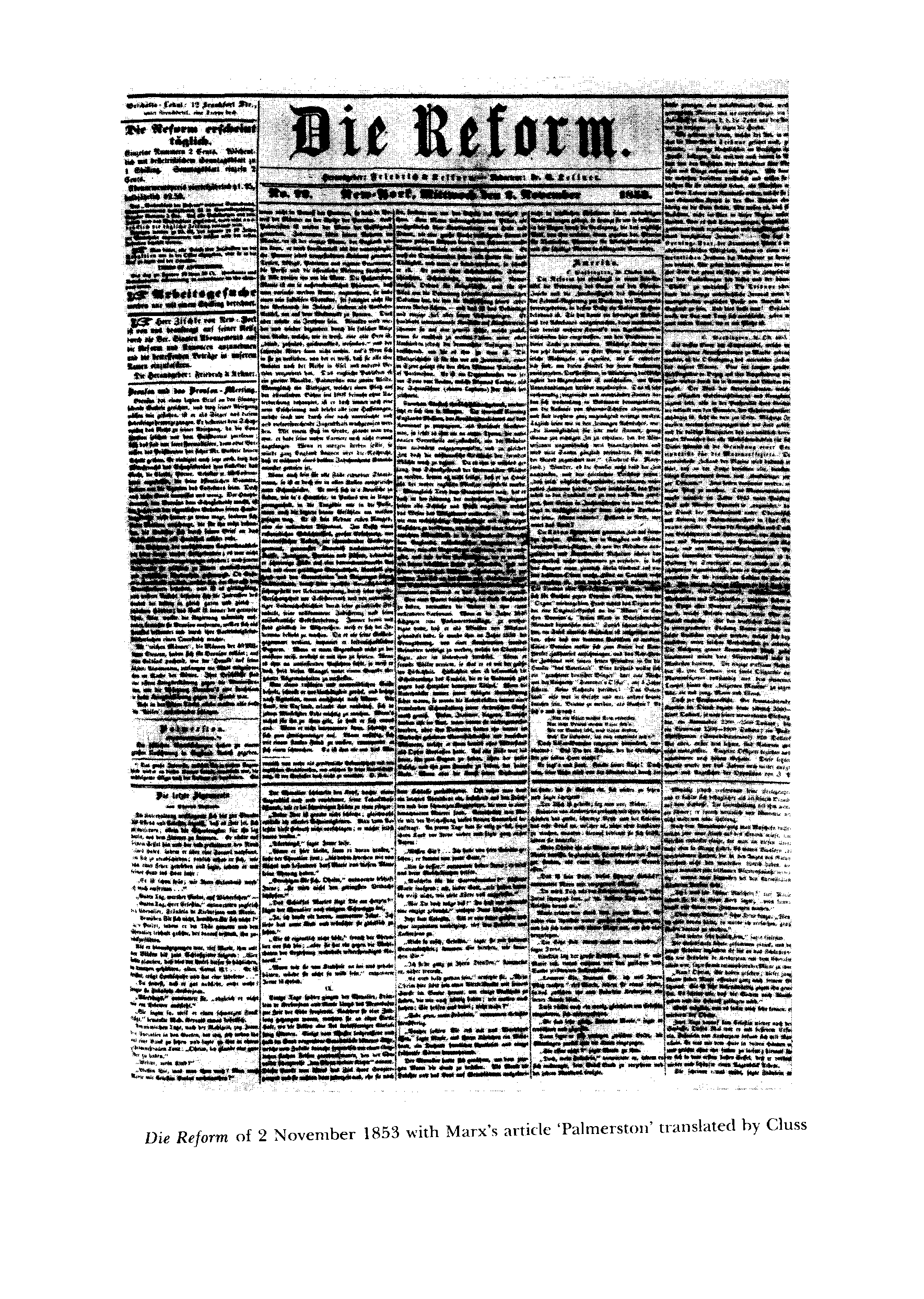
Die Reform of 2 November 1853 with Marx's article 'Palmerston' translated by
d'abord, the antithesis between individual kinds of capital determined by the division of labour, and then, the antithesis between individual capitalists), but the antithesis to property would be all the more comprehensive.
2) I am of course aware that, in an attempt to complete his theory, the worthy Carey also reduces profit (interest included) to wages in a different form. D'abord, is not Protestantism, for example, merely a different form of religion from Catholicism? Does the antithesis, the contradiction, the struggle between them cease — and that is what you are dealing with — because they are both religions? Thus, even assuming that profit and wages are simply 2 different forms of the return on labour, the result is not to reconcile them but merely to reduce their difference to a simplified expression.
But how does he define their otherness} Profit is the wages for past labour. Wages are the profit on immediate present labour. Eh bien!a How does this avail him? For it is precisely from its thraldom, from its slavery to past, materialised labour that present, i.e. actual labour seeks to emerge, and from its thraldom to the product of labour that labour seeks to be emancipated. The old feudal laws were also at one time the present expression of popular activity. Is that any reason why we should be subjugated by them now?
At best, therefore, he is merely changing the phrase 'oppression of labour by capital', into the phrase 'oppression of present labour by past labour'.
There still remains the question, 'How do I gain possession of past labour?' By labour? No. By inheritance on the one hand and, on the other, by the fraudulent exchange of past for present labour. If past labour were exchanged for an equal quantity of present labour, the owner of past labour could continue to consume only so long as he had aliquot portions to exchange and, at a given moment, would himself have to start working again.
3) Carey has himself wholly failed to understand Ricardo's theory of rent when he maintains that it is based on the successive deterioration of land. Ricardo — as I have proved in my book against Proudhonb—falls into the common error of all other bourgeois economists, when he passes off the form of landed property as an 'eternal natural law' of history in general, whereas it is the product of purely industrial circumstances. His theory is true only of bourgeois society in a condition of full development. Rent, in its commercial form — the only one he mentions — does not otherwise exist at all. It therefore leaves him unaffected to maintain that at various historical epochs it was not the worse, but rather the better, lands that were SUCCESSIVELY cultivated. The historically better land of one period does not count as land at all for the other[s]. Moreover, Ricardo does not speak only of the natural properties of the soil, but also of its situation, a social product, a social attribute.
The fertility of the soil, as I have likewise already said in the Anti-Proudhon, is something purely relative. Changes in the soil's fertility and its degree in relation to society, and that is the only aspect of fertility with which we are concerned, depend on changes in the science of chemistry and its application to agronomy.
4) Assuming a given condition of society, not any society, but one of full bourgeois development, with a populous countryside [...] etc., even this part of Ricardo's theory—unessential to his system — is correct.
Firstly. Types of land, with an equal infusion of capital and equally well situated for markets; how can their rents be differentiated? Merely by their natural fertility. This constitutes the level of rent.
On this assumption, when will a corn field of inferior quality be cultivated or a less productive coal-mine be exploited? When the price of corn or coal has risen so high as to enable the less productive ones to be cultivated or exploited. Hence the cost of production of the poorer land determines the rent of the richer. (This is Ricardo's Law.)
Secondly. Does this exclude a constant increase in fertility? Hence, does it include Malthus? By no means.
If 1 is the best land, followed by 2, 3, 4, etc., and fertility is increased tenfold, the relation between 1, 2, 3, 4, etc., remains as before. Were fertility to become so great as a result of chemical discoveries that 1, 2 and 3 sufficed, land 4 would no longer be cultivated. The cost of production of land 3 (let it =3) would then determine the rent. When land 4 (let its production costs =4) still had to be brought under cultivation, the rent of land 1 (let its production costs =1)=4 — 1=3. The rent of land 3 = 3-1=2. The rent of land 2 = 2 — 1 = 1. Now, however, the rent of 1 would =2, that of 2 would =1 and that of 3 would =0. Should the fertility of the land so increase that only 1, the best land, had to be cultivated, rent would disappear completely.
5) Ricardo's theory is based not on the doctrine of rent, but on the law that the price of a commodity is determined by its cost of production. That law, however, should not be understood as meaning that the price of individual commodities is determined by their cost of production. Rather, the commodity produced under the most unfavourable circumstances, and made necessary because of the demand for it, determines the price of all other commodities of the same kind. E.g. if demand is so great that flour, the production price of which is 20/-a QUARTER, can be placed on the market, then a qr. of flour costing 19, 18, 17, 15, etc., to produce is also sold at 20/-. The amount by which the market price, regulated by the cost of production of the dearest QUARTER to be placed on the market, exceeds the production costs of the less expensively produced flour, regulates the rent. What, then, gives rise to rent? Not the land, as supposed by Ricardo, but the market price and the laws by which it is regulated. If the quarter, which costs only 15/-(profit included) were sold, not at 20/-, but at 15, it could not carry a rent of 5. Why, then, does it do so? Because the market price is regulated by the flour the cost of production of which =20. In order that this may be placed on the market, 20 must be the general market price. Hence, if rent is to be overthrown, it must not be interpreted philanthropically; rather the laws of market price and thus of prices generally and thus the whole FRAMEWORK of the bourgeois economy must be overthrown.
So much for today on this subject.
Your
On types of land having the same properties and an equally favourable situation, the rent will, however, be determined merely by the proportion of capital wedded to the land. Nor does Ricardo deny this. Rent is then merely interest on capital fixe.(1) To say that, in cases in which rent does not exist in an actual, specific sense, its specific antithesis to capital and labour does not exist either, is no less true than to say that, where there is neither labour nor investment of capital, no antithesis between capital and wage labour exists. Instead there is, in the case under consideration, an antithesis between profit and interest, between rentiers (in the ordinary sense) and industrial capitalists. The less the tenant pays the man whose capital is wedded to the land, the greater will be his profit and vice versa. The tenant and his LANDLORD (even though the latter simply draws interest on the capital employed on the land) would thus be as much at loggerheads as before. The case most favourable to Carey is as follows: Let the product of labour, the profit and interest = 2, rent =1, wages =2. Now if, as a result of a rise in the productivity of labour, the product doubles and =10, the rent might =2, profit and interest =4, wages =4. To that extent it could be said that every kind of revenue may increase at no expense to labour and without landowner, capitalist and worker being mutually at loggerheads. But:
1) Assuming this most favourable instance to be real, all it means is that the antitheses — rent, profit, wages — all three, become more marked without losing any of their qualitative position relative to one another;
2) Relatively they can only rise or fall at each other's expense. In the foregoing example, the proportion =1:2:2. Does not the ratio remain the same if it =2:4:4? A change in this relative income would occur if, for example, wages were to =5, profit =3, and rent =2. The profit would then have fallen relatively, although in absolute terms it would have risen.
3) It is par trop3 naive to suggest that, if the total product of labour rises, the three classes among whom it is to be shared will share equally in that growth. If profit were to rise by 20%, the workers would have to strike to obtain a 2% rise in WAGES.
4) The conditions that govern an increase in the total product preclude such relatively equal increase from the outset. If the increase is due to a better division of labour, or to a greater employment of machinery, the worker is, from the outset, placed at a disadvan-tage vis-à-vis the capitalist. If it be due to increased fertility of the soil, the landowner is worse off vis-à-vis the capitalist.
188. Marx to Engels. 8 October
188
MARX TO ENGELS
IN MANCHESTER
London, 8 October 1853 28 Dean Street, Soho
Dear Engels,
D'abord" I must ask you — if you can — to send by return at least a minimum of money. Two weeks ago Spielmann finally paid up after deducting nearly £2. In the meantime, of course, debts had mounted up so much, so many of our absolute essentials had found their way to the pawnbroker's and the family had grown so shabby, that for the past 10 days there hasn't been a sou in the house. I now possess proof that I have been cheated by Spielmann, but à quoi bon ? At my request the firm in New York returned me the bill together with a letter from which it emerges that payment was made as early as 22 July, whereas I didn't receive the money until the end of September. I now have a further £24 to draw. (Since Pieper's incarceration I have sent in 6 articles, among them a fulminating acte d'accusation" of Palmerston, in which I trace his career from 1808 to 1832.d I shall hardly be able to deliver the sequel by Tuesday, since there are a great many Blue Books and Hansards to be consulted and Friday and today were utterly wasted in traipsing around after money. I wrote Friday's article' during the night, dictated it to my wife from 7 to 11 in the morning, then took Shanks's pony to the City.) Freiligrath has promised — and will do everything he can to that end, i.e. endorse it himself, etc.—to discount the bill for me with Bischoffsheim, but is unable to arrange the matter for another 8 to 10 days. Such is the casus belli. I shall have to see how I can get through the next few days. Credit is not available for food (excepting hot drinks and appurtenances). On top of that there'll be Pieper who will probably come out of hospital tomorrow—peut-être.a As soon as I got my money I sent him £3, but the jackass entrusted it to Liebknecht for safekeeping and will now find there's not a farthing left.
Of the many pleasures I have experienced during my years here, the greatest have consistently been provided by so-called party friends — red Wolff,b Lupus, Dronke, etc. Today Freiligrath told me that Franz Joseph Daniels is in London and had been to see him with red Wolff. He, Daniels, declared he wouldn't come to see me because my association with Bangya had brought about his brother'sc arrest which would not otherwise have occurred. Bangya first called on me in February 1852, and Daniels was locked up in May 1851! A very retrospective effect, then. All this infamous gossip (the reward for my trouble and loss of time, and such-like agreeable consequences of the triald) is, of course, eagerly seized upon as an excuse for their own lamentable behaviour towards me and their cowardly retreat. However this vile business is attributable solely to the bandying about of ill-natured remarks by Messrs Dronke and W. Wolff who have kept for themselves the easier part, i.e. cancan,'' being otherwise perfectly content to leave the work to me.
If my life was an easy, or at least a carefree one, I wouldn't, of course, give a fig for these scurrilities. But when, year after year, the bourgeois mire is laced with this and similar kinds of mire, c'est un peu fort.e I propose at the next opportunity to declare publicly that I have nothing whatever to do with any party. I no longer feel inclined to allow myself to be insulted by any old party jackass on so-called party grounds.
You can see how necessary it is to get my pamphletf into Germany. Since you can't do it yourself, let me have Strohn's address and I will take the matter up with him.
I would also much like to hear at last what Mr Dronke has to say about the book."h As for Mr Lupus, he apparently wishes to make up for his servility towards his bourgeois patrons by being abominably insolent towards myself. I can assure him that he has by no means settled this matter by boasting to Imandt that, on the pretext of coming to say good-bye, he had vented his philistine spleen on me.
189. Marx to Engels. 12 October
Enclosed a letter from Cluss. In his essay against the Neu-England-Zeitung* he has — aptly as I think — pieced together sundry passages from my letters about Carey, etc.[438]
Your
K. M.
189
MARX T O ENGELS
IN MANCHESTER
[London,] 12 October 1853
Dear Engels,
£2 received. It was all the more welcome as Oxford, Freiligrath's principal, is not yet back from his travels, and thus the matter has been delayed.b
As regards the Tribune, I shall have Article II on Palmerston c
READY for Friday.0 Article III, the final one, which covers the period 1848-53, calls for so many Blue Books and PARLIAMENTARY DEBATES that I can't possibly have it ready by Tuesday,' particularly with Sunday FALLING OUT AS FAR AS THE BRITISH MUSEUM IS CONCERNED. So it would be of enormous use to me and would also save me time if you could supply me with something for Tuesday. But what? I really don't know. Perhaps current affairs, to which I would simply ap-p e n d the most recent news. Perhaps, if you have kept u p with the subject — not very much is WANTED FOR MESSRS GREELEY AND M C ELRATH — t h e influence of the impending crisis on DOING AWAY WITH THE BONAPARTE REGIME. I think it high time that attention was drawn to France where, after all, the catastrophe will break out. Failure of the corn and grape harvests. Paris, with its lower bread prices, attracting workers from all over France and thus recruiting the revolutionary army, while these new arrivals depress the already falling WAGES of the Parisians. Bread RIOTS in Alsace-Lorraine, Champagne. Grumbling by the peasants over the preference given to Paris, by the workers over the expensive wooing of the army, by the bourgeois over forcible interference with economic laws for the benefit of the workers. Falling demand, particularly for luxury articles. CLOSING of WORKSHOPS beginning. In contrast to the general misère, LAVISH EXPENDITURE and stock-jobbing by the Bonaparte family. HOLLOWNESS of the entire credit system, turned into nothing more or less than a colossal institutionalised racket under the direction of the Lumpenproletariat emperor and the Jew Fould. Bourse, bank, railways, mortgage banks and any other institutionalised racket you may care to name. The last days of the Louis Philippe regime all over again, but with all the beastliness and none of the REDEEMING FEATURES of the Empire and the Restoration.
PRESSURE of the government on the Bank. Tax collector mulcting the land more rigorously than ever. Vast difference between the advance estimates and the actual budget. All municipal administra-tions atrociously in debt — because PROSPERITY has to be propped up. Then the influence of the ORIENTAL QUESTION on FUNDS, with the court itself dangerously exploiting fluctuations in the stocks. DÉMORALISA TION of the army. Special stress should be laid on the fact that none of the manifestos, proclamations, etc., by Ledru, L. Blanc and other kindred spirits of all complexions have succeeded in removing the evil, whereas the social and economic crisis is setting the whole caboodle in motion, etc. etc. I don't know, of course, whether the subject will appeal to you. At any rate let me know whether or not I can expect an articulum* by Tuesday, so that I can act accordingly.[440]
Your
K. M.
In last week's Economist—(Saturday's, so really this week's) there's all sorts of stuff in its Paris Correspondence.b
190. Marx to Karl Blind. 13 October
IN LONDON
London, 13 October 1853 28 [Dean Street], Soho
Dear Blind,
Immediately after you called on me, I went to see Freiligrath in order to secure his good offices in getting my bill discounted. Freiligrath did indeed undertake to do this, but has so far not managed to arrange the thing since his principal*—whom he needs for the transaction and who has been expected back these past 8-10 days — has not yet returned. Thus I am sans sousb— although I have almost £30 to draw. Yet the thing must be settled within a few days.
As I was unable to obtain this money against my bill, I looked round elsewhere so that I could send you the £1 forthwith, but was everywhere met with a snub.
So, like myself, you will have to be patient for a few days and will, I am sure, realise that nothing could be more vexing to me than my present inability to settle the matter immediately.
Quant à° Jones, I can't understand anything. Since you were here he has been to see me twice and positively assured me he had written to you. It's not his way to lie about such things. Can his letter have been intercepted? He'll be here again tomorrow, when I shall get him to write to you in my presence. Then I shall myself take the letter to the post. He is leaving on Monday.d
Warm regards to you and your wife.
Your
K. Marx
191. Marx to Adolf Cluss. 18 October
IN WASHINGTON
London, 18 October 1853 28 Dean Street, Soho
Dear Cluss,
You really did [...] too much in going to the trouble of copying out the Chinese thing.[3] A T THOSE EXPENSES I would certainly not have had the impertinence to ask you for the article.[442] Dana copied my stuff almost word for word, watering down this and that and, with rare tact, deleting anything of an audacious nature. NEVER MIND. IT IS A BUSINESS OF HIS. NOT OF MINE. In one of my Indian articles he also amended the bit where I speak of cholera as 'THE INDIANS REVENGE UPON THE WESTERN WORLD' to 'INDIA'S RAVAGES' which is nonsense. En passant^ Freiligrath solicited that 'revenge' for a poem about cholera upon which he is still at work.
Again, in another of my articles on India / dealing with the princes there, he transmogrified 'THE SKELETON OF ETIQUETTE' into 'THE SECLUSION (PITIFUL!) OF ETIQUETTE'. NEVER MIND! Provided he pays.
My wife has also compromised me by putting Rinaldo for Ruggiero and Alcide for Alcinee in the first article on Palmerston. These are 'les petites misères'f of an écrivain[8] whose own handwriting is illegible.[443] But it's a bitter pill for a man who knows his Ariosto from A to Z in the original. Divinoh Ariosto! It's a big jump from Ariosto to Klein, or rather a long fall, and a casus obliquus' at that. Papa Klein wrote to m e — not a word, of course, about his upsets and rows — asking for recommendations to you and Weydemeyer. In my reply (Pieper has not written him a single line quant à vous') I did not, of course, in any way suggest
a K. Marx, 'Revolution in China and in Europe'. - b K. Marx, 'The War Question.—Doings of Parliament.—India' (see present edition, Vol. 12, p. 216). -
18 1853
that Weydemeyer was unfriendly to me. b How could anyone suppose me capable of such stupidity and baseness? Mr Klein would have had to conclude from my harmless remark about Cluss' being 'our party's most talented and energetic representative in America',c that I was denying all talent and energy to Weydemeyer. However, such sophisticated word-juggling is beyond the reach of Klein's intellect. Hence all his remark amounts to is a piece of nonsense invented in order to give vent to his annoyance. NOTWITHSTANDING ALL THIS, YOU ARE RIGHT, SIR, IN HAVING WRITTEN TO MR SNUG.C
Klein really does wield some influence over the Solingen workers, and they are the best in the Rhine province. I, pour ma part,d have never, either drunk or sober, expressed the view that the workers are fit only for cannonfodder, although the louts, among whom little Klein e is evidently coming to rank himself, are, to my mind, barely fit even for that. It would be as well to treat little Klein with your accustomed DISCRETION as a tool that may perhaps (?), IN TIME OF ACTION, be of use to us.
Have forwarded the letter to Pieper. There's nothing doing with the Gradaus for it doesn't pay, and Pieper is too badly off to write gratis.
As regards the Reform, I shall see what I can get the others to do. T h e only one from whom any real support can be expected is Engels. Red Wolfff is married and a retailer of HOUSEHOLD WORDS for Prutz, Gutzkow and Cotta, not worth a FARTHING to us just now. Lupus no longer writes; he's so obstinate that he cannot be made to forget the unfortunate business of Weydemeyer's Revolution.[2]
Dronke, presently a clerk in Bradford, idle as a grisette. Weerth, travelling about South and North America on business for nearly a year now. Engels really has too much work, but being a veritable walking encyclopaedia, he's capable, drunk or sober, of working at any hour of the day or night, is a fast writer and devilish QUICK in the uptake, so he at least can be expected to do something in this respect.
I was greatly tickled by Heinzen's heroic deed. Should you people give the fellow another dressing down, concentrate on his crass ignorance, and the pains the wretched man is at to appropriate his opponents' catch-words when they're already stale and fit for nothing. Delectable, the chap's aspirations to dignity, and then his scraps! Serves him right!
Rent In the Misère" I cite an example of how in England, land which, at a certain stage of science, was regarded as barren, is, at a more advanced stage, considered fertile. I can adduce as a general fact that, throughout the middle ages, esp. in Germany, heavy clay soil was cultivated by preference as being naturally more fertile. In the past 4-5 decades, however, owing to the introduction of potatoes, sheep-farming and the resulting manuring, etc., light sandy soil has taken pride of place, esp. since it involves no EXPENSES OF DRAINAGE, etc., and on the other hand its deficiencies can easily be made good by means of chemical fertilisers. From this, then, it may be seen how relative 'fertility' is, even 'natural' fertility, and at the same time how ill-informed Mr Carey is, even from the point of view of history, when he expresses the opinion that the most barren land is always the first to be brought under cultivation.b
What leads him to that conclusion? The fact that tropical swamps are damned fertile but reclaimable only by civilisation. A tropical swamp, however, is productive not so much of herbs as of weeds. Civilisation clearly originates in those regions where wheat grows wild, as was the case in part of Asia Minor, etc. Such land is rightly described as naturally fertile by historians — and not land yielding poisonous vegetation and requiring more strenuous cultivation if it is to become fertile for human beings. Fertility is not, after all, absolute but merely a relation of the land to human requirements.
Ricardo's law only holds good within bourgeois society. Hence it is where the relationship of the bourgeois to the land is purely that of a bourgeois, and every peasant,—or feudal — or patriarchal, relationship is cast aside that the law applies in its purest form, hence above all in the mining of precious metals, and in colonies where commercial crops, e.g. sugar, coffee, etc., are grown. More about this another time. In both instances the exploitation of the land is regarded and pursued by the bourgeois de prime abordc as a purely commercial concern.
Though I'm not afraid of those curs of Russians in so far as
192. Marx to Engels. 28 October
Europe is concerned — they are going to put us Germans in queer street. Between the Kalmuks and the crapauds3 we are in a cleft stick.
Herewith copy of The People's Paper.
Vale faveque*
Your
K. M.
full in: Marx and Engels, Works, Second Russian Edition, Vol. 50, Moscow, 1981
192
MARX TO ENGELS
IN MANCHESTER
[London,] 28 October 1853 28 Dean Street, Soho
Dear Frederic,
Mes remerciements pour les deux articles.d I fear you have been too biassed by Mr Smitte in favour of Russia's military achievements. D'abordJ as regards the 1828-29 campaign, it was a wretched affair in the opinion of most contemporains%; I base myself inter alia, on the REPORT submitted to the Duke of Wellington by his ADC and published in The Portfolio.h The fortresses were bought rather than stormed. In general, BRIBERY played a major role in the campaign.
After passing through the Balkans, Diebitsch was not sure whether he had come to conquer or to be miserably cut off and captured. What saved him was BRIBERY, this time of one of the Pashas in command, and the UTTER DISSOLUTION of THE TURKISH ARMY. Russia began the war when the fleet had been destroyed off Navarino[444] and the Turkish army's traditional organisation had been destroyed by Mahmud and no new one had yet been established. In any case, circumstances are different now.
Over the past 2 weeks the Débats has been publishing articles on the campaigns of '28-'29, which, however, I have not read. I shall look out further material at the library.
Pieper has been out of hospital for a week — and is doubly occupied, 1. as correspondent of the Washington Union, arranged by Cluss and 2. as CLERK (from 9-5) at 25/- A WEEK with a crapauda in the City. Hence of no further use to me. Tant mieuxb for him. I'm glad he's out of the mire.
I am sending you the continuation of the Palmerston.c Jones has asked me for the next instalment. I have sent an article for this once d
but with the proviso that he would get no more if he didn't put an end to the abominable printing errors (this time glaring to the point of distortion). The manuscript was written very neatly.
Rings, stricken by madness, has spent several days in the WORKHOUSE and is still in a critical condition. Drink was to blame, quorum magna parse the merry-making Lupus who debauched him with gin AFTER HE HAD SHUT UP HIS SHOP. Withal the man's too full-blooded to remain idle and has not yet succeeded in finding any fresh occupation. It's damnable the way the fellows all go mad on us.
Herewith Heinzen's tour de force.
Your
K. M.
193. Marx to Engels. 2 November
193
MARX TO ENGELS
IN MANCHESTER
[London,] 2 November 1853 28 Dean Street, Soho
Dear Engels,
You must let me have something by the day after tomorrow, even if only 1 or 2 pages (if you are short of time) on the CROSSING of the DANUBE by the Turks when they took Kalafat. Yesierday I reported the news* as VERY DOUBTFUL. But it seems likely to be confirmed and tomorrow's papers will at any rate tell you how things stand. Now that scientific opinions are beginning to be expressed on the subject, I can neither remain silent nor discuss it from the standpoint of 'sound common sense'.b According to the news in the French press, Shamyl has roundly trounced the Russians and is actually threatening Tiflis, while General Vorontsov has written to his government informing it that, once he is threatened from 2 sides, he will not be able to hold Georgia without substantial reinforcements.
Of late the Tribune has been considerably exercising its annexationist policy. To begin with your first military article was annexed as a LEADER, then my Palmerston,c further instalments of which are thus foredoomed to annexation. Strange though it may seem to you, by following exactly in the footsteps of the NOBLE VISCOUNT during the past 20 years, I have come to the same conclusion as that monomaniac Urquhart — namely that for several decades Palmerston has been in the pay of Russia. As soon as you have read the further instalments of my article (especially the bits about the Turko-Syrian conflictd) I would like to have your views on the subject. I am glad that chance should have led me to take a closer look at the foreign policy — diplomatic — of the past 20 years. We had very much neglected this aspect, and one ought to know with whom one is dealing.
194. Marx to Engels. 6 November
Diplomacy as a whole is nothing but Stieber, Bangya and Co. reproduced on a large scale.
The New-York Enquirer, edited by General Webb (I haven't read the article myself), has attacked the Tribune LEADER got from you.a
The thing, it says, is scientifically correct, but a Turkish war is waged according to different principles. Turks would go into the attack whatever the circumstances, etc.
How is the Factory Pro-le-ta-ri-at doing?
Your
K. M.
194
MARX TO ENGELS
IN MANCHESTER
[London,] 6 November [1853] 28 Dean Street, Soho
Dear Engels,
Herewith the great Karl Heinzen's invective against myself and communism in his Herold des Westens.
Also a letter from Cluss. From it you will see that Willich's fiery rocketb is arriving by the next post. The worst of it is that the fellows will be peddling their lampoon throughout the whole of Germany while my pamphletc reposes quietly in Manchester and London — and that in Heinzen they once more possess a vocifer-ous sounding-board, whereas a few months ago the only organ at Willich's disposal was the Criminal-Zeitung. When the trash arrives I shall let you have it immediately, so that you can write and tell me what you think we ought to do.
You will see from Cluss' letter how things stand with the Reform.[445] Get the 'old man'd and Dronke to write for it. They have plenty of WASTE TIME. Whether it would be advisable for us two to contribute direct is a moot point.
Weerth's letter horriblement insipid, despite all his striving after wit.
Your
K. M.
195. Marx to Adolf Cluss. Mid-November[446]
... As regards the Reform, I shall see what can be done in Germany and Paris. Pieper is now in business and spends from 9 in the morning until 8 at night in the City. So what with his work as correspondent for the Union, has little time. He'll do something. If any money is forthcoming, I would suggest that Eccarius get some first so that he doesn't have to spend all day tailoring. In accordance with an agreement made with me, he will now be sending articles regularly. Do try and see that he gets something, if at all possible. With regard to his French articles, Jones is no longer printing them,[447] nor has he returned me the manuscript, which isn't therefore available dans ce moment,* Jones being away on an agitation tour. I have written to him about it, however.[448] I have also asked Heise. Diversity is desirable and, by consorting with us Heise will, I believe, change for the better. I have asked Lupus and Dronke through Engels. Probably little will come of it. In Lupus' case, age and bachelorhood combine to lead him into mischief during this sorry interregnum.
Not yet seen Willich's damp squib.c The war news takes up almost my whole attention and there's no time left to think about the great Willich. Despite the electric telegraph, the NEWS arrives late, is very confused and fragmentary and has, moreover, all
196. Marx to Engels. 21 November
passed through the hands of the Vienna police — i.e. been censored. The news from Constantinople is of course much delayed. The heroes of democracy are preparing to march. An evil omen for the Turks.
Quant àa Willich, I should much prefer it if I could be spared personal statements and my contribution be confined to producing, for the feuilleton of the Reform, a psychological — or rather, phenomenological — genre picture of this shabby philistine's 'form of consciousness'.
Last Tuesday,b at the same time as your letter, I received one from Klein which was, I must say, most delightfully written, witty and considered. He tells me that he, too, will make a statement against Willich, since he can prove that the man was a fraud all the time he was in London. Klein is obsessed with the idea that you people are treating him very much de haut en bas. I shall try and smooth out this difference.
As regards the Tribune, the most ingenious way of handling the thing might have been to make people believe they 'recognised my style'.[449] I have become very thick with Urquhart as a result of the Palmerston article.c To help me, he has sent me several books — with which, however, I was already familiar...[450]
196
MARX TO ENGELS
IN MANCHESTER
London, 21 November 1853 28 Dean Street, Soho Dear Engels,
Herewith a £2 postal order for Lupus, which I have received for him from Cluss, N.B. in response to my request. Also Willich's exceedingly sorry scrawl.d
197. Marx to Engels. 23 November :
You and Dronke must let me have, by Friday" at the latest, statements on the bits which refer to myself. I shall include them in my GENERAL ANSWER13—in the form of statements. We must be as quick off the mark with our answer as the noble Willich was sluggish. Mind you make your statement a very humorous one.
Thanks for the Turkish article.0 When it arrived, news of the Turkish retreat had already reached me, and I altered the thing accordingly. Do write; it's a month since you answered any of my letters with more than half a dozen lines.[451]
Your
K. M.
Won't you come up to town for Christmas and put up here} I now have a small room for you. You might be able to shake off the old man d for once.
197
MARX TO ENGELS
IN MANCHESTER
[London,] 23 November 1853 28 Dean Street, Soho
Dear Engels,
The People's Paper had been overlooked. Enclosed herewith. The five articles that have so far appeared in Jones' paper have been compressed in the Tribune into three."
Whatever calls there may be on your time, I must ask you to let me have for Friday1 at least 2 of (your usual) pages — more is
198. Marx to Engels. 2 December
unnecessary — written in English so that I waste no time over translation. It seems to me that the campaign is now over for the winter; and in any case the first phase has been concluded, and hence can be disposed of with a few general remarks. So I count on at least 2 pages.
The Willich mess calls for speed — in direct contrast to his six months of shilly-shallying.a
Your
K. M.
Did the 'old man'b get the postal order for £2?
198
MARX TO ENGELS
IN MANCHESTER
London, 2 December 1853 28 Dean Street, Soho
Dear Frederic,
Mes remerciements pour lec BEAUTIFUL ARTICLE.d In America Mr Dana will be making himself a name as a field marshal.
That you should be coming here[452] mainly to frequent the philistines again, pleases me not at all.
Mr Dronke is behaving like a wretched little mischief-monger. He tells Strohn he has sent you his statement and the newspaper,e
and gives you to understand that both have gone to me—have had neither. See to it that the LITTLE MAN returns you the newspapers, at all events. I have a copy of my own here, but none is required in Bradford. Not having received the trash from Dronke, I was rummaging by chance amongst some old letters when I lit upon the corpus delicti with the incriminating passage which I quote verbatim. The letter was addressed to you. [453] Now, should Mr Dronke use adjectival caustic to obliterate factual accuracy, he'll have only himself to blame if / send his letter to New York as proof that I, du moins," am accurate. It contains some strange passages which would now undoubtedly embarrass him, e.g. concerning that 'fanatical lout Imandt', maintenant* an intimate friend to whom he writes twice weekly. Everyone knows how addicted the little man is to mischief-mongering while our backs are turned.
On Tuesday0 I sent off my rejoinder, The Knight of the Noble Consciousness. He'sd in for a surprise. Your letter[454] and others from Steffen, Miskowsky (together with Kossuth's testimony),[455]
etc., all of them, of course, with your signatures, were included as integral parts of the whole.
Write soon. Jones is under attack from The Economist'' and is acquiring fame.
Apropos. Last Tuesday a Polish meeting.[456] Mazzini and Kossuth didn't come. Inane blather from Worcell. Ruge and Ledru showed themselves worthy of the company. My wife was there/ Also at Monday's meeting held by Poles of the democratic variety. It was announced that Harney was to be in the chair. Fearsome revolt by the 50 or 60 English working men present. Hisses, TRAITOR-, •DRYBONES' (as he called the Chartists), RENEGADE. A fearsome set-to. Harney did not dare take the CHAIR, was terribly mauled, buffeted, abused and, despite half a dozen attempts, never managed to speak. Needless to say, the stupid Waschlapskisg couldn't understand what was going on and interpreted the whole thing as 'reaction'. This spells Nemesis for Father George Julian Harney.
Your
K. M.
199. Marx to Engels. About 12 December
From the enclosed letter[3] you will see that Cluss has unfortunately already answered.b But since my thing was ready,c it had to go off. One should not work for Willich for nothing.
199
MARX TO ENGELS
IN MANCHESTER
[London, about 12 December 1853]
Dear Engels,
From the telegram I received from you this morning I naturally cannot tell:
1. Whether Cluss', etc., answers'[1] and the issues of the Reform relating to Williche have reached you from New York. The contrary would seem possible, since Mr Lupus, in a fatuous letter to Cluss, seeks to conceal his laziness by inveighing against Weydemeyer.
2. Has Dronke returned the relevant numbers of the Criminal-Zeitung[1]} I asked Steffen to get you to send them to him in Chester, since I can't do without the one copy I have down here. When — induced by you—I came in my last letter[8] to speak of the odd affair of 'the well-known gentleman, Dr Dronke's' statement, it occurred to me that the immediate upshot would be that I would get no private letters from you until the affair could be assumed to have blown over — say a week or two. At least, that is the method which, since Mr Lupus' arrival in Manchester, you have adhered to with unusual consistency in all matters concerning
[3] Cluss to Marx, 13 November 1853. - b J. Weydemeyer, A. Cluss, A. Jacobi, 'An die Redaktion der New-Yorker Criminal-Zeitung', Belletristisches Journal und New-Yorker Criminal-Zeitung, No. 37, 25 November 1853. - c K. Marx, 'The Knight of the Noble Consciousness'. - d See previous letter. - e 'Werbungen in New-York', 'Das Wirken der "Militär Kommission"', Die Reform, Nos. 87 and 88, 19 and 21 November 1853. - f containing Willich's 'Doctor Karl Marx und seine "Enthüllungen"' - 8 See this volume, pp. 400-01.
200. Marx to Engels. 14 December
myself and the two gentlemen. Hence, if our correspondence is not to be reduced to mere telegraphic exchanges, it would be better if both of us were to omit in future all allusions to your friends and protégés up there.
Salut.
Your
K. M.
200
MARX TO ENGELS
IN MANCHESTER
[London,] 14 December 1853
Dear Frederic,
As you know, everyone gets an occasional bee in his bonnet, and nihil humani3 etc. Needless to say, there was never any question of 'conspiring' and suchlike nonsense.[457] You are accustomed to SOME JEALOUSY and, au fond^ the only thing that vexes me is our not being able to be together now, to work and have fun together, whereas your 'protégés' have you conveniently to hand.
Enclosed one copy of the Knight. The other arrived in Washington either today or yesterday. I sent the thing to Cluss so that the 2 statements' should not conflict, and so that he can delete anything that has already been said. A few small stylistic changes were made in the copy I sent. The last page is missing from the one I sent you; it got mislaid and contains only a few concluding remarks in a humorous vein.
Although we have heard nothing of him, Willich must be back in London again. Did you see in the Reform the splendid minutes of the meeting presided over by Anneke, in which not a single person declares himself willing to return to Germany as 'a revolutionary fighter under Willich's military leadership'?a
Quant ab Palmerston,c I could agree to a 'German' version only if I could be sure that the work would subsequently be accepted by a publisher. For I haven't a German MS, since I myself had to write the thing in English, i.e. Anglo-Saxonise the original from the word go. As regards the Tribune I intend to conclude with the TREATIES OF 1840 AND '41,[458] and for this I have at my disposal some very bulky BLUE BOOKS, BESIDES Hansard and the Moniteur. Have left out Palmerston's machinations in GREECE, Afghanistan, Persia and Serbia, as being of lesser importance. That would still leave the revolutionary period[459] for which the BLUE BOOKS again provide important (if considerably curtailed) material, as well as for our 'patriotic' war, etc., in Schleswig-Holstein
Concerning your Bonaparte as a captain of artillery, or writer thereon, I think you would do best to send a paper of this sort under your own name either to 1. The Daily News, 2. The Exarriiner, or 3. The Westminster Review. The first would probably be best. An article of this kind would at one fell swoop—par coup d'étatd—put you in such a position vis-à-vis the London Press that you could 'press' it and at the same time, perhaps, get a chance to have your book on the Hungarian compaigne published in English in London, which would in any case be more profitable and effective than in POOR old Leipzig.
Needless to say, the Tribune is making a great splash with your articles, POOR Dana, no doubt, being regarded as their author. At the same time they have appropriated 'Palmerston', which means that, for 8 weeks past, Marx-Engels have virtually constituted the EDITORIAL STAFF of the Tribune. In addition to your lengthier expositions which are appropriated by them for LEADERS and are feasible only in the case of certain important EVENTS or periods, e.g. the initial phase, then the battle of Oltenitza, etc., I should be grateful if (time permitting) you could — during the less important interludes — let me have a brief summary of the facts — 1-2 pages, say — in English. I have greater difficulties — even from the language standpoint — with the lesser stuff than with profound (!) expositions, especially with material I have long been familiar with by reading in an English context, i.e. English works. I only require this, of course, when there is a dearth of 'great' événements.a The main difficulty is the uneasiness of my critical conscience in regard to matters with which I feel I am not à la hauteur.b My competitorc quite simply copies out the facts (or rather what are given out as such by the London Press).
What do you think of my brother-in-law Juta's proposal, enclosed herewith, that we should write a monthly article for the Zuid-Afrikaan (Cape Town)?[460] Rotten though Juta's French may be, he's a good, sensible chap. If only you and I had set up an English correspondence business at the right moment in London, you wouldn't be stuck in Manchester tormented by the office, nor I tormented by debts. Incidentally, I believe that if you were to send military articles to the London papers now, you would, within a few weeks, be able to secure a permanent post which would pay as well as the Manchester business and leave you more spare time. At present the DEMAND FOR MILITARY WRITERS exceeds the supply.
It might even be asked whether The Times itself might not be very glad to hook a MILITARY COLLABORATOR since it is wretchedly served in this respect. It would be worth trying. For we have, of course, now reached the stage at which we regard any English newspaper merely as an emporium and it matters not a rap in which of these emporia we display our 'articles', supposéd they are not tampered with.
Your
K. M.
Published in English for the first time 1854
201
Endnotes
[313] police repressions and arrests and increased emigration, especially after an
[329] (see Note 299).—266 324 Marx spoke of these facts in Revelations Concerning the Communist Trial in
[330] Cologne and 'Hirsch's Confessions' (see present edition, vols. 11 and 12).— 267 325 N e w s from Schabelitz (see this volume, p. 264) led Marx to believe that
[331] Revelations Concerning the Communist Trial in Cologne had already been published in Basle. On how matters stood as regards this publication see Note 261.—270 3 2 6 Steps to publish Marx's The Eighteenth Brumaire of Louis Bonaparte in Switzerland failed.—270 327 See present edition, Vol. 11, pp. 417-18.—270 328 In the letter mentioned here Dana informed Marx that he would pay £ 1 for each article, but promised double pay for articles on vital problems of current politics.—273 329 The original of Marx's letter has not been found. This fragment is reproduced as quoted in Cluss' letter to Weydemeyer of 17 February 1853.—273 3 3 0 'Communia—a colony founded by Weitling's associates in Iowa (USA) in 1849 to put in practice the principles of WeitJing's Utopian communism. The colony ceased to exist in 1853 owing to inner conflicts and financial difficulties.— 275, 450 331 At the beginning of 1853 the German liberal historian Professor Gervinus was brought to trial on a charge of incitement to high treason and an attempted breach of the peace in publishing Einleitung in die Geschichte des 19. Jahrhunderts, 332 334 335 336 338 339 340
[334] The international Peace Congress was convened by the bourgeois pacifist
[336] Traders were especially active at it. The Congress adopted a number of
[337] resolutions against anti-French military propaganda in England and against the
[340] article 'Capital Punishment.—Mr. Cobden's Pamphlet.—Regulations of the Bank of England' (see present edition, Vol. 11).—276 The reference is to the armed conflict between Turkey and Montenegro which was a vassal possession of the Sultan and sought full independence. In early 1853 Turkish troops invaded Montenegro, but the stance adopted by Russia and pressure from Austria soon compelled the Sultan to withdraw them.—277, 278, 288 Marx made this rough note in English on J. G. Mayer's letter of 3 February 1853. Marx used the pseudonym Charles Williams when he sent his letters to Szemere in Paris c/o Mayer.—277 A reference to the Milan insurrection started on 6 February 1853 by the followers of the Italian revolutionary Mazzini and supported by Hungarian revolutionary refugees. The aim of the insurgents, who were mostly Italian workers, was to overthrow Austrian rule. The insurrection was badly organised and was soon suppressed. Marx analysed it in a number of articles (see present edition. Vol. 11, pp. 508-09, 513-16, 532 and 535-37).—278, 283, 307 Bellinzona—an administrative town in the Swiss canton of Tessin (Ticino). In the main cities of this canton, a centre of Italian emigration in the nineteenth century, there were print-shops where the supporters of Italy's national liberation had their literature printed.—278 Kossuth, who after the defeat of the Hungarian revolutionary army crossed into territory dependent on Turkey and was interned in the fortress of Vidin (Bulgaria), appealed to the insurgents still in the fortress of Komarom on 2 October 1849 to continue the struggle promising speedy support from Britain. However, the Hungarian insurgents had already accepted Austrian terms of capitulation.—279 "1 his letter was published in English for the first time, considerably abridged, in Karl Marx and Friedrich Engels, Correspondence. 1846-1895. A Selection with Commentary and Notes, Martin Lawrence Ltd., London, 1934.—280, 344 Here Marx refers to a letter from Kossuth to Mayne Reid intended for the press. Mayne Reid published a statement in a number of English newspapers (see, e.g., 'M. M. Kossuth and Mazzini and The Times', The Daily News, No. 2105, 18 February 1853) assaying on behalf of Kossuth that tiie latter did not take part in the Milan insurrection (see Note 335) and declaring diat the address 'In the Name of the Hungarian Nation.—To the Soldiers Quartered in Italy' circulated over Kossuth's signature during the insurrection was a forgery.—280 Marx quotes this statement of Delia Rocco in the artide 'The Attack on Frands Joseph.—The Milan Riot.—British Politics.—Disraeli's Speech.—Napoleon's Will' (see present edition, Vol. 11, p. 515).—281 1 Marx has in mind here the English workers' movement for observance by the
[341] manufacturers of the Ten Hours' Bill adopted by Parliament in 1847, for its
[342] application to all categories of workers and for the repeal of the 1850 law,
[344] analyses this movement in 'Parliamentary Debates.—The Clergy Against
[345] Socialism.— Starvation' (see present edition, Vol. 11).—282 2 Marx refers to the speech made by John Russell, leader of the Whig Party and
[62] Karl Vogt was a member of the Imperial Regency of five formed in Stuttgart on 7 June 1849 by the rump of the National Assembly which moved there from
[346] member of the Aberdeen Coalition Government, at the opening of Parliament
[34] The Bonapartists thoroughly concealed the genuine scale of the republican
[350] Irish faction. Marx described this Ministry in 'A Superannuated Administra-
[351] tion.— Prospects of the Coalition Ministry, &c.' (see present edition, Vol. 11).—284 4 A reference to questions in Parliament in connection with rumours that the reactionary governments of the continental powers, Austria in the first place, intended to demand that the British Government should deport political refugees, Mazzini and Kossuth in particular. On 1 March 1853 Palmerston denied in the House of Commons that such demands had been made and declared that, should they be made, the British Government would categorically reject them. However, on 4 March, Aberdeen, head of the Cabinet, stated in the House of Lords that the government was ready to take proceedings against the refugees.— 284 5 In June 1850 the British Parliament debated the Anglo-Greek conflict over the so-called Pacifico incident. The house in Athens of this Portuguese merchant, a British subject, was burnt in 1847 and this served as a pretext for Palmerston to send ships to the Greek coast and present an ultimatum to the Greek Government.— 284, 455 fi The debate on the Address took place at the opening of Parliament in 1850. The usual procedure of drawing up a reply to the Speech from the Throne was used as a pretext for a comprehensive criticism of Russell's Whig Government, of which Palmerston was a member.—284 7 On 3 March 1853 the radical Hume moved in the House of Commons that all tariffs which were in the slightest degree protectionist should be annulled. Marx expressed his opinion on Hume's motion and on Gladstone's and other Cabinet members' attitude to the question in 'Achievements of the Ministry' (see present edition, Vol. 12).— 284 8 Philhellene—here non-Greek supporter of Greek independence in 1821-29.— 284 9 Engels revealed the essence of the dispute on the Eastern Question between The Times and The Daily News and described Urquhart's views in 'The Turkish Question' (see present edition, Vol. 12).— 286 0 A reference to the trade agreement concluded between Prussia and Austria on 19 February 1853. Marx analysed it in 'Kossuth and Mazzini.—Intrigues of the Prussian Government.— Austro-Prussian Commercial Treaty.— The Times and the Refugees' (see present edition, Vol. 11, pp. 537-38).— 286 1 Marx has in mind his articles for the New-York Daily Tribune: 1. 'Capital
[353] (28 January); 2. 'Defense.— Finances.—Decrease of the Aristocracy.— Politics' (8
[244] der fahrende Ritter auf der wilden, verwegenden Jagd nach dem Schatten
[356] Speech.—Napoleon's Will' (22 February); 5. 'Parliamentary Debates.—The
[357] Clergy Against Socialism.—Starvation' (25 February); 6. article of 1 March with
[274] Cournet about 25 October 1852 in which the latter was killed. Barthélémy was
[234] However, owing to its adventurism and to persisting discord among the
[358] additional information about the attack on Francis Joseph and about Kossuth (presumably not published by the newspaper); 7. 'Forced Emigration.— Kossuth and Mazzini.—The Refugee Question.—Election Bribery in England.— Mr. Cobden' (4 March). The article 'Kossuth and Mazzini.— Intrigues of the Prussian Government.— Austro-Prussian Commercial Treaty.— The Times and the Refugees', which Marx planned to send off on 11 March, was presumably written between 12 and 18 March and published on 4 April 1853 (see present edition, Vol. 11).—288 352 A reference to articles by Aurelius Ferenc Pulszky, a Hungarian journalist and supporter of Kossuth. As an émigré in London he contributed to the New-York Daily Tribune from 1853 to 1860. He signed his articles 'A. P. C , presumably an abbreviation for Aurelius Pulszky's Correspondence. Marx did not learn about Pulszky's contribution to the New-York Daily Tribune until several years later.—288 3,-)3 The entente cordiale—an expression used to denote the rapprochement between France and Britain after the July 1830 revolution. The Holy Alliance—an association of European monarchs founded in 1815 to suppress revolutionary movements and preserve feudal monarchies in European countries. The Holy Alliance, in which the main role was played by Russia, Austria and Prussia, was dissolved in the late 1820s, but after the 1830 and 1848-49 revolutions attempts were made to resurrect it.—289 354 In compliance with Marx's request Engels wrote for the New-York Daily Tribune between 12 March and early April 1853: 'British Politics.— Disraeli.—The Refugees.—Mazzini in London.—Turkey' (jointly with Marx), 'The Real Issue in Turkey', 'The Turkish Question' and 'What Is to Become of Turkey in Europe?' (see present edition, Vol. 12).—289 355 An allusion to Countess Sophie Hatzfeldt's divorce case. Lassalle was in charge of it from 1846 to 1854 and, after the divorce had been granted by the court in July 1851, tried in particular to secure for the Countess her share of the common property of the former couple.—293, 478 356 Engels used this information in the article for the New-York Daily Tribune 'The Real Issue in Turkey' (see present edition, Vol. 12).—295 357 A reference to the Canada Clergy Reserves founded in 1791-1840, which consisted of a seventh of the revenue from the sale of lands in Canada and were used chiefly to subsidise the Established and Presbytarian churches. The discontent of other churches with such a distribution of funds compelled the British Parliament to pass a law in 1853 authorising the Canadian legislative bodies to distribute these funds among the different churches according to the proportion of the population professing their respective beliefs. Marx described this Bill and the debate on it in the House of Commons in 'Achievements of the Ministry' (see present edition, Vol. 12).—295 358 This letter is a reply to Cluss' letter of 6 March 1853. The unanswered letters were presumably written on 25 February and 2 March 1853.— 298 362
[39] Here Freiligrath alludes to the fact that Kinkel, by flattery and fawning,
[360] in Cologne in the Neu-England-Zeitung by Cluss in the USA (see Note 261). For
[361] this Cluss used a second copy of the manuscript sent by Marx to New York on 7 December 1852. The newspaper published only three fragments on 6 March, 2 and 28 April 1853.—298
[362] Barthélémy was Willich's second during the latter's duel with Schramm in
[260] mentioned letters allegedly written to Marx by Mrs Daniels, the wife of one of
[363] Ostend in September 1850. See Marx's The Knight of the Noble Consciousness
[364] (present edition, Vol. 12, pp. 492-95).—299
[365] Cluss' letter to Marx of 24 March 1853.—301
[366] A reference to a no-longer-existing letter to Bangya which Marx presumably
[31] The Bonapartist coup d'état of 2 December 1851 caused a republican uprising
[367] wrote in Manchester during the period from the end of May to the second half
[368] of June 1852 while he and Engels were working on The Great Men of the
[369] Exile.— 301 363 y\ n a]] u sj o n t o Harvey Birch, the main character in Fenimore Cooper's novel
[371] The spring campaign of 1349 in Northern Italy began after Austria and
[372] Piedmont resumed hostilities on 12 March. At the decisive battle of Novara on
[373] 22-23 March 1849 the Austrian army under Radetzky defeated the Piedmon-
[374] tese troops. As a result Austrian rule was restored in Northern Italy.— 310
[375] The Vilâgos affair—the capitulation of the main forces of the Hungarian army under Görgey to Paskievich's troops on 13 August
[376] revolutionary
[377] 1849.— 310
[380] In the spring of 1849 Hungarian troops under Bern marched to the Banat, a district in the Serbian Voivodina, then part of Hungary. In speaking of the manoeuvre before Hermannstadt (Sibiu), Engels lias in mind the successful operations of Bern's troops during the campaign in Transylvania in February-March 1849. During the general advance of the Russian troops in summer 1849 Bern returned to Transylvania, again marched to Hermannstadt, drove out the Russian garrison but, faced by superior forces of the Russian and Austrian armies, was compelled to retreat.— 311 The extract from this letter is printed as quoted by Cluss in a letter to Weydemeyer of 3 May 1853. It was published in English for the first time abridged in K. Marx and F. Engels, Letters to Americans. 1848-1895, International Publishers, New York, 1953.—312 The reference is to a series of articles by Pieper published under the general heading 'A Critical History of French Socialism' in The People's Paper, Nos. 31-33, 4, 11 and 18 December 1852. Weydemeyer and Cluss planned to publish these articles in Die Reform, but Pieper did not finish the series.— 312 Here Marx has in mind Pieper's material difficulties. On 18 April 1853 Pieper applied to Engels for help, as he could not receive money due to him for private lessons. On receipt of Pieper's letter Engels propably wrote to Marx between 19 and 23 April 1853 inquiring about Pieper's situation. Engels' letter has not been found.— 314 Marx received Engels' article on Switzerland on 26 April 1853 and dispatched it with his own article to New York on 29 April 1853. The editors published the material on Switzerland as two articles. The first article, including Marx s material, was entitled 'The Rocket Affair.—The Swiss Insurrection' and was published on 14 May 1853; the second article appeared on 17 May 1853 undei the heading 'Political Position of the Swiss Republic'; the date of its dispatch from London — 1 May 1853 — was arbitrarily supplied by the editors (see present edition, Vol. 12). The newspaper published both articles over Marx's name, though the first was written by Marx and Engels, and the second bv Engels.—314, 319, 321 Marx's letter to Strohn is not extant.—315 In April 1853 as a pretext for reprisals against political refugees, the British authorities accused the proprietor of a rocket manufactory in Rotherhithe, in London, of a conspiracy with Kossuth which Marx ironically calls 'Kossuth's gunpowder plot' by analogy with the Catholic gunpowder plot against James I in England in 1605. In March 1853 the Prussian police arrested several liberal and radical bourgeois leaders in Berlin in an effort to trump up a new conspiracy case. These government and police actions are described in Marx's 382 383 384 385 386 387 388 389 390
[381] articles 'The Berlin Conspiracy', 'The Berlin Conspiracy.—London Police.—
[383] Swiss Insurrection' (see present edition, Vol. 12).— 316
[38] Engels has in mind his article 'England' which he intended to send to Weydemeyer with the letter (see Note 17).—18 The Roman wall (so-called Hadrian's Wall) was erected in North England in the second century to defend the Roman province of Britannia against the raids of the Picts (tribes then inhabiting the territory of what is now Scotland) and extended between the Solway and the Tyne (from Carlisle to Newcastle) over a distance of about 120 kilometres. After the fall of Roman rule in the fifth century Hadrian's Wall was destroyed.—18 These are Marx's covering notes to Stechan's contributions to Die Revolution, which Marx promised to Weydemeyer in his letter of 23 January 1852. The material contained some concrete facts concerning the persecution of the participants in the socialist and communist movements in Germany and the position of the Communist League members, Bürgers, Becker, Daniels, Otto and others, then under investigation in Cologne, but it was not a finished article. The material reached Weydemeyer in New York before 17 February but was not used because Die Revolution had ceased to appear.—19 On the confiscation of the property of the Orleans, the appointment of Persigny Minister of the Interior, and the resignation of Minister of Finance Fould, see Note 21.—21 The 'glorious revolution' of 1688 in England established a constitutional monarchy based on a compromise between the landed aristocracy and the financial bourgeoisie.— 21 Kossuth was given an enthusiastic reception on his arrival in England in October 1851. Some bourgeois liberals and government representatives, in particular the Foreign Secretary Palmerston, used this welcome as an excuse to eulogise British constitutional freedoms. This served as a hypocritical cover for the unseemly role played by Britain in supporting the suppression of European revolutions, including that in Hungary. The Great Exhibition in London, held from 1 May to 15 October 1851, was the first world trade and industrial exhibition, and was portrayed by some as the beginning of an era of 'universal peace'.—21 The reference is to the verse added by Freiligrath to the second poem which he had written for Weydemeyer's newspaper on 23 January 1852 (see Note 13) and sent to Marx on 25 January 1852 to have his opinion: Das heißt: dafern Du Babel nicht beglücktest Endlos mit Briefen, Karten, Inseraten, (Plakaten gar!)—dafern Du Dich nicht bücktest, Und um ein Wörtlein nur von Deinen Thaten Feig vor der Presse krochst und so Dich drücktest, (Gleich Virtuosen oder Akrobaten,) Daß Dich zuletzt, nach manchem sauern Schritt, Wirklich in Holz die Illustrierte schnitt!
[384] Marx presumably refers to his letters to Cluss of 25 March and 17 April 1853
[385] (see this volume, pp. 298-300 and 312-14) and one of about 10 April 1853
[145] Palmerston' and 'Kossuth, Mazzini, and Louis Napoleon' (see present edition,
[387] Marx dealt in it with the publication in America of Revelations Concerning the
[388] Communist Trial in Cologne as a separate book.—317
[89] Louis Bonaparte, Marx somewhat changed his plan: the work includes not six,
[84] Jones and others. The League campaigned for universal suffrage and social
[392] lays; two versions dating back to the thirteenth century are extant.— 328 992 In a statement made shortly after the publication of the final instalment of
[393] Marx's Revelations Concerning the Communist Trial in Cologne in the Neu-
[394] England-Zeitung, No. 59, 22 April 1853, Willich threatened the imminent
[395] exposure of Marx in that newspaper, and the disclosure of facts he had not
[397] months later by publishing a slanderous article, 'Doctor Karl Marx und seine
[399] Nos. 33 and 34, 28 October and 4 November 1853. Marx replied with The
[400] Knight of the Noble Consciousness (see present edition, Vol. 12).—330 393 Marx's letter to Dana has not been found.—332 394 A reference to efforts to find a job in Manchester or Liverpool for Wilhelm
[401] Wolff, who had lost his last teaching possibilities with Reichenbach's departure
[402] to the USA.—334 995 In his statement 'An die Redaktion der New-Yorker Criminal-Zeitung' of 2 May
[403] 1853 published in the newspaper on 13 May, Willich called Cluss Marx's agent.— 336 39fi A reference to a unit formed by Willich in November 1848 in Besançon (France) out of German émigré workers and artisans. The practices and morals of this unit were satirically described by Marx and Engels in The Great Men of the Exile (see present edition, Vol. 11, pp. 312-15).— 336 397 fhe ideas expressed by Engels here were used by Marx in 'The British Rule in India' (see present edition, Vol. 12).— 339 398 Tartary—a name given in the nineteenth century to a part of Turkestan in Central Asia.—339 S99 Engels refers to Weitling's lost work 'Allgemeine Denk- und Sprachlehre nebst Grundzügen einer Universal-Sprache der Menschheit', written in the first half of the 1840s.—341 400 In 1853, with the active support of the Polish democratic refugees, Alexander Herzen founded the Free Russian Press in London to evade tsarist censorhip. Pointing to this aspect of Herzen's activity, Lenin wrote in his article 'In Memory of Herzen' that he 'was the first to raise the great banner of struggle by addressing his free Russian word to the masses' (V. I. Lenin, Collected Works, Vol. 18, p. 31). Nikolai Ogarev, another prominent figure among the Russian revolutionary democrats, also took part in the management of the Free Russian Press. Besides a large number of books, pamphlets and leaflets, the Free Russian Press published the periodicals Tlojinpuan 3ee.ida (The Polar Star) and Kojimojib (The Bell), which played a great part in developing the revolutionary and democratic movement in Russia. In April 1865 the Free Russian Press was moved to Geneva, where it continued functioning up to August 1867.— 345 401 A reference to Cluss' letter to Marx of 29 May 1853.— 345 4<)- Marx lived in Chelsea (4 Anderson Street, London, S.W. 3) from August 1849 to April 1850.—345 403 The facts mentioned here were described in greater detail by Marx in a letter to Cluss also written on 14 June 1853 (see Note 407).— 345 22-2736 404 405 406 407
[404] A reference to H. Ch. Carey, The Slave Trade, Domestic and Foreign: why it exists,
[405] and how it may be extinguished, Philadelphia, 1853. A quotation from Marx's
[406] 'Elections.— Financial Clouds.—The Duchess of Sutherland and Slavery' is
[407] given on pp. 203-04 of that book.— 345
[128] publishing The Eighteenth Brumaire of Louis Bonaparte.—94 126 Weydemeyer wanted to publish Pfänder's statements (see Note 24, and this
[408] The laws of Manu (Mânava Dharma — Castra)—an ancient Indian collection of instructions defining the duties of each Hindu according to the dogmas of Brahminism. Indian tradition has it that these laws were drafted by Manu, the mythical father of the people, approximately between the second century B.C. and the first century A.D.— 348 Only an extract of this letter has survived as quoted by Cluss in his letter to Weydemeyer of 28 June 1853. Part of it was published in English for the first time in K. Marx and F. Engels, Letters to Americans. 1848-1895, International Publishers, New York, 1953.—348 Further Cluss gives the substance of Marx's letter in his own words: 'About the money business Marx says: He has never accepted any financial support; as for the case trumpeted forth by Willich, it was roughly as follows: Marx, it is said, had rented a house in Chelsea (London) as a subtenant, paid his monthly rent regularly, often at the price of great privation. Then the actual owner of the house suddenly turns up and seizes on Marx, as the sublessor has paid nothing for a year. English law authorises this procedure. Marx cannot pay, a broker is installed in the house, etc. Marx in a very unfortunate position.— He is a member of the Refugee Relief Committee. The moneys are paid out weekly to individual refugees. The total sum, however, which is provided for the greater part by our friends in Europe, is lying idle, and so Marx is "saved", by being granted the necessary sum on condition that he pays it back in fixed instalments when it is required for other refugees — those, it appears, who are alone entitled to relief. This he did conscientiously, and paid back everything, partly out of his own earnings and partly out of money he got from his family. C'est tout [That's all]. 'I have no lack of material to spin this out; on the contrary, there is an abundance of it. The same applies to the sacrifices he made for the Neue Rheinische Zeitung, when the bourgeoisie fell away after the June Revolution [proletarian uprising in Paris in 1848], and the democratic petty bourgeoisie after the state of siege was introduced in Cologne. That's quite something. Marx says he spent about 7,000 talers for the N. Rh. Z. ... He says, too, that I can and should make use of all the material he gives me, without however involving him in this business as a witness. Reform: Marx says J am right. He says half Germany will come to New York for the industrial exhibition, and as we have no other publication in this city, we should simply take no notice of the stupidities of the Hornisse gentlemen [the editor of the Reform Gottlieb Kellner and its London correspondent Heinrich Heise published Die Hornisse in Cassel in 1848-50] and prudently steer our own course. As is well known, Talleyrand always called to his statesmen: "Avant tout, pas de zèle, pas de zèle!" ["Above all, not too much zeal, not too much zeal!"].'—348 A twenty-five thousand-strong political demonstration was organised by the Chartists in Halifax on 26 June 1853 on the occasion of the funeral of Benjamin Ruston, an old Chartist worker. Marx wrote about this demonstration in the article 'Russian Policy Against Turkey.—Chartism' (see present edition, Vol. 12).—350 409 Presumably the reference is to Marx's letter to Cluss sent off about 14 June
[409] 1853 (see this volume, pp. 348-50).—351 410 Marx stayed in Manchester from 30 April to 19 May 1853.—351 411 Charles Anderson Dana's letter to Mrs Marx of 1 July 1853.—354 412 Marx analysed this debate and Bright's speech in the article 'The Turkish War
[410] Question.—The New-York Tribune in the House of Commons.—The Govern-
[413] sity.—355 414 In a campaign for a revival of the mass movement, leaders of the revolutionary
[414] Chartists headed by Jones organised mass meetings all over the country in June
[415] and July 1853. Most important were the meeting in Blackstone-Edge (19 June),
[416] the meeting and demonstration in Halifax on 26 June (see Note 408), and
[417] meetings in Oldham (27 June), Newcastle (3 July) and Mount Sorrel (10
[418] July).—355 415 Engels was in London at the end of July and beginning of August 1853 on the
[420] Morning Advertiser and published on 2 September 1853 datelined 30 August
[421] (see present edition, Vol. 12). It is extant as a copy in Mrs Marx's hand. The
[422] signature and address are in Marx's own writing.— 358 417 As Cluss' letter to Marx of 23-24 October 1853 and Pieper's letter to Jacobi of 3 September 1853 show, references for Abraham Jacobi, who intended to leave for the USA, were sent to America in early September 1853. But there is no mention of this in Marx's extant letters to Cluss and Weydemeyer and excerpts from them.— 359 418 Bakunin wrote to George Sand on 9 July, and in her letter to Marx of 20 July George Sand refuted the calumnious rumours about Bakunin.— 360 41a Marx's statement, a draft of which is quoted below, was not published by The Morning Advertiser. In view of this Marx put it in The People's Paper, No. 71, 10 September 1853 (see present edition, Vol. 12). The texts of the published statement and the draft are not identical.— 362, 364 420 "j-]ie iaws on suspects—the decree passed by the French Convention on 17 September 1793 and other measures of the Jacobin revolutionary government which declared all persons suspect and subject to arrest who in any way supported the overthrown monarchy, including all former aristocrats and royal officials who had not testified their loyalty to the revolution. These laws were drawn up in such a way that even people not involved in counter-revolutionary activity could be placed in the category of 'suspects'.— 363 421 Engels' reply to Marx's letter of 3 September 1853 containing a request for his comments on Marx's draft statement to The Morning Advertiser (see Note 419) has not been found.—363 422 A reference to Wilhelm Wolff's impending departure for Manchester. He lived there from the first half of September 1853 to the end of his life in 1864.—364 22* 423 424 425 426 427 428 430 431 432
[423] Marx refers here to the articles on Russian foreign policy, in particular with
[46] Carl Leske, a Darmstadt publisher, for the publication of his two-volume 'Kritik
[42] When the poem was published, the additional verse about Kinkel was not
[427] In a letter of 31 July 1853 sent to Ferdinand Freiligrath who passed it on to
[428] Marx on 18 August, the Communist League member Carl Wilhelm Klein
[429] reported on the formation of a new Communist League community in
[432] communities in Germany and to send in articles for Gradaus, a German refugees' newspaper close to the Working Men's Association in Philadelphia at the time. Simultaneously, Marx received from Cluss and Weydemeyer, in reply to his inquiry, information about Klein's own unseemly conduct in Philadelphia. Taking into account Klein's influence among the Solingen workers, Marx recommended that Cluss should maintain contact with him. Marx's reply to Klein's letter has not been found.—365, 367 An extract from this letter is extant as quoted by Cluss in his letter to Weydemeyer of 3 October 1853.—366 Presumably an allusion to the fact that Poesche used the article 'Geld' in Meyer's Conversations-Lexicon (Vol. 12, Hildburghausen, Amsterdam, Paris and Philadelphia, 1848, pp. 285-91) as a source for his article.—367 The article 'The Western Powers and Turkey.— Imminent Economic Crisis.— Railway Construction in India' was written jointly by Marx and Engels on 19-20 September 1853.—368, 370 The knife and fork question—words, which came to symbolise the Chartists' social programme, pronounced by an English priest and Chartist, J. R. Stephens, at a meeting in 1838. See Engels, The Condition of the Working-Class in England (present edition, Vol. 4, p. 519).—372, 377 Presumably Marx mentioned his intention to write articles on these subjects in a no longer extant letter to Engels written between 17 and 28 September 1853.—374 Marx's 'The War Question.— Financial Matters.—Strikes' (dated 7 October 1853) suggests that Engels sent in the promised material and Marx worked it up for this article (see present edition, Vol. 12, pp. 409-15).— 374, 376 In September 1853 the Preston manufacturers responded with a lockout to one of the biggest strikes by English workers in the 1850s. The strike was started by the weavers and spinners of mills in and around Preston who demanded a ten per cent wage rise; they were supported by workers in other trades. The lockout lasted until February 1854, but the strike continued after that date. To break the strike the Manufacturers' Association started bringing workers to Preston from Ireland and from English workhouses. In March 1854 the leaders of the strike were arrested, and as funds were low the workers were compelled to return to work. The strike ended in May 1854 (see K. Marx, 'Panic on the London Stock Exchange.—Strikes', present edition, Vol. 12).—374, 376, 513 Textile mill workers and some 5,000 miners went on strike in Wigan (see K. Marx, 'Panic on the London Stock Exchange.—Strikes', present edition, Vol. 12).—376 433 Marx carried out his plans in February and March 1854 by writing 'Russian
[433] Diplomacy.—The Blue Book on the Eastern Question — Montenegro' and
[435] edition, vols. 12 and 13). He wrote two articles on Denmark (21 October and 4
[436] November 1853): 'Arrest of Delescluze.— Denmark.— Austria.— The Times on
[43] included, which means that Freiligrath complied with Marx's recommenda-
[440] propositions of the economic theory he was then elaborating (see Note 45). At
[442] "beste Blatt der Union" und seine "besten Männer" und Nationalökonomen'
[443] published in the New York workers' newspaper Die Reform in September 1853,
[444] for which Cluss had made use of Marx's earlier letters. (For the text of this
[445] article and its analysis see present edition, Vol. 12, pp. 623-32.) The question of
[446] rent was among the problems raised in the article. These notes by Marx are
[447] directly related to this subject and to the critique he began earlier of the
[448] American vulgar economist H. Ch. Carey.—378, 387 439 Presumably Marx continued this letter the next day, 6 October 1853.— 383 440 On Tuesday, 18 October 1853, Marx dispatched to New York 'The Turkish
[449] Manifesto.— France's Economic Position'. Engels may have taken part in writing it.—388 441 This letter was known earlier only from a copy of it in Cluss' letter to Weydemeyer of 2 November 1853 and partly as rendered by Cluss in his letter to Weydemeyer of 4 November 1853. The extract published in Marx and Engels, Works, Second Russian Edition, Vol. 28, and Marx und Engels, Werke, Bd. 28, included part of Cluss' text by mistake (the last paragraph).—390 442 As the editors did not regularly send copies of the New-York Daily Tribune to him, Marx asked Cluss and Weydemeyer to send him the issues containing his articles. Cluss was compelled to copy out the article 'Revolution in China and in Europe' because he could not buy the newspaper in time. Marx's letter (presumably of August 1853) containing a request for this article has not been found.— 390 448 Cluss corrected the misprints when this article from Marx's Lord Palmerston was published in Die Reform.— 390 444 Th e Turko-Egyptian fleet was destroyed by combined Russian, English and French squadrons at Navarino (Greece) on 20 October 1827.— 394 445 In October 1853 Weydemeyer became editor-in-chief of Die Reform. As Cluss wrote to Marx on 23-24 October 1853, Weydemeyer was compelled 'to write almost the whole newspaper himself. In view of this Cluss requested Marx to get his associates to contribute to the newspaper.—396 446 Only an extract from this letter is extant as quoted by Cluss in his letter to Weydemeyer of 7 December 1853.—397 447 Eccarius' articles on the economic and political situation in France were published in The People's Paper from September 1852 to May 1853.— 397 44tt Marx's letter to Jones has not been found.— 397 449 Here Marx replies to Cluss' letter of 23-24 October 1853 in which Cluss wrote about the difficulties he had encountered in publishing the translation of Marx's first article from Lord Palmerston (see Note 436) in Die Reform. The Tribune published Marx's work anonymously, as leading articles, so Die Reform prefaced its publication with an editorial note: 'The interest aroused by Palmerston's name at the present time has induced us to print this rendering 450
[450] from the Tribune. This essay reveals a more than average knowledge of British
[451] affairs by the author, and though it bears no signature, it is easy to tell who the
[452] author is.'—398
[453] A few lines below Cluss writes: 'Marx added some notes on Urquhart because
[454] Jones, in a paper I am to receive, characterises him in a tactless way as an ally
[455] of the Russians [Jones' article 'A Russian Movement in England', The People's
[456] Paper, No. 80, 12 November 1853], Marx writes [this letter is not extant] that
[457] he gave Jones a dressing down for this. I have made up a short article out of
[458] the "Urquhartiade" '. Marx's article, 'David Urquhart', was published by Cluss
[459] unsigned in Die Reform, No. 112, 19 December 1853 (see present edition, Vol.
[460] 12).—398 451 Engels' letters to Marx of October-December 1853 have not been found.— 399 452 Engels arrived in London at the end of December 1853.—400 453 A reference to Dronke's letter to Engels written from Switzerland at the end of
[3] Weydemeyer received Chapter I of The Eighteenth Brumaire, mentioned
[6] terms (see, for instance, this volume, pp. 367, 395, 404). Marx ceased
[299] though the last lines of this work contain a definite hint that the account of
[333] system and a criticism of monarchy.—276
[335] organisation, Peace Society, in Manchester at the end of January 1853. Free
[338] increase of armaments.
[45] Marx mentions here. They were prompted by Freiligrath's grudge against Andersen who, while in London, did not recognise him when they chanced to meet. He felt all the more bitter because the Danish storyteller had enjoyed his hospitality in Germany. When the poem was published in Die Revolution the editors supplied the following note to Andersen's name: 'Herr Andersen himself appears here not merely as an individual but as the epitome of a peculiar type of literary lion and parasite to which the revolution seemed to have dealt the death-blow but which is again coming up and boastfully asserting itself everywhere.' In Freüigraths gesammelte Dichtungen published in Stuttgart in 1870 (Bd. 4, S. 5-6) the poem was printed without the 11 verses devoted to Hans Christian Andersen.—22 40 In a letter to Marx of 25 January 1852 Freiligrath quoted a letter from Ebner who expressed surprise at not having received any letters from Marx and Pieper and promised to discuss with the publisher Löwenthal the possibility of printing Marx's works. It later transpired that Ebner was an Austrian police informer, of which Marx and his friends were not aware at the time.— 22 41 Marx refers here to the ruling of the Board of indicting magistrates concerning the members of the Communist League arrested and detained under investigation in Cologne (see Note 16). He quotes it probably from the letter of the lawyer Bermbach received in January 1852 (it has not been found). This same letter was also used by Marx when he described the proceedings to Weydemeyer in a letter of 13 February 1852 (see this volume, p. 34).— 22 42 The letters of Marx and Engels to The Times and The Daily News on the Cologne Communist Trial were not published in view of the editors' hostility to the leading figures of the revolutionary movement. The original of Engels' letter to The Daily News has not survived. It may be that Engels did not do the final editing (see this volume, p. 29). For Marx's and Engels' letter to The Times see Vol. 11 of the present edition.—24, 25 43 The New-York Daily Tribune published in all 19 articles of Engels' Revolution and Counter-Revolution in Germany. Marx intended to write the last, twentieth, article, but did not do so.—25 44 Eccarius wrote an article about the English machine-building workers' strike (see Note 79) for Die Revolution, but since the latter had ceased publication Weydemeyer proposed to publish the article in the New-Yorker Demokrat.— 26, 117 45 Marx refers here to his work on political economy which he started as early as 1843. He conceived it as a critique of bourgeois political economy and an analysis of the economic structure of bourgeois society in his time and its ideological basis. His initial research resulted in the writing of Economic and Philosophic Manuscripts of 1844 (see present edition, Vol. 3) which were to serve as a basis for the whole work. On 1 February 1845, Marx signed a contract with 46 47 48 49 50 51
[378] The Hungarian revolutionary army relieved Komarom on 22 April 1849 (see
[1] and Frederick Engels, Letters to Americans. 1848-1895. A selection. International
[82] Weydemeyer's 'Die Lage Europa's' in the Turn-Zeitung, No. 10, 1 July
[4] here, as well as the rest of the work, when publication had ceased, but with the help of Adolf Cluss he succeeded in bringing out two more issues of the 'non-periodic journal' Die Revolution in May and June 1852 which carried this work and satirical poems by Ferdinand Freiligrath (see Note 13). Weydemeyer failed to buy up from the printer even half of the 1,000 copies of the work printed. Only about 150 copies were sent to Europe, and approximately the same number sold in the USA in 1852 and 1853. Cluss and other associates of Marx in the past revolutionary struggle in Germany (Johann Schickel, Conrad Schramm, Franz Arnold and others) greatly contributed to disseminate his work among former subscribers to Die Revolution in Philadelphia, Baltimore, Richmond, Cincinnati, Washington and other large cities.—3, 391 3 Wilhelm and Ferdinand Wolff intended to write articles for Die Revolution. In a letter of 19 December 1851 Marx promised Weydemeyer (see present edition, Vol. 38, p. 519) to send him by the next steamer the following material: 1. The Eighteenth Brumaire of Louis Bonaparte by K. Marx; 2. Der Staatsstreich in Frankreich by Ferdinand Wolff; 3. Nemesis by Wilhelm Wolff. Weydemeyer announced this in the first issue of Die Revolution on 6 January 1852, being unaware as yet of Marx's decision not to publish Ferdinand Wolff's article.— 3 4 The reference is to the progressive newspaper, the New-York Daily Tribune, to which Marx contributed from August 1851 to March 1862. A large number of articles for this paper were written at his request by Engels, Marx beginning to send his own articles to New York only in August 1852. He wrote the first ones in German, and his friends, generally Engels, translated them into English. By the end of January 1853 he started writing his contributions in English. Marx's and Engels' articles in the New-York Daily Tribune dealt with major questions of foreign and home policy, the working-class movement, the economic development of European countries, colonial expansion, and the national liberation movement in oppressed and dependent countries. The articles at once attracted attention by their factual information, acute political judgment and brilliant style. This was acknowledged by the editors of the Tribune, who wrote, in a leading article on 7 April 1853, of the need 'to pay a tribute to the remarkable ability of the correspondent'. They went on: 'Mr Marx has very decided opinions of his own, with some of which we are far from agreeing; but those who do not read his letters neglect one of the most instructive sources of information on the great questions of current European politics.' In a letter to Mrs Marx of 1 July 1853, Charles Dana, one of the editors, wrote that her husband's articles were highly thought of by the Tribune owners and the reading public. Articles by Marx and Engels were widely disseminated in America, many of them being reprinted in the Tribune's special editions — the New-York Weekly Tribune and the New-York Semi-Weekly Tribune. Some of the Tribune's articles were translated into German and published in German-language American newspapers. Marx's and Engels' articles in the Tribune were also read in Europe. From 1853 to 1855 Marx wrote regularly for the newspaper sending, as a rule, one or two contributions every week. Sometimes the editors of the New-York Daily Tribune tampered with Marx's and Engels' articles, publishing them as editorial leaders and occasionally making insertions in the text. In 1855 all Marx's and Engels' articles were published without the authors' names. Marx repeatedly protested against such
[2] Publishers, New York, 1953.—3, 27, 303 2 This refers to Chapter I of Marx's Eighteenth Brumaire of Louis Bonaparte, which Marx wrote from December 1851 to March 1852, immediately following the coup d'état in France on 2 December 1851 (see present edition, Vol. 11, Note 64). It is closely linked with other works by Marx and Engels analysing the 1848-49 revolution in France (Engels' Letters from France, Marx's Class Struggles in France, 1848 to 1850, see present edition, Vol. 10) and was originally intended as a series of articles in the weekly Die Revolution, which Joseph Weydemeyer began preparing in December 1851 for publication in New York. Marx and Engels considered this journal highly important for the dissemination of scientific communism and took great pains to provide Weydemeyer with material. They sent him their own articles and those of their associates — Ernest Jones, Wilhelm Pieper, Johann Georg Eccarius, Ferdinand Freiligrath, Wilhelm Wolff and others. In connection with the forthcoming publication of the journal the Tum-Zeitung, No. 3, carried the following announcement on 1 January 1852: 'Die Revolution, a weekly journal edited by J. Weydemeyer, associate editor of the Neue Deutsche Zeitung suppressed by the police in Frankfurt am Main, is published every Saturday in co-operation with the editorial board of the former Neue Rheinische Zeitung (K. Marx, Fr. Engels, Freiligrath, etc.)'. Weydemeyer managed to put out only two issues (on 6 and 13 January 1852), following which publication ceased for lack of funds. The first issue reproduced part of 'Review, May to October 1850' published by Marx and Engels in 1850 in the Neue Rheinische Zeitung. Politisch-ökonomische Revue (see present edition, Vol. 10), and also announced the forthcoming publication of Marx's Eighteenth Brumaire of Louis Bonaparte and 'Neuste Offenbarungen des Sozialismus oder "Idée générale de la Révolution au XIX e siècle, par P. J. Proudhon". Kritik von K. M.' (the latter was not written by Marx). The second issue carried the rest of the 'Review' and part of Chapter II of the Manifesto of the Communist Party (see present edition, Vol. 6).
[386] which is not extant. As emerges from Cluss' letter to Marx of 28 April 1853,
[419] occasion of his mother's visit to England (see this volume, p. 350).— 356 41fi This is a covering note to Marx's article 'Michael Bakunin' written for The
[424] respect to Turkey, in The Morning Advertiser (e.g. of 6 and 7 September 1853,
[431] Communist League members in London to help him establish contacts with the
[438] was to unite Chartists, members of co-operative associations, trade unionists
[8] in Germany. These articles were printed in the New-York Daily Tribune over