9. Marx to Joseph Weydemeyer. Between 23 January and
1852
l
Dear Weiwi,
A happy New Year to you, and greetings to your wifea from myself and wife.
I have not been able to send you the article until now,[2] having been interrupted not only by events coming one on top of another but to an even greater extent by private affairs. Henceforward, I shall be regularity itself.
Lupusb has fallen seriously ill and hence has not yet been able to send anything. Red Wolff'sc article seemed to me unusable, hence I did not send it off.[3]
If, which I hope will not happen, your undertakingd has to be postponed for any length of time on financial grounds, let Dana have the article so that he may translate it into English for his paper.[4] However, I hope this will not be necessary.
Give Dana my regards. Tell him I have received his newspapers and his letter and shall be sending him a new WORK next week.[5]
As for the Revues,e since they are not ready to hand but have to be obtained at some expense and trouble from Hamburg, please let me know roughly how many sales you think I can count on in America.[6]
I shall be sending you from here Notes to the People by our friend Ernest Jones, the most important leader of the English party; you should find them a veritable mine when it comes to filling the gaps in your paper.
2. Engels to Marx. 6 January
Send me at once (and in future regularly) a few copies of your weekly.
Greeting and fraternity.
Your
K. Marx
Yesterday I hammered away at Freiligrath for all I was worth and he promised me to concoct a poem for you on the most recent occurrences.[3]
2
ENGELS TO MARX
IN LONDON
[Manchester,] 6 January 1852
Dear Marx,
BY THIS TIME, you will, I trust, have completely recovered from your afflictions; I also hope that your wife will no longer be angry with me about the coup d'état which plunged you for two days into such depths of melancholy.[7] At any rate, please give her and your children my kindest regards.
I shall get an article done for Weydemeyer in time for next Friday's steamer and hope you will let me have something topical for the Tribune, which I shall at once translate. It's really not a paper that calls for any serious exertion. Barnum stalks its columns large as life, and the English is ghastly — but this apart, it has some good qualities which, however, have nothing at all to do with our UNE. If you can see that it reaches me by Thursday— even by the 2nd post — you shall have the translation back in London in time for Saturday's steamer, i.e. by the 2nd post arriving there on Friday. Then, next week, I shall set to work on the articles on Germany and shall soon be done with them.b
3. Engels to Jenny Marx. 14 January
The lack of originality with which the Austrians have aped Louis Napoleon and promptly abolished their constitution is certainly deplorable. Now there'll be a fine how-d'ye-do in Prussia— there's no doubt that Prussia has been betrayed and sold by Austria and, if it does not likewise abolish its constitution,[8] may very well be crushed by a Russian-Austrian-French alliance.
In 1851 the English cotton industry consumed 32,000 bales a week as against 29,000 bales in 1850.a The entire surplus, and a good deal more, went to the East Indies and China; at present Manchester is almost wholly dependent on deliveries to these two markets and to the HOME TRADE, since very little is going to the Continent. This cannot last much longer. They are sailing very near the wind here, and the fact that, e.g., cotton prices are soaring, despite an exceptionally heavy crop, merely in the expectation of even heavier demand, is of itself significant enough.
Weerth dropped me a few lines today from Bradford inquiring about the insufferable Lüders who has written to him. If you can tell me whether and to what extent this old jackass has been involved in the intrigues there, I should be grateful and it might come in handy. Otherwise, nothing else to report, BUSINESS WITH US SLACK, fog and smoke in abundance.
Your
F. E.
3
ENGELS TO JENNY MARX
IN LONDON
Manchester, 14 January 1852
Dear Mrs Marx,
I would have answered your kind letterb long ago had I not been totally prevented from doing so by a whole mass of things — in particular the presence of my brother-in-lawc whom I had to keep amused for a whole week, certainly no light task here in Manchester. There could, of course, be no question of work during that time, and only now can I turn my mind to what may be done before next Friday's STEAMER. At all events, either this evening or tomorrow evening something will be ready for the Tribune, nor will Father Weydemeyer go empty-handed. In the meantime I have heard and seen nothing from the latter — I hope that today will have brought you a letter from him telling us about the prospects for the New Year, since the letters that arrived by yesterday's STEAMER were dated up to 1 January.
I trust that in the meantime the paterfamilias[3] will have arisen from his bed of pain and penance, and only hope that the Library will not entirely drive the Tribune from his mind. The information about the honourable Lüders was conveyed forthwith to Weerth, likewise as much as was necessary concerning the worthy Kinkel.
The lambastings received by the great Willich are most pleasing so far as we are concerned, while for him there would appear to be an excellent prospect of repeated applications. Once the spell of inviolability and invincibility cast around himself by the great warrior has been broken by a bonne volée,c not one blackguard of an émigré, right down to the last Conrad,[9] will rest until he has repeated the experiment and wreaked upon the noble fellow tangible vengeance for his private GRIEVANCES. The great man's courage malheureuxd may then console itself with the thought that those who did the thrashing were all of them 'men of principle'. Thrashings he may have had, but they were 'principled thrashings'.
I return Cluss' letter herewith." As an agent, the fellow's beyond compare. When the business of Willich's mystification[10]
comes out, there'll be a fine how-d'ye-do! The philistines will no longer dare to write letters for fear of their falling into our hands. How scurrilously hypocritical it was on Kinkel's part to maintain that he had written to London, telling them to get in touch with us! This fact only goes to show that he has been constantly and most disagreeably 'challenged' on our account in America and that, among the democratic rabble there, we too have a SET of adherents who swear by us, as do the others by Kinkel or Heinzen or Hecker, heaven knows why; these must be adherents à la Magnus Gross, Wilhelmi, etc., people who would only have to spend a short time in our company to be better informed both about us and themselves, and to return to the common fold where they belong.
I must say, Louis Napoleon grows daily more amusing. While not a single one of those great measures for the abolition of pauperism, etc., has yet managed to see the light of day, the little fellow contrives to provoke all philistines in the world by measures which are merely intended to ensure a temporary consolidation of his authority.[11] No longer does any non-French paper dare speak up for him, even the Sun and the Kölnische remain silent, and only the good-for-nothing correspondent of the Globe continues to deposit his daily scurrilities in the corner allotted to him for the purpose. On top of that, Louis Napoleon has aroused universal suspicion, the whole of Europe resounds with war and rumours of war,[3] and even the peaceable Daily News has nolens volens0 to join in the call for NATIONAL DEFENCES. Along with the side of his character which has been most in evidence since 2 December — the GAMBLER — the fellow is gradually beginning to develop another, that of the mad pretender who regards himself as a predestined world redeemer and who swears by his star. And when the time was come, God sent the nephew that he might redeem the world from the bondage of the devil and from the hell of socialism. Luckily parliament will be meeting shortly, which always introduces a little variety into the humbug of politics.
Warm regards to Marx and the little ones from your
F. Engels
4. Marx to Joseph Weydemeyer. 16 January[12]
Dear Weydemeyer,
Today I got up for the first time in a fortnight. From this you will see that my indisposition — not yet wholly overcome — was a serious one. Hence, even with the best will in the world, I could not send you No. Ill of my article on Bonaparte" this week. Instead, you will find enclosed a poem1S and a personal letter from Freiligrath. I beseech you now to: 1. See that the poem is carefully printed, with adequate intervals between the verses and allowing plenty of space for the whole. A great deal is lost if poems are too closely printed and over-compressed. 2. Write Freiligrath a friendly letter. Nor need you be over-fearful of paying him compliments, for poets, even the best of them, are all plus au moins des courtisanesb and il faut les cajoler, pour les faire chanter." In private life our Freiligrath is the most amiable, least pretentious of men who conceals beneath a genuine bonhomie un
esprit très fin et très railleur[6] and whose passion is 'authentic', yet does not render him either 'uncritical' or 'superstitious'. He is a true revolutionary and a man of honour to the marrow, a compliment I would pay to only a very few. Nevertheless a poet, whatever he may be as an homme,c needs applause and ADMIRATION. This is, I believe, peculiar to the genre as such. I am only telling you all this to remind you not to lose sight, when corresponding with Freiligrath, of the distinction between the 'poet' and the 'critic'. It is, by the by, very nice of him to address his poetical letter directly to you. I think that this will be helpful to you in New York.
I do not know whether I shall manage to send you another article today. Pieper had promised me to write an article for you. Up till this moment he has not yet turned up and when he does, the article will have, to be put to the test — i.e. whether it is consigned to the flames, or is considered worthy of crossing the ocean. I am trop faible encore1 to go on writing. More today week. Regards from my family to yours.
Lupus is still not fully recovered and hence has not yet sent anything.
Your
K. Marx
Apropos. Enclosed is yet another 'statement' from a member [14]
of our League [15] which you should insert in your paper in small print among the advertisements or below the line.
5. Marx to Engels. 20 January
Daniels, Becker and Co. have again not been brought up before the January Assizes on the pretext that the investigation was so difficult that it must be begun all over again.[16] They have now been in jug for 9 months.
Neue Zeit, Bd. 2, No. 29, Stuttgart, 1906-07 and in full in: Marx and Engels, Works, First Russian Edition, Vol. XXV, Moscow, 1934
5
MARX TO ENGELS
IN MANCHESTER
[London,] 20 January 1852 28 Dean Street, Soho
Dear Engels,
Only since yesterday have I been up and about again and it was not until today that I again took up my pen.
Since I was unable to go out and visit Chapman as I had planned, Pieper, with the enthusiasm he habitually displays in the first ten minutes, offered to discount the bill for me. The other evening he brought me the money, only to declare that he would send you the bill so that you could have it discounted in Manchester. I, as well as my wife, told him that we knew you couldn't do so. But he had already written his letter and, since he made it pretty clear that I appeared, for reasons of my own, to be putting obstacles in his way, I gave him his head and be damned to it, feeling sure that you would return the stuff to him. Now, when he informs me of this fait? it turns out that he was not in such a hurry after all, but was merely seeking to give himself airs. For me, it was a nasty business, since you might have thought I had been guilty of an indiscretion.
In France les choses vont à merveille.b And I hope la belle France will not pass through this school too casually but will have to spend a longer time in class. War, whether it comes a few MONTHS
6. Engels to Marx. 22 January
sooner or later, seems to me inevitable. Nous avons eu le Napoléon de la paix? Louis b can BY NO MEANS emulate Louis Philippe. Et alors?c
As you know, our people in Cologne have not been brought before the Assizes under the pretext that the case is so difficult that the investigation must be begun all over again.
Madier has just been here. He proved to me de la manière la plus crapauded that the FRENCHMEN are capable of taking London by breakfast time and assaulting all of England's coasts within five hours. One has too much pitie^ for the poor devils not to hold one's tongue quand ils déraisonnent.1
Write soon.
Your
K. M. How is le commerce?
6
ENGELS TO MARX
IN LONDON
[Manchester,] 22 January 1852
Dear Marx,
Herewith the 7th article for the Tribune. The eighth, etc., will be done tomorrow evening, and today I shall get something ready for Weydemeyer. In his case, I am for a start restricting myself to England,1 being unable to bring myself to read German newspapers and do something on Germany. Could you not perhaps persuade Lupus, who, I hope, is fit as a fiddle again, to send off something 'From the German Empire'[18]?—Weerth will produce something for Weydemeyer next week; this week he cannot. I hope to see him here the day after tomorrow and he may come up to London in a week or a fortnight's time since, out of sheer impatience, he is once again champing at the bit.
The Pacific having arrived from New York yesterday, there's a chance that tomorrow might bring the numbersa promised me by Weydemeyer — but I am not counting on this since he may have waited for the regular English MAIL STEAMER. By the way, he should not send so many, 50 copies is too much and will probably cost a mint of money, and who are they all to be sent to? I will find out what the charges are and if needs be — that is, if he can't arrange the business more cheaply through parcels consignment agen-cies — 10 copies would be quite sufficient; for he cannot after all count on subscribers in Europe. A few in London, perhaps; otherwise maybe only in Hamburg. And that would also call for an agency, which would not pay for itself.
I trust you'll soon be sending me an article to translate for the Tribune.
Jones has written to me asking for contributions. I shall do my best and have given him my word.[19] All this means that any spare time I might have for swotting is frittered away piecemeal, and that's bad. I must see how I can arrange things and diddle the office. Jones mentions a dirty trick Harney played on him[20] and says he was cheated out of £15, concerning which you would be able to tell me more — what is all this? He was, of course, VERY BUSY and his letter consists largely of unfinished sentences and exclamation marks.
As to Pieper's DODGE in the matter of the bill, the whole stratagem was, of course, perfectly plain to me, and Monsieur le bel
hommeb will have realised that he needs rather more cunning to conjure eight pounds out of my pocket. Being well aware how he stood financially on 2 January, I chaffed him about his supposed shortage of money, warned him against dishonest and unsound bill-brokers in London, declared that the bill must be dispatched as quickly as possible, and finally advised him to have it cashed through Weydemeyer — in which case, it would again pass through your hands and, upon the arrival of the notification of payment, which would, of course, come to you or me, it would quite spontaneously give rise to a further discounting transaction with this youthful trading house. I owe him 2 pounds, for which he also asked; this I also promised to repay, but not before the beginning of February.
That the good Louis Napoleon must go to war is clear as day and, if he can come to an understanding with Russia, he will probably pick a quarrel with England. This would have its good and its bad aspects. The French notion that they could conquer London and England in 5 hours is a very harmless one. But what they can do now, is carry out sudden raids with 20, or at the most 30 thousand men, which, however, would nowhere be very effective. Brighton is the one town seriously threatened; Southampton, etc., are safeguarded, not so much by fortifications as by their situation on deep inlets navigable only at high tide and with the help of local pilots. The greatest EFEECT a French landing could hope to achieve would be the destruction of Woolwich, but even then they would have to take damned good care not to advance on London. In the case of any serious invasion, the combined forces of the Continent would inevitably give the English at least A YEARS NOTICE, whereas 6 months would suffice to place England in a state of readiness against any attack. The present alarums are being deliberately exaggerated — with the greatest help from the Whigs. All the English have to do to safeguard themselves for the time being is to recall a dozen ships of the line and STEAMERS, fit out another dozen of both kinds which are lying in port half completed, recruit 25,000 more troops, organise volunteer rifle battalions equipped with Minié rifles and, in addition, some militia and some training for the YEOMANRY. But the alarums serve a very good purpose; the government had really excelled itself in allowing things to go to wrack and ruin and this will cease. And then, if it comes to the point, they will be so well armed that they will be able to repulse any attempt at a landing and at once retaliate.
Otherwise, so far as I can see, there are only 2 prospects open to Louis Napoleon if he wants to start a war: 1. against Austria, i.e. against the entire Holy Alliance, or 2. against Prussia, if the latter is dropped by Russia and Austria. However, the second is very doubtful and, as for his picking a quarrel with the Holy Alliance, this is most questionable. Neither England nor the Holy Alliance will abandon Piedmont, Switzerland and Belgium to him. The business is becoming so prettily entangled that in the end pure chance must decide.
And à l'intérieur, what splendid goings-on! Attempted assassina-tions almost a daily occurrence and the measures taken ever prettier. If only Mr de Morny, who still to some degree plays a virtuous hero, were at last thrown out, and if only the noble one (1)
were to confiscate the property of the Orleans.[2] It would hardly be possible to pave the way for a Blanqui government more surely than does this jackass.
Your
F. E.
7. Marx to Joseph Weydemeyer. 23 January
Dear Weydemeyer,
Unfortunately my indisposition has up till now prevented me from writing to you this week, i.e. for your paper.[3] With much effort I concocted an article for Dana,c who had received nothing from me for six weeks or more. For years, nothing has so pulled me down as this damned haemorrhoidal complaint, not even the last French fiasco.d Enfin,e I shall be all the better for having been forcibly kept away from the libraryf for 4 weeks, hard though this was.
You will be getting two more articles about the 18th Brumaire/ of which the first will be dispatched, come what may, on Friday next and the other immediately afterwards, if not at the same time.
Enclosed Pieper's article.[22]
As for Lupus, I have been chivvying him a great deal and he seems to have made up his mind to take a retrospective look at Kossuth's Hungarian carrière[9] for your paper. You have made two mistakes, first in failing to name Lupus along with ourselves in your announcement,[28] and secondly in not approaching him direct Make good the second with a letter which you may enclose in one to myself and in which you urge him to write. No one else among us all has his popular style. He is extrêmement modeste. All the more must one avoid giving the impression that his cooperation is regarded as superfluous.
Because I live some distance from Freiligrath and because I received Pieper's article only just before the post left, we have today been compelled to send you two letters instead of one.' This will be avoided next time.
Enclosed another statement from my friend Pfänder (Bauer no longer belongs to our League). You will have to publish it, since the Windmill Streeters' statement against him appeared in both the American and the European papers.a It would be a good idea if, beneath this statement, you were to print the comment that it contains only what could be published under present police conditions (the accounts between Bauer and Pfänder on the one hand and the former League on the other, further, the control exercised by the Central Authority over the administration of those monies, we being in the majority on the C.A.—none of these things can, of course, be published yet); that, counting on the political precautions we, for our part, have to take in Germany, Arnold Winkelried Ruge,b that old gossip and 'Confusius'c of European democracy, made an allusion to those matters (i.e. those of Pfänder and Bauer) about which he himself knew only from hearsay at 3rd or 4th hand, in the hope of incriminating myself and Engels in the eyes of the public, although the business was no concern of ours,d in just the same way as the jackass suggested that it was the Windmill Streeters who threw us out when it was we who had broken with that society,' as Pfänder's letter also implies.
You might also announce that a new workers' society has been formed in London under Stechan's chairmanship,e which will keep aloof from 'Emigration', 'Agitation'[26] and Great Windmill Street alike, and pursue a serious line.
Tu comprends, mon cher,[1] that this society belongs to us, although we only send our younger people there; I refer to our 'heducatedf
people' not to our workers. They all go there.
Stechan has about him something of the solidity of a guild brother and the fickleness of a small master-artisan, but he is educatable and has considerable influence in Northern Germany. That is why I have also called on him to provide contributions for you.a We have BY AND BY pushed him into the foreground, which he likes to shun, and into contradiction, which he likes to gloss over. Willich had asked him to guarantee Kinkel's loan[27] but he refused. At first enthusiastically welcomed by Schapper and Willich, and set against us by them, he was soon enabled by his better nature to see through the shabbiness and hollowness of these fellows and their following. And so (with a little help from Lochner and other assistants with whom we had provided him incognito) he openly broke with the rabble.
Is A. Hentze our Hentze from Hamm? If so, I would write to him, for as it is Willich has done everything to blacken me in his eyes. L'infâme!b
Warmest regards from my family to yours.
Your
K. Marx
I am sending material for pamphlets, etc., all in one batch, likewise Jones' Notes.c Sent piecemeal, they cost too much. The Northern Star is no longer in O'Connor's hands but in those of a Chartist faction which is secretly in touch with the Financial and Parliamentary Reformers.[28]
8. Engels to Joseph Weydemeyer. 23 January[12]
Dear Weydemeyer,
I hope that in the meantime you will have received my first letter, which I posted on 18 or 19 December in time for the STEAMER Africa.d It contained an article written in haste and a letter, likewise written in haste. You should have had it long before the 5th, but it may have only gone with the next STEAMER. Meanwhile, last week I sent you by the Niagara an article unaccompanied by a letter,[29] but doubt whether I posted it in time; if it was too late, it will arrive with this one, by the Europa, in which case you will have some material in hand. You'll have already had several things from Marx, an anti-Kinkel poem from Freiligratha and also, perhaps, something from Lupus and Pieper. Weerth is very busy just now and has not really settled down in Bradford (Yorkshire); however, he has promised me he will send something by the next STEAMER. I shall probably see him here tomorrow and prod him yet again to make him keep his promise. Unfortunately Marx has been seriously ill for the past fortnight as a result of an almighty binge when I was in London over the New Year, and I was prevented from working until last week, partly because of the fortnight spent in London and partly because of various snags that subsequently cropped up. However, I think I shall be able to send you something regularly each week now, and shortly, perhaps, something for a feuilleton by way of a change.
I am setded here in Manchester for the present, luckily in a position which, besides much independence, affords me various advantages; Marx and other friends occasionally come up from London to see me and, so long as Weerth is in Bradford, we arrange a regular shuttle-service between here and there, as the railway journey only takes 2 V2 hours. But now he will probably leave; he cannot abide that beastly hole, Bradford, and he's never happy anywhere if he has to spend more than a year sitting on his backside in the same place. I am considering a trip to the STATES, either next summer or, if there are no political changes in the meantime, the summer after that; to the STATES, New York, and particularly New Orleans. But this depends on my old man,b not me, and also on how things go in the cotton market.
Fifty copies of the Revolution is too much and the cost will probably be enormous, i.e. four shillings or more each time. In view of the wholesale arrests, dispersion, etc., and the German press laws, we can count on only a few subscribers here and, in Germany, only one or two at most in Hamburg, hence specimen numbers will be of no use to us. Newspapers, one or more to a wrapper, open at the sides, cost Id (2 cents) per sheet. So send 4 to me and 6-8 direct to London, for otherwise I have to restamp them from here to London and I can hardly saddle the business with these massive postal charges. Ten to twelve copies will suffice for us and, if there seems to be any prospect of subscribers here, we can organise a regular agency in London to which the back numbers can be sent all at one time and under the same cover to complete the series. I shall discuss the matter with the people in London and see what can be done.
In France, things are going splendidly. Yesterday evening the Patrie reported that the creation of a Police Ministry for de Maupas would be announced in today's Moniteur.a' De Morny who, along with Fould and a few others, represents the material interests of the bourgeoisie (but not their participation in political power) in the Cabinet, will be thrown out, and the reign of those died-in-the-wool adventurers Maupas, Persigny and Co. will begin. That will be the start of imperial true socialism[30]; the first socialist measure will be the confiscation of Louis Philippe's property,b for the Act of 6 August 1830, by which he left his property to his children instead of to the State as ancient custom demanded, is invalid. The portion of the Condé estates inherited by Aumale is also to be seized. The news might even arrive by next Saturday's STEAMER if things develop quickly enough. In the southern départements, the insurgents are still being hunted like game.[31]
The English Press is now the only reliable one for French news, and occasionally too, the Augsburg Allgemeine Zeitung. The paper in which you will find the best news about France is the London Daily News, which I therefore specially commend to you. The Tribune takes it, and you will certainly also be able to lay hands on it elsewhere, it being far too expensive to take. You will, I am sure, have no difficulty in finding it in the coffee houses of the CITY'S commercial quarter.
Dronke may soon be paying you a visit; I hear that anyone who has to leave Switzerland is sent via France only to America, not to England. But now he will be compelled to leave; as we have heard nothing whatever from him he must be in hiding.
Gnam, a former Baden artilleryman and brewer, who went over on the same ship as Heinzen, is a sterling fellow. With them went Rothacker, a student from Upper Baden; he used to be a good chap but he may have changed and is, moreover, dangerous on account of his versifying. Little Schickel of Mainz, whose address you can get from Cluss (away in the Alleghenies), will exert himself on behalf of the Revolution. Please send him my kind regards, which may be done through Cluss.
Below, a few supplementary notes on my remarks concerning the prospects for an invasion of England,[32] which will explain things to you:
1. Any landing west of Portsmouth runs the risk of being forced into the wedge formed by Cornwall — hence impracticable.
2. Any landing too far north of, or too close to, Dover faces the same hazard between Thames and sea.
3. London and Woolwich — the first buts d'opération.(2) Detachments to be sent against Portsmouth and Sheerness (Chatham). Strong occupation force in London, strong guard posts between the coast and London. Out of a landing force 150,000 strong, at least 60,000 needed for this purpose (and that not enough). Thus continuation of operations could proceed with 90,000 men.
4. Birmingham the second objective (on account of the arms factories). Secure the area south of the Bristol Channel and the Wash, i.e. a line from Gloucester to King's Lynn; in addition, a strong spearhead aimed at Birmingham. However weak and broken the opposing army might be, I consider this impossible with the 90,000 men available. But assuming it succeeds, no tenable defence position will have been won, particularly if the English Navy bestirs itself. The line will be too long and too weak. Hence it will be necessary to resume the advance.
5. Manchester the third objective; all country south of Mersey (or Ribble) and Aire (Humber) to be secured and this line to be held. It is shorter and more tenable, but here again the forces greatly weakened by the need to detach troops. Hence, since the defenders still have room and resources enough to reorganise, either the advance must continue, or else there must be an early retreat.
6. The first tenable line in the relatively narrow part of northern England, either the Tees or even better the Tyne (the line of the Roman wall against the Picts[33]) from Carlisle to Newcastle. But then the agricultural, industrial and commercial resources of the Scottish Lowlands still remain in the hands of the defenders.
7. The conquest of England proper can be regarded as complete, and then only for a time, only after the capture of Glasgow and Edinburgh, the retreat of the defenders into the Highlands, and the occupation of the admirably short strong line between Clyde and Firth of Forth, having an extensive railway system to the rear.
Only after the conquest, however, would the difficulty, and an unavoidable one, be felt — that of consolidating once communications with France have been cut.
In such circumstances, how many men are needed to conquer and hold the entire country from Dover to the Clyde, and to present a decent front on the Clyde?
To my mind, 400,000 would not be too many. These CONSIDERATIONS are much too detailed for your paper and I lay them before you as a PROFESSIONAL MAN. Take a look at a map of England and tell me what you think. It is an aspect of the matter that is totally neglected by the English.
The letters are going off to the post. I must close. Kindest regards to your wife.(3)
Your
F. E.
9
MARX TO JOSEPH WEYDEMEYER[34]
IN NEW YORK
February
Dear Weydemeyer,
Stechan sends you the following notes, but do not mention his name. Later he will send the original article over his signature.
Your
K. M.
10. Marx to Engels. 24 January
Dear Weydemeyer,
Do not print this stuff word for word, only make use of it. It is written in a very philistine style.
10
MARX TO ENGELS
IN MANCHESTER
[London,] 24 January 1852 28 Dean Street, Soho
Dear Frederic,
No more than a few lines, since a letter has just arrived from Bermbach in Cologne which I would like to be in your hands tomorrow. It is essential that you 1. send me a letter TO THE EDITOR OF THE TIMES on the Cologne affair, together with a few lines which I shall send in advance of the corpus delictia; 2. that you do the same in your own name to The Daily News although, of course, the actual corpus delicti, i.e. the insertion itself, will be signed 'A PRUSSIAN' or some such. I think that for The Times 'Doctor' and for The Daily News 'Manchester MERCHANT' would do better, i.e. have more chance of being accepted. Refer to people by their titles. Dr Becker, Dr (!) Bürgers, Dr Daniels, Dr Klein, Dr Jacobi, Otto (a chemist well known in German scientific circles), Röser and Nothjung. The Board of indicting magistrates at Cologne is the nee plus ultrab of cowardice. By the way, under the terms of the new disciplinary law, judges are, at least nominally, no longer 'irremovable'.
Your article for Danac is splendid. Of course I have only been able to send POOR Weydemeyer one more articled since you were here. This time my piles have afflicted me more grievously than the French Revolution. I shall see what I can do next week. The state of my posterior does not permit me to go to the Library yet.
Confiscation of the estates begged or stolen by the Orléans! Resignation of Fould! Persigny![35] Bravo! Ça marche![3]
It is strange how ARMY, NAVY, COLONIES, FORTIFICATIONS AND THE WHOLE ADMINISTRATION have gone rotten under the rule of this curious regime of an aristocratic clique which the English bourgeois have by tradition lugged along with them at the head of the Executive power ever since 1688.b After all that English presumption and liberal outcry inspired by Kossuth, after the cosmopolitan-philanthropic-commercial hymns of peace during the EXHIBITION,[37] in short, after this period of bourgeois megalomania, it is refreshing when the canaille now come to discover that not something, but everything, is rotten in the State of Denmark.*[1]
And then, too, these gents take an altogether too complacent view of the struggles on the Continent.
Salut.
Your
K. M.
Send back the two enclosed letters by return, Cluss', at any rate.
11. Marx to Ferdinand Freiligrath. 26 January
Dear Freiligrath,
The verse you sent me to have a look at is delicious and expresses the corpus delicti in a masterly manner, but I believe it impairs the effect of the whole.[38] D'abord,c is Kinkel a 'German poet? I and a great many other bons gens'a venture modestly to express some doubt upon this point. Then: will it not detract from the significant contrast between the 'German poet' and the 'commercial' Babylon to deal yet again with the contrast between the 'free' and the 'servile' poet? The more so as the relationship of the puffed-up man of letters to the world that confronts the 'poet' is already depicted exhaustively in Andersen.[39] Since, as I see it, there is no intrinsic need to bring in Kinkel at this point, your verse would only provide our opponents with the opportunity of coming down on it as the expression of personal pique or rivalry. But as it is so felicitous and ought not to be wasted, you will — if you agree with my view in other respects — certainly have a chance of using it in a different context, in one of the later poetical letters. For the sketch is delicious.
Since Engels-Weerth have not returned the copy of your first poemb which I sent them, all I had to offer red Wolffc yesterday were the few bits I knew by heart which, however, sufficed to bring on one of his fits of enthusiasm.
Quant à notre amid Ebner,[40] he has undoubtedly had letters from Pieper, the best proof being that Pieper possesses a reply from him. Besides, he wrote him another long letter quite recently, excusing my silence on the grounds of my indisposition.
I have had a letter from Bermbach consisting of some 30 lines. He asks why he has not heard from me for so long. The answer is quite simple. I send about half a sheet to Cologne and, after a very long delay, receive in return a few lines, none of which ever answers my questions. For instance, never a word about Daniels' state of health and the like. You will get this letter as soon as it comes back from Manchester. Engels is going to use it for articles for the English papers.' There is nothing of importance in the scrawl save the following: The Board of indicting magistrates,
remarquez le bien,e in view of the fact 'that there was no actual evidence of an indictable offence', rules that the investigation must start all over again. First then, on the basis of some stupid presumption, you have to spend 9 months in jug. Next, it transpires that there are no legal grounds for your being in jug. Conclusion: You must remain in jug until the examining magistrate finds himself à mêmef to present 'actual evidence of an indictable offence' and, if the 'actual evidence' is not forthcoming, in gaol you remain until you rot.
Such shameless poltroonery is unbelievable. The main fault lies with the wretched 'Press' which utters not a word. A few articles in the Kölnische Zeitung, the National-Zeitung and the Breslauer Zeitung—and the Cologne Board of indicting magistrates would never have dared do anything of the sort. But the liberals and democrats, like the curs they are, rejoice at the removal of their communist rivals. Did we not stand up for the Temmes and every imaginable variety of democratic riff-raff whenever they found themselves in conflict with the police and the courts?" Not once does Kinkel, for whom Becker was a hearth and Bürgers a haven,b
render them any thanks in the Lithographische Korrespondenz which he sustains with American funds. Les canailles!
If I knew of a safe bourgeois address in Cologne, I would write to Mrs Daniels and endeavour to reassure her to some extent about political conditions. From what Pieper tells me, it would seem that every counter-revolutionary advance is exploited by the 'worthy citizens' to alarm and vex her.
Enclosed a note from Miss Jenny to Master Wolfgang.0
Kind regards,
Your
K. M.
12. Engels to Marx. 28 January
Dear Marx,
Enclosed the thing for The Times!1 All you have to write is:* Sir, I believe the publication of the scandalous facts contained in the annexed letter will contribute to throw some light upon the state of things on the Continent. The correctness of these facts I guarantee,* etc. Name and address.
Mine to The Daily News will be going off this evening by the second post; if you arrange matters similarly, both letters will arrive at the respective OFFICES at almost the same time and thus may appear in Friday's issue.[42] But post the letter in Charing Cross; there is too much delay at the branch OFFICES.
I return herewith the two letters from Cluss and Bermbach. The seal on your Saturday's letter was once again in a sorry state; I enclose it herewith. What can be afoot?
In The Daily News I shall simply sign myself A GERMAN MERCHANT. Write soon.
Your
F. E.
13. Engels to Marx. 29 January
13
ENGELS TO MARX
IN LONDON
Manchester, 29 January 1852
Dear Marx,
How annoying that one cannot rely on anything being done unless one does it oneself. Owing to our messenger's stupidity, my letter to The Daily News did not go off yesterday; now it's too late. So all I can do is to keep it in abeyance until I see whether yours is in tomorrow's or Saturday's Times. If not, it will go off at once. In the meantime there's one thing to consider: whether Freiligrath is not the right man for The D. News. Were he to write to them, I could try The Weekly Press and The Sun. We 2 have been cold-shouldered by The D. N. once already.[42]
Enclosed another article for Dana.a It might, perhaps, be divided into two at the point where the Polish business ends— though it would be better to keep it entire. If you split it up, you can send both halves by the same STEAMER, since there is not another sailing before tomorrow week. I will now see that I get on fairly quickly, SAY, 2 articles a week, so as to have done with the SUBJECT. There will be 15-16 articles in all.[43]
No copiesb received from Weydemeyer. No letter either. This surprises me. I shall finish another article0 for him this evening.
The French are real jackasses. Madier approached me about an industrial matter and, since my brother-in-law,d who knows the DODGE, happened to be here, I gave him some very useful hints and advice. Now the dolt writes to say that, as a result of silly chatter by some crapaud' who knows nothing of this matter, he intends to go about it in a different and MOST UNBUSINESSLIKE way, and I am to obtain, not for him, but for his associate, a man whom I have never seen, letters of introduction from my brother-in-law (who, fortunately, is on the Continent)! You will recall that Madier introduced us to a calico printer who was bound for Manchester. The fellow calls on me, I go to immense pains to be helpful, do what I can, treat him with the utmost consideration, and in return for all this the dolt suddenly vanishes without my being able to learn what has become of him. A fine race!
Your
F. E.
1929
14. Marx to Joseph Weydemeyer. 30 January
Dear Weydemeyer,
Enclosed you will find:
1. A further instalment of my article." 2. A piece by Eccarius,[44] whose grammatical mistakes, punctua-tion and so forth you yourself will have to correct, since he brought me the thing too late for me to attend to this myself.
3. Translation of an interesting article in The Times by Lupusb
who, however, does not wish his name to appear, the thing being merely a translation.
How goes' it with the German book-trade in America? Might I find a publisher there for my Economy,[45] now that things have miscarried in Germany?
Salut.
Your
K. Marx
15. Engels to Joseph Weydemeyer. 30 Januarya
IN NEW YORK
[Manchester,] Friday, 30 January 1852
Dear Weydemeyer,
I sent you by last Saturday's STEAMER (the Europa, I think) an article together with a letter.b Herewith a few more lines. The issues of the Revolution you promised have not yet turned up, although your last letter of 5 Jan. gave good reason to believe that they would come by the next STEAMER, and since then 1 Southampton and 3 Liverpool STEAMERS have arrived here with mails from New York dated up to 17 Jan. I hope no snags have arisen to prevent publication. At all events, I expect to hear from you by the next STEAMER, the Cambria (out of Boston 21 Jan.), which is due here on Monday 2 Feb.
My anticipations regarding the confiscation of Louis Philippe's fortune and a Persigny Ministryc have been confirmed sooner than I could have hoped; given a reasonably well-organised service, news of it must have arrived in New York by way of the Liverpool newspapers at the same time as my letter; hardly was my letter in the post when the telegraphic dispatch about it likewise arrived here. So much the better. The thing's going splendidly and there's better still to come.
Weerth is on his travels again, will be visiting Holland, France, Switzerland, etc., and must at this moment be in London. I have written and told Marx that he should again chivvy him a little about sending you a few things, although he will hardly have the peace and quiet to do so. When one has spent the whole day tramping round calling on Dutch Jews with samples of wool and linen yarn, one feels small inclination to spend the evening at the hotel in writing that sort of thing. However, if anything is to be extracted from him, Marx is the man to do it.
The sudden lull in the émigrés' tittle-tattle brought about by the new turn of events in France is truly comical. Not a whisper do I hear about the whole caboodle.
The prisoners in Cologne are in a serious position. Since there is
16. Engels to Marx. 2 February
no charge whatever against them, the Board of indicting magistrates has neither released them nor brought them before the Court of Assizes but — has referred the matter back to the first examining magistrate for a fresh investigation! In other words, they will remain provisionally in clink without books, without letters, without being able to communicate either with one another or with the outside world, until the new state tribunal is ready.a
Just now we are trying to denounce this outrage in the English bourgeois Press.b
Many regards.
Your
F. E. [On the back of the letter]
Per LIVERPOOL STEAMER Mr. J. Weydemeyer, 7 Chambers' Street, New York (City)
16
ENGELS TO MARX
IN LONDON
[Manchester,] 2 February 1852
Dear Marx,
Do you recall a refugee by the name of Richter from Torgau (Prussian Saxony), a saddler and upholsterer — who used to be in London? This man, whom I recall having seen in London — tall, fair, the manners of a refugee — suddenly calls on me here, ostensibly having returned from Barmen where, he maintains, he worked for a time without papers; he brings greetings from Hühnerbein, etc. I can call to mind absolutely nothing about him except that I have seen him before. At all events, our register of refugees and Pfänder's or Rings' good memory should be able to
17. Marx to Engels. 4 February
tell us more particulars about him. I rather suspect the fellow is a member of Willich's clique[46]—in which case I shall chuck him out at once. The man has already found work here.
So far, I've been able to discover nothing in The Times about the business of our people in Cologne.a I am only awaiting your reply to write immediately, s'il y a lieu, to The Daily News. The American STEAMER is in but, much to my surprise, no letter from i/Veydemeyer, or any copies of the paper,h at least up till now. However, it's still possible that these may arrive tomorrow.
Your
F. E.
Tell Pieper I shall shortly be sending him his £2, now the new month has begun.
17
MARX TO ENGELS
IN MANCHESTER
[London,] 4 February 1852c
28 Dean Street, Soho
Dear Engels,
Weerth left this morning for Holland. Where will he go from there? I do not know and neither does Weerth himself perhaps. He was as always very much disgruntled at his lot and, as for ours, the only disagreeable thing about it seemed to him our being forced to remain here in London instead of Cadiz, Saragossa, or some other confounded place in Spain. Indeed, since heas been living in Yorkshire again, Weerth has been saying that the time spent in Spain was the best in his life. He maintains that he can't stand the English climate and may therefore find that of Holland very COMFORTABLE. Let us wish him le bon voyage and wait and see whether he keeps his word and remembers about Weydemeyer.
4 1852
My LETTER TO THE EDITOR- was sent to The Times last Thursday, [3] il y a donc presque une semaine^ It would seem that this paper, now that it makes a métier of polemicising against Bonaparte, deems it necessary to spare Prussia. So you must approach The Daily News. If that, too, misfires, which I doubt, there still remains The Spectator. Il est presque sûr.c
Yesterday G. J. Harney sent me the first issue of his resuscitated and somewhat enlarged Friend of the People.[47] If that's what he withdrew from the world for 8 months and buried himself in melancholy Scotland for...! But un seul passage suffira pour te faire goûter ce fruit délicieux^:
*'Justice—Immutable, Universal, Eternal—proclaims the sublime principle which will be, at once, our guiding star, the rule of our conduct, and the test, etc.'*e
En voilà assez![1] Bonaparte, however, he has adequately chastised by calling him 'Louis THE BASE'.
I do not know whether o u r EXDEAR sent me his little paper in order to wring o u r hearts or whether, out of spite towards us, he has become even more tritely democratic than we would have believed possible. By the by, alongside the platitudes and the JUSTICE IMMUTABLE- there are barefaced tricks played by the TRADING DEMAGOGUE. Against Jones — via the 'SPIRIT OF FREEDOM',8 via that SPOUTER Massey, secretary of the Tailors' Association of Castle Street, lickspittle to the clerics who keep this SHOP. Herald, à tort et à travers of the petits grands hommesh whom the Continent has spewed out, calumniator of Jones, married to a saltimbanque' who has duped him into believing that she is clairvoyant — he gets this Massey to have an apologia published for the associations in general and the AMALGAMATED SOCIETY in particular, a piece which threatens to extend over numerous issues.4W And Rhadamanthus Harney had told Jones in person that au fond' he shared his views on the Associations. At the same time he announces: 'KOSSUTHS RECEPTION AND PROGRESS IN AMERICA',k although in a letter to Jones he described Kossuth as a HUMBUG. That is what the gentlemen of SUBLIME PRINCIPLE-are like. Je ne sais que c'est que des principes, sinon des règles qu'on
a See this volume, p. 24. - b i.e. nearly a week ago - c It is almost a certainty. -d But a single passage will suffice to give you the flavour of this delicious fruit - e [G. J. Harney,] 'Prologue', The Friend of the People, No. 1, 7 February 1852. - f That's enough! - s An allusion to the journal Spirit of Freedom edited by Massey. - h without rhyme or reason; petty panjandrums - ' a charlatan -> basically - k A. Bell's article 'Reception and Progress of Kossuth in the United States', The Friend of the People, No. 2, 14 February 1852.
present aux autres pour soi? Harney retired for a while, allowing Jones, with his tempérament fougueux,h to spoil the broth of popularity and then drink it himself. But even though he may harm Jones, he himself will achieve nothing. The fellow's completely done for as a writer and also, according to Lupus who heard him spEECH-making in Jones Street,4 as a speaker, but above all as a man. May the devil take these popular 'movements, more especially when they are pacifiques. In the course of this Chartist agitation O'Connor has gone mad (have you read about his latest scene in court?),3" Harney has gone stale and Jones bankrupt. Voilà le dernier but de la vie dans tous les mouvements populaires.'
Yesterday 'Colonel Bangya' came to see me. Amongst other things he said: 'Kossuth made the following speecb to the Hungarian refugees who had foregathered with him in London: "I will take care of you all but I demand that you all remain loyal, devoted and attached to me. I am not such a fool as to sustain people who intrigue with my opponents. I demand that everyone declare himself unconditionally."' Thus the HUMBLE Kossuth behind the scenes. I further learned from Bangya that Szemere, Kasimir Batthyâny and Perczel {le general) are coming to London and will set up an anti-Kossuth committee. Lastly, the master mind behind the whole DODGE is Signore Mazzini. He is using Kossuth as a mouthpiece and, in his cabinet, regards himself as something of a Machiavelli. It is he who pulls the strings. But this gentleman is unaware that the puppets he causes to dance are heroes only in his own eyes and in no one else's. Thus he wrote and told Kossuth to get on intimate terms with Kinkel, saying that he personally had been unable to do so because he already had the other lot of German bigwigs sur le brasd; Kossuth must now really make friends with Kinkel and Kinkel must write in all his letters about his worthy, his eminent friend and "equal", Kossuth. As for Kossuth, however, his idea is to lean on Germany's dictator, Kinkel, on the one hand, and on Italy's dictator, Mazzini, on the other, and to secure his rear with his ally, the dictator of France, Ledru-Rollin. The poor devil has sunk low.
A Frenchman, Massol by name, has paid me a visit. For a short spell he was on the Réforme under Lamennais. Formerly one of the civilisateurs'' whom Mohammed Ali had summoned from Gaul,[51] he is also one of the few hommes d'esprit* still to be found among the French. According to him, Sasonow's stay in Paris (which, by the way he must now leave) is wholly attributable to his possession of a very reliable false passport and to his connections with a few femmes galantes3 who have INFLUENCE in the top circles. You will like Massol.
In addition I have seen les citoyensh Vallières (former Barbèsiste and officer at the barricades), Bianchi and Sabatier. Though very refined, the latter is en general not above the usual run.
Dronke, I hear, is in Savoy. Bangya has suggested that Szemere and Perczel should write for Weydemeyer. What are the main points in the Hungarian business (military or otherwise) upon which elucidation should be sought from these gentlemen? It goes without saying that they must not write under their own names, for we do not want to identify ourselves with any coterie. But Perczel is du moins bon républicain^ and very knowledgeable.
Be so good — and mind you don't forget — as to send me the Tribunes. Johnson — Freiligrath's friend — wants to read the articles on Germany.d Lupus wants to write an anti-Kossuth piece for Weydemeyer.
As for the commercial business, I can no longer make head or tail of it. At one moment crisis seems imminent and the CITY prostrated, the next everything is set fair. I know that none of this will have any impact on the catastrophe. But at the present moment London is not the place in which to observe the current tendency.
Salut.
Your
K. M.
The matter of the seal is highly suspect." Send this one back to me; I have examined it minutely.
1929
18. Marx to Engels. 6 February
IN MANCHESTER
[London,] Friday, 6 February 1852 28 Dean Street, Soho
Dear Engels,
I have just received your article." I am writing no more than a line or two, being short of time because of the departure of the mail for America and thus unable to go out to inquire about 'Richter'b until later.
I would, by the way, be glad if in the meantime you could send me the £ 2 by postal order. I shall be receiving SOME MONEY next week and shall then deliver the £ 2 to Pieper in your name. But it is important for me to have it at the beginning of the week whereas to him it can only be a matter of indifference, since he is well provided for just now.
Your
K. M.
19. Marx to Joseph Weydemeyer. 13 February[52]
Dear Weydemeyer,
Herewith the continuation of my article.a The thing seems to grow of its own accord, and you will be getting two more articles about it. In addition I shall be sending you by the next post something on
a F. Engels, Revolution and Counter-Revolution in Germany, X. - b See this volume, p. 28. - c K. Marx, The Eighteenth Brumaire of Louis Bonaparte, IV.
Signore Mazzini. But it is high time that we had some copies of your paper." After all, to be able to write for a journal one needs to see it, and the zeal of my colleagues is stimulated by seeing their things in print.
Herewith a note, which you should turn into an article, about the position of our imprisoned friends in Cologne.
These people have now been in jug getting on for ten months. In November the case went through the Ratskammer, and was referred to the Court of Assizes. Next the case came up before the Board of indicting magistrates which, before Christmas, delivered a verdict, which was motivated as follows: 'In consideration of the fact that there is no actual evidence of an indictable offence and hence no grounds for sustaining the charge...' (but that, in view of the importance attached to the matter by the government, we fear for our posts if we drop the case against these people) 'we accordingly refer the case back to the first magistrate for instruction on various points.' The chief reason for this procrasti-nation is the government's conviction that, before a jury, it would fail ignominiously. Meanwhile it hopes to see the creation of a High Court for high treason, or at least the withdrawal of JURIES in all cases of political offences, to which end a petition has already been laid before the First Prussian Chamber. Our friends are locked up in cells, cut off from one another and from the world, may receive neither letters nor visits nor even books — things that are never denied common criminals in Prussia.
The Board could never have pronounced such an outrageous verdict had the Press evinced the least concern for the case. But liberal papers such as the Kölnische remained silent out of cowardice and 'democratic' ones (including the Lithographische Korrespondenz, published by Kinkel with the help of American money) out of hatred for the communists, out of fear of forfeiting some of their own importance, out of rivalry towards 'new' martyrs.[34] Such is the gratitude shown by these curs to the N.Rh.Z., which always stood up for the democratic rabble whenever they clashed with the government (e.g. Temme et al). Such is the gratitude shown by Mr Kinkel to the Westdeutsche Zeitung, in which Becker was his hearth and Bürgers his haven.b
Les canailles! Il faut les attaquer à mort.c
Greetings from my family to yours. y
K. M.
20. Engels to Marx. 17 February
[From Jenny Marx]
We all of us long to hear from you, dear Mr Weydemeyer, but alas, one ship after another comes in without bringing news of you, your dear wife,a your children, your paper, etc., etc. I trust you have safely received all the help sent from London. My husband has commandeered on your behalf pretty well all available communist quills (and has also turned to Germany), and some of these pieces, for instance Freiligrath's poem,b will assuredly secure circulation for your paper. If you could somehow contrive to publish pamphlets, I would beg you to think it over. We are in a very sad plight here, there being no more hope for us in Europe. My husband believes that his articles on France, which will run to two more,c are of the greatest topical interest and would thus provide the most suitable material for a small pamphlet, if only as a sequel to his Revue articles.d If a New York bookseller were able to establish contact with Germany, he could count on not inconsiderable sales there. In any case the thing is written for Europe rather than America. However, we shall, of course, leave this to your own discretion. My husband further asks that you urge Dana to give us the name of a business house here in London where we can collect the fees with the minimum of delay. At this distance, Karl could not possibly give Dana any real idea of our circumstances or the urgency of the matter, since the situation was quite different when Dana knew us in Cologne and such a comfortably situated American has no idea how everything hangs in the balance here, and how ten shillings, coming at the right moment, can often rescue one from a horrifying situation. Sometime or other you may, perhaps, find an opportunity of telling him this personally. With kindest regards and warm greetings to your wife
Works, First Russian Edition, Vol. XXV, Moscow, 1934
20
ENGELS TO MARX
IN LONDON
[Manchester,] 17 February 1852
Dear Marx,
You will be furious with me for being so cursory, but I'll be damned if I know whether I'm coming or going, what with all this work and COMMERCE. Voici les faits": 1. Charlesb has gone to Germany and has left me not only with all his own work, but also with a nice little residue of tasks left undone at the year's end; 2. Last year's balance sheet shows a definite loss for my old man which may be a good lesson for him, but means that I am inundated with an unholy mass of vexations, calculations, and jobs of various kinds; 3. One of the Ermensc has given notice of termination and you can imagine the intrigues and correspondence which that brings in its train. Enough: this evening I shall be stuck in the office until 8 and, instead of being able to write to you at greater length, still have to write a letter to my old man and take it to the POST OFFICE before twelve o'clock tonight; tomorrow evening I must do something for Jonesd and the day after tomorrow I shall see to it that I finish an article for the Tribune." For the present there can be no thought of spare time before 7 or 8 in the evening, and the worst of it is that, for some time to come, I shall have to devote my whole attention to filthy commerce, otherwise everything will go wrong here and my old man will cut off my SUPPLIES.
You will have received the £2. I hope to hear from you soon, even if I don't have sufficient leizure to answer your last letter at length.
According to today's Daily News Louis Napoleon is certain to exhume Kaspar Hauser and to claim succession to the throne of Baden through his Aunt Stephanie. Voilà de grandes nouvelles pour le citoyen Seiler dont l'étoile va se lever incessamment.' Could you not persuade Kaspar Hauser's great historiang to write to Louis Napoleon and offer him his important sources on this matter? Il y a là de quoi faire un grand coup.
Your
F. E.
How is it that Weydemeyer sends no word? If a letter doesn't arrive by the Arctic tomorrow morning, I shall despair; something
21. Marx to Engels. 18 February
must have gone wrong. So far as I know, he has not written since 5 January, or at least I have heard nothing.
2-1
MARX TO ENGELS
IN MANCHESTER
[London,] 18 February [1852] 28 Dean Street, Soho
I shall write to you at length on Saturday. Only a few lines today. I have not yet received the money that was promised me from home and so have not yet been able to hand over your £2 to Pieper, but have told him I have had a few lines from you in which you informed me that I should be receiving money for him from you. I hope I shall be able to pay him before the-week is out.
If your time is very much taken up, you would certainly do better to write for Dana than for Jones. The enclosed letter from Weydemeyer[55] will show you even more plainly how essential it is not to interrupt these articles.a What must be done now is to redouble our attacks in the Tribune on the Frankfurt Left,[56]
especially when you come to the 'March Association'.[57] To help you, I am today sending you Bauer's book* in which at least a few facts are to be found.
I again pray you to send me the issues of the 'Tribune' by return, since Johnson is the only Englishman to whom I can turn when in extremis0 — and I hover constantly on the brink. Don't forget it this time!
22. Engels to Marx. 19 February
How is it that Weydemeyer has not received a single one of your articlesa? You must set an inquiry on foot.
Your
K. M.
22
ENGELS TO MARX
IN LONDON
Manchester, 19 February 1852
Dear Marx,
Despite tremendous efforts — your letter only arrived this morning — I have still not finished the article for Danab and it is now 11 o'clock at night. I have received the Bauerc—it is coming in very useful. In return, and whatever happens, you will receive 2 articles for Dana for next Tuesday's STEAMER. Since your letters reach Weydemeyer and mine don't, I'd be glad if you would forthwith dispatch the enclosed note to W.d in one of your own. It's an altogether curious business. It seems that two or three of my letters to my old man have also failed to reach him. Cela n'est pas clair."
Tell Jones he will be getting something from me next week, or write him a note to that effect. God knows why so many snags should crop up all at once and prevent me from getting down to anything. But on Saturday and Sunday I shall shut myself away, and then I hope to get something done.e Why doesn't that accursed Weydemeyer enclose Simon's article" so that we can attend to it ourselves? A stinging counter-article would soon show Dana that nothing is to be gained by accepting articles that attack us.
Your
F. E. Write some time giving me the exact address under which you have written to Weydemeyer.
23. Engels to Joseph Weydemeyer. 19 February
Dear Weydemeyer,
To my intense surprise I see from your letter of 6 Feb. per the Arctic that not one of my letters to you has arrived. I have sent you 4, if not 5, articles on England (4) and only desisted a fortnight ago because I had heard absolutely nothing from you: my last article went by the STEAMER which left on Saturday 31 Jan. from Liverpool, and concerned the REFORM BILL to be anticipated from little Russell. The first 2 letters were addressed to Mr J. Weydemeyer, Deutsche Vereinsbuchhandlung, William Street, New York; the others to Mr J. W., 7 Chambers' Street, New York (City). Since this matter requires investigation, I am sending you this through Marx whose letters, it seems, are reaching you; I would ask you, 1. to go to the above places and see whether the letters were presented there; 2. if not, to go and inquire at the N. Y. CITY POST OFFICE. If they are not to be found there, advise me by the first Liverpool STEAMER and I shall see what further steps can be taken here; I can easily get the thing into the newspapers over here if the local postmaster fails to give me a satisfactory answer. I posted several of the letters myself, the rest went with the business mail, and that proves that they were properly attended to, since all our business letters have arrived. Take these steps, I beg you, without delay, for otherwise there is little point in my sending you any more articles when the Revolution comes to life again.
Make sure you send us L. Simon's Tribune article,3 either a cutting — giving the date of the issue — or the whole issue in a wrapper, since that sort of thing is always good reading.
My address is still the same.
Your
F. E.
24. Marx to Joseph Weydemeyer. 20 February
Dear Weydemeyer,
I can send you nothing this week for the simple reason that for a week or more I have been so beset by money troubles that I have not even been able to' pursue my studies at the Library,6 let alone write articles.
However, I think that by Tuesday (the 24th) and Friday (the 27th) I shall be able to send you Nos. 5 and 6 of my article/ which are the concluding ones.
I received your letter, along with Cluss' concluding remarks on 18 February. You have been particularly unfortunate in two respects: 1. unemployment in New York; 2. the raging westerlies, which have driven vessels bound from London to America off course. For, with the exception of the early days, contributions have been sent you from England (by me, Engels, Freiligrath, Eccarius, etc.) as regularly as any newspaper could hope for. However, the people here have begun to flag because no news has arrived from America, albeit a multitude of ships. I did not think fit to inform anyone other than Engels and Lupus of the suspension of your paper.[3] It would only make people more dilatory.
If, by the by, you wish to receive regular support from here, you will have to fulfil the following conditions:
1. Write every week and give the date of the letters you have received from us.
2. Keep us fully au courant with everything over there and regularly supplied with relevant documents, etc., newspaper cuttings, etc.
You will realise, mon cher,a how difficult it is to contribute to a paper on the other side of the ocean without any knowledge of its readers, etc. But if you fulfil the above conditions I can guarantee you the necessary contributions. I am here at their backs, WHIP in hand, and shall have no difficulty in keeping their noses to the grindstone. From Germany, too, I have received promises on your behalf of contributions and collaboration. If I only knew that the paper would survive, I would have someone in Paris who is READY to send you a weekly contribution gratis. I shall write to the man,b
who is one of my best and most intelligent friends. The worst of it is that no one likes to work pour le roi de Prusse,c and daily reports lose all value if not published immediately on arrival. Since, then, you are unable to make any payment, it is all the more necessary to convince people that they are doing real party work and that their letters are not being pigeonholed.
It seems to me that you are making a mistake in having your letters delivered instead of doing what every newspaper must do, that is, advise the Post Office that you will have them collected regularly on the arrival of a vessel. In this way misunderstandings and delays are more easily avoided.
Apropos. Do not print Hirsch's statementd if you have not already done so.
A mass of blackguards is leaving here for New York (amongst them tailor Lehmann and tailor Joseph Meyer). Some of them will approach you in my name. But don't trust anyone who does not bring with him a few lines in my writing. The fellows will serve well enough to answer questions about Willich, etc. Lehmann and Meyer are devotees of Jesus Willich.
As for Dana, I think it was foolish of him to accept articles from Simon.a If my money-box allowed, I should immediately refuse to send him any further contributions. Let him publish attacks on myself and Engels but not by such an impertinent nincompoop. It's sheer stupidity to permit Agitation and Emigration,[26] those twin fictions which exist only on newspaper pages, to be presented to the American public as historical realities by a vain fellow who has imposed upon Germany the Prussian Emperor,[58] the March Associations5V and the Imperial Regent, Vogt, and now, with his bankrupt accomplices, would like to impose himself afresh upon the people, along with Parliament and a somewhat modified Imperial constitution. Rien de plus ridicule que ce gredin-là qui du haut des Alpes laisse tomber des paroles d'homme d'état!b I should have credited Dana with more tact. Ludwig Simon—von Trier! When will this fellow drop his patent of parliamentary nobility?
Here in London, you know, all these fellows have completely drifted apart. The only thing that keeps them in any way together is the prospect of being redeemed by Gottfried Christ Kinkel's money. On the other hand we have that idiot Ruge, together with Ronge and two or 3 other jackasses, who conceal their lazy still-life by calling it 'agitation', just as a stagnant swamp might be dubbed 'open sea'.
Europe, of course, is now busying itself with other troubles than these. Ledru-Rollin himself has collapsed here like a punctured balloon since 2 Decemberc and the arrival of new revolutionary elements from France. Mazzini is making ultra-reactionary speeches, one of which I shall shortly analyse for you.
As regards Ernest Jones' Notes to the People, in which you will find all the day-to-day history of the English proletariat, I shall send you it as soon as my financial circumstances permit. I have to pay 8 shillings every time I send a parcel to America.
Give Cluss my warm regards. We are eagerly awaiting his letters. Why haven't you sent us his statement[60]?
I, together with my wife, Freiligrath and wife,d and Lupus, all send our heart-felt greetings to your wife, whom please assure of
25. Marx to Engels. 23 February
our sincere regard. We hope that the new world citizen will make his appearance cheerfully in the New World.
Farewell.
Your
K. Marx
If it does not work out with your newspaper, could you not bring out my pamphlet,a sheet by sheet or, if possible, in sections as sent to you? Otherwise it will take too long.
25
MARX TO ENGELS
IN MANCHESTER
[London,] 23 February [1852]
DEAR Frederic,
I must again chivvy you about the Tribune since I am myself being chivvied daily by Johnson.b I would also ask you to send me such documents as you may have received from Weydemeyer. The address you gave for Weydemeyer was perfectly correct.
Apropos. By Pfänder's account the Straubinger[61] Richter is a creature of Willich's.
E. Jones has been puffing your article for all he is worth without, of course, mentioning your name.c He has been compelled thus to cry his wares by competition from Harney who has got hold of some money, the devil knows where from, and has large advertising waggons driving round the CITY, with the legend 'READ THE FRIEND OF THE PEOPLE', the paper being displayed and on sale in all socialist SHOPS.
I shall search out and send you the issue of the Tribune in which Mr Simon blows his own trumpet.[55] The incompetent nincompoop! He still goes on signing himself 'Simon von Trier'. The fellow can't make up his mind to dispense with his parliamentary nobility title. Seiler has read the translation of the crap in the Staatszeitung. You know how garbled his accounts always are. So far as I could gather it went something like this: Ludwig Simon von Trier, speaking on behalf of the Swiss émigrés, treats the great controversy between 'Agitation' (the name used by Ruge and Co. to conceal the dullness of their still-life) and 'Emigration',[26] with the most prodigious pomposity, as Europe's question brûlante* from his 'Alpine height'. At this juncture — and here Willich is also cited as a man of the utmost importance, all manner of diffuse reflections being proffered concerning the acquisition of this hero — he comes to the third of the dangerous parties in London, 'the party of imposition', the leaders of which are Engels and Marx. For we seek to impose 'liberty' on the peoples by force. We are worse tyrants than the Emperor of Russia. We were the first to treat 'universal franchise', etc., with 'scorn and contumely'. And even before that, we ruined everything with our 'lust for imposition'. Le pauvre garçon!a Did we impose the Prussian Emperor,[58] the 'March Associations'[57] or the Imperial Regent Vogt, on the Germans[59]? On him we shall impose a coup de piea\c So far as these jackasses are concerned, Bonaparte has lived in vain. They still go on believing in 'universal franchise', and are solely preoccupied with paltry calculations as to how they can again impose their rotten personalities on the German people. One can hardly believe one's ears when one hears the fellows indefatigably bawling out the same old tune again. They are proper blockheads, incorrigible blockheads. As to how the vain little rogue found his way into the Tribune, I am in no doubt. Le citoyen Fröbel aura été l'homme intermédiaire.d He has long been connected with Dana.
Enclosed a letter from Reinhardt, which contains some pretty cancans.e
Russell has been overthrown in the drollest possible manner.[62] I can ask nothing more than that Derby should take the helm. During this short session you will have seen how pitiable the Manchester men [63] can be when not driven by la force des choses.f I don't hold it against these fellows. Each successive democratic victory, e.g. the BALLOT,[64] is a concession which, of course, they make to the workers only en cas d'urgence.*
Yesterday I was talking to a French MERCHANT just come from Paris. Business wretched. And do you know what the jackass said? Bonaparte fait pire que la république. Les affaires allaient mieux.b It is truly fortunate that the French bourgeois should always hold their government responsible for commercial crises. No doubt Bonaparte is also to blame for the unemployment in New York and the bankruptcies in London.
Another very interesting piece of information (tu sens ici l'influence de l'illustre Seilerc) about Bonaparte. Bangya, as I have already told you, is connected with Szemere and Batthyâny.d He is an agent of the latter's. He confided to me that Batthyâny and Czartoryski are in collusion with Bonaparte and see him nearly every day. He wants to secure allies behind the backs of Russia and Austria amongst the aristocratic émigrés and those streaming in from Poland and Hungary and has, moreover, definitely told them that, in spite of Nicholas and all the rest, he is going to invade Belgium and perhaps Baden as well, and this in the near future.
Ewerbeck has sent me 12 copies of his bulky work, L'Allemagne et les Allemands. One for you. Nothing quite like it has ever been seen or heard of before. The historical part, which begins ab ovo,e
is copied from out-dated primers. You may judge how competent he is as regards more recent history from the following particulars: F. List introduced the doctrine of Free Trade, and Ruge that of social science, into Germany. Hegel has immortalised himself by (literally) enlightening the Germans on the categories of quality, quantity, etc., and Feuerbach has proved that men cannot extend their knowledge beyond the range of human understanding. Pedro Düsar (brother of the Struve woman) is one of the greatest German men of liberty, and Freiligrath made his name as a collaborateur on the Neue Rheinische Zeitung. On top of that a style à pouffer de rire,1 e.g. how Jason's warriors grew from dragon's teeth, which is why the German tribes are perpetually at odds with one another. Romulus Augustulus était un jeune homme doux et agréable^ and for three hundred years Germans have been used to hearing themselves referred to by their neighbours as des
bêtes.[3]
Have you read Mazzini's simple-minded infamous speech?
Your
K. M.
1929
26. Marx to Ferdinand Lassalle. 23 February
Dear Lassalle,
I should greatly like to know whether my second letter[65]
similarly failed to arrive. Knowing how punctilious you are about answering, I can only attribute the delay in hearing from you to some accident.
Since I last wrote my state of health has again improved, although I am still having much trouble with my eyes. My social circumstances, on the other hand, have deteriorated. I have had a definite refusb from the publisher in respect of my Economy[45]; my anti-Proudhon manuscript/ which for the past year has been wandering around Germany, has likewise failed to find a berth; the financial crisis has finally reached a level comparable only to the commercial crisis now making itself felt in New York and London. Unlike the gentlemen of commerce, I cannot, alas, even have recourse to bankruptcy. Mr Bonaparte was in similar straits when he chanced his coup d'état.
As to this Mr Bonaparte, I feel I can do no better than give you extracts from a letter conveyed to me by a friend in Paris,3 un ami qui est très sceptique et qui ne partage pas les opinions les plus favorables sur le peuple. Maintenant, écoutezh:
'All in all, the mood of the Parisian public has experienced a noticeable change and, even though it has as yet not gone beyond resignation, this last is felt all the more genuinely and grimly, and far more generally. The main reason for this, among the middle and lower classes, is that trade and hence employment, despite initial favourable appearances, simply cannot be got going, whereas those same classes had sacrificed all other considerations to the hope that these things would improve. And then the slow-witted majority of the less advanced workers —which places more hope in the Republic than in the monarchies of long and bitter memory — has, as a result of Napoleon's decrees, gradually come to realise that the President is in no way concerned with the preservation of the Republic; and he has done himself great harm in the eyes of property owners by confiscating the Orleans' estates, a measure which, after all, sets a dangerous official example. Chaps such as Fould, de Morny and Dupin — for reasons of private interest of course — have even refused to subscribe to this measure, a fact all the more striking on account of their spotless antecedents, which are more or less common knowledge. As for Dupin, the President of the defunct National Assembly, it has since been learnt that his last pretty move was to suppress, on the morning of 2 December and with the connivance of Bonaparte, a letter from the Archbishop of Paris inviting the representatives to assemble in the church of Notre Dame while he himself intended to stand in the porch to protect them, in their capacity as the representatives of popular sovereignty, against the soldiers of the usurper. This might have given quite a different turn to the whole thing, the more so since the haute cour de justice' had assembled at the same time and had already begun to register a protest against the coup d'état.
'As for de Morny, the minister who resigned with Dupin, he was known as the escrocd of his mistress' (Countess Lehon's) husband, a circumstance which caused Emile de Girardin's wife to say that while it was not unprecedented for governments to be in the hands of men who were governed by their wives, none had ever been known to be in the hands of hommes entretenus.? Well, at present this same Countess Lehon holds a salon where she is one of Bonaparte's most vociferous opponents and it was she who, on the occasion of the confiscation of the Orleans' estates, let fall the well-known witticism: "C'est le premier vol de l'aigle."f
Because of this remark of his wife's, Emile de Girardin was expelled. Rémusat's expulsion is attributed to a similar cause. The latter is said to have arrived one morning at the Ministry of the Interior where Morny had installed young Lehon as
Chef de Bureau; upon catching sight of Rémusat, Lehon rudely asked him his name, whereat R. replied: "Monsieur, dans ma famille on porte le nom de son père, c'est pourquoi je me nomme de Rémusat." s At much the same time Lehon is said to have had another row, on this occasion in Ham. When he gave General Le Flô official notification of expulsion, the general threw him out, shouting: "Comment, c'est vous, gredin, qui osez venir m'annoncer mon exil?" a In such circumstances, it is not difficult to assess how much respect a fledgling government will continue to command, even from the most mediocre of honnêtes gens.b A lady known to me personally, a ward of Napoleon's, who had been in close contact with him ever since she was a child, told him on 2 December that she would have nothing more to do with him, adding that he and his associates were a gouvernement de voleurs et d'assassins.c True, the real plutocrats continue to adhere to Napoleon as being the only possible expression of authority just now and the last bulwark of existing society, but their faith in the possible durability of his régime has been much undermined by his measures, with the result that, after a brief interval, they have again begun to hug their money, as is evident from the stagnant Bourse and the check to the revival of trade. Thus the President's only real following consists of those who are bound to him by the most blatant self-interest, along with the privileged clerical clique and the army, although considerable dissatisfaction and a feeling of uncertainty and irresolution has crept into the latter as a result of the many dismissals of Orleanist officers, a state of affairs which enormously impairs its power. Moreover, personally and in private, the President is said to be most anxious and downcast. Indeed, in this changed climate of opinion, all that is needed is the removal of his sorry person and everything would be thrown into chaos again without any effort. Little or no attempt would be made at resistance. In this connection the remark by the experienced Guizot, on learning of the successful coup d'état, is worthy of note: "C'est le triomphe complet et définitif du socialisme!"d
'Having both before and after fallen out with every party without exception, Bonaparte is seeking a counterbalance by means of this or that popular measure — vast expansion of public works, prospects of a general amnesty for the participants of 2 December, etc.—just as he will soon attempt something similar by means of this or that measure in favour of this or that class, and all without consistency of purpose. And what matters most of all is his failure to win back the masses, since he is unable to give them bread, i.e. any source of labour for their livelihood, and has actually deprived them of their favourite pastime, the innocent consolation they derived from the trees of liberty and the republican inscriptions in the streets; similarly they can no longer while away an hour in the wine and coffee shops, since all political discourse is strictly prohibited there. The peaceable bourgeois are angered by the loss of their hobby-horse, the National Guard... Nor do they fancy those aristocratic routs, the state balls, from which they stay away; thus, apart from foreigners and two or three Parisian exceptions, the only people to attend the last, splendide, Tuileries ball were ladies of doubtful virtue. The reckless squandering that goes on is a source of disquiet to the thrifty citizens, who look ahead to the day when the Orleans funds will be exhausted.
'What particularly offends all who have a modicum of intelligence is the destruction of the Press.
'Again, die organisation of the resuscitated Police Ministry and the spy system associated with it generates bad blood throughout the départements. The Parisian salons are again full of distinguished, unsuspected informers, just as in the days of the Empire.
'And all the time much tripotagee on the Bourse on the part of those who, in
27. Marx to Engels. 27 February
one way or another, arbitrarily grant or withdraw concessions for railways, etc., the instructions about which they alone had knowledge of, and upon which they speculate the previous day. It was believed that a secret college of Jesuits, headed by Montalembert, who had always been on terms of some intimacy with the President, exerted direct and immediate influence on his decisions; but as for Montalembert, it soon emerged that, after availing himself of his advice, Bonaparte suddenly dismissed him from his presence never to receive him again, so that ever since they have been the bitterest of enemies, and M., personally no less miserable, used the Orleans decree merely as a pretext for dissociating himself officially with honour. Now there is talk of nothing but B.'s craving for conquest. It will be his complete undoing.'
So much for my ami. The important news from here is that the Tories have replaced the Whigs, and formed a ministry headed by the Earl of Derby (Lord Stanley).[62] This événement is splendid. In England our movement can progress only under the Tories. The Whigs conciliate all over the place and lull everyone to sleep. On top of that there is the commercial crisis, which is looming ever closer and whose early symptoms are erupting on every hand. Les choses marchent} If only we can manage tant bien que malc through the interim period! It is nearly time for the post. I must close.
Salut.
K. Marx
27
MARX TO ENGELS
IN MANCHESTER
[London,] 27 February 1852 28 Dean Street, Soho
Dear Engels,
I see that last time I forgot Reinhardt's letter.d The article has gone off to Dana,e who has not yet replied to my request that he advise me of a business house here in London. Despite her promise, I have still heard nothing from my mater." Nor has there as yet been any reply to my letters to acquaintances in Germany. A week ago I reached the pleasant point where I am unable to go out for want of the coats I have in pawn, and can no longer eat meat for want of credit. Piffling it all may be, but I'm afraid that one day it might blow up into a scandal. The only good news comes from my ministerial sister-in-law,a namely the news that my wife's indestructible uncleb is ill. If the cur dies now I shall be out of this pickle.
I shall not be writing at length today, being busy with the dictation of an article for Weydemeyerc and the dispatch and correction of the other contributions for him.
I see from the Augsburg paper (through the humble offices of Seiler) that Mr Stirner has produced a 'history of the counter-revolution'. d He tries to prove that the revolution collapsed because it was 'sacrosanct' whereas the counter-revolution pre-vailed because of its 'egoistical' stance.
On 25 February the French held a February banquet, or rather a dry MEETING accompanied by tea and sandwiches. I and wife were invited. The rest of the public had to pay 1 franc to go in. Since I neither could nor wished to attend, I sent my wife there with a FRENCHMAN. Ledru, Pyat, Thoré, Martin Bernard, etc., in short the whole Rollinist clique by whom the affair had been mooted, failed to appear because they considered the entrée,[1] for the benefit of the refugees, to be beneath their dignity. L. Blanc had also cried off. Only the lowest dregs of the emigration were there, most of whom style themselves Blanquists. But the little pseudo-Corsicane
was waiting in some near-by parlour; after being assured by his spies of the absence of Ledru and Co., he appeared and, in view of the total lack of talent and authority, his natty, steel-blue tail-coat was received with RAPTUROUS APPLAUSE. His speech, after which he immediately departed, sent his enemies into transports. Enchanted them. Vanquished them. And what did THAT LITTLE MAN say, that Johnny Russell of socialism? That here abroad, people were wondering at the strange events in France, that he believed more firmly than ever in the star de la patrie.f And why? Je veux, said he, vous expliquer le mouvement historique,h etc. Namely, that in the lives of all great soldiers, e.g. of Frederic le Grand, of Napoléon le grand, there are des grandes victoires et des grands revers. Eh bien! La France est une nation militaire." She has her élans and her catastrophes. Quod erat demonstrandum. What she wanted she has always achieved, feudalism banished in 1789, the monarchy in 1830. Whom did she wish to overthrow in 1848? The bourgeoisie, do you suppose? Certainly not. La misère, la hideuse misère.a There follows a flood of socialist tears over la misère. La misère, ce n'est pas quelque chose de fixe, quelque chose de saisissable,b—nevertheless, the French nation will overcome la misère in the new revolution and then la mère ne détruira plus de ses propres mains le fruit de ses entrailles, la petite fille de sept ans ne se 'groupera' plus sous la machine^ and more inanities of the same kind. Such was his prodigality that his speech contained three whole jokes. He called Bonaparte 1. un aventurier, 2. un bâtard and 3. le singe de son oncle.c This last novelty threw those present into a veritable St. Vitus' dance. Qu'en dis-tu?[1] It's enough to make one despair of the crapauds? Seen as a whole, their story is epigrammatic, a genuine dramatic work of art, but the fellows themselves! Mon dieu! Mr Blanc's sally reminds me of a joke I was told by Massol. By midnight Bonaparte is invariably befuddled, in the company .of the mâles and femelettesd
he collects around him for his orgies. Then he begins to curse and swear. 'Mais c'est un militaire!',[1] says one of his lady acquaintances in exoneration. Addio.
Your
K. Marx
1929
28. Engels to Joseph Weydemeyer. 27 February[12]
IN NEW YORK
Manchester, 27 Feb. 1852
Dear Weydemeyer,
I am glad to see that some of my letters have at last arrived and hence that no further obstacles stand in the way of our correspondence.[66] The first two were addressed to J. W., Deutsche Vereinsbuchhandlung, William Str., New York. The copies of the Revolution and the Demokrat have arrived safely and are being forwarded to London today. Mr Heinzen will be delighted by your riposte.[11] You summed him up very neatly. Send all further consignments of printed matter in the same way, open at both ends; the postage costs very little.
Of my articles, you could at very most include only the one on the invasion[67] in any future miscellany. The others are unsuitable and have already been overtaken by events.
As for confrère Standau, the fellow's an erstwhile conspirator who fits exactly into the category we depicted in the Revue, in the critique of Chenu b—very useful in certain respects, very prone to idleness, not always reliable and something of a Rodomonte. Anyhow, give him my regards.
Schmidt of Löwenberg is conducting a crusade against the Jesuits in the neighbourhood of St. Louis and has for chief ally the ex-trickster and agent of Duchâtel, Mr Börnstein of Parisian fame. What else he is up to I do not know. That Dr Maas is a supporter of the Marx clique is news to me. I know him only as an ex-Palatinate ranter. Fischer, the editor of the New Orleans Deutsche Zeitung, is an acquaintance of mine and was a member of my bodyguard in Kaiserslautern,[68] but this day-dreamer has since become infernally corrupted and Kinkelified, and if Kinkel himself has been in New Orleans, he will have done a great deal of mischief since he will have met with no opposition.
So far as the question of a war against England is concerned,a
just now it interests me primarily as a military problem which one tries to elucidate and solve in just the same way as an exercise in geometry. But I do not regard a coalition war of this kind as out of the question although for the time being, so long as Derby remains at the helm, it will certainly be deferred. The gentlemen of the Holy Alliance[69] assess their forces today no less incorrectly than was done in the various coalitions from 1792 to 1807. And as for Russia's dependence on England, 1. one cannot expect the Tsar b to be sensible of it, and secondly, a suspension of trade, while it would result in stagnation, poverty and the spoiling of produce, could, after all, be endured for 2-3 years just as could a commercial crisis of the same duration. Bear in mind that in Russia virtually no money circulates in the country among the peasantry, the vast majority, and that these barbarians' every household necessity can be produced in any village. True, the cities and the aristocracy would suffer, but the Russian Empire is founded on peasants and on petty country gentry. An uprising on the Continent instigated by England presents great difficulties; Spain was helped by her terrain, her great size and sparse population, and the lack of provisions, and also the fact of being sur-rounded on nearly all sides by the sea. But Hungary and Poland are land-locked countries while Italy, save for the islands, could hardly be held by the English and the insurgents against the superior forces of the coalition. Furthermore, England is not now in a position, and will not be so a year after the outbreak of war, to muster an army like the one sent to Wellington in Spain.[70] But ships without a landing forcé can never gain a foothold.
It's a real stroke of luck that the Tories should have taken the helm. As a result of the continual victories in the field of commercial policy and the long era of prosperity, the manufacturers had grown thoroughly indolent. Parliamentary reform, even when more far-reaching than Russell's paltry Bill,[71] failed to arouse the slightest interest. Now, with the devil hard on their heels, they are already scared out of their wits, the more so since every one of the new ministers represents, and most brazenly, some aspect or other of protectionism. The Anti-Corn Law League[72] is being re-vived here. Parliamentary reform, the extension of the franchise, the equalisation of constituencies, secret ballot, have all become questions of vital moment to the industrial bourgeoisie, whereas before they were of immediate interest only to the philistines. Derby must announce a dissolution and will probably do so as soon as the Army Act and the taxes for the coming year have been voted. In May we shall doubtless have another election. The Protectionists will gain a few votes and in exchange throw out a few Peelites.[73]
But they are still in the minority and, should Derby dare to propose the immediate introduction of protective tariffs, he will unquestionably take a tumble. But he may be cunning enough to defer this. At any rate the movement is now FAIRLY under way in England. With Palmerston's dismissal-[74] the fun began, as it was bound to do after the endless ministerial defeats of the previous session. Derby is the second act. Dissolution will be the third. As for England's foreign policy under Derby it too, of course, will be reactionary; but little that is decisive will happen; maybe a few prosecutions of refugees, in which the government will fail, attempts to introduce Aliens Bills,[75] which will likewise fail, perhaps support for attempts to form an anti-Louis Napoleon coalition, which will also come to nothing. The Tories are frightfully circumscribed in England and, unless they attempt to restore the Sidmouth-Castlereagh despotism of 1815-21, whereby they could burn their fingers devilish badly for, within the law and on behalf of FREE TRADE, your English bourgeois fights like a tiger — the conservative gentlemen will make sorry fools of themselves. But Derby (formerly, in his father's lifetime, Lord Stanley) is a hot-head and may well have recourse to extreme, if not illegal, measures.
All that is lacking now is a commercial crisis and, with Derby up, I rather suspect that it will soon be upon us. The rapid succession ' of English FREE TRADE measures, followed by the opening up of the Dutch colonies, the lowering of tariffs in Spain, Sardinia, etc., etc., and the fall in cotton prices (since Sept. 1850 down to half their former value), are keeping prosperity going longer than might have been expected. But, given the state of the Indian and to some extent the American markets (appreciably fewer manufactures were exported to the United States last month than in the same period last year), the thing cannot be expected to last much longer. If, as seems hardly probable, the crisis comes as early as May, then the fun will begin. But it will hardly be here before September or October.
My regards to your wife.
Your
F. E.
29. Engels to Marx. 2 March
Shortly an article on the position of the English industrial bourgeoisie and on commercial matters a — I shall be very busy for the next fortnight or so.
29
ENGELS TO MARX
IN LONDON
Manchester, 2 March 1852
Dear Marx,
By now you will have received the £5 I sent off yesterday, half of it direct to you and half under cover to Lupus. My congratulations on the news of the illness of the old Brunswick inheritance-thwarterb; I trust the catastrophe will at last come to pass.
According to the Augsburg Allgemeine Zeitung, Stirner's Geschichte der Reaktion is a wretched compilation, or rather a patchwork of gleanings from what he has read and from his own published and unpublished newspaper articles—'rejected leaves and blossoms' on everything in the world and somewhat more — 2 volumes which conclude with the threat that the third will contain 'the ground-work and the system'.c Far from aspiring to sacrosanctity, his own glosses seem rather to be destined for higher schools for young ladies.
Little Simon von Trier must inevitably make an absolute ass of himself in Dana's eyes by attributing such ludicrous nonsense to us, when Dana can see for himself that our articles contain ANYTHING BUT THAT.C It is preposterous of Dana not to send us the Tribune or you the money; I think the best plan would be to set Weydemeyer onto him, he at least would be able to send us the Tribune and at the same time settle the money question by word of mouth. Whether he advises you of a business house in London or sends a bill of exchange is immaterial. My article, which was to have gone by the Southampton STEAMER, missed it since I had miscalculated its departure by one day. Now you will be getting it on Friday, along with another which will bring the thing up to the end of 1848.a These will be followed by the Prussian Chambers, the campaign for the Imperial Constitution[77] and, finally, the Prusso-Austrian squabbles of 1850/51, lastly the conclusion— altogether the whole may, perhaps, run to another six-8 articles,
summa summarum 17-20 articles.
Charlesb will be back here in a fortnight, when I shall have more time. Until then Jones will have to be patient.
So Mr Derby declares outright that, à la Sir James Graham, he will again help the Austrians and Co. to lay their hands on any likely bandieras.[78] Hence once again letters will be broken open en masse. The main sufferers will be Mazzini and the Hungarians. We ourselves will be little inconvenienced.
But what effrontery on Derby's part! 'I hereby declare that given a suitable opportunity, I shall impose a tax on corn. Just when that will be is for me alone to decide. But if you, the majority in the House of Commons, do not wish to be des factieux,c
you must leave me in peace until I have so far consolidated my position and so far toryfied the land that I can undo unperturbed all that has been accomplished during the past twenty years."d
Poor HOUSE OF COMMONS! In place of a ministry that found itself in a relative minority, they now have one that is in absolute and permanent minority; and they are not even permitted to oppose it. But those milksops, the FREE TRADERS, have got no more than their deserts. The fellows won a battle, captured a new strategic line, and failed to occupy and fortify it, failed, indeed, to profit by their victory and even merely to pursue the enemy. Now they must again join battle on the same ground. The Tory avènement,e
however, has suddenly made these questions abundantly plain to the fellows. Parliamentary reform, taken to the point at which Tories and Whigs, at least in their unadulterated form, are for ever precluded from power and a majority of industrialists in the Cabinet and in Parliament is assured, has now become a vital question to the manufacturers. Here these GENTLEMEN are again very active. At this moment the Anti-Corn Law League[72] is meeting and discussing whether to reorganise itself. Cobden, Bright, Milner Gibson, etc., are here. No doubt they will at least piece together again the bare bones of the organisation. But not until the dissolution will the real fun begin. The dissolution, however, cannot be long in coming for, despite Derby's honied words and his pacific and conciliatory intentions, clashes are unavoidable.
Unfortunately there is little prospect of the commercial crisis coinciding with the dissolution. Business here continues splendid. The news from America is exceedingly favourable. What is staving off the crisis, and may continue to stave it off for a little while longer, is 1. California, both the TRADE it provides and the masses of gold coming into circulation, as well as emigration thither, in short, all the stimulus that California exerts upon the whole of the United States; 2. the curb imposed by the high cotton prices of 1849 and 1850 upon the cotton industry which did not experience brisk progress until the spring of 1851; 3. the enormous fall in cotton prices — almost 50%—during the past eighteen months. In New Orleans the price of cotton (MIDDLING — the average kind) on 1 Sept. 1850 was 13 V2 cents=7[3]/4d in Liverpool; today the price of MIDDLING in New Orleans is 7[5]/s cents=4(5)/8d in Liverpool, and for a time it stood at .7 cents. Obviously this is bound to bring about a considerable increase in consumption. Last year — Jan. and Feb.—here in the cotton district, 29,000 bales were consumed weekly, this year 33,000 and that solely American; in addition there is Surat, Egyptian, etc.[3]—If things continue thus, England will consume 800-850 million pounds of cotton this year; 4. the general timidity to speculate and to launch.with any persistent enthusiasm even into gold mines and steamships. From everything I see I should say that another 6 months of such intensive production as at présent would suffice to inundate the whole world; if another 4 months or so be allowed for the goods to reach their destination and positive news of over-supply to come back, as also for an interim period of reflection before people are seized by panic,—then the most likely time for the onset of the crisis will be somewhere between Nov. 1852 and Feb. 1853. But all this is GUESS-WORK and we could just as well have it in September. It should, though, be a fine how-d'ye-do, for never before has such a mass of goods of all descriptions been pushed onto the market, nor have there ever been such colossal means of production. The foolish ENGINEERS' strike [9] will hold it up for at least a month; virtually no machines are being made now and they are
30. Marx to Engels. 5 March
very much in demand. Hibbert, Piatt and Sons have hundreds of orders from both here and abroad, not one of which they can, of course, execute. And when this commercial thunderstorm moreover breaks over Mr Derby's head, it will be bad for him!
The last balance sheet made my old man really hopping mad for it shows him as having lost money, despite the general prosperity, and he is likely to give notice of termination (i.e. of his corporate contract with the Ermens). In which case this business will probably shut down as early as next year. The chaos arising out of all these goings-on has now reached a peak, and is partly why I have such a mass of things to do.
Don't bother to send me Ewerbeck's book. It's not worth the 6d the postage would cost.
My warm regards to your wife and children.
Your
F. E.
1929
30
MARX TO ENGELS
IN MANCHESTER
London, 5 March [1852] 28 Dean Street, Soho
Dear Engels,
I received the £5 on Monday, although Lupus lives at 3, not 4, Broad Street. Also today your very felicitous article for Dana.a
Your package containing the Revolution and the Tribune had been opened. They had not even taken the trouble to do it up again.
From the enclosed letter you will see how we stand with the police.[80] The facts are wrong, save that Lupus took the chair instead of myself on 5 February and that the denouncer mistook our letter to The Times" for a reply to Mrs Daniels.[81] The spy is 'Hirsch' of Hamburg whom we had already thrown out of the Leagueb a fortnight before. He became a member in Germany and, since I never really trusted him, I never mentioned anything in the least compromising in his presence.
With regard to Weydemeyer's anti-Heinzen article/ Jones has sent him by today's post an official letter in which he treats Heinzen avec un dédain suprèmed and enlightens him on the 'WAR OF CLASSES'.[82] The day before yesterday the National Reform League[83]
held a big meeting with an audience of at least 2,000. Jones subjected Messrs Hume, Walmsley and Co. to some rough treatment and scored a real triumph. London and Manchester now seem to divide the work between them in such a way that the bourgeois there tend to launch political attacks, and those here commercial ones.
A few days ago a manifesto by Signore Mazzini written in Italian fell into my hands. He is the holy bourgeois quand même' and fumes at the 'profane' French bourgeois. He shifts the initiative from Paris to Rome. 'II materialismo' and 'il egoismo' have ruined France. The workers have inherited both vices from the bourgeoisie. Since 1815 France has no longer been the country of initiative. Italy and Hungary are now the chosen countries.
While 'signore Mazzini', as Peter the Hermit, castigates the wicked French, he licks the boots of the English FREE TRADERS who doubtless personify 'le dévouement' and 'la foi'. L'imbécile!1
Please return the enclosed letter. Only very little today because what with getting things off to America my hands are full.
Your
K. Marx
31. Marx to Joseph Weydemeyer. 5 March[84]
IN NEW YORK
London, 5 March 1852 28 Dean Street, Soho
Dear Weywy,
I am afraid there has been a bit of a muddle because, HAVING MISUNDERSTOOD THY LAST LETTER, I addressed the last 2 packages to: Office of the Revolution, 7 Chambers' Street, Box 1817. What caused the confusion was that damned 'Box 1817', since you had written telling me to append this to the 'old address' without drawing any distinction between the first address and the second. But I hope the matter will have resolved itself before this letter arrives, the more so since last Friday's lettera contained the very detailed fifth instalment of my article. This week I was prevented from finishing the sixth, which is also the last one.[85] If your paper is appearing again, this delay will not prove an obstacle since you have an ample supply of material.
Your article against Heinzen, unfortunately sent to me too late by Engels, is very good, at once coarse and fine, and this is the right combination for any polemic worthy of the name. I have shown this article to Ernest Jones and enclosed you will find a letter from him addressed to you, intended for publication.[82] Since Jones writes very illegibly and with abbreviations, and since I assume that you are not yet an OUT-AND-OUT Englishman, I am sending you, along with the original, a copy made by my wife, together with the German translation; you should print them both, the original and the translation, side by side. Below Jones' letter you might add the following comment: As to George Julian Harney, likewise one of Mr Heinzen's authorities, he published our Communist Manifesto in English in his Red Republican with a marginal note describing it as 'THE MOST REVOLUTIONARY DOCUMENT EVER GIVEN TO THE woRLD',b and in his Democratic Review he translated the 5 1852
words of 'wisdom brushed aside' by Heinzen, namely my articles on the French Revolution from the Revue der N. Rh. Z.,a and in a paper on Louis Blanc he refers his readers to these articles as being the 'true critical examination' of the French affair.b By the way, in England there is no need to have recourse only to 'extremists'. If, in England, a Member of Parliament becomes a minister, he must have himself re-elected. Thus Disraeli, the new Chancellor, LORD OF THE EXCHEQUER, writes to his constituents on 1 March:
* 'We shall endeavour to terminate that strife of classes which, of late years, has exercised so pernicious in influence over the welfare of this kingdom.*c
Whereupon The Times of 2 March comments:
* 'If anything would ever divide classes in this country beyond reconciliation, and leave no chance of a just and honourable peace, it would be a tax on foreign corn.' *
And lest some ignorant 'man of character"[1] like Heinzen should suppose that the iristocrats are for and the bourgeois against the Corn Laws[72] because the former want 'monopoly' and the latter 'freedom'—your worthy citizen sees opposites only in this ideological form — we shall content ourselves with saying that, in England, in the eighteenth century, the aristocrats were for 'freedom' (of trade) and the bourgeois for 'monopoly',—precisely the same attitude as is adopted by the two classes in present-day 'Prussia' towards the 'Corn Laws'. d There is no more rabid FREETRADER than the Neue Pr. Z.
Finally, if I were you, I should tell the democratic gents en general that viiey would do better to acquaint themselves with bourgeois literature before they venture to yap at its opponents. For instance they should study the historical works of Thierry, Guizot, John Wade and so forth, in order to enlighten themselves as to the past 'history of the classes'. They should acquaint themselves with the fundamentals of political economy before attempting to criticise the critique of political economy. For example, one need only open Ricardo's magnum opus to find, on the first page, the words with which he begins his preface:
* 'The produce of the earth — all that is derived from its surface by the united application of labour, machinery, and capital, is divided among three classes of the community; namely the proprietor of the land, the owner of the stock or capital necessary for its cultivation, and the labourers by whose industry it is cultivated.'*a
Now, in the United States bourgeois society is still far too immature for the class struggle to be made perceptible and comprehensible; striking proof of this is provided by C. H. Carey (of Philadelphia),1" the only North American economist of any note. He attacks Ricardo, the most classic representativec of the bourgeoisie and the most stoical opponent of the proletariat, as a man whose works are an arsenal for anarchists and socialists, for all enemies of the bourgeois order.d He accuses not only him, but also Malthus, Mill, Say, Torrens, Wakefield, MacCulloch, Senior, Whately, R. Jones, etc.—those who lead the economic dance in Europe — of tearing society apart, and of paving the way for civil war by showing that the economic bases of the various classes are such that they will inevitably give rise to a necessary and ever-growing antagonism between the latter. He tries to refute them, not, it is true, like the fatuous Heinzen, by relating the existence of classes to the existence of political privileges and monopolies, but by seeking to demonstrate that economic conditions: rent (landed property), profit (capital) and wages (wage labour),' rather than being conditions of struggle and antagonism, are conditions of association and harmony. All he proves, of course, is that the 'undeveloped' relations in the United States are, to him, 'normal relations'.
Now as for myself, I do not claim to have discovered either the existence of classes in modern society or the struggle between them. Long before me, bourgeois historians had described the historical development of this struggle between the classes, as had bourgeois economists their economic anatomy. My own contribution was 1. to show that the existence of classes is merely bound up with certain historical phases in the development of production; 2. that the class struggle necessarily leads to the dictatorship of the
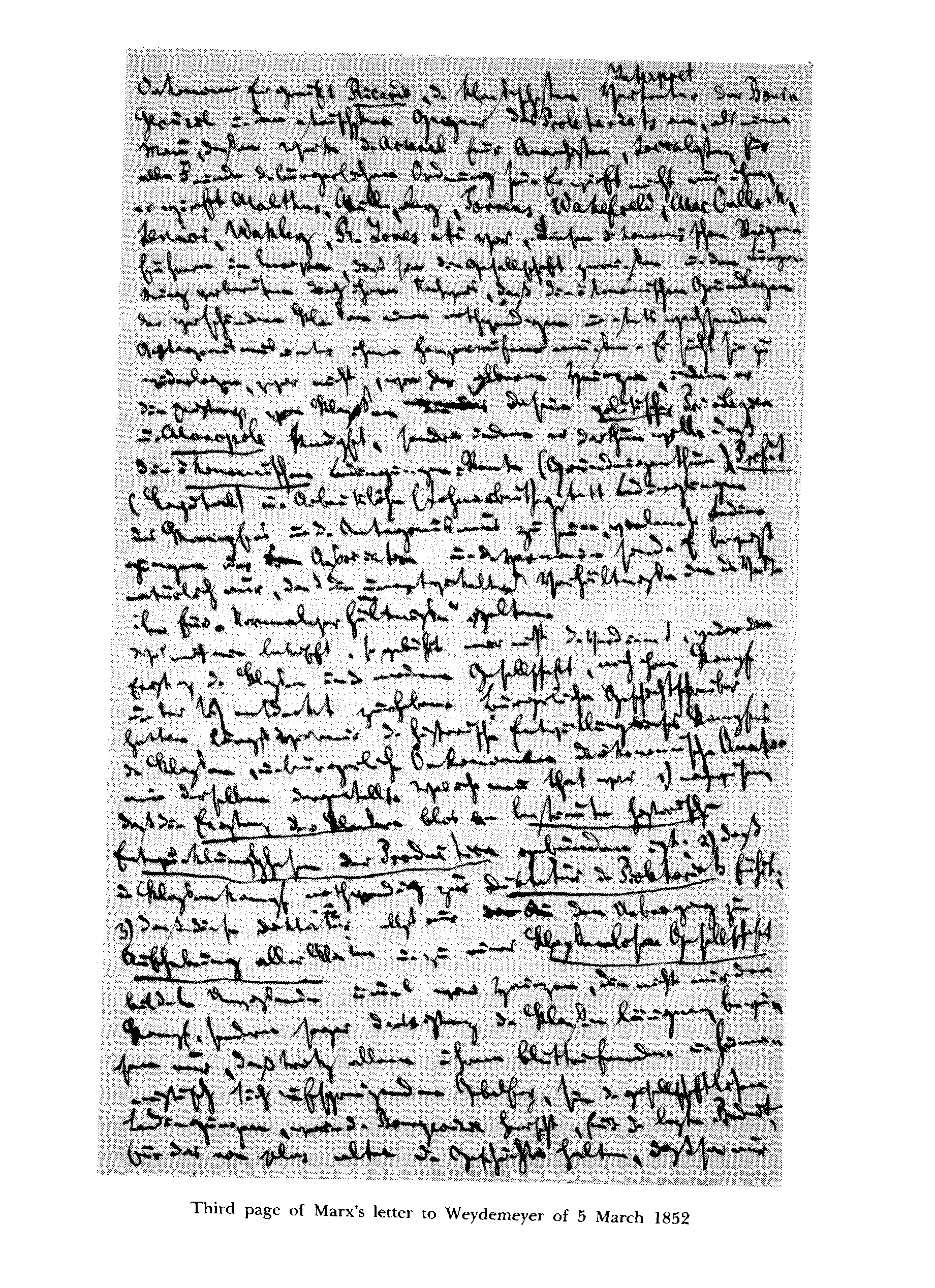
Third page of Marx's letter to Weydemeyer of 5 March 1852
proletariat; 3. that this dictatorship itself constitutes no more than a transition to the abolition of all classes and to a classless society. Ignorant louts such as Heinzen, who deny not only the struggle but the very existence of classes, only demonstrate that, for all their bloodthirsty, mock-humanist yelping, they regard the social conditions in which the bourgeoisie is dominant as the final product, the non plus ultra* of history, and that they themselves are simply the servants of the bourgeoisie, a servitude which is the more revolting, the less capable are the louts of grasping the very greatness and transient necessity of the bourgeois regime itself.
Select from the above notes whatever you think fit.[88] By the way, Heinzen has adopted our 'centralisation' in place of his 'federative republic', etc.[89] When the views on classes we are now disseminat-ing have become familiar objects of 'sound common sense',b then the scoundrel will proclaim them aloud as the latest product of his 'own sagacity' and yap his opposition to our onward progress. Thus, in the light of his 'own sagacity', he yapped at Hegelian philosophyc
so long as it was progressive. Now he feeds on its stale scraps, spat out undigested by Ruge.
Herewith also the end of the Hungarian article.*1 It is all the more essential that you should try to make some use of this — assuming your paper exists — because Szemere, the erstwhile prime minister of Hungary, now in Paris, has promised me to write a long article for you, signed with his own name.
If your paper has come into being, send more copies so that it can be distributed more widely.
Your
K. Marx
Kind regards to you and your wife from all your friends here, especially my wife.
Apropos. I am sending you the Notese and a few copies of my Assizes speech* (this last for Cluss, to whom I promised it) by the
32. Engels to Marx. 18 March
hand of the ex-Montagnard Hochstuhl (an Alsatian). There's nothing to the fellow.
Herewith the Rules.[91] I would advise you to arrange them in more logical order. London is designated as the district responsible for the United States. Hitherto we have been able to exercise our authority only in partibus.
If you have not already done so, do not accept 'Hirsch's' statement.[14] He's an unsavoury individual, although in the right where Schapper and Willich are concerned.
32
ENGELS TO MARX[92]
IN LONDON
[Manchester,] 18 March 1852
Dear Marx,
I return herewith Pixie's[3] letter. I am pour le moment entièrement dépourvua and would not be able to raise the £2 — at least this month; moreover, his letter is dated the 5th and there is absolutely no knowing whether the money would still reach him. And then it's always a ticklish business sending money to Ewerbeck; the fellow is capable of making superannuated claims for God only knows what old postal expenses, and of pocketing the whole amount or the best part of it. For all these reasons I am unable just now to help the little sprite,b doubtful though I am that he will be able to extract more than five sous at one go from Monsieur Ewerbeck. Meanwhile, the piccolo* has left Geneva for Paris and thus will no doubt also come to London, if at the cost of some 'toil and trouble'; and then we shall know just how much his dunning letters mean.
If the little man a does come, you will have some difficulty in restraining his pugnacious temperament, surely much exacerbated by prolonged 'toil and trouble'; in this country fisticuffs and brawls cost too much money for him to be permitted to indulge in them.[93] It would be best if you entrusted him to Pieper so that the latter could instruct him in political economy. What you told me about Massolb is very interesting, and if he stays over there I should very much like to meet him.
I am delighted by what you tell me about Jonesc—just now I have damnably little time, otherwise I would send him more articles. But Charlesd is not yet back from Germany and then, after toiling all day in the office, it would really be too much to write a regular weekly article for him and/or Weydemeyer on top of the article for the Tribune and the weekly report for my old man. Moreover, I must at long last get to grips with the Slav business.[94] In my previous dilettante fashion, I achieved nothing for a whole year and, having at least made a start and got too far to abandon the thing, I must now regularly devote some time to it. For the past fortnight I have been swotting hard at Russian and have now got the grammar pretty well licked; in another 2-3 months I shall have acquired the necessary vocabulary, and then I shall be able to tackle something else. I must be done with the Slavonic languages this year and au jonde they are not so very difficult. Apart from the linguistic interest I derive from the thing, there is the further consideration that, come the next big political drama, at least one of us should be familiar with the languages, history, literature and the minutiae of the social institutions of those particular nations with which we shall immediately find ourselves in conflict. In effect, Bakunin only came to anything because no one knew Russian. And a great deal is going to be made of the old pan-Slavic DODGE of transmogrifying the old Slav system of communal property into communism and depicting the Russian peasants as born communists.
Now that old O'Connor has definitely gone mad, Jones is perfectly right to crowd on all sail. This is his chance and if, in addition, CITIZEN Hip-hip-hurrahf gives up, his cause is won. From all that I see, the Chartists are in such a state of complete dissolution and disintegration, and at the same time are so lacking in able people, that either they must disband altogether and break up into cliques, i.e. in effect become a mere appendage of the FINANCIALS,[28] or else be reconstructed on a new basis by some competent fellow. Jones is moving in quite the right direction and we may well say that, without our doctrine, he would not have taken the right path and would never have discovered how, on the one hand, one can not only maintain the only possible basis for the reconstruction of the Chartist party — the instinctive class hatred of the workers for the industrial bourgeoisie — but also enlarge and develop it, so laying the foundations for enlightening propaganda, and how, on the other, one can still be progressive and resist the workers' reactionary appetites and their prejudices. MASTER Harney, by the way, is in for a surprise if he continues as he is; the group of enthusiasts which supports him will very soon kick him out, and not even the portraits of Kosciuszko and other 'patriots'[95] that adorn his bumf will save him.
Quoad Napoleonem* did the man not tell L. Blanc when he went to France: 'Quand je serai président, je mettrai en pratique vos idées'b} And now we see how a financial predicament may drive even a true socialist like L. N. to financial measures of an impeccably bourgeois kind, such as the conversion of bonds.[96] Your SHOPKEEPER and small industrialist is prepared to overlook twenty socialist capers in return for this one saving of 18 millions, and The Daily News admires the measure. Anything more stupid or more abject than the Débats' comments on this topic would be hard to imagine/ The same old story: postal reform=socialism! Conversion of bonds=socialism! FREE TRADE=socialism! My only fear is that Mynheer Napoleon who, for all that he proceeds very diffidently when it comes to his genuinely socialist undertakings and goes no further in the matter of mortgages than the bourgeois Prussian credit institutions, may, in the end, be compelled, by force of circumstances, to transform all his socialist inclinations into simple bourgeois reforms, and then nothing can deliver us but the inevitable financial predicament. The Daily News is right, conversion of bonds is a mesure éminemment pacifique6 as well as being a most ominous indication that L. N. is tending to fall into the ways of bourgeois COMMON SENSE. But when, I ask you, has it ever been possible to rule France with COMMON SENSE, and what a hotch-potch of circumstances would be required to bring together a L. N. and COMMON SENSE! At all events the climate on the Continent does not seem 18 1852
very revolutionary to me, although the little sprite will bring quite different news.
I d o not think that Derby will obtain a majority although this place, where unanimity reigns when it comes to the Corn Laws,[72]
is a poor point d'observation. However, I should like him to obtain one, for then things must come about as you say. H e is, by the way, a fool for not dissolving Parliament at once. T h e longer he procrastinates, the greater the risk of the election coinciding with a commercial crisis, and then he'll get fanatical Tories in Parliament who are too rabid even for him, and determined, rapacious MANCHESTER MEN 6S under threat of bankruptcy, these latter probably in the majority and hence the determining element.
O u r CONCERN here seems likely to collapse within the year. In which case, while the liquidation is under way, I shall at first enjoy far more liberty and be less tied down by the regular routine of the office. Later, my old m a n writes, h e might be able to find me a better position — I suspect that he will fall in with my old plan to remove to Liverpool and buy cotton for him there. That would be splendid and, if it comes off and you have completed your preliminary work on economics,[45] you and your whole family must come u p for 6 months — we would live by the sea at New Brighton, and you would, besides, save money. At all events, I shall get myself a rise — there's n o doubt about that.
Today, unfortunately, I shall not have a quiet moment in which to do the Tribune article, but an American STEAMER sails next Wednesday, so you shall have it by Monday or Tuesday, and then I'll d o another one for Friday's STEAMER.
Many regards.
Your
F. E.
This is the first time the seal on your letter has been intact and undamaged.
33. Marx to Joseph Weydemeyer. 25 Marcha
IN NEW YORK
London, 25 March 1852 28 Dean Street, Soho
Dear Weydemeyer,
Good luck to the new world citizen! There is no more splendid time to enter this world than the present. Come the day when people can travel from London to Calcutta in a week, both our heads will long since have rolled or started to loll. And Australia and California and the Pacific Ocean! The new world citizens will be unable to comprehend how small our world once was.
If you did not receive the final instalmentb enclosed herewith a week ago, your total silence is to blame.
Now in the pamphlet,[97] too, I would like my article to be divided up as it was sent to you, under headings I, II, III, IV, V, VI, VII. These figures serve as sign-posts for the reader. They take the place of titles. At the end of V, add the following words: 'But Bonaparte answered the Party of Order as Agesilaus did King Agis: "J seem to thee an ant, but one day I shall be a lion.'"[98] But the thing must, of course, be brought out now all at once in its entirety.
Where my wife has failed to leave space enough to indicate the paragraphs, I have marked them with a T .
Cluss' statement[60] is splendid. Why not — it strikes me as a good idea—include Ernest Jones' letter in your first issue?[82] A couple of introductory words would suffice to explain it.
Maintenant: Cluss will already have told you about the Szemere business." First a publisher will have to be contacted through me and arrangements made for his pamphlet — some 10 sheets — on Kossuth, L. Batthyâny and Görgey — to be brought out in German and later in English. You might, if it can be managed, publish the German original as your second instalment without, of course, any other additions. But the publisher must pay for the thing if you don't publish it yourself.
When this has been arranged — and perhaps even before that — the Revolution will receive 500 dollars from this source, on condition that Bangya comes in as co-editor, i.e. only in the sense that part of the paper is allotted to the Hungarians and run by Bangya, Szemere's agent. But you'll have no difficulty in getting on with him, car il est bon homme.a
I am very glad to hear that you have found employment as a surveyor. You will be able to operate with greater confidence and peace of mind.
One of these days I shall be starting on Mazzini. Whereas Mr Kinkel, whose wisdom, by his own admission, derives from nursery tales, now chooses to see nothing but unity among the 'great men', he finds on his return the battle raging optima forma.b For Ledru and Mazzini have bought the Brussels daily La Nation for 10,000 fr. drawn from the Italian loan. Mais voilà que' il Signore Mazzini looses off an opening article, in which he vents all his infamous anti-French, anti-socialist inanities about the initiative lost by France,c and this so wildly that Ledru now feels compelled — and has, it seems, made up his mind — to take issue with him personally. On the other hand, the socialists L. Blanc, Pierre
Leroux, Cabet, Mallarmet, etc., have joined forces and published a venomous retort composed by dear little L. Blanc. At the same time the majority of the French émigrés are violently incensed against Ledru, whom they rightly hold responsible for Mazzini's stupidities. Fire has broken out in the very midst of their camp.
Should you happen to get hold of Der Tag ist angebrochen, a book by that miserable cleric, Dulon, who fancies himself as a Lamennais, mind you give the cur a good dusting.
Dronke has been arrested in Paris where he lingered too long on his way here from Switzerland instead of hurrying through.
I like your selection very much. Pieper's articled might do well enough for a newspaper. For a pamphlet it was dashed off too hastily and perfunctorily.
Can you not get news of Edgare from Braunfels? We have heard nothing from the lazybones and this is causing his motherf
great anxiety. A crazy lad!
Cluss' protesth was greeted with general applause at the League'
34. Marx to Engels. 30 March
meeting here, and both we and Stechan's society[25] found your Revolution to our liking. Warm regards from my family to yours.
Your
K. M.
In case the infamous reply from Willich's society to Pfänder's statement [10]° should appear in some paper or other (e.g. Weitling'sa), I am sending you Pfänder's 2nd statement.
What can red Beckerb be doing? Has he, too, become a Kinkelian?
Apropos. Some of the engineering workers have come to their senses and sent apologies to Jones. By now the English workers have collected sufficient money for Jones to bring out a big STAMPED weekly [101] in addition to his Notes.c The jackass who is to convey these to you has still not left.d
34
MARX TO ENGELS
IN MANCHESTER
London, 30 March 1852 28 Dean Street, Soho
Dear Frederic,
Just received your article.e Enclosed you will find a whole bundle of new stuff from America which would have reached you sooner, had it not been necessary to make copies of some of it for communication to Leaguel members.
All sorts of things have been happening here. Gottfried Christ Kinkel is dispatching, or rather has dispatched, the student Schurz and Schimmelpfennig to drum together people from Switzerland, Paris, Germany and Belgium for a congress to be held in London in mid-April, the purpose being to guarantee the revolutionary loan[2] and to lay down definitive regulations for the administration of this exchequer and of the democratic government in partibus. But you must let me have the trash back by Saturday.
Kossuth, exposed in America by Szemere[102] and completely at odds with the committee he left behind him in London, a will be surprised to learn by what schisms the democratic clerics has meanwhile been rent.
For Mr Mazzini, who for the past 2 years has been pope of the democratic church in partibus, thought the time at last ripe to discharge his venom in the French tongue against socialism and France, to wit in the Brussels Nation which, with Ledru's connivance, he had acquired for 10,000 fr. drawn from the Italian fund. In it he blamed the socialists for the 2nd December, the capture of Rome,[104] in short for the counter-revolution generally and, in his high-flown Dominican style, thundered against heretics, sects, materialism, scepticism, the Romance Babylon, with the same single-mindedness he displays when licking the arse of the English liberal bourgeoisie. France, he said, had lost the revolutionary initiative. The peuple-roi* no longer existed. Now it was the turn of other nations, etc. In short a veritable bull of excommunication which was done the honour of being taken up by the Patrie and the Constitutionnel. This was altogether too much for the French. Little L. Blanc, who further saw in it an opportunity to rehabilitate himself and thrust himself to the fore, drummed up Cabet, Pierre Leroux, Bianchi, Nadaud and Vasbenter (Proudhonian). In The Morning Advertiser they attacked Mr Mazzini in crudest fashion. The theoretical part of their retort is almost as weak as Mazzini's attack. The personal part, for which Massol gave Leroux the material, annihilates the arrogant theopompos.b
Ledru, for his part, felt it incumbent upon him to resign from the European Central Committee in order not to lose all influence. He too has replied in the Nation to the attacks on France. Pitiful. An article with neither head nor tail. Upholds 'France's revolutionary initiative', but in what fashion! C'est pour faire pitié!c Ledru, it is said, now intends to go to the United States.
Thus, on the one hand, the idiot Ruge forfeits his European Central Committee. On the other, Kinkel — who, in America, fawned like a dog on his rival Kossuth — sees the general 'confusion', i.e. fusion of all democratic pretenders under the banner of the now stale catchwords of 1848, e.g. 'democratic republic', 'universal franchise', etc., dissipating. Thus the worthy Willich is drawn into the conflict as a 'communist'.
Meanwhile each week the English government is shipping the French émigré mob in crowds out to America at public expense. The wretched LITTLE Blanc proposes to exploit a quite fortuitous general demonstration against Mazzini to set himself up as the visible head of the ecclesia pressa.* In order to thwart his little intrigues, I shall get Massol to egg on Pierre Leroux. Finally, to complete the confusion, Proudhon is coming here.
How low the official bigwigs sink, you may see from the fact that the delectable Félix Pyat, cet homme artiste11—an expression used by the French to gloss over an individual's every weakness, his lack of character and intelligence — has written a melodrama on the December days. He has found an English impresario and together they will put on the trash in New York, etc., the murder scenes, expulsions, deportations, etc., etc. Could anyone seek to profit by the misfortunes of his country in a more despicable manner? And the jackass regards this prostitution of France's misfortune as a patriotic act.
Tripotage" is the secret key to the historical drama staged by émigré politicians here; thus Siegwart d-Kinkel has acted as procurer between the student Schurz and Mrs Ronge's sister, who is said to be rich.
The only misfortune is that by their boastful intrigues these jackasses provide the police with a continuous supply of fresh material and make things worse for our friends in Germany.
Your
K. M.
1929
35. Engels to Marx. 1 April
35
ENGELS TO MARX
IN LONDON
[Manchester,] 1 April 1852
Dear Marx,
Got your letter this morning, actually intact. The new address seems to do some good.
The mirth-provoking émigré documents will be returned to you tomorrow. I shall extract some notes from them.
Little Dronke seems to have got himself properly caught in Paris, otherwise we should probably have heard from him. Do you suppose that some people belonging to 'the Marxian sect' really foregathered at the Café D.,a as the Kölnische Zeitung alleges?b I don't know where these remnants could have come from. In any case it would have been unpardonable of Dronke to have gone to the café and associated publiquement"1 with these people. But if he is still at liberty and there is any possibility of corresponding with him, we must certainly do everything we can now to bring him over to London — he is under an expulsion order and the fellows are quite capable of sending him to Algiers for rupture de ban.à So if we can find out more particulars, I shall see to it that I get hold of the £2, for we must certainly bring the little chap to safety. Write and tell me if you hear anything about him.
I am going home now to finish another article for Dana which, if it is ready, will go off to you by the second post. Last week I had a terrible cold and still have it, so that for several evenings I have been capable of absolutely nothing. Otherwise, more would have been done.
Tell Jones that he will be getting sorrfething from me next week,e—all my articles for him have, alas, been wretched, since the brevity of each and the negligible room available make me regularly forget what I wrote the week before — in addition, I have to write quickly and cursorily, and have no time whatever to collect and arrange material on the latest happenings in France. This constant improvisation becomes demoralising.
36. Marx to Engels. 5 April
Should I not finish the article for Dana this evening, it will be chiefly because I still have to go through the better part of the
Neue Rheinische Zeitung for April and March 1849,a for on this occasion the Frankfurtersb must be given a thorough lambasting. The Bauerc is not adequate for the purpose.
Your
F. E.
36
MARX TO ENGELS
IN MANCHESTER
London, 5 April 1852 28 Dean Street, Soho
Dear Frederic,
Enclosed a further consignment from Cluss[105] which I must have back by Wednesday (the day of the Leagued meeting).
The other day, just after you returned his first letter, Dronke wrote to Freiligrath from prison; I had forgotten to tell you. Freiligrath at once sent the letter to Lassalle for the latter to send some money to Paris for him, which could doubtless be done with all the more dispatch since Lassalle could use the letter to touch all the liberal bourgeois of Düsseldorf. Unfortunately, according to the Patrie, compromising letters were found on Dronke. Can he have been stupid enough to carry around testimonia of his fatuous Lyonnais' and other connections?
As I foresaw, Louis Blanc is trying to exploit the joint statement against Mazzini to create a new 'réseau d'action'{ and to thrust himself to the fore as head of the revolutionary party. He has even sought to draw me into his fusion of all 'French' socialists and sent me an invitation to meet him. I did not, of course, even deign to answer and instead conveyed to his intermédiaire my amazement at such importunity. Since Proudhon is coming here, an alliance with me just now would have been very convenient for the little man.
Dana has written at last and paid £9 according to the number of articles published.' As the presidential elections will for the present be taking up every column in the paper, he asks me at the same time to conden'se the remainder into 5-6 articles and, more especially, to discuss in the last one the PROSPECTS OF REVOLUTIONARY GERMANY, This will provide a splendid chance to castigate the émigrés and in a later letter I shall write to you at length about my views on the matter.
Szemere is sending me, in 3-4 batches, his (German) manuscript on 'Kossuth, Görgey and Louis Batthyâny'. Weydemeyer is to publish it in America,[99] which means excellent business for him, the more so since he will, in addition, probably receive 500 dollars for his paperb from that quarter.
But before the thing goes off to America in German, it must be translated into English here so that, after it has appeared in German in America, it can be brought out as a pamphlet for readers over here. You will hardly have the time for this task, even if you neglect Dana for a while. In which case I shall have to give it to Jones. The payment for translation is £1 per sheet.
Here I have made the acquaintance of Colonel Szerelmey, who is a very cultivated man. In Hungary he took part in 17 battles. Since he is also a first-rate painter, he is now bringing out a magnificent work, with battle reports in the text, and battle illustrations. He himself did the sketches, which were finished off by leading French painters. He has promised me a copy. Each will cost £10. So you will receive an addition to your military library.
Your
K. M.
As you see, Kinkel has been a good deal more arbitrary than Louis Bonaparte. First he nominates the members of his chamber of deputies, the Guarantors' Congress.c Next he takes fright at his
37. Marx to Engels. 14 April
own creation, keeps neither to the appointed day nor place, but convenes the assembly at a time and place at which only 7 people can attend. Six of those 7 give him a vote of confidence. With these he drafts his constitution. By these he gets himself nominated representative of America, and he makes the committee he has created responsible to them.
37
MARX TO ENGELS
IN MANCHESTER
London, 14 April 1852 28 Dean Street, Soho
Dear Frederic,
Only a couple of lines to let you know that our little child(6) died this morning at a quarter past one.
Your
K. M.
38. Engels to Joseph Weydemeyer. 16 Aprila
Dear Weydemeyer,
Yesterday received your letter of 30 (?) March, together with the account of the revolutionary assembly.[106] I note that you have begun to stamp your letters, which is nonsensical; this CONCERN, id est Messieurs Ermen & Engels, can pay the postage. The things have been sent on to Marx.
The day before yesterday I arrived back here from London, where I had spent Easter. Marx's youngest child" was very ill and, as I now learn from him,b has since died — the second already in London. As you can imagine, his wife is greatly afflicted by it. There has also been some illness in Freiligrath's family, but things are going better there.
Dronke, as you will know, was arrested on his way through Paris. It was partly his own fault for, despite his earlier expulsion, the little man had lingered there for 3 weeks. Now he writes to say that he has been removed from the Mazas prison and taken back to the Préfecture de Police, to be sent to Boulogne and England on Good Friday evening. But up till now we have heard nothing more of him. The little man shows a remarkable talent for constantly getting INTO MISCHIEF, but no doubt he will turn up one of these days. Then the whole of the N. Rh. Z. will be in England, for Weerth, though he is in Hamburg again just now, still has connection with Bradford and, no matter how he struggles, will always find himself cast up there again.
It seems probable that our Cologne friendsc will appear before the Court of Assizes in May, since the Board of indicting magistrates was expected to have decided their case by Monday, 5 April, and will certainly not have discharged them. This is just as well; the public prosecutor would immediately have appealed against an acquittal. If a certain Hansen of Cologne, a working man, should arrive in New York, treat him according to his deserts. The fellow, a member of the League since 1848, administered, i.e. drank, the monies collected for the prisoners before absconding to America.
In the camp of the National Loaners there is considerable dissatisfaction with Reichenbach, the treasurer, for keeping so tight a hold on the purse-strings, since in any case more money has already been spent than can decently be accounted for and, as a well-to-do and respectable citizen, he is faced with the ominous prospect of the forthcoming audit. Hence Kinkel and Willich are furious, but to no effect: Kinkel must return to his tutoring and now, as in the past, Willich is begging and borrowing with an impudence hitherto found only among Polish patriots. Thus, throughout the noble émigré alliance, the most glorious confusion reigns and, if the Guarantors' Congress takes place, or has already taken place, things will come to a very pretty pass. Löwe of Calbe and the rest of the Frankfurtersa are now also at daggers drawn with Kinkel, 'a chap with whom one can but compromise oneself.
Has Teilering got his statement into any of the papers?[107] Voilà ce qu'il nous importe de savoirb for, if so, Marx can attack it. We would, by the way, be very glad if Dana would send us copies of Marx's articlesc; we have only had the first 6 and should be glad to have the following ones. If Dana pleads too much work, the best thing would be for you to get hold of them yourself and send them here. Marx has long been meaning to write to you about this, but just now is probably not in a state to turn his thoughts to it. See what you can do, for we must have a complete set here; later on that sort of thing will also be important as a document.
My strategical articled is no longer any good and is all the less suitable for a collection [108] as the essentials were not really in it, but in my letter to you.e So do not hesitate to file it away. As soon as I have time to work undisturbed and some prospect of publication, I shall send you articles on the development of commerce and on the present state of the English industrial bourgeoisie.f For the present I must spend the next fortnight or 3 weeks exclusively on the study of Russian and Sanscrit, in which I am now engaged'; later, when my material arrives from Germany, I shall turn to
39. Engels to Marx. 20 April
military matters, but there is plenty of time for that and as a task it is less arduous.
The post is about to go — many regards to your wife and to Cluss.
Your
F. E.
39
ENGELS TO MARX
IN LONDON
[Manchester,] 20 April 1852
Dear Marx,
I was grieved to see that my fears concerning your little daughter have been all too soon confirmed. If only there were some means by which you and your family could move into a more salubrious district and more spacious lodgings!
I would gladly have sent you some money, but while in London[109] I spent so much more than I had anticipated that I shall be pretty short myself until the end of the month, and next month I shall have to pay out at once £12 in bills and for books ordered from Germany. But I shall see if I can get hold of something for you by the beginning of May. I wish I had known beforehand how things stood in London, for in that case I should have foregone what was au fond' a quite superfluous trip there, and my hands would not have been quite so tied.
Pindar is here, having failed to find employment in Liverpool. He is looking for a position or for private lessons and I shall, of course, do what I can for him. As a token that I am well disposed towards him I have been taking Russian lessons from him. But if I am to recommend him here, I must know something more about him, and since such intelligence can only be dragged out of him with the utmost difficulty, I should be glad if you would write and tell me what you know about him and his circumstances, how you became acquainted with him, etc., etc. With his taciturn manner, by the way, it doesn't seem to me as though he'll be lucky here. In considering the present state of commerce, particularly as regards India, there is one point that should not be overlooked.a
Despite 3 years of colossal and ever-increasing imports of English industrial goods into India, the news from there has for some time been moderately good again, stocks are gradually being sold and are fetching higher prices. The reason for this can only be that, in the provinces most lately conquered by the English, Sind, the Punjab, etc., etc., where native handicrafts have hitherto almost exclusively predominated, these are now finally being crushed by English competition, either because the manufacturers here have only recently come round to producing materials suitable for these markets, or because the NATIVES have finally sacrificed their preference for local cloths in favour of the cheaper price of the English materials usually exported to India. The last Indian crisis of 1847 and the concomitant sharp DEPRECIATION of English products in India may have contributed greatly to this; and it is already clear from old Gülich that even the parts of India occupied by the English in his day had not for a long time completely abandoned their traditional domestic manufactures.b This is the only explanation for the fact that the 1847 affair has not long since recurred in more acute form in Calcutta and Bombay. But all this will be changed once the 3,000,000 bales of cotton from the last crop have come onto the market, been processed and consigned as finished goods, predominantly to India. The cotton industry is now so flourishing that, despite this season's crop, which is 300,000 bales more than that of 1848/49, cotton prices are rising both here and in America, that American manufacturers have already bought 250,000 bales more than last year (when they used in all only 418,000 bales), and that manufacturers here are already beginning to maintain that even a crop of 3 million bales would be insufficient for their needs. Up till now, America has exported 174,000 bales more to England, 56,000 more to France and 27,000 more to the rest of the Continent than she did last year. (Each season runs from 1 Sept. to 7 April.)c And, given prosperity of this order, it is of course easy to explain how Louis Napoleon can prepare at leisure for his bas-empireno; the surplus of direct cotton imports into France between 1850 and 1852 now amounts to 110,000 bales (302,000 against 192,000), i.e. more than 33%.
According to all the rules the crisis should come this year and will, indeed, probably do so; but if one takes into consideration the present quite unexpected resilience of the Indian market, the confusion created by California and Australia, the cheapness of most raw materials, which also means cheap industrial manufactures, and the absence of any heavy speculation, one is almost tempted to forecast that the present period of prosperity will be of exceptionally long duration. At any rate it may well be that the thing will last until the spring. But WITHIN SIX MONTHS MORE OR LESS it is, after all, safest to stick to the old rule.
Many regards to your wife, and write soon.
Your
F. E.
40. Marx to Adolf Cluss. 22 April[111]
... The chief industry, the cotton industry, is doing more splendidly than ever.[3] Despite the fact that the present cotton crop exceeds that of 1848/49 by 300,000 bales, cotton prices are rising both here and in America, so that American manufacturers have already bought 250,000 more bales than last year and manufacturers here are already beginning to maintain that even a crop of 3 million bales would be insufficient for their needs. Up till now America has exported 174,000 bales more to England, 56,000 more to France and 27,000 more to the rest of the Continent than she did last year (each season runs from 1 Sept. to 7 Apr.). On the one hand this prosperity explains how Louis Bonaparte can prepare at leisure for his bas-empire. The surplus of direct cotton imports into France between 1850 and 1852 now amounts to 110,000 bales — 302,000 against 192,000, i.e. more than 33%. On the other hand, it explains the flaccid condition of politics in this country. Given such prosperity, the Tories cannot, for their part, compete with the 'blessings of FREE TRADE', even though they are at the helm, while the FREE TRADERS for their part refrain from provoking political agitation because, so long as business is flourishing, the manufacturers do not want political upheavals and disturbances. The thriving state of the cotton industry is due chiefly to the Indian market, whence there has been good news for some time past — despite continuing colossal imports from England. This may be explained by the fact that in the territories most lately conquered by the English, Sind, the Punjab, etc., where native handicrafts have hitherto almost exclusively predominated, these are now finally being crushed by English competition. The last Indian crisis of 1847 and the concomitant sharp DEPRECIATION of English products in India may have contributed to this. This unexpected resilience of the Indian market, California, Australia, as well as the cheapness of most raw materials in the absence of any heavy speculation, give reason to suppose that the period of prosperity will be of exceptionally long duration. It may well be that the thing will last until the spring, etc., etc., etc....
41. Marx to Adolf Cluss. 23 April[1]a
... You will realise that Weydemeyer's letter[3] made a very unpleasant impression here, particularly on my wife, since it arrived on the day of my youngest child'sb funeral; for two years
42. Marx to Engels. 24 April
now she has seen all my enterprises regularly come to grief. The prospect held out by your letter (arrived 19th Apr.) of receiving the 'Bonaparte'" in print was therefore all the more welcome to me, for by nature she is very resilient and your letter set her up again...
42
MARX TO ENGELS
IN MANCHESTER
London, 24 April 1852 28 Dean Street, Soho
Dear Frederic,
You cannot imagine what a wretched time I had last week. On the day of the funeral, the money I had been promised from various quarters failed to arrive, so that I was finally compelled to go to some French neighbours in order to pay the English vultures. And on top of this, alas, a letter arrived from Weydemeyer giving reason to suppose that in America, too, all our hopes have been dashed. Cluss, whose letter you will be getting next week, now holds out better prospects. Quoique de dure complexion^ I was, on this occasion, very hard hit by the wretched business.
Enclosed a letter from that cur Ewerbeck, who never uses a stamp and consistently robs one of one's last lOd. Then an article by B. Bauer from the Daily New-York Tribune,c to whose pages your articled has attracted all the rag-tag and bobtail. Bauer's revelations about 'the armies' will make you laugh. If you are going to send me articles for Dana now, wait until you have several so that I can send them all off at once.
Mr Tellering is publishing a monthly or weekly in New York; the cur himself sent me the first issue — unadulterated third-form drivel.
Heise (of the Hornisse) is now an intimate of Willich's. They are as thick as thieves. What can he see in the fellow? Once again they are bragging about a proposed coup in Germany.
Dronke is a real imbécile. His appetite whetted by the £4 we got for him from the Rhineland, he went to Coblenz in the hopes of extorting some more. It never occurred to the jackass that he would be providing fresh ammunition for use against the people in Cologne.[3] The fellow's behaviour is really too dis-graceful.
Apropos. Do not forget to send immédiatement two notes to London as follows: 1. for Liebknecht, empowering him to obtain the £1 from Hain. 2. Write a brief note yourself to Hain, telling your 'good friend' in a couple of lines that, having heard he was doing well, you had referred Liebknecht to him re the £ 1 . We must be careful not to make an enemy of him.
The fact is that one of our acquaintances, who has hitherto found shelter for the night at Liebknecht's lodgings, was thrown out by the latter's landlords, and not one of us has been able to raise a penny for the poor devil. Accordingly I yesterday sent Liebknecht a note in which I told him you had referred him to Hain re the £1. Mr Hain appeared somewhat in-credulous and told Liebknecht he must first see it in your handwriting.
Let me have a few STAMPS, for I have a mass of stuff to send you.
Your
K. M.
43. Engels to Marx. 25 April
43
ENGELS TO MARX
IN LONDON
Manchester, 25 April 1852 Dear Marx,
Yesterday evening I received a note from Hain which I sent you together with my reply to it. After this, I think, Mr Hain will pay.
Herewith the STAMPS, more to follow shortly. Also returning the other stuff. Ewerbeck's letter is a worthy pendant to his book.3
'Pray help me oppose Ribbentrop! I shall denounce him to Democracy as a hypocrite and débaucheur.'b The man must be in his dotage.
Nor has friend Bruno increased in wisdom or divine knowledge.' Il valait bien la peined to set the American press in motion from Berlin thus, by this most roundabout route, proclaiming to an astonished world that the continental armies are there to maintain internal peace. Mr Bruno still represents the Hegelian dialectic in its deepest stagnation. At this stage of development, his concept of history goes no deeper than providing circumstantial proof of the most banal platitudes by an ample display of solemnity and pseudo-logical development, and then dishing them up as the brand-new findings of zealous research. All this is tolerable in the case of the distant past, but to be thus bamboozled about the immediate present is really too much and any fool should be able to see that there's nothing at all at the bottom of it. And as for the profound truth that governments are right vis-à-vis revolutions because the latter are still immature, but revolutions are also right vis-à-vis governments because they represent the ideas of the future, admittedly in embryonic and immature form, but nevertheless [...] to a substantial degree — that is an old Hegelian joke whose novelty has certainly worn off even in America! And then the eternal 'ill-temper', 'peevishness', 'fundamental indifference' of the 'bourgeois'. 'In some countries, classes war against classes, in others nations against nations.' Strictly speaking, this prodigiously clever sentence is all that Bruno has learnt from the revolution.
Mr Teilering has apparently been chased out of France as being
44. Engels to Marx. 27 April
a homeless, vagrant member of the lumpenproletariat and of no use even to the Société du 10 Décembre.[1]
Unless you know positively that Dronke went to Germany of his own free will, I would think it more probable that, having been already once expelled from France, he was this time transported not to any frontier but to the German frontier. But once safely in Nassau, why did the silly fool go to Coblenz when he'd have done far better to go to Hamburg, where no one knows him and he would have found Weerth and Strohn, hence also cash, and from there to England! But Coblenz being so close, he was obviously drawn there from Nassau by the prospect of money, and if he had managed to get through safely, would certainly have gone on to Cologne. At all events, it is fortunate for the Cologne people that they have already been dealt with by the Board of indicting magistrates, otherwise Dronke's arrest would have provided occasion for another six months' examination. But very soon they'll take him to Cologne and maybe attempt to produce him as a witness before the Court of Assizes. This time it serves him perfectly right. He could certainly have found such money as he needed in Frankfurt, or have got Lassalle to send it to him somewhere, but no, the little chap must needs go to Coblenz where he's known to every gendarme and every dog in town. En attendant il est sûrement logé.[3]
Your
F. E.
44
ENGELS TO MARX
IN LONDON
Manchester, 27 April 1852
Dear Marx,
Herewith Weydemeyer's latest, which sounds rather more hopeful. For the time being I am keeping your article[114] here 1. so as to read it, and 2. so as to translate it into English at some later date, which will be easily done, omitting such figures of speech as are comprehensible only to Germans.
Voilà donc3 Moses Hess, in the Kölnische Zeitung, with a warrant out against him for high treason.b I'll be hanged if this hasn't happened because Father Dronke was found carrying those idiotic papers concerning their important business in Geneva. Cela valait bien la peine!c In the meantime Moses again becomes a martyr, which will greatly enhance his otium cum dignitate6; maybe he will shortly be dispatched to London—est-ce que nous n'échapperons jamais à cet imbécile? At any rate, all this can make things extremely awkward again for the poor devils in Cologne and provide new grounds for dragging out their trial; had they already been referred to the Court of Assizes, we should surely have heard about it.
Freiligrath has written asking for an introduction to my brother-in-law'—I am sending it to him today; evidently he is determined to look round for a post.
Warm greetings to your wife and children.
Your
F. E.
Splendid division on the Militia Bill last night.[115] If the Almighty vouchsafes a few more like it, the new election will be postponed until September or October. SERVES THE WHIGS RIGHT AND THE FINANCIALS[28] TOO! I see that Jones intends after all to bring out his PAPER straight away — it was a mean trick Harney played him over the Star, but it was lucky that Jones did not acquire that doomed, discredited, wretched old paper.[116] Let Harney dig its grave and his own at the same time.
45. Engels to Marx. 29 April
45
ENGELS TO MARX[117]
IN LONDON
Manchester, 29 April 1852
D. M.,
Herewith another letter from Weydemeyer. I have not received the newspapers; but the Atlantic was reported by telegraph this morning, and they will probably arrive tomorrow morning. Weydemeyer appears to have misunderstood one or two practical hints I gave him on how to pack and dispatch his things in such a way as not to pay unnecessarily high postal charges; however, I have already pointed out his mistake.3
So the Coblenz story about the piccolob was a pure fabrication and, if the Kölner Zeitung is to be believed, Father Dronke must already be in London, his adventures have achieved a purpose.
Tant mieux pour lui.c But this makes the business of Moses'd
warrant even more inexplicable. Anyhow, it would seem to imply further vexations for the Cologne people. God knows what sort of scrawl the police have picked up this time. Pauvre* Moses, fancy becoming so EGREGIOUSLY and post festum* a martyr in partibus infideliuml
Next week I shall write several articles in succession for Dana,[118]
and make sure that I take the thing up to the end of the Imperial Constitutional campaign. In order that we may be able to conclude directly, it would be a good idea if you could provide me with a short memorandum for the final articles — THE REVOLUTIONARY PROSPECTS OF GERMANY, and our party's situation during and after the revolution. It is precisely these concluding pieces which are important, and moreover a memorandum of this kind would enable me to write these articles not only better but far more quickly. In this way I could, if I tried hard enough, finish all the 5-6 outstanding articles within a fortnight and meanwhile you could get in touch with Dana about a new series on a subject of greater actualité, soit la France, soit l'Angleterre.9 Since Weydemeyer's pamphlet will probably be coming out soon, it will no longer be
46. Marx to Engels. 30 April
possible to sell Dana the 18th Brumaire, even in a different guise; for he will then be able to have it FOR NOTHING and translate it himself. But you could still ask Dana whether he would like to have a modified version in translation, one suitable for the Anglo-American public. In this case the events leading up to 2 December '51 would for the most part be excised and the thing finally brought right up to date, so that successive weekly or fortnightly reports on France would follow straight on.
Your
F. E.
46
MARX TO ENGELS
IN MANCHESTER
London, 30 April 1852 28 Dean Street, Soho
Dear Frederic,
You will receive at the same time as this letter a colossal parcel from America. Today I have also had a letter from Cluss, of which I give excerpts below, as I shall be needing it until next week.
Dronke has arrived here sain et sauf* I like him better than I had feared. He has grown taller and has broadened out as well. This has also made him more self-possessed. For the present he hob-nobs with Anschütz, who welcomed him with open arms. He is going to start up a small business, having contracted in Paris to sell cigar cases and purses over here. 10% commission. And, through Anschütz, he will at once acquire the necessary connections for this TRADE.
He tells me that the 'worthy' Techow has sent character sketches of us to Switzerland in which he roundly inveighs against us and you in particular. You have aroused the professional jealousy of the military, et je pense* that one day you will justify leurs pressentiments^ Further: from Geneva, Schily demanded that the gentlemen come to terms with us. This elicited an authoritative statement signed by Willich, Techow, Schapper and Schimmelpfennig in which, inter alia, it was pointed out that 1. there had been a complete break with this wholly impotent party; 2. there are police spies in our midst who have been reporting everything to the Prussian government.
I don't know whether I have already told you, or whether you heard during your stay here,[119] that Messrs Kinkel et Co. possess a mere 3,000 dollars in cash all told, that all respectable people such as Löwe of Calbe have all withdrawn, that relations between Willich on the one hand and Kinkel and Reichenbach on the other are very strained, and that the whole dungheap is in process of disintegration.
You will receive the memorandum on Germany." Yesterday the curs held a meeting of guarantors here and elected a definitive committee. Mr Ruge wrote a letter of protest. Willich was not present. From the start Reichenbach refused to have anything more to do with the filthy business. The committee will be paid. Those elected are Kinkel, Willich (doubtful that he'll accept), Löwe of Calbe (will in any case refuse), Fickler, Ronge, Schütz of Mainz and one other. They will make up the total from out of their own midst. In his letter, Ruge attacks Kinkel as an agent of the Prince of Prussiad and a freemason.
Here is a passage from CIuss' letter: Huzel (not to be confused with Huzzelwitt), Cluss' friend, [present as a guarantor] at Kinkel's Cincinnati congress[60] writes and tells Cluss inter alia:
'Kinkel tried to floor me with vulgar invective against Marx and Engels. I succeeded in doing what I wanted, namely in cornering him so effectively that I shall have him at my mercy for some time to come. He tried to cover himself by obtaining my word of honour not to say anything about the incident or to write anything that would get him "into a stink"... In a letter to Anneke a certain Teilering scolds like a fishwife at Marx...'.
Cluss himself goes on:
'In New York, at the inimitable meeting which I reported in my last letter, the numerous gymnastic clubs [120] constituted themselves a separate body and declared their support for my protest3 and for Weydemeyer's article against Kinkel's memorandum![121]
Apropos. I gave Bangya a few pen-sketches of the great German men in London for him to pass on to Szemere.[122] This letter, I know not how, has been read to a German publisher without my name being mentioned. He is now asking for 'character sketches' of these gentlemen and, according to Bangya, is prepared to pay £25 for a few sheets. Anonymous or pseudonymous, of course. Well, qu'en penses-tu7c We would really have to do a humorous piece of this kind together. I have some doubts. If you think I should take this crap on, you will have to make a compilation from my letters and anything else you have which may contain fragments on the peculiarities of these curs. At all events you would have to send me a few notes about Willich 'in action'[123] and 'in Switzerland'.
Among the things I am sending you, you will find the draft of an advertisement for an illustrated book of battle reports by old Szerelmey. He wants it gingered up a little and done into English as an advertisement, in return for which he promises each of us a copy of his work. Je crois que ça vaut la peine de faire un petit puff.d
As soon as I set eyes on Mr Carey's first work in print6 I foresaw that he would bring out an economic work on the 'harmony of interests'.'
Mais que dis-tu, mon cher,e to the fact that, in the Janus we sent you, Ruge seeks — and how he seeks, mon Dieu!—to appropriate communism as the latest product of his 'humanist thought'.
Have you read the cock-fight between Harney and Jones? U6 If not, I shall send you their mutual philippics.11 Both of them, the one voluntarily, the other involuntarily, descend to the level of German emigre polemics.
Your
K. M.
Have you ever read more egregious nonsense than B. Bauer's article in the Tribune: 'The Decline of England'? The passage most characteristic of the incorrigible old theologian runs as follows:
'While the English Parliament has hitherto persecuted the Romish policy, and availed itself of the popular impulses for the establishment of its sovereignty— while, in the old Romish spirit, it has taken advantage of internal domestic differences, as for example, the differences of High Church, of Scotch Presbyterianism, and of Irish Catholicism, for the formation and development of its aristocratic art of Government, [...] it has now become a party to the Continental struggle between the peoples and the Governments, and it appears as the advocate for Con-stitutionalism at the very moment when that is approaching its undeniable downfall.'
If that's not champion drivel, I don't know what is.
47. Marx to Joseph Weydemeyer. 30 April[12]
Dear Weydemeyer,
The news of the printing is very welcome.[124] You must not take Lupus' letter[125] so much au sérieux? In our very straitened circumstances there is, you know, inevitably a surplus of irritation which must always be 'discounted' if one is to strike a right balance.
Neither I nor Engels has received your anti-Kinkel article in the Turn-Zeitung}' I await it with keen interest since your anti-Heinzen polemic was a model of its kind.c
I am horrified to learn that Pfänder's statements are appearing in the pamphlet.[126] That sort of thing is all very well for a weekly where what crops up today is submerged tomorrow in the welter of time. In a pamphlet, on the other hand, it acquires altogether too much permanence, looks too much like a party manifesto and, if we want to attack the swine, there are, of course, better and different ways of doing so than in Pfänder's statement. Unfortunately this will arrive too late.— Just now I am negotiating with a bookseller here who is to get your Revolution sent to Germany. More about this next week.
As regards the newly invented lacquer varnish about which I and Bangya wrote to you,[127] you must not let the thing out of your own hands. It might set you up in funds at one stroke. Write and tell me when the EXHIBITION opens in New York,[128] and all you know about it. You can make use of the opportunity both to strike up acquaintances and to establish all the connections with foreign businessmen necessary to a forwarding agency. Write to me at once, giving full details of the expenses you thereby incur. We must, of course, let you have these en avance. In the first place you will need a fellow to keep a constant eye on the stuff at the Exhibition, since you yourself cannot spend the whole day in the building for the sake of it. Secondly, you will need money for advertisements and announcements in the newspapers. So let us have a detailed estimate of expenses.
As to Szemere, his pamphlet3 will soon be READY. But since I cannot, as he asks, send him a 'bundle' of copies of the Revolution, and since our enemies may have whispered in his ear that your paper has appeared only twice before submerging again, I cannot just now get any money from that quarter, for the confidence of these people has been shaken. But he is coming here in person and I shall then straighten everything out.
It would be a pity if your anti-Kinkel polemic were not to appear in the very first number. The fellow is going utterly to pot. A Dane by the name of Goldschmidt lampooned him splendidly in the feuilleton of the Kölner Zeitung, recounting his meeting with him and Schurz in London.b Dronke, finally released from custody in Paris, has arrived here and is saying that in private friend Schurz declares Kinkel a jackass whom he only intends to exploit. This man, Kinkel's 'modest liberator', has smuggled an article into the Augsburg Allgemeine Zeitung" in which he proclaims himself 'the only important man among the London émigrés', declares Kinkel and Ruge to be 'out-moded' and, in proof of his own greatness, cites the fact that he is marrying a 'rich' girl, Ronge's sister-in-law, and that, after completion of the nuptials, he will remove to America. Quel grand homme! Quant à Tellering" keep me
au fait about this individual. As soon as I think fit, I can destroy him, not only in the eyes of our party, but in the eyes of all parties.1"
Yesterday, then, Mr Kinkel held his Guarantors' Congress.c Mr Willich did not appear; he is very embittered with Kinkel as a result of the news which we conveyed to him by a roundabout route (we had had it from Cluss). Mr Ruge sent a letter in which he declared Kinkel to be an agent of the 'King of Prussia'/ and gave himself superior airs. Mr Reichenbach declared that he wanted to have nothing more to do with the filthy business. Thus a definitive committee was elected, seven in number — of the alleged communists only Willich, who is unlikely to accept. In addition, Löwe of Calbe, who has already refused. Next, Kinkel, Schütz of Mainz, Fickler. I do not know who the other two are. According to some reports, the curs have 3,000 dollars in cash and, according to others, 9,000. They immediately resolved that the 7 members of the provisional government should receive payment, a fact you must report in the Turn-Zeitung.[129] For the rest, the whole dungheap is disintegrating.
Keep at least some of the copies of the Revolution READY for Germany until you receive my order.
I have forwarded your letter to Jones. He cannot possibly pay anything. He is as dépourvu* as ourselves, and we all write for him gratis. Cluss will have told you about the battle between Jones and Harney. I have sent him details of it.[130] However, the things must be kept from the American Press for as long as possible.
Big business and industry are now doing better than ever in England and hence on the Continent. As a result of the exceptional circumstances — California, Australia, England's commercial penetration of the Punjab, Sind and other only recently conquered parts of India, it may well be that the crisis will be postponed until 1853. But then its eruption will be appalling. And until that time there can be no thought of revolutionary convulsions.
The trial of the Cologne people has again been deferred, this
48. Engels to Marx. 1 May
time until the July Assizes. By then the Assizes, i.e. the will probably have been abolished in Prussia.
Philistine Lüning, so Dronke tells me, has been here with his spouse in order to unify Agitation and Emigration[26]—fruidessly, of course.
Farewell. Warmest regards to your wife from my wife and myself.
Your
K. M.
Hardly ever have I seen anything more stupid than Bruno Bauer's article on 'the decline of England'.a
How did the fellow manage to get in with Dana?
48
ENGELS TO MARX
IN LONDON
Manchester, 1 May 1852
Dear Marx,
Enclosed a 30/- POST OFFICE ORDER, which is all I can spare for the moment. True, you will not be able to cash the thing tomorrow, on account of its being Sunday, but at least you know that you've got it. Should I find myself able to send off more of the same later on this month, you can be sure you'H get it come what may, but just now I cannot say.
It's very nice to hear that the little man b has turned up and is getting on well, and it is all to the good that he has, for the time being, found A FRIEND IN NEED, A FRIEND INDEED in Anschiitz. He must visit me some time this summer, once I have seen the back of my old man.
As to the question of the biographical sketches of the great men,c
I have, oddly enough, long been turning over in my mind a similar
49. Engels to Marx. 4 May
idea for an alphabetically arranged collection of such biographies, which could continually be added to and kept in readiness for the great moment 'when it all starts', and then they could all at once be precipitated into the world. As for the publisher's offer, £25 is not to be sneezed at, but we must not forget that, however great the ano- and pseudonymity, everyone will realise de quel côté ces flèches viennent* and the responsibility would be laid at both our doors. If published in Germany under the present regime, the thing would seem to be supporting the reactionaries, and not even prefaces expressing the most irreproachable views in the world would make it seem otherwise. And that is always fatal. If the affair were restricted to a few — say, a dozen — of the more noteworthy jackasses, Kinkel, Hecker, Struve, Willich, Vogt and so forth, it might be more feasible, for the omission of our own names would not then matter very much and the things could be taken as issuing direct from the reactionaries. At any rate we ought, if possible, to write it together.[131] So decide what you think is best and nous verrons. £25 valent bien un peu de scandale}[1]
Cluss' letter will be returned next week. I'll do the thing for Szerelmey.c By midday today the Americans had not yet arrived, maybe they are waiting for me now at home.
Your
F. E.
49
ENGELS TO MARX
IN LONDON
Manchester, 4 May 1852
Dear Marx,
Your fat American parcel has not yet arrived.d I have made inquiries at Pickford's, since the houses in my street have been renumbered, which gives rise to confusion. But at Pickford's there is no parcel for me. Either you didn't send the thing off or, if by post, perhaps not in the prescribed manner, or else something has happened to it. So try and find out what has become of the thing.
I shall be having a visit from my respected pater here this week, when the whole bloody matter of the firm will be settled and my position, too, will be further regulated. Either the contract will be renewed and the firm will continue as it is, which is not very probable, or I shall try so to arrange matters that my old man quits by the end of the year at the latest, and perhaps even by the end of June. Then there'll be the hellish liquidation which, however, should be more or less completed in 6 to 8 months, after which I shall turn my hand to something else, either go to Liverpool or God knows what. This will probably be decided within the next fortnight. I am glad that my old man will soon be here so that the inevitable mess is over as soon as possible and I know where I am,
I return Cluss' letter herewith. I have Jones' articles here, but not those of Harney, which you might send me some time so that I can acquaint myself with both sides and observe Father Harney in his new role. The industrious Jones will soon drive this indolent cur from the field if only he can hang on for a while. And he will certainly be able to raise the circulationa to 4,000 a week, which alone means a profit (3,600 covers costs).
The arrival of my old man will, of course, put back my Dana plansb by a week or a fortnight. On the other hand you could meanwhile continue, through Szemere, to negotiate with the publisher over the sketches, to look through your correspondence and the JV. Rh. Z. (especially votes and speeches in the National Assembly) apropos the heroes to be depicted and, if the matter reaches a favourable conclusion, you could come up here for a week and we'd have a go at the thing.c I really think it could be done in such a way that no one will discover its paternité,d and even if they did, little harm would be done.
According to a letter from Ebner, he is still negotiating over your Economy[45] with Löwenthal, who wants to establish himself in Brussels and in the meantime remains a partner in the Frankfurt business.
How is Freiligrath progressing with my brother-in-law?e Don't
50. Marx to Engels. 6 May
forget to let me know about Pindar, c'est une bête ennuyeuse et assez confuse.' Is he a member of the League?b
The copies of the Turn-Zeitung advised by Weydemeyer have still not arrived; there must have been some oversight on his part.
Write soon.
Your
F. E.
In the case of parcels which do not go by post, it would be best if, instead of the old No. 70, you include the old and new nos. In the address, thus:
No. 44/70, Great Ducie St., Strangeways, Manchester. Szerelmey's thingc tomorrow perhaps.
50
MARX TO ENGELS
IN MANCHESTER
London, 6 May 1852 28 Dean Street, Soho
Dear Frederic,
The parcel didn't go off to you because Pickford's demanded 2/6d from my wife. And the whole lot put together isn't worth that much.
The strange note enclosed herewith is a hastily made copy of a circular sent out by Messrs Kinkel and Willich to their affiliates.[132]
The funniest thing about it is that one of their heads of sections invariably carries these scraps to Hebeler, the Prussian Consul-General, who pays him for them. The Prussian government, of course, no less than Kinkel-Willich, possesses the key to these portentous mysteries. Indeed Willich, for all his principles and scruples, has after all accepted a position on the definitive committee. Where the money is, there you will find Willich.
A coup quelconque3 is intended, so much is certain. General Klapka has already left for Malta, in his pocket a commission signed by Kossuth and Mazzini appointing him general command-ing the Italo-Hungarian army. I believe a start is to be made in Sicily. Unless these gentlemen suffer defeat and receive a drubbing twice a year, they feel ill at ease. That world history continues to unfold without their help, without their intervention, and without, indeed, official intervention, is something they refuse to admit. If things go wrong, as they are sure to do, Mr Mazzini will have a renewed opportunity for self-assertion in outraged letters to a Graham quelconque^[133] Nor will his digestion suffer in consequence.
I am now correcting Bangya's translation of Szemere's character-sketches' written in Hungarian. While the original must be splendid, it has to be laboriously reconstructed from the wretched and often almost incomprehensible translation which is constantly at loggerheads with the rules of grammar and the consecutio temporum? This much is clear: the deposition of the Austrian dynasty which, at the time of its proclamation, was unpolitical and pernicious, was engineered by Mr Lajos Kossuth so as to secure for himself the post of governor, for he feared that, if he hesitated, he would later see it devolve unopposed on the victorious Görgey. Lajos was also responsible for the mistake of storming Ofen instead of marching on Vienna, since he was itching to celebrate with his family his triumphant entry into the capital.[134]
Apropos. I have just received a letter from Bangya. The publisher in Berlin has now made a definite offer: £25 for 5-6 sheets of character-sketches, 24 free copies. I shall receive the money from Bangya as soon as I deliver the manuscript to him. But the man wants it quickly.
My plan is as follows: for the time being I shall do a brouillon" with Dronke, which will plus ou moins1 obliterate my style. So it might be possible for you and me to get the thingg READY in a fortnight's time. At all events you must let me have some more
51. Engels to Marx. 7 May
information about Willich (during the campaign" and in Switzerland) in your CURRENT LETTERS.
Enclosed letter from Cluss. Yesterday Freiligrath and I were with Trübner, the bookseller. He believes he can dispose of a number of copies of the Revolutionb here in London and place a further quantity in Germany through Campe. So as soon as Weydemeyer's copies arrive, forward them here. The Turn-Zeitung seems to have gone astray.
Your
K. Marx
51
ENGELS TO MARX
IN LONDON
Manchester, 7 May 1852
Dear Marx,
I return Cluss' letter herewith. In this connection it has occurred to me that now that Mr Dana is in touch with B. Bauer and Simon of Trier and is, at the same time, restricting your space on account of the presidential election, it would certainly not be out of place to give Mr Dana a taste of Yankee medicine. Cluss and a number of others should write to Mr Dana from various quarters inquiring why it is that these INCOMPARABLE articles should appear so rarely and irregularly and expressing the hope that the fault does not lie with the editorial board which, rather, might be expected to correct this situation and find it possible to publish articles by K. M. more frequently, etc., etc. Weydemeyer could very easily organise this; the only reason we need to give him is that Dana wants to restrict your soace and hence a demonstration of this kind is called for if we are to continue to have access to this organ. A Barnum, Barnum et demi.a" If you agree, I can put this to Weydemeyer per the next STEAMER.
The circular sent out by the convention to the sections is exquisite. I'll be hanged if the St Petersburg, Warsaw, Berlin, Rome, etc., sections are situated more than 4 miles from Charing Cross. This carbonari-like, self-important, bustling, order-of-the-dayish attitude again betrays how mistaken these gentlemen are as to their ostensibly organised forces. To propose a coup just now is a bêtiseb and a dirty trick. But truly, 'something has got to happen, something has got to be done'. It would be desirable for the supposed leaders of the thing to be all of them captured and shot; but needless to say the great men will make sure this doesn't happen and the heroic Willich will stay quietly in London so long as there is still money in the cashbox, credit at Schärttner's and free coats and boots ad libitum at the 'tailor's and shoemaker's'. That is what Mr Willich means by supplies for the army!
As for the matter of the character-sketches,c so far so good. The thing can be ready in a month's time. But mind you find someone reliable to make a fair copy, so that it goes out in a completely unknown hand. When you come up, bring the Americana, the complete run of the JV. Rh. Z. and the necessary manuscript documents. My old man arrives tomorrow and is unlikely to be able to stay here for longer than 8-10 days.
I've at last received my stuff on military science from Germany. So far I have been able to read only little of it. At this stage, I should say that Mr Gustav von Hoffstetter, of wide renown, is not exactly a Napoleon but rather a thoroughly reliable commander of a battalion or so in a minor engagement. But I haven't yet finished reading his thing/d Not unpleasing, on the other hand, is a booklet on new fortifications in general by Küntzel, a Prussian captain of engineerse—both better history and more materialist than anything I have so far read in militaribus.f
Now as for Mr Willisen, be it said here that the victory at Idstedt[135] was won, not by the Danes over the Schleswig-Holsteiners, but rather by the usual tactics of common sense over 1852
Hegelian speculation. Willisen's book[3] should really be called the philosophy of great wars. This in itself would indicate that it contains more philosophising than military science, that the most self-evident things are construed a priori with the most profound and exhaustive thoroughness and that, sandwiched between these, are the most methodical discourses on simplicity and multiplicity and such-like opposites. What can one say about military science which begins with the concept of art en general, then goes on to demonstrate that the art of cookery is also an art, expatiates on the relationship of art to science and finally subsumes all the rules, relationships, potentialities, etc., etc., of the art of war under the one, absolute axiom: the stronger always overcomes the weaker. Every now and again there are some nice aperçusa and some useful reductions to basic principles; it would indeed be bad if there were not. As to its practical application, I haven't yet got to that, but it doesn't say much for Willisen that every one of Napoleon's greatest victories was achieved in defiance of Willisen's elementary rules, a result that your orthodox Hegelian can, of course, readily explain away without the least violence being done to those rules.
I see that Görgey's memoirs have just come outb—but since they cost 6 talers, I doubt that I can buy them just now. With these, the material on the military aspect of the Hungarian war may be regarded as complete for the time being. At any rate, I shall do something on the Hungarian war, and possibly on all the wars of 1848/49. ' c As soon as I am clear in my mind about earlier military history, I shall look round for a publisher onto whom I can then shift most of the expenditure on sources.
You will have received the 30/- sent you last Saturday.
Your
F. E.
52. Marx to Adolf Cluss. 7 and about 15 May[137]
IN WASHINGTON
[London, 7 and about 15 May 1852]
... Herewith you will find a wrapper, in which the contemptible, craven, half-crazed Teilering mailed his defamatory opus. (Address:) CHARLES MARX, THE FUTURE DICTATOR OF GERMANY.a b Now I ask you, what is to be done with the cur? To start a public row with a lunatic of this sort would be doing him too much honour and is the whole object of his manoeuvre. Could you not send the MANIACS wrapper to the New York postal service in my name? Or might not a sound thrashing be the simplest course? I leave the whole thing to you. Naturally any packages of the kind will in future be returned. But by indulging in this sort of gutter-snipe's trick, the cur also brings me to the notice of the English police, which, under the Tories, is far from pleasant...
Ad vocem* Szemere: I am not by nature inclined to be unduly trusting, least of all when it comes to the official great men of 1848/49. But in Szemere's case, it's quite a different matter. I am correcting the German translation — for he originally wrote in Hungarian — of his 'character-sketches'.[11] Every line betrays a superior intellect, and the rage of the democrats may be attributed to the CONTEMPT AND MOCKERY-SYSTEM which he employs with supreme skill. Although, of course, in accordance with the Hungarian line, he places, as in Antiquity, 'the fatherland and the citizen' above all else, his writing is imbued with a fundamentally critical spirit. A man who thinks and writes in this way is no Austrian agent. As for the 'DEAR COLONEL WEBB', he was negotiating with him without knowing who he was, but broke off as soon as he was informed what was afoot. The story of his fortune is very simple. Szemere himself does not possess a centime. But his wife is the daughter of a (now deceased) Austrian 'Hof-agent' (as the Austrian Procureurs du roic are called in Hungary); her old man possessed a fortune of a million. Throughout the 1848/49 revolution Mrs Szemere lived in Vienna with her mother. He had even ordered her to refrain from writing to him and to sever all ties with him until the old woman's death, when she could collect her fortune. His old mother-in-law died at the end of 1849 and Mrs Szemere, who was, of course, in no way suspect, surreptitiously sold all her worldly goods and turned them into CASH. In this she was aided by the minister, Bach, her father's lawyer, who seized on this opportunity and surreptitiously took his cut. Once her fortune was liquid, Mrs Szemere converted it into bills on London and English STOCKS, obtained a passport authorising her to visit the water-cure doctor, Priessnitz, in Prussia, but instead travelled to London and thence to her husband in Paris. Those Austrians, however, could lay their hands on nothing with which to gladden their Exchequer. Well, what does all this prove? That Szemere is much too astute to make his enemies a present of a million. I have written to Sz. himself, telling him that, without mentioning Kossuth, he should make a statement about his personal circumstances which I shall get into the New-York Tribune for him.
The Austrian spies are in Kossuth's immediate entourage, notably Madame Pulszky. This Count Pulszky is a Galician Jew by origin. Madame Pulszky, daughter of an ultra-reactionary Jewish banker in Vienna, writes to her mater each week, and from this source the Austrian government finds out anything it wants. It may even be asked whether Count and Countess Pulszky (The Times regularly derided both these individuals for the ASSUMPTION of their title)a have not promised to lure Mr Kossuth into the snare in the hope that they may thereby retrieve their confiscated land. It is known for a fact that as a student, Pulszky denounced his comrades' demagogic activities [139] to the Austrian government...
Enclosed you will find General Klapka's declaration of principles,[140] from which you will see that he, too, is starting to rebel against Kossuth. The last part of the document means nothing more than that Klapka is going to participate in Mazzini's projected coup. I have, if I am not mistaken, already written to you about the plans for a coup hatched by Messrs Mazzini, Kossuth, etc. Nothing could be more welcome to the great powers, especially Bonaparte, and nothing more damaging to ourselves.
I have just received a letter from Cologne, dated 3 May.b They are asking for 200 or 250 copies of the Brumaire. So pray ask Weydemeyer to send me forthwith 300 copies via Engels. At the same time, he should advise me of the selling price. I take it that he has already dispatched the 50 copies as promised...[141] To return to Klapka's document. I would beg you to keep it secret for the time being. It was given me in confidence, but with permission to publish it. I shall send it to the New York Tribune, and I do not want it to come into circulation before then...
Jones' STAMPED PAPER has come out and the first number has sold surprisingly well. I enclose a cutting from the Notes" from which you will see that he has knocked Harney out completely. Mr Harney is proceeding down the primrose path. One article in his paper, signed Spartacus,b attacks Chartism for being only a CLASS MOVEMENT which ought to be replaced by A GENERAL AND NATIONAL MOVEMENT, genuine Mazzinian hot air, etc., etc., etc....
Extracts from the Cologne letter0:
'Recently Mrs Daniels was favoured yet again with a domiciliary visit in the certain expectation that it would yield a letter from you. The Prussian police seem to be as putty in the hands of the first jackass to come along. The prisoners' case seems to be approaching its conclusion. The examination has been concluded and, for over two months, the files have been back in the possession of the local public prosecutor at the Court of Appeal where, however, they seem incapable of deciding upon the wording of a petition to the Board of indicting magistrates. It is generally rumoured that the thing will be dealt with before a special Court of Assizes in June.*
Apropos. Ask Weydemeyer if he has yet been to see Dana, who is waiting for him to pass on the information I sent him about the situation of the Cologne prisoners and the conduct of the Prussian government, before writing a LEADER on the subject.d He mustn't for God's sake fail to.do this, if it can possibly be helped.
If you manage to bring out Freiligrath's poem against Kinkel et Comp e as a broadsheet, you will have an assured sale of 500 copies in the Rhineland alone. But the thing must be done quickly. Otherwise it will be trop tard}
Do not allow the articles, etc., in your possession to age so much that they lose their bouquet. If you can't get them printed (Eccarius, Engels, etc.),[142] give them to some paper or other, e.g. the Turn-Zeitung, as you think fit. In any case, it is better they should be read than left unread.
If you can't get Freiligrath's poem printed, give it to whatever
53. Marx to Engels. 13 May
newspaper you think best.13 If, as a party, we make no effort to be quick off the mark, we shall always arrive post festum..."
Few mortals, other than yourself, can boast of having received letters from me on 4 successive mail days; but I was anxious to show Papa Lupus which of us two is the more punctilious...
53
MARX TO ENGELS
IN MANCHESTER
[London,] 13 May [1852] 28 Dean Street, Soho
Dear Engels,
Only a couple of lines today. Old Szerelmey, whose first volume is now ready, chivvies me daily about the advertisement for his book of battle reports.1" If you can't do it now, at least send me back his brouillon* by return.
Your
K. M.
54. Engels to Marx. 19 May
54
ENGELS TO MARX
IN LONDON
Manchester, 19 May 1852
Dear Marx,
Les affaires vont bien.a Tomorrow or the day after my old man will be leaving again, very satisfied with his affairs. The business here is to be completely reorganised and will be run on a new basis. I have succeeded in obtaining a rise and, as soon as the contracts have been signed and my old man is out of the way, the banknote I promised you will materialise. The best thing about all this is that I am signing nothing at all; my old man was wise enough not to trust me entirely on the political score, thus perhaps safeguarding himself against becoming involved through me in any further unpleasantness. Moreover, in this case, and providing certain proprieties are observed, I can arrange to be replaced by one of my brothers in such a way that my old man would lose nothing by my departure save, perhaps, a few illusions, and it would be I, not he, who would be making the sacrifice. Let me know by return how your character-sketchesb" are going. All these changes are going to saddle me with a fair amount of work for a while, so that there would seem to be no immediate prospect of our doing very much together, and yet I should like very much to see you here as soon as possible. It would therefore be good if you and Dronke could complete the things so far as you are able, after which we could polish them off here in a few evenings. And before you come up I would make the necessary extracts about the people in question (whose names you must give me) from the documents up here, thereby enabling us to get on quickly. It has just occurred to me that it would be best for you to come at Whitsun, i.e. on the previous Friday — the day after tomorrow week — when there are general HOLIDAYS here. If the weather is fine we can go to the Isle of Man or somewhere, and if bad we shall work. But mind you come on your own. I should be very glad to see Dronkius later on, but I have no use for him just now, and he would only disturb our work.
By the way, the best thing about the new arrangement is that, as
55. Engels to Marx. 21 May
from 1 July, not only shall I have more money, but it will be all mine, so that no one will have any right to ask what use I make of it. Further details when we meet.
Your
F. E.
56. Engels to Marx. 22 May
56
ENGELS TO MARX
IN LONDON
Manchester, 22 May 1852
Dear Marx,
I am writing to you today simply to make sure you know that yesterday I sent direct to you by the first post 1/2 a £10 note, and that the 2nd half went off at the same time under cover to Lupus for transmission to you. I trust you have received it all right.
There is now great ELECTIONEERING ACTIVITY here — two of the WHIG FREE TRADERSa were put up by the Tories with the intention of ousting Bright and Gibson, and nothing goes on here but canvassing and boozing. Of course the fellows don't stand a chance, but it's going to cost them a mint of money.
Three weeks ago, as I anticipated, there was a flush of speculation on the cotton market; but since opportunities are not yet sufficiently pronounced and the spinners and merchants here were operating against it, the thing momentarily subsided again. However, it will recur before very long, as soon as the whole weight of the American crop has been delivered. Wool, too,— because of the sudden ruin of the Australian sheep-farmers— lends itself splendidly to speculation and, all things considered, there is every prospect that by the autumn speculation will be in full spate. Railway stocks, etc., etc., are again beginning to rise — the better ones continue to yield more than the 1 to 1 bl%% now still to be had from the banks in respect of deposits. In America, speculation in cotton has been well under way for the past six weeks, and the proliferation of strange new joint-stock companies now being announced all over the place indicates the extent to which capital is feeling around for debouchésc in all the big money markets. Après tout* the straws in the wind may now
57. Marx to Engels. 22 May
be seen rather more clearly and in greater quantity. Cela sera
beau.*
I hope to receive a letter from you by tomorrow morning at the latest.
Your
F. E.
57
MARX TO ENGELS
IN MANCHESTER
[London] 22 May [1852] 28 Dean Street, Soho
Dear Frederic,
The first half of the 10-pound note arrived this morning. I intend to leave here on Friday,b this time by ship to Liverpool and thence to Manchester.
Apropos. Citizen Schramm0 is travelling to America via Liverpool. Well, the fellow proposes, or so he confides to us, to descend upon you on Wednesday or Thursday. You must see if you can give him the slip.
Willich has had a rather nice adventure. Mrs von Brüningk, who provided him with free board, used to enjoy flirting with this old he-goat, as with the other ex-lieutenants. One day the blood rushes to the head of our ascetic, he makes a brutally brutish assault upon madame, and is ejected from the house with éclat. No more love! No more free board! Nous ne voulons plus de jouisseurs."*
Cherval, about whose heroism before the Paris Assizes in the matter of the Complot allemand-français*14S you will have heard, has, as you may also have seen in the English papers (Morning
58. Engels to Marx. 24 May
Advertiser), escaped from the catchpolls in prodigiously daring manner — as it later transpired, with the connivance of the police to whom he betrayed everything he knew. Even the Great Windmillers[144] were forced to throw out the hero with whom they had been parading round London.
The Cologne people have at last been referred by the Board of indicting magistrates to the Court of Assizes. Unless a special Court of Assizes is appointed, they will not appear before July.[16]
Dronke sends his regards.
Your
K.M.
58
ENGELS TO MARX
IN LONDON
Manchester, 24 May [1852]
Dear Marx,
If you intend to wait till Friday before leaving by boat for Liverpool, you won't be here till Monday evening, perhaps not till Tuesday morning. If you are absolutely intent on coming by sea, arrange to come via Hull — a boat leaves the CITY three or four times a week at 8 o'clock in the morning and the journey doesn't take so long — you would have to leave on Wednesday morning, or Thursday morning at the latest, the FARE to Hull being 6/6d, and from Hull to" here 3rd class, some seven or eight shillings. You must be here by Friday afternoon, so that we can leave for Liverpool at about 6 o'clock the same evening. The PARLIAMENTARY TRAIN [14]° direct from London leaves too late to be any good to you on Friday. You can take the sea-route from Liverpool on the return journey.
Well, quoi que tu fasses, il faudra que tu sois ici le vendredi, à 4 heures de l'après-midi.a
Awaiting further details.[146]
Your
F. E.
The story about Willich is most entertaining. So fate has caught up with that pure and noble man after all!
59. Marx and Engels to Joseph Weydemeyer. 28 May
Dear Weiwei,
I am staying with Engels for a few days and have found your letter here. Today you must be content with a few lines.
The main purpose of this letter is to inform you about three individuals who will be arriving in America:
1. Heise (of the Kassel Hornisse), Willich's agent (who, unbe-known to Kinkel with whom he is on bad terms, is seeking to spread Willich's renown). Apropos. Mr Willich was among the cavalière servanteb of Baroness von Brüningk who, once a week, provided him, Techow, Schimmelpfennig, etc., with free board. The Brüningk woman is a flirtatious little woman and it amuses her to tease the old he-goat, who plays the ascetic. One day he made a direct carnal attaque upon her and was ignominiously shown the door. Keep an eye on Heise and don't trust him out of your sight.
2. Schütz from Mainz. Kinkelian. Member of the Committee for the Administration of the European-American National Loan.[27]
3. Conrad Schramm. He has in his hands a credential from us, so worded that without you he cannot take a step. In his relations with his brother2 and the latter's other friends, his conduct has not always been beyond reproach. The confidence you accord him should not be unconditional but rather tempered with caution. In the adverse circumstances here he has, furthermore, gone very much downhill, is quite unreliable and not over-scrupulous in money-matters, tends to swagger and boast like a commis voyageurb and hence may well compromise those in his surroundings. On the other hand he has a number of good qualities. I feel it my duty to put you au fait in advance. You should also pass on this information to Cluss.
As to Lupus' letter, you should not take it too literally. Wolff wrote in a moment of agitation and is very well aware of the many obstacles that stood in your way.c
Don't forget to send me in your next a detailed report on 'Willich's Corps'[147] in New York.
My warm regards to your wife. I hope that, 'for all that',d your affairs will yet progress.
Dana has written to say he wants to do an essay on the Cologne people" as soon as you provide him with the necessary information. So go and see him. The Cologne people are to appear before a special Court of Assizes in June. Daniels is said to have consumption and Becker' to be half blind. Mind you settle the matter quickly with Dana and send me the article. It will provide consolation for Mrs Daniels.
Your
K. Marx
Dear Weydemeyer,
As regards Heise, I first met him in the Palatinate. A democratic loafer who lends a willing ear to bad jokes about Tom, Dick or Harry, but a no less willing hand to Tom, Dick or Harry's pompous, democratic schemes for world conquest and world
60. Marx to Jenny Marx. 11 June
liberation. Recently — since his arrival in London — he has con-sorted exclusively with the others, never coming to see us; now, of course, wholly in the others' clutches. No time for any more. Greetings to your wife.
Your
F. E.
60
MARX TO JENNY MARX
IN LONDON
Manchester, 11 June 1852 70 Great Ducie Street
Dear Heart,
I was very pleased to get your letter. By the way, you must never have any qualms about telling me all. If you, my poor little wretch, have to endure bitter reality, it is only fair that I should share that torment, at least in my thoughts. In any case, I know how unendingly resilient you are and how the slightest encouragement is enough to revive your spirits. I hope that the other £5 will reach you this week or on Monday at the latest.
I did of course pack the Schnellpost. But I haven't got the back numbers in which Ruge deposited the better part of his ordure. The process of curing these stock-fisha makes us laugh till we cry.
Though Oswald's package won't yield very much, something may be made of it. Our dear A. Ruge is incapable of writing 3 lines without compromising himself. 'Moute'b has already been corrected by me, unless I am mistaken.
The printer in the City seems to be a lesser lumenc who, not having a superfluity of underlings, will certainly require an unconscionable time to do one sheet. His paper is 3 x worse than the American, and his type likewise, this being clearly quite worn out. But you have managed the business splendidly.
Harro's pamphlet" is truly touching in the naivety of its stupidity! Be so kind as to cut Engels' article on Heinzen out of the Briisseler-Zeitungh and send it to us,— and that very soon. If the Kosmos doesn't arrive, no matter. We have a letter of mine up here which contains the gist of the thing.[148]
Love and kisses to my manikins.
Your
K. M.
Engels has further pointed out that whereas, tfiroughout the pamphlet, I always deliberately write 'Louis Bonaparte', Mr Weydemeyer has entitled it 'Louis Napoleon'.[149]
P.S. Dear Jenny, be so kind as to tell Eccarius that he should write a short postscript to his 'Mechanics' Strike',[44] since Weydemeyer is 'considering' publishing it. We should agree to this, if only on Cluss' account.
Dear Heart, send Jones the 2 enclosed pieces, 'Chevalier Hiilsemann's Farewell' and 'John Barney and the French Minister0', together with the short cutting about 'Cayenne'—preferably by post, unless he comes to see you.[150] I beg you not to bother Mr Pieper with such errands. To him, everything provides occasion for rodomontade and I don't want Jones — who, by the way, was responsible for making him so uppish — to regard him as my alter ego. Since Pieper believes the letters are written for 'the party', he must not henceforward set eyes on any more of them.
[From Engels]
Prego il Signor Colonello Musch di gradire le mie migliori e più cordiali felicitazioni.d
F. Engels
61. Engels to Joseph Weydemeyer. 11 June
Dear Weydemeyer,
We have received the first issue of the Revolution,a but we had imagined you would contrive to include Freiligrath's poem about Kinkel,b which would not after all have increased the cost very much. While the closeness of the print and the large format were unavoidable due to lack of funds, it is a great pity that this should have made it so difficult to read, particularly when misprints distort the meaning. But what surprises us is the difficulty you seem to have about dispatching the 300 copies we ordered other than by post. Your friends over there, Helmich and Korff, must be colossal asses indeed if they can't so much as tell you that the mail steamers also carry parcels and even heavy bales of merchandise, and that all details concerning freight, etc., etc. can be obtained at the steamship offices — not, of course, at the post office. The location of these steamship offices may be found in any newspaper announcement, beneath which there is always the name of a local business house. Moreover there are any number of forwarding agents concerned with handling such things, for example Edwards, Sandford & Co. of Liverpool and London, who also have an office in New York. You simply address the parcel as follows:
(at the top) per ... Steamer
care of Messrs Edwards, Sandford Sc Co., Liverpool
(underneath) F. E. care of Messrs Ermen & Engels
Manchester Printed books, not bound.
That's all, and sent in this way it costs only a few shillings which Ermen & Engels can stand. But it's really too bad that people like Helmich and Korff, who have been in New York so long and who, moreover, also do a certain amount of business, should be ignorant of matters with which any child over here is familiar.
The copies of the Turn-Zeitung have not yet arrived, either here or in London; you should make inquiries at your post office.
The printing costs are colossal; for £5 per sheet — scarcely more than you have had to pay — we could get the thing similarly printed in London. Paper should, after all, be cheaper over there, since here it carries a duty of 1 '^d (3 cents) per lb. Perhaps you could inquire about the price from the local wholesale paper merchants and let us know what it is.
Just send here anything destined for Europe. Marx has a German bookseller in London who is reliable and upon whom, moreover, he can keep an eye; this man will see to distribution both here, and in Germany, Switzerland, etc., etc., in return for a modest percentage. If, then, when you receive this letter you have not yet sent off the parcel with the 50 copies for London and 250 for Cologne, take the opportunity of including in it as many as you think appropriate, or can spare, for the German bookseller to dispose of. But should it already have gone, send nothing more until we ask for it. We shall, of course, charge a higher price here, if only to defray our costs and the bookseller's commission. 15 silver groschen is well within the means of the German philistine.
Since the second issue is to be devoted exclusively to Freiligrath's poems, it is presumably already in print. These things, particularly the Kinkel poem, should not be held back a moment longer than is unavoidable. This should really have been published in one way or another l s after Kinkel's return to New York; but the longer it lingers, the more it loses in topicality and, even for things which are largely written with an eye to immortality, there is a certain period during which they are especially rewarding and at their most topical. But since I deliberately write, not with an eye to immortality, but rather for the immediate present, my article on the English bourgeoisie[3] may well be somewhat long-drawn-out, especially since a work of this kind lends itself very well to piecemeal publication amongst other material in a newspaper or weekly; in a review, however, where because of its very length it takes up most of the space, it would not be topical or interesting enough for the American-German public. Besides, Mr Derby may very well topple before August, and that's a ticklish sort of thing to prognosticate.
While beholden to Korff for his goodwill, Dronke has no intention of going to America since he has just started a wholesale business in cigar cases, etc., etc., as agent for a Parisian house. For that matter, neither Dronke nor any of the rest of us is on the same easy terms with Korff as during the first months of the N. Rh. Z.; we still remember all too clearly die circumstances of Korff s dismissal from the newspaper[151] and how subsequently, in New York, he published my Hungarian articles under his own name.[152]. He may be of some use to you in small ways, but you would be well advised not to trust him out of sight, and Marx is particularly anxious that Korff should not come butting in between himself and Dana, having, it seems, already caused some sort of ruction in this respect. In your letter you say that Marx will have been able to see for himself from Dana's letter how unresponsive the Tribune is to our cause; this passage we find totally incomprehensible since Dana had written Marx a most cordial letter in which he requested, not only further instalments of the German article,a
but other contributions as well. It would certainly not suit us if Korff were in any way to thrust himself forward as the representative or CHAMPION of either of us in personal matters.
Since there is so much delay over the American exhibition,[128] it would be better if vou were to take no further steps in respect of the leather businessb until you have again heard from us about it. Marx is up here just now and hence cannot for the time being speak to the Hungarian.c For he and I are now engaged in a most interesting and amusing piece of workd which is to be published directly. As soon as we receive the first copies we shall send you one, then we shall also be able to discuss to what extent you can use the thing and, perhaps, make money out of it towards the production of new pamphlets, for this time it's going to be something that will indubitably sell.
Eccarius has been written to about his final instalmente; he will have little to add, the workers — as was to be expected — having been beaten.
Our dear, worthy Willich has suffered a grave misfortune. Once a week Baroness Brüningk used to invite the Prussian lieutenants in London and other such great men to her table, when it was her custom to flirt with these gallant knights. This, it seems, caused the blood to rush violently to the head of our virtuous Willich, who, finding himself one day tête-à-tête with the young lady, was suddenly overwhelmed by a fit of uncontrollable lust and, quite without warning, made a somewhat brutish attack upon her. But this had in no way been madame's intention, and she ordered our paragon of knightly virtue to be thrown out of the house sans façon?
'Blessed is he that virtue loves, Woe to him that's lost it...
A wretched stripling, here am I Chucked out into the street '
and the morally pure stoic, who as a rule felt a far greater sympathy for fair-haired young tailor's apprentices than for pretty young women, may thank his stars that he did not in the end find himself back 'in the guardroom at Kassel'c as a result of this involuntary, instinctive outbreak of his physical ego so long kept enchained. The thing has been noted and circulated with great glee throughout London. There is, by the way, some prospect that you may have this gallant fellow in New York before too long. Over here the man 'who enjoyed the respect of all parties and even of his enemies', is daily losing more ground. He maintains relations with Kinkel and Schapper, his right and left hand props, only with reluctance (and in Kinkel's case on pecuniary grounds), for he hates them both and they him; he has several times received rough treatment at the hands of the inferior refugees, since when he has given them up. After this latest business he will never again be allowed into houses where there are young women, in addition to which he has now lost his aura of virtue. On the other hand he hears talk of how the men of Willich's Corps in New York stick together and he has the gallant Weitling there — hence, and more particularly when the flow of money from the loan fund[27] begins to dry up, he will probably make himself scarce. Indeed, he has already sent out an apostle in the shape of Heise from Kassel — this fellow forms part of his personal entourage. In addition he is now dispatching another harbinger, poor old Mirbach, who fell into his clutches through sheer, bitter necessity and, as a result of his total ignorance of the emigration's antecedents and his theoretical confusion, was naturally dazzled by such fine airs. He is au fond* a very good fellow, a political nonentity, but otherwise honourable and, militarily speaking, I find him 10 times preferable to all the London great men. He used to call on Marx, but never unchaperoned by that lout Imandt and that philistine jackass Schily, so that it was never possible to talk to him frankly.
In America our Willich would be in his element; the old crew in New York, which by now must have run completely wild and disintegrated into ROWDIES AND LOAFERS, would very soon grow sick of him and beat him black and blue — even over here his relationship with the swine finally degenerated into the low vulgarity of a mob of rogues bickering over plunder — while his friend, that experienced trickster Weitling, would likewise ensure him a brilliant future.
But I must close now. Marx sends his regards — many regards from us both to your wife.
Your
F. E.
62. Marx to Adolf Cluss. Before 26 June[153]
... Napoleon II b is getting into more and more of a scrape. Apart from his other new taxes, the jackass has got caught up in the same snare as the provisional government,[154]—that is, by imposing a new tax on the peasants; an increase of 25% on the existing succession duty and the CONVEYANCE OF LANDED PROPERTY. He is
63. Engels to Marx. 30 June
moving quickly. True socialism is being achieved by a most fatuous acceptance, if not an intensification of, the old French financial procedures...
Works, Second Russian Edition, Vol. 28, Moscow, 1962
63
ENGELS TO MARX
IN LONDON
Manchester, 30 June 1852
Dear Marx,
Either you people down there must be working terribly hard at copying out the manuscripta or something unpleasant must have happened, otherwise I should undoubtedly have heard from you by now. En attendant? herewith a letter along with cuttings from Weydemeyer.
Your little wallet with the letter from Cologne has come to light. I haven't got it with me today, otherwise I should have enclosed it.
Warmest regards — in haste.
Your
F. E.
64. Marx to Engels. 3 July
64
MARX TO ENGELS
IN MANCHESTER
[London,] 3 July 1852 28 Dean Street, Soho
Dear Engels,
I am late, but I have come." How the delay came about, you will see from the tale recounted below:
In London, the manuscript11 was copied out at once. By Monday noonc it was all ready and complete. I dictated it by turns to my wife and Dronke. At midday on Wednesday I received the money. Bangya deducted the £7 about which you know. Add to that what was owed Dronke for his collaboration. This left an amount that did not even suffice for household needs. Strohn's CIRCUMSTANCES were such that he could not pay. And then came a run of exceptional ill-lück.
Klose's wife, long ailing and wasting away in hospital, was discharged by the dirty dogs at the precise moment she was entering her final crisis, and died in his house three days ago. Not a centime available, funeral expenses, etc. Freiligrath could do nothing, having just bled all his acquaintances in order to help send Heilberg's wife and child back to Breslau, keep Heilberg himself alive and, finally, get him into hospital. Thus the thing devolved on me, and a vast amount of time and trouble it cost me before it was settled. Maintenant0 all is peace and quiet again.
The 'gang' are racking their brains over our pamphlet. Notably the Meyen-bug,e who is in a cold sweat. He is 'quite unable to recall the least trespass against us'. Willich has had me sounded as to whether the Brüningk affair appears in it. The thought makes him exceedingly uneasy.
'The true course' of this curious happening would now appear to be as follows:
First, as you know, Willich denied it outright. His 2nd version ran: 'Mrs Brüningk has sought to corrupt him politically. Used Mr
von Willich left and right, and other such means of corruption.' It was with 'moral intent', therefore, that he created a diversion in the region of her private parts.
But now our partisan leader has put yet another construction on the case. 'The Brüningk woman (or so Imandt once told him) is a Russian spy. She tries to entrap young refugees. Old Willich stood in her way. Hence the anecdote intended to ruin him in the eyes of the émigrés. How political, deliberate and diabolical was this trumped-up "anecdote", emerges from the very fact of its having been Mrs Briiningk's own husband who circulated the rumour of the outrage for the sole purpose of discrediting Willich.'
But that is not all. The chivalrous Schimmelpfennig maintains that Willich invented the spy story to conceal the insubordination of his 'cazzo'.a As things now stand, the issue remains undecided between these two worthies, and Willich, taking refuge in one lie after another, is well and truly compromising himself.
The cuckold Brüningk reminds me of a nice joke I found a few days ago in one of Machiavelli's commedia:
Nicia (cuckold): Chi e San eu cu? Ligurio: E il più honorato santo che sia in Francia.^ Willich and Kinkel mightily worried about how best to effect a revolution on £1,200. Schurz, Schimmelpfennig, Strodtmann, etc., are drawing further and further away from Kinkel.
Not even 100 horsepower could drag Willich away from the coffre-fort.c
Kinkel, knowing that Imandt and I see each other, calls on Imandt a week ago and says, 'What a pity it was my Economy had not yet come out, so that one might at last have a positive basis to go on.' Imandt questions him about Freiligrath's poem.'1 'Never read such things,' retorts Godofredus.
The most ludicrous thing about it is that, having existed for years solely by abusing us the curs now declare it beneath 'our dignity' and 'station' to write such t-t-tittle-tattle. Les drôles!''
However, a new prospect has opened up before the wretched Willich-Kinkel, the pair who are to effect the revolution. Messrs Rodbertus, Kirchmann and other ambitious ministerial candidates have dispatched a legate to London. For these gentlemen, in imitation of the French, want Vogt to set up a German Carbonari association. Connections with even the most extreme of parties. Paper money is to be issued in Germany to defray the costs. Since they are, however, anxious to emerge more or less unscathed, it is the émigrés, and of 'all' parties, who are to underwrite this paper.
Schapper has been sounding me and making contrite admissions through Imandt. Replied that he must first break publicly with Willich, and then we should see. That was the conditio sine qua."
You will have read about the new arrests in Paris.[155] The boobies (this time the Ruge clique) naturally had to come up with yet another pseudo-conspiracy. Their correspondent in Paris, as I was informed some considerable time ago, is one Engländer, a notorious police spy (in Paris) who, of course, immediately passes all their letters to the service. Not content with that, the French police have sent Simon Deutsch over here to pump Tausenau. Louis Napoleon must have a conspiracy, cost what it may.
But he has got one on his hands about which as yet he seems to know nothing. That of the Orleans family, whose agent Mr Bangya (with the assent of the Hungarian 'radicals') has now become. The plan: Bonaparte is to be caught out one evening with his drab, to whom he goes slinking behind the Englishwo-man's back. A senior police officer has been suborned. Two generals are said to have been won over. Nemours himself was in Paris a fortnight ago. Large sums paid out for the distribution of anti-Louis Napoleon pamphlets.
What do you think of it? If one of the Orleans were again to visit Paris and we happened to know when, should we, d'une manière ou d'une autre,h denounce the 'vrai prince' to the 'faux prince'"? Let me have your views on the matter.
Cherval, the cur, has also handed over to the Prussians the letter sent him by Pfänder.
Au revoir
Your
K. M.
Not a word from that blessed Weydemeyer. Bonaparte will probably be in America before my pamphlet about him'1 reaches Europe. If possible, send me an article for Dana soon.'
Herewith the introduction to the Dubbii amorosi by Pietro Aretino, the forefather (but wittier) of Cassagnac.
65. Engels to Marx. 6 July
Prefazione. Magnifico utriusque Ser Agnello, Voi qui scribere scitis quare, quia, Espelle, volte fatte co'l cervello, Di Bartolo e Baldo notomia, E le leggi passate co'l castello, Nella vostra bizarra fantasia, Questi dubbii, di grazia, mi chiarite Ch'oggi in Bordello han mosso un gran lite.
Vi sono genti fottenti, e fottute; E di potte e di cazzi notomie. E nei culi molt' anime perdute, etc.a
65
ENGELS TO MARX
IN LONDON
Manchester, 6 July 1852 Dear Marx,
It's a good thing that the manuscriptb has gone off. I hope that copies will arrive in 3-4 weeks' time. You must have been really in the soup if, as antidote, you had to take Pietro Aretino's porcherie.''
Cazzo di Dio, queste sono forti.d
I am up to my eyes in work here. I still have eleven business letters to write today and it is nearly 7 o'clock. However, I will do an article for Dana,e if possible today and if not, by tomorrow evening at the latest.
I am just tackling Mr Görgey. At that time, drawing on Austrian bulletins, we of the N. Rh. Z. made splendidly accurate guesses as to the course of the Hungarian war, and prognostications, if cautious, proved brilliantly correct.a Görgey's bookb is truly wretched, nothing could be more pettily invidious, infamously mesquinc and mediocre. The military part is good, Görgey to the life,— sudden transformation of talented ex-lieutenant into general, still bearing unmistakable traces of the company officer and tactical tyro. Hungarians who maintain that Görgey is incapable of having written this are jackasses. The genuine Görgeyesque and Austrian elements are as easily distinguishable here as are the two heterogeneous elements in Chenu. Dfi But otherwise the book may — with some caution — very well be used as a source. The fellow's malicious mediocrity is such that he cannot help making a fool of himself, witness the affair of the proclamation of Waitzenu7 in which he reproaches Kossuth for having been shrewder in practice than in his bombastic speeches, or again, the very inept descriptions which lead the author, always involuntarily, into compromising himself. This mediocrity never permits Görgey to draw a true portrait of any one chap, but the thing has some pleasant traits and individual comments on Kossuth and most of the others. Despite the mediocrity of his malice, Görgey — as is everywhere apparent — was after all superior to any of the others — so what must the others be like!
At all events, I shall write about the Hungarian war.1S6
Judging by the facts, the Paris plot1M would seem more likely to have emanated from our carrément and crânementd sinister Barthélémy, etc.— the daring artillery preparation is something qui sent son Willich de vingt lieues.e It is more than likely that Ruge, etc., also had a finger in the pie, but those cannons fashioned out of gas pipes and draped with tarpaulins are of Hohenzollern origin.
Your
F. E.
66. Marx to Engels. 13 July
As for the Orleans, pourquoi pas}* To see the estimable Joinville or whomsoever treated à la due d'Enghienl58 would be delightful, and pourquoi le neveu ne ferait-il pas fusiller aussi son Bourbon?h
66
MARX TO ENGELS
IN MANCHESTER
[London,] 13 July 1852 Dear Engels,
There being no letter from you, I conclude that the worthy Weydemeyer must, for all that/ be still persevering with his 'system'. The thing's becoming really incomprehensible and, quite aside from the pecuniary loss, which is just now very perceptible, is turning me for good measure into the laughing stock of the émigré vermin and of the booksellers whom I had approached about this unfortunate affair.
I have not written an article on the elections because I feel it would be better to await the full results.[159] From what I have seen so far, it seems to me that, apart from 5-6 more votes for the Whigs, the old Parliament will rise again unchanged. The fellows are in a cercle vicieuxd from which they cannot break out. The only ones to have suffered any significant losses so far are the Peelites.[73] Meanwhile, in an apologia for Graham, The Morning Chronicle declares that only one alternative remains, that Whigs are as incompetent as Tories, and that the only capable people, apart from Graham and his supporters, are Cobden, Bright and Co. And these should govern together. Curiously enough, the following day — as you may perhaps have seen,— The Times carried an article which likewise contained an apologia for Graham.'' The great Techow is emigrating to Australia next week, together with Madame Schmidt-Stirner. But — and this will wound you more deeply — even Damm is no less eager to turn his hand to AUSTRALIAN GOLD-DIGGING. Another few months of peace, and all our 'world underminers'a will be busily mining for dirt in the dirt of Australia. Only Willich, firmly chained to the coffre-fort,h remains faithful to his motto: to live but BY NO MEANS work.
Bangya is now on very close terms with the Orleanist intriguer, 'de Rémusat'. Some Hungarian quelconque' warned him against the man who is said to have 'betrayed' the Germans during the complot allemand-français.[143] Rémusat has agents right in the Paris Prefec-ture. So, sans mot dire à M. Bangya'' he writes asking for a report on this gentleman. The reply, which was communicated to me, stated that Bangya was in no way suspect, that he had got out in time, otherwise he too would have been arrested. The traitor was
'un certain Cherval, nommé Frank, mais dont le véritable nom est Cramer.'"
From the outset this Cherval is said to have been hand in glove with the police. What is more, Rémusat is receiving original letters written by Cherval to the Prussian Embassy, stating that, in accordance with promises made to him in the Mazas,r and now that he had professed the 'principe' of ordre, it was 'leur devoir'e to provide him with the necessary 'moyens'.* The Prussian Embassy, however, declared that since he was being paid as a spy by the French, and double emploih was out of the question, he could have no claims on the Prussians. He was therefore sent to London to observe the German refugees and, in addition, to 'keep an eye on Claremont'.[161] In the latter capacity he called on Rémusat and offered him his services as an agent. Rémusat, on instructions from Paris, pretended to agree and assigned to him a go-between in the person of a valet at Claremont; this man was now entrusted with the task of misinforming the Paris police through Cherval.
So well organised is the Orleanist agitation that the fellows possess what amounts to a regular clandestine postal service by which one can send letters, parcels, and pamphlets to France as safely as innocuous matter by ordinary mail.
My main concern in all this was to procure an original letter of Cherval's relating to his connections with the Prussian Embassy.
67. Engels to Marx. 15 July
Such a pièce could topple the whole fabric of the bill of indictment.a
I have arranged with Bangya that, as soon as another copy has been made, you will receive Szemere's pamphlet in manuscript.b It is a document that is indispensable to your workc since it contains letters from Görgey, Kossuth, etc., which have not been published anywhere.
My wife is very poorly, she has a cough and is losing weight. However, the doctor says it is nothing dangerous and has, in addition to medicine, prescribed plenty of porter.
If you can manage to send me another articled by Friday, I will try to discount with Johnson the £5 that will then become due from Dana.
Apropos. The Domenichi 'Orlando Innamorato' riformato is an adaptation. The original is very rare and only to be had in large libraries, as here. Even the Domenichi edition is rare. More readily available is the Orlando, rifattoà by Berni.[162]
Your
K. M.
67
ENGELS TO MARX
IN LONDON
Manchester, 15 July 1852
Dear Marx,
As regards Weydemeyer, you concluded rightly. There hasn't been a line from him. Since we wrote and told him exactly how to send the stuff here, he seems to feel it his bounden duty to withhold any further news from us. By the way, things cannot be going very well for him and, when all's said and done, he's got to earn his daily bread.
Did you read the article 2-3 days ago in The Morning Herald on the various leading men in the Opposition? It could only have been written by Disraeli himself. The 'AND NOW STAND FORTH, THOU MAN OF "UNADORNED ELOQUENCE", RICHARD COBDEN' is splendid. In it Master John Bright was rightly recognised as the only dangerous fellow, although the gentlemen are not free from illusions in regard to Graham. Precisely now this unscrupulous old ambitieux" constitutes a very real danger to the Tories.
Bon voyage to the patriotic gold diggers! Thus the term 'underminer' at last acquires a true meaning and content.1'
The new connection with Mr Rémusat is excellent. A letter from Cherval to the Prussian Embassy would be a capital document in this trial. Don't fail to get hold of one. What a long face our old friend, le jeune," the self-important Saedt will pull, [69] if we thus reduce to chaff the fifty sheets of his bill of indictment which he has already announced to the world through the Augsburg Allgemeine Zeitung\A Has Rémusat already got these letters? By the way, it would appear from the news in the papers, not only that Mr Manteuffel proposes to turn the Cologne trial into a magnificent political drama — with, of course, some sort of coup in the wings — but also, on the other hand, that there is absolutely no evidence, and that the weakness of the indictment has to be veiled in a cloud of rumour on the part of the police and lies on the part of their spies. Have you heard nothing more from Bangya? I return herewith the gallant fellow's letter, hitherto forgotten.
But if you get hold of Cherval's letter, is there any way of attesting it, so that its authenticity is established? Otherwise a presiding judge of this ilk would be capable of prohibiting so much as a reading of the document.
Since, as I hear, the trial is to take place on the 28th, it is important for us just now to have several reliable links with Cologne. If only we knew to what extent one can count on Bermbach's doing anything! Letters could be safely sent to him via Bradford. If we knew that Weerth was in Hamburg, the thing would be in order. I shall write to Strohn about it this very day. At the same time we might even make use of Naut, if needs be. For, contrary to all my expectations, the latter — who has left Emmanuel's and is now an agent for a small Jewish firm in Bradford — obtained some military stuff for me from a second-hand bookseller in Cologne with the utmost promptitude; the mystery will be cleared up when I tell you that he wants to become an agent for Ermen & Engels and has further asked me to secure him the agency for a local twist house. I have promised him all this and shall recommend him to my old man. We can, therefore, rely on his being punctilious for as long as these negotiations last.
The military material obtained for me by Naut — clearly the library of a retired artillery officer — is coming in very handy, the more so since it is mainly concerned with the more elementary aspects of military science, the actual day-to-day routine, etc. That was just what was wanting. In addition, some splendid stuff on fortifications, etc., etc. I shall soon have got to the stage when I can venture to advance, even in public, an INDEPENDENT military opinion.
The Szemere piecea will be extremely welcome; but I cannot think of working it up as yet.
Herewith the article for Dana.b' I shall now make haste to conclude the series; but you do something on England as well. If we can extract £3 a week out of the fellow, I'll be damned if we can't manage to send your wife into the country for a spell before the summer's over — that would do her more good than any amount of porter. At all events, I'm glad to hear that her indisposition is not serious.
Just give me another year's military study, and the democratic lieutenants will get the surprise of their lives.
Regards to your wife and children and Dronke and Lupus from
Your
F. E.
68. Marx to Engels. 20 July
68
MARX TO ENGELS
IN MANCHESTER
London, 20 July2 1852 28 Dean Street, Soho
Dear Engels,
Dronke will be bringing you the manuscript on Görgey,b
admittedly a wretched, muddled affair; likewise the Neveu de Rameau and Jacques le fatalistec in the original.
Yesterday received a letter from Bermbach in Cologne, the gist of which is as follows:
'Latterly they have been visiting all sorts of people in various places in an attempt to find correspondence from you which, they are convinced, was to be conveyed through the agency of these persons to democrats in the Rhineland. Your friends in Cologne are at last to be brought before the Court of Assizes. The bill of indictment, a most compendious work, has been drawn up, the date for the public hearing has been fixed for the 28th of this month, and the usual preliminaries are under way. They will be tried according to the Code pénal, since their offence antedates the new Prussian Statute Book.[164] As I understand the case they are, legally speaking, in an exceptionally good position but, as you will know, before a jury the moral standpoint is all important, and in this respect there can be no denying the danger for some of the accused. For the principal defendants, Röser, Bürgers, Nothjung and Reiff, have given away far too much: they have admitted a connection with specific tendencies over a definite period; have talked of the enrolment of new members attended by certain formalities and pledges, and other such things, which in themselves do not constitute a crime, but may, depending on circumstances, have an adverse effect on the jurymen, most of whom have been chosen from the peasantry — particularly when there is such evident lack of respect for God and landed property. Grave difficulties will also arise in connection with the defence; the advocates know nothing about such matters, most are hostile on principle and dread the thought of the ten-day sitting fixed for the case. Freiligrath will be beheaded in contumaciam.
'I have just read the bill of indictment which contains no less than 65-70 pages. If they're convicted, these people have only their own statements to blame. I doubt [there] can be any more consummate jackasses than these German working men: Reiff made some statements that were regular denunciations, and various others behaved no less ineptly. One sees what a dangerous business it is to establish connections with working men, when those connections are supposed to be kept secret. Small wonder that the fellows were so much harassed; the longer they were held in solitary confinement, the more satisfactory statements they made. That aside, facts don't come into it and, if the accused had not for the most part themselves talked so readily, there would be nothing whatever to go on. The bill of indictment contains all kinds of incidental details from which it transpires that, with the help of spies and intercepted letters, a fairly accurate knowledge has been gained of certain persons and relationships.'
So much for Bermbach.
Vis-à-vis Schimmelpfennig, Willich has retracted his statement about the B[rüningk] woman. Schimmelpfennig has now put it about that he was seeking to destroy Mrs Brüningk's virtue by magnetising her. The vertueuxa Willich.
A certain Cœurderoy (d'ailleurs très bon républicain).b who has already published a little pamphlet against Mazzini, Ledru, L. Blanc, Cabet, etc.,c is about to bring out what amounts to a book on the entire French emigration.d
Proudhon is publishing a new work.e Religion, the State, etc., having become impossible, only 'individuals' remain, a discovery he has lifted from Stirner.f
That jackass W[eydemeyer]'s impardonable procrastination has put me in such straits that today I can't even afford a STAMP for this letter.
Your
K. M.
69. Marx to Adolf Cluss. 20 July[165]
... With a difference of at most 10 votes in favour of either Whigs or Tories, the elections here will produce the same old Parliament. The cercle vicieux* is complete. The same old constituents produce the same old Parliament. In that Parliament what have hitherto been the ruling parties are rotting from within, mutually offsetting and paralysing each other, so that they are compelled to appeal yet again to their constituents and so on, ad infinitum, until the circle is broken from without by the pressure of the masses, and that may soon be the case. At no previous election has the conflict between the real majority and the official majority of voters created by the electoral privileges been so glaringly in evidence. You should know that at every English election voting is done 1. by a SHOW OF HANDS when the whole population votes, and 2. by a POLL, the decisive one, in which only the enfranchised vote. Those NOMINATED by the SHOW OF HANDS do not include a single Member of Parliament, while those returned by the POLL (i.e. really ELECTED), do not include anyone nominated by the SHOW OF HANDS. Take Halifax, for example, where Wood, the Whig Minister (Finance) was opposing E. Jones. At the SHOW OF HANDS, Wood was hissed. Jones received 14,000 votes and was carried in triumph through the town. At the POLL, Wood was elected while Jones received only 36 votes.
There is little new to report about émigré affairs. But for a few louts, Willich stands more and more isolated, no one believing in his probity any longer. As I have told you, Reichenbach, though he resigned from the committee long ago, refuses to hand out a penny from the loan until a definitive committee has been formed. In his eyes, Willich and Kinkel are as unacceptable as the handful of blackguards who elected them. Reichenbach est un honnête
bourgeois, qui prend sa responsabilité au sérieux?
The French emigration has split into 3 camps: 1. Revolution (Ledru). 2. Delegation (the more progressive). 3. 1,500 opponents of both, the plebs or, as the aristocrats used to call them, the 'populeart. A certain Cceurderoy {d'ailleurs très bon républicain)^ has published a pamphlet against Mazzini-Ledru and Cabet-Blanc and is shortly to bring out something else. You will receive both when they appear.
Yesterday a letter from Cologne, from which the following1:
'Latterly they have been visiting various places in an attempt to find correspondence from you which, they are convinced, was to be conveyed through the agency of these persons to democrats in the Rhineland. Your friends are at last to be brought before the Court of Assizes. The bill of indictment, a most compendious work, has been drawn up, the date for the public hearing has been fixed for the 28th of this month, and the usual preliminaries are under way. As I
70. Engels to Marx. 22 July
understand the case they are, legally speaking, in an exceptionally good position but, as you will know, before a jury the moral standpoint is all important, and in this respect there can be no denying the danger for some of the accused. For the principal defendants, Röser, Bürgers, Nothjung and Reiff, have given away far too much: they have admitted a connection with specific tendencies over a definite period; have talked of the enrolment of new members attended by certain formalities and pledges, and other such things, which in themselves, however, do not constitute a crime, but may, depending on circumstances, have an adverse effect on the jurymen, most of whom belong to the peasantry, particularly when there is such evident lack of respect for God and landed property. Grave difficulties will also arise in connection with the defence; the advocates know nothing about such matters, most are hostile on principle and dread the thought of the ten-day sitting fixed for the case. It should not be forgotten that, on the occasion of the Assizes, proceedings will be taken in contumaciam3 against F. Freiligrath, at present in London. So Freiligrath will shortly be able to parade round London as a German poet who has been beheaded in effigy.—
'P.S. I have just read the bill of indictment which contains no less than 65-70 pages. If they're convicted, these people have only their own statements to blame. I doubt there can be any more consummate jackasses than these working men: Reiff made statements that were almost regular denunciations, and various others behaved no less ineptly. Small wonder that the fellows were so much harassed; the longer they have been held in solitary confinement, the more satisfactory statements they made. That aside, facts don't come into it.'
Voilà our Straubingers,[61] it's tough that world history should have to be made with people such as these...
70
ENGELS TO MARX
IN LONDON
Manchester, 22 July 1852
Dear Marx,
Enclosed the article for Dana.b The information sent by Bermbach is not pleasant; if only those who have not chattered manage to get off! The trial, by the way, is directed autant" against us as against the Cologne people; we too shall have some rough treatment, especially since le jeune'a Saedt now believes that he will be able to avenge himself with impunity.[163]
Could you perhaps get hold of Cceurderoy's things for me? I.e. if they're worth the trouble, and contain anything more than mere rhetoric.
Our Worcell, as I learn from Smitt,b really was a count and a protagonist of the Volhynian insurrection; he distinguished himself by being cut off and leading a kind of robber band in the woods for some 3-4 weeks, until taken off to Poland by Rozzycki; our Sznayde commanded some cavalry — from what I know so far — without distinction. A work by Mieroslawski on the Polish campaign, which came out in Berlin in 1847,c is very highly spoken of by Smitt.e This Mieroslawski is certainly the most eminent among Poles and is likely to make a name for himself.
Mind you don't forget the English article!f
I am expecting Drunkel' this evening, together with a bag of books. I am particularly in need of the N. Rh. Z. just now and hope he is bringing it.
Warm regards to your wife and children.
Your
F. E.
71. Marx to Gottfried Kinkel. 22 July[166]
You are alleged, or so I am informed, to have ventured the following statement before Anneke or others at Cincinnati: 'Marx and Engels...' I await your answer by return of post. Silence will be regarded as an admission.
Dr K. M.
72. Marx to Adolf Cluss. 30 July[167]
... Huzel's letter [168] was greeted with Homeric laughter. It gave rise to the following intermezzos:
5 Sutton Str., Soho Office of The People's Paper
'To Dr Johann Gottfried Kinkellfi9
'You are alleged, or so I am informed, to have ventured the following statement before Anneke or other Germans at Cincinnati: "Marx and Engels etc." (there follows the treasonable passage). I await your answer by return of post. Silence will be regarded as an admission.
Dr Karl Marx'(8)
This note was kept deliberately vague: 'alleged ... Anneke or other Germans', etc. in order to leave Mr Kinkel plenty of latitude for ambiguities. The following reply arrived by return:
1 Henstridge Villas, St. John's Wood, 24th July 1852
To Dr Karl Marx
Since the article about me was published under your auspices " ° during my imprisonment, I have wanted to have nothing more to do with you. If you believe that you can, through the testimony of Anneke or other honourable men, rather than through anonymous insinuations, provide proof that I untruthfully said or published anything detrimental to your own or Mr Engels' honour, I must point out to you, as I would to anyone with whom I have neither personal nor political contacts, the usual way which, under the law, is open to everyone who feels himself insulted or libelled. Except in this way, I shall have no further dealings with you.
Gottfried Kinkel
I have not succeeded in making the final stroke of the pen" as in the original. N'est-ce pash very cunning? I am to have recourse to an English court on account of insults offered at Cincinnati. And how coolly everything is rejected that might smack of a duel and the like.
Since I could only assume that the worthy Gottfried Kinkel, who drops the Johann when in public, would refuse to accept further letters bearing a Soho postmark, I hit upon the following ruse. I asked Ernest Jones to write the address and Lupus to post the letter itself in Windsor, where he had business. Inside the envelope, Gottfried found a second little billet-doux, its margin adorned with a posy of forget-me-nots and roses printed in colour and with the following content:
24th July 1852 5 Sutton Str., Soho Office of The People's Paper 'To Dr Johann etc. Kinkel
'In juxtaposition with a written statement, now before me, by your guarantor Huzel, whom at Cincinnati you cravenly required to give his word of honour to keep silent about your mendacious gossip there, a promise which, however, was given only conditionally by Huzel;
'with a letter, likewise before me, written at some time by Dr Gottfried Kinkel in his own hand to his ex-guarantor Cluss,[171] in which the same Kinkel boasts of his intention to enter into political relations with me:
'your letter — and this is precisely why it was provoked—provides a new and striking proof that the said Kinkel is a cleric whose baseness is only equalled by his cowardice.
Dr Karl Marx'[172] This last was self-complacently pocketed by Mr 'Johann etc.' and is now circulating among the ranks of the emigres. But the cream of the jest will only become plain to Kinkel later on, with the appearance of the first instalment of The Great Men of the Exile. Namely, that, shortly before this fearsome attack on Gottfried, I diverted myself by doing him direct and personal injury, while at the same time justifying myself in the eyes of the émigré louts. To that end I needed something 'in black and white' from Johann etc.
Now for greater matters.— Mazzini, no less, has for the past few days been dashing round like mad in an attempt to bring about an agreement between all those who officially make up the bourgeois emigration here. Also betook himself to Johann etc. And with the following result: Mazzini, Kossuth, Ledru-Rollin and Kinkel constitute Europe's Executive. Each member of this authority has the right to co-opt 2 subjects of his nationality. However, the decision as to these co-options rests with the majority among the four originals, i.e. Mazzini. Accordingly, co-opted among the Germans are A. Ruge and A. Goegg. Who among the other nationalities, I don't yet know. Kinkel, for his part, is said to have laid down 2 conditions: 1. a demand of 20,000 dollars for his loan. This I hold to be a fabrication. 2. The continued and independent existence of the Kinkel-Willich, etc. finance committee. This is no more than formal deference to Willich, for in fact it has already been decided to transfer the entire loan fund to A. Goegg. Finally, Kinkel & Co. will most humbly recognise the Revolutionary League in America.(9) This is the latest turn of events. How far they have progressed towards concluding this important treaty or whether they are still lingering over the preliminaries I do not know. In any case the thing must be noised abroad in America, with particular emphasis on the following. At the last guarantors' meeting in London, in May 1852, when the Kinkel-Willich committee was definitively elected, Kinkel most solemnly declared on his word of honour that if A. Ruge were elected to the committee, he himself would walk out, for he would never serve on the same committee as a man who had publicly described him as an agent of the Prince of Prussia.[3]
Secondly: What will Weitling & Co. say, if the dollars raised in America by Kinkel are expended by the Finance Minister, A. Goegg? For this is what is intended, in order to subsidise 'K. Heinzen's' Janus and to put into circulation the immortal articles of Ruge, Heinzen, etc.
As for Mazzini, this wily enthusiast is steadily descending to the level of an Italian 'Gustav Struve' or some such. For the past 4 years he has been shouting 'Action, action'. Now it so happens that the Austrian police in Italy are running in 600 Mazzinists whose correspondence is conducted on pocket handkerchiefs in invisible ink. But these people have no wish to be detained and their family connections are extensive. So Mr Mazzini has received from Italy a letter announcing their intention to take 'action' in real earnest and hit out. All at once, and post festum, a 'sober reason' stirs in the bosom of the bombastic man of action, and he adjures them for God's sake to lie low, since on their own they can do nothing, the country is swarming with foreign soldiers, and similar loci communesb none of which are either more or less true now than they were in 1849. Action, action! Italia farà da sè!c
A few days ago Lupus met an Italian member of Mazzini's committee and taxed him with most of these absurdities. What of it? retorts the Roman, more than 600 people are killed in a battle. However, since the Italians fear that in this way they will BY AND BY be caught, shot or locked up, and since this or that victim of his exhortations is sending relatives to London, our man of action is afraid that some misunderstanding may lead to his being stabbed by a deluded and frenzied fellow-countryman; so every night he changes his lodgings on the pretext of having to hide from the Austrians. Yet it is not Austrians but 'deluded' Italians from whom he abjectly slinks into hiding. Surely this antipope deserves the gallows? To harass, tease, wear down a nation in this way! The inevitable result, particularly in the case of a people like the Italians, is a state of appalling, passive dejection, of complete and utter collapse.
Our people were to have appeared before the JURY in Cologne yesterday, but suddenly came the announcement of a further adjournment because one of the witnesses for the prosecution, Schulz, a police official in Berlin, had fallen ill. So if Mr Schulz were to die, the defendants might well remain under preliminary investigation until doomsday. In the meantime Becker is going blind and Daniels is getting consumption. C'est par trop infâme.d In all this, the bourgeois press is playing a most abominable role.
I saw the notice of adjournment in the Kölnische Zeitung' A few days earlier I had received the following report from Cologne/ 'When Becker was arrested the following letters from you were seized; those of 8.2.51, 21.2.51 and 9.4.51. From the latter the ensuing passages have been picked out by the prosecution as exceptionally incriminating: "Herewith the jolly scribble from the School of Kinkel. 15 shillings have accumulated here f.t.l.a 10 shillings are still outstanding, having been promised but not yet collected. I shall proceed in the manner you indicate. So debit me with £1. For owing to the reduced circumstances of the member who should pay it, five shillings cannot be collected." The prosecution makes out that the letters f.t.l. stand for "For the League", while Becker claims that they are an abbreviation indicating an arrangement made between him and yourself concerning the acquisition of cheaper literature for you in London. That passage constitutes one of the chief items in the indictment, since there is otherwise hardly any evidence, unless fabricated, against B. Again, the indictment, starting in the year 1831, traces the rise of the Communist League from an association of Germans in Paris which underwent various modifications under the names "League of Germans",[174] "League of the Just",[175] but continued uninterruptedly right up to the present society now appearing in the dock. This information apparently derives from data provided by the Hanoverian government. The prosecution attaches no importance whatever to the split in London in 1850 l5; in their opinion this was simply a personal squabble, the whole lot of them were, after all, pursuing the same criminal aims and shared the same views and would, moreover, act in concert at the hour of decision. Thus, besides the two addresses previously published in the press, a 3rd has been incorporated in the indictment; this address is said to be dated June or July 1850 17f> and to have been intercepted in Leipzig.
'The only statements of any note are those of the witnesses Haupt, who gave a fairly detailed and comprehensive story, and Hentze, an ex-lieutenant, who to some extent attacked Becker. On Saturday Erhardt, a cashier with Stein, the banker, was arrested on the same charge. He is said to be slightly compromised by reason of the recommendation he gave to Nothjung and of a few letters discovered on the latter which seemed to indicate some understanding between the two... By the way, so nicely have the jurymen been selected that, if you consider the odds, the State could not be better placed.'
The most important news politically is the treaty concluded between Prussia, Austria and Russia during the Czar'sb visit to Vienna.[177] It was first announced in The Morning Chronicle the day before yesterday. Yesterday there was a reprint of it in The Times,c
so you will be able to read it for yourself. Here the election results are such that the Tories, who will drop the Corn Law question, possess a large counter-revolutionary majority on all other issues and this Cabinet will, I believe, give way before nothing short of a more or less revolutionary manifestation. The bourgeois now realise what a blunder they made in failing to draw the political conclusions from their anti-Corn Law victory in 1846. Ils y
penseront.d My list of printing errors for the Brumaire will soon moulder away; had I realised this would happen, I should have done better to send you for postage the money thus expended. But as Spinoza tells us, it is a comfort to consider all things sub specie aeterno
73. Marx to Adolf Cluss. Beginning of August[178]
... Now the secret is out, namely the reason why the Cologne people have yet again failed to appear. The principal witness, Haupt, the traitor from Hamburg, has taken himself off to Brazil. The 2nd most important witness, a journeyman tailor, has likewise shown a clean pair of heels. This leaves the government without even the semblance of a proof. The scoundrels are taking their revenge by prolonging the period of preventive detention....
Works, Second Russian Edition, Vol. 28, Moscow, 1962
74. Marx to Engels. 2 August
75. Marx to Engels. 5 August
74
MARX TO ENGELS
IN MANCHESTER
[London,] 2 August 1852
Dear Engels,
Herewith the stuff for Dana.[179] We must assail the fellow from all sides, the more so since that old farceur, Ruge, has actually deposited one of his stylistic excretions in a recent number.3
The Cologne affair has been adjourned by the court for 3 months at the request of the public prosecutor.b In other words, the principal witnesses have slipped through his fingers, Haupt to Brazil and a journeyman tailor to some lieu inconnuf
Do you think that Dana might take offence because of the similarity in the names of the English and American Whigs? [180]
A detailed dispatch, probably, tomorrow.
Your
K. M.
75
MARX TO ENGELS
IN MANCHESTER
[London,] 5 August 1852 28 Dean Street, Soho Dear Engels,
Don't forget to let me have the rest of the thing6 by Tuesday. The section on the Tories is too short by itself. This time there is a twofold reason why the portions sent to Dana should not be too niggardly. 1. In Cincinnati that blackguard Heinzen is siding with the Whigs against the Democrats, because he rightly believes this ELECTIONEERING TIME is the best moment at which to sell himself. Greeley reported in the Tribune the speech Heinzen made there, and went on to praise the man." So storm clouds are threatening me from that quarter. 2. Having for weeks, and particularly for the past fortnight, been forced to spend 6 hours a day chasing after 6d for grub, on top of which I am again being pestered by my LANDLADY, I had no other alternative but to write to Johnson yesterday inquiring whether he would discount a bill on the Tribune for me. Should the man agree to do what I ask, which is still in dubio,b I shall have to inform Dana, and if we send him short articles, he will think he is being fleeced and will cast me out of the temple, since he now has such a plentiful SUPPLY from Heinzen, Ruge and B. Bauer. What is even more unfortunate, I see from today's Times that the Daily Tribune is protectionist^ So it's all VERY OMINOUS. We must send the fellow something as quickly as possible before he countermands. I can't yet send off my dispatchd
since I have a frightful headache — not, however, from the effects
O f PALE ALE. It's regrettable that Dronke will not be here on Saturday.6 Goegg has called a general meeting of refugees for that day and the little man's presence would have been very desirable. For Pieper isn't the right person. At all events, Dronke must see to it that he is here when the rabble arrives from Berlin, for I cannot cope with these blackguards all by myself.
I have all manner of stuff from Cluss, too, to send you, which you will receive as soon as you send me a few STAMPS; otherwise the trash will cost you double and pour le moment1 I haven't a penny to send.
Salut.
Your
K. M.
76. Engels to Marx. 6 August
76
ENGELS TO MARX
IN LONDON
[Manchester,] Friday, 6 August 1852
Dear Marx,
You will have got back the first half of the article" in English and German yesterday afternoon. The secondb you shall have on Tuesday morning. As for being thrown out of the Tribune, you need have no worries/ We are too firmly ensconced there. Furthermore, to the Yankees, this European politicising is mere dilettantism in which he who writes best and with the greatest esprit comes out on top. Heinzen can do us no harm; if he's bought by the Whigs, it means that he will obey them, not that he will give the orders. Ruge, Bauer, etc., etc., in addition to ourselves ensure that the Tribune has an 'all-round' character. As for protectionism, it does no harm. American Whigs are all industrial protectionists, but this by no means implies that they belong to the landed aristocracy, Derby variety. Nor are they- so stupid not to know just as well as does List that FREE TRADE suits English industry better than anything else. By the way, I could at a pinch insert a word here and there to that effect with the FREETRADERS, which you could cross out if not to your liking. But there's really no need for it.
I thought you had long since settled the discounting affair with Johnson and very much hope something will come of it. As for me, I get deeper in the mire financially every day. While I much enjoy having Papa Dronke here, it is impossible to work of an evening, and so a fair amount of money is being frittered away; on top of that there are current DISBURSEMENTS besides £20 owing to the business, which make things very tight. Dronke intends to return next week (at the beginning), after which I shall do a spell of hard work, having sufficient material here, and then, by the end of September, I shall again have some money at my disposal — a few pounds in Septemberd for sure. Most unfortunately, in an evil hour Mr Pindar also asked me for a loan. He is still keeping afloat on three lessons a week and seems to have
77. Marx to Engels. 6 August
fallen touchingly in love—pauvre garçon, il faut l'avoir vu sous l'empire de l'émotion plus ou moins vierge'
Moreover, towards the end of June I was unable, owing to all sorts of circumstances, to charge up to my old man a number of extras which have now been placed to my account. Meanwhile, we are busy with the balance sheet; actually it is no concern of mine, but it will at least give me some indication of how far I can go. If it turns out well — which I shall know in some 4-6 weeks' time, I might be able to chance something, in which case you will at once receive some money. Only this month, because of the £20 or £25 I owe the business, I am absolutely stuck.
I don't know how I can arrange to do an article on GERMANY for Dana behind Dronke's back — he knows nothing about the matter.[181] At the office I have my hands completely full until 7 o'clock in the evening, so I can't do it there. Cependant je verrai!3
Warmest regards to your wife and children from
Your
F. E.
Enclosed STAMPS to the value of 9/- and a few pence. Dronke asks me to tell you that he will probably be coming at the beginning of next week.
77 MARX TO ENGELS[182]
IN MANCHESTER
[London,] 6 August 1852 28 Dean Street, Soho Dear Engels,
D'abord* then, the incident with Johann Gottfried Kinkel.d
You will see from one of the enclosed letters from Cluss that Mr Kinkel stated in a BOURGEOIS CIRCLE in Cincinnati: 'Marx and Engels are no revolutionaries, they're a couple of blackguards who have been thrown out of public houses by the workers in London'.[183]
Knowing my Gottfried, I began by sending him the following note in which I pretended to be not quite sure of the facts, thereby giving him fresh occasion for ambiguities:
'5 Sutton Street, Soho, Office of The People's Paper,
'22 July 1852 'To Dr Johann Gottfried Kinkel
'You are alleged, or so I am informed, to have ventured the following statement before Anneke or other Germans at Cincinnati (the passage follows). I await your explanation by return of post. Silence will be regarded as an admission.
Dr K. Marx'
Kinkel sent the following note by return:
'To Dr Karl Marx
Since the article about me was published under your auspices during my imprisonment, I have wanted to have nothing more to do with you. If you believe that you can, through the testimony of Anneke or other honourable men, rather than through anonymous insinuations, provide proof that I untruthfully said or published anything detrimental to your own or Mr Engels' honour, I must point out to you, as I would to anyone with whom I have neither personal nor political contacts, the usual way which, under the law, is open to everyone who feels himself insulted or libelled. Except in this way, I shall have no further dealings with you.
Gottfried Kinkel
Since it was evident from this scrawl that Mr Gottfried would neither accept letters bearing a SOHO POSTMARK nor admit messen-gers, I got Lupus to post a note to him from Windsor on paper of the kind used for a billet-doux, bearing a posy of roses and forget-me-nots printed in colour, and having the following content:
'To Dr Johann etc. Kinkel
'In juxtaposition with a written statement, now before me, by your guarantor Huzel whom you cravenly required at Cincinnati to give his word of honour to keep silent about your mendacious gossip there, a promise which, however, was given only conditionally by Huzel;
'with a letter, likewise before me, written some time earlier by Dr Gottfried Kinkel in his own hand to his ex-guarantor Cluss, in which the same Kinkel boasts of his intention to enter into political relations with me:
'your letter — and this is precisely why 'it was provoked — provides a new and striking proof that the said Kinkel is a cleric whose baseness is only equalled by his cowardice.
Dr Karl Marx'
This last was swallowed in silence by Mr Johann etc. who, since then, has carefully avoided letting us hear anything more from him.
Kossuth's secret circular, which Cluss speaks of in his last letter, you will find in English in tomorrow's issue of Jones' PAPER.[184] Hence I am not enclosing it.
The meeting of Kinkel's guarantors took place on Tuesday 3 August. The chief item was the following: Reichenbach is guarding the exchequer like a Cerberus. The £200 so far spent by Kinkel and Willich was received from Gerstenberg, etc., against the revolutionary deposits. Statutorily, they may dispose of these only after at least 3 people have been nominated by the guarantors. And Reichenbach insists on observance of this formality. To remedy the inconvenience, Kinkel and Willich had decided to have Techow as the third nominee. True, Techow is sailing for Australia in 3 weeks' time. But, under the statutes of the loan, once the committee had its full complement of 3 members, it could on its own authority propose two more. Hence, the sole purpose of Techow's nomination was 1. to make Reichenbach hand over the exchequer, 2. to enable them later on to bring in 2 men of straw in Techow's place. However, the meeting immediately decided against Techow on the grounds that he was only being used as a cover and was leaving for Australia. Kinkel and Willich were told that their conduct of affairs was unsatisfactory, that they inspired no confidence and that they must submit a detailed account concerning the expenditure of the £200 before it could be ratified. This last and other decisions are to be SETTLED today, Friday the 6th, at a further guarantors' meeting.
At the sitting on the 3rd, Reichenbach proposed that the £1,000 be deposited in the Bank of England and left untouched until the outbreak of the revolution. Löwe (in alliance with Ruge) proposed that the money be handed over to the Revolutionary League in America.[173]
And although Kinkel himself stated, in the enclosed note to Huzel, that Ruge falsely suspected him of being an agent of Ü\e Prince of Prussia,[185] and although he, upon the strength of that, pledged his word at the guarantors' meeting last May that he would never sit on the same committee as Ruge, our Gottfried now declares himself ready, for the sake of the cause, to act in concert with Goegg, Ruge, etc. and to administer the money in concert with them, in order to get a hand in the administration at all. Willich, however, now convinced that the £1,000 will not, like the 200 already spent, produce any further windfalls for him is said to have decided to emigrate to America, whither he has already been preceded by the trusty Gebert and Dietz.
Last week Papa Goegg again convened his Agitation Club.[26] An exact count revealed that it consisted of exactly 8 people, the place of Sigel and Fickler, who had disappeared, being taken by the newly-joined Oswald and Dralle. In addition it was found that, though Goegg had in the meantime acquired great fame as Kossuth's servant and has rendered 'sterling service' as an agitator for the Revolutionary League, he had otherwise not brought back even enough cash to cover the debts 'incurred to defray travelling expenses'. In these doubtful circumstances the agitatorsa felt compelled to attempt an alliance with Kinkel, in order that they might with decorum get at the £1,000. Kinkel likewise sees therein the last chance of avoiding an irreversible divorce from the £1,000. With the secret purpose of furthering this design, Goegg has convened a general meeting of refugees for tomorrow, the 7th, at Schärttner's. Ostensibly to report on his grands œuvres!' In fact, to be swept by general acclaim into an alliance with Kinkel and the £1,000. This may now not be accomplished.
But a third complication arises now, whose immediate effect is to debar both sides, Kinkel and Goegg, from the 'exchequer'. To be precise, on the one hand, our Eduard Meyen is agitating for the money to be used to launch a big LONDON WEEKLY PAPER. And, on the other, the 'critical' Edgar Bauer, who had barely heard of the predicament in which the £1,000 found itself, before he too crept forth and, taking up position behind Schily, Imandt, Schimmelpfennig, etc., also solicited a newspaper for himself. Imandt, etc., see this as the only means of rescuing the money from Kinkel and Goegg. Edgar Bauer adopts towards these people the appearance of a 'harmless humorist'.
I shall obtain an exact account of today's sitting since Imandt is now an L.M.C To revert to the one of the 3rd, I would mention the following: After questions of high policy had been dealt with, the chivalrous Schimmelpfennig arose; certain persons had, he said, put it about that the Brüningk woman was a spy and he now declared them to be vile calumniators. Kinkel denied that he for his part had ever made any such assertion. (He had in fact made it to the whoreson Kamm of Bonn when the latter passed this way.) Willich, on whom all eyes were turned, sat tight and said nothing. Techow declared that it was even more vile when such suspicions were bandied about by persons who, for a whole year, had enjoyed the Brüningk woman's hospitality. It was their duty rather to refute such a talk whenever they got wind of it.
All eyes were turned on Willich. Willich did not stir, but throughout the whole of this sitting, which saw the fading of so many 'golden' dreams, is said to have been the very personification of 'unhappy consciousness'.
Well, enough of that crap for today/ I have just received the enclosed letter from Freiligrath, from which it appears that cur Johnson remains adamant.3 Hence I am utterly at a loss what to do and my position is becoming abominable.
So honest Goegg has sent Freiligrath an invitation! He's one they can still never do without, but in the end they will have to.
My regards to the mandrake.b
Your
K. M.
It seems unlikely that your letter will arrive today, it being already 2 in the afternoon. Enclosed letters from Cluss:
1. 20 June. 2. 4 July. 3. 8 July, with Kinkel's circular. 4. Kinkel's circular of 2 August. 5. Cincinnati, 6 February^ letter from Kinkel to Huzel. 6. Letter from Hillgärtner to Huzel. 7. Letter from Cluss of 22 July.
78. Engels to Marx. 9 August
79. Marx to Engels. 10 August
78
ENGELS TO MARX
IN LONDON
[Manchester,] Monday evening [9 August 1852] Dear Marx,
I've done a stupid thing. In its MAIL TABLE the Daily News does not mention any American STEAMER for Wednesday — so I suc-cumbed to the Sunday indolence so natural to a commerçant? And today I see from a commercial circular that a STEAMER is in fact leaving the day after tomorrow. I have begun to work,a but nothing is ready. I have Pindar coming to see me this evening and even if I sent him away, I doubt whether I should get anything done in the few hours before the last post. Doncb you and I have been duped. But I shall never again make the mistake of believing the commercial intelligence provided by the organ of the bourgeoisie.
Your
F. E.
79
MARX TO ENGELS[182]
IN MANCHESTER
London, 10 August 1852 28 Dean Street, Soho
Dear Engels,
First, I enclose the original text of Kossuth's SECRET CIRCULAR.[184] Next, the report 1. on the guarantors' sitting of 6 August, 2. on Goegg's meeting of 7 August.
As to 1. Present: Kinkel, Willich, Reichenbach, Löwe of Calbe, Meyen, Schurz (not Techow this time), Schimmelpfennig, Imandt; I know of no others. Not forgetting Schärttner.
Kinkel had had the indispensable third member (Techow) of the alliance3 elected in America and Switzerland. There still remained the participation in the election of the 12-15 London guarantors. Here, as I told you, the election of Techow fell through and then he declared that he could not accept as he was leaving for Australia.b
Kinkel proposed to proceed with a new election of the third man. Fell through again.
Löwe of Calbe: First: 'The German loan has miscarried because the political circumstances (May 1852 [186]) in view of which it was undertaken are no longer present, and the presupposed amount of 20,000 dollars has not been raised.' Second: 'The monies to be returned to the American committees.'
The first part of this motion was carried, the second rejected.
Imandt: 'If the majority of the remaining guarantors share my view, the money to hand should be used to publish a German newspaper in London.' 'Reichenbach will remain TRUSTEE of the money.' 'A committee is to be elected consisting of Reichenbach, Löwe and Schimmelpfennig, and Kinkel and Willich will hand over to it the lists of the guarantors in America and Switzerland; the previous committee has nothing more to do with the matter; the new committee will advise the guarantors abroad of the resolutions taken and will obtain their opinion.'
Reichenbach supported Imandt's motions, all were carried. Kinkel and Willich protested on the grounds that the disposal of the money did not rest solely with the body of guarantors. Only the donors of the money, or respectively the finance committees set up in America, could exercise the right of disposal.
Sic transit gloria? Willich is more determined than ever to go t'o America, provided he can raise the fare.
As to 2. Meeting called by Finance Minister Goegg, back from America without finances.
Present: In the chair: 'Damm' himself (not yet slipped off to Australia). Goegg. Ronge. Dr Strauss. Sigel, the other one.d Franck (from Vienna). Oswald. Dralle. (These all 'agitators'.6) Kinkel. Schurz. Meyen. Willich. Imandt. Schily. Becker. One of Schärttner's waiters. The tipsy Lumpenproletarian Herweg from Neuss. Candidate Hentze from Königsberg. Garthe. A stripling (unknown) from Vienna.
Goegg opened the sitting, described his activity in America, owing to which birth was given to a revolutionary league,[173] an act as a result of which the American Republic was supposed to be 'tumbled' and hence birth to be given to a German-Baden republic — the victory of the American Democrats over the Whigs to be ensured, etc. The modest young man further asserted (an opinion attested by the newly arrived candidate of philosophy Hentze) that Germans in all provinces stood with their eyes fixed on London so that, at the crucial moment when those present at the meeting fell into each other's arms, they could let out a thunderous hurrah that would resound across the ocean a thousand times o'er. Hence he demanded that the meeting constitute itself a branch of the Revolutionary League and no longer leave their poor compatriots to languish in that attitude of expectancy.
Imandt: Thanked Goegg for his information on American conditions. Suggested moreover that the meeting should disperse, since only a general and publicly convened meeting of refugees could take a decision.
Damm ruled him out of order. Kinkel: (Already during Goegg's eloquent speech, this sensitive poet-martyr had, by rolling his eyes, signified his irrevocable determination to spread out his arms in reconciliation). He, too, was aware that Germany was looking to them. He was in a position to clasp the conciliatory hand. As a sacrifice to the cause, he would forget the grave injustice he had suffered. He, too, was aware that not only the liberation of Germany, but also the revolutionising of America, lay in their hands. None so great, said he, in an allusion to Ruge's 'agent of the Prince of Prussia',(10) as he who mastered himself. However he, for his part, demanded that the Revolutionary League should also now guarantee his loan. Even though he and the 'honourable' Willich might not see eye to eye politically, nevertheless they would, he believed, have achieved great things together.
Imandt: Respected the Christian humility of Kinkel who had forgotten that Ruge had called him an agent of the Prince of Prussia, who had, for sheer love of the revolution, had repressed the indignation in his burning breast which, 2 months earlier (May), had prompted, in the presence of the guarantors, the solemn declaration: 'as a good republican, he could only regard as injurious to his honour the suggestion that he should go with Ruge, his wicked detractor, and, rather than reconcile himself with the wicked Ruge, would retire from all political activity'. It was out of Christian humility that Kinkel had drained the bitter cup which Fickler had prepared for him with his horribly insulting letters (in one of those letters Fickler had described him as 'a turkey strutting on a dung-heap'); he had become, as indeed Goegg's friends maintained he had always been, simple of heart if he could bring himself to fall into the arms of his American rivals. The 'union' between Messrs Kinkel and Goegg was a fine thing, for although it really had no other purpose than that the former with the help of the latter should strive to get the upper hand in the administration of the loan funds, and that the latter with the help of the former should seek to worm his way into that administration, yet a peace agreement between two men of such stature might nevertheless ensure that the political parties throughout the world similarly became reconciled, that the constitutionalist held out his hand to the republican and the socialist to the republican, that henceforward the proletarians would no longer be exploited by the bourgeois and, in short, that everyone would embrace every one else and shout hip-hip-hurray. For the fact of Kinkel's having said in America that he regarded the proletarians as cannon fodder (as once in Bonn and Cologne he had adulated Cavaignac) and this, despite his alliance with the 'honourable' Willich, did not affect the issue. There was at most one trifling matter outstanding: like all people who, instead of studying the difference between the various parties and championing their interests, indulged in scatter-brained folly about uniting opposing elements, Kinkel could be reproached with a total lack of principle, etc. He would further draw Kinkel's attention to the fact that he could at most conclude agreements on his behalf, but not on behalf of the body of guarantors. Finally, Imandt moved that the Revolutionary League in America be left to its own devices and that all should go home. Whereupon Imandt went.
Incidents: Damm constantly interrupted Imandt and wanted to rule him out of order. As a Rhinelander, the tipsy Herweg felt obliged, so long as Imandt was present, to manifest approbation and, while Imandt was speaking of 'great men', he 'lorgnetted' the company with his pipe. During the passage about 'the proletarians', the painter, Franck, rose in indignation and said: 'I can't stand it any more. I grunt.' Imandt replied that this was
80. Engels to Marx. 16 August
something he had in common with other animals, whereupon Franck decamped. Kinkel denied the 'cannon fodder'. Imandt told the whole story about Schnauffer and the Wecker, whereat Kinkel fell silent. At the word 'Cavaignac', he again broke in: 'Citizen Imandt, when did the Bonner Zeitung appear?' Imandt: It was all the same to him whether it had been before or after the June insurrection. He had read about the thing himself.
Conclusion: The sitting went on for 2 more hours. Goegg pleaded that they should join the Revolutionary League, at least temporarily. The afore-mentioned stripling from Vienna declared anyone who delayed in joining by so much as an hour to be a 'traitor to his country'. Nevertheless, after the majority had rejected every, I repeat, every motion, the company went home without having founded a branch of the American-European-Australian Revolutionary League.
Your
K. M.
80
ENGELS TO MARX
IN LONDON
[Manchester,] 16 August 1852
Dear Marx,
This evening I have been promised the £2 borrowed from me a short while ago; if I get it, I shall send you it at once tomorrow by P.O. order and shall also write at great length.
Since we've heard nothing further from Weydemeyer and, according to Cluss' letters, the things seem at last to have been sent off,(11) it might be advisable for us to inquire from Edwards, Sanford and Co. in Liverpool whether they have received any packages. If you hear nothing more (last night the STEAMER had not yet arrived), I, at any rate, could do that.
From your report it would seem that the resolutions of 3 [August] have for the present snatched the money from Mr Kinkel's grasp.a Mr Imandt does pretty well for himself after his own fashion. C'est drôle, quand un Schapper nous échappe, un Imandt est toujours sûr de revenir à nous.h But he is at any rate a deus minimorum gentium, canis domesticus communismi germanica and as such is useful, since we have now learnt to keep lesser folk of this kind on a short rein.
The noble Willich's bosom must be much lacerated now that separation from the emigration's coffre-fort'1 has sprung the last band holding his noble consciousness together. He must, moreover, have notified his trusties over there long ago of his arrival since the latter, on the strength of an important letter from Willich, have already convened big extraordinary general meetings. Mr Willich will become head of the LOAFERS and ROWDIES there, and as such will have a rare opportunity of distinguishing himself. What is more, he will also find his old enemy Schramme there, and that will lead to some pretty rows.
How delectable that Mr Kossuth has actually already caused companies to be drilled and Napoleon-Sigel is playing the instructor of the recruits. What an unspeakable swindler this Kossuth is; driving him out of America was one of the most splendid coups ever perpetrated by Cluss.[184]
By the way I shall very soon be doing the Hungarian campaign' and shall write direct to Brockhaus this very week. If he has no faith in my military qualifications, I shall arrange previously to do one or two cogent articles for the Gegenwart so that he can see what there is to them. Dronke's connection with Brockhaus is very good and must be exploited. For Brockhaus is after all one of the more tractable booksellers. Nous allons voir?
I was interrupted while writing the article for Danah last Thursday and shall, if possible, make up for it by doing 2 this week. I also expect something more from you on England.18 Last week there could be little thought of work. While Dronke was here
81. Marx to Engels. 19 August
I had neglected much of what I had previously been doing. Now 1 am gradually getting back in TRAIN. Regards to your wife and children.
Your
F. E.
81
MARX T O ENGELS [1 8 8]
IN MANCHESTER
London, 19 August 1852 28 Dean Street, Soho
Dear Engels,
I had 10/- handed to me by Dronke. Yesterday £2 by post. However welcome the money was, I find it most ennuyant* that you should squeeze yourself dry for me, and this at a moment when you yourself are plus ou moinsb in a fix.
As regards the Hungarian war, you would probably do well to have a look also at the following:
The Fortress of Komarom (Comorn) during the War of Independence in Hungary, by Colonel Sigismund Thaly. Translated (from the German) by William Rushton. James Madden, Leadenhead Street.
As regards works on military matters, since you intend to go thoroughly into the whole LINE, I would cite the following in case you might consider one or another of them worth acquiring:
Carrion-Nisas: Essai sur l'historié générale de l'art militaire etc. Paris 1824.
Kausler: Kriegsgeschichte aller Völker. Ulm 1825. Wörterbuch und Atlas der Schlachten. 1825 and 1831. (The only two general military histories. Said to be meagre.)
Guerard: Encyclopädie der Kriegskunst. 2nd ed. Vienna 1833.
Handbibliothek für Offiziere über das Ganze der Kriegslehre für Eingeweihte und Laien von einer Gesellschaft Preußischer Offiziere. Berlin 1828.
J.A.M.-r (Millerbacher): Das Kriegswesen der Römer, nach antiken Denkmalen geordnet von Ottenberger. Prague 1824.
Löhr: Das Kriegswesen der Griechen und Römer. 2nd ed. Würzburg 1830.
Blesson: Geschichte des Belagerungskriegs. Berlin 1821. Hoyer: Geschichte der Kriegskunst. Göttingen 1797. Chambray: Die Veränderungen in der Kriegskunst von 1700-1815. German. Berlin 1830.
Stenzel: Geschichte der Kriegsverfassung Deutschlands, besonders im Mittelalter. Berlin 1820.
Barthold: George v. Frundsberg. Hamburg 1833. Letters have arrived from Cluss which I shall send you as soon as I have shown them to Lupus and the little League.[189]
As regards Weydemeyer, Cluss writes as followsa:
'Not long ago, after some goading on my part, Weydemeyer wrote that he would have to put serious pressure on Korff who was supposed to have sent off the 50 Brumaires. Weydemeyer has, I believe, small sums owing to him from Korff and will therefore have charged him with the dispatch, and/or payment of the postai costs.
'The remaining 300 Brumaires ... not yet dispatched ... He claims that 500 copies are still held at the printers as a security and he hasn't yet been able to redeem them, etc. ... Financially, for one thing I cannot under any circumstances intervene just now, and for another I would not wish to do so even if I could. For time and again I have been told that such and such a sum would resolve everything, and time and again such and such a sum has been provided and resolved nothing. When the Revolution began, we were told to have faith and send in advance-payments without delay. I at once sent subscriptions to the tune of 10 dollars, which /, of course, subsequently lost... Later it was said that the periodical was being put on its feet again and I was to find 20 dollars to that end; 18 dollars went off forthwith, 15 dollars from me personally and 3 dollars subscriptions. Instead of being used to carry on the business, this went to pay for the same old stupid bag of tricks, i.e. for the first 2 issues which had been sent out at random. The
Brumaire arrived. Weydemeyer in despair. I told him I would instantly contribute 25-30 dollars if that would help, otherwise he was to send me the manuscript. Send me 25 dollars, he says; I do so. After a while it transpires that only 500 copies can be printed with the money available; no good, I tell him, how much more would it cost to print 1,000? 20 dollars, comes the reply, and the next day the money is already on its way.
'Now the poemsb arrive; they are to be printed in New York; when I insist that the nonsense must cease and the printing begin, I get the poems back, it having unfortunately proved impossible to print them just now in New York. I-at once have them printed and bound for some 15 dollars (400 copiesa) and send the stuff off in all haste so that it can be disposed of at the choral festival just then taking place in New York. They were touted round by one solitary vendorb who is said to have actually disposed of 60 (!) copies. So the printing of the 2nd thousand (I had left the type set up), the money for which Weydemeyer had promised to provide as he had already informed me, was, of course, stopped; and in the same way, the whole business appears to have remained inert and lifeless in his hands ever since.
'I shall write and tell Weydemeyer that, in so far as I am financially involved in this affair, I want you to use it in Europe for further publications in the interests of the party, or in any other way you yourself think fit, hence that so far as my share in all this is concerned, to send no money to America. In the case of the poems, I alone am involved, and so I alone have the final say in the matter.
'I shall therefore stake everything on getting the stuff sent off.'
Isn't that an exact replica of our Brussels-Westphalian aven-ture} [190] Last week I wrote to F. Streit in Coburg about the printing of the Brumaire; he deals in articles of this kind.[191]
Apropos. No. 15c appeared in the Tribune. In St Louis, Heinzen is now figuring for a change as an 'aristocrat of the intellect' (sic), ludicrous second-hand rehash of Feuerbach-Stirner; and since the Revolutionary League[173] is going to pot, the 'aristocrat of the intellect' proposes a 'humanist' union.
In addition I have the following to report: On the 3rd, Kinkel and the coffre-fortd were duly divorced. Reichenbach deposited the money in the Bank of England in his own name.
At this gathering Kinkel feigned ignorance of the meeting convoked by Goegg and hence challenged Imandt in public to read out in public the invitation he had received. On the 6th, however, Goegg, turning to Kinkel, remarked: 'in accordance with the arrangement I made with you at your house'. Willich was not present.
Hentze, the candidate, endorsed all his own remarks by adding: 'as a D. Phil. I ought to know'.
Goegg explained how his Revolutionary League 1. provided a stay and support for Germans in America, 2. might, by influencing the elections, sway American policy and induce the United States to adopt a policy of intervention. On the material side, too, a start had been made. Contributions of one cent per week. BOXES in all public houses. Gottfried declared himself in agreement with all this. Only, he opined, contributions of a dollar would be preferable to contributions of a cent, no one in America having sufficient patriotic devotion to count up the cents. He also came out against BOXES.
Quoth the great Kinkel, staring hard at Imandt the while:
'Despite all the calumnies that have been spread against'me, I can stand up with unruffled brow and say that I have never spoken ill of any exiled fellow citizen — not a single one.'*
Consequence: Since Kinkel had no money, but only his esteemed person, to offer by way of dowry, the latter was spurned, despite all his boot-licking and self-humiliation. The eight dynasts organised themselves into a Revolutionary League off their own bat and without co-opting Kinkel. The malheureuxlb
Schmölze, a born painter, is said to have done a rather nice set of cartoons, Kinkel as King Lear and Willich as the Fool. Also a cartoon in which Willich, as a sloth, squats in a fruit-tree while Mrs Schärttner on the ground shakes the tree to dislodge him.
Willich has been stupid enough to extend his ostracism to the honourable and elderly Mr 'Schily' and to expel him from his little League [189] for all sorts of imaginary crimes. Schily is appealing to a general meeting. Today is the day of the ordeal. For his part Schily accuses Willich of 'unmistakable insanity', as a proof of which he will this evening produce a letter from Heise, Willich's alleged friend in Liverpool, wherein Heise describes Willich as mentally deranged.
Last week friend Jones came within an ace of losing his newspaper/ Every week a deficit. At odds with the committee l92
and with the 2 citizens who have so far been putting up the money. Sudden reprieve. MacGowan has taken over publication, will make good the weekly deficit, and Jones is now ensconced in the office of the old Northern Star. MacGowan has sacked Harney, and the idiot bought the old Star from him for £40.
According to the Gazette Agricole, the next harvest in France will be Vs BEiow THE AVERAGE which in France, according to J. B. Say,= FAMINE/ In Germany a middling harvest. In England there is already an outflow of gold from the Bank for corn purchases. At the same time, wild speculation in the City. Last week, bankruptcies on the STOCK EXCHANGE. Finally, in North America, as I see from the New-York Herald, the wildest of wild speculation in RAILWAYS, BANKS, housing, unprecedented expansion of the credit system, etc. Is that not APPROACHING CRISIS? The revolution may come sooner than we would like. Nothing could be worse than the revolutionaries having to provide bread.
Your
K. M.
1929
82. Marx to Heinrich Brockhaus. 19 August
I am writing to you to ask whether you could use in your Gegenwart a paper on 'Recent Literature on the Economy in England, from 1830-1852'. So far as I am aware, no work of this kind has yet been published either in English or in German. It would cover 1. general works on political economy, 2. specialised writings which appeared during that period, in so far as they relate to really important controversies, for instance on population, the colonies, the banking question, protective tariffs and free trade, etc.
Should you feel inclined to fall in with this proposal, I should have to know the length prescribed for such a paper by the economics of your publication, since the subdivision of the whole would have to be arranged accordingly.
Another paper which might perhaps be pertinent just now is 'The Present State of the Parties', i.e. those that will confront each other in the next Parliament. Awaiting your reply, I am
83. Engels to Marx. 24 August
83
ENGELS TO MARX
IN LONDON
[Manchester, 24 August 1852] Dear Marx,
This evening I shall translate the final part of your article [193] and shall do the article on 'Germany'3 tomorrow or Thursday. Charlesb has gone away for a few days and I have a great deal to do in the office so that by evening my mind is often in a whirl.
Thanks for the suggestions on military history.0 Could you sometime have a look in the British Museum to see if they have
1. The Oesterreichische Militärische Zeitschrift from 1848 onwards, 2. the Prussian Militär-Wochenblatt, the Berlin Wehr-Zeitung, 3. any other military periodicals, especially reviews, including French ones — from 1848 onwards? Also a set of the Augsburg Allg. Ztg., particularly from 1850. I need these things very badly and, if it could somehow be arranged, would find time to work through them there, when I have got to that stage.
The excerpt from Cluss' letterd shows up père" Weydemeyer in an even more Westphalian light!94 than we had ever expected. Bielefeld tout pur.1 It beats everything.
Johann Gottfried's8 end is pleasing indeed. All that is left to the noble fellow is the cold comfort of knowing that he has done his duty and swollen the STOCK OK BULLION in the Bank of England. Furthermore, in fixing a new date for the liberation of the world, he had based himself, not on vague trade crises, but on hard, ineluctable fact, namely a spurious document in The Morning Chronicle !
The Willich-Schily farceh must have been a hilarious performance. Pauvre' Willich, how often during his harassment by the philistines must he have wished himself back in red Wolff's' company!
So Harney's star of freedom has faded away? [195]
There seems little doubt about the advent of the crisis, even if the recent bankruptcies were no more than precursors. Unfortunately the harvests in north-east Germany, Poland and Russia show signs of being passable, and in places even good. Here the recent good weather has likewise borne fruit. But France is still in the soup, and that's enough to be going on with.
The minor PANIC in the money market appears to be over, CONSOLS and RAILWAY SHARES are again rising merrily, MONEY IS EASIER, speculation is still pretty evenly distributed over CORN, COTTON, STEAM BOATS, MINING OPERATIONS, etc., etc. But cotton has already become a very risky proposition; despite what is so far a very promising crop, prices are rising continuously, merely as a result of high consumption and the possibility of a brief cotton shortage before fresh imports can arrive. Anyway I don't believe that the crisis will this time be preceded by a regular rage for speculation; if circumstances are favourable in other respects, a few mails bringing bad news from India, a PANIC: in New York, etc., will very soon prove that many a virtuous citizen has been up to all kinds of sharp practice on the quiet. And these crucial ill-tidings from overstocked markets must surely come soon. Massive shipments continue to leave for China and India, and yet the advices are nothing out of the ordinary; indeed, Calcutta is DECIDEDLY OVERSTOCKED, and here and there NATIVE DEALERS are going bankrupt. I don't believe that PROSPERITY will continue beyond October or November — even Peter Ermen is becoming worried.
At all events, whether a revolution is immediately produced— immediately, i.e. in 6-8 months — very largely depends on the intensity of the crisis. The poor harvest in France makes it look as though something is going to happen there; but if the crisis becomes chronic and the harvest turns out after all a little better than expected, we might even have to wait until 1854. I admit that I should like another year in which to swot, having still a good deal of stuff to get through.
Australia also does some harm. First, directly through her gold and the stoppage of all her other exports, as also through the correspondingly heavier imports of all COMMODITIES and the fact that she is draining off the SURPLUS POPULATION here AT THE RATE OF 5,000 A WEEK. California and Australia are two cases which were not foreseen in the Manifesto(12): creation of large new markets out of nothing. They will have to be included. Your
F. E. First published abridged in Der Briefwech-Printed according to the original sei zwischen F. Engels und K. Marx, Bd. 1, Stuttgart, 1913 and in full in MEGA, Abt. Published in English for the first III, Bd. 1, Berlin, 1929 t i m e
84. Marx to Engels. 27 August
84
MARX TO ENGELS
IN MANCHESTER
[London,] 27 August 1852 28 Dean Street, Soho Dear Frederick,
You will find enclosed:
1. Letter from Massol to me. The man upon whom he exerts influence is Proudhon, and the book which he regards as the happy (!) fruit of that influence is the latter's most recent book on Louis Bonaparte/ I shall be writing about this in one of my next letters.
2. Cluss' letter, an excerpt from which you have already had.b
3. A highly interesting letter from Jakob Huzel about Godo-fredus.[196]
4. A scribble by Goegg in the Schweizerische National-Zeilung. 5. and 6. "Draft of a treaty of union' between Kinkel, Willich and Goegg. A circular letter from the first-named gentlemen to their American committees and guarantors.[197]
The whole is a cry of distress from Kinkel-Willich. They wish 1. to remove the inflexible Reichenbach from the proximity of the Holy Graill98 so that they may use the funds 'with the utmost dispatch'.
2. Now that Kinkel no longer has an army behind him he wants to join the so-called Revolutionary League with £1,000 behind him, expecting the said League to show its gratitude by electing him to its highest committee.
3. Willich, hard-pressed and in an untenable position, wants-to go to America once he has, as he puts it, 'solved one more problem'. The problem is to feather a parasitical swindler's nest for himself in America by handing over the £1,000 to the Revolutionary League and by joining same.
More next time. Salut!
Your
K. M.
jgl 3 Published in English for the first time
85. Marx to Peter Imandt. 27 August
IN LONDON
[London,] 27 August 1852 28 Dean Street, Soho
Dear Imandt,
2 truly memorable memoranda![197] If that's not champion drivel[3] ... or however the saying goes.
However, in your place I would reply to the lads™a: At your guarantors' meeting you nominated a committee (provisional), consisting of Reichenbach, Löwe and Schurz, to settle matters. You were to await that committee's report. Kinkel and Willich were in no way empowered either to ask questions or to receive answers. Their threat that anyone in Europe failing to answer by 1 September (extremely short notice) would be held to be in agreement with them, is merely an attempt by them and Co., after their failure at the meeting, to take over the administration of the funds by stealth. You should protest against this procedure and say you will, if necessary, publish your protest with your full reasons for it.
At the same time I would write to Reichenbach: Repeat the foregoing and declare that he must see to it that not a centime is paid out until the committee nominated by yourselves has submitted its report. Draw his attention to a few of the chief points of the document, but more especially to the following:
'In order that we may make use of the funds if need arise, we propose that the guarantors in America accord us with the utmost dispatch the right to co-opt a third colleague. In which case we should elect either Goegg or some other local member of the Revolutionary League, etc' [20]°
I.e. what the gentlemen have in mind is to get the money out of Reichenbach's hands 'with the utmost dispatch' because great 'need has now arisen' for Willich and Co. to 'make use of the funds'.
You could slip into both these letters a few jokes about the 'treaty of union'.b
86. Marx to Engels. 30 August
Return me the documents as soon as possible, so that I can send reports to Germany and America (for which the next post leaves on Tuesday11) 'with the utmost dispatch'.
Salut.
Your
K. M.
86
MARX TO ENGELS[182]
IN MANCHESTER
London, 30 August 1852 28 Dean Street, Soho
Dear Engels,
You will have seen from the documents I sent you how Kinkel-Willich are manoeuvring.15 They are ignoring their deposition by the guarantors in their immediate vicinity and are endeavouring to obtain individual votes by stealth, which is partly why Schurz left for America immediately after the 12th. (A further object is to set up kindergartens there, of the Friends of Light.[201]) What the gentlemen have in mind is at long last to play a real role in the administration of the funds, from which they threaten to resign if not given their way. The point d'argenf is this. The chaps have spent £200, which would hardly be ratified here. Hence the attempt to obtain from America, directly and 'with the utmost dispatch', authority to make use of the funds or to co-opt a third colleague so that they may act as a properly constituted body. They have, after their usual fashion, set about things very artfully. First, they sent the documents to America and Switzerland, behind the backs of the London guarantors. Then the letters were delivered to the latter on the 26th (although dated 11 and 12), with the remark that silence would be taken for consent.
But since there is a possibility that the majority of the guarantors, even in America and Switzerland, might vote against these gentlemen, they have, on the quiet, called a meeting of guarantors (friends of Kinkel) for 14 or 15 September in Antwerp, in order to safeguard themselves against all eventualities by means of an alleged congress resolution.
The nature of their much-vaunted 'strong' organisations in Germany will be plain to you from the following.
As you know, Gebert has allegedly left for America. Tout le monde le croit" But this is how things really stand.
At the beginning of this month Kinkel-Willich sent an emissary to Germany, i.e. Gebert, the tipsy journeyman tailor. In Magdeburg he assembled a so-called communist community; for 3 consecutive days discussions were held, 26-30 members taking part; in the chair was one Hammel; during the debates Marx and Engels were attacked with much acrimony;—in addition to various administrative and organisational questions there arose the question of how and in what manner a printing-house might be set up. They succeeded in finding an impoverished printer of books with a business in or near Magdeburg and concluded an agreement with him. He placed his office at their disposal for propaganda, the name of the firm being retained. In return he was paid 100 talers down and given a bill of exchange for 350 talers, maturing in a year's time reckoning from now.
The police knew about everything, beginning with Gebert's departure, and had him followed everywhere. They had their informant at the loutish gathering in Magdeburg. They don't intend to pull him in until he has completed his mission and compromised as many people as possible. The affair is most unfortunate for our prisoners in Cologne. If Gebert is pulled in, etc., I think the time would be ripe to denounce the fellows publicly and to issue a warning about them, namely that, from a secure hiding-place, they are playing into the hands of the German governments, especially the Prussian, for the purpose of pseudo-agitation and self-aggrandisement. I notified Cologne immediately. I can tell you only by word of mouth how I found out about the business.[202] Over here, too, secrecy of mails is somewhat problematic.
Willich is quite gone to the dogs. He can no longer borrow from anyone on the strength of the imminence of 'the great day'. A few days ago his friend Schärttner told him coram publico* that 'free' grub and booze must now cease. He turned red as a turkey-cock and the implacable Schärttner, promptly suiting action to word, insisted on his paying cash for the pots he had just imbibed. However Willich still obtains some, if inadequate, sustenance by tumbling his old philistine of a landlady. That, too, has become notorious and no one any longer believes in the asceticism of this Sancho Panza. When, together with Johann,3 etc., he writes, 'the time of the pen is past, the time of the sword has come',[203] this last should read IN PI.AIN GERMAN: 'The time of fencing has come.'b
Techow, the revolutionary general, is only sailing for Australia in a few days, accompanied by Madame Stirnerc and his fiancée. As you know, he has for some time been staying here with the Stirner woman. But then his fiancée arrives, a person of substance. Upon becoming aware of this, the Schmidt woman declares she will stand down. But now the fiancée, on learning that Techow has been living with the Schmidt woman, declares she no longer wants him and sends for her potential fiancé, an East Prussian farmer. Nevertheless he lives in the same house as herself, and the fiancé (the other one) an hour away from London. Poor Buridan-Techow!
A few days ago Pyat (Félix) called a reunion of his French adherents and laid before them a programme which is now to be published. Needless to say, 'God' had had a hand in it. One of those present objected to 'Cod' finding lodgment in a revolutionary programme. In conformity with gouvernement direct^ Pyat put it to the vote. 'God' got by with a majority of 7. L'être suprême est sauvé encore une fois.e God doth not forsake his own, as the saying used to go. Now it is: God's own do not forsake him. One good turn deserves another.
For a long time General Vetter was not seen in London; no one knew where he had gone. The mystère has now been cleared up. Vetter was travelling on an American passport, in which he figures as a painter, accompanied by his mistress, a singer named Ferenczi. He passed for an artist. She gave concerts at all places of importance and thus he travelled from Genoa and Milan to Rome, Naples and Palermo. Mazzini-Kossuth had provided him with PASSWORDS and recommendations. This gave him access to clandestine circles in Italy, while his ostensible TRADE introduced him into the higher cercles? He came back here some time ago and submitted a report to the 'European' Central «Committee.[103]
(Notabene: Darasz died and was buried last week.) In brief, to the great mortification of the 'pious' Mazzini, L'Italie s'est tout à fait matérialisée. On n'y parle que commerce, affaires, soies, huiles et autres misères mondaines. Les bourgeois calculent d'une manière terriblement positive les pertes que la révolution de Mars les a fait subir et ne pensent qu'à se reprendre sur le présent. Quant à l'initiative insurrectionnelle ils sont heureux de la laisser aux Français, à ce peuple frivole et sensualiste. La seule chose, dont ils ont peur, c'est que les Français ne se hâtent trop.
Tu penses bien, mon cher, quel coup de foudre pour l'archange Mazzini. Le général Vetter, nommé déjà comme commandant supérieur des forces Mazzini-Kossuthiennes leur a déclaré que les choses étant ainsi, il ne saurait mieux faire que de passer avec sa maîtresse en Amérique. Au bout du compte, le malheureux Mazzini est convenu avec Kossuth de vouloir bien laisser aux Français l'initiative insurrectionnelle![3]
Not to the vile multitude,0 however, but to Bonaparte. I have had a letter from Paris'[1] about this and other matters:
'Kiss, Kossuth's ambassador, has entered into relations here, not only with the Orleanists, but also with the Bonapartists. Kiss is acquainted with Jerome'se sons. On the strength of this formal acquaintanceship, he was able to bamboozle Kossuth into concluding with the French government an alliance favourable to Hungary. The whimsical agitator fell into the trap and to this end dispatched Kiss to Paris, provided with gulden. Kiss enjoys himself in coffee and other houses, from time to time appears in the antechamber of Pierre Bonaparte, pulls the wool over the latter's eyes, writes splendid reports to Kossuth, and Hungary's liberation is no longer in doubt. These revolutionaries par excellence send agents to conclude a life and death alliance with a "tyrant"'.'
a circles - b Italy has grown wholly materialist. The sole topics of conversation there are commerce, business, silks, oils and other wretchedly mundane things. The bourgeois reckon in the most dreadfully positive way the losses they incurred as a result of the March revolution and think only how they may recoup them from the present. As for insurrectionary initiative, they are glad to leave this to that frivolous and sensual people, the French. Their only fear is that the French might be in too much hurry.
You can imagine, my friend, what a thunderbolt this was to the Archangel Mazzini. General Vetter, already appointed commander-in-chief of the Mazzini-Kossuthian forces, told them that in the circumstances he could do no better than betake himself to America with his mistress. In the final count, the unfortunate Mazzini agreed with Kossuth that insurrectionary initiative was best left to the French. - c These words were used by Thiers in his speech in the Legislative Assembly on 24 May 1850, Le Moniteur universel, No. 145, 25 May 1850. - d from Zerffi - e Jérôme Bonaparte Mais ce n'est pas tout.a
I have it from a reliable source that that old fool Lelewel and Thaddäus Gorzowski have been here on behalf of the Polish 'Centralisation'.[204] They submitted to Kossuth-Mazzini an insurrectionary plan of which Bonaparte's co-operation is the PIVOT. These old jackasses of conspirators are always putting their foot in it. They had, and continue to have, as agent here a certain Count Lanckoronski or some such. This lad (lives at 7 Harington Street, Hampstead Road) is a Russian agent, and their insurrectionary plan was done the honour of being amended beforehand in Petersburg.[205]
Your
K. M.
87. Marx to Adolf Cluss. 30 August[206]
... This is how the gentlemenb have manoeuvring. They are ignoring their deposition by the guarantors in their immediate vicinity who have seen through them, and are endeavouring to obtain individual votes by stealth, which is partly why Schurz left for America. (A further object is to set up kindergartens there, after the style of the Friends of Light.[201]) They, who up till now have been vainly angling for unrestricted access to the administration of the funds — which Reichenbach is withholding from them — are behaving as though they propose to withdraw from it now, unless allowed to do as they please. What they really want is to get at it.
The point d'argenta is as follows: The chaps have spent £200, which would hardly be ratified here. By this coup, by the special powers they have received from the other guarantors, they hope to get the money out of Reichenbach's clutches and, above all, to make good the £200. This was their ploy: First, they send the documents of 11 and 12 August to America and Switzerland, behind the backs of the London guarantors. Then the letter was delivered to the latter on the 26th with the instruction that, if they failed to answer by 1 September, their silence would be taken for consent.
What will Weitling say on learning that the money will now be indirectly finding its way to the worthy Heinzen? The gentlemen were likewise careful not to mention that, despite Kinkel's recommendation and Goegg's pleading, the Revolutionary League's attempt to establish itself over here was a lamentable failure. Not a man allowed himself to be moved by them. What they now call the Revolutionary League in London is Ruge's clearly circumscribed following, seven in number, which formerly went by the name of Agitation Club. The said league comprises the following gentlemen: Ruge, Goegg, Franck (Vienna), Ronge, Tausenau, Sigel (the other one)b; Oswald, the tobacconist, and the arrogant Tralle have joined in place of Gen. Sigel and Fickler.
Tralle was denounced by Dulon in person because, at a time of peril, he ratted on his little Bremen paper.c
Willich is completely and utterly gone to the dogs. Schärttner has refused him his free meals and publicly shown him the door. He now proposes to go to America, where he hopes to be given a kind welcome from the Revolutionary League in return for his intention to bring them the £1,000 by way of a dowry. Schärttner had been solicitously accepted into the central authority of Willich's league. Willich's position in London has become completely untenable; his parasitical existence is over once and for all. It would do no harm were these plans and grand designs of the patriots made public.
In the Kinkel-Willich document you will find the beautiful axiom: 'The time of the pen is past, the time of the sword has come'[203]; this should read IN PLAIN GERMAN, and in a higher sense, the time of 'fencing' has come.1
In a few days' time the revolutionary general Techow is leaving for Australia with Madame Schmidt (Stirner's wife). He has been living with her in this country for some time. But along comes his fiancée, on learning which Mrs Schmidt declares she will stand down. Then his affianced acquires another 'fiancé' and says she doesn't want Techow any more because of his having lived with the Schmidt woman, and that she is going to marry the other man. Nevertheless he lives in the same house as herself, and the fiancé (the other one) a few miles outside London. Poor Buridan-Techow!
Madame Pulszky was terribly put out, one of the American papers in which you mentioned her having arrived over here.
A propos. Szemere has sent his manuscript to Webb; but first he got a written agreement that it must be published as it stands. Let me solve the Szemere mystère for you. The chap is very tight-fisted, which is why he would rather get Webb to print his thing than do so himself, as he could perfectly well do...
... A few days ago Félix Pyat called a reunion of his French adherents and laid before them a programme which is now to be published. 'God' had had a hand in it. One of those present objected to God finding lodgment in a revolutionary programme. In conformity with the gouvernement direct principle, Pyat put it to the vote. 'God' got by with a majority of 7. L'être suprême est sauvé encore une fois.c God doth not forsake his own, the saying used to go. Now it is: God's own do not forsake him. One good turn deserves another...[208]
88. Marx to Engels. 2 September
88
MARX TO ENGELS
IN MANCHESTER
[London,] 2 September 1852 28 Dean Street, Soho
Dear Engels,
From the enclosed pissabed letter from the great Weydemeyer, you will see how matters stand. With it the brute sent 10 copies.[3]
I have not yet had an answer from Mr F. Streit,b ce qui est de très mauvais augure.c There is now some, if little, prospect of its being published in English by a London bookseller. For the time being I am to give him the first chapter by way of a sample. I have therefore had it translated by Pieper. The translation is swarming with mistakes and omissions. However, its correction will not be such an imposition on you as the boring task of translation.d I would like you to write an English preface of not more than 10 lines, saying that this paper originally appeared in the form of newspaper articles between the end of December and the beginning of February, that it was published as a pamphlet in New York on 1 May, that a 2nd edition is now to appear in Germany,[209]
and that it was the first anti-Bonaparte paper to appear; the few details no longer of relevance may be accounted for by its date of origin.
E. Jones is a thoroughly egotistical rascal. For 2 months he has been dangling before me the promise that he will do a translation (for his journalc). For my part, I have done him nothing but favours. In spite of my own money bothers I have spent days with him traipsing all over the place in connection with his paper's financial affairs. All the foreign intelligence exclusive to his pauvref
little paper came from me. Whenever he got into a scrape with his
1Q9 . . . committees, opponents, etc., he came running to me, and my advice invariably got him out of it. Finally, when his journal became altogether too deplorable, I gave him my EDITORIAL SUPPORT for several weeks, and indeed the wretched thing gained some 100 additional subscribers in London.
He, for his part, does not even observe the common civilities. Help him concoct his journal today and he'll forget to send you a copy tomorrow, but this forgetfulness recurs every seven days since his paper does not come out twice a week.
I have told him it's all very well to be an egotist but he should be so in a civilised way and not so inanely. Since, however, the paper is the only Chartist organ, I shall not break with him but LET HIM SHIFT FOR HIMSELF for a few weeks.
Your
K. M.
89. Marx to Adolf Cluss. 3 September[210]
It has been put about here that Gebert, a bottle-loving journeyman tailor and a myrmidon of Willich's, had left for America. That is not so. At the beginning of August Kinkel and Willich sent him to Germany as their emissary.
As these people harp on 'organisations' in their circular — the last one to the guarantors — and on the whole have no connections in Germany, the remnants of the Communist League there who for one reason or another have no contact with Cologne were to provide a semblance of, and pretext for, such 'organisations'.(13) And then the gentlemen also had to account for the sum of £200. Hence a certain sum of money had to be spent in one quarter or another in such a manner that it could decently be described as 'revolutionary expenditure'. They hoped the remainder of what had been spent could then be more easily passed off. Finally, Marx, Engels and co. were to be destroyed (sic) in the eyes of working men in Germany. Kinkel thought that, having begged and lied his way into the esteem of the remnants of the Communist League, he could palm off the latter on to his bourgeois guarantors as a bourgeois-democratic connection. Willich, the representative imposed upon the German workers by himself and Kinkel, at last saw a chance of creating for himself a real following of workers in Germany.
To continue. In Magdeburg, Gebert assembled a so-called communist community; for 3 consecutive days discussions were held, 26-30 members taking part; in the chair was one Hammel (nomen omen*); during the debates Marx and Engels were attacked with much acrimony, the main task laid down being to destroy them, their influence and their 'doctrines'. (Brother Hammel may not find this last so easy.) In addition to various administrative and organisational questions, there arose the question of how and in what manner a printing-house might be set up. They succeeded in finding an impoverished printer of books with a business in or near Magdeburg and concluded an agreement with him. He placed his office at their disposal for propaganda, the name of the firm being retained as it was. In return he was paid 100 talers down and given a bill of exchange for 350 talers, which he is to receive after one year.
Thus the revolutionary funds are to serve the purpose of propaganda for that creature, Kinkel-Willich, and of promoting intrigue to split up the 'organisations' in Germany.
But the best is still to come. The Prussian police were informed of everything from the moment the innocuous Gebert left London, whereas everyone here imagined he had slipped off to America. The government had its informant at the loutish assembly at Magdeburg; he took down the entire debate in shorthand. Gebert, who has now gone to Berlin, had a Prussian policeman in train. He is not allowed out of sight for an instant. The government intend to allow him to fulfil his mission, by which time he will have compromised dozens of others besides himself.
I have this intelligence — Willich, too, has been bragging about his 'agents' in Germany — from a Prussian police headquarters in which I have planted a séid.b2n2
Qu'en dis-tu?c So these knaves are providing the Prussian government with an opportunity to introduce fresh complications into the Cologne trial, etc.
And to what purpose? To cover up their shady accounts, to disguise the pointlessness of all their revolutionary committee doings hitherto, to excite their feeble spirits against their foes, etc., etc. Just now the thing must still be kept secret. But as soon as you see that Gebert has been pulled in, or that arrests of 'communists' have begun, let fire without waiting to hear anything more....
90. Marx to Adolf Cluss. After 5 September[211]
... Enclosed copy of a manuscript from Paris by Hafner[212]
(sometime editor of the Constitution, the only tolerable newspaper in Vienna). This man once allowed himself to be misused to bluster against me in the Hamburger Nachrichten in the interests of Kinkel. The manuscript was not addressed to me but to an acquaintance of mine in Paris,(14) through whose 'indiscretion' it came into my hands, probably not wholly without the author's prior knowledge. Hence, you can make use of the document if opportunity arises, but only in such a way as to omit everything that might betray its origin, or rather directly indicate it. Though he may have a hump both fore and aft, little Hafner writes and thinks better and has a great deal more to him than many a straight-limbed revolutionary philistine...
91. Engels to Marx. 7 September
91
ENGELS TO MARX
IN LONDON
[Manchester,] Tuesday, 7 September 1852
Dear Marx,
I am having a great deal of trouble over Pieper's translation.2
The beginning is particularly difficult to translate and l'aimable
candidar Pieper seems to have given rein to charming lightheartedness. If possible, I'll let you have it on Thursday.
Pindar has been involved in a romance up here. I don't know whether I have already told you this, but recently I went to his house and found his mother there, A VERY RESPECTABLE OLD ENGLISH LADY, with a young lady of very un-English appearance whom I took to be a Russian. Last Friday I asked Pindar whether this krasnàvitza {beauté) was his wife or his sister—ni l'un ni l'autre,11 was the reply. On Monday his mother comes to my house: her dear Edward had gone, vanished. I wasn't in but, hearing about it, at once went to see her. Je trouve la digne mère en pleursd and am told the following: In Petersburg Pindar fell madly in love with a Swede (or Finn) with whom, it seems, he ran away after his father's death. He married her in England—'her' being the afore-said
krasnàvitza. In London he makes the acquaintance of a Frenchwoman— an erstwhile Parisian whore and mistress of an English Grub Street dramatist by the name of Taylor, says his rriother who, of course, makes her out to be a thoroughly bad lot. He gives her lessons, and the quiet candidate becomes amorously entangled with her. His wife discovers the affair (in the meantime his mother had come over from Kronstadt with some money and had made her peace with the Swedish woman) and, to wean Pindar from the Frenchwoman, the whole family moves to Liverpool. But again he sends for the lady of joy, and the Swede, evidently a woman of great patience and tenacity, finds out once more. Fresh migration to Manchester, where the mother finally establishes herself and even buys 2 houses (she is living on what remains, after her fritterings, of the former Pindar fortune, made in the TIMBER AND BISCUIT TRADE). Here again, however, Pindar sends for his Frenchwoman — she has undoubtedly visited him three times, as I know from the fact that on each occasion he regularly touched me for a loan and as regularly paid me back afterwards. But last Saturday he brought things to a head by running away with her — as his mother maintains, to Australia, but either New York or simply Paris would seem more probable to me. He took from the FUNDS £190 belonging to him and promptly lost £20 in the omnibus (the waiter in the hotel where the Frenchwoman was staying thinks that she relieved him of it). The fellow had money enough, his mother kept him in everything and he had £100 pocket money.
Yesterday the Swede followed him to Liverpool. I am curious to know what comes of it.
For the rest of his life the poor devil will be plagued by this foolish early marriage to his Swedish ideal—voilà ce qui a toujours pesé sur lui." With a little more experience and savoir-faire, he could have kept his Frenchwoman very nicely here on his £100, but how is a fellow to gain experience if at 21 he falls madly in love with a Swede, runs away with her and enters into respectable wedlock! If the silly boy had only told me about the affair, it would have been easy enough to straighten things out. But to go and let himself in for a plus ou moinsb enduring, at any rate serious, affair with a Frenchwoman à l'étranger,0 and to run away with her—quelle bêtise! Elle lui en fera voir, ma foi,d especially if he has really gone to Australia. Besides, his mater is a terribly kind and soft-hearted person and God knows what he couldn't have got her to agree to. But just as Kinkel sees betrothal,e so Pindar would seem to see elopement, as the essence of every love affair.
Your news about Vetter, etc. and the London people is splendid. I am returning Massol's letterf and also Weydemeyer's— Cluss' I shall keep here jusqu'à nouvel ordre? What about the articles for Dana? Pindar's absence gives me more time; I am now doing Russian more con amore sine ira el studio,h and can already manage a little. At the moment things military are AT A DISCOUNT. Office work very lively.
92. Marx to Engels. 8 September
As soon as I possibly can, i.e. in a few days' time, I shall send you £2 which is all I can screw out for the moment.
Your
F. E.
92
MARX TO ENGELS2,s
IN MANCHESTER
London, 8 September 1852 28 Dean Street, Soho
Dear Engels,
Your letter today found us in a state of great agitation. My wife is ill. Little Jenny is ill. Lenchen" has some sort of nervous fever. I could not and cannot call the doctor because I have no money to buy medicine. For the past 8-10 days I have been feeding the FAMILY solely on bread and potatoes, but whether I shall be able to get hold of any today is doubtful. Such a diet is not, of course, beneficial in present climatic conditions. I have not written any articles for Dana because I didn't have a PENNY to go and read the papers. By the way, as soon as you send No. XIX, I shall write and give you my views on No. XX, i.e. a résumé of the present dirty business. a
When I was with you [146] and you told me you would be able to find me a somewhat larger sum by the end of August, I wrote and told my wife that to reassure her. Your letter of 3-4 weeks agob
hinted that there were no great prospects, but still left some. Accordingly I had put off all creditors — who, as you know, are 8 1852
always paid by dribs and drabs — until the beginning of September. Now the storm is breaking out on all sides.
I have tried everything, but in vain. First I am cheated out of £15 by that cur Weydemeyer. I write to Streit3 in Germany (because he had written to Dronke in Switzerland). The brute does not deign to answer. I approach Brockhaush and offer him an article of entirely innocuous contents for the Gegenwart. He sends a very polite letter of refusal. Finally I spend the whole of last week trailing round with an Englishman0 who said he would find someone to discount the bills on Dana for me. Pour le roi de Prusse.d
The best and most desirable thing that could happen would be for the LANDLADY to throw me out. Then I would at least be quit of the sum of £22. But such complaisance is hardly to be expected of her. On top of that, debts are still outstanding to the baker, the milkman, the tea chap, the GREENGROCER, the butcher. How am I to get out of this infernal mess? Finally, and this was most hateful of all, but essential if we were not to kick the bucket, I have, over the last 8-10 days, touched some German types for a few shillings and pence.
You'll have seen from my letters that, as usual, when I myself am in the shit and not just hearing about it at second-hand, I plough through it with complete indifference. Yet, que faire}' My house is a hospital and so worrying is the crisis that it compels me to devote all my attention to it. Que faire?
Meanwhile Mr Goegg is again on a pleasure trip to America, STEAMER FIRST CLASS. Mr Proudhon has pocketed a few 100,000 fr. for his anti-Napoleon£ and Papa Massol has been generous enough to leave the miner, fouiller* etc., to me.[215] Je le remercie bien}1
Your
K. M.
93. Marx to Engels. 9 September
93
MARX TO ENGELS
IN MANCHESTER
[London,] 9 September 1852 28 Dean Street, Soho Dear Engels,
Received, the £4 Sperlinge.a
I have again written to my mater and think that at least it may do some good.[191]
Besides, I have today made another attempt, which I trust will at long last succeed, to obtain the money on Dana, for I am very hard-pressed, et je n'ai pas à perdre du temps!b
The doctor has just been and prescribed something for the whole FAMILY excepté moi.'c My wife is getting better; little Laura's condition is worst of all.
You have no idea what a silly ass Pieper is! Every day he asks me whether you have sent the thingd back yet and what you had to say about his outstanding piece of work. Of course I couldn't tell him and now the clown imagines that out of envy I am withholding the praises you showered on him.
Today, when I went out to call the doctor, I ran into the humbug. 'Has Engels written and sent the translation?' Not yet, I told him, to which Pieper replied: 'But he will, for I myself have written to him.' Should you reply you might point out to him that there is no call for him to have any say in my transactions with 31011.
Enclosed a memorandum from Paris[212]; it fell into the hands of a friend of minee there who sent me a copy of it, and I have made a further copy for the Manchester archives.[216]
Your
K. M.
1929
94. Engels to Marx. 14 September
94
ENGELS TO MARX
IN LONDON
[Manchester,] 14 September 1852
Dear Marx,
Pieper has written asking me to send him the corrected translationa by return of post. Cela me convenait bien.h I had a pain in the abdomen and was unfit for any kind of work. Tell him that if he wants answers to his letters, the least he can do is give his address; Pieper, Esq., is not as well known as all that in London, even if he has become a clerk at 25/-a week. Apart from that, there's no reason why he shouldn't go on with the translation, but he must take a little more trouble or, if he can't, at least leave blank spaces to be filled in by me, when he strikes a difficult patch, which is after all better than writing nonsense out of sheer carelessness. His pretext for writing to me, by the way, was simply that he didn't know whether I thought him capable of doing the thing at all. He shall have a detailed list of his principal mistakes, with comments.'
I might be able to get the thing done tonight and tomorrow evening, as I am now feeling better.
For the rest, his letter faithfully echoed everything he had heard at your house and which I, of course, already knew.
I take it that Pindar has been to see you? He wrote to me from London and is on his way to Paris. I shall write to him this evening. I have also made the acquaintance of his Swede or Finn;
c'est une oie, petite bourgeoise au plus haut degré, qui paraît s'être bientôt consolée du départ de son époux? He was right to give the creature the slip. I shall visit his mater once or twice more for appearances' sake and then drop the whole thing; c'est embêtante to listen to the cold-blooded little witch maligning her husband.
I hope the discounting affair turned out all right and that things at home are going a little better. I am now thinking up a new way of saving a few pounds; if it succeeds, I shall probably be able to
95. Marx to Engels. 18 September
send you something more by the beginning of next month — i.e. in about 14-16 days. It depends partly on whether my brother-in-law[3] comes here and if so, when.
Enclosed two things from Weydemeyer; you might let me have the Lithogr.a^ back some time for the archives. Häfner's memorandum[212] is interesting, though obviously written for our consumption— c'est une pétition.
Best wishes to your wife and children.
Your
F. E.
You'll be glad to see that Heinzen is on his last legs.[218]
95
MARX TO ENGELS
IN MANCHESTER
London, 18 September 1852 28 Dean Street, Soho
Dear Engels,
If you delay sending back the translationb for another few days, the possibility of getting it taken will be absolutely nil. Interest in Bonaparte, having again attained a peak,[219] is now giving way to fresh topics, as always happens in London.
The discounting affair has come to naught after a week spent on a wild goose-chase with a rascal from the CITY nomméc
Poenisch. I therefore wrote to Dana yesterday.[191] At the same time I told him that there were only two more articles, 19 and 20, to come ON GERMANY. AS soon as you send me 19d I shall write to you
96. Engels to Marx. 20 September
again, giving my views on 20, the concluding one. Within the next few days the Customs Union business,too, will have been decided, and without it 20 cannot be finished.[220]
Physically, my wife is lower than ever before, i.e. sheer debility. On doctor's orders she has been taking a spoonful of brandy every hour for the past 3 days. There is however some improvement, inasmuch as she has at least got up today. She has been in bed for a week. Little Laura is convalescent, the others ALL RIGHT. I shall not be able to write at length before next week. This week has been wasted on abortive business errands and the most nauseous wrangling cum creditoribus?
Your
K. M.
With next week's letter I shall also return the documents. b Let me have Massol's letter back.
96
ENGELS TO MARX
IN LONDON
[Manchester,] 20 September 1852
Dear Marx,
I didn't know that you were in such a hurry for the translation ' and let the thing slide for a bit because, as I said,d I wasn't well, and also because I wanted to tease Pieper a little for having been so pressing. However, I immediately set to work yesterday and would have finished had not the aging Mr Schilye walked into my room at about 2 in the afternoon. He wishes to open a factory in Liverpool for the production of a purported patent soda which would yield 400-500 per cent clear profit and might, depending on circumstances, produce 4 Va million talers a year. He wanted to discuss this fantastic plan with me — and was all ready to fall for the swindle with a few thousand talers which his brother says he will procure for him. Mr Heise is in it too, but is investing nothing but his talents. After the dispassionate advice he has received here, the noble Schily will probably keep his hands off the thing and will take advantage of a possible opening as Liverpool human cargo agent for a fleecer of emigrants in Le Havre. Mr Heise once had a natty little plan whereby the funds of the National Loan were to be used for this soda swindle; the work was to be carried on democratically and the millions thus raked ina devoted to the liberation of Europe. It is a pity that nothing came of this scheme, which would seem to have foundered largely on the impossibility of mustering thirty refugees able to hold their tongues.
I was, of course, under an obligation to get the noble Schily tipsy—il n'y avait pas moyen à y échapper!1 It's some time since I encountered such an innocuous beast. The stupidity and ignorance and thoughtlessness of such a man of principle has to be seen to be believed. "When he had become a little tipsy — I was engaged in an argument with a third German, Charles" cousin — he shouted incessantly, although very good-humouredly: Don't you believe that; Engels believes in nothing, there's nothing at all Engels believes in, none of the fellows of the JV. Rh. Z. believe in anything, no one can fathom them. There's nothing at all Engels believes in! I, of course, replied that the fellows of the N. Rh. Z. did not find it in the least difficult to fathom the likes of him. This morning the worthy fellow, after a sober handshake, set course for Liverpool' again, and by tonight the translation will be finished. But I get dreadfully held up over the thing since I have to make a new translation of all the more difficult bits without exception— Pieper makes shift with a literal translation in every case, the result being utter nonsense. There are, by the way, some bits which are almost impossible to translate.
However, I will do my utmost to have finished by tonight so that you can have it tomorrow.
Your
F. E.
97. Engels to Marx. 23 September
If at all possible, I shall send you another pound within the next few days.
1929
97
ENGELS TO MARX[22]'
IN LONDON
[Manchester, 23 September 1852]
Dear Marx,
The day before yesterday I sent you the translation[3] and a POST OFFICE order for a pound. A few more pounds will follow at the beginning of October — i.e. in 9-10 days. I should like to send yo'u more at a time because, then even though the total amount is the same in the end, it has the advantage of enabling you to plan your expenditure more methodically, but my own pecuniary circumstances are in such a muddle just now that I never know exactly how much I shall need for the month, and hence pounds only become available singly, so it seems best to send them to you straight away. Next month I shall put things on a business-like footing, after which I shall soon be able to make some rough estimates.
From the enclosed memorandum you will see that Pieper has made a number of fairly bad howlers — I haven't, of course, enumerated his transgressions against grammar and Donatus,b cela n'aurait jamais finic You may give it to him if you think it would do any good; otherwise, if it might lead him to abandon the translation, you had better keep it. Should he grumble over this or that correction, you can always use it as an opportunity to point out his imperfections.
Individual bits are, by the way, almost untranslatable.
Incidentally, it might also be advisable for the bookseller to see the last chapter in particular; he would then be vastly more impressed; I suggest that Pieper might translate it and you send it straight on to me; having already looked at it with this in mind, I am not wholly unprepared and progress would therefore be rapid. Even if it can't be published now, the translation must be completed; the chapa will soon become Emperor,[222] and that would provide another splendid opportunity for adding a postscript.
I am going straight home to finish the article for the Tribuneb so that it catches the 2nd post and you can send it off by tomorrow's STEAMER. What prospect is there of a new English article for Dana?
I trust the brandy has set your wife on her feet again — warm regards to her and your children, also Dronke and Lupus.
Your
F. E.
Massol's letter with the article for Dana by the 2nd post — I haven't got it here.
Did you see the statistics from Horner, the FACTORY INSPECTOR, on the growth of the cotton industry in yesterday's Times and day-before-yesterday's Daily News?c
Oct. 1850-Oct. 1851 — 2,300 horsepower in newly built factories
1,400 horsepower in extensions to existing factories 3,700 horsepower increase in the Manchester district
and the cotton industry alone.22s The following particulars reveal that during that period there were factories still under construction which would require some 4,000 horsepower and which will now have been completed. Since that time, work has undoubtedly begun on factories of 3,000-4,000 horsepower, more than half of which might be completed by the end of the year; if we assume that the increase between Jan. 1848 and Oct. 1850, i.e. 2 SU years, is no more than 4,000 horsepower, the steam-power of the Lancashire cotton industry will have risen between 1848 and the end of 1852 by 3,700+4,000+1,500+4,000=13,200 horsepower.
In 1842 the total steam-power of the cotton industry in Lancashire amounted to 30,000 and in 1845 (end) to 40,000 horsepower; in 1846/47 there was little installed, hence almost 55,000 horsepower, nearly twice that of 1842, will now be in use.
On top of that there is hydraulic power — about 10,000 horsepower (1842) which has barely increased, hydraulic energy having been fairly well exploited for some time past. From this it may be seen where prosperity's additional capital has gone. For that matter the crisis cannot be very far off, although here excess over-speculation is almost entirely confined to omnibuses.
Memorandum on the Translation of the 1st Chapter
Ad generalia":
1. Pieper is evidently more used to writing English spontaneously than to translating. Hence, if he wants for a word, he should guard all the more against having recourse to that worst of all known aids, the dictionary, which, in 99 cases out of 100, will regularly provide him with the most inappropriate word and invariably gives rise to a disastrous jumbling of synonyms, examples of which follow.
2. Pieper should study elementary English grammar, in which he makes a number of mistakes — especially as regards the use of the article. There are also spelling mistakes.
3. Above all Pieper must guard against falling into the Cockney's petty-bourgeois floridity of style, of which there are some irritating examples.
4. Pieper uses too many words of French derivation, which are, it is true, sometimes convenient because their vaguer, more abstract meaning is often of help in a quandary. But this emasculates the choicest turns of speech and often renders them completely incomprehensible to an Englishman. In almost every case, where vivid, sensuous images occur in the original, there is a no less sensuous, vivid expression of Saxon derivation, which at once makes the thing plain to an Englishman.
5. Where there are difficult bits, it would be better to leave blanks to be filled in, rather than — on the plea of literal translation — put in things which Pieper himself knows full well to be sheer nonsense.
6. The main criticism of the translation, and which sums up 1-5, is gross carelessness. There are passages enough to prove that, if 23 1852
he really tries, Pieper is reasonably capable, but such superficiality, in the first place, makes more work for himself a n d secondly twice as much for me. Some passages are quite admirable, or could be so, had h e tried a little harder.
Ad specialia*: schuldenbeladene Lieutnantsb: here the word lieutenant can only mean 'representative'. In English and French a lieutenant is not, as in German, primarily a figure of fun;
unmittelbar gegebne, vorhandene und überlieferte Umstände'[1]: CIRCUMSTANCES IMMEDIATELY GIVEN AND DELIVERED. Pieper himself was very well aware that this translation made nonsense, 'DELIVERED' can here only mean 'delivered of a child';
sich und die Dinge umzuwälzen : THE REVOLUTION OF THEIR OWN PERSONS. This revolution can be nothing other than a somersault;
A NEW LANGUAGE (eine neue Sprache) means a newly invented language. At most, A LANGUAGE NEW TO THEM.
MIDDLE CLASS SOCIETY for bürgerliche Gesellschaft is not strictly grammatical or logically correct; it is as if one were to translate feudale Gesellschaft as NOBILITY SOCIETY. An educated Englishman would not say this. One would have to say BOURGEOIS SOCIETY or, d e p e n d i n g on circumstances, COMMERCIAL AND INDUSTRIAL SOCIETY, to which one might append the following note: *By Bourgeois Society, we understand that phase of social development in which the Bourgeoisie, the Middle Class, the class of industrial and commercial Capitalists, is, socially and politically, the ruling class; which is now the case more or less in all the civilized countries of Europe and America. By the expressions: Bourgeois society, and: industrial a n d commercial society, we therefore propose to designate the same stage of social development; the first expression referring, however, more to the fact of the middle class being the ruling class, in opposition either to the class whose rule it superseded (the feudal nobility), or to those classes which it succeeds in keeping under its social and political dominion (the proletariat or industrial working class, the rural population, etc., etc.)—while the designation of commercial and industrial society more particularly bears upon the mode of production and distribution characteristic of this phase of social history.*
T o ARRIVE AT ITS OWN CONTENTS (bei ihrem eignen Inhalt anzukommen) can only mean: to arrive AT THE CONTENTS OF ITS OWN STOMACH.
23 1852
OLD SOCIETY (alte Gesellschaft) won't d o in English a n d at most means feudal rather than bourgeois society. Owen's writings have been forgotten; and whenever he mentions OLD SOCIETY, it is always accompanied by a plan and elevation (if possible in colour) of the
NEW SOCIETY, SO THAT THERE CAN BE NO MISTAKE; WHICH IS NOT T O BE EXPECTED
NOW-A-DAYS.
SET IN FIERY DIAMONDS (in Feuerbrillanten gefassf) is nonsensical in English, since in English usage it is diamonds themselves that are set, and FIERY DIAMONDS is in any case something of a hyperbole.
STORM AND PRESSURE PERIOD does not translate Sturm-und Drang-periodeb224 but Sturm- und Drückperiode. A FUTURE THAT WAS TO COME (die Zukunft, die ihnen bevorsteht*) is nonsense, as Pieper himself knows (EVERY FUTURE BEING TO COME), and altogether in the style of Moses & Son,d as in an earlier bit where 'die Geister der Vergangenheit',e is rendered as THE SPIRITS OF THOSE THAT HAVE BEEN.
THE CIRCLE SHOULD BE INCREASED (erweitert werden[1] p. 4, bottom). [8] Un cercle est élargi, il n'est pas AGRANDI.h
THE GENERAL INDEX (der allgemeine Inhalt der modernen Revolution') means the general list of contents of modern revolution! Le citoyen
Pieper le savait, du reste, aussi bien que moi)
As IT COULD BUT BE, wie es nicht anders sein konnte—lapsus pennae; should read 'AS IT COULD NOT BUT BE'; otherwise it would mean: wie es kaum sein konnte. UNWIELDINESS (p. 5, top in the orig.) is Unbehülflichkeit in the passive sense, 'inertia' in physics but, applied to persons, can only mean that they cannot move for fat. Unbeholfenheit, used of persons, in the active sense, means CLUMSINESS. This mistake was suggested to Pieper by his dictionary.
CONSTITUTIONAL STANDARD (die Nationalversammlung sollte die Resul-tate der Revolution auf den bürgerlichen Maßstab reduzieren[1]"). C'est un peu fort[1] that, in order to evade the difficulty of translating 'bürgerlich', Citoyen Pieper should everywhere render it as 'CONSTITUTIONAL' because 'konstitutionelle Republik' and 'bürgerliche Republik' are used synonymously. Je demande un peu,m what does CONSTITUTION-
a set in sparkling brilliants - b Storm and Stress period - c the future that is in store for it - d A hint at Moses Hess. - e the spirits of the past - f be widened -8 Here and below Engels refers to the first edition of Marx's Eighteenth Brumaire of Louis Bonaparte, published in New York in 1852. - h A circle is widened, it is not increased. - ' the general content of modern revolution - i For that matter Citizen Pieper knew it as well as I do. - k the National Assembly was to reduce the results of the revolution to the bourgeois scale - ' That's too bad - m I ask you
98. Marx to Engels. 23 September
AL mean in this context? It becomes even more delectable later on, when bürgerliche Gesellschaft figures sans façon" as CONSTITUTIONAL SOCIETY. C'est assommant}'
FOR EVER AND THE DURATION (für die ganze Dauer des Zyklusc). Why not rather FOR EVER AND A DAY, as the saying goes?
UTOPIAN JUGGLES (utopische Flausen). JUGGLES means legerdemain, not flights of fancy.
TRANSPORTED WITHOUT JUDGMENT means déporté contre le sens commun, transported in defiance of common sense and should read without
TRIAL.
T o PASS AS A REAL EVENT doesn't mean 'um überhaupt als ein Ereignis passieren zu können',[6] but to pass for something that has really happened.
FOUNDED doesn't mean fonduc but fondé. It has nothing to do with the illogical but accepted term CONFOUNDED for confondu. All these are things which Pieper, if only he paid a little attention, would know as well as I do but, as already mentioned, it is easier to translate difficult things oneself than to correct a translation that is carelessly thrown together and dodges the difficulties. If he tried a little harder, he could translate quite well.
98
MARX T O ENGELS
IN MANCHESTER
[London,] 23 September 1852 28 Dean Street, Soho
Dear Engels,
Received the £ 1 and the corrected translation/ You went to too much trouble over the latter. If the thing is passable (success will depend on this No. 1), you must take it easier: I mean, forget about figures of speech or other inessentials, if difficult to translate.
a without more ado - b It's infuriating. - c for the entire duration of the cycle - d to be able to pass for an event at all - e melted - f See previous letter.
Weerth has been here since Sunday. On Saturday he leaves for Manchester where he will spend 3 or 4 weeks before disappearing to the West Indies, etc.
Enclosed:
1. A letter in Schurz's handwriting, found in the pocket of a waistcoat which Kinkel gave to a refugee of our acquaintance.
2. Letter from Cluss. 3. Two excerpts from the revelations about the émigrés, first published in the Karlsruher Zeitung and then reprinted by the Augsburg Allgemeine Zeitung, etc.,a in case you haven't seen the things yourself.
Dr Piali (in Paris) writes inter alia:
'Kossuth intends to go into action in October. From here, Kiss has been giving Kossuth all manner of assurances which probably belong to the realm of fable yet could, given the fabulous nature of circumstances here, actually be possible. Kossuth is said to have received a note from Bonaparte in his own hand summoning him to Paris. A word-for-word copy of this note is believed to be circulating throughout the counties of Hungary. Everything in Hungary is in readiness for an all-out blow by Kossuth. Even Royal and Imperial officials are involved in the great conspiracy...'[225]
'Countess Kinski, née Zichy, has been arrested for infanticide. The child was fathered by Dr Chaises,' (our well-known shitb), 'a Polish Jew, etc. Madame Beckmann (wife of the police spy and newspaper correspondent) will figure as dame de compagniec at the hearing before the Assizes.'
As for the Kossuth affair, it is quite possible that Bonaparte is setting snares for him in order to curry favour with Austria.
Piali has got Hafner to enter into correspondence with Ruge-Tausenau, so that now it is just as if we were corresponding with Mr Arnold direct. In this way we shall learn at first hand about the mystères des grands hommes.d
The Volksverein,[226] 8 man strong, (out of which, according to W'se letter to you, Ruge, with well-known virtuosity, formed 3 committees) is now (Ronge and Dralle included) trailing round the City on the pretext of simultaneously founding a 'free community'. What the devil has that German-Catholic, Ronge, to do with 'free communities'? [227] A few German-Catholic and, in particular, Jewish merchants have put their names on the list, if only in the form of 23 1852
initial letters, and contributed a few pounds, as was actually envisaged.
Willich, for his part, now makes a public collection every Saturday at the Great Windmill Street Society,b ostensibly towards the cost of correspondence.
What d o you say to the ovations accorded Bonaparte in the provinces? [2 2 8] T h e French are indeed making ignominious fools of themselves.
The Customs Union [2 2 0] seems to me to be on the brink of certain collapse. Austrian bankruptcy shows itself still capable of dealing with Prussian prosperity.
I see that Dana has accepted the article.* T h e Staatszeitung (New York) has already published an excerpt in German.
Old Wellington's death came at the right time. At a moment of crisis the old bull would still have commanded an authority grown legendary. With him and Peel the COMMON SENSE OF OLD ENGLAND has been DULY buried.
So o u r 'people' are to appear on 4 October.c Bürgers admits everything, at least so far as h e himself is concerned. In keeping with his profession, he will defend himself 'on principle'. During the examination he placed on record a 30-sheet memorandum on the 'essence of communism'. [2 2 9] Honi soit qui mal y pense.[230] Daniels is said to be fairly well. T h e prosecutor will begin by reverting to the St.-Simonists; attorney Schneider will attempt TO BEAT him by beginning with Babeuf. We can consider ourselves lucky if neither of them harks back as far as the Incas or Lycurgus.
Pindar, whose mystères* I found most entertaining, did not come to see me. Your ADVENTURES WITH OLD Schily were exquisite.d
Ad voceme Jones. Though I personally have little to say in his favour, I and the whole lot of us stood by him last week — he came pestering me again because il y avait crise!f T h e other fellows had summoned two or three meetings for the purpose of tabling a motion, namely 'THAT THIS MEETING IS OF OPINION, THAT NO CONFIDENCE CAN BE PLACED IN THE SUCCESS OF ANY DEMOCRATIC MOVEMENT WHILE M R ERNEST JONES IS CONNECTED THEREWITH'.' They HAVE BEEN BEATEN, and that right thoroughly. [2 3 1] T h e jackasses first tried to throw financial dirt at him. In this they failed. Then they attacked him for the same reason that we support him, because he stirs up 'UNFRIENDLY FEELINGS
99. Engels to Marx. 24 September
AMONGST THE DIFFERENT CLASSES'. For Harney-Holyoake, Hunt of the Leader, Newton (CO-OPERATIVE) et tutti quanti* have united to found a
'NATIONAL PARTY'. T h i s NATIONAL PARTY WantS GENERAL SUFFRAGE, BUT NOT CHARTISM.[232] The same old story. But before they launched their campaign Jones was to BE CRUSHED. They have RATHER miscalculated He has raised the price of his paperb by a penny without losing a single subscriber.
Your
K. M.
99
ENGELS TO MARX[84]
IN LONDON
[Manchester,] 24 September 1852
Dear Marx,
Encl. I return the envelope of the letter received from you today; an attempt, incidentally abortive, seems to have been made to break it open.
The translationc and Massol's letter went off yesterday evening by the 2nd post.
Cluss' description of Kinkel and Co.'s reception by the German Yankees is really nice. The chaps in the Alleghenies are the very spit of those in the Black Forest and the Taunus.
I haven't read the revelations in the German papersd—in fact, yesterday was the first time in some while that I saw a German paper.
The crapauds* are in clover.[233] The workers would appear après tout1 to have become utterly bourgeoisified as a result of the present PROSPERITY and the prospect of la gloire de l'empire.* They will have to be severely chastened by crises if they are to be good for anything again soon. Should the next crisis be a mild one, Bonaparte will be able to weather it. But it looks as though it is going to be damned serious. No crisis is worse than when over-speculation develops slowly in the sphere of production, so that its results take as many years to mature as they would months on the stock and commodity exchanges. And it was not just the COMMON SENSE of Old England that was buried along with old Wellington, but OLD ENGLAND herself, in the person of her sole surviving representative. All that remains are SPORTING CHARACTERS without a suite,3 like Derby, and Jewish swindlers like Disraeli— who are caricatures of the old Tories in exactly the same way as is Monsieur Bonaparte of his uncle.b There'll be a merry dance here when the crisis comes, and one can only hope that it will last long enough to develop into a chronic condition with acute periods, as it did in 1837/42. From what is known of him, by the way, old Wellington would have been a truly formidable military leader in case of insurrection — the fellow studied diligently, read all the military treatises with the utmost zeal and was pretty well-versed in his subject. Nor would he have balked at extreme means.
From what you tell me, the Cologne trial threatens to be terribly ennuyant? Unhappy Heinrich,*1 with his defence 'on principle'! He will demand that his 30 sheets be read in court and, if he gets his way, will be perdu? The jury will never forgive him for having bored them so. The prosecution, by the way, seems to be out of luck. For Haupt is off to Brazil, the anonymous journeyman tailor has similarly vanished and seems unlike to reappear, and now the police official/ because of whose illness the whole affair was adjourned in July, must needs go and die on them. But what will such good fortune be worth if Heinrich elucidates the thing from the philosophical standpoint?
So the gallant Schurz is carping at Kossuth for preaching the gospel of action, after he and Co. have for years eked out a bare living from this same gospel! IT IS ALL VERY WELL to try and settle Kossuth's hash because he takes the lion's share, but it's really very stupid to write things of that sort when the whole world knows better.
That Kossuth will commit some folly seems most probable; what has le malheureux* got after all but battered saddles, outranged
100. Marx to Engels. 28 September
muskets, companies drilled by Sigel, and Klapka and Garibaldi? (The latter commands the Italo-Hungarian fleet in the Pacific Ocean to wit one merchantman plying between Lima and Canton under the Peruvian flag.)
Your
F. E.
100
MARX TO ENGELS[234]
IN MANCHESTER
London, 28 September 1852 28 Dean Street, Soho
Dear Engels,
You have not had a letter from me for some time. The main cause of this is Weerth who — not I might say, to my unalloyed delight — has plus ou moins* monopolised my evenings which are usually given over to writing. As you know, I'm very fond of Weerth, maish it's embarrassing, when one's up to one's neck in trouble, to have to face so fine a gentleman, auquel il faut cacher les parties trop honteuses!" Such a relationship creates twice as much gêned
and I hope he will leave for Manchester tomorrow and will on his return find me in circumstances that will enable me to consort with him franchement.' However, I don't believe that, aside from my wife's ill-health, he had any inkling of my predicament.
I have given him a big parcel to take to you. It contains documents that belong in the archives[216]; some, if not most of them are already familiar to you.
Enclosed the extract from a letter from Barthélémy to Willich. Barthélémy gave this letter to a Frenchman by the name of Durand to take to Willich. Durand, unable to read the signature, asked Dronke if he would see to it that Willich got the letter. Dronke of course agreed, came to my house, and Lupus, who is a great artist in this line, opened the letter most expertly. Dronke copied out all that was of note — the rest mere twaddle. Que
penses-tu de ce brave Barthélémy, 'auquel il est impossible de se résigner à laisser Bonaparte jouir paisiblement de son triomphe'? Tremble, O Byzantium!b As to the alleged letter from Blanqui, this strikes me as a piece of melodramatic falsehood on the sinister Barthélemy's part. For what news does he give of Blanqui? That the situation of the prisonniers de Belle-Ile est bien triste? If that is all Blanqui had to divulge to him, he would have done better to keep his libri tristiuma to himself. Incidentally, Barthélemy's whole letter shows that he is completely out of touch with the French emigration and the French societies in France.
In order that you, too, may 'adopt to some extent the standpoint of world history'6 I enclose an article from the Augsburg Allgemeine on the spy A. Majer who, here in London, was actually 'chucked out of the house' by his bosom friends, Willich and Schapper.
I have, I presume, already told you that Herzen is here and is sending round memoirs against Herwegh,[235] who has not only cuckolded him but has extorted 80,000 fr. from him.
I have not yet been able to do any work on an article or even on the draft of the final instalment of the German article.214 So engrossed have I been by the incessant correspondence arising out of my domestic troubles that it is 3 weeks since I went to the library — which I also forbore from doing in order to sustain my wife during what was for her a ghastly time.
Apropos! There is no doubt that the Orleanist conspiracy shows greater activity, scope and prospects every day. The gentlemen have coalesced with Cavaignac, Charras, Lamoricière, Bedeau. Of L. Bonaparte's aides-de-camp 3 have been bought, i.e. substantial sums have been deposited on their behalf in the Bank of England. The following contract has been entered into with the out-and-out republicans. Firstly: Formation of a provisional government consisting solely of generals. Secondly: By way of guarantee, Cavaignac is to receive Marseilles, Lamoricière Lyons, Charras Paris, Bedeau Strasbourg. Thirdly: At the preliminary elections the people will be called on by the provisional government to decide whether they want the constitution of 1830 and the Orleans dynasty, or the constitution of 1848 and a president. In the latter case, Joinville will come forward as a candidate.
The Jew, Fould, is in constant touch with the Orleans. The undertaking has been tentatively fixed for the month of March, when Bonaparte will, if necessary, be assassinated by his aides-de-camp. But they would prefer Bonaparte to have become emperor first and done further damage to himself.
I myself have talked to the Orleanist agent[3] who travels freely to and fro between Paris and London. The day before yesterday he and Bangya went to see the Due d'Aumale.
I see from a letter of Piali's that, at a private audience in London, Lord Palmerston told a fugitive Italian noblewomanb all manner of comforting things about Italy, and held out what was to him the no less 'comforting' prospect of becoming British prime minister within the space of a year. How addicted to lies and
vanité is old age! Incidentally on one point at least Mr Palmerston did not mince his words. In case of insurrection Lombardy and Venice must, he said, at once unite with Piedmont. The pipe-dreams of an 'Italian republic' must be left to 'the future'.[236]
Dronke, inmate of the MODEL LODGING HOUSE, says he is sorry he has not written. 'He has his reasons.'
Your
K. M.
There is no doubt that an attempt, obviously clumsy and unsuccessful, was made to open my last envelope, which you returned to me.
102. Engels to Marx. 4 October
101. Engels to Marx. After 28 September
Have still not seen or heard anything of Weerth. Why the devil should you feel ill at ease with the fellow? In any case, he knows quite well that you've been down on your luck for years and he also knows how things are now, if only from the fact that you're still stuck in those old lodgings.
I have been removed, i.e. my old landlady has removed, and has carted me with her sans façon." It's two doors away, so in future address letters to No. 48 (new numbering) instead of No. 70.
In haste,
Your
F. E.
102
ENGELS TO MARX
IN LONDON
[Manchester,] 4 October 1852 48 Great Ducie Street
Dear Marx,
Encl. £2. 10. -. Give the 10/- to Dronke, who has searched out a very valuable Slav bookb for me — the amount by which he beat the fellow down is his commission for the discovery; puisqu'il est commerçant, il faut le traiter selon les principes du commerce! But tell 1 0
him to go and post the book to me at once in a plain wrapper like a newspaper, with 6 STAMPS if it weighs less than a pound, and 12 STAMPS if it weighs more, N.B., if it's 1 volume; otherwise 6 STAMPS for each volume, in which case it would be best to send it in a parcel, unstamped, by Pickford & Co. or Carver & Co. If you can discover Carver & Co's office (I believe they are known down there as Chaplin, Home & Carver or Chaplin, Home & Co.), it had best go through them to Friedrich Engels, CARE OF Ermen 8c Engels — they are our CARRIERS. Indeed, this is always the best way to send me parcels.
As soon as I can see my way somewhat more clearly this month, you shall get more. There are a few debts to be paid, how many I don't yet know. On this will depend how much I can send you.
Weerth is in Bradford. He won't be here for a week, yet.
Le roman Pindar prend une tournure tout à fait bourgeoise.* The poor boy is already suffering from remorse. Because I have given him no news of his wife and mother since the fifteenth of September, he is bombarding me with letters and threatening to write to them direct for news! The fellow seems to imagine that I spend all my days there, as though the Finnish features and Scandinavian-Germanic heart of his cold-blooded better half were as bewitching to me as they were and still are to him. By his evasion? Master Pindar had once more gone up a little in my estimation, but these letters bring him right down again. He is a Slav through and through, sentimental in his frivolity and even in his beastliness, servile and arrogant; and he has nothing of the Englishman save in exaggerated — being a Russian, he must exaggerate— taciturnity. Recently the fellow had grown somewhat more garrulous, yet when the long-closed sluice gates finally opened, nothing came out but fadaise!1 On top of that the lovelorn Pindar has exceedingly unsavoury appetites and likes nothing better than to discuss unnatural discoveries. He's wholly uncultivated and withal pedantic, knowing absolutely nothing except a language or two; en matière de science^ even the most ordinary mathematics, physics and other school subjects, and especially in history of the most elementary kind, he is utterly ignorant. Ce n'est que son silence acharné qui ait pu faire croire qu'il soit profond." He is ni plus ni moins1 than a little Russian bourgeois with the appetites of the Russian nobility, lazy, dilettante, soft-hearted, would-be blasé and at the same time, alas, a born pedagogue. For as long as I could, I tried to maintain a good opinion of the fellow, but it can't be done. What can one say of an individual who, on reading Balzac's fiction for the first time (and the Cabinet des antiques and Père Goriot at that) considers it infinitely beneath him and dismisses it with the utmost contempt as something commonplace and quite unoriginal, yet a week after running away, and apparently in all seriousness, writes from London to his deserted wife in the following platitudious terms: 'MY DEAREST IDA, APPEARANCES ARE AGAINST ME, BUT BELIEVE ME, MY HEART is STILL ENTIRELY YOURS!' There you have the fellow in a nutshell. Though the Swede may possess his heart, as is proved also by his letters to me, he intends that no one but the Frenchwoman shall be presented with his cock. So far as he is concerned, the real piquancy of the whole affair lies in this clash, this Slavonic, sentimental, vulgar contradiction. The Swede, however, has much more sense; she tells anyone who will listen that he can do what he likes with his heart provided he keeps his carnality at home. Besides, the fellow's lack of ideas and worldly wisdom contrast ludicrously with the spiritual pretensions he harbours as a Russian. He has understood neither the Manifesto2
nor Balzac; of that he has given me ample and frequent proof. He doesn't know German, no doubt of that, since he fails to understand the simplest things. I also greatly doubt whether he knows French. Once the mystère with which he held one's interest has gone, nothing remains but une existence manquée} Yet in his letters the fellow tries to spin out the mystère that has long since been unveiled; it's ridiculous. You'll see! Within three months gospodinc Pindar will be back again, bon fils, bon époux, bon bourgeois, plus taciturne que jamais,0 and will continue as before to squander what remains of his mother's fortune without making the slightest attempt to set his hand to anything or study anything. And a fellow like that goes and runs away with an experienced Parisienne — she'll make him rue the day.
The latest story about the truthful Willich's falsehood is good indeed.' I am also writing to Dronke so that the book will not get lost.[2]
Your
F. E.
103. Marx to Adolf Cluss. 5 October
Dear Cluss,
Your letter of 16 Septembera arrived very late today. I am therefore sending only a few lines in reply, since you ask for an answer by return. Next Friday a rather more substantial report will be going off to you.b My information about the Brüningk woman (she's not a spy but corresponds with her aunt, the Princess Lieven, in Paris, who is notoriously one) came from Bangya. The latter, however, has very important reasons for not being named. If he were, he would forfeit many 'sources of information' which, being important to us, must be preserved.
You can write and tell Schnauffer that he merely has to answer that no further authorities need be cited since his (Brüningk's) two friends, Kinkel and Willich, have themselves been spreading it about in London that Mrs von Brüningk has suspect political connections.
That Willich has been saying things of this kind is so well known that Schimmelpfennig has taken him to task about it. If necessary, witnesses can be cited to support this.
Kinkel voiced this suspicion outright, e.g. to his friend Kamm, the brushmaker (from Bonn), when the latter passed through here on his way to America. Kamm helped to spread it further.
(Willich, of course, did not discover that the woman was suspect until after she had dropped him.)
Your
K. M.
104. Marx to Adolf Cluss. 8 October
Dear Cluss,
So necessary have your weekly letters become to me that I am far from satisfied with your change of method and, out of vexation at your silence, have likewise remained silent.
You'll have had my letter about Briiningk.a We must—et nous sommes dans le vraih—repay the shameless Gottfried0 in kind. According to Imandt's last report of the London guarantors' meeting,d extracts of which appeared in the Wecker, Techow (now departed for Australia) rose and said: '...those in particular who had enjoyed Brüningk's hospitality should be ashamed of themselves for spreading calumnies about Mrs von Brüningk.' Kinkel, of the unashamedly unruffled brow, protested his innocence, although Imandt could have proved that he was lying. Willich sat as though nailed to his seat.
As regards the second matter, that of remuneration,' I can do nothing further since my informant, Biskamp (whom I would beg you not to name) has settled in France and I have no correspondence with him. However, salary or no salary, this much is certain:
1. that Kinkel and Willich spent £200 and failed adequately to account for it to the London guarantors' congress;
2. Willich, on the pretext of meeting the cost of correspondence, remunerated himself for as long as he could;
3. that when Kinkel — proof of his purity in money matters— arrived in Paris after his escape[238] he immediately approached one of the leaders of the Slav-German etc. revolutionary committee there and informed him in confidence that it would be desirable if the German democrats in Paris were to give him a welcoming supper which he would then get the press to trumpet abroad. (As in fact later happened.) To the remark: where is the money coming from? Gottfried replied that it could be taken out of the revolutionary committee funds. To the further remark that there was no money in the exchequer but rather a considerable deficit, Gottfried opined that the member (Bangya) to whom he was speaking could advance it, he himself being so frightfully popular in Germany that money would come flowing in. Subsequently this same Kinkel got Bangya to advance him 500 fr. for his personal use on the account of the revolutionary committee. His reçua is still in existence. He has not repaid it to this very day.
I have seen the reçu. But Bangya insists on not being named, likewise Hafner, who was also present. These people are right. The object of Kinkel's policy is by means of bare-faced denials (that the man is lying is proved by the business with me b and with Dr Wiss, whom he forced to make a public statement by asserting that he had no connection with the 'loan in his name'. See New-Yorker Deutsche Zeitung and Wiss' own statement therein.[239]
Cite this last fact), his object, I say, is to compel me to show my hand and BY AND BY to discover whence I draw the information with which to catch him out. This, he thinks, would draw my sting. Ça ne va pas.c
You'll be able to follow in the Kölnische Zeitung the proceedings against our friends that opened on the 4th of this month in the Court of Assizes. The jury is damn bad. It consists of big landowners and big capitalists, viz: Regierungsrat von Münch-Bellinghausen, Häbling von Lanzenauer, Freiherr von Fürsten-berg, von Bianca, von Tesseler, vom Rath; Joest (the biggest manufacturer — sugar — in Cologne); Herstadt (one of the leading bankers in Cologne), D. Leiden (big capitalist). Finally Leven (wine merchant) and Professor Kräusler.
Have my last two articles on the GENERAL ELECTION appeared in the Tribune'"} The first two caused a great stir here in England. Jones reproduced them.a
Enclosed you will find:
1. Letter from Imandt. 2. Copy of an article from The Morning Advertiser of 6 October,b
in which the luckless Ruge-Ronge endeavour to assert themselves. The League here c would now ask you to write by return a letter to The Morning Advertiser (signed Dr Smyth OR SOMETHING LIKE THAT) in which you make fun of the German LONE STAR which has neither LONE nor STAR, and reassure The Morning Advertiser about the threat to America presented by this soap-bubble that has long since burst there. (Copy to be sent to us.)d °
3. A letter from Massol in Paris,[241] which please return. Massol is one of the cleverest of the older Frenchmen (those of the forties), former St Simonist, Proudhonist, etc. The man and the book he alludes to are Proudhon and his book on Bonaparte.e
It seems to me that you people should now go for Heinzen in such a way as to torture him by pointing out how, since '47, this oaf has systematically ignored every attack relating to matters of principle (as, of late, that of Weydemeyer and subsequently your own ), only to reappear a few months later as much of a charlatan as ever, quasi re bene gesta.f
Your
K. M.
N. B. The morsel of erudition (striking in view of Heinzen's well-known ignorance) which he reveals in treating of the historical development of marriage, was borrowed by the unhappy man from G. Jung, Geschichte der Frauen, Part 1, Frankfurt am Main 1850. Jung himself drew his material from:
C. Meiners, Geschichte des weiblichen Geschlechts, 4 vols. Hanover 1788-1800, and from:
105. Engels to Marx. 10 October
J. A. de Ségur, Les femmes etc., 3 vols. Paris 1803, and sprinkled it with Hegelian-Young German sauce.
Meiners and Ségur drew on: Alexander (W.), History of Women etc., 2 vols. London 1782, 3rd ed.
Thomas (de l'Ac. franc.), Essai sur le caractère etc. des femmes etc., Paris 1773.
For the manner in which the Hegelian school finally sums the thing up — that old buffoon Ruge, now apparently in his dotage, is too stupid to count — see:
Unger (J.), Die Ehe in ihrer welthistorischen Entwicklung. Vienna 1850.
This 'bibliography' will enable you not only to deprive the unhappy Heinzen of all desire to pass off as new discoveries a few platitudes filched from the socialists but also to provide the German-American public, if interested in the subject, with the sources where the material may be found. ->
105
ENGELS TO MARX
IN LONDON
[Manchester,] Sunday, 10 October 1852
Dear Marx,
I am fed up with the perpetual delays over the pamphlet.3
Month after month we are told it will appear and it never does. One excuse after another is trotted out and then dropped. Finally it is said to be definitely coming out at Michaelmas. La Trinité se passe, Marlbrough ne revient pas/ Quite the contrary, for now we hear the man is dead and Bangya doesn't know what has become 10 1852
of the manuscript. It's too maddening. We must at long last insist on being told the plain truth. The thing's getting more suspicious every day. I don't, and you certainly don't, want our joint work to fall into the wrong hands. We wrote it for the benefit of the public, and not for the private delectation of the police in Berlin or anywhere else, and if Bangya proves intractable, I intend to act off my own bat. Our clerk Charles," whom you know, is going to the Continent next week, via Hamburg and Berlin. I have asked him to inquire carefully into the matter in Berlin and, if the week he is spending there should not suffice, to enlist the help of our local agent. But I'll wager that we'll see what's at the bottom of this stink. What is all this about Eisermann or Eisenmann, the bookseller of whom there is no trace whatever in the directory of booksellers? But tracking down the 'editor of the former Constitutionelle Zeitung' should not prove difficult. If things aren't in order, it is absolutely essential that we make a public statement, and that in all the more widely read German papers, so that the same trick won't be played on us as was played on Blanqui with the piiceb Taschereau.[243] As for Bangya's mystery-mongering, it is, in this instance at least, utterly uncalled-for, and having, for my part, had enough of TERGIVERSATION, I shall now take what steps I think fit.
Papa Kinkel is coming up here to give German lectures under the auspices of third and fourth rate poetical Jews. Cela sera beau!" The secretary of the Athenaeum[244] tried to induce m e to subscribe with the remark: 'WHEREVER THERE WAS SOMETHING LIKE A CHEQUERED LIFE,
WERE IT ONLY AN ESCAPE FROM A SHIPWRECK OR SO, THERE WAS ALWAYS A NATURAL AND FAIR GROUND FOR SYMPATHY.' Voilà les arguments qu'on emploie pour lui mendier un auditoire!1
No other news. Write and tell me if you hear anything more about the affair of the pamphlet, but it's hardly likely to affect my decision respecting Charles. Warmest regards to your wife and children.
Your
F. E.
106. Marx to Engels. 12 October
106
MARX TO ENGELS
IN MANCHESTER
[London,] 12 October [1852] 28 Dean Street, Soho
Dear Frederic,
More about your letter later. Enclosed:
1. A document, 'The German Loan Star Society', smuggled into the Advertiser"a by Ruge-Ronge.
2. A cutting from Weydemeyer's Lithographierte Correspondenz about the effect of this dangerous 'SOCIETY' on their League congress at Wheeling.[245]
3. An article for Dana.[246] But the whole of it must go off, as I have a mass of political stuff for next time. I had a bad headache when I was scribbling the thing. So don't be afraid to deal with it FREELY in translating.
You may have read the infamous article in yesterday's Times, a contribution dated Berlin.b All the cur has done is to translate from the Neue Preussische Zeitung (the Cologne trial) and add one or two scurrilous comments from his own STOCK.[247]
Your
K. Marx
107. Engels to Marx. 14 October
107
ENGELS TO MARX
IN LONDON
[Manchester, 14 October 1852]
Dear Marx,
It is physically impossible to translate the whole article for you. I received it this morning. Have been so busy at the office all day that I didn't know whether I was coming or going. This evening took tea at 7-8 and just glanced through the thing. Then got down to translating. Now — 11.30 — have done the part I am sending you,a up to the natural break in the article. At 12 o'clock it must be in the post. So, you see, you will get as much as can possibly be done.
The restb will be translated directly — next week you can send it either via Southampton or on Friday.c In the meantime finish off your next article; part of it might be able to go on Friday, if not, the following Tuesday, when there is another YANKEE STEAMER. So it doesn't really matter. But make sure I get the manuscript early; I am expecting Weerth any day and will then have to try to make best use of my time, since my days are more than fully taken up with business.
Regards to your wife and children, Dronke, Lupus, Freiligrath.
Your
F. E.
Mark my word, the Cologne people won't get off. What a cur the presiding judge d is to bait Bürgers so.[248]
108. Engels to Marx. 18 October
108
ENGELS TO MARX
IN LONDON
Manchester,] 18 October 1852
Dear Marx,
Herewith the remainder of the recent3 article.b Yesterday I also received the next one.[249] You can at once dispatch VIA LIVERPOOL PER UNITED STATES MAIL STEAMER the piece I am posting you today; the Pacific sails on Wednesday morning. You will be getting some more on Friday.c
You really must stop making your articles so long. Dana cannot possibly want more than 1-1V2 columns, it would be too much for one number. I shall again have to split this new article, but it's difficult to do and I don't yet know where. Five-7 pages in your wife's handwriting is quite enough and if you give more in one article, Dana won't even thank you for it.
Bürgers and Röser, and perhaps Otto and Nothjung likewise, seem to me pretty well done for. There doesn't appear to be anything at all against Daniels, Beckerd or Jacobi, and I hope that these at least will get off. Becker has extricated himself with great effrontery. The more these are exonerated the greater, I think, will be the zeal with which the judges and jury will set about the compromised men; the injured bourgeoisie and the injured State want their victims.
The edges of the seals on all the letters I am getting from you show signs of having been gone over with a hot iron but, so far as I can judge, pour le roi de Prusse." The gum on the envelope prevents them from getting inside.
Weerth is here, has brought me the parcel, and sends his regards to you all. Szemere's manuscript on Kossuth is far better than the one on Görgey — he's a match for Kossuth. I have not yet
109. Marx to A. von Brüningk. 18 October
been able to look at Pieper's translation,a being very busy at the office and dog-tired most evenings. Warmest regards to your wife.
Your
F. E.
109
MARX TO A. von BRÜNINGK
IN LONDON
[Rough copy]
[London,] 18 October 1852 28 Dean Street, Soho
To Baron A. von Brüningk
1 have received by today's post the Baltimore Wecker dated 27 September 1852, together with your statement. Since I, as one of the correspondents of A. Cluss in Washington, am directly involved in this matter, I would request you to appoint a meeting-place for Thursday or Friday (of this week).b I for my part shall bring a witness with me and would therefore request you to do likewise, but would point out in advance that the said witness may not be either Ruge, Ronge, Kinkel, or Willich, since these gentlemen are implicated in the matter now pending, nor can it be Mr Schimmelpfennig. When in Paris, that gentleman swore in so many words to 'destroy me by slander of every possible description'. While I do not believe in his destructive ability, I cannot, in view of this assertion, possibly consent to meet him.
110. Marx to Engels. 20 October
111. Engels to Marx. 22 October
I shall then explain to you my connection with the Baltimore article[250] and, should my explanation not suffice, I shall be prepared to give you the satisfaction customary among gentlemen.
Yours truly
Dr Karl Marx
Works, First Russian Edition, Vol. XXV, Moscow, 1934
110
MARX TO ENGELS
IN MANCHESTER
London, 20 October 1852 28 Dean Street, Soho Dear Engels,
I recommend most highly to you the bearer of these lines, Colonel Pleyel. Although I am not personally acquainted with him, he is most 'highly recommended' by Colonel Bangya whom, of course, you know.
Your
K. Marx
111
ENGELS TO MARX
IN LONDON
[Manchester, 22 October 1852]
Dear Marx,
If you want to count on receiving the articles for Dana punctually in future, you must take care not to send me Hungarian COLONELS, especially of a Thursday night. Yesterday the
112. Marx to Engels. 25 October
fellowa took up the whole of my evening and intends to come back today — he is pretty well-versed in a number of subjects, military included, and is the most interesting Hungarian I have met so far, but he is also a German-Austrian aristocrat.
So we are now recognised by the State, and even by the police, as 'intelligent' people, testeb Stieber. A fine business. The way that stupid Stieber tries to shuffle off responsibility for his own spy, Cherval, onto our chaps![251] Have you any idea why Kothes and Bermbach have been arrested?c Those two, of all people — it's ominous! But we shall discipline Haupt.[252] Weerth will find out where he is in South America and, on his arrival there, will unmask him. To that end we shall have to get hold of the
Kölnische Ztg. or some other paper containing his statements. Could you not attend to this? Do everything you can; it would really be splendid to make the rascal feel the power of the Neue Rheinische Zeitung as far away as Brazil.
More in a day or two, and also translations.[253]
Your
F. E.
112
MARX TO ENGELS
IN MANCHESTER
[London,] 25 October 1852 28 Dean Street, Soho
Dear Engels,
We must make some other arrangements about our correspondence. We undoubtedly have a fellow-reader in Derby's Ministry. Moreover, there is again someone keeping watch, or at least attempting to do so, outside my house (of an evening). Hence I can write and tell you nothing I deem it inadvisable for the Prussian government to learn at this moment.
Dana is treating me very badly. I wrote to him about 6 weeks ago, telling him exactly how things stood with me and that I must be paid by return for the articles I had sent. He has regularly published the articles but has not yet sent the money. I, of course, must continue punctiliously, notwithstanding. Otherwise it is I who will suffer in the end.
Now, as much as 5 weeks ago, I mollified my LANDLORD with my prospects in America. Today the fellow calls and makes a fearful scene in front of me and the HOUSEKEEPER. Upon my finally resorting to the ultima ratio,3 i.e. abuse, he retired, threatening that if I didn't produce any money this week, he would throw me out into the street, but first would land me with a BROKER.
4-5 days ago 130 copies of the Brumaire arrived from Cluss. As yet I have been unable to get them from the customs because this would mean paying 10/9d. As soon as I've got the stuff out, I'll send it to the place you know and at once draw a bill on the same. With this and the Dana business I now have over £30 outstanding, yet often have to lose an entire day for a shilling. I assure you that, when I consider my wife's sufferings and my own impotence, I feel like consigning myself to the devil.
Kothes and Bermbach were arrested because I had sent the latter through the former a work necessary to the defence, which (despite thin paper and small pearl type) was somewhat bulky.[254]
The government thought it had made a splendid catch. But on the closer examination jeuneb Saedt raised heaven and earth to have the thing suppressed, for the document contained curious STRICTURES on the capability, etc., of jeune Saedt and could, if communicated to the juries, only help to acquit the accusés."
In the Neue Preussische Zeitung, 'G. Weerth' is said to be a member of the Central Authority in Cologne, and, indeed, this is cited from the bill of indictment.
Tell Weerth that I have heard nothing from Duncker.[255]
Your
K. M.
As soon as the trial is over, and whatever its outcome, we two must bring out one or two sheets, 'For the Enlightenment of the
113. Marx to Engels. 26 October
Public'. No such favourable moment to address the nation en large" will ever recur. Furthermore, we must not tolerate any semblance of RIDICULE which not even the moral dignity and scientific profundity of the gentle Heinricha are capable of dispelling.
Cherval has himself written to the German Workers' Society in Londonb: saying that he 'is a spy, but in the noble sense of "Cooper's spy"'.c I have conveyed the necessary explanation to one of the lawyers'd by a safe route.
We should already start casting about with a view to the publication on the 'Cologne trial' mooted above. I think it would be best if you were to write to Campe asking him to give you the name of a reliable agent, should he himself be too afraid. Since your credit is good, the agent can be told that he will receive the money in, say, 3 months' time (against a bill), if he has not in the meantime repaid himself from the sales (as he certainly will do). For that matter, the cost of printing this sort of stuff would amount at most to 25 talers.
Vale!e And think the matter over. We cannot remain silent and if we don't see to the printing in good time, we shall again miss the boat. We should, of course, have to make sure that the agent is not downright dishonest, for the thing will even have 'commercial' value.
113
MARX TO ENGELS
IN MANCHESTER
[London,] 26 October [1852]
Dear Engels,
Tomorrow morning Weerth will find, along with this scrawl, a letter from me addressed to him at Steinthal's and enclosed in it another to Schneider II,[256] which you should attend to forthwith. The
114. Engels to Marx. 27 October
thing is of the utmost importance and must not be delayed for an instant. So please neither of you embark on your daily round until you have read the thing and sent it off.
Your
K. M.
114
ENGELS TO MARX
IN LONDON
Manchester, 27 October 1852
D. M.,
When I wrote yesterday,[237] I had only cursorily read Stieber's statements and was therefore most agreeably surprised today when your documenta gave a turn to the case which now no longer makes me despair of the acquittal of all the accused. En effet,b
Stieber will be utterly discredited. I made a further copy of the thing and dispatched it to Cologne by 2 different and very good routes[258]; I also did what should already have been done in London, namely affixed the 2 notes in Hirsch's handwriting[259] to the original with sealing-wax, at the same time recording the fact by appending my signature so that, if the worst comes to the worst, they cannot be detained unless the whole thing is detained. I have now discovered several more ways of communicating with Cologne and, although there is a 99% chance that the things will reach Schneider safely and on the same day by the first two routes (which, however, cannot be used again), it might be advisable for you to send me a 3rd copy, authenticated by you, with fresh samples of Hirsch's handwriting, which I could then send by yet another route. Anyway, the Prussians cannot detain this thing; it would mean criminal proceedings against those involved.
Your letter received today had been tampered with, not all 4 corners of the envelope being properly secured by the seal. Whether the one to St.a had also been tampered with is difficult to say, for the firm had opened the outer cover. But it proved so easy to open that I am inclined to assume that here too someone had already been at it. So the Steinthal address is no longer any good either. Write to our old friend, James Belfield, Golden Lion, Deansgate, Manchester, with 'F. E.', no more, on the inside envelope. In the case of very important and dangerous things, do as I am now doing: Make up a parcel of anything with your letter inside it, and send it to my house per Pickford & Co.; alternatively, per Chaplin, Home & Carver, addressed to me at Ermen & Engels, unstamped. That is perfectly safe. But see that the addresses, particularly if sent by post, are written by turns in different hands and, when parcels are sent by carrier, don't have them always taken to the office from the same place by the same person. Then the latter way will be perfectly safe. So you must either give me a safe address in London to which I can send things in this way, or get someone with an unsuspicious landlord to assume a false name, à la Williams, or let me know whether Lupus is still at 4 Broad Street and Dronke at the Model Lodging House, and where any of our other reliable people live so that I can use different addresses.
By employing all these methods alternately we shall achieve adequate security. In addition, to make it less conspicuous, you should send letters containing matters of no consequence direct by post, and I shall do the same.
Copying out the document has made such demands on my time that I really don't know whether I shall be able to keep my word in the fullest sense as regards Dana and Friday'sb STEAMER. At all events, something will be forthcoming. You might bear in mind that a lengthy spell of more or less uninterrupted chaste living is again causing me to burgeon like mad at a certain spot, and at times prevents me from sitting down; il faut que cela finisse?
The statement made by old Justizrat Müller will have put Stieber into a blue funk over his original minutes.[260] It also reveals how incensed jurists over there must be by the infamies of the police which Stieber, in his old-Prussian ignorance of Rhenish law, judicial procedure and Rhenish public opinion, is so unashamedly
115. Marx to Engels. 27 October
proclaiming from the house-tops with childish glee at his own cleverness. C'est de bonne augure.a
It's a pretty state of affairs: the police steal, forge, break into desks, perjure themselves, give false evidence and, withal, claim this privilege vis-à-vis communists who are hors la sociétéb\ This, and the way in which the police, at their most rascally, are usurping all the functions of the prosecution, pushing Saedt into the background, and submitting unauthenticated scraps of paper, mere rumours, reports and hearsay, as things legally proven, as evidence—c'est trop fort]c It's bound to have an effect.
Your
F. E.
115
MARX TO ENGELS
IN MANCHESTER
London, 27 October 1852 28 Dean Street, Soho
Dear Engels,
I wrote and told you that I would compose a 'Lithographed Circular' about the 'Cologne trial'.d That 'L. C has now become a pamphlet of some 3 sheets.[261] The thing cannot be lithographed now for two reasons: firstly, such an extensive lithograph would prove very expensive while yielding nothing, for one could not in all decency sell a lithographed circular of this kind. Secondly, nobody could read or be expected to read, a lithograph of 3 printed sheets.
So the only thing to do is to get the thing printed. IMPOSSIBLE in Germany. London is the only conceivable place. It will also be
116. Marx to Engels. 28 October
possible to obtain credit if only I am in a position to make a part payment in advance. I would like you to discuss the matter with Weerth and Strohn. But not a day is to be lost. If the thing doesn't come out now, it will no longer be of any interest. My pamphlet is not a vindication of principles, but rather a denunciation of the Prussian government based on the facts and the course of events. Needless to say, I myself am incapable of contributing so much as a centime to the thing. Yesterday I pawned a coat dating back to my Liverpool days in order to buy writing paper.
The Empire is progressing splendidly.[262] Bonaparte knows better than anyone how to ensure that this time the commercial crisis will hit France even more cruelly than England.
Your
K. M.
116
MARX TO ENGELS
IN MANCHESTER
[London,] 28 October 1852 28 Dean Street, Soho
Have received the money and, today, a parcel with the letter.[3] In my last to you and 'Weerthb I deliberately refrained from mentioning anything which, had the letter been opened, might have further enlightened the Prussian government as to the steps we have taken against them. Today I shall give you a detailed account. I believe we have laid a countermine that will blow the whole governmental humbug sky high. Those Prussians shall see
qu'ils ont à faire à plus fort.c
On Monday Schneider II will be receiving via Düsseldorf (addressed to a merchant, an acquaintance of Freiligrath's) a letter from me,[26] the content of which is briefly as follows: 1. In 1847,[264]
when I was in Brussels, Cherval was admitted into the League3 in London by Mr Schapper and at the latter's suggestion. Not, therefore, in 1848 by me in Cologne. 2. From the late spring of 1848 to the summer of 1850 Cherval lived continuously in London, as his HOUSEKEEPERS can testify. Hence, he did not spend this period in Paris as a propagandist. 3. Not until the summer of 1850 did he go to Paris. The papers found on him and the statements he made before the Paris Assizes prove that he was Schapper-Willich's agent and our enemy.
That Cherval was a police spy is borne out by the following: 1. His miraculous escape (along with Gipperich) from prison in Paris immediately after sentence. 2. His unmolested stay in London although a common criminal. 3. Mr de Rémusat (I have authorised Schneider to name him if necessary) tells me that Cherval offered him his services as an agent for the Prince of Orleans; thereupon he, Rémusat, wrote to Paris and was sent the following documents (to be kept for a few hours, so that copies might be made; these he showed me), from which it emerges that Cherval was first a Prussian police spy and is now a Bonapartist one. The Prussian police reject his demand for money on the grounds of 'double emploi'b and the fact that he is being paid by the French.[265]
Finally, I provided Schneider with a few simple explanations on points of theory which will enable him to distinguish between the Schapper-Willich documents and our own and to show how they differ.
Besides the letter to Schneider II sent off by you,c the same document went via Frankfurt am Main (where it was posted by old Ebner who obtained a reguA) to the lawyer, von Hontheim; this was on Tuesday.6 The same package contained: 1. A letter from Becker to me, with both London and Cologne postmarks, from which it emerges that our correspondence was primarily concerned with the book-trade.[266] 2. Two enclosures from Daniels to me in Becker's letter, which relate solely to his manuscript.[267]
3. Two excerpts from Hirsch's minutes.[268] 4. An excerpt from The People's Paper in which by good fortune Cherval actually gives his address. 5. Letters from Mr Stieber (in his own hand) to me[269] at the time of the Neue Rheinische Zeitung; see p. 3 of this letter.
On Tuesday evening a letter from Schneider arrived with an occasional traveller; from this it transpires that his first, sent by post, was intercepted. However, he received a registered letter from here, written to him at my request by Dronke, in which he was told that 6-8 weeks ago Hentze was over here at Willich's, that Willich was entertained by him and that Willich himself boasted that he had given Hentze instructions about how to proceed against us. Schneider writes that all the lawyers are convinced that the documents are bogus, and he urgently asks for proof of this and, in particular, of the fact that Mrs Daniels never wrote to me.
For want of money nothing could have been done on Wednesday, but luckily your £2 arrived. I therefore went to the [Great] Marlborough Street POLICE COURT (BEFORE MR WINGHAM, MAGISTRATE OF THE METROPOLITAN DISTRICT, who asked for an account of the affair and furieusement declared himself for us and against the Prussian government) where I had two things authenticated:
1. The handwriting of Rings and Liebknecht; according to Schneider II's letter they signed nearly all Hirsch's minutes. As you know, Rings is barely able to write and as a taker of minutes was therefore a splendid choice on Hirsch's part.[259]
2. I got the landlord of the pub where we hold our meetings to testify that, since March, the' SOCIETY OF DR MARX' (I'm the only one the fellow knows), some 16-18 strong, has been regularly foregathering once a week and no more, namely on Wednesdays, and that neither he nor his WAITER[S] have ever seen us put pen to paper. The stuff about Wednesdays was also testified by a neighbour of his, a German baker and householder.
Both documents, bearing the seal of the POLICE COURT, have been written out in duplicate. The first copy of the same I sent via [...] to G. Jung who, by a stroke of good fortune, wrote to me 3 days ago saying that he was living in Frankfurt am Main, and giving his address. Jung will take the things to Cologne himself or send them by express delivery. The letter he received is addressed to Schneider II and contains, besides the documents mentioned and authenticated by the police court: a) A copy of the first letter to Schneider[270] along with 2 more copies of excerpts from Hirsch's minutes, b) Excerpt from a letter from Becker to myself, the reverse side of which fortunately bears London and Cologne postmarks. To quote Becker's own words (the bit I have sent contains no more than this):
assuming the leadership for all subsequent operations. Very kind of him! Fraternal greetings. Your Becker."[271]
c) Three letters from Bermbach to me which reveal the nature of our correspondence and one of which (that of March) also contains an answer to my letter[272] about Hirsch, the denunciation of Mrs Daniels and the consequent searching of her house." This letter proves that she did not correspond with me. d) Copy of the letter from Stieber. e) Instructions to Schneider, in which I inform him among other things that the authenticated documents (or duplicate) will be sent on Thursday (28 October) by registered post from London direct to his address, and that he will at the same time receive the certificate of registration via Düsseldorf from W., the merchant. So if the government detain it this time, we can show that we have caught them au flagrant délith while they, for their part, will have deprived the defence of nothing more than a duplicate.
In the Advertiser next Saturday (30 October) you will find a short statement on the infamous articles in The Times" and The Daily News. It will be signed: 'F. Engels, F. Freiligrath, K. Marx, W. Wolff.' Also in several weeklies.d
This time, I think, the Prussian government will be discredited in a manner not even they have ever experienced, and will see for themselves that the people they are dealing with are not blundering democrats. Through Stieber's intervention they have saved our fellows. Even Bermbach's arrest is a stroke of luck. For otherwise his letters could not have been sent over there. He would have strenuously objected for fear of being placed in temporary custody. Now that he's in jug everything's ALL RIGHT.
Père Barthélémy, born for the galleys, will make the acquaintance of Van Diemen's Land27s this time for a change.[274] One of this fellow's dirty tricks is his persistent refusal to admit the facts, thereby implicating the seconds yet further. However, 2 have already stated that they were Cournet's seconds. As the gallows loom larger, no doubt the 3rd will forswear his dévouement' and likewise admit to having been a second,
A few days ago the guarantors met at Reichenbach's, all being present save for Kinkel and Willich who have been more or less expelled. Reichenbach, Löwe of Calbe, Imandt, Schimmelpfennig, Meyen, Oppenheim. Reichenbach, and the rest along with him, resolved to return the money to the donors. Reichenbach stated that their main reason was as follows:
'Willich and Kinkel are engaged in downright escroquerie.a Thousands of notes bearing his (Reichenbach's) signature are still circulating in America and they are disposing of them at a discount through their agents, pocketing the proceeds and using them for private purposes.'
Only the winding up of the whole filthy business would provide him with the pretext for exposing in public the escroquerie being perpetrated in his name, and forestalling any further embezzle-ment. You can see what those respectable citizens Willich and Kinkel have come to. Des escrocs ... voilà le dernier mot!b
Best regards to Weerth.
Your
K. M.
Safe addresses down here in my next.c
'No. 177 of the Neue Rheinische Zeitung contains a news item from your correspondent in Frankfurt am Main dated December 21 in which a base lie is reported to the effect that being a police spy I went to Frankfurt to try to discover the murderers of Prince Lichnowski and General Auerswald. I was in fact in Frankfurt on the 21st but stayed only one day and as you can see from the accompanying certificate I was engaged in purely private business on behalf of a lady from here, Frau von Schwezler. I have long since returned to Berlin and resumed my work as defence counsel. I would refer you moreover to the official correction in this matter that has already appeared in No. 338 of the Frankfurter Oberpostamts-Zeitung of December 22 d and in No. 248 of the Berlin National-Zeitung. I believe that I may expect from your respect for the truth that you will print the enclosed correction in your paper without delay and that you will also give me the name of your slanderous informant in accordance with your legal obligations, for I cannot possibly permit such a libel to go unpunished, otherwise I shall regretfully be compelled to proceed against your editorial board.
'I believe that in recent times democracy is indebted to no one more than myself. It was I who rescued hundreds of democrats who had been charged from the nets of the criminal courts. It was I who even while a state of siege was proclaimed here persistently and fearlessly challenged the authorities (and do so to this very day), while all the cowardly and contemptible fellows (the so-called democrats) had long since fled the field. When democratic organs treat me in this fashion it is scarcely an encouragement to me to make further efforts.
'The real joke, however, in the present case lies in the clumsiness of the organs of democracy. The rumour that I went to Frankfurt as a police agent was spread undermine ray activities as defence counsel that gave that paper such offence. The other Berlin papers have long since corrected this report. But the democratic papers are so inept that they parrot this stupid lie. If I had wished to go to Frankfurt as a spy it would certainly not be announced beforehand in every newspaper. And how could Prussia send a police official to Frankfurt which has enough competent officials of its own? Stupidity has always been the failing of the democrats and their opponents' cunning has always brought them to victory.
'It is likewise a contemptible lie to say that years ago I was a police spy in Silesia. At that time I was openly employed as a police officer and as such I did my duty. Contemptible lies have been circulated about me. If anyone can prove that I insinuated my way into his favour let him come forth and do so. Anyone can make assertions and tell lies.— I think of you as an honest, decent man and so I expect from you a satisfactory answer by return of post. The democratic papers are generally in disrepute here because of the many lies they publish. I hope that you are a man of a different stamp.
'Berlin, December 26, 1848'[275]
Respectfully yours,
Stieber, Doctor at Law, etc., Berlin, Ritterstrasse 65.
'I herewith certify that last week Dr Stieber travelled to Frankfurt and Wiesbaden on my behalf in order to settle a private lawsuit.
Widow of the late President von Schwezler von Lecton, Dame of the Order of Louise.'[3]
Seal
Now I would ask you to write the following message to Schneider, and dispatch it without delay by the 3rd route to Cologne indicated in your letter.a
'While it is true that Stieber bought the 14-16 documents belonging to the Willich-Schapper clique, he did at the same time steal them. For he incited a certain Reuter to steal in return for cash. It was some time since Reuter had actually been a 'police official' but he had OCCASIONALLY been a SPY paid à la tâcheb by the Prussian embassy. He had never belonged to a communist society, not even the public German Workers' Society in London.c Reuter lived in the same house as Dietz, secretary and archivist to the Willich-Schapper central authority.[276] Reuter broke into Dietz's bureau and handed over the papers to somebody, either Stieber or Schulz. The affair came out long before proceedings began in the Cologne Court of Assizes. For while under arrest in Hanover, Stechan was confronted by the examining magistrate with several letters he had written to Dietz in the latter's capacity as secretary to the refugee committee presided over by Schapper.[277] As everyone knows, Stechan then escaped from prison. Once in London, he wrote to Hanover demanding those letters so that he could proceed against Reuter in the English courts:
'1. For forced entry and theft. '2. For false evidence. For he maintains that in his letter — which has now also been placed before the Cologne jurymen by Stieber — the words "530 talers, 500 for the leaders" are an interpolation for which the police were responsible. At the time, all he had sent to London was 30 talers, nor had he said a word about leaders.
'Needless to say, the Hanoverian court did not accede to Stechan's demand. The said Reuter stole all the documents by breaking into Dietz's bureau. Dietz and the Schapper clique did not find out about the matter until Stechan arrived here.'
I have this moment received your parcel, my dear Engels. So there is no need for you to copy out the above. I shall send it myself direct, in one of the envelopes I have received.
Tell Weerth that he is now permanently assured of one of the 'ministerial' appointments put at my disposal by Stieber, if he doesn't prefer the post of ambassador to Paris that was intended for him.[278]
Your
K. M.
If you have important things to tell me, address the letter to: A. Johnson, Esq., (Bullion Office, Bank of England).
117. Engels to Marx. 28 October
117
ENGELS TO MARX
IN LONDON
Manchester, 28 October 1852
Dear Marx,
Yesterday I sent you a volume of Dureau de la Malle3 and a letter per Carver & Co.b Enclosed herewith you will find various covers done up to look like commercial ones, and enclosed therein envelopes for Hontheim and Esser I, who are less likely than Schneider to arouse the suspicions of the philistines. If you think it advisable, you can always enclose a sealed envelope for Schneider. However, I don't see why you shouldn't every now and again write a line or two to the other defence counsel to make them feel that they are important. I also enclose a commercial seal; your old one bearing Weydemeyer's arms and the clumsy S are useless. When writing to Manchester also use any other old SIXPENNY seal.
Every so often send Schneider a relatively unimportant letter by registered post so as to mislead the fellows and make them believe that we have dropped our clandestine methods for want of addresses.
There can be no doubt that the citizens whose addresses you will find here will see to it that the letters reach their destination.
You should draw counsel's attention to the obvious CRIMES and délits* committed by the police and make sure they enter a plea for Stieber's arrest on grounds of perjury and false evidence; the fellow has effectively committed PERJURY in the case of your letter to Kothes.[279]
By this evening's post a letter about more humdrum matters.
Your
F. E.
118. Engels to Marx. 28 October
118
ENGELS TO MARX
IN LONDON
Manchester, 28 October 1852 By the 2nd post
Dear Marx,
Herewith 1 article for Dana — the thing couldn't be broken off at any other point.[3] If I manage to finish the whole lot this evening, I shall take ita to the post later. In the meantime this will do so that you may at least have something on time. For that matter, Dana will have to be content with *U à b/s of a column for a change, especially if he pays so slowly.
It wouldn't surprise me at all if the Cologne trial were to last another month. There does not seem to have been a sitting on Monday, maybe because one of the accused or a couple of jurymen were unwell, or because everyone needed two consecutive days of rest. Especially with all the fine witnesses, none of whom can give any evidence. Mr Hentze has really been taken down a peg; Weerth met the gallant man in Hamburg, whereupon he railed against you most frightfully—cela t'acquitte de toute obligation envers lui.c Moreover, he admitted frankly that, if he was angry, it was for philistine reasons.
So write direct — by REGISTERED LETTER — to one of the lawyers, pointing out that the prosecution has been taken completely out of the hands of Mr Saedt and put into those of Stieber, the police spy who, with the Public Prosecutor's tacit consent, is advancing wholly novel legal theories, namely:
1. that it is a crime if, from abroad, someone morally involved in the trial provides a lawyer with documents and other information for the benefit of the accused, and exposes for what they are the lies of the police told by a fellow like Stieber; that it is likewise a crime to receive such letters;
2. that the police, on the other hand, have the right not only to permit themselves all manner of crimes, but actually to boast openly before the court and the public of:
a) Forced entry and theft—the breaking open of Dietz's bureau and the purloining of the documents therein.
b) Incitement thereto, avowedly by offers of cash; likewise bribery. c) Theft of documents belonging to the defence, inasmuch as part of your memorandum to the lawyers was excised and detained; I won't even mention their tampering with letters, because afterwards the fellows did at least try to give it a semblance of legality.
d) False testimony and perjury, inasmuch as Mr Stieber deliberately represented the Cologne people as being the accomplices and associates of Cherval, etc., as he himself knew better and subsequently admitted it; notably inasmuch as he stated on oath that a letter sent through the post had not reached Cologne until 19 October, when in fact it was already there on the 15th; inasmuch as he cooked up all those lies about the special courier, etc.
e) Forgery, inasmuch as the alleged minutes were fabricated by the police themselves and submitted as genuine, whereas we were deprived of all means of providing the defence with counter-evidence.
And so on. If the lawyers conduct themselves boldly and adroitly, the case might end, not in a verdict against the Cologne people, but in the arrest of Mr Stieber for perjury and various other Prussian crimes against the godless French Code pénal.[164]
There was something else I wanted to write to you about but I forgot it completely when I started chatting with Weerth, who has just got home.
I have just heard from him that Mrs Daniels has also been called as a witness for the defence—tant mieux!a The minutes will come to a glorious end. And ce pauvreb Bermbach would appear to have been unceremoniously bundled into the dock with the rest. What can they want of this poor, innocent devil?
Your
F. E.
119. Engels to Marx. 31 October
119
ENGELS TO MARX
IN LONDON
[Manchester, 31 October 1852]
Dear Marx,
The way the case has been opened, it can hardly go wrong. The letter from Stieber" is a discovery that's worth more than all the gold-mines in Australia. What luck that the malheureuxh Nothjung kept these old N. Rh. Z. papers and sent them to London at the time! I only hope the thing arrives; for not even the Chief Public Prosecutor would consider it a crime to suppress stuff of that kind. You'd have done better not to send this letter by registered mail but in some other way. There's still a possibility that something may go wrong between Frankfurt and Cologne and, even though the copy provides a fair amount of proof, the original is still all-important. Somebody should have taken it to Cologne, or else it should have gone by express delivery. However, I hope all will be well.
The other documents are likewise admirable, and we shall now raise a really tremendous hullabaloo.
Yesterday, for safety's sake, I sent a letter to v. Hontheim,[280] for posting in Amsterdam, in which I gave him a summary of what you had written in the letter intended for Schneider,0 and told him about the non-arrival of Schneider's letter addressed to Dronke. 4 copies, then, and one summary.
Today I shall send another copy of Stieber's letter to Cologne by a different route, likewise dispatch to the Rhine Province cuttings containing the article in Friday's Advertiser,0 and the statement in Saturday's,6 and shall in general throw at the bourgeoisie items of information about the crimes of the police.
Now for some suggestions:
1. In view of the highly equivocal — and, as it now behoves us to show, in passages unequivocal-—nature of the only incriminating pieces of evidence, your evidence and that of Lupus, Pieper, etc., etc., if given on oath and authenticated, is of great importance. It does not matter what the Public Prosecutor says, the jury regards ourselves and the accused as GENTLEMEN. Now nothing could be easier than for 2 or 3 of you to go to Wingham and there record on oath those matters relating to London which all of you know about. For example:
a) that to the best of your knowledge there is no such person as H. Liebknecht, but only a W. Liebknecht, and that you people have never known any H. L.;
b) that you yourself never received a letter from Mrs Daniels; c) that, aside from the Wednesday meetings, you did not hold any other meetings — on Thursdays in any other pub,—and
d) that you declare the evidence, contained in Hirsch's minutes as to speeches, lectures, etc., etc., allegedly given by yourselves, to b e UTTERLY UNTRUE; e) that the scrap of paper found with the red catechism and regarded by the Public Prosecutor as being in your handwriting, did not emanate from you[281] — and anything else in the latest proceedings and Stieber's first statements which seems untrue and worth refuting.
When all this has been recorded on oath before Wingham, he will draw up an ordinary affidavit — you might as well take a draft in English along with you — and you should ask him to hand it to a POLICEMAN, who will accompany you to Hebeler, the Prussian consul in the City; the latter must certify Wingham's signature, otherwise he will forfeit his exequatur. 2 copies of this, drawn up as above, can then be dispatched to Cologne and cannot fail to have an effect. I regard this as extremely important, for it means that all the legal formalities have been complied with and that the thing is a legal document. Should Hebeler nonetheless refuse to sign, go to any NOTARY PUBLIC, who will certify it[282] (the latter procedure was indicated to my old man in a similar case by the Prussian authorities).
2. Yesterday I received a lengthy dissertation from Dronke about Bangya.[283] I must confess that, in view of those wretched lies about our manuscript,(15) in view of Duncker's letter sent you on Tuesday by Weerth, [84] and assuming that it is true he addressed the last letter but one to Kothes, I find no reason to doubt that he is a Prussian spy. The fact that he keeps in with the Hungarians is no proof of the contrary; if he refers us to the Hungarians, he will likewise refer the Hungarians to us. This matter must be investigated without fail and as expeditiously as possible. And if, within vingt-quatre heures,* Mr Bangya fails to provide satisfactory information as to the whereabouts of the manuscript, the previous address of the alleged Eisermann, giving street and no., and about his highly questionable means of subsistence, I would strongly recommend that counsel in Cologne ask Stieber outright what he knows about a certain Colonel Bangya. After the revelations that have already been made, Mr Stieber will no longer dare to give false evidence, since he cannot know what will be coming next; at the same time Schneider should be informed about the business of the manuscript so that he can pass the story on to the court, after which no further statement need be made for the time being.
3. A few people from Stechan's workers' society,[25] committee members, etc., might also go to the magistrate, not with little scraps of paper, but with whole pages, or as large samples as possible, of Hirsch's handwriting, and declare on oath that these are in Hirsch's hand. Cela vaut infiniment mieuxh than mere unauthenticated cuttings.
On Monday we shall see that some more money is sent to you, so that none of you will get into difficulties. Your own affidavit could be dispatched last of all — which would have certain advantages; but we must ensure that everything arrives before the cross-examination of the witnesses is over.
Don't forget to let me have a few safe addresses as soon as you can.
Stechan's statement about the forgeryc must also be sworn before a magistrate. Cela pourra avoir de brillants résultats.6
Kinkel has today been sneaking round the Exchange here, in tow of a RABBLE of local German Jews. However, we have been putting a few ideas in our people's heads and, here as in Bradford, Weerth will make things pretty hot for him.
Could you not obtain direct evidence of Kinkel's escroquerie' from Reichenbach through Imandt or someone, and send copies of it to the Examiner and Times, the Guardian, or the Courier here, and also to the Bradford papers? Such direct evidence, of course, that the fellows need have no fear of a LIBEL action. You might also send it to Dr J. W. Hudson, secretary of the Manchester Athenaeum.[244]
Strohn is back in Bradford, somewhat indisposed, and will be coming here on Wednesday or Thursday. I am writing to him today and will provide him with adequate instructions so that, when you send him things, you can count on his attending to them efficiently and in such a way as not to clash with »131 arrangements. The main thing is that none of the commercial addresses should be used more than once.
We must take things to such lengths that in future people will no longer talk about 'stealing' but 'stiebering'.*
Then, too, there is the lawyer Schürmann, one of the defence counsel, whose address can be used for enclosures. Schneider is really too risky.
There's another reason why the Bangya affair is important: Granted that the original minute-book was not in Hirsch's hand, but copied — what then? Stieber has sworn in any case that he doesn't know Hirsch.
Should the Cologne people be sentenced after all, which I regard as exceedingly unlikely if we go on doing everything in our power to send over all available information and documents, we must write something without fail. If they are acquitted, I believe that this would merely soften down the government's defeat. Meanwhile we can only wait and see. Above all an exact copy must be taken of every document, affidavit, etc., all of them fully authenticated, etc., etc., for these things will provide a splendid series of pièces justificatives.
Dronke has asked me for 10/- as he is ill and down on his luck. Let him have it, or perhaps a bit more, when the next lot of money arrives, i.e. on Tuesday.
You had best send me the addresses per Pickford or Carver. Regards to all and write soon.
Your
F. E.
Up here we are keeping a careful register of all outgoing documents, with dates, how sent, etc.[286]
1929
120. Marx to Engels. 2 November
120
MARX TO ENGELS
IN MANCHESTER
London, 2 November 1852 28 Dean Street, Soho
Dear Frederic,
Received your letter together with £5. 10/- given to Dronke. The time when we had to be coy about writing openly to each other's actual addresses is now past. On Saturday (30 October) the lawyers received the bulk of the documents, on Sunday, the second letter from Frankfurt, and yesterday my last letter with the DECLARATION before the magistrate." Today I have sent by registered post direct to Schneider II the declarationb which appeared in today's Morning Advertiser, not so much because there was still any necessity to do so, as to show the Prussian government that we possess the means to insist on the integrity of its mails or, failing that, to expose it before the London public.
The lawyers received all they needed in good time, i.e. before the prosecution closed its case. At present I am of the opinion that, unless some incident should prolong the trial and thus necessitate renewed intervention on our part, nothing more should go off to Cologne.
Herewith a letter from Imandt to Cluss, which contains more details about Kinkel's and Willich's escroquerie.0 Up till now I hadn't had time to read the letter and had done no more than have it copied out for you by Pieper. It went off to Washington last Friday.0
Fleury, a merchant in the CITY, says that he can bear witness that he and other businessmen have been invited by Kinkel and Willich to purchase Loan Notes.
Just now that chevalier d'industrie," Willich, is living on the bounty of the Russian, Herzen.
From what Freiligrath told me yesterday, it would appear that, before his departure for Manchester, Kinkel had been grovelling with renewed zeal before a crowd of CITY ALDERMEN, merchants, etc., in his role of fund-raiser, rhetorician and lesson-giver.
121. Marx to Engels. 4 November
As for the scrap of paper wrongly attributed to me, all I still need is the address of Moses Hess, who is living in Liège. For I am going to write to him and say: 'Tell me who it was you gave the Catechism to and who hawked it round Germany. Otherwise I shall denounce you as a FORGER in the Indépendance.' Moses is bound to spill the beans, if it transpires that on this occasion it was not the police but Kinkel-Willich who imitated my handwriting, I shall have them up in court here for imitating another's hand.
Don't forget to send me the last bit for Dana.a Parliament assembles on Thursday.b The article is already somewhat out-of-date. But after Friday it will be completely worthless.
Kind regards to Weerth and Strohn.
Your
K. M. The merchant, Fleury, further testifies that, almost every week, Willich extorts pounds from him and his English friends on the plea that he needs this for the refugees. Now, it can be proved that Willich-Kinkel rudely turn away all refugees with the remark that they have not a centime to spare for such purposes. Willich tells them that he hasn't enough himself for his daily bread; Kinkel points with emotion to his children, and at most gives away a waistcoat cast off by the late Julius, the absent Schurz or his own august person.
1929
121
MARX TO ENGELSc
IN MANCHESTER
London, 4 November 1852 (?) Dear Engels,
I am having to dictate these few lines to you today since the perfidious haemorrhoids will not let me sit down.
122. Engels to Marx. 5- 6 November
Enclosed a letter from Schneider which arrived yesterday evening and 1 letter from Collmann to Bangya[288] which kindly send back.
As you see, Szemere wants to have his manuscripta back. Vehse told me yesterday that Weerth had arranged an appointment with him in London but had got the date wrong: I duly explained things to him.
Your
K. M.
[From Mrs Marx]
Warm regards from the secretary, Marx's spouse. Kossuth is furious with Marx for having told Dana about his DODGE with Bonaparte, Vetter, etc.; Dana has made this material into a fulminating article.b
122
ENGELS TO MARX
IN LONDON
[Manchester, 5-6 November,] 1852,c Friday
Dear Marx,
I am glad to hear that I am not the only sufferer. Strohn was here yesterday and the day before which, of course, meant some hard drinking; he left at three this morning and will have sailed today, I hope. For me this was the coup de grâce and means that today I shall be no good at all. For the same reason you won't get a translation today, not that it matters, since there's bound to be some steamer or other from Southampton which the thingd can go by and there certainly won't be even a Speech from the Throne in Parliament before the 11th.
So the documents, including the original of Stieber's letter,3
arrived safely. Things will liven up once the gallant Public Prosecutor has done. One might strain one's faculties to the utmost, yet never succeed in producing inanities such as those uttered by Seckendorf. Because Engels has stated in print that the best communists made the most courageous soldiers,b it follows that Bürgers must be convicted of conspiracy. What the cross-examination evidently implies is that the accused harboured the intent—suspect de suspicion d'incivismec—hence that it is a matter of perfect indifference whether or not the accused belongs to the Leagued—in other words, Mr Seckendorf, despairing of a verdict against Daniels and Co., positively invites the jury to acquit Bürgers and Röser too! To have become so utterly addle-pated, the fellow must have been swilling strong BRANDY AND WATER every evening for at least a week. Nowhere in all this mummery is there a single word TO THE PURPOSE. Incidentally, ever since the presiding judge e released particulars of the cross-examination, I have not for a moment doubted Bürgers' and the others' acquittal. Neither his plaintive manifesto' nor his circular tour could possibly be transmogrified into an 'enterprise' whereby the constitution, etc.[289]
Or are the annals of history to read thus: 'In May 1851, at the time the Crystal Palace[290] was opened in London, the tailor Nothjung travelled from Berlin to Leipzig in order to overthrow the Prussian constitution and start a civil war.' In any case, the minute book has been set aside and, from Strohn's account, some of the jurymen are quite decent, namely v. Rath, v. Bianca, Leven, Leiden, Herstadt and one other.
I also believe that, in view of the way the case is turning out, we ought at all costs to publish something. But it would be advisable, if not essential, for Schneider and one of the accused to come over to London after the trial, in which case I should arrange to come up there for a Saturday and Sunday. Then, when all has been discussed, you could go back with me and the manuscript could be ready within a few days. Meanwhile, write to old Ebner, asking him whether he couldn't place this little pamphlet with Löwenthal — so far as I am concerned, we could go halves with him, both as regards profits and losses.
As for Bangya, the most immediate case against him necessarily falls to the ground if it is established that he did not address the last letter but one to Kothes.a I was completely flabbergasted when Dronke said in his letter that it was Bangya who had addressed the last letter but one, i.e. the last letter to have arrived safely. How did the fiévreuseh little man come to invent such a story? But the Collmann business looks fishy too.[288] This letter of Collmann's is written in exactly the same hand as the earlier ones from Eisermannc; I shall send it back to you tomorrow, but it seems to me that we ought to hold on to it. Il y a là un faux? Before long we shall know through Weerth what is the matter with Collmanne; in the meantime you should ask Bangya to explain how Mr Collmann comes to be writing under a false name, etc., and why 'the man', and what man, died, and how it is that he has now suddenly come to life again. And find out from Mr Bangya the name of 'the commission agent' in London whom he 'knows' according to one of the letters. And, so that Dronke may also have something to do, get him to make inquiries with a German bookseller about Collmann.
It is most odd that all the letters should arrive by carrier; there's never a postmark on them, and their tone is always so perfunctory and nonchalant that one can't help smelling a rat. This one again has been written from 'a friend's at an inn'. None of this seems at all BUSINESSLIKE, any more than does the absurd evasion that it is his business when the manuscript' should be published. Enough. Even if in this instance Bangya is acting as honourably as can be expected of a mendacious Slav, it nevertheless seems to me that his friend in Berlin is an archscoundrel. Now, however, everything should be cleared up since Mr C. figures here as the immediate owner of the manuscript, and also as publisher. If there is no bookseller of this name, that clinches the matter.
Anyway, the notion that a publisher can leave a manuscript lying in his drawer for years is a novel one and hardly smacks of the book-trade. To my mind, that story about the children's books is also a DODGE; in England such muck never comes out at Christmas time. Moreover, it is written in such a vague and disjointed way that Bangya could not possibly infer a firm order from it. Nor does one write at an inn on such rotten paper, which looks more likely to come from a Prussian government office. Enfin, nous verrons?
However, J myself can't possibly write to Bangya at this point, since I have no details of what happened between you and him, what he said to you, what other letters he may have shown you, etc. But we've got him now.
Saturday, 6 November
For physical reasons I did not manage to send off the foregoing yesterday. Since then I have read another 'Stieberiad' in the
Kölnische Zeitung.b So the original minute-book has been dropped and in its stead H. Liebknecht has risen from the dead in the shape of a cash receipt. Monsieur Hirsch and company — for there must be a number of them — seem to have well and truly done the stupid Prussian police out of a lot of money. // valait bien la peine,c
their sending a police lieutenantd to London merely to find themselves imposed upon in this manner and, on top of that, fobbed off with the information about the most secret meeting at your house.[291]
But what is all this about Dronke's friend, Fleury, whom we here find openly and unequivocally described as a police spy? This will deflect some of the little man's wrath from Bangya. It would also seem that someone has blabbed about Stieber's letter, not that it matters; the way Stieber himself is drawing attention to this document and speaking of 'infamous calumnies' can only serve to enhance its effect.
Weerth is in Liverpool and will not be back for several hours so that I shall have to hold on to the letters from Schneider and Bangyae until tomorrow.
'By his own admission, Bürgers worked for the Neue Rheinische Zeitung' .l
That, of course, is enough to send him to the gallows. I've never heard anything like it before.
123. Marx to Engels. 10 November
This evening, no doubt, the Kölnische Zeitung will bring the first news that the tide has turned. The lawyers were perfectly right to keep everything back, if only they now really put their shoulders to the wheel.
Your
F. E.
Don't forget to send me by return copies of Freiligrath's poems about Kinkel.a We have already people in Bradford who want to ask him to read them aloud.
Hirsch must still be here, at least, he was positivementb here last week, for I saw him at the Athenaeum.[244] Another chap who is the spit image of him was here as well and this confused me at first. Perhaps he has a post here, or is looking for one? By the way, when you were last here[292] we met a fellow once in Broughton who cried 'Good morning, Marx', and we couldn't place him. It was Hirsch! So the fellow goes 'on tour'. As soon as the trial is over, he must be given a good drubbing.
1929
123
MARX TO ENGELS
IN MANCHESTER
[London,] 10 November 1852 28 Dean Street, Soho
Dear Engels,
Enclosed my wife's reportc on yesterday's Robert Blum meeting.[293] She was with Imandt in the gallery of the Freemason's Tavern where it was held.
As far as Bangya is concerned, just hold on to Collmann's letter. Whenever he inquires after it, I shall say I kept forgetting to ask you to send it back. Had there been intentional deception on Bangya's part he would have supplied the incriminating evidence himself. So much is clear. Originally Bangya was accused of having betrayed the Paris conspiracyl4S and later of double-dealing in the Cologne affair. In both instances the contrary has proved to be the case. According to Schneider's letter, Kothes' address" would appear to have been betrayed by one of Kothes' own acquaintances. ** Finally, as regards our pamphlet,b Weerth will by now have made inquiries about Collmann's address and the thing will inevitably be cleared up. I have given Bangya a letter to Collmann in which I point out that, though his publication date for the pamphlet is contractually agreed, there is no contractual agreement forbidding us to publish the original manuscript — still in our possession — in Brussels or New York, should we so desire. Nor is there any contractual agreement forbidding publication in a fortnight of the 2nd part by another bookseller under a separate title if it is ready and of itself constitutes a complete whole, etc.[295]
Now for the Cologne affair. Had I been in Bürgers' etc. place, I should never have allowed Mr Becker0 to flaunt himself so brazenly and at the expense of everyone else as l'homme supérieur? or to debase as he did the character of the whole proceedings, much to the delight of the democrats. To defend oneself is one thing but quite another to deliver an apologia for oneself at others' expense. Becker is one of the revolution's epigones, possessed of a great deal of cunning but little intelligence and well able to calculate just how he can trick his way up to become a great man. His talents remain those d'un infiniment petit."
As you already know, the government has, out of sheer desperation, resorted to heroic means, namely Goldheim's retrospective report,[291] only to find itself once again ensnared.
Goldheim's testimony furnished 2 data: 'Greif and 'Fleury'. I therefore instituted inquiries about Greif (to which end I myself engaged a Prussian informer). In this way I obtained his address and found out that he lived at 17 Victoria Road, Kensington. This, however, is Mr Fleury's house. Hence it was established that Greif lives with Fleury. It further transpired that Greifs official position here is not that of 'police lieutenant' but of attaché to the Prussian I Embassy. Finally, that ü'n Saturday, 6 November, he left here for a few weeks. Probably to go to Cologne. By his own account, he left because he was afraid of the Marxians, because Fleury had swindled him, etc.
So much was now clear: Greif was Fleury's superior and Fleury Hirsch's superior. And so, indeed, it has turned out.
On the other hand, Imandt and Dronke called on Fleury on Friday, 5 November, Kölnische Zeitung in hand. He, of course, feigned surprise, said he knew no one by the name of Greif, expressed his readiness to make any statement in the presence of a magistrate, but first wanted to consult his lawyer, made two appointments for Saturday, 6 November, one for 2 and the other for 4 o'clock, but took good care not to turn up and so gained for the police one more day on which we were unable to operate, apart from sending a few preliminary letters to Cologne. Finally, on Sunday, 7 November, Dronke and Imandt extracted from him a statement which you will see in the Kölnische?[96] I shall send you a copy but cannot at this moment lay hands on it. Having his statement safely in their pockets, they told him he was a spy, that Greif was living at his place, that we had known all about it and had been hoodwinking the police, whereas they had believed they were hoodwinking us. He, of course, continued to protest his innocence.
Finally I sent round some fellows (among them the tipsy General Herweg) to track down Hirsch's lodgings. It transpired that he also lived in Kensington, not far from Fleury.
One more thing before I go on. The whole of Goldheim's testimony becomes perfectly explicable if you consider that, 1. Goldheim was here on 30 October (Saturday) and, in company with Alberts, secretary at the Prussian Embassy, went to see Greif and Fleury; 2. that on the morning of that same 30 October our statement about the forthcoming revelationsa appeared in 5 English papers; 3. that Fleury had arranged a rendez-vous with Imandt and Dronke for that same 30 October because Dronke was to take over French lesson for him instead of Imandt. 4. But that before Stieber made the revelations about London at his 2nd interrogation and immediately after his first interrogation on the subject of Cherval, etc., I had sent to the Kölnische Zeitung, the Frankfurter Journal and the National-Zeitung, a statement in which Stieber was already threatened with the disclosure of his letter to me.b Admittedly this statement did not appear in any of the papers. But both post office and police had incontestably taken note of it.[297]
This provides a highly prosaic explanation for Stieber's 'clair-voyance' and the omniscience of his police agents in London. Everything else Goldheim said was Jabulae.* I have conveyed such information as is necessary about these things to Cologne by diverse channels, together with Fleury's statement.b
But the best is yet to come. It was, of course, my intention to take out a WARRANT against Hirsch, for which purpose I made inquiries about his lodgings. But it was not till Saturday that I obtained the address. I felt sure that, if I could get the WARRANT against Hirsch, he would implicate Fleury, and Fleury Greif.
What happens? On Friday Willich, very secretively, betakes himself with Hirsch to the court in Bow Street where, in Schärttner's presence, he obtains from Hirsch what is purported to be a written confession in triplicate stating that some six months ago he and Fleury fabricated the spurious minutes, he then sends off the 3 documents, 1. to Göbel, the presiding judge at the Assizes, 2. to Schneider, 3. to the Kölnische Zeitung—and gives Hirsch the money to escape, indeed, even has him accompanied to the steamer, ostensibly so that he can confess in person in Cologne.
We all only heard of this through the inquiry we had set on foot about Hirsch, and partly, too, at Bow Street, where we went to take out the WARRANT. Schapper himself told Liebknecht that Willich had breathed not a word to him of all this. Thus, our intention of initiating proceedings of our own in London was thwarted by Mr Willich's sleight of hand. To what end? The answer is very simple if we reflect that for the past year he has been the merchant Fleury's homme entretenu0 and that in any case, therefore, some highly compromising things must have emerged had we had Fleury apprehended.
An instance, by the by, of the high esteem in which this man Fleury (I have never set eyes on him) is held by the democrats— Techow, leaving for Australia and already on board ship, wrote him a letter in which he commended him for having both heart and head in the right place.
The money Hirsch was given for his journey by Willich had undoubtedly been handed to the latter for this purpose by Fleury.
Hirsch has admitted that he tried to copy Liebknecht's writing and that he was working under the direction of the merchant Fleury (this cur is, besides, a man of substance and has married into a very respectable English Quaker family), just as Fleury himself was under the direction of Greif. This confirms in every particular what I deduced straight away from the content and dates of the original minute-book published in the Kölnische Zeitung, and which none of the lawyers has hitherto duly exploited.[298]
To my mind there is no doubt that the Cologne accused will all, without exception, be acquitted.
I should be grateful if you could write and tell Strohn that he would greatly oblige me if he could send me a few pounds forthwith. Of the £4.10/- received through you, nearly £3 has been spent on errands, informers, etc. Our impoverished League friends naturally took advantage of the many errands, appointments, etc., to tot up pretty substantial faux frais de productiona
for beer, cigars, omnibuses, etc., which I, of course, had to make good.
You will be receiving Freiligrath's poems.b
Apropos, Reichenbach has issued a 'Lithographed Statement'[299] to all American papers in which a dirty trick is played on Willich-Kinkel. It discloses that Kinkel claimed, inter alia, £200 for his journey alone. I shall get hold of the document and let you have it for the archives.[216]
Your
K. M.
Greetings to Weerth. Vehse left yesterday. Have already written to Frankfurt about our pamphlet.[300] Unless we write something, Becker will seize upon all this business ad majorem
gloriam Beckeri.c
1929
124. Marx to Engels. 16 November
124
MARX TO ENGELS
IN MANCHESTER
London, 16 November 1852 28 Dean Street, Soho
Dear Engels,
If you can, do a Tribune article on the Cologne affaira for Friday. You are now as familiar with all the material as myself and, for the past 4-5 weeks I have so neglected my domestic pother for the sake of PUBLIC BUSINESS that, with the best will in the world, I shall not be able to get down to work this week.
You haven't told me whether you received the Reichenbach circular[299] sent off to you last week.
This evening we are to discuss a statement for the English Press on the Cologne affair.b There will hardly be time to send it for you to see beforehand. However, if you could do one to reach me by Thursday morning,0 that would be even better.
Regards to Weerth.
Your
K. M.
At the Ruge meeting[293] on the 9th, messages were received from Kossuth-Mazzini pleading sickness. However, on the 10th they put in an appearance at the 'Friends of Italy'.[301] Ledru did not make his excuses at all.
125. Marx to Engels. 19 November
125
MARX TO ENGELS[302]
IN MANCHESTER
London, 19 November 1852 28 Dean Street, Soho
Dear Engels,
Last Wednesday,a at my suggestion, the League here b disbanded; similarly the continued existence of the League on the Continent was declared to be no longer expedient. In any case, since the arrest of Bürgers-Röser, it had to all intents and purposes already ceased to exist there. Enclosed a statement for the English papers,0 to complement our first one.d You should, however, put it into better and CONCISER English. I no longer have the German original.6303 In addition I am writing for a lithographed article a detailed account of the dirty tricks played by the police,' and also an appeal to America for money for the prisoners and their families. Treasurer Freiligrath. Signed by all our people.[304]
The article for the Tribune? however, is dependent on the time at your disposal. You must return the enclosed statement, or rather an amended version of the same, as soon as possible, since not a day longer is to be lost where the London press is concerned.
Regards to Weerth.
Your
K. Marx
126. Engels to Marie Blank. 22 November
126
ENGELS TO MARIE BLANK
IN LONDON
Manchester, 22 November 1852
Dear Marie,
I really must beg your pardon most humbly for not having already long since replied to your first letter. But at the office where I was formerly in the habit of dealing with my private correspondence, I now have so much to do that there can no longer be any question of that, and at home, mon Dieu," my writing materials are always in such poor shape (as, e.g., my calligraphic experiments at the beginning of this letter go to show) that I can hardly bring myself to grapple with them. Nevertheless, I am doing so this evening in the hope that you will marvel at my sense of duty and regard my bad handwriting as yet another token of my brotherly love.
There was, besides, another reason that prevented me from writing to you. Namely the fact that, when you were in Germany, it occurred to me that there was something I wanted to ask you about; but when you came back I couldn't for the life of me remember what it was. You will understand that such lack of character, or rather such lack of memory, was bound to arouse considerable qualms of conscience in a self-respecting man. In all sincerity I must confess that I could not bring myself to write to you so long as I had not got to the bottom of this weighty matter. But your second letter, and the increased mental activity induced by a WELSH RABBIT and a few glasses of SHERRY, have at last brought me up to the mark again and I now recall what it was I wished to ask you. The matter in question is as follows: Did I, at Christmas or at Easter, leave two cotton shirts at your house? For these have long been missing from my wardrobe and if you have found them I should be quite glad, inasmuch as this would demonstrate that I am not at all a slipshod person.
You ask me what my wishes are. Ma chère soeur,b it's some time since I indulged in wishes, for nothing comes of them. Besides which, I really have no talent for it, for if by chance I catch myself being weak enough to wish for anything, it always turns out to be something I can't have and it would therefore be better for me to get out of the habit of wishing altogether. As you see, even on this subject I cannot help relapsing into the moral tone of Ecclesiastes, so THE LESS WE SAY ABOUT IT, THE BETTER IT WILL BE. If, therefore, you intend to put me under an obligation by providing yet another token of your love this Christmas, my bungling and untutored talent in the matter of wishing is unlikely to be of much assistance to you, though I console myself with the thought that you do not in fact require such assistance, à en juger par le passé?
I am glad to hear that you are all flourishing. Apart from a couple of colds I, too, have been pretty well on the whole; in particular there was no recurrence of toothache with the change of season and I hope it's now a thing of the past. I am still living in Strangeways, though a few doors further away,b but am considering leaving this district next month and moving a bit closer to Little Germany[305]; it really is too lonesome here and this winter I shall, for a change, allow myself a little entertainment, in so far as such a thing is possible in this smoky place. For six months past I have not had a single opportunity to make use of my acknowledged gift for mixing a lobster salad—quelle horreur"; it makes one get quite rusty. Anyhow, I shall have to write another book next spring, probably in English, about the Hungarian war136
or the novels of Mr Balzac, lately deceased, or about something else. This, however, is a great secret, otherwise I wouldn't breathe a word to you about it.
What is Elised up to? If she's a good cook, and can darn stockings, she might well come over here after Christmas and keep house for me. Now that Gottfried' (or is it Franzf?) the lute-player has set up house on his own, I am virtually under an obligation to follow suit to outshine him, which is very easy, for Elise would undoubtedly be able to do the honours of the house quite famously, while all your old stick-in-the-mud bachelor has is an ancient, crotchety, six-foot-tall, skin-and-bone, intimidating, snarling, blear-eyed, doddery, unkempt, ex-kitchen maid of a housekeeper, but never a wife, despite his gallantries at concerts, balls and suchlike; pauvre bonhomme que Dieu le bénisse!*
Come to that, it's time I stopped, for I am beginning to say all manner of horrid things about my fellow-men, if not about a
127. Engels to Marx. 27 November
member of the firm, and this one ought never to do unless there's something to be gained by it, as the Quakers say.
My greetings to Emil,a Elise and the children and please give my kindest regards to Mr and Mrs Heilgers. The weather was too bad and there was too much work at the office for me to come up for the funeral of the OLD DUKE[15]; we only took half a day off. In any case I shall be in town four weeks from now.
With much love,
Your
Friedrich
127
ENGELS TO MARX
IN LONDON
[Manchester,] Saturday, 27 November 1852
Dear Marx,
Assuming I can raise anything towards the cost of printing the pamphlet,c it will be at most £2-3 — at the moment I am myself in a fix. But 3 printed sheets will cost between £10 and £12, and even more with stitching, etc., etc. Unless the thing is printed on the Continent for the account of, or at least in partnership with, a bookseller, it will not get round at all. On reaching Prussia, etc., etc., it will be confiscated, and we shall be cheated by the booksellers. So we shall have to regard the money as sacrificed on this business, for there certainly won't be any return in the way of £. s. d. The question now is whether we can spend this amount upon it; or at least, whether it might not be better to condense the thing into 1-1V2 sheets, so that the cost is rather more commensurate with our resources. December and January are for me the two most difficult months in the whole year; I can hardly consider making any further contribution to the cost before February. If we have it printed on credit, the printer will, as with Weydemeyer, end up by withholding copies until he has been paid.[306] And whatever we do, we must begin by finding out what prospects there are of its being distributed; at the moment there would seem to be virtually none.
Weerth is coming up to London tomorrow and sails from Southampton on 2 December. His OUTFIT cost him a great deal of money. Strohn, too, will shortly be travelling to London and thence to the Continent. The travelling expenses he must incur in establishing himself (on foreign capital to boot, or so I hear) are so heavy that we shall not be able to squeeze anything out of him either. So we are all of us in a fix.
It is my opinion that, unless you have reasonably good channels of distribution through booksellers, the thing won't even be heard of, and, like all literature published by émigrés, will go before anyone in Germany has a chance to see it. And that is very bad — even worse, in some ways, than if nothing were done at all. For it would provide public proof that we are dependent on hole-and-corner German emigrant printing presses and are powerless to get anything done. We were able to disassociate ourselves from the fiasco of Bürgers' circular(16) by withdrawing into our literary sanctum, but even this could be compromised were we to admit literary impotence in such a way. The Prussian government would be delighted to see us reduced in matters of publicity to the same expedients as were available to the demagogues of 1831 during their exile,[307] i.e. virtually zero. Lamentable though this is, it would, I think, be better, if we at least did not blazon it abroad. Furthermore, now that the new crime of treasonable correspondence [...] has been recognised by the jury, we could not send a single copy to the Rhine Province, which would be the chief market, without compromising hundreds of people.
I shall send you the money on 1 or 2 December. Consider the matter once more and, if you still think it would be better to print the pamphlet in this way rather than not at all, you should at least try so to arrange things that we do not run into difficulties over payments for, as I have said, I can commit myself to nothing before February.
Weerth may already have written and told you that Mr Chr.
128. Engels to Marx. 29 November
Coilmann is not to be found at the address indicated, 58 or 59 Neue Königsstrasse or, for that matter, in Berlin, nor does anyone know a bookseller of that name.a Après tout, il paraît pourtant qu'on a voulu nous jouer.b For the time being I shall not let Mr Bangya have any of the stuff back. So Schulz, the 'commercial traveller', and the dead policeman,c were one and the same person after all!
Warmest regards to your wife and children. I shall be in London in somewhat over a fortnight.
Your
F. E.
128
ENGELS TO MARX
IN LONDON
Manchester, Monday, 29 November 1852
Dear Marx,
I've been toiling over the enclosed articled until one o'clock in the morning, but another post goes at 9 a.m. I'll try it as an experiment and see whether you get it in time for the STEAMER (Tuesday evening per first MAIL to Liverpool); if not, you'll have to send it by Friday's steamer.
Tomorrow I have to go out of town. If I'm back early enough I shall send you some money.
Shall I be getting an article on England for the Tribune soon? I am now able to work again.
Cobden seems to have been disappointed in the ministerial hopes he had pinned on Graham and Russell; the latter would appear to be giving him the cold shoulder. I can see no other explanation for his rage on Friday.3 Not since 1844 has the fellow spoken with such fury. HE IS A DISAPPOINTED DEMAGOGUE AGAIN for as long as this continues. By the way, it's a good thing the Tories were in a majority, for now we shall get to hear about Disraeli's budget after all. If the chap's knowledge and intelligence were greater and his cunning and thieving propensities less, nothing would be easier than to arrange a FREE TRADE BUDGET for the FREE TRADERS that would make them see stars. If only the fellows hold out until the crisis comes! We are décidément in EXCITEMENT. Although even this is still going very piano piano But no matter. The six pages of JOINT-STOCK prospectuses in today's Daily News—on the strength of which it thinks to outshine The Times—are bound to have an effect, likewise the 50-80 or so foreign railway, gold mining, steamship, etc., etc., companies. Inevitably this will create a taste 'for more'. Fortunately the only circumstance which might have brought over-production in the cotton industry to a premature end has now been eliminated; the new crop will be far in excess of 3 million bales, i.e. the biggest there has ever been, and cotton is again going down; so there'll be no shortage of raw material. Only let the corn harvest fail next year and we shall see a merry dance. But unless it does so, it is difficult to say whether anything decisive will happen as early as next year, given the abnormal conditions, given the mushroom growth of the markets in Australia and California where, as there are hardly any women and children, one individual consumes perhaps four times as much as elsewhere and gold is freely squandered in the towns, given the new market which the Calcutta houses are already exploiting in Burma, given the way Bombay and Karachi are expanding their trade with North-East India and the adjacent territories (particularly so in the case of the latter), etc.
Your
F. E.
129. Marx to Karl Eduard Vehse. End of November
IN DRESDEN
[Rough copy]
[London, end of November 1852] Sir,
No doubt you thought it unusual that I, a stranger, should have written to you like an old friend.[191] For this you must ascribe the blame to Weerth and Reinhardt. However, I realise that I was thoroughly mistaken. As an acquaintance of Campe's, that old usurer, parjure" and maid-wife-widower, you must have been aware that this individual is one of my mortal enemies, and hence you had no right to offer him my pamphlet,b thereby affording him the opportunity he desired of conveying his impertinences to me indirectly and at no risk to himself. I am not personally acquainted with the individual, although possessed of some specific information about him. The fact that I am engaged in a fight à mortc with the SHAM LIBERALS is enough to expose me to his intrigues which, il en peut être sûr,d I shall answer when the time is ripe.
In the second place you had no right whatever, upon receiving an inquiry from me, to write to Mr Bangya. So far as I am aware, it was I who introduced you to Mr Bangya, but in no sense did I present him as my confident in private matters. And it is strange to have Campe's insolence conveyed to me through a 3rd party whom Mr Campe — I have this on the authority of Weerth here and shall inform Bangya accordingly — declares to be a spy.
Should this letter cause you offence, you need only come to London; you know where I live and may be assured that you will always find me prepared to give you the satisfaction customary in such cases.
Dr K. Marx
Works, First Russian Edition, Vol. XXV, Moscow, 1934
130. Marx to Engels. 3 December
130
MARX TO ENGELS
IN MANCHESTER
London, 3 December 1852 28 Dean Street, Soho
Dear Frederic,
You would long ago have had an answer to your letter (enclosing the article for Danaa), had I not been occupied with the dictation of the final version of my pamphlet,b and then delayed by visits from Weerth, Strohn, Damm, etc.
In all probability the pamphlet will be printed in Switzerland by Schabelitz JUNIOR, who has left his old man and set up his own bookshop. Moreover, if Cluss thinks he can recoup the cost of production, he can have the thing printed in Washington. Printed it must be, if only so that it may be available as a public document after the outbreak of the revolution. I have made some further, very interesting discoveries about the Cherval conspiracy, etc., which I hope you will be reading in print.[309]
Weerth called on Sunday evening, and found me very busy^and not in the best of moods. He asked me 'what did I propose, actually, to write about the Cologne affair?'—and this in somewhat superior, nasal tones. I asked 'what did he propose to do in the West Indies?' and, after a quarter of an hour or so, he made off. On Tuesday evening he reappeared and said he. had not wished to come back, actually, but had yielded to Freiligrath's insistence. For on Sunday I had seemed to him very busy and out of temper. I took the liberty of pointing out to Mr Weerth that, for 9/10ths of the time I had known him, he had always been out of temper and MALCONTENT, which was something he couldn't say of me. After I had given him a piece of my mind, he pulled himself together and became ..the old Weerth again. He seems to me to have become damned bourgeoisified and to be taking his career too much 'au sérieux'.c Strohn at least is the same as ever, and pas trop fin?
Today Mr Bangya has received the following letter from mea: 'I have today received from Engels a letter containing some highly curious pieces of information.b
'Engels has not written to the address indicated by you for, as he points out, what is actually proved by an answer to a letter that is sent not direct but only poste restante, through the medium of a second address?
'Instead, Engels asked some business friends in Berlin to make inquiries. After the most painstaking investigations they now tell him that:
'1. no such firm as Collmann exists. '2. no such person as Collmann exists at the address indicated, 58 or 59 Neue Königsstr.
'3. no one at all by the name of Collmann is to be found in Berlin.
'Engels further draws my attention to the fact that the two letters signed Eisermann and the letter signed Collmann were written by the same hand, that all 3 possess the unusual quality of being loose bits of paper bearing no postmark, that in the first two Eisermann, and in the third Collmann, figures directly as publisher, etc., and that on pretexts that are mutually incompatible the thing has been allowed to drag on for nearly 7 months.[310]
'Now that Collmann has proved to be as much of an illusion as was previously the non-existent publisher of the Constitutionelle Zeitung Eisermann, I ask you yourself, how can all these contradictions, improbabilities and mysteries over something so simple as the publication of a pamphletc be rationally explained?
' "Trust" will not conjure away facts, nor do people who respect one another demand unquestioning faith of one another.
'I confess that, the more I turn this matter over in my mind, the more I am compelled, even with the best will in the world, to find it damned obscure; also that, were it not for my feelings of friendship towards you, I would unhesitatingly echo Engels' concluding remark: "Après tout il paraît pourtant qu'on a voulu nous jouer." d
Yours etc.,
Marx 'P.S. Engels finally draws my attention to the fact that, even were the manuscript in question to reappear for a few days in London,[311] absolutely nothing would be proved and nothing gained. What could it prove, save the existence and identity of the manuscript, of which nobody is in doubt.'
Tomorrow we shall see what reply comes from Mr Bangya. Bonaparte is spending some glorious months honeymooning with his empire. The fellow has always lived on tick. Simply make loan institutions in France as universal and as accessible as possible to all classes of Frenchmen — and the whole world will believe that the millennium is here. On top of that, a bank of one's own, no less, for STOCKJOBBERY and RAILWAY HUMBUG.[312] The fellow never changes. Not for one moment does the chevalier d'industriea deny the pretender, or vice versa. If he doesn't go to war and that right soon, he'll founder on his finances. How good that Proudhon's plans for salvation should find realisation in the only form in which they are practicable — that of the credit racket and more or less barefaced fraud.
I am looking forward very much to your arrival here.[313]
Your
K. Marx
1929
131. Marx to Jânos Bangya. 3 December
Dear Bangya,
I have today received from Engels a letter containing some highly curious pieces of information.b
Engels has not written to the address indicated by you for, as he points out, what is actually proved by an answer to a letter that is sent not direct but only poste restante, through the medium of a 2nd address?
Instead, Engels asked some business friends in Berlin to make inquiries. After the most painstaking investigations they now tell him that:
1. no such firm as Collmann exists; 2. no Collmann exists at the address indicated, 58 or 59 Neue Königsstr. and
3. no one at all by the name of Collmann is to be found in Berlin.
Engels further draws my attention to the fact that the two letters signed Eisermann and the letter signed Collmann were written by the same hand, that all 3 possess the unusual quality of being loose bits of paper bearing no postmark, that in the first 2 Eisermann, and in the 3rd Collmann, figures directly as publisher, etc., and that on pretexts that are mutually incompatible the thing has been allowed to drag on for nearly 7 months. Now that Collmann has proved to be as much of an illusion as was previously the non-existent publisher of the Constitutionelle Zeitung, Eisermann, I ask you yourself, how can all these contradictions, improbabilities and mysteries over something so simple as the publication of a pamphlet be rationally explained?
'Trust' will not dispose of facts, nor do people who respect one another demand unquestioning faith of one another.
I confess that, the more I turn this matter over in my mind, the more I am compelled, even with the best will in the world, to find it damned obscure; also that, were it not for my feelings of friendship towards you, I would unhesitatingly echo Engels' concluding remark: Après tout il paraît pourtant qu'on a voulu nous jouer."[1]
Yours ever,
K. Marx P.S. Engels finally draws my attention to the fact that, even were the manuscript in question to reappear for a few days in London,(17) absolutely nothing would be proved and nothing gained. What could it prove, save the existence and identity of the manuscript, of which nobody is in doubt.
132. Marx to Adolf Cluss. 7 December
... Enclosed you will find: 1. A manuscript of mine: Revelations Concerning the Communist Trial in Cologne. This manuscript went off to Switzerland yesterday to be printed there and thence pitched into Germany as étrennes* for the Prussian gentlemen. You should have it printed locally[315] if you believe that sales in America will enable you to recoup at least the production costs, if more, tant mieux!' In which case, advance notices should appear in the Press to whet people's curiosity. If the pamphlet does come out in America, it should be published anonymously, as in Switzerland. To appreciate to the full the humour of the thing, you must know that its author, for want of anything decent to wear on his backside and feet, is as good as interned and, moreover, is and continues to be threatened with truly ghastly
misère'1 engulfing his family at any moment. The trial dragged me even deeper into the mire, since for 5 weeks, instead of working for my livelihood, I had to work for the party against the government's machinations. On top of that, it has completely alienated the German booksellers with whom I had hoped to conclude a contract for my Economy.[45] Finally, Bermbach's arrest has deprived me of the prospect of making anything out of the
Brumaires sent through you — 300 had been ordered through him as long ago as May. So it's a pretty kettle of fish.d
Here in London I have made it generally known that the pamphlet is to be printed in North America, if only so that we can make an incursion from Switzerland behind the Prussians' backs. They suspect that something is afoot and by now will have ordered the douaniers" and police in Hamburg, Bremen and
Lübeck to be on the qui-vive.
2. Herewith also an appeal for money for the Cologne prisoners and their families.a See that it appears in various papers. It might also be a good idea for you to form committees over there. Here it is a matter of a party demonstration. You will observe that Ernest Jones actually appears as a party member. In an introductory note, signed by you both, you might specially emphasise that this is not a case of begging for the revolution Kinkel-fashion, etc., but rather of a definite party aim whose fulfilment is demanded by the honour of the workers' party.
A longish statement (signed by me, Lupus, Freiligrath and Engels) about the government's infamies at the Cologne trial has appeared in various London papers.b What especially riles the Prussian Embassy is the fact that the most distinguished and respectable London weeklies, the Spectator and the Examiner, have accepted this unvarnished denunciation of the Prussian government.
The Morning Advertiser did not print your letterc; can it have smelt a rat?
The item from the Abendzeitung received from you today, according to which I, etc., the police, etc., is a scurrility on the part of Mr M. Gross, who has been put up to it by some Willichian or other in New York. You will see from my manuscript what kind of role this 'honourable' Willich plays in the Cologne trial. I have kept a good deal back, partly so as not to impair the literary scheme of the whole, and partly for use as fresh ammunition should the fellow — which I hardly dare hope — have the courage to reply.
I am tickled by Fickler's letters. Blind, who is now living here with his wife, tells me that, during the industrial exhibition,[316]
Fickler, good, honest Fickler, rented a large house and furnished it sumptuously for the purpose of reletting. The speculation misfired. Not only did Fickler make off to America to escape his creditors. He also made off without breathing a word of his plans to his marriageable daughter who lived with him, and without leaving her a single centime. She, of course, was thrown out of the house. What became of her after that, no one knows. Good, honest Fickler!
As regards Proudhon, you are both right.[317] Massol's delusions were due to the fact that Proudhon, with his usual industrial quackery, adopted as his 'latest discoveries' some of my ideas, e.g., that there is no such thing as absolute knowledge, that everything is explicable in terms of material conditions, etc., etc. In his book on Louis Bonapartea he openly admits what I had to deduce for myself first from his Philosophie de la Misère, namely, that his ideal is the petit bourgeois!' France, he says, consists of 3 classes: 1. Bourgeoisie; 2. Middle class (petit bourgeois); 3. Proletariat. Now the purpose of history, and of revolution in particular, is to dissolve classes 1 and 3, the extremes, in class 2, the happy mean, this being effected by Proudhonian credit transactions, the final result of which is the abolition of interest in its various forms.
General Vetter will be looking up Weydemeyer in New York and yourself in Washington.
Ad vocemc Kossuth. When I learnt through what you sent about the initial scandal in the German-American Press over my 'PRIVATE CORRESPONDENCE' in the Tribune,d I sent a statement6 to the Tribune, signed 'YOUR PRIVATE CORRESPONDENT' of which herewith a summary':
But to continue. On receiving from you the cutting in which one of Kossuth's secretaries describes me as an infamous calumniator, etc., and at the same time works for Pierre,g etc., I informed Mr Kossuth of the contents of my first statement to the Tribune and asked the gentleman for a definitive explanation. Whereupon Kossuth replied 1. on his word of honour, that he has no secretary; that possibly Benningsen in America, his one-time clerk of chancery, had arrogated this office to himself; and 2. that the first he had heard of the alleged statement had been through me (I having sent him the corpus delicti, the slip of paper contained in your letter); 3. that he was grateful for my 'WARNING' and would again invite me to meet him somewhere on neutral ground.
Next Friday I shall convey points 1 and 2 to the Tribune again.11
Keep me au fait with this affair.
Ad vocem Kinkel. Well, Kinkel has been roving around lecturing on modern poetry, etc., in Bradford and Manchester where, like the clerical, aesthetic, liberal parasite he is, he paid court to the German Jews. People who attended his lectures have informed me on his aesthetic derring-do as follows: he announces that he will be giving a lecture on Goethe's Faust in Bradford, admittance 3/- per head. Hall packed. Great expectations. And what does Gottfried do? Reads them Faust from cover to cover, and calls this a lecture on 'Faust'] Needless to say, Gottfried was wily enough to save up this piece of cheating for the very last lecture. In Manchester Gottfried declared:
'Goethe is no poet, he rhymes "erbötig" with " Venedig"; but Immermann is the greatest of all German poets.'
And again:
'I would venture to say that, of the more recent German poets, 3 in particular have enjoyed the favour of the public — Herwegh, Freiligrath and — if I would venture to say—Gottfried Kinkel.'
But easy-going Gottfried also lectured on politics, e.g. on the parties in North America. Here is what he said in Manchester and Bradford:
'True, I announced that I was going to speak about the American parties, e.g. Democrats, Whigs, Free Soilers, [318] etc. But in fact there are no more parties left in America, than there are in Europe. There remains only the one great party of the liberals, as would also become apparent in Germany, if only the defeated party were allowed to resume its former position.'
Finally Gottfried spoke about the Mormons[319] of whom, among other things, he declared:
'He who wishes to be rid of all earthly cares should betake himself to the Mormons', etc.
His pronouncements even led people in Bradford to believe that he was a Mormon agent. Be that as it may, Gottfried Kinkel left the two manufacturing towns profoundly convinced that he must never show his face there again.
At the Assizes in Cologne Beckera has discredited both himself and the party. It had been mutually agreed from the outset that he would come forward as a non-Leagueb member, so as not to lose the good-will of the democratic petty bourgeoisie. But being very weak in theory and pretty strong in the matter of petty ambition, he was all of a sudden overcome by vertigo. He wanted to play the great man of democracy at the communists' expense. Not only did he want to get off scot-free, but also carry off in person what laurels were to be won at the trial. He is not only as shameless as ever, he is growing despicable.
In conclusion, a few words on France. Bonaparte, who has always lived on tick, believes that there is no better way of bringing about the golden age in France than by making loan institutions universal, and as accessible as possible to all classes.S12
His transactions have a twofold advantage: They pave the way for an atrocious financial crisis, and demonstrate what results from Proudhon's credit manoeuvres when they are put into practice and not confined to theoretical day-dreams, namely a stock-jobbing swindle unparalleled since the days of John Law.
The Orleanists — I know one of their agents3 very well — are tremendously active. Thiers is here at the moment. They have many allies in the army and in Bonaparte's immediate entourage. They intend to murder him (in January) in his bed. Nous verrons!' At all events, I shall be notified a fortnight before the attempt, and shall in turn notify the revolutionary proletarian party in Paris through the secret society of 'frères et amis"1320 to which I belong. If the Orleanists pull the chestnuts out of the fire, they must in no case be allowed to eat them.
Should Heinzen, etc., brag about Becker's performance in Cologne, thereby compromising us all, you must publish a statement signed with your name, to the effect that Becker was a member of the communist society0 and that shortly before his arrest, he invited me to write a paper against the democrats, but asked me not to reply to the attacks of Heinzen and Ruge, those wretched allies of Müller-Tellering. Of course, you should only make use of this weapon if absolutely necessary. In which case you declare outright that Becker took the stage as arranged, but grossly over-acted, did not play his part skilfully enough—which is all that he can be reproached with.
K. M.
133. Marx to Engels. 14 December
133
MARX TO ENGELS
IN MANCHESTER
London, 14 December 1852 28 Dean Street, Soho
Dear Engels,
Like you, I have been suffering all this while from piles. But this time they did not, in my case, reach the 'perfidious' stage, since they luckily occurred during the time of lean kine. If necessary you should use leeches. C'est le grand moyen*
The money arrived a week ago yesterday. From the following copy of a letter from Schabelitz jnr. you will see how things stand with the Revelations Concerning the Communist Trial in Cologne.
'Basle, 11 December 1852
'Dear Marx,
'I received the manuscript intact day before yesterday, and today am already going through the first sheet of proofs. The pamphlet is SPLENDIDLY set in a completely new type and will appear in 16mo. We shall get the proofs as best we can. The whole will amount to 70-80 printed pages and we could, I think, fix the price at 10 silver groschen per copy, since part at any rate of the edition (2,000 copies) is likely to be confiscated. The main consignment will go to the Rhine Province. I feel sure the pamphlet will create a tremendous sensation, for it is a masterpiece. There were four of us reading through the manuscript, two highly competent and discriminating men'
(do you suppose Schabelitz numbers himself among the 'competent'?)
'and we were all unanimous in our praise of it. It certainly constitutes a "memorial" to the Prussian government. 'With kind regards to the Marx party.
Yours
J. Schabelitz'
This last is an allusion to certain misgivings of mine lest Schabelitz should take offence at the rough treatment meted out to the Willich-Schapper party, to which he himself plus ou moinsh belonged.
Secrecy being all-important if the thing is not to be confiscated as soon as it reaches the German border, I have been putting it about here that a pamphlet on the Cologne affair is to appear in America.
In order not to overburden you in your present haemorrhoidal condition I got Pieper to translate tant bien que mal* a critique of Disraeli's budgetb written for Dana and it went off to America last Friday.1
Excuse me for not writing more this time. I have the most infernal headache.
Your
K. Marx
134. Marx to Adolf Cluss. 14 December[321]
... No more than a few lines today. Brüningk has written to me. I replied in writing,[322] telling him that Kinkel and Willich were the instigators of the rumour and that I had alluded to, but not named them, in my letter to you.
Should Kinkel issue a public denial in the American Press, I shall publish the whole correspondence and/or the record of what happened between him, myself and J. Huzel,d as proof of his veracity and his courageous vindication of the imputations he had made.
Should Brüningk demand that you recant or publicly attack you for 'deliberate distortion of the material with which I provided you', confine yourself to the following points: 1. You could perfectly well have concluded that Mrs von Brüningk was an agent whom even her friends suspected her of being one,e the more so since she was an agent for the notorious Russian agent, Princess von Lieven.
2. You had all the less reason to stand on ceremony since Schimmelpfennig — Mrs von Brüningk's crony — had established the principle that Marx and Co. were to be calumniated.
3. You might have issued a statement yourself had Brüningk approached the Wecker direct, and then yourself instead of dragging in the miserable Ruge-Ronges. Ça suffira."
Ad vocemh E. Jones. Jones is now RISING rapidly. Harney's paper — and J.'s rival— The Star of Freedom, set some 3 weeks ago.
Ad vocem Kinkel-Willich. The effrontery of these two fellows' anti-Reichenbach statement surpasses all bounds.
1. Reichenbach acted too leniently in respect of these fellows in concealing the real reason which above all motivated his action.[323]
For in America Loan Notes bearing Reichenbach's signature still continue to circulate. Kinkel and Willich got their agents in America to convert them into silver, even at a discount, and send the proceeds direct to them, long after they had been disowned qua financial committee by the London guarantors; similarly, they hawked these notes round London. At no time have they accounted for the sums thus received. It was downright escroquerie^ and Reichenbach deemed a statement necessary in order to clear himself of all responsibility for it.
2. The German papers applauded the resolution to return the money to America, Kinkel coming in for especial praise. The rascal received these bourgeois plaudits in silence — nor, in Bradford and Manchester, did he show any inclination whatever to confess his opposition to the said resolution. He seeks to appear respectable to bourgeoisie in Germany in order to make money, and poses as a believer in revolution before the revolutionary philistines in America in order to wrest from the clutches of the Cerberus Reichenbach the money he has swindled from them.
3. Willich pins his faith to the distance between America and London. Over here the fellow is regarded by all the refugees as a proven spy and a rogue unmasked. He believes that in America he will still be able to play the treasurer of the revolution.
Hirsch has told a working men's club in Blamich Streetd that Willich is his accomplice. He himself, the sly Hirsch (!!!) says, is a spy in the interests of democracy, but Willich in the interests of the police, no less. Willich's society heard about this. Questions were asked, etc. (you may have read about it already in my Revelations).[324] He could think of nothing better than to remove with a minute nucleus of his society to another establishment where visitors were not admitted, and to shift his own domicile to a remote corner of London. These two blackguards must now be unmasked in America as well. Here they are completely done for.
Ad vocem Goegg. Goegg, who for months was telling everyone that he attended the Wheeling Congress,[245] was in Strassburg at the time, getting together what remained of his fortune, £300. Now, in company with Ronge, he is setting up kindergartens and similar German-Catholic[227] educational establishments.
Your
K. M.
135. Marx to Gustav Zerffi. 28 December
Dear Friend,
Sincerest thanks for your letter. There were two circumstances which enabled Bangya to hoodwink me for so long. Firstly, his acquaintanceship with Szemere, whom I instantly recognised as l'esprit fort" of Hungary from his manuscript on Görgey, Kossudi, etc.,(18) also,, your friendship with Bangya, since you inspired me with complete confidence, despite the fact that we have known each other for so short a time. Secondly. So long as I was able, I attributed the inconsistencies, lies, etc., to Bangya's urge, which manifests itself at the slightest occasion, to shroud his activities in mystery and play at hide-and-seek not only with others but actually with himself.
At this very moment I am still inclined to believe that he is not a true spy; rather, as you rightly say, his function as 'intermediary" between the various parties and as political match-maker has led him into dubious ways.
But first a point that is of particular concern to yourself. Szirmay is certainly an agent of Kossuth's. His mission, or so I have gathered from some unguarded remarks, is to establish contact with Bonaparte through Mr de Maupas. A short time previously Kossuth had tried to raise a loan of 1 V2 million from the Orleanists through the agency of Bangya and Malingre, his correspondent in Paris, but had met with a rebuff.
To return to Bangya. I have with my own eyes seen a commission made out by Kossuth and countersigned by Szirmay, by which Bangya is appointed prefect of police in partibus, as it were, by Kossuth — as chief of an anti-government counterpolice force. On the one hand, my fears over otherwise suspect contacts and acquaintanceships of Bangya's were allayed by this commission, for it gave them an air of being official connections which, if exploited with skill, could be of use to our party; thus I myself have obtained from him some details of importance concerning the Prussian government. On the other hand, I asked him outright: 'How can you reconcile your relationship with Kossuth and your relationship with Szemere?' He replied very candidly that firstly he was acting in Szemere's interest,, and then the latter had authorised his relationship with Kossuth. I therefore never again alluded to the subject.
Bangya several times invited me on Kossuth's behalf to visit the latter. I replied that I lived at such and such a place and that, if Mr Kossuth wished to speak to me, he need only take the trouble of coming to see me. Kossuth then suggested that we should meet on neutral ground.a I left the matter pending. In the meantime, however, an article of mine appeared anonymously in the Tribune (New York), in which I attacked Kossuth, Mazzini, etc., with especial reference to the intrigues in Paris conducted through Kiss, etc.b Frightful hullabaloo in the American Press! Kossuth contacting the tyrant! Bangya, questioned by Szirmay, named me as the author, whereupon I personally told Mr Szirmay, that I was indeed the author. Also that, so far as I was aware, I was at complete liberty to write anything I chose about and against Mr Kossuth. Shortly afterwards I received from America newspapers in which Kossuth had had me denounced 'as a calumniator' by a supposed 'private secretary' of Monsieur le Gouverneur. I then, via Bangya, requested Mr Kossuth to state whether this démenti had originated with him, in which case I would chastise him with scorpions, whereas hitherto I had merely touched him with a rod.a
Kossuth replied, through Szirmay, 1. that he knew nothing about the statement, 2. that he had no private secretary, and repeated his invitation, which I ignored, to meet him on neutral ground. I, for my part, published in the Tribune Kossuth's statement to me,b
and there, for the time being, the matter rests, although the entire inept and insipid German-American press is still buzzing with it. Nevertheless, the storm of indignation evoked by his article against me shows that Kossuth will be perduc the moment the fact of his alliance with Bonaparte is established.
I am now wholly of the opinion that we should both of us observe the utmost discretion for, as soon as Bangya knows that we have seen through him, he could do you and Szemere harm, perhaps considerable harm, particularly as regards your remaining in Paris. Moreover, were Bangya to be in any way publicly unmasked before the manuscriptd appears, it could at best only make me look ridiculous. Finally, I believe it is important — until the point has been reached at which we can publicly unmask him — that a close watch be kept on Mr Bangya. This is particularly important while he remains in Paris. He is astounding-ly indiscreet and, if only to retain your confidence, will keep you and Szemere informed of every move made by the various parties he serves.
My attitude towards him, therefore, will be cool and reserved— as he can only expect after his latest coup — but I shall not let him know either the full extent of my suspicion or that I am 'secretly' corresponding with you.
Bangya himself, in the note enclosed in his anonymous friend's letter, writes:
'I think you are now at liberty to have the work published elsewhere.' In giving this advice, which, by the by, is merely the echo of a threat I made him,a he is, I think, trying to cover his rear.
However, I fully agree with Szemere and yourself that it is high time this was done. The only difficulty lies in the execution. A pamphlet of mine, Revelations Concerning the Communist Trial in Cologne has just been brought out by a Swiss bookseller.[325] (I shall arrange for 2 copies to be sent to you and Szemere as soon as possible.) This same bookseller is busy with an edition of my 18th Brumaire for Germany.[326] There is no prospect of inducing him to embark on a third undertaking. No bookseller in Germany now dares to publish anything of mine. Hence my only recourse would be to print it at my own expense, which, in my present circumstances, is impossible. And yet the thing is vital. I shall consider what can be done.
You will see from the Revelations that Greif is a thoroughly infamous creature. In December 1851 he visited Paris in connection with the Franco-German plot[143] and in order to establish a spurious connection between my friends in Cologne and the idiots in Paris.[327]
However, it is true that, while Greif was still here in London, Bangya received money from Berlin regularly on the 3rd or 4th of each month. Do you know from what sources he is drawing this money?
Our watchword in this business should be: 'à Corsaire Corsaire et demi'}' Should Bangya show signs of becoming 'dangerous', all we have to do is remind him that his connections with Malingre and the Orleanists have placed him at our mercy.
Write soon, and assure Szemere that in me he has a sincere admirer.
Yours
Ch. Williams0
Works, First Russian Edition, Vol. XXV, Moscow, 1934
Published in English for the first time 1853
136
Endnotes
[4] here, as well as the rest of the work, when publication had ceased, but with the help of Adolf Cluss he succeeded in bringing out two more issues of the 'non-periodic journal' Die Revolution in May and June 1852 which carried this work and satirical poems by Ferdinand Freiligrath (see Note 13). Weydemeyer failed to buy up from the printer even half of the 1,000 copies of the work printed. Only about 150 copies were sent to Europe, and approximately the same number sold in the USA in 1852 and 1853. Cluss and other associates of Marx in the past revolutionary struggle in Germany (Johann Schickel, Conrad Schramm, Franz Arnold and others) greatly contributed to disseminate his work among former subscribers to Die Revolution in Philadelphia, Baltimore, Richmond, Cincinnati, Washington and other large cities.—3, 391 3 Wilhelm and Ferdinand Wolff intended to write articles for Die Revolution. In a letter of 19 December 1851 Marx promised Weydemeyer (see present edition, Vol. 38, p. 519) to send him by the next steamer the following material: 1. The Eighteenth Brumaire of Louis Bonaparte by K. Marx; 2. Der Staatsstreich in Frankreich by Ferdinand Wolff; 3. Nemesis by Wilhelm Wolff. Weydemeyer announced this in the first issue of Die Revolution on 6 January 1852, being unaware as yet of Marx's decision not to publish Ferdinand Wolff's article.— 3 4 The reference is to the progressive newspaper, the New-York Daily Tribune, to which Marx contributed from August 1851 to March 1862. A large number of articles for this paper were written at his request by Engels, Marx beginning to send his own articles to New York only in August 1852. He wrote the first ones in German, and his friends, generally Engels, translated them into English. By the end of January 1853 he started writing his contributions in English. Marx's and Engels' articles in the New-York Daily Tribune dealt with major questions of foreign and home policy, the working-class movement, the economic development of European countries, colonial expansion, and the national liberation movement in oppressed and dependent countries. The articles at once attracted attention by their factual information, acute political judgment and brilliant style. This was acknowledged by the editors of the Tribune, who wrote, in a leading article on 7 April 1853, of the need 'to pay a tribute to the remarkable ability of the correspondent'. They went on: 'Mr Marx has very decided opinions of his own, with some of which we are far from agreeing; but those who do not read his letters neglect one of the most instructive sources of information on the great questions of current European politics.' In a letter to Mrs Marx of 1 July 1853, Charles Dana, one of the editors, wrote that her husband's articles were highly thought of by the Tribune owners and the reading public. Articles by Marx and Engels were widely disseminated in America, many of them being reprinted in the Tribune's special editions — the New-York Weekly Tribune and the New-York Semi-Weekly Tribune. Some of the Tribune's articles were translated into German and published in German-language American newspapers. Marx's and Engels' articles in the Tribune were also read in Europe. From 1853 to 1855 Marx wrote regularly for the newspaper sending, as a rule, one or two contributions every week. Sometimes the editors of the New-York Daily Tribune tampered with Marx's and Engels' articles, publishing them as editorial leaders and occasionally making insertions in the text. In 1855 all Marx's and Engels' articles were published without the authors' names. Marx repeatedly protested against such
[7] contributing during the Civil War in the USA.— 3 5 Marx has in mind Article VII of Engels' series Revolution and Counter-Revolution
[18] Willich-Schapper group broke away from the League and formed an
[19] independent organisation with its own Central Authority.
[29] G. L. Stechan, a refugee from Hanover, as its chairman. An active part in
[30] organising this society was also played by Georg Lochner, a worker, Communist League member and close friend of Marx and Engels. The society did not survive long, many of its members, Stechan included, coming under the influence of the Willich-Schapper faction and rejoining their organisation.—14, 72, 233 26 Agitation and Emigration were the names Marx gave to two rival German petty-bourgeois refugee organisations in London which appeared in the summer of 1851 — the Agitation Union headed by Ruge and Goegg and the German Emigration Club headed by Kinkel and Willich. The aim of both these small organisations was to raise money for an 'immediate revolution' in Germany.—14, 42, 44, 97, 15l 27 The reference is to the so-called German-American revolutionary loan which Kinkel and other petty-bourgeois refugee leaders tried to raise among the German emigrants in Europe and America in 1851-52 to finance an 'immediate revolution' in Germany. Kinkel's trip to the USA for this purpose in September 1851-March 1852 was a failure. In a number of their works (e. g. The Great Men of the Exile, The Knight of the Noble Consciousness, present edition, Vols. 11 and 12), Marx and Engels ridiculed this idea of Kinkel's and denounced the attempts to produce a revolution artificially when the revolutionary movement was on the wane.—15, 73, 115, 121 28 In January 1852 The Northern Star was sold by O'Connor to A. G. Flemming and D. MacGowan. In 1849 a radical political trend among the Free Traders founded the National Parliamentary and Financial Reform Association to campaign for an electoral reform (the so-called Little Charter) and a taxation reform. By opposing their programme to that of the Chartists and at the same time borrowing some of their demands though in an extremely curtailed form, the bourgeois radicals expected to split the Chartist movement and to influence the workers. The bourgeois radicals, supported in their campaign by Cobden, Bright and the reformist elements among the Chartists under O'Connor, failed and the Association ceased to exist in 1855. In writing about a Chartist faction connected with the supporters of the financial and parliamentary reform, Marx has Harney's group in mind (see Note 20).—15, 68, 89 29 The letter to Weydemeyer and two articles of the series on England (see Note 17) which Engels mentions have not been found.—16 30 Engels draws an ironical parallel between the policy of Bonapartism in the social sphere and the views of German 'true socialists' (Karl Grün, Moses Hess, Hermann Kriege and others), who in the mid-1840s indulged in the sentimental preaching of love and brotherhood and of pseudo-socialist ideas, and denied the need for political struggle and a revolution. Marx and Engels criticised this ideological trend of the reactionary German petty bourgeoisie particularly in The German Ideology (see present edition, Vol. 5), and in the Circular Against Kriege, German Socialism in Verse and Prose and the Manifesto of the Communist Party (Vol. 6).—17 32 33 34 35 36 37 38
[31] The Bonapartist coup d'état of 2 December 1851 caused a republican uprising
[32] of artisans, workers in small towns, local peasants, tradesmen and intellectuals
[33] in about 20 departments in South-East, South-West and Central France.
[35] movement. The true character of the movement and its brutal suppression by
[37] (see present edition, Vol. 43, Marx to Engels, 19 December 1868).—17
[38] Engels has in mind his article 'England' which he intended to send to Weydemeyer with the letter (see Note 17).—18 The Roman wall (so-called Hadrian's Wall) was erected in North England in the second century to defend the Roman province of Britannia against the raids of the Picts (tribes then inhabiting the territory of what is now Scotland) and extended between the Solway and the Tyne (from Carlisle to Newcastle) over a distance of about 120 kilometres. After the fall of Roman rule in the fifth century Hadrian's Wall was destroyed.—18 These are Marx's covering notes to Stechan's contributions to Die Revolution, which Marx promised to Weydemeyer in his letter of 23 January 1852. The material contained some concrete facts concerning the persecution of the participants in the socialist and communist movements in Germany and the position of the Communist League members, Bürgers, Becker, Daniels, Otto and others, then under investigation in Cologne, but it was not a finished article. The material reached Weydemeyer in New York before 17 February but was not used because Die Revolution had ceased to appear.—19 On the confiscation of the property of the Orleans, the appointment of Persigny Minister of the Interior, and the resignation of Minister of Finance Fould, see Note 21.—21 The 'glorious revolution' of 1688 in England established a constitutional monarchy based on a compromise between the landed aristocracy and the financial bourgeoisie.— 21 Kossuth was given an enthusiastic reception on his arrival in England in October 1851. Some bourgeois liberals and government representatives, in particular the Foreign Secretary Palmerston, used this welcome as an excuse to eulogise British constitutional freedoms. This served as a hypocritical cover for the unseemly role played by Britain in supporting the suppression of European revolutions, including that in Hungary. The Great Exhibition in London, held from 1 May to 15 October 1851, was the first world trade and industrial exhibition, and was portrayed by some as the beginning of an era of 'universal peace'.—21 The reference is to the verse added by Freiligrath to the second poem which he had written for Weydemeyer's newspaper on 23 January 1852 (see Note 13) and sent to Marx on 25 January 1852 to have his opinion: Das heißt: dafern Du Babel nicht beglücktest Endlos mit Briefen, Karten, Inseraten, (Plakaten gar!)—dafern Du Dich nicht bücktest, Und um ein Wörtlein nur von Deinen Thaten Feig vor der Presse krochst und so Dich drücktest, (Gleich Virtuosen oder Akrobaten,) Daß Dich zuletzt, nach manchem sauern Schritt, Wirklich in Holz die Illustrierte schnitt!
[39] Here Freiligrath alludes to the fact that Kinkel, by flattery and fawning,
[40] succeeded in having an article about himself, together with a portrait, printed in
[43] included, which means that Freiligrath complied with Marx's recommenda-
[46] Carl Leske, a Darmstadt publisher, for the publication of his two-volume 'Kritik
[47] der Politik und National-Ökonomie'. This plan did not materialise as a whole,
[51] period of emigration, after the defeat of the 1848-49 bourgeois-democratic revolutions. From the spring of 1850 onwards he regularly visited the library of the British Museum, where he made a deep and thorough study of the economy of different countries, England in particular, critically analysed works by classic bourgeois economists, and made extracts from books by English, French, American and other economists and from official documents and periodicals. The notes and extracts made by Marx in the 1850s fill several dozen special notebooks. At that period Marx was especially interested in the history of landed property and rent, the history and theory of money circulation and prices, and economic crises. In 1851 and 1852 Marx renewed his attempts to find a publisher for his work on economics, but he could not find one either in Germany or in America. The vast stock of facts and theoretical material on political economy accumulated between 1850 and 1853 was systematised and arranged in the manuscripts of 1857-58 (also known as the Grundrisse), part of which, after a further revision, was published in 1859 as the first part of A Contribution to the Critique of Political Economy. Work on the economic manuscripts of the 1850s was an important stage in Marx's writing his main economic treatise, Capital, published in 1867.—26, 46, 69, 99, 259, 293, 367 Here Engels has in mind the Willich-Schapper faction (see Note 15) which existed till early 1853.—29 The publication of Harney's weekly, The Friend of the People, the first issue of which appeared on 14 December 1850, was discontinued at the end of July 1851. Harney seems to have sent to Marx the proofs of the first issue of the resumed publication, which came out on 7 February 1852.—30 The Amalgamated Society of Engineers was founded in 1851. Gerald Massey's article, mentioned by Marx, was published in The Friend of the People, No. 1, on 7 February 1852 and entitled 'The Engineers, Operative and Co-operative'.— 30 The reference is to Harney's speech at the Chartist meeting in London on 3 February 1852, the opening day of the English Parliament.— 31 Marx may have had in mind O'Connor's speech in the Court of Chancery (2-5 February 1852) where he and the directors of the Chartist National Land Company founded in 1845 gave evidence on the Company's financial activity, and its compliance with the parliamentary Act of August 1851 which envisaged the disbanding of this Chartist organisation. O'Connor's evidence was published in The Northern Star, No. 744, 7 February 1852.—31 The Egyptian Pasha Mohammed Ali, who had actually secured his position as independent ruler of the country and strove to secede from the Ottoman Empire, carried out a number of important socio-economic reforms in the 1820s-30s in the sphere of agrarian relations, organisation of the state apparatus, industry and the navy. In his reforms Mohammed Ali received a
[52] certain assistance from French ruling circles who supported him in the struggle
[56] first time in Karl Marx and Frederick Engels, Letters to Americans. 1848-1895,
[59] the Imperial Constitution drawn up by the Frankfurt Assembly. On 28 March
[63] Frankfurt. The attempts of the Regency to implement by parliamentary means
[64] the Imperial Constitution, drawn up by the Frankfurt Assembly and rejected by
[65] the German princes, failed.—42, 44
[66] Cluss made a statement about the congress of American guarantors of the
[67] 'German-American loan' (see Note 27) to be held in Cincinnati on 3-8 February 1852. Cluss protested against being named as one of the guarantors. On Marx's instructions he exposed the adventurism of the whole idea. Cluss dispatched the text of the statement to Marx in London at the end of February 1852 and had it published in the Turn-Zeitung, No. 6, 1 March 1852.—42, 70, 92 Straubinger—German travelling journeyman. Marx and Engels ironically applied the name to some participants in the German working-class movement of the time who were connected with guild production and displayed petty-bourgeois sectarian tendencies.—43, 137, 410 On 16 February 1852, amidst alarming rumours of Louis Bonaparte's intention to invade the British Isles, Russell moved in Parliament a Local Militia Bill for England and Wales. The government was granted the right, in the event of an enemy attack, to increase the strength of militia detachments previously used only within their respective counties and to subordinate them to the regular army command. When the Bill was discussed in the House of Commons, Palmerston moved an amendment that it should apply also to Scotland and Ireland, and that the word 'Local' be deleted. Palmerston had recendy resigned from the Cabinet (see Note 74) and the adoption of the amendment moved by him was considered by Russell as an expression of non-confidence in the government and served as a pretext for Russell's resignation on 20 February 1852. The Tory Cabinet headed by Derby was formed on 23 February 1852. The Bill became law in July 1852.—44, 49, 284, 520 This name was given in England to Free Traders who advocated government non-interference in economic life. In the 1840s and 1850s the Manchester men formed a separate political group which joined the Liberal Party as its Left wing in the 1860s. The centre of Free Traders' agitation headed by two textile manufacturers, Richard Cobden and John Bright, was Manchester.—44, 69, 355 'Voting by ballot to prevent bribery and intimidation by the bourgeoisie' was the fourth point of the People's Charter published in 1838 as the programme of the General Working Men's Association in London (see F. Engels, The Condition of the Working-Class in England, present edition, Vol. 4, p. 518).—45 Marx's letters to Lassalle mentioned here have not been found.—46 Engels replies to a letter of 9 February 1852 in which Weydemeyer acknowledged receipt of Engels' first letter dated 23 January (see this volume, pp. 15-19); Engels' earlier letters had not reached Weydemeyer.—52 Engels has in mind his article 'England. I' written for Die Revolution. About the whole series see Note 17.—52 68 Engels recalls the time when he fought in the ranks of the revolutionary
[68] detachments of the Palatinate provisional government (its seat was in
[70] Imperial Constitution (see Note 77). Engels was an aide-de-camp of August
[71] Willich who commanded a workers' corps. This corps was covering the retreat
[74] the resurrected Holy Alliance as Engels calls it — formed during the suppres-
[75] sion of the 1848-49 revolutions. See Marx's and Engels' article 'The New "Holy Alliance" (present edition, Vol. 8) and Engels' 'Conditions and Prospects of a War of the Holy Alliance against France in 1852' (Vol. 10).— 53 7(1 British troops under Wellington fought Napoleonic France during the Peninsular War, 1808-14.—53 71 Engels characterised this Bill in his article 'England. II' (see present edition, Vol. 11).—53 72 The Anti-Corn Law League was founded in 1838 by the manufacturers Cobden and Bright. In the interests of the industrial bourgeoisie, the League strove to repeal the Corn Laws which were introduced in England in the fifteenth century and limited or banned corn imports for the benefit of the landed aristocracy. The League's aim was to reduce corn prices on the home market and together with them workers' wages. It made wide use of the free trade slogan, demagogically preaching that the interests of workers and industrialists coincided. In 1846 the Corn Laws were repealed, which signified victory for the industrial bourgeoisie, advocates of free trade (see Note 63). That same year the League declared itself dissolved, but in fact its branches continued to exist. In February 1852, in view of the protectionist tendencies of the Derby-Ministry, attempts were made to revive the League.— 53, 56, 61, 69, 512 73 The Peelites—a group of moderate Tories who rallied around Sir Robert Peel in the 1840s and supported his policy of concessions to the commercial and industrial bourgeoisie in the economic sphere while preserving the political domination of the big landlords and financiers. In 1846, in the interests of the industrial bourgeoisie, Peel repealed the Corn Laws. This caused great dissatisfaction among the Tory protectionists and led to a split in the Tory party and the secession of the Peelites. After Peel's death (1850), the Peelites formed a political group without any definite programme; they participated in the Aberdeen Coalition Ministry (1852-55) and merged with the Liberal Party in the late 1850s and early 1860s.—54, 129 74 Palmerston, Foreign Secretary in the Whig Ministry of Russell, was dismissed because in a conversation with the French ambassador in London he had expressed his approval of the Bonapartist coup d'état of 2 December 1851, without consulting other members of the Ministry. The dismissal occurred on 19 December 1851, though in principle the British Government did not disagree with Palmerston's point of view and was the first in Europe to recognise the Bonapartist regime in France.— 54, 456 75 Aliens Bills were occasionally passed by the British Parliament on the pretext of guarding British subjects against the allegedly hostile actions of foreigners residing in England. These Bills were in fact directed against members of the 21 — 273fi
[77] in England as political refugees.—54, 523 76 Engels did not write a special article on this subject for Weydemeyer, but
[78] expressed some of his ideas on matters of the cotton industry and the
[80] them with his American friends. These ideas were reflected in articles by Cluss
[81] and Weydemeyer published in 1852 in American democratic periodicals, e.g.
[83] 1852.—55 77 The campaign for the Imperial Constitution, which was adopted by the Frankfurt National Assembly (see Note 56) on 28 March 1849, was the last stage of the 1848-49 bourgeois-democratic revolution in Germany. Despite its limited character, the Constitution was a step forward in solving the problem of Germany's unification. But it was rejected by the majority of German governments. In May 1849 popular uprisings in support of the Constitution broke out in Saxony, Rhenish Prussia, Baden and the Palatinate. The insurgents received no support from the Frankfurt National Assembly and the movement was suppressed in July 1849. Engels devoted his work The Campaign for the German Imperial Constitution to this subject (see present edition, Vol. 10), but did not fulfil his wish to elucidate this problem in one of the articles of Revolution and Counter-Revolution in Germany.— 56 78 In 1844, to satisfy the Austrian Government, Sir James Graham, the British Home Secretary, ordered that the letters of Italian revolutionary refugees should be handed over to the police to be opened. This was the case with the letters of the Bandiera brothers (members of the conspiratorial organisation) to Mazzini containing the plan of their expedition to Calabria. The aim of the expedition was to start an uprising in Italy against the Neapolitan Bourbons and Austrian rule. The participants in the .expedition were arrested and the Bandieras executed.— 56 79 The machine-building workers' strike which started in late December 1851 in several towns of South-East and Central England was organised by the Amalgamated Society of Engineers (see Note 48) with the aim of abolishing overtime and improving working conditions. The employers responded with a lock-out on a national scale. After three months' struggle the workers were defeated and compelled to resume work on the former terms.— 57 80 The anonymous letter of 29 February 1852 informed Marx that he and his friends were under Prussian police surveillance and hinted that there might be a traitor in their organisation.—58 81 Marx's letter to Amalie Daniels has not been found; judging by Marx's letter to Freiligrath (see this volume, p. 23), it could have been written after 26 January 1852.—59 82 Jones' letter to Weydemeyer of 3 March 1852 was intended for Die Revolution. It described the condition of various classes of English society and analysed the development of class struggle in England. Judging by Weydemeyer's letter to Marx of 24 May 1853, the letter was published in the American democratic papers at the end of 1852 or beginning of 1853.—59, 60, 70, 319 8 3 The National Reform League was founded in London in 1849 by the Chartist leaders Bronterre O'Brien, G. W. M. Reynolds, the Owenite socialist Lloyd
[85] reforms.
[88] Notes, Martin Lawrence Ltd., London, 1934.—60, 196, 330, 472, 562 85 Apparently, while writing the concluding part of The Eighteenth Brumaire of
[89] Louis Bonaparte, Marx somewhat changed his plan: the work includes not six,
[91] (see this volume, p. 70).—60, 573 86 The role of protectionism at the different stages of capitalist development and
[92] the influence of the Corn Laws on the economic structure and class relations in
[93] capitalist society were the subject of a special economic research by Marx. See
[94] in particular 'The Protectionists, the Free Traders and the Working Class', 'Speech on the Question of Free Trade', Marx's speech included into Engels' 'The Free Trade Congress at Brussels' (present edition, Vol. 6) and also Capital, Vol. Ill, Book III, Part VI, Chapters XXXVII and XLIIL — 61 87 Marx analysed H. Ch. Carey's Essay on the Rate of Wog« and criticised his views in Capital, Vol. I, Part V, Ch. XVIII and Part VI, Ch. XXII and Vol. Ill, Book III, Part VI, Ch. XXXVIL— 62 8S In 1853 these notes were used by Cluss almost unchanged in the article 'Das "beste Blatt der Union" und seine "besten Männer" und Nationalökonomen' written against Heinzen and other petty-bourgeois democrats (see present edition, Vol. 12).—65 89 In their polemic articles against Heinzen published in the Deutsche-Brüsseler-Zeitung in 1847 (Engels' 'The Communists and Karl Heinzen' and Marx's. 'Moralising Criticism and Critical Morality', see present edition, Vol. 6) Marx and Engels revealed the narrow-minded democratism of the German petty-bourgeois radicals, in particular their failure to understand the need for the centralisation and unification of Germany.—65 90 Hochstuhl's visit to the USA being delayed, Cluss received seven copies of the pamphlet Zwei politische Prozesse only in July 1852 when Conrad Schramm arrived there.—66 91 A reference to the Rules of the Communist League drawn up by the Central Authority in Cologne in December 1850 after the split in the League in September 1850 (see Note 15).—66 92 An abridged translation of this letter was first published in K. Marx and F. Engels, Selected Correspondence, Foreign Languages Publishing House, Moscow, 1955.—66 9 3 An allusion to a duel between Dronke and Sazonov, a Russian emigrant in Geneva, in early August 1851.— 67 94 Engels began to study Slavonic languages (Russian, Serbo-Croatian, Slovenian and Czech) at the end of 1850 and wanted to write a comparative grammar of these languages. He studied Russian most thoroughly. Extracts made by Engels from Pushkin's Eugene Onegin and The Bronze Horseman and Griboyedov's Wit Works Woe have survived. In the early 1850s he made extracts from Bowring's Specimens of the Russian Poets on eighteenth- and early nineteenth-century poets 21*
[95] and writers: Lomonosov, Derzhavin, Karamzin, Zhukovsky, Krylov and others.
[97] and folk art and also studied the history and culture of the Slav peoples on the
[98] basis of books by West European authorities.— 67 15 Engels alludes to the portraits of George Washington, John Milton, Robert
[101] printed in No. 6, 13 March 1852.—68 16 On 14 March 1852 Louis Bonaparte decreed the conversion of the state five
[102] per cents. The holders of five per cent papers were offered reimbursement of
[104] due to disagreements between Italian and French democratic refugees.— 73,
[105] 171, 433 )4 2 December 1851—the day of the counter-revolutionary coup d'état in France.
[99] Blum and others printed in Harney's The Friend of the People. The portrait of
[106] The capture of Rome was effected by French troops on 1 July 1849 as a
[107] result of the intervention of France, Austria, Spain and Naples against the
[108] Roman Republic proclaimed on 9 February 1849. After this event the republic
[109] ceased to exist.—73 15 Marx refers here to Cluss' letter of 18 March 1852. Cluss reported on the
[111] to the Congress of Kinkel's guarantors in Pittsburgh. This statement, dated 18
[114] society in The Eighteenth Brumaire of Louis Bonaparte (see present edition, Vol.
[115] 11).—88 4 The reference here is presumably to the five chapters from Marx's The
[116] Eighteenth Brumaire of Louis Bonaparte dispatched by Marx to Weydemeyer in
[117] New York between January and March 1852 and, after the manuscript had
[118] been copied, returned enclosed in Weydemeyer's letter of 6 April 1852.— 88 3 A reference to the division at the second reading of the Militia Bill (see Note
[119] 62) in the House of Commons.—89 6 In the spring of 1852 negotiations were carried on to set up a new editorial
[120] board of The Northern Star, a Chartist newspaper published by O'Connor from
[121] 1837 onwards. Harney turned down Jones' proposal to publish the Chartist
[122] newspaper jointly, would not let Jones buy The Northern Star, acquired it
[123] himself and continued the publication first under the title The Star and from 24 April 1852 The Star of Freedom. This revealed the disagreement in principle
[124] existing between Jones and Harney, the latter seeking to turn the newspaper
[125] into the mouthpiece of the Right-wing Chartists and bourgeois radicals. In May 1852, Jones started a new Chartist weekly, The People's Paper.—89, 93 7 Engels wrote this letter on Weydemeyer's letter to him of 12 April 1852.— 90 8 In April 1852 Engels wrote only Article XIV; the next articles (XV-XIX), devoted to the campaign for the Imperial Constitution and the popular uprisings of 1849 in its support, were written in July-September 1852.— 90 9 Engels visited Marx in London in the first half of April 1852 and returned to Manchester about 13 April.— 92 i0 Gymnastic clubs—organisations of German democratic emigrants, including workers, set up in the USA by former participants in the 1848-49 revolution. At a congress in Philadelphia on 5 October 1850 the gymnastic clubs united into a Socialist Gymnastic Association (Sozialistischer Turnverein) which maintained contacts with German workers' organisations in America and published the Turn-Zeitung, a newspaper to which Weydemeyer and Cluss contributed regularly in 1852 and 1853.—92, 282 11 Marx quotes Cluss' letter to him of 15 April 1852. Cluss' previous letter of 4-6 April, mentioned here, was addressed to Wilhelm Wolff and informed him of a meeting of the German petty-bourgeois refugees held in New York on 3 April 1852 (see Note 106).—93 !2 The reference is presumably to the copies of Marx's letters of 15-22 August and 2 December 1851 to the journalist Ebner, in which he exposed the activities of Rüge, Kinkel, Willich and others (see present edition, Vol. 38). Later these literary sketches became part of the pamphlet The Great Men of the Exile (see Note 131). Marx's letters to Ebner became known to the Austrian police.— 93 3 An allusion to Willich's participation in the Baden-Palatinate uprising of 1849.—93 :4 In a letter of 9 April 1852 Weydemeyer informed Marx that, due to the assistance of a German emigrant worker who had donated 40 dollars, the printing of The Eighteenth Brumaire of Louis Bonaparte had become possible.— 94 •5 The reference is to a letter Wilhelm Wolff wrote to Weydemeyer on 16 April
[126] 1852, immediately after the death of Marx's youngest daughter Franziska, in
[127] reply to Weydemeyer's letter describing the difficulties encountered in
[129] volume, p. 14) in one of the issues of the planned non-periodic journal Die
[130] Revolution; this intention was not carried out.—94 127 This letter has not been found.—95 I2S The
[131] International Industrial Exhibition in New York was held in July
[132] 1853.—95, 120, 349 129 Weydemeyer complied with Marx's request and reported this in the article 'Die
[133] Lage Europa's' published in the Turn-Zeitung, No. 10, 1 July 1852.—96 130 Marx presumably wrote to Cluss about the conflict between Jones and Harney (see Note 116) on 30 April 1852. This letter has not been found. Cluss mentioned it in his letter to Marx of 22-24 May 1852.—96 131 It was in early 1851 that Marx and Engels conceived the idea of publishing a satirical exposé of the leaders of the petty-bourgeois democratic emigration. Engels wanted to publish a series of articles about 'continental democracy' in the weekly Friend of the People (see present edition, Vol. 38, p. 278) and in the autumn of 1851 he began writing a satirical article about Karl Schapper. As is seen from Marx's letters to Ebner (see Note 122), he had the literary portraits of Rüge, Kinkel, Willich and others ready as early as 1851. In late April and early May 1852 he continued collecting facts and material on this subject and received great help in this from Cluss and Weydemeyer, who sent him newspaper cuttings describing activities of various emigrant organisations in America. On the basis of the facts collected Marx and Engels drew up a political pamphlet during May and June 1852. It was tentatively entitled The Great Men and was to consist of two parts. Only the manuscript of the first part has survived. The pamphlet was not published during the authors' lifetime, but separate chapters became known to the émigré leaders, its 'heroes' (see this volume, p. 124). Some excerpts were sent to Cluss in America in May 1852. A proposal to publish the manuscript was made by a Hungarian emigre, Bangya, who, as it turned out later, had been a police spy since 1851 and kept Greif, a Prussian police agent in London, fully informed about Marx. Marx learned about Bangya's actions only at the end of 1852 and publicly exposed them in the article 'Hirsch's Confessions' (see present edition, Vol. 12). The manuscript copy that has survived was written mainly by Engels with additions by Marx. The first pages are in Dronke's hand. The pamphlet is published in Vol. 11 of the present edition.—98 132 After Kinkel's return from the USA, the committee which was to organise the 'German-American revolutionary loan' decided at its sitting in London on 16 April 1852 to reactivate the local sections. With this aim in view it distributed an instruction circular drawn up by Kinkel and Willich. Marx writes here about a copy of it made and sent to him by Bangya. On Bangya's spying activities, see Note 131.—100 133 An allusion to the fact that in 1844-45 Mazzini protested in the press against Italian revolutionary emigrants' letters being opened by the police. His pamphlet, 'Italy, Austria and the Pope. A letter to Sir James Graham', was published in May 1845 in periodicals and separately. At that time James 134 135 136 137 138 139
[134] Graham was Home Secretary and it was on his orders that Italian revolutionary
[135] emigrants' letters were delivered to the police.—101
[137] proclaimed the independence of Hungary and the overthrow of the Habsburg
[139] headed by Szemere. Kossuth was elected ruler of Hungary. The siege of Ofen (Buda) by the Hungarian army under Görgey lasted from 4 to 21 May 1849 and ended in the taking of the fortress. The storm was effected after the defeat of the Austrian troops near Komarom on 22 April 1849, which provided favourable conditions for the Hungarian revolutionary army to march on Vienna. See Engels' appraisal of the military operations during the siege of Buda in his article 'Buda', present edition, Vol. 17.—101 The battle of Idstedt (a village in northern Schleswig) was fought on 24-25 July 1850 by the Schleswig-Holsteinian and Danish troops and was the concluding episode of the national liberation uprising in Schleswig-Holstein against Danish rule in 1848-50. Under public pressure the Prussian Government, together with other states of the German Confederation, started a war against Denmark in 1848, but repeatedly betrayed the insurgents and on 2 July 1850 concluded peace with Denmark, leaving the insurgents to fight alone. As a result, the duchies remained within the Kingdom of Denmark. See Engels' detailed analysis of this battle on pp. 451-52 of this volume.—103 As from 1852 Engels made a thorough study of the history of warfare, planning to write a military history of the 1848-49 revolutions, the Hungarian and Italian campaigns in particular. For this purpose he studied the works by Clausewitz, Jomini, Willisen, Hoffstetter, Küntzel, Görgey and many others. However, he failed to implement his plan.—104, 128, 249 These are extracts from two letters which Marx sent to Cluss in the USA on 7 May and on about 15 May 1852. The extracts were quoted by Cluss in his letter to Weydemeyer of 31 May 1852. It cannot be established with certainty when each extract was written. However, the analysis of the letters from Cluss to Marx of 22-24 May 1852 and to Weydemeyer of 25 May 1852 leads to the conclusion that the first paragraphs belong to the second letter and the rest must be from that of 7 May, though passages from the second letter are interpolated; this applies in particular to the passage containing quotations from Bermbach's letter of 3 May 1852, which could not have been received in London earlier than 13 May.—105 After his expulsion from the German Workers' Educational Society in London in the spring of 1850, Müller-Tellering (on the exposure of his intrigues in that Society, see present edition, Vol. 38, pp. 229-30) wrote a lampoon— Diktatur von Marx und Engels. The Vorgeschmack in die künftige deutsche inscription on the envelope quoted here by Marx is a direct allusion to that publication. In compliance with Marx's wish Cluss returned to Müller-Tellering everything he had received.—105 Demagogues is Germany were the participants in the students' opposition movement after the liberation of the country from Napoleonic rule. The name became current after the Karlsbad Conference of Ministers of the German States in August 1819, which adopted a special decision on the persecution of the demagogues.—106, 223
[140] HO -phg reference is to György Klapka's 'Political Programme' dated April 1852.
[141] Marx wrote the introductory and concluding remarks to it (see present edition,
[142] Vol. 11) planning to publish them in the New-York Daily Tribune. But the plan
[144] articles 'Movements of Mazzini and Kossuth.—League with Louis Napoleon.—
[147] against premature action and maintained that any reliance on support from
[148] Louis Bonaparte in the struggle to liberate Hungary and Italy from Austrian rule would only contribute to strengthening the Second Empire.—106 141 In a letter to Marx of 6 February 1852 Weydemeyer promised to dispatch the first 50 copies of The Eighteenth Brumaire published as a special issue of the journal Die Revolution. Since the printing was delayed they were dispatched through Korff much later, but Marx did not receive them. For lack of money Weydemeyer failed to buy up all the copies printed and sent only 10 copies on 13 August 1852, which reached London in early September. At the end of October 1852 Marx received 130 copies more from Cluss.—106 142 See notes 17 and 44.—107 143 In September 1851 arrests were made in France among members of local communities who belonged to the Willich-Schapper group (see Note 15). The conspiratorial tactics of this group enabled the French and Prussian police, with the help of the agent-provocateur Cherval, who headed one of the Paris communities and at the same time was in the pay of the Prussian and French police, to fabricate the case of the so-called Franco-German plot. In February 1852 the accused were sentenced on a charge of plotting a coup d'état. Cherval was allowed to escape from prison. Attempts of the Prussian police to incriminate the Communist League led by Marx and Engels failed. Marx publicly exposed these provocations in his Revelations Concerning the Communist Trial in Cologne and Herr Vogt (see present edition, vols. 11 and 17).—112, 130, 242, 270 144 -r/hg reference is to the members of the German Workers' Educational Society in London (see Note 24).—113 145 Parliamentary trains—a name given in England in the nineteenth century to special trains which, by a parliament act of 1844, ran daily with a speed of no less than 12 miles per hour, fares not exceeding one penny a mile.—113, 325, 534 146 Marx arrived in Manchester probably on 27 May 1852 and stayed with Engels till the second half of June. They devoted this time to writing their joint pamphlet The Great Men of the Exile.—114, 181 147 An allusion to the attempts of Willich's supporters (former members of the volunteers' corps during the 1849 Baden-Palatinate uprising) to form a special military unit in the USA in view of an allegedly imminent revolution in Europe. In a letter to Engels of 17 June 1852 Weydemeyer appraised these actions as an attempt to form one more makeshift organisation of petty-bourgeois emigrants.—115 148 In their pamphlet The Great Men of the Exile Marx and Engels made use of the assessment of the newspaper Der Kosmos and Ruge's and Kinkel's contributions to it which Marx gave in his letters to Engels of 21 and 28 May.- y$51 (see present edition, Vol. 38).—117
[149] [49 xhe first edition of Marx's Eighteenth Brumaire of Louis Bonaparte put out by
[150] Weydemeyer had The Eighteenth Brumaire of Louis Napoleon on its title-page.— 117
[151] :50 xhe reference is to the cuttings from American newspapers enclosed in Cluss'
[152] letter to Marx of 27 May 1852.—117 3 1 Korff, the responsible publisher of the Neue Rheinische Zeitung, was dismissed as
[153] from 1 April 1849 for business incompetence, inclination to intrigues and
[154] meddling in the management of the newspaper.—120 152 yhg reference is to the reviews of military operations in Hungary written by
[155] Engels and published in the Neue Rheinische Zeitung from February to May
[159] and the address 'To the Upper Danubian Royal Hungarian Corps' of 6 January
[161] headed by the latter of deserting the capital, and in fact counterposed the
[162] Corps to the Defence Council and put forward an independent plan of
[165] Napoleon and was executed by firing squad on 21 March 1804.—129
[163] conducting the war. The documents were published in A. Görgei, Mein Leben
[166] :l9 Marx may have made up his mind to write on this subject when he was staying
[167] with Engels in Manchester from the end of May to second half of June 1852, but he did not carry out his plan until August, when he devoted a few articles for the New-York Daily Tribune to analysing political parties in England and exposing the anti-popular essence of the English electoral system. These articles were 'The Elections in England.—Tories and Whigs', 'The Chartists', 'Corruption at Elections' and 'Result of the Elections' (see present edition, Vol. 11).—129 160 The Mazas—a Paris prison.— 130 161 Claremont—a house near Uondon, residence of Louis Philippe after his flight from France in 1848; a centre of Orleanist intrigues to restore the Orleans dynasty in France.—130 162 Orlando innamorato—a chivalrous poem by Boiardo, an Italian Renaissance poet, published in Italy in 1495. In the sixteenth century, adaptations of this poem were made by Lodovico Domenichi and Francesco Berni; most popular was that of Berni which appeared in 1541 and was repeatedly republished. Boiardo's poem was republished in London in the 1830s.—131 lti3 Here Engels alludes to the article 'Saedt' which he and Marx published in the Neue Rheinische Zeitung, No. 225, 18 February 1849. The article ridiculed the mental limitation of Saedt, a Cologne public prosecutor since 1848, in connection with his poor speech for the prosecution at the trial of Kinkel in February 1849, on a charge of insulting the Prussian garrison at Mainz.—132, 138 lfi4 The reference is to the Prussian criminal code introduced in April 1851. Until then the Code pénal introduced in 1811 in western and south-western Germany occupied by the French had been in force in Rhenish Prussia. The Code pénal determined the penalty for perjury, libel and similar crimes.—134, 230 165 Only a passage of the letter has survived as it was quoted by Cluss in his letter to Weydemeyer of 6 August 1852. The date of Marx's letter, 20 July, was given by Cluss. An abridged translation of this letter was first published in K. Marx and F. Engels, Selected Correspondence, Moscow, 1965.—135 166 -phis r o Ugh copy of Marx's letter to Kinkel is published according to Marx's letter to Engels of 6 August 1852 (see this volume, pp. 149-50). Marx also quotes it in his letter to Cluss of 30 July 1852 (see ibid., pp. 139, 140).—138 167 Only a passage of this letter has survived in the form of a long quotation in Cluss' letter to Weydemeyer of 16 August 1852. The date is given by Cluss.—139 68 In a letter to Cluss written at the end of June 1852, Huzel gave an account of
[168] Kinkel's slanderous attacks on Marx and Engels. Cluss quoted an extract from
[171] exerted a great influence on him (see Marx and Engels, The Great Men of the
[172] Exile, IV and V, present edition, Vol. 11).—139 70 This refers to the article 'Gottfried Kinkel' written by Marx and Engels in April
[174] ökonomische Revue, No. 4, 1850 (see Note 185).—139 71 In a letter of 14 November 1851 Kinkel proposed that Cluss become a
[175] guarantor of the so-called German-American revolutionary loan.—140 72 This letter of Marx to Kinkel has survived only as quoted by Cluss in his letter
[177] exception of italics.— 140 73 The American Revolutionary League—an organisation of German refugees in the
[178] USA set up in January 1852 by the petty-bourgeois democrats Goegg and Fickler who had arrived in the USA to raise the so-called German-American revolutionary loan (see Note 27).—141, 150, 155, 161 74 The reference is to the secret conspiratorial organisation of German refugees in Paris — the German People's Union (Deutscher Volksverein) set up in 1832. When it was banned in 1834, a new secret revolutionary-democratic organisation of German artisans — the Outlaws' League (Bund der Geächteten) was formed.—143 75 The League of the Just was established between 1836 and 1837 in Paris as a result of the split in the Outlaws' League and was the first political organisation of German workers and artisans. It had branches in Germany, France, Switzerland and England. Its members were greatly influenced by the ideas of Utopian socialism, that of Weitling in particular. In 1847 it served as a basis for the creation of the Communist League, the first international organisation of the proletariat (see Note 15).—143 76 The reference is to the Addresses of the Central Authority to the League written by Marx and Engels at the end of March and in June 1850 and to the Address of the Central Authority in Cologne dated 1 December 1850 and drawn up by the associates of Marx and Engels, mainly Bürgers. The Address of the Central Authority of March 1850 and that of the Central Authority in Cologne were published in a number of German bourgeois newspapers (see Kölnische Zeitung, No. 156, 1 June 1851, Dresdner Journal und Anzeiger, No. 177, 28 June 1851, and others).—143 7' The reference is to the convention signed in Vienna on 20 May 1852 by the Austrian and Russian emperors and the King of Prussia in connection with the Bonapartist coup d'état in France on 2 December 1851. The signatories agreed to recognise the Bonapartist regime in France on certain conditions, which included the consent of the head of that regime to restrict the claim for power to his own lifetime and not to try to restore the Bonaparte dynasty.—143 78 Only a short extract of this letter has survived as quoted by Cluss in his letter to Weydemeyer of 15 October 1852.—144 179 Marx has in mind the article on political parties in England which he wanted
[179] Engels to translate into English. This was in fact Marx's first own contribution
[180] to the New-York Daily Tribune. Marx wrote his first articles for the Tribune in
[181] German and sent them to Engels to be translated into English. Sometimes
[183] as separate articles. In this case too Engels divided the material received into
[185] respectively: 'The Elections in England.—Tories and Whigs' and 'The Chartists'
[186] (see present edition, Vol. 11). From the end of January 1853 Marx himself wrote his articles for the paper in English.—145 18<) Marx expresses his apprehension that Dana would refuse to print the article, because in the presidential election campaign in 1852 the New-York Daily Tribune supported the candidature of Scott, a representative of the American Whigs. The Whigs—members of a political party in the USA mainly representing the interests of the industrial and financial bourgeoisie and supported by some of the plantation owners. The party existed under this title from 1834 to 1854. The intensification of the struggle over slavery caused splits and led to regroupings in the ranks of the Whigs. The majority of them, with a section of the Democratic Party and the farmers' party (Free Soilers), formed the Republican Party, which opposed slavery. The rest of the Whigs sided with the Democratic Party, which defended the interests of the slave-owning planters.— 145 181 The series of articles Revolution and Counter-Revolution in Germany was published in the New-York Daily Tribune over Marx's signature (see Note 5).—148 182 In the margins of this letter there were vertical lines drawn by Marx at some time which has not been ascertained.—148, 153, 168 18S Marx learned of these facts from Cluss' letter of 4-5 July 1852.—149 184 The reference here is to Kossuth's circular of 28 June 1852 which Marx received from Cluss together with a letter of 22 July 1852. In the circular Kossuth urged the German refugees in America, in view of the imminent presidential elections, to demand that the USA should effect an armed interference in order to carry out a revolution in Europe. To expose the adventurist nature of this appeal, Cluss had the circular published in The New-York Herald. This was the immediate reason for Kossuth's departure from America on 14 July 1852 as he had officially declared himself a supporter of non-interference in the home affairs of host countries. The circular was also published in The People's Paper, No. 14, 7 August in the section 'Foreign News' under the title 'Secret Circular by Kossuth'.—150, 153, 158 185 The reference is to Kinkel's letter to Huzel of 6 February 1852 (see p. 152).—151 186 Presidential elections were to be held in France in May 1852 according to the Constitution. The petty-bourgeois democratic emigrant circles hoped that democracy would win in France and Louis Bonaparte would be removed from power because the Constitution stipulated that the outgoing President could not stand for re-election. After the coup d'état of 2 December 1851, however, the question of the President being re-elected practically no longer arose.—154 187 About 16 August 1852 Marx sent Engels a long article, which, while being
[188] Elections'). On their dispatch to New York they were dated 20 and 27 August
[190] and the Civil War, McGraw-Hill, New York, 1972. In the margins of the origi-
[193] Schapper adventurist sectarian group after the split in the Communist League
[195] Engels' work The German Ideology (see present edition, Vol. 5).—161 191 This letter of Marx's has not been found.—161, 183, 185, 254 192 The reference is to the London committee of The People's Paper, set up for
[196] financing and distribution of the paper. Its 13 members were Chartists
[202] Marx the 'Entwurf des L'nionsvertrags' and the circular to the guarantors of
[103] their nominal value or their exchange for papers of the same nominal price but bringing in 4 V2 per cent revenue. The measure was carried out with the help of the banking houses. The decree was published in Le Moniteur universel, No. 74, 14 March 1852.—68 ' Marx has in mind the plan suggested by Weydemeyer (in his letter to Marx of 10 March 1852), after the weekly Die Revolution ceased to appear, to publish the manuscripts held by Weydemeyer as separate pamphlets. The first issue was to contain Freiligrath's poems; the second, Marx's Eighteenth Brumaire of Louis Bonaparte; the third, Eccarius' article on the English machine-building workers' strike; the fourth, Cluss' article on the campaign for abstention from strong drinks; the fifth, his own article against Kinkel's memorandum; the sixth, Engels' article on England, and so on. However, Weydemeyer managed to issue two pamphlets only (see Note 2).— 70 18 Weydemeyer fulfilled Marx's instructions (see present edition, Vol. 11, p. 163). Marx relates, not quite accurately, the story told by the Greek writer Athenaeus (2nd-3rd cent. A.D.) in his book Deipnosophistai (Dinner-Table Philosophers). The Egyptian Pharaoh Tachos, alluding to the small stature of the Spartan King Agesilaus, who had come with his troops to the Pharaoh's help, said: 'The mountain was in labour. Zeus was afraid. But the mountain has brought forth a mouse.' Agesilaus replied: 'I seem to you now only a mouse, but the time will come when I will appear to you like a lion.'—70 19 On 23 March 1852, on Marx's instructions, Wilhelm Wolff wrote in a letter to Cluss (to be passed on to Weydemeyer) that, instead of an article against Kossuth, Szemere was going to publish a pamphlet of 10 sheets about Görgey, Batthyâny and Kossuth. Attempts to find a publisher in the USA in 1852 failed however, and only in 1853 did the newspaper Die Reform (Nos. 18-28, 1 June-6 July) publish the second section of the article, devoted to Görgey. The book appeared in Hamburg in 1853.— 70, 77 ,0 Marx refers here to the German Workers' Educational Society (see Note 24) dominated at the time by supporters of Willich and Schapper. On Pfänder's statement, see Note 24.— 72 n The reference is to preparations to start The People's Paper.— 72 '2 In February 1852 the Morning Courier and New-York Enquirer published Szemere's letter against Kossuth. Cluss informed Marx and Wolff of this in a letter at the end of February 1852.—73 13 Marx means the Central Committee of European Democracy founded in London in June 1850 on Mazzini's initiative. It included Ledru-Rollin, Darasz and Ruge and united bourgeois and petty-bourgeois refugees from different countries. In March 1852 the Central Committee of European Democracy actually dissolved
[204] was a letter from Kinkel and Willich to Imandt of 26 August in which they
[205] asked the latter to give his opinion on the above-mentioned documents not
[206] later than 2 September 1852. Imandt look part in the guarantors' congress; on his actions towards the exposure of Kinkcl's and Willich's adventurist schemes see this volume, pp. 151-52 and 153-57.—167 Marx quotes from 'An das Comité zur Förderung der deutschen Nationalan-leihe und an die Garanten dieser Anleihe in Amerika. London. 12. August 1852'.—167 The Friends of Light (Lichtfreunde)—a religious trend that arose in 1841 and was directed against the pietism predominant in the Lutheran Church and distinguished by extreme mysticism and bigotry.—168, 172 Marx learned all these facts from Bangya's letter of 30 August 1852. Bangya, being in the service of the Prussian police, tried by these means to worm his way into Marx's confidence. Marx soon became aware of Bangya's provocative activity and broke off all relations with him (see this volume, pp. 267-70).—169, 177 Marx alludes to a passage in the address to the guarantors of the loan issued on 12 August 1852 (see Note 197). In reply to the guarantors' proposal to found a newspaper, the document stated that revolution 'no longer needs the pen but the sword. A newspaper in London is of no use lor the revolution'.—170, 174 The Centralisation was set up in 1836 as the leading executive organ of the Polish Democratic Society which arose in France in 1832 after the suppression of the national liberation insurrection of 1830-31 and united Left-wing Polish emigrants, the small nobility (szlachta) and the bourgeoisie. Its programme envisaged restoration of Poland's independence, abolition of the feudal obligations and the inequality of social estates, free transfer of land allotments to peasants, and a number of other progressive measures. In the summer of 1849 the seat of the Centralisation was moved to London.—172 The material on Vetter, Mazzini and Kossuth was used by Marx in the article 'Movements of Mazzini and Kossuth.— League with Louis Napoleon.— Palmerslon' written for the New-York Daily Tribune (see present edition, Vol. 11).—172 The only part of this letter that has survived is an extract in Cluss' letter to Weydemeyer of 21 September 1852. Cluss writes: 'Herewith English notes for the Herald. Lexow will no doubt attend to them if you din it into him that the rotten elements and buffoons have got to be rendered harmless for the
[208] the Kossuth-Mazzini army. He vanished from London for a considerable
[209] stretch of time, no one knew where to. He was travelling on a passport in
[210] which he figured as an American painter, and with a singer by the name of
[211] Ferenze (his mistress). She gave concerts in all the important places. The rest
[215] Revolution and Counter-Revolution in Germany. The last, twentieth, article of the
[218] Late Trial at Cologne' (see present edition, Vol. 11) which did not belong to
[219] this series of articles.—181, 199 215 Marx alludes to a passage in Massol's letter of 25 July 1852. Massol informed
[222] was engaged in a serious analysis of the events: 'Dig, search, keep at it; that is
[225] contained in the article 'Movements of Ma/zini and Kossuth.— League with
[226] Louis Napoleon.— Palmerston' (see Note 206).—194
[228] new attempt to amalgamate various groups of German refugees whose
[229] representatives concluded the 'Entwurf des Unionsvertrags' (see Note 197). The
[230] agreement was signed by Goegg on behalf of the Revolutionary League in
[231] America, and by Kinkel and Willich as members of the managing committee of
[232] the so-called German-American revolutionary loan (see notes 173 and 27). The
[233] aim of the Volksverein was to attract Englishmen as well as German refugees.
[234] However, owing to its adventurism and to persisting discord among the
[235] petty-bourgeois emigrants, the Volksverein was as short-lived as other such emigrant organisations before it.— 194 227 Two religious opposition movements, the so-called German-Catholicism, and the Protestant 'free communities', appeared in the 1840s. They sought to establish an all-German national church and rejected the supremacy of the Pope and many dogmas and rites of the Roman Catholic Church. They expressed the German bourgeoisie's discontent with the icactionary system in Germany and its striving to unify the country politically. In 1850 the German-Catholics merged with the 'free communities'.— 194, 267 228 The reference is to Louis Bonaparte's tour of France (see Note 219). Zerffi's letter to Marx of 22 September 1852 contained, in particular, details about his reception in Lyons.— 195 229 Marx ironically calls Bürgers' manuscript 'Das Wesen des Kommunismus', a pun on Feuerbach's Das Wesen des Christentums.— 195 230 Honi soit qui mal y pense (Shame be on him who evil thinks)—the motto of the Order of the Garter instituted by Edward III of England in 1350.—195 231 In view of the financial difficulties of The People's Paper the bourgeois members of its London committee (see Note 192) tried to obtain control over it and to hinder further development of the revolutionary proletarian tendency which Jones was following more and more thanks to Marx's active assistance. On 15 and 21 September Jones' opponents held two Chartist meetings at which they attempted to substantiate their accusations against Jones. However both meetings expressed confidence in Jones and the Executive of the National Charter Association.— 195 232 Harney failed in his attempt to create a 'united national party' in England in the autumn of 1852 in order to campaign for general suffrage at the cost of repudiating the other five points of the People's Charter and the social demands of the Chartists.—196 233 An allusion to the behaviour of the French philistines during Louis Bonaparte's tour of the country (see Note 219).—196 234 An abridged translation of this letter was first published in The Letters of Karl Marx, selected and translated with explanatory notes and an introduction by Saul K. Padover, Prentice-Hall, Inc., Englewood Cliff, New Jersey, 1979.— 198, 298, 438, 445, 453, 500, 526 235 On Herzen's relations with Herwegh see A. I. Herzen, My Past and Thoughts, Part V ['Story of the Family Drama'].—199
[236] 23b Marx made use of the facts he learned from Zerffi's letter of 5 September 1852
[238] Napoleon.— Palmerston' (see present edition, Vol. 11).— 200 2:17 Engels' letter to Dronke has not been found.— 204 238 "X"ne reference is to Kinkel's escape from prison (see Note 54).—206 239 Wiss' statement is quoted in Marx's and Engels' The Great Men of the Exile (see
[239] present edition, Vol. 11, p. 303).— 206 240 Q n Marx's request, Cluss sent to The Morning Advertiser on 1 November 1852
[241] activity of the American Revolutionary League (see Note 173), headed by
[243] on 29 January 1852, that of Cluss, 'Karl Heinzen und der Kommunismus, oder
[246] ol July 1852.—207 243 pièce Taschereau (the Taschereau document) was fabricated by the French
[247] police after the February 1848 revolution in order to discredit Blanqui. It was
[248] published on 31 March 1848 in the bourgeois journal La Revue rétrospective
[249] edited by Taschereau.— 209 244 The Athenaeum —the name of the clubs which existed in a number of cities in England, including London and Manchester, and frequented by men of letters and scientists.—209, 233, 241, 293, 5§4 245 The Congress of the American Revolutionary League (see Note 173) was held in Wheeling, West Virginia, USA, in September 1852.—210, 267 24<' The article written by Marx on 12 October 1852 for the New-York Daily Tribune was translated by Engels into English and sent by Marx to New York on 15 and 19 October as two articles: 'Pauperism and Free Trade.—The Approaching Commercial Crisis' and 'Political Consequences of the Commercial Excitement' (see present edition, Vol. 11).—210 24 ' Marx and Engels attacked The Times and The Daily News for supporting the Prussian reactionaries on the issue of the Cologne Communist Trial (see Note 16) in their 'Public Statement to the Editors of the English Press' written on 28 October 1852 (see present edition, Vol. 11).—210 248 -phe reference is to the interrogation of Burgers on 9 and 10 October 1852 during the Cologne Communist Trial.—211 249 An allusion to the article on the political parties in England written by Marx on 16 October 1852. Engels translated it into English and Marx sent it to New York as two articles on 2 and 9 November. The first one was published in the New-York Daily Tribune on 29 November under the title 'Political Parties and Prospects', the second on 25 November without any title (see present edition, Vol. 11 ; the title 'Attempts to Form a New Opposition Party' was supplied by the editors of the present edition).—212 250 The reference is presumably to Cluss' article in the Baltimore Wecker in which
[250] he mentioned false accusations of spying brought against Mrs Brüningk by
[251] Kinkel and Willich (see this volume, p. 152).—214, 574 251 Here Engels refers to the attempt of the police agent Stieber, a witness for
[252] the prosecution at the Cologne trial on 18 October 1852, to ascribe
[253] to the Communist League participation in the so-called Franco-German plot (see
[254] Note 143).—215 252 Haupt, a former member of the Communist League, was arrested at the time
[255] of the Cologne Communist Trial and gave false evidence during the
[256] investigation. The police released him before the trial and he escaped to Brazil.
[237] in writing the article 'Movements of Mazzini and Kossuth.— League with Louis
[258] prosecution on 3 November 1852.— 215 253 -p n e translation into English of Marx's article written on 16 October 1852 (see
[260] mentioned letters allegedly written to Marx by Mrs Daniels, the wife of one of
[261] the accused. On 25 October 1852, the Kölnische Zeitung, No. 273, published a
[262] statement made by King's Counsel Müller, father of Mrs Daniels, denying that
[264] Minute-book' a 'mystification'.—219, 301 2hl The reference is to Revelations Concerning the Communist Trial in Cologne (see
[265] present edition, Vol. 11). Marx began writing the pamphlet at the end of
[266] October 1852, when the trial of the Communist League members was still in
[267] progress in Cologne, and completed it in early December. On 6 December a
[268] copy of the manuscript was sent to the publisher Schabelitz junior in
[269] Switzerland, and on the following day a second copy was dispatched to Cluss in
[270] the USA. The pamphlet was published in Basle in January 1853, but almost the whole edition (2,000 copies) was confiscated by the police in March in the Baden frontier village of Weill on the way to Germany. In the USA the work was first published in instalments in the democratic Boston Neu-England-Zeitung and at the end of April 1853 it was printed as a separate pamphlet by the same publishers.— 220 262 An allusion to the campaign in French government circles for the proclamation of an empire (see Note 219).— 221 263 j n the iist 0f documents dispatched to Cologne during the Communist Trial this letter of Marx, which has not been found, is dated Monday, 25 October 1852 (see present edition, Vol. 11, p. 590).—222 264 This is presumably a slip of the pen, for in Revelations Concerning the Communist Trial in Cologne, Chapter III, 'The Cherval Plot' (present edition, Vol. 11, p. 413), it is said that Cherval was admitted to the League of the Just in 1846, i.e. before it was reorganised into the Communit League in June 1847.— 222 265 This material was used by the lawyer Schneider II in his speech at the trial on 4 November 1852 and later by Marx in the pamphlet Revelations Concerning the Communist Trial in Cologne (see present edition, Vol. 11, pp. 413, 417 and 418).—222 266 The reference is to Marx's correspondence with Hermann Becker concerning the publication of Marx's works. Negotiations to that effect started in December 1850 and resulted in the publication of the first issue of Cesammelte Aufsätze von Karl Marx in Cologne at the end of April 1851. It contained the article 'Comments on the Latest Prussian Censorship Instruction' and part of the first article from 'Proceedings of the Sixth Rhine Province Assembly' written by Marx in 1842 (see present edition, Vol. 1). Publication was discontinued following Becker's arrest.—222 267 Roland Daniels sent his manuscript 'Mikrokosmos. Entwurf einer physiologi-schen Anthropologie' from Cologne in mid-February 1851 for Marx to review it. In his letter to Daniels of 20 March (it has not been found) Marx expressed his opinion of the manuscript. Daniels' work remained unpublished because of his arrest in June 1851 in connection with the Cologne Communist Trial.—222 268 Marx has in mind the minutes which Hirsch kept in the Workers' Society presided over by Stechan, a refugee from Hanover (see Note 25).—222 269 Stieber's letter to Marx of 26 December 1848, which Marx quotes below.—222 270 Marx's letter to Schneider II of 26 October 1852 (see Note 256).—223 271 This excerpt from Becker's letter to Marx of 27 January 1851 is quoted by
[271] Marx in Revelations Concerning the Communist Trial in Cologne (see present
[272] edition, Vol. 11, p. 452).—224 272 Marx's letter to Bermbach has not been found.— 224 273 Van Diemen's Land—the name initially given by Europeans to the island of
[274] Cournet about 25 October 1852 in which the latter was killed. Barthélémy was
[275] sentenced to two months' imprisonment.— 224, 295 275 This letter of Stieber's was used by the lawyer Schneider II in his speech at the
[276] trial on 4 November 1852 to expose Stieber's past spying activity; Marx quoted
[277] this letter in full in Revelations Concerning the Communist Trial in Cologne (see
[278] present edition, Vol. 11, pp. 435-36).— 226 276 The separatist Central Authority was set up by the Willirh-Schapper group
[279] after the split in the Communist League in September 1850 (see Note
[280] 15).—226 277 This refers to the Social-Democratic Committee of Support for German Refugees
[281] formed at the German Workers' Educational Society in London on 18
[282] September 1849. The Committee included Karl Marx, Heinrich Bauer, Karl Pfänder, Karl Blind, Anton Fiister and Frederick Engels (from 3 December 1849). In mid-September 1850 Marx and Engels withdrew from the Refugee Committee because the majority of its members had come under the influence of the Willich-Schapper group.— 227 278 nere Marx ironically writes about Stieber's attempt, in his evidence on 18 October 1852, to reduce the disagreements existing between the supporters of Marx and Engels and the Willich-Schapper group to the question of personal rivalry. He ascribed to Marx an aspiration to become a dictator of Germany after a future revolution and to appoint his associates and friends ministers.— 227 279 In this connection see K. Marx, Revelations Concerning the Communist Trial in Cologne (present edition, Vol. 11, pp. 422-23). In his speech on 4 November 1852 Schneider II exposed Stieber's falsification of facts connected with the confiscation of Marx's letter to Kothes.— 228 280 Engels' letter to von Hontheim of 30 October 1852 has not been found.—231 281 The Red Catechism (Rother Katechismus für das deutsche Volk) and the letter accompanying it were written by Moses Hess who supported the Willich-Schapper group. The letter was faked by imitating Marx's handwriting. Marx exposed this forgery in a statement sent to the editor of The Morning Advertiser and published in that newspaper on 2 November (see present edition, Vol. 11, pp. 380-81). Schneider II's intention to read this statement of Marx at the trial on 4 November drew a protest from the prosecution, but they were forced to give up the idea of using 'the accompanying letter' against the accused (see also K. Marx, Revelations Concerning the Communist Trial in Cologne, present edition, Vol. 11, pp. 443-45).—232 282 On Engels' advice, Marx gave evidence on the points listed above, had it certified and sent to Cologne where it was used at the trial by Schneider II.—232 283 phis refers to Dronke's letter to Engels of 30 October 1852 in which he warned
[283] against Bangya's suspicious behaviour.—232 284 On 21 October 1852 Duncker wrote to Weerth that there was no publisher by
[286] sent to his address to be delivered to Bermbach (on this see Revelations
[289] Vol. 11, pp. 590-91.—234
[290] 28; The reference is to the accompanying letter to the Red Catechism (see Note
[292] name of Charles Collmann, a publisher invented by him, concerning the
[295] Bangya's provocative role in the matter of publishing Marx's and
[297] fessions' (present edition, Vol. 12).
[298] The second part of the pamphlet (see Note 131) was probably not written,
[300] German petty-bourgeois refugees' activities will be continued. Marx's pamphlet
[301] Herr Vogt, Chapter XII: 'Appendices', Section 6 'The War between Frogs and
[302] Mice' contains material on the activity of petty-bourgeois refugee organisations
[304] 29fi Fleury's statement proving the falseness of Goldheim's evidence was not published in the Kölnische Zeitung. Counsel for the defence got possession of it after the trial. Marx quoted it in Revelations Concerning the Communist Trial in Cologne (see present edition, Vol. 11, p. 442).—243 297 Marx wrote this statement on 21 October 1852; the text has not survived. Marx explains in Revelations Concerning the Communist Trial in Cologne why the German newspapers refused to publish it (see present edition, Vol. 11, p. 436).—244 298 Marx gives these facts in Revelations Concerning the Communist Trial in Cologne (present edition, Vol. 11, pp. 442 and 451-52). Additional information about Hirsch's contacts with the Prussian police agents Greif and Fleury, and the role of the Prussian Embassy in London during the Cologne trial, is to be found in Herr Vogt, 'Appendices', Section 4 'The Communist Trial in Cologne' (see present edition, Vol. 17).— 245 299 xhe reference is to the publication in October 1852 of a lithographed statement of accounts and of a statement by Reichenbach who was the treasurer of the so-called German-American revolutionary loan (see Note 27). Reichenbach refused to be in charge of the funds because the idea of the revolutionary loan did not justify itself. Later Marx quoted extracts from Reichenbach's statement in Herr Vogt, 'Appendices', Section 6 'The War between Frogs and Mice' (see present edition, Vol. 17, p. 314).—245, 246, 275, 282, 302 300 On Engels' advice Marx wrote to the Frankfurt journalist Ebner asking him whether it would be possible to publish the pamphlet on the Cologne Communist Trial there (see this volume, pp. 238-39 and Note 122). Marx's letter to Ebner has not been found.— 245 301 f h e 'Friends of Italy'—an organisation founded in London in May 1851 by the English bourgeois radicals on Mazzini's initiative in order to interest the English public in Italy's national liberation.—246 302 Only the author's copy of this letter has survived in Marx's notebook for 1860 among material relating to his work on Herr Vogt.—247 303 Marx sent the German original of the statement to Cluss in America on 18 November 1852. Marx's letter has not been found. The statement dated 18 November 1852 was published in the New-Yorker Criminal-Zeitung, No. 39, 10 December 1852. Its text differed from the English version edited by Engels at Marx's request and published in English papers, dated 20 November 1852.—247 304 xhe appeal to German workers in America was written by Marx on behalf of a committee founded in London to organise aid to the communists accused in Cologne. It was signed by the members of the recently disbanded Communist
[305] League who were resident in London — Karl Marx, Frederick Engels, Wilhelm
[306] Wolff, Ferdinand Freiligrath, Ernst Dronke, Wilhelm Liebknecht and other
[307] German refugees, and also by Ernest Jones. The appeal was sent to Cluss on 7
[309] present edition, Vol. 11).—247 305 Little Germany—a name given ironically by Engels to a district in Manchester
[310] where German refugees lived.—249 306 -phg N e w York printer withheld copies of Marx's The Eighteenth Brumaire of
[311] Louis Bonaparte (see this volume, p. 160).—251 307 After the 1830 revolution in France, the opposition movement of the so-called
[312] demagogues (see Note 139) became more intense in Germany. This caused new
[313] police repressions and arrests and increased emigration, especially after an
[315] Cologne see Note 261.—259 316 A reference to the world trade and industrial exhibition in London (see Note
[316] 37).—260 3 1 7 In a letter to Marx of 21 November 1852 Cluss expressed doubt whether
[317] Massol was right in alleging that Proudhon had taken a revolutionary stand in
[318] his new works in contrast to those of the 1840s (Massol's letter of 25 July 1852
[319] was sent to Cluss by Marx for information). Cluss' opinion was shared by
[321] 1840s and 1850s; it merged with the Republican Party when the latter was
[322] formed in 1854 — 262 319 Mormons—members of a religious sect founded in the USA in the 1830s.— 262 320 -phis presumably refers to Marx's contacts with petty-bourgeois circles of
[323] French refugees in London.
[324] Frères et amis—a form of address used in official documents and public
[325] speeches at the time of the French Revolution. Later, royalists used it in
[326] referring to republicans.—263 321 The original of this letter has not survived. The text is given according to
[327] Cluss' letter to Weydemeyer of 6-5 January 1853.—265 322 Marx's letter to Brûningk has not survived.—265 323 fne
[2] Publishers, New York, 1953.—3, 27, 303 2 This refers to Chapter I of Marx's Eighteenth Brumaire of Louis Bonaparte, which Marx wrote from December 1851 to March 1852, immediately following the coup d'état in France on 2 December 1851 (see present edition, Vol. 11, Note 64). It is closely linked with other works by Marx and Engels analysing the 1848-49 revolution in France (Engels' Letters from France, Marx's Class Struggles in France, 1848 to 1850, see present edition, Vol. 10) and was originally intended as a series of articles in the weekly Die Revolution, which Joseph Weydemeyer began preparing in December 1851 for publication in New York. Marx and Engels considered this journal highly important for the dissemination of scientific communism and took great pains to provide Weydemeyer with material. They sent him their own articles and those of their associates — Ernest Jones, Wilhelm Pieper, Johann Georg Eccarius, Ferdinand Freiligrath, Wilhelm Wolff and others. In connection with the forthcoming publication of the journal the Tum-Zeitung, No. 3, carried the following announcement on 1 January 1852: 'Die Revolution, a weekly journal edited by J. Weydemeyer, associate editor of the Neue Deutsche Zeitung suppressed by the police in Frankfurt am Main, is published every Saturday in co-operation with the editorial board of the former Neue Rheinische Zeitung (K. Marx, Fr. Engels, Freiligrath, etc.)'. Weydemeyer managed to put out only two issues (on 6 and 13 January 1852), following which publication ceased for lack of funds. The first issue reproduced part of 'Review, May to October 1850' published by Marx and Engels in 1850 in the Neue Rheinische Zeitung. Politisch-ökonomische Revue (see present edition, Vol. 10), and also announced the forthcoming publication of Marx's Eighteenth Brumaire of Louis Bonaparte and 'Neuste Offenbarungen des Sozialismus oder "Idée générale de la Révolution au XIX e siècle, par P. J. Proudhon". Kritik von K. M.' (the latter was not written by Marx). The second issue carried the rest of the 'Review' and part of Chapter II of the Manifesto of the Communist Party (see present edition, Vol. 6).
[3] Weydemeyer received Chapter I of The Eighteenth Brumaire, mentioned
[5] practices but his financial circumstances compelled him to accept the editors'
[6] terms (see, for instance, this volume, pp. 367, 395, 404). Marx ceased
[8] in Germany. These articles were printed in the New-York Daily Tribune over
[9] Marx's signature from 25 October 1851 to 23 October 1852. While writing
[10] them Engels constantly exchanged views with Marx who read his articles before
[11] sending them off to the newspaper. Only in 1913, when the correspondence between Marx and Engels was published, it became known that the articles had been written by Engels. Some articles of the series were published in German refugee newspapers in America. The German translation of the first two articles appeared in the New-Yorker Abendzeitung at the end of October 1851 without any reference to the source; a free translation of the beginning of the first article was published in Weitling's Republik der Arbeiter on 1 November 1851.— 3 6 In November 1851 Cluss wrote to Marx about the need to disseminate the Neue Rheinische Zeitung. Politisch-ökonomische Revue in America, noting that Magnus Gross, the New York distributor, was not giving it sufficient publicity. When Weydemeyer went to America, he accepted Marx's proposal that he should take upon himself the sale and distribution of the Revue (see present edition, Vol. 38, p. 489). On 6 February 1852 he informed Marx that he hoped to sell about 200 copies of it at $1 instead of the $4.50 fixed by the Hamburg publisher Schuberth. Marx, however, was unable to have the necessary number of copies sent over from Europe.— 3 7 Engels alludes to his stay at the Marxes' in London from about 20 December 1851 to 3 January 1852 (see also this volume, p. 567).—4 8 The reference is to the special imperial patent of 31 December 1851, which abolished the constitution introduced by the Austrian Government on 4 March 1849. When speaking about the Prussian Constitution, Engels has in mind the one promulgated on 31 January 1850, which abolished all the democratic gains of the 1848-49 revolution and was based on high property qualification and unequal representation.—5 9 Probably an allusion to Conrad Schramm who had a duel with Willich in September 1850.—6 10 At the beginning of 1851 Conrad Schramm, wishing to play a joke on Willich, sent him a letter purportedly written by Hermann Becker, a Cologne Communist League member, reflecting the views of the Willich-Schapper group. In reply Willich sent a number of letters to Becker expounding an adventurist plan of 'revolutionising' the Rhine Province. Becker informed Marx of Willich's plans in a letter of 27 January 1851. During the Cologne trial Marx made use of these letters to expose the sectarian adventurist tactics of the Willich-Schapper group (see K. Marx, Revelations Concerning the Communist Trial in Cologne, present edition, Vol. 11, p. 452).—6, 569 11 Engels describes here the reaction of the European Press to Louis Bonaparte's policy of unrestrained social demagogy on the one hand and increased personal power on the other after the coup d'état of 2 December 1851. On 1 January 1852, a solemn service in honour of the President for which 190,000 francs were assigned was held in Notre Dame de Paris; the eagles on state banners (symbol
[12] of Napoleon's Empire) were restored. The Prince President moved to the royal
[14] under which all power was concentrated in the hands of the head of the State
[15] elected for a term of 10 years, the composition and legislative functions of all the higher state institutions were also placed under his control. A detailed analysis of the methods and essence of the demagogic policy pursued by Bonaparte in the social sphere and of repressions against the democratic and working-class movements is given in Marx's Eighteenth Brumaire of Louis Bonaparte (present edition, Vol. 11).—7 12 This letter was published in English for the first time, slightly abridged, in Karl Marx and Frederick Engels, Letters to Americans. 1848-1895, International Publishers, New York, 1953.—7, 15, 40, 52, 79, 94, 569, 576 13 The reference is to the first of the two satirical poems by Freiligrath written on Marx's request specially for Die Revolution on 16 and 23 January 1852. The poet ridiculed the so-called German-American loan which Kinkel tried to raise in the USA (see Note 27). Kinkel's activity in America was described by Cluss in his letters to Wilhelm Wolff of 4-6 November and to Marx in mid-December 1851. Freiligrath's poems were published in German in the Morgenblatt für gebildete Leser, Nos. 10 and 27, 7 March and 4 July 1852, printed in Stuttgart and Tübingen. The first poem was also published in English in Notes to the People, No. 50, 10 April 1852. Both the Morgenblatt and Notes to the People carried an introduction, the contents of which were not identical in the two publications. The editors of the present edition have insufficient proof that it was Marx who wrote this introduction, though Freiligrath is known to have asked him to do so (Freiligraths Briefwechsel mit Marx und Engels, Berlin, 1968, Bd. I, S. 42-43). In America the first poem was published by Cluss in English in the newspaper The National Era, No. 282, 27 May 1852 (reproduced from the Notes to the People) with additions to the introduction made by Cluss, relating it to conditions in America. Die Revolution did not publish the poems until June 1852.—8, 108, 119 14 On 12 January 1852 Hirsch made a statement, but as early as February 1852 he was found to be a Prussian police spy and was expelled from the Communist League. For this reason Marx, in a letter of 20 February 1852 (see this volume, p. 41), asked Weydemeyer not to publish Hirsch's statement. When in the spring of 1853 Hirsch published his anti-Marx and Engels article 'Die Opfer der Moucharderie' in America, in an attempt to justify the splitting activity of Willich and Schapper, Cluss and Weydemeyer, in order to expose Hirsch, published his first statement in the Belletristisches Journal und Criminal-Zeitung, No. 7, 29 April 1853.—8, 41, 66 15 The Communist League was the first German and international communist organisation of the proletariat formed under the leadership of Marx and Engels in London early in June 1847 as a result of the reorganisation of the League of the Just. The programme and organisational principles of the Communist League were drawn up with the personal participation of Marx and Engels. The League's members took an active part in the bourgeois-democratic revolutions in Europe in 1848-49. In 1849-50, after the defeat of the revolution, the Communist League was reorganised. In the summer of 1850, disagreements of principle arose in the League's Central Authority between its majority headed by Marx and Engels and the Willich-Schapper separatist group which tried to impose on the League its adventurist tactics of immediately unleashing a revolution without taking 16 17 18 19 20
[16] into account the actual political situation and the practical possibilities in
[20] Owing to police persecutions and arrests of League members in May 1851, the activities of the Communist League ceased in Germany. On 17 November 1852, soon after the Cologne Communist Trial (see Note 16), the London District, on a motion by Marx, declared the League dissolved. However, many of its members, particularly in Germany and America, continued to be active for a long time.— 8, 143 Members of the Communist League (see Note 15) were arrested by the Prussian police in May 1851 and accused of 'treasonable conspiracy'. The accused remained in detention for about eighteen months. Eleven Communist League members (Heinrich Bürgers, Peter Nothjung, Peter Röser, Hermann Heinrich Becker, Karl Otto, Wilhelm Reiff, Friedrich Lessner, Roland Daniels, Johann Jacob Klein, Johann Erhardt and Abraham Jacobi) were brought to trial which began in Cologne on 4 October and lasted till 12 November 1852. It was rigged by the Prussian police on the basis of fabricated documents and forged evidence which included the so-called Original Minute-book of the Communist League Central Authority meetings and documents stolen by the police from the Willich-Schapper group. The trial was accompanied by an anti-communist hue and cry in the official press of Germany and other countries. On the basis of forged documents and perjury seven of the accused were sentenced to imprisonment for terms of three to six years. Marx, Engels and their friends and associates in England, Germany and America supported the Cologne prisoners in the press and supplied counsel for the defence with documents and material exposing police fabrications. The provocative actions of the prosecution and the contemptible methods of the Prussian police state were exposed by Marx in his pamphlet Revelations Concerning the Communist Trial in Cologne and by Engels in the article 'The Late Trial at Cologne' (see present edition, Vol. 11).—9, 113, 131, 195, 351 The reference is to Engels' series of articles on England written for Die Revolution. Two articles got lost on their way to the USA (see this volume, p. 16). Manuscripts of the last two articles have survived (see present edition, Vol. 11). The first of these was written by Engels on 23 January and published on 15 November 1852 in the Turn-Zeitung (New York) to which Weydemeyer contributed. The second, written on 30 January 1852, was not published during Engels' lifetime, but was used by Weydemeyer in a number of his own writings for the press.—10, 39, 80 Engels is expressing the wish that Wilhelm Wolff should write for Die Revolution on current events as he did earlier in the Neue Rheinische Zeitung in the column 'Aus dem Reich' ('From the German Empire').—10 Between February and early April 1852, in compliance with Jones' request, Engels wrote for his journal Notes to the People a series of articles, the first of which was entitled 'Real Causes Why the French Proletarians Remained Comparatively Inactive in December Last' (see present edition, Vol. 11). Jones received it on 5 February 1852.—11, 38 On 16 January 1852 Jones informed Engels about Harney's sudden refusal to write on foreign policy for The Notes to the People. Harney explained his position by
[22] Note 28). The conflict between Jones and Harney arose at the end of 1850. Jones
[28] Workers' Educational Society (see Note 24) and had the carpenter
[26] took an active part in the Society's work.—14, 195, 217, 226, 336 25 This refers to the workers' society founded in London in January 1852 with
[1] and Frederick Engels, Letters to Americans. 1848-1895. A selection. International
[27] Marx's support. It consisted of those who had withdrawn from the German
[34] The Bonapartists thoroughly concealed the genuine scale of the republican
[42] When the poem was published, the additional verse about Kinkel was not
[44] tion.—21 39 Freiligrath's second poem contained verses addressed to Hans Andersen which
[45] Marx mentions here. They were prompted by Freiligrath's grudge against Andersen who, while in London, did not recognise him when they chanced to meet. He felt all the more bitter because the Danish storyteller had enjoyed his hospitality in Germany. When the poem was published in Die Revolution the editors supplied the following note to Andersen's name: 'Herr Andersen himself appears here not merely as an individual but as the epitome of a peculiar type of literary lion and parasite to which the revolution seemed to have dealt the death-blow but which is again coming up and boastfully asserting itself everywhere.' In Freüigraths gesammelte Dichtungen published in Stuttgart in 1870 (Bd. 4, S. 5-6) the poem was printed without the 11 verses devoted to Hans Christian Andersen.—22 40 In a letter to Marx of 25 January 1852 Freiligrath quoted a letter from Ebner who expressed surprise at not having received any letters from Marx and Pieper and promised to discuss with the publisher Löwenthal the possibility of printing Marx's works. It later transpired that Ebner was an Austrian police informer, of which Marx and his friends were not aware at the time.— 22 41 Marx refers here to the ruling of the Board of indicting magistrates concerning the members of the Communist League arrested and detained under investigation in Cologne (see Note 16). He quotes it probably from the letter of the lawyer Bermbach received in January 1852 (it has not been found). This same letter was also used by Marx when he described the proceedings to Weydemeyer in a letter of 13 February 1852 (see this volume, p. 34).— 22 42 The letters of Marx and Engels to The Times and The Daily News on the Cologne Communist Trial were not published in view of the editors' hostility to the leading figures of the revolutionary movement. The original of Engels' letter to The Daily News has not survived. It may be that Engels did not do the final editing (see this volume, p. 29). For Marx's and Engels' letter to The Times see Vol. 11 of the present edition.—24, 25 43 The New-York Daily Tribune published in all 19 articles of Engels' Revolution and Counter-Revolution in Germany. Marx intended to write the last, twentieth, article, but did not do so.—25 44 Eccarius wrote an article about the English machine-building workers' strike (see Note 79) for Die Revolution, but since the latter had ceased publication Weydemeyer proposed to publish the article in the New-Yorker Demokrat.— 26, 117 45 Marx refers here to his work on political economy which he started as early as 1843. He conceived it as a critique of bourgeois political economy and an analysis of the economic structure of bourgeois society in his time and its ideological basis. His initial research resulted in the writing of Economic and Philosophic Manuscripts of 1844 (see present edition, Vol. 3) which were to serve as a basis for the whole work. On 1 February 1845, Marx signed a contract with 46 47 48 49 50 51
[55] instructors and engineers went to Egypt.—31 52 This letter (without Jenny Marx's postscript) was published in English for the
[57] International Publishers, New York, 1953 and the journal Masses and
[58] Mainstream, New York, 1953, No. 3. An extract from Jenny Marx's postscript was first published in Die Neue Zeit, Bd. 2, Nr. 29, Stuttgart, 1906-07.—33 53 Marx wanted someone to start a campaign in the American Press in defence of the accused in the Cologne Communist Trial (see Note 16). This letter was used by Cluss as a basis for a large article published in Cincinnati in the democratic newspaper, Der Hochwächter, No. 80, 14 April 1852. On Marx's request, Weydemeyer also delivered the material about those accused in Cologne to the New-York Daily Tribune, which published it considerably abridged and with some editorial remarks as a leading article 'Justice in Prussia' in No. 3446, 4 May 1852.—34 54 An allusion to the fact that Kinkel, a participant in the 1849 Baden-Palatinate uprising, was taken prisoner and sentenced to life imprisonment. In November 1850, with the help of Carl Schurz, he escaped from the prison in Spandau to England.— 34 55 In a letter of 6 February 1852 (with a postscript from Cluss) Weydemeyer informed Marx of the suspension of Die Revolution (see Note 2) and Cluss' and his intention to continue publication of Marx's works written in London, as announced in the first issue of the journal. Weydemeyer also wrote that on 4 February 1852 Dana published in the New-York Daily Tribune an article by Ludwig Simon (a deputy to the Frankfurt National Assembly), 'Movements of the German Political Exiles', attacking Marx and Engels.-^37, 44 56 The reference is to the former deputies of the Frankfurt National Assembly. The Frankfurt Left—the petty-bourgeois Left wing of the National Assembly which was convened after the March revolution in Germany and opened its session in Frankfurt on 18 May 1848. The main aim of the Assembly was to put an end to the political disunity of Germany and draw up an all-German Constitution. However it failed to take a decisive stand on the basic problems of the 1848-49 German revolution and ceased to exist on 18 June 1849.— 37 67 March associations (thus named after the March 1848 revolution) were branches in various German towns of the Central March Association, founded in Frankfurt am Main at the end of November 1848 by Left-wing deputies to the Frankfurt National Assembly. Fröbel, Simon, Rüge, Vogt and other petty-bourgeois democratic leaders of the associations confined themselves to revolutionary phrase-mongering and displayed indecision and inconsistency in the struggle against counter-revolution, for which Marx and Engels criticised them sharply in the Neue Rheinische Zeitung (see K. Marx, 'The Frankfurt March Association and the Neue Rheinische Zeitung', present edition, Vol. 9).—37, 42, 44 58 In writing about the King of Prussia being imposed on the German people Marx had in mind the all-German central government headed by a hereditary emperor and the Imperial Parliament — the Reichstag, which were envisaged by 59 60 61 62 63 65 66 67
[60] 1849 the Assembly offered the imperial crown to Frederick William IV of
[61] Prussia but he refused to accept it from the 'people's representation'.—42, 44
[62] Karl Vogt was a member of the Imperial Regency of five formed in Stuttgart on 7 June 1849 by the rump of the National Assembly which moved there from
[69] Kaiserslautern) against the Prussian troops during the campaign for the
[72] of the Baden-Palatinate insurgent troops to Switzerland and was the last to
[73] cross the border on 12 July 1849.— 52 R9 The reference is to the counter-revolutionary coalition of European powers —
[82] Weydemeyer's 'Die Lage Europa's' in the Turn-Zeitung, No. 10, 1 July
[84] Jones and others. The League campaigned for universal suffrage and social
[96] He knew many works by Czech and Serbian authors on the history of literature
[25] played the leading role in the Society. In 1847 and 1849-50 Marx and Engels
[128] publishing The Eighteenth Brumaire of Louis Bonaparte.—94 126 Weydemeyer wanted to publish Pfänder's statements (see Note 24, and this
[146] Vol. 11) published in that newspaper. He warned revolutionary democrats
[143] was not realised in this form. In September-November 1852 Marx had the
[164] und Wirken in Ungarn, 1. Bd., Ueipzig, 1852, S. 149-54.—128 1,8 The due d'Enghien was condemned to death on a charge of conspiring against
[182] Engels divided a long article into two, which Marx then sent to the newspaper
[184] two parts, which Marx sent to New York on 6 and 10 August entitled
[173] 1850 and published unsigned in the Neue Rheinische Zeitung. Politisch-
[189] respectively (see present edition, Vol. 11).—158 188 This letter was first published in English abridged in K. Marx, On America
[191] nal there were vertical lines drawn by Marx at a time which has not been ascer-
[197] and members of the bourgeois-radical opposition who wanted to use the newspaper in the interests of the latter.—162, 175 193 Engels has in mind the second part of the article on the English electoral system written by Marx about 16 August 1852 (see Note 187).—164 194 On the instructions of Marx and Engels, Weydemeyer took the manuscript of The German Ideology to Westphalia where he failed in his negotiations for its publication with Julius Meyer and Rudolph Rempel, publishers in Bielefeld (see Note 190).—164 195 An ironical allusion to the difficulties encountered in publishing the Chartist newspaper, The Star of Freedom, edited by Harney. It succeeded The Northern Star and ceased publication in November 1852.—164 196 j \ reference to Huzel's letter to Cluss of 20 July 1852 which Cluss sent to Marx and which contained information about Kinkel's preparations for a congress of guarantors in America in the autumn of 1852, and gave a list of European guarantors of the loan. Huzel had a high opinion of Marx's work, The Eighteenth Brumaire of Louis Bonaparte, which he had read thanks to Cluss: I am also firmly convinced now that with his philosophy of destruction he will show us many more treasures with which we, despite all the devilish difficulties, can and must conquer the world.— In the Eighteenth Brumaire I find the loftiest ideas expressed in the most revolutionary way.'—166 197 The reference is to the two documents: 'Entwurf des Unionsvertrags' and 'An das Comité zur Förderung der deutschen Nationalanleihe und an die Garanten dieser Anleihe in Amerika. London. 12. August 1852'. The first contained the terms for a preliminary agreement to amalgamate the American Revolutionary League and the German Emigration Club (see notes 173 and 26). The second document was an address to the committees and guarantors of the 'German-American revolutionary loan' (see Note 27). Its aim was to secure guarantors' preliminary consent to and approval of the amalgamation of these two organisations, which was to be finally formalised at the congress of the Revolutionary League at Wheeling (West Virginia) on 18 September 200 201 202 203 205 206
[201] This is Marx's reply to Imandt's letter of 27 August 1852. With it Imandt sent
[203] the loan (see Note 197) passed on to him by Kinkel and Willich. Enclosed also
[212] you may read in the English. Vetter has now told the "big-wigs" [i.e. Kossuth]
[216] series did not appear in the New-York Daily Tribune. The 1896 English edition
[220] Marx that Proudhon had published a book on the coup d'état in France on 2
[227] 22b -p|le Volksverein—an organisation set up in London on 11 August 1852 in a
[244] der fahrende Ritter auf der wilden, verwegenden Jagd nach dem Schatten
[245] seines lahmen Kleppers', in the same newspaper at the end of June-beginning
[259] Note 249).—215 254 For details on the arrest of Kothes and Bermbach see Marx's Revelations Concerning the Communist Trial in Cologne (present edition, Vol. 11).— 216 255 On Engels' advice (see this volume, pp. 208-09), Marx tried through Weerth to get information from the bookseller Duncker about a certain Eisenmann with whom Bangya had allegedly negotiated the publication of Marx's and Engels' pamphlet, The Great Men of the Exile.— 216 256 Marx's letter to lawyer Schneider II of 26 October 1852 has not been found.—217 257 Engels' letter to Marx of 26 October 1852 has not been found.—218 258 Engels refers to Marx's letter to Schneider II of 26 October 1852 which contained Stieber's evidence (see Marx's letter to Engels of 26 October 1852). Engels sent two copies of it by messengers to Cologne on 27 October: the original in Marx's hand care of Braubach Bros and a copy care of Johann Philipp Becker. Marx himself sent the third and fourth copies, addressed to Hermann Ebner and Georg Gottlob Jung, from London. This is proved by a list of documents dispatched to Cologne during the Communist Trial drawn up by Engels on about 31 October 1852 (see present edition, Vol. 11).— 218 259 At the Cologne trial on 23 October 1852 Stieber presented in evidence against the accused the so-called Original Minute-book of the meetings of the Communist League Central Authority, alleged to have been formed again by Marx in London after the arrests in Cologne. According to Stieber's false evidence, the Minute-book was compiled by Rings and Liebknecht. In reality it was fabricated by the spy Wilhelm Hirsch, exposed by and expelled from the Communist League about 19 February 1852. Because of his expulsion it was decided to change the place and day of the weekly meetings of the London District members of the Communist League. Hirsch did not know about this and continued to date the fabricated minutes Thursday, whereas the meetings were then held on Wednesdays. By sending samples of Hirsch's and later Rings' and Liebknecht's handwriting to Cologne, Engels wanted to provide counsel for the defence with documents which would expose the actual author of the 'Original Minute-book'. Thanks to the material supplied by Marx and Engels the police fabrications were exposed and the 'Original Minute-book' was rejected as evidence for the prosecution (see present edition, Vol. 11).— 218, 223 260 Trie 'Original Minute-book' (see Note 259) presented by Stieber to the jury
[288] 422-24).—232 285 Engels' letter to Strohn of 31 October 1852 has not been found.—234 286 "phe [ist 0f documents drawn up by Engels is published in the present edition,
[291] 281).—236 288 T h e reference is to a letter of 28 October 1852 composed by Bangya in the
[293] preparations made for publishing Marx's and Engels' manuscript The Great
[299] though the last lines of this work contain a definite hint that the account of