First page of the lithographed " Circular Against Kriege"
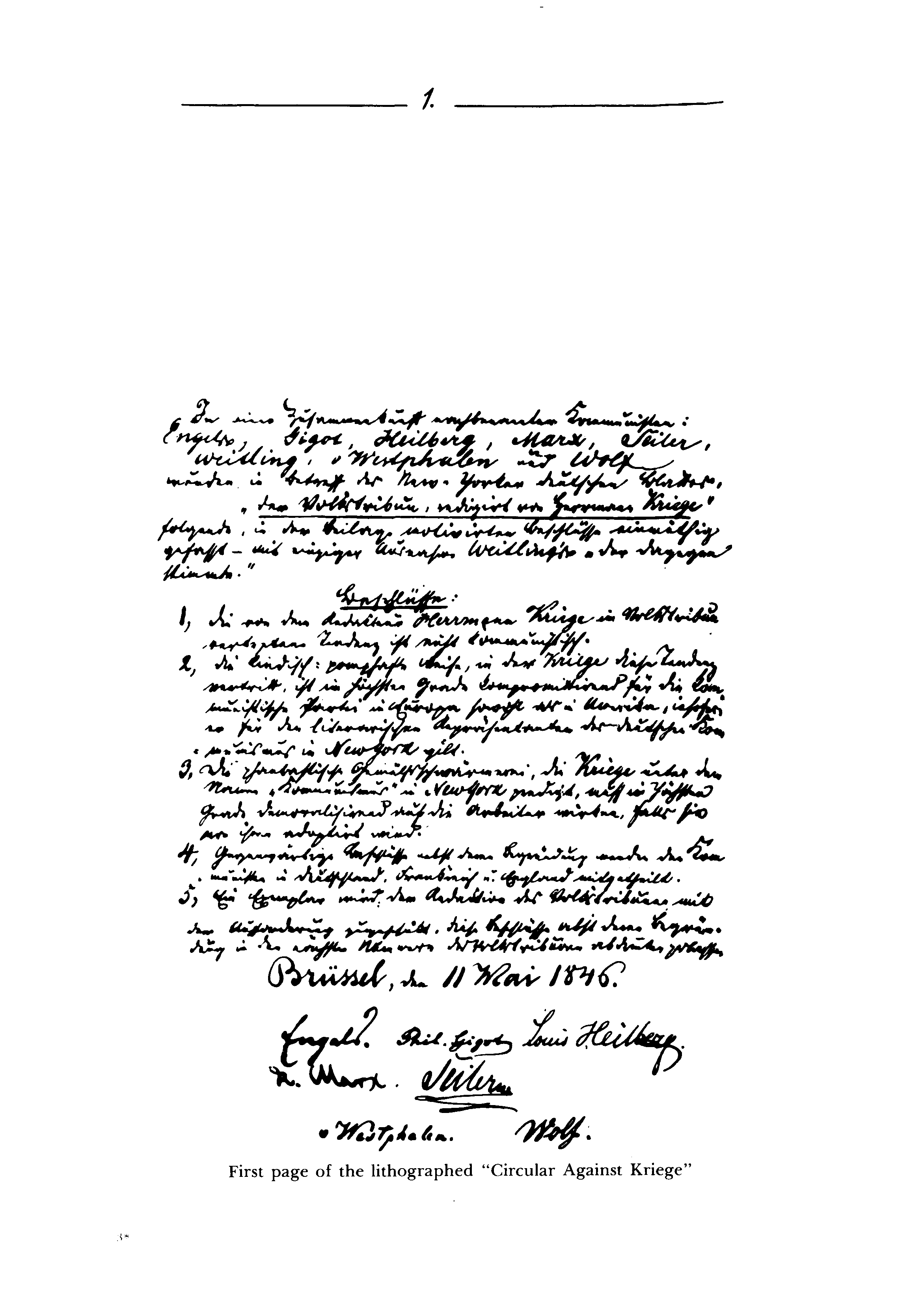
First page of the lithographed "Circular Against Kriege"
d) Interpolated Ave Maria: "Blessed, thrice blessed are you women, being chosen to pronounce the first consecration of the long-promised kingdom of bliss."
12) "Beloved sisters." 13) "Not love but hatred" (contrasting bourgeois and communist society).
14) "You loved ones." 15) "Raise love on to the throne." 16) "Active people in loving community." 17) "True priestesses of love." e) Aesthetic parenthesis: "If your trembling soul has not yet forgotten the flight sublime" — (a feat whose feasibility has yet to be demonstrated).
18) "The world of love." 19) "The kingdom of hatred and the kingdom of love." f) An attempt to hoodwink women: "And therefore you have a most mighty voice in politics too. You but need to use your influence, and all the old kingdom of hatred will fall in ruins to make way for the new kingdom of love."
g) Philosophical fanfare to drown reflection: "The ultimate goal of their activity is that all mankind should take an ever-joyful delight in itself."
20) "Your love." At this point women are required to be "unstinting" in their love so that it may "embrace all mankind with equal surrender". A demand that is as indecent as it is extravagant.
h) Fugue: "That thousands and yet more thousands of deserted orphans are abandoned to the fearful massacre of circumstances." What does this "fearfulness" consist in? In the "orphans" massacr-ing the "circumstances" or the "circumstances" massacring the "orphans"?
i) Unveiling of the neo-communist policy: "We have no wish to lay hands on the private property of any man; what the usurer now has, let him keep; we merely wish to forestall the further pillaging of the people's assets and prevent capital from continuing to withhold from labour its rightful property." This purpose is to be achieved as follows: "Every poor man ... will instantly become a useful member of human society as soon as he is offered the opportunity of productive work." (According to this no one is more deserving in respect of "human society" than the capitalists, including those in New York against whom Kriege thunders so mightily.) "And this opportunity is assured him for ever, as soon as society gives him a piece of land on which he can produce food for himself and his family.... If this vast area of land" (the 1,400 million acres of the American state lands) "is withdrawn from commerce and ensured to labour in limited quantities, at one stroke all the poverty in America will have been eliminated; for each man will be given the opportunity to establish with his own hands an inviolable home for himself." That it does not lie in the legislators' power to decree either that the patriarchal system desired by Kriege shall not evolve into an industrial system or that the industrial and commercial states of the east coast of the United States shall revert to patriarchal barbarism — one had a right to expect that this would be realised. Meanwhile, for the day when the paradise just described will have arrived, Kriege prepares the following country-parson utterance: "And then we can teach men to live together in peace, to lighten for each other the burden and toil of their life and:
21) build the first dwelling-places on earth for celestial love" (each one 160 acres in area).
Kriege concludes his address to married women as follows: "Turn first to
22) the men of your love, ask them ... to turn their backs on the politics of old,... show them their children, implore them in their name" (who are without reason) "to adopt reason." Secondly, to the "virgins":
23) "For your lovers let the liberation of the land be the touchstone of their human worth and have no faith in
24) their love until they have sworn fealty to mankind." (What is that supposed to mean?) If the virgins behave in this manner, he guarantees them that their children
25) "will become as loving as they themselves" (that is, "the birds of heaven") and concludes this cant with another round of
26) "true priestesses of love", "great kingdom of community" and "consecration".
No. 13 of the Volks-Trib[un]:—"Antwort an Sollta." 27) "It" (the great spirit of community) "flashes from fraternal eyes as the fire of love."
28) "What is a woman without the man whom she can love, to whom she can surrender her trembling soul?"
29) "To join all mankind in love." 30) "Mother-love".... 31) "Love of mankind".... 32) "All the first sounds of love".... 33) "The radiance of love."
k) The purpose of communism is to "subject the whole life of mankind to its" (the sentient heart's) "beating".
34) "The sound of love flees before the rattle of money."
35) "Everything may be achieved by love and surrender." In this one issue, then, we have love in approximately thirty-five shapes. It is in perfect accordance with this amorous slobbering that Kriege, in his "Antwort an Sollta" and elsewhere, presents communism as the love-imbued opposite of selfishness and reduces a revolutionary movement of world-historical importance to the few words: love — hate, communism — selfishness. Part and parcel of it is likewise the cowardice with which he here panders to the usurer by promising to let him keep what he already has and with which further on he assures that he does not want "to destroy the cherished sentiments of family life, of belonging to one's native land and people" but "only to fulfil them". This cowardly, hypocritical presentation of communism not as "destruction" but as "fulfilment" of existing evils and of the illusions which the bourgeoisie have about them, is found in every issue of the Volks-Tribun. This hypocrisy and cowardice are matched by the attitude which he adopts in discussions with politicians. He declares it (No. 10(1)) a sin against communism to attack political visionaries like Lamennais and Börne who dabble in Catholicism, with the result that men like Proudhon, Cabet, Dézamy, in short all the French Communists, are just men "who call themselves Communists". The fact that the German Communists have left Börne as far behind as the French have Lamennais, is something Kriege could have discovered back in Germany, Brussels and London.
We leave Kriege to reflect for himself on the enervating effect this love-sickness cannot fail to have on both sexes and the mass hysteria and anaemia it must produce in the "virgins".