Cartoon by Engels of Frederick William IV making the royal speech at the opening of the United Diet in Berlin, April 11, 1847
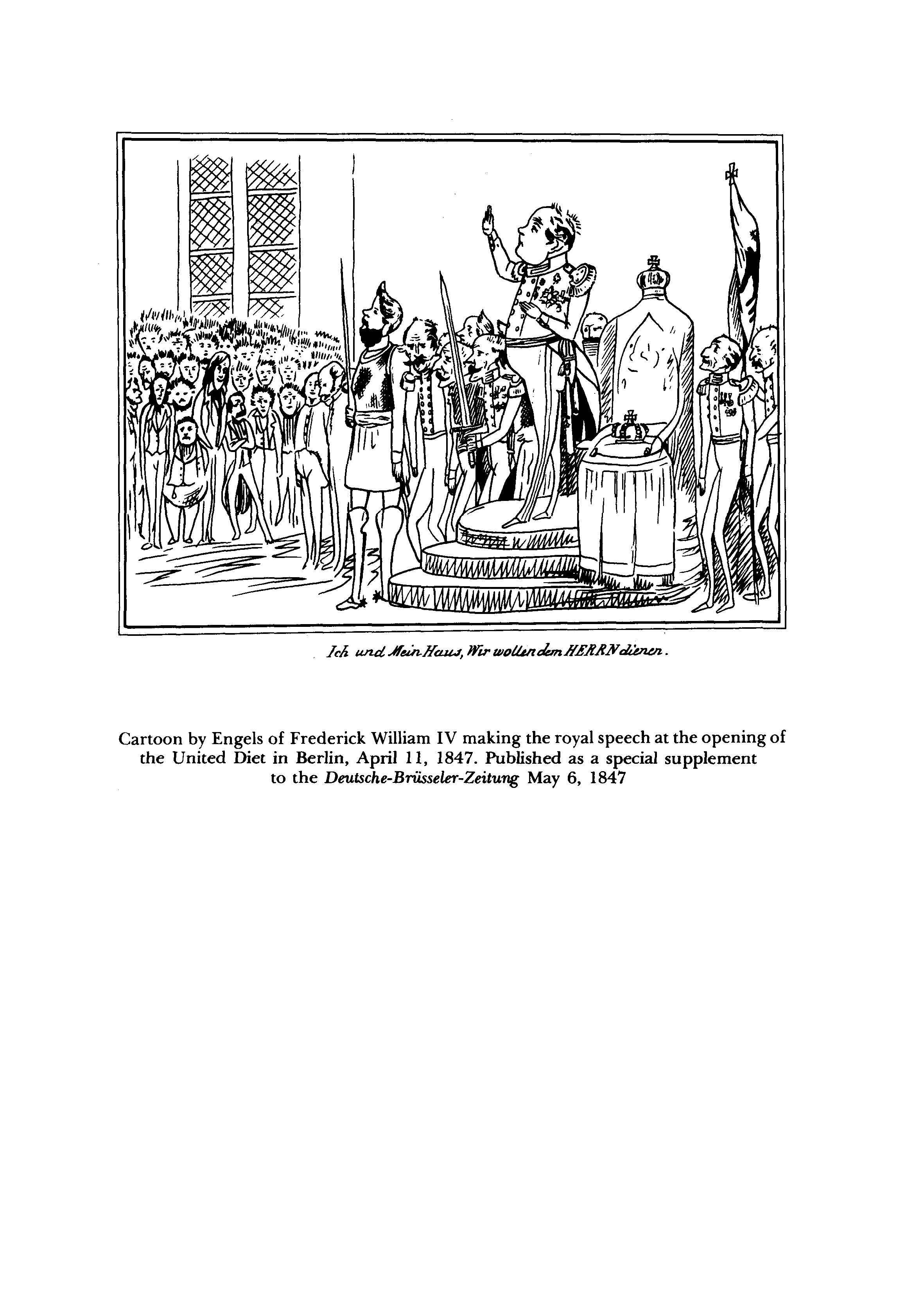
IcA und JfeùiffauJ, Ww woùUnebnJf£JlJiy<2ùncn. Cartoon by Engels of Frederick William IV making the royal speech at the opening of the United Diet in Berlin, April 11, 1847. Published as a special supplement to the Deutsche-Brüsseler-Zeituvg May 6, 1847
depreciation of stock in trade, and were themselves, on an average, not very profitable, on account of the comparatively thin population and trade of the greater part of the country. They offered, however, a still better chance of profit than other industrial investments; and thus every one who could dispose of some capital engaged in them. Very soon these speculations assumed, as usual, a feverish character, and ended in a crisis which now for about a twelve-month has oppressed the Prussian money markets. Thus the middle classes found themselves in a very uncomfortable position in the beginning of the present year: the money markets under the pressure of an extraordinary want of coin; the manufacturing districts requiring more than ever those protective duties which the government refused to grant; the coast towns requiring navigation laws as the only means to relieve them; and, over and above all, a rise in the corn markets, which brought the country to a state approaching famine. All these causes of discontent operated at the same time, and more strongly so upon the people; the Silesian linen-weavers in the greatest distress; the cotton factories stopped; in the large manufacturing district of the Rhine almost all hands out of work, the potato crop mostly ruined, and bread at famine prices. The moment was evidently come for the middle classes to take the government out of the hands of an imbecile king, weak nobility, and self-conceited bureaucracy, and to secure it to themselves.
It is a curious fact, but which is repeated at every revolutionary epoch, that at the very moment when the leading class of a movement is most favourably placed for the accomplishment of that movement, the old worn-out government is reduced to beg the assistance of this same leading class. Thus in 1789, in France, when famine, bad trade, and divisions among the nobility pushed, so to say, the middle classes to a revolution — at that very moment the government found its money resources exhausted, and was reduced to begin the revolution by the convocation of the States-General.[54]
Thus in 1847 in Prussia. At the very moment when the more indolent Prussian middle classes are almost forced by circumstances to change the governmental system, at that moment the king, by want of money, is forced to commence that change of system, and to convocate in his turn the Prussian States-General. It is indubitable that the States would offer him much less resistance than they will now, if the money market was easy, the factories at full work (which would be caused by a flourishing trade and ready sale, and consequent high prices for manufactured goods in England) and corn at a reasonably low price. But so it is: in times of approaching revolution, the progressive classes of society have always all chances on their side.
I have, during the course of 1845 and 1846, more than once shown to the readers of the Star, that the King of Prussia was in a very embarrassed financial situation(1); I have at the same time called their attention to the several clever plans by which his ministers sought to extricate him; and predicted that the whole affair must end by a convocation of the States-General. The event, then, was neither unexpected, nor, as it now is represented, caused by the free grace of his squandering majesty; nothing but sheer necessity, poverty and distress could move him to such a step, and there is not a child in Prussia but knows this. The only question, then, is this: — Will the Prussian middle classes, by investing a new loan with their guarantee, allow the king to go on as he has done hitherto and to disregard for another seven years their petitions and their wants?
We have already answered this question. They cannot do this. We have proved it from the situation of the respective classes, and we shall now prove it from the composition of the States-General themselves.
Members of high and low nobility 311 Do. for towns and peasantry 306 As the king has declared his intention to increase the members of the high nobility (80 in all) by new creations of peers, we may add to the nobility, about 30 more; 341 members of nobility, or government party. Deduct from this number the liberal fractions of the lower nobility, namely, all the nobility of Prussia Proper, two-thirds of that of Posen, and some members of the Rhenish, Silesian, Brandenburg and Westphalian nobility, say 70 liberal members, voting with the towns and peasantry, and the position of parties is as follows: —
Nobility, or government party 271 Towns and peasantry, or liberal opposition 376
Thus, even allowing that thirty or forty town or peasantry members from the remote districts should vote for the government, there will always be a liberal majority of from twenty-five to fifty votes remaining, and with a little energy on the part of the Liberals, it will be easy to meet every demand for money with another demand for liberal institutions. There is besides, no doubt, that, under present circumstances, the people will support the middle classes, and by their pressure from without, which indeed is very much wanted, strengthen the courage and enliven the energies of those within.
Thus, the Prussian constitution, insignificant in itself, is, for all that, the beginning of a new epoch for that country, and for all Germany. It marks the downfall of absolutism and nobility, and the ascendancy of the middle classes; it marks the beginning of a movement which will very soon lead to a representative constitution for the middle classes, a free press, independent judges and trial by jury, and which will end God knows where. It marks the repetition of 1789 in Prussia. And if the revolutionary movement which now begins, will directly interest the middle classes only, it is yet not at all indifferent to the interests of the people. From the moment the power of the middle classes is constituted, from that moment begins the separate and distinct democratic movement. In the struggle against despotism and aristocracy, the people, the democratic party, cannot but play a secondary part; the first place belongs to the middle classes. From the moment, however, the middle classes establish their own government, identify themselves with a new despotism and aristocracy against the people, from that moment democracy takes its stand as the only, the exclusive movement party; from that moment the struggle is simplified, reduced to two parties, and changes, by that circumstance, into a "war to the knife". The history of the French and English democratic parties fully proves this.
There is another circumstance to be remarked. The conquest of public power by the middle classes of Prussia will change the political position of all European countries. The alliance of the North will be dissolved. Austria and Russia, the chief spoliators of Poland, will be entirely isolated from the rest of Europe, for Prussia carries along with her the smaller states of Germany, who all have constitutional governments. Thus the balance of power in Europe will be entirely changed by the consequences of this insignificant constitution; the desertion of three-fourths of Germany from the camp of stationary Eastern Europe into that of progressive Western Europe. In February 1846, broke out the last Polish insurrection.[55] In February 1847, Frederick William convocates his States-General. The vengeance of Poland is drawing nigh!
Endnotes
[54] States-general — a body representing the estates in medieval France. It consisted of representatives of the clergy, nobles and burghers. They met in May 1789 — after a 175-year interval — at the time of maturing bourgeois revolution and on June 17 were transformed by the decision of the deputies of the third estate into the National Assembly which proclaimed itself the Constituent Assembly on July 9 and became the supreme organ of revolutionary France.
[55] The reference is to the national liberation uprising in the Cracow republic which by the decision of the Congress of Vienna was controlled jointly by Austria, Russia and Prussia — who had partitioned Poland at the end of the eighteenth century. The seizure of power in Cracow by the insurgents on February 22, 1846 and the establishment of a National Government of the Polish republic, which issued a manifesto abolishing feudal services, were part of the plan for a general uprising in the Polish lands whose main inspirers were the revolutionary democrats (Dembowski and others). In March the Cracow uprising, lacking active support in other parts of Poland, was crushed by the forces of Austria and tsarist Russia; in November 1846, Austria, Prussia and Russia signed a treaty incorporating the "free town of Cracow" into the Austrian Empire.