Section One: Proletarian Bonapartism
An Analysis of the Social Basis of the Soviet Union And Why We Defend It
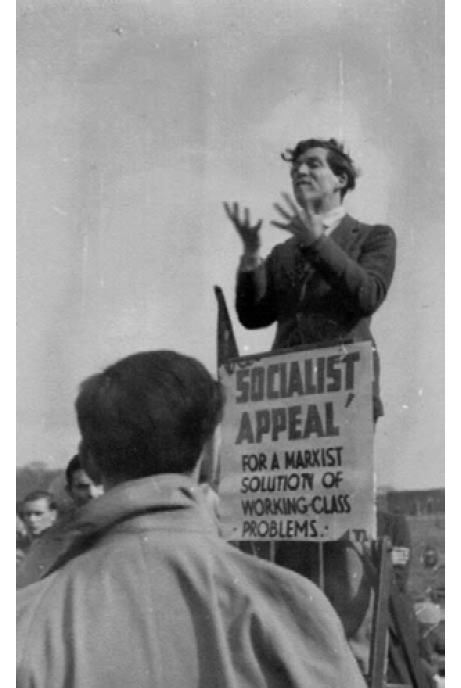
Ted Grant at Speakers’ Corner, 1942
The Russo-German war is now entering its second month, and this gives us the opportunity to measure the relation of forces. It is clear that the heroic resistance of the workers and peasants has for the first time stemmed the blows of the German blitzkrieg machine. The bitter resistance of Soviet soldiers has completely upset the Nazi time-table. Already the German soldiery have had to pay the price for their territorial gains in such measure that the soviet claim to have inflicted a million casualties on the German army cannot be far short of the mark.
In addition to this the “scorched earth” policy announced by Stalin completely deprives the Nazis of any immediate economic gains in the territory occupied by their troops. They conquer only blackened ruins and desolation. Banking on the experience of the campaigns in the West, Hitler had anticipated a relatively cheap and easy victory. Moreover, the experience of the Finnish war, which had been decidedly unpopular among the masses of the Russian people, had led the German imperialists to completely underestimate the powers of resistance of the masses when defending themselves against imperialist attack. Napoleon, whom Hitler has desired to render a tyro in the field of world conquest, could have explained in advance to his would-be imitator that the moral factor stands as to the physical in the relation of three to one.
Basing themselves on the oppression of the Russian workers and peasants by the uncontrolled bureaucracy, the German capitalists, and for that matter world imperialism, deluded themselves into the belief that the Russian people could be overwhelmed without too costly an effort. Trotsky had predicted that the idea of the Japanese militarists and German fascists, that the Russian people were only waiting for the armies of the Mikado and Hitler to “liberate” them, was fantastic delirium. The capitulations of Stalin in the past two years encouraged this belief in the minds of the German military clique. In spite of the ravages of the bureaucracy, the basic conquests of the October Revolution still remain: the capitalist class has never regained its possessions, and private ownership in the means of production has never been restored. It is this that the masses, despite their aversion for the bureaucracy, have rallied to defend, just as the British workers would rally to the defense of their trade unions against capitalist attack, in spite of their aversion for the Bevins and Citrines.
Up to now the Nazi army has not had a serious test to face. In France the bourgeoisie were concerned only with saving their property, and the moment the Germans had broken through, they capitulated. The French soldiers and workers had been demoralized by the Stalinists and the actions of the bourgeoisie, and rendered morally prostrate, which resulted in only half-hearted resistance. Likewise, in the other countries the bourgeoisie sold out, and the German military machine marched over Europe as if on military maneuvers. It was this which gave the Nazis the illusion of invincibility.
But today Goebbels is forced to admit that the Russian soldier fights to the death. “When the machine guns are knocked out by tanks, the Mongol soldier does not surrender; he fights on with a revolver.” And behind the German lines of advance the population remains bitterly hostile, and conducts guerrilla warfare. It is this wave of enthusiasm and self-sacrifice that has served to stem the German advance, and with a correct policy, would guarantee the victory of the Russian workers and peasants over the Nazi military machine and the establishment of a Socialist Europe. But as was foreseen, Stalin cannot wage a revolutionary war.
The bureaucracy in Russia is fighting Hitler because he leaves them no alternative, and thus, they do, in a distorted bureaucratic fashion defend the Soviet Union. The Soviet bureaucracy—the army officers, managers, technicians, artists, and higher officials, numbering about 10,000,000, intend to continue to devour four-fifths of the goods produced for consumption, while the rest of the population consume one-fifth, and this is what they are fighting for. But in spite of the fact that Stalin desires the defeat of Hitler, he does not wish for a proletarian revolution in Germany, because a socialist revolution in Germany would mean a socialist Europe. And a socialist Europe would mean that the victorious Russian workers and peasants, imbued with self-confidence by their victory, would return home and soon settle accounts with the Kremlin usurpers by immediately restoring control into their own hands. Stalinism only came to power on the basis of the defeats of the world working class. A victory of such titanic proportions as the seizure of power by the German proletariat would sweep Stalinism aside!
The organic needs of the bureaucracy in internal policy find expression in the foreign policy of Stalin. If they had placed their confidence in the European and world working class, by consistent day in and day out leaflets and radio appeals to the German workers, explaining the real character of the war on the part of their Nazi rulers, urging them in fraternal collaboration to establish a socialist Germany—this, coupled with the unyielding resistance of the Russian workers and peasants, would have been the signal for transforming the whole world situation and would have sounded the death knell of world capitalism. Instead of this irrefutable Leninist position, we see the reliance upon Churchill and Roosevelt, the “democratic” imperialists. Not only is the Comintern deceiving the Russian masses as to the nature of the voracious imperialists of Britain and America, but it is spreading the illusion among the entire world working class that they are fighting for the liberty of all nations. On the Moscow wireless we hear:
When the German fascist hordes appeared on the shores on the Straits of Dover and the English Channel, and prematurely celebrated their victory over democratic Britain, the British showed in the moment of mortal danger that they were capable, under the leadership of their farsighted statesmen, of developing the gigantic strength latent within them.
In the Times of July 17 we read:
As happened during the lesser crises of recent years, resolutions have come pouring into Moscow from factories and farms throughout the Union. A word from Moscow can usually bring such resolutions at any time. In the past they have not been wholly spontaneous: but their wording is now significant. The Anglo-Soviet Alliance is applauded not merely in the Moscow newspapers; it is being welcomed and praised in all these resolutions, proof that the Soviet government is not afraid of letting even the most isolated centers know that it has joined forces with the power which until lately was denounced as imperialist and capitalist.
And we are told by Stalin in his speech:
In this connection the historic utterances of the British Prime Minister, Churchill, regarding aid to the Soviet Union, and the declaration of the United States Government, signifies readiness to render aid to our country, which can only evoke a feeling of gratitude in the hearts of the peoples of the Soviet Union, are fully comprehensible and symptomatic.
Thus we see the deliberate deception of the masses in the Soviet Union as to the real aims of Anglo-American imperialism, the aims of world domination for the continued exploitation of the people of the entire globe and, above all as a long-term perspective, the reintroduction of capitalism in the Soviet Union.
On the other hand, Churchill and the bourgeois statesmen have openly proclaimed their detestation of Communism and by innuendo have made it clear to the class they represent that they intend to settle this account at a more propitious time. Mr. Churchill does not withdraw a word of what he has said about Communism in the past. And Churchill has expressed his preference for Hitler’s Nazism to Bolshevism. The support which Churchill will give is based only on the knowledge of the world bourgeoisie on the counterrevolutionary role of Stalinism, which the nationalist charlatanism emanating from Moscow has wholly justified. Were it not for this, Churchill would be clutching at Hitler as a savior from the menace of Bolshevism.
Confident of the role of the Stalinist bureaucracy within and without Russia, Churchill and Roosevelt are calculating on the mutual exhaustion of Germany and Russia. As a Turkish journalist expressed it, “Wouldn’t it be fine if Hitler and Stalin would knock each other out?” Anglo-American imperialism will then be enabled to destroy the Soviet regime and emerge masters of the world. The resistance of Russia has been as much of a surprise to them as to Germany. A protracted resistance and its inevitable threat of revolution in Europe would compel Hitler to seek terms at the expense of Russia, and Hitler would be compelled to play the role originally allotted him by world finance.
The internal development of the Soviet Union
But what will take place within Soviet society? To save himself Stalin must appeal to the revolutionary energies of the masses and arm once again tens of millions of workers and peasants. Not for long will these masses be fobbed off by the crimes and stupidities of the bureaucracy. The baneful effects of mismanagement, inefficiency, and corruption which are characteristic of the ignorant and uncontrolled bureaucracy will be even more glaring under the stress of the war. Meanwhile, war will impose a terrible strain on the industry and transport of the Soviet Union, and the privations of the masses will inevitably become worsened, in the interests of “Everything for the Front.” This policy can only be carried through without provoking sharp legitimate dissatisfaction, if, as was the case in Lenin’s day, the sacrifices are more or less spread equally over the entire population.
In the course of the war the wasteful extravagance and corruption of the generals, admirals, and other high bureaucrats will arouse extreme resentment and hostility among the masses. This is the reason for the unparalleled chauvinist appeals on the basis of “national unity.” Lenin taught us always to look beneath formulas and slogans for the social content. In capitalist states the appeal for “national unity”, union sacrée, in time of war, is a cloak to gloss over the antagonism of interests in the given society. Of course, in Russia today it is correct to appeal for the defense of the fatherland—but in Lenin’s day the emphasis, as always, would be the workers’ fatherland. The defense of the Russian workers’ state would be the defense of the entire world working class, especially of the workers in Europe and Germany!
Under the fire of British guns in the wars of intervention, both in the internal and external propaganda, the Bolsheviks appealed to the Russian soldiers fighting against the British: “We never forget while English guns and English bombs and English soldiers are raining death upon us that there are two Englands, the England of the workers, and the England of finance capitalists.” The reason why the Soviet bureaucracy cannot make this simple and true call, internally and externally, is because of the profound gulf which has opened out between the people and the avaricious officialdom. This is the social content of the appeal for “national unity” within the Soviet Union
If, as we hope, the Nazis fail to score a decisive success—which is the best that can be hoped for with Stalinism in control—the war will become a bloody war of attrition and exhaustion, and the contradictions within Soviet society will reach their extreme limit, beyond which there must be an explosion.
Like all doomed regimes, Stalin’s preoccupation with preserving his position is shown by the measures which he has dictated for the army. The splitting of the front into three commands is not dictated by the military needs of the Soviet Union. In war a unified command is obviously the best means of conducting operations on the fronts as a planned whole. Stalin’s reduction of Timoshenko from Commander-in-Chief is dictated by fear that the reins of power will slip out of the hands of the civil bureaucracy into the hands of the army caste. After the Finnish war the abolition of the control of the political commissars, which were in reality the GPU guards of the civil bureaucracy, was a victory for the army caste. Stalin was compelled, by the disastrous consequences of the GPU control and purges which led to military reverses, to give a freer hand to the generals. But now fearful of his position, even in the face of the mightiest foe in world history, Stalin once again has introduced the GPU in order to ensure his control, from below as well as above, in the army. But in any event, this will not prevent at a later stage power passing into the hands of the military bureaucracy as in all Bonapartist regimes.
In industry and transport, through the disruption of economy, the heads of the trust will be compelled more and more to act as if they were the owners of the enterprises. Planned economy, which presupposes the conscious cooperation, activity, and control by the masses, managed in spite of the bureaucratic straitjacket, to maintain a semblance of unified progress in time of peace. In time of war, the bureaucratic strangulation means that planned economy as a whole must crumble. The “Fifteen Year Plan” of 1941 is automatically scrapped. Under the aggravation of these contradictions, the processes speeded up by the war, a section of the bureaucratic tops will tend to seek the assistance of the capitalist “allies” to solve the contradictions by the restoration of capitalism.
On the other hand, the workers and peasants, who bear the main brunt of the war, will now be armed and organized (it is true, under the control of the GPU), and while they have tolerated in the past the Old Man of the Sea on their backs for fear of a worse alternative in the form of capitalist intervention, they will not look with any too indulgent an eye on the excesses and inefficiencies of the bureaucracy. As time passes it will become more and more evident that the bureaucratic control is paralyzing the organization of the defense of the Soviet Union. It will become apparent that only restoration of workers’ control in the factories, the restoration of Soviets and Soviet democracy can save the workers’ state from disaster. At that time the program of Lenin and Trotsky will be rejuvenated.
The utopian character of the dream of “Socialism in One Country” has been destroyed, in passing, by the Nazi attack. Whatever the outcome of the struggle it is obvious that the economy of the Soviet Union will be terribly shattered and weakened. The policy of “scorched earth,” with a revolutionary perspective, is, of course, the only correct one. Nevertheless it is a policy of desperation. Tens of millions of people will flee to the interior of the Soviet Union, and the devastated regions will require years to build up again. Even a victory would find Soviet economy more and more dependent upon the rich and mighty “democracies” of the West.
Even under tsarism the bourgeois democracies bled Russia white in manpower and economically. In the salons of St. Petersburg the bourgeois joked that “England is prepared to fight to the last drop of blood of the Russian soldier.” At that period, while fighting German imperialism in alliance with Russia, the allied bourgeoisie were not loath to try and transform Russia into an Anglo-French colony. This at a time when they were propping up Russian tsarism as a bulwark of European reaction. Today it is clear that Washington and London regard the attack of Hitler as a gift of Providence to simultaneously bleed their mighty German rival and at the same time obtain an advantageous position for the throttling of the workers’ state. The antagonisms between collective ownership in Russia and the capitalist world is the most fundamental of all antagonisms within present-day society.
That is why, in spite of all the concessions and cringing of the bureaucracy, the Soviet regime, even in its emasculated form, cannot be saved unless the intervention of the workers in the capitalist states takes place. If world capitalism manages to survive the present bloody conflagration it has let loose on mankind, regardless of the victors, Russia will not escape the engulfment like the rest of the world, of fascist barbarism, and the bourgeois counterrevolution in Russia will be heralded.
The end of the Comintern as an international
This austere, but sober, calculation of the development of events plays its part with the Churchills and Roosevelts. Stalin is assisting them with all his might to transform their calculations into reality. The prostituted Comintern, from being sold together with oil and manganese to placate Hitler, is now bartered for promises of machine tools and Spitfires. Not only in the allied countries, but in the occupied territories too, the Comintern is dancing to the tune of Churchill. In France and Czechoslovakia, where the Communist Parties probably have the support of the majority of the working class, they are now placing their followers under the banner of De Gaulle and Benes, who represent London, and nothing else.
But the calculations of world imperialism are built on quicksand. In Germany and Europe, far more than in the Soviet Union itself, the contradictions between the Nazi bureaucracy and the German imperialists on the one side, and the German workers and peasants on the other, and the contradiction between German imperialism and the oppressed workers and peasants of the conquered nations, are being strained to breaking point. The development of the war will bring all five continents into the harvest of “blood, toil, tears, and sweat” which capitalism has sown. The violent reaction of the masses to this bloody and senseless slaughter will come with absolute certainty. And on this optimistic perspective the Trotskyists base their program.
In Britain the bourgeoisie is chuckling at the exorcising of the “red menace” by the betrayal of the Communist Party. The Times notes with satisfaction that Hitler’s move into Russia has “placed the dissident Communist minority behind the national effort.” This, it is to be hoped, will be the final turn of the already dizzy Comintern. The revolutionary element within the Communist Party will not for long allow themselves to be dragooned into support for Churchill. Perhaps it has been fortunate that the Comintern has not managed to penetrate and corrupt the decisive section of the British working class. In Europe the lash of fascism is the price which the working class has paid for the crimes of Social Democracy and Stalinism. But we in Britain have the opportunity to profit from the lessons of the past decades. The British working class can play a decisive role in the destruction of the European reaction and salvage and regenerate what remains of the October Revolution, but only by waging an ever more implacable and irreconcilable struggle against the government of finance capital. The program of the Fourth International alone advocates such a path, and the revolutionary elements of the Communist Party, who are already voting with their feet, must be drawn to our banner.
The fate of the workers of Europe and the world has been tied in one knot by the imperialist war. Either a socialist Britain and a socialist Europe, or a fascist Britain and Europe and the destruction of the USSR as a workers’ state.
Stalinism in the Postwar World
World War II ended in a complex and entirely unforeseen relationship of forces between the nations and between the classes. It ended in the victory of two continental powers on the world arena, US imperialism and the Russian bureaucracy. That became the dominant factor on a world scale: the division of the world between two competing blocs. For the first time in history the great powers of Europe were reduced to secondary positions; France, Germany, Italy, were defeated and England became a second-rate power. Japan was reduced to the status of an occupied territory stripped of all her colonies and spheres of influence. The struggle between the classes can only be understood against a background of this decisive conflict of the era.
The decay of capitalism was reflected above all in the weakening of imperialism and the upsurge of the masses in Asia, with the revolutionary wave in Western and Eastern Europe. The upsurge of the masses in Asia in the struggle for national liberation was such as to compel the British to withdraw from India, Burma, and Ceylon (Sri Lanka—Ed.) and enter into a different relationship with the national bourgeoisie of these countries.
Dutch imperialism has been compelled to withdraw from Indonesia and arrive at a compromise with the native ruling class. In Indochina French imperialism has been bogged down ever since the war in its desperate effort to hold down the national liberation struggle. In Malaya, British imperialism, with all the resources at its disposal, has not been enabled to defeat the Malayan peoples’ fight for independence. In China American imperialism has sustained an unparalleled reverse. Despite the lavish pouring of munitions and supplies to the aid of the decrepit Chiang Kai-shek regime, the forces of Chinese landlordism-capitalism-imperialism, as represented by the corrupt Kuomintang1 clique, have been pushed into the sea and retain but a shaky foothold on the island of Formosa (Taiwan—Ed.), protected only by the sea and now the American navy.
Korea, divided into Russian and American spheres of influence, reveals the weakness of imperialism in the whole of the Far East. Without the direct intervention of American imperialism the Korean Chiang Kai-shek would have collapsed as ignominiously as the Chiang regime itself. At best, American imperialism will be enabled to retain a foothold after a lengthy struggle and American forces will be pinned down like those of the French in Indochina and the British in Malaya, even in the event of a complete victory in the South. This is the measure of the decay of the old relations of capitalism and imperialism of the past. Capitalism rots at its weakest point.
In Europe, the victory of Russia in the war and the upsurge of the masses following the defeat of German-Italian fascism also developed a tremendous revolutionary wave which threatened to sweep capitalism away over the entire continent. However, the victory of Russia in the war had complex and contradictory consequences. Temporarily, but nevertheless for an entire historical period, Stalinism has been enormously strengthened. Despite the destruction and bloodletting to which Russia had been subjected, which left her in an exhausted and weak state (while Anglo-American imperialism had hardly been touched during the war and suffered negligible losses in resources and manpower—America had reached the apex of her power militarily and economically), because of the mood of the peoples and the relationship of class forces on a world scale, the imperialists were impotent to intervene against Russia.
Intervention even on a scale following that of World War I was impossible. On the contrary, the allies were forced to swallow the Russian hegemony of Eastern Europe and parts of Asia which they would never have agreed to concede even to reactionary tsarism. The Russian bureaucracy had achieved the domination of the region beyond the wildest dreams of Russia under the tsars.
The process whereby capitalism was overthrown in Eastern Europe and Stalinism extended, took place in a peculiar way. The vacuum in the state power in Eastern Europe, following the defeat of the Nazis and their quislings, was filled by the forces of the conquering Red Army. The weak bourgeoisie of these areas had been largely exterminated, absorbed as quislings to German imperialism, or reduced to minor partners of the Nazis during the years of the war. They had been relatively weak in Eastern Europe even before the war, as the states of this region were largely semicolonies of the great powers on the lines of the South American states. The pre-war regimes suffered from a chronic crisis due to the Balkanization2 of the area and the incapacity of the ruling class to solve the problems of even the bourgeois-democratic revolution. They were nearly all military police dictatorships of a weak character without any real roots among the masses.
The victory of Russia during the war undoubtedly provoked an upsurge among the masses, either rapidly or in some countries delayed for a time. The socialist revolution was on the order of the day. This was dangerous not only for the bourgeoisie but also the Stalinist bureaucracy. The bureaucracy achieved their aims by skillfully veering between and manipulating the classes in typical Bonapartist fashion. The trick was to form a “popular front” between the classes and to organize a government of “national concentration.” However this “popular front” had a different base and different aims in view than the “popular fronts” of the past.
In Spain the aim of the “popular front” was to destroy the powers of the workers and the embryonic workers’ state, by destroying the workers’ revolution. This was achieved by making an alliance with the bourgeoisie, or rather the shadow of the bourgeoisie, strangling the control which the workers had established in the factories and the armed workers’ militia, and reestablishing the capitalist state under the control of the bourgeoisie. As a consequence of this policy, towards the end of the war there was a military police dictatorship on both sides of the lines.
The aim of the coalition with the broken bourgeoisie or its shadow in Eastern Europe had different objectives than that of handing control back to the capitalist class. In previous “popular fronts” the real power of a state—armed bodies of men, police and the state apparatus—was firmly in the hands of the bourgeoisie, with the workers’ parties as appendages. In Eastern Europe, with one important variation or another, the real power, i.e. control of the armed bodies of men and the state apparatus, was in the hands of the Stalinists. The bourgeoisie occupied the position of appendage without the real power. Why then the coalition? It served as a cover under which a firm state machine on the model of that of Moscow could be constructed and consolidated.
The bourgeoisie was utilized by the bureaucracy in order to prevent the workers, awakened by the victory of the Red Army and the events of the war, from achieving the socialist revolution on the lines of October. The bureaucracy played off the bourgeoisie in the name of unity against the working class. They manipulated with Bonapartist maneuvers the groping aspirations of the workers to establish control of the factories.
By introducing land reform and expropriating the landlord class, they secured for the time being the support or acquiescence of the peasants. Having consolidated and built up a strong state under their control they then proceeded to the next stage. Mobilizing the workers, they turned on the bourgeoisie, whom they no longer required to balance against the workers and peasants, and step by step they proceeded to their expropriation. The bourgeoisie, without the support of outside imperialism, was incapable of decisive resistance. A totalitarian regime approximating more and more to the Moscow model has been gradually introduced. After the elimination of the bourgeoisie, and the beginning of a large scale industrialization the bureaucracy has turned against the peasants and started on the road of the collectivization of agriculture.
The Case of Yugoslavia
In Yugoslavia and China the pattern of events was somewhat different, although not fundamentally so, from developments in Eastern Europe. After the subjugating of Yugoslavia by the forces of German imperialism, a struggle for national liberation against the foreign oppressor began to develop. This had a wide base due to the traditions of Yugoslavia and the struggles of its peoples against Turkish domination and that of Austria-Hungary before the First World War.
This resulted in a peasant war and a guerrilla struggle in the mountains. Under “normal” conditions such a struggle could only have ended in the victory of the bourgeoisie and the possibility of land reform, even if carried to a successful conclusion. But the dominating factors of our epoch lie in the victory of “October” and the distortion of the revolution by the bureaucracy. On the one hand, the background of a strong “workers’ state” (even though in a degenerated form), and on the other the frightful decay of capitalism-imperialism on a world scale and the incapacity of the local bourgeoisie to solve a single one of the national or democratic problems facing the country, served to push the masses in the direction of the socialist revolution. Again, the distortion of the revolution results in a curious deformation of the struggle on the part of the local agencies of Stalinism.
The peasants cannot play an independent role. They must follow one or another of the basic classes in modern society. In contradistinction to the classical Marxist theory of the past, the struggle began with small sections of the workers and Stalinist leadership taking to the hills and organizing the peasants in a war for national liberation. The overwhelming majority of the rank and file of the partisan army of liberation was composed of peasants. Its nature revealed itself in the civil war, which began even under the occupation, with Mihailović3 representing the capitalist and upper middle class (or rather those remnants who had not sold out completely to German imperialism). The Bonapartist bureaucracy, basing itself on the peasants, led the struggle under the guise of a national “popular front” similar to those later established in Eastern Europe. Apart from the big cities, large areas were under the control of Tito towards the end of the war, though the assistance of the Red Army was necessary for the conquest of Belgrade.
However, events in Yugoslavia developed on a different pattern to those in Eastern Europe. In the other countries of Eastern Europe the partisan struggles were in most cases either weak, almost nonexistent, or in an embryonic stage when the Red Army arrived. In those where a mass of resistance did occur, there were special circumstances which did not exist in Yugoslavia.
The important difference between Yugoslavia (as with China) and the rest of Eastern Europe lies in the fact that Tito and the Yugoslav Stalinists had established an independent state base before the arrival of the Red Army. They had the support of the big majority of the masses in the revolutionary struggle which they had undertaken. Thus the attempt of the Russian bureaucracy to establish firm control could be met with successful resistance on the part of the Yugoslavs. They were not so dependent on Moscow as were the other satellite parties.
In the Soviet Union itself, conflicts inevitably arose between the national republics and the Stalinist bureaucracy because of the Great Russian tendencies of centralization and bureaucratic oppression in the interests of the Moscow clique. In the Ukraine, Georgia, Azerbaijan, German-Volga Republic, opposition against the national oppression developed in all the republics of Russia against this stifling economic and cultural oppression. In the Ukraine, particularly, oppression developed to such an extent that Trotsky raised the slogan of an independent socialist Soviet Ukraine. The opposition of the masses of the republic was such that the hand-picked Stalinist leadership had to be purged and killed in order to consolidate the rule of the bureaucracy.
To this day the national question remains a key question in the struggle against the bureaucracy. Thus, Stalin’s tendency to convert Eastern Europe into a fief for the benefit of the Russian bureaucracy, through privileged and extortionate agreements and the subordination of the interests of the economy in these countries to the economic needs of the Moscow bureaucracy, was bound to awaken opposition among the masses, which had to arouse an echo even in the dominant Stalinist parties. It was in this soil that the break between the Moscow Stalinist regime and the Yugoslav Stalinist regime had to take place. It was on this issue that the Yugoslav bureaucracy, because of its independent state base and its mass support, could successfully defy the Kremlin.
Even against the cruel Cominform blockade, paradoxically because of the tension between East and West, they could succeed in maintaining a precarious balance. It is the national question which explains the basis of the Yugoslav resistance. The Yugoslav bureaucracy wished to preserve the position of a smaller partner rather than be a puppet state of Moscow. Where the Ukrainian and Georgian bureaucrats could not succeed, they had the possibility.
In the other states of Eastern Europe the opposition was dealt with on similar lines to that of the opposition in the national states within the Soviet Union. The leading elements such as Gomulka, Rajk, and Kostov4 were executed or jailed and the state machine purged from top to bottom to bring it into line as an obedient tool of Moscow. The attempt in Yugoslavia, however, ended with the arrest and imprisonment of the Moscow Stalinist agents Žujović and Hebrang.
Does the break of Tito with Stalin mean that the Yugoslav regime ceases to be Stalinist? The regime remains that of a Yugoslav variant of Russian Stalinism. Stalinism means a totalitarian regime with a privileged bureaucratic caste superimposed on the economic base of the workers’ state. With this or that difference, with this or that modification, nevertheless the regime in Yugoslavia resembles that of Russia, just as the Dollfus regime in little Austria resembled that of Hitler and Mussolini.
In the same way as it is possible for there to be varying fascist regimes in different countries, so under given conditions there can be various Stalinist regimes, various democratic bourgeois states, and various forms of workers’ states conforming to the norm.
The decisive considerations in our characterization of a regime are: firstly, the basic social characteristics—workers’ state, capitalist state, feudal state, slave state, etc. Secondly, though still of vital importance, its political superstructure. In the case of capitalist states—fascist, democratic, imperialist, colonial, etc. in the case of a workers’ state—bureaucratised or workers’ democracy. On this basis Yugoslavia remains a deformed workers’ state. [Marxists support the struggle of the Yugoslav masses against the] chauvinist national oppression of the Russian bureaucracy, just as we as we support the struggle of the Ukraine or of Poland for freedom from the domination of Moscow.
In Yugoslavia itself the Fourth International must fight for the overthrow of the Yugoslav bureaucracy by means of a political revolution. The demands of this political revolution will be for the control to be placed in the hands of the masses through a regime of workers’ democracy with, as a minimum, the right to participate freely in all political life for all working class tendencies, elimination of the privileges of the bureaucracy, restoration of the right to strike, etc.
The Yugoslav regime in its outlook and methods remains more on the path of Stalinism than that of revolutionary Marxism. The pressure from Stalinism compels the Yugoslav bureaucracy to borrow extensively from the Marxist criticism of Stalin. Verbal gestures to the left no more transform the regime to that of a healthy workers’ state than the sometimes correct Stalinist criticism of reformism and capitalism turns it (the Stalinist bureaucracy) into a genuine Marxist current. In a similar sense to that in which Stalinism remains a centrist current, so also does the Yugoslav bureaucracy.
This bureaucracy is fresher than that of Moscow. It probably has a greater mass support among the toilers. The Five Year Plan, like that of Russia in its early stages, has evoked the enthusiastic support of the masses, who believe that they are building socialism. Nevertheless, already the differentiation is as great as it was in Russia in the early years of the Five Year Plan. The basic physiognomy of the ruling clique is indicated by the fact that they have remained wedded to the theory of socialism in one country—albeit on a lower level, on the basis of tiny Yugoslavia, in comparison with the tremendous resources of Russia.
The utopian position of the Yugoslavs—hemmed in by the hatred of the bureaucracy in the East and capitalism-imperialism in the West, precariously balancing on this antagonism in order to maintain themselves—is shown by the first skirmishes in the struggle between the USA and the USSR. The pathetic capitulation to Western imperialism involved in the demand for the mediation of the United Nations in Korea is the best indication of the non-Marxist character of the Yugoslav bureaucracy.
Not basing themselves on internationalism, like other small nations, they can only scurry backwards and forwards between the mighty powers of Russia and America, without the possibility of an independent role. Only an internationalist position would save them from the ignominous role which Yugoslavia plays in the United Nations (UN).
Zigzags to the left, like the Stalinist zigzags to the left—in words—cannot alter the fundamental relationships in Yugoslavia. The economic base of Yugoslavia—a backward country not much more developed than Russia before its industrialization—brings forth the inexorable consequences of the bureaucratization which developed in Moscow.
With convulsive swings to the right and left, the economic tendency, given the same causes, would have the same effect. The Yugoslav regime will more and more approach that of Moscow.
Stalinism in China
The peculiar combination of forces which resulted in the victory of Stalinism in Eastern Europe are working towards the same results in Asia. In China, we have an outstanding example of this result of the multiplicity of hisorical factors. The defeat of the revolution of 1925–27 (due to the mistakes of the Stalinists), which had had every promise of success, led the Stalinist leadership and the cadres they had managed to retain to desert the cities and take to the mountains in order to base themselves on the peasant war—a war which had many precedents in China’s long history.5
The crumbling and decay of the capitalist-landlord military police regime was shown in its total incapacity to solve a single one of China’s problems in the period 1924-45. Far more rotten than tsarist Russia, even at its worst, it succeeded in alienating almost the entire population apart from the tiny clique of Chiang Kai-shek at the top.
There were none really willing to strike a blow in defense at the hour of danger. In the same period the frightful decay of imperialism following the Second World War made the imperialists incapable of intervening. In 1925–27 British imperialism had replied to an “insult to the flag” by bombarding the main ports of China with their warships. This with the approval of the labor and trade union leaders. In 1949 such was the relationship of forces, the imperialists hailed with glee the sneaking away of the warship Amethyst from the waters of the Yangtze! So has the relationship of forces changed. The American imperialists intervened with huge supplies of arms, money, and munitions to aid the corrupt gang of Chiang Kai-shek, almost invariably the supplies falling into the hands of the Chinese Red Army.
These factors, together with the fact that they had mighty Russia as a neighbor, all had their impact on the development of the situation in China. Under “normal” conditions the peasant war in China would have ended as all such wars have ended in the past, or the leadership of the Chinese peasants would have fused with the capitalist elements in the cities and the peasant masses would have found themselves betrayed. The revolution would have assumed a capitalist character.
However, all the factors enumerated above had to have a different result than could have been foreseen in advance. Without Russia as a neighbor, without the degeneration of the Russian regime as a further factor, without the complete breakdown of the regime in China, where the old ruling class had so pitifully outlived itself, without the degeneration of the international Stalinist movement, without the extreme weakness of the genuine Marxist current, without the weakness of imperialism on a world scale, events in China, as in all Asia, would have taken a different turn: either in the direction of a proletarian revolution according to the norm (with all its international implications in the spreading of the revolution in Europe and the world) or the victory of capitalist counterrevolution. Those would have been the alternatives.
History, however, is full of inexhaustible variants which cannot be foreseen in advance. Theory is grey, but the tree of life is green. All these complicated factors in combination have resulted in the revolution being accomplished in a different way than theory had previously indicated. Using the same technique as in Yugoslavia, with the mass movement of the peasants as their base, Mao and the Chinese Red Army (with possibly an even more popular and greater mass base than Tito had) waged a revolutionary war for the land. The armies of the Kuomintang clique melted away. Here was a peasant war in the classical revolutionary tradition. The Bonapartist clique of Stalinism based itself firmly on the longing of the peasantry for the land. Leading the peasant war they gained the powerful support of the masses. Here we have a peculiar variation of the permanent revolution [where a victorious peasant army was led by] ex-Marxists.
Due to the crisis of the regime and the paralysis of the movements in the cities by Stalinism, Mao Tse-tung and the other Stalinist leaders established an independent base in the peasant army, the classical instrument of Bonapartism. But in line with the epoch and the various factors already exhaustively dealt with, it could not end as normally a peasant war independent of the mass movement in the cities would end. Having conquered the cities, with at least the passive acquiescence of the working class and urban petty bourgeois masses, Mao Tse-tung and his group could succeed in Bonapartist fashion in balancing between the classes.
Starting with the gradual elimination of the landlords throughout the territory which they had conquered (after the initial stages of the movement the bureaucracy was concerned not to have any independent movement of either the peasants or the workers which could not be directly harnessed and controlled by themselves), and immediately confiscating what they termed “bureaucratic capitalism” i.e. the key centers of whatever heavy industry and finance existed, the Bonapartist bureaucracy could maneuver between the classes. For a temporary period, and in order to help consolidate the rise and control of the bureaucratic caste, they have tolerated merchant and industrial capitalism in a neo-NEP.6
Maneuvering between the classes, they will establish a firm and strong state machine. Basing themselves now on the peasants, now on the workers, then on the bourgeoisie, to serve different ends they will balance between them as “arbiter” and regulator of the relations between the classes. Inevitably they will move on to the confiscation of private ownership in industry and then, at a later stage, to the expropriation of the peasantry as well, on the model of Russia and Eastern Europe. Because of the weakness and impotence of the bourgeoisie, with no historical perspective and no historical mission to perform, it will be eliminated with comparative ease. Mao will base himself on the workers in order to strike blows at the bourgeoisie, as Stalin did at the time of the elimination of the Kulaks and the “nepmen.”
A Stalinist bureaucracy cannot tolerate the sharing of power with the bourgeoisie because this would weaken it and reduce it to a subordinate puppet role, with the corresponding diminution of income, power, and privileges. The peasants, incapable of finding a different road, will be mercilessly repressed. Gradually a totalitarian state, more and more approximating that of Moscow, will be established. Having based themselves on the workers for a time in order to eliminate the capitalists and consolidate their rule, they must turn on the working class and smash any elements of workers’ democracy which may exist or be developed in the process.
Before Stalinism in China is a long perspective of power, despite the social convulsions and crises of growth and consolidation. It is relatively progressive because of the development of industry and the unification of China for the first time and, on this basis, giving a tremendous impulse to the development of the productive forces. Purely on the basis of Chinese conditions, they can maintain their rule for a long time. They will consolidate themselves more and more firmly in control in the next period. Factors making for this have been the endless war and civil war in which China has been involved in the last two decades, the weariness of the people who demand peace, the relatively progressive role they play in China, and the lack of any alternative on the Chinese basis alone. All these factors strengthen powerfully the role of Chinese Stalinism.
Of course, events in China can be hastened or retarded by developments in Western Europe, America, and Russia. These remain the decisive areas of the world. A successful proletarian revolution in the West, producing a workers’ state on the Marxist norm, would, of course, result in a revival of the revolution in China and open the road for a healthy development by hastening the political revolution. But taking Chinese forces as a basis it is clear that Mao, like Stalin, will develop the forces which will overthrow his machine in the future.
The relatively austere administration, without control from the masses, will become more and more corrupt. State power is a powerful source of infection and disease. Increasing their separation from the masses, the bureaucratic caste will raise themselves higher and higher above the people as a new aristocracy and will provoke the sharp hatred of the masses.
Because of the history of China, its traditions and its terrible backwardness, Chinese Stalinism with its own forces alone will inevitably develop an even more monstrous oppressive machine than that of Stalinism in Russia. The bureaucratic caste which is crystallizing there will only be removed by force. The new political revolution will lead to the establishment of a healthy workers’ democracy, but on a higher industrial foundation. In the long run the fate of China, as of all the East, will be determined by the fate of the revolution in Eastern Europe and America.
Having an independent base, the regime of Mao Tse-tung will most likely come into conflict with that of the Stalinist bureaucracy in Russia. Reluctantly, after the experience of Yugoslavia, the bureaucracy has been compelled to treat the People’s Republic of China as a junior partner rather than an out and out satellite or a Moscow province. Despite the efforts to avoid this, at a later stage, if favorable terms can be obtained from Britain and America, it is quite likely that Mao Tse-tung will break away and play an independent role. Thus, in that sense, once an independent basis is established, it is difficult, if not impossible, for Moscow to maintain direct rule or domination.
Stalinism in Western Europe
The result of the war and the national liberation struggle; the general disgust of the masses; the rotting of the capitalist system which had provoked two world wars; the defeat of fascism; and the victory of Russia in the war all led inevitably to a powerful revolutionary wave in all Western Europe. The tragic thing was that whereas the First World War had seen the revolutionary wave stemmed by reformism, after the Second World War it was Stalinism that saved Western European capitalism from destruction.
In France and Italy, in particular, the Communist Parties became the dominant force within the working class, and with their control of the unions and other mass organizations of the proletariat, with a powerful apparatus and machine, organizationally the Stalinist parties were far stronger than Bolshevism had ever been before the Russian Revolution. The possibility of taking power peacefully, or almost peacefully, was rooted in the situation. But owing to the world diplomatic situation of Stalinism, and its fear of the masses, they betrayed the first revolutionary wave in the coalition popular fronts which they formed. With this powerful aid from Stalinism and the usual role of social democracy, and thanks to the assistance of mighty American imperialism, decaying capitalism in Europe has managed to recover. With the assistance of Marshall Aid and the marvelous recuperative powers of modern production, ailing capitalism has managed to restore itself and the productive machine. In this situation, with the passing of the first revolutionary wave, the open struggle between American imperialism and the Stalinist bureaucracy, Stalinism, in the interests of the latter, has engaged in a series of irresponsible adventures without any real perspective except that of weakening Western Europe in the interests of the bureaucracy.
The wave of irresponsible strikes, without a clear perspective of a struggle for power, succeeded in exhausting and frustrating the proletariat. This policy assisted the bourgeoisie, after they had recovered from the first revolutionary shocks, in reestablishing their state machine, even though its firmness is only apparent rather than real. The crisis of the regimes in Western Europe is best shown in the situations in France and Italy.
In these countries the crisis of social democracy is the clearest reflection of this. Despite the failure of Stalinism to seize power, the proletariat has produced a split in the Socialist Party in Italy7 and a chronic crisis in the SFIO in France. There is a crumbling away of support from the workers, and despite its crimes and losses in the last period with the despair of the workers, Stalinism remains the mass party of the working class. This is so precisely because of the lack of a mass revolutionary alternative.
However, while dents have been made in the armor of Stalinism with the experience of the workers, including the Tito movement, nevertheless, as yet, no decisive blow has been struck against the Stalinist forces. As elections have shown in France and Italy, they still retain the support of the basic strata of the working class. In the face of economic slump, Stalinism can recover and even gain support from further sections of the workers and petty bourgeoisie whom they have not affected in the past. The basic section of the workers in these countries still has many illusions in Stalinism as a revolutionary force; illusions which have been strengthened by the “left” line of the Stalinists in the last few years. A long process of disillusionment will be necessary before the working class comes to understand the real nature of Stalinism.
It is theoretically possible under certain conditions that the Stalinists might even come to power in these countries. If they do so, they could not retain power for a lengthy period, and would be bound to come into conflict with the Moscow bureaucracy, in any event. Whether they come into conflict with Moscow quickly or not, an immediate process of differentiation from top to bottom within the Communist Party would commence. Whatever the result of fissures in the CP which would be opened up, the Stalinists would be unlikely to maintain power for any protracted period.
Spain
The convulsive character of the present epoch and the impossibility of a lengthy stabilization of capitalism is revealed not only by the weakness of imperialism and the national awakening of Asia, but also by the shaky foundations of economic upswing and relative tranquillity in Western Europe. The Spanish problem once again is raising itself as a key question for Europe and the fate of the world labor movement.
It is twelve years since the Spanish workers were enmeshed in a terrible civil war, due to the mistakes and crimes of the labor movement, especially the Stalinists.
Now the decay and corruption of the regime have reached such a pitch that the awakening of the workers has already begun. The military police fascist regime, far from solving any of the problems of the weak and backward Spanish economy, exacerbated them to an enormous degree. The regime in its inefficiency, futility, and rottenness, basing itself on an alliance of Church, landowners, army, and industrialists, bears more of a resemblance to the role of the Chiang clique than any European government. Like tsarism it has ceased to have any mass base within the population.
All strata of the population, all the social classes, feel the crisis of the regime and are beginning to search for a way out. Fascism, once established, can only maintain itself given the atomization, inertia, despair, apathy, and indifference of the masses. The recovery of working-class solidarity, initiative, and action can spell the beginning of its doom. So the strikes in Barcelona and the Basque country mark the beginning of the new Spanish Revolution. The process of history of the revolution, interrupted in 1939 by the intervention of the brutal fascist heel, begins anew. The fascist regime is doomed. The only question is that of the tempo of events in which its destruction will take place.
The beginning of the end for Mussolini was marked by the strikes of the Italian workers—a few months later he fell. The events in Spain, like those of Italy, are an answer to the skeptics who saw only the monolithic strength of a totalitarian regime, and sagely preached the impossibility of its overthrow from the internal forces of the country itself. Italy was not a convincing example for them because of the defeats of the regime in wax (on the rise—Ed.), from which they deduced the causes of the collapse of the fascist system.
The peacetime crisis of the Franco regime provides a crushing refutation of this undialectical method of thinking. The same school of social “philosophy” bows down in despair before the phenomenon of totalitarian Stalinism.
In the long run the intervention of the Russian workers will produce a paralysis of the Stalinist regime far more pitiful and helpless than the coming death agony of the Franco regime. The all-powerful and almighty bureaucracy (which reveals its caste rule as one of permanent crisis in the never-ending purges and repressions of the regime) in its hour of trial will collapse into impotence under the hammer blows of the workers. Probably the hour of its collapse will begin with strikes on similar lines to those of Spain and Italy.
As has been determined by theory, on the basis of historical experience, the conditions for revolution are now manifesting themselves under the blows of the awakening Spanish working class. The doomed ruling class is beginning to split at the top under the pressure of the rumblings of social discontent from below.
They wish some reforms and concessions to be granted to the workers and peasants, which will leave the basis of the social regime intact. So it was in the doomed tsarist regime. But any attempt to forestall the movement from below by restoration of the outlived monarchy, or similar maneuvers, will merely precipitate the movement which they so dread.
The unbearable social tension is reflected by this attempt on the part of its main beneficiaries—the landowners, Church, army, and industrialists—to escape retribution, which they fear the overthrow of the regime will bring at the hands of the long suffering masses. But this plotting, percolating to the masses below, successful or not, can but add impetus to the gathering revolutionary [tide].
The ruling class is seeking a way of escape. The middle class, in most of its strata, from top to bottom, is vacillating or even manifesting open sympathy for the struggle of the workers. The regime cannot find a basis of support here.
Lastly, the magnificent strikes of the workers under such adverse conditions reveal once again the capacity for self-sacrifice, endurance, and struggle which the heroic Spanish workers revealed in such large measure in the revolutionary struggles between 1931 and 1937.
Yes! The conditions for revolution are present! In 1936, despite the sabotage of the workers’ leadership, the Spanish workers revealed their aspirations for the socialist revolution by their deeds and activity. Without the unfavorable international environment and the intervention of Hitler and Mussolini, despite the criminal policies of their leaderships even in 1936, it would probably have been possible for the workers to defeat Franco. Without foreign aid, without the Moorish troops and the “non-intervention” of Stalinist Russia and the capitalist “democracies” in the early decisive stages, it would have been difficult, if not impossible, for Franco to triumph.
Now the degeneration of the Spanish ruling class has gone further under the Franco regime. The desire of the masses for a socialist change has been intensified. They will not be fobbed off for long by merely superficial change and reforms. Especially as only fundamental social revolution can even begin to solve the problems of the Spanish nation.
In the meantime Spanish Morocco, far from being a reservoir for Franco’s shock troops, will most likely be affected by rebellion once a mass movement begins on the mainland. The international bourgeoisie would find it impossible to interfere by direct intervention. If Britain finds it difficult to carry out armed intervention against Persia (Iran), it would be impossible for Spain.
The intervention of American dollars would most likely have no more auspicious results than the ill-omened aid for the doomed Chinese clique in the Pacific.
The continuity of the revolution, broken in 1939, bids fair to return to the situation of a new 1936, under even more favorable conditions nationally and internationally. But 1936 means an upsurge towards power by the workers—an upsurge in which the workers will learn rapidly under favorable conditions and in which the bitter experience of the past will have hardened and strengthened the will of the workers. Only the Stalinist counterrevolution saved the day for Spanish capitalism. But they only succeeded in this role (leaving aside the policies of the POUM, anarchist, and Socialist left) due to the influence of Russia and the supply of arms and other vital materials by Russia. The Stalinist and bourgeois counterrevolution succeeded (despite the absence of a Marxist revolutionary party) only because of the conditions sketched above.
Today the conditions are far more unfavorable for them. The bourgeoisie in a new 1931–36 upsurge would become as much a cypher and plaything of events as in 1936. The Stalinists, most likely, in the revolution, despite their unpardonable crimes and betrayals, would become once again a powerful force, but by no means a decisive one. All the left parties and organizations would spring forward again as mass forces: the CNT, UGT,8 the POUM, and the Socialist Party.
Under these circumstances the possibility for the rapid creation of a mass revolutionary party would be present. But it is theoretically not excluded that the pressure of the Spanish workers, with the inevitably stormy initiative of the masses, might push the CNT, the POUM, and the Socialist left in the direction of taking power into their own hands. Under these conditions a new version of the Paris Commune might ensue in Spain.
A Spanish Commune in its turn would be of decisive world significance. It could be the beginning of the regroupment of the world labor movement. Already in Western Europe the splintering away of Cucchi and Magnani9 in Italy, a split off in France, and the creation of a Titoist Communist Party in Germany are symptoms of a positive crisis within Stalinism. At present, because of the impotence and practical nonexistence of a revolutionary Marxist current, they have been in the main of mixed progressive and reactionary elements. In France and Italy it has been the Cold War and the blatant revelation of the CPs as tools of the Kremlin’s foreign policy which have produced this result.
Because of the failure to draw clear internationalist and socialist conclusions—rather to stand on the position of the union sacrée—they have been doomed to sterility and have left the Stalinist forces largely intact.
But a Commune in Spain would have entirely different results. It would split the CPs in Western Europe from top to bottom. It would produce a ferment and differentiation in social democracy in Western Germany and the Labour Party in Britain as well as other socialist parties in Western Europe.
It could mark a new chapter in the resurgence of the labor movement on new foundations. It would mark the beginning of the end of Stalinism in the Western labor movement. It would be the beginning of the end for Stalinism in Eastern Europe, Russia, and Asia. It would begin the collapse of capitalism in the West. On this foundation, in a few years, after initial confusion and muddle, it could result in the restoration of the world labor movement on Marxist foundations.
Britain and America
Both in Britain and America, Stalinism remains as a weak force which has hardly penetrated the masses as yet. In the case of Britain this is to a large extent dictated both by historical and moral factors. The tremendous wealth of British capitalism, coupled with the skill of the ruling class in deceit on the one hand, and its ability to retreat and compromise on the other in moments of danger, have established a firm position for British capitalism in the past. Even though the dominant position of British imperialism has now passed into history, and Britain has been pushed back into the ranks of second-rate powers, nevertheless sufficient wealth (together with the assistance from America) has been accumulated to enable British capitalists, to a certain extent, to live on their fat. At the same time, the crisis of capitalism on a world scale; the onrush of Stalinism in Asia and Europe; the loss of confidence of the ruling class in the age-old tradition of rule; the need for a bold program if Britain is to renovate herself; the radicalization of the working class: all these have resulted in a position where in the first term of power the Labour government has largely carried out a radical program of reforms and the nationalization of those industries ruined by British capitalism. All this has drawn the decisive section of the workers in the labor movement, above all the organized working class, solidly behind the Labour government. The latter has been compelled to introduce a period of counterreforms, due to the exigencies of the cold war and the increasing burdens of armaments, the brunt of which has been placed on the shoulders of the working and middle classes. While support of sections of the middle class and backward workers may have edged away, nevertheless, at this stage the core of the working class remains, for the time being, behind the Labour leadership.
In addition, the working class traditions in Britain nurtured over a long period, together with the even more profound tradition of democracy within the ranks of the labor movement, due to the prolonged struggle for political and trade union rights in the last century, have been additional factors repelling the workers away from Stalinism. More and more publicity as to Stalinist methods in Eastern Europe and Russia, the barbaric excesses of the Stalinists in the conduct of affairs, the lack of democratic rights, slave labor, the concentration camps, and the whole totalitarian setup of Stalinism, cynically rediscovered by the capitalists and the social-democratic press, on the background sketched above, have further weakened the mass appeal of the Stalinists. The tactics of Stalinism in the Cold War, skillfully utilized by the ruling class and the Labor leaders, have further alienated the mass of the working class from the CP.
However, despite all these obstacles, Stalinism has succeeded in maintaining a formidable apparatus which, though weakened, has still managed to penetrate the trade unions and capture some of the key positions, owing to the militant and self-sacrificing work of the rank and file.
Whether Stalinism will succeed in attracting an important part of the British working class to its banner will depend on a series of factors. The sweep of Stalinism over Europe would inevitably assist them in gaining support in Britain. Big-scale struggles in France and Italy could push the masses in the direction of Stalinism. While under conditions of crisis and slump which will follow the rearmament boom—if it does not end in war—an important segment of the workers will be impelled in a Stalinist direction. Nevertheless, whether they become dominant tendencies will depend on the effect repercussions will have inside the labor movement.
Events at home and abroad will push big sections of the workers in the labor and trade union movement to the left. The most conscious section will look for a revolutionary road which is different to the repulsive totalitarianism of Stalinism. It is not excluded that the mass of the Labour Party, including an important section of its leadership, will be pushed far in a revolutionary direction. New currents will grow up inside the Labour Party; it is possible that the right wing will be isolated and a field for Marxist ideas to penetrate on a mass scale for the first time will be created by the wave of events.
In this situation the possibility will exist to win large sections, if not the dominant grouping within the Labour Party to the banner of revolutionary socialist democracy. The democratic traditions in Britain constitute a precious heritage which can be utilized to prepare for the transformation from capitalist democracy to a soviet democracy, a transformation through revolutionary struggle. If revolutionary Marxism does not succeed in gaining the ear of the masses, then a turn towards Stalinism would be virtually inevitable, in lieu of any other alternative. However, possibilities of the revolutionary awakening of the British masses are enormous. Events will teach important lessons.
Stalinism today has less attractive power than it previously possessed. Before they fall victim to the wiles of Stalinism the masses will try again and again to find some alternative means of expression within the labor movement. The lag of events and the long delay in the development of a revolutionary mass movement in Britain act as a fortunate historical accident in the given condition.
In America, the working class has not broken politically from the old capitalist parties. This backwardness is due to a variety of historical factors: the richness of America, its freshness historically, the gigantic productive economy, the high standard of living of the workers, etc. This historical backwardness can be transformed by a leap ahead in the next epoch. The combativeness of American workers, as reflected on the trade union field and in the strike struggles, presages a similar militancy on the political field, once the bankruptcy of American capitalism has been clearly demonstrated. The 1929–33 economic debacle was but a dress rehearsal for the economic blizzard which will overtake America in the coming epoch. The greatest capitalist power of all will reveal the most pitiful helplessness in the face of the collapse of its system. Under those conditions, radicalization and the awakening of the American workers would take place at great speed. Like the movement of industrial organization which followed the world slump, so would the turn towards independent politics proceed. The weakness of Stalinism as a fifth column for Russian totalitarianism is apparent at the present time.
However, under the conditions of crisis, even in America, it is possible that they will grow. But the mass of American workers will move in the direction of independent politics first. Possibilities will be there of creating a mass revolutionary tendency fighting against reformism, capitalist politics, and Stalinism.
The creation of a mass revolutionary party in any important country in the world, even without the capture of power, can be the beginning of the end for Stalinism on a world scale: first in the countries where they do not have complete power, then in the countries under the totalitarian heel.
Western Germany
Western Germany too is a decisive area where Stalinism is comparatively weak. The experience of the German masses of the barbarized Stalinist army and the experience of Eastern Germany have pushed the masses back to social democracy, for lack of an alternative. The revulsion against Stalinism has been such that in contradistinction to Italy, discredited social democracy has emerged as the overwhelmingly dominant tendency among the masses. However, this can only be during the period of economic upswing, occasioned by Marshall Aid and the building up of the ruined economy following the war. The social democracy has been forced to adopt a radical posture even now. The bitter experience of the German workers with monopoly capital, which financed the Nazis and destroyed their movements and rights, has left a profound impression on the minds of the German toilers.
This experience is reflected in the militancy in the trade union movement, which won equal rights on the board of management in the coal and steel industry in the Ruhr. It was reflected earlier in strikes against the attemps at Nazi revival.
The German workers have supported social democracy because of their violent revulsion against the Stalinist reaction. However, in the event of a slump and mass unemployment (on a scale similar to that which preceded Hitler) in Western Germany, on the one side, while in Eastern Germany full employment continued, this would undoubtedly create a tremendous effect among the German masses. Possibilities would be there for Stalinism to regain influence. Far more important, however, would be the radicalizing effect that such a situation would have on the social democracy and the trade union movement, already tending in a semicentrist direction. Revolutionary currents would spring up within the ranks of social democracy.
One way or the other, centrist and other left groupings would be created within its ranks. Either a revolutionary tendency would gain a majority within the ranks of social democracy or it would fall to pieces. Possibilities would exist for revolutionizing the German masses, against capitalist democracy on the one side and Stalinist totalitarianism on the other: for a socialist soviet democracy, as promised by the Russian Revolution. Only thus could the masses be prevented from falling into the hands of Stalinism through sheer despair.
The Situation in Russia
The most remarkable phenomenon in attempting to reevaluate the economic, political, and social realities in Russia lies in the fact that basically, the analysis which was made by Trotsky needs no fundamental modification.
The tremendous advantages of state ownership (as the economic transitional form of the future society) have revealed themselves once again in the reconstruction following the Second World War. Despite the fact that Russia was the most devastated country, her speed of reequipment relative to her productive capacity has far outstripped that of the West. Thanks to the achievements of the five-year plans her recovery has been far faster than in 1920–29. Once again, apparently, the speed of recovery has exceeded what was anticipated by the bureaucrats.
The idea that the collective farms would tend to break down, and that on the basis of a weakened Soviet Union (in the war) this could be the starting point for the restoration of capitalism in Russia, has been revealed as false by the economic developments. It is true that owing to the needs of the war for equipment such as tanks, etc., the production of tractors and other agricultural machinery dropped catastrophically and thus, superficially at least, certain tendencies appeared which gave weight to this view. But as was predicted, on the basis of a more sober assessment, very rapidly this trend has been reversed. The wheels of progress cannot be so easily turned back. Agriculture, following in the wake of the revival of industry, has seen new steps taken towards greater and greater centralization and the further development from collectives to giant collectives. In a certain sense this marks the first beginnings of industrialization of agriculture. As always with Stalinist measures, it has a contradictory content in that, on the one hand, it marks definite progress in the development of agriculture, eliminating as it does the scattered character of the peasantry, grouping them together in the “agrotowns,” this measure having been carried out with typical bureaucratic brutality. On the other hand, the aim of the bureaucracy in carrying through this measure (aside from its economic aspect) lies in gaining better control and regimentation over the peasants by the familiar methods of the Stalinist apparatus.
The war and the postwar period revealed Russia as the major European industrial power with a dynamic economic base and, through the four five-year plans, technique has been vastly improved. The 20 years of industrial expansion in Russia would be equal in training and technique to a century of “normal” capitalist development.
Thus, the Russian economy has been completely transformed. Even in the field of precision work, such as jet airplanes, the Russian products compare favorably with the best of Britain and America. During the war, Russian technique, as shown in the production of artillery and tanks, revealed itself as already equal to the West. With the completion of the new five-year plan, undoubtedly the Soviet Union appeared as the greatest industrial power that Europe has ever had, far exceeding the record of mighty industrial Germany. However, it is not the enfeebled capitalism of Europe with which the Soviet Union is competing, but the mighty colossus across the Atlantic; America dwarfs not only Russia but the combined economy of Europe.
The Russian economy, however, still develops in a contradictory way. The most modern technique still runs in harness with the most primitive forms of production (slave labor, etc.). This is reflected in the fact that on a per capita basis production in Russia is still extremely low, far lower than in Western Europe.
Thus even in the economic sphere Russian society evolves painfully and in contradictions.
In expanding their base into Eastern Europe, the bureacracy proceeded blindly and empirically. As far as the bureaucracy is concerned, the destruction of capitalism and the extension of state ownership is not dictated in any way by the needs of socialism or the interests of the working class. Like a ruling caste or class, the bureaucracy is only interested in the maintenance and extension of its own power, privileges, income, and prestige. In the beginning, shortsightedly, they plundered and stripped Eastern Europe of machinery and raw materials for the immediate and pressing needs of the Russian economy. Now they are integrating Eastern Europe for the purpose of developing it in the interest of the Russian economy and the Russian bureaucracy. Thus, the economic base has been extended beyond the bounds of the narrow horizon of the Russian state itself. This undoubtedly gives an impetus to the development of the Russian economy, due to the division of labor and the industrial resources, manpower, etc. which Eastern Europe possesses. At the same time, it assists trade between Russia and her satellites and the Western world for the benefit of the bureaucracy.
Nevertheless, with all these added economic resources, Eastern Europe acts as an auxiliary—and not as a fundamental addition—both economically and politically, to the Russian economy. It still remains subsidiary to the Russian economy itself.
The bureaucracy is preoccupied with the fear of a new world clash. After the experience of the Second World War they look with foreboding to an attack from the citadel of world capitalism, at the same time taking advantage of the extreme weakness and uncertainty of the capitalist world in the last few years by grabbing at its extremeties—Korea, Indochina etc. The American resistance having hardened, the bureaucracy will tend to effect a compromise. Both sides under present conditions are afraid of resorting to arms because of the catastrophic consequences that would ensue: briefly, the danger to civilization, the inevitability of an endless military conflict and the struggle which would become one between the Eurasian land mass and the American land mass; the danger of political revolution in Russia and Europe, and the social revolution in America.
As the economic base has been extended, the new aristocracy has raised itself in ever greater measure above the level of the masses. The gulf between the toilers and the bureaucracy has reached fantastic levels. At the same time, the needs of the industrialization and the higher level of skill and technique tend to force a gradual, if slow increase in the standard of living. Undoubtedly, there has been an improvement in the standard of living over the terrible level to which it had fallen by the end of the war. Nevertheless, the bureaucracy, haunted by the disproportion between Russian and American industry, still places the main emphasis on the development of heavy industry. The consumer goods industries, in proportion, are lagging far behind. In housing, food, clothing, Russia as a whole still more approaches the level of Asia than the Western world.
The mounting contradictions in Russia force the bureaucracy to utilize the world situation in order to still the possibilities of opposition in Russia. The evils in Russian society are explained away under cover of the threat of attack from Western imperialism and the fear of restoration of capitalism by external intervention. The White Guard10 puppets of American imperialism (Kerensky and Co), with their program and policy of restoration of private ownership in the event of a victory of the West in the war, play into the hands of the bureaucracy, and this threat acts as a powerful means by which the masses can be held down.
Nevertheless, the contradictions, despite all repressions, continue to manifest themselves in Russian society. Symptomatic of these are the recurrent purges, especially in Eastern Europe and in the national republics. The latest is the removal of the entire Central Committee of Uzbekistan and Azerbaijan and the widespread purge in the Ukraine. The national question remains a permanent ulcer of discontent in Russian society. At the same time the increase in the proletariat due to the economic successes and the industrialization of agriculture increases the mighty force of the working class. [The bureaucracy can] temporarily succeed, with the aid of the MVD11, in maintaining the proletariat in a state of forced disunity in face of the ever increasing power of the monster state. But Bonapartism remains, just the same, a regime of permanent crisis. The unstable relationship of forces, the stifling of all initiative and culture within the framework of the police state, the complete regimentation and the lack of democracy, will all come more and more into conflict with the needs of the economy itself. Despite the economic successes, the inefficiency and parasitism of the bureaucracy act as a relative fetter on the development of the Russian economy. Freed from this incubus, on a far more harmonious basis, even greater economic gains would be possible.
How long the bureaucracy will last, however, can be determined only by events both at home and abroad. Revolution in the West would cause repercussions in the East. However, developments in Russia itself, even without revolution in the West, could cause the overthrow of the bureaucracy. The never-ending purges show the possibilities of a shake-up in the bureaucracy under the pressure of the masses. Any incident, such as the death of Stalin, might precipitate a struggle between different cliques within the bureaucracy (though this seems unlikely at the present stage) and this could open the way for the entry of the masses onto the political scene.
In the long run the movement of the masses from below will have its effect on the hierarchical structure of the bureaucracy. Discontent at the base, in due time, produces splits at the top. The example of Spain, not withstanding its different social structure, shows how a totalitarian regime can be suddenly shaken by the movement of the masses. Once it begins it could acquire a greater sweep in Russia than in Spain.
The time scale is indeterminate: years, perhaps decades. This will be decided historically by the conjunction of the multiple factors involved.
The totalitarian state will inevitably land in an impasse. The final hour of the bureaucracy will come. Inexorably, the political revolution will develop. There will be a return to workers’ democracy, but on a higher level. However, the developments will take place with a different situation nationally and internationally. The fate of the Russian Revolution is bound up now more than ever with the fate of the world revolution. Revolution in Russia would immediately provoke revolution in the West and vice versa. The possibilities are manifold in the next historical epoch. On the background of the world decay of capitalism, the return to private ownership in Russia, by internal means, is extremely unlikely if not impossible. External American intervention might facilitate such a restoration.
Despite the encrustation of Stalinist reaction over the conquests of October, whereby only the basic economic structure remains, the viability of state ownership and planning provides the skeleton on which the flesh of socialism will be built. On this basis, Stalinism is doomed as a parasitic growth which will be swept away, and socialism will prevail in the long run.
General Conclusions and Perspectives
Thus the possibilities on a world scale with a continuing decay and collapse of world capitalism-imperialism are manifold. The Cold War between West and East is an expression in reality of the impasse of world capitalism and the impossibility of the bourgeoisie finding a way out. A long period opens out, of struggle between Stalinism and capitalism, and of the working class against both. The skirmishes in Korea and at other extremities of the world mark, on the one hand, the decline of imperialism, but on the other, the unlikelihood, for a long term of years ahead, of American and world imperialism attempting to solve their problems by force of arms. Despite the buildup against Stalinist “aggression” and “enslavement”, as against the so-called “free world,” nevertheless, the political prerequisites for war do not exist as yet.
The working class in Western Europe and the Anglo-Saxon world has not been defeated or regimented. War would almost inevitably mean the collapse of Western Europe and the seizure of possibly all Asia and all Europe unified under the domination of the Kremlin. An endless war between the continents would be, in prospect, a war which neither side could hope to win, a war which would mean the ruination of the entire world economy and the possible collapse of civilization. It would mean a war of attrition which would have the possibility of continuing for decades, from a purely military standpoint, a war in which there could be no winners and which would provoke revolutionary convulsions against the futile and senseless slaughter which it would involve. Only the defeat of the labor movement in Western Europe, Britain, and America, and the consolidation of reaction on its bones could prepare a firm foundation for imperialism to wage war. Far more likely, the rearmament boom will end in financial and economic catastrophe; though, of course, war is not excluded. The Western world still remains the decisive arena which will decide the fate of the planet.
For Marxism, neither pessimism nor spurious optimism can play a role in determining the analysis of events. The first necessity is to understand the meaning of the conjuncture of historical forces leading to the present world situation.
The overthrow of Stalinism in the areas in which it holds sway will most likely be a long term process. It is true that Stalinism remains a regime of permanent crisis. In it, the element of socialism in the state economy is in permanent contradiction to the Bonapartist state apparatus and the privileged caste whose interests it serves. Thus, the regime of Stalinism in Russia itself bears a striking resemblance, even more than the Bonapartism of bourgeois origin, to the Caesarism of Ancient Rome in the epoch of the decay of the Empire. In that, it bears a close resemblance to fascism. In the long run, the regime of Bonapartist autocracy is incompatible with the economic base set in being by the October Revolution. That is the source of the permanent convulsions, and the endless removal of officials by the insatiable moloch in the Kremlin. The victories of Stalinism can only be a preparation for its downfall. But this is only so from a long-term point of view. Undoubtedly, Stalinism has been strengthened for a temporary period.
History has shown nuances of development in the transition from one economy to another. Before our eyes we have another rich lesson in the fact that even the greatest historical geniuses cannot lay down a blueprint for the change from one society to another. Only the general laws can be worked out in advance. The transition from slavery to feudalism was preceded by a long epoch of Caesarism in Ancient Rome; the transition from feudalism to capitalism also saw the regime of absolute nonarchy. In the early period of bourgeois dominance a long historical epoch of military-police dictatorship ensued. However, before the full potential of capitalist production could be realized, new revolutions for political democracy took place. These were an absolute necessity for a full flowering of the productive forces, even on a capitalist basis. Without democracy the development of modern civilization would have been hampered and restricted.
Owing to the rise of Stalinism, the revolution in the West has been delayed. Due to the development of the revolution in a backward country and the failure of its extension to advanced countries in the West, a period of Bonapartism was historically inevitable. This in its turn unleashes new historical forces.
The bureaucracy, which grew out of the backwardness and the defeats of the proletariat, once having established its hegemony, is not prepared to give up its position, even once its temporary role has been fulfilled.
Thus, in part of Asia, Eastern Europe, and Russia, the transition from capitalism to socialism is taking place in the forms which could not be anticipated by either Marx or Lenin. However, the task of the emancipation of the working class can only be consciously completed by the working class itself. The bureaucracy has aims, intentions, and interests (in particular a vested interest in state dominance) of its own and, like the Bonapartist cliques in the period of the bourgeois ascent, cannot be removed except by force. At the same time, for the full development of the productive forces and for a transition to socialism, the abolition of the state and all forms of bureaucracy are essential. For a full flowering of productive forces, far more than capitalism (which is regulated to a certain extent through the medium of the market and thus automatically checked and developed), socialism, and just as much the transition to socialism, requires direct participation and democratic checking of planning in the process of production by the masses themselves.
Without democracy, bureaucratic excesses clog and fetter the full harmonious development of the productive forces. Inevitably, as bureaucratic autocracy was overthrown and gave way to a higher political form of bourgeois domination, so proletarian Bonapartism—Stalinism—will have to give way to proletarian democracy. In those areas where Stalinism has extended itself in the form of proletarian Bonapartism, the proletariat will have to pay, with the new political revolution, before the ascent to socialism can really be begun. Stalinism, for a longer or shorter period, can only remain a temporary check in the evolution of the working class in the direction of socialism.
“All roads lead to Communism” is the confident battle cry of Stalinism at the present time. They are more right than they think. Either through a healthy proletarian revolution in a major country of the West, or if Stalinism extends its sway, inevitably, political revolution against Stalinism will prepare the way for the sounding of its death knell.
[1] The Kuomintang (KMT) was a bourgeois nationalist party in China, founded by Sun Yat-sen in 1912. In 1927 the KMT, led by Chiang Kai-shek, bloodily suppressed the workers’ government of Shanghai and headed a weak and unstable military government, until its defeat in the revolution of 1946–49. After this the remnants of the KMT fled to Formosa (Taiwan), where they still hold power.
[2] From the Balkans, this refers to the division of an area into small states with conflicting national interests.
[3] Draža Mihailović was the leader of the Chetnik guerillas who collaborated with the Nazis in actions against Tito’s partisans.
[4] Wladislaw Gomulka was general secretary of the Polish Workers’ Party from 1945–48. He was removed and jailed 1951–54. He was released in 1956 and became first secretary of the Party until the uprising in 1970. Trajco Kostov, a Hungarian CP member for 30 years, and acting Prime Minister in 1948, was executed in 1948 as a “police agent.” Laslo Rajk, a lifelong Hungarian CP member, was executed in 1948 as a “fascist spy.”
[5] Mao Tse-tung (in the articles the old style transliteration is used; the modern is Mao Zedong) attended the founding conference of the CCP in 1921. After the defeat of 1927, Mao led the flight of the CCP to the countryside, organizing the “long March”. Became CCP chairman in 1935, and headed the People’s Republic of China from 1949 until his death in 1976.
[6] The New Economic Policy (NEP) was introduced by the Bolshevik government in Russia in 1921 to replace War Communism. It was a temporary measure allowing limited concessions to small business in an effort to regenerate the economy, which had been devastated by war followed by civil war. It was overtaken by the first Five Year Plan. Nepmen became a term for speculators.
[7] In 1947 the right-wing minority of the Italian Socialist Party split to form the PSDI, in protest at the Socialist Party’s close relations with the CP. The SFIO was the French socialist party.
[8] The Spanish syndicalist and socialist trade union federations respectively.
[9] Cucchi and Magnani were prominent CP members in Italy.
[10] The White Guards were counterrevolutionary forces in Russia after the revolution.
[11] Russian secret police.
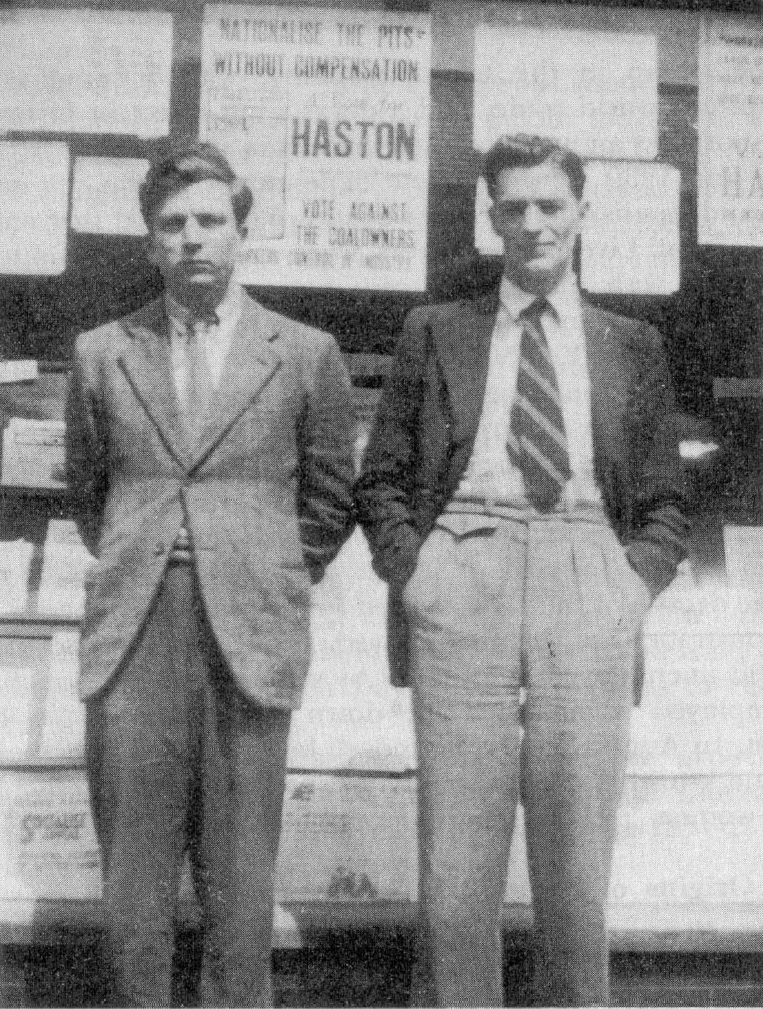
Ted Grant and Jimmy Deane in 1945
Democracy or Bonapartism in Europe
Lenin’s aphorism that we live in an epoch of wars and revolutions—to which Trotsky added “and counterrevolutions”—has been amply demonstrated by the history of the last three decades. Few periods in history have been filled with such terrific convulsions and clashes between the nations and classes and such kaleidoscopic changes and manipulations of the political regimes whereby finance capital maintains its domination over the peoples. Thus, it becomes doubly important for those who carry on the scientific teachings of Marxism, and who alone can lay claim to make a theoretical analysis of events, to keep a scrupulous and careful check on the changes which are taking place if they are correctly to orient the advance guard and give guidance to the masses.
In criticizing the barren conceptions of Stalinism, which identified all regimes to fascism at the time of the “third period”, Trotsky brilliantly characterized the essence of the epoch as one of change and fluctuations, in which generalizations would not suffice. Each stage must be examined concretely by the vanguard who could thus understand and interpret events and draw the correct practical conclusions for activity therefrom. He wrote:
The vast importance of a correct theoretical orientation is most strikingly manifested in a period of acute social conflict, of rapid political shifts, of abrupt changes in the situation. In such periods, political conceptions and generalizations are rapidly used up and require either a complete replacement (which is easier) or their concretization, precision and partial rectification (which is harder.) It is in just such periods that all sorts of transitional, intermediate situations and combinations arise, as a matter of necessity, which upset the customary patterns and doubly require a sustained theoretical attention. In a word, if in the pacific and “organic” period (before the war) one could still live on the revenue from a few ready-made abstractions, in our time each new event forcefully brings home the most important law of the dialectic: the truth is always concrete. (Bonapartism and Fascism, July 1934)
Among the cadres of the Fourth International, there are comrades who have not sufficiently understood this lesson. They continue to live on the “revenue from a few ready-made abstractions” instead of concretizing or partially rectifying previous generalizations. An outstanding example of this is the article of Pierre Frank.1
Frank attempts to equate all regimes in Western Europe to “Bonapartism”. His generalizations go even further: he argues that there have been Bonapartist regimes in France since 1934; that it is impossible to have any but Bonapartist or fascist regimes until the coming to power of the proletariat in Europe. This, if you please, in the name of “the continuity of our political analysis for more than ten years of French history”! Such complacency reduces theory to formless abstractions and conceals inevitable and episodic errors, thus making them into a system. It has no place in the Fourth International.
Comrade Frank indiscriminately mixes the terms bourgeois democracy with Bonapartism, not explaining the specific traits of either. He interchangeably speaks of “Bonapartism”, “elements of Bonapartism” and he contrasts democratic liberties with “a regime which one can correctly define as democratic.” Yet the reader has to seek in vain for a definition of his ideal “democratic regime” as distinguished from the very real bourgeois democracy. He denies the existence of democratic regimes in Europe today because “there is literally no place for them.”
Economic Basis and Political Superstructure
We will here repeat some elementary ideas of Marxism in order to arrive at the necessary clarity and understanding of the shifting processes and changes taking place in the regimes in Europe at the present time—at least in Western Europe. The Eastern half, dominated directly by the Stalinist bureaucracy, develops in a different direction and under different conditions.
The political character of a regime (Bonapartist, fascist, democratic) is basically determined by the relations between the classes in the nation, which vary at different stages. Its fundamental nature is determined, in the last analysis, by its mode of production and property relations, by its class character. Thus the regimes of Hitler2 and Roosevelt, of Attlee and Mussolini, of Franco and Gouin, of Perón and Salazar, of de Valera and Chiang Kai-shek are all governments of the capitalist class, for they rest upon the economy of capitalist exploitation. However, the class nature of these regimes does not exhaust the problem. We have to classify the instrument—which differs in each case—by which the bourgeoisie ensures its dominance and rule. The character of this rule is decided not only by the subjective wishes and needs of the finance-capitalists, which remain but one factor in the process, but precisely by the objective-subjective inter-relations between the classes at a given stage, which has been predicated by the previous history and the development of the class struggle of the given country.
It is a vulgarization of Marxism—vulgar materialism of the worst sort—to argue that the superstructure of a society is determined immediately by the development of its economy.
The disappearance of the economic basis on which the “democracy” of the imperialists is based, does not immediately lead to the disappearance of the bourgeois democracy. It only prepares its collapse in the long run. Properly speaking, the development of capitalism into imperialism by the beginning of this century had already rendered outmoded the existence of bourgeois democracy. Yet we see that bourgeois democracy managed to maintain itself for decades after its economic base had disappeared.
That capitalism had outlived its historic functions was attested already by the first imperialist world war. But this did not, and could not by itself, lead to the overthrow of the capitalist system. The first world war led to favorable conditions for the overthrow of the bourgeoisie on a world scale. But the proletariat was prevented from carrying out its mission by the organizations of its own creation. The social democracy betrayed the revolution and saved the capitalist system from destruction. In the revolutionary epoch following World War I, the bourgeoisie was compelled to lean on the social democracy for support, the only reliable prop they had to maintain their rule. Where the bourgeoisie relied on such regimes based on social democracy, uniting repression against the revolutionary workers with reforms and half-reforms, these could only be characterized as regimes of “bourgeois democracy.” Thus, Lenin and Trotsky characterized the counterrevolutionary regime in Germany in 1918, which was organized by social democracy, as a bourgeois-democratic regime.
It is ABC that the democratic liberties were gained in the struggle against the bourgeoisie over a period of a century; the right to vote had to be fought for and wrested from the bourgeoisie at a period of ascending capitalism, at the time of the blossoming of bourgeois democracy. Even in its heyday there was never an idyllic democratic state without police intervention and without brute force.
Yet even at this stage, when capitalism was still an ascending economy, there were not only democratic regimes but Bonapartist regimes as well. In the classic land of Bonapartism, both Louis Napoleon3 and Bonaparte himself came to power at a time when there was a veritable boom which lasted, in the one case, for two decades. According to Comrade Frank’s conception, there was no basis for Bonapartism; there should have only been bourgeois democracy. But we see the problem is not so simple.
And after Louis Napoleon, bourgeois democracy (with one or two threats of dictatorship—Boulangerism) lasted for decades in France. According to Frank’s mysterious conceptions, after Bonapartism—which means that the economic basis for democracy is gone—it is no longer possible for the bourgeoisie to have democracy, but … only Bonapartism.
It is difficult to understand why Comrade Frank stops at 1934 to trace Bonapartist regimes in France. If we follow his method logically, we have had Bonapartism since the coup d’état of Louis Napoleon in 1851, or perhaps since the first Bonaparte!
If there is a grain of sense in his case that the economic basis for reforms has disappeared, all that it proves is not [that] automatically and consequently a regime of Bonapartism is posed, but that the democratic regime under such conditions will be of an extremely unstable character, afflicted with convulsions and crises, which must make way either for the revolutionary proletarian dictatorship or the open dictatorship of finance capital through Bonapartism or fascism.
Comrade Frank says the existence of democratic liberties does not suffice to make a democratic regime. A profound observation! What follows? The existence of Bonapartist measures does not make a regime Bonapartist either, Comrade Frank! This argument is about as profound as those of the “bureaucratic collectivists” who argued that we had the intervention of the state in the economy in Germany under Hitler, in France under Blum, in America under Roosevelt (National Industrial Recovery Act), in Russia under Stalin … consequently all those regimes were the same. It is not the points of similarity only—all human societies have points of similarity, particularly different types of capitalist societies—it is the decisive traits which determine our definition of regimes.
Counterrevolution in a Democratic Form
The British RCP has characterized the regimes in Western Europe (France, Belgium, Holland, Italy) as regimes of counterrrevolution in a democratic form. Comrade Pierre Frank claims that the idea of “democratic counterrevolution” is “devoid of all content.” He would then he hard put to explain what the Weimar4 Republic organized by the social democracy in Germany was. He would be compelled to argue that what took place in Germany in 1918 was not the proletarian revolution which was betrayed by the “counterrevolution in a democratic form” (by the undemocratic and bloody suppression of the January 1919 uprisings), but was a democratic revolution which overthrew the Kaiser and replaced his regime by one of “pure” bourgeois democracy! The fact that this regime was ushered in by martial law and the conspiracy of the social democratic leaders with the General Staff of the Reichswehr, the Junkers, and the bourgeoisie, validates entirely the conclusion of Lenin and Trotsky that there was a “democratic” counterrevolution, with the bourgeoisie using the social democrats as their agents.
In advance Trotsky foresaw and prepared theoretically for a similar situation with the collapse of fascism in Italy, when he wrote in a letter to the Italian comrades in 1930:
Following the above comes the question of the “transitional” period in Italy. At the very outset it is necessary to establish very clearly: transition from what to what? A period of transition from the bourgeois (or “popular”) revolution to the proletarian revolution is one thing. A period of transition from the fascist dictatorship to the proletarian dictatorship is another. If the first conception is envisaged, the question of the bourgeois revolution is posed in the first place and it is then a question of establishing the role of the proletariat in it. Only after that will the question of the transitional period toward a proletarian revolution be posed. If the second conception is envisaged, the question is then posed of a series of battles, disturbances, upsets in the situation, abrupt turns, constituting in their ensemble the different stages of the proletarian revolution. These stages may be many in number. But in no case can they contain within them a bourgeois revolution or its mysterious hybrid: the “popular” revolution.
Does this mean that Italy cannot for a certain time again become a parliamentary state or become a “democratic republic”? I consider—in perfect agreement with you, I think—that this eventuality is not excluded. But then it will not be the fruit of a bourgeois revolution but the abortion of an insufficiently matured and premature proletarian revolution. In case of a profound revolutionary crisis and of mass battles in the course of which the proletarian vanguard will not have been in a position to take power, it may be that the bourgeoisie will reconstruct its power on “democratic” bases.
Can it be said, for example, that the present German republic constitutes a conquest of the bourgeois revolution? Such an assertion would be absurd. There was in Germany in 1918–19 a proletarian revolution which, deprived of leadership, was deceived, betrayed, and crushed. But the bourgeois counterrevolution nevertheless found itself obliged to adapt itself to the circumstances resulting from this crushing of the proletarian revolution and to assume the form of a republic in the “democratic” parliamentary form. Is the same—or about the same—eventuality excluded from Italy? No, it is not excluded. The enthronement of fascism was the result of the incompletion of the proletarian revolution in 1920. Only a new proletarian revolution can overturn fascism. If it should not be destined to triumph this time either (weakness of the Communist Party, maneuvers and betrayals of the social democrats, the freemasons, the catholics), the “transitional” state that the bourgeois counterrevolution would then be forced to set up in the ruins of its power in a fascist form, could be nothing else than a parliamentary and democratic state. (Problems of the Italian Revolution, May 14, 1930)
Events in Italy have demonstrated the remarkable foresight of Trotsky. The bourgeoisie has been compelled to allow the jettisoning of the king5 and the Stalinist-socialist traitors have headed off the developing proletarian revolution into the channels of a “parliamentary and democratic state.” This, of course, will not attain a stable base, but will be subject to crises and upheavals, movements on the part of the proletariat, and countermovements of monarchists and fascists. Would Frank now deny the correctness of Trotsky’s conceptions and assert that we have had a Bonapartist state since the fall of Mussolini?
It is incomprehensible that Frank, in his argumentation, should refer to this very article of Trotsky’s which puts forward precisely the opposite point of view. After fascism what? asks the Old Man, and answers that, as a means of preventing the revolution in face of mass upsurge, the bourgeoisie will turn towards the establishment of a bourgeois democratic republic. We note in this connection that the immediate introduction of Bonapartism (allegedly because democracy has no economic base) was not even considered by Trotsky.
From this can be seen that what is really “devoid of content” is the mechanical conception that counterrevolution can only manifest itself in the form of fascism or Bonapartism, i.e. military-police dictatorships.
The experience of history has shown, and events now unfolding in Europe demonstrate irrefutably, that the methods of the bourgeoisie in its struggle against the proletarian revolution vary widely and are not determined a priori. The bourgeoisie makes use of different methods, relies on different strata, depending on the class relation of forces in order to reinforce or reestablish its rule.
Whether they can maneuver the Stalinists or manipulate their social democratic, Bonapartist, or fascist agencies, or as sometimes happens, use all forces simultaneously, does not depend only on the subjective intentions of the ruling class, or on this or that adventurer, but on the objective conditions and the interrelations between all the classes in the nation—bourgeoisie, petty bourgeoisie, and proletariat—at any given time. To repeat mechanically the conclusion that the existence of finance capital is incompatible with bourgeois democracy in the contemporary period (which is indubitably correct within certain limits), and thus that all regimes must be Bonapartist, is to substitute abstract categories formulated on the basis of partial and insufficient historical experience, or a narrow and incomplete view of the process as a whole, for a dialectical analysis of events.
To understand the nature of the regimes in Western Europe today, we must know the background on which they evolved. The revolutionary movement of the masses following World War I was paralyzed and betrayed by the social democrats, who alone were able to save capitalism from destruction under the banner of bourgeois democracy. The bourgeoisie was compelled to rely on its social democratic agencies for mere survival.
The failure of the proletariat to take power could lead only to the further degeneration and decay of capitalism. The ruin of the petty bourgeoisie, which was shown no way out by the mass organizations of the proletariat, led to them becoming a tool of fascist reaction. Trapped by the intolerable crisis of their system in one country after another, through many transitions, the bourgeoisie turned in the direction of open and unbridled dictatorship.
The wave of revolution was followed by a wave of counterrevolution. In Italy, Germany, and other countries, the bourgeoisie used the forces of the frenzied petty bourgeoisie to destroy the organizations of the proletariat. They were compelled at a later stage to turn on the petty bourgeoisie and transform themselves into Bonapartist regimes, i.e. regimes resting directly on the support of the military-police apparatus rather than regimes with a mass basis.
This could not solve the contradictions of the capitalist system on a national or international scale but inevitably led to the Second World War, in a frantic endeavor by the bourgeoisie to find a way out by a repartition of the world. But the Second World War, even more than the first, put at stake the whole existence of capitalism as a system. The bourgeoisie realized, with dread, that the unleashing of the war would release tremendous revolutionary energy from the depths of the masses and recreate the conditions favorable to the overthrow of capitalism on a continental scale.
The victories of the Nazis and the conquest of practically the whole of the continent of Europe had, as a by-product, the effect of temporally destroying the mass basis of reaction throughout Europe. Reaction and the capitalist system rested directly on the bayonets of the Nazi fascist armies. The hated quislings played a purely auxiliary role. With the victories of the Red Army and the collapse of Hitler and Mussolini, the problem of the socialist revolution was posed on the order of the day throughout Europe. Reaction was without a strong base in the populations and without a strong stable military-police apparatus. The allied armies could not be a stable prop for reaction and open military dictatorship for long. In most of the European countries the bourgeoisie was faced with mass upsurge, which they could not bridle with their own forces.
Greece was the exception. Only after a civil war and a bloody war of intervention was it possible to install a semi-Bonapartist or Bonapartist regime, which is step-by-step attempting to impose a totalitarian regime in that country. The imperialists are aware of the impossibility of using such methods on a continental scale. In addition, in Greece the power of reaction had to be maintained at all costs for fear that this last outpost of British imperialism in the Balkan peninsula should, in common with the rest of the Balkans, fall under the sway of the Stalinist bureaucracy. But even here it was not possible to destroy completely the mass organizations of the proletariat.
Nothing saved the capitalist system in Western Europe except the betrayal of social democracy and Stalinism. When the bourgeoisie leans on its social democratic and Stalinist agencies for the purpose of counterrevolution, what is the “content” of that counterrevolution? Bonapartist, fascist, authoritarian? Of course not! Its content is that of a “counterrevolution in a democratic form.”
Of course, the bourgeoisie cannot stabilize itself for any length of time on the basis of the democratic counterrevolution. Where the revolution is stemmed by the lackeys of the bourgeoisie, the class forces do not stay suspended. After a period, which can be more or less protracted, according to the economic and political developments internationally and within the given country, the bourgeoisie shifts to Bonapartist or fascist counterrevolution.
That is how events manifested themselves in Italy within two years of the ebbing of the revolutionary tide provoked by World War One, and in Germany over a period of 15 years. The change in class relationships reflected itself in the change in regimes through democracy, preventative Bonapartism, to fascism, pure Bonapartist military dictatorship.
Despite the further degeneration of its economic and political base, the failure of the workers once again to take power, destroy capitalist relations, and organize society anew, has resulted in the establishment of bourgeois democratic governments in Italy, France, and other countries, based upon the manipulation of the Stalinists and social democrats. To argue that counterrevolution or the rule of the bourgeoisie in the present period can only manifest itself in Bonapartism, fascism, or Franco-type governments, is to abandon the Marxist appreciation of the processes in modern society. Taking into account the many factors involved in the history of the period, including the weakness of the Marxist current, it could have been, and was, predicted in advance what the developments in Western Europe would be. But the process can only be understood if one takes into account the real nature of democracy, Bonapartism, fascism, and not merely their outward forms.
Differing Regimes in Capitalist Society
The classic Bonapartism of the first Napoleon rose out of the bourgeois democratic revolution in the period of the youth and vigor of capitalism. Bonapartism, the rule of the sword over society, represented a position where the state assumed a relative independence of the classes, balancing between the hostile classes and arbitrating between them. It remained, nevertheless, an instrument, above all, of the big capitalists. Napoleon, by leaning on the support of the peasants, could maintain himself for a whole historical period because of the development of the productive forces in France at this period.
So with Napoleon the Little, who established his power in France in the coup d’état of 1851. Marx, in the Eighteenth Brumaire, described the position thus:
the State has gone back to its earliest form, in which the sword rules without shame and club law prevails. [Hardly a mirror of the regime of de Gaulle in France after the liberation!—EG]. Thus is the coup-de-main of February 1848 answered by the coup-de-tête of December 1851.
That is the essence of Bonapartism: naked, military-police dictatorship, the “arbiter” with a sword. A regime which indicates that the antagonisms within society have become so great that the state machine, “regulating” and “ordering” these antagonisms, while remaining an instrument of the property owners, assumes a certain independence of all the classes. A “national judge” concentrating power in his hands, personally “arbitrates” the conflicts within the nation, playing off one class against another, nevertheless remaining a tool of the property owners. At the same time, we characterize as Bonapartist a regime where the basic class forces of bourgeoisie and proletariat more or less balance one another, thus allowing the state power to maneuver and balance the contending camps and, again, giving the state power a certain independence in relation to society as a whole.
However, there is a big difference between the role of Bonapartism in the period of capitalism’s ascending phase and the period of its decline. We give two quotations from Trotsky explaining this difference with the utmost clarity, in Germany, The Only Road.
In its time, we designated the Bruening6 government as Bonapartism (“caricature of Bonapartism”), that is, as a regime of the military police dictatorship. As soon as the struggle of two social strata—the haves and the have-nots, the exploiter and the exploited—reaches its highest tension, the conditions are given for the domination of bureaucracy, police, soldiery. The government becomes “independent” of society. Let us once more recall: if two forks are stuck symmetrically into a cork, the latter can stand even on the head of a pin. That is precisely the scheme of Bonapartism. To be sure, such a government does not cease being the clerk of the property owners. Yet the clerk sits on the back of the boss, rubs his neck raw and does not hesitate at times to dig his boots into his face.
It might have been assumed that Bruening would hold on until the final solution. Yet, in the course of events, another link inserted itself: the Papen government. Were we to be exact, we should have to make a rectification of our old designation: the Bruening government was a pre-Bonapartist government. Bruening was only a precursor. In a perfected form, Bonapartism came upon the scene in the Papen-Schleicher government (September 1932).
And further on:
However, in spite of the appearance of concentrated forces, the Papen government as such is weaker yet than its predecessor. The Bonapartist regime can attain a comparatively stable and durable character only in the event that it brings a revolutionary epoch to a close; when the relationship of forces has already been tested in battles; when the revolutionary classes are already spent; while the possessing classes have not yet freed themselves from the fear; will not the morrow bring new convulsions? Without this basic condition, that is, without a preceding exhaustion of the mass energies in battles, a Bonapartist regime is in no position to develop.
The Bonapartism at the stage of capitalism’s rise, raising itself above society, suppressing and “arbitrating” the open conflicts within it and regulating the class antagonisms, is strong and confident. Under the conditions of a powerful development of the productive forces, it attains a certain stability. But the Bonapartism of capitalism’s decline is affected by senility. Rising out of the crisis of capitalist society, it cannot solve any of the problems with which it is faced. The main crisis of society, the conflict between the productive forces and private ownership and the national state, has become so great, the class antagonisms which it engenders, so tense, that this, which alone allows the rise of senile Bonapartism, at the same time, as a consequence, makes it so weak and feeble that its whole structure is shaky and likely to be overthrown in the series of crises which confronts it. It is this weakness of Bonapartism which leads to the bourgeoisie and military clique surrendering the power to fascism and unleashing the greedy bands of maddened petty bourgeoisie and lumpenproletariat against the proletariat and its class organizations.
The differing categories of regimes, though of vital importance for Marxist theory and practice, are not metaphysical abstractions, indicating a rigid, fixed, and eternal differentiation between them.
There are so many factors involved that it is necessary to examine each regime concretely before categorically defining its position.
It is only necessary to point out that even within each rough category, widely differing regimes can be comprised. England, with her feudal remnants (House of Lords and monarchy) and barbarous oppression of colonial peoples, is a “democracy”. The Federal Republic of Switzerland, and France with its laws based on the Code Napoleon, the United States, Weimar Germany, and Eire—despite their wide differences—remain “democracies”. What, then, is the dominating thread which places these regimes under one head?
Despite their diverse histories, which explains their different national peculiarities, they all possess certain specific traits in common. These are the traits which are decisive in determining the Marxist classification. All have independent workers’ organizations: trade unions, parties, clubs, etc., with the rights which go with them. The right to strike, organize, the right to vote, free speech, press, etc. and the other rights which have been the by-product of the class struggle of the proletariat in the past. (Here we might add that the loss of this or that right would not, in itself, be decisive in our analysis of a regime. It is the totality of the relations which is the determining factor.) In one sense, the existence, within capitalism, of elements of the new society. Or, as explained by Trotsky in Germany, What Next in answering the Stalinist ultralefts, under the regime of the bourgeoisie there already exists the embryo of the rule of the working class in the form of the workers’ organizations.
Where these organizations exist and play a powerful role (in France and Italy they are stronger than they have ever been), the bourgeoisie rules through the leaders and top layers of these organizations. It is not without interest, as Lenin pointed out, that at a certain stage, the bourgeoisie even ruled through the Soviets, or more correctly, the Menshevik leadership of the Soviets.
Fascism, too, has its peculiarities. The regimes of Franco, Mussolini, Hitler, and Pilsudsky,7 all are comprised within this conception. Yet there are wide differences between them. What fundamentally unites the conception is the complete destruction of all working-class organizations. Yet even here we see that right up to the outbreak of the war, Polish fascism, far weaker than that of Germany and Italy, had not completely succeeded in destroying the workers’ organizations and may have been overthrown before it finally succeeded in doing so.
Bonapartism, too, shows a similar variety. Napoleon, Louis Napoleon, von Schleicher and Papen, Petain, and the fascist-regimes-become-Bonapartist—all were Bonapartist regimes. What is it that they have in common? The independence of the state, the concentration of power “personally”, resting directly and openly on the domination of the state machine through the naked power of the military-police apparatus, “Rule by the sword.” Whatever differences there may be between the regimes, the existence of workers’ organizations with attenuated or limited rights in certain cases, they all have the above mentioned features in common. The specific peculiarities in each case would again be determined by the history of the country, the development of the social contradictions which made the development of Bonapartism possible, etc. etc.
Thus the weak and sterile Bonapartism of Petain and von Schleicher in the epoch of capitalist decline resembled only as a caricature the vigorous and powerful regime established by Napoleon in its period of ascent. In the change from democracy to fascism, there must be one, perhaps many transitional phases. Thus the path for Bonapartism is prepared by the division of the nation into two hostile camps—that of the fascist petty bourgeoisie and that of the organized working class. Nominally, the state power assumes an independence of both and the military-police regime established prepares the way for the handing of power to fascism. (The bourgeoisie prefers to rule through democratic means. Under the impact of crisis, however, they utilize the fascist gangs as a terrorist agency for pressure on the proletariat so that they can push through Bonapartist dictatorial measures. Only as a last resort do they reluctantly surrender power to the fascists.) At least that was the process in Italy and Germany. Depending on many factors, including the policy of the revolutionary party of the proletariat, events in Europe and elsewhere may develop on somewhat different lines, should reaction succeed in temporarily stabilising itself.
However, it is important to note that the regimes of Schleicher and Papen, of Petain and General Sirovy in Czechoslovakia after Munich all developed directly (through intermediate stages perhaps) out of the regimes of bourgeois democracy. The pre-Bonapartist, or even Bonapartist regimes, of Doumergue, Laval, and Flandin8 prepared the way for the Popular Front in France, which in turn paved the way again for a development towards Bonapartism. To call the Popular Front under Blum “Bonapartism” as does Comrade Frank in the citation which follows, can only cause immeasurable confusion in the ranks of the Fourth International:
… But the Bonapartism of declining capitalism can cloak itself in other costumes. In certain cases it is fairly difficult to recognize it, for example in the case of governments, of the left, even very much to the left, notably of the Popular Front type. There, Bonapartism is so outrageously varnished with a democratic sheen that many allow themselves to be taken in by it (!)
In those words of Comrade Frank is the key to the confusion in the characterization of regimes. It is easy to slip into such errors because in the same way as the embryo of a new form of society exists in the workers’ organizations, so the possibility of Bonapartism is rooted in the structure of society under bourgeois democracy. Within every state there is reflected the antagonisms within society, even in the freest bourgeois democratic society. As Engels wrote in his book, The Origin of the Family, Private Property and the State:
The state is therefore by no means a power imposed on society from the outside; just as little is it the reality of the moral idea, the image and reality of reason, as Hegel asserted. Rather it is a product of society at a certain stage of development; it is the admission that this society has become entangled in an insoluble contradiction within itself, that it is cleft into irreconcilable antagonisms which it is powerless to dispel. But in order that these antagonisms, classes with conflicting economic interests, may not consume themselves and society in sterile struggle, a power apparently standing above society becomes necessary, whose purpose is to moderate the conflict and keep it within the bounds of “order”; and this power arising out of society, but placing itself above it and increasingly separating itself from it, is the state. (Peking, 1978, 205)
In the last analysis every state is based on naked force. The army officers, the general staff clique, the police and civil service bureaucracy, trained and selected to serve the interests of capitalism, provide the soil on which military plots and conspiracies thrive, given conditions of crisis and social ferment.
Pierre Frank confuses here the role of the state with Bonapartism. A democracy that was not based on force, that did not have an apparatus placing itself above society, has never existed and never will exist. But this does not make Bonapartism.
But because every state is based on armed bodies of men with its appendages in the form of prisons, courts, etc., and thus even under the fullest democratic regime we have the hidden dictatorship of capitalism, it does not follow that every repressive regime is necessarily Bonapartist. Repression and suppression of the rights of the workers under conditions of “emergency” take place under every regime, including the democratic, when the basic interests of capital are threatened and till “normal” conditions are restored—i.e., till the masses accept, without active rebellion, the yoke of capital. The bourgeoisie preserves an extreme flexibility, manipulating the regimes according to the resistance of the masses, the class forces, etc. Thanks to the betrayals of the workers’ leaderships they are enabled to do this.
Prognosis in the Light of Events
Whatever their original desires or wishes to impose Bonapartist regimes in Europe, Anglo-American imperialism soon saw the impossibility of this (apart from Greece) in the incalculable dangers which it would bring, and in Western Europe swung over to democratic regimes, based on a disarmed proletariat.
Events in France and Western Europe have confirmed the incorrectness of the method of Pierre Frank. Everywhere in Western Europe since the “liberation”, the tendency has been for a steady movement towards bourgeois democracy and not towards greater and greater dictatorial regimes; towards an increase in democratic rights, not towards their limitation. At a later stage this tendency will be reversed, but at present the motion in Western Europe is towards bourgeois democratic regimes. Thus in Italy we have the establishment of the bourgeois democratic republic, trade unions, etc.; in France we have elections, parties, trade unions, etc.; in Belgium and Holland we have democratic elections. The swing of the masses towards socialism-communism is reflected in the fact that these parties have secured a greater percentage of the votes than at any time in history. In order to mobilize the petty bourgeois reaction as a counterpoise against them, the bourgeoisie, at this stage, is leaning not on fascist reaction (that is still well in reserve) but on the Catholic and Christian parties basing themselves on parliamentary democracy. This gives the bourgeoisie a breathing space to prepare at a later stage, and under the necessary favorable conditions, for a transition through Bonapartist regimes to totalitarian dictatorship.
It is clear that the position today is entirely different from the position in Germany and Italy before the victory of fascism, where mass parties of fascism were organized and the possibility of the state maneuvering between the two mortally hostile camps, was posed by the whole situation. Far from this, in Italy and France the Christian Democratic parties are collaborating with the workers’ organizations in a typical coalition cabinet of bourgeois democracy. The bourgeoisie cannot do otherwise because of the danger of revolutionary disturbances on the part of the masses.
The situation is similar to that in Germany in the Weimar Republic. In order to stem the revolution, the bourgeoisie organized a coalition government of social democracy and the Catholic Center.9
Was this Bonapartism? Obviously not. But as a result of the policy of social democracy they were punished by the petty bourgeois swinging to reaction and a Bonapartist-monarchist attempt at a coup d’état in the Kapp Putsch10 in 1920. As is well known, this attempted Bonapartist coup was defeated by the masses, where the communists and socialists participated in a general strike. The indignation of the workers, owing to the correct propaganda of the Communist Party in warning of this danger and forming a united front to beat it off, led to the workers in the Ruhr attempting the seizure of power. The reaction then joined together with the social democrats to crush this movement of the masses. This, in its turn, paved the way for an uneasy and unstable regime of bourgeois democracy.
The false position on the nature of the regimes in Europe flows from an incorrect perspective. The American comrades argued that only Franco-type military dictatorships were possible in Europe after the victory of the allied imperialists. Pierre Frank approvingly quotes a wrong position taken by the International Secretariat (IS) in 1940:
If England should install de Gaulle in France tomorrow, his regime would not in the least be distinguished from that of the Bonapartist government of Petain.
A trifle different, Comrade Frank! For the workers a decisive difference! It is true that the capitalist class continued to rule under de Gaulle as they did under Petain. But to argue in 1946 that the regimes could not be distinguished is to fall into the sectarian stupidity of the Stalinists in Germany who couldn’t distinguish between a capitalist regime leaning on the workers’ organizations and the abolition of these organizations by fascism.
Pierre Frank’s confusion is further exposed by his triumphant declaration that the Petain regime was Bonapartist. Trotsky said that the Petain regime was Bonapartist. But Frank just does not understand what Trotsky was driving at. In their period of decay and decline, Trotsky referred to the regimes of Hitler and Mussolini as Bonapartist regimes. The only difference between these regimes and that of Petain was that Petain never had a mass base in the petty bourgeoisie, like Hitler and Mussolini, and in that sense could not be called fascist, but Bonapartist. For this reason his regime was much weaker and could be more easily overthrown by a movement of the masses. Petain had to lean on foreign bayonets for his rule. Otherwise there is no difference between the regimes of Franco, Mussolini, and Hitler in their decaying phases and that of Petain.
Comrade Frank declares:
… our most responsible International body has predicted that a simple substitution of gangs following a victory of the Allies would not signify a change in the nature of the political regime. We find ourselves in the presence of an evaluation on the historical scale based on positions which were defended for many years by the Fourth International against all other theories and cheap labels spread by the other tendencies and formations of the labor movement. If an error was committed it would be truly a considerable one and we would be urgently obliged to seek the reasons for it and correct it. As for ourselves, we don’t believe that our organization was in error on this point …
The statement of the IS made in 1940 was incorrect. We made the same mistake. Under the circumstances it was excusable. But to repeat in 1946 a mistake that was already clear by 1943 is inexcusable. A British Trotskyist resolution, written in 1943, in which we corrected ourselves, analyzed the coming situation in Europe as follows:
In the absence of experienced Trotskyist parties with roots and traditions among the masses, the first stages of the revolutionary struggles in Europe will most likely result in a period of Kerenskyism or Popular Frontism. This is already presaged by the initial struggles of the Italian workers and the repeated betrayals of social democracy and Stalinism. (Main resolution at the National Conference of the Workers International League, October 1943).
Events have demonstrated the correctness of this analysis. Instead of frankly facing up to an error in perspective, Frank flies in the face of reality and attempts to convert an error into a virtue.
Frank takes France as the keystone of his thesis. He surely must be lamenting this by now. Because it is France, above all, which has mirrored the process very clearly. France is the key to Europe and any mistakes on the nature of the French regime could be fatal for the young cadres of Trotskyism.
Let us examine the situation. Pierre Frank visualizes the development as follows: Bonapartism since 1934, because, you see, the bourgeoisie could not afford bourgeois democracy; Petain was Bonaparte; de Gaulle was Bonaparte; the Popular Front (Blum!) was Bonapartism; in fact, as the metaphysicians would say, “In the twilight all cats are grey.” The thesis is that all were Bonaparte. It follows that Gouin is Bonaparte and the government which will follow also will be Bonapartist. If this madness should infect the French, our French Party will be in a sorry state. Happily, this danger apparently does not exist.
A Marxist appreciation would be somewhat different from that of Pierre Frank. What was the development of the regime—from what to what is it evolving? What is the position of the classes? What are the relations between the classes? A sober appreciation of the last two years will tell us that (a) here we have an unachieved proletarian revolution; result (b) unstable bourgeois democracy, assembly, elections, constituent, bourgeois-democratic constitution; (c) in this setting a candidate Bonaparte. The real power rests in the principal working class parties. A would-be Hitler striving for power and a Hitler in power are not one and the same thing. A would-be Bonaparte like de Gaulle and a real Bonaparte, wielding real personal power with the sword, are two different things. De Gaulle may yet be a French Franco, but one does not declare the enemy victorious before the decisive battle has begun.
Bonapartism in the modern epoch, by its very nature, must be a regime of transition—transition to fascism, transition to democracy, or even to proletarian revolution: a period of maneuvering between the classes. That there are elements of Bonapartism in the situation in Europe goes without saying. These elements can be transformed into the dominant ones, but only under certain conditions. If one declares a regime Bonapartist, then the specific features of the regime must be brought out. In spite of Pierre Frank’s zealous endeavors to elevate de Gaulle into a position to which he only aspired, the “Bonaparte” de Gaulle, measuring the relation of forces, was forced to retire sadly from the scene to await a more propitious moment.
There precisely is the nub of the question: it is necessary to answer Stalinist and socialist propaganda by warning that their policies inevitably bring the dangers of counterrevolution and Bonapartism, to warn of the threat of military-police dictatorship which hangs over the proletariat if it does not disperse the Bonapartist nests, composed of the cadres of the general staff, police, and civil bureaucracy, and take power into its own hands.
Comrades must not make the mistake of the German communists, who declared every regime in turn “fascist” till, in the end, by their lulling and confusing the advance guard, the real Hitler arrived. Of course, if Pierre Frank continues to repeat it long enough, no doubt reality will, in the end, coincide with his definition and we will have a Bonapartist regime in France and other countries in Europe. But for Marxists this is not good enough. We must painstakingly analyze and explain every change in government. In that way we can prepare for the events to come.
Was the Kerensky Regime “Bonapartist”?
Scattered through his article, Frank refers to “Bonapartist à-la-Kerensky”, the Bonapartism of Kerensky, thus assuming that Bonapartism had in fact been established under the Kerensky regime—entirely unwarranted by a knowledge of the period.
Frank takes one or two conditional formulations of Lenin and Trotsky in relation to the Kerensky regime in Russia and tries to convert them into hard and fast definitions. In reality, the record speaks against him. It is significant to note that the chapter in the History of the Russian Revolution to which he refers is headed, not “Bonapartism”, but Kerensky and Kornilov—Elements of Bonapartism in the Russian Revolution. Trotsky was always particularly careful on definitions, and thus when he says “elements”, he does not mean the thing itself. And for very good reason. No doubt Kerensky would have liked to play the role of Bonaparte. The possibilities of Bonapartism were rooted in the situation. But Bonapartism was never achieved because the Bolshevik Party was strong and achieved the proletarian revolution, leaving no avenue for adventurers to take control. Many citations could be given to show the conditional nature of the characterization of the Kerensky regime as Bonapartist. In the very section quoted by Comrade Frank, from which he abstracts the single sentence characterizing Kerensky as “the mathematical center of Russian Bonapartism,” Trotsky wrote,
The two hostile camps invoked Kerensky, each seeing in him a part of itself, and both swearing fealty to him. Trotsky wrote while in prison: “led by politicians who are afraid of their own shadow, the Soviet did not dare take the power. The Kadet Party, representing all the propertied cliques, could not yet seize the power. It remained to find a great conciliator, a mediator, a court of arbitration.”
In a manifesto to the people issued by Kerensky in his own name, he declared: “I, as head of the government … consider that I have no right to hesitate if the changes (in the structure of the government) … increase my responsibility in the matters of supreme administration.” That is the unadulterated phraseology of Bonapartism. But nevertheless, although supported from both right and left it never got beyond phraseology. (History of the Russian Revolution , Sphere, Volume III, page 155. Our emphasis.)
Trotsky wrote this as a historian, soberly evaluating and weighing every word. And if one studies the works of Lenin conscientiously, even though written in the heat of events, one cannot but see the falsity of Frank’s position in confusing the germs with the disease. Lenin writes, for example, in his work Towards the Seizure of Power, “Kerensky’s cabinet is indubitably the first step towards Bonapartism.” (Collected Works, Volume 25, 224)
Here can be seen the conditional character of what Lenin and Trotsky were talking about. In the very section of State and Revolution quoted by Frank, in which Lenin refers to the Kerensky government as Bonapartist, the conditional character of this is shown by the paragraphs immediately following. In dealing with the state and all its forms in The State—an Instrument for the Exploitation of the Oppressed Class (that is what the chapter is headed in which these references to Bonapartism occur, and that is what Lenin is dealing with), he goes on to say,
In a democratic republic, Engels continues, “wealth wields its power indirectly, but all the more effectively”, first, by means of “direct corruption of officials” (America); second, by means of the “alliance of the government with the stock exchange” (France and America).
At the present time, imperialism and the domination of the banks have “developed” to an unusually fine art both these methods of defending and asserting the omnipotence of wealth in democratic republics of all descriptions. Since, for instance, in the very first months of the Russian democratic republic, one might say during the honeymoon union of the “Socialists”—Social-Revolutionaries and Mensheviks—joined in wedlock with the bourgeoisie. (CW, Volume 25, page 397–98).
To clinch the matter, in a later section of the same pamphlet dealing with the same period, in contrasting a soviet to a parliamentary body, Lenin goes on to say:
“A working, and not a parliamentary body”—this hits the vital spot of present-day parliamentarians and the parliamentary social-democratic “lap-dogs”! Take any parliamentary country, from America to Switzerland, from France to England, Norway and so forth—the actual work of the “state” there is done behind the scenes and is carried out by the departments, the offices and the staffs. Parliament itself is given up to talk for the special purpose of the fooling the “common people”. This is so true that even in the Russian Republic, a bourgeois-democratic republic, all these aims of parliamentarism were immediately revealed, even before a real parliament was created … (CW, Volume 25, 428. Our emphasis).
We would have to reduce Lenin to a mass of stupid contradictions if we used the method of Pierre Frank. For him there is no real contradiction because he makes no real contradiction between bourgeois democracy and Bonapartism. If he carried this through he would have to argue that we had both bourgeois democracy and Bonapartism in France, and his objection to the term “bourgeois-democratic regime” becomes entirely incomprehensible.
Frank points to the fact that the British comrades have referred to the Labour government in Britain as a Kerensky regime and then proceeds to argue that this is incorrect because we have not a Bonpartist regime in this country:
“Since we here speak of the resolution of our English comrades let us note that it defines the new Labour government as “Kerenskyism.” The Bonapartism, that they ignored, has found the means to insinuate itself into their document under a very special name. But we do not think the present Attlee government is Bonapartist à-la-Kerensky.”
This merely serves to demonstrate that Frank has not understood the meaning of the Kerenskiad or of Bonapartism. The Kerenskiad is the last, or “one before the last” left government before the proletarian revolution, or, we may add, the bourgeois counterrevolution. Under given conditions, the social tensions and sharp conflicts of the classes in such a period would tend to give rise to Bonapartist conspiracies and plots. That is precisely what happened in the Russian Revolution, and that is why Lenin and Trotsky referred to the Bonapartist tendencies within the Kerensky regime. However, for Comrade Frank’s benefit, this does not make a Kerensky regime a Bonapartist regime. Here perhaps we had better make haste to add, that in referring to the Labour government as a Kerensky government, this was not at all a finished evaluation, but an analogy which we invested with appropriate and necessary safeguards. To put the question beyond dispute, we quote from our resolution:
At a later stage the most resolute section of the bourgeoisie will begin to seek a solution in a Royalist or military dictatorship on the lines of the Spanish Primo de Rivera, or some similar solution. Royalist or fascist bands under the guise of ex-servicemen’s or “patriotic” associations will begin to spring up.
Events may speed up or slow down the processes but what is certain is the heightening of social tension and class hatreds. The period of triumphant reaction has drawn to a close, a new revolutionary epoch opens up in Britain. With many ebbs and flows, with a greater or lesser speed, the revolution is beginning. The Labour government is a Kerensky government. That does not mean that the tempo of development will match that of the events in Russia after March 1917, on the contrary, the revolution will probably assume a long drawn out character but it provides the background against which the mass revolutionary party will be built.
Fortunately, to put the position in its proper perspective, Trotsky gave a definition of Kerenskyism (he didn’t call it Bonapartism!) when he dealt with the false positions of the Comintern in relation to the Spanish Revolution of 1931:
… We see that fascism [we may add Bonapartism—EG] does not at all represent the only means of the bourgeoisie in its struggle against the revolutionary masses. The regime existing in Spain today (a coalition government of the bourgeois republicans and Socialist Party similar to that in Italy and France today—EG), corresponds best to the conception of the Kerenskiad, that is, the last, (or “one before the last”) “left” government which the bourgeoisie can only set up in its struggle against the revolution. But this kind of government does not necessarily signify weakness and prostration. In the absence of a strong revolutionary party of the proletariat, a combination of semireforms, left phrases and gestures still more to the left and reprisals, can prove to be of much more effective service to the bourgeoisie than fascism. [We may add, naked military dictatorship—EG] (“Germany, the key to the international situation,” November 1931)
Frank’s hazy notions of democracy and Bonapartism can be seen in his references scattered throughout his article. To take a few examples:
The use of democratic slogans—combined with transitional slogans is justified more precisely, because the possibilities of a democratic regime are non-existent …
Precisely because we do not generally have in Europe at the present time democratic regimes, because there is literally no place for them …
One must no more confuse the Bonapartism “of the right” with fascism than the Bonapartism “of the left” with democracy. We have seen that Bonapartism takes very different forms according to the conditions in which the two mortally opposed camps find themselves; we maintain also that the existence of democratic liberties, even of very great democratic liberties, does not suffice to make a regime democratic. The Bonapartists à-la-Kerensky, Popular Front … are even notorious for their flood of democratic liberty up to the point where capitalist society thereby even risks its balance and is in danger of capsizing. Democratic liberties do not proceed, as in a regime which one can correctly define as democratic, from the existence of a margin for reform within capitalism, but on the contrary, from a situation of acute crisis, the result of the absence of all margin or reforms.
… The regime of the Popular Front was not a democratic regime; it contained within itself numerous elements of Bonapartism as we shall see further on.
The conception of democracy which is put forward by Comrade Frank never existed in heaven or earth. It exists only in the idealistic norms of liberalism. Always, democracy, i.e. bourgeois democracy, has been built on the framework of repression. Every bourgeois constitution or regime contains its Article 48 as in the Weimar Constitution. The very existence of class society presupposes a regime of oppression. But only one who has abandoned Marxist discipline of thought and operates on the basis of metaphysical categories can equate democracy with Bonapartism, or for that matter with fascism. Though there are many points of similarity between these regimes, and elements of naked military rule in all these regimes in one degree or another. But quantity changes into quality. What dictates the nature of the regime is not this or that element, but its basic features. Democracy today can become Bonapartism tomorrow and be changed into fascism the next day. Fascism, as we have seen, can be transformed into democracy and the process repeated.
The Marxist method is not to lump all regimes indiscriminately together. That is the easy way, but it will lead to blunders and confusion. The Marxist method is to examine things in their process of change and evolution. To examine each government in turn, to establish its specific features and tendencies. To prepare for abrupt changes and transitions, which is the basic characteristic of our epoch, and thus to rectify and delimit, if necessary, our characterizations at each successive stage. The painful limitations of Pierre Frank’s method (which he labels Marxism but is in reality impressionism) is summed up in his own words:
The term “Bonapartism” does not completely exhaust the characterization of the regime, but it is indispensable to employ it in present day Europe, if one wishes to go forward with the least possible chance of error. Let us add finally that Marxism is not alone in the possession of such important general ideas: all the sciences do likewise. Thus chemists call bodies carbides which differ more widely from one another than the Bonapartism of Schliecher and that of Kerensky. And chemistry doesn’t get along so badly either on that account. The contrary is true.
The Stalinists used the same method during the Third Period with lamentable results in Germany. Starting with a correct generalization that all the parties from social democracy to fascism were agents of the capitalist class … they ended up by saying that, therefore … there was no difference between them—all were fascists of different varieties. For the scientist as for the Marxist, the problem begins where, for Frank, it ends. A chemist can classify certain bodies under a general heading of carbides. But a chemist who stopped at this definition would not get along so well! If, for example, on the basis that a chemist had defined silicon carbide (carborundum) and calcium carbide, all under the same heading of “carbides,” one attempted to work an acetylene lamp on a bicycle with the former instead of the latter, some very sad results would occur. It would not be possible to light the path ahead. No more can Frank’s method cast light on the nature of the regimes in Europe.
[1] Pierre Frank was a French leader of the Fourth International, serving on the Secretariat from 1948 to 1979.
[2] Government leaders in Germany, America, Britain, Italy, Spain, France, Argentina, Portugal, Ireland, and China in the period 1943–46 who presided over various types of regimes ranging from fascist to social democratic, but all based on capitalism.
[3] Napoleon Bonaparte (Napoleon I), came to power in a coup on 18 Brumaire (November 9–10, 1799) and had himself proclaimed emperor in 1804. Louis Bonaparte (Napoleon III) won the presidential election in 1848. In a coup in 1851 he dissolved the legislative assembly, and in 1852 declared himself emperor.
[4] Weimar was the city in Germany where the new constitution was formulated in 1919. The Reichswehr was the regular army of Weimar Germany. For a full account of the 1918 revolution and the January 1919 “Spartacist Rising” see Germany—From Revolution To Counterrevolution by Rob Sewell (MarxistBooks/Wellred).
[5] When the Allies liberated Rome in May 1944, they blocked any attempt, contrary to previous agreements they had, by the exiled King Victor Emmanuel to return to the the throne, for fear of provoking a new uprising by the workers.
[6] Heinrich Bruening was German Chancellor 1930–32. At the end of 1931 he annulled virtually all union contracts and restricted the press. Kurt von Schleicher, a Reichswehr general, succeeded von Papen as Chancellor in December 1932. He was replaced by Hitler within two months.
[7] Josef Pilsudsky led a coup in Poland in 1926, and became dictator until his death in 1935.
[8] Gaston Doumergue, a former president of France, became premier after the attempted coup of February 6, 1934, promising a “strong” government. Pierre Laval, French premier 1935–36, and premier of the collaborationist Vichy regime in 1942. Pierre Flandin succeeded Doumergue as premier in 1934–35.
[9] The Catholic Center Party was a German Christian Democratic party.
[10] For a full account of the Kapp Putsch see Germany—From Revolution to Counterrevolution by Rob Sewell, available from Marxistbooks.com.
The Chinese Revolution
With the spectacular advance of the Chinese Red Army, the diplomats of the State Department in America and the Foreign Office in Britain are seriously discussing the possibility of the complete collapse of the Chiang Kai-shek regime. The entire capitalist press writes gloomily of the prospect of North and Central China to the Yangtse coming under Stalinist sway.
Within three years of the collapse of Japanese imperialism, the Red Army has conquered Manchuria and most of North China. The Chinese capital Nanking, with the richest city of China, Shanghai, which has a population of five million, are rapidly coming within the grasp of the Red Army. The territory which the Stalinists already dominate has a population of more than 170 million.
The British capitalists, with investments in China amounting to £450 million, are dismayed at the prospect of the loss of this lucrative field of investment. American imperialism, within whose sphere of influence China fell with the weakening of the other imperialist powers during the war, has given the Kuomintang government aid to the extent of $3 billion, in a fruitless attempt to save China for imperialist exploitation.
But the American imperialists now realize that further aid is merely throwing away good money after bad. With all the military and technical advantages in its favor in the early stages of the civil war that followed the world war, the Kuomintang has suffered defeat after defeat. The Kuomintang regime, under the dictatorial rule of Chiang Kai-shek, represents the feudal landlords and capitalists. It is controlled by an utterly corrupt military clique which oppresses the workers and peasants and battens on their masters.
Chiang’s rise
Chiang Kai-shek came to power after the defeat of the Chinese Revolution of 1925–27 in which he played the role of chief butcher of the working class. He succeeded in this because of the policy of Stalin and Bukharin and the leadership of the Chinese Communist Party.
Their policy then was to form a bloc with the Chinese landlords, capitalists and feudal warlords, allegedly in the interests of the struggle against imperialism. In consequence, they sabotaged the attempts of the workers to take over the factories and the peasants to take the land. A “communist” Minister of Labor sabotaged strikes and punished striking workers. A “communist” Minister of Agriculture had peasants shot down when they attempted to seize the land.
A Sympathizing Section
The capitalist Kuomintang was taken into the Communist international as a sympathizing section. In The Third International After Lenin by Trotsky, the Stalinists’ role is shown in an explanatory note:
The Kuomintang was admitted to the Comintern as a sympathizing party early in 1926, approved by the Politbureau of the CPSU, with the sole dissenting vote of Trotsky. Hu Han-min, right-wing Kuomintang leader, participated in the Sixth Plenum of the ECCI, February, 1926, as a fraternal delegate from the Kuomintang. Shao Ki-tze a henchman of Chiang Kai-shek, was fraternal delegate to the Seventh Plenum, ECCI, November, 1926 (Minutes German edition, pp. 403f.) (London edition, 1936)
On March 21 and 22, 1927, the workers of Shanghai captured the city. Chiang immediately began preparations to butcher them. He conspired with the imperialists to crush the workers.
Instead of preparing for the struggle, the Stalinists gave full support to Chiang. The Comintern official journal International Press Correspondence, French edition, March 23rd, 1927, page 443, said, “Far from dividing, as the imperialists say, the Kuomintang has only steeled its ranks.”
On March 30 they wrote:
A split in the Kuomintang and hostilities between the Shanghai proletariat and the revolutionary soldiers are absolutely excluded for the moment … Chiang Kai-shek … himself declared that he would submit to the decisions of the party … A revolutionist like Chiang Kai-shek will not go over, as the imperialists would like to have it believed, to Chang Tso-lin (the Northern militarist) to fight against the emancipation movement …
Chiang proceeded to organize a coup, massacre the flower of the workers, illegalize the trade unions, the peasant organizations, the Communist Party, and deprive the masses of all rights.
The masses were utterly defeated and the remnants of the Chinese leadership of the Communist Party fled to the peasant areas—and there tried to organize a peasant war.
Peasant army held out
The guerrilla struggle threw up leaders of remarkable military genius. Mao Tse-tung, Chu Teh1, and others succeeded in evading the powerful military forces which the Kuomintang had arrayed against them.
Despite the false political line which led to successive disasters, in one of the most remarkable military feats in world history, Mao was driven from Central and South China in a 6,000-mile retreat to the mountain fastnesses around Yenan, where a “soviet” republic was set up. There, despite all the efforts of the Chiang regime to dislodge them, they succeeded in holding out against one attack after another. The secret of their success was that the land had been divided among the peasants in this small area, comprising, according to some estimates, about 10 million population.
Corrupt Chiang regime
In the intervening period between the wars, the Chiang regime piled up ever increasing burdens on the workers and peasants. In some areas the taxes were collected from the peasants by the corrupt local officials 80 years in advance.
There was an endless militaristic squandering of wealth, and the feeble Kuomintang regime showed itself incapable of waging a revolutionary struggle against the incursions of imperialistic Japan.
The Chiang regime resolved itself into one of bribery and police terror. In a period of two decades it became so completely degenerate from top to bottom that it had lost most of its support even among the middle class.
War changed situation
After the collapse of Japan, with a certain aid from the Red Army in Manchuria which helped the Stalinists to capture Japanese munitions, large parts of Manchuria and the North fell into the hands of the Stalinists.
The Chinese Red Army had waged a guerrilla struggle against Japanese militarism throughout the war and were in a strategic position to seize certain areas with the Japanese collapse. Even throughout the war Chiang’s main preoccupation was the social danger at home, to deal with the Stalinists and workers, and had it not been clear that Japan was going to be defeated in the later stages, it is quite likely that he would have capitulated and made a compromise with Japanese imperialism.
A Dying Regime
American imperialism assisted Chiang by pouring in munitions and other supplies, and even direct military intervention in the transport of Kuomintang troops to Manchuria and North China by the US fleet and air force. Chiang had initial successes, but all in vain. He was leading a dying regime, more archaic than even the tsarist regime in Russia. So rotten was the regime that large parts of the supplies were sold by officials to the Stalinist armies for gold, and ministers and other officials in Chiang’s government pocketed a great part of the dollars supplied for the war by America. Only the lesser part of the supplies and munitions actually reached the Nationalist troops at the front.
The military commanders ceaselessly intrigued against one another, as in all doomed regimes. Chiang, for example, starved General Fu Tso-yi, the only outstanding general who showed any real capacity on the Nationalist side, of supplies, for fear he might seek to replace him. The generals were outclassed by the superior strategy and tactics of the Red Army command.
Social Questions Involved
However, the main reason for the victories of the Chinese Stalinists has been readily pointed out by Mao Tse-tung: the social questions involved. “Land to the peasants,” as in the Russian Revolution, sounded the death knell of feudal landowners and their corrupt regime. In large part, the Chinese Stalinists have carried out the agrarian revolution. That is the significant difference between the struggle in 1927 and now. It is this which has been responsible for the melting away of the armies which Chiang tried to use to crush the agrarian rebellion. Chiang’s armies are composed of peasants—the poorest peasants at that—who have not enough money to escape conscription by bribing the officials.
“Roped together”
Even the News Chronicle (December 11, 1948) admits:
There is discontent among the rank and file of the Nationalist army. Chiang’s privates get about five pence a month.
In some villages conscripts are roped together on the way to barracks, and when they travel by train carriage doors and wagons are locked so that they cannot escape.
Naturally, they desert with their arms, even to the extent of whole divisions when confronted with the agrarian program of the Stalinists.
The Stalinist agrarian programe
At the national agrarian conference of the Chinese Communist Party, held on September 13, 1947, it was proposed to carry through an agrarian law containing the following provisions:
Article 1. The agrarian system of feudal and semifeudal exploitation is abolished. The agrarian system of “land to the tiller” is to be established.
Article 2. The land ownership rights of all landlords are abolished.
Article 3. The land ownership rights of all ancestral shrines, temples, monasteries, schools, institutions, and organizations, are abolished.
Article 4. All debts incurred in the countryside prior to the reform of the agrarian system are cancelled.
Article 10, aimed directly at the soldiers and even the officers of the Kuomintang reads, in part:
Section c. All personnel of the People’s Liberation Armies, democratic governments, and all peoples’ organizations whose home is in the countryside shall be given land and properties equivalent to that of peasants for themselves and their families.
Section d. Landlords and their families shall be given land and properties equivalent to that of the peasants.
Section e. Families of Kuomintang officers and soldiers, Kuomintang Party members, and other enemy personnel whose homes are in rural areas, shall be given land and properties equivalent to that of the peasants.
Workers passive
One of the outstanding facts in the situation in China is the relative passivity of the working class. It is true that as a result of the collapse of the Chiang armies, there have been widespread strike struggles in the large cities, Shanghai, Canton, Hankow, and Nanking, despite the repressive conditions. However, it is clear that as the Stalinists advance towards the big cities on the Yangtse, the workers, for lack of a mass alternative, can only rally to their banner. The workers never supported the Chiang Kai-shek regime.
Every socialist worker will wholeheartedly applaud the destruction of feudalism and of large-scale capitalism in this important section of Asia, even though it is carried out under the leadership of Stalinism. In its long-term implications it is as important as the October Revolution itself.
How the capitalists see it
One could give no better Marxist analysis of the gloomy picture for the world capitalist class than that expressed in the editorial of The Times, November 10, 1948:
At the best this spells only a single check (Hsuchow held by the Nationalists at the time and since fallen) after months of gains which have swung the balance of power—military, industrial, ideological—to the communist side. Their widening hold on large areas of Northern and Central China has a much deeper meaning than the Japanese invasion of ten years ago, for the communists—decisively helped by Russia as they have been and Marxists as they remain—summon up and organize native revolutionary forces. In its vastness and in its all too likely consequences the present upheaval has rather to be compared with the Russian Revolution of 1917—from which it directly and obviously springs. Wider success for the Chinese communists would offer wider influence, and at the ripe moment wider success, for the power with which they ally themselves. Long-cherished Soviet plans for swinging the backward millions of Asia into the camp which already stretches from the Oder to Sakhalin would receive the greatest measure of reinforcement so far.
… They can draw upon the peasantry for their divisions, and they have been able to win over the support of the peasantry by expropriating most of the landlords and redistributing the land. So far the agricultural reforms of the communists have prospered the more obviously because they have not had to feed many large towns; the food has mainly been kept in the country areas.
In some regions a commander has ruthlessly shot or imprisoned those whom he has judged to be anticommunist; in others there has been a show of tolerance with few changes in the traditional way of life. Businessmen and others have even been given the choice of staying or leaving. This show of tolerance seems to be the policy of Mao Tse-tung, the highly astute communist leader. His writings and speeches show him to be an unshakeable Marxist, but one who recognizes that Marx’s analysis of the opportunities for revolution in the industrial Europe of last century cannot be applied strictly to the mainly agricultural and primitive state of much of China. He seems to have decided to reach his communist goal by two stages. First, there is to be a system of relatively free trading, similar to the New Economic Policy which Lenin introduced after the initial failure of militant communism in Russia. It is this stage which he proclaims at present, hoping, not without success—not only to win the peasants but to assuage the fears of many townspeople. Secondly when the first stage has been accomplished, he plans to make the further step to Marxist socialism.
The references to Marxism and the communist policy of Mao are of course false. The policy of Stalinism in Russia, in Eastern Europe and in China has been labelled Marxist by all present day capitalist journalists. It is a perversion of Marxism. Nevertheless The Times sees that the tactics of the Chinese Stalinists will be similar to those of the Stalinists in Eastern Europe.
Two sides of the coin
While supporting the destruction of feudalism in China, it must be emphasized that only a horrible caricature of the Marxist conception of the revolution will result, because of the leadership of the Stalinists. Not a real democracy, but a totalitarian regime as brutal as that of Chiang Kai-shek will develop. Like the regimes in Eastern Europe, Mao will look to Russia as his model. Undoubtedly, tremendous economic progress will be achieved. But the masses, both workers and peasants, will find themselves enslaved by the bureaucracy.
The Stalinists are incorporating into their regime ex-feudal militarists, capitalist elements, and the bureaucratic officialdom in the towns who will occupy positions of privilege and power.
On the basis of such a backward economy, a large scale differentiation among the peasants (as after the Russian Revolution during the period of the NEP) aided by the failure to nationalize the land: the capitalist elements in trade, and even in light industry, might provide a base for capitalist counterrevolution. It must be borne in mind that in China the proletariat is weaker in relation to the peasantry than was the case in Russia during the NEP owing to the more backward development of China. Even in Czechoslovakia, and other Eastern European countries similarly, where the capitalist elements were relatively weaker, nevertheless the danger of a capitalist overturn existed for a time. The fact that the workers and peasants will not have any democratic control, and that the totalitarian tyranny will have superimposed upon it the Asiatic barbarism and cruelties of the old regime, gives rise to this possibility. However, it seems likely that the capitalist elements will be defeated because of the historical tendency of the decay of capitalism on a world scale. The impotence of world imperialism is shown by the fact that whereas they intervened directly against the Chinese Revolution in 1925–27, today they look on helplessly at the collapse of the Chiang regime.
However, it is quite likely that Stalin will have a new Tito on his hands. The shrewder capitalist commentators are already speculating on this, although they derive cold comfort from it. Mao will have a powerful base in China with its 450–500 million population and its potential resources, and the undoubted mass support his regime will possess in the early stages. The conflicts which will thus open out should be further means of assisting the world working class to understand the real nature of Stalinism.
Balance of forces changed
The world balance of forces is being decisively changed. The effect of the Chinese Revolution, in however distorted a form, will inevitably prepare the way for upheavals in an Asia already beset with colonial wars of independence and civil wars between the classes in Asiatic society. Imperialism will be irreparably weakened.
Many decades ago Marx wrote that revolution in China could presage the collapse of capitalism in Europe. The editorial writer of the Daily Telegraph, November 30, 1948, wrote with foreboding of its effect on Western Europe:
Even the defeat of Communist efforts to get control of Western Europe might scarcely compensate for the loss of China, with its immense population and, in Manchuria, valuable industrial potential.
In Shangai, Canton and other big cities, the Trotskyists have established groups among the workers with quite a big influence in some of the illegal trade unions. They remain true to the principles of Marx and Lenin. They are establishing the tradition for the Marxist movement which in the long run will lead to the overthrow, by revolutionary means, of the bureaucratic regime of Stalinism and the setting up of a healthy workers’ state in which democratic control will rest in the hands of the masses.
[1] Chu Teh joined the Chinese CP (CCP) in 1922. His military forces joined with those led by Mao Tse-tung in 1928. Chu became the principal military leader of the CCP on the long March and in the civil war against Japan.
Reply to David James
The Bulletin of comrade David James1 (“Some remarks on the question of Stalinism,” Februrary 1949) will serve a useful purpose if it assists us in facing squarely the new situation in the Stalinist-controlled areas and making the necessary reorientation in perspective. However, there are certain dangers inherent in his Bulletin which, if not counteracted, could lead to a capitulation to neo-Stalinism. Its basic weakness lies in this: he abstracts and counterposes mechanically the state as a direct reflection of a class and sees all conflicts that arise within society as immediately and directly reflecting antagonistic classes. This leads him to the erroneous conclusion that struggles within the Stalinist bureaucracy must necessarily directly reflect antagonistic class interests.
The Marxist method starts with a class analysis of society and any of its phenomena or organs, but it does not end there. It is necessary from there to analyze all the cross-currents and interactions within the given class definition. In dealing with Yugoslavia and China, it is necessary first to have the essentials firmly in mind. Without the existence of Russia as a degenerate workers’ state, without the weakening of world imperialism as a result of the war, Eastern Europe would have taken on an entirely different pattern. These events can only be explained on the basis of the survival of Russia with its nationalized property forms; the survival of Stalinism at the helm of a vastly strengthened Russia as the outcome of the war. It is this which led to the extension of the revolution, in a deformed, Stalinist shape, to the other countries.
James strikes at the fundamental weakness of the position of the International Secretariat of the Fourth International (ISFI) in pointing to their failure to give a class analysis of the states in Eastern Europe. Before one can even start analyzing a party, a movement, a state, or a grouping within society, one must start from its class basis, based on property forms, even though there may be a gulf between a class and the party or state which claims to represent it.
On the class nature of the states in Eastern Europe, there is agreement with Comrade James. But precisely here the question is posed: once the class nature of the state has been defined, a whole series of intermediate, superstructural, and other factors must be taken into account in determining one’s policy towards the given state or party. The bare class analysis is not sufficient as a guide. For example, there can be different varieties of bourgeois states—fascist, bourgeois democratic, Bonapartist dictatorship, etc.—the differences between them being of great importance in determining our attitude. The attitude of the revolutionaries towards the workers’ state under the leadership of Lenin differed profoundly from their attitude towards the workers’ state under the leadership of Stalin.
Comrade James writes:
The Revolutionary Communist Party (RCP) … had come to the conclusion that the regimes in the USSR and the satellite states were basically identical, and we saw this (Tito-Stalin) clash as a crisis within Stalinism itself rather than between states of different social character … There, however, we stopped … We failed ourselves to give a class characterization of the Tito movement … We say that it is a clash between two Stalinist bureaucracies or two sections of the bureaucracy. But when Trotsky spoke of the possibility of such an event, he was careful to describe the class lines on which it would break: he spoke of the “fraction of Butenko” (bourgeois fascist) and the “fraction of Reiss” (proletarian internationalist).2 This was a necessary conclusion from his position that the bureaucracy is not a class but a caste, whose evolution is determined by the contending influences of the two decisive classes in society. We stand on the same ground, and we must ask: does Tito represent a workers’ or a capitalist tendency? By failing to pose this question, we ourselves abandon the class criterion, abandon the Marxist method, and thereby ensure that we should not understand the events.
Where Comrade James makes the mistake here, is in assuming that once the class basis has been decided, the problems are simple, and that all tendencies which are manifest must be a direct reflection of the interests of opposing classes. But he has only to ask himself the question: what class does Stalin represent in the struggle against Tito? And what class does Tito represent when he has already agreed by definition that the class basis of the regimes are “basically identical”? Is there a struggle between the Yugoslav working class and the Russian working class? Clearly there is something wrong here.
First, we want to take up James’s reference to Trotsky in this connection. It is true that Trotsky argued that different sections of the bureaucracy would tend to reflect class interests, one faction going with the proletariat and the other with the bourgeoisie. Butenko went over to the fascists in Italy. He did not represent any social grouping within Russia, but was merely an isolated case with no roots. Reiss represented the proletarian wing and as such found himself in the Fourth International. Trotsky did visualize the development of strong capitalist currents, as well as the strong proletarian currents at a time of crisis—that there would be a split in the bureaucracy under the pressure of class forces. But the differentiation which he expected, particularly during the war, did not take place. But Trotsky did produce arguments which were far more to the point in explaining clearly what forces are represented in the struggle within the bureaucracy, or as in the present discussion, between the two different workers’ bureaucracies. We refer here to the Ukraine.
The Old Man pointed out that in the Ukraine, after the purge of the Trotskyists and Bukharinites3, nine-tenths of all Stalinist officials in the heads of the departments of government in the national republic were imprisoned, exiled, and executed. Did they represent a different class from Stalin? Of course not! They reflected the pressure and discontent of the Ukraine masses against the national oppression of the Great Russian bureaucracy. The Ukrainian masses were oppressed not only as workers and peasants by the bureaucracy, but as Ukrainians. Hence the struggle for national liberation in the Ukraine. This was not confined to the Ukraine. The same process took place in all the national republics of Russia, oppressed by the Russian bureaucracy. The Stalinist officialdom in all these were, to one degree or another, affected by the prevailing mood of hatred against the bureaucratic centralizing tendencies of Great Russian chauvinism centered in Moscow. According to Colonel Tokaev, writing in the Sunday Express, there were national uprisings during the war in the Crimea, the Caucasus, and some of the other national republics. After the war, the great Russian bureaucracy punished this “disloyalty” by banishing the entire populations of some of the national republics of the Crimea and others, and dissolving the republics, in violation of even the paper constitution of Stalin. Clearly this was intended as a warning against disaffection in other republics.
This is the analogy with Yugoslavia. In the purge in the Ukraine, Trotsky showed that here it was not a case of different classes involved, but of different nations oppressed by the bureaucracy. The Ukrainian Stalinists did not represent the faction of Butenko, nor did they represent the faction of Reiss. What they wanted was more autonomy and more control for the Ukrainians (which meant themselves) over the national destinies of their republic. The fact that a national struggle of this character can take place after the proletarian revolution, is merely an indication of how far the revolution has been thrown back under Stalinist domination. (Here let us add that Lenin, with his farsighted national policy, surprisingly raised in advance the possibility of clashes between different nationalities even after the abolition of capitalism. National cultures and aspirations will remain long after the proletarian revolution has taken place, even on a world scale, and will constitute an important problem.)
One can say that in Yugoslavia and Eastern Europe, Stalin has attempted to carry through a similar bureaucratic policy as in the republics in Russia. The only difference in Yugoslavia is that the Russian bureaucracy did not have as firm control over the state machine as they had in the other satellite states. This was, of course, due to the fact that while in the other countries it was the entry of the Red Army which smashed the bourgeois state and precipitated the movement of the masses, in Yugoslavia, Tito had a mass base and built up a machine which he had under control, even under the Germans. The Red Army assisted in the liberation of Belgrade, but undoubtedly Tito had a far more popular base among the masses than in the other satellite states. In the eyes of the Yugoslavs, their liberation from German imperialism was achieved under the leadership of Tito and the Yugoslav CP. Thus, Stalin’s attempt to completely subordinate Yugoslavia to the Moscow bureaucracy met with resistance from the local bureaucrats, who felt confident that they would have the backing of the masses. As distinct from this, the regimes in the other satellite states felt the need to lean on the Moscow bureaucracy, owing to a fear of the difficulties at home in the event of a conflict.
Stalin encountered difficulty in applying in Yugoslavia a Ukraine solution, or even a pseudo-independent solution as in Poland, where the joke circulates that Cyrankiewicz4 phones the Kremlin to find out if he can take the night off to go to the cinema. Stalin’s attempts to intervene in Yugoslavia resulted, for the first time, in the arrest of his stooges instead of vice versa. It was as if the Ukrainian Stalinists had had their own state forces and backing of the masses, separate and powerful enough to oppose the Russian MVD, etc. On that basis, they could have resisted the demands of complete subordination to the Moscow bureaucracy.
This explained why Trotsky considered the national question to be of such importance that he put forward the demand for an independent socialist soviet Ukraine. At first sight this would appear to come into conflict with the strategy of the unification of all Europe in a socialist united states. From a purely pedantic point of view, it would appear that the enemy of the Ukrainian and Great Russian masses is the same, and the task is a simple one of unifying their struggle for control in one unified state. Merely to find the class basis does not supply the answer. The class basis of the Ukrainian bureaucrats is no different from that of the Russian bureaucrats. Yet they come into conflict with one another, and the victorious section savagely executes the other.
Similarly, it is clear that the mere fact that Tito is, for the time being, victorious, no more turns him into an unconscious Trotskyist than the Ukrainian bureaucrats.
Through the dictatorship of the Stalinist bureaucracy is expressed, indirectly, the rule of the proletariat. For the Soviet Union to return to a healthy basis, a new revolution, a political revolution, is necessary. The economic basis will remain the same, though of course the social consequences will result in profound changes in the overall plan, the division of income, the culture, etc. As in the case of France—where a regime of bourgeois autocracy required revolution before it could become bourgeois democracy—so in Russia, revolution will be required to transform the bureaucratic totalitarian regime into a really democratic one. The political revolution in France resulted in profound changes in its social consequences—different division of income, freer development of the productive forces, culture, etc. But the fundamental structure of the system remained the same. So in Russia, the class basis will remain: the superstructure will change. On this there is common agreement with James. But what of Yugoslavia?
What was an unconscious process in the early stages of Stalinist degeneration in Russia, is a semi-conscious or even conscious process in Yugoslavia. The regime of Tito is very similar to the regime of Stalin during the period of 1923–28. After the experience of Russia, it is clear that where there is no democracy, where no opposition is tolerated, where a totalitarian regime exists, then developments will proceed on the same pattern as in Russia. Here precisely it is not a question of the psychology of Tito or Stalin, but the relentless interests of the differing tendencies at work within society.
The state, as a special superstructural formation standing over society, of necessity tends to form a grouping with habits of thought, used to command, with privileges of education and culture. The tendency is to crystallize a caste with an outlook of its own, different from the class it represents. This is accentuated where the state takes over the means of production; the sole commanding stratum in society is the bureaucracy. Not for nothing did Marx and Lenin emphasize the need for the masses to retain control of the state or semi-state, because without this, new trends and tendencies are introduced which have a law of motion of their own.
If one would assume theoretically (abstracting the Stalin regimes for the moment from the world relationships and the internal social contradictions) that such a caste could maintain itself indefinitely (the modest estimate of a leading Siberian Stalinist was 1,000 years)—it could not lead to an amelioration of the social contradictions or to the painless withering away of the state into society. All the laws of social evolution, of the development of the classes and castes in society speak against this. Far from developing in the direction of communism, such a society, if it depended on the will of the bureaucracy, would inevitably develop into a slave state with a hierarchy of castes such as visualized by Jack London in his picture of the oligarchy under the Iron Heel.
Socialism does not arise automatically out of the development of the productive forces themselves. If it were purely a question of the automatic change in society once the productive forces are developed, revolution would not have been necessary in the changes from one society to another. As has been explained many times, the nationalization of the productive forces alone does not abolish all social contradictions—otherwise there would be socialism in Russia. Once the bureaucracy gets a vested interest of its own, it will never voluntarily relinquish its privileged position. A further development of the productive forces will merely create new needs and open new vistas for the bureaucracy to dispose of the surplus in their interests. This is already shown by the development of the bureaucracy as a more and more rapacious and hereditary caste, instead of less and less with the development of the productive forces in Russia. (Here we are not dealing with inevitable movements of revolt on the part of the masses, the contradictions engendered by bureaucratic misrule which must lead to explosions, etc. This whole problem requires further elaboration).
The degeneration of Russia was not accidental. Where the proletariat has control, its position in society determines its consciousness and determines the evolution of that society in the direction of the liquidation of the state and the establishment of communism. Where the bureaucracy has control, its position in society determines its consciousness and determines the evolution of that society not towards its voluntary liquidation and communism, but to its own reinforcement. Conditions determine consciousness. And the methods, the organization, the outlook and ideology of Tito and Mao are the same as those of the Russian Stalinists: not democratic centralism, but its opposite—totalitarian bureaucracy is what they base themselves on. The Cominform criticism of the “Turkish terror” is well founded. All that Tito could reply in answer to the accusation that the discussion for the Party Congress was a farce, that no-one dared to oppose the resolution of the Central Committee, or even vote against it, for fear of immediate arrest, that there was a dictatorship in the party and in the country—all that he could reply was to liken the criticism of the Cominform to that of the Left Opposition at the 1927 Congress of the CPSU.
Almost word for word the description of the situation was the same, except that in Russia in 1927 there was more democracy as a lingering survival of the past than there is in Yugoslavia today. At least before their expulsion, the Opposition was allowed to put forward its position at the Congress, and Stalin had not yet evolved the complete totalitarian technique of suppression. There was still the faction of Bukharin, etc., in the party. Stalin still had no idea of which way he was going. Tito has taken over in toto, the organization, the ideology, the technique of Bonapartist rule.
The only difference between the regimes of Stalin and Tito is that the latter is still in its early stages. There is a remarkable similarity in the first upsurge of enthusiasm in Russia where the bureaucracy introduced the first Five Year Plan, and the enthusiasm in Yugoslavia today.
While Stalin can only rule through more and more unbridled terror, Tito, for the present, probably retains the support of the big majority of the population of Yugoslavia. But this is not a fundamental difference; it is a question of tempo and the experience of the masses.
If today the difference between the living standards of the bureaucracy and of the masses in Yugoslavia (as in Poland, Czechoslovakia, Hungary, Rumania, etc.—let us not forget this) is incomparably smaller than in Russia today, that is because after the upheavals which have involved the masses, it would be impossible to immediately introduce enormous inequalities.
As the bureaucracy would express it, “socialism has not yet been realized”, namely, their complete and untrammelled domination has not yet crystallized out; their mode of existence has not yet reached a fairly stable position. And, moreover, on the basis of a backward economy (apart from Czechoslovakia), the productive forces are not yet sufficient to serve the needs of an expanding economy, together with an inflated standard of luxury for the commanding strata. It required in Russia a tremendous development of the economy before the basis was laid for the differentiation which has steadily increased with the development of the economy itself.
So in Yugoslavia, it can be predicted that only with the industrialization of the country and raising the level of the productive forces from the pitifully low level, will the differentiation between the bureaucracy and the masses develop on similar lines. If Tito or any other individual tried to arrest this process, under the given conditions, they would be removed one way or another, as the Old Bolsheviks were removed in Russia. Their fate was not accidental. The bureaucratic caste needed people who based themselves not on the proletariat, but on a new strata. The “theories” of Tito are flesh of the flesh of the Bonapartist clique in the Kremlin, who educated and trained him. Even in his marshal’s uniform, he slavishly reflects the ideology and methods of his tutors. The personal rule, the whole method of the Yugoslav bureaucracy, possibly more exactly than the other Eastern European states, reflects the same byzantine adulation and method as the Kremlin. As distinct from the Stalin of 1927, Tito has the ready-made pattern and it is therefore more likely that the differentiation and the excess which necessarily follow autocratic state dictatorship, will be far faster.
Between Tito and Stalin there is no difference in principle. Indeed, perhaps one of the most amusing and diverting episodes in this struggle was the spectacle of Tito raising aloft the banner of “socialism in one country” and the Stalinists raising the banner of “internationalism.” There is nothing in the perspective of Tito to show that only the victory of the proletariat in the advanced countries can solve the problems of the Russian and Yugoslavian masses through the international division of labor, interlinking the economics, nothing to show that Tito seeks to establish workers’ democracy and control. Indeed, he has only praise for what Stalin is doing in Russia. All his actions and utterances reflect the interests of a Bonapartist bureaucracy. His “love of gorgeous uniforms” is not just a “drawback,” it is symptomatic of his regime. Far more than Stalin of 1927, he reflects personal rule—the dictatorship of the bureaucracy reflected in a single individual.
Events in Yugoslavia amazingly recapitulate the phases which the Stalinist bureaucracies went through, even to the extent of the opportunism in relation to the peasants, followed by panic measures against the kulaks and the small proprietors in the towns. Already the first “sabotage” trials have taken place where Tito puts responsibility for any deficiencies in the Plan on the shoulders of his opponents. Similarly we have the pattern of the Russian “confession” trials on a smaller scale. The familiar outlines of the Stalinist police state are clear to see. The differences are superficial; the fundamental traits the same.
Tito’s “penchant” for murdering Trotskyists is not just a distressing by-product. Why does he murder Trotskyists? Because they bear the hated name of Leon Trotsky? Obviously because they represent the proletariat; because they fight for workers’ democracy, for genuine elections, for internationalism, for all the basic tenets of the program of international communism, as opposed to bureaucratic absolutism. Here it is not a question of having murdered his opponents and then adopting the program of the people he has martyred. Trotsky replied to those who argued thus when the whole strata of Old Bolsheviks capitulated after Stalin introduced the Five Year Plan (originally put forward by the Left Opposition5) and conducted a drive against the kulaks and capitalist elements. The Left Opposition showed how Stalin annihilated the opposition and then borrowed their programme, which he carried through in a distorted way. They did not thereby conclude that Stalin was unconsciously a Leninist. They warned that it was not only a question of what was done, but who was doing it, how it was done, in whose interests and for what reasons. That was the decisive question!
Events demonstrated that it was not the capitulators to Stalin, but Trotsky who was right when he said that Stalinism, despite its introduction of the Five Year Plans, could not lead Russia to socialism. Kamenev, Zinoviev, Rakovsky, Bukharin, et al capitulated in vain. Finally they paid with their lives, because they could not reconcile themselves with the Bonapartist clique.
Stalin’s turn in 1927 and his attack on the bourgeoisie in town and country, although it received the enthusiastic support of the proletariat, was dictated by the interests of self-preservation of the bureaucracy. As Trotsky expressed it, the Russian bureaucracy wanted the state feed bag for itself and did not wish to share with the bourgeoisie, or have its position limited by the bourgeoisie in the disposal of the surplus produced by the proletariat. But their attack on the bourgeoisie did not lead to a freer and wider democracy for the proletariat; or to the diminishing of the differentiation between bureaucrats and the proletariat. Finally, it did not prevent the introduction of slavery in Russia.
Similarly, Tito has undoubtedly the support of the Yugoslav masses in his struggle against the Russian bureaucracy. In the struggle for the realization of the Five Year Plan, the Bolshevik wing gave critical support to the bureaucracy against the bourgeoisie. In the same way, the Fourth International must give critical support to the Yugoslav bureaucracy because it represents in its struggle a progressive step forward, in that it helps to weaken the Russian bureaucracy and above all, because we support the principle of the right of self-determination. In the same way, we would have supported the struggle of the Ukrainian Stalinists in their struggle against the Russian bureaucracy. Once having achieved the right of self-determination, we would advocate the independent Ukraine be united in a federation with Russia.
However, we cannot and must not capitulate before these events, or have any illusions as to the motives, the aims and methods of the Yugoslav bureaucracy. Just as Stalin was not converted into a Trotskyist, conscious or unconscious, by his struggle against the bourgeoisie, so Tito does not become an unconscious Trotskyist because he has broken with the Kremlin and uses correct arguments on the national question and the right of self-determination.
For Tito, this period is not a stage towards socialism. It is a stage towards the consolidation of his rule. His aim is “socialism” on the pattern of Russia. While the bureaucracy plays a relatively progressive role in developing the productive forces on the basis of nationalized property, they prepare the material base for the future. At the same time, the social contradictions will grow. From playing a relatively progressive role under the given conditions, the role of the bureaucracy will become completely reactionary. Far from the oppressive forces of the state withering away, they will be reinforced. The tasks of the proletariat are similar to those of the Russian proletariat, to the Bulgarian and the Czech proletariat.
Material for the Fourth International?
From the fact that the revolution—and undoubtedly it is a revolution taking place in China—springs from the “innermost needs of the country” and is not merely a creation of Moscow, comrade James draws the conclusion that therefore Mao must be an unconscious Trotskyist:
The trends then, are as follows. The ISFI has a pro-Tito, neo-Stalinist position. The RCP’s position is far more vague, but at least we can say that it places Stalin and Tito on the same footing, and regards the overthrow of both as essential for socialist advance. Let us see how these will stand the test of a fresh event, the victory of Stalinism in China.
The neo-Stalinist attitude will stand this test. As I remarked before, the Yugoslav revolution appears to have sprung from the innermost needs of the country, and not to have been imposed by Moscow, but no doubt is possible in the case of China. Clearly the revolution is primarily a native affair, consequently Mao, like Tito, is a genuine revolutionist, an “unconscious Trotskyist,” and fit material for recruitment to the Fourth International. (Doubtless the IS is preparing a letter along these lines). On the other hand if the IS insists on regarding the Chinese Stalinist regime, like Yugoslavia, to be degenerate, we are again faced with the question, “what is the source of this early degeneration?”
The RCP position on the other hand finally collapses. By no stretch of the imagination can Red China be conceived as a Russian creation. If we regard Mao, like Tito, as being equally as bad as Stalin, we must acknowledge that the features which cause us to take this attitude are inherent in the revolution. That is, it is not a degenerated workers’ state, but a bureaucratic class state, i.e.,we arrive at Shachtman’s position.
It is a truism in the Marxist movement that David James will no doubt accept, that one must take a phenomenon not in isolation, but in the context of its origin, laws of motion, and perspective. But it is one thing to accept this in words; it is another to apply it. James says, in effect, that a revolution is taking place in China, therefore it is the same as the October Revolution. Mao is leading this revolution, therefore Mao is a Chinese Leninist or Trotskyist. The Chinese Stalinists are leading the revolution, therefore why the need for the Fourth International? One can explain the development of the Stalinist degeneration in Russia by the preceding world developments, the failure of the revolution in the West, etc. Similarly, one can only explain the events in China by the existence of a strong but degenerate Russian workers’ state; by the weakness of world imperialism, which found it impossible to intervene in China effectively, as it did in 1925–27; by the internal decay of Chinese society, and by the history and developments of the Chinese Stalinist movement.
It is unprecedented in the history of Marxism that a revolution which leads to the nationalization of property and the division of land, should begin among the peasantry and not the working class. How is this to be explained?
Paradoxically, this peasant movement is an off shoot of the defeat of the revolution of 1925–27. With the defeat of the proletariat, the Chinese Stalinists transferred their base from the proletariat to the peasantry. It cut itself adrift from the cities and led a peasant war. Its whole social basis, the psychology of its leadership, which has been in the mountains and rural areas for more than 20 years, became divorced from the working class and its outlook. The psychology of this group was necessarily determined by their conditions of life. The original nucleus that formed the leadership and staff of this movement was composed of a small proportion of ex-worker militants, bandits, ex-peasants, adventurers, and intellectuals. In that sense, it was a classical Bonapartist grouping. It fused itself into an army.
Even at the dawn of the peasant war, at a time when the Stalinists were pursuing an ultra left course and the links with the cities were not yet completely broken, the inevitable psychology of a Bonapartist army was being engendered by the whole environment. The Comintern and Chinese leadership—at that time not yet completely degenerate—regarded this process, even in the lower ranks, with a certain foreboding. For example, “unions” were formed in the so-called “soviet” districts in those days. Isaacs, in his Tragedy of the Chinese Revolution, wrote:
But the character of these unions, whatever their number, was so dubious that even the trade union center of the party at Shanghai had to complain. In its report for 1931 it spoke of the presence of “shopkeepers and rich peasants” in the unions. The next year it addressed a scorching letter to the trade union officials in Kiangsi in which it accused them of admitting “peasants, priests, shop-owners, foremen, rich peasants and landlords,” while “on the other hand, considerable sections of the agricultural laborers, coolies, employees, and artisans are on various pretexts barred from membership.” The party comrades engaged on this work were accused of being “contemptuous of the workers and insolent toward them.” The letter described the unions as “anti-proletarian in character, representing more the interests of the landlords, rich peasants, and employees.”
Comrade James overlooks the relation of classes, groupings, and castes in society. For example, in 1923 it is an undoubted fact that Trotsky, who was popular with the entire Red Army and popular among the masses, could have organized a coup through the army, arrested Stalin and the others and taken control of the state machine. Eastman,6 never having understood the process, plaintively castigated Trotsky for being such a simpleton. Why didn’t he? The reason was that the army, having come to power, would have exerted a specific weight of its own in society. Its officer caste would have been imbued with the idea that they were the masters. It would not have prevented the Bonapartist degeneration, it would merely have taken a different form. If Trotsky had tried to resist the process of degeneration, he would either have been a prisoner of the officer caste or would have been removed. Trotsky tried to base himself on the consciousness and control of the proletariat as the only force which could lead to a classless society. He knew that otherwise, the workers would have been onlookers, the army the decisive factor, with fatal consequences to the development of the revolution.
That is why Comrade James’s whole question as to whether the degeneration must be inherent in the revolution from the beginning is beside the mark. It is a question precisely of the psychology, the consciousness of the movement of the proletariat, which is necessary for the socialist revolution. Do we take it that David does not see the necessity for the conscious participation of the proletariat to make a healthy workers’ state?
The revolution in China starts with a Bonapartist deformation, not because it is inherent in the needs of the revolution, but on the contrary because of the specific social circumstances nationally and internationally which we have dealt with.
There have been many peasant wars in China, and what would have normally happened would be that the leadership would, when entering the cities, fuse with the bourgeoisie and there would be a classical capitalist development. The peasant movement, Marxism teaches, must find a leadership in the cities either in the bourgeoisie or in the proletariat. Where it is the bourgeoisie, then, of course, we have a capitalist development. Where the proletariat takes the lead, then we have the socialist revolution. Here we have a peculiar variant of the latter, in that the peasant movement has a centralized leadership in the form of the Stalinist party, which had its roots in Moscow. Basing itself on the peasantry, it enters the towns not with the aim and outlook of a genuine communist party, but with the aim of establishing its power by maneuvering between the classes. It does so by transferring its social basis to the proletariat—not as the direct representative of the proletariat as would a Bolshevik party—but in a Bonapartist manner.
In the past, Bonapartism has always represented a tendency which, while linked to the bourgeoisie, nevertheless raises itself above the classes, maneuvers between the bourgeoisie and the petty bourgeoisie and the proletariat, sometimes leaning on the latter, and even striking blows at the ruling class. In Russia in the early days of the rule of the bureaucracy as a Bonapartist clique, nevertheless basing itself on the economy of a workers’ state, it is well known that it balanced and maneuvered between the kulaks, the Nepmen, and the workers. In the capitalist state, in a certain sense, the social democracy, which leaned on the working class, tended to oscillate between the workers and the bourgeoisie, depending on the social pressures of the moment. If they did not play any really independent role, it was because in the last analysis they were dependent on the bourgeoisie. While bourgeois Bonapartism veers between the classes and plays one off against the other, it represents in the last analysis the bourgeoisie, because its profits and privileges arise out of the institution of private property. This does not mean to say that it is not extremely burdensome to the bourgeoisie in its impositions and demands.
Stalinism is a form of Bonapartism that bases itself on the proletariat and the institution of state ownership, but it is as different from the norm of a workers’ state as fascism or bourgeois Bonapartism differs from the norm of bourgeois democracy, which is the freest expression of the economic domination and rule of the bourgeoisie.
Stalinism, leaning on the proletariat, can, under given conditions, balance between the opposing classes to strengthen itself for its own ends. We have seen how this was accomplished in Eastern Europe. We now have a similar development taking place before our eyes in China. Whereas it would be impossible for the revolutionary Marxist tendency to make a coalition with the bourgeoisie, precisely because of the need to ensure the independent self-mobilization of the masses in the struggle to overthrow the bourgeoisie, Stalin has no need for such inhibitions. Stalinism makes a coalition under conditions where the back of the bourgeoisie has been broken, in order to play off the bourgeoisie against the danger of an insurgent proletariat. Thus the coalition which the Stalinists are proposing in China will not mean the victory or even the survival of the bourgeoisie. It will be used in order to gain a breathing space for the organization of a Stalinist, Bonapartist state machine on the lines of Moscow. Not at all a state or a semi-state on the lines visualized by the Marxists—as the free and armed organization of the masses—but a state machine separate and apart from the masses, entirely independent and towering over them as an instrument of oppression.
It is evident that the Chinese movement draws its viability from the “innermost needs of the economy.” However, while a genuine revolutionary, Trotskyist leadership in a backward country would draw its strength from the proletariat, welding the peasant masses behind it, Mao rests on the peasantry and not only bases himself on the passivity of the proletariat at this stage, but ruthlessly suppresses any proletarians who dare to take measures against the bourgeoisie on the basis of independent class action. At a later stage, Mao will lean on the proletariat when he needs it against the bourgeoisie, only later to betray and ruthlessly suppress it. In this it would be far more correct to say that Mao, as Tito, is a conscious Stalinist, adopting consciously many of the Bonapartist maneuvers which Stalin was forced to adopt empirically.
While the armies of the Kuomintang have melted away under the revolutionary agrarian program and propaganda of the Stalinists—“land to the tiller”—one thing is clear: the program of propaganda of Mao has not been directed to the revolutionary mobilization of the proletariat and the organization of soviets. Nor has it been directed to the overthrow of the Kuomintang regime in the towns through the conscious initiative and movement of the workers. On the contrary, it is his policy to ruthlessly crush any move in this direction. This refusal to mobilize the masses is not accidental. It expresses the fear of a mass movement in the cities at this stage. The difference between Trotskyism and Stalinism is no more strikingly illustrated than in this fact. There is an unbridgeable gulf between Marxism, which bases itself on the conscious movement of the masses, above all the proletariat, and Bonapartist Stalinism which maneuvers between the classes and utilises the revolutionary instincts of the masses in the interests of this new caste.
Mao’s regime will follow the pattern of the other Stalinist regimes. Having consolidated itself, it will become a military-police dictatorship with all the other malignant aspects of the Russian regime. The signs are already visible.
Comrade James asserts that we reduce it to a question of Mao’s “psychology devoid of any social basis” when we say that Mao will follow in the footsteps of Stalin and will if anything be far more barbarous. It is not a question of the individual inclinations of Mao. It is precisely a question of the psychology of the Chinese army and, later, civil bureaucracy. An uncontrolled totalitarianism has shown what it can do in Stalinist Russia. In China, far more backward than Russia, where life and liberty have always been regarded lightly, the social contradictions will lead to the same consequences as in Russia, with this difference: superimposed upon Stalinist barbarism will be the traditions of Asiatic barbarism. If Mao does not fulfill the function which the triumphant military and civil caste will demand, then he will be removed and some other Bonaparte will take his place.
The fact that in the mountains and rural areas the generals and officers have lived a simple and austere existence is not relevant here. Napoleon in the revolutionary army in France passed through a similar phase. But once in power, the caste surrounded itself with pomp and privilege right down to the “gorgeous uniforms.” Bourgeois observers, commenting on the difference between the corrupt and venal administration and officer caste of the Kuomintang, and the reasonably simple and honest administration and organization of the army and the territories controlled by the Reds, pointed out that it was a question of waiting until the Reds had taken over the glittering prize of the cities of North and South China. On a low agrarian basis, no great social differentiation would take place. To repeat, it is not a question of “psychology” of individuals devoid of social basis, but of the necessary outlook and psychology of a social grouping in society.
Another Tito?
The fact that Mao has a genuine mass base, independent of the Russian Red Army, will in all likelihood provide for the first time an independent base for Chinese Stalinism which will no longer rest directly on Moscow. As with Tito, so with Mao, despite the role of the Red Army in Manchuria, Chinese Stalinism is developing an independent base. Because of the national aspirations of the Chinese masses, the traditional struggle against foreign domination, the economic needs of the country, and above all, the powerful base in an independent state apparatus, the danger of a new and really formidable Tito in China is a factor which is causing anxiety in Moscow. The Titoists have already predicted the likelihood of such a development, because of the similarity to the movement in Yugoslavia.
Already in Manchuria, where the Russians have control of the Chinese Eastern railway and bases at Port Arthur and Dairon, they have placed their puppet Li Li-san in control. A discredited Stalinist functionary, who carried through the ultraleft policy of Stalin in the Third Period in the early 1930s, and a traditional opponent of Mao, Li Li- san is placed as a reliable puppet in control of Manchuria. Significantly, he has spent years of exile in Russia. By control of Manchuria, which formerly contained the greater part of Chinese industry, the Kremlin hopes to maintain a base. In Sinkiang (now Xinjiang—Ed.) Stalin has established a base of support by negotiating with the bourgeois government of the Kuomintang.
However, the subordination of the Chinese economy to the benefit of the Russian bureaucracy, with the attempts to place puppets in control who will be completely subordinate to Moscow, in other words, the national oppression of the Chinese—will create the basis for a clash with the Kremlin of great magnitude and significance. Mao, with an independent and powerful state apparatus, with the possibility of maneuvering with the imperialists of the West (who will seek to negotiate with China for trade and try and drive a wedge between Peking and Moscow) and with the support of the Chinese masses as the victorious leader against the Kuomintang, will have powerful points of support against Moscow.
Stalin’s very efforts to try and forestall this development will tend to accelerate and intensify the resentment and the conflict. However, if Mao breaks with Stalin, this will not turn him into a Trotskyist. We will give critical support to Mao against Stalin, as with Tito. But against both we will continue to put forward the internationalist Marxist position.
The last point, the most pertinent, is on the question of the role of the Fourth International. “Meanwhile,” says comrade James, “the Stalinists are ‘establishing’ a revolution in which the Trotskyists are playing no discernible role. Evidently Grant’s references to the Stalinist perversion of Marxism, and to the coming role of the Trotskyists, have a purely ritual significance, derived from a prior conception of Stalinism which Grant himself has abandoned.”
And again, after quoting World News and Views in which Mao says, “The revolution of the great mass of the people, led by the proletariat …” James comments:
If this is true, we must support it, with criticism, but abandoning any ideas of an independent role for the Chinese Trotskyists.
If the revolution was led by the proletariat, why support it “with criticism”? Without criticism, comrade! We would join the ranks of Mao.
We think we have shown above the deformation of the Chinese Revolution and its roots. We support the progressive measures that the Stalinists take, in the same way as we supported them in Finland and Poland, but we warn against the inevitable corruption because of the social forces at work. Thus the role of the Chinese Trotskyists is clear. They support, yes hail, the progressive measures introduced; at the same time, they explain the need for soviets, for democratic control by the masses, etc., and they oppose any reactionary measures taken against the masses in the interests of the bureaucracy. Theirs is not an easy task. The Opposition has been virtually wiped out in Russia; does this mean to say that there is no role for the Trotskyists in Russia? We place our faith in Chinese Trotskyism, not as a mere ritual, but because we have faith in the future of socialism. Of its own volition, China will never be freed from bureaucratic strangulation.
[1] David James was a member of the Central Committee of the Revolutionary Communist Party in Britain.
[2] Fyodor Butenko was a Stalinist diplomat who defected to fascism in 1938. Ignace Reiss (Poretsky) was a GPU official who broke with Stalinism in summer 1937. He was murdered by the GPU in September 1937.
[3] Named after Old Bolshevik Nikolai Bukharin, they were the right opposition in the USSR. After the expulsion of the Left Opposition in 1927, Stalin turned on the Bukharinites.
[4] Josef Cryankiewicz was secretary general of the Polish Socialist Party, became Prime Minister in 1947. In 1948 he forced through “unification” of the PSP with the CP.
[5] The demand for a five year plan was first raised by the Left Opposition in 1923. As late as April 1927 Stalin mocked calls for electrification, then at the end of 1927 the bureaucracy conducted a sharp turn in face of the growth of the rich peasants and adopted many of the Opposition’s plans, albeit in a distorted form.
[6] Max Eastman was the American translator of several of Trotsky’s books. While sympathetic to the Left Opposition he never joined its ranks. He broke with Marxism in the late 1930s.
The Colonial Revolution and the Sino-Soviet Dispute
The Second World War ended with a revolutionary wave in Western Europe which, thanks to the aid of Stalinism and social democracy, capitalism survived. Stalinism in the Soviet Union, temporarily for a whole historical period, emerged strengthened.
In the history of society there have been many methods of class rule. This is especially true of capitalist society, with many peculiar and variegated forms: republic, monarchy, fascism, democracy, Bonapartist, centralized and federal, to give some examples.
In a period where the revolution (apart from Czechoslovakia) has taken place in backward or undeveloped countries, distortions, even monstrous distortions in the nature of the state created by the revolution are inevitable, so long as the most vital industrialized areas of the world remain under the control of capital.
A decisive cause of the developments is the Bonapartist counterrevolution in the Soviet Union. The malignant power of the state and the uncontrolled rule of the privileged layers in the Soviet Union have served as a model for “socialism” in these countries. Bourgeois Bonapartism reflects a society in a state of crisis, where the state raises itself above society and the classes and obtains a relatively independent role, only in the last analysis directly reflecting the propertied classes, because of the defense of private property on which it is based.
The proletariat is not a “sacred cow” to which analogous processes cannot take place. Proletarian Bonapartism represents a most peculiar form of workers’ rule. Contradictions in a largely backward society in which the proletariat represents a small minority, as Lenin pointed out, can lead to the dictatorship manifesting itself through the rule of one man.
A proletarian form of Bonapartism by its very nature represents a caricature of workers’ rule. In a society where private ownership has been abolished and there is no democracy, the powers of the state gain enormous extension. The state raises itself above society and becomes a tool of the bureaucracy in its various forms: military, police, party, “trade union,” and managerial. These are the privileged strata within the society. They are the sole commanding stratum. In the transition from capitalist society to socialism the form of economy can only be state ownership of the means of production, with the organization of production on the basis of a plan. Only the democratic control of the workers and peasants can guarantee such a transition. That is why political revolution in these countries is inevitable before workers’ democracy is instituted as an indispensable necessity if the state is to “wither away,” but such “transition regimes” can only be workers’ states—deformed workers’ states—because the economy of these states is based on nationalization of the means of production, the operation of the economy on the basis of a plan.
Marx never considered the problem of revolution in backward countries, as he considered the revolution would come in the advanced capitalist countries first. These Bonapartist regimes—regimes of crisis—reflect the unresolved economic and social problems, both on the narrow national plane and internationally—crises which can only be resolved by world revolution, especially in the advanced countries.
The development of the Chinese Revolution, next to the Russian Revolution the “greatest event in human history,” as the documents of the Revolutionary Communist Party proclaimed in advance, took place with a mighty deformed workers’ state at its back, plus the frustration of the revolutionary tide in the West. Without the existence of the monstrously deformed workers’ state in the East, and the paralyzing of the hands of imperialism by the radicalization of the workers in the West, the Chinese Revolution could not have taken the form which it did.
The Chinese Revolution unfolded as a peasant war (see documents where this is developed) led by ex-Marxists. Thus, as in Eastern Europe, the revolution from the beginning assumed a Bonapartist character, with the classical instruments of Bonapartism, the peasant army. It was the complete incapacity of the Chinese bourgeoisie to solve a single one of the tasks of the bourgeois-democratic revolution which resulted in the revolution taking the form which it did.
Trotsky, in the pre-war period, had posed the problem of what would happen in the case of the Chinese “Red” Armies emerging victorious in the civil war against Chiang Kai-shek. He had tentatively forecast that the tops of the Red Army would betray their peasant base, and in the cities, with the passivity of the proletariat, would fuse with the bourgeoisie, leading to a classical capitalist development.
This did not take place because on the road of capitalist development there was no way forward for China. With the model of Russia, the Stalinist leadership of the peasant armies maneuvered between the classes, at one time resting on the “national” bourgeoisie, or the peasants, and at others on the working class, and constructed a strong Stalinist leadership in the image of Moscow. At no time was there a period of workers’ rule such as in Russia in 1917, when the workers through their Soviets controlled the state and society.
Just as bourgeois Bonapartism, maneuvering between the classes, nevertheless, in the last analysis, defends the basis of capitalist society, so in the same way proletarian Bonapartism rests, in the last analysis, on the base created by the revolution: the nationalized economy.
The Chinese Revolution solved all those problems which bourgeois society was incapable of solving. The three decades of rule by Chiang Kai-shek, the Bonapartist representative of finance capital, revealed the complete incapacity of the bourgeoisie to unify China, to carry through the agrarian revolution, to overthrow imperialism. It could only usher in a new period of decay for Chinese society. It was this which gave the impulse to the leadership of the peasant armies to overthrow the bourgeoisie and, thanks to the model of Russia at her back, construct a state on the Stalinist model.
The leadership was without international or Marxist perspectives. The conscious role and leadership of the proletariat, without which socialism is impossible, was absent. The Stalinist leadership, in the conquest of the cities, used the passivity of the proletariat, and where elements of proletarian action emerged spontaneously, met these with the execution of the leading participants.
However, the welding of the atomized and separate provinces into a single unified national state on modern lines, for the first time in the history of China; the agrarian revolution; the nationalization of the means of production: all these gave a mighty impulse to the development of the productive forces. China advanced as no colonial economy has advanced for decades.
The Chinese bureaucracy, like all bureaucracies of a similar character, is interested mainly in advancing its own power, privileges, income, and prestige. It defends the base of nationalized property on which it rests, because this is the basis of its income and power.
As predicted in advance, before the Chinese bureaucracy came to power, the possibility of a conflict between it and the Russian bureaucracy, was inherent in the situation. The attempt of the Russian bureaucracy to arrive at an agreement with American imperialism, without giving consideration to the needs and interests of the Chinese bureaucracy, precipitated the split between the two tendencies.
The rationalization of the split by “ideological” considerations was a means to try and gain support within the Communist Parties, on a world scale. The Chinese, for the moment, have used radical slogans as a means of mobilizing support in the Stalinist world movement against the Russians, especially among the colonial peoples. Their open support of Stalin, repelling the workers in the Soviet Union and the West, among other calculations, is intended to draw a line of blood and confusion between the Communist workers looking for a Marxist solution, and “Trotskyism,” i.e. genuine Marxism-Leninism.
Because of their radical slogans, at this time, the Chinese appeal to the cadre elements in the Stalinist parties looking for a revolutionary road. In that sense, every nuance, every cranny, must be utilized by the Marxist tendency for the purpose of finding a way to the sincere Stalinist workers.
The real face of Chinese Stalinism is revealed in the opportunism of the leadership in the colonial world, where they have given support to the rotting, feudal, bourgeois upper strata in many countries. The support of the Imam in Yemen, the loans to Afghanistan, to Sri Lanka, to Pakistan, support of Sukarno in Indonesia, etc. Without being able to compete in resources, they have used the slender means of the Chinese economy in competition with the Russian bureaucracy and with imperialism. Their ideology, their conceptions, cannot rise above the narrow national interests of the Chinese bureaucracy.
Their “internationalism” consists in trying to build an instrument of support similar to that possessed by the Russian Stalinist bureaucracy. Their ideology, methods, and attitudes are a counterfeit of Marxism, as much as that of the Russian bureaucracy, at various stages of its development.
The idealization of Stalinism, in its crudest and most repressive form, is for the above-mentioned reason of the need to prevent any tendency of the militant workers to drift towards “Trotskyism,” and because of the nature of the Chinese economy. Like the Russian before it, such a regime, on the basis of the Chinese economy alone, may endure for decades, with its slender base in industry, in comparison with the hundreds of millions of peasants. Only the socialist revolution in the West, or the political revolution in the Soviet Union, could alter this perspective.
The viciousness with which the bureaucracy of the Soviet Union supported India in the conflict with China, withdrew their technicians, and destroyed plans and blueprints in their endeavors to weaken China, is an indication of the real character of the bureaucracy in the Soviet Union. They have been ready to lavish loans and aid on the bourgeoisie and parasitic upper layers of the colonial countries, in order to prop up these regimes in competition with imperialism. But to the bureaucracy of another workers’ state coming into conflict with them, they demonstrated their selfish national aims.
Similarly, China—as with the diplomatic agreement with Pakistan and the tour of Prime Minister Chou En-lai, in Africa—apes the Russian bureaucracy in its endeavor to find friends. In Zanzibar they came to an agreement with the Sultan, before he was overthrown; they made no criticism of the governments of Tanganyika, Uganda, and Kenya for calling British troops against their own mutinous troops.
The Chinese Stalinists, not accidentally, advised the Algerians to “go slow” with their revolution. This was because of the forthcoming diplomatic agreement with French imperialism. The basic perspectives of Chinese Stalinism are determined by their national aims of obtaining a seat in the United Nations, and for strengthening the Chinese national state through whatever means possible, agreement with imperialism for trade, etc. They have attempted to mobilize the Afro-Asian bloc with this in mind, and not at all with the international perspectives of socialism and the social revolution.
The split between Russia and China, as with the split between Yugoslavia and Russia and now the development of new national Stalinism in the countries of Eastern Europe, Poland, Rumania, Czechoslovakia, Hungary, etc., is a symptom of Stalinist decay and, simultaneously, of the weakness of the revolutionary forces of Marxism on a world scale at the present time. Had there been in existence mighty Marxist revolutionary forces of the proletariat, consciously preparing the revolution in the industrially advanced countries of the world, such a phenomenon would have been impossible. As at the time of the Hungarian political revolution of 1956, before which the bureaucracies of these countries trembled and drew together for mutual protection and support, the Chinese bureaucracy would not have dared to launch the campaign against Russian “revisionism.” All these bureaucracies would have been facing collapse and overthrow.
The split between the Stalinist bureaucracies on national lines adds further confusion among the broad masses throughout the world. Even among the advanced workers, while creating certain opportunities for the ideas of Marxism, it further complicates the task of revolutionary Marxism. However, in the long term, it undermines completely the former monolithism of Stalinism and its hold on the masses. The way is prepared for, on the basis of great events, tens and hundreds of thousands of workers to enter the revolutionary road. In the next great upheavals, both East and West, of social and political revolutions, Stalinism will crumble away.
Nevertheless, one of the basic tasks of the period is the education of the most conscious workers not to be infected by any of the variants of Stalinism. There is as great a gulf between Stalinism in its various forms, both of state and ideology and real workers’ democracy and Marxism, as there is between Bonapartism, fascism, and bourgeois democratic state and ideology.
While defending the progressive aspects of the economy in Russia, China, Cuba, and Eastern Europe, at the same time it is necessary to draw a fundamental distinction between the rotten nationalist bureaucratic ideology of Stalinism and its states, and the conscious control of the economy and of the movement towards socialism of the working class, as explained in the methods and conceptions of international socialism.
The Colonial Revolution in Asia, Africa, and Latin America
Following the failure of the postwar revolutionary wave in the West, capitalism succeeded in stabilizing itself for an entire epoch. Consequences became cause. A new period of capitalist growth was ushered in for all the metropolitan countries, of greater or lesser strength. The increasing power of the Soviet Union, with its far faster tempo of industrial growth, together with the growth of the workers’ states and the stabilization of a mighty China, resulted in a new balance of forces on a world scale between the capitalist forces of the West and the workers’ states of the East.
This is the background on which, in one country after the other, there has been the continual upheaval of national upsurge and revolution against imperialist domination and national oppression. At a time of rapid growth of productive forces in the metropolitan countries, the gap between the industrially developed countries and the so-called “undeveloped” areas of the world has become twice as great as before the Second World War. The growth of industry on a modest scale in these latter countries has exacerbated the social contradictions.
In all these countries, the problems of the national revolution, the agrarian revolution, the liquidation of feudal and prefeudal survivals, could not be solved on the old basis. This has been the period of national awakening of the oppressed peoples of Asia, Africa, and Latin America.
Faced with this upsurge of the colonial masses, the imperialists have been compelled to retreat. A century ago, Marx explained that only the lack of national consciousness among the peasant masses allowed the imperialists to conquer and dominate the East and Africa. Once they were aroused, it was practically impossible to hold a whole nation in chains. Trotsky, in the year prior to the Second World War, had observed that the task of “pacification” of the colonial revolts had become far more expensive than the fruits of the exploitation of the colonies. And this in a period when colonial uprisings were at an early stage.
Already in 1945, Britain had drawn the conclusion, from the revolt of the Indian people, of the necessity to arrive at some sort of compromise with the Indian bourgeoisie and landlords. Partly this was due to the impossibility, because of the radical mood of the soldiers of Allied imperialism and of the working class in Britain, of waging a large scale war of conquest or reconquest of India, and partly for fear of the upsurge of the Indian people.
French and Dutch imperialism had to learn the lessons after the squandering of blood and treasure in Indonesia, Indochina, Algeria, etc. The Bourbons1 of Portugal are in the process of learning the lesson at the present time.
Thus, the lag of the revolution in Europe and other metropolitan countries has pushed the revolution to the extremities of the capitalist world, to the weakest links in the chain of capitalism. However, the development of Stalinism in Russia and its extension to China and Eastern Europe, the frustration of the revolution in the industrially decisive areas of the capitalist world, has meant that the development of the permanent revolution in these underdeveloped countries has taken a distorted pattern. The degeneration of the Russian Revolution, the Bonapartist form of the Chinese Revolution, in spite of its splendors, has meant in its turn that the revolution in the colonial countries begins with nationally limited perspectives and with fundamental deformations from the very beginning.
The revolution in Russia, which began as a bourgeois-democratic revolution, ended in a proletarian revolution of the most classic proportions, with the dominating role of the proletariat as the main decisive force of the revolution. It culminated in the October insurrection of the working class, which throughout was based on internationalist and Marxist perspectives. The Chinese peasant revolt, which culminated in the peasant war of 1944–49, was in a sense derived from the defeated revolution of 1925–27, but entirely different from it in the role of the working class. It was a peasant war carried out first as a guerrilla war, and culminating in the conquest of the cities by the armies of the peasants.
The socialist revolution, in contrast with all previous revolutions, requires the conscious participation and control of the working class. Without it, there can be no revolution leading to the dictatorship of the proletariat as understood by Marx and Lenin, nor can there be a transition in the direction of socialism.
A revolution in which the prime force is the peasantry cannot rise to the height of the tasks posed by history. The peasantry cannot play an independent role; either they support the bourgeoisie or the proletariat. Where the proletariat is not playing a leading part in the revolution, the peasant army, with the impasse of bourgeois society, can be used, especially with the existence of ready-made models, for the expropriation of bourgeois society in the Bonapartist maneuvering between classes and the construction of a state on the model of Stalinist Russia.
The bourgeoisie of the colonial areas has come too late on the world arena to be enabled to play the progressive role which the Western bourgeoisie played in the development of capitalist society. They are too weak, their resources are too narrow to hope to compete with the industrial economies of the capitalist West. The disparity between the weak and underdeveloped economies of the colonial world and the metropolitan areas, far from being ameliorated, is gathering speed. It has been further emphasized during the last two decades by the upswing of capitalist economy in the metropolitan areas. Whereas in the capitalist economy in the West, the standard of living of the masses has increased in absolute terms, even though the rate of exploitation has increased, there has been an absolute decline in living standards in the East. By the peculiar dialectic of the revolution, the colonial revolution itself has actually helped the economies of the metropolitan countries by creating a market for capital goods.
The imperialists, except for the Portuguese, were forced to abandon the old method of direct military domination in Asia, Africa, and Latin America. Economic domination with nominally independent states became the norm.
The [period since the] Second World War has seen unprecedented upheavals in the colonial areas. The period of national awakening of all oppressed peoples has been on a scale and in a measure that military means are doomed to failure, as evidenced by the British in even such as small island as Cyprus, the French in Algeria, and tomorrow the collapse of the attempt to pacify Angola.
All these revolutions and national awakenings have taken place with a lag and delay of the revolution in the West. However, the greatest force for change in society, which must always be regarded from an internationalist perspective, still lies in the decisive areas of Western Europe, Britain, Japan, and the United States in the capitalist world, and Russia and Eastern Europe in the deformed workers’ states. From the point of view of the change from one society to another, while of fundamental importance to revolutionaries involved in the actual struggle, a decade or two in the development of society is of secondary significance. The very growth of the capitalist world, the very development of the economy in the underdeveloped areas of the world, are all drawing together the threads of change on a world scale. In the endeavor to compete with the advancing economies of the Stalinist countries, capitalism has been compelled to use up a great part of its social reserves. Direct domination and colonial tribute, as a consequence of a military overlordship, have disappeared or are in the process of disappearing.
Economic domination and the crushing preponderance of the metropolitan economies over the frail economies of the colonial or ex-colonial states is even greater and further increasing than in the past. At the same time, in the metropolitan countries themselves, the very growth of the productive apparatus has led to a situation where the social reserves of the ruling class are becoming narrowed. The growth of monopoly, the growth of industry, the industrialization of agriculture, have all led to the contraction of the peasantry and the petty bourgeoisie and a further increase in the decisive weight in society of the proletariat.
From the point of view of Marxism, no more favorable situation could be envisaged. The potential power of the proletariat in both the deformed workers’ states on the one side, and the capitalist countries on the other, has never reached a greater scope than in the present epoch. From this point of view, a tremendously optimistic perspective opens out for the future. The tremendous upsurge of productive forces will inevitably reach its end and result in a new period of paralysis and decay, such as the inter-war period, in the capitalist countries. In the Soviet Union and the East, the further development of productive forces will come increasingly into collision with the stranglehold of bureaucratic control. The bureaucracy will become more and more incompatible with the development of society. A new period of social revolution in the West and of political revolution in the East will be opened out.
It is on this background and with this perspective constantly in mind that the colonial revolution in Asia, Africa, and Latin America must be regarded. Had Russia been a healthy workers’ state, or even a state with the relatively mild deformations of the era of Lenin and Trotsky, then undoubtedly the revolution in all backward countries would most likely have taken a different form. As Lenin had optimistically declared with the first wave of revolutionary awakening in the backward countries of the world, it would have been possible for even tribal areas of Africa to “go straight to communism” without any intervening period whatsoever. This could only have been, of course, on the basis of the integration of the economies of these countries with that of the mightily developed Soviet Union, on the basis of a genuine and fraternal federation, for the benefit of all. Of course, in any event, the problem would have been posed entirely differently; a healthy workers’ state in Russia would have led to the victory of the revolution in Europe and the industrially advanced countries of the world, thus posing the problem for undeveloped areas in an entirely different way. That was the scheme of Marx, who had thought that with the accomplishment of the revolution in Britain, France, and Germany, the rest of the world (with the crushing industrial preponderance of these areas at the time) would have been compelled to follow, willy-nilly.
The explanation for the way in which the revolution is developing in the colonial countries lies in the delay and over-ripeness of the revolution in the West, on the one side, and the deformation of the revolution in Russia and China on the other side. At the same time, it is impossible to continue on the old lines and old pattern of social relations. If, from a historical view, the bourgeoisie has exhausted its social role in the metropolitan capitalist countries, in the present stage of world society, it is even more incapable of rising to the tasks posed by history in the colonial areas of the world.
The rotten bourgeoisie of the East and the nascent bourgeoisie of Africa are quite incapable of rising to the tasks solved long ago by the bourgeoisie in the West. Meanwhile the bourgeois-democratic and national revolution in the colonial areas cannot be stayed. The rise in national consciousness in all these areas imperatively demands a solution to the tasks posed by the pressure of the more developed countries of the West.
The decay of world imperialism and the rise of two mighty Stalinist states, of Russia in Europe and China in Asia, has resulted in a peculiar balance of world forces. The bourgeoisie, and to a certain extent the national petty bourgeoisie and upper layers of colonial society, was allowed a role which would have been impossible without the world relationship of forces which emerged as a result of the Second World War. Even the heightened role which the Afro-Asian bloc plays in the United Nations (albeit on secondary questions—they cannot play the same role when it comes to a fundamental issue) is an indication of this change. The competition between the West and Russia—and now China, Russia, and the West—for the aid and support of the ruling circles in Africa and Latin America and Asia, is an indication of the result of this precarious balance of forces.
The degeneration of the Russian Revolution and the strengthening of Stalinism for a whole historical epoch was the main reason why the revolution in China began right from the start on Bonapartist lines. This in its turn has meant that the revolution in other countries of Asia, Africa, and Latin America had a ready-made Bonapartist model—which is associated in the minds of the leading circles of the intellectual strata as “socialism.” While the Chinese Revolution was accomplished largely through a peasant war, and a peasant army as an instrument of proletarian Bonapartism, at least lip service was given in the later stages of the revolution, after the conquest of power, to the rule of the proletariat. This was the case in Cuba also, where the peasant army and the guerrilla war played the dominant role in the revolution, until the uprising of the proletariat in Havana. After the transformation of the bourgeois-democratic revolution under Castro’s leadership into a state on the model of Yugoslavia, China, and Russia, also a dominant role of the proletariat was conceded, but again in words.
All history has demonstrated that the peasantry by its very nature as a class, can never play the dominant role in society. It can support either the proletariat or the bourgeoisie. Under modern conditions, it can also support the proletarian Bonapartist leaders or ex-leaders of the proletariat. However, in doing so, a distortion of the revolution is inevitable. A distortion in one form or another on the lines of a military-police state.
Every Marxist who claims to base themselves on the scientific theory of Marx and Engels, with its deepening and extension in the ideas of Lenin and Trotsky, has explained the necessary role of the proletariat—and in the role of the proletariat of socialist consciousness—as the driving force of the changeover from capitalism into the new society. Without socialist consciousness, there can be no socialist revolution and no transition of society to socialism. Marxists like Lenin and Trotsky have not emphasized the role of socialist consciousness and the conscious participation of the proletariat in the course of the socialist revolution in the overthrow of the old society for idealist or sentimental reasons. They did so because without the participation of the proletariat in the socialist revolution (in the West, the success of such a revolution is impossible without the mobilization of all the forces of the proletariat) and its conscious control and organization of the transitional society, a development towards socialism is absolutely impossible.
There is no automatism of the productive forces without the control [by the workers of the state]—even in a highly industrialized state like Britain or America, the very existence of a state would be a capitalist survival from the past. Without conscious control on the part of the proletariat, whose dictatorship is intended to speedily dissolve all elements of state coercion into society, the state, as evidenced in Russia and China, inevitably gains an impetus and a movement of its own.
If in China the bourgeoisie revealed its utter incapacity to solve a single one of the tasks of the bourgeois-democratic revolution, events will demonstrate the even greater incapacity of the Indian, still less of the other Asian and African, bourgeois elements to solve a single one of the problems posed in front of these countries by history.
It is the incapacity of the bourgeois, semi-bourgeois, upper middle class, landlords, and petty bourgeois to solve these tasks that poses the problem of the permanent revolution in a distorted way. Had there been in existence strong Marxist parties and tendencies in the colonial areas of the world, the problem of power would have been posed somewhat differently. It would have been posed with an internationalist perspective. But even then a prolonged isolation could only have had the same effect as in Russia and China. Even more than in the industrially developed countries of the West, socialism in one country, or, one might add, in a series of backward countries, is an impossible chimera. Nevertheless, the tasks of development in these countries are imperiously posed. With the world balance of forces, with the delay of the revolution in the West, with the lack of Marxist parties in these countries, and with the balance of social forces between West and East, between imperialism and these countries, and with the social classes in these countries themselves, new and peculiar phenomena are inevitable.
For example, with a mighty Chinese Revolution on its borders, developments in Burma have taken a peculiar form. Since the end of the war, Burmese society has been disorganized. The national minorities have waged a constant struggle for self-determination and national autonomy in their own states (Kachins, Shans, etc.) and at the same time, different factions of the Stalinist party have waged a terrific guerrilla war. One government has succeeded another, but each has been incapable of solving the problems of Burmese society. The weak bourgeoisie has been incapable of putting its stamp on society. Like the Chinese bourgeoisie before it, it has been incapable of unifying society, giving it social cohesion and satisfying the land hunger of the peasants, or breaking the economic power of imperialism. It is a striking symptom of the new developments in these backward countries that all the factions in Burma claim to be “socialist.” Imperialism dominated the economy, by its ownership, largely, of whatever industry existed and [of] the main economic forces such as teak plantations, oil, and transport.
With the example of China on the border, it became more and more apparent to the upper layers of the petty bourgeois that on the road of bourgeois society there was no way forward for Burma. As in China, in the decades before the revolution, the bourgeoisie was incapable of bringing the guerrilla war to an end and ensuring the development of a stable society and the inauguration of industrialization and the creation of a modern state.
Each succeeding government made only the feeblest attempts to try and develop the economy. The weakness of imperialism, the balance of forces nationally and internationally, led to a situation where the officer caste posed the problem before itself of finding some stability within society. In all these countries, the development of the bourgeois revolution, a bourgeois-democratic state, and a development towards a modern bourgeois democracy, given the existing relationship of class and national forces and with the pressure of the world economy, at any rate for any lengthy period, is impossible.
Consequently, some form of Bonapartism, some form of military-police state, was inevitable in Burma. The army officer caste saw itself in the role of the only strata which could “save” society from disintegration and collapse, as the feeble bourgeoisie obviously offered no solution. Consequently, the officer caste, which had participated as one of the “socialist” factions, decided that the only way forward was on the model of “socialist” China, but called a “Burmese model” of “socialism.” They have moved rapidly on familiar lines—a one-party totalitarian state, and the nationalization of foreign-owned interests, including oil, teak, transport, etc. They have begun the expropriation of the indigenous bourgeoisie. They even threatened the nationalization of the small shops. They based themselves on the peasants and the working class. But they do not have a model of scientific socialism, on the contrary, their program is one of “Burmese-Buddhist socialism.”
Thus we see the same process at one pace or another in all the colonial countries. At the moment the process is becoming marked in the Arab countries, which have been in a state of ferment for the last decade. In Egypt the revolution against the incompetent and corrupt Farouk2 regime, agency of imperialism, was led by the officer caste. Over a period, Nasser has adopted the policy of “Arab socialism.”
The monotony with which such tendencies appear in all these countries is striking. Already a great part of the economy of Egypt is nationalized. The Great Aswan Dam, from the beginning, was owned by the state. During this year the Nasser regime has nationalized the greater part of industry. Under the impact of economic crisis on a world scale, it can be predicted that the ruling caste, with the support of the workers and peasants, will nationalize the rest of the economy. The bourgeoisie is so weak and impotent that they are incapable of resistance. The officer caste which carried out the revolution, with the support and sympathy of the masses undeniably, did so because there was no perspective of modern development for the nation under the old system. There were no forces capable of resisting such change. Imperialism is too weak and has learned the lesson in the failure of the wars against the national revolutions in the postwar period. With the model of Russia, China, and now a whole series of states, with the example of developments in Algeria, there is no doubt that the ruling petty bourgeois castes (as well as the basis that the Bonapartist regime of Nasser has among the workers and peasants) will support the complete nationalization of the productive forces, stage by stage. Only thus can the Egyptian state enter into world developments.
It is easy for this caste to play this role because their [own] privileges and income, their social role, can be reinforced and increased. The bourgeois system in these areas is so effete and prematurely decayed that it can offer no perspective of development.
The most striking demonstration of the correctness of this thesis are the events in Iraq. The Communist Party, through its cowardly opportunism and the policy of Khrushchev not to disturb the imperialists in this area, failed to take advantage of the revolutionary situation provoked by the fall of the old regime. The impulsion of the masses ended in disappointment and demoralization. Nevertheless, the Kassem3 regime, while waging war on the Kurds, at the same time was preparing measures of nationalization.
The recent counterrevolutionary coup of the army took place to prevent these measures. But now to maintain themselves in power, and in view of the hopelessness of the situation, this very caste which is carrying on the reactionary war against the Kurdish people and which carried out the bloody counterrevolutionary coup against the temporizing regime, has itself now announced measures of nationalization, which embrace all important industry and banks. A great part of these were foreign owned, but nevertheless this coup has taken place. Like Algeria, for the present, the oil industry has been exempt from these measures, for fear of reprisals from the powerful international oil interests. But the tendency is there and will be further reinforced in the next period.
In Asia the remorseless peasant war of liberation in Vietnam, which has continued uninterrupted for 20 years, is nearing success. The American position in South Vietnam, tomorrow in South Korea, is becoming untenable. The attempt to prop up the old semifeudal landlord-capitalist state is doomed to failure, especially with the example of China in the near vicinity. The most farsighted representatives of capitalism are well aware of this process. De Gaulle, after his experience in Algeria, has understood this problem clearly and wishes to take advantage of it in the national interests of France. They understand that the American war of oppression is as hopeless as the French stand in Algeria. They see that landlordism and capitalism in this area are doomed. How to face up to this problem? There is no question—with a peasant war under Stalinist leadership and with only limited nationalist perspectives—of revolutionary contagion of the West. The area is doomed to be lost in any event. Why not then try and ensure the victory of a nationalist-Stalinist regime in Vietnam and the rest of Indochina, independent of China, like Yugoslavia is independent of Russia?
They want a Vietnam—once the regrettable and inevitable end of capitalism in the area is accepted as the perspective—which would look to France and even America for aid and assistance, in order to prop it up as a force independent of Red China. The perspective of America in relation to Yugoslavia, Poland, and Rumania is their perspective for Southeast Asia. Their policy is that of the lesser evil. Why not make the best of a bad job and make the most of the contradictions of the national Stalinist regimes? After all, they pose no direct social threat to the metropolitan areas, no more than Algeria under nationalist leadership did to France.
In Africa, Nkrumah4 in Ghana speaks of “African socialism.” Under the impact of events it is not excluded that Ghana might take over all industry. This would be so in the event of economic crisis on a world scale.
A similar process is taking place in the Algerian revolution. Beginning as a national revolutionary war against colonial oppression, Algeria finds itself in an impasse. On the lines of capitalist society, there can be no solution of its problems—with the result, step by step, that Ben Bella and the FLN (National Liberation Front) are being pushed in the direction of a “socialist solution.”
Algeria lacks an industrial proletariat at the present time. The war was waged largely by the peasant-guerrilla army plus a large stiffening of rural proletarians and semiproletarians. Had the leadership of the French proletariat conducted itself in a revolutionary way, it would have had its effect on the Algerian struggle, but the betrayal of the French Socialist and Communist Parties in their turn pushed the struggle of the Algerian people through the FLN on to a purely nationalist basis.
This in turn led to the situation where the French workers, and technicians in Algeria, small colons and shopkeepers were pushed into the arms of the fascist OAS (Secret Army Organization). The elements in Algeria supporting the Socialist and Communist Parties deserted to the OAS. This in its turn exacerbated the conflict. The victory of the revolution led to the fleeing of the French technicians, artisans, and skilled workers to France, creating exceptional difficulties for the new Algerian state. Right from the start, the control of Algeria has been on the basis of Bonapartism. If in the early stages, the elements of a weak workers’ control existed in the enterprises and partially in the estates expropriated from imperialism, these cannot be of decisive significance in the future. Without an industrial proletariat and without a conscious revolutionary party, with half the population unemployed, the regime will assume a more and more Bonapartist character.
History will demonstrate whether this will be a proletarian form of Bonapartism or a bourgeois variant of Bonapartism. The development of events should push the leadership of the FLN and the army in the direction of establishing the regime of nationalized property and of state ownership. It can only be, with the nationalist perspective of the leadership, with the social organization of Algeria, with the lack of a conscious proletariat and in the world setting of the present time, a Stalinist dictatorship of the familiar model—a deformed workers’ state.
Symptomatic of the process is the development of the ideology as put forward by Ben Bella—of Algerian “Muslim” socialism. This Buddhist socialism, African socialism, Muslim socialism, and various other aberrations of a similar character sum up themselves the process as it, has taken place in the backward countries of the world. The difference between these revolutions and the proletarian revolutions as conceived by Marx and Lenin is summed up in the difference between “Buddhist-Muslim-socialism” and conscious “scientific” socialism. Of course, every revolutionary worth their salt would hail enthusiastically the development of the colonial revolution even on bourgeois lines; every blow against imperialism, every lifting of the chains of national oppression, marks a step forward in the struggle for socialism and would even be welcomed by all enlightened elements of society.
Thus in the last 15 years the development of the colonial revolution, in whatever form, is an enormous step forward for the world proletariat and for the mass of mankind as a whole. It marks the stepping onto the stage of history of peoples who have been kept at the level of animal existence by imperialism, an existence hardly worthy of being called human.
Thus if the revolutionary working class would hail as a step forward the victory of the colonial revolution and national independence, even in a bourgeois form, the defeat of capitalism and landlordism, the destruction of the elements of bourgeois and landlord society obviously marks an even greater step forward in the advance of these countries and the advance of mankind.
In the process of the permanent revolution, the failure of the bourgeoisie to solve the problems of the capitalist democratic revolution, under the conditions of capitalist society of modern times, is pushing towards revolutionary victory.
Even the victory of a Marxist party, with the knowledge and understanding of the process of deformation and degeneration of Russia, China, and other countries, would not be sufficient to prevent the deformation of the revolution on Stalinist lines, given the present relationship of world forces.
Revolutionary victory in backward countries such as Algeria, under present conditions, while constituting a tremendous victory for the world revolution and the world proletariat, to be enthusiastically supported and aided by the vanguard as well as by the world proletariat, cannot but be on the lines of a totalitarian Stalinist state.
While constituting an enormous step forward from the point of view of ending the stagnation and restriction of productive forces imposed by imperialism, capitalism, and landlordism, and bringing these countries onto the road of a modern industrialized society, it cannot solve the problems posed in front of these societies. New contradictions on a higher level will inexorably be posed. The delay in the revolution in the West has, as a penalty for colonial peoples, meant that the revolution against imperialism and landlordism, moving forward to the proletarian revolution, takes place on the basis of Bonapartist deformation.
It is a striking indication of the weakness of “Marxist” theorists and their lack of conscientiousness towards the problems of the socialist revolution, that nowhere are the problems of the different countries considered from the point of view of world revolution and world socialism. Even within the ranks of the “Fourth International,” under the pressure of the great historical regression in theory and ideas, panaceas are put in the place of Marxist perspective.
Of all [the] historical tendencies, that of Bolshevism alone began with a clear internationalist perspective. The Russian Revolution was carried through clearly and consciously as the beginning of revolution in Europe. This internationalist perspective, an indispensable necessary basis for socialist revolution, permeated not only the leading cadres but the masses of people led by the Bolsheviks.
Internationalism was not conceived as a holiday or sentimental phrase, but as an organic part of the socialist revolution. Internationalism is a consequence of the unity of the world economy, which was capitalism’s historical task to develop into a single economic whole. If Russia, with all her immense resources, and a most highly conscious proletariat, with the finest Marxist leadership, could not solve its problems despite its continental basis and resources, it is ludicrous for Marxists even to think that in the present world conjuncture it would be possible in any of these backward countries, in isolation from any healthy workers’ state to maintain anything but a Bonapartist state of a more or less repressive character.
Internationalism and conscious leadership—the two go together — are an organic part of Marxism. Without them, it is impossible to take the necessary steps in the direction of socialist society. Not one of these states is, in proportion to population, even as industrially developed as was Russia at the time of the revolution. Industrial development of a backward economy with the pressure of imperialism and Soviet and Chinese Bonapartism, the pressure of internal contradictions which a developing economy would mean, inevitably, in an economy of scarcity, would lead to the rise of privileged layers.
The independence of the state from its mass base, which all these countries possess in common (even where they have had or have the support of the mass of the population, either enthusiastically or passively), all indicate that on the basis of backwardness, it is impossible to start the process of dissolution of the state into society. The necessary dismantlement of the temporary structures of the state, which would be involved in a society with real democratic control and participation on the part of the population, is in itself an indispensable prerequisite of a healthy transition to socialism. Thus, the further development of these states is dependent on the development of the world revolution.
In those colonial or ex-colonial countries where the bourgeoisie has been enabled to maintain a precarious balance for a temporary period, such as India and Sri Lanka, they have maintained a semblance of bourgeois democracy. In many of the states in Asia and Latin America, bourgeois democracy in one form or another has been maintained on the basis of the economic upswing developed since the war. In India, which had perhaps the strongest bourgeoisie of all the ex-colonial countries, this regime has succeeded in maintaining itself, but the bourgeoisie in the colonial world has no real perspective.
Thus, on the onset of the first deep economic crisis, if capitalism maintains itself in India, bourgeois democracy will be doomed. To maintain itself, the bourgeoisie will launch on the road of capitalist Bonapartism. The process was clearly demonstrated in Pakistan.5 In the other countries of Asia and in practically all the countries of Africa, the upper layers of that society have only been able to maintain themselves on the basis of a one-party Bonapartist state—Ghana, Egypt, etc.
On a bourgeois basis, such countries will be condemned to decay and degeneration. Economically, politically, socially, the bourgeoisie can only develop and aggravate the problems of society. In India, the bourgeoisie has not solved the problem of landlordism, the national problem, or even the problem of caste. The standard of living, despite the industrial construction that has taken place, has actually declined relative to the increase in population. Of all these states, the Indian bourgeoisie had possibly the best opportunity of taking the road of the development of a modern economy and a modern state.
Imperialism with one hand has rendered assistance to India and with the other hand, through terms of trade and tribute extracted from investments, has undermined the position of the Indian bourgeoisie. If there has been a certain development in industry, the exports of such countries have been of light goods such as textiles, while the imports have been of heavy machinery. With the enormous development of trade through the division of labor between the metropolitan countries themselves, the imperialists could allow a certain latitude in the import of light goods from the colonial countries.
However, the last couple of decades have been the best economic circumstances under which these countries could function within the world market, to which they are bound like Prometheus to the rock, and from which there is no escape. Even in this most favorable period for capitalism as a whole, the colonial countries’ economics, relative to those of the advanced countries, have suffered an even greater deterioration than in the period of colonial dependence in the years before the war. When it will be a question of the mighty imperialist states looking to find a way to save themselves from the crisis which the economic downswing will bring, the “concessions” which they give to the colonial countries, because of fear of revolutions within them, will be terminated in an endeavor to prevent the mighty social explosions which impend in their own metropolitan areas. Thus new convulsions and new storms will develop in the metropolitan areas and certainly in all the colonial countries.
No one, neither Marx nor Lenin nor Trotsky, could put forward a blueprint for the development of society. Only the basic and broad perspectives could be outlined. The failure of the revolution in the West, the degeneration of Stalinism, the failure of successive waves of the social revolution in Western Europe, the thwarting of the social revolution in the West, and the expansion and consolidation of Stalinism in the East have been the world background on which the revolutionary awakening of the colonial peoples has been taking place.
In Asia, the Chinese Revolution has imposed its imprint on the development of events. American imperialism’s endeavors in Vietnam, in South Korea, and other areas adjacent to China, has merely underwritten the rotting social formations of the past. They have endeavored to step into the vacuum caused by the expulsion of Anglo-French and Japanese imperialism from these areas. The military police states in Vietnam and South Korea and other areas in Southeast Asia can only be compared to the rotting regime of Chiang Kai-shek in the period before the Second World War.
The weak bourgeoisie in these countries cannot solve the problems of the bourgeois democratic revolution. Without the intervention of American troops and money in Vietnam and South Korea, these regimes would collapse overnight. Even with the support of American imperialism, the implacable peasant war in South Vietnam, which has continued uninterrupted since the end of the Second World War, is undermining the regime and making the victory of the peasant armies, in the long run, certain. South Vietnam is as much a liability as was Chiang Kai-shek. Only the resources of American imperialism permit the throwing of dollars down a bottomless sink.
In the immediate postwar period, only the treacherous policy of Stalinism, above all of the Russian bureaucracy, helped to maintain the precarious balance of forces in Asia, especially in the Southeast. But the impossibility of finding a road to the development of modern society in these areas dooms these regimes to the dustbin of history. Consequently, at any stage, when the pressure of American imperialism will be relaxed, for whatever reasons, and even in spite of this, the collapse of all these regimes is certain.
Developments in Burma, in Laos, in Cambodia [Kampuchea], are all indicative of the way in which the process will develop. On the road of capitalism there is no way forward, for all the countries of Asia. In one form or another, there will be an impulse in the direction of social revolution. In India and Sri Lanka, particularly the former, with a developed proletariat, it is possible that the bourgeois-democratic revolution could be transformed into the socialist revolution on the basis of the classical idea of the permanent revolution. The installation of a workers’ democracy would be its crowning achievement, once the bourgeois-democratic revolution has been accomplished, with the proletariat, directly through a revolutionary party, leading the struggle for power.
However, in these countries, even under the leadership of a Trotskyist party, such as that of the Lanka Sama Samaja Party6 in Sri Lanka, the conquest of power by the proletariat and the firm establishment of a workers’ democracy could only be an episode, to be followed by deformation or counterrevolution in the Stalinist form, if it were not followed, in a relatively short historical period, by the victory of the revolution in the advanced capitalist countries. It would, of course, even as an “episode” be of enormous historical significance for the proletariat of the advanced capitalist countries as well as the peoples of the underdeveloped areas of the world. But even the greatest revolutionary theory cannot solve the problem without the necessary material base.
It is only the complete incapacity of outlived capitalism to solve the problems on its periphery which could allow the conquest of power in these countries. Of course, with a subcontinent such as India, the victory of the proletariat would have enormous consequences in Britain and other European countries as well, if it developed on the lines of China of 1925–27, with the proletariat playing the decisive part. On the other hand, any development of revolution on the lines of the Chinese Revolution of 1944–49, with the peasantry playing the decisive role through guerrilla war, would unfold in the same way as the Chinese Revolution of 1944–49.
However, the development of industry in India, the different traditions of the country, give the proletariat a preponderant weight in the social life of the country. Given that Indian Marxists should create a revolutionary party in time, then they could lead the working class to power, with the aim of creating a workers’ democracy; with the aim of leading the peasantry to the overthrow of the landlord regime in the countryside; with the aim of unifying the country as a step towards the international socialist revolution.
Stalinist China, in its whole outlook, in its methods, in its ideology, [is] not accidentally saturated with the narrow nationalism of a bureaucratic caste. If, in the transition from feudalism to capitalism, a whole variety of regimes in all the kaleidoscopic colors have revealed themselves historically, it is because in this transition the development of productive forces themselves has assured a certain autonomism of progress; once the decisive [bourgeois] revolution had been accomplished in Britain, France, and America.
Historically, due to the circumstances sketched out by Trotsky in a whole series of works, and by the British Marxists in the post-Trotsky period, if the revolution is developing first in the backward and weakest countries, this factor (the breakdown of capitalism at its weakest links) has been decisive for a temporary period in unfolding the distortions and deformations in which the revolution in these countries is developing.
The national limitations of the Chinese Stalinists, their insistence in the quarrel with the Russian Stalinists on mixing reactionary Stalinist ideas of the worst type with demagogic anti-imperialist demands, is an indication, above all, of their incapacity really to understand the problems of the world revolution and of their real aims and interests. Even the solution of the national problems of the “undeveloped” areas of the world is only conceived as part of the diplomatic maneuvers of the Chinese state.
Their idea of each country forming a national entity to build its own variety of socialism is reactionary through and through. But the idea of “socialism in one country” did not drop from the skies; it reflected the interest of the narrow bureaucratic caste in Russia, and similarly also in Yugoslavia, Albania, Rumania, and [North] Korea, these ideas reflect the same processes and the same contradictions.
More than a decade and a half ago the British Trotskyists, predicting in advance the victory of Chinese Stalinism, also foretold the probability, even the inevitability, of this narrow nationalist clique coming into collision and breaking away from their Moscow comrades. The revolution in China in that sense had a two-fold contradictory character. Enormously progressive in its solution of the problems of Chinese development, and giving an impetus to the national awakening of two-thirds of mankind doomed to hunger and misery in the so-called “undeveloped” areas of the world, at the same time, it further reinforced the Stalinist dictatorship in Russia and strengthened Stalinism throughout the world.
In the metropolitan centers of capitalism the Stalinist parties could bask, not only in the usurped mantle of the Russian Revolution, but in the aura of the great Chinese Revolution. The history of Chinese Stalinism would show, since its advent to power, that it never rose, and by the nature of its ideology, methods, and perspectives, never could rise above the narrow national horizon.
Its methods in Asia, even in the intervention in the Korean War, were dictated not by internationalist considerations, but purely by the strategic political and economic interests of the “Chinese State,” i.e. of the bureaucracy itself. Its opportunist agreement with the Nehru government not to alter the social relations of the feudal theocratic state of Tibet, in return for an agreement with the Indian bourgeoisie, was upset by the attempted counterrevolution in Tibet. This compelled the bureaucracy to lean on the serfs and peasants and destroy the old Tibetan society.
Even in the war with India on the border and the strategic road between Sinkiang and Tibet, its conduct of the war was dictated only by nationalist considerations and not that of provoking internal class struggle in India itself. Its criticism of Moscow and of the opportunist policies of the French, Italian, and other Communist Parties in the West is more or less an afterthought and an attempt to gain support for the policies and methods and ideas of the Chinese state. At no time has it raised the ideal, elementary for Marxism, of a Federation of all Asia on a socialist basis.
At no time has the problem of a Russo-Chinese Federation been put forward, which would automatically have been the issue in the event of a revolution on Leninist principles in China and had there been a Leninist regime in the Soviet Union. Thus, before the Chinese Revolution and other revolutions in Asia could be placed on the road of transition to socialism, the proletariat and peasants, the people of these countries, would have to pay with a new revolution, this time not a social revolution, but a political revolution, to install workers’ democracy.
It is the historic task, unconsciously perhaps, of these regimes to prepare the material and social forces (to a certain extent, the historical task which capitalism in these countries was incapable of developing to the same extent as in the West) of the proletariat and of industry to prepare the base for socialism. The victory in the backward countries of Asia of the social revolution in a bastardized form provokes social contradictions internally with the very growth of the productive forces themselves and, at the same time, as far as the advanced workers of the West, and as the proletariat as a whole are concerned, a confusion of ideas in relation to socialism and its task.
The Russian Revolution provoked an immense revolutionary awakening of the proletariat of the West and of the East. It raised the level of consciousness of the sleeping proletariat of Western Europe to a level never seen in history before. It raised the ideas of theory, of understanding, of Marxism, to a new and higher level. The idea of soviets, of workers’ control, of workers’ democracy, of a transitional society, were understood by broad layers of the advanced workers in the West.
This consciousness arose on the basis of the greatest democratic and social movement of the masses in the whole of human history. In its liberating effect, in the theoretical conclusions, in its raising of the level of mass consciousness, even the Paris Commune and the lessons that the genius Marx drew from it, have paled into insignificance.
Had the revolution of 1925–27 in China succeeded, it could only have done so with a similar pattern to the events of 1917. That is why, at the time, Trotsky looked confidently to the effects that the Chinese Revolution would have in Russia, leading to the overthrow of the Soviet bureaucracy, because it would rouse and mobilize in its revolutionary heat the Soviet proletariat. At the same time it would have aroused echoes within the proletariat of the capitalist countries of the West, thus tying the revolution together into one indissoluble knot. Trotsky looked to this development of “permanent revolution” because he conceived the Chinese Revolution with the background and perspective of world socialism.
The bureaucracy in Russia, while at best regarding the 1949 revolution with lukewarm favor (Stalin and the bureaucracy not believing in [the possibility of] revolutionary victory even in the caricatured form in which it was taking place), nevertheless did not and could not regard the victory of the bastardized Bonapartist form as a threat to the position, or, if one wishes, an immediate threat to the position of the bureaucracy in the Soviet Union.
It is an incontestable historical fact, foreshadowed and explained by British Marxists, that ironically, the extension of the revolution to China, Eastern Europe, and to the other countries of Asia where Bonapartist regimes had been established, added to the cohesion, the confidence, and the power of the bureaucracy in the Soviet Union for a whole historical period.
One has only to compare the revolution in a backward country [like] Spain, which Trotsky likened to the relations of an Asiatic country rather than a modern European state, to see the difference that a revolution in which the proletariat plays the decisive and dominant role must have in its national and international effects. The [1931–37] revolution in Spain, had it succeeded, would have precipitated the revolution in France, in Germany, and the other countries of Western Europe. The intervention on the scene of history of the heroic proletariat of Spain [would] have undermined the position of the Soviet bureaucracy also.
The desperate support of the bureaucracy for the bourgeois counterrevolution in so-called Republican Spain was dictated by the frantic fear of the rising of the Russian proletariat. Victory in Spain on the basis of some form of workers’ democracy would have led swiftly to the victory of the political revolution in the Soviet Union. In this international and national role of the proletariat in all these revolutions can be seen the difference between the hybrid form of the transition, even where victorious in backward countries — under present circumstances — and the proletarian revolution as conceived by Lenin and Trotsky.
Again, it is not a question of sentiment or formalism but of the organic connection of socialism with a conscious participation and control of the working class.
One only has to compare the great Chinese Revolution with the political revolution in Hungary7 to see the importance and difference between the revolution in its Bonapartist form and the political revolution. In Hungary we had the immediate participation and upsurge of the working class as the dominant force in the revolution, immediately organizing its organs of self-expression, democracy, and control.
After 20 years of fascist terror, after 10 years of Stalinist terror, the workers of Hungary revealed the tremendous tenacity of the ideas of socialism and workers’ democracy, as the only means of assuring the development of future society. The workers, as if they had read the program worked out by Trotsky, in every detail put forward the demands which Trotsky (reflecting the ideas, interests, and aspirations of the proletariat) had worked out would be the demands of the workers in a political revolution in Russia.
Whereas the revolution in Eastern Europe and China had been regarded as a welcome adjunct and extension of the power, privilege, and vested interests of the bureaucracy, the revolution in Hungary struck terror in the hearts of the bureaucrats from Peking, through Moscow, to Belgrade. The fate of all the regimes of Eastern Europe hung in the balance. Not since the Spanish Revolution had there been such a social earthquake, which stirred the proletariat of the Soviet Union and of the other workers’ states. That is why, on the frantic urging of Mao Tse-Tung and the other Stalinist leaders, the Soviet bureaucracy had to intervene in Hungary and drown the revolution in blood before the proletariat could create in the fire of the revolution, as always in such circumstances, the necessary Marxist party and leadership. The hot flame of the revolution rendered the proletarian troops of the Russian army of occupation completely unreliable. They had to be withdrawn and only the most backward troops from Siberia, untouched at that stage by the revolutionary events, could be used to drown the revolution in blood.
As Marxist theory would expect, whereas the revolution in China appeared as a remote event, with perhaps the sympathy of the more advanced workers among the proletariat of Western Europe, it did not in the eyes of the proletariat of Western Europe affect them as an event directly connected with their own interests and aspirations. The Hungarian Revolution, like the Spanish before it, immediately awakened the interest of the mass of the working class in Western Europe. Apart from its repercussions in the Communist Parties of the West, among the advanced layers, it also aroused an echo among the broad masses in the factories, in the workshops, and wherever the workers were gathered together in industry.
The difference between the effects of the revolution in colonial countries at present and the revolution in backward countries like that of China 1925–27, was because the latter was on the model of the Russian Revolution as far as the participation of the social classes was concerned. Similarly for the Spanish Revolution, also a revolution in a backward country. If these revolutions did not lead to victory over the bourgeoisie, it was directly because of the proletariat’s leadership.
The proletariat strove, with all the efforts of which that class is capable, to carry through the revolutionary transformation of society à la Russe. In China and the other areas where the revolution had been victorious since the Second World War, in the main all backward countries, the proletariat did not play the same role as it did in Spain, in China in 1925-7 and in the Hungarian Revolution.
Those comrades who have newly discovered the peasantry and the semi-proletariat and even the village proletariat as the main revolutionary force in these colonial revolutions, have not understood the real significance of the role which these classes have played. Where the proletariat is led by a conscious revolutionary party, the petty bourgeois in town and countryside, under the firm leadership of the proletariat, can support the victory of the working class and the installation of its revolutionary dictatorship, i.e., in the sense of the dictatorship of the proletariat, in Trotsky’s expression, according to the norm. Even here, this can only be done where such a revolution organically, step by step, is linked to the prospect and the ideas of a socialist revolution on a world scale. In the History of the Russian Revolution, Trotsky quotes a peasant soldier influenced by the propaganda and agitation of Bolshevism, who spoke of the world revolution as the only salvation for the revolution. Thus the Russian Revolution in a backward country provoked the “Ten Days that Shook the World.”
The idea of leaning on the peasant masses, of the “revolutionary elements with nothing to lose” and of the lumpenproletariat as a revolutionary force, superior to the “respectable industrial proletariat,” which has a higher standard of living, as the decisive force in the revolution, is the idea of Bakunin8 and not of Marx or Trotsky. True, these classes, under the influence of the revolutionary leadership of the proletariat—again dependent on the revolutionary role of its leadership—can play an important role in the revolution, as the peasantry did in Russia and to a certain extent [as] the petty bourgeoisie in the towns also rallied to the side of Bolshevism.
But by the very nature of these classes, where they played the dominant role in a transition, where they are “used” in the Machiavellian sense by a Stalinist, an ex-Marxist, or Bonapartist leadership, this places a decisive stamp on the revolution. Such a role for these classes is only possible because of the impasse of world capitalism and imperialism, on the one side, and the existence of the present balance of world forces on a world scale, the latent power of the proletariat in the industrially advanced countries and, most decisive of all, the existence of the mighty Bonapartist deformed workers’ states. But where these classes play the dominating role in the destruction of capitalism in the backward countries, they lay their stamp on the development of events.
The revolutionary peasant armies of China could be likened to the armies of Cromwell, in the sense that the army and the party fused together in the fight. While using the phrases of socialism, they could not have the same collective consciousness of socialism, which almost instinctively develops in the proletariat in industry.
Thus, these classes can play the key role of the reserve troops of the revolution, of the battering ram, but the sharp point of the revolution can only be a revolutionary consciousness of the industrial working class. Religion and all the other prejudices and superstitions accumulated for centuries and even millennia still play an important and even decisive role in the ideology of these states. This is reflected in the ideology and public statements of the leaders of these movements, such as in Algeria, and is of decisive significance in characterizing the type of state which has emerged and will emerge in the revolutions in these countries (without a victory of the proletariat in the industrial countries of the West).
These traits are not accidental. To even suggest such abominations on the part of a Marxist leadership would be criminal. Only Stalinism and social democracy have debased the revolutionary consciousness for these purposes. Of course, with all the blemishes, warts, and defects, the significance of the social change for Marxists is decisive. While not throwing out the baby with the bathwater, one must, at the same time, if one is to preserve the continuity of Marxist ideas and find the road to a correct policy, understand the inevitable result of the role and relationship of classes, including the petty bourgeoisie of town and country, in deciding the social role and character of the revolution.
These classes cannot play an independent role. Where they are organized by the leadership of ex-Marxists or by intellectual strata of the petty bourgeoisie in one form or another—the army officers of Burma, Egypt, the ex-Marxists in China, the intellectual layers of the petty bourgeoisie in Ghana and other countries—it is possible under the historical conditions sketched above, with a weak and rotting bourgeoisie, or even the absence of any real bourgeoisie, for a transitional regime of a Bonapartist workers’ state to be set up.
When one considers the confusion that prevails throughout the labor movement and infects even the advanced layers of the Marxist cadres on these questions, one has only to think of the crystal clear ideas of Lenin and Trotsky on the role of the state.
Even under the most favorable of historical conditions, with a developed proletariat playing a dominant role in society, they have warned, echoing in this the elementary ideas of Marx, of the danger that lies in the very existence of the state. The state, or to be more accurate, the semi-state, even in the advanced countries, constitutes a source of danger and of infection, which only the highest revolutionary consciousness and vigilance on the part of the proletariat and its leadership can prevent from degeneration and deformation.
The rise of Stalinism in Russia was no accident, but was due to the isolation of the revolution from the advanced countries of the West. Even what is unthinkable in the present world relationship of forces, a proletarian victory in an advanced capitalist country that did not spread to other countries, would be in danger over a long and historical period of degeneration and collapse.
But the whole relationship of forces on a world scale, the whole development of the epoch, has been such that a single revolutionary victory in Western Europe, in Japan, in Britain or America will be sufficient to transform the world scene. It would spread like a bush fire, far faster and with far more profound effects than even the Russian Revolution.
Let us go further and pose the problem that in a country like Italy or France, where the proletariat plays an overwhelmingly decisive role and where its latent power has been further reinforced by the development of industry, that the Stalinists under the influence of the revolutionary wave should be pushed into power, which is not theoretically excluded. It is true that at the present time both the [Italian and the French Stalinist] parties are second-line defenders of the bourgeois state but, under the impact of a revolutionary wave, they would put forward their most left face.
If they were pushed in the direction of taking power, it could only be with a mobilization of the full resources, revolutionary energy, and capacity for organization and struggle on the part of the proletariat. Such a proletariat would not allow the development of bureaucracy as in the backward countries, where the proletariat has not played the dominant role. Without the mobilization of the proletariat to its uttermost extent, as in France in 1936, as in Germany in 1918, as in Spain in 1936 and 1937, victory over the bourgeoisie could not be assured.
But a revolutionary victory would transform the situation nationally and internationally. The Stalinist party would burst at the seams. On the other hand, one can make the confident prognosis that the far more likely development would be that the great new revolutionary events would cause an immediate crisis within the ranks of the Stalinist parties in all the industrial countries, spreading to the countries of the Eastern bloc.
The events of the last two decades took place and were influenced by the Stalinist syphilis. At the moment the splits of world Stalinism, the development of nationalist deviations on the part of the deformed workers’ states, the “independent” nationalist role of the Communist parties in the capitalist countries, the ceding of the decisive role in social transformations in Cuba, Algeria, Ghana, and other countries to petty bourgeois layers of nationalist intellectuals, is a historical confirmation of the role which Trotsky predicted would mark the end of the Communist International as a revolutionary force.
The crisis within world Stalinism is of such a character that the fanatical unthinking adherence, the blind loyalty which was given by revolutionary workers, even by the advanced layers, has been ended. But even this takes a dialectical form. The old type Stalinist was far more revolutionary in consciousness and understanding than the present layers within the ranks of the Stalinist party, at least in the industrially advanced countries.
Two decades of “peaceful” social relations, in comparison with the upheavals of the pre-war days, since the end of the revolutionary upheavals following the Second World War, have dulled the consciousness of the advanced layers within the Stalinist movement. Two decades of theoretical and chauvinist poison systematically disseminated by the Stalinist party have lowered the theoretical level of the Stalinist movement. This, coinciding with and interacting with the period of capitalist upsurge and growth, and interacting with it, has led to a lowering of the theoretical level of the rank and file of the movement.
Within the ranks of the Communist parties, however, the shocks and upheavals of the Stalinist world, the 20th Congress, Hungary, the new splits between Stalinist states, above all the split between Russia and China, open the way at a later stage for the decisive transformation of the relations within these parties. Never again in the face of revolutionary events will the rank and file accept unquestioningly the counterrevolutionary role which the Stalinists played in the mass capitalist countries in the past epoch.
However, the development on these lines will be more complicated than could have been foreseen. In criticizing the program of the Communist International in the early stages, Trotsky had predicted that the theory of “socialism in one country” would lead inevitably to the degeneration on nationalist lines of the parties of the Communist International. In a peculiar historical way this has been borne out by events in the countries where the Stalinists have come to power because of the peculiar development of history, as well as in the capitalist countries.
The brilliant prediction of Trotsky, perhaps in a way which could not have been foreseen, has nevertheless shown the power of Marxist foresight and analysis in dealing with the fundamental principles. These principles arise from the class relations within society. Any tendency in the labor movement which does not at each great historical turn review events from this fundamental standpoint, runs the risk, possibly the inevitability, of coming under the influence and pressure of hostile tendencies in the labor movement such as reformism or Stalinism.
The deformed character of the Chinese Revolution, its inevitable reflection of the needs and interests of the elite bureaucracy, the shouldering aside of even the peasants, let alone the workers, in the ruling of the state, inevitably stamps the outlook of the ruling Chinese clique. It has more in common with Mandarinism,9 in the tradition of China, rather than that of a healthy workers’ state, in the sense of the domination of the state by a ruling aristocratic, bureaucratic elite.
Their entire criticism [of other Stalinists] is dominated by nationalist considerations, as is, of course, the rotting Stalinist bureaucracy of Russia. Their whole policy, both in world diplomacy and in their intervention in the workers’ movement, is dictated by nationalist considerations. The most significant aspect of their struggle against the Russian bureaucracy is their nationalist orientation and perspective. They go even further than Stalin himself dared, to talk about “centuries of building socialism in China.”
Their criticism of the opportunism of Togliatti, Thorez [Italian CP and French CP leaders, respectively], and the British and American communists, was linked to the idea that it was “not their business,” they did not want to “interfere” in the internal affairs of these parties; only the criticism of the Chinese by these leaderships provoked the retaliation of the Chinese. It is obvious that the Chinese were not asleep for 15 years and suddenly rediscovered the works of Marx and Lenin.
Their criticism of the proposed Comecon agreement between the Eastern European states and Russia was of the worst type of narrow nationalism. It is true that the Russians proposed this to reinforce their control and domination over these states. But the solution lay in proposing a Balkan Federation of States, linked to federation with Russia. This in turn should be linked to a mighty federation with China. But that is what is impossible with the domination of the bureaucracy of all these countries.
What determines the policy of all of them is the narrow clique interests of the ruling elite. Consequently they all have to base themselves on the most reactionary nationalist prejudices and chauvinism. Only a party resting on the real interests of the proletariat can base itself on genuine internationalism through the interpenetration of the economy of these countries, for the mutual benefit of all. The imperative need of the world economy to be joined in unity, as against the wastefulness and insanity of particularism, is recognized by the bourgeoisie themselves, as evidenced in the Common Market and other attempted agreements. The bourgeoisie cannot solve this problem, but can only take partial measures, which in the end will collapse into the opposite of “internationalism”—virulent nationalism and tariff walls.
Trotsky many times emphasized that the twin evils of the modern epoch were private ownership, plus the hampering restrictions of the nation state. These were the main impediments to the development of the productive forces of the modern epoch and the reason why the capitalist system on a world scale was ripe and overripe for the social revolution.
In the backward countries, for a temporary historical period, the achievement of the national state by the expulsion of imperialism remains a powerful and relatively progressive force. But on the world scale, these states immediately come up against the hampering and overwhelming domination of the advanced countries.
But in the countries where the proletariat would come to power, whether in advanced or backward countries, it is the international perspective which is decisive. This alone would condemn the haughty nationalist bureaucracies of these countries. They simultaneously played a progressive role in relation to the defense of the foundations of the regime, i.e. nationalized property, but an enormously reactionary role in defense of their privileges, which is summed up in narrow nationalism.
It is not of importance here to go into the theoretical perspectives of modern development and the different variants gone into by Trotsky in his last articles, so misunderstood and distorted by Shachtman, Deutscher10, and Cliff. But what is of interest is the emphasis which Trotsky gives to the fact that the historical task is not only the destruction of capitalism but the ending of the old national economies which are constricting and hampering the development of productive forces.
In fact, Trotsky gives decisive importance to the question of the reactionary role of the national state and shows that the mere destruction of private ownership, of enormous historical importance, would nevertheless only be an episode without the destruction of the former.
Had the Russian workers retained control of their state, the revolutions in China and Eastern Europe could not have assumed their reactionary nationalist character. The problems which the development of Siberia poses would have been solved by the welcome emigration of tens of millions of Chinese peasants to Siberia, to be trained by Russian technicians and the joint use of resources of this fabulously rich area, for the benefit of both peoples and the cementing of federation between them.
Instead of this modestly practical scheme, neither the Russian bureaucracy nor the Chinese, limited by their caste interests, could pose the problem in this way. The Chinese, from their point of view, pose the problem of “national” socialism, each country developing its own resources, while the Russians pose as “internationalist,” i.e. to use the power of their industrial position to dominate the weaker economies of the smaller Stalinist states in Eastern Europe. The national limitedness of Chinese Stalinism screams from every page of their documents. In this respect, there is nothing to choose between the two powerful Stalinist states.
It is one of the ironical paradoxes of history that in the advanced economies of Western Europe, the degenerate Stalinist leaderships clothe themselves in the stinking rags of outmoded nationalism. They criticize from the nationalist standpoint the hopeless attempts of the bourgeoisie to overcome the impediment of the national state, a task which the modern bourgeoisie is incapable of carrying out, despite their ludicrous and feeble attempts.
For the Marxist wing in the labor movement any criticism of the warring Stalinist factions must begin with this standpoint. No concessions can be made to the degenerate nationalism of all wings of Stalinism. Trotsky explained the weakness of the Fourth International, among other reasons, by the power of nationalist ideas and traditions.
Now, in the metropolitan countries of the West, the Stalinists have become partially a second reformist agency of the bourgeoisie rather than, as in the past, a faithful tool of the foreign policy of the Russian bureaucracy.
The struggle between Russia and China gives a certain independence to the bureaucracy of the Communist parties. Decades of poisonous and chauvinist propaganda have disoriented the upper layers of the Communist parties in the metropolitan countries and even affected the rank and file. But the big majority of the cadre elements, uneasily in opposition and looking to Peking for a revolutionary lead, will only be won to the banner of Marxism if these aspects of internationalism and of theory are emphasized and stressed.
The entire cadres of the Stalinist parties have been miseducated on these questions for decades. It is our task in approaching these cadres to emphasize these problems. At the dawn of the struggle of the Left Opposition it was this problem that was emphasized, underlined and stressed by Trotsky. Not for nothing did Trotsky write a Criticism of the Draft Program of the Communist International on these questions. Since the decades have passed—and what decades—every event has demonstrated the correctness of this approach. It was always central to the thought of Trotsky. Those comrades who dream of an “easier” approach are deluding themselves. Nor is it feasible to imagine that an opportunist approach on “current,” “modern” lines will succeed, while the revolutionary approach is left for the bedroom.
Why should any cadres in the Russian wing or the Chinese wing approach the Fourth International unless they have something to offer? What have we to offer, at this stage, except the theories of the masters, reinforced and enriched by the experience of the last decades? Episodic criticisms will drive those cadres becoming critical to one side or the other. As far as the masses are concerned, we do not have their ears as yet.
In some senses, the crisis of Stalinism has sown further confusion within the ranks of the Communist parties. Their lack of education in the fundamentals of Marxism, the degeneration of Stalinism on nationalist lines, the apparent luster of revolutionary victories in China and other countries, tomorrow the victory of the peasant war in Vietnam, have muddled and confused their ranks. But the quarrels of all the nationalist Stalinist factions, particularly that between China and Russia, have laid the seeds of terrific crises in the Stalinist parties, particularly in the metropolitan countries.
In a certain sense, the immediate effect of the Russo-Chinese conflict, as far as the mass membership of the Communist Party is concerned, is to make the task of the Marxists more difficult. Many cadres, embittered by the opportunism of the Communist parties, have welcomed what they conceive as the “revolutionary” turn of the Chinese. Instead of mighty Russia, they look to mighty Peking as the revolutionary center. They will not be interested in incidental criticism.
Nevertheless, from a historical point of view, the crisis opens up a way for the complete transformation of the world scene. The labor bureaucracy in Western Europe has long lost the uncritical enthusiasm of their followers. The uncritical adherence of the ranks within the Communist Party is also now ended. There cannot be more than one Rome or one Pope.
On the basis of the great events which impend in the next decade or two, as Trotsky predicted, perhaps a little belatedly, not one stone will remain upon the other of the old “Internationals” of the working class. The changed consciousness of the masses will be revealed in the mass Communist parties, especially in France and Italy. Never again will the ranks of the Communist parties tolerate without mighty movements of protest, the sellouts and betrayals of 1936 in France and Spain, and in 1944–4711 in France and Italy. The Communist parties would be split from top to bottom.
Above all, it is necessary for the Fourth International to make an implacable criticism of the nationalism of both the Russian and Chinese bureaucracies. For the Fourth International in the colonial countries, the problem is exceptionally difficult. It is not easy for peasant masses to see beyond the national horizon. Their outlook is strictly limited. They can be led in this direction only by the proletariat and by concrete linking up of their material interests with that of an international perspective.
The doctrine of Marx, Lenin, and Trotsky, by its very nature, is suited to the outlook of the proletariat at certain stages in history. Of course the proletariat, too, is not impervious to the nationalist poison. That is why it is necessary, in appealing to the advanced workers, to stress and emphasize the problem of an internationalist approach not only in the advanced countries, but in the backward countries as well. Unless they understand this, the cadres will be lost. No concessions can be made on this question to any other tendencies in the movement.
Of course, from the point of view of world politics, the magnificent revolt of the colonial people is preparing an entirely new relationship of forces on a world scale. Once, however, the heavy battalions enter the scene of history in Western Europe, Japan, or America, the whole relationship of forces on a world scale will be changed.
Trotsky once warned of the possibility of the disappearance of the Fourth International if it did not find a road to the masses. This can be reinforced with a further warning. Unless the basic ideas of Trotskyism, enriched and developed but in fundamentals the same, are not emphasized and drummed into the consciousness of the cadres, the International can degenerate impressionistically and tail behind the left reformists, Chinese Stalinists, or Russian Stalinists. There must be no empirical bowing down to events; the basic issues must be brought forward again and again, especially in the theoretical works and journals of the International.
The problem has to be posed sharply: either the colonial revolutions have taken the particular form they have because of the delay in the revolution in the advanced countries…or there is no role for the Fourth International except as self-appointed and benevolent advisors to Castro, Mao, and Ben Bella.
Here it should be made clear that from a Marxist point of view the arguments of Plekhanov and the theoreticians of Menshevism—that Russia was not ripe for socialism in 1917—are and were perfectly correct … if Russia is taken in isolation from the world and the internationalist perspectives of Bolshevism. All other tendencies, cliques, and groupings in the labor movement are doomed to sterility and collapse for lack of the internationalist perspective as the basis for their work. The colonial revolutions mark a gigantic step forward for all mankind. But their very success poses new contradictions and convulsions for all of them. The solution of the problem can only be found in the international arena and in the victory of the working class in the advanced countries.
The conditions in which the revolution has taken place, and is developing in these countries, dooms them to new political revolutions, for the purpose of creating workers’ democracy. The task of Marxism consists in arming at least the vanguard in understanding these developments and the problems they pose.
Above all, the advanced elements in the CP can be won on a firm basis only if they understand this basic approach. An eclectic approach, that the Chinese are right in this argument or the Russians right on that, will convince hardly anybody. It can only confuse the cadres of Trotskyism themselves by hair-splitting and scholasticism.
The real reason for the conflict between Russia and China must be brought out sharply. For Marxists, this can only be the great power national interests of both bureaucracies, i.e., the power, privileges, income, and prestige of the ruling stratum in both countries. This is not incidental to the argument but must be the central theme. It is impossible to explain this phenomenon, like that of the policy of the labor bureaucracy, in any other way and still claim to stand on the principles of Marxism. It is not merely the ideological ghosts and rationalizations that we must be concerned with, but the real and corporeal interests of the bureaucracy.
Today, as always, Marxism remains the science of perspectives. Without a clear perspective the international movement will be doomed to degeneration and collapse.
These events in the colonial world have been taking place on the basis of a prolonged economic upswing in the metropolitan countries. They are the best conditions that world capitalism can offer the colonial peoples. What happens in the inevitable downswing?
The one-party state which has issued from these revolutions and colonial liberations in many areas is naturally Bonapartist in character. The weak bourgeoisie, where it exists, is elbowed aside, in many areas of Africa and Asia, there is not even a bourgeoisie in existence. It is the intellectuals, chiefs, and upper petty bourgeois layers who have been pushed into control. That is the situation in the Congo, Ghana, and former British East Africa.
Under conditions of slump there will be a veritable landslide in Asia, Africa, and Latin America in the direction of social revolution in this peculiar form. Only in South Africa on the African continent is there a large industrial proletariat, which can assume the decisive role played in Russia and other countries by the proletariat.
The most striking feature of all these regimes is their incapacity to solve the problem of antiquated national boundaries. Nasser has failed to unify the Arab States. Kenyatta has boasted of his maneuver to outwit the imperialists and gain independence by pretending to agree to an East African Federation! Nkrumah’s attempt to form an all-African Federation has been fruitless up to the present time. Thus they are all impotent to solve this fundamental question. The curious character of the regimes issuing from the colonial revolution is due to the lag in the taking of power by the proletariat in the advanced metropolitan countries. It is a further reinforcement of the fact that capitalism has become rotten ripe for the social revolution.
Where a class has come belatedly on the scene and is incapable of playing the role historically demanded of it, that task is taken over by other classes and social forces. In the transition from feudalism to capitalism, in Japan for example, the ruling nobility transformed itself into an industrial ruling class. This has laid its peculiar stamp on Japanese social relations right to the present day. In Germany the failure or incapacity of the bourgeoisie led, as Marx and Engels pointed out, to the Junkers carrying out or partially carrying out the tasks of the bourgeois-democratic revolution. This laid its stamp on German social relations, but nevertheless remained a decisive fact for Germany for a whole historical period and left traces in social relations right up to the present day.
In the present epoch it is absurd to believe that a bourgeois state, on normal lines, can develop in Ceylon, or Kenya or Iraq for example. They have come too late on the historical scene and there is no room for the development of a bourgeoisie like that of France, Britain, or America. They cannot hope to compete with the mighty industrial infrastructure of the metropolitan countries.
They cannot remain as the suppliers of raw materials and food in return for industrial products, under penalty of collapse and decay. On the road of capitalism there can only be e feeble industrial development. They must find a different road or make way for anarchy or new forces.
They have a ready-made model in the Bonapartist clique in Moscow. Not for nothing did Khrushchev observe this process developing with the nationalist regimes in Africa, with satisfaction, on his visit to Egypt. His strictures to Aref, the Iraqi dictator, were followed by the nationalizations in Iraq, and the lavish Russian aid, Khrushchev remarked that the nationalist peoples were following the road of “socialism” without even having a “Communist” Party to carry it out. Such, he said, was the example of Russia!
There are no forces of resistance in the old system in these countries. Thus the magnificent movement of history takes place on the peripheral weak links of the capitalist system. All mankind, in a sense, benefits by these changes. But it would be a horrible betrayal to see in these regimes the authentic visage of socialism. Under conditions of backwardness they cannot be but a horrible caricature, especially where there is no independent movement of the proletariat. Neither the bourgeoisie nor the Stalinist bureaucracy regards them with the dread which it would reserve for a healthy proletarian revolution. These battles, important as they are, are only the first skirmishes of the proletarian world revolution. They increase its reserves. But they develop insoluble contradictions of their own, on a higher level than formerly. Once the decisive battle is joined in the metropolitan centers the world situation will change completely. A victory in Japan or Britain or any other of the highly developed metropolitan areas would transform the world situation completely. Not excluded, of course, is the political revolution in Eastern Europe and Russia. That too would be decisive for all mankind. A regime of workers’ democracy with full liberties and a semi-state, rather than totalitarian control, would act as a beacon to the whole of the world. The capitalist regimes would fall like ninepins. A socialist Europe, Japan, and America would then lead Asia, Africa, and Latin America direct to communism in a world federation.
This is the perspective which must be at the back of the work of all the cadres in all the countries of the world. Outside this perspective there is no way out for the backward areas of the world, and indeed for all humanity.
Draft Document, August 1964.
[1] The Bourbons were the ruling dynasty in France until the revolution (1792). They were briefly restored from 1830–48. In Spain the Bourbons ruled almost continuously from 1700–1931. It is used here to describe leaders who learn little or nothing from history.
[2] King Farouk I was overthrown in 1952. Gamal Nasser was prime minister 1954–56 and president 1956–70. In 1956 he nationalized the Suez canal.
[3] Abdul Kassem became Iraq’s prime minister in 1958 after leading an army coup. The Kurds are the major population group in Kurdistan, an area covering parts of Iraq, Turkey, and Iran. In each country the Kurds are an oppressed national minority.
[4] Kwame Nkrumah was Prime Minister of Ghana on independence (1957), became president in 1960 until 1966 when he was overthrown by a military coup. Ahmed Ben Bella was elected Prime Minister of Algeria on independence (1962) and became president in 1963 until he was overthrown in 1965.
[5] The Pakistan constitutions of 1956 and 1962 were both replaced by martial law.
[6] The main workers’ party of Sri Lanka in the late 1940s, 50s, and 60s was the Lanka Sama Samaja Party. Originally a Trotskyist party, it degenerated, entered a coalition with the bourgeois SLFP, and by the mid-1970s had lost its mass support.
[7] In 1956 the workers in Hungary rose up against the ruling bureaucracy. In six weeks they organized two general strikes and two insurrections. They were eventually defeated by the intervention of Russian tanks.
[8] Mikhail Bakunin, the Russian founder of anarchism.
[9] Mandarins were Chinese civil service and state bureaucrats from early Han times until 1911. Speaking a special dialect and wearing distinctive robes, they occupied a privileged position in society.
[10] Isaac Deutscher joined the Polish CP in 1926, expelled in 1932 for his opposition to Stalinism. Biographer of Stalin and Trotsky.
[11] With the defeat of the German occupation forces in 1944, the workers in France and Italy moved in a revolutionary direction. The Communist Parties entered into “national unity” governments which were used by the ruling class to diffuse the workers’ movement. Once the immediate danger had passed, the CPs were jettisoned from the cabinets.
The Colonial Revolution and the Deformed Workers’ States
In bourgeois countries in the past, where the bourgeoisie has a role to play and looks forward confidently to the future—i.e., when it is genuinely progressive in developing the productive forces—it has decades and generations to perfect the state as an instrument of its own class rule. The army, police, civil service, middle layers, and especially all key positions at the top—heads of civil service, heads of departments, police chiefs, the officer corps, and especially the colonels and generals—are carefully selected to serve the needs and interests of the ruling class. With a developing economy, and a mission and a role, they eagerly serve the “national interest”: i.e., the interest of the possessing class—the ruling class.
In Syria, as in all the ex-colonial countries, the imperialists, in this case the French, partly under the pressure of their rivals, especially American imperialism, were compelled to relinquish their direct military domination. The state which emerged is not fixed and static. The weakness and incapacity of the bourgeoisie gave a certain independence to the military caste. Hence the perpetual coups and countercoups of the military. But in the last analysis they reflect the class interests of the ruling class. They cannot play an independent role.
The struggle between the cliques in the army reflects the instability and contradictions in the given society. The personal aims of the generals reflect the differing interests of social classes or fractions of classes of society, the petty bourgeois in its various fractions, the bourgeoisie, or even, under certain, conditions the proletariat, in so far as thay are successful in gaining power. The officer caste must reflect the interest of some class or grouping in society. They do not represent themselves, though of course they can plunder the society and elevate their own ruling caste. Nevertheless they must have a class basis in a given society.
Bonapartist regimes do not rest on air, but balance between the classes. In the final analysis they represent whichever is the dominant class in society. The economy of that class determines its class character. Some of these countries, as in Latin America, a semicolonial continent which was under the domination of British then especially American imperialism for the last century, nevertheless have been nominally independent for more than a century. In consequence, despite a period of turbulence, the ruling class of landowners and capitalists has had sufficient period to perfect their state. Sometimes the armed forces of different fractions or factions of armed forces can reflect different fractions of the ruling class and even the pressures of imperialism, primarily American imperialism.
But, up to now, they have always reflected the interest of the ruling class in the defense of private ownership.
In Burma, where the regime, newly emerged from British domination and where the ruling class was incapable of successfully “holding the country together,” it faced a series of rebellions and wars. The army was formed from the the Anti-Fascist Peoples Freedom League, which described itself as “socialist.”
With China as a model next door, the army leaders tired of the incapacity of the landowners and capitalists to solve the problems of Burma. Basing themselves on the support of the workers and peasants, they organized a coup, expropriated the landowners and capitalists, and established Burma as a “Burmese Buddhist Socialist State.”
China
Yet, up to the Russian Revolution, even Lenin denied the possibility of the victory of the proletarian revolution in a backward country. The Chinese Revolution of 1944–49 did not proceed on the model of the revolution of 1925–27. It was a peasant war which took place because of the complete incapacity of the bourgeoisie to carry out the tasks of the bourgois-democratic revolution—the ending of landlordism; national unification; and the expulsion of imperialism—it ended with victory to the Chinese Stalinists.
The program of the Chinese Stalinists was not fundamentally different to that of Castro later in Cuba: 50 or 100 years of “national capitalism” and an alliance with the “national bourgeoisie.” Hence the belief of many American bourgeois that they were “agrarian reformers.”
Only the Marxist tendency in Britain argued against the Stalinists and the alleged “Trotskyist” sects and explained the inevitability of Mao’s victory and the establishment of a deformed workers’ state.
At a time when Mao and the Chinese CP had the program of capitalism and “national democracy” we could predict the inevitability of proletarian Bonapartism as the next stage in China. This had nothing in common with the methods of the proletarian revolution in Russia in 1917.
Power was gained through the peasant war by giving land to the soldiers in Chiang Kai-shek’s army. Then, by balancing between the classes and playing them off against each other in Bonapartist fashion, once military victory was achieved, landlordism and capitalism were expropriated. Nearly all the so-called “Trotskyist” sects now accept the accomplished fact. But never before in history has it even been theoretically posed that a peasant war on classical lines could lead to a workers’ state, however deformed. The workers in China were passive throughout the civil war for reasons we will not enter here. But here was a perfect example of one class—the peasants, in the form of the Red Army—carrying out the tasks of another.
It is amusing now to see the sects without turning a hair, swallowing the idea that a “workers’ state” was established in China by the peasant army, only because at the head of the army was the so-called “Communist” Party. In classical Marxist theory this idea would be precisely considered hair-raising and fantastic. The peasants, as a class, are least capable of assuming a socialist consciousness.
It is an aberration of Marxism to think that such a process is “normal”. It can only be explained by the impasse of capitalism in China, the paralysis of imperialism, the existence of a strong deformed Bonapartist state in Stalinist Russia, and most important of all, the delay in the victory in the industrially advanced countries of the world. The colonial countries cannot wait. The problems are too crushing. There is no way forward on the basis of capitalism. Hence the peculiar aberrations in colonial countries. But the price for this, as in the Soviet Union, is a second political revolution to put the control of society, industry, and the state in the hands of the proletariat. Only thus could the first genuine beginnings of the transition of socialism, or rather steps in that direction, commence.
The wide support for “socialism” not only among the working class, but among the peasants and wide layers of the petty bourgeoisie in the cities in colonial countries, is the expression of the complete blind alley of landlordism and capitalism in the colonial world in the modern epoch. It is also a result of the Russian and Chinese Revolutions and their achievements in developing industry and the economy. It is this that lays the groundwork for the development of proletarian Bonapartism.
The state can be reduced to armed bodies of men, according to Engels. With the defeat and destruction of the police and army of Chiang Kai-shek, with the destruction of the army of Batista1 in Cuba, power was in the hands respectively of Mao and Castro. The fact that nominally Mao was a “Communist” and Castro a bourgeois democrat altered nothing.
Moscow’s Image
So far was Mao from the model of the proletarian revolution that on entering Shanghai and other cities, workers who had seized their factories and met Mao with demonstrations of red flags were instantly shot in order to “restore order”! The state created by Mao was in the image of Moscow, 1949, not Moscow 1917!
Mao, in typical Bonapartist fashion on the basis of the peasant army, always an instrument of (bourgeois) Bonapartism in the past, balanced between the classes. Having perfected a state in the image of Moscow, leaning on the workers and peasants, he could snuff out the bourgeoisie painlessly. As Trotsky put it, for a lion you need a gun, for a flea, a fingernail will do! Therefore, having balanced between the bourgeoisie and the workers and peasants in order to prevent the workers from taking power, Mao and his gang—after perfecting the state—could then crush the bourgeoisie before turning on the workers and peasants to crush whatever elements of workers’ democracy had developed.
The bureaucracy then developed a totalitarian one-party dictatorship, centered around the Bonapartist dictatorship of one single individual—Mao. But, not for nothing has Marxist theory given the task of achieving the socialist revolution and the transition to socialism to the working class. This is not an arbitrary role, but because of the specific role in production of the proletariat, which gives it a specific consciousness possessed by no other class. Least of all can the petty bourgeois peasant develop this consciousness. A revolution based on the latter class by its very nature would be doomed to degeneration and Bonapartism. It is precisely because a proletarian Bonapartist dictatorship protects the privileges of the elite of state, party, the army, industry, and the intellectuals of art and science that it has succeeded in so many backward countries.
Marxism finds in the development of the productive forces the key to the development of society. On a capitalist basis there is no longer a way forward, particularly for backward countries. That is why army officers, intellectuals, and others, affected by the decay of their societies, can under certain conditions switch their allegiance. A change to proletarian Bonapartism actually enlarges their power, prestige, privileges, and income. They become the sole commanding and directing stratum of the society, raising themselves even higher over the masses than in the past. Instead of being subservient to the weak, craven, and ineffectual bourgeoisie, they become the masters of society.
Transitional Economies
The tendency towards statification of the productive forces, which have grown beyond the limits of private ownership, is manifest in the most highly developed economies and even in the most reactionary colonial countries.
There is no possibility of a consistent, uninterrupted, and continuous increase in productive forces in the countries of the so-called third world on a capitalist basis. Production stagnates or falls. In the world recessions, particularly in the smaller countries, living standards fall. There is no way out on the basis of the capitalist system. That explains the terror regimes of bourgeois Bonapartism like that of Pakistan, Indonesia, Argentina, Chile, and Zaire. But with bayonets and bullets, on the basis of an outdated and antiquated system, only very temporary respite is given. Discontent multiplies and is reflected in the officer caste of the armed forces and throughout the society. This in turn leads to conspiracies of individuals and groups of officers.
The army is a mirror of society and reflects its contradictions. That, and not the mere whims of the officers concerned, is the cause of the upheavals as in Syria. It is an indication of the agonized crisis of society, which cannot be solved in the old way. These strata of society can espouse “socialism” of the Stalinist variety—proletarian Bonapartism—all the more enthusiastically because of their contempt for the masses of workers and peasants.
The horrible caricature of workers’ rule in Russia, China, and the other countries of deformed workers’ states attracts them precisely because of the position of the “intellectual” educated cadres of that society. What is repulsive to Marxism is what attracts the Stalinists.
All that these states have in common with healthy workers’ states or with the Russia of 1917–23 is state ownership of the means of production. On that basis they can plan and develop the productive resources with forced marches at a pace absolutely impossible on their former landlord-capitalist basis. This is possible of course for only a limited period of time. At some point the Stalinist regimes become an absolute hindrance and a fetter to production. Russia and Eastern Europe are reaching these limits. In common with a healthy workers’ state on the accepted Marxist norm is the fact that they are transitional economies between capitalism and socialism.
But Marxism teaches that a movement towards socialism requires the control, guidance and participation of the proletariat. With a privileged elite in uncontrolled dominance and not reconciled to the loss of its status in a “withering away” of the state, this produces new contradictions. As the corruption, nepotism, waste, mismanagement and chaos, which bureaucratic control necessarily involves, comes more and more into contradiction with the needs of social development, this manifests itself in the heightened antagonism between the proletariat and the bureaucratic elite.
Trotsky long ago explained that in the case of Russia the bureaucracy developed the productive forces in a way in which the bourgeoisie was incapable of doing, but at three times the cost to the masses. The bureaucracy fulfills the function, a relatively progressive function, which the bourgeoisie had accomplished in the past. But Trotsky explained that this role also engenders its own contradictions. The bureaucracy is in some senses even less prepared than the bourgeoisie to reconcile itself to the loss of privilege and power. Instead it grows even more to become a monstrous cancer on society. It can only be removed by political revolution.
This will be triggered either by events at home or the successful gaining of power by the proletariat and the constitution of a workers’ democracy in one of the advanced capitalist countries. It will be by social revolution in the West or by victorious political revolution in Russia and Eastern Europe that a healthy workers’ state and a workers’ democracy will be created. It must be emphasized that the only features these deformed workers’ states have in common with the ideal workers’ state is state ownership of the economy and a plan of production. Only one of the “idealist” and “eclectic” sects could discover a fundamental difference between the peasant war in which Mao came to power and the guerrilla war of Castro, based on peasants and semi-peasants and landless peasants as well as some ex-workers. There is not much difference, despite the bourgeois democratic ideas in Castro’s head ,which in any event were not all that different from the program on which Mao fought the civil war.
At least in the last stages of the struggle, the participation of the working class, with the general strike in Havana, turned the scales in Castro’s favor. Nothing of this sort happened in the civil war in China of 1945–49. Nor was this kind of intervention desired by Mao; true, had it not been for the stupidity of American imperialism, the outcome could have been different in Cuba. But with the impasse of Cuban capitalism, like that of Chinese capitalism, just as Mao had used the strong proletarian Bonapartist state of Russia as a model, so Castro used Eastern Europe and China as models in his conflict with American imperialism.
In both cases this marked an enormous step forward historically. Landlordism and capitalism were eliminated. That meant the removal of the fetters of semifeudal landlordism and of private ownership of industry. The monopoly of foreign trade, following the Russian model, is also a powerful progressive factor. These measures meant a gigantic release of the constraints on the productive forces. Hence in advance we could hail the Chinese Revolution as the second greatest event in human history, the Russian Revolution being the first. Nevertheless, because of its Bonapartist character—and the inevitable vested interest of the bureaucracy in maintaining the rule of privilege, prestige, power, and income for the ruling layers of the bureaucracy itself—the masses would have to pay with a second revolution before there could be a workers’ democracy on the level of that in Russia of 1917–23.
Because of the incapacity of the sects to apply Marxism and ‘Marxist philosophy’ in a concrete manner they have landed themselves in ludicrous contradictions. Thus they declared Eastern Europe to be state capitalist in 1945–47—while Russia, which occupied Eastern Europe with the Red Army, was a “degenerated workers’ state.”
When Tito broke with Stalin, overnight, from mysteriously being “capitalist,” Yugoslavia became a healthier workers’ state than even Russia in 1917! This did not prevent these sects from simultaneously declaring Eastern Europe still to be capitalist. China remained “state capitalist” according to them, until 1951 or 1953. Then, “Hey Presto,” China, from being “state capitalist,” was mysteriously transformed into a “healthy workers’ state”!
All this muddle and theoretical confusion has never been explained by any one of these petty bourgeois tendencies masquerading as Marxists. One sect claimed Cuba was a petty bourgeois Bonapartist state while describing China as a relatively healthy workers’ state in which political revolution was not necessary. Not a single one of these tendencies was capable of analyzing the main forces and processes of the epoch, in which the colonial world saw a caricature of permanent revolution in which weird and deformed workers’ states were being set up. Not a single one of them understood the meaning of the Chinese “cultural revolution.” Some hailed this as a second version of the Paris Commune! Only recently—some 30 years too late—some reluctantly concluded that the Chinese Revolution was deformed from the start. Our tendency explained the process in advance of Mao’s victory.
All the objective conditions for a socialist revolution are now maturing in Western Europe, Japan, and the USA. The process, however, will be protracted because of the weakness of the forces of genuine Marxism. It is the delay of the revolution in the West, and now its protracted character, which gives room for these peculiar regimes in the neocolonial countries. They are reaching unbearable tensions with semi-starvation of great masses without a roof or a crust. The insolent parasitism and luxury of the landlords and capitalists in contrast, leaning on imperialism, invests all the contradictions in these societies with an explosive force. It is on the basis of this weakness of imperialism, the glaring rottenness and decay of landlordism-capitalism—which makes possible the development of the curious process of proletarian Bonapartism. Taking advantage of the revolt of the masses of peasants, petty bourgeoisie and even workers, the elite of officers, intellectuals etc. can emerge, as in Ethiopia, with firm power in their hands on the basis of the support of the workers and peasants. They can perfect a “KGB” secret police of their own to silence anyone who would object to their privileges.
The peasantry, by its very nature a class of individuals not bound together by production, is therefore the perfect instrument for bourgeois or proletarian Bonapartism. It is a class that can inherently be manipulated and deceived; a class that looks towards the “tsar as a father of the people,” or to the god-head, Mao. The urban petty bourgeois too have these attributes; in Germany and Italy they looked to Hitler and Mussolini as “leaders.” Only the proletariat stands firmly for genuine democracy—i.e. workers’ democracy in a workers’ state—which is the only system where its direct rule can be manifested.
Our tendency has explained and predicted these processes. There is no real possibility of moving forward in the colonial world on a capitalist basis. It is this, plus the lagging of the proletarian revolution in the advanced industrialized countries, which has led to these regimes taking ten steps forward and five steps back. They can—at least for a period, in most cases—develop the productive forces with seven league boots, on the basis of proletarian Bonapartism. They carry out in backward countries the historic role which was carried out by the bourgeoisie in the capitalist countries in the past.
The whole essence of Trotsky’s theory of the permanent revolution lies in the idea that the colonial bourgeoisie and the bourgeoisie of the backward countries are incapable of carrying out the tasks of the bourgeois-democratic revolution. This is because of their links with the landlords and the imperialists. The banks have mortgages on the land, industrialists have landed estates in the country, the landlords invest in industry, and the whole is entangled together and linked with imperialism in a web of vested interests opposed to change.
Under these circumstances the task of carrying out the bourgeois-democratic revolution fell on the shoulders of the proletariat. But the proletariat, having conquered power at the head of the peasantry and the majority of the nation, would not stop at the accomplishment of the bourgeois-democratic tasks of expropriating the landowners, unifying the nation, and expelling the imperialists. It would then pass on to the socialist tasks, the expropriation of the bourgeoisie and the setting up of a workers’ state.
But the socialist tasks could not be encompassed in a single country, especially a backward colonial country. The revolution would have to spread to the more advanced countries. Hence the term for this process, permanent revolution, beginning as a bourgeois revolution, becoming a socialist one, ending in international revolution.
It is true that, owing to the development of the Stalinist bureaucracy and the reformist degeneration of the Communist Parties, exceptional difficulties have been put in the path of the proletariat in both advanced and backward countries. But the impasse of landlordism and capitalism in the so-called third world has been aggravated during the course of the decades since the outbreak of the Second World War. For a period, the industrialized capitalist countries passed through a relative development of productive forces, once the political preconditions had been established by the betrayal in the early postwar period of Stalinism and reformism.
But while living standards in the West increased, at least in absolute terms, in the “third world” with few exceptions, there was a decline in already low living standards. The decay of antiquated land relations under the inexorable pressure of the world market continued apace. A large surplus population of paupers, beggars, and lumpens is endemic in the colonial world. On the old relations there is no way out. In Vietnam, Laos, Kampuchea, Burma, Syria, Angola, Mozambique, Aden, Benin, Ethiopia and, as models, Cuba and China (which in their turn had the model of Eastern Europe as a beacon showing the way) there has been a transformation of social relations.
This is because of the rotten ripeness of world capitalism for the socialist revolution. But all history shows that where, for one reason or another, the new progressive class is incapable of carrying out its functions of transforming society, this is often done (in a reactionary way, perhaps) by other classes or castes. Thus, in Japan big sections of the feudal lords became capitalists, and in Germany—as Marx, Engels, Lenin and Trotsky recognized—the landowning Junkers of East Prussia under Bismarck and the monarchy carried out the task of the national unification of Germany—a task of the bourgeois- democratic revolution.
Attractive Power
As Marx long ago explained, there is no such thing as a supra-historical blueprint. It is necessary to take the material objective reality as it is and then explain it. That is the method of “Marxist philosophy” and not the philosophical gibberish of the sects. But it is not only necessary to see objective reality as it is, but to explain the process that brought it into being, the contradictions encompassing it, the law of social movement which it represents, and the future processes of contradictions and change which will envelop it—its process of birth, development, decay, and the changes which will destroy it.
Under the conditions of the decay of capitalism-landlordism in the colonial countries, all the social contradictions are aggravated to an extreme. Social tensions reach an unbearable level. Hence, in one country after another in Asia, Africa, and Latin America, bourgeois democracy is replaced by bourgeois Bonapartist dictatorships or proletarian Bonapartist dictatorships.
In the above-named ex-colonial countries not one proceeded on the model of the norm of the socialist revolution. Neither did the countries of Eastern Europe before them, in the aftermath of the Second World War.
The great Marxist teachers in the past have often explained that once the norm of the socialist revolution has been established in the main capitalist countries, it would have an irresistible appeal to the rest of the world and result in a painless transformation without conflict. Even the bourgeoisie would recognize the superiority of workers’ democracy, apart from the effect this would have on the world working class. Marx himself believed that in this way the backward areas of the world, and even the backward countries of Europe, would be brought forward by the advanced industrialized countries acting as a magnet and a model of socialism. Lenin and Trotsky conceived of the socialist revolution taking place in some backward countries first only with the leading role and participation of the proletariat. The proletariat would lead the petty bourgeois masses, especially the peasantry, to the overthrow of landlordism and capitalism and then link the workers to the international working class and the tasks of the world revolution.
The Bonapartist totalitarian dictatorship in Russia, a completely deformed workers’ state, repels workers in advanced capitalist countries. This is because nothing remains of October except the abolition of landlordism and capitalism, a plan of production, plus the monopoly of foreign trade, albeit bureaucratically twisted and distorted.
But nevertheless, the mighty achievements of the revolution, the productive advances, the abolition of backwardness bringing Russia to the position of the second industrial power of the world, have an enormous attractive power for the colonial masses. (This is further reinforced by the example of the Chinese Revolution which in the space of less than a quarter of a century has transformed China into a mighty power.) In most of the colonial countries where it still exists, bourgeois democracy is a hollow and empty shell backed up at various times by “states of siege,” states of emergency and even martial law.
Consequently, the lack of workers’ democracy in these proletarian Bonapartist states is not such a drawback in attracting the masses. It is a positive attractive feature as far as the professional and lower army officers are concerned. The solution of their most pressing problems of food, clothing, and shelter loom large in the minds of the colonial masses.
Ethiopia
This in its turn has an enormous effect in the countries of Asia, Africa, and Latin America. The bourgeois Bonapartist regimes in the colonial countries are charged with terrible contradictions. Their problems are insoluble. They spend large sums on armaments, further exacerbating the poverty of the masses. They are inherently unstable. They provoke the hatred of the workers, the petty bourgeoisie, the students and peasants. Even the weak bourgeoisie they represent comes into collision with them.
It is in this social soil that plots, counterplots and conspiracies in the army flourish. The army (or armed forces) is always molded in the image of society and is not independent of it. Where the army dominates, that indicates a crisis in society and a regime of crisis.
Different cliques, groups, or even individuals at the top in the army come to reflect groupings, sections of classes, or classes in society. They do not represent themselves, but precisely reflect the antagonistic interests of different classes in society.
Under conditions of social crisis people change. This applies to classes and even individuals. Thus, Marx explained that with the decay of feudalism a section of the feudal lords, bigger or smaller as the case may be, goes over to the side of the bourgeoisie in the bourgeois revolution. A section of the bourgeoisie, particularly the intellectual bourgeoisie, can also put themselves on the standpoint of the proletariat.
No more barren, formalistic, antidialectical, philosophically idealist, anti-“Marxist philosophy” idea in the history of the movement has been put forward than by those who argue that because Castro began his revolutionary struggle as a bourgeois democrat with bourgeois-democratic ideas and goals that therefore he must remain a bourgeois democrat for all eternity. They forget that Marx and Engels themselves began as bourgeois democrats who broke decisively with the bourgeoisie and became leaders of the proletariat.
Under conditions of the crisis of capitalism in Portugal,2 a semicolonial country, a majority of the officer caste, sickened by the decades of dictatorship and the seemingly unending wars in Africa which they realized they could not win, moved in the direction of revolution and “socialism.” Only our tendency explained this process.
This gave an impetus to the movement of the working class, which then reacted in its turn on the army. This affected not only the rank and file, and the lower ranks of the officers, but even some admirals and generals who were sincerely desirous of solving the problems of Portuguese society and the Portuguese people.
This was something that would have been impossible in previous revolutions. Thus, 99 percent of the officer caste supported Franco in the Spanish Civil War.
True enough, because of the reformist and Stalinist betrayal of the Portuguese Revolution, which prevented it from being carried through to completion, there has been a reaction. The army has been purged and purged again to become a more reliable instrument of the bourgeoisie.
But how far this has succeeded remains to be tested in the events of the revolution in the coming months and years.
But what it has demonstrated is the need for a genuine dialectical understanding and interpretation of the events of the present epoch. If such a transformation was possible, in a semicolonial but imperialist capitalist Portugal, how much more could similar processes take place in the newly independent countries of Africa and of Asia?
Events in Ethiopia have crushingly confirmed the theses we have worked out. There, the famine brought about by Haile Selassie and the landlord nobility was the last catastrophe even the officer caste was prepared to tolerate. The callous indifference of the emperor and the landlord class to the famine and the death from starvation of hundreds of thousands and possibly even millions, plus the accumulated social contradictions in a backward country under the pressure of imperialism, pushed the middle layers of the officer caste to organize a coup.
This in its turn awakened the movement of the small working class in Addis Abbaba and the students and petty bourgeois layers in the capital and in the towns. It awakened the peasantry also into a cataclysmic movement to gain control of land. Thus the 1000-year-old “empire” and its class structure crumbled to dust.
The crisis in the army and the attempts at counterrevolution, the further impetus this gave to the guerrilla war in Eritrea, the guerrilla war in the Ogaden, aided by the direct intervention of Somalia, the uprisings of the Galla and other tribes, all acted as a spur to the revolution.
The movement of the classes in turn had its effect on the new ruling junta in the army. It produced splits and individual and group conspiracies of officers. These reflected the classes in battle in Ethiopia and the developing civil war in the whole country. Whatever the individual whims of the officers, they reflected (as in Syria)—and had to reflect—the class struggle taking place. Hardly any wished for a return to the old regime.
The model of the Emperor’s landlord semifeudal regime was rejected by the bulk of the officer caste. But there were differences as to how far to go, which ended in armed conflicts and executions. This, in a distorted way perhaps, reflected the struggle of the classes in Ethiopia.
It ended in the victory of Lieutenant Colonel Mengistu. Already the land had been divided among the peasants and industry nationalized without compensation to the imperialists and the native capitalists (though of course compensation is not necessarily the decisive factor).
In the struggles Lieutenant Colonel Mengistu emerged victorious as a Bonapartist dictator under the influence of the wars and civil wars. In order to obtain mass support, Mengistu, formerly a high-up officer of the Emperor, has been forced to go all the way. He has declared himself a “Marxist-Leninist” (probably without reading a single word of Marx or Lenin) and set about creating a one-party “Marxist-Leninist” totalitarian dictatorship. This is in the image of Moscow or Peking. The landlords and capitalists are expropriated and the imperialist countries are without real influence on the processes taking place in Ethiopia.
In this case the process is clear. It is even clearer than in Mozambique, Angola, or the former Aden, and this without a direct struggle against imperialist occupation.
The imperialists are too weak and debilitated to intervene directly by military means and can only grind their teeth in impotence.
But undoubtedly only the Militant [UK—Ed.] foresaw these possibilities in advance for many countries in Asia, Africa, and Latin America. The revolution, or rather the primary tasks of the revolution, in backward countries have been accomplished in the regimes mentioned above. Landlordism has been eliminated. Capitalism has been destroyed, the influence of imperialism dispelled.
Thus the bourgeois origin of the leadership of the guerrilla movement in Cuba was of third, or fifth-rate importance. What was important was the attempt to take action to bring Cuba back to neocolonial status, which precipitated the break of Castro with American imperialism.
It is the social and economic similarities which are decisive for a Marxist in the social overturns in these countries.
To carry through a revolution like that of Russia in October 1917 requires the consciousness, the action, the understanding, and the active participation and movement of the proletariat itself in the overthrow of capitalism and landlordism. It requires organs and organizations through which the proletariat can move, such as soviets, shop stewards committees, trade unions, and so on. After the victory of the rule of the workers, the checking and control can be effected by such organs of workers’ rule.
In a revolution according to the norm such ad hoc committees and traditional organizations are indispensable. They are a training ground for the workers in the art of running the state, of developing the solidarity and understanding of the workers. After a victorious overthrow of capital they become vehicles for workers’ rule, the organs of the new state and of workers’ democracy.
But where—as in Eastern Europe, China, Cuba, Syria, Ethiopia—the overthrow takes place with the support of the workers and peasants, certainly, but without their active control, clearly the result must be different. The petty bourgeois intellectuals, army officers, leaders of guerrilla bands use the workers and peasants as cannon fodder, merely as points of support, as a gun rest, so to speak.
Their aim, conscious or unconscious, is not power for the workers and peasants, but power for their elite. They had and have their model in Stalinist Russia. The revolution—change in property relations—begins where the Russian Revolution ended, Stalinist Russia of 1945–49, or if you prefer, Stalinist Russia of 1978. They are fundamentally the same: a one-party totalitarian state where the proletariat is helpless and atomized, with an apparatus of control of the state by the officials. The guerrilla army chiefs, who with an iron hand imposed discipline, take control undoubtedly with the support of the masses but with no organs of workers’ rule independent of the state. Also, none of the rights and powers of the workers and peasants, which the existence of soviets as organs of workers’ power would mean, exist.
For a transition to a Bonapartist workers’ state such organs of workers’ democracy, indispensable for a healthy workers’ state, would be an enormous hindrance. They constituted a tremendous obstacle to the Stalinist bureaucracy in Russia, which had to wage a Herculean struggle and even a one-sided civil war to erase the last remnants of workers’ democracy, which stood in the way of their untrammelled and dictatorial rule. This was reflected through the one man dictatorship of Stalin and his successors.
What is important is that this was the model of “socialism” for Mao, for Castro, for Mengistu, for the Burmese generals, and for the Baathist “Muslim” generals in Syria.
Army and Intellectuals
It is important to see that what all these variegated forces have in common is not the secondary personal differences but the social forces and class forces they represent.
Mengistu, Castro, the Burmese generals broke with their class background and the advantages or disadvantages of their bourgeois and university education and outlook. It is true that they did not put themselves on the standpoint of the proletariat—as Marx and Lenin did—but they accepted the much easier “socialism” which entailed the individual rule of them and of their elite on the backs of the working class and peasants.
All individual differences are stamped out by the decisive class and economic changes which they have presided over in their countries and their societies.
All the self-styled “Marxist-Leninist” sects have not even understood the ABC of Marxism as taught by its founder and echoed by Lenin and Trotsky. This is something to marvel at. The emancipation of the working class is the task of the workers themselves. This is not because it is some kind of penance which the workers must do or because they are “nice people.” It is because without this there is the inevitability of a small minority having a monopoly of culture they will then use—and inevitably abuse—against the interests of the workers and peasants and in their own interests. Also, mobilization of the proletariat, its conscious struggle for power, and fight for workers’ democracy, transforms the proletariat and fits it for the task of workers’ rule. This then partially rubs off onto the peasants and petty bourgeoisie which follow the proletariat in both the advanced and the backward countries. This process does not take place with the struggle of the petty bourgeois guerrilla bands or where radical army officer cliques take power.
Thus, the intellectual and army elite in all the social revolutions and overturns in the countries mentioned took state countrol firmly into their own hands. They had the passive—or more or less active support—of the masses. But there was not the conscious organized movement of the proletariat. The peasants and petty bourgeoisie are not a viable substitute for the “self-movement” of the proletariat.
It is a striking fact that in the case of every sect, they accept Mao and the Chinese Revolution ex-post-facto and find in the “Communist” badge of Mao the excuse for this. In reality Mao was an ex-Communist who had broken with the proletariat and put himself at the head of a peasant war.
The fact that he later balanced between the classes and, in typical Bonapartist fashion, leaned on the workers for a time, alters nothing. The fact that the Peking gangsters called their hideous caricature “socialism” or sometimes the dictatorship of the “proletariat” also alters nothing. There is no fundamental difference economically or socially between any of these regimes. This means that the secondary differences in comparison with the fundamentals are only of trifling importance.
Lenin’s Mistake
It is no accident also that all the sects base themselves on the mistake of Lenin in What is to be Done—that the proletariat on its own is capable only of “trade union consciousness” and not “socialist consciousness.” In reality this is not Lenin’s idea but appropriately Kautsky’s. Lenin discovered his mistake, and Lenin’s works, as those of Marx and Engels and Trotsky, not to add Luxemburg and Mehring, are the living refutation of this idea. In all 55 volumes of Lenin’s works there is never again the repetition of this error. In fact, without idealizing the proletariat, as with all the great Marxists—all his works, down to the smallest article, are saturated with confidence and trust in the mighty power of the proletariat as the only vehicle which would lead mankind to socialism. This, of course, comes from the dialectical materialism of Marx.
In reality all these gentlemen of the sects have a haughty, if secret—and sometimes not completely secret at that—contempt for the working class. Dialectically, while embracing enthusiastically this false idea about trade union consciousness, at the same time, they worship at the shrine of Ho Chi Minh or Mao or Castro or Tito or some other proletarian Bonapartist dictator. They are incapable of understanding the process of history and the temporary conjuncture of the economic upswing which led to a long lull in the class struggle in the West and the continuing crisis of society in the underdeveloped world. This was one of the corollary factors of the West’s boom, and inevitably led to the rise and development of proletarian Bonapartism in the colonial world, which the dominance of Stalinism in Russia and the predominance of Stalinism and reformism in the workers’ movement in the world contributed to. Only genuine Marxism has been able from the beginning to explain all these “outlandish” phenomena from the viewpoint of the working class and the class nature of society and the organic crisis of world capitalism, which is manifested first of all at its weaker and more backward extremities.
All these proletarian Bonapartist regimes are temporary aberrations on the road of the world revolution. The excrescence which Stalinism represents will be eliminated almost in passing when the mighty proletariat of one of the advanced countries takes power in the West or the regimes of Russia and Eastern Europe are regenerated by the overthrow of bureaucracies.
In a number of works we have traced the contradictions and inconsistencies which the sects show on the question of what is a healthy workers’ state with “bureaucratic deformations”, or what is a deformed workers’ state. Though both are based on state ownership, they are fundamentally different in their superstructure. For that reason a political revolution is necessary in the case of a deformed workers’ state before a “workers’ democracy” or “the dictatorship of the proletariat” in its political as well as economic sense, can be established. On the other hand, a workers’ state with “bureaucratic deformations” is a workers’ state under conditions of backwardness and isolation which can still be reformed through the restoration of party, trade union, and state democracy, i.e., a return to the control of the workers and peasants and where, if only in vestigial form, these organizations still exist under the pressure of the workers.
Some sects have bowed down before Castro as the leader and organizer of a “healthy workers’ state.” They went even further and compared his “struggle against bureaucracy” with that of Trotsky against Stalinism. They actually committed the indecency of publishing the photographs of Trotsky and Castro together as fighters against bureaucracy and for democratic socialism. They thus showed that they understood neither the role of Trotsky as an immortal fighter against the Stalinist bureaucracy nor Castro’s role as the incarnation of the Cuban Stalinist bureaucracy.
Words are cheap. “Castro’s struggle” against the Cuban bureaucracy was no different in essence to that of Stalin on occasions against the Russian bureaucracy. Stalin as a Bonapartist dictator sometimes attacked the “bureaucracy” in words. He went further on occasions and leaned on the workers and peasants. This happened when the greedy bureaucrats went too far in their swindling, speculation, and plundering of the state, and threatened to devour the foundations of the state.
Stalin took action even against high-up bureaucrats, and certainly against wide sections of the lower ranks of the bureaucracy. This was to preserve the Stalinist system by making scapegoats of some bureaucrats, especially the lower ranks.
Fundamentally, Castro’s role in Cuba is the same. True, he played the leading personal role in the guerrilla war, the overthrow of Batista, the movement towards expelling imperialism, and overthrowing landlordism and capitalism.
Stalin had lived through a proletarian revolution together with the existence of a workers’ democracy, yet he carried out a counterrevolution against it. But right from the first day, the Cuban revolution was deformed and distorted. The proletariat never held political power directly as in Russia. The fact that even today probably the decisive bulk of the Cuban people, as the Chinese people, too, support the regime at this stage, alters nothing as to its character. Castro’s strictures against bureaucracy, like Stalin’s, are necessary if he is to preserve the role of “Bonapartist arbiter” and “father of the people.”
Now, when dealing with Ethiopia, some of those who bow the knee before Castro declare Mengistu—whose regime is basically a copy of that of Russia, China, and Cuba—to be “fascist.” This particular example of contortions and eclectic acrobatics can only be greeted with gales of laughter by genuine Marxism.
State Capitalism?
Why is Mengistu’s regime “state capitalist” and different to the others? There is no explanation. They merely echo the arguments of the student, Maoist ultralefts in Ethiopia. At least the Ethiopian Maoists have the consistency to declare—as the Maoists have done everywhere—that Russia, too, is “state capitalist.”
The proof of the “fascist” character of the Mengistu regime, they claim, is the vicious repression, the executions, the repression of national rights, and the national revolutions of a similar character to that of Ethiopia—of Eritrea and the Ogaden—and the suppression of other national minorities. The crushing and dissolution of independent trade unions and all the nascent democratic organs of self-expression of the workers and peasants is certainly to be condemned. So also is the concentration of power into the hands of the Army junta clique and the dictatorship of Mengistu.
But one rubs one’s eyes in disbelief at the shallowness of the “Marxism” of these self-styled “Trotskyists.” For every crime committed by Mengistu in this regard, Stalin committed a hundred times more! The repression of independent organs of the workers must have reached a state of perfection by the bueaucracy in Russia. Puppet “unions” exist which resemble the Arbeitfront of the Nazis in Germany. The Russian “Communist” Party is the arm of the bureaucracy itself and has long ago ceased to be a workers’ party. Concentration camps, or “labor camps” as they are called, and psychiatric “hospitals” have been established for all dissidents—right or left.
The national oppression of the minorities, and especially of worker dissidents, reached levels never reached even under tsarism. A one-party totalitarian machine has been established without allowing any opposition anywhere among workers, peasants, and intellegentsia. The regimentation of art, science, and government into a Stalinist straitjacket, without any independent initiative or thought, has been unequalled in history except, possibly, in Hitler’s Germany. More or less, that is the picture common to all the proletarian Bonapartist states, including China and Cuba.
Some of the sects pick up the characterization of the Mengistu regime from the Maoists. They also support the heroic guerrilla peasant war in the Ogaden and in Eritrea, which, if victorious, would probably end in a carbon copy of Cuba or of Mengistu’s Ethiopia. That would be inevitable with a backward economy and with the limited nationalist leadership looking to their own resources alone and not seeing the necessity of linking up with the workers of the advanced capitalist countries. If there is a struggle for national rights of these peoples—so long as there is not the direct intervention of imperialism—we would give critical support to the struggle as we would, for example, to the struggle of the Ukranian people for independence from Stalinist Russia. An independent socialist soviet Ukraine would prepare the way for a genuine and voluntary socialist soviet federation of all the peoples of the USSR. This could only be achieved by the overthrow of the Russian Stalinist bureaucracy by the Russian working class.
Support for Revolution
Unfortunately in Eritrea and the Ogaden, as in Ethiopia for the next period, democracy will receive short shrift. This is inevitable on the bases of a peasant war, as well as the Stalinist ideology of their leaders.
But as we did in the case of Vietnam, Laos, and Cambodia (Kampuchea), and for that matter China also—we would give support without closing our eyes to the inevitability of Stalinist totalitarian regimes whatever the result of the conflict.
Because of its character as a national struggle (though on the basis of state ownership and the elimination of landlordism and capitalism) and the limited outlook of its leadership, neither the Somalis nor the Eritreans have a means of influencing or winning over the peasant soldiers of Ethiopia. They too have carried through a revolution and are influenced by the national idea of a united Ethiopia.
The proletarian and far sighted policy of Lenin—in standing firmly for the bourgeois-democratic right of self-determination—has no place, unfortunately, in the policy of the Ethiopians. But neither is there present, on any side in the conflict, the other policies of Marxism—democratic centralism in the Party, democracy in the soviets, trade unions, and so on.
Our policy is dictated first by the international socialist proletarian revolution and its interests. The defeat of imperialism and the overthrow of landlordism and capitalism in the Horn of Africa are big steps forward.
This is despite the conflict between “socialist states” which sows confusion among the advanced workers and the proletariat generally. The complexity of the problem and the need to keep our ideas clear is shown by the way imperialism and the Russian and Cuban bureaucracy have changed sides.
Yesterday the imperialists supported Haile Selassie and the landlord-capitalist regime in Ethiopia against Somalia and the guerrilla movement in Eritrea. Russia and Cuba financed, armed, and organized the Somali state and supported the guerrillas in Eritrea with arms, finance, and technical assistance. Ethiopia assumed more importance in their eyes, with the collapse of the emperor, followed by the overthrow of the semifeudal landlord-capitalist regime. Ethiopia has 35 million people against approximately 2 or 3 million each in Eritrea and Somalia.
Opportunistically taking advantage of the civil war in Ethiopia, organized by the landlord-capitalist counterrevolution, President Barre of Somalia sent troops into the Ogaden. He hoped for the disintegration and collapse of the Ethiopian Revolution. He was nationally limited and shortsighted, interested only in a “greater Somalia”. Undoubtedly the imperialists, surreptitiously through the semifeudal reactionary Arab states like Saudi Arabia, gave support to the Somalis, as they now give support to the Eritreans, despite the social character of the movement in Eritrea. They wish to weaken Ethiopia and strike a blow against the Russian bureaucracy.
The Russian bureaucracy and Castro have changed horses in mid-stream after vainly attempting to persuade the Somali rulers to make a compromise and establish a federation of Eritrea, Somalia and Ethiopia. This would undoubtedly have been the best solution, given the character of all these regimes either as Bonapartist deformed workers’ states, or such states in the process of formation.
When the Somalis rejected this proposal, the bureaucracy switched sides. It is not certain that the Ethiopians were in agreement with this proposal either. Now they are trying to negotiate some form of agreement between Eritrea and Ethiopia. If the Eritreans do not accept some form of limited “autonomy” Cuba and Russia seem certain to support the crushing in blood of the Eritrean attempt at self-determination. The imperialists, unable to intervene directly, will weep crocodile tears about the national and democratic rights of the Eritrean people. (Yesterday they brutally tried to suppress the rights of the Vietnamese people.)
But what is really entertaining about these dramatic conflicts is the position of some of the sects. They solemnly declaim that Russia (correctly) is a deformed workers’ state and Cuba (incorrectly) a relatively “healthy” workers’ state. But in no way do they explain how and why the relatively “healthy” workers’ state of Cuba or the deformed workers’ state of Russia actively helps the “fascist” state of Ethiopia to establish itself and suppress the national rights of the people of Eritrea, who are attempting to establish a “Marxist” regime, and the Somalis of the Ogaden and the other minorities.
Undoubtedly, on the basis of land distribution, the overwhelming majority of the Ethiopian peasants support the Ethiopian regime, for want of an alternative.
It is theoretically possible, of course, that for the purpose of “defense” against other capitalist states, a deformed workers’ state or even a healthy workers’ state could ally itself with a reactionary or fascist state. Stalin’s Russia did this in 1939 with the “non-aggression” pact with Hitler’s Germany.
But what strategic necessity was there for Brezhnev and Castro to switch from supporting Somalia and Eritrea to their “fascist” rivals? The rulers of the deformed workers’ states would look with trepidation at the rise of a healthy workers’ state in the industrialized countries because of the social reverberations it would provoke in their own countries. But they would welcome the establishment of social regimes on the pattern of their own regimes in the backward and neocolonial countries.
This strengthens them internationally against their capitalist imperialist rivals. The basic world antagonism between the social structures of these countries and capitalist countries remains.
Stalinism and Fascism
Ethiopia is a country far more backward than Russian tsarism or even pre-revolutionary China, and is under conditions of civil war on every front. With a leadership which takes Cuba and China as its model, without revolutionary training, this officer leadership has moved towards Stalinist conceptions in the course of the revolution. But we cannot throw out the baby with the bathwater. We must separate out the enormously progressive kernel from the reactionary wrappings. Landlordism and capitalism have been eliminated, and this decisive fact will have far-flung effects on the whole of the African revolution in the coming epoch.
Not for nothing did Trotsky explain to the American Socialist Workers Party that, separated from state ownership of industry and the land, the political regime in Russia was fascist! There was nothing to distinguish the political regime of Stalin from that of Hitler except the decisive fact that one defended and had its privileges based on state ownership while the other had its privileges, power, income, and prestige based on the defense of private property. That was a fundamental and decisive difference! There is no difference in the fundamentals of economic and political structure of Ethiopia from China, Syria, Russia, or any of the deformed workers’ states.
The latest events in Indochina have served again to show the ridiculous contortions of the policies of all the sects. Our tendency gave wholehearted support to the struggle of the Vietnamese “Communist” Party of Ho Chi Minh and its Laotian and Cambodian offshoots in their peasant guerrilla war against American and world imperialism and their native puppets.
We supported the struggle unconditionally and wholeheartedly. We supported it because it was a colonial war for liberation. We would have supported such a war even under bourgeois or petty bourgeois leadership which had fought merely for the right of national self-determination alone. But it inevitably became a war for social liberation as well as national liberation—in the sense of fighting for the elimination also of landlordism and capitalism. Without this, the struggle could not have been carried on for decades against overwhelming military odds.
How far the sects have strayed from the Marxist or Trotskyist method was shown by the polemics between two different sects of the same international tendency about how far the Vietnamese were “unconscious” Trotskyists operating on the basis of the permanent revolution.
None of these worthies have understood the peculiar character of the epoch as far as the colonial or ex-colonial areas of the world are concerned. Nor have they understood the inevitable perversion of the revolution under either open Stalinist—or pseudo-communist leadership—or that of radical sections of the officer caste. They have not understood the inevitable consequences when a colonial revolution is led to its progressive and “final” conclusion of eliminating capitalism and landlordism, but when the main force is not that of the working class with a Marxist leadership.
When the main force is a peasant army, using classic peasant tactics of guerrilla war, then it must result in a “deformed workers’ state” even if that were not the aim of the leaders. In the event of an army coup of the younger officers, allied to “intellectuals” and students, the consequences would—inevitably—be the same.
This is particularly the case given the world environment of strong Bonapartist workers’ states, in the form of Stalinist Russia and other countries. Taken together with the existence of the imperialist powers, there could be no other outcome.
Of course, if there were in existence healthy workers’ states—for instance in Russia, or one of the big industrialized states of Europe, or Japan—then the results and the possibilities would be entirely different. The proletariat and people of the advanced workers’ states would give aid and assistance to a workers’ state in a backward country, linking the economies together, and sending tens of thousands of technicians to small countries and hundreds of thousands to one with a big population. That would mean rapid industrialization plus workers’ democracy. That is what Lenin meant when he said Africa could move straight from tribalism to communism.
But given the present relationship of class forces in international affairs, with classical reformism and Stalinist reformism dominant in the workers’ movement of the advanced countries, such a conclusion in Vietnam, Cambodia, and Laos was ruled out.
Indochina Clashes
That is why our tendency, while wholeheartedly supporting the Vietnamese and Indochinese Revolutions, warned the workers and peasants of these countries that while they should actively support the struggle and fight for social and national liberation, at the same time the dominance of the struggle by the Stalinist leadership would mean that while an enormous social step forward would be taken by the victory of the national liberation movement, it would be succeeded by a new enslavement by the totalitarian Stalinist bureaucracy. Without a Marxist party, and without Marxist leadership, the goal of the “Communist Party” leadership would be a state in the image of the so-called “socialism” of Russia or China.
We appealed to the advanced workers of Britain, America, France and the world, to support the social and national liberation struggle of the Indochinese peoples, because it weakened imperialism and world capitalism. The liberation of the productive forces of these countries, by the overthrow of the rule of capital, would be of immense long-term benefit to the people of these countries and also to the world proletariat.
But we never deceived ourselves or the workers and peasants of the world as to the inevitable nature (the class relationship of forces) of the regimes which would be set up in these countries.
We warned of, and predicted, the inevitable setting up of nationalist totalitarian Stalinist regimes in these countries, but even we had not expected just how far they would go in their distortions.
The armed clashes between Cambodia and Vietnam are a crushing condemnation of all those “Trotskyist” sects in Britain and internationally who did not understand the class nature of these regimes and their Stalinist character. There was no surprise in these events for our tendency. The clashes on the borders between Russia and China, when tens of thousands were killed, had shown what nationalist bureaucrats are capable of.
These bureaucracies cannot look beyond the boundaries of the national state. Behind these clashes in former Indochina are the aspirations of the Vietnamese to set up an Indochina federation of “socialist states.” Obviously this would have been of immense benefit to the economies of all these countries. But the reason that the Cambodians are against the setting up of such a federation is that under conditions of Bonapartist totalitarianism, they would inevitably come under the nationalist domination and national oppression of the Vietnamese bureaucracy. Leaving aside the virulent national chauvinism of the Cambodian Stalinists, this would be as inevitable as it was in Stalinist China and in Russia.
For the same reason, the Vietnamese Stalinists, in their turn, would refuse to federate with Stalinist China. They know, as the minorities in China have seen, that they would come under the national oppression of the Chinese bureaucracy. Even though economically it would be of immense benefit, they would not agree to this, no more than would the Chinese bureaucracy agree to a federation with Russia, though economically and even in terms of world power politics, it would be colossally beneficial to the peoples and the economies of both these countries. What stands in the way are the national vested interests of the bureaucracies of all these countries.
Only workers’ democracy, without any hint of national superiority or advantage, as in the days of Lenin and Trotsky, can have such a program. But a Bonapartist regime, basing itself on privilege and inequality, is incapable of such a policy: the chauvinistic excesses of Stalinist Russia and China are proof of this. Bonapartist totalitarian regimes, by their very nature, can never look beyond the narrow horizon of the national state. By the very nature of bureaucracy and its privileges they are nationally limited.
Basing themselves on peasants, students, and intellectuals, and without the decisive domination and participation of the working class, they are inevitably nationally limited.
Afghanistan
The working class can secure its emancipation and the domination of society only by overcoming all the prejudices of the past—national, racial, caste, sex, or any other. But only the working class and no other—and only under Marxist leadership at that—is capable of this feat. But the emancipation of the workers means the emancipation also of the petty bourgeois strata in society who, under the leadership of the working class, and only under these conditions, would be capable of rising to these heights.
The petty bourgeois and the intellectuals can adopt the standpoint of the proletariat only by breaking completely with their origins and the outlook of their class. Under modern conditions that is extremely difficult, where genuine Marxists, as in the early days of Marx and Engels, have been reduced to a handful.
This is particularly the case today when the struggle is not merely in the ideological sphere but where the immediate issue in country after country is the transformation of society. In this situation it is easy for the intellectuals to come under the domination of the muddled ideas of Stalinism in its various forms.
Only a strong workers’ movement dominated by Marxism could make the metamorphosis of such intellectuals possible.
This is especially difficult in colonial or neocolonial countries where the problems are immediate, where the masses live an almost animal existence, where also there are insuperable obstacles to modernization and the development of society on the basis of the semifeudal landlord-capitalist regimes.
It is easier for the intellectuals, the radical officers, even civil servants and upper layers of professional people, doctors, dentists, lawyers, and so on to make the transition to Stalinist Bonapartism than to support genuine but tiny Marxist tendencies. Especially this is so in most of these countries where “Marxism” does not exist as an organized tendency.
The “Marxist-Leninism” of Russia, China, or Ethiopia suits them perfectly. It fits all their prejudices. A “socialism” where the elites of state, party, industry, army, and the professions have a standard of living way above that of the masses seems perfectly normal and natural to them. A society where these strata become the dominant and governing caste, has an enormous attraction for them, especially as they see the enormous strides which backward countries make with a forced march of “socialism.”
Thus, it is easy for them to rationalize their class position. They have a hatred of the corrupt landlords and capitalists under whose control their societies and countries are either decaying or only inching ahead. They have a contempt for the downtrodden masses of peasants and even for the weak working class.
These stratas, apart from their economic position, are imbued with an overwhelming conceit and concern for their own importance in society. They are concerned with perks, status, standing, power, privileges, income, and prestige. Thus, it is easy in the modern world to see how they can embrace “socialism” on the pattern of Cuba, for example.
In the past period the fresh example of Afghanistan underlines the analysis we have made of the colonial revolution. The “Communist” Party of this terribly backward country was only formed in the last decade or so. Like the Baath Party in Syria, it had no difficulty in swallowing the doctrine of “Islam” as well as “communism”. It has done so because religious superstition has deep roots among the overwhelmingly backward peasant majority, 90 percent of whom are illiterate.
Complete Transformation
Now, as with the Baath Party in Syria, the CP leaders in Afghanistan have allied themselves with the radical lower and middle ranks of the officer caste in the army.
The immediate issue which precipitated the coup was famine—as in Ethiopia—and the impossibility of the corrupt, semifeudal Asiatic ruler to cope with it. Afghanistan has had many coups in the past decades, leading to different tribal leaders and groups gaining power. They merely changed the tops, leaving the social structure intact. The same corruption inevitably developed, leading, when the imposition had become unbearable on the masses, to a famine, or through foreign intrigue, to a new coup. Thus, social relations were contained in the same vicious circle. This new coup opens up the possibility of striking in a new direction. “Communists” have become prime minister and president and also have a dominant role in the government. This indicates in which direction the officers wish to go. One of the first acts of the new regime has been to seize the lands of the monarchy, which, though overthrown by the former Daud regime,3 still possessed 20 percent of the land in Afghanistan! This is a new departure, and may be the beginning of a complete transformation of social relations.
As in Poland, where the Polish Stalinist bureaucracy came to an agreement with the Catholic Church, so in Afghanistan the Communist Party leadership, together with the officers, can arrive at an agreement with the mullahs of Islam. The fact that Taraki, the new prime minister, is the leader of a so-called Communist Party, alters nothing. He pursues the same policy as that of the Syrian leaders of the Baath.
In the case of Afghanistan, only two roads are possible at this stage. The working class is miniscule. Sections of the intelligentsia, and apparently the majority of the officers and a great part of the professionals, want to construct a modern civilized state. The peasants want the land.
On the road of capitalism and landlordism, there is no way forward. The army officers wish to take the road traversed by Outer Mongolia. In fact, these peculiar changes are only possible because of the international context. The crisis of imperialism and capitalism, the impasse of the backward countries of the third world, and the existence of the proletarian revolutions in the West, are powerful factors in the case of Afghanistan.
The barbarous regimes also of Pakistan, Iran, and nearby India have no attractive force. The army officers, many, if not most, trained in Russia, are attracted when they see the consequences of the Stalinist regime. It has a big effect on the tribesmen, of similar peoples, and even the same tribes, in areas bordering Russia when they see the modernization of areas of Russia which formerly had as low a standard of living, and just as great illiteracy and ignorance as themselves.
Marxist Approach
The industrialization, complete literacy, and high standards, in comparison to Afghanistan, are bound to impress these strata. In contrast, the backwardness and barbarism on which the nobility thrived in Afghanistan cannot but appall all the best elements—the intelligentsia, the professionals, and even the officer caste. They wish to break out from poverty, ignorance, and dirt from which their country suffers. The capitalists of the West, with unemployment and industrial stagnation, offer them nothing. They wish to break away from the vicious circle of tribal rulers and different military regimes which change nothing fundamental.
The world crisis of capitalism hits the backward regions of the world even harder, and impels them to draw the conclusion that capitalism offers no way forward.
The “republican” regime of Daud—incidentally, backed and propped up by Moscow in the past—alters nothing. The upheavals and coups, leading to mere changes of dynasties by different clans of the nobility during the last fifty years, have been completely sterile. The nobility, and the relations on the land on which they were based, was the main obstacle to modernization.
Under these circumstances, if the new regime leans on the support of the peasants and transforms society, then the way will be cleared for the development of a regime in Afghanistan, like that of Cuba, Syria, or Russia. This, for the first time for centuries, will bring Afghanistan society forward to the modern world. If the socialist transformation is completed, it could comprise a new blow at capitalism and landlordism in the rest of capitalist-landlord Asia, especially in the area of South Asia. It will have incalculable effects on the Pathans and Baluchis of Pakistan and will have a similar effect on the peoples on the borders of Iran. The rotting regime of Pakistan in coming years will face complete disintegration. A revamping of social relations in Afghanistan can further contribute to the decay of this regime.
The tribesmen will be influenced by the process taking place among their brothers across the borders. On the northwest frontiers of Pakistan and among the Baluchis there is already endemic and simmering revolt, with these peoples looking towards a unity with their brothers in Afghanistan. The effect would be in widening circles, the repercussions of which could be felt in Iran and further afield, also in India.
This is the road which the “Communist Party,” which holds power together with the radical officers, will take. The opposition of the old forces in Afghanistan, as in Ethiopia, will in all probability impel them in this direction.
If they temporize, possibly under the influence of the Russian ambassador and the Russian regime, they will prepare the way for a ferocious counterrevolution based on the threatened nobility and the mullahs. If successful, counterrevolution would restore the old regime on the bones of hundreds of thousands of peasants, the massacres of the radical officers and the near extermination of the educated elite. For the moment—until there is a movement of the only advanced class which can bring a transition moving in the direction of socialism in the industrially developed countries—the most progressive development in Afghanistan seems at the present time to be the installation of proletarian Bonapartism.
While not closing our eyes to the new contradictions this will involve, on the basis of a transitional economy of a workers’ state, without workers’ democracy, Marxists, in a sober fashion, will support the emergence of such a state and the further weakening not only of imperialism and capitalism but also of regimes basing themselves on the remnants of feudalism in the most backward countries.
[1] Fulgencio Batista was the US-backed Cuban dictator, from 1933 until his overthrow by the guerrilla army led by Castro in 1959.
[2] On April 25, 1974, a movement of armed forces officers overthrew the Caetano dictatorship in Portugal, ushering in a revolutionary crisis.
[3] Mohammed Daud came to power, overthrowing the monarchy, in 1973. He was overthrown by the Armed Forces Revolutionary Council on April 27, 1978, which brought the Taraki regime to power.