1891
Dear Sorge,
Avant toutb a Happy New Year to you and your wife.c
Unfortunately I didn't make a note of the date of my last postcard in which I replied to the more urgent points in your letter. ' ' [6]
Many thanks for the excellent photograph of you and your wife. I should like to send you one of myself but the constant fog and snow we have had since 25 November have made it impossible to obtain either a photograph or a print from the negative plate. As soon as the light is suitable, I shall have my photograph taken again so as to see what I look like at the age of 70, and your requirements will then be promptly attended to.
Louise Kautsky is staying with me. I'm very very grateful to the good child for the sacrifice she is thereby making on my behalf. Once again I am able to work in tranquillity, indeed better than ever, as she will also be my secretary. I have enough for her to do but not for a man brought in from outside. So everything is proving unexpect-edly pleasant and snug and there is sunshine in my house once more, even though the fog is as thick as ever outside.
1891
I think I have already told you that you may use my letters in any way you think fit. But after all it'sjo« who are supposed to keep us informed about America!
Your complaint was promptly forwarded to Paris. ' ' [7] But will it do
any good? BUSINESS IS NOT THEIR FORCE!
According to latest reports Sam Moore, Chief Justice at Asaba on the Niger, is in poor health. Having stood the climate so well, he has now been afflicted all of a sudden with diarrhoea, fever, and conges-tion of the spleen and liver — I am anxiously awaiting the next post the day after tomorrow. He will be back here in April on 6 months' furlough.
In Europe the most important event of the last 3 months has been the slaying of Seliverstov by Padlewski ' ° ' and — which is what the government wanted—the latter's escape. Evidence that Paris was the headquarters of Russia's mouchardsa abroad, that the French Republic was to carry out espionage and render ignoble services for the Tsar as the prior condition of an alliance with Russia and, finally, Padlewski's bold deed which evoked a powerful and sympathetic response from every fibre of the French tradition — all this proved the last straw. The Franco-Russian alliance was dead before it had reached its term and been born (Louise Kautsky is a midwife, hence the simile) and this, not only because the bourgeois Republicans would not have liked it, even today, but also because the people in Petersburg have realised that it would misfire at the crucial moment and hence isn't worth a damn. As far as world peace is concerned, that is a tremendous gain.
Fog, darkness — must stop. Many regards to your wife and you yourself.
Your
F.E.
59. Engels to Karl Kautsky. 7 January[9 8]
Dear Kautsky,
Yesterday I sent to you by registered post Marx's ms. which will have given you much pleasure. ' ' [8] I doubt whether it will be able to appear in the Holy German Empire as it stands. Take a look at it and delete the objectionable bits wherever feasible, replacing them with dots. Where the context does not permit of this, however, kindly mark the passages for me in the proofs and, if possible, inform me in a couple of lines of the reasons for the objection and I shall then do what I can. I should then place the amended bits in brackets and point out in my introductory note that these are amended passages. So let me have your corrections on the galleys, please.
But there may well be other people, apart from the bigwigs in the police, who will be displeased when it appears. Should you feel it necessary to take this into account, I would ask you to send the ms. registered to Adler. In Vienna it will doubtless be possible to print it (with the exception, alas, of the splendid passage on religious needs) in its entirety and printed it will be, whatever happens. I should imagine, however, that this very positive intention of mine, of which I herewith notify you, will afford you complete protection against whatever lamentations may arise. For after all, since none of you can stop its being printed, it would be far better for it to appear in Germany itself and in the Neue £eit, the party organ founded expressly for such purposes.
I have stopped work on the Brentano[9] [6] so as to get this thing ready for you; for I want to make good use of the passages it contains on the iron law of wages ' ' [9] and it would have been pointless not to have got this thing ready for the press at the same time. I had intended to polish off Brentano this week but once again so many disturbances and so much correspondence have intervened that it will be virtually impossible to do so.
So if you come up against any snags, be so good as to let me know.
60. Engels to Pasquale Martignetti. 9 January
Over here it's still freezing hard. Poor Schorlemmer has a cold and is temporarily deaf; he was unable to come for Christmas. Sam Moore is seriously ill in Asaba and I am anxiously awaiting further news.
Your
F. Engels
Regards to Tauscher.
T> i n o c Published in English tor the iirst Prag, 1935 . &
ö time
60
ENGELS TO PASQJJALE MARTIGNETTI
IN BENEVENTO
London, 9 January 1891
Dear Friend,
Your sister's misfortune has aroused my heartfelt sympathy. And I can imagine what an indescribable state of agitation it has put you into. But don't lose your head. What good would it do your sister if you were to kill the dirty dog? He would bear with him to the grave the satisfaction of having ruined not one family but two. I know that in societies such as those of southern Italy, where a good many memories from the time of the gens still live on, a brother is regarded as the natural protector and avenger of his sister. But this brother is also married, he has a wife and children, he has obligations towards them, and in today's society those obligations take precedence over everything else. In my view, therefore, you owe it to your family to refrain from any action that would inevitably condemn you to lifelong separation from them.
So far as I am concerned, your sister is still as pure and as deserving of respect as she always was.
But if you believe you must take your revenge, there is, after all, yet another way in which you can brand the seducer in the eyes of the public with the mark of disgrace.
Over here the brother would give the scoundrel a public thrashing. In France or Germany a publicly administered box on the ears would suffice.
In Austrian Poland (Leopola) a journalist had sold himself to the Russians. Some young Poles laid hold of him on the public prome-nade, placed him over a bench and gave him 25 of the best.
You in Italy will also have ways of publicly branding a scoundrel like this and of exposing him to universal scorn without taking his life or causing him permanent physical damage.
As I have said, far be it from me to advise you about this matter. But if you are firmly convinced that some sort of vengeance must be done, then it had best be vengeance affecting the seducer's honour rather than any other kind.
With warm regards,
Yours,
F. Engels
Very many thanks for your good wishes on my 70th birthday.
Lvov
61. Engels to Stanislaw Mendelson. 13 January
IN LONDON
[London,] Tuesday, 13 January 1891 122 Regent's Park Road, N.W.
Dear Citizen Mendelson,
Last Sunday," when we discussed the day and time at which it would be convenient for you to do me the pleasure of dining here, we were in such a hurry that, in order to avoid any misunder-standing, I had better repeat what I meant to say to you.
I take it that I may expect you, that is to say you, Mrs Mendelson and Citizen Jodko on Thursday, the day after tomorrow, at six o'clock. It is possible that I didn't express myself clearly enough in regard to the last named. If so, I would ask you to be so good as to request him again on my behalf to do me the honour of coming.[11]
My compliments, as also those of Mrs Kautsky, to Mrs Mendelson.
Yours very sincerely,
F. Engels
62. Engels to Karl Kautsky. 15 January[9 8]
Dear Baron,
You will see from the accompanying corrected proofsa that I am not inhuman and have even gone so far as to inject some soothing morphine and bromide into the introduction,b which no doubt will have a sufficiently anodyne effect on the melancholy mood of our friend Dietz. I shall only write to Bebel today.[120] I didn't mention the matter to him before since I had no desire to place him in a false position vis-à-vis Liebknecht. He would have been honour bound to speak to the latter about it and Liebknecht, who has made extracts from the ms., as is evident from his speech on the programme at Halle,[121] would have raised heaven and earth to prevent its being published.
If the passage 'to attend to his religious as well as his bodily [needs]'0 cannot very well stand, delete the five words underlined and insert dots. The allusion will then gain in subtlety and still be sufficiently comprehensible. In which case it will not, I trust, give rise to misgivings.
For the rest I have obliged you and Dietz by doing everything you wanted and more, as you will see.
The Mendelsons have arrived here from Paris. On his release the magistrate forbade him to leave France. The Minister, Constans, on the other hand, enjoined him to leave voluntarily, failing which he would be expelled.[122] Constans entrusted Labruyère, who is notoriously hand in glove with the police, with the task of spiriting Padlewski away. Had Padlewski appeared before a jury, the intrigues with the Russians would have come to a head. The activities of the Russian mouchardsa in Paris could not have been concealed from the court and Padlewski might have been acquitted] Consequently he was an enormous embarrassment to the government and had to go. Ask Lafargue to write an article for you on the disruption by Padlewski of the Russo-French alliance.b 101 Liebknecht has got hold of completely the wrong end of the stick, as he always does where foreign affairs are concerned.
The Mendelsons arrived here without any addresses and fell into the hands of Smith Headingley and Hyndman who took them to a meeting,[123] etc. Finally they came to my house and I gave them Ede's address; on my paying them a formal return visit for diplomatic reasons, who should come in at the door but Mr Smith Headingley. This gave me an opportunity to treat him with icy disdain in front of the Poles, which seemed to have the desired effect. They were here on Sunday/ and today they, the Edes and Avelings are coming to dine at my house. This will doubtless frustrate the intrigues set in train in the interests of Brousse, Hyndman & Co. Pity you won't be there. We start off with oysters.
Your
F.E.
63. Engels to Friedrich Adolph Sorge. 17 January
Dear Sorge,
Herewith the 4th edition of Capital* (registered) and a parcel of newspapers. As Sam Moore is doubtless already on his way back to Europe from the Niger — 6 months' furlough every 2 years — various things he has been getting hitherto will now become available for you, viz. the Berliner Volks-Tribüne, which was set on a pretty good course by little Conrad Schmidt and has not as yet been ruined by Paul Ernst, and the Cri du Travailleur which reprints the main items from Le Socialiste. Also a Vorwärts[12]* with our revelations about Mr Reuß.
Constant snow and ice since 25 November. The water pipes under the street have been frozen for the past 5 days and we're having no end of trouble over our water. No. 17 of the Neue Zjit will contain a bombshell, to wit Marx's critique of the draft programme of 1875.b
You'll be delighted, but it will cause rage and indignation among a good many people in Germany.
Regards to your wifec and to the Schlüters and Romms when you see them.
Your
F.E.
64. Engels to Stanislaw Mendelson. 18 January
Dear Citizen Mendelson,
After my conversation with Mrs Mendelson yesterday evening I discovered an article in the Paris Socialiste ' [2] [5] on the strength of which you could, I believe, write a letter to the English press regarding the matter Mrs Mendelson and Citizen Jodko spoke to me about.
I have discussed the matter with Aveling and his wife.(2) They will be dropping in on you tomorrow morning. If you and Aveling would then care to fix a time for the two of you to do me the pleasure of calling here, we could compose a letter and arrange for it to appear in the press.[126]
My compliments to Mrs Mendelson and Citizen Jodko.
Yours very sincerely,
F. Engels
65
ENGELS TO CARL SCHORLEMMER [128]
IN MANCHESTER
London, 27 January 1891
Dear Jollymeier,
In my dictionary of modern Greek I find:
XoonJtâpôa, f| bombarde, canon A.ouu7capoapr|<;, bombardier A.oun7tapôâpco, bombarder, etc.
The heavy gun reached the Byzantines from Italy and the earliest generic name for a gun of this kind is bombarda. Since the modern Greek ß = the Italian v, b is denoted by \IK (ujcdyKa, banc pour s:'asseoir,(3)
HJtaÇâpi, bazar, marché pub lieb). So as to avoid having this dreadful combination twice, the first b appears here as ß.
According to the above, therefore, the fact that Xouurcapooc means bronze used for cannon cannot present any difficulties.
I trust you received Louise's letter and are feeling better. Something to cheer you up will be going off per book post. Regards from Louise and
Your
F.E.
65. Engels tp Carl Schorlemmer. 27 January 66. Engels to Heinrich Scheu. 27 January
IN LONDON
[London,] 27 January 1891 122 Regent's Park Road, N.W.
Dear Mr Scheu,
Please forgive me for having kept you waiting so long for a reply to your kind note of the 10th.[129] But in the first place I have had an extremely urgent job to do, secondly, owing to appointments with doctors, the timing of which did not depend on me, I have virtually never been master of my own time and, thirdly, the weather has not, until quite recently, been propitious for photography.
I shall, I think, now be at your disposal — at any rate as from the day after tomorrow, especially if you are able to give me 12 or 24-hours' NOTICE. I thought I might again go to Debenham quite close by, but would go to anyone else you like (save for Mayall, who refused to take money from Marx, which makes it genanta) and I should be very glad if you were also to attend and yourself explain to the man what you want and how you want it.
With kind regards,
Yours sincerely,
F. Engels
67. Engels to Hermann Schlüter. 29 January[130]
Dear Schlüter,
At last I can get round to answering your letter of 19 November. Many thanks for your and your wife's(4) kind wishes.b I wish you had been there. We tippled until half past three in the morning and, besides claret, downed 16 bottles of sparkling wine.
Unfortunately I cannot take advantage of Sorge's invitation.[108]
I have put down so many roots here in Europe and have such a vast amount to do that I could never consider withdrawing to America unless absolutely compelled to do so. Moreover, now that Louise Kautsky is here, my domestic affairs are again in perfect order.
Many thanks for the Kalender.[131]
Some of the articles in the Cyclopaediac are by Marx and some by me, all, or nearly all, being devoted to military subjects — biographies of military commanders, articles on ARTILLERY, CAVALRY, FORTIFICATION, etc. Pure hack-work, no more; may be safely consigned to obli-vion.[1 32]
That the Socialist Labor Party I 3 3 over there is going to rack and ruin I can see plainly enough from its fraternisation with the Nationalists [86] compared with whom our native Fabians [87] —likewise middle-class— are positively radical. I should have thought it scarcely possible that, by mating with the Nationalist, the Sozialist could have engendered further tedium. Sorge sends me the Nationalist but, try as I may, I cannot find anyone who is prepared to read it.
Another thing I don't understand is the row with Gompers.[134] So far as I know, his Federation[84] is an association of TRADES UNIONS and nothing but TRADES UNIONS. Thus die chaps are formally entitled to turn away anyone who comes as representative of a working men's association that is not a TRADES UNION, or to turn away the delegates of a society to which such associations are admitted. Whether it was advisable from the point of view ofpropaganda to court a rebuff of this kind, is, of course, impossible for me to judge from where I am. But that it was bound to happen was, after all, beyond doubt and I, for one, cannot hold Gompers responsible.
However, bearing in mind next international congress in Brussels, ' [3] [5] I should have thought it might have been a good thing to keep in with Gompers who has at least got more working men behind him than the Socialist Labor Party, and thus ensure as large a representation as possible — including his people — from America. For while there the chaps would, after all, see much that would shake their faith in their blinkered TRADES UNION standpoint — and, quite apart from that, where do you propose to find a RECRUITING-GROUND if not amongst the TRADES UNIONS?
Many thanks for the stuff about silver.[136] If you can find me anything containing notes on current silver production in the UNITED STATES, I should be grateful. The bimetal currency [137] idiots in Europe are nothing but the DUPES of the American silver producers and are perfectly prepared to pull the latter's chestnuts out of the fire for them. Vainly, alas,— nothing will come of this shady affair. See my note on precious metals in the 4th edition of Capital.[1][38]
Do please let me have further details about the speech by Marx on protective tariffs which you mention.[139] All I can remember is that, when the discussion began to flag at the German Workers' Society in Brussels,[140] Marx and I arranged between ourselves to conduct a mock debate in which he advocated free trade and I protective tariffs; I can still see the chaps' astonished expressions when they suddenly saw us go at it hammer and tongs. The speech might have been printed in the Deutsche-Brüsseler-Zeitung. I cannot remember any other.
It's unlikely that you will be able to return to Germany within the next few years. True, Tauscher has been released, but only because nothing could be proved against him. On the other hand, it transpired on the same occasion that hitherto the statute of limitations has been regularly suspended so far as you people are concerned.
Cordial regards to yourself and your wife from Louise Kautsky and
Your
F. Engels Motteier is still here, winding up the business at 114 Kentish Town Road(5); how he will manage when the house is vacated on 25 March and he can only carry on with this job at home, I do not know. But he absolutely refuses to go back to Switzerland although we know it to be perfectly feasible. Ede is doing well; he works like a Trojan and is writing some very good stuff for the Neue %eit.
1906 and in full in: Marx and Engels, Works, First Russian Edition, Vol. XXVIII, Moscow, 1940
68. Engels to Paul Lafargue. 31 January[141]b
My dear Lafargue,
Like nine-tenths of the news published in Paris about Germany, the item that has alarmed you I42 is nothing more than a canard.
The leading committee of the German party has not budged in regard to 1 May. The parliamentary faction (the socialist members of the Reichstag) has resolved (with one dissenting vote) that in Germany (but not elsewhere) it'would be desirable to hold the celebrations on Sunday 3 May and not on 1 May.[143] That is all. Since the Party Rules do not confer any official function on the 'faction', it is simply the expression of a desire which, however, will probably meet with general approval.
As to the idea of suggesting to other nationalities that they make a similar change in the date of the demonstration, our newspapers say not a word. However there is the possibility that individually one or other of the deputies might have thought of it. As Be bel is in Zurich for his daughter's" wedding, I shall write to Fischer [144] so that a stop can be put to this nonsense if, that is, anybody is entertaining it.
You and Bonnier, whose long letter on the subject I have in my pocket,[145] may say whatever you like. The English will probably do the same as the Germans and hold their celebrations on Sunday. As regards the Germans, they are virtually bound to act in this way. Last year you thought their conduct 'weak'. Well now, in Hamburg, the city where we are best organised and in greater strength relative to the rest of the population, and where we have the strongest finances (both party and trades unions)—in Hamburg they generally celebrate 1 May under the noses of the employers. But business being pretty bad, the latter took advantage of the one day's cessation to close their workshops and declare that they would reopen only to those workmen who left their unions and promised not to unionise in future. The struggle continued throughout the summer and into the autumn. Eventually the employers abandoned their demands; however our trades union organisation in Hamburg has been badly shaken, the coffers have been emptied, as indeed elsewhere, as a result of funds disbursed for the LOCKOUTS, and nobody has the slightest desire to repeat the performance this spring, conditions in industry having worsened still further.
It's all very well for you to talk of irresolution and weakness. You are in a republic and the bourgeois republicans, in order to defeat the royalists, have been obliged to accord you the political rights that we are far from possessing in Germany. Moreover, divided as you have been hitherto, with the Broussists in the tow of the government, ' [4 6]
you are not particularly dangerous; on the contrary, Constans likes to see you 'demonstrate' and put the wind up the radicals.[147] In Germany our people are a real force, between one and a half and two million electors, the only disciplined and growing party. If the government wants the socialists to hold demonstrations, that is because it wants to get them involved in a riot when it would crush them and have done with them for the next ten years. For the German socialists their best form of demonstration is their very existence and their slow, steady, ineluctable advance. We are still a long way from being able to sustain an open struggle and it is our duty vis-à-vis the whole of Europe and America not to suffer defeat but rather, when the time comes, to emerge victorious from the first great battle. It is to this consideration that I subordinate all others.
Needless to say, it would be very nice to see all socialist workmen in both worlds abstain from work on the same day, 1 May. But it would not be a simultaneous, uniform abstention. You in Paris would abstain from, say, 8 in the morning to 8 in the evening; when the New Yorkers began at 8, it would be 1 in the afternoon in Paris, while the Californians would begin 3 hours later. Last year the demonstration lost nothing by being spread over 2 days and this year it would lose even less. The Austrians are in an altogether different situation; regular agitation and organisation have been made so difficult that a 1 day cessation is their sole means of demonstrating, a procedure admirably developed by Adler.[148]
So console yourselves. The movement won't suffer as a result of this lack of 'unity'; and such purely formal unity is not worth the price we should have to pay for it in Germany and also perhaps in England.
Your behaviour towards the anti-Broussists[53] strikes me as unex-ceptional. Making a compact of practical co-operation, setting aside for the moment any attempt at a merger, trusting to the passage of time and, ultimately, to the International Congress — there could be no better way of exploiting the situation in which you find yourselves. It is what Marx suggested to Liebknecht at the time of the merger with the Lassalleans,[63] but our friend was in too much of a hurry.
Guesde has played a nice trick on him in his articles for the Vorwärts. [149] Liebknecht has always championed the bourgeois republic in order to annoy the Prussians; in his view Constans, Rouvier, etc., were virtually faultless. And along comes Guesde to shatter that illusion! Delightful and also good for Germany.
Give Laura a kiss from me. My congratulations to Doctor Z. on the article on the Toulon affair.[150] Louise is particularly grateful for it. She has happy memories of you and Laura.
Yours ever,
F.E.
69. Engels to Karl Kautsky. 3 February[9 8]
Dear Kautsky,
You'd have thought that we over here would have been bombard-ed with letters about Marx's article[3] — on the contrary; not a sign nor a word have we had.
When the Neue ^eit failed to arrive on Saturday,[15] I thought something had gone wrong again. On Sunday Ede arrived and showed me your letter, whereupon I believed that the attempt at suppression had been successful. The issue finally arrived on Monday and, not long after, I found the piece had been reprinted in the Vorwärts.'[51]
The disciplinary action à la Anti-Socialist Law having failed,[152]
this daring move was the best thing the chaps could have done. But it was also good in another way, namely in going a fair way towards re-pairing the almost unbridgeable gulf alluded to by August0 in the first moment of alarm. Not that that alarm was in any way unjustified, arising as it did out of concern for what their opponents might make of the thing. By printing it in the official organ, they forestalled hostile exploitation and put themselves in the position of being able to say: 'See how we criticise ourselves — we are the only party that can afford to do so; just you try and do the same!' This was, in fact, the correct attitude and one the chaps should have adopted from the start.
Another consequence is that it will be difficult to initiate discipli-nary action against yourself. My request that the thing might be sent to Adler d was intended on the one hand to put pressure on Dietz and, on the other, to relieve you of responsibility by presenting you with Hobson's choice. I also wrote and told August that I was prepared to take full responsibility. ' [5 3]
If anyone else is to be held responsible, that person is Dietz. As he is aware, I have, where he is concerned, always shown myself very cou-lant(6) over such matters. I have not only complied with, but actually exceeded, every request he has made to tone things down. Had he side-lined anything else, that too would have received consideration. But if a thing met with no objection from Dietz, why should it not be passed by me?
Come to that, having once got over their initial alarm, almost everyone save Liebknecht will be grateful to me for having published the thing. It will eliminate all possibility of prevarication and phrase-mongering in the next programme and will provide irrefutable arguments such as the majority of them would hardly have had the courage to advance on their own initiative. Their failure to change a bad programme while the Anti-Socialist Law was in force because unable to do so is no cause for reproach. And they have after all now voluntarily relinquished that programme. Nor need they hesitate to admit today that, 15 years ago, they behaved like boobies over the matter of unification [63] and allowed themselves to be done in the eye by Hasselmann, etc. At all events, the programme's 3 ingredients— 1. specific Lassalleanism, 2. vulgar democracy à la People's Party [1 5 4] and 3. balderdash, have not improved as a result of 15 years' pickling qua official party programme, and if this can't be openly said today, when if ever can it be?
If you hear anything new, please let us know. Many regards,
Your
F.E.
70. Engels to Laura Lafargue. 5 February
70
ENGELS TO LAURA LAFARGUE
AT LE PERREUX
London, 5 February 1891
My dear Laura,
Louise and I are going up to Highgate to take a copy of the inscription on the grave so as to be able to propose an additional one for Nimmy.a In the meantime will you please sign the enclosed, as you and Tussy are the joint owners registered and will both have to sign. We shall then let you know what we propose doing.
The socialists of Northampton have proposed to Edward b to stand in place of Bradlaugh deceased!c Edward and Tussy went over to re-connoitre on Wednesdayd but I have not heard since. I advised him to accept only in case all expenses were forthcoming. Today they say they want £100 to £150 before they can nominate him, and nomination is on Monday nexte already!
Love from Louise and your
F.E.
71. Engels to Paul Lafargue. 6 February[141]
My dear Lafargue,
This from a letter I have had from Fischer on the subject of the alleged intervention of the Germans in favour of 3 May:
'You arc perfectly right. None of us here would be so insane as to seek to impose anything at all on the parties of other countries. The parliamentary faction's resolution was addressed exclusively to the German working man. It arose simply out of recognition of the fact that in the present situation, and given the severe political and economic tension now prevailing, any celebration on Friday 1 May would be a sheer impossibility. Unfortunately there are only too many who, despite themselves, will abstain from work on 1 May. Our capitalists are furious over the turn of political events in Germany.(7) They would like nothing better than to find occasion to mount a general attack on us. The crisis that has recently gripped the iron, textile and building industries has presented them with that opportunity, thereby placing them in a position to deliver a general onslaught which at this moment we should be unable to fend off. Consider the case of the Hamburg cigar workers. That will show you who holds the trump cards today.(8) They represent our corps d'élite, not a BLACKLEG amongst them, and yet the battle was lost weeks ago. Ultimately it is the small manufacturers who will have to foot part of the bill. But it is costing our working men a hundred thousand marks from their own funds — not counting the contributions from other towns which are sending money to support the strike. Accordingly 1 May is out of the question, fi-nancially speaking.'
That, I think, ought to satisfy you. Nor should you be surprised if, as I have already pointed out to you, the English follow the Germans' example. Tussy believes it highly probable. You Frenchmen have a passion for uniformity, which is all very well, provided the cost is not too high. But to preserve uniformity by ruining our prospects in Germany and putting paid to any real success in England would be pedantic indeed.
Yours ever,
F.E.
72. Engels to Paul Lafargue. 10 February[141]
My dear Lafargue,
Herewith the cheque for £20. I hope it arrives before you leave for Allier. My mind was elsewhere when I wrote it, otherwise I should have made it out to Laura's order so as to facilitate its endorsement should you be away.
As to what has transpired at the congress on the subject of 1 May, I know nothing. You may say what you will,[156] but at this juncture it would be sheer madness for the Germans to persist in holding their celebrations on the 1st and not on Sunday the 3rd. For that matter the divergence of opinion is quite natural; it is the antagonism between north and south. You southerners sacrifice everything to form, whereas the northerners tend to underrate it, concentrating rather on the substance. You like a theatrical effect; they, perhaps, pay too little heed to it. But for them 1 May means a repetition throughout the country of last year's LOCKOUTS a in Hamburg and in much less favourable circumstances; it means an outlay of between 200,000 and 300,000 marks, the exhaustion of all the funds for which the party is directly or indirectly responsible, the disorganisation of all our trades unions and, as a result, general discouragement. You must admit that if this is the price to be paid for the theatrical effect of a simulta-neous demonstration, it is distinctly on the steep side.
The success of the Socialiste gives me much pleasure. It goes to show that your working men are beginning to read again and to acquire a taste for other things besides sensational and pornographic newspapers. You may be proud of this success; it augurs very well. Here, for the first time in many years, is a weekly that covers its expenses.[157] It is also very well produced. Do you send it to Sorge?
Marx's article[3] has aroused great wrath in the party's Central Committee and many encomiums in the party itself. They tried to suppress the whole edition of the Neue £eit but it was too late, whereupon they put a good face on it and boldly reprinted the article in the official organ.b When they have calmed down, they will thank me for having prevented them from entrusting the preparation of yet another equally shameful programme to Liebknecht, who fathered the thing.[63] In the meanwhile I have heard nothing from them directly; they are boycotting me to some extent.
Your article on the Russian alliance is very goodc; it will rectify Liebknecht's repeated assurances that no one in France has dreamt of a Russian alliance, that it is all pure invention on Bismarck's part, etc. The fellow believes it his duty to heap praise on whatever goes on in France (or to conceal discreditable facts) because it's a Republid
I haven't yet been able to read your article on feudal property. ' [5 8]
In Northampton it was the local section of the Social Democratic Federation [29] which invited Aveling to stand d and duly notified Hyndman, who tried to prevent them from putting him up. However they insisted, with the result that, last Saturday/ Hyndman had to rally the faithful here in London in order to pass a resolution that they had had nothing to do with Aveling's candidature. Since no one was suggesting that they had, this was tantamount to a public admission of insubordination within the bosom of the Federation. Hyndman's star is on the wane, even in the eyes of his supporters. The impetus given to the movement 18 months ago brought the FEDERATION a significant number of recruits and it is now stronger than ever before. But the said recruits are totally ignorant of the scabrous antecedents of this gang and haven't the slightest intention of accepting responsibility for any of them. They leave the FEDERATION'S foreign policy to Hyndman & Co. because it is quite above their heads. But if Hyndman tried to revive old personal squabbles, or if he were forced to do so, he would no longer, as previously, have a submissive band of supporters to back him up. A fair number of GASWORKERS also belong to the Federation and, so far as they are concerned, any interference with Aveling and Tussy would spell war.
Moreover Aveling's candidature must be all the more galling to Hyndman in that Aveling, who did not possess the £100 DEPOSIT for the expenses of the POLL, roundly refused a ToRy's offer to make him a present of it. At which loud panegyrics in the liberal press (see The Daily Mews which I shall send you).b In similar circumstances Hyndman and Champion accepted money from the TORIES, as you know. ' [5 9]
All it amounts to is a postponement. There can be no doubt that, come the General Election, the Northampton workmen will have the necessary money. They would have had it this time had they had a week in which to raise it. And they were counting on between 900 and 1,000 votes.
You have no maid. As for us, Annie gave notice yesterday as from 21 November; she is to marry her BLOKE at last.
What curious people the Roshers are! Percy's little boy has had to be circumcised because of some infantile disorder — and now his brother Howard's son is in similar case! Old Rosher is completely at a loss: is it divine vengeance for the 19 children (INCLUDING MISCARRI-
AGES) he has engendered? I myself submit that it is religious atavism. He-reditarily speaking they are so very Christian! Now, since Christianity is Judaism's natural child, what we have here is a reversion to the
ORIGINAL ANCESTRAL TYPE, a foreskin so extravagant that it calls for an operation instituted as a sign of the bond between Jehovah and his chosen people.
Kovalevsky has published his Oxford lectures.[15] Prehistorical part, weak, historical, on Russia, interesting.
We are drafting an inscription for HeleneV grave to be submitted to Laura. Give her a kiss from me.
Yours ever,
F.E.
,qrq ' Translated from the French 73
73. Engels to Friedrich Adolph Sorge. 11 February[160]
Dear Sorge,
Letter of 16 January received. I am delighted to hear that you propose to do away with the Nationalist. Over here I can find no one, not a solitary soul, who is prepared to read it, and I myself have not got the time to scrutinise the sagacious lucubrations of all the various RESPECTABLE panjandrums. I would have suggested such a course long since had I not thought that, if a chap like you sent me the thing, there was bound to be something in it some time.
The photograph is in the offing. Heinrich Scheu wishes to do a wood-cut of me, for which reason I recently had to position myself before the lens again.b Of the seven pictures, one will presumably turn out well.
I trust your wife' will have completely recovered by the time you get this; also you yourself.
I cannot tell you anything about the AMERICAN EDITION OF Capital, since I have never seen it and do not know what it contains. That the people over there can pirate our stuff, we are aware. That they do so proves that it's a good speculation and is gratifying, although detrimental to the heirs. But it was something we had to reckon with the moment sales assumed significant proportions over there.
By now you will presumably have had the fourth ed.a
You will have read Marx's article[11] in the Neue /jsit. To begin with it aroused great wrath in the socialist powers-that-be in Germany but now they appear to be simmering down a bit. In the party itself, on the other hand, there was great rejoicing, except among the old Lassalleans. The Berlin correspondent of the Vienna Arbeiter-Leitung, which you will get by the next post, actually thanks me for the service I have rendered the party [161] (I believe it's Adolf Braun, Victor Adler's brother-in-law and Liebknecht's deputy editor on the Vorwärts). Liebknecht, of course, is furious, since all the criticism was aimed specifically at him and he was the progenitor, together with that bugger Hasselmann, of the rotten programme.[63] I can comprehend the initial dismay felt by the chaps, who have hitherto insisted that 'comrades' should approach them only with the utmost delicacy, on finding themselves being handled thus sans façon," and their programme unmasked as pure rubbish. According to what I hear from K. Kautsky who has behaved very courageously throughout this affair, the parliamentary group intends to issue an edict ' [6] [2] to the effect that publication took place without their knowledge and is deplored by them. They're welcome to that gratification. However, it may come to nothing if the party increasingly voices its assent and the fuss about 'placing a weapon against ourselves in the hands of our foes' is found to be without substance.
In the meantime I am being boycotted by the gentlemen, which suits me very well as it saves me quite a deal of time. Not that it's likely to last for long.
After Bradlaugh's death, Aveling was invited to stand in Northampton and by none other than the local BRANCH OF THE SOCIAL DEMOCRATIC FEDERATION,[29] i. e. nominally Hyndman's people. Because of the leap forward made by the movement generally in the past 18 months, the FEDERATION has acquired a large following. These people are glad to leave foreign policy (plotting with the Possibilists,[3] etc.), which is quite outside their ken, to Hyndman & Co., but are completely unaware of the said gentry's previous plotting and intriguing at home, and would certainly deny all responsibility for the same; — IN FACT, it is only because Hyndman & Co. have, since that time, pretty well eluded attack at home that they have acquired the afore-mentioned following. Hence the move made by the Northampton people which seriously alarmed Hyndman, the more so since the BRANCH immediately informed the Executive Council of what they had done. A certain amount of plotting ensued, but to no avail. Aveling went down and was given a brilliant reception, but it was only 4 days until nomination day, and a £100 deposit had to be raised for election expenses. Twenty working men undertook to put up £5 each, and a man turned up who offered to provide the money against that undertaking. But upon closer investigation this man proved to be one of the Conservatives' principal agents, whereupon Aveling refused the money with a proper display of righteous indignation and withdrew. This must have been doubly vexatious for Hyndman in as much as, 5 years ago, he and Champion accepted £250 or £350 from the TORIES for electoral purposes.[159] At all events, Aveling is now the workers' nom-inee for Northampton and stands a good chance of obtaining an increasing number of votes. On this occasion he would have received between nine hundred and a thousand.
The young man I recommended to you(9) will already have come to see you. The Romms, by the by, know him personally, something of which I was unaware at the time.
The French are very angry because this year the Germans intend to celebrate May Day on the 3rd of May, and not the 1st. It's all nonsense; by celebrating on 1 May last year, the Hamburg chaps involved themselves in a LOCKOUT[1]" (for which, having no contracts, the manufacturers yearn); it cost the workers there 100,000 marks — not counting outside contributions — broke the backs of their TRADES UNIONS, which were the best organised, and crippled them for a long time to come. In Germany today there is chronic overproduction in all branches of industry and, since a general celebration throughout Germany could not be held on 1 May without breach of contract and would thus bring about a general LOCKOUT, use up all our funds, disrupt all our TRADES UNIONS and engender discouragement rather than enthusiasm, it would be madness. However, at the Paris Congress, our people evinced such enthusiasm for the 1st of May,[51] that this now looks like a retreat. And again the parliamentary group's proclamation is a deplorably feeble affair.[163] Here in England the day is to be decided next Sunday. Realising what a mistake they had made last year, Hyndman and Co. are intent on somehow pushing themselves to the fore on this occasion, and 1 May will find many supporters. But since the capitalists in this country are ever eager to seize on any pretext for disrupting the two best hated TRADES UNIONS — the DOCKERS and more particularly that
BOSSED by Tussy, the GASWORKERS AND GENERAL LABOURERS,[164] Tussy is going to do all she can to avoid providing them with the pretext of breach of contract and will propose 3 May as being a Sunday. The
GASWORKERS are now the most powerful organisation in Ireland and, in the next elections, are going to put up their own candidates regardless of Parnell or M'Carthy. ParnelPs demonstrative friendliness towards working men is the result of a meeting he had with these self-same GASWORKERS who didn't hesitate to give him a piece of their mind. Even Michael Davitt, who used to call for independent Irish
TRADES UNIONS, now knows better: The constitution they have got allows them HOME-RULE with no strings attached. It is to them that credit is due for having, for the first time, got the labour movement in Ireland going. Many of their BRANCHES consist of AGRICULTURAL LABOURERS.
Kindest regards to your wife,
Your
F.E.
1906 and in full in: Marx and Engels, Works, First Russian Edition, Vol. XXVIII, Moscow, 1940
74. Engels to Karl Kautsky. 11 February[9 8]
Dear Kautsky,
Many thanks for your two letters. ' [6] [5] I return herewith those of Bebel and Schippel.
The boycott imposed upon me by the Berliners has not yet been lift-ed; there's been no sign of a letter and it's obvious they haven't yet made up their minds. By contrast, the Hamburger Echo published a leading article that was very fair,[166] considering that the chaps are still strongly tainted with Lassalleanism and actually swear by the system of acquired rights. ' [6] ' From this, and from the Frankfurter Leitung, I also gathered that the onslaught of the opposition press was already at its height, if not actually abating. Once they have survived that — and so far as I could see, it has so far been very mild — the chaps will recover from their initial alarm. By contrast, Adler's Berlin correspondent (A. Braun?) has actually thanked me for publishing the thing. ' " A few more such voices and the opposition will languish.
It became evident to me that the document had been deliberately suppressed and concealed from Bebel in May/June 1875 the moment he informed me that the date of his release from prison had been 1 April; indeed, I have written to him [153] saying that he was bound to have seen it unless 'something untoward' had happened. In due course I shall, if necessary, request him to reply to this point. For a long time the document was held by Liebknecht from whose clutches Bracke had some difficulty in retrieving it; Liebknecht wished to keep it entirely to himself in order to use it for the final version of the programme. How, needs no saying.
Send me Lafargue's article ' [6 8] by registered book post as a ms.; I'll smooth things out all right. Come to that, his article on Padlewski(10)
was quite good and very useful, considering the way the Vorwärts mis-represents French politics. All in all, Wilhelm b would seem to be out of luck in this respect. He is always praising the French Republic to the skies while Guesde, the correspondent whom he himself appointed, is for ever tearing it to pieces.[149]
The parliamentary group's pronouncement,[162] heralded by Schippel, is a matter of complete indifference to me. Should they wish, I am prepared to confirm that I am not in the habit of asking their permission. Whether or not they approve of the fact of publication is all one to me. Nor do I begrudge them the right to express their dis-approval of this and that. Unless the affair turns out in such a way as absolutely to compel me to take it up, it would not occur to me to reply. So we shall wait and see.
I shall not write to Bebel about it, for in the first place he himself must first let me know what view of the matter he has finally arrived at and, in the second, every resolution is signed by everybody in the parliamentary group whether or not they voted for it. By the way, Bebel is wrong in thinking I would allow myself to become embroiled in acrimonious dispute. For that to happen, they would first have to provoke me with falsehoods, etc., which I could not overlook. On the contrary, I am positively steeped in a spirit of conciliation, having after all no cause for anger, and am only too anxious to build that bridge — pontoon bridge, trestle bridge, iron, stone or even golden bridge — across the potential abyss or gulf which Bebel thought he saw yawning in the distance.
Odd! Schippel now writes of the many old Lassalleans who pride themselves on their Lassalleanism — yet when they were over here,[169] it was unanimously agreed that there were no Lassalleans left in Germany! Indeed, this was the main reason for my abandoning many of my reservations. And then Bebel also chimes in, saying that a large number of the best comrades are seriously offended. If [so],a
they ought to have [described]a things to me as they really were.
Come to that, if you cannot now, 15 years later, speak your mind about Lassalle's theoretical balderdash and his prophetic mission, when if ever will you be able to?
However, the party as such, the Executive, the parliamentary group and tutti quanti0 are exempted by the Anti-Socialist Law ' ' from all blame save that of having accepted such a programme (and there is no getting round this). So long as that law was in force there could be no question of any revision; no sooner was it suspended than revision was included in the agenda. So what more do they want?
It is also imperative that the chaps should at long last throw off the habit of handling the party officials — their servants — with kid gloves and kow-towing to them as infallible bureaucrats, instead of confronting them critically.
Your
F.E.
You will no doubt have heard that Aveling is standing for Northampton in place of Bradlaugh." The invitation came from the local
BRANCHES OF 1 HE SoCIAE DEMOCRATIC FEDERATION'29 a n d from t h e GASVVORKERS. He went down there and his tub-thumping met with great applause. He was assured of 900-1,000 votes. But he hadn't got the deposit for the election expenses and, when offered this by a TORY agent, indignantly refused it. Thus he was not nominated, but from now on will stand as labour candidate for Northampton.
75. Engels to Karl Kautsky. 21 February
Dear Kautsky,
First of all my heartiest congratulations on the arrival of your in-fant. b I trust it keeps tippling away and that the confinement went off normally and easily. My heartiest congratulations to your wife[1] also. May the lad give you much joy.
Bebel's letter returned herewith.'[70] Today I had to correct the proof of sheet 1 of the Anti-Brentano* [9 6] otherwise I should have finished my letter to you. You'll therefore have to wait.
So my best wishes until tomorrow or the day after.
Your
F.E.
76. Engels to Karl Kautsky. 23 February
Confidential
Dear Kautsky,
Seeing that you have sent me Bebel's letter and that one good turn deserves another, I have worded the enclosed letterb in such a way that you can send it to Bebel should you also consider it desirable in the interests of peace. This I leave entirely to you.
Your notes on the Vorwärts article are very good.[171] Likewise your proposal to remind Bebel of the indifference with which Schramm's attacks on Marx were allowed to pass.
In great haste — the post goes in 5 minutes.
Your
F.E.
77. Engels to Karl Kautsky. 23 February[2]
Dear Kautsky,
You will have got my hasty congratulations of the day before yesterday.'[1] So let us now return to the matter in hand, namely Marx's letter.'[1]
The fear that it would place a weapon in the hands of our opponents was unfounded. Malicious insinuations are, of course, made about anything and everything, but by and large the impression gained by our opponents was nevertheless one of utter stupefaction at this ruthless self-criticism, stupefaction combined with the feeling that a party must be possessed of great inner strength if it could treat itself to that sort ofthing. This much is apparent from the opposition newspapers I have been getting from you (very many thanks) and elsewhere. And I frankly admit that this was what I had in mind when I published the document. That it was bound at first to give grave offence in certain quarters I was aware, but it couldn't be helped and in my view this consideration was more than outweighed by its factual content. And I knew that the party was amply strong enough to stand it and I reckoned that today it would even tolerate the forth-right language used 15 years ago, that it would point with justifi-able pride to this test of its strength and say: Show us another party that would dare do the same. In the meantime this has been left to the Saxon and the Vienna Arbeiter-Leitung and the Züricher Post.'[73]
To have assumed, in No. 21 of the Neue £eit, responsibility for its publication is most courageous of you, ' [7] ' but don't forget that it was I, after all, who first instigated the thing and, in addition, presented you, as it were, with Hobson's choice. Accordingly I consider the main responsibility to be mine. As to details, one can of course always hold differing views about such things. I deleted or altered everything that you and Dietz took exception to and, even if Dietz had made more deletions, I should still have been coulant(11) wherever possible; at no time have I failed to give the two of you proof of this. As to the main issue, however, it was my duty to publish the thing the moment the programme came up for discussion. And especially after Liebknecht's speech at Halle,[121] in which he coolly quotes parts of it as though they were his own, while contesting others without naming their source, Marx would unquestionably have confronted this version with the original and in place of him I was duty bound to do the same. Unfortunately the document was not immediately to hand and I only found it much later after a long search.
You mention that Bebel has written to you saying that Marx's treatment of Lassalle has caused bad blood amongst the old Lassalleans. That may be. Those people don't, of course, know the true story and nobody seems to have done anything to enlighten them on the subject. If they don't know that Lassalle's reputation as a great man is solely attributable to the fact that for years Marx allowed him to flaunt as his own the fruits of Marx's research and, what's more, to distort them because of his inadequate grounding in political economy, that is no fault of mine. But I am Marx's literary executor and as such I also have my obligations.
For the past 26 years Lassalle has been part of history. If, while the Exceptional Law ' ' was in force, he has been exempt from historical criticism, it is now high time that such criticism came into its own and that light be thrown on Lassalle's position in regard to Marx. The legend which veils the true image of Lassalle and deifies him cannot, after all, become an article of faith for the party. However highly one may rate Lassalle's services on behalf of the movement, his historical role inside it remains an equivocal one. Everywhere Lassalle the socialist goes hand in hand with Lassalle the demagogue. In Lassalle the agitator and organiser, the Lassalle who conducted the Hatzfeldt lawsuit ' [7 4] is everywhere apparent: the same cynicism in the choice of methods, the same predilection for consorting with corrupt and shady people who may be used simply as tools and then be discarded. Up till 1862 a specifically Prussian vulgar democrat in practice with marked Bonapartist tendencies (I have just been looking through his letters to Marx), he made a sudden volte-face for purely personal reasons and began to engage in agitation. And before 2 years had gone by he was demanding that the workers side with the monarchy against the bourgeoisie and had begun intriguing with his kindred spirit Bismarck in a manner that could only have led to the actual betrayal of the movement had he not, luckily for him, been shot in the nick of time. In his propagandist writings the correct arguments he borrowed from Marx are so interwoven with his own invariably false ones that it is virtually impossible to separate the two. Such workers as have been offended by Marx's judgment know nothing of Lassalle save for his 2 years of agitation and, furthermore, see the latter only through rose-tinted spectacles. But historical criticism cannot forever remain standing hat in hand before such prejudices. It was my duty to settle accounts once and for all between Marx and Lassalle. That has been done. With this I can content myself for the time being. Besides, I have other things to do. And the publication of Marx's ruthless judgment of Lassalle will undoubtedly prove effective on its own and put heart into others. But if I were forced to do so, there'd be no alternative: I should have to dispose of the Lassallean legend once and for all.
That voices should have been raised in the parliamentary group demanding that the Neue ^eit be subject to censorship is truly delect-able. Is the spectre of the parliamentary group's dictatorship at the time of the Anti-Socialist Law (a dictatorship that was, of course, essential and excellently managed) still at large or is it a harking back to the sometime close-knit organisation of von Schweitzer? After the liberation of German socialist science from Bismarck's Anti-Socialist Law, what more brilliant idea than to subject it to a new Anti-Socialist Law to be thought up and implemented by the officials of the Social-Democratic Party. However, we've taken care that they don't get too big for their boots.
I have lost no sleep over the Vorwärts article. ' [6] [2] I shall await Liebknecht's account of the affair and then reply to both in as amicable tones as possible. There are only a few inaccuracies to put right in the Vorwärts article (e. g. that we hadn't wanted unification, that events had given Marx the lie, etc.) and some obvious points to con-firm. I intend that this reply should conclude the debate so far as I am concerned, provided I am not compelled to resume it as a result of fresh attacks or inaccurate statements.
Tell Dietz that I am revising the Origin.* However I have today also heard from Fischer who writes to say that he wants three new prefaces! ' [7 5]
Your
F.E.
78. Engels to Antonio Labriola. 27 February[1 7 6]
... Unfortunately I cannot place the old ms. on Stirner at Mr Mac-kay's disposal. If it is published it will be by me or my assigns. But to hand over to a third party for such use as he may think fit an unpub-lished ms. in which Marx had a hand is something I have no right to do, nor would I do so if I had. I have had some highly peculiar expe-riences in this respect. Never again shall I part with unica,h whatever the circumstances. And besides, the ms. is a tome which in print would be as thick as Stirner's Einziger^ itself — it's very tattered and fragmentary — and is still in need of rearrangement...
(Frederick Engels)
Works, Second Russian Edition, Vol. 38, Moscow, 1965
79. Engels to Friedrich Adolph Sorge. 4 March[177]
Dear Sorge,
Your letter of 19 February received. In the meantime you will doubtless have heard various things about the great indignation of the Social-Democratic parliamentary group at the publication in the Neue Zjit of Marx's article on the programme." The matter is still taking its course. For the present I shall let the chaps make fools of themselves, an end towards which Liebknecht has materially contributed in the Vorwärts. ' [6] [2] Obviously I shall reply in due course though without needless acrimony; without some gentle irony, however, I hardly think it can be done. All those who count for anything in the field of theory are, of course, on my side — I must except only Bebel who was, in fact, not altogether unjustified in feeling offended by my action — but that was inevitable. Owing to an excess of work I have not been able to look at the Volkszeitungb for the last 4 weeks, so I don't know whether any answering sparks have been struck in America — after all you have plenty of Lassallean left-overs where you are, and in Europe these people are beside themselves with rage.
I now have three pamphlets to finish. The re-issue of 1. The Civil War in France — the General Council's address with regard to the Commune. I am arranging for this to be reprinted in a revised versionc
together with the 2 addresses of the General Council on the Franco-Prussian War which are more topical today than ever before. Also an introduction by me.— 2. Wage Labour and Capital^ by Marx which I must bring up to the standard of Capital, for otherwise it will cause confusion in working-class circles — on account of the then still im-perfect terminology (e.g. sale of labour instead of labour power, etc.) for which reason an introduction is also needed.— 3. My Entwicklung des Sozialismusa; this will be popularised if possible, but no more.
The party is publishing them, each in an edition of 10,000. This will ensure I get a bit of peace in that quarter. But I had to take the thing on because it was essential to counter the never-ending flow of rubbishy Lassallean reprints. Luckily a new edition of Lassalle with notes, etc. is to appear under Bernstein's aegis[178] (this between ourselves) .
In order that the person I recommended b should not lie fallow, I enclose herewith a CHEQUE for £ 10 out of which you can make him payments as you think fit, either with a view to his removal to one of the larger cities in the interior, which may be the best thing if he is to get on, or to enable him to keep his head above water where he is.
Hyndman is again inveighing against me [1 7 9]; it happens every 6 months, but he can talk till he's blue in the face and shout from every rooftop in London without eliciting a reply from me. He has also resumed his attacks upon Aveling and is again bringing up the American business. Now that Rosenberg has been chucked out, ' [8 0] do you think it might be possible to get a satisfactory statement from the party over there? All I want is your opinion; I'm not authorised to request that any sort of steps be taken.
The French are furious because the Germans and English will be celebrating on Sunday the 3rd instead of Friday the 1st of May. But there was no alternative. Last year the 1st of May celebrations in Hamburg involved the party in a strike (or rather LOCKOUT) which cost the chaps in Hamburg 100,000 marks — and now that trade is more wretched than ever, the bourgeois are longing for a pretext to shut down. And over here the DOCKERS are gradually being brought to heel, nor dare they grumble, for otherwise their TRADES UNION would be completely disrupted — admittedly a partial consequence of their own blunders—, and only by dint of the utmost caution will the GAS-WORKERS be capable of saving themselves from a STRIKE which would disrupt them too.[164] At the outset the transformation of GAS WORKS into municipal undertakings will still mean an attempt by your philistine to extract as much profit as possible so as to bring down the rates in his municipality; the point of view that the municipality should insist on the gasworkers' being well paid, precisely because they are workers, has yet to penetrate. The disruption of the GASWORKERS and
DOCKERS, however, would bring with it the complete disruption of the new TRADES UNIONS which were introduced over here 2 years ago and the old conservative TRADES UNIONS, the ones that are rich and for that very reason cowardly, would then have the field to themselves.
The French are not wholly in the wrong. At the congress everyone enthusiastically supported the 1st of May.[51] But why should the French of all people, whose mighty words have so often been followed by insignificant deeds, now insist all of a sudden that no one else may pitch things a bit too high from time to time. The point is that, so far as we are concerned, the situation in France is remarkably favourable, especially now, as a result of the collapse of the Possibilists [53]
and if, on this occasion, the 1st of May were to be celebrated successfully and simultaneously throughout the world it might well destroy the Possibilists completely. But that will happen either way.
So until my next.— My kind regards to your wife.a I hope she is now quite better.
Your
F.E.
Louise Kautsky sends you both her best wishes.
1906 and in full in: Marx and Engels, Works, First Russian Edition, Vol. XXVIII, Moscow, 1940
80. Engels to Paul Lafargue. 6 March[141]
My dear Lafargue,
Old Mother Victoria has behaved like a perfect idiot. ' [8] ' She ought to have known that in France, where people have fought for the Republic for the past hundred years, her royal person would cut no ice and that in Paris they don't give a fig for her. But these personages cannot get it out of their heads that merely to appear in one place or another is to do it an honour for which all and sundry are obliged to render thanks.
Like the Broussists [3] in your country, the Social Democratic Federation [29] over here has had to give way over the May demonstration. They sent 3 delegates to the Eight Hours Committee, of which Aveling is chairman. This evening he will submit the Justice articles ' [7 9] to the delegates ofthat committee and thus force their hand. He wrote a letter to Justice in which he challenged Hyndman to confront him at a public meeting and the latter has refused, not only to publish the letter, but to respond to the challenge: he would invite comparison with Aveling the moment he began to canvass the working man's vote.
Meanwhile you have scored a great victory by forcing the Broussists to stick to 1 May.[182] To PUT IX THE THIN EDGE OF THE WEDGE you must treat those delegates as nicely and as obsequiously as you can. Just wait and see, the demonstration will lose little, if anything at all, by being spread over two days rather than one. Perhaps you were right to complain that the Germans in Paris were wholeheartedly in favour of the 1st[51] and that they now seem to be having second thoughts/ but apart from that (and Tussy says that in effect no one who saw them in Paris would have guessed at their attitude today) — apart from that, no one will persuade the Germanic nations to sacrifice or even endanger the whole future of their movement for the sake of a demonstration.
Now for something else. Kautsky wrote to me a few weeks ago to say that he had had an article from you on Marx and the bourgeois economists,[168] which he thought was not entirely suited to the German public. However he hesitated to return it to you. What was he to do? I asked him to send me the article, which he did. I read it and indeed I, too, share Kautsky's opinion that the article cannot be published in German and for the following reasons:
First of all, not one German economist has ever accused Marx of advancing theories that were not connected with those of Smith and Ricardo. On the contrary, what they do is reproach Smith and Ricardo with having produced Marx who, in their view, has merely drawn inferences from the theory, propounded by the aforesaid predecessors, of value, profit, rent and, lastly, the division of the product of labour. That is why they have become vulgar economists who don't give a damn for the classicals. You cite Brentano whose reply to you would be that all your shots are wide of the mark.
Next, everything and more you say about and quote from these two economists and other authors has been said and quoted by us in Germany:
1. Theory of value: In his Critique of Political Economy, 1859, Marx concludes each chapter with an outline of the history of the theory therein developed. After the theory of value you will find on p. 29 'historical notes on the analysis of commodities' in which, after Petty and Boisguillebert, Franklin and Steuart, the Physiocrats and Galiani and their ideas on value, he discusses A. Smith on p. 37 and Ricardo on pp. 38-39 [1 8 3]—hence all of it familiar stuff to the Germans. I would mention further that the passage you quote from Smith is not one of his best; there are others in which he gets much closer to the truth. In your passage he fixes the value of a product in accordance, not with the labour it contains, but with what can be bought with that product. A definition which embraces the whole contradiction of the old system.
2. Surplus value. Everything you say about this subject has been said by me in my preface to Vol. II of Capital in the passages indicated to Laura who will translate them for you if you ask her nicely.
3. The man Say is no longer of any significance in Germany. What's more you rehabilitate him by discerning beneath the vulgar-ity a strain of classicism, which is more than he deserves.
The post is about to go — I am holding the article here at your disposal.
Yours ever,
F.E.
81. Engels to Henri Rave. 6 March[184]
To send proof-sheet or two of his translation of Bebel.a Has he a publisher? No promise. Might indicate him the chapters b which will not be changed or not much so that he might begin. No promise.
M ,„£.-Published m English tor the first time
82. Engels to Pasquale Martignetti. 6 March
Many thanks for Critica Sociale.^[66] Sig. Avv.c Turati had already sent it to me direct and promises to send it regularly. Trust that your prospects are brighter. I am anxious to see the translation of the Communist Manifesto.
Warm regards from
Your
F.E.
Milano, 1964 t l m e
83. Engels to Filippo Turati. 7 March
122 Regent's Park Road, N. W.
Dear Sir,
Very many thanks for your kind letter of 23 February,[18]' the 3 numbers of the Critica Sociale and your offer to send it to me regularly in future. As former Secretary for Italy on the General Council of the International I naturally take a great interest in the progress of the socialist movement in your country and particularly in Lom-bardy where, as a young man, I spent three months,[188] of which I still retain happy memories.
I should like to thank you equally for the good wishes you were kind enough to send me on the occasion of the publication of the article by Marx" in the Neue £eit. In publishing it I was merely carrying out my duty to the memory of Marx on the one hand and to the German party on the other.
You are quite right when you wonder whether I shall have time to contribute either to your revue or to the socialist library you are about to publish. Indeed the preparation of new editions of Marx's works and of my own pamphlets will barely leave my time to finish the manuscript of Volume III of Marx's Capital. Just now I have four pamphlets[1] to revise, complete and furnish with new introductions, so how can I possibly find time for any other work? Nevertheless I wish you every success and shall be interested to see a good Italian translation of our 1847 Manifestob and, were you to find that one or other of my articles might be of interest to the Italian public, I should be delighted to re-read my work in your bella e ricchissima lingua." E con distinta stima La saluto,A
F. Engels
77 di Lei amico Stepniak viaggia in questo momento neW America."
84. Engels to Henri Rave. Mid-March
1. Translate pp. 121-25 and 140-45 as a sample.[190]
2. Ten copies of the translation, otherwise no conditions. 3. Lafargue to send him Socialisme: utopique et scientifique?
85. Engels to Karl Kautsky. 17 March
Dear Kautsky,
Thank you for your letter of the 9th.— The 6 Dahn fascicles'' went off to you yesterday by parcel post. I should have been hard at work on the Origin b if Fischer hadn't come up with a demand for a new edition of 10,000 copies of 1. The Civil War in France? 2. Marx, Wage Labour and Capital? 3. Entwicklung des Sozialismus, etc.c So I had to write an introduction to the Civil War, which went off on Saturday,[1]
and at the same time thoroughly revise the thing and append thereto the General Council's 2 addresses on the Franco-Prussian War; fortunately Louise undertook to translate the latter. Nevertheless it has consumed a great deal of time. For Wage Labour and Capital was written in pre-surplus value terminology which cannot possibly be allowed to stand today in a propaganda piece running to 10,000 copies. So I shall have to translate it into present-day language and preface it with an apology. Finally, the Socialism also needs to be revised and, if possible, a little more popularised — 10,000 copies is no trifling matter -, so how can I find time for anything else? And of all times I ought not to withdraw from the field, leaving it free for Lassallean pamphlets. But as soon as I have rid myself of this task, I shall tackle the Origin. I have pretty well completed the preliminary studies. And now along comes a Frenchman, H. Rave, who wishes to translate the thing - he has translated Bebel's Fraus — not all that marvellous-ly— and wants me if possible to send him revises or clean proof-sheets. But the matter has not yet been agreed.
" F. Dahn, Urgeschichte der germanischen und romanischen Völker, vols 1-4.-'' F. Engels, I congratulate Peschel on his translator. ' [9] [2] Hope I shan't suffer the same fate.
The Anti-Brentanoa96 is being [publishedb by Meissner, 4'/[2] sheets — I am getting him to print all documents, including Sedley Taylor and my preface to the 4th edition.0 Printing almost complete.
Apropos, has the Neue £eit had a review copy of the [Capital) 4th edition? If not, write and let me know at once (postcard) — I had made a particular point of this. If it has I should be glad if you would publish a brief notice in which, in connection with my preface,d you might also make a discreet allusion to Brentano.
For want of time I have not been able to have my introduction to the Civil War—about 9 or 10 pages of the Neue %eit — copied out for you; this house is a hive of activity; Annie is getting married and Louise is having to see about a new girl, etc., added to which there have been the promptings of the Berliners. But I have asked Fischer to send me 3 clean proof-sheets; alternatively, if the revise turns out well I shall send it to you so that you may use it beforehand should you wish. If, for one reason or another, it doesn't suit you, nothing will have been lost.
Not a word from Auguste— there's no hurry. Sorge thinks I should take no notice of the mighty Vorwärts article.[193] What do you think? I am beginning to incline towards his view.
The bit in my letter to you about responsibilityf was solely for August's consumption; if I had thought it would hurt your feelings in any way, I would have omitted it — such a thing had never even crossed my mind. And I certainly wasn't thinking of your note ' " o n the parliamentary group's ukase.[162] I simply regarded it as my duty, in the event of your forwarding the letter to the Berliners, to relieve you of as much responsibility as possible in their eyes and to take it upon myself. Voilà tout.%
Thank you for the Volkszeitungh and Critica Sociale. The first was sent me by Sorge, the second by Turati (at the behest ofthat braggart Loria); he now sends it regularly. Since then a still more forceful article, inspired by Sorge, and written by Schlüter, has appeared in the
Volkszeitung.[194] I too am coming increasingly to believe that the affair has aroused no indignation whatever in the party as such and that, for one reason or another, it has only hurt the feelings of the gentry in Berlin. And even the latter seem to have realised that the provocations in the Vorwärts proved abortive as soon as they were uttered and produced no effect at all — tombés à plat* as the French say. Otherwise I should have certainly had word from them.
Your complaints about the Vorwärts (since when has the thing acquired the masculine gender?) find a sympathetic echo over here. Never has such a paper been seen before. I can only wonder how long people will stand for it.
Percy and his family are shortly going to Ryde, Isle of Wight, where Percy is to set up and manage an agency for his brothers.
Kindest regards from
Your
F.E.
Marxismus. Engels Briefwechsel mit Kautsky, Published in English in full for the Pra§> 1 9 3 5 first time
86. Engels to Friedrich Adolph Sorge. 21 March
Dear Sorge,
Have shown your letter re Miss Anna b to our friends and promptly complied with your instructions. Enclosed you will find a brief note to the same in which she is hauled over the coals and notified that the letters she has written hitherto, with their repeated requests for money, have fallen on stony ground. I have been asked to tell you that people in this country are of the opinion that enough has now been done for her both over here and out there, that she must now arrange for her own advancement and that this could best be achieved out in the country, doing agricultural work such as she is used to. To this I replied that that sort ofthing would be possible only in a district where she could get along without any English, but that since such districts did exist out there, the thing was not impossible. At all events, New York and sea-ports generally would not appear to be at all the right terrain for a female of her ilk and if she is to achieve anything, she must go so far away as to make it very difficult for her to come back again.
In the meantime you will also have had my letter" with a money order for ten pounds and will, under the circumstances, have been able to put it to good use. Between ourselves, I believe that, should need arise, I could again raise a like amount, but that would probably be that. I have also been asked to request you people to be strict in regard to money matters so that the person concerned may finally realise that this idling can't go on for ever.
Besides the Vienna Arbeiter-Leitung I am also sending you today a Volks-Tribüne and Figaro (Paris MEETING), and an Italian translation of the Manifesto}[3] The People's Press and Commonweal have both gone phut.
I do not yet know whether or not I shall reply to the Vorwärts article, ' [6] [2] but I am beginning to incline towards your view. ' [9] [3] There are a few points I really ought to touch on; however, it might be possible to do so in some other way.
I am having to arrange for new editions and/or new introductions to 1. The Civil War in France,' 2. Marx's Wage Labour and Capitald
and 3. Entwicklung des Sozialismuse; the German party is to bring them out in editions of 10,000 copies.
My reply to Brentano'[96] will be published by Meissner in about 8 or 10 days' time. You shall have it straight away.
Then I have a new edition of The Origin of the Family, etc? to see to (5,000 sold!), after which, however, I shall apply myself inexorably and unremittingly to Volume III."
Sam Moore arrived in Liverpool the day before yesterday and will probably be here in about a week's time. At Christmas he caught some horrible disease from which, however, he has completely recovered.
I trust your wifeb is her old self once more. Warmest regards to her and to you.
Yoi
F.E.
1906 and in full in: Marx and Engels, Works, First Russian Edition, Vol. XXVIII, Moscow, 1940
87. Engels to Hermann Schlüter. 21 March
Dear Schlüter,
Your letter of the 10th arrived day before yesterday.0 Many thanks' for the information about conditions out there, ' [9] [5] which is all the more welcome in that, journalistic methods being what they are in America, one knows that one cannot believe the papers and is, as a result, completely at sea.
Likewise many thanks for the books on silver and MINERAL RESOURCES. The one on silver and gold for 1890 will also be of interest to me when it appears. But more important to me than anything else, following last year's census, would be the Compendium of the (eleventh) Census 1890 when this comes out; I inherited from Marx the COMPENDIUM of the 10th CENSUS 1880 in 2 volumes, but it wasn't published until 1883 a; not that that matters — this time it's unlikely to take so long.
I have no recollection at all of Marx's second speech, nor can I imagine what it might be.[139] If the few pages seem worth bothering about, it might be best if you were to print them in the Volkszeitung0
and let me have a few copies.
You are quite right; Marx's critique of the programmer will achieve its object all right, and it was with this in mind that I published it. It seems, however, that the rage it has aroused in 'influential circles' in the party is terrible to behold; save for Fischer, who was pleased about the thing, no one has written to me — something, I'm glad to say, I can quite well put up with.
If your wifed should come to Europe, we shall, I trust, have a chance to see her here in London, when she may convince herself that we are still going strong.
The Roshers are shortly moving to the Isle of Wight where Percy is to manage an agency for his brothers. They left their house the day before yesterday and for the time being are staying with his parents, a few doors away from me.
You would oblige me by forwarding the enclosed to Sorge straight away.
Predictably, Juliuse has not yet completed the removal from 114 Kentish Town Road r (due on the 25th); they have taken it on for another six weeks. Ede is busy writing for the Vorwärts and the Neue ï(eit and is coming on tremendously. The Avelings are doing well; now that The People's Press has gone phut, you ought to read The Daily Chronicle; though the paper is UNIONIST LIBERAL and as such an ally of the TORIES, it provides the best news concerning the labour movement over here, and is prepared to accept all reports. The Eight Hours movement is going splendidly (cf. Ede's articles in the Vorwärts g
and ditto in the Neue £eit) .h The TRADES COUNCIL ' [9 6] has given way; this time the demonstration is going to be enormous and, what's more, of one mind. For the English, the LEGAL 8 HOURS AGITATION is the gateway to the socialist movement; once they have swallowed the 8 hours BILL for everyone, including men (and they are well on the way to doing so), they will stick at nothing — they'll have broken with the old middle-class FREE-TRADE viewpoint.
Warm regards to your wife and yourself from Louise and
Your
F.E.
88. Engels to Max Oppenheim. 24 March[197]
122 Regent's Park Road, N.W.
Dear Mr Oppenheim,
First of all I must crave your forgiveness for not having answered your esteemed letter of 26 November until now — almost four months later to the day! But if you knew what an unending mass of work and correspondence of all kinds I have had during that time and that, moreover, I am not allowed to wield my pen for more than 3 hours daily because of my weak eyes — and by daylight at that!—you would, I am sure, excuse me.
My heartfelt thanks then for your kind good wishes which would appear to be coming true in as much as I am on the whole very well, all things considered, and everyone alleges that I do not look my age. Let us hope that I so continue.
You further touch on a few difficult themes which cannot be dealt with anything like exhaustively in a short letter. Certainly, it would spell progress if workers' unions could negotiate wage settlements
with the entrepreneurs direct and on everyone's behalf. Indeed, here in England this has been the aim for the past 50 years, though the capitalists know too well where their interests lie to swallow the bait save under duress. That aim was achieved in the big DOCK STRIKE of 1889 [198] as it has been sporadically both before and since; but at the first opportunity the masters emancipate themselves from this, the unions' 'intolerable tyranny', and declare it inadmissible for such third parties, interlopers, to meddle in the patriarchal relations between them and their working men. It's the old story — when business is good, demand compels the masters to be accommodating, when it is bad, they exploit the excessive supply of labour to contest all these concessions again. On the whole, however, the resistance of the workers increases as they become better organised,— so much so, in fact, that the general situation — on average — improves slightly and no crisis can lastingly drag the workers down to or below zero, the nadir of the previous crisis. But it would be difficult to say what would happen if at any time we were to experience a prolonged, chronic, general industrial crisis of 5 or 6 years' duration.
The employment of surplus workers by the state or the municipalities and the nationalisation of the trade in foodstuffs are matters which, in my view, need to be seen in a wider context than occurs in your letter. It is not the trade alone, but also the production of all foodstuffs a country can itself supply, that must be taken into account here. For how else do you propose to employ the surplus workers? If they are surplus, it is precisely because there is no market for their products. This, however, brings us to the expropriation of the landowners, i. e. considerably further than the present German or Austrian state would be prepared to go. Nor, for that matter, is it the kind of task we could entrust to either of them. How it would be done and what the result would be if Junkers were ordered to expropriate Junkers may be seen here in England where, despite all the medieval trappings, the general run of political life is far more modern than on either side of the Erzgebirge. Therein precisely lies the rub; for, so long as the propertied classes remain at the helm, nationalisation never abolishes exploitation but merely changes its form — in the French, American or Swiss republics no less than in monarchist Central, and despotic Eastern, Europe. And to dislodge the propertied classes from the helm we first need a revolution in the minds of the working masses — as, indeed, is now taking place, if relatively slowly; and in order to bring this about, we need an even more rapid révolu-tion in production methods, more machinery, more displacement of labour, the ruin of more peasants and petty bourgeois, more tangible evidence on a vaster scale of the inevitable results of modern large-scale industry.
The more quickly and irrevocably this economic revolution takes place, the more imperative will measures impose themselves which, apparently intended to cure evils that have suddenly assumed vast and intolerable proportions, will eventually result in undermining the foundations of the existing mode of production; and the more rapidly, too, will the working masses obtain a hearing thanks to universal suffrage. What those initial measures will be must depend on local conditions at the time, nor can anything of a general nature be said about them beforehand. But as I see it, steps of a truly liberating nature will not be possible until the economic revolution has made the great majority of the workers alive to their situation and thus paved the way for their political rule. The other classes can only patch up or palliate. And this process of clarifying the workers' minds is daily gaining momentum and in 5 or 10 years' time the various parliaments will look very different from what they do today.
Work on Volume IIP will begin as soon as the confounded little ancillary jobs and the endless correspondence with people here, there and everywhere leave time enough. Then, however, I shall rebel, shut up shop and refuse to be disturbed. I hope to get it finished this year; I am itching to do it and have got to get it over and done with.
Shall you be visiting England again? Tussy is very well and cheerful, very happily married and has grown quite plump.
Yours sincerely,
F. Engels
89. Engels to Laura Lafargue. 30 March
89
ENGELS TO LAURA LAFARGUE
AT LE PERREUX
London, 30 March 1891
My dear Laura,
Very many thanks for your kind offer to revise Rave ' " qui en sera ravi" — but I am afraid you will not be ravie. b I have made him do me a sample — two passages from the last chapter, pp. 121 and 140, ' [9 0] — which I have looked over and now submit to you with my notes and suggested alterations. Please look it over and then decide for yourself, whether you will undertake the job. Like all professional translators he is the slave of his original and forgets that a phrase to be done from French into German and vice versa, has to be turned topsy-turvy. Moreover he does not understand the synonymic nuance expressed by many German words; he knows what genus it belongs to, but not what species, much less what variety. But that, I am afraid, most translators will fail in.
I shall write to Rave that I have sent the manuscript to Monsieur Lafargue (whom he suggests as revisor) and that I cannot give him a definite answer until I hear from him. As he mentioned Paul, I thought it best not to mixyou up with the matter at the present stage.
Jollymeier is coming to-night at last. At Christmas he had a cold and seems to have kept it until now. He intended coming last Thursday0 but his cold got worse, and as the weather was bad, delayed from day to day. Yesterday it was nice and warm, but he did not turn up, today at last he writes announcing his arrival to-night aber sich-er. d His deafness seems to bother him awfully.
Sam arrived at Liverpool last Thursday week, and is with his parents at Bumford, will be here about end of this or beginning of next week. Had himself thoroughly examined on arrival by Gumpert who reports him perfectly sound, with only a small enlargement of the spleen, which is expected to be soon curable.
Pumps and Percy are now staying at the old Roshers', they have given up their house and stored the furniture until their removal to Ryde, Isle of Wight, whither Percy will go this week with his brothers to make the commercial arrangements for the new agency for Roshers' cement, artificial stone, and builders' and gardeners' materials generally. After that, he will take Pumps to select a house and then the transfer will take place. I do hope Percy will at last learn how to earn his own living, it's a pretty penny they have cost me and the worst of it is there is no return in the shape of benefit to the party. Of course I shall have to go on subsidising for a year or two until the new business can be expected to begin paying.
Annie has left us and is going to be married this week. We have taken two girls as I want Louise to help me in my work and not waste her time in the kitchen. The devil's trouble it was to get girls but I believe we have been lucky — so far — that is the first week — we are satisfied. They are two girls who have been together and prefer to be again at one and the same place.
The May demonstration will be a severe letting down to the Social Democratic Federation[29] and Hyndman. Their over-cleverness, in trying to play off the Trades Council[196] against the Legal Eight Hours League, [20]° has landed them between two stools. They quite forgot that this year the Trades Council has a quite different majority to that of last year. They wanted again two platforms for themselves, but will not get them, as they are represented neither on the Trades Council nor on the Legal 8 Hours Committee (they sent three delegates but these soon stayed away and their names were consequently struck off the roll). Moreover, Edward, in return for the slanderous attacks of Hyndman, [179] now takes the offensive and will have the matter brought before the East End branch of the Social Democratic Federation. Indeed, Hyndman seems already to show the white feather.
Bernstein says he saw in La Justice that on the 1 May Committee in Paris the Broussists [3] applied for admission, that the Blanquists and Allemanists [5 3] were against, but that on Guesde's motion they were admitted by a majority of 5. Can you give me any details? as contradiction or confirmation? [201] I hear nothing at all about Brousse and Co. now, are they merely lying in wait, or are they so completely down that they dare not stir? I should like to be well au courant of these matters, as the Brussels Congress[135] will very likely bring about a change in the relations of the Social Democratic Federation and the Possibilists with the Germans. If these two sets of intriguers go to Brussels and thereby publicly renounce their pretensions of being the only to be acknowledged parties in England and France, then the Germans will not be able to refuse entering into communication with them. And from Liebknecht's way of acting at present, I should not wonder if he were to try to play the Possibilists off against you, and the Social Democratic Federation against us here, as a means of making you and us more pliant towards himself. I do not know if you read the Vorwärts, but here we are all disgusted with it. Never had a large party such a miserable organ. Anyhow, to be able to guard against possibilities, I have a particular interest just now in the doings, sayings and position of Brousse and Co. Kind regards from Louise.
Ever yours,
F.E.
Will Paul hop over the water while at Calais?
90. Engels to Stanislaw Mendelson. 31 March
Dear Citizen Mendelson,
I have just received the letter a copy of which is enclosed herewith. [202] I have absolutely no knowledge of how things stand between you and Wrôblewski. It is a matter that does not concern me in the slightest.(12) But in view of the delicate situation in which this letter has placed me, I have no choice — and I think you will agree with me here — other than to inform you of the above and to advise Wrôblewski of your address. Please, therefore, come to an understanding with him direct.
I trust you have almost finished moving house. I know only too well how disagreeable these things are. Mrs Mendelson, to whom kindly remember me, must have had quite enough of it.
Yours ever,
F. E.
Mrs Kautsky sends her regards both to you and to Mrs Mendelson.
91. Engels to August Bebel. Beginning of April
Dear Bebel,
I shall not get round today to answering your letter of the 30th — that will be done shortly(13) as soon as the present mass of work allows me a free moment; instead I wish to send you and your wifeh my heartiest congratulations on your silver wedding. I trust that the two of you will still be there to celebrate your golden wedding on 6 April 1916 and, come that day, will drain a glass in memory of the old boy now writing these words, who by then will have long since gone up in smoke and ashes.
One thing I can tell you: there are few people alive today whom I could congratulate with the same sincerity and warmth on the occasion of such an anniversary. Ever since we started corresponding and subsequently struck up a personal acquaintanceship,[203] I have noticed time and again how our lines and mode of thought have coin-cided to an extent that is literally miraculous between people whose processes of development have been so different. That — I'm glad to say — doesn't preclude our failure to agree on many points. But these again are points where in course of time agreement is automatically reached as a result of discussion or of new events, or else where such agreement eventually ceases to signify. And so I hope it will always remain. I don't believe that a case will ever again arise in which one of us had to take a step immediately affecting the other without first having consulted him.3204 And I, for one, still bless the day when you entered into regular correspondence with me.
92. Engels to Karl Kautsky. 2 April
Dear Kautsky,
In great haste on the most urgent matters. At last a letter from Bebel, quite amiable, though with sundry reservations, but the tone is as warm as ever and he expresses the wish to let bygones be bygones.[205]
I have written Meissner a most peremptory letter about the 4th edition b and again asked him to send it to you. Also about the clean proofs for you of my concoction on Brentano [0 9 6]—if I don't get them soon I shall send you — enfin,a I'd better do it straight away— I shall send you the master proof corrected by me so that you'll at least be able to see what the thing is like in the raw.
No doubt you will have got the introduction to the Civil War; it went off a few days ago. Perhaps you would be so good as to write the introductory note. [206]
Everything has been straightened out with Lafargue. I pointed out to him[1]' that his arguments from Ricardo and A. Smith had been anticipated long before in the Critique ' and my preface to the 2nd volume, d whereupon he seems to have promptly calmed down. [168]
Schorlemmer is here and sends you his best wishes. It's now time for our meal and Aveling is coming — he is a grass widower, as Tussy is in Norwich drumming up support — so adieu.
Your
F.E.
93. Engels to Pasquale Martignetti. 2 April
Dear Friend,
It will be perfectly acceptable to me if Fantuzzi publishes the Socialismo utopistico,c though I shall write and tell him r not to inflict on me prefaces by unknown quantities à la Gori. [207] The biographical sketch from Lo Sviluppo can also be used.[208] I have just had my photograph taken again and shall send you one as soon as I myself receive the prints.
So as to assist you in your English studies I have sent you the English edition of the Communist Manifesto a and shall get hold of a copy of the English edition of Capitalh for you. Just now there is no English socialist periodical worth reading. From time to time, however, I shall send you a copy of a — if possible interesting — bourgeois newspaper for you to study. With an English grammar and a dictionary you will then make good progress. Admittedly you won't learn the pronunciation unless you have a good teacher. However the language is very easy, since it has virtually no grammar.
If you would like to have a copy of the Manifesto in German, let me know by postcard.
With most cordial regards,
Yours,
F. Engels
Milano, 1964
time
94. Engels to Romualdo Fantuzzi. 2 April[2 0 9]
I shall be glad to give you permission to reprint and republish the Italian translation (by P. Martignetti) of my Socialism: Utopian and Scientific provided that it is published not later than 3 months from today and that no one whosoever is allowed to write a preface to it or make alterations, still less alterations made without my express and written consent.
(May reprint the biography from(14) Origine délia famiglia.b) As to the reprinting of the latter pamphlet, it is a question of knowing when the new edition can appear; if this could be managed in the course of the year, we should be able to come to an understanding. It goes without saying that I shall expect you to send me \2free copies of each of my works you publish.
translated irom the trench
XXVIII, Moscow, 1940
95. Engels to Paul Lafargue. 3 April[141]
My dear Lafargue,
Thank you for your letter, which is of great interest, [21]° firstly because we must be au courant with things of this kind if we are to be ade-quately armed vis-à-vis Hyndman; next because the tactics you have adopted are precisely those recommended by Marx to the Germans in 1875 vis-à-vis the Lassalleans [63] and I shall be able to make good use of this, should need arise, to show that in 1875 the Germans could have pursued a line of conduct different from the one they then followed; and thirdly for the reason given to Laura.c But this last you have misunderstood. If you care to re-read my letter, you will see that I only discuss the prospects for an acceptable future after the Brussels Congress. ' [3 5] Never mind the letters Liebknecht is writing to you just now; you ought to know him well enough to realise that he can face one way and then another in the twinkling of an eye. For the past twenty years his policy abroad has been to maintain connections independent of those that Marx and I were able to secure for him. Abroad, as at home, he likes to form his own personal party of people whom he has placed under an obligation. Nor is he overparticular. Cast your mind back to the Buffenoir affair. [2] ' ' He will behave no differently the moment new connections become available to him. And since, at Brussels, his last remaining reasons for keeping aloof from the Possibilists [3] and Hyndman will doubtless disappear, it should come as no surprise to you if he approaches those gentlemen in order to use one lot as a counterweight to yourselves and the other to hold the scales against us over here. Were that to happen, it could well be of vital importance that I should intervene at an appropriate moment and for that I should have to be prepared in advance. If it doesn't happen, so much the better.
The £50 from the Calais net-makers have made a deep impression but, as you know, the English are a MATTER OF FACT people and if international cordiality is to be maintained, it would be better not to restrict the generosity of the French working man to the foregoing. What would create an excellent impression over here would be if a sum of money were to be sent by a French trades union which has jet to receive a contribution from England. That would be an example of French initiative which would be much appreciated here.
Sam Moore has arrived in good health; he has had himself exam-ined by Gumpert who declared him PERFECTLY soum apart from a slight swelling of the spleen, which he hopes to cure before long. Unfortunately Sam arrived at his parents' place in the Derbyshire Peak District just in time for the snow, which is none too good for a man arriving from the tropics. He will be here next week.
The assassination in Sofia [2] ' [2] was undoubtedly a Russian exploit, but, since they missed Stambulov, who was the real target, it probably won't lead to anything much. Otherwise we might have seen a bit of EXCITEMENT and I'm very glad that that hasn't happened. For I have grave doubts about the Paris public's powers of resistance to a chauvinist outcry at a time of crisis, just as I have doubts about my Berliners in similar circumstances. Neither Bismarck nor Boulanger are so dead as to be incapable of resuscitation by the virtual inevitability of war.
Your tactics towards the two Possibilist sections are the best you can adopt in the circumstances. Since you are in a minority in Paris, you must set one lot off against the other and gradually attract the masses. Besides, there are divergencies of principle which entitle you to refuse a merger pure and simple.
Where on earth in the Socialiste is the letter from Rouen of which you speak? I have searched through every number from 11 February to 1 April and found nothing.[2] ' [3]
Louise and Schorlemmer send their best wishes to you and Laura, as does
Yours,
F.E.
Schorlemmer has nearly recovered from his cold, though he looks somewhat tired.
We expect you next week so that Sam can retail to you all manner of things about your Negro relations.
96. Engels to Karl Kautsky. 7 April
Dear Kautsky,
Your letter has just arrived. Pity you weren't able to induce Schmidt[2] ' [4] to join you there; he'd have been just the man for you. Meissner writes to say that he has only now sent off the review copies of the 4th edition" along with the Anti-Brentanob [96] and that both have gone to the Neue %_eit. So you can begin forthwith; at all events you should have both of them before your article is printed.[215] If not, write to O. Meissner, citing me and this communication.
An Alsatian, Henri Rave, presently in jug, who translated Bebel's
" of the first volume of Capital - b F. Engels, In the Case of Brentano Versus Marx.
Frau* and is now translating my Origin(15) under Laura Lafargue's supervision, wants to know whether your Thomas Morus(16) is worth translating. I have recommended the book to him but at the same time written to say that I would ask you to send him a copy so he can make up his own mind about it. Address: H. Rave, détenu à la prison, d
Poitiers (Vienne, France).
Just now the French are fully occupied with their own affairs, namely May Day and the attendant negotiations with the Possibilists of both Allemanist[53] and Broussist[3] persuasion — in which our own chaps are acting as arbitrators!! — etc., and also with their Socialiste, which explains why Paul Lafargue has done no work for the Neue %eit. [2] ' [6] Odd that the French should be adopting exactly the same policy towards the crumbling ranks of the Possibilists as that recommended by Marx in his accompanying letter of 1875 for adoption towards the Lassalleans.[63] And, indeed, they have done so successfully up till now — a success that will doubtless be sealed by the Brussels Congress. [135]
Many regards.
Your
F.E.
ismus. Engels Briefwechsel mit Kautsky, Published in English for the first PraS> 1 9 3 5 time
97. Engels to Henri Rave. 7 April[2]
AT POITIERS
[Draft]
[London,] 7 April [1891]
If you were to set to work about the 15th of this month, you would be able to send Lafargue the first chapter about the beginning of May and so on, chapter by chapter, as and when you complete them.a You will have finished the whole lot by about the end of June and in July you should, I hope, have the proofs of the new edition b; but that does not depend upon me alone. Thus we should probably be able to bring it out in September/
98. Engels to Friedrich Adolph Sorge. 8 April[2 1 8]
Dear Sorge,
Today I am able to send you at long last a few new photographs; 2 small ones are enclosed herewith and a larger one (a so-called PANEL) is going off registered as a BOOK PACKET. They were taken this February and hence give a pretty accurate picture of the present state of affairs.
As to your course of Banting, gout is a perfectly normal consequence of an increased consumption of meat, eggs and other nitrogenous foodstuffs. In fact the sole function of these is to renew muscu-lar flesh and other nitrogenous parts of the body (fibrin, in short all albuminous substances) and replace what has been wasted. If, however, you take more than is necessary for this purpose, they will be burned up in the body as normal nourishment for the replacement of body heat; the residue from the burning process consists largely of so-called uric acid which may appear in the body in greater quantities than can be excreted through the kidneys. In which case the surplus either lingers in the muscles or else forms crystals in the joints, and this is what is termed rheumatism and gout. You must either get more exercise or else change your diet and eat more bread, etc., and less meat and eggs. Beer you should certainly shun.
Thank you for your answer concerning the Avelings. The affair was at one time tentatively brought up over here, I no longer know by whom, and, lest anything precipitate should be done, I took it upon myself to consult you about it.a
Singer and Bebel have written to me in most affable terms.[2] ' [9] Your German can never get accustomed to the fact that someone in office cannot lay claim to being handled more gently than anyone else. That, at bottom, is the main reason why offence was taken. Since I failed to respond to Liebknecht's pompous drivel [162] and took no notice whatever of any provocations, Liebknecht may imagine that he has won a great victory over me. He is welcome to that pleasure. In any case he will edit the Vorwärts out of existence for them soon enough and everyone is grumbling about it. Liebknecht is incorrigible and will remain so, to judge by the way he still seems to be conniv-ing with Rosenberg in America. The decisive role in the party is de-volving more and more upon Bebel and that is an excellent thing. Bebel is a calm, clear-headed thinker, and as a theoretician, too, he is in a quite different class from Liebknecht. But one can't just cast Liebknecht aside; moreover he still wields a good deal of influence, thanks to his expenditure of hot air and the vehemence of his tone at popular meetings, hence all these compromises.
Things are going well over here. Hyndman's attacks on Aveling may cost him very dear. Hyndman is incapable of assessing accu-rately his powers relative to what he aims to achieve. He thought he'd 8 1891
be able to do Aveling down and now he himself has landed in the cart. As a result of the last TRADES UNION Congress in Liverpool [2 7] the majority of the London TRADES COUNCIL [1 9 6] has come round in favour of the LEGAL 8 HOURS DAY. H y n d m a n sought to play it off against the LEGAL 8 HOURS LEAGUE [2 0]° but his plan miscarried; his Federation was represented on the LEGAL 8 HOURS COMMITTEE but he withdrew his delegates and wrote to the TRADES COUNCIL demanding 2 separate speakers' platforms for the Federation at the demonstration in the PARK/ But the TRADES COUNCIL will probably turn this down flat, as has already been done by the 8 HOURS COMMITTEE, in which case Hyndman will find himself between two stools.(17) Aveling is being accorded votes of confidence from all the associations he works with, since Hyndman refuses to voice his accusations in public debate and will, after M a y Day, doubtless have to change his tactics. Over here he is the only trouble-maker who stands in the way. H e has shown how useless a programme is — however right it may be theoretically — if it fails to relate to the real needs of the people. Though in this instance such people are Englishmen, they are almost as far removed from the genuine English movement as is the Socialist Labor Party in America. [1 3 3] The movement over here has come into its own by virtue of the new TRADES
UNIONS, especially the GASWORKERS, ' [6] * and of the agitation in support of a LEGAL 8 HOURS (Eight Hours Bill), the Avelings being in the forefront of both. There are, in both these spheres of agitation, many people who also belong to the SOCIAL DEMOCRATIC Federation. But they are the very ones who are wriggling out of Hyndman's clutches and who regard the SOCIAL DEMOCRATIC Federation as a negligible quantity. And, if Hyndman oversteps the mark in his squabble with Aveling, these are the very people he may have to reckon with.
In France, thanks to the split among the Possibilists,[3] our people also have the whip-hand in Paris just now. First the Allemanists [5] [3]
(according to Lafargue they're in the majority in Paris, but I doubt it) and then, eventually, also the Broussists, sent delegates to the M a y Day demonstration committee — i.e. they deigned to comply with a Marxist resolution. And, since the Allemanists want to chuck out the Broussists, our people find themselves in the position of acting as advocates of equal rights for the Broussists!! Best of all, our Frenchmen are employing exactly the same tactics vis-à-vis the Possibilists as those recommended by Marx to the Eisenachers for use vis-à-vis the Lassalleans [63]! And so far with success.
The Paris miners' congress all but broke down over the Belgians' tomfoolery with regard to a GKNKRAI.STRIKE.[220] SO as to avoid this the English called for a vote on the basis of the number of working men represented. That would have given the English all but an absolute majority and here the others rebelled. I almost hoped that the Wal-loon colliers, who on this occasion were at the bottom of all the nonsense about a GENERAL STRIKE, might succeed in bringing about a GENERAL
STRIKE in Belgium in favour of universal suffrage; they would be hopelessly trounced and that would put an end to the nonsense. But the others in Germany and France would have to take the consequences.
Schorlemmer was here for a week; he has grown very susceptible to changes in the weather, is contending with bouts of deafness brought on by a cold, and ought sometime to spend a winter in a warm climate. Sam is in Derbyshire and I expect him any day. But I doubt if he'll do any work while over here, as he must recoup his strength for another eighteen months on the Niger. Apparently he finds the climate out there very pleasant and grumbles about ours.
Warm regards to your wife."
Your
F. E.
The duplicate portrait is for Schlüter, to whom please convey my regards.
1906 and in full in: Marx and Engels, Works, First Russian Edition, Vol. XXVIII, Moscow, 1940
99. Engels to Walery Wrôblewski. 9 April
My dear Wrôblewski,
You must forgive me if I ask you not to insist on my carrying out the commission entrusted to me in your letter of the 5th. I have no right to meddle either in the Polish party's internal affairs, of which I have virtually no knowledge, or in the private affairs of Citizen Mendelson.a In the circumstances it seems to me that further intervention on my part could only be detrimental to the effect you hope to achieve. In your own interest it would, I believe, be preferable for you to come to an understanding with Mendelson direct. You can do so without the slightest fear that letters addressed to 1 Hyde Park Mansions, N.W. will fail to reach him, for I know that he is now installed there.
Hoping that you will be successful and that you will soon be able to let me have better news,
I remain,
Yours sincerely
100. Engels to Heinrich Scheu. 10 April
122 Regent's Park Road, N.W.
Dear Mr Scheu,
Thanks to the diligence of Mrs Kautsky who over the past weeks has sorted out a whole pile of Marx's letters, I am today able to send you 2 signatures of Marx's.[221]
The one at the foot of the English draft of the letter is the clearest. On the other hand you might perhaps consider reproducing the four lines in the German draft from T need, etc' to 'available' including all deletions and alterations so as to give an example of his handwrit-ing (and at the same time of the way in which he worked). At any rate I can't supply you with anything better, that is to say without corrections and, as it were, tailored to your requirements. This I leave to you, as also to whether you include the words 'Yours very truly' and 'Dear Sir' and/or the date.
I should be grateful if you would return the letters. It will always be a pleasure to see you here. In any case I should like to see you again before you start on my new portrait, for a peculiar snag has cropped up as regards the photographs by Debenham, and this in the quite literal sense.
With best wishes from Mrs Kautsky and
Yours respectfully,
F. Engels
101. Engels to Leo Frankel. 24 April
Dear Frankel,
I owe you a reply to your letters of 27 December and the 16th of this month. As regards the first I am well aware of the disagreeable feeling that comes over one on returning to a country after many years of absence to find what was formerly a group of good friends locked together in violent fratricidal strife. Still — à la guerre comme à la guerre* That is a necessary condition of progress and there's nothing one can do about it.b The moment will come when you will be able to intervene in the interests of them all, but I don't believe that that time has yet come. Brussels will throw light on many matters, if indeed Brussels ever takes place,[135] since it is threatened by the Belgians' ill-considered general strike.[220]
What has recently been happening among the various factions in connection with the 1st of May has, in my view, demonstrated once and for all that, so far as we are concerned, the first commandment must be self-restraint. Self-restraint is what I too must impose upon myself in regard to your request concerning the May Day number of the Bataille,[212] even if there were no other reasons for my doing so. In the first place I have not seen a single copy of the Bataille since June 1889 and all I know about it, and this purely from hearsay, is that it sided with the Rue Cadet [2 2 3] in the anti-Boulangist struggle; secondly, I have for the past two months been so snowed under with requests of a similar nature that I have had to make up my mind once and for all to turn these down — one such letter is going off to Vienna today.
It's high time Volume III of Capital came out. Before I set to work on it I have got to get some new editions c ready and this I cannot possibly refuse to do. But so long as Volume III remains unfinished I shall take nothing on and, what's more, shall actually have to cut down on much of my correspondence.
With best wishes from myself and also from Louise Kautsky.
Your
F. Engels
102. Engels to Karl Kautsky. 30 April
Dear Baron,
I have before me your letters of the 5th and 25th. Ad vocema Brenta-noh96—Herkner, to whom I sent a copy, has replied to the effect that, while the allegation of deliberate falsification could not be substantiated, Marx had nevertheless, if no doubt unintentionally, used quotations in Capital of such a kind that no clear idea could be obtained of Gladstone's real views, etc.— on the whole, everything you'd expect of so 'ardent' a disciple of Brentano's.
You will have got my postcard about Rave.0 Laura Lafargue is going to read over and correct his translation of the Origin,0 otherwise I could hardly have entrusted him with the thing. He will probably take some time over your Moruse which he wishes to translate; he spoke of having to do 'more rewarding, i. e. better paid' work.
I cannot begrudge Schmidt the lectureship — something he and his parents have dreamed of for years. And in present-day Switzerland even a Marxian stands some chance. True, you have thereby lost a most reliable — if not most tractable — fellow editor; however, someone will doubtless turn up to whom you can entrust much of the mechanical stuff, at any rate.
If Liebknecht were to leave Berlin for Leipzig many people besides yourself would be instantly overjoyed. But I don't believe it will happen. It would mean his abdicating. In Leipzig — what historical irony!— he would be the Social-Democratic Bismarck of Friedrichsruh" which would eventually lead to a rumpus. Whether things will go on much longer without there being one is in any case questionable.
The Peruvian affair interests me very much; I should be glad if you could send me the Ausland articles.[224] But tell me when you have got to have them back, and I can regulate my reading accordingly.
I wrote to Rave about your Morus as follows[225]: 'Le "Thomas Morus" de Kautsky contient un aperçu généralement juste, et sous beaucoup d'aspects original, de la période de la renaissance dans les pays de réforme protestante, et surtout l'Angleterre. C'est de cet aperçu général des conditions historiques de la période que se dégage la personnalité de T. More, comme enfant de son temps. La renaissance italienne et française, par conséquent, ne figurent dans le livre qu'à l'arrière-plan. J'écrirai à Kautsky un de ces jours, et je le prierai de vous envoyer son livre, je crois que vous trouverez, qu'il vaut bien la peine d'être traduit.'b
I have no recollection whatever of Marx's Geneva memoran-dum.[226] We are now engaged in sorting out the old letters and newspapers and I shall see if I can find it. But just now I haven't got much time to look, let alone do notes, etc., on it. I have got to make sure of getting back to Volume III' and have firmly resolved to be ruthless about refusing any more work — were it only 3 lines — unless of the utmost urgency, and likewise to restrict my correspondence to bare essentials, until I have done with Volume III. First, of course, there's the Origind which I shall, I think, get round to next week. Meanwhile Louise will search for the Geneva document. However, it may take some time; the quantity of stuff is tremendous and the disorder even more so.
As you will have seen, the Vorwärts has altered course somewhat[227]
in regard to the miners' strike.[228] Liebknecht is hopeless in such matters. The man has only two colours on his palette, black and white, with no nuances in between, so what can one do? Our chaps in Berlin see everything solely from their own standpoint. Thus they sometimes forget that, unlike the party veterans, the miners cannot be expected to have the kind of discipline that would have been drilled into them by the Anti-Socialist Law ' ' ; they also forget that every new group of workers accrues to us as the result of injudicious and necessarily unsuc-cessful wild-cat strikes which, however, are inevitable in the circumstances. I shall write to Bebel about this. " You can't just enjoy what is pleasing in a movement; you also have to put up with its momentary unpleasantnesses. Come to that, the strict discipline of a sect cannot be maintained in the case of a big party, nor is this altogether a bad thing.
As for Lafargue, don't let yourself be confused. Lafargue is a bit of an enfant gâte d and is enamoured of his prehistoric theories which do not by any means always hold water. Hence his Adam and Eve ' are dear to his heart and seem to him far more important than Zola, for whom he's just the right sort of chap.[229] And the delay over the paradisal Platonists — who only learnt what's what when chucked out by old Jahweh — coming as it does so hard on the heels of the affair of his other, economic, article,[168] is to him a personal affront. Now, all of a sudden, he expects the JVeue £eit to carry nothing but Adam and Eve articles, as though it had been in the habit of doing so before. Now he looks for a contrast, which is non-existent, between the old and the new Neue £eit, and behaves as though the paper had never before contained any articles d'actualité.'[1] I find the JVeue ^eit far better than it used to be — no one, surely, can expect me to read the serials; it has at last succeeded in getting Schippel to write really good articles that are a pleasure to read. That a weekly must give more space than a monthly to actualités goes without saying. If you could find a niche for Adam and Eve before too long, then all would be well.
The American militia system is in practice nothing but a kind of national guard of middle-class volunteers, and as much as 10 years ago Hyndman wrote to Marx from America saying that the middle classes there did a vast amount of drill so as to protect themselves against the workers. Proof of how utterly useless this is against an external enemy may be found in all the wars the United States has ever fought using newly formed regiments of volunteers (enlisted men) — on the largest scale of all in the Civil War when the militia melted away completely. Even when I was in America I heard of the militia regiments' ARMORIES which were said to be veritable fortresses in the heart of New York. Until such time as every working man has a rifle and a hundred live rounds at home, the whole thing will remain an absurdity.[230]
Your old friend
F. E.
As you know, Mother Besant has now joined Grandmother Blovat-sky's (Blamatsky's?)(18) Theosophists. Now, writ large in gold on her garden gate at 19 Avenue Road, is the legend: THEOSOPHICAL HEADQUARTERS. Such is the result of Herbert Burrows' love.
° time
103. Engels to August Bebel. 1-2 May[2 3]
Dear Bebel,
Today I shall reply to your two letters of 30 March and 25 April.[232] I was delighted to hear that your silver wedding went off so well and has whetted your appetite for the next, your golden one. I sincerely hope that you will both live to see it. We shall need you long after the devil has come for me — as the old man of Dessaua used to say.
I must — I hope for the last time — revert to Marx's critique of the programme.b That 'no one would have raised any objection to its publication' I feel bound to contest. Liebknecht would never have wil-lingly consented and would have done everything in his power to prevent it. So greatly has the critique rankled since 1875 that he recalls it the moment the word 'programme' is mentioned. The whole of his Halle speech turns upon it.[121] His pompous Vorwärts article[162] is, throughout, nothing but an expression of his bad conscience in regard to this self-same critique. And it was, in fact, primarily aimed at him. We regarded, and I still regard him, as the progenitor of the unification programme[63] or the shoddier aspects thereof. And it was this point that led me to act off my own bat. Had I been able to discuss the thing with you alone and then send it straight on to K. Kautsky for publication, a couple of hours would have sufficed for us to agree. But as it was, I considered you were under an obligation — both from the personal and the party viewpoint — to consult Liebknecht as well. And I knew what the result would be if I went ahead regardless. Either suppression or an open row — a temporary one at any rate — even with yourself. That I wasn't wrong is evident from what follows: Now, since you came out of quod on 1 April [1875], and the document is dated 5 May, it is obvious — until some other explanation is forthcoming — that the thing was deliberately withheld from you and that this could, in fact, only have been done by Liebknecht. But just for the sake of peace and quiet you have allowed him to disseminate the lie that, because you were under lock and key, you had not been able to see the thing.[233] Hence I take it that, even before publication, you could have spared his feelings in order to avoid a rumpus in the Executive. Indeed I find this explicable, as I trust you will likewise find my having allowed for the fact that this, in all probability, was how you acted.
I have just taken another look at the thing. It's possible that some of it could have been left out without impairing the whole. But certainly not very much. What was the position? We knew as well as you did and, for instance, the Frankfurter ^eitung of 9 March 1875,c which
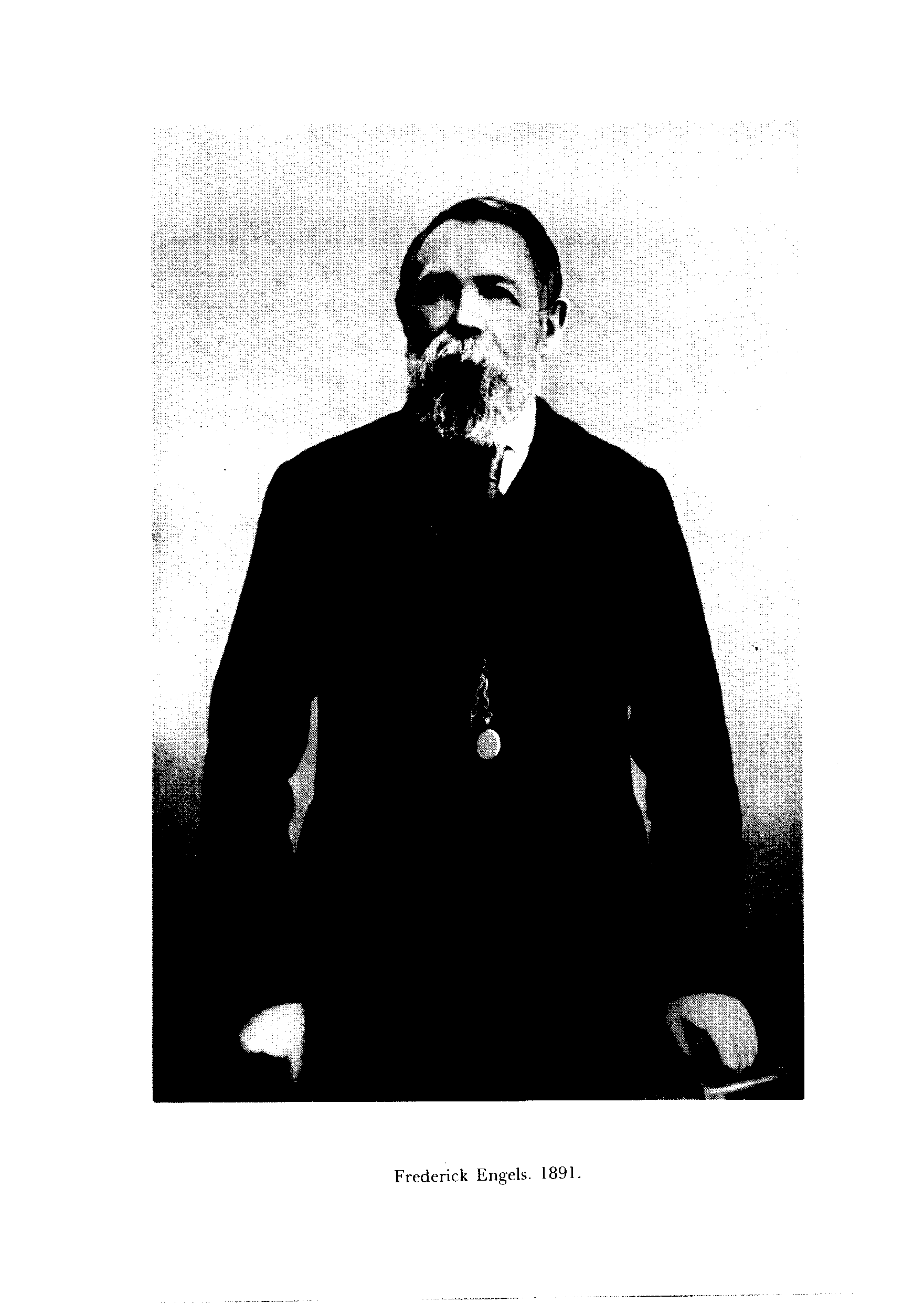
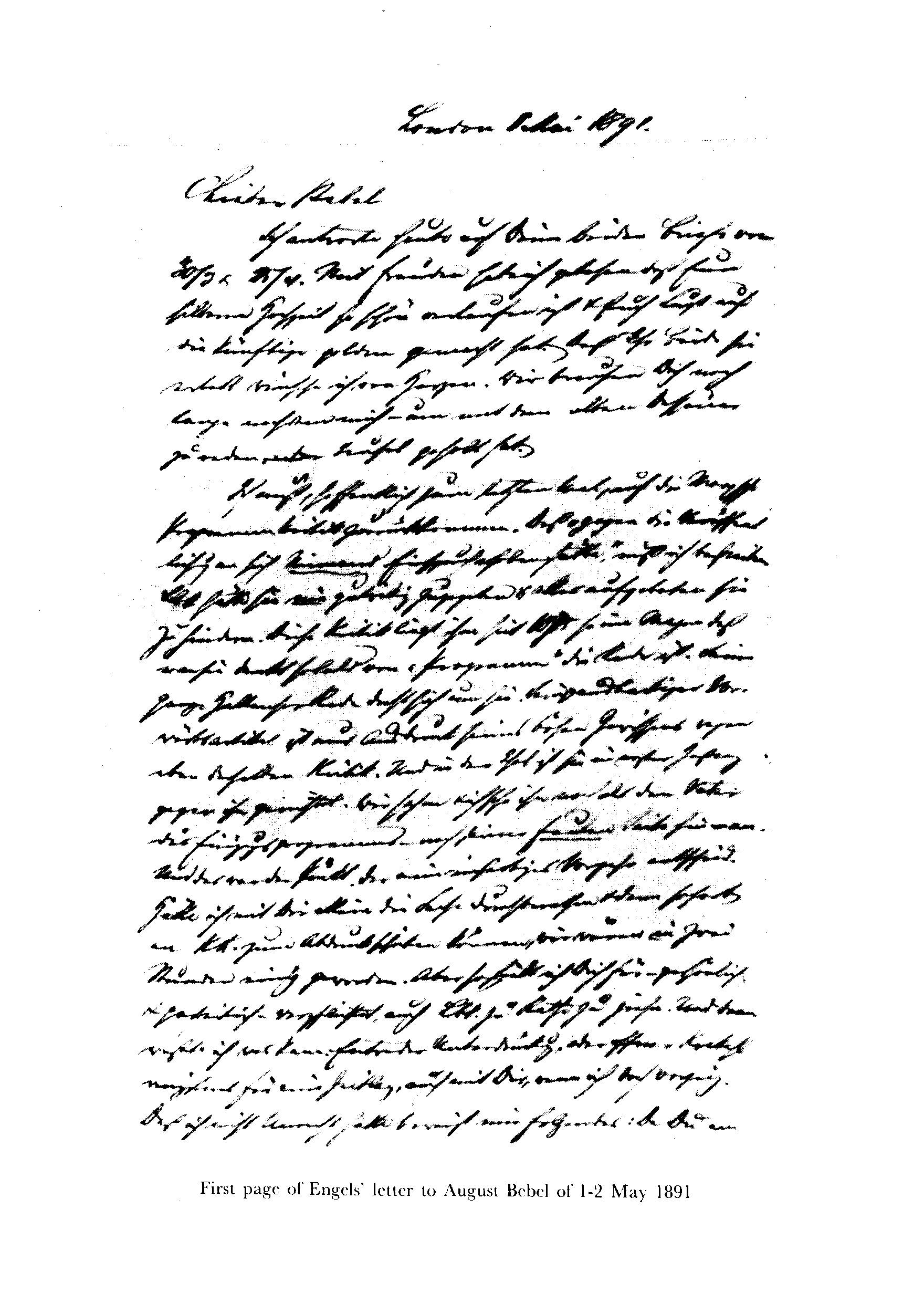
First page of Engels' letter to August Bebel of 1-2 May 1891
I found, that the matter was decided when your accredited representatives accepted the draft. Hence Marx wrote the thing merely to salve his conscience, as is testified by the words he appended — dixi et sal-vavi animam meamà—and not with any hope of success. Hence Liebknecht's big talk about the 'categorical no' [2 3 4] is mere braggadocio and he knows it. Well, if you blundered in choosing your representatives and were then forced to swallow the programme lest the whole business of unification came to naught, you surely cannot object to the publication, fifteen years later, of the warning that was sent you before you finally made up your minds. It does not brand you either fools or traitors unless, of course, you lay claim to infallibility so far as your official actions are concerned.
You, however, did not see that warning. Indeed this fact has been made public and you are thus in an exceptionally favourable position as compared with the others who, though they had seen it, nevertheless fell in with the draft.
I consider the accompanying letter to be most important.[63] For it propounds what would have been the only correct policy. Parallel action for a trial period — that was the one thing that could have saved you from trafficking in principles. But, come what may, Liebknecht was determined not to forego the glory of having effected unification and, in the circumstances, it is a miracle that he didn't make even more concessions than he did. From bourgeois democracy he brought with him and has retained ever since a positive mania for unification.
The fact that the Lassalleans came over because they had to, because their entire party was disintegrating and because their leaders were scoundrels or jackasses whom the masses would no longer follow, is something that can be said today in tastefully moderate form. Their 'tightly knit organisation' naturally ended in total dissolution. Hence it is absurd when Liebknecht excuses the wholesale acceptance of the Lassallean articles of faith on the grounds that the Lassalleans had sacrificed their tightly knit organisation — there was nothing left of it to sacrifice!
You wonder about the provenance of the muddle-headed and con-voluted clichés in the programme. But all these are surely quintessen-tial Liebknecht; they have been a bone of contention between us for ' years and the chap's besotted with them. Theoretically he has always been muddle-headed and our clear-cut style is still an abomination to him today. As a sometime member of the People's Party [154] he, on the other hand, still loves resounding phrases which leave one free to think what one will or, for that matter, not think at all. The mere fact that, long ago and out of ignorance, some muddle-headed Frenchman, Englishman or American spoke of the 'emancipation of labour' rather than of the working class, and that, even in the documents of the International one sometimes had to use the language of the people one was addressing, was, to Liebknecht, reason enough for forcibly making the phraseology of the German party conform to this same outmoded point of view. Nor can he possibly be said to have done this 'despite his knowing better' for he really didn't know better and I am not sure whether this is not still the case today. At all events, he is still as susceptible as he ever was to the old, woolly phraseology which, rhetorically, is certainly easier to use. And since he undoubtedly attached at least as much importance to basic democratic demands, which he thought he understood, as to economic principles, of which he had no clear understanding, he was undoubtedly sincere in believing he had pulled off a splendid deal in bartering democratic staples for Lassallean dogmas.
So far as the attacks on Lassalle are concerned, these seemed to me, as I have already said, more important than anything else. By accepting all the essential Lassallean economic catchwords and demands, the Eisenachers had in fact turned into Lassalleans — at least if the programme is anything to go by.[63] The Lassalleans had sacrificed nothing, nothing whatever that was capable of preservation. And so as to make the latter's victory more complete you people adopted for your party anthem the rhymed, moralising prose in which Mr Audorf celebrates Lassalle.a 235 During the 13 years in which the Anti-Socialist Law was in force ' ' there was, of course, no possibility of combatting the Lassalle cult within the party. This had got to be quashed and I set about doing so. I shall no longer permit Lassalle's bogus reputation to be maintained and revived at Marx's expense. Those who knew and revered Lassalle personally are thin on the ground; in the case of all the rest, the Lassallean cult is purely facti-tious, the result of our having tacitly tolerated it against our better judgment; hence it has not even the justification of personal attach-ment. We showed ample consideration for the feelings of inexperi-enced and new recruits by publishing the thing in the Neue £eit. But I am in no way prepared to concede that in such circumstances historical truth — after 15 years of meek forbearance — should give way to expediency and the fear of causing offence within the party. That deserving people should have their feelings hurt on such occasions is unavoidable and their grumbling after the event no less so. And if they then proceed to say that Marx was envious of Lassalle, and the German press, including even (!!) the Chicago Vorbote (which writes for more self-confessed Lassalleans — in Chicago — than exist in the whole of Germany) chimes in, it affects me no more than a flea-bite. We have had far worse things cast in our teeth and none the less carried on with the business in hand. The example has been set; Marx has laid rough hands on the sacrosanct Ferdinand Lassalle and that for the time being is enough.
And now just one more thing. In view of the attempt made by you people forcibly to prevent publication of the article, and your warn-ings to the Neue 2jeit that, in the event of a recurrence, it, too, might be taken over and subjected to censorship by the party, the latter's appropriation of your entire press cannot but appear to me in a sin-gular light. In what respect do you differ from Puttkamer if you introduce an Anti-Socialist Law into your own ranks? So far as I myself am concerned, it doesn't signify; no party in any country can impose silence upon me once I have made up my mind to speak. But all the same I would suggest you consider whether you would not do well to show yourselves slightly less touchy and, in your actions, slightly less — Prussian. You — the party — need socialist science and this cannot exist without freedom to develop. Hence one has to put up with the unpleasantnesses and to do so for preference with good grace and without flinching. Tension, however slight, let alone a rift, between the German party and German socialist science would be an unprecedented misfortune and disgrace. That the Executive and/or you yourself still have and must retain considerable moral sway over the Neue Zjsit and everything else that is published, goes without saying. But with that you must and can rest content. Inalienable freedom of discussion is constantly being vaunted in the Vorwärts but is not greatly in evidence. You have absolutely no idea how odd an impression this proclivity for forcible measures makes upon one who lives abroad and is accustomed to see the most venerable party leaders being well and truly taken to task within their own party (e. g. the TORY government by Lord Randolph Churchill). And again, you should not forget that discipline in a big party cannot be anything like as strict as it is in a small sect, and that the Anti-Socialist Law, which forged the Eisenachers and Lassalleans into a single whole (though Liebknecht avers this was the work of his magnificent programme) and necessitated such close cohesion, no longer exists.
Ouf! So much for that old affair, and now for something else. There would seem to be some high jinks going on in the upper regions over there.[236] But it's all to the good. That the state machine should be thrown out of gear in this way suits us very well. Always providing peace is maintained by the universal fear of what the outcome of a war might be! For Moltke's death has removed the last obstacle to the disorganisation of the army by the arbitrary appointment of new commanders, and every year must contribute towards making victory more uncertain and defeat more probable. And little though I would wish for another Sedan, I am no more anxious to see the Russians and their allies victorious, even if they are republicans and otherwise have cause for complaint about the Peace of Frankfurt.[237]
The trouble you expended on the revision of trade regulations has not been in vain. Better propaganda would be difficult to imagine. We over here followed the business with considerable interest and were delighted by the pertinence of the speeches.[238] In this connection I recalled the words of old Fritz: 'For the rest, our soldiers' genius lies in the attack, as is, indeed, right and proper.'[3] And what party, given the same number of deputies, could boast so many confident and forceful speakers? Bravo me lads!
No doubt you deplore the pit strike in the Ruhr,[228] but what can you do? After all, it is usually via the unpremeditated wild-cat strike that we acquire large new categories of workers. In my view, insufficient account was taken of this fact in discussing the matter in the Vorwärts.[2]'[27] Liebknecht ignores all nuances; to him everything is either black or white and if he feels it incumbent on him to prove to the world that our party did not stir up this strike but actually poured oil on troubled waters, then God help the poor strikers; they're getting less consideration than they ought if they are to come over to us in the near future. But come they will in any case. By the way, what's wrong with the Vorwärts? Not a cheep out of my Liebknecht for 2 days; no doubt he's on his travels. Today, 2 May, he is back again, live and kicking.
2 May. Come to that, the pit strike will doubtless soon fizzle out; it would seem to be only a very partial one and in no way to accord with the assertions and assurances at the delegates' meeting. It's all to the good. Not for one moment do I doubt that there's a powerful urge to resort to the sword and the musket.
The first [of May] went off very well. Vienna again takes pride of place. In Paris it fell more or less flat thanks to the bickering which is as yet by no means a thing of the past. Mistakes have been made there qn every side. Our people in Lille and Calais had committed themselves to a specific type of demonstration — the sending of delegates to the Chamber.[239] The Blanquists were not asked. The Allemanists[53] did not join the demonstration comité until later. This suited neither the Blanquists nor the Allemanists; in the Chamber, the Blanquists had apostates who had been elected under Boulanger's aegis, the Allemanists had a Broussist opponent[3] there, and neither party wanted to appear as petitioners before these men. The same applied to the deputations which our chaps suggested sending to the 20 Paris mairies a to which it was also proposed to summon the municipal councillors so that they might there hear 'the will of the people'. Thus a split ensued, our chaps withdrew and the demonstration split up into 3 or 4 partial demonstrations. Lafargue sent me word yesterday afternoon; under the circumstances he is fairly satisfied with what happened, but maintains that Paris will come off badly by comparison with the provinces. Of one thing we may be certain; the countries which chose the 3rd [of May] — Germany and England — will mus-ter the most impressive crowds, providing the weather's not too bad. It's wretched here today, heavy, drenching showers, a strong wind and only an occasional ray of sunshine.
Fischer will have received what he wanted for Wage Labour and Capital}[1] Entwicklung0 will follow in a few days' time. But then there must be no more requests. I have been promising a new edition of the Origina for a year now, and that has got to go off, after which I shall undertake nothing further whatsoever until the 3rd volume of Capital is ready in ms. That has got to be completed. So if over there you hear rumours of fresh demands to be made on my time, I would beg you to back me up. I shall also reduce my correspondence to a minimum, with only one exception, namely yourself. It is through you that I can most easily remain in touch with the German party and again, to be honest, I enjoy this correspondence far more than any other. Once Volume III is in print I can get cracking again, starting with the revision of the Peasant War!" And if I have nothing else to do, I shall probably complete Volume III this year.
Well, kindest regards to your wife,[1] Paul,d Fischer, Liebknecht and tutti quanti' from
Your
F.E.
[From Louise Kautsky]
Dear August,
Many thanks for your kind letter; I shall answer it as soon as possible and let you have the information you ask for. Did you know that we, i. e. the United International Social-Democrats, namely: Tussy (representing France, England), Ede[1] (Ireland), Ede s (Berlin), Gine[1]' (Posen ') and I, Austria and Italy, proposed to move a vote of no confidence when The Daily News praised you so exceedingly? Fie upon you, August! You are the last person I should have expected this from. Warm regards to you and your wife.
Your
Mummy
More anon.
104. Engels to Laura Lafargue. 4 May
104
ENGELS TO LAURA LAFARGUE
AT LE PERREUX
London, 4 May 1891
My dear Löhr,
Yesterday was glorious, both as to weather and demonstration. Louise, Sam Moore and I went there at 2,[240] the platforms extended in an immense arc across the Park,[3] the procession began to march in at 2.30 and had not done by 4.15, indeed fresh processions came in up to 5 o'clock. I was on Edward's platform with Sam, Louise on Tussy's. The crowd was immense, about the same or more even than last year.
Now a little gossip about the history of the affair. It has been almost exclusively Edward's and Tussy's work, and they had to fight it through from beginning to end. There was of course a deal of friction, but the Trades' Congress last September at Liverpool[27] and the changed majority (in favour of legal 8 hours) had considerably smoothed the way. Shipton was awfully polite to Edward, but ob-structive in many small matters, and threatened to throw up everything if his right (divine?) to be Marshal in command of the procession should be ever questioned. Well, they let him, it will probably be the last time he will appear hoch zu Ross.(19)
The principal thing was that the resolution was passed in the form proposed by our people, and that they carried in the joint committee (5 from the Trades Council,[196] 5 from the Demonstration Committee).
Now for the fun — the Social Democratic Federation.[29] At first they sent 3 delegates to the Demonstration Committee where Edward was Chairman. But after a few meetings they remained absent, and were struck off the rolls. Then the Social Democratic Federation applied to the Trades Council for 2 platforms for themselves, as they had last year. But Shipton himself suggested to the Joint Committee that this would never do, and it was rejected, as in the same way every Trades Union might have asked for 2 platforms. Then the Social Democratic Federation announced in their Moniteur' that they would hold a meeting of their own with four platforms and red flags.[3]
Unfortunately they had to join our procession from the Embankment in order to get into the Park in an orderly and showy manner, and once there, marched off about 100 yards and held there their promised meetings — without proper platforms, we had big carts, they only chairs. They were just near enough to reckon upon some stragglers from our overflow, and just far enough to show how few of them they were able to attract.
The decisive thing had been, for them, the resolution of the Demonstration Committee: that every association affiliated to them should pay 5/- for every branch towards general expenses. Thus, the Social Democratic Federation would have had either to pay 5/- for the many bogus branches they exhibit in their Moniteur, or else own they were bogus. And that decided their final retreat.
They have been made to feel their real position, and that is: the same position which the Germans of the Socialistic Labor Party in America[133] hold there, that of a sect. And that is their position, though they are real live Englishmen. It is very characteristic of the Anglo-Saxon race and their peculiar mode of development, that both here and in America the people who, more or less, have the correct theory as to the dogmatic side of it, become a mere sect because they cannot conceive that living theory of action, of working with the working class at every possible stage of its development, otherwise than as a collection of dogmas to be learnt by heart and recited like a con-jurer's formula or a Catholic prayer. Thus the real movement is going on outside the sect, and leaving it more and more. The Canning Town Branch of the Federation sticks to Edward and Tussy in spite of Hyndman and marches with our people, and that is their strongest branch. Since the Dockstrike ' [9 8] the Social Democratic Federation had for a time profited by the general socialist revival, but that is over now, they are fast for cash for their new Hall in the Strand, and the decline has set in again. And as their friends and allies the Possibilists [3] are eating each other up as fast as they can, they cannot even brag with their grand foreign connexions.
Sam Moore was very much struck with the immense progress made here during the 2 years of his absence. He, by the bye, is very well, likes the climate and easy life amazingly and will, I am almost sure, be homesick for Africa after a while.
I mimmmm m ^i^ gejal Jigkt jours flcmonsfratiffit
<+• Hyfc Part, Mijr %H, 1891 **
i m i w m c i « F S t S 3 8 * TIOXZ3DT «
^T<imii JVP.. J C V & 2&^ Jtejwr npnu$mt4d-Jaffa. .JtA^lLl
JPMform JW.
Qcoirat SKOTOM
EDWARD A V I U M
Engels' press ticket to the platform in Hyde Park during the demonstration on 3 May 1891
I saw Cunninghame Graham on our platform (No. 6, Edward's, see Chronicle*) but he could not tell me much more about Paris than was said in Paul's letter Friday afternoon.b After all I hope the Committee's demonstration in the evening was not a failure, as, Graham says, was that of the Broussists. If we cannot work together, we have all an interest in having as much of a demonstration as possible.
It's no use crying over spilt milk, but I cannot help thinking that our friends made a slight mistake, thanks to the usual French inclina-tion of miscalculating the strength of the relative forces. A very heroic disposition sometimes, 'mais ce n'est pas la guerre'.c 2 4 ' After all we intended to work as usual with the Blanquists, and they were not bound by the resolutions of Calais and Lille.[239] These resolutions could only bind our people; the Blanquists too might have passed resolutions as to the 1st of May and then said they were bound by them. Why then determine beforehand by our own selves and without our only allies, how the demonstration was to be arranged in Paris where we are in an, at present, decided minority? Why thus froisser[4] our only allies? Froisser them still more by the plan of delegations to the mairies^ and summonses to all the élusr to meet the delegates there? a plan which on the face of it they were sure to repudiate? I am not at all astonished that they fell into the arms of the Allemanists [53] after this. At least that is the view I came to from the information I possess, there may be another side to the case but I do not know it.
We have very little news from Germany to-day. Hamburg had a splendid procession, 80,000 according to Daily Telegraph. From Berlin very little news; the Havas of Berlin, Wolff, has orders from Government to suppress everything, and the London correspondents are all under the influence of the Freisinnigen,[242] and do exactly the same.
When we came home last night, we wound up with a Maibowleg
the Maikrauth of which Percy had sent us from Ryde. We put in 4 bottles Moselle, 2 claret, 1 Champagne, and finished it — we, Bernsteins and the Tussy's.' Late in the evening Cunninghame Graham came in and actually had two or three glasses of it — he seems to have left his teetotalism at Tangiers. There is a slight but rather agreeable Kater,J
kept in proper bounds this morning by a bottle of Pilsener.
Why did not Paul turn up? Graham says he was too tired — his name figures as a speaker on platform 8, with Jack Burns."
Viele Crûsse von Louise.
Dein alterh
F.E.
105. Engels to Paul Lafargue. 19 May[141]
My dear Lafargue,
First of all I did not suggest what tactics you should adopt; I merely said the following: if, at your congresses, you, the Workers' Party, decide in advance how you intend to celebrate 1 May in Paris without regard for the convenience or the wishes of your allies the Blanquists, you must not be surprised if you find them deserting you.c If your hand was forced by the provincial gentry, the blame is theirs. In either case you have miscalculated the respective forces at work in Paris and you have been forced out of the committee created by yourselves. That's not what you would call a victory and neither would I.
It remains to be seen what becomes of-the Blanquists and, in particular, the Allemanists,[53] to whom you have given the opportunity of once again setting themselves up as the true representatives of the Paris proletariat and at the same time of acquiring A .NEW LEASE OF LIFE. And you complain that the English are too slow for you, although they have forced our own Possibilists,[3] the SOCIAL DEMOCRA-
TIC FEDERATION [29] to exclude themselves from the great demonstration, and you also say that over there it spread like wildfire.
Maybe, but it is Possibilist fire and will eventually flare up in your faces.
There have been demonstrations in the provinces over here, but as I haven't kept the newspapers, I haven't got a list of them.
If you seriously believe Reuters' reports with their estimate of 60,000 people in the Park, do you want us to do likewise with regard to the Havas reports in which your demonstration hardly figures at all? What would you say to that? There were at least 500,000 in Hyde Park.
I see in the German papers that at Fourmies, when the command was given to open fire,[243] the only soldiers to do so were those of the 145th, whereas the detachment of the 84th remained with their arms at the order. And that is why neither the Government nor the Chamber will consent to an inquiry that would establish the fact officially. If this is true, it is a good sign. The Prussian system requires that soldiers be allotted to regiments garrisoned in the region from which the whole of the army corps draws its recruits. Accordingly in the event of mobilisation it is no longer possible, without creating enormous difficulties, to despatch Gascons to the north and Flemings, Walloons and natives of Picardy to the south. This is yet another danger of the system and one that will make itself felt earlier in France than in Germany.
You are right to protest against the ultra-foolish follies attributed to you.[244] That is the danger with countries possessing a revolutionary past, inasmuch as any new region invaded by socialism is tempted to have its revolution within 24 hours. There is no need whatsoever to urge them on; on the contrary they should be reined back. All that the Walloons, in particular, comprehend is rioting and in this they are nearly always the losers. Consider the struggles of the Belgian miners[245]; organisation nil or virtually nil, irrepressibly impatient, hence doomed to defeat.
Clemenceau has had what he wanted: his day of brilliant opposition,[246] a reminder of the good old times when he made and unmade ministries. On the morrow he remembered that he was now a nobody and that it was Constans who, after all, was the paragon in the eyes of the bourgeoisie. HE OUT-FERRIES FERRY.
Tussy and Aveling are in Dublin for a congress of the GASWORKERS AND GENERAL LABOURERS.[247] Bernstein's entire family is ill with influenza, Percy and Pumps are disporting themselves in the Isle of Wight, seeing that Percy hasn't yet very much to do because the price list he will have to use is still at the printers. It is snowing here and when it isn't snowing it's raining and feels as chilly as November and we have had fires. For the past week our /;.«/»//•;, \T has been in utter disorder as a result of repairs to the DRAIXS, which stink horribly; we shall have at least another week of it. Old Harney is in Richmond and very ill; he suffers from chronic bronchitis and is afraid, or so he tells me in his letter today, that he will get pleurisy on top of it. Weak as he is, that could be very serious at 75.
Tomorrow I shall at last be able to turn my attention to my Origin of the Family'' — if nothing crops up!
After Cunninghame-Graham's expulsion and with your Constans in a temper ugly enough to match that of any Père Duchesne, what foreign socialist could feel safe in France [248]? And supposing that, in retaliation against the Japanese attempt on the life of the Tsaré-vitch[249] (who had committed improprieties and caused scuffles in a TKA-OARDKx, to wit a brothel, whereupon the police arrived) a number of minor outrages or coups d'état were to be inflicted upon the Russians in France?
Here comes another squall and it's raining cats and dogs. Dinner in ten minutes. So I shall close this olla podridah of an epistle or, as the Milanese have it, arlecchino.
I believe you get the Vienna Arbeiter-Leitung. This week it has a letter from Louise on the MEETING in Hyde Park.[1]
I spend my evenings studying Louise's books on the physiology of birth and related matters. It's really wonderful — since the process is such an excessively ugly one. I am discovering things of the utmost importance from the philosophical viewpoint.
Give Laura a kiss from me. Regards from Louise.
Yours ever,
F.E.
Herewith RavéA and cheque for £20.
106. Engels to Paul Lafargue. 29 May[141]
My dear Lafargue,
Thank you for the information contained in your letter of the 21st.[250] I have passed it on to Aveling for submission to the London press.
Whatever you may say, the fact remains that the Possibilists [3] have ousted you from your own committee and that Vaillant and Allemane and Dumay acted in concert and spoke at the Mur des Fédérés, whereas not a word is said about speeches made by you or Guesde.[25] ' In the provinces you are in a majority, but it is now openly asserted that in Paris you are, for the time being, IN A HOPELESS MINORITY. And that is an assertion for which you yourselves are accountable.
Now for another matter. To help me in the preparation of the new edition" of the Origin of the Family I have had in front of me Les Origines du manage et de la famille by Giraud Teulon, Paris and Geneva, 1884. It is a new, entirely revised edition of his work, Les Origines de la famille, 1874 (Geneva). In his later work, dated 1884, he advances some claim to having anticipated, in the edition of 1874, the discoveries made by Morgan. Unfortunately the 1874 edition is out of print. But Lavrov or Letourneau will be bound to possess one. As it is essential for me to clear up this point, could you not procure me one of these copies for a few days only and send it to me 'REGISTERED' (the 1874 book, the Origines de la famille)? If, by chance, neither of them has it, could you get a copy for me from a second-hand bookseller? And if that will take too much time (for the thing has brought me up short), would you be good enough to make a few inquiries at the Bibliothèque nationale (I would do this here at the British Museum but 1. I haven't a ticket, 2. Louise doesn't know enough French, 3. Tussy isn't sufficiently up in such matters). The problem is this.
McLennan is, as you know, the proponent of exogamous tribes who are obliged to obtain their wives from outside either by abduc-tion or by purchase." In Ancient Society,(20) as you also know, Morgan (who in his Systems of Consanguinityb still describes the exogamous gens as 'tribe') has proved that the exogamous tribe does not exist, that exogamy is an attribute of one fraction or subdivision of the tribe, i. e. of the gens, and that within the tribe there are no restrictions on marriage provided it takes place outside of the gens.
Now here is what Giraud Teulon has to say on p. 104, footnote:
'Morgan, in his later works, while recognising the necessity of not confusing tribe with clan' (in Giraud Teulon clan is the equivalent of Morgan's gens), 'has abandoned his definition of tribe without, however, seeking to provide a new one.'
And he then proceeds to give a description of the tribe divided into clans (gentes) exactly as Morgan does, but as though this had been arrived at quite independently of Morgan and was attributable to him, Giraud Teulon.
The manner in which he presents his claims is so equivocal that it doesn't inspire me with much confidence. But since this concerns a discovery that has entirely revolutionised the science of prehistory, perhaps you would be good enough (should occasion arise) to compare the 1874 edition and tell me
1. What alternative he suggests to McLennan's exogamous tribe. 2. If in 1874 he has already discovered that the tribe was subdi-vided into exogamous clans equivalent to Morgan's gentes.
3. (Briefly, names only), if he really did discover this, what examples does he cite? Does he acknowledge that his clan is identical with the Greek or Roman gens?
As to 1. and 2., the relevant passages in his own words if that is possible.
Old Harney is pretty ill; he is suffering from chronic bronchitis — at 75! He intends to move from Richmond to Ventnor. I trust he arrives there safe and sound and that it will do him good.
Your article on Adam and Eved is very witty. There is evidently some truth in it, but perhaps you go too far in your interpretation, especially in your catalogue of Noah's ancestors. Although in the case of Noah's descendants there can be no doubt whatever that they constitute a catalogue of tribes.
Elôah = the Arabic Allah both etymologically and lexically. The 'a' (patâchfurtivum)a is obligatory in Hebrew if the end of the word has an 'o' or 'u' before 'h' or 'ch' [rûàch Elohîm, the Spirit of Elohim in the 2nd verse of the 1st chapter of Genesis). In the plural Elôhîm the 'ä' disappears.
I am sending you The Workman's Times, a non-political working-class paper which calls for the formation of a working men's party<\\ The best of the working men's or so-called working men's papers over here. As regards facts it is admirable. The paper was founded by Yorkshire and Lancashire workmen and originally appeared in Huddersfield before being transplanted to London.
Give Laura a kiss from me. LOUISE SENDS HER KINDEST REGARDS.
Yours ever,
F.E.
107. Engels to Franz Mehring. 5 June
Kapital und Presse[11] received with thanks. I wish it every success. I didn't know your address, hence belated reply.
108. Engels to Friedrich Adolph Sorge. 10 June[2 5 2]
Dear Sorge,
I am up to the eyes in the new edition of the Origin of the Family, etc.'[1]; it has been necessary to go through all the relevant literature of the past 8 years and its quintessence must now be worked into the book, which is no joke, especially in view of the many interruptions. However the worst is behind me and I shall at last be able to get back to Volume III.b I have had to cut down on the whole of my correspondence, otherwise I should make no progress at all.
In Berlin — strictly between ourselves, for Schlüter must not know that it is / who have given you the information; he cannot always keep his mouth shut and if you tell him, he's sure to know that it comes from me — in Berlin, then, the chaps have finally come round to the view that Liebknecht is a windbag and nothing more. Earlier on the position was such that they had to give him the post of editor of the Vorwärts and at the same time make him an honorary member of the Executive. I had long been aware that this was bound to bring matters to a head; it was inevitable. They now find that he is editing the paper out of existence, for in the first place he does nothing himself and, in the second, he is standing in the way of others who could do something. So it's scandalous that he should allow his son-in-law Geiser to write botched leading articles for it, articles of such dreary arrogance and tedious ineffectiveness as to be beyond the capabilities of anyone save their author — and this is the Geiser who, morally speaking, was chucked out of the party at St Gallen.[253] For the moment there's no telling how the affair will end. They have offered Liebknecht another position in which he would act both as a popular speaker and in his earlier capacity of journalistic franc-tireur, but this he construes as a dismissal. Now they don't know how to set about pensioning him off in a decent manner, and to do so in such a way that he will accept — for that is what it really boils down to. The oddest part of all is that while the Anti-Socialist Law ' ' was in force, precluding the outbreak of this conflict, Liebknecht hardly changed at all, or at most continued along a course upon which he had long since embarked, and that the chaps now find that, upon his transfer to Berlin from his Borsdorf retreat, he no longer bears the slightest re-semblance to the Liebknecht of old — in other words Liebknecht as they had imagined him. The real point is that the others have progressed and now suddenly notice the difference; they imagine that it is they who have remained as they were, which is by no means the case.
Now for something else. Stanislawa writes to tell me that Anna b
has approached Paris for money and has actually got some, or will be doing so; these attempts at extortion are really a bit thick, he says, and suggests we write to America lest there should be further useless expenditure over there on the young madame's behalf. Accordingly he has already written to you and asks me to do the same. He de-scribes her, Anna's, way of going about things as downright blackmail.
Today we have at last had a semblance of summer; the vegetation is a whole month behind and in that respect the spring is not yet properly over, though otherwise we've seen no sign of it.
Thank you for the pirated American edition. Schlüter has told me some curious things about it.[254] Please thank him for his very detailed letter which I cannot unfortunately reply to just now.
Over here the movement is making fine progress. The UNION of GAS-
WORKERS and GENERAL LABOURERS [164] is gradually coming to the fore, thanks above all to Tussy. The movement is advancing English-fashion, systematically, slowly but surely, and it is an odd, if highly significant phenomenon that both here and in America the people who make themselves out to be orthodox Marxists and have changed the concept of our movement into a rigid dogma to be learned by rote — that these people should figure both here and over there as a mere sect. But what is even more significant is the fact that whereas in America these people are foreigners, i. e. Germans, over here they're Englishmen born and bred, i. e. Hyndman & Co. Tussy has just arrived so I'll close.
Regard from her, Louise and your old friend to you, your wifea
and Schlüter,
F.E.
Tussy has just told me that at Whitsuntide — when she was on the point of leaving for the GASWORKERS' congress in Dublin [247] —she too received a letter from Anna similar to the one sent to the Paris people.
N o NOTICE TAKEN, of COUrSC
109. Engels to Karl Kautsky. 13 June[2 5 5]
Dear Kautsky,
Article on Peru [224] received with thanks. Perhaps you would allow me to keep it here until I have completed the new edition[11] of the Origin. In another article on Negro customs in East Africac I came across a note to the effect that out there a woman's clitoris is cut off before marriage; Sam Moore wrote and told me that this peculiar custom is observed along the River Niger for a distance of more than a hundred miles, though not in his locality where he has satisfied himself as to the presence of the said organ.
The introductiona to the new edition of the Origin is ready and I shall send it off to you next week in case you might wish to use it beforehand for the Neue £eit. If so, please let me have the proofs — in fact, three lots—, the third will go to Rave for the French translation which is finished so far as the old edition goes. Incidentally, Rave doesn't know enough German, Strasbourger though he may be. He has made atrocious howlers, thereby involving Laura Lafargue in a colossal amount of work. I'm only surprised that she took it on at all. h
So you can inform Dietz that he won't have to wait much longer. But he might let me know the number of the new edition. The chaps have gone ahead so fast with the 5,000 copies printed in Zurich that I no longer have the slightest idea where I am. Is this the 2nd, 3rd, 4th or which edition?
The fee for Marx's article[1] received with thanks and already dis-tributed. With regard to the payment for the new edition of the Poverty of Philosophy (and similarly for the first edition as well—for which we asked nothing at the time), perhaps you would be so good as to make provisional arrangements with Dietz. If, having done so, you then tell me what percentage of the total fee for the new edition ought to be allocated to yourselves, i.e. to you and Ede, and what percent-age to Marx's heirs, I shall be able to form a better opinion. But the pair of you mustn't lose by it.
A stop ought to be put to Grillenberger's machinations, or at any rate he should be made to pay the fees. If he publishes Marx's speech on free trade d in your joint translation, you and Ede, not to mention Clara Zetkin, must protest and I should then do the same on behalf of the heirs— as a matter of principle. As regards the Origin, I have been much delayed through having had to consult all the relevant literature. There is no bigger mutual assurance society than the specialists in prehistory. They're a bunch of scoundrels who indulge in camaraderie and cliquish boycotting on an international scale made possible by their relatively small numbers. Now, however, a new element has entered upon the scene in the shape of comparative jurisprudence and, while it has its bad aspects, it may well break up the old ring.
Yesterday Ede showed me Bebel's letter to you. You gave Simon his deserts.25s Things never turn out particularly well if one aims at 'moderation'; a punch, however, hits home. Odd the way this chap behaves as though 100% of medical men were on his side instead of perhaps 1%.
Your 'Emancipation of the 4th Volumea' is nothing by comparison with the 'liberation from feudal seats[1]'' they inflicted on me in the Berlin edition of the Entwicklung des Sozialismus.c Imagine what the evolution of socialism would look like had it happened d in Berlin!
Just let the chaps get on with their programme.[257] Bebel will make sure all right that none of the old Liebknechtian vulgar democratic and vulgar socialist catchwords find their way into it. It's quite a good thing that the people in Berlin should first discuss the subject amongst themselves; what they suggest can only be an improvement on the old programme and will still be open to discussion. The disen-chantment of our friends who, after a 13 years' interval, are now obliged to meet Liebknecht face to face again and work with him, is really too comical. While the Anti-Socialist Law ' ' was in force, he remained ensconced in Borsdorf, concerning himself with nothing save his correspondence. Now, 13 years later, the chaps find him completely changed. On the contrary, he has remained as he was; it is they who have progressed and are now aware that a great chasm exists. Now nothing happens without there being a rumpus, now they find that Liebknecht is editing the paperc out of existence. He did no better by the Volksstaat, etc., but then he was helped by the others to keep the paper afloat; now they have other things to do and now they have a Liebknechtian paper tout pur,r i. e. Liebknecht and family!
Lafargue's interpretation of the Bible is very pretty — callow but original, marking the final break with the now outmoded, German-rationalist philological method. As a beginning it's all one could ask for.g
The OMNIBUS STRIKE has been won![258] At any rate on the main issue. London without omnibuses was and is an odd sort of place. Ede
110. Engels to Laura Lafargue. 13 June
ought to send you a description of it for the feuilleton; I shall tell him so tomorrow. He is enduring his grass widowhood with manly resignation, assisted by us. Kindest regards.
Your
F.E.
110
ENGELS TO LAURA LAFARGUE
AT LE PERREUX
London, 13 June 1891
My dear Laura,
I am sure I do not know how to thank you for the trouble you have taken with Rave's blundering work. ' " I was rather surprised at your heroism in tackling it altogether; I sent you his specimen of Bebel,a
and my notes, showing exactly the same class of mistakes and slovenly renderings — though not in such perfection — as in your anthology. May lla génération infâme' pursue him like the Erinnyes pursued Ores-tes!
Anyhow, I have just finished the introduction to the new edition which I shall send to Kautsky for the Neue Zjit if he likes to have it. b
But before sending it off there is one point on which I should like to be sure. I state Bachofen's new discoveries to be these: 1 ) hétairisme as he calls it, 2) Mutterrecht,c as its necessary corollary, 3) women consequently held in high esteem in ancient times, and 4) that the transition to monogamy, where the woman belonged exclusively to one man, involved the violation of the ancient traditional right of the other men to the same woman, a violation which had to be atoned for, or the toleration of which had to be purchased, by surrendering the woman for a limited period of time.a
Now as to this point No. 4 I am not quite certain. You have no idea what thieves these prehistoric bookmakers are, and therefore all I re-collect that somewhere I have found Bachofen quoted as the discoverer of this fact, and I believe even a reference to Mutterrecht,b preface p. XIX. But I cannot find it again. Now as you have my copy of Bachofen with you, would you mind (unless you remember it without looking) referring and letting me know whether I am, generally speaking, justified in attributing this discovery to Bachofen? It is so long since I have looked at the book, and as in defence of Morgan's claims I have to be rather severe on a lot of his exploiters, I should not like them to catch me in the wrong box. As soon as I have your answer, the ms. can go off and then Rave can have a proof-sheet to go on with.
I had to read the whole literature on the subject (which entre nousc
I had not done when I wrote the book — with a cheek worthy of my younger days) and to my great astonishment I find that I had guessed the contents of all these unread books pretty correctly — a good deal better luck than I had deserved. My contempt against the whole set — Bachofen and Morgan excepted — has considerably increased. There is no science where cliqueism and camaraderie are more dominant, and as the set is small, it can be carried on internationally and with success. Giraud Teulond is as bad and as great an approp-riator of other people's ideas as any Englishman amongst them. The only amusing fellow is Létourneau.e What a charming specimen of the Parisian philistine! And with what splendid self-complacency he proves to his own most intense satisfaction, that not only all the prehistoric tribes and present savages, in spite of all their 'excès' généti-ques' r as he calls it, are Parisian philistines at least, but so are, too, even the animals of the brute creation! The whole animated world one immense 'Marais'g and boulevard du Temple, peopled by either contributors or readers of what the Siècle used to be under Louis Philippe, and the greatest authority on les origines du manage et de la famille— Paul de Kock!
De a Létourneau (evidently of the breed of le petit étourneau d'Amé-rique— icterus pecoris — qui change de femelle au jour le jour,b p. 33) to Rave il n'y a guère un pas.c Rave has a publisher, Carré, rue St André des Arts, could not that man be got to publish the new edition of the Misère de la philosophie? To hear Rave, he seems very enterprising in our line.
I send you The Workman's Times regularly. It is the only working-class paper belonging to working people. It was started by the Northern Factory hands etc. and originally published at Huddersfield; now its headquarters are in London. It is a non-political paper, that is to say it goes in for the formation of an independent working men's party and Labour representation in all elective bodies. It is over-crowded with detail information, but giving facts. There is a regular crop of'Labour' papers: The Trade Unionist, by Tom Mann — soft like Mann himself, who, for a Mann, d has one n too much in English and one too little in German; nice sincere fellow as he otherwise is, as far as a man without backbone can be so. Then The Worker's Cry, by Frank Smith, late Social Wing, Salvation Army.[2] [5 9] — Then The Labour World, founded and abandoned by Michael Davitt and brought to speedy grief and extinction by Massingham, once of The Star. I shall send you speci-mens of these if they live.
Longuet's behaviour seems indeed worse than incomprehensible. At all events it is a good job for poor Mêmee that she is with you again. For the rest you leave us in the dark. Si Longuet s'est refait une jeunesse auprès de Marie, Marie a-t-elle réussi à se refaire une virginité en même temps?r And how are the boysg getting on? What's to become of them while he is gallivanting at Caen? How about the Conseil de Famille? etc., etc.
Louise keeps rummaging up all the papers, pamphlets, newspaper cuttings, etc., etc., brought over here from Maitland Park.h The letters are in tolerable order. Lassalle's will be published in Germany [2 6]°; Bernstein is now using them for an introduction to Lassalle's works ' [7 8] to be published by the party. The Lassalleans will not like it, but since Liebknecht has taken Lassalle's party so much in the Vorwärts, I am determined to have it out, and to use their own Lassalle-veneration as the peg whereupon to hang a criticism of the man.
Sam Moore suffers off and on from African fever here — has gone into the country. Very little news from Jollymeier. Salut à Paul.
Grüsse von Louise.
Dein alter"
F.E.
111. Engels to Karl Kautsky. 16 June
Dear Baron,
Herewith the ms.— I leave it entirely to you whether you print the whole of it or start on p. 2 below the line where the essay proper begins. For title one could put: On the Early History of the Family: Bachofen, McLennan, Morgan. By F. E., or something of the sort, followed by the note: introduction to the x-th edition of the Origin, etc. b
As the ms. ended up by being highly illegible, thanks to numerous interruptions, I do beg you to send me a proof— and, as already mentioned, an extra copy for Rave who is all agog to get it.
The revision of the book itself is going ahead as quickly as my other correspondence permits. I'm itching to get on with it.
I almost wish that the Berliners would turn down Ede's introduction to the Lassallec so that he can deal with the matter more thoroughly and with greater freedom in the Neue %eit. How little is known in Germany of the real Lassalle is apparent from the case of Ede himself. Lassalle's letters to Marx, however innocuous they may seem to many people, as also the need to contemplate the man in the round, have thrown quite a new light on him so far as he, Ede, is concerned. But what the Berliners want more than anything else is peace in the party and that is hardly compatible with freedom to criticise. This is doubly disagreeable for them as they are at loggerheads with the Soldiera and as yet can see no way out of it. But in that case they ought to dispense with new editions of Lassalle. Enfin,b everything will doubtless get back on an even keel again.
Your
F.E.
112. Engels to Pasquale Martignetti. 19 June
Dear Friend,
Today I am sending you
1. registered, your manuscript of the translation of Wage Labour and Capital,c
2. corrected proofs of the new edition0 separately by book post, 3. Labriola's letter enclosed herewith. I'm busy revising the new edition of the Origin of the Family, etc.' which will have numerous additions.
A new, complete edition of Wage Labour and Capital will follow as soon as I have got one. The principal additions are marked in pencil on the proofs.
I trust you are getting on all right in Bergamo; I'e una bella città, la conossi — I'ha appresi di parla '/ Meneghin, lu?"
Saludi
F. Engels
time
113. Engels to Victor Adler. 26 June[2 6 1]
Dear Adler,
I would request you to pass on to the conveners of the Austrian Social-Democratic Party's Second Congress my sincere thanks for their kind invitation to this your party congress and to convey to them my regrets at being unable to attend in person as also my best wishes for a successful outcome to the proceedings.
Since Hainfeld, when the Austrian Workers' Party came into its own again, you have made immense progress. That is the best guarantee that your Second Party Congress will be the point of departure for even more significant triumphs.
How invincible is our party's inner strength is evident not only from the rapid succession of external victories, not only from the fact that last year in Germany, just as this year in Austria, it overcame the state of emergency. [262] This, its strength, is even more evident in the party's ability in every country to surmount obstacles and accomplish things in the face of which the other parties, who are recruited from the propertied classes, are helplessly halted in their tracks. While the propertied classes in France are engaged in an implacable struggle with the propertied classes in Germany, French and German Social-Democrats work hand in hand in full accord. And while in Austria the propertied classes in the various Crown Lands are forfeiting, in the mindless squabble over nationalities, the last vestige of their com-petence to rule, your Second Party Congress will project a picture of an Austria in which the squabble over nationalities is a thing of the past, of the Austria — of the working people. [263]
114. Engels to Paul Lafargue. 28 June
My dear Lafargue,
I have been staying here with Pumps for the past two days and shall remain until Thursday 2 July when I return to London. [264]
Meanwhile Louise has sent me your letter of the 25th. [265] Fortunately I have a blank cheque which I can send you herewith made out for £20. Good luck! The preparations you have made for your defence strike me as excellent and I trust you will secure a seat in the Chamber without being sentenced.
Now for something else. Enclosed you will find a letter from Field (Star, 23 June) together with Burrows' reply,[266] evidently written by Hyndman. Is it true that, as Field maintains, jyo« authorised him to do the idiotic thing he has done? We cannot believe it. But in any case you will see what a letter from you to this Field has given rise to, a letter that in itself may well be perfectly innocent. This Field, a good lad, but bursting to play a part of some sort — even at the cost of doing a disservice to the cause he wishes to serve — purports to be acting 1891
for your Party and, consequently, for ours. As an 'authorised' agent he makes appeals to the TRADES UNIONS, etc., and, if he is known at all, it is as a former collaborator of Champion who is now more despised than ever, thanks to his exploits in Australia!
The ground had therefore been too well prepared not to be exploited by Mr Hyndman. Witness his reply. Every idiotic utterance of Field's, every weak point in his letter is adroitly seized upon and all Field has done is to boost the Possibilists.[3]
Nobody here can take up the gauntlet. In the first place we don't know what transpired between you and Field. And then The Star, if they did accept a reply from us (which is doubtful, indeed more than doubtful), would close the correspondence after they had given Burrows another say. And Field has placed us in such an idiotic situation that we have no choice but to hope that the correspondence in The Star will be forgotten as quickly as possible.
In any case, if you want us to go on working successfully over here on behalf of the congress, you mustforbid Field immediately and cate-gorically to publish anything whatsoever that purports to be authorised by the foreign secretary of the Workers' Party.a And don't give anyone here a pretext to publish anything whatsoever authorised by you without having first consulted us. Otherwise we should do better to beat a retreat and leave everything to chance. To be placed under Champion's protection — that would be the last straw!
All was going well over here. We were working away quietly, if unremittingly, and a to-do in the press (we have no newspaper, remember) is the last thing we want if we are to succeed. However we have a right to expect that our own friends won't put a spoke in our wheel. We got all we wanted at Brussels, not without some difficulty, but we got it and we put it to good use. And that ought to be enough for you without the French Marxist party's affecting to play the part of con-venor of the congress and arrogating to themselves a role to which they are not entitled. Anyhow, let us know what you wrote to Field so that we can try, if only by word of mouth, to mitigate the unfortunate effect of Field's stupidity.
Tussy still has Laura's letter about Longuet. I shall get it back on my return. Our thanks to Laura for this important information. At all events, the matter is about to be taken in hand although, having read the clauses in the Code, we doubt whether the Conseil de Famille can do very much other than appoint a guardian. Tussy must have written to Laura.
We have old Harney here. He has spent a month in Ventnor where he got rid of his chronic bronchitis but had a recurrence of rheumatic gout. We brought him here yesterday in a cab. He is full of aches and woes, poor devil, but perks up whenever the aches subside. He will be returning to Richmond in a day or so.
Pumps has a small but pretty house with a garden FRONT AND BACK, heaps of fruit of every kind, vegetables, even potatoes; greenhouse with vines laden with grapes, etc. It is splendid for the children, but will Percy manage to do any business? His brothers don't appear to be in any hurry to back him up with the necessary materials. Anyway we shall see.
Pumps, Percy and Harney send their best wishes to you and Laura as do I.
Yours ever,
F.E.
115. Engels to Karl Kautsky. 29 June[2 6 7]
Dear Kautsky,
I have come down here to take refuge with Pumps for a few days [264] having been inundated with an intolerable amount of work. No sooner had I become happily engrossed in group marriage[268]
than I was landed with the party programme, which had to be attended to. [269] I meant at first to try rewriting the preamble in rather more succinct form but want of time prevented my doing so, besides which I thought it more important to point out the shortcomings, some avoidable, others not, of the political part, as this would provide me with an opportunity to lash out at the conciliatory opportunism of the Vorwärts and the clean-devout-joyous-freea 'ingrowing' of the old canker 'into socialist society'. I have since heard of your proposal that there should be a new preamble; so much the better.
The party is going to print Lassalle's letters to Marx and myself, annotated by me [2 6 0] (thus precluding all censorship by the party). I can attend to this in the autumn, alongside Volume III. b (This between ourselves.)
I have taken refuge here in order to finish off part of my correspondence; on Thursdayc I go home, when work on group marriage will be resumed. I was getting along so nicely — confound these interruptions!
Poverty of Philosophy — the position is that Dietz is to buy himself out for 450 marks, whereupon negotiations will be restricted to the four of us, so all is well and we shall be able to sort things out all right. But there can be no question of you two refusing to take any remu-neration for the 2nd edition.
Dietz's plan for a volume of Marx's minor works won't do. Long ago Liebknecht cherished a pet project of this sort; it was to be put into effect by his latest protégé, Paul Ernst, who was also to publish other things of Marx's and, IN FACT, to be sent to me for a few months so that I could help him in this. The idea was for the thing to be published by the Berlin bookseller under the party's imprint — i.e. an edition of Marx alongside an edition of Lassalle. I turned this down categorically, which means that I can do no less where Dietz is concerned. I have permitted the party to publish a few minor things of Marx's in pamphlet form and as individual items, without notes or preface. Nor can I go any further than that. I cannot allow them to steal a march on me by bringing out in this piecemeal fashion the complete edition to whose ultimate publication / am committed.
Nor, for that matter, can I now contemplate a new edition of the Condition, etc.,d not, at any rate, until Volume III is completed. I am perfectly prepared to negotiate this with Dietz in due course, but the chaps have simply got to realise that I can take on absolutely nothing more until Volume III has gone to press. While it is in printing, arrangements can be made for something else. But until then I shall resist all incitements and pet projects, whether they emanate from Dietz or anyone else. After all, the chaps ought to have sense enough to exempt me till then from this sort of thing since it could only involve me in useless, time-consuming correspondence. As soon as I have finished revising the Origin I shall set to work on Volume III and then, come rain or shine, I'll carry on regardless.
Vollmar's speech [27]° with its quite unnecessary concessions to the present Establishment and its still more unnecessary, and, what's more, unauthorised assurances that Social-Democrats would play their part if the Fatherland were attacked — i.e. would help defend the annexation of Alsace-Lorraine — has caused unmitigated glee amongst our opponents over here and in France. If it is allowed to pass, our chaps will have to pay very dearly for it in Brussels. ' [3 5] The Possibilists [3] and the Hyndmen are quarrying it for notes, after their usual fashion, nor can we over here do anything about it in the absence of an authentic statement denying Vollmar the right to speak in the name of the party. [2 7] ' Now, as Hyndman's man of straw, Bax has recently written on the subject in Justice; I haven't seen it yet. [272]
The meeting of women in labour in Hyde Park [273] has caused considerable merriment here and in London — the English version even more than the German because of the play on words in DEMANDING A RE-
DUCTION OF THE HOURS oE LABOUR which, more specifically, can mean travail: A WOMAN IN LABOUR.
Rave's address is Faubourg Rochereuil, Poitiers, France. Pumps now lives down here; Percy has taken on an agency for his brothers. Their little house, The Firs, is in Brading Road, exactly one English mile outside the town. It's small but pretty and has a garden [with](21) vegetables and fruit. Old Harney spent four weeks at Ventnor where he had a recurrence of gout and rheumatism. We fetched him over here on Saturday; he will probably travel back with me on Thursday and return to his headquarters in Richmond. He is terribly lame and out of sorts.
Schorlemmer will probably soon be with us. As you know, he's a very uncommunicative correspondent. While over here, Sam Moore has suffered from African malarial fever but is now better again. In August or September he will be returning to the Niger. In his heart of hearts, I believe, he yearns after the beautiful climate — despite the bouts of fever which recur with menstrual regularity.
How could you possibly imagine I cared a rap about whether or not I'm given pride of place in the Neue £eit? Simply suit yourself. Many regards from everyone here.
Your
F.E.
116. Engels to Conrad Schmidt. 1 July[2 6 7]
Dear Schmidt,
I have taken refuge here for a few days. [264] Pumps is now living in this place where her husband has taken on an agency and, since my work had become altogether too much for me, I have come to stay with her for a few days if only to get a breath of fresh air and to deal with the most pressing correspondence. Tomorrow I go back to London again.
I have before me your two letters of 5 March and 18 June. You would be well-advised not to finish your work on the credit system and the money market until Volume III a comes out; in it you will find much that is new on these topics and still more that yet remains to be explored — new solutions, that is, and new tasks. As soon as my summer holiday is over, I shall set to work unremittingly on Volume III.— Your second project — the transitional stages on the way to a communist society — is worth thinking about, but my advice to you is nonum prematur in annum b; it's the most difficult subject on earth because conditions are constantly changing. For instance, every new trust causes them to change while the vantage points never remain the same from one decade to the next.
Your latest academic adventures in Zurich are exceedingly funny. [274] These gentlemen are everywhere alike. Well, I hope you will eventually succeed, to the mortification of the whole of that clique, and thus at long last be left in peace.
I found Barth's bookb a great disappointment, having expected something a bit less superficial and makeshift. A man who assesses every philosopher, not in accordance with what is enduring and progressive in his work, but in accordance with what is of necessity transitory and reactionary, in accordance with the system, would have done better to hold his peace. For according to him the history of philosophy is nothing but a 'heap of rubble', the detritus of exploded systems. Old Hegel stands head and shoulders above this, his supposed critic! And then he believes himself to be criticising Hegel if here and there he succeeds in detecting one of the false starts which Hegel, like any other systematic philosopher, is bound to make in hammering out a system for himself. What a colossal discovery — that Hegel occasionally rolls into one what are contrary and contradictory opposites! I could put him on the track of some far better wheezes if only I could be bothered. The man's what we in the Rhineland call a Korinthen-sckeisserc; he reduces everything to insignificance and until he gets out ofthat habit he will, to use Hegel's words, 'come to nothing, from nothing, through nothing'.'
His critique of Marx is truly comical! First he concocts a material-istic theory of history such as, in his opinion, Marx ought to have had, only to discover that Marx's writings say something quite different. From this, however, he does not deduce that he, Barth, has put a wrong construction upon Marx — far from it; but that, on the contrary, Marx contradicts himself and is incapable of applying his own theory! 'Oh, if only these people could readY as Marx used to exclaim when confronted by criticism of this kind.
I have not got the book here; if I had time I could point out to you hundreds more absurdities of the same nature. It is a pity, for one can see that the man might be capable of something if he were not in such a hurry to pass judgment. Let us hope he will soon write something upon which more attacks will be launched; a really sound drubbing would do him good.
As for me, I am very well — better than this time last year and shall, I think, be quite fit again after a bit of a holiday. If only one could work with fewer interruptions! 2 or 3 months ago I set to work on the new edition of the Origin of the Family, etc.(22) and should have finished it in a fortnight had it not been for the arrival of the new draft programme which they wanted me to criticise,[269] on top of which all sorts of little ineptitudes were perpetrated on the- Continent, thus making it more difficult for us here in England — where the material is good but needs careful handling — to pave the way for the Brussels Congress, [135] etc. All this tends to throw me off course again and to dis-tract me, and yet the thing must not only be almost entirely revised and brought up to date, but must also he finished if I am to get down to Volume III. WELL, since it's got to be managed somehow, managed it will be.
You'd almost think yourself in Prussia here. On Sunday (23) we encountered 4 or 5 sailors from the Stosch, splendid fellows, very well able to stand comparison with the English MANOF-WARS MEN; this morning, constant rumbling of guns and explosions of shells from the gun-nery practice at the Portsmouth forts.
Many kind regards from Pumps, Percy and
Your old friend
F. Engels
117. Engels'to Laura Lafargue. 7 July
117
ENGELS TO LAURA LAFARGUE
AT LE PERREUX
[London,] 7 July 1891
My dear Laura,
That's bad for poor Paul, at least it looks bad at present.[275] Anyhow, he is not in prison yet. There is cassation, though that is one chance out of ten only in his favour. There must be some row in the Chambre about this infamous verdict, and I hope Millerand and Co. will not fail to make that row. I think it admirable policy of Paul to at once assume the offensive, revisit the battlefield of the North, and make himself as formidable to the government as he can. That is what the French always see better and clearer than our Germans, that, in order to make up for a reverse, you must attack at another point, but always attack, never show the white feather, never give way.
At all events his seat in the Chambre seems now pretty safe, and that would bring him out of prison if the election took place while he was in. Le Mord nous appartient maintenant* What fools these governments are! To think they can put such a movement as ours down by repres-sion. But with all his insolence M. Constans shows vacillation; the 'bus strike [276] showed him in quite a different light; there is no telling what he may not do, if he finds the effect of the verdict to be contrary to his expectations.
Rave est à ravir* I pity anyone who has to correct that man. What a work of Sisyphus it must have been for you! ' " Anyhow it may give you an opening for translations with his publisher, and then your labour may bear fruit.
By the bye, the correct French expression for 'Schutzergebung''—the technical, juridical word, is commendation.
I am finishing the revision of the Ursprung for the 4th edition. There will be considerable and important additions; especially a new introduction0 (proof sent to Rave, the text probably in the next Neue £eit)
and then in the chapter on the family. I think you will like them, my inspiring genius to a great extent has been Louise who is full of clear, transparent and original views on the subject. She wishes to be most kindly remembered to you and Paul.
Ever yours,
F. Engels
118. Engels to Johann Gustav Vogt. 8 July
122 Regent's Park Road, N. W.
Dear Sir,
If I have not replied until today to your esteemed letters of 20 June and 5 July,[277] this is due solely to the fact that I am still vainly awaiting a line from Liebknecht whom you gave as a reference and to whom, through Richard Fischer, his colleague on the Party Executive, I also sent a special request for information; this is the more necessary in that Bebel has only just made your acquaintance, whereas Liebknecht has known you for some time past.
Compliance with your request does not depend on me alone. It is Marx's heirs, for whom I merely act as agent, and also the publisher of Capital* who must have the casting vote. As regards the latter I can, I believe, tell you straight away that he would in no circumstances give his consent to such a scheme. Nor would you be likely to fare better at the hands of Marx's heirs. Neither of his two surviving daughtersh would agree to their father's writings being translated from his own German into that of another author. Indeed, upon inquiry I have already been told as much.
I myself could not, with a good conscience, endorse your proposal. You have been kind enough to send us your writings — a new system of natural history. Since it is only in my spare time that I can turn my attention to the natural sciences, it will be some little while before I can venture to give an independent opinion on your mode of thought. As soon as time permits, I shall peruse your work and am most grateful to you for sending it to me. Even though it may not convince me, I shall certainly be able to learn something from it. But of that thorough command of political economy which must be the first prerequisite for your proposed task, there is no suggestion whatever in your writings.
Hence, aside from all other doubts and difficulties, I could give my consent solely on condition that the work be revised by me. In this way, however, it would become more or less my work and that would not suit you or, for that matter, myself since there are already far too many demands on my time.
So I can see absolutely no possibility of your attaining your goal with the consent of all concerned, nor can I conceal from you my opinion that Marx is best able to speak to Germans in his own German. Even the working men come to understand it in due course. They are far more intelligent and, indeed, more cultivated, than is generally supposed.
Yours faithfully
119. Engels to Laura Lafargue. 12 July
My dear Laura,
Paul sends me from Lille the enclosed.[278] As I do not know where he may be now, I return and reply to you.
First I have absolutely no time to do un vrai travail" for Duc-Quercy, in order that he may make out of it un article à sensation. I am finishing the Origin^ and then I shall go and recover a bit of nervous tension, as I do feel rather unstrung. And after that — the 3rd volume ' and nothing else. That is settled long since and cannot and shall not be unsettled.
If I was to write on such a ticklish question and for such a ticklish public as the French, I should certainly do it myself under my name; but never allow a journalist to turn my letter into an interview and put into my mouth, French fashion, not what I did say but what in his opinion I ought to have said.
But finally I am not capable of writing on the 3 questions proposed in a style to please the French bourgeois and readers of the Figaro. I should have to remind them of the fact that by their submission, for 20 years, to the adventurer Louis Bonaparte they laid the foundation for all the wars that have come over us since 1850, including the Franco-German war; that that war originated, en dernier lieu,(24) in their claim to interfere in German internal affairs, a claim which they even now think they have a right to; that if they lost Alsace etc. c'était la fortune de la guerre" and that I do most distinctly object to the whole fate of Europe and of the working class being made subordinate to the question as to who is to have that miserable bit of country. All this might be very useful to tell them, but would they even listen to it without accusing me of having stolen a pendule?
However that may be, I have no time and cannot submit to Duc-Quercy's manipulations. These are the two decisive points.
What Paul has written to me about Renard and his intended declaration, that he said the words attributed to Paul, he will have let you know even before me. I hope these things will help to smash up the verdict.[279]
Edwarda is at St Margaret's Bay, he suffers from the kidneys again; so we shall have only Tussy and Sam Moore here. Wednesdayb
Louise intends going to Vienna, I expect Schorlemmer and then we will see what we may do. I have no fixed plans yet for the summer, but various nebulous projects are colliding in my brain.
Another thing. I should not like just now to speak about matters connected with the Vallmar affair[270] while the thing is being thrashed out in Germany. Anything I said in France might be used, misused and abused against them in Germany, and render their position more difficult. And it is well known to them all that I have refused to do any work for anybody until after the conclusion of Volume III.C
I believe I sent you the second batch of Field-Burrows letters in The Star.iS0 Anyhow the matter has blown over — thanks to the accident of the Belgian Circular of 18th June. [2 8 1] This complete submission of the Belgians to the Halle Resolutions so upset all Hyndman's calcula-tions that he is now in a towering rage against them, threatens them with his vengeance, but still holds back. In the meantime he ruins his last hopes in the East End by attacking the Gas Workers ' [6 4] (most of the leaders of whom are in the Social Democratic Federation [29]) and Tussy whom he calls Miss Marx. That's the degree of lowness he has come to.
Kind regards from Louise.
Ever yours,
F.E.
Tussy and I have just been talking over Nimmy's inscription. After various proposals of various epithets, to all of which objections may
120. Engels to Laura Lafargue. 20 July
be made, I incline to Tussy's proposal to put nothing but the name. Then the inscription would run
In memory of Jenny Marx
and of Karl Marx
and of Harry Longuet
also of Helen Demuth Born January 1st 1823, Died November 4th 1890 What do you think?
120
ENGELS TO LAURA LAFARGUE
AT LE PERREUX
London, 20 July 1891
My dear Laura,
The Culine business is very bad indeed — worthy of the fellow's name[282]—but what's to be done? With such a weapon in Constans' hands, we can only hold our tongues.
Louise went on Wednesday(25) and Jollymeier came on Saturday, but he is getting more and more Tristymeier, you have to work very hard to get a smile out of him now. Anyhow I'll try my best.
Paul asks me to send you a cheque, so enclosed £20; please let me know the receipt. I send it off quick because Jollymeier is still out at his walk, so if I close this letter all of a sudden, you will know the reason why.
We are preparing a tour at sea, but have not made up our plans yet, and I have not yet finished my ms.a—but am at the last addition as far as I can see. Hope to have done by Wednesday b at latest.
Paul thinks Tussy is troubling herself more than necessary about Brussels [135]—I don't think so. Everything may go well, and probably will go well if everybody comes up to the scratch, but I have too much experience of such congresses, not to know how easily everything can go wrong. The Belgians have convoked for the 18th August[281] Tuesday, instead of Sunday 16th—if our people come on the 18th and the (Possibilists) Broussists and Hyndmanites on the 16th, they can play ducks and drakes with everything. Tussy has written yesterday to Volders but these fellows never even reply! As to what the English will do, that's mere toss-up; from Germany almost certainly Vollmar will come and intrigue; what the small countries are you know: not to be trusted across the road. And one mistake on our part, one neglected opportunity, may cause us unnecessary but unavoidable work for years to come.
And then there is that irrepressible Bonnier who point-blank informed me that Guesde and he were going to go in for a restoration of the old International with a Central Council. I told him point-blank that that was putting everything in the hands of the Belgians (the only possible Central Council) knowing what sort of people they were; it was ruining every chance of the movement here in England for a couple of years by a foolish attempt to precipitate matters not ripe for action; and in fact the best means of setting French, English and Germans at loggerheads one with the other. He seemed abashed, but who can guess what he and Guesde may do in their enthusiasm?
Viele Grüsse von Jollymeier und
Deinem alten[1]
F.E.
121. Engels to Victor Adler. 22 July
Dear Adler,
In order to give the Austrians more than an academic token of my sympathy, I have told Dietz to credit you — to use an Austrian expression[3]—with half the fees for the new edition(26) of the Origin of the Family, etc. for your party funds. Let us hope no drastic diarrhetic will be required to bring this about. When you will get it and how much you will get at a time (it may be paid by instalments), I cannot say. For every 1,000 copies printed he pays 50 marks, of which you will get 25.
When you enter this on your printed receipts, I should like you to put 'from F. E. in London, such and such a sum', without any further particulars.
Just one more thing: Louise has agreed, should you be able to procure her a mandate, which should surely not be difficult, to accompany you to the general mounting of the guard in Brussels.[155] But this was on the tacit understanding that she would bring you and Bebel or you, at any rate, back to London with her for a few days. And I hope she will succeed in doing so. I shall have returned here by then and shall eagerly await your advent. For in that case, who knows what you mightn't be able to persuade me to do next year? So not too much head-scratching — and bring your wifeb with you!
Your old friend
F. Engels
122. Engels to Emma Adler. 22 July
122
ENGELS TO EMMA ADLER
IN VIENNA
London, 22 July 1891
Dear Mrs Adler,
This year, alas, nothing is likely to come of the trip to the Continent which I should dearly like to make, if only to come and see you at Lunz and convince you that I can indeed eat Austrian food, and with very good appetite, as Louise can testify; she never dresses a sal-ad for me save after the Viennese fashion. But if I don't come and see you, there is, after all, another alternative. Perhaps you will accompany Victor to Brussels,[135] in which case we could make one another's acquaintance just as well here in London. Brussels is but a stone's throw from here, so what do you think? If, however, you should not go to Brussels, could you not authorise your husband to spend a few days over here to recuperate from the wear and tear of the world congress? That sort ofthing is a tremendous strain, and spending a few days in London after it would greatly benefit his health.
The African Chief Justice, Sam Moore, has just arrived, and I must stop — do please come. Louise is sure to coax you into it — but if you cannot, then send your deputy.
Kisses to your dear children about whom Louise has told me so much.
Very sincerely yours,
F. Engels
123. Engels to Friedrich Adolph Sorge. 9-11 August[160]
IN MOUNT DESERT
Ryde, Isle of Wight, 9 August 1891
Dear Sorge,
Your two letters of 14 and 20 July have been forwarded to me here. I and Schorlemmer have been spending the past two weeks here with Pumps [264] whose husband is the agent here for his brothers. Shall be going home in about a week.
Am very grateful for the information re the Journal of the Knights of Labor—I have such a mass of newspapers to go through that, without such advice, I should often find it very difficult to get my bearings. Also re Gompers and Sanial[283]—most important, this, since I might run into them in London.
Anna(27) will have to look to her own future; this nonsense is really too much.
The Possibilist-Hyndmanian racket will probably take a hard knock at the Brussels Congress.[135] The split in the ranks of the Paris Possibilists [3] has completely cut the ground from under Brousse's feet. In the provinces they count for nothing while in Paris the majority support Allemane against Brousse.[53] This has resulted in the Possibilists of both complexions losing control of their last great vantage point, the bourse du travail.[51] Or so the Socialiste of 24 July says.[284]
The Brussels chaps who are, in their heart of hearts, themselves Possibilists and have stood by the latter as long as they could, have made a complete volte face[281]; they aim at becoming the General Council of a new International and are paying court to the all-transcendent 'Marxists'; hence the comical lamentations of the 'friends' they have left in the lurch in Paris and London. I fear, I fear that Mr Hyndman will cease to be our official 'enemy' and will try and make out that he 1891
is our 'friend'. That would be a bad thing; we haven't got the time to keep a constant eye on a schemer like him.
Tussy, Aveling, Thorne and other members of the GASWORKERS, [1 6 4]
Sanders (John Burns' secretary) and sundry others of our English supporters are going to Brussels. How things stand as regards the old
TRADES UNIONS, I do not know.
T h e DOCKERS are going to pot. Though the success of their STRIKE was due solely and entirely to the £30,000, contributed in a fit of mis-guided enthusiasm by Australia, they imagine it was their own doing. [1 9 8] Hence they are making one mistake after another, the most recent being to close their lists and refuse to accept any more members, i. e. breed their own SCABS. Then they rejected a merger with the
GASWORKERS. M a n y are DOCKERS in summer and GASWORKERS in winter. Having regard to these alternating occupations, the GASWORKERS proposed that a member's TICKET for one UNION should be valid for both— nothing doing! So far the GASWORKERS have nevertheless continued to honour the DOCKERS' TICKET — but how long they will do so is hard to say. Again, the DOCKERS are protesting vociferously against the immigration of FOREIGN PAUPERS (Russian Jews). Of their leaders, T o m Mann is a good chap but unbelievably weak, while his nomination as a member of the ROYAL. COMMISSION ON LABOUR has all but turned his head; Ben Tillett is an ambitious intriguer, no funds are available, membership is rapidly dwindling, discipline gone by the board.
A week ago someone wrote to me from St Petersburg saying: ' W E ARE ON THE EVE or A FAMINE.'a This was substantiated yesterday by the ban-ning of the export of grain from Russia. In the first place, this will ensure us a year's peace; with famine in the land, the Tsar may well rat-tle his sabre, but he won't unsheathe it. But if, as seems probable, Gladstone comes to power here next year, an attempt will be made to persuade England and France to consent to the closing of the Darda-nelles to all fleets, even in time of war, i. e. prevent the Sultan from obtaining assistance against Russia. So that's the next item on the oriental agenda.
In the second place, however, the Russian ban on the export of grain means extending the famine to rye-eating Germany; only Russia can make good Germany's colossal deficit in rye. But this would mean the complete collapse of Germany's grain tariff policy, which in turn would mean a whole series of political convulsions. For instance, the landed aristocracy cannot forego its protective tariffs without also undermin-ing the industrial tariffs of the middle classes. The protectionist parties will lose credit and the whole situation be totally altered. And our party will grow tremendously — the failure of this harvest will put us five years ahead of schedule, quite apart from the fact that it will prevent a war which would claim a hundred times more lives.
These two aspects will, in my opinion, temporarily dominate European politics, and if Schlüter would care to draw attention to this in the Volkszeitung? it would be very useful. As soon as the Congress[135]
is over, I shall also bring it up in the European press. Only I cannot, of course, be responsible for what others in Germany will make of the information I have supplied.
I am glad that Mount Desert is, as always, doing you good. I, too, am feeling the benefit of the sea air — only here in Europe the weather is so uncertain that one can't really plan anything. Schorlemmer sends his regards. I won't finish this letter off yet as there may be something more to tell you tomorrow.
II August. The ban on the export of grain from Russia is not yet official but is almost a certainty; we may expect an official proclamation.
In East Prussia there have been 2 parliamentary elections — we gained an enormous number of votes. So we have at last opened up the rural areas — cela marcheh\[285] With the help of the price rise we may well see something happen there by 1900, unless we kick the bucket first.
Louise Kautsky is in Vienna, will be going to Brussels with a Viennese mandate, and will bring Adler back to London with her and also perhaps Bebel; I have written to him in Switzerland but have not yet had a reply.
Tussy's report to the Brussels Congress on behalf of the GASWORKERS and others is very good [286]; I shall send it you. Tussy is going to Brussels with a mandate from the Dublin Congress [247] of the GASWORKERS and GENERAL LABOURERS and will thus be representing 100,000 men.
124. Engels to Laura Lafargue. 17 August
Aveling also has 3 or 4 mandates. It would seem that the old TRADES UNIONS will be poorly represented — all to the good on this occasion! Regards from Schorlemmer and myself to your wife.a
, Your old friend
F.E.
1906 and in full in: Marx and Engels, Works, First Russian Edition, Vol. XXVIII, Moscow, 1940
124
ENGELS TO LAURA LAFARGUE
AT LE PERREUX
Ryde, 17 August 1891 The Firs, Brading Road
My dear Laura,
We are still here, Schorlemmer and I, awaiting fine weather which is very slow to come; now and then we have had a fine day and could venture on an excursion but on the whole we had our enterprising spirits damped by the glorious uncertainty which is common to the law and the climate of England; not a few times, too, damped and even wetted by but too certain rain. Anyhow we may thank our stars that our plan[s] of circumnavigating this island (not Wight, which we have twice sailed round but Great Britain) were nipped in the bud, for we should have caught it and well too. So we are here admiring the British Fleet which is moored opposite us and awaiting the French which is to come up the day after tomorrow.
So poor Paul has entered upon his term of Ste Pélagie [287] — I hope he'll keep his spirits up! It's a long bout of enforced rest, but then France c'est l'imprévu b and nobody knows what will turn up within a twelvemonth. I am afraid you will find Le Perreux about as solitary as he will Ste Pélagie, well we must have you over here in London off and on, which may be done I hope without very great difficulties, for surely you will not be bound by your family of pigeons, hews, etc., etc. So I hope you will arrange to come by and bye after you have made Paul as comfortable as circumstances will permit.
Our Russian friend b wrote to me about 3 weeks ago: 'We are on the eve of a famine', and indeed that prophecy has been but too soon fulfilled. While the French Chauvins and Russian pan-Slavists frater-nise and hurrah at each other,[288] this fact nullifies all their demonstrations. With a famine at home, the Czar cannot fight. The utmost he will do is to use the present mood of the French bourgeois for his own ends, by blustering and threatening, but he will not strike a blow, and if the French bourgeois should go too far, he will leave them to shift for themselves. What the Russian government aims at, at present, is the closing of the Dardanelles in time of war to all navies. That he will get the French to subscribe to, and then, when Gladstone comes in here, as is hoped, at next general election, the grand old Russophile is to be coaxed into agreeing to it too. With the two great naval powers bound hand and foot by such an agreement, the Czar is master of Constantinople which he can surprise any day, and the Sultan is but the Czar's care-taker on the Bosporus. That is the plan, to which the bourgeois republic at Paris is to act the part of cat's-paw, and when it has done its duty as such, it may go to the devil for aught the Czar cares. That is the reason why the Czar submitted to listen to the Marseillaise and to humour the representatives of a Republic.
Anyhow, peace is assured — unless some people turn crazy — for this and the greater part of next year. That is the principal effect of the famine in Russia.
But there are others. There will be internal commotions in Russia, and they may lead to a change; it is even likely they will cause some change, bring about some movement in that pool of stagnation; but it may be, that this is not only le commencement de la fin mais la fin elle-même.,''
In Germany the failure of the crop seems certain too, and there the present and still rising famine prices will bring about the breakdown of the Bismarckian fiscal policy and the protective duties. There, too, the old system will be shaken to its very foundations and nobody can tell how far that may go. Anyhow it will again swell our ranks amaz-ingly, and help us to conquer the country districts where we are gaining ground wonderfully. There have been two by-elections in East Prussia on the borders of Russia, in thorough country districts, where two years ago we had about 400-500 votes together, this year we had about 3,000 [285]! And if we get the rural districts of the six eastern provinces of Prussia (where large landed property and large farming predominate) the German army is ours.
According to The Standard of to-day,[289] neither Hyndman nor Brousse had turned up, and Allemane was to take charge of the Possibilists.[3] So as far as that class of opposition is concerned, it looks like a walk-over for our people. That question once disposed of, there will remain but little real work for the Congress; unless the various velle-ities of a restoration of the 'International' venture to come out.a I hope they will not, for that would cause new splits and throw us back, here in England at least, for years to come. The thing is an absurdity in every respect, especially so long as neither in France nor in England there is one strong and united party. If that were the case, and both united heart and soul with the Germans, then the end would be obtained without any formal union, the moral effect of the three great western nations acting together would suffice. But so long as that cannot be, all attempts at restoring an International would bring one of the petty nations, probably the Belgians, into an undeserved promi-nency and end in quarrels. The fact is, the movement is too great, too vast to be confined by such hampering bonds. Still, there is a hanker-ing after this restoration and Bonnier was full of it last time I saw him. Certainly he looked rather perplexed when I told him my objections and had not a word to say — but will that stop him and his friends in Brussels?
On Thursday b I expect to be back in London; Adler will come from Brussels for a few days, perhaps also Bebel. As soon as I am informed about the Brussels proceedings I shall send you a letter for Paul, in the meantime kind regards to both of you from Schorlemmer, the Pumpses and
Yours ever,
F. Engels Had letter from Tussy from Brussels, but written before Sunday's meeting.[135] Shall not know anything of what happened by the time this has to be posted. 18th August, 11 in the morning.
125. Engels to Nikolai Danielson. 2 September
My dear Sir,
Today I return to you six more letters which include everything to end of 1878 — remainder will follow.[290]
Your prophecy about the famine has but too soon been verified, and we here in England, too, will have to suffer severely. The crop seemed excellent on the whole, when about 10 days ago terrible weather set in — just as corn cutting began in the South of England— and played terrible havoc with both cut and uncut corn, 20 to 30 per cent of the crop are said to be severely damaged if not ruined. There is but one advantage connected with this calamity: it will render a war impossible for some 20 months to come, and that, in the present state of universal armament and mutual distrust, is a blessing.
Allow me to return, on another occasion, to your very interesting communication of 1 May.[291] Today I am on the eve of a journey and my principal object is to request you in future to address all your letters to
Mrs Kautsky, 122 Regent's Park Road, N. W. London. The letters will be handed to me unopened, so there is no necessity for a second cover [enveloppe). The fact is I shall be so often absent from London[264] that I am afraid letters addressed in the usual way might miscarry; I should have to trust to the intelligence and punctuality of servants.
My health is on the whole excellent; but I require once a year a holiday of about eight weeks and a considerable change of air. A sea voyage is always the best remedy for me. If I keep as well as I expect to be in a month, I shall set at once about the 3rd volume,[3] it must be finished. But I better not make any promises as to time.
Very truly yours,
P.W. Rosherb
126. Engels to Friedrich Adolp h Sorge. 2 September[16]
Dear Sorge,
I have shown your letter about Mrs Schlüter0 to Louise Kautsky who may be relied on implicitly and is acquainted with the circumstances. She takes the view that Mrs Schlüter has simply fired a warning shot and that she'll come back to him all right, providing Schlüter refuses to be intimidated. Nor does she believe that a third party would be required to nudge her into a decision of this kind. She did the same thing several times in Zurich — or something like it. Admittedly Schlüter's repeated infidelities have given her cause to rebel, but she regularly forgives him and the only people to suffer are those who take her wrath and her fulminations seriously. Louise is the last person to side with Schlüter in this affair or even excuse him — she and all of us know exactly what to expect of him in this respect — his
" of Capital -b Engels' conspiratorial pseudonym - ' Anna Schlüter cock regularly runs away with him. But, though his wife invariably threatens to leave him, she nevertheless falls into his arms again when it comes to the point — and thus there's nothing left for a third party to do.
The Bernsteins return from Eastbourne today. Sanial and Mac Vey are here and will be calling on me tomorrow. I was in Ryde[264]
for a month staying with Pumps and accompanied by Schorlemmer who, however, is now back in Manchester. Every time he has a cold he goes extremely deaf and is no good for anything; otherwise there's nothing wrong with him. I am keeping well but shall have to get out and about a bit more if I am to bring myself fully up to the mark again. Adler from Vienna and also Bebel were here for 3 days, very cheerful and satisfied with the Congress.[135]
I have sent you a pile of documents as well as the Weekly Dispatch containing the interview Mother Crawford had with Liebknecht in Paris.[292] That interview will cause a rumpus; at any rate Liebknecht talked a great deal of nonsence. From all I hear he has-grown quite thin! He looks rotten and is apparently at loggerheads with everyone; in Brussels he kept himself quite apart from the Germans and Austrians. Again, the best of our chaps are amazed at the disagreement that exists between him and the vast majority of the party on virtually every point. His editing of the Vorwärts has been quite deplorable, he has done nothing himself, has got Geiser to write leading articles for it, and has propounded the most peculiar views, in short there's the making of a catastrophe here and it may come all the sooner as a result of that interview.
The old dispute with the Broussists,[3] etc., has fizzled out; the Broussists were not represented at all in Brussels, nor did Hyndman dare go, while the people he did send squabbled and made asses of themselves; he now seeks a prop in Nieuwenhuis who has gone off his head, but that won't get him anywhere. In matters of principle as of tactics the Marxists have been victorious all along the line; the intriguing will still go on behind the scenes and their attacks on me, the Avelings, etc., in Justice will, I trust, continue as before, but there is no longer any public opposition to us as a whole.
The Volks- Tribune's account of the Congress is the most detailed." I have already read 6 proof-sheets of the new edition of the Origin of
" 'Internationaler sozialistischer Arbeiter-Kongreß', Berliner Volks-Tribüne, supplements, Nos. 34, 35; 22 and 29 August 1891.
2 1891
the Family, etc.* Besides the new introduction, there will be many additions in Chapter 2 b ('Family') and also a few later on.
The Brussels Congress ' [3] [5] has again ratified the Hague resolutions [2] [9 3] in that it too has thrown out the anarchists. That ought to be emphasised in the press over there. O n the other hand it has left the door wide open to the English TRADES UNIONS and no doubt the better ones among them will walk in through it before long. These are the two most important resolutions. It's delicious that the English should now be the most reactionary of all, and that for their sake things have to be toned down! But we can afford to do so, for it is now merely a question of months, or at most a year or two, before they come round. True, the next TRADES UNIONS Congress will try to overturn the
LEGAL EIGHT HOURS resolution passed at Liverpool[2 7] but even if this succeeds — with the help of the textile workers who swear by 10 hours — it will only add more fuel to the flames. Things are moving— there's nothing more for us to do.
Kind regards to your wife.'
Your
F.E.
" the fourth German edition. See also this volume, pp. 199, 201, 204, 215-16. -b Chapter 3 in the manuscript-1 Katharina Sorge
127. Engels to Paul Lafargue. 2 September[294]
My dear Lafargue,
So you are back once more 'neath Madame PélagieV hallowed and sacrosanct vaults — in la citta dolente fra le perduta genteb but it won't last long, I trust, and before your 'year' is up we may have Constans there in your place. At all events it's a great pity that you weren't able to go to Brussels before you got nabbed; the effect would have been magnificent. But no matter; I am very happy about the congress[135] none the less. In the first place the total COLLAPSE of the Brousso-Hyndmanian opposition; it was as though it had never existed, as though the Possibilist congress of 1889[52] had simply been a phantasmagoria. Heaven forbid that these gentlemen should become our 'friends' — if they did, they would become a pest; as enemies they would be a source of amusement, as in the past.
Next, the exclusion of the anarchists. The new International has resumed at the point where the old one broke off. Here, 19 years later, we have out-and-out confirmation of the resolutions at The Hague.[293]
Lastly, the door has been thrown wide open for the English TRADES UNIONS — a move which shows how well the situation has been understood. And the utterances committing the TRADES UNIONS to the class struggle and the abolition of wage labour mean that this did not even require our making any concessions.
Hence we have every reason to be pleased. The Nieuwenhuis inci-dent has shown that the working men of Europe have at last progressed beyond an era dominated by high-falutin verbiage and that they are aware of the responsibilities incumbent on them: it is a class constituted as a militant party, a party which reckons with facts.'[29][5]
And the facts are taking an increasingly revolutionary turn.
In Russia there is already famine; in Germany there will be famine in a few months' time; the other countries will suffer less, this is why:
[11] Ste Pélagie — a prison in Paris.-b the city of woe, 'midst the lost ones below (Dante, The Divine Comedy, 'Inferno', III).
2 1891
it is estimated that the 1891 harvest will be in deficit to the tune of 4 million QUARTERS ( 11 '/[2] million hectolitres) of wheat and 30-35 million QUARTERS (between 87 and 101[1]/[2] million hectolitres) of rye; in the latter case this enormous deficit mainly affects the two rye consuming countries, Russia and Germany.
That will give us a guarantee of peace until the spring of 1892. Russia won't make a move before then. Thus, assuming the absence of some inconceivable blunder on the part of Berlin or Paris, there won't be a war.
O n the other hand, will Tsarism come through this crisis? I doubt it. There are so many rebellious elements in the big cities, especially in Petersburg, that they are bound to seize the opportunity, now to hand, of deposing that drunkard Alexander III, or of placing him under the control of a national assembly — perhaps it will be he himself who takes the initiative in convening it. Russia (i. e. the government and the young bourgeoisie) had done an enormous amount of work towards the creation of big industry on a national scale (see Plekhanov in the Neue Z_eüA) and that industry will be stopped in its tracks because its only market — the domestic one — will be denied it on account of the famine. The Tsar will see what comes of having made Russia a SELF-SUFFICIENT COUNTRY independent of abroad; he will have an industrial crisis on top of an agricultural crisis.
In Germany the government will reach a decision, too late as always, to abolish or suspend the duty on corn. That will break the protectionist majority in the Reichstag. The big landowners, the squirear-chy, will no longer want to support the duties on industrial products; they will want to buy IN THE CHEAPEST MARKET. Thus we shall probably see a repetition of what happened at the time of the vote on the Anti-Socialist Law ' ' : a protectionist majority, itself divided by divergent interests arising out of the new situation, which finds it impossible to reach agreement on the details of a protectionist system, all the possible proposals being only minority ones; there will be either a rever-sion to the free trade system, which is just as impossible or — dissolution, displacement of the former parties and of the former majority, a new free trade majority opposed to the present government. That will mean the real and definitive end of the Bismarckian period and of stagnation in home affairs (I am not speaking here of our own party but of parties which might 'possibly' govern) ; there will be strife between the landed nobility and the bourgeoisie, and between the protectionist bourgeoisie (one section of the industrialists) and the bourgeoisie favouring free trade (the other section of the industrialists and the merchants); the stability of the ministries and of the country's domestic policy will be shattered, in other words there will be movement, struggle, vitality, and it is our party that will reap the whole benefit. If things take this turn, our party will be able to come to power round about 1898 (Bebel puts it as early as 1895).
There. I haven't discussed other countries because they are not so directly affected by the agricultural crisis. But suppose this agricultural crisis were to unleash, here in England, the acute industrial crisis we have been awaiting for the past 25 years, what then?
In a quarter of an hour we shall be leaving for Highgate to plant an ivy cutting on Marx's grave. Motteler brought it back three years ago from Ulrich von Hutten's grave (Island of Ufenau, Lake of Zurich) and it has grown marvellously on my balcony.
I have had Bebel and Adler from Vienna with me here for the past few days; they are very pleased about the congress.
Enjoy yourself and make good use of the opportunity you have been offered of 'concentrating' on work, as the Berlin journalist said when thrown into jug in 1841.
With best wishes,
Yours,
F. E.
128. Engels to Friedrich Adolph Sorge. 14 September[2 6 7]
IN HOBOKEN
Helensburgh, Scotland, 14 September 1891
Dear Sorge,
I'm up here on a lightning tour[264] with Pumps and Louise Kautsky; the past week has been spent either in the Highlands or on the water and it has done me a power of good. We shall be home a week from now.
There's nothing one can do about the Schlüters. He can't help chasing after this petticoat or that and she(28) can't help burying the hatchet and forgiving him the moment she feels she has taken things as far as she dares. But if this time she nevertheless remains in Germany— which I'm inclined to doubt—, it will be because people there have talked her into it.
Mr Ferdinand Gilles, a scoundrelly man of letters, who was made to come over to us from the Party of Progress,[2] [9 6] though we in Germany didn't want him, has joined forces in London with Hyndman & Co. and actually has a party all of his own in the Communist Society.[89] The man has been denounced to us as a police spy by a reliable source whose identity, however, cannot be divulged, which also explains his otherwise inexplicable source of funds (he contributes £ 6 a year to a school founded over here by Louise Michel). At the Brussels Congress ' [3] [5] the fellow tried to gain currency among the Germans for the lies about Aveling being disseminated on the sly by Hyndman, Mother Besant, her lover Herbert Burrows and others to the effect that when Aveling married Tussy he had abandoned a wife and three children in a state of utter destitution and that his father-in-law was intent on beating his brains out. (Well, Aveling and his wife parted by mutual consent 8 years ago, she took back her fortune which brings her in over £500 a year, there were never any children and her father had died long before.) Since this fell flat, he sought to find a receptacle for these lies among the correspondents of the bourgeois newspapers and that, of course, proved successful. The entire press was full of it. In Brussels Aveling could do nothing for fear of giving the Belgian police an excuse to disrupt the Congress. But when he returned to London and placed the whole matter before us, we unanimously fell in with his view that Gilles must be given a thrashing. After an attempt to do so in the German Society had been frustrated, Aveling, accompanied by Louise Kautsky as witness (lest he should falsely maintain that he had been floored by two men), proceeded to his house last Tuesday, the 8th, and gave him two hearty punches in the face. No doubt that will have a somewhat more salutary effect. Whether anything further came of the business I don't know, as we left the same day and have been unable to receive any news.
Aveling at once advised Liebknecht of the facts of the case for publication in the Vorwärts*[297] and so the affair will no doubt also be discussed in America.
Of the American delegates, those I saw were Mac Vey and Abraham Cahan, the apostle of the Jews; both of them pleased me much.
The Congress has proved a brilliant success for us ALTER ALL — the Broussists [3] stayed right away while Hyndman's chaps withdrew their opposition. And, best of all, the anarchists have been shown the door, just as they were at the Hague Congress.[293] The new, incomparably larger and avowedly Marxist International is beginning again at the precise spot where its predecessor left off.
The TRADES UNION Congress in Newcastle has also been a great victory.[298] The old UNIONS with the textile workers at their head, together with the entire reactionary party that exists among the workers, had mustered all their forces in order to overturn the eight hours resolution of 1890. They failed, having secured no more than one insignificant, fleeting concession. That is crucial. There is still much confusion, but there's no stopping things now and the bourgeois papers fully recognise the defeat of the bourgeois labour party, recognise it with dismay and a wailing and gnashing of teeth. The Scottish liberals in particular, the most intelligent and most classical bourgeois in the Empire, are unanimous in their lamentations over this great misfortune and the incorrigible perversity of the working man. Warm regards to you and your wife.a
Your
F.E.
1906 and in full in: Marx and Engels, Works, First Russian Edition, Vol. XXVIII, Moscow, 1940
129. Engels to Karl Kautsky. 28 September
Dear Kautsky,
I was on the point of writing to you about the programme when your letter arrived.
Your draft programme is far better than the official one and I note with pleasure that Bebel will propose it be accepted. I shall back him up there. You have avoided the only fault of your first draft — length — and have outdone the official one in brevity. However I should like to make the following suggestions[299]:
Section 1, pp. 785/86 of the Neue £eit, para. 2, line 3: Growth of the product of human labour rather than yield. Marx has pointed out how ambiguous is the word yield' which can mean not only the product itself but also its value, or even the total price that happens to be realised.
Further: Private ownership of the means of production throughout. What is meant, of course, are the social means of production in their entirety or again those of one distinct working individual, peasant or artisan — in all these cases they are quite distinct and hence require the article. Omission of the article leaves one in doubt about the meaning, or so it seems to me, at any rate.
Section 2, Neue %eit, p. 788, para. 1 has been edited somewhat inad-equately. 'Which suffers under today's conditions' is much too weak. It would have been better to say that the ruling classes are also being intellectually and morally crippled by the class contradiction, more so indeed than the class that is oppressed. You could edit it into shape, provided you agree. The concluding sentence to the effect that the proletariat is the only class whose interests, etc., ... are pressing is also weak. I should prefer 'whose liberation is impossible without the socialisation of the means of production', or something of the sort.
Para. 2. ...'Without political rights they cannot embark on their economic struggles'—or establish their organisation as a militant class (what they need for their economic struggles and their organisation as a militant class is a measure of political freedom and equal rights that will grow with their successes?) — the remainder as in text.
Unfortunately I have no time for more than these brief suggestions as I'm inundated with jobs of every description.
I haven't yet managed to read Ede's article.[299]
In your first article you, too, dabble a bit in 'Utopia'. When and in what country did the things happen which you describe between p. 726 ('this metamorphosis was coincident with another') and p. 730? It seems to me that for the sake of convenience you dished up a grand pot-pourri of the times and places of various schools of thought. But there's nothing wrong in that; the great majority of your readers won't notice and each can take from it whatever suits his own particular book.
Thank you for the newspapers. It's a good thing that the party is strong enough to allow Liebknecht's speeches to pass, yet suffer no harm; as regards the paper," which is more important, there will of course be a change before long. I must confess that the old man amazes me by the extent to which he has lagged behind. However we are now a power and as such are perfectly well able to lug along with us an heirloom of this kind and accord him the satisfaction of believing he has settled everything the moment he invents a formula that sets his mind at rest over whatever matter has happened to crop up.
Mr J. Wolf has also sent me concoction.'[1] I have consigned it to my bookcase unread and there it will have to remain until I reach the preface to Volume III.'[1] The letter you posted in Neumünster has now reached me. It reads:
'Zurich, 20 September 1891. Dear Sir, In the latest number of Conrad's Jahrbücher für Nationalökonomie und Statistik, a Jew from Brno by the name of Wolf, who teaches at the Polytechnic here, has the cheek to accuse you of having misconstrued Marx's theory of value and hence of intending to suppress Volume III. Shall you give him a box on the ears? An Admirer.'
Hardly that, but I shall have to take a look at the rubbish nevertheless.
I wrote at once telling Schmidt that, while his solution was not the Marxian one, the book ' contains such excellent stuff in other respects that I thought it the most important thing to have been done in the field of political economy since Marx's death.[300] Now, however, as soon as I have attended to current business, I shall apply myself re-lentlessly to Volume III and everything else will be cast aside.
C. Schmidt was in Berlin and, during the holidays, made a very good job of editing the Vorwärts; no doubt he will now take up the lectureship in Zurich secured for him by Stössel in defiance of the profes-sors.
You are right to go to the Congress.[301] The chaps will have a great deal of fault to find with the Neue £eit, but that can't be helped. You should listen to everything, be as sparing as possible with your an-swers and afterwards go your own way. So long as Bebel is in charge there's no doubt that everything will get back onto an even keel again.
We over here will put the Gillesiadd to thoroughly good use. Hyndman & Co., who have seen the whole of their ambitious international intrigue with the Possibilists[3] come to grief in so lamentable a fashion, are furious, of course, and are at the back of the whole affair. Obviously we could want nothing better than that they should identify themselves with Gilles, though unfortunately they are already turning away. Courage is not the strong point of some of these gentlemen, as you know, nor is a box or two on the ears something they relish. Regards from Louise.
Your
F.E.
time
130. Engels to August Bebel. 29 September and 1 October[267]
Dear August,
We all of us very much liked your Russian article in the Vorwärts[302]; it should prove very effective. A point on which you and I are agreed is that there is an imminent threat of war, and this specifically from Russia; also that, if it materialises, everything possible should be done, especially by us and in our own interests, to crush Russia. Where we differ is in contending, you that the Russians want war, and I that all they want is to threaten without any definite intention of attacking, while at the same time being fully aware that things might nevertheless eventually get to that stage.
I have for years studied the methods and habits of Russian diplomats past and present and know that war, inasmuch as it is invariably unsolicited by the aforesaid diplomats, invariably spells a diplomatic defeat. For in the first place, victories obtained by diplomatic intimidation are cheaper and safer and, in the second, every new war merely goes to prove how relatively weak the Russian army is when it comes to conquest. So enormously do the military in Russia overrate their preparedness for war that, even after discounting 30% of their claims, the diplomats still pitch the army's efficiency too high. Of all the factors they must take into account, their own army is the most incalculable. Only in cases where others have to fight their battles for them (1813-14) do Russian diplomats willingly go to war.
If Gladstone comes to the helm over here, the Russian diplomats will be in a position more favourable than they could hope to achieve for decades to come. France an active ally, England a benevolent neutral — that's plenty to be going on with. That the Russians will make war-like gestures, I am in no doubt. But if they go to war it will not be intentionally.
There is no doubt whatever that the loan is a potential war loan. But that is merely a sign that the gentlemen are preparing themselves for any eventuality. As I see it, all the other signs you adduce — the ban on the export of rye, landing exercises in the Black Sea, etc.,— only go to prove the same thing. I would hazard a guess that, when it comes to the point, Europe, and the Triple Alliance in particular,[303]
will be more afraid of a war than unassailable Russia will have need of one; whereupon Russia will be one up in the East while the French chauvinists will be the dupes.
You suggest that Russia is bound to attack because of difficulties at home. I do not think so — not, at any rate, in the sense in which you presumably understand it. In Russia three classes suffer — the land-owning aristocracy, the peasantry, the emergent proletariat. The latter is still, and the first is already, too weak for revolution, while all the peasantry could achieve would be local insurrections which would be fruitless unless given the necessary cohesion and moral support by a successful insurrection in urban centres. The new bourgeoisie, on the other hand, is flourishing as nowhere else; it is gradually moving towards the point at which it will inevitably clash with bureaucracy, but this may not be reached for years. The Russian bourgeoisie originated from farmers connected with vodka production and from army contractors plundering the state and is what it is because of the state — protective tariffs, subsidies, robbing of the state, licence and state protection for the most oppressive exploitation of labour. So things would have to get pretty bad before these people, whose turpitude far exceeds that of our own bourgeoisie, would undermine the rule of the Tsar.
If consideration for this particular bourgeoisie is conducive to war, it is only because it has translated pan-Slavism into materialist terms or, rather, has discovered the latter's material basis — the expansion of the home market by means of annexation. Hence the Slavophil fa-naticism, hence the unbridled Germanophobia — up till 20 years ago, after all, Russia's trade and industry was almost exclusively in German hands — and hence the anti-Semitism. This really vile and ignorant bourgeoisie, unable to see beyond the end of its own nose, does indeed want war and is clamouring for it in the press. But nowadays no Tsar need go to war for fear of revolution at home. This may have been the case in the 70s when the decaying aristocracy in the zemstvosa was becoming aware and resentful of the situation to which it had everywhere been reduced. Today that same aristocracy is very much on its uppers, is being bought out of its landed property by the bourgeoisie and is altogether in the latter's financial clutches, while the bourgeoisie is Tsarism's new bulwark, particularly in the big cities which alone might present a threat. And nowadays a palace revolution or successful assassination attempt could only bring the bourgeoisie to power, no matter who had instigated the coup. Yet this self-same bourgeoisie would be even more likely than the Tsar to precipitate a war.
But that's beside the point. We both of us recognise the danger of war and, despite the famine in Russia, which you decidedly under-rate, the reins may slip from the hands of the rulers, an eventuality for which we too must be prepared. I shall see what can be done in France; while it may be necessary to draw our people's attention to certain points, this should be done by the French themselves. Our people have got to realise that a war against Germany in alliance with Russia would first and foremost be a war against the strongest and most efficient socialist party in Europe, and that we should have no option but to fight with all our might against any assailant who went to Russia's aid. For either we should succumb, and that would put paid to the socialist movement in Europe for the next 20 years, or we should ourselves come to the helm and then the words of the Marseillaise,
'Quoi, ces cohortes étrangères feraient la loi dans nos foyers?'1'
would apply to the French. In neither case would the present regime in Germany survive a war; its defence would require too strenuous an effort and means that were too revolutionary.
You are right; if war comes we must call for the general arming of the population. But in co-ordination with the organisation already in existence and/or prepared for war. That would mean the embodi-ment of hitherto untrained men in the Ersatzreserve[304] and Landsturm[305]
and, above all, the immediate introduction of a rough-and-ready training programme in addition to the arming of the population and its embodi-ment into permanent cadres.
The address to the French would have to assume a somewhat different form.[306] The Russian diplomats are not so stupid as to provoke war before the whole of Europe. On the contrary, things will be so arranged as to make either France or one of the Triple Alliance countries appear to be the offending party. The Russians always have do-zens of such casus belli up their sleeves; what the exact answer to this should be depends on the pretext adduced for war. Whatever the case, we shall have to declare that since 1871 we have always been ready to come to a peaceable understanding with France, that as soon as our party comes to power it will not be able to exercise that power unless Alsace-Lorraine is free to decide its own future but that, should war be forced upon us, notably a war in alliance with Russia, we should regard it as an attack upon our existence and should have to defend ourselves with all available means and make use of all available positions — i. e. including Metz and Strasbourg.
As for the actual conduct of the war, there are two aspects which are of prime importance: Russia is weak in attack but enormously strong in defence, a thrust into the heartland is impossible. France is strong in attack but, after one or two defeats, is rendered impotent and incapable of attacking. Since I have no great opinion of Austrians as generals or of Italians as soldiers, our army will have to lead and sustain the main thrust. Containment of the Russians, defeat of the French, such must be the opening gambits in a war. Once the French offensive has been scotched, but hardly any sooner, a start can be made on the conquest of Poland up to the Dvina and the Dnieper. This must be effected by revolutionary means and, if necessary, by conceding to Poland, as ultimately constituted, part of Prussian Poland and the whole of Galicia. If all goes well, a volte-face may be expected in France. This should be our cue for insisting that Metz and Lorraine at any rate be accorded the French as a peace-offering.
But things probably won't go as smoothly as all that. The French won't simply let themselves be defeated. Their army is very good and better armed than ours nor, considering the kind of performance our generals put up, does it look to me as though very much is to be expected from that quarter. The French have shown this summer that they have learnt how to mobilise. Likewise that they have enough officers for the first field army, which is stronger than ours. Not until more troops move into the line will our numerical superiority in officers make itself felt. Moreover, the direct route between Berlin and Paris is heavily defended on both sides by fortifications. In short, and taking the most favourable view, it will probably turn out to be a campaign of changing fortunes in which both sides will conti-nually bring in new reinforcements until one side is exhausted — or England actively intervenes, being able in the circumstances then obtaining to starve out the side, whether France or Germany, which it de-cides to oppose, and to compel it to sue for peace simply by cutting off its supply of corn. What happens meanwhile on the Russian border will depend largely on how the Austrians conduct the war, and is therefore unpredictable.
This much is, I believe, certain — if we are beaten, chauvinism and retaliatory warfare will flourish unchecked in Europe for years to come. If we are victorious, our party will take the helm. The victory of Germany, therefore, will be the victory of the revolution and, if war comes, we must not only desire that victory but promote it with all available means.
Ede's article[307] was intended as a reply to Vollmar[270] and, as such, would have been altogether appropriate. Instead, our good Ede dilly-dallied for so long that it appeared as a reply to the Kronstadt fra-ternisation'[288] for which, of course, it was totally unsuitable, since the emphasis should have been laid on wholly different aspects. What certainly ought to have been said was that if France, as opposed to Germany, is the formal representative of revolution, Germany, by reason of its workers' party, is the material leader of revolution and that this would necessarily emerge in a war in which we — and with us the revolution — would either be suppressed or else come to the helm.
Apropos, I hear that you intend to put forward K. Kautsky's declaration of principles as your programme at the party congress. I too regard it in its present version (Neue £eit, No. 51) as a great improvement on our draft. My only recommendation was that he should make a few alterations in the passage on p. 788.(29) He has obviously given the thing a great deal of thought and to good purpose. I have not yet been able to read Ede's article concerning individual demands.[299] About Leibfried-Cuno[308] anon, in my next. Regards from Louise and
Your
F.E.
1 October
I had meant to send off the above today, when your letter of the 29th turned up. I trust you read in the original the article by me which appeared in the Socialiste, for the rendering in the Vorwärts is atrocious and in places sheer nonsense." Where the devil does Liebknecht unearth such appalling translators? — It is clear that the time is at hand when we shall be in the majority in Germany, or at any rate the only party strong enough to take the helm—provided peace continues. And for that very reason I would be reluctant to see this process of development interrupted by a crisis which might, it is true, curtail it by 2 or 3 years but which might equally well prolong it by 10 or even 20.
As regards my remarks concerning the undue consideration shown by you for your opponents' opinions, you alone are to blame; in your letter[6] you say of Ede's note [3 0 9]: 'For our opponents attack the work simply for being couched in tendentiously anti-Lassallean terms.' This regularly reiterated argument about your opponents cannot but end by inviting the interpretation that those opponents can play ducks and drakes with us. Come to that, Marx and I used to say as long ago as 1848: 'What blunder of ours can have earned us our opponents' praise?' i. e. just as you do.
Whatever happens, you must keep Geiser away from the Vorwärts. After all, at St Gallen the man was the object of a formal vote of no confidence [2 5 3] so surely he cannot be allowed to take part in the editing! Bios, too, is an alarmist and, what's more, a bore.— As regards the sixth leading article Liebknecht is to write, there's no need to worry your heads about it[310]; I'll wager that in 3 weeks' time he'll have lost all enthusiasm for leading articles and will say, as he did in Leipzig in 1866, that anyone who supposes this to be the right time for writing leading articles cannot have a proper understanding of the times.
The Vienna Arbeiterinnenblatt'' will doubtless be a thorn in the flesh of your women's paper ladies. The latter are all still very much 'be-schacked'b and would like to have something specifically women's movementish and not confined to one feminine aspect of the labour movement. However, the latter standpoint is put forward with tremendous vigour in the Vienna journal and, if the women at home are as promising as you say, all this separate women's rights business— bourgeois trifling, no more, will soon be pushed into the background. If the present spokeswomen are elbowed out by members of their own sex, no matter; but the Vienna paper must be given the credit for being the first of all women's papers to adopt and advocate this standpoint.
In failing to accept Aveling's anti-Gilles statement you have again proved that inside every German there lurks a bureaucrat who pops out the moment he holds some petty official post. Aveling considered it incompatible with his honour for Gilles' claim that he had likewise given him, Aveling, a licking, to go unchallenged in the German press. Aveling got Louise to attest the facts and they both of them put their names to the document. In any other country the reaction would have been: 'This is a matter in which those concerned must themselves know what they ought to do; I, the editor, though I may disapprove of their conduct, am bound to recognise their right to plead their own cause as they think fit.' With you, however, the editorial department sets itself up as censor, lays claim to complete infalli-bility, and forbids them to conduct their own case. The editorial department has a right to believe that il has finished and done with Gilles and need not for its part allude to him again, but if Aveling and Louise come forward in their own names, it ought not to use this view as a pretext for muzzling a friend. Incidentally, I do not in the least share your reservations — indeed it was I who drafted Louise's statement.[1]
Gilles at once proceeded to publish the enclosed leaflet. You will be getting Aveling's reply in a day or two. The business with Bradlaugh was a stupendous blunder of Aveling's, but he was the innocent party. At the time Aveling was, so far as money matters and political negotiations were concerned, a thoroughly naïve, inexperienced and incredibly foolish young poet. Bradlaugh was aware of this and exploited him most outrageously; they started a Natural Science School and laboratory, the business side of which was managed by Bradlaugh while Aveling had to bear not only the brunt of the work but, towards the end, also the financial responsibility. When Aveling became a socialist and married Tussy, Bradlaugh falsely accused him of having engaged in dubious money transactions — Aveling was mon-strously hoodwinked but altogether innocent — just unbelievably stupid. And when Bradlaugh published his circular letter, Aveling was stupid enough to keep silent and even by degrees repay Bradlaugh, by whom, for good measure, he had been cheated, something in the region of £ 200. It is now an old story, Bradlaugh is dead and, since he took care not to formulate any definite charges, there is nothing for it but for Aveling to make the circumstances known whenever the opportunity arises. As will happen the moment Mr Hyndman, who was originally responsible for raking up this tittle-tattle again, accepts Aveling's challenge to confront him in public.— The story of the Chicago telegram is also pure moonshine and again emanates from Hyndman. Our aim is to catch out the latter, for Gilles is simply his mouthpiece.
Many regards from Louise and myself to your wifea and yourself.
Your
F. E.
131. Engels to Friedrich Adolph Sorge. 30 September[160]
Dear Sorge,
I spent a fortnight in Scotland and Ireland with Pumps and Louise Kautsky[264] after which I attended to the proofs of the new edition[3]
of the Origin of the Family; now I am dealing with arrears of correspondence, and shall then finish off Volume III.(30)
Meanwhile I enclose a business communication for Mother Wischnewetzky which you will, I trust, be able to pass on to her. Except by way of business I don't, of course, want to have anything to do with her.
I am sorry to see from your letter of the 15th that you are plagued with the gout. That being so, it's certainly a good thing that you should be eating less nitrogenous food and taking more physical exercise.
The Brussels Congress ' [3] [5] did in fact go off better than you suppose. The only one of the Germans to behave boorishly was Liebknecht, but he had been most grossly provoked by Nieuwenhuis in the rudest, clerico-jesuitical way. Louise, who represented the working women of Vienna, says that Nieuwenhuis' base attacks and insinuations were utterly outrageous.
The TRADES UNION Congress was also a success.[298] The 'old' unions did everything in their power to get the Liverpudlian [2] ' eight hours resolution overturned and their failure to do more than whittle away a small fragment of it is of itself a defeat for them and their middle-class allies. You ought to have seen the liberal papers, in particular the Scottish ones, and the way they wrung their hands over the aber-rations of the English working man and his lapse into socialism.
The People is quite impossible. It's ages since I have seen such a silly hotchpotch of a paper. Who has translated my Entwicklung b? [3] ' ' Jonas?
132. Engels to Laura Lafargue. 2 October
I'll send the necessary to the Socialiste and report back to you later.
Lafargue has been put up as candidate in Lille and is thus entitled to spend the 5 weeks of the période électorale out of prison and to engage in propaganda. He is unlikely to get in but, come the general election, he is sure of being returned in the Département du Nord.[312]
Abetted by Hyndman, Gilles continues his attempts to besmear Aveling — not a bad thing on the whole, firstly because he's such a colossal blackguard and secondly because we shall succeed increasingly in getting Hyndman out into the open." More news of all sorts by the next post.
Warm regards to your wifeb and yourself.
Your
F. E.
132
ENGELS TO LAURA LAFARGUE
AT LE PERREUX
London, 2 October 1891
My dear Laura,
Today I sent to you and to Rave the sheets 7 to 12 (end) of Ursprung'' with the alterations marked in red. I hope this will be the end of your trouble ' " for which I do not know how to thank you. May the effect be such as to reward you to some extent for your work.
I hope Paul is out by this time, the furlough will be very useful to him and to the cause, 'le Nord' is hot and ought to be forged while it is so. ^
Boulanger was so dead that he evidently could no longer bear life. He died as he lived — en homme entretenu.'" The loss of his beloved M-me de Bonnemain he might have borne, but the loss of her fortune (which the English papers say was not left to him) — ah, c'était autre choseh\
Nobody will be more glad of this comical event than Rochefort, le brav' général had gradually become a veritable nightmare for him.
Now, my dear Laura, what in the name of all that used to be sa-cred am I to write to that Almanachc where, if the advertisements speak true, there is to be more than a Sammelsuriumd of men, principles and things? The progress of socialism in Germany, why that's a book! And other interesting subjects? the most interesting and most important are such that in the mouth of a foreigner they would appear an insult to French readers. Besides you leave me in ignorance of when the thing is wanted, and how much space it is expected to occupy. [3] ' [3] However I am fully occupied with work, urgent work so far and could not have written a scratch. So there is no time lost.
Last Monday e Percy brought the children over and since then we have had the whole family here. Lily has had a fall and hurt her back a little, so she is going to have a support made as a matter of precau-tion, and that will last a few days yet. Percy is leaving today.
Louise's Hyaena-paper [3 1 4] will not appear before 15th instant, your, Tussy's and Louise's articles will create a sensation among the women's rights women in Germany and Austria, as the real question has never been put and answered so plainly as you three do it. And both Louise and Tussy tell me they have heiligen Schrecken vor den deutschen [Berliner) Frauenrechtsweibern..' But the reign of these is not to last much longer. Bebel writes quite enthusiastically about the ardour with which the working women in Germany now rush into the movement, and if that is the case, the antiquated semi-bourgeois women's rights ânessess will soon be ordered to the rear.
Gilles continues issuing flysheets against Edward. More in a day or two. We are trying to bring the slanders home to Hyndman who is using Gilles as his tool — and who we hope will not be able to wash off the dirt which the dirty Gilles has spattered involuntarily on the man who uses such a tool."
Love from Pumps and Louise and the children.
Ever yours,
F. E.
[From Louise Kautsky, in German]
My dear Laura,
Sincere thanks for your letter. As the Generalb has told you, our 'epoch-making' paper will not be coming out until 15/X, probably due to Victor's Bohemian court proceedings. When will I get some more? since I assume that you, dear Laura, having begun with A, will also say B. Anything will be welcome to us. With warm greetings to yourself and the M. P. for Lille.0
Yours,
Louise
133. Engels to August Bebel. 6 October
Dear August,
Herewidi what you need in regard to the Cuno-Leibfried case.[308]
But now I think you would be well-advised to stop bombarding poor Ede with letters about Lassalle [178]; he is becoming tremendously irritable because of them and so confused over what you people, on the one hand, are demanding and what he, on the other, considers to be his duty, that this sort of thing can only make matters worse and he'll end up by producing nothing but contradictory material. You are as much to blame as Ede for the fact that the note[309] is in it at all, and to condemn this excellent work in its entirety because of one wretched note is surely not right. I told him not to let this deflect him from his purpose, but to continue wearing the velvet glove over the iron fist and I also said that you would be grateful to him in the long run for having criticised Lassalle in this way. For it's clear to me that were you to re-read Lassalle's stuff now, you yourselves would be surprised at what it contains and at the faith in the false hero which, out of courtesy, you forced yourselves to profess when consorting with the Lassalleans at the time of the Anti-Socialist Law.[11] I'm positive that you, as also a whole lot of chaps who still cling to the Lassallean tradition, no longer have any knowledge whatever of what the man said and wrote (indeed, said and wrote for the most part against his better judgment). And hence the new edition of Lassalle will have a thoroughly beneficial effect on you people as well, provided only that you read the works of the prophet's critic.
Lafargue is not yet out of prison, but if the government doesn't release him during election time, he will probably be elected in Lille.[312] The prospects are rosy; Delory would have got in all right at the last election had not the by now routed Boulangists collared a whole mass of working men's votes.
In Paris there could easily be a government crisis. Rouvier is a shady individual, more so than is tolerable and, now that Boulanger has met his end, Constans is no longer needed and is detested by Carnot because he wants to step into the latter's shoes. Freycinet & Co. also want to get rid of Rouvier and Constans arid so it may easily come to a split when the Chamber assembles on the 15th.
I'm glad to see that Dietz has paid you my fee. Louise asks me to tell you that the photographs have arrived; very many thanks from us all; she has taken one of the two identical ones and I the profile.
Warm regards to your wifea and yourself from Louise and
Your
F. E.
134. Engels to Paul Lafargue. 13 October[141]
My dear Lafargue,
Why didn't you ask me for the cheque as soon as you needed it? Why expose Laura to such humiliations when you know that one word from you — or from her — would be enough to put a stop to them?
That dear man Constans would seem to be intent on making you deputy for Lille whatever the cost — so much the better, let's hope he pulls it off. If all you have for opponent is an Opportunist, you should have every chance of success. It is of the utmost importance that we should have you in the Chamber — the other socialist deputies don't seem to be UP TO SNUFF, they're feeble, feeble, feeble!
Constans will undoubtedly do his best to upset your plans — but in that case he will be working for you, just as Bismarck in Germany worked for us. For in my country it's not the socialists who work for the King of Prussia(31); rather it's the King of Prussiab who works for the socialists. And it may well be that the fury aroused in Constans' breast by the boos and catcalls at Marseilles [3] ' [5] will prove a powerful level in getting you elected. 'Above all, don't be too zealous,'[316] Mr Constans!!
I have a long letter to write to Bebelc today on the subject of the Erfurt Congress[301]; there are several very important questions to discuss. That's why I must cut this letter short. Keep smiling, try always to poke fun at your opponents, PUT YOUR TRUST IN THE HISTORICAL LUCK OF
THE PARTY, AND KEEP YOUR POWDER DRY.
F.E.
Likewise from Pumps and the children who are still here. The little girl(32) needs a steel brace for her back (she is growing too fast) and the man who is making it keeps dragging his feet from one day to the next.
135. Engels to August Bebel. 13 October
Dear August,
All I have time for today is to send you a reply about the Russians and in fact this is the only item of importance; the other business is over and done with.[317]
As to the likelihood of war breaking out early next year, there are in Russia three important currents. First you have the diplomats. Of the latter I have said all along that they look for victories without the expense or risk of war, but for that very reason see to it that everything is placed on a warlike footing in order that Russia's enormously favourable defensive position may be exploited to the full. This happens every time. They can then put forward outrageous demands and stick to them up to the last minute and then, without a shot being fired, extract the maximum profit from the enemy — who has more to lose — by playing upon his fear of war. Alongside the diplomats, however, you have the soldiers who, despite their numerous mishaps on the field of battle, are exceedingly cock-a-hoop and full of bluster— more so than anywhere else. They want to let fly. And, thirdly, you
13 1891
have the new bourgeoisie to whom, as to the American bourgeoisie of the 40s, the expansion of the market appears as MANIFEST DESTINY, as Russia's historic mission, namely the liberation of the Slavs and Greeks and the domination of the eastern continent. All three must be taken into account; under Alexander III the diplomats have hitherto been consistently victorious. Now there is famine to be reckoned with and in the east and south-east this is very severe. East of the line Odessa-Nizhni Novgorod and Vyatka there is acute famine everywhere; to the west of this line the harvest showed a gradual improvement and in the west itself the wheat harvest was passable in places though the rye harvest was consistently poor. In Russia potatoes are not a staple food. The extremely acute form assumed by the famine in the Volga basin shows how wretched Russia's communications still are. For that reason it seems plain to me that you would expose yourself unnecessarily should you seek to place credence in the assurances of those presenting the German military estimates when they tell you that war may certainly be expected next spring. It is just as much the job of Russia's diplomats to prepare for war with an assiduity that is all the greater for their reluctance to embark on it, as it is the duty of the General Staff to talk you people in the Reichstag into believing that war will definitely break out in April '92. You are perfectly right to pay careful attention to these statements and I shall be very grateful for any authentic information in this connection; however the chaps also have their ulterior motives.
This point is not as academic as it seems. For it will assume the utmost importance the moment the government estimates are presented to the Reichstag. If we are positive that there'll be a bust up early next year, we can hardly be opposed to these estimates in principle. And that would be a pretty disastrous state of affairs so far as we are concerned. For the arse-crawling parties would all be overjoyed that they should have been proved right and that we should now have to spurn our policy of the past twenty years. And so impromptu a change of course would also cause enormous friction within the party. And internationally as well.
On the other hand there may nevertheless be a war in the spring. What then should our attitude to the estimates be?
In my view there can only be one attitude: 1. There's no longer time in which to change our weapons. If peace prevails until new cannon and a rifle of even smaller calibre are introduced, peace will in any case presumably continue to prevail. So these objections don't hold water. 2. The same applies, if to an even greater extent, to new cadres for the standing army — I mean to the demand for new regiments. In view of the gigantic armies of today, the few new formations which may now be demanded are of no account and, if they are to serve as training cadres enabling more men to be recruited and trained, they can only do so during an extended period of peace and thus would be useless so far as a war next spring is concerned.— On the other hand we can, however, 3. vote estimates where the intention is to bring today's army closer to the concept of a whole people under arms, to strengthen the defensive side alone, to train and arm bodies of men of any age between 17 and 60 who have not yet been conscripted and to incorporate them into permanent cadres without a proliferation of pettifogging regulations. While the threat of war persists we cannot demand that the existing organisation of the army be revolutionised, but if we seek to prepare the vast mass of untrained but able-bodied men as best as we can and organise them in cadres — for actual battle, not for show or pettifoggery — that will bring us closer to our concept of a people's militia which alone is acceptable to us.
Should the threat of war increase, we can then tell the government that we should be prepared, if enabled to do so by decent treatment, to support them against a foreign enemy, provided they prosecuted the war ruthlessly and with all available means, including revolutionary ones. Should Germany be attacked from the east and west, all means of defence would be justified. It is a question not only of the nation's existence but also, in our own case, of asserting the position and the future prospects for which we have fought. The more revolutionary the prosecution of the war, the more it will be waged in accordance with our ideas. And it might happen that, in contrast to the cowardice of the bourgeoisie and Junkers, who want to save their property, we should turn out to be the only truly vigorous war party. Of course it might also happen that we should have to take the helm and do a 1794 in order to chuck out the Russians and their allies.
I must close so as to get this letter registered (cannot be done after 5 o'clock). From past experience I felt pretty sure that the first field army would be surreptitiously receiving substantial rein-forcements but we are glad to have authentic confirmation of this point. So far as the Austrians are concerned, the men are absolutely first-rate, the junior officers possess pluck but vary greatly in the matter of battle-training, while the senior ranks are utterly unpredict-able. A man can rise to the top there on the strength of his services as pimp to Francis Joseph.
I shall get something done for the French on the question of the war,[313] but it will be damned difficult not to do more harm than good; the chaps are so touchy.
Constans is doing all he can to promote Lafargue's candidature [3] ' [2]
by resorting to some typical Prussian chicanery; that is no good in France.
But how will things work out with the present war policy and with Liebknecht at the Foreign Office? His foreign policy — Parnell, Garibaldi festival in Nice, etc.— is beneath contempt.[318] What with his adoration of the 'Republic', there's the prospect of a nice old rumpus before long.
If you are so certain that war will break out in the spring, it seems to me that you ought at least to discuss the matter behind the scenes when you hold your party congress.[301]
Regards from Louise and
Your
F. E.
136. Engels to Laura Lafargue. 13 October
136
ENGELS TO LAURA LAFARGUE
AT LE PERREUX
London, 13 October 1891
My dear Laura,
Herewith the cheque £20 — to turn your landlady out of your do-micile.
Now as to your Almanack.* I am writing you an article [3] ' [3] but as it will have a practical turn toward the end of it, I can hardly send it off, or give it its final shape, until a short time before publication. Therefore I must know when your Almanach is to appear. Otherwise the thing may turn stale, or even be completely upset by events. It won't be more than 2 or 3 pages, 4 at outside, so there will be no necessity to send it early — as far as technical matters are in question. But you will see that it is impossible to write un article d'actualité unless it be printed and published at once. So please let me know and I shall gladly do my best to oblige nos amis de là-bas.(33)
Thanks for the papers. That Action de Lyonh seems a splendid specimen of the present state of fusion and confusion amongst the French socialists, out of the midst of which arises, erect, unavoidable, zudring-lich, unausstehlich? the everlasting Adrien Veber, basking in his own conceit, in which he is hardly second to his worthy master Benoît Malon.[319] How does this new harmony of all the disharmonies work? I see in the Secrétariat du travail[320] there are all sorts, Possibilists A [5 3]
and B,[3] aside of our people and a lot of others, and so far they seem to have respected each other's carcasses without coming to blows. I cannot imagine how it is done and what may be the upshot of it.
How much was the fine inflicted on Paul? [2 7 5] I cannot find it in the Socialiste and have not any other paper ready at hand — and what chances have you to evade it?
Love from Louise, Pumps, the children and your old ever thirsty (going to have a bear with Pumps)
F. Engels
137. Engels to Karl Kautsky. 14 October[3 2 1]
Dear Kautsky,
On reading your draft as published in the Vorwärts?[22] I find to my great surprise 'one reactionary mass' cropping up all of a sudden. I am writing to you about it immediately though I very much fear that this will come too late. By striking a shrill, discordant note, this propagandist phrase utterly destroys the harmony of the concise, ri-gorously formulated scientific propositions. For it is a propagandist phrase and an excessively biassed one at that and hence — in its apo-dictically absolute form where alone it sounds effective — utterly false.
False because it presents an in itself correct historical tendency as a fait accompli. The moment the socialist revolution comes, all the other parties will appear as a reactionary mass by comparison with ourselves. Maybe that is what thay are already, being no longer capable of progressive action of any kind, although this is not necessarily the case. But at this moment we cannot say as much, not with the assurance with which we put forward the other propositions in our programme. Even in Germany circumstances may arise in which the parties of the Left, deplorable though they are, will be compelled to clear up part of the vast quantity of anti-bourgeois, bureaucratic and feudal rubbish that still remains there. In which case they could hardly be described as one reactionary mass.
Until we are strong enough to seize power ourselves and put our principles into practice there cannot, strictly speaking, be any question of one reactionary mass by comparison with ourselves. Otherwise the entire nation would be divided into a reactionary majority and an impotent minority.
Take the chaps who dismantled the system of small states in Germany, who provided the bourgeoisie with elbow-room in which to carry out its industrial revolution, who introduced a unified transport system — both for things and for persons—, thereby inevitably according greater freedom of movement to ourselves — were their actions those of a 'reactionary mass'?
Take the French bourgeois Republicans who between 1871 and '78 put paid once and for all to the monarchy and the rule of the clergy, who secured freedom of the press, of association and of assembly to an extent hitherto unknown in France in non-revolutionary times, who introduced compulsory schooling and standardised education, raising it to a level that might well serve as an example to us in Germany — were their measures those of a reactionary mass?
Take the Englishmen of the two official parties who have vastly extended the suffrage and brought about a fivefold increase in the number of voters, who have evened out the size of constituencies and introduced compulsory and improved schooling, who at every session still vote not only for bourgeois reforms but also for one concession after another in favour of the working man — their progress may be slow and sluggish but nobody can condemn them out of hand as 'one reactionary mass'.
In short we have no right to present a tendency in gradual process of realisation as an already accomplished fact, the less so in that in England, for example, such a tendency will never quite get to the point of becoming a fact. Come the revolution over here, the bourgeoisie would still be prepared to introduce all sorts of minor reforms, though by then it would be quite pointless to insist on minor reforms in a system that was in the process of being overthrown.
Under certain circumstances the use in propaganda of Lassalle's phrase is justified, though in our case it has in fact been misused to an enormous extent, e.g. in the Vorwärts ever since 1 October 1890. But it should not be included in the programme where it would be utterly false and misleading. It would look like Bethmann the banker's wife on the balcony someone proposed to build onto his house for him. 'If you build me a balcony,' he said, 'my wife will go and sit there and muck up me whole façade!'
I can't comment on any other alterations in the Vorwärts version as I've mislaid the paper and this letter must go off.
The party congress[301] began on an illustrious date. The 14th of October is the anniversary of the battles of Jena and Auerstedt when the old, pre-revolutionary Prussia collapsed. Let's hope that the 14th of October 1891 will usher in for Prussianised Germany the 'domestic Jena predicted by Marx![323]
Your
F. Engels
138. Engels to Laura Lafargue. 22 October
My dear Laura,
Herewith my article.[313] Please look it over and say what you think of it. If you think that it won't do, or not without essential alterations, please say so. If you think it will do, let it be judged by others, quant au fond. Le fond" once agreed upon, please tell me where that particular lady la langue française wants alterations. I could not, in a matter of this sort, where I should be held answerable for every word published, allow the Frenchies to make changes without seeing them myself first. If only formal changes are required, will you send me the 24 1891
manuscript back with your proposed changes and then we can settle. Kind regards to our prisoner.b
In great haste — Postschlüsse
Love from Louise and yours
ever F.E.
139. Engels to Friedrich Adolph Sorge. 24 October[2 6 7]
Dear Sorge,
I have in front of me your letters of 15 September and 2 and 9 October.
As regards Barondess' decamping (presumably with the funds?), perhaps you could send me some further details just in case the little man turns up here.
For heaven's sake do me a kindness and stop supplying me regularly with any American monthlies. I am dying to be able to read a book again; despite the fact that I can only take a proper look at ' /[3] of the newspapers that arrive here, they swallow up all my time — but the movement is now so huge and one must, after all, remain au courant cl O n the other hand, please send me...d
That the movement is again in the doldrums over there I can readily believe. With you people it's one long succession of great UPS AND DOWNS. But with each UP you ultimately gain ground so that in the end it represents an advance. Thus the tremendous onward surge achieved by the KNIGHTS OF LABOR [3 2 4] and by the wave of STRIKES between 1886 and 1888 did on the whole, and despite all setbacks, spell advancement for us. For, after all, the masses are stirring in a way they have never done before. Next time even more ground will be gained. But none the less the standard of living of the NATIVE AMERICAN WORKING-MAN is notably higher even than that of his English counterpart and this alone is enough to put him out of the running for some time to come. Again, there is the competition from immigrants and other factors besides. When the time comes over there, things will move with tremendous speed and dynamism, but that may not be for some while yet. Miracles never happen. And, in addition, there's the unfortunate business of your supercilious Germans who, wishing to double the role of schoolmaster with that of commanding officer, discourage the natives from learning even the best they have to offer.
I shall send the money to the Socialiste as soon as I know who it's for; Lafargue is in jug, as you know; I have not yet had an answer.
The Entwicklung des Sozialismus* translated by Aveling and edited by me, is to appear over here in English (in Sonnenschein's Social Series); this authorised translation will pretty well neutralise the pirat-ed American edition [3] ' ' which has been done into quite execrable English. And the thing isn't even complete — what they found too difficult they simply left out.
Needless to say, Mother Wischnewetzky gladly consented to Sonnenschein's publishing the Condition, etc.h in her translation. The fee, however, is to go to Mrs Foster-Amery. Cela m'est bien égal.0 For the rest, she seems really pleased to have been able to establish contact again and tells me what a rotten time they are having, etc., etc.
I should like to have Bakunin's biography [325]; from it one could get some idea of how present-day anarchist tradition depicts that Mes-siah.
Letter of the 12th of this month now also received. Thanks. In Erfurt everything went off very well.[30] ' I shall send you the official record as soon as it comes out; Bebel says that the reports of the speeches are very garbled. The insolent Berliners of the opposition, instead of acting as prosecutors, immediately became the accused, behaved with abysmal cowardice and will now have to get along outside the party if they propose to do anything. There are quite undeniably police elements in their midst, while some are also covert anarchists who are out to surreptitiously convert our chaps; along with these are the jackasses, swollen-headed students and failed candidates, would-be bigwigs of all descriptions.^Barely 200 of them all told.— Mr Vollmar likewise had to eat humble pie; the latter is far more dangerous than the former, being more cunning and tenacious as well as vain to the point of folly, and intent at all costs on playing a role. Bebel put up an excellent performance, as did Singer, Auer and Fischer (used to be on the Sozialdemokrat here, a really sterling chap, aside from being the bluntest of blunt Bavarians). To Liebknecht fell the bitter task of having to recommend Kautsky's draft programme which, with Bebel's and my support,[3] was accepted as the basis of the new programme's theoretical section. We have had the satisfaction of seeing Marx's critique (34) win all along the line. Even the last traces of Lassalleanism have been eliminated. With the exception of a few poorly written bits (though it's only the way they're put that is feeble and commonplace), there is nothing to complain of in the programme or not, at any rate, after a. first reading.
You will have seen that Lafargue is standing in Lille, and will hear the result of tomorrow's election[1] long before you get this letter. If he isn't elected, he will be sure of a seat in the Departement du Nord at the coming general election.[326]
The threat of war looms larger despite the famine in Russia. The Russians want to make prompt and thorough use of the diplomatic possibilities presented by the new French alliance[288] and, although I am convinced that the Russian diplomats do not "want war and that the famine would make it seem an absurdity, the military and pan-Slav currents of opinion (the latter being now supported by the very powerful industrial bourgeoisie with an eye to expanding markets) may nevertheless prevail, while in Vienna, Berlin or Paris there might also be blunders which would lead to a war. Bebel and I have been corresponding about this and are of the opinion that if the Russians start a war against us, German socialists should lash out à outranceA
at the Russians and their allies, whoever they may be.d If Germany is crushed, so shall we be, while at best the struggle will be so intense that only revolutionary means will enable Germany to hold its own, and hence there is every likelihood that we may be forced to take the helm and play at 1793. Bebel made a speech to that effect in Berlin which attracted a great deal of attention in the French press.[327]
I shall try and make all this clear to the French in their own language,[3] ' [3] which won't be easy. But though I should regard it as a great misfortune if there were to be a war and it were to bring us to power prematurely, we have got to be prepared for that eventuality and I am glad that in this I have Bebel on my side, for he is by far the most efficient of our chaps.
Next week I start on Volume III." Warm regards to your wife b and to you yourself.
Your
F.E.
1906 and in full in: Marx and Engels, Works, First Russian Edition, Vol. XXVIII, Moscow, 1940
140. Engels to August Bebel. 24 and 26 October[267]
Dear Bebel,
Many thanks for the postcards and packages without which it would have been difficult for us to follow the course of events in Erfurt.[301] Things really went off quite capitally — you, Auer, Singer and Fischer covered yourselves with glory, and the wretchedness of the opposition was the only thing you had to complain of, it being no pleasure to do battle with such small fry. At all events the gentlemen will now have to show what they are capable of outside the party, where they are innocuous, and the better elements amongst the youthful rowdies will now be accorded time for reflection. The fact that Mr von Vollmar has seen fit to reject the new course in the arms of Caprivi, if without 'personal spite',[328] may provide temporary al-leviation, but you are very far from being quit of the chap, and the more tense the situation becomes, the closer a watch you will have to keep upon him. However, every big party has one intriguer-in-chief and if you were to get rid of this one, another would take his place.
We were pleased that there should have been so much merriment on your side, and it made us laugh a lot — the sorry opposition and the worthy Vollmar are almost enough to send one to sleep.
On the first reading the programme makes an excellent impression, with the exception of a few weak spots to which I had already drawn K. Kautsky's attention earlier on.a It must have been a bitter pill for Liebknecht to swallow when he had to give an account of the new programme from which the last traces, not only of Lassalleanism, but also of his much-beloved People's Party [1 5 4] slogans had been eliminated. Indeed the speech — which, if the account in the
Vorwärts is to be believed, he himself drafted — provides painful evidence of this. And then he suffered a further blow in the shape of Kunert's motion [3 2 9] on his son-in-law.b I hope Liebknecht may find a gently inclined plane down which he may slowly glide into retire-ment— he is remarkably outmoded in the party.
Monday, 26 October.— In the meantime another letter arrived from you this morning.[330] That Fischer had made enemies I am ready to believe, for it's something I know from my own experience. In my younger days I was just as inclined to be uppish at the wrong time and in the wrong place as he is, and in the same way I seldom detect a failing in the younger generation which I myself did not possess to a greater or lesser degree. It gradually wears off, provided one occasionally gets a slap in the eye which one has to admit is deserved.
I don't know whether you will in future be able to avoid settling such matters in public. I think it's better that you should, despite minor disadvantages and much personal unpleasantness. But there's no doubt that, unless your central organ0 changes, you would be well-advised to hand it over entirely to the Berlin party and to acquire a national weekly advertiser which, however, should and would have to be properly edited.
It was most sensible to expend the 400 marks on Lafargue's election. This will come in very handy for the second ballot. Since unions and party are distinct in your case, it is perfectly all right if French and other STRIKES receive support direct from the trades unions in Germany, leaving the party funds free for political purposes. This being so, however, you should see to it that the unions do something for the glassworkers.[33] ' Quite a lot has been done for them from over here.
Lafargue is in a good position. He obtained 5,005 votes, the Opportunist and government candidate Dépasse 2,928, the second Opportunist Bere (Beer or Bear, as you choose) 1,246, and the Radical Roche 2,272. The latter is stepping down in favour of Lafargue. That means that Dépasse, his real competitor in the second ballot, could only get in if all Roche's voters were to abstain and if he were to poll, say, another 1,000 votes amongst the reserve of abstainers in the monarchist camp, or if 3,000 or more votes from that reserve were to more than outweigh the 5,005 + 2,272. I don't know how many registered electors there are and therefore am unable to judge; at all events the position is better than we had dared to hope.
Gilles is doing well for himself. The fellow must be living in clover at police expense. He has bought nearly everyone in the Communist Society [89] by lending them money and they durst not chuck him out. Since the fellow claims that, as a member of that society, he is ipse facto a member of the German party, it may be asked whether you people are prepared to put up with this particular 'comrade'. The funds available to him for his loans and his circulars — that sort ofthing costs a pretty penny over here— can only emanate from the Embassy.
I have not yet seen anything about the Magdeburg meeting [332] either in the Vorwärts or in the Echo.'' That the Vorwärts should suppress the opposition meeting in Berlin [3 3 3] was only to be expected in view of its previous practice. But it's abysmally stupid.
I am sending you an article by the great Paul Brousse from which you will see how that chief of all quarrel-pickers, mischief-mongers and authoritarians, now that he's been thoroughly trounced and reduced to a cipher, is holding forth to you people, whom he has corn-batted for years as his arch-enemies on the Continent, about peace and federation.
Herewith a few cuttings about the Russian famine which is spreading even farther west than I thought. Such things are to be found daily in the British press. The position is indeed a serious one and still more troops, or so Mendelson assured me yesterday, are being sent to the west simply in order that they may be fed. It would be madness for the Russians to go to war, but militarist parties always are mad and the Russian bourgeoisie is blinkered, stupid, ignorant, chauvinist and grasping in the extreme. If war there must be, then the sooner the better, for in that case the Russians would be treated to a rude awakening.
Since I thought it necessary to let the French know exactly what our position would be in case of war — a damned difficult task, mind you — I have written an article in French and sent it to Laura.[313]
Today she writes to say that both she and Paul are absolutely delighted with the article and that it was exactly what was wanted for the French, etc. If Guesde is also ofthat opinion — he is still at Lille where he is doing duty for Lafargue with the electors — the article will be published. It was originally intended for the French socialist almanaca but may (I think will) be too strong for that paper's motley crew, in which case it will probably appear in the Socialiste which I trust you see. What I tell the chaps is this: We are virtually certain of coming to the helm within 10 years; we can neither seize power nor retain it without making good the wrongs done to other nationalities by our predecessors by 1. openly paving the way for the restoration of Poland and 2. putting the people of northern Silesia and Alsace-Lorraine in a position to decide freely where their allegiance lies. Between a socialist France and a socialist Germany, I go on, there is no such thing as an Alsace-Lorraine question. Hence there could be no grounds whatever for going to war over Alsace-Lorraine. But if the French bourgeois should begin such a war notwithstanding, and if to that end they should place themselves in the service of the Russian Tsar who, indeed, is the enemy of the middle classes throughout western Europe, this would represent a repudiation of France's revolutionary mission. We German socialists, on the other hand, who would come to power in 10 years' time provided peace is preserved, would be duty bound to assert the position acquired by us in the vanguard of the labour movement, not only against the internal, but also against the external, foe. If Russia were to win, we should be crushed. So, have at 'em, if Russia goes to war, have at the Russians and their allies, whoever they may be. We should then have to ensure that the war be prosecuted with all available revolutionary means and that the existence of any government refusing to use those means be made impossible; alternatively that we ourselves take the lead at the crucial moment. We have not yet forgotten the glorious example set by the French in 1793 and, if our hand is forced, we might in fact celebrate the centenary of 1793 by showing that the German working men of 1893 are not unworthy of their predecessors the Sansculottes, in which case, should French soldiers cross our frontier, they will be welcomed with the cry:
Quoi ces cohortes étrangères Feraient la loi dans nos foyers?" {Marseillaise)
That is the gist of the thing. As soon as the text has been finally decided on (I naturally anticipate that one or two minor amendments will be suggested) and printing has begun, I shall translate the article into German and we shall see what can be done with it. I'm not sure whether the conditions governing your press are such as to permit its publication in Germany; maybe if you qualified it a bit it might do — it'll be managed somehow. My articles are not in any case binding on the party, which is a great piece of luck for both of us, although Liebknecht supposes I regard it as a personal misfortune though this would never have occurred to me.
The reports quote you as saying that I had prognosticated the collapse of bourgeois society in 1898. There must have been a little mistake somewhere. All I said was that by '98 we might possibly have come to the helm. Should this not happen, bourgeois society might continue to potter along as it is for a bit, until such time as an impulse from without causes the whole rotten structure to come crashing down. In still air a dilapidated old wreck of that sort can survive for a couple of decades even when it is to all intents and purposes de-funct. So I should have been exceedingly careful about making pre-dictions of this nature. On the other hand, the possibility of our coming to power is merely a calculation of probability in accordance with mathematical laws.
Nevertheless, I hope that peace will prevail. Our position is such that we have no need to take a gamble — and war would compel us to do so. And again, ten years from now we shall be far better prepared. Voici pourquoi.'[1]
If we are to take over and operate the means of production, we need people who are technically trained and plenty of them. These we have not got, and have even been pretty glad hitherto to have been largely spared the company of the 'educated'. Now things have changed. Now we are strong enough to absorb and digest any quantity of educated riff-raff and I would predict that in the next 8 or 10 years we shall recruit enough young technicians, doctors, jurists and schoolmasters for the factories and large estates to be managed for the nation by party members. In which case our accession to power will take place quite naturally and will run a — relatively — smooth course. If, on the other hand, we come to the helm prematurely and as a result of war, the technicians will be our principal opponents and will deceive and betray us at every turn; we should have to inaugu-rate a reign of terror against them and would lose out all the same. This is what always happened to the French revolutionaries, if on a smaller scale; even in everyday administration they had to leave the subordinate, really operative, posts to their former reactionary in-cumbents— men who hampered and paralysed everything. I therefore hope and pray that this splendid, unerring progress of ours, evolving with the impassivity and inexorability of a natural process, will continue along its appointed course.
Warm regards to your wifeb and yourself.
Your
F.E.
141. Engels to Karl Kautsky. 25- 26 October
Dear K.K.,
My congratulations on the acceptance of your draft programme at Erfurt and on the deletion of'one reactionary mass'.[3] I have not yet had time to compare your draft in detail with the programme as finally accepted.
I have proposed to Dietz that the fee for the 2nd edition of The Poverty of Philosophy be divided equally between all 5 concerned — 240 M for the 3 heirs and 160 M for the 2 translators, assuming 400 M to be the total, or pro rata if not. I hope you will agree to this so that we can get the business settled once and for all. The heirs are not entitled to the whole fee for this edition.
I have also asked Dietz to hand you on my behalf a copy of the new editionh of the Origin, etc., a bound copy, that is.
Everything went off really splendidly at Erfurt.[301] Auer's and Fischer's speeches in particular caused us a great deal of merriment. But those two thoroughly deserved a chance to vent their wrath on the 'opposition'. Pit a Bavarian against a Berliner and there'll be damned little left of the Berliner at the finish. But the behaviour of these gentry, like that of Vollmar, shows how greatly that little crew had over-estimated their own power. Retreats such as these are quite unheard of. But it could not fail to make an impact abroad, and over here it has meant a resounding defeat for Hyndman who first took Gilles publicly under his wing and obviously believed his boasts about the collapse of the German party — he would now like to disassociate himself from the scoundrel if he could. Incidentally, Gilles has been elevat-ed in Figaro to the status of great man!
You may, if you wish, put an announcement in the Neue £eit to the effect that the following will be coming out in Swan Sonnenschein's & Co.'s SOCIAL SERIES: 1. my Condition of the Working-Class'' in la Wischnewetzky's translation, 2. my Entwicklung des Sozialismus* translated by Aveling. 3. Ede's introduction to Lassalle translated by Tussy.[334]
Louise has suggested to me that it might be in the interest of the Neue ^eit to send a copy regularly to the editor of The Review of Reviews, W. T. Stead, Mowbray House, Norfolk Street, Strand, London, W. C. The thing has a sale of over 100,000 copies and prints extracts from reviews from all over the world together with the contents (titles of articles) of all of them, no less than 23 of these are from Germany, including the Deutsche Revue, Ueber Land und Meer, Garten-laube, Nord und Süd, Preußische Jahrbücher, etc., etc. From the Economic Journal our draft programme's demands. Since Stead is a thoroughly mad sort of chap, albeit a brilliant businessman, it may well be of benefit to us and, on occasion, prove enormously effective if you were to send him copies — for whenever there's a chance of creating a sensation, he ruthlessly seizes on it, irrespective of the source. The thing would also be enormously useful to you people, costs only 6d. a month and contains a tremendous amount. It would save your reading any other English revue.
Now I must go out for a spot o' fresh air; the Avelings and Edes h
will be arriving for luncheon shortly.
Your
F.E.
Monday/ I am sending you a copy of The Review of Reviews in which Stead butters up Mother Besant with the intention of instructing her in Christianity.(35) He obviously wants to win fame as the man who led her back to Jesus. There's one way to do that. For Mother Besant invariably shares the religion of the man who downs her.— Ede and Tussy agree to my proposal about the distribution of the fee.
Lafargue obtained 5,005 votes in Lille, the two Opportunists 4,174 together and the Radical, Roche, 2,272; the latter stepped down in favour of Lafargue. Hence, if an Opportunist is to get in, 3,000 abstaining Monarchists will have to support him in the second ballot. A most satisfactory position, therefore.[326]
142. Engels to Laura Lafargue. 27 October
Mein liebesa Löhr,
Das ist ja ein ganz famoses Resultat^ Paul heading the Poll — pretty Poll —you see enthusiasm makes me half mad and drives me into Pantomime puns, but when I came to 'pretty Poll' and remembered your name was Kakadou, that brought me to a dead stop, I might be accused of blasphemy and what not! Au, au, sagt der Jud' in Berlin, wenn der christliche Germane auch einmal versucht einen Witz zu machen.[1]
Well, if I only knew le nombre des électeurs inscrits,A I should make a shrewd guess. The Défense de Lille bragged with 6,000 monarchist and clerical votes, that I doubt very much, and so think Paul almost safe. We drank success to him last Sunday in 1868 Port, and I am sure at least the 5 votes over the 5,000 are due to our efforts. Never mind, next Sunday week we'll try another and more successful sort and that is sure to smash up all his opponents. What a fine country France is to be locked up! You attack the government, the government makes you M. P. (Pélagie) but Pélagie makes you M. P. (Parliament).[335] In Germany it's the other way about. You get elected into Parliament and then you may well write behind you name M. P. because that means Member of Plötzensee — the new monster prison near Berlin.
But trêve de bêtises^. I am very glad indeed you and Paul like my article.[313] But will the Kuddelmuddelh people of the Almanac' be of the same mind? Never mind (another Pantomime effort, I shall soon be M. P. (Pantomime)), it can then go in the Socialiste.
Old Sorge who does not want to have the Socialiste without paying for it asks me to send 10s. for his subscription. I send a postal order, they sell readily in Vienna, as Louise tells me, so no doubt they will be legal tender in Paris.
Post mark:
I.
525, 490, 10/-Regent's Park Road 38 24 September 91
Things in Erfurt went very well.[301] The execution of the insolent young student and commis-voyageur lot was very necessary. They will soon disappear now, and the next lot of the same sort will be less cheeky.
But now it's post-time and dinner-time too. Give Paul a hearty cheer in our name when you come into Pélagie, and take a hearty embrace yourself from Louise and
Your old incorrigible
General
143. Engels to Friedrich Adolph Sorge. 29 October
I was interrupted when on the point of asking you in my letter of Saturday 24 October[3] if you would from time to time send me a women's paper or magazine — from the bourgeois female's movement, needless to say. For the good of the working women's movement in Germany, Austria and over here, Louise is obliged to pay some slight heed to this stuff, too, and hence would very much like to take an occasional look at what these little ladies are up to in America.— Lafargue's prospects are rosy: 5,005 votes. Dépasse, Opportunist, 2,928; Bère (read Beer), also Opportunist, 1,246; Roche, Radical, 2,272. The latter stepped down in favour of Lafargue who has the support of the extreme Radicals in the Chamber.[336] — In Germany the party congress takes pride of place over everything.[301] The few intriguers who were chucked out will attract no one save a number of stuck-up little students — GOOD RIDDANCE!
Regards to your wife.b
Your
F.E.
144. Engels to Nikolai Danielson. 29- 31 October[3 3 7]
Dear Sir,
When your letter of 21 September arrived I was travelling in Scotland and Ireland [264]; only today I find time and leisure to reply to it.
Your letter of 20 January was indeed lost, which I regret doubly, first because the interesting information it contained was kept from me for so long, and second because it put you to the trouble of working it out again for me. Many thanks!
The '^üchtung von Millionären'/ as Bismarck puts it, seems indeed to go on in your country with giant steps. Such profits as your official statistics show, are unheard of nowadays in English, French or German textile manufactories. 10, 15, at the outside 20%, average profits, and 25-30% in very very exceptional years of prosperity, are considered good. I was only in the childhood of modern industry that es-tablishments with the very latest and best machinery, producing their goods with considerably less labour than was at the time socially necessary, were able to secure such rates of profit. At present, such profits are made only on lucky speculative undertakings with new inventions, that is to say on one undertaking out of a hundred, the rest mostly being dead failures.
The only country where similar, or approximatively similar profits are nowadays possible in staple industries, is the United States, America. There the protective tariff after the civil war, and now the Mackinley tariff,[338] have had similar results, and the profits must be, and are, enormous. The fact that this state of things depends entirely on tariff legislation, which may be altered from one day to another, is sufficient to prevent any large investment oïforeign capital (large, in proportion to the quantity of domestic capital invested) in these industries, and thus to keep out the principal source of competition and lowering of profits.
Your description of the changes produced by this extension of modern industry in the life of the mass of the people, of the ruin of their home industry for the direct consumption of the producers, and by and by also of the home industry carried on for the capitalist purchaser, re-minds me vividly of the chapter of our author on the Herstellung des innern Markts*[339] and of what took place in most places of Central and Western Europe from 1820 to 1840. This change, of course, with you has different effects to some extent. The French and German peasant proprietor dies hard, he lingers for two or three generations in the hands of the usurer before he is perfectly ripe for being sold out of his land and house; at least in the districts where modern industry has not penetrated. In Germany the peasantry are kept above water by all sorts of domestic industries — pipes, toys, baskets, etc.— carried on for account of capitalists; their spare time being of no value to them after they have tilled their little fields, they consider every kopek they receive for extra work as so much gain; hence the ruinously low wages and the inconceivable cheapness of such industrial products in Germany.
With you, there is the resistance of the o6yu,mah to be overcome (although I should say that that must be giving way considerably in the constant struggle with modern Capitalism), there is the resource of farming land from the large proprietors which you describe in your letter of May l'st[2] [9] ' — a means of securing surplus value to the prop-rietor but also of continuing a lingering existence to the peasant as a peasant] and the kulaki,c too, as far as I can see, on the whole prefer keeping the peasant in their clutches as a sujet à exploitation? to ruining him once for all and getting his land transferred to them. So that it strikes me, the Russian peasant, where he is not wanted as a workman for the factory or the town, will also die hard, will take a deal of killing before he does die.
The enormous profits secured by the youthful bourgeoisie in Russia, and the dependence of these profits on a good crop (harvest) so well exposed by you, explain many things otherwise obscure. Thus what should I make out of this morning's statement in the Odessa correspondence of a London paper: the Russian commercial classes seem to be possessed of the one idea, that war is the only real panacea for the ever increasing depression and distrust from which all Russian industries are now suffering — what should I make of it and how explain it but for this coplete dependence of a tariff-made industry on the home market and on the harvest of the agricultural districts oh which depends the purchasing power of its only customers! And if this market fails, what seems more natural to naive people than its extension by a successful war?
Very interesting are your notes on the apparent contradiction that, with you, a good harvest does not necessarily mean a lowering of the price of corn. When we study the real economical relations in various countries and at various stages of civilization, how singularly erroneous and deficient appear the rationalistic generalizations of the 18th century — good old Adam Smith who took the conditions of Edinburgh and the Lothians as the normal ones of the universe! Well, Pushkin already knew that
H noieiuy He Hyxaio 30AOTa ciwy, Koiyta npocTOft npo.AyKTB HM-LCTT». OTCLJT. noHHTb ero He Mon> H 3eMAH OT/iaBaAb Bb 3aAorb.a
Yours very sincerely,
P.W. Rosherb
Next Monday I begin again with Volume III ' — and hope not to discontinue until complete.
This letter has been delayed until today 31 October in consequence of interruption.
145. Engels to Paul Lafargue. 31 October
My dear Lafargue,
Louise and I send you our hearty congratulations on the result of last Sunday'sa vote. 'It's magnificent' and it is 'war'.[340] True there may have been some 4,400 abstentions and missing voters, but more than 3,100 of those who abstained would have been needed to rally round your opponent if Dépasse was to surpass you by passing you (a pun, alas, passing through like an attack of diarrhoea, let's hope it will pass!). And no such thing has ever been known. And you yourself have won an intoxicating victory. So a week tomorrow we shall drink to your definitive victory[341] —though we shan't forget you tomorrow either.
I see from the newspapers sent me by you and Laura that the press, both governmental and of radical tendency, has at last been compelled to take notice of your election. The nonsense talked by Le Tempsh
cannot but be of use to you. Once the ice has been broken, anything these gentlemen may say will work in your favour. Even the worthy Pelletan of La Justice has had to come down on your side.
Should you be elected, that would be a further embarrassment to the Chamber: whether to vote or whether not to vote for your release.
What on earth is this new split that is about to happen amongst the Chamber's radicals, between Millerand, Hovelacque and Moreau, on the one hand, and the bulk of the Clemencists on the other? You speak of the possibility of joining forces with the former.[342] But up to what point are they keeping in step with you? To the best of my knowledge the nominally 'socialist' radicals in the Chamber have hitherto been merely the detritus of Proudhonism and, as such, the avowed opponents of the socialisation of the means of production. And in my view it would be impossible for us to effect a merger, form a group, with people who don't subscribe to that, at any rate in principle. Alternatively I believe we might enter into a more or less temporary alliance with them, but not a merger. However there has evidently been some new development I don't know about and I shall await further word from you before forming an opinion. How truly splendid it would be if the radicals in the Chamber began to come over to our side — symptomatic indeed!
I'm delighted that you and Laura should have found my article[3] ' [3]
both good and topical — but what will the others — Argyriades & Co. of the Almanack'[1] — say? In all my experience I have never had the good fortune to comply with the wishes of those gentlemen, those friends of all the world, having found that, whenever I have done an article at their request, it has always been quite different from the article they requested. Alongside the solemn lucubrations of Mr Benoit Malon and other choragi of Parisian socialism, that would be well-nigh impossible. Besides it's all one to me. I warned Laura in advance that the situation would compel me to write things that many people would find distasteful. Well, she asked for it and I obliged. I know very well that the Socialiste won't hesitate, but as for the Almanac, that's another matter. Anyway we shall publish the thing one way or another and it will probably cause a rumpus.
At Erfurt everything went off very well.[30] ' The jackasses of the opposition left the representatives of the whole party in no doubt that they were indeed jackasses and poltroons undeserving of sympathy. They are either fools or covert anarchists or policemen. Last night there were meetings in Berlin at which delegates had to submit their reports, thereby probably demolishing the gentlemen of the opposition.[343] Vollmar, on the other hand, has had to recant, not only at Erfurt, but also, and more specifically, at Munich[344] before his own constituents. They rejected a resolution proposed by him in which he sought, without unduly infringing the resolutions passed against him at Erfurt, to introduce various passages acknowledging the point of view he had espoused in his reactionary speeches. Vollmar himself was forced to propose a fresh resolution, viz. outright submission to the Erfurt resolutions, and this was passed unanimously. As Bebel points out in a letter to me, whoever leaves the party or is shown the door by the party is, in political terms, dead.[345] Mr Vollmar is well aware of this and has taken good care not to do something that would place him in such a position. But that won't prevent him from being the most dangerous intriguer in our party.
Almanack du Parti Ouvrier
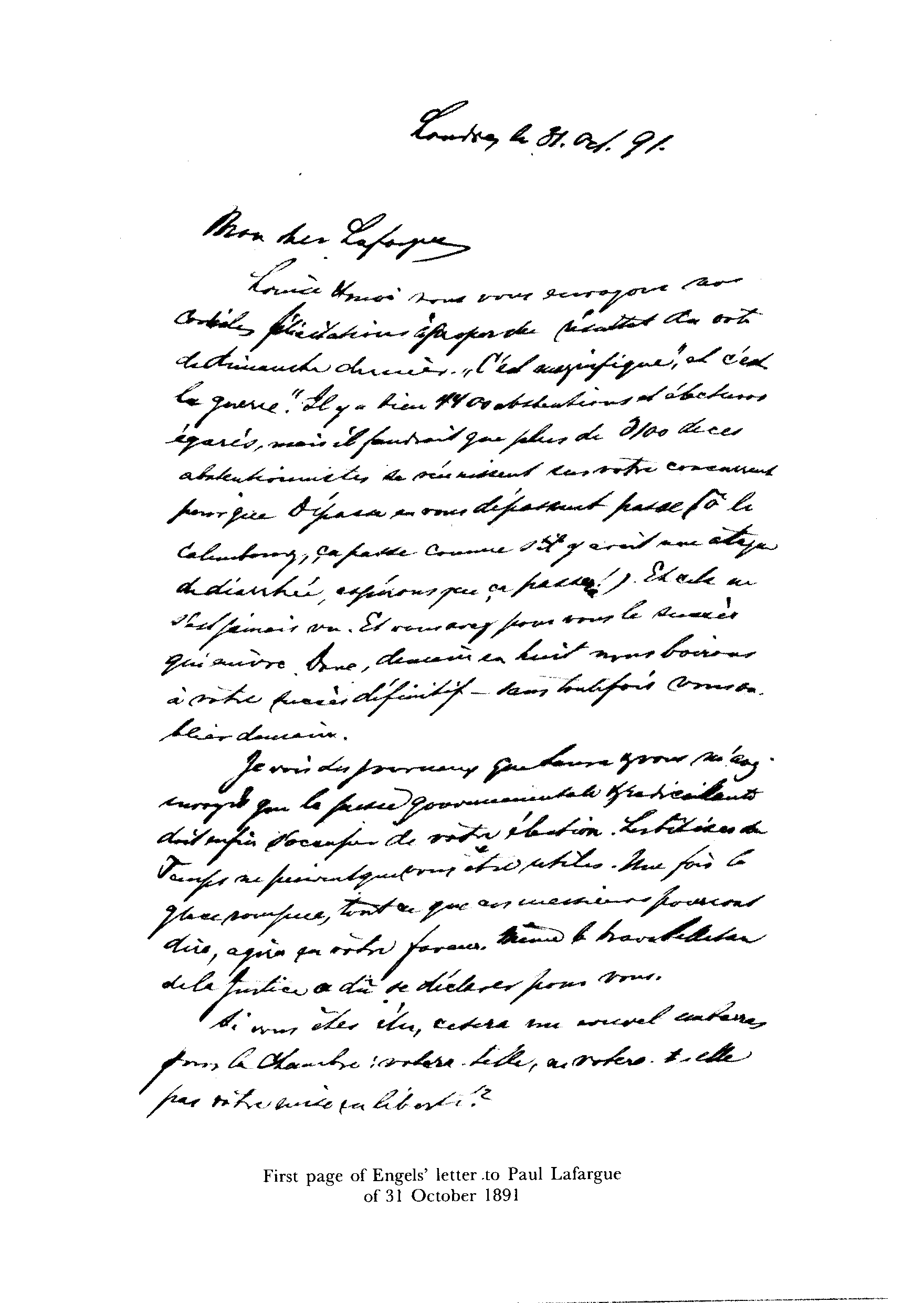
First page of Engels' letter .to Paul Lafargue of 31 October 1891
Anyway things are going ahead in Germany and before long the same thing will happen in France. We shall, perhaps, avoid a war and, since we are slow and methodical, that may give the French a chance to overtake us again by pulling off some mighty coup. It au-gurs well for the fin de siècle' and could put 1793 in the shade.
What idiots your bourgeois and the Russians are! In a war, England with her fleet and her command of the sea would hold the balance — which is why those gentry are impelling her into the arms of the Germans by teasing her on the subject of Egypt[346]!
Love to Laura — the Viennese women's paper[3] hasn't appeared yet — for want of money, no doubt.
Yours ever,
F.E.
146. Engels to Conrad Schmidt. 1 November[2 6 7]
Dear Schmidt,
First of all, my congratulations on your engagement and, I hope, very imminent marriage. Let me know what the fateful day is to be so that we may drink to the health of yourself and your young bride, as we shall meanwhile be doing at lunchtime today with a glass of port.
May I also congratulate you on the agreement with Guttentag; it's a worthwhile undertaking but you will have to devote a good deal of time to it.[347] Next week I shall be tackling Volume III b (which partly explains this expeditious reply since all my correspondence must be polished off first), and won't, I think, have to stop till whole thing's polished off. Thus you will also be able to include this essential final section.
You cannot, of course, do without Hegel and he's another chap whom it will take you time to digest. The short paper on logic in the Encyklopädie would be quite good to start off with, but the edition you should have is that in Volume 6 of the Werke — not Rosenkranz's separate edition (1845)—since the former contains far more expla-natory notes from the lectures, even if that idiot Henning himself frequently fails to understand the latter.
In the introduction, in §26, etc., you have first the critique of Wolfs version of Leibniz (metaphysics in the historical sense), then that of the English and French empiricists in §37, etc., then that of Kant, §40 et seqq. and, finally, that ofjacobi's mysticism, §61.— In the first section (Being), you ought not to linger too long over being and nothing — the last paragraphs on quality followed by quantity and measure are much nicer, but the theory of essence constitutes the main section: the dissolution of abstract opposites into their insub-stantiality when, as soon as one tries to grasp one aspect alone, it changes imperceptibly into the other, etc. At the same time you can always clarify things by means of concrete examples. E. g. you, as a fi-ancé, and your affianced yourselves present an outstanding example of the indivisibility of identity and difference. It is quite impossible to ascertain whether sexual love is the pleasure derived from identity in difference or that derived from difference in identity. Remove the difference (in this case of sex) or the identity (the humanity of both), and what remains? I remember how tormented I used to be at first by this indivisibility of identity and difference, though we cannot take one step without stumbling over it.
On no account, however, should you read Hegel as Mr Barth has read him, namely so as to discover the paralogisms and shabby expe-dients that served him as tools for constructing his system. That is a schoolroom exercise, nothing more. What is far more important is to discover the truth and the genius beneath the falsity of the form and the factitious context. For instance, the transitions from one category or opposite to another are almost always arbitrary — and are often achieved by means of a.joke, as in §120, when positive and negative 'fall to the ground' so that Hegel may proceed to the category 'ground'. To rack one's brains over this is a waste of time.
Since, in Hegel, each category represents a stage in the history of philosophy (as, indeed, he usually indicates), you would be well-advised to read the Vorlesungen über Geschichte der Philosophie — one of his most brilliant works — by way of comparison. For recreation I would commend the Ästhetik. Once you have gained some familiar-ity with it you will be amazed.
The inversion of Hegel's dialectics is based on the assumption that it is the 'self-development of the idea' of which, therefore, the dialectic of facts is only the image, while the dialectic in our minds is but the reflection of the actual development taking place in the natural world and human history in obedience to dialectical forms.
You should try comparing the Marxian progression from commod-ity to capital with the Hegelian from being to essence; this would give you quite a good parallel — on the one hand, the concrete development which follows from the facts, on the other, the abstract con-struction, in which extremely brilliant ideas and, in certain cases, very just transformations such as that of quality into quantity and vice versa, are elaborated to produce what appears to be the self-development of one notion out of another, of which, indeed, it would be possible to concoct a dozen of the same kind.
The noble Wolf has sent me his opusa in the form of an off-print. But, although asked by an anonymous 'admirer'b whether I intend to 'box the fellow's ears', I haven't looked at it yet. An academic ofthat sort can wait.
The party congress went off very well.[301] The amount of attention devoted to the 'opposition' did no harm; though it may have amused the philistines it undoubtedly had a very salutary effect upon the party.
Bebel and Adler spent a few days over here after the Brussels Congress,[135] when we were all very jolly. Bernstein's excellent introduction to Lassalle is coming out in English.[334]
" J. Wolf, 'Das Rätsel der Durchschnittsprofitratc bei Marx', Jahrbücher für Nationalökonomie und Statistik, 2. Bd., 3. Folge.-b See this volume, p. 241.
147. Engels to Laura Lafargue. 9 November
Well, I hope that a whole lot of students, both male and female, will attend your first course of lectures. Kindest regards.
Yours,
F. Engels Mrs Kautsky sends you and likewise your fiancée her most sincere congratulations.
147
ENGELS TO LAURA LAFARGUE
AT LE PERREUX
London, 9 November 1891
My dear Laura,
Victoire! Though hidden in one of its most desolate corners, amongst the paragraphs that help to make up columns, The Daily News did inform us that Paul had beaten Dépasse (who now would do well to change the a of his name, source of so many calembours, into i) by 1,400 or thereabouts/ So the two toasts, in Port and Claret, offered up yesterday by us, were not without effect. Well, that's so much gained. And what is worth more than the victory itself almost, is the way in which it was won and which turns a common by-election into a great political action, a cause of incalculable effects. Paul may well back his Constans against the roi de Prusse b as an involuntary promoter of Socialism; but the real likeness lies between Constans and Bismarck, as it laid between Bismarck and Louis Bonaparte— they all partake of that short-sighted cleverness and Dumm-schlauheit0 of the ordinary merchant and speculator who aims at one thing, and by miscalculating causes and effects, arrives at effecting the very opposite.
Anyhow Constans' stupidity has resulted not only in Paul's election, which gives a tremendous élan to Socialism all over France, but also in loosening the coalition for the maintenance of the ministry which was formed against Boulangism at the Rue Cadet.[223] I don't think the mass of the Clémencist Radicals will as yet fall away from the ministry, they are held too tightly. But the old feeling of security does no longer exist since the Roche-debate.3 iS And some, the more consistent elements like Millerand, can hardly keep within the ministerial alliance. That, and the personal ambitions and intrigues within the ministry will be sufficient to bring on a change — and every change loosens the bonds between the Czar" and French Chauvinists, and thus is in favour of peace. By the bye, what an irony of history that the Russian government, after having spent millions on Boulanger, must now spend fresh millions on the very people who upset Boulanger!
It was a nice exciting time and I have to thank you very much for enabling me to follow all the péripéties of it in the Paris press. What a miserable helpless political ass that Ranc has become. Il doit être en train de s'enrichir, celui-là!h
I have sent a few lines of humorous congratulations to Paul direct, so that M. le directeur de la prison might have the perusal of them.[153]
If he should confiscate them I will send you a copy. But I hope and trust there will be more respect shown to M. le député.
I am anxious to see what Constans and the Chambre will do now. If they try to keep Paul in Ste-Pélagie, it will be all the worse for them.
It strikes me Mother Crawford is not far wrong in saying the strength of the present ministry is its having brought about outward signs of the French and Russian entente; and that this makes the Radicals [147] fear a dissolution.[1] But if, as is probable, internal dissensions break up the ministry, taking advantage of another such doubtful victory as that on Saturday week,d then everything changes. First, the Russian entente becomes very vapoury as soon as the instability of governments is evidenced again, and secondly, if the Cabinet splits up, either fragment will claim the merit of that entente. And thirdly, after a split nobody can tell either what the reconstruction may turn out to be, or how long it may last.
I have looked at the Justice of Clemenceau lately again more often, and it strikes me that at the bottom of the antiboulangist Alliance must have been the idea that there was only one way of taking the wind out of the sails of any present or future Boulanger, and that is: to close with Russia at any price and then hasten on the guerre de re-vanche.* That is the only conclusion I can draw from the tone of the Justice: soyons plus patriotes que Boulanger! b And no doubt that plan would suit them all: settle the account with Germany, raise France again to a position of supremacy (which Russia might allow them to show of, provided France gave her the reality) and then, but not before, settle our internal republican party quarrels. Unless that is the fact, I cannot make out either the language or the action of the Radicals. They may be fools, but there is a limit to all folly, outside the madhouse at least.
Louise is going to write a few lines, so I close with love
Ever yours,
F.E.
My dear Laura,
I am very proud that my definition of the letters M. P.[335] turned out right at last though you have been right before and are right as long as the things last. The notice about M. P. (in your sense) election was underneath a paragraph 'The murder of a wealthy widow'; General found it out, as I did not know, that the election of a Socialist ranges itself under the impression of a bourgeois...0
148. Engels to August Bebel. 9-10 November
Dear August,
Thank you for your letter of 29 October and the many other things you have sent me, including the postcard of 30 October.[349]
So Lafargue has won a victory.[330] It's quite an event, firstly because of the immediate impact on France, which will be very great, secondly, because on his occasion literally all the socialist parliamentary groups, including the Possibilists[3]—if sometimes wryly—, pulled together, and thirdly because, with a low cunning and brutal-ity worthy of a Bismarck, M. Constans succeeded in turning what was merely a second ballot into a gripping political drama.
The government had two main vantage grounds: 1. Victory over the common threat, Boulanger. 2. The apparently deliberate display of an intimate relationship with Russia. Add to which a 3rd, namely the display, successful at any rate so far as the plebs were concerned, of France's newly restored military might during the big September manoeuvres. These 3 points enabled the government to compel the extreme Left to support it; the combined 'Republicans' constituted a majority vis-à-vis the combined Monarchists, Boulangists and to some extent also socialists. Then, contrary to the practice of 1869, Constans did not set Lafargue free to enable him to stand as candidate. In this the Radicals could not go along with him. Hence the big debate on the 31st October, following Roche's interpellation,[348]
hence the government's Pyrrhic victory — 240 for the government, 160 against, but — 170 monarchist abstentions. In reality, therefore, anti-government majority of 90. Defection of Radicals ' [4] [7] therefore = fall of the Cabinet the moment the Monarchists desire it and vote with the Radicals. After the division, needless to say, the alarm of the Radicals was as great as that of the government, especially since the latter threatened to dissolve parliament while giving the Radicals to understand that they would find the electorate far more pro-government than the present Chamber, as seems more than likely. In short, Constans' behaviour has shown the 'one Republican' mass that, after the disappearance of the only opponent capable of uniting them, there are internal questions which hopelessly divide them; the rift exists, cannot be patched up and, now that Constans is flouting all the republican conventions by his continued detention of Lafargue in Ste-Pélagie, things will liven up still more. Not that I anticipate the early demise of the government as a result of the Radicals' defec-tion— on the contrary, there are likely to be a number of occasions on which the latter, having scored a victory despite themselves, will have to eat humble pie and beg the government's pardon; but within the government itself there is open warfare between Freycinet and Ribot on the one hand and Constans and Rouvier on the other, warfare which another doubtful division might bring to a head, thus inducing a split and, with it, a change of ministers, renewed instability in the Cabinet, i. e. a cooling off of Russia's ardour since what the Tsar needs is stable government in France; and finally — fresh elections under different circumstances and with different results. While Liebknecht goes into ecstasies in the Vorwärts about the non-existence of chauvinism in France, the Paris press — which I have been able to study exhaustively during the period of the elections — and notably Clemenceau's Justice which Liebknecht, I believe, also sees every day, has convinced me that the secret behind the 'Republicans" (Opportunists, Radicals, Possibilists[3]) anti-Boulanger pact was the government's determination to outbid Boulanger in patriotism, to engineer the Russian alliance, to present the army to the world as ready for battle, to rattle its sabre and, should a retaliatory war ensue, to conduct it with might and main — in other words, to head as straight as maybe for a retaliatory war, the dearest wish of every French bourgeois. Just as the republic of 1849 and 1871 was the form most calculated to unite the Monarchists, so now retaliatory war is the issue that will most surely bring all Republicans, i. e. all middle-class ones — for the workers count only as election fodder — into the same fold, indeed the only issue that could bring this about once the republic had been attained and consolidated. Retaliation was the secret of the Boulangists' success — let us preach retaliation! The re-acquisition of Alsace-Lorraine! If you compare La Justice of pre-Boulangist and Boulangist days with that of today, you would find it hard to draw any other conclusion. But that is against Liebknecht's principles. In France, a strong chauvinist tendency cannot be allowed to exist, it would fly in the face of the eternal principles and hence it is denied. If things go on like this, you people may have to pay dearly for the policy pursued by the Vorwärts, and come to rue the fact that the man who directs your foreign policy is colour-blind. I don't know what ideas Hirsch may have on the subject; at one time he, too, used sometimes to harbour curious views in regard to France. But no doubt he will be open to discussion.
10 November. So Lafargue has been set free. For the period of the session — and even Meyer Opper von Blowitz doubts whether he will have to go back to Ste-Pélagie once it's over. That represents another defeat for Constans. At first he and his Opportunists wanted to keep Lafargue in gaol — but the conviction that, if they did, the Radicals and Monarchists would form an are^-government majority and set him at liberty, compelled the gentlemen to give way. So the extreme Left has twice been compelled to disassociate itself from the government.— The politics of the French Chamber, by the by, are completely incomprehensible to anyone who fails to bear constantly in mind that the government and the Opportunists are exploiting their term of office for their personal enrichment in the most outrageous manner and that the vast majority of Radicals are not only implicated but have an interest in these goings-on, and are only waiting for the time when they are strong enough to seize power themselves and skim off the cream which is now the prerogative of the Opportunists.
Now for an example of the vicious stupidity of the French government: a few days before the second ballot at Lille a levy was made in Fourmies as a result of which 30 young men were drafted into the battalion of the 145th Regiment garrisoned at Maubeuge, the regiment which, on May Day in Fourmies, had opened fire on these same men [2 4 3] — and among those 30 was the brother of Marie Blondeau, the girl killed on May Day by this self-same battalion. You'd think you were in Prussia. The Vorwärts chooses to ignore all this!
There was much rejoicing here over your victories in Berlin [349] and Vollmar's most resounding and, for him, unpleasant defeat in Munich.[344] It will, I imagine, be some time before you have any more trouble with defections and/or expulsions, and in the meantime the party will grow to such an extent that this particular method of opposition might very well disappear altogether. But whether it will be pleasanter for you when the cabalist crew remains within the bounds of legality is another question.
The Zurich business[350] has shown you yet again how much of a drag on you the foreign associations are. Could you not seize on the opportunity and sort things out once and for all with that gang? The
Vorwärts dealt admirably with Hans Müller, but that doesn't prevent these foreign idiots from presuming to subject you to a vote of no confidence. In this country the same thing applies to the Society[89] and Gilles." Unless you counter Gilles' statement by publicly declaring how the said Society stands vis-à-vis the party, no amount of protests in private letters will be of any avail. That you people are responsible for the stupidities of this gang is simply taken for granted over here — and with justice, in view of the Society's past history, so long as you people remain silent.
We were very pleased about Stolp-Lauenburg and your article on the subject in the Vorwärts, which fully accords with my views.[351]
The bulk of rural day labourers east of the Elbe (as also in England) are in fact still too much in thrall for our propaganda to have any real effect until they have been through the dame school of Progress.[296] It is the task of the men of Progress to pave the way for us there, and this they will surely do. So if in Berlin their inertia is such that, as opposed to ourselves, the men of Progress must be accounted part of the reactionary mass, in the rural areas their position is decidedly different at any rate as things are now. Admittedly this won't go on for long.
Though the term of the Reichstag has been extended to 5 years,[352]
it is likely to be interrupted. Provided the pressure is kept up, the majority will disintegrate and the government will have to resign because it will have no alternative. Particularly in case of war. This very winter you may witness some ludicrous goings-on.
I am glad to hear that so much sympathy is already felt for us in technologically educated circles.[353] But from what I experienced in 1848 and 1870/71 of the French Republicans, who were after all themselves bourgeois, I know only too well just how far one gets with such silent hangers-on and sympathisers — in time of danger — and how horribly one can put one's foot in it, not to wish for a couple of years' respite in which to take a closer look at these gentlemen's quali-fications and character, particularly in relation to so important a business as the socialisation of large-scale industry and large-scale agriculture. Not only would this save friction; it might also, at a moment of crisis, avert an otherwise inevitable and decisive defeat. There will
See this volume, p. 269.
in any case be stupendous blunders, and plenty of them — that is inevitable. As you yourself have said, there are, among the postulants, plenty whose ambitions exceed their talents and knowledge, nor have I forgotten what Singer once said to me, apropos of Nonne, about students being driven into the arms of Social-Democracy by their fear of examinations. However, the very fact of their coming is a portent of what lies ahead.
In Russia the famine is assuming fearsome proportions. At Simbirsk, rebellious starvelings are given 500 lashes, i. e. flogged to death. The winter wheat in the south either could not be sown because of drought or else has been killed by an early frost. So there'll be more distress next year. It would seem to me that the Russians are bent on appeasement (Giers' trip to Milan), having also put a bit of a damper on the overhasty overtures of the French, and it was precisely because of this that the Tsar felt he could afford to travel across young William's domains without paying him a visit which is, after all, a flagrant case of lèse-majesté.[3][54] Only wait till the French Ministry begins to totter, and then you'll see how peace-loving the Tsar becomes— needless to say without desisting from his encroachments in the East and in Central Asia.
Yesterday Salisbury told the jackasses and speculators in the City that not one little cloud troubles the peaceful horizon. That would be a bad sign, for in 1870, a fortnight before the outbreak of war, the same thing was said by Granville, the Foreign Secretary.
The French September manoeuvres with 4 army corps were a fear-ful sham. Sir Charles Dilke, Parnell's colleague in adultery — albeit on a different basis — described them in enthusiastic Francophil terms, yet his article shows that there was much that was exceedingly rotten and much that had remained unchanged since 1870. Notably the inefficiency of the officers. Once the chaps begin to mobilise on a large scale, even more inadequacies will come to light.
Regards from Louise.
Your
F. Engels
The Russian loan [3 0 2] weighs heavily on the Paris bankers. Has dropped 4% below the issue price, and crowds of people in this country are busily disposing of other funds and shares so as to be able to make a fresh payment to the Russians on the 20th of this month in Paris.[2]
149. Engels to Oscar Heidfeld. 12 November[3 5 5]
Dear Sir,
...I still hold the documents mentioned in your letter[356] but they are of no value whatever now, the policy having lapsed long since through Mr Dronke's failing to pay the premiums as he ought to have done. The very first premium due in November 1877 I did pay expecting to be repaid by him, but when I applied for the money he never replied, nor have I been able ever since to make out his address, though my Manchester solicitors took every trouble to find him out. Under these circumstances, and in view of the almost certainty that the gradual payment with interest on the same and on the original loan would eat up more than any possible return for the policy, there was nothing left to me but to let the policy drop.
From what you tell me I must conclude that the same result would have been arrived at had he not pledged the policy.b
time
150. Engels to Friedrich Adolph Sorge. 14 November
Dear Sorge,
A line or two in great haste before the last post goes. You will have heard by cablegram about Lafargue's victory.[330] It was brought about by M. Constans, who is as stupidly cunning and doltish as Bismarck, if not more so. 1. In a scandalously biassed trial he blamed Lafargue for the government's fusillade at Fourmies[2] [4 3] and got him sentenced to a year's imprisonment. 2. Having thus made Lafargue enormously popular in the Département du Nord, and after the latter had been put up for the first seat to become vacant at Lille, Constans kept him in prison, contrary to the precedent established 22 years earlier by the Empire itself, instead of releasing him for the period of the election; 3. when, in the first ballot, Lafargue polled 5.005 votes, i. e. only 780 fewer than were needed for an absolute majority, Constans still did not release him, despite being severely rapped over the knuckles by the Chamber. Since the Radical candidate,[147] Roche, who had polled 2,274 votes, then proceeded to step down in favour of Lafargue, Lafargue's victory was assured.
But the best thing about it is that that idiot Constans further succeeded in making Lafargue's election into an événement* thereby seriously endangering his own position. For on 31 October, when a demand for Lafargue's release was made in the Chamber by Millerand, the proposal to go over to the order of the day was carried by 240 votes against the Radicals' 160. But only because 170 Monarchists did not vote. This was the first time the Radicals had voted against the government since the Boulangiade, thus demonstrating that the government can be top-pled at any moment by the combined votes of the Radicals and Mon-
event archists. And when, after Lafargue's election, a motion for his release was again tabled on 9 November, it was only the prospect of those combined votes that forced the government to abandon its intention of opposing the motion.
But now that the Cabinet is torn by dissension and Freycinet would rather obtain his majority through the Radicals, whereas Constans would rather do so through the Monarchists and against the Radicals, now that Constans has incurred the odium of the workers by his actions since May Day and his friend Rouvier is the most notorious and corrupt man in the Ministry, while Carnot, for his part, finds Constans intolerable because the latter is trying to succeed him, Carnot, as President of the Republic, all these parliamentary fluctuations assume significance. For the recurrence of ministerial instability in France is another guarantee of peace, since the Tsar would be chary of going to war arm-in-arm with a French government that is liable to topple any day.
Again, these symptoms are significant so far as France's domestic situation is concerned. A large number of Radicals — Millerand, Hovelacque, Moreau, etc.— realise that they simply can't do without the workers and that the government's duplicity in introducing into the Chamber bills ostensibly favourable to labour while ensuring that these are thrown out by the Senate, is something that just won't do. But if Lafargue should now get in and the small 7 or 8 strong socialist group — all of them small fry and incapable of any initiative — thus obtain a leader, things might soon begin to change. Only on condition, however, that Paul himself doesn't allow his eighth or twelfth part of negro blood to run away with him.
In Germany everything is going swimmingly. In Munich [344] itself Vollmar suffered an even more decisive defeat than at Erfurt.[301] The opposition ' [3] is virtually non-existent, and will soon be completely under the wing of the police. Any newspaper reports to the contrary, particularly such as are cabled to you, are false — I have seen some prime examples of this.
What will happen about the Vorwärts I cannot say. It has improved, but Hirsch isn't going to join it. Not that I really regard this as a misfortune.
Regards to your wife.(36)
Your
F.E.
1906 and in full in: Marx and Engels, Works, First Russian Edition, Vol. XXVIII, Moscow, 1940
151. Engels to Friedrich Adolph Sorge. 21 November[3 5 7]
Dear Sorge,
Have had your' letter of 6 and postcard of 8 November. When Adler and Bebel came over here from Brussels, the former promised me that he would send you the Vienna Arbeiter-Leitung regularly, and the Viennese stand by their word. Now that the Austrian movement is growing in importance, I am having to keep copies of the paper myself.
Der arme Teufel caused much merriment over here. Adler took the first Adolfinade with him and I sent the second to Bebel.
It goes without saying that you should publish Marx's letters to yourself if you want to, without asking me or anyone else. As soon as your articles on the American labour movement are complete, you ought to bring them out — booklet form[358] — in Dietz's Internationale Bibliothek, say — so that they can be kept permanently together.
If you like, I could do what is necessary to set the ball rolling with Dietz. He will, of course, have to pay for the things again.
Bakunin's biography[325] received with thanks — haven't looked at it yet.
In one of my letters(37) I asked you not to send me any middle-class American reviews — I can get all the good ones over here (from Mudie's) if there's anything in them — and Tussy keeps her eyes open. On the other hand I was about to add a request when I was interrupted and thus sent off the letter as it stood; namely, that you send me from time to time individual numbers of some women's rights organ— any old one. Louise looks at such stuff from time to time in order to keep herself — and hence also me — more or less informed about that racket.
In Berlin and other cities more victories in the municipal elections— in Berlin the number of votes has trebled.[359]
The Jungen[301] have formed an association[333] and are bringing out a rag, Der Sozialist—impertinent and silly. Nothing but tittle-tattle and lies. True, they would be easier to combat if Liebknecht didn't make so many blunders and edit the Vorwärts so deplorably.
So Mrs Schlüter intends to come back after all! Just as we thought. In this country, too, we have scored sundry litde victories in the municipal elections; in West Ham (it's called WEST BECAUSE EAST OF THE
EAST END), Will Thorne, secretary of the Gasworkers Union[164]
and a really splendid chap, was elected, etc., etc.
Warm regards to your wifeb and yourself from
Your
F. Engels
1906 and in full in: Marx and Engels, Works, First Russian Edition, Vol. XXVIII, Moscow, 1940
152. Engels to August Bebel. 25 November
Dear Bebel,
I had been trying to find time, in the intervals of work on Volume I I P now proceeding at a good, brisk pace, to answer your letter of the 15th, when some news arrived which compels me to write forthwith. At a meeting at Bordeaux on the 22nd [360] Lafargue is alleged to have said that in 1870 he had servi le pays à sa manière en communiquant à M. Ranc des plans qui, si l'on en avait tenu compte, pouvaient complète-ment changer la face des choses. Ces plans lui étaient communiqués par des frères de l'Internationale en Allemagne, parmi lesquels se trouvaient plusieurs officiers de l'armée allemande}" Now Lafargue cannot have said this, but I can't for the life of me think what he did say. However, the thing is so patently silly and the accusation so monstrous that you people probably ought to reply to it before you hear what Lafargue actually said. In order to ascertain the facts, I at once wrote yesterday, and again today, to Laura and to Lafargue himself,[153] to whom I also said that you would probably have to take immediate countermeasures and that if you showed a total lack of consideration for him, he would have to lump it. Not that he really deserves any; but all the same I would beg you not to act in anger which, as so often in my own case, always leads one to do something stupid; rather you should do all you can to ensure the continuance of concerted, or at any rate parallel, action with the French workers. Ybu will, of course, repudiate any suggestion that the above preposterous assertion could apply to yourselves —that goes without saying. You did not yourselves, directly or indirectly, send the French government in Bordeaux either military information or plans from German officers, having, so far as I know, had no connections of any kind with officers at that time. So the more vigorously you repudiate this truly insane accusation the better, though I would suggest that it would nevertheless be advisable, and also less conducive to eventual complications, for you to repudiate only the report as such, without as yet holding Lafargue responsible for it. After all, this would not preclude a further statement as soon as the text is known; I shall let you have this the moment I get it.
What Lafargue can have said and what he had in mind, I simply cannot conceive. For neither did we, the General Council of the International in this country, have any connections of any kind with German officers, and thus were never in a position to send him 'plans' of that description from gentlemen of that ilk. And even if he had been able to establish connections elsewhere in France upon his revis-iting that country — I believe in 1868, after his marriage (or in 1869 — I couldn't exactly say at the moment)—he concealed the fact from us so carefully that nothing whatever transpired before his return to France in 1880, nor, for that matter, has it done so since.
At all events, he has committed a quite unpardonable blunder— whether he told lies or tales out of school is something he himself must decide — and placed you people in a position such as might very well rob you of all desire for international intercourse. While I fore-see the nature of the deluge that is about to engulf you, I cannot yet see how it is to be stemmed. I can only suppose that it's the eighth or sixteenth part of negro blood which flows in Lafargue's veins and occasionally gains the upper hand that has led him into this quite inex-plicable folly — it is, to put it mildly, a quite inconceivable piece of stupidity.
In view of the large number of German officers who settled abroad in 1848/49 and after, there is always the possibility that something of the kind came into his hands, but to make the frères d'Allemagne* responsible really does take the cake.
Should you so wish, I shall at all times be prepared to testify that on no occasion during the war was the General Council of the International in a position to pass on to France information of any kind deriving from you, other than what was to be found in your own newspapers; indeed I should be prepared to make any statement that might help to clear you of the slightest suspicion of conniving at such foolishness. For if anything of the kind did happen, you people were as innocent of it as the unborn babe.
Nevertheless, these confounded vexations gave way to joy last night upon our learning from The Evening Standard of the victory in the Halle elections.[361] This does after all go to show that, despite all the blunders made by individuals, we as a mass continue to advance.
Apropos, what I wrote on the postcard [1 5 3]—I thought somebody over there would be able to read it — was Russian: Da zdrdvstvuyet Berlin! Long live Berlin!
But now, luckily, it's time for the post — registered, which is safer, so I shall deal with the contents of your letter in my next. The Russians would appear to be drawing in their horns; the bankers in Paris have had difficulty moving the loan and the Russian government has had to take back a third or more as unplaceable [3 0 2]—on this occasion the unpatriotic character of capital again appears in a favourable light.
Writing to your wife(38) is another pleasure I shall have to keep in store. She will have had a letter from Louise.
Your
F.E.
Works, First Russian Edition, Vol. XXVIII, Moscow, 1940
153. Engels to Laura Lafargue. 27 November
My dear Laura,
You need not be afraid that it ever entered my mind to think Paul capable of a wilfully mean and dishonorable action. That is entirely out of the question. But the man may be the very soul of honour, and yet commit an et our de rie? the consequences of which may be incalculable. And my letters contain no charge against Paul except the expression of the possibility that he may have been led into such an étour-derie, and, besides, the attempt, supposing that to be the case, to help him out of it as much as lay in my power. To do which, it was absolutely necessary to make clear to him the full portée(39) of the words put into his mouth.
Now you yourself admit that it is just possible he may have been led to commit such a blunder.
To recall the facts. On Monday eveningb The Evening Standard contains the Reuter[360] which showed to me the necessity of immediate action, 1) to obtain authentic information, 2) to prevent further blunders, in case one had been committed. Hence my letter to you [153]
which I hope you will, on re-reading, find less unjustifiable than when you had read it first. Well, the same night, or next morning at latest, I receive from you 1 ) the enclosed cutting from a paper not named — from which report Reuter had evidently abridged, 2) an Intransigeant 25. Novembre where under the heading: 'Le cit. Lafargue à Bordeaux', it is equally stated that on 22 November Paul, before a meeting of cinq ou six cents personnes ... dans la salle des Chats, said qu'à différentes reprises il avait (en 1870) remis à M. Ranc, alors directeur de la Sûreté générale, divers plans et documents importants sur la situation des armées allemandes qui lui avaient été communiqués par des socialistes allemands et qui au-raient pu changer la face des chosesd etc. etc.
From that I was forced to conclude thatjyo« knew the contents of these two reports, and that the very fact of your sending them to me without a word of comment, implied a tacit acknowledgement that they were in substance correct. On that conclusion, and moreover remem-bering certain expressions in the Lille speech, equally sent by you, and which expressions I considered at least uncalled for, I could not act otherwise than write to Paul my letter of Wednesday 25th.[153]
Now of course I see that you had never read a report of Paul's speech, and that my letters to you and to Paul gave you the first inti-mation of what had been put into his mouth. But now you will also see that this is a matter which must be attended to; that the statement about the action of some German socialists during the war of 1870/71 — whether substantially true or substantially false — ought never under any circumstances to have been made, if it was made, and ought to be clearly and unmistakably disavowed, at once, if it was not made; that so long as this report is not completely and absolutely disposed of, it will be absurd to expect our German friends to place any confidence in our French friends; and that the government and bourgeois in Germany will at once exploit this report against our German party in a way which is absolutely incalculable; if it leads to nothing more than a renewal of the old Socialist law, ' ' it will be lucky!
So if Paul has been slandered, if he is prepared to declare publicly that he never said a word implying in any way the assertion that German socialists, either in or out of Germany, provided him with military statements, plans, news or anything of the kind for the use of the French government during the war 1870/71 — then let him send me that declaration at once and in a registered letter. But it must be plain, without reservation or qualification of any kind, or it will be useless and may turn out worse than useless.
If that plain declaration cannot, for one reason or another, be made, then I see no other way out of the mess but that you and Paul come over here at once and discuss by word of mouth such matters as will evidently be fitted for that mode of settlement alone. Your presence will be almost as necessary as his, to moderate our hot heads and to give us the views of your cool head on the situation in France; and also to help us in finding 'the way out' by your feminine sagacity and souplesse,* in cases where we male clumsy stick-in-the-muds are left in the dark. You see I am anxious as anxious can be, to keep Paul out of the difficulty if he has got himself into one; but the very first thing is to prevent the commission of fresh mistakes in case one has already been committed. Tomorrow his election [330] will be settled, on Monday at latest I shall have the first reports from Germany on the effect of this thunderbolt from a clear sky, so if you come on Sunday, to be here in the evening, we might succeed in dispersing at least the worst of the clouds on Monday. A telegram 'Coming to-night' would be agreeable, as we receive no letters on Sunday. And under all and any circumstances I do hope Paul will not take any public steps in a matter deeply concerning other people without first consulting these people, the slightest blunder might be fatal to himself, and he will see, I hope too, that this is no joking matter and must be got out of the world as soon as possible.
Ever yours affectionately,
F.E.
154. Engels to August Bebel. 1 December . .'
Dear August,
At last, after three exuberant days, my birthday mood may perhaps have subsided sufficiently for me to write a moderately rational letter again. First, then, the Lafargue affair has been settled. I have today heard from Laura — Lafargue has gone to Lyons,[362] having only been in Paris for a couple of hours on Saturday to attend to his scrutiny — who says:
cord exists; 3. the incriminating statements are the invention of a reporter brodant sur le texte a"un article publié par Ranc[1] (embroidering on the text of an article by Ranc); 4. 'the words used by Paul were as follows: "If I insisted upon the war being continued, this was because the information at my disposal led me to believe that Germany was not in a position to hold out for very much longer." '
She adds:
'There was no question of plans obtained by Germans or through their agency; in general Paul declares that, throughout the war, he received no communications of any kind from Germany. And Paul also says that he subscribes to your demands, and not only subscribes to them but challenges any refutation of his above statement.'
(Le Perreux, 28 November; only reached me today.) [363]
In his letter to me (Lyons, 26 November), Lafargue says that the purport of his speech had been such and such, that in 1870 the International in all countries had considered it its duty to prevent the crushing of the French Republic by Bismarck's troops, and that while the other Internationals had fought under Garibaldi, the Germans had protested against the continuation of the war and the rape of Alsace-Lorraine.
My demands to which he subscribes were for the repudiation, without reservation or qualification, of the statements ascribed to him and of their purport. These you now have and may use as you think fit.
So that's one weight off my mind, I'm glad to say. Thanks to the colossal stupidity of our enemies, they have lost this opportunity for a scandal, and now it is gone for ever. Should anything be brought up now, you will be forearmed and your assailants will look foolish in the extreme. But while the uncertainty lasted we over here were in a muck sweat, I can tell you, for fear that some reptile[364] or other should get his fangs into the thing before we knew what answer to make and how to give him the lie. But what idiots they are! As Tussy said only last Sunday, if we had got hold of some information like that about our enemies, what wouldn't we have done with it!
I missed the incident at Potsdam involving William II; what was it [3 6 5]? The affair would certainly seem to be assuming a growing pace, and every such straw in the wind is.of interest. According to the papers over here, your Emperor intends to relinquish all the honorary colonelships he holds in the Russian army because of the impo-lite way in which Alexander travelled across his domains.[354] I should say that the Russians are trying to inveigle him into untimely esca-pades so that he may appear to be a disturber of the peace whilst they, who are pretty well unassailable, can afford to play for the highest stakes and allow him to purchase peace at the price of further concessions. That they really intend war seems to me impossible. The failure of the French loan [302]—instead of £20 million a bare £12; famine of unprecedented dimensions and intensity; the winter crops virtually destroyed by lack of seed and unfavourable weather; the wholesale death or slaughter of cattle and horses in the most fertile regions for lack of fodder, so that agriculture will be paralysed for years to come — all these are things which, in a semi-barbarous country like Russia, will deprive the army of any prospect of successful action. But despite all this> the Russians are not deterred from behaving politically as though they were deliberately heading for war; this they can permit themselves because of their strategic position and their exper-tise in betraying their friends. Of course, their little plan may always go awry — hence mobilisation and troop concentrations on a massive scale which, if things go off peacefully, can also serve as an instrument of diplomatic pressure.
Wonderful. France and Russia are confronting the Triple Alliance,[303] based 'on the existing status quo', with a Dual Alliance [288]
which has 'a far loftier principle, namely the maintenance of the treaties!' Or so the papers say. Thus France, wishing to break the Treaty of Frankfurt, declares itself desirous of supporting it with the help of Russia, while Russia, which customarily breaks all treaties, enters into alliance with this self-same France because of the latter's stead-fast demeanour. How stupid men such as these must consider the public to whom they address themselves.
Your budget speech was brilliant[366]—to judge by the Vorwärts. Do let us have the stenographic report. The allusion to our soldiers could not have been more apt. Why keep one's mouth shut about things our enemies know as well as we do?
The fact that Carl Hirsch isn't coming is not, to my mind, a disas-ter.[3] I didn't like to say anything once matters had been settled, but over here I at once remarked that it wouldn't work out. Hirsch is not only pig-headed but also embittered without reason, believing as he does that he was unfairly excluded from the editorship of the Sozialdemokrat; in fact, I believe that his resentment was directed more against Marx and myself than against you people.[367] For, as you will remember, what he wanted was that we should press him to accept, which had never ever crossed our minds. At all events he thereupon ceased to play any active role and has since accumulated such a mass of grievances and crotchets that, if for no other reason, it might, I think, be better were he to void his costiveness elsewhere, after which he will gradually return to a more normal frame of mind and thus again become capable of doing something worthwhile. But I feel sure that Liebknecht and he would not have endured six weeks of each other's company without falling out. Schoenlank, too, has certain bees in his bonnet; so far as I can judge he hasn't nearly enough guts to put up the necessary resistance and will soon chalk up so many sins of omission as to make his chief editor his chief in real earnest. Well, we shall have to wait and see how things go — they can't get very much worse.
You are always comparing the situation in Germany with that of 1787-88; it is far more like that of 1847 in France and the scandals which brought about the downfall of Louis Philippe: Teste, the venal minister, the duc de Praslin, who murdered his wife, an equerry to the king who was caught cheating at cards in the Tuileries, or Fould who paid bribes in high places to get into the Légion D'Honneur, etc., etc. What's odd is the way people in Germany carry on about a bank crisis; for the few tin-pot firms that have gone to the wall are quite outside international trade as such — money brokers to civil servants, officers, landed aristocracy, petty bourgeoisie — to everyone in fact except wholesalers. If Anhalt & Wagener, Diskonto-Kommandit, Deutsche Bank, etc., were to put up their shutters, then it might be permissible to speak of a bank crisis. But even so, things aren't so dusty and, if the cloak falls, the Duke will soon come tumbling after.(40)
What you tell me about the kind of 'comrades' who are now presenting themselves is most interesting and also significant so far as the situation is concerned.[368] They have noticed that we are, to use a rep-tilian expression, becoming a 'factor' in the state and, since the Jews have more intelligence than the other bourgeois, they are the first to notice this — especially under the impulsion of anti-Semitism — and the first to come over to us. We can only be glad of the fact but, precisely became these chaps are brighter and have, as it were, been thrown back on and schooled in careerism by centuries of oppression, one has to be rather more on the qui vive.
Please will you convey my best thanks to the parliamentary group for their kind telegram of the 28th.[369] As soon as I get the photographs I shall endeavour to pay back in kind all the testimonies of friendship I have received.
Ede tells me you had suggested that he should spend more time at the Society.[89] I am firmly convinced that every minute he spends there would not only be completely wasted but would also discredit the party. He would have to consort with Gilles there and that is completely out of the question. But what he ought to do is frequent the English, get to know the chaps personally and enlighten them about things in Germany by conversing with them; as it is, he sits at home and forms an opinion of local affairs from the accounts he reads in one or at most two newspapers, there being no coffee houses or reading-rooms in his district.
Finally, let me assure you — as expressly requested — that Louise has executed her commission with a dignity worthy of a president of the Reichstag — at the very least; she had no opportunity for making bad jokes since I invariably forestalled her with some of my own. In other respects we were, however, exceedingly merry during the time in question, not least on account of your ostensible admirer[370] who, on the last page, revealed himself to be a 'Junger'[301] desirous of placing you on the shelf. The fellow is really priceless, with his ultra-High German.
Warm regards to Mrs Juliea and yourself from Louise and
Your
F.E.
Works, First Russian Edition, Vol. XXVIII, Moscow, 1940
155. Engels to Laura Lafargue. / December
155
ENGELS TO LAURA LAFARGUE
AT LE PERREUX
London, 1 December 1891
My dear Laura,
Your letter of the 28th, postmark Le Perreux 30th, arrived today and took an awful weight off my mind.(41) I have at once sent a translation to Bebel and authorized him to use it whenever necessary.b
Fortunately the stupidity of our enemies in Germany has been so colossal that they have, so far at least, seemingly overlooked the whole affair. What I was most afraid of, was that they should raise a storm in Germany before we had been able to ascertain the facts and to be armed with the materials for a crushing reply. Hesitation on the part of the German leaders, or random assertions that might be contradicted, would have been equally dangerous. Now the first danger is over, and although it is quite on the cards that the German Embassy in Paris may have sent reports which in consequence of the usual bureaucratic delays get into the press a week too late, we have a strong position and can meet the charge if it should come.
Still for that purpose it would be important to have Ranc's article. If it was possible to broderc such stuff upon it, it must form a peculiar canvas, and not only the false report of Paul's speech,[360] but also Ranc's words may be quoted; and we ought to know what they are. Paul merely wrote, Ranc had written in his favour with regard to Bordeaux 1870. Could you procure us the number, and if not, at least say what paper it appeared in, that we may try to hunt it up here?
Now as to other matters.
1 ) Some time ago I sent you 10s. for account of Sorge for the Socialiste; please say whether you have received it, you know how particular old Sorge is.
2) Have you received the copy of 4th edition Ursprung der Familie d
I sent rather more than 3 weeks ago? I sent a lot of copies to the Continent and not one has been acknowledged. As the English Post sim-
156. Engels to Natalie Liebknecht. 2 December
ply confiscates book-post matter for abroad if a half-penny is short on the postage, I begin to feel rather anxious.
3) Tussy is bothered to death by Greenwood, the secretary of the glass-workers who has sent a lot of money for the French glassworkers on strike and cannot get a single acknowledgment of receipt. He says in a letter to Tussy November 28th that he has sent to Paul same day £49 for that purpose — will you please do your best to get Paul to acknowledge all sums sent through him and also to get Pierre Morrier of Lyons who has had several sums, to do the same? The Castleford Glass Bottle Makers have behaved very well to their French comrades, and the least these latter can do is to acknowledge receipt, so as to enable the senders to account for the money to their constituents. Unless this simple act is complied with, it will be doubtful whether the English Trades Unions will not get tired of supporting Continental strikes, and certainly nobody could blame them.
Bebel's speech on the budget was very good.[366] As soon as I get a pretty full report I shall send it you.
Last night a letter from Sam Moore; had arrived at Lagos in the Niger delta, and would be back in the arms of his black wife in about a week or ten days.
Yours ever,
F. Engels
156
ENGELS TO NATALIE LIEBKNECHT [3 7 1]
IN BERLIN
London, 2 December 1891
Dear Mrs Liebknecht,
Please accept my sincere thanks for your kind good wishes on yet another birthday[372]; they have, for the present at any rate, been pretty well granted, as I'm in the happy state of being physically fit and mentally alert and I trust this will so continue. We spent an exceedingly cheerful day and good wishes poured in from all sides; even Mr and Mrs Motteler paid us a visit while we were sitting down to our morning glass of beer. In the evening, however, we went to Tussy's where the Bernsteins were also present, and by doing so we frus-trated a serenade which had been planned for me by the choir of the Workers' Society.[89] As I did not hear about this until Saturday morning, I was unfortunately not able to warn the gentlemen sooner.[373] All in all I was not sorry that it turned out as it did; I have a deep-rooted aversion to such demonstrations which are impossible to get out of if one's occupation is that of agitator, popular speaker or member of parliament. However I have been lucky enough to avoid them up till now and intend to do so in future.
Otherwise there's nothing particularly new to report; Tussy enjoys the not wholly unjustified reputation of being in charge of the Union of Gasworkers and General Labourers [164] and the week before last she was away for eight days on a propaganda trip to Northern Ireland. But they are in fact quite splendid chaps, these gasworkers, and their union is far more progressive than any of the others. Moreover they're so conversant with agitation 'in conformity with the law' that eighteen months ago in Leeds they fought and won two regular battles, first with the police and then with the police and dragoons, and forced the city council, the owners of the gasworks, to capitulate.[374]
As an old soldier I'll say this for Will Thome, General Secretary of the union, who was in command during these battles — I could not find the slightest fault either in his strategic or in his tactical disposi-tions.
For the rest, we are leading a somewhat quieter life than at the time when the Sozialdemokrat was functioning. Apart from the Avelings and Bernsteins, we see only few people; the Mottelers seldom go out, the Mendelsons are busy with their Polish club on Sunday eve-nings and, since March of this year, Pumps and her family have been living in Ryde on the Isle of Wight where her husband runs an agency business. I go down to see them occasionally and in July spent a month there, accompanied by Schorlemmer [2 6 4] just at the time when the French fleet was in. So far as one can judge from their external appearance, their ironclads, which are of the latest design, are far superior to those of the British. Pumps leads a delightful existence in a little house some 20 minutes' walk from the town and right out in the country, which is obviously an enormous advantage so far as the children are concerned. She is very fond of the life down there and if, as we hope, her husband does well, they will all benefit from having ex-changed the air of London for that of the sea. The Isle of Wight is very pretty, indeed beautiful in parts; you can sail right round it in a steamer in seven hours, a very nice trip during which the tyro runs the risk of being seasick for about 2l/[2] hours.
Will you please give Liebknecht the enclosed notes and convey to him, as well as to your son,a my sincere thanks for their good wishes.
I trust that Berlin will continue to please you and that your health will permit you to enjoy the amenities of the 'imperial capital' in all its aspects. Meanwhile perhaps you will remember kindly
Yours sincerely,
F. Engels
Louise also sends her best wishes to you, Liebknecht and family.
V V , , I T I A» ,„.„ Published in hnehsh in lull tor the XXVIII, Moscow, 1940 _ . &
hrst time
157. Engels to Karl Kautsky. 3 December[177]
Dear Kautsky,
Your letter of 30 October has long been awaiting an answer; the blame for this must be placed upon Volume I I I b which I am once again sweating away at. I have just got to the most difficult part, i. e. the last chapters (six to eight or thereabouts) on money capital, banks, credit, etc., and, once having started, I shall have to keep at it without a break and work through the relevant literature again, in short make myself completely au fait, if only so that I may — as is probable — eventually leave most of it as it stands, yet at the same time feel quite sure that I have committed no blunders either in the positive or the negative sense.
Very many thanks for the reports on Erfurt[30] ' ; they were of value to me in many respects, the discussions of the programme committee being of particular interest. You describe the Executive's draft as his, Liebknecht's. Bebel sent me all the material relative to the genesis of this draft[269] from which it is evident that at each stage a fair portion of Liebknecht's initial work had been dropped and replaced with Bebel's propositions until in the end little or nothing remained. What did remain, however, was a lack of coherence, of rigour in the co-ordination of individual propositions, both being attributable to the consideration paid to Liebknecht's work. That was what gave your draft[299] the advantage, as everyone was bound to acknowledge at first glance, and it was that, too, along with Bebel's public admission of the fact, which immediately convinced the others.
The recent investigations, which have rendered obsolete Marx's chapter on the historical trend of capitalist accumulation,[375] are in any case the work of Geiser who is of course regarded in Breslaua as a genuine scientific authority. However it is also possible that in his embarrassment Liebknecht said (for he was obviously unaware that these propositions had been taken from Capital) the first 'bit of nonsense', as he would put it, that came into his head.
At any rate the theoretical part of the programme is now perfectly presentable; the main thing is that it should contain nothing that is theoretically controversial and in the main this aim has been achieved. The practical demands contain all kinds of snags; many of them seem philistine — if applied to conditions today — but now that we occupy a position of power we can reply quite rightly that they will certainly not be implemented until we come to the helm and that they will then assume quite a different character. As, for instance, free legal advice. A six hours' working day up till the age of 18 obviously ought to have gone in — as also the banning of night work for women and of any sort of work at the very least one month before and 6 weeks after a confinement.
I'm sorry for Liebknecht. For he had to sing the praises of the new programme although it was perfectly plain to everyone that he had had no part in it whatever. But he took on the job of his own accord, so what can one do about it?
What you say about Tölcke's speech is new to me and most interesting.[376] Ede's work' [7 8] goaded the Old Lassalleans into a state of great activity at a time when Marx's letter (42) had already roused them from the complacency induced by the obligatory deification of Lassalle. Even Jacob Audorf, the discoverer of the path of boldness along which we were led by Baron Izzy [377] (as Marx used to call the chap), has been letting forth indignant battle cries amidst the Sunday chit-chat of the Hamburger Echo.b But they no longer count for anything. Incidentally, Ede got much more upset than he needed to over Bebel's, etc., criticism. Bebel was most reasonable, merely demanding that, so far as the form was concerned, his procedure should be such as not, at the very outset, to frighten off those readers with a tradition of Lassalle worship or to give the Old Lassalleans any justified grounds for complaint. To this was added the unfortunate circumstance that Ede had inserted a note that was admittedly quite uncalled for (because he turned it into a piece of tittle-tattle by using 'probably') about syphilis [309] and the worthy censors in Berlin did not spot this note until it was too late. The fact that they had made a hash of the business caused them, of course, to fly momentarily into a mighty Achillean rage whereupon Ede, of course, had to atone, not only for his own lapse but even more for theirs, by receiving a number of indignant letters. Naturally I have backed him up as best as I could throughout the whole affair.
The opposition press lives on the antithesis of the national Lassalle and the unpatriotic Social-Democrats. So they'll take care not to lay their hands on a book in which the legend of the nationalist Lassalle is so thoroughly demolished.
Ede's work is really very good and gave me great pleasure; it will elicit the major response it deserves in Germany — in the course of time — and, on completion of this edition, ought to be printed separately and/or expanded by Ede and divested of its special purpose. By then things will have progressed far enough for this to be perfectly feasible. In this country, too, it will have a good effect, for over here your socialistically inclined bourgeois is also seeking to oppose Marx by making a legend out of Lassalle.
I shall take another look at the letter Labriola wrote to Tussy. My impression is that it would be better not to print it. Labriola is very dissatisfied with the way things are going in Italy and I'm not sure that it may not have something to do with his disappointment over the fact that AM joining the movement did not immediately revive and revolutionise it. So far as I recall, the letter was of the kind that might have elicited dozens of replies. Some strange things are certainly going on there.
You will regret Lafargue's translation from Pélagie (43) to the Chamber. It will deprive you of many a nice article.
Addio.
Your
F.E.
Plekhanov's articles are excellent.b
158. Engels to Paul Lafargue. 3 December[141]
My dear Lafargue,
After your formal repudiation of all those passages in the Bordeaux reportc of which I had a right to complain, it only remains for me to take back all the wounding words I may have used about you and outright to ask your forgiveness.
As my only excuse I shall describe for your benefit the situation in which I found myself. One eveninga The Evening Standard arrived with the Reuters report you know about [3 6 0]; the next evening a bundle of newspapers from Laura, amongst them the Intransigeant with the report in question; then a cutting from yet another paper with the same report. All three versions were in agreement on the main point. So what conclusion could I have come to other than that Laura had read those reports and that, if she had sent them to me without a word of comment, they were to all intents and purposes accurate. Hence Paul must have said something of the sort.
Again, it contained things — whether true or not — which could only have been said by you or by Ranc. If said by Ranc, you would certainly not have hesitated to advise me of a fact that could have the gravest repercussions on the situation of the German socialists — well then?
Just so. For our friends in Germany it would mean at best the re-introduction of the Anti-Socialist Law,[1] ' frenziedly acclaimed by all the Chauvins in our ruling classes, the suppression of our newspapers and meetings, of all our literature and, in the event of war, the arrest of all the LEADERS at the very time when we would have most need of them to take advantage of the impending revolutionary moment. It would also mean the implantation of an element of discord, of mis-trust, between French and German working men at the very moment when unity was more necessary than ever.
Thanks to the stupidity of our enemies, these accounts have not yet been cited in the German press. But the Embassy will undoubtedly have made use of them in its reports. And although your disavowal, which was at once passed on to Berlin,h has lifted a terrible weight from my mind, fhere is always the danger that the German government will keep this accusation up its sleeve so as to imprison our best men at the outbreak of war and annihilate them with an accusation that would be doubly appalling at a time when chauvinist passions were running riot. So your disavowal would go only halfway towards protecting them and this is why.
You say that the reporter embroidered the article by Ranc. But that embroidery, such as it is, would not have been possible had not Ranc at least sketched out the design on the canvas. I haven't set eyes on that canvas. So please be so kind as to send me either the article itself or at least a copy of the relevant passages; or else let me know the
159. Engels to Laura Lafargue. 19 December
name of the paper and the date of the number in which it appeared so that I can seek it out here. Then we shall at least know what the attacks will be which we shall have to parry.
Yours ever,
F. Engels
159
ENGELS TO LAURA LAFARGUE
AT LE PERREUX
London, 19 December 1891
My dear Laura,
Today I have just the time to inform you that the box with the usual pudding, cake, etc., has been safely forwarded by the usual in-strumentality yesterday and hope will reach you safely and in time.
20th December. You see I had not 'just the time' yesterday, for the dinner-bell called me off, it being 5.20 and only ten minutes to spare before closing of mail — so I thought it better to wait till today.
Schorlemmer cannot come this Christmas, and Pumps and family, whom I saw at Ryde for a few days last week, are in the same position. So then it struck me; would it not be a bit of a change and rest for you and Paul to come over and take possession of the top front bedroom for a week or so? Surely you must want some interruption of that restless sort of life which Paul's election [33]° and its consequences have thrown you both into. And the bright skies of Paris must make you long for a good old-fashioned London fog such as is now overhang-ing me. So I do hope you will make up your minds, and if Paul should have engagements up to Christmas, you might come first, and he follow next week to spend at least the passage from '91 to '92 with us.
In the meantime I must not forget 'the compliments of the season' and the old-established form in which I ought to present them to you, namely the enclosed bit of pink paper which I hope you will do me the kindness to accept.
Schorlemmer is still suffering from deafness but hopes to be cured, if he can keep free from colds this winter. So I have not the heart to press him, especially as his ear-doctor says he always comes back from London worse than he went.
I am glad Paul has deposed a motion on the separation of Church and State. In his first speech, it appears to me as if the violent interruptions from all sides had prevented him from developing clearly and unmistakably what he intended to say, and that the Dumays and Radicals 14? and even Floquet tried to use that as a peg to hang on their cheap criticisms. This motion will re-establish clearness.[378]
My dear Laura, the fog is getting so perfect that I must give up writing in order not to ruin my eyes — writing by gas-light being still strictly prohibited. So in the hope of soon learning that you are getting ready for the road, and with kind regards from Louise, I remain
ever yours,
F. Engels
160. Engels to Eduard Bernstein. 23 December
IN LONDON
[London,] Wednesday, 23 December 1891
Dear Ede,
Idiot that I am, it never crossed my mind yesterday that you might need some money after your mishap on Sunday" and, even though I believe there is some justification for my assuming that you would not have felt shy about mentioning the matter despite such gross re-missness on my part, I shall, now that I see the whole thing clearly, hasten to make amends by offering you the unrestricted use of my balance at the bank and my CASH ON HAND. I still have about £ 5 here at home and tomorrow morning I shall draw some more — FOG PERMIT-
TING.
Warm regards to you all.
Your
F.E.
Käte b could spend Friday night with us if you think that would be preferable. Won't be any bother.
See this volume, p. 324.- b Käte Schattner
161. Engels to Karl Kautsky. 27 December
Dear Baron,
A line or two in haste. I have fallen very far behind with everything as a result of a five-day fog which (abetted by tippling) has again affected my eyes somewhat and, on top of that, the following extras:
1. Proof correction of the English CONDITION OF THE WORKING-CLASS* of which so far 6 sheets remain unread.
2. Revision of Aveling's translation of Entwicklung des Sozialismus^ which has got to be done properly; since I live in the place of publication I shall ineluctably be held responsible for every slip.
3. The colossal amount of correspondence, swollen by the festive season.
Not to mention a working day greatly curtailed by having to spare my eyes.
You will understand that, since work on Volume III e must be resumed as soon as possible and thereafter continued without interruption until finished, I shall only be able to run through your ms.[379] very cursorily, but what can be done I shall gladly do.
The new things about exchange value and value in the third edition of Capital[6] derive from handwritten addenda of Marx's, of which unfortunately there are very few, while such as there are were elaborated in the very difficult circumstances of illness. Marx spent a long time searching for the mot juste and made a lot of corrections.
So far as Fireman[380] is concerned, it is certainly quite plausible that, if ^- = V2 = V3 = V4 = '/si etc-> occurs in practice, then one fraction or another should correspond to the proportion whereby profit and surplus value coincide (crudely speaking, for it is also subject to all manner of reservations). However, the chap is nevertheless to be commend-
[2] F. Engels, The Condition of the Working-Class in England in 1844. -b F. Engels, Socialism: Utopian and Scientific.-' of Capital-d K. Marx, Das Kapital. Kritik der politischen Oekonomie. Erster Band. Buch I: Der Produktionsprocess des Kapitals. Dritte vermehrte Auflage, Hamburg, 1883.
27 1891
ed for having lighted on this idea. If he is agreeable, please send me his paper. It will, indeed, have to remain closeted in my desk until such time as I write the preface to Volume 111,a at which point, provided it is really worth the trouble, I shall be able to accord it a place alongside other attempted solutions. I can do no more and with that Schmidt, too, was content. [3 8 1] If he doesn't like it, let him publish his paper and see what happens.
That poor R. Meyer should be reduced to taking refuge with us is almost tragic. POORDKVIL, in addition to bad luck and diabetes, he has found out just what his conservative friends, wherever they may be, are like. [3 8 2]
Having boxed Gilles' ears, Aveling is in even less of a position to reply to his flysheets. Gilles doesn't of course publish that kind of filth in the press over here, and no one could expect Aveling to sue him for LIBEL and spend several hundred pounds on bringing a law-suit only to see Gilles vanish into thin air on the eve of the proceedings. Labou-chère, when accused of LIBEL, was asked by defending counsel: 'HAVE YOU
EVER BROUGHT AN ACTION TOR LIBEL?' 'No,' came the reply, T NEVER WAS SUCH A FOOL.' Whereat judge and lawyers alike pronounced him one of the leading authorities ON THE LAW OF LIBEL.
The Berliners, or Liebknecht at any rate, have made fools of us over the compositors' strike. [3 8 3] M r Döblin, who came over here on behalf of the compositors, bearing letters of introduction from Liebknecht to everyone you can think of save Ede and myself, has not only ignored the German party over here, but has treated it de haut en bash
and denigrated it, at any rate in a negative sense. At Burns' he said the party had done nothing whatever for them, whereas it had in fact donat-ed 20,000 marks. And when Sanders who was there asked him whether the entire party press hadn't backed them up, he was forced to admit that it had. And then Liebknecht writes ' [5 3] asking me to do everything I can for the compositors, but omitting to tell me what he and the party have done and not so much as mentioning the fact that one of the chaps' representatives is over here. In the circumstances I could not, of course, do anything — after all, it was only through the English press that I learnt what was afoot and I wasn't a fool as to impose myself on a man who had carefully shunned the party and dealt with the TRADES COUNCIL [1 9 6] direct. This, as you can imagine, was grist to the Hyndman-Gilles mill—'Now you can see,' they say, 'that there's nothing whatever behind the much vaunted German party. Even the workers don't want to have anything to do with it and say it's no good.' And only this week we see the fruits thereof in the Justice in which Gilles publicly sides with the Independents."[333]
A piece of good luck, as it happens, for it means that Hyndman will compromise himself and put his foot in it just as he did of yore with Brousse & Co.
The German bosses will be fools if they don't now introduce linotype machines which are increasingly being used by all the big newspapers both here and in New York.
Burns was horrified to learn that the compositors are given 21 M a week strike pay whereas here it's never more than 10 or 15sh. at the outside.
When the compositors sent someone over here, our Berlin chaps should either have insisted that he act in concert with Ede, the German party's representative here, or else have refused to co-operate. The party is no longer under any compulsion to throw itself at the heads of these aristocrats of the working class.
Last Sunday b Ede was burgled and lost £10, as you may already have heard. His nerves are in a very bad state and he needs rest and fresh air.
Thanks for your good wishes. Our entire household, including Tid-lums, wish you and your wifec and your sond the best of health and happiness in the coming year. Tidlums has grown into a large, majes-tic tomcat, the sultan of all the female cats in Regent's Park Road and the terror of all competitors and rivals.
Your
F. Engels
162. Engels to Anna and Hermann Schlüter. 30 December
162
ENGELS TO ANNA AND HERMANN SCHLÜTER384
IN HOBOKEN
London, 30 December 1891
A Happy New Year!
Louise General
Works, Second Russian Edition, Vol. 50, Moscow, 1981
Endnotes
[120] This letter to August Bebel (presumably of 15 January 1891) has not been found. As can be seen from Bebel's reply (21 January 1891), Engels had informed him of the forthcoming publication of Critique of the Gotha Programme and asked whether he knew of any objections by Marx to the compromise Gotha programme. Bebel answered that he had heard nothing to this effect during his imprisonment (up to 1 April 1875) or thereafter, but had written to Wilhelm Liebknecht from prison saying that the programme would not stand up to criticism and suggesting amendments.—107
[122] Stanislaw Mendelson was arrested on charges of complicity in Padlewski's case (see Note 101). After an enquiry of several weeks the French authorities, threatening expulsion, compelled Mendelson and his wife to leave France.—107
[123] Engels means Mendelson's and his wife's presence at a meeting of one of the branches of the Social Democratic Federation (see Note 29), which was reported in Justice, No. 364, 3 January 1891 ('Mendelson in London').— 108
[12] The first Congress of German Social-Democracy to be held after the repeal of the Anti-Socialist Law met in Halle between 12 and 18 October 1890. It was attended by 413 delegates and 17 guests. The congress endorsed the new party Rules adapted to the task of turning the party, under the conditions of legality, into a mass working-class organisation. It abandoned the party's hitherto operative, Lassallean programme and, on Liebknecht's proposal, decided to have a new programme drafted for the next party congress, which was to be held in Erfurt, and published three months before the congress for discussion by local party organisations and in the press. The congress also discussed the party press (Berliner Volksblatt was made the central organ) and the party's stance on strikes and boycotts. The party adopted the name Sozialdemokratische Partei Deutschlands (Social-Democratic Party of Germany).—11, 22, 24, 26, 46, 52, 55, 73, 95, 98
[126] A letter headlined 'A Warning' appeared over the signature of Stanislaw Mendel-
[128] "phis letter was found among the leaves of Schorlemmer's unfinished manuscript Geschichte der Chemie, on which he had worked in the last few years of his life. Written in German and comprising 650 pages, the manuscript is preserved in the library of Manchester University.— 111
[129] In his letter of 10 January 1891 Heinrich Scheu informed Engels that, as well as
[130] making a woodcarving of Marx, he intended to portray Engels. For this purpose he requested Engels to send him a photograph.—112 i3o This letter was first published in English in Science and Society, New York, 1948, Vol. 2, No. 3.—113
[108] After the death of Helene Demuth, Sorge invited Engels to move to his place in
[131] This refers to Pionier. Illustrierter Volks-Kalender für 1891, New York. The calen-dar, an annual one, was published by New Yorker Volkszeitung. Hermann Schlüter was its editor, F. A. Sorge one of the contributors. As can be seen from Schlüter's letters to Engels of 3 June and 19 November 1890, the calendar for 1891 was to include, with Engels' permission, Marx's biography written by Engels in 1878 (see present edition, Vol. 24, pp. 183-95), with addenda by Schlüter.— 113
[132] In his letter of 19 November 1890 Hermann Schlüter informed Engels that he had the possibility to buy a set of The New American Cyclopedia and asked whether Engels too needed one and whether Marx's articles in the Cyclopedia were of a theoretical nature.— 113
[86] The Nationalists were members of a social movement in the USA which sought to relieve society of the worst evils of capitalism through the nationalisation of production and distribution and a peaceful transition from capitalism to socialism. The first Nationalist club was set up in Boston in 1888, under the impact of Edward Bel-lamy's Utopian novel Looking Backward 2000-1887. By 1891 there were more than 160 such clubs all over the country. The clubs, consisting mostly of members of the petty and middle bourgeoisie, were vehicles for the propagation of Nationalist views. In 1889, the newspaper Nationalist began to appear. The Nationalist movement exerted a certain influence on America's socialists. For instance, the newspaper Sozialist, organ of the Socialist Labor Party of North America (see Note 133), echoed its propaganda, and Daniel de Leon, one of the party's leaders, held Nationalist views. Engels compared the Nationalists to the Fabians (see Note 87). That the Nationalists boycotted Engels' works, ignoring them or declaring them harmful, was told to Engels by Sorge in a letter of 14 October 1890.— 75, 113
[87] The Fabian Society was a British reformist organisation set up by a group of intellectuals in 1884 and led by Sidney and Beatrice Webb. The Society's name derives from Fabius Maximus, a Roman general of the 3rd century B. C. nicknamed Cunc-tator (Delayer) for his tactic of evading a set battle in the war against Hannibal.— 75, 113, 342, 404, 449, 468, 493, 497, 502, 515, 526, 563
[134] This refers to the conflict between the Socialist Labor Party of North America (see Note 133) and the American Federation of Labor (see Note 84), of which Engels had been informed by Sorge in his letters of 9 December 1890 and 16 January 1891 and by Samuel Gompers in a letter of 9 January of the same year. The Socialist Party demanded for itself official representation in the trade unions. Gompers declared on behalf of the Federation's leadership that the Socialist Party, as a political organisation, could not be part of the Federation and proposed that party members should participate in the work of the trade unions as individuals. The Socialist leaders' rejection of the Federation's proposal and their attempts to counter-pose the party to what was then the largest US workers' organisation were seen by Engels as a manifestation of sectarianism which objectively strengthened the reformists' influence in the working-class movement.— 113
[84] The American Federation of Labor—leading US trade-union centre, formed in December 1886. Composed mostly of skilled workers, it initially played a positive part as a rallying point for the American working class, particularly in the struggle for the eight hours day. Its programme bore an imprint of socialist ideas.— 74, 113, 557, 558
[136] In his letters of 3 June and 19 November 1890 Schlüter said he had sent Engels material on the debasement of the silver coinage in the USA.—114
[137] Bimetallism or dual currency, is a monetary system using both gold and silver as the standard of value.— 114
[38] The Eighth Congress of the French Workers' Party met in Lille on 11 and 12 October 1890. It was attended by about 70 delegates, representing more than 200 party groups and trades unions from 97 towns and localities. The congress revised the party Rules and finally determined the composition and functions of the National Council. The following persons were elected to the Council for the period 1890-91: Jules Guesde, Louis Simon Dereure, Leon Camescasse, Quesnel, Georges Edouard Crépin, Paul Lafargue and Joseph Ferroul. Le Socialiste was made the party's official organ. The congress called for a peaceful demonstration to be held on 1 May 1891. It rejected the proposal for a general strike put forward by the 1888 Bordeaux trade union congress and pronounced for an international strike of miners as the vanguard of the working class capable of representing the interests of all workers. On the Workers' Party see Note 146.—32, 46, 52, 54, 459
[140] German translation of Marx's speech, 'The Protectionists, the Free Traders and
[143] A report in Supplement I to Vorwärts, No. 24, 29 January 1891, said that on 28 January 1891 the Social-Democratic group in the Reichstag had decided to recommend that the May Day celebration in Germany should be held on the first Sunday in May. The motives for this were to be explained in a special address of the group (see Note 163).— 115
[144] Engels' letter to Richard Fischer mentioned here is not extant. Fischer's answer, written on 4 February 1891, is quoted by Engels in his letter to Paul Lafargue of 6 February (see this volume, pp. 120-22).— 116 1 *5 This refers to Charles Bonnier's letter to Engels of 18 January 1891 stating that the
[145] French socialists intended to celebrate May Day on 1 May.—116
[46] The Danish Social-Democratic Party, formed in 1876, had a reformist and a revolutionary wing. The latter, led by Gerson Trier and Nikolai Petersen, was grouped round the newspaper Arbejderen. In 1889 the revolutionary minority was expelled from the party and formed an organisation of its own. However, due to the sectarian mistakes of its leaders, it failed to develop into a mass proletarian party.— 42
[148] Presumably an allusion to the leading article, 'Zum 1. Mai 1891', published in Ar-* beiter-Zeitung, No. 2, 9 January 1891.— 117
[150] Engels means the article 'L'Avortement' (from the series 'Hygiène capitaliste') published by Paul Lafargue under the pen-name Dr. £. in Le Socialiste, No. 17, 14 January 1891. Lafargue exposes the hypocrisy of the bourgeois judiciary, using as an illustration the trial of Fouroux, the Mayor of Toulon, and V. Jonquières, his mistress, whom Fouroux had compelled to have an abortion, then banned by law.— 117
[152] This refers to the attempt by Wilhelm Liebknecht and other leaders of German Social-Democracy to prevent the distribution of No. 18 of Die Neue .£«'<, which contained Marx's Critique of the Gotha Programme (see this volume, pp. 126 and 181). For the Anti-Socialist Law see Note 11.—118
[156] In his letter to Engels of 7 February 1891 Paul Lafargue spoke of the German socialists' inconsistency in the matter of the 1891 May Day celebration: at the 1889 Paris International Socialist Workers' Congress (see Note 51) they had unanimously voted for having the May Day celebrations generally on May 1st, even though the Anti-Socialist Law was still in force then; now, after its repeal, they intended to have the celebration on May 3rd.— 122
[157] Paul Lafargue had told Engels (in his letter of 7 February 1891) that Le Socialiste, the organ of the Workers' Party, was rapidly increasing its readership.— 123
[58] The Possibilists refused to take part in the demonstration on 1 May 1890 on the grounds that Boulangist and other agents of the reaction were going to participate and that the demonstration might harm the cause of the working class.— 47
[161] On 6 February 1891, the Vienna Arbeiter-Leitung, No. 6, reported from Berlin, in the column 'Deutschland', that a document of great theoretical and practical importance, Marx's critique of the programme adopted by the German party at its 1875 Gotha Congress, had been published by Engels in Germany. Speaking of the service rendered by Engels, the author of the report, Adolf Braun, pointed out: 'The time has come to formulate the theoretical foundations of our party with full clarity and uncompromisingly, so the present publication is very timely indeed.'— 126, 129
[159] During the November 1885 parliamentary elections Hyndman and Champion accepted money from the leadership of the Conservative Party to finance the campaign of the Social Democratic Federation.— 124, 127
[163] The proclamation 'Parteigenossen!', issued by the Reichstag Social-Democratic group, was published in Vorwärts, No. 31, on 6 February 1891. The group urged the German workers to observe May Day on May 3rd rather than May 1st and, to substantiate its stand, cited the relevant resolution of the Paris International Socialist Workers' Congress (see Note 51 ) which said that 'workers in different countries will have to organise the celebration in a form suitable to the local conditions'. Engels criticised the proclamation for the tendency, manifest in it, to fix the first Sunday of May as the official day for the workers' May Day celebrations for all time.—127
[166] The article in question, headlined 'Zur Kritik des sozialdemokratischen Pro-gramms' (Hamburger Echo, No. 33, 8 February 1891), noted the importance of Marx's programmatic letter, published by Engels, for the working out of German Social-Democracy's new programme.— 129, 331
[68] In a letter to Engels of 16 October 1890 Lafargue said that almost all the delegates to the Lille Congress (see Note 38) had been victimised by the bourgeoisie: they had lost their living and were forced to engage in petty trade and the like. He also stressed that many of them held elective positions on municipal councils and similar bodies, which was proof of the growing influence of the French Workers' Party.— 54
[169] This refers to August Bebel's, Wilhelm Liebknecht's and Paul Singer's stay in London, from 27 November to early December 1890, as Engels' guests on the occasion of his seventieth birthday (sec also Note 90).— 130
[70] This refers to the French section of 1871 formed by French refugees in London in September 1871. Its leaders maintained close ties with the Bakuninists in Switzerland and joined in their attacks on the organisational principles of the International. When the General Council suggested that the section should bring its Rules into conformity with those of the International, the section came out against the Council, questioning its powers. In the spring of 1872, part of the section's following, jointly with English bourgeois republicans (including Adolphe Smith Headingley) and Lassalleans expelled from the International for their splitting activities, formed the so-called Universal Federalist Council, which claimed the role of leader of the International.— 56
[171] Die Neue Zeit (9. Jg., 1890/91, 1. Bd., Nr. 21) reprinted the leading article from Vor-
[73] Engels has in mind his sojourn in Manchester, 1842 to 1844, as a business appren-
[74] tice at the Ermen & Engels cotton mill.— 58 7* In his letter of 20 October Conrad Schmidt gave a high appraisal of P. Barth's book Die Geschichtsphilosophie Hegel's und der Hegelianer bis auf Marx und Hartmann. Ein Kritischer Versuch, Leipzig, 1890. He pointed to the author's convincing attempts to prove, with historical data, the effect of extraeconomic factors on the economic basis, and suggested that, unless it could be shown that these factors, above all the political ones, were conditioned economically, 'it would be difficult to uphold Marx's conception of history in its strictest sense\ This conclusion of Schmidt's wor-ried Engels, hence his detailed reply.— 59
[75] Code Napoléon — system of bourgeois law adopted under Napoleon I between 1804 and 1810. It comprises five codes: civil, civil-procedural, commercial, criminal and criminal-procedural.— 61
[176] This is an excerpt from Engels' reply — which has not survived — to Antonio Labriola's letter of 21 February 1891 conveying the request by the anarchist German poet John Henry Mackay, a devotee of the German Young Hegelian philosopher Max Stirner and collector of his works, to be allowed to familiarise himself with Marx and Engels' unpublished manuscript on Stirner, i. e. with The German Ideology.
[80] Conrad Schmidt had published an extract from Engels' letter to him of 5 August
[79] On 16 September 1890 the Volksstimme carried an article by Paul Ernst distorting Engels' statements and alleging that he was in solidarity with the Jungen (see Note 13). In this connection Engels published his 'Reply to Mr. Paul Ernst' (see present edition, Vol. 27, pp. 80-85), in which he quoted part of his letter to Ernst of 5 June 1890 (see Vol. 48).—63
[182] Engels was informed of the Broussists' (see Note 3) adhesion to the committee set up by the Marxists to organise a joint demonstration in Paris on 1 May 1891 by Paul Lafargue (letter of 5 March 1891) and Charles Bonnier (letter of 4 March).— 140
[183] See present edition, Vol. 29, pp. 292-302.—141
[184] This is Engels' summary of his answer to French journalist Henri Rave's letter of 3 March 1891, jotted down by Engels on this letter. In his message, written at Paul Lafargue's advice, Rave informed Engels that he had completed a translation into French of August Bebel's work Die Frau in der Vergangenheit, Gegenwart und Zukunft, and asked Engels' permission to translate into French The Origin of the Family, Private Property and the State. To form an idea of Rave as a translator, Engels requested him to send some proofs of the French version of Bebel's work. Engels' letter proper is not extant.— 142
[66] This refers to the opposition group of the Jungen (see Note 13).— 54
[18] The fragment of this letter was published earlier in: Karl Marx and Frederick
[188] Engels was corresponding secretary for Italy on the General Council of the International in 1871-72 and the General Council's provisional representative for Italy in 1873. He visited Lombardy between May and mid-September 1841, on a tour of North Italy. He described his impressions in the essay 'Wanderings in Lom-bardy', published in the journal Athenäum, Nos 48 and 49, 4 and 11 December 1841 (see present edition, Vol. 2, pp. 170-80).—143
[190] The passages indicated by Engels will be found on pp. 256, 272 and 273 of Vol. 26
[193] In his letter to Engels of 2 March 1891 Sorge condemned the mistaken stand taken by the Social-Democratic group in the German Reichstag and by the editorial board of Vorwärts in regard of the publication of Critique of the Gotha Programme (see notes 118 and 162) but added: 'Only do not get involved in any further debates with these lads, you have more important things to do.'—146, 148
[194] This presumably refers to the article, 'Marx' Kritik des Parteiprogramms', published in Mew Yorker Volkszeitung, No. 51, 28 February 1891. It condemned the attitude taken by Vorwärts on the publication of Marx's Critique of the Gotha Programme (see Note 162) and emphasised the vast importance of this work.—146
[197] Part of this letter was first published in German in: Friedrich Engels, Politisches Vermächtnis. Aus unveröffentlichten Briefen, Berlin, 1920; an excerpt first appeared in English in: Karl Marx and Frederick Engels, Letters on 'Capital', New Park, London, 1983.—151
[90] The meeting took place at Edward and Eleanor Avelings' house in London on 1 December 1890. It was attended by German Social-Democratic leaders Wilhelm
[201] Paul Lafargue acknowledged receipt of this information in his letter to Engels of 30 March 1891. Paul and Laura Lafargue gave Engels detailed information on the preparations for the May Day demonstration in France in their letters of 5 and 30 March and 9 and 18 April 1891.—155
[202] Engels was sending Mendelson a copy of the letter from J. Wierzejski of 28 March 1891, written from Nice on the instructions of the sick Walery Wröblewski. The writer informed Engels of the gravity of Wrôblewski's material conditions and asked Engels to remind Mendelson to return the money he owed Wröblewski.— 156
[203] Bebel had corresponded with Engels from May 1873. He first met Marx and Engels in December 1880, when he visited London with Eduard Bernstein and Paul Singer to discuss questions relating to the editing of Sozialdemokrat with them.— 158
[205] In his letter to Engels of 30 March 1891 Bebel said that he was prepared to forget the conflict that had developed between the two over the publication of Critique of the Gotha Programme (see also Note 232).—158
[206] Engels' Introduction appeared in Die Neue Zeit, 9. Jg., 1890/91, 2. Bd., Nr. 28, under the heading 'Ueber den Bürgerkrieg in Frankreich', with this editorial note: 'Following is the Introduction to the third edition — due to be put out shortly by the publishing house of our central organ — of the Address of the General Council of the International on "the Civil War in France". The Address was written by Karl Marx. Thanks to Engels' kindness we are in a position to print his Introduction in Neue Zeù'— 159
[207] In his letter of 11 March 1891 Pasquale Martignetti asked Engels' permission to bring out a new Italian edition, in Fantuzzi's publishing house in Milan, of Engels' Socialism: Utopian and Scientific and The Origin of the Family, Private Property and the State in the series The Socialist's Popular Library. In sending Engels a copy of the Italian edition of the Manifesto of the Communist Party published by Fantuzzi, Martignetti drew his attention to the preface, the author of which, the anarchist Gori, had interpreted the work of Marx and Engels in the spirit of his own views.— 159
[208] The 1883 Italian edition of Socialism: Utopian and Scientific contains no sketch of Engels' life. Engels probably means the biography published in the 1885 Italian edition of The Origin of the Family, Private Property and the State (see also this volume, p. 161).—159
[209] This letter has reached us in the form of a rough draft written by Engels on Fan-tuzzi's letter of 18 March 1891. Fantuzzi was asking Engels' permission to reprint Socialism: Utopian and Scientific in Italian and requested him to send a sketch of his life, which was to open the planned edition. The work in question appeared in
[21] The Ecole spéciale militaire, founded in Fontainbleau in 1803 and transferred to Saint-Cyr near Versailles in 1808, trained infantry and cavalry officers. The whole course of studies took two years — a circumstance Engels was probably hinting at to show the graduates' inadequate knowledge.— 21
[215] had declined an invitation to join the editorial board of Neue %eit.— 163 2 ' 5 Engels means the article by Karl Kautsky and Wilhelm EichhofF, 'Wie Brentano Marx vernichtet', published in Die Neue £eit, 9. Jg., 1890/91, 2. Bd., Nr. 32. It was a review of the fourth German edition of Volume I of Capital and of Engels' work In the Case of Brentano Versus Marx (see present edition, Vol. 27).— 163
[218] An excerpt from this letter was first published in English in The Socialist Review, London, March-August, 1908.— 165
[221] In his letter of 8 April 1891 Heinrich Scheu had asked Engels to send him a sample of Marx's signature, which he intended to reproduce under the portrait of Marx he was working on at the time.— 170
[212] mittee in charge of May Day preparations.— 161 2 ' ' The French political writer Hippolite BufFenoir had been invited to contribute to Vorwärts, organ of the German Social-Democratic Party, and did so from October to December 1877. In a letter to Johann Philipp Becker of 11 January 1878 Engels described Buffenoir as a shady character playing no role whatever among the Paris workers (see present edition, Vol. 45).—162 2 ' 2 This refers to the attempt, staged in Sofia on 27 March 1891, on the life of Stephan Stambulov, head of the Bulgarian government, in which Minister of Finance Bel-chev, who was accompanying him, was killed. Stambulov oriented his foreign policy on Austria-Hungary and opposed Russian interference in Bulgarian affairs. The assassination was widely commented upon in the democratic press, which traced it to Russian diplomatic intrigues and the increased danger of war.—162
[225] what follows is, presumably, an excerpt from Engels' letter to Henri Rave of 7 April 1891, which is not extant in full (see this volume, p. 165).— 173
[2 2 6] This refers to the Instructions for the Delegates of the Provisional General Council. The Different Questions (see present edition, Vol. 20, pp. 185-94) drawn up by Marx for the delegates to the Geneva Congress of the First International (3 to 8 September 1866). In connection with the discussion on the programme of German Social-Democracy, Kautsky offered to publish the Instructions in Neue £eit, along with the programme of the French Workers' Party, the theoretical introduction to which had been written by Karl Marx (see present edition, Vol. 24, pp. 340 and 638). In his letter of 25 April Kautsky suggested that Engels might write the commentary and notes to the projected publication.— 174
[227] Engels probably has in mind the leading article on the miners' strike (see Note 228), headlined 'Sie haben's erreicht!', and the article 'Der Streik der Bergarbei-ter', published in Vorwärts, respectively No. 96, 26 April, and No. 97, 28 April 1891.—174, 182
[229] In his letter of 25 April 1891 Kautsky told Engels that, writing to him, Paul Lafargue had remarked critically on Neue £eit after it had become a weekly, pointing out that it was carrying few serious and independent articles. Kautsky also said he intended to order Lafargue an article on Emile Zola.— 174
[230] In his letter of 25 April Kautsky asked for Engels' opinion of the US militia system and expressed the view that the Social-Democrats must favour conscription and the universal arming of the people.—175
[23] On 20 August 1890 Le Figaro launched a series of articles under the title 'Les Cou-lisses du boulangisme', signed x. The author was the ex-Boulangist journalist Mer-meix.— 22
[232] In his letter of 30 March 1891 Bebel, explaining his long silence, said that he had been reluctant to write immediately after the publication of Marx's letter to Bracke of 5 May 1875 concerning the party programme because he had been put out by the manner of publication, and later he had been kept busy by Reichstag matters. Bebel considered the publication ill-advised because, in his opinion, Marx's letter concerned not the programme but the party leadership. Its publication, he said, had provided a weapon to the enemies of socialism, and the sharp criticism of Lassalle was incomprehensible to young party members and offensive to former Lassalleans now belonging to the party. In his letter of 25 April Bebel informed Engels about the state of the working-class movement in Germany, in particular, about the strike of the Rhine-Westphalian miners (see Note 228). He considered the strike ill-timed because under the obtaining economic crisis it was being exploited by the mine owners to prevent a decline in the price of coal.— 175
[233] This assertion was contained in a report published in the column 'Politische Uebersicht', Vorwärts, No. 48, 26 February 1891.—176
[234] A leading article in Vorwärts, No. 37, 13 February 1891 (see Note 162) maintained that the addressees of Marx's letter on the Gotha Programme had replied to his re-commendations with a 'categorical no'.—179
[236] This refers to the revelations concerning the Guelphic Fund, which had far-reaching repercussions in Germany and caused a scandal in government circles. The Fund, set up by the former Hanover royal court and, at the time in question, managed by Bismarck, was used to bribe the press. In March 1891 it became known that State Secretary Bötticher had received 360,000 marks out of it to pay the debts of his father-in-law, Bismarck. In this connection Vorwärts published a number of articles exposing corruption within the ruling classes (Nos 70, 71 and 74; 24, 25 and 29 March 1891).—182, 504
[237] At Sedan, one of the major battles of the Franco-Prussian war was fought on 1 and 2 September 1870. It ended in the rout of the French forces. Under the peace treaty signed in Frankfurt am Main on 10 May 1871 France ceded Alsace and East Lorraine to Germany and undertook to pay an indemnity of 5,000 million francs. The Alsace-Lorraine question was a permanent cause of Franco-German friction and international tension in the 1880s and 90s.—182
[238] Engels means the speeches made by the Social-Democratic deputies, above all August Bebel, Paul Singer and Wilhelm Liebknecht, in the Reichstag in February and April 1891 in the course of the debate on a bill to amend the trades regulations. The bill was part of the Prussian government's 'labour protection legislation'. The Social-Democratic group voted against the bill in its third reading. Bebel criticised the bill and analysed the Social-Democrats' counterproposals in an article headlined 'Die Gewerbeordnungs-Novelle', published in Die Neue ^eit, 9. Jg., 1890/91, 2. Bd., Nr. 37-39.—182
[240] During the 1891 May Day demonstration and meeting in London, held on May
[242] This refers to the German Freisinnige (Freethinkers') Party, formed in 1884 as a result of the merger of the Party of Progress (see Note 296) with the Left wing of the National Liberals (see Note 414). The Freisinnige spoke for the middle and petty bourgeoisie and opposed the ruling quarters on certain matters.— 189
[244] On 18 May 1891 Paul Lafargue informed Engels that he had sent a letter of protest to Le Temps, which on 14 May had reprinted (from the provincial newspaper Observateur d'Avesnes) distorted excerpts from speeches he and Hippolyte Culine had made in the course of the pre-May Day agitation in Fourmies. Le Temps did not publish the letter, it appeared in Le Socialiste, No. 36, 27 May 1891.— 191
[245] Engels presumably means the miners' general strike in Charleroi, Liège, Mons, Borinage and other industrial centers of Belgium started in early May 1891. The strikers' principal demands were universal suffrage, the eight-hour working day and higher wages. The strike, involving about 100,000 miners and a large number of steel workers, lasted for several weeks. In some areas strikers clashed with government troops. Although supported by miners abroad, the walkout failed. However, the struggle for universal suffrage continued. It was introduced in Belgium on 12 April 1893.—191
[246] Speaking in the Chamber of Deputies on 8 May 1891, Georges Benjamin Clemen-
[248] Robert Cunninghame-Graham was expelled from France for having taken part in the May Day demonstration and in meetings of protest against the Fourmies massacre (see Note 243). Père Duchesne is an imaginary character who was very popular with French revolutionary journalists in the late 18th and throughout the 19th century. Le P'ere Duchesne was the name of several political and satirical newspapers, published at different times, distinguished by their popular style and, sometimes, rude treatment of political opponents.— 192
[249] On 11 May 1891 a Japanese police officer made an attempt on the life of the heir to the Russian throne, the future Tsar Nicholas II, during his visit to the town of Obsu, near Kioto.— 192
[250] The letter contained detailed information on the massacre of the May Day demonstration in Fourmies (see Note 243).— 193
[25] This letter was first published in English in: Frederick Engels, Paul and Laura Lafargue, Correspondence, Vol. 2, 1887-1890, Foreign Languages Publishing House, Moscow, I960.—23, 42, 65, 82
[252] An excerpt from this letter was first published in: Karl Marx and Frederick Engels, Letters to Americans. 1848-1895. A Selection, International Publishers, New York, 1953.—193
[254] In sending a copy of the US edition of Volume I of Capital published without Engels' knowledge in New York in 1890, Hermann Schlüter wrote to tell Engels on 11 May 1891 that the book had been sold out quickly since the publisher had adver-tised it as being about 'how to accumulate capital'.— 197
[255] A quotation from this letter, in English translation, is contained in R. H. Domi-nick's book, Wilhelm Liebknecht and the Founding of the German Social-Democratic Party, Chapel Hill, The University of North Carolina Press, 1982.—198
[257] Engels means the new programme of German Social-Democracy being drawn up by the party Executive in accordance with a decision of the Halle party congress (see Note 12). Kautsky, in his letter to Engels of 4 June 1891, doubted the Executive's ability to work out a satisfactory programme.— 200
[258] A strike of omnibus and tram drivers and conductors, caused by bad working conditions, took place from 7 to 13 June 1891. It was almost general in character, involving as it did 3,000 workers. Their principal demands were a reduction of working hours and higher wages. The walkout ended in a victory for the strikers — the working day was reduced to 12 hours.— 200
[26] In the autumn of 1890 the General Council of the Belgian Workers' Party, acting on a mandate from the Possibilist congress (see Note 53), sent out invitations for an international workers' congress to be held in Brussels in 1891. Since the executive committee of Swiss socialists set up on the instructions of the 1889 Paris International Socialist Workers' Congress (see Note 51) for the purpose of convoking another congress had failed to take any action until September 1890, the danger arose of two international congresses being held simultaneously in 1891.— 23, 26, 28, 46, 74
[261] This letter, extant in the form of a rough draft, was first published, with minor alterations, as a message of greetings to the Second Congress of the Social-Democratic Workers' Party of Austria (see present edition, Vol. 27, p. 215). The congress met in Vienna from 28 to 30 June 1891, with 193 delegates at-tending. The issues discussed included the party's condition and activities, the movement for universal, equal and direct suffrage, the celebration of May Day, the party's participation in the 1891 Brussels International Socialist Workers' Congress, trades union matters and social reform in Austria. A leading article headlined 'Unser Parteitag zu Wien' in Arbeiter-Leitung of 3 July 1891 pointed out that Austria's Social-Democracy could be pleased with its congress as it had brought out the party's internationalist character, clarity of vision and unity on questions of tactics. The Unity Congress in Hainfeld, held from 30 December 1888 to 1 January 1889 and attended by 73 delegates representing the socialists of almost every province of the Empire, was a milestone in the development of the socialist movement in Austria. It founded the Social-Democratic Workers' Party of Austria and adopted as its programme a Prinzipienerklärung (Declaration of Principle), based largely on the Communist Manifesto.— 206
[262] Engels means the repeal of the anti-socialist laws introduced by the reactionary governments of Germany and Austria-Hungary to fight the socialist and working-class movement. For the Anti-Socialist Law in Germany see Note 11. In Austria a law of this kind, called Anarchistengesetz, was adopted in 1884. It sanctioned the police perse-cution and prohibition of socialist and trades union newspapers and organisations and the expulsion of their leaders. In June 1891 the rising strike movement and the workers' mass May Day action forced Count von Taaffe's government to repeal it.—206
[263] Note in Engels' hand on the draft: 'To Adler. Re 2nd Austr. Party Congress'.— 207
[265] In his letter to Engels of 25 June 1891 Paul Lafargue suggested that the forthcoming trial in connection with the events in Fourmies (see Note 275) might arouse public opinion and facilitate his election to the Chamber of Deputies.— 207
[266] On 23 June 1891 The Star carried an article by Arthur Field headlined 'International Labour Congress'. The author declared that the secretary of the French Workers' Party for international relations had empowered him to elucidate all the details of the preparations for the Brussels Congress to the British labour organisations. On 25 June there appeared in The Star, under the same heading, Herbert Burrows' reply stating that a secretary of the French Workers' Party had no business to concern himself with the problems of a congress convened by the Possibilists (see Note 3).—207
[268] At the time, Engels was working on Chapter II, 'The Family', of the fourth edition of The Origin of the Family, Private Property and the State (see present edition, Vol. 26, pp. 129-276).—209
[260] An edition of Lassalle's letters to Marx and Engels, which Engels intended to prepare, annotated and provided with a preface, did not materialise in his lifetime. The letters were brought out by Franz Mehring in 1902 under the title, Aus dem li-terarischen Machlass von Karl Marx, Friedrich Engels und Ferdinand Lassalle. Vierter Band: Briefe von Ferdinand Lassalle an Karl Marx und Friedrich Engels. 1849 bis 1862, Stuttgart, 1902.—203, 210
[272] On 27 June 1891 Justice (No. 389) carried an article by Ernest Bax, 'The German Party — Its Misfortunes and Its Faults', which, referring to Vollmar's speech, accused all German Social-Democracy of chauvinism and revenge-mongering.— 211
[273] Engels plays on a misprint in the report on a meeting of London workwomen in Hyde Park quoted by Clara Zetkin in her first article of the series, 'Die Frage des Arbeitsschutzes für Frauen', published in the Arbeiterin on 6 June 1891. The report read: 'The women in childbed (Wöchnerinnen) demanded a reduction of the hours of labour.' The word that ought to have been used is Wäscherinnen — washerwomen. The issue of Arbeiterin in question had been sent to Engels by Karl Kautsky.—211
[274] Conrad Schmidt had applied for a lectureship at the Zurich University. Julius Wolf, a professor of political economy, raised serious objections to his admission on the grounds that Schmidt was an editor of the Social-Democratic newspaper Berliner Volks- Tribüne.— 213
[276] The strike of omnibus and tram drivers and conductors in Paris, 25 to 27 May 1891, involved about 7,000 people. The strikers demanded shorter hours, higher wages and the reinstatement of workers dismissed for taking part in the May Day demonstration. The strike failed owing to the indecision of the trade union leaders, intimidated by Minister of the Interior Constans' threat to withdraw the Companie omnibus générale's transportation monopoly if the strike continued.— 215
[277] In a letter of 20 June 1891 the German philosopher Johann Gustav Vogt asked Engels' permission to publish a rendering of Capital under the title Karl Marx's 'Capital', According to the Exact Text of the Original, Popularly Presented by J.G. Vogt.— 2\6 "
[278] This refers to a letter from the French socialist journalist Albert Duc-Quercy, enclosed by Lafargue with his letter to Engels of 10 July 1891. Presumably, Albert Duc-Quercy had asked Engels, via Lafargue, to state his views on certain aspects of France's foreign policy; these pronouncements were to be published in the form of an interview in Le Figaro.— 218
[279] In a letter to Engels of 10 July 1891 Paul Lafargue wrote: T have been sentenced for direct incitement to murder; for direct incitement to be the case, the persons to be killed must be specifically named; and the indictment charges me only with having said that one must get rid of the employers as of vermin with an insecticide. 'But there is another point. This phrase, the only one where the word kill is used, was in the first instance attributed to Hippolyte Culine by an official newspaper; the indictment puts it down to me; and on Monday, when I arrived at Fourmies station, I met Renard, who had spoken at that meeting on April 11th and he showed me a letter which he was sending to the Minister of Justice in which he stated that it was he who had spoken these words and that he accepted all the consequences.' For the trial of Lafargue see Note 275.— 219
[64] This refers to the refusal of the Possibilists (see Note 3) to participate in the socialist congress in Troyes (23-30 December 1888), which originally had been called as a congress of the Possibilist party. The refusal was due to the fact that the convocation of the congress had been entrusted to the Troyes socialist organisations, consisting mostly of supporters of the Workers' Party (Guesdists), so that both parties had been invited.— 54
[282] Hippolyte Culine, condemned with Paul Lafargue at the trial in Douai (see Note 275), had appealed for pardon to Minister of the Interior Constans, thus compli-cating for himself and Lafargue the campaign for the quashing of the unwarranted sentence. In referring to Culine's name Engels hints at its similarity to the French verb 'culer', which means 'to retreat'.— 220
[155] In the autumn of 1878 the German Reichstag discussed a bill on import duties. In July 1879, new customs tariffs imposing .considerably higher duties on industrial and agricultural imports were introduced.— 121
[283] In his letters of 14 and 20 July 1891, Sorge, referring to the forthcoming International Socialist Congress in Brussels, said the Socialist Labor Party of North America (see Note 133) would probably be represented by Lucien Sanial, and the American Federation of Labor (see Note 84) by Samuel Gompers. In this connection Sorge expressed his fear that the two, being ideological opponents, might use the congress as an additional platform for their controversy.— 224
[284] Engels obviously means the item headlined 'Enfin!' in Le Socialiste, No. 45, 29 July 1891, which said that 'from a stronghold of the Possibilists, which it has been so far, the Labour Exchange has become what it is called upon to be — the common house of all workers without distinction of doctrine or grouping'.— 224
[286] This refers to the Report from Great Britain and Ireland to the Delegates of the Brussels International Congress, 1891, published as a pamphlet in London in 1891. Compiled by Eleanor Marx-Aveling on behalf of the Gas Workers and General Labourers Union (see Note 164), the Legal Eight Hours and International Labour League (see Note 200), the Bloomsbury Socialist Society and the Battersea Labour League, it gave a detailed review of the working-class movement in Britain from the 1889 International Socialist Workers' Congress (see Note 51) and a characteri-sation of various socialist and labour organisations. The report emphasised the importance of the new trades unions, which were introducing the workers to socialism and thus contributing to the formation of a workers' socialist party in Britain.—226
[287] Paul Lafargue was kept at Ste Pélagie prison in Paris from late July to 10 November 1891 (see Note 275). He was released in connection with his election to the Chamber of Deputies (see Note 326).—227
[289] The Standard of 17 August 1891 carried a Reuters report, 'Socialist Congress in Brussels', on the Brussels International Socialist Workers' Congress (see Note 135).—229
[290] -phis refers to Marx' letters to Danielson which the latter had sent to Engels for co-pying (see present edition, Vol. 48).— 230
[291] In his letter of 1 May 1891 Daniclson sent Engels statistics on the development of capitalism in Russia.— 230, 279
[16] A letter from Paul Lafargue of 4 August 1890.— 12
[292] Subsequently Engels learnt, from a letter from Laura Lafargue written on 3 September 1891, that the so-called Liebknecht interview published in the radical Weekly Dispatch of JO August 1891 was a concoction by the paper's Paris correspondent, Emily Crawford. Liebknecht disavowed the interview, declaring in Vorwärts, No. 206, 4 September 1891, that he had not met any correspondents or granted any interviews during his latest visit to Paris.— 232
[9 3] The Congress of Hungarian Workers' Organisations met in Budapest on 7 and 8 December 1890. It was attended by 121 delegates (87 for Budapest and 34 for the provinces). The congress discussed the state of the working-class movement in Hungary, the political condition and rights of the workers, their attitude to social reform, the condition of the agricultural labourers, the role of trade unions and other questions. It formed a workers' party, which was to be called the Social-Democratic Party of Hungary, and adopted a declaration of principle (the party programme). Engels did not attend the congress. In reply to the invitation, he sent a message of greetings to the newspapers Arbeiter-Wochen-Chronik and Népszava (see present edition, Vol. 27, pp. 89-90).—79
[294] This letter was first published abridged and with editorial changes in Le Socialiste, No. 51,12 September 1891, in the form of an article headlined 'Le congrès de Bruxelles', which was reprinted in German translation in Vorwärts, No. 216, 16 September 1891,— in the column 'Politische Uebersicht' — under the headline 'Über den Brüsseler Kongreß und die Lage in Europa (Aus einem Brief an Paul Lafargue)' (see present edition, Vol. 27, pp. 233-34). In English an excerpt from this letter was first published in: Frederick Engels, Paul and Laura Lafargue, Correspondence, Vol. 3, 1891-1895, Foreign Languages Publishing House, Moscow, 1963.—234
[52] This refers to the campaign launched by the Possibilists in France and their supporters within the Social Democratic Federation (see notes 3 and 29) to discredit the International Socialist Workers' Congress (see Note 51). Another congress, called on the Possibilists' initiative, was being held in Paris at the time. It was only attended by 13 foreign delegations, most of them representing fictitious organisations. The attempt to bring the two congresses together failed because the Possibilist congress made merger conditional on a revision of the credentials of the delegates at-tending the Marxist congress. The Possibilist congress declared for the restoration of the International. It decided to hold the next congress in Brussels in 1891 and instructed the Belgian Workers' Party to convoke it.— 43, 234
[297] On 10 September 1891 Vorwärts (No. 211) carried a long statement by Edward Aveling rejecting Ferdinand Gilles' slanders. On the following day, the paper published a note by Aveling on the thrashing he had given Gilles.— 238
[300] Presumably Engels means his letter to Conrad Schmidt of 17 October 1889 (see present edition, Vol. 48).— 241
[304] The Ersatzreserve (replacement reserve) — set up under the law of 2 May 1874 (Reichs-Militärgesetz) — was the part of the Prussian army reserve consisting of men of call-up age who, for various reasons, were granted deferment of military service in peacetime. The Ersatzreserve was to supply personnel for the army during call-ups.— 245
[3 0 5] The Landsturm was a militia started in Prussia in 1813-14. Under a law of 1867 it was to be formed of men liable for call-up, aged 17 to 42, who had not served in either army or navy. It was only to be called up given the danger of a foreign inva-sion.— 245
[306] In his letter to Engels of 12 September 1891 Bebel put forward a number of consid-erations on the Social-Democrats' tactics in the event of Germany waging war against Russia and France: the Reichstag Social-Democratic group would have to demand the general arming of the people; the purpose of the war would have to be to facilitate the overthrow of Tsarism; simultaneously there should be an appeal to the French to renounce the alliance with Russia. The appeal should point out the negative consequences of a Russian victory for the whole of Europe and argue that France's failure to renounce the alliance would result in support for the war against France, since the very national existence of Germany would be at stake.— 245
[307] The reference is to Eduard Bernstein's article of 29 August, 'Briefe aus England', published in Die Neue Zeit, 9. Jg., 1890/91, 2. Bd., Nr. 50. The article attacked the Triple Alliance (see Note 303) and Germany's stance in it. Bebel, in a letter to Engels of 12 September, criticised Bernstein, suggesting that he underestimated the danger the future war would hold to Germany's national existence.— 246
[310] Bernstein, speaking of Lassalle's chronic disease, appended a footnote reading, 'presumably syphilis'.— 247, 253, 316 3 , 0 In his letter of 29 September 1891 August Bebel advised Engels that a decision had been taken under which the six leading articles published in Vorwärts every week were to be written by August Bebel, Ignaz Auer, Gustav Keßler and Wilhelm Liebknecht (one each) and Bruno Schoenlank (two). This implied that there were to be no further contributions by Bruno Geiser and Wilhelm Bios.— 247
[314] translated it into German for Neue ^eit, adding a brief introduction and a concluding section. The article was published in Die Neue .£«7, 10. Jg. 1891/92, 1. Bd., Nr. 19 under the heading 'Der Sozialismus in Deutschland' (see present edition, Vol. 27, pp. 235-50).—252, 259, 260, 263, 267, 270, 276, 282 3 ' 4 This refers to the Viennese Arbeiterinnen-Leitung. Engels' phrase 'Hyaena-paper' is based on Schiller's Song of the Bell, which compares women revolutionaries to hyaenas. The first issue of the newspaper, which appeared on 1 January 1892, carried contributions by Laura Lafargue, 'Ein Gruß aus Frankreich', and Louise Kautsky, 'Aus England'. On 5 February an article by Eleanor Marx-Aveling, 'Wie sollen wir organisieren?', was published.— 252, 331
[316] This is a paraphrase of Talleyrand's saying, 'Surtout, Messieurs. Point de zèle'
[317] (Above all, sirs, not too much zeal).— 255 3 ' ' In his letter of 9 October 1891, which Engels is answering, Bebel noted the increasing threat of war and suggested that, in all probability, the hostilities would be un-leashed by Russia, with France to join in next.— 256
[318] In his letter of 12 September 1891 Bebel informed Engels of forthcoming changes on the editorial board of Vorwärts. He wrote: 'Hirsch will become, with our support, Editor-in-Chief proper, while Liebknecht will retire to his reserved property and get the Foreign Ministry...'—259
[319] The newspaper L'Action of 11 October 1891 carried an article by Adrien Veber, 'Le socialisme intégral', which was a review of the book of the same title by the Possibilist Benoît Malon. Veber praised it beyond measure, calling the author 'the most significant mind of modern socialism'.— 260
[320] The Secrétariat du travail was set up in France in early October 1891 in conformity with the decision of the Brussels International Socialist Workers' Congress (see Note 135) decreeing the establishment of such bodies in every country. The secretariats were to study the workers' living and working conditions, gather and publicise data on these matters, mediate in industrial disputes, etc. The French Secretariat of Labour, composed of representatives of conflicting groups and parties, failed to produce positive results and was disbanded in 1896.— 260
[321] This letter was published in English for the first time in The Labour Monthly, London, 1939, Vol. 21, No. 2, IL — 261
[22] The Social-Democratic meetings mentioned by Engels were held respectively: the one in Dresden on 10 August 1890, that in Magdeburg on 13 August and that in Berlin — scheduled for 20 August — on 25 August. All three fully endorsed the policy of Bebel and the Reichstag Social-Democratic group, led by him.— 22
[3 2 3] Engels presumably means the closing words of Marx's Revelations Concerning the Communist Trial in Cologne (see present edition, Vol. 11, p. 457). The battles of Jena and Auerstedt, both fought on 14 October 1806 and often referred to collectively as the battle of Jena, ended in defeat for the Prussian forces. As a result, Prussia, a member of the Fourth Coalition, surrendered to Napoleonic France. The Jena defeat brought out the whole rottenness of the socio-political system of the Hohenzollern feudal monarchy.— 263
[324] The Noble Order of the Knights of Labor, an organisation of US workers, was founded in Philadelphia in 1869 and was a secret society until 1878. The Order consisted mostly of unskilled workers and included many Afro-Americans and women. It organised co-operatives and mutual aid societies and took part in many campaigns of the working class, in particular, the strike movement of 1886-88. Despite a ban imposed by its leadership, the Order's rank and file participated in the 1886 national strike. The leaders of the Order pursued a policy of class collaboration and, to all practical purposes, rejected workers' participation in political struggle. Its influence on the working masses declining, the Order disintegrated in the late 1890s. Its significance lies in the fact that it sought to bring the US working class together in a single national organisation.— 264
[327] Engels means the speech 'Die europäische Lage und der Sozialismus', which Bebel made at a meeting in Berlin's Constituency No. 4 on 5 October 1891. A report on the speech appeared in Vorwärts, No. 235, 8 October. Surveying the foreign policy of European states from the Franco-Prussian war onwards Bebel noted that his views on the matter, in particular on the policy of Russia, coincided with those of Marx and Engels. This remark was omitted in the newspaper report. In his letter to Engels of 9 October Bebel deplored the omission.— 267
[328] Engels ironically quotes a phrase used by Georg von Vollmar at the Erfurt Congress (see Note 301). Discussing Bebel's draft resolution on the party's tactics the delegate Carl Oertel proposed adding to it a special paragraph stating that the party did not share von Vollmar's view on the tasks and tactics of German Social-Democracy and considered them dangerous to its further development. Von Vollmar characterised Oertel's amendment as motivated by 'personal spite' and declared that he supported the resolution, but without the amendment.— 268
[329] At the Erfurt Congress (see Note 301) the delegate Fritz Kunert proposed rescind-ing the resolution on Bruno Geiser (Liebknecht's son-in-law) adopted at the St Gallen party congress (see Note 253). After a debate, the motion was rejected.—268
[332] A Social-Democratic meeting was held in Magdeburg on 21 October 1891. It heard a report on the Erfurt Congress and endorsed its decisions, including the one on the expulsion of the leaders of the Jungen (see Note 301).— 269
[336] Engels means the 'Independent Socialists' in the Chamber of Deputies. Led by Etienne-Alexandre Millerand, the group consisted mostly of bourgeois radicals
[337] (see note 147) who had joined the socialist movement following the events in Fourmies (see Note 243) and formed the opportunist wing of the socialist faction in parliament. The 'Independent Socialists' supported Lafargue's candidature and demanded his release from prison (see this volume, pp. 269 and 274-75).— 277, 367 3 3' This letter was first published in the language of the original (English) in: K. Marx, F. Engels, Ausgewählte Briefe, Dietz Verlag, Berlin, 1953.— 278
[338] Mackinley was one of the leaders of the US Republican Party. The protectionist tariff initiated by him was introduced in 1890. An instrument of the monopolies, it sharply raised the import duties on manufactures, the results being a rise in the price of consumer goods and a deterioration of the condition of the working class. Engels discussed the Mackinley tariff in his article 'The American Presidential Election' (see present edition, Vol. 27, pp. 329-31).—278, 393
[339] This refers to Part VIII, Chapter XXX, 'Reaction of the Agricultural Revolution on Industry. Creation of the Home-Market for Industrial Capital', Vol. I of Marx's Capital (see present edition, Vol. 35).— 279
[340] Engels paraphrases a saying attributed to the French general Bosquet (see Note
[341] 241).—281 3 4' Engels means the runoff election, which was due on 8 November 1891.— 281
[342] In his letter of 24 October 1891 Lafargue told Engels that, if elected to the Chamber of Deputies, he intended to form a single group of 60 to 80 M. P.s, consisting of socialists and those radicals who had supported him at the elections (see Note 336).—281
[343] Five large Social-Democratic meetings were held in Berlin on 30 October 1891, with delegates to the Erfurt Congress speaking. The speakers included, among others, August Bebel, Wilhelm Liebknecht, Paul Singer and Ignaz Auer. The main topic discussed was the congress decision on the opposition of the Jungen (see Note 301). The vast majority of the audience supported the Erfurt resolutions.— 282
[345] The reference is to Bebel's letter of 29 October 1891.—282
[346] Engels means the presence of British troops in Egypt, which was part of the Otto-man Empire. France and Russia were trying to make Turkey demand their with-drawal.—285
[347] In his letter of 25 October 1891 Conrad Schmidt informed Engels of his intention to write a book entitled Karl Marx, seine Lehre und seine Stellung in der Wissenschaft, which was to be put out by Guttentag in Berlin. 'In particular,' Schmidt wrote, 'I want to make an exact study of the method applied in Capital, to prove that it is the only correct one, and to examine the influence Hegel's dialectics exerted on it.' Obviously the work did not materialise.— 285
[348] On 31 October 1891 the Chamber of Deputies discussed an interpellation by Ernest Roche, who had demanded that the government state its motives for keeping Lafargue in prison and thus denying him the possibility to campaign in the election. The government's conduct was criticised by Etienne Alexandre Millerand and Georges Benjamin Clemenceau. The Radicals voted against the government's proposal to proceed to other business. The Monarchists abstained. As a result, the government's proposal was passed with only a small majority.— 289, 291
[350] On 31 October 1891 an open meeting of German Social-Democratic émigrés in Zurich adopted a resolution, tabled by Hans Müller, expressing disagreement with the expulsion of leaders of the Jungen by the Erfurt party congress (see Note 301) and urging the next congress to rescind this decision. In its report on the meeting, Vorwärts, No. 259, 5 November, pointed out that the Erfurt Congress had been attended by people more competent in party matters than Hans Müller.— 293
[351] On 28 October 1891 a Reichstag by-election was held in the Stolp-Lauenburg constituency in Pomerania. Bebel analysed its outcome in an article headlined 'Die Reichstagswahl in Stolp-Lauenburg', printed in Vorwärts, No. 256, 1 November. He interpreted the victory of the candidate of the Freisinnige Party (see Note 242) in a constituency which had consistently elected conservatives from 1867 onwards, as important evidence of the weakening of the reactionary forces in rural constituencies.— 294
[296] The Party of Progress, founded in June 1861, advocated German unity under Prussia's aegis, the convocation of an all-German parliament, and a strong liberal ministry responsible to a chamber of deputies. In 1866, the party's Right wing, capitulating to Bismarck, split away and formed the National Liberal Party (see Note 414). In contrast to it the Progressists continued to describe themselves as an opposition party even after Germany's unification (1871). This attitude, however, was a merely notional one. In 1884 the Progressists merged with the split-away Left-wing National Liberals, forming the Freisinnige Party (see Note 242).— 237, 294
[352] In February 1888 the term of the German Reichstag was extended from three to five years. Attempts by the Bismarck government to win such an extension in 1881 and 1885 had ended in failure. A longer term for the Reichstag meant a restriction of the voters' rights.— 294
[353] In his letter to Engels of 26 October 1891 Bebel wrote that revolutionary views were taking hold on people's minds, so that the intellectuals would, in his opinion, side with the Social-Democrats when the time was ripe. Scientists, teachers, officials and technicians, he said, bitterly resented the government pressure.— 294
[54] This probably refers to Edward Aveling's article 'The New Era in German Socialism' in The Daily Chronicle and Clerkenwell Mews, No. 8903, 25 September 1890, which contained excerpts from Engels' article 'What Now?', published in the last issue of the Sozialdemokrat (see present edition, Vol. 27, pp. 7-10). Avcling's interview with Eduard Bernstein was published in The Star, No. 832, 29 September 1890, under the heading 'Germany Flooded with Papers from Kentish Town.— A Talk with the Editor'.— 44
[355] The whereabouts of Engels' letter to Oscar Heidfeld are unknown. Engels' copy reproduced here only contains excerpts from it.— 296
[356] In his letter of 11 November 1891 Oscar Heidfeld advised Engels of Ernst Dronke's tion, Vol. 45).—296
[43] This refers to the International Socialist Conference held in The Hague on 28 February 1889. Attended by representatives of the socialist movement in Germany, France, Belgium, Holland and Switzerland, it had been called, on Engels' initiative, by the Social-Democratic group in the German Reichstag with a view to formulating the terms for the convocation of the International Socialist Workers' Congress in Paris. The Possibilists stayed away from the conference and refused to recognise its decisions. The conference determined the powers, the date and the agenda of the congress.— 40
[357] This letter was published in English for the first time in The Labour Monthly, London, 1934, No. 10, pp. 629-32.-299, 507, 530
[358] Between 1890 and 1895 Sorge published a series of articles on the US working-class movement over the period 1830-94 in JVeue £eit. They were to be put out in book form. This edition never materialised.^—299, 329
[359] Q n jy November 1891 elections to the City Assembly were held in Berlin. In the first round the Social-Democrats retained their three seats and won another three. In the runoff, on 15 December, they gained a seventh seat.— 300
[361] On 24 November 1891 The Evening Standard mistakenly reported that the Reichstag by-election in the 11th Constituency (Halle, Oehrungen, Warisberg, Backnaug) had been won by the Social-Democrat Hartmann. Hartmann had in fact been elected, but he was not a Social-Democrat.— 303
[362] In Lyons, the ninth congress of the French Workers' Party was held from 26 to 28 November 1891. It adopted a municipal programme and determined the party's tactics for the municipal elections due on 1 May 1892. It also endorsed the compo-sition of the Secretariat of Labour formed in October 1891 (see Note 320).— 306
[363] Laura Lafargue's letter to Engels of 28 November 1891 is not extant.— 307
[364] The reference is to the 'reptile press', the press dependent on the Bismarck government. The name derives from the 'Reptile Fund', the assets provided to the Elector of Hesse, ex-King George V of Hanover, in compensation for the incorporation of Hanover (an ally of Austria) into Prussia after the Austro-Prussian war. The fund was sequestered after it had become known that the Hesse Elector engaged in anti-Prussian activities in France. In his speech to the Prussian Landtag on 30 January 1869 Bismarck maintained that the fund would be used to combat the intrigues of the former Hanover King and his agents, whom he called 'reptiles'. Actually, a considerable part of the means was used by Bismarck to bribe certain periodicals and individual journalists. The words 'reptile' and 'reptile press' became synonyms of a government-bribed press.— 307
[365] In his letter of 7 December 1891 Bebel told Engels that on one occasion William II arrived without notice at a cavalry barracks in Potsdam, secretly removed the guards and had them arrested, with the exception of the bugler. He then ordered the alarm to be sounded and watched with satisfaction the confusion of the officers at not finding the guards at their posts. These practical jokes of the young emperor, shrugged off by the generals, were causing discontent among the officers and ranks'— 307
[354] In the course of a diplomatic tour of Europe in the autumn of 1891, the Russian Foreign Minister N. K. Giers visited Milan, where he had talks with King Um-berto I and Prime Minister Rudini on 12 and 13 October. In the opinion of the European press, he tried to persuade Italy to quit the Triple Alliance (see Note 303). On his way back from Denmark in late October 1891 Tsar Alexander III visited the German port of Danzig and Berlin, but evaded a meeting with William II. The pointed omission of a visit to the German Emperor (though a meeting had already been announced in the press) was interpreted by European newspapers, in particular English ones, as evidence of tension between Russia and Germany.— 295, 307
[367] army, Bebel said: 'Things are developing to our advantage of themselves, and if you have to raise millions of men, up to the Landsturm (home reserve) of the second call, needless to say there will be hundreds of thousands of Social-Democrats among them.' — 308, 312 36 ' See K. Marx and F. Engels, 'Circular Letter to August Bebel, Wilhelm Liebknecht, Wilhelm Bracke and Others' (present edition, Vol. 24, pp. 253-69).— 308
[368] In his letter of 15 November 1891 Bebel named some intellectuals and bourgeois who had declared themselves members of the Social-Democratic Party.— 309
[369] On 28 November 1891, on the occasion of Engels' birthday, the Reichstag Social-Democratic deputies sent Engels the following message: 'The Social-Democratic group of the German Reichstag wishes its staunch and indefatigable champion many happy returns of the day.'—309
[370] An allusion to an anonymous anti-Socialist pamphlet, August Bebel der Arbeiter-Bismarck. Von einem Socialisten, Berlin, 1890.— 310
[371] Part of this letter was published in English for the first time in: K. Marx and F. Engels, Ireland and the Irish Question, put out simultaneously, in 1971, by Progress Publishers, Moscow, and International Publishers, New York.— 312
[372] In a message of birthday greetings on 26 November 1891 Natalie Liebknecht wished Engels many happy returns on her own behalf and that of Wilhelm Liebknecht and their son, Theodor.— 312
[373] See also F. Engels, 'To the Choir Club of the Communist German Workers' Educational Society. Tottenham Street' (see present edition, Vol. 27, pp. 254-55).—313
[374] The owners of the Leeds gas works stipulated that workers should initially be employed for four months, during which period they were not allowed to take part in strikes. The workers were also required, within a shift of eight hours, to perform 25 per cent more work than they had previously, when the working day was longer. These terms, practically meaning the abolition of the gas workers' union in Leeds and the cancellation of the eight-hour day won by the workers, aroused the latter's anger and resistance. Early in July 1890 strikers fought pitched battles against strikebreakers and troops, and ultimately carried the day. The employers were forced to withdraw their terms.— 313
[375] This refers to Chapter XXV, 'The General Law of Capitalist Accumulation', of Volume I of Capital (see present edition, Vol. 35).— 315
[376] In his speech at the Erfurt Congress of the Social-Democratic Party of Germany (see Note 301) the Dortmund delegate Karl Wilhelm Tölcke attacked Eduard Bernstein for his critique of Ferdinand Lassalle (see Note 178). He also tried to present Lassalle's views on universal suffrage, the tactics of the working-class movement and other matters.— 316
[377] Here Engels paraphrases the refrain of Jacob Audorfs Lied der deutschen Arbeiter (Arbeiter-Marseillaise) (see Note 235).— 316
[378] On 17 December 1891 Paul Lafargue, on behalf of the French Workers' Party, submitted to the Chamber of Deputies a bill on the separation of the Church from
[379] the State, which was, by and large, based on the decree of the Paris Commune of 2 April 1871. It envisaged the cancellation of the cults budget, the confiscation of
[380] Church property, with the means thus obtained to be used for popular education
[381] and social security, and a ban on the building of churches and the involvement of
[382] workers in religious societies. The bill was published in Le Socialiste, No. 66, 26
[383] December 1891.
[6] An extract from this letter was published in Berliner Volks- Tribüne, No. 39, 27 September 1890. Part of the letter first appeared in English in: Karl Marx and Frederick Engels. Correspondence. 1846-1895, Lawrence and Wishart, London, 1934, pp. 472-74.-6
[7] This refers to Conrad Schmidt's letter to Engels of 25 June 1890, in which Schmidt spoke of his literary plans. He mentioned in particular having promised to Kautsky a review of G. F. Knapp's book Die Bauern-Befreiung und der Ursprung der Landarbeiter in den älteren Theilen Preußens, published in Leipzig in 1887. However, the review never materialised. Schmidt also described his impressions of P. Barth's book Die Geschichtsphilosophie Hegel's und der Hegelianer bis auf Marx und Hartmann, Leipzig, 1890.— 6
[98] Part of this letter was first published in the journal Die Gesellschaft, No. 5, 1932.—90, 103, 107, 118, 129
[8] Blue Books (so called after the traditional blue cover) is the general title of the col-lections of proceedings of the British Parliament and documents of the Foreign Office. They have been published since the 17th century and are the main official source on Great Britain's economic and diplomatic history. Marx used the Blue Books in particular for his work on Capital.— 6
[9] Engels obviously means his letter to Eduard Bernstein of 2-3 November 1882 (see present edition, Vol. 46) in which he mentions a conversation Marx had with Paul Lafargue. In discussing the state of scientific socialist thought in France, Marx told Lafargue ironically: 'If anything is certain it is that I myself am not a Marxist.'—7, 22
[11] headlined 'Jedem der volle Ertrag seiner Arbeit', published articles by Ferdinand Domela Nieuwenhuis, Paul Ernst, Paul Fischer, and also an article signed Von einem Arbeiter. On 12 July the paper summed up the discussion in an item headlined 'Schlußwort zur Debatte'.— 7 1 ' The Anti-Socialist Law, initiated by the Bismarck government and passed by the Reichstag on 21 October 1878, was directed against the socialist and working-class movement. The Social-Democratic Party of Germany was virtually driven into the underground. All party and mass working-class organisations and their press were banned, socialist literature was subject to confiscation, Social-Democrats made the object of reprisals. However, with the active help of Marx and Engels, the Social-Democratic Party succeeded in overcoming both the opportunist (Eduard Bernstein et al.) and 'ultra-Left' (J. Most et al.) tendencies within its ranks and was able, by combining underground activities with an efficient utilisation of legal means, to use the period of the operation of the law for considerably strengthening and ex-panding its influence among the masses. Prolonged in 1881, 1884, 1886 and 1888, the Anti-Socialist Law was repealed on 1 October 1890. For Engels' assessment of it see his article 'Bismarck and the German Working Men's Party' (present edition, Vol. 24, pp. 407-09).—8, 11, 14, 19, 47, 130, 134, 174, 180, 197, 200, 235, 254, 305, 318, 344, 363, 427, 516, 549
[121] This refers to Wilhelm Liebknecht's report on the programme of German Social-Democracy at the Halle party congress, which met 12 to 18 October 1890 (see Note 12). In discussing the Gotha programme Liebknecht made use of some propositions from Marx's manuscript devoted to it, without mentioning his name.— 107, 134, 176
[2] Presumably Liebknecht had asked Engels (see Engels' letter to him of 30 June 1890; present edition, Vol. 48) to write a refutation to Justice in connection with an item headlined 'Make a Note of This!' published in its issue 336 on 21 June 1890. Citing Paul Brousse, a Possibilist leader, as his source, the author had attributed to Liebknecht the statement 'We are no revolutionists', which, he alleged, had been made on behalf of the German Social-Democratic Party. Social-Democracy in Germany, the Justice writer claimed, was pinning its hopes on propaganda rather than revolutionary action. The next issue of Justice (No. 337, 28 June) carried a letter to the Editor from Ferdinand Gilles headlined 'German Social-Democrats Still Revolution-ists'. It declared that if Liebknecht had in fact made this statement, he was not speaking for the whole party, which at its every congress had confirmed its loyalty to revolutionary principles. Liebknecht's reply to these items was published in People's Press, No. 22, 2 August 1890.—3
[5] In a letter of 3 July 1890 Karl Kautsky, discussing his plans for Neue £eit, had asked Engels to write something for the journal: 'Of course I should very much like to promise something by you, indeed to begin with a contribution from you straight away.' Engels fulfilled his promise much later. His work On the History of Early Christianity was completed in July 1894 and published in Die Neue ^eit, 13. Jg., 1894/95, l.Bd.,Nr. 1,2 (see present edition, Vol. 27, pp. 445-69). In the same letter Kautsky asked Engels to send him the address of Friedrich Adolph Sorge, whom he wanted to contribute to the journal.— 5
[3] The Possibilists (or Broussists) were a trend in the French socialist movement. Their leaders — Paul Brousse, Benoît Malon and others — advocated the gradual transformation of the capitalist system into a socialist one by means of reform, through a 'policy of pursuing the possible'. In 1882 they caused a split in the French Workers' Party (see Note 146) and formed a new party named Fédéracion des Travailleurs socialistes. In the 1890s the Possibilists lost a great deal of their influence; in 1902 the majority of them joined the reformist French Socialist Party, founded by Jean Léon Jaurès.^3, 24, 126, 140, 155, 162, 164, 167, 183, 186, 190, 193, 208, 211, 224, 229, 238, 241, 260, 291, 292, 342, 348, 360, 367, 370, 381, 401, 423, 484, 520, 524, 533, 561, 562
[1] The letter is written on a postcard. The address is on the back: Herrn W. Liebknecht, Südplatz 11, Leipzig, Germany.— 3, 17
[139] In his letter to Engels of 19 November 1890 Schlüter said he had recently read the
[141] the Working Class', made in 1846 by Joseph Weydemeyer, a friend and associate of Marx and Engels. The speech was first published in the Belgian newspaper Ate-lier démocratique on 29 September 1847. In reply to Engels' questions, Schlüter wrote, on 10 March 1891, that Weydemeyer's translation had appeared, alongside that of Marx's 'Speech on the Question of Free Trade' (see present edition, Vol. 6, pp. 450-65) in Hamm in 1848, as a pamphlet entitled £wei Reden über die Freihandels- und Schutzzollfrage von Karl Marx. Schlüter also gave a detailed description of the pamphlet.— 114, 150 i4o -pjjg German Workers' Society in Brussels was founded by Marx and Engels at the end of August 1847, its aim being to provide a political education for German workers living in Belgium and to spread the ideas of scientific socialism among them. Led by Marx, Engels and their followers, the Society became a legal centre rallying German revolutionary proletarian forces in Belgium and maintaining direct contact with Flemish and Walloon workers' clubs. Its most active members belonged to the Brussels community of the Communist League. The Society played an important part in founding the Brussels Democratic Association. Its activities ceased soon after the February 1848 revolution in France, when its members were arrested and deported by the Belgian police.—144 ' 4 ' This letter was first published in English in: Frederick Engels, Paul and Laura Lafargue, Correspondence. Vol. 3. 1891-1895, Foreign Languages Publishing House, Moscow, 1963.—115, 121, 122, 140, 161, 190, 193, 255, 317, 423, 476, 533
[147] The radicals were a parliamentary group in France in the 1880s and 90s which had split away from the bourgeois party of moderate republicans (the 'opportunists' or 'Gambettists'). They continued to uphold a number of bourgeois-democratic demands virtually dropped by the republicans: abolition of the Senate, separation of the Church from the State, introduction of a progressive income tax, and others. They also demanded a limitation of the working day, pensions for the disabled, and other socio-economic measures. In 1901 the radicals set up a party of their own. It spoke, above all, for the middle and petty bourgeoisie.— 116, 289, 291, 297, 320, 330, 360
[53] Engels means the signs of a forthcoming dissociation within the Possibilist Workers' Party (see Note 3). At their congress in Châtellerault, 9 to 15 October 1890, the Possibilists split into two groups — the Broussists and the Allemanists. The latter formed an organisation of their own, the Socialist Revolutionary Workers' Party. The Allemanists retained the Possibilists' ideological and tactical principles but, in contrast to them, attached great importance to propaganda within the trades unions, which they regarded as the workers' principal form of organisation. The Allemanists' ultimate weapon was the call for a general strike. Like the Possibilists, they denied the need for a united, centralised party and advocated autonomy and the struggle to win seats on the municipal councils.— 43, 46, 49, 52, 53, 74, 98, 117, 139, 155, 164, 167, 183, 189, 190, 224, 260, 399, 430, 533, 544
[63] This refers to the merger of two trends in the German working-class movement — the Social-Democratic Workers' Party (the Eisenach group), led by August Bebel and Wilhelm Liebknecht, and the Lassallean General Association of German Workers, led by Wilhelm Hasselmann, Wilhelm Hasenclever and others — which took place at a congress in Gotha, 22-27 May 1875. The party thus formed adopted the name of Socialist Workers' Party of Germany. Thus the split within the German working class was overcome. However, the draft programme of the united party (formulated basically by Wilhelm Liebknecht, whose main concern was reconciliation) contained serious mistakes and fundamental concessions to the Lassalleans. Marx, in his Critique of the Gotha Programme (see present edition, Vol. 24, pp. 75-99) and in his letter to Wilhelm Bracke of 5 May 1875 (ibid., Vol. 45, pp. 69-73) and Engels, in his letter to Bebel of 18-28 March 1875 (ibid., Vol. 45, pp. 60-66), ap-proved the establishment of a united socialist party in Germany, but warned the Eisenach leaders against precipitate action and ideological compromises with the Lassalleans. They criticised the erroneous propositions in the draft programme, but the congress adopted it, with only minor amendments.— 53, 97, 117, 119, 123, 126, 161, 164, 168, 176, 179, 180
[149] In his 'Briefe aus Frankreich' ('Letters from France'), published in Vorwärts, Nos 23 and 25 on 28 and 30 January 1891, Jules Guesde exposed the policy of the moder-ate bourgeois republicans (the 'opportunists') led by Jean Antoine Constans, Pierre Maurice Rouvier and others. He showed that it aimed at suppressing the working-class movement in the country and compromised the republic.— 117, 130
[15] This refers to the item 'Tell Tale Straws' in Justice, No. 337, 28 June 1890.—12
[51] The International Socialist Workers' Congress in Paris — virtually the inaugural congress of the Second International — opened on 14 July 1889, the centenary of the capture of the Bastille. Some 400 delegates from 20 countries of Europe and America attended. The congress heard the reports of the representatives of socialist parties on the state of the labour movement in their respective countries and worked out the fundamentals of international labour legislation, demanding a legal eight-hour day, the outlawing of child labour, and measures to protect working women and juveniles. It stressed the need for the political organisation of the proletariat and a struggle to ensure satisfaction of the workers' democratic demands. It also spoke out for the disbandment of standing armies and the universal arming of the people. The congress's most important resolution was the decision to hold demonstrations and meetings in all countries on 1 May 1890 to back up demands for an eight-hour working day and labour legislation. The anarchists opposed the congress resolutions but were overwhelmingly outvoted.— 43, 46, 97, 127, 139, 140, 483
[154] The People's Party in Germany was formed in 1865. It consisted of petty bourgeois and bourgeois-democratic elements and was predominantly active in the South German states of Württemberg, Baden and Bavaria. The party put forward general democratic demands and opposed Prussian hegemony in Germany. Expressing the particularist attitude of certain German states, it advocated a German federation and rejected unity in the form of a centralised democratic republic.— 119, 180, 268
[29] The Social Democratic Federation, set up in August 1884, consisted of English socialists of different orientations, mostly intellectuals. For a long time the leadership of the Federation was in the hands of reformists led by Hyndman, an opportunist sectarian. In opposition to them, the revolutionary Marxists within the Federation (Eleanor Marx-Aveling, Edward Aveling, Tom Mann and others) worked for close ties with the revolutionary labour movement. In the autumn of 1884 — following a split and the establishment by the Left wing of an independent organisation, the Socialist League (see Note 49) — the opportunists' influence in the Federation increased. However, revolutionary elements, discontented with the opportunist leadership, continued to form within the Federation, under the impact of the masses.— 24, 43, 57, 123, 126, 131, 140, 155, 185, 190, 219, 333, 335, 370, 380, 386, 402, 449, 471, 475, 484, 493, 497, 508, 515, 542, 545, 563
[59] The passage that had puzzled Engels in Sorge's letter of 23 September was explained to him in Sorge's letter of 14 October. Sorge had meant that Eleanor Marx-Aveling, delegated to the Liverpool Trades Union Congress by the Gas Workers and General Labourers Union, had been deprived of the right to vote on the far-fetched pretext of not being a wage labourer herself. Sorge probably drew this information from People's Press of 13 September, which carried Eleanor Marx-Aveling's letter 'To the Editor of the People's Press', demonstrating the injustice of the refusal to recognise her credentials.— 49
[160] An excerpt from this letter was first published in English in The Labour Monthly, No. 6, 1934.—125, 224, 231, 250
[164] The Union of Gas Workers and General Labourers, Britain's first trades union of unskilled workers, was set up in late March-early April 1889, against the background of the rising strike movement of the 1880s and 90s. Eleanor Marx-Aveling and Edward Aveling played an important role in organising and leading the union. It put forward the demand for an eight-hour working day and within a short time became very influential among large sections of the working class. About 100,000 gas workers joined it during the first year. The union gave great help in organising the famous London dock strike in 1889 (see Note 198). The strike and the Gas Union's activities gave rise to the Dockers' Union, another large organisation of unskilled workers, which in its turn contributed significantly to the establishment of more mass trades unions, to the fight for the eight-hour day and to the organisation of May Day demonstrations of British workers in the 1890s. The gas workers readily responded to socialist and internationalist ideas, preached to them above all by Eleanor Marx-Aveling, and exerted an important influence on the labour movement in Ireland, where they initiated mass trades unions embracing, among others, farm labourers. The National Union of Gas Workers and General Labourers of Great Britain and Ireland (the union's full name) maintained links with workers' organisations in other countries. Eleanor Marx-Aveling and William Thome represented it as delegates at the International Socialist Workers' Congress in Brussels (see Note 135).— 128, 138, 167, 197, 219, 225, 300, 313, 367, 371, 403, 557, 560
[15 3] The Editors are not in possession of the original of this letter.— 118, 129, 171, 289, 301, 303, 304, 305, 323, 329, 335, 342, 360, 372, 491, 492, 496, 501, 506, 543, 544
[162] On 13 February 1891 Vorwärts (No. 37) carried a leading article, 'Der Marx'sche Programm-Brief, written by Wilhelm Liebknecht, in which the Reichstag Social-Democratic group expressed disagreement with the assessment of the Gotha programme and Lassalle's role given in Marx's Critique.—126, 130, 135, 137, 146, 148, 166, 176
[96] In his preface to the fourth German edition of Volume I of Capital in June 1890 (see present edition, Vol. 35) Engels described in detail Marx's 1872 polemic with the German economist Lujo Brentano, who had accused Marx of misquoting a passage from Gladstone's parliamentary speech of 16 April 1863 in reproducing it in the Inaugural Address of the Working Men's International Association and in Volume I of Capital. Brentano's reaction to Engels' presentation of the case was the pamphlet Meine Polemik mit Karl Marx, Berlin, 1890, the introduction to which was published in Deutsches Wochenblatt, No. 45, 6 November 1890. On 4 December this journal carried a note containing two passages from Gladstone's letters to Brentano of 22 and 28 November 1890 in which Gladstone asserted that Brentano was right. Engels replied in a brief article, 'In the Case of Brentano Versus Marx' (Die Neue Zeit, 9. Jg., 1890/91, 1. Bd., Nr. 13) and, at greater length, in a pamphlet of the same title, published in April 1891, which contained a large number of documents, including the above-mentioned article (see present edition, Vol. 27).— 85, 90, 93, 95, 103, 132, 146, 148, 158, 163, 172
[177] The bulk of it is made up of the section 'Saint Max', which is a critique of Stirner's work Der Einzige und sein Eigenthum, published in 1844. The German Ideology was first published, in German, in MEGA, Erste Abtei-lung, Band 5, Moscow-Leningrad, 1933 (present edition, Vol. 5, pp. 19-539).—136 '7 7 An excerpt from this letter was first published in English in: K. Marx and F. Engels, Letters on 'Capital', New Park, London, 1983.—137, 314, 322, 389, 525
[178] In 1891 the Executive of the Social-Democratic Party of Germany decided to publish the collected works of Ferdinand Lassalle. They appeared under the title Reden und Schriften. Neue Gesammt-Ausgahe. Mil einer biographischen Einleitung herausgegeben von Ed. Bernstein, London, vols I-III, Berlin, 1892-93. In his introduction, entitled 'Ferdinand Lassalle und seine Bedeutung in der Geschichte der Sozialdemokratie', Bernstein gave a by and large correct assessment of Lassalle's role in the German working-class movement and provided a critical analysis of his theoretical views and political line. In his later edition of Lassalle's works Bernstein changed his views.—138, 203, 253, 316, 331
[179] Engels means the slander campaign against him launched by Hyndman in con-
[168] This article by Paul Lafargue, intended for .Neue Zeit, did not appear in it. In his letter to Engels of 6 February Kautsky characterised it as slipshod and containing serious mistakes, and asked what he should do with it. The article was published later in La Revue socialiste, t. XVI, No. 93, 1892, under the title 'La théorie de la valeur et de la plus-value de Marx et les économistes bourgeois'. For Engels' assessment of it see this volume, pp. 140-42.—129, 141, 159, 174
[198] The London dock strike, 12 August to 14 September 1889, was a landmark in the British working-class movement of the late 19th century. It involved 30,000 dockers and over 30,000 workers of other trades; the majority of the strikers were unskilled labourers not belonging to any trades union. Thanks to their fortitude and good organisation, the strikers secured satisfaction of their demands for higher wages and better working conditions. The action promoted working-class solidarity (about £50,000 was raised for the strike fund) and organisation; a dockers' union and several large unskilled workers' unions were set up; in 1890 the overall number of trades unions more than doubled (see Note 164).—152, 186, 225
[196] The London Trades Council (the Council of all London Trades Unions) was formed in May 1860 at a conference of various London trades unions. The Council was composed of the leaders of the biggest ones. In the earlier half of the 1860s it headed the workers' campaigns against British intervention in the USA and in support of Poland and Italy. Later it fought for the legalisation of the unions. In the early 1890s the Council, which embraced mostly old-established unions, opposed the movement for the formation of new ones and for the eight-hour working day, but popular pressure compelled it to take part in the May Day demonstrations.— 150, 155, 167, 185, 323, 370, 380, 386, 402, 559, 560
[20] This letter was first published in English in: Frederick Engels, Paul and Laura Lafargue, Correspondence, Vol. 2, 1887-1890, Foreign Languages Publishing House, Moscow, 1960. A passage from this letter was first published in French in: Le Socialiste, No. 115, 24 November 1900.—21
[135] The International Socialist Workers' Congress met in Brussels, 16-22 August 1891. The 337 delegates represented the socialist parties and organisations and numerous trades unions in many European countries and the USA. By a majority vote the congress debarred the anarchists from taking part in its deliberations. Representatives of British trades unions attended. The American delegates included trades unionists, as well as socialists. The congress discussed labour legislation, strike action and boycott, militarism and the celebration of May Day. The resolution on the first question called on workers the world over to join forces for the fight against capitalist rule and, where workers possessed political rights, to use these to free themselves from wage slavery. The resolution on strikes and boycott recommended the workers to make use of these methods of struggle and stressed that trades unions were absolutely essential to the workers. The attitude of the working class to militarism was in the centre of the congress deliberations. Wilhelm Liebknecht's and Edouard Vaillant's reports on this issue and the draft resolution tabled by Liebknecht pointed out that militarism was an inevitable product of the capitalist system, that socialist society alone could put an end to it and bring about international peace and that the socialists were the true party of peace. The leader of the Dutch Social-Democrats, Ferdinand Domela Nieuwenhuis, who took a semi-anarchist stand, tabled an alternative resolution, under which socialists in all countries should, in the event of war, call on their respective people to proclaim a general strike. The vast majority of the delegates voted for the resolution tabled by Liebknecht. Referring to the resolutions of the Brussels Congress, Engels pointed out that 'in matters of principle as of tactics the Marxists have been victorious all along the line' (Engels to F.A. Sorge, 2 September 1891).—114, 155, 161, 164, 171, 211, 214, 221-24, 226, 230, 232-34, 237, 250, 287
[35] This refers to the leading article, 'The Death of a Hero', in Justice, No. 349, 20 September 1890.—30
[4] This refers to preparations to make the journal Neue £eit a weekly. It began appearing on a weekly basis in October 1890.— 5
[27] The Congress of the British Trades Unions in Liverpool met from 1 to 6 September 1890. It was attended by 460 delegates representing more than 1.4 million organised workers. A considerable number of delegates represented new trades unions, in which a certain influence was wielded by the British socialists. Despite resistance from the leaders of the old trades unions the congress adopted a resolution urging the legal introduction of the eight-hour working day and recognised as desirable the participation of trades unions in international workers' associations. It also decided to send delegates to the International Socialist Workers' Congress which was due to meet in Brussels (see Note 135).— 23, 25, 46, 167, 185, 233, 250
[133] The Socialist Labor Party of North America was formed at the union congress in Philadelphia in 1876 through the merger of the American sections of the First International and other US socialist organisations. The majority of the party members were immigrants (mostly Germans) who had only loose ties with America's native-born workers. Within the party a struggle was going on between the reformist leadership, consisting mostly of Lassalleans, and the Marxist wing, led by Friedrich Adolph Sorge, an associate of Marx and Engels. The party's proclaimed goal was socialism. However, owing to the sectarian policy of its leaders, who ignored America's mass workers' organisations, above all the trade unions, it failed to become a truly revolutionary mass Marxist party.— 113, 167, 186, 447, 507
[220] The International Miners' Congress, held in Paris from 31 March to 4 April 1891, was attended by 99 delegates from 5 countries, representing about 900,000 (according to other sources, 600,000) workers. It resolved to set up an international association of miners and elected a commission to draw up its Rules. There was a heated debate over the proposal of the Belgian delegation that a general miners' strike should be called internationally to press the demand for an eight-hour working day. There was strong opposition to this, particularly from the British delegation, which insisted that the vote on this issue should be based on the number of workers represented by each delegation. The congress voted for a general strike in principle, but contrary to the Belgians' proposal refused to call one immediately.— 168, 171
[223] An allusion to the Society of the Rights of Man and Citizen, whose offices were in the Rue Cadet, Paris. It was founded by the radicals (see Note 147) and moderate republicans on 25 May 1888 to combat the common danger, Boulangism. Eventually the Possibilists (see Note 3) joined it, too.— 171, 289
[224] The reference is to Heinrich Cunow's article 'Die altperuanischen Dorf- und Markgenossenschaften', published in the journal Das Ausland, Nos 42-44, 20 and 27 October and 3 November 1890, of which Kautsky had informed Engels in his letter of 5 April 1891. Engels made use of Cunow's article in preparing the fourth edition of The Origin of the Family, Private Property and the Slate.— 173, 198, 368
[228] The miners' strike in question started spontaneously in the Ruhr on 16 April 1891, spreading eventually to almost the whole of the Rhine-Westphalia coal region. The strikers' main demands were for higher wages and an eight-hour working day. The strike ended in defeat for the workers at the beginning of May. In his letter of 25 April Kautsky criticised the stand taken by Vorwärts, which was demoralising the strikers by predicting their defeat.—174, 182
[239] This form of May Day demonstration had been decided upon by the congress of the French Workers' Party in Lille, 11-12 October 1890 (see Note 38) and endorsed by the congress of French trade unions in Calais, 13-18 October 1890 (see Note 56).—183, 189
[243] During the 1891 May Day demonstration in the town of Fourmies, Département du Nord, France, arrests were made among the marchers. As a result, another demonstration, demanding the release of the detainees gathered in front of the Town Hall. Troops opened fire on the demonstration without warning, injuring 30 and killing 10 people, including women and children. On the subsequent persecution of socialists see Note 275.—191, 293, 297
[247] ceau demagogically demanded an amnesty for the May Day demonstrators (see Note 243).—191 2 * ' The Second Congress of the National Union of Gas Workers and General Labourers of Great Britain and Ireland (see Note 164) met in Dublin on 17 May 1891. Eleanor Marx-Aveling and Edward Aveling played an important part in preparing and holding it. The Congress decided that the Union should take part in the forthcoming International Socialist Workers' Congress in Brussels (see Note 135), and elected Eleanor Marx-Aveling and William Thorne as delegates.— 191, 198, 226
[253] The St Gallen (Switzerland) Congress of the Socialist Workers' Party of Germany (2-6 October 1887) discussed the conduct of a group of Social-Democratic Reichstag deputies who had refused to sign the appeal for the convocation of the congress for fear of reprisals. The congress unanimously passed a resolution cen-suring those deputies who had had no valid grounds for behaving in this manner and expressed the hope that no responsible party posts would be given them in the future. Bruno Geiser was among those censured.— 196, 247
[78] See Capital, Volume I, Chapter 10, 'The Working Day', and the whole of Part VIII, 'The So-Called Primitive Accumulation' (present edition, Vol. 35).— 63
[264] In the summer and autumn of 1891 Engels repeatedly interrupted his work and left London owing to overstrain. From 26 June to 24 August (with intervals) he rested with Carl Schorlemmer and George Julian Harney in Ryde (Isle of Wight) at the home of Mary Ellen Rosher (Pumps), the niece of his wife, and roughly between 8 and 23 September he toured Ireland and Scotland with Mary Ellen Rosher and Louise Kautsky.—207, 209, 212, 224, 230, 232, 237, 250, 278, 313, 328, 340, 501
[267] Part of this letter was first published in: Karl Marx and Frederick Engels, Correspondence. 1846-1895. Lawrence & Wishart, London, 1934.—209, 212, 237, 242, 264, 267, 285, 349, 392, 535
[269] As can be seen from the letters of August Bebel and Richard Fischer of 18 June 1891, the following items relating to the drafting of a new programme of German Social-Democracy to be adopted by the party congress in Erfurt had been sent to Engels for consideration: the draft programme compiled by Wilhelm Liebknecht; a copy of it with amendments in Bebel's hand, Liebknecht's second draft, taking into account Bebel's amendments; and the draft proper as endorsed by the party Executive. At the Executive's decision, copies of the draft were sent to Engels and other working-class and socialist leaders and also to the Social-Democratic Reichstag deputies. Engels gave a detailed analysis of the document in 'A Critique of the Draft Social-Democratic Programme of 1891' (see present edition, Vol. 27, pp. 217-34). For a long time the copy of the draft sent to Engels had been considered lost. It was first published in the journal Beiträge zur Geschichte der Arbeiterbewegung (Berlin), 1968, Sonderheft, pp. 173-74. In the present edition it will be found in Volume 27, Note 184. The extent to which Engels' criticisms on the version of the draft programme sent him were taken into account can be seen from the draft programme published by the party Executive in Vorwärts on 4 July 1891, soon after the receipt of Engels' comments (see present edition, Vol. 27, Note 184), and from Bebel's letter of 12 July 1891. Another draft programme, written by Karl Kautsky, was put forward by the editorial board of Neue £eit. These documents show that account had been taken of Engels' criticism pertaining to the general theoretical propositions and to the section stating the economic demands. No changes of substance were made in the political demands section. The draft contained no mention of the conquest of political power by the proletariat, of the democratic republic, of remodelling Germany's political system or of the need to combat the surviv-als of feudalism and absolutism.— 209, 214, 315
[275] Following the massacre of the May Day demonstration in Fourmies (see Note 243) the French government, anxious to absolve itself from the responsibility, clamped down on the socialists, accusing them of fomenting demonstrations and murder. Paul Lafargue was put on trial charged with having, in his speech in Wignehies on 14 April 1891, called on the workers to fight their masters arms in hand. Hippolyte Culine, the secretary of the Fourmies socialist organisation, was arrested too. On 4 July 1891 a jury in Douai (Département du Nord) pronounced Lafargue guilty. He was sentenced to one year in prison and a fine of 100 francs. Culine was condemned to six years' imprisonment. In July Lafargue and Guesde toured Northern France (Wignehies, Fourmies, Lille, Roubaix and other cities) and gave a series of talks on the subject 'Modern Socialism. Answer to the Indictment'. Resolutions condemning the sentences and demanding that they be quashed were adopted at various meetings.— 215, 260
[270] Addressing a public Social-Democratic meeting at the Eldorado hall in Munich on 1 June 1891, Georg von Vollmar, leader of the Bavarian Social-Democrats, delivered a speech 'On the Immediate Tasks of German Social-Democracy' in the context of the 'new course' of the Caprivi government. He advocated an opportunistic tactics of co-operation with the ruling classes in home and foreign policy, in particular in the event of war with Russia. This tactics was supposed to result in a gradual reform of society. The speech, applauded by the bourgeois press, was criti-cized at party meetings, in most party periodicals and, later, at the Erfurt Congress, especially in the addresses of August Bebel and Paul Singer (see Note 301).— 211, 219, 246
[281] This refers to the circular of the Belgian Workers' Party of 17 June 1891, headlined 'Congrès international ouvrier socialiste de 1891' and signed by Jean Volders. The circular, published in Vorwärts on 26 June 1891 and in Le Socialiste, No. 41, 1 July 1891, contained an invitation to the International Socialist Congress due to meet in Brussels on 18August 1891. It signified the virtual recognition by the Belgian socialists, who formerly supported the Possibilists, of the decisions adopted at the international conference in Halle (see Note 28).— 219, 221, 224
[285] On 27 July 1891 Reichstag elections were held in Tilsit (Gumbinn, First Constituency) and Memel-Heydekrug (Königsberg, First Constituency). In Tilsit, the Social-Democrats polled 925 votes as against 119 on 20 February 1890. In Memel, the Social-Democratic candidate, Lorenz, got 1,571 votes.— 226, 229
[288] ^ French naval squadron visiting Kronstadt in July and early August 1891 was accorded an elaborately solemn welcome — a demonstration of a rapprochement between Tsarist Russia and France. At the same time, diplomatic negotiations were in progress which culminated in the signing, in August 1892, of a treaty under which France and Russia undertook to consult each other on international matters and co-operate in the event of a threat of an attack on either of them. This agreement was a landmark on the way to the final formalisation, in 1893, of the Franco-Russian alliance, set up in opposition to the Triple Alliance (see Note 303).—228, 246, 266, 308, 444, 472
[293] This refers to the Hague Congress of the International Working Men's Association, held 2-7 September 1872. It marked the culmination of the struggle Marx, Engels and their comrades-in-arms had waged for many years against every kind of petty-bourgeois sectarianism in the working-class movement. The congress condemned the Anarchists' splitting activities and expelled their leaders from the International.—233, 234, 238
[89] Engels means the German Workers' Educational Society in London, which was founded by Karl Schapper, Joseph Moll, Heinrich Bauer and other members of the League of thejust in 1840. After the establishment of the Communist League, its local branches played the leading role in the Society. In 1847 and 1849-50, Marx and Engels took an active part in its work. On 17 September 1850, they and a number of their followers retired from the Society because most of its members had sided with the adventurist sectarian minority (the Willich-Schapper faction) which was challenging the Marx- and Engels-led majority in the Central Authority of the Communist League. Marx and Engels resumed their work in the Society in the late 1850s. When the First International Working Men's Association was founded, the Society — then led, among others, by Friedrich Lessner — became its member. The London Educational Society was closed by the British government in 1918.— 76, 237, 269, 294, 310, 313, 333, 335, 345, 381, 497, 527
[298] Xhis refers to the twenty-fourth annual Congress of British Trades Unions, held in Newcastle from 7 to 12 September 1891. It was attended by 552 delegates, representing about 1,300,000 (according to other sources, about 2,000,000) organised workers. The majority of the delegates came from new unions. The delegates speaking for the old, conservative unions made an attempt to secure the cancellation of the resolution on the eight-hour working day adopted by the previous, Liverpool Congress (see Note 27), but were defeated by 232 votes against 163. The congress voted for the unions' participation in the forthcoming parliamentary elections.— 238, 250, 494, 508
[299] The Editorial Board ofNeue Zeit, in Nos 49-52 of the journal (1891), published four articles giving a detailed critique of the draft programme of the Social-Democratic Party of Germany published by the party Executive on 4July 1891 (see Note 269). The first three articles, dealing with the theoretical section of the programme, were by Kautsky, the fourth, analysing the practical demands, was by Bernstein. The various criticisms were summarised in the form of a new draft programme, given in the concluding part of the fourth article (see also Note 322).— 239, 240, 247, 315
[301] The Erfurt Congress of the Social-Democratic Party of Germany met from 14 to 21 October 1891. It was attended by 258 delegates. The congress was preceded by a sharp ideological struggle between the party's revolutionary hard core and the Right- and Left-wing opportunists, who had stepped up their activities and created the atmosphere of a party crisis in German Social-Democracy. There had been sharp debates at meetings and in the press on the party's programme and tactics, set off by the public pronouncements of Georg von Vollmar, leader of the Bavarian Social-Democrats, who sought to impose an opportunist reformist tactics and lead the party away from class proletarian positions (see Note 270). Vollmar's campaign provided a pretext for fresh attacks on the party (summer and autumn 1891) by the Jungen, a petty-bourgeois semi-anarchist opposition group within German Social-Democracy formed in 1890. Their stronghold being the Social-Democratic organisation of Berlin, they were also known as the Berlin opposition. The group's specific character was determined by students and young literati claiming the role of the party's theoreticians and leaders. Foremost among them were Paul Ernst, Hans Müller, Paul Kampflfmeyer, Bruno Wille, Karl Wilderberger and Wilhelm Werner. The Jungen ignored the fact that the repeal of the Anti-Socialist Law had changed the conditions the party was operating in. They denied the need to employ legal forms of struggle, opposed Social-Democracy's participation in parliamentary elections and use of the parliamentary platform and demagogically accused the party and its Executive of protecting the interests of the petty bourgeoisie, of opportunism and of violating party democracy. The leaders of the Berlin opposition levelled especially fierce attacks at the party's leaders— Bebel and Liebknecht. The sectarian anarchist activities of the Jungen held a grave danger to the party's unity. The paramount task facing the Erfurt Congress was to overcome the crisis in the party and consolidate its ranks. The congress discussed the report of the party Executive, the activities of Social-Democratic deputies in the Reichstag, the party's tactics, the draft of its new programme, and various organisational questions. The ideological struggle continued at the congress too, especially over party tactics. A report on this issue was presented by Bebel. He — in his report and speeches — as well as other speakers (above all Singer, Liebknecht and Fischer) gave a resolute rebuff both to the Left and to the Right opportunist elements. By a majority vote the congress endorsed Bebel's draft resolution on tactics. It pointed out that the main objective of the working-class movement was the conquest of political power by the proletariat and that this end would be attained not through a chance concatenation of circumstances but through persevering work with the masses and skillful employment of every form and method of proletarian class struggle. The resolution emphasised that the German Social-Democratic Party was a fighting party employing the traditional revolutionary tactics. Vollmar and his supporters, finding themselves in isolation, were forced to retreat. The congress expelled two leaders of the Jungen — Werner and Wilderberger — from the party for their splitting activities and slander; a number of other Jungen leaders announced their resignation from the party and walked out of the congress. The main achievement of the congress was the adoption of a new programme for German Social-Democracy. A report on it was presented by Liebknecht. The Erfurt Programme being essentially Marxist, was an important step forward compared with the Gotha Programme. The Lassallean reformist dogmas had been dropped. The new programme scientifically substantiated the inevitability of the collapse of capitalism and its replacement with socialism, and pointed out that, in order to be able to restructure society along socialist lines, the proletariat must win political power. At the same time, the programme had serious shortcomings, the principal one being its failure to state that the dictatorship of the proletariat was the instrument of the socialist transformation of society. Also missing were propositions concerning the overthrow of the monarchy and the establishment of a democratic republic, the remoulding of Germany's political system and other important matters. In this respect, the criticisms made by Engels in A Critique of the Draft Social-Democratic Programme of 1891 (see present edition, Vol. 27, pp. 217-34) also apply to the version of the programme adopted in Erfurt. The resolutions of the Erfurt congress showed that Marxism had firmly taken root in Germany's working-class movement.— 241, 255, 259, 263, 265, 267, 273, 276, 277, 282, 287, 298, 310, 315, 351, 526
[302] In this letter — written in reply to Bebel's letter of 12 September 1891 — Engels analyses Bebel's article 'Die russische Anleihe' published in Vorwärts, No. 226, 27 September. The article dealt with Russia's 3 per cent loan in France, agreement on which had been reached in September 1891. Bebel characterised it as a military loan. The sum stipulated was 500 million francs (125 million gold roubles). Initially a great success, the loan was only realised to the amount of about 96 million roubles owing to the sharp decline of Russian securities at the European stock exchanges caused by the aggravation of Russia's economic situation in connection with the 1891 famine.—242, 295, 303, 308, 444
[3 0 3] The Triple Alliance, embracing Germany, Austria-Hungary and Italy, was a military-political bloc directed against France and Russia. It finally took shape in 1882 when Italy joined the Austro-German military alliance, formed in 1879. The Triple Alliance treaty, concluded for five years, was renewed in 1887 and 1891 and automatically extended in 1902 and 1912. The establishment of the Triple Alliance marked the first step towards the division of Europe into two large military camps and ultimately led to the first imperialist world war (1914-18). Italy withdrew from the Alliance at the outbreak of the war and in 1915 joined the powers fighting against Germany and Austria-Hungary.— 243, 308
[308] This refers to the inheritance lawsuit involving Alphonse Cuno and the notary Leibfried in Luxembourg.— 247, 253
[309] An allusion to the fact that in his preface to Lassalle's works (see Note 178) Eduard
[312] In a letter of 23 September 1891 Laura Lafargue told Engels that the French Workers' Party had put up Paul Lafargue as its candidate for the Chamber of Deputies in a by-election in Lille to replace the deceased deputy Werquin. This enabled Lafargue to get out of prison and conduct the election campaign in North France. He was elected to the Chamber on 8 November 1891 and did not have to go back to prison.—251, 252, 254, 259
[313] On 23 September 1891 Laura Lafargue, on behalf of the French Workers' Party, requested Engels to write an article for the Almanack du Parti Ouvrier pour 1892. As a theme, she said, Jules Guesde and Paul Lafargue had suggested 'Socialism in Germany'. Engels replied positively. The article he wrote, 'Le Socialisme en Allemagne', appeared in Almanack in early December 1891. Somewhat later Engels
[325] This refers to the series of articles headlined 'Zur Biographie Bakunins' which appeared in the anarchist newspaper Freiheit, Nos 1-10 and 12-16; 3, 10, 17, 24 and 31 January, 7, 14, 21 and 28 February, 7, 21 and 28 March and 4, 11 and 18 April 1891. Sorge advised Engels of the publication of the series in his letter of 9 October 1891 and later, at Engels' request, sent him all the relevant issues of Freiheit. The Bakunin biography was published under the sign**. In Sorge's opinion, the author was a Russian anarchist.— 265, 300
[30] In his letter to Engels of 8 September 1890 Karl Kautsky said he intended, after the
[326] In the second round of the elections to the Chamber of Deputies in Lille, on 8 November 1891, Paul Lafargue defeated the government-backed candidate, Lucien-Hector Depassi, by 6, 470 votes against 5,175. In view of Lafargue's election to the Chamber, the government was forced to release him from prison on 9 November.—266, 275
[330] In his letter of 24 October 1891 Bebel informed Engels about the results of the Erfurt Congress. He also advised him of the party Executive's decision, adopted at his, Bebel's, proposal, to make available 400 marks for Lafargue's election campaign.—268, 291, 297, 306, 319
[33] Engels' letter to Bebel has not been found. In his reply, dated 23 October, Bebel wrote: 'Holding a sort of conference in Halle would be a good thing and easy to arrange because apart from the French and Nieuwenhuis there would be three or four Austrians there.' — 29
[333] On 20 October 1891 Karl Wilderberger and Wilhelm Werner — leaders of the Jungen expelled from the party at the Erfurt Congress (see Note 301) — called a meeting in Berlin. Since the Berlin party leaders refusing to co-operate with this opposition group were at the congress, the two considered this an opportune moment for an attempt to win the support of the Berlin party organisation and have it condemn the decision of the congress. When news of their activities reached Erfurt (a telegram had been sent from Berlin and read out at the congress), the Berlin delegates sent a letter to Berlin protesting against the decisions of the congress being discussed before its conclusion. The letter, signed by Theodor Metzner, was published under the heading 'An die Parteigenossen Berlins!' in Vorwärts, No. 246, 21 October 1891. On 8 November the Berlin opposition called another meeting at which it constituted itself the Union of Independent Socialists (1891-94). Its organ was Der Sozialist, which appeared from 1891 to 1899. In the summer of 1893 the newspaper was taken over by the anarchists.— 269, 300, 324, 381, 386, 526, 544
[334] An announcement on the forthcoming publication of Engels' works here mentioned appeared in Die Neue Zeil, 10. Jg., 1891/92, 2. Bd., Nr. 9, S. 283. An English edition of Bernstein's preface to the works of Lassalle (see Note 178) appeared in Eleanor Marx-Aveling's translation in 1893 under the title 'Ferdinand Lassalle as a Social Reformer'.— 274, 287
[335] In connection with Paul Lafargue's nomination as a candidate for the French Chamber of Deputies Louise Kautsky called him M. P. In her letter to Engels of 16 October 1891 Laura Lafargue jokingly remarked in this context that in France M. P. meant 'membre de Pélagie' — an allusion to the fact that Paul Lafargue was serving a sentence at Ste Pélagie prison. Engels plays on this joke.— 275, 290
[344] Reporting on the Erfurt Congress at a Social-Democratic meeting in Munich on 26 October 1891, Vollmar regretted the expulsion by the congress of some of the leaders of the Jungen from the party (see Note 301). The meeting rejected Vollmar's draft resolution on party tactics. In its unanimously adopted resolution on the report, submitted by Carl Oertel, it declared itself in agreement with the congress decision on tactics and recommended all party members to take it as a guide.— 282, 293, 298
[349] In his letters of 29 and 30 October 1891 Bebel informed Engels that Social-Democratic meetings held in Berlin and other cities had approved the decisions of the Erfurt party congress directed against the opposition (see Note 301).— 291, 293
[360] Engels means the slanted account of Paul Lafargue's speech in Bordeaux on 22 November 1891 published in The Evening Standard of 23 November under the heading 'The Lille Election' (see also this volume, pp. 306-07).— 301, 304, 311, 318
[366] Engels means Bcbel's speech on the military budget delivered at the Reichstag on 28 November 1891. The speech was reported in Supplement I to Vorwärts, No. 280, 29 November. Taking issue with those deputies who advocated a more numerous army and larger military appropriations on the plea that internal riots