1890
Dear Liebknecht,
Unfortunately I shan't be able to remain here until 15 August — we are probably going to the seaside at the end of next week; I shall write and let you know where as soon as this has been settled to the satisfaction of all concerned. Your statement has appeared in The People's Press" but it won't put a stop to the sniping in Justice.[2] Those chaps are incorrigible; they want to force you people and myself to knuckle under to them and the Possibilists,[3] but in that case they have a long wait ahead of them. They now possess an ally in the great Gilles — congratulations!
Your
F. E.
2. Engels to Johann Heinrich Wilhelm Dietz. 5 August
IN STUTTGART
London, 5 August 1890
Dear Mr Dietz,
Fischer has raised further objections to the immediate re-issue of the Origin* Aufondb this is quite acceptable to me, since I still have to go to the seaside where there can be no question of work, nor do I yet find work in any way conducive to my well-being. So I shall wait until the whole business has been settled to the satisfaction of all concerned.
Will you kindly take a look at the enclosed note for K. Kautskyc
before sending it on and, if necessary, do what is required.
Kindest regards.
Yours,
F. E.
3. Engels to Karl Kautsky. 5 August
IN STUTTGART
London, 5 August 1890
Dear Kautsky,
Your letter of 3 July lay here neglected while Schorlemmer and I were away gallivanting in Norway — much to the benefit of our health, be it said.
Since I don't know where to write to, I am sending this to Dietz without sealing it, so that the prospectus for the Neue ^eit,* which Edea
showed me on Sunday,b can be altered accordingly, should it be thought desirable.
You may promise yourself an article by me entitled Von den letzten Dingen and I in turn promise that you shall have it. I also intend to keep my promise — indeed I have partially done so already, since a good half of the article is finished. As to when it will be completely finished, however, that could be either very soon or not for a long time to come, depending on circumstances — let's say in time for the first of next year's issues.[5]
If Bebel's review of the week is as well done as his articles to date in Victor'sc Arbeiter-Leitung, you may certainly congratulate yourselves. Here, of course, I am thinking first and foremost of Germany.
Sorge's address is: F. A. Sorge, Hoboken, N.J. (i.e. New Jersey), U. S. America. He's the best man for you people. I shall also write to him about it.d Obviously you must pay him exceptionally well— otherwise he'd prefer to give music lessons. He is also unlikely to submit regular reports and indeed it is better that he should not. Sometimes months may go by without anything of real importance happening, sometimes he may send you a crucial piece of news every week.
During our voyage of discovery we pressed on as far as North Cape where we ate COD caught by ourselves. For five days on end there was no night, or rather only dusk; to make up for it we saw all kinds of Laplanders, funny little chaps, obviously of very mixed RACE, with brown, black or even very fair hair — features Mongoloid on the whole but with variations ranging from the American Indian (except that it would take six of them to make one Indian) to the Teu-ton. These little chaps, who are still three-quarters in the Stone Age, are most interesting. Many regards.
Your
F. E.
a time
4. Engels to Conrad Schmidt. 5 August[6]
Dear Schmidt,
Your letter travelled with me in my pocket up to North Cape and in and out of half a dozen Norwegian fjords; I had intended to answer it during the journey, but the writing facilities aboard the ship in which Schorlemmer and I made the whole trip were too frightful. So I am making up for it now.
Many thanks for the news about your doings which are always of great interest to me. You should really try and do the article on Knapp,[3] the subject being one of such importance. What we are concerned with is the destruction of Prussian tradition in one of its strong-holds and with showing up the old braggadocio for the humbug it really is.[7]
Summarising the English Blue Books [8] for the 'archives'b could hardly be done by anyone not resident in London and therefore not himself m a position to assess the theoretical or practical importance of the various publications. The number of parliamentary publications is so great as to require a separate monthly catalogue — and thus you might find yourself in the position of having to search for a needle in a haystack, only to lay your hands on an occasional pin. If, however, you would nevertheless care to do some work in this field from time to time — as a rule it's a terrible sweat if one wants to produce anything worthwhile — I shall be glad to let you have any information you may require. If, incidentally, Braun wants a regular man for it, he could do no better than to ask E. Bernstein, 4 Corinne Road, Tufnell Park, N. For it so happens that Ede Bernstein wishes to study conditions in England as soon as he can get away from the Sozialdemokrat and so this would suit him very well. But he leaves for a few weeks at the seaside either today or tomorrow, so I shall not be able to put the matter to him, it having only just occurred to me.
I saw a notice of Paul Barth's book(1) in the Vienna Deutsche Worte written by that bird of ill-omen Moritz Wirth h and this review made an unfavourable impression on me which also extended to the book itself. I shall take a look at it, but if little Moritz is right when he quotes Barth as saying that, in all Marx's writings, he can find only one example of the dependence of philosophy, etc., upon the material conditions of existence and that Descartes declares animals to be machines, I can only say I feel sorry for a man capable of writing such things. And if that man has not yet found out that, if the material mode of existence is the primum agens,c this does not preclude the ideal fields from in turn exerting a reciprocal but secondary influence upon it, then he cannot possibly have understood the subject he is writing about. But as I have said, this is all at second hand and little Moritz is a friend one can well do without. Nor, today, has the materialist view of history any lack of such friends to whom it serves as a pretext for not studying history. As Marx said of the French Marxists in the late sev-enties: 'Tout ce que je sais, c'est que je ne suis pas Marxiste.,i9
There has also been a discussion in the Volks-Tribiined about the distribution of products in the society of the future — whether this should be made in accordance with the amount of work performed or in some other way. ' ° A very 'materialist' view was taken of the matter, in opposition to certain idealist jargon about justice. But oddly enough it occurred to no one that the method of distribution depends almost entirely upon how much there is to distribute and that, since this is likely to change as advances are made in production and social organisation, similar changes might also take place in the method of distribution. But in every case the participants in the debate saw 'socialist society', not as something that is constantly changing and progressing, but as something stable and fixed for all time and which must therefore also have a method of distribution that is fixed for all time. Yet surely, if one is to be rational, all one can do is 1. discover what method of distribution should be used to start off with, 2. find what the general trend of future developments is likely to be. But not a word of that have I found in the whole of the debate.
In general the word 'materialist' is used by many of the younger writers in Germany as a mere cliché with which to label anything and everything without bothering to study it any further; in other words, having once attached the label, they imagine they have sorted things out. Our view of history, however, is first and foremost a guide to study, not a tool for constructing objects after the Hegelian model. The whole of history must be studied anew, and the existential conditions of the various social formations individually investigated before an attempt is made to deduce therefrom the political, legal, aesthetic, philosophical, religious, etc., standpoints that correspond to them. Little has been done along these lines hitherto because very few people have seriously set their minds to it. Here we could do with any amount of help; it is a truly immense field and anyone who is prepared to apply himself to it seriously could achieve much and make a name for himself. Instead, the only use to which the cliché (anything can be turned into a cliché) of historical materialism has been put by all too many younger Germans is hastily to run up a jerry-built system out of their own relatively inadequate historical knowledge — for economic history is as yet in its infancy — thus becoming great prodi-gies in their own eyes. And then a Barth can come along and attack the thing itself which has, of course, been debased to a mere cliché in his own milieu.
However, all this will presumably sort itself out. We are now strong enough in Germany to withstand a great deal. One of the great services the Anti-Socialist Law ' ' has done us is to rid us of the importuni-ties of German academics of vaguely socialist complexion. We are now strong enough to be able to digest even your German academic who has once again started to give himself great airs. You, who have really achieved something, must yourself have noticed how few of the young men of letters who attach themselves to the party take the trouble to go in for political economy, the history of political economy, the history of trade, of industry, of agriculture, of social formations. How many know anything about Maurer except his name? A journalist's competence must suffice for everything, and the result is what you might expect. Sometimes it seems these gentry think anything is good enough for the worker. If only these gentry knew how Marx used to regard even his best stuff as not nearly good enough for the workers, how he thought it a crime to offer the workers anything less than the very best!
After the way they have so brilliantly stood the test since 1878, I have implicit faith in our workers and in them alone. They, like every big party, will make mistakes over particular aspects of their development, perhaps big mistakes. For it is only from the consequences of their own mistakes and by experiments on their own persons that the masses will learn. But all that will be overcome, and far more easily in Germany than anywhere else because the soundness of our lads is proof against anything, and again because Berlin, which is unlikely at an early date to shake off its specifically Berlin-like character is, for us, a centre only in the formal sense, like London is, not as Paris is for France. The French and English workers — despite my being able to see the reasons for their blunders — have often given me cause for vexation, but never, since 1870, the Germans, save perhaps for certain individuals who spoke in their name — but never the masses who have always brought things back onto the right lines again. And I wouldn't mind betting that they never will give me cause for vexation.
Yours,
F. Engels
I am addressing this to the Volks-Tribüne, not knowing whether 'Pankow'a still holds good.
Part of Berlin where Conrad Schmidt lived.
5. Engels to Friedrich Adolph Sorge. 9 August
IN MOUNT DESERT
London, 9 August 1890
Dear Sorge,
A week ago on Wednesday I sent you a postcarda gratefully ac-knowledging receipt of Morgan.b Today, a few lines in so far as time allows before the post goes.
The trip to North Cape did us both0 a great deal of good and, after another 3 or 4 weeks of extra recuperation at the seaside, whither we shall be going next week (I have been held up here by sundry domestic business), I think I shall be absolutely fit again. On the face of it I look very well. Aboard our ship (a steam yacht of 2,200 tons), upon which we spent all our time going in and out of all the Norwegian fjords, there were 3 doctors who refused to believe that I'm going to be 70 this year. In fact, I am able to sleep without sulphonal, but how long will it last?
Tussy and Aveling likewise went to Norway on Wednesday. Considering what Ibsen enthusiasts they are, I'm surprised they should have waited so long before seeing the new promised land. I wonder if they are in for another disappointment, as in America? At any rate, Norway is by nature, just as America is socially, a pillar of what the philistines call 'individualism'. At intervals of 2 or 3 miles there are pockets of light soil among the rocks upon which a family might just be able to subsist — and, sure enough, it does, cut off from all the rest of the world. The people are handsome, strong, honest, bigoted and — fanatically religious, i. e. in the country. The towns are just like those on the Dutch or German coast. In Bergen there is a Social Democratic association which, to the horror of the reigning teetotallers, is demanding the right to serve beer in its club. I read an indignant article about it in the Bergensposten.
In Germany there's a minor row in store for the congress.[12] Mr Schippel — a protégé of Liebknecht's — and other men of letters propose to attack the party leadership and form an opposition. ' [3]
Well, after the abolition of the Anti-Socialist Law, ' ' there would be no real objection to that. The party is so big that complete freedom of discussion within its ranks is imperative. Otherwise the many new elements who have joined it during the past 3 years and who are in some cases still exceedingly green and unpolished, could not be assimilated and trained. An accretion of 700,000 in 3 years (only counting the voters) isn't like a bunch of schoolboys into whom you can drum things; discussion and a certain amount of dissension is necessary and will help them over the first hurdle. There's not the slightest danger of a split; the press, now 12 years old, will take care ofthat. But these insolent literary men, bent on satisfying their colossal vanity, are intriguing and forming cliques for all they are worth, thereby arousing far more wrath than they warrant among the party leaders for whom they create a great deal of unaccustomed trouble and vexation. Hence the latter's conduct of the battle has been anything but skilful; Liebknecht is constantly on the warpath with his 'expulsions' and even Bebel, usually so tactful, has been stung by anger into publishing a somewhat foolish letter. ' [4] Which is why our literary gents are now screaming about the silencing of the free expression of opinion, etc. The chief organs of the new opposition are the Berliner Volks-Tribüne (Schippel), Sächsische Arbeiter-Leitung (Dresden) and the Magdeburg Volksstimme. They have gained a certain following in Berlin, Magdeburg, etc., particularly among the new recruits who are still susceptible to the lure of stock-phrases. I shall probably be seeing Bebel and Liebknecht over here before the congress, and shall do my utmost to convince them of the imprudence of any expulsion that rests not on convincing proof of activities harmful to the party, but solely on charges of opposition-mongering. The biggest party in the empire cannot remain in existence unless every shade of opinion is allowed complete freedom of expression, while even the semblance of dictatorship à la Schweitzer must be avoided. I shall have no difficulty so far as Bebel is concerned, but Liebknecht is so subject to the mood of the moment that he is capable of breaking all his promises and doing so, as always, for the best of reasons.
Here the peace of summer reigns save that, in his answer in Justice to my May article in the Vienna Arbeiter-Leitung* Hyndman has again sent me to kingdom come as the 'grand lama of Regent's Park Road'.[15]
Lafargue writes ' [6] to say that in France all the generals in the government, the Senate and the Chamber are definitely opposed to any war. And rightly so. For if there were war, it would be 3 to 1 against that Russia and Prussia would fight a couple of battles and then make it up at the expense of Austria and France, so that each of the latter would lose an ally.
Lafargue's article on the French movementb in the Neue £eit is very good and is charmingly written, but I wish Ede Bernstein had translated it instead of Kautsky, who is too heavy-handed.
I have just received copies of the new German edition of the Manifesto0 and enclose one herewith.
Many regards from myself and Schorlemmer to your wife and yourself and also to the Schlüters,
Your
F. Engels
1906 and in full in: Marx and Engels, Works, First Russian Edition, Vol. XXVIII, Moscow, 1940
6. Engels to Wilhelm Liebknecht. 10 August
Dear Liebknecht,
I am still held up here because my house is in the process of changing owners. So far as I can see, we shall not be leaving until Thursday, when we shall probably go to Folkestone. I shall leave our address at the OFFICE(1) here in Kentish Town and shall also send it to you in Leipzig. I hope that, as soon as you arrive, you will come and join us at the seaside. As you write and say that you cannot come before the 15th of this month, I would venture to suppose that you won't be able to get away immediately after the 15th either— to judge by recent de-lays, at any rate. So if you were to come on about 1 September or soon after, you would still be able to spend some time with us, and then return to London in our company (about 11 September), where you would be assured of a place to stay with us.
During our absence the house is being decorated; this year the car-pets have got to be taken up, and there is also the papering and white-washing to be done. Moreover, owing to some unfortunate expe-riences in punctoh of expenditure, I shall be obliged while we're away to put the housemaid on BOARD WAGES, i. e. give her so much a week in return for which she has to keep herself — an arrangement that is awkward, in that it precludes, not only hospitality, but also to some extent the very possibility of my spending a night in the house during that particular period. So if you were to arrive earlier, it would probably mean your accepting Motteler's invitation. However, I dare say you will be able to fall in with the above suggestions.
At all events I hope to see you before the congress. Your draft ' [7]
has its weaker sides, the weakest, and one which to my mind provides quite unnecessary occasion for perpetual recrimination, being the proposal that the Executive should itself— albeit with the consent of the parliamentary group — determine its own rates of pay. I have today received the Sächsische Arbeiter-Zeitung in which the literary gents criticise the draft. Much of their criticism is utterly puerile, but they have instinctively smelt out isolated weaknesses. For instance, that every constituency may send up to 3 representatives. Any old Bahl-mann or Höchberg, provided he is prepared to stake his money on it, could thus send 3 representatives from a constituency in which we had polled barely a thousand votes. Needless to say, money as regula-tor of the number of delegates sent will, generally speaking, play only an indirect role. However, I think it unwise that the proportion of delegates to the number of party comrades they represent should be made to depend on that alone.
Again, according to § 2 — to go by the wording — any three nonenti-ties may combine to expel you from the party until such time as you are rehabilitated by the party Executive. The party conference, on the other hand, may not expel anyone but only act as a court of appeal.
In any active party having parliamentary representatives, the parliamentary group is a power of great importance. It has that power, whether or not it is expressly recognised in the rules. It may therefore be asked whether it is wise that the rules should accord it the additional status whereby it has absolute authority over the Executive, as is done in §§ 15-18. Supervision of the Executive, ALL RIGHT, but maybe it would be preferable for an indictment to come up before an independent committee which would be responsible for the verdict.
During the past 3 years your party has seen a massive increase of one million. The existence of the Anti-Socialist Law ' ' has meant that these new recruits have not had sufficient opportunity for reading or for agitation to place them on a par with the older party members. Many of them have only the good will and good intentions with which the road to hell is notoriously paved. It would be a miracle if they were not burning with zeal like all neophytes. Thus they constitute material that positively invites appropriation and exploitation by the thrustful literati and academics who oppose you. As, indeed, has transpired in, for instance, Magdeburg. Herein lies a danger which should not be underestimated. Obviously at this congress, you will easily be able to cope with it. But you must take care that no seeds oïfu-ture difficulties are sown. Do not make martyrs unnecessarily, show SoiialticmBlmitifdir 6ibli>tl>ct
Das
fNctte «KtoriRfte bntfA« «««««be.
Mit (tat« mm Inatrt »it Itielrit fi|t!i.
****** "d^-t&Hti
German Cooperative Pablishing Co.
114 Kentish Town Ro»d XW 1890.
Title page of the fourth German edition
of the Manifesto of the Communist Party with Engels' dedication to Laura Lafargue
that there is freedom of criticism, and if you have to throw anyone out, do so in cases where the facts — OVERT ACTS of turpitude and be-trayal— are quite blatant and completely demonstrable. That is what I think. More when we meet.
Your
F. E.
Many regards to your wife and to Theodor.'
7. Engels to Wilhelm Liebknecht. 15 August
Dear Liebknecht,
We are temporarily installed here in the Bellevue Hotel, St John's Road, Folkestone and are awaiting word from you or, better still, you yourself.
We shall probably find more suitable lodgings within the next week or fortnight at the most. In any case we shall be here until next Thursday, the 21st, and, as soon as I'm certain of another address, I shall write to you. Should you arrive in the meantime, the people in Kentish Townb are kept constantly informed of my WHEREABOUTS.
Wilhelm Liebknecht's son -b at the editorial office of the Sozialdemokrat So let's hope we see you soon. Warm regards to you and your wife from Nim, Pumps and
Your
F. E.
8. Engels to Otto von Boenigk. 21 August[18][8]
Otto von Boenigk, Esq., Breslau
Dear Sir,
I can only reply to your inquiries ' [9] briefly and in general terms, for otherwise I should have to write a dissertation on the first one.
Ad I. So-called 'socialist society' is not, in my view, to be regarded as something that remains crystallised for all time, but rather as being in process of constant change and transformation like all other social conditions. The crucial difference between that society and conditions today consists, of course, in the organisation of production on the basis of common ownership, initially by the nation, of all means of production. I see absolutely no difficulty in carrying out this revolution over a period, i. e. gradually. The fact that our working men are up to it is borne out by their many productive and distributive associations which, wherever they have not been deliberately wrecked by the police, are managed no worse and far more honestly than the joint-stock companies of the middle classes. I fail to see how you can talk of inadequate education among the masses in Germany, now that our workers have given such striking proof of political maturity in their victorious struggle against the Anti-Socialist Law. ' l The ar-rogant, pontifical presumption of our so-called educated men seems to me a far greater obstacle. Admittedly we are still short of technicians, agronomists, engineers, chemists, architects, etc., but if the worst comes to the worst we can buy them, just as the capitalists do, and if a stern example is made of a traitor or two — of whom there will assuredly be some in such company—, they will find it in their interest to cease robbing us. But apart from specialists like these, among whom I also count school-teachers, we shall manage very well without the rest of the 'educated' men; e. g. the present heavy influx of literati and students into the party will be attended by all manner of mischief unless those gentry are kept within bounds.
With proper technical management there would be no difficulty in leasing the large Junker estates east of the Elbe to the present day labourers and/or farm servants for communal cultivation. If there are excesses, it will be the Junkers' own fault, since it was they who, heed-less of all existing educational legislation, were the cause of the people's becoming so brutalised.
The biggest obstacle is presented by the small farmers and the im-portunate, educated smart-Alecks whose superior knowledge of a subject is always in inverse proportion to their understanding of it.
Assuming, therefore, that we have an adequate number of supporters among the masses, the socialisation of large-scale industry and of the farms on the big estates can be carried out very quickly, once we have gained political supremacy. The rest will soon follow at a faster or slower pace. And when the large sources of production are ours, we shall be masters of the situation.
You speak of the absence of a uniform opinion. This does exist-— but it is to be found among the educated men who come from aristocratic and bourgeois circles and who have absolutely no idea of how much they still have to learn from the working man.
Ad II. Mrs Marx was the daughter of Regierungsrat von Westphalen of Trier and the younger sister of the von Westphalen who was minister of reaction in Manteuffel's government.
Yours faithfully,
F. Engels
Published first time
deutschen Arbeiterbewegung, Nr. 2, Berlin, , , ,. . .. iQf-4 Published in English in lull lor the
9. Engels to Friedrich Adolph Sorge. 27 August
Have received postcards of 9 and 13 August. There was so much to be seen to at the time of our departure(1) that a great deal had to be shoved to one side. Moreover I had to keep pretty quiet about my destination, since young William b was also over there and I didn't want my pleasure marred by police chicanery.
Who is the present editor-in-chief of the Volkszeitungc? Tussy ran into Schewitsch at a meeting in London and he told her he had heard in New York that I had spoken about him in very spiteful terms. That, however, is absolutely untrue. Might it have originated from A. Jonas?
The little students' revolt in Germany ' [3] was quickly broken up by Bebel. One very good thing about it was that it showed what we have to expect from literati and Berliners.
Your
F. E.
The Neue Zjiit will be asking you to report on America and will pay well.a
10. Engels to Paul Lafargue. 27 August[2 0]
My dear Lafargue,
Yes, we're at the SEASIDE and what's more, until your letter of the 4th inst. reached me, no one had suggested my going to Le Perreux, which, by the way, I should have done with much pleasure had it not been for the perfectly good reasons which I mentioned to Laura and which she evidently found acceptable at the time. We have been here for the past fortnight in a small PUBLIC HOUSE; the land-lady, a most handsome woman, looks after us very well, but the place is a long way from the sea and not FIRST CLASS. We have our fourth bed in the parlour.
As I am somewhat uncertain about my balance at the bank, being unable to compare my books, I can only send you a cheque for ten pounds, which I enclose.
There has been a students' revolt in the German party. ' [3] During 2 or 3 years a crowd of students, literati and other young déclassé bourgeois invaded the party, arriving just in time to take most of the editorial posts in the new papers that were then proliferating. In their usual fashion they regarded their bourgeois universities as socialist Saint-Cyrs [2] ' entitling them to enter the party in the rank of officer, if not of general. These gentry all dabble in Marxism, albeit of the kind you were acquainted with in France ten years ago and of which Marx said: 'All I know is that I'm not a Marxist.'[9] And he would doubtless say of these gentry what Heine said of his imitators: 'I sowed dragons and I reaped fleas.'
These worthies, whose impotence is equalled only by their arrogance, found support in the new recruits to the party in Berlin — a peculiar Berlinism, combining impudence, cowardice, rodomontade and GIFT OF THE GAB, would seem to have temporarily come to the sur-face. The young university gents now had a chorus.
They attacked the deputiesa for no reason at all and no one could explain this sudden recrudescence. The truth is that the deputies, or most of them, didn't take sufficient notice of the little wretches. Admittedly Liebknecht conducted the polemic on behalf of the deputies and the Central Committee with a rare lack of finesse. But then along came Bebel, their main target, who, at two meetings in Dresden and Magdeburg, proceeded to demolish two of their newspapers.b The Berlin meeting was guarded by the police who surreptitiously egged on the opposition or else got others to do so.[22] But it's all over nevertheless and the congress ' [2] is unlikely to have to concern itself further with the matter. This little stunt has done us good inasmuch as it has demonstrated the impossibility of allotting a LEADERS' role to the Berliners. All very well, perhaps, if they'd been Parisians — but we have had enough and more of your Parisians.
The revelations about Boulanger in Figaro [23] must be astounding. Could you let me have them? It is sad for the 247,000 or, rather 274,000 nincompoops, who in January 1889 allowed themselves to be taken in by that bogus panjandrum.[24]
In Kovalevsky's bookc there is an important bit in which he assigns a place between the matriarchate and the mark (or mir[6]) community to the patriarchal family group of the kind that existed in France
(Franche-Comté and Nivernais) up till 1789 and still exists today amongst the Serbs and Bulgars under the name of £ddruga. He tells me that in Russia this is the generally accepted view. If the thing were to be confirmed, it would clear up a number of difficulties in Tacitus et al., while at the same time raising others. The chief fault of Kovalevsky's book lies in the illusion of legality. I shall be discussing this in the new edition of my book.[3] Another fault (not uncommon amongst Russians who dabble in science) is an exaggerated faith in recognised authorities.
Nim and Pumps send their love. Give Laura and Même a kiss from me.
Yours ever,
F.E.
11. Engels to Paul Lafargue. 15 September[2 5]
My dear Lafargue,
In great haste. Bonnier has written to me about the 1891 congress and the convocation drawn up by the Belgians.[26] I have replied in a letter b which I asked him to send on to Guesde so that he can discuss it with you, Deville, etc., as well as with our Blanquist allies, and then inform me of everyone's views.
What has happened is that the Belgians have played a trick on us which places our entire congress in jeopardy. They have invited the Liverpool TRADES UNIONS [27] and the latter have accepted with alacrity. Needless to say, we weren't there to invite them ourselves! Why are we always conspicuous by our absence whenever there is something vital to be done! Why have we been so stupid as to leave the arrangements for the next congress to the Belgians and Swiss!
Tussy and Aveling tell me that the English will undoubtedly attend the Belgian, i. e. the Possibilist,[3] congress and that there isn't the remotest chance of getting it into their heads that there will be another and much better congress! I myself obviously share that opinion. The English will proceed en masse, with the enthusiasm of neophytes, to the first international congress they have been invited to.
There is only one way in which we can parry this, namely by proposing a merger. If it is to take place, the essential conditions must be: basis of complete equality, convocation by the mandatories of both 1889 congresses, the 1891 congress to have complete sovereignty in regard to its actions; method of representation to be determined jointly in advance — assuming these are met, we shall easily gain the upper hand. If it does not take place, the Possibilists will be to blame. We shall have shown the working-class world that they alone are the cause of splits and then there might be a chance of our successfully reopen-ing the campaign here in England.
If the French approve this in principle, I propose that we take advantage of the Halle Congress of 12 October ' [2] to settle the preliminaries. One or two Frenchmen will be going, D. Nieuwenhuis, Adlera
from Vienna, probably a Swiss, perhaps a Belgian. Tussy would attend so as to explain how things stand in England. It would be quite a conference! [28] A plan of action could very well be roughed out and matters put in train.
The point is that here we have an outstanding chance, probably the last for the next five to ten years, of forming an alliance of Frenchmen, Germans and Englishmen. If we let it slip, don't be surprised if the movement over here sinks completely into the rut now occupied by the SOCIAL DEMOCRATIC Federation[29] and the Possibilists.
Our rivals are active and astute. They have always been our super-iors in this respect. We, in our international dealings, have abused the right to be lazy.b That must stop. Let's get up and bestir ourselves!
As soon as I hear that you all approve, I shall write to the Germans.
I believe I did a stupid thing in writing to Bonnier, who is at Tem-pleuve, instead of to you directly. But it was his letter which per-suaded me to attend to this matter and, as I sat pen in hand, the subject simply expanded. Give Laura a kiss.
Yours ever,
F.E.
12. Engels to Karl Kautsky. 18 September
Dear Kautsky,
I have had your letters of 22 August and 8 September. I should really have answered the first from Folkestone where I spent a month. But I overlooked the bit about your leaving for Stuckarta on 25 August and so didn't know where to write to.
The little rumpus among the students'[3] soon collapsed. C. Schmidt was able to keep out of it and Bebel writes to say he is ALL RIGHT. Apart from that I know no more about the silly business than you do.
The editor in you was certainly well to the fore when you tried to involve me in your critique of the programme.[30] But you know yourself that I have no time. Nicego b!
In view of the many plans that are of necessity being made in Germany these days, only to be replaced by others, no purpose would be served by my seeking to comment on the plans you told me about in your last other than to say that / know of nobody here whom I could recommend for the Neue Zeit and the Schwäbische Tagwacht. Schmidt would be unlikely to want to leave Berlin. Cannot Bebel get hold of anyone for you? [3] '
A telling blow has been struck in Liverpool.[27] And by a quirk of history the noble Brentano happened to be present on the platform to witness the collapse of his contention, which he had been disseminat-ing with such tenacity and passion, that the English TRADES UNIONS were the best defence against socialism/
The struggle is now in full swing. An eight hours' legal working-day— that was the critical turning point and with its acceptance came the collapse of the empire of the old, conservative labour movement that was based on capitalist relations of production. The socialisation of land, mines and transport was universally conceded, while that of the other means of production had the support of a large minority. In short, things are now moving and the events between 1 and 4 May have greatly contributed to this. The 4th of May was the pronunziamento,h the Liverpool congress the first skirmish.
The Belgians have taken advantage of the congress to invite the English to an international congress in Belgium, a most perfidious manoeuvre. In Liverpool the delegates from the new unions, which of late have been making impassioned calls for international action, accepted with alacrity. Since the Belgians have hitherto been able to do nothing off their own bat save issue an invitation to the Possibilist congress in Belgium, the above manoeuvre is intended to force our hand. This time the English are seriously committed, thanks to the idiotic nature of our resolutions in Paris concerning the place and the convocation of the next congress,[26] which condemn us to inactivity while the others act.
Something has got to be done about it. Having discussed the matter with the others over here, I wrote to Francec and as soon as there is anything definite in the wind, you will doubtless hear from Ede or me. For the present, absolute discretion is called for, as well as a cau-tious approach to the Belgians' action (in the meantime it would be best simply to record it in the press), lest any unnecessary obstacles should arise. Will you be going to Halle on 12 October? [12]
There'll be an article by me d in the final No. of the Sozialdemokrat which will cause a good deal of annoyance over there. But I can't pitch into the literary gang without also taking a sideswipe at the philistine element in our party, which provided the former with a pretext for a row. Indirectly, of course — a valedictory number is not the place for attacks. For that reason I was glad that the literati forced me to square accounts with them beforehand? I continue to get good news from Sam Moore in Africa. Every 6 or 8 weeks he goes down with fever for 2 or 3 days, but the attacks are very mild and leave no after-effects.
Schorlemmer is back here, having arrived from Manchester yesterday evening. Since his return from the Norwegian trip he has been suffering from deafness and buzzing in the ears — a stubborn aural catarrh; though it is improving somewhat, it has undone the good effects of his 6 weeks' holiday.
According to the English, young William b went to Norway simply because he could play at sailors there without getting seasick. Indeed you can sail from Skudenes in the south right up to North Cape without ever leaving perfectly calm water, and only in 2 or 3 places are you likely to suffer 2 or 3 hours of seasickness. And as for the fjords! They're so calm that the smallest lake in the Alps is a storm-tossed ocean by comparison. A landlubber of an admiral can feel as safe there as on a drive from Charlottenburg0 to Potsdam. It so happened that the young man sneaked past us in a torpedo boat while entering the Sunelv Fjord from the Geiranger Fjord. When we landed in Molde, Schorlemmer and I climbed the Moldehaj, a vantage point approximately 1,300 feet above sea level (the same as the one that appears in Ibsen's Fruenfra Havet ( The Lady from the Sea) which is set in Molde). At the top we found half a dozen young lieutenants from the fleet below, dressed in civilian clothes. I thought I was back in Potsdam. The same old haw-haw voices of the Prussian guards,d the same old ensigns' jokes, the same old subalterns' swagger. By contrast we later ran into a bunch of engineers who seemed quite nice, decent fellows. And the sailors, who were to be seen all over the place, really were splendid lads. But as for the admirals — what obesity!
13. Engels to Paul Lafargue. 19 September
My dear Lafargue,
Thank you for your good news.[32] If that's how things are, it would be truly idiotic of us not to do everything in our power to attend a congress where the very fact of our presence would give us the upper hand.
So far as we are concerned, the following conditions are vital: 1 ) Convocation of the joint congress by the mandatories, and on the strength of the mandates, of the two 1889 congresses.[26] The Belgians and the Swiss would either sign one convocation only, or else the Belgians and the Swiss would convene on the strength of our mandate, and only the Belgians on the strength of the other mandate. This ought to be laid down in advance, as also the text of the convocation.
2) The absolute sovereignty of the congress, for which no preceding congress would have force of law.— Nor would it be bound in any respect whatever by any committee, whether nominated by one of the earlier congresses, or as the result of negotiations over a merger. It will establish its own rules and agenda and will alone determine the manner in which the verification of credentials is to be carried out.
3) The manner and the proportions in which the various associations are to be represented at the congress to be laid down in advance.
4) An international committee, appointed as soon as a merger has been decided upon, will prepare draft rules and agenda on which the congress will pronounce.
Ad 2): The complete freedom of the congress is vital to ourselves because, once in a position to haggle over the agenda, rules, etc., the Possibilists and the Belgians would diddle us; our negotiators have always been more naïve than theirs and the consequence would be an unending discussion of which everyone would lose the thread, thus making it impossible for us to lay the blame on the Possibilists. To the objection that the congress will be wasting valuable time, our rejoin-der will be that it behoves us first to create a joint congress which of itself would be of vastly greater significance than any resolutions it might pass; that we do not have a mandate to constrain the future congress; that, once assembled, the congress may do away with re-strictions previously imposed upon it, etc. And, eventually providing the conditions laid down are satisfactory, we might after all make some concessions to the Belgians on that score.
Now, if you Frenchmen would amend, complete and fill out the details of the above draft, you would be doing a worthwhile job.
This was the gist of my letter to Bonnier,a though I can assure you that I never try to settle anything with him. My chief aim in writing to him was to make the idea of a merger acceptable to you all; now I have had your letter the whole discussion has become otiose.
I therefore wrote at once to Bebel, suggesting that the question be discussed at an informal international gathering at Halle.[33] If, together with the official representatives of some of the smaller nationalities, we should then succeed in laying the foundations of a merger, it might be possible to approach the Belgians about it.[28] In fact, I asked Bebel to arrange, if possible, for a Belgian — preferably from Ghent — to be present.
Meanwhile I await your news on the opinion of Guesde, Deville, etc., and also the Blanquists.
The Idée nouvelle has sent me a list of subscriptions — what shall I do?
A Monsieur Ch. Caron, 8 rue du Croissant (thus evidently from the Idée nouvelle), has sent me a prospectus for the republication of socialist brochures and asks me for permission to publish my writings as well as those of Marx. Judging by these efforts, one might say that the French and particularly the Parisians are on the point of performing a miracle. But has this gentleman the wherewithal to publish even a single brochure? Please let me know, for I must reply within 4-5 days.b
Sonnenschein has sent me his account: £5.4 — of which 1/5 for Laura = £l.-.9, 1/5 for the children," 1/5 for Tussy and 2/5 for the translators.d Here is the cheque for Laura. Meissner's account will probably arrive soon, but if the expenses of the 4th editionb are already included in it, which I do not know, there will be little or nothing.
The Boulangist revelations could not be more edifying. Congratulate yourself on having been able to resist when the Boulangists tempt-ed you. But what idea does that give you of the political capacity of the Parisian public! To have been duped, what am I saying, freneti-cally egged on by this simple ne'er-do-well who gives his word as a soldier to the royalists provided that they pay him the expenses of his good fortunes! Pfui Teufel!c Fortunately the province is there to make amends for Parisian foolishness. It's incredible![34]
Hyndman celebrates the immortal Joffrin in Justice, and says that it is him and the Possibilists who have crushed Boulanger and saved the republic.[35] He ought to know that the case of the Possibilists is too desperate in Paris to come and lie so impudently.
Give Laura a kiss from Nim, myself and Schorlemmer who arrived the day before yesterday.
Yours ever,
F E .
Will send you the last number of the Sozialdemokrat in a day or two. Ede Bernstein is staying here to send reports on England, particularly to the Neue Zjiit. Fischer is going to Berlin to join the Vorwärts,"[1]
and will get a seat in the Reichstag as soon as occasion arises. Tauscher is going to Stuttgart. As for the great Julius Motteler, no one yet knows what is to be done with him. He is the party's greatest incubus — in his own eyes an unrecognised genius, in those of everybody else ineptitude personified.
See if you can arrange for Guesde and Vaillant to go to Halled; Guesde will have to take Bonnier as interpreter.
14. Engels to Charles Caron. 20 September
IN PARIS
[Draftl
[London, 20 September 1890]
Dear Citizen,
In reply to your letter of the 17th,[36] I cannot give you the au-thorisation you ask for until I receive clarification on a number of points."
In the first place it seems to me that, if any pamphlets are to be reis-sued, they should appear as complete and separate pamphlets and not in the form of a revue, each number of which would contain a mixed assortment of disconnected fragments of works that would, as often as not, contradict one another. Hence I should like, first of all, to be in a position to weigh up the reasons that have led you to prefer this latter form.
Again, is it not the intention of the Workers' Party to republish a large part of these same works in its Bibliothèque socialiste? If so, the party undertaking ought to take precedence over the private undertaking.
Lastly, you have yourself a pretty expensive task. It would take you from 4 to 6 months merely to complete the publication of the six pamphlets advertised b as commencing in your first number. Were the revue to cease appearing for want of funds midway through the publication of a work I had authorised you to reprint, a heavy responsibility would fall on my shoulders.
So have you the necessary funds? There are, in addition, further points to be considered. So as to settle the matter I would ask you to get in touch with Citizen Lafargue, to whom I have sent a copy of this letter.
I should be obliged if you would refer to me in future before using my name in public; indeed, as to the present instance, I reserve the right to have recourse, if I think fit, to measures of an equally public nature.
15. Engels to Paul Lafargue. 20 September
My dear Lafargue,
Thank you for the information about Caron.[37] Herewith my reply" to this amiable fellow who 'is in no doubt that my reply will be in the affirmative'. Don't talk to me of'LONDON ASSURANCE' or YANKEE journalists' cheek. The Germans and French outdo them by far and, what's more, with an elegant effrontery that suits them to a T. However I'm not sure that it isn't my own dear countrymen who don't carry off first prize.
Nothing new to report here. Aveling must have written to you about Lavigerie.[1]' However it's very curious that this individual should have in his possession a document (copy) signed by Lafargue, Guesde, Deville, etc., announcing Guesde's impending arrival in London and a letter from Coulombeau inviting Aveling and Tussy to the Lille Congress[38] on behalf of the National Committee of the Workers' Party.[39] The originals of all the documents he purports to have must have been seen by Aveling last Monday — but I've heard nothing since Sunday.(1)
Herewith cheque for £20.
Yours ever,
F.E.
16. Engels to Joseph Bloch. 21-22 September[40]
Dear Sir,
Your letter of the 3rd of this month was forwarded to me in Folkestone; but since I did not have the book in question b with me I was not able to reply to it. After arriving home on the 12th, I found such an accumulation of urgent work awaiting me that I have been unable until today to get round to writing you a line or two. This, merely by way of explanation for the delay which I trust you will be good enough to excuse.[41]
Ad I. First, on p. 19 of the Origin you will see that the process of growth of the punaluan family is shown as taking place so gradually that even in this century there have been marriages between brothers and sisters (born of one mother) in the Hawaian royal family. And throughout antiquity we find examples of intermarriage between siblings, e.g. amongst the Ptolemaeans. Here, however,— secondly — we must distinguish between siblings by the same mother and siblings merely by the same father, 'aÔ£À,<poç, 'aSeX,(pf|c derive from Se^tpûç uterus, and hence originally denoted only siblings by the same mother. And a feeling has long persisted from the period of mother right that the children of one mother, even if by different fathers, are more closely related than the children of one father but by different mothers. The punaluan form of family precludes marriage only between the former, but not at all between the latter who, according to the above conception, are not related at all (since mother right is in force). Now, so far as I know, cases of sibling marriage in Greek antiquity are confined to those in which the pair either have different mothers or at any rate to those in which this is not known and is therefore not ruled out; hence it is by no means inconsistent with punaluan custom. What you have overlooked is the fact that, between the punaluan period and Greek monogamy, the change-over from matriarchy to patriarchy took place, which puts quite a different complexion on the matter.
According to Wachsmuth's Hellenische Alterthümer * there is, among the Greeks of the Heroic Period,
'no trace of reservations regarding unduly close kinship between married partners, aside from relations between parent and child' (III, p. 157). 'In Crete, marriage to a full sister was not considered an offence' (ibid., p. 170).
This last from Strabo, Book X (1); however, I cannot find the passage at this moment because of the absence of proper chapter divisions.— Full sisters — failing proof to the contrary — I assume to be sisters by the same father.
Ad II. I would qualify the first of your main propositions as follows: According to the materialist view of history, the determining factor in history is, in the final analysis, the production and reproduction of actual life. More than that was never maintained either by Marx or myself. Now if someone distorts this by declaring the economic moment to be the only determining factor, he changes that proposition into a mean-ingless, abstract, ridiculous piece of jargon. The economic situation is the basis, but the various factors of the superstructure — political forms of the class struggle and its consequences, namely constitutions set up by the ruling class after a victorious battle, etc., forms of law and, the reflections of all these real struggles in the minds of the participants, i. e. political, philosophical and legal theories, religious views and the expansion of the same into dogmatic systems — all these factors also have a bearing on the course of the historical struggles of which, in many cases, they largely determine the form. It is in the interaction of all these factors and amidst an unending multitude of fortuities (i. e. of things and events whose intrinsic interconnections are so remote or so incapable of proof that we can regard them as non-existent and ignore them) that the economic trend ultimately as-serts itself as something inevitable. Otherwise the application of the theory to any particular period of history would, after all, be easier than solving a simple equation of the first degree.
We make our history ourselves but, in the first place, under very definite premises and conditions. Of these, the economic are ultimately decisive. But the political, etc., and even the traditions still lin-gering in people's minds, play some, if not a decisive, role. The Prussian state itself owes its origin and development to historical and, in the final analysis, economic circumstances. It could, however, hardly be maintained without pedantry that what caused Brandenburg, of all the many small principalities of North Germany, to become a great power, the embodiment of the economic, linguistic and — since the Reformation — also the religious, differences between North and South, was economic necessity irrespective of any other factors (above all its involvement, through its possession of Prussia, in Poland and hence in international political relations — which likewise played a decisive role in the formation of the Austrian dynasty). Without making oneself a laughing-stock, it would scarcely be possible to provide an economic explanation for the existence of every small German principality, past and present, or for the origin of the High German sound shift whereby the geographical partition formed by the mountains from the Sudetes to the Taunus became a veritable rift running right across Germany.
In the second place, however, history is made in such a way that the ultimate result is invariably produced by the clash of many individual wills of which each in turn has been made what it is by a wide variety of living conditions; there are thus innumerable conflicting forces, an infinite number of parallelograms of forces, productive of one result — the historical event which itself may be seen as the product of a power operating unconsciously and involuntarily as a whole. For what each individual wants is obstructed by every other individual and the outcome is something that no one wanted. Thus, the course of history up till now has been like a natural process and has, indeed, been subject to much the same laws of motion. But the fact that individual wills — each of which wants what it is driven to want by bodily constitution and extrinsic and, in the final analysis, economic (whether personal or general social) circumstances — do not attain what they want but merge into an overall mean, a common resultant — does not justify the conclusion that they are nonenti-ties. On the contrary, each one contributes to the resultant and is, to that extent, part and parcel of it.
Another thing I would ask you to do is to study this theory in the original source books and not at second-hand; it is really far easier. While Marx wrote hardly anything in which it did not play some role, The Eighteenth Brumaire of Louis Bonaparte is a quite outstanding example of its application. There are also many allusions to the theory in Capital. I might further draw your attention to my works, Herr Eugen Dühring's Revolution in Science and Ludwig Feuerbach and the End of Classical German Philosophy in which the account I give of historical materialism is, so far as I know, the most exhaustive in existence.
If some younger writers attribute more importance to the economic aspect than is its due, Marx and I are to some extent to blame. We had to stress this leading principle in the face of opponents who denied it, and we did not always have the time, space or opportunity to do justice to the other factors that interacted upon each other. But it was a different matter when it came to depicting a section of history, i. e. to applying the theory in practice, and here there was no possibility of error. Unfortunately people all too frequently believe they have mastered a new theory and can do just what they like with it as soon as they have grasped — not always correctly — its main propositions. Nor can I exempt from this reproach many of the more recent 'Marxists' who have, indeed, been responsible for some pretty peculiar stuff.
Ad I, I yesterday discovered (I am writing this on 22 September) in Schoemann's Griechische Alterthümer, Berlin, 1855, I, p. 52, the following vital passage which fully substantiates what I have said above. It runs:
'It is known, however, that marriage between half-brothers and sisters born of different mothers was not subsequently regarded as incest in Greece.'
17. Engels to Hermann Engels. 22 September
Trusting that you will not be too much put off by the appalling convolutions to which my pen has, for brevity's sake, succumbed, I remain
Yours faithfully,
F. Engels
17
ENGELS TO HERMANN ENGELS
IN ENGELSKIRCHEN
[London,] 22 September 1890
Dear Hermann,
When your letter of 28 May arrived I was just expecting a visit from my Dublin wine merchant and so I decided to wait and discuss the matter with him in person. As it happened, however, the man didn't come until the end of June when I was wholly taken up with my impending departurea and so forgot about your sherry until reminded a few days ago by another look at your letter and again today by your second one. Not that you will have suffered as a result, since travelling during the hot weather would have done the wine no good and it will at any rate now travel more safely. I shall write to Dublin at once and see what can be done. Brett will certainly supply you with good wine; I have laid down another 50 or 60 dozen claret and port of the recent good years; I don't use much sherry, but in this respect, too, the chap is reliable. So more news very shortly. I have just
" to Norway
18. Engels to Jakins. 23 September
spent 4 weeks beside the Channel, at Folkestone, and feel extremely well and cheerful. Let's hope it lasts! Love to you and yours,
From your old
Friedrich
18
ENGELS TO JAKINS
IN LONDON
[Draft]
[London, 23 September 1890]
In pursuance of the conversation I had with you, I now beg to say that I am willing to take the house 122 Regent's Park Road on a three years agreement (similar to the one I previously had with the late Marquis de Rothwell) and at the rent of £60 a year on the condition that the landlord does for me what he would be required to do for a new tenant.
Besides smaller repairs, such as papering, etc., which might be necessary by next spring, there are two points which in my opinion come under that class, viz.
1 ) a new efficient kitchen range to replace the present one which is 20 years old and quite worn out;
2) efficient arrangements for a hot and cold water bath, the present bath having only cold water to turn on.
19. Engels to Strutt and Parker. 23 September
I hope these demands will not be found unreasonable and remain
Dear Sir
etc.
19
ENGELS TO STRUTT AND PARKER
IN LONDON
[Draft]
[London,] 23 September 1890
Dear Sirs,
In pursuance of a conversation I had yesterday with Mr Jakins, I wrote to him a letter stating what repairs and alterations I should expect to be made in the house occupied by me before signing a new three years agreement. This letter he promised to lay before you.
As this question cannot well be settled before the impending quar-terday Mr Jakins found it quite natural that I should give you notice to quit, so as to protect myself. This notice I beg to enclose. It is however perfectly understood that I am willing to withdraw such notice again as soon as we shall have satisfactorily settled the conditions and terms of the new agreement.
Trusting that this will not be a matter of difficulty
I remain, etc.
Gentlemen,
I hereby give you notice that on the 25th day of March next (1891) I shall quit and deliver up possession of the house and premises I now hold on the Estate of the late Richard R. Rothwell Esq. and situated at 122 Regent's Park Road, N. W. in the Parish of St Paneras. Dated this 23rd day of September 1890.
20. Engels to Jules Guesde. 25 September[3]
My dear Guesde,
Thank you for your correction — I was indeed wrong concerning the congress resolution on the convocation.[42] But the resolution as it was adopted was enough to condemn us to inaction, while others would have acted.
I have written to Bebel about the Swiss. I suggested to him, since he agrees with us on the conference in Halle,[28] that everyone should be invited, included the English, so as to avoid the complaints which were produced after The Hague in 1889.[43] The Germans have the habit of dispensing with formalities, which in international affairs always leads to misunderstandings if not quarrels, and I have reminded them of this.[44]
If Vaillant could go with you to Halle, that would be very useful, particularly after what Bonnier writes to me, i. e., that he has to return to England immediately and probably will not be able to accompany you.
The original has: June.
21. Engels to Laura Lafargue. 25 September
I hope that either the two Avelings, or at least Mrs Aveling, will be able to go.
Yours ever,
F. Engels
Moscow, 1965
21
ENGELS T O LAURA LAFARGUE
AT LE PERREUX
London, 25 September 1890
My dear Laura,
Today being your birthday will be duly celebrated with a good bottle of wine and your health drunk with musical honors — and such musical honors! Nim, Schorlemmer and myself, three splendid musi-cians!
Many thanks for the pears which Nim is expecting with the utmost anxiety. That 'brown fellow' of yours shall be settled before he knows where he is; as for the rest, Nim will certainly take care that their
Lebenslauf ist angefangen und beschlossen in Der Santa Casa heiligen Registern*
Today, the last number of the Sozialdemokrat is published. I shall miss that paper almost as much as the Neue Rheinische Leitung. Ede is going to remain here, Tauscher left yesterday for Stuttgart; Fischer, the best of the lot after Ede, will settle in Berlin; the unspeakable muddler Motteler and his elegantly-bred missus nobody knows what to do with, so I suppose they will stay here for some time longer, though we could miss them very well — only unfortunately everybody else seems to be in that same position.
Bebel and Liebknecht have now both removed to Berlin. In case urgent communication with them might become necessary, I give you Bebel's address, the only one I have: A. B. Grossgörschenstraße, 22a, Berlin.
Fine scoundrels in Berlin amongst the nobility — one shot himself while quarreling with a rat du ballet," another for debt and swin-dling, a third in prison for everlasting rows and delirium tremens, a chief officer — Major — of the Unteroffiziersschuleb at Potsdam shot himself and even the Kreuzzeitung' telling the nobility that th'ey are close upon the deluge which they expect only 'après nous'l [45] Could not be better!
Ever yours
F. Engels
22. Engels to Paul Lafargue. 25 September[2 5]
My dear Lafargue,
Bebel has written to say that he is in agreement with us as regards Belgium/ I have now suggested that he send out invitations to a preliminary congress 'to discuss means of preventing a repetition in 1891 of what happened in 1889, namely two rival and independent working men's congresses'; to invite everyone, Belgians, Swiss, the two Danish parties,[46] Swedes, Italians (have you any addresses?), Span-iards and English (the PARLIAMENTARY COMMITTEE,[4] [7] the EIGHT HOURS LEAGUE,[48] the SOCIAL DEMOCRATIC Federation [29] and the SOCIALIST LEAGUE [4 9]).
As to your resolution to insist on the sovereignty of the congress in respect of only 3 questions, to wit verification of mandates, drawing up of the agenda, and method of voting, it seems to me that you are treading on distinctly dangerous ground. It means that, so far as all other questions are concerned, you accept the resolutions passed by former Possibilist congresses and that, when each case crops up, you call for a fresh debate in order to get rid of these obstacles. It means that you recognise the series of Belgian-Possibilist congresses, including the London caricature of 1888,[50] as the working men's only genuine means of international representation and that you debase ours of 1889 [51] to the status of an act of rebellion as groundless as it was fruitless.
So consider what you would be doing. You intend to propose, with no reservations other than those cited above, that there should be one man, one vote. And at the last Possibilist congress,[52] three delegates from each association were admitted. True, those three were allowed only one vote, but unless all the congress's time is to be wasted on roll-calls, how can this be verified? Whoever is going to stop the Belgians' sending three delegates from each of their little associations and lord-ing it over the congress by courtesy of your own proposal? And how many times will you be able to extract a roll-call from a vociferously impatient congress?
It seems to me that you have been carried away by the Possibilist debacle.[53] Don't forget that from now until September 1891, when the congress will probably be held, many things can happen. Why abandon the important positions we hold today? Between now and then we may be in dire need of them. Remember that there are Possibilists pretty well everywhere, not least in Belgium.
I haven't had your paper." Has it in fact come out?
Regards,
F. E.
23. Engels to Laura Lafargue. 26 September
23
ENGELS TO LAURA LAFARGUE
AT LE FERREUX
London, 26 September 1890
My dear Löhr,
Yesterday we celebrated your impending birthday by a bottle of good claret, and to-day we shall drink, in honour of the real event, a bottle of champaign and wish you many happy returns of the day, hoping that you have only arrived
nel mezzo del cammin delta tua vita.[11]
As a birthday present herewith your share in Meissner's remittance of £45, just to hand, in shape of a cheque for £15; it comes very appropriate!
The last No. of the Sozialdemokrat is creating a stir here — Edward yesterday had a long extract in The Daily Chronicle, and is to interview E. Bernstein for Monday's Star (with photograph).[54]
Meissner has not yet sent the account, only the remittance, so further particulars must be delayed.
Love from Nim, Schorlemmer and yours ever
F. Engels
Next time you come here you will be able to have a hot bath in the house. The old Marquis b died some time ago and the estate has gone into the hands of other agents, so I posais la question du cabinet" and gave notice unless a new kitchen range and a new bath with hot water arrangements was put in. To-day the people have been here to look at the premises and I am informed that these demands of mine will be complied with. Of course there may be some little difficulty yet, but from what I hear I believe that I have carried my point.
The box of pears has not arrived yet, up to 3 p. m. to-day, but very likely it will be here before dinner.
24. Engels to Friedrich Adolph Sorge. 27 September
Dear Sorge,
Both your letters of the 10th of this month have arrived. Today I am enclosing some copies of the last issue of the Sozialdemokrat with the usual newspapers. You might care to have some extra copies of this historic issue.
Your information about Schewitsch is probably correct.[2] When he passed through London, he ran into Tussy at a meeting and told her he had heard that I had expressed myself in very malicious terms about him, which was why he preferred not to call on me. I lay this at the door of the noble Jonas — though it may also have been due to the prickings of an uneasy conscience. It's the same old story as with so many Russians — une jeunesse orageuse et une vieillesse blasée* as one of them has put it.
Grunzig is a belletrist. And the rebellious little undergraduates in Germany are also belletrists (more triste than belleb) who are out to revolutionise the whole of literature. This explains the whole business of the Volkszeitung article,[55] for the MUTUAL ASSURANCE CO. run by these gents also comprises Grunzig. Come to that, if a chap's called Grunzig or Greulichc he'd do best to vanish without trace.
I spent half of August and September in Folkestone near Dover, and this extra recuperation after the trip to North Cape has done me a power of good. I am refreshed and once more game for anything and, indeed, have an enormous amount to do — everybody looks to me now.
Much will now be clarified by the congresses — Lille, 9 October, French parti ouvrier*[38] (ours); Calais, 13 October, ditto trades unions [56]; Halle, 12 October will be the most important.[12] I shall now tell you what is going on [for your own information — nothing whatever must get into the press about it):
The Brussels chaps, entrusted by the Possibilists with the convocation of their congress in Belgium,[26] invited the Liverpool TRADES UNION congress,[27] who accepted with alacrity. In this way the English are committed and we have been placed in something of a predicament. After consulting the people over here, therefore, I asked first the French and then the Germansb to pave the way for the amalgama-tion of both the 1891 congresses, always supposing it is possible to obtain acceptable terms, namely, sovereign powers for the congress — which the Possibilists refused to concede to us last time—, the convocation to be the responsibility of both mandatories of both the 1889 congresses, the procedure for the sending of delegates to be determined beforehand, and a few other details. The French and Germans have agreed. Since a number of representatives of foreign parties will in any case be going to Halle, I proposed that a preparatory conference be held there with a view to settling the preliminaries.[28] This, too, is well in hand. Well, I suppose that every kind of asininity will nevertheless be perpetrated there; Tussy will probably be present and put a stop to some of them but the chaps are so GUSHING in international affairs, just when this attitude is least called for, that things may take a different course from the one I have set them on. At any rate I don't rule that out. But nevertheless I think it will turn out all right.
For a start, by holding our own congress in 1889,[5] ' we showed the smaller nations (the Belgians, Dutch, etc.) that we were not prepared to let them have it all their own way, and next time they'll mind their p's and q's.
Secondly, the Possibilists would appear to be in a state of complete disintegration.[53] Brousse, who controls the clique of Possibilist municipal councillors and, through them, the Labour Exchanges,[57] is openly at war with Allemane who controls the Paris trades unions and, more significantly still, is for peace with our people. Aliens ne wants to get into the Chamber in place of Joffrin, now defunct; Brousse wants Lavy or Gély to get in. They are so much at daggers drawn that Brousse did not dare to appear at Joffrin's funeral where Allemane acted as master of ceremonies. They have also had a row with their few supporters in the provinces. And finally their coming out in opposition to the May Day demonstration[58] did them enormous harm in the eyes of the Belgians and Dutch. Brousse and Allemane are also warring quite publicly in their papers.[11]
So favourable are the circumstances — aside from the enormous moral invigoration derived by the Germans from their electoral victory h and its consequences, namely the overthrow of Bismarck and of the Anti-Socialist Law,[1] ' and which is directly responsible for making them the paramount party in Europe — that even with faulty tactics we can hope for victory. Either we shall succeed in obtaining fusion on a rational basis, in which case the congress will be dominated by the German and French Marxists, or the Possibilists and the few who support them will be so manifestly put in the wrong that the English (the new TRADES UNIONS) will desert them; for in that case we should again be able to conduct in this country a campaign as in the spring of 1889, and with even better success.
I am very glad that you intend to write for the Neue Zeit. If you find the conditions of payment unsatisfactory — needless to say, you must be paid at American rates — don't hesitate to tell them what you want, and refer the chaps to me. The Neue Zeit could become an organ of great importance. Bernstein will write from this country, Lafargue from Paris, and Bebel will do the weekly survey on Germany; that he can make a brilliant job of it has already been demonstrated in the Vienna Arbeiter-Zeitung. I never formed a definite opinion about events in Germany until I read Bebel's articles on them. The lucid, objective way in which he presented the facts without allowing himself to be swayed by his own preferences was unsurpassed.
The Sozialdemokrat leaves a very big gap. However, before two years are out we shall be quarrelling openly with little Willie' and then we may see some fun.
time
Regards from Schorlemmer who is here, and from myself to you and your wife.
Your
F.E.
I expect to get the 4th edition of Capital, Vol. I shortly, whereupon you shall instantly have a copy. The preface" might provide matter for the Volkszeitung.
1906 and in full in: Marx and Engels, Works, First Russian Edition, Vol. XXVIII, Moscow, 1940
25. Engels to Friedrich Adolph Sorge. 4 October
In my last letter I forgot to mention the circumstance that I had given the Romm couple a letter of introduction to you, and you may have thought this improper.b It was sheer forgetfulness on my part. The Romms — I do not know him personally — frequented the best party circles in Berlin where they enjoyed everyone's confidence, and will in any case be able to tell you a great deal that is of interest about conditions there. As I have said, she is the sister-in-law of Ede Bernstein who, as editor of the Sozialdemokrat, has proved to be one of the best of the younger generation, and her literary work in introducing progressive Russian literature to the Germans deserves great praise.— They will have told you all about the personal side — the hows, whys and wherefores of their coming to America.
The Socialiste is appearing again — I wrote and told Lafargue to send it to you.
The matter of the congress is going swimmingly. Complete una-nimity between Germans and trench. Guesde, Nieuwenhuis, Tussy, a Belgian and a Swiss will be going to Halle [28] on the 12th and will doubtless settle everything. The Possibilists are quarrelling openly — next week they will probably have a show-down.[53]
Nim thanks you for the Kalender.'[1] She, Schorlemmer and I send our kindest regards to you both.
Your
F.E.
We over here know nothing about blows received by Tussy — WHAT
DORS IT M KAN? J 9
1906 and in full in: Marx and Engels, Works, First Russian Edition, Vol. XXVIII, Moscow, 1940
26. Engels to Karl Kautsky. 5 October
Dear Kautsky,
Would you kindly arrange for me to be sent another copy of the Neue J?eitb? It's for our friend Sam' and if I get No. 1 immediately I shall be able to send it off next Friday. Dietz can deduct it from my fee. Many regards — also from Jollymeier.(1)
Your
F.E.
27. Engels to Wilhelm Liebknecht. 7 October
Dear Liebknecht,
Volksblatt'' 1-4, and 7 copies of 5,c received with thanks, also your letter.
I would gladly contribute to the Volksblatt if time permits and opportunity arises. But just now I shall have to desist from all journalistic activity for a while until I have at last completed the third volume.d
As in the case of the Neue £eit and other papers, I have to lay down two conditions: 1. that in articles signed by me, nothing be altered without my consent, 2. that fees, IF ANY, are paid into the party funds as my contribution.
The first thing to be eliminated from the Volksblatt is the deadly boring tone which has now pervaded it. The Hamburger Echo is a cos-mopolitan paper by comparison, though the leading articles may be dry; otherwise its tone is urbane and smacks of a big city. The
Volksblatt, on the other hand, is largely written as though in a dream and Lenchen maintains that the Sankt Johann-Saarbrücker Leitung is more interesting. This impression of somnolence is what has always struck us about the paper. Them Berliners prides themselves on their wit, does they? Cor lummy!! So put a bit of life into the thing, otherwise our Political Advertiser will be competing altogether too unfairly against its Prusso-German counterpart[3] — and we can't after all take that for our model.
Besides the papers in question, I am sending you a Daily Chronicle containing the true story of the recent GAS SCARES when one or two offi-cious generals wanted to send 700 troops to Becton (east of the EAST END, on the Thames).[60] This will show you what kind of paper it is.
I am glad that you should both be settling down so quickly in Berlin.
Tussy and Guesde will probably be coming from Lille to join you.
Your
F. E.
Warm regards to your wife and children.
28. Engels to Friedrich Adolph Sorge. 18 October
Dear Sorge,
The Kalenderh has arrived — Lenchen sends her thanks! Have today sent you a whole parcel of odds and ends — relating to the congresses. The Possibilists are done for; Allemane, Clément, Faulet, etc., and the majority of the Paris workers have expelled
29. Engels to Laura Lafargue. 19 October
Brousse from the party and he, in turn, has expelled them. Hence a split.[53] All that remains to Brousse are the leaders who are dependent on him (because of documents about the dirty tricks perpetrated by each of them), i. e. the municipal councillors and the paid officials of the bourse du travail,(1) and — Mr Hyndman who, to my intense glee, declared his solidarity with Brousse in the last number of Justice}[1]
At all events, both factions are now ruined and in process of total disintegration, a process we must hope will not be disturbed by intervention from our people. Our congresses, on the other hand, went off splendidly. First Lille — the French 'Marxists' as a party,[38] then Calais— the TRADES UNIONS, under their direction[56]; then Halle, the crowning of the whole. ' [2] Tussy was at Lille and Halle, Aveling at Lille and Calais. I have not yet heard how the international negotiations went at Halle.[28] At all events, throughout this week we have been second to none in the eyes of the world's press. Best wishes
Your
F. E.
29
ENGELS TO LAURA LAFARGUE [6] '
AT LE FERREUX
London, 19 October 1890
My dear Löhr,
At last! This week I have been, if not busy, at all events 'occupied' and 'engaged' over head and ears. I have sorted about 4 cubic feet of old letters of Mohr's (that is to say addressed mostly to him) of the 19 1890
period 1836-64. All higgledy-piggledy in a big basket, which perhaps you may remember. Dusting, straightening, sorting — it took more than a week to put them into rough order. During all that time my room upset, covered with paperassesa in various degrees of order and disorder, so that I could neither go out nor do any other kind of work. That was No. 1. Then came the congresses[62] with — not work, but loss of time for me by callers, etc. And finally, Nim has been quite out of sorts all this week, went to bed on her own accord on Thursday morning and actually sent for the Doctor,— who however told her there was no reason for her to stick in bed, she might sit up at least a few hours which she does. He cannot as yet exactly make out what it is, there are symptoms (jaundice) of liver complaint, she has no appetite and is weak. However since last night she is better and in better spirits, and I hope will be well in a few days.
I hope Paul has got rid of his intimate friend inside. If he has not, it's his own fault, a dose of felix mas or cousso will soon put an end to that nuisance. It will poison the brute and do him no harm.
Our congresses have come off gloriously and when we compare them with the Possibilists,[53] they come out in still bolder relief. That nui-sance now will soon put a stop to itself. Only I hope that our friends will give them every inch of rope they may require and not interfere in the least by approaches or otherwise. Il faut qu'ils cuisent dans leur propre jus}[1] Any attempt on our side to meddle with them would only arrest for a time the process of disintegration and pourriture? The masses are sure to come round to us by and by. And the longer we allow the leaders to kill each other, the less of them shall we have to take over on the day of reunion. If Liebknecht had not been in such a hurry with regard to the Lassalleans coming over to us, he would not have had to take over Hasselmann and others who had to be kicked out six months afterwards.[63] And now in France, as then in Germany, the whole lot of the leaders are rotten to the core.
To my great surprise and relief in last Justice Hyndman declares for Broussed! What a piece of good luck. I was beginning to be afraid I might get into a position where Hyndman would have to be taken on again as at least passively a friend, whereas I like him 10,000 times better as an enemy.
Paul now may be right: the Possibilists may abstain again from their own Congress.[64] The date and place appear to have been fixed at Halle [2 8]: Brussels, 16 August 1891. This is all I know. To-morrow I shall hear it all from Tussy who left Halle yesterday, her return ticket to Cologne expiring on that day.[65]
I am glad Fischer has been put on the Parteivorstand.* You have seen him here. He is very intelligent, very active, revolutionary, absolutely anti-philistine, and more international in his ways and manners than most Germans. Tussy writes that after the Lille Congress,[38] the German Reichstag men, a great portion of them, at least, made a rather philistine impression upon her. I fully expected that. As our M. P. s are not paid, we cannot get always the best men, but must accept from those in a relatively bourgeois position the least bad. Therefore our masses are far better than the fraction. The latter may congratulate themselves that they had such asses and shady fellows (many of them probably mouchardsb) for an opposition.[66] If they should rebel against Bebel, Singer and Fischer, they will have to be acted against — but I am sure Bebel will always be strong enough to cow them.
Paul est bien naïf avec ses questions sur Bebel et le 'Gil Blas'. Il con-naît Bebel et il connaît le 'Gil Blas'; est-ce qu'il ne se connaîtrait plus soi-même?c At any rate I shall send the 'Gil Bias' fortement soulignéd
to Bebel and tell him to disown. Such impudent lying exceeds all measure, even for Gil Bias.[67]
Tussy is quite in love with the Lille delegates, and indeed they seem to have been a regular élite, and shown the very qualities which it has been the fashion of late in France to cry down because the Germans showed them to a higher degree, though up to 1870 it had been the regular thing to claim discipline, esprit d'organisation et action combinée as des qualités tout ce qu'il y a de plus françaises? I was very much interested in Paul's account of these delegates[68] and shall take care that it gets into the English and German Press. The great advantage of the French is that they are bred and born in a revolutionary medium. Both English and Germans lack that advantage and are moreover brought up in the religion of the bourgeoisie — protestantism. That gives to their habits, manners and customs a spiessbiirgerlichen An-strich(2) which they have to shake off by going abroad, especially to France. Look at the redaction of the Lille and the Halle resolutions!
That is the great progress: we cannot now do without any one of the three. Only the Belgians and the Swiss we could very well spare.
Love from Nim and yours affectionately
F.E.
As Paul has said so much in the Neue £eith about the fleets construct-ed by Mohr for you girls when you were children, I enclose him the, probably, last specimen extant of Mohr's naval architecture.
30. Engels to Eduard Bernstein. 20 October
Tussy arrived home yesterday morning. Adlerd had told her that Louise Kautsky had come back from Berchtesgaden in the best of spirits, was looking 10 years younger and proving a tremendous success. Tussy was very full of the congress [12]; the masses, she said, were first-rate but the parliamentary group for the most part still philistine — Bebel had been greatly alarmed upon hearing of the electoral victories of certain of their number and had at once written to say that, while the damage had already been done, it must not be allowed to 25 1890
happen again. Provided this gang follows Bebel's lead, things will still be all right.
Your
F.E.
I am sending what remains of the reports, amongst them a Hamburg paper, as I don't know whether you have already got the Berlin report about the 14th of October.[3]
31. Engels to Wilhelm Liebknecht. 25 October[6 9]
I am sending you, addressed to your office, today's Justice containing an article by A. S. Headingley (alias Adolphe Smith), in which the lot of you, and yourself in particular, are branded Possibilists.b
The writer is an Englishman born in Paris, literatus vulgarissimus, who was in Paris at the time of the Commune and afterwards came to this country with a MOVING PANORAMA of Paris and the Commune; as a speculation this was a total flop, something for which he never for-gave us, for he had believed that the General Council of the International would drum up a nightly audience for him. He therefore became an intimate of the branche française[10] in which all the mouchards" and scoundrels — Vésinier, Caria, etc.,— foregathered to hatch plots and, with the help of French fonds secrets, published newspapers in which to attack the General Council — des calomnies ordurières? For the past eight years or so he has been Brousse's principal agent here and the intermediary between him, the SOCIAL DEMOCRATIC Federation here,[29] and sundry Belgians (he is resident interpreter at the Possibilists' and miners' international congresses). The evil intent will be obvious to you, as will the stupidity — these chaps have utterly failed to understand the Halle resolution [28] and believe that the Possibilists, who are killing themselves off in France, can be salvaged in Germany. POOR FELLOWS!
Your
F.E.
32. Engels to Conrad Schmidt. 27 October[7]
Dear Schmidt,
I am taking advantage of this, the first free time I have had, to answer you letter. I think you would be very well advised to accept the post in Zurich.[72] At any rate you'll be able to learn a good deal about economics there, especially if you bear in mind that Zurich is, after all, only a third-rate financial and speculative market and hence that the impressions to be gained there will be dulled, if not deliberately distorted, these being but reflections seen at second or third remove. But you will learn how the machinery works in practice and will be obliged to follow at first hand the stock market reports from London, New York, Paris, Berlin and Vienna, and thus the world market — in its reflection as a money and stock market — will be revealed to you. Economics, politics, etc., are reflected as objects are in the human eye — they pass through a converging lens and are therefore seen the wrong way up, standing on their heads. Except that there is no nervous apparatus to set them on their feet again for the benefit of the imagination. Your money market man sees the trend of industry and of the world market merely in the inverted reflection of the money and stock markets and thus for him effect becomes cause. I observed this back in the 40s in Manchester [73]; as a guide to industrial progress and its periodical peaks and troughs, the London stock market reports were absolutely useless, since the gentlemen sought to explain everything in terms of money market crises, though these were themselves for the most part little more than symptoms. At that time they were concerned to explain away industrial crises by attributing them to temporary overproduction and thus the thing also had a tenden-tious aspect which invited distortion. This is a point which has now ceased to apply — once and for all, at any rate so far as we are concerned, and it is, moreover, a fact that the money market may also have its own crises in which actual industrial disturbances play only a subordinate role, if any at all, and in this sphere there is much to be as-certained and investigated, particularly in regard to the history of the last 20 years.
Where there is division of labour on a social scale, the various sections become mutually independent. Production is, in the final analysis, the decisive factor. But as soon as trade in products becomes independent of actual production, the former follows a trend of its own which is, by and large, undoubtedly dictated by production but, in specific cases and within the framework of that general dependence, does in turn obey laws of its own, laws inherent in the nature of this new factor; it is a trend having its own phases and reacting in turn on the trend of production. The discovery of America was due to the gold famine which had already drived the Portuguese to Africa (cf. Soetbeer's Edelmetall-Produktion), because the vast expansion of European industry and the corresponding growth in trade in the 14th and 15th centuries called for more means of exchange than Germany— the main source of silver from 1450 to 1550 — was able to provide. The conquest of India by the Portuguese, Dutch and British between 1500 and 1800 had as its aim import from India and no one thought of sending exports there. And yet how tremendous were the repercussions upon industry of these discoveries and conquests carried out solely in the interests of trade — it was only the need to export to those countries which created and developed large-scale industry.
It is the same with the money market. Once trade in money becomes divorced from trade in commodities, it will — under certain circumstances determined by production and by the trade in commodities and within those limits — develop in its own way subject to the special laws and distinctive phases determined by its own nature. If, in addition and in the course of this further development, the trade in money expands to comprise trade in securities, the said securities being not simply government paper, but also the shares of industrial and commercial concerns, i. e. if the trade in money gains direct control of a section of the production by which it is largely dominated, then the reaction of the trade in money on production will be even stronger and more complex. The traders in money own railways, mines, foundries, etc. These means of production assume a twofold aspect: They must be run, now in accordance with the immediate interests of production, now in accordance with the needs of the sharehold-ers in so far as these are traders in money. The most striking example of this is the North American railroads, the running of which is entirely dependent on the day-to-day stock market operations of a Jay Gould, Vanderbilt, etc., which have nothing whatever to do with any particular railroad or its interests qua(1) means of transport. And even here in England the railway companies have for decades been fighting over the boundary areas separating this concern or that — struggles in which a vast amount of money has been squan-dered, not in the interests of production and transport, but solely out of a rivalry which for the most part had but one purpose, namely to facilitate the stock market operations of the traders in money who held the shares.
With these few remarks about my view of the relationship of production to the trade in commodities and of both to the trade in money, I have already dealt in the main with your questions about historical materialism generally.[74] The subject is best approached from the standpoint of the division of labour. Society engenders certain common functions which it cannot do without. Those nominated for this purpose form a new branch of the division of labour within society. They thereby acquire interests of their own vis-à-vis, amongst others, their mandatories and become independent of them — and so you have the state. From then on the process is much the same as in the trade in commodities and, later, the trade in money — while the new independent power must, it is true, generally follow the trend of production, it will also, by virtue of its inherent independence, i. e. a relative independence formerly conferred upon it and which it has gradually enlarged, react in turn upon the conditions and the course of production. It is the interaction of two unequal forces, of the economic trend on the one hand and the new political power which is striving for the greatest possible independence and which, having once been installed, assumes a trend of its own, on the other. By and large, the economic trend will predominate but it must also be reacted upon by the political trend which it has itself induced and which has been endowed with relative independence — the trend of, on the one hand, state power and, on the other, of the simultaneously engendered opposition. Just as the trend of the industrial market is largely reflected in the money market, given the provisos set out above, but, of course, the wrong way up, the struggle between the already extant and warring classes is reflected in the struggle between government and opposition, and again the wrong way up; it is no longer reflected directly but indirectly, not as a class struggle but as a struggle over political principles, and in so distorted a form that it has taken us a thousand years to sort it out again.
The government may react to economic developments in three ways: it can take the same direction, in which case things go faster; it may take a contrary one, in which case, as conditions are today and in any of the larger nations, it will eventually come to grief, or it may block certain lines of economic development and lay down others — which will ultimately amount to the same as one of the two foregoing instances. But it is obvious that, in instances 2 and 3, political power can wreak havoc with economic development and cause energy and materials to be squandered on a vast scale.
Then again there is the instance of the seizure and brutal destruction of economic resources which, in earlier days and in certain circumstances, could ruin economic development both locally and na-tionally. Today, this would mostly have the opposite effect, at least where the larger nations are concerned. In the long run the van-quished may have more to gain economically, politically and morally than, on occasion, the victor.
It is much the same in the case of the law: As soon as the new division of labour becomes necessary and creates professional lawyers, yet another new, independent field is opened up which, for all its general dependence on production and trade, is nevertheless capable of react-ing in its own way to those spheres. In a modern state not only must the law correspond to the general economic situation and be its expression, it must o/ifo«//"constitute a coherent expression that does not, by reason of internal contradictions, give itself the lie. And to achieve this, the fidelity with which economic conditions are reflected is increasingly thrown to the winds. All the more so for the rarity with which a statute book is the harsh, unmitigated, unadulterated expression of the domination of one class: this of itself would be contrary to the 'concept of law'. The pure, logical concept of law of the revolutionary bourgeoisie of 1792-96 had already been adulterated in many respects even in the Code Napoléon [7 5] and, in so far as it was embod-ied therein, has had to be constantly subjected to all manner of modifications as a result of the growing power of the proletariat. Not that this has prevented the Code Napoléon from being the statute book on which all new codifications in every part of the world are based. Thus the course of the 'law's development' has largely consisted simply in this: Firstly, the attempt to eliminate the contradictions arising from the direct translation of economic conditions into legal principles and to establish an harmonious legal system and, secondly, the fact that the influence and pressure of further economic developments repeatedly disrupt that system, involving it in fresh contradictions (at this stage I am speaking only of civil law).
The reflection of economic conditions as legal principles is likewise necessarily one that presents the image the wrong way up; it does so without the beholder being aware of it; the lawyer imagines he is dealing in a priori principles whereas they are, in fact, no more than economic reflections — and thus the whole thing is the wrong way up. And it seems to me self-evident that this inversion which, in as much as it is not recognised, constitutes what we call an ideological view, reacts in its turn on the economic base and may, within certain limits, modify the same. The basis of the law of inheritance, assuming the family to have attained the same stage of development, is an economic one. Nevertheless, it would be difficult to prove that, for instance, absolute testamentary freedom in England and the strict limits imposed thereon in France are in every respect of economic origin. But both, in a very significant way, react on the economy in that they influence the distribution of wealth.
Now as regards the more rarefied ideological fields such as religion, philosophy, etc.; these have a prehistorical fund of what today would be termed rubbish which was taken over lock, stock and barrel by the historical period. In so far as these various false conceptions of nature, of the nature of man, of spirits, magic forces, etc., are economically based, it is only in a negative sense; false conceptions of nature are the corollary of the low level of economic development in the prehistorical period, but also on occasion its precondition if not its actual cause. And even if economic necessity may have provided the main incen-tive for progress in natural science and done so to an increasing extent, it would be pedantic to seek economic causes for all this primitive rubbish. The history of science is the history of the gradual elimi-nation ofthat rubbish and/or its replacement by new, if progressively less ridiculous, rubbish. The people responsible for this in turn belong to special spheres of the division of labour and see themselves as working in an independent field. And to the extent that they constitute an independent group within the social division of labour, what they produce, including their errors, exerts a reciprocal influence on social development as a whole and even on economic development. But for all that, they are themselves in their turn subject to the dominant influence of economic development. In philosophy, for example, this is most easily demonstrated in respect of the bourgeois period. Hobbes was the first modern materialist (in the 18th-century sense), but an absolutist at a time when, throughout Europe, absolute monarchy was in its heyday and, in England, was embarking on a struggle with the populace. In religion as in politics, Locke was the product of the class compromise of 1688.[7] [6] The English deists ' [7] and their more logical successors, the French materialists, were the true philosophers of the bourgeoisie — and, in the case of the French, even of the bourgeois revolution. German philosophy, from Kant to Hegel, is permeat-ed by the German philistine — now in a positive, now in a negative, sense. But in every epoch philosophy, as a definite sphere of the division of labour, presupposes a definite fund of ideas inherited from its predecessors and from which it takes its departure. And that is why economically backward countries can nevertheless play first fiddle where philosophy is concerned — France in the 18th century as compared with England, upon whose philosophy the French based themselves and, later on, Germany as compared with both. But in France as in Germany, philosophy, like the general flowering of literature at that time, was also the result of growing economic prosperity. I am in no doubt about the ultimate supremacy of economic development over these fields also, but it will come about within the terms laid down by each individual field; in philosophy, for instance, by the operation of economic influences (which again for the most part operate only in their political, etc., guise) on extant philosophical material handed down by predecessors. Here, political economy creates nothing a novo* but determines the way in which the existing fund of ideas changes and develops, and this too is done for the most part indirectly, since it is its political, legal and moral reflections which exert the greatest immediate influence on philosophy.
As for religion, I have said all that is necessary in the last chapter of Feuerbach.(2)
So if Barth opines that we deny that the political, etc., reflections of the economic trend have any effect whatsoever on that trend itself, he is simply tilting at windmills. After all, he only has to look at Marx's Eighteenth Brumaireb which is devoted almost exclusively to the particular role played by political struggles and events — needless to say within the framework of their general dependence on economic conditions. Or again at Capital, e. g. the section on the working day where legislation, which is, after all, a political act, appears in such an uncompromising light. Or at the section on the history of the bourgeoisie (Chapter 24).[78] Otherwise why should we be fighting for the political dictatorship of the proletariat if political power is economically powerless? Might (i. e. state power) is also an economic force!
But I have no time at present to criticise the book.d The third volumec has got to come out first and in any case I believe that e. g. Bernstein is also perfectly capable of attending to it.
What all these gentlemen lack is dialectics. All they ever see is cause on the one hand and effect on the other. But what they fail to see is that this is an empty abstraction, that in the real world such me-taphysically polar opposites exist only in a crisis, that instead the whole great process takes place solely and entirely in the form of interplay — if of very unequal forces of which the economic trend is by far the strongest, the oldest and the most vital — and that here nothing is absolute and everything relative. So far as they are concerned, Hegel might never have existed.
As regards the rumpus in the party, I was forcibly dragged into it by the gentlemen of the opposition and thus had no choice. Mr Ernst's conduct vis-à-vis myself is quite indescribable unless I call it that of a schoolboy.[7] [9] I am sorry if he's a sick man and forced to write for his living. But if someone has an imagination so vivid that he can't read a line without inferring the opposite of what it says, he should apply his imagination to spheres other than socialism which is no figment. He should write novels, plays, art criticism and the like, when all he will harm is bourgeois culture, benefiting us in the process. He might then acquire sufficient maturity to be able to achieve something in our field also. Never before have I seen such a rigmarole of half-baked material and utter rubbish as has been dished out by the said opposition. And these callow lads, who are blind to everything but their own boundless egotism, propose to dictate party tactics. I have learnt more from a single one of Bebel's articles in the Vienna Arbeiter-zeitung* than from all the rigmarole these chaps have produced. And they imagine they are worth more than that clear-sighted man who has such an admirably correct grasp of circumstances and depicts them so graphically and succinctly. They are all of them failed belletrists, and even a successful belletrist is a pretty obnoxious animal.
I should be sorry were the Volks- Tribüne to succumb. Under your editorship it has shown that something might well be achieved by a weekly which devotes more space to theory than to news — and I am well aware what sort of contributors you have! But I must say that, now that the Neue £eit has become a weekly, it's somewhat doubtful whether yours can be kept going. At all events, you will be glad to cast off the joys and sorrows of editorship and have time for something other than purely journalistic tasks. And even in Berlin the immediate future will be dominated by all the various reverberations of the late rumpus, and there'll be nothing to gain for anyone by being mixed up in it.
Your printing the passage from my letter did no harm,[80] but that sort of thing is best avoided. In a letter, one writes from memory and at speed, without looking anything up, etc., and is thus always liable to let slip some expression which may well be seized on by one of those people we Rhinelanders describe as a Korinthenscheisser,b and God knows what rubbish might not come of it.
2 1890
Many thanks for your anticipatory congratulations on my 70th birthday which is still a month ahead. So far I am still very well except that I still have to spare my eyes and am not allowed to write by gaslight. Let's hope I remain so.
Now I must close. With warm regards,
Yours,
F. Engels
33. Engels to Paul Lafargue. 2 November[25]
My dear Lafargue,
Poor Nim is very ill. For some time past it would seem that there has been a recurrence of menstruation, and three weeks ago she suffered an appreciable loss of blood. Dr Read, whom we consulted, thought her complexion very sallow, although he found no trace of bile in her urine — which led him to suspect the possibility of an ute-rine tumour, but he didn't examine her manually. She then began to feel pains in the left groin when her faeces passed through the colon towards the sigmoid flexure — these subsided again and I thought she was on the road to recovery until she began to suffer intense pain in her left foot. During all this time a total lack of appetite, severe thirst (she has been living on milk and beef-tea, no solid food). The pain in the left foot culminated in a thrombosis in a vein of the calf. It appeared to be taking its natural course, the pain diminished and this morning she woke up after a good night, somewhat refreshed in appearance, if not actually cheerful. However between 11 and midday a change came over her and Read found she had a temperature of 104°F.= 40°C, although the thermometer had been in her mouth for only a minute and a half. She has fallen, as it were, half asleep, her mental faculties are impaired and her pulse is rapid and feverish, consistent with her temperature. In fact Read suspects that, given the cachectic state of her blood (more or less indicated by the previous symptoms), the coagulated blood is decomposing and poisoning the live blood. He hopes to return here this afternoon with Heath of the Gower Street Hospital for a consultation.
That's all I can tell you just now. If Heath turns up, I shall let you know the result.
Give Laura a kiss from me.
Yours ever,
F.E.
Consultation with a Mr Packard, the only man who could be found. He thinks there has been a diffuse suppuration in the foot causing septicaemia. The method of fomentation has been changed and 4 grains = 4/15 gramme of quinine administered. The uterus was examined after a fashion, but at this stage nothing has been discovered save for a small slightly suspect spot by the orifice, to which, however, no importance is attached 'so FAR'. Naturally there is always the possibility of an embolism and with it the possibility of further complications, pulmonary and otherwise. But the chap takes a more 'HOPEFUL' view of the case than Read does.
If there is any change I shall write again tomorrow.
iq^p Translated from the French
34. Engels to Friedrich Adolph Sorge. 5 November[8 1]
Today I have some sad news to pass on to you. My good, dear, loyal Lenchen fell peacefully asleep yesterday afternoon after a short and for the most part painless illness. We had spent seven happy years together in this house. We were the only two left of the old guard of the days before 1848. Now here I am, once again on my own. If Marx was able to work in peace over a period of many years as I have during the past seven, it was largely thanks to her. How I shall manage now I do not know. Another thing I shall sorely miss is her marvel-lously tactful advice in party matters. Cordial regards to your wife; would you please pass on this news to the Schlüters.
Your
F.E.
35. Engels to Karl Kautsky. 5 November
Our dear, good Nimmy fell peacefully asleep yesterday afternoon at half past two. She had been ill for only a short time and suffered little pain — none towards the end.
Your
F.E.
36. Engels to Louise Kautsky. 9 November[8 2]
...What I have been through these many days, how terribly bleak and desolate life has seemed and still seems to me, I need not tell you. And then came the question — what now? Whereupon, my dear Louise, an image, alive and comforting, appeared before my eyes, to remain there night and day, and that image was you. Then, like Nimmy, I said: 'Oh, if only I could have Louise here!' But I didn't dare to think that it might come true. ...No matter what happens, I should not have had a moment's peace had I not put this question to you first of all and straight away... Whoever keeps house for me will have to conform to local customs whereby a lady may not undertake any MANUAL SERVICES. This might even be forced upon me, and I should most certainly be compelled to have recourse to someone who was not a member of our party... So all you would have to do is supervise things, and the rest of the time you'd be free to do anything you liked...
In that case we could talk over the whole matter here and either remain together as good friends or part company as good friends. Well, it's for you to decide. Think the matter over, discuss it with Adler.(1) If, as I fear, this day-dream of mine cannot be realised, or if you should think that the drawbacks and vexations would, so far as you are concerned, outweigh the advantages and pleasures, then let me know without beating about the bush. I am far too fond of you to want you to make sacrifices for my sake... And for that very reason I would beg you not to make any such sacrifice and would request Adler through you to advise you against so doing. You are young and have a splendid future in store. In three weeks' time I shall be seventy and have only a short while left to live. A young and hopeful existence ought not to be sacrificed to those few remaining years. For after all, I am still strong enough to make shift for myself...
With undying love
37. Engels to Adolf Riefer. 12 November[8 3]
To Mr Adolf Riefer in Saarburg, Lorraine
I write today to inform you of the sad news that your aunt, Miss Helene Demuth, my friend of many years who had lived in my house for the last seven, passed away peacefully and without pain on the 4th of this month after a short illness. We had been friends since 1845 and when, after the death of my friend Karl Marx, she did me the honour and pleasure of taking charge of my household, it marked for me the beginning of many years of calm and contentment, indeed, of domestic happiness such as had not been vouchsafed me since the death of my wife in 1878. But all that has now gone and gone for ever. We laid her to rest on Friday, 7 November in the same grave as that in which Marx and Mrs Marx are buried. Together with myself and Marx's daughters, thousands of friends from every nation mourn her loss, in the prairies of America as in the political prisons of Siberia and in all the countries of Europe.
The deceased made a will in which she named as her sole heir Frederick Lewis, the son of a deceased friend, whom she had adopted when he was still quite small and whom she gradually brought up to be a good and industrious mechanic. The latter, out of gratitude and with her permission, assumed the name Demuth a long time ago and he is also so named in the will. This is in the hands of the solicitor who attended to the legal formalities and who has, in addition, declared it to be fully valid, so that towards the end of this week it will be my duty to hand over the entire estate to the heir. After deduction of all expenses it will amount in money to about forty pounds sterling, on top of which there are clothes etc. of comparatively little value. Should you or any other relatives wish to have a small memento, perhaps you would be so good as to inform me, whereupon I shall lose no time in attending to the matter.
Enclosed in translation is a copy of the will.
Yours very truly,
Fr. Engels Copy of the will
* I Helen Demuth of 122 Regent's Park Road declare this to be my last will. I leave all my monies, effects and other property to Frederick Lewis Demuth of 25 Gransden Avenue, London Lane, Hack-ney, E., and being too weak bodily to affix my name have affixed here-to my mark in the presence of the undersigned witnesses. At 122 Regent's Park Road this fourth day of November 1890, the above having been read to me and perfectly understood by me
Helen Demuth
In the presence of Frederick Engels of 122 Regent's Park Road
Eleanor Marx Aveling, 65 Chancery Lane Edward Aveling, 65 Chancery Lane * a
38. Engels to Victor Adler. 15 November
Dear Adler,
Many thanks for your letter. The Avelings have just arrived with a telegram — 'SEND MONEY'— from Louise who was proposing to leave Vienna today.b Aveling at once sent her a cheque for ten pounds. But since I fear that it won't be paid before it has been referred back, which takes time, I thought it safer to take out a money order for ten pounds over here, and to do this in jour name, since Louise may already have left by the time it arrives; over here it has been taken out in the name of Edward Aveling. According to what the Post Office says, we are to retain the order itself over here, as the money will be paid to you at your home address which was the one we gave.
" In the original this is followed by the German translation of the will. - b See this volume, pp. 68-69.
17 1890
Should Louise have already left, please keep the money at our disposal until further notice.
Your
F. Engels
Aveling has just come back — it's altogether too late, since orders are not issued after 4 o'clock on Saturdays!! So we shall send it on Monday.
39. Engels to Victor Adler. 17 November
Dear Adler,
You will have had my letter written on Saturday.[11] Meanwhile the Avelings have had a telegram from Louise (last night at about 11
o'clock): 'THUSDAY MORNING VICTORIA.' Well, this might mean THURSDAY, but also TUESDAY. That is the least of our problems however. We know nothing whatever about the latest routes for through express trains from Vienna, but only that it's possible to come via Calais, Ostend or Flushing. On the journey via Calais or Ostend the trains arrive at about 5 a. m., and via Flushing at about 8 a. m. I therefore tele-graphed you (being uncertain whether or not Louise had already left) shortly before four o'clock: 'Is Louise travelling via Flushing, Ostend or Calais, reply paid (12 words).' This is to explain what has happened, which might otherwise strike you as puzzling and odd.
Since Louise has now definitely announced her arrival here, no
purpose would be served by sending another ten pounds per money order and this has consequently not been done.
Your
F. Engels
40. Engels to Friedrich Adolph Sorge. 26 November
Dear Sorge,
Since the time I informed you of the death of my good Lenchen,a
Louise Kautsky — the one who's divorced, not No. II — has come to live with me for a time and, with her, a little sunshine has returned. She is a quite marvellous woman and Kautsky must have been out of his senses when he divorced her.
Good wishes for my 70th birthday the day after tomorrow are already coming in and now Singer, Bebel and Liebknecht have announced their intention of visiting me. I wish the business was all over; I'm far from being in a birthday mood, and on top of that there's all the unnecessary FUSS which I cannot abide even at the best of times. And after all, I am, to a large extent, simply the chap who is reaping what Marx has sown in the way of fame.
The Halle Congress ' [2] went off brilliantly. Tussy was there and was quite delighted with the delegates but not so much with the parliamentary group, b which includes a fair number of philistines. But steps have been taken to ensure that this shouldn't happen again at the next elections. Meanwhile the chaps in the Reichstag are observ-
26 1890
ing better discipline than might have been hoped, and are keeping their mouths shut, otherwise they'd have been bound to make fools of themselves.
Our campaign for a joint congress in 1891 was wholly successful. You will have read about the resolutions passed at the international conference at H a l l e [2 8] — a congress to be held in Brussels, on the understanding that the congress has full sovereignty. That is all we wanted, and the Belgian Anseele himself proposed that the Swiss and the Belgians, the mandatories of both the 1889 congresses,[26] should jointly send out the convocation. Since, moreover, the Possibilists are hopelessly divided amongst themselves and openly engaged in internecine strife,[53] and since the collapse of Parisian Boulangism will mean that the socialist elements by whom it was previously favoured will accrue to us and not to the Possibilists, we shall, so to speak, WALK
OVER THE COURSE. Hyndman has had the abysmal stupidity to join forces with the noble Brousse against Allemane,a which again will do him an enormous amount of harm.
The Germans would certainly be glad to get in touch with the AMER-
ICAN FEDERATION OF LABOR [8 4] ; I shall talk to the chaps over here and bring influence to bear on Fischer who's a member of the Party Executive. Fischer is one of our best men, highly intelligent, can read French and English, and is acquainted with the movement in both countries. He will counterbalance the one-sided influence exerted by Liebknecht in international affairs.
You have made an excellent début in the Neue J?eitB5; just carry on as you are and you will soon get into the way of writing again. The fee is about twice what is paid to contributors over here (5 marks a page); once you've got back into your stride and are able to work faster, it won't seem so small to you. I'd like to see further evidence in support of what Schlüter told you. That I and others are paid 5 marks a page by the Neue ^eit, and that this is the customary fee in Germany, is a fact. I have myself written and told Kautsky b that you must be offered more. Schlüter is apt to trot out remarks without really thinking what he's saying. By American standards, of course, S 2 a page isn't much and, if you think you ought to be paid American rates, you are quite right to ask for them. But Kautsky, who is certainly doing all he can for you, is also obliged to consider Dietz, who is paymaster, and I wouldn't like it if such considerations were to be responsible for one of the Volkszeitung or Sozialist people gaining admission to the Neue £eit. Think the matter over again and, if you are intent on getting a rise, write and tell me and I'll approach Kautsky about it; that would leave all doors open.
Rosenberg & Co. had already pronounced a boycott against me and if the Nationalists now do the same,[86] it only serves me right. Why can't I give up the class struggle? In this country Marx and I are suffering just the same fate at the hands of the Fabians [8 7] who also wish to see the emancipation of the workers brought about by the 'heddicated'.a
I shall save up the articles about George in the Labor Standard^ and read them at my leisure, of which I have so far had none.[8] [8] You have no idea of the mass of papers, pamphlets, etc., that people send me.
Volume One of Capital has been brought out in Polish by Kaspro-wicz of Leipzig and has been sent me from Warsaw.0
Your
F. Engels
1906 and in full in: Marx and Engels, Works, First Russian Edition, Vol. XXVIII, Moscow, 1940
41. Engels to Laura Lafargue. 1 December
41
ENGELS TO LAURA LAFARGUE
AT LE PERREUX
London, 1 December 1890
My dear Laura,
Enfin! a I have got that 70th birthday behind me. On Thursday Bebel, Liebknecht, and Singer arrived. On Friday letters and telegrams en masse, the latter from Berlin (3), Vienna (3), Paris (Roumanian students and Frankel), Berne [Russische Sozialdemokraten), Leipzig Stadt und Land,b Bochum [Klassenbewusste Bergleute[11]—miners), Stuttgart [Sozialdemokraten, Württemberg's), Fürth, Höchst (Paulis), London [Arbeiterverein^,[99] Hamburg. The fraction" sent me a splendid album with their 35 portraits, Dietz a book of photos of some excellent Munich pictures, the Solingers a knife with inscription, etc., etc. Enfin j'étais écrasé? Well, in the evening we had the whole lot here, embellished by and bye by little Oswald and four delegates from the Arbeiterverein (one of whom speechless drunk) and we kept it up till half past three in the morning and drank, besides claret, 16 bottles of champaign — the morning we had had 12 dozen oysters. So you see I did my best to show that I was still alive and kicking.
But it's a good job. One can celebrate one's 70th birthday only once. It will take me a devil of a time to reply to all those letters — even those I must reply to personally. That is the prose following upon the poetry of life, and to break my fall I begin by writing the only one I can write with true pleasure — this one to you.
Louise Kautsky came on the Tuesday after you left and has since then made me extremely comfortable. As to the future, we have not yet talked about it. I want her to see how things will settle down before asking her to come to a definite resolution. We are getting on very well with Pumps; my lecture and a few hints, repeated later on, that her position in my house depends very much upon her own behaviour, seem to have had some effect. We'll hope it may last.
Bebel looks rather delicate and a deal older than when I last saw him. Singer too is getting gray, and of course Liebknecht too, though he looks fat and content de lui-même*; he complains awfully about the few capacities among the younger generation, and the impossibility consequently of getting good men for his paper,b but otherwise he is very well satisfied with things in general and the Berliners in particular. To-morrow the Reichstag opens, and we had the greatest trouble to keep Singer and Bebel here to meet Burns, Cunninghame-Graham, Thorne and others at Tussy's. And now we have kept them here, a damnable fog is setting in (2 p. m.) which even prevents me from writing and may, if not dispersed in time, nullify the whole intended international conference.[90]
Interrupted by fog — forbidden to write by the gaslight — donc,c conclusion.
Ever yours,
F. Engels Dites à Même que mon nase se porte parfaitement à l'extérieur mais qu'à l'in-térieur il y a un rhume de cerveau.6.
42. Engels to Ferdinand Domela Nieuwenhuis. 3 December[9 1]
Dear Comrade,
My warmest thanks for the good wishes you sent me on my seventieth birthday, now happily surmounted. I welcome these as tendered both in your own name and in that of the Dutch Labour Party [9 2]
and wish the latter the best possible progress and you yourself the health and strength that will enable you to fulfil the important role that has fallen to you. And I would request you to act as interpreter in conveying these my thanks and good wishes to the comrades over there."
As regards your query about buying your son out of military service there would, I think, be nothing improper about this in principle. It is — generally speaking — just as permissible for us to make use of the advantages conceded by the present-day state to the privileged members of society, as it is for us to make use of the products(1) of others, to live indirectly on the exploitation of others, as indeed we must in so far as we are not ourselves economically productive. If the labour party benefits as a result, I would even regard it as a duty. Moreover, the class from which remplaçants^ are recruited is not, as a rule, the working class proper, but that stratum which already over-laps to a large extent with the lumpenproletariat. And if one of the latter sells himself into the army for a few years, it does at least mean that an unemployed man has found himself a berth.
What calls for particular consideration, however, is the impression such a course of action on your part might make on your party comrades and, further, on the vast mass of workers who still remain outside the party — whether the matter would be one of indifference to working-class opinion or whether it would stir it up against Social-Democracy. That is a point that can only be determined on the spot by someone with a thorough knowledge of the circumstances, and I shall therefore refrain from voicing an opinion on it.
I am equally unfamiliar with the situation of the common soldier in the Dutch army, and upon that a great deal depends. In Germany it is our chaps who go to make the best soldiers.
Cordial regards from
Yours,
F. Engels After your Bielefeld experience, you will not, I suppose, be in any particular hurry to return to the Holy German Empire of the Prussian Nation!b
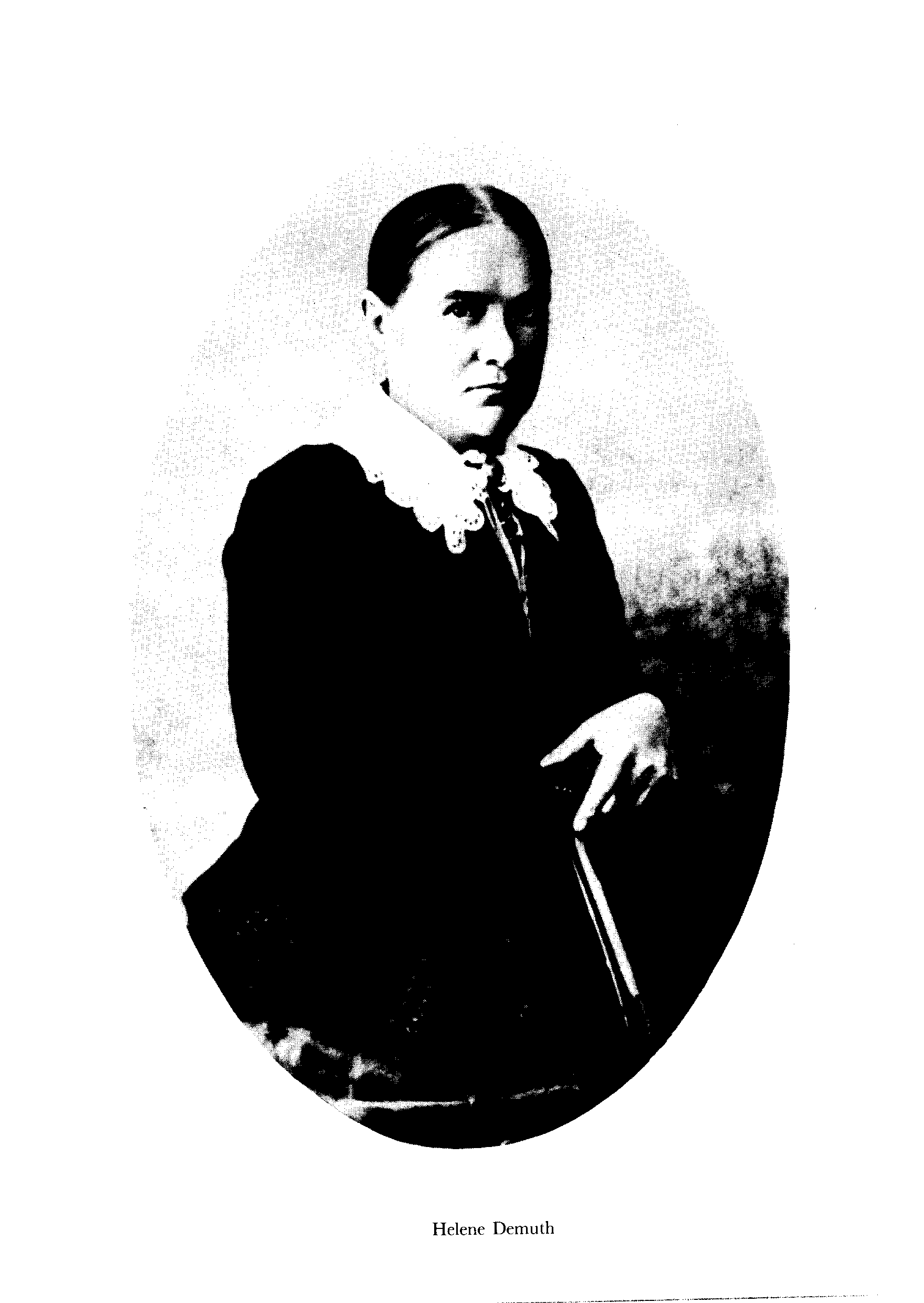
Helene Demuth
2*. /
mit? ivi» ?«•« l9fi«tV*;S'<.-û-(iHl.-IVtt sUtiji'faSirff, îitn P a r t e i t a g ungarländischen Sozialdemokratie
als Gast beizuwohnen.
Seit: 7. und 8, Dczrraber 1890. Ort: Endap:st, alte bürjerl. Schhssatâtte, VIL Schiesatitte-Plat*.
'•Oiiîap-'jt, t%. fîoivmfvt i>\-v.
Die Redaktion der „Ärbeiter-WocheBchronik," Budapest. Die Redaktion der „Hépsian", Budapest
43. Engels to Amand Goegg. 4 December
Dear Goegg,
Many thanks for your kind good wishes. We old ones are beginning to be thin on the ground, a fact of which I have again been pain-fully reminded by the death of my beloved Lenchen. Well, I suppose there's bit of time left and I hope to make proper use of it.
Your old friend
F. Engels
44. Engels to Ludwig Schorlemmer. 4 December
Dear Mr Schorlemmer,
Not till today have I been able to get round to sending you my best thanks for your good wishes. My health is still pretty fair, if only my eyes permitted me to work at my desk; it's a wearisome and tedious business, but one has got to accept it. Again, smoking is something I can seldom permit myself, and your beautiful pipes stand on the chimney piece and
seem to say as they look at me: 'What, old chap, have they done to thee?'
Warmest regards to your mother, your brothers and sisters and their families, and to all party comrades from
Your old friend
F. Engels
45. Engels to Edouard Vaillant. 5 December[25]
Dear Citizen Vaillant,
Very many thanks for your letter of the 28th ult. and your good wishes. On that day I was overwhelmed with honours by socialists of all countries. Fate has decreed that, in my capacity as survivor, I should glean the honours due to the works of my deceased contem-poraries, above all those of Marx. Believe me, I harbour no illusions whatever about that, or about the tiny portion of all this homage that falls to me by right.
I am also grateful for the sympathy you express concerning the death of dear Helene, thanks to whose care I was able to work in peace for seven years. For me it is a very sad loss. But we are still right in the midst of the struggle and, with the enemy before us, looking back too often is forbidden. If I'm not mistaken the battle is approaching a crisis. In your country the collapse of Boulangism has, on the one hand, rid the opportunist government,[94] corrupted and corrupting, of all those enemies who might be immediately dangerous, and has reopened the market in which France is sold to the sharks of the Stock Exchange. On the other, however, that collapse has released elements of the revolutionary opposition who had gone astray and who, having regrouped — after the removal of the chief traitors—, should again take the field reunited in one way or another with the mass of revolutionaries who have remained faithful to their traditions. After the farce, the tragedy.
In Germany the rapid advance of the Socialist Party should quickly dispel young William's[1]* illusions about the power of attraction he fondly imagines he exercises on the working class. That, too, should lead to a crisis; and the longer it is delayed, the more severe it will be.
Accordingly, in four or five years time at the most, we shall have the crisis which will, I trust, lead to victory. And I hope I shall live to see ÜiSLtßn de siècleh\
Please remember me kindly to Mrs Vaillant and your mother.
Yours affectionately,
F. Engels
L. Lafargue, Correspondance, t. II, Paris, T r a n s l a t e d from t h e F r e n c h 1956
" William IPs - '' end of the century
46. Engels to Pyotr Lavrov. 5 December[9 5]
IN PARIS
London, 5 December 1890 122 Regent's Park Road, N. W.
My dear friend Lavrov,
Many, many thanks for your kind letter of 27 November and your congratulations, as also those of your socialist compatriots on whose behalf you speak. But it's always the same. The lion's share of the honours that were showered upon me last Friday doesn't fall to me by right and no one knows that better than I do. So permit me to place on Marx's grave the lion's share of the flattering things you were good enough to say to me and which I accept, but only as his continuator. And as for the small portion which, without being presumptuous, I accept on my own account, I shall do my best to prove worthy of it.
After all, we are not so very old, you and I. And we have hopes of living and seeing. We have seen Bismarck's rise, heyday and decline, so why should we not also see, after its heyday, the decline (already in progress) and ultimate fall of Russian Tsarism, the great enemy of us all?
Yours affectionately,
F. Engels
47. Engels to Wilhelm Liebknecht. 8 December
Dear Liebknecht,
There is more trouble in store for Brentano than he expects — just you wait and see! Thanks for the note about Gladstone, but I should point out that / require the issues of the 'Deutsches Wochenblatf containing the text of what Brentano and Gladstone actually said—the short note would only mislead me, and I mustn't allow that to happen. If you haven't got time to obtain them for me, ask Fischer who will certainly do so at once.
Leave Brentano to me. You won't be disappointed. But without this new material I can't finish the thing off[96]
Your
F.E.
Since Gladstone's letters were dated 22 and 28 November, there can be no doubt about which issues of the Wochenblatt(1) the stuff is in.
48. Engels to Mohrhenn. 9 December
48
ENGELS TO MOHRHENN
IN BARMEN
London, 9 December 1890 122 Regent's Park Road, N.W.
Dear Comrade Mohrhenn,
I really must thank you most warmly for the trouble you have taken over the photographs of my childhood home in the Bruch. They have given me enormous pleasure and have recalled many a youthful prank connected with the front doorstep and this or that room or window. Old Miss Demuth is right — the house in the Bruch, which in my time was No. 800, is the right one; behind it was our garden, between it and the Engels-Gang lay the bleachery and opposite that the houses belonging to my grandfather Caspar and his brother Benjamin Engels in which my uncles, Caspar and August, subsequently lived. I believe I can just remember Miss Demuth; I must have seen her once or twice at my cousin Caspar's house when we were both young. No doubt she can tell you about our original family home where my grandfather was born. It was up at the top of the Engels-Gang, where it joins the Bruch, opposite the path which leads up to the Böken and which was then nameless. It was a typical lower middle class, two-storied house; when I was young the ground floor was used for storage, while the upper floor was occupied by two of my grandparents' former maids, by then pensioned off, who were known as Drütschen and Mineken. They would often treat us children to spiced apples and bread. The house was demolished when the railway came.
Even in those days we used to say that the Bruch wasn't anything like as god-fearing as it used to be and not so many years ago my brother Rudolf was quite outspoken on the subject.[97] Pointing at the house opposite, where a man called Ottenbruch had once lived and which bore an inn sign, he said: 'See that place? Nowadays it's a fa-vourite haunt for Social-Democrats!' Social-Democrats in the Bruch — that was, to be sure, a tremendous revolution as compared with 50 years before.
It would certainly be a far greater one, however, if our old house were to become a Social-Democratic press. But you would have to go about it very artfully. Unless it's been resold, the house now belongs to my brother Hermann, and he wouldn't be likely to sell it if he knew what purpose you meant to put it to. Well, I don't suppose anything will come of that just yet — it would be altogether too good to be true.
Well, good-bye. Soom day Ah'll coom to Barmen agean, an' then Ah'll coom an' see thi, an' then tha can tell me baht t'mucky tricks they played on thi wi' you Anti-Socialist Law o' theirn.(1)
Kindest regards,
Yours,
F. Engels
49. Engels to Victor Adler. 12 December
Dear Adler,
I was on the point of writing to thank you and your wife for the telegram when I got your letter of the 9th with Aveling's dishonoured CHEQUE.b In its place I am sending you the enclosed cheque on the local branch of the same bank for £10 4/- to include expenses, and this CHEQUE will not be dishonoured.
It's the slapdash literary Bohemian in Aveling that leads to this kind of thing, especially when the said Bohemian insists on having a bank account. 'So young and already a Bohemian' might also be said of him. Incidentally the pair of them will soon be arriving to lunch with me, when I shall be able to give him a thorough dressing-down for this piece of carelessness and her for the frightful adulation she expended on me in the Sozialdemokratische Monatsschrift? She's right in only one respect, namely my beard's being curiously lop-sided — there are, incidentally, perfectly good reasons for this which, however, I shall spare you.
Many thanks for your hints about Louise. It is also my wish that she should remain with me and if this should fall through, I shall find it very hard to part with her. But I should have a constant feeling of un-easiness if I thought she had sacrificed other duties and other prospects on my account. Well, the matter will probably be decided in a week or two. If she stays, she will have to return to Vienna at least once this winter so as to get everything straightened out there.
As regards the danger of overwork, this was, I should say, very real in Vienna. Here, on the other hand, it is hardly likely to arise. She is not to do any actual house-work, indeed could not do so — if only on account of the maids who would not in that case regard her as a proper LADY. All she has to do is to direct and supervise. She is, besides, acting as my secretary; I dictate to her or give her things to copy out so that I can spare my eyes, and then there are various subjects I shall be studying with her — chemistry to begin with, then French; she also wants to do Latin and that presents no difficulty. After lun-cheon we sleep, and at night, to give my eyes a rest from reading, we play cards from 11 to 12; I also sleep better if my mind is empty. I know, by the way, what an urge she feels to sacrifice herself for others and it is this, in particular, that is preventing me from urging her to stay here. On the evening of the day before yesterday we discussed the matter at length when the chief obstacle seemed to be her mother to whom she only wrote yesterday about her intention to remain here. The answer to this will, of course, be of crucial importance. But imagine the state I'd be in if I had to tell myself that I had reft Louise away from a new, congenial and promising career, only to place her in a position in which she could not rid herself of the feeling of having done her mother an injury?
So, far from taking any kind of umbrage at your remarks on this subject, I am on the contrary most grateful for what you have said. For the only occasion on which Louise will depart from her instinc-tive candour is when she is intent on concealing her selflessness. And so it behoves us all to keep a close watch on her.
Warm regards to your wife and children about whom Louise tells me many amusing stories, and likewise to yourself from Louise and
Your
F. Engels
50. Engels to Johann Heinrich Wilhelm Dietz. 13 December
Dear Mr Dietz,
I have yet to tender you my warmest thanks for the magnificent birthday present you sent me. I was particularly delighted with Rei-nicke's pictures; it's the first time I have seen German genre paintings depicting life in a big city that are altogether free of the stiffness and affectation which otherwise so obstinately dog German painters of genre and historical pieces. But here we have no poses — here we have life as it is lived.
That we tippled our way merrily through my 70th birthday you will have heard from the three Magi on their return to the Orient.[3]
And that things are proceeding at a brisk pace in Germany I see and hear daily, and that is best of all.
With cordial regards
Yours,
F. Engels
51. Engels to Karl Kautsky. 13 December[9 8]
Dear Kautsky,
Very many thanks for your two letters[9] [9] and for the article devoted to mea which was, alas, all too flattering. I got through my birthday all right and, even though the outside air was clear of fog, my head wasn't when I went to bed at half past three in the morning. I fared almost as you did at my birthday in 1883, when the tippling took place round my sick-bed.
I enclose herewith a preliminary piece about Brentano and would be obliged if you could contrive to get it into the next number of the Neue Zjeit, should this be feasible. I'll give the man something to remember me by. He'd like to keep Gladstone's letters up his sleeve until I have answered, but we'll soon put a stop to that.[96]
You will also shortly be getting a contribution from Marx's unpub-lished work, something quite new and extremely topical and to the point.b It has already been copied out but I shall have to look it over first and possibly write a few lines by way of an introduction. But please tell no one else about it yet; my hands are completely full, what with correspondence and replying to the many letters I get, and I can't say exactly when.
I cannot possibly entrust the remaining fascicles of Marx's Volume {y loo t o m e p O S t o r a n y o m e r intermediary. So when you've had the 2nd fascicle you won't be getting any more for a while. This is also because, in the later fascicles, there are all sorts of divagations and long deleted passages which may not have to be copied out and, since this will entail constant discussion, the work could only be done over here. Later on, if you come back to this country again, and I have been able to familiarise myself a bit more with the ms., we shall see what
52. Engels to Laura Lafargue. 17 December
can be done. Needless to say, you are to finish what you have already got.
I should be obliged if you would send me another 6 copies of the 8th issuea; that will, I think, suffice.
Now, however, I must close; herewith a note to Dietz, which kindly pass on to him.
Your old friend
F. Engels
52
ENGELS TO LAURA LAFARGUE
AT LE PERREUX
London, 17 December 1890
My dear Laura,
Two pieces of good news. First. Your usual box of puddings, cake and sweets, for Même and brothers, has been sent off yesterday as usual and hope will reach by Friday[15] at latest. Otherwise please apply to the Bureau des Expédi-tions Grande Vitesse, Gare du Nord, or at 23 Rue Dunkerque, P. Bi-geault or 18 Rue Bergère, chez E. D'Odiardi.
Second. Louise Kautsky remains here for good. So my troubles are settled. She seems to like it better after all than setting other people's children into this world.0 And we get on capitally. She superintends the house and does my secretary's work which saves my eyes and enables me to make it worth her while to give up her profession, at least for the present. She wishes me to send you her kindest regards.
Padlewski deserves a monument and a life pension. Not so much for polishing off that vile brute Seliverstov than for delivering Paris from the Russian incubus. ' ° ' The change in the Paris press since that execution is indeed wonderful and if a voyoua like Labruyère finds it to pay him to get Padlewski out of the way, the revulsion of feeling generally must be very great indeed. Even the Boulangists and the Intransigeant have to follow suit.
But it's genuine Parisian. Argument and reason is no use against this chauvinistic enthusiasm for the Czar's b alliance. All at once a fact occurs, which lightens up the mental darkness like a flash of lightning. Now they see that they are making themselves accomplices of this Russian official infamy, and that, if they themselves have not the courage to get out of it, a Pole has, and can they assist in sending that Pole over to bourgeois 'justice'? The enthusiasm for the Czar is at once transferred to the Poles and Nihilists, and the Czar is in for it, for his trouble and his money spent.
All the same, the effect would hardly have been so great if our people had not so constantly and determinedly attacked the Czar.
Anyhow, je m'en réjouis.' Pumps has all at once come round. Louise and I coaxed her a bit. After the talking to I had given her, Percy gave her another, and now she is friendliness all over, not only with Louise, but also Annie. Well, I hope it will last, and if it does not, it will be her own fault and then I shall be in a clear position and act accordingly. This time I can be master and I shall.
How is Paul's affair with Levraut getting on? " , 2
Fortin writes to say that he and Paul wished to publish the 18 Brumaire in the Socialiste but required my consent. That of course I gave him with pleasure.— He also said the Revue Socialiste wanted the same and also the Misère de la philosophie for republication. I said as to that, Marx would never forgive me if I entrusted any ms. of his to the hands of such people who were capable of making all sorts of changes in it; as to the Misère, after all the disappointments I had with that, [1 0 3] I should consent to its republication in book-form only, and only after having full guarantees for the execution of the promise.
What Paul writes about the part of the Rothschilds in the Krach d
Baring seems not without foundation.[104] The Barings are rich enough to pay all losses and have plenty left. So that the guarantors will be perfectly safe. But the Barings cannot remain a first rate firm and cannot therefore continue to be financial agents of the Argentine Government. There the Rothschilds will naturally step into the Barings' shoes. And in order to squeeze the Argentine Government into compliance, the French and German Argentine committees must resist the very sensible (in the interest of all parties) proposals of the London Committee, and insist upon cash payment of the coupons which the Londoners are willing to suspend for 3 years and have the amount transformed into a new debt. And the gobemouches* of the Paris press, payés comptant? work hard in the interest of the Rothschilds.
I am afraid this will be the last long letter you will have for some time. I am so overworked that correspondence will have to be confined to the necessary minimum. I have an urgent quarrel with Brentano on my hands (preface, 4th edition of Capital[96]) and those sort of things I cannot dictate.
Love to Même.
Ever yours,
F. Engels
Bien des choses à Paul.0
53. Engels to Wilhelm Liebknecht. 18 December
Dear Liebknecht,
You guessed the names aright.
I fail to see what point there would be in publishing this muddled correspondence, the Hegelian language of which would today be incomprehensible.[105] Either you intend to publish everything bearing Marx's name or — might this be the beginning of the Collected Works in pamphlet and/or serial form planned by you and Paul Ernst?
Against this I would protest here and now as, indeed, I shall continue to do.
I would gladly agree to the publication in pamphlet form of such individual pieces by Marx as are comprehensible today without notes or a commentary, but to their publication only, without notes or a commentary of any description. Should the plan you propose here be put into effect, however, I shall intervene forthwith.
I cannot write a preface. The most I could say about the correspondence is that Marx told me more than once that his part of it had been tinkered with by Ruge who had inserted all manner of nonsense.
If only you people would leave off pestering me so that I had time to finish the 3rd volume/ I could myself do something worthwhile along those lines. I have already told you that the time is past when I can do work to order for you. I shall take on absolutely nothing further, even though it may amount to no more than 3 lines, until I have dealt with the mountain of stuff I have already undertaken to do.
When a chap can only write by daylight and, what's more, at most 3, and quite often only 2, hours a day and with constant interruptions into the bargain, you will understand that every superfluous letter robs him of his most precious time. Besides which, there has been virtually no daylight for the past 12 days.
So will you at long last be kind enough to let me work in peace? Despite a lengthy search I cannot immediately put my finger on the passage in Sybel.b It is so cunningly concealed that leafing through the book is no good. However, it would do you no harm, in view of your preoccupation with Bismarck, to go through this important source yourself, in which case you would yourself find the passage in the 4th or 5th volume.[106] Kindest regards from my household to yours, and a happy holiday to you.
Your
F. E.
Today I have had another reminder from Dietz about the new edition of the Origin.[3] How can I possibly manage if I don't get a moment's peace?
54. Engels to Friedrich Adolph Sorge. 20 December
Dear Sorge,
Have had your letters up to the 9th of this month. Use my letters as you think fit.[107] I am glad that you consulted Schlüter about the question of the feeb and that all is now settled. As things go in Germany, what they offer is very respectable. Schoenlank, by the way, who wrote and told you this, is a most depraved fellow who in fact does not hesitate to seize on any and every opportunity to extort money from the party. Of this he again gave proof at the Halle Congress. ' [2]
I am greatly overworked, hence just a postcard today. I have taken on Mr Brentano who must now be disabled 'good and proper'.[96]
Louise Kautsky has decided to stay with me for good. I am, of course, absolutely delighted and deeply grateful to the sweet child. She is giving up a great deal for my sake, but luckily I am in a position to offer her in return much that would not be available to her in Vienna. Besides keeping house for me, she does a fair amount of secre-tarial work — just what I needed. So as you will see, I cannot for the present accept your kind invitation to move to Hoboken [108]; I am engaged in renewing my lease for another three years.[2]
I hope that, by the time this arrives, your wife will have completely recovered. Schorlemmer will again be unable to visit us this Christmas because of his persistent aural catarrh; otherwise he might go deaf. So more anon. A Happy Christmas to you.
Your old friend,
F. E.
1906 and in full in: Marx and Engels, Works, First Russian Edition, Vol. XXVIII, Moscow, 1940
55. Engels to Leo Frankel. 25 December[109]
Dear Frankel,
Having just got a minute or two to spare — by no means usual during the daytime (the only time in which I am allowed to write)—I shall reply to you straight away.
Many thanks for your telegram and retrospective good wishes. You must excuse me for not having acknowledged receipt of the former. I have been swamped, in the truest sense of the word, with correspondence.
Well, let's have done with the formalities and get on to the main point of your letter. I was already aware of your attitude to the ruc-tions in France ' ' °— an entirely understandable one in view of your long absence from the movement there — as a result of reading your article in the Sächsische Arbeiter-Zeitung'" which had been sent to me from Berlin. The ructions are just as regrettable and just as inevitable as were those in the past between the Lassalleans and the Eisenachers for the simple reason that in both cases cunning business men placed themselves at the head of one of the two parties and exploited that party for their own business interests for as long as the party would tolerate it; accordingly it is no more possible to co-operate with Brousse & Co., than with Schweitzer, Ha'sselmann and partners. If, like me, you had been engaged in the struggle from the beginning and in its every detail, you would see as clearly as I do that in this case unification would above all mean capitulating to a gang of schemers and place-seekers who are betraying to the ruling bourgeoisie the party's true basic principles and its well-tried fighting method ... the better to secure positions for themselves and small, insignificant advantages for the working men who support them. Unification would thus amount to the same thing as capitulating to these gentlemen outright, a point further borne out by the discussions at the Paris Congress of 1889.[51]
Unification will come, just as in Germany, but it can only last if the fight is fought to a finish, the contradictions are resolved and the ras-cals hounded out by their own supporters. When the Germans were drawing close to union, Liebknecht came out for union at all costs. We were against it on the grounds that, since the Lassalleans were near to collapse, we should await the completion of that process, when unification would come about of its own accord. Marx wrote a long critique of the so-called unification programme, which was dis-tributed in manuscript form.b
They didn't listen to us, with the result that we had to bring Hasselmann into our ranks and rehabilitate him in the eyes of the world, only to chuck him out as a blackguard six months later. ' ' ' And we had to incorporate Lassallean inanities into our programme, thereby destroying the programme for good. It was a double fiasco which, given a little more patience, could have been avoided.[63]
In France the Possibilists are going through just the same process of disintegration as did the Lassalleans in 1875. The leaders of both the persuasions that emerged from the split[5] [3] are, in my view, worthless. This process, in which the leaders devour one another and which nevertheless brings over to us the intrinsically sound majority of members, can, in my view, be interrupted or checked — if not actually brought to a complete halt — by only one error on our part — that is to say if we make a premature attempt at unification.
On the other hand we have already taken a decisive step which will in any case hasten the advent of unification and may, perhaps, achieve it straight away. For at my suggestion — after Tussy had discussed it with Aveling, Bernstein and Fischer (presently of the party leadership[28])—first the French [our Marxists) and then the Germans at Halle,[12] where they also had the support of the Swiss, Danes, Swedes and Austrians, resolved unanimously that, instead of holding a separate congress in 1891, they should attend the congress in Brussels convoked by the Possibilists in view of the fact that the Belgians had accepted the conditions laid down by us in 1889, conditions which, axiomatic though they were, were nevertheless rejected by the Possibilists. You will admit that this was a major concession on our part, since the overwhelming majority of the European parties were behind us. Yet we acted as we did because we knew we had to fight the Possibilists with like weapons and on like terms if the supremacy of Brousse on the one hand and of Allemane on the other was to be brought swiftly to an end. Not until the bulk of the Possibilist working men see that they are isolated in Europe, that they have no sure allies save Messrs Hyndman & Co. (who are in the same boat vis-à-vis their supporters as was Brousse) and that all the braggadocio has been solely for the benefit of the leaders, will the fuss die down. And that will clear the way for the congress.
So just be patient for another six months. Any attempt on our part to achieve a settlement sooner would be interpreted by Brousse as well as by Allemane as a sign of weakness and would hinder rather than help us. But when the time comes, and in my view, it is not far off, the Possibilist working men will join us just as the Lassalleans did and, what's more, without our having to offer leading positions to the schemers, traitors and ne'er-do-wells among them.
No one is more anxious than I am to see a strong socialist party in France. However I have to pay due regard to the facts as they are and I am anxious that it should come about only on a basis which holds
56. Engels to G. Blume. 27 December
out a promise of permanence, which is real and which won't result in a HUMBUG movement à la Brousse.
With warm regards.
Your old friend
F. Engels
Thank you also for the Bataille article. ' ' [2] Louise Kautsky, who is here and will be staying here, sends you her warm regards.
56
ENGELS TO G. BLUME ' [1 3]
IN HAMBURG
London, 27 December 1890
Dear Comrade,
Mr Stinzleih has passed on to me the kind greetings conveyed by you on behalf of the delegates to the Congress, the representatives of 596,000 German working men. There is no need for me to tell you in so many words how glad I was to be remembered at that Congress. Unfortunately I am unable to thank those concerned, who will by now have dispersed to all parts of Germany, and can do no more than express my sincere thanks to you, Mr Chairman, while giving you my firm assurance that, so long as it remains in my power, I shall per-severe in the struggle for the emancipation of the working class.
Yours very sincerely,
F. Engels
57. Engels to Georg Schumacher. December[1 4]
My dear Schumacher,
Since you will now be at home, I am taking the opportunity of asking you to convey my warmest thanks to my friends in Solingen for the beautiful present they gave me on my 70th birthday. But at the same time, I wish to thank you, too, for your contribution to the parliamentary group's" magnificent present.
As a boy, whenever I saw a knife like this, I would gaze at it ad-miringly and envy the owner of a tool so suited to all manner of uses. Now, in my old age, one such has come into my possession, and in such a fashion to boot, and with so honourable an inscription.
As you know, since 1849 my attachment to Solingen has been of a very special kind, since the time, that is, when I, along with the Solingen volunteers, marched to Elberfeld where, confronted by a reactionary civic militia, unorganised Elberfelders and a highly reactionary security committee, I could not have remained unscathed for three days if it had not been for the Solingeners who, almost alone amongst those taking part, represented the revolutionary element. ' ' [5] And, since I am anxious that those ties attaching me to Solingen should not be allowed to slacken or break, it is a very special pleasure to note that in Solingen I, too, am still remembered.
With warm regards to you and to all the members of the party from your old friend,
F. Engels
1891
58
Endnotes
[18] The fragment of this letter was published earlier in: Karl Marx and Frederick
[20] This letter was first published in English in: Frederick Engels, Paul and Laura Lafargue, Correspondence, Vol. 2, 1887-1890, Foreign Languages Publishing House, Moscow, 1960. A passage from this letter was first published in French in: Le Socialiste, No. 115, 24 November 1900.—21
[22] The Social-Democratic meetings mentioned by Engels were held respectively: the one in Dresden on 10 August 1890, that in Magdeburg on 13 August and that in Berlin — scheduled for 20 August — on 25 August. All three fully endorsed the policy of Bebel and the Reichstag Social-Democratic group, led by him.— 22
[23] On 20 August 1890 Le Figaro launched a series of articles under the title 'Les Cou-lisses du boulangisme', signed x. The author was the ex-Boulangist journalist Mer-meix.— 22
[24] The second ballot in Paris on 27 January 1889 was contested by Georges Boulanger for the Rightists, Jacques for the Republican Party, and Boules, a navvy, for the Workers' Party and the Blanquists. The Possibilists backed Jacques. The campaign was marked by high tension. Boulanger scored a major victory with a vote of about 250,000. Boules polled 17,000 votes.—22
[30] In his letter to Engels of 8 September 1890 Karl Kautsky said he intended, after the
[32] In a letter of 16 September 1890 Paul Lafargue told Engels the French socialists considered it possible to hold an international socialist congress in Brussels in 1891 since the Possibilists had lost all influence among the Belgians and Dutch and there were no grounds to fear for the success of the congress.— 28
[33] Engels' letter to Bebel has not been found. In his reply, dated 23 October, Bebel wrote: 'Holding a sort of conference in Halle would be a good thing and easy to arrange because apart from the French and Nieuwenhuis there would be three or four Austrians there.' — 29
[34] Engels evidently means the position of non-interference adopted by the Workers' Party during the Boulangist crisis and the press reports concerning Boulanger's receiving financial aid from the royalists. He may also be referring to the Boulangists' defeat at the municipal elections held between 27 April and 4 May 1890.— 30
[35] This refers to the leading article, 'The Death of a Hero', in Justice, No. 349, 20 September 1890.—30
[36] In a letter of 17 September Charles Caron asked Engels' permission to publish translations of works by Marx and Engels in L'Oeuvre socialiste. Revue politique et littéraire.— 31
[37] In a letter dated 19 September 1890 Paul Lafargue warned Engels against allowing Charles Caron to publish Marx's The Poverty of Philosophy. Caron, he wrote, was a private publisher and had long since drifted away from the labour movement.— 32
[39] During the International Socialist Workers' Congress in Paris in July 1889 the French delegates, numbering 206, twice met separately from the congress. They established the National Council of the French Workers' Party, composed of Jules Guesde, Gabriel Deville, Louis Simon Dereure, Leon Camescasse, Georges Edouard Crépin, Paul Lafargue and Lenoel. The Council was to give practical leadership to the party and call its next congress.— 32
[40] This letter was first published in English in full in: S. Hook, Towards the Understand-
[41] ing of Karl Marx. A Revolutionary Interpretation. The John Day Company, New York, 1933.—33 4 ' In his letter of 3 September 1890 Joseph Bloch put two questions to Engels. The first concerned the interpretation of Roman historian Cornelius Nepos' statements on consanguine marriage in Ancient Greece. The second was formulated thus: 'Are economic relations the only determining moment or do they merely form, in a certain sense, a solid basis for all other relations, which can then become factors in their own right?' — 33
[42] In a letter to Engels of 19 September 1890 Jules Guesde pointed out an inaccuracy in Engels' letter of 2 September to the leaders of the French Workers' Party (see present edition, Vol. 27, pp. 233-34) concerning the resolution of the 1889 Paris International Socialist Workers' Congress on the procedure for the convocation of the next congress. Engels considered that authorisation to call it had been given to both the Swiss and the Belgian socialists. Formally it was the executive committee, to be set up by the Swiss socialists, that had to decide where to call the congress, in Switzerland or in Belgium. In essence, however, Engels was right since the executive could not function without agreeing its steps with the Belgians (see also Note 26).—40
[43] This refers to the International Socialist Conference held in The Hague on 28 February 1889. Attended by representatives of the socialist movement in Germany, France, Belgium, Holland and Switzerland, it had been called, on Engels' initiative, by the Social-Democratic group in the German Reichstag with a view to formulating the terms for the convocation of the International Socialist Workers' Congress in Paris. The Possibilists stayed away from the conference and refused to recognise its decisions. The conference determined the powers, the date and the agenda of the congress.— 40
[44] This letter of Engels has not been found. On 29 September 1890 August Bebel wrote to him: 'Today we discussed matters relating to the international conference. We could not make up our minds to send out further invitations, if only to avoid creating the 'impression that we wanted to give our congress a special air of spectac-ularity through international representation. We are also definitely short of time. 'So besides the Austrians, the French and the Dutch we shall have one Belgian and one Swiss committee member. The latter decided last week to declare in favour of Belgium so as to preclude a breach. I trust with these representatives it will be possible to reach agreement on all questions in our sense. I believe things similar to those that happened last year in Paris are ruled out.' — 40
[45] This article, 'Ein ernstes Wort', was published in Neue Preußische Leitung (evening issue) on 22 September 1890 and reprinted in the Viennese Arbeiter-Leitung, No. 39, 26 September 1890, in the column Ausland. Deutschland, under the heading 'Berlin, den 23. September'.— 42
[46] The Danish Social-Democratic Party, formed in 1876, had a reformist and a revolutionary wing. The latter, led by Gerson Trier and Nikolai Petersen, was grouped round the newspaper Arbejderen. In 1889 the revolutionary minority was expelled from the party and formed an organisation of its own. However, due to the sectarian mistakes of its leaders, it failed to develop into a mass proletarian party.— 42
[48] This refers to the Central Committee of representatives of radical and socialist clubs and 'new' trades unions which was set up in the spring of 1890 to organise a demonstration in London on 4 May. In the subsequent months the Committee continued its activity, its aim now being to organise the struggle for a legal eight-hour working day, the implementation of the resolutions of the 1889 International Socialist Workers' Congress and the establishment of a workers' party. In the summer of 1890 the Legal Eight Hours and International Labour League (see Note 200) was formed on its basis.— 43
[4 9] The Socialist League was an organisation set up in December 1884 by a group of English socialists who had withdrawn from the Social Democratic Federation on account of its leaders' opportunist policies. The founders of the League included Eleanor Marx-Aveling, Edward Aveling, Ernest Belfort Bax, William Morris and others. In its early years the League took an active part in the labour movement. However, anarchist elements soon gained the upper hand in the League, forcing many of its organisers, among them the Avelings, to resign. In the early nineties the League disintegrated.— 43
[50] Engels means the London International Trades Union Congress held in November 1888. Representatives of Belgian, British, Danish, Dutch, Italian and pro-Possibilist French trades unions attended. The organisers of the congress had made participation conditional on the official election of delegates by trades unions and thereby denied access to the German and Austrian Social-Democrats and French Marxists. However, the reformist leaders of the British Trades Unions failed to impose their line. Despite their resistance, the congress appealed to the working people to fight for labour protection legislation and a legal eight-hour working day. The congress decided to call an international workers' congress in Paris in 1889, entrusting the Possibilists with its organisation.— 43
[52] This refers to the campaign launched by the Possibilists in France and their supporters within the Social Democratic Federation (see notes 3 and 29) to discredit the International Socialist Workers' Congress (see Note 51). Another congress, called on the Possibilists' initiative, was being held in Paris at the time. It was only attended by 13 foreign delegations, most of them representing fictitious organisations. The attempt to bring the two congresses together failed because the Possibilist congress made merger conditional on a revision of the credentials of the delegates at-tending the Marxist congress. The Possibilist congress declared for the restoration of the International. It decided to hold the next congress in Brussels in 1891 and instructed the Belgian Workers' Party to convoke it.— 43, 234
[54] This probably refers to Edward Aveling's article 'The New Era in German Socialism' in The Daily Chronicle and Clerkenwell Mews, No. 8903, 25 September 1890, which contained excerpts from Engels' article 'What Now?', published in the last issue of the Sozialdemokrat (see present edition, Vol. 27, pp. 7-10). Avcling's interview with Eduard Bernstein was published in The Star, No. 832, 29 September 1890, under the heading 'Germany Flooded with Papers from Kentish Town.— A Talk with the Editor'.— 44
[55] A reference to an article by Julius Grunzig headlined 'Die Vorgänge im Lager der deutschen Socialdemokratie', in New Yorker Volkszeitung, No. 217, 10 September 1890. It stated views in the spirit of the Jungen.— 45
[57] 1890, supported the resolutions of the Lille Congress (see Note 38) calling for a demonstration on 1 May and a miners' strike.— 46, 52 5 ' The labour exchanges in France, manned by representatives of various trades unions, were mostly operated by the municipalities in large cities. The government gave them support and, not infrequently, financial aid, seeking to exploit them for di-verting the workers from the class struggle. The labour exchanges created jobs for the unemployed, founded trades unions, trained union activists and organised strikes.—47, 224, 411
[58] The Possibilists refused to take part in the demonstration on 1 May 1890 on the grounds that Boulangist and other agents of the reaction were going to participate and that the demonstration might harm the cause of the working class.— 47
[60] Fearing a strike at their enterprises, the owners of the Gas Light and Coke Company in Becton intended to call out troops to intimidate the workers. An army unit stationed at Chatham was put on the alert on 3 October 1890, but there followed no orders to leave the barracks. The government's readiness to make troops available for action against strikers was sharply condemned at many workers' meetings in different areas of London.— 51
[62] Engels means the congresses in Lille, Calais and Halle (see notes 12, 38 and 56).— 53
[64] This refers to the refusal of the Possibilists (see Note 3) to participate in the socialist congress in Troyes (23-30 December 1888), which originally had been called as a congress of the Possibilist party. The refusal was due to the fact that the convocation of the congress had been entrusted to the Troyes socialist organisations, consisting mostly of supporters of the Workers' Party (Guesdists), so that both parties had been invited.— 54
[65] Eleanor Marx-Aveling had attended the congresses of the French Workers' Party in Lille (see Note 38) and of the German Social-Democrats in Halle (see Note 12).— 54
[66] This refers to the opposition group of the Jungen (see Note 13).— 54
[67] On 17 October 1890 the newspaper Gil Bias carried an interview allegedly granted to its correspondent by August Bebel. Engels sent a copy of the text and a letter (which has not been found) to Bebel. The latter replied that he had granted no such interview and the Gil Bias text was a hoax from beginning to end. Seeing that this was the case, Paul Lafargue disavowed the interview in a note headlined 'Le Gil Bias interviewer' {Le Socialiste, No. 6, 26 October 1890).— 54
[68] In a letter to Engels of 16 October 1890 Lafargue said that almost all the delegates to the Lille Congress (see Note 38) had been victimised by the bourgeoisie: they had lost their living and were forced to engage in petty trade and the like. He also stressed that many of them held elective positions on municipal councils and similar bodies, which was proof of the growing influence of the French Workers' Party.— 54
[69] This letter is written on a postcard. The address — Mr. W. Liebknecht, Kanstraße 160, Charlottenburg-Berlin, Germany — is on the back.— 56
[10] Between 14 June and 12 July 1890 Berliner Volks- Tribüne, in a discussion series
[72] In a letter of 20 October 1890 Conrad Schmidt advised Engels that he, Schmidt, had been offered the position of stock exchange editor of Züricher Post. Somewhat later he began working for the newspaper, but in a different capacity — as its foreign news editor. On 18 June 1891 he informed Engels that he had relinquished his post.— 57
[73] Engels has in mind his sojourn in Manchester, 1842 to 1844, as a business appren-
[74] tice at the Ermen & Engels cotton mill.— 58 7* In his letter of 20 October Conrad Schmidt gave a high appraisal of P. Barth's book Die Geschichtsphilosophie Hegel's und der Hegelianer bis auf Marx und Hartmann. Ein Kritischer Versuch, Leipzig, 1890. He pointed to the author's convincing attempts to prove, with historical data, the effect of extraeconomic factors on the economic basis, and suggested that, unless it could be shown that these factors, above all the political ones, were conditioned economically, 'it would be difficult to uphold Marx's conception of history in its strictest sense\ This conclusion of Schmidt's wor-ried Engels, hence his detailed reply.— 59
[75] Code Napoléon — system of bourgeois law adopted under Napoleon I between 1804 and 1810. It comprises five codes: civil, civil-procedural, commercial, criminal and criminal-procedural.— 61
[78] See Capital, Volume I, Chapter 10, 'The Working Day', and the whole of Part VIII, 'The So-Called Primitive Accumulation' (present edition, Vol. 35).— 63
[80] Conrad Schmidt had published an extract from Engels' letter to him of 5 August
[81] 1890 in the Berliner Volks-Tribüne, No. 39, 27 September 1890 (see this volume, pp. 6-9).—64 8 ' This letter was first published in English in: K. Marx and F. Engels, Letters to Americans. 1848-1895. A Selection, International Publishers, New York, 1953.— 67
[82] This letter has only reached us in the form of extracts published in Gustav Mayer's book Friedrich Engels. Eine Biographie, Vol. 2, The Hague, 1934. Part of the letter is given in Mayer's rendering. Engels wrote the letter under the immediate impact of the death and funeral of Helene Demuth, in reply to Louise Kautsky's telegram of condolences. In his letter Engels expressed his hope that Louise would move to London in order to keep house for him and be his secretary. However, not wanting to force her hand, he suggested that Louise should come to London for a short stay and make her decision there.— 68
[83] Engels wrote this letter in his capacity as executor of Helene Demuth.— 69
[84] The American Federation of Labor—leading US trade-union centre, formed in December 1886. Composed mostly of skilled workers, it initially played a positive part as a rallying point for the American working class, particularly in the struggle for the eight hours day. Its programme bore an imprint of socialist ideas.— 74, 113, 557, 558
[86] The Nationalists were members of a social movement in the USA which sought to relieve society of the worst evils of capitalism through the nationalisation of production and distribution and a peaceful transition from capitalism to socialism. The first Nationalist club was set up in Boston in 1888, under the impact of Edward Bel-lamy's Utopian novel Looking Backward 2000-1887. By 1891 there were more than 160 such clubs all over the country. The clubs, consisting mostly of members of the petty and middle bourgeoisie, were vehicles for the propagation of Nationalist views. In 1889, the newspaper Nationalist began to appear. The Nationalist movement exerted a certain influence on America's socialists. For instance, the newspaper Sozialist, organ of the Socialist Labor Party of North America (see Note 133), echoed its propaganda, and Daniel de Leon, one of the party's leaders, held Nationalist views. Engels compared the Nationalists to the Fabians (see Note 87). That the Nationalists boycotted Engels' works, ignoring them or declaring them harmful, was told to Engels by Sorge in a letter of 14 October 1890.— 75, 113
[87] The Fabian Society was a British reformist organisation set up by a group of intellectuals in 1884 and led by Sidney and Beatrice Webb. The Society's name derives from Fabius Maximus, a Roman general of the 3rd century B. C. nicknamed Cunc-tator (Delayer) for his tactic of evading a set battle in the war against Hannibal.— 75, 113, 342, 404, 449, 468, 493, 497, 502, 515, 526, 563
[99] In all likelihood, this refers to Karl Kautsky's letters of 7 and 25 November 1890. The letter of 7 November has not been found. That of 25 November concerned Kautsky's help in the work on Volume IV of Capital.— 90
[90] The meeting took place at Edward and Eleanor Avelings' house in London on 1 December 1890. It was attended by German Social-Democratic leaders Wilhelm
[91] Liebknecht, August Bebel and Paul Singer and British socialist and labour leaders Robert Cunninghame-Graham, John Burns, Bill Thorne, Ben Cooper, Maxwell and Morrison Davidson, as well as by Engels and the Avelings. Cunninghame-Graham published an account of the meeting, 'Eight Hours "Blokes" in Council', in People's Press, No. 40, saying that 'the object of our meeting was to combine the attack against surplus value, to endeavour to bring about friendly relations between the sweated of all nations, and to push on the general eight hours day by legislative action...'.— 77 9 ' A draft of this letter, roughly similar in content, also exists. The different readings are indicated in footnotes.— 77
[92] By the Dutch Labour Party Engels means the Social-Democratic Union of the Nether-lands, founded in 1882, which united all Dutch socialists. In the late 1880s the anarchists and reformists succeeded in building up their influence within the Union. Government reprisals and the sectarian policy of the Union's leaders, in particular Ferdinand Domela Nieuwenhuis, led to a split in the Union and the establishment, in 1894, of the Social-Democratic Labour Party, joined by the remainder of the Social-Democratic Union in 1900.— 77
[94] Opportunists— the name given in the early 1880s to the party of moderate republicans in France, which reflected the interests of the big bourgeoisie.— 83
[95] This letter was first published in English in: K. Marx, F. Engels, V. I. Lenin, The Communist View on Morality, Novosti, Moscow, 1974.— 84
[97] Engels presumably means his stay with his family in connection with his mother's death in the autumn of 1873.— 86
[98] Part of this letter was first published in the journal Die Gesellschaft, No. 5, 1932.—90, 103, 107, 118, 129
[103] Laura Lafargue began preparing the second French edition of Marx's The Poverty of Philosophy. Answer to the 'Philosophy of Poverty' by M. Proudhon (see present edition, Vol. 6, pp. 105-212) in 1884, but things got stalled. In 1887 Paul Lafargue resumed the negotiations on this edition, however it did not materialise until 1896.— 92
[104] Lafargue gave his version of the Rothschilds' role in the bankruptcy of the Bering
[105] Bank in his letter to Engels of 19 November 1890. See F. Engels, P. et L. Lafargue,
[106] Correspondance, t. II, Paris, 1956, pp. 440-41.— 92 los Wilhelm Liebknecht intended to reprint — under the title 'Ein Briefwechsel von 1843' — Marx's correspondence with Arnold Ruge published in the Deutsch-Französische Jahrbücher in Paris in 1844 (see present edition, Vol. 3, pp. 133-45).—94 io6 Wilhelm Liebknecht quotes from Vol. 4 of Heinrich von Sybel's Die Begründung des deutschen Reiches durch Wilhelm I, pp. 411-14, where Sybel suggests that Bismarck might be willing to compensate France territorially — a willingness expressed in his pamphlet Die Emser Depesche oder: Wie Kriege gemacht werden.— 94
[107] In a letter of 2 December 1890, Sorge asked Engels' permission to make use of his letters in articles for Neue Zjiit.— 95
[108] After the death of Helene Demuth, Sorge invited Engels to move to his place in
[109] Hoboken.— 96, 113 io9 This letter, written in German, has not been found.— 96
[13] In late March 1890 the Jungen, a group of Berlin Social-Democrats, including Max Schippel, published an appeal under the title 'Was soil am 1. Mai geschehen?', urging the workers to hold a strike on the 1st of May. The appeal reflected the specific attitude of the Jungen, crystallised in 1890, as a petty-bourgeois semi-anarchist opposition group within the German Social-Democracy. The hard core of the group was made up of students and young literati (hence the group's name) who claimed the role of the party's theoreticians and leaders. Paul Ernst, Paul Kampffmeyer, Hans Müller, Bruno Wille and others were the group's ideologues. The Jungen ignored the change in the conditions for the party's activity after the repeal of the Anti-Socialist Law. They denied the need for using legal forms of struggle, opposed participation in parliamentary elections and the use of the parliamentary platform by the Social-Democrats and demagogically accused the party and its Executive of opportunism, violation of party democracy and promotion of the interests of the petty bourgeoisie. In October 1891 the Erfurt Congress expelled some of the opposition leaders from the party. A reply to the above-mentioned appeal of the Jungen was given on the party's behalf by the Social-Democratic parliamentary group in a statement entitled, 'An die Arbeiter und Arbeiterinnen Deutschlands!' (adopted in Halle on 13 April 1890).—11, 20, 21, 25
[14] Engels refers to Bebel's 'Erklärung' in Berliner Volksblatt, No. 173, 29 July 1890, in which Bebel took issue with the article 'Der 1. Oktober' published in Sächsische Arbeiter-Leitung, No. 88, 23 July 1890. In his statement Bebel pointed out: '...if you are sure that you have grounds for accusations, you must give the names and the facts you challenge so that those concerned may answer you. This is the mode of operation of honorable men. Any other mode of operation is sheer insolence.'— 11
[2] Presumably Liebknecht had asked Engels (see Engels' letter to him of 30 June 1890; present edition, Vol. 48) to write a refutation to Justice in connection with an item headlined 'Make a Note of This!' published in its issue 336 on 21 June 1890. Citing Paul Brousse, a Possibilist leader, as his source, the author had attributed to Liebknecht the statement 'We are no revolutionists', which, he alleged, had been made on behalf of the German Social-Democratic Party. Social-Democracy in Germany, the Justice writer claimed, was pinning its hopes on propaganda rather than revolutionary action. The next issue of Justice (No. 337, 28 June) carried a letter to the Editor from Ferdinand Gilles headlined 'German Social-Democrats Still Revolution-ists'. It declared that if Liebknecht had in fact made this statement, he was not speaking for the whole party, which at its every congress had confirmed its loyalty to revolutionary principles. Liebknecht's reply to these items was published in People's Press, No. 22, 2 August 1890.—3
[3] The Possibilists (or Broussists) were a trend in the French socialist movement. Their leaders — Paul Brousse, Benoît Malon and others — advocated the gradual transformation of the capitalist system into a socialist one by means of reform, through a 'policy of pursuing the possible'. In 1882 they caused a split in the French Workers' Party (see Note 146) and formed a new party named Fédéracion des Travailleurs socialistes. In the 1890s the Possibilists lost a great deal of their influence; in 1902 the majority of them joined the reformist French Socialist Party, founded by Jean Léon Jaurès.^3, 24, 126, 140, 155, 162, 164, 167, 183, 186, 190, 193, 208, 211, 224, 229, 238, 241, 260, 291, 292, 342, 348, 360, 367, 370, 381, 401, 423, 484, 520, 524, 533, 561, 562
[5] In a letter of 3 July 1890 Karl Kautsky, discussing his plans for Neue £eit, had asked Engels to write something for the journal: 'Of course I should very much like to promise something by you, indeed to begin with a contribution from you straight away.' Engels fulfilled his promise much later. His work On the History of Early Christianity was completed in July 1894 and published in Die Neue ^eit, 13. Jg., 1894/95, l.Bd.,Nr. 1,2 (see present edition, Vol. 27, pp. 445-69). In the same letter Kautsky asked Engels to send him the address of Friedrich Adolph Sorge, whom he wanted to contribute to the journal.— 5
[6] An extract from this letter was published in Berliner Volks- Tribüne, No. 39, 27 September 1890. Part of the letter first appeared in English in: Karl Marx and Frederick Engels. Correspondence. 1846-1895, Lawrence and Wishart, London, 1934, pp. 472-74.-6
[7] This refers to Conrad Schmidt's letter to Engels of 25 June 1890, in which Schmidt spoke of his literary plans. He mentioned in particular having promised to Kautsky a review of G. F. Knapp's book Die Bauern-Befreiung und der Ursprung der Landarbeiter in den älteren Theilen Preußens, published in Leipzig in 1887. However, the review never materialised. Schmidt also described his impressions of P. Barth's book Die Geschichtsphilosophie Hegel's und der Hegelianer bis auf Marx und Hartmann, Leipzig, 1890.— 6
[8] Blue Books (so called after the traditional blue cover) is the general title of the col-lections of proceedings of the British Parliament and documents of the Foreign Office. They have been published since the 17th century and are the main official source on Great Britain's economic and diplomatic history. Marx used the Blue Books in particular for his work on Capital.— 6
[12] The first Congress of German Social-Democracy to be held after the repeal of the Anti-Socialist Law met in Halle between 12 and 18 October 1890. It was attended by 413 delegates and 17 guests. The congress endorsed the new party Rules adapted to the task of turning the party, under the conditions of legality, into a mass working-class organisation. It abandoned the party's hitherto operative, Lassallean programme and, on Liebknecht's proposal, decided to have a new programme drafted for the next party congress, which was to be held in Erfurt, and published three months before the congress for discussion by local party organisations and in the press. The congress also discussed the party press (Berliner Volksblatt was made the central organ) and the party's stance on strikes and boycotts. The party adopted the name Sozialdemokratische Partei Deutschlands (Social-Democratic Party of Germany).—11, 22, 24, 26, 46, 52, 55, 73, 95, 98
[4] This refers to preparations to make the journal Neue £eit a weekly. It began appearing on a weekly basis in October 1890.— 5
[15] This refers to the item 'Tell Tale Straws' in Justice, No. 337, 28 June 1890.—12
[9] Engels obviously means his letter to Eduard Bernstein of 2-3 November 1882 (see present edition, Vol. 46) in which he mentions a conversation Marx had with Paul Lafargue. In discussing the state of scientific socialist thought in France, Marx told Lafargue ironically: 'If anything is certain it is that I myself am not a Marxist.'—7, 22
[25] This letter was first published in English in: Frederick Engels, Paul and Laura Lafargue, Correspondence, Vol. 2, 1887-1890, Foreign Languages Publishing House, Moscow, I960.—23, 42, 65, 82
[26] In the autumn of 1890 the General Council of the Belgian Workers' Party, acting on a mandate from the Possibilist congress (see Note 53), sent out invitations for an international workers' congress to be held in Brussels in 1891. Since the executive committee of Swiss socialists set up on the instructions of the 1889 Paris International Socialist Workers' Congress (see Note 51) for the purpose of convoking another congress had failed to take any action until September 1890, the danger arose of two international congresses being held simultaneously in 1891.— 23, 26, 28, 46, 74
[27] The Congress of the British Trades Unions in Liverpool met from 1 to 6 September 1890. It was attended by 460 delegates representing more than 1.4 million organised workers. A considerable number of delegates represented new trades unions, in which a certain influence was wielded by the British socialists. Despite resistance from the leaders of the old trades unions the congress adopted a resolution urging the legal introduction of the eight-hour working day and recognised as desirable the participation of trades unions in international workers' associations. It also decided to send delegates to the International Socialist Workers' Congress which was due to meet in Brussels (see Note 135).— 23, 25, 46, 167, 185, 233, 250
[28] The International Socialist Conference in Halle was held on 16 and 17 October 1890, while the Congress of German Social-Democracy was meeting there (see Note 12). The conference was attended by German Social-Democrats and the representatives of nine socialist parties who took part in the congress as guests. In keeping with Engels' recommendation, the conference decided to hold a united socialist congress in Brussels in 1891 (see Note 135) which was to be attended, among others, by the Possibilists and their supporters. The Possibilists' participation was made contingent on their recognising the complete sovereignty of the congress — none of the decisions of the earlier congresses, the 1889 Possibilist congress included, was to be binding on it. For details see Engels' article 'The International Workers' Congress of 1891' (present edition, Vol. 27, pp. 72-75).—24, 29, 40, 46, 49, 52, 54, 57, 74, 98
[29] The Social Democratic Federation, set up in August 1884, consisted of English socialists of different orientations, mostly intellectuals. For a long time the leadership of the Federation was in the hands of reformists led by Hyndman, an opportunist sectarian. In opposition to them, the revolutionary Marxists within the Federation (Eleanor Marx-Aveling, Edward Aveling, Tom Mann and others) worked for close ties with the revolutionary labour movement. In the autumn of 1884 — following a split and the establishment by the Left wing of an independent organisation, the Socialist League (see Note 49) — the opportunists' influence in the Federation increased. However, revolutionary elements, discontented with the opportunist leadership, continued to form within the Federation, under the impact of the masses.— 24, 43, 57, 123, 126, 131, 140, 155, 185, 190, 219, 333, 335, 370, 380, 386, 402, 449, 471, 475, 484, 493, 497, 508, 515, 542, 545, 563
[1] The letter is written on a postcard. The address is on the back: Herrn W. Liebknecht, Südplatz 11, Leipzig, Germany.— 3, 17
[38] The Eighth Congress of the French Workers' Party met in Lille on 11 and 12 October 1890. It was attended by about 70 delegates, representing more than 200 party groups and trades unions from 97 towns and localities. The congress revised the party Rules and finally determined the composition and functions of the National Council. The following persons were elected to the Council for the period 1890-91: Jules Guesde, Louis Simon Dereure, Leon Camescasse, Quesnel, Georges Edouard Crépin, Paul Lafargue and Joseph Ferroul. Le Socialiste was made the party's official organ. The congress called for a peaceful demonstration to be held on 1 May 1891. It rejected the proposal for a general strike put forward by the 1888 Bordeaux trade union congress and pronounced for an international strike of miners as the vanguard of the working class capable of representing the interests of all workers. On the Workers' Party see Note 146.—32, 46, 52, 54, 459
[51] The International Socialist Workers' Congress in Paris — virtually the inaugural congress of the Second International — opened on 14 July 1889, the centenary of the capture of the Bastille. Some 400 delegates from 20 countries of Europe and America attended. The congress heard the reports of the representatives of socialist parties on the state of the labour movement in their respective countries and worked out the fundamentals of international labour legislation, demanding a legal eight-hour day, the outlawing of child labour, and measures to protect working women and juveniles. It stressed the need for the political organisation of the proletariat and a struggle to ensure satisfaction of the workers' democratic demands. It also spoke out for the disbandment of standing armies and the universal arming of the people. The congress's most important resolution was the decision to hold demonstrations and meetings in all countries on 1 May 1890 to back up demands for an eight-hour working day and labour legislation. The anarchists opposed the congress resolutions but were overwhelmingly outvoted.— 43, 46, 97, 127, 139, 140, 483
[53] Engels means the signs of a forthcoming dissociation within the Possibilist Workers' Party (see Note 3). At their congress in Châtellerault, 9 to 15 October 1890, the Possibilists split into two groups — the Broussists and the Allemanists. The latter formed an organisation of their own, the Socialist Revolutionary Workers' Party. The Allemanists retained the Possibilists' ideological and tactical principles but, in contrast to them, attached great importance to propaganda within the trades unions, which they regarded as the workers' principal form of organisation. The Allemanists' ultimate weapon was the call for a general strike. Like the Possibilists, they denied the need for a united, centralised party and advocated autonomy and the struggle to win seats on the municipal councils.— 43, 46, 49, 52, 53, 74, 98, 117, 139, 155, 164, 167, 183, 189, 190, 224, 260, 399, 430, 533, 544
[11] headlined 'Jedem der volle Ertrag seiner Arbeit', published articles by Ferdinand Domela Nieuwenhuis, Paul Ernst, Paul Fischer, and also an article signed Von einem Arbeiter. On 12 July the paper summed up the discussion in an item headlined 'Schlußwort zur Debatte'.— 7 1 ' The Anti-Socialist Law, initiated by the Bismarck government and passed by the Reichstag on 21 October 1878, was directed against the socialist and working-class movement. The Social-Democratic Party of Germany was virtually driven into the underground. All party and mass working-class organisations and their press were banned, socialist literature was subject to confiscation, Social-Democrats made the object of reprisals. However, with the active help of Marx and Engels, the Social-Democratic Party succeeded in overcoming both the opportunist (Eduard Bernstein et al.) and 'ultra-Left' (J. Most et al.) tendencies within its ranks and was able, by combining underground activities with an efficient utilisation of legal means, to use the period of the operation of the law for considerably strengthening and ex-panding its influence among the masses. Prolonged in 1881, 1884, 1886 and 1888, the Anti-Socialist Law was repealed on 1 October 1890. For Engels' assessment of it see his article 'Bismarck and the German Working Men's Party' (present edition, Vol. 24, pp. 407-09).—8, 11, 14, 19, 47, 130, 134, 174, 180, 197, 200, 235, 254, 305, 318, 344, 363, 427, 516, 549
[56] The National Congress of Trade Unions, meeting in Calais from 13 to 18 October
[63] This refers to the merger of two trends in the German working-class movement — the Social-Democratic Workers' Party (the Eisenach group), led by August Bebel and Wilhelm Liebknecht, and the Lassallean General Association of German Workers, led by Wilhelm Hasselmann, Wilhelm Hasenclever and others — which took place at a congress in Gotha, 22-27 May 1875. The party thus formed adopted the name of Socialist Workers' Party of Germany. Thus the split within the German working class was overcome. However, the draft programme of the united party (formulated basically by Wilhelm Liebknecht, whose main concern was reconciliation) contained serious mistakes and fundamental concessions to the Lassalleans. Marx, in his Critique of the Gotha Programme (see present edition, Vol. 24, pp. 75-99) and in his letter to Wilhelm Bracke of 5 May 1875 (ibid., Vol. 45, pp. 69-73) and Engels, in his letter to Bebel of 18-28 March 1875 (ibid., Vol. 45, pp. 60-66), ap-proved the establishment of a united socialist party in Germany, but warned the Eisenach leaders against precipitate action and ideological compromises with the Lassalleans. They criticised the erroneous propositions in the draft programme, but the congress adopted it, with only minor amendments.— 53, 97, 117, 119, 123, 126, 161, 164, 168, 176, 179, 180
[96] In his preface to the fourth German edition of Volume I of Capital in June 1890 (see present edition, Vol. 35) Engels described in detail Marx's 1872 polemic with the German economist Lujo Brentano, who had accused Marx of misquoting a passage from Gladstone's parliamentary speech of 16 April 1863 in reproducing it in the Inaugural Address of the Working Men's International Association and in Volume I of Capital. Brentano's reaction to Engels' presentation of the case was the pamphlet Meine Polemik mit Karl Marx, Berlin, 1890, the introduction to which was published in Deutsches Wochenblatt, No. 45, 6 November 1890. On 4 December this journal carried a note containing two passages from Gladstone's letters to Brentano of 22 and 28 November 1890 in which Gladstone asserted that Brentano was right. Engels replied in a brief article, 'In the Case of Brentano Versus Marx' (Die Neue Zeit, 9. Jg., 1890/91, 1. Bd., Nr. 13) and, at greater length, in a pamphlet of the same title, published in April 1891, which contained a large number of documents, including the above-mentioned article (see present edition, Vol. 27).— 85, 90, 93, 95, 103, 132, 146, 148, 158, 163, 172