1873
Dear Sorge,
1. Have received your letters of 3 and 6 December. Cannot understand why the papers, etc., should not have reached you. I wrote to you on 7 and 14 Decemberb about the arrests in Lodi and sent: on 14 December Emancipaciôn and International Herald; on 22 December Emancipaciôn and International Herald; on the 23rd Emancipaciôn and Egalité (Cluseret against the Blanquists, which was good, though it was bad that his name appeared at the end650) and on the 24th, 3 copies of the circular of the Manchester FOREIGN SECTION.[0651] There follow today: Emancipaciôn and a further copy of the circular as well as the circular of the minority within the British Federal Council.d
2. So the majority of the British Federal Council has seceded — under the leadership of Hales, Mottershead, Roach and — Jung.[643]
They have issued a circular' and come out against the Hague Congress, etc. Up to now we have only a single copy, but as soon as we obtain another you shall have it. So it was not the BRITISH FEDERAL COUNCIL but this HOLE AND CORNER MEETING of the majority that called for an English congress on 5 January.[652] However, organising a coup d'état among the English workers is not such a simple matter. The minority continued to assemble in its old meeting-place at 7 Red Lion Court, it constituted itself the BRITISH FEDERAL COUNCIL and advised all sections not to make up their minds until they had heard from it. Immediately after this, as early as 23 December, the circular of the Manchester FOREIGN SECTION, which I had drafted, was despatched, and this was followed on 31 December by that of the minority of the FEDERAL COUNCIL. In the meantime, the West End SECTION here had declared its opposition to the majority, Nottingham followed suit, even before the circular of the minority had reached it, ditto Middlesborough, which immediately removed Jung from office and requested the minority to propose a new delegate for them, ditto the Manchester DISTRICT COUNCIL. All declared themselves to be in favour of the Hague resolutions, and according to private information of Riley's, we can be sure of all the provincial sections, with the exception of Liverpool. So that would put paid to this coup d'état. I am particularly pleased by the prompt justice meted out to Mr Jung. It serves him right for following in the wake of Hales and allowing himself to be used as the tool of his mortal enemy Guillaume. He is now as dead as a doornail.
2.a Belgium. The Belgian Congress s'est bien moqué du Conseil Général? They have declared that they want nothing to do with you and that the Hague resolutions are null and void.[653] Shall see whether I cannot send you more precise information on Tuesday'; I do not have the paper with me here.
3. The Spanish Congress6 will come to the same decision since our people did not send any delegates. Unfortunately, Mesa writes to me that many of our supporters are involved in the insurrection,[654] and are in prison or in the mountains with the guerillas, which is especially disastrous just at this moment.
4. So you now have 1. the Jurassians, 2. the Belgians, 3. the old Spanish Federation and 4. the present minority sections here who have gone into rebellion. We are now unanimously of the opinion here that there is no case for suspension here, but that the General Council should simply state that such-and-such federations and sections have declared the properly valid rules of the Association to be null and void, that they thereby place themselves outside the International and have ceased to belong to it. This will rule out any talk of a conference, which would still be a possibility in the event of a suspension.
It is obvious that you can only proceed to such measures when you have the official documents in your hands. We shall procure them for you.
5. In Portugal all is in perfect order; Lafargue received a letter yesterday saying that I could expect to receive a longer one.
6. Still no word from Denmark. I suspect that the Schweitzerians have used their Schleswig supporters there to kick up a stink. But there is no opening there for the Alliance.(1)
7. France. You will have received Serraillier's report. There have been numerous arrests in the South — 37 people, 27 have been released again, some of our people are still imprisoned. In Toulouse, incidentally, a conference of our people was in progress at the very time of the arrests.[628]
8. Italy. The families of the 3 arrested men and of the 6 who fled in Lodi[641] are in the gravest need, and Bignami is bombarding me with letters asking for help, since the section has naturally been outlawed by the other Italian sections (of the Alliance). We have sent some money and have used our influence in Spain and Germany. The fact is, however, that not much can be obtained from there; people there have enough such expenses of their own. But something should be done in America. It is of the greatest importance that Lodi should be supported from outside, it is our strongest base in Italy, and the only reliable one, now that nothing more has been heard from Turin. As soon as these people can see that the International is something more than words, it will mean a serious blow for the Alliance, which uses all its money for printing, etc., and never helps people out. Lodi is much more important, and more can be done with less money there than with the Geneva jewellers' strike,[655] on which Outine once again, as usual, makes the existence of the International there depend. In this respect, the Genevans resemble the Belgians: they never do anything and always demand everything. What we here and you there can do for the jewellers is a drop in the ocean and will not advance their cause — the days of the great Genevan strike[656] are past and will never come back; until the internal affairs of the International have been put in order, we shall not have the means to carry out any strike. On the other hand, a colossal success can be obtained in Italy with half the effort or even less. Just picture the fury of the Alliancists when they suddenly read in the Plebe: Soscrizione per le famiglie, etc., etc. Ricevuto dal Consiglio Generale dell' Internationale, Nuovo Jork*—so-and-so-many lire, and the General Council suddenly provides the Italians with proofs of its existence in this form! So do what you can. The people have been put in gaol because of your circular(2) and so you owe it to them. You ought to be able to raise some $30-50, but however much or little it is, send them something and soon, if you like with assurances of possible further remittances. If we lose Lodi and the Plebe, we shall no longer have a pied-à-terre in Italy, of that you may be sure.
9. We receive here at best 1 copy of most of the papers of the International and the Alliance, etc., and even then only with difficulty. However, we shall see to it that we procure them for you regularly.
10. Your proclamations are very much TO THE POINT,[657] but as long as you correspond in French with people like the Jurassians and the Belgians, and in English with Hales, you will risk having them print your things with all the linguistic errors and Germanisms, which would certainly not be pleasant. You must surely have some people whose mother-tongue is French or English and who would be in a position to look through these things. Our Frenchmen here would have raised hell if we had put their names to Marx's or my French. None of us can be so secure in a foreign language that he can produce a text for publication without having it knocked into shape by a native. Apropos, Mesa says that in your Address to the Spanish Congress you had in a sense acknowledged their right to sit in judgment on the Hague resolutions and had thereby compromised yourselves — since I have not seen the document (it will not come until the next Emancipacian) I do not know what truth there is in this.
11. Serraillier does not know this Argaing either to whom you have sent a letter of authority.[658] If he was recommended by Walter, then something is rotten. Walter is an agent of the Blanquists, and is involved in intrigues in Toulouse, Bordeaux, etc. The Blanquists, by the way, have slipped up badly with their manifesto; one by one they are all trying to worm their way back into the International. Moreover, Ranvier has dissociated himself from the whole business.[604]
12. In Portugal they have a right of coalition, but not the right of association. So the International is not officially constituted there, but, since everything is shipshape, an authorised representative is not needed for the moment, and could only give rise to jealousy and dissension.— It would also be best to leave the Danes to themselves until we find out what is WRONG there.
13. It serves Cuno right. Practical life in America will soon teach him some manners.[659]
Best wishes from Marx and me.
Your
F. E.
According to the last Spring-Street session3 in The World— received from you this week — there can, I suppose, be no doubt that there are agents provocateurs among them.
[Excerpt]
278. Engels to Rudolf Seiffert. Between 15 and 20 January[660]
31 December [1872]—letter to Liebknecht[45] and Hepner.[661]
6 January [1873] (Fink) a few items of printed matter, No. 38 of International Herald? etc.
7 " (Fink) registered letter with article on Prussia.0
15 " (ditto) again International Herald? 2 Nos., and other printed matter.
Hope everything arrived safely.
Works, Second Russian Edition, Vol. 50, Moscow, 1981
279. Marx to Nikolai Danielson. 18 January[165]
Dear Friend,
I have received, together with your letter, Sieber,a Golovachev,b
and 5 VOLUMES OF CKpeöimKi [Skrebitsky].c I find it almost embarrassing for you to be put to such expense on my account. My warmest thanks!
The operas also arrived duly and gave my daughter great pleasure. [62] She believed, however, that they had been sent by a Russian lady she knows, and now asks me to convey her thanks to the unknown giver.
The 3uaHie [Znaniye]d had approached me directly earlier on with a request for contributions,[663] but I have no time for such things. As for Lafargue, he will send a trial piece through
[637] you.
As to Chernyshevsky, it entirely depends on you whether I confine myself wholly to his scientific work, or touch on his other activities as well.[639] In the second volume of my booke he will, of course, only appear as an economist. I am familiar with a major part of his writings.
*As to the mutual friend/ you may be sure that if I take steps[634]—and I am still waiting for some informations [sic] on that point from Constantinople — they will be of such a nature as not to compromise him or anybody else.
As to Lfyubavin] I should prefer suppressing that whole part of the enquiry to be published rather than expose him to the least danger. On the other hand, boldness is perhaps the best policy. According to something which B[akunin] has published in Switzerland, not in his name, but in that of some of his Slavonian friends,[665] they intend giving their own account of the transaction as soon as circumstances will permit them to do so. The indiscretion of their accomplices at The Hague was intentional and, I suppose, was meant as a sort of intimidation.
On the other hand, I cannot judge of the possible consequences of the publication, and, therefore, should wish our friend to communicate [to] me through you his resolution, after having again quietly reconsidered the case.*
The second FASCICLE of the French translation[3] will only appear in the course of the next few days.4S6 The délais have been caused by all sorts of INCIDENTS which, in view of the present state of siege in Paris, make every transaction more difficult. The toil involved in revising the translation is incredible. I would probably have had less trouble if I had done the whole thing myself from the start. And moreover, such patched-up jobs are always an amateur job.
The last numbers of the Paris Économiste of last year contain a review of my book[3] by Blocka which demonstrates once again how completely bankrupt the theoretical representatives of the MIDDLE CLASS are.
With best wishes for the New Year,
Yours very sincerely,
A. Williamsc
280. Engels to Eugen Oswald. 29 January
IN LONDON
[London,] 29 January 1873 122 Regent's Park Road
Dear Oswald,
My wife3 and I thank you cordially for your kind invitation, but we are unfortunately not yet in a position to say whether we shall be able to take it up. My wife has again been plagued by all sorts of illnesses ever since Christmas; she is suffering from the after-effects of pleurisy, and so it is very doubtful whether she will be able to go out in the evening — it would be the first time for 2 weeks. For my part, I have promised the German Workers' Society13s that I would, if required, put in an appearance at the meeting on Saturday evening and give a talk, and I shall be unlikely to hear before Friday whether it is due to take place this Saturday or the following one.
When your children came yesterday afternoon I was just working with Marx on something that absolutely had to go off by the first post and so could not get away for a moment. My wife believes that Pumps0 delivered 'A SAUCY MESSAGE' instead of my words:
TELL THEM TO GIVE OUR COMPLIMENTS TO M R AND MRS OSWALD, AND THAT WE ARE
MUCH OBLIGED [tO them ] , BUT THAT I CANNOT JUST NOW TELL WHETHER WE CAN COME. If this is the case, you now know what happened. Our best regards to Mrs Oswald and to your sister.
Sincerely yours,
F. Engels
Works, Second Russian Edition, Vol. 33, Moscow, 1964
281. Marx to Aristide Fanton. 1 February
IN [ ]
London, 1 February 1873 1 Maitland Park Road, Haverstock Hill, N. W.
My dear Fanton,
I have decided to write to you about a matter concerning our friend Dupont. Since you left, he has been working steadily and conscientiously. He was lucky enough to find an honest and skilful German workman who has the necessary set of tools worth nearly £500 St., thereby enabling Dupont to set up a small workshop with him where they not only make instruments based on Dupont's invention, but also manufacture improved versions of old instruments. I have seen them at work.
Unfortunately they have come to the end of their resources. Yesterday I obtained a loan of £8 St. for Dupont, but cannot be of greater help to him, since my disbursements for the French refugees(1) (more than £150 St.) have left me flat broke. This is a critical moment for their enterprise.
I hope you won't abandon our friend. If you come to his assistance, I shall see to it that funds are made available to him only as and when they are needed for the work, which would go ahead under my supervision.
With warm regards from all the family,
Yours ever,
Karl Marx
282. Marx to Johann Philipp Becker. 11 February[137]
Dear Becker,
The second FASCICLE of the French translationa has just been published.[436] You will have received it, if it has not been intercepted, before the arrival of these lines.
The German instalments to you and to others have obviously been intercepted. In a few weeks the whole first volume will appear[396] and I shall have it sent to you through a bookseller. I would be grateful if you could acknowledge receipt.
I can do absolutely nothing for Kostecki. 1. I am myself IN HIGH PRESSURE, I have run myself significantly into debt on behalf of Messieurs les réfugiés français,'who, in consequence, do nothing but heap abuse on my head; 2. Mr Kostecki was by no means sent off because of me, far from it. He could not maintain himself in London and told me that he would go to Galicia and wanted help from the International; I told him that its coffers were empty, but added that something could possibly be done for him once he had arrived in Geneva. 3. All this took place long before the Hague Congress. Kostecki had taken his leave of me, but I met him long afterwards in the street in London and then heard nothing further. Since then everything has changed. Our ties with Galicia, where many Poles have gone from here since then, are active and in good order, and this is true also of other parts of Poland. So no new emissary is required. Moreover, Wroblewski thinks nothing of Kostecki, who is in general held in little regard by our Polish people.
I shall be writing to you in the next few days about relations within the International.b
Your
K. M.
Works, First Russian Edition, Vol. XXVI, Moscow, 1935
283. Marx to Friedrich Bolte. 12 February[666]
Dear Friend,
Up to now the first 8 instalments of the German edition of Capital have appeared.[145] Since the last part will come out in two or three weeks as well, I shall send the whole thing off at once (i.e. from instalment 5) to you and other friends in New York. As for an English edition, this is no doubt assured now, as a result of the French version.[436] Nevertheless, I look forward to it with some concern. The revision of the French translation is causing me more work than if I had done the whole translation myself. So if I am unable to find a completely competent English translator I would have to take the thing into my own hands, and the French edition has already prevented me — and, until I am through with it, will continue to prevent me — from working on the final version of the second volume.
Engels and I will, as far as our time permits, contribute to both the German and the Federal paper.[667]
The secessionists in England — Mottershead, Huber, Roach, Alonzo, Jung, Eccarius & Co.— have in recent weeks repeated the farce of the London UNIVERSAL FEDERALIST COUNCIL[417] in the form of a so-called Congress of the British Federation.[668] The gentlemen consisted only of themselves; two of them, Jung and Pape, had already been unseated by their sections, Middlesborough and Nottingham, and so did not even nominally represent anything. If you add all these HOLE-AND-CORNER SECTIONS together, which these people have invented, they will certainly not come to 50. With the exception of a small notice which Eccarius as a wage-slave of The Times managed to smuggle into that paper," the congress passed unnoticed, but will be exploited by the secessionists on the Continent. Jung's speech at the congress surpasses everything in its stupidity and infamy. It is a gossipy tissue of lies, distortions and idiocy. The vain fellow seems to have suffered a softening of the brain. That is the way things are and one just has to get used to it; the movement wears people out and as soon as they feel themselves to be on the outside, they lapse into meanness and try and persuade themselves that it is someone else's fault that they have become scoundrels.
In my opinion the General Council in New York has made a great mistake by suspending the Jura Federation.[669] These people have already left the International by their declaration that the International's Congress and Rules do not exist for them; they have formed the centre of a conspiracy to set up a Counter-International; following their congress at Saint-Imier[5]" similar congresses have taken place in Cordoba,[627] Brussels[653] and London, and lastly the Alliancists in Italy will hold a similar congress.[6] °
Everyone and every group has the right to withdraw from the International, and when that happens the General Council has only to record their departure officially; it is not in any way its function to suspend them. Suspension is provided for where groups (sections or federations) merely dispute the authority of the General Council, or infringe one or another of its Rules or Regulations. However, the Rules have no article concerning groups which reject the organisation in its entirety — for the simple reason that, according to the Rules, it is self-evident that such groups no longer belong to the International.
This is by no means a pure formality. The secessionists have resolved at their various congresses to convene a general secessionist congress to constitute their new organisation, which would be independent of the International. Such a congress is to take place in the spring or summer.[671]
At the same time these gentlemen would like to keep a door open in case of failure. This emerges from the bulky circular of the Spanish Alliancists.[614] If their congress is a failure, they reserve the right to attend the Geneva Congress,[672] a plan which the Italian Alliancist Gambuzzi ... was naive enough to reveal to me back during his stay in London.
So if the New York General Council does not alter its procedure, what will be the consequences?
The Council will follow up its suspension of the Jura by suspending also the secessionist federations in Spain, Italy, Belgium and England. Result: all the riff-raff will turn up again in Geneva and paralyse all serious work there, just as they did in The Hague, and they will once again compromise the whole work of the Congress for the greater good of the bourgeoisie. The great achievement of the Hague Congress[580] was to induce the rotten elements to exclude themselves, i.e. to leave. The procedure of the General Council now threatens to invalidate that achievement.
These people do no harm when they openly oppose the International, the latter only benefits by it; but as hostile elements within the International they spell the ruin of the movement in all the countries where they have managed to obtain a foot-hold.
The work they and their emissaries cause for us in Europe can scarcely be imagined in New York.
In order to strengthen the International in those countries where the struggle is chiefly being carried on, what is needed above all is vigorous action from the General Council.
Now that the mistake has been made with the Jura, it would perhaps be best simply to ignore the others entirely for the time being (unless our own federations demand the opposite), and then to bide our time until the general secessionist congress, when we can announce that all its CONSTITUENCIES have withdrawn from the International, that they have excluded themselves from it and from now on are to be treated as alien and even hostile associations. Eccarius very naively stated at the London hole-and-corner congress that they must make politics with the bourgeoisie. His soul has been longing to sell itself for some considerable time now.
The news of the great misfortune that has befallen Sorge[3] has affected us very deeply. My very best regards to him.
Salut fraternel
Karl Marx
the death of his daughter
284. Engels to Wilhelm Liebknecht. 12 February[673]
Dear Liebknecht,
Before I can give you a definite answer to the many questions in your letter, I must first know exactly what you mean by saying that 'the Volksstaat cannot become involved in International polemics at the present time'.[674] If the Volksstaat proclaims itself neutral in the International's war against the secessionists, if it refuses to explain these events clearly to the German workers, if, in a word, the Lassallean revolt is to be concluded by your shaking hands over and beyond the International and by your sacrificing the International and Yorck to the Hasselmanns, then our attitude to the Volksstaat will change fundamentally. So I must ask you to speak out frankly at once.
About my book,a negotiations are pending with Wigand and I would have to free myself from him before deciding on any alternative. But on the general issue of letting you have the rights to practically all our earlier writings gratis at the very moment when we are in a position to make money from them, I would ask you to bear in mind that we too need money, firstly in order to live, and secondly in order to meet the daily mounting costs of agitation, propaganda material, etc. The essays by Marx and myself will certainly be collected and printed, but at the moment we have no time to take care of it ourselves. I am even less in a position to distil the essence of Owen's works for you. In the first place I do not have the time and in the second, I lack the material — my collection of Owen's writings went astray in 1848-49, and these things are no longer obtainable.—At all events the
Misere de la philosophie is being reprinted in Paris; as to the German translation, Marx is negotiating with Meissner about a complete edition of earlier writings and so can hardly just take out one of the largest works without further ado. And anyway, you have plenty of time before you get from the Utopiab to us; better look after the intermediate links first.
Furthermore, I cannot conceal from you the fact that our treatment at the hands of the 'Party' does absolutely nothing to encourage us to entrust even more of our writings to it. I have not been sent even a single copy of my Peasant War; I had to purchase the copies I needed for myself. I am not even consulted about the publication of the articles on the housing shortage,3 whether they should come out separately or together.[504] When I asked for free copies of the Manifesto* for us and for the Workers' Society here [135]—in recognition of their having reprinted it three times at their own expense — we were sent 100 copies together with the bill I have written to Hepner about thatc and now request once and for all that this boorish treatment should cease.
I shall try and unearth a copy of the Utopia (in English), but it may be difficult as all the old popular editions were bought up long since.
I must close here and regret that I am prevented by the need to catch the post from enclosing a few lines to your wife.d Please be kind enough to make my excuses. Does your family still live at 11 Braustrasse? We have only that address and the Volksstaat.
With best wishes from your
F. E.
285. Engels to Maurice Lachâtre. After 14 February[675]
Citizen,
I accept your proposal that I should write the life of Karl Marx, a work that would at the same time be the history of the German
286. Engels to Natalie Liebknecht. 11 March
communist party before '48 and of the socialist party after '52. Looked at from this point of view, the biography of the man would become the history of the party of which Marx indisputably is the highest personification, and would be of great interest to French democracy. It is this consideration that would persuade me to lay aside my work so as to devote myself to a task that would take time and call for research, if it was to be worthy of its subject. But I cannot agree to set to work until I have received a further letter from you informing me of the conditions which, no doubt by an oversight, you omitted to mention in your letter of 14 February.(1)
286
ENGELS TO NATALIE LIEBKNECHT
IN LEIPZIG
London, 11 March 1873
122 Regent's Park Road, N.W.
Dear Mrs Liebknecht,
Would you be so kind as to hand the enclosed letter to Liebknecht[45] on your next visit to the Castle?[538] Up to now I have sent most letters for him to the office of the Volksstaat, because I did not know whether you still lived at 11 Braustrasse. Your enforced grass-widowhood must be increasingly burdensome to you as time passes. You really have a lot to put up with! At all events, however, you are still able to visit Liebknecht regularly, and if you do not think it too impertinent of me I would ask you to tell me how he is physically, what the treatment is like, whether he is limited to the resources of the Castle for food and drink, or whether he can supplement this from outside, and in general everything pertaining to his situation and Bebel's — he himself writes very little about such matters, indeed recently he has stopped commenting on them altogether, and you will appreciate that all this interests us very much. Not only for the prisoners' own sake — our interest is also a little egoistic, since this is something that might happen to us too, one day, and we would like to know what we might have to expect. What is the position with regard to books? Can he have everything he needs — at least as far as scholarly and literary works are concerned — or is the censorship strict? I know of course that the pigeon-post, or THE UNDERGROUND RAILWAY as they say in America, is easily organised.
I hope that you are in good spirits and that you and the children are in good health. IT IS A LONG LANE THAT HAS NO TURNING, as the English proverb has it, and the TURNING cannot be very far away any more. And you may be sure that, however things turn out, you have friends here in London who take the warmest interest in Liebknecht's and your fate.
If any of the children should remember me, which I very much doubt, since I did not live in London at the time,[676] please give them my very kindest regards.
With sincere good wishes,
Yours truly,
Friedrich Engels
287. Engels to Eugen Oswald. 18 March
Dear Oswald,
My very best thanks for the concert tickets you so kindly sent — I have managed in the meantime to sell 2 more of the same sort. I enclose 10/- for them and would ask you to give them to Pumps.a
My best regards to MRS and Miss Oswald.
Yours cordially,
F. Engels
288. Engels to Friedrich Adolph Sorge. 20 March
Dear Sorge,
First of all let me convey to you our heartfelt sympathies on the great family misfortune that has befallen you.b We have all had to endure similar losses and know how deeply they scar a person's whole life. It takes a long time and a hard struggle to overcome them, but we know that you have the strength to do so.
Your last or rather your penultimate letter is in Marx's hands. He intended to drop you a few lines, but I doubt whether he has done so and cannot ask him today since he and Tussy have gone off to Brighton for a few days. As far as the minutes of the former General Council are concerned, they can be of no use to you, since you have already been notified of all the resolutions of general interest, and the others have lost all their validity. For us, on the other hand, they are absolutely vital in our struggle against the secessionists, if we are to be able to answer their lies and slanders. I think that the interests of the International are more important than the need to comply with a formality.—That the other secretariesc have failed to send in reports is indeed irregular. The one from Serraillier was in the letter that went astray. Wrôblewski is unable to send one since everything in Poland is secret and we never used to ask for details from him earlier either. How matters stand in Austria and Germany is something you know as much about as we do, since you correspond with people there directly and we do not have any further details about the position of the sections either. No report can be demanded from the secretaries who have resigned — Jung for Switzerland and Cournet for Denmark. So who else is left to report? We have not heard a word from Denmark, I am afraid that the Lassallean intrigues may have taken root there.
In France everyone seems to have been caught. Heddeghem has been the traitor, as proved by the trial in Caen, where the prosecutor actually named him as the informer. Dentraygues in Toulouse (Swarm), with his accustomed pedantry, kept a mass of useless lists which have told the police all they needed to know. His trial is now in progress,[677] we expect the reports any day. Larroque fortunately managed to escape to San Sebastian via London, from where he is attempting to renew contacts with Bordeaux. His address (to be kept secret) is:
Sefior Latraque 21, Calle de la Aduana, San Sebastian, SPAIN.
No inner envelope is necessary.
Cuno was out of luck with his resolution from Section 29. He sent it to the Alliancist Spanish Federal Council, adding that Capestro=Cuno! So why the comedy of names?[678] The Federacion of Barcelona duly printed the stuff and concluded — not without some apparent reason — that Cuno too had repented and realised that the old General Council was in the wrong.3 That comes from mediating.
Ad vocemb Lodi. When your letter of 12 February arrived, they had all been released and Bignami was reinstated as editor. So I took it upon myself not to send the $20, since money was no longer needed, particularly as the General Council needs its money itself. May I ask you for instructions by return of post about whether to send it or whether you wish to dispose of it otherwise/
As far as payments for the General Council are concerned, I have not yet received a penny. You will see from the Administrative Regulations, III, Art. 4, that subscriptions do not fall due until 1 March; the almost universal practice was for them not to be paid in until shortly before or at the Congress. Until then we lived mainly from individual contributions and from credit. As to the former, I shall try to exact payments, but it will be difficult unless we wish to use up all the resources for the next Congress in advance and leave the course of the Congress itself to chance.
Send 80-100 English-language trade-union plans at once.[679] The 40 that have been sent, like most of the letters, have not yet arrived — a search is being made — and 40 is not enough for here anyway; we could distribute 30-40 in Manchester alone, since the TRADES UNIONS here are mainly local and not centralised. For the moment you could send everything for the BRITISH FEDERAL COUNCIL either to me, or to S. Vickery, the secretary, at 3 Oak Villas, Friern Park, Finchley, N. London. Or to F. Lessner, 12 Fitzroy Street, Fitzroy Square, W. London. The present headquarters of the FEDERAL COUNCIL is itself only provisional. I could also use some copies of the French version for Italy, Holland and Belgium; I send them out individually or 2-3 at a time to strike committees wherever a strike breaks out.
I cannot obtain any addresses in Holland or Belgium at the moment. Liebers is no longer in The Hague, but in Germany; van der Hout, who is an idler, by the way, is a COAL MINER near Essen.
The resolution of 26 January(1) is very good.[680] All that is needed now to settle the matter is for you to pass a resolution after the conclusion of the Jurassian, Italian and other congresses which are due to be held in March in which the resolution of 26 January is applied to the secessionists in Spain, Belgium, England and the Jura by name. Italy could only be referred to in so far as recognised sections — Naples, Milan, Ferrara, Turin, Lodi, Aquila— might be affected by it — the others have never belonged to the International.
The Address to the Spaniards[681] will also have a very good effect. On the one hand, it is thoroughly correct from a theoretical point of view and, on the other, it avoids everything which might provide the Alliancists with a pretext to make an anarchis-tic song-and-dance about it, and thirdly, it is brief. In general, all your Addresses have been received very well by the workers.
I have sent the resolution of 26 January to the BRITISH FEDERAL COUNCIL, where it will be presented this evening.
The demands of the General Council (of 15 December) about the admission of sections will beyond doubt never be fulfilled in this manner. The General Council must admit every section that fulfils the conditions of the Rules and Administrative Regulations. It cannot lay down any new conditions, so No. 1 lapses in part (the General Council is entitled to require the statistics of numbers and branches of work, but not names), and No. 4 lapses entirely since Section III of the Administrative Regulations provides otherwise for the mode of payment. The best thing would be just to drop this quietly—-we here have never obtained more than is prescribed in Nos. 2 and 3, and even then only with difficulty, and where people acted reliably in good faith we were never strict about formalities. For doubtful cases, of course, it is good to have such a resolution behind one.
It will be just as impossible for Wroblewski to stick to his instructions. The authorised representative for Poland must be taken fully into your confidence, otherwise we cannot achieve anything at all there, and a detailed monthly report from him is quite out of the question.— Quant à moi,* I can only report about Italy that there is nothing to report apart from the fact that the Lodi section has not yet reconstituted itself and the one in Turin has probably come apart at the seams.
It really was an unfortunate idea to pass the STAMPS on to me.[682]
Last year we did not receive them before March or April, now it will be even later. Le Moussu, like all Frenchmen, is bone-idle in business affairs, unless matters are really pressing, and even a good kick is of no avail. Formerly, Jung saw to the printing and that task too now falls to Le Moussu, who does not know any English.
I have sent you The International Herald and the Emancipation, the former up to No. 50 (goes off today), the latter up to No. 88; I hope they have arrived safely.
I had almost forgotten to thank you for the wine that arrived at last after a lengthy journey. It went by German STEAMER to Bremen and was then sent on carriage paid from there to here where it arrived safely after some further wanderings. I have shared it with Marx, but have only tried a few bottles myself. The SWEET Catawba pleased the ladies very well. The red is not bad and the white I have tried so far is an interesting drink somewhere between hock and DRY SHERRY. The few bottles I still have in my cellar are being saved up for great occasions. The wine is pleasant to drink but lacks the individual character of the original European wines. I am very grateful to you for having enriched my knowledge of wine by a whole hemisphere and in such an agreeable manner; I was most astonished to discover the northerly position of the Ohio vineyards on this occasion. I had supposed they lay much further to the South.
The set-to in SPRING STREET a about Woodhull amused me greatly. I shall spread the story to Spain, etc. Likewise, that Eccarius has ventured to describe their SHAM congress[652] in The World as a mere friendly gathering. Have received the Arbeiter-Zeitung up to No. 4. Very good, if stylistically a little rough here and there — which does no harm at all, but bears witness to its proletarian character. Very good attack on Singer Co.b—OUGHT TO BE CONTINUED AND EXTENDED
TO OTHERS.
Otherwise, nothing new here. The Jung-Hales slanders have been going through the entire Jurassian, Belgian and other secessionist papers. Longuet intends to answer them in the Liberté, whether it will come to anything is not quite clear to me, given his laziness.c
Must catch the post. Best wishes.
Your
F. Engels
1906 and in full in: Marx and Engels, Works, First Russian Edition, Vol. XXVI, Moscow, 1935
289. Engels to Maurice Lachâtre. After 21 March[683]
IN SAN SEBASTIAN
[Draft]
[London, after 21 March 1873]
Citizen,
In your letter of 16 March you appear to be under the impression that I am 'presenting you with a book on the communist party', whereas it was you who, by requesting me to write a serious biography of Karl Marx," asked for a history of that party. Marx has led an essentially active life and thus to recount his life would be to write the history of the philosophic and revolutionary movement, both German and international, since '42, in order to trace therein his personal participation and the influence of his writings. If you merely want a reporter's biography, that has already been done. L'Illustration has published one b and if you care to send me a copy I shall make the necessary corrections.[684]
Since the study I had in mind was intended to be a serious work, I should have thought I would be doing you an injury by supposing that you who, in this business matter, have assumed the role of capitalist, would have wished to evade the prime social rule, operative even in our bourgeois society, that the capitalist pays the workman in proportion to his labour. However, since you say you are increasing your Capital for the sole purpose of placing it at the service of the Community, I shall consent to donate my labour on condition that you set aside a sum for the foundation of a weekly international organ, of which the socialist party has a pressing need, and of which Marx would be editor.
290. Marx to Nikolai Danielson. 22 March
My dear Sir,
You would much oblige me in giving me some information on the views of Tschitscherin, relating to the historical development of communal property in Russia; and on his polemics on that subject with Bjeljajew.[685] The way in which that form of property was founded (historically) in Russia, is of course a secondary question, and has nothing whatever to do with the value of that institution. Still, the German reactionists like Professor A. Wagner in Berlin, etc., use that weapon put in their hands by Tschitscherin.[686] At the same time all historical analogy speaks against Tschitscherin. How should it have come to happen that in Russia the same institution had been simply introduced as a fiscal measure, as a concomitant incident of serfdom, while everywhere else it was of spontaneous growth and marked a necessary phase of development of free peoples?
Yours most truly,
A. Williamsa
291. Engels to Friedrich Adolph Sorge. 22 March
Dear Sorge,
I wrote to you on the 20th inst.b and am today sending Emancipaci&n No. 89 and International Herald No. 51.
I forgot to add when talking of the $20 not sent to Lodi that during their period of difficulties, those people had received the following:
from here 50 frs from the Committee of the Social-Democratic Workers' Party, 20 thalers 75 " from Oberwinder in Vienna 50 florins 125 "
Total 250 francs
I thought this was sufficient for a situation with such a favourable outcome: 3 were released after two weeks and only Bignami was in custody for circa 6 weeks.
The resolution of 26 January[680] and the Address to the Spaniards have been sent off to Lodi.
As you can see from the Emancipation, the Address to the Spaniards was very well received.[687]
Best wishes,
Your
F. E.
292. Marx to Johann Philipp Becker. 7 April[165]
Dear Becker,
If I do not manage to write to you in detail, you must put the blame on my overwork. I shall have no spare time available until the French translation(1) is finished and the last page has been printed.[436] As for the 2nd German edition," I was glad to send off the last of the proof-sheets the day before yesterday, and have instructed Meissner to send you the whole-volume edition post-free, which is due out in about a week.[396] You would oblige me by letting me know when it comes.
Engels asks you to forward the enclosed letter to Goegg[45] as soon as possible. It is to do with some information about the Alliance (we are at present engaged in assembling documentary evidence with which to demolish thema). Might I also ask you to send us, if at all possible, the first programme of the public Alliance in Geneva? in which your name appeared among others.
We thought that the Égalité of Geneva must have folded up as we had not seen a copy since Outine's departure from Geneva. At his request I had induced some French friends to become correspondents for it, but our belief in its demise put a stop to everything. So if Perret wishes for reports from here, he must make sure that Engels (122 Regent's Park Road) and myself each receive a copy. We shall pay for it if he so desires.
The General Council will likely decide on Geneva as the venue for the next Congress.[672] You must even now start working to ensure a large attendance. This is all the more indispensable as the Alliancist band of rogues is planning to turn up en masse. Of course, they must not be allowed in. The Hague Congress[580] must have brought us at least the one advantage that the rabble will be removed from our midst. But for that it is essential for us to have completely reliable local representatives at our disposal.
With best wishes from the whole family.
Your
Karl Marx
Works, First Russian Edition, Vol. XXVI, Moscow, 1935
293. Engels to Friedrich Adolph Sorge. 3 May
Dear Sorge,
Have received your letter of the 9th and that of the General Council of the 11th.
1. Serraillier. What Dereure says is utter nonsense.[688] The priest story amounts only to this: Pottier, a delegate of the Commune in the 2nd arrondissement, to which Serraillier was assigned, hired out the churches to the priests (le dit délégué loue la boutique nommé Eglise, etc. etc. au nommé ... pour y exercer le métier de curea was the formula) and Pottier collected all the money and used it for Commune and arrondissement business and credited it to the Commune. Serraillier never had a sou of it in his hands. Le Moussu, who rises to the word 'priest' like a hungry fish to the bait, actually intended to have Pottier and Serraillier arrested for this, because, as he expressed it, ceci était un commerce immoral}b
When it comes to bad jokes I am not sure who has produced the best one, Le Moussu or Pottier and Serraillier. But to base serious accusations on such childish grounds is worse than childish. However, the Frenchmen of today are children. What the demonstration of the 22 is supposed to be, I do not know; I suppose it was the attempted resignation of the minority. The row between majority and minority in the Commune is still going on and for everyone with a Blanquist taint it is still an offence even today, and a capital offence moreover, to have belonged to the minority. All this is ancient history for us here; we have heard every conceivable variation on that tune until we are sick of it and would not give a brass farthing for the entire story.
2. Arbeiter-Zeitung—it must indeed be said that the uncouthness of its style could not be surpassed. However, that is American— the entire German-American press writes like that. For the present neither Marx nor myself have a single spare moment to write regular reports; I am up to my eyes in work for the Congress which is to be tabled in Frencha and Marx is immersed in his French translation.[436]
3. The Viennese. We know no more than has appeared publicly, since neither Oberwinder nor Scheu has written to us direct.[689] However, we have our suspicions about Scheu. 1. He is in touch with Vaillant and 2. there are signs that like his friend and predecessor, Neumayr, who has since gone mad, he is in contact with Bakunin. The echo of the latter's resounding phrases can be detected in Scheu's articles and speeches, and you will remember how his brotherb disappeared from The Hague[580] as soon as the business with Bakunin came to a head. Up to now no serious allegations against Oberwinder have been made, at least in public. His collaboration on bourgeois papers took place with the foreknowledge and approval of the party and directly served party purposes. If The Times were put at my disposal tomorrow and I could write what I wanted and receive payment for it, I would accept without hesitation. Nobody objected to Eccarius doing this until he reversed the situation and exploited the International in his own financial interests and no longer wrote in its interests but in his own and those of The Times. And since in Austria feudalism has only partly been overcome, the masses are still incredibly stupid and conditions are still about the same as those in Germany before 1848, we naturally do not take it amiss that Oberwinder does not immediately demand the moon with the maximum of radical hullaballoo, but instead pursues the policies we advocated at the end of the Communist Manifesto as being appropriate for Germany at the time. Here and there he may exhibit an excess of petty-bourgeois caution, but in the first place even that has not been proved and in the second, it is no cause for such a tremendous hue and cry. Moreover, Oberwinder is no Austrian and so could be deported at any time. But, as I have said, we do not know the details and so reserve our judgment.
4. Admission requirements.c—Even assuming that formally you are in the right to make all these demands on the individual sections (which is, however, very much open to doubt), up to now no Federal Council has ever imposed these bureaucratically precise conditions, and had it imposed them, they would never have been fulfilled. What a great mistake it was to make such requirements even in France is demonstrated by the article in No. 49 of the
Neuer Social-Demokrat,[690] which I am sending you today. I informed H e p n e r a straightaway and, having made precise enquiries yesterday about Dentraygues and Heddeghem, I have despatched the necessary statement to the Volksstaat* 5. W E EXPECT MORE NEWS ABOUT FRANCE BEFORE TAKING ANY STEPS. I do not see that there are any steps you could possibly take. All our sections have been uncovered. Heddeghem was a spy as early as The Hague. Dentraygues is not, but for personal reasons and from weakness, he denounced some individuals who had previously beaten him up. A member who wanted to obtain some money for the party had given his watch to Dentraygues, asking him to pawn it. Dentraygues' wife did so and later refused to redeem it or even to hand over the pawn-TicKET. This caused a scandal. A few people — mainly bourgeois — got together, gave Dentraygues a thrashing and then denounced him to the public prosecutor, at whose urgings they confessed that the money had been intended for the use of the International! ! ! This was the real beginning of the whole business — but since Heddeghem had already informed the police in Paris of all this, it could come as a surprise only to the Toulouse police at most. These then are the fellows that Dentraygues denounced, and there was no one else. How the police found out about other things you will see from the VolksstaaU At all events, at the present time the organisation in France is in pieces and will take some time to recover since all communications have broken down. Larroque is in Spain, in San Sebastian. His address: Monsieur Latraque, Calle de la Aduana, No. 2 1 — h e is living there under that name. For goodness' sake do not send any new letters of authority to France. Larroque has been given 3 years in contumaciam![1]
6. STAMPS.[682]—I hardly ever see Le Moussu, I have got Marx to give him a good kick, but still no answer. It is impossible to do any business with these Frenchmen without wasting whole weeks at a time chasing after them, and I cannot do that.
7. Venue for the Congress. [6 7 2]—I hope you have only asked the Swiss for their advice as we did with the Dutch last year. In Switzerland there is only one possible place and that is Geneva. There we have the mass of workers behind us, and also a hall belonging to the International, the Temple Unique, from which we can simply throw the gentlemen from the Alliance[10] out when they present themselves. Apart from Geneva, only Zurich would be possible; but there we have hardly more than the few German workers and not even all of these (vide the Felleisen) and your enquiry might even result in the proposal from various sides that the Congress should be held at the centrally situated town of Olten — the chief railway junction in Switzerland, in which case we should really be in the soup. The Alliancists are doing everything in their power to turn up at the Congress in force, whereas on our side everyone is going to sleep. No French delegates can come since the collapse. The Germans, although they have their own quarrel with the Lassalleans, were very disheartened by the Hague Congress, where they expected nothing but fraternity and harmony in contrast to their own squabbles, and have become apathetic. Moreover, the party authorities of the Social-Democratic Workers' Party consist at the moment of nothing but dyed-in-the-wool Lassalleans (Yorck & Co.) who are insisting that both the Party and its paper should be forced into the straitjacket of a Lassalleanism of the most superficial sort. The struggle continues; the Lassalleans wish to take advantage of the time in which Liebknecht and Bebel are in gaol[274] so as to get their own way. Little Hepner is putting up vigorous resistance, but he has been as good as forced off the board of the Volksstaat and anyway has been deported from Leipzig.[691] The victory of these fellows would be synonymous with the loss of the Party for us — for the moment at least. I have written Liebknecht a very determined letter to this effect[49] and am still awaiting a reply.—From Denmark nothing has been seen or heard. My long-held suspicion that the Lassalleans of the Neuer Social-Demokrat have thrown everything into confusion there through their supporters in North Schleswig and have induced people to withdraw from the International,(1) is daily confirmed by the Neuer Social-Demokrat, which is much better informed about events in Copenhagen than the Volksstaat.—From England only a few delegates can come and it is very doubtful whether the Spaniards will send one, so it is to be expected that the Congress will be very poorly attended and that the Bakuninists will have more people there than us. The Genevans themselves are doing nothing, the Égalité seems to be defunct, so that even there no great support appears likely — merely the consciousness that there we shall be sitting in our own house and among people who know Bakunin and his gang and can throw them out if need be. So Geneva is the only place possible, and to secure a victory for us, the only necessary condition remaining—though it is an absolutely indispensable one—is that, in accordance with the resolution of 26 January,[680] the General Council should now announce the following resignations:
1. The Belgian Federation, which has declared that it has nothing to do with the General Council and which has repudiated the Hague resolutions.
2. That part of the Spanish Federation which was represented in Cordoba[627] and which contravened the Rules by declaring the payment of dues to the General Council to be optional, and which has also repudiated the Hague resolutions.
3. The English sections and individuals represented at the would-be London congress of 26 January, who have likewise repudiated the Hague resolutions.(2)
4. The Jura Federation which, at the congress they are due to hold shortly,[692] will undoubtedly give us adequate grounds to extend the resolution on suspension.
Lastly, it could be announced that the so-called Italian Federation which was represented at the so-called congress of Bologna[670]
(instead of Mirandola), is not a member of the International at all since it has never satisfied even a single one of the conditions laid down by the Rules.[693]
Once this resolution has been published and the General Council has set up a committee in Geneva to make preparations for the Congress and to scrutinise the mandates in advance, a committee consisting e.g. of Becker,[3] Perret, Duval and Utin, if he is there, the mass surge forward of the Bakuninists will have been forestalled. As soon as the General Council has issued instructions to the committees that these people cannot be given recognition as delegates until they have been granted admission by the majority of the genuine and acknowledged delegates of the International, all will be well. Even if they were in the majority, they would be innocuous; they could go elsewhere and hold their own congress, but without having brought their majority to bear vis-à-vis ourselves. And that is all we can ask for.
Cordial regards from Marx too.
Your
F. E.
1906 and in full in: Marx and Engels,
Works, First Russian Edition, Vol. XXVI, Moscow, 1935
295. Marx to Engels. 23 May
294. Marx to Maurice Lachâtre. 12 May
Dear Citizen,
Mr Roy's address is still Café Richelier, Place de Quinconce, Bordeaux. The Company by which I sent him the last German instalment[396] is to blame for the fact that it failed to reach him in good time. In accordance with the terms I agreed with him, I authorise you to send him 200 francs.
Yours very faithfully,
Karl Marx
Published for the first time Printed according to the original
295
MARX TO ENGELS
IN LONDON
Manchester, 23 May [1873] 25 Dover Street
Dear FRED,
Put up at the Brunswick Hotel last night[694]; found neither Moore(1) nor Schorlemmer.
This morning I looked up Moore; he wasn't there. I asked his landlady if she could find me a room in the neighbourhood, whereupon she offered me SLEEPING ROOM in her own house. I came to an arrangement with her on the spot.
Then called on Gumpert, who was in Germany; I shall find out today (via Zapp) when he is due back.
On my return to the Brunswick Hotel I found Moore at the entrance. He was very pleased that I HAD SETTLED things with his landlady.
I have written to Tussy todaya and am convinced that Mr Lissagaray must pour le moment make bonne mine à mauvais jeu."
Your
K. M.
Regards to MRs.b Shall see Renshaws.
296. Marx to Hugo Heller. 23 May
Dear Friend,
I am staying up here for a day or two, but would rather not put off answering your letter[695] until my return to London.
I have sent 2/6d in STAMPS for a membership card to a member of the British Federal Council, Serraillier, so that it will, in a few days' time (the Federal Council meets only once a week), be sent to Oxford.
If Thomas, your friend there, would care to write to me direct, I shall be very glad to get in touch with him.
In a week or two the 2nd German edition of Capital, which came out in instalments, will be published in one volume[396] and I should be pleased to present it to you as a memento, and likewise such instalments of the Paris translation as have so far appeared.[436]
Madame and MR Longuet have asked me to send you their warm regards.
Salut fraternel.
Karl Marx
Published for the first time Printed according to the original
297. Engels to Marx. 24 May
297
ENGELS TO MARX
IN MANCHESTER
London, 24 May 1873
Dear Moor,
I wrote to Gumpert the day before yesterday[45] and gave him my opinion on your case, together with a brief account of what had happened (of course, I kept quiet about everything to do with the situation at home, merely saying that you had had a lot of vexation in various matters), just so that I should have done my bit to win my bet about the diagnosis. Today I received a letter from his eldest stepson saying that Gumpert wouldn't be back for 8-10 days and that he had sent my letter on to him.
Kept busy by Lafargue until 4.30a; it got too late for me to send off a registered letter, so I shall send it on Monday with money so that you can use the time for excursions if you feel like it.
I also have the £50 here; should I give it to your wife? We shall be finished with Russia in a few days, except for a tiny detail for which I shall have to work my way through the Russian stuff, in doing which I have been constantly interrupted.
Regards to Mooreb and Schorlemmer.
Your
F. E.
298. Marx to Engels. 25 May
298
MARX TO ENGELS
IN LONDON
[Manchester,] 25 May 1873
Dear FRED,
I am quickly writing these few lines in reply in Schorlemmer's room. I am just on the point of going for a walk with him since Moorea is with his Dulcinea and only intends to reappear at ABOUT
6 O'CLOCK. It was damnably cold here with an easterly wind until today, so that I have caught a cold in optima forma.
The same day, or rather evening, as I arrived, the first person I encountered was, as usual, the inevitable Borchardt.
Yesterday I also met the worthy Knowles, very boozy, with a reddish complexion.
BRAVE Dakyns, I learn from Moore, will have nothing more to do with the International because it has split.[643]
I would be grateful if you could give the £50 to my wife. Salut.
Your
K. M.
Schorlemmer sends his regards and says — alluding to your letter to Gumpert[45]—that he has been confirmed once again in his belief that you are a great strategist.
299. Engels to Marx. 26 May
299
ENGELS TO MARX
IN MANCHESTER
[London,] Monday, 26 May [1873]
Dear Moor,
Enclosed £10 in 2 bills: C76, 48 876 & 77, London, 6 February 1873.— I shall go round to your wife with the money this afternoon.
I did a stupid thing on Saturday.3 Your wife was here and in something of a flurry I gave her your letterb—she stared at the closing passage for some time but said nothing. Nor could she in fact make anything very much from your belief that Mr Lissagaray will have pour le moment to make bonne mine à mauvais jeu.c If she asks me, I shall say that all I know is that you had expressed doubts as to whether one could simply rely on Lissagaray's sticking to his promise and that you had therefore already talked here about writing to Tussy in an attempt to influence her.
So Mr Thiers has been truly out-parliamented and shown to the door by MacMahon, the greatest jackass in France. The reaction really is a slippery slope down which one cannot stop oneself sliding, once one has embarked on it. If MacMahon is anything at all, then he is a Bonapartist, and it is delightful to see that, just as in 1848 when the two old monarchist parties were forced to place Louis Bonaparte at the head, so now they have to rally behind his governor. In my opinion, this makes the restoration of the Empire the only possible monarchist combination for the moment. The quarrels of the Orleanists and Legitimists will disgust MacMahon; the Rouhers, etc., will ensnare him and, when he is ripe for it, the point where they can instruct him how to lead the troops, etc., to a Bonapartist coup. Then everything will depend on the troops, and MacMahon, whatever else he may be, will certainly do everything in his power — and en connaissance de caused—to train them to this end. En attendant,' Thiers is now becoming more popular than ever and Gambetta is receding into the background, so that when things start up once more, the line of people who will have, to make complete asses of themselves all over again will stretch all the way from Thiers to Félix Pyat.
300. Engels to Marx. 30 May
The thing that particularly delights me is that MacMahon has once again proved to Thiers what extraordinary scoundrels precisely the military worthies happen to be.
Regards to Moorea and Schorlemmer.
Your
F. E.
300
ENGELS TO MARX[697]
IN MANCHESTER
[London,] 30 May 1873
Dear Moor,
This morning in bed the following dialectical points about the natural sciences came into my head:
The object of science: matter in motion, bodies. Bodies cannot be separated from motion, their forms and kinds can only be apprehended in motion; nothing can be said about bodies divorced from motion, divorced from all relation to other bodies. Only in motion does the body reveal what it is. Hence natural science obtains knowledge about bodies by examining them in their relationship to each other, in motion. Cognition of the various forms of motion is cognition of bodies. The investigation of these various forms of motion is therefore the chief object of the natural sciences.b
1. The simplest form of motion is change of place (within time, to do old Hegel a favour)—mechanical motion.
a) There is no such thing as the motion of a single body, but relatively speaking one can talk of a falling body in such terms. Motion towards a centre common to many bodies. However, as soon as a single body moves in a direction other than towards the centre, the laws of falling still apply, it is true, but they are modifiedc
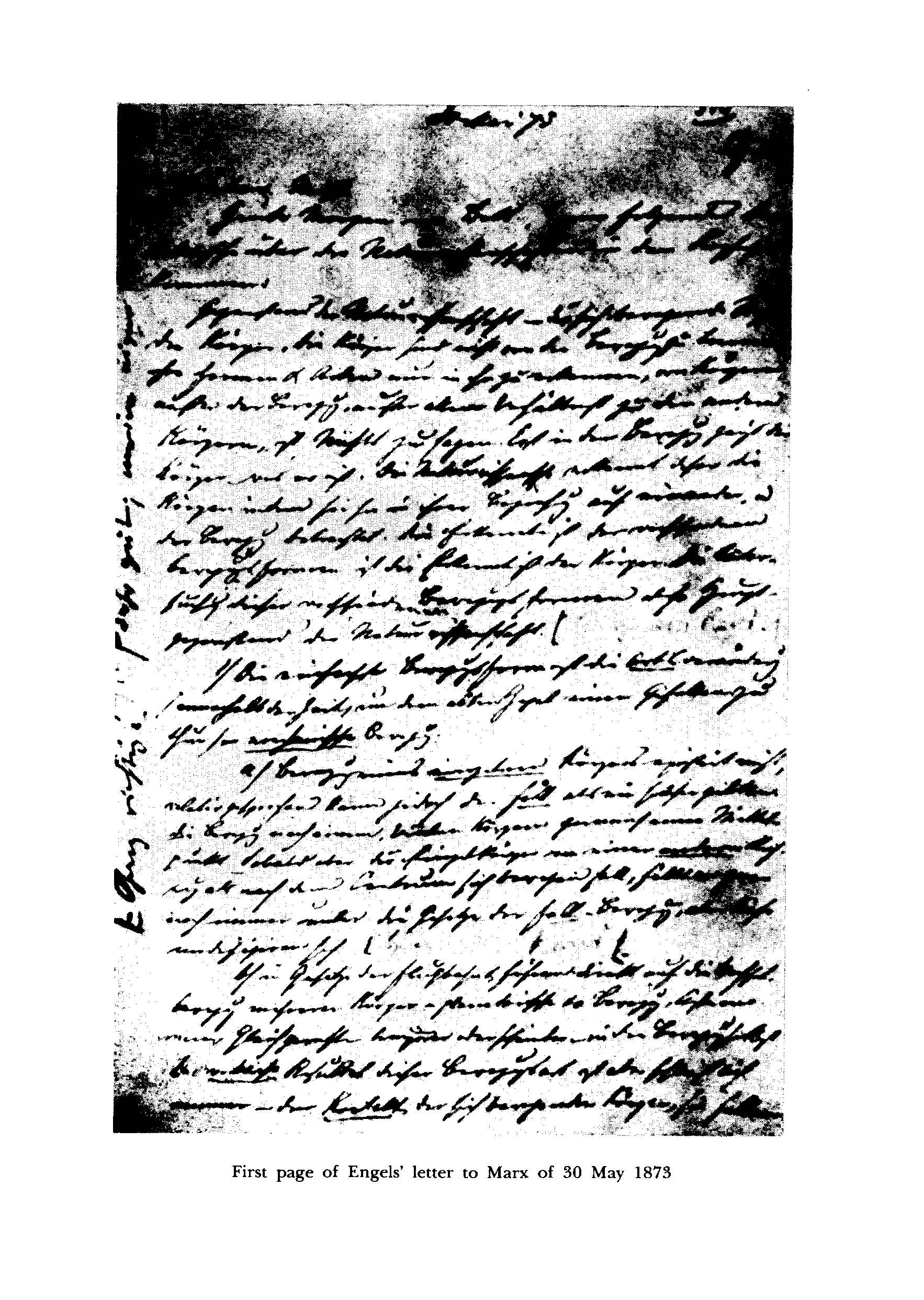
First page of Engels' letter to Marx of 30 May 1873
b) into the laws of trajectories and lead directly to the interaction of several bodies — planetary, etc., motion, astronomy, equilibrium — temporarily or apparently to motion itself. The real result of this kind of motion, however, is ultimately always the contact of the moving bodies; they fall into one another.
c) Mechanics of contact — bodies in contact. Ordinary mechanics, levers, inclined planes, etc. But this does not exhaust the effects of contact. Contact is manifested directly in two forms: friction and impact. It is a characteristic of both that, at certain degrees of intensity and under certain conditions, they give rise to new effects, no longer of a merely mechanical nature: heat, light, electricity, magnetism.
2. Physics proper, the science of these forms of motion, estab-lishes the fact, after investigating each form of motion separately, that they merge into one another under certain conditions, and ultimately discovers that given a certain degree of intensity, which varies for different moving bodies, they all produce effects that transcend physics; changes in the internal structure of bodies— chemical effects.
3. Chemistry. In the case of the preceding forms of motion it was more or less immaterial whether the bodies under investigation were animate or inanimate. In fact inanimate objects revealed the nature of the phenomena involved in their greatest purity. Chemistry, on the other hand, can only discover the chemical nature of the most important bodies by using substances deriving from the life process. Its principal task is increasingly that of producing these substances synthetically. It forms the transition to the science of organisms, but the dialectical point of transition can only be constructed when chemistry has effected the real transition or is on the point of doing so.a
4. Organism — for the present I shall not indulge in any dialectical speculations on the subject.b
Since you are at the very centre of the natural sciences there, you will be in the best position to judge whether there is anything in it or not.
Your
F. E.
301. Marx to Engels. 31 May
If you think I am on to something, don't tell anyone about it lest some rotten Englishman or other makes off with it. Working it all out will take a long time yet.
301
MARX TO ENGELS[3]'
IN LONDON
[Manchester,] 31 May 1873 25 Dover Street
DEAR FRED,
Have just received your letter which edified me greatly. However, I shall venture no judgment until I have had time to reflect on the matter and consult the 'authorities'.[3]
I have been telling Moore about a problem with which I have been racking my brains for some time now. However, he thinks it is insoluble, at least pro tempore, because of the many factors involved, factors which for the most part have yet to be discovered. The problem is this: you know about those graphs in which the movements of prices, discount rates, etc., etc., over the year, etc., are shown in rising and falling zigzags. I have variously attempted to analyse crises by calculating these UPS AND DOWNS as irregular curves and I believed (and still believe it would be possible if the material were sufficiently studied) that I might be able to determine mathematically the principal laws governing crises. As I said, Moore thinks it cannot be done at present and I have resolved to give it up FOR THE TIME BEING.
The French catastrophe b was welcome in so far as it involved disgrace for Thiers and his lickspittles; but unwelcome since, if it had gone the other way, I might have hoped to see various individuals removed from London soon. Moreover, I regard any violent catastrophe now as UNTIMELY both from the viewpoint of the interests of France and from our own.
Nevertheless, I am by no means convinced that the événement* will result in a restoration. The RURALSa had undoubtedly reckoned with some sort of revolt in Paris, Lyons and Marseilles, and especially in Paris. In that event they would have come down hard, some of the radical Left would have been arrested, etc., in short it would have led to a situation which d'une manière ou d'une autreb would have had to end in a restoration, and quickly at that. Bonaparte himself, in his attempt to carry out his coup d'état, i.e. to bring it to a conclusion, found himself paralysed the very first day by the merely passive resistance of the Parisians, and he knew full well that if that were to last another 6-8 days the coup would be lost and lost irretrievably. Hence the signal to go ahead with gruesome murders in the boulevards, etc., sans provocation aucune^ to improvise a terreur.c Mr Morny in particular, the real MANAGER, has since spoken very candidly about this planned operation, whose author he had been.
For that, however, the Rurals lacked the PLUCK; and they could only have had it if they had had one pretender instead of three. Their hope was rather the opposite one: that events would force them to stop acting like Buridan's ass.[698]
Now that they find themselves, in contrast, in a purely parliamentary situation, the row is flaring up again in their own ranks. Each hopes to gain the support of as much of the nearest faction, SAY, FOR INSTANCE, THE LEFT CENTRE, as would be necessary to enable him to dispense with his rivals. However, as far as MacMahon is concerned, in my judgment, the worthy fellow will never take any action on his own initiative. There is also another factor that must hasten the dissolution of this amalgam. The only thing that formally binds them together is God, i.e. Catholicism. The more impetuous and 'honest' people on the Right will absolutely insist that the Ministry should show its colours to the Poped and Spain,[699] and it seems to me that, quite apart from any inner reluctance to do so, the need to consider Mr Bismarck's feelings must prevent any step in that direction. However, the Jesuit fathers who have actually directed the entire strategy of the Rurals up to now, including, i.a., that old bag, MacMahon's wife,e
will not let themselves be fobbed off so simply. In such a situation the National Assembly might easily witness just such a swift changement de décorationf as took place recently. After all, it was only the SHIFTING of 9 votes that made the homme nécessairea
impossible, a thing which, incidentally, disproves Hegel's view that necessity entails possibility.b
The day before yesterday I went to see Dronke in Southport. He has become exceedingly fat, which does not suit him. While there I saw par accident Strauss' book Der neue und der alte Glaube, loaned to him by a German philistine. I leafed through it, and it really is proof of the great weakness of the Volksstaat that no one there has put this damned priest and Bismarck-worshipper (who gives himself such airs vis-à-vis socialism) in his proper place.
This afternoon I am going to Buxton with Moore, so that I shall be out of the way until Monday.c As soon as I have seen Gumpert, I shall return. Just lazing-around and idling has done me a world of good.
Enclosed a letter from Tussy. In the letter the child received from med I said to her that her last letter had greatly reassured me, etc.; her reproach that I was unjust towards Lissagaray was unfounded. I asked nothing of him but that he should provide proof instead of words that he was better than his reputation and that there was some good reason to rely on him. You can see from the reply how the homme forte proceeds. The damned nuisance is that I must be very circumspect and indulgent because of the child. I shall not answer until I have consulted you on my return. Keep the letter by you.
Schorlemmer has just arrived. He cannot accompany Moore and me because Roscoe is unwell and this is the period for preparing for exams.
Schorlemmer read you letter" and says that he is essentially in agreement with you but reserves his judgment on points of detail. MY COMPLIMENTS TO MRS LIZZY.
Your
K. M.
302. Engels to Friedrich Adolph Sorge. 14 June
Dear Sorge,
Work on the Alliance' has interrupted my correspondence. In addition the newspapers have only just started to arrive regularly again now that we have ordered them, and so it is only now that I can report properly again.
First, to deal with the points raised in your letters. The ones from the General Councilb are answered in the enclosure.
14 May.—The business about the shortage of funds is as old as the International itself. The Americans were the only ones to pay, and if it hadn't been for you, we would have been unlikely to receive even that.—Postponing the Congress[672] is absolutely out of the question; it would mean abandoning the field to the other side and anyway is not at all necessary, as you will see.
23 May.—The people in Geneva I am supposed to be giving a kick do not even answer us. Even old Becker0 does not reply to Marx. Outine is we know not where. We ourselves do not receive the Bulletin jurassien, and only see extracts quoted in the Liberté and the Internationale.
27 May.—The statement on France[700]—very good!—has gone off in English to the BRITISH FEDERAL COUNCIL and will go off today in French to the Plebe, the Spanish Federal Council and Portugal. BY THE BYE the Portuguese are complaining that they are not receiving anything at all from you and yet they are very, very important for us!—Serraillier has absolutely nothing to write about, since he does not have a single address in France any more; everyone has been caught. However, he will send in a little report on the trials[677] for your own report to the Congress — there were trials everywhere where there were sections, in Béziers, Lisieux, etc., etc.—Correspondence for the Arbeiter-Zeitung} Who is to do it? Marx and I are so overworked that Marx has been limited by his doctor to 4 hours work a day because of blood-congestion in the head, so that I have to deal with everything together with Lafargue. Frankel works in his SHOP until 9 p.m. The others cannot write.—The Hamburgers[452] are numbskulls. I shall write and tell Liebknecht.—For Holland the German version of the statement will be adequate.—The Arbeiter-Zeitung should make more use of the Volksstaat.
And now for some news, and this time it is no message of ill-tidings.
1. The British Congress, held in Manchester on 1 and 2 June, was a success.[701] 26 delegates.—Report from the Tory paper going off by BOOK-POST herewith; ditto 1 issue of the Brussels Internationale. The Federal Council to remain in London, although the locals wanted it transferred to Nottingham. The Eastern Post, hitherto the organ of Jung and Hales, has written a satirical article on the Congress which nevertheless acknowledges it as the real representative of the English International, and since then I observe that they have stopped publishing reports on BOGUS meetings in Hales' house; they seem to have shut up shop. Up to now they had always alternated these reports with reports from all of their 2 sections: Stratford and Limehouse, and Limehouse and Stratford; but this no longer seems to work.—Mottershead turned up in Hyde Park on Whit Mondaya for the TRADES UNION MEETING, completely drunk as usual.— I have not received The International Herald for the past 2 weeks, so that too seems to have folded up. It's no misfortune since there are the other publications of the English press. The new French section here (Dupont and Serraillier) have some chance of starting up a French paper here, though French assurances cannot be relied on very much.
2. The Jurassians have carried out their decisive retreat.[692] You will see from the Internationale that they have resolved to propose to their colleagues in the Alliance: not to send representatives to any congress 'que le prétendu Conseil general pourrait être tenté de convoquer'* but to hold a separate congress at a place in Switzerland to be determined by their federations.
Translated that means: we cannot put in an appearance in Geneva, otherwise we shall be thrown out on our ears. So they will meet in some corner of the Jura; after the Olten Congress (see below) they cannot show their faces anywhere else in Switzerland.—Other reasons are: 1. Bakunin's old reluctance to appear in debates personally, 2. Guillaume's and his own expulsion, which would raise the crucial issue from the very outset in a purely personal form, added to which there is also the fact of Bakunin's
escroquerie,a which would immediately finish him off, and 3. the certainty that in reality they are in as bad a way as we are and that internal squabbles have exhausted and irritated their people too. At their great Jura congress only nine sections were represented! In Italy, for all their bluster, they cannot put a single newspaper on its feet, and in Spain, in the movement as it stands, their stock is=0. More, they have had to renege on their own policy of abstention at once, and sent 8 members (10 according to them) into the Cortes.
3. In Rome a committee 'of the International' has been disbanded. It was called Società del Silenzio, clandestine society, oath of absolute obedience, the sacramental formula at the end of letters — the one proclaimed by Bakunin last year: Salute e liquidazione sociale, anarchia e collectivismob—in short, the secret Alliance ,0 with its whole bag of tricks. It comes just at the right time.
4. Serraillier has had an exchange in the Liberté with the Blanquists about the French trials[702] in which the latter took a very impudent line, but were duly boxed around the ears for it. What really finished them off was that after the letters of authority of those with mandates had been annulled at The Hague and the General Council was alone empowered to issue new ones,c Cournet and Ranvier issued a new letter of authority to Heddeghem in their names — and while still at The Hague!
5. Swiss workers' congress at Olten[70] —70 delegates, 5 Jurassians, proposed decentralisation, defeated with all votes against their 5 — they withdrew at once. But you will have known this long since from the Tagwachtd
I hope that your arm and voice are now recovered and that your prospects for the Congress have also improved. Even if the Congress is not very brilliant, it is nevertheless necessary and with some effort will turn out well. Don't forget that according to the Rules you must convoke it and prepare a programme 2 months in advance, i.e. by 1 July.
Alliance as good as finished — in French; a mammoth task in this tricky language — shall hit out and surprise even you.
Must catch the post. Cordial regards.
Your
F. E.
1906 and in full in: Marx and Engels, Works, First Russian Edition, Vol. XXVI, Moscow, 1935
303. Engels to August Bebel. 20 June[704]
Dear Bebel,
I am answering your letter first because Liebknecht's is still with Marx, who cannot locate it just now.
It was not Hepner but Yorck's letter to him, signed by the Committee, which made us here fear that your imprisonment[274]
would be used by the Party authorities, which unfortunately are entirely Lassallean, to transform the Volksstaat into an 'honest'
Neuer Social-Demokrat. Yorck plainly confessed to such an intention, and as the Committee claimed to have the right to appoint and remove the editors, the danger was certainly big enough. Hepner's impending deportation ' was another argument in favour of these plans. Under these circumstances it was absolutely necessary for us to know where we stood; hence this correspondence.[70]^
You must not forget that Hepner, to say nothing of Seiffert and Bios, etc., do not enjoy anything like the same position vis-à-vis Yorck as you and Liebknecht do as founders of the Party, and that if you simply ignore such impertinences, this is something that can hardly be expected of them. The Party authorities, after all, have a certain formal measure of control over the Party paper, which they refrained from exercising when you were there, but which they have undeniably tried to impose this time, with damaging effects on the Party. We thought it our duty, therefore, to do what we could to counteract this.
Hepner may have been involved in tactical infringements on points of detail, chiefly after receiving the Committee's letter, but we definitely think he is in the right on the substantial issue. Nor can I accuse him of weakness, for if the Committee clearly gives him to understand that he should resign from the editorial board, adding that otherwise he will have to work under Bios, I do not see what other resistance he could offer. He could certainly not barricade himself in the editor's office against the Committee. After such a categorical letter from a superior authority I can even find it in me to excuse Hepner's comments in the Volksstaat which you cited and which had when I first read them, earlier on, made an unpleasant impression on me.
This much is certain: since Hepner's arrest and absence from Leipzig, the Volksstaat has deteriorated greatly, and instead of quarrelling with him the Committee would have done better to give him every possible support. The Committee went so far as to demand changes in the editorial policy of the Volksstaat, they insisted that the scholarly articles should be omitted and replaced by leading articles in the style of the Neuer" and threatened direct compulsion. I do not know Bios at all, but if the same Committee simultaneously nominates him, it must be assumed that they have chosen someone after their own heart.
With regard to the attitude of the Party towards Lassalleanism, you, of course, can judge better than us what tactics should be adopted, especially in individual cases. But there is also this to be considered. When, as in your case, one is to a certain extent in the position of a competitor to the General Association of German Workers,[706] one can easily become too considerate of one's rival and get into the habit of always thinking of him first. But both the General Association of German Workers and the Social-Democratic Workers' Party together still form only a very small minority of the German working class. Our view, which we have found confirmed by long practice, is that the correct tactics in propaganda are not to entice away a few individuals and memberships here and there from one's opponent, but to work on the great mass, which is as yet uninvolved. The force of a single individual whom one has oneself reared from the raw is worth more than ten Lassallean defectors, who always bring the germ of their false tendencies into the Party with them. And if one could only get the masses without the local leaders it would still be all right. But one always has to take along a whole crowd of these leaders into the bargain, who are bound by their earlier public utterances, if not by their views hitherto, and now must prove above all things that they have not deserted their principles but that, on the contrary, the Social-Democratic Workers' Party preaches true Lassalleanism. This was the unfortunate thing at Eisenach,[707] which could not be avoided at that time, perhaps, but there is no doubt at all that these elements have done harm to the Party and I am not sure that the Party would not be at least as strong today without that accession. In any case, however, I should regard it as a misfortune if these elements were to receive reinforcements.
One must not allow oneself to be misled by the cry for 'unity'. Those who have this word most often on their lips are the ones who sow the most discord, just as at present the Jura Bakuninists in Switzerland, who have provoked all the splits, shout for nothing so much as for unity. These unity fanatics are either people of limited intelligence who want to stir everything into one nondes-cript mush, which, the moment it is left to settle, throws up the differences again but in much sharper contrast, because they will then be all in one pot (in Germany we have a fine example of this in the people who preach reconciliation of the workers and the petty bourgeoisie)—or else they are people who unconsciously (like Mülberger, for instance) or consciously want to adulterate the movement. For this reason the biggest sectarians and the biggest brawlers and rogues shout loudest for unity at certain times. Nobody in our lifetime has given us more trouble and been more treacherous than the shouters for unity.
Naturally every party leadership wants to see successes, and this is perfectly good. But there are circumstances in which one must have the courage to sacrifice momentary success for more important things. Especially for a party like ours, whose ultimate success is so absolutely certain and which has developed so enormously in our own lifetimes and before our own eyes, momentary success is by no means always and absolutely necessary. Take the International for instance. After the Commune it had a colossal success. The bourgeois, struck all of a heap, ascribed omnipotence to it. The great mass of the members believed things would stay like that for all eternity. We knew very well that the bubble must burst. All the riff-raff attached themselves to it. The sectarians within it became arrogant and misused the International in the hope that the most stupid and meanest actions would be permitted them. We did not allow that. Knowing well that the bubble must burst some time, our concern was not to delay the catastrophe but to take care that the International emerged from it pure and unadulterated. The bubble burst at The Hague[580] and you know that the majority of the Congress members went home sick with disappointment. And yet nearly all these disappointed people, who imagined they would find the ideal of universal brotherhood and reconciliation in the International, had far more bitter quarrels at home than those which broke out at The Hague. Now the sectarian quarrel-mongers are preaching reconciliation and decrying us as being quarrelsome and dictators. And if we had come out in a conciliatory way at The Hague, if we had hushed up the breaking out of the split — what would have been the result? The sectarians, especially the Bakuninists, would have got another year in which to perpetrate in the name of the International even far greater stupidities and infamies; the workers of the most developed countries would have turned away in disgust; the bubble would not have burst but, pierced by pinpricks, would have slowly collapsed, and the next Congress, which would have been bound to bring the crisis anyhow, would have turned into a row among the lowest kind of people, because principles would already have been sacrificed at The Hague. Then the International would indeed have gone to pieces — gone to pieces through 'unity'! Instead of this we have now got rid of the rotten elements with honour to ourselves — the members of the Commune who were present at the last and decisive session say that no session of the Commune left such an excruciating impression upon them as this session of the tribunal which passed judgment on the traitors to the European proletariat. For ten months we let them expend all their energies on lies, slander and intrigue — and where are they? They, the alleged representatives of the great majority of the International, now themselves announce that they do not dare to come to the next Congress. (More details in an article which is being sent off to the Volksstaat with this letter.(1)) And if we had to do it again we would not, taking it all together, act any differently — tactical mistakes are always made, of course.
In any case, I think the capable elements among the Lassalleans will fall to you of themselves in the course of time and it would, therefore, be unwise to break off the fruit before it is ripe, as the unity crowd wants to.
Incidentally, old man Hegel said long ago: A party proves itself victorious by splitting and being able to stand the split." The movement of the proletariat necessarily passes through different stages of development; at every stage part of the people get stuck and do not participate in the further advance; and this in itself is sufficient to explain why the 'solidarity of the proletariat', in fact, everywhere takes the form of different party groupings, which carry on life-and-death feuds with one another, as the Christian sects in the Roman Empire did amidst the worst persecutions.
You must also not forget that, if the Neuer, for example, has more subscribers than the Volksstaat, this is due to the fact that each sect is necessarily fanatic and through this fanaticism obtains, particularly in regions where it is new (as, for instance, the General Association of German Workers in Schleswig-Holstein), much greater momentary successes than the Party, which simply represents the real movement, without any sectarian oddities. On the other hand, fanaticism does not last long.
I have to close my letter so as to catch the post. Let me only add hurriedly: Marx cannot tackle Lassalle[708] until the French trans-lationb is finished (approx. end of July),[436] after which he will absolutely need a rest as he is very overworked.
That you have been serving your jail sentence stoically and are studying is very admirable. We shall all be glad to see you here next year.
Cordial greetings to Liebknecht.
Sincerely yours,
F. Engels
1932
304. Engels to Walter Whitter. Not before 24 June[709]
Sir,
In reply to your inquiry I beg to say that I believe Mr De Morgan to be very honest but am not in a position to say anything definite as to his means.
305. Engels to Ludwig Kugelmann. 1 July
Dear Kugelmann,
The entire story about Marx's illness stems from that idiot Barry, who got it into the newspapers[710] and who will be given a good telling-off for it when he shows his face again.
The actual situation is as follows: From time to time but to an increasing extent over a period of years now, Marx has suffered from insomnia, which he has always tried to explain away with all sorts of unconvincing reasons, e.g. a persistent cough in the throat, but which remained even when the cough had been cured. The real slog with the French translation of Capital[436] (he more or less has to rewrite the whole thing from the beginning), the urgings of the publisher(1) and unpleasantness connected both with this and other things exacerbated the situation. However, he could not be brought to stop overworking himself until finally he began to experience a conspicuous pressure at the top of the head and the insomnia increased to an unbearable point where even very powerful doses of chloral had no effect. I knew about these symptoms from Lupusa who had also worked himself sick, was then neglected by his doctor and was finally treated for what was falsely diagnosed as meningitis. So I told Marx straightaway that he had the same thing as Lupus and that he must stop working. He first tried to shrug it off with bad jokes, but soon discovered that the more he forced himself the less work he could do. So I finally prevailed on him to go to Manchester and consult Gumpert.[694] The latter just happened to be in Celle on a visit to his cousin Captain Wachs, so that Marx had about 12 days in Manchester to recover before Gumpert returned. I had written to Gumpert,[45] giving my opinion, and had also told him that Marx usually recovered very quickly. Gumpert thought my diagnosis was completely correct and put Marx under a strict regime: not more than 2 hours work in the morning and 2 in the evening, insisted on breakfast and exercise after breakfast, light wines with soda-water, plenty of movement, open bowels, a prescription I have not seen, a very powerful dose of chloral if the insomnia persisted, etc. Marx returned from Manchester much improved and even if he cannot quite keep it up, which is more than can be expected, he is nevertheless much better than previously, even on bad days. My intention is to take him right away from his work routine soon for a while, something which Gumpert incidentally also recommends as a definitive antidote, and if he can only get 2-3 weeks rest and fresh air, he will be in a better state to take a few knocks. At all events he now sleeps 4-5 hours a night without chloral and 1-1 V2 hours after luncheon, and that is more than he has done for almost a year — in The Hague, for example, he hardly slept at all. Moreover, he knows that this time it is serious and sticks to the stipulations with an almost pedantic strictness, and, since any deterioration is immediately apparent, I can always preach rest and convalescence in good time.[711]
Otherwise, things are more or less all right — Jennyb is looking forward to giving birth (but do not let her see that I have told you)—Laf argue and I have finished the pamphlet on Bakunin and the Alliance commissioned by the Congress, and as soon as it has been approved by the Commission,c" it will go into print; it is sure to cause a terrible row.[623] Lafargue and Dupont have started up a workshop to make brass instruments so as to exploit a patent taken out by Dupont; Serraillier will act as their salesman. Johannard has gone to Liverpool, Vichard pretends to be engaged in business transactions, Mottershead goes on drinking, Hales and Jung have failed spectacularly in their efforts to play at secession here, Eccarius has disappeared without trace now that Parliament is not to be dissolved. I have sent other news items to the Volksstaat, where you will be able to read them in the next issue.a
With best wishes,
Your
F. Engels
306. Marx to Juste Vernouillet. 10 July
Dear Citizen,
After a lengthy interval, I have just sent off some of the manuscript (Part VI) and some proofsb to Mr Lahure.
As you will know, the most dangerous thing about an illness is a relapse, but I am now in a condition to set to work seriously once more on Mr Roy's manuscript[436]—of which a great deal has now accumulated.
However, the disruption caused by my illness cannot be to blame for the delay in the publication of fascicle IV and for the non-publication of fascicle V.
At a time when I was very unwell I passed sheet 27 for press, but since it cannot be stereotyped without the ensuing instalment VI, I should be glad to have another proof.
Yours ever,
Karl Marx
307. Engels to Friedrich Adolph Sorge. 26 July
Dear Sorge,
I telegraphed yesterday, cost £1,16: ENGELS TO SORGE, BOX 101, HOBOKEN, NEW YORK. Serraillier YES™b Therefore, send Serraillier instructions and the material at once so that he has enough time to prepare himself and doesn't have to appear without having read the papers. Ditto the money.
Neither Marx nor I could have taken on the task without setting off the old hue and cry again: they are up to their old tricks, it is Marx who is behind it all, as usual, and he is just using the New-Yorkers as a front! It was only with difficulty that I could persuade Serraillier to take it on; he has found a position at last that can feed him decently and first had to cover himself there; hence the 3 days' delay.
Have sent an invitation to the Congress to Bignami, who is at liberty once more.[641] Have also informed Serraillier, but as I have already mentioned,[3] he no longer has any correspondents in France.
Am sending off to you by today's post 2 parcels d 16 copies of Congress resolutions.[13] You could have had them long since had you asked. But since you had no French sections, I thought that those I had sent for the use of the General Council would suffice.—8 or 10 have been sent off to Buenos Aires.[713]
Have still not received any money. The issue of The International Herald with the English translation of the Congress resolutions is no longer to be obtained. Moreover, Riley has seceded and gone over to the republican camp, and the reports of the FEDERAL COUNCIL are appearing once again in The Eastern Post, to the great annoyance of Jung and Hales, whose organ this was up to the time of the Manchester Congress[701]; the Congress, however, finished them off. For this reason I have not ordered The International Herald for Meyer.a
The statement about the French mandates has gone off to Italy, Portugal and Spain.[700]
Marx and I would welcome mandates from there. We shall presumably have to go, for various reasons, although we would, of course, prefer to stay here.
Marx will send on the instalments of Capital,[145] if he has not done so already. Four instalments of the French translation are out already,[436] the publisherb is afraid, and not without reason, that under the present clerical regime it may be confiscated, hence the slow appearance.
Admission for TRADES UNIONS varied. Some paid Id per member, others a lump sum; yet others only enrolled the CENTRAL COUNCIL directly and they too paid a lump sum. In conformity with the relevant article in the Rules, affiliation was approved by simple resolution and a certificate was issued to them.— For lsh. they could receive a printed illustrated version of it to hang on the wall.
The Demokratische Taschenbuch and the Geheimnisse von Europa might be obtainable if further details about the time and place of publication were available; the book-lexica do not stretch to such things and it is hardly worthwhile searching through 20 half-year issues of Hinrich's Bibliographyc in order to discover finally that they are not there (which is all too likely to be the case with books of this sort).
I still have the Geneva money in my pocket, thanks to the impossible instructions you have lumbered me with. How am I to discover an address to send money to for the widows and orphans of the Commune? This part of the money really must be retained here for your further instructions, since we simply cannot carry out your orders. I would suggest transferring it to Serraillier with a request to devote it to the purpose specified, if at all possible, but otherwise using it for any refugees of the Commune in general. Or else transferring it to the International, which can certainly put it to good use.—The refugees here who have still not been fixed up are a pretty worthless lot. I shall send £10 to Geneva and hold the rest here, pending further instructions from you.[714]
Oberwinder.a We are entirely of your opinion as far as we can judge from the published documents.[715] Oberwinder has always been a TRIMMER who may have made too much of the backwardness of Austrian conditions in order to have an excuse to act as mediator. Andreas Scheu, on the other hand, is a muddle-headed fellow at best, who wants to stand out as a man who 'goes as far as possible' and whose ambition quite certainly outstrips his abilities. We have long suspected him of being in contact with the Bakuninists, and now, in his programme ( Volksstaat No. 59), he has used the phrase taken directly from Bakunin that all other parties constitute a single reactionary mass vis-à-vis the proletariat.[716]
We shall reserve our judgment until we learn more. Very suspect too is the fact that Heinrich Scheu, who was present at The Hague, has been here for 4 weeks and only looked up Marx after Mrs Marx had met him in the street. Up to now we have taken care not to discuss the matter with him, otherwise he behaves quite decently and heaps abuse on Bakunin and the Blanquists, but it is peculiar all the same.
Würtz was described to me by Pihl as a vain, importunate fellow who imagines he is indispensable and whose indiscretion in pushing himself forward has done them considerable harm. THE LONG AND THE SHORT OF IT is that, thanks to the Lassalleans in Flensburg and others in North Schleswig, the Danes lean more towards the General Association of German Workers[706] and have got themselves into a mess as a result. Hence their silence. The devil take the socialists of all these peasant countries, they, are always fooled by fine phrases.
Look at our Bakuninists in Spain, for example. On Bakunin's orders they abolished the state in Alcoy (the so-called atrocities were, of course, reactionary inventions), and set up a Comité de salut publicb (which includes Severino Albarracin, a member of the Bakuninist Federal Council of Valencia and of the Correspondence Commission that has now been established in Cordoba[627]). So what happens? At the suggestion of some deputies anxious to mediate, peace is concluded; on the one hand, an amnesty, on the other, all resistance is abandoned and the troops move in amidst the jubilation of the bourgeois![717] In Barcelona they are neither strong nor courageous enough to attempt anything of the sort, but wherever they are, they strengthen 'anarchy', general confusion, and — they smooth the way for the Carlists.[718]
The report on the Alliancea is in print — I read the first proofs yesterday. It is supposed to be ready in a week but I very much doubt that it will. It will be some 160 pages long, I shall advance circa £40 for the printing costs. Edition of 1,000 — price: 2 francs=l/9d sterling. I shall send you the first copies to come off the press. But since the thing simply has to be sold so as to recover our costs, please let me know right away how many copies can be ordered for you over there; we shall then have a few more sent. Could you also look around for a reliable bookseller who would distribute it over there. Because of the additional expenses you will probably have to fix the price at about 60-75 cents in your CURRENCY—c'est votre affaireb—at any rate, we here have to receive l/9d per copy, with the exception of those sold through the bookseller since his discount will have to be subtracted, otherwise we shall not recover our costs. The book will hit the autonomists like a bombshell, and if anyone at all can be broken, it will finish off Bakunin. Lafargue and I wrote it together; only the conclusion is by Marx and myself. We shall send it to the entire press. You yourself will be surprised at the infamies revealed in it; even the people from the Commissionc were quite astonished.
The FEDERAL COUNCIL here proceeds on its somnolent way. Apart from the printed reports I see and hear little of them. At all events, Jung, Hales, Mottershead and Co. are finished as far as their pseudo-International is concerned.
Get some Copenhagen addresses for me through Würtz right away, so that I can send there a few copies of the Alliance report. Have not heard another word from Pihl, so that I do not know if his address is still valid.
Apart from that things are jogging along here. My wifed is in Ramsgate and Mrs Marx was due to go there today too. Jenny Longuet will probably enlarge the family in a week or two (do not write to Marx or Mrs Marx about it until you receive official notice, THEY ARE VERY PARTICULAR ABOUT FAMILY MATTERS). Lafargue and Le Moussu have started up an ENGRAVING business, based on a patent.[719]
Dupont too is attempting to exploit his patent in BRASS INSTRUMENTS, but keeps coming up against obstacles, mostly of his own making, since he knows as much about business as my dog. All this between ourselves. You have no idea how sensitive these people are about private communications, moreover their sensitivity is in direct proportion to their own tendency to gossip.
Finally, it would still be best if one of you were to come. How can we possibly represent the General Council here as effectively as this would be done by one of its members?
Your
F. Engels
Works, First Russian Edition, Vol. XXVI, Moscow, 1935
308. Marx to Nikolai Danielson. 12 August
N. Danielson, Esq.
My dear Sir,
I have since months suffered severely, and found myself, for some time, even in a dangerous state of illness, consequent upon overwork. My head was so seriously affected, that a paralytic strike was to be apprehended, and even now I am not yet able to work more than a few hours. This is the only reason why I have not before acknowledged, and thanked you for, the precious collection of books you were so kind as to send me.[720]
309. Marx to Engels. 29 August
You will have received — at least I read your last letter in that sense — 3 copies of Das Kapital in one volume. I send you to-day the last livraison3 of the Heftedition.h U5
We are publishing the Revelations on the Alliance'[623] (you know the sect of teetotallers call themselves thus in England[721]), and want to know the cheapest way to send you a somewhat large number of copies. A letter relative to the chiefd of that sanctimonious people is still held in reserve.[574]
I thank you much for your last long letter and shall make proper use of it. It is of great commercial value for myself.[722]
Yours most truly,
A. Williams'
309
MARX TO ENGELS
IN RAMSGATE 723
[London,] 29 August 1873
Dear FRED,
Serraillier was here this evening. He was full of complaints and very much in two minds about his going to Geneva.[724] Quite apart from personal reasons, he says he had only agreed in the first place because he thought we were going. In addition, however, he has now read the mandate, which had been promised him two weeks before the Congress, so he says. He finds that it contains things, such as increasing the POWERS of the COUNCIL, that he could not defend either personally or in the name of the FEDERAL COUNCIL.'
But none of that is the essential point. The FEDERAL COUNCIL has received a letter from Perret which makes it clear
1. that the Fédération Romande wishes to annul the plenary powers granted to the GENERAL COUNCIL by the Hague Congress ;
29 1873
2. that not a single member of the Romance gang in Geneva will accept a mandate from an English section, apart from Duval, and even he will only do so on the condition stated under 1;
3. that, as Perret writes, none of the oafs there is prepared to spend as much as a week at the Congress, which would be essential if the mandate is to go through.
Under these circumstances I am definitely of the opinion that it would be better for Serraillier not to go. The scandal rebounds back on us, not him, if he goes — under these circumstances, which could not have been foreseen. In my view he should send a letter enclosing the American papers [7 2 5] and go on to say that ill health prevents him from taking u p the mandates he has received from New York, London, etc. Finally, he should say that the letters he has received in London from the main continental countries have convinced him that in the light of circumstances currently prevailing in France, Germany, Austria, Denmark, Portugal, etc., no bona fide congress is possible.
Telegraph YES right away, if you agree; No, if opposed. I did not wish to commit myself to anything definite without consulting you first.
In view of the circumstances in Switzerland, which have been carefully concealed from us up to the last moment, I think it would be absolutely crazy to send Serraillier. Our complete abstention, which even at this stage both can and will make an impression on the governments and the bourgeoisie — despite the hullabaloo the papers will create to start with—va au diable,[3] if Serraillier turns u p under these circumstances. Salut
Your
K. M.
Sorge also writes (perhaps you know already) that the Dutch have informed them that they will also attend the Jura Congress,[671] and he insists that the Dutch should not be admitted to our (!) Congress, a point which Serraillier, as their mandated representative, is expressly asked to support.
MY COMPLIMENTS TO MRS.0
310. Engels to Marx. 30 August
310
ENGELS TO MARX
IN LONDON
Ramsgate, 30 August 1873
Dear Moor,
If Serraillier won't go, we cannot force him to.[724] However, / cannot absolve him of his promise, since I have telegraphed his acceptance," and in any event he must himself come to terms with the General Council.
Against the reasons you give, it must be urged that it is important for us to have a reporter; without Serraillier we shall not receive any account of what takes place, especially in the closed sessions.
What is absolutely essential, however, and our duty to the General Council, is that the two reports enclosed[725] which are utterly useless in Geneva in English, should be translated into French in time and sent off to Geneva. In the circumstances you must make sure that this is done. If 3-4 people each do a part at the same time, it can be ready in 1-2 days, and even if it doesn't come out just as one would have wished, the rush excuses everything.
In the circumstances, the sorrier our Congress[672] turns out to be the better, of course, and to that extent it is better if Seiraillier doesn't go. But I am in the awkward position of having given assurances that he would attend, assurances that I cannot reverse unilaterally.
Why on earth doesn't even one of those Geneva jackasses write in good time! What a dirty trick, and brought about by the very people who made all the fuss to start with! The others will undoubtedly have the laugh on them and insist that they should indeed eat humble pie and recognise their Congress[671] and their new Rules. And Duval, who was in such a fury in The Hague,[580]
has also joined in the hue and cry — it really is the last straw.
Well, it will all be very jolly. Regards to all.
Your
F. E.
311. Marx to Engels. 30 August
311
MARX TO ENGELS[726]
IN RAMSGATE
[London,] 30 August 1873
Dear FRED,
Your telegram[45] received; Serraillier arrived later on with Perret's letter to Days in his pocket.[727] I couldn't keep it for you because Days, who is secretary of the local FEDERAL COUNCIL, needs to report on it on Tuesday.3 However, Serraillier has promised to make a copie of it for you. The letter is classical; the 'ILLIMITED' POWERS or rather 'pouvoirs illimités' which the La Haye Congress[580]
granted to the GENERAL COUNCIL, must be withdrawn from it. On this point the Genevois—and ditto Mr Perret — are agreed; for then there is some hope that des sections jurassiennes will go over to them. For years now this same Perret has been writing that these SECTIONS would go over to them if only the GENERAL COUNCIL would proceed more energetically against the Jurassians! And of course everything is always looked at from the most bigoted and most parochial Swiss point of view. Furthermore, Frankel tells me that the same riff-raff are discontented with the resolutions passed at Olden, or whatever the place is called where the local Swiss congress met!70s In the circumstances there can be absolutely no question of going to Geneva[672] on account of people like that, people who even refuse to accept mandates from English sections.b
I think you would do well to send a counter-order to Hepner without delay; he will still receive the avisc in time.
Yesterday, A FEW HOURS before I wrote to you, je l'ai échappé belle? and can still feel the effects in all my bones. I drank a spoonful of raspberry vinegar and some of it stuck in my wind-pipe. I had a terrible choking-fit, my face went quite black, etc. Another second or so and I would have departed this life. The first thing that occurred to me post festume was whether it might not be possible to bring about such ACCIDENTS artificially. It would be the most decent and least suspicious method, and moreover a highly expeditious one, of doing away with oneself. It would be a great service to the English if one could recommend the experiment publicly.
312. Engels to Marx. 3 September
Madame Longuet will arrive tomorrow, after all sorts of telegrams to and fro — it was very stormy in Boulogne.
Aproposl Lafargue and Le Moussu have definitely split up.[719] It took place — the separation, that is — when Le Moussu declared his willingness to do so since reluctance was in evidence on the other side. Le Moussu is now counting on you. I think the separation is a good thing and had become a necessity for both sides, since a lot of time was wasted in this war between the frogs and mice.[728]
Salut.
Your
K. M.
As for Serraillier, who couldn't work for a week because he was unwell and who would have lost ABOUT another two weeks with the Geneva trip,[724] I am very pleased that we have not given him any reason to accuse us later on of having ruined his whole business! You know how, where and when the Frenchman makes a habit of bringing to bear his 'working-class nature' against the 'bourgeois' in his own party.
Have received a letter from França.[729]
312
ENGELS TO MARX
IN LONDON
Ramsgate, 3 September 1873
Dear Moor,
Received your wife's letter this morning, according to which Jenny(1) has successfully put it behind her. Our warmest congratulations. There is always some cause for concern the first time and hence a double sense of relief if all goes well.
The Genevans are complete philistines. So everything is to be overturned on the possibility that des sections jurassiennes will return to the fold! I am convinced that they are already up to their tricks with the others and absolutely dying to compromise— had we gone there, we might well have found everything settled in advance. The confidential report of the General Council can hardly be entrusted to such a congress[672] in extenso. Incidentally, the others are also making a rather poor beginning with only 30 members![671]
I had given my agreement to Le Moussu on 2 matters unconnected with each other[3]:
1. to advance him the £23 for his patent, whatever the situation;
2. if Lafargue were to leave him in the lurch, or back out of his own accord, or if there were to be a separation in any other form that would not prejudice my relations with Lafargue — then I would enter into negotiations with him and Mooreb on the same basis as they had established with Lafargue previously. It seems to follow from your letter that the terms of the separation were such that Lafargue cannot reproach me with anything if I take his place and go into partnership with Le Moussu. If this is right — and your opinion on this will be entirely sufficient for me—then Moore and Le Moussu can come and visit me in the evening, when I have to be in because of Andrews, and we can talk the matter over. But if he has to have the money for the patent immediately, he must let me know at once, since I would have to go to London right away to see to it.
My congratulations on your NARROW ESCAPE.c Unfortunately, such fits cannot be produced to order with any certainty. The raspberry vinegar, and even more solid bodies, might have got into your wind-pipe a hundred times over without provoking the same symptoms.
Have written to Hepner.[730]
Would you inform Le Moussu of what I said above, if you believe that I can do it with a good conscience vis-à-vis Lafargue? It should be made clear, incidentally, that my offer only refers to Lafargue's position in 'Moore & Le Moussu'. The other affair— the big printing works — should be abandoned for the time being, if only for commercial reasons. We shall have enough on our hands, for the moment at least, with exploiting the patent itself. I shall explain all this when I come.
Best regards to the whole family from Lizzie and myself. I hope that Andrews has also sent you the title, the table of contents and the cover*} Put on the cover, in small print at the bottom: Prix 2 sh.
Your
F. E.
313. Marx to Benjamin Le Moussu. After 3 September
My dear Le Moussu,
I have considered the matter about which you got in touch with me[719] and shall be obliged if you will come and see me before going into town.
Yours ever,
Karl Marx
314. Marx to Engels. 9 September
314
MARX TO ENGELS
IN RAMSGATE
[London,] 9 September 1873
DEAR FRED,
Letter from Hepner enclosed.780
The copies of the Alliance* which were meant to go to your house have not yet arrived, even though Darson had them as early as last Saturday. Therefore, so far I have had nothing to send off but the 12 copies still at your home.
Salut
Your
K. M.
That sorry piece of work signed Perret, Duval, etc., was written — according to Trusov — by ClusereL[731] I said to you at the time that it could not have been written by those oafs because of
the AFFECTATION OF A SMALL SORT OF LITERARY STYLE.
315. Engels to John De Morgan. Around 18 September
Dear Citizen!
On Monday[2] I found the letter from you which Miss Carroll had left at my house.[732] That day and Tuesday I was so much engaged on French refugee and International business that I could not attend even to the most pressing portion of my own affairs, nor find time to reply to the numerous letters found here on my return to town. Otherwise I should at once have written to you that I could not take the chair for her next Sunday.
On Tuesday as I was just on the point of going out on business which admitted of no delay and must be settled before 1 o'clock that day, Miss Carroll called again. It was half past twelve and I had above a mile to walk to the place. If a dozen of my oldest friends had arrived from the other end of the world, I could not have seen them at that moment where I had not five minutes to spare. I must have treated them as I treated Miss Carroll.
On telling her as politely as I could my momentous situation, she merely asked me categorically whether yes or no, I would take the chair for her; I regretted I could not, as I had an engagement for that evening, and again expressed my sorrow for having to leave her so abruptly; upon which she at once interrupted me, leaving me not even the time to ask her when and where I could have another interview with her, by saying that she was quite used to that sort of thing on the part of the London Internationals, and walked out of the house.
I felt sorry for her, attributing her behaviour to the exaggerated touchiness often brought on by misfortune. Unfortunately, the would-be insulting letter she wrote to me since, leaves me no room to doubts as to what is hidden behind all this virtuous indignation.
As to taking the chair on Sunday I was compelled to decline the honour.
a 15 September 1) because, as stated, I had a previous engagement; 2) because, contrary to your expectation, I do not recollect having heard Miss Carroll's name once before, nor could I get any further information from one or two others I asked.[3] And I cannot be expected to take the chair for parties of whom I know nothing or next to nothing.
3) I never took the chair at a public meeting of Englishmen and do not intend doing so. When I once took the chair for you, that was at the meeting of a German private society of which I was a member.
At all events this little incidenta will not have been without its use, if you will see from it the impropriety of proposing people for chairmen using their names without having previously obtained their consent.
Yours fraternally
316. Marx to Eugen Oswald. 20 September
My dear Oswald,
I have written to Wrôblewski,b who is as fluent in Russian as he is in Polish, being Lithuanian by birth.
If he does not agree I have another Russian (non-Polish) in petto.[3]
Yours ever,
Karl Marx
Works, Second Russian Edition, Vol. 33, Moscow, 1964
317. Marx to Eugen Oswald. 24 September
Dear Oswald,
In future could you please address yourself directly to the people you wish to recommend and not to me. I wrote to Wroblewski " on the basis of a letter which I had just received from you, while in the meantime, you had recommended Rozwadowski, whom I also knew about, but whom I had overlooked in favour of others, since he already had other employment.
But NEVER MIND.—We needn't fall out over this; however, you must realise that it is unpleasant to be put in a FALSE POSITION like that. I immediately told Wroblewski that the business had come to nothing and I do not think that he was greatly interested.
Yours,
K. M.
318. Marx to Friedrich Adolph Sorge. 27 September[187]
Dear Sorge,
My wife has written you a number of letters about my state of health. There was a serious possibility of my succumbing to apoplexy and I am still suffering greatly from headaches, so that I must severely restrict my working time. This is the sole reason for my long silence. As far as I can recollect, I have only written one letter to New York, and that was to Bolte* since it seemed to me from your letter that I might usefully intervene to smooth the troubled waters and clarify matters.
The fiasco of the Geneva Congress[672] was unavoidable. From the moment it became known here that no delegates would be coming from America, it was clear that matters were going awry. The attempt had been made in Europe to represent you as mere figureheads. If you had not put in an appearance and instead we had turned up, this would have been interpreted as confirmation of the rumour anxiously put about by our adversaries. It also would have passed as proof that your American Federation existed only on paper.
Furthermore, the British Federation was unable to scrape enough money together for a single delegate; the Portuguese, the Spaniards and Italians notified us that in the circumstances they could not send any delegates directly. The news from Germany, Austria and Hungary was just as bad and participation by the French was out of the question.
It was a foregone conclusion therefore that, under the circumstances, the great majority at the Congress would have consisted of Swiss — moreover, of local Genevans. From Geneva itself we had heard nothing; Outine was no longer there, old Beckerb persisted in an obstinate silence and Mr Perret wrote once or twice to create a false impression.
At the very last moment a letter arrived for the British Federal Council from the Romance Committee in Geneva[727] couched in sentimentally conciliatory terms. In it the Genevans firstly refuse to accept English mandates and then enclose a leaflet (signed by Perret, Duval, etc.) directly attacking the Hague Congress and the former General Council in London. In some respects the fellows even go further than the Jurassians, e.g. they call for the expulsion of the so-called brain-workers. (The nicest thing about the whole business is that this piece of nonsense was written by that miserable MILITARY ADVENTURER Cluseret (who in Geneva describes himself as the founder of the 'International' in America). The gentleman wanted to have the General Council in Geneva in order to run a secret dictatorship from there.)
This letter, together with its enclosure, arrived just in time to keep Serraillier from setting off for Geneva,[724] and to induce him to protest against the activities of the fellows there (as did the British Federal Council) and to inform them in advance that their congress would be treated as nothing more than a local Genevan event. It was very good that no one turned up there whose presence might have cast doubt on such a view of the congress.
Notwithstanding this state of affairs the Genevans failed in their bid to gain control of the General Council, but they have, as you will be aware, managed to nullify all the work done since the first Geneva Congress[738] and even to carry through numerous measures running counter to the resolutions adopted there.
As I view European conditions, it is quite useful to let the formal organisation of the International recede into the background for the time being, but, if possible, not to relinquish control of the central point in New York so that no idiots like Perret or ADVENTURERS like Cluseret may seize the leadership and discredit the whole business. Events and the inevitable development and intertwining of things will of themselves see to it that the International rises again in an improved form. For the present it suffices not to let the connection with the most capable in the various countries slip altogether out of our hands and for the rest not to give a jot for the Geneva local decisions, to simply ignore them. The only good decision adopted there, to postpone the Congress for 2 years, facilitates this mode of action. Furthermore it upsets the calculations of the Continental governments, the spectre of the International refusing, just now, to be of service to them in the impending reactionary crusade; indeed, the bourgeois everywhere consider the spectre dead and buried.
Apropos. It is absolutely essential that the account book with the records of how the monies were managed for the refugees of the Commune is sent back to us. We simply cannot do without it if we are to justify ourselves against slanderous insinuations. It was something completely unconnected with the general function of the General Council and in my view it should never have left our hands.
I hope that the American PANIC does not get too much out of hand and so have too great a repercussion on England and hence on Europe. General periodic crises are always preceded by such partial ones. If they are too violent they only preempt the general crisis and take the sting out of it.
With cordial greetings from my wife.
Your
Karl Marx
I would be glad to receive any cuttings from the Yankee papers reporting on the crisis.
What is the address of our mutual friend, Weydemeyer's executora?
Next week Engels will send you the 25 copies of the Allianceb
still outstanding.
319. Engels to Friedrich Adolph Sorge. 25 November
Dear Sorge,
Having been summoned to Germany by the illness and death of my mother,c7M I returned from there a few days ago and found your letter of 22 October waiting for me. Quite unknowingly you do me an injustice to blame me for keeping you in the dark for so long about decisions and developments here. The facts are these.
After long hesitation and after receiving lukewarm reports from some places and no news at all from others, Marx and I had come to the conclusion that the Congress[672] would become essentially a local Swiss affair and that since no one would be able to come over directly from America, we would do best to stay away too. (An additional factor was that no mandates arrived for either Marx or myself, apart from the alternative one from America.) As soon as this had definitively been agreed, I went off to the seaside at Ramsgate[723] to join my family, a break I needed urgently in view of my constant insomnia and nervous irritability. While I was there, Marx wrote to me about the sudden revelations about the treachery of the Genevansb which made it necessary to decide that neither should Serraillier attend the Congress.[724] This was pretty clear to me from Marx's letter and I agreed to it on condition that Serraillier should inform you at once.c A few days later I went to London for 24 hours in order to pay the Alliance" printerd and to organise the distribution. I had a look at the relevant documents and became convinced that it would have been the greatest folly for Serraillier to have gone there as your representative. Our absence and his, together with that of every German with one exception^ stamped the Congress as a merely local assembly which still looked respectable enough when compared to the Alliance,[671]
but which could lay no claim to any moral authority vis-à-vis the International. Furthermore, the general world situation was such that any congress was bound to end badly, as we can see from the fact that by now both the congress of the Alliance and that of the International have completely been forgotten. WELL, I urged Marx to let you know at once and went off again, and until I received your present letter, I assumed that this had been done. For his part, Marx had thought that Serraillier would have given you the first news when he sent back the money and that he could therefore wait until he was in a position to give you information about the results of the Congress, etc.
Instead of that, Serraillier gave the money to Lafargue for safe keeping, as we discovered only last week, and I shall get it from Lafargue in the next few days and take care of the matter. I am very busy looking through the — extremely bad — German translation of the Alliance pamphlet, which has been sent to me — Bracke is bringing it out in Brunswick.e What I have of your version has been very helpful in correcting the other one. Of course, the matter is urgent and I have to work through it as the manuscript has to go back this week.
Marx and his youngest daughter[3] went to Harrogate in Yorkshire yesterday; both of them are to spend some time there convalescing.[736] He needed it badly; the severe symptoms he had felt in the spring had vanished, but chronic brain pressure set in, which made him unable to work and unwilling to write, and which, if allowed to go unchecked for too long, might have serious consequences. During the next few days he will go and see our friend Gumpert in Manchester, the only doctor in whom he has complete confidence and who also looked after him in the spring. His condition is another reason why you have had to wait so long for a reply.
Bakunin's answer to the pamphlet has been to send the Journal de Genève and the Jurassians a statement announcing his political demise[737]: I withdraw—dorénavant je ne troublerai plus personne et je ne demande que ce qu'on me laisse tranquille à mon tour^ He is gravely mistaken in this. Apart from that, not the slightest attempt to reply to anything.
Outine has been here for 4 weeks or so and has told us still more wonderful stories about Bakunin. The fellow has really put his catechism[738] into practice; for years now he and his Allianceb
have lived exclusively from blackmail, relying on the fact that nothing could be put into print about this without compromising other people who have to be taken into account. You have no idea what a low-down gang they are. That aside, their pseudo-International is as quiet as a mouse; the pamphlet has exposed their frauds and Messrs Guillaume & Co. will have to let the dust settle first. In Spain they have put an end to themselves, see my article in the Volksstaat.c
The real International is equally silent. I have still not had an answer from Mesa, to whom I wrote in September.[45] In Portugal they are all being persecuted and have to watch their step. In Italy a section has been formed in Melegnano,[739] a fact I herewith bring to the attention of the General Council; for the address see below. The Plebe is still coming out, but very irregularly and with a strong emphasis on mediation. That is all I have to report. The federation here, having been badly shaken by Jung, Hales & Co., is
320. Engels to Marx. 29 November
now suffering badly from consumption; it is barely possible even to bring all the members together any more. With best wishes.
Your
F. Engels
Address for Melegnano: Luigi Zoncada, Melegnano, Provincia de Milano, Italia.
320
ENGELS TO MARX[81]
IN HARROGATE[736]
[London,] 29 November 1873
Dear Moor,
Lopatin left for Paris again yesterday evening. He intends to come here in a month or two, at which time Lavrov too will move in with his printing shop, unless he changes his mind on account of the expense, a matter to which I particularly drew Lopatin's attention.
It is unlikely that Lopatin and Outine will ever be very firm friends, their temperaments are not really compatible and the shadow of their first cool encounter in Geneva still weighs down on them. Moreover, Lopatin remains a great Russian patriot and still treats the pyccKoe 4 U o (1) as something special, having nothing to do with the West, and is hardly grateful to Outine for having initiated us into its mysteries. In addition, Lopatin has just passed through Lavrov's hands and coming fresh, as he does, from the solitude of Siberia,[740] may well be fair game for the latter's befuddled dreams of reconciliation.
On the other hand, he is fed up to the back teeth with the whole Russian emigration nonsense and wants to have nothing further to do with it whereas Outine, despite and because of his hostility to the gang, is still up to his ears in all their gossip and thinks every last fart a matter of importance. He is absolutely furious because Lopatin wants to have Chernyshevsky's manuscript that you know about3 printed not by Trusov but by Lavrov, parce
que cela leur donne du prestigeb\
So in my view it is of no great significance whether Lopatin takes Elpidin, for example, not for a sophisticated rogue, but for a simple ass. Even though it was precisely the indiscreet remarks of this same Elpidin to a certain Fedetzki or Feletzki, and the latter's inability to hold his tongue, that put the Russian government wise to Lopatin's presence in Irkutsk and so brought about his arrest.
When Lopatin arrived at Irkutsk, Chernyshevsky was 'quite close by', i.e. 700-800 English miles further on near Nerchinsk, but was straightaway removed to Srednevilyuisk, to the north of Yakutsk, 65° latitude, where, apart from the indigenous Tungus, the only company he has are the non-commissioned officer and the 2 soldiers who guard him.
Having escaped in July, Lopatin remained in hiding in Irkutsk for a month, ending up in the house of the very man who had been ordered to discover his hiding place. He then travelled on his own telega" to Tomsk, disguised as a peasant and doing the driving himself; from there he went by steamer, from Tobolsk by post-horse and finally by train to St Petersburg, still dressed as a peasant. There he stayed in hiding for another month, after which he quietly crossed the frontier by train.
In the nepeBOA 'KanHTaAa'd Chapters 2-5 (including machinery and large-scale industry) are by him, i.e. quite a decent chunk. He is now translating from the English for IIOAJIKOBT..'
Yesterday I read the chapter on factory legislation' in the French translation.[436] With all due respect for the skill with which this chapter has been rendered into elegant French, I still felt regret at what had been lost from the beautiful chapter. Its vigour and vitality and life have gone to the devil. The chance for an ordinary writer to express himself with a certain elegance has been purchased by castrating the language. It is becoming increasingly impossible to think originally in the strait-jacket of modern
321. Marx to Engels. 30 November
French. Everything striking or vital is removed if only by the need, which has become essential almost everywhere, to bow to the dictates of a pedantic formal logic and change round the sentences. I would think it a great mistake to take the French version as a model for the English translation. In English the power of expression in the original does not need to be toned down; whatever has inevitably to be sacrificed in the genuinely dialectical passages can be made up in others by the greater energy and brevity of the English language.
Apropos, how does Mr Kokosky set about excusing his bad translation[735]? By claiming that I write in that 'Liebknecht/Marxian style' that is so hard to capture! What a compliment!
Tussy's letter arrived yesterday evening. Shall answer it tomorrow, so that you don't receive everything on one day.
What does Gumpert have to say? Best regards to Tussy.
Your
F. E.
321
MARX TO ENGELS[742]
IN LONDON
[Harrogate,] 30 November 1873
DEAR FRED,
On Thursday(1) I went to see Gumpert whom I found very bald and aged. The poor fellow suffers terribly from haemorrhoidal convolution he has had for ages and for which he at long last intends to have an operation, something which, as he admits himself, always involves a certain degree of danger. I dined at his home (apart from him I could not, of course, see anyone in the few hours I had in Manchester) together with his four self-made children and their GOVERNESS.
Gumpert examined me BODILY and found a certain elongation of the liver which according to him I cannot get rid of completely until I go to Carlsbad.3 I have to take the same water as Tussy (they call it Kissingen water here, on account of its resemblance to the real things), but none of the mineral baths. Apart from that my regime and Tussy's are somewhat different. She may only walk in great moderation — a point on which Gumpert is wholly in agreement with Tussy's local doctor, Dr Myrtle (a very sweet-smelling name, the man is a Scot and boasts himself a Jacobite[745] to this very day; he should get to know COLONEL Stuart chez Don Carlos); I, on the other hand, am supposed to go on vigorous marches. Gumpert's advice to do very little was scarcely necessary, since up to now I have actually done nothing, not even written letters. I had imagined that two weeks here would suffice, but Gumpert insisted on three. And in fact Tussy will not be able to take a much stronger mineral bath than she has been taking so far until the middle of next week.
Apropos. Gumpert has not received the Alliance pamphletb that I sent him; in general, there have been many complaints in Manchester about the failure of the post to deliver PAPERS and PRINTS. So send him one by return; ditto a copy of your articles on Spainc printed in the Volksstaat, if you have received them yet. Gumpert says that all these things interest him greatly, and that we must help to keep him au courant by sending him things from London, as otherwise he will completely go to seed among the Manchester philistines.
I am very sorry that the good Lopatin has missed me; but how lucky he has been in his misfortune.[740] When he moves to London we shall protect him against Lavrov's SOFT-SAWDER.d
There was a storm here yesterday (although on the whole the air is extremely invigorating) and I caught a bad cold which has kept me indoors today, in accordance with the maxim: Principiis obsta.'
Our lune-de-miell couple, about whom Tussy has already told you, were so horribly bored in the first 3 days — they are called Briggs incidentally — that the young husband prescribed a friend, a devil with a limp, who arrived yesterday. Since then they seem LIVELIER, to judge by the noise they are making. Tussy and I took refuge in chess yesterday evening. Apart from that I have been reading Sainte-Beuve's book on Chateaubriand,* an author I have always disliked. If the man has become so famous in France it must be because he is in every respect the most classical incarnation of French vanité, a vanité not decked out in the light-hearted and frivolous garb of the 18th century, but strutting about in a romantic disguise and newly minted idioms; the spurious profundity, Byzantine exaggeration, the coquettishness with regard to the feelings, the flamboyant schillerising, WORD-PAINTING, theatrical, SUBLIME — in a word it is hotchpotch of lies never before achieved in either form or content.
It is very kind of Mr Kokosky to have invented a Liebknecht/Marxian style.b But it seems to refer to Liebknecht's French style, with which we are unacquainted. His German style is, after all, just as uncouth as that of Mr Kokosky and must please and appeal to him for that very reason.
Now that you are taking a look at the French translation of Capital,[436] I would be grateful if you could persevere with it. I think you will find that some passages are superior to the German.
MY COMPLIMENTS TO MRS LIZZY. Addio.
Your
K. M.
322. Engels to Marx. 5 December
322
ENGELS TO MARX
IN HARROGATE
[London,] 5 December 1873
Dear Moor,
I would have written to you yesterday as agreed, but I had the pleasure of a visit from your esteemed associé, Mr Le Moussu, from 3 to 6 p.m., who honoured me with a list of his complaints. Have no fear, I do not intend to take my revenge by repeating the entire rigmarole.[719] I have urged them both to keep the peace (Moorea a week ago, Le Moussu yesterday) and pointed out that they were now married and would simply have to get along with each other. They are two of the oddest fellows one could hope to find, each with a boundless idea of himself and his achievements, but each in his own speciality, and since their specialities are different, each criticises the other to perfection. I gave Moore £5 last week and another £5 to Le Moussu yesterday, reminding him of his duty to take no more than half for himself. He found this somewhat disagreeable, but since Moore did not come but sent him instead, it was my duty to do so after all that had taken place. Le Moussu then said that £10 were still owing on the patent and that would exhaust the £160. I can give them another £5 next week, if you authorise me to do so, in the event that no money comes in; but I shall categorically demand that Moore should get Longuet to cash it, since there have been enough remittances from October which, when cashed, should keep the machine going. If you could write a brief note to Moore along the same lines, it would be of help. And if they pester you with letters, just write and say that they simply must get along together until your return. That would do very nicely since all the GRIEVANCES are by no means as pressing as they make out.
Have sent the Alliance reportb to Gumpert. What does he say about your head? I hope you have got rid of your cold.
I am now in a position to pay the £100 due at Christmas. Should I give it all to your wife, or just part and the rest to you on your return? And also, since you are staying 3 weeks, you will need more money for there; IF SO. SAY HOW MUCH, RECKONING LIBERALLY.
I had commissioned Aston over a fortnight ago to sell some SHARES but there are NO BUYERS for this special sort. If I manage to get rid of them (and I shall be seeing him tomorrow), your debts can be settled without delay, otherwise we shall have to wait until the beginning of February, when I have prospects of further money.
For your amusement I am sending you a pamphlet on banks," belonging to Utin. It is by Geffcken, a Strasbourg professor. What clever-clever people they are! And they only quote members of their own lousy gang, authorities like Augspurg (who has ever heard of the Jew?) and the great Wagner of whom it is said:
'It the Tosafoth Yom Tobh no longer valid? What is valid? Murder! Murder!'[744]
Utin has left a whole pile of such pamphlets here, it's fantastic stuff, SERVES HIM RIGHT if he relies on his bookseller to make the choice. Judging them just by the titles,[3]/4 of them are only fit for the W.C., and significantly, not a single one of them has had its pages cut.
More soon on the French translation.[436] Up to now I find that what you have revised is indeed better than the German, but neither French nor German has anything to do with that. Best of all is the note on Mill,[745] quant au style.b
Enclosed an excerpt on the way in which mechanical energy is transformed into heat in the human body. Busch is one of the leading contemporary surgeons. The phenomenon described here also explains the claim made by both sides at the start of the warc
that — in violation of military convention — the enemy was using dumdum bullets. Busch's cool account certainly puts one in mind of the old warning: do not play with firearms. A nice business when your own brain smashes open your skull.[746]
Best regards to Tussy.
Your
F. E.
323. Marx to Engels. 7 December
323
MARX TO ENGELS
IN LONDON
[Harrogate,] 7 December 1873
Dear Engels,
Of the £60 you gave me, ABOUT £23 remained for my journey (having made payments as follows: £10 to Moore" et Co.; instalments: £5 to BEERMAN, £5 to GROCER, £5 to Withers, £2.l7sh. interest to the pawnbrokers, £4 dress, boots, etc., for Tussy, £5 left for my wife). With £10 more I shall have LARGELY enough, but will need £12 if I return via Manchester, as I promised Gumpert, and stay there for 2 days.
Be so good as to give my wife only £20 of the £100, and keep the £80 for me in reserve, as I have to make major payments on 3 and 16 January and would not like to expose her to the temptation of paying off less urgent debts.
The £5 will just have to be shoved down the throat of the Co.[719]
I shall write to Moore today about collecting the remittances.
My COLD, which was damned SEVERE, has not yet gone completely, and I am still downing the medicine which Gumpert prescribed me from Manchester as soon as he heard of it. I hope it will be cured in 1-2 days. But you can see from the fact that I have not felt so well for years, despite this irksome, dizzy-making incident, what an extraordinarily beneficial effect the air here and the peaceful life have had on me (I have done absolutely no work whatsoever).
I caught the COLD through following too literally Gumpert's advice to take vigorous exercise after drinking the waters. It should have been clear from the state of the sky that a storm was to be expected.
The cure is doing Tussychen a world of good. Likewise the regimen which prescribes bed by 11 o'clock at the latest.
The table of contents of De Paepe's planned magnum opus[747]
features, as the main section of Book 2, données physiologiques11:
'Analysis of Labour Power and Physiological Conditions of Its Existence.' 1. Karl Marx's theory of labour power, necessary labour and surplus labour.—The great economic and social significance of this theory; 2. Physiological analysis of what Marx calls labour power or the power of the labourer.—This force comprises three principal elements: the power of the nerves, the power of the muscles, the power of the senses."
You see how he thus takes the opportunity to enter medical territory. The section ends:
14. How the foregoing physiological data enable us to determine, as precisely as possible, the value of labour power as the basis of all exchange value and the foundation of all economic science.
The last sounds like a misunderstanding. Then comes the theory of population under the heading: 'Data furnished by the study of the functions of reproduction.' I see from the table of contents that because of the delays in publishing the French translation of Capital,a he is unfamiliar with what has been done there and hence has been unable to appropriate it in any way.
The recalcitrance of the Cuban SLAVEHOLDERS is a GODSEND; it would be highly undesirable for the matter to drift on so indecisively. Moreover, any unpleasant complication that overtakes Castelar et Co. is to be welcomed.[748]
Have you read the Pope'sb Encyclical in which, very transparent-ly, our handsome Williamc is compared to the Roman Emperors who persecuted the Apostles and followers of Christ?[749]
The Left in the French Assembly will probably find itself subjected to special regulations. The scoundrels are reluctant to walk out en masse, for that would mean the end of the security which is the citizen's prime duty, as well as the official position of importance and the parliamentary remuneration, etc.
Gumpert wants to know when you are next going to show yourself in Manchester? I have reassured him by saying that you would in all likelihood come up on business in the spring.
COMPLIMENTS TO MRS LIZZY.
Your
K. M.
324. Engels to Marx. 10 December
324
ENGELS TO MARXa
IN HARROGATE
London, 10 December 1873
Dear Moor,
Enclosed you will find 3 halves of five-pound notes; please acknowledge receipt at once so that the rest can follow.
Heavy fog since yesterday morning from which I just escaped for a short hour by taking a walk to the Heath.[3] Up there blue sky and warm sunshine, AN ISLAND OF BRIGHTNESS IN A SEA OF FOG.
That good-for-nothing Roderich Benedix has left a bad odour behind in the shape of a thick tome against 'Shakespearomania'.b
In it he has proved to a nicety that Shakespeare can't hold a candle to our great poets, not even to those of modern times. Shakespeare is apparently to be hurled down from his pedestal so that fat-arsed Benedix can be hoisted into his place. However, the first act of the Merry Wivesc alone contains more life and reality than all German literature, and Launced with his dog Crab is alone worth more than all the German comedies put together. By way of contrast, the ponderous posterior R. Benedix will indulge in considerations as serious as they are cheap over the casual manner in which Shakespeare often makes short work of his
dénouements and thereby cuts short the tedious twaddle that in reality is nevertheless unavoidable. Habeat sibi.e
Yesterday received a geological map of the Rhine Province. The superficial conjectures I made in locof mostly confirmed.
Bes.t regards to Tussy.
Your
F. E.
325. Marx to Engels. 11 December
325
MARX TO ENGELS
IN LONDON
Harrogate, 11 December 1873
Dear Engels,
The halves of the notes have arrived, for which BEST THANKS. I have received a letter from Sorgea;he requests you urgently to send off the still missing 25 copies of the Alliance* to New York.
While you had fog up there, there was real spring weather down here, and air of a purity such as we are not accustomed to having in England.
Roderich Benedix comes as no surprise to me.b If he and those like him understood their Shakespeare, where would they get the courage to display their own 'wares' to the public?
Things are going badly for Bazaine.[751] The Orléans have no cheaper way to exhibit their own patriotism than by such an act of brutality against a Bonapartist general. The Due d'Aumale is a modern Cato.
I have just written to Gumpert,c saying that we shall arrive in Manchester at 12 noon on Monday.d
Salut.
Your
K. Marx
time
326. Marx to Thomas Allsop. 23 December[752]
IN PENZANCE
[London,] 23 December 1873 1 Maitland Park Road, N.W.
My dear and honoured friend,
I felt very anxious about your protracted silence, Mr Leblanc being unable to inform me of your whereabouts and your doings. I am sorry to see from your letter that my apprehensions were not quite unfounded, but the mild climate of Penzance and your robust constitution will, I hope fervently so, soon rid you of the cough which, by the by, sways it now all over the country. It is, in the current phrase, quite a seasonable nuisance.
My youngest daughtera and myself have for three weeks stayed at Harrogate[736] whither our medical adviserb had sent us. The quiet life, breezy air, mineral waters and pleasant walks of the place have gone far to restore the health of the two patients. When we arrived, the season had already gone, so that we occupied our hotel 'in single blessedness',c being only disturbed and somewhat amused during the last days of our sojourn by the dropping in of a Church of England parson, a worldly wise old man, with no smack of cant about him, of fluent and trivial talk, with conventional varnish of manners and caring indeed for nothing save his belly. He was the true model of a modern Christian, using that word itself only with respect to the dishes our hotel-keeper provided and saying for instance: this is no Christian mutton chop, if that same chop happened to lack some virtue or other. The man had overrun most countries of Europe and was in himself a recording office of all the merits and demerits of its several hotels, always hunting in vain for that paragon of mankind — a perfect man — cook. At the same time he never tired of bitter sarcasms against the overstrained pretentions and the extravagant living of the miners of the black country,"d being himself an incumbent at Durham. This man gave me and Eleanor constant occasion to think and speak of you, because a more striking contrast could hardly be fancied — you, so to say an anticipation of what the men of the new society will be, and he, the parson, a stereotyped mould of what the men of the old society have contrived to become.
I send you to-day three further parts of the Capitala which, on the whole, are less abstract than the preceding ones. If they contribute to enliven your hours of seclusion, I shall feel most happy. In general, I must say that my views commence to spread amongst the workmen of the Continent and that there the upper classes and the official representatives of political economy make much noise about them and feel rather annoyed at them.
In poor Spain things might still right themselves if French reaction gets not the upper hand. With all their shortcomings there is mettle in the Spaniards. The downbreak of the Spanish working class rising — which was unripe and senseless[75]—will prove useful if its leaders have been taught by dearly bought experience to emancipate themselves from highflown but hollow French phraseology and to apply themselves to the study of the real conditions of the movement. We have some excellent men at Madrid and Valencia. At Lisbon we have a nucleus of really superior workers.
In the United States our propaganda has been much accelerated by the crisis. It has acted as our recruiting officer.
In Germany we are pretty sure to send at the coming elections at least a dozen intelligent and energetic workmen to parliament.[754] The sudden and mighty industrial development in that country is our best agent. Bismarck and the middle class intend striking a blow at the proletarian press, the 'respectable' press confessing its inability to cope with it, but the old kingb is rapidly sinking and his successorc cannot dare inaugurate his regime by unpopular measures.
In Russia, what with the social disorganisation consequent upon the emancipation of the serfs[755] and the awful growth of financial disease, what with the popular discontent at the loss of the Russian prestige through the Prussian achievements and the hesitations of a weak home-policy making half-concessions to-day to compensate them by ultra-reactionary measures to-morrow, the elements of a general convulsion are accumulating.
Thus, my dear friend, the world is moving with all that. What are the feeble efforts of upper class France at a moment where the foundations of the very stronghold of European reaction, of Russia, are shaking?
With my and Mrs Marx kind regards to Mrs Allsop and our best wishes for the coming year, I remain, my dear and honoured friend,
Yours most sincerely,
Karl Marx
Engels sends you his compliments and will immediately write to you.
First published, in the language of the Reproduced from the original original (English), and in Japanese, in Keizai gakuronshu. Vol. 35, No. 1, Tokyo, 1969 APPENDICES
1
Endnotes
[651] The Manchester Foreign Section of the International Working Men's Association was formed in August 1872, mostly of emigrant workers. It resolutely opposed the reformist wing of the British Federal Council and supported Marx's and Engels' efforts to strengthen the British Federation and purge it of the elements that were disorganising its work. The circular mentioned by Engels was written by him at the request of the Manchester section in reply to the circular of 10 December 1872 drawn up by the reformist wing which had seceded from the British Federal Council. After the section had approved it, Engels' circular was published as a leaflet and sent to all members of the International in Great Britain (see present edition, Vol. 23, pp. 304-08).—464
[654] In a letter to Engels of 29 December 1872, José Mesa informed him of the putsch launched by extremist groups of republican federalists in Madrid towards the end of 1872. He wrote that the participation in the putsch of many of the Internationals, who had joined in at the anarchists' instigation, had serious repercussions for the organisation in Spain.—465
[628] On 25 December 1872 a private conference of the International Working Men's Association's branches in Southern France was held in Toulouse and attended by delegates from Toulouse, Montpellier, Bordeaux, Béziers, Sète, Agen, Narbonne, Bayonne, Avignon, Castelnaudary, Lavardac, Perpignan, etc. The conference was to endorse the resolutions of the Hague Congress and put up a fight against the Bakuninists. These plans, however, were foiled by arrests of the International's members, which began at that time in Southern France.—454, 466
[655] -phe Strike that affected jewellers' workshops in Geneva began in late November 1872 and lasted late into April 1873. The strikers demanded a nine-hour working day. At the request of the Romance Federal Council, the General Council appealed to the International's sections and federations to extend support to the striking jewellers. The latter received 49,000 francs from different countries, which enabled them to hold on. The strike ended in victory for the workers.—466
[656] Engels is referring to the strike by 3,000 Geneva building workers in March and April 1868. The workers were demanding a reduction in the working day to ten hours, a pay rise, and payment by the hour instead of by the day. The victory of workers in Geneva was made possible by the solidarity campaign organised by the General Council and involving their British, French and German counterparts.—466
[657] A reference to the address of the General Council to the Jura Federation issued on 8 November 1872, warning it that if it refused to revoke the resolutions of its congress in Saint-Imier (see Note 593) it would be suspended from the International pending the next General Congress. Implied also is the General Council address to the forthcoming Belgian congress issued on 1 December 1872, which urged the Belgian workers to consolidate the unity of the International Working Men's Association.—467
[658] In a letter of 6 December 1872 Sorge wrote to Engels that the General Council had decided to grant temporary powers for Paris to Walter (L. Van Heddeghem), and for Toulouse to Ferdinand Argaing.—467
[604] A reference to the various groups of French refugees in London. The 'purs' are the Blanquists headed by Edouard Marie Vaillant. In November 1872 the Blanquists issued a pamphlet Internationale et révolution aimed against the decision of the Hague Congress to transfer the seat of the General Council to New York, in which they accused the leaders of the International of having renounced the idea of revolution. The pamphlet was signed by Armand Arnaud, Frederic Cournet, Edouard Margueritte, Constant Martin, Gabriel Ranvier and Edouard Vaillant, who simultaneously stated that they were withdrawing from the International. However, as Eugène Dupont informed Marx on 6 November 1872, Ranvier was unaware that his name had been used. The 'impurs' are probably a group of French refugees headed by Pierre Vésinier and Bernard Landeck.—443, 447, 458, 467
[659] 669 In a letter to Engels of 6 December 1872 Sorge wrote that against his advice, Theodor Cuno had turned down a job paying $75 a month, considering this to be too little. As a result, he had been forced to content himself with a job at a machine-building factory at less than half that wage.—468
[660] This letter has survived as a scrap pasted by Seiffert onto his letter to Engels of 21 January 1873, in which he acknowledged receipt of all materials posted by Engels to Der Volksstaat.—468
[661] Probably a reference to Engels' letter to Adolf Hepner of 30 December 1872, which has not survived in its entirety (see this volume, pp. 462-63).— 468
[62] Marx wrote this letter to Jung after he had received resolutions from the Central Committee of the German-speaking sections in Switzerland which endorsed the General Council's proposal to defer the regular congress of the International due on 5 September 1870. A copy, handwritten by Marx, of the resolution of the Committee of the Social-Democratic Workers' Party was enclosed with the letter.—44
[663] Marx is referring to the letter requesting written contributions which he 23-556 received from the editorial board of the Znaniye magazine. It was signed 'A. Sleptsov' and sent at the end of 1870.—469
[637] In a letter of 15 (27) December 1872 Danielson outlined a basis for Lafargue's work for Russian magazines, including Znaniye, and asked him to send a trial article. Fruitful cooperation between the Russian magazines Ustoi, Otechestvenniye Zapiski and Seventy Vestnik and Lafargue began only in the 1880s.—457,
[639] Marx's intention to write Nikolai Chernyshevsky's biography or an essay about him remained unfulfilled since Danielson failed to obtain necessary information.—457, 469
[634] Writing to Marx on 21 November (3 December) 1872, Danielson quoted a letter from Lopatin in which the latter reported that he had managed to escape from exile in Irkutsk but had been rearrested in Tomsk and returned to Irkutsk. It is possible that Marx intended to try and get him released through the British diplomat David Urquhart, with whom he maintained friendly relations.—456,
[665] Marx is referring to the open letter sent to La Liberté by a group of Russian émigrés in Switzerland who were closely associated with Bakunin (Woldemar Holstein, Barthélémy Zaizev, Alexander Oelsnitz, Nikolai Ogarev, Vladimir Ozerov, Zemphiri Ralli, A. Ross, Valerian Smirnov). The letter, written on 4 October 1872, protested against Bakunin's expulsion from the International. It was printed by La Liberté, No. 41, on 13 October 1872.—469
[137] This letter was first published in English in full in: Karl Marx, On the First International Arranged and edited, with an introduction and new translations by Saul K. Padover. McGraw-Hill Book Company, New York, 1973.—97, 106,
[666] This is Marx's reply to Bolte's letter of 22 January 1873. Having received information from Friedrich Adolph Sorge about his disagreements with some members of the General Council, notably Bolte, regarding the divisive activities of anarchists and British reformists, Marx outlines here the stand to be taken by the Council. Under Marx's influence, Bolte supported Sorge when the General Council resolution of 30 May 1873 was being worked out. It declared all organisations and individuals refusing to recognise the resolutions of the Hague Congress to have placed themselves outside the International. Part of this letter was published in English for the first time in: Karl Marx, On the First International Arranged and edited, with an introduction and new translations by Saul K. Padover. McGraw-Hill Book Company, New York, 1973.—474
[667] Bolte asked Marx and Engels to contribute to the Arbeiter-Zeitung newly established in New York, and to the bulletin of the US Federal Council, which was to appear in English. The latter was never published.—474
[417] In April 1872 the Universal Federalist Council was formed in London, comprising what was left of the French Section of 1871 (see Note 338), some of the Lassalleans expelled from the German Workers' Educational Society in London, and representatives of the bourgeois Universal Republican League and the Land and Labour League. The Council proclaimed itself a 'true' leading body of the International in a pamphlet called Conseil fédéraliste universel de l'Association Internationale des Travailleurs et des Sociétés républicaines socialistes adhérentes. This prompted Marx to write the 'Declaration of the 22» General Council Concerning the Universal Federalist Council'. In September 1872 the Universal Federalist Council convened a congress in London which claimed to be a congress of the International Working Men's Association. Its subsequent activities amounted to in-fighting between the various cliques which laid claim to leadership of the workers' movement.—297, 418, 424, 428,
[668] T h e congress of the secessionist part of the British Federation (see Note 652), was attended by Bennet, Dunn, Eccarius, Foster, Grout, Hales, Jung, Mac Ara, Pape, Roberts, Seaman and Weston.—474
[669] A reference to the General Council resolution of 5 January 1873, which announced the suspension of the Jura Federation pending the next regular congress of the International, since this organisation had rejected the resolutions of the Hague Congress.—475
[5] In July and August 1870, the town of Blois was the scene of a major political trial. Seventy-two people, among them such prominent Blanquists as Charles Victor Jaclard, Edme Marie Gustave Tridon, Gustave Paul Flourens, Théophile Charles Gilles Ferré, as well as Félix Pyat, were charged with conspiring to assassinate Napoleon III and stage a coup d'état. The Supreme Court sentenced most of the accused to penal servitude and to terms varying from 5 to 20 years in prison and exile.— 3
[6] The Fenians were Irish revolutionaries who named themselves after the 'Féne'—the name of the ancient inhabitants of Ireland. Their first organisations appeared in the 1850s in the USA among the Irish immigrants and later in Ireland itself. The secret Irish Revolutionary Brotherhood, as the organisation was known in the early 1860s, aimed at establishing an independent Irish republic by means of an armed uprising. The Fenians, who expressed the interests of the Irish peasantry, came chiefly from the urban petty bourgeoisie and intelligentsia and believed in conspiratorial tactics. The British Government attempted to suppress the Fenian movement with drastic police action.—3
[614] A reference to the private 'Circular â todas las federaciones locales' issued in 1872 in Valencia by the Bakuninist Spanish Federal Council. It called for an extraordinary congress of the Federation with a view to declaring its agreement with the decisions of the Bakuninist congress in Saint-Imier. The circular included the report of the four Spanish delegates to the Hague Congress, which had originally appeared in La Federation, No. 162, on 21 September 1872.—
[673] This is Engels' reply to Liebknecht's letter of 8 February 1873 written from the Hubertusburg fortress where he had been imprisoned. The letter outlined a plan to publish a popular 'social and political library', which was to open with Thomas More's Utopia. It was also to comprise a number of Marx's and Engels' works. Liebknecht was making enquiries as to their reprinting. No such library, however, was established in the 1870s.—477
[674] On 8 February 1873 Liebknecht wrote to Engels that Der Volksstaat was as yet unable to devote much space to the polemics inside the International. On 27 February 1873, replying to Engels' demand for an explanation of this, Liebknecht wrote that he had had in mind the paper's limited space and its difficult position following the arrest of its editors.— 477
[504] so4 Der Volksstaat, Nos. 10-13, 15 and 19 of 3, 7, 10, 14 and 21 February and 6 March 1872, reprinted from the Austrian workers' newspaper Volkswille a series of anonymous articles under the heading 'Die Wohnungsfrage'. The author of the articles was a doctor of medicine, the Proudhonist Arthur Mülberger. On 22 May Engels sent Liebknecht his reply to Miilberger's articles, which formed Part I of his work The Housing Question (see present edition, Vol. 23, pp. 315-37).— 366,
[135] x h e German Society in London was founded in February Workers' Educational 1840 by Karl Schapper, Joseph Moll and other members of the League of the Just. The Society's leaders played a prominent part in founding the Communist League (1847). In 1847 and 1849-50, Marx and Engels took an active part in the Society's work, but on 17 September 1850 Marx, Engels and a number of their followers temporarily withdrew because the sectarian and adventurist faction led by August Willich and Karl Schapper had increased its influence in the Society. In the late 1850s Marx and Engels resumed their work in the Society. When the International was established the Society became its German Section in London and from late 1871 it was a section of the British Federation. The German Workers' Educational Society in London existed until 1918, when it was closed down by the British Government.—96, 178, 233, 279,
[6 7 5] The draft of this letter, written in Lafargue's hand, was drawn up as a reply to Lachâtre's letter to Engels of 14 February 1873, probably soon after its receipt. In his letter, Lachâtre suggested that Engels write a short biography of Marx, which he intended to include in the French edition of Volume I of Capital, undertaken by his publishing house. This plan did not materialise.— 478
[538] On 15 June 1872 Wilhelm Liebknecht began to serve in the Hubertusburg fortress the prison sentence to which he had been condemned at the Leipzig trial (see Note 274). He remained in prison until 15 April 1874.—394, 425,
[676] Between May 1850 and July 1862 Liebknecht lived in exile in London, while Engels resided (from November 1850) in Manchester.—480
[678] Following the Hague Congress, Theodor Cuno emigrated to the USA; involved in the campaign against anarchism, he signed the Address to the New Madrid Federation, issued by the International's Section No. 29 on 10 January 1873, using an alias, F. Capestro.—482
[679] In line with the Hague Congress decision on the establishment of International 23* trade unions (see present edition, Vol. 23, pp. 245-46), the General Council on 26 January drafted rules for an international association, which Sorge sent to Engels on 12 February 1873. The draft rules were published in The International Herald, No. 49, 8 March 1873.—483
[681] A reference to the General Council Address to the Spanish workers issued on 23 February 1873, the day a republic was proclaimed in Spain. The General Council warned the Spanish workers against being carried away by bourgeois republican ideas and urged them to work for proletarian unity in order to build 'a republic of labour and social democracy'.— 483
[683] The draft 0f this letter, written in Lafargue's hand, is a reply to Lachatre's letter of 16 March 1873 and has been dated on the basis of the postmark (21 March) stamped on the day of the latter's arrival in London.— 486
[684] The article 'Karl Marx', together with a portrait of the 'head of the International', was carried by the Paris weekly L'Illustration on 11 November 1871. It consisted of a biographical section, written by one of Marx's associates, and an introduction and conclusion by Eugène Vermersch, a petty-bourgeois journalist, who was largely hostile to Marxism. It is most probable that the biographical section was written by Engels.— 486
[685] -phe dispute between Boris Chicherin and Ivan Belyaev on the origins of the Russian commune was opened by Chicherin's article 'A Review of Historical Development of the Village Commune in Russia' published by Russky Vestnik, Vol. I, 1856, and a critical review of this article written by Belyaev and featured in Book One of Russkaya Beseda, 1856. Belyaev argued against Chicherin's idea that communal landownership, which still existed in Russia in the 19th century, had its roots in the taxation system of the Russian serf-owning state and was not a remnant of the ancient form of communal peasant property.— 487
[686] In his work Die Abschaffung des privaten Grundeigenthums which was directed against the decision on collective landownership passed by the International's Basle Congress (1869), the German armchair-socialist Adolph Wagner used several of Chicherin's works to support his case.— 487
[687] The General Council Address to the Spanish workers (see Note 681) was published in La Emancipaciân, No. 89, 18 March 1873. In an accompanying note, the editorial board approved of the Address.—488
[688] In a letter of 9 April 1873 Sorge informed Engels that when confirming Auguste Serraillier's appointment as representative of the General Council for France, Simon Dereure, referring to Benjamin Le Moussu, had levelled a number of charges against Serraillier, e.g., that at the time of the Commune he had appropriated the money received from priests for the lease of churches. Dereure also accused Serraillier of participation in 'the demonstration of the 22' mentioned by Engels below. The demonstration of the 22 probably refers to the protest of the Proudhnonist minority in the Paris Commune against the decree on the establishment of the Committee of Public Safety which had been passed by a majority vote at the Commune's meeting of 1 May 1871.—490
[689] In a letter of 9 April 1873 Sorge asked Engels for detailed information on the strife among the Viennese socialists. On 15 March 1873 Der Volksstaat, No. 22, printed a letter under the heading 'An die sozialdemokratische Partei Oesterreichs' by the socialist Andreas Scheu, who accused the editor of the Viennese Volkswille Heinrich Oberwinder of opportunism and nationalism. In the reply, carried by the Volkswille, No. 23, 19 March 1873, Oberwinder reproached Scheu with having links with the anarchists.— 491
[690] A reference to the article 'Internationale Arbeiterassoziation' published in the Neuer Social-Demokrat, No. 49, 27 April 1873, in which the editors tried to place the responsibility for the arrests and trial of the International's members in France on Marx and the General Council (see Note 677).— 491
[1] Part of this letter was published in English for the first time in: Karl Marx and Friedrich Engels, Correspondence. 1846-1895. A Selection with Commentary and Notes, Martin Lawrence Ltd., London [1934].—3, 30, 38, 61, 127
[10] The International Alliance of Socialist Democracy (L'Alliance internationale de la démocratie socialiste)—an international anarchist organisation founded by Mikhail Bakunin and his followers in Geneva in October 1868. The programme of the Alliance called for the immediate abolition of all states, the equalisation of classes, and the abolition of the right of inheritance. The leaders of the Alliance sought admission to the International as an autonomous international organisation within the International Working Men's Association. Their claims were rejected by the General Council (see the resolution written by Marx and approved by the General Council on 22 December 1868: 'The International Working Men's Association and the International Alliance of Socialist Democracy', present edition, Vol. 21); and only after the leaders of the Alliance had expressed their readiness to dissolve it were its sections admitted to the International, on the common terms, in 1869. Having publicly declared the dissolution of the Alliance, the Bakuninist leaders actually preserved it as a secret, conspiratorial organisation and sought to use it to boost their influence in the International as a counter to the General Council. The struggle of the revolutionary proletarian wing of the International against the Bakuninist sectarians gained momentum after the Paris Commune, and became especially sharp after the London Conference of 1871. By a decision of the Hague Congress of the International (1872), at which the existence of the secret Bakuninist Alliance and its divisive activities were exposed, its chief leaders, Mikhail Bakunin and James Guillaume, were expelled from the International Working Men's Association.—5, 26, 163, 181, 233, 255,
[691] In late 1872 Adolf Hepner was sentenced to four weeks' imprisonment for 'activities in support of the International' and participation in the Hague Congress, and expelled from Leipzig in the spring of 1873. He lived in a Leipzig suburb for a while, but was forced to move to Breslau (Wroclaw) on account of police persecution.—493, 510
[4 9] The first open clash between the adherents of scientific socialism and the Bakuninists over abolishing the right of inheritance came at the Basle Congress (September 1869). Since none of the proposals produced an absolute majority the Basle Congress did not adopt any resolution on this question.— 33
[670] On 15-17 March 1873 the Second Congress of the so-called Italian Federation of the International was held in Bologna and attracted representatives from 153 anarchist sections. The congress decided to unconditionally support the resolutions of the conference in Rimini (see Note 576) and the Saint-Imier congress (see Note 599), and to reject the Hague Congress resolutions.—475,494
[693] The first four points of Engels' recommendations were incorporated by the New York General Council into its resolution of 30 May 1873 (see Note 680). Engels' proposal on the so-called Italian Federation was also taken into account by the Council, which on 30 May drew up a statement complementing the above-mentioned resolution.—494
[695] A reference to Heller's letter to Marx of 14 May 1873.—496
[697] In this letter, Engels sets forth his ideas for The Dialectics of Nature (see present edition, Vol. 25), which he began in 1873. The letter was sent to Manchester, where Marx was staying at the time. Engels requested Marx to have Carl Schorlemmer and Samuel Moore read it; the manuscript still contains Schorlemmer's marginal notes which are reproduced as footnotes in the volume. Part of this letter was published in English for the first time in: Karl Marx and Friedrich Engels, Correspondence. 1846-1895. A Selection with Commentary and Notes, Martin Lawrence Ltd., London [1934]; and in full in: Marx and Engels, Selected Correspondence, Foreign Languages Publishing House, Moscow, 1955.—500
[698] The French medieval logician Jean Buridan (or Buridanus) is said to have illustrated the 'unfreedom' of the will by the dilemma of a hungry donkey standing exactly in the middle between two bundles of hay and, unable to decide which to eat, starving to death. Marx refers to the fact that both factions of the monarchist majority in the French National Assembly, the Legitimists (supporters of the Bourbon dynasty) and the Orleanists (supporters of the Orleans dynasty), failed to agree about a pretender to the French throne and nominated the Bonapartist MacMahon to the post of President of the Third Republic.—505
[699] French monarchist clerical circles, campaigning for the restoration of the monarchy, sought to turn the external political situation to their advantage. They demanded that France align herself with the Pope in the struggle against the anti-Catholic measures taken by Bismarck's government in Germany (the so-called Kulturkampf), and also that France support the Carlist movement in Spain (see Note 718).—505
[452] The Dresden Congress of the German Social-Democratic Workers' Party held between 12 and 15 August 1871 decided on Hamburg as the Party Committee headquarters.—326, 376, 508
[702] On 13 April and 8 June 1873 La Liberté carried two letters by Auguste Serraillier to the editorial board of 1 April and 27 May, which blamed the Blanquists Frederic Cournet and Gabriel Ranvier for the activities of Emile Dentraygues, who had betrayed a number of the International's members at the Toulouse trial (see Note 677). Serraillier wrote that Cournet and Ranvier had granted Dentraygues powers for France without the General Council's approval.—509
[704] This letter was published in English for the first time in: Marx, Engels, Selected Correspondence, Progress Publishers, Moscow, 1982.—510
[707] On 7-9 August 1869 a general congress of Social-Democrats from Germany, Austria and Switzerland took place in Eisenach. 263 delegates representing over 150,000 workers attended. The congress founded the German Social-Democratic Workers' Party, which declared itself a branch of the International Working Men's Association. The congress approved a programme incorporat-ing the main principles of the International's General Rules.—512
[708] In 1872-73 Liebknecht and Hepner repeatedly requested Marx to write a pamphlet or a series of articles for Der Volksstaat with a critique of Lassalle's ideas.— 514
[709] Engels is replying to Whitter's request of 24 June 1873 for a recommendation for John De Morgan, who wanted to reside in Whitter's house.—515
[710] Kugelmann wrote in a letter to Engels of 29 June 1873 that on 28 June 1873 the Frankfurter Zeitung had carried a notice dated 'London, 26 June' about Karl Marx's dangerous illness.—515
[711] On the basis of Engels' letter Kugelmann sent a note to Der Volksstaat which appeared in No. 58, 13 July 1873, and read: 'Various newspapers have recently reported that Karl Marx was seriously ill. We are pleased to inform our readers that this is not the case. Marx has merely been ordered by his doctors to work no more than 4-6 hours a day.'—516
[13] In 1866 The Manchester Guardian published five articles by Engels on the Austro-Prussian war under the title Notes on the War in Germany (see present edition, Vol. 20).—7
[713] Sorge wrote to Engels on 20 June 1873 that three new sections had been set up in Buenos Aires, the French, the Italian and the Spanish, numbering 130, 90 and 45 members respectively. He asked Engels to send them the resolutions of the Hague Congress. The first section of the International in Buenos Aires was set up on 28 January 1872 and comprised the Paris Commune refugees. The International's organisation in Buenos Aires grew with the arrival of delegate to the Hague Congress, Raimond Wilmart, who corresponded with Marx and Engels. In 1873, a number of new sections were set up in Buenos Aires, consisting mostly of emigrants.— 519
[714] On 11 August 1873, replying to Engels' letter, the General Council instructed him to pass on the money collected in the USA for the widows and orphans of Communards to Auguste Serraillier.— 520
[715] Engels is replying to Sorge's questions prompted by the editorial 'Zur Spaltung der Arbeiterpartei in Oesterreich' in Der Volksstaat, No. 48, 14 June 1873, which sharply criticised Heinrich Oberwinder's opportunistic stand. The editorial board termed the actions of Oberwinder's group 'an open betrayal of the workers' cause'.— 520
[716] A reference to a report from Vienna published in Der Volksstaat, No. 59, 16 July 1873, which quoted in full the resolution proposed by Andreas Scheu on 29 June 1873 at a workers' meeting in Wiener-Neustadt where the reorganisation of the Austrian Social-Democratic Workers' Party was discussed. Alongside consistently democratic demands and calls for the introduction of standard working hours and legal restrictions on women's and child labour, the resolution contained the statement that 'all other parties constituted a single reactionary mass vis-à-vis the proletariat'.— 520
[717] In Alcoy, a small but industrially important Spanish town, the workers' decision to declare a general strike on 7 July 1873 led to the armed uprising of 8 July, as a result of which power passed into the hands of the Bakuninists. The Public Welfare Committee they had set up (Engels refers to it as the Comité de salut public after the central body of revolutionary government in France during the Jacobin dictatorship of 1793-94) displayed total passivity and on 12 July surrendered the town to government troops without putting up any resistance. These events were thoroughly analysed by Engels in The Bakuninists at Work (see present edition, Vol. 23, pp. 590-95).—521
[718] The Carlists, a clerical absolutist group which in the first half of the 19th century supported Don Carlos, brother of King Ferdinand VII and pretender to the Spanish throne. In 1833-40, the Carlists unleashed a civil war known as the First Carlist War. After Don Carlos' death in 1855 they transferred their support to his grandson, Don Carlos Jr. In 1872 they stepped up their activities which culminated in another civil war in 1873 (the Second Carlist War). The war lasted until 1876.—521
[720] The reference is to the following works, which Danielson sent to Marx: I. Belyaev, 'Laws and Legal Acts Establishing the State of Serfdom in Ancient Russia', in: Arkhiv istoricheskikk i prakticheskikh svedeniy, otnosyashchikhsya do Rossii (Archives of Historical and Practical Data Pertaining to Russia), Book Two, St Petersburg, 1859; K. Nevolin, Istoriya rossiiskikh grazhdanskikh zakonov (A History of Russian Civil Laws), St Petersburg, 1851; M. Gorchakov, Monastyrskii Prikaz (1649-1725) (The Monastery Department, 1649-1725), St Petersburg, 1868; B. Chicherin, Opyty po istorii russkago prava (Essays on the History of Russian Law), Moscow, 1858; idem, Oblastniye uchrezhdeniya Rossii v XVII veke (Regional Institutions in Russia in the 17th century), Moscow, 1856; V. I. Sergeevich, Veche i knyaz. Russkoye gosudarstvennoye ustroistvo i upravleniye vo vremena knyazei Ryurikovichei (The Popular Assembly and the Prince. The Russian State System and Government under the Ryurik Dynasty), Moscow, 1867; N. Khlebnikov, Obshchestvo i gosudarstvo v do-mongolsky period russkoi istorii (Society and the State during the Pre-Mongol Period of Russian History), St Petersburg, 1872, etc.—522
[721] Ironically referring to the Bakuninists as teetotallers, Marx was hinting at the fact that they preached total abstinence from politics on the part of the workers.— 523
[574] A reference to the letter written by Sergei Nechayev to Nikolai Lyubavin in the spring of 1870 on Bakunin's instructions in the name of the non-existent Bureau of Foreign Agents of the Russian Revolutionary Society The People's Judgment In this letter, Lyubavin was threatened with reprisals if he did not release Bakunin from the commitments he had undertaken with regard to the translation of Volume I of Capital into Russian. (Under the agreement concluded through Lyubavin with the publisher Nikolai Polyakov, Bakunin was to receive 1,200 roubles for the translation, 300 roubles of which had been paid to him on account on 28 September 1869.) Nechayev's letter was forwarded to Marx by Lyubavin on 20 August 1872 and figured among the documents passed on by Marx and Engels to the committee appointed by the Hague Congress to inquire into the activities of the secret Alliance.—422, 452,
[722] A reference to Danielson's letter to Marx of 10 (22) May 1873, which gave a detailed exposition of the dispute between Ivan Belyaev and Boris Chicherin (see Note 685) and supplied a list of sources on the subject. It also contained a review of Russian literature on communal landownership in Russia, a question that interested Marx.— 523
[726] Part of this letter was published in English for the first time in The Letters of Karl Marx. Selected and translated with Explanatory Notes and an Introduction by Saul K. Padover. Prentice-Hall Inc., Englewood Cliff, New Jersey, [1979].—526
[728] Marx alluded to Batrachomyomachia (The Batde of the Frogs and Mice), an ancient Greek anonymous mock-heroic poem- parodying Homer's Iliad.— 527
[729] José Nobre-França, one of the organisers and leaders of the Portuguese sections of the International, sent a letter to Marx via Engels thanking him for the instalments of the French edition of Volume I of Capital. He noted the great importance of Marx's work in popularising the revolutionary theory among Portuguese workers and freeing them from the influence of Proudhonism.— 527
[730] In a letter which Adolf Hepner received on 4 September 1873, Engels described the circumstances in which the Geneva Congress of the International was being convened and advised him not to go to Switzerland. The letter has not been found, but its contents can be inferred from Hepner's reply of 5 September 1873 in which he agrees with Engels' reasoning.— 528, 530
[731] A reference to the Address 'Compagnons, notre Association traverse...' signed by Henri Perret, C. Bernard, Theodore Duval and others, which was issued in August 1873 in Geneva in connection with the forthcoming congress of the International (see Note 672). It was directed against some of the Hague Congress resolutions on organisational issues.— 530, 535
[2] This refers to the letter which Ludwig Kugelmann wrote to Marx on the eve of France declaring war on Prussia (18 July 1870). He expressed his conviction that any further aggravation of Franco-Prussian relations would lead to war and criticised the proclamation adopted at a meeting of Brunswick workers held on 16 July 1870. He considered it to be a mistake to demand categorically of the French workers that they overthrow the Empire in order to avert war. The meeting was called by the leaders of the German Social-Democratic Workers' Party (the Eisenachers) in protest against war preparations by the ruling classes and to express solidarity with the manifesto issued by the Paris members of the International (see Le Réveil, 12 July 1870). Despite certain shortcomings the proclamation as a whole was internationalist in spirit. It is quoted by Marx in the 'First Address of the General Council of the International Working Men's Association on the Franco-Prussian War' (see present edition, Vol. 22).—3
[732] A reference to John De Morgan's letter to Engels of 15 September 1873 introducing its bearer, reporter Ellen Carroll. De Morgan requested Engels to chair a meeting scheduled for 21 September, at which Miss Carroll was going to talk about the Paris Commune.— 531
[187] In his letter to Marx written around 10 April 1871, Liebknecht asked his consent to reprint articles from the Neue Rheinische Zeitung. Politisch-ökonomische Revue, and requested Marx to send a complete run of the journal. The magazine published several reviews by Marx and Engels, three international reviews written jointly by them, as- well as Marx's The Class Struggles in France, 1848 to 1850 and Louis Napoleon and Fould, and Engels' The Campaign for the German Imperial Constitution, The English Ten Hours' Bill and The Peasant War in Germany (see present edition, Vol. 10).—135
[723] In early August 1873 Engels went to Ramsgate to recuperate. He returned to London between 12 and 15 September.— 523, 537
[737] Bakunin announced his decision to withdraw from politics in an open letter carried by the Journal de Geneve on 25 September 1873 and in a letter 'Aux Compagnons de la Fédération jurassienne' published in the Supplément au Bulletin de la Fédération jurassienne on 12 October 1873.— 538
[739] Engels was informed by Enrico Bignami on 22 July 1873 about the establishment of a section of the International in Melegnano, which took the name of Gustave Flourens. The section voiced its support for the General Council.—538
[81] Part of this letter was published in English for the first time in: Marx, Engels, On Literature and Art, Progress Publishers, Moscow, 1976.—54, 58, 75, 538
[735] A reference to the German edition of the pamphlet which appeared in Brunswick in the summer of 1874 under the heading Ein Complot gegen die Internationale Arbeiter-Association (in Samuel Kokosky's translation). Engels was direcdy involved in editing the German translation.— 537, 541
[742] Part of this letter was published in English for the first time in: K. Marx and F. Engels, Literature and Art Selections from Their Writings. International Publishers, New York, 1947.—541
[744] Heinrich Heine's satirical poem 'Disputation' (Romanzero) describes a medieval
[746] Wilhelm Busch began observing bullet wounds in late 1870 and published a number of works on the subject.— 545
[747] In November and December 1873 L'Internationale printed announcements of the publication, scheduled for 1874, of César De Paepe's work Considérations et recherches sur le problème social au XIX siècle, and gave the table of contents of this work. Below Marx quotes the table of contents of Volume 2 featured in L'Internationale, Nos. 254, 255 and 257, 23 and 30 November and 14 December 1873. De Paepe's work was not published.— 546
[748] In 1868-1878 the Cuban people waged a national liberation war against Spanish colonial rule. On 31 October 1873 the Spanish corvette Tornado attacked and captured the American steamer Virginius on the open sea. The steamer was carrying military supplies and reinforcements for the insurgents in Cuba. On arrival in Santiago de Cuba, Captain Fry, several of the crew and passengers were put to death. The US government demanded that the culprits be punished, the vessel returned, and the surviving crew members and passengers released. The Spanish head of government Castelar agreed to meet some of the demands, but the authorities in Havana refused to act on his orders. The conflict was finally settled on 12 December 1873.—547
[749] A reference to the Pope's Encyclical of 21 November 1873 issued in connection with the measures introduced by Bismarck's government against the Catholic Church in Germany (the so-called Kulturkampf).— 547
[751] The French Marshal François Achille Bazaine, who during the Franco-Prussian War surrendered the Metz fortress to the Germans on 27 October 1870, was put on trial on the charge of high treason. The trial took place in Versailles between 6 October and 10 December 1873. Due d'Aumale chaired the tribunal of military officers. Bazaine was given a death sentence, which was commuted to one of twenty years' imprisonment. After eight months in prison Bazaine fled to Spain in August 1874.— 549
[752] 782 Marx is replying to Allsop's letter of 21 December 1873.— 550
[75] The letter to the Brunswick Committee of the Social-Democratic Workers' Party in reply to a request from the members of the Committee that Marx express his viewpoint on the war and the attitude the Party should take to it (see Note 61) was prepared jointly by Marx and Engels, during Marx's stay in Manchester from 22 to 30 August 1870, and sent to Germany signed by Marx (see present edition, Vol. 22).—50
[754] At the elections to the Imperial Diet held on 10 January 1874 the Social-Democrats won 9 seats; among those elected were August Bebel and Wilhelm Liebknecht.— 551
[755] A reference to the Peasant Reform of 1861 in Russia, which was introduced from above by the ruling classes under pressure from the acute crisis of serfdom and the growing threat of a popular revolution. The reform was a step towards turning Russia from a tsarist empire into a bourgeois monarchy, yet it failed to eliminate many of the survivals of the feudal system in the country's agriculture. The peasants were set free from personal bondage but lost a substantial part of their land. For the plots that were left to them, they had to continue doing conscript labour for the landowners until the redemption agreement had been concluded. The terms of the redemption turned the peasants into debtors of the state, which paid the landowners the entire redemption fee, and then collected a far greater redemption sum from the peasants over a period of several decades.— 551
[643] After the Hague Congress the reformist wing of the British Federal Council refused to recognise the Congress resolutions. To counter the reformists' actions, the revolutionary wing of the Council (Samuel Vickery, William Riley, George Milner, Frederick Lessner, Eugène Dupont and others) vigorously supported Marx and Engels. In early December 1872 a split occurred; the wing of the Council that remained loyal to the Hague Congress resolutions was established as the British Federal Council in late December 1872. The British Federal Council existed until early 1874.—459, 464, 498
[652] The congress, which was convened by the reformist wing of the British Federal Council, took place in London on 26 January 1873. Attended by 12 delegates only, it refused to recognise the resolutions of the Hague Congress. The Federal Council set up by the secessionists ceased to meet as early as the spring of 1873; the sections that had supported it either fell apart or rejoined the British Federation.—464, 485, 494
[653] 65S On 25-26 December 1872 a regular congress of the Belgian Federation was held in Brussels, with the anarchists in the majority. The congress refused to recognise the resolutions of the Hague Congress or to maintain contacts with the General Council in New York, and voiced support for the resolutions of the anarchist congress in Saint-Imier (see Note 599).—465, 475
[641] On 21 November 1872 the Royal prosecutor in Lodi announced that issue No. 118 of La Plebe of 17 November 1872 had been sequestrated for publishing the General Council's Address of 20 October (see Note 610). Prosecutor Gerli simultaneously announced that proceedings had been instituted against Enrico Bignami, the paper's editor. In December 1872 Bignami and three of his friends were arrested and charged with high treason and propagating the ideas of the International Working Men's Association.—458,
[4 5] This letter by Engels has not been found.—29, 43, 125, 156, 159, 185, 277, 305,
[165] p a r t 0f this letter was published in English for the first time in: Karl Marx, On the First International Arranged and edited, with an introduction and new translations by Saul K. Padover. McGraw-Hill Book Company, New York, 1973.—115, 377, 421, 455, 469, 488
[3] This refers to the Franco-Prussian War of 1870-71.— 3
[436] The surviving manuscript copy of the letter does not bear the name of the addressee. However, its contents and Marx's correspondence on the subject indicate that it was addressed to the heads of the Lachâtre publishing house in Paris. On 13 February 1872 Marx received a reply from the manager Juste Vernouillet, who informed him about the despatch of copies of the agreement on the publication of the French translation of Volume I of Capital. The agreement was signed on 15 February by Marx on one side, and Maurice Lachâtre and Juste Vernouillet on the other. It stipulated that the French edition was to be published in 44 instalments, and sold five instalments at a time. The French authorised edition of Volume I of Capital was published between 17 September 1872 and November 1875. The translation was done by Joseph Roy, who began in February 1872 and completed work in late 1873. The quality of the translation largely failed to satisfy Marx; besides, he was convinced that the original needed to be revised to adapt it to French readers.—316, 319, 328, 343, 362, 367, 374, 377, 379, 385, 396, 399, 405, 409,
[396] In his letter to Marx of 28 November 1871 Meissner wrote that almost the whole of the first German edition of Volume I of Capital, issued in 1867, had been sold out. He suggested that Marx should start preparing the second German edition (see Note 145).—283,298, 301, 314,327, 343,347, 374, 379, 396,
[145] 146 The second German edition of Volume I of Capital appeared between July 1872 and April 1873 in nine separate instalments, and in June 1873 it was published as a book. While preparing this edition Marx partly revised the text and introduced some changes in its structure.—100, 362, 367, 377, 385, 409, 21*
[627] The congress in Cordoba, attended only by Spanish anarchists (48 delegates), took place on 25 December 1872-2 January 1873. The congress rejected the resolutions of the Hague Congress and the General Rules of the International Working Men's Association, disbanded the Federal Council and replaced it with a federal commission with severely restricted powers. It also aligned itself with the resolutions of the international anarchist congress in Saint-Imier (see Note 599), which were hostile to the International. On the Address of the New Madrid Federation, see Note 612.—454, 465,
[671] A congress of anarchist and reformist organisations within the International, which had refused to abide by the resolutions of the Hague Congress, was held in Geneva on 1-6 September 1873. Its organiser was the Bakuninist Geneva Section of Propaganda and Revolutionary Socialist Action (see Note 339). Having declared rejection of all authority as the basic principle of the international anarchist association, the congress abolished the General Council, revoked the right of congresses to pass any definite decisions on issues of principle, and removed from the General Rules Article 7a on the political action by the working class.—475, 524, 525, 528, 537
[672] A reference to the next regular congress of the International scheduled for September 1873. The 6th Congress of the International Working Men's Association was held in Geneva between 8 and 13 September 1873. Of the 31 delegates present at the Congress, 28 were representatives of the International's Swiss branches or its émigré sections in Switzerland. When considering the General Rules, the majority headed by Johann Philipp Becker endorsed the decisions of the Hague Congress of 1872 on extending the functions of the General Council (against opposition from Henri Perret and a number of other Swiss delegates). The Congress stressed the need for the working class to engage in political struggle. New York was left as the General Council's headquarters until the next Congress scheduled for 1875. The Geneva Congress of 1873 was the last congress of the International Working Men's Association.—475, 489, 492, 507,
[580] On 19 July 1872 at the meeting of the General Council Executive Committee (Sub-Committee; see Note 435), Engels was instructed to prepare the financial report for the Hague Congress covering the period since the London Conference in September 1871. The report was read out by Engels at the Hague Congress sitting of 7 September 1872, and unanimously approved. Marx and Engels arrived at The Hague to take part in the Congress on 1 September 1872. On 8 September they travelled to Amsterdam, where they took part in the meeting marking the closure of the Congress. Engels returned to London on 12 September, and Marx around 17 September 1872. The Fifth Congress of the International Working Men's Association was held on 2-7 September 1872 in The Hague and attended by 65 delegates from 15 national organisations. Its decision to include in the General Rules (as Article 7a) the major tenet on the conquest of political power by the proletariat, and its resolutions relating to Administrative Regulations signified a victory for Marxism. The Congress took stock of the struggle Marx, Engels and their followers had waged for years against petty-bourgeois sectarianism in the workers' movement, in whatever guise it appeared, most notably against Bakuninism; Mikhail Bakunin and James Guillaume, the anarchist leaders, were expelled from the International. The resolutions of the Hague Congress laid the groundwork for the future formation of independent political parties of the working class on a national level.—427, 430, 438, 450, 460, 475, 489, 491,
[677] Between 10 and 25 March 1873 a major trial of members of the International's French sections was held in Toulouse. Its organisers made wide use of the evidence received from Emile Dentraygues, a member of the Toulouse section, who gave information about the composition and activities of nearly all the International's sections in Southern France. Twenty-two out of the 38 defendants were sentenced to various terms of imprisonment; Charles Larroque, a representative of the General Council who had managed to escape to Spain under an alias of Mortimer Latraque, was sentenced to three years' imprisonment in absentia. Apart from Toulouse, trials of the arrested members of the International were held in other towns of Southern France, including Cannes, Béziers, Narbonne, Perpignan, Montpellier, and Avignon.—482, 507
[680] Under the resolution issued by the New York General Council on 26 January 1873, all organisations and individuals who refused to comply with the decisions of the Hague Congress thereby placed themselves outside the International Working Men's Association. Later, on 30 May, the General Council passed a new resolution which listed the federations, sections and individuals who had placed themselves outside the International.—483, 488,
[682] On 22 December 1872 the General Council decided that the stamps pasted on the members' personal copies of the International's Rules as a sign that they had paid their dues (see Note 420) would be printed in London. The plates were to be made by Benjamin Le Moussu, a professional engraver. Engels was requested to supervise their production.— 484, 492
[274] Following the arrest of Bebel, Liebknecht and Hepner (17 December 1870), Bismarck's government started preparations for a trial of the leaders of the Social-Democratic Workers' Party, who were charged with 'high treason' (see Note 134). The trial was held in Leipzig between 11 and 26 March 1872. Though the charges brought against them had not been proved, Bebel and Liebknecht were condemned to two-year imprisonment in a fortress (with the deduction of the two months they had spent in prison before the trial); Hepner was acquitted. Following the trial in Leipzig, early in July 1872 Bebel was again brought before the court 'for insulting His Majesty', which he had allegedly done when addressing workers in Leipzig. Bebel was sentenced to additional 9 months in prison and deprived of his seat in the Reichstag.—196, 360, 365,
[692] Engels probably means the congress of the Jura Federation held on 27-28 April 1873 in Neuchâtel (a report on the congress appeared in the Bulletin de la Federation jurassienne, No. 9, 1 May 1873). The Federation reiterated its refusal to recognise the Hague Congress resolutions and proposed sending delegates to an international anarchist congress scheduled to open on 1 September 1873 (see Note 671).—494, 508
[694] Marx stayed in Manchester from 22 May to about 3 June 1873. The purpose of the trip was to consult Doctor Gumpert on a medical question.—495, 516
[700] A reference to the General Council's statement on the credentials for France of 23 May 1873, which countered attempts by the Bakuninists and the Lassalleans to place the blame for L. Van Heddeghem's and Emile Dentraygues' betrayal on the General Council. The English translation of the statement was the work of Engels, who also edited the French translation by Lafargue.— 507, 519
[701] The Second Congress of the International's British Federation was held in Manchester on 1-2 June 1873. The congress was attended by 26 delegates from 23 sections. The congress heard the report of the British Federal Council and passed resolutions on the organisation of the British Federation, on propaganda, and on the need to set up an international Trades' Union. They voted that the Red Flag be declared the banner of the British Federation, and the land and all means of production be nationalised. Of particular importance was the resolution 'On Political Action, which stressed the need to establish an independent proletarian political party in Britain.—508, 519
[70] The chassepot—a breech-loading rifle named after its inventor, was adopted by the French army in 1866. It was much superior to Dreyse's needle gun used by the Prussian army.—48
[706] The General Association of German Workers was founded on 23 May 1863 at a meeting of workers' societies in Leipzig. The establishment of this political organisation promoted the advance of the German workers' movement. However, Ferdinand Lassalle and his followers directed the activities of the Association along reformist lines. With the formation of the International, the sectarian and nationalistic line adopted by the Lassallean leadership became an obstacle to the involvement of the German workers in the international proletarian movement. Thanks to the persistent campaign by Marx, Engels and their followers against Lassalleanism, the foremost German workers had parted company with it by the early 1870s. At the Gotha Congress held in May 1875 the General Association of German Workers merged with the German Social-Democratic Workers' Party (Eisenachers).—511, 520
[623] Since the committee appointed by the Hague Congress to inquire into the secret activities of the Alliance did not manage to examine the bulk of the documents submitted to it (see Note 584), Marx had the idea back at the time of the Congress of writing an exposure of the Bakuninist organisation. The Hague Congress decided to publish the documents pertaining to the Alliance (see present edition, Vol. 23, pp. 249-50). The documents were passed on to the committee appointed to prepare the Congress minutes and resolutions for publication, which included Marx and Engels among its members. In April 1873 they started work on The Alliance of Socialist Democracy and the International Working Men's Association, as the Congress had resolved. The bulk of the work involved in the collection of additional material, its comparison and analysis was carried out by Engels and Paul Lafargue. The concluding part of the pamphlet was written by Marx (see this volume, p. 521). The pamphlet appeared in French in late August-early September 1873 (see present edition, Vol. 23, pp. 454-580). In the summer of 1874 it was published in German in Brunswick in Samuel Kokosky's translation entitled Ein Complot gegen die Internationale Arbeiter-Association.—451, 517, 523
[719] In 1873 Lafargue together with Benjamin Le Moussu and George Moore tried to open up in London an association dealing in the production of engravings. After Lafargue had resigned from the business in late summer 1873, he was replaced by Marx. The association fell apart in the spring of 1874.— 522, 527,
[724] A reference to Auguste Serraillier's planned trip to the Geneva Congress of the International (see Note 672) as the General Council representative. As a member of the British Federal Council, he was also to hold credentials from the British sections. However, by the end of August, drawing on the reports from the International's local branches, Marx and Engels had already realised that under the conditions obtaining at the time the Congress had no chance of becoming a truly international forum. They were gravely concerned about the conciliatory tendencies being displayed by some of the International's activists in Romance Switzerland, and their readiness to go back on a number of the Hague Congress resolutions in order to work out a compromise with the anarchists. Marx and Engels thus considered it inexpedient to send a representative to the Congress and persuaded Serraillier not to go to Switzerland.—523, 525, 527, 535, 537
[725] A reference to the General Council documents sent by its Secretary Sorge to Engels in connection with the preparations for the International's congress. Among them were an Address and the annual official report of the General Council of the International Working Men's Association to the Geneva Congress, and the 'Annual Confidential Report of the General Council to the 6th General Congress of the International Working Men's Association in Geneva Opening on 8 September 1873'.— 524, 525
[727] A reference to the letter written in late August 1873 by Henri Perret, Secretary of the Romance Federal Council in Switzerland, to Alfred Days, Secretary of the British Federal Council. It mirrored the conciliatory attitude taken by some of the International's Swiss members vis-à-vis the Bakuninist sectarians and their willingness to make concessions, notably to revise the resolutions passed by the Hague Congress on the powers of the General Council.— 526, 534
[738] A reference to the so-called Revolutionary Catechism, a copy of which was found in 1869 during the search at the home of Pyotr Uspensky, a member of Sergei Nechayev's organisation. The document was reproduced in the official reports on the Nechayev trial of 1871 (see K. Marx and F. Engels, The Alliance of Socialist Democracy and the International Working Men's Association, present edition, Vol. 23, pp. 527, 544-49).—538
[736] Marx, with his daughter Eleanor, stayed in Harrogate to recuperate from 24 November to 15 December 1873. On 27 November Marx went to Manchester for the day to consult Doctor Gumpert.— 538, 539, 550
[740] On 10 June 1873 after two abortive attempts Hermann Lopatin managed to escape from prison in Irkutsk. That August Lopatin arrived in Paris.— 539,
[745] dispute between a Catholic Capuchin and a learned rabbi, who refers to the Hebrew scripture Tosafoth Yom Tobh. 'To hell with your book,' retorts the friar. Then follows the reply of the enraged rabbi quoted by Engels.— 545 748 Engels is referring to Marx's criticism of John Stuart Mill's vulgar economic views on surplus value expounded in Mill's Principles of Political Economy with Some of their Applications to Social Philosophy, London, 1868. It is to be found in the French edition of Volume I of Capital (1875), in the third German edition of 1883 and in the English edition of 1887 edited by Engels (see present edition, Vol. 35).—545