1868
The young pair[3] were registered at a civil ceremony last Thursdayb (since a church wedding is not legally necessary here), and have left for France to celebrate their HONEYMOON. They send their best greetings to you and Mrs Gertrud.
Coppel paid a call on me here. Unfortunately, I could not receive him, since I was wrapped in cataplasms. Engels was here during the wedding, and left again yesterday.[2] In response to his urgings, I have decided to take the arsenic cure, since an end must at last be put to this state of affairs. One of his friends in Manchester0 was completely cured by this method in a relatively short time. I had certain prejudices against arsenic after reading in the Gazette médicale about a discussion among French doctors.d
The Irish question predominates here just now. It has naturally only been exploited by Gladstone and consorts to take over the helm again, and particularly to have an ELECTORAL CRYC at the next elections, which will be based on HOUSEHOLD SUFFRAGE.[3] At the moment, this turn of affairs is detrimental to the workers' party, because the intriguers among the workers, such as Odger, Potter, etc., who want to get into the next Parliament, have now found a new excuse for attaching themselves to the bourgeois liberals.[4]
This is, however, only a penalty that England — and thus, also, the English working class — is paying for the great centuries-old 6 1868
crime against Ireland. IN THE LONG RUN it will benefit the English working class itself. You see, the ENGLISH ESTABLISHED CHURCH IN IRELAND — OR WHAT THEY USE TO CALL HERE THE IRISH CHURCH—is the religious bulwark of English LANDLORDISM IN IRELAND and, at the same time, the outpost of the Established Church in England itself (I am speaking here of the Established Church as a landowner). T h e overthrow of the Established Church in Ireland would mean its fall in England, and the two will be followed (in their downfall) by LANDLORDISM, first in Ireland and then in England. And I have always been convinced that the social revolution must begin seriously from the ground, i.e. from landed property.
In addition, the whole thing will have the very useful result that, once the IRISH CHURCH is dead, the PROTESTANT IRISH TENANTS in the province of Ulster will make common cause with the Catholic TENANTS and their movement in the 3 other provinces of Ireland, whereas so far LANDLORDISM has been able to exploit this religious antagonism.
T h e day before yesterday I received a letter from Freiligrath (wedding cards were, of course, sent to him), containing the following curious sentence. [5]—It will perhaps amuse you more, however, if / enclose the letter itself, which I now do. But you must return it to me. So that you understand the letter properly, the following: In Berlin, shortly before my book [2] came out, there appeared Zwölf Streiter der Revolution von G. Struve und Gustav Rasch. In this publication, Freiligrath is acclaimed as 'one' of the 12 apostles and, at the same time, it is proved in great detail that he never was a communist, in fact that it was only through TOO GREAT A CONDESCENSION that he became associated with such monsters as Marx, Engels, Wolff, etc.(1) Since Wolff was slandered here too, I wrote to Freiligrath for an explanation, particularly since I knew that G. Rasch (a scoundrel) headed his begging committee in Berlin.[6] H e replied very dryly, and with evasive philistine cunning. Later I sent him my book without, however, as was formerly o u r mutual custom, signing it. H e appears to have taken the HINT.
My best regards to your dear wife and Fränzchen. If at all feasible, I shall come UNDER ALL CIRCUMSTANCES and pay you a visit.
Yours
K. Marx
2. Engels to Marx. 10 April
Apropos. Borkheim will visit you IN A FEW DAYS. Don't forget that, despite all comradeship with him, I always observe reserve.
Liebknecht's papera is much too narrow-mindedly 'southern'.b
(He has not enough dialectic to strike out on two sides at once.)
2
ENGELS TO MARX
IN LONDON
Manchester, 10 April 1868
Dear Moor,
Enclosed letters from Wilhelmchen[7] and Siebel, please return the former to me. Poor Siebel seems to be having a bad time indeed. I shall see him in about 10 days.
Further, the draft of an advertisement for Meissner[8]; what do you think of it? So far it has not been pressing, since he could not advertise because of the Easter Fair anyway.
Yesterday I sent you Nos. 4 to 14 of Wilhelmchen's rag.c It is dreadfully stupid. One who was in England for such a long time and who has your book and mined should really know how to put the material supplied to him by the workers to other use than simply reproducing it at full length. Some anti-federalist passages with us in mind are rather comical in connection with the whole federalist-Struveist nature of the sheet.e9
When I got back here [2] I found such a pile of work waiting that I could only see Gumpert yesterday. Enclosed the prescription: on the first 4-5 days you should take it only twice daily, then 3 times, always 1 V2-2 hours after a meal. And also live well and get plenty of exercise. Gumpert laughs at your assertion that arsenic makes you stupid.
The vote on parliamentary freedom of speech is explained by the fact that Bismarck had stated previously that for Prussia, for the sake of peace, he would concede this point. So it was not even, as we thought, proof of the courage of the philistines.
What Wilhelm says about the American treaty is of course nonsense from beginning to end.[10]
Unfortunately, I have a death to announce to Tussy. The poor hedgehog ate a round hole in his blanket, put his head through it, and got so stuck in it that he was found strangled yesterday morning. Peace to his ashes, and BETTER LUCK TO THE NEXT ONE.
During the 3 days of my absence, the fellows in Liverpool swindled cotton up by no less than 3d., from lOd. to 13d. Hence so much work. Luckily the holidays intervene, which I am using to complete the extracts for the Beesly article." I am starting right away, and thus close for today. Best greetings to your wife and the girls.
Your
F. E.
The wedding was celebrated here with great festivity: the dogs had green collars, a TEA PARTY for 6 children, Lafargue's glass basin served as a punch-bowl, and the poor hedgehog was made drunk for the last time.
3. Marx to Engels. 11 April
3
MARX TO ENGELS
IN MANCHESTER
London, 11 April 1868
DEAR FRED,
D'abord" the GENERAL CONDOLATIONS, and especially from Tussychen, about the departed RIGHT HONOURABLE HEDGEHOG.
It is a good thing that the opium prescription arrived today.b
The affairs under my arm have become very vexatious since your departure.[2]
From the young couple,c who are now in Paris, the most satisfying news.[12] They are obviously very happy. Lafargue has sent me Horn's pamphletd and another one on French finance. The second is twaddle, the first I shall send you soon. I wrote to Lafarguee that the fact that he finds time 'AT SUCH A CRITICAL JUNCTURE' to think of me and send me printed matter goes a long way to prove 'THAT HE MUST BELONG TO A BETTER THAN THE EUROPEAN RACE'. WE ARE
ALWAYS 'CHAFFING' AT EACH OTHER.
I have read the Histoire du Crédit mobilière As far as the real essence of the matter is concerned, I really wrote better stuff on it years ago in the Tribune.12, The author knows the business. He is himself a Paris banker. But he has in fact nothing to draw on except the official material, provided by the Crédit itself in its reports, and the facts noted in the stock market quotations. The secret material could only be obtained by legal steps. What astonishes me particularly is this: the actual TRICKS all reduce themselves to stock-jobbing on the exchange,[11] and in this department au fond' there has been nothing new since Law,[14]
whatever the disguise. Neither on this side of the Channel, nor on the other. The interesting aspect of these things is the practice, not the theory.
I enclose a letter from Kugelmann (à renvoyer1). After you had left, I wrote to him.k But since writing is a nuisance for me at the moment because of my left arm, I enclosed Freiligrath's letter to 11 1868
me,[5] so that Kugelmann should receive the SUFFICIENT quantum of written matter. I told him also, in reply to a previous enquiry, that I would visit him in any case for A FEW DAYS. However, he 'erred' about the date. It is not so close.
Do not forget to send me the Schweitzer^[5] BY NEXT POST. From The Times of today (telegraphic dispatch) [3] you will see that we have won a complete victory in Geneva, working day reduced from 12 to 11 hours, wages increased by 10%.[16] T h e matter went like this. Scarcely had you left when a deputy arrived from Geneva.[17] This FACT, that the workers sent an envoy to London, to the fearsome secret tribunal, was decisive, as earlier in the STRIKE of the bronze workers of Paris.[18] T h e MASTERS believe in the power and the fighting fund in London. This should show the workers in England and on the continent the power they would possess in us if they really put at our disposal the appropriate means, etc.
Enclosed returned Wilhelm,[7] Siebel. Your draft (1) is not written in your EASYGOING style. Today I have particular pain in my left arm. As soon as this has passed, I shall return your draft with my probable emendations.
The children send their best greetings. In fact, if only for their sake, I wish you lived in London instead of Manchester.
MY COMPLIMENTS TO MRS BURNS.
Your
K. M.
4. Marx to Laura and Paul Lafargue. 11 April[19]
My dear Cacadou,
You know I am a slow hand at writing, but this time the shortcomings of my left arm are responsible for the sins of my right hand. Under those circumstances I missed the more my secretary who might have addressed to himself, on my behalf, the most charming letters.[20]
I am happy to see from your scribblings (you excuse the 'term', Borkheim with his 'scribaille' is still dinning my ears[21]) and those of your helpmate[12] that you are thoroughly enjoying your Braut-fahrt? and that all the outer circumstances, spring and sun and air and Paris jollities, conjure in your favour. As to that said helpmate, his sending books to me, at such a critical juncture, speaks volumes for the innate kindness of the 'young man'. This simple fact would go far to prove that he must belong to a better than the European race.b By the by, as we have just touched the chapter of books, you might pay a visit to Guillaumin (14, rue Richelieu)[22] and get his (economical) bulletins de librairie for 1866-1868. You might also wend your steps to the Librairie Internationale (15, Boulevard Montmartre) and ask for their catalogues (1865-68). Of course, if you get these desiderata, you will not send them, but bring them on your return to this dreary place.
I am expecting, from Meissner, 3 copies of my book.c On their arrival, I shall send two to Caesar de Paepe, one for himself, the other for Altmayer.d Meanwhile, if you should find the time to see Schily (that is to say if you write to him 4, rue St. Quentin to come and see you) be so kind to ask him what has become of the 3 copies, 1 I sent for Jacquelard,e 1 for Taine, 1 for Reclus. If Jacquelard was not to be found, you might give his copy to Altmayer, since Meissner is very slow in forwarding the copies. In that case, however, I ought to be informed. You'll certainly fancy, my dear child, that I am very fond of books, because I trouble you with them at so unseasonable a time. But you would be quite mistaken. I am a machine, condemned to devour them and, then, throw them, in a changed form, on the dunghill of history. A rather dreary task, too, but still better than that of Gladstone's, who is obliged, at a day's notice, to work himself into 'states of mind', yclept 'earnestness'.
We feel here rather somewhat lonely. First you disappeared together with the meridional 'silent man', and then Engels left us.[2]
In lieu of an 'excitement' we had the Lormiers yesterday evening. I played with Louis two parties of chess and allowed him to win one. What do you think the strange Caliban boy told me, in the most solemn manner of the world, on taking leave? 'Sans rancune, j'espère!'(1)
And now, my dear Cacadou, Adio.
Old Nick
Dear Lafargue,[23]
Do you not find that staying in Paris WITH A YOUNG LOVABLE WIFE is much pleasanter than with politics? When your fatherb arrives in Paris, give him my best regards, and, in particular, you and Laura should not forget to make his stay so PLEASANT as possible. Given the state of his eyes, he needs diversion, and nothing will divert him more than that the young pair should devote to him completely the short time they have with the old gentleman. I am writing to you in German so that you may, or may not, as you wish, inform the private secretaryc of the contents of these lines. And now, with heartiest greetings.
Yours faithfully,
K. M.
5. Engels to Marx. 17 April
5
ENGELS TO MARX
IN LONDON
Manchester, 17 April 1868
Dear Moor,
Horn (1) 'awaits receipt', as commercial style puts it. It is certain that there is theoretically nothing of interest and nothing new to be said about agiotage. It all comes down to fraud under false pretences and nothing can change here except the manner. The secret material about the history of the Crédit mobilier[13] can, by the way, and probably will, reach the light of day by itself on the fall of the Empire, even if there is no intervention by the courts.
I had already seen about the glorious victory in Geneva [16] in the newspapers on Saturdayb morning. The business is all the better since the stupid philistines had made out the International Association to be the real motive force of the affair, and it now receives all the glory. You will have seen that the intermediaries in the business were Police Prefect Camperio and the noble and serrrious Amand Goegg. This will have instilled new respect for our power in Mr Amand. Incidentally, I should like to know how long — following this business — they will leave the International Association unmolested in Germany.
By THE BY, the workers' affairs are proceeding famously. First Belgium, then Geneva, now Bologna[24]—I am only surprised that the International has not yet been blamed for this — it keeps going everywhere.
You will have received the Schweitzer.(2)
Tomorrow I shall send you — I have forgotten it at the office — 1. a new copy of Wilhelmchen's rag,d 2. Eichhoff 's further jeremiad,[25] 3. a section of an editorial declaration from the
Zukunft about the curious article ad voceme Vogt, from which you will see what shits they are.
Making extracts from your book is, with my limited time, giving me more work than I expected, car enfin" if this job is to be done, it must be done properly and not just for this special purpose.[26] Next week I expect to have more time, there is a pause in business, and if I can get away between 4 and 5 in the evening, this gives the whole evening a different character for working.
Kugelmann returned enclosed.[27] I was very interested in his uterine polyp removed by splitting and compressed sponge; he will have to tell me about it personally in more detail in good time. But the attempt to turn Virchow into a communist with the aid of this polyp looks very much like an extra-uterine pregnancy. Even if Virchow had knowledge and theoretical interest in politics or political economy, this upright citizen is after all much too deeply engaged. [2 8]
Incidentally, you will come here before you leave for the continent, cela est entendu,'[1] and bring Tussy with you as promised.
Your arm must surely have settled down by now? The fact that Kugelmann recommends arsenic will certainly have allayed some of your anxieties. Schorlemmer took a lot of it in his time, and never noted the slightest ill effects.
Heartiest greetings to the ladies.
Your
F. E.
6. Marx to Ludwig Kugelmann. 17 April[2 9]
Dear Kugelmann,
You must regard me as a great criminal for taking so long to reply to the friendly letter from your dear wifeb and yourself.[27]
The situation is simply this. T h e old sanguinary herpes (to express myself poetically) attacked me with such tactical dexterity that I
a that is understood - b Gertrud Kugelmann
7. Marx to Engels. 18 April
could not adopt the posture necessary for writing. I could, of course, have dictated, but you know that in such cases one always hopes to be ALL RIGHT next morning. Thus the delay, and thus, also, the brevity of these lines.
It is still quite uncertain when I shall be travelling to Germany for a few days; in any case, it won't be soon. At all events, I shall come at a time when I know that you will not be away.
You have done me a great service with your lines to Virchow, though I doubt whether he will have the patience and the time to immerse himself in a subject out of his line.[2] I know it cost me a great effort to read his Cellularpathologie in Manchester, particularly because of the way it was written.
The issues of Social-Demokrat hitherto concerned with my book are: No. 10 (22 Jan. 1868), No. 11 (24 Jan.), No. 12 (26 Jan.), No. 14 (31 Jan.), No. 15 (2 Feb.), No. 24 (23 Feb.), No. 25 (26 Feb.), No. 30 (8 March),'" and another number, which I don't have at the moment, but which contains only extracts.[11]
With heartiest greetings to your dear wife and Fränzchen
Yours
K. Marx Meyerc paid me a visit here.
7
MARX TO ENGELS
IN MANCHESTER
[London,] 18 April 1868
DEAR FRED,
I have been lying fallow until today and could not leave the house. My arm was so inflamed, and there was so much suppuration, that I could wear nothing on that arm and
A See this volume, p. 12. - b Der Social-Demokrat, No. 39, 29 March 1868. - < Gustav Mever
8. Engels to Marx. 20 April
movement was upsetting, too. The suppuration has stopped completely this morning. The wounds themselves heal rapidly. I shall go out again today. With the help of arsenic I now hope that this disgusting muck is finished.
The Viennese affairs enclosed were sent by Fox, who is also responsible for the pencil marks.
O n Tuesdayd I have to pay £ 5 for school and £ 1 5s. for gymnastic classes for Tussy. If it is possible for you to send this by return, I would appreciate it very much, for the sake of the child.
The departure is still a good way off. Kugelmann jumps to conclusions too rapidly. I only wrote to him that I would be coming SOME TIME OK OTHER.13
Becker's appeal, [3 0] which is enclosed, demonstrates again the great lack of discipline. We stopped the collections in the London UNIONS, and the Parisians did the same, because it is only now that we are informed that further money is needed. If they had telegraphed from Geneva on the same day, it would have been ALL
RIGHT.
Salut.
Your
K. M.
8
ENGELS T O MARX
IN LONDON
Manchester, 20 April 1868
Dear Moor,
Enclosed two fivers to satisfy the schoolmasters. Just like the Geneva people to dawdle. It is a naive presumption too that, now that the STRIKE [16] is over, the world should help the Genevans to pay the debts contracted during the STRIKE. I have never seen anything like that in this country. Here they only ask
a 21 April - b See this volume, p. 13.
9. Marx to Engels. 21 April
for support as long as the STRIKE lasts.
T h e Vienna paper a appears to contribute to a deliberate confusion created by the industrial interests, which is obviously grafted on to the spontaneous naive-helpless confusion. In the end, you always encounter a distinctly bourgeois tendency— accordingly, the paper no longer reports the workers' meetings, but instructs them. With best greetings.
Your
F. E.
9
MARX T O ENGELS
IN MANCHESTER
[London,] 21 April 1868
DEAR FRED,
BEST THANKS FOR THE £10. Yesterday I went out for a walk again, and now here comes Jennychen to drive me out again on the pretext that you entrusted her with supervision over me.
My arm is in order again, there is just the healing itch. For some years now I have made the curious observation that my urine, which in my normal state deposits chalk or whatever it is, becomes quite clear when I have carbuncles. And in fact the mineral deposit is now appearing again. Perhaps Gumpert knows something about it.
Apropos. Wilhelm is now sending me his rag, too.b How loyal it is of the man to call my Herr Vogt a 'deserving book' instead of saying that there are many bad jokes in it.[31] And then: the Prussians persecute Hanoverians who were 'loyal to their king' ! Then : regarding Edgar Bauer on the paying of the South German
a Presumably Neues Wiener Tagblatt - h Demokratisches Wochenblatt
10. Marx to Engels. 22 April
press, that, if things go on like that, 'all' men of honour (country squires, priests, democrats, the Elector of Hesse," etc.) will combine against Prussia.[32] POOR Wilhelm!
Blind has again made one of his great coups. With the aid of a servile message he has squeezed a reply from Juarez, which is in the Courrier français today.b It is time this clown got a bang on the head for his buffoonery.
Salut.
Your
K. M.
10
MARX T O ENGELS [3 3]
IN MANCHESTER
London, 22 April 1868 Dear FRED,
I have resumed work, and it's going well. Only I have to limit the working time, for after ABOUT 3 hours my head starts to buzz and prickle. I shall now tell you briefly a 'morsel' which occurred to me when I was just glancing at the part of my manuscript about the rate of profit.c It provides a simple solution to one of the most difficult questions. The question is how it can happen that as the value of money, or gold, falls, the rate of profit rises; and that it falls with the rise in the value of money.
Let us assume the value of money falls by '/io- Then, other things remaining equal, the price of commodities rises by V10-
If, on the other hand, the value of money rises by '/to, then the price of commodities falls by '/io> other things remaining equal.
Given a fall in the value of money, the price of labour, unless it rises in the same proportion, falls, the rate of surplus value rises,
a Ludwig III - b B. P. Juarez, 'Mexico, 9 mars 1868", Le Courrier français, 21 April 1868. - c Marx has in mind the beginning of the manuscript of Book III of Capital, written in 1864-65 (for a discussion of this see Engels' Preface to Volume III of Capital, present edition, Vol. 37).
and therefore, ALL OTHER THINGS REMAINING THE SAME, the rate of profit rises too. This rise of the latter — as long as the DESCENDANT OSCILLATION in the value of money continues — is due solely to the fall in wages, and this fall is due to the fact that the change in wages is slow to match the change in the value of money. (As was the case at the end of the 16th and in the 17th century.) Conversely, if, with the value of money rising, wages do not fall in the same proportion, the rate of surplus value falls, and therefore, caeteris paribus,(1) the rate of profit.
These two movements, the rise in the rate of profit when money falls in value, and its fall when the value of money rises, are, under these circumstances, both due solely to the FACT that the price of labour has not yet been adjusted to the new value of money. These phenomena (and how they are explained has long been known) cease after the adjustment of the price of labour to the value of money.
This is where the difficulty begins. The so-called theorists say: As soon as the price of labour corresponds to the new value of money, e.g. has risen with the falling value of money, both profit and wages are expressed in so much more money. Their relation thus remains the same. Therefore there can be no change in the rate of profit. The specialists who concern themselves with the history of prices reply to this with FACTS. Their explanations are mere phrases.
The whole difficulty arises from confusing the rate of surplus value with the rate of profit. Let us assume that the rate of surplus value remains the same, e.g. 100%. Then, if the value of money falls by 7io, wages of £100 (say for 100 men) rise to 110 and surplus value likewise to 110. The same total quantity of labour, formerly expressed in 200, is now expressed in £220. If the price of labour is adjusted to the value of money, the rate of surplus value can neither rise nor fall as the result of any change in the value of money. Assume, however, that the elements, or some elements, of the constant part of capital were to fall in value owing to the growing productivity of labour, whose products they are. If the fall in their value is greater than the fall in the value of money, their price will fall, despite the drop in the value of money. If the fall in their value only corresponded to the fall in the value of money, then their price would remain unchanged. Let us assume the latter case.
For instance, in a certain branch of industry the capital of 500 is composed of 400c+100v, so with a rate of surplus value of 100% we 100 have: 400c+100v I +100m= — =20% rate of profit" (in Volume
' 500 C
J L II I intend to use 400c, etc., instead of , etc., as it is less 400 complicated. Qu'en penses tu?b). If the value of money falls by Vio, then wages rise to 110 and ditto surplus value. If the money price of the constant capital remains the same because the value of its component parts has fallen by '/io a s a result of the increased productivity of labour, then now: 400c + 100v | +110m or = 2l[29]/[50]% rate of profit, which would therefore have risen by 5 1 0 n 1, m r , , HO™ ABOUT 1 /2%, while the rate of surplus value, , remains as before 100%. ll0v
The rise in the rate of profit would be greater if the value of the constant capital sank faster than the value of money, and less if it sank more slowly. It will continue as long as any fall in the value of the constant capital is taking place, i.e. as long as the same quantity of means of production does not cost £440 where it formerly cost £400.
And it is an historical fact, and can be specially demonstrated from the years 1850-1860, that the productivity of labour, especially in industry proper, receives an impetus from the falling value of money, the mere inflation of money prices, and the general international rush for the increased quantity of money.
The opposite case can be developed in an analogous manner. The extent to which, in one case, the rise of the rate of profit with the sinking value of money, and, in the other, the sinking of the rate of profit with the rising value of money, affect the general rate of profit will depend partly upon the relative size of the particular branch of production in which the change takes place, and partly upon the length of the change, for the rise and fall of the rate of profit in particular branches of industry takes time to infect the other branches. If the oscillation lasts a relatively short time, it remains local.
I am sending you the Courrier ' and Nain jaune which Lafargue sent me.
Salut. Y o u r
K. M. First published in Der Briefwechsel zwischen Printed according to the original * |"«ri» und K-Ma^ B d- 4, Stuttgart, P u bi i s hed in English in full for the
first time
11. Engels to Marx. 26 April
11
ENGELS TO MARX[34]
IN LONDON
Manchester, 26 April 1868 Dear Moor,
The business with the rate of profit and the value of money is very neat and very clear. The only thing that is unclear to me is
how you can assume as rate of profit, for m does not flow c+v J (1) ' solely into the pockets of the industrialist who produces it, but has to be shared with the merchant, etc.; unless you are taking the whole branch of business together here, therefore disregarding how m is divided up between manufacturer, wholesaler, retailer, etc. In general, I am very keen to see your exposition of this point.
Wilhelmchen, as you will have seen, is now also singing the praises of the honourable Jakobus Venedeyl And they resemble one another just like one jackass resembles another. I have had enough of it now, I shall not write to him any more. Let him make a fool of himself on his own account.
To write 400c+100t» + 100m is quite acceptable, just as is £400 3s. 4d.
You have seen that the comfortable relationship between the honest Bismarck and his Reichstagers is beginning to come to an end; the latter want to make the officials of the debt administration legally answerable, and Otto the Great[3] cannot stand that, naturally. He'll not build them no fleet for that.[35]
To give full expression to the hangover affecting handsome Williamc because he confiscated the lands and property of his cousin Georg,c3fi the Prussian commission to administer King Georg's property is composed of General von Kotze and Re-gierungsrat Sauerhering (literally).d
It is very nice of Jenny that she dutifully drags you out to go for walks. I hope that she does not allow herself to be scared off by your physical indolence disguised as your need to work; in the present fine weather it would be shameful if you stayed at home. I hope that no traces of new carbuncles have shown themselves.
12. Marx to Engels. 30 April
In the Customs Parliament[37] old Rothschild sits right near to Wilhelmchen, and behind them the bunch of jackasses called the 'People's Party'.[38]
Could you not collect some of the mineral stuff and send it here for analysis?[3] I have not yet seen Gumpert.
The recent WOMEN'S SUFFRAGE MEETING here [39] was of course attended by the whole Borchardt family, male and female (only Mama Borchardt absent). Gumpert has a nice row with Borchardt. Borchardt had accused him of an infringement NOT ONLY OF MEDICAL PROFESSIONAL ETIQUETTE, BUT OF ALL ETHICS (because in the house of friends, where Borchardt is the doctor and a child had died of scarlet fever, Gumpert had expressed his surprise and astonish-ment that Borchardt should have allowed the other children and their friends to view the body — Borchardt has 'grounds' for declaring scarlet fever non-contagious) — and Gumpert has brought the case before the medical society here, whereby he has little to gain, however, since the committee consists of nothing but jackasses, a fact which he should, of course, have considered earlier.
When will the young married coupleb return, and have you found an apartment?[40]
Best greetings to all.
Your
F. E.
12
MARX TO ENGELS[33]
IN MANCHESTER
London, 30 April 1868
DEAR FRED, For the CASE under discussion it is immaterial whether m (the surplus value) is quantitatively > or < than the surplus value created in the given branch of production itself. E.g., if 30 1868
100m „-„——— =20%, and this becomes, owing to a fall in the value 400c+100t< 1 1 f. ° of money by Vio. = (assuming that the value of the 400c + 110i; constant capital sinks), it is immaterial if the capitalist producer pockets only half of the surplus value which he himself produces.
For the rate of profit for him then = > than the 50m 400c+110v former . I retain m here in order to show qualitatively 400c+100u ^ J
in the expression itself where the profit comes from.
But it is proper that you should know the method by which the rate of profit is developed. I shall therefore give you the process in the most general outline. In Book II,[41] as you know, the process of circulation of capital is presented on the basis of the premisses developed in Book I. I.e. the new determinations of form which arise from the process of circulation, such as fixed and circulating capital, turnover of capital, etc. Finally, in Book I we content ourselves with the assumption that when, in the valorisation process,[3] £ 1 0 0 becomes £110, it finds the elements into which it is converted anew already in existence in the market. But now we investigate the conditions under which these elements are to be found in existence, that is to say, the social intertwining of the different capitals, of parts of capital and of REVENUE (=TO).
In Book III [4 1] we then come to the conversion of surplus value into its different forms and separate component parts.
I. Profit is for us, for the time being, only another name for or another category of surplus value. As, owing to the form of wages, the whole of labour appears to be paid for, the unpaid part of it seems necessarily to come not from labour but from capital, and not from the variable part of capital but from the total capital. As a result, surplus value assumes the form of profit, without there being any quantitative difference between the one and the other. It is only an illusory manifestation of surplus value.
Further, the part of capital consumed in the production of a commodity (the capital, constant and variable, advanced for its production, minus the utilised but not consumed part of fixed capital) now appears as the cost price of the commodity, since for the capitalist that part of the value of the commodity that it costs him is its cost price, while the unpaid labour contained in the commodity does not enter into its cost price, from his point of view. T h e surplus value = profit now appears as the excess of the selling price of the commodity over its cost price. Let us call the value of the commodity W and its cost price K; then W — K + m, therefore
W— m = K, therefore W>K. This new category, cost price, is very necessary for the details of the later analysis. It is evident from the outset that the capitalist can sell a commodity at a profit below its
value (as long as he sells it above its cost price), and this is the fundamental law for comprehending the equalisations effected by competition.
Therefore, while profit is at first only formally different from surplus value, the rate of profit is, by contrast, at once really
m different from the rate of surplus value, for in one case we have
m and in the other ,from which it follows from the outset, since m c + v — > , that the rate of profit < than the rate of surplus V C+V value, unless c=0.
In view of what has been developed in Book II, it follows, however, that we cannot compute the rate of profit on the commodity product of any period we select, e.g. that of a week, m but that denotes here the surplus value produced during the year in relation to the capital advanced during the year (as distinct
from the capital turned over). Therefore, stands here for the c + v annual rate of profit. Then we shall first examine how variations in the turnover of capital (partly depending on the relation of the circulating to the fixed portions of capital, partly on the number of times the circulating capital turns over in a year, etc., etc.) modify the rate of profit while the rate of surplus value remains the same. m Now, taking the turnover as given, and as the annual rate of profit, we examine how the latter can change, independently of changes in the rate of surplus value, and even of its total amount.
Since m, the total amount of surplus value, = the rate of surplus value multiplied by the variable capital, then, if we call the rate of
r-v surplus value ra and the rate of profit p', p'= .Here we have the 4 quantities p', r, v, c, with any 3 of which we can work, always seeking the 4th as unknown. This covers all possible cases of movements in the rate of profit, in so far as they are distinct from
a Otherwise Marx designates the rate of surplus value as r only in his economic manuscript of 1861-63. In Volume I of Capital he designates it as the ratio — , and in Volumes II and III as m'.
the movements in the rate of surplus value and, TO A CERTAIN EXTENT, even in its total amount. This has, of course, hitherto been
inexplicable to everybody.
The laws thus found — very important, e.g., for understanding how the price of the raw material influences the rate of profit — hold good no matter how the surplus value is later divided among the producer, etc. This can only change the form of
m appearance. Moreover, they remain directly applicable if is
treated as the relation of the socially produced surplus value to the social capital.
II. What were treated in I as movements, whether of capital in a particular branch of production or of social capital — movements changing its composition, etc.—are now conceived as differences of the various masses of capital invested in the different branches of production.
Then it turns out that, assuming the rate of surplus value, i.e. the exploitation of labour, as equal, the production of value and therefore the production of surplus value and therefore the rate of profit are different in different branches of production. But from these varying rates of profit a mean or general rate of profit is formed by competition. This rate of profit, expressed absolutely, can be nothing but the surplus value produced (annually) by the capitalist class in relation to the total of social capital advanced. E.g., if the social capital=400c+100u, and the surplus value annually produced by it= 100 m, the composition of the social capital=80c + 20f, and that of the product (in percentages)=80c+ 201; | +20m = 20% rate of profit. This is the general rate of profit.
What the competition among the various masses of capital— invested in different spheres of production and differently composed — is striving for is capitalist communism, namely that the mass of capital employed in each sphere of production should get a fractional part of the total surplus value proportionate to the part of the total social capital that it forms.
This can only be achieved if in each sphere of production (assuming as above that the total capital=80 c + 20 v and the social 20m rate of profit= ) the annual commodity product is sold F 80c+20u ' [7] v
at cost price + 20% profit on the value of the capital advanced (it is immaterial how much of the advanced fixed capital enters into the annual cost price or not). But this means that the price determination of the commodities must deviate from their values.
30 1868
Only in those branches of production where the percentual composition of capital is 80c+20v will the price K (cost price) + 20% on the capital advanced coincide with the value of the commodities. Where the composition is higher (e.g. 90c+10u), the price is above their value; where the composition is lower (e.g. 70c + 30u), the price is below their value.
The price thus equalised, which divides up the social surplus value equally among the various masses of capital in proportion to their sizes, is the price of production of commodities, the centre around which the oscillation of the market prices moves.
Those branches of production which constitute a natural monopoly are exempted from this equalisation process, even if their rate of profit is higher than the social rate. This is important later for the development of rent?
In this chapter,[42] there must be further developed the various causes of equalisation of the various capital investments, which appear to the vulgar conception as so many sources of profit.
Also to be developed: the changed form of manifestation that the previously developed and still valid laws of value and surplus value assume now, after the transformation of values into prices of production.
III. The tendency of the rate of profit to fall as society progresses. This already follows from what was developed in Book I on the change in the composition of capital with the development of the social productive power.*2. This is one of the greatest triumphs over the pons asinib of all previous political economy.
IV. Until now we have only dealt with productive capital*[4] Now there enters modification through merchant capital.
According to our previous assumption the productive capital of society = 500 (millions or billions, n'importec). And the formula was 400c + 100v | + 100m. The general rate of profit, p', = 20%. Now let the merchant capital =100.
So, the 100 m has now to be calculated on 600 instead of 500. The general rate of profit is thus reduced from 20% to 16[2]/[3]%. The price of production (for the sake of simplicity we will assume here that all of the 400c, i.e. the whole fixed capital, enters into the cost price of the annual output of commodities) now=583V3-The merchant sells at 600 and therefore realises, if we ignore the fixed portion of his capital, 16[2]/s% on his 100, as much as the productive capitalists; or, in other words, he appropriates [1]/[6] of the social surplus value. The commodities—en masse and on a social
a Marx means the theory of absolute rent (see present edition, Vol. 37). - b asses' bridge - c it doesn't matter scale — are sold at their value. His £100 (apart from the fixed portion) only serve him as circulating money capital. Whatever the merchant swallows over and above that, he gets either simply by trickery, or by speculation on the oscillation of commodity prices, or, in the case of the actual retailer, as wages for labour— wretched unproductive labour that it is — in the form of profit.
V. We have now deduced profit to the form in which it appears in practice, according to our assumptions 16[2]/[3]%. Next comes the division of this profit into entrepreneur's gain and interest. Interest-bearing capital. The credit system.
VI. Transformation of surplus profit into rent. VII. At last we have arrived at the forms of manifestation which serve as the starting point in the vulgar conception: rent, coming from the land; profit (interest), from capital; wages, from labour. But from our standpoint things now look different. The apparent movement is explained. Furthermore, A. Smith's nonsense, which has become the main pillar of all political economy hitherto, the contention that the price of the commodity consists of those three revenues, i.e. only of variable capital (wages) and surplus value (rent, profit (interest)), is overthrown.[4]" The entire movement in this apparent form. Finally, since those 3 items (wages, rent, profit (interest)) constitute the sources of income of the 3 classes of landowners, capitalists and wage labourers, we have the class struggle, as the conclusion in which the movement and disintegration of the whole shit resolves itself.
Our young couple[3] back again since last week, very love-sicK. Apartment for them near Primrose Hill, where they moved in this evening.
Enclosed letters from Kugelmann, etc. I have sent Schily what he wanted,[46] but not in the childish way he requested. In a few days I shall be 50. As that Prussian lieutenant said to you: '20 years of service and still lieutenant', I can say: half a century on my shoulders, and still a pauper. How right my mother was: 'If only Karell had made capital instead of etc'
Salut.
Your
K. Marx
Of carbuncles only a very small trace on the right thigh, but will probably vanish without trace.
Paul and Laura Lafargue
13. Marx to Engels. 4 May
Ernest Jones has made a fool of himself by his lukewarm and nisi priiis* way of defending Burke.[47] Burke has at least won a victory in forcing the old jackass Bramwell to abandon the hypocrisy of TEMPER, and allowing his mean dog's soul to rampage free of carrière}b
13
MARX TO ENGELS[48]
IN MANCHESTER
London, 4 May 1868
DEAR FRED,
This morning I received enclosed letter and cutting from Schweitzer. Since he addresses himself to me as workers' representative of one of the most industrial districts, I must naturally reply.c
My view is that the Germans can stand a reduction of the protective tariff on pig iron and that the manufacturers of other articles are also exaggerating their howls. This view is based upon a comparison of the English and German exports to neutral markets. Enclosed, by way of example, a note on exports to Belgium/
At the same time, in my opinion, the point is to exploit this question in the interests of the party, without, however, procuring any new reliefs to the English.
My proposal would therefore be:
1. No reduction of tariffs before a parliamentary enquêted into the state of the German iron-mining production and iron manufacture. This enquête should not, however, be confined, as the bourgeois gentlemen desire, simply to chambers of commerce and 'experts' but should, at the same time, include the workers' 1865 1866 1867
Iron, ore and filings
Pig and old iron
Iron rails, sheet, etc.
Iron wire
Steel, Bars, Sheets, Wire
Steel wrought
Metal wares of wrought iron
Metal wares of cast iron
From Customs Union France
Total From United Kingdom Total United Kingdom Holland
Total From Customs Union United Kingdom France
Total From United Kingdom Customs Union Total From United Kingdom
Total Customs Union United Kingdom
Total Customs Union * United Kingdom
Machines and machinery Total United Kingdom France
14. Engels to Marx. 6 May
conditions in these branches; all the more so since Messrs manufacturers are 'demanding' the protective tariffs solely 'for the protection' of the workers, and have in addition discovered that 'the value of iron' consists only 'of wages and freight'.
2. No reduction of tariffs before an enquête into how the railways misuse their monopoly, and before their freight (and passenger) tariffs are controlled by legal regulations.
I would like your view immediately, and also immediate return of the enclosures.
Very nice that your home-town chamber of commerce should bemoan the growing power and menace of the International Working Men's Association.
Salut.
14
ENGELS TO MARX[48]
IN LONDON
Manchester, 6 May 1868
Dear Moor,
I congratulate ANYHOW on the half saeculum,[3] from which, incidentally, I am also only a short span away. Indeed, what juvenile enthusiasts we were 25 years ago when we boasted that by this time we would long have been beheaded.
Enclosed returning Kugelmann, Büchner, Schily, Reclus,[46]
Schweitzer(1) and the Elberfelder Zeitung, and additionally something on your book which Siebel's wife sent me [50]; he appears to be
Your
K. M.
no longer capable of writing, is in Barmen and going to Godesberg.
The profit story is very nice,a but I shall have to think it over further in order to grasp the portée0 in all its aspects.
Ad vocemc Schweitzer. The rascal is utilising this business simply as an inducement to make us take the bait again. Of course, it does not matter that you give him information this time, but principiis obstadl Don't let the fellow catch your little finger lest he make an attempt on your whole hand. On the subject itself, I have no doubt at all that the German iron industry could dispense with the protective tariff, a majore,e therefore, could also stand the reduction of the tariff on pig iron from 7 V2 groschen to 5 groschen per hundredweight (from 15s. to 10s. per ton), and the other reductions likewise. The export of iron is increasing every year, and not only to Belgium. This would bring ruin to a few ironworks established during the wave of speculation in the 50s, situated a long way from the coal and otherwise based on insufficient, poor pits. But these are for the most part already kaputt, and the vicinity of a railway would be more use to them than any protective tariff if they should ever become viable again. (There is one like this in Engelskirchen, 500 paces from my brothers' factory — the coal has to be brought from Siegburg, 2 Va German miles/ by wagon — no wonder it lies idle. This sort of works cries out for protective tariff, and is cited as proof that it is necessary.)
The Elberfeld-Barmen Chamber of Commerce is the nastiest protective tariff institution there is, and notorious for it. Even though the main industry of the district is aimed at export. However, there are always a lot of trades in decline there, hence the lamentations.
For the rest, your plan about the enquête^ is rather good, and I like it very much. As far as railways go, the freight charges in Germany are lower than elsewhere, and, since goods traffic is the main thing in Germany, this could not be otherwise. They could be pushed still lower, and the governments have the power to do it, but what is most necessary is greater centralisation and equalisation in administration and freight charges, and constitutionally this is a matter for the Reichstag. By and large, the iron-chaps have no cause to yell about high freights.
15. Marx to Engels. 7 May
Liebknecht has sent me the trades regulations, on which I have promised him some critical comments.[51] Progress compared to the regression under Frederick William IV, but what bureaucratic confusion. I am sending you the stuff for the fun of it.
Yesterday the inevitable Leibel Choras arrived and prevented me writing. I asked him about the persecution of Jews in Moldavia; he wailed a bit, but it does not appear to be all that bad: we have to bear it, we Jews do not have the power; he would like to be Russian or Austrian, but it does not occur to him to leave. The Hohenzollern is a stupid boy, and the government in the hands of the 'clerks' (boyars in reduced circumstances playing at bureaucracy) and they squeeze the Jews so.
Many greetings to your wife, the girls and Monsieur and Madame Lafargue.
Your
F. E.
15
MARX TO ENGELS[48]
IN MANCHESTER
[London,] 7 May 1868
DEAR FRED,
BEST THANKS for your marginal notes. I have included them in the letter to Schweitzer as far as necessary. My letter is so coolly phrased that it will not be 'shown around'.[49]
Now I would like to ask you for information on another subject. However, you can postpone this if it should interrupt the work for the Fortnightly, which is urgent.[11]
The point is that I would like to link up with Volume I in the examples given in Volume II.[41]
In order to use the data on your factory given on p. 186[52]— completely sufficient to illustrate the rate of surplus value — for the rate of profit, the following would be necessary:
1. The missing data on the capital advanced for the factory building and the percentage of the SINKING FUND for this. Ditto WAREHOUSE. In both cases, the RENT should be given, if paid. Also the office costs and costs of staff for the WAREHOUSE.
With regard to the steam engine, no data is given on the percentage at which the weekly wear and tear is calculated, and therefore the capital advanced for the steam engine is not visible either.
2. Now the real question. How do you calculate the turnover of the circulating part of capital (i.e. raw material, auxiliary materials, wages)? How great then is the circulating capital advanced? I would like to receive this answered in detail, even illustrated, particularly the turnover calculation of the circulating capital advanced.
Tomorrow I shall send you the crazy Urquhart for your amusement.
Salut.
Your
K. M.
16. Marx to Joseph Dietzgen. 9 May[5 3]
...When I have cast off the burden of political economy, I shall write a 'Dialectic'. The true laws of dialectics are already contained in Hegel, though in a mystical form. What is needed is to strip away this form...
17. Engels to Marx. 10 May
17
ENGELS T O MARX [4 8]
IN LONDON
Manchester, 10 May 1868 Dear Moor,
You received the information about the factory at that time direct from Henry Ermen — it is G. Ermen's spinning mill, with which I have nothing to do, and about which the young Ermens have been specifically forbidden to tell me anything. If you write to Henry Ermen, Bridgewater Mill, Pendlebury (private), he will probably tell you what you want to know. But you will have to tell him that he should give you the data as they were in 1860, since much has been built since then. I would say, approximately, that a factory building for 10,000 spindles, including cost of land, will come to £4,000 à £5,000 (in the given case a bit less is probably to be assumed, since it was only a one-storey SHED, and land up there, unless containing coal, costs almost nothing). Rate of wear and tear on the building (£500-600 to be subtracted as ground price) 7 '/2% including interest. At £3,600 therefore £18 ground rent (à
3%) + (7 V[2]% on 3,000 = ) 225=£243 rent for the building.
WAREHOUSE does not exist for this factory, since G. Ermen only sells through or to us or through an agent to other people, and pays 2% commission on the turnover for this. Assuming the turnover à £13,000, we get £260 as substitute for WAREHOUSE costs.
As far as calculating the turnover of the circulating capital is concerned, I do not really know what you mean by this. We calculate only the total turnover, that is the total of annual sales. If I understand rightly, you want to know how many times a year the circulating part of capital is turned over, or, in other words, how much circulating capital is in business. This, however, differs in almost all cases. A prosperous owner of a spinning mill has almost always (that is except when he is expanding, or immediately afterwards) some spare capital that he invests in some other way, but uses, when the chance offers itself, to buy cotton cheaply, etc. Or he uses credit, if he can and it is worthwhile. It may be assumed that a mill-owner who invests £10,000 in machines (apart from the building, which he can and mostly will rent) can get along with '/s à ]/[4] of the fixed capital in circulating capital; that is for £10,000 fixed capital put into machines, £2,000 à £2,500 circulating capital will do. This is the average assumption here.
Here I leave out of account the steam engines. On this score H. Ermen has obviously provided you, from memory, a completely absurd story. Weekly wear and tear of the steam engine £20, that is £1,040 a year! At a 12 [1]li% rate the steam engine will cost £8,320, ce qui est absurde." The entire machine cannot have cost more than £1,500 à £2,000, and that G. Ermen wanted to write off his whole machine in 2 years is just like him, but not businesslike. You can ask him about this, too. But I fear that Monsieur Gottfriedb has long taken these old account books into his own custody, and then Henry Ermen will not be able to help you either.
Schorlemmer will probably visit you on Wednesday or Thursday.' The Royal Society[54] has invited him to read his PAPER on the boiling points of C nH 2n+2 on Thursday and to take part in the debate.d Since the main chemist there is Frankland, whom Schorlemmer has attacked in all his works, this is a great triumph, and a few more invitations like this WILL BE THE MAKING OF HIM. I am very happy for the fellow, who has only stayed at his rather pitiful position here because it places at his disposal the laboratory and thus the means of doing theoretical work. He is really one of the best fellows I have got to know for a long time; he is so totally free of prejudices this freedom appears to be almost spontaneous, but must in fact be based upon much thought. At the same time, the notable modesty. Incidentally, he has again made a handsome discovery. On pages 264 and 297 of his book you will find that propyl alcohol and iso propyl alcohol are two isomeric combina-tions.e It had hitherto been impossible to obtain pure propyl alcohol, so the Russians had already claimed that it did not exist, there was only isopropyl alcohol. Last autumn at the meeting of natural scientists Schorlemmer replied to them: by next autumn he would have obtained it, and he has really done it.
This week I do at last have no more meetings and similar calls upon my time, and will be able to get down to the Fortnightly.[11]
But I still do not know how to start. It is clear to me that I will
a which is absurd - b Ermen - c 13 or 14 May - d C. Schorlemmer, 'Researches on the Hydrocarbons of the Series C n H 2n+2% Proceedings of the Royal Society, No. 94, 1867 and No. 102, 1868. - e This refers to H. E. Roscoe's chemistry textbook, the German edition of which, Kurzes Lehrbuch der Chemie nach den neuesten Ansichten der Wissenschaft (Brunswick, 1867), was prepared by Carl Schorlemmer in conjunction with the author. The isomerism of the alcohols named is stated on pp. 296-98.
18. Engels to Marx. 15 May
begin with the conversion of money into capital, but how is still quite unclear. What do you think about this? With best greetings,
Your
F. E.
18
ENGELS TO MARX
IN LONDON
Manchester, 15 May 1868
Dear Moor,
You will probably have heard that Siebel died on the 9th inst. My mother wrote me that shortly before he had told his wife she should go to bed, which she did; suddenly she could no longer hear his breath, jumped up and found him dead. I am sending you 2 notices from his wife, one of which I ask you to send to Freiligrath.
Enclosed 6 prints of Lupus'(1) photograph. Further something about Kobes'b present activities. Have you read about the Ebergenyi trial?[55] Chorinsky's letters are in fact unparalleled. One can see that the Austrians are still awaiting their 1789. I shall send you the relevant Zukunft this evening. The Ebergenyi woman is said to receive masses of visitors in her 'convict prison' with a cigarette in her mouth and as merry as a cricket.
Best greetings.
Your
F. E.
Apropos. The articles in the Fortnightly are all signed. If this is the rule, it would be most unfortunate, since then it would be easy to see through the business. In any case, I would have to know if
19. Marx to Engels. 16 May
the article must be signed, for this would change the formulation a lot, and know right away for I have reached the stage where I can start.[3] What is your answer to these questions?
19
MARX TO ENGELS[56]
IN MANCHESTER
[London,] 16 May 1868
DEAR FRED,
My silence for a week has perhaps already been explained to you by Schorlemmer.(1) Two carbuncles on the scrotum would perhaps have made even Sulla peevish. How greatly that man, despite his more-than-Palmerstonian TEMPER, was affected by his mythical but anyway lousy sickness, is shown by the fact that just 10 days before his death he had the decurion seized in a neighbouring city, and 1 day before he himself croaked had him strangled in his own house.[07]
In addition, I have all sorts of trouble. For example, on the 28th of this month a bill for £15 due at the butcher's, etc. To my urgent petitions to Holland no answer.[58]
Finally I had cajoled myself with the illusion that by this time I would have a 2nd edition,b and thus see money for the first. But I had added up the bill without the host — I do not mean the Volkswirt,c but the Germans in general.
POOR Siebel! In a way he had himself prepared his premature death. But WITH ALL THAT he was a good fellow. We are unlucky— Daniels, Wolff, Schramm, Weydemeyer, Siebel, Weerth! Not to speak of the living dead.
As regards The Fortnightly Review,d I had long considered this point, and had long arranged with Lafargue (the actual negotiator with Beesly) that you should appear under any old nom de guerre, which you must let us know. Beesly himself will not be informed who the man is. And it is all the same to him. Apart from other considerations, the impact in Germany would be greatly lessened if the stuff appeared under your name.
In your last letter[3] you made a mistake on one point. The notes used on p. 186[52] you yourself wrote late one evening in my notebook, which still exists.[59] The notes of the Russian Ermen,(2) on the other hand, referred mainly to technical things.
Incidentally, the main thing for me was to ascertain the magnitude of the advanced circulating capital, i.e. advanced in raw material, etc., and wages, as against the circulating capital turned over. I have enough STATEMENTS, part of them from manufacturers, handed in either to the COMMISSIONERS b or to private economists. But everywhere only the annual accounts. The devil of the thing is that there is a wide divergence in political economy between what is of practical interest and what is theoretically necessary, so that one cannot even find the necessary material, as in other sciences.
I have received cuttings from Berlin newspapers from Eichhoff and sent him cuttings from here in RETURN. We have also exchanged two letters.[60] But now the enclosed shows, what Borkheim half guessed on his last visit to Berlin, that Eichhoff has let himself into concessions quoadd Stieber. Probably from sheer stupidity. For this reason he has taken up political economy as a neutral field.[61] For the rest, it appears that he feels uneasy, and he told Borkheim that, after swotting up properly on economy, he will exchange Berlin for Vienna, i.\ ABOUT 6 MONTHS
In the Essener Zeitung a pompous denunciation of the International Working Men's Association.
Did you read the warlike SPEECH by Failly when taking over the command of Chalons? I have once again worked through the finances of the Empire. And only one thing appears clear to me, that Badinguete must make war.
Salut.
Your
K. M.
20. Engels to Marx. 22 May
20
ENGELS TO MARX
IN LONDON
Manchester, 22 May 1868
Dear Moor,
Schorlemmer had told me about one carbuncle, but two a tempo,[1]' and in addition in that place where, it is true, everything exists in pairs, c'est vraiment trop} I hope they have gone, and that the arsenic will hold back further ones.
I shall send you the money for the bill. Have you heard anything from Meissner? If not, the time would have come to ask how sales have been going; on this point he owes you an accounting after the Easter Fair as associé in the business. Then you could also refer to the advertisement asked for by Meissner,[8] the man is still waiting for a reply from me.
The Fortnightly article[11] will thus be written as though by an Englishman—that is how I understand you. Incidentally, I still cannot get past the beginning. It is damned difficult to make clear the dialectical method to the English who read the reviews, and I surely cannot approach the crowd with the equations C— M— C, etc.
Did my last letter give you the data you need?c If not, formulate your questions and I shall see what can be done.
Schorlemmer says that you spoke of coming here soon, which would be very desirable. The change of air will do you more good than anything else. This week and the beginning of next our house is in a revolution because of CLEANING AND WHITEWASHING, but if you can come at the end of next week, that would be very nice; you know that in the Whit week I always have plenty of time to spare. Don't forget that you promised to bring Tussy with you.
Eichhoff has finally terminated his lectures on crises.[25] As was to be expected, the mortgage crisis in Berlin was the core and finale of the whole thing. But the poor devil appears finally to have bored even the reporter of the Zukunft so much that he only reported on it quite briefly and incomprehensibly.d
a at a time - b that is really too much - c See this volume, pp. 32-34. - d Die Zukunft, No. 174, 15 May 1868 (morning edition). Engels refers to the report on the last of Eichhoff's series of lectures, 'Die Ursachen der Handelsstockungen der Gegenwart', delivered in Alt-Kölln, Berlin.
21. Marx to Engels. 23 May
Liebknecht has this time committed great folly. First he has completely identified himself with the South German federalists, ultramontanes, etc., by signing their protest,[62] and always votes with them, and in addition has so lost all fruitfulness in his speechifying that the impertinent Lasker could tell him — and rightly so — that he was making the same speech once again which he had delivered for weeks past in all popular meetings.[63] The cunning Schweitzer, who confines himself simply to workers' representation, has quite overshadowed him.
The rag,(1) too, as you will have seen, is achieving the impossible: it is getting even more stupid.
Enclosed Borkheim returned.
Your
F. E.
21
MARX TO ENGELS[48]
IN MANCHESTER
London, 23 May 1868
DEAR FRED,
It appears to me that you are on the wrong track with your fear of presenting such simple formulas as M—C—M, etc.[11] to the English review philistines. On the contrary. If you were forced, as I am, to read the economic articles of Messrs Lalor, Herbert Spencer, Macleod, etc., in The Westminster Review, etc., you would see that all of them are fed up with the economic trivialities — and know their readers are fed up, too — so they try to give their scribblings some flavour through PSEUDOPHILOSOPHICAL or PSEUDOSCIEN-TIFIC SLANG. The pseudocharacter in no way makes the writing (content=0) easy to understand. On the contrary. The trick lies in so mystifying the reader and causing him to rack his brain, that he may finally be relieved to discover that these HARD WORDS are only fancy dress for loci communes.b Add to this that the readers of the Fortnightly and The Westminster Review flatter themselves that they are the LONGEST HEADS OF ENGLAND (let alone the rest of the world, naturally). Even apart from that, if you had seen what MR James Hutchinson Stirling dares to present to the public as The Secret of Hegel,c not only in books but also in REVIEWS,—Hegel himself would not understand it — you would realise — Mr J. H. Stirling is regarded as a great thinker — that you are really being too timid. People demand something new, new in form and content.
Since you want to start with Chapter II [6 4] (you must not, however, forget to draw the reader's attention somewhere to the fact that in Chapter I he will find a new treatment of that value and money stuff[65]) the following should, in my opinion, be used for the beginning, naturally in the form agreeable to you.
In his investigations into CURRENCY Th. Tooked underlines that money in its function as capital flows back to its starting point (REFLUX OF MONEY TO ITS POINT OF ISSUE), but in its function simply as CURRENCY does not flow back. This distinction, noted by Sir James Steuart,e among others, long before Tooke, serves the latter simply for a polemic against what the preachers of the CURRENCY PRINCIPLE [6]
claim to be the influence the issue of credit money (BANKNOTES, etc.) exercises upon commodity prices. O u r author, however, makes this peculiar form of circulation of money which functions as capital ('SERVE IN THE FUNCTION OF CAPITAL?, A. Smithf) the starting point for his investigation into the nature of capital itself, and in the first place for an answer to the question: How is money, this independent form of value, converted into capital? ('CONVERSION INTO CAPITAL' the official expression.)
All sorts of businessmen, says Turgot, 'ont cela de commun qu'ils achètent pour vendre... leurs achats sont une avance qui leur rentre'.[1] Buying to sell, this is in fact the transaction in which money functions as capital, and which conditions its reflux to ITS POINT OF ISSUE, in distinction to selling to buy, where it need only function as CURRENCY. The differing sequence of the acts of SELLING and BUYING imposes upon money two different circulation movements. What is hidden behind this is the different behaviour of the value itself expressed in money form. To illustrate this, the author gives the following formulas, etc., etc., for the two different circulation movements.
I believe that you will make the matter easier for yourself and the reader by quoting the formulas.
I shall reply later to the other points of your letter. Of the carbuncles there remains only one, also soon finished. Last Wednesday I gave a lecture (ABOUT [5]/(2) of an hour) on wages (especially the form of the same) to about 100 German PICKED workers.[67] I was very unwell that day, and I was advised to telegraph that I could not come. However, this was impossible, since some of the people had come from very distant parts of London. So I went there. The business went off very well, and after the lecture I felt better than before.
I have made concessions to my family doctor Lafargue in that I have not yet visited the Museum[2] again. But I have perhaps, during the past weeks, meditated too much AT HOME.
I shall, IF POSSIBLE, come to Manchester with Tussychen at the end of next week (SAY SATURDAYb). But you will have to send me the money for the fares and SOME SHILLINGS which I shall leave for my wife.
Tussychen, OF COURSE, has reminded me of the trip ABOUT every day.
Enclosed new Liebknecht stuff.
Salut.
Your
K. M.
22. Engels to Marx. 25 May
22
ENGELS TO MARX
IN LONDON
Manchester, 25 May 1868
Dear Moor,
You must come on Friday," because I have the afternoon free on Saturday and by then we shall be finished with everything in the house.
Enclosed V2 £20 and V2 £5 notes, the two other halves follow in another envelope. Till Friday then, let me know which train you are taking. You can travel from King's Cross by the new (Midland) line, which passes through the most beautiful part of Derbyshire. 9.10 from London 2.15 in Manchester 11.30 " " 5.45 " 3. " " 8.5 "
Your
F. E.
23. Marx to Engels. 27 May
23
MARX T O ENGELS
IN MANCHESTER
London, 27 May 1868
DEAR FRED,
THANKS FOR £ 2 5 . Departure: Friday a from King's Cross 11.30. Salut.
Your
K. M.
24. Marx to Engels. 20 June
DEAR FRED,
Immediately after my return to London [6 8]—our trip was marvelous — I found whole bundles of dunning and threatening letters. The people had been turned away with the excuse that I was 'travelling'. But one might think the electric telegraph had announced my return to these fellows. Si licet parva componere magnis,b OLD Niebuhr (the father of the HISTORIAN) relates with what speed the FACTS of the SILESIAN WAR 6a travelled from Europe to Asia IN NO TIME simply through the telegraphy of people's tongues. And among creditors this form of natural telegraphy appears to work even more efficiently. Among the bills there are various ones that can scarcely be delayed for one week; the worst, however, is the
a 29 May - b If one may compare the small with the great 20 1868
enclosed scrawl payable on Tuesday,[3] for, if the GAS SUPPLY is publicly cut off, things will get quite out of control.
Last Tuesday 0 there was a meeting of the International. In the meantime, papers have come into my hands which have made unavoidable a RESCINDING of the RESOLUTIONS AS TO THE CONGRESS.70 D'abordf the declaration by Minister of Justice Bara that the Congress is not permitted to take place in Brussels.d Secondly, a printed manifesto of the COMMITTEES of Brussels and Verviers in which they throw down the gauntlet to the Minister.e Thirdly, letters from De Paepe and Vandenhouten that we would ruin the Association in Belgium by transferring the Congress. This would be interpreted as a concession to the government, etc.
I do not even mention the lousy intrigues of Vésinier, who is now here, and also Pyat, etc. Naturally they have been spreading the rumour that we are working at the dictation of Bonaparte.
They believed that a big scandal was to be expected at this last meeting and therefore sent guests to us. They were very désappointés when I withdrew my RESOLUTIONS after reading and referring to the documents, etc. I put the matter thus: T h e law against the FOREIGNERS was in no way a special threat against the International. It was general. T h e International would, however, have made a concession to the Belgian government if, under such legislation, it had selected Brussels as its MEETING PLACE. N O W the matter was the other way round. Now that the Belgian government had directly threatened and provoked us we would be making a concession to it if we moved the Congress away from Brussels, etc. At the same time, I made a few very contemptuous jokes about the heroic tone adopted by those who attacked my RESOLUTIONS (Odger, etc.) before they knew the CHANGED STATE OF
CIRCUMSTANCES. THE ONLY DANGER THAT COULD HAVE BEEN INCURRED, WAS THAT OF
CHEAP MARTYRDOM AND RIDICULE. MRS Law shouted 'HEAR, HEAR' for me several times, and showed her support by d r u m m i n g on the table. Anyhow I managed things so that the laughter turned against Odger, etc., and that the RESCINDING of the RESOLUTIONS did not appear as a victory on their part.
T h e heat is very nasty for me. I shall have Gumpert's medicine made u p for me, since I have 'puked' (as Mrs Blind would say) for
a 23 June - b 9 June - c First of all - d J. Bara's speech in the Chamber of Deputies of 16 May 1868, reported in La Voix de l'avenir, No. 23, 7 June 1868 and La Liberté, No. 47, 17 May 1868. - e 'A Monsieur Bara, ministre de la justice', La Tribune du peuple, No. 5, 24 May 1868.
4*
25. Engels to Marx. 22 June
several consecutive days, despite exemplary abstention from food and drink.
Salut.
Your
K. M.
Apropos. Tussychen generated something approaching bad blood here in the house with her dithyrambic praise of the Manchester HOME and her openly declared wish to return there as soon as possible.
Your
F. E.
25
ENGELS TO MARX
IN LONDON
Manchester, 22 June 1868
Dear Moor,
In great haste enclosed £10 in one note. Tomorrow I shall send you a further £10, which should help to meet the most urgent and most pressing needs.
The article[11] is coming along well and will certainly be finished this week; I am, however, much more satisfied with the quantitative aspect than the qualitative.(1) A 2nd article[71] will then, I think, complete the whole thing. What do you think of the idea that Lafargue should put his name to it?
More tomorrow.
26. Marx to Engels. 23 June
26
MARX T O ENGELS [4 8]
IN MANCHESTER
London, 23 JUNE 1868
DEAR FRED,
BEST THANKS FOR THE £10. Tussychen and Jennychen are both unfortunately very unwell— sore throats a n d vomiting. If things d o not get better TODAY, I shall have to call a doctor. O u r Allen suddenly became paralysed a week ago, so he cannot leave his house.
Vésinier is wrangling here in the FRENCH BRANCH [72] against Dupont and Jung, both of whom he brands 'as Bonapartists'. During my absence he attended a meeting of the CENTRAL COUNCIL[73] (which he has no right to do) and has written a fantastic report in the
Cigale (Brussels paper). [7 4] T h e venue of the Congress was just being discussed.[70]
Lafargue cannot possibly sign,b since he is a FRENCHMAN, and in addition, my SON-IN-LAW. Sign it A. Williams or SOMETHING OF THE SORT. It would be best if Sam Moore signed.
Salut.
Your
K. M.
Yesterday BY ACCIDENT I came across a fine passage in A. Smith. After he had explained that LABOUR the PRIME COST, etc., and nearly said the right things though with constant contradictions; after he had ditto declared:
'THE PROFITS OF STOCK, IT MAY PERHAPS BE THOUGHT, ARE ONLY A DIFFERENT NAME FOR THE WAGES OF A PARTICULAR SORT OF LABOUR, THE LABOUR OF INSPECTION AND DIRECTION. THEY ARE, HOWEVER, ALTOGETHER DIFFERENT, ARE REGULATED BY QUITE DIFFERENT PRINCIPLES, AND BEAR NO PROPORTION TO THE QUANTITY, THE HARDSHIP, OR THE INGENUITY OF THIS SUPPOSED LABOUR OF INSPECTION AND DIRECTION',
after that he suddently does an about turn and wants to develop
WAGES, PROFIT, RENT, as the 'COMPONENT PARTS OF NATURAL PRICE' (with him = VALUE). Among other things, there is the following fine passage:
27. Engels to Marx. 24 June
' W H E N T H E PRICE O F ANY COMMODITY IS NEITHER MORE NOR LESS T H A N W H A T IS
SUFFICIENT T O PAY T H E R E N T O F T H E LAND, T H E WAGES O F T H E LABOUR, AND T H E
PROFITS O F T H E STOCK EMPLOYED I N RAISING, PREPARING AND BRINGING I T T O MARKET,
ACCORDING T O T H E I R NATURAL RATES, T H E COMMODITY IS T H E N SOLD FOR W H A T MAY BE
CALLED ITS NATURAL PRICE. T H E COMMODITY IS T H E N SOLD PRECISELY FOR WHAT IT IS
WORTH, OR FOR WHAT IT REALLY COSTS THE PERSON W H O BRINGS I T T O MARKET; FOR
T H O U G H IN COMMON LANGUAGE THE PRIME COST O F ANY COMMODITY DOES NOT
COMPREHEND THE PROFIT O F T H E PERSON W H O IS T O SELL I T AGAIN, YET, IF HE SELLS I T
AT A PRICE W H I C H DOES N O T ALLOW HIM T H E ORDINARY RATE OF PROFIT IN HIS
NEIGHBOURHOOD, HE IS EVIDENTLY A LOSER BY T H E TRADE; SINCE, BY EMPLOYING HIS STOCK IN SOME OTHER WAY, HE MIGHT HAVE MADE THAT PROFIT.' (The existence of profit in the 'neighbourhood' as an explanation for the same!) 'His PROFIT, BESIDES, IS HIS REVENUE THE PROPER FUND OF HIS SUBSISTENCE. As, WHILE HE IS PREPARING AND BRINGING THE GOODS TO MARKET, HE ADVANCES TO HIS WORKMEN THEIR WAGES, OR THEIR SUBSISTENCE; SO HE ADVANCES TO HIMSELF, IN THE SAME MANNER, HIS OWN SUBSISTENCE; WHICH IS GENERALLY SUITABLE TO THE PROFIT WHICH HE MAY REASONA-BLY EXPECT FROM THE SALE OF HIS GOODS. UNLESS THEY YIELD HIM THIS PROFIT, THEREFORE, THEY DO NOT REPAY HIM WHAT THEY MAY VERY PROPERLY BE SAID TO HAVE COST HIM.'3
This second manner of pressing the profit into the PRIME COST — because already consumed — is really fine.
The same man, in whom the organs of pissing and generation also coincide mentally,[75] stated previously:
'AS SOON AS STOCK HAS ACCUMULATED IN THE HANDS OF PARTICULAR PERSONS ... THE VALUE WHICH THE WORKMEN ADD TO THE MATERIALS ... RESOLVES ITSELF INTO TWO PARTS, OF WHICH THE ONE PAYS THEIR WAGES, THE OTHER THE PROFITS OF THEIR EMPLOYER UPON THE WHOLE STOCK OF MATERIALS AND WAGES WHICH HE ADVANCED.'b
27
ENGELS TO MARX
I N L O N D O N
Manchester, 24 June 1868
Dear Moor,
Enclosed S/K 60 115 and 60 116 — two fivers. Yesterday I had such a fuss because of the building work in the Schiller Institute [76]
28. Marx to Engels. 24 June
that I left the WAREHOUSE without sending them to you and had not a moment until it was too late. Today again all sorts of things are preventing me from writing to you more fully, if I am not to sacrifice the time which should be devoted to the articlen this evening; in any case yesterday nothing was done on it.
Regarding the sore throats, be careful.[3] Of course, they are now epidemic and mostly innocent, but since the time when diphtheria became epidemic here it has always been better to consult a doctor quickly so that you know where you are.
Your
F. E.
28
MARX TO ENGELS
IN MANCHESTER
London, 24 JUNE 1868
Dear FRED,
Unfortunately, the sickness of bcth girls turns out to be SCARLATINA and Tussychen has it in a very malignant form.
Salut.
Your
K. M.
1013 ' ' Published in English for the first time
29. Marx to Ludwig Kugelmann. 24 June[29]
Dear Friend,
All sorts of incidents have prevented me from writing to you. Now, too, only a few lines. My eldest and youngest daughters" both have SCARLATINA. I now recall that you spoke to me in Hanover" about a method of treatment as soon as the crisis has passed and the scaling process commences. Please be so kind as to explain this to me by return.
With best greetings to your dear wife and Frànzchen,
Yours
K. Marx
Liebknecht is growing increasingly dull under the impact of the South German stupidity. He is not enough of a dialectician to criticise both sides at once.b
30. Engels to Marx. 25 June
Dear Moor,
We were never so shocked here as this morning when your news arrived that your girls have scarlet fever. The thing has been on my mind all day; I hope everything goes well, and here, as I see from a medical report, all cases of that sort this year have passed
31. Marx to Engels. 26 June
off remarkably benignly. What sort of a doctor have you got, for you cannot take risks in such cases; my means are at your disposal, write or telegraph if you need anything, and you will have it immediately if it is at all possible.
Yesterday I sent you two five-pound notes S/K 60 115 and 60 116 unregistered.
Let me know very frequently how things are going. Lizzie was terribly upset when I read this out to her; she has a tremendous affection for Tussy and talks about her all day long.''[8] And now good little Jenny has to get the sickness, too. You have really been terribly unlucky.
Under these circumstances, I do not wish to write about other things, and they would not interest you as long as the present state of affairs continues. I enclose a few lines to Tussy to entertain her, and on the orders of Lizzie.[78] On no account leave us without news.
Your
F. E.
31
MARX TO ENGELS
IN MANCHESTER
London, 26 June 1868a
DEAR FRED,
BEST THANKS FOR £10. The business with the children is going relatively well. (Tussychen was very pleased with your letter?[8]) Our doctor is our neighbour, the Irishman Dr Korklow, who is known in the neighbourhood particularly as a scarlet-fever doctor (also in the school which my children attended). In case of need, i.e. as soon as there is the slightest disquieting change, Lafargue will bring a doctor from his hospital. So far this has not been necessary.
32. Engels to Marx. 26 June
I would appreciate it if you could send me a bit more money, since the major part of the £20 had to be spent to partly pay off the most urgent small debts.
Lafargue has told Beesly that 1 article is pending.[11] Beesly says it must come in good time to find a place in the August number.[3]
My head is naturally IN TURMOIL. Since I can do nothing serious, I am writing up the stuff for Eichhoff.[79] It will go off tomorrow.
Salut.
Your
Moor (verte b)
Jennychen told Tussy that she had turned from her former higher Chinese character into a LOCALISED (IRISH) BEING and was therefore no longer showing due respect to the EMPEROR.0 Tussy
r e p l i e d : FORMERLY I CLUNG TO A MAN, NOW I CLING TO A NATION.
32
ENGELS TO MARX
IN LONDON
Manchester, 26 June 1868
Dear Moor,
Yesterday evening, after I had written to you, I went to Gumpert to ask him about SCARLATINA, but found his house so full of patients and Solomonic persons that I couldn't really approach him. I therefore saw him again today and asked him whether he could recommend a doctor, since Allen was sick. He said the main thing was to have a man who, even if not excessively CLEVER, should really live nearby, should come 3-4 times a day at critical times, and always be on call. In his opinion, Lafargue is quite capable of handling this case properly, and if you want further assistance,
33. Marx to Engels. 27 June
Allen would be the best man to recommend one of the doctors in the vicinity. Apart from this, fresh air and PLENTY OF IT is the main thing; he himself usually prescribes washing with vinegar and water and disinfection of the house with chloride of lime; all this cannot, however, be decreed from a distance. In such acute sicknesses medicines are not really much use.
You will have received the second ten pounds in 2 fivers which I sent you the day before yesterday. Enclosed a further five pounds S/K 46 795, and next week I shall send you some more.
Incidentally, Gumpert did comfort me greatly and he confirmed that this year this sickness occurs in an exceptionally mild form.
Lizzie is afraid that you might think that Tussy could have caught the germ of the sickness here and she has urged me to write that everybody here is healthy.
Sincere greetings to your wife, the two patients,3 Laura and Laf argue.
Your
F. E.
34. Engels to Marx. 28 June
another (newer) disinfectant, since he regards the former as injurious to the lungs. Luckily our house is built in such a way, and in particular the children's rooms are so situated, that they are plentifully provided with ventilation coming from every side.
Tell MRS LIZZY (TO WHOM TUSSY SENDS HER LOVE) that Manchester was not for a moment held responsible here. SCARLATINA and MEASLES are now epidemic in London. Tussy probably CAUGHT THE INFECTION FROM
THE DAUGHTER OF PROFESSOR FRANKLAND. Best greetings to Lizzy from me.
Your
Moor
Today I received a curious document. I have been summoned to appear next Wednesday a before the VESTRY of St. Pancras TO SHOW CAUSE WHY MY GOODS AND CHATTELS SHOULD NOT BE DISTRAINED. F o r t h e accursed VESTRY elected me bon gré mal gréh as 'CONSTABLE OF THE VESTRY OF ST. PANCRAS', and I went to Manchester[68] instead of taking over the office and swearing the appropriate oath of office. Dr Korklow, to whom I showed the SUMMONS today, said that it WAS AN HONOUR MUCH VALUED BY THE PHILISTINES OF ST. PANCRAS. I SHOULD TELL THEM THAT I WAS A FOREIGNER AND THAT THEY SHOULD KISS ME ON THE ARSE.
34
ENGELS T O MARX [5 6]
IN LONDON
Manchester, 28 June 1868
Dear Moor,
You lifted a heavy stone from all our hearts with your letter of yesterday. The day before yesterday and even yesterday everybody here in the house was very depressed, but today everybody is merry as a cricket again, and I myself feel quite different.
The article is finished.[11] You are quite right, Sam c is the man to
35. Marx to Engels. 29 June
sign it. I shall tell him today and at the same time give him the article to look through and to note possible Germanisms. But let me know by return whether I can keep it for a few days more, say, till Wednesdayb evening; if not, I can send it off on Monday. The second and final article[71] (the first goes up to the conclusion of absolute surplus value) can then be finished by the end of this inst., since I am unlikely to leave here before then, so the two articles can directly follow one another. First I shall send the Zukunft the article about Prussian military nomenclature.[81]
Salut, ô connétable de Saint Pancrace!c Now you should get yourself a worthy outfit: a red nightshirt, white nightcap, down-at-the-heel slippers, white pants, a long clay pipe and a POT OF PORTER. Lafargue, as your squire, can invent his uniform himself. As you see, the Pancratian philistines insist that you should sacrifice yourself for the common good. And this year-long, touching attachment which nothing could shake — this you intend to reciprocate with the cold negation of KISS MY—? But 'that's just like the communists'.
Give Jennychen my heartiest greetings and tell her that since she has now finally had a fever, I would like to have heard her speaking in delirium; there would have been more sense and poetry in it than fat Freiligrath will ever develop. Ditto best greetings to your wife and the two Lafargues.
Your
F. E.
35
MARX TO ENGELS
IN MANCHESTER
London, 29 JUNE 1868
36. Marx to Engels. 2 July
from coughing. H e said today: as soon as the children are over their illness, they should leave London immediately a n d be sent to the seaside. (Perhaps they could go together with Lizzie?)
Enclosed copies of Elberfelder Zeitung which reached me today from Germany. Dr. Fr. Schnacke is named on the ENVELOPE as the author [3] and sender; I remember his name from 1848, but d o not know him personally. THERE IS MUCH MUDDLING IN HIS ARTICLES.
T h e r e is time enough if you send me the ARTICLE by the end of this week.[11]
I am very TIRED as the anxiety of the recent period completely prevented me from sleeping.
Salut.
Your
K. M.
Today a letter from Kugelmann. 4 pages about the treatment of SCARLATINA.b Dietzgen from Petersburg visited him at Whitsun on his way to the Rhine.
36
MARX T O ENGELS
IN MANCHESTER
London, 2 July 1868
DEAR FRED,
D'abordc best thanks for the article.[11]
And secondly for the 2 5-pound halves. At the same time, I received a dunning letter from the LANDLORD, whom tomorrow (on arrival of the second halves) I shall first pay the remainder for the quarter which ended on March 25th.
37. Engels to Marx. 2 July
Enclosed a letter from Eichhoff.[82] Meissner should have sent me the scrawl from Faucher.[83] It is a good thing that the fellows are beginning to give vent to their annoyance.
The children are progressing well. Naturally very weak. Tussychen also still has a little suppuration in the throat. The doctor is on the whole very satisfied. He will only know in a few days when they will be well enough to go out.
Yesterday, when buying a pencil, I found upon it Russian letters in golden script. PyccKiö rpa<J>H"n>.(1) But behind the Russian there appears to be a German named Theodor Stal (Schtal), namely Teo4opt> UlTaATi. This is the first time that I found something like that in a small local shop here. Borkheim would smell treason behind this.
Best greetings to Lizzy and the little one.b
Your
K.M.
37
ENGELS TO MARX[48]
IN LONDON
[Manchester,] 2 July 1868
Dear Moor,
Enclosed the two second halves of the two fivers, S/K 11 185 Manchester, 14 January 1867, S/K 79 542 Manchester, 12 January 1867.
I have written to Borkheim[84] to get himself a new Russian book: Zemlya i volya, Land and Freedom, in which a German Russian, a landowner,c shows that since the emancipation of the peasants[85] the Russian peasant is being ruined through communal property, and ditto Russian agriculture — small and large. The book is said to contain much statistical proof. Exchange value has already penetrated too deeply into these primitive communities, so that after the abolition of serfdom the situation no longer appears to be viable.
Tomorrow I hope to receive good news from you again. In the meantime, best greetings for the patients,[3] your wife and the Lafargues.
Your
F. E.
38. Marx to Ludwig Kugelmann. 2 July[29]
Many thanks for your letter.(1) The children are getting along well, though (today is the 9th day) they are not yet fit to go out.
With regard to my book/ the day before yesterday I received 5 issues of the Elberfelder Zeitung containing a very well-disposed review by Dr Schnacke.b (I recall the name from 1848, but do not know him personally.) There is a lot of confusion in his presentation of the matter. On the other hand, I have received information from Berlin that that clown Faucher made fun of my book in the June issue of his magazine.[83] It's a good thing these gentry are at last blurting out their annoyance.
39. Marx to Engels. 4 July
When and if I shall come to Germany, I do not yet know. I am finally rid of my carbuncles.
Engels will certainly come here in August or September. Salut ! and MY COMPLIMENTS TO MRS KUGELMANN AND THE LITTLE ONE."
Yours
K. M.
39
MARX T O ENGELS
IN MANCHESTER
[London,] 4 July 1868
DEAR FRED,
I am acknowledging the receipt (yesterday) of both second halves.
THANKS, ditto, FOR THE TWO little books of Schorlemmer. b
The children are getting along well. Yesterday they were u p for part of the day, and Jennychen was even downstairs in the PARLOUR. T h e doctor c is now coming only every second day. Therefore he was not here yesterday, and I still await him today.
In today's Hermann the reception for Freiligrath in Cologne. Cups, etc. Nothing better than the quid pro quo to the effect that Freiligrath changed his seat 9 times, with the hint that this change was politically motivated!
Orsini's brother 0 is here again. H e is accused of having betrayed the Fenians,[86] whose agent he was. His accuser is COLONEL Nagle and the French landlady in whose house he lived here at that time (at the time of the Fenian unrest and before he left for the UNITED
40. Marx to Sigfrid Meyer. 4 July '.
STATES). His methods of exonerating himself are reminiscent of Bangya and he will clear out of London as soon as possible. Beust's action with the Czechs does not appear clear." Salut.
Your
Moor
40
MARX TO SIGFRID MEYER[87]
IN NEW YORK
London, 4 July 1868
1 Modena Villas, Maitland Park, Haverstock Hill
Dear Friend,
Your letter of 20 May arrived while I was away from London, a fairly long absence.[68] Hence the delay in replying.
Concerning Liebknecht's connections with New York, I know nothing, but will write to him on the subject.
For Sorge I enclose the following credentials.(1) Our direct connection is with Whaley, Sylvis AND Jessup.
The Commonwealth has long ceased to exist. The weekly reports on the proceedings of the CENTRAL COUNCIL appear in The Bee-Hive. This far from means, however, that this paper, a narrow-minded TRADES-UNION-ORGAN, represents our views.
In the German press, my bookb has hitherto been reviewed— and mostly very favourably — in the Zukunft, the Stuttgart Beobachter? the Württemberg Staatszeitung,c the Frankfurt Börsenzeitung,d
ditto the Hamburger Börsenzeitung,e the Hamburg Anzeiger, etc., in various papers in Hanover and Rhine Province-Westphalia, particularly extensively in a series of articles in Schweitzer's
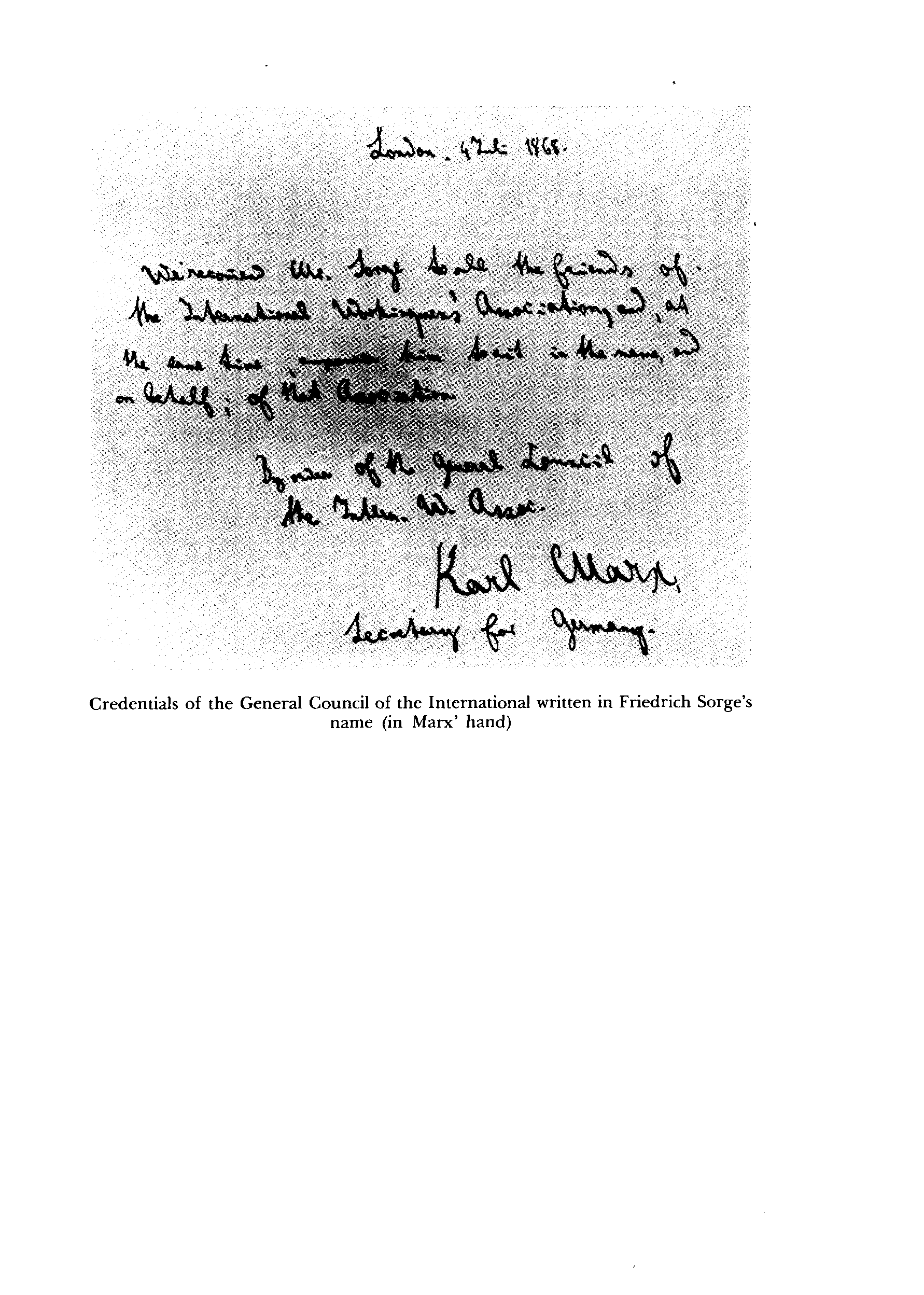
Credentials of the General Council of the International written in Friedrich Sorge's name (in Marx' hand)
Social-Demokrat (Berlin)(2) and the Elberfelder Zeitung? The last two papers, although the latter is liberal bourgeois, are openly partisan.
The big bourgeois and reactionary papers like the Kölnische, the Augsburger, the Neue Preussische, the Vossische, etc., are carefully keeping their mouths shut.
From the ranks of the official economists, to date only in the Hildburghausen Ergänzungsblätter at the beginning of this year the review by Dr Dühringb (privatdozent at the University of Berlin, supporter of Carey) (this review was timid but, on the whole, appreciative)—and in the June issue of the economic magazine published by Faucher and Michaelis.c Mr Faucher naturally provides nothing except such remarks as one might expect from the comedian and hired jester of the German Bastiatites.
I would be grateful if you would send me a few newspapers from time to time. In particular, it would be of great value to me if you could dig up some anti-bourgeois material about landownership and agrarian relations in the United States. Since I shall be dealing with rent in my 2nd volume,[41] material against H. Carey's 'harmonies"(3) would be especially welcome.
Salut.
Y o u r s
K. Marx [Appendix]
L o n d o n , 4 JULY 1868
W E RECOMMEND M R SORGE TO ALL THE FRIENDS OF THE INTERNATIONAL WORK-
INGMEN'S ASSOCIATION, AND, AT THE SAME TIME, EMPOWER HIM TO ACT IN THE NAME,
AND ON BEHALF, OF THAT ASSOCIATION.
B Y ORDER OF THE GENERAL COUNCIL OF THE INTERN. W . Assoc. Karl M a r x ,
SECRETARY FOR GERMANY
41. Marx to Engels. 7 July
41
MARX TO ENGELS
IN MANCHESTER
London, 7 July 1868
DEAR FRED,
The children are progressing well. Yesterday for the first time they were outside for half an hour. The peeling is still very pronounced. Only when this is finished will they be MOVABLE.
During the past few days I have been pressed very hard by the baker, CHEESEMONGER, ASSESSED TAXES, God and the Devil.
You will recall that the German Workers' Educational Society here has celebrated the June Insurrection[88] for ABOUT 18 years now. Only in the last few years have the French (their society here now exists as the FRENCH BRANCH of the International[72]) taken part. And the old meneurs* always stayed away. I mean the petits grands
hommes.h
But this year, IN PUBLIC MEETING, along came Mr Pyat and read out an alleged address of the Paris Commune (this is a euphemism for the IDENTICAL Pyat, who is in no way inferior to Blind in this LINE) in which the assassinat of Bonaparte was preached, as it was years ago in his Lettre aux étudians.c The FRENCH BRANCH, reinforced by other bawlers, acclaimed this. Vesinier had it printed in Cigale4
and Espiègle? Belgian PAPERS, and presents Pyat as giving his direction to the 'International'.[89]
As a result, we get a letter from the Brussels committee,[90] which just at the moment is making great propaganda, under difficult circumstances (Charleroi affair 4). Contents: This demonstration threatens to wreck the entire Association on the continent. Will the FRENCH BRANCH never move forward from the old demagogic phrases, etc.? etc., etc. It should be remembered that, at this very time, our people are behind bars in Paris.[91] We yesterday issued a declaration (to be printed in Brussels), disavowing any connection between the above-mentioned Pyat and the International/
Indeed I regard the whole affair (naturally based upon the
42. Engels to Marx. 10 July
background of the enormous stupidity of the FRENCH BRANCH) as an intrigue of the old parties, the republican jackasses of 1848, especially the petits grands hommes who represent them in London. Our Association is a thorn in their flesh. After trying in vain to work against the Association, THE NEXT BEST THING, of course, is to compromise it. Pyat is just the man to do this de bonne foi." The cleverer ones therefore push him forward.
What could be funnier than this squint-eyed melodrama-writer and Charivari man before 1848, this TOASTM ASTER of 1848 who now plays Brutus, but from a safe distance!
The FRENCH BRANCH here will have to be thrown out of the International if it does not put a stop to its asininity. One cannot allow 50 unprincipled louts, round whom loudmouths of all nationalities gather at such public opportunities, to endanger the International Association at a moment when, as a result of conditions on the continent, it is beginning to become a serious power.
Salut. Your
K. M.
42
ENGELS TO MARX
IN LONDON
Manchester, 10 July 1868 Dear Moor,
Enclosed 2 fivers, S/K 93 518 and 19, Manchester, 14 January 1867, to pacify the CHEESEMONGER and other Manicheans.
Everybody here was overjoyed by your good news about the patients.b
Hopefully you will really be able to calm down the FRENCH BRANCH.[72] Once again there appears to be sufficient confusion in that nation to guarantee the mess-up of any revolution that may break out. Wherever you look among these fellows, nothing but stupidity.
Ad vocem[3] Pyat, Blind must not be forgotten. I believe I told you that the Bradford Schiller Society (id est Dr Bronner) approached the Schiller Institute[76] here, in order to organise there, here, and in Liverpool 'Readings by famous Germans living in England'. I told the people right away that the whole thing revolved round Karl Blind; all the same they should, as far as I was concerned, agree to the plan sous réserveh in order to see for themselves. So, last week a letter arrived from Bradford with further information. It said approaches had been made to Prof. Goldstücker, Max Müller, K. Blind and A. Ruge\ The first two had accepted, yet only sous réserve with regard to their time and health, but the latter two had accepted immediately and unconditionally, and Ruge had immediately asked whether an historical or philosophical theme would be preferred. In short, the bomb had burst, and the gentlemen received the reply that Goldstücker and Max Müller would be quite acceptable here, but there could be no question of Blind and Ruge. And this puts paid to the attempt.
Beustc has once again made himself suspicious in my eyes. The serious attempt of the Russians to have the Eastern business explode this spring, in spite of the fact that their railway was not yet finished, only appears explicable in that they wished to exploit the presence of a Palmerston as Austrian Prime Minister as long as it lasted. According to one version, he told the Czechs, incidentally, that he was in possession of plans which had been agreed between Prussia and Russia for the eventuality of the dissolution of Austria, and that under these plans Bohemia would not become Russian, but would be sacrificed by the Russians.
I have read the conclusion of the Prussian war of 1866 (Main campaign)."[1] According to it, the South Germans were even more stupid than one had thought and known; the blame is, incidentally, distributed more evenly, so that Charlemagne of Bavariae
appears as at least as great an ass as Alexander the Great of Hesse/
Best greetings to your wife, the girls and the Lafargues.
Your
F. E. First published abridged in Der Briefwechsel Printed according to the original zwischen F. Engels und K. Marx, Bd. 4, Stuttgart, 1913 and in full in MEGA, Abt. Published in English for the first III, Bd. 4, Berlin, 1931 t , m e
43. Marx to Engels. 11 July
43
MARX TO ENGELS[92]
IN MANCHESTER
London, 11 July 1868
DEAR FRED,
The £10 received with BEST THANKS. I immediately paid £3 5s. for taxes, £3 to the CHEESEMONGER (whom, by the way, I have been paying cash for weeks, since he, just like the TEA-GROCER, no longer puts it on the slate), £1 10s. to the chemist. I owe the baker about £17 and the man, who was always very friendly with us, is in great difficulties. It is awful for me that I have to press you like this. If I only knew how to find any direct way out!
The children3 are doing fairly well, though Jennychen is still very weak. The ruling TEMPER here in the house is not exactly made for convalescents. My wife is not in the best of shape either, and therefore unnecessarily IRRITABLE.
Enclosed:
1. Kugelmann: I answered him right awayb saying he should be sure not to loose the intended letter upon Faucher, the Mannequin Pisse.[93]
2. The review by the worthy Faucher[83]; another in the Literarisches Zentralblatt? Both to be returned to me.
3. Letter from Dietzgen, who has also written an article on my book for me.[94]
You cannot fully appreciate the farce Mannequin Pisse Faucher is putting on in making me a pupil of Bastiat. Bastiat states in his Harmoniesd:
'If anybody were to explain to him, on the basis of the determination of value by labour time, why air has no value and a diamond a high value, he would throw his book into the fire.'
Since I have now accomplished this terrible trick, Faucher must prove that I, in fact, accept Bastiat, who declares that there exists 'no measure' of value.
The manner in which Mr Bastiat derives the value of the diamond is given in the following truly commercial-traveller-type conversation:
'Monsieur, cédez-moi votre diamant.— Monsieur, je veux bien; cédez-moi en échange votre travail de toute une année.'3
Instead of the business friend answering: 'Mon cher, si j'étais condamné à travailler, vous comprenez bien que j'aurai autre chose à acheter que des diamants'^ he says:
'Mais, monsieur, vous n'avez pas sacrifié à votre acquisition une minute.—Eh bien, monsieur, tâchez de rencontrer une minute semblable.— Mais, en bonne justice, nous devrions échanger à travail égal.—Non, en bonne justice, vous appréciez vos services et moi les miens. Je ne vous force pas; pourquoi me forceriez-vous? Donnez-moi un an tout entier, ou cherchez vous même un diamant.— Mais cela m'en entraînerait à dix ans de pénibles recherches, sans compter une déception probable au bout. Je trouve plus sage, plus profitable d'employer ces dix ans d'une autre manière.—C'est justement pour cela que je crois vous rendre encore service en ne vous demandant qu'un an. Je vous en épargne neuf, et voilà pourquoi j'attache beaucoup de valeur à ce service.'0
Is it not a wine salesman to the very life? Incidentally — and the German Bastiatites do not know this— that unhappy assertion that the value of commodities is determined, not by the labour they cost, but by the labour which they spare the buyer (the babbling about the connection between exchange and the division of labour is childish talk) is just as little Bastiat's discovery as any of the other of his wine-salesman categories.
The old jackass Schmalz, the Prussian demagogue-catcher,[95] says (German edition 1818, French 1826):
'Le travail d'autrui en général ne produit jamais pour nous qu'une économie de temps, et cette économie de temps est tout ce qui constitue sa valeur et son prix. Le menuisier, par exemple, qui me fait une table, et le domestique qui porte mes lettres à la poste, qui bat mes habits, ou qui cherche pour moi les choses qui me sont nécessaires, me rendent l'un et l'autre un service absolument de même nature: l'un et l'autre m'épargne et le temps que je serais obligé d'employer moi-même à mes [ces] occupations, et celui qu'il m'aurait fallu consacrer à m'acquérir l'aptitude et les talents qu'elles exigent.'d Old Schmalz was an epigone of the physiocrats.[96] He says this in a polemic directed against A. Smith's travail productif and
improductif,* and proceeds from their thesis that only agriculture produces real value. He found that in Garnier}[1] Similar stuff, on the other hand, in Ganilh,c epigone of the mercantilists. Ditto in polemics against the same differentiation made by A. Smith. Thus, polemics by epigones representing two standpoints, with neither having the slightest conception of value,—and Bastiat copies them! And this is the latest discovery in Germany! A pity that no paper exists in which one can expose this plagiarism by Bastiat.[97]
Salut.
Your
K. M.
44. Marx to Ludwig Kugelmann. 11 July[29]
Dear Friend,
The children are getting on well, though still weak. Thank you very much for the things you sent. Definitely do not write to Faucher,[98] otherwise this mannequin pisse will feel too
produces a saving of time for us, and this saving of time is the only thing which constitutes its value and its price. For example, the carpenter who makes me a table, and the servant who takes my letters to the post, cleans my clothes, and procures for me the things I need — the one and the other render me services of absolutely the same nature. The one and the other save me both the time that I myself would be obliged to use for my [these] occupations, and the time that I would have had to devote to acquiring the skills they require' ([Th.] Schmalz, Économie politique, ouvrage traduit de l'allemand..., Vol. I, Paris, 1826, p. 304). - a productive and unproductive labour - b [G. Garnier,] Abrégé élémentaire des principes de l'économie politique. - c Ch. Ganilh, Des systèmes d'économie politique, de la valeur comparative de leurs doctrines, et de celle qui parait la plus favorable aux progrès de la richesse.
important.[93] All he has achieved is that, if a second edition appears, I shall aim a few necessary blows at Bastiat where I speak about the magnitude of value." This wasn't done before, since the 3rd volume[41] will contain a separate and extensive chapter about the 'vulgar economy' gentry.[100] Incidentally, you will find it quite natural that Faucher and consorts derive the 'exchange value' of their own scribblings not from the amount of labour power expended, but from the absence of such expenditure, that is from 'saved labour'. Moreover, the worthy Bastiat did not even himself make this 'discovery', so welcome to these gentry, but just 'cribbed' it, in his usual manner, from much earlier authors. His sources are of course unknown to Faucher and consorts.
As for the Centralblatt, the man is making the greatest concession possible by admitting that, if value means anything at all, then my conclusions must be conceded.(1) The unfortunate fellow does not see that, even if there were no chapter on 'value' at all in my book,[65] the analysis I give of the real relations would contain the proof and demonstration of the real value relation. The chatter about the need to prove the concept of value arises only from complete ignorance both of the subject under discussion and of the method of science. Every child knows that any nation that stopped working, not for a year, but let us say, just for a few weeks, would perish. And every child knows, too, that the amounts of products corresponding to the differing amounts of needs demand differing and quantitatively determined amounts of society's aggregate labour. It is SELF-EVIDENT that this necessity of the distribution of social labour in specific proportions is certainly not abolished by the specific form of social production; it can only change its form of manifestation. Natural laws cannot be abolished at all. The only thing that can change, under historically differing conditions, is the form in which those laws assert themselves. And the form in which this proportional distribution of labour asserts itself in a state of society in which the interconnection of social labour expresses itself as the private exchange of the individual products of labour, is precisely the exchange value of these products.
Where science comes in is to show how the law of value asserts itself. So, if one wanted to 'explain' from the outset all phenomena that apparently contradict the law, one would have to provide the science before the science. It is precisely Ricardo's mistake that in his first chapter, on value,(2) all sorts of categories that still have to be arrived at are assumed as given, in order to prove their harmony with the law of value.
On the other hand, as you correctly believe, the history of the theory of course demonstrates that the understanding of the value relation has always been the same, clearer or less clear, hedged with illusions or scientifically more precise. Since the reasoning process itself arises from the existing conditions and is itself a natural process, really comprehending thinking can always only be the same, and can vary only gradually, in accordance with the maturity of development, hence also the maturity of the organ that does the thinking. Anything else is drivel.
The vulgar economist has not the slightest idea that the actual, everyday exchange relations and the value magnitudes cannot be directly identical. The point of bourgeois society is precisely that, a priori, no conscious social regulation of production takes place. What is reasonable and necessary by nature asserts itself only as a blindly operating average. The vulgar economist thinks he has made a great discovery when, faced with the disclosure of the intrinsic interconnection, he insists that things look different in appearance. In fact, he prides himself in his clinging to appearances and believing them to be the ultimate. Why then have science at all?
But there is also something else behind it. Once interconnection has been revealed, all theoretical belief in the perpetual necessity of the existing conditions collapses, even before the collapse takes place in practice. Here, therefore, it is completely in the interests of the ruling classes to perpetuate the unthinking confusion. And for what other reason are the sycophantic babblers paid who have no other scientific trump to play except that, in political economy, one may not think at all!
But satis superque.b In any case, it shows the depth of degradation reached by these priests of the bourgeoisie: while workers and even manufacturers and merchants have understood my book and made sense of it, these 'learned scribes' (!) complain that I make excessive demands on their comprehension.
I would not advise reprinting Schweitzer's articles, though Schweitzer has made a good job of them for his paper.[101]
45. Engels to Marx. 14 July
You would oblige me if you sent me a few issues of the Staats-A nzeiger.
You should be able to get Schnacke's address by enquiring at the Elberfelder.
Best greetings to your wife and Fränzchen.
Yours
K. M. Apropos. I have received an article by Dietzgen about my book[94]; I am sending it to Liebknecht.
45
ENGELS TO MARX
IN LONDON
Manchester, 14 July[3] 1868
Dear Moor,
Enclosed another two fivers, S/K 92 566 and 93 517. Manchester, 14 January [18J67.
I do not know whether I shall manage to finish the article. On Sunday during a meal a small blood-vessel burst in the conjunctiva of my left eye and since then this eye has been very sensitive, so that it is at present quite impossible for me to write with a light; I think, however, it will soon pass.
Do not forget to order 40-50 separate reprints of the article in the Fortnightly(1)' so that we can distribute them.
Best greetings.
Your
F. E.
46. Engels to Marx. 21 July
46
ENGELS TO MARX
IN LONDON
Manchester, 21 July 1868
Dear Moor,
I concluded from Tussy's letter the receipt of the £10, and also that both patients[3] must have reached the point at which they should be sent to the SEASIDE, the sooner the better. So that there shall be no delay I enclose £25 (1 of 20 and 1 of 5). It is still uncertain when I shall get away from here, and it will therefore be better for the time being to drop the attempt at a combined SEASIDE operation, so that the girls' health may not suffer.
I believe you said recently that Borkheim himself would be inclined to advance the £150 if he was not at the moment short of money. Is he now perhaps in a position to provide the sum, or at least £100? It would be absolute folly to toss into the maw of this miserable society 20% interest per annum against the finest security. Even if Borkheim can get us only £100, of which £50 might be repaid in case of need in January or February and the rest on 10/20 July 1869 (though it would be best if the whole sum need not be repaid until next July), everything could be fixed up easily. He really only needs to commit himself to pay £100 on the loan in September, so that I would then only need to send him the remainder. This would free £100 for me, which I could send you right now. If nothing of this sort happens, you will understand that I am very tied, as long as the heavy load of £175 is hanging over my head, and especially as long as I do not know how the balance has come out, and I probably won't know for another 3-4 weeks.
Think over the business with Borkheim. Maybe something can be done; if so we would be, at least for the time being, out of all our troubles, and would once again have gained time.
The pamphlets and journals I sent back to you yesterday. Who is this sultry Dr Boruttau, who displays such a sensitive organ for sexual love?b
Jones is hard put to it whether to stand for Manchester or for Dewsbury.[102] The Dewsburyans have sent him a requisition signed
47. Marx to Engels. 23 July
by 2,000 voters; he wants 1,000 more since there will be 6,000 voters. Now they are pressing here in Manchester whether he will accept or not. Best greetings.
Your
F. E.
47
MARX TO ENGELS
IN MANCHESTER
London, 23 July 1868
DEAR FRED,
BEST THANKS for the £25. The children will probably go to the sea next week together with MR and MRS Lafargue. Since yesterday Lafargue has been ' MEMBER OF THE ROYAL COLLEGE OF SURGEONS' and has received his patent for the KILLING OF MEN AND BEASTS. Then, in 4-5 weeks, he will go to Paris. As a result, we are in a very embarrassing position, since my wife still has to buy linen for Laura for at least £20.
I do not think we can do any business with Borkheim. Yesterday he told me that ' money was very tight' in his case, etc. The Dutchmen, of whom I can, in fact, only use August Philips, are travelling. But I shall use my head to see how and where to get a loan, since it is absolutely necessary. The practice of borrowing at 20% can in fact only happen with institutions like those utilised by Borkheim, where people lose the capital advanced if one kicks the bucket before the date of maturity.
About Dr Boruttau, the man with the sultry prick, I know nothing except that he also ' runs with' the Lassalleans (Schweitzer FRACTION). The funniest thing is the ' French' of his dedication to a sympathetic soul in Moscow.[103]
You will have seen that my booka forms a point of discussion in
48. Engels to Marx. 29 July
the programme of the General Association of German Workers.3,04
I have sent you a scrawl by Dühring which despite the heat you might read. You could also tell me your impressions of it, since it is certainly not overtaxing. But all the more boring, to be sure.
I saw Prof. Beesly last week at Lafargue's. Beesly was absent when your article[11] arrived. Immediately after his return he received it and sent it to Henry Morleyb (CHIEF EDITOR of The Fortnightly Review) in Scotland, from whence we have received no further NEWS as yet.
How do you live in this heat? I lose all capacity for thought, and without Gumpert's medicine I COULD NOT STAND IT AT ALL.
Salut.
Your
K. M.
48
ENGELS TO MARX
IN LONDON
Manchester, 29 July 1868 Dear Moor,
Enclosed Liebknecht returned.[105] What a feeble business with Schweitzer. He should recognise 1. you and 2. the International Working Men's Association! Wilhelmchen appears to me to have once again failed to control his tendency to stupidities. Incidentally, you see that Schweitzer did, after all, show off with your letters.0
As regards Liebknecht's promises about Nuremberg and the Swiss workers, I SHALL WAIT FOR PERFORMANCE BEFORE GIVING AN OPINION.
Now enclosed a letter from Kugelmann.[106] The business with Keil is splendid — if Kertbény is not in fact inventing a bit. Just in
49. Marx to Engels. 29 July
case, I sat down and scribbled in great haste the enclosed scrawl, trying to make it as Beta-like as possible [1 0 7]—as is suitable for that miserable rag a; kindly let me have your comments on it by return so that we may send the stuff off without delay and strike while the iron is hot. We may not despise this bit of humbug, any more than we despise the stratagems through Siebel's mediation.[50] And the Kinkels, Freiligraths and Blinds, etc., will be badly annoyed; the philistine, however, as you know, trusts his Gartenlaube, and it will greatly impress Meissner. Your wife will also enjoy it very much — I think it would be best if you keep it secret for the time being, because of possible disappointment, and then you will surprise her when the paper comes out.
It is a good thing that owing to the delay of the article[11] caused by Beesly's absence I get some time for the second one.[71] Working at night still affects my eye slightly, and it then hurts all the next day.
Best greetings to your wife, the girls and Lafargue and his spouse. In haste.
Your
F. E. First published abridged in Der Briefwech-Printed according to the original sei zwischen F. Engels und K. Marx, Bd. 4, Stuttgart, 1913 and in full in MEGA, Published in English for the first Abt. Ill, Bd. 4, Berlin, 1931 t l m e
49
MARX T O ENGELS
IN MANCHESTER
[London,] 29 July 1868
DEAR FRED,
I hope that the business with your eye is nothing serious. Small blood vessels will burst now and then, without any particular consequence. Have you consulted Gumpert about it?
Unfortunately, the household will only go to the sea next week. And that is because of the Lafargue family, who wanted to join in and rent a LODGING, etc., together. Because of Lafargue's ties with
a Die Gartenlaube. Illustrirtes Familienblatt his hospital (where he has been operating for weeks as house SURGEON) the departure has been delayed from day to day, despite my curses, threats and shouts, so that now it is to take place at the beginning of next week, when my wife will go OFF with the rest, and Laura of course arguing that she will soon part completely from the FAMILY, etc. Tussy (highly delighted by your letter, I believe, she knows par coeur* your 6 letters to her ) is hale and hearty again. Not so Jennychen, who is also worrying about all sorts of things, etc. If I HAD MADE UP MY MIND where on the continent I could just now depend with certainty upon a LOAN (especially since I would, if necessary, have your guarantee), I would cross over and take Jennychen with me. But this is perhaps the best time of the year to find nobody at home.
There have been all sorts of scandals here RELATING TO Pyat, FRENCH BRANCH[72] and GENERAL COUNCIL. On this tomorrow.(1) Today only this. Schweitzer in his 2nd programme for the congress of the General Association of German Workers in Hamburg has an item about the International Working Men's Association and another about my book.b The programme was printed in the Zukunftcd and elsewhere. On the other hand, A. Bebel, as president of the Workers' Union meeting in Nuremberg, has sent an invitation to the General Council.[108] We should send a delegate (Eccarius will go). That they will join the International Working Men's Association and adopt our programme is already certain, he says. Finally, we have received an invitation from Vienna where the Austrian workers' fraternal festival will be held, also at the beginning of September.[109] We have sent to Fox, who is in Vienna, the authorisation to represent us there.
About the private negotiations between Wilhelmchen and Schweitzere I know no more than the former writes. Yet I know from another source that the influence of that cunning fox Schweitzer has grown to the same extent as Wilhelmchen has discredited himself among the workers by his over-close alliance with the South German provincial pettifoggers. It was evidently for this reason that Wilhelm found it necessary to set up a sort of cartel with Schweitzer, who is at present inside and who, moreover, was clever enough to have his title of nobility revoked by the Prussian court 'for lèse-majesté'}[10] As far as I am concerned — I mean as MEMBER of the GENERAL COUNCIL — I must conduct myself impartially between the various organised groups of workers. It is their business and not mine whom they have as leader. As SECRETARY FOR GERMANY I must answer all those who apply to me in their official capacity as presidents, etc., of workers' groups. In this sense, I have also written to Schweitzer (always WITH AN EYE to the possible publication of the entire correspondence).[111]
Faced with the intrigues of the old '48 democrats here, it was, however, high time to be able to display influence among the German workers in Germany.
That you, poor devil, with your sore eye, should also have to water the Gartenlaube—and in this weather, too — really cries to the heavens.(2)
My comments are confined to: Page 2 where I have put 1 x).[112] The FACT was actually this! For us the government sent, instead of the city censor, a special fellow from Berlin (Mr von St. Paul, etc.). When even this did not help, yet another tier of censorship, that of the Regierungspräsident of Cologne,b was added. Finally, the Berlin cabinet, driven wild, issued a sort of manifesto against us, apprising the world of all our offences, and concluding with the announcement that at the end of the quarter they would shut up our shop. I resigned because the shareholders — even if in vain, as it later turned out — tried to negotiate with the Prussian government.
Page 3 (2x). It would perhaps be good to add here for the benefit of the philistines that the provisional government had invited me in writing to return to France.c
Ditto page 3 (x3). You might add for the benefit of the democratic philistines that the Prussians expelled me par ordre du
Muphti,d after they had failed in the law courts.[113]
Finally, would it not be better, instead of the title: 'A German Political Economist', to have: 'A German Socialist'? Both are 'hideous', but the former probably more so.
More tomorrow about affairs here. Salut.
Your
Moor First published abridged in Der Briefwech-Printed according to the original sei zwischen F. Engels und K. Marx, Bd. 4, Stuttgart, 1913 and in full in MEG A Published in English for the first Abt. Ill, Bd. 4, Berlin, 1931 t i m e
50. Engels to Ludwig Kugelmann. 31 July
IN HANOVER
York, 31 July 1868 Dear Kugelmann,
This scrawl must be excused by the fact that I am on my way for a few days to bring my dear spouse(1) to the seaside resort at Bridlington (I bet you couldn't guess how this name is pronounced), and by the haste in which I send you the enclosed composition.[106] The business is splendid, that is, if it can be done and Kertbény is not bragging.b The enclosed scribble has been composed, as far as possible, in the spirit of the rag,c but it should possibly be made milder here and there. Marx thinks the title 'A German Socialist"(2) would be better, which would be very nice, if Monsieur Kertbény did not object; but this must be prevented above all, so I find your suggestion, being the 'milder' one, is better.[114]
Marx has, for the time being, kept your letter with him, and since it is already late today anyway, and everybody in the hotel is hurrying to bed, I shall have to answer it next week. I put Lupus' photogram aside for you some time ago; luckily it is still one of the old good prints; recently I had another 24 prints made, but in the meantime the negative had faded so much that they turned out very badly. As for me, a blood vessel burst in the conjunctiva of my left eye a fortnight ago, and left behind a red patch on the apple (south-west side) which has not yet vanished, and with which I would not like to be eternised. So you will just have to wait for a while.
N.B. There are two corrections, marked A and B, written here later; please insert them in the right place.e It would be desirable for Kertbény neither to know the author of the article, nor see the original handwriting.
So until next week. ,. Yours
F. E. First published in: Marx and Engels,
Works, First Russian Edition, Vol. XXV, Moscow, 1934
51. Marx to Engels. 4 August
51
MARX TO ENGELS
IN MANCHESTER
[London,] 4 August 1868
DEAR FRED,
How is your eye? You will probably have received the Eichhoff stuff.(1) In the Zukunft there are 'Economic Letters'b singing the praises of my book.c In fact these letters are largely cribbed from the book. In the Social-Demokrat the Executive of the General Association of German Workers is urged by the presidium to invite me as a guest of honour to the congress at Hamburg at the end of August.d
A few days ago I wrote to Meissner[84] to find out at last where and how.
Kugelmann has written me a few lines saying that the chamber of commerce and the polytechnical school in Hanover have ordered a number of copies of my book.
In the meantime, I am really more BOTHERED by PRIVATE ECONOMY or, as the English say, DOMESTIC ECONOMY, than by political economy. My LANDLORD has dunned me and, unfortunately for me, is staying FOR SOME TIME AT London. I have also been forced to sign diverse smaller bills of exchange, etc.
The filthy French branch[72] has created a fine scandal for us. The Pyatists have published a blâmee of the conseil général in the
Cigale. Their channel was the infamous Vésinier. We ignored this VOTE OF CENSURE and simply passed à l'ordre du jour.f There followed a MEETING of the FRENCH BRANCH where there were fisticuffs. Dupont, Jung, Laf argue, Johannard, Lassassie and various others have quit this gang of scoundrels. This rabble now amounts to a total of perhaps 15 persons, although they confront us as the 'souveraineté du peuplé ? We are 'des endormeurs', 'des ambitieux',h etc. Apart from 4 1868
the little bit of scandal which these Spiegelbergs are making in that obscure Belgian paper, they are naturally NOWHERE. Nothing is more grotesque than the way in which this mob play Jacobin Club.[115]
Apropos. Moses' article[116] has, after all, turned up. It is in the hands of Massol, who will print it shortly in his Morale indépendante, now that this has changed its skin to become a political journal. Reclus will ditto wade in with his Coopération, now that this ditto has be-butterflied itself into a political paper.
My wife went to Ramsgate in advance on Monday a to prepare the quarters. T h e gang will follow tomorrow.
Lafargue is only free from tomorrow. In the meantime, he has been operating like mad as assistant to the HOME SURGEON of St. Bartholomew's. Yesterday, e.g., from 9 in the morning until 11 in the evening. Woe to the corpus vileh of male or female kind on which he gets his practice.
Best greetings from Tussy to you and Lizzy. T h e child declares to all and sundry that she is READY to emigrate to Manchester. MEANWHILE she is teased here with the NICKNAME 'THE POOR NEGLECTED NATION'.0
Salut.
Your
K. M.
How d o you translate GRAVEL as distinct from SAND and FLINT? And how PEAT as distinct from BOG? Incidentally, there are perhaps 6 further different names for what are, more or less, nuances of peat-ground in the 'POOR NEGLECTED COUNTRY'.
Finally, how do you manage to live in this heat? I would like best to hang on a tree in the air.
P. S. Now, when the Germans will join the 'INTERNATIONAL WORKINGMENS ASSOCIATION' en masse, with the Association, for the time being, filling out at least the boundaries of its main territory— though it is still thin on the ground — m y plan is that the GENERAL COUNCIL should move to Geneva for the next year[117] and that we should function here only as the BRITANNIC COUNCIL. It appears a shrewd move to me if the proposal comes from us. At the same
a 3 August - b living body - c An allusion to Tussy's Irish sympathies.
52. Engels to Marx. 6 August
time, it will show the jackasses in Paris, etc., that we are in no way anxious for this pleasant dictatorship. Qu'en penses tu?*
52
ENGELS TO MARX
IN LONDON
[Manchester,] 6 August 1868
Dear Moor,
What do I do in this heat? Languish and drink. Today it is raining, the air is muggy and saturated with humidity, it is therefore doubly horrible, the sweat does not evaporate and you are damp all over.
Last Fridayb I took Lizzie and M. Ellen0 to Bridlington Quay and returned on Monday; tomorrow I shall return there with Moore, and I would take my HOLIDAY and stay the week, but Charles d has gout and is all in, so I must do his work as well as my own, and there can be no question of going away.
Eichhoff 's pamphlet6 proves something which I had scarcely credited him with — that he is capable of reporting facts objective-ly. Of course, you had also made it easy for him. The thing will have a very good effect. Now as regards the transfer to Geneva, it reminds me of the Central Authority's move to Cologne.[118] I would think this coup over very thoroughly. First, are the few jackasses worth it that you should take this step for their sake and hand over responsibility for the whole thing to people who, for all their good will, and also probably instinct, just do not have the stuff to lead a movement like this? Second, once we start moving house, and the holy respect for London, which is still the Medina of the emigration, has been replaced by a very doubtful respect for Geneva — what is the guarantee that the Proudhonists will not succeed in one fine day having the Council transferred, if only as
53. Marx to Engels. 10 August
a matter of international courtoisie,[3] to Brussels or Paris? Finally: such centres should never be put in places where deportation is possible, as long as we have a spot free from this risk.
The more splendidly things go, the more important it is that you should keep them in your hands, and now that the business is also beginning to get under way in Germany, I do not believe that Becker has the stuff to manage it. I sent Kugelmann the biographical stuff on Friday from York.[106]
It is a very good thing that something about your book c should now simultaneously appear in French papers, too. Nota bene, have at least 20-30 reprints made of my article in the Fortnightly[11] (for which we will naturally pay, s'il le fautd), they can be used very well. ANYHOW, the conspiracy of silence is now over, and if the thing is only blazing a path slowly, it is now doing it surely.
GRAVEL is Kies. For the various stages of the Irish peat-ground I have no expressions, you will have to ask an East Frisian.
Borkheim has already reminded me of the 'date of maturity'. Best greetings to the entire sea-bathing company.
Your
F. E.
53
MARX T O ENGELS
IN MANCHESTER
London, 10 August 1868
DEAR FRED,
Enclosed letter from J. Morley, the CHIEF EDITOR of the Fortnightly. Beesly did everything he could, but Mr Morley found the matter
not to his taste.[119] NEVER MIND! The family is fortunately at the SEASIDE, which they all needed very much.
a politeness - b Johann Philipp Becker - c the first volume of Capital; see also Note 116 - d if necessary What you say about the transfer of the CENTRAL COUNCIL[73] to Geneva is very correct. It remains possible that in Brussels, malgré nous et contre nous,(1) they will propose a CHANGE in order to document their heroic resistance to the principe autoritaire}" At least in this case our delegates will have to vote for Geneva as pis aller?
Salut.
Your
K. M.
time
54. Marx to Ludwig Kugelmann. 10 August[29]
Dear Kugelmann,
On receipt of your letter, I asked around, but in vain. At the moment it is impossible to get money from the UNIONS here for foreign STRIKES.c The various data about the Linden factory contained in the latest Hanoverian papers sent me are of great interest to me.
My family is, at present, at the seaside, which was all the more necessary since both GIRLS'd seemed very delicate after their illness. Lafargue, after passing his SURGEON examinations here in London, will operate as assistant at his hospital for a few weeks, and then move to Paris where, however, he will still have to pass the French medical examinations.[121]
At the moment I am more occupied with PRIVATE than with PUBLIC ECONOMY. Engels has offered to be my guarantor for a loan of £100-150 at 5% interest, the first half payable in January, the second in July. So far, however, I have not been able to find a creditor.
I hope 'verry' much that the state of my work will allow me to abandon London for good and all and move to the continent next year, at the end of September. I shall strike my tents as soon as I 11 1868
can dispense with the Museum a here. T h e high cost of living here is becoming increasingly burdensome as time goes on. It is true that the pettiness of conditions over there is not much to my taste, but 'tranquillity is the first duty of citizens',[122] and this is the only way to achieve tranquillity. There have been all sorts of rows here, in and with the so-called FRENCH BRANCH [7 2] of the INTERNATIONAL WORKINGMENS ASSOCIATION, about which I shall report in my next letter.b
I am at present solus,c and I feel strange, missing all the children's noise.
Salut.
Yours
K. Marx
55. Marx to Friedrich Lessner. 11 August[1 2 3]
Dear Lessner,
Because of the orthographic mistakes, I have re-written the whole appeal, enclosed herewith. Now you should copy it in your own handwriting. Salut.
Your
K. M.
56. Engels to Marx. 12 August
56
ENGELS TO MARX[48]
IN LONDON
[Manchester,] 12 August 1868
Dear Moor,
It would be worth the trouble to find out more about Mr Morley's motives,a even if this only leads to the conclusion that the petty, lousy cliquishness, which we used to assume only existed in Germany, also flourishes here. If Morley refuses the piece"[9]
despite Beesly's influence, then he has his reasons. These men are,
au fona\b bourgeois, and MR Morley has all the reasons in the world to prevent giving publicity to things like those you have presented in your analysis. These are no isms; THAT KNOCKS HIM ON THE HEAD, and hence the lack of space. Still, I have no fear that we shall therefore be unable to present the bookc to the English public, but the easiest and simplest way is cut off, and we shall have to search until we find a new one. In the meantime, the French articles will produce their effect,"[6] and it would be a good thing if they could be shown to the gentlemen of the Fortnightly; it would be very nice if Mr Morley could still be forced to accept the piece.
The day after tomorrow I shall probably go for 10 days to Bridlington Quay (address: Mr Burns, 3 Burlington Place, Bridlington Quay, Yorkshire), since Charlesd is recovering; but, of course, something may still crop up, in which case I shall write to you. I was there with Moore from Friday till Mondaye; we made quite interesting geological studies.
Best greetings from Lizzie.
Your
F. E.
57. Marx to Engels. 13 August
DEAR FRED,
57
MARX TO ENGELS[124]
IN MANCHESTER
[London,] 13 August 1868
I hope that these lines will reach you before your departure, for there is periculum in mora.(1)
Firstly, I must send money to Ramsgate, so they can stay there another week. As their departure was delayed for weeks after your last remittance, smaller domestic debts were paid; on the other hand, my wife had to retrieve watches and other things from the pawnshop so that they could appear RESPECTABLE at the watering place.
Secondly, one of the épiciers? who is owed £6 and a few shillings, must be paid this week, since the man is shutting up shop.
Thirdly, I have already received 2 SUMMONS for QUEENS TAXES (about £8). The LOCAL TAXES are paid, as you know. I absolutely cannot put off these sums.
For two further pressing items — the LANDLORD, who is unfortunately in London now, and a bill of exchange for £12 payable on the 25th of this month — I shall still perhaps receive money in time from Germany.
I have written to my cousins August and Karl Philips in Amsterdam and Aachen in order to find out whether they are back.[125] It would be a sheer waste of money to go to the continent in order to borrow, before one is sure that the people are there.
For the past week I have not had a wink of sleep and l'illustre Gaudissartb Borkheim, who visited me the day before yesterday to take leave, said I really should get rid of my jaundice. He entertained me with the story of the £1,000 he is trying to blackmail out of Oppenheim.
In great haste.
Your
K. M. First published in Der Briefwechsel zwischen Printed according to the original F. Engels und K. Marx, Bd. 4, Stuttgart, « , , . , , • ,• , • c ,, r 19,13 Published in English in lull for the first time
58. Engels to Marx. About 14 August
58
ENGELS TO MARX[124]
IN LONDON
[Manchester, about 14 August 1868]
Dear Moor,
I shall send you money tomorrow, our cashier had no more notes this afternoon. Do not feel awkward about 'pressing', I only wish there were more there to be pressed out; but bear in mind as well that in 6 weeks we shall have to pay the £150 with interest, and Borkheim says that the interest will bring the total up to 165! I think you will have to make up your mind to go to Holland; we cannot 'afford' to borrow at such interest.
Faucher made me laugh very much.[83] Absolutely the noble arrogance of this fellow. The patronising introduction and then criticism (and what criticism!) of a very elementary thing in which you present the views of the economists, thus only make a resume; he wisely keeps his fingers off your own things. Also very good is his admission that the present generation, including Faucher, knows nothing of either Jacob or Joseph, thus confirming your opinion that they 'really have learned nothing'. Incidentally, the impudence of the fellow is comic. He really assumes that his public knows nothing, will learn nothing, and even wishes to read nothing except such Faucherist piss. And the man is right about it.
Best greetings.
Your
F. E.
59. Marx to Engels. 21 August
60. Engels to Marx. 22 August
59
MARX TO ENGELS
IN BRIDLINGTON QUAY
London, 21 August 1868
DEAR FRED,
My wife returned from Ramsgate yesterday, but the children are still there. Since I have been puking gall for about 1 week, and, in addition, cholera is developing here, my wife insists that I should also go to the sea at Ramsgate for at least 2-3 days. So I shall be leaving today.[126]
The £25 received with many thanks: the bill of exchange for £12, as I assured myself today, falls due on 28 August. So far I have not yet received anything from the continental side.
It would be best if you send the money for the LIFE INSURANCE to me myself, on the date due, when I can pay the people. For they must, after all, hand over to me the promissory note that I signed. Dealing with this via Schyler would in fact compromise me.
Salut.
Your
K. M. Printed according to the original
60
ENGELS TO MARX
IN LONDON
Bridlington Quay, 22 August 1868
Dear Moor,
Best thanks for the Lanterne and the B. Becker.(1) The closer one comes to see the details of the Lassalle tragicomedy, the more the comical side emerges. This man was ruined by his IRREPRESSIBLE reflection upon himself, his permanent self-contemplation. 'How do I appear to myself?' was the eternal refrain. Poor Baron Izzy! Comic at that exalted moment when he commissioned his alter ego, Rüstow, to bed the beautiful Helen[3] per procura(2) if necessary — he well knew how little danger this involved — as at that other moment when the Wallachianb shot away his genitals. Poor Izzy! To be gelded by a shot from a Wallachian.c You always found it so comical that his gob had been stopped, but now this as well.
Seiler! That is the impression of the whole story. Sebastian Seiler, the only worthy historiographer of this tragicomedy — he will hang himself that he missed this putrid scene. En attendant' it is quite amusing that the 'testamentary successor of Lassalle'd' declares him an aristocrat, traitor and cad, and is forced to appropriate all those things that we formerly had published against him himself and against Schweitzer.[128] Bastards!
On Wednesday or Thursdaye I shall go back to Manchester from here and shall then visit my mother for a week — probably in Ostend. I am still waiting for a letter from her, and have no idea where I stand in the meantime.[129]
Naturally I would have sent the money for the loan from the insurance company only to you, if you had not from the start shoved the whole affair away from you and onto Borkheim, so that I had to turn to him simply to find out how much had to be paid. That I could, of course, only do with the simultaneous remark that I would send the sum to him, since he was indeed standing surety for the money. As I already wrote to you, it would never have occurred to me to send the money to that jackass Schyler.f But I expect to see you before then, in London at the end of next week.
Your
F. E.
61. Marx to Engels. 26 August
61
MARX TO ENGELS[33]
IN MANCHESTER
London, 26 August 1868
DEAR FRED,
Still no 'SUPPLIES' from Germany. It is, of course, idiotic to depend completely upon half-promises. But if you are drowning you clutch at every straw. On Friday(1) the bill of exchange for £12, about which I wrote to you,b is due. Since nothing had arrived by today, and to have no protest in the house, I just visited my baker, who told me he could 'perhaps' get the money by tomorrow evening, but only for a few days. At the same time, I have received the enclosed scrawl from my LANDLORD. That everything should happen to one just at this time. It is enough to drive one mad.
Bring me back or send me the screed by Becker.c His theoretical-political-economic criticisms of Lassalle have been copied from your pamphlet on the military question.d
This Becker has done us a great service with his Seileriana. He deserves to be Lassalle's 'testamentary successor'.[127]
The invitation which I received to the congress of the General Association of German Workers (Hamburg, 22-25 August)[130] is signed by Schweitzer as President and by more than 20 workers from different districts of Germany (members of the Executive Committee). I had to take the latter into consideration in my reply.f
I explained that I could not come because of the work of the Central Council of the International Working Men's Association, and said I was glad to see that the starting points of any 'serious' workers' movement — agitation for complete political freedom, regulation of the working day and international co-operation of the working class — were emphasised in their programme for the congress.' That is to say, in other words, I congratulated them on
62. Engels to Marx. 28 August
having abandoned Lassalle's programme? Whether they will notice the point remains to be seen. Schweitzer, the only man with brains in the whole Lassalle gang, will certainly detect it. But whether he will think it advisable to show this or to pretend to be dense, nous
Your
K. M. First published abridged in Der Briefwech-Printed according to the original sei zwischen F. Engels und K. Marx, Bd. 4, . Stuttgart, 1913 and in full in MEGA, Published in English in full for the Abt. Ill, Bd. 4, Berlin, 1931 f , rst t l m e
62
ENGELS TO MARX
IN LONDON
Manchester, 28 August 1868
Dear Moor,
I found your letter of the 25thc waiting for me here, and as promised yesterday,[131] I enclose 2 fivers and 1 tenner, with which his lordship the LANDLORD will have to content himself for the time being.
I expect a letter from my mother any day that she has arrived in Ostend, and I will immediately dash there[129]; I shall see you in London in any case, but it is doubtful whether I shall be able to stay there for a day on my outward journey.
In haste.
Your
F. E. First published in MEGA, Abt. Ill, Bd. 4, Printed according to the original Berlin, 1931 , . , r. Published in English for the first time
63. Marx to Engels. 29 August
63
MARX TO ENGELS
IN MANCHESTER
London, 29 August 1868
DEAR FRED,
The £20 received with BEST THANKS. Tussy had a great shock today. She found Dicky dead in his cage although he was still singing merrily yesterday. He has been buried with full honours.
Dupont has received the mandate from Naples to represent the Neapolitan branch.[132] Since the Mentana business, as we see from Italian reports, there has been a general reactionary trend in domestic affairs, and in particular the workers' right to meet and form societies has almost been done away with.[1]
In Paris, happily, we still have our old people, behind bars. The committee there will send a délégué to Brussels, but against that the various corps de métier* will send 8-9.[134] Our people have written to us from prison suggesting that these corps de métier MEN should be 'compromised politically' so that there should be no way back for them. Just to show the sort of. methods to which the Paris police have recourse: A gentleman calling himself 'Eugène Dupont' from London visited the wives of several of the prisoners to pump them. He was a police agent, but his play-acting did not work anywhere.
Eccarius left for Nuremberg as our délégué today.[135] From there he will go to Brussels. He is correspondent of The Times in both cases.[136]
The so-called branche française,[72] under the leadership of Messrs Pyat and Vésinier, is sending a delegate to Brussels in order— horribile dictu(1) — to put us in the dock!
Apropos. If Moore is still there, tell him it would be good if he could pay to me his USUAL CONTRIBUTION to the INTERNATIONAL WORKINGMEN'S ASSOCIATION by Tuesday.c We are weakly represented in Brussels, and every shilling that we can raise now will be used to
64. Engels to Marx. 1 September
s e n d o n e MEMBER MORE t h e r e . TUESDAY NEXT IS OUR LAST SITTING this year b e f o r e t h e c o n g r e s s . [1 3] '
Salut.
Your
K. M. First published abridged in Der Briefwech-Printed according to the original sei zwischen F. Engels und K. Marx, Bd. 4, Stuttgart, 1913 and in full in MEGA, Published in English for the first Abt. III, Bd. 4, Berlin, 1931 ü m e
64
ENGELS TO MARX
IN LONDON
Manchester, 1 September 1868
Dear Moor,
Enclosed the £5 for Moore's SUBSCRIPTION to the INTERNATIONAL. So get me the receipt for him.
I am waiting on tenterhooks for a letter from my mother informing me of her arrival in Ostend and of her address. I am to go there for a few days,[129] and hear and see nothing. If there is no news by the day after tomorrow, hardly anything will come of it, since good old Gottfried[2] wishes to go away next week. As soon as I have news, I shall notify you by telegraph of my forthcoming arrivalb in London.
I shall bring the Lassalle swindle0 with me, or Schorlemmer, who has it, will send it to you as soon as he's read it.
Jones is holding OPEN AIR MEETINGS here for the workers,[102] but acts so tamely that he is already being attacked for it by his rival Henry. On Saturday*[1] evening he called Gladstone 'THAT GREAT LEADER OF THE WORKING CLASSES!' I heard this myself. He is being too clever once again.
Your
F. E. First published abridged in Der Briefwech-Printed according to the original sei zwischen F. Engels und K. Marx, Bd. 4, Stuttgart, 1913 and in full in MEGA, Published in English for the first Abt. Ill, Bd. 4, Berlin, 1931 t l m e
a Gottfried Ermen - b In the original: reply. - c B. Becker, Enthüllungen über das tragische Lebensende Ferdinand Lassalle's. - d 29 August
65. Marx to Engels. 9 September
DEAR FRED,
The £167 paid on 8 September, RECEIPT received and BOND received back.
I am sending you enclosed The Times and 2 issues of The Daily News about the INTERNATIONAL WORKINGMENS CONGRESS.(1) [138] You must send back the 2 'Daily News' by return.
You see from the FIRST LEADER of The Timesb what a good policy it was to send our reportc to it alone, with a few words TO THAT
EFFECT.
In great haste. Salut
Your
K. Marx
66. Marx to Georg Eccarius and Friedrich Lessner. 10 September[139]
Dear Eccarius and Lessner,
FIRST MY THANKS TO LESSNER FOR HIS LONG AND INTERESTING LETTER. 1 4 0 You must not allow the congress[138] to last beyond this week.
10 1868
Until now — AS FAR AS ENGLAND IS CONCERNED — there has been nothing to discredit it.
If the Belgians and French should once again place masses of new stuff on the agenda, let them know it will not do,[141] since
1. the Germans are very poorly represented, as their congresses are being held almost simultaneously in Germany[142];
2. England is almost not represented because of the suffrage movement;
3. the German Swiss are not yet represented at all, since they have only just affiliated, and those branches long in existence have exhausted their funds in the Geneva strike [16];
4. the discussions are being conducted one-sidedly, in French; 5. therefore, decisions on general theoretical questions must be avoided, since this can only lead to protests later from the non-Belgians and non-French.
The public is naturally interested mainly in the question of war. Pompous declamations and high-faluting phrases do no HARM here. The decision to be taken in this connection would seem to be simply that the working class is not yet sufficiently organised to throw any decisive weight onto the scales; that, however, the congress protests in the name of the working class, and denounces those who instigate war; that a war between France and Germany is a civil war, ruinous for both countries and for Europe as a whole. A statement that war could only benefit the Russian government can hardly be made acceptable to the French and Belgian gentlemen.(1)
Greetings to friend Becker.b
K. Marx
If the question of credit mutuel is raised, Eccarius should simply declare that the workers in England, Germany and the United States have nothing to do with Proudhonist dogmas and consider the credit question to be of secondary importance.
The resolutions of the congress should be telegraphed to the London newspapers. So don't do anything discreditable.
K. M.
67. Marx to Engels. 12 September
67
MARX TO ENGELS
IN MANCHESTER
London, 12 September 1868
DEAR FRED,
Luckily the congress[138] ends today and up to Thursday[3]—that is as far as the news goes — it had only compromised itself tolerably. But one must always fear some public disgrace, since the Belgians form the enormous majority. Mr Tolain and other Parisians want to have the GENERAL COUNCIL moved to Brussels. They are very JEALOUS OF London. It is a great step forward that the Proudhonist 'braves Belges'(1) and French, who dogmatically de-claimed against TRADES UNIONS, etc., in Geneva (1866) and Lausanne (1867),[143] are now most fanatically in favour. In spite of all their boasting, the 'braves Beiges' had made no preparations. For example, the correspondent of The Daily News hunted in vain for 3 days for the possible meeting place until he accidentally ran into Jung and Stepney. In fact, the premises had not been booked in advance, and the 'braves Beiges' wanted to charge the expenses (among others, those for their 250 participants) to the London GENERAL COUNCIL, to which they and the French owe about 3,000 frs. The sum is now being raised by private collections among the delegates.
I am in a bad scrape. Laura has fallen sick since you were here,[129] and my wife was forced to borrow £10 from her simply to meet the extra expenses, as we are absolutely broke.
I have heard nothing at all from Hollandb and must therefore regard the silence as intentional. I really do not know what to do.
Apropos. It was a good thing that we changed the word CONVICTS into VICTIMS.d
68. Marx to Sigfrid Meyer. 14 September
On the return of Shaw — who was sent at Moore's expense[3]—the latter will receive his RECEIPT.
Salut Your
K. M.
sei zwischen F. Engels und K. Marx, B d . 4, _ . ,. . . . _, ,• , r , r. c .. » loio J • r H • \*T?^A Published in English lor the first Stuttgart, 1913 and in full in MEGA, [6] time
68
MARX TO SIGFRID MEYER
IN NEW YORK
London, 14 September 1868
1 Modena Villas, Maitland Park, Haverstock Hill
Dear Meyer,
Enclosed the issue of The Times containing the 4th ANNUAL REPORT of the GENERAL COUNCIL (written by me), and the very interesting Times FIRST LEADER on this document.[11] This is the first time that it has abandoned its tone of moquerie about the working class, and taken it 'verry' au sérieux. Spread this around. Inform Jessup of this.
I must reply to both your letters, the first to me and the 2nd to Eccarius, which was handed me in his absence (he has not yet returned from Brussels).
As far as the first letter is concerned, it is your fault if Sorge (who is completely unknown to me) has received credentials.[144] If you wanted simply to give him a recommendation for a particular purpose, you should have written so clearly. The way you put it in your letter, I believed that Sorge was your and A. Vogt's man. So be more careful in future. Then you made the second mistake of giving the credentials to Sorge, instead of writing to me first about the misunderstanding!
The mistake has been made, but it is not irreparable. The Brussels Congress[138] has once again allotted the General 14 1868
Council to London. But it is now to be regarded as a new COUNCIL, which revises all old credentials. So write to me whether you and A. Vogt want credentials. Write, too, in which manner we should withdraw Sorge's credentials or, alternatively, inform him that the new General Council has changed the credentials.[145]
Drury was here for a while. Recently, shortly before the Brussels Congress, he was proposed as authorised agent of the INTERNATIONAL WORKINGMEN'S ASSOCIATION to the AMERICAN LABOR UNION[146] and its congress. We did not agree to this at the time, since the source of the suggestion(1) appeared suspicious to us. Please observe the man more closely first, either yourself or through friends.
No COPIES remain of the Commonwealth PAPER. For the past few years there have not been any agitational writings in our sense in England. My bookb has not yet been translated into English.[147] Eccarius, otherwise very capable, but at the same time very AMBITIOUS, has intentionally not mentioned it in The Commonwealth or at other opportunities. He likes to appropriate my propositions for himself. At the congress in Brussels, Lessner mentioned my book in his speech about machinery. The correspondent of The Daily News reported this.c Eccarius, who reported the congress sessions for The Times, suppressed it.[136] His conduct is all the more absurd since he owes me not only his knowledge, but also his post as general secretary on the GENERAL COUNCIL. I alone supported him (at The Commonwealth too) against attacks by the English and French.[148]
He relies upon the experience he already has with me, that I am only concerned with the cause, and ignore personal stupidities!
I shall not give him your letter. The more English excerpts from my book you can get into the American press the better.[149]
Send them to me! I attach the enclosed card. It was sent to us, with a letter, to establish contact with us. Address: G. W. Randall, SECRETARY, WORKINGMENS INSTITUTE, 3 Tremont Row, ROOM 52, Boston N. E.
I lost contact years ago with all my acquaintances in America. I am still in touch only with Meyerd in St. Louis, the friend of our J. Weydemeyer (deceased last year).
Write me all you can find out about the relationship between the railways and real estate.
69. Marx to Hermann Jung. 14 September
Y o u m a y h a v e seen that, at its c o n g r e s s in H a m b u r g , t h e G e n e r a l Association of G e r m a n W o r k e r s p a s s e d a special resolution giving recognition to m y book.' (1)
W r i t e t o R a n d a l l o n m y b e h a l f as GERMAN SECRETARY of the GENERAL
COUNCIL.
Best greetings to A. V o g t a n d yourself.
Y o u r s
K. Marx
I a m s e n d i n g 2 copies of The Times, o n e f o r y o u , the o t h e r for Jessup."
69
MARX T O HERMANN JUNG
IN LONDON
London, 14 September 1868
Dear Jung,
The Times today carries Eccarius' reports of the 9th and 10th.c
In the debate on machinery, he makes Lessner's SPEECH worse; it was much better in The Daily News. Lessner quoted my book,e as you have seen in The Daily News.f Eccarius suppresses the quotation.
Yet even better. In The Daily News the resolution about machines, etc., was noted as a proposal from the GENERAL COUNCIL." In The Times, Mr Eccarius converts this into his personal proposal*
70. Engels to Marx. 16 September
This is a point on which you must collar him. His egotism needs a Cuff TO SET HIM RIGHT AGAIN.
Yours
K. M.
70
ENGELS TO MARX[34]
IN LONDON
Manchester, 16 September 1868
Dear Moor,
I can only write briefly and badly, I have rheumatism in my right hand and have been writing all the afternoon.
Enclosed a ten-pound note. When Borkheim returns, you absolutely must force him to undertake some sort of coup, if nothing else can be done. You will understand that I myself find things rather tight at the moment. Did you ever write to Meissner asking for a settling of accounts? With the workers bombarding from all sides now, the burking will soon come to an end, and the second edition(1) will not have to be awaited for long. Now is the time to insert a new advertisement for the book. Think one out, I shall send it to Meissner, whom I owe an answer anyway. But don't put it off. Furthermore, Meissner should be sent The Times with the resolution of the Germans in Brussels, the Demokratisches Wochenblatt of yesterday,[150] etc., the man must be kept happy. If you have not done it, do it (I can no longer get that No. of The Times here). And then the exchange value, too, will gradually come into effect for you.
The things in The Times in Eccarius' reportb will be a big help to you here, and MR Morley will be amazed.c The papers here also carry fairly full extracts from the report (but most in The Daily News).
71. Marx to Engels. 16 September
The congress went well after all. The method of conducting the babble in public and the BUSINESS on the quiet has worked splendidly. So, the COUNCIL will remain in London, and once again the Proudhonists have only the satisfaction of having resolved that they are Proudhonists, and nobody else is.
One might also send Meissner the No. of the Zukunft about Lloyd, etc., in which you are mentioned twice. I can do all this, if you want.
Moses Hess amused me greatly.[151]
But the question now arises: Has not a popular short presentation of the content of your book for workers become an urgent necessity? If it is not written, some Moses or other will come along and do it and botch it up. What do you think of it?
Enclosed also Eichhoff back.(1)
It is impossible to leave without stupidities being committed. While I was away,[129] the fellows on the comité of the Schiller Institute,[76] acting on the suggestion of the Bradfordians, invited that swine Vogt to give a lecture here. I naturally announced my resignation at once, 'in order not to give an indirect vote of confidence to a man who, I considered it proved, was a paid Bonapartist agent in 1859'.b The swine is coming tomorrow.
Your
F. E.
71
MARX TO ENGELS
IN MANCHESTER
London, 16 September 1868
Dear Engels,
THANKS FOR THE £10. At the end of the letter I shall say more about money matters. First about 'general items'.
16 1868
T h e policy of sending the report solely to The Times has proved itself.[13] It has forced all London newspapers to speak, with the exception of the deeply-indignant Levy.[3] The Times did not accept Eccarius' reports from Nuremberg. It only took the bait after it had received the report from me. b The Morning Advertiser of yesterday carried (upsetting Blind) A FIRST LEADER in favour of the International against The Times.c T h e Star declares the congress to have been a •SUCCESS:[6] The Standard, which first attacked us, SNEAKS before the WORKING CLASS in a leading article yesterday.d It knocks the capitalists and will now even pull grimaces about the LAND QUESTION. T h e Journal des Débats regrets that the English and the Germans and the Belgians, as shown by the resolution on the land,[152] belong to the 'secte communiste' and that the French, on the other hand, keep on reproducing 'les déclamations ridicules de Proudhon'.[1]
People are very dissatisfied with Eccarius and next Tuesday e a storm will break that will d o him good.[153] T h e points of the indictment are as follows:
H e took almost no part at all in the congress and afterwards posed in The Times as the LEADING MIND. Also in The Times, he took over the proposals of the GENERAL COUNCIL as his private property, and ditto the applause for them as d u e to him. H e suppressed as far as possible the speeches of the others and, to flatter The Times, falsified Dupont's concluding speech. Apart from this, Lessner has the GRIEVANCE that when he (Lessner) read from my book, Eccarius suppressed this in The Times,[154] ditto that h e only included the resolution on the book [1 5 0] in his correspondence u n d e r HIGH PRESSURE, and finally that he falsified the German resolution on war.[155] H e said that a European war would be a civil war, instead of saying, as the German resolution stated, THAT A WAR BETWEEN FRANCE AND GERMANY WAS A CIVIL WAR FOR THE PROFIT OF RUSSIA1. H e completely omits the latter point. O n the other hand, he attributes to the Germans and the English the Belgian nonsense that it was necessary TO STRIKE AGAINST WAR.
O n the other hand, as a reporter he has done us some service. T h e long and the short of it is that h e will be told that he should figure only as reporter in future, with the COUNCIL paying his travelling expenses and The Times paying for the articles. But he will never again be named as DELEGATE. Thus preserved from the
CONFLICT OF FRACTIONS.
Lessner says that we accomplished so much despite being so little represented at the congress, which was almost entirely Belgian (with the addition of FRENCHMEN), because on all decisive points the Belgian workers, notwithstanding their Brussels LEADERS, voted with London. Moses is said to have made the best SPEECH against the Proudhonists.[161] Tolain was so furious that he did not appear at the banquet. Not only has the Central Council[73] here been appointed once again, but the list of members, purified by us, was accepted. Within four weeks Vesinier is to submit to a commission in Brussels proof of his suspicions regarding Tolain.[156]
In case these are baseless (and they are), the congress has already conditionally expelled him from the Association as a slanderer. The delegate of the FRENCH BRANCH tabled a bill of indictment against the GENERAL COUNCIL which, among other things, contained the modeste demand that the French member of the GENERAL COUNCIL should be named by the FRENCH BRANCH. In response, the congress simply proceeded with the agenda (exactly as we have treated the GRIEVANCES of these fellows in the GENERAL COUNCIL).
At Nuremberg,[135] Liebknecht committed a completely useless stupidity (even one contrary to the Rules) by forcing upon the people Becker's confused wishy-washy stuff as the Programme of the International Working Men's Association.[151] Sonnemann remarked correctly that this was a quid pro quo.(2) But Mr Wilhelm wanted to have democratic babble for the 'People's Party'l[38]
Meissner wrote a few lines some weeks ago. He would only be able to render an account in some weeks. It appeared to him that up to the present no profit had been made. I am sending him The Times and Liebknechtb and the Zukunftc today. The advertisement will have to be done by you. I cannot advertise my own book.d
And it would be a very good thing if you yourself wrote a small popular explanatory pamphlet. Let us hope that things will now get going.
As regards money matters, I simply cannot go on in this way. It makes all work impossible. I believe it would be best if you would write to Borkheim and ask him whether it was not possible to raise money for me somehow since, after paying off the LOAN SOCIETY and other accumulated debts, I was now in great difficulties because of
72. Engels to Marx. 18 September
extra expenses, including trousseau for Laura, who was soon going to Paris. (And this is in fact an aggravating circumstance!) I have studied Borkheim enough to know that he must believe that I have, WITHIN CERTAIN LIMITS, A SETTLED INCOME, but that I am in particular difficulties because there is as yet no income from the book, etc. He should think that you are writing to him behind my back. Of course, you must give him your guarantee, or rather promise it.
It is a very good thing that Vogt is in England" just when the INTERNATIONAL is arousing such interest. He can put two and two together.
Salut.
Your
K. M.
72
ENGELS TO MARX
IN LONDON
Manchester, 18 September 1868
Dear Moor,
I think you will not be able to enforce the intended exclusion of Eccarius from the congress; he will be indispensable, as a delegate too. Apart from this, it is very good, however, that he does not get away with this, and that there are various people WHO WILL WASH HIS HEAD, as Lafargue says.
As regards the advertisement (annonce) about your book,b it is absurd to claim that you could not write it yourself. You even wanted to write it yourself when I sent you one that you did not like.0 Be so kind as to return to this matter, and send me the advertisement you promised me then. I shall then pass it on to Meissner. But we shall have to support him somewhat so that his good will does not weaken.
In puncto* money I shall write to Borkheim willingly as soon as you inform me that he is back. Apropos this matter, you must, however, let me know what happened when you drew the loan. For how much did you insure your life, at what premium, and is the policy still valid? Because it might still be possible to get a new loan or an advance on the policy itself from the same society. But how am I to raise money for you if you leave me quite in the dark about all these matters? If I can reach agreement with Gottfried Ermen, who will scarcely return before the end of October, I shall immediately be able to raise some funds once again, but everything depends on this. If I can not reach agreement with him, my own position will become very uncertain. It can, however, take until the end of this year before the matter is settled, and this means another 3 (1)/[2] months.[158]
William the Handsomeb is getting exuberant now that his Bismarck has left him.[159] The drive towards war is becoming ever clearer. For all that, I believe it is now too late for this year. Purchasing horses and the actual mobilisation still require more time in France than in Prussia, and despite all the preparations and bragging I do not believe that the French need less than 6 weeks for this. As the domestic supply of horses is insufficient, the beginning of the actual mobilisation, that is to say, now, the firm decision to strike, will inevitably be marked by large purchases of horses abroad, which immediately becomes public knowledge. Even now it will be a long time before they can have the entire number of horses necessary for war. Little Louisc will have to give 5-6 weeks NOTICE, and this brings us to the end of October; and especially with the enormous masses now involved, a winter campaign would certainly only be waged in an extreme emergency. If there are not quite special reasons, we are pretty safe until March-April, and all sorts of things can happen before then.
In addition, Louis still does not have anything like the number of men he needs. He will hardly be able to raise more than 650,000 troops of the line (gendarmerie, garde municipale and all sorts of other police troops figure in the army budget), and much of the garde mobile does not even exist on paper. It takes at least 6/7 years to fully implement a changed military system, and his is only one year old. I do not believe that Louis wants a war precisely at this moment, if he can avoid it, since every month of delay
73. Marx to Engels. 19 September
brings stronger reinforcement to his forces than to those of Prussia.
I hope Laura is well again? Best greetings.
Your
F. E.
73
MARX TO ENGELS
IN MANCHESTER
London, 19 September 1868
DEAR FRED,
Enclosed a letter from Schweitzer,[160] ditto one from Essen and also 6 numbers of the Social-Demokrat. I must have all this stuff back by Tuesday* What answer should I give the cunning Schweitzer? You will see from the debates of the General Association of German Workers congress(1) (in the Social-Demokrat) that the 'true-blue' Lassalleans smelt that their president was leaving Lassalle's course in proposing a congress for the establishment of TRADES UNIONS and settlement of STRIKES.[161] He only received permission to launch this agitation independently of the Association of German Workers by threatening to resign. His purpose, of course, is to get in ahead of Liebknecht, etc. He was also aware that, with the development of a real workers' organisation in Germany based on TRADES UNIONS, his artificial sectarian Association WOULD SOON BE NOWHERE. What he now describes in a LEADER (No. 104)b
as the summa of Lassalle's discoveries: 'state credit for the foundation of productive associations', is literally copied from the programme of French Catholic socialism, ducec Bûchez, in the Atelier at the time of Louis Philippe.[162] I must answer diplomati-cally and would like to know your view.
Vogt is no longer available here." But yesterday I wrote to Liebknecht and categorically requested information about the copies (perhaps 150) sent to him.[163]
Next Tuesdayb at the first session of the GENERAL COUNCIL there will be stormy weather. Dupont is also furious about Eccarius because he took as good as no part in the congress.[153] I shall try to protect Eccarius against 'positive' measures,0 but this time I shall not be able to take sides for him so strongly as I did last year against Fox, Carter, etc.[148]
A Bordelaise merchant, friend of Lafargue, English-speaking, passed through here after a journey through Sweden and Denmark. He told Lafargue that in higher circles there they speak much about my book/ which does not sound very likely to me.
Laurachen is somewhat better. Her SUFFERINGS are connected with certain natural processes of development. They want to leave at the beginning of October, and this is awkward because the linen part of the trousseau is still incomplete.
L'illustre Gaudissartf returned today. The loan was like this: You borrow money FOR A CERTAIN TERM. If you die before maturity, the sum need not be paid back. On the other hand, in the contrary case repayment must be made on the date of maturity with the STIPULATED interest. The transaction is then at an end. It is thus no life insurance. You do not receive a policy, but the money, for which you make out a BOND. This was naturally returned to me. It is the peculiar form that makes the whole business so expensive — certainly the worst and the dearest way to borrow money.
The sole circumstance which would, in my opinion, favour Bonaparte in a belated campaign is that Russia would then be more paralysed, at least for military action. One thing is certain. The whole of France believes that war is IMMINENT.
As for the advertisement, I shall d'abord* see what Meissner answers. I have asked him about it.h
How did things go with fat Vogt?1
Salut. ,, Your
K. M. The report on the Brussels Congress in the Opinion nationale states, inter alia:
74. Engels to Marx. 21 September
'Je dois mentionner ici le rapport général de l'Association, rédigé par le conseil de Londres. Mentionner, c'est bien le seul mot que je puisse employer, car, je ne suis point assez fort légiste pour trier et élaguer les phrases incriminables par les lois de France, et il s'en pourrait trouver quelques-unes de ce genre.'(1)
Speaks then of the PASSAGES dealing with 'le gouvernement français'.
'La critique y est verte parfois, et souvent ironique. Je le répète, je ne puis m'en faire juge; mais je dois avouer que le public a été moins timide que votre correspondant; il a couvert d'applaudissements frénétiques tous les passages que je m'abstiens de citer.'
There were 12 REPORTERS from France there. The Emancipationb and the Journal de Bruxellesc attacked the congress in exactly the same way as they attacked us 20 years ago.
One Russian was there as a journalist. He said he would send the General Council the Russian papers that wrote about the congress.
74
ENGELS TO MARX
IN LONDON
Manchester, 21 September 1868
Dear Moor,
Enclosed returned the Schweitzer stuff.[160] The man is an idiot to believe that he can bribe you with such a letter. In making you chief of 'Europe' in general, he hints delicately that your kingdom is, for this very reason, not in any country in particular, i.e., strictly speaking, not of this world. He appoints you Pope so that you may anoint him Kaiser of Germany, and thus give a kick to Wilhelm." In any case, it is worth much that you have this letter in your hands.
I think you should, above all, point out to the philistine that his workers' congress[164] only makes sense if it is a genuine workers' congress, not merely a feeble imitation of his Hamburg congress; i.e. if Schweitzer sees to it that non-Lassallean elements are also represented. So far, there is no sign of this, and Schweitzer does not appear to have taken any steps in this direction. Whether he 'can make friends' with Wilhelm and others or not, is completely immaterial; in a matter like this he must go along with them. Then, regarding the statutes, you could write to him that what counts is less what is in them than how they are handled.
The fellow obviously wishes to push out Wilhelmchen, Bebel and consorts, and be able to appeal to something in writing from you for this purpose. That must be very important to him, otherwise he would never have written you this letter, which delivers him absolutely into your hands for ever. You are quite right that he sees that a few Lassallean phrases will no longer do and that he must expand.
If I am not mistaken you also gave Wilhelmchen copies of the 18th Brumaire.h Some of them should be brought here, I no longer have a copy.
I shall write to Gaudissart.c
The Spanish business[165] could end all the war clamour. La innocente Isabeld was the only reliable ally that Louise had, and if a revolution should be victorious in Spain, the whole constellation will assume a different character. The affair will probably be decided very quickly; I believe the Innocent Lady is foutue.'
Your
F. E.
a Wilhelm Liebknecht - b K. Marx, The Eighteenth Brumaire of Louis Bonaparte. -c Sigismund Borkheim - d Isabella II - e Napoleon III - f finished
75. Marx to Engels. 23 September
75
MARX T O ENGELS
IN MANCHESTER
London, 23 September 1868
DEAR FRED,
From the enclosed you will see that Liebknecht wants to get rid of Schweitzer through me, just as Schweitzer wants to get rid of Liebknecht.[166] I have replied to Wilhelm [8 4]: No overhastiness! If he acts with tact, Schweitzer will himself SETTLE DOWN TO MORE MODERATE 'PROPORTIONS' or ruin himself. T h e dissolution of the General Association of German Workers [167] brings Lassalleanism qua[3] such to a forcible end, although it still may carry on for SOME TIME A
LINGERING SECT LIFE.
I enclose Schweitzer's report in the Social-Demokrat on the catastrophe.[11]
I completely share your view that the Spanish revolution (it has the same significance as the Neapolitan revolution of 1848[168]) gives a new turn to European history and, in particular, like a deus
ex machina, cuts the Gordian knot of the repulsive German-French war.
Strohn has just arrived from the continent. So, more next time.
Your
Moor
The Times paid Eccarius 2 V2 GUINEAS per column, sang hymns of praise to him, and made him advantageous proposals. Send Wilhelm 0 back to me.
a as - b [J. B.] Schweitzer, 'An die Mitglieder des Allg. deutsch. Arb.-Vereins', Der Social-Demokrat, No. 110, 20 September 1868.- c Wilhelm Liebknecht's letter to Marx of 16 September 1868.
76. Engels to Marx. 24 September
76
ENGELS TO MARX
IN LONDON
Manchester, 24 September 1868
Dear Moor,
So that is the reason for the sycophantic letter from Schweitzer!(1)
The fellow obviously knew what was in store for him when he wrote to you. On the one hand, it may not be altogether unwelcome to him that he can drop the strict Lassallean religion, but fundamentally the loss of the 'tight' organisation and of the possibility to play at dictator is certainly fatal to him. Of course, this is the end of the Lassallean sect's self-important pretence that it is 'the party' in Germany, and the sect will gradually expire; it will continue to twitch the longest in the Bergisches Land, the real home of sects.
Incidentally, as Wilhelmb rightly guesses, his associations will also come under attack.[169] So much the better. The petty-bourgeois-people's-party-federalist fad of these fellows is not worth a penny. And it is a good thing that the government really stirs up the workers, once it sees that the workers won't let themselves be used by it against the bourgeoisie. Some form or another will surely be found.
But what a comrade Wilhelm is! Less than 4 months since he entered into a 'sort of alliance' with Schweitzer,[105] and today they are again at loggerheads, and he is too SLIPPERY for him. He knew that before, didn't he — but what about the fine lads he had 'assigned to watch him'!
What is this proclamation that you are supposed to issue by all means?[166] And these fine phrases in it about 'persons' which Wilhelm might construe against Baptistc and Baptist against Wilhelm! The South German democrat is impossible to get rid of, once you have him in your system. One might think Wilhelm was writing to Struve.
Schloff el (the elder) has turned up again in Silesia. I am folding into the returned Social-Demokrat some curiosa from the Zukunft.
If you had only gone to Nuremberg! You would have been compensated and afterwards been able to start again from the beginning with the SUFFERINGS. I tell you the fellow still can't distinguish you from Struve.
Apropos the dissolution of the General Association of German Workers[167] Wilhelm could now reprint the pertinent passages from my pamphlet,[3] in which all this was predicted for the Lassallean gentlemen. What do you think about it? I could prepare the muck for him, as I still have a few copies here.[170]
Your
F. E.
77
MARX TO ENGELS(2)
IN MANCHESTER
London, 25 September 1868
Dear FRED,
Can you send me £5 by Saturdayb morning? One of the TRADESMEN just called and told me he was on the verge of bankruptcy and would have great expenses if he had not raised A CERTAIN SUM from HIS CREDITORS by Saturday.
Your
K. M.
77. Marx to Engels. 25 September Ill 78. Marx to Engels. 25 September
78
MARX TO ENGELS
IN MANCHESTER
London, 25 September 1868
DEAR FRED,
BY ALL MEANS do the stuff for Liebknecht[170] as quickly as feasible. Otherwise, the fellow will do it himself and, you may depend upon it, do it badly. It appears to me it would be a good thing if you were also to draw attention to what Bernhard Becker stole from your pamphlet(1) and endorsed, after bitter experience, in his shitty pamphlet.(2) (He cursed us so horribly when he was still 'President of Humanity'.[171]) You can have the pamphlet right away if you write immediately to Strohn, who took it with him to Bradford.
The time has now come to KICK this 'Lassalleanism' 'just for a start'. And there is no need at all to allow B. Becker's shitty pamphlet to be buried in silence.[172]
The 'appeal' the fiery Wilhelmchen speaks of166 is this: I (i. e. in the name of the INTERNATIONAL ASSOCIATION, as its SECRETARY FOR GERMANY) must naturally address SOME GENERAL LINES to the German workers, now that their relationship to us has changed as a result of their various congress decisions. But no undue haste is necessary in so doing. In all these things 'more haste, less speed', and, as we know, our Wilhelmchen has shown no 'haste' with the matter for 6-7 years.
Quant àc Schweitzer, I had a sort of presentiment that some turning point WAS LOOMING SOMEWHERE. Although my reply to him had therefore been ready for some daysd—(in which I with school-masterly reserve point out to him, in particular, the difference in conditions between a sectarian movement and a real class movement)—I have, nevertheless, held the stuff back. And I will now only answer him after the results are available of his fresh attempt to call a congress in Berlin for forming TRADES UNIONS.[164] In any case, Schweitzer has learned one thing about me, that the promptness with which I answer his letters is always in inverse proportion to their 'warmth of feeling'.
79. Engels to Marx. 25 September
Wilhelm has only ONE COPY left of The 18th Brumaire. How did things go with Vogt's LECTURES in the Schiller Institute [7 6]?
Your
K. M.
Blanqui was in constant attendance during the Brussels Congress.
In a BLUE BOOK 1 7 3 about the crisis of 1857," Cardwell, CHAIRMAN of the COMMITTEE of Inquiry and the most disgusting washerwoman in the Peelite clique of old women, asks Dixon (MANAGING DIRECTOR of a bank which had failed in Liverpool) whether the SHAREHOLDERS of the bank had consisted largely of women, parsons and other persons with no knowledge of banking. BY NO MEANS, Dixon replied, they were mainly 'MERCANTILE MEN' but, he added very KNOWINGLY:
'THE MAJORITY OF THEM ARE PEOPLE IN BUSINESS, MERCANTILE MEN; BUT HOW FAR MERCANTILE MEN CAN BE CONSIDERED COMPETENT TO FORM AN OPINION ON ANY OTHER BUSINESS THAN THEIR OWN. IS RATHER A QUESTION.' I s t h a t n o t n i c e ?
Apropos!
Moore should send me Foster's On Exchange from his lending library, since it is not in the library here. I shall send it back immediately.
79
ENGELS T O MARX
IN LONDON
Manchester, 25 September 1868
Dear Moor,
Enclosed the desired five pounds in one bank note. T h e business in Spain must be going well, since the government has so little good news to announce. Still, it is surprising that the telegraphs to the frontiers have not yet been
80. Marx to Engels. 26 September
cut. This proves that the Innocent Lady a could very well go to Madrid if she really wanted to.
Your
F. E.
80
MARX T O ENGELS [1 7 4]
IN MANCHESTER
London, 26 September 1868
DEAR FRED,
BEST THANKS FOR £5. These lousy little SHOPKEEPERS are a wretched class. My wife immediately took the money to the house of the dun. T h e man himself had 'made himself scarce' for the time being (and he is in his way quite a decent fellow); his wife, dripping with tears, accepted the money for him. Many, in fact most, of these SHOPKEEPERS experience all the misery of the proletariat, plus the 'fear' and 'serfdom of respectability', and without the COMPENSATING self-esteem of the better workers.
Apropos. T h e squabble among the authorities of the TRADES UNIONS, which in fact paralysed them for years, has at last been settled. THE LONDON TRADES' COUNCIL (Odger et Co.), London WORKINGMEN'S ASSOCIATION (Potter et Co.) and the AMALGAMATED TRADES UNIONS (I believe the main office is at present Sheffield, it changes annually) have finally agreed on joint action.[175] This is the outcome of the bourgeois CAMPAIGN aganist the TRADES UNIONS.
I return the last numbers of Schweitzer,b since you may need them in the article for Wilhelm.[170] Keep them in Manchester, but in such a way that they can be found again if needed. I d o not believe that Schweitzer had an idea of the impending blow. Had this been the case he would scarcely have clucked so triumphantly about the 'tight organisation'.c I believe it was the 'INTERNATIONAL WORKINGMEN'S ASSOCIATION' that moved the Prussian government to this decisive blow. As for the 'warm fraternal' letter from Schweitzer to me,[160] this is explained simply by his fear that following the Nuremberg decision [136] I might now publicly speak up for Wilhelma and against him. Such a polemic would certainly be awkward after the Hamburg affair (le bonhomme* had written to me requesting me kindly to come to Hamburg in person, 'to have the well-earned laurels placed upon my brow'!).
The most essential thing for the German working class is that it should cease to agitate by permission of the high government authorities. Such a bureaucratically schooled RACE must undergo a complete course of 'self help'. On the other hand, they undoubtedly have the advantage that they are starting the movement at a period when conditions are much further developed than they were for the English and that, as Germans, they have heads on their shoulders capable of generalising. Eccarius is full of praise for the parliamentary propriety and tact that reigned at the Nuremberg congress, particularly compared with the French at Brussels.[138]
In Spain things still look doubtful; but it appears to me that the movement can be suppressed only for a short time at the most.[165]
One thing I do not understand is that the LEADERS did not wait until the 'Innocent Lady'c had left Spain and was visiting Bonaparte. Could it be that the latter himself had a hand in the game?
Salut
Your
K. M.
One of Schweitzer's most ridiculous operations — to which, however, he is absolutely forced by the prejudices of his army and as the president of the General Association of German Workers— is that he regularly pledges himself in verba magistri,d and each time he makes a new concession to the needs of the real workers' movement he argues timidly that this does not contradict the dogmas of the Lassallean faith, the only guarantee of eternal salvation. The Hamburg Congress instinctively and quite correctly recognised that the General Association of German Workers, as the specific organisation of the Lassallean sect, was endangered by the real workers' movement operating through TRADES UNIONS, etc.,
81. Marx to Engels. 29 September
and that by participating in these officially it would forfeit the distinctiveness that constitutes its point d'honneur and raison d'être.
81
MARX TO ENGELS
IN MANCHESTER
London, 29 September 1868
Dear FRED,
Enclosed and attached letter from Eichhoff[176] together with 2 issues of the Social-Demokrat' and the Staatsbürger-Zeitung.
You will see from them that 'boozy' Schulze-Delitzsch has succeeded in giving momentary importance to Schweitzer's stage-trick; that Schweitzer's whole congress consists only (minus 12 men) of Lassalleans [177]; and that Schweitzer believes that he can in a very simple way replace his dictatorship over the General Association of German Workers by the dictatorship over the German working class. That is very naive.
The sole practical question for us is: Should I or should I not issue an appeal at this moment? In view of its position, the General Council must maintain an impartial stand. Would it not therefore be better to wait until 1. the nullity of the results of Schweitzer's game has become more apparent and, 2. Liebknecht and Co. have really organised something?
It appears to me that the power of the General Council greatly depends upon its not tying itself down prematurely and never doing so without certainty of success; it should, rather, practise Russian diplomacy in its operations.
If you share this view (and you must declare yourself in 2-3 days), I can simply write to Wilhelm and Eichhoff that the majority of the General Council has declared itself against any public proclamation until the elements that have joined the
82. Engels to Marx. 30 September
International Working Men's Association are sufficiently organised to provide the necessary backing.
Your
K. M.
In the meantime Lassalleanism, which is already crumbling, can be further subverted UNDERHAND as, e.g., by your article."
82
ENGELS TO MARX
IN LONDON
Manchester, 30 September 1868
Dear Moor,
Once you have entered into contact with Schweitzer in your capacity as Secretary FOR GERMANY,b I do not see how you could do anything except observe complete neutrality between him and Wilhelmchen — at least in official conduct. As far as I know, the Lassalleans accepted your programme in Hamburg,104 so more cannot be expected. One must simply leave it to Schweitzer to destroy himself; if we ourselves were in Germany, things would be different.
Even from the previous Social-Demokrat I saw that he wanted to transfer his 'tight organisation' to the TRADES UNIONS0; now we have to wait and see whether he succeeds, which I do not believe. TRADES BUSINESS is money business, and there dictatorship ends of itself. And the substitution won't work as easily as the bonhommeA
believes.
The COUNCIL can and may only take sides when it is itself attacked directly or indirectly, or when the principles of the 30 1868
Association are infringed. This is precisely how it acted at the time with regard to the Parisians.[178]
Moreover, what is Wilhelmchen's organisation[169] so far, what has been the effect of the Nuremberg decision? [135] Have societies really affiliated, paid subscriptions, etc.? I know nothing about it. And what does Wilhelm want to do in relation to Schweitzer's STRIKE organisation?[164] What else does he want to organise? All this is still very unclear to me.
Furthermore: What practical effect would it have if you and the General Council issued a declaration against the Lassalleans? I believe very little, at most the sect as such would stick together the more firmly. And what can they be reproached with? That they do not follow W. Liebknecht? As long as the fellows have trust in Schweitzer, and as long as Liebknecht and Schweitzer squabble, all sermonising about unity is sheer folly.
To attack the Lassalle stuff in literary form is quite another matter. But to proscribe him, so to speak, would only consolidate a sect which is otherwise in disintegration.
I suggest you also find occasion to give Schweitzer a piece of your mind concerning his dictatorial ambitions, if you write to him at all. After all, he wanted to send you the drafts first.[160]
Apropos. The letter from Eichhoff[176] was not enclosed.
Vogt. [9] I could not write to you about this since Schorlemmer was in the LAKES, and I myself naturally asked no questions. So far, I only heard yesterday that the lecture did not cover the expenses, that Vogt, though he has always given the same lecture for the past year, nevertheless spoke very stumblingly and sloppily, often repeated himself, etc. After the lecture some people sat with him in the dining room, where the good Vogt was, however, so pressed with questions about the monkey trial by the Unitarian preacher Steinthal (brother of Weerth's(1)), by Kalisch, an old boring language teacher, and by yet another fellow, that he was absolutely overwhelmed and sneaked off at the first opportunity. He is said to have felt altogether very uneasy and uncomfortable here, while in Bradford he was very feted and buoyant. He made a few remarks to Davisson which caused the latter to note afterwards that he must be quite a nasty fellow, capable of anything. I shall be hearing more. In any case, he will not come here again.
Your
F. E.
83. Engels to Marx. 2 October
You will probably be hearing from Borkheim shortly, otherwise from me in re nervi rerun.(1)
83
ENGELS TO MARX[180]
IN LONDON
Manchester, 2 October 1868
Dear Moor,
Borkheim has done his business excellently. At the end of last month the sum of £72 was due for wine which Charles,b Gumpert and I had received from him. It was only at the beginning of this month, however, that I could lay my hands on the cash. So I sent it to him yesterday and asked whether he knew how to raise £100 for you or whether he could leave the wine unpaid until February. He agreed to the latter and advanced the other £28 himself. So we have, I think, peace and quiet at least for the immediate future.
But now you must get on with the 2nd volume,[41] and give your liver some exercise.
The Spanish business [165] has gone brilliantly so far. The 'dynasty' had already been wrecked in the vagina of the Innocent Lady.c So the minimum consequence: a change in dynasty and an elected king, plus a constituent assembly. All very nice things, even in themselves, on MR Bonaparte's frontier. It may get better yet.
Schweitzerianad back this evening, forgotten yesterday by mistake. His manner of establishing a few nice little posts for life for himself and Fritzsche is priceless. But the whole story is impracticable. In the 'Union' 3 independent powers of different origin! 1. The committee, elected by the trades. 2. The presidium, elected by a general vote. 3. The congress, elected by the local organisations. This means collisions everywhere, and that is
84. Marx to Engels. 4 October
supposed to make for 'rapid action'. To be sure, the elû du suffrage universel,[3] as everybody's trusted agent, is in the best position. Childish of Lassalle to have taken over these idiocies from the French Constitution,[181] and of Schweitzer to treat them as eternal models to be used everywhere.[13] However it may be, the whole business will get nowhere so long as only the Lassalleans are in it, and as soon as others participate, too, the stuff will come to an end.
Have to catch the last post.
Your
F. E.
Enclosed the ceremonial RECEIPT which the illustrious Gaudissart(1)
has accepted from you to prove that he is a serious businessman.
Published first time
F. Engels und K. Marx, Bd. 4, Stuttgart, „ . , • . . • b vu-t u t ,u jgj3 Published in English m lull tor the
84
MARX TO ENGELS
IN MANCHESTER
London, 4 October 1868
DEAR FRED,
In the package which you will receive simultaneously there are:
1. Two letters from Eichhoff the forgotten one and one which arrived today[1]*c; 2. Letter from Liebknecht1M; 3. Letter from Borkheim [184]; 4. Manuscript and letter from J. Dietzgen [185]; 5. Letter from the Russian Danielson in Petersburg[186]; 6. Letter from Lessner. Since most of these letters (which you must return with the exception of the manuscript) have only just arrived, in all haste the following:
Ad No. 5. I am naturally extraordinarily pleased to hear that my book will appear in Petersburg in Russian translation. I shall immediately send the people what they requesteda (as far as I can) as soon as you have returned the letter.
Ad 4. Read through the manuscript. My view is that J. Dietzgen would do best if he condensed all his ideas into 2 printed sheets and had them printed in his name as a tanner. If he publishes them at the intended length, he will make a fool of himself because of the lack of dialectical development and the running in circles. Read it through and write your opinion.
Ad 3. To understand Gaudissart'sb letter, briefly the following: He wanted to write about the Pan-Slav democratic movement; for this I gave him your articles about Bakunin in the Neue Rheinische Zeitung? His plan to appear with you before the public is excellent, but there is no hurry because he has not turned out his 25 printed sheets by a long way yet.
Secondly, he maintained a certain correspondence, despite my warning, with Dr Crapper, alias Elard Biscamp. Now that the latter has directly attacked me and the International in the Weser-Zeitung and the Augsburgerin,d he proposes, as you see, to publish in Liebknecht's paper his latest exchange of letters with Biscamp. Ce brave" Gaudissart! In these letters he presents himself as my patron, and lets Biscamp flatter him. I wrote to him by return that I would have to protest tooth and nail against this sort of thing.[84] For greater security I immediately wrote to Liebknecht that he must not print the Borkheim-Biscamp correspondence under any circumstances.8*
Ad 1 and 2. I have sent to Liebknecht for his political review an entrefilet about M. Hirsch (because of the 'International'), and, at the same time, a few blows at Biscamp as correspondent of the
Weser-Zeitung and the Augsburger?
Ad 6. The £100 (of which ABOUT £35 for Laura) I have used to pay off the most urgent things and only kept as much on hand as is necessary in order not to be absolutely penniless. I still have about £100 of debts and will soon send you a list of the ITEMS so that you can see that there are no useless expenditures on my part. Now I received the enclosed note from Lessner today. His
85. Engels to Marx. 6 October
wife is mortally ill, and it would be very kind of you to enable me to pay him off something.
I N ALL HASTE.
Your
K. M.
85
ENGELS TO MARX
IN LONDON
Manchester, 6 October 1868
Dear Moor,
Enclosed Lessner's letter and bill and five pounds. I shall see to it that at least this bill will be paid off bit by bit.
I have scarcely been able to have a look at the other things, for I was so horribly busy today. Tomorrow I shall send you back the letters.
Best greetings to your wife and the girls, including Lafargue.
Your
F. E.
1
86. Marx to Nikolai Danielson. 7 October[34]
1 Modena Villas, Maitland Park, N. W.
Dear Sir,
In reply to your esteemed letter,[186] the following:
1. You must not wait for the second volume, the publication of which will be delayed by perhaps another 6 months.[187] I cannot finish it, until certain official enquêtes," instituted during last year (and 1866) in France, the UNITED STATES and England, have been completed or published. In any case, Volume I constitutes a whole, complete in itself.
2. Enclosed is my photogram. 3. Socialist literature does not exist in the UNITED STATES. There are only workers' papers.
4. I myself possess no collection of my works, which were written in various languages and published in various places. Most of them are out of print.
Since I am unable to meet your request in this respect— la plus belle fille de France ne peut donner que ce qu'elle ah—I shall have to confine myself to giving you some brief notes on my literary-political activity, which you might be able to use in the preface to your translation.[188]
Dr K. Marx, born 1818 in Trier (Rhenish Prussia).
1842-43: Rédacteur en chef of the Rheinische Zeitung (Cologne). This newspaper is forcibly suppressed by the Prussian government. Marx goes to Paris; publishes there, together with Arnold Ruge, the Deutsch-Französische Jahrbücher (Paris, 1844). At the end of 1844, Marx is expelled from France by Guizot; proceeds to Brussels. Together with Friedrich Engels publishes Die heilige Familie, oder Kritik der kritischen Kritik. Gegen Bruno Bauer und Consorten (Frankfort on the Main, 1845). (This work, like the essays by Marx in the Deutsch-Französische Jahrbücher,d are directed against the ideological mysticism of Hegelian and, in general, speculative philosophy.) Also published during the stay in Brussels: Misère de 7 1868
la philosophie. Réponse à la Philosophie de la misère de M. Proudhon (Brussels and Paris, 1847). Discours sur le libre Echange (Brussels, 1848[189]). Finally, at the beginning of 1848, together with Friedrich Engels: Manifest der Kommunistischen Partei (London). Shortly after the outbreak of the February revolution, Marx is expelled from Belgium; receives at the same time from the French provisional government an invitation to return to France a; proceeds to Paris and, in April 1848, to Cologne (Germany), publishing there:
Neue Rheinische Zeitung (from June 1848 to May 1849). Also there:
Zwei Politische Prozesse (Cologne, 1849). (Containing the trial proceedings a n d Marx's defence speeches at the Assizes.b Marx charged on one occasion with insulting the procureur du roi,c and on the other, after the Prussian coup d'état (Manteuffel), with inciting rebellion. In both cases Marx acquitted by the jury.)
In the course of May 1849, the Neue Rheinische Zeitung is suppressed by the Prussian government and Marx expelled from Prussia.d Proceeds once more to Paris. Again expelled from France e; proceeds at the end of October 1849 to London, where h e still resides. During his stay there, publishes:
Neue Rheinische Zeitung. Politisch-ökonomische Revue (1850, Hamburg and New York). Der 18te Brumaire des Louis Bonaparte (New York, 1852). Enthüllungen über den Kommunisten-Prozess zu Köln (1853, two editions, one in Basle, one in Boston, UNITED STATES).
FLY-SHEETS AGAIXST LORD PALMERSTON1 (London, Birmingham, Glasgow, 1853-1854).
Zur Kritik der politischen Oekonomie (Berlin, 1859). Herr Vogt (London, 1860). 1851-1861, continuous contributions in English to the New-York Tribune, Putnam's Revue[190] and The New American Cyclopedia.[6]
1864: The foundation p r o g r a m m e of the 'INTERNATIONAL WORKING-MEN'S ASSOCIATION', that is: ADDRESS TO THE WORKING PEOPLE OF EUROPE*1 and
a See 'Ferdinand Flocon to Marx in Brussels. Paris, March 1, 1848' (present edition, Vol. 6, p. 649). - b K. Marx and F. Engels, 'The First Trial of the Neue Rheinische Zeitung' and 'The Trial of the Rhenish District Committee of Democrats'. - c Royal Prosecutor (Zweiffel) - d See present edition, Vol. 9, p. 496. - e Ibid., pp. 526-27. - f K. Marx, Lord Palmerston. - e See present edition, Vols. 11-18. - h K. Marx, Inaugural Address of the Working Men's International Association. In: Address and Provisional Rules of the Working Men's International Association...
87. Engels to Marx. 8 October
the Rules of the Association,[3] later (1866) definitively sanctioned at the congress of the International Working Men's Association at Geneva. Marx continuously, u p to the present, MEMBER OF THE GENERAL
COUNCIL OF THE INTERNATIONAL WORKINGMEN'S ASSOCIATION, AND ITS SECRETARY
FOR GERMANY.
1867: Das Kapital etc.
Yours faithfully,
Karl Marx
87
ENGELS T O MARX
IN LONDON
Manchester, 8 October 1868
Dear Moor,
I have been terribly plagued with COMMERCE these days, so I can only return the letters today.b
Schweitzer is a special case. The fellow is more cunning and more active than all his opponents together, although this time he has certainly been too cunning — according to the Kölnische Zeitung the real workers' assemblies which are now appearing are everywhere repudiating the presidents imposed upon them by the 'Congress',[164] and these SELF-ELECTED fellows, u p to and including Schweitzer, will realise that, as soon as there is real BUSINESS, these tricks and attempts to impose their sect upon the real movement as a leadership are no longer effective.
As Secretary for Germany you will of course have to correspond with the UNIONS that might be formed, as long as counter-uNioNS are not formed within the individual trades, when a choice would have to be made between the two — or could they both affiliate? In this respect, you will have English PRECEDENTS.[191] Of importance is only
a Rules. In: Rules and Administrative Regulations of the International Working Men's Association - b See this volume, p. 120.
the point that Schweitzer and his people should always be reminded that they are corresponding with the Secretary for Germany, not with Karl Marx, and you will see to this.
The Russian translation (1) is very gratifying; as soon as the matter has gone a little further, this should be got into the press.
I have not yet been able to look at the manuscript by Dietzgen.[185]
Gaudissartb becomes increasingly amusing. The 30 printed sheets are not dangerous for the time being; since they are supposed to appear simultaneously in 4 languages it will probably still take an eternity. As a Jew he simply cannot stop cheating, and it serves him right that he has burnt his fingers on Biscamp.
Wilhelmchenc is not bad either. Regarding the Swabians, it thus appears to be money matters that bind him and his people to the federalists. This should be investigated more closely, afterwards all this will fall on our shoulders. I had drawn his attention to the fact that at a moment when revolutionary action came nearer, it was absolutely against the interests of our Party that our people should be too closely committed to one party in the basically rotten antagonism between Greater Prussia and Austrian-Federalist Greater Germany. The unfortunate fool still cannot see that the entire antithesis with its two sides is a case of narrow-mindedness pure and simple. I thought the Spanish revolution ,65 would have made him see some light, but NO GO.
I have seen no details yet about the course of the Schweitzer congress and its effects, since I only receive the Zukunft late.
Best greetings.
Your
F. E.
88. Marx to Engels. 10 October
88
MARX TO ENGELS[174]
IN MANCHESTER
London, 10 October 1868
DEAR FRED,
THANKS FOR THE £5. I have given Lessner £8.(1) There is, incidentally, a fairly important mistake in his bill which he had, however, corrected before the intervention of my wife.
Enclosed letter from Schweitzer[192] together with a number of the Social-Demokrat which he sent me in the letter. You must return the letter to me by Tuesday,b together with your ADVICE. We cannot TEMPORISE any longer. So that you knew exactly how matters stand, the following:
For the time being, I have written to Liebknecht[84] that I COULD TAKE NO ACTION, that Schweitzer had hitherto given no official occasion, that an intervention on my part could only consolidate Lassalleanism, etc.
As TO Schweitzer, I have not yet answered his previous letter,[160]
the dispatch of which he is probably now cursing. Since his TRADES UNIONS CONGRESS[164] was so near, I thought it better to await 'the course of events', and TO WATCH HIS OPERATIONS. NOW I must, of course, break my silence.
As regards the letter from Schweitzer, it is clear that he does not feel quite happy in his boots. His threat of 'open war' is silly, though the phrase is 'OSTENSIBLY' only aimed against Liebknecht et Co. His claim that Mr Nobody started it, is in no way correct. His alleged identification with the International Working Men's Association stands in a certain contradiction to his HINTS in the Social-Demokrat after the Nuremberg affair that his association had 'not' joined the IWA. Above all it emerges from the whole letter that Schweitzer still cannot drop his fixed idea that he has 'his own workers' movement'. On the other hand, he is unquestionably the most intelligent and most energetic of all the present workers' leaders in Germany, while Liebknecht IN POINT OF FACT was only forced by Schweitzer to recall that there existed a workers' movement independent of the petty-bourgeois democratic movement.
My plan is not to use diplomacy but to tell Schweitzer the unvarnished truth about my view of his dealings, and make it clear 10 1868
to him that he must choose between the 'sect' and the 'class'. If he wishes to come to a rational understanding with the 'Nuremberg majority',[135] I am ready as 'Secretary for Germany' to be of aid on TERMS which appear reasonable to me. If he does not desire this, I can only promise to maintain the necessary objective impartiality vis-à-vis his agitation. What I cannot promise, however, is that I will not, in my private capacity, publicly attack the Lassallean superstition as soon as I regard this as useful.[3]
Pretty and truly Lassallean is Schweitzer's notion that 'two organisations can only be harmful' and hence, since he preceded the others, they are, if not legally, then in a way morally, obliged to 'dissolve' themselves in him.
As you know, Mr Odger is standing for Chelsea, but I believe he has no chance of success. Odger has shown us the COLD SHOULDER for the whole of last year since, on my proposal, 'the president of the IWA' and thus also 'President' Odger were abolished once and for all.[193] Now he gives thanks for his re-election by the Brussels Congress and wishes us to support his election with a letter to his ELECTIONEERING COMMITTEE. We are only meeting his request because it is a step that is useful to the International and that recommends it in the eyes of the London WORKMEN.194
When you were here last,[129] you saw the Blue Book [1 7 3] on the Irish land question 1844-1845. BY ACCIDENT I found the REPORT and EVIDENCE on IRISH TENANT RIGHT 1867 (HOUSE OF LORDS) in a small second-hand booksHOP. This was a real find. T h e economist gentlemen regard it purely as a question of conflicting dogmas whether rent is payment for natural differences in land, or on the other hand merely interest on the capital invested in the land; but here we have a real life and death struggle between FARMER and LANDLORD as to how far rent should include, apart from the payment for land differences, also the interest on the capital invested in the land not by the LANDLORD but by the tenant. Political economy can only be turned into a positive science by replacing the CONFLICTING DOGMAS by the CONFLICTING FACTS, and by the real antagonisms which form their concealed background.
Salut.
Your
K. M.
89. Engels to Marx. 12 October
89
ENGELS TO MARX
IN LONDON
Manchester, 12 October 1868
Dear Moor,
Enclosed the Schweitzeriana returned with thanks.[3] I completely share your view on the therapy in this case. But he will scarcely be ready to part with 'his own workers' movement'. His ambitions exceed his strength, or, as the Italians put it, vuol petare piu alto del culo,(1) and on this inner contradiction he will work himself to death.
In my view, the statutesb are absurd for this purpose, but it is immaterial in the end.
And please do not omit the final sentence about the attack on the Lassallean superstition; this will be effective with the fellow, who is well aware that the whole stuff is HUMBUG.
I was unable to write to you while I was in town, and now it is nearly 8 o'clock, when the post closes out here, so I cannot add anything.
The picture of Lizzie is horrible, but still the least bad after five sittings.
Your
F. E.
90. Marx to Ludwig Kugelmann. 12 October[29]
1 Modena Villas, Maitland Park My dear Friend,
Your obstinate silence is quite incomprehensible to me. Did I perhaps give cause for it in my last letter?(1) I hope not. In any case — unintentional. I need not explain to you explicitly, you know that you are my most intimate friend in Germany, and I really cannot understand how, inter amicos,b people can keep such a sharp lookout, all because of some trifle. Least of all have you such a right with regard to me, for you know how much I owe you. Apart from everything personal, you have done more for my bookc than all Germany put together.'[95]
Yet perhaps you are so energetically silent in order to prove to me that you are not like that set of so-called friends, who are silent when things go badly, and speak when they go well. But there is no need for such a demonstration on your part.
By speaking about the 'good state of affairs' I mean, first, the propaganda made by my book and the recognition it has received from the German workers SINCE YOU WROTE ME LAST. Second, however, the wonderful progress made by the International Working Men's Association, particularly in England, too.
A few days ago a Petersburg publisher(2) surprised me with the news that a Russian translation of Capital is now at the printers.[196]
He asked for my photogram as a vignette for the title page, and I could not deny this trifle to 'my good friends' the Russians. It is an irony of fate that the Russians, against whom I have been fighting incessantly for 25 years, not only in German, but also in French and English, have always been my 'patrons'. In 1843-1844 in Paris, the Russian aristocrats there waited on me hand and foot.[197] My book against Proudhon (1847), ditto that published by Duncker (1859),e have nowhere had such good sales as in Russia. And the first foreign nation to translate Capital is Russia. Yet not too much should be made of all this. The Russian aristocracy are educated, in their youth, at German universities and in Paris.
They always yearn for the most extreme the West has to offer. .It is pure gourmandise, like that practised by part of the French aristocracy during the 18th century. Ce n'est pas pour les tailleurs et les bottiers,1' as Voltaire said at the time about his own Enlightenment. It does not hinder the very same Russians from becoming scoundrels as soon as they enter government service.
I am having plenty of 'BOTHER' JUST NOW in Germany with the leaders' squabbles, as you will see from the enclosed letters, which you will please return. On one side Schweitzer, who is appointing me Pope in partibus infidelium,b so that I can proclaim him the workers' emperor in Germany. On the other side Liebknecht, who forgets that it was, IN POINT OF FACT, Schweitzer who forced him to recall that there is a movement of the proletariat that is different from the petty-bourgeois democratic movement.
I hope you and your family are well. I hope I have not fallen into disfavour with your dear wife' Apropos. The International Ladies' Association, duced Mrs Goegg (READ Gecke), has sent an epistle to the Brussels Congress,[138] asking whether the ladies might join us.[198] The answer, of course, was a courteous affirmative. Should you, therefore, continue in your silence, I shall send your wife credentials as correspondent of the General Council.
I have been suffering rather a lot from the heat, on account of my liver, but am, at the moment, well.
Salut.
Yours
Karl Marx
P.S. I. The Spanish revolution [165] came like a deus ex machina to prevent the otherwise unavoidable and DISASTROUS Prussian-French war.
P.S. II. You once wrote to me that I would be receiving a book by Büchner.' When and how?
91. Marx to Johann Baptist von Schweitzer. 13 October[199]
IN BERLIN [Draft]
To von Schweitzer
London, 13 October 1868
Dear Sir,
A misunderstanding on my part accounts for your having received no reply to your letter of 15 September. I interpreted the letter as meaning that you would submit your 'proposals' to me for examination.[160] So I waited for them. Then came your congress,[164]
and (BEING MUCH OVERWORKED) I regarded a reply as no longer urgent. Before the arrival of your letter dated 8 October, I had already repeatedly appealed for peace, in my capacity as secretary of the International for Germany. I received the answer (and with it relevant quotations from the Social-Demokrat) that you yourself were provoking war. I declared that my role must necessarily be confined to that of 'impartial referee' at a duel.[3]
In your letters you express great trust in me, and I believe I cannot respond better than to give you my opinion of the present state of affairs quite openly, without any diplomatic circumlocu-tion. In doing so, I assume that, for you, as for myself, the cause is all that matters.
I recognise, without reserve, the intelligence and energy with which you are active in the workers' movement. I have concealed this view from none of my friends. Wherever I have to express my views in public — in the General Council of the International Working Men's Association and in the German Communist Association here (1)—I have always treated you as a man of our party, and never let drop a word about points of difference.
However, such points of difference do exist. D'abord,b as regards the Lassallean Association,c it was formed in a period of reaction. After fifteen years of slumber, Lassalle— and this remains his immortal service — re-awakened the workers' movement in Germany. But he made great mistakes. He allowed himself to be influenced too much by the immediate circumstances of the time. He made the minor starting point, his opposition to the dwarf-like Schulze-Delitzsch, the central point of his agitation — state aid versus self-help.[200] In this, he merely re-adopted the slogan circulated in 1843 sqq. by Bûchez, the leader of Catholic socialism, against the genuine workers' movement in France.[162]
Being far too intelligent to regard this slogan as anything but a transitory pis-aller,* Lassalle was only able to justify its use on the grounds of its immediate (alleged!) PRACTICABILITY. T O this end, he had to claim that it was feasible in the immediate future. The 'state' was, therefore, transformed into the Prussian state. He was thus forced to make concessions to the Prussian monarchy, to Prussian reaction (the feudal party) and even to the clericals. He linked Buchez's state aid for associations with the Chartist call for universal suffrage.[201] He overlooked the difference between conditions in Germany and England. He overlooked the lessons of the bas-empire,h with regard to universal suffrage in France. In addition, like everyone who claims to have in his pocket a panacea for the sufferings of the masses, he gave his agitation, from the very start, a religious, sectarian character. In fact, every sect is religious. And just because he was the founder of a sect, he denied all natural connection with the earlier movement, both in Germany and abroad. He fell into Proudhon's mistake of not seeking the real basis of his agitation in the actual elements of the class movement, but of wishing, instead, to prescribe for that movement a course determined by a certain doctrinaire recipe.
Most of what I am stating here post factum I predicted to Lassalle when he came to London in 1862 and called upon me to place myself, with him, at the head of the new movement.
You yourself know the difference between a sect movement and a class movement from personal experience. The sect seeks its
raison d'être and its point d'honneur not in what it has in common with the class movement, but in the particular shibboleth distinguish-ing it from that movement. Thus when, in Hamburg, you proposed convening a congress to found TRADES UNIONS,[164] you could only suppress the opposition of the sectarians by threatening to resign as president. You were also forced to assume a dual personality, to state that, in one case, you were acting as the leader of the sect and, in the other, as the representative of the class movement.
The dissolution of the General Association of German Workers [167] provided you with an opportunity to take a big step forward and to declare, to prove s'il le fallait,(2) that a new stage of development had been reached and the sect movement was now ripe to merge into the class movement and end all 'eanisms'. With regard to the true content of the sect, it would, like all former workers' sects, carry this as an enriching element into the general movement. Yet instead you, in fact, demanded that the class movement subordinate itself to a particular sect movement. Your non-friends concluded from this that you wished to conserve your 'own workers' movement' under all circumstances.
Regarding the Berlin Congress,[164] the time was d'abord not pressing, since the Combination Law has not yet been voted.[202]
You ought, therefore, to have reached an agreement with the leaders outside the Lassallean circle, worked out the plan together with them, and convoked the congress. Instead of this, you left them only the alternative of either publicly joining you, or lining up against you. The congress itself appeared to be only an extended edition of the Hamburg Congress.b
As for the draft statutes,c I regard them as unsuitable in principle, and I believe I have as much experience as any of my contemporaries in the field of TRADES UNIONS. Without going further into detail here, I shall merely remark that a centralist organisation, suitable as it is for secret societies and sect movements, contradicts the nature of the TRADE UNIONS. Were it possible — I declare it tout bonnement" to be impossible — it would not be desirable, least of all in Germany. Here, where the worker is regulated bureaucratically from childhood onwards, where he believes in authority, in those set over him, the main thing is to teach him to walk by himself.
Your plan is also impracticable in other ways. In the 'Union' there are to be three independent authorities of differing origin: 1. The Committee, elected by the trades; 2. the President (here a completely superfluous personage) {in the Rules of the International Working Men's Association there also figures a President of the Association.d In reality his only function was to preside at the sessions of the General Council. On my proposal, this office— which I had refused in 1866 — was completely abolished in 1867, and was replaced by that of a CHAIRMAN, who is elected at each weekly session of the General Council.[193] The LONDON TRADES' COUNCIL[175] also has simply a CHAIRMAN. Its sole permanent official is the Secretary, as he has a continuous business function to exercise.} {NB. This passage follows in the copy of the letter to Schweitzer after the end of this sentence), elected by a general vote; 3. the Congress, elected by the local branches. Thus — collisions everywhere, and this is supposed to promote 'rapid action'! (At this point the inserted sentence.) Lassalle committed a bad mistake in borrowing the 'président élu du suffrage universel'(3) from the French Constitution of 1852. And now this in a TRADES UNIONS movement! The latter is mostly concerned with financial issues, and you will soon discover that all dictatorialism finds its end here.
Yet whatever the shortcomings of the organisation, they can perhaps be cancelled out, to a greater or lesser degree, by rational application. As secretary of the International I am ready to act — naturally on a rational basis — as mediator between you and the Nuremberg majority,b which has adhered to the International directly.[135] I have written in the same vein to Leipzig.c1 understand the difficulties of your position, and never forget that each of us depends more upon circumstances than upon his own will.
I promise you, under all circumstances, the impartiality that is my duty. On the other hand, I cannot promise that I shall not, some day, acting as a private author,—as soon as I feel it to be absolutely dictated by the interests of the labour movement— publicly criticise the Lassallean superstition, in the same way as I dealt, in its time, with the Proudhonist superstition .d
With the assurance of my best wishes to you personally,
I remain
K. M.
92. Engels to Marx. 14 October
92
ENGELS TO MARX
IN LONDON
Manchester, 14 October 1868
Dear Moor,
Today the Kölnische Zeitung states that the workers (COLLIERS) in Essen, who have just ended the STRIKE successfully,[203] have revolted against Schweitzerism and its supporters, the local bigwigs, and are demanding strict accounting of the STRIKE funds.(1) The source is suspect, but the symptom is significant. This whole agitation breaks down on money matters; the Lassallean leaders are too scoundrelly in this respect.
Further, it reports that in Gladbach the cotton manufacturers have recognised that the working day is too long, and are forming an association among themselves to reduce the day from 13 hours to 12 for the time being (issue of 12 October). You see that your bookb is also having a practical effect on the bourgeoisie.
Yet another stupid issue of Wilhelm's sheetc this week! He interrupts your stuff about Hirsch(2) in order to publish a rubbishy article which amounts to saying that bourgeois society, or 'the social', as he puts it, is determined by 'the political' and not vice versa.e Naturam si furca expellas,f etc. Nearly every article is crawling with nonsense.
Ernest the Fox now seems to be a certainty here if you can trust the cheers with which he, in particular, is honoured everywhere among the 3 liberal candidates.[102] If things go well, this will be due neither to his cunning, nor to his STRAIGHTFORWARDNESS, but only to the instinct of the masses. The Tories can find no candidate, it is said they wish to put up here one of the Hoares (London bankers); but the man will have to have a lot of money to throw away for nothing if he lets himself in for it.
93. Marx to Engels. 15 October
In Berlin, as a result of the great heat last summer, afternoon lessons were completely abandoned in a number of high schools and morning lessons extended by one period. The results were quite unexpected, the boys made enormously rapid progress, and the business is now going to be tried out on a larger scale.
In Spain the rule of the generals appears to be wearing out rapidly.[165] The abolition of the Jesuits and the partial abolition of the monasteries had been long in coming and only seem to have been forced, at least in part, by financial difficulties; on the other hand, the reward for the officers and NCOs for joining the insurrectionary side came quickly enough. The disarmament of the people also appears to be only a question of time. All the same, in a movement like this the little tricks are not enough with which, after a coup, a general could edge his way through as Isabella's minister.
With best greetings.
Your
F. E.
93
MARX T O ENGELS[34]
IN MANCHESTER
London, 15 October 1868
Tomorrow or the day after tomorrow the Lafargue FAMILY is leaving for Paris. This will greatly reduce our HOUSEHOLD EXPENSES.
I have written to A. Frank et Co. in Paris. Since I know that he has sold COPIES OF MY Anti-Proudhon[204] as recently as in the past few •weeks, I asked in my letter for accounts of the whole affair, REMINDING MR Frank that he and Vogler were only my agents de
vente* and that I had paid all the printing costs. Thereupon I received, a few days ago, the following reply:
15 1868
'J'ai l'honneur, Monsieur, de vous informer que j'ai racheté la Maison A. Frank le 21 Oct. 1865, sans actifs et passifs.— Il y avait à cette époque 92 exemplaires de votre brochure Misère de la philosophie en magasin que je tiens à votre disposition.— Quant à ce qui pourrait vous revenir de solde, il faudra vous adresser soit à.M r Vogler soit au curateur de la succession de mon prédécesseur, M r Bassot, 58 rue de Bondy, Paris, etc. per F. Vieweg, propriétaire actuel de la maison A. Frank.'[3]
I shall now grant Lafargue power of attorney to collect the 92 exemplaires, which he will sell amongst his friends. For the remainder (there were 1,500 exemplaires), I am granting Schily power of attorney to start legal proceedings. I do not know Vogler's whereabouts, but his former associé Shee still has a librairieh in Brussels, where I can mobilise a handful of young lawyers belonging to our Association. It would be nice if I could still squeeze out some cash.
Attached packet of the Social-Demokrat, upon which you should please write me a few marginal notes (regarding the TRADES UNIONS stories) since I did not have the time to read the stuff. The letter to Schweitzer has gone off.c Enclosed also the latest number of Lanterne and a pamphlet about Plon-Plon, said to be written by Charras.d
Apropos. I had a meeting with Beesly. The SUB-EDITOR of Morley (the EDITOR for the SCIENTIFIC DEPARTMENT) declared that the argument was irrefutable. However, the article " was too 'DRY' for A MAGAZINE. Beesly asked me to put it in a more popular form, without sacrificing the SCIENTIFIC POINTS. This is RATHER DIFFICULT. However, I'll try. In particular, he wants a longer introduction, including personalia about MY PAST and the book's impact in Germany. This, OF COURSE, you must write. But there is time for this until I send you the BULK of the article. The whole shit is then to go into The Westminster Review.
Salut
Your
K. M.
Have you read A. Slade: 'Turkey and the Crimean War'? It appears that 'Bosh' is a Turkish word, since Slade says: 'bosh lakerdeh' (empty words).(1)
94. Marx to Hermann Jung. 19 October
Dear Jung,
As long as there is no scandal that could implicate the International. You can be insulting if your heart demands so. But no fisticuffs.
The best thing would be to give the appearance of bringing a suit against the fellows (Besson and Le Lubez) for LIBEL because of the letter.[205] This joke could be fixed up with Merriman. You would see how the COWARDS would grovel, besides they would face the danger of being examined publicly in court about their fine gang.
Yours
K. M.
95. Engels to Marx. 22 October
95
ENGELS TO MARX
IN LONDON
Manchester, 22 October 1868
Dear Moor,
The little Russian Ermen,(1) whose fate you can see from the enclosed paper, has, on the pretext that he must now settle down, been living in our office for a week now, and has only emerged rather drunk to visit his betrothed. Since the whole office was turned into a pub, no sort of work could be done, and that is why I have only now got around to writing to you.
I have not yet been able to read the Congress [164] reports in the Social-Demokrat, which are also very boring.b Apart from this, Schweitzer shows that he is very serious about his sect. Not only has the General Association of German Workers been reformed, with its headquarters in Berlin [167] and with new statutes/ the only alterations having been made, compared to the old statutes, with an eye to the Law on Association,[206] but every detail shows that in the new TRADES UNIONS GAGW aims to play (but openly) the same role as our old secret league 'c did in the legal associations. The TRADES UNIONS are only to form an exoteric party of the Lassallean church of sole salvation, but only the latter remains the one of sole salvation. If Eichhoff forms a separate association in Berlin,[207] he is promised gracious toleration on the condition that his association takes a 'friendly' attitude towards GAGW. But Schweitzer and his Association remain "the party", and the others may come and join it; or else remain heretics and DISSENTERS.
Apart from this, the fellow has a much clearer grasp than all the others of the general political situation and a much clearer attitude to the other parties; and he is cleverer in his presentation than all the others. He calls 'all old parties facing us, one single reactionary mass, and their differences are scarcely of any significance for us'. He recognises that 1866 and its results are ruining the system of petty principalities, undermining the principle of legitimacy, shaking reaction, and have set the people in motion, but he has — now — also come out against the other results, the burden of taxes, etc., and his attitude to Bismarck is more 'correct', as the Berliners say, than e.g. Liebknecht's is, with regard to the ex-princes. You will have seen that he cites the Elector of Hesse3
as a historical authority — on the all-too-familiar subjects — and in his last number he allows a true Hanoverian to strike up a Guelphic whimpering.b On this last point, couldn't you for once tell Wilhelm what is what? It is really asking a lot to expect us to support a paper in which he allows such dirty tricks.
Have at least a part of the anti-Proudhonsc sent to London; these few remaining copies cannot be replaced. I myself have none. Vieweg should be asked to account for the copies sold since 1865. It is, in addition, certainly a good thing that you are following the matter up, even though only now. There is always the possibility that something may still come out of it.
The business with the Westminsterd is very good. Do not allow time to slip by; the article should appear in the January issue; so send me the stuff as soon as possible, so I may do my part. It is very good that these fellows would not use a simple presentation of a new scientific development without the phraseology of their 'ESSAYS', which make the matter not only less clear, but also drier. I would, however, also ask Mr Beesly how many printed sheets would be available. The stuff I sent you would have made 1 sheet in the Fortnightly, but about 1 V2 in the Westminster. According to space — and since only one article is possible here — we should consider whether and which parts of the book should be left out completely — for instance I do not believe it will be possible to include the chapter on accumulation[208] without cutting down the space for the main subject too much.
I've read Darwin's first volume on DOMESTICATION .e Only details are new, and then not much of importance.
With best greetings.
Your
F. E.
96. Marx to Engels. 24 October
96
MARX TO ENGELS
IN MANCHESTER
[London,] 24 October 1868 Dear Fred,
Enclosed:
1. Letter from Kugelmann. Some interesting things in it.[209] In any case, I shall write to tell him that I forbid pour l'avenir* all his eccentric respectful outbreaks OF ESTEEM.
2. Letter from Liebknecht. The brute seems quite mad. Weeks ago he wrote to me saying he would let me have COPIES OF Vogt. And, as always with Liebknecht, there the matter rests. Not another word about it. A mass of stupid suggestions instead. I,he says, should reply to Faucher,b since Liebknecht cannot answer him, and Faucher has ADMIRERS in several Leipzig tap-rooms. He will refrain 'for the present', and against his will, from attacks on Schweitzer. As if he had not, on the other hand, asked me, in his honour, kindly to attack Schweitzer 'for the present'. I am to place at his disposal a 'selection of choice passages' from Miquel's private correspondence with me, since he fancies that Miquel is 'dangerous'. I am to send him Freiligrath's poem against Kinkel,c so he can rehabilitate Freiligrath at Kinkel's expense. Finally, I am to make a certain Stromeyer—(he means Strohn)—in Bradford the agent for Ernst Stehfest et Co., Crimmitschau (spinning and weaving partnership). WHAT ELSE? Luckily this time he has not done me the honour of asking me to purchase here, in the City, ENGLISH MUSTARD SPECIMENS for an alleged consumer society in Leipzig, and to establish a 'connection' with the firm. The UPSHOT of the whole business was — IN RETURN for the MUSTARD and the business information — the sentence: The MUSTARD is excellent! This is in fact what the English economists call 'CONSUMPTIVE DEMAND' par excellence.
Borkheim's Russophobia (with which I inoculated him as the mildest sickness for the diversion of his superfluous vital spirits) is assuming dangerous dimensions; he now has a row with OLD Philipp Becker, since the latter is on good terms with Bakunin and has written to Borkheim that he should not attack Bakunin in his letters. Borkheim regards this as a dangerous Muscovite conspiracy. He believes that his 'masterly invectives' in Wilhelm's Wochenblatt are causing Byzantium — and therefore also Bakunin — to 24 1868
shake. In a stern letter to Becker, h e has declared with his usual delicacy that he will maintain his friendship for him a n d his (BY THE BY negligible) pecuniary support, but — politics should now be excluded from their correspondence!
T h e 12 RAGAMUFFINS of the so-called FRENCH BRANCH held a PUBLIC MEETING in London last Tuesday, again under Pyat's chairmanship [2 1 0] a n d with the reading of one of his melodramatic PUFFS for the revolution. There were big placards on the walls AS FOLLOWS:
République Française La Branche française de l'Association Internationale, etc., etc. T h e n Félix Pyat in huge letters. T h e points for discussion, listed in French, included: 3. Vote d'adhésion au manifeste b (the manifesto of the C o m m u n e d e Paris, which exists only on the moon, which was to be read by Pyat a n d h a d been fabricated by him) et protestation, contre l'indifférence en matière politique professée à Bruxelles au dernier Congrès de l'Association Internationale}'[136]
Under this, however, was the English notice (also distributed as a HANDBILL): DEMOCRATS OF ALL NATIONS ARE INVITED, etc. 'FOR THE PURPOSE OF DECIDING WHETHER THE WORKINGMEN'S INTERNATIONAL ASSOCIATION IS TO BE A POLITICAL ASSOCIATION.' Last Tuesday c I was empowered to disavow the fellows immediately a n d publicly if the London daily newspapers should treat or mention this as a demonstration of ours. Luckily, NO NOTICE WAS TAKEN OF THEM.
This evening there is, however, to be a SUBCOMMITTEE at which witnesses are to be heard that one of this dozen was formerly a
marchand d'hommesd a n d a brothel keeper, [6] another a gambler, a third a SPY for the MASTERS in the TAILORS'STRIKE here, [2 1 1] etc., etc. O n the basis of the 'morals paragraph' of the Rules, these gentlemen will probably be kicked out. They are naturally doubly annoyed that all politics are left out in dealing with fellows like them.
Salut to MRS Burns, Jollymayer e a n d King Cole.f
Your
K. M. First published abridged in Der Briefwech-Printed according to the original sei zwischen F. Engels und K. Marx. Bd. 4, Stuttgart, 1913 and in full in MEGA, Published in English for the first Abt. Ill, Bd. 4, Berlin, 1931 t i m e
97. Marx to Ludwig Kugelmann. 26 October[29]
My dear Friend,
Only these few lines in reply to your letter,[212] which arrived at a moment when I am burdened with a visitor.
Kertbény's address: No. ll/III (what the III means I don't know, perhaps the floor) Behrenstrasse.
Now, permit me a word. Since you and Engels were of the opinion that it would be useful, I gave in on the question of the advertisement in the Gartenlaube.(1) My conviction was decisively against it. And now I request you urgently finally to abandon this joke. The only result is that fellows like Keil and the Daheim sort believe one to belong to the tribe of great men, literary or other, and to need or seek their protection.
I believe this sort of thing is harmful rather than helpful and beneath the dignity of a man of science. For instance, Meyer's Konversationslexikon wrote a long time ago asking me for a biography. Not only did I not send one; I did not even reply to the letter. Everybody must work out his own salvation.
As for Kertbény, he is a pompous, confused, importunate literary idler, and the less one has to do with him the better.
Salut
Yours
K. M.
98. Engels to Marx. 28 October
In all haste, I return the enclosures from Kugelmann[209] and Wilhelm.b Congratulations on the professorship. The letter from
Wilhelm is indeed amusing. This omnium-gatherum of instructions to you, so that you might do something too. I also congratulate Strohn on the agency for the Stehfest firm of whose commercial stability I am far from convinced.[3]
Lizzy has rushed off with her friend MRS Chorlton (the fatty) to her relations in Lincolnshire and will return only on Friday or Saturday.[13] Naturally the maid had to pick this precise moment to fall ill, but Ellenc is helping us out.
Best greetings to all. Y o u r
F. E.
99. Marx to William Jessup. 28 October
1 Modena Villas, Maitland Park, Haverstock Hill
Dear Sir,
Your letter to Mr Eccarius, d.d. 3 curt, has been duly communicated by him to the General Council of the International Working Men's Association. He has been reappointed as our corresponding Secretary for America, but is at present too ill to fulfil his functions.
The General Council has appointed Mr S. Meyer and Mr August Vogt as its German-American correspondents and Mr Pelletier as its French-American correspondent. I beg to recommend you these citizens.
The General Council being itself yearly elected by the General Congress, it is self-understood that all its nominations can only be valid for the current year, if they be not renewed.
Yours fraternally Karl Marx Wm. J. Jessup, Corresponding Representative for State of New York, National Labour Union,
11 Norfolk Street, New York City
100. Marx to Sigfrid Meyer and August Vogt. 28 October
Dear Meyer and Vogt,
The enclosed credentials for Meyer (I have added the same for you[214]) will show you that your wish had already been met by 13 October. Meyer's appointment was printed in The Bee-Hive* on 3 October.1" The GENERAL COUNCIL has resolved that the German correspondents shall correspond with me, Pelletier (for the French) with Dupont, and Eccarius with Jessup. I myself suggested the latter, as I have no time for more correspondence. You can hand the enclosed lines to Jessupc and, at the same time, show him your credentials.
With regard to Eccarius there is some misunderstanding. I have never quarrelled with him; on the contrary I have supported him to this day against the ATTACKS by the English, etc.[148] But he—his preponderant and often narrow-minded egoism perhaps developed as a result of his circumstances — commits unpleasant tomfooleries from time to time. I generally take no notice of this. Now and then my patience is exhausted. I give him a brain washing, and ALL. is RIGHT AGAIN for the time being. The poor devil is, at present, very ill, and he always utilises such moments to say his pater peccavi.d To what Liebknecht is referring, according to Vogt's letter, I have absolutely no idea. /, at least, have never written a word to anybody against Eccarius EXCEPT in my letter to Meyer, at a moment when I was upset by letters from our other delegates to the Brussels Congress in which they denounced Eccarius.(1) But it is quite possible that Eccarius wrote to Liebknecht without my knowledge in such a way that moved the latter to make his remarks to Vogt. This would be peculiar, since just at that time I had a big dispute with the English about and for Eccarius.
As far as Sorgeb is concerned, no further action. My lines to Jessup explain the TEMPORARY character of the credentials.
Cards for members are no longer available, must be reprinted. Liebknecht is dabbling too much in south German patriotism, and he should not print such nonsense about 'state and society'c containing the exact opposite of our opinions. Salut. In all haste.
Yours
K. Marx
Apropos. Do you know Dietzgen? He has now returned from Petersburg to the Rhine to establish himself as a small tanner. He is one of the most gifted workers I know, I mean by correspondence. I don't know him personally.
A translation of my book is now appearing in Russian in St. Petersburg.[186] Or did I already inform you of this?
[Enclosure]
[London,] 256 High Holborn, W. C.
Citizen A. Vogt is appointed on 13 October 1868 by the General Council of the International Working Men's Association as corresponding Secretary for the year 1868-69 for the International Working Men's Association (German section in America).
13 October 1868
On behalf of the General Council
Karl Marx
SECRETARY FOR GERMANY
101. Marx to Bassot. 30 October
101
MARX TO BASSOT
IN PARIS
London, 30 October 1868
1 Modena Villas, Maitland Park Haverstock Hill
Monsieur,
I have written to the Maison A. Frank for my royalties. The new proprietor, M. Vieweg, directed me to you as the successor of M. Frank.(1) Will you please hand over to M. Paul Lafargue, bearer of this letter, my share of the proceeds from the sale of my brochure Philosophie de la misère etc. contre M. Proudhon due to me at the moment when M. Frank or the House of M. Frank were disposed of.
I have the honour to salute you,
Karl Marx
M. Bassot 58, rue de Bondy, Paris
102. Marx to Engels. 4 November
DEAR FRED, On Fridayb I have to pay the water rates and, further, Tussy's re-subscriptions with Winterbottom (gymnastics), etc. I would be
103. Engels to Marx. 4 November
grateful if you could send me SOME £ by the day after tomorrow.
How are things with the Russian's manuscript?[185] Have a look at it and then let me have your opinion. The poor fellow is certainly waiting anxiously for my reply.
Pyat has had a stroke of good luck. He has now got hold of his own German — Herr Weber(1) from the Palatinate.
In all haste.
Your
K. M.
Enclosed letters from Eichhoff.[215] He believes Schweitzer has denounced him here. NOTHING OF THE SORT. His denouncer (which he should not know) is Borkheim. In order to get rid of him ON THIS POINT and, at the same time, to elucidate the suspicion that could, in fact, be aroused by Eichhoff's reference to Bismarck (in his speech reported in Wilhelm's Wochenblatt), I have written to Eichhoff[84] that he has been denounced to the General Council here and should send me his DEFENCE.
103
ENGELS TO MARX
IN LONDON
Manchester, 4 November 1868
Dear Moor,
You must excuse me if I do not write much now. For some time I have had nasty rheumatism not only in my right arm, but also in the 3 first fingers of my right hand; as a result, after a certain time writing becomes very burdensome for me, and in the evening almost impossible. I hope the trouble disappears; I use alcohol against it — externally that is.
If the Spaniards even now do not know where they stand, following-Wilhelmchen's address, they are beyond hope. [16] Unity
104. Engels to Marx. 6 November
between bourgeois and worker — the bourgeois must, however, realise that he has to concede this and that to the worker — anything to avoid a June battle, for this is followed by 2 December.[2 7] It is really the crowning point of all confusion. If now the bourgeois will not 'understand', the worker will have to realise that he will have to make concessions to the bourgeois. This is the sole possible sense which the thing can have. Hence, the ridiculousness of measuring Spanish conditions, with the enormous beggar-proletariat, both clerical and lay, against the yardstick of conditions in Saxony. There is naturally not a single mention of the peasants. Many greetings.
Your
F. E.
Moore tells me that nearly all factory workers in Vienna are Moravians and Bohemians, mainly Czechs. This explains much about the movement there. The real Viennese do not go into factories, they become coachmen, domestics or something like that.
104
ENGELS TO MARX[33]
IN LONDON
Manchester, 6 November 1868
Dear Moor,
Herewith return back Eichhoffs letters[215] and Dietzgen's manuscript.[185] The latter I had placed in a safe place, away from the tidying females, and there it was completely forgotten.
It is difficult to pass absolutely definite judgement on the thing; the man is not a born philosopher and, in addition, half self-taught. Some of his sources (e. g., Feuerbach, your book(1) and various trashy publications on the natural sciences) can be immediately traced partly from his terminology, but one cannot tell what else he has read. The terminology is, of course, still very confused, hence the lack of precision and frequent reiterations in new TERMS. There is also dialectics in it, but appearing more in the form of flashes than in any connected way. The presentation of the thing-in-itself as a conceivable thing [Gedankending] would be very nice and even brilliant if one could be certain that he himself had discovered it. There is plenty of wit in it and, despite the poor grammar, a marked talent for style. All in all, however, a remarkable instinct to think out so much that is correct on the basis of such inadequate studies.
The repetitions are, as I said, partly a result of the shortcomings in terminology, partly due to his lack of logical schooling. It will be a hard job to get rid of them all. If the man definitely wants to print his stuff, I do not know if the reduction to 2 printed sheets would be the best for him; in any case, it would be a frightful job for him, since he is not aware of his repetitions. In addition, I do not know whether 2 sheets would get any attention at all. 6-8 sheets would be more likely to do this. But he will never get it into a magazine.
Borkheim has written to ask whether I would agree that he should reprint my Bakunin article from the Neue Rheinische Zeitung* in Liebknecht's paperb and says, in this connection, that this article 'fits, for him, most excellently in his framework'. I replied[84] that we planned to publish our earlier articles, etc., jointly, that we were already negotiating with a book-dealer, but that I did not know how things stood at the moment and had therefore written to you. I don't know though which article he means; there are several and he speaks of one. Besides, he repeats his nonsense about Bakunin, Eichhoff, etc.
Eichhoff 's thorough defence0 made me laugh. Best greetings.
Your
F. E.
105. Marx to Engels. 7 November
105
MARX TO ENGELS[33]
IN MANCHESTER
London, 7 November 1868(1)
DEAR FRED,
THANKS FOR THE £5. I (and the whole household here) are very worried because of the typhus raging in your parts. It is so contagious. Please report again soon on the status rerum.b
It will be impossible to stop that damned Borkheim, whom I shall be seeing today, printing your 2 articlesc (those about Bakunin's manifesto to the Slavsd). However, I shall only tell him that you are an old personal friend of Bakunin, so that the business may under no circumstances appear in a context insulting to the latter. Borkheim takes himself completely au sérieux'' and really believes he has a political mission to fulfil. He is translating for me the main passages from a Russian book about agrarian disintegration,' and has also given me a French book on the subject by the Russian Schédo-Ferroti.e The latter is very much mistaken — he is altogether a very superficial fellow — in saying that the Russian communal system came into existence only as a result of the ban on peasants leaving the land. The whole business, down to the smallest detail, is absolutely identical with the primaeval Germanic communal system. Add to this, in the Russian case (and this may be found also amongst a part of the Indian communal systems, not in the Punjab, but in the South), (1) the non-democratic, but patriarchal character of the commune leadership and (2) the collective responsibility for taxes to the state, etc. It follows from the second point that the more industrious a Russian peasant is, the more he is exploited by the state, not only in terms of taxes, but also for supplying provisions and horses, etc. for the constant passage of troops, for government couriers, etc. The whole shit is breaking down.
I regard Dietzgen's exposition,[185] in so far as Feuerbach, etc., in
106. Marx to Engels. 8 November
short his sources, do not peep through, as entirely his own independent achievement. For the rest, I agree with everything you say. I shall have something to say to him about the repetitions; it is his bad luck that it was precisely Hegel that he did not study.
The great Webera on behalf of 'German Association for Revolutionary Agitation, etc' has held a meeting together with the French Mayers under Pyat's chairmanship and with other vag-abonds, at which they instructed the Yankees in an address[218] to intervene in favour of the Spanish Republic.
Our Negro, Paul Lafargue, had the misfortune that the French would not recognise his English diploma; they want to make him run the gauntlet of five new examinations, instead of the maximum 1 or 2 as he expected.[121] MRS LAURA SENDS YOU HER COMPLIMENTS.
Salut.
Your
K. M.
106
MARX T O ENGELS
IN MANCHESTER
[London,] 8 November 1868
SECOND LETTER. Postscriptum. I have just come from Borkheim's. To my surprise I have managed to get him not to print your 2 articles'[3] under his patronage.
Your
K. M.
a J. V. Weber - b F. Engels, 'Democratic Pan-Slavism', see also this volume, pp. 153, 154.
107. Engels to Marx. 10 November
107
ENGELS TO MARX
IN LONDON
Manchester, 10 November 1868
Dear Moor,
Many thanks for settling things with Borkheim. From the enclosed letter, which he wrote me, you can see what a 'nincompoop' the man is.[219]
Sarah'sa sickness is taking a very favourable course; it is a simple typhoid fever, vulgo gastric fever; Gumpert expects no more relapses and, by the end of this week, she should be cured. Against the contagion, which Gumpert also does not regard as dangerous, disinfection is a help.
Lizzie was in Lincolnshire, visiting a patriarchal variety of AGRICULTURAL LABOURERS who do well — they have gardens and potato land, the right of gleaning, which brings in a lot and, in addition, PASSABLE WAGES. Parallel to this, however, the GANG SYSTEM is on the increase; she described it literally as you depicted it in your book.[220] These patriarchal FARM LABOURERS with land are naturally a declining remnant, and are already sending their children into the GANG, while they, for their part, provide the nurseries for the babies of the women working on neighbouring GANGS.
In Jacob Grimm's Spanish romances there is one in which Conde Claros de Montalban, son of Reinolt (Rinaldo) of the Haimon family, has a love affair with the Infanta, Charlemagne's daughter; the count takes her into a thicket in the garden, where they lie downb:
de la cintura en arriba (upwards) muchos abrazos se dan, de la cintura en abajo como hombre y mujer se han.c
Old Jacob selected a lot of naïve passages like that. With many greetings. v
F. E.
108. Engels to Marx. 13 November
108
ENGELS TO MARX
IN LONDON
Manchester, 13 November 1868
Dear Moor,
I was really ashamed recently to send you a mere trifle of £5, but at that time I was really unable to squeeze out more; today a further five pounds follow enclosed; it was clear to me that just £5 would not help you out.
Amicus(1) Ernest Jones is now really catching it for becoming the obedient servant of Bright and Gladstone and identifying himself completely here with Bazley and Jacob Bright. This afternoon, two large posters blazed on all the walls, one black and one red, presenting a passage from The People's Paper, recently reprinted in the Democrat (WHAT IS THAT?), in which he rejects the cursing and baiting of aristocrats as a bourgeois dodge, proclaims LABOUR AGAINST CAPITAL, and slates the Manchester Liberals as the workers' worst enemies, but all in his old style, you know. This affair, so shortly before the election, can overthrow him.b
Have you got the book: Ténot, Paris en Décembre 1851, and can you send me it? If not, I shall order it. Everything is well at home.
Many greetings.
Your
F. E.
109. Marx to Engels. 14 November
109
MARX T O ENGELS
IN MANCHESTER
London, 14 November 1868
DEAR FRED,
BEST THANKS FOR £5. For the past few days I have had once again the beginning of carbunculosem. Since this muck always starts at this time, I immediately began again with the arsenic. This should cut of* further EVOLUTION. I am sending you subsequently (RATHER simultaneously) amusing cuttings from the Paris press, supplied by Lafargue. You must send them back, since Jennychen collects the stuff.
Enclosed also a jolly cutting from Figaro on the people's economic conferences [2 2 1] u n d e r the LEADERSHIP of Rabbi A. Einhorn, GENERALLY KNOWN BY THE NAME OF / . E. Horn. This idiot (who is, incidentally, skilled in the practice of agiotage) published SOME TIME SINCE a book on the banks,* of which even the Economist said it was obviously written only for children (although the Times reviewed it ceremoniously).
Apropos the Economist, you would be surprised to hear that, following the example of Thornton in the Fortnightly Review,b the Economist declared c verbatim: 'No "LAW" OF DEMAND AND SUPPLY, IN ANY
SENSE WHICH HAS YET BEEN ASSIGNED T O THESE WORDS, EXISTS; NEITHER IN FACT, NOR
IN TENDENCY, DO MARKET PRICES CONFORM TO THE RULE COMMONLY SUPPOSED TO
GOVERN THEM.'
T h e great Büchner has sent me his 'Sechs Vorlesungen etc. über die Darwin'sche Theorie, e t c ' The book was not yet out when I was visiting Kugelmann. [7 7] And h e (Büchner) has now already sent me the second edition] T h e way such books are made is NICE. Büchner, for instance (as everybody who has read Lange's balderdash d knows anyway), states that his CHAPTER on materialist philosophy has been copied mainly from this very Lange. And this same Büchner looks down pityingly on Aristotle, whom h e obviously only knows by hearsay! What really amused me, however, was the following passage with regard to the works of Cabanis* (1798):
' You might almost be listening to Karl Vogt when you read (in Cabanis) expressions like these: "The brain is intended for thinking, as the stomach is meant for digestion or the liver for secreting the bile from the blood", etc.'b
Büchner obviously believes that Cabanis has copied from K. Vogt. Even to imagine the opposite exceeds the critical faculties of the worthy Büchner. He appears to have first learned of Cabanis from Lange! Ce sont des savants sérieux!"
Paris is haunted. The Baudin affair is really reminiscent of the banquet movement under Louis Philippe.[222] Only today there is no National Guard, and Bugeaud (as far as brutality comes into play) is READY from the first day, while in February he was the last to be called upon and at a moment when there existed no ministry, that is to say, under the conditions at that time, no government. Moreover, barricade-building is useless. Leaving aside the Weberd-Pyat bulls of excommunication, I cannot see how a revolution in Paris could be SUCCESSFUL, apart from treason and defection or division in the army.
I have put a new bee into the bonnets of the Urquhartites (since Collet invited me and my family to visit him last Sunday weeke: I had not seen him personally for years), a bee that is now being very seriously debated between Collet and Urquhart, namely that Peel's Bank Act of 1844i2i makes it possible for the Russian Government, under CERTAIN CONJUNCTURES OF THE MONEY-MARKET, to force the Bank of England into bankruptcy.5 Despite my diplomacy with Collet, I could not keep silent as he driveled on about Ireland, and told him MOST DECIDEDLY, to his face, my VIEWS ON THIS
QUESTION.
Tussy is a t t e n d i n g p r i v a t e g y m n a s t i c classes. H E R COMPLIMENTS TO
M R S BURNS. ' Salut. Your
K. M.
110. Marx to Engels. 14 November
110
MARX T O ENGELS [4 8]
IN MANCHESTER
London, 14 November 1868
SECOND LETTER. P. S.
DEAR FRED,
Since practice is better than all theory, I would ask you to describe to me very precisely (with examples) how you run your BUSINESS quant à banquier, etc.[3]
So. 1. T h e method in purchasing (cotton, etc.). With regard ONLY TO
THE MONETARY WAY OF DOING THE THINGS; THE BILLS; TIME FOR DRAWING THEM ETC. 2. In sales. Bill settlement with your customers and your London
CORRESPONDENT.
3. Settlements and OPERATIONS (CURRENT ACCOUNT etc.) with regard to your BANKER in Manchester.
Your
K. M.
Since the 2ND VOLUME [187] is largely too theoretical, I shall use the CHAPTER on credit [2 2 4] for an ACTUAL DENUNCIATION of this swindle and of COMMERCIAL morals.
first time
111. Marx to Hermann Jung. 14 November
Dear Jung,
Before you went to Brussels I gave you the secret circular (that of Stepney) of the 'États-Unis de l'Europe', which speaks of the
112. Marx to Engels. 18 November
need to make common cause with the INTERNATIONAL WORKINGMEWS ASSOCIATION.[225] Since Gustav Vogt — i.e., that sheet — is now taking great liberties with respect to us, please send me the thing back. I shall use it in Liebknecht's paper[3] against G. Vogt. How did it happen that, in the 2 last issues of The Bee-Hive, there is n o word of the resolutions of the GENEVA AND BRUSSELS CONGRESS? [2 2 6]
Salut to you and FAMILY.
Yours
K. Marx
112
MARX T O ENGELS
IN MANCHESTER
[London,] 18 November b 1868
DEAR FRED,
T h e LANDLORD (unfortunately he is living pro temporec in London), wrote m e the enclosed letter some time ago. Yesterday he called, but was not, of course, admitted, since I was allegedly absent. T h e devil of it is that, because of the OVEREND AFFAIR,[227] this fellow lives on his house rents; in addition, he will not accept bills of exchange. At other times the PRESSURE for the house has never been so IMMEDIATE, since I only owe him for 1 QUARTER. Lessner, too, is kicking me for THE REMAINDER OF MY DEBT, his wife is DESPERATELY SICK. GENERALLY the SITUATION is bad.
Yesterday evening, on the CENTRAL COUNCIL [7 3] the ENGLISH TOO LATE but UNANIMOUSLY acknowledged that I had forecast literally for them, the, for me, HIGHLY AMUSING UPSHOT of the elections, with a criticism of the incorrect policy of the REFORM-LEAGUE.228 T h e present HOUSE is the worst since the election under Pam'sd command. T h e LONG PURSES have never h a d such an exclusive preponderance. E. Jones deserved his tumble OVER AND OVER.[102] With regard to Bradlaugh, he had boasted in too Lassallean a manner. At the last Sunday meeting of his congregation in CLEVELAND HALL, there was displayed a placard TO THIS EFFECT: FAREWELL TO THE GREAT ICONOCLAST, THE PEOPLES
REDEEMER. LONG LlVE TO M R BRADLAUGH, THE DREAD N A U G H T OF S T
STEPHEN'S! 2 2 9
In France things look very serious, according to Lafargue's last letters too. The government wants to force the lads on to the streets so that chassepot(1) and RIFLED CANNON may then laisser 'faire merveille'[3]! Can you see any CHANCE of successful street conflicts? Defection of the army without a previous thrashing appears to me scarcely credible.
Biichner's clumsy workb is of interest to me in as much as it quotes most of the German research in the field of Darwinism — Prof. Jäger (Vienna) and Prof. Haeckel. According to them, the cell has been abandoned as the primaeval form; instead a formless but contractile particle of albumen is taken as STARTING POINT. This hypothesis was later confirmed by the discoveries in Canada (later also in Bavaria and SOME OTHER PLACES). The primaeval form must naturally be traced down to the point at which it may be produced chemically. And it appears that the way to this point has been found.
The conscientiousness with which Büchner has acquainted himself with the English stuff is also shown by the fact that he classifies Owen as one of Darwin's supporters.
Borkheim's letter to you,c which you sent me, I had the pleasure to have read to me for A SECOND TIME by him in person. This nincompoop now accuses Eichhoff of being a 'BUSYBODY'(!) and of 'writing long letters'. What self-knowledge!
Apropos the Irish elections, the only interesting POINT is Dungarvan, where Burry is presenting himself under the protection of the defector O'Donovan. (Ditto under the protection of the priest.) There is a GENERAL CRY against him amongst the Irish Nationalists since this blackguard, as government prosecutor during the first trial of the Fenians in Dublin, hurled such slanders (à la Constitutionnel against the June insurgents)[231] that even the London papers gave him a wigging.
Salut.
Your
K. M.
113. Engels to Marx. 18 November
I believe Nincompoopa has gone to Bordeaux! Such a business trip is certainly necessary to cool his brain fever.
113
ENGELS T O MARX[33]
IN LONDON
Manchester, 18 November 1868
Dear Moor,
What do you say about the elections in the factory districts? The proletariat has once again made an awful fool of itself. Manchester and Salford return 3 Tories'5 against 2 Liberals,' including the MILK-AND-WATER Bazley, Bolton, Preston, Blackburn, etc., almost all Tories. In Ashton it looks as if Milner Gibson has gone TO THE WALL. Ernest Jones NOWHERE, despite the CHEERING. Everywhere the proletariat are the RAG, TAG AND BOBTAIL of the official parties, and if any party has gained strength from the new VOTERS, it is the Tories. The small towns, the HALF ROTTEN BOROUGHS [232] are the salvation of bourgeois Liberalism, and roles will be reversed: the Tories will favour more members for the big towns and the Liberals will favour unequal representation.
Here the electors have increased from 24,000 to not quite 48,000, and the Tories have increased their VOTERS from 6,000 to 14-15,000. The Liberals have let slip a lot, and M. Henry did a lot of harm, but it cannot be denied that the increase in working-class VOTES has brought the Tories more than their simple percentage, and has improved their relative position. On the whole this is a good thing. As things look now, Gladstone should have a narrow majority and will be compelled to change the Reform Bill to stop the rolling stone; with a large majority, he would have let things take their course, as usual.
But it remains an appalling display of weakness by the English proletariat. The parson has shown unexpected power, and also the
114. Engels to Marx. 20 November
cringing before RESPECTABILITY. Not a single working-class candidate had A GHOST OF A CHANCE, but MYLORD TOM NODDY or any parvenu snob could have the workers' votes with pleasure.
The howls of the Liberal bourgeois would amuse me very much were it not for this accompanying experience. To cheer myself up properly, yesterday I made Borchardt's son-in-law, who had dutifully drudged for the Liberals, as drunk as a lord.
Your
F. E.
114
ENGELS TO MARX
IN LONDON
Manchester, 20 November 1868
Dear Moor,
I shall send you some money on Sunday so that you will receive it Monday morning. The stupidity of our cashier is responsible for the fact that it did not already come today. I am sending you £20.
Militairement parlant,(1) the fellows in Paris have NOT THE GHOST OF A CHANCE, if they launch their attack at present. It is not so easy to get out of this Bonapartism. Without a military revolt, nothing can be done. In my opinion, a coup can only be attempted when at least the garde mobile[233] once again stands between the people and the army. It is certain and obvious that Bonaparte wants an attempt, and the revolutionaries would be jackasses if they gave him the satisfaction. In addition, the new rifles (1) can very easily be rendered useless (by extracting the pin) and (2) even if they fall into the hands of the insurgents in a usable state, they are valueless if you do not have the specific ammunition, which you cannot make like the old cartridges. And why, in fact, should they launch their attack just at this moment? The continuation of this
115. Marx to Engels. 23 November
state of affairs injures Bonaparte more every day; in addition, there is no special reason for attacking. Bonaparte will also take care not to give the sort of reason that only the revolutionaries need.
The secret of the elections in Lancashire is the English workers' hatred of the Irish. The damned Murphy cleared the way for the Tories. In the meantime, the Irish state church is finished no matter what. Otherwise things have happened as I said.a The Morning Herald-has already explained that, though the Tories seemed to be in the minority, they were really in the majority, since they represent the majority of the people.b
If you have not received the £20 by Monday morning, telegraph me immediately. On Sunday I cannot register and would not consider even a registered letter safe in the hands of the post from Saturday evening to Monday morning.
Many greetings.
Your
F. E.
Send me back the letter from Nincompoop,0 As you know I have to show him what grammatical blunders he makes.
115
MARX TO ENGELS
IN MANCHESTER
London, 23 November 1868
DEAR FRED,
The FIRST HALF arrived this morning. Enclosed 2 letters, ONE from Collet and the other from Jones. As regards Collet, I have burnt my fingers with these blasted Urquhartitesd. You know — at least I think I wrote to you about 23 1868
it — that, purely for the joy of MISCHIEFMONGERING, I set new bees in their bonnets about the Peel Act of 1844 [2 2 3] and its useful effect for Russia. (Incidentally the matter is correct WITHIN CERTAIN LIMITS.) Now Urquhart wants to print one of these letters over my name in his NEXT Diplomatic Review.[254] If I refused 'my name', I would make them mistrustful. So I am IN FOR IT. It is a consolation that not a soul reads the Diplomatic Review (EXCEPT A SMALL CLIQUE). T h e Urquhartites, however, are burning their fingers too. In order to give the affair more weight, they obviously intend to cite me as the author of Capital, which would be AN ABOMINATION in their eyes if they knew it.
As regards Ernest Jones, I find him EXCEEDINGLY COOL. / should act for him as ELECTIONEERING AGENT (for Greenwich)! I have replied [84] that I see not a GHOST OF A CHANCE for him: 1. Baxter Langley is the local candidate, and neither Mill nor Beales COULD STAND without his PERMISSION. 2. T h e GENERAL COUNCIL of the 'International' does not get mixed u p in ELECTIONEERING. In no case could we act against B. Langley because — and this is a fact — since the Brussels Congress [1 3 8] B. Langley and his SUNDAY LEACUE[235] have concluded an amicable agreement with us. (In fact, our sessions take place in their hall.)
3. H e (Jones) is at present unpopular in London (and this is true). Reynolds's ARTICLES: 'TRAITORS IN THE CAMP', etc., had damaged him.[236]
I have just received the enclosed letter from the secretary (1) of the Workers' Educational Society here. [6 7] This shows that the Lassalleans imported from Paris and Germany, who maintain secret contacts with Schweitzer, have made use of Lessner's absence due to his wife's sickness in order fraudulently to obtain from here a vote of confidence for Schweitzer against the Nurembergers. [1 3 5] As a well-known member of the Society, I would be made responsible for this — and this appears to me to be the aim of the whole operation. Thus I am writing to Speyer without delay explaining the reasons that, under these circumstances, I must announce my resignation from the Society.b
Your
K. M.
116. Engels to Marx. 23 November
young to pull the wool over
116
ENGELS T O MARX
IN LONDON
V/J 71 968 — Manchester, 7 January 1868 £10. T/N 14 065 — London, 26 February 1868 £10. Second halves. First sent with preceding post.
[Manchester,] 23 November 1868
Dear Moor,
I can send you the above only today, but give you the good news that, after a conversation today with Calico Gottfriede it will probably be possible to prolong the contract with him for a few years.[158] I intend, if all goes well, to take 3 years, the last of which would be without any obligation on my part to work. If all this is successful, which must be more or less decided by the end of February at the latest, we are over the hill, and I shall be able without difficulty to pay off the £100 debt you still have, and in general to establish the affair properly and on a solid basis, so that this load of debts will not return, at least for the period of the contract.
Lizzie suddenly became very unwell yesterday; I thought at first it was serious, but she has slept a lot, so is now much better. She had congestions to the head. Tussy's letter gave her much pleasure, and as soon as she is better again she will answer it.
The wonderful primeval mass of the respected Büchner is still a great mystery to me. Couldn't you send us the bookb here some time?
117. Engels to Marx. 25 November
How ABOUT Ténot, Paris, le 2 décembre} Best greetings.
Your
F. E.
Dear Moor,
Büchnerb received with thanks.
Manchester, 25 November 1868
Your
F. E.
117
ENGELS TO MARX
IN LONDON
Enclosed returned the letters/ Jones is COOL INDEED, and in every sense he has counted his chickens before they are hatched. He will scarcely find another place to elect him. LIBERALS OF HIS CALIBRE there are enough, and more than enough, ever since he identified himself with this variety. Even the great Dr Borchardt asked him (if one can believe Dr Borchardt) how he could identify himself in such a way with Bright and Gladstone, since he would certainly have to attack them in 5 years time.
Nothing else new here. I have finally prevailed on Lizzie to let Gumpert treat her; so far she resisted, and said there was nothing wrong with her. He will probably have been there today. Incidentally, she was better today.
118. Engels to W. Holzenhauer. 26 November[237]
119. Engels to Marx. 29 November
IN COLOGNE
[Draft]
[Manchester,] 26 November 1868
Following receipt of your letter dated 18 August I inquired at home[84] about the circumstances in which you had left my brothers'[238] business and also sought to find out whether there was any prospect of your obtaining employment there again.
Now I have received the relevant information, and unfortunately it is such that I can offer you no hope whatsoever of obtaining employment there again. I am therefore returning to you enclosed the false, as you say, testimony of my brother-in-law.(1) In view of the information received, I must, it is true, assume this testimony does not wholly correspond to reality, a fact on which you may congratulate yourself, to be sure.
Respectfully yours,
F. E.
Published for the first time Printed according to the original
119
ENGELS TO MARX[239]
IN LONDON
Manchester, 29 November 1868 Dear Moor,
Consider very precisely the answers to the enclosed questions, and answer them for me by return, so that I may have your reply on Tuesday morning.
1. How much money do you need to pay all your debts, so AS TO all the old debts have previously been paid off. This question is naturally the main one.
My negotiations with Gottfried Ermen(2) are taking the turn that, on the termination of my contract,—June 30 — he wishes to buy me out, i.e., he offers me a sum of money if I undertake not to enter into any competing business for 5 years, and allow him to continue to manage the firm. This is exactly where I wanted to get the man. However, since in the past few years the balances have been poor, it is questionable whether this offer will place us in a position to live for a number of years without money troubles, even if we assume the probable case that all sorts of events will cause us to move again to the continent, and hence get us involved in extra expenses. The sum offered me by Gottfried Ermen (which, long before he offered it to me, I was determined to devote, if need be exclusively, to covering the necessary support for you) would put me in a position to provide you certainly with £350 annually for 5-6 years, and in special cases even with some more. You will, however, understand that all my arrangements would be upset if, from time to time, a sum of debts accumulated that would have to be covered out of further capital. My calculations have to be based upon the fact that our living expenses must be met not solely from revenue, but also — from the beginning — partly from capital, and for this very reason they are rather complicated and must be adhered to strictly, or we shall come to grief.
I would ask you to tell me quite frankly how these matters really stand, and your reply will determine how I conduct myself in the future vis-à-vis Gottfried Ermen. So, name yourself the sum you need regularly per annum, and we shall see what can be done.
What will happen after the 5-6 years mentioned above is not clear to me either. If everything remains as at present, I would no longer be in a position to send you £"350 a year or even more, but still at least £"150. Yet much may change by then, and your literary work will be capable of bringing something in for you.
Best greetings to your wife and the girls. Send one of the enclosed photograms to Laura.
Your
F. E.
120. Marx to Engels. 30 November
120
MARX T O ENGELS [8 0]
IN MANCHESTER
London, 30 November 1868
DEAR FRED,
I am quite KNOCKED DOWN by your too great kindness. I had my wife show m e all the BILLS, and the amount of the debts is much greater than I thought, £ 2 1 0 (of which ABOUT £ 7 5 for the pawnshop and interest). This does not include the doctor's BILL for attendance during the SCARLATINA, which he has not yet submitted.
During the past few years we have used more than £350, but the sum is absolutely sufficient, since 1. during the past few years Lafargue was living with us, and expenses were much increased by his presence in the house; and 2., owing to the debt system, everything cost much too much. With a complete CLEARANCE of the debts, I would be able for the first time to enforce a STRICT ADMINISTRATION.
You can imagine how unpleasant conditions have been here at home over the past few months from the fact that Jennychen— behind my back — got an engagement for herself as private governess with an English family. The business is not due to begin until January 1869. I gave permission, after the event, on the proviso (the lady of the house, her husband is Dr Monroe, visited my wife in this connection) that the engagement should only be binding for 1 month, and both sides, after the month had passed, would have the right to cancel Though the matter was extremely embarrassing to me (the child would have to teach small children almost all day long)—I do not need to emphasise this — I consented on this condition, since I found it favourable that Jennychen would be diverted by some sort of occupation and, in particular, get outside these 4 walls. For years now my wife has quite lost her TEMPER — understandable under the circumstances, but not thereby made pleasanter — and tortures the children mortally with her complaints and irritability and BAD HUMOUR, though no children could bear it all IN A MORE JOLLY WAY. But sunt certi denique fines? It is naturally UNPLEASANT to write to you about this. It
121. Marx to Engels. 5 December
is easier to speak of such things. But it is necessary in order to explain to you why I did not absolutely reverse Jennychen's step.
Your
K. M.
121
MARX TO ENGELS
IN MANCHESTER
London, 5 December 1868
DEAR FRED,
Enclosed :
1. Letter from Schweitzer, 2. Mineworkers of Lugau, 3. Russe Serno-Solovyevich (author of the pamphlet against Goegg*).
So Schweitzer is determined to become king of the tailors in Germany! Good luck to him. On one point he is right — Wilhelm'sb
incapability! His claim that the Nurembergers [135]—on pain of high treason — should enroll under his leadership is VERY COOL INDEED.[240]
Wilhelm becomes stupider every day. What a lousy paper!c
From the letter from Lugau [241] it emerges that he has so far done nothing with reference to the International. At the same time, he plays fine tricks on us. In his 'cosy' way, he announces that the 'International Working Men's Association' costs nothing, so that all and sundry may join without paying. From Switzerland Becker complains about this absurdity.[242]
Salut
Your
K. M.
[3] [A. Serno-Solovyevich] À propos de la grève. Réponse à M. Goegg (signed by the pen-name A. Ébéniste). See also this volume, p. 186. - b Wilhelm Liebknecht's -
122. Marx to Ludwig Kugelmann. 5 December[29]
Dear Kugelmann,
Have you got Dietzgen's address? Quite a while ago he sent me a fragment of a manuscript on 'intellectual capacity',[185] which, despite a certain confusion and too frequent repetitions, contained much that was excellent, and — as the independent product of a worker — even admirable. I did not reply immediately after reading it through, since I wanted to hear Engels' opinion.3 So I sent him the manuscript. A long time passed before I got it back. And now I cannot find Dietzgen's letter with his new address. He wrote me, to wit, in his last letter from Petersburg, that he would return to the Rhine and settle there. Have you perhaps received his address from him? If so, be so kind as to send it to me by return. My conscience — one never becomes completely free of this sort of thing — is pricking me for leaving Dietzgen so long without a reply. You also promised to tell me something about his personality.
I have received Büchner's lectures on Darwinism. He is obviously a 'book-maker' and probably for this reason is called 'Büchner'.b His superficial babble about the history of materialism is obviously copied from Lange.c The way such a whipper-snapper disposes of, e.g., Aristotle—quite a different sort of natural philosopher from Büchner — is really astonishing. It is also very naive of him to say, referring to Cabanis, 'you might almost be listening to Karl Vogt'.d
As if Cabanis copied Vogt!
Some time ago I promised to write you a few words about the FRENCH BRANCH. These RAGAMUFFINS are, a half or 2/3 of them, maquereaux' and such-like rabble, and all of them — after our people had withdrawn — heroes of the revolutionary phrase, who, FROM A SAFE DISTANCE, OF COURSE, kill kings and emperors, in particular Louis Napoleon. In their eyes we are, naturally, reactionaries, and 5 1868
they drew up, in all due form, an indictment against us, which was, in fact, submitted to the Brussels Congress — in the closed sessions. The fury of these BLACKLEGS was heightened by the fact that they had been taken over by Felix Pyat, a failed French fourth-class author of melodramas, who, in the revolution of '48, was only used as a TOASTMASTER—(the name given by the English to the men paid to announce the TOASTS at public banquets, or to supervise the order of the TOASTS)—a man who has a perfect monomania 'TO SHOUT IN A WHISPER' and to play the dangerous conspirator. Pyat wanted to use this gang to convert the 'International Working Men's Association' into his following. In particular, the aim was to compromise us. Thus, at a public MEETING which the FRENCH BRANCH announced and trumpeted by poster as a meeting of the INTERNATIONAL ASSOCIATION, Louis Napoleon, alias Badinguet,[3] was in all due form sentenced to death, the execution naturally being left to the nameless Brutuses of Paris.b Since the English press paid no attention to this farce, we also would have passed it over in silence. But one of the gang — a certain Vesinier, a circulator of chantage" literature — spread the whole muck in the Belgian paper La Cigale, which claims to be an organ of the 'International', a sort of 'comic' paper, the like of which certainly cannot be found anywhere else in Europe. There is, you see, nothing comic about it except its seriousness. From the Cigale the stuff found its way into the Pays, Journal de l'Empire. It was naturally grist to the mill of Paul de Cassagnac. Thereupon we — i.e. THE GENERAL COUNCIL — officially announced, in 6 lines in the Cigale, that F. Pyat had absolutely no connection with the 'International', of which he was not even a member.c Hinc illae iraeld This f rog-and-mouse ware ended when the FRENCH BRANCH rancorously withdrew from us, and it now goes about its business on its own, under Pyat's auspices. They have established here, in London, as a succursale^ a so-called German Agitational Association, consisting of a dozen and a half, headed by an old refugee from the Palatinate, the half-crazy watchmaker Weber.h Now you know all there is to know about this solemn, highfalutin and important event. Just one thing more. We had the satisfaction that Blanqui, through one of his friends, writing ditto in the Cigale, made Pyat absolutely ridiculous, leaving him only the alternative of being either a MONOMANIAC or a police agent.(1)
Yesterday evening I received a letter from Schweitzer[240]
announcing that he was off to the cachotb again, and that the outbreak of civil war — that is war between him and W. Liebknecht— is unavoidable. I must say that Schweitzer is right on one point, that is, Liebknecht's incompetence. His sheetc is really wretched. How can a man whom I crammed orally for 15 years (he was always too lazy to read) have such things published as, for instance, Society and State, in which 'the social' (and that's a fine category too!) is treated as the secondary, and 'the political' as the essential?d This would be incomprehensible were it not that Liebknecht is a South German, and seems always to have confused me with his old superior, the 'noble' Gustav Struve.
Lafargue and wife have been in Paris for 2 months. There, however, they don't want to recognise the medical qualifications he achieved in London, and demand that he take 5 new 'Paris' exams!
As the result of a SETTLEMENT, my 'economic' (not politico-economic) circumstances will take a satisfactory form from next year.e
With best greetings to your dear wife and Fränzchen.
Yours
Karl Marx
Is your wife also active in the German ladies' great emancipation campaign? I think that German women should begin by driving their husbands to self-emancipation.
123. Marx to Engels. 6 December
124. Engels to Marx. 8 December
123
MARX TO ENGELS
IN MANCHESTER
[London,] 6 December 1868
DEAR FRED,
Please send me £3 by this Wednesday[3] (the day after tomorrow), since the gas bill, etc., are due, and I have promised to pay by then.
Salut.
Your
K. M.
So it is Lowe and Bright Co.![243]
124
ENGELS TO MARX
IN LONDON
Manchester, 8 December 1868
Dear Moor,
Enclosed five pounds and the letters from Lugau[241] and Schweitzer[240] returned. That things would come to this pass with Schweitzer was fairly clear to me from previous practical experience. This honourable gentleman was not- inclined to hand over his 'strict' organisation, headed by the nominal king of the tailors; for him the only question was whether good old Wilhelmb
would subordinate himself to him or not. I don't exactly mind his assessing Wilhelm correctly, but he forgets that he himself, with much more brain, is, in his LINE, just such a twopenny-halfpenny
125. Marx to Engels. 9 December
character as Wilhelm. His confidence that he can regularly be given ticket of leave from the cachot* also has an unpleasant ring; he should not have written this to you after using this method so often, and precisely during his Bismarck era, with such success.
The Lugau lads' letter does them great honour. That jackass Liebknecht has described the conditions of these workers in his sheet(1) in more than 20 articles, yet only here does one see clearly where the infamy lies. Incidentally, Moore says that similar conditions — though not so bureaucratically intricate ones:—obtain in English coalmines.
The letter from Serno-Solovyevichb was not enclosed. In haste.
Your
F. E.
Today in the office I was overrun, without a break, from twelve-thirty until five.
125
MARX TO ENGELS
IN MANCHESTER2«
London, 9 December 1868
DEAR FRED,
BEST THANKS FOR £5. I forgot to enclose the Russian.c Follows herewith. In addition Sigfrid Meyex[245] (The Drury of whom he speaks is a fishy customer who was formerly in London and who wished to push himself onto the CENTRAL COUNCIL. He impressed S. Meyer by his public appearances in New York. Meyer wrote to us that we should really appoint Drury as our agent. I replied to hime that Mr Drury had already had himself 'recommended' to us in this capacity by Cremer, Huleck, etc. We did not want him.)
Finally a reappearance CARD from Nincompoop.3 This letter is very characteristic of him. Schily took him to Lafargue et Co. You know that in Paris you can only move in on the terme}' Lafargue and Laura thus lived in a chambre garnie,0 high up, until about a fortnight ago (when they found lodgings, and we sent them their chests and boxes). The first thing Borkheim said when he came to visit them with Schily: 'This has put me quite out of breath. I would not like often to climb so high!' And now his marginal notes, which he sends to me\ Incidentally, he has kept his promise about 'not-climbing'. Lafargue had bought the Ténot,d but since the postage to London is dear, Borkheim was supposed to bring the book here on his return journey to Bordeaux. But he was not seen again.
And this reminds me of another anecdote concerning Borkheim. Shortly before Lafargue left, Borkheim invited him and my family to dinner (Laura did not go). After the 'gentlemen' had retired to Borkheim's STUDY — the gentlemen were Lafargue, Borkheim and myself—Borkheim related all sorts of gossip told or published by one person or another about me. I let him have his head for a time, while Lafargue rocked crossly backwards and forwards in his chair. Finally I interrupted him and said: It was altogether extraordinary what gossip went round in the world. Engels and I could tell the best stories about this, because we possessed proper archives about the refugees. For instance, when he — Borkheim — came from Switzerland to England, we received a report that he was an agent of the Prussian Count X e (I cannot JUST NOW recall the name), who was himself a Prussian spy, and that it had been this count that had sent him to Switzerland, etc. Borkheim exploded like a bomb. 'He had never thought that anybody at all in London knew anything about this story, etc' He then started to tell the story at great length and in great detail and, in his excitement, pumped too much HOT WATER and even more BRANDY into himself. In this OVERWORKED condition we then returned to the ladies for tea, and Borkheim at once burst out with the announcement that I had given him THE MOST STRANGE SURPRISE of his life. He then told the same story three times in succession, to the great annoyance of his wife, since all sorts of females play a role in 9 1868
it. Later he wrote to me twice: I had obviously been joking, he had probably himself told m e the gossip about him, etc. I, however, remained serious. (We had learned about the business from Schily, in one of his letters from Paris, at the time of the Vogt affair.) T h e r e must be punishment!
Apropos. Something that remained a mystery to me for a long time was this: during the 3 years of the cotton FAMINE, where did the English get all that cotton, even for the DIMINISHED SCALE OF PRODUCTION?[246] It was impossible to explain this from the official statistics. Despite all the imports from India, etc., there was seen to be quite an enormous deficit if you calculated the exports to the Continent (and even the occasional ones to New England). Nothing, or almost nothing, remained for HOME CONSUMPTION. T h e business was easily solved. It has now been proved (a fact perhaps known to you, but new to me) that, at the outbreak of the Civil War, the English h a d verbotenus* approximately 3 years' stock (naturally for a DIMINISHED SCALE OF PRODUCTION). What a fine crash that would have produced if the Civil War had not broken out!
T h e EXPORTS OF YARN and MANUFACTURED GOODS in 1862, 1863 and 1864 w e r e = 1,208,920,000 lbs (REDUCED TO YARN) and the SUPPLIES (IMPORTS) (REDUCED TO EQUIVALENT WEIGHT IN YARN)= 1,187,369,000 lbs. In the first figure, the surplus of baryta hidden in the MANUFACTURED GOODS has probably been overlooked. Even so, the result roughly emerges that the entire HOME SUPPLY was met from existing stocks.
Salut.
Your
K. M.
126. Marx to Engels. 10 December
126
MARX TO ENGELS
IN MANCHESTER
[London,] 10 December 1868
DEAR FRED,
You must return the enclosed letter to me immediately after reading it, since I must send it back to Kugelmann.[247]
Kugelmann (there is nothing else worthy of notice in his letter, which I am not sending, as I wish to reply to him) has this to say about Dr Freund, the 'author' of the letter:
'Recently, in Dresden, I recruited a promising pupil for you in the shape of a very intelligent colleague, a university teacher in Breslau. He told me he had written a small study on the worker question. I recommended him to read your book[3] before publishing his study. His own reflections had led him to Malthusian ideas.— I would like to have the enclosed letter returned quite soon, since I still have to reply to it.—Freund is now engaged in an epoch-making uior^dealing with the development of the normal and pathological pelvis, in particular, and of the skeleton, in general. In Dresden he gave a lecture on this that created a sensation. The professors and privy councillors received his brilliant discoveries with a dignified air of superiority, which vexed me. At the close of our section meeting I said a few words in order to emphasise Freund's achievements in a complimentary manner and I asked those who agreed with me to rise. The entire section rose, but — they were perfidious enough to omit this ovation from the minutes of the meeting. When I wanted to insist on its inclusion, Freund intervened himself and said he did not wish it. I believe he now regrets this. This is to make his letter understandable. When his work appears, Engels will, in any case, have to plough through it'.
(It appears you have to plough through everything.)
Your
K. M.
127. Engels to Marx. 11 December
127
ENGELS TO MARX
IN LONDON
[Manchester,] 11 December 1868
Dear Moor,
I return you 2 letters, the most the ENVELOPE can hold, in all haste; I wanted to write to you from the office, but was held up, and the last post will be leaving soon out here.
Nincompoop(1) is extremely charming and tactful. This honourable gentleman appears to need to apply the sNOB-standard everywhere. When you see him, just ask him sometime if he is related to Mr Hersch Kriminand, and where the man lives. (This gentleman exists and signs himself exactly thus; he lives in Lemberg.) Then you can ask him what Lemberg is called. Polish Lwow, Little Russian and Great Russian AbBOBi>, that is to say Lvov or Löwenstadt from levb=lion. The Jews translate that as Löwenberg, abbreviated Lemberg.
Here we have the finest crisis, and this time pure (though only relative) overproduction. The spinners and manufacturers have, for nearly 2 years now, on their own account, been consigning goods unsaleable here to India and China, thus doubly overload-ing the overloaded markets. This is no longer possible, and they are failing right and left. One of the first victims was Knowles, our fatty, who failed not so much because of consignments, but through general corporeal weakness — the 4 brothers had simply gobbled, up the money.
I call this overproduction relative because it only becomes overproduction as a result of the cotton prices, which are still high. Two pence difference would and will suffice to absorb the whole lot lying around. Cotton Middling Orleans today lid., before the war 6V2 d., 7d., 8d., according to season. Thus still 60 to 80% above the old price.
What you say about cotton 1860-61 is not quite so bad.c The harvest of 1860 was the largest ever, and the STOCK at the outbreak
128. Marx to Engels. 12 December
of the war greater than ever before. We lived on this in 1861 and even 1862, and the highest prices came only in 1863. But this also depended on other things — the effective blockade of the Southern harbours, etc., etc. But there was never any question of 3 years' reserve, that is enormously exaggerated. If you like, I can compile the things for you from the official report (i. e., the LIVERPOOL BROKER ASSOCIATIONS report), and I shall do it in any case before I abandon COMMERCE. Incidentally, you will find a lot in Watts*
I expect any day to receive the draft contract with Gottfried Ermen.b
Your
F. E.
128
MARX TO ENGELS
IN MANCHESTER
London, 12 December 1868c
DEAR FRED,
You will have seen that the ESTIMATE about COTTON relics on a comparison between exports and imports for 1862, 1863, and 1864. The conclusion regarding the stocks of RAW COTTON + COTTON MANUFACTURES (I believe I forgot the latter addition in the letter to youd) available in the UNITED KINGDOM ON 1 JANUARY 1862 thus depends entirely on the correctness of the premisses. The data are based on the report by Messrs ELLISON AND HAYWOOD. The bare figures are as follows:
Statistics of Cotton in the United Kingdom 1862, 1863, 1864(1)
1862 1863 1864 For 3 years
Import
thousand of lbs
Cotton Imported 533,176 691,847 896,770 Ditto Exported 216,963 260,934 247,194 Available to Consumption 316,213 430,913 649,576 Waste in Spinning 53,756 64,637 90,940 Equal to Production in Yarn 262,457 366,276 558,636 Total
Export
[thousand of lbs]
1,187,369
Yarn 88,554 70,678 71,951b
Piece goods etc. 324,128 321,561 332,048 Total 412,682 392,239 403,999": l,208,320c
The arsenic works excellently. You know that, ABOUT 6 weeks ago, I felt something carbuncular and then re-started imbibing arsenic, and I am still at it. In fact, nothing has appeared except constant small preliminaries, which just as constantly disappear again. For years the business always began in October, and by January was in full bloom. Now it looks as though I shall escape it this year, and that only enough traces of the sickness reappeared and are reappearing as were necessary to induce me to take arsenic.
In his latest speech in Edinburgh, in which Huxley again took a more materialist stand than in recent years, he opened up another loophole for himself.[248] As long as we really observe and think, we can never escape materialism. But all this is reduced to the relationship between cause and effect, and 'your great compatriot Hume' has already proved that these categories have nothing in common with the things in themselves. Ergo, it is up to you to believe what you will. Q.E.D.
Salut.
Your
K. M. First published in Der Briefwechsel zwischen Printed according to the original F. Engels und K. Marx, Bd. 3, Stuttgart, P u b, i s hed in English for the first 1913
time
129. Marx to Ludwig Kugelmann. 12 December[29]
I wanted to write to you at greater length, but am prevented from doing so by unforeseen external 'business'. But do not let this keep you from taking up your pen again soon.
The letter from Freund (returned enclosed, with thanks) interested me greatly.[3] It is high time for other people to come forward in Germany than the present 'pillars' of science.
I also return the portrait of Dietzgen.[249] His biography is not quite what I had thought. But I always had a feeling he was 'not a worker like Eccarius'. In fact, the sort of philosophical outlook he has worked out for himself demands a certain calmness and disposable time that the EVERYDAY WORKMAN does not enjoy. I have two very good workers living in New York, A. Vogt, a shoemaker, and Sigfrid Meyer, a mining engineer, both formerly from Berlin. A third worker who could give lectures on my bookb is Lochner, a joiner (COMMON WORKING MAN), who has been here in London ABOUT 15 years.
Tell your dear wife that I never 'suspected' her of serving under Madame General Geck.c I queried only in jest.d Incidentally, the ladies cannot complain about the 'International', since it has appointed a lady, Madame Law, as a member of the General Council. Joking aside, very great progress was demonstrated at the last congress of the American 'LABOR UNION',[146] inter alia, by the fact that it treated the women workers with full parity; by contrast, the English, and to an even greater extent the gallant French, are
130. Marx to Asher & Co. Not before 12 December
displaying a marked narrowness of spirit in this respect. Everyone who knows anything of history also knows that great social revolutions are impossible without the feminine ferment. Social progress may be measured precisely by the social position of the fair sex (plain ones included).
As far as the 'SETTLEMENT' is concerned, there could never, from the outset, have been any question of my taking over a business before my book was finished. Otherwise I could long have extricated myself from any embarrassing situation. The fact is simply this — but strictly between us—that, on the one hand, I made an arrangement with my family; on the other, Engels, without my knowledge, through agreement with his PARTNER about his own income (he is leaving the business in June), has made a SETTLEMENT for me, as a result of which, from next year, I shall be able to work in peace.[3]
With best greetings.
Yours
K. M.
130
MARX TO ASHER & CO.(1)
IN LONDON
[Draft]
[London, not before 12 December 1868] The only place where a few copies of Herr Vogt are still obtainable, is Berlin. At least, there were some to be had a few weeks ago. I shall write there and if a copy can be got, it will be forwarded to 11, Unter den Linden.
Yours truly
K. M.
131. Engels to Marx. 13 December
131
ENGELS TO MARX
IN LONDON
Manchester, 13 December 1868
Dear Moor,
If the envelope holds them, I shall send back Meyer and Serno,[251] otherwise tomorrow from the office, where I have larger envelopes.
In Meyer's letter, the juxtaposition of Bohemians and Chinese amused me. Otherwise, his false Jacob-Grimm style is a bit much for me, the art of saying as little as possible with secretive circumlocutions, and putting that little unclearly.
For a Russian, Serno writes remarkably poor French; for his pamphlet[3] he must have had a lot of help. If Nincompoop(1) knew you were corresponding with a Russian! You can then tell him 1. that the name Serno, as a masculine, is impossible in Great Russian since o is a neuter ending, whereas in Little Russian male names ending in o are very frequent, thus the man is no Muscovite but a Ruthenian, a Malorossb; 2. that he is a born member of the Brimstone Gang[252]; serny—ctpHbin — means sulphurous, from sera, sulphur; Solovyevich means son of the nightingale. I am eager to see the sheet published by these people,(2) particularly what sort of a science he, Serno, will propound, since he so curses the ignorance of the French. However, such a French journal is always very good, much better than the Belgian Proudhonist sheets.
The story about Nincompoop is very neat.e
Only now do I understand what you meant with the cotton business', however, you had omitted that this also included the stocks of yarn and fabrics. But then it must be noted that, to explain things rationally, you must include 1861, when the collosal 4 million crop of 1860 gradually arrived here. How ELLISON & HAYWOOD could omit thisf is incomprehensible to me, unless the people had a particular business purpose in their statistics. The big American crop of 1860, which came to England in [18]61, at the time of the PAPER BLOCKADE[253] is the basis of all the later production. I shall see to it that I send you the necessary data on the subject, at least regarding raw cotton. Of course, this in no way changes the fact that, without the American War, there would certainly have been, in 1861-62, an absolutely colossal collapse, this time as the result of pure, unalloyed and unconcealed overproduction.
Weighting with CHINA CLAY (this CHINA lies in Derbyshire and Staffordshire; it is fine potter's earth, and CHINA here means porcelain) has only gained ground since 1863-64. For some years it was the secret of a comparative few. Recently, somebody was sentenced to £1,060 DAMAGES because of this, and I hope that, as soon as I am out of the firm, they will also tackle Gottfried on account of the talc-stone he sells as cotton yarn. Tussy may well curse about the yarn when 25 to 30% of it consists of sour meal sweetened with talc-stone.
I am very glad the arsenic was and continues to be so effective. I wish I were through with the murky business with Gottfried Ermen.(3) I cannot trust the rogue further than I can see him, and have to take all possible precautions. I still haven't even received the draft agreement; he puts the blame on the lawyer, but I blame it on the fact that he himself is still mulling over what additional chicanery for me he can get included in it. Luckily, I possess an epistle from him in which he himself makes the relevant proposal to me, and I myself drafted the memorandum given to the lawyer as a basis. But I already note that he is keen for me to take money out of the firm before I am quite in the clear with him — then he would have me in his hand and could squeeze me. But as soon as I have the draft, and find it to be FAIRLY DRAWN UP, I shall send you enough for you to pay off your debts and have some CASH IN HAND, and from the New Year the new arrangement will begin. I may come to visit you for a few days myself, but Nincompoop and his consorts must not know of this.
Best greetings to your wife and the girls.
Your
F. E.
132. Marx to Engels. 14 December
132
MARX TO ENGELS[174]
IN MANCHESTER
[London,] 14 December 1868
DEAR FRED,
On Saturday evening3 Ténot (Paris and Provinces)* and the proceedings of the Baudin trial[222] arrived. I am sending you Ténot (Paris) and Baudin today. The Ténot (Provinces) you will receive in a few days. You can bring the whole lot back yourself, for nobody in the house except me has yet read the things.
In the Ténot (Paris) I find little new, except a few details — I have not yet read the Provinces. The enormous sensation created by the book in Paris, and in France as a whole, proves a very interesting FACT, namely that the generation that has grown up under Badinguetc knew nothing at all about the history of the regime under which it is living. Now the fellows are rubbing their eyes and are quite thunderstruck. If one may parva componere magnis,d have we not had precisely the same experience in our own way? In Germany the story is spreading, as a remarkable novelty, that Lassalle was only one of our satellites, and that he did not discover the 'class struggle'.
I can discover nothing special in the speech by Gambetta," who is now being lionised in France. His manner reminds me strikingly of Michel de Bourges. This Michel also made his name through a political trial. A few months before the February revolution he declared that he had abandoned his belief in 'democracy', since it always turned into 'demagogy'. Of course, this did not prevent him from shining as a républicain de la veille1 after February, and rendering excellent service to Bonaparte, nolens or volens,g
particularly in the question of quaestors.[254] He was also MORE OR LESS in contact with the republican 'Plon-Plon'.
I was really delighted to read again IN FULL the deliberations of the 'républicains modérés', i. e., those seated in the législative, in the 10th Arrondissement-Mairie.[255] I believe no similar tragicomedy can be found anywhere in world history, at least not carried out in this pure form. The Frankfurt-Stuttgart Parliament[256] is nothing in comparison. The French alone understand how to put on a show, whether it be a convention or a rump parliament of thorough scoundrels.
As for the cotton, I have the import and export lists for 1861, etc., in the RETURNS of the BOARD OF TRADE.(1) The only FACT of importance to me was — and this is certainly unprecedented — that for 3 years nothing was manufactured for the home market (I mean from the freshly-imported raw materials during those 3 years, or those only intended to make up stock).
Asher, the booksellers here (a BRANCH of the Berlin one, Unter den Linden) have written to me that they need a few COPIES of
Herr Vogt in Berlin.b That infernal Wilhelm,c as you know, never answered a very pressing letter I sent him months ago,[84] except to say that he had frittered away the 300 copies turned over to him, but that a few still existed in Berlin. I shall give him another kick today.[84]
Tussychen is enraptured at the prospect of having you here with us, and so is the WHOLE FAMILY. TUSSY IS A FANATICAL PARTISAN OF YOURS, MRS LIZZIE, AND THE CONVICTED' NATION.d But you must write when.
Salut.
Your
K. M. In Balzac's Le Curé de Village there is this passage:
'Si le produit industriel n'était pas le double en valeur de son prix de revient en argent, le commerce n'existerait pas.'
Qu'en dis-tu?e
Since Nincompoop* discovered Serno, he does not treat him so severely. He is only astonished that Serno turned to me instead of to him.
133. Marx to Engels. 15 December
133
MARX TO ENGELS
IN MANCHESTER
London, 15 December 1868 Evening, after midnight
DEAR FRED,
Would you please study the enclosed document[257] seriously, despite its fadaise.* Your marginal notes should be written for me in French, and the stuff itself returned to me at the latest by SATURDAY
NEXThl
Mr Bakunin—in the background of this business — is condes-cending enough to wish to take the workers' movement under Russian leadership.
This shit has been in existence for 2 months. Only this evening did OLD Becker inform the General Council about it in writing. This time Nincompoopc is right. As OLD Becker writes, this association should make up for the deficient 'idealism' of our Association. L'idéalisme Russe!
There was great anger about the document this evening at the meeting of our Conseil General, particularly among the French. I had known about the shit for a long time. I regarded it as stillborn, and out of consideration for OLD Becker, wanted to let it die a quiet death.
But the business has become more serious than I expected. And consideration for OLD Becker is no longer admissible. This evening the COUNCIL decided to repudiate this INTERLOPING SOCIETY publicly—in Paris, New York, Germany and Switzerland. I have been commissioned with drafting the decree of repudiation11 (for next Tuesdaye). I regret the whole thing, because of OLD Becker. Mais1 our Association cannot commit SUICIDE because of OLD Becker.
Your
K. M.
Strohn writes to me from Düsseldorf that his brother Eugen has died suddenly in Hamburg.
134. Engels to Marx. 18 December
About the COTTON BANKRUPTCIES in Manchester, etc., can you send me The Guardian?
134
ENGELS TO MARX[174]
IN LONDON
Manchester, 18 December 1868
Dear Moor,
Best thanks for the Ténot(1) and the Baudin trial.[222] As soon as I have read the latter I shall send them both back. You can keep Province there; I have ordered them both at the bookshop; one really must have things of this sort. The complete oblivion of revolutionary-counterrevolutionary causality is a necessary result of every victorious reaction; in Germany the younger generation knows absolutely nothing about '48, except the wretched howls of the Kreuzzeitung, which echoed in '49-52 in all the papers; history comes to an abrupt stop there at the end of '47.—The deliberations of the 10th Mairie are really exquisite; I had never read such a complete version.[255]
By chance I read E. Strohn's obituary in the Kölnische Zeitung. He died of articular rheumatism.
The Geneva document[257] is very naive. Old man Becker has never been able to refrain from cliquish agitation; wherever 2 or 3 get together, he must be amongst them; yet if you had warned him in good time, he would probably have steered clear of it. Now he will be astonished by the bad effects of his well-meant efforts. It is as clear as daylight that the International cannot get involved in this fraud. Il y aurait deux conseils généraux et même deux congrès; c'est l'Etat dans l'Etat, et dès le premier moment le conflit éclaterait entre le conseil pratique à Londres et le conseil théorique, 'idéaliste', à Genève. Il ne peut y avoir deux corps internationaux (par profession) dans l'Internationale, pas plus que deux conseils généraux. Du reste, qui vous donne le droit de reconnaître un soi-disant bureau central sans mandataires dont les membres appartenants à la même nationalité se constituent (§ 3 du règlement on omet le 'se' et pour cause!) en bureau national de leur pays! Ces messieurs, n'ayant pas de constituants, eux-mêmes exceptés, veulent que l'Internationale se constituât en mandataire pour eux. Si l'Internationale refuse de le faire, qui reconnaîtrait 'le groupe initiateur' autrement dit le 'bureau central' pour ses représentants? Le conseil central de l'Internationale au moins a passé par trois élections successives et tout le monde sait qu'il représente des myriades d'ouvriers; mais ces 'initiateurs'?
Et puis si nous voulons bien faire abstraction de la formalité d'élection, que représentent les noms qui forment ce groupe initiateur? ce groupe qui prétend de se donner 'pour mission spéciale d'étudier les questions politiques et philosophiques etc.'? Ce sera sans doute la science qu'ils représenteront. Nous trouverons parmi eux des hommes dont il est notoire qu'ils ont passé leur vie entière à l'étude de ces questions? Au contraire. Pas un nom dont le porteur ait, jusqu'ici, même osé prétendre à passer pour un homme de science. S'ils sont sans mandats comme représentants de la démocratie sociale, ils le sont encore mille fois plus comme représentants de la science.[3]
The rest you remarked upon in your notes. Like you, I regard
a There would be two General Councils and even two Congresses: this would be a state within the state and, right from the start, conflict would break out between the practical Council in London, and the theoretical, 'idealist', Council in Geneva. In the International there cannot be two (professional) international bodies, any more than two General Councils. Incidentally, who gives you the right to recognise a so-called Central Bureau without mandators, whose members will be of the same nationality and who constitute themselves (in paragraph 3 of the Rules this 'themselves' is omitted, and with good reason!) the national bureau of their country! Since these gentlemen have no mandators except themselves, they wish the International to constitute itself their mandator. If the International refuses to do so, who would recognise the 'initiating group' or, in other words, the 'Central Bureau' as its representatives? The Central Council of the International has passed through at least three successive elections, and the whole world knows that it represents countless workers; but these 'initiators'?
And even if we wished to ignore the formalities of an election, what is represented by the names that make up this initiating group, this group that pretends to have been given 'the special mission to study political and philosophical questions, etc.'? No doubt it is science they will represent. Will we find among them men known to have devoted their whole lives to the study of these questions? On the contrary. There is not a name whose bearer has so far dared as much as to claim to be a man of science. If they are without mandate as representatives of social democracy, they are a thousand times more without mandate as representatives of science.
the business as a stillborn, purely Genevan local growth. It would only be viable if you were to oppose it too violently, and thus gave it importance. I think it would be best calmly but firmly to rebuff these people with their pretensions to sneaking into the International. Apart from this, we should say that they had selected a special field and one would have to wait to see what they make of it and, we should also say that, for the present, there was nothing to stop members of one association from being members of the other. Since the fellows, to put it bluntly, have no other field of activity than chatter, they will soon enough bore one another to death, and since it may be expected that they will have no new adherents from outside (given such conditions), the whole concern will certainly soon collapse. But if you violently oppose this Russian intrigue, you will unnecessarily arouse the very numerous— particularly in Switzerland — political philistines among the journeymen, and harm the International. With a Russian (and in this case there are 4,(2) not counting the females), with a Russian one must never lose one's TEMPER.
I have never read anything more wretched than the theoretical programme. Siberia, his stomach, and the young Polish woman"(3)
have made Bakunin a perfect blockhead.
My trip will probably not come to anything before the New Year, the damned draft contractc is still not ready.
Best greetings.
Your
F. E.
135. Engels to Hermann Engels. 18 December
135
ENGELS TO HERMANN ENGELS
IN BARMEN
Manchester, 18 December 1868(1)
Dear Hermann,
F. Ris in Mittlöden set himself up as N. Durst Söhne (sons of the Cologner), and moved from there to Zurich. I believe he was formerly with Durst, and young Durst, who was here at the time, spoke quite well of him. According to bank information from Glarus, Ris is good for credit of 10,000 frs.
E. Burghardt is the nephew and son-in-law of the Burghardt of Burghardt, Krenels & Co. (former associé of Burghardt, Aders & Co.), whom you will know. He set himself up here and went bankrupt certainly once, if not twice, and virtually nothing came of it. Many years ago I sometimes met him at an inn in the evening; since he married I have scarcely seen him at all, and I know absolutely nothing of what he has been doing since then. But what do you want an agent in Munich for?
Tell Mother I still haven't received the draft contract from G. Ermen; he blames the lawyers.b The point is that he would like to have me withdraw large sums of money from the business at this moment; then he would have me at his mercy, but we are not as green in the eye as that.
Be so kind as to send me my current account in the course of January, since I would like to pay off the sum owed as soon as I am clear with G. Ermen. You could also say whether I should remit to Funke or there.
If I had wished to drive things with G. Ermen to extremes, that is, risk a breach, and had then had to start something else, I think I could have squeezed out about £750 more. But I had absolutely no interest in being tied to jolly old commerce for about another 10 years — and it wouldn't have been worth starting a new business again for a shorter period.
Enclosed — a pile of photographs, of which you could send 2 to Engelskirchen and distribute the remainder there. One of each sort is intended for Mother.
136. Marx to Engels. 19 December
Heartiest greetings to Mother, your wife and all my brothers and sisters, and have a good time over the holidays. With best greetings
Your
Friedrich
136
MARX TO ENGELS[174]
IN MANCHESTER
London, 19 December 1868[244]
DEAR FRED,
THANKS for your marginal notes!(1) When I wrote to you that evening I was excited. But the next morning there was already a reaction and the decision to treat the matter diplomatically, quite as you advise.
Ténot's Province is much better. It contains many new details for us. Had the Parisians held out a couple of days longer, the Empire would have been foutu.b The movement (republican) among the rural population was much bigger than we knew.
Enclosed Réveil, the organ of Ledru-Rollin. Delescluze his âme damnée, républicain de vieille roche, asinu$.c He is the provisional government's commissioner who led the Belgians into the guet-
àpensd of Risquons Tout.[258] Thus traitor or arch-Ass. Probably the latter.
The stupid idea of the workers who wanted to give a banquet for R. Johnson has been blocked by us.[259] Coningsby, whose initiative it was, is a blackguard. This character was on a PLEASURE TRIP TO THE UNITED STATES and was paid by Seward for this London reception for R. Johnson. He is the same WORKMAN who wrote to The Times years ago, stating that the workers were politically satisfied and DID NOT WANT THE SUFFRAGE.
137. Marx to Laura Lafargue. 22 December
If you could send me a few £ for the Christmas week now beginning, it would be very welcome.
Salut.
Your
K. M.
137
MARX TO LAURA LAFARGUE[260]
IN PARIS
London, 22 December 1868 My dear child,
I wanted to send you together with Rückert[261] a truly delicious book—Blüthen Morgenländischer Mystik by Tholuck.[3] Mais la plus belle fille de France ne peut donner que ce qu'elle a.b The book was not to be had in all London. I have ordered it from Germany. You will get it in about 3 weeks.
Tell Lafargue that he must excuse my silence. I was really overworked during the last months, as I wanted to have done with certain studies before the beginning of the New Year. However,
aufgeschoben ist nicht aufgehoben.[11] Meanwhile tell him that Dr Hunter, excellent as his reportd is, knows as little as most Englishmen do of the past (social) history of his own country. The degradation of the rural labourers has nothing whatever to do with the Corn Laws of 1815.[262] If he wants to know the real causes which have brought them down to the zero of their present
138. Marx to Engels. 23 December
position, you must translate him Ch. VI, Section II (Ursprüngliche Accumulation(1)) of my book.[263]
Happy New Year. Your most devoted 'Old One'
K. Marx
138
MARX TO ENGELS
IN MANCHESTER
[London,] 23 December 1868
DEAR FRED,
I simply acknowledge — since I must go to the City right away — the receipt of your brilliant CHRISTMAS present. You can imagine what jubilation there was in the house.
Salut.
Your
K. M.
139. Marx to Hermann Jung. 28 December
139
MARX TO HERMANN JUNG
IN LONDON
[London,] 28 December 1868
Dear Jung,
Scarcely had you gone when I received a letter from Bakunin[264]
assuring me of his special friendship.
From his letter I see that he has once again written at length to De Paepe, in order to lure him into the Alliance Internationale.[265]
To prevent later MISCHIEF or later complaints about the lack of timely information, you must dispatch to De Paepe as soon as possible a COPY of our resolution on the Alliance.(1) Of course, you must tell him, at the same time, that, because of the present state of affairs in Switzerland[266] and in order to avoid any appearance of SCISSION, we do not wish to have the resolution published, but are confining ourselves to communicating it confidentially to the respective central councils in the various countries.
Do not forget to invite Applegarth to the Saturday session in good time.[267] It would probably be good to do the same with Odger.
Yours
K. M.
1869
140
Endnotes
[14] A reference to the speculative machinations of the Scottish economist and financier John Law in France between 1716 and 1720; he dealt with the issue of securities and the foundation of joint-stock trading companies. The bank which he founded in 1716, and later transferred to the French Government, as well as a number of companies for trade with foreign countries, went bankrupt in 1720.—7
[17] François Graglia, member of the Committee of the Geneva Section of the International, was sent to Paris and London to arrange financial aid for the Geneva building workers who had gone on strike. He stayed in London from 6 to 9 April, attended meetings of the French Section and the General Council, and, accompanied by Hermann Jung, visited a number of workers' societies.—8
[18] The bronze workers of Paris went on strike in February 1867 when, in response to their demand for fixed tariffs, their employers insisted that they dissolve their credit society, Société de crédit et de solidarité des ouvriers du bronze. Thanks to the General Council, which discussed the matter at its meetings of 5, 12, 19 and 26 March and 2 and 9 April 1867 (see The General Council of the First International. 1866-1868. Minutes, Moscow, 1964, pp. 101-03, 105-06, 107, 108), Paris workers received financial aid from the British trade unions. The strike ended in a victory for the bronze workers, who managed to preserve their organisation. The employers agreed to introduce fixed rates for individual types of work.—8
[19] The part of the letter intended for Laura was written by Marx in English. It was published for the first time in English, in an abridged form, in Annali dell' Istituto Giangiacomo Feltrinelli, Milano, 1958.— 9
[2 0] An allusion to Laura's work as Marx's secretary before her marriage.—.9
[21] Marx jokingly refers to Borkheim's letters written on 2 and 7 April 1868 as 'scribaille', a word that Borkheim had borrowed from Herzen's unsigned article in the French edition of the Kolokol (La Cloche), No. 6, 1 April 1868, prompted by an anonymous publication in St. Petersburg's Birzheviye Vedomosty (Stock-Exchange News), Nos. 307 and 310, 15 and 18 November 1867. Borkheim quoted Herzen in his letter of 2 April. He decided to use Liebknecht's Demokratisches Wochenblatt to attack Herzen and applied to Marx for certain linguistic information. Borkheim carried out his intention in the article 'Russische politische Flüchtlinge in West-Europa. III' (see Demokratisches Wochenblatt, Nos. 17, 20, and 25 April and 16 May 1868).—9
[22] Guillaumin & Co.—a book-publisher in Paris dealing in literature on economics.—9
[23] The part of Marx's letter of 11 April 1868 addressed to Paul Laf argue was written in German.—10
[24] The events in the Charleroi coalfields occurred in the spring of 1868. In response to the mine-owners' decision to reduce production to four days a week and lower the wages by ten per cent, the workers declared a strike. On 26 March, violent clashes took place between the workers and the police. Twenty-two people were arrested and put on trial. The Belgian Section of the International launched a wide campaign to support the strikers both in Belgium and abroad. It organised protest meetings and gave wide coverage of the events in La Tribune du Peuple, La Liberté and other papers. On 12 April it issued a manifesto to the workers of Belgium and other countries (see La Tribune du Peuple, No. 4, 19 April 1868). The Section maintained regular contacts with the General Council. The Charleroi events were discussed at the Council meetings of 21 April, 12 May and 2 June 1868 (see The General Council of the First International. 1866-1868. Minutes). The Brussels Section set up a special committee to brief lawyers for the defence of the detainees. The lawyers managed to swing public opinion in favour of the defendants and on 15 August all of them were acquitted by the jury. This led to a rise in the membership of the International in Belgium. For the Geneva strike of building workers see Note 16. From 14 to 17 April 1868 a general strike took place in Bologna. The workers demanded that the income tax be cut down and distributed more fairly. A number of meetings and a demonstration were held. Troops were summoned to disperse the demonstration and numerous arrests were made.— 11, 62
[26] The 'Synopsis of Volume One of Capital by Karl Marx' made by Engels in the spring and summer of 1868 is extant as a manuscript covering about two thirds of the book, including the chapter 'Machinery and Large-Scale Industry' (present edition, Vol. 20, pp. 263-308, and this volume, Note 11).—11
[28] Kugelmann, who corresponded with the noted German natural scientist Rudolf Virchow on certain questions of medicine, tried to get him interested in Marx's Capital.—12
[30] This refers to the appeal 'Internationale Arbeiterassociation. Zuruf an alle Arbeiter deutscher Sprache' for rendering material aid to the building workers of Geneva who had gone on strike, drawn up by Johann Philipp Becker on the instructions of the Central Authority of the German-language sections' group. It was published in Geneva on 11 April 1868. On the strike of Geneva building workers, see Note 16.—14
[31] Marx refers to the editorial 'Politische Uebersicht' featured in the Demokratisches Wochenblatt, No. 15, 11 April 1868, edited by Wilhelm Liebknecht, in which Marx's book Herr Vogt (see present edition, Vol. 17) was described as 'containing much that is edifying' and 'systematically silenced by the German press'.—15
[32] The subjects listed by Marx were dealt with in the editorial 'Politische Uebersicht' in the Demokratisches Wochenblatt, No. 16, 18 April 1868.—16
[35] Engels is probably referring to the editorial 'Politische Uebersicht' in Liebknecht's Demokratisches Wochenblatt, No. 15, 11 April 1868, which quoted Bismarck's speech in the Reichstag commission on debts: 'Since you refuse to pass a state law on debts, not recognising the Reichstag's right independently to lodge complaints against officials at the debt collection department,—well, then there will be no law on debts, and we shall be unable to raise a loan for the Navy.'—19
[37] A reference to the first session of the Customs Parliament held between 27 April and 23 May 1868. The Customs Union Parliament—the guiding body of the Customs Union reorganised after the war of 1866 and the signing, on 8 July 1867, of a peace treaty between Prussia and the South German states, which provided for the establishment of this body. The Parliament comprised members of the North German Confederation's Reichstag and deputies from the South German states: Bavaria, Baden, Württemberg and Hesse. Bebel and Liebknecht were the two workers' deputies in it. It was to deal exclusively with issues of trade and customs policies; Bismarck's intention gradually to widen its jurisdiction by encompassing political questions was met with stubborn opposition from the South German representatives (see Note 62).—20
[39] Paul and Laura Lafargue returned to London from Paris about 25 April 1868, and on 30 April moved into a flat rented for them on Primrose Hill (see Marx's letter to Engels of 30 April 1868, this volume, p. 25).—20
[40] After the first publication of A Contribution to the Critique of Political Economy
[42] In the first manuscript of the third book of Capital written by Marx in 1864-65, the entire text is divided into seven long chapters. After Marx's death, while preparing the manuscript for the press, Engels substituted this division by division into parts. In Volume Three of Capital, published by Engels in 1894, the chapter mentioned in the letter corresponds to Part II 'Conversion of Profit into Average Profit' (see present edition, Vol. 37).—24
[47] The reference is to the trial by the Central Criminal Court from 28 to 30 April 1868 of three Fenians (see Note 86), including Richard Burke, an organiser of the abortive Fenian uprising of 1867. Ernest Jones and Macdonald were the defence counsels for Burke. For a detailed report on the trial, see The Times, nos. 26111-26113, 29 and 30 April, and 1 May 1868.—26 21*
[51] In his letter to Liebknecht, which has not come down to us (see Engels' letter to Marx of 13 March 1868, present edition, Vol. 42), as well as in his review of Volume One of Capital for the Demokratisches Wochenblatt published on 21 and 28 March 1868, Engels advised the worker deputies to make 'themselves thoroughly conversant with' Capital, which would supply them with the necessary material for the debate on new handicraft trades Regulations in the Reichstag (see present edition, Vol. 20, p. 336). The draft regulations were discussed in the Reichstag in the spring of 1869 and were approved on 29 May (see Note 324).—30
[49] In his letter of 29 April 1868, Johann Baptist Schweitzer requested Marx to define the position of the workers' party on the bill on reducing taxes for pig iron to be discussed in the Reichstag. Enclosed with the letter were the clippings 'Jahresbericht der Handelskammer von Elberfeld und Barmen' and 'Ein Circular der Herren Fabrikanten Funcke und Hück' (Annual Reports of the Elberfeld and Barmen Chambers of Commerce and the Circular of Messrs Factory Owners Funcke and Hück) (Hagen, 23 April). Marx quoted them when drafting a reply to Schweitzer. Having received Engels' notes on this question (see p. 29 of this volume) Marx replied to Schweitzer probably on 7 May (the letter has not been found). In his article 'An die Mitglieder des Allgemeinen Deutschen Arbeitervereins (die Herabsetzung der Eisenzölle betreffend)' published by Der Social-Demokrat on 13 May 1868, Schweitzer referred to Marx as 'the outstanding scientific authority of our trend'. The article also reprinted the above-mentioned documents in full. In his letter to Marx of 13 May 1868, in which this article was enclosed, Schweitzer thanked Marx for 'precious judgement'.— 26, 28, 30
[53] Marx's letter to Joseph Dietzgen dated 9 May 1868, is not extant in full. The date has been established on the basis of Dietzgen's reply written on 20 May. Eight years later, Dietzgen had his article 'Sozialdemokratische Philosophie' printed by Der Volksstaat newspaper (No. 3, 9 January 1876), in which he quoted the excerpt given here.—31
[54] The Royal Society (The Royal Society of London for Improving Natural Knowledge), the oldest British learned society founded in 1660 and endorsed by the Royal Charter in 1662. Publishes the journals Philosophical Transactions (since 1665) and Proceedings of the Royal Society (since 1800).—33
[55] A reference to the scandalous court trial in Austria in May 1868. Baroness Julia Ebergenyi, mistress of Count Chorinsky, was charged with the murder of Chorinsky's wife. The letters from Chorinsky to Ebergenyi, which featured as evidence at the trial, gave reason to suspect Chorinsky of complicity.— 34
[58] Marx's letters to the Philips family, his mother's relatives, written around 15 February and 5 March 1868 (see Marx's letters to Engels of 15 February and 6 March 1868. present edition, Vol. 42), have not been found.—35
[59] The extant notebook II of Marx's economic manuscripts of 1861-1863 (see MEGA2, II/3.1, S. 143) suggests that the information mentioned in this letter was received by Marx from Engels in August-September 1861 during his stay in Manchester. Page 87 of this notebook contains a phrase, 'Suggested by Engels...' The figures cited further completely tally with the examples on page 186 of Volume One of the first edition of Capital which appeared in 1867. However, this phrase is absent in the notebook Marx kept since April 1860 and until February-May 1863.—36
[60] These letters from Marx to Wilhelm Eichhoff have not been found.— 36
[61] An allusion to the rumour that, having returned to Germany in 1867 after a long period of emigration, Wilhelm Eichhoff had abandoned politics and refused on these grounds to join the political campaign against Stieber waged by Liebknecht in the Demokratisches Wochenblatt between April and June 1868. However, as early as May, Liebknecht informed Borkheim that Eichhoff had promised to let him have the necessary anti-Stieber materials. The content of Liebknecht's letters was known to Marx. His associates began to distrust Eichhoff even more after he had been seen in the company of Berlin police officers, and especially after his speech at the inaugural meeting of the Democratic Workers' Society, which appeared in Die Zukunft newspaper in distorted form and was later reprinted by the Demokratisches Wochenblatt, No. 43, 24 October 1868 (see this volume, pp. 151, 153). Marx had done a great deal to clear Eichhoff's name. On Marx's request, Eichhoff wrote to him on 31 October-1 November giving full explanations which convinced Marx of his dedication to the cause of revolution (see also Marx's letter to Engels of 16 April 1869).—36, 266
[62] Marx is referring to a Protest signed by representatives of South German states and four members of the Reichstag of the North German Confederation (see Note 10) on 7 May 1868. The authors opposed Bismarck's intention to expand the competence of the Customs Union Parliament (see Note 37) by stretching it to cover political issues. The text was printed by the Demokratisches Wochenblatt, No. 20, 16 May 1868.—38
[63] Engels refers to Lasker's speech at the first session of the Customs Union Parliament held on 18 May 1868 (on the Customs Union Parliament, see Note 37).—38
[64] Marx is referring to Chapter II 'Die Verwandlung von Geld in Kapital' of the first German edition of Capital, Volume One. In the second and subsequent German editions, it corresponds to Part II, and in the English edition of 1887, to Part II, Chapters IV-VI (see present edition, Vol. 35).—39
[74] The Brussels newspaper La Cigale, No. 25, 21 June 1868, carried a piece by Pierre Vésinier from London, 'Bulletin du travailleur', which featured in a distorted way the debate on changing the place of the International's congress at the 9 June General Council meeting and contained slanderous attacks on Hermann Jung and Eugène Dupont, the Council members. In this connection on 22 June the central section in Brussels unanimously decided not to accept responsibility for Pierre Vésinier's article, and to voice the protest against making public the internal affairs of the International. The protest of the Belgian Section was printed in La Cigale, No. 26, 28 June 1868.—45
[70] The Lausanne Congress of the International in 1867 designated Brussels as the venue of the next general congress (1868). However, since the Belgian Chamber of Deputies had renewed the Aliens Law of 1835, under which any foreigner could be expelled from the country as politically unreliable, Marx raised the issue of not meeting in Brussels at the General Council sitting of 26 May 1868 (see The Bee-Hive Newspaper, No. 346, 30 May 1868). The resolution on the transfer of the site of the Congress to London drawn up by Marx was read at the Council sitting of 2 June (see present edition, Vol. 21, p. 6). The speech made in the Chamber of Deputies by the Belgian Minister of Justice Jules Bara on 16 May 1868, in which he urged the deputies to abolish the convocation of the congress in Brussels, the protest of the Brussels Section of the International evoked by this speech and printed in the Tribune du Peuple No. 5, 24 May 1868, and the letters of De Paepe and Vandenhouten, the leaders of the Brussels Section, prompted Marx to propose a new resolution at the General Council's sitting of 16 June, under which Brussels remained the venue for the next annual congress. The text of the resolution was included in the Minutes of the General Council meeting of 2 June 1868, and was also printed by The Bee-Hive Newspaper, No. 347, 6 June 1868.—43, 45
[75] Marx paraphrases a passage from Hegel's Phänomenologie des Geistes (see 75
[78] Engels' letters to Eleanor Marx have not been found.—49, 75
[79] A reference to the collection of material for Wilhelm Eichhoff's work on the history of the International Working Men's Association, its foundation, organisation, political and social activity and growth: Die Internationale Arbeiterassociation. Ihre Gründung, Organisation, politisch-sociale Thätigkeit und Ausbreitung. Wilhelm Eichhoff conceived it in the summer of 1868 when his brother Albert, a publisher, planned to put out a Workers' Calendar for 1869. Wilhelm Eichhoff proposed to write a leading item on the establishment, development and activity of the International Working Men's Association. On 6 June 1868, he informed Marx of his intention and asked him to send the necessary material and help him with the article. As early as 27 June Marx sent to Berlin a great number of documents of the Association, newspaper clippings and his own notes. In his reply of 29 June Eichhoff thanked Marx for the material and informed him that he was going to use his notes word for word and supplement and expand them as advised by Marx. Eichhoff's work grew into a pamphlet because of the abundance of material. It was written with Marx's direct assistance. Eichhoffs letters show that as his work progressed, Marx answered his numerous questions, gave advice, made suggestions, and wrote certain parts of the pamphlet. From 12 to 22 July 1868, Marx edited the pamphlet and read the proofs. On 29 July the work was completed and the edition came out in August (see present edition, Vol. 21, p. 322).—50, 80
[81] The article has not been found.—53
[82] In his letter of 29 June 1868 Eichhoff thanked Marx for the material for his pamphlet Die Internationale Arbeiterassociation. Ihre Gründung, Organisation, politisch-sociale Thätigkeit und Ausbreitung (see Note 79), and told him about an unsigned review of Volume One of Capital published by the Vierteljahrschrift für Volkswirtschaft und Kulturgeschichte (see Note 83).— 55
[85] A reference to the bourgeois peasant reform of 1861 in Russia which abolished serfdom and launched the development of capitalism. Under the Manifesto and the Statute on the Peasants Leaving the State of Serfdom signed by Alexander II on 19 February 1861, the peasants were granted personal freedom and the right to dispose of their property; the system of land ownership was preserved, and the peasants had to pay for the land allotments they received. Until the payment had been made, they remained 'under temporary duty' and had to make payments in kind or do corvée for the landowner. (See Marx's opinion of the Reform, then in the state of preparation, in 'The Emancipation Question', present edition, Vol. 16, pp. 139-47).— 55
[86] Fenians—Irish revolutionaries who took their name from the warriors of Ancient Erin. The first Fenian organisations were founded in the 1850s in the USA and later in Ireland itself. The secret Irish Revolutionary Brotherhood, as the organisation was known in the early 1860s, aimed at establishing an independent Irish republic by means of an armed uprising. The Fenians, who represented the interests of the Irish peasantry (see Marx's letter to Engels, 30 November 1867, present edition, Vol. 42), came chiefly from the urban petty bourgeoisie and intelligentsia and adhered to conspiratorial tactics. The British Government attempted to suppress the Fenian movement by severe police reprisals (see Note 452).— 57, 224
[87] This letter was first published in English in an abridged form in: K. Marx and F. Engels, Letters to Americans. 1848-1895, International Publishers, New York, 1953.—58
[88] The London German Workers' Educational Society (see Note 67) jointly with certain other organisations in London held annual gala evenings to mark the anniversary of the June 1848 uprising of the Paris proletariat; members of the General Council also took part in these gatherings.— 62
[89] At a public meeting in Cleveland Hall, London, held on 29 June 1868, Félix Pyat read out an address, allegedly received by him from the secret society La commune révolutionnaire de Paris and moved a provocative resolution declaring the assassination of Napoleon III as the sacred duty of every Frenchman. The resolution was published by The Bee-Hive, No. 351, 4 July 1868. In response, at its meeting of 7 July, the General Council, on Marx's proposal, resolved to disavow Pyat's behaviour in a resolution to this effect (see present edition, Vol. 21, p. 7). When the General Council Resolution appeared in the press, a split took place in the French Section in London (see Note 72). Eugène Dupont, Hermann Jung, Paul Lafargue expressed their disapproval of Pyat's adventurist and provocative tactics and withdrew from it (see this volume, p. 78). Pyat's group lost contact with the International but continued to act on its behalf and repeatedly supported anti-proletarian elements opposing Marx's line in the General Council. On 10 May 1870 the General Council officially dissociated itself from this group (see present edition, Vol. 21, p. 131).—62
[90] The letter of the Brussels committee of 23 June 1868 reported on the decision of the central section in Brussels concerning Vésinier's piece in La Cigale, No. 25, 21 June 1868. It was read out at the General Council meeting on 7 July 1868 (see Note 74).—62
[91] A reference to the members of the second bureau of the Paris sections of the International (Combault, Varlin, Landrin, Malon, Molin, Granjon and others) who were sentenced to imprisonment. In March 1868, they had been elected to replace the 15 previously arrested members of the first bureau (on the court trial over the members of the first bureau, see Marx's letters to Engels, 8 and 11 January 1868, present edition, Vol. 42). The members of the second bureau were kept at the Paris Saint-Pelagie prison after they were brought to trial for the second time on 22 May 1868 on the pretext that no official permission had been granted for membership of the new Paris bureau. The defendants were sentenced to three months' imprisonment and a fine.— 62
[92] This letter was first published in English in an abridged form in: The Letters of Karl Marx. Selected and translated with explanatory notes and an introduction by Saul K. Padover, Prentice-Hall Inc., Englewood Cliffs, New Jersey, 1979.—65
[96] Marx gave a more detailed analysis of Schmalz's views in his economic manuscripts of 1861-63 'A Contribution to the Critique of Political Economy' (see present edition, Vol. 31).— 67
[97] See the article by Karl Marx, 'My Plagiarism of F. Bastiat' (present edition, Vol. 20, p. 260). The article, probably written that very day, was not published in Marx's lifetime.— 67
[98] Together with a letter of 9 July 1868, Kugelmann sent Marx a copy of the newspaper Literarisches Centralblatt für Deutschland of 4 July 1868, which contained an unsigned review of Volume One of Capital, analysed by Marx in the present letter. Kugelmann also sent Marx his letter to Faucher written in connection with the review in the Vierteljahrschrift... (see Note 83).—67
[100] Marx's idea was that the chapter on vulgar political economy should conclude the fourth, historical-critical part of Capital (see present edition, Vol. 32). The material containing a critique of vulgar bourgeois political economy was first used by Marx in his manuscript of 1861-63 (see Note 41).— 68
[101] In his letter of 9 July 1868, Kugelmann asked for Marx's opinion of his intention to publish Schweitzer's review of Volume One of Capital as a pamphlet. The review appeared in Der Social-Demokrat between January and May 1868 (see Note 15).—69
[103] K. Boruttau dedicated his book Gedanken über Gewissens-Freiheit (Königsberg, 1867) to 'Fräulein Ottilie Schurzel in Moskau'.— 72
[107] In the late 1850s-early 1860s, Beta, who was contributing to the newspaper Hermann. Deutsches Wochenblatt aus London and was also a correspondent of Die Gartenlaube, which was published in Leipzig, repeatedly calumniated Marx in his articles. For Marx's opinion of Beta's activities as a newspaperman, see his letters to Engels, 19 and 26 November and 11 (or 12) December 1859, and 10 January 1861, and his letters to Ferdinand Freiligrath, 23 November 1859 and 23 February 1860 (present edition, Vols. 40 and 41).—74
[108] On 23 July 1868, on behalf of the Union of German Workers' Associations (see Note 169) Bebel sent the General Council of the International an invitation to the Nuremberg Congress (see Note 135) in which he wrote: 'Among the more important items on the agenda the principal place belongs to the question of the programme... We ... intend to recommend the Congress to adopt the programme of the International Working Men's Association and ... also suggest that the organisation be affiliated to the International Working Men's Association.' The invitation was enclosed into Liebknecht's letter to Marx of the same date. Liebknecht insisted that Marx go to Nuremberg as the General Council delegate, but Marx declined this offer. The General Council meeting of 25 August 1868 decided that its representative at the Nuremberg Congress would be Georg Eccarius.— 75
[109] The solidarity congress of workers of all nationalities inhabiting Austro-Hungary, which was to be held in Vienna in September 1868, was banned by the government of Austria-Hungary.— 75
[111] Marx's reply to Schweitzer's letter of 28 June 1868 has not been found. In his letter Schweitzer asked if Marx would be able to attend the Hamburg Congress of the General Association of German Workers (see Note 104). If Marx agreed, Schweitzer intended, before going to prison (see Note ilO) to send him an invitation signed by 24 members of the Association's committee (see also this volume, pp. 89-90).—76
[112] Marx's notes refer to his biography written by Engels (s"e Note 106). The first one refers to the Rheinische Zeitung für Politik, Handel und Gewerbe. The newspaper was founded by members of the Rhenish liberal bourgeoisie which was opposed to Prussian absolutism. In May 1842, Marx began to contribute to it, and in October became one of the editors. It published a number of Engels' articles (see present edition, Vol. 2). Under Marx's editorship, the newspaper began to follow an increasingly coherent democratic trend. Its character, which was to a large extent determined by Marx's articles containing criticism of Germany's social, economic and political development (see present edition, Vol. 1) attracted the attention of the Prussian authorities. On 12 November 1842, the government imposed a rigorous censorship of it, and on 19 January passed a decision banning the newspaper as of April 1843, and introducing even stricter censorship for the remaining period. The decree was promulgated on 21 January (see 'Erlass der drei Zensurminister betr. Unterdrückung der Rheinischen Zeitung zum. 1. April 1843,' Berlin, 1843, 21 January). At the end of January 1843 Marx was already thinking of resigning the editorship (see Marx's letter to Ruge, 25 January 1843, present edition, Vol. 1, p. 397), but he did not consider it possible to carry out his intention at the height of the campaign for the repeal of the ban. In March, however, he became convinced that changes in the editorial board could provide a chance of saving the newspaper, and he decided to resign officially from his post (the announcement of his resignation was published on 17 March 1843. See present edition, Vol. 1, p. 376). But the royal rescript was not repealed. The last issue of the newspaper appeared on 31 March 1843.— 76
[113] Marx is referring to the reprisals against the Neue Rheinische Zeitung published in Cologne in 1848-49. In April-early May 1849, Minister of the Interior Manteuffel repeatedly urged the Cologne authorities to take legal action against the newspaper's editorial board (see present edition, Vol. 9, pp. 492-93, 496-97). By the spring of 1849, 23 lawsuits had been brought against it. However, the procurator's office, which had already failed twice to get a conviction from the jury (7 and 8 February 1849. See present edition, Vol. 8, pp. 304-39) did not dare to challenge the newspaper on legal grounds. On 16 May Marx was ordered to leave Prussia within 24 hours.— 76
[114] In a letter to Engels of 26 July 1868 (see Note 106) Kugelmann suggested that Marx's biography be printed under the heading 'Ein deutscher National-ökonom'.— 77
[115] The Jacobin Club ('Société des amis de la constitution')—a political club founded at the time of the French Revolution, in October 1789; initially represented different political trends in the anti-absolutist camp.— 79
[116] A reference to Moses Hess' review of Volume One of Capital, which he had already begun writing in November 1867 for the French press. Marx suggested that it should contain a synopsis of the theory of value as expounded in Capital. In 1868, Hess tried for several months to get the review published in a number of newspapers, including Courrier français and Morale indépendante. It is not known what has happened to the review.— 79, 84
[117] Marx considered the expediency of transferring the General Council to Geneva for the year 1869 in connection with the forthcoming Congress of the International in Brussels.— 79
[118] Engels refers to the resolution of the Communist League's Central Authority in London of 15 September 1850 (see present edition, Vol. 10, pp. 625-29) passed as a result of the adventurist activities of the Willich-Schapper faction which transferred the powers of the Central Authority to the Cologne district authority. The Communist League—the first German mid international communist proletarian organisation set up under the lea:jershi';; of Marx and Engels in early June 1847 in London and operating until ;852. Its programme and organisational structure were evolved with the direct participation of Marx and Engels. On the instruction of the League's Second Congress held on 29 November-8 December 1847, which unanimously approved the principles of scientific communism elaborated by Marx and Engels, the two men wrote the League's programme, Manifesto of the Communist Party, published in February 1848 (see present edition, Vol. 6, pp. 477-519). During the 1848-49 revolution, the Communist League was the organisational centre and vanguard of the revolutionary movement in Germany. After the defeat of the revolution, the Communist League was restructured in 1849-50 and continued working. The 'Address of the Central Authority to the League' written by Marx and Engels in March 1850 (see present edition, Vol. 10, pp. 277-87) summed up the results of the 1848-49 revolution and emphasised the need to set up an independent proletarian party; it also developed the idea of permanent revolution. The decision mentioned above was adopted as a result of the dissent, which became more acute in the summer of 1850, over the tactics to be adopted in order to protect the workers from the influence of the Willich-Schapper faction, which tried to make the League adopt an adventurist policy of starting revolution in total disregard of the objective laws and the situation prevailing in Germany and other European countries. The faction's activities gave the police an excuse to stage provocative acts against the Communist League. However, the transfer of the Central Authority to Cologne had certain undesirable consequences: the Cologne district authority proved incapable of exercising leadership over the entire League; moreover, the transfer had put the Central Authority in danger of police reprisals. In fact, the police persecution and the arrests of May 1851 put an end to the work of the League in Germany. On 17 November 1852, soon after the Communist Trial in Cologne, the League dissolved itself on Marx's suggestion, but its members continued their propaganda and revolutionary work. The Communist League had played a major historical role as a school for proletarian revolutionaries and the embryo of a proletarian party, the forerunner of the International Working Men's Association.— 80, 140, 397
[119] In his letter to Marx of 7 August 1868, John Morley, editor olThe Fortnightly Review, explained that he had rejected Engels' review of Volume One of Capital (see Note 11) because he had 'no room for it'.— 81, 84
[122] Tranquillity is the first duty of citizens, a phrase from the address by F. W. von Schulenburg-Kehnert, acting Governor of Berlin, to the city's population on 17 October 1806, after the defeat at Jena.— 83
[123] Enclosed in this letter was the text of an 'Appeal to the German Workers in London' written by Lessner on behalf of the London German Workers' Educational Society (see Note 67) in connection with the Congress of the International to be held in Brussels in September 1868, and sent to Marx for review (see present edition, Vol. 21, p. 385-86).— 83
[125] These letters from Karl Marx to his relatives have not been found.— 85
[126] Marx was on holiday at Ramsgate approximately from 21 to 24 August 1868.—87
[128] A reference is to a number of works by Marx and Engels, including statements in Der Social-Demokrat and Berliner Reform, the pamphlets 'The Prussian Military Question and the German Workers' Party' and 'The "President of Mankind'", which expose Schweitzer's political stand and Bernhard Becker's slanderous attacks (see present edition, Vol. 20).— 88
[127] Engels refers to Bernhard Becker, whom Lassalle nominated in his will as his successor to the post of President of the General Association of German Workers. Becker called himself 'heir by Lassalle's will' on the title page of his Enthüllungen über das tragische Lebensende Ferdinand Lassalle's.— 88, 89
[130] The official invitation to Marx to be guest of honour at the Hamburg Congress of the General Association of German Workers (see Note 104) was sent on behalf of the President and the Committee of the Association on 13 August 1868 and published in Der Social-Demokrat, No. 95, 14 August 1868. It was read out at the General Council meeting of 18 August 1868 and included in a brief report of the meeting in The Bee-Hive Newspaper, No. 358, 22 August 1868.—89
[131] Engels' letter to Marx of 27 August 1868 has not been found.— 90
[132] In 1868, the members of the International in Naples maintained contacts with the International Working Men's Association through Eugene Dupont, member of the General Council, who was their delegate at the Brussels Congress. The Neapolitan branch of the International became finally established in 1869. It was the first section of the International Working Men's Association in Italy, and quite a large one at that; it had many workers among its members. It was under the strong influence of the Bakuninists. Early in 1871, however, it disintegrated; with the help of Cafiero, who received instructions from Engels, it was reorganised and maintained regular contacts with the General Council. Cafiero kept its members informed about Engels' letters and the Association's documents. Soon, it became the International's principal centre in Italy, but was routed by the police in August 1871.— 91
[134] Since the members of the second bureau of the International's Paris sections (see Note 91) had been arrested, more than ten representatives to the Brussels Congress (see Note 138) were sent mostly by the French professional unions affiliated with the International. Among them were mechanics, tin-smiths, cotton printers, bookbinders, house painters, marble and bronze workers.— 91
[139] 13« The original letter has not been found. Friedrich Lessner first quoted it in his reminiscences Vor 1848 und nachher published in the Deutsche Worte, Wien [1898]. There, the letter was erroneously dated 10 August. This letter appeared in English for the first time in: Lessner F., Sixty Years in the Social Democratic Movement, London, 1907.— 93
[141] Marx is probably referring to the question of the strike movement entered onto the agenda of the Brussels Congress on the suggestion of the French delegate Tartaret in addition to the points proposed by the General Council earlier. The reports of the French Section in Geneva and the Belgian Section in Liege contained Proudhonist ideas on the issue; strikes were denounced as a matter of principle and only recognized as the inevitable evil. The Congress resolution, passed despite the opposition of the Proudhonists, defined strikes as a necessary and legitimate means of struggle between labour and capital.— 94
[142] A reference to the Nuremberg Congress of the Union of German Workers' Associations (see Note 135) and the general congress of the Lassallean Association in Berlin (see Note 164).— 94
[143] Marx means the opposition to the trade unions put up by the Belgian unions and French Proudhonists at the Geneva and Lausanne congresses of the International. The Geneva Congress, the first congress of the International Working Men's Association, was held on 3-8 September 1866. It was attended by 60 delegates from the Central Council (see Note 73), various sections of the International and workers' associations in Britain, France, Germany and Switzerland. Hermann Jung was elected its chairman. The Congress approved the Rules and Administrative Regulations of the International Working Men's Association (see present edition, Vol. 20, p. 441). Marx's 'Instructions for the Delegates of the Provisional General Council. The Different Questions' were read as the official report of the Central Council (see present edition, Vol. 20, p. 185). The Congress became a scene of struggle between Marx's followers and the Proudhonists, who had a third of the votes and countered the 'Instructions' with their own programme on all items on the agenda. They were particularly opposed to trade unions and preached political indifferen-tism. In heated debates with the Proudhonists, Jung, Eccarius, Dupont, Carter and other supporters of the Central Council succeeded in having 6 items out of 9 of the 'Instructions' adopted in the form of Congress resolutions, including the one on trade unions. The Lausanne Congress of the International was held on 2-8 September 1867. Marx took part in the preparations, but, as he was busy reading the proofs of Volume One of Capital, he was unable to attend. He withdrew his candidature at the General Council meeting of 13 August 1867. The Congress was attended by 64 delegates from six countries (Britain, France, Germany, Switzerland, Belgium and Italy). Apart from the annual report of the General Council, the Congress heard reports from the local sections, which indicated the increased influence of the International on the proletarian masses and the growing strength of its organisations in different countries. Despite the efforts of the General Council's delegates, the Proudhonist-minded delegates imposed their agenda on the Congress. They sought to revise the decisions of the Geneva Congress in a Proudhonist spirit. They managed to pass a number of their resolutions, including the ones on cooperation and credit, which they regarded as the chief factors of changing a society through reform. However, they failed to achieve their main objective. The Congress confirmed the Geneva resolutions on the economic struggle and strikes. The Proudhonists likewise failed to seize the leadership of the International. The Congress re-elected the General Council in its former composition and retained London as its seat.—95, 221, 258
[144] Marx sent Sorge's credentials to Meyer (see this volume, p. 59) in response to Meyer's letter of 20 May 1868, which contained the following request: 'In the middle of next month, Sorge is planning to go to Chicago and will be able to establish all sorts of contacts. Would you be so kind as to supply us with some useful addresses?'—96
[145] As President of the Central Committee of the Social Party of New York and its environs, (between November 1867 and September 1868), the first workers' party in the USA, Friedrich Sorge was a vigorous promoter of the ideas of the International in the USA. Early in 1868, disagreements of principle began to arise, which later turned into a personal hostility between Sorge on the one hand, and Sigfrid Meyer and August Vogt on the other. Meyer and Vogt insisted on more vigorous action to draw the unions of American workers into the International, even though they were not yet ready to take that step. Sorge strove to organise a more active popularisation campaign that would gradually make them realise the need for joining the International. In the end he failed to achieve the official affiliation of the Social Party to the International, but in his activity he adhered to the International's principles and the decisions of its congresses. Having been stripped, on Meyer's and Vogt's insistence, of the General Council's Corresponding Secretary's powers, Sorge did not belong to any organisation for over a year. Only in December 1869, he resumed his work of popularising the International's ideas among the German workers within the reorganised General Association of German Workers.— 97
[147] ' 4 7 Marx planned to have Capital translated into English back in 1865, when working on the manuscript (see Marx's letter to Engels, 31 July 1865; present edition, Vol. 42). Reporter Peter Fox, a member of the British labour movement, was to help him find a publisher. However, due to the latter's death in 1869 nothing was settled. The English translation of Volume One of Capital edited by Engels appeared after Marx's death, in January 1887. The translation was done by Samuel Moore and Edward Aveling between mid-1883 and March 1886; Eleanor Marx-Aveling assisted in preparing the translation for the press.— 97, 442.
[149] Excerpts from Volume One of Capital were published in the USA, in The Sun on 26 January 1868.—97
[152] The Brussels Congress resolution (adopted on 13 September 1868) on the ownership of land, mines and collieries and railways was the first concrete statement of the socialist principle underlying the International's approach to the issue of property. In connection with land ownership, the Congress emphasised that the contemporary economic development of the capitalist system determines the need for introducing public ownership of land and the mineral resources, including arable land (for the text of the resolution, see: 'Troisième congrès de l'Association Internationale des Travailleurs. Compte rendu officiel. Bruxelles, septembre 1868. Supplément au journal Le Peuple belge, 24 septembre 1868').—101
[154] Lessner, who informed Marx almost daily about the course of the Brussels Congress, wrote in a letter of 11 September 1868: 'On Wednesday, the question of machinery was discussed. I took the floor, mentioned your book and quoted from it... Daily News had something about this. Its reporter approached me and inquired about the name of the book and the part from which I quoted. My reading out of the excerpts was welcomed by applause. Friend Eccarius, however, did not deem it worthwhile, or not to his advantage, to mention this in his report for The Times'—101
[155] '55 The text of the resolution on war proposed by a group of German delegates at the Brussels Congress was printed in full in the supplement to Le Peuple belge, 22 September 1868, and the Vorbote magazine, No. 10, October 1868. Eccarius' report in The Times, 17 September 1868, contained an incomplete and inaccurate exposition of the resolution.— 101
[156] The Brussels Congress of the International Working Men's Association elected a special commission to investigate the accusations brought by Vésinier against certain members of the International (see notes 74 and 90). On 3 November 1868, at the sitting of the General Council, a letter from the Brussels commission was read out which said that Vésinier had failed to adduce any proof and that the commission had not been able to find the slightest grounds for these accusations. The commission members proposed expelling Vésinier from the International as a slanderer.—102
[159] On 22 August 1868 Bismarck, Prime Minister of Prussia, had a fall while riding and withdrew temporarily from his duties because of his injury, while King William I, as the press reported, incessantly toured the country, taking part in military reviews, festivals and receptions.—104 In a letter of 15 September 1868, Schweitzer wrote to Marx: 'I consider you to
[163] Marx's letter to Liebknecht has not been found. In his reply of 20 September 1868, Liebknecht wrote that '...there are a few dozen of "Vogts" in Berlin. I had to leave them there when I was expelled; and most copies were distributed by me to political persons,—sold very few. In 5 or 6 days I hope to have news'.—106
[168] The bourgeois revolution of 1848 in the Kingdom of Naples began on 12 January 1848 with a popular uprising in Sicily against the feudal absolutist monarchy of Ferdinand II of the Bourbon dynasty. It triggered off revolutionary events in other Italian states. However, as a result of the conciliatory stand of the liberal bourgeoisie, the revolution was suppressed in May 1849.—109
[171] A reference to a speech made by Bernhard Becker, President of the Lassallean General Association of German Workers, at the meeting of its Hamburg branch on 22 March 1865, in which he slandered the International Working Men's Association and Marx, Engels and Liebknecht personally. Becker's speech appeared in the supplement of Der Social-Demokrat, No. 39, 26 March 1865. Marx exposed Becker's lies in his essay 'The "President of Mankind'" (present edition, Vol. 20).—112
[172] Following Marx's advice, in early October 1868 Engels wrote a postscript to his article 'On the Dissolution of the Lassallean Workers' Association' (see present edition, Vol. 21), in which he exposes Becker's plagiarism in his pamphlet, mentioned in this letter.—112
[177] Marx is referring to the speech made by the leader of the Party of Progress Schulze-Delitzsch at the meeting of members of the machine-builders' union in Berlin on 24 September 1868. The meeting elected twelve delegates to the general congress of the General Association of German Workers (see Note 164). A detailed report of the meeting and Schulze-Delitzsch's speech were published in Der Social-Demokrat, No. 113, 27 September 1868.—116
[178] A reference to the conflict in the Paris Section of the International which was discussed at the General Council sittings on 24 January, 7, 21 and 28 February, and 7 and 14 March 1865. This was the first occasion when the General Council acted as arbiter in a section's internal affairs. The Paris Section, which was founded at a meeting held on 28 September 1864 at St. Martin's Hall, where the International had been inaugurated, began its work in late December 1864. It was headed by an Administration comprising three correspondents approved in London, Proudhonist workers Henri Tolain, Fribourg and Charles Limousin. Alongside with Tolain's group, a lawyer and bourgeois republican Henri Lefort also claimed to be a founder and leader of the International Working Men's Association in France. Lefort's followers accused Tolain and other members of the Paris Administration of being in contact with the Bonapartists (Marx and Engels exposed this insinuation in the statement to Der Social-Demokrat, see present edition, Vol. 20, p. 36). Nevertheless, wishing to draw into the International the workers grouped around Lefort and trying to reduce his influence on them, Marx supported the Central Council resolution of 7 February 1865 on Lefort's appointment as 'Counsel for the literary defence' of the International in France. Those present at the meeting of the Paris Section, however, lodged a protest against this decision, and sent Tolain and Fribourg to London on 28 February to speak on this point at the Central Council meeting. The Council referred the problem to the Standing Committee, which discussed it on 4 and 6 March. Marx proposed a draft resolution which actually annulled the previously adopted decision on Lefort's appointment. This resolution has survived in his notebook (see present edition, Vol. 20, p. 330). When Marx drew it up, he tried to protect the French organisation of the International from attacks by bourgeois elements and to strengthen the leadership of the Paris Section by bringing in revolutionary proletarians. The draft formed the basis for the Central Council resolution on this issue which was passed on 7 March 1865 (see present edition, Vol. 20, p. 82).—118
[180] An excerpt from this letter was published in English for the first time in: Karl Marx, Friedrich Engels, Selected Letters. The Personal Correspondence, 1844-1877, Ed. by F. J. Raddatz, Little, Brown and Company, Boston, Toronto, 1981.— 119, 239, 241, 264, 268, 295, 299, 372, 408, 416, 425, 436, 508, 519
[181] A reference to the French constitution of 14 January 1852 issued after the Bonapartist coup d'e'tat, under which state authority was concentrated in the hands of the president elected for a term of 10 years at a general election (see also Marx's letter to J. B. Schweitzer of 13 October 1868, this volume, p. 135).—120
[184] A reference to a letter from Sigismund Borkheim to Marx of 3 October 1868.—120
[188] The notes about Marx's literary and political work were used in the Preface to the Russian edition of Volume One of Capital which appeared in St. Peters-burg in the spring of 1872. (On the history of its translation into Russian, see Note 196.)—123
[189] In the original Marx wrote '1847' instead of '1848' . The matter is that the basis of this 'Speech on the Question of Free Trade' was the material prepared by Marx for a speech he was to have delivered at the International Congress of Economists in Brussels in September 1847 (see present edition, Vol. 6, pp. 279-81 and 287-90 and also notes 116 and 246). The speech was published as a pamphlet in French at the end of January 1848.—124
[190] Marx is referring to a series of articles by Engels 'The Armies of Europe' (present edition, Vol. 14) published in Putnam's Monthly. A Magazine of Literature, Science, and Art in August, September and December 1855 through Marx's mediation (see Marx's letter to Engels of 15 June 1855, present edition, Vol. 39). Marx helped Engels by collecting data on various European armies, the Spanish and the Neapolitan in particular, at the British Museum Library.— 124
[191] In Britain, the different workers' societies functioning within the same industry were admitted to the International on equal terms.—125
[192] In his letter of 8 October 1868 Johann Baptist Schweitzer complained to Marx as the 'secretary of the International' about the policies pursued by Bebel, Liebknecht and their followers towards the General Association of German Workers which he headed. He mentioned the decision of the Hamburg Congress (see Note 104) to become affiliated, 'with the consent of the authorities', with the International Working Men's Association. Schweitzer demanded that Marx support him and help him check Bebel's and Liebknecht's attacks against him. Otherwise, Schweitzer threatened, he would begin 'open hostilities'. Enclosed with his letter were the Statutes of the general Trade Union Association founded at the general congress of the General Association of German Workers in Berlin (see Note 164).—127
[173] Blue Books—collected documents of the British Parliament and Foreign Office published since the seventeenth century.—113, 128, 264, 481
[196] A reference to the publication of the Russian translation of Volume One of Capital, which was undertaken by the St. Petersburg publisher N. Polvakov; on 30 (18) September 1868, Danielson wrote to Marx on his behalf (see this volume, pp. 123-25). At the end of 1869 it was decided that the translation would be made by Bakunin. However, the specimens he submitted were not accepted as satisfactory. Starting with the summer of 1870, the translation was being done by Lopatin, who used his stay in London to consult Marx. He translated chapters II, III and IV (in part) of the first German edition of Volume One. Late in 1870, with the translation still unfinished, Lopatin returned to Russia to help organise Chernyshevsky's escape from Siberia. By October 1871, the translation was finished by Danielson (he completed Chapter IV, and did chapters V and VI) and Lyubavin, a former fellow-student of Danielson, professor of chemistry at Moscow University (he translated Chapter I and the supplement). The first Russian edition of Volume One of Capital, which was also the first foreign edition, appeared in St. Petersburg on 8 April (27 March) 1872.—130, 480
[197] 137 Marx is apparently referring to his Paris acquaintance with N. Sazonov, M. Bakunin and G. Tolstoy, a Russian landowner.—130
[198] A reference to the Adresse de l'Association internationale des femmes, à l'Association internationale des travailleurs. Bienne, le 1 er Sept. 1868, signed on behalf of the Association by Marie Goegg, President of the Central Committee. The Address made it clear that the Association, which had by that time existed for about three months, was a feminist organisation which showed no interest in the issue of class struggle. It demanded that suffrage be extended to women, and advocated their equal rights to work and education. Its further history is unknown.—131
[199] An excerpt from this letter was published in English for the first time in: Karl Marx and Friedrich Engels, Correspondence, 1846-1895, London, Lawrence LTD [1934]; a more complete version was published in: Marx, Engels, Selected Correspondence, Moscow, Progress Publishers, 1975.—132
[200] Schulze-Delitzsch, a German bourgeois economist and a leader of the Party of Progress (see Note 317), advocated small savings banks and loan offices, and consumer and producer cooperatives based on the workers' own means with the aim of diverting the workers from the revolutionary struggle against capital. Schulze-Delitzsch advocated harmony of capitalists' and workers' interests, asserting that cooperatives could help improve workers' conditions under capitalism and save small producers and artisans from ruin. Lassalle criticised Schulze-Delitzsch's cooperative plans and advanced his own idea of production associations set up by workers and sponsored by the Junker-bourgeois Prussian state.—133
[201] A reference to a demand advanced by the Chartist movement in Britain which was entered into the People's Charter published on 8 May 1838 in the form of a Bill to be submitted to Parliament. It consists of six clauses: universal suffrage (for men over 21 years of age), annual elections to Parliament, secret ballot, equal constituencies, abolition of property qualifications for candidates to Parliament, and salaries for M.P.s. In 1839, 1842 and 1848 petitions for the Charter were rejected by Parliament.—133
[202] Marx is referring to the new Regulations for handicraft trades, which extended the workers' right to form coalitions and stage strikes. On 29 May 1869 the Regulations were approved by the North German Reichstag (see also Note 324).—134
[203] Between 14 and 22 September 1868, 13,000 miners were on strike in Essen. They demanded that deductions from wages be stopped and an eight-hour working day introduced. The strike ended in victory for the workers.—136
[204] A reference to the distribution of Marx's book The Poverty of Philosophy... (see present edition, Vol. 6), which was written in 1847 in Brussels and published (1,500 copies) that same year by two publishers simultaneously, Vogler's in Brussels and Frank's in Paris, who in 1865 sold his business to publisher F. Vieweg. The publication was undertaken on a commission basis: Marx paid part of the expenses as the author and was to receive a certain sum from the sale of each copy. By 1868, the demand for the book grew steeply owing to the mounting campaign against the Proudhonist elements in the International, while the book became a bibliographical rarity. In view of this, Marx applied, in October 1868, to the Paris publisher, who, as is clear from the letter, had stopped the sales altogether. Nothing is known about the results of Lafargue's negotiations on this issue.—137, 217
[205] Alexandre Besson and Victor Le Lubez (see Note 72) had sent a letter to Hermann Jung in October 1868 in which they protested against the decision of the Brussels Congress to expel Pierre Vésinier from the International (see Note 156). In their letter they also attacked Hermann Jung and Eugène Dupont, members of the General Council. On 19 October 1868, Jung informed Marx about the French Section's meeting at which he was going to defend the International.—139
[206] A reference to the reactionary Prussian Law on Associations passed on 11 March 1850.—140
[207] Engels is referring to the Democratic Labour Union (Der Demokratische Arbeiterverein) that was formed in October 1868 following a split in the Berlin Workers' Union, which rejected, by 32 votes against 28, the resolutions of the Nuremberg Congress (see Note 135). A leading role in the founding of the new Union belonged to Eichhoff, who kept in constant touch with Marx and was the Berlin correspondent of the General Council of the First International. On 3 November 1868, at a General Council meeting, Marx reported on the formation of the Democratic Labour Union. On Eichhoff's suggestion, the Union joined the Union of German Workers' Associations headed by Bebel and Liebknecht, and adopted its programme based on the International's principles. The Democratic Labour Union also maintained close contacts with the Berlin Section of the International. Almost all of its members were also members of the International. To emphasise its proletarian character, two workers, Wilcke and Kämmerer, were elected its Presidents. The Democratic Labour Union actively opposed the Lassalleans. Wilhelm Liebknecht used to speak at its meetings. In 1869 it joined the Social-Democratic Workers' Party set up at the Eisenach Congress.—140
[208] A reference to Chapter VI, 'Der Accumulationsprozess des Kapitals' of the first German edition of Capital's Volume One (1867). Corresponding to it in the second and subsequent German editions is Part VII. In the English edition of 1887 which was prepared by Engels this is Part VII ('The Accumulation of Capital') and Part VIII ('The So-Called Primitive Accumulation') (see present edition, Vol. 35).—141
[210] A reference to a meeting held on 20 October 1868. It was organised by the French Section in London (see Note 72). It was held mainly by petty-bourgeois refugees headed by Pyat, who had lost contact with the International. They came out against the resolution on the bourgeois pacifist League of Peace and Freedom (see Note 271) passed by the Brussels Congress on 12 September 1868. It stated that the existence of a pacifist league claiming to be the leader of the international workers' movement is superfluous given the existence of the International Working Men's Association. It was suggested that the League should join the International and its members should become members of International's sections. On 20 October Marx wrote to the General Council about the forthcoming meeting. The Council referred the issue for consideration to its executive body, the Sub-Committee, granting it special powers for exposing the intentions of the meeting's organisers should this prove necessary.—143
[211] Probably a reference to the strike of British tailors which began in March 1866. It was headed by the Executive Committee of the Journeymen Tailors' Protective Association formed at the national conference of British tailors held in Manchester on 12-17 March 1866. London entrepreneurs tried to recruit apprentices in Belgium, France and Switzerland through their agents. In this connection, the General Council published an appeal in these countries' newspapers urging the tailors to refuse to go to England on account of the strike under way there. The entrepreneurs' plans were foiled, and they were obliged to make concessions and raise the wages.—143
[212] 2' 2 A reference to Kugelmann's letter to Marx of 24 October 1868.—144
[214] The General Council's credentials for August Vogt, which Marx enclosed with his letter to Meyer and Vogt of 28 October 1868, are published according to the copy made by Sigfrid Meyer on the copy of Marx's letter to Jessup of 28 October 1868.—148
[218] A reference to the 'Adresse au peuple et au Congrès des États-Unis d'Ame'rique' (Address to the People and Congress of the United States of America) which was read on 2 November 1868 at a meeting convened in London by petty-bourgeois democrats Felix Pyat, Victor Le Lubez, J. V. Weber, etc. The Address was printed by La Cigale, No. 45, 8 November 1868, and L'Espiègle, No. 45, 8 November 1868.—155
[219] A reference to Borkheim's letter to Engels of 9 November 1868.—156
[220] The 'gang system' mentioned here has been described by Marx on pages 684-87 of the first German edition of Volume One of Capital (1867). In the second (1872) and subsequent German editions, this information was to be found in Part VII, Chapter XXIII, 'The General Law of Capitalist Accumulation'. Corresponding to it in the English edition of 1887 prepared by Engels was Ch. XXV Section 5e ('The British Agricultural Proletariat') of Part VII ('The Accumulation of Capital').—156
[221] The meeting convened in Paris on 10 October 1868 by French economists and journalists, including Horn, was devoted to the problem 'capital and interest from the point of view of labour'. A report of the meeting was published by Le Figaro, No. 285, 11 October 1868, under the heading 'Chronique de Paris'.— 158
[77] Marx is referring to his stay with the Kugelmanns in Hanover from around 17 April to 15 May 1867. He visited them after his talks with Otto Meissner in Hamburg about the publication of Volume One of Capital.—48, 158
[224] Marx is referring to the Chapter 'Spaltung von Profit in Zins und industriellen Profit. Das zinstragende Kapital' of his manuscript of Book Three of Capital written in 1864-65. In Volume Three of Capital published by Engels in 1894 it corresponds to the entire Part V 'Division of Profit into Interest and Profit of Enterprise. Interest-Bearing Capital' (see present edition, Vol. 37).—160
[225] A reference to the confidential address of the Permanent Central Committee Bureau of the League of Peace and Freedom (see Note 271) of 22 September 1868. It was published as a leaflet signed by Gustav Vogt, the President of the Bureau and Editor-in-Chief of the League's press organ, Les États-Unis d'Europe. The address called on the League 'to become a pure political expression of great economic and social interests and principles which are now developed and spread so triumphantly by the great International Working Men's Association of Europe and America' (see also K. Marx, F. Engels, The Alliance of Socialist Democracy and the International Working Men's Association, present edition, Vol. 23.).—161
[226] The decision to publish the resolutions of the Geneva and Brussels congresses was adopted by the General Council on 6 October 1868 on a suggestion by Lafargue and Dupont. The preparatory work was done by Eccarius, while Marx put the finishing touches and checked the translation into English. The first part of the pamphlet was published in The Bee-Hive, No. 371, 21 November and the second, in No. 374 on 12 December 1868. In February 1869 the resolutions were published in London in pamphlet form, under the heading: 'The International Working Men's Association. Resolutions of the Congress of Geneva, 1866, and Congress of Brussels, 1868'.—161, 221, 223
[227] A reference to the bankruptcy of Overend, Gurney and Company, a major British bank. It financially ruined a large number of depositors. The matter was brought to court; the trial ended in December 1869 with the acquittal of the company directors.—161, 208, 305, 548
[231] Marx exposed the slanderous attacks of the French bourgeois newspaper Le Constitutionnel against the Paris workers, participants in the June 1848 uprising, in the Neue Rheinische Zeitung (see present edition, Vol. 7, pp. 154, 156, 479).—162
[232] 2S2 Rotten boroughs—sparsely populated or depopulated small towns and villages in England which enjoyed the right to send representatives to Parliament since the Middle Ages. These representatives were in fact appointed by the landed aristocracy, who controlled the handful of 'free voters' who nominally elected them. The 'rotten boroughs' were disfranchised by the electoral reforms of 1832, 1867 and 1884.—163
[233] The Mobile Guard was set up by a decree of the Provisional Government on 25 February 1848 with the secret aim of fighting the insurgent people. Its armed units consisted mainly of lumpen-proletarians and were used to crush the June uprising of the Paris workers. Subsequently, it was disbanded on the insistence of the Bonapartists, who feared that in the event of a conflict between President Bonaparte and the republicans the Mobile Guard would side with the latter. For Marx's description of the Mobile Guard, see his work The Class Struggles in France, 1848 to 1850 (present edition, Vol. 10, pp. 62-63).—164
[223] -phe Bank Charter Act (An Act to Regulate the Issue of Bank-Notes, and for Giving to the Governor and Company of the Bank of England Certain Privileges for a Limited Period) was introduced by Robert Peel on 19 July 1844. It provided for the division of the Bank of England into two separate departments, each with its own cash account — the Banking Department, dealing exclusively with credit operations, and the Issue Department issuing bank-notes. The Act limited the quantity of bank-notes in circulation and guaranteed them with definite gold and silver reserves, which could not be used for the credit operations of the Banking Department. Further issues of bank-notes were allowed only in the event of a corresponding increase in the precious metal reserves. The issue of bank-notes by provincial banks was stopped. The Act was suspended several times by the government itself, in particular, during the economic crises of 1847, 1857 and 1866. Marx gave an analysis of the meaning and significance of the 1844 Act in a series of articles written in 1857-58 for the New-York Daily Tribune: 'The Vienna Note.— The United States and Europe.— Letters from Shumla.—Peel's Bank Act' (see present edition, Vol. 12), 'The Bank Act of 1844 and the Monetary Crises in England', 'The British Revulsion' (Vol. 15), 'The English Bank Act of 1844' (Vol. 16), etc. A detailed description of the Act was given by Marx in Capital, Vol. Ill (Chapter XXXIV) (Vol. 37).—159, 166
[235] The National Sunday League—a philanthropic educational organisation which campaigned to get the cultural establishments — museums, concert halls, etc.—to stay open on Sundays, since the working population was unable to visit them on weekdays. Its honorary secretary was R. M. Morell, and a member of the council — the bourgeois radical Baxter Langley. The League's activities met with a strong opposition from the Anglican Church and the religious organisations which demanded a strict observance of Sundays. The League's premises at 256, High Holborn, London, W.C. were the venue of the General Council meetings held between June 1868 and February 1872.—166
[236] A reference to the anonymous article 'Look before You Leap, and Beware of Traitors' (Reynolds's Newspaper, No. 949, 18 October 1868), which sharply criticised Jones' attitude to the Whigs and accused him of being a renegade. During the Parliamentary election campaign, Jones openly supported the Whig candidates from Carlisle saying that 'the Whigs had now come round to the Democrats, and joined hands with them'. The article in the Reynolds's Newspaper quoted Jones' remarks of more than ten years before (published by the Democrat newspaper of Carlisle) which did not tally with his later actions: 'The Whigs are the political adventurers; ... they are the men who keep their hands in the pockets of the people; they are tricky politicians. On each side of them stand two classes — one on each side of them, and the thief is in the middle. The one is the Tory; the other is the Radical; and the Whig — the thief — is in the middle.'—166
[237] 2S7 This letter is the rough draft of Engels' reply to W. Holzenhauer's letter of 18 August 1868. Holzenhauer wrote that he had been employed by the firm of Ermen and Engels in Engelskirchen for 18 years, from the time of its foundation (see Note 238), and had been dismissed after a quarrel with Adolf von Griesheim.—169
[238] A reference to the German branch of the firm Ermen & Engels — at Engelskirchen (near Cologne) founded c. 1840 by Friedrich Engels Sr., which ran the German side of the enterprise with the assistance of Anthony Ermen. The firm had its offices in Barmen. After their father's death in March 1860, Engels' brothers Hermann, Rudolf and Emil suggested that Frederick should give his share in the business over to them. One of the reasons they named was that he had been living abroad since 1849. Engels was to receive £10,000 in compensation to consolidate his legal and financial position in the firm of Ermen & Engels in Manchester. He became its co-owner in 1864 (see also Note 158).—169
[239] This letter was published in English in full for the first time in; Karl Marx, Friedrich Engels, Selected Letters. The Personal Correspondence, 1844-1877, Ed. by F. J. Raddatz, Little, Brown and Company, Boston, Toronto, 1981.—169, 269
[80] This letter was first published in English in full in: The Letters of Karl Marx. Selected and translated with explanatory notes and an introduction by Saul K. Padover, Prentice-Hall, Inc., Englewood Cliffs, New Jersey, 1979.—51, 111, 171, 314, 355
[242] In his letter to the General Council of 29 November 1868, written on behalf of the Central Committee of the German-speaking sections in Geneva, Johann Philipp Becker wrote that Bebel, President of the Union of the German Workers' Associations (see Note 169), had stated in his circular letter that societies could join the International Working Men's Association without paying membership dues. Bebel's purpose in doing so was to popularise the resolution on joining the International passed by the Nuremberg Congress (see Note 135). This question was discussed at the General Council meeting on 15 December 1868, at which Marx stated that he had requested Liebknecht to remove that point from the circular letter.—172
[243] A reference to the formation of a new Cabinet under Gladstone. On that occasion, The Times featured an editorial which contained, among other things, predictions about the appointments likely to be taken up by Lowe and Bright (see The Times, No. 26300, 5 December 1868).—176
[246] A reference to Sigfrid Meyer's letter of 24 November 1868, which was a reply to Marx's letter of 28 October 1868 (see this volume, pp. 148-49). Meyer wrote about the progress of the labour movement in the USA and the work he was doing with August Vogt to set up a German Section of the International in New York.—177 246 A reference to the cotton crisis produced by the cessation of cotton deliveries from the USA due to the blockade of the slave-owning Southern states by the Northern states' navy during the Civil War of 1861-65. The cotton famine in Britain began just before the overproduction crisis and merged with it. Since 1862, and for two or three years, three-quarters of the cotton mills in Lancashire, Cheshire, and some other counties stood totally or partially idle.—179
[247] Marx quotes Kugelmann's letter of 7 December 1868 that contained Joseph Dietzgen's address for which Marx had asked (see this volume, p. 173) and some information about him. Enclosed with the letter was Dietzgen's photograph and W. A. Freund's letter.—180
[248] A reference to the lecture 'On the Physical Basis of Life' delivered by Th. H. Huxley in Edinburgh on 8 November 1868. Later, on 1 February 1869, it was published in The Fortnightly Review, No. XXVI.—183, 242
[249] See Note 247.—184
[251] A reference to the letter from A. A. Serno-Solovyevich to Marx of 20 November 1868, in which he requested Marx, on behalf of the commission preparing the workers' newspaper L'Égalité, to be a permanent correspondent of this printed organ of the French Section of the International Working Men's Association.—186
[252] The Brimstone Gang —a students' association at the University of Jena in the 1770s which was notorious for its brawls; subsequently the expression became widespread. In 1849-50, it was the jocular nickname of the group of German petty-bourgeois émigrés in Geneva. In 1859, petty-bourgeois democrat Karl Vogt made a number of slanderous statements in which he associated the activities of the Brimstone Gang with Marx and his followers. Marx refuted his allegations in his pamphlet Herr Vogt (see present edition, Vol. 17, pp. 28-37).—186
[253] A reference to the blockade of the Southern ports, from which cotton was shipped to England, declared by Lincoln on 19 April 1861. The blockade, which lasted till August 1865, was not very effective, however, since contraband trade developed between the Southern states and England and also between the South and the North. Liverpool played a special role in the smuggling of commodities between England and the Confederation: for the first two years of the war 31 thousand bales of pressed cotton were delivered there. (See K. Marx, 'The British Cotton Trade' and 'The Crisis in England', present edition, Vol. 19, pp. 17-20 and 53-56.)—186
[256] A reference to the Frankfurt Parliament or the German National Assembly, which was convened after the March revolution in Germany and first met on 18 May 1848 in Frankfurt am Main. Its principal goal was to overcome the political fragmentation of the country and work out a German constitution. The liberal deputies, who were in the majority, turned the Assembly into a mere debating club. It did not dare call upon the people to rebuff the onslaught of counter-revolution and defend the constitution. When the major German states recalled their deputies, and the authorities of Frankfurt am Main banned meetings within the city limits, the left-wing elements moved to Stuttgart and tried to launch a legal campaign in defence of the imperial constitution, but were dispersed by the troops on 18 June 1849. Marx and Engels severely criticised the activities of the Frankfurt National Assembly in the Neue Rheinische Zeitung (see present edition, vols. 7, 8 and 9).—189 22*
[244] Above the address in the original is the oval seal of the General (Central) Council with the inscription: 'International Working Men's Association, Central Council, London'.—177, 195
[258] After the victory of the bourgeois-democratic revolution in France in February 1848, foreigners residing in Paris conceived the idea of setting up armed legions for the purpose of establishing republics in their home countries. Marx and Engels were resolutely opposed to the export of revolution as an adventurist and unsound venture which doomed the revolutionary forces to destruction. A case in point was the fate of the Belgian republican legion which was making its way home from Paris and was ambushed by Belgian government troops on 29 March 1849 immediately after crossing the French border near the village of Risquons-Tout (see also Engels' article 'The Antwerp Death Sentences', present edition, Vol. 7, pp. 404-06).—195
[259] In November 1868, the reformist trade union leaders in Britain (Applegarth, etc.) took part in the setting up of a committee for the organisation on behalf of the workers of a banquet in honour of the American Ambassador in London Reverdy Johnson. On 1 December 1868, the General Council made public the committee's letter which suggested that the Council should send its representative to the banquet. Marx, who was opposed to the workers' participation in the organisation of such a function, said that Johnson 'did not represent the working classes of America [and that] the working classes ought not to go in the wake of the upper and middle classes'. The General Council resolved to send Robert Shaw and Hermann Jung to the committee's organisational meeting to campaign against this sort of undertaking. Thanks to the steps taken by the General Council representatives, the attempt to give a reception in honour of Johnson on behalf of the workers failed.—195
[260] An excerpt from this letter .was published in the Sotheby Parke Bernet and C° catalogue on 19 April 1977.—196
[261] Marx apparently sent his daughter Laura a volume of poetry by Rücken, a German Romantic poet, whose work was influenced by Goethe's Oriental poetry.—196
[262] The Corn Laws (first introduced in the fifteenth century) imposed high import duties on agricultural produce in the interests of landowners in order to maintain high prices for these products on the home market. In 1838 the Manchester factory owners Cobden and Bright founded the Anti-Corn Law League, which demanded the lifting of the corn tariffs and urged unlimited freedom of trade with the aim of weakening the economic and political power of the landed aristocracy and reducing workers' wages. The struggle between industrial bourgeoisie and the landed aristocracy over the Corn Laws ended in 1846 with their repeal.—196
[263] Marx refers to the second section of Chapter VI in the first German edition (1867) of Volume One of Capital entitled 'Die s.g. ursprüngliche Accumulation'. In the second (1872) and subsequent German editions the structure of the volume underwent changes. The above-mentioned Chapter VI came to form Part VII, while the second section of it became Chapter XXIV. Corresponding to this section in the English edition of 1887 prepared by Engels are chapters XXVI-XXXII, Part VIII ('The So-Called Primitive Accumulation', see present edition, Vol. 35).—197
[264] A reference to Bakunin's letter to Marx of 22 December 1868 (see Die Neue Zeit, Bd. I, No. 1, Stuttgart, 1900-1901, S. 6-8).—198, 202
[265] De p aepe took a firm stand on the policy of Bakunin and his followers who intended to split and disorganise the International. In a letter of 16 January 1869, addressed to the initiating committee of the International Alliance of Socialist Democracy (see Note 257), De Paepe criticised the activities of the Bakuninists and their programme and supported the decision of the General Council on the Alliance passed on 22 December 1868 (see present edition, Vol. 21, pp. 34-36).—198
[266] Marx is referring to the economic struggle of the Swiss weavers and building workers, which began on 9 November 1868 with the strike of the ribbon-weavers and dyers in Basle and lasted until the spring of 1869. Marx described it in detail in the 'Report of the General Council to the Fourth Annual Congress of the International Working Men's Association' (see present edition, Vol. 21, pp. 68-82).—198, 199, 203, 209
[267] A reference to the meeting of the General Council Sub-Committee held on Saturday, 2 January 1869, which discussed the question of the lockouts declared by the textile manufacturers in Rouen and Basle (see notes 266, 272).—198
[1] This letter was first published in English, in a slightly abridged form, in: Letters to Dr. Kugelmann by Karl Marx, Co-operative Publishing Society of Foreign Workers • in the U.S.S.R., Moscow-Leningrad, 1934.—3
[3] Marx is referring to the Parliamentary elections to be held in November 1868 on the basis of the second Reform Bill of 1867. The law extended suffrage to people resident in town for a period of not less than 12 months and renting houses or flats for no less than £10. In the counties, the right to vote was granted to tenants with an annual income of above £12. Suffrage was granted to a section of skilled workers. However, it was not extended to Scotland and Ireland.—3, 375
[2] Engels visited Marx in London between 1 and 5 April 1868 to attend the wedding of Laura Marx and Paul Lafargue.—3, 5, 7, 10
[4] Marx is referring to the stand of the British trade union leaders in the 1867-68 election campaign, when George Odger, William Cremer, George Potter et al. urged the workers to come to an understanding with the Liberals and in fact refused to draw up an independent and class-conditioned election programme. In the course of the elections, trade union leaders frequently withdrew their candidatures in favour of one election coalition or another with which they were affiliated. A case in point is George Odger, who was nominated in Chelsea (London). During the 1868 election campaign, Liberal leader Gladstone publicly promised to settle the Irish question, which since the autumn of 1867 acquired a sharper edge due to a new upsurge of the national liberation movement in Ireland against British colonial oppression. He came out with the slogans 'to pacify Ireland' and 'to reconcile England and Ireland' and he also promised a church reform. In his speech in the House of Commons on 3 April 1868, Gladstone likened the Tory policies in Ireland to the conquest of England by the Normans (see The Times, No. 26090, 4 April 1868). Marx warned the leaders of the British labour movement against the dangerous influence of social demagogy inherent in the Liberals' election platform on the Irish question. Trade union leaders, Lucraft in particular, actually supported bourgeois Radicals in their assessment of the Irish Fenians (see Note 86).— 3
[5] The reference is to Freiligrath's letter written on 3 April 1868, in which he thanks Marx for a copy of Volume One of Capital sent to him in September 1867 and congratulates him on his daughter Laura's marriage. The letter contained the following opinion of Capital: 'This is precisely the book one would wish to study, and its success has not been quick and loud in coming, but its hidden impact will be all the more profound and durable. I know that on the Rhine, many young merchants and factory-owners are delighted by your book. In that environment, it will attain its real purpose; for the scholars, it will be, apart from this, an indispensable source.'—4, 8
[6] Marx has in mind his letter to Freiligrath of 20 July 1867 (see present edition, Vol. 42, p. 397). In his reply, dispatched the same day, Freiligrath avoided giving a direct answer to Marx's question. Late in April 1867, a committee was set up in London to collect donations for Ferdinand Freiligrath, who had found himself without means of subsistence owing to the closing down of the London branch of the Banque Générale Suisse of which he was manager. On 25 and 26 April, the committee, which was made up of German petty-bourgeois emigres, appealed 'to all friends of German poetry' in England and other countries for a subscription. Similar committees were set up in many German towns and in New York. Accounts of the progress on the subscription were published by the Hermann. Deutsches Wochenblatt aus London.—4, 373
[7] Engels is probably referring to the letter Wilhelm Liebknecht wrote to him on 29 March 1868.—5, 8
[8] In his letter to Engels of 25 February 1868 Otto Meissner requested assistance in drawing up a publisher's advertisement announcing the publication of Volume One of Capital so as 'to break silence through powerful advertisement'. Simultaneously, Otto Meissner sent notices containing the table of contents to about thirty newspapers.—5, 37
[10] Engels is referring to the article 'Auswanderung und Bürgerrecht', in the Demokratisches Wochenblatt, No. 14 of 4 April 1868, on the treaty between the North German Confederation and the USA on the citizenship of German émigrés. The draft agreement was discussed in April 1868 in the North German Reichstag. The North German Confederation (Norddeutscher Bund) existed from 1867 to 1870 as a federative state under the aegis of Prussia. It was set up on the initiative of the Prussian Prime Minister Otto von Bismarck after Prussia's victory over Austria in 1866 and the disintegration of the German Confederation.—6
[12] Paul and Laura Lafargue wrote to the Marx family about their life in France. (Letters of Laura and Paul Lafargue to Karl Marx and his daughter Jenny, of 3 April 1868; to Jenny of 6 April 1868; of Laura Lafargue to her sister Jenny of 9 April 1868; and to her sister Eleanor of the same date).—7, 9
[11] A reference to Engels' intention to write a review of Volume One of Marx's Capital for The Fortnightly Review to which Professor Beesly was a contributor, (see Marx's letter to Engels of 8 January 1868, present edition, Vol. 42). While working on the review, Engels wrote out excerpts from Capital, which later made up a synopsis (see Note 26). The review was written around 20 May-1 June 1868, but rejected by the editorial board (see present edition, Vol. 20).— 6, 30, 33, 35, 37, 38, 44, 47, 50, 52, 54, 70, 73, 74, 81, 138
[16] In March and April 1868, 3,000 building workers were on strike in Geneva. They demanded that the working day be reduced to ten hours, wages be raised, and payment by the day be substituted by payment by the hour. On the initiative of the Central Committee of the International's Geneva sections, the workers in other industries rendered assistance to the strikers. In 'The Fourth Annual Report of the General Council of the International Working Men's Association' to the Brussels Congress of 1868 written by Marx it is stated: 'In the struggle maintained by the building trades of Geneva the very existence of the International in Switzerland was put on its trial. The employers made it a preliminary condition of coming to any terms with their workmen that the latter should forsake the International. The working men indignandy refused to comply with this dictate' (present edition, Vol. 21, p. 16). The victory of Geneva workers was made possible by the solidarity action organised by the General Council in England, France and Germany.—8, 11, 14, 94, 199, 209
[13] Marx is referring to his articles of 1856-57 for the New York Daily Tribune on the French joint-stock bank Crédit Mobilier—'The French Crédit Mobilier' (a series of articles) and 'Crédit Mobilier' (see present edition, Vol. 15).—7
[25] A reference to the newspaper reports on Eichhoffs lectures on the causes of modern trade crises ('Die Ursachen der Handelsstockungen der Gegenwart'), which he delivered in Berlin in February-May 1868. In them, he quoted Capital and the Manifesto of the Communist Party, and used material that Marx had sent him. Eichhoff's lectures did a great deal to advertise Volume One of Capital in Germany. The reports were printed in Die Zukunft and the Norddeutsche Allgemeine Zeitung.—11, 37
[27] A reference to Ludwig and Gertrud Kugelmann's letter to Marx of 8 April 1868, in which they expressed their joy at the prospect of Marx's visit to Germany.—12
[29] The full English translation of this letter was first published in: Letters to Dr. Kugelmann by Karl Marx, Co-operative Publishing Society of Foreign Workers in the U.S.S.R., Moscow-Leningrad, 1934.—12, 48, 56, 67, 82, 130, 144, 173, 184, 213, 231, 278, 317, 337, 359, 433, 466, 475, 527
[33] This letter was published in English for the first time in an abridged form in: Karl Marx and Frederick Engels, Correspondence, 1846-1895, London, Lawrence LTD, [1934].—16, 20, 89, 152, 154, 163, 235, 306, 342, 353, 362, 369, 387, 418
[50] A reference to the article featured by the Mannheimer Zeitung reviewing Volume One of Capital. It was not signed and was probably promoted by Siebel.—28, 74
[34] An excerpt from this letter was first published in English in: K. Marx and F. Engels, Letters on 'Capital', London, New Park Publications, 1983.—19, 99, 123, 137, 224, 478, 482
[38] The German People's Party (Deutsche Volkspartei) was set up in 1865 and encompassed the democratic elements of the petty bourgeoisie and part of the bigger bourgeoisie, chiefly from South and Central German states. As distinct from the National-Liberals, it opposed Prussia's supremacy and advocated the plan for the establishment of the so-called Great Germany incorporating both Prussia and Austria. While pursuing an anti-Prussian policy, the People's Party voiced the particularist aspirations of some German states. It was against Germany's unification as a single centralised democratic republic, advocating the idea of a federative German state. In 1866, the German People's Party was joined by the Saxon People's Party, whose nucleus consisted of workers. This left wing of the German People's Party had, in effect, nothing in common with it except anti-Prussian sentiments and the wish jointly to solve the problems of national unification in a democratic way. Subsequently, it developed along socialist lines. The main section of the Party broke away from the petty-bourgeois democrats and took part in founding the Social-Democratic Workers' Party in August 1869.—20, 102, 231, 242, 257, 299, 304, 308, 313, 324, 428, 478, 513 A reference to the female suffrage meeting held in Manchester on 14 April 1868. It was reported by Newspaper (No. 340, 18 April The Bee-Hive 1868).—20
[41] appeared in 1859, Marx produced a lengthy economic manuscript throughout 1861-63, which was a second rough draft of Capital (the first was the manuscripts of 1857-58). In 1863, he evolved the final plan for a four-book work, the first three books theoretical and the fourth, a historical and critical one. Having finished work on the manuscripts of 1861-63, Marx began preparing them for the press in August 1863. This work from 1863-65 resulted in the third rough draft of Capital, three books of a theoretical character. The notes for the fourth book, the Theories of Surplus-Value, were incorporated in the manuscripts of 1861-63. Later, having completed work on them, Marx went back to the first book. On Engels' advice, he decided it should appear first. Preparation for the press continued throughout 1866 and most of 1867. The first German edition of the first book appeared in September 1867 as Volume One of Capital. Under the plan agreed upon with Meissner, the publisher, the second and third books (devoted to the circulation of capital and the process of capitalist production as a whole) were to appear as Volume Two, while the fourth book on the history of economic theories was to be Volume Three of Capital. Marx, however, had not completed the preparation of the last books of Capital for the press. After his death, this was done by Engels, who published Marx's manuscripts relating to the second and third books as volumes Two and Three of Capital (1885 and 1894). Engels also intended to prepare for the press and publish as Volume Four of Capital the above-mentioned manuscript of the fourth book, but did not have time to do this in his lifetime. This edition presents this book of Capital as part of the Economic Manuscripts of 1861-63, (volumes 30-34) while Volumes One, Two and Three of Capital are to be found in volumes 35, 36 and 37 of the present edition respectively.—21, 30, 61, 68, 119, 232, 234, 259, 408, 528, 545
[4 6] On 26 April 1868, Victor Schily asked Marx for his biographical data which J. J. E. Reclus needed for his review of Volume One of Capital for La Cooperation newspaper. Marx's reply to Schily has not been found.—25, 28
[48] This letter was first published in English in an abridged form in: K. Marx and F. Engels, Letters on 'Capital', London, New Park Publications, 1983.—26, 28, 30, 32, 38, 45, 55, 84, 160, 411
[52] A reference to the spinning mill industry statistics for 1860 cited on page 186 of the first German edition of Volume One of Capital. Preparing the second German edition which appeared in 1872, Marx used additional information supplied by Engels (see Note 59), cited exact data and corrected a number of factual mistakes which the first edition contained (see present edition, Vol. 35).—30, 36
[56] A short excerpt from this letter was published in English for the first time in: The Letters of Karl Marx. Selected and translated with explanatory notes and an introduction by Saul K. Padover, Prentice-Hall Inc., Englewood Cliffs, New Jersey, 1979.—35, 52, 243, 446, 511, 513, 515
[65] A reference to Chapter I 'Waare und Geld' of the first German edition of Capital, Volume One. Corresponding to it in the second and subsequent German editions, as well as in the English edition of 1887 edited bv Engels, is Part I (see present edition, Vol. 35).—39, 68
[67] Marx lectured on wages in the London German Workers' Educational Society on 20 May 1868. The German Workers' Educational Society in London was founded in February 1840 by Karl Schapper, Joseph Moll and other members of the League of the Just. After the Communist League had been founded, the leading role in the Society belonged to the League's local communities. In 1847 and 1849-50 Marx and Engels took an active part in the Society's work. But on 17 September 1850, Marx, Engels and a number of their followers withdrew because the Willich-Schapper sectarian and adventurist faction had increased its influence in the Society. In the late 1850s Marx and Engels resumed work in the Educational Society. At the time of the First International, the Society functioned as its German Section in London. It existed up to 1918 when it was closed down by the British government.—40, 166
[68] Marx and his daughter Eleanor stayed with Engels in Manchester from 29 May to about 15 June 1868.—42, 45, 49, 52, 58
[71] Engels did not carry out his intention to write a second review of Capital for The Fortnightly Review.—44, 53, 74
[72] A reference to the French Section of the International in London, founded in the autumn of 1865. Besides proletarian elements (Eugène Dupont, Hermann Jung, Paul Lafargue), the branch included representatives of the petty-bourgeois emigres (Le Lubez, Pierre Vésinier and later Félix Pyat). See also this volume, p. 62 and Note 8 9 . - 4 5 , 62, 63, 75, 78, 83, 91, 173, 272, 481, 488, 497
[73] Marx is referring to the General Council of the First International which, up to the end of 1866, was usually referred to as the Central Council.—45, 82, 102, 161, 228, 275, 341, 396, 445, 449, 475, 488, 497
[76] G. W. F. Hegel, Sämtliche Werke, in 20 Bde., Bd. 2, Stuttgart, 1927, S. 270-71).—46 76 The Schiller Institute, founded in Manchester in November 1859 in connection with the centenary of Friedrich Schiller's birth, was conceived as a cultural and social centre of the city's German colony. At first Engels was critical of a society notorious for its tendency towards formalism and pedantry, and he kept aloof from it. But after certain amendments had been made to its Rules, he became a member of its Directorate in 1864, and later its President, devoting much time to it and exercising a considerable influence on its activities. In 1867-68, Engels was particularly occupied with its affairs since a new building was under construction. While Engels was away from Manchester in 1868, the Directorate invited Karl Vogt, who was connected with Bonapartist circles and had been casting aspersions on the proletarian revolutionaries, to give a lecture at the society. In view of this Engels decided that his political reputation would be compromised if he remained President (see this volume, p. 100 and present edition, Vol. 21, p. 18). On 2 October the secretary Davisson approached Engels on behalf of the Directorate asking him to reconsider his decision, but Engels refused. In April 1870 he was again elected member of the Directorate, but did not take an active part in its work.—46, 64, 100, 113, 345, 526
[83] A reference to the review of Volume One of Capital in the magazine Vierteljahrschrift für Volkswirthschaft und Kulturgeschichte, of which Faucher was an editor (Bd. XX, Berlin, 1868, S. 206-19). It appeared under the heading 'Das Kapital. Kritik der politischen Oekonomie von Karl Marx. Erster Band. Buch I. Der Produktionsprozess des Kapitals. Hamburg, Otto Meissner, 1867'.— 55, 56, 65, 86
[84] The letter in question has not been found.—55, 78, 109, 121, 127, 151, 153, 166, 169, 189, 202, 211, 217, 222, 223, 224, 229, 249, 256, 258, 262, 266, 267
[93] A reference to Kugelmann's intention to write to Faucher about the review of Capital (see Note 83). Marx ironically likens Faucher to Mannequin Piss (manneken-Pis), the well-known statue of a boy on the 17th-century fountain in Brussels executed by the Flemmish sculptor F. Duquesnoy.— 65, 68
[94] Joseph Dietzgen's article ' "Das Kapital. Kritik der politischen Oekonomie" von Karl Marx. Hamburg, 1867' was sent by Marx to Liebknecht and published in the Demokratisches Wochenblatt in No. 31 (supplement) and nos. 34, 35 and 36 of 1, 22 and 29 August and 5 September 1868.—65, 70
[95] Demagogues in Germany were participants in the opposition movement of intellectuals. The name became current after the Karlsbad Conference of Ministers of the German States in August 1819, which adopted a special decision against the intrigues of the 'demagogues'.— 66
[102] Ernest Jones was nominated for the Parliamentary elections of 1868 by Manchester's workers, but lost.—71, 92, 136, 162
[105] Engels is referring to Liebknecht's letter to Marx of 17 July 1868 about the a r r a n g e m e n t made by Liebknecht and Schweitzer in Berlin in July 1868. During the meeting, Liebknecht told Schweitzer about his and Bebel's intention to recommend the forthcoming congress of the Union of German Workers' Associations in Nuremberg (see Note 135) to adopt the programme of the International, and insisted that the Lassallean Association be affiliated with it, believing that this would remove the cause for dissent between the Lassalleans and the followers of Bebel and Liebknecht, and make unification possible.— 73, 110
[106] A reference to Kugelmann's letter to Engels of 26 July 1868, which stated that, according to Kertbény, Keil of Leipzig agreed to feature Marx's biography in Die Gartenlaube magazine. However, the biography written by Engels was not printed. In July 1869, Engels revised it for Die Zukunft newspaper, and it appeared in No. 185 under the heading 'Karl Marx' on 11 August 1869 (see present edition, Vol. 21).—73, 77, 81
[121] In 1866-67 in London, Lafargue resumed and completed his medical studies interrupted by his expulsion from Paris University in 1865. He returned to Paris in the autumn of 1868 and tried to get a doctor's certificate allowing him to set up a practice in France, without taking his exams for a second time, but failed. After becoming involved in political activities and journalism, Lafargue abandoned the idea of a medical career.— 82, 155
[9] The reason for these opinions of the Demokratisches Wochenblatt published by Wilhelm Liebknecht was probably the anonymous article 'Märzgedanken', printed in No. 13 on 28 March 1868. Reviewing the revolution of 1848-49 in Germany, its author (in all probability, Liebknecht himself) exaggerated the contribution of petty-bourgeois democrats to the campaign for the Imperial Constitution, specifically, of Gustav Struve, a leader of the Baden uprisings and Liebknecht's friend. For Engels' opinion of these events, see his works 'The Campaign for the German Imperial Constitution' and 'Revolution and Counter-Revolution in Germany' (see present edition, Vols. 10 and 11).—5
[124] This letter was first published in English in an abridged form in: Karl Marx, Frederick Engels, Selected Letters. The Personal Correspondence, 1844-1877, Ed. by F. J. Raddatz, Little, Brown and Company, Boston, Toronto, 1981.— 85, 86, 255, 303
[129] Engels' mother wrote on 2 September 1868 to tell him that she had arrived in Ostend the day before. Engels joined her for about 10 days there. En route he met Marx in London.—88,90, 92, 95, 100, 128
[135] The Nuremberg Congress of the Union of German Workers' Associations led by Bebel was held on 5-7 September 1868. In all, 115 delegates from 93 sections in Germany, Austria and Switzerland were present. Apart from Georg Eccarius, the official representative of the General Council, several other members of the International attended. By 69 votes against 46, the Congress resolved to join the International Working Men's Association and adopted a programme recognising its basic principles. It also elected a committee of 16 to carry out this resolution. On 22 September 1868, the General Council approved the committee membership giving it the status of the Executive Committee of the International Working Men's Association in Germany. On 7 September liberal bourgeois members, who found themselves in the minority and were opposed to the Congress resolutions, announced their withdrawal from the Union. The Nuremberg Congress also resolved to organise trade unions and heard Liebknecht's report on armaments, in which he demanded that standing armies be disbanded. The Congress was an important step towards the foundation of a proletarian party in Germany.—91, 102, 115, 118, 128, 135, 166, 172, 249, 304
[136] The Times published five reports by Eccarius on the work of the Brussels Congress of the International. They appeared on 9, 11, 14, 15 and 17 September 1868 under the heading 'International Working Men's Congress (From a Correspondent)'. Eccarius' reports on the Nuremberg Congress of the Union of German Workers' Associations (see Note 135) were not printed by The Times.— 91, 97, 101
[138] A reference to the Third Congress of the International held in Brussels on 6-13 September 1868. It was attended by nearly 100 delegates representing workers of Britain, France, Germany, Belgium, Switzerland, Italy and Spain. Marx, who took part in the preparations for the Congress, was not present. The annual report of the General Council written by Marx (see present edition, Vol. 21, p. 12) was read out at the Congress on 7 September 1868. The Congress adopted an important resolution on the necessity for introducing public ownership of railways, mineral resources, collieries and mines, forests and arable land. This resolution showed that most of the French and Belgian Proudhonists had become supporters of collectivism and it marked the victory of proletarian socialism over petty-bourgeois reformism in the International. The Congress also adopted the resolutions (drawn up by Marx) on the eight-hour working day, on the use of machinery and on the attitude towards the congress of the bourgeois-pacifist League of Peace and Freedom (see present edition, Vol. 20, p. 204), and a resolution, moved by a group of German delegates, recommending the workers of all countries to study Marx's Capital and promote its translation from German into other languages (see Note 150).—93, 95, 96, 115, 131, 143, 166, 202, 221, 258, 404
[146] The National Labor Union was founded in the USA at a congress in Baltimore in 1866, with the active participation of William Sylvis, a prominent member of the American labour movement. It made a major contribution to the growing struggle for an independent policy of workers' associations, for solidarity of white and coloured workers, for an 8-hour working day and for the rights of working women. Soon after its foundation, it established contacts with the International Working Men's Association. The Union's congress in Chicago held in August 1867 elected Richard Trevellick delegate to the Lausanne Congress of the International, but he was unable to attend. At the last sessions of the Basle Congress of the International (1869) Andrew Cameron was the National Labor Union delegate. The Union's congress in Cincinnati in August 1870 adopted a resolution on its adherence to the principles of the International and its intention to join it. The resolution was not implemented, however. In 1870 and 1871, many trade unions withdrew, and in 1872 the Union virtually ceased to exist.— 97, 184, 351
[148] At the General Council meeting of 8 October 1867 Peter Fox, James Carter and Robert Shaw accused Eccarius of misrepresenting the reports on the Lausanne Congress published in The Times on 6, 9, 10 and 11 September 1867. See also Marx's letters to Engels of 4 and 9 October 1867, present edition, Vol. 4 2 . - 9 7 , 106, 148
[150] At the Brussels Congress of the International (see Note 138), on 11 September 1868, a group of German delegates moved the following resolution on Marx's Capital: 'We, the German delegates at the International Working Men's Congress at Brussels, recommend to the working men of all countries the work of Carl Marx, Das Kapital, published last year, and urge upon them the desirability of endeavouring to cause that important work to be translated into those languages into which it has not yet been translated, and declare that Carl Marx has the inestimable merit of being the first political economist who has scientifically analysed capital and dissolved it into its component parts.' The resolution was unanimously approved by the Congress and published in The Times on 15 September 1868 as part of Eccarius's report. See also Note 136. The article 'Der fünfte Vereinstag deutscher Arbeitervereine zu Nürnberg (5-7. September)', which appeared in the Demokratisches Wochenblatt, No. 37, 12 September 1868, quoted Liebknecht's speech at the Nuremberg Congress of the Union of German Workers' Associations (see Note 135), in which he lashed out against bourgeois science and the press which kept deliberately silent about Volume One of Capital.— 99, 101
[151] Marx is referring to a speech made by Moses Hess at the meeting of the Brussels Congress of the International Working Men's Association on 11 September 1868. Hess spoke out against the Proudhonist theory of 'gratuitous credit' (credit gratuit), which was criticised by Marx in his work The Poverty of Philosophy. Answer to the 'Philosophy of Poverty' by M. Proudhon (see present edition, Vol. 6, pp. 105-212).—100, 102
[153] The question of Eccarius' reports published in The Times (see also notes 136, 155) was not discussed at the General Council meetings because of his long illness.—101, 106
[161] Marx is referring to the six editorials printed under the common heading 'Der allgemeine deutsche Arbeiter-Congress' in Der Social-Demokrat in September 1868, which mirrored the ideological conflict between dedicated Lassalleans and the followers of Schweitzer. Fearing that their influence among the workers might dwindle under the impact of the mounting strike movement and the International's ideas, Schweitzer's followers were forced to abandon some of the Lassallean concepts and change their attitude towards the economic struggle of the working class. Specifically, a general German workers' congress in Berlin that Schweitzer and Fritzsche had been planning (see Note 164) was to consider the issues of the strike movement and the trade unions of German workers. The address drawn up by Schweitzer and Fritzsche for the congress and published by Der Social-Demokrat, No. 101, 30 August 1868, read: 'It is urgently necessary to establish a mass and stable organisation of all workers throughout Germany for the purpose of jointly moving forward by means of strikes... We are convening a general German workers' congress to set up, and also strengthen and evolve the uniform organisational principles of general trade unions in all industries throughout Germany, as well as to discuss the general lines along which strikes can be organised.'—105
[158] '58 In the summer of 1869, the Ermen-Engels partnership agreement signed on 30 June 1864 for the term of 5 years, which had made Engels a co-owner of the firm of Ermen and Engels in Manchester, was to expire. As Engels had expected, his talks with G. Ermen about his withdrawal from the firm became protracted. A draft agreement is extant, drawn up by Engels on 2 December 1868, which specified the terms of the withdrawal: '1) Mr. Engels retires from business on the 30th June 1869 and engages not to be interested, either directly or indirectly, as principal or assistant, in any similar or competing business either in England or on the Continent for the term of five years after that date. 2) Mr. Engels consents that Mr. G. Ermen, if he should think proper to do so, continues the firm of Ermen and Engels as long as he is a partner in the concern. 3) Mr. G. Ermen pays Mr. Engels on 30th June 1869 the sum of £1750, Seventeen Hundred and fifty Pounds St. 4) Mr. Engels to have the right of keeping £5000 — in the concern at 5% Interest between 30th June 69 to 30th June 1870. Manchester December 2 d 1868' (see also Note 369).—104, 167
[160] be the head of the European working-class movement — not only through democratic election but by the will of God. You can also be assured that I will promote your intentions as best I can. Of course no prestige is great enough to prevent one, under certain circumstances, from adhering to one's own opinion. I believe, however, that conflict does not arise easily. When it appeared to me that you were not right, subsequent consideration showed me, at least until now, that I was mistaken myself. Yet I cannot find much in common with your followers — at least with some of them. '...I intend to get you the Statutes which we want to propose to the organisation at the congress after they have been discussed by a limited number of persons, so that before the congress, has started you will have a chance to note the points which may not tally with the spirit of the [congress's] organisation, although this shouldn't occur. 'It may happen that it will be too late to send the Statutes to you; however, I shall try to make the dispatch possible.'—105, 107, 115, 118, 127, 132,
[162] The principle of setting up production associations on the basis of state credit as a means of emancipating the workers from exploitation was first proclaimed by Philippe Bûchez in 1831 in the philosophical journal L'Européen, which he published. His plan was popularised in the 1840s by L'Atelier magazine, which represented the interests and ideas of French handicraftsmen and workers influenced by the doctrine of Christian socialism (see also this volume, p. 260).—105, 133, 260
[164] A reference to the general congress of the General Association of German Workers convened by Schweitzer and Fritzsche on 26-29 September 1868 in Berlin with the permission of the Hamburg Congress of the Lassallean Association to discuss the establishment of trade unions (see Note 104). Represented at the congress were mostly workers from North German towns. The workers' societies comprising the Nuremberg organisation headed by Bebel and Liebknecht were refused permission to send their members to the congress. As a result the Berlin congress promoted the foundation of a number of unions built after the pattern of the sectarian Lassallean Association and brought them together in a single general union. Schweitzer became president, while the most prominent members of the General Association of German Workers headed the individual, and for the most part newly-established, unions. Marx sharply criticised Schweitzer for such an organisation of the congress, which brought about a split in the German trade unions (see this volume, pp. 134, 135), and for the adoption of the Statutes, which went completely against the goals and nature of the trade-union movement.—108, 112, 118, 125, 127, 132, 133, 134, 140
[165] A reference to the bourgeois revolution in Spain (1868-74) which began on 18 September 1868 with a naval mutiny in Cadiz against the reactionary monarchy of Isabella II. The masses, supported by almost all the royal troops, were actively involved in the revolution. As a result, state authority passed to the bourgeoisie and bourgeois landowners, who on 18 October formed a provisional government headed by General Francisco Serrano. The Constituent Cortes, convened in February 1869, passed a bourgeois-monarchist constitution which proclaimed Spain a hereditary monarchy and introduced a number of bourgeois freedoms (universal suffrage for men, freedom of press, assembly, associations, etc.). Against the background of fierce class clashes, a bourgeois-democratic federative republic was proclaimed in Spain in 1873. However, in 1874, big bourgeoisie and landowners engineered a restoration of the Bourbons.—108, 113, 115, 119, 126, 131, 137
[166] In a letter to Marx of 16 September 1868, Liebknecht proposed that an address to the German workers be drawn up urging unification and criticising Schweitzer and his followers as opponents of unity in the ranks of Social-Democrats.—109, 110, 112
[167] A reference to the ban imposed on 16 September 1868 by the Leipzig police on the General Association of German Workers (see Note 104) centred in Leipzig, and on its local branch in Berlin (see Engels' article 'On the Dissolution of the Lassallean Workers' Association', present edition, Vol. 21). On 10 October, however, a group of Lassalleans headed by Schweitzer restored the association under the same name, transferring its seat to Berlin. The new Statutes of the Association published in Der Social-Demokrat, No. 119, 11 October 1868, stated that the Association would abide by Prussian laws and act only in a peaceful, legal way. Adapting itself to Prussian law, the Association dissolved its local branches. (For Marx's and Engels' opinion of these manoeuvres, see letters of Marx to Engels of 25, 26 and 29 September and of Engels to Marx of 21, 24 and 30 September and 2 October, as well as Marx's letter to Schweitzer of 13 October 1868.)—109, 111, 134, 140
[169] Engels is referring to the Union of German Workers' Associations, which was set up at the workers' educational societies' congress in Frankfurt am Main on 7 June 1863, in opposition to the Lassallean General Association of German Workers (see Note 104). Wilhelm Liebknecht and August Bebel were actively involved in its activities, heading the workers' movement for a revolutionary and democratic way of Germany's unification and against the influence of the liberal bourgeoisie, which was quite strong in the first years of the Union's existence. At the Nuremberg Congress (see Note 135), it in fact affiliated itself with the International. Later, the Union was instrumental in the formation, at the Eisenach Congress of 1869, of the Social-Democratic Workers' Party of Germany (see Note 373).—110, 118
[170] In late September 1868, Engels wrote an article 'On the Dissolution of the Lassallean Workers' Association' for the Demokratisches Wochenblatt published by Liebknecht (present edition, Vol. 21). In it he quoted excerpts from his pamphlet 'The Prussian Military Question and the German Workers' Party' (present edition, Vol. 20).—Ill, 112, 114
[174] An excerpt from this letter was published in English for the first time in: Karl Marx and Friedrich Engels, Correspondence, 1846-1895, London, Lawrence LTD, [1934].—114, 127, 188, 191, 195, 262, 349, 428, 462, 471
[175] A reference to the agreement reached by British trade unions at the first national congress in 1868, which was convened in connection with the campaign for completely legalising them. Ever since, congresses have been held on a regular basis, and an executive body of the congress, the Parliamentary committee heading the campaign, was formed. The London Trades Council was first elected at a conference of trade union delegates held in London in May 1860. It headed the London trade unions numbering thousands of members and was fairly influential among the British workers. The leaders of the following trade unions played a major role in the Council: the Amalgamated Society of Carpenters and Joiners (Robert Applegarth), the Shoemakers' Society (George Odger), the Operative Bricklayers' Society (Edwin Coulson and George Howell) and the Amalgamated Engineers (William Allan). All of them, except Allan, were members of the General Council of the International Working Men's Association. The General Council did its best to draw the broad mass of British workers into the International and endeavoured, on the one hand, to get the local trade union organisations affiliated to it and, on the other, to induce the London Trades Council to join the International as a British Section. After the repeated deferment of the question, which was due to the struggle between the reformer leaders of the London Council who opposed affiliation and local trade union representatives, it was finally decided at the London Trades Council meetings of 9 and 14 January 1867, to co-operate with the International Association 'for the furtherance of all questions affecting the interests of labour; at the same time continuing the London Trades Council as a distinct and independent body as before' (The Times, No. 25708, 15 January 1867). This decision was discussed at the General Council sitting of 15 January 1867. Afterwards, the contacts between the London Trades Council and the International were maintained through the General Council members who also sat on the Trades Council. The London Workingmen's Association was founded in 1866 on the initiative of George Potter and his followers for the purpose of launching a movement for trade union representation in Parliament. From the start, Potter's platform was of a conciliatory character; he and his followers made advances to the workers and professed themselves champions of universal suffrage, but in fact were ready to compromise and accept the election reform on any terms. The work of Potter's association was in fact hampering the movement for universal suffrage, headed by the Reform League (see Note 228), whose programme and tactics had been evolved under Marx's influence. The association functioned up to the 1870s. By the Amalgamated Trades Unions here is meant the United Kingdom Alliance of Organised Trades set up in June 1866 at the conference of trade union delegates in Sheffield. The Alliance, which embraced 53 trade unions with the membership of nearly 60,000, existed up to late 1870.—114, 135
[176] A reference to Eichhoff's letter to Marx of 27 September 1868.—116, 118
[185] A reference to Joseph Dietzgen's manuscript 'Das Wesen der menschlichen Kopfarbeit' (The Essence of Human Brainwork) sent to Marx for review from St. Petersburg, where Dietzgen lived from 1864 to 1869. The work was published for the first time in Hamburg in 1869.—120, 126, 151, 152, 154, 173
[186] Marx is referring to a letter written to him by Nikolai Danielson on 30 (18) September 1868, with a postscript by Nikolai Lyubavin dated 14 (2) October. Danielson wrote: 'The significance of your latest work—Capital. Critique of Political Economy—has prompted one of local publishers (N. Polyakov) to undertake its translation into Russian. The various attendant circumstances make it desirable to publish the second volume simultaneously with the first. Therefore, as the publisher's representative, I request you, should you consider it possible, to send me sheets of the second volume as soon as they have been published.' In his reply, Marx enclosed a note on his own literary and political activities, which was used in the preface to Capital's Russian edition (see this volume, pp. 123-25 and Note 196).—120, 123, 149
[187] 1 8' At the time, Marx planned to publish the second and third books of Capital ('The Process of Circulation of Capital' and 'The Process of Capitalist Production as a Whole') as Volume Two of Capital (see also Note 41).—123, 160, 412
[193] The decision to abolish the office of the General Council's President was moved on Marx's initiative by John Hales and adopted at the General Council meeting of 24 September 1867. (See Marx's letter to Engels, 4 October 1867: present edition, Vol. 42.) The abolition of this post, which had been permanently held since 1864 by one of the British trade union leaders, George Odger, considerably weakened the position of the reformist wing of the International. Odger did not get any post when the appointment of officers in the Council took place. The International's Basle Congress (September 1869) approved the General Council's decision.—128, 135
[209] In his letter to Marx of 15 October 1868 Kugelmann wrote about a review of Capital by Hansen, a Berlin professor of political economy, who said, among other things, that it was 'the most significant phenomenon of this century'. Hansen also offered Marx a professorship in political economy.—142, 144
[215] In his letters to Marx of 31 October and 31 October-1 November 1868, Eichhoff cleared himself of the charge of being connected with the Prussian police (see Note 61). Among the reasons that had led to this suspicion was an inaccurate report of Eichhoff's speech at the first meeting of the Berlin Democratic Labour Union (see Note 207) on 15 October 1868 published by Die Zukunft and later by the Demokratisches Wochenblatt, No. 43, 24 October 1868.—151, 152
[222] A reference to the subscription launched by the democratic and republican Paris press to raise money for a monument to Victor Baudin, deputy of the Legislative Assembly, who died on the barricades during the Bonapartist coup of 2 December 1851. Against the background of mounting anti-Bonapartist sentiments, the subscription assumed the nature of a mass political campaign. Its organisers had legal proceedings instituted against them on the charge of inciting hatred against the government. The trial took place on 13-14 November 1868. The accounts were published in pamphlet form under the heading 'Affaire de la souscription Baudin (The affair of Baudin's subscription) in Paris, in 1868. The monument was unveiled only in 1872. The banquet movement—a campaign for an electoral reform in France in 1847, on the eve of the revolution. Bourgeois-democratic elements took an active part in it alongside the bourgeois liberals. Engels gave his opinion of this movement in a number of articles (see present edition, Vol. 6, pp. 364-66, 375-82, 385-87, 393-401, 409-11, 438-44).—159, 188, 191
[254] Marx refers to the speech made by Louis Michel on 13 November 1851 in the Legislative Assembly (see Le Moniteur universel, No. 318, 14 November 1851, supplement 1) concerning the Bill introduced on 6 November 1851 by the royalists Le Flô, Baze and Panat, questors of the Legislative Assembly (deputies of the Assembly in charge of economic and financial matters and security). The Bill, which gave the Chairman of the Legislative Assembly the right to summon troops, was rejected on 17 November. When the vote was taken, the Montagne supported the Bonapartists, seeing the royalists as the principal danger.—188
[240] A reference to Schweitzer's reply of 2 December 1868 to Marx's letter of 13 October 1868 (see this volume, pp. 132-35). Schweitzer defended the draft Statutes of the Lassallean trade unions (which Marx had criticised) and the political course of the General Association of German Workers which he headed (see notes 104 and 164). Schweitzer declared that he had more reason for leadership of the German workers' movement than Liebknecht, and claimed that control should be concentrated in his hands. As he put it, a reconciliation between Liebknecht and him was possible only if Marx, whom both sides recognised as the 'spiritual Eminence' should personally intervene to support Schweitzer against Liebknecht.—172, 175, 176 22-983
[241] A reference to the letter from the Saxon miners of Lugau, Nieder-Würschnitz and Oelsnitz, dated 15 November 1868, which expressed their wish to join the International, was sent to Marx and read at the General Council meeting of 24 November 1868 (see Note 281).—172, 176
[255] A reference to the meeting of the deputies of the Party of Order at the French Legislative Assembly held in the Mayor's office of Paris' 10th district on 2 December 1851. It adopted a resolution on Louis Napoleon's resignation from the post of President and the transition of power to the Legislative Assembly. The deputies refused to apply to workers for support. This attempt at legalised opposition to the coup d'état was immediately suppressed by the police and the troops. Participants in the meeting were arrested. A detailed report of the meeting was published in: E. Ténot, Paris en décembre 1851. Étude historique sur le coup d'état, Paris, 1868, pp. 142-64.— 188, 191
[257] This refers to the Programme and Rules of the International Alliance of Socialist Democracy (Programme et Règlement de l'Alliance Internationale de la Démocratie Socialiste), founded by Mikhail Bakunin, in Geneva in October 1868. Besides Bakunin, members of its Provisional Committee were Brosset, Duval, Guétat, Perron, Zagorsky and Johann Philipp Becker. In 1868 leaflets in French and German containing these documents were published in Geneva. On 29 November, Becker, who shortly afterwards broke with Bakunin, sent the Alliance's Programme and Rules to the General Council for approval. On 15 December, the General Council spoke against the admission of the Alliance to the International Working Men's Association, and on 22 December unanimously approved, with insignificant amendments, a circular letter 'The International Working Men's Association and the International Alliance of Socialist Democracy' (see present edition, Vol. 21, pp. 34-36) written by Marx and approved by Engels, which exposed the Alliance's wish to split the workers' movement (see this volume, p. 192). The circular letter was sent out to all the sections of the International as a confidential communication. For the text of the Programme and Rules of the International Alliance of Socialist Democracy with Marx's remarks, see present edition, Vol. 21, pp. 207-11.—190, 191, 201, 211, 218, 413, 424, 489