Appendices
My dear Mr Engels,
Poor Moor once again has a large and very painful carbuncle. So, he has to lie down, and he finds writing very difficult. I hope that in a few days we shall be over the first eruption. It is dreadful to have that again. You would not credit how splendidly he had the bit between his teeth with the actual copying up of the book.(1)
There is already a sizeable stack ready for printing. The long hours of sitting and writing until far, far into the night, and the excitement this entails, are undoubtedly responsible for the renewed outbreak of the disease. Karl hopes that the interruption will not be long. He even wants to try and write something today. Enclosed is a letter from Wilhelmchenb which he is sending you, likewise one to Weydemeyer which I would be glad if you would see to, since we do not have his address.c The price of the cards for the 'INTERNATIONAL SOCIETY' is Is. Id. However, Moor thinks no one would try to stop GENTLEMEN giving 5-10s.
A thousand greetings to you, dear Mr Engels, from us all.
Yours
Jenny Marx
Apropos. We have at last had a few lines from our old Uncle Edgar.d The Berliners appear to be treating him decently. The BABY says in his letter that they gave him a 'Christmas present' of coats, trousers, waistcoats, gloves, cigars and a 'hymnbook'. The
2. Jenny Marx to Engels. 30 March 1865
doctor they consulted declared his illness to be heart-disease. Whenever the doctors do not know what to say, they make do with 'general' heart-disease. I believe his complaint has its seat rather in his lungs and mind.
JENNY MARX TO ENGELS
IN MANCHESTER
[London, 30 March 1865]
Dear Mr Engels,
Thank you so much for your letter[131] and the newspaper cutting, which I now return. The worst thing about this dreadful business in which 'Wilhelmchen'3 has once more involved yourself and Moor is that I have no idea where Moor is at present.[177] I have heard nothing from him and don't know whether he is in Germany or Holland. I have taken pot luck in sending all the filth from the newspapers after him. It is almost impossible to take up the cudgels in the newspapers with a creature like Becker,b I92 but FACTS must be corrected, on account of the credulous Straubin-gers.[618] The most ridiculous and most vexing part of the affair is to have people like Mr Reusche testifying that 'Lassalle also spoke of Marx with respect'. Lassalle, who copied everything from my husband, even his MISTAKES, who had been his friend and disciple for 15 years — he is cited as also having spoken of him with respect. And this gracious testimonial is being purveyed by people who only became friends of Lassalle in the last 2 years, at a time when he was already fully committed to that wrong path, which was taking him into Bismarck's camp,[98] into the ministry, like friend Bücher, or to the ultimate retraite, to Italy. And, of course, Lassalle should be rescued for these 'freedom-fighters' who have received their reward in his will! Yet these social riff-raff are after
3. Karl Marx. Confession. 1 April 1865
all only following their great agitator. Like his lord and master, incidentally, Mr Reusche is constantly misappropriating things of my husband's, forever reproducing every witticism from Herr Vogt, just as in that last opus he himself borrowed from Karl the 'grotesque CI.OWN, who has nothing behind him but his own shadow' (a phrase aimed at Karl Blind)." The condescending manner in which this triumvirate deigns to allow Moor its protection, is the most vexing thing of all. Incidentally, Lassalle's respect for the aging Ph. Becker was also of recent date. As far back as August 1862 he believed him to be a paid agent, though in whose hire I do not know, and refused to have anything to do with him.[619] He likewise declared to me in one of his outbursts of shouting, when his voice always went OUT OF TUNE, that Moses(1) in Paris was a completely useless muddlehead with whom he desired no truck. I defended that Plonplonist[93] as an honest Con-fusionarius. I live from day to day in the hope that I shall have news of Carel; this uncertainty causes me more bother than all the other troubles.
We are all well here and send you our cordial greetings.
Yours
Jenny Marx
3
KARL MARX
CONFESSION[620]
Zalt-Bommel, 1 April 1865
Simplicity Strength Weakness Singleness of purpose Glancing at Netchenc
The Quality you like best..
In man In woman Your chief characteristic .. Your favourite occupation The vice you hate most Servility The vice you excuse most Gullibility Your idea of happiness To fight Your idea of misery To submit[3]
Your aversion Martin Tupper (2)
Your hero Spartacus, Keppler Your heroine Gretchen The poet you like best Aeschylus, Shakespeare, Goetheb
The prose writer you like best Diderotc
Your favourite flower Daphne" Your favourite dish Fishd
Your maxim: Nihil humani a me alienum putoe
Your motto: De omnibus dubitandumf
Karl Marx
4. Jenny Marx to Johann Philipp Becker. 29 January 1866[621][1]
My dear Mr Becker,
For the past week my husband has again been laid low with his former dangerous and exceedingly painful complaint. The affliction is all the more distressing for him this time since it further interrupts him in the copying out of his bookh that he has just
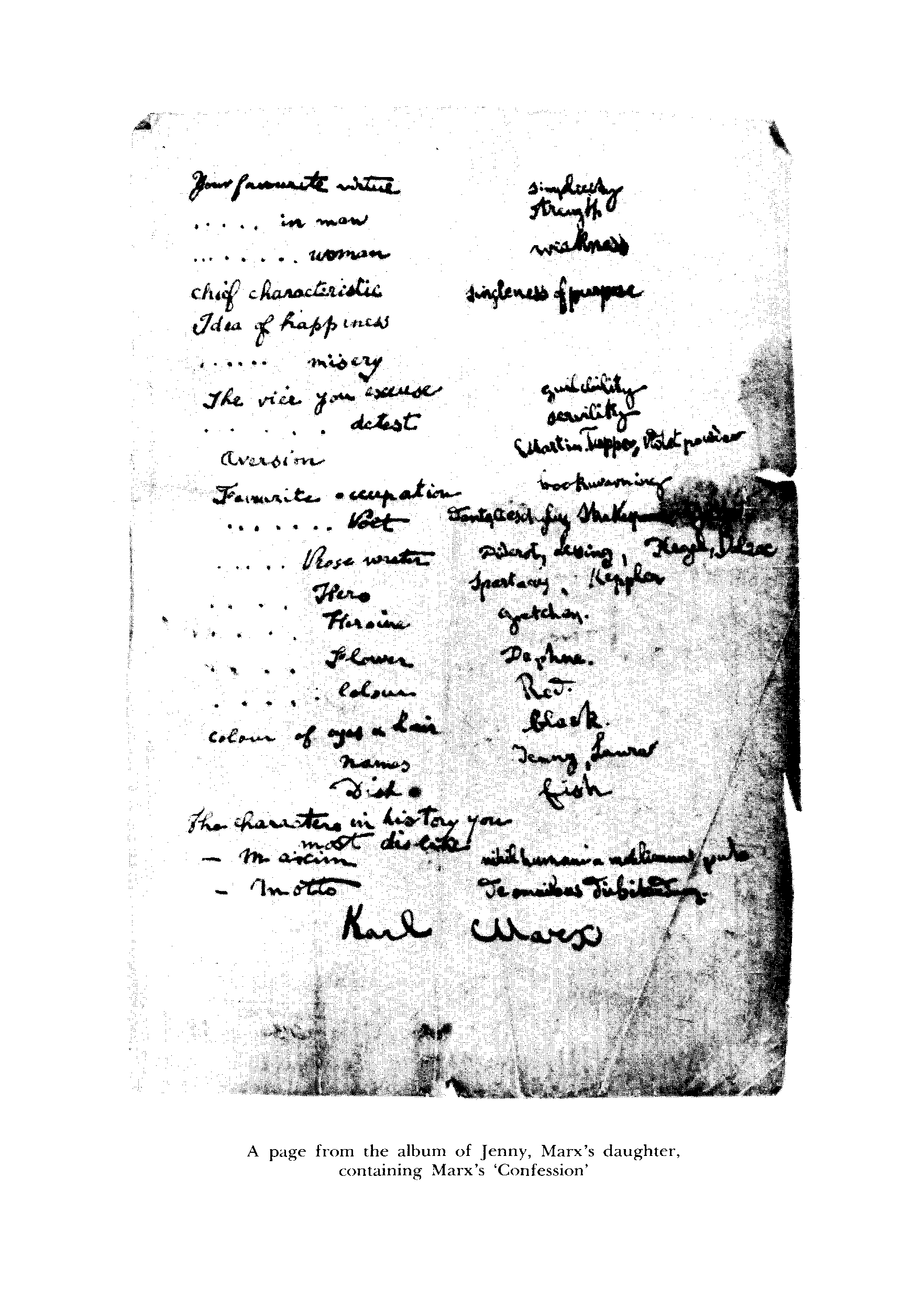
A page from the album of Jenny, Marx's daughter, containing Marx's 'Confession'
begun. I think that this new eruption is simply and solely due to overwork and long hours without sleep at night. He is very sorry not to be able to attend the meetings of the 'International', since the very existence of The Workman's Advocate is at stake right now; until now it has had the greatest difficulties to contend with and fonds are now being offered by philistines and parsons.[230] The attempt must now be made to get a hold on the money without making any concessions in point of principle to the 'MONEY-LENDERS'.3 The Reform question, which is of such immediate practical concern to the English, is also making great demands on the resources, the time and the interest of the workers and is greatly distracting them from other matters.15 Karl and I were most taken by your Vorbote. Both its language and its serious approach are manly indeed! I am enclosing Lessner's letter about it. The agent to whom I entrusted the Manifestos' has written to say that he has managed to prevent them from falling into the hands of the French police and that he can now send them off to Geneva.[622]
However, they cannot be stamped, so I must ask you to write and say what outlay they committed you to. The money can then be sent you together with that for the subscriptions for the Vorbote.
With respect to religion, a great movement is currently developing in stuffy old England. The top men in science, Huxley (Darwin's disciple) at the head, with Tyndall, Sir Charles Lyell, Bowring, Carpenter, etc., give very enlightened, truly freethinking and bold lectures for the people in St. Martin's Hall (of glorious waltzing memory[623]), and, what is more, on Sunday evenings, exactly at the time when the lambs are usually grazing on the Lord's pastures; the hall has been full to bursting and the people's enthusiasm so great that, on the first evening, when I went there with the girls, 2,000 could not get into the room, which was crammed full. The clerics let this dreadful thing happen three times.—Yesterday evening the assembly was informed that no more lectures could be held until the court case brought by the clerics against the 'SUNDAY EVENINGS FOR THE PEOPLE' had been decided. The gathering emphatically expressed its indignation and more than £100 were immediately collected for fighting the case. How stupid of the clerics to interfere in such a matter. To the annoyance of this band, the evenings even closed with music. Choruses from Händel, Mozart, Beethoven, Mendelsohn and Gounod were sung and received enthusiastically by the English,
5. Jenny Marx to Sigfrid Meyer. Beginning of February 1866
who had, until now, only been allowed to bawl out the hymn JESUS, JESUS, MEEK AND MILD or take themselves off to the GIN palace.
Karl, who is in great pain today, and my girls send you their warmest greetings, the little one* in particular, asking me to convey very best wishes to 'dear Becker'. And I extend my hand to you from afar.
Yours
Jenny Marx
JENNY MARX TO SIGFRID MEYER
IN BERLIN
[London, beginning of February 1866] 1 Modena Villas, Maitland Park
Dear Sir,
For the past week my husband has again been laid low with his former dangerous and painful complaint; this fresh affliction is all the more distressing for him since it further interrupts him in the copying out of his bookb that he has just begun. He is very sorry that you did not receive his lengthy letter,c as he is at the present moment incapable of writing. He also fears that the letter has been seized, as it should have been returned long ago otherwise. The address was, by the way, perfectly correct, and I took the letter to the post myself along with many others and the newspapers, all of which arrived. With regard to the Manifesto^ being a historical document, he wishes it to be printed exactly as it originally appeared; the misprints are so obvious that anyone can correct them. He will be sending the 'International Address"" to you as soon as he can.
At the same time, he asks you to let him know your new address for further correspondence, when you have left Berlin. And could not Mr Vogt,(1) in turn, give us another address, as we do not think his present one is quite safe. When you write back, kindly address to A. Williams,[13] Esq., etc.
My husband sends you his warmest greetings.
Yours
Jenny Marx
6. Jenny Marx to Ludwig Kugelmann. 26 February 1866b
1 Modena Villas, Maitland Park
Dear Sir,
For 4 weeks now my poor husband has been laid low again with his old, very painful and dangerous complaint, and no doubt I need scarcely tell you under what great and fearful anxieties we have all been suffering during that time. Right at the beginning of January he had begun to prepare his whole bookd for printing, and he was making wonderfully rapid progress with copying, so that the manuscript piled up most impressively. Karl felt in the best of 'SPIRITS' and was happy to be so far on at last, when a carbuncle suddenly erupted, soon to be followed by 2 others. The last one was especially bad and obstinate and furthermore was so awkwardly placed that it prevented him from walking or moving at all. This morning it has been bleeding more strongly, which has brought him some relief. Two days ago we began the arsenic cure, of which Karl expects a good effect. It is really dreadful for him to be interrupted again in the completion of his book, and in his delirium at night he is forever talking of the various chapters which are going round and round in his mind. This morning I brought him your letter(1) in bed. He was very pleased that you had been kind enough to write, and he asked me to thank you at once for it on his behalf. A further concern is that his presence is sorely needed at this moment, both in the debates about the forthcoming congress of the International Association 28h and in the discussions about the policy and editing of the new workers' paper which is appearing weekly here now under the title of Commonwealth and represents both the newly formed workers' party,b with all the Co-operative Societies, and the International Association.[290] His anxiety about all this has naturally done much to worsen the general state of his health. I hope that by the spring he will be sufficiently restored to be able to visit his friends in Germany. He had been very much looking forward to doing so.
Karl sends you his warmest greetings, to which, despite our not being acquainted, I add my respects.
Yours truly
Jenny Marx
7. Jenny Marx to Ludwig Kugelmann. 1 April 1866
1 Modena Villas, Maitland Park
Dear Sir,
I presume that the registered letter that I received from Hanover late yesterday evening is from you.c I cannot send it on to my husband in Margate until tomorrow,[307] unfortunately, as in pious England all communications halt on Sundays. Since the reply may be held up by this delay, I hasten to let you know immediately today that the letter has arrived safely; but, at the same time, I would like to take this opportunity to apologise to you for my total silence. Just how indebted I am to you for the great sympathy and touching friendship you have shown my husband was really brought home to me when the young man from the CITY called to enquire on your behalf as to my husband's condition. Immediately after my last letter to you, Karl really became gravely ill; a fresh CARBUNCLE (not a furuncle) erupted, and was indeed so obstinate and so inflammatory that for almost 3 weeks my poor husband could scarcely move and was entirely confined to the sofa. Since we are all only too well aware how dangerous this complaint is, if it keeps recurring over a period of years, you can well imagine how melancholy the days and nights have been for us.
On the advice of Doctor Gumpert in Manchester, he decided to begin the arsenic cure, as well as to spend a few weeks at the seaside after the abscess had healed. He has now been in Margate, a coastal resort quite near here, for nearly 2 weeks, and it seems to us that his health has been greatly restored there. He will return next week to pick up with renewed energy the completion of that work of his3 which has so often been interrupted.
Yesterday he sent me his photogram, and since you would perhaps appreciate a sunny picture of the man to whom you have shown so much friendship, although you do not know him personally, I am enclosing 1 COPY with this note.
With all my respects, despite our not being acquainted
Yours truly
Jenny Marx
8. Jenny Marx to Engels. 24 December 1866
JENNY MARX T O ENGELS
IN MANCHESTER
[London,] Monday 1 o'clock [24 December 1866]
My dear Mr Engels,
T h e HAMPER has just arrived, and the bottles have been put on parade, with the Rhenish to the fore! How can we thank you for all your friendship! The £ 1 0 which arrived on Saturday will avert the harshest storms of Christmastide and enable us to celebrate a MERRY CHRISTMAS. The wine was particularly welcome this year, as with the young FRENCHMAN" in the house we like to keep u p APPEARANCES.
If the publisher in Hamburg b really can print the book [1] as fast as he says, it is certain to come out by Easter in any case. It is a pleasure to see the manuscript lying there copied out and stacked u p so high. It is an enormous weight off my mind; we have enough troubles and worries left without that, especially when the girls fall in love and become engaged, and to Frenchmen and MEDICAL STUDENTS to boot! I wish I could see everything couleur de
rose'' as much as the others do, but the long years with their many anxieties have made me nervous, and the future often looks black to me when it all looks rosy to a more cheerful spirit. Cela entre nous?
Once more, a thousand thanks for the hock and all its train!
Yours
Jenny Marx
9. Jenny Marx to Johann Philipp Becker. 5 October 1867
My dear Mr Becker,
I hope you have received my letter. You will doubtless be surprised at seeing a second one following so close behind the first. My husband would like Bakunin's address, and I am quite sure that you will be able to get hold of it easily in Geneva, perhaps via Herzen. He would very much like to send him his book(1) and write on other matters. Warmest greetings from us all and especially from
Yours
Jenny Marx
10. Jenny Marx to Ludwig Kugelmann. 24 December 1867
My dear Mr Kugelmann,
You can have no idea of the delight and surprise you occasioned us yesterday, and I really do not know how I should thank you for all your friendship and sympathy, and especially now for the latest visible sign of your regard, old Father Zeus, who now occupies the place of the 'baby Jesus' in our household.[585] Our Christmas festivities this year are again very much overshadowed by the fact that my poor husband is once more laid low with his old complaint. There have been 2 further eruptions, one of which is of some size and in a most painful spot, obliging Karl to lie on one side. I hope we shall soon get the better of this illness, and that in the next letter you will no longer be confronted with the temporary private secretary.
Yesterday evening we were all at home together sitting downstairs, which in English houses is the kitchen area from which all 'CREATURE COMFORTS' make their way up to the higher regions, and were busy preparing the CHRISTMAS PUDDING with all due thoroughness. We were seeding raisins (a most disagreeable and sticky task), chopping up almonds and orange and lemon peel, minutely shredding suet, and with eggs and flour kneading together the oddest potpourri from the whole mishmash; when all at once there was a ring at the door, a carriage was stopped outside, mysterious footsteps were going up and down, whispering and rustling filled the house; at length a voice sounded from above: 'A great statue has arrived.' If it had been 'Fire, fire, the house is on fire', the 'FENIANS' have come, we could not have dashed upstairs in greater astonishment or confusion, and there it stood in all its colossal splendour, in its ideal purity, old Jupiter
tonans* himself, unscathed, undamaged (one small edge of the piédestal is slightly chipped) before our staring, delighted eyes!! Meanwhile, the confusion having somewhat abated, we then read the accompanying kind words you sent via Borkheim, and after pausing in deepest gratitude to you, we at once began debating which would be the worthiest niche for the new 'dear god who is there in heaven and on Earth'.b We have not yet resolved this great question, and we shall make many trials before that proud head finds its place of honour.
My warmest thanks to you also for your great interest and indefatigable efforts on behalf of Karl's book.c It would seem that the Germans' preferred form of applause is utter and complete silence. You have given fresh heart to all the moaners.
Dear Mr Kugelmann, you can believe me when I tell you there can be few books that have been written in more difficult circumstances, and I am sure I could write a secret history of it which would tell of many, extremely many unspoken troubles and anxieties and torments. If the workers had an inkling of the sacrifices that were necessary for this work, which was written only for them and for their sakes to be completed they would perhaps show a little more interest. The Lassalleans appear to be the quickest to seize the book, so that they may fittingly bowdlerise it. However, that will do no harm.
But to conclude, I have a bone to pick with you. Why do you address me so formally, even using the title 'gracious', for me, who am such an old campaigner, such a hoary head in the movement, such an honest fellow-traveller and fellow-tramp? I would so much have liked to visit you and your dear wife and Fränzchen(1) this summer, of whom my husband cannot stop saying so many nice and good things, I would so much have liked to see Germany again after 11 years.[624] I have often been unwell in the past year, and I am sorry to say that of late I have lost much of my 'faith', my courage in facing up to life. I often found it hard to keep my spirits up. However, since my girls were embarking on a long journey — they had been invited to stay with Lafargue's parentsb
in Bordeaux — it was impossible for me to undertake my own excursion at the same time, and it is therefore now my fondest hope for next year.
Karl sends his warmest greetings to your wife and to yourself, to which the girls sincerely add their own, and I extend my hand to you and your dear wife from afar.
Yours
Jenny Marx not gracious and not by the grace of God.
11. Jenny Marx to Johann Philipp Becker. After 10 January 1868
IN GENEVA
[London, after 10 January 1868] 1 Modena Villas, Maitland Park
My dear Mr Becker,
Don't be cross with me for not replying sooner to your kind last letter. Unfortunately, the reason for my silence was not a happy one. For my poor husband has once again been laid up and fettered hand and foot by his old, serious and painful complaint, which is becoming dangerous through its constant recurrence. Nothing depresses him more than to be constantly condemned to idleness once again, particularly now when there is so much to be done, the 2nd part" is demanded and, to put it shortly, when the world begins once again to burn and blaze, though for the time being with 'Greek fire', and not with the 'Red Cock'.b The idlers and loafers have cash in their pockets and health in their blood, and the people who belong to the new world, who have devoted their bodies and souls to it, are sick — poor and thus well and trully locked in HANDCUFFS. 'SHAME, SHAME' as the English shout at their meetings. You will not believe how often my husband thinks of you, with sincere honour and admiration. He regards your little paperc as quite definitely the best and most effective, and every time we receive news of our native kindergarten, or rather
Gartenlaube? he exclaims: 'If only the Germans had more men like old Becker!!' As temporary secretary, I have just written to Schily
and sent him the letter of the man who has offered to make the translation.h2n You see, Moses Hess has also offered himself as translator through Schily and wanted to launch some preliminary
ballons d'essais* in the Courrier français.[539] But we have long heard and seen nothing of the two gentlemen, but, to judge by the letter I just mentioned, the matter will be a success. Because of his education in philosophy, and his orientation in the arts of dialectical leaps and balances, Hess would be preferable to many other translators who would be simply literal, but, on the other hand, our mystical Rabbi Rabbuni is often not quite reliable (not quite kosher), and often careless, so it would be wrong to reject other offers because of him. Schily will now act as chargé d'affaires, and see which is the right man.
Your last article on the Peace dawdlers[461] was excellent,3 and, by God (the Good Lord always springs nolens volensb to the lips and the pen, although he has long left the place of honour in our hearts), was the best that we have seen hitherto.
'Goegg' is still roaming around here on his propaganda merry-go-round. And Borkheim could have been smarter than to give him 100 fr. travelling expenses. If the coins are itching and burning a hole in his pocket like that, he should let them fall and burn elsewhere. I think there are better things to do than supporting these apostles. Amand ' was dealt with quite differently by Engels in Manchester. For your amusement, here is a passage about it from Engels' letter.d
'Moreover, yesterday I had a visit from the ex-dictator Goegg, who is travelling for the ridiculous Peace League and who ruined my evening. Luckily, Schorlemmer' (a very important chemist, one of 'our people') 'also happened by, and got the surprise of his life with this fossil of Federal Republic; he had not believed such a thing possible. The stupid oaf has become ten times more stupid through the unthinking repetition of the same phrases, and has lost all points of contact with the world of common sense (not to mention actual thinking). Apart from Switzerland and the Canton of Baden, there is still nothing else in the world for people of this sort. For all that, he soon convinced himself of the truth of my first reply to his application for support: that the further apart we lived and the less we had to do with one another, the better we would get on.— He admitted that in the Vogt affair Blind has behaved like a coward, but said he was after all a worthy fellow, and even threatened to reconcile you and Blind! Vogt — no politician, but a decent fellow, honest to the backbone, who simply scribbled away in the daytime without considering the content — if we 2 spent an hour together then we would be like brothers. He admitted him to be a Bonapartist, but not a paid one. To which I replied that all Bonapartists were paid, there were no unpaid ones, and if he could show me an unpaid one, then I would accept the possibility that Vogt was not paid; otherwise I would not. This astonished him, but finally he discovered one—Ludwig Bamberger\ Incidentally, he said that Vogt had continually had a very hard time, his wife was a peasant girl from the Bernese Oberland, whom he had married out of virtue. Vogt, the artful dodger, appears to have pulled the wool well over this jackass's eyes. But when Schorlemmer and I explained to him that Vogt had not produced anything as a natural scientist either, you should have seen his rage: Had he not popularised? Was not that worth while?'
Thus Engels. So Goegg left empty-handed. Now he is trying his luck in other towns. Have you seen or heard anything of Bakunin? My husband sent his book" to him as an old Hegelian,— not a sign near or far. Has he received it? You can't really trust all those Russians. If they don't adhere to the 'Väterchen' in Russia, then they adhere to, or are kept by, 'Herzens Väterchen',15 which in the end comes to the same thing. Six of one and half a dozen of the other.
Things look good here, the English are running away from themselves in panic, and, if somebody hears a cork pop, he imagines it is Greek fire, and if John Bull sees an innocent phosphorus match he believes it is impregnated with glycerine, paraffin, nicotine and God knows what, and starts to run, and soon everybody is running, and finally the genuine CONSTABLES are running ahead of the false BOBBIES, the so-called SPECIALS, who are now keeping order in the streets with their lead batons. Ireland has taken the lead in the entire political programme, the English are already shouting in favour of Ireland at their MEETINGS, and it has almost become respectable to lament the 7-hundred-year suffering of sweet Erinc—to weep over it; and all this has been accomplished by a phosphorus match and a rope.[626] How easy is it to frighten the gentlemen out of their wits!? The short fear of physical means has accomplished more than centuries of moral threats/
12. Laura Marx to Engels. 13 January 1868
12
LAURA MARX TO ENGELS
IN MANCHESTER
[London,] 13 January 1868
Dear Engels,
As Mohr is once more being victimised by his old enemies, the carbuncles, and is, by the arrival of the latest, made to feel very ill at ease in a sitting posture, he has asked me to write you these lines in his stead.
As regards the article for The Fortnightly Review,[509] I am to tell you that there is no question of a mere brief notice like the reviews of books generally found at the back of that periodical, but of an article of the length of those usually inserted.
Also I am to beg you to send back, as soon as possible, the earlier numbers of the Courrier français.*
With best regards from all of us and in the hope that the late frequent Christmas entertainments you have been 'undergoing' may not have interfered with your health, I remain, dear Engels,
Affectionately yours,
Laura Marx
NOTES
AND INDEXES
Endnotes
[131] This letter by Engels has not been found.—88, 99, 174, 445, 448, 467, 475, 481, 513, 534, 566
[177] Marx stayed with his relatives, the Philipses, at Zalt-Bommel (Holland) from 19 March to 8 April 1865.—128, 133, 139, 566
[618] Straubingers—German travelling journeymen. Marx and Engels applied the name ironically to some participants in the German working-class movement of the time who were connected with guild-based production and displayed petty-bourgeois sectarian tendencies. The reference here is to the members of the Lassallean General Association of German Workers.—566
[98] Wilhelm Liebknecht wrote to Marx before 20 January 1865 that he had learned of Ferdinand Lassalle's agreement with Bismarck's government: he promised support from the General Association of German Workers over the annexation of Schleswig-Holstein by Prussia if it introduced universal suffrage. Marx and Engels regarded this political 'bequest' by Lassalle as betrayal of the proletariat's interests. The Lassalle-Bismarck correspondence published in 1928 fully confirmed Liebknecht's information.—66, 69, 71, 75, 102, 124, 566
[619] In his letter to Ferdinand Lassalle of 28 April 1862 Marx entirely denied the slanderous rumours which had been repeated by Lassalle besmirching the reputation of Johann Philipp Becker, and described him as 'one of the noblest German revolutionaries' (see present edition, Vol. 41, p. 356).—567
[93] The name Plon-Plonists is derived from Plon-Plon, the nickname of Prince Napoleon Joseph Bonaparte, Napoleon Ill's cousin, whose residence was the Palais Royal while Napoleon III resided in the Tuiliers. Joseph Bonaparte headed a group of Bonapartists who sought to divert the people's attention from the struggle against the regime of the Second Empire by means of social demagogy and sham opposition to the government's policy.—66, 76, 208, 300, 567
[620] Confessions—semi-jocular questionnaires that were very popular in England in the 1860s. Filling such questionnaires became a favourite pastime in many families, including Marx's, in which relatives and friends participated. A number of versions of Confessions belonging to Marx came down to us. In this volume an early version is published which dates back to the spring of 1865 when Marx stayed with his uncle Lion Philips in Zalt Bommel (Holland). It is somewhat different from the other two versions: the handwritten one included in the album of his daughter Jenny (a facsimile of it is published in this volume) and the one written in Laura Marx's hand. The latter version partly coincides with the one that is being published here and partly with the one in Jenny's album, except for the answer to the question: 'Your favourite flower — Laurel' (instead of 'Daphne'). Major divergencies between the version published here and the one in Jenny's album are given in the footnotes.—567
[3] The proposal to accept the presidency of the General Association of German Workers was made to Marx by Wilhelm Liebknecht in his letters, written at the 21* beginning of September and early October 1864. Liebknecht also wrote that Bernhard Becker and Johann Baptist Schweitzer, its leaders, backed him in this request.— 3
[621] A substantial extract from this letter was published by Johann Philipp Becker in Der Vorbote, Jg. 1, No. 2 of February 1866 (present edition, Vol. 20).—568
[230] At the end of July 1865 John Bredford Leno, the proprietor of The Miner and Workman's Advocate published in London from 1863, proposed placing this weekly at the service of the Central Council of the International. The proposal met with approval by the Council members. They discussed the matter at the meetings of 8 and 15 August 1865, in the absence of Marx who was busy with his Capital. However, Eccarius informed him in detail about this in a letter dated 16 August 1865. On 22 August an inaugural meeting was held of shareholders of the joint-stock company for financing the workers' paper, which was called the Industrial Newspaper Company. The meeting, which Marx attended, approved the address to the working men of Great Britain and Ireland and the Company's Prospectus (both published in the present edition, Vol. 20). On 25 September 1865 the London Conference of the International declared the newspaper, which in September assumed the name of The Workman's Advocate, an official organ of the International. At the beginning of November 1865 the paper became the full property of the Industrial Newspaper Company. Marx was a member of the Company's Board and remained on it until June 1866. However, the growing influence of reformist elements in the paper's Editorial Board and the vacillation and conciliatory policy of the trade union leaders on the Company's Board did not allow Marx and his followers to prevent the transformation of this working-class paper into an organ supporting the bourgeoisie.—173, 201, 206, 571
[622] A reference to a reprint of the first 1848 German edition of the Manifesto of the Communist Party made in London probably in 1865: 'Manifest der Kommunistischen Partei. Veröffentlicht im Februar 1848. London, Druck von R. Hirschfeld, English and foreign Printer, 1848, 24 S'.—571
[623] Jenny Marx is recalling the meeting to celebrate an anniversary of the International that was held on 28 September 1865. Marx was present at it with his daughters. Speeches alternated with musical performances, singing and dancing.—571
[13] Part of this letter was published in English for the first time in the Labour Monthly, No. 4, London, 1923.—11
[290] 'Yhe Workman's Advocate (see Note 230) was renamed The Commonwealth on 10 February 1866. Despite the reorganisation the newspaper remained the official organ of the International Working Men's Association. It continued to publish reports of the Central Council meetings and other documents of the International. Marx remained on the Board of the Industrial Newspaper Company which owned the paper until 9 June 1866. Thanks to his efforts Eccarius, who became the editor of The Workman's Advocate not long before, retained his post. However, the reformist leaders of trade unions managed to paralyse the influence of Marx's supporters. In April 1866 George Odger was appointed its editor-in-chief. In issue No. 183, 8 September 1866, the newspaper declared itself to be the organ of the Reform League (see Note 155) and in fact fell under the influence of the radical bourgeoisie. It ceased publication on 20 July 1867.—224, 249, 252, 262, 283, 290, 574
[307] From 15 March to approximately 10 April 1866 Marx stayed in Margate where he took treatment and had a rest.—239, 261, 268, 283, 574
[585] A reference to a copy of a bust of Zeus from Ogricoli which was presented to Marx by Kugelmann.—521, 578
[624] A reference to Jenny Marx's last trip to Trier in 1856 when she went to see her dying mother. Then she stayed in Germany from 22 May to approximately 10 September 1856.—579
[539] In his letter to Marx of 27 November 1867, Victor Schily informed him about Moses Hess' favourable opinion of Capital and the latter's intention to write an article about it for Le Courrier français. Schily also wrote about Hess' offer to translate, together with Elysée Reclus, Volume One of Capital into French and to publish it. Marx who attached great importance to the publication of Capital in French and saw this in particular as an important weapon against the influence of Proudhon's delusions (see this volume, p. 368) did not object to Reclus' participation in the French edition. However, the discussion which lasted for almost three years came to nothing. Later on, when it became clear that Reclus was one of the leaders of Bakunin's Alliance of Socialist Democracy, he could no longer be considered as a suitable translator of Capital. The translation of Capital into French which had been done by Joseph Roy and edited by Marx himself was published in Paris in 1872-75 by instalments.—478, 483, 488, 490, 528, 532, 533, 580
[461] The League of Peace and Freedom—a pacifist organisation that was set up in 1867 with the active participation of Victor Hugo, Giuseppe Garibaldi and other democrats. The League owed its origin to the anti-war sentiments of the masses. However, its leaders held pacifist positions; they failed to see the social causes of war and often confined its anti-war activity to mere declarations. The League's constituent congress was originally scheduled for 5 September 1867 in Geneva. Its organising committee, which enjoyed the support of a number of radical and democratic public figures like John Stuart Mill and the Reclus brothers', also counted on the participation of the leaders of the European proletariat. Therefore the committee sent invitations to the sections of the Internationa] and its leaders, Marx included, to attend the congress. It was also decided to postpone the opening of the congress until 9 September, so that the delegates of the Lausanne Congress of the International (due on 2-8 September) could take part in it too. The International's attitude towards the League of Peace and Freedom was discussed both in the General Council and in local sections. Marx's speech at the Council meeting of 13 August 1867 and the resolution adopted at his proposal (see present edition, Vol. 20, p. 204) formulated the principles of the International's tactics in such a bourgeois-democratic movement. In contrast to the unconditional support of the League, which is what the leaders of the British trade unions inclined towards, the International's tactics envisaged both the joint participation with the democrats in the struggle against the threat of war, provided the class independence of the proletarian organisation was retained, and a revolutionary proletarian approach towards the questions of war and peace in opposition to bourgeois pacifist illusions. Marx believed that the International should not take part in the League's congress on an official basis because that would mean the International's solidarity with its bourgeois programme. However, it was recommended that the International's members should attend the congress privately in order to influence its decisions in a revolutionary-democratic way.—414, 424, 473, 517, 537, 581
[626] This is an allusion to the explosion in Clerkenwell Prison in London which was caused by a group of supporters of the Fenian prisoners in order to free them on 13 December 1867 and also to the hanging of three Fenians in Manchester on 23 November 1867 who had been captured in an armed assault on a police van in order to release the arrested Fenian leaders (see Notes 563 and 497).—582
[509] Engels wrote the review of Volume One of Marx's Capital for The Fortnightly Review much later, in May and June 1868. As can be seen from their subsequent correspondence, Marx and Engels exchanged opinions several times on the content and form of the article. In spite of Professor Beesly's request, the review was rejected by the editorial board and has only been preserved in manuscript form (see present edition, Vol. 20).—455, 457, 463, 466, 512, 516, 518, 524, 526, 532, 533, 545, 555, 560, 583
[1] This letter was published in English for the first time in Karl Marx, On the First International. Arranged and edited, with an introduction and new translations by Saul K. Padover, New York, 1973.—3, 64, 92, 148, 191, 218, 314