3) Relative Surplus Value
[V-211] Costs of machinery, buildings, etc., w h e n n o t WORKING. I n The Times f o r N o v e m b e r 2 6 , 1 8 6 2 a a s p i n n i n g m a n u f a c t u r e r
p o i n t s o u t t h a t his MILL, EMPLOYING 8 0 0 WORKPEOPLE a n d CONSUMING, WHEN
AT FULL WORK, ABOUT 1 5 0 BALES OF EAST INDIAN, OR ABOUT 1 3 0 BALES OF
AMERICAN COTTON, costs him ABOUT £ 6 , 0 0 0 a y e a r (ABOUT £ 1 2 0 a WEEK) w h e n n o t WORKING. T h e r e a r e , first of all, fixed costs, which d o n o t c o n c e r n u s h e r e ( b u t w h i c h a r e v e r y i m p o r t a n t i n practice), namely
RENT, t h e m o s t significant FIXED COST, w h e t h e r t h e m a c h i n e WORKS o r
n o t (RENT in t h e a b o v e c a s e = £ 2 , 4 5 0 ) , further INSURANCE (INSURANCE OF
MILLS AND MACHINERY AGAINST FIRE i n t h e a b o v e c a s e = £ 4 7 7 , INSURANCE OF
COTTON IN PROCESS £ 1 2 3 ) ; taxes o n this property / / RATES ON THE MILLS AND
MACHINERY, AS PAID IN 1861 (POOR RATE INCLUDED) £ 3 1 0 / / . F u r t h e r : salaries
OF MANAGER, BOOK KEEPER and SALESMEN. ( I n t h e a b o v e c a s e £ 6 2 5 . )
T h e n WAGES OF LODGEKEEPER, WATCHMEN, ENGINEER, AND OCCASIONAL LABOUR TO
TEND THE MACHINERY ( £ 2 5 0 . T h i s OCCASIONAL LABOUR TO TEND THE MACHINERY
b e l o n g s t o t h e o u t g o i n g s TO CONSERVE IT). T h e n COAL FOR WARMING THE
MILL, AND OCCASIONALLY WORKING THE STEAM ENGINE. ( £ 1 5 0 . ) F i n a l l y "ALLOW-
ANCE FOR DETERIORATION OF MACHINERY". ( £ 1 , 2 0 0 , b e c a u s e t h e m a c h i n e r y is already v e r y w o r n o u t . ) W i t h r e g a r d t o t h e last point , t h e L a n c a s h i r e SPINNER r e m a r k s :
* "It may appear to many that, as the mills and machinery are not working, they cannot be deteriorating... It is not intended to cover the cost of the ordinary wear and tear, which is repaired, as a knife has a new blade, by a staff of mechanics provided for the purpose by every manufacturer when his mill is working. But it is intended to cover that kind of wear which cannot be repaired from time to time, and which, in the case of a knife, would ultimately reduce it to a
a "The Case of the Millowners. To the Editor of The Times", The Times, No. 24413, November 26, 1862.— Ed.
state in which the cutler would say of it, 'it is not worth a new blade'.[3] It is also intended to cover the loss which is constantly arising from the superseding of machines before they are worn out by others of a new and better constitution. From these two causes it is well known that the machinery in a mill gets entirely renewed, at the least, once in every 15 or 20 years; and invention does not stand still in times like these, being always stimulated by difficulties; nor do the weather and the natural principle of decay suspend their operations because the steam engine ceases to revolve. " *
The same fellow also says:
* "No doubt a large number (of manufacturers) have ample reserves on which they can fall back, but the bulk of Lancashire manufacturers have no spare capital. The habit of the trade is to spend in extensions of their mills and machinery their profits as fast as they make them, and as a rule they have an insufficiency rather than a redundancy of floating capital" * [p. 12].(1)
[V-212] Cherbuliez: Riche ou pauvre etc., Paris, 1841.[201] (Reprint of the Geneva edition.)
"New Capital Old Capital
1) the machine 1) provisioning of the workers 2) annual upkeep 2) the instrument and its upkeep 3) raw materials 3) raw materials."(2)
//There is of course provisioning of the workers in the case of new capital as well. He is only speaking here of the provisioning of the workers replaced by the machine.//(3)
"On both sides one must abstract from the number of workers who are necessary to supervise and direct the movements of the machine. The old capital would grow in direct proportion to the number of workers employed. If it is 100 for a particular number, it is 200 for twice that number. The new capital is not subject to the same laws of growth, for the element of the machine that serves the application of the motor does not grow in numbers or in dimensions in proportion to the number of workers whose labour it replaces. Hence whatever the superiority of the new capital over the old for a given number of workers, it lies in the nature of this surplus labour that it is converted into inferiority, in proportion as one increases the number of the workers represented and replaced by the machine. If 2 workers are replaced, it is perhaps more expensive. If 4, 10, 20 workers are replaced, it becomes ever cheaper. This favourable result can only be obtained on condition that one disposes of a previously accumulated capital which is sufficient to set up a machine to replace the required number of workers and to obtain a
[3] The words "Fixed capital" are written in the margin opposite the following two sentences.— Ed.
quantity of raw materials proportionate to that number. Here again, as in the case of a new subdivision of labour, the saving is linked to the prior realisation of an additional capital. Each accumulation of wealth provides the means of accelerating subsequent accumulation" ([pp. 28-]29).(4)
// Firstly. The situation with accumulation is to be taken into account in the conversion OF SURPLUS VALUE INTO CAPITAL. It should be mentioned here that just as accumulation is a condition of capitalist production, so capitalist production is a cause of
ACCUMULATION.
Secondly: The machine replaces a certain quantity of workers, either in real terms, i.e. by taking their place (this is always the case when the trade is not new but was previously carried on without machinery); or potentially, in that so and so many workers would be necessary to replace it If we speak e.g. of the millions of workers (see Hodgskin ) who would be needed to furnish the amount of production now furnished in the cotton industry, we are speaking of the number of the workers who would be needed to replace the machinery. It is different when we say that so and so many weavers were displaced by the POWERLOOM. Then we are speaking of the workers the machine has replaced. This is a big distinction. Once machinery has been introduced as the basis of a branch of production (with no more competition from manufacture) it only displaces workers to the degree that it is improved. But production expands with a given level of PERFECTION of the machinery before it attains a higher level.
If e.g. 10 were employed at handlooms, and 20 are employed at POWERLOOMS, and if a POWERLOOM replaces 10 handlooms, then the 20 accomplish as much as 200 did previously. But they have not driven out or replaced 200. The first POWERLOOM drove out 10. The other 19 POWERLOOMS have employed 19. One must not say, therefore, that productive power has replaced 180, because 200 would have been needed without the POWERLOOMS. The productive power has merely increased tenfold.
If a new POWERLOOM is invented, allowing 10 to do as much as 20, the 20 would be replaced by the 10, or 10 thrown out of work. If the number of these POWERLOOMS grew in turn to 20, 20 would be employed. And 40 would have been necessary on the previous scale. And 400 on the original scale. But the 400 men, who never existed, have not been replaced. The first POWERLOOM drove out 10 and second 2. Thus the productive power has grown in the proportion 20:1.
At any rate there has thus been a twentyfold increase in the productive power. If this development had taken place in all branches, the worker would have needed 20 times less time to reproduce his means of subsistence. Thus if it was 11 hours initially, it is now (5)/2o of an hour, and all the remaining part of his working day, 1 l(6)/2o hours, belongs to the capitalist. But the development is not uniform and all-embracing.
It should further be remarked: the amount of surplus labour is determined not by the workers replaced by the machine but by the workers employed by it. This is precisely what Cherbuliez forgets. The productivity of the machine (and its cheapness) is not only determined by the quantity of workers it replaces, but also by the quantity of workers whose labours it assists. Or the expressions are in [V-213] SOME RESPECT identical.//
// In so far as machine labour curtails the labour time needed to produce a particular commodity, hence increases the quantity of commodities which are produced in the same labour time, 2 things are possible. The commodity enters into the consumption of the workers. Then, leaving aside what we developed previously,[2] there is an increase in the amount of labour which can be applied to produce commodities that do not enter into the consumption of the workers; in which SURPLUS LABOUR can therefore be represented. This extends the basis, UPON WHICH CAN [be] REARED A LARGER UPPER CLASS. At the same time the pleasures of this CLASS. But there is also an extension of the basis, UPON WHICH CAN [be] REARED A LARGER WORKING CLASS, or the amount of living material on whose EXERTIONS the UPPER CLASS IS REARED. If, secondly, the commodity does not enter into the consumption of the workers, there is either a cheapening of pleasures or a setting free of labour for NEW FIELDS OF EXERTION.//
Distribution of the value of the machinery, BUILDINGS, etc., over the quantity of commodities produced.
Constant capital, in so far as its relative magnitude of value — proportionately to the total capital — enters as a determining factor into the rate of profit, is to be left out of account entirely in examining surplus value as such. We have therefore regarded it as c, of indifferent magnitude, both in the section on absolute surplus value and in dealing with cooperation, division of labour, etc.(7) In examining machinery, however, we are compelled to concern ourselves especially with constant capital. Nevertheless, there is no inconsistency here. Two points should be made about this:
1) Relative surplus value can be created only in so far as the commodities entering into the consumption of the workers (means of subsistence) are cheapened; hence the value of these commodities is reduced, i.e. the quantity of labour time required for their production is reduced. And the labour time contained in the commodity consists of two parts: a) the past labour time contained in the means of labour consumed in the commodities, and in the raw material, s'il y en a(8); b) the living labour last added, in short the labour which is realised with the aid of those means of labour and in that raw material.
All the methods of shortening the labour time necessary for the production of a commodity, HENCE reducing its value, leave untouched the value of the raw material which enters into production. (There is at most a saving of it given labour on a larger scale.) This part of the past labour which enters into the value of the commodity therefore does not come into consideration at all. What all these methods have in common is that they curtail to a greater or lesser degree the living labour which is applied to past labour.
All that remains to be considered now, therefore, is the part of the past labour which consists of the instruments and conditions of labour (such as buildings, etc.). This PART remains unchanged with simple cooperation and division of labour. (It is, inversely, cheapened by concentration and utilisation in common.) But it is different with the employment of machinery. Here a specific relation enters the picture. The curtailment of living labour rests here upon a revolution in this part of constant capital, and one can say, expressing it very ROUGHLY, that complex, large-scale, and expensive instruments of production replace simple and cheap ones. If the commodity were therefore just as much made dearer by the machinery (or more so) as it is on the other hand cheapened by the acceleration and curtailment of the living labour added, the value of the commodity would not be reduced. One component [of the value] of the commodity would fall by the very fact that the other increased. There would be no reduction in the total quantity of labour time necessary to the production of the commodity, therefore no production of surplus value. So because this method of creating relative surplus value rests on the revolution of a particular part of the constant capital, and is thereby distinguished from other methods, this point must be examined here specifically. Viewed quite generally, the problem is solved by saying that the total quantity [V-214] of the commodities produced by the machinery is so large that in every aliquot commodity there enters a smaller value component (part of the depreciation) of the machinery, buildings and the matières instrumentales(9) needed for the functioning of the machinery than if the same commodity were produced in the old manner by human beings and their old craft tools. But the fulfilment of this condition will in turn depend on the following circumstances:
a) the quantity of commodities an individual worker can produce in a given labour time, e.g. a working day, by means of the machinery;
ß) the number of workers who, if the above relation is given, simultaneously receive assistance from the machinery in their labour; and through whom the value part of the total machinery calculated on each individual is relatively reduced;
7) the difference between the period during which the machinery enters into the labour process and the period during which it enters into the valorisation process. E.g. a machine which lasts for 15 years enters completely into the labour process every year for 15 years. But only /15 of it enters into the valorisation process every year. The total annual product in commodities therefore never contains more than V15 of the value component of the machinery.
2) A big distinction is to be made between the question of how far the constant capital affects the rate of profit—this is the investigation of the question of the ratio of the surplus value to the value of the capital advanced, WITHOUT ANY REGARD TO THE FUNCTIONS OF DIFFERENT PARTS OF THAT CAPITAL — and on the other hand, the question of how far a particular configuration of constant capital (machinery, etc.) lessens the price of the individual commodity, or the labour time contained in it (past and present labour). In content of course the two questions come down to the same thing. But here the same phenomenon is considered from entirely different points of view. In the one case we investigate how the commodity //and therefore labour capacity, in so far as the commodity enters into the consumption of the workers// is cheapened, i.e. the total quantity of labour, past and living, required for its production, is lessened. In the other case we investigate how the ratio of surplus value to total capital advanced (the rate of profit) is affected by the revolution in the quantity and value relations of the constituent parts of the capital. The latter investigation presupposes surplus value; it presupposes the whole of capitalist production (including the process of circulation). The former investigation presupposes nothing but our general law about the value of commodities and the laws that follow therefrom about the value of labour capacity and ratio of surplus value to the latter.
3) The confusion between these questions: the lessening of the labour time required for the production of an individual commodity (or a number of commodities), and the proportion of surplus labour to necessary on the one hand, and on the other hand the value and quantity relations of the different components of capital, is the source of great FALLACIES.
D'abord* the main FALLACY. If the essence of capitalist production is grasped, it is absolutely no contradiction to say that the labour time necessary for the production of a commodity is reduced, but that there is on the other hand an increase in the total amount of time the worker must use for the production of this commodity which has become cheaper. In contrast, this constitutes, in fact, an incomprehensible contradiction to the economists who let the machine be invented and introduced, not in order to curtail the labour time the worker needs for the production of a commodity, but in order to curtail the labour time he must provide altogether as equivalent of his wage. And especially so, if on the one hand profit is explained by the fact that machinery shortens the worker's labour time, and on the other hand it is demonstrated (Senior,b etc.) that machinery necessitates the prolongation of that labour time.
Secondly: As far as the labour time of the worker himself is concerned, his paid labour time is shortened by this, and his unpaid labour time lengthened. It already follows [V-215] from this that the quantity of labour time contained in a commodity and the proportion in which this labour time is divided between capitalist and worker are two entirely different things. If the capitalist sells a commodity more cheaply, it does not follow at all from this that he makes less profit on it, realises less SURPLUS VALUE on it. The situation is usually the reverse. In addition to this, it is not the individual commodity, but the total amount of commodities produced in a certain period, that is to be considered as the product of the capital.
Prolongation of absolute labour time in the FACTORY SYSTEM.3 The developed organisation of labour which corresponds to the machine system on the capitalist basis is the FACTORY SYSTEM, which predominates even in modern large-scale agriculture, more or less modified by the peculiarities of that sphere of production.
The main proposition that applies here is that the SURPLUS VALUE the capitalist makes derives not from the labour replaced by the machine, but from the labour which is employed on the basis of machinery.
Now the yield in SURPLUS VALUE is determined by two momentsb: the rate at which the individual worker is exploited, or the share of surplus labour in the working day of an individual worker, and, secondly, the number of workers simultaneously employed, the number exploited by a given capital. The introduction of machinery lessens the latter moment, while it raises the former. It raises the surplus labour time of the individual worker, but it lessens the number of workers simultaneously exploited by a particular capital. The same method, therefore, which has a tendency to raise the rate of SURPLUS VALUE, has at the same time the antagonistic tendency to weaken the other moment, which acts equally to determine the amount of surplus value.
If each of 20 workers works for 12 hours, 2 hours of which is SURPLUS VALUE, the amount of SURPLUS VALUE=2X20=40 hours of labour ( = 3 working days of 12 hours each plus 4 hours). If each of 10 workers works 12 hours, 4 hours of which is SURPLUS LABOUR, the amount of SURPLUS VALUE=40 hours as above. But 6 workers, each of whom works 6 hours of SURPLUS LABOUR, will only provide 36 hours of SURPLUS VALUE. And if the same capital set in motion 20 workers in the first case and 6 workers in the second, the amount of SURPLUS VALUE would have declined, even though its rate had increased.
This antagonistic tendency of exploitation based on machinery impels the extension of absolute labour time. If e.g. in the second case the workers were to work 14 hours instead of 12, and 8 hours were SURPLUS LABOUR, the AMOUNT of SURPLUS VALUE would=6x8=48.
This reason, which impels the absolute prolongation of labour time — the increase of absolute SURPLUS LABOUR, the prolongation of the working day — is something the capitalists and their spokesmen are totally unconscious of. The phenomenon shows itself once machine manufacturing has been sufficiently extended and developed through competition for the social value, the market value, of the commodities produced with machinery to be brought down to their individual value, so that the capitalist can no longer pocket the difference.
This is a driving motive entirely independent of the valorisation of the part of the constant capital which consists of machinery and buildings. The valorisation motive, as being more obvious, is directly present in the consciousness of the capitalists and their spokesmen.
This motive is very simple, and common to all SURPLUS LABOUR, but it operates particularly strongly when the value and the amount of the capital employed in the means of labour is large enough to be predominant.
D'abord, NO ADDITIONAL OUTLAY OF MACHINERY and BUILDING is necessary, whether 12 or 24 hours are worked, whereas, if a correspondingly greater amount of labour is to be absorbed simultaneously, the buildings, machinery [V-216] and TO A CERTAIN DEGREE THE MACHINERY WHICH PRODUCES THE MOTIVE POWER must be increased in size. The commodity is cheapened thereby too. For it is irrelevant whether the value of the machinery is distributed over more labour spatially, through the number of workers who work alongside each other and are assisted simultaneously by it; or this happens temporally, by the fact that the same number of workers are assisted by the same machinery over 24 instead of 12 hours.
The absolute reproduction time of the buildings remains roughly the same, whether they enter really as conditions into the labour process over 12 or over 24 hours.
The reproduction time of the machinery itself is not curtailed to the same extent as its active service is prolonged. But the reproduction time of its value is curtailed to the same extent.
The profit is thus greater in a given section of circulation and the profit in general is calculated according to the surplus value which is realised in a particular period of circulation, e.g. a year.
The ratio of constant to variable capital is in general reduced by this, because the share of the most important part of the constant capital is reduced.
The examination of this last point therefore belongs to the theory of profit.[4]
Replacement of the tool of labour by machinery. It should be noted here that machinery does not only replace living labour, but also the worker and the tools of his craft. The latter may of course be very insignificant, e.g. when sewing machines replace the usual labour of sewing. This is usually not a replacement; the actual WORKING TOOL rather re-emerges in the machinery itself, even if on an infinitely larger scale and more or less altered by mechanisation.
Conglomeration of workers in the factory system. Later on we shall go further into the peculiarities of cooperation,(10) as it appears in the factory system, as distinct from both simple cooperation and manufacture based on the division of labour.
But here it is to be noted above all that developed machinery— the system of production based on machinery — presupposes the conglomeration of workers at one point, their spatial concentration under the direction of a single capitalist. Concentration of this kind is its condition. See the quotation from Ravenstone.[203]
The machinery which produces the motive power — and similarly the directing machinery which subdivides and transmits the power — is relatively cheapened to the degree that it is applied to a progressively larger system of machinery; there is a similar relative reduction in the cost of buildings, heating, superintendence, etc., in short the objective conditions of labour which are communally needed and consumed by the mass of the workers. There must correspond to the system of simultaneously operating machinery an army of simultaneously employed workers, partly to put into effect the division of labour peculiar to the machine system, partly to implement the system of simple cooperation, the simultaneous exploitation of many people who do the same thing, which is characteristic of the division of labour. Hence although the number of workers set in motion by a particular capital — and the number of workers required for the production of a given amount of commodities — is reduced, the number of workers simultaneously employed and commanded under individual capitalists increases; there is an increase in the concentration of workers acting together in space and time.
Just as the capital functioning in production in this system takes on the shape of a great social mass of wealth, even if it belongs to an individual capitalist, which stands in no relation at all to an individual's capacity — however large — for working and earning, so the same is true of the system of collaborating workers in a great social combination.
[V-217] Condensation of labour.* If we call the variable capital v, the constant c, and the surplus labour contained in the product x, the value of the commodities produced by a particular capital, if we assume that the whole of the constant capital enters into the valorisation process, considered from the point of view of the absolute surplus value=c + v + x
The methods which raise relative surplus value change absolutely nothing in this formula. Or, the value of the total product is not raised by these methods, c may grow, because the amount, and therefore the value, of the raw material grows. Ditto, because the value of the machinery grows. But the value of c remains unaltered. It only reappears in the product. Just as little is x altered, v is exchanged in the labour process for v + x, where v represents the labour time which is expressed in v, and x represents the excess over and above this, v + x is the total working day. It is not altered by the methods which create relative surplus value. Or, in other words: however much the quantity of products produced in a working day is increased by these methods, their value is not increased, even though, as a result of the cheapening of the products, hincb of the means of reproduction of labour capacity, the division of labour time into paid and unpaid is changed. (The value of the total product of e.g. one working day may be increased: e.g. more cotton may be spun, etc. In short because more constant capital is consumed in the same time.)
There is nevertheless an exception to this. And an exception which only develops with machine labour. This is condensation of labour, or it is so in so far as, owing to the development of the social productive power of labour, the intensity of labour, the filling in of the pores in labour time, is driven onwards to such an exceptional degree, and becomes so much the constant feature of labour in a particular sphere of production, that the more intensive hour of labour=the more extensive hour of labour+x At a certain point what has been gained in extension must be lost in intensity. But the same result also occurs in reverse. And the replacement here of quantity by degree is not a matter of speculation. Where the factum occurs, there is A VERY EXPERIMENTAL WAY TO PROVE IT: if it is physically impossible for the worker e.g. regularly to perform the same quantity of labour over 12 hours in the course of a week as he now performs over 10 or 10 V2 hours. Here we see the necessary reduction of the normal or total working day as a result of the greater condensation of labour, which implies a greater tautness, nervous tension, but at the same time a greater physical exertion. With the increase of the two moments — the rapidity and the extent (the quantity) of the machinery which is to be supervised — a nodal point is necessarily reached, at which the intensity and the extent of labour cannot simultaneously grow any further, the one necessarily excluding the other. And in this case, in spite of the reduction in absolute labour time, the SURPLUS LABOUR may not only remain the same, but grow. And indeed for two reasons. On the one hand, because the productivity of labour grows, i.e. owing to the general law that determines relative SURPLUS VALUE altogether. Secondly, however, because the more intensive hour of labour now counts as such, hence its product e.g.=the value of 1 V2 extensive hours of labour in the previous mode of production. The more intensive hour of labour — here as the regular, general law of a particular sphere of production, not as something accidental and individual — will now be reckoned as what it is, as a greater quantity of labour, condensed as opposed to more porous labour time. As long as the intensity grows simultaneously with the extension of the absolute labour time, the worker will admittedly be subject to not only simple but double overwork; but the more intensive hour of labour does not count as such. It only counts from the moment at which its heightened intensity appears as the real, tangible and given limit of its extension.
This is the reason why with the introduction of the Ten Hours' BILL there was not only a growth in the productivity of the branches of English industry into which it was introduced, but also a rise rather than [V-218] a fall in the amount of value they produced, and even in wages."
It should of course always be remarked that as soon as a concrete economic phenomenon comes into question, general economic laws can never be applied simply and directly. E.g., in the matter just referred to, a mass of circumstances come into consideration which lie far away from our subject; indeed, it would be impossible to explain these circumstances without anticipating developments which involve much more concrete relations than those we are so far able to grasp. E.g., the rise in demand following from the expansion of the world market since the discoveries in California and Australia,11 and the combinations connected with this. The influence exerted, precisely during the period of occurrence of the phenomenon referred to, by the cheapness and abundance of the supply of the raw material (cotton), etc., in a number of these branches of industry. And finally the measure of the value, e.g. of cotton, is determined not by the English hour of labour, but by the AVERAGE NECESSARY TIME OF LABOUR on the world market.
But leaving aside all this, the English FACTORY REPORTS unanimous-ly demonstrate two facts: 1) that since the introduction of the Ten Hours' Act (later modified to 10 V2 hours) the small, piece-by-piece improvements in machinery were on a far larger scale and more continuous than in any prior period, and 2) that the speed of the machinery, and the amount of it that the individual worker has to overlook, have very much increased the intensity of labour, the demands on the worker's nerves and muscles.
Furthermore, the same REPORTS leave no doubt about the other two facts: 1) that without the law on hours, the limitation of the absolute working day, that great revolution in the running of industry would not have occurred, that it was enforced by the outer limit set by legislation to the exploitation of the worker; 2) that the experiment would not have been possible, i.e. not possible so quickly with this favourable result, without the high level of technological development already attained, and the means of assistance given by the level of capitalist production attained in general.
If all branches of industry were subjected to the same restrictions, and with the same success, with an equal rise in the intensity of labour, this intensity would count as a GENERAL RULE, and not as the distinct property of a specifically determined branch of labour. A new AVERAGE normal working day would merely have been established. The whole day would have been shortened, but also the necessary labour time and the surplus labour time within that (ON AN AVERAGE) in the different branches. (An English working day of 10 V2 hours is not only more productive, but contains perhaps as great a quantity of labour as the 24 hours worked in the COTTON MILLS of Moscow.)
The capitalist mode of production in general condenses labour time, or increases the amount of labour provided within a definite time, the amount of labour which is actually WORKED IN FOR INSTANCE AN HOUR or 12 HOURS. This is in fact identical with increasing the continuity of labour for the individual worker (for the individual worker, disregarding the continuity of the production process, i.e. its regular continuance over whole periods of time). Even the formal subsumption of labour under capital brings this about, as does the whip in the mode of production based on slavery. This intensity is increased still further by cooperation, but particularly by the division of labour and even more by machinery, where the continuing activity of the individual is bound and conditioned by the activity of a whole, of which he only appears as a member, or which works, as in the mechanical workshop, with the utter uniformity and tirelessness of an inanimate force of nature, an iron mechanism. A certain AVERAGE DEGREE of INTENSITY OF LABOUR — of the real quantity of labour which is performed IN A GIVEN TIME — and a relatively higher DEGREE //although in the nature of things it differs in different branches of production // than is found in non-capitalist or even in merely formally capitalist production, is here altogether a general presupposition. It is presupposed for all work, if one speaks of time as its measure, and if one speaks of the labour time necessary for the production of a commodity. But this is not what is being referred to here.
Just as little is it the greater (or different) performance of the same labour in the same time, according to the degree to which skill, etc., has been developed through the division of labour and TRANSMITTED SKILL, and efficiency is increased through the aid of machinery. These two aspects relate to the higher productivity of labour, whereby IN FACT the real quantity of labour remains the same, and (with machinery) MIGHT EVEN BE DIMINISHED TO A CERTAIN DEGREE.
[V-219] What is being spoken of here is an increase in the exertions of labour which accompanies the development of productive power; so that in the same time not only more is produced, but more work is done, more labour power is expended, and indeed above the AVERAGE DEGREE — in a degree which is only made feasible permanently, day in day out, by limiting the extension of labour time. In this case not only relative but absolute SURPLUS VALUE is created, as long as this DEGREE of intensity is not universal. But the latter would presuppose, just as much, a general reduction of the working day.
In any case, intensification of labour meets with barriers just as does extension of labour. And these barriers are shown by the fact that at a certain point the intensity of labour can only be raised by reducing its extension. Thus e.g. if 10 hours is the normal average working day, with the corresponding level of intensity of labour — or of condensation of labour time, quantity of labour which is provided at each moment in time — all inventions which made labour more productive on this basis, without increasing the tension of the labour itself, would only raise relative surplus value.
But if a new condensation of labour time were linked to this development of the productive forces, so that the quantity of labour grew in the same time, and not only the productivity of that labour, a point would soon be reached at which the overall working day would have to be shortened again.
It is only capital's shameless and ruthless lack of moderation, impelling it to go beyond the natural limits of labour time into the realms of madness, whereby the labour also silently becomes more intensive and strained with the development of the productive forces, that forcibly compels even the society which rests on capitalist production (in this connection the rebellion of the working class itself is of course the main driving force) to restrict the normal working day within firmly fixed limits. This first occurs as soon as capitalist production has emerged from the crude and boisterous years of its adolescence and created a material basis for itself. Capital's reaction to this forcible restriction of labour time is a greater condensation of labour, which for its part in turn brings about a new curtailment of absolute labour time AT A CERTAIN POINT. This tendency to replace EXTENT by DEGREE only emerges at a higher level of development of production. This is in a certain sense a condition for social progress. Free time is created in this way for the worker as well, and the intensity of a particular kind of labour therefore does not remove the possibility of activity in another direction; this can on the contrary function, appear, as a relaxation from it. Hence the extraordinarily beneficial consequences — statistically demonstrated — of this process for the physical, moral, and intellectual amelioration of the WORKING CLASSES in England.[204]
As we have often repeated, we always proceed, in our whole development, from the assumption that commodities, and therefore also labour capacity, are always paid for at their value, and we consider the CHANGES in SURPLUS LABOUR exclusively on this basis. The real cuts in wages, etc., conditioned by competition are therefore not mentioned here. Thus e.g. the supply of labour is increased by OVERTIME, without any increase in the number of workers, or one group of workers is OVERWORKED, while the other group is entirely or partly unemployed. In this way an artificial OVERSUPPLY OF LABOUR is created, with the result that the supply of those rendered unemployed by this OVERWORKING forces down wages altogether (also those of the employed).
This is, on the other hand, one of the reasons why wages rose rather than fell in England in the branches of industry covered by the FACTORY LAWS. Since the demand for commodities rose as a result of the extension of the world market, and, in particular, in the opinions of the capitalists, the extent of this demand rose still further, the demand for labour also rose; but this demand could not, as under the old conditions, be satisfied by artificially increasing the supply of labour, nor was it possible thereby to paralyse its effects on wages.
[The] supply of workers also fell off very considerably; in part through emigration from England, in part through the Irish exodus and pestilence.[205]
[XIX-1159]a9 One example of the condensation of labour is work that is not practised at factories, e.g. tailoring in London. During certain months of the year there is both the greatest possible extension of the working day, and the work is carried on at a feverish rate.(11) For the rest of the year the tailors are for the most part unemployed or only partially employed. The necessary labour time—hinc wages — is not determined by the labour time in this period of the paroxysm of labour, but is rather calculated on the AVERAGE labour time, and the wage thus obtained therefore also covers a great part of the whole year's income. Here the condensation of labour is bound up with the extension of the working day, but the whole working period is restricted e.g. to a few months or weeks. One of the most miserable forms of exploitation of labour. These are periods of feverish labour, alternating with chronic slackness and unemployment.
Division of Labour and Mechanical Workshop. Tool and Machinery[2](1)
"By a low level of organisation I mean a low degree of differentiation of the organs for different particular operations; for as long as one and the same organ has to perform diversified work, the reason for its variability may probably be seen in the fact that natural selection preserves or suppresses every little deviation of form less carefully than when the organ has to serve for one special purpose alone. In the same way that knives intended to cut all kinds of things may be of more or less the same shape, whilst a tool intended solely for some particular use must have a different shape for every particular use" (Darwin [On the Origin of Species by Means of Natural Selection, or the Preservation of Favoured Races in the Struggle for Life, London, 1859, p. 149]).(2) It is one of the main results of the division of labour that instruments or tools which belong to the same species of purpose, e.g. cutting instruments, boring instruments, compressing instruments, etc., should become differentiated, specialised and sim-plified. One only needs to observe, e.g., the infinite variety of forms assumed by the knife, once each particular way of using it has been given a form which corresponds to this particular purpose and this purpose alone! It happens that once this kind of labour — rather the different forms of labour which work together to create a particular product, a specific commodity — has been divided up, the ease with which it can be performed depends on particular modifications of the instruments which formerly served different purposes. The direction taken by these alterations is determined by experience and by the specific difficulties put in the way by the unchanged form. This differentiation, specialisation, and simplification of the means of labour therefore originates spontaneously with the division of labour itself, without any need for a prior insight into the laws of mechanics, etc. Darwin, see above, makes the same remark on specialisation and differentiation in the organs of living beings.
Differentiation—difference of forms and crystallisation of these forms. Specialisation, that the instrument which now only serves a particular purpose is only effective in the hands of labour which is itself differentiated. Both things imply the simplification of the instruments, which only have to serve now as the means of a simple and uniform operation.
The differentiation, specialisation and simplification of the instruments of labour given by the division of labour in the system of manufacture based on it — their EXCLUSIVE ADAPTATION TO VERY SIMPLE OPERATIONS — is one of the technological, material prerequisites for the development of machinery as an element which revolutionises the mode of production and the relations of production.
[XIX-1160] In one sense Babbage is therefore right to say:
"While the division of labour has reduced each particular process to the use of some simple tool, the union of all these tools, actuated by one moving power, constitutes a machine" (Babbage, Traité sur l'économie des machines etc., Paris, 1833 [p. 230]).(3)
What we stress here is not only the reduction of "each particular process to the use of some simple tool", but also something which is involved in this, the creation of these simple tools arising out of the division of labour.
One finds the view, both in English textbooks on mechanics and in works on political economy, that a machine is not essentially different from a TOOL or instrument; that the latter is A SIMPLE MACHINE and the machine A COMPLICATED TOOL, or that they are only to be distinguished as simple and complex machinery.(4) In this sense, indeed, even the elementary mechanical forms, such as lever, inclined plane, pulley, screw, wedge, wheel, etc., are called machines.
But it is not in this sense that Babbage calls the machine, in the passage quoted above, a "union of all these tools, actuated by one moving power". He is not speaking here of the mere combination of different elementary mechanical forms, such as those mentioned above. There is hardly even a simple tool which is not a combination of several of these forms. Babbage speaks here rather of the union, the combination, of all the different instruments which e.g. within the manufacture of the same commodity are appropriate to different, separate modes of operation and therefore to different workers; and also of the setting in motion of this combination of instruments by a single motor, whatever this motor might be, whether the human hand and foot, animal power, elemental forces, or an automatic mechanism (mechanical propulsion).
Other people, in contrast, draw the line of demarcation between machine and tool by saying that in the case of the tool the motive power is human, but with the machine the power is provided by a natural force alien to man (a force which does not dwell within the human being as an individual quality) such as animal or mechanical power, etc. According to this view an ordinary plough, e.g., is a machine, while a JENNY, a MULE (unless driven by SELFACTORS), a sewing machine, etc., and the most complicated mechanical looms, are none of them machines, as long as they are set in motion by human beings themselves.
It must above all be noted that what is involved here is not a precise technological separation, but such a revolution in the means of labour employed as to transform the mode of production and therefore the relations of production; thus it is something characteristic of the capitalist mode of production in particular.
Historically, two stages in the transition to machine labour must be distinguished.
Machinery by no means always arises from manufacture, i.e. the analysis of the labour required for the production of a commodity into different forms of hand labour divided among different individuals. This is only one point of departure for machinery. It also emerges, secondly, from tools which had production of the handicraft type as their prerequisite, and, during the golden age of manufacture in the towns, were at most developed further, in the sense that a mass of these tools was concentrated in a building, together with the workers who set them in motion, assuming the form of simple cooperation. Here the cheapening of the product arose in particular from three(5) causes: 1) the discipline to which the workers were subjected by capital; 2) the common utilisation of the general-type conditions of labour, such as buildings, tools, etc.; 3) the purchase of raw material on a large scale, etc.
The following should be viewed as the two classic examples of machinery which has emerged through these different routes:
On the one hand, the spinning and weaving machines which emerged from the most ancient tools (even if these had been somewhat improved in the course of time), without any further subdivision of the modes of operation within them, as brought about by some further division of labour. If we speak here of the division of labour, we mean the division of labour on which manufacture is founded, not separation into distinct and independent handicrafts. (Weaving, for example, was very subdivided in the latter way.)
On the other hand, there is the construction of the machines themselves by means of machinery. The [XIX-1161] latter emerged from — and had as its basis, a basis which also underlay the production of machines in spinning, etc.—the most complete implementation known to us of the system of manufacture founded on the division of labour.
The transformation of industry proceeds historically from the first form. It is in the nature of things that only after the manufacture of commodities by machinery had attained a certain extent did the need to produce the machinery itself by machines make itself felt.
With spinning wheels, where the motive force which set the wheel in motion, and through the wheel the spindle, was the foot, the part of the tool which came directly into contact with the material, the wool, the spindle, had a separate existence, was in fact a different tool from the wheel, which the motive force seized on. The picking of the wool and its twisting into threads, hence in fact spinning, was done by hand, and was only then threaded by hand onto the spool, once it had passed through this hand operation. From the moment when the tool itself took over this operation previously performed by hand, hence the tool itself spun, the same motive force as set the wheel in motion also setting the tool itself to spin, and the worker thus being reduced to the role of setting the wheel in motion and correcting and supervising the spinning of the tool (e.g. reconnecting broken threads), from this moment the spinning wheel changed into a machine, even if a machine of the handicraft type — a machine within the limits of handicrafts, i.e. a machine which could be worked by an individual person; which initially still permitted the trade to be carried on as a handicraft or a domestic, or a rural-domestic enterprise (the last as a subsidiary occupation of the agricultural population). But from this moment onwards the number of spindles was also larger; the working machine proper was admittedly still set in motion by human power, but partly the way in which this power was directed, partly the immediate effect of this part of the machine, which seizes and transforms the material, no longer stood in any relation to the physical exertion or the dexterity of the worker, to the operations in which his hand still had to act as intermediary, before the tool carried them further. All his hand now did was to assist the instrument by correcting its ERRORS. The instrument had become the spinner and the same motive force which set the wheel in motion imparted to the working part of the machine a movement that "spun". The amount of the product therefore no longer stood in any relation to the physical exertion of the foot as motive force, whereas the hand came to the operation post festum, did not mediate it. Here a mass of spindles were AT ONCE set into the movement of spinning. The actual instrument of labour is therefore a union of many previously independent spindles, driven by the same motive force. It is therefore the transformation of the part of the tool which comes directly into contact with the material that served as the point of departure of the industrial revolution, which characterises the capitalist mode of production; this was the road from 6 to 1,800 spindles (paired on one MULE). With the spinning wheel there were only a few virtuosi (prodigies) who could spin with both hands. The spinning machine was not really complete until a large number of such machines, a REUNION of such machines, received their motion from water and later from steam. The organisation and combination of labour resting on the machinery first becomes complete with the establishment of the mechanical workshop, where an automaton sets the whole process in motion.
But the industrial revolution first affects the part of the machine which does the work. The motive force here is at first still man himself. But operations such as previously needed the virtuoso to play upon the instrument, are now brought about by the conversion of the movement directly effected by the simplest mechanical impulse (turning the crank, treading the wheel) of human origin into the refined movements of a working machine.
[XIX-1162] From the moment when direct human participation in production was reduced to the provision of simple POWER, the principle of work by machinery was given. The mechanism was there; the motive force itself could later be replaced by water, steam, etc.
After this first great industrial revolution, the employment of the steam engine as a machine for producing movement was the second revolution.
If one neglects to consider this, looking only at the motive force, one overlooks precisely the thing that marks, historically, the turning point.
Man possessed living automata from the beginning, in the shape of animals, and the employment of animal power for the pulling and carrying of burdens, for riding, driving, etc., is older than most handicraft instruments. Hence if one wished to characterise this as the decisive feature, machinery would be further developed among the Scythians than the Greeks; at least, the former employed these living locomotives to a greater extent. Animals were the first to be applied as motive force for the implements of labour, tools which have to bring about a definite mechanical alteration in the material they seize on, in the case of the plough, and much later also water (later still wind) in the case of the mill. The first form already belongs to very early stages of civilisation, which had not yet progressed to manufacture, but had only advanced to handicraft production. Just as little did the water mill bring forth an industrial revolution, rather taking up the same kind of position alongside handicrafts in the Middle Ages as it later occupied beside manufacture, etc. That the use of water power to set a mechanism in motion was, of course, seen as a particular principle, emerges from the fact that the later factories were baptised "mills", and indeed they are still called MILLS in England.
With both kinds of labour it was a matter of one of the simplest mechanical operations, the reduction of material, pulverising, in one case, and disaggregation in the other.
If we look at the machines which replace the earlier tools, whether those of handicrafts or of manufacture, we find (with the exception of machines whose work itself consists in movement, in changing from one place to another, i.e. transport machines, railways, steamships, etc.) that the part of the machine which actually modifies the material consists for the most part of earlier tools, such as spindles, needles, hammers, saws, planes, shears, scrapers, combs, etc., even if they have received a modified form so that they can function as parts of a mechanism. What mainly distinguishes them is either that what previously appeared as an independent tool now acts merely as one element in a collection of such tools, or that it has taken on much more gigantic dimensions in proportion to the power of the motive force. But the actual task with any mechanism never consists in any more than the conversion of the original movement which is brought about by the motive force into another form, corresponding to the purpose of the labour and imparted to the working machine.
" Weaving machines: Are on the whole identical to an ordinary loom, or rather they consist of many looms, which are set in motion at the same time. They only have in addition particular attachments for pulling the combs and shafts, for throwing the shuttle and striking the plate. The alterations undergone since olden times by the shuttle, with which the weft is thrown through the warp, are not very significant. The form has on the whole remained the same" (Poppe [Geschichte der Technologie..., Vol. I, Göttingen, 1807, pp. 279, 280]).(6)
Mills: "First the crushing of corn grains. D'abord probably by hitting them with stones. Then a container or mortar, in which they were pounded with a pestle. Then it was seen that grinding was better than pounding. The pestle was given a twisting movement in the mortar for that reason. This was best done with a handle, placed at the stem of the pestle, and turned round and round by a human being, almost like our coffee grinders. Thus the hand mill was discovered. At the beginning female slaves were assigned to the grinding, later serfs. Later still the pestle was made much heavier and provided with a pole instead of a handle, to which horses, oxen, or even donkeys were harnessed. These animals continuously pulled the pestle which was pounding the corn round and round, while they themselves went round in a circle, with eyes blindfolded. Thus there were already [XIX-1163] horse mills (molae jumentariae, asinariae(7)), which were of greater effectiveness than the hand mills. The horse mills were then perfected; the pestle took on a more appropriate, initially conical shape, and a more convenient container in which it was turned round. In the course of time the pestle was remodelled into a big, heavy cylindrical stone, which turned round upon another big stone, and in this way ground the corn. The former stone was called the runner, the latter was called the nether millstone. The cylindrical runner had an opening in the centre, through which the grains of corn could fall, so as to pass between the surfaces of the runner and the nether millstone, where they were crushed...
"The invention of the watermill took place at the time of Mithridates, Julius Caesar, Cicero. (From Asia to Rome.) The first watermills in Rome were built on the Tiber shortly before Augustus. Vitruvius describes one...
"Toothed wheels and gears, which were connected to the shaft of the waterwheel, transmitted the motion of the waterwheel to the millstone which crushed the corn" (Poppe [op. cit., Vol. I, pp. 104-07, 109-10]).
The plough involved absolutely no new principle, and was in no way suited to bringing about an industrial revolution. It fitted completely into the framework of small-scale production. Here the animals functioned as living locomotives, just as they had previously done when pulling and carrying burdens. Like human beings they are capable of voluntary movement, and man had already learned to subordinate their will to the direction of his. The movement was irregular, if only on account of difficulties of the terrain, and man had not only to lead constantly, but to bear a hand himself along with the animal, once the cart became stuck in the mud. The connection between the motive force and working machine did not involve a new principle either. It was just as easy to harness the ox or the horse to the plough as to the cart. With the simple application of animal power the principle of voluntary movement remains predominant; the purely mechanical action is concealed under the cover of voluntary movement, and therefore it does not emerge. But it is already entirely different with e.g. the mill, where the animals are led or whipped round in a circle with their eyes blindfolded. The movement here already appears as unnatural, and reduced to a regular mechanical course, the circle. To the peasant, old arid new, the animal by no means appears as a piece of machinery, but, as Mr. von Haller says in his Restauration
der Staats-Wissenschaft* a "helpmate". Animals are in general only the earliest human instruments, a point already developed well by Turgot.b The steam plough presupposes not only agriculture on a large scale, but the levelling of the ground, just as the locomotive presupposes railway lines.
The mill in contrast can be regarded as the first implement of labour to which the principle of machinery has been applied. This was relatively easier than with spinning, weaving machines, etc., because the actual working part of the machine, i.e. the part which overcomes resistance and seizes the object to be worked on, functioned from the outset independently of the human hand and without further intervention of human operations. Whether I pound or grind dried corn in a mortar with a pestle, my hand serves here simply as a motive force. Once it was discovered that grinding was more advantageous than pounding, and hence a turning movement was more advantageous than a movement up and down, it was gradually found that the pestle did not need to be directly grasped with the hand, but that an apparatus for turning could be interposed between it and the hand. With the growing size and weight of the pestle, greater force had to be exerted on it, and the handle grew in size and was progressively converted into a shaft, which was turned in a circle, first by human beings and then by animals. There were admittedly changes in the form of the pestle and of the container in which it worked, and it was a long time before the bottom of the container and the pestle were replaced by two stones, of which one turned cylindrically upon the other; and it was a still longer time before this movement was brought about by the natural fall of water down an incline. With the water mill the mechanical principle, the principle of the employment of a mechanical motive force and its direction by a mechanical contrivance, was realised to a considerable extent, for the water-wheel, which the water seizes hold of, and its crankshaft, which transmits the motion to the millstone through a system of toothed wheels and gears, comprised a whole system of mechanical motion.
[XIX-1164] From this angle, therefore, the whole of the history of mechanics can be studied through the history of the mill.
We find here, firstly, the application one after another of all kinds of motive force, and the coexistence for a long time of human power, animal power, water power, floating mills, windmills, wagon mills (mills on wagons, set in motion by the movement of the wagon, for war, etc.) and finally steam mills.
At the same time we see in the history of the mill the extraordinarily slow progress in development from Roman times (shortly before Augustus), when the first water mills were introduced from Asia, to the end of the 18th century, when the first steam mills are seen, constructed on a large scale in the United States. Here it is only through an extraordinary accumulation of the experience of generations that there occurs an advance, which is even then only applied sporadically, without overturning the old method of working. This lay partly in the character of the corn mills as a subsidiary agricultural occupation, in the very slow extension of the individual machine to form a system of machinery, in which the same motive force set in motion several sets of millstones; it lay also in the nature of the article. Yankee land was the first place where there was a big trade in flour, the flour trade on a large scale.
In Rome water mills were still extraordinary establishments. "The water mills have even today not yet driven out all the hand and horse mills" [Poppe, op. cit., Vol. I, p. 110].
The year 536 (Belisarius) saw the appearance of the first floating mills. From Rome the water mill spread to other states [pp. Ill , 112].
A further advance in the machinery of the mill was that part of the work which was previously separate from the actual grinding, carried on independently, was now performed by the same motive force and thus mechanically combined with the work of grinding.
"Originally no one thought about separating the flour from the husks or the bran. Then the ground corn was sifted through a hand sieve. The pounded corn had already for a long time been caught in a special bin, later called the bolting house, in the form in which it emerged from between the millstones. Later on, sieves were installed in the bolting house, and given a form which allowed them to be turned with a crank. They made do with that until the beginning of the 16th century, when the bolting mechanism proper was invented in Germany; there a sieve, in the shape of a stretched-out bag, is shaken by the mill itself. The invention of the bolting mechanism gave rise to the development of a special type of fabric, so-called bolting cloth, which was later produced in factories."
//This is an example of the way in which a new division of labour within society is called forth by the introduction of, and improvements in, machinery.//
"Roller milling was invented at the end of the 18th century by Oliver Evans in Philadelphia" [ibid., pp. 114-16, 118-19].
"Windmills. Invented in Germany in the 10th or 11th century. Only in the 12th century were they first seriously made use of. Until then they were rarities. From the 16th century Holland was the land of the windmills. Improved by them and by the Netherlanders. In Holland windsails were previously used more for driving scoops for removing water from low-lying fields" [pp. 130-34].
Improvements:
"Brake bands, so as to be able to bring the mill to a halt suddenly. The post mill, or so-called German windmill, was the only kind of [wind]mill known up to the middle of the 16th century. A violent storm could overturn a mill of this type along with its post. In the middle of the 16th century a Fleming found the way to make it impossible to overturn a mill. He made the whole of the mill immobile except the top, so that only the top needed to be turned round to point the sails into the wind, while the body of the mill was fixed firmly to the ground. Dutch windmills. In Germany and other countries it was only in the 18th century that they started to imitate the construction of the Dutch windmill, because the post mills were much less costly. The Dutch mills were given foundations, not merely of wood, in the shape of a truncated cone; soon the attempt was successfully made to construct them upon a stone base, which often took a turret-like shape. The roof or cap of the mill can be turned on rollers" (it has to be movable, so that it can always be turned towards the wind), [XIX-1165] "either with the assistance of a lever which is moved by means of a stationary winch, or crowbars are used to turn round a shaft; this has a drive which engages with teeth in the cornice of the roof. Only in the 18th century was this machinery perfected to enable easier and more advantageous movement" [pp. 135-37].
(Holland in the 16th and 17th centuries was the dominant commercial and colonial nation; in addition, import of corn, large-scale trade in grain, cattle breeding within the country rather than tillage, hydraulic projects, the Protestant religion, bourgeois development, republican freedom.)
"Whatever the kind of mill, all its parts were always capable of many improvements; people hardly concerned themselves about these possibilities until the end of the 17th century.
"In the 18th century mills were infinitely improved, partly through better utilisation of the "lotive power, partly through a more advantageous arrangement of the internal parts, e.g. the milling, sifting, and the whole of the gearing mechanism. New kinds of mill and new parts for mills were invented, and new theories were worked out to secure the optimum layout for the mills. As in machine technology as a whole, the theory was often in open contradiction to experience, unpractical, wrong.
"The common hand mill, as it existed centuries ago, and even now often still exists on certain large farms, etc., is usually provided with a crank, on which human power is exerted. Two people can do the turning together. These mills were also not seldom constructed in such a way as to be turned by the pushing and pulling of levers. But here the motive power acted unevenly on the mill. This was improved through the addition of the flywheel, since the latter continues its movement at the same speed even if the motive power becomes weaker for a few moments. (Already recommended in the works of Faulhaber (1616 and 1625) and De Cous (1688).) The flywheel is placed on the crankshaft, and it facilitates its movement and makes it more uniform. The examination of rotary movement in mills was useful from many different aspects. It extended not only to the actual flywheels and pinions, but especially to the millstones, waterwheels, windsails, in general to all the parts which rotated" [pp. 138-40].
"Invention of the field mills, wagon mills or animal mills, which could be brought by wagon from one place to another. Supposed to have been invented by the Italian Pompeo Targone, at the end of the 16th century, for military purposes. He was Marquis Spinola's engineer. In the 18th century more sophisticated field mills, in which the runners were set in motion by the wheels of the wagon itself, while it was being pulled along.
"When the craft of milling was still in its infancy, only a single runner and consequently only one set of millstones was set in motion by the main axle shaft, which passes through e.g. the waterwheel. Later on the possibility was seen of setting in motion two runners, and thereby also two sets of millstones, by the main axle shaft, which passes through e.g. a single waterwheel." (17th century?) "All one had to do was provide the main axle with a spur wheel, and let this engage on both sides with the gears of two shafts lying parallel with the main axle. What was needed in addition was to fix a cogwheel at each of these shafts, in such a way that each cogwheel could drive its own runner by means of a vertical drive shaft; then one had two sets of millstones. But now everything depended on the quantity of water, because that intermediate mechanism and connecting gear required a stronger motive power. There was very little attempt to arrange the machinery in such a way as to lessen friction as much as possible, so as to allow it to be driven by as small a motive power as possible. People depended entirely on the motive power, which was expected to overcome whatever irregularities of motion might occur and to make up for the deficiencies of the machine. No precise investigation was made into the theory of friction until the end of the 17th century. At most one smeared with grease and oil a few of the parts which seemed to come up hard against each other. The wheels, the gudgeon pins, etc., benefited from a correct knowledge of the theory of friction. In the 18th century the theory of friction was reasonably well developed. Furthermore, the teeth of the gears were made epicycloidal... Teeth which are rounded off into this curved line produce an even velocity of rotation, [XIX-1166] they do not jerk or shake, there is much less friction at the point of contact, and consequently the motion is much easier and closer to the ideal" [pp. 145-49, 155]. "In the period when the first water mills were set up, no attention was paid to controlling the water more advantageously, or ensuring that the wheels themselves" (the waterwheels) "should be designed and employed to greater effect. The theory of hydrodynamics, [developed] by Poleni, in De motu aquae (1717), was of assistance in the construction of watermills. D'AIembert, Traité d'équilibre et du mouvement des fluides, 1744. Bossut, Traité élémentaire d'hydrodynamique, 1775,a etc. Similarly Bernoulli, Euler, etc., particularly in arriving at satisfactory results on the flow velocity of water and the obstacles to this. Special instruments, known as flow meters, were invented in the 18th century for the practical determination of the flow velocity of water. The levelling or surveying of water, i.e. the determination of the gradient or inclination of the bed of a river, canal, stream and the like was of no less importance in water mill technology. Full use of this was first made in the 18th century, especially with the assistance of the level or water level. Where rivers were not too broad, use was made of artificial gradients. The water is forced into a narrower space as it approaches the waterwheel, so as to make it flow faster. The contrivance used for that purpose is the millrace. It had long been customary in Germany for the water to be made to flow towards the wheel in a more or less steep gradient. In France the millers almost always employed the water horizontally, and accordingly it had no natural gradient, or no vertical distance between the inclined plane and the horizontal surface. Until the middle of the 18th century there was no special theory of millraces. After this period the discovery was made that the millraces for overshot waterwheels and breast wheels are best built in the shape of a parabola... Newton, Mariotte, Johann and Daniel Bernoulli, d'Alembert, Euler, etc., made considerable advances in the theory of the resistance or thrust of water" [pp. 160-65].
(With the undershot wheel the water acts through its velocity, while with the breast wheel it brings about the turning effect through its thrust and weight, and with the overshot wheel it is for the most part its weight alone which acts. Whether it is more advantageous to set up one or the other of the wheels mentioned depends on the quantity of water and the distance through which it falls.)
"After this a mass of other people endeavoured in the 18th century to derive a general law through which the strength of the thrust could be determined. Hydraulics and hydraulic technology were altogether enriched in the 18th century with many discoveries, which were for the most part very advantageous for the
These works are mentioned in Poppe's book, on p. 160 (notes 29-31).— Ed.
craft of milling too. The latter, however, followed very slowly after advances in the theory, especially in Germany. The waterwheels themselves in particular had been investigated more closely since the beginning of the 18th century, with the aim of discovering a theory which would enable them to be constructed to the greatest advantage. Parent, Pitot, Cassini, de La Hire, Martin, Du Bost, William Waring, Philipp Williams, Deparcieux, Lambert, etc.(8) The theory of waterwheels was difficult, hence it was decried as empty theorising, and the millwrights paid little attention to it. In this respect too, much of the theoretical work still remained reserved to the 19th century" [pp. 165-69, 171].
"The second half of the 18th century saw the invention of the Englishman Barker: water mill without wheel and trundle. This water mill resulted from the so-called reaction machine or Segner's waterwheel. A cylinder, open at the top, is capable of turning easily about its axis. A large number of precisely horizontal pipes is inserted into the cylinder close to the bottom, and the water present in the cylinder can enter these pipes. They must be closed at their [XIX-1167] extremities, but be provided close to the end with an opening into the side, out of which the water is able to flow in a horizontal direction. If the water now flows out of the side openings, the cylinder will turn about its axis in the opposite direction. The water exerts an even pressure everywhere upon the side walls of the pipes. But at the points where the openings are located, the water finds no resistance and can therefore flow out freely. At the points opposite these openings, the pressure continues to be exerted upon the walls; and since this pressure is not cancelled out by an equal and opposite pressure, it pushes the pipe away in that direction and sets the cylinder into rotation. Barker connected the axis of the cylinder to the millstones and the appropriate apparatus, and a corn mill was created out of this..." [pp. 173-74].
"Mills driven by steam engines. Tried first in England. This was the origin of the so-called Albion mill in London, which had 20 sets of millstones and was set in motion by 2 steam engines. It was destroyed by fire on the 2nd March 1791. In the 18th century this system was still a rarity. In Germany, in the first decade of the 19th century, it did not yet...
"A water mill was built by Thomas Ellikott in Virginia on the Okkaquam River. It performs all the functions of milling almost without human assistance. It has 3 waterwheels and 6 sets of millstones. No one needs to bring the corn up the stairs and throw it into the hopper: the mill itself does this through the mechanism of a moving Archimedean water screw, which screws the corn horizontally forward, and a kind of system of buckets, which brings it up to the top floor, and guides it from there through the hopper into the area between the millstones. Before being poured in it is cleaned by a further machine. After the flour has cooled, the machine brings it automatically to the place where the flour containers stand, and even pours it into them" [pp. 183, 185, 186].
In Germany the nobles at first maintained that the wind was their property; but then the bishops challenged them, claiming it as ecclesiastical property.
"In 1159 the emperor Frederick I made water mills a regalian right. The only exception for a while were small non-navigable rivers. The regalian prerogative was even extended to cover the air. It was already an established practice in the 11 th century for ruling princes to oblige their subjects to have their corn milled in the seigneurial mills and in no others, in return for a certain fee. Privileged mills or compulsory mills" [pp. 189-90].
"In the first half of the 18th century the Dutch also provide practical instruction in the millwright's art" [p. 192].
The mill passed through the following stages of development, beginning with the period of the Roman Empire, at the start of which the water mill was introduced into Rome from Asia Minor:
Middle Ages. Hand mills, animal mills and water mills. {Windmills invented in Germany in the 10th or 11th century. First used seriously from the 12th century onwards. Until the middle of the 16th century the only ones used.) Characteristic that the German nobility claimed the wind as its property, then the priests. Frederick I made water mills a regalian right in 1159, then extended this to cover the air. Privileged or compulsory seigneurial
mills. Moses said: Thou shalt not muzzle the ox when he treadeth out the corn." But the Christian lords of Germany say on the contrary: "Serfs should have a big wooden board fastened round their neck, so that they can't use their hands to put flour into their mouths."[208]
The sole improvement in the water mill: For a long time, the flour was caught, just as it emerged from between the millstones, in a special container. The hand sieves, which were previously used to sift the crushed corn, were now fixed in this container, which was designed in such a way that they could be turned with a crank.
Sixteenth century. Beginning of the 16th century, a sieve stretched out to form a bag, the bolter properly so called, shaken by the mill itself.
Windmills were very widespread in Holland in the first half of this century. They were converted from German into Dutch windmills. In the middle of the century the Dutch were already using wind-driven sails to draw water. Movable top. Stone building. Braking system, in order to bring the mill to an immediate halt while in motion. Mechanical contrivances to turn the top into the wind, even if still very clumsy. (The cap of the mill.) Namely thus: the sails are directed towards the wind by means of the cap. [XIX-1168] The cap is turned round on rollers (pointed) by crowbars, etc. At the end of the 16th century transportable mills for military purposes, field mills, wagon mills or animal mills, which can be brought from one place to another on a wagon pulled by an ox.
Seventeenth century. With some non-water mills (hand querns) the motion was produced by pushing and pulling with handles. The motive power acts very unevenly here. The flywheel introduced (fixed to the crankshaft) to facilitate the motion and make it more uniform. Some theoretical investigations into flywheels, pinion wheels and rotary motion in general.
Eighteenth century. Two sets of millstones set in motion by one waterwheel. (This had already started in the 17th century.) Namely, a single waterwheel acts on a single axletree, which acts on 2 runners, and thereby 2 sets of millstones are also set in motion, and indeed it acts on 2 runners through side-axles, gearing, and connecting gear (see above).(9) But now greater motive power is required. The theory of friction is developed. Epicycloidal shape for the teeth of wheels, gears, etc.
Investigations into the better utilisation of the motive power itself, the water, its regulation. Necessary to determine the thrust of flowing water; whether a certain amount is sufficient for a particular purpose, whether it needs to be used as a whole or in part. Theoretical writings de motu aquae,(10) its velocity, obstacles it comes up against. Current meters to determine the flow velocity of the water. Hence the first measurements of motive power.
What was further found important (already in the 17th century, and earlier still in practice, in a crude form) was levelling or water surveying (i.e. the determination of the gradient or the inclination of the bed of a river, a stream, a canal, etc.). In the 18th century the level or water level.
Artificial inclines. Millraces. Since the middle of the 18th century. Theory of the millrace. Parabola as form of the millrace for overshot waterwheels and breast wheels. Whether the water acts by velocity or weight. Theory of the resistance or thrust of water. Newton, Mariotte, the Bernoullis, d'Alembert, Euler, etc. (Laws determining the force of thrust.) Investigations into the most advantageous form of waterwheel. Theory of waterwheels difficult. Practice only followed theory slowly here.
Second half of the 18th century. Water mill without wheel and trundle, consisting of a cylinder capable of moving easily about its axis, open above, and a large number of horizontal pipes inserted into it near its bottom, closed at their extremities, but provided with a side-opening close to the end, out of which the water can flow in a horizontal direction. The principle here is the uniform pressure of the water on the pipes. If the water runs out at the side where it finds no resistance, the pressure on the other side is not cancelled out into equilibrium, and the pipes therefore turn. The principle is au fond,(11) the same as with the steam engine — movement produced by removing the equilibrium of the motive power.
Milling with steam engines. With this at the same time a system of machinery. 20 sets of millstones at the Albion in .London, set in motion by 2 steam engines. (Burned down in 1791.)
Similarly at the end of the 18th century. Water mill as system; not only by the combination of 6 sets of millstones, but automatically (through the Archimedean water screw). The corn is carried up the escalator, it is deposited on the upper floor, it is guided from there through the hopper to between the millstones, it is cleaned by machinery connected to them, it is poured out, the cooled flour is brought automatically to the place where the flour containers stand and automatically poured into them. This was built by Thomas Ellikott on the Okkaquam River in Virginia. Now the system of the automatic milling machine had been perfected.
[XIX-1169] What drove the Dutch (since 1579 separated from Spain as the United Provinces) to use wind power was the lack of rivers with any considerable inclination. //A great lack of mines for the setting up of actual factories. There were neither smithies nor ironworks there of any size.// //The most prominent of the trades carried on there were wool, silk, linen manufactures, oil and saw mills, paper and dyeworks. Almost all these trades had already reached their highest level towards the end of the 17th century. Declined from then onwards. // // Tobacco factories. //
United States of America. Its trade (export of grain and flour, etc.) with the West Indies. But particularly during the Revolutionary War (1793-1807, etc.) their trade increased with England, France, Spain, Portugal, and numerous other European countries. Demand for American flour (whereas otherwise they only had to supply the West Indies with it). 619,681 barrels of flour were exported from the United States in 1791; 1,074,639 in 1793.
//Here, as previously with the Dutch, the first trades to become prominent were closely connected with trade and seafaring. // //The corn trade was very insignificant in the Middle Ages, took on a certain importance in the 17th century, grew in the 18th and 19th centuries. One may say that the trade in flour was first conducted on a world-wide SCALE by the UNITED STATES. // Gunpowder, the compass, and the printing press were the 3 great inventions which ushered in bourgeois society. Gunpowder blew up the knightly class, the compass discovered the world market and founded the colonies, and the printing press was the instrument of Protestantism and the regeneration of science in general; the most powerful lever for creating the intellectual prerequisites.
But the water (wind) mill and the clock are two machines inherited from the past. Their development prepares the way for the period of machinery, even during the time of manufacture. Hence "MILLS" (12) is the word for all instruments of labour set in motion by the forces of nature, including the more complicated tools in which the human hand is the MOTOR. With the mill the elements of machinery are already developed alongside each other in a certain independence and extension; motive power, the PRIME MOTOR engaged by the motive power, connecting mechanism, wheels, levers, cogs, etc., between the PRIME MOTOR and the working machine.
The clock is based on the craftsmanship of artisanal production together with the erudition which characterises the dawn of bourgeois society. It gives the idea of the automatic mechanism and of automatic motion applied to production. The history of the clock goes hand in hand with the history of the theory of uniform motion. What, without the clock, would be a period in which the value of the commodity, and therefore the labour time necessary for its production, are the decisive factor?
"Flails already known to the ancients. Threshing sledges and threshing wagons (threshing machines) among the Phoenicians" [Poppe, op. cit., Vol. I, p. 194].
The water mill, first used for milling corn, could naturally be employed on different materials, for all similar purposes, with appropriate modifications to the working instrument. In the period of manufacture, therefore, it was extended to all manufactures in which this motive power, etc., was employed, either as a whole or in part.
Oil machines. Oil mills, stamping mills.
"Oils. The process by which they are obtained from seeds and fruits sometimes involves merely squeezing out, but more often the seeds or fruits are crushed and ground, and then squeezed out once again. The ancients already obtained their oil by squeezing in an oil press or pressing machine [pp. 220-22]. There are many oil mills in Holland" [p. 227].
The needle factory, which Adam Smith takes as his example, is itself a factory for an instrument of labour.[209]
Nuremberg. The main centre of inventions for tools, on the basis of handicraft production, from the clock (Nuremberg egg[210]) to the die stamper used for forming pinheads and setting them on the pins.
The thimble was also a Nuremberg invention [see Poppe, op. cit., Vol. II, pp. 4-7, 13-14, 95].
[XIX-1170] "The saw is ancient; the present-day saw is not very different in shape from the saw of the ancient Greeks. Already in the 4th century there were water-driven mills for sawing wood. There was already a sawmill in Augsburg in 1337. In Norway in 1530 the first sawmill was built under the name of 'The New Craft'" [ibid., pp. 33-36].
"Already in the 16th century [there were] mills which set in motion many saw blades, cutting one or more trees at once into many planks. Euler, Sur l'action des scies [1756]. Nancarrow, Calculations Relating to Grist and Sawmills [1794].(13)
(Improved theory of sawmills.)" [Pp. 41-43, 45-46.]
"Boring mills for the boring of wooden tubes already existed in the 16th century. Veneering mills for precision cutting of stained and rare types of wood were invented in the 16th century by Georg Renner of Augsburg. (The men of Nuremberg and Augsburg were excellent cabinet-makers.)" [Pp. 43-46.]
Paper mills.
"Rag (linen) paper seems to have been invented in Germany in the 14th century. Straight after the invention of rag paper mechanical contrivances were used for the crushing and pounding of the rags. The first paper mills were hand mills, and only after a number of years were water-driven paper mills set up, when large-scale paper-making started. In the 14th century [they were to be found] in Germany (Nuremberg) and Italy. The rag cutting machine first became known in Germany in the first quarter of the 18th century... Up to the end of the 17th century the rags were merely converted into a pulpy mass by the hammering or stamping of the apparatus. Then the paper milling machine, called the Hollander or Dutch machine, was invented in Germany. A cylinder lined with a large number of iron bands, housed in a strong wooden container, crushed the rags it took up out of a trough. It was set rotating by the water-wheel with the help of a system of gears. The Germans did not recognise the usefulness of these machines, and paid no attention to them. The Dutch snatched them up. They used them as hand mills initially, then after some time arranged for them to be driven by windsails.
"Golden age of paper milling in Holland" [pp. 196-203]. "The Dutch conducted their papermaking operations industrially, appointing a specific person for each individual assignment in their paper mills. They worked quicker and better than the German papermakers, who for the most part carried on the business only in the handicraft fashion" [p. 218].
The Dutch paper mills of the 17th century and the beginning of the 18th century can be regarded as an important example of a manufacture associated with machinery, in which individual jobs are performed by machines, although the whole thing does not constitute a system of machinery. At the same time there is a considerable division of labour in this.
"Sorting and washing of the rags. Clarification by water. Bleaching of the rags..." [pp. 205-08]. "Once the paper has been scooped, passed between the felts, and piled up in layers to form a pad or Puscht, it must be strongly pressed together. For a long time this was done by the so-called rod or lever press, set in motion by human power" [p. 209]. "Glazing, blueing" [pp. 212-17].
A mixture of mechanical and chemical processes.
"Glass polishing. Among the ancients only burning glasses; they did not know that glasses can magnify objects.
"The first trace of the use of magnification lenses in the Arab writer Alhazen, 12th century. Only at the end of the 13th century were spectacles invented. Roger Bacon. The oldest polishing mill first improved by Hook (1665). Telescope. Magnifying glass or microscope. (End of the 16th century.) The actual telescope first spread from Holland in 1609. Jansen constructed the first telescope in 1590. Europe first learned from Galileo how to make a proper telescope and employ it in astronomy. Then Kepler" [pp. 244-47, 249-50, 257-60].
Carriage manufacture.
"Numerous separate craftsmen worked in this trade. There were apart from the wheelwrights, harness-makers, tailors, locksmiths, brass-founders, turners, fringe-makers, glaziers, painters, varnishers, gilders, etc. Later on, in the carriage factories, those workers were assembled together, with the product passing from one hand to the next" [p. 330].
Self-driving wagons, moved along without a harness by the aid of a system of gearing, found in Nuremberg in the 16th and 17th centuries [p. 348].
[XIX-1171] Metal factories. 1) Stamping and hammering works.
"The ancients already stamped or fragmented the ore before smelting, washed and cleaned it, partly to accelerate the melting, partly to obtain the metal with as small a waste as possible. The ore was crushed to a powder in a mortar; this powder was then ground in an ordinary handmill, and subsequently cleaned and washed. The washing of the minute pieces of ore was done in sieves. Actual stamping works or stamping mills, with stampers, which pounded the ore in a stamping trough, were invented in Germany in the first years of the 16th century; the iron-shoed stamper was positioned close to the shaft of the waterwheel, and the cams on this shaft raised the stamper during the rotation of the wheel. At the beginning there were merely dry stamping works, i.e. no water entered the stamping trough. But the crushed ore gave off such a thick dust during the functioning of these stamping works that the workers were physically unable to endure it, and then the subsequent smelting process could not progress properly. This situation gave rise very soon to the idea of wet stamping or stamping with water. This improved arrangement of stampers and stamping troughs had already been achieved in the 17th century, but the washing works first [became more widespread] in the 18th century", etc., etc. [pp. 381-84, 386].
The use of bellows.
"The oldest way of fanning the flames was to use a piece of skin, or tree leaves, or thick green branches. Later on they used reeds, through which the air was blown into the fire with the mouth. Leather bellows, where a quantity of air was incessantly blown out by the simple pressure of the hand from a container to a communicating pipe. Known very early on, among the Greeks. In smelting works too, large bellows of this kind were set in motion by hand. Up to roughly the beginning of the 14th century. Around this time the first bellows driven by waterwheels. Wooden instead of leather bellows, lasting 10 times longer than leather ones", etc., "invented in Germany, Nuremberg, already before the middle of the 16th century" [pp. 387-90].
"Large hammer works were established in the 13th and 14th centuries for forming the metal, particularly iron, copper, brass and lead, into bars or sheets with heavy iron hammers, set in motion by the cams on a waterwheel shaft. At the beginning very inadequate, like all mills. Only in the 18th century was the shape of the cams, the design of the waterwheels, etc., and the blowing machines perfected, particularly by Swedish scientists" [p. 428].
//Poppe (Geschichte der Technologie) shows how the urban crafts (these being independent activities of free men) have developed since the 11th century, bound u p with trade and science in the towns, and how the guilds, livery companies, mysteries, in short industrial corporations, have developed together with these crafts, politically too.(14) There are many "orders" of this kind dating from the 12th and 13th centuries.
" Germany in those days possessed the greatest masters in almost every craft. Louis IX of France had the handicraftsmen organised into guilds by Stephan Boileau in 1270. Frederick I and Frederick II endeavoured to abolish the craft associations, which were becoming refractory. Influence of the craftsmen in the towns. All the attempts of princes to suppress the guilds were of no avail. Their importance increased more and more. The craftsmen violently demand not only a share in the government of the towns, but exclusive control of them. Golden age of the crafts in the Netherlands. The wool weavers play the most important role here. In 1304 a battle at sea between the Dutch and the Flemings, won by the former. In the 14th century conflict between the craftsmen and the urban authorities. The craft guilds always had periods of weakness, but always righted themselves. Indeed, each craft sets up a complete armament for itself. In the 14th century many inventions and discoveries. All kinds of weaving, metalworking, working in silver and gold, reach a very advanced stage. 15th century. No significant change in the organisation of the craft system. At the end of that century Nuremberg the most flourishing of the German towns. 16th century. Constant increase in crafts and trades. Germany is again outstanding in inventions. Spanish Netherlands. England" [Vol. I, pp. 13, 15-24, 27-29].
"In the 17th and 18th centuries the actual manufactures and factories emerge, especially in England and France" [p. 31].
"Manufacture and factory when numerous crafts come together and work towards a single goal. It is called manufacture when hands are directly used, or if they are in short supply, machines are used, to produce [XIX-1172] commodities. Factory when fire and hammers are used for this. Some trades cannot be carried on except on a large scale; e.g. porcelain making, glass making, etc., are therefore never handicrafts. Some trades, e.g. weaving, were already carried on on a large scale in the 13th and 14th centuries" [pp. 31-32].
"In the 18th century many men of learning set out with great energy to achieve a precise knowledge of the handicrafts, manufactures and factories. Some made them subjects of special studies. It was only in modern times that the connection of mechanics, physics, chemistry, etc., with the handicrafts" (he should have said production) "was properly recognised. Otherwise the rules and customary practices were handed down in the workshops from the masters to the journeymen and apprentices, and thus there was a conservative tradition. Previously, prejudices stood in the way of the men of learning. The term technology is first used by Beckmann in
1772. Even before the middle of the 18th century there is a treatise on the diseases of artisans and craftsmen, by the Italian Ramazzini. A complete technology was the work of Reaumur and Shaw. The former put his plan forward to the French Academy. HENCE: Descriptions des arts et métiers, faites ou approuvées par Messieurs de l'Académie Royale etc., in folio, Paris, beginning of 1761" [pp. 62-64, 81-82, 91-92].a//
Spinning and weaving. 1) Woollen materials.
"Before the 10th century the wool manufactures of Germany were the most renowned in Europe; the plant nurseries of the Netherlands manufactures. The cloth factories of Ghent were already flourishing in the middle of the 12th century. Florence, Milan, Genoa, Naples were the most renowned from the 13th century onwards" [pp. 243-44],
"Even the ancients did not convert the shorn wool into thread without preparing it first. It had first to be cleansed of impurities and dust. For this reason it was teased and willeyed or sorted and beaten, then washed, greased with olive oil or butter, to make it easier to work, and finally scribbled and cardedP For washing the wool the ancients used a kind of soapwort (struthium).
"The ancients were to some extent familiar with the process of willeying or beating the wool, to improve the regularity of the fibres. Subsequently, wool beaters were introduced for this specific purpose. Nuremberg already had these in the 13th century. At the beginning of the 18th century, and perhaps even earlier, the wool was willeyed by machine, i.e. a special machine was used to disentangle it: the willey. In England more recently improvements were made to this machine (GIGGING MILLS, TOWING MILLS, MACHINES FOR TWITCHING WOOL).
"Pliny was already familiar with teasing, scribbling and carding, i.e. with implements with iron spikes for loosening, dividing and equalising the length of the fibres. Such scribblers were now improved, the number of teeth they had was increased, etc. Nevertheless, a considerable amount of time continued to be expended on this, and many people continued to be used in wool manufactures to disentangle and card a large quantity of wool. But these simple implements were used up to the middle of the 18th century and beyond. In 1775 SCRIBBLING MILLS and CARDING ENGINES'1 were used for the first time. Driven either by waterwheels or by steam. Richard Arkwright was the man who smoothed the way for this invention. 50,000 wool carders demonstrated against him at the Houses of Parliament. The machine did the job better, on a larger scale, and more cheaply. These machines consist of a number of cylinders to which toothed cards are attached; 2 pairs of cylinders with interlocking cards always work together..." [pp. 265-69].
"Now to draw out the carded wool into a single thread, to turn it into yarn by spinning. The ancients used the spindle for this purpose. The spinning wheel was a more recent invention. The first spinning wheels were hand-wheels, big wheels set in motion by the right hand of the person spinning, while the left hand drew out the thread. Only in 1530 was the small treadle invented, by Jürgens of Dorf bei Braunschweig. A double spinning wheel, or spinning wheel with 2 spools, was also invented in Germany. The aim of this was for two threads to be spun at the same time. The attempt had previously been made to see whether one person might not be able to spin on 2 spinning wheels at the same time, with long practice. This was indeed possible, but operating the treadle was too onerous. In the middle of the 18th century there also appeared spinning wheels which simultaneously reeled, doubled and twisted the spun [XIX-1173] yarn" [pp. 265-72].
"Spinning machines or spinning mills. A machine set in motion by the human hand, using a crank, or by a waterwheel or steam engine, which spins 60, 100 or more very fine and uniform threads at the same time, and can even be set in motion together with the scribbling and carding machines, using the same source of power.
"Spinning machines were already known in the first quarter of the 18th century (then only used for sheepswool). Probably in Italy first of all. Arkwright was the first to use them for cotton, in 1775. Difficulties were experienced in introducing this machine in England from the beginning of the 18th century, and similarly in France, even after Arkwright's invention; they were first overcome by the COTTON manufacturers and then by the WOOLLEN MANUFACTURERS... [pp. 273-76].
"The reel was invented for parting the yarn into skeins, hanks or bundles. The common hand reel first. Then the more developed variety of the clasp or number reel. Still more developed kinds of reel were connected up with spinning wheels in the 18th century. They even invented reels which indicated the number of skeins and threads with a pointer on a dial...
"After the invention of shearing and pressing, the teasing and dressing of the woollen cloths (stuffs) became so complicated that it could only be performed by skilled cloth dressers and cloth shearers, who already belonged to the most highly reputed craftsmen at the time of the revival of learning. Gigging and shearing machines were introduced into the English cloth factories in the 18th century, making it unnecessary for carding and shearing to be done by human hands. In 1758 Everett introduced the first water-driven shearing mill. 100,000 people who had been thrown out of work set fire to this machine.
"Rolling or cylinder machines were introduced in England, particularly in the second half of the 18th century, to replace the customary mangling or rolling of the cloth" [pp. 289-90, 292].
"Fulling, in order to clean, thicken, and strengthen the cloth, already practised among the Romans as fullonum, treading the cloth with the feet. After the invention of fulling mills the cleaning of the cloth was separated from the rest of the preparation, namely gigging and dressing. Fulling mills were already in existence at the end of the 10th century. They are stamping or hammering works. Both stamp" [pp. 286-87].
2) Cotton materials.
" The Dutch were first to master the weaving of calico when they drove the Portuguese out of most of their Indian possessions. The first calico manufactures in Holland at the end of the 17th century. Actually just calico printing works, printing on white calico bought up cheaply from India. After some time calico weaving as well in Holland, then Switzerland, Hamburg, Bremen, Augsburg, Austria, Saxony, Lusatia, etc. Printing presses, printing machines for calico" [pp. 313-14, 316].a
//As soon as large-scale manufacture is somewhat developed, it employs separate machines for different simple processes such as milling, crushing, stamping, fulling, pressing, etc.; but the motive power has to overcome all the inadequacies of the mechanism.//
"Easier to clean cotton than wool. "But the operation of disentangling the cotton threads is more difficult. The Indians and the Greeks planked or disentangled the threads with the planking bow, as hatters plank their hairs. Simple combing, teasing or carding was first set aside on a large scale in the middle of the 18th century, when Arkwright invented his carding machine. Spindles for spinning in the ancient world and India. In 1775 Arkwright took out the patent for his spinning machine.
"... The scutching machine had completely cleaned the willeyed cotton, and now it was the turn [XIX-1175b] of the ROVING MILLS' which took up the cotton and pushed it out at the other end in the form of thick, sausage-shaped threads (ROVINGS). The spinning of the cotton into yarn is now performed by the mule, consisting of many bobbins, which picks up the ROVINGS itself, and draws out and twists them. WATERTWIST,C the less twisted MULETWIST, and the mule itself, as Arkwright invented it. Soon a special machine was constructed for the WEFT,C
leaving the mule mostly for the spinning of warp. The new machine was called a JENNY. Finally, the MULE and the JENNY were combined together to form a third machine, which spun nothing but MULEtwist, and muletwist was now much used for spinning the weft. The whole of the machinery, from the carding machine to the mule, was driven by a steam engine" [pp. 336-37, 340-42].
3) Silk.
"Several 100 different kinds of silk were woven in France before the French Revolution, of which 150 had been invented since 1730 alone. In Avignon there was a law that every apprentice might only devote himself to one single type of manufacture, and not learn to produce more than one type of material; this was of great assistance in promoting perfect mastery of the trade" [pp. 413-14].
4) Knitting.
"The stocking frame or stocking loom was invented in England; with it, one worker can knit 100 stitches almost in one moment without needing great exertion or skill. The most complicated machine in existence. It is entirely made of iron, and consists of more than 2,500 parts. Many hundred needles are in motion at the same time. Invented, at the end of the 16th century (1589), by William Lee, a graduate of St. John's College" [pp. 463-64].
In dealing with cotton spinning, Ure refers to:
WILLOW and scutching machine for opening and cleaning [the cotton]. Two kinds of scutching machine are used: the second is called a spreading or lapping machine. T h e n the carding machine. With fine spinning: first carding and fine carding. Drawing and doubling. Drawing rollers (drawing machine, drawing frame or drawer). Roving. Roving frame (a kind of initial spinning machine). Finally the spinning machine for fine yarn.[211]
First, SOURCES or MECHANICAL POWER.
* "A prime Mover ... the great operative, without whose powerful aid all the human hands employed would be able only to accomplish small and feeble results. The ponderous machinery of the factories were all a useless erection unless it could be put into full and continuous movement. Prime movers: steam engines, windmills, waterwheels, air engines, electromagnetic engines, etc. Combinations of mechanism adapted to communicate motion. Some of these generate the force which actuates them, as the steam engine, electromagnetic engine, etc. Others are only arrangements for collecting mechanical power, either from the natural movement of water, or of that of air. Engines belonging to the latter class are dependent upon a supply of force, by its very nature uncertain and often intermittent, and which, if deficient, cannot be increased by man. Whereas the steam engine and its allied machines are absolutely at man's disposal, can be forced up to any amount of activity, can be set in action at any required [XIX-1176] time, and can be arrested at a moment's notice" [The Industry of Nations, Part II, London, 1855, pp. 61-62].[212]
"The steam engine can be so adjusted, as perfectly to attend to itself, to feed its furnaces, to replenish its boilers, and, in addition, to govern its rate of movement" [ibid., p. 68].
"Caloric engine of Ericsson. 'This invention,' says Mr. Ericsson, 'consists in producing motive power by the application of caloric to atmospheric air or other permanent gases or fluids susceptible of considerable expansion by the increase of temperature; the mode of applying the caloric being such that, after having caused the expansion or dilatation which produces the motive power, the caloric is transferred to certain metallic substances, and again retransferred from these substances to the acting medium at certain intervals, or at each successive stroke of the motive engine; the principal supply of caloric being thereby rendered independent of combustion or consumption [of fuel]'. 'The same given quantity of heat which sets it in motion is used over and over again to keep up that motion; and no additional supply is wanted beyond what is requisite to compensate for a small loss incurred by escape and radiation'(15)" [pp. 97-98].
"Manufacturing machines, machines representative of man himself engaged in industrial labour" [p. 120].
"The object of all the beautiful machinery connected with the first part of the preparation of cotton, prior to its being converted into thread, is to render the fibres clean and free from extraneous substances — to equalise their quality — and to render them as nearly parallel as possible"* [p. 122].
the amount of labour is required to produce the same quantity in a given time. An experienced operative*" (with the modern *loom) "will produce 26 pieces, 29 inches wide and 29 yards long, of printing cloth of eleven picks per quarter inch, from two such modern looms, in a factory working 60 hours per week. The weaving of each piece costs 5l/$à. The same person, if set to work at one of the old looms, could only produce 4 similar pieces, each of which would cost 2s. 9d. for weaving alone*" [p. 156].
Stocking loom. The best sort, the latest of the modern ones (19th century), the
"CIRCULAR LOOM of Chevalier Claussen, * adapted for weaving all kinds of looped fabrics, produces the fabrics by means of a continuous circular motion. It may be worked either by steam or hand. The great point of difference between this and the common stocking or knitting frame is, that the rows of loops are formed spirally, and not parallel to each other; the loops are also formed simultaneously upon different parts of the circumference of the frame.* The * goods are not liable to 'running', arising* otherwise from a * defect or breaking of any one of the loops. The movement in the circular loom being continuous, and in one direction only, and not alternating forwards and backwards as in the ordinary loom, no time is lost in the back strokes, and in consequence a larger quantity of work can be performed in a given amount of time.* The LOOM was shown by Claussen in the * Great Exhibition of 185 l.a It has 1,200 needles, placed on the circumference, and will with ease make 80 revolutions in the minute. The quantity of loops or stitches made will be equal therefore to 1,200x80, equal to 96,000 per minute, and these produced by the hand power of one workman alone" [pp. 164-65].b
[XIX-1177] Silk, Jacquard loom.
"The simple looms are only capable of producing an unfigured fabric, and have no power to form embroidered tissues... For this purpose a peculiar apparatus is necessary, and looms to which this is attached are called Jacquard looms... If while the weaving were going forward one or two of the threads of the warp were lifted or depressed while the others were undisturbed, the cloth then made would exhibit a different appearance in that part of it where these disturbed threads were, to the other parts. It would show a certain mark on its surface; and if this disturbance were occasional, these marks would be repeated at a certain distance from one another, and thus a sort of figure would be produced in the cloth. This is what the Jacquard apparatus accomplishes... Invention of Mr. Barlow,c exhibited on the Great Exhibition. In this loom, two"* (instead of one as previously) * "perforated cylinders are used, and the cards are disposed on these in alternate order, so that while one cylinder is in action, the other is changing its card and preparing for work. By this arrangement, the loom can be worked with a velocity 40% greater than that of the ordinary construction. The steadiness of its action also greatly increased, and the strain upon the warp diminished"* [pp. 159-60, 162].
LACE MACHINE (BOBBINET). (Tulle.) "There is no WARP OR WEFT in the STOCKING FRAME and the * circular loom. The fabric is composed entirely of loops,d and of one continuous thread.* With the the chief peculiarity resides in the weft, and in the most curious and ingenious arrangement of the shuttle, called in this machine the bobbins*" [pp. 166-67].3
This is the machine which Ure describes as being as far superior to the most complicated chronometer in richness and variety of mechanical invention as the latter is to an ordinary turnspit.b
Sewing machine? A further addition to be made to the PRIME MOTORS is the HYDRAULIC
PRESS.
* "Water engines in principle not differing from the steam engine: that is to say a column of water has been made to act upon a pistond within a cylinder of the same general description as those of the steam engine. Hydraulic press, capable of such a wonderful variety of application as to be fit for the compression of a few bales of pocket-handkerchiefs, or for elevations of stupendous structures" * [pp. 107-08].
Example of the specialisation and differentiation of implements.
* "It has been stated that not less than 300 varieties of hammers are made in Birmingham, each adapted to some particular trade" * [p. 388].
STEEL PEN MANUFACTURE. First division of labour, then production by machinery.
"The INTRODUCTION of the * steel pen about 30 years old, and on its first being submitted to public approval each pen was charged at 6d. At the present moment 124 may be purchased for the same sum, and of equal, if not superior, quality. In 1820 the first gross of steel pens was sold, at the rate of £7 4s. the gross. In 1830 they had fallen to 8s., and the price gradually fell, until it reached the sum of 6d., which is its present limit. One of the Birmingham factories produces at the rate of 960,000 per day, or 289,528,000 per annum. The total production of the Birmingham makers amounts to at least 1,000 millions per annum. In the manufacture, the steel assumes the most wonderful variety of texture. At first it is soft as lead, afterwards it becomes as brittle as glass, and finally it is tempered to a state of elasticity as nearly [XIX-1178] as possible approaching that of the quill pen*" [pp. 391-92, 394].
The Birmingham STEEL PEN MANUFACTURE IN ITS ORIGINAL STATE, up until ABOUT 25 years ago, was the picture of a modern system of manufacture, based on the division of labour. For individual processes it employed in part machine-like tools, in part machines (just as had been done in the original manufacture, once it reached a certain height of development) and in part steam-driven mechanisms, but with interruptions and hand labour in between.
* "A strip of thin sheet-steel,a of the proper width and thickness, is first prepared, by careful rolling and annealing.[3] In this state it is ready to be cut into pens by means of a press, in which are fitted the proper tools for cutting out the 'blank'." (Blank* here means the "plate".) * "The use of the press is to give a regulated amount of pressure to the tools fitted to it. These presses are worked by women, who are so dexterous that the average product of a good hand is 200 gross, or 28,000 per day of 10 hours. Two pens are cut out of the width of the steel, the broad part to form the tubea; and the points are cut to such a nicety, that there is but little waste. The 'blanks' are now to be pierced, and here the little central hole and the side slits are cut by another press. These semi-pens are now placed in an annealing oven to make them softer, after which they are 'marked', by the aid of a die[3] worked by the foot, which stamps the name of the maker on the back. The half-finished little instrument is then placed in a groove[3] and by a machine converted from a flat into a cylindrical form. This is called 'raising' the metal. The pens are again placed in the 'muffle', packed in small iron boxes with lids, and heated to white heat. They are then withdrawn, and suddenly thrown into a large vessel of oil, where they acquire a brittlenessa that makes them almost crumble at the touch. The next process is 'cleaning', then follows 'tempering',[2]
which restores the pens to the required elasticity, and is accomplished by placing them in a large tin cylinder, open at one end, and turned over a fire in the same manner that coffee is roasted. The heat changes the colour of the pens — first grey, then straw colour, next to a brown or bronze, and lastly to a blue. Still there is a roughness to be removed from the surface, which requires the pens to be placed in tin cans, with a small quantity of sawdust. These cans are horizontally placed in a frame,a and made to revolve by steam, the pens rubbing against each other, by which means they are cleaned. After the 'scouring' process (which consists in placing the hardened pens in an iron cylinder, which is filled with [filings] pounded [in a] crucible,[2] or other abrasive substance, the whole revolves by power, and the friction produces a bright clean surface on the pen), they are taken to the 'grinding room',a where each individual pen is ground at the back in two ways, at right angles to each other, or rather over each other, the quality of the pen very much depending upon this operation. By the aid of a pair of nippers,[3] the girl takes up the pen, holds it for a moment or so on a revolving 'bob' and the grinding is over. Now follow the pen to the 'slitting-room',a where it is placed in a press, where the process is instantly effected. The pens are next examined, and sorted according to their qualities; after which they are varnished with a solution of gum, when they are considered ready for sale" * [pp. 392-93].
This is more than a dozen operations, to which must be added the TRANSFER from one process to the next.
"It was as this kind of manufacture that *Mr. Gillott of Birmingham established the first steel pen factory on a large scale, and the works now carried on in his name are the largest in the world for this purpose. Upwards of 1,000 persons are occupied at these works, the majority of whom are females. About 180 million pens* were made in the year between May 1850 and May 1851, and the weight of the * sheet-steel consumed in their manufacture [amounted] to not less than 268,800 lbs or 120 tons" (ton=2,240 lbs) [p. 392].
[XIX-1179] "For some time the introduction of machinery in the steel pen manufacture appeared attended with insuperable difficulties, for there seemed no possibility of completing a steel pen by anything like a continuous process. This difficulty has, however, been surmounted, and in the Great Exhibition" (1851) "there was shown a machine now in great use, which effects this object. This machine is the invention of Messrs. Hinks, Wells, et Co., of Birmingham. It is entirely selfacting. It receives the steel as a flat ribbon, and cuts, pierces, and side-slits two pens at one stroke, performing six processes at once" * [pp. 393-94].
Automatic workshop. Paper factory. (Modern.) Earlier this was a separate manufacture, very highly developed, especially by the Dutch, during the 17th century and at the beginning of the 18th. In this connection mills were employed in part for particular processes: first querns, then water or windmills."
Precisely this manufacture was very DISCONNECTED in its manufacturing form, owing to the alternation of chemical and mechanical processes within it.
PREPARATORY PROCESSES. "Reduction of the rags, and then removing from them all foreign matters, colouring matters included.
"1) The first machine tears the rags into fine shreds, and at the same time removes the impurities. It consists of a large reservoir, partly filled with water, which is admitted by a TAP,b and kept running during the process. Across the VATC
a shaft runs, which carries upon it a wooden cylinder armed with teeth of steel, and at the bottom of the VAT is a * hollowed piece of wood also armed with teeth, and these parts of the engine are so adjusted that when the rags pass between them they are caught and torn into shreds. The cylinder armed with teeth is driven at a rapid rate by a band from the main shaft impelled by the steam engine. The operation of the engine is continued until the rags are reduced to a fine state of division, and are now called pulpP During the whole time water is continually flowing through the reservoir, but in diminishing quantities, and the impurities are drained away through wire-covered openings, the pure pulp and water alone remaining at last.* The PULP is now very dirty" [The Industry of Nations, Part II, pp. 183-84].
2) Second process. "Removal of the COLOURING MATTER and rendering the pulp white. If only PURE WHITE LINEN RAGS are EMPLOYED from the beginning, this bleaching is not only unnecessary but even injurious. * When variously coloured rags are used or old writing paper, and such like materials, then the bleaching process is indispensable. By a large pipe communicating with the pulp engine, the semi-fluid mass is allowed to flow away into a reservoir, where it undergoes the bleaching process. The pulp is placed in cisterns,b and mixed with a solution of chloride of lime.[15]* The COLOUR is thus soon * removed, and the pulp becomes bleached white*" [pp. 184-85].
3) Third process. * "The pulp is now pressed in the hydraulic press so as to reduce its bulk"* [p. 185].
4) Fourth process. "It is then again washed, so as to remove the chloride of lime" [ibid.].
The preparatory processes are often considerably multiplied when the transition is made from manufacture or handicrafts to machinery — for the sake of the machine itself, because the material which is actually to be worked on, such as cotton, paper pulp, etc., needs to be much more even in quality, more uniformly arranged, for it to be subjected to a purely mechanical process. This is then always a repetition of the same process at different levels.
5) Fifth process. "MORE MINUTE division is required. This is EFFECTED by »another pulp machine, called the beater. This machine only differs from the first in the teeth being set closer together, and in the cylinder being made to revolve at a much higher velocity.* The operation lasts *some hours, and so much latent heat is extricated that the pulp becomes very sensibly warm, and is reduced to the last state of fineness. When this condition is attained, the pulp is now fitted for the production of paper, and is let off to the vat, from which it is supplied to the papermaking machine*" [ibid.].
[XIX-1180] Then comes the actual paper machine, also preceded by a couple of other processes, the PULP-METER and FROM THE METER TO THE STRAINER [pp. 186-87].
The bleaching forms, it seems, a process in itself, and the same is true of the application of the hydraulic press. The actual paper machine, on the other hand, is completely automatic.
Automatic workshop.
* "There are two great elements of success completely embodied in this wonderful automaton. In all manufacturing arts, one of the most important considerations is continuity of production. That manufacturing machine is the most perfect, and the most economical, which is capable of uninterrupted productiveness. Wherever the material to be manufactured can pass without interruption (and consequently without delay) from the first to the last stages of its treatment by machinery, there will be in all probability a better article produced, and at a less cost, than where at every stage it has to be carried from one place to another. No machine yet invented exhibits this more strikingly than that described. It is a complete system, for the raw material enters at one extremity, and the finished product emerges from the opposite end.
"In a second point also this machine exhibits its admirable construction, which is in its being entirely automatic. It receives no help from man, but accomplishes its allotted task by the combination and appropriate operation of the parts of which it is made. If assistance is necessary in any respect, it is in order to remove accidental difficulties, and not for the purpose of aiding in the manufacture. The action of the machine is also very rapid, the progress of the pulp from the first strainer to the finished roll of paper not generally occupying more than a few minutes" * [pp. 190-91].*> Hence CONTINUITY OF PRODUCTION (i.e. there is no interruption in the phases the production of the raw material passes through). Automatic (MAN ONLY [required] TO REMOVE ACCIDENTAL DIFFICULTIES). RAPIDITY OF ACTION. The simultaneity of the operations is also increased by the machinery, as when THE "BLANK" in the manufacture of STEEL PENS is CUT,
PIERCED and SIDE SLITTED BY ONE STROKE [p. 394].
(As an example of how one factory makes others necessary:
* "In connexion with the steel pen manufacture, a considerable trade in pencil-cases, pen-holders, and little articles necessary to the use of the steel pen, has sprung up" * [p. 395].)
These are the final processes of paper manufacture:
"When the PULP is now FITTED (by the second PULP ENGINE) for the production OF PAPER, IT IS LET OFF TO THE VAT, FROM WHICH IT IS SUPPLIED TO THE PAPER MAKING MACHINE" [p. 185].
First process. * "The pulp is discharged first into two large reservoirs furnished with revolving arms or agitators, which stir up the mass and prevent its settling at the bottom"* [p. 186].
Second process. * "From these vats the pulp is conducted into an apparatus called a pulp-meter. This is an ingenious machine for insuring uniformity in the supply of the pulp to the rest of the machine. It consists of an arrangement of revolving buckets in a circular box, this box is filled with pulp, and as the buckets dip into it, they take up a certain quantity, which they then discharge in succession into a trough[3] communicating with the first part of the machinery. In all processes where a continuous sheet is formed, as in cotton carding, and wool carding, etc., it is found greatly to secure the uniformity of the sheet, if the machine be supplied with measured quantities of the material, and for this purpose it is generally weighed out, and then supplied to the machine. The application of this principle to the paper engine [is] new"* [pp. 186-87].
[XIX-1181] Third process. * "The pulp is then conducted from the meter to the strainer.[3] As it passes along the trough, a little channel of water from another machine, identical in its action with the pulp-meter, is added to it. This water serves to dilute the pulp to a proper consistency for future operations. The diluted pulp then flows in a single channel to"* [p. 187]
Fourth process. * "the sand-strainer. This is a trough in which a series of furrowed ridges of metal are arranged, over which the pulp flows in its onward progress. In thus flowing onwards {furrowed ridges[3]) it deposits its heavier impurities, which settle at the bottom of the trough, and the pure pulp, which is of lighter specific gravity, flows forward"* [ibid.].
Fifth process. * "When the pulp has reached the end of the sand-strainer, it flows down into a strainer called a knot-strainer. It is very differently constructed to the preceding. It consists of a trough containing a number of brass bars,a placed close together longitudinally, and most accurately planed and smoothed. These bars are in a movable frame, which is agitated at each side by a lever, and the bars are so closely set together as to permit nothing but the fibre of the paper to pass between them. Any knots which may have been in the pulp are removed and left on the upper surface of the bars, while the pulp filters down in a box placed for its reception. As these knots accumulate they are taken away by an attendant"* [ibid.].
Sixth process. * "The pulp is then again strained or filtered, and this time by ascension. Passing from the preceding strainer down into a metal box, it is carried forward to a third trough, in which bars similar to the last named, but inverted in their position, are placed. The pulp now filters upwards through these bars, and being now devoid both of all impurities and of all inequalities of texture, it is fit for the beautiful process to which it is about to be submitted"* [pp. 187-88].
Seventh process. * "Proceeding from the last strainer it flows over a leather lip into a little trough containing a two-bladed[2] agitator, called a hog. This agitator effectually stirs up the pulp, and keeps it from settling down at the bottom. It is then conducted on to" * [p. 188]
Eighth process. * "an endless apron,[3] made of perforated brass-wire.(16) Here the pulp first begins to part with its water, which streams down through the wire into a wooden reservoir placed underneath. But this water contains a small portion of the finer fibres of the pulp, and the material is too valuable to be wasted. It is therefore made to run out of this reservoir into a trough, which carries it back to the engine employed to dilute the pulp coming from the pulp-meter with water. Thus the waste water from the pulp is used over and over again, and it would appear scarcely possible that any of the material should be wasted. The wire apron being continually moved forward, receives a continuous supply of pulp, and carries it onwards. In passing on with the apron, the lateral edges of the pulp are confined, and made parallel by a band lying on the apron on each side, called a deckle band. These bands move with the apron, and the pulp finally leaves them, its edges being now tolerably firm and well defined. As the pulp passes along the wire web, the latter is shaken so as to facilitate the escape of the water. In proportion as it increases its distance from the strainers, the pulp becomes more and more firm by the constant loss of its watery parts, but it is even at the end of the wire cloth very soft and friable" * [ibid.].
[XIX-1182] Ninth process. *"The marks called watermarks are now to be produced in the paper, if it should be intended to receive any. These marks consist, in fact, of a displacement of a portion of the pulp where they appear thinnest, by the pressure upon it while yet soft of a wire roller, upon which different devices are wrought. These devices are then reproduced in the substance of the paper, just as sealing wax receives the impress of a seal. And no matter what may be their variety, the soft pulp receives and retains it faithfully. This is effected in a very simple way. Just before the paper leaves the wire cloth, it passes under a roller made of brass wire, upon the surface of which the device is produced, by wires wrought into it, and the impress of this roller communicates itself to the paper" * [p. 189].
Tenth process. * "Just prior to the pulp leaving the wire web, a very ingenious arrangement is made in the machine, with a view more perfectly to extract the water. It consists of a metal box placed under the travelling web, and communicating with three powerful air pumps. These pumps are set in motion by the steam engine, and produce a powerful exhaust or vacuum in the box. The effect of this on the superincumbent layer of pulp is to suck in the water, and to cause the fibres very completely to interlace one with another. The firmness of the texture of the paper is thus very materially promoted" * [ibid.].
Eleventh process. * "The paper now passes between two rollers upon a web of felt,[3] leaving the web upon which it was produced, which returns for a continual fresh supply. These rollers are covered with felt, and squeeze out a considerable quantity of water, and the paper now becomes pretty firm.* But THE WATER has still not been REMOVED entirely, and the PAPER is still not QUITE DRY and FIRM" [pp. 189-90].[3]
Twelfth process. * "The damp but tolerably smooth sheet is received by a large cylinder revolving on its axis, but charged with high-pressure steam. The heat thus communicated dissipates the moisture as steam, and the paper becomes rapidly very nearly dry. In order, however, to complete it, it passes over several other cylinders similarly heated, and finally emerges from the last of the series a beautifully white, smooth, and continuous sheet" * [p. 190].
Parallel or subsequent processes.
Glazing the PAPER. * "When the paper is required to be glazed, it is effected by passing it between polished and heated cylinders, in passing through which it is subjected to the most severe pressure"* [p. 191].
Sizing and blueing the paper. * "It will be obvious that by mixing any substances such as gelatine, starch, or colouring matter, with the pulp, the quality and colour of the resulting paper is affected accordingly. The finer kinds of paper are generally impregnated with gelatine or sizeb after the paper is made.* This is done outside THE VAT, because otherwise the FELT USED IN THE MACHINE [is] INJURED. On the other hand, * sizing in the vat [offers] many advantages, when substitutes for gelatine can be used. Of these several kinds are employed. A mixture of alum and rosin,b previously dissolved in soda, and combined with potato-starch, is now largely used for sizing in the vat by the continental makers. Paper thus made is less greasy to write upon, but does not bear the ink so well as those which are sized with gelatine. For writing papers in England the application of gelatine by an after process is still preferred, and is accomplished by means of rollers dipping in a trough of the size. At Mr. Joynson's mills, in Kent, fine writing paper is now made, sized with gelatine, dried, and cut into sheets at the rate of 60 feet a minute in length, and 70 inches in width. At another of the great paper mills 1,400 tons of paper are produced yearly. In Great Britain alone 130 million lbs [of] paper [are] manufactured annually"* [pp. 191-92].a
[XIX-1183] ENVELOPE MANUFACTURE. (Branch of the PAPER-FOLDING machine.) This was originally a manufacture.
" T H E FOLDING}' GUMMING, AND EMBOSSING" (to EMBOSS=to pick out in relief, relever en bosse) (These are the protruding figures, DEVICES PRINTED UPON THE UPPER END of the paper flap which closes the envelope.) "[are carried on] *by the ordinary modes of production; and at each of these operations every single envelope must be separately handled. Great economy gained by the machinery. The isolation of the different stages of manufacture consequent upon the employment of manual labour adds immensely to the cost of production, the loss mainly arising from the mere removals from one process to another. In embossing by hand a boy will perhaps get through 8,000 or 9,000 per day, and then there must be an assistant to turn down the flap,b on which the device has been placed, and arrange the envelopes in separate parcels*" [p. 200].
The "FOLDING" in hand manufacture of this kind was done
*"by means of a bone 'folding stick', an experienced workwoman folding about 3,000 per day.* [Now a machine] makes * about 2,700 per hour"* [p. 198].
The transition from handicrafts (as in all kinds of weaving, even when done with refined versions of the handloom) and manufacture, where the division of labour predominates, to large-scale industry is continuous, in that a mass of new branches of labour, such as NEEDLE, PEN, ENVELOPE making, etc., are first carried on for a short time in the handicraft fashion, then as manufactures, and soon after that by machine. This naturally does not exclude that other branches are directly introduced as machine-based — those in which big supplies are to be delivered from the outset (as with transport) or where the nature of the product requires a big supply (as with telegraphy, etc.).
The casting of type (letters for printing) can be seen as an example of a manufacture resting on the division of labour. Five main operations.
1) Casting the type. * "Each workman can create from 400 to 500 types an hour" * [p. 203].
2) Breaking off the type "(the LEAD and ANTIMONY in the METAL poison the LITTLE BOYS who have to do this), * breaking off to a uniform length. At this operation a quick boy can break off from 2,000 to 3,000 types an hour, although, be it observed, by handling new type a workman has been known to lose his thumb and forefinger from the effect of the metallic poisons" [ibid].
3) " The types are rubbed on a flat stone, which takes off all roughness or 'bur' from their sides, as well as adjusts their 'beards' and their 'shanks'.[3] A good rubber can finish about 2,000 in an hour" [p. 204].
4) "The types, by men or boys, fixed into a sort of composing stick about a yard long, where they are made to lie in a row with their 'nicks'" all uppermost: 3,000 or 4,000 per hour can be thus arranged" [ibid.].
5) " The bottom extremities of these types, which had been left rough by the second process, are, by the stroke of a plane,(17) made smooth, and the letter ends being then turned uppermost, the whole line is carefully examined by a microscope; the faulty types are extracted; and the rest are then extricated from the stick, and left in a heap" * [ibid.].
Thus if 1 FOUNDER casts 500 TYPES in 1 hour, and a boy breaks off 3,000 in 1 hour, 6 FOUNDERS to ONE BOY are needed. And since 1 RUBBER rubs 2,000 IN AN HOUR, there are 4 FOUNDERS to 1 RUBBER, and if one ARRANGER sets 4,000 PER HOUR, there are 8 FOUNDERS to 1 ARRANGER.
With division of labour into MULTIPLES the following should be noted: Assume that there are 3 different operations, related in such proportions that 2 men must be employed in the first operation, and 1 man in the 2nd, to work on what the first operation has provided, whereas [XIX-1184] the 3rd operation requires 4 to work on the product of the 1st and 2nd operations. So the following numbers must be employed: operation I, 2; operation II, 1; operation III, 4 — a total of 7. These MULTIPLES proceed from the principle of the division of labour, so that despite the different periods of time required by the various operations, all the workers are still employed in those operations simultaneously, exclusively, and for equally long periods of time. The less time a given operation costs for a particular quantity of the phase of the product provided by it, or of the particular function involved (e.g. stoking, repair of the machines, etc.), the greater must the number of other workers be to enable one individual to be employed in performing exclusively this function.
If, however, I employ many founders, and therefore a proportionately large number of BREAKERS, RUBBERS, and ARRANGERS, THE PRINCIPLE OF MULTIPLES BEING GIVEN, this is the principle of simple cooperation. Unless the work is done on a certain scale, the division cannot be carried out at all.
Many attempts have been made, with varying degrees of success, to cast the types using a system of machinery. This will succeed eventually. Once a certain kind of production attains the form of manufacture, the constant endeavour is to transform it into factory production with machines.
A [result of production] by machinery, especially where already existing machinery is improved or driven out by new machinery, is the * economisation of space, hence reduction of the cost of production.
Powerloom.*
• The original form of the powerloom very clumsy,* very similar to the old [handjloom. The new one very altered.(18) "The modern POWERLOOM (for weaving ordinary yarn) * was only about half the size of the cumbrous original machine, and was made chiefly of iron, while the former was principally constructed of wood.* This * powerloom [is] a more complicated piece of mechanism than it appears to be. And this need not surprise us, when it is remembered that it fulfils all the duties of the weaver. It throws the shuttle, operates upon the healds, the batten and the beams, just as if an intelligence was communicated to it. It raises and depresses the alternate threads of the warp, it throws the shuttle, it drives up each thread of weft with the batten, it unwinds the warp off the warp-beam, and it winds up the woven material upon the cloth roller. But still more remarkably, this loom will not go without weft. On the old plan it was indifferent to the loom, so to speak, whether it had weft or not. Its operations were continuous, and the empty shuttle flew as before, but of course without making any cloth until the attendant stopped it and mended the thread, or placed a fresh bobbin in. But the loom of Messrs. Kenworthy and Bullough immediately stops under such circumstances. The moment the slender thread breaks, or is absent from its accustomed place, the noisy machinery is instantly arrested, the shuttle ceases to fly and the wheels to move. The attendant then replaces the thread, and all goes on as before. By this ingenious contrivance the quality of the cloth is greatly improved, and much of the care and watchfulness of the weaver is rendered unnecessary, for the arrest of the machinery immediately informs him of the accident. This apparatus* is called *the self-acting stop*" [pp. 154-57].
"The * warp, before it is brought to the powerloom, has to be prepared by the unwinding of the threads off bobbins, and arranging them parallel to each other. In order to strengthen them, the threads of the warp have also to be sized and dressed with paste; both these operations [XIX-1185] are done by machinery, with a little assistance from the attendants" [p. 158].
" The shuttleless powerloom for weaving ribbons" and fringes.[3] Exhibited* 1851 i.a. * The ordinary loom for weaving ribbons and other narrow fabrics requires, for the perfect play of the shuttle, a space three or 4 times greater than is occupied by the web. In all looms hitherto constructed, the shuttle has been an indispensable necessity. To overcome this, and to economise space, invention of Messrs. Reed of Derby*" [pp. 162-63].
The machine factory.
* "The construction of a machine to bring iron into shape must differ very materially from one intended to deal with the soft and delicate fibre of silk or cotton. A far greater exercise of force is necessary for the former class of engine. Without the steam-hammer, the lathe,(19) and the drill,[3] such machines as the printing press, the powerloom, and the carding-engine could not have been constructed"* [pp. 221-22].
The first machinery depended on hand labour, on manufacture, for its construction. Once the machine had been invented, and, of special importance here, once a form of POWER completely at man's disposal and applicable in any amount, such as STEAM, had been discovered to set the machine in motion, the production of machinery by machinery became possible. On the other hand, a large number of working machines invented later on, such as those just mentioned, and also PHILOSOPHICAL INSTRUMENTS,[213] require the existence of machines for their production. The first steam engines were built in the mode of manufacture and handicrafts. Similarly the first machines which were driven by the steam engine, such as spinning and weaving machines, mills, etc. The improvement of quality by machinery — its impact on use value— does not concern us here as such. But its impact has a double importance for the production process: 1) Where a raw material or semi-manufacture is brought under the sway of machinery, the ease with which the process advances to its next phase depends in part upon, is conditioned by, THE DEGREE OF PERFECTION of the material it has to work with. Its homogeneity, etc., is a condition for its further treatment by machinery. 2) Still more important is the uniformity, the mathematical exactness of form, etc., required when the elements of MACHINES and PHILOSOPHICAL INSTRUMENTS are to be produced. T h e degree of success here depends absolutely on this quality, and the extent to which the unreliability of handwork is removed from these things, so they are subjected to the regularity of the WORKING MACHINE, which has been precisely calculated in advance.
Working machine as distinct from the other parts of the machinery, hence from the PRIME MOTOR and the directing, or transmission, mechanism.
* "In all machines there are certain parts which actually do the work for which the machine is constructed, the mechanism serving only to produce the proper relative motion of those parts to the material upon which they operate. These working parts are the tools with which the machine works" * [p. 222].
Here we have the correct view. T h e TOOLS with which the human being worked reappear in the machinery, but now they are the TOOLS with which the machine works. Its mechanism brings about the movements of the TOOLS (previously performed by the human being) required to treat the material in the manner desired or to accomplish the purpose desired. [XIX-1186] It is n o longer the h u m a n being, but a mechanism made by human beings, which HANDLES the TOOLS. And the h u m a n being supervises the action, corrects accidental ERRORS, etc.
Firstly, what appears from the outset in a machine is that it is a REUNION of these TOOLS, which are set in WORKING MOTION at once by the same mechanism, whereas a human being could only set in motion one such TOOL AT ONCE, or given unusual virtuosity at most 2, since he has only 2 hands and 2 feet. A machine works simultaneously with a large number of TOOLS. T h u s many 100 spindles on a bobbin-frame, many 100 combs on a carding engine, over 1,000 needles on a stocking-frame, many sawblades on a sawing machine, hundreds of knives on a chopping machine, are set in motion at the same time, etc. Similarly (2) the number of SHUTTLES on the mechanical loom. This is the first REUNION OF INSTRUMENTS in the machine. It must, apart from this, be from the outset a REUNION of this WORKING MACHINERY with the mechanism which sets it in motion and with the PRIME MOTOR, which MOVES the MECHANISM. Second REUNION: arises from the fact that the different machines through which the raw material has to pass in the succession of processes are connected with each other, and are driven by the same motive power. There is thus CONTINUITY of the production process and system, i.e. a combination of the processes carried out by different machines in the different phases. Third REUNION. A number of WORKING MACHINES of this kind are driven by the same motive power, with the corresponding PREPARATORY MACHINES for the earlier phases, united in a workshop. The principle of simple cooperation is applied to the machines and the workers employed on them. This is one of the most important aspects of developed machine production. Firstly because of the saving on the PRIME MOTOR and the economical distribution of the MOVING POWER. Secondly the smaller the scale of production, the more costly the PREPARATORY PROCESSES, partly because of the cost of the machinery itself; partly because the number of workers required for the work falls in proportion to the increase in the size of the operation, and the intermediary work, e.g. the transfer of the product from one process to another, is reduced, where it is done by workers, in inverse proportion to the scale on which the work is done. Thirdly. Just as in simple cooperation, the costs of the collectively used conditions of labour such as buildings, fuel, heating, OVERLOOKERS, etc., fall in proportion as the scale of production rises. There is, further, in addition the principle which arises out of the division of labour that [the tasks of the] MANAGER, the mechanic, the ENGINEER, the stoker, etc., can in part be handed over to workers who are exclusively concerned with them, in part are just as necessary on a large scale as they are on a small scale. Finally (leaving aside the utilisation of waste products) the simultaneous exploitation of many workers is only possible in this way, and the amount of surplus value realised by the individual capital depends on this, if its rate is given.
Secondly. Or instead of the reunion of many TOOLS in a machine, many TOOLS appear to be combined together from the point of view of their power, their dimensions and their sphere of action, in the way that many hammers appear to be combined in a STEAM-HAMMER. Here, where the TOOL of machinery is distinguished from the TOOL of the worker by its dimensions, a mechanical driving force is required from the outset. This kind of machinery can therefore never exist in the handicraft manner, i.e. in such a way that it can be driven by a single worker or his family, or a pair of journeymen with a master craftsman.
With the above, there is now an answer to the question of what distinguishes a machine from a tool. Once the tool is itself driven by a mechanism, once the tool of the worker, his implement, of which the efficiency depends on his own skill, and which needs his labour as an intermediary in the WORKING PROCESS, is converted into the tool of a mechanism, the machine has replaced the tool. In this case the mechanism must already have attained a degree of development which makes it capable of receiving its motive power
28* from a mechanically driven PRIME MOTOR, instead of receiving it as before from a human being or an animal, in short from PRIME MOTORS which possess voluntary movement.
[XIX-1187] As long as the latter is still the case, the machine only appears as a machine-like handicraft tool. In proportion as its dimensions grow and it develops into a system of production, mechanical must replace human motive power.
In its first form, however, the machine (which at the same time throws out of work a mass of workers employed in handicrafts and manufacture, since it allows one person to perform what would otherwise be performed by 10 or 20) annihilates the system of manufacture and simple cooperation based on the division of labour, and appears to replace it once again with a system of handicrafts.
Simple cooperation is doubly annihilated, in that one weaver now does what was done by many weavers assembled in a manufactory; and on a larger scale e.g. with mowing and threshing machines, building machines for raising heavy weights, machines for breaking stones, etc. But secondly, in that everywhere that power needed to be produced by simple cooperation, the mechanical motive power replaces this.
But this does not rule out 1) that machine factories may be built straight away as such, without passing through the previous stages; 2) that in work where the EXERCISE OF FORCE predominates from the outset the motive power must also be mechanical from the outset, i.e. with no relation to human or animal muscle power.
If the machine proceeds from simple handicrafts, e.g. if machine weaving replaces hand weaving, a machine must perform simultaneously the various operations performed previously by the handicraftsman. This does not appear as a system of processes accomplished by the REUNION of different machines. At most, that is, in weaving, the preparation of the WARP as a preparatory process. This is now also mechanical. On the other hand, in spinning, e.g., preparatory processes which are simple in hand spinning are separated into a series of processes.
Or the machine proceeds from a system of manufacture based on the division of labour, and then either a complex single machine replaces the separate operations, as with the production of envelopes, STEEL PENS, etc., or the previously separated operations are replaced by a series of processes carried out by a system of machinery, as with the spinning of wool, etc., and also, particularly as an example, papermaking.
The explanation that a MACHINE is A COMPLICATED TOOL and A TOOL A SIMPLE MACHINE explains nothing. The explanation that you have a machine where the tool is not driven by human power, and a tool where man is the PRIME MOVER, would make a dog-cart or a plough drawn by oxen a machine, but a mechanical stocking loom or a bobbinet machine, etc., a tool. It contains no element from which the social CHANGE can be explained. It runs counter to the history of the development of machinery in general, and to the history which the first HANDICRAFTS and MANUFACTURES are still passing through daily in their transition to the machine-based factory. It depends altogether on the state of affairs in which the essential nature of machinery was not yet so far developed that the APPLICATION of the PRIME MOVER was a matter of free choice, according to the level at which the machine is to operate.
The system of mechanical production can go further, and unite branches of production previously independent of each other, as e.g. in the FACTORIES where spinning and weaving are united, and form a continuous system.
In the year 1861 (see Parliamentary Return: Factories, 11 February 1862(20)) there were altogether 2,715 FACTORIES in England and Wales (not including Scotland and Ireland), [XIX-1188] of which 671 were EMPLOYED IN SPINNING AND WEAVING. There were in these factories 13,274,346 spindles, 235,268 POWERLOOMS and 215,577 persons employed [Factories..., p. 3]. (Included among these persons are *all managers, clerks, overlookers, engineers, mechanics, and all other employed in the factory, except the owners or occupiers constituting the firm* [p. 1].)
If one reflects that the total number of spindles used at the same time in all the English COTTON FACTORIES=28,352,125, the total number of POWERLOOMS=368,125, and the total number of persons employed=407,598, one sees what an overwhelming position is occupied by spinning and weaving combined. Those 671 factories employed 143,947 STEAM HORSEPOWER, and 3,823 WATER HORSEPOWER. The number of POWERLOOM WEAVERS came to 99,504.
The number of boys under 13 years old was 11,289, the number of girls under 13 years old was 9,224, making children under 13 together=20,513. Women and girls over 13=115,117. Thus children (FEMALE AND MALE UNDER 13) and women= 135,630. Hence the number of men employed (all the clerks employed in the offices, those employed in the WAREHOUSE, etc., ENGINEERS, MECHANICS) = 79,947. The number of MALES between 13 and 18=19,699. If one deducts this group, which still includes a large proportion of children, the n u m b e r of MALES over 18 years old comes to 60,248, of which at least 4,000 are not employed in FACTORY labour. There thus remain 56,248 employed MALES over 18 years old.
T o the total number of English COTTON FACTORIES, 2,715, with 28,352,125 SPINDLES, 368,125 POWERLOOMS (149,539 POWERLOOM WEAVERS), 263,136 STEAM [horse]power and 9,825 WATER [horse]powER, there correspond 407,598 persons. Within this number there are 39,156 children u n d e r 13 years old. NUMBER OF FEMALES ABOVE 13 YEARS: 216,512. Thus children under 13, girls over 13 and women together come to 255,668 people. Men between 13 and 18: 38,210. Together 293,878. There remain 113,720 m e n over 18, from which figure at least 15,000 must be deducted for those not employed in the factory itself. T h e r e remain ABOUT 98,000 [p. 3].
FACTORIES occupied in SPINNING alone number 1,079. Number of spindles: 15,077,299. POWER: 99,976 STEAM and 4,883 WATER. Number of persons employed: 115,192 [ibid.].
Factories occupied in weaving alone number 722. POWERLOOMS 131,554. POWER: 15,240 STEAM and 406 WATER; n u m b e r of persons employed 63,160.
(The total number of 2,715 FACTORIES includes 243 factories which are NOT INCLUDED IN EITHER OF THE ABOVE DESCRIPTIONS [pp. 2-3].)
We will now look at the WOOLLEN, etc., FACTORIES in England and Wales. (Same Return for 1861 [pp. 4-5].) [See Table 1 on p. 429.]
TOTAL OF WOOLLEN FACTORIES (including, in addition to the above, 129 FACTORIES EMPLOYED IN FINISHING AND DRESSING, and 120 NONDESCRIPT factories): 1,456, with 1,846,850 SPINDLES, 20,344 POWERLOOMS, 2,066 GIGS, 25,233 STEAM, 6,675 WATER, and 76,309 persons employed.
If we analyse this number, 5,931 should be deducted, being children u n d e r 13 years old (3,333 MALES a n d 2,598 FEMALES). Moreover, 29,613 FEMALES over 13 (among whom there are in turn many children) [should also be deducted]. With the above, this makes 35,544. MALES BETWEEN 13 and 18, again including many children, account for a further 9,811. T h e r e remain 30,954 MALES ABOVE 18. Of whom AT LEAST 7,000 need to be deducted. There remain 23,954 MALES [p. 5]. [See Table 2 on p. 429.]
But it will now be better to make u p a list for all kinds of production alongside each other, in order to display the relation of the combined factories to the others. From this one can see the concentration which takes place as a result of this combination. T o ease comprehension it should be remarked that the excess of the total number of factories over the number indicated under specific [Continued on p. 434]
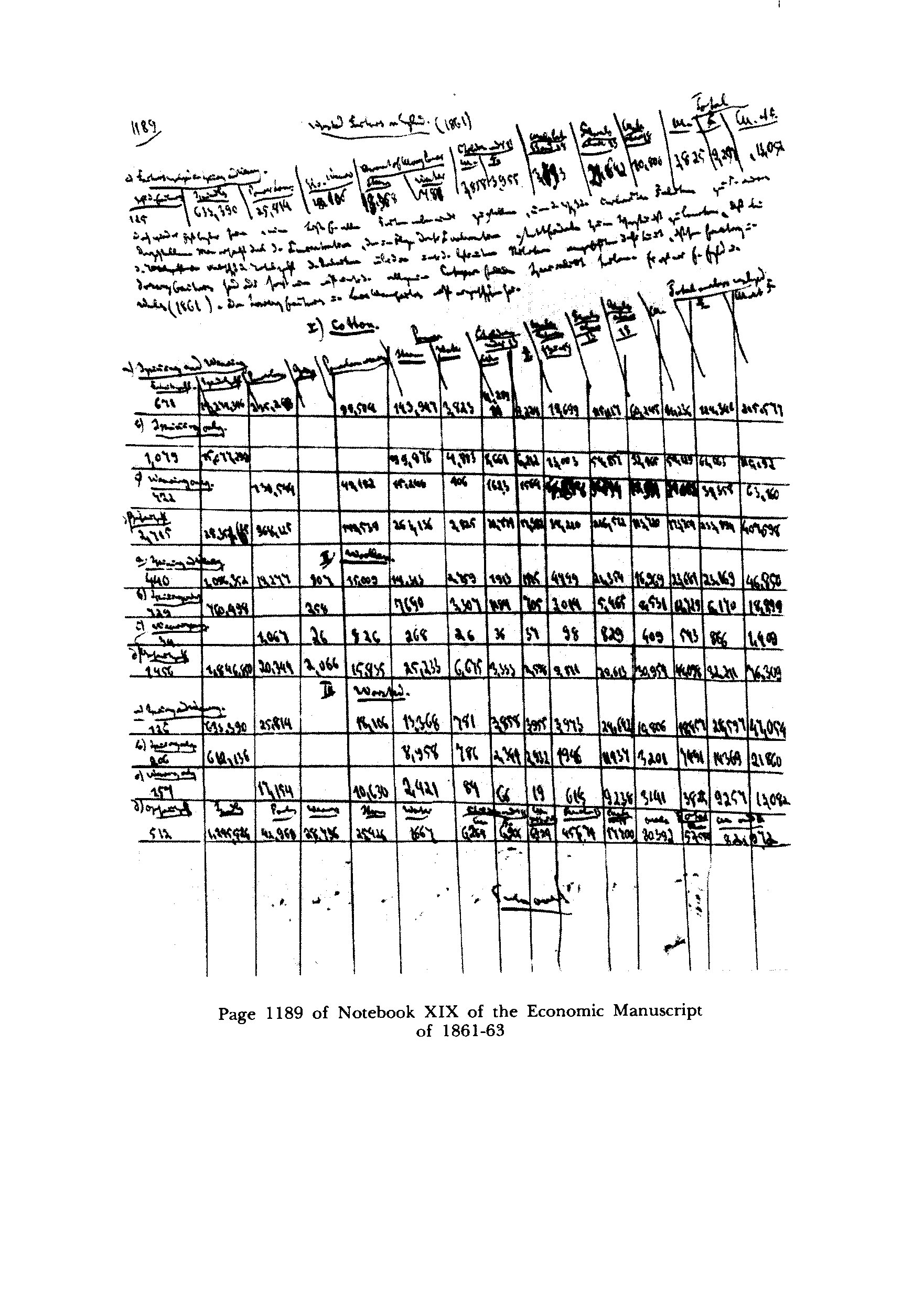
Page 1189 of Notebook. XIX of the Economic Manuscript of 1861-63
WOOLLEN Number of SPINDLES POWER-GIGS STEAM WATER NUMBER OF NUMBER FEMALES MALES TOTAL
FACTORIES FACTORIES LOOMS CHILDREN OF MALES ABOVE [18]
UNDER [13] YEARS BETWEEN [13] [13] MALES FEMALES and 18
FACTORIES EMPLOYED IN SPINNING AND WEAVING 440 1,086,352 19,277 807 14,313 2,759 1,913 1,815 4,799 21,354 16,969 46,850
FACTORIES EMPLOYED IN SPINNING 729 760,498
FACTORIES EMPLOYED IN WEAVING [3 4]
258 7,690 3,307 1,184 705 3,014 5,465 8,531 18,899
1,067 26 268 26 36 37 98 829 409 1,409
r M cr 0 C [3] a.
3"
[XIX-1189] WORSTED FACTORIES IN ENGLAND (1861) [p. 6].
a) FACTORIES EMPLOYED IN SPINNING AND WEAVING
[Table 2 to p. 426]
o
3" O
NUMBER OF SPINDLES
FACTORIES
POWER-
LOOMS
NUMBER OF AMOUNT OF MOVING POWER CHILDREN UNDER [13]
WEAVERS STEAM WATER MALES FEMALES
125 633,390 25,814 18,106 13,368 781 3,858 3,955
TOTAL
MALES FEMALES MALES and
FEMALES
3,793 24,642 10,806 18,457 28,597 47,054
MALES FEMALES MALES
BETWEEN ABOVE [13] ABOVE
[13] AND [18] 18 [Tables to p. 434] 4^ I) COTTON" O Number Number POWER-GIGS POWER-POWER CHILDREN UNDER [13] MALES FEMALES MALES TOTAL NUMBERS EMPLOYED of factories of spindles LOOMS LOOM STEAM WATER MALES FEMALES BEWEIS ABOVE (21) ABOVE (22) MALES FEMALES MALES and
WEAVERS 13 AND 18 FEMALES
a) SPINNING
AND WEAVING
671 13,274,346 235,268 99,504 143,947 3,823 11,289 9,224 19,699 115 '17 60,248 91,236 124,341 215,577
b) SPINNING
ONLY 1,079 15,077,299 99,976 4,883 8,661 6,212 13,003 54,851 32,465 54,129 61,063 115,192
c) WEAVING JO
ONLY 2. 722 131,554 49,182 15,240 406 1,623 1,564 4,648 36,794 18,531 24,802 38,358 63,160 §• d) Total [6]
2,715 28,352,125 368,125 149,539 263,136 9,825 21,774 17,382 38,210 216,512 113,720 173,704 233,894 407,598 tf
II) WOOLLEN b
a ) SPINNING
AND WEAVING
440 1,086,352 19,277 807 15,009 14,313 2,759 1,913 1,815 4,799 21,354 16,969 23,681 23,169 46,850
b) SPINNING
ONLY 729 760,498 258 7,690 3,307 1,184 705 3,014 5,465 8,531 12,729 6,170 18,899
c) WEAVING ONLY
34 1,067 26 826 268 26 36 37 98 829 409 543 866 1,409 d) Total 1,456 1,846,850 20,344 2,066 15,835 25,233 6,675 3,333 2,598 9,811 29,613 30,954 44,098 32,211 76,309 1 WORSTED3
a) SUNNING
AND WEAVING
125 633,390 25,814
b) SPINNING
ONLY 206 612,136 c) WEAVING
ONLY 157 17,154
d) Total SPINDLES POWER-
LOOMS
512 1,245,526 42,968
[XIX-1190] IV) FLAX*
FACTORIES Number POWER-of LOOMS
a) SPINNING
AND WEAVING
spindles
14 42,080 766
b) SPINNING
89 302,228 c) WEAVING
27 1,394
d) TOTAL 136 344,308 2,160 V) Hm
FACTORIES3
a) SPINNING
AND WEAVING
1 14 1 1 6
b) SPINNING
2 250 33
c) TOTAL
3 264 1 1 39
V I ) JITE FACTORIES*
a) SPINNING
AND WEAVING CARET. D i t t o WEAVING
b) SPINNING
3 620 50
c) TOTAL
4 620 62
2 3
31 12
33 15
73
84
[Tables to p. 434] ^
1 3 3 6
13 44 12 56
14 47 15 62
13
17
18
23
73
84
91
J07214 I
<
[ X I X - 1 1 9 1 ] VII) SILK FACTORIES IN ENGLAND*
FACTORIES SPINDLES POWER-WEAVERS MOVINC POWER CHILDREN CHILDREN MALES FEMALES MALES TOTAL
LOOMS STEAM WATER UNDER [11] YEARS BETWEEN 11 and 13 between OVER (23) OVER (24) MALES FEMALES MALESAND a) SPINNING MALES FEMALES MALES FEMALES 13 and 18 FEMALES
AND WEAVING
49 254,426 2,965 2,201 903 109 71 171 193 589 444 6,224 1,859 2,572 6,984 9,556
b) SPINNING
244 1,051.484 3,760 688 589 832 1,146 2,644 2,043 16,079 4,167 7,945 19,555 27,500 c) WEAVING
422 7,670 5,007 996 28 20 38 584 7,425 3,690 4,294 7,463 11,757
d) TOTAL 761 1,305,910 10,635 7,208 5,916 834 702 1,130 1,418 3,543 3,185 31,217 9,996 15,301 35,890 51,191
[XIX-1190] VIII) JUTE FAOWIES IN SCOTLAND3
a) SPINNING [Children under 13 AND
WEAVING
12 16,680 497 445 981 40 24 54 345 2,248 957 1,326 2,302 3,628
Males Females] o
b ) SPINNING
13 13,858 736 20 267 1,236 227 494 1,236 1,730 g"
c) WEAVING
2 57 39 20 1 50 9 10 50 60
b Ibid,, p. 19.— Ed.
c
[3] TOTAL a 27 30.538 554 484 1,737 60 24 54 613 3,534 1,193 1,830 3,588 5,418 g [XIX-1190] g-IX) FLAX FACTOKIES IN ISELASDb [3] n' a) SPINNING 5L AUB <; WAVING Q 19 217,064 2,491 1,868 4,471 383 34 186 1,488 9,423 2,187 3,709 9,609 13,318 %
3" b) SPINNING O 60 375,917 5,751 1,796 192 256 1,997 11,627 3,303 5,492 11,883 17,375 ^ c) WEAVING
15 2,175 1,446 460 141 208 1,825 384 592 1,825 2,417 d) TOTAL 100 592,981 4,666 3,314 10,710 2,384 226 442 3,761 23,130 5,966 9,953 23,572 33,525
Ibid., p. 12.— Ed. ê os [Continued from p. 426] headings arises from the inclusion in the total of FINISHING and DRESSING FACTORIES or factories engaged in other special tasks which do not fall under one of the general categories. T h e list only covers England and Wales (1861). HOSIERY FACTORIES and LACE MANUFACTURES are not included here. [See tables on p p . 430-33.]
First of all, then: I) COTTON. T h e number of combined factories is 671 here. T h e number of spinning alone is 1,079, of weaving alone is 722, and 1,079+722=1,801, hence the proportion of the first type is almost Vs already. T h e combined factories alone employ 215,577 persons; the two other types together employ 115,192 + 63,160=178,352. Hence, although they amount to less than 7s of the others, the combined factories employ 37,225 more persons.
Furthermore, there are ON THE AVERAGE for 1 combined factory 19,782 spindles (and 624/[6]7i); 350 and 4I8/67] POWERLOOMS; and 220 (and [150]/67i) POWER. For 1 WEAVER there are 2 and 36,26%9,504 POWERLOOMS. T h e number of spinners is not indicated; they are instead lumped together with persons employed in the OFFICES, WAREHOUSES and otherwise. But we shall see this when dealing with the children.
[XIX-1192] [2 1 5] For 1 combined factory there are: spindles, 19,782; POWERLOOMS, 350; POWER, 220; proportion of weavers to POWERLOOMS, 1 to 2[36]'[26]%9,504, WEAVERS per factory over 148. Number of persons per factory: over 321.
T h e AVERAGE for 1 SPINNING factory, in contrast, is: number of spindles, 13,973; POWER, 97; number of persons per factory, 106; proportion of persons to spindles, 1 person to ABOUT 130 spindles.
AVERAGE for 1 WEAVING factory: POWERLOOMS, 182; POWER, 22; proportion of POWER to persons, [4[57] /is,646]-
According to the proportion which exists in the SPINNING only COTTON MILL, g r o u p I a) (SPINNING AND WEAVING) would have to employ 102,110 persons for its 13,274,346 spindles. For weaving, according to the proportion in the WEAVING only CONCERNS I c), [group I a)] would have to employ 88,115 persons for its 235,268 POWERLOOMS. Thus somewhat more than 190,225 persons altogether. But it employs 215,577.
In the case of I c) there is 1 weaver for 2.67 POWERLOOMS. In the case of I a) 1 weaver for 2.36. Thus fewer weavers are needed in case I c), the weaving only factories, than in I a) (TO A SMALL
FRACTION).
In I b) the following relationship holds between the number of spindles and the POWER: 143.7 SPINDLES to 1 POWER. In I c) there are ... 8.4 POWERLOOMS to 1 POWER.
According to the proportion found in I b), I a) ought to employ a POWER of 92,375.4 for its SPINDLES. And according to the proportion in I c) it ought to employ 28,008 for its LOOMS. But it employs much more power than this.
In example I there is no saving in workers or POWER to be seen, nor is there any relative increase in the number of SPINDLES and LOOMS. Admittedly, to make a complete comparison one ought in all 3 CASES to have the product of I.
[XIX-1193] In the case of I b), the total of 115,192 persons includes 14,873 children under 13, 13,003 MALES BETWEEN 13 and 18, and 54,851 FEMALES ABOVE 13. There appear to be somewhat more children and women employed altogether in the case of the combined factories I a). We now want to turn to the other category, where there is perhaps SOMETHING ELSE to see. With I we only see that there is a growth in concentration; the AVERAGE combined factory sets in motion more POWER, more SPINDLES, more LOOMS and more PEOPLE than the non-combined factories I b) and Ic).
Let us apply ourselves to table II) WOOLLEN FACTORIES? Here the concentration is much more significant than under I, in COTTON, which is due to the fact that spinning and weaving mills are not so large as COTTON manufacturing ones.
The number of combined FACTORIES is 440, that of non-combined factories is 763. The proportion of combined to non-combined is 1:1.7, more than a half. II a) employs 26,542 more PEOPLE than II b) and II c), which employ together only 20,308: hence it employs more than twice the number. It employs 325,854 more SPINDLES, 18,210 more LOOMS, and 523 more GIGS; furthermore, it employs 5,781 more POWER.
There are for 1 factory (on the AVERAGE):
SPINDLES LOOMS GIGS POWER PEOPLE
II a) 2,468.9 43.8 1.8 38.8 106.4 II b) 1,043.2 0.3 15 25.9 II c) 31.3 0.7 8.6 41.4
The ratio between PEOPLE and POWER cannot of course be seen from these figures, since the AVERAGE does not apply to any particular factory.
According to the proportions in II b), II a) would have to employ POWER of 35.5 for spindles. (We are leaving the GIGS out of consideration in all 3 CASES.) It also needs a further 12 for its LOOMS, hence 47.5 altogether. But it only employs a POWER of 38.8, 8.6 less. T h e r e is therefore a saving, a more economical or more intensive employment of POWER. In II b) there is 1 person for every 40.2 spindles, or for 760,498 spindles+258 G I G S = 7 6 0 , 7 5 6 there are 18,899 PEOPLE. Thus 40.2. In II c) there are PEOPLE TO THE AMOUNT OF 1,409 for 1,067 LOOMS and 26 GIGS= 1,093. II a), on the other hand, employs 20,084 POWERLOOMS and GIGS. This is 18.3 times more. If the proportion in II b) were followed, II a) would have to employ 27,023 PEOPLE for its SPINDLES; and if the proportion of II c) were followed for its LOOMS and GIGS it would have to employ somewhat over 25,784; taken together this is 52,807. But it only employs 46,850, thus 5,957 less. There is therefore a saving in workers relative to [XIX-1194] the MASS OF WORKING MACHINERY PUT IN MOTION.
Out of its total of 18,899 PEOPLE, II b) employs 1,184 MALES and 705 [females] under 13 years old= 1,889, hence Vio plus a fraction too small to be worth mentioning. 3,014, or somewhat under [1]/[6], I _I0
number of people employed are youths BETWEEN 13 and 18 years old. It employs 5,465 FEMALES of over 13, hence not quite Vs or
more precisely the 3.4th part= 7 S " = 77=77 It employs /io 34 ' ' 8,531 MALES of over 18, hence less than V2» or more precisely 2.2 or
1 10 5 = 757-= — =77-The total n u m b e r of women it employs is / 1 0 ^ ' ' 6,170, hence less than Vs, or more precisely the 3.06th part. And it employs 12,729 men; somewhat more than [2]/(25), more precisely the
1.4th part o r ^ j — = — = - . So we now have the proportion for II b).
/10 '4 7 II b) The proportional share of the different categories in the WHOLE PEOPLE EMPLOYED:
or more precisely the 6.2th part, or ——=— of the total
Children Youths FEMALES MALES TOTAL OF TOTAL OF under 13 between 13 and 18
over 13 over 18 FEMALES MALES l,409=the 19.3th part, or less than V19. Further, 98 youths between 13 a n d 18, hence the 14.3th part of the whole, less than
Vu- Further, 829 FEMALES over 13. Hence 1.7 or [10]/n, or over l/[2]. 409 men over 18 or the 3.4th part= [5]/ [1 7], less than Vs. Women altogether account for 866, or the 1.7th a part, or [10]/[17], less than [2]/[8]. Finally men = 5 4 3 or not quite 2.5 = [10]/[25]=[2]/[5]. T h e proportion for II c):
Number Children Youths FEMALES Men TOTAL TOTAL of weav- under 13 of 13-18 over 13 over 18 OF FE-OF MALES ers to MALES POWERLOOMS
1 to 1.2 19.3 14.3 1.7 or 1(>/17 3.4 or [5]/ [1 7] 1.7 ABOUT under under over under under 2.5 or [2]/ [5] Vl9 Vi4 '/ [2] V[3]
quite.
If we now pass to II a) we find 15,009 weavers to 19,277 LOOMS. Hence 1 weaver to 1.2 POWERLOOMS. 3,728 children under 13. Divided into 46,850, this is 12.5, not quite V12; [10]/i25=[2]/25- 4,799 youths between 13 and 18=9.5,b less than V9 or ,0/9[5]. 21,354 FEMALES ABOVE 13 makes 2.1, less than V2 or [10]/[21]. 16,969 MALES over 18. Makes less than 2.8. MALES altogether: 1.9. [XIX-1195] FEMALES: the same. Hence the proportion for II a):
Weavers Children Youths Women MALES MALES and per under 13 of over 13 over 18 FEMALES LOOM 13-18
1 to 1.2 under under under V2 'ess than 2.8 are roughly evenly V12 V9 or [10]/[21] or [10]/[28] divided. Somewhat more MALES.
T h e n u m b e r of children under 13 a n d youths between 13 a n d 18 has fallen in comparison with II b). This is to be explained from the introduction of machinery which makes the children in part superfluous, as we can see from the FACTORY INSPECTORS' REPORTS; an arrangement which originates from the fact that the MANUFACTURERS found it vexing to have TO EMPLOY TWO SETS OF SO-CALLED HALF-TIMES. But the n u m b e r of FEMALES over 13 years old has grown almost from Vs to V2, a n d thus the overall ratio of women to men has also grown, in comparison with II b). If, however, we make a comparison with II c), it is difficult to determine the ratio, since in weaving the female element predominates still more over the male here.
Let us now pass to III) WORSTED FACTORIES? The number of combined factories is 125, that of the others is 363, hence less than '/s; but the number of PEOPLE employed in the combined factories is larger by 12,112: 21,254 more SPINDLES are employed, 8,660 more POWERLOOMS, and 1,900 more POWER.
There are for 1 AVERAGE factory:
SPINDLES LOOMS POWER PEOPLE
III a) 5,067[3]/[26] 206.5 113[24]/[125] 376 54/[125] III b) 2971[55]/io3 4731/ios 106^os III c) 10941/157 15150/i57 83 5i/157
We shall leave aside the fractions, even though this makes the calculation merely approximate.
Ill b): 28([3]/io6) spindles to 1 worker. Ill c): 1 [26]/ss POWERLOOMS to 1 worker.
There appears to be no SAVING OF LABOUR in this case.
[XIX-1196] VII) SILK FACTORIES* Large-scale industrial production of silk is relatively new in England (compared with wool and cotton, similarly with flax in Scotland, Ireland, etc.), the number of factories in this branch is therefore relatively large, and their size in contrast is RELATIVELY SMALL. Hence here the combined factories also constitute a less significant proportion than in the other cases.c
The number of combined factories is 49, that of the others is 666; hence the former are ABOUT [2]/[27] of the total number; but the number of spindles employed by these [2]/27 is almost V4 of those employed by the 244 spinning factories, and the number of LOOMS EMPLOYED by them is over Vs of those employed by the 422 weaving factories, etc. The more precise ratio emerges from the following calculation:
There are for 1 AVERAGE factory:
SPINDLES LOOMS POWER PEOPLE
V i l a ) 5,19218/49 60 2 5/ 4 9 20 3 2/ 4 9 195 V49 VII b) 4,30922/6, 1814/6i H 2 « / 6 1 VII c) 1 8 " / 2 „ 2 9 0/ 2 I 1 27363/422 The ratio between POWER, PEOPLE, and quantity of machinery, as it appears in these averages, is absolutely imaginary; they are only intended to demonstrate concentration. O n the other hand, however, we once again see here the undeniable FACT //and here it is still more significant than before// that there is ECONOMY OF POWER in the combined factories, in certain BRANCHES.
We now give some further examples of flax and jute factories in Ireland and Scotland.[3] [See table on p. 440.]
24 combined; but 125 others. Hence less than '/s of the latter, and ABOUT [1]/[6] of the total number.
The more precise ratios emerge from the following table:
O N AN AVERAGE, each factory has:
SPINDLES LOOMS POWER PEOPLE
X a) 3,4133/4 9 1 [5] / [8] 202 7/ 2 4 452 n/ [2]4 X b) 2,350 55/84 782'/42 17817/84 X c) 14027/41 47*9/4I 182 28/41
We come now to VIII) JUTE FACTORIES. SCOTLAND. This is an entirely new kind of factory. First emerged after the Russo-British War. [2] Not significant in England. b
Total number of FACTORIES 27. Combined factories 12, almost half. Employ more SPINDLES and LOOMS than the rest put together.
O N AN AVERAGE, each factory has:
SPINDLES LOOMS POWER PEOPLE
a) 1,390 41[5]/[12] 85Vi2 302 V[3] b) 1,066 58 2/[13] 133'/is c) 28 V[2] 10 30
[XIX-1198] Finally: IX) FLAX FACTORIES. IRELAND* Altogether 94 factories, of which 19 are COMBINED. There are for 1 AVERAGE factory:
SPINDLES LOOMS POWER PEOPLE
a) 11,4248/[19] 13l2/i9 2559/I9 700'8/[19] b) 6,265i7/[60] 125«/«, 28935/[60] c) 145 40Vi5 1612/[15]
Manufacture emerges from handicrafts by a double route: 1) Simple cooperation. T h e concentration in a single room of many handicraftsmen all doing the same thing, and many [XIX-1197] X) FLAX FACTORIES. SCOTLAND (1861)
[Table to p. 439]
TOTAL OF PEOPLE FACTORIES SPINDLES POWER- POWER-AMOUNT OF CHILDREN MALES FEMALES MALES Males FEMALES MALES LOOMS LOOM POWER UNDER 13 between ABOVE 13 ABOVE and WEAV-STEAM WATER MALES FEMALES 13 and 18 FEMALES ERS 1 8
a) SPINNING and WEAVING 24 81,930 2,199 2,061 4,679 176 33 111 1,017 7,879 1,855 2,905 7,990 10,859
b) SPINNING 84 197,455 5,830 776 271 454 1,552 10,318 2,374 4,197 10,772 14,969
c) WEAVING
41 5,767 3,786 1,936 30 8 241 5,894 1,347 1,588 5,902 7,490 handicraft tools. This is the characteristic feature of the old weaving manufacture and the further preparation of cloth. Almost no division of labour at all here. At most for certain auxiliary operations, some of them preparatory, some FINISHING. The main economy here is: the communal use of the general conditions of labour, such as the building, heating, etc. The overall supervision of the manufacturer, hence the element which is peculiar to capitalist production in general.
Ure says in Philosophie des manufactures, Vol. II (pp. 83-84)(26):
"It deserves to be remarked, moreover, that handworking is more or less discontinuous from the caprice of the operative, and therefore never gives an average weekly or annual product at all comparable to that of a like machine equably driven by power. For this reason hand-weavers very seldom turn off in a week much more than one-half of what their loom could produce if kept continuously in action for 12 or 14 hours a day, at the rate which the weaver in his working paroxysms impels it" (27) [A. Ure, The Philosophy of Manufactures..., London, 1835, p. 333].
The mechanical workshop of course enjoys this advantage as much over the system of manufacture as it does over the system of handicrafts. In the mechanical workshop the motion and speed of the machine (PRIME MOTOR) rules over human labour, in manufacture and handicrafts the reverse is the case. But it also applies to manufacture in contrast to handicrafts, to a lesser degree. In the latter, the handicraftsman is MORE OR LESS a human being who works; in the former he is a worker who as such and qua worker belongs to someone else, who solicits his aid merely in his quality as a machine for working.
[XIX-1199] 2) The unification into a single factory of crafts divided into many independent branches. The division is present in advance here, but every part of the work is carried on as an independent handicraft. The first thing that happens now is the annihilation of this isolation and independence. The difference is summed up in the fact that the particular form of labour no longer produces the product as a particular commodity, but merely as an integral part of a commodity. The separate product ceases to be a commodity as such. Once this unification of what was previously divided has taken place, SUBDIVISION develops further on the basis of this spontaneously evolved manufacture, which found its components already divided and SELF ACTING. T O this combination of previously dispersed handicrafts, found in manufacture, there corresponds, within large-scale industry, the combination of factories, one of which produces a semi-manufactured object, while the other uses it as its raw material. This is how it is with spinning and weaving. The prerequisite for this was that both branches had already been separately brought under the system of machine production.
Just as one should not think of sudden changes and sharply delineated periods in considering the succession of the different geological formations, so also in the case of the creation of the different economic formations of society. In the womb of the handicrafts, manufacture develops in its initial stages and even machinery is employed here and there, in individual spheres and for individual processes. The latter point is even truer for the actual period of manufacture, in which water and wind (or even human and animal power as mere remplaçantsa for water and wind) are employed for individual processes. But these are isolated cases and do not constitute the character of the ruling period, do not form its pivot, as Fourier says.b The greatest inventions— gunpowder, the compass, printing — belong to the handicraft period, as also does the clock, one of the most remarkable automata; just as the most brilliant and revolutionary discoveries in astronomy, those of Copernicus and Kepler, belong to a time when all mechanical aids to observation were in their infancy. Similarly, the construction of the spinning machine and the steam engine rested on the handicrafts and manufacture which built them; they also rested on the science of mechanics, developed within this period, etc.
But the general law which is valid throughout, is that the material possibility of the later form is created in the earlier form; both the technological conditions and the economic structure of the workshop which corresponds to them. Machine labour is directly called into existence as a revolutionising element by the excess of needs over the possibility of satisfying them with the old means of production. But this excess of demand is itself given by the discoveries made still on the handicraft basis, by the colonial system founded under the domination of manufacture, and by the world market relatively firmly established by the colonial system.** Once the revolution in the productive forces has been achieved— which is displayed in technological terms — a revolution also starts in the relations of production.
In so far as machines are employed in manufacture, they are, correspondingly, produced either in the handicraft manner or on the basis of the division of labour applied in manufacture. As soon as machine production becomes dominant, its means of production — the machinery and tools employed by it — must themselves be produced by machines.
[XIX-1200] Except where animals can be employed purely mechanically, as with turning a mill, their employment is entirely dependent on their voluntary movement, and the direction of their will by the human will, a principle which has nothing in common with machine production. Moreover, they can only be employed as POWER in manufacture TO A VERY SMALL DEGREE, because their employment on a mass scale would take up tremendous space.
Mr. John C. Morton, AT THE SOCIETY OF ARTS (January 1860), read a paper on the FORCES USED IN AGRICULTURE,[217] dealing particularly with the displacement of HORSEPOWER by STEAMPOWER, and referring to the advantages of machinery, where animal (as also human) power is displaced by mechanical power, which is cheaper, and can act more uniformly over a greater period of time:
* "The forces referred to are ... steam power, horsepower, and manual labour... Purely mechanical power, supplied by the steam engine, may be more extensively used with every improvement of the land which tends to give uniformity to its condition... Force derived from horses, required where crooked hedge-rows, and other obstacles, prevent uniform action, and which constantly diminishes... In operations requiring more exercise of the will, but less actual power, the only competent force is that directed from moment to moment by the human mind—manual labour..." Mr. Morton reduces these forces to
"'horsepower'" (as used in reference to steam engines), "i.e. the unity assumed as equal to pull or lift 33,000 lbs one foot per minute. By calculations given, the cost of steam power is estimated at 3d. per hour, while the cost of horse labour is 5'^ri-per horsepower per hour, and the steam power can be continued for much more lengthened periods than the horse labour. So that the force supplied by steam 'horsepower' at 3d. per hour, is nearly twice as great as that supplied by actual horsepower" * //since the horse can only be employed for 8 hours in this manner!// * "at 5'/2cl. per hour. And where steam power can be used, the quality of the work performed by its aid" * //on account of its uniformity of motion// * "is superior to that done by horsepower. This applies to threshing,(28) chaff-cutting,(29) grinding and [the] like" * (similarly sowing, mowing) * "and seems equally applicable to steam-ploughing... By comparing the mere force of manual labour with the two other forces, it is found that to do the work of the steam engine 66 men would be required at 15s. per hour, and to do the work of the horsepower 32 men would be required at 8s. per hour. Competition of manual labour as a force, with steam or horsepower, is therefore obviously out of the question... By steam power at least 3 out of every 7 horses on arable land may be dispensed with all the year, at a cost not exceeding the cost of these horses during the 3 or 4 months, when alone they are really needed on the land."*
One may see from the above firstly in a sphere where STEAM POWER, HORSEPOWER and MANUAL LABOUR COMPETE IN AGRICULTURE — THEIR RELATIVE VALUES, AS TO POWER AND ECONOMY; 2) that a plough is not a machine. Leaving aside the older form of the plough, where the farmer does more work behind the plough than the horse or the ox in front of the plough, the employment of STEAM presupposes UNIFORMITY of the SOIL, just as a locomotive presupposes rails instead of a road. These conditions are part a n d parcel of the [XIX-1201] employment of the machine, i.e. A WORKING MECHANISM ABLE TO RECEIVE ITS MOVING FORCE FROM A MERELY MECHANICAL FORCE.
T h e development of the mechanical workshop into a system is straight away made necessary in spinning by the fact that the raw material in ITS PREPARATORY PHASES MUST BE MECHANICALLY PREPARED, IN ORDER
TO BE ABLE TO BE WORKED UPON BY MACHINERY. And these PREPARATORY PROCESSES for their part require relatively much more ASSISTANCE OF MANUAL LABOUR, IF CARRIED ON ON A SMALL SCALE, INSTEAD OF A LARGE ONE. T h e system therefore requires for its part once again the combination or cooperation OF A GREAT LOT OF WORKING MACHINES WHICH ARE FED BY THE PREPARATORY PROCESSES.
Nothing could be more incorrect than to conceive the medieval system of corporations and guilds, in which the division of labour amongst particular HANDICRAFTS forms at once the basis of a social and political organisation, as something "unfree". It was the form in which labour emancipated itself from landed property, and definitely the period in which labour stood at its highest point, socially and politically. In order to understand its real character, one must study German history in particular, since in Germany, unlike France, royal power did not conspire with the emerging burgher estate against the feudal elements. O n e would then find that the system of corporations and guilds, constantly suffering setbacks in the struggle against imperial and feudal power, constantly reasserts itself afresh against it. Only when the material basis — the technological basis of organisation — had ceased to be dominant, when it had therefore lost its revolutionary and ASCENDING CHARACTER, when it had ceased to be appropriate to the epoch and entered into conflict, partly with manufacture, partly, later on, with large-scale industry, did it start to be protected, as a reactionary element, by reactionary governments and the estates in alliance with them.
Saving and gain of raw material by use of machinery. In milling. In sawing, e.g., the machine (in fact a colossal razor) which cuts, or shaves, the VENEER,(30) as compared both with the earlier cylindrical sawing machine, in which a number of saws were inserted, and with the handsaw, and still more with the axe and the knife.
COTTON GIN. The most imposing example is the reclamation of cultivable land by hydraulic machines.
BOAT MAKING MACHINES, from the boats carried by steamships and down to CUTTERS and the smallest river boats, for crossing from one side to the other. These were previously made in the YARDS, in handicraft fashion, with little division of labour and with machinery used at most for planing. Now made entirely by automatic machinery, first in America. Now carried on on a large scale by a company near London.
We now proceed further with the English quotation on p. 1185* As soon as we are to be able not only to extend the dimensions of machines at will, but also to develop them into a system of machinery, a driving force — and PRIME MOVER — applicable at any level must be available. Hence no development of machinery was possible without STEAM. The STEAM ENGINE was IN FACT invented before the industrial revolution. Imperfect. Now along with its INDUSTRIAL NECESSITY its form is also discovered. The elements of the machine were present before Watt gave it the form industrially applicable to manufacture.
[XIX-1202] "Steam engine: a machine which is able to bring about a mechanical effect through the action of water steam. The first idea for this [was put forward] in the second half of the 17th century. To bring about movement by using steam it was necessary not only to produce the steam pressure but to remove it afterwards and to be able to condense the steam.
"Papin invented the safety valve in 1680; later he also arrived at the idea of making the steam act in a cylinder on a kind of piston. He covered the base of the cylinder with a layer of water, converted it into steam by placing the cylinder over heat, and thus drove the piston to the top. By taking away the heat, or removing the cylinder from the heat, he effected a condensation of the steam, so that the atmospheric pressure acted on the piston of the cylinder, which was open above, thereby forcing it down. Papin published experiments of this nature in 1690 in the Acta Lipsiensia?(31)
" Savery, an English captain, came upon the same idea at ABOUT THE SAME TIME, and had already actually constructed several machines when in 1696 he published a description of them. The principle of Savery's machine differed from that of. Papin's in that he did not use a piston to transmit the effect of the steam, and he was also able to accomplish the condensation of the steam much more conveniently and more quickly. His achievement was the building of the first large-scale steam engine. Savery later made use of Papin's safety valve. Savery's machine was employed in raising water. It consumed an extraordinary quantity of fuel, and was difficult to construct in very large dimensions. Water could not be raised very far with it. Much effort was put into finding an improvement, in particular in trying to apply to it Papin's first ideas of a piston-driven machine. It was 2 Englishmen who first succeeded completely in this endeavour,
" Thomas Newcomen, blacksmith, and "John Cawley, glazier, and they should be considered the first to introduce the piston-driven steam engine. Since Savery, thanks to his patent, possessed the sole right to create a vacuum by the condensation of steam, Newcomen and Cawley entered into association with him, by taking out a patent in 1705, in the names of all 3, 'to condense steam directed under the piston, and to bring about an alternating movement through its connection with a lever'. The construction of this 'atmospheric' machine, later named after Newcomen alone, not only offered the advantage that, if one wanted to raise water with it, the steam did not come into contact with the water at all, but also that it provided at the same time the possibility of bringing about any kind of movement" [A. Ure, Technisches Wörterbuch..., pp. 423-26].[219]
This application of MECHANICAL POWER took place where, as with wind and water mills in manufacture, GREAT EXERTION OF FORCE was necessary (stamping, turning, raising) and where in fact human labour acted as an automatic PRIME MOTOR creating its own power, whereas the implement of labour was manipulated not with the hand but was directly connected with the transmission mechanism, the shaft, crank, etc.
"Newcomen later improved the machine by changing the method of obtaining condensation: the cold water, instead of being poured onto the outside of the cylinder, was sprayed into it.
"The taps and the steam distributor initially had to be operated by hand, until a boy called Humphry Potter, who was employed to attend a Newcomen engine, had the idea of connecting the handles of the taps and distributors to the beam (with strings) and letting the machine operate them itself.
[XIX-1203] "The Newcomen engine was still far from perfect, a particular disadvantage being the condensation of water in the cylinder of the engine, which resulted in a considerable loss of heat; while the cylinder itself never became completely cool. All attempts to remedy this basic deficiency were fruitless, and the construction of the steam engine remained the same for nearly 70 years. Then Watt came onto the scene.
" Watt's first engine was one in which the steam produced only the downstroke of the piston, i.e. a single action engine. The upstroke was produced, once the piston had reached the bottom of the cylinder, by closing the steam inlet and letting the steam previously introduced flow over and under the piston, the pressure on the two sides thus being neutralised. A counterweight attached at the other end of the beam, together with the pumping rods installed there for raising the water, could therefore easily effect the ascent of the piston... Useful as the single action Watt engine still is for raising water and salt-springs, it is well-nigh useless for accomplishing any other mechanical work" [ibid., pp. 426-28, 430].
Thus the first single action Watt engine was in fact only an improved version of the steam engine, not as a GENERAL PRIME MOTOR, but in the original special function it had in the epoch of manufacture, that of a machine for pumping water.
"Most industrial applications make it necessary to convert the linear motion of a piston into rotary motion; with the single action engine this is admittedly possible, but if the motion produced is to be highly uniform, this can only be achieved if an inert object of tremendous weight (a flywheel) is set in rotary movement. But the engine has to waste a tremendous amount of power to move such an object; this power could otherwise have been employed usefully, not to mention the resulting increase in wear and tear on pivots and bearings.
"These circumstances led Watt to invent the double action steam engine. In this case the steam produces both the upstroke and the downstroke of the piston, the counterweight becomes entirely unnecessary, and the flywheel, which has to be attached to ensure uniform motion, can be much lighter. In 1782 Watt took out a patent for the double action engine, and from this time onwards the steam engine emerges as useful for all branches of industry.
"Improvements subsequent to Watt in the double action steam engine for the most part concerned subsidiary matters. In particular, it was sought to construct the engine in such a way that it took up as little space as possible. It was for this reason in particular that attempts were made to get rid of the beam, and connect the radius bar of the crank directly with the piston rod... Engines which operate purely through expansion, without condensation, air and cold-water pumps, are Woolf engines" [pp. 430, 432, 435-36, 441].
A steam engine therefore requires the following elements: 1) A boiler, with its appliances for firing, stoking, etc. [XIX-1204] 2) A steam cylinder, with piston, piston-rod and stuffing box.
3) A regulating appliance (valve), both on the inside and the outside,
and 4) in condensation engines — a condenser, with an air and water pump.
The steam engine as a product of the period of manufacture. Here not as a GENERAL PRIME MOTOR but only for a particular purpose, the raising of water. Moreover, not originally automatic, since the opening and closing of the taps, partly to introduce water into the boiler, partly to cool down the cylinder and condense the steam, as also the opening and closing of the steam distributor at the end of the pipe connecting the boiler to the cylinder (the end facing the boiler), was originally done by hand. Nor was it an engine worked purely by steam, but rather an engine in which atmospheric pressure was essential. (The cylinder was above; Watt was first to make it enclosed. In his first engine, however, there was still a counterweight, attached to the other end of the beam, the one facing the pump, which actually produced the upstroke through its weight)
Atmospheric pressure was essential because, after the steam was condensed through the spraying of cold water on the cylinder, a semi-vacuum arose inside. Watt's first engine was itself merely an improved version of the steam engines used for raising water in the period of manufacture. Only with his 2nd engine, the double action engine, was he able to transform it into a GENERAL PRIME MOTOR for industry as a whole.
Railways. Here too the beginning belongs to the period of manufacture.
"The oldest rails were made of wood, and rails of this type are said to have been in use already 200 years ago in quarries and mines in England and Germany. The discovery that a horse could pull more than 4 times as much on rails as on ordinary roads led in 1738 to the construction of the first line with cast iron rails for the general purposes of transport. The first railways used nothing but horses for transport. The first idea of employing steam engines to move vehicles on wheels came from Dr. Robinson of Glasgow in 1759. In 1761 Watt pursued the idea, and after him in 1786 the brilliant Oliver Evans in North America. But it was only in 1802 that the Englishmen Trevithick and Vivian constructed the first steam locomotive, which was able to pull a load oi 10 tons along a railway line at a speed of 5 English miles per hour. All kinds of experiments. A theoretical prejudice that the friction of the wheels on a smooth rail would not be sufficient to prevent a mere sliding of the wheels, their rotation on the spot, making it impossible to pull heavy loads. In 1814 Stephenson constructed the first genuinely serviceable steam locomotive for the Stockton and Darlington Railway. These locomotives were only for transporting freight. In October 1829 Stephenson's locomotive won the prize at a competition on the Liverpool and Manchester Railway. Condition: it had to pull a weight 3 times its own at a speed of 10 English miles an hour. In 1839, on the same line, the 13-ton locomotive St. George pulled a load of 135 [1]I[2] tons at an average speed of 21[4]/s English miles per hour" [ibid., pp. 545, 567-69].
"1851 GREAT WESTERN RAILWAY COMPANY: such ENGINES have been CONSTRUCTED for it since 1847. It pulls *a passenger train of 120 tons, at [an] average speed of 60 miles per hour. The evaporation of the boiler, when in full work, is equal to 1,000 horsepower, of 33,000 lbs per horse — the effective power, as measured by a dynamometer,* is * equal to 743 horsepower. The weight of the engine [XIX-1205] empty is 31 tons; coke and water, 4 tons — engine in working order, 35 tons.
"Long after the extended use of the steam engine by the miner, the manufacturer, and the navigator, it was still to be applied to the purposes of locomotion on land"* [The Industry of Nations, Part II, pp. 83, 86, 88].
The first steamboat, produced by Fulton (and Livingstone), was The Clermont, begun in New York in 1806. It was launched in 1807. (First voyage from New York to Albany.) (145 MILES at 5 MILES PER HOUR.) [J. D. Tuckett, A History of the Past and Present State of the Labouring Population..., p. 277.]
//Further comments on railways:
the roads, to prevent them from becoming impassable.* Until within a very few years, * railroads have been considered as supplementary to canals, to be employed in short distances, or where the nature of the ground precluded the application of inland navigation...* It is now about 50 or 60 years since IRON RAILS were GRADUALLY SUBSTITUTED FOR WOOD IN RAILROADS" (this was written in 1846)... * "Railroads were only considered fit for heavy goods, [such] as coal, iron, or stone. The locomotive engine, for drawing carriages on railroads, was not thought of,* though Watt, * in his patent, describes a scheme for which he formed a steam carriage, but he never carried it into practice. Murdoch, his pupil, an engineer, when connected with Boulton and Watt,* was the first * who actually constructed a steam carriage in this country, [in] 1782... The first practical application* of the * steam engine to the propulsion of carriages [was] effected * by * Trevithick and Vivian, who patented their invention [in] 1812...* They * constructed an ingenious steam carriage for common roads and exhibited it in London; but the generally defective state of the roads caused the patentees to abandon this application of their invention...* The railways •gradually extended their operations upon the collieries in the North of England.* Great advantage of this... On the 15th of September 1830 the RAILWAY (between Manchester and Liverpool) was OPENED BY THE PASSAGE OF 8 LOCOMOTIVE ENGINES, ALL BUILT by Stephenson and Co.; to these were connected 28 CARRIAGES. In 1836 THE FIRST RAILWAY MANIA; overtopped in 1843-48" [J. D. Tuckett, op. cit., Vol. 1, pp. 282-84, 287.]//
"Then Henry Bell, a Scotchman, FOR MANY YEARS A HOUSE CARPENTER, established the first regular English steamship passage in January 1812, between Glasgow and Helensburgh (A WATERING PLACE ON THE Clyde). This Bell was ruined; »reduced to indigence.[220] David Napier contrived at length a new and superior mode of construction. [In] 1818 he established the Rob Roy,* of about 90 TONS, between Greenock and Belfast. Before 1818 * steamboats but rarely ventured beyond the precincts of the river and coasts of the Friths, and there only in fine weather" [ibid., pp. 278-81]. "About 1836-37 the project of crossing the Atlantic first started. The Sirius the first steam vessel which [XIX-1206] performed it. Government assistance was found necessary. Cunard (a Canadian) first obtained a grant from the British Government for a line of Post Office steamers between Liverpool and Boston. Government assistance* with the lines progressively set up after that.[221]
* " West India Company; Pacific Company; Cape Screw Steam Packet Ship Co.; Peninsular and Oriental Company; East India Company, for the line between Suez and Bombay"* [The Industry of Nations, Part II, pp. 79-80].
Now back to p. 1185." The great extent to which the WORKING MACHINE differs from the actual body of the machinery is also shown in its manufacture, in that the two things fall under different branches of industry.
* "Accordingly, in machinery for spinning and its preparatory processes, for weaving of all kinds, and for papermaking, there are a variety of such working tools, as, for example, spindles and flyers, fluted rollers, heckles, and all the varieties of card clothing, weavers' reels and shuttles, the wirecloth used by papermakers, etc., the making of each of which articles constitutes a distinct branch, and is carried on by a different sort of workmen from those who make the machines. For the machine-makers usually purchase these parts from their proper makers, when they fit up their machines for sale.* There are INGENIOUS MACHINES (and even * automatic) used for making
a See this volume, pp. 421-22. The quotation further below continues the extract on the working machine given on p. 422 of this volume.— Ed.
these working parts o r tools of the machine — such as the card-setting engine, for making cardcloth for cotton, etc., and the automatic bobbin-making engine. There are also several very clever machines for making the healds for weavers' looms, and automaton engines for making the dents employed in weaving. Generally, however, these parts of machines require manual labour trained up for this kind of work exclusively"* [The Industry of Nations, Part II, pp. 222-23].
"Among CONSTRUCTING ENGINES there is * Nasmyth's steam hammer, [which is] capable of smiting a block of granite into powder, and as capable of breaking a nutshell without injury to the kernel. Patent for it taken* [out in] 1842. Used in LARGE ENGINEERING ESTABLISHMENTS, some of which have 3-4 of these hammers, of 30, 15, 5 CWT., etc., FOR DIFFERENT KINDS OF WORK; the * steam hammer requires for itself the attendance of one person only. The most gigantic machine of the kind at Messrs. Mare's large works: hammer of 6 tons weight, with a stroke of 6 feet.* This GREAT HAMMER is called ' Thor'. Forges * a paddle wheel shaft for a pair of marine engines of 16 V2 tons, 27 feet 9 inches in length.* With the *aid of a powerful crane,[3] the welding[3] and forging of this large mass is rendered as simple and easy as that of a horseshoe in the hands of a country smith.* In the EXHIBITION of 1851 there was a hammer of this kind, with an ANVIL weighing 8 * tons; the hammer itself [weighs] 1 [1]/i tons, [and is] suspended from the piston rod a; the piston, which works in the cylinder, placed at the top of the machine, [is] 16 inches [in] diameter, and the extreme fall of the hammer (in steam engines called [the] stroke) is equal to 42 inches; the pressure of steam usually employed being equal to 40 lb. on the square inch. The hammer being on the self-acting principle, every degree of blow, from that of merely cracking an eggshell to that of a dead pressure of 500 tons, is attainable. By admitting the steam under the piston, the hammer is elevated to the desired height, and by its own gravity the hammer falls; but the fall may be instantly eased, if desirable, by the admission of steam, according to the particular kind of blow required. In ordinary works, as many as 70 blows are given in a minute.* Used in * iron shipbuilding establishments, anchormakers, large engine builders, and at the principal railway manufacturing establishments; the making up of iron, either from scraps, old rails, hoops,[3] or from the pile is also effected by means of this hammer" [ibid., pp. 223-26].b
[XIX-1207] "Before the introduction of this adjunct to the smithy, the forging of large marine engine shafts was not only a tedious, but an uncertain process; and many an accident which has occurred to the ocean steamers to be traced to the imperfect forging of iron; for, without blows of sufficient energy, it is impossible to expel the scoria[3] from between the bundles of iron rods, which, as in the United States, they attempted to weld together to form their main shafts" * [p. 226].
"Apart from this * formidable kind of work, [they are] employed in the stamping out of dish covers, and the moulding and forming of silver plate.* In his patent of 1784, TAKEN OUT in April, Watt already has in mind this kind of application for the * steam engine. He alludes to a probable mode of applying the piston-rod of a steam engine, in connexion with a heavy hammer or stamper, for forging iron and other metals*" [p. 227].b
This is the greatness of Watt, that in a patent TAKEN OUT in April 1784 he foresees all possible applications for the STEAM ENGINE, and puts them forward as possibilities, for locomotion, for the forging of metals, etc.
*"A still more powerful hammer for some ironworks at Dowlais. Hammer of 6 tons weight, [a] clear fall of 7 feet perpendicular, anvil 36 tons in one solid mass. Under such control as to be made to drive a nail into soft wood, with a succession of most delicate taps. This monster hammer employed for giving some 6 or 8 tremendous blows to the masses of iron called 'blooms', from which the railway bars are rolled, so as to weld them into one solid mass before they are drawn out. This invention also invented for driving piles[3]" [pp. 227-28].
"Ordinarily the instrument used for forging is what is called a tilt-hammer. Heavy mass of metal, weighing 3 to 4 tons, the head of which is placed upon the anvil, which is sunk in the ground, while the shank(32) rests upon pivots, in a strong frame. In order to lift this hammer, a large wheel is arranged near the head, upon the circumference of which projecting pieces or cogs[3] are placed. As this wheel revolves, the cogs catch one after another under the head of the hammer, lift it up a certain distance, and then release it, when it falls on the object placed on the anvil. Its force is merely that acquired by its own weight, to which is superadded the impetus of its fall. But the height to which such a hammer can be raised is very limited, and in real power it is far inferior to Nasmyth's hammer. The moving power of the tilt hammer may be steam, applied through the medium of pulleys and shafting, or water power from a waterwheel, used in the same way" [pp. 228-29].
"These [are] forging machines. Ryder's patent forging machine,* in which 5 or more hammers act at once, rising and falling 700 * times in a minute; chiefly used for forging mule and throstle spindles for cotton machinery, screw-bolts, files.*(33) This machine is smaller and more complicated. It has a HIGH VELOCITY together with a POWERFUL STROKE (on a MUCH SMALLER SCALE than the above)" [pp. 229-31].b
"RIVETING MACHINERY.(34) IN BOTH" (this and the previous * machine) "iron in the heated state is the material commonly operated upon. The forging engine reduces the metal into form, and moulds it at the will of the worker; the riveting engine [XIX-1208] simply crushes up a red-hot bolt, and so clasps two iron plates inseparably together.
"The first application of machinery to riveting iron plates was introduced by Mr. Fairbairn of Manchester.* He himself says: *'The invention of the riveting machine originated in a turn-out of the boilermakers in the employ of this firm about 15 years ago. On that occasion the attempt was made to rivet two plates together by compressing the red-hot rivets in the ordinary punching-press. The success of this experiment immediately led to the construction of the original machine, in which the movable die was forced upon the rivet by a powerful lever, acted upon by a cam. A short experience proved the original machine inadequate to the numerous requirements of the boilermakers' trade, and the present form was therefore adopted about 8 years since.' This machine is in a portable form, and can be moved on rails.* Through this machine 12 times the QUANTITY is DONE IN THE SAME TIME and * one man's labour saved. The riveting is done without noise" [pp. 231-34].
"It may be safely stated that but for this machine the construction of the tubular" iron bridges would have been almost impracticable. The invention of this machine, like that of several others used in manufactures, as the result of a 'turn-out' on the part of the operatives, only gives additional testimony to the folly of such proceedings. The object of introducing the rivets into these holes while red-hot (the tubes of the great bridges) is to secure the subsequent powerful contraction of the metal in cooling by which the plates are bound together with the most powerful force" * [p. 234].
This is a very pretty line of reasoning about STRIKES. Machinery is favourable to the workers when the manufacturer introduces it without their participation, but unfavourable when PUSHED ON BY THEM. O n the other hand, it is precisely as a result of the TURN-OUTS that such significant machines as the SELFACTOR, or Fairbairn's
RIVETING MACHINE ( w i t h o u t w h i c h TUBULAR IRON BRIDGES a r e ALMOST IMPRACTICABLE), etc., have been introduced. So this is good, the more so because the introduction of machinery is in general good for the worker. But when STRIKES are in question, machinery is presented as bad for the worker. H e should not accelerate his fate.
"Another stationary RIVETING MACHINE of *Mr. Garforth at Manchester puts in 360 rivets per hour, with the attendance of 1 man and 3 boys. In this engine the force for driving up the rivet is entirely obtained from the thrust of a piston-rod, impelled forward by high-pressure steam" * [pp. 234-35].a
"PUNCHING MACHINE* for PERFORATING. The one in »Woolwich Dockyard [is] quite self-acting. The pressure necessary to penetrate an iron plate .08 of an inch in thickness by a punch half an inch in diameter, requires a power of 6,025 pounds, and through one of .24 inch in thickness it demands a force of 17,100 pounds" [pp. 236-37].
"The shearing engine is generally connected with the punching engine, and is placed at the opposite side to the punch, or above it, as may be most convenient. The shearing portion is a flat bar of steel, brought to a cutting edge, and acting against a similar edge on the bed of the recess, somewhat like a pair of scissors. It is a wonderful spectacle to enter one of the large machine-shops at Manchester, and to behold a row of these monster engines at work. To hear the clanging of the metal as hole after hole is made in it; to see it cut like a sheet of paper, and shaped into its required figure; and to feel the solid ground trembling under the effects of these cyclopean instruments... The punching and the shearing engine are to the machine-maker what the scissor is to the tailor, and the auger0 [XIX-1209] to the carpenter. They are the rudimentary constructing instruments, and are among the most indispensable furniture of the iron factory" * [p. 237].
These, therefore, are the PRINCIPAL CYCLOPEAN CONSTRUCTING INSTRUMENTS. Leaving aside this enormous POWER, machine construction makes necessary the greatest mathematical precision of the individual parts and the production of these en masse, involving the employment of WORKING MACHINERY on a large scale.
* Application of self-acting machinery to the construction of more refined machines.*
* "The almost mathematical accuracy and precision with which the forms of the various details, whether of the most delicate, of most ponderous machines are executed, is highly deserving of notice. To produce pieces of machinery so perfect by manual dexterity and labour" * (and the clock?) * "were hardly possible; and if possible, would entail so great an expense, that neither in quantity nor price could we by any increase of machinery and skilled population have kept pace with the demand which has followed upon the increased perfection and facilities of production realised by improved mechanism.
"Only 60 years ago, nearly every part of a machine had to be made and finished to its required form by mere manual labour; i.e. we were entirely dependent on the dexterity of the hand and the correctness of the eye of the workman, for accuracy and precision in the execution of the parts of machinery. With the advances of the mechanical processes of manufacture invented by Watt, Arkwright, Crompton, Brunei, Didot and Jacquard, a sudden demand for machinery of unwonted accuracy arose, while the number of skilled workmen then existing were neither sufficiently numerous nor skilful to meet the wants of the times. Mr. Henry Maudslay, about 40 years ago" (about* 1810 or 1814) *"introduced the slide principle into the tools and machines employed in the production of machinery; and, but for the introduction of this principle, we never could have attained to the advanced stage in machine-making in which we now are (the slide(35)).
"The principle here alluded to is embodied in a mechanical contrivance which has b e e n s u b s t i t u t e d for t h e h u m a n h a n d for holding, applying and directing the motion of a cutting-tool to the surface of the work to be cut, by which we are enabled to constrain the edge of the tool to move along or across the surface of the object, with such absolute precision, that with almost no expenditure of muscular exertion, a workman is enabled to produce any of the elementary geometrical forms — lines, planes, circles, cylinders, cones and spheres — with a degree of ease, accuracy, and rapidity, that no amount of experience could have imparted to the hand of the most expert workman. The slide principle is embodied in the slide-rest, now become a part of every lathe, and applied in a modified form in the boring mill, the planing machine, the slotting engine, the drilling machine, etc. Simple and outwardly unimportant as this appendage to lathes may appear, it is not, we believe, averring too much to state, that its influence in improving and extending the use of machinery has been as great as that produced by Watt's improvements of the steam engine itself. Its introduction went at once to perfect all machinery, to cheapen it, and to stimulate invention and improvement. Soon after its introduction the slide-rest was made self-acting, that is, its motion along or across the surface to which the tool it held was applied were rendered independent of the attention of the workman in charge of it" * [pp. 238-39].
The SLIDE-REST therefore represents the human hand in general.
advance of the boring tool is entirely automatic. The boring machine may be in general terms described as a contrivance for working a bore or tool, which, by a rotary motion on its axis, cuts out a hollow cylinder in any substance it is applied to.
"The cylinders of steam engines and those of hydraulic presses require to be bored with extreme accuracy and care, since any inequality in the diameter of the cylinder would certainly cause great leakage when a high pressure was applied to the piston working in it. It is only by the aid of this engine that our prime movers are obtained; for it may be safely stated, that the manufacture of a steam engine of any working dimensions could not be accomplished without the assistance of the boring engine. It is also applied for other machines, such as pumps, etc." [pp. 239-41].
The lathe.*
"Scarcely any part of a machine exists to which the use of the lathe has not been in some way or other necessary. It is an instrument of universal value" * [p. 241].(36)
"The CONSTRUCTION of the SIMPLE FOOT-LATHE is essentially also that of a machine driven by steam. *The only part absent is the axle and the flywheel, for this part is not here necessary, since the rotary motion is communicated from a shaft by means of a band, and this shaft is actuated by the steam engine. In heavy works, however, and indeed in all power lathes of any value, the self-acting principle is introduced, and adjustments are made to accomplish that object. The use of the lathe in manufacturing work is necessarily confined, as a general rule, to the production of cylindrical bodies, or for giving a round form to particular parts of machines" [pp. 241-43].
Shaping machine (slotting engine). (Much more modern introduction than the lathe.)
"The principle on which ' this engine works is simply that of a vertical chisel,* moving up and down, and cutting through the metal as it descends. By an ingenious arrangement of cogs the bed is capable of being moved in concert with the rest of the machine, and thus continually presents a fresh surface for the tool to act against. It is a most interesting sight to observe these iron workmen chiselling their obdurate work into shape, without any sort of human assistance. It will be easily understood that any machine capable of cutting down in a vertical direction can be applied for giving a definite form to a block of metal. Any angular figure can be produced by this engine under the control of the workman, in whose hands it becomes, in fact, a powerful knife, cutting out just as he sees fit" [pp. 244-45].(37)
"Planing machine." An iron carpenter, for all that the latter effects upon wood with his planes, the machine accomplishes by means of its tools, Precision and Power. By it the most accurate plane surfaces may be produced, for the machine is incapable of giving out incorrect work, and these surfaces are, consequently, far superior to those obtained formerly by the file of the skilful workman. In the best work done by hand, some slight deviation from absolute rectilinear motion is always observable. It differs from the shaping machine in this, that the work is cut by being carried against a stationary cutting tool. The tool, it is true, is capable of lateral and vertical movements, but this is merely so as to present to it a fresh part of the work, as* [XIX-1211] in the »sliding rest* of the *lathe. The object intended to be planed, is firmly secured to the bed of the machine, and this being capable of a to-and-fro motion, is set going. A cutting tool is arranged in a strong frame across the length of the engine, and the carrying forward of the bed of the machine with the work on it, brings the latter in contact with the tool, which planes, or rather ploughs along its surface, scraping up a shaving of iron as the work passes beneath it" [pp. 245-47].
"Drilling machine.[3] A vertical lathe, with this exception, that the work is stationary, while the tool revolves" [p. 247].
"Measuring machine.* One of them is adapted to measuring to the 10,000TH of an inch and the other to the 1,000,000TH PART OF AN INCH" [p. 248].
*"These are machines chiefly of the present [19th] century;* with the exception of the last one mentioned they are * all used for reducing iron * (and copper) * to shape" [p. 249].
"The machinery used for wood-work is not less ingenious. It is chiefly of American origin. In that country machinery for working in wood is even more largely employed than with us, and these machines find their way into workshops of a smaller character. Much greater value of manual labour in that country ... as little work as possible is done by hand ... more attention paid to economy of time and labour, and to production of rapid results with the least possible expenditure, than to great durability and finish. [Where] natural obstacles [are] to be contended with by a scattered population, not elegance of workmanship, but boldness of design" * [pp. 249-50].
T h e pump is a machine which employs STEAM POWER alone, instead of h u m a n POWER. O n e milliard tons (1,000 million tons) of water were pumped out of the Lake of Harlem in 1836-37 in this way, using colossal steam engines, CONNECTED TO THE PISTONS b OF 11 PUMPS *' [pp. 250-54].
//"Before 1836 the Dutch *used to drain their low-lying country by machinery principally moved by wind-power. 12,000 windmills, with an aggregate power of 60,000 horses" * (thus 5 [horse] POWER PER MILL) (this shows the * small dimensions upon which wind-power to be used), "are required to prevent [2]/[3] of the Kingdom of Holland from relapsing to the state of morass and lake from which it has been rescued. A few small steam engines were also used*" [p. 253].//
*"In England, drainage [is] extensively carried on by aid of the steam engine, and especially by Mr. Gurney. Not less than 680,000 acres, once in a state of morass //the fens of Lincolnshire and Cambridgeshire//, are now rich in corn and cattle. The machinery used by Mr. Gurney for raising the water has been in all cases a series of scoop "-wheels.* They somewhat resemble the undershot waterwheel; but instead of being turned by the impulse of the water * they [are used to] lift it, and are moved by steam power. The quantity discharged by the 80 horse engine is nearly 5 tons of water in a second, or about 16,200 tons of water in an hour" [pp. 254-55].
[XIX-1212] "Centrifugal pumps. (Appold's machine, 1851 Exhibition. Used* earlier in AMERICA and * France.) The ordinary pump only yields in its best form 45% of work, the remainder of the motive power employed in it being lost through its defective arrangements. Some of the worst kinds of pumps yield only 18% of work, and thus absorb 72% in overcoming the resistance, frictions, etc. Appold's pump makes 600 revolutions per minute, and, at that rate, does an average duty of 70% on the power employed"* [pp. 255, 257, 259],
There are various other CENTRIFUGAL PUMPS [pp. 260-63]. Washing and drying machine [p. 266].
* "For various purposes in the arts a current of air in rapid motion is required.* E.g. *the whole series of foundry operations, steel-grinding, lace-gassing, warp-drying, etc. In all these procedures a blast of air is absolutely needed.
"The common bellows is constructed upon very faulty principles, and is of course wholly unfit for the wants of the manufacturer. One of its chief defects lies in the interruption of its action, by reason of which it is not capable of giving out a regular and continuous stream of air. To effect this a new adjustment of its parts is necessary. The nozzle* must communicate with a second chamber, in which the air can accumulate under pressure, and the pumping part of the bellows, its lower part, must throw the air into the reservoir, and not, as in the common bellows, directly through the nozzle.
"The smith's bellows is a better machine. Here there is a reservoir for the air; and the current is continuous and not intermittent. By connecting the arm acting on the blacksmith's bellows with the cranka of a steam engine or waterwheel a power air pump of a simple kind is formed ; and this sort of machine is often employed where a better one cannot be procured. The volume of air, however, which it is capable of giving out is very small, and cannot be made to receive any high degree of velocity. The pressure, however, up to which the reservoir can be loaded by weights is an advantage, since a small but very powerful jet of air can thus be procured.
"Air machines can, in fact, be arranged under the same head as hydraulic machines. Some are constructed upon the pumping principle, and others on the centrifugal. Bellows belong to the class of pumping machines. For small forges, as in machine shops for the smaller parts of machines, an improved kind of smith's bellows is constructed. Enfer's apparatus a great improvement upon the blacksmith's bellows.
"As it is found in hydraulics that a pump is the only engine which can be satisfactorily used for driving out water at a high pressure, and that centrifugal engines are only fit for low lifts and large quantities; so in this case, the centrifugal air engine is little adapted to the wants of the forge, where a compact and powerful blast is needed more than a broad current of air" * [pp. 272-74].
* T h e blowing fan (driven also by steam power). //The fan, moved by a handle, a and used on a small scale, an exact type of it.//* condensing chamber, in the manufacture of sugar, etc. On the great scale applied in seasoning wood. The timber is placed in a large vessel of iron half-filled with the seasoning solution, the whole is then hermetically secured, and the air is exhausted by the air pump driven by a steam engine. A vacuum having thus been obtained, and the air removed from the cells of the wood, air is readmitted into the chamber, and by its pressure on the surface, the liquid is driven into the wood, thoroughly penetrating every interstice" * [pp. 276-77].
Corn mills.
* "It is found that the great friction and pressure necessary to reduce corn to powder heats it so much as to render it very liable to undergo decomposition, and the only method of preventing this is by introducing a current of air between the stones, and thus keeping the flour cool.
"One of the most magnificent flour mills in the Royal Dock-yard at Plymouth. The building is 240 feet long, and 70 feet in height. In the centre 2 steam engines of 45 horsepower, on each side 12 pairs of stones, each performing 123 revolutions in a minute, and grinding 5 bushels of corn per hour, so that when the mill is in full work, 120 bushels of corn are ground in that time, and the flour is dressed by 8 machines. The corn is laid on the upper floor, and then is conducted by spouts, first to screening machines, or cylindrical sieves, arranged somewhat like an Archimedean screw. It is admitted at one end, and being cleaned of sand and dust in its passage, falls into a hopper,[3] from which it passes by spouts to the mill stones.* Then it is * purified of bran. The machines usually employed consist of a kind of cylinder made of wirecloth. The flour is passed into this, and is brushed through the meshes of the cloth by brushes. The flour is sometimes driven through the meshes of the cloth by fans, [which are] made to revolve very rapidly, and thus blow it through. The wirecloth [is] extremely fine in its texture. [At the] 1851 (Exhibition) [there were] specimens * with 22,500 * holes in a square inch. A length of more than 3,900 feet did not exceed one ounce in weight" [pp. 278-79].b
"Philosophical instruments: at first of the rudest and simplest construction. The insensitiveness of a chemist's balance, the defective construction of a lens, the incorrect graduation of a thermometer, or the faulty subdivision of the circle of a transit instrument, vitiate all researches in which they are employed.* The ACCURACY of the PHILOSOPHICAL INSTRUMENTS is t h e r e f o r e OF THE HIGHEST VALUE for SCIENTIFIC ADVANCE. Conversely, the STEAM ENGINE and the [electric] telegraph" (clocks too for the most part) "are INVENTIONS ORIGINATING ENTIRELY IN PHYSICAL SCIENCE... The old MICROSCOPE and telescope only gave FAULTY IMPRESSIONS" [pp. 288-90].b
LIGHT. 1851 death of Daguerre [p. 291]. [XIX-1214]* Electromagnetism.
"The iron is rendered magnetic by transmitting the voltaic electricity through the bundle of copper wire with which it is enveloped.
"Professor Oersted first discovered that a magnetic needle placed within the influence of a current of electricity circulating through a coil of wire, has immediately a tendency to deflect, or turn aside, communicated to it. In this consists the
[ C o n t i n u e d o n p . 4 6 2 ]
a Marx adds the German term in brackets.— Ed. b Marx quotes with minor alterations.— Ed.
[Tables to p. 462]
Proportions of Children, Men and Women : Employed in the FACTORIES Proper of the UNITED KINGDOM* 00
[XIX-1215] I) COTTON
TOTAL NUMBER [of] FACTORIES CHILDREN UNDER (38) MALES FEMALES MALES MALES FEMALES MALES and MALES FEMALES BETWEEN 13 and 18
a) England and Wales
2,715 21,774 17,382 38,210 216,512 113,720 173,704 233,894 407,598 b) Scotland
163 307 325 2,661 32,884 5,060 8,028 33,209 41,237 c) Ireland
Rel;
9 336 1,910 488 824 1,910 2,734
Rel;
d) TOTAL i-2,887 22,081 17,707, 41,207 251,306 119,268 182,556 269,013 451,569
II) WOOLLEN * \
»urpl
a) England and Wales c Vi 1,456 3,333 2,598 9,811 29,613 30,954 44,098 32.211 76,309 < b) Scotland
184 29 9 1,327 4,592 3,855 5,211 4,601 9,812 n> c) Ireland
39 75 417 370 445 417 862
d) TOTAL 1,679 3,362 2,607 11,213 34,622 35,179 49,754 37,229 86,983
III) WORSTED
a) England and Wales 512 6,268 6,906 6,424 45,674 17,700 30,392 52,580 82,972 178
12
17 c) Ireland
3 d) TOTAL
532 6,268 6,910 6,614 [XIX-1216] IV) FLAX
FACTORIES CHILDREN UNDER 13 MALES
MALES FEMALES between 13 and 18 a) England
136
b) SCOTLAND
163
c) IRELAND
100
d) TOTAL
399
V) HEMP
a) England
3
b) SCOTLAND
2
c) IRELAND VACATE 6
24 54 613
10 17 10
31(39) 71 629
VI) JUTE
[FACTORIES CHILDREN UNDER 13 MALES MALES FEMALES between 13 and 18
a) England
4
b) SCOTLAND
27
c) IRELAND
5
d) TOTAL
36
VII) SILK
FACTORIES UNDER 11 YEARS BETWEEN 11 AND 13 MALES FEMALES MALES FEMALES
a) England
761 702 1,130 1,418 3,543 3,185
b) SCOTLAND
8 17 176 26
c) IRELAND
2 7 21 13
d) TOTAL 771 702 1,130 1,442 3,740 3,224 [XIX-1217] VIII) HOSIERY FACTORIES (driven partly by hand, partly by power)
FACTORIES CHILDREN UNDER
[13] YEARS
MALES BETWEEN 13 and 18
FEMALES ABOVE
[13] YEARS
MALES ABOVE [1 8] MALES
TOTAL FEMALES MALES and FEMALES
a) England
65
b) SCOTLAND
4
VACATE
0
411
9
2,108
217
1,544
198
1,955
207
2,108
217
4,063
424
c) IRELAND
0
0 d) TOTAL 69
0
0 420 2,325 1,742 2,162 2,325 4,487
GENERAL SUMMARY
FACTORIES SPINDLES POWER POWER-AMOUNT OF POWER CHILDREN UNDER 13 MALE
LOOMS LOOM STEAM WATER MALES FEMALES BETWEEN over [13] ABOVE 1£ WEAVERS 13 and [18]
England and Wales 5,652
SCOTLAND
568
IRELAND
158 also discovered * the magnetism induced in a soft bar of iron by the circulation round it of an electric current. Thus by making and unmaking the magnet a series of signals can be transmitted to any distance. Telegraphs in the United States on this principle*" [pp. 328-29].
[See tables on pp. 458-61.]
TOTAL MALES FEMALES MALES AND FEMALES
England and Wales 271,440 371,167 642,607
SCOTLAND 25,343 69,712 95,055
IRELAND 11,490 26,382 37,872
UNITED KINGDOM 308,273 467,261 775,534
FEMALES ABOUT [10]/i6=[5]/8 of the total, and MALES=[3]/[8]. The number of males is smaller if 5 are deducted per each of the 6,378 factories to account for MALES not actually in the factories. 31,890 males should therefore be deducted, say 30,000.
[XIX-1218] The number of children under 13 comes to 69,593, nearly '/n of the total. The total number of children cannot be given, since with the males all those between 13 and 18 are lumped together, with the FEMALES all those over 13.
The number of MALES over 18 only comes to 201,636, of whom over 31,000 must be deducted; say 31,000. There remain 170,636.
If we take the number as given in the statistics, the proportion of males over 18=ABOUT [5]/i9, less than V3.
If we take the number after deduction of the 31,000, the number of males over 18=ABOUT the 4.5th part, or less than [1]/[4].
There are 230,564 WEAVERS to 490,866 LOOMS. Approximately
2 . 1 LOOMS tO 1 WEAVER. The proportion of SPINDLES to workers is more difficult to calculate. Firstly we must deduct the workers employed on the LOOMS. Secondly those employed outside the factory, and those not engaged in direct factory labour. Thus the ENGINEERS, stokers, MECHANICS, etc., must also be reckoned here. And there are at least 8 to be deducted per AVERAGE factory. Removing the weavers leaves 544,970. And removing 8 per factory over 6,378 factories leaves 493,874. But now there are the additional difficulties 1) that we do not know how many are otherwise employed in the weaving industry; and 2) that the GIGS (only in the WOOLLEN INDUSTRY) are not separately listed.
But the total number of GIGS is only 2,163. They can therefore be left out of account. But we find approximately 113,308 persons in the categories covering factories where weaving alone is done (first a further deduction of 4,487 has to be made for HOSIERY; there remain 489,378). Of these only 81,049 are WEAVERS, more than l[3]/io of a person to 1 weaver; approximately a
But we have given the number of spindles per person elsewhere. 0
[Horse]powER altogether is 404,633. After deducting those not employed in the factory this is almost 2 [horse]powER to 1 person. But these numbers must only be used for the sex and age ratios, since what needed to be said on the other points has been said elsewhere.
We have: 1861: 2,887 COTTON factories in the UNITED KINGDOM, employing 451,569 persons=over 156 per factory 1835: 1,250 employing 193,544 persons=over 155 per factory
1861: MALES 182,556; FEMALES269,013= 1:1.4, thus ABOUT 1:1 [2]/ [5] 1835: 100,258 119,124=1:1.1. 1:1 Vio HorsepowER and spindles cannot be compared, owing to deficien-cies in the last lists, those of 1836.
Further: 1861: 2,211 WOOLLEN and WORSTED factories
with 173,046=over 78 persons per factory 1835: 1,315 with 158,484=over 120
1861: MALES 81,255; FEMALES 91,791 = 1:1.1 1835: MALES 39,360 27,569=1.4:1 [XIX-1219] And in the flax factories: 1861: 399 factories with 87,429 persons=over 219 per factory 1835: 352 with 32,868 =over 93
1861: MALES: 24,616; FEMALES.: 62,813= 1:2,5 1835: MALES: 10,342 22,526=1:2,1 Finally in the silk factories: 1861: 771 factories with 52,429 persons=68 persons per factory 1835: 237 30,407 =over 128
a Marx did not complete the calculation.— Ed. b See this volume, pp. 434, 436, 438.— Ed.
1861: MALES 15,530; FEMALES 36,899=1:2.3 //(l:2 [3]/ ] 0=l:2 [3]7ioo)// 1835: MALES 9,969 20,438=1:2.05 //(l:2[5]/ioo)//
1861: in 6,268 COTTON, WOOL and WORSTED, FLAX AND SILK factories, there were:
MALES ABOVE 18: 198,351. Total number: 664,473 1835: in 3,154 of these factories, there were:
MALES ABOVE 18: 88,859. Total number: 344,623
1861: the proportion of MALES ABOVE 18 to the total number = 1:3.3 1835: =1:3.8 4 PERSONS TO 1 HORSEPOWER is the * average (Reports of [the] Inspectors of Factories, October 1856, p. 9).*
General RETURNS were made BY ORDER OF PARLIAMENT in 1835, 1838, 1850, 1856, and 1861.
[XIX-1220] /; UNITED KINGDOM*
Number of factories
COTTON
WOOLLEN
WORSTED
FLAX
SILK
COTTON
WOOLLEN
WORSTED
FLAX
SILK
COTTON
WOOLLEN
WORSTED
a Reports of the Inspectors of Factories to Her Majesty's Principal Secretary of State for the Home Department for the Half Year ending 31st October 1856, London, 1857, p. 11; cf. also this volume, pp. 458-61.—Ed.
b Ibid., p. 30.—Ed. c The source has: 294,100.—Ed. d Ibid., p. 16.—Ed.
1838 1850 1856 1861
1,819 1,932 2,210 2,887 1,322 1,497 1,505 1,679 416 501 525 532 392 393 417 399 268 277 460 771 4,217
'ORSEPOWE
4,600
R EMPLOYEDb
5,117 6,268
1838 1850 1856 1861
59,803 82,555 97,132 394,100' 20,617 22,144 25,901 * 36,477 7,176 11,515 14,904 28,204 11,089 14,292 18,322 46,081 3,384 3,711 5,176 7,050 02,069 134,217 161,435 411,912
POWERLOOMS
1836 1850 1856 1861
108,751 249,627 298,847 399,992 2,150 9,439 14,453 21,770 2,969 32,617 38,956 43,048 SILK
FLAX
1,714 6,092 9,260 10,709 209 3,670 7,689 14,792 15,793 301,445 369,205 490,311
[XIX-1221] SPINDLES EMPLOYED IN THE UNITED KINGDOM3
1850
25,638,716
1856
33,503,580
1861
36,450,028
AVERAGE NUMBER OF SPINDLES IN EACH FACTORY.
UNITED KiNGDOMh
1850 1856 1861
ABOUT 17,000 (not quite) over over 4,195
AVERAGE NUMBER OF SPINDLES PER HORSEPOWER. UNITED KINGDOM0
COTTON 14,000 17,000
WORSTED 2,200 3,400
FLAX 2,700 3,700
3,725
1850 1856 1861
COTTON 275 315 146?
WORSTED 86 102 ?
[XIX-1222] PERSONS EMPLOYED. UNITED KINGDOM . TOTAL NUMBER6
1835 1838 1850 1856 1861
COTTON 219,386 259,104 330,924 379,213 451,569
WOOLLEN 55,461 54,808 74,443 79,091 86,983
WORSTED 15,880 31,628 79,737 87,794 86,063
FLAX 33,212 43,557 68,434 80,262 87,420
SILK 30,745 34,303 92,544 e 56,137 52,429
TOTAL 354,684 423,400 596,082 682,497 775,534
Thus there was a positive decline [in 1856-61] in the number of
PERSONS employed in the WORSTED and SILK FACTORIES.
CHILDREN UNDER 13 YEARS1
1835 1838 1850 1856 1861
COTTON 28,673 12,327 14,993 24,648 39,788
WOOLLEN 9,451 6,203 7,094 6,703 5,969
WORSTED 3,959 4,534 9,956 11,228 13,178
a Ibid., p. 14.— Ed.
4,534 9,956 11,228
b Ibid., p. 16.— Ed. c Ibid., p. 17.— Ed. d Ibid., p. 31; cf. also this volume, p. 462.— Ed. e The source has: 42,544.--Ed. f Here and below, Reports of the Inspectors of Factories... for the Half Year ending 31st October 1856, p. 30.—Ed.
FLAX 5,290 1,767 1,581 1,806 3,539
SILK 9,082 4,452 1,498 1,686 5,182 TOTAL 56,455 29,283 35,122 46,071 67,656
It should be remarked that in 1835 over [2]/s of the children still worked FULL TIME (17,147 worked only 8 HOURS AND ATTENDED SCHOOL). Since 1838 children have only worked HALF TIME, and in the SILK INDUSTRY children between the ages of 8 and 11 (not between 11 and 13) have worked HALF TIME and ATTENDED SCHOOL.
MALES BETWEEN 13 and 18
1835 1838 1850 1856 1861
COTTON 27,339 41,046 37,059 38,941 41,207
WOOLLEN 8,042 11,018 11,884 11,134 11,213
WORSTED 2,081 3,753 7,695 7,116 6,614
FLAX 3,457 5,953 8,012 8,950 7,974
SILK 2,654 4,739 4,951 6,059 3,224
TOTAL 44,573 66,509 67,864 72,220 70,235
[XIX-1223] FEMALES ABOVE 13
1835 1838 1850 1856 1861
COTTON 105,545 141,184 183,912 211,742 251,306
WOOLLEN 19,150 18,833 26,810 30,579 35,179
WORSTED 8,136 20,321 46,901 51,371 47,652
FLAX 19,961 29,828 46,843 55,863 60,690
SILK 14,904 20,806 29,027 38,271 32,029
TOTAL 167,696 230,972
MALES
333,493
ABOVE 18
387,826 426,856
1835 1838 1850 1856 1861
COTTON 57,829 64,547 94,960 103,882 119,268
WOOLLEN 18,818 18,754 28,655 30,675 35,179
WORSTED 1,704 3,020 15,185 18,079 31,501
FLAX 4,504 6,009 11,998 13,643 15,223
SILK 4,105 4,306 7,068 10,121 10,162
TOTAL 86,960 96,636 157,866 176,400 211,332
In looking at the increase in the number of workers employed in the FACTORIES the following distinctions must always be made: this occurs either a) as a result of the spread of an established machine industry (e.g. the COTTON SPINNING FACTORY); or b) through subsumption u n d e r machine production of spheres previously subordinated to handicraft production (particularly where one kind of production, e.g. COTTON SPINNING or WEAVING, is taken over by machinery, and machinery is then gradually applied to every kind of spinning and weaving); or lastly c) through incorporating into the factory certain branches of a machine-based industry which previously stood outside the FACTORY and were carried on in handicraft fashion. Thus the Reports of the Inspectors of Factories for 31 October 1856 remarks as follows in relation to the above tables [3]
(the data for 1861 of course missing):
[XIX-1224] *"The increase of cotton looms"* (since 1838) * "has been consequent upon the extension of trade, not from power having been applied to any special article formerly woven solely by hand" * (this is therefore an example of a), above); * "but in the other fabrics it will be found that power is now applied to the carpet loom, the ribbon loom, and to the linen loom, in which its application had hitherto been very much restricted. In these three fabrics, intricate and carefully conceived alterations were necessary to adapt the looms to steam power" * (I.e., p. 16). (The latter process is an example of b).)
* "The application of power to the process of combing wool ... extensively in operation since the introduction of the 'combing machine', especially 'Lister's' ... undoubtedly had the effect of throwing a very large number of men out of work. Wool was formerly combed by hand, most frequently in the cottage of the comber. It is now very generally combed in the factory, and hand labour is superseded, except in some particular kinds of work, in which hand-combed wool is still preferred. Many of the hand combers found employment in factories, but the produce of the hand comber bears so small a proportion to that of the machine, that the employment of a very large number of combers has passed away" (I.e., [p.] 16).
" The increased employment of men in worsted factories is doubtless owing in some measure to the process of 'combing wool' being now very generally performed in the factories since the introduction of combing machines" * (this is thus an example of c)); * "and the large proportion of men employed in woollen factories arises from the heaviness of the material, and consequently of the work, in dressing and finishing factories" (I.e., [pp.] 19-20).
"It will be seen,"* the same Report says, *"that the number of children has decreased since 1835 very considerably in woollen and flax factories, while it has gradually increased in worsted factories. The decrease in the former is to be attributed to the introduction of machinery, now rapidly increasing, whereby the labour of children is entirely superseded." * (This was a consequence of the TEN HOURS' BILL.) * "The greater number of children now employed in worsted factories is not a consequence of an increased demand for juvenile labour, but of the immense development of the worsted manufacture during the last twenty years... The largest proportion of children is employed in worsted factories — being double the proportion of cotton factories — the smallest proportion in flax factories" * (I.e., [p.] 19).
Since SILK and WORSTED FACTORIES are the only ones in which we find on comparing 1856 and 1861 an absolute (and not merely relative) decline in the number of persons employed, it is WORTH WHILE looking at these FACTS m o r e closely.
But first the following should be quoted on the spread of
a See this volume, pp. 465-66.— Ed.
machinery, or RATHER of powER-driven machinery, from the above Report.
* "The adaptation of power to machinery heretofore moved by hand is almost of daily occurrence ... the minor improvements in machinery having for their object the economy of power, the production of better work, the turning off more work in the same time, or in supplying the place of a child, a female, or a man, are [XIX-1225] constant, and though sometimes apparently of no great moment, have somewhat important results" (I.e., 1856, 31st October, p. 15).*
In the same place it says:
* "There has been no mechanical invention of recent years which has created so great a revulsion in the mode of. manufacture, and eventually in the habits of the operatives, as the spinning jenny and throstle frame did"* (I.e., [p.] 15).
Here the correct sequence of events is correctly expressed. T h e "MECHANICAL INVENTION" first. Thereby there was CREATED a "REVULSION
IN THE MODE OF MANUFACTVRE " (mode of production) and HENCE in the relations of production, HENCE the SOCIAL RELATIONS and "EVENTUALLY"
in the "HABITS OF THE OPERATIVES".
* "The application of power to the loom is the cause of the greatest diversion of labour from an old channel to which recent public attention has been drawn. The sufferings of the handloom weavers were the subject of an inquiry by a Royal Commission, but although their distress was acknowledged and lamented, the amelioration of their condition was left, and probably necessarily so, to the chances and changes of time, which it may now be hoped have nearly obliterated those miseries, and not improbably by the present great extension of the powerloom. It has never been possible to ascertain the number of handlooms, but an estimate has been given that the number of handloom weavers and their families consisted of about 800,000 persons in 1838. At that date steam power was employed almost exclusively for cotton looms, or for fabrics mixed with cotton, but immediately afterwards there was a rapid increase in the number of powerlooms for all fabrics, woollen, worsted, flax, and silk, and their increase has continued to the present time"* (I.e., [p.] 15).
T h e same Reports for 1856, 31st October, has the following to say about the growth of factories (I am adding the data for 1856-61):
* "The average increase of factories from 1838 to 1850"* (12 years) * "was at the rate of 32 per annum, while from 1850 to 1856 it has been at the rate of 86 per annum"* (and from 1856-61 I/excluding the newly added HEMP and IUTE FACTORIES, as well as the "mechanical" HOSIERY FACTORIES// 230 per annum). * "In the former period" (1838-50) "the increase was confined to factories engaged in the manufacture of cotton, woollen, and worsted, and the increase was in the following proportions: in cotton factories 6%; woollen factories 13%; worsted factories 20%. In the period between 1850 and 1856, the principal increase has been in cotton and silk factories. The aggregate increase is, in cotton factories 14.2%; w o o l l e n 5%; worsted 4.7; flax 6.1; silk 66.0%"* (I.e., [p.] 12).
[ X I X - 1 2 2 6 ] T h e INCREASE for the p e r i o d b e t w e e n 1 8 5 6 a n d 1 8 6 1
is: COTTON b y 1 3 % , WOOLLEN 1 1 % , WORSTED 1%. FLAX: r e d u c t i o n by 5 % . SILK: i n c r e a s e b y 6 7 % .
What is interesting, therefore, is that 1) in FLAX the number of factories declined between 1856 and 1861 by ABOUT 5%, or 18 in 5 years (AVERAGE of each year). This shows concentration. But 2) in SILK, on the other hand, where there was the biggest increase in the n u m b e r of factories, there was also a decline in the number of workers, a n d the same thing occurred in WORSTED.
FLAX FACTORIES
SPINDLES LOOMS
3,670 7,689 1,216,674 14,792
T h e SPINDLES must be l o o k e d i n t o l a t e r . So here there is enormous concentration. T h e amount of POWER has almost doubled in 5 years [1856-61]; thus an increase of almost 100%. T h e n u m b e r of people EMPLOYED, in contrast, has only grown by ABOUT 8%. T h e n u m b e r of factories has fallen.
In WORSTED the growth of factories has been very slight, at 1%, and the n u m b e r of workers has fallen.
FACTORIES
1850 393 1856 417 1861 399
POWER PEOPLE
14,292 68,434 18,322 80,262 36,081 87,429
WORSTED FACTORIES
FACTORIES SPINDLES LOOMS POWER PEOPLE
850 501 32,617 11,515 79,737 856 525 38,956 14,904 87,794 861 532 1,289,172 43,048 28,204 86,063
FACTORIES
1850 277 1856 460 1861 771
POWER • PEOPLE
3,711 42,544 5,176 56,137 7,050 52,429
This is a very good example. Just like the one of the FLAX
FACTORIES.
SILK FACTORIES SPINDLES LOOMS
6,092 9,260 1,338,544 10,709
This example is very good. [XIX-1227] Concentration.
* "There are now" (1856) "but 8 more woollen factories than in 1850, and yet the power employed in woollen factories has increased during the same period by 3,757 horses"* (I.e., [p.] 13).
ECONOMY OF POWER. It says in the same Reports of the Inspectors of Factories for 31st October 1856:
* "Great as the increase of the power employed undoubtedly is,—59,366 horsepower between 1838 and 1856 — it is nevertheless much below the actual
31-613 additional force available and in motion for manufacturing purposes. The Return of 1838 gave the number of steam engines and of waterwheels, with the amount of horsepower employed. At that time the figures represented a much more accurate estimate of the actual power employed than do the figures in the Returns either of 1850 or 1856. The figures given in the Returns are all of the nominal power of the engines and wheels, not of the power actually employed or capable of being employed. The modern steam engine of 100 horsepower is capable of being driven at a much greater force than formerly, arising from improvements in its construction, the capacity and construction of the boilers, etc., and thus the nominal power of a modern manufacturing steam engine cannot be considered more than an index from which its real capabilities may be calculated"* (I.e., [pp.] 13-14).
"In the Reports for October 1852 Mr. Horner quotes *a letter from James Nasmyth, the eminent civil engineer, of Patricroft, near Manchester, explaining at some length the nature of recent improvements in the steam engine, whereby the same engine can be made to perform more work with a diminished consumption of fuel.* " It says at the end of this letter:
* " 'It would not be very easy to get an exact return as to the increase of performance or work done by the identical engines to which some or all of these improvements have been applied; I am confident, however, that, could we obtain an exact return, the result would show that from the same weight of steam-engine machinery we are now obtaining at least 50% more duty or work performed on the average, and that, as said before, in many cases the identical steam engines which, in the days of the restricted speed of 220 feet per minute, yielded 50 horsepower, are now yielding upwards of 100' " * [p. 14].a
T h e Reports for 31st October 1856 comments further:
* "The fact that the nominal horsepower of the steam engine is but an index of its actual force, will be further evident upon a comparison of horsepower and machinery employed in 1850 and 1856. In the former period the factories of the United Kingdom employed 134,217 nominal horsepower to give motion to 25,638,716 spindles and 301,445 looms. The number of spindles and looms in 1856 was respectively 33,503,580 of the former and 369,205 of the latter, which, reckoning the force of the nominal horsepower required to be the same as in 1850, would require a force equal to 175,000 horses, but the actual power given in the Return for 1856 is 161,435, less by above 10,000 horses than, calculating upon the basis of the return of 1850, the factories ought to have required in 1856. The number of persons employed bears exactly the same proportion for nominal horsepower as in 1838 and 1850, [XIX-1228] viz. four persons"* (I.e., [p]p. 14-15).
The Reports of the Inspectors of Factories for 31st October 1856 concludes (in the GENERAL report):
Child labour.
* "The educational clauses of the Factory Act being held in such disfavour by millowners" (Reports of the Inspectors of Factories [...] 31st October 1856, p. 66, report of Sir John Kincaid).*
(One only needs to read these Reports to be convinced of the "grotesque" way in which the clauses on schooling ARE COMPLIED WITH. Daily ATTENDANCE FOR SOME HOURS AT SCHOOL.)
* "Children who are required in cotton, woollen, worsted and flax factories to attend school from the age of 8 years to that of 13 are, if employed in silk-throwing mills, released from school at 11 years of age, and are then employed for full time. Even this very modified application of the half-time system was only required by the Factory Act of 1844, previous to which time their exemption from the restrictions upon the labour of children was in practice complete" (report of Mr. Alexander Redgrave, p. 77).
"The so-called education clauses in the Factory Acts enact no more than that the children shall attend a school... Before the passing of the Act of 1844, certificates of school attendance were not very rare, which had been signed by the schoolmaster or schoolmistress with a +, as they were unable to write. On one occasion, on visiting a place called a school, from which certificates of school attendance had issued, I was so struck with the ignorance of the master, that I said to him, 'Pray, Sir, can you read?' His reply was—'Aye, summat (somewhat)!', and as a justification of his right to grant certificates, he added, 'At any rate, I am before my scholars.'
"The Inspectors, when the Bill of 1844 was in preparation, did not fail to represent the disgraceful state of the places called schools, certificates from which they were obliged to admit as a compliance with the law; but they were successful only in obtaining thus much, that since the passing of the Act of 1844, the figures in the school certificate must be filled up in the handwriting of the schoolmaster, who must also sign his Christian and surname in full" (Reports ... 31st October 1855, [pp.] 18-19. L. Horner).*
[XIX-1229] That wretched apologist Macaulay says in his HISTORY OF ENGLAND (Vol. I, [10th ed., London, 1854,] p. 417):
"The Legislature is alone to blame, by having passed a delusive law, which, while it would seem to provide that the children employed in factories shall be educated, contains no enactment by which that professed end can be secured. It provides nothing more than that the children shall on certain days of the week, and for a certain number of hours (3) on each day, be inclosed within the four walls of a place called a school, and that the employer of the child shall receive weekly a certificate to that effect signed by a person designated by the subscriber as a schoolmaster or schoolmistress" (Reports of the Inspectors of Factories ... 30th June[3]
1857, report of L. Horner, [p.]17).*
Horner says in the same report, pp. 17-18:
* "But it is not only in the miserable places above referred to that the children obtain certificates of school attendance without having received instruction of any value, for in many schools where there is a competent teacher, his efforts are of little avail from the distracting crowd of children of all ages, from infants of 3 years old and upwards; his livelihood, miserable at the best, depending on the pence received from the greatest number of children whom it is possible to cram into the space. To this is to be added scanty school furniture, deficiency of books, and other materials for teaching, and the depressing effect upon the poor children themselves of a close, noisome atmosphere. I have been in many such schools, where I have seen rows of children doing absolutely nothing; and this is certified as school attendance, and, in statistical returns, such children are set down as being educated.
"The effect of the half-time system appears to have caused the employment of the smallest number of children who would be subject to that system" (Reports of the Inspectors of Factories ... 30th June 1857, report of Mr. Alexander Redgrave, [p.] 78).*
A very pretty example of FACTORY EDUCATION is to be seen in PRINTWORKS (before these were entirely subject to the FACTORY ACT, i.e. before 1861?):
[XIX-1230] * "The school attendance of children employed in printworks is thus provided for:
"Every child before being employed in a printwork must have attended school for at least 30 days and not less than 150 hours during the 6 months immediately preceding such first day of employment, and during the continuance of its employment in the printwork it must attend for a like period of 30 days and 150 hours during every successive period of 6 months, reckoned from the first day of its employment.
"The attendance at school must be between 8 a.m. and 6 p.m. No attendance of less than 2 hours and a half nor more than 5 hours, on any one day, shall be reckoned as part of the 150 hours.
"Under ordinary circumstances the children attend school morning and afternoon for 30 days, for at least 5 hours each day, and upon the expiration of the 30 days, the statutory total of 150 hours having been attained — having in their language 'made up their book'—they return to the printwork, where they continue until the 6 months have expired, when another instalment of school attendance becomes due, and they again seek the school until the book is again made up... Very many boys, having attended school for the required number of hours (150), when they return to school after the expiration of their 6 months' work in the printwork, are in the same condition as when they first attended school as printwork boys ... [they] have lost all that they gained by their previous school attendance" (Reports of the Inspectors of Factories ... 31st October 1857, report of Alexander Redgrave, [pp.] 41-42).
"In other printworks the children's attendance at school is made to depend altogether upon the exigencies of the work in the establishment; the requisite number of hours is made up each 6 months by instalments consisting of from 3 to 5 hours at a time, spreading over perhaps the whole six months... For instance, the attendance on one day might be from 8 a.m. to 11 a.m., on another day from 1 p.m. to 4 p.m., and the child might not appear at school again for several days, when it would attend, perhaps from 3 p.m. to 6 p.m.; then it might attend for 3 or 4 days consecutively or for a week, then it would not appear in school for 3 weeks or a month, after that, upon some odd days at some odd hours when the operative who employed it chose to spare it; and thus the child was, as it were, buffeted from school to work, from work to school, until the tale of 150 hours was told"* (I.e., [pp.] 42-43).
Influence of the Ten Hours' BILL in increasing the intensity of labour.
*"The great improvements that have been made in machinery, of all kinds, have vastly improved their productive powers; improvements to which a stimulus was doubtlessly given, especially as regards the greater speed of the machinery in a given time, by the restrictions of the hours of work. These improvements, [XIX-1231] and the closer application which the operatives are enabled to give, have had the effect ... of as much work being turned off in the shortened time as used to be in the longer hours" (Reports of the Inspectors of Factories ... 31st October 1858, report of L. Horner, [p.] 10).(40)
"The Children's Employment Commission, the reports of which have been published several years, brought to light many enormities, which still continue— some of them much greater than any that factories and printworks were ever charged with"* (I.e., [p.] 10).
Concentration:
* Chief branches of Scotch manufactures, in the course of 20 years between 1835 and 1857, as quoted from Parliamentary Returns:
Flax Males Females Total mills 1835 170 3,392 10,017 13,409 1857 168 8,331 23,391 31,722"[pp. 29-30].
"The flax branch shows a decrease of 2 in the number of mills, but with the large addition of 18,313 in the number of hands employed, showing the extent to which small mills have been superseded by the larger class, during the period mentioned" (Reports of the Inspectors of Factories ... 31st October 1858, report of Sir John Kincaid, [p.] 30).*
He has this to say of one school, in the same report:
Age of the children and INVENTIONS TO GET RID OF TWO SETS OF HALF-TIMES.
* "The mill-occupier requires juvenile labour in his factory, and obtains it in the manner enjoined by statute. The question of real age is one with which he does not trouble himself. What he looks for in the juvenile hands is strength to enable them to perform their respective work. If the child has strength for the work, it is not a question of whether the child is of the age at which he may be legally withdrawn from school and half-time employment, but whether its appearance will justify the certifying surgeon in granting to it a full-time certificate for employment in his factory... My attention was called to an advertisement which appeared in the local newspaper of an important manufacturing town of my district, of which the following is a copy:
"'Wanted from 12 to 20 boys, not younger than what will pass for 13 years of age... Wages 4s. per week. Apply...'" (Reports of the Inspectors of Factories ... 31st October 1858, report [XIX-1232] of Alexander Redgrave, [pp.] 40-41).
"Thus there are frequently two antagonists to the half-time system of education, the parent who seeks full-time wages, and the manufacturer who seeks the full-time worker. Most manufacturers, when the nature of the employment will permit of the arrangement, and when a sufficient supply of older hands can be procured, dispense with the labour of half-time children, i.e. children under 13 years of age... The manufacturers of textile fabrics have been singled out, as it were, from all other manufacturers by whom children are employed..."*
// Because it was in these factories that the FACTORY SYSTEM was first developed in its full HIDEOUSNESS. T h e CHILDREN'S EMPLOYMENT COMMISSION was actually called into being by these MILLOWNERS, in order to prove the existence of as great, and even greater, ENORMITIES in the other branches of MANUFACTURING and mining, in the coalmines, and the glass, porcelain, etc., factories. // (I.e., [p.] 42.)
* "Employers of labour would not unnecessarily retain 2 sets of children under 13 if they could obtain a sufficient number of children fit for the work above that age. In fact one class of manufacturers, the spinners of woollen yarn, now rarely employ children under 13 years of age, i.e. half-times."*
(The expression is a good one. The workers are only TIME,
FULL-TIMES or HALF-TIMES.)
*"Each real and mechanical horsepower will drive 450 self-acting mule spindles with preparation, or 200 throstle spindles, or 15 looms for 40 inches cloth, with winding, warping, and sizeing. Each horsepower in spinning will give employment to 2V2 operatives, but in weaving to 10 persons, at wages averaging full 10s. 6d. a week to each person — men, women, and children, including half-times.* For the * average numbers spinning production at 13 ounces per spindle..." * (41)
* Water power and steam power.*
* "In the early days of textile manufactures, the locality of the factory depended upon the existence of a stream having a sufficient fall to turn a waterwheel; and, although the establishment of these water mills was the commencement of the breaking up of the domestic system of manufacture, yet the mills necessarily situated upon streams, and frequently at considerable distances the one from the other, formed part of a rural rather than of an urban system; and it was not [XIX-1233] until the introduction of steam power as a substitute for the stream, that factories were congregated in towns and localities where the coal and water required for the production of steam were found in sufficient quantities. The steam engine is the parent of the manufacturing towns, and it is thus from a comparatively modern date that the rapid extension of some and the origin of other towns is to be reckoned" (Reports of the Inspectors of Factories ... 30th April 1860, report of Alexander Redgrave, [p.] 36).*
In the SPINNING factory there are many processes
* "from the first sorting of the raw material to the final spinning of the yarn, carders, rovers, drawers, jobbers, spinners, pieceners, etc.* On the other hand, with * weaving, the whole is completed in one process, that of weaving, which requires, moreover, but one class of hands." * (42)
* Bleaching and Dyeing Works Act of 1860 (came into operation on 1st August 1861).*(43)
* "In most of the cotton, worsted, and silk mills, an exhausting state of excitement necessary to enable the workers satisfactorily to mind the machinery, the motion of which has been greatly accelerated within the last few years, seems to me not unlikely to be one of the causes of that excess of mortality from l u n g d i s e a s e s which Dr. Greenhow has pointed out in his recent admirable Report on the subject" (Reports of the Inspectors of Factories ... 31st October 1861, report of Robert Baker, [pp.] 25-26). *
"From Dr. Greenhow's report, comparing the * pulmonary mortality which exists in the silk* and other * textile districts, and districts with other industries where females and children are largely employed, * with the * mortality in the standard healthy districts (rural) of England"(44):
Death rate from pul-monary af-fection per 100,000 males
District Death rate from pul-monary af-fection per 100,000 females
Percentage of adult women engaged manufacture
male occupa-in tion
598 Wigan 644 18.0 Cotton 708 Blackburn 734 34.9 Cotton 547 Halifax 564 20.4 Worsted 611 Bradford 603 30.0 Worsted 691 Macclesfield 804 26.0 Silk 588 Leek 705 17.2 Silk 721 Stoke-upor Trent
i-665 19.3 Earthenware
726 Woolstanton 727 13.9 Earthenware 305 8 healthy 340 districts
[XIX-1234] "In this Table, in each district and in each kind of employment we observe that the average death rate both of males and females is more than twice as high as the average death rate in the 8 healthy districts ... a result which it seems impossible to account for, either by moral or climatic causes, and therefore the view taken by other enquirers, as well as by Dr. Greenhow, that there is something in congregated labour which seriously affects the health of the workers and ends in an increased mortality, is confirmed" (Reports of the Inspectors of Factories ... 31st October 1861, report of Robert Baker, [p.] 28). *
"In the * silk manufacture the daily work of children above 11 years"* (between 11 and 13), * "less Saturday, was limited to 10 hours per day,* between 1844 and 1850; before this period (since 1833) it was limited to 9 HOURS; by a law of 1850, children over 11 years old engaged IN WINDING AND THROWING SILK were to work IOV2 "ours a day. This under the pretext that SILK MANUFACTURE was LIGHTER work", etc. [p. 26].(45)
* "One thing, however, seems quite clear, that the allegation put forth in 1850 about the manufacture of silk being a healthier occupation than that of other textile fabrics not only entirely fails of proof, but the proof is quite the other way" * (I.e., [p.] 27).
[In] * 1833 the labour of females and young persons [was] limited to 12 hours per day, and 3 years allowed for the full development of the Act with respect to children.
The Quarterly Return of the Marriages, Births and Deaths registered in the divisions, counties, and districts of England, published by authority of the Registrar-General, and dated 28th October 1857, contains the following paragraph:* exclusive of coroner's cases, is 224, and of this number 156 were of children under 5 years of age, leaving a total adult mortality of only 68. So large a proportion I have never known. It is evident that whilst the ordinary circumstances affecting adult life have been to a considerable extent in abeyance, those militating against the very young have been in great activity. Of the children, not less than 76 were carried off by diarrhoea, 14 by hooping cough, 6 by scarlatina, 6 by measles, and one by small-pox. 87 of the children died under the age of one year. Neglected diarrhoea, close confinement to ill-ventilated rooms during hooping cough, want of proper nutrition, and free administration of laudanum, producing marasmus and convulsions, as well as hydrocephalus and congestion of brain, these must explain why, with a diminution of the causes producing disease in adults, the mortality as a total is still so high" (Registrar-General's Quarterly Return, No. 35, p. 6).* (46)
[XIX-1235] The aim in investigating relative surplus value is to find how necessary labour time is reduced by the growth in the productivity of labour, and thereby SURPLUS labour time, HENCE the SURPLUS VALUE which falls to the share of capital, is increased. An increase in the productivity of labour=a cheapening of the commodities which enter into the worker's consumption, and the value of labour capacity is determined by the value of those commodities. With machinery there is the additional element that cheap means of labour are replaced by expensive ones. Constant capital must therefore be investigated here — it must be taken into account — since a new element now enters into it (and also into the valorisation process). The forces of nature cost nothing; they enter into the labour process without entering into the valorisation process; but the PRIME MOTORS on which they act, or through which [they] are appropriated for the labour process, do cost something. The past labour contained in the constant capital forms a value component of the commodity, just as does the living labour obtained in exchange for the variable capital. If on the one hand the necessary (living) labour time were to fall, through an increase in the productivity of living labour, while on the other hand the value component of the commodity added by machinery were to rise in the same, or a higher, ratio, the commodity would become dearer instead of cheaper, and thus — despite the greater productivity of the living labour — no additional surplus value would be created; the surplus value would rather be lessened. For this reason, it is necessary to discuss already at this point, TO A CERTAIN DEGREE, the share which the value component added by the value of the machinery to the commodity, to the product, accounts for in the total value of the commodity.
On the other hand, it is clear in the case of the increase in the productive forces of labour brought about by simple cooperation and division of labour, d'abord,* that the constant capital does not increase in proportion to the commodity; it is clear, secondly, that, even disregarding the higher productivity of living labour and therefore the lesser magnitude of value of the individual products, a cheapening of the commodity also takes place on account of economy in constant capital (particularly in the communal use of constant capital, parts of which, such as buildings, heating facilities, lighting, etc., do not increase in mass in the same proportion as the living labour they serve at the same time as general objective conditions of labour). In so far as the commodity is thereby cheapened — even disregarding the greater productivity of the living labour considered for itself — this circumstance can be mentioned, although we shall not examine it in more detail until the section on capital and profit.(47)
It is precisely the characteristic feature of capitalist production that while even the social characteristics of labour which raise its productive power appear as a force alien to labour itself, as conditions lying outside it, as qualities and conditions not belonging to labour itself — for the worker always continues to confront capital as an isolated individual, standing outside the social connection with his fellow-workers — this is still more the case, prima facie, with the objective conditions of that social labour."(48) The examination of these conditions therefore appears from the capitalist point of view as the examination of circumstances which concern capital alone, proceed from it and are enclosed within it, and have absolutely nothing to do with the worker. This is so even though it is only this social form of labour itself that converts these external conditions from such as exist in isolation for the individual worker into social conditions, concentrated conditions, which can be employed more economically through concentration in space and time and common employment by the cooperating workers; can be employed in such a manner that the workers' greater EFFICIENCY in the labour process is accompanied by lesser costs, i.e. a smaller consumption of value by the workers, so that they enter to a lesser degree into the valorisation process.
We shall find, in connection with machinery in particular, how the alienation between these conditions of labour and the way in which the labour itself is carried on is held fast in the consciousness of the capitalist and asserted in his dealings with the worker.
This is, however, only a further consequence and carrying through of the antagonism which forms the essence [XIX-1236] of capitalist production, and was therefore already delineated in our discussion of absolute surplus value."
It is, in general, a characteristic of capitalist production that the conditions of labour confront living labour as independent, as personified, that it is not the worker that employs the conditions of labour, but the conditions of labour that employ the worker. It is precisely through this that the latter become capital, and the commodity owner who possesses them becomes a capitalist vis-à-vis the worker. This independence naturally ceases in the actual labour process, but the total labour process is a process of capital, it is incorporated in capital. To the extent that the worker figures in the process as labour, he is himself a moment of capital.
[V-175a/A][222] The vitalising natural power of labour — the fact that by using and expending material and instrument it preserves them in this or that form, hence also preserves the labour objectified in them, their exchange value — becomes a power, not of labour, but of capital, as does every natural or social power of labour which is not the product of earlier labour or not the product of such earlier labour as must be repeated (e.g. the historical development of the worker, etc.). Therefore, this vitalising power is not paid for by capital. Just as the worker is not paid for his capacity to think.
Labour's specific quality of preserving already objectified labour as objectified labour by adding a new quantity of labour does not receive any remuneration; nor does it cost the worker anything, as it is a natural property of labour. In the process of production the separation of labour from the objective moments of its existence— material and instrument — is superseded. The existence of capital and wage labour depends on this separation. Its supersession which actually takes place in the actual production process, is not paid for by the capitalist. Nor does the supersession occur through the exchange between capitalist and worker, but through labour itself in the production process. And as such present labour it is itself already incorporated into capital, it is a moment of capital. This preserving power of labour therefore appears as capital's power of self-preservation. The worker has merely added new labour; past labour — in which capital exists — has an eternal existence as value quite independently of its material existence. This is how the matter appears to capital and to the worker.
[XIX-1236] With the formal subsumption of labour under capital, these conditions of labour undergo no further modification; they remain, physically, material and means of labour. But with the new mode of production, with the revolution in the mode of production created by capitalist production, these conditions of labour change their shape. They receive new determinations from the fact that they serve the socially cooperating workers as conditions. With simple cooperation and manufacture based on the division of labour, this modification affects merely the general conditions of labour, which can be utilised commonly, such as buildings, etc. But with the mechanical workshop based on machinery, the modification extends to the actual instrument of labour. As with the formal subsumption of labour under capital, these conditions, and therefore also their altered shape — a shape which has been altered by the social form of the labour itself — remain an alien circumstance to the workers. Indeed, in the case of machinery, as we shall see further on, the antithesis or alienation develops further, into an antagonistic contradiction.
A further question to be dealt with here is this: If we examine these conditions of labour, to the extent that they are cheapened in the social form of labour, this happens in relation to the cheapening of the commodities which enter into the worker's consumption, and this is identical with the relative devaluation of labour capacity. What is important here is that the total amount of labour which enters into the individual product — the sum total of the past and present labour entering into it — is lessened. With cooperation and the division of labour it is evident that the living labour becomes more productive, performs the same work in a shorter time, while it goes without saying that the part of the value of the commodity which derives from the constant capital is not increased. With machinery this needs to be demonstrated, and will be demonstrated. But the characteristic feature of all 3 CASES, in so far as relative surplus value is being considered, is that the living labour needs less time to produce the same commodity.
In the section on capital and profit, on the other hand, what is involved is neither the increase of surplus value, SURPLUS labour time, which is rather presupposed as given; nor is it the reduction in the total amount of past and living labour which enters into the commodity ; it is instead the way in which the ratio of the surplus value to the value of the total capital advanced, and in particular the quantitative proportion between the living labour employed and the past labour employed, is affected by the economy in constant capital which is first made possible by the social forms taken on by labour in the capitalist mode of production, but excluded, in contrast, in the case of the dispersed labour of independent handicraftsmen or small-scale agriculturists. *Such is the difference in the consideration of the same circumstances from different points of view. *
If we now return to machinery,(49) it is evident that the mode of production corresponding to it finds its purest and most classical expression in the automatic workshop, in which the application of the machine takes the form of the application of a connected system of machinery, of a totality — falling into a number of different phases — of mechanical processes which have as their common motor a PRIME MOTOR driven mechanically, with the drive provided by natural forces.(50) The single machine makes its appearance in many spheres of production, replacing [XIX-1237] either earlier individual trades of the handicraft type, or kinds of work previously performed through cooperation, such as, in the latter case, building machines, [or] e.g. sowing, mowing, threshing machines, etc. There is, particularly in the first case, a re-emergence of handicraft production, based now on machinery, such as with the original spinning machine, many kinds of loom, the sewing machine, etc. But this handicraft production based on the machine now appears as nothing more than a transition to large-scale industry. Or, in manufacture (and agriculture) based on the division of labour, the machines intervene in specific processes, while other processes, which are admittedly connected with the former processes, but still interrupt mechanical production, require human labour, not for the supervision of a mechanical process, but for the production itself. This is the way in which manufacture and large-scale agriculture reappear, in changed shape, in the period of machine production.
The automatic workshop, however, is a perfected mode of production, corresponding to machinery, and it is the more perfect, the more it forms a complete mechanical system, and the less individual processes still require (as do mechanical spinning mills not employing SELFACTORS) to be mediated through human labour.
Machinery has a negative impact on the mode of production resting on the division of labour in manufacture and on the specialised skills of labour capacity produced on the basis of that division of labour. It devalues the labour capacity specialised in this way, in part reducing it to simple, abstract labour capacity, and in part producing on its own basis a new specialisation of labour capacity, the characteristic feature of which is its passive subordination to the movement of the mechanism itself; its complete annexation to the needs and requirements of the mechanism.
//The Ricardian example (PRINCIPLES OF POLITICAL ECONOMY, 3RD ED., [p.] 469 sqq.):
Let the capitalist have £20,000. 7,000 of this is INVESTED IN FIXED CAPITAL; 13,000 as CIRCULATING CAPITAL EMPLOYED IN THE SUPPORT OF LABOUR. Now machinery TO THE AMOUNT OF 7,500 is added to the FIXED CAPITAL of 7,000. Hence the total FIXED CAPITAL now=7,000+7,500= 14,500. There therefore remains a circulating capital of 20,000 — 14,500, i.e. 5,500. Previously the GROSS PRODUCE was 15,000, hence a profit of £2,000. O r Vio on 20,000,= 10%.
The extra labour previously employed by "7,500" "WOULD BECOME REDUNDANT" [p. 471].
Ricardo now continues:
* "The reduced quantity of labour which the capitalist can employ, must, indeed, with the assistance of the machine, and after deductions for its repairs, produce a value equal to £7,500, it must replace the circulating capital with a profit of £2,000 on the whole capital"* ([p.] 471).
I.e. the amount of surplus value and therefore the rate of profit (10%) on the £20,000 remains exactly the same, although now less than half the QUANTITY OF LABOUR IS EMPLOYED, compared with previously. Previously the variable capital was 13,000, now it is only 5,500. T h e phrase, "WITH THE ASSISTANCE OF THE MACHINE" means nothing here, since Ricardo himself argues, as against Say, that the machine only adds its own value (as INCLUDED IN ITS ANNUAL wear and tear) to the product; but no surplus value. Ricardo does not investigate how this "FACT" can be reconciled with the THEORY OF VALUE, which it contradicts prima facie.*// *" Machine, or engine, is any mechanical instrument contrived to move bodies. And it is composed of the mechanical powers. Mechanical powers are certain simple instruments, commonly employed for raising greater weights, or overcoming greater resistances, than could be effected by the natural strength without them. These are usually accounted 6 in number, viz. the lever, the wheel and axle, the pulley, the inclined plane, the wedge, and the screw" * (Hutton, A Course of Mathematics, [pp.] 174-75).223
The mechanical workshop takes the place of 1) manufacture based on the division of labour; 2) the independent handicraft enterprise.
Although the mechanical workshop 1) negates simple cooperation, in so far as it puts the machine in the place of power created through cooperation; and 2) negates the division of labour, in so far as it abolishes cooperation or manufacture resting on the division of labour, there does nevertheless occur within the mechanical workshop itself both cooperation and division of labour. Point 1 needs no further discussion here. It should however be remarked that, given machinery as the material basis of the mechanical workshop, simple cooperation plays a much more important role in it than the division of labour.
[XIX-1238] But what is above all involved here is this question: what kind of division of labour is it which predominates in the mechanical workshop, as opposed to the kind which characterises manufacture?
There are two points to distinguish here. Either, a), machinery develops into a system of machines, which perform different processes, each of which forms a phase for the next one, as in spinning, paper manufacturing, etc. Here there naturally emerges a new division of labour, which belongs to the mechanical workshop, and which must be examined specifically.(51)
Or, b), a system of this kind does not result; for we do not understand by this system merely the link between MOTIVE POWER, transmitting machinery, and working machinery. This link can be found in all mechanical factories without distinction. Two things are, in turn, possible here.
a) Either a handicraft is replaced by a machine,(52) as e.g. the handloom is replaced by the mechanical loom, or the turner's bench is replaced by a mechanical lathe. Here the mechanical workshop directly replaces handicraft work, and machines of this kind can also bring into existence a new kind of handicraft work. Once they have developed into a mechanical workshop, what characterises this workshop is cooperation. Many such machines (set in motion by the same motor and the transmission apparatus connected to it) work together at the same place and the same time, and there is therefore added to them a large number of human machine assistants, working alongside each other simultaneously. Whether a machine of this kind is operated in isolation by a small master with a pair of assistants, or a number of them work together, the handicraftsman, who performed various operations and whose labour represented a larger or smaller totality of pieces of work, is replaced by a single machine, which performs these operations simultaneously. This handicrafsman is replaced by a mere assistant to the machine. The same thing takes place in the mechanical workshop composed of many such machines. Only there is the difference that in the first case power was still developed in so far as MAN still remained the PRIME MOTOR with this machine too, whereas in the workshop man is replaced with an automaton, a mechanical driving force. No division of labour in our sense took place here. It is therefore not abolished. What is abolished is a more complex kind of labour, comprising various activities, which is replaced by simple machine labour. By simple machine labour we understand the assistance man has to render to the working machine.
ß) But if a machine of this kind replaces a manufacture based on the division of labour, examples of which we have just given, this rests directly on a negation of the division of labour. The specialisation achieved by labour capacity through the division of labour is destroyed, and labour capacity is therewith depreciated, in so far as the system of manufacture required a hierarchy of labour capacities, so that there was simple labour at one point and, corresponding to it, more complex labour at another. Simpler labour now replaces simple labour; though simple, the latter was still specific, and had therefore developed into a specialised skill, however lousy the work might be. Here the system of manufacture can turn back into handicrafts, i.e. the work can be carried on by independent small masters with a pair of assistants; but this is always to be regarded as no more than a transitional stage to the mechanical workshop.
In so far as a division of labour takes place here, it proceeds solely from the general structure of the mechanical workshop; hence from the distinction, d'abord, between. PRIME MOTOR and working machine. The former may require stokers, FEEDERS of the PRIME MOTOR with coal, water, etc., or also the clearing out of ashes, etc. Workers employed in this way, whose numbers are limited by the small number of PRIME MOTORS in operation in a workshop, are mere menials. The principle of the division of labour here is not that a particular specialism is developed, but that certain simple functions can be performed by one person for many, just as well on a large as on a small scale. E.g., a furnace can be heated for many just as it can for a few. Secondly, there are services performed for the machine as such, in order to keep it in constant REPAIR. Thus there are workers charged with the sharpening e.g. [XIX-1239] of carding machines, or mechanics and engineers attached to the workshop. Individual persons can only be attached in this way because there is a large quantity of machines working simultaneously, hence there is constantly something to be patched up, etc., friction to be removed, so that the whole of the time of such a man can be USEFULLY employed. There are naturally only a small number of these people, who do no "machine labour", but are attached to the workshop after being selected from the circle of those accessory workers required to set up the workshop (machine producers, handicraftsmen, etc.).
Finally, menials are needed to sweep up the waste, remove the debris of the workshop, etc. This is one of the main tasks of the children (in the sense of the English FACTORY ACTS). This kind of labour has nothing to do with machine labour as such; it is merely a menial function. One cannot speak here of the development of a particular specialism, but only of menial tasks, which do not demand power or presuppose the development of any sort of specialised skill. //In the case of the LACE machine women and children have to perform machine labour.//
These categories are to be found in every workshop (mechanical), as also in manufacture, in part.
But the workers who really supervise the operation of the machines, or the main body of workers properly so called, are people who all do the same thing, so that here there is no actual division of labour, but instead simple cooperation; the economic basis of its effect here is not cooperation among human beings, but the circumstance that economy is demanded where a common motor and transmission machinery are used for many similar machines (leaving aside buildings, etc., which is also characteristic of manufacture resting on simple cooperation).
But finally, in so far as firstly children are required here for wholly simple menial services, and on the other hand young people of both sexes and women are required for the actual machine labour, a new division of labour emerges, found already in handicrafts, and in slave labour resting on cooperation, namely
32-613 between and actual workers.3 This division of labour arises from the need for discipline and supervision in the armies of workers, as in other armies, and has nothing to do with the development of specialisation, unless it be specialisation in checking, giving orders, and cavilling. These OVERLOOKERS in fact represent the capitalist towards the workers. In the case of the small handicraft master, who works with a few journeymen, this work of supervision and command, the disciplinary power, is bound up with his cooperation in the work. With the industrial capitalist, this LABOUR OF SUPERINTENDENCE, which is "his", is performed by workers delegated by him. These are the NCO's of the workshop. It is in fact the OVERLOOKERS and not the capitalists who perform the real LABOUR OF SUPERINTENDENCE. The mechanical workshop is altogether characterised by these relations of subordination, regimentation, just as under the system of slavery the ruling mode of cooperation is slave-driving Negro slaves and working Negro slaves. It is labour for the exploitation of labour.
With both the kind of mechanical workshop just examined and the one that rests on a system of machinery — whether these two kinds of workshop replace independent handicrafts or manufacture — very skilled labour is often replaced by simple machine labour, as in the mechanical workshop, and special skills are always destroyed.
a) We come now to the mechanical workshop based on a system of machinery}" Here a division of labour naturally takes place. //It is not necessary to repeat here the characteristics this kind of mechanical workshop has in common with the one considered above, characteristics which therefore apply to the mechanical workshop in general// This division of labour has its material basis in the differences between the specialised machines which perform specific phases of the production process, and for the service of which there are therefore allotted parties of workers trained and assigned exclusively to that purpose. Here too the main body of workers is always formed by those employed in the final operation, not by those employed in preliminary or subsequent work. There is added here a new kind of menial service, which falls to the children to perform, namely when the transfer of the object of labour from one machine to another is accomplished not by the machine [XIX-1240] itself but by human vehicles, who in fact form here only the porters, the arms and legs, who act as intermediaries in the transfer of the material from one machine to another. Differences of age and sex play a major role here, in so far as certain manipulations require somewhat more strength, physical size, etc., and, according to the nature of the material to be worked on, more dexterity, agility, or, particularly with hard materials, a greater power of resistance.
In manufacture the TASKS are divided into a hierarchy of abilities and strength, depending on what is required to make use of the instruments, and on whether the skills demanded for this are easier or harder to achieve. Certain physical and mental qualities of the individuals are here SEIZED UPON, in order through their one-sided development to create in manufacture a total mechanism formed out of human beings themselves. Here, in the mechanical workshop, the body of this total mechanism consists of the differentiated machines themselves, each of which performs the particular special processes, following one upon the other in succession, which are required for the process as a whole. Here it is not a specially developed labour capacity which puts into service a particular instrument in a skilled fashion, it is instead the self-acting instrument which needs special and constantly attached servants. There the worker puts into service a particular instrument; here particular groups of workers serve various machines, which perform particular processes. The hierarchy of abilities which more or less characterises manufacture disappears here.
What distinguishes this mechanical workshop is rather a general equalisation of services, so that for those really employed in machine labour the transition from one machine to another is entirely possible, within a short period of time, and without great preparations. In manufacture, the division of labour proceeds from the fact that the particular TASKS to be performed can only be performed by particular specialised labour capacities, hence that not only distribution but real division of the labour into groups of specialisations must take place. With the mechanical workshop, in contrast, it is the machines which are specialised, and their simultaneous functioning, although they perform successive phases of the same total process, requires the distribution among them of particular groups of workers, who are always entrusted with the same services — which are all equally simple. It is a distribution of the workers among specialised machines rather than a division of labour among specialised labour capacities. In the one case, the labour capacity which puts into service the particular instruments is specialised; in the other case, the machine served by particular groups of workers is specialised. Leaving aside the mere menials mentioned previously and newly occurring here, the main distinction is between strength and agility. In so far as strength is to be employed, this is merely the average strength possessed by every adult MALE as distinct from FEMALES and children. This can therefore be reduced to a simple difference of sex and age. But the agility and dexterity which is demanded, and similarly the quickness of observation, and altogether the highly strained attentiveness required, have to do with the fact that the rapidity of functions at the machine runs parallel with the speed of the machine itself, and that a number of these machines, each of which has many functions, have simultaneously to be served, e.g. in the connecting up of threads. In large part this kind of agility — leaving aside the fact that practice, habit, is the main thing here — requires in turn no particular special skill, but a degree of application peculiar to e.g. certain ages, more characteristic of the undeveloped (youthful) body than the developed one. All these services are distinguished by their passivity, their adaptation and subordination to the operations and motions of the machine itself. This specialisation in passivity, i.e. the abolition of specialisation itself as specialisation, is what characterises machine labour. Improvements within the mechanical workshop itself are aimed at removing as far as possible all the skills which have again grown up on its own basis. It is therefore completely simple labour, i.e. [labour characterised by] uniformity, emptiness and subordination to the machine. Deadening labour, as labour which [XIX-1241] requires the complete subsumption of the individual under it, just as with the division of labour in manufacture. It prevents the development of specialisation, but is itself in turn specialised in this lack of specialisation. Here the last remnant of the worker's satisfaction in his own labour disappears, to be replaced by absolute indifference, which is itself conditioned by the labour's lack of real content.
In manufacture, labour is continuous. In the mechanical workshop, attentiveness to the work of the machine is continuous, and so is the movement of the worker, conditioned by the movements of the machine (where the worker must move backwards and forwards with the machine). His real interventions, in contrast, are incidental, according to whether the machine has made an ERROR or not. Here, therefore, the worker is in constant servitude to the machine, whereas in manufacture the instrument always remains the servant.
In manufacture — considered as a whole — the individual worker forms a living part of the machine as a whole, i.e. the workshop, which is itself a mechanism consisting of human beings. In the mechanical workshop, on the other hand (i.e. the workshop considered here, which has developed into a system of machinery), man is a living accessory to its aggregate body, which exists outside him in the shape of the machine, and to the automatic machinery. Yet the machinery as a whole consists of machines, which form parts of that whole. Here human beings are merely the living accessories, the conscious appendages, of the unconscious but uniformly operating machinery.
The mechanical workshop is characterised by cooperation (simple) and the distribution of the cooperating agents among the various parts of the whole of the big automaton, as its mobile accessories and servants; by subordination to the movements and operations of the machine, to which the worker is chained as to his fate; by the equivalence of all kinds of work and by passivity; and by the absence of specialisation or at most the development of mere differences of age and sex into specialisations. Discipline and subordination arise here not merely from cooperation but from subordination to the system of machinery as a whole.
Ure, who is notorious even in England as the shameless apologist of the factory system, nevertheless performed a service in being the first to grasp its spirit correctly, and sharply to characterise the distinction and the antithesis between the automatic workshop and the system of manufacture based on the division of labour, which was treated by Adam Smith as the most important thing. (This to be brought in later.) The removal of the hierarchy of skills; the destruction of the specialisations entrenched behind "the division of labour", and therewith the introduction of a passive subordination — with its accompaniment of absolute discipline, regimenta-tion, subjection to the clock and the rules of the factory — these things are very properly picked out by Ure, as we shall now see from certain extracts.[3] The regained universality of the worker in this system exists only in itself, in so far as he is indifferent towards his labour, the content of which lies outside him, and in so far as he develops no specialisation. In reality, however, this is the development of a specialisation without content.
[XX-1242](53) Whereas under handicrafts, and even in manufacture, the movements of a human being direct those of the instrument, the reverse is the case in the mechanical workshop: the movements of the machinery direct those of the human being.
Sir David Barry:
"The indispensable necessity" (for the workers) "of forcing both their mental and bodily exertions to keep exact pace with the motions of machinery propelled by an unvarying, unceasing power. 2) The continuance of an erect posture for periods unnaturally prolonged and too quickly repeated. To these causes are often added dusty rooms; impure air, heated atmospheres, constant perspiration" (Engels, [Die Lage der arbeitenden Klasse in England,] p. 193).a
"The slavery in which the bourgeoisie holds the proletariat chained, is nowhere more conspicuous than in the factory system. Here ends all freedom in law and in fact. The operative must be in the mill at half-past five in the morning; if he comes a couple of minutes too late, he is fined; if he comes ten minutes too late, he is not let in until breakfast is over, and a quarter of the day's wages is withheld. He must eat, drink, and sleep at command... The despotic bell calls him from his bed, his breakfast, his dinner.
"What a time he has of it, too, inside the factory! Here the employer is absolute law-giver; he makes regulations at will, changes and adds to his codex at pleasure, and even if he inserts the craziest stuff, the courts say to the working man: Now, when you have freely entered into this contract, you must be bound by it" (Engels, pp. 217-18 [p. 467]).
The whole of this lawmaking boils down to fines or deductions from wages.
Engels quotes this from a regulation:
"'6) Every operative detected speaking to another, singing or whistling, will be fined 6d.; for leaving his place during working hours, 6d.'
"It may be said that such rules are necessary in a great, complicated factory, in order to insure the harmonious working of the different parts; it may be asserted that such a severe discipline is as necessary here as in an army. This may be so, but what sort of a social order is it which cannot be maintained without such shameful tyranny?... Every one who has served as a soldier knows what it is to be subjected even for a short time to military discipline. But these operatives are condemned from their ninth year to their death to live under the sword, physically and mentally" (I.e., [p.] 219 [p. 468]).
"But it is far more shameful yet, that according to the universal testimony of the operatives, numbers of manufacturers collect the fines imposed upon the operatives with the most heartless severity, and for the purpose of piling up extra profits out of the farthings thus extorted from the impoverished proletarians" ([p.] 220 [p. 469]).
T h i s is t h e only legislation in the w o r l d — these a r e t h e only CODES of law i n t h e w o r l d ( t h e s l a v e h o l d e r AT LEAST DISPENSES WITH THIS MOCK LEGISLATION)—the c o n f e s s e d p u r p o s e of w h i c h is nothing else t h a n to " enrich " t h e legislator as far as possible at the e x p e n s e of his subjects; a legislator w h o only AIMS AT t h e e x t o r t i o n of m o n e y for his private a d v a n t a g e . A n d it is precisely t h e apologists of the factory system, such as Ure,
a F. Engels, The Condition of the Working-Class in England, present edition, Vol. 4, p. 448. Henceforth the references in square brackets are to this edition.— Ed.
the apologists of this complete de-individualisation of labour, confinement in barrack-like factories, military discipline, subjuga-tion to the machinery, regulation by the stroke of the clock, surveillance by overseers, complete destruction of any development in mental or physical activity, who vociferate against infringements of individual freedom and the free movement of labour at the slightest sign of state intervention.
"Overwork and forced work" (Engels, [p.] 151 [p. 416]). "As voluntary, productive activity is the highest enjoyment known to us, so is compulsory toil the most cruel, degrading punishment" (I.e., [p.] 149 [p. 415]). The machines "work against the workers, not for them" (I.e., [p.] 173 [p. 433]). "The collecting" of both sexes and all ages in a single work-room, the inevitable contact between them, the crowding into a small space of people, to whom neither mental nor moral education has been given [XX-1243] and the accumulation of a number of relatively "raw" people in a workroom, are all characteristic of the mechanical workshop [p. 441].
FULL-TIMERS—HALF-TIMERS—this way of describing workers who work full time and children who work only half time, which is not only used by the English manufacturers, but occurs officially in the FACTORY REPORTS, is much more characteristic of the factory system than the distinction between MASTERS and HANDS. Here the workers are purely and simply personified labour time, and the character of capitalist production emerges in its pure form. Age differences are reduced to full-timers and half-timers, IOV2 hours and 6 hours. The workers are merely personified hours.
"The time of children, which should be devoted solely to their physical and mental development," is sacrificed to "the greed of an unfeeling bourgeoisie. The children are withdrawn from school and the fresh air so that they can be exploited for the benefit of the manufacturers" (I.e., [p.] 187 [p. 443]).
There can be no doubt that the factory system sacrifices women and children more than any other system. Moreover, the preponderance of women and children in the mechanical workshops breaks the resistance [of the workers] and adds a passive element which also condemns the adults to slavery, to passive subordination.
"Let us hear how they ('the humane bourgeoisie') acted before the factory inspector was at their heels. Their own admitted testimony shall convict them in the Report of the Factories' Inquiry Commission of 1833" (I.e., p. 187 sqq. [ibid.]).
1817: petitions from Owen (then a manufacturer in New Lanark), calling for legislative guarantees for the health of the operatives, and especially of children. [Factory] Acts of 1818, 1825 and 1831 "of which the first two were never enforced, and the last only here and there. The Act of 1831 (Sir J. C. Hobhouse) provided that in cotton mills no one under 21 should be employed between half-past seven at night and half-past five in the morning; and that in all factories young persons under 18 should work no longer than twelve hours daily, and nine hours on Saturday" ([p.] 208 [pp. 459-60]).
The introduction of child labour brought the worker to the point of selling, instead of his own labour, that of his children, therefore selling his children and conducting a slave trade with them. This brought about an essential change in the relation between capitalist and worker, for the buyers of labour capacity are no longer faced with sellers of their own labour, but with sellers of alien labour, of labour capacities which are capable neither of taking responsi-bility, nor of entering into a contract. The married worker endeavours to recover by the sale of his children what the adult worker loses through the competition of child labour. Here, then, there is not even the form of the contract, which characterises the relation between capital and labour, the formal freedom of the two contracting parties, for it is not children who make contracts, but their parents who make them on their behalf. An English TORY writer says on this subject:
•"Infant labour has been called in to aid them"* (the adult workers) * "and even to work for their own daily bread. Without strength to endure such disproportionate toil, without instruction to guide their future life, they have been thrown into a situation morally and physically polluted!... The Jewish historian has remarked upon the overthrow of Jerusalem, by Titus, that it was no wonder it should have been destroyed, with such a signal destruction, when one inhuman mother sacrificed her offsping to satisfy the cravings of absolute hunger" * (Public Economy Concentrated etc., Carlisle, 1833, [p.] 66).
[XX-1244] The factory system includes the sale of children by their parents, and at the same time the annihilation of the physical and mental development of the workers in embryo, i.e. in the years of their childhood.
We always proceed here from the assumption that labour capacity is paid at its value, and we therefore do not have to consider the real movement of wages here. It nevertheless results from the factors determining the AVERAGE VALUE of wages that the value of labour capacity includes a wage sufficient to support the family of the worker. Since the factory system converts women and children into wage labourers who have to earn their own subsistence, the value of labour capacity is thereby depreciated, not only because women and children emerge as competitors of the other workers, but also because the AVERAGE VALUE is now paid, and this value is divided among all members of the family. A RICARDIAN, De Quincey, remarks correctly on this:
*"The numerical increase of labourers has been great, through the growing substitution of female for male and above all of childish for adult, labour. Three girls of 13, at wages of 6 to 8s. a week",* //much too high!// "in their myriads displaced *the one man of mature age, at wages varying from 18s. to 45"* (Thomas de Quincey, The Logic of Political Economy, Edinburgh, 1844, [p.] 147, note).(54)
There is therefore no doubt at all that the AVERAGE VALUE of labour capacity is thereby brought down, devalued, or that this is a direct consequence of the mechanical workshop, which requires neither muscle power, nor skilled labour, the learning of which can only be begun at a more mature age, and then can only be brought to the required level of virtuosity through long years of apprenticeship. One of the first results of the factory system was the abolition
of APPRENTICESHIP. "The result of the Commission set up by the English bourgeois themselves was the Factory Act of 1833, which forbade the employment of children under nine years of age (except in silk mills), limited the working-hours of children between 9-13 years to 48 per week, or 9 hours in any one day at the utmost; that of young persons from 14-18 years of age to 69 per week, or 12 on any one day as the maximum, provided for an hour and a half as the minimum interval for meals, and repeated the total prohibition of night-work for persons under 18 years of age. Compulsory school attendance two hours daily was prescribed for all children under 14 years, and the manufacturer declared punishable in case of employing children without a certificate of age from the factory surgeon, and a certificate of school attendance from the teacher... Further, surgeons and inspectors were appointed" ([p.] 211 [F. Engels, The Condition of the Working-Class in England, pp. 461-62]).
How much this system is based on the devaluation of labour capacity is shown by its immanent polemic against education, of which there are examples above. It requires as a conditio [sine qua
non] the non-development of these production machines!
In 1844, under Peel's ministry, 672 hours' labour for children between 8 and 13, 12 (from 6 o'clock in the morning until the evening, including mealtimes) for workers over 13.
"Surplus value" can only be extracted through
"the barbarous treatment of the operatives, the destruction of their health, the social, physical, and mental decay of whole generations" (Engels, p. 215 [p. 466]).
What distinguishes the factory system is the fact that in it the true nature of surplus value emerges. Surplus labour, and therefore the question of labour time, becomes decisive here. But time is IN FACT the active existence of the human being. It is not only the measure of human life. It is the space for its development. And the ENCROACHMENT OF CAPITAL OVER the TIME OF LABOUR is the appropriation of the life, the mental and physical life, of the worker.
[XX-1245] Machine labour does away with the all-round exertion of the muscles, it offers no opportunity for physical activity. Nor does it allow any mental activity. It prevents
"the worker from occupying his mind with other things" (I.e., [p.] 216 [ibid.]), and in addition it takes control of this mind and body when it is still in an immature state. It is,
"properly speaking, not work, but tedium, the most deadening, wearing process conceivable" (I.e., [p.] 216 [ibid.]).
"The engine moves unceasingly; the wheels, the straps, the spindles hum and rattle in his ears without a pause, and if he tries to snatch one instant, there is the overlooker at his back with the book of fines. This condemnation to be buried alive, to give constant attention to the tireless machine is felt as the keenest torture" ([p.] 216 [ibid.]).
"The dull routine of a ceaseless drudgery, in which the same mechanical process is incessantly repeated, resembles the labour(55) of Sisyphus — the toil, like the rock, recoils perpetually on the wearied operative. The mind gathers neither stores nor strength from the constant work of the same muscles" (Dr. J. P. Kay) (Engels, I.e. [p.] 217, note [p. 467]).
The two books by Dr. Ure and Frederick Engels are absolutely the best on the factory system, and are identical in the field they cover; the difference being that what Ure expresses as the servant of the system, a servant whose horizons are confined within the system, is expressed by Engels as a free critic.
Engels remarks, in relation to the small masters in Birmingham, that the worker is in an even worse position here.
"The many small employers cannot well subsist on the profit divided amongst them, determined by competition, a profit under other circumstances absorbed by a single manufacturer" ([p.] 241 [pp. 488-89]).
This is true in general with the fall in the rate of profit which is inseparable from the coming of large-scale industry. The small masters, who have to divide among themselves the profit otherwise absorbed by a single employer, are in such a lousy situation that they themselves have to force down the workers' wages to an abnormal degree.
In the London dress-making establishments there is a mass of young girls, 15,000 of them, who work 15 to 18 hours a day for 4 months of the year, during the SEASON. In most of these establishments the girls never sleep more than 6 hours, often only 3 or 4, occasionally only 2 hours in 24, when they don't have to work through the whole night. The only limit set to their work is the absolute physical inability to hold the needle another minute.
"Cases have occurred in which these helpless creatures did not undress during 9 consecutive days and nights, and could only rest a moment or two here and there upon a mattress, where food was served them ready cut up in order to require the least possible time for swallowing. In short, these unfortunate girls are kept by means of the moral slave-driver's whip, the threat of discharge, to such long and unbroken toil as no strong man, much less a delicate girl of 14 to 20 years, can endure" ([p.] 253 [p. 498]).
The same can be said of the needlewomen of London. [XX-1246] The large-scale industrial system has been put into effect:
1) in FACTORIES proper; 2) in manufactories, which all now employ machines to some degree;
3) in agriculture. In all these one finds a system of production on a large scale. The number of workers is relatively small in proportion to the product produced by them in all these spheres together. Hence the large number of workers and particularly children and women workers who are simply exploited in attic rooms; where, without any real development in the productivity of labour, both the amount of surplus value created and the quantity of products depend exclusively on SURPLUS LABOUR and on paying only what is absolutely essential. This applies to the human material set free by the great system and therefore obliged to subject itself to every condition, even such in which the frightful consequences of this system emerge still more clearly than directly in the system itself — above all of course in those handicraft enterprises related to the factory, into which the whole of the surplus population is thrown, but then in all those spheres of labour which capital exploits formally, without giving rise to a capitalist mode of production in them, although the latter must ultimately take over, as in the cases of tailoring, sewing, baking, fancy weaving, lace making, etc., and then in fact even appears as an advance and an ALLEVIATION of the situation! Apologists of the system, such as Ure, therefore point to the atrocities of the system of labour produced outside the factory system by the factory system itself — whether under the small masters or under an enterprise only formally capitalist — in order to prove the relative beauties and advantages of the system itself! They only forget that those branches of labour are so to speak only the foreign department of the system, being still its direct offspring and logical consequence!
"The manufacturer is Capital, the operative Labour" (I.e., [p.] 329 [p. 563]).
There are according to The Daily News (1862) an average of roughly 15 deaths by starvation every month in London."
Let us now see what Mr. Ure (PHILOSOPHY OF MANUFACTURES), the Pindar of the factory system, has to tell us about the essential character of the mechanical workshop.b
Vol. I. Difference between the handicraftsman, who employs the instrument of labour, and the machinery, which employs the worker:
"It has been said, for example, that the steam engine now drives the powerlooms with such velocity as to urge on their attendant weavers at the same rapid pace; but that the handweaver, not being subjected to this restless agent, can throw his shuttle and move his treadles at his convenience" ([pp.] 10-11 [The Philosophy of Manufactures..., London 1835, p. 7]).
It was Sir Robert Peel who made the comment Ure refers to. After all, he still thought he was living in the good old days of his weaving father, since he went on to say
"the handloom weavers are mostly small farmers" [Fr. ed., p. 11, Engl., ed., p. 7].
Ure counters this, on pp. 11 and 12 [pp. 7-8], with the evidence of Dr. Carbutt of Manchester:
"Nothing can be a greater mistake; they live, or rather they just keep life together, in the most miserable manner, in the cellars and garrets of the town, working sixteen to eighteen hours for the merest pittance."
But what was it that threw them into the cellars and garrets and condemned them to work for 16 to 18 hours a day, if not competition from machinery?
[XX-1247] "This class of operatives, who, though inmates of factories, are not, properly speaking, factory workers, being independent of the moving power, have been the principal source of the obloquy so unsparingly cast on the cotton and other factories" ([p.] 13 [pp. 8-9]).
This group of factory workers is composed in part of the menials mentioned earlier (of whom Ure is speaking here), in part of the NCO's (OVERLOOKERS) and in part of the engineers and mechanics who are associated with the factory.
What then does the classical FACTORY or mechanical workshop consist in?
The term "designates ... the combined operation of many orders of work-people, adult and young, in tending with assiduous skill a system of productive machines continuously impelled by a central power... It excludes" all factories "in which the mechanisms do not form a connected series, nor are dependent on one prime mover... This title" (FACTORY) "in its strictest sense, involves the idea of a vast automaton, composed of various mechanical and intellectual organs, acting in uninterrupted concert for the production of a common object, all of them being subordinated to a self-regulated moving force" ([pp.] 19-20 [pp. 13-14]).
Here are the main characteristics of the mechanical workshop. A vast automaton, i.e. a system of connected productive mechanisms, receiving their motive power from a self-acting central motor. This system of machinery, with its automatic PRIME MOTOR, forms the body, the articulated body of the mechanical workshop. The cooperation of various classes of worker, distinguished mainly by whether they are adult or not, differences of age and gender. These workers themselves appear as merely the intellectual organs of the machinery (the machinery does not appear as their organ) who are distinguished from the inanimate organs by consciousness, and who work "in concert" with the latter, acting, like the inanimate machinery, in subordination to its moving force and equally "uninterruptedly".
The raw material has to pass through various metamorphoses, to which in the factory system there correspond various machines.
T h e main difficulty with the mechanical workshop lay in producing
"the discipline necessary to induce human beings to renounce their desultory habits of work, and to identify themselves with the unvarying regularity of the complex automaton To devise and administer a successful code of factory discipline, tied to the necessities of factory diligence, was the Herculean enterprise, the noble achievement of Arkwright" ([p.] 22 [p. 15]).
U r e c o n t i n u e s : "Even at the present day, when the system is perfectly organised, and its labour lightened to the utmost" (!) "it is found nearly impossible to convert persons past the age of puberty, whether drawn from rural or from handicraft occupations, into useful factory hands" ([pp.] 22-23 [p. 15]).
H e r e Ure a d m i t s t h a t , a l t h o u g h n o a p p r e n t i c e s h i p , etc., is n e e d e d , o n e m u s t w o r k in t h e s e m i t i g a t e d jails, as F o u r i e r calls t h e m , [2 2 4] f r o m o n e ' s y o u t h in o r d e r t o b e able t o subject oneself t o t h e " d i s c i p l i n e " a n d t o o b e y t h e " u n v a r y i n g r e g u l a r i t y of the c o m p l e x a u t o m a t o n " t h r o u g h o u t t h e w h o l e of t h e d a y . T h i s a u t o m a t o n is the a u t o c r a t h e r e .
and [XX-1248] some ... were comparatively difficult; and therefore he concluded that to each a workman of appropriate value and cost was naturally assigned" ([p.] 28 [p. 19]).
"But what was in Dr. Smith's time a topic of useful illustration, cannot now be used without risk of misleading the public mind as to the right principle of manufacturing industry. In fact, the division, or rather adaptation of labour to the different talents of men, is little thought of in factory employment. On the contrary, wherever a process requires peculiar dexterity and steadiness of hand, it is withdrawn as soon as possible from the c u n n i n g workman, who is prone to irregularities of many kinds, and it is placed in charge of a peculiar mechanism, so self-regulating, that a child may superintend it" [p. 20].
//And Ure is still surprised that the workers are not grateful to the "peculiar mechanism" which devalues their labour capacity and deprives their specialism of any monetary value!// ([p.] 29 [p. 20]).
(Ure also speaks of the "menials" of his autocrat or automaton:
"In those spacious halls the benignant power of steam summons around him his myriads of ... menials " ([p.] 26 [p. 18]).
"The principle of the factory system, then, is to substitute mechanical science for hand skill, and the partition of a process into its essential constituents, for the division or graduation of labour among artisans. On the handicraft plan, labour was usually the most expensive element of a production: materiem superabat opus*; but on the automatic plan, skilled labour gets progressively superseded, and will, eventually, be replaced by mere overlookers of machines" ([p.] 30 [p. 20]).
(And the worker is supposed to be grateful for being converted like this from a skilled man to a mere overlooker!)
"By the infirmity of human nature it happens, that the more skilful the workman, the more self-willed and intractable he is apt to become, and, of course, the less fit a component of a mechanical system" (where he must himself be an automaton) "in which, by occasional irregularities, he may do great damage to the whole. The grand object, therefore, of the modern manufacturer is, through the union of capital and science, to reduce the task of his work-people to the exercise of vigilance and dexterity—faculties, when concentred to one process, speedily brought to perfection in the young" [pp. 20-21].
(Here Mr. Ure admits that the automatic system, like the division of labour, fixes the worker's activity on a single point—only the undeveloped human being must be broken in from childhood onwards to be an "organ of the automaton") ([pp.] 30, 31 [pp. 20-21]).
"In the infancy of mechanical engineering, a machine-factory displayed the division of labour in manifold gradations: the file, the drill, the lathe, having each its different workmen in the order of skill: but the dexterous hands of the filer and driller are now superseded by machines, etc., and those of the iron and brass turners by the self-acting slide-lathe. Mr. Anthony Strutt, who conducts the mechanical department of the great cotton factories of Belper and Milford, has so thoroughly departed from the old routine of the schools, that he will employ no man who has learned his craft by regular apprenticeship" ([p.] 31 [p. 21]).
(And indeed the LAWS on APPRENTICESHIP WERE TO BE REPEALED soon after the emergence of machinery.)
The characteristic feature of the automatic system is, instead of the gradation and SPECIFYING of labour,
"the equalisation of labour, or automatic plan. On the gradation system, a man must serve an apprenticeship of many years before his hand and eye become skilled enough for certain mechanical feats; [XX-1249] but on the system of decomposing a process into its constituents, and embodying each part in an automatic machine, a person of common care and capacity may be entrusted with any of the said elementary parts after a short probation, and may be transferred from one to another, in any emergency, at the discretion of the master. Such translations are utterly at variance with the old practice of the division of labour, which fixed one man to shaping the head of a pin, and another to sharpening its point" (pp. 32-33 [pp. 21-22]).
T h e g r e a t U r e s p e a k s p r o u d l y of
"that cramping of the faculties, that narrowing of the mind, that stunting of the frame, which were ascribed, and not unjustly, by moral writers, to the division of labour" ([p.] 34 [pp. 22-23]).
"It is in fact the constant aim and tendency of every improvement in machinery to supersede human labour altogether, or to diminish its cost, by substituting the industry of women and children for that of men; or that of ordinary labourers, for trained artisans. In most of the water-twist, or THROSTLE cotton MILLS, the spinning is entirely managed by females of sixteen years and upwards. The effect of substituting the self-acting mule for the common mule is to discharge the greater part of the men spinners, and to retain adolescents and children. The proprietor of a factory near Stockport states, in evidence to the commissioners, that by such substitution, he would save £50 a week in wages, in consequence of dispensing with nearly 40 male spinners, at about 25s. of wages each. This tendency to employ merely children with watchful eyes and nimble fingers"
/ / t h e s e w a t c h f u l eyes a n d nimble fingers m u s t BE USED UP IN THE NICK OF
TIME FOR THE POCKETS OF THE MANUFACTURERS//
"instead of journeymen of long experience, shows how the scholastic dogma of the division of labour into degrees of skill has been exploited"
(the English text has "EXPLODED" here: the French translation brings out a fine double meaning)
"by our enlightened manufacturers" ([pp.] 34-35 [p. 23]).
workers because by their STRIKES they — hasten!—the development of this beautiful system. As the system is the best thing for them, what could be more intelligent on their part than to "force" its development!
The predominance of women and children in the automatic workshop is, to be sure, the best proof of how fundamentally it differs from manufacture based on the division of labour, which requires "journeymen of long experience".
Ure says of the application of "physics" in the FACTORY SYSTEM that one would see there
"many theorems bearing golden fruit, which had been long barren in college ground" ([p.] 37 [p. 24]).
"A horse can work at its full efficiency only 8 hours out of the 24" ([p.] 43 [p. 28]).
(And children [can work] 12?) For the steam engine there are no such limits.
The expense per annum of a machine of 60 horsepower, worked 8 hours every day, is £1,565, which is ABOUT [1]/[5] of the amount needed to maintain living horses for that period [Fr. ed., p. 43, Engl, ed., p. 28].
"There are many engines" (steam engines) "made by Bolton and Watt, 40 years ago, which have continued in constant work all that time with very slight repairs" ([p.] 44 [p. 29]).
[XX-1250] "Steam engines furnish the means not only of their support but of their multiplication. They create a vast demand for fuel; and, while they lend their powerful arms to drain the pits and to raise the coals, they call into employment multitudes of miners, engineers, shipbuilders, and sailors, and cause the construction of canals and railways" ([p.] 45 [p. 29]).
Ure says of the advantages of machines:
"They enable an operative to turn out a greater quantity of work than he could before—'time', 'labour'" (??) "and quality of work remaining constant" ([p.] 46 [p. 30]).
This leaves out, d'abord, the absolute lengthening of labour time; and secondly the greater intensity of labour, AS FAR AS ITS CONTINUITY is CONCERNED. The statement as it stands in Ure is to be taken as the norm in so far as the value of the greater amount of the product likewise remains constant, in contrast to the growth in the intensity of labour we have considered elsewhere.
"A steam engine needs no period of repose" ([p.] 43 [p. 28]). "The philosophy of manufactures is well displayed in the economy of power" ([p.] 42 [p. 27]). Firstly economy in the PRIME MOTOR ([p.] 42 [p. 27] sqq.). Economy in the transmission machinery ([pp.] 55, 56, 57 [pp. 35, 36, 37]). Economy in the working machinery ([p.] 58 [p. 37] sqq.).
"The facilities resulting from the employment of self-acting tools have not only improved the accuracy, and accelerated the construction, of the machinery of a factory, but have also lowered its cost and increased its mobility in a remarkable degree" ([p.] 62 [p. 40] sqq.).
Mr. Ure himself admits that
"however well-informed the mill proprietors of Great Britain may be" they by no means understand "the operative part of their business as clearly as the commercial"[3] ([p.] 66 [p. 42]).
O n p. 67 h e speaks of the "ignorance" of the manufacturers AS TO THE "structure of a good machine" [p. 42]. (So that they depend on the "MANAGERS".) In any case, these "MANAGERS", unlike the "PROPRIETORS" of the FACTORIES, are, Ure tells us,
"the soul of our factory system" ([p.] 68 [p. 43]).
Having told us previously that the factory workers gain a deep insight into the nature of the mechanics and physics EMPLOYED, Ure now admits, with regard to the PROPRIETORS:
"It may be supposed that this species of education can be most easily acquired in the midst of the machinery itself. But this is a mistake which experience speedily proves" ([p.] 68 [p. 43]).
H e speaks quite correctly of
"the commercial views of the proprietor" ([p.] 67 [p. 43]) (as opposed to mechanical views) ([p.] 67 [p. 42]).
T h e automatic machine for dressing warps (see Engels [The Condition of the Working-Class in England, p. 511]) was a consequence of STRIKES:
"This example affords an instructive warning to workmen to beware of strikes, by proving how surely science, at the call of capital, will defeat every unjustifiable union which the labourers may form" ([pp.] 63-64 [pp. 40-41]).
[XX-1251] Any further citations from Part 2 of Ure's book can be entered subsequently.[225]
Now we want first of all to examine the question of the REPLACING OF LABOUR by machinery.
NOTES
AND INDEXES
Endnotes
[201] The first edition of Cherbuliez's book entitled Riche ou pauvre... appeared in Paris and Geneva in 1840. Here, the reference is to Cherbuliez's book Richesse ou pauvreté. Exposition des causes et des effets de la distribution actuelle des richesses sociales, Paris, 1841.—373
[203] Marx is referring to the following passage from Ravenstone's book Thoughts on the Funding System, and Its Effects, London, 1824, p. 45: "Machinery can seldom be applied with success to abridge the labours of an individual; more time would be lost in its construction than could be saved by its application. It is only really useful when it acts on great masses, when a single machine can assist the labours of thousands." Marx also quotes this passage in the manuscript of 1857-58 (see present edition, Vol. 28, p. 325). See Note 2.—381
[204] Marx came to this conclusion as a result of analysing the half-yearly reports of the English factory inspectors. See, for example, Reports of the Inspectors of Factories ... for the Half Year ending 31st October 1859, London, 1860, pp. 47-48, 52. See also present edition, Vol. 30, pp. 170, 224, Vol. 20, p. 10.—386
[205] Excerpts on this subject are to be found in Notebook VII (p. 193), compiled in London in 1859-63, in which Marx copied out passages from the Irish Census for 1861. The census indicated that, between 1851 and 1861, 1,230,986 Irishmen emigrated. This was partly due to the famine of 1846-47 caused by the potato blight, which claimed a million lives. In 1861 the total population of Ireland was 5,764,543, having fallen by 787,842 since 1851.—387
[208] Cf. J. H. M. Poppe, Geschichte der Technologie..., Vol. 1, Göttingen, 1807, pp. 104-05.—400
[209] Adam Smith gives this example in "Division of Labour", the first chapter of An Inquiry into the Nature and Causes of the Wealth of Nations, Edinburgh, London, 1814.—404
[210] The Nuremberg egg was the name given to the first pocket watch with a steel spiral spring made by the Nuremberg craftsman Peter Henlein at the very beginning of the 16th century. It owed this name to its oval shape.—404
[211] In this paragraph Marx gives a short summary of the entry "Baumwollspin-nerei" in Ure's Technisches Wörterbuch, revised by K. Kramarsch and Dr. F. Heeren, Vol. 1, Prague, 1843, pp. 105-30.—410
[212] The anonymous work The Industry of Nations contained descriptions of the items on display at the Great Exhibition. The exhibition, which Marx visited, was held in London from May to October 1851. The above work may have been written by Robert Ellis.—-411
[213] Marx borrowed the term "philosophical instruments" from The Industry of Nations, Part II, London, 1855, which devoted an entire chapter to this subject (Chapter VII, pp. 286-349). What the anonymous author understood this term to mean were such scientific instruments as high-precision scales, thermome-ters, barometers, hydrometers, theodolites, telescopes, microscopes, etc. The term "philosophical instruments" appeared in connection with "natural philosophy", which was used for a long time in Britain to denote physics and other natural sciences.—421, 456
[34] The reference is to the value added by living labour, both paid and unpaid.— 30
[11] The notes given below were made on the inside front cover of Notebook XX of the manuscript of 1861-63. On the front cover of Notebook XX Marx wrote: "März. April, Mai. 1863", the last two months being inserted in retrospect.—8
[150] Ricardo advanced this hypothesis in chapters XIII and XXVIII of his book On the Principles of Political Economy, and Taxation. Here Marx, too, adheres to this hypothesis (see, for example, this volume, p. 193), considering it to be correct (see its substantiation in Capital, Volume II, Chapter XX, point XII, "The Reproduction of the Money Material"—present edition, Vol. 36). At the same time, Marx noted Ricardo's extreme inconsistency on this issue back in his work A Contribution to the Critique of Political Economy. Part One (see present edition, Vol. 29, pp. 401-02).—231
[215] On the right of this page in the manuscript, there are auxiliary calculations, which are separated from the remaining text by a vertical line.—434
[36] Page XV — 956 is the direct continuation of page XV — 953, and page XV — 954 is the direct continuation of page XV — 956.—30, 33
[57] In his examination of usury in De republica (Politico), I, 8-10, Aristotle concludes that the generation of money by money, or interest, is the sphere of acquisition most offensive to human nature. Marx refers to this statement by Aristotle in the original text of A Contribution to the Critique of Political Economy (see present edition, Vol. 29, p. 488) and also in Capital, Volume I, Chapter V (see present edition, Vol. 35).—71
[25] Marx apparently had in mind this passage when he mentioned Steuart on p. IV — 174 of the manuscript (see present edition, Vol. 30, p. 298).—20
[28] Below in the original mistakes were made when converting pence into shillings.—23
[24] Here Marx quotes from Recherches sur la nature et les causes de la richesse des nations, Paris, 1802, Garnier's translation of Adam Smith's work. Marx made excerpts from it in Paris in the spring of 1844. In the present volume all quotations from Garnier's translation are given according to the English edition (A. Smith, An Inquiry into the Nature and Causes of the Wealth of Nations, by J. R. MacCulloch. In four volumes. Edinburgh, London, 1828), with the pages indicated in brackets, and Marx's wording respected. Marx widely used the 1828 edition when working on the manuscript of 1861-63.—19
[55] On the place accorded to an examination of landed property in the plan for Marx's economic studies see Note 1 and also present edition, Vol. 40, p. 270.—69
[27] Marx is not quite accurate here. Thomas Manley was the author not of the tract Interest of Money Mistaken, published anonymously in London in 1668, but of another tract which appeared in London in 1669, under the heading Usury at 6 per cent Examined and Found Unjustly Charged by Sir Thos. Culpeper and J. C. Since below Marx quotes Child from the French edition indicated, which includes several of his works, the present volume has the titles and page numbers of the English originals in square brackets.—22
[12] In the economic manuscript of 1857-58 (see present edition, Vol. 28), and also in notebooks I, II and XI of the present manuscript (see present edition, vols 30 and 31), Marx described mercantile and money-dealing capitals as being, on the one hand, the first historical forms of capital and, on the other hand, derivative forms of capital in bourgeois society. Marx drew attention to the need to go into greater detail on the role of trade in the development of capitalist production on p. II — 71 of the manuscript (see present edition, Vol. 30, p. 136).—9
[217] Marx is quoting below from "Agricultural Progress and Wages", published in The Economist, January 21, 1860 (p. 64). This article contained excerpts from the lecture delivered by J. C. Morton on December 7, 1859, to the Society of Arts and entitled "On the Forces Used in Agriculture". It was published in the Society's weekly The Journal of the Society of Arts, December 9, 1859. Marx made a conspectus of the said article in his Notebook VII of excerpts compiled in London between 1859 and 1863. The Society of Arts was an educational and philanthropic association founded in London in 1754.—443
[219] This and the following quotations are taken almost entirely from Notebook XV of excerpts, which Marx compiled in London in 1851. They are given by Marx in a very generalised form, since his interest focussed on the purely technical aspect of the development of machines. Digressions from the original are ignored below.—446
[220] Marx expresses the gist of Tuckett's statement. Tuckett has: "Henry Bell, a Scotchman, for many years a house carpenter ... was ... determined to establish a regular steam passage boat between Glasgow and Helensburgh, which is a watering place on the Clyde, opposite to Greenock... This vessel ... began to be propelled regularly between Glasgow and Helensburgh, in January 1812 ... it is remarkable, that Bell lived to see the general adoption of the grand invention, which he was the first in Europe to apply to practical use, and not only to be distanced by his rivals, but to be ruined in the competition, and reduced to indigence..."—449
[221] Marx gives the gist of the passage from The Industry of Nations. The original reads: "In fine, all the commercial enterprises for the establishment of lines of steamers, where the voyages are of considerable length, have been supported by government."—449
[222] The excerpts from the economic manuscript of 1857-58 written by Marx on the inside front cover of Notebook V relate directly to the problems examined here in Notebook XIX, which explains the arrangement of the text in the economic manuscript of 1861-63. Also on the inside front cover of Notebook V there was a quotation from Ramsay's book An Essay on the Distribution of Wealth, Edinburgh, London, 1836, p. 205, which Marx apparently crossed out at a later date. He had already made use of this quotation in the economic manuscript of 1861-63 (see this volume, pp. 259-60).—479
[224] Mitigated jails (Les bagnes mitigés) is the name Fourier gives to factories in his book La fausse industrie morcelée, répugnante, mensongère, et l'antidote, l'industrie naturelle, combinée, attrayante, véridique, donnant quadruple produit, Paris, 1835, p. 59.-497
[225] Marx is referring to Volume 2 of Ure's book quoted above (see also present edition, Vol. 34).—501
[10] In March 1862 Marx interrupted his successive analysis of relative surplus value and embarked on a detailed examination of bourgeois theories of surplus value. As a result, part of Notebook V was not filled in. In late 1862-early 1863 Marx returned to his analysis of the use of machinery in capitalist production and made records in notebooks V, XIX and XX, as is testified by his letters to Engels of January 24 and 28, 1863 (see present edition, Vol. 41, pp. 446 and 449-51). Part of Notebook V has therefore been included in this volume in accordance with the time it was written. The text on pp. 372-501 of this volume thus represents the continuation of subsection "y) Machinery. Utilisation of the Forces of Nature and of Science" of section "3) Relative Surplus Value", the beginning of which is published in Volume 30 of the present edition. Marx did not write the table of contents for Notebook V on the inside front cover, which he did for other notebooks of the manuscript of 1861-63 beginning with Notebook VI.—8, 372, 489
[3] An analysis of vulgar political economy is to be found in Notebook XV, where revenue and its sources are examined (see present edition, Vol. 32, pp. 449-541). On p. XV — 935, Marx refers to the "section on the vulgarians" in which he will "return" to the polemic between Proudhon and Bastiat mentioned here chapter specifically devoted to vulgar political economy is provided by the plan for the third part of Capital, which he drew up in January 1863; the eleventh, and penultimate, chapter was to have the title "Vulgar Economy" (see this volume, p. 347).—7, 255
[2] The section on Ravenstone begins on p. XIV — 861 of the manuscript (see present edition, Vol. 32, p. 392). Preceding it in Notebook XIV and numbered "1)" is a section devoted to the anonymous pamphlet The Source and Remedy of the National Difficulties.— 7
[4] By the "third chapter" or "third section" Marx means the entire third part of the investigation of "capital in general" (see Note 1). The title "Third Chapter. Capital and Profit", and also the draft plan of this chapter, are to be found on the inside front cover of Notebook XVI (originally Marx called this notebook, dated December 1861-January 1862, "Notebook Ultimum"). This title is also reproduced on p. XVI — 973. A slightly changed and extended version of the plan for this section of his study is given by Marx on p. XVIII — 1139 (see this volume, pp. 346-47). In mid-1863, when embarking on a new, third, version of the work which was later to become Capital, Marx concluded that the chapters, or sections,in his study of "capital in general" would actually represent separate books that would be comprised in Capital. From this time on, the third chapter began to figure as Book III (later Volume III) of Capital.—7, 346, 380, 478
[15] Above, on p. XV — 939 of the manuscript, Marx writes on this score: "The usurer in all pre-capitalist modes of production has a revolutionary impact only in the political sense, in that he destroys and wrecks the forms of property whose constant reproduction in the same form constitutes the stable basis of the political structure" (see present edition, Vol. 32, p. 535).—10
[18] There follows the end of the sentence crossed out by Marx: "before it takes on its other functions, before capitalist production, and therefore before capital itself comes to be the all-dominant relation of production, before its fundamental form is developed in which it constitutes the basis of modern society".—12
[13] The text on pp. 9-25 of this volume reproduces in part and with some alterations a number of passages from Marx's economic manuscript of 1857-58 (see present edition, Vol. 29, pp. 226-36).-—9
[6] Marx evidently meant the ratio between the rate of profit and the rate of surplus value, which is in inverse proportion to the ratio of variable to total capital. On the importance of distinguishing between the rate of surplus value and the rate of profit see p. Ill — 124e of the manuscript (see present edition, Vol. 30, p. 229).—7, 77
[26] On the term "free hands" coined by James Steuart see present edition, Vol. 28, p. 395, Vol. 30, pp. 193, 295, Vol. 32, p. 180, and also Capital, Vol. Ill, Chapter XLVII (present edition, Vol. 37).—21
[1] Having completed the economic manuscript of 1857-58 (see present edition, vols 28 and 29), Marx embarked on a substantial economic work which, as he planned, was to encompass all aspects of life in capitalist society. The first step was the publication, in 1859, of A Contribution to the Critique of Political Economy. Part One. In the preface to this work, Marx sets out the plan of his ambitious project: "I examine the system of bourgeois economy in the following order: capital, landed property, wage-labour; the State, foreign trade, world market... The first part of the first book, dealing with Capital, comprises the following chapters: 1. The commodity; 2. Money or simple circulation; 3. Capital in general. The present part consists of the first two chapters" (see present edition, Vol. 29, p. 261). The extant correspondence (see present edition, Vol. 40) shows that after the publication of Part One Marx intended to start immediately on the second part, dealing with capital in general. However, certain circumstances, his preoccupation with Herr Vogt among them, prevented him from immediately carrying out this intention. Preparatory work (drafting plans, reviewing the 1857-58 manuscript and excerpts dealing with capital — see present edition, Vol. 29 — as well as making new excerpts, etc.), continued up to the summer of 1861, and in August 1861 Marx began writing. Viewed as the second part of A Contribution to the Critique of Political Economy, the new manuscript originally bore the same title, and on the covers of the first two notebooks he wrote the subtitle "Third Chapter. Capital in General" (see present edition, Vol. 30, p. 6). But soon the size of the manuscript grew considerably and reached 23 notebooks, 1,472 large pages in all. In the present edition it is published in vols 30-34.—5
[5] Marx drew attention to the need for a special examination of the relation between surplus value and profit on p. Ill — 98 of the manuscript (see present edition, Vol. 30, p. 178).—7
[17] "Profit upon expropriation" (or "profit upon alienation") is a term which was used in writings on political economy before Marx. On p. VI — 221 he writes that "profit upon alienation ... arises ... from the goods being sold above their value" (see present edition, Vol. 30, p. 351).—11, 35, 67, 241, 351
[8] The "Episode" is to be found on pp. XVII— 1038-1065aand XVIII —1068-1074 (see this volume, pp. 171-222 and 226-38). In the draft plan for the third section (the future Volume III) of Capital it has a somewhat different title, namely "Reflux Movements of Money in the Process of Capitalist Production as a Whole" (see this volume, pp. 346-47).—8
[21] The dialectics of alienation and appropriation in the process by which the bourgeois mode of production emerges and develops were discussed in detail by Marx back in Outlines of the Critique of Political Economy (Rough Draft of 1857-58) notably in the section headed "Forms Preceding Capitalist Production" (see present edition, Vol. 28, pp. 399-439).—13
[125] Cf. pp. Ill — 124f and V — 201 of the manuscript, where Marx gives pertinent examples from Babbage (present edition, Vol. 30, pp. 229, 334).—153
[19] Cf. Outlines of the Critique of Political Economy (Rough Draft of 1857-58) (present edition, Vol. 29, p. 233) and also Capital, Vol. Ill, chapters XX and XXXVI (present edition, Vol. 37).—12, 20
[60] Marx criticised the erroneous arguments on interest and compound interest in Richard Price's works An Appeal to the Public..., London, 1772, and Observations on Reversionary Payments..., London, 1772, and also William Pitt's fantasy engendered by Price's ideas, back in the manuscript of 1857-58 (see present edition, Vol. 29, pp. 218-19). When examining the question of compound interest on p. XIV — 853 of the manuscript he noted: "We shall return to Price's fantasy in the section on revenue and its sources" (see present edition, Vol. 32, p. 376). However, in Notebook XV, which contains a summary of the views of vulgar bourgeois political economists on revenue and its sources (see ibid.) there is no mention of "Price's fantasy". Marx did not resume his criticism of Price on this question until p. XVIII — 1066 of the manuscript of 1861-63 (see this volume, pp. 222-24). Subsequently a critical analysis of Price's views was given in Capital, Vol. Ill, Chapter XXIV (see present edition, Vol. 37).—71, 222