Page 3 of Notebook IV of Outlines of the Critique of Political Economy
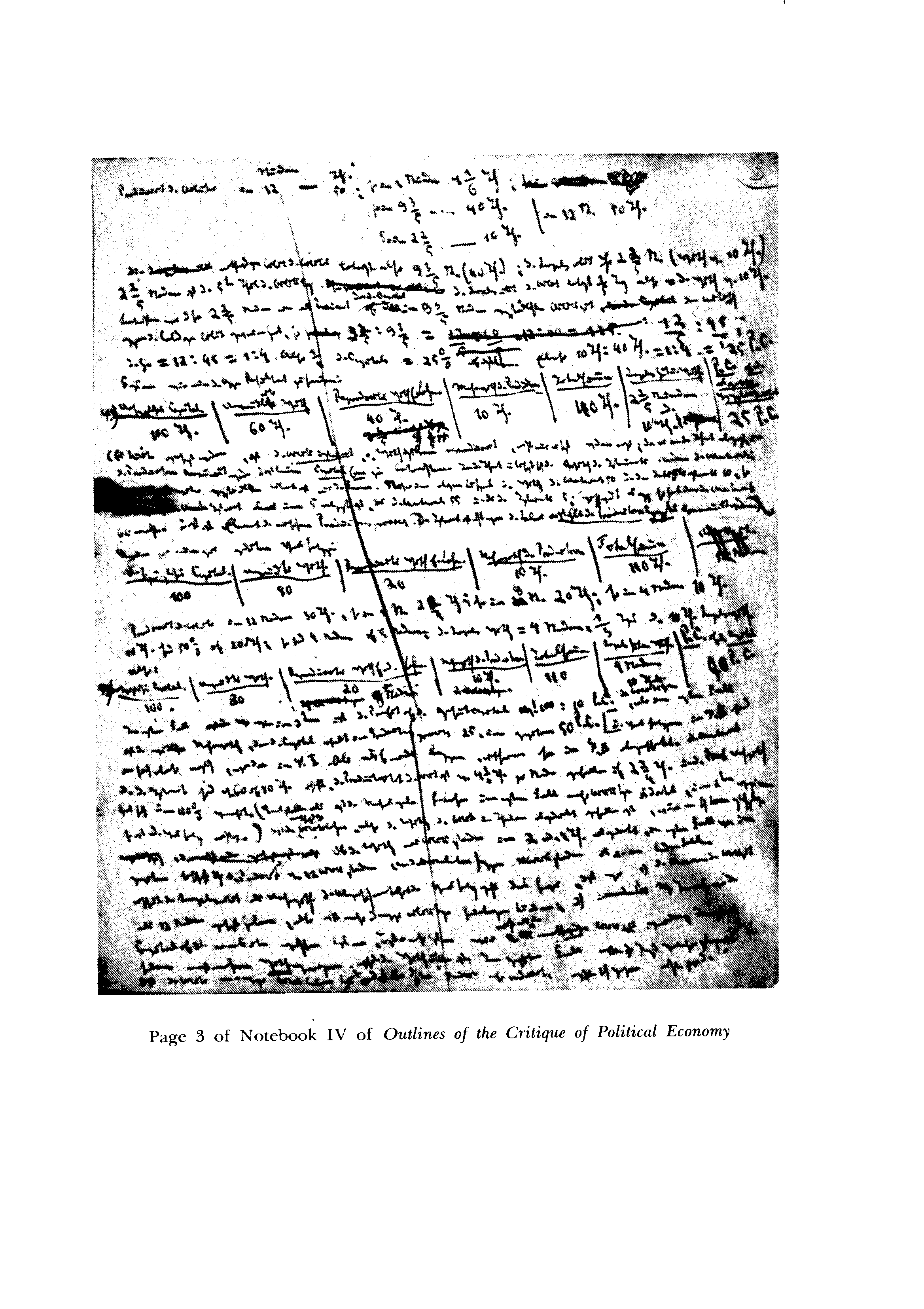
Page 3 of Notebook IV of Outlines of the Critique of Political Economy
production of his living labour capacity, then this would be bound to manifest itself in the surplus of the value. But in this case we have, in accordance with the conditions we have set ourselves, varied the "unchanging value" and have not changed the 10% which is constant here as the addition to reproductive labour, although it expresses different percentage parts of the same.
In the first case the unchanging value is smaller than in the second, the total product of [newly added] labour is greater; since if one component part of [the advanced capital of] 100 is smaller, the other must be greater; and since absolute labour time has also been fixed at the same amount; and since, finally, the total product of [newly added] labour diminishes as the "unchanging value" increases, and increases as this diminishes, we obtain less product of [newly added] labour (in absolute terms) for the same [newly added] labour time in proportion as more [constant] capital is employed. Now, this would be quite correct, since, if out of a given sum like 100, more is laid out in "unchanging value",, less can be laid out in [newly added] labour time, and hence in general less new value can be produced relatively to the capital employed. But then [if capital is to make a profit] the labour time must not be fixed, as it is here, or, if it is fixed, the value of one hour's labour must not become smaller as it does here, which is impossible if the "unchanging value" and [the rate of] surplus value increase; the number of working hours would have to become smaller. But this is presupposed in our example. We assumed, in the first case, that in 12 hours' labour 50 thaler [of new value] is produced; in the second case, only 30 thaler. In the first case, we assumed that the worker worked for 9[3]/(1) hours [to reproduce the equivalent of his wages]; in the second case, for only 6, although he produced less in one hour. C'est absurde?
And yet, is there not something correct about these figures, if they are looked at differently? Does not the absolute new value diminish, although the relative new value grows, when more material and instrument, relative to labour, enters into the elements of capital? Relative to a given capital, less living labour is employed. Therefore, even if the excess of [the product of] this living labour over its cost is greater, and thus the percentage increases specifically relative to wages, i.e. the percentage relative to the [variable] capital really consumed, does not the absolute new value necessarily become relatively smaller than in the case of the capital which employs less material and instrument of labour (precisely this is the main point in the change of the unchanging value, i.e. of the value unchanging as value in the production process) and more living labour, for the very reason that relatively more living labour is employed?
An increase in productive power then corresponds to the increase of the instrument of labour, since the surplus value [produced by Capital II], as in the previous mode of production [Capital I], is not proportional to its use value, its productive power, and since any increase in productive power produces surplus value, even though it does not do so in the same numerical proportion.
The increase in productive power which must manifest itself in an increase in the value of the instrument, in the relative share it accounts for in the expenses of capital, is necessarily accompanied by an increase in the [amount of] material, since more material must be worked on so that more product can be produced. (But the increase in productive power is also related to quality. It is related to quantity only, if a given product is of defined quality; it is related only to quality, if a specific quantity is given for the product; it can relate to both.)
Although [when the share of the material and instrument of labour in the advanced capital increases] less (necessary) labour exists relative to surplus labour, as in general less living labour necessarily exists relative to capital, can its surplus value not increase, though relative to total capital it declines, i.e. the so-called rate of profit declines?
For example, take a capital of 100, made up originally of material 30, instrument 30 (together 60 of unchanging value), wages 40 (4 working days), profit 10. In this case the profit [is] 25% new value relative to the labour objectified in the wages and 10% relative to capital.
Now assume that the material is 40, and the instrument 40. Assume that productivity doubles, so that only 2 working days are now necessary [for wages] = 20. Suppose that absolute profit is now less than 10, i.e. the profit relative to the total capital. Can not the profit relative to the labour employed amount to more than 25%, i.e. in the given case to more than a quarter of 20? IN FACT, a third of 20 is 6[2]/[3]; i.e. less than 10, [IV-5] but this is 337[3]% of the labour employed, while in the previous case it was only 25%. Here we would have had at the end of the process only 106 [2]/s, whereas previously we had 110, and yet starting with the same sum [of advanced capital] (100), the surplus labour, the surplus gain would be greater relative to the labour employed than in the first case.
But since in absolute terms 50% less labour was employed, while the greater profit on the labour employed amounts to only 8 73% [3373% —25%] more than in the first case, the absolute quantity which results must be smaller, hence the profit on the total [advanced] capital as well. For 20x33 73 [=6(2)/s] is smaller than 40x25% [=10].
This entire case is improbable and cannot be taken as a general example in political economy, for an increase both in [the cost of] the instrument of labour and in the amount of material worked up are presupposed here, although not only the relative but also the absolute number of workers has declined. (Of course, if two factors=a third, the one must become smaller as the other grows larger.) But an increase in the instrument of labour in value terms relative to capital, and an increase in the material of labour in value terms with relatively less labour, presuppose a [growing] division of labour in the whole [of society], therefore an increase in the number of workers at least in absolute terms, even though not relatively to the volume of capital employed.
However, take the example of the lithographic machine, which everyone can use himself to make lithographs. Assume the value of the instrument when newly invented was greater than that [of the equipment] which previously 4 workers used before these handy things were invented; assume that it only requires 2 workers for its use (here, as in the case of many machines which are a kind of instrument, one cannot speak of any further division of labour; it is rather the qualitative division which disappears). Assume that originally the instruments were of the value of only 30, but that the necessary labour (i.e. necessary for the capitalist to make a profit) [was] 4 working days.
(There are machines, e.g. forced air heating ducts, which completely eliminate labour as such, except at one point; the ducts are opened at one point; to convey the heated air to the other points no workers at all are required. This is generally the case (see Babbage[3]) with power [energy] transmission: where previously power [energy] [was conveyed] in material form from one point to another by many workers, the former stokers, the transmission of that power [energy] from one room to another, which is now a physical process, appeared as the labour of so many workers.)
If the lithographer employs his machine as a source of profit, as capital, not as use value, the material necessarily increases, since he can print more lithographs in a given period of time [than before], and it is precisely from this that his profit arises. Assume that this lithographer employs instrument of 40, material of 40, 2 working days (20), that [yields] him 33Vs%, i.e. 6[2]A on 20 objectified labour time. If his capital consists, like that of the other one, of 100, it yields him only 6[2]/[3]% profit, but he gains 33 7s % relative to the labour employed; the other capitalist gains 10% on the capital, but only 25% on the labour employed.
The value obtained from the labour employed may be smaller, but the profit on total capital is greater, if the other component parts of the capital are proportionately smaller. Nevertheless, the business with the 6[2]/[3]% on the total capital and 33 73% on the labour employed could become more profitable than that originally based on a 25% profit on the labour and 10% profit on the total capital.
Suppose e.g. grain, etc., to have risen in value so much that the subsistence of the worker rises in value by 25%. The 4 working days would now cost the first lithographer 50 instead of 40. His instruments and material remain the same: 60 thaler. He would therefore have to invest a capital of 110. His profit, with a capital of 110, on the 50 thaler for 4 working days would be 12 (25%). Therefore 12 thaler on 110 (i.e. 97[6]% on the total capital of 110).
The other lithographer: machine 40, and material 40. But the 2 working days would cost him 25% more, i.e. 25, instead of 20. He would therefore have to invest 105; his surplus value relative to the labour would be 33 x/[3]%, i.e. [1]/[3], therefore 8 7a- He would therefore gain 8 7[3] on 105; or 13 7[8]%.[119]
Now suppose that, over a cycle of 10 years, there are 5 good harvests and 5 bad harvests, with the AVERAGE proportions as indicated above: the first lithographer would gain, as compared to the second, 50 thaler interest [profit] in the first [good] 5 years; in the second [bad] 5 years 45 [5]/[6]; over the whole period, 95 [5]/[6] thaler. His AVERAGE interest [average profit] over the 10 years [would be] 9 [7]/i2 thaler. The other capitalist would have gained 31 [1]/[3] in the first [good] 5 years; in the second [bad] 5 years, 65 [5]/[8]; over the whole period, 96[23]/[2]4 thaler. AVERAGE [profit] over the 10 years would be 9[87]/[120].
Since [capitalist] No. II worked up more material at the same price, he sells the product more cheaply. One could say in reply that, since he used up more instrument, he sells his product more dearly; particularly since he uses up more of the machine's value in proportion as he uses up more material. However, in practice it is [IV-6] not true that machines are used up proportionately the more quickly, i.e. that they must be replaced the sooner, the more material they work up. But all this does not belong here. We assume in both cases that the ratio of the value of the machine to that of the material is constant.
This example becomes significant only if we assume a smaller capital which employs more labour and less material and machinery but earns a higher percentage on the total capital employed; and a larger capital which employs more machinery, more material, proportionately less but in absolute terms just as many working days and makes a smaller percentage profit on the total capital employed, because less on labour, which is more productive because division of labour, etc., applied. Here, it must be assumed (and this was not assumed above) that the use value of the machine is significantly greater than its value, i.e. that its depreciation in the service of production is not proportional to its effect in increasing production.
So, assume, as above, a printing press: the first a printing press operated manually and the second a SELF-ACTING printing press.
Capital I of 100 invests 30 in material; 30 in the manually operated press; and in labour 4 working days=40 thaler. Profit is 10%, therefore 25% on the living labour (surplus time [1]/[4] [of necessary time]).
Capital II of 200 invests 100 in material; 60 in the press; 4 working days (40 thaler). Profit relative to the 4 working days is 13 V3 thaler =173 working days, whereas in the first case it was only 1 working day. Sum total: 413 7a, ie. [rate of profit] 3 73%, whereas in the first case it was 10%. Nevertheless, the surplus value of the labour employed is 13 73 thaler in this second case, while in the first it is only 10. In the first case, 4 working days produce in 4 days 1 surplus day; in the second case, 4 [days] produce 73 surplus day. But the rate of profit on the total capital employed is smaller by 73 or 3373% in the second case than in the first; the total sum of profit is l/s greater.
Now let us assume that the 30 and the 100 invested in material [by the two capitals respectively] consist of sheets of print, and that the instrument is used up in the same time [in both cases], in 10 years or by 7io [of its value] each year. No. I then has to replace [annually] 7io of the 30 invested in the instrument, i.e. 3; No. II, 7io °f 60, i-e- 6. As assumed above, the instrument does not enter into the annual production in either case to a greater extent [than
12-852 Vio of its value] (the 4 working days can count as days of 3 months each).[3]
Capital I sells 30 sheets of print at 30 material+3 instrument+50 (objectified [newly added] labour time) [production time] = 83 thaler.
Capital II sells 100 sheets of print at 100 material+ 6 instrument4-53'/3 [objectified (newly added) labour time]= 159 73 thaler.
Capital I sells 30 sheets for 83 thaler; 1 sheet for [83]/3o thaler=2 thaler 23 silver groschen.(3)
Capital II sells 100 sheets for 159 thaler 10 silver groschen; 1
159 thaler 10 silver groshen sheet for , i.e. for 1 thaler 9 silver 100 groschen 10 pfennigs.
Clearly, then, Capital I has had it, because it sells its product infinitely too high. Although in the first case the profit relative to total capital was 10% and only 3 lU% in the second, yet the first capital has taken in only 25% relative to [paid] labour time, while the second has taken in 33 ]/[3]%. With Capital I, the ratio of necessary labour to the total capital invested is greater, and thus the surplus labour appears, though less in absolute terms than in Capital II, as a greater rate of profit upon the smaller total capital. 4 working days at 60 [produce a] greater [relative surplus value] than 4 at 160: in the first, 1 working day corresponds to an available [constant] capital of 15, in the second, 1 working day corresponds to 40. But with the second capital, labour is more productive. (This follows both from the greater amount of machinery and thus from its larger share in the value components of the capital; and hence from the greater amount of material, in which the working day including [IV-7] more surplus time and hence using up more material in the same time is expressed.) It produces more surplus time (relative surplus time, i.e. surplus time resulting from the development of productivity). In the first case the surplus time is l/[4] [of the necessary time], in the second l/[3].
[In the case of the second capital] surplus time thus produces more use values as well as a greater exchange value in the same time. But the latter not in the same proportion as the former, since, as we have seen, exchange value does not grow in the same numerical proportion as does the productivity of labour. The fractional price of the product is thus smaller than the total price of production — i.e. the fractional price multiplied by the amount of fractional prices produced [is] greater [than it was before— despite the decrease of the fractional price].
If we had assumed an absolutely greater total number of working days than in No. I, though relatively smaller, the matter would have been even more striking. The profit of the larger capital, working with a greater amount of machinery, appears smaller than that of the smaller capital working with relatively or absolutely more living labour, precisely because the greater profit on the living labour appears smaller when calculated on a total capital in which the living labour employed makes up a lesser proportion of the total capital, than the smaller profit on the living labour which represents a greater proportion of the smaller total capital. But the fact that the proportion [of the value expended on material and instrument and that expended on living labour] in No. II is such that more material can be worked up, and a greater part of value is invested in the instrument of labour, is only the manifestation of the [increased] productivity of labour.
This, then, is the famous point of the hapless Bastiat, who had firmly convinced himself — and Mr. Proudhon did not know what to reply(4)—that, because the rate of profit seems less on the greater and more productive total capital, the worker's share had become larger, whereas in fact precisely the opposite is the case: his surplus labour had become greater.
Nor does Ricardo seem to have understood the matter, since OTHERWISE he would not have explained the periodical decline of profit itself only by the rise of wages caused by the rise in the price of grain (and thus of rent). But au fond surplus value — in so far as it is indeed the basis of profit but at the same time distinct from profit COMMONLY so-called — has never been analysed.
The hapless Bastiat would have said, in the above case, that since in the first example the profit is 10% (i.e. Vio)> and in the second it is only 3 [1]/s%, i.e. (roughly) V33, the worker receives [9]/[10] of the product in the first case and [32]/[33] in the second. The ratio [of profit and wages] is wrong in each of the two CASES, as is the ratio of the one to the other.
The further relation of the new value of capital to capital as indifferent total value (altogether, this is how capital appeared to us before we proceeded to the discussion of the production process and this is how it must appear again at the end of the process) is to be developed partly under the heading of profit, where the new value assumes a new determination, partly under the heading of accumulation. Here we are concerned above all else to analyse the nature of surplus value as the equivalent of the absolute or relative labour time over and above the necessary labour time set in motion by capital.
The consumption, in the production process, of the value component in the instrument cannot in the least distinguish the instrument of production from the material, especially in the present context, where only the creation of surplus value, self-valorisation, is still to be explained. This is simply because that consumption is part of the simple production process itself, i.e. the value of the consumed instrument (whether it be the simple use value or the exchange value, if production has developed to the stage of division of labour and at least the surplus is exchanged) has to be recovered in the value (exchange value or use value) of the product already in the production process, so that it can start anew from itself. The instrument loses its use value in the same measure in which it helps to raise the exchange value of raw material and serves as means of labour. This point, INDEED, must be investigated, since it is fundamentally important to draw the distinction between the unchanging value as a part of capital which is maintained, the other part which is reproduced (reproduced for capital; from the standpoint of the real production of labour, produced), and that which is newly produced.
IT IS NOW TIME TO finir avec la question regardant la valeur résultant de l'accroissement des forces productives* We have seen that a surplus value (not merely a greater use value) is created, as in the case of an absolute increase of surplus labour.(5) If a definite limit is given [to necessary labour as against surplus labour], say e.g. that the worker requires only half a day in order to produce his subsistence for a whole day, if the natural limit of surplus labour the worker can provide with a given quantity of labour is reached, then an increase in the absolute labour time is possible only if more workers are employed simultaneously, if the real working day is SIMULTANEOUSLY multiplied, rather than merely lengthened. (Under the assumption made here, one worker can work for only 12 hours. If the surplus time provided by 24 hours [of labour] is to be gained, 2 workers must be employed.) In this case, the capital, before it enters upon the process of self-valorisation, must buy an extra 6 hours' labour in the act of exchange with the worker, in other words, it has to lay out a greater part of itself. On the other hand, the capital on average has to spend more on the material to be worked up (apart from the fact that the extra worker has to be available, i.e. that the working population must have grown). Hence the possibility of the further process of [IV-8] valorisation depends here on a previous accumulation of capital (considered in terms of its physical substance).
If, on the contrary, productivity, and thus relative surplus time, grow — from the present standpoint capital can still be regarded as directly producing means of subsistence, raw material, etc.—a smaller outlay for wages is necessary and the increase in the material is created by the valorisation process itself. But this question is related RATHER to the accumulation of capitals.
We return to the point where we last broke off.a Growing productivity increases surplus value, though it does not increase the absolute sum of exchange values. It increases values because it produces a new value as value, i.e. a value which is not intended simply to be exchanged as an equivalent but to maintain itself; in a word, more money. The question is: does the growth in productivity eventually increase the sum of exchange values as well? Au fond, this may be conceded, since even Ricardo admits that with the accumulation of capitals, savings, HENCE the amount of exchange values produced, also grow. The growth of savings implies nothing but the growth of autonomous values — of money. But Ricardo's demonstration of this fact contradicts his own assertion.
Take our old example.b 100 thaler capital: 60 unchanging value; 40 wages, produces 80; hence product=140.
^ Here we see again that the surplus value on the whole capital =half of the newly produced value, since a half of it=necessary labour. The proportion accounted for by surplus value, which is always equal to surplus time, therefore = the total product of the worker minus the part which constitutes his wages, depends on (1) the ratio of the unchanging part of capital to the productive part; (2) the ratio of necessary labour time to surplus time. In the above example, the ratio of surplus time to necessary labour time is 100%; which gives 40% on the capital of 100; hence (3) it depends not only on the ratio specified in (2), but also on the absolute volume of necessary labour time.
If 80 of the capital of 100 were the unchanging part, the part exchanged for necessary labour would be=to 20; and if this produced 100% surplus time, the profit of the capital would be 20%.
But if the capital were=to 200 with the same proportion of constant and variable parts [12]° (namely [3]/[5] to [2]/[5]), the sum would be 280, which is 40 [thaler profit] on [each] 100 [thaler of the capital employed]. In this case the absolute amount of profit would grow from 40 to 80, but the ratio would remain 40%.
However, if the constant element in the capital of 200 were 120, and the amount of necessary labour 80, but this increased by only 10%, i.e. by 8, the sum total would be equal to 208, therefore profit would be 4%. If necessary labour increased by only 5, then the sum total 205, i.e. [profit] 2 7z% V
Let this 40 in surplus value be absolute labour time. Suppose now that productivity doubles. If the worker could provide for 40 thaler [wages] 8 hours of necessary labour, he now produces in 4 hours a whole day of living labour. Surplus time would then grow (previously [2]/[3] of a working day was necessary to produce a whole day, now only 73 of a day is necessary) by 7s- Of the product of a working day, [2]/s would be surplus value, and if the hour of necessary labour=5 thaler (5x8=40), he would now need only 5x4=20 thaler. Consequently, there is a surplus profit of 20 on the capital, namely 60 instead of 40. At the end of the process, the total sum is 140, of which 60=constant value, 20=wages and 60 = surplus profit; altogether 140. With 80 thaler capital, the capitalist may now begin production anew:
Let capitalist A at the same stage of the old production invest his capital of 140 in new production. According to the original proportions, he uses [3]/[5] [of that 140] for the invariable part of capital, therefore 3x[140]/[5] = 3x28=84. 56 remains for the necessary labour. He previously expended 40 for labour, he now expends 56, i.e. [2]/[5] of 40 more. Then at the end his capital = 84 + 56+56=196.
Capitalist B at the higher stage of production would similarly invest the 140 thaler in new production. If out of a capital of 80, he needs 60 for invariable value and only 20 for labour, then out of 60 he needs 45 for invariable value and 15 for labour. Hence the sum would be, firstly, = 60+ 20+ 20 =100 and, secondly,=45+15+15 = 75.
His total product is therefore 175, while that of the first capitalist =196.
An increase in the productivity of labour means only that the same capital produces the same value with less labour; or that less labour produces the same product with a greater capital; that a decrease in necessary labour results in an increase in surplus labour. Necessary labour [IV-9] being smaller relative to capital, for its valorisation process, is obviously the same as capital being greater relative to the necessary labour which it sets in motion; for the same capital sets more surplus labour in motion, therefore less necessary labour.
^ I f it is assumed, as in our example, that the capital remains the same, i.e. that both capitalists recommence [the process of production] with 140 thaler, then in the case of the more productive capital, a larger part has to go to capital (that is to say, to its invariable part), and in the case of the less productive capital, a larger part to labour. Thus the first capital of 140 sets in motion necessary labour of 56, and this necessary labour assumes for its process an invariable part of the capital, 84. The second capital sets in motion labour of 20+15 = 35; and [operates with] an invariable capital of 60+45=105 (and it also follows from our previous argument that the increase in productivity does not increase value in the same proportion as it increases itself).^
^ l n the first case, as already shown,(6) the absolute new value [surplus value] is greater than in the second, because the amount of labour employed is greater in relation to the invariable part of capital [labour is less productive], while in the second case the amount of labour is smaller precisely because labour is more productive. But (1) the difference, that the [total] new value [surplus value] in the first case was only 40 while it was 60 in the second, excludes [given equality of the initial capitals] the possibility of the first capitalist recommencing production with the same capital as the second. For a part of the new value in both cases must go into circulation as an equivalent, so that the capitalist may live, and indeed live by means of his capital. If both consume 20 thaler of their capital, the first would begin the new labour [after the first production cycle] with 120 capital, the other also with 120 [owing to the fact that the first capitalist entered the first production cycle with 100 thaler and the second with 80], etc. See above.(7) We must return to all this again; but the question of the relationship of the new value produced by greater productivity to the new value produced by an absolute increase in labour, belongs to the chapter on accumulation and profit.^ This is why it is said of machinery that it saves labour [by helping reduce necessary labour and increase surplus labour]. But the mere saving of labour is not, as Lauderdale[3] correctly observed, the characteristic thing, since with the help of machinery human labour performs actions and creates things which it absolutely could not do and create without it. The latter concerns the use value of machinery. The saving of necessary labour and the production of surplus labour is the characteristic thing. The greater productivity of labour expresses itself in the fact that capital has to buy less necessary labour to produce the same value and a greater mass of use values, or that less necessary labour produces the same exchange value, valorises more material, and creates a greater mass of use values.
The growth of productivity therefore implies that, if the total value of capital remains the same, the constant part of it (consisting of material and machinery) grows relative to the variable, i.e. to that part of the capital which is exchanged for living labour, the part which constitutes the wages fund. This means at the same time that a smaller amount of labour sets in motion a greater amount of capital. If the total value of capital entering into the production process grows, the wages fund (the variable part of capital) must decline relatively to what it would be, if the productivity of labour, i.e. the ratio of necessary labour to surplus labour, had remained the same.
Let us suppose the 100 capital in the above case is agricultural capital, then 40 thaler seeds, fertilisers, etc., 20 thaler instrument of labour and 40 thaler wages, at the old level of production. (Assume that these 40 thaler=4 days' necessary labour.) These produce a sum of 140 at the old level of production. Suppose that fertility doubles, perhaps by improvement of the instrument or by the application of improved fertilisers, etc. In this case, the product must be [as before]=to 140 thaler (assuming the instrument to be totally used up in the process). Let fertility double, so that the price of a necessary working day falls by one-half; or so that only 4 necessary half-days of work (i.e. 2 whole days) are required in order to produce 8. 2 working days being necessary to produce 8 is the same as (8)/[4] (3 hours) of a [12-hour] working day being necessary labour. Instead of 40 thaler, the farmer now has to spend only 20 on labour.
Thus, at the end of the process, the components of capital have changed: it now consists of the original 40 on seeds, etc., which has doubled in use value; 20 instrument of labour; and 20 labour (2 whole working days). Previously the ratio of the constant part of capital to the variable=60:40 = 3:2, now=80:20 or=4:l. If we consider the whole capital, the necessary labour was previously [2]/[5] of it; now it is 7[5]. If the farmer wants to continue to employ labour in the earlier proportion, by how much must his capital grow? But let us avoid the malicious assumption that he continued to operate with 60 constant capital and 40 wages fund after the doubling of productivity, which would bring in false ratios; zf although in the case of the farmer this is quite correct, if favourable SEASONAL conditions doubled fertility. It would be equally correct for every industrialist, if productivity doubled not in his branch of industry, but in the branches whose output he uses, e.g. if cotton cost him 50% less, and grain (i.e. wages), and finally the instrument; he would then continue as before to spend 40 thaler on raw cotton, which would now buy double the amount; 20 on machinery; and 40 on labour^ because this assumes that, despite the doubled productivity, capital continued to operate with the same component parts, to employ the same amount of necessary labour, without spending more on raw material and instrument of labour. ^Suppose that only the cotton doubled in productivity, while that of the machinery remained the same — this is to be examined further.^ Hence productivity doubles, so that, if he had to spend 40 thaler for labour before, he now needs only 20.
(If it is assumed that 4 whole working days — each=10 thaler — were necessary to produce for the capitalist a surplus of 4 whole working days, and that this surplus was produced for him by [e.g.] the 40 thaler raw cotton being converted into yarn, then he now requires only 2 whole working days [IV-10] to produce the same value — i.e. that of 8 working days; the value of the yarn previously expressed a surplus time of 4 working days, now of 6. Or each worker previously required 6 hours' necessary labour time to produce 12; now 3. The necessary labour time amounted to 12x4=48 [hours] or 4 days. In each of these days the surplus time = [1]/2 day (6 hours). The necessary labour time now amounts to only 12x2 = 24 [hours] or 2 days; 3 hours [per working day].
To produce the surplus value, each of the 4 workers had previously to work 6x2 hours, i.e. 1 day; now he needs to work for only 3x2, i.e. [1]/[2] day. Now, it comes to the same thing whether 4 workers work for [1]/[2] day each, or 2 for a whole day. The capitalist could now dismiss 2 of the workers. Indeed, he would have to do so, because he can make only a definite quantity of yarn from a definite quantity of cotton. Consequently, he can no longer provide work for 4 whole days, but only for 4 half-days.
Yet, if the worker must work 12 hours to obtain 3 hours, i.e. his necessary wages, he will receive only IV2 hours' exchange value if he works 6 hours. And if he can maintain himself for 12 hours with 3 hours of necessary labour, he can maintain himself for only 6 hours with V/[2] hours' necessary labour. Each of the 4 workers therefore, if all 4 continue to be employed, could only live for half a day, i.e. all 4 of them could not be kept alive as workers by the same capital, but only 2 of them. The capitalist could pay 4 workers from the former [wages] fund for 4 half working days; but he would then pay them 2 days' too much, and would be making them a gift out of productivity, since he can use only 4 half-days of living labour. Such "possibilities" neither occur in practice nor can we deal with them here, where we are concerned with the relation of capital as such.)
20 thaler of the capital of 100 are now [after the doubling of productivity] not utilised directly in production. The capitalist, as before, invests 40 thaler in raw material, 20 in the instrument, therefore 60, but now only 20 thaler in labour (2 working days). Of the total capital of 80, he uses [3]/[4] (60) for the constant part and only V4 for labour. Therefore, if he invests the remaining 20 in the same way, it is [3]/[4] in constant capital, 7[4] in labour; i.e. 15 for the first, 5 for the second. Now, since a working day is assumed to be=to 10 thaler, 5 thaler would = 6 hours=1/2 working day. With the new value of 20 gained through [the increase in] productivity, the capital could buy only half a working day more, to valorise itself in the same proportion. The capital would have to grow three-fold (i.e. to 60) (together with the 20, = 80) to be able to employ fully the 2 dismissed workers, to utilise fully the previously utilised 2 working days. According to the new ratio [between the constant and variable parts after productivity doubled], capital invests [3]/[4] of itself in constant capital in order to invest V[4] in the wages fund.
With a total capital of 20, [3]/[4], i.e. 15, are thus used for constant capital, and V[4] for labour (i.e. 5) = [1]/[2] working day.
With a total capital of 4x20, therefore, 4x15=60 constant and 4x5 wages=[4]/[2] working days=2 working days.
If, therefore, the productivity of labour doubles, so that a capital of 60 thaler raw cotton and instrument requires only 20 thaler labour (2 working days) for its valorisation, when previously this [a valorisation process on this scale] required [a total capital of] 100 thaler, the total capital would have to grow from 100 to 160, or the capital of 80, on which we now base our calculation, would have to double, if the whole of the labour put out of work is to be kept in employment. But the doubling of productive power creates a new capital of only 20 thaler =^/[2] the previously employed labour time; and this is only sufficient to utilise 7[2] working day more. The capital, which before the doubling of productivity was 100 and employed 4 working days (under the assumption that [2]/[5]=40 wages fund), now, when the wages fund has fallen to l/[5] of 100, to 20=2 working days (but to V4 of 80, the capital newly entering into the valorisation process), would have to rise to 160, by 60%, to be able to utilise the previous 4 working days. It can only employ V2 n e w working day with the 20 thaler withdrawn from the wages fund because of the increase in productivity, if the whole of the former capital is to continue to be invested. Previously, it utilised, with a sum of 100, [16]/[4] (4) working days; now it could employ only [10]/[4] days.
Consequently, if productivity doubles, capital does not have to double to set in motion the same necessary labour (4 working days), hence it does not have to grow to 200, but only to twice the whole minus the part withdrawn from the wages fund. (100-20 = 80)x2=160. (In contrast, the first capital which, before the increase in productivity, out of a sum of 100 expended 60 on constant capital, and 40 for wages (4 working days), needed to grow from 100 to only 150 to utilise 2 extra working days; i.e. [3]/[5] constant capital (30) and [2]/[5] wages fund (20). Assuming that in both cases the [total] working day increased by 2 days, the second capital would amount to 160 at the end of the process [IV-11], whereas the first to only 150.)
Of the part of capital withdrawn from the wages fund as a result of the growth in productivity, a part must again be converted into raw material and instrument, and another part exchanged for living labour. This can only happen in the proportions between the different components as posited by the new productivity. It can no longer happen in the old proportions, for the ratio of the wages fund to the fund for constant capital has fallen. If a capital of 100 invested [2]/[5] in the wages fund (40), and as a result of the doubling of productivity only V5 (20), then 7[5] of the capital (20 thaler) has been released. The employed part, 80 thaler, now invests only l/[4] in the wages fund. Thus of the [released] 20 thaler only 5 thaler (V2 working day) is used for wages. The whole capital of 100 therefore now utilises 2V2 working days; or it would have to grow to 160 to utilise 4 again.
If the original capital had been 1,000 and had been divided up in the same way: [3]/[5] constant capital and [2]/[5] wages fund, we would have 600+400 (let 400 be equal to 40 working days; 1 working day=10 thaler). Doubling of the productivity of labour, i.e. only 20 working days ( = 200 thaler [wages]) required for the same product, and the capital needed to begin production anew would = 800; namely 600 + 200; 200 thaler would have been released. This is invested in the same proportions as formerly, [3]/[4] in constant capital=150 and l/[4] wages fund = 50. Hence, if the whole of the 1,000 thaler is invested, 750 would be constant capital+ 250 wages fund= 1,000 thaler. But 250 wages fund would = 25 working days (i.e. the new fund can utilise labour time only in the new proportions, i.e. lU [of the advanced capital]; to utilise all of the previous labour time, it would have to quadruple).
The released capital of 200 employed a wages fund of 50 = 5 working days (V4 of the released labour time). (The part of the wages fund detached from capital, when itself invested as capital, is now only l/[4] wages fund, which is exactly the same proportion as that between the part of the new capital which is wages fund and the total sum of the capital.) To utilise 20 working days (4x5 working days), therefore, this fund would have to grow from 50 to 4x50=200, hence the released part would have to increase from 200 to 600, i.e. grow three-fold; so that the total new capital would have to be 800. Hence the total capital 1,600. If so, 1,200 would be the constant part and 400 wages fund.
If, then, the capital of 1,000 originally contained a wages fund of 400 (40 working days), and, as a result of a doubling of productivity, required a wages fund of only 200 in order to purchase the necessary labour, i.e. only [1]/[2] of the previous labour, the capital would have to grow by 600 to employ all the previous labour (and gain the same surplus time). It would have to be able to employ double the wages fund, namely 2x200=400; but since the ratio of the wages fund to the total capital is now 1:4, this would require a total capital of 4x400=1,600.
^ The total capital which would be necessary to utilise the previous labour time therefore = the previous wages fund X the denominator of the fraction expressing the ratio of the wages fund to the new total capital. If the doubling of productivity has reduced this to l/[4], then multiplied by 4; if reduced to V3, then multiplied by 3. If productivity doubles, the necessary labour and thus the wages fund is reduced to V2 its former value; but this amounts to l/[4] of the new total capital of 800 or V5 of the former total capital of 1,000. Or the new total capital [required to employ the previous labour time] = 2xthe previous capital minus the released part of the wages fund; ( 1,000-200)x2 = (800)x2= 1,600.
The new total capital expresses exactly the total sum of constant and variable capital necessary to employ half the former labour time (V3, V4, etc., [1]/x, depending on whether productivity has increased by 3x, 4x, xx). 2x therefore is the capital needed to utilise the whole of the previous labour time (or 3x, 4x, xx, etc., depending on the proportion in which productivity has grown). The original ratio between the [constant and variable] components of capital must always be given here (technologically); for on that depend e.g. the fractions in which the multiplication of productivity is expressed as the division of the necessary labour.^
Or, which is the same thing, [IV-12] it=2xthe new capital which replaces the old capital in the production process as a result of the new productivity (800x2) (therefore, if productivity had quad-rupled, increased five-fold, etc.=4x, Sxthe new capital, etc. If productivity has doubled, necessary labour is reduced by 7[2], and so is the wages fund. If necessary labour, therefore, amounted to 400 as in the above case of the former capital 1,000, i.e. [2]/[5] of the total capital, it now amounts to V5 or 200. This proportion, by which it is reduced, is the released part of the wages fund = 75 of the previous capital = 200. 7s of the previous capital =74 of the new. The new capital is=to the old capital +[3]/[5] of it. These trivia in more detail later, etc.).
Given the same initial ratios between the components of capital and the same increase in productivity, the particular magnitude of the capital does not in the least affect the general propositions. Quite another question is whether, when capital grows, the ratios actually remain the same (but this really belongs in the section on accumulation). But, given this, we see how the increase in productivity changes the ratios between the components of capital. For a capital of 1,000, as for one of 100, a doubling of productivity has the same effect, if in both cases [e.g.] [3]/[5] of the capital was originally invested in constant capital and [2]/[5] in the wages fund. (The term wages fund [Arbeitsfonds] is used here merely for the sake of convenience; we have not yet analysed this specific characteristic of capital. So far 2 parts: the one exchanged for commodities (material and instrument), the other for labour capacity.)
(The new capital, i.e. that part of the old capital which performs its function, is=to the old capital minus the released part of the wages fund; but this released part is=to the fraction expressing necessary labour (or, which is the same, the wages fund) divided by the multiplier of productivity. Hence if the old capital was 1,000, the fraction expressing necessary labour or the wages fund = [2]/5Î and if productivity doubles, the new capital performing the same function as the old, = 800: namely [2]/s of the previous capital=400; this divided by 2, the multiplier of productivity, =[2]/io = 1/5 = 200. Therefore the new capital = 800 and the released part of the wages fund = 200.)
We have seen that, given these conditions, a capital of 100 thaler must grow to 160, and one of 1,000 to 1,600, to maintain the same labour time (of 4 or 40 working days), etc. Both must grow by 60%, i.e. by [3]/(9) of themselves (of the old capital), to be able to re-employ the released Vs (in the first case 20 thaler, in the second 200) — to reinvest the released wages fund as such.
y^N.B. We saw earlier how the same percentage yield on total capital can express very different proportions in which capital creates its surplus value, i.e. in which it posits surplus labour, relative or absolute.[3] If the ratio of the unchanging value part of capital and the variable part (exchanged for labour) were such that the latter=1/2 of the total capital (therefore capital of 100=50 (constant)+ 50 (variable)), the part exchanged for labour would have to increase by only 50% in order to yield 25% on the capital, i.e. 50 + 50 ( + 25)= 125; whereas in the above example it was 75 + 25 (+25)= 125; therefore the part exchanged for living labour increased by 100% to yield 25% on the capital. Here we see how, if the proportions [between the components of capital] remain the same, the percentage yield on the total capital also remains the same, however large or small it may be, i.e. if the proportion of the wages fund to total capital remains the same, hence [1]/[4] as above. Thus: 100 yields 125, 80 yields 100, 1,000 yields 1,250, 800 yields 1,000, 1,600 yields 2,000, etc., always = 25%. If capitals with different ratios between their component parts, and therefore with different levels of productivity, [nevertheless] yield the same percentages on the total capital, then the real surplus value must be very different in the different branches of industry.[5] [Total capital] Constant Variable [Surplus [Value of [Rate of capital capital value] product] profit] 100 60 + 40 (Original proportion) 100 75 + 25 (+25) = 125 (25%) 160 120 + 40 (+40) = 200 (25%)
^ Thus the example is correct, productivity compared under the same conditions with the same capital before the rise in productivity.
Let a capital of 100 invest 50 in constant value, 50 in wages. Let the wages fund increase [in the course of production] by 50%, i.e. by V2; then the total product=125. Let the wages fund of 50 thaler utilise 10 working days, paying 5 thaler per day. Since the new value = [1]/2 the wages fund, the surplus time must be — to 5 working days, i.e. the worker, who needed to work only 10 days to live for 15, must work 15 for the capitalist in order to live for 15, and his surplus labour of 5 days constitutes the surplus value of capital. Expressed in hours, if the working day =12 hours, the surplus labour=6 hours per day. So in 10 days or 120 hours he works 60 hours too much = 5 days.
Now, with the doubling of [IV-13] productivity, the ratio of the components of the 100 thaler would be 75 and 25, i.e. the same capital would only need to employ 5 workers to produce the same value of 125. Thus the 5 working days=10, it doubles itself, i.e. 5 working days are paid for, 10 are produced. The worker would need to work only 5 days to live for 10 (before the increase of productivity he had to work 10 days to live for 15: therefore he could live for only 7l/[2] days if he worked for 5); but he must work 10 days for the capitalist in order to live for 10. The capitalist accordingly profits to the extent of 5 days; a day per day; or, expressed by the day, before he had to work for V2 day to live for 1 (i.e. 6 hours to live for 12); now he would need to work only V4 day to live for 1 day (i.e. 3 hours). Previously, if he worked for a whole day, he could live for 2 days; if he worked 12 hours, he could live for 24 hours; if he worked 6 hours, 12 hours. But now he must work 12 hours to live for 12 hours. He would need to work only V2 day to live for 1; but he must work 2xl/[2]=l, to live for 1. At the previous level of productivity, he had to work 10 days to live for 15, or 12 hours to live for 18; or 1 hour to live for IV2 hours, or 8 hours to live for 12, i.e. [2]/[3] of a day to live for [3]/[3] of a day. But he has to work [3]/[3] to live for [3]/[3], i.e. V3 too much.
The doubling of productivity raises the proportion of surplus time from 1:IV2 (i-e- 50%) to 1:2 (i.e. 100%). In comparison with the previous labour time: he had to work 8 hours in order to live for 12, i.e. the necessary time was [2]/[3] of the whole working day; he now has to work only V2 day, i.e. 6 hours to live for 12 hours. As a consequence, capital now employs 5 workers instead of 10. If previously the 10 workers (cost 50) produced 75, now the 5 ([cost] 25) produce 50, i.e. the former only 50% [surplus value], the second 100%. The workers work as before 12 hours, but in the first case capital bought 10 working days, now it buys only 5; because productivity has doubled, the 5 [working days now produce] 5 surplus working days; because in the first case 10 working days only produced 5 surplus working days, whereas now that productivity has doubled, [the ratio of surplus value to variable capital] having risen from 50% to 100%, 5 [working days produce] 5 [surplus working days]. In the first case, 120 hours of work (=10 working days) produce 180 hours [total time in terms of value], in the second 60 [hours of work] produce 60 [surplus hours], i.e. in the first case, the surplus time amounts to V3 of the whole day (50% of necessary labour time) (i.e. 4 hours out of 12; necessary time 8); in the second case, the surplus time amounts to V2 of the whole day (100% of necessary labour time) (i.e. 6 hours out of 12; necessary time 6). Hence the 10 days in the first case produced 5 days' surplus time (surplus labour), and in the second the 5 produce 5. The relative surplus time has therefore doubled; relative to the previous proportion it has grown by only l/2 compared to l/5, i.e. by 7e, i.e. by 16[4]/(10)%-/'
Since surplus labour or surplus time is the prerequisite of capital, it consequently rests on the basic presupposition that there exists a surplus over and above the labour time necessary for the maintenance and propagation of the individual, so that e.g. the individual has to work only 6 hours in order to live for a day, or 1 day to live for 2, etc. With the development of the productive forces, necessary labour time diminishes and as a result surplus time increases. Or, to put it another way, one individual can work for two, etc.
MAINTAIN FIVE, THERE WILL BE FOUR IDLE MEN FOR O N E EMPLOYED IN PRODUCTION.
PROPERTY GROWS FROM T H E IMPROVEMENTS IN T H E MODE O F PRODUCTION... T H E
GROWTH O F PROPERTY, T H I S GREATER ABILITY T O MAINTAIN IDLE MEN AND UNPRODUCTIVE INDUSTRY=CAPITAL... MACHINERY itself CAN SELDOM BE APPLIED W I T H SUCCESS T O ABRIDGE THE LABOURS OF AN INDIVIDUAL: MORE TIME WOULD BE LOST IN ITS CONSTRUCTION THAN COULD BE SAVED BY ITS APPLICATION. IT IS ONLY REALLY USEFUL WHEN IT ACTS ON GREAT MASSES, WHEN A SINGLE MACHINE CAN ASSIST THE LABOURS OF THOUSANDS. IT IS ACCORDINGLY IN THE MOST POPULOUS COUNTRIES WHERE THERE ARE MOST IDLE MEN THAT IT IS ALWAYS MOST ABUNDANT. IT IS NOT CALLED INTO ACTION BY A SCARCITY OF MEN, BUT BY THE FACILITY WITH WHICH THEY ARE BROUGHT TOGETHER... Less than one-quarter OF THE ENGLISH POPULATION PROVIDES [IV-14] EVERYTHING THAT IS CONSUMED BY ALL. Under William the Conqueror e.g., the number directly participating in production was much greater in proportion to the IDLE MEN" (Ravenstone, [Thoughts on the Funding System, and Its Effects, London, 1824, pp. 11, 13, 45 and 46,] IX, 32).'22
If it is true that capital produces surplus labour, it is equally true that surplus labour is the prerequisite for the existence of capital. The entire development of wealth rests upon the creation of disposable time. The ratio of the necessary labour time to the superfluous (such it is initially from the standpoint of necessary labour) changes at the different stages of development of the productive forces. At the more primitive stages of exchange, men exchange nothing but their superfluous labour time ; it is the measure of their exchange, which is therefore confined also to their superfluous products. In production based on capital, the existence of necessary labour time is conditioned by the production of superfluous labour time. At the lowest stages of production, firstly, few human needs have as yet been produced, hence there are few to be satisfied. Necessary labour time is therefore restricted, not because labour is productive but because little is necessary. Secondly, there exists at all stages of production a certain common quality [Gemeinsamkeit] of labour, it has a social character, etc. Later, social productive power, etc., develops. (Return to this.)
Surplus time exists [firstly] as the excess of the working day over and above that part of it which we call necessary labour time. It exists secondly as the multiplication of simultaneous working days, i.e. of the working population.
(It can also be produced — but this to be mentioned here only allusively, as this point belongs to the chapter on wage labour — by a forcible extension of the working day beyond its natural limits; or by the addition of wives and children to the working population.)
The first ratio of the surplus time to the necessary time in the working day can be and is modified by development of the productive forces, so that necessary labour is restricted to an ever smaller fractional part. The same is then true relative to the population. A working population OF, SAY, 6 million can be considered as one working day of 6x12, i.e. 72 million hours; so that the same laws are applicable here.
It is the law of capital, as we have seen, to produce surplus labour, disposable time. It can do this only by setting in motion necessary labour, i.e. by entering into exchange with the worker. It is therefore the tendency of capital to produce as much labour as possible, just as it is its tendency to reduce necessary labour to a minimum. It is therefore as much the tendency of capital to enlarge the working population, as well as constantly to make a part of that population surplus — that is useless, until such time as capital can utilise it. (Hence the correctness of the theory of surplus population and surplus capital.)
It is as much the tendency of capital to render human labour (relatively) superfluous, as to drive it on without limit. Value is only objectified labour, and surplus value (valorisation of capital) is only the excess over and above that part of objectified labour which is necessary for the reproduction of labour capacity. But labour as such is and remains the prerequisite, and surplus labour exists only in relation to necessary labour, therefore only in so far as necessary labour exists. Capital must therefore constantly posit necessary labour in order to posit surplus labour; it must increase it (i.e. the simultaneous working days), in order to increase the surplus; but, equally, it must transcend it as necessary labour in order to posit it as surplus labour.
With respect to the single working day, the process is, of course, simple: (1) to lengthen it to its natural limits; (2) to shorten more and more the necessary part of it (i.e. to increase the productive forces without limit). But, the working day regarded spatially— time itself regarded spatially — is the existence of many working days alongside one another. The greater the number of working days with which capital can enter into exchange AT ONCE, in which it exchanges objectified labour for living, the greater is its valorisation AT ONCE. It can go beyond the natural limit imposed by the living working day of the individual, at a given stage of the development of the productive forces (and this is not affected by the fact that this stage is CHANGING), only by setting alongside the one working day another one — by the spatial addition of more simultaneous working days.
E.g. I can extend the surplus labour of A only to 3 hours; but if I add the working days of B, C, D, etc., I have created surplus labour of 12 hours. Instead of a surplus time of 3, I have created one of 12. As a result, capital solicits the increase of population, and the VERY PROCESS by which necessary labour is reduced, makes it possible to set to work new necessary labour (and hence surplus labour). (That is to say, the production of workers becomes cheaper, more workers can be produced in the same time, in the same measure as necessary labour time becomes less, or the time required for the production of the living labour capacity becomes relatively less. These are identical propositions.)
(This still irrespective of the fact that the increase in population increases the productive power of labour, by making possible greater division and greater combination of labour, etc. Increase in population is a natural power [IV-15] of labour for which nothing is paid. From the present standpoint, we use the term natural power to refer to social power. All natural powers of social labour are themselves historical products).
On the other hand, it is the tendency of capital — just as previously in the case of the single working day — to reduce to a minimum the many simultaneous necessary working days (which, so far as value alone is concerned, may be considered as one working day), i.e. to posit as many of them as possible as not necessary. As previously in the case of the single working day, it was the tendency of capital to reduce the hours of necessary labour, so now it tends to reduce the necessary working days in relation to the total of objectified labour time. (If 6 are necessary to produce 12 superfluous working hours, then capital works towards the reduction of these 6 to 4. Or the 6 working days can be considered as a single working day of 72 hours; if capital succeeds in reducing necessary labour time by 24 hours, 2 days of necessary labour are eliminated, i.e. 2 workers.)
On the other hand, the newly created surplus capital can be valorised as such only by being exchanged for living labour. Hence the tendency of capital just as much to increase the working population as constantly to diminish the necessary part of it (constantly to reallocate a part of it as a reserve). And the increase in population is itself the chief means for the reduction of the necessary part.
Au fond this is only the application of the ratio [between necessary and surplus labour] to the single working day. Here we thus already have all the contradictions which have been expressed as such, although not understood, in modern population theory. Capital, in positing surplus labour, equally and simultaneously posits and does not posit necessary labour; it exists only in so far as necessary labour both exists and does not exist.
^"It does not belong here yet, but can already be mentioned here, that the creation of surplus labour on the one side corresponds to a creation of minus-labour, relative IDLENESS (or at best non-productive labour) on the other. This goes without saying, to start with, as regards capital itself; but it applies equally to the classes with which it shares, i.e. to the PAUPERS living on the surplus product, FLUNKEYS, JENKINSES, etc., in short the whole TRAIN of RETAINERS; the part of the serving class which does not live on capital but on revenue.
Essential distinction between this serving class and the working class. In relation to the whole of society, the production of disposable time [can] also [be considered] as the creation of time for the production of science, art, etc. It is by no means the course of social development that an individual, having satisfied his needs, goes on to produce his surplus, but that an individual or class of individuals are compelled to work more than is necessary for the satisfaction of their own needs; and because surplus labour is thus posited on the one side, non-labour and surplus wealth are posited on the other.
In reality, the development of wealth exists only in these contradictions; in potentiality, it is this very development of wealth which makes it possible to transcend these contradictions. Or, because an individual can satisfy his own needs only by simultaneously satisfying the needs of, and producing a surplus over and above that for, another individual. Under slavery, this merely brutal, only under the conditions of wage labour does it lead to industry, industrial labour.
Hence Malthus was quite consistent when, along with surplus labour and surplus capital, he demands SURPLUS IDLERS, CONSUMING WITHOUT PRODUCING, postulating the necessity of waste, luxury, extravagant spending, etc.V^
If the ratio of the necessary working days to the total of the objectified working days=9:12 (i.e. surplus labour=y[4]), capital strives to reduce it to 6:9 (i.e. [2]/[3], hence surplus labour=y(11)). (This to be developed in more detail later; but the basic outlines here, where we are dealing with the general concept of capital.)
Endnotes
[119] Marx assumes here that the rate of surplus value after the rise in the price of (25% for capital I and 331/$% labour power remains unchanged for capital II). This is only possible given a corresponding lengthening of the working day.—308
[7] The heading "I. Production, Consumption, Distribution, Exchange (Circulation)" does not occur in Marx's table of contents on the cover of Notebook M and refers, strictly speaking, only to the first two sections of the Introduction, that headed "Production" (the heading in the table of contents on the cover is more accurate: "Production in general") and that headed "The General Relation of Production to Distribution, Exchange and Consumption". There are no Roman numerals in the further text of the Introduction to correspond to the figure I marking the section "Production, Consumption, Distribution, Exchange (Circulation)".—17
[23] This chapter was first published — in German, with a parallel Russian translation — in the collection Marx-Engels Archives, Vol. IV, Moscow, 1935. Excerpts from the chapter appeared in English for the first time in Marx's Grundrisse by David McLellan, Macmillan Press Ltd., London, 1971, pp. 59-64, 65-69 and 70-73. The chapter was first published in English in full in Karl Marx, Grundrisse. Translated with a Foreword by Martin Nicolaus, London, 1973, pp. 115-238.—51
[87] The text beginning on page 8 of Notebook III is the continuation of the text of Notebook II. The beginning of the sentence opening page 8 was on page 29 — which has not reached us — of Notebook II and was reconstructed, together with the continuation, on the basis of the economic manuscripts of 1861-63. The first seven pages of Notebook III contain an unfinished critique of Bastiat and Carey, written several months earlier (see this volume, pp. 5-16).—219
[120] This is the first time ever that Marx uses these terms to denote the two different components of capital.— 314
[83] Marx discusses Wakefield's theory of colonisation in detail in Capital, Vol. I, Ch. XXXIII. In conclusion he points out that this theory confirms the laws governing the rise and development of capitalist production. "...The capitalist mode of production and accumulation, and therefore capitalist private property, have for their fundamental condition the annihilation of self-earned private property; in other words, the expropriation of the labourer" (see present edition, Vol. 35).—208
[9] The term bürgerliche Gesellschaft (see G.W.F. Hegel, Grundlinien der Philosophie des Rechts, in: Werke, Vol. 8, Berlin, 1833, § 182, Addendum) was used by Marx, even in his early writings, in two senses: in a broader one, to denote the economic system of society regardless of the historical stage of its development, i.e. the totality of material relations determining the political institutions and ideological life; and in a narrower one, to denote the material relations of bourgeois society (later, bourgeois society as a whole), i.e. capitalism. Depending on the context, the term is translated in this edition either as "bourgeois society" or as "civil society".—17
[32] Wilhelm Weitling's theory of labour money is set forth in his book Garantien der Harmonie und Freiheit, Vevey, 1842, pp. 153-75. Speaking of the English supporters of this theory, Marx means John Francis Bray, Thomas Hodgskin, William Thompson and other adherents of Robert Owen, who tried to draw socialist conclusions from the economic theory of Ricardo. Marx gave a critical analysis of the views of these Utopian socialists in The Poverty of Philosophy. Answer to the "Philosophy of Poverty" by M. Proudhon (see present edition, Vol. 6). Later he discussed their theory of "labour money", as propounded, e.g., by John Gray, in A Contribution to the Critique of Political Economy, Part One (see present edition, Vol. 29).—73
[33] Here as in a number of other places Marx uses the term "subject" in its pre-Kantian sense, as the bearer of predicates, properties, determinations, characteristic features, relations.— 81, 124
[12] Determination is negation—Marx quotes this thesis of Spinoza in the widely accepted interpretation given it by Hegel. In Spinoza, it means "limitation is negation" (Epistolae doctorum quorundam virorum ad B. de Spinoza et auctoris responsiones; ad aliorum ejus operum elucidationem non parum facientes. Epistola L 1674). Hegel's interpretation emphasises the element of negation 2 Junii inherent in any determined being, in any particular thing (see his Wissenschaft der Logik, Book I, Part I, Chapter 2, note on "Reality and Negation" and his Enzyklopädie der philosophischen Wissenschaften, Part I; Wissenschaft der Logik, § 91, Addendum).—28
[140] The insertion "(Wrong!)", added by Marx later, refers to the sentence immediately preceding it. In the course of his further work on the manuscript, Marx demonstrated that the duration of the production process depended on a number of circumstances (see, e.g., this volume, pp. 521-22).— 441
[16] Marx drew the data on pre-Spanish Peru from the American scholar William Hickling Prescott's History of the Conquest of Peru, with a preliminary view of the civilisation of the Incas, in three volumes, 4th ed., London, 1850. Excerpts from Volume I of this book are contained in Marx's Notebook XIV, begun in London in 1851. That the Incas had no knowledge of money is stated on p. 147 of Volume I.—40
[3] According to Bastiat, "the workers' pension fund" was to be made up of contributions by the workers themselves, for thus alone the necessary degree of "stability" could be ensured (Fr. Bastiat, Harmonies économiques, 2nd edition, Paris, 1851, p. 395).—11
[2] This refers to Chapter XIV in the second edition of Bastiat's book Harmonies économiques (there are 25 chapters in that edition). Since this section of the draft "Bastiat and Carey" begins on page 5 of the manuscript, while half of page 4 was left blank, it may be assumed that Marx originally intended to discuss Bastiat's book in greater detail, giving, in particular, an account of the preceding 13 chapters.—11
[6] This Introduction, prefaced by Marx to the Outlines of the Critique of Political Economy, the first rough draft of Capital, holds an important place among his Economic Manuscripts of 1857-58. It is contained in Notebook M, marked "London, 23 August '57", which is probably the day when Marx began writing the Introduction. He interrupted this work, in all likelihood, in the last days of August, leaving the Introduction unfinished. On the cover of Notebook M, Marx listed the main items to be discussed in the Introduction. The headings of the individual sections in this table of contents differ somewhat from the corresponding headings in the text proper. Marx's list is as follows: "Contents "A. Introduction "1) Production in general "2) General relationship between production, distribution, exchange and consumption "3) The method of political economy "4) The means (forces) of production and production relations; production relations and relations of intercourse, etc." As the table reflects the overall structure of the Introduction more accurately than the headings of some of the sections in the text do, one may assume that Marx wrote it after drafting the Introduction. The fourth, closing section is in the form of a detailed outline. Of the subsections listed in it, only subsection 1, containing Marx's views on art, was written, and even that not in full. For instance contrary to his original intention, he did not investigate the relation of Shakespeare to the modern world. Having put to paper his views on Greek art, Marx broke off the work on the Introduction. Later, when preparing the manuscripts for publication, he abandoned his intention to open them with an extensive introduction and confined himself to a shorter preface formulating in brief the general philosophical premisses of his method of economic research (the materialist conception of history). In the Preface to Part One of A Contribution to the Critique of Political Economy, dated January 1859, Marx wrote: "A general introduction, which I had drafted, is omitted, since on further consideration it seems to me confusing to anticipate results which still have to be substantiated, and the reader who really wishes to follow me will have to decide to advance from the particular to the general" (see present edition, Vol. 29). The Introduction was first published in the journal Die Neue Zeit, Vol. 1, Nos. 23-25, Stuttgart, 1902-1903. In English, in first appeared in A Contribution to the Critique of Political Economy by Karl Marx. Translated from the second German edition by N. I. Stone. With an appendix containing Marx's Introduction to the Critique recently published among his posthumous papers. Charles H. Kirr & Company, Chicago, 1904, pp. 265-312. It was also published in Marx and Modern Economics, ed. by D. Horowitz. Mac Gibbon & Kee, London, 1968, pp. 21-48, in Marx's Grundrisse by David McLellan, Macmillan Press Ltd., London, 1971, pp. 16-46, and in Karl Marx, Grundrisse. Translated with a Foreword by Martin Nicolaus. London, 1973, pp. 81-111.—17
[1] The unfinished draft manuscript "Bastiat and Carey", the first of Marx's Economic Manuscripts of 1857-58, takes up the first seven pages in one of the seven notebooks containing the main manuscript of that cycle, the Outlines of the Critique of Political Economy (Rough Draft). However, the date, "July 1857", which Marx put on the cover of that notebook, shows that "Bastiat and Carey" was written somewhat earlier than the Outlines. Pages 1, 2, 3 and the upper half of page 4 contain the "Avantpropos" (Introductory Notes) to "Bastiat and Carey", the lower half of page 4 is blank, and pages 5-7 are taken up by a passage entitled "XIV. De salaires". From page 8 onwards, there follows the continuation of the text contained in Notebook II of the main manuscript (see page 219 of this volume). Marx marked this continuation "Notebook III" and dated it "November 29 and 30, and December 1857". Since in the manuscript the draft bears the same subtitle as Bastiat's book, it may be assumed that Marx originally wanted to write an extensive review, but later decided that the book did not deserve detailed discussion, and therefore gave up his original intention. The draft goes beyond the bounds of an ordinary review. In the "Avantpropos", Marx sums up the bourgeois political economy of his time and strictly delimits the era of classical political economy as beginning in the late 17th century, with the works of Petty and Boisguillebert, and ending in the first third of the 19th century, with the writings of Ricardo and Sismondi. He shows that the bourgeois economists of the subsequent period were either epigones of the classics or vulgar critics of them. The works of the Frenchman Bastiat and the American Carey, directed above all against Ricardo, were examples of that kind of criticism. The title "Bastiat and Carey" occurs in Marx's "References to My Own Notebooks", written in the summer of 1861 (see present edition, Vol. 29). This shows that Marx himself regarded the draft as part of his Economic Manuscripts of 1857-58. He quotes from Bastiat partly in French and partly in German translation. In this volume, all quotations are in English; only foreign-language phrases in Marx's own text are given in the language of the original. The draft was first published in the journal Die Neue Zeit, Vol. 2, No. 27, Stuttgart, 1903-1904. In English, it first appeared, under the title "Critique of Bastiat and Carey", in Marx's Grundrisse by David McLellan, Macmillan Press Ltd., London, 1971, pp. 47-58 and in: Karl Marx, Grundrisse. Foundations of the Critique of Political Economy (Rough Draft). Translated with a Foreword by Martin Nicolaus. Penguin Books in association with New Left Review. London, 1973, pp. 883-93.-5
[8] Contrat social—in Rousseau's theory, the voluntary agreement entered into by primitive people — originally living in "the state of nature"—which led to the formation of the political state. The theory was set forth in Rousseau's Du Contrat social; ou Principes du droit politique, London, 1782.—17
[5] The "supreme being" {être suprême) was Voltaire's designation of God, whom he, in contrast to the positive religions, described as an impersonal rational creator, who, having, laid down the laws of the world and given it an initial impulse, has refrained from any further intervention in the natural course of events.—13
[4] Marx means the philosophical and historical constructions in Proudhon's book Système des contradictions économiques, ou Philosophie de la misère (Paris, 1846). In 1847 Marx attacked them in The Poverty of Philosophy. Answer to the "Philosophy of Poverty" by M. Proudhon (see present edition, Vol. 6, pp. 105-212, particularly pp. 111-15 and 157-60).—13
[10] In subsequent years Marx modified his views on family relations in primitive society and the early tribal system in accordance with the latest studies in ethnography and ancient history, notably the books Das Mutterrecht by the Swiss historian Johann Jacob Bachofen and Society by the American Ancient anthropologist Lewis Henry Morgan, published in the 1860s and 1870s. In particular, he abandoned the view, commonly held by historians in the 1840s and 1850s, asserting the primacy of the family and the secondary nature of the tribe and deriving the tribe from the developing family. The new conception of the relation between tribe and family was reflected, in particular, in Marx's synopsis of Morgan's Ancient Society. Frederick Engels drew on this book in writing The Origin of the Family, Private Property and the State.—18