Cover of Notebook VII of the manuscript Outlines of the Critique of Political Economy
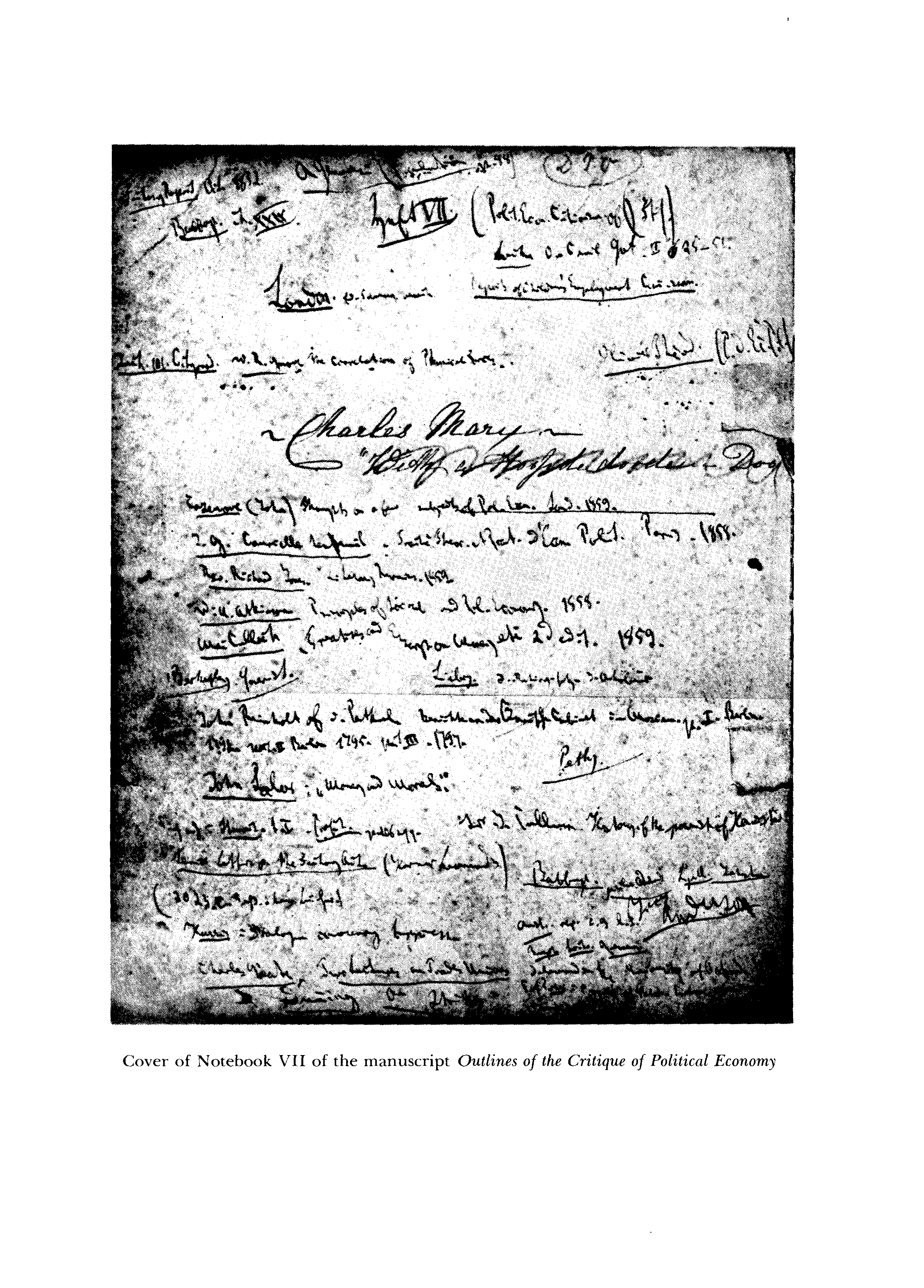
Cover of Notebook VII of the manuscript Outlines of the Critique of Political Economy
is revealed when we compare the figures for the month of May with those for June:
Bullion reserves in the Bank Bills discounted by the Bank 10 May 420,914,028 310,744,925 14 June 407,769,813 310,369,439
[1-2] From 10 May until 14 June, therefore, the bullion reserves fell by 13,144,215 frs. Did the SECURITIES held by the Bank increase in the same measure? On the contrary, they decreased in the same period by 375,486 frs. Here, therefore, we have not merely a simple quantitative disproportion between the fall on the one side and the rise on the other. Even the inverse relationship between movements in the two series has disappeared. An enormous fall on the one side is accompanied by a relatively small fall on the other.
Bullion reserves in the Bank Bills discounted by the Bank 14 June 407,769,813 310,369,439 12 July 314,629,614 381,699,256
Comparison of the figures for June with those for July shows a decline of 93,140,199 in the reserves and an increase of 71,329,717 frs in the SECURITIES. That is, the decline of the former is 21,810,482 frs greater than the increase in the latter.
Bullion reserves in the Bank Bills discounted by the Bank 12 July 314,629,614 381,699,256 9 August 338,784,444 458,689,605
Here we have increases in both columns: in that for the bullion reserves by 24,154,830, in that for the portfolio by the much greater sum of 66,990,349 frs.
Bullion reserves in the Bank [Bills discounted by the Bank] 9 August 338,784,444 458,689,605 13 September 288,645,333 431,390,562
The fall of 50,139,111 frs in the bullion reserves was accompanied in this period by a decline of 27,299,043 frs in the SECURITIES. (In December 1855, despite the restrictions imposed by the Banque de France, its reserves were reduced by a further 24 million.)
What is sauce for the goose is sauce for the gander. The facts that emerge from successive comparison of the five-month period possess the same claim to trustworthiness as do those resulting from Mr. Darimon's comparison of the first and last figures of the
4* columns. And what does the comparison show? Truths which devour one another. Twice there is an increase in the portfolio and a fall in the reserves, but in such a way that the decrease in the latter is smaller than the increase in the former (April-May and June-July). Twice there is a decrease in the reserves accompanied by a decrease in the portfolio, but the decrease in the latter is not as great as the decrease in the former (May-June and August-September). Finally, in one case there is an increase in the reserves and an increase in the portfolio, but the former is smaller than the latter [July-August].
A decline in one column, a rise in the other; a decline in both columns; a rise in both columns. So there is anything but a consistent pattern, above all there is not an inverse relationship [between the reserves and the portfolio], not even an interaction [between them], since a decline in the portfolio cannot be the cause of the fall in the reserves, and an increase in the portfolio cannot be the cause of the increase in the reserves. The inverse relationship and interaction is not even established by the isolated comparison between the figures for the first and the last month which Darimon makes. If the increase in the portfolio by 101 million does not make good the decline of 144 million in the reserves, there remains the possibility that the increase in the one [1-3] and the decrease in the other bear no causal relationship whatever to each other. The statistical illustration, instead of giving an answer, has only thrown up a mass of mutually intersecting questions. Instead of one riddle, three score.
In fact, the riddles would, disappear at once, if only Mr. Darimon were to set down the columns for note circulation and deposits alongside those for the reserves and the portfolio (of bills discounted). A fall in the reserves smaller than the increase in bills discounted would then be explained thus: either deposits of bullion have increased at the same time; or a part of the notes issued in discount was not exchanged for bullion but remained in circulation; or finally, the notes issued were immediately returned [to the Bank] in the form of deposits or as payment for overdue bills, thus not increasing note circulation. A decrease in the reserves accompanied by a smaller decrease in the portfolio would be explained by deposits being withdrawn from the Bank or notes being brought in and exchanged for bullion, its own discounting thus being impaired by the owners of the withdrawn deposits or of the notes converted into silver. Finally, a small decrease in the reserves accompanied by a smaller decrease in the portfolio would be explained in the same way (we omit the possibility of a drain on the reserves for the replacement of silver coinage within the country, since Darimon does not take account of it in his analysis).
But the columns which would thus have explained each other would also have proved something which it was not intended to prove: that the satisfaction of the growing requirements of trade by the Bank does not necessarily result in an expansion of the amount of its notes in circulation; that the contraction or expansion of this note circulation does not correspond to a contraction or expansion of the Bank's bullion reserves; that the Bank does not control the quantity of means of circulation, etc.— all of them conclusions which conflict with the arguments which Mr. Darimon is trying to sell. In his haste to present dramatically his preconceived opinion as to the opposition between the metallic basis of the Bank, as represented by its bullion reserves, and the requirements of circulation, represented in his view by the Bank's portfolio, he tears two columns from their necessary complementary context, which in this isolation lose all meaning, or, if they show anything at all, provide evidence against himself. We have dwelt upon this fait* to demonstrate from one example the value of the statistical and positive illustrations of the Proudhonists. Instead of the economic facts providing the test of their theories, they prove that they do not master the facts, in order to be able to play with them. Indeed their way of playing with the facts demonstrates the origins of their theoretical abstraction.
Let us follow Darimon further. When the Bank of France saw its reserves diminished by 144 million and its portfolio increased by 101 million, it took measures on 4 and 18 October 1855 to protect its vaults against its portfolio. It raised its discount rate in successive steps from 4 to 5% and from 5 to 6%, and reduced from 90 to 75 days the time of payment of bills presented for discount. In other words: it rendered more difficult the conditions under which it placed its bullion at the disposal of commerce. What does this show? According to Darimon,
"that a bank organised on present-day principles, i.e. founded upon the predominance of gold and silver, deprives the public of its services exactly at the moment when they are most needed" [ibid., p. 3].
Did Mr. Darimon need all his statistics to show that the supplier raises the price of his services in the same measure that the demand for them rises (and exceeds them)? And do not the
Matter.— Ed.
gentlemen who represent "the public" vis-à-vis the Bank follow the same "agreeable custom of life"(1)? Do the philanthropic grain dealers, who present their bills of exchange to the Bank in order to get notes to exchange for the Bank's gold, in order to exchange that gold for grain from abroad, in order to exchange that grain for the money of the French public, are they by any chance motivated by the idea that, because the public's need for grain is now at its peak, it is their duty to sell grain more cheaply? Or do they not rather rush to the Bank to exploit the rise in the price of grain, the need of the public, the imbalance between the public's demand and the available supply? And the Bank should be an exception from this general economic law? Quelle idée!(2)
But it may be the effect of the present-day organisation of the banks that gold must be accumulated in so large quantities that the means of purchase, which could be used most beneficially for the nation in the case of a grain shortage, are condemned to be idle, and that in general capital, which should circulate in fruitful [1-4] transformations of production, is turned into the unproductive and stagnant basis of circulation. In this case it would mean that, given the present organisation of the banks, the unproductive bullion reserves still exceed the necessary minimum, because the saving of gold and silver within circulation has not yet been pushed back to its economic limits. It would be a matter of something more or less on the same basis. But the question would have been brought down from the socialist heights to the bourgeois-practical plains in which we find it strolling in the books of most of the English bourgeois opponents of the Bank of England. Quelle chute!(3)
But perhaps it is not a matter of a greater or lesser economy of gold and silver by means of notes and other banking devices, but of abandoning the metallic basis of the currency altogether? But then again, the statistical fable loses its point, and so does its moral. If the Bank, under whatever conditions, is to export precious metals in case of an emergency, it must previously have accumulated them; and if foreign countries are to accept them in exchange for their commodities, these metals must have asserted their predominance.
The causes which drained from the Bank its precious metals were, according to Darimon, a bad harvest and the consequent necessity of importing grain from abroad. He forgets the failure of the silk harvest and the need of extensive purchases of silk from China. Darimon also blames the many large-scale undertakings which coincided with the last months of the Paris Industrial Exhibition.(4) Again he forgets the vast speculations and ventures abroad undertaken by the Crédit Mobilier[20] and its rivals, to show, as Isaac Péreire says, that French capital distinguishes itself from that of other countries by its cosmopolitan character, just as the French language does from other languages. Add to that the unproductive expenditure occasioned by the Eastern War(5): the loan of 750 million.
In other words, on the one hand a great and sudden shortfall in two of the most important branches of French production! On the other hand, an extraordinary use of French capital in foreign markets for undertakings which created no direct equivalent and some of which will perhaps never cover their production costs! On the one hand, the imports which made up for the decline of domestic production and, on the other hand, the increase in industrial ventures abroad, required not the tokens of circulation which serve for the exchange of equivalents, but the equivalents themselves, not money but capital. In any case, the reduction in French domestic production was not an equivalent for the investment of French capital abroad.
Now, suppose that the Bank of France had not rested upon a metallic basis, and foreign countries had been willing to accept the French equivalent or capital in any form, not only in the specific form of the precious metals. Would not the Bank have been forced just the same to raise its discount rate exactly at the time when its "public" clamoured most eagerly for its services? The notes in which the Bank discounts the bills of exchange of this public are now nothing but drafts on gold and silver. They would be, on our assumption, drafts on the nation's store of products and its immediately employable labour power. The first is limited, the second is expandable only within very definite limits and in certain periods of time. On the other hand, the paper-machine is inexhaustible, as if driven by the power of magic. Simultaneously, while the failure of the grain and silk harvest enormously diminished the immediately exchangeable wealth of the nation, the foreign investments in railways, mines, etc., immobilised immediately exchangeable wealth in a form that created no immediate equivalent and therefore swallowed it up for the moment without compensation! Thus the immediately exchangeable wealth of the nation which can circulate and can be exported, absolutely diminished! On the other hand, unrestricted growth of the issue of bank drafts. The immediate consequence: a rise in the price of manufactured goods, of raw materials and of labour. On the other hand, a fall in the price of bank drafts. The Bank would not have expanded the national wealth by the touch of a magic wand, but would only have depreciated its own paper as a result of a very ordinary operation. Would this depreciation not have led to a sudden paralysis of production?
But no, exclaims the Proudhonist. Our new bank organisation would [1-5] not be content with the negative merit of abolishing the metallic basis and leaving everything else as it was. It would create entirely new conditions of production and intercourse, and therefore intervene under entirely new circumstances. Did not the introduction of our present banks in its time revolutionise the conditions of production? Would modern large-scale industry have become possible without the concentration of credit which this effected; without the interest from the national debt which this created in opposition to rent of land, thereby creating finance in opposition to landed property, the MONEYED INTEREST in opposition to the LANDED INTEREST? Would the joint-stock companies, etc., and the thousand-fold forms of note circulation, which are as much products as they are conditions of production for modern commerce and modern industry, be possible without this new institute of circulation?
We have now arrived at the basic question, which is no longer connected with our point of departure. The general question is: is it possible to revolutionise the existing relations of production and the corresponding relations of distribution by means of changes in the instrument of circulation — changes in the organisation of circulation? A further question: can such a transformation of circulation be accomplished without touching the existing relations of production and the social relations based on them? If every such transformation of circulation were itself to presuppose changes in the other conditions of production and social upheav-als, that would of course be the end of the doctrine which advocates smart gimmicks in the sphere of circulation in order to prevent changes from assuming a violent character on the one hand, and on the other to cast the changes themselves in the role not of the premiss but on the contrary of the gradual result of reforms in the sphere of circulation. The fallacy of this basic premiss would suffice to prove the same misunderstanding concerning the inner connection between the relations of production, distribution and circulation.
Of course, the historical example referred to above is not conclusive, since the modern institutions of credit were as much a result as a cause of the concentration of capital, representing only an aspect of this process, and the concentration of wealth may be accelerated as much by lack of circulation (as in ancient Rome) as by improved circulation.
It should further be investigated, or rather it would be relevant to the general question: whether the various civilised forms of money — metal coinage, paper money, credit notes, labour money (this last as a socialist form)—can achieve what is required of them without abolishing the production relation itself which is expressed in the category of money; and whether it is not then necessarily a self-defeating effort to seek to overcome the essential conditions of a relationship by effecting a formal modification within it. The various forms of money may correspond better to social production at various stages of its development; one form may remove certain shortcomings with which the other cannot cope. But none of them, so long as they remain forms of money, and so long as money remains an essential relation of production, can resolve the contradictions inherent in the money relationship, they can all only express these contradictions in one form or another. Though one form of wage labour may overcome the defects of another, none can overcome the defects of wage labour itself. One lever may overcome better than another the resistance of matter at rest. But all depend upon the fact that the resistance remains.
Naturally, the general question of the relationship of circulation to the other relations of production can be raised only at the conclusion. But at a first glance it is suspicious that Proudhon and his followers never once pose it in its pure form, but only occasionally declaim about it. Whenever it is touched upon, we shall have to examine it carefully.
What emerges immediately from Darimon's introduction is that he completely identifies money circulation with credit, which is an economic fallacy. (Crédit gratuit? incidentally, is only a hypocritical, philistine and timid reformulation of "La propriété c'est le vol"}(6)
Instead of the workers taking away capital from the capitalists, the capitalists are to be compelled to give it to them.) This is another point to which we shall have to return.
In discussing the topic itself, Darimon gets no further than the point that the banks, which deal in credit, like the merchants, who deal in commodities, or the workers, who deal in labour, sell at a higher price when demand rises in relation to supply, i.e. they make it more difficult for the public to obtain their services at the very moment when the public most needs them. As we have seen, the Bank must do this, whether it issues convertible or inconvertible notes.
The policy of the Bank of France in October 1855 gave rise to an "immense clameur" (p. 4) and a "grand débat"between it and the spokesmen of the public. Darimon summarises, or rather claims to summarise, this debate. We follow him here only occasionally, because his résumé shows the weakness of both of the opposing parties — their continual desultory digressions, their blind tapping around among superficialities. Each of the opponents constantly drops his weapon in order to look for another. Neither manages to strike a blow, not only because they are constantly changing the weapons with which they should be fighting each other, but equally because they meet on one ground only to flee at once to another.
(From 1806 to 1855, the discount rate in France was never as high as 6%; for 50 years virtually immuable à 90 jours le maximum
de l'échéance des effets de commerce.(7))
The weakness of the arguments with which Darimon lets the Bank defend itself, and his own misconception, emerge e.g. from the following passage of his fictitious [1-6] dialogue:
The opponent of the Bank says:
"Owing to your monopoly you dispense and regulate credit. When you are harsh, the private discount brokers not only emulate you, but even exceed your harshness... By your measures you have brought business to a stop" (p. 5).
The Bank replies "humblement":
"What do you want me to do?... To safeguard myself against foreigners I must safeguard myself against my own nationals... Above all, I must prevent the outflow of hard cash, without which I am nothing and can do nothing" (p. 5).
A folly is here imputed to the Bank. It is made to evade the question, to take refuge in a general phrase, so that it may be answered with a general phrase. In this dialogue the Bank shares Darimon's illusion that it really regulates credit by means of its monopoly. In fact, the power of the Bank only begins where the power of the private "escompteurs"* ends, that is, at a moment when its own power is already extraordinarily limited. Suppose the Bank were to allow the discount rate to remain at 5% at a time when the MONEY MARKET was in an EASY STATE, and when everyone was therefore discounting at 2(8)/(9)%. The escompteurs, instead of emulating the Bank, would discount all its business under its very nose. Nowhere is this shown more clearly than in the history of the Bank of England after the 1844 Act,[27] which made the Bank a real rival of the PRIVATE BANKERS in the discount business, etc. The Bank of England, in order to secure itself a share, and a growing share, of the discount business during the periods of EASINESS in the money market, was continually forced to lower its discount rate, not only to the level maintained by the PRIVATE BANKERS, but often below it. Its "regulation of credit" is therefore to be taken cum grano salis}[3] whereas Darimon makes his superstitious belief in the Bank's absolute control of the money market and of credit the starting point of his argument.
Instead of critically examining the conditions of the Bank's real power over the money market, he at once clings to the phrase that CASH is its supreme concern and that it must prevent its outflow abroad. A professor of the Collège de France[28] (Chevalier) replies:
"Gold and silver are commodities just like any other... The only use of its bullion reserves is to be sent abroad for purchases in times of need."
The Bank replies:
"Metallic money is not a commodity like any other; it is an instrument of exchange, and, by virtue of this title, it enjoys the privilege of laying down the law for all other commodities."
Here Darimon jumps in between the combatants:
"Therefore one must attribute not only the present crisis but also the periodic commercial crises to this privilege enjoyed by gold and silver of being the only authentic instruments of circulation and exchange."
To avoid all the inconveniences of crises,
"it would be sufficient for gold and silver to become commodities just like any other, or, to be precise, for all commodities to become instruments of exchange of the same rank {au même titre) (by virtue of the same title) as gold and silver; for products to be truly exchanged for products" (pp. 5-7).
Shallowness with which the controversy is here presented. When the Bank issues drafts on money (notes), and promissory notes on capital which are repayable in gold or silver (deposits), it is, self-evidently, only up to a point that it can look on and tolerate the diminution of its bullion reserves without taking steps against it. This has nothing to do with the theory of metallic money. We shall return to Darimon's theory of crises.
In the section entitled Petite histoire des crises de circulation* Mr. Darimon ignores the English crisis of 1809-11, and confines himself for 1810 to mentioning the appointment of the Bullion Committee. For 1811 he again ignores the real crisis (which began in 1809) and confines himself to mentioning the adoption by the House of Commons of the resolution that
"the depreciation of the notes against bullion resulted from the rise in the price of bullion, not from the depreciation of paper money",
and Ricardo's pamphlet(10) which asserts the opposite, and which is supposed to conclude:
"Money, in its most perfect state, is paper money" ([Darimon,] pp. 22, 23).
The crises of 1809 and 1811 were important in this respect because the Bank at that time issued inconvertible notes, hence the crises could not possibly have resulted from the convertibility of the notes into gold (metal), and hence also could not possibly have been prevented by the abolition of convertibility. Like a nimble tailor Darimon skips over these facts which refute his theory of crises. He clings to Ricardo's aphorism, which had nothing to do either with the question at issue or with the subject matter of the pamphlet — the depreciation of banknotes. He ignores the fact that Ricardo's theory of money has been totally refuted, as have been its false assumptions that the Bank controls the amount of notes in circulation, that the amount of means of circulation determines prices, whereas on the contrary prices determine the amount of means of circulation, etc. In Ricardo's time no detailed investigations into the phenomena of money circulation were yet available. This by the way.
Gold and silver are commodities like the others. Gold and silver are not commodities like the others: as universal instruments of exchange they are privileged commodities and degrade the other commodities by virtue of this very privilege. This is the final analysis to which Darimon reduces the antagonism. His final decision is: abolish this privilege of gold and silver, demote them to the level of all other commodities. Then you do not abolish the specific evil of gold and silver money, or of notes convertible into gold and silver. You do away with all evils. Or rather promote all commodities to the monopoly status now possessed by gold and silver. Let the Papacy remain, but make everyone Pope. Do away with money by turning every commodity into money and endowing it with the specific properties of money.
Here the question arises whether the problem does not express its own absurdity, and hence whether the impossibility of a solution does not lie already in the conditions set by the problem. The answer can often consist only in the critique of the question, can often be provided only [1-7] by denying the question itself.
The real question is: does not the bourgeois system of exchange itself make a specific instrument of exchange necessary? Does it not of necessity create a special equivalent of all values? One form of this instrument of exchange, or of this equivalent, may be handier, more appropriate, entail fewer inconveniences than another. But the inconveniences resulting from the existence of a special instrument of exchange, of a special and yet general equivalent, are bound to reproduce themselves (if in different ways) in every form. Darimon naturally passes over this question with enthusiasm. Abolish money and do not abolish it! Abolish the exclusive privilege which gold and silver possess by virtue of their exclusive status as money, but convert all goods into money, i.e. give to all in common a property which, bereft of exclusiveness, no longer exists.
In the bullion drains there does indeed appear a contradiction which Darimon conceives and tries to resolve equally superficially. It becomes apparent that gold and silver are not commodities just like the others, and modern political economy is suddenly shocked always to find itself temporarily back among the prejudices of mercantilism. The English economists try to resolve the difficulty by making a distinction. What is required at times of such monetary crises, they say, is not gold and silver as money, gold and silver as coin, but gold and silver as capital. They forget to add: capital, but capital in the definite form of gold and silver. Why otherwise the outflow of precisely these commodities, while most others are depreciating from a lack of outflow, if capital were exportable in any form?
Let us take particular examples: a DRAIN resulting from a bad domestic harvest of some staple food (e.g. grain); or from a bad harvest abroad and therefore a rise in the price of an imported object of mass consumption (e.g. tea); a DRAIN because of a crop failure in vital industrial raw materials (cotton, wool, silk, flax); a DRAIN caused by excessive imports (through speculation, war, etc.). The replacement of a sudden or lasting shortage (of grain, tea, cotton, flax, etc.) causes the nation a double loss in case of a bad domestic harvest. A part of the country's invested capital or labour is not reproduced — a real loss of production. A part of the reproduced capital must be released to fill the gap, a part, that is, which is not simply arithmetically proportionate to the shortfall, for the price of the scarce product rises, and necessarily so, on the world market, because of the reduced supply and increased demand.
It is necessary to investigate closely what such crises would be like in the absence of the money factor, and what specific determinants money introduced within the given relationships. (Bad grain harvests and excessive imports the chief cases. War self-evidently too, since in economic terms it is the direct equivalent of a nation throwing a part of its capital into the water.)
The case of a bad grain harvest: comparing the nation affected with another, it is clear that its capital (not only its real wealth) has diminished, as clear as that the peasant who has burnt the dough for his bread and must now buy it from the baker is impoverished by the amount of his purchase. With respect to the domestic situation, the rise in the price of grain seems, so far as value is concerned, to leave everything unchanged, except that the reduced quantity of grain multiplied by the increased price in case of real bad harvests never equals the normal quantity multiplied by the lower price.
Suppose the wheat production of England were reduced to 1 quarter, and this 1 quarter fetched the same price as previously 30 million quarters of wheat. Then the nation, if we ignore the fact that it would lack the means for the reproduction of both life and grain, and if we assume that the working day needed for the reproduction of 1 quarter of wheat = a, would exchange aX30 million working days (production costs[29]) for 1X a working days (product). The productive power of its capital would have declined millions of times, and the sum of values owned in the country would have been reduced, for each working day would have depreciated 30 million-fold. Every item of capital would now represent only '/Vooo.ooo of its former value, of its equivalent in production costs, although in the given case the nominal value of the nation's capital would not have diminished (apart from the depreciation of land) because the diminished value of the other products would be exactly compensated for by the increased value of the 1 quarter of wheat. The 30 million-fold rise in the price of wheat would express an equal depreciation of all other products.
Incidentally, this distinction between home and abroad is quite illusory. The relationship of the nation which suffers the grain shortage to the foreign nation from which it buys, is identical to that of every individual in that nation to the farmer or grain merchant. The extra sum that he must expend for the purchase of grain is a direct diminution of his capital, of his disposable means.
In order not to confuse the issue by introducing non-essential influences, we must assume a nation with FREE TRADE in grain. Even if the imported grain were as cheap as the home-produced, the nation would be poorer to the extent of the capital not reproduced by the farmers. However, in the case we have assumed, the nation always imports as much foreign grain as may be imported at the normal price. A growth in imports thus presupposes a rise in price.
The rise in the price of grain implies a fall in the price of all other commodities. The increased production costs (represented by the price) at which a quarter of grain is obtained, imply a reduction in the productivity of the capital that exists in all other forms. The increased amount spent on the purchase of grain implies a corresponding diminution in the amount available for the purchase of all other products, and therefore an automatic fall in their prices. With or without metallic or any other kind of money, the nation would find itself in a crisis, affecting not only grain but all other branches of production, not only because their productivity would be actually diminished, and the price of their output depreciated in relation to the value determined by normal production costs, but also because all contracts, bonds, etc., are based on the average price of products. E.g. x bushels of grain must be delivered for the national debt, but the production costs of these x bushels have been increased by a definite proportion.
Quite irrespective of money, the nation [1-8] would therefore be in a general crisis. Apart not only from money, but even from the exchange value of the products, the products would have depreciated, the productivity of the nation would have declined, in so far as all its economic relations are based upon an average productivity of its labour.
Thus the crisis caused by a bad grain harvest is in no case produced by the DRAIN OF BULLION, although it can be aggravated by attempts to stem this DRAIN.
In any case, we cannot follow Proudhon in saying that the crisis is due to the fact that the precious metals alone possess authentic value in contrast to all other commodities'(11); for the rise in the price of grain means first of all only that more gold and silver must be exchanged for a given quantity of grain, i.e. that the price of gold and silver has fallen in relation to that of grain. Gold and silver therefore share in the depreciation of all other commodities relative to grain, from which no privilege protects them. The depreciation of gold and silver against grain is identical with the rise in the price of grain. (Not quite correct. A quarter of grain rises from 50 s. to 100 s., i.e. by 50%, but cotton goods fall by 100%. Silver has fallen against grain by only 50%, but cotton goods (because of slack demand, etc.) by 100%, i.e. the fall in the price of other commodities is greater than the rise in the price of grain. But the contrary may also take place. For example, in recent years when grain temporarily rose by 100%, industrial products did not depreciate in anything like the proportion in which gold had done compared to grain. This circumstance does not affect the general argument for the moment.) Nor can gold be said to possess a privilege by virtue of the fact that, as coinage, its quantity is exactly and authentically determined. A thaler (silver) remains under all circumstances a thaler. So does a bushel of wheat remain a bushel, and a yard of linen remain a yard.
The depreciation of most commodities (labour included) and the ensuing crisis in the case of a significant failure of the grain harvest cannot therefore be naively ascribed to the export of gold, since the depreciation and the crisis would occur even if no domestic gold were exported and no foreign grain imported. The crisis reduces itself simply to the law of supply and demand, which, as we all know, operates much more sharply and energetically in the sphere of primary necessities — at the national level — than in all other spheres. The export of gold is not the cause of the grain crisis, but the grain crisis is the cause of the export of gold.
Gold and silver in themselves can be said to affect the crisis and to aggravate its symptoms in only two ways: (1) In so far as the export of gold might be hindered because of the bullion-holding conditions by which the banks are bound; in so far as the measures taken by the Bank to counteract this gold export might adversely affect internal circulation. (2) In so far as the export of gold becomes necessary, because foreign nations will accept capital only in the form of gold and in no other form.
Difficulty No. 2 can persist even if difficulty No. 1 is removed. The Bank of England experienced it precisely during the period when it was legally authorised to issue inconvertible notes. The notes fell against gold bullion, but equally the MINT PRICE OF GOLD fell against its bullion price. Gold had become a special kind of commodity as distinct from banknotes. It can be said that the note remained dependent upon gold in so far as it nominally represented a definite quantity of gold for which IN FACT it was not redeemable. Gold remained its denominator although the note was legally no longer exchangeable for this quantity of gold at the Bank.
There is surely no doubt (?) (this is to be investigated later and is not directly relevant to the OBJECT IN QUESTION) that so long as paper money is denominated in terms of gold (i.e. so long as e.g. a £5 note is the paper representative of 5 sovereigns) the convertibility of the note into gold remains for it an economic law, whether or not it exists politically. Even from 1799 to 1819[30] the notes of the Bank of England continued to state that they represented the value of a definite quantity of gold. How can this assertion be put to the test other than by the fact that the banknote actually commanded such and such a quantity of bullion? From the moment that a £5 note could no longer be exchanged for bullion equal to 5 sovereigns, the note was depreciated, even though it was INCONVERTIBLE. The equality of the face value of the note with a definite value of gold immediately entered into contradiction with the actual inequality between notes and gold.
Thus the controversy in Britain among those who adhere to gold as the denominator of the note, is not really about the convertibility of the note into gold — which is only the practical equation that the face value on the note expresses theoretically— but about how this convertibility is to be secured: whether by the legal imposition of restrictions on the Bank, or by non-interference. The advocates of the latter course assert that with a bank of issue which gives advances on bills of exchange, and whose notes therefore have a secured reflux, convertibility is guaranteed ON THE AVERAGE, and that their opponents never achieve more than this average security anyhow. The latter is a FACT. The average, incidentally, is not to be despised, and calculations of the average must constitute the basis of the banks' activities no less than they do that of all insurance companies, etc. In this respect the Scottish banks above all are justly pointed to as models.
The strict bullionists for their part argue that they take [1-9] convertibility seriously — that the necessity of convertibility is imposed by the denomination of the note itself, that the obligation of the bank to convert maintains the convertibility of the note and restrains OVERISSUE, and that their opponents are disguised supporters of inconvertibility. Between these two positions a variety of shadings, a mass of little "espèces".a
Finally, the defenders of inconvertibility, the uncompromising anti-bullionists, are, without knowing it, disguised supporters of convertibility just as much as their opponents are of inconvertibility, because they allow the existing denomination of the note to remain and in practice therefore make the equation of a note of a particular denomination to a particular quantity of gold the measure of the full value of their notes.
In Prussia there is paper money with forced currency. (A reflux is assured for it in so far as a proportion of taxes must be paid in paper money.) These paper thalers are not drafts on silver, they are not legally exchangeable for it at any bank, etc. They are not loaned by any commercial bank against bills of exchange, but are paid out by the government to meet its expenses. But the notes are denominated in terms of silver. A paper thaler is supposed to represent the same value as a silver thaler. If either confidence in the government were seriously undermined, or this paper money were issued in greater amounts than required by the needs of circulation, the paper thaler would in practice cease to be equal to the silver thaler; it would depreciate, because it would have sunk below the value expressed by its denomination. It would even depreciate if none of the above-mentioned circumstances obtained, but if an exceptional demand for silver, e.g. for export, were to give silver a privilege over the paper thaler.
Convertibility into gold and silver is therefore in practice the measure of value of any paper currency denominated in terms of gold or silver, whether that currency is legally convertible or not. A nominal value is only a shadow running alongside its body; whether the two coincide must be proved by the actual convertibility (exchangeability) of the note. A decline of real value below nominal value is depreciation. Actual parity of nominal and real values, exchangeability, is convertibility. With [legally] inconvertible notes, convertibility shows itself not at the counter of the bank but in the day-to-day exchange between paper money and the metallic currency whose denomination it bears. Actually, the convertibility of convertible notes is already endangered when it is
Species.— Ed.
no longer confirmed by normal business throughout the country but by special large experiments at the counter of the bank.
In the rural areas of Scotland, paper money is actually preferred to metallic currency. Before 1845, when the English Act of 1844 was imposed on it, Scotland was naturally affected by all English social crises, and in many cases to a higher degree, for in Scotland the CLEARING OF THE LAND was carried out more ruthlessly.[31]
Nevertheless, Scotland did not experience a real monetary crisis (that a few banks here and there went bankrupt, because they extended credit recklessly, is not relevant here); there was no depreciation of banknotes, no complaints or investigations as to whether the quantity of CURRENCY in circulation was sufficient or not, etc.
Scotland is important in this context, because it shows on the one hand how the money system on its present basis can be completely regulated — all the evils deplored by Darimon abolished — without abandonment of the present social basis; indeed, while its contradictions, its antagonisms, the conflict of classes, etc., actually reach a higher degree than in any other country in the world.
It is significant that Darimon, as well as Emile Girardin, his protector, who writes an introduction to his book and who complements his practical swindling with theoretical utopianism, does not find the antithesis to the monopoly banks like the BANK OF ENGLAND and the BANK OF FRANCE in Scotland, but looks for it in the United States, where the banking system, because of the State charters required, is only nominally free, and where you do not have free competition among banks but a federative system of monopoly banks.
The Scottish banking and money system was indeed the most dangerous reef for the illusions of the circulation-tricksters. Gold and silver coins (where a bimetallic legal STANDARD does not exist) are not said to depreciate whenever their relative value compared to all other commodities changes. Why not? Because they are their own denominator; because their denomination is not that of a value, i.e. they are not valued in terms of a third commodity, but only express fractional parts of their own material. 1 sovereign=so much gold of such and such a weight.
Gold is therefore nominally undepreciable, not because it alone expresses an authentic value, but because as money it expresses no value AT ALL, only a certain quantity of its own material, because its own quantitative measure is stamped on its brow. (Later to be investigated more closely whether this distinctive feature of gold and silver money is ultimately an immanent property of every form of money.)
Misled by this nominal undepreciability of metallic currency, Darimon and his colleagues see only the one aspect which becomes apparent during a crisis, the appreciation of gold and silver against almost all other commodities; they fail to see the other aspect, the depreciation of gold and silver or money against all other commodities (with the possible, but not invariable, exception of labour) in periods of so-called prosperity, the periods of a temporary general rise in prices. As this depreciation of metallic money (and all types of money based on it) always precedes its appreciation, they should have posed their problem the other way round: how to prevent the periodic recurrence of the depreciation of money (in their language, how to abolish the privileged status of commodities as against money). Formulated in this way, the riddle would have solved itself at once: abolish the rise and fall in prices. That means, do away with prices. That, in turn, means abolishing exchange value, which, in its turn, requires the abolition of the system of exchange corresponding to the bourgeois organisation [I-10] of society. This last entails the problem of revolutionising bourgeois society economically. Then it would have become evident from the start that the .evils of bourgeois society cannot be remedied by bank "transformations" or the establishment of a rational "money system".
Convertibility, legal or otherwise, therefore remains a require-ment of any kind of money whose denomination makes it into a token of value, i.e. equates it quantitatively to a third commodity. This equation already implies its antithesis, the possibility of non-equivalence; just as convertibility implies its opposite, inconvertibility, and appreciation implies depreciation, 8-uvà|jiei,a as Aristotle would say.
Let us assume, for instance, that the sovereign was not only called "sovereign", which is a mere title of honour for the xth fraction of an ounce of gold (accounting name), as "metre" is for a particular length, but that it was called, SAY, X hours of labour time. Vx ounce of gold is in fact nothing but materialised, objectified, x hours of labour time. But the gold is past labour time, defined labour time. This denomination would make a particular quantity of labour in general into its standard. A pound of gold would have to be CONVERTIBLE into x hours of labour time, would have to
Potentially.— Ed.
be able to purchase these at any time. As soon as it could purchase more or less labour, it would appreciate or depreciate; in the latter case, its convertibility would cease to exist.
Not the labour time incorporated in [previous] output, but the currently necessary labour time determines value. Take the pound of gold itself: let it be the product of 20 hours of labour time. Suppose that for some reason it later requires only 10 hours to produce a pound of gold. The pound of gold, whose denomination asserts that it=20 hours of labour time, would now only =10 hours of labour time, since 20 hours of labour time = 2 pounds of gold. Ten hours of labour in fact exchange for 1 pound of gold; therefore 1 pound of gold can no longer exchange for 20 hours of labour.
Gold money with the plebeian denomination x hours of labour, would be more subject to fluctuations than any other kind of money, and especially more than the present gold money; because gold cannot rise or fall against gold (being equal to itself), while the past labour time embodied in a definite quantity of gold must continually rise or fall against present living labour time. To maintain its convertibility, the productivity of an hour's labour would have to be kept constant. Indeed, according to the general economic law that production costs fall continually, that living labour becomes more and more productive, and that the labour time objectified in products therefore continually depreciates, constant depreciation would be the inevitable fate of this gold labour money. One could say that, to overcome this drawback, the denomination of labour hours should be borne not by gold but by paper money, a mere token of value, as was suggested by Weitling[32] and before him by Englishmen and after him by Frenchmen, among them Proudhon and company. The labour time embodied in the paper itself would be of as little account as the paper value of banknotes. The one would simply be a representative of labour hours, as the other is of gold or silver. If an hour of labour became more productive the token that represented it would rise in purchasing power and conversely, exactly as now a £5 note buys more or less according to the rise or fall in the relative value of gold in comparison to other commodities.
In accordance with the same law by which the gold labour money would be subject to constant depreciation, the paper labour money would enjoy constant appreciation. That is precisely what we want: the worker would be glad of the rising productivity of his labour, instead of, as now, creating proportionately more alien wealth and his own depreciation. So say the socialists.
BUT, UNFORTUNATELY, THERE ARISE SOME SMALL SCRUPLES. D'abord,[3] once we assume the existence of money, even if only as labour-time tickets, we must also assume accumulation of this money and contracts, obligations, interest payments, etc., which would be entered into in terms of this money. T h e accumulated tickets would continually appreciate, as well as the newly issued ones. Hence, on the one hand, the growing productivity of labour would benefit those who do not work, while on the other hand debts contracted earlier would keep pace with the greater productivity of labour. T h e rise and fall in the value of gold or silver would not matter at all if the world's business could be started anew at each instant, and obligations to pay a definite quantity of gold did not survive fluctuations in the value of gold. T h e same is the case with the labour-time ticket and the productivity of an hour's labour.
T h e point to be examined here is the convertibility of the labour-time tickets. We shall arrive at the same end if we make a digression here. Although it is still too early, we may make a few remarks about the delusions that underlie the labour-time ticket, and peer into the deepest secret that links Proudhon's theory of circulation with his general theory, his theory of the determination [1-11] of value. We find the same link, for example, in Bray and Gray. T h e possible elements of truth underlying it to be examined later. (Before that, INCIDENTALLY: banknotes considered simply as drafts on gold can never be issued in excess of the quantity of gold money that they purport to replace, without being depreciated. Three bank drafts of £ 1 5 each, which I issue to three separate creditors on the same £ 1 5 in gold, are in fact only drafts on £[15]/3=£5 each. Each of these notes would therefore be depreciated to 3373% from the outset.)
T h e value (the real exchange value) of all commodities (including labour) is determined by their production costs, in other words, by the labour time required for their production. Their price is this exchange value of theirs expressed in money. T h e replacement of metallic currency (and the paper or credit money denominated in terms of it) by labour money deriving its denomination from labour time itself, would therefore equate the real value (exchange value) of commodities and their nominal value, price, money value. Equation of real value and nominal value, of value and price. But this would be attained only on the assumption that
a To begin with.— Ed.
value and price are only nominally distinct. But such is by no means the case. The value of commodities determined by labour time is only their average value. An average which appears as an external abstraction in so far as it is obtained by calculation as the average over a period of time, e.g. 1 pound of coffee, 1 shilling, if the average price of coffee is taken over a period of, say, 25 years. But this average is very real if it is recognised as both the driving force and the moving principle of the fluctuations which occur in the prices of commodities during a particular period of time.
This reality is not only of theoretical importance. It also constitutes the basis of commercial speculation, where the calculation of probability proceeds from both the mean average price, which is taken as the centre of the fluctuations, and the average heights and depths of these fluctuations above or below this centre. The market value of commodities is always different from this average value and always stands either below or above it.
The market value equates itself to the real value by means of its continual fluctuations, not by an equation with real value as some third thing, but precisely through continual inequality to itself (not, as Hegel would say, by abstract identity but by a continual negation of the negation," i.e. of itself as the negation of the real value). I have shown in my pamphlet against Proudhon, and it need not be gone into further at this point, that the real value — independently of its dominance over the fluctuations of the market price (apart from its being the law of these fluctuations)—negates itself again and brings the real value of the commodities continually into contradiction with its own determination, depreciates or appreciates the real value of existing commodities.b
Price, therefore, differs from value, not only as the nominal differs from the real; not only by its denomination in gold and silver; but also in that the latter appears as the law of the movements to which the former is subject. But they are always distinct and never coincide, or only quite fortuitously and exceptionally. The price of commodities always stands above or below their value, and the value of commodities itself exists only in the UPS AND DOWNS of commodity prices. Demand and supply continually determine the prices of commodities; they never coincide or do so only accidentally; but the costs of production determine for their part the fluctuations of demand and supply.
The gold or silver in which the price of a commodity, its market value, is expressed, is itself a particular quantity of stored up labour, a certain measure of materialised labour time. On the assumption that the production costs of the commodity and of the gold and silver remain constant, the rise or fall of its market price means only that a commodity equal to x labour time continually commands on the market something more or less than x labour time, stands above or below its average value determined by labour time.
The first basic illusion of the champions of labour-time tickets consists in this: that by abolishing the nominal distinction between real value and market value, between exchange value and price, by expressing value in labour time itself instead of in a particular objectification of labour time, SAY, gold and silver, they also remove the real distinction and contradiction between price and value. On that basis it is self-evident how the simple introduction of labour-time tickets would remove all crises, all defects of bourgeois production. The money price of commodities=their real value; demand = supply; production ^consumption; money simultaneously abolished and retained; the labour time whose product the commodity is, which is materialised in the commodity, would need merely to be stated to produce its corresponding counterpart in a token of value, in money, in labour-time tickets. Each commodity would thus be directly transformed into money, and gold and silver for their part reduced to the rank of all other commodities.
We do not need to dwell on the fact that the contradiction between exchange value and price, between the average price and the prices whose average it is, the distinction between magnitudes and their average magnitude, [1-12] cannot be eliminated by abolishing the mere difference of name between them, i.e. by instead of saying that 1 lb. of bread costs 8d., saying that 1 lb. of bread = 7* hour of labour. Conversely, if 8d. = 7* hour of labour, and if the labour time materialised in one pound of bread is more or less than '/* hour of labour, then, because the measure of value would also be the element in which the price is expressed, the difference between value and price, which is concealed in the gold or silver price, would be only too apparent. We should have an infinite equation: [1]/x hour of labour (contained in 8d. or expressed by a ticket) would equal either more or less than 7* hour of labour (contained in the pound of bread).
The labour-time ticket, which represents the average labour time, would never correspond to the actual labour time and never be convertible into it. That is, the labour time objectified in a commodity would never command a quantity of labour money equal to itself, and vice versa. It would command more or less, just as now each fluctuation of market values is expressed in a rise or fall in their gold and silver prices.
The constant depreciation of commodities — over longer periods — against the labour-time tickets, of which we spoke earlier," would result from the law of the rising productivity of labour time, from the disturbances in relative value itself, which are created through its own inherent principle, labour time. The inconvertibility of the labour-time tickets, which we are now discussing, is nothing but another expression of the inconvertibility between real value and market value, exchange value and price. In contrast to all commodities, the labour-time ticket would represent an ideal labour time, which would exchange now for more, now for less, actual labour time, and which would have a separate, individual existence in this ticket corresponding to this real inequality. Once again the general equivalent, the means of circulation and measure of commodities would confront them as something individualised, following its own laws, alienated, i.e. with all the properties of our present money without performing its services. But confusion would reach quite a new peak, as the medium for comparing commodities, these objectified quantities of labour time, would not be a third commodity but their own measure of value, labour time itself.
Commodity a, the objectification of 3 hours of labour time, — 2 hour's labour-time tickets; commodity b, likewise the objectification of 3 hours of labour=4 hours' labour-time tickets. This contradiction is indeed expressed in money prices, but in a concealed form. The distinction between price and value, between the commodity as measured by the labour time of which it is the product, and the product of the labour time for which it is exchanged, this distinction demands a third commodity as a measure, in which the real exchange value of the commodity is expressed. Because price does not equal value, the element determining value, labour time, cannot be the element in which prices are expressed. For labour time would have to express itself at once as the determining and the non-determining element, as the equivalent and the non-equivalent of itself. Because labour time as a measure of value exists only ideally, it cannot serve as the material for the comparison of prices. (This also explains how and why the value relationship assumes a material and distinct existence in [the form of] money. This point to be developed further.) The distinction between price and value demands that values as prices be measured by a yardstick other than their own. Price as distinct from value is necessarily money price. Here it becomes clear that the nominal distinction between price and value is conditioned by their real distinction.
Endnotes
[20] The Crédit Mobilier (Société générale du Crédit mobilier) was a big French joint-stock bank founded by_ the Péreire brothers in 1852. It was notorious for speculation and other irregular practices. The Crédit Mobilier took an active part in railway construction and the establishment of industrial enterprises. Though closely linked with and enjoying the protection of Napoleon Ill's government, it went bankrupt in 1867. In 1856 and 1857, Marx wrote a series of articles about its speculative activities for the Chartist People's Paper, published in London, and the New-York Daily Tribune (see this edition, Vol. 15, pp. 8-24, 270-77, 357-60).—47, 59
[27] The Currency Act of 1844 on the Bank of England, carried through Parliament by Sir Robert Peel's government, fixed a maximum for the amount of banknotes in circulation. These were guaranteed by a special gold and silver reserve. Banknotes in excess of the fixed amount could be issued only given a proportional increase in the reserves of precious metals. The Act was repeatedly infringed by the government itself, in particular during the 1847 and 1857 monetary crises. Marx analysed its content and significance in a series of articles written for the New-York Daily Tribune in 1857 and 1858 ("The Bank Act of 1844 and the Monetary Crisis in England", "The British Revulsion", "The English Bank Act of 1844" and others, see present edition, vols. 15 and 16). Subsequently, he gave a detailed analysis of the Act in Capital, Vol. Ill, Ch. XXXIV (see present edition, Vol. 37).—63
[28] College de France—a higher educational establishment founded in Paris in 1530.—63
[29] Here and in a number of other cases the term "production costs" (Produktionskosten) is used by Marx in the sense of "the immanent production costs of the commodity, which are equal to its value", i.e., "the real production costs of the commodity itself", not the costs defrayed by the capitalist, who pays only part of the labour time contained in the commodity (see Marx's manuscripts of 1861-63, present edition, Vol. 32).—66, 241
[30] This refers to the period of operation (from 1797 onwards) of the Bank Restriction Act, which imposed a compulsory exchange rate for banknotes and cancelled their convertibility into gold. Convertibility was nominally re-established by an Act passed in 1819. Actually, it was re-introduced in 1821.—69
[31] The expropriation of the farmers by the landed aristocracy (the so-called clearing of estates) in the Scottish highlands, where survivals of the clan system lingered on for a long time, began in the mid-eighteenth century, when the clearing of estates in England had nearly been completed, and continued in the first half of the nineteenth century. Marx analysed it in the article "Elections.— Financial Clouds.—The Duchess of Sutherland and Slavery", published in the New-York Daily Tribune on February 8, 1853 (see present edition, Vol. 11), and in Capital, Vol. I, Ch. XXVII (present edition, Vol. 35).—71
[32] Wilhelm Weitling's theory of labour money is set forth in his book Garantien der Harmonie und Freiheit, Vevey, 1842, pp. 153-75. Speaking of the English supporters of this theory, Marx means John Francis Bray, Thomas Hodgskin, William Thompson and other adherents of Robert Owen, who tried to draw socialist conclusions from the economic theory of Ricardo. Marx gave a critical analysis of the views of these Utopian socialists in The Poverty of Philosophy. Answer to the "Philosophy of Poverty" by M. Proudhon (see present edition, Vol. 6). Later he discussed their theory of "labour money", as propounded, e.g., by John Gray, in A Contribution to the Critique of Political Economy, Part One (see present edition, Vol. 29).—73
[15] Speaking of "what is called exchange between dealers and dealers", Marx has in mind Adam Smith's division of circulation into that between dealers, and that between dealers, on the one hand, and individual consumers, on the other (see Smith's An Inquiry into the Nature and Causes of the Wealth of Nations, Vol. II, Book II, Chapter II).—36
[1] The unfinished draft manuscript "Bastiat and Carey", the first of Marx's Economic Manuscripts of 1857-58, takes up the first seven pages in one of the seven notebooks containing the main manuscript of that cycle, the Outlines of the Critique of Political Economy (Rough Draft). However, the date, "July 1857", which Marx put on the cover of that notebook, shows that "Bastiat and Carey" was written somewhat earlier than the Outlines. Pages 1, 2, 3 and the upper half of page 4 contain the "Avantpropos" (Introductory Notes) to "Bastiat and Carey", the lower half of page 4 is blank, and pages 5-7 are taken up by a passage entitled "XIV. De salaires". From page 8 onwards, there follows the continuation of the text contained in Notebook II of the main manuscript (see page 219 of this volume). Marx marked this continuation "Notebook III" and dated it "November 29 and 30, and December 1857". Since in the manuscript the draft bears the same subtitle as Bastiat's book, it may be assumed that Marx originally wanted to write an extensive review, but later decided that the book did not deserve detailed discussion, and therefore gave up his original intention. The draft goes beyond the bounds of an ordinary review. In the "Avantpropos", Marx sums up the bourgeois political economy of his time and strictly delimits the era of classical political economy as beginning in the late 17th century, with the works of Petty and Boisguillebert, and ending in the first third of the 19th century, with the writings of Ricardo and Sismondi. He shows that the bourgeois economists of the subsequent period were either epigones of the classics or vulgar critics of them. The works of the Frenchman Bastiat and the American Carey, directed above all against Ricardo, were examples of that kind of criticism. The title "Bastiat and Carey" occurs in Marx's "References to My Own Notebooks", written in the summer of 1861 (see present edition, Vol. 29). This shows that Marx himself regarded the draft as part of his Economic Manuscripts of 1857-58. He quotes from Bastiat partly in French and partly in German translation. In this volume, all quotations are in English; only foreign-language phrases in Marx's own text are given in the language of the original. The draft was first published in the journal Die Neue Zeit, Vol. 2, No. 27, Stuttgart, 1903-1904. In English, it first appeared, under the title "Critique of Bastiat and Carey", in Marx's Grundrisse by David McLellan, Macmillan Press Ltd., London, 1971, pp. 47-58 and in: Karl Marx, Grundrisse. Foundations of the Critique of Political Economy (Rough Draft). Translated with a Foreword by Martin Nicolaus. Penguin Books in association with New Left Review. London, 1973, pp. 883-93.-5
[3] According to Bastiat, "the workers' pension fund" was to be made up of contributions by the workers themselves, for thus alone the necessary degree of "stability" could be ensured (Fr. Bastiat, Harmonies économiques, 2nd edition, Paris, 1851, p. 395).—11