Appendices
[Draft](1)
To the British Publishing Co.
Sir (or Gentn)
In reply to your letter of the — I beg to say that since my last I have compared your article with the original Le Capital.
I find that it is a very imperfect translation of Ch. XXIII (23) Réproduction simple, and that the translator has made very important mistakes in consequence of want of sufficient acquaintance, partly with the leading ideas of Le Capital, partly with French grammar.
It must appear to me very unfair that a single chapter should be taken out of the middle of a closely-reasoned scientific work and without a word of introduction be presented to the public.
When it comes to the publishing of translations of entire chapters of my father's works, the question of copyright crops up. Please do not forget that I am responsible for their share of that copyright to other people and to my father's memory for the way his works are done into English. Upon this point I reserve all my rights.
However I will permit you to publish another chapter in your next issue, on condition that you head it with a few lines stating
1) That the last was Ch. 23 and the present is Ch. so and so, out of Le Capital, published in Paris 1872.[502]
2) That the translation is yours; and 3) That you inform me which further chapters you intend to translate after which I shall consider whether I can give you my permission to do so, which will very materially depend upon the character of the translation itself.
Your allusion to a poem of V. Hugo is entirely irrelevant, considering that it is well known that V. Hugo could not write a line of English and that my father has been an English author for more than thirty years.
2. From Hermann Lopatin's Letter to Maria Oshanina[503]
London, September 20, 1883
...I must let you know the result of my first meeting with Engels, because I think some of his opinions will be pleasing for you.
We talked a great deal about Russian matters, about how the cause of our political and social revival is likely to proceed. As was to be expected, our views were in total agreement; each of us kept finishing off the ideas and phrases of the other. He too believes (like both Marx and myself) that the task of a revolutionary party or a party of action in Russia at the present time lies not in propagating the new socialist ideal and not even in striving to realise this by no means fully elaborated ideal with the help of a provisional government composed of our comrades, but in directing all forces towards 1) either forcing the Tsar to convene a Zemsky Sobor,[504] 2) or by means of intimidating the Tsar, etc., causing profound disorder that would result in the convening of the Sobor or something similar. He believes, as I do, that such a Sobor would inevitably lead to a radical, not only political but also social reorganisation. He believes in the tremendous significance of the electoral period, in the sense of incomparably more successful propaganda than all books and whispered communica-tions. He regards a purely liberal constitution without profound economic restructuring as impossible, and therefore does not fear this danger. He believes that enough material for the restructuring of society on new principles has accumulated in the real conditions of the people's life. Of course, he does not believe in the instantaneous realisation of communism or anything like that, but only of that which has already matured in the life and heart of the people. He believes that the people will find themselves eloquent spokesmen to express their needs and aspirations, etc. He believes that no forces will be capable of halting this reorganisation, or revolution, once it has begun. Thus one thing only is important: to smash the fatal force of stagnation, to knock the people and society for a moment out of the state of inertness and immobility, to cause disorder which will force the government and the people to set about internal restructuring, which will stir up the calm popular sea and arouse the attention and enthusiasm of the whole people for the cause of a full social reorganisation. And the results will show themselves, precisely those results which are possible, desirable and practicable for the time in question.
All this is devilishly brief, but I cannot write in any more detail at the moment. Moreover all this may not be entirely to your liking, so I will hasten to convey to you with literal accuracy other opinions of his which are most flattering to the Russian revolutionary party. They are as follows:
"Everything now depends on what is done in the immediate future in St. Petersburg, to which the eyes of all thinking, far-seeing and perspicacious people in the whole of Europe are now turned."
"Russia is the France of the present century. The revolutionary initiative of a new social reorganisation legally and rightly belongs to it."
"...The collapse of Tsarism, which will destroy the last bastion of monarchism in Europe and put an end to Russia's 'aggressiveness', Poland's hatred of it and a great deal more, will lead to a completely different combination of powers, smash Austria to smithereens and arouse in all countries a powerful impetus for internal reorganisation."
"...It is unlikely that Germany will decide to take advantage of the Russian disorders and move its forces into Russia to support the Tsar. But if it did do so, all the better. It would mean the end of its present government and the beginning of a new era. Annexation by it of the Baltic provinces is pointless and impracticable. Such seizures of opposite (?) or adjoining narrow littorals and bits of land, and the resultant ludicrous configura-tions of states, were possible only in the sixteenth and seventeenth centuries, but not now. Moreover it is no secret to anyone that the Germans constitute an insignificant reactionary minority there." (I am adding this point for Y.P.(1) in view of her ultra-patriotic opinions on this point.)
"Both Marx and I find that the Committee's letter to Alexander III[505] is positively excellent in its political essence and calm tone. It shows that there are people with a statesmanlike cast of mind in the ranks of the revolutionaries."
3. The Insurrection of May 1849
The insurrection of May 1849, which roused the Rhenish provinces and South Germany to revolt, was provoked by the refusal of most of the governments of the small states to accept the constitution approved by the National Assembly at Frankfurt. This Assembly never had any real power and, to make matters worse, had neglected to take the necessary steps to acquire some; once it had finished its constitution on paper it lost the last remains of its moral power. Although rather romantic, the constitution was the sole banner to rally around to try to launch a new movement, even if it meant not implementing it after the victory.
The rising started in Dresden on 3 May; a few days later it spread to the Bavarian Palatinate and the Grand Duchy of Baden. The Grand Duke(1) hastened to flee as soon as he had seen the troops fraternising with the people.
The Prussian Government, which had crushed the revolutionary movement in November 1848, disarmed Berlin and placed Prussia under a state of siege, became the protector of all the governments of the other states. It immediately sent troops to Dresden who, after four days of fighting and heroic resistance, defeated the insurgents. '
But to subdue the Palatinate and the Duchy of Baden an army was needed: in order to form it, Prussia had to call the Landwehr[508]
to arms. At Iserlohn (Westphalia) and Elberfeld (Rhenish Prussia) men refused to march. Troops were sent. The towns barricaded themselves and repulsed them. Iserlohn was taken after two days of fighting. Elberfeld offering no opportunities for resistance, the insurgents, about a thousand in number, resolved to force a way through the troops surrounding them and to reach the south in full revolt. They were cut to pieces, and their commander, Mirbach, was taken prisoner; nevertheless, a large number of insurgents, aided by the populace of the countryside, did manage to get through to the south. Engels was Mirbach's aide-de-camp; but the latter, before putting his plan into action, sent him on a mission to Cologne, which was in the hands of the Prussian army. The truth is that Mirbach did not want to have this known communist in his corps, lest he should scare the bourgeois of the country which he intended to pass through.
In the meantime the rising spread throughout the south of Germany; but as in Paris in 1871 the revolutionaries committed the fatal blunder of not attacking. The troops of the surrounding small states were demoralised and looking for an excuse to join the insurrection: at that time they were determined not to fight against the people. The insurgents could have got the population to rise up and join them by announcing that they were going to the rescue of the Frankfurt Assembly, surrounded by Prussian and Austrian troops. Engels and Marx, after the suppression of the
Neue Rheinische Zeitung, went to Mannheim to propose to the leaders of the movement that they should march on Frankfurt. They refused to listen to them. They pleaded as an excuse that the troops were disorganised by the flight of their former officers, that they were short of ammunition, etc.
Whereas the insurgents remained with shouldered arms, the Prussians, united with the Bavarians and reinforced by the troops of the small states, which the insurgents could have won over with greater daring, advanced in forced marches on the rebellious areas. The reactionary army, 36,000 men strong, cleared the Palatinate in a week of the 8-9,000 insurgents who were occupying it: it must be said that the two fortresses of the country had remained in the hands of reaction. The revolutionary army fell back on the Baden troops comprising roughly 10,000 men of the line and 12,000 irregulars. There were four general engagements: the reactionary forces were only victorious thanks to their numerical superiority and to the violation of Württemberg territory, which allowed them to turn the revolutionary army's flank at the decisive moment. After six weeks of fighting in the open country the remains of the rebel army had to take refuge in Switzerland.
During this last campaign Engels was aide-de-camp to Colonel Willich, commander of a corps of communist irregulars. He took part in three engagements and in the final decisive battle of the Murg. Colonel Willich, having fled to the United States, died with the rank of general, which he won during the war of secession.[509]
4. Lawyers' Socialism[510]
The medieval world view was essentially theological. The unity of the European world, though actually non-existent on the inside, was established against outside forces, the common Saracen enemy, by Christianity. The unity of the West European world, which comprised a group of nations developing in constant interaction, was epitomised by Catholicism. This theological epitome was not merely an idea. It really existed, not only in the Pope, its monarchical focus, but above all in the Church. The Church was organised on feudal and hierarchical lines and, owning about a third of the land in each country, occupied a position of tremendous power within the feudal system. With its feudal landholdings, the Church was the actual link between the different countries, and the Church's feudal organisation gave a religious blessing to the secular feudal system of government. Besides, the clergy was the only educated class. It was therefore natural that Church dogma formed the starting-point and basis of all thought. Everything — jurisprudence, science, philosophy — was pursued in accordance with it, from the angle of whether or not the contents were in keeping with Church doctrine.
But in the bosom of the feudal system there developed the power of the bourgeoisie. A new class emerged to oppose the big landowners. Above all, the burghers were exclusively producers of, and traders in, commodities, while the feudal mode of production essentially rested on the direct consumption of products produced within a limited circle — consumption partly by the producers themselves, partly by the recipients of feudal tributes. The Catholic world view, tailored as it was to feudalism, was no longer adequate for this new class and its conditions of production and
40* exchange. Nevertheless, it, too, continued for some time to be ensnared in the toils of the prevailing omnipotent theology. From the thirteenth to the seventeenth century, all the reformations and the ensuing struggles waged in the name of religion were, theoretically speaking, no more than repeated attempts by the bourgeoisie, the urban plebeians and the peasantry that rose in rebellion together with them, to adapt the old, theological world view to the changed economic conditions and position of the new class. But this did not work. The religious banner was raised for the last time in England in the seventeenth century, and scarcely fifty years later the new world view that was to become the classical one of the bourgeoisie emerged undisguised in France: the legal world view. It was a secularisation of the theological world view. Dogma, divine law, was supplanted by human law, the Church by the State. The economic and social relations, which people previously believed to have been created by the Church and its dogma— because sanctioned by the Church — were now seen as being founded on the law and created by the State. Because the exchange of commodities on the level of society and in its fully developed form, i.e. based on the granting of advances and credit, results in complex contractual relations and thus requires universally valid regulations, which can only be provided by the community — legal norms laid down by the State — people imagined that these legal norms did not arise from the economic facts of life but from their formal stipulation by the State. And because competition, the basic form of intercourse between free commodity producers, is the greatest equaliser, equality before the law became the bourgeoisie's main battlecry. The fact that the struggle of this new rising class against the feudal lords and the absolute monarchy, which then protected them, had to be, like any class struggle, a political struggle, a struggle for control over the State, and had to be waged for the sake of legal demands, helped to consolidate the legal world view.
But the bourgeoisie produced its negative complement, the proletariat, and with it a new class struggle, which broke out even before the bourgeoisie had completely won political power. Just as the bourgeoisie, in its day, in the struggle against the nobility, continued for a time to labour under the burden of the theological world view, which had been handed down to it, so the proletariat initially adopted the legal outlook from its adversary and sought weapons therein to use against the bourgeoisie. Like their theoretical champions, the first proletarian parties remained firmly on the juridical "legal foundation"—only they constructed a legal foundation different from that of the bourgeoisie. On the one hand, the demand for equality was extended to include social as well as legal equality; on the other hand, from Adam Smith's propositions that labour is the source of all wealth, but that the product of labour must be shared by the worker with the landowner and the capitalist, the conclusion was drawn that this division was unjust and should either be abolished altogether or at least modified in favour of the workers. But the feeling that leaving the matter on the purely juridical "legal foundation" would not at all make it possible to eliminate the evils created by the bourgeois capitalist mode of production, notably that based on modern, large-scale industry, led the greatest thinkers among even the early socialists — Saint-Simon, Fourier and Owen — to abandon the juridical and political domain altogether and declare all political struggle fruitless.
The two views were equally incapable of precisely and fully expressing the striving of the working class for emancipation, a striving stemming from the obtaining economic situation. The demand for equality, just like that for the full fruits of one's labour, became entangled in insoluble contradictions as soon as they were to be legally formulated in detail, leaving the heart of the matter, the transformation of the mode of production, more or less untouched. The rejection of political struggle by the great Utopians was simultaneously a rejection of class struggle, i.e. of the only course of action open to the class whose interests they championed. Both views overlooked the historical background to which they owed their existence; both appealed to the emotions— one to the sense of justice, and the other to the sense of humanity. Both clothed their demands in pious wishes that left unanswered the question as to why they had to be implemented at this precise moment, and not a thousand years earlier or later.
Stripped of all property in the means of production as a result of the transformation of the feudal into the capitalist mode of production and constantly reproduced by the mechanism of the capitalist mode of production in this hereditary state of property-lessness, the working class cannot adequately express its condition in terms of the legal illusion of the bourgeoisie. It can only fully perceive this condition itself if it views things as they really are, without legally tinted spectacles. And it was enabled to do this by Marx with his materialist conception of history, with the proof that all of people's legal, political, philosophical, religious, etc., ideas ultimately derive from their economic conditions, from the way in which they produce and exchange products. This set out the world view corresponding to the conditions of proletarian life and struggle; the workers' lack of property could only be matched by a corresponding lack of illusions. And this proletarian world view is now spreading throughout the world.
Understandably, the struggle between the two world views continues; not only between proletariat and bourgeoisie, but also between free-thinking workers and those still dominated by the old tradition. On the whole, ordinary politicians here use the customary arguments to defend the old view. But there are also so-called scholarly lawyers, who have made legal sophistry a profession of their own.(1)
Until now these gentlemen have considered themselves too refined to deal with the theoretical aspect of the labour movement. We should therefore be extremely grateful that a real professor of law, Dr. Anton Menger, at last deigns to give a "closer dogmatic elucidation" of the history of socialism from the viewpoint of the "philosophy of law".(2)
In fact the socialists have hitherto been barking up the wrong tree. They have neglected the very thing that mattered most.
"Not until socialist ideas are detached from the interminable economic and philanthropic discussions ... and transformed into down-to-earth legal terms" (p. Ill), not until all the "politico-economic frippery" (p. 37) is done away with, can the "legal treatment of socialism ... the most important task of the contemporary philosophy of law" [p. Ill] be taken in hand.
Now, "socialist ideas" are concerned precisely with economic relations, above all the relation between wage labour and capital, and, this being so, these economic discussions would appear, after all, to amount to more than mere detachable "frippery". Moreover, political economy is a science, so called, and a somewhat more scientific one than the philosophy of law at that, being concerned with facts and not with mere ideas, like the latter. But this is a matter of total indifference to the professional lawyer. For him, economic research stands on a par with philanthropic rhetoric. Fiat justitia, pereat rnundus.*
Furthermore, the "politico-economic frippery" in Marx — and this is what our lawyer finds hardest to swallow — is not simply economic research. It is essentially historical. It demonstrates the course of social development, from the feudal mode of production of the Middle Ages to the advanced capitalism of today, the demise of earlier classes and class antagonisms and the formation of new classes with new conflicts of interest manifesting themselves, inter alia, in new legal demands. Even our lawyer seems to have a faint glimmering of this, discovering on p. 37 that today's
"philosophy of law ... is essentially nothing more than a replica of the state of the law as handed down by history", which could be "termed the bourgeois philosophy of law" and "alongside which a philosophy of law of unpropertied classes of the people has emerged in the shape of socialism".
But if this is so, what is the cause? Where do the "bourgeois" and the "unpropertied classes of the people" come from, each possessing a specific philosophy of law corresponding to its class position? From the law, or from economic development? What else does Marx tell us but that the views of law held by each of the large social classes conform with their respective class positions? How did Menger get in among the Marxists?
Yet this is but an oversight, an inadvertent acknowledgement of the strength of the new theory which the stern lawyer let slip, and which we shall therefore simply record. On the contrary, when our man of law is on his home, legal ground, he scorns economic history. The declining Roman Empire is his favourite example.
"The means of production were never so centralised," he tells us, "as when half the African province was in the possession of six people ... never were the sufferings of the working classes greater than when almost every productive worker was a slave. Neither was there at that time any lack of fierce criticism of the existing social order — particularly from the Church Fathers — which could rival the best socialist writings of the present; nevertheless, the fall of the Western Roman Empire was not followed by socialism, for instance, but — by the medieval legal system" (p. 108).
And why did this happen? Because
"the nation did not have a clear picture of the future order, one free of all effusiveness".
Mr. Menger is of the opinion that during the decline of the Roman Empire the economic preconditions for modern socialism were in existence; it was simply its legal formulation that was lacking. Because of this, it was feudalism, and not socialism, that took over, making a nonsense of the materialist conception of history!
\Vhat the lawyers of the declining Roman Empire had formed so neatly into a system was not feudal law but Roman law, the law of a society of commodity producers. Since Mr. Menger operates on the assumption that the legal idea is the driving force of history, he now makes the quite preposterous demand on the Roman lawyers that, instead of the legal system of existing Roman society, they should have delivered the very opposite—"a clear picture, free of all effusiveness", of an imaginary social system. So that is Menger's philosophy of law, applied to Roman law! But Menger's claim that the economic conditions had never been so favourable to socialism as under the Roman Emperors is downright horrendous. The socialists that Menger seeks to disprove see the guarantee of socialism's success in the development of production itself. On the one hand, the development of large-scale machine-based enterprises in industry and agriculture makes production increasingly social, and the productivity of labour enormous; this necessitates the abolition of class distinctions and the transfer of commodity production in private enterprises into direct production for and by society. On the other hand, the modern mode of production gives rise to the class which increasingly gains the power for, and interest in, actually carrying through this development: a free, working proletariat.
Now compare the conditions in imperial Rome, where there was no question of large-scale machine-based production, either in industry or in agriculture. True, we find a concentration of land ownership, but one would have to be a lawyer to equate this with the development of labour performed socially in large enterprises. For the sake of argument, let us present Mr. Menger with three examples of landownership. Firstly, an Irish landlord who owns 50,000 acres tilled by 5,000 tenants in smallholdings averaging 10 acres; secondly, a Scottish landlord who has turned 50,000 acres into hunting grounds; and thirdly, an immense American farm of 10,000 acres, growing wheat on a large industrial scale. No doubt he will declare that in the first two cases the concentration of the means of production has advanced five times as far as in the last.
The development of Roman agriculture during the imperial age led, on the one hand, to the extension of pastoral farming over vast areas and the depopulation of the land; on the other, to the fragmentation of the estates into smallholdings which were handed over to colons and became miniature enterprises run by dependent small farmers, the forerunners of the serfs, thus establishing a mode of production that already contained the germ of the medieval one. And it was for this reason among others, esteemed Mr. Menger, that the Roman world was superseded by the "medieval legal system". No doubt there were, at various times, large-scale agricultural enterprises in individual provinces, but there was no machine production with free workers — it was a plantation economy that used slaves, barbarians of widely differing nationalities, who often could not understand one another. Then there were the free proletarians: not working proletarians but the Lumpenproletarians. Nowadays society increasingly depends on the labour of the proletarians and they are becoming increasingly essential to its continued survival; the Roman Lumpenproletarians were parasites who were not merely useless but even harmful to society, and hence lacked any effective power.
But to Mr. Menger's way of thinking, the mode of production and the people were apparently never so ripe for socialism as they were in the imperial age! The advantage of steering well clear of economic "fripperies" is obvious.
We shall allow him the Church Fathers, since he says nothing as to wherein their "criticism of the existing social order ... could rival the best socialist writings of the present". We are indebted to the Church Fathers for not a little interesting information about Roman society in decline, but as a rule they never engaged in criticism, being content simply to condemn it, and they often did it in such strong terms that the fiercest language of the modern socialists, and even the clamour of the anarchists, seem tame in comparison. Is this the "superiority" to which Mr. Menger refers?
With the same contempt for historical fact that we have just observed, Menger states on p. 2 that the privileged classes receive their income without personal services to society in return. So the fact that ruling classes in the ascendant phase of their development have very definite social functions to perform, and for this very reason become ruling classes, is quite unknown to him. While socialists recognise the temporary historical justification for these classes, Menger here declares their appropriation of surplus product to be theft. Therefore, it must come as a surprise to him to find on pp. 122 and 123 that these classes are daily losing more and more of the power to protect their right to this income. That this power consists in the performance of social functions and vanishes at a later stage of development with the demise of these functions is a complete enigma to this great thinker.
Enough. The worthy professor then proceeds to deal with socialism from the point of view of the philosophy of law, in other words, to reduce it to a few brief legal formulas, to socialist "basic rights", a new edition of human rights for the nineteenth century. Such basic rights have, of course,
"little practical effect", but they are "not without their uses in the scientific sphere" as "slogans" (pp. 5, 6).
So we have already sunk to the point where we are only dealing with slogans. First the historical context and content of this mighty movement are eliminated to make way for mere "philosophy of law", and then this philosophy of law is reduced to slogans which, it is admitted, are not worth a rap in practice! It was certainly worth the trouble.
The worthy professor now discovers that the whole of socialism can be reduced, legally speaking, to three such slogans, three basic rights. These are:
1. the right to the full proceeds of one's labour, 2. the right to a livelihood, 3. the right to work. The right to work is only a provisional demand, "the first clumsy formula wherein the revolutionary demands of the proletariat are summarised" (Marx),(3) and thus does not belong here. Yet he overlooks the demand for equality, which dominated all of French revolutionary socialism, from Babeuf to Cabet and Proudhon, but which Mr. Menger will hardly be able to formulate legally, although (or perhaps because) it is the most legalistic of all the demands mentioned. We are thus left with a quintessence consisting of the meagre propositions 1 and 2, which, to cap it all, are mutually contradictory. Menger finally realises this on p. 27, but it in no way prevents every socialist system from having to live with them (p. 6). But it is quite evident that cramming widely differing socialist doctrines from widely differing countries and stages of development into these two "slogans" is bound to adulterate the entire exposé. The peculiarity of each individual doctrine — what actually constitutes its historical importance — is not merely cast aside as a matter of secondary importance; it is actually rejected as quite wrong because it diverges from the slogan and contradicts it.
The work we discuss deals only with No. 1, the right to the full proceeds of one's labour.
The worker's right to the full proceeds of his labour, that is, each individual worker's right to his specific proceeds, is only found in this strict sense in the doctrine of Proudhon. To demand that the means of production and the products should belong to the workers as a whole is quite a different matter. This demand is communist and, as Menger discovers on p. 48, goes beyond demand No. 1, which causes him a good deal of embarrassment. Consequently, one moment he has to place the communists under No. 2, and the next he has to twist and turn basic right No. 1 until he can fit them in there. This occurs on p. 7. Here it is assumed that even after commodity production has been abolished it nevertheless continues to exist. It seems quite natural to Mr. Menger that even in a socialist society exchange values, i.e. commodities for sale, are produced and the prices of labour continue to exist — in other words, that labour power continues to be sold as a commodity. The only point which concerns him is whether the historically inherited prices of labour will be maintained in a socialist society with a surcharge, or whether there ought to be
"a completely new method of determining the prices of labour".
The latter would, in his opinion, shake society even more severely than the introduction of the socialist social system itself. This confusion of concepts is understandable as on p. 94 our scholar talks about a socialist theory of value, imagining, as others have done before him, that Marx's theory of value is supposed to provide a yardstick for distribution in the society of the future. Indeed, on p. 56 it is stated that the full proceeds of labour are nothing definite, as they can be calculated according to at least three different standards, and eventually, on pp. 161, 162, we are told that the full proceeds of labour constitute the "natural principle of distribution" and are only possible in a society with common property but individual use — that is, a society not today proposed as an ultimate goal by a single socialist anywhere! What an excellent basic right! And what an excellent philosopher of the law for the working class!
In this way Menger has made it easy for himself to give a "critical" presentation of the history of socialism. Three words I'll tell you of import great, and even though they are not on everyone's lips,(4) they are quite sufficient for the matriculation examination that is being carried out with the socialists here. So step this way, Saint-Simon, over here, Proudhon, come on, Marx and whatever you are called: Do you swear by No. 1, or No. 2, or No. 3? Now quick into my Procrustean bed, and if anything overhangs, I'll chop it off, as economic and philanthropic fripperies!
The point at issue is simply in whom the three basic rights foisted onto socialism by Menger are first to be found: whoever is the first to come up with one of these formulas is the great man. Understandably enough, it is impossible to do such a thing without dropping a few ridiculous clangers, the would-be learned apparatus notwithstanding. He believes, for example, that to the Saint-Simonists the oisifs denote the owning classes and the travailleurs, the working classes (p. 67), in the title of Saint-Simon's work Les oisifs et les travailleurs.— Fermages, loyers, intérêts, salaires
(The Idle and the Workers.— Farm Rents, Rents, Interest, Wages) ,(5) where the absence of profit alone should have taught him better. On the same page Menger himself quotes a key passage from the Globe, the organ of Saint-Simonism, which, alongside the scholars and the artists, lavishes praise on the industriels, i.e. the manufacturers, (as opposed to the oisifs) as mankind's benefactors and which simply demands the abolition of the tribute to the oisifs, that is, the rentiers, those who are in receipt of farm rent, rent and interest. In this list, profit is again excluded. In the Saint-Simonist system the manufacturer occupies a prominent position as a powerful and well-paid agent of society, and Mr. Menger would do well to study this position more closely before continuing his treatment of it from the point of view of the philosophy of law.
On page 73 we are told that in the Contradictions économiques Proudhon had, "albeit rather obscurely", promised "a new solution of the social problem", while retaining commodity production and competition. What the worthy professor still finds rather obscure in 1886, Marx saw through as early as in 1847, demonstrating that it was actually an old idea, and predicting the bankruptcy that Proudhon in fact suffered in 1849.[511]
But enough of this. Everything we have discussed up to now is only of secondary concern to Mr. Menger, and also to his audience. If he had only written a history of right No. 1, his book would have disappeared without a trace. The history is only a pretext for writing the book; the purpose of that book is to drag Marx down. And it is only read because it deals with Marx. For a long time now it has not been so easy to criticise him — ever since an understanding of his system has gained wider currency and the critic has no longer been able to count on the ignorance of his audience. There is only one option: in order, to drag Marx down, his achievements are attributed to other socialists in whom no one is interested, who have vanished from the scene and who have no political or scientific importance any longer. In this way they hope to dispose of the founder of the proletarian world view, and indeed the world view itself. Mr. Menger undertook the task. People are not professors for nothing. They want to make their mark, too.
The matter becomes quite simple. The present social order gives landowners and capitalists a "right" to part — the bulk — of the product produced by the worker. Basic right No. 1 says that this right is a wrong and the worker should have the whole proceeds of his labour. This takes care of the entire content of socialism, unless basic right No. 2 comes into the picture. So whoever first said that the present right of those who own the soil and the other means of production to part of the proceeds of labour is a wrong is the great man, the founder of "scientific" socialism] And these men were Godwin, Hall and Thompson. Leaving out all the interminable economic fripperies and getting to the legal residue, Menger finds nothing but the same assertion in Marx. Consequently Marx simply copied these old Englishmen, particularly Thompson, and took care to keep quiet about his source. The proof has been adduced.
We give up any attempt to make this hidebound lawyer understand that nowhere does Marx demand the "right to the full proceeds of labour'', that he makes no legal demands of any kind at all in his theoretical works. Even our lawyer seems to have a faint inkling of this when he reproaches Marx for nowhere giving
"a thorough presentation of the right to the full proceeds of labour" (p. 98).
In Marx's theoretical studies legal right, which always merely reflects the economic conditions prevalent in a specific society, is only considered as a matter of purely secondary importance; his main concern is the historical justification for certain conditions, modes of appropriation and social classes in specific ages, the investigation of which is of prime importance to anyone who sees in history a coherent, though often disrupted, course of development rather than, as the eighteenth century did, a mere muddle of folly and brutality. Marx views the historical inevitability of, and hence the justification for, the slave-owners of classical times, the feudal lords of the Middle Ages, etc., as the lever of human development for a limited historical period. He thereby also recognises the temporary historical justification for exploitation, for the appropriation of the product of labour by others. Yet at the same time he demonstrates that not only has this historical justification disappeared, but that the continued existence of exploitation in any form, far from furthering social development, is daily impeding it more and more and involving it in increasingly violent collisions. Menger's attempt to force these epoch-making historical investigations into his narrow, legalistic Procrustean bed only goes to show his total inability to understand things that go beyond the narrowest legal horizon. Basic right No. 1, as formulated by him, does not exist for Marx at all.
But here it comes! Mr. Menger has discovered the term "SURPLUS VALUE" in Thompson. No doubt about it — Thompson is the discoverer of surplus value, and Marx a wretched plagiarist:
"In Thompson's views one immediately recognises the mode of thinking, indeed even the forms of expression, that are later found in so many socialists, particularly Marx and Rodbertus" (p. 53).
Thompson is therefore undeniably the "foremost founder of scientific socialism" (p. 49). And what does this scientific socialism consist in?
The view "that rent and profits on capital are deductions which the owners of land and capital make from the full proceeds of labour, is by no means peculiar to socialism, as many representatives of bourgeois political economy, e.g. Adam Smith, proceed from the same opinion. Thompson and his followers are original only in so far as they regard rent and profit on capital as wrongful deductions that conflict with the worker's right to the full proceeds of his labour" (pp. 53-54).
Thus scientific socialism does not consist in discovering an economic fact — according to Menger, this had already been done by earlier economists — but simply in declaring this fact wrongful. That is Mr. Menger's view of the matter. If the socialists had really made it so easy for themselves, they could have packed up long ago, and Mr. Menger would have been spared his legal-philosophical clanger. But that's what happens when you reduce a movement in world history to legal slogans that fit in your waistcoat pocket.
But what about the surplus value stolen from Thompson? The facts of the matter are as follows:
In his Inquiry into the Principles of Distribution of Wealth etc. (Chapter 1, section 15), Thompson considers
"what proportion of the products of their labour ought the labourers to pay" ("OUGHT", literally "are obliged", hence "ought to pay under the law") "for the use of the articles, called capital, to the possessors of them, called capitalists". The capitalists say that "without this capital, in the shape of machinery, materials, etc., mere labour would be unproductive; and therefore it is but just that the labourer should pay for the use of that". And Thompson continues: "Doubtless, the labourer must pay for the use of these, when so unfortunate as not himself to possess them; the question is, how much of the products of his labour OUGHT 3 to be subtracted for their use" (p. 128 of the Pare edition of 1850).
This certainly does not sound at all like the "right to the full proceeds of labour". On the contrary, Thompson finds it quite acceptable that the worker should forfeit part of the proceeds of his labour for the use of the borrowed capital. The question for him is simply how much. Here there are "two measures, the worker's and the capitalist's". And what is the worker's measure? It is
"the contribution of such sums as would replace the waste and value of the capital, by the time it would be consumed, with such added compensation to the owner and SUPERINTENDENT of it, as would support him in equal comfort with the MORE ACTIVELY EMPLOYED(6) productive labourers".
Thus, then, is the worker's demand, according to Thompson, and anyone who does not "immediately recognise the mode of thinking, indeed even the forms of expression" from "Marx" would be mercilessly failed in Mr. Menger's philosophy-of-law examination.
But surplus value — what about surplus value? Patience, dear reader, we are almost there.
"The measure of the capitalist would be the additional value produced by the same quantity of labour, in consequence of the use of the machinery or other capital; the whole of such surplus value to be enjoyed by the capitalist for his superior intelligence and skill in accumulating and advancing to the labourers his capital, or the use of it" (Thompson, p. 128).
This passage, taken literally, is utterly incomprehensible. No production is possible without the means of production. But the means of production are here assumed to be in the form of capital, i.e. in the possession of capitalists. So if the worker produces without the "use of machinery or other capital", he is attempting the impossible; he does not in fact produce anything at all. But if he does produce with the use of capital, then his entire product would be what is called surplus value here. So let's read on. On p. 130 Thompson has the same capitalist say:
"Before the invention of machinery, before the accommodation of workshops, or factories, what was the amount of produce which the unaided powers of the labourer produced? Whatever that was, let him still enjoy... To the maker of the buildings or the machinery, or to him who by voluntary exchange acquired them, let all the surplus value of the manufactured article go, as a reward", etc.
Here Thompson's capitalist is simply expressing the manufacturers' everyday illusion that the working hour of the worker producing with the aid of machinery, etc., produces a greater value than the working hour of the simple artisan before the invention of machinery. This notion is fostered by the extraordinary "surplus value" pocketed by the capitalist who breaks into a field hitherto held by manual labour, with a newly invented machine on which he and perhaps a few other capitalists have a monopoly. In this case, the price of the hand-made product determines the market price of the entire output of this sector of industry; the machine-made product might cost a mere quarter of the labour, thus leaving the manufacturer with a "surplus value" of 300 per cent of his cost price.
Naturally, the general spread of the new machine soon puts paid to this sort of "surplus value"; but then the capitalist notices that as the machine-made product comes to determine the market price and this price progressively falls to the real value of the machine-made product, the price of the hand-made product also falls and is thus forced down below its previous value, so that machine labour still produces a certain "surplus value" compared with manual labour. Thompson places this fairly common self-deception in the mouth of his manufacturer. How little he shares it himself, however, he expressly states immediately before this, on p. 127:
"The materials, the buildings, the wages, can add nothing to their own value. The additional value proceeds from labour alone."
We must beg our reader's indulgence when we point out especially for Mr. Menger's edification that this "additional value" of Thompson's is by no means the same as Marx's surplus value but the entire value added to the raw material by labour, that is, the sum total of the value of the labour power and surplus value in the Marxian sense.
Only now, after this indispensable "economic frippery", can we fully appreciate the audacity with which Mr. Menger says on p. 53:
"In Thompson's view ... the capitalists consider ... the difference between the worker's necessities of life and the real proceeds of their labour, rendered more productive by machinery and other capital expenditure, to be SURPLUS (or ADDITIONAL) VALUE,a which must fall to the owners of land and capital."
This purports to be the "free" German rendering of the passage that we quoted above from Thompson, p. 128. But all that Thompson's capitalist is referring to is the difference between the product of THE SAME QUANTITY OF LABOUR,a according to whether the work is performed with or without the use of capital: the difference between the product of the same quantity of labour performed manually or with the help of machines. Mr. Menger can only smuggle in "the worker's necessities of life" by totally falsifying Thompson.
To sum up: The "surplus value" of Thompson's capitalist is not Thompson's "surplus" or "additional value"; much less is either of them Mr. Menger's "surplus value"; and least of all is any of the three Marx's "surplus value".
But that does not bother Mr. Menger in the slightest. On p. 53 he continues:
"Rent and profit on capital are therefore nothing but deductions which the owners of land and capital are able to make from the full proceeds of labour, to the detriment of the worker, by virtue of their legal position of power" — the whole substance of this sentence is already found in Adam Smith — and then he triumphantly exclaims: "In Thompson's views one immediately recognises the mode of thinking, indeed even the forms of expression, that are later found in so many socialists, particularly Marx and Rodbertus."
In other words, Mr. Menger came across the term SURPLUS (or ADDITIONAL) VALUE in Thompson, only managing to conceal by means of an outright misrepresentation that in Thompson the term is used in two totally different senses, which again are both totally different from the sense in which Marx uses the term surplus value [Mehrwert].
This is the entire substance of his momentous discovery! What a pitiful result when set against the grandiose proclamation in the preface:
"In this work I shall present proof that Marx and Rodbertus borrowed their principal socialist theories from older English and French theorists, without giving the sources of their views."
How miserable the comparison that precedes this sentence now seems:
"If anyone had 'discovered' the theory of the division of labour thirty years after the publication of Adam Smith's work on the wealth of nations, or if a writer today sought to present Darwin's theory of evolution as his own intellectual property, he would be considered either an ignoramus or a charlatan. Only in the social sciences, which almost entirely lack an historical tradition, are successful attempts of this kind conceivable."
We shall disregard the fact that Menger still believes Adam Smith "discovered" the division of labour, while Petty had fully developed this point as long as eighty years before Adam Smith. What Menger says about Darwin, however, now rather rebounds on him. Back in the sixth century B. C , the Ionian philosopher Anaximander put forward the view that man had evolved out of a fish, and this, it will be recalled, is also the view of modern evolutionary science. Now if someone were to stand up and maintain that the mode of thinking and indeed the forms of expression of Darwin could be recognised in Anaximander and that Darwin had done nothing more than plagiarise Anaximander carefully concealing his source, he would be adopting exactly the same approach to Darwin and Anaximander as Mr. Menger adopts to Marx and Thompson. The worthy professor is right: "only in the social sciences" can one count on the ignorance that makes "successful attempts of this kind conceivable".
But as he places so much emphasis on the term "surplus value", regardless of the concept associated with it, let us divulge a secret to this great expert on the literature of socialism and political economy: not only does the term "SURPLUS PRODUCE" occur in Ricardo (in the chapter on wages),(7) but the expression "plus-value", alongside the "mieux-value" employed by Sismondi, is commonly used in business circles in France, and has been used as far back as anyone can remember, to designate any increase in value that does not cost the owner of the commodities anything. This would seem to make it doubtful whether Menger's discovery of Thompson's discovery (or rather Thompson's capitalist's discovery) of surplus value will be recognised even by the philosophy of law.
However, Mr. Menger is not finished with Marx yet, by any means. Just listen:
"It is characteristic that Marx and Engels have been misquoting this fundamental work of English socialism" (viz. Thompson) "for forty years" (p. 50).
So Marx — not content with hushing up his secret Egeria for forty years — also has to go and misquote her! And not just once, but for forty years. And not only Marx, but Engels too! What an accumulation of premeditated villainy! Poor Lujo Brentano, who has been hunting in vain for twenty years for just one single misquotation by Marx, and during this witch-hunt has not only burnt his own fingers but has brought ruin upon his gullible friend Sedley-Taylor of Cambridge[512]—kick yourself, Lujo, for not finding it! And in what does it consist, this horrendous falsification that has been stubbornly pursued for forty years, is "characteristic" into the bargain, and, to cap it all, is given the character of a treacherous plot by Engels' malicious forty-year-long complicity?
"...misquoting for forty years by giving its year of publication as 18271"
When the book had appeared as early as 1824!
"Characteristic", indeed — of Mr. Menger. But that is far from being the only — listen here, Lujo! — the only misquotation by Marx and Engels, who seem to practise misquotation professional-ly— perhaps even on the move? In the Misère de la philosophie (1847) Marx got Hodgskin mixed up with Hopkins, and forty years later (nothing less than forty years will satisfy these wicked men) Engels commits the same offence in his preface to the German translation of the Misère.[513] With his eagle eye for printer's errors and slips of the pen it really is a loss to mankind that the good professor did not become a printer's proofreader. But no — we must take back this compliment. Mr. Menger is no good at reading proofs, either; for he, too, commits slips of the pen, that is to say, he misquotes. This happens not only with English titles but also with German ones. He refers, for instance, to "Engels' translation of this work", i.e. the Misere. According to the title page of the work the translation was not by Engels. In the preface in question
Engels quotes the passage from Marx mentioning Hopkins verbatim: he was thus obliged to reproduce the error in his quotation in order not to misquote Marx. But these people simply cannot do anything right for Mr. Menger.
But enough of these trivia in which our philosopher of law takes such delight. It is "characteristic" of the man and the likes of him that he feels obliged to show he has read two or three more books than Marx had "forty years ago", in 1847, even though he became familiar with the entire literature on the subject through Marx in the first place — nowhere does he quote a single English author not already quoted by Marx, apart from perhaps Hall and world-famous people like Godwin, Shelley's father-in-law. A man who has the titles of all the books quoted by Marx in his pocket and all the present facilities and amenities of the British Museum at his disposal and is unable to make any discovery in this field apart from the fact that Thompson's DISTRIBUTION appeared in 1824, and not 1827, really should not brag about his bibliographi-cal erudition.
The same applies to Mr. Menger as to many other social reformers of our day: grand words and negligible deeds, if any. He promises to demonstrate that Marx is a plagiarist — and shows that one word, "Mehrwert" [surplus value], had been used before Marx, though in a different sense!
The same holds for Mr. Menger's legal socialism. In his preface, Mr. Menger declares that in the
"legal treatment of socialism" he sees the "most important task of the philosophy of law of our time.... Its correct handling will substantially contribute to ensuring that the indispensable amendments of our legal system are effected by way of a peaceful reform. Only when the ideas of socialism are transformed into sober legal concepts will the practical politicians be able to acknowledge how far the existing legal system needs reforming in the interests of the suffering masses."(8)
He intends to set about this transformation by presenting socialism as a legal system.
And what does this legal treatment of socialism amount to? In the "Concluding Remarks" he says:
"There can surely be no doubt that the formation of a legal system that is fully dominated by these fundamental legal concepts" (basic rights 1 and 2) "can only be a matter of the distant future" (p. 163).
What appears to be the most important task of "our time" in the preface is assigned to the "distant future" at the end.
"The necessary changes" (in the existing legal system) "will take place by way of prolonged historical development, just as our present social system eroded and destroyed the feudal system over the centuries, until all that was needed was one blow to completely eliminate it" (p. 164).
Fine words, but what place is there for the philosophy of law if society's "historical development" brings about the necessary changes? In the preface it is the lawyers who determine the course taken by social development; now that the lawyer is about to be taken at his word, his pluck deserts him and he mutters something about historical development, which does everything on its own.
"But does our social development advance towards realising the right to the full proceeds of one's labour or the right to work?"
Mr. Menger declares that he does not know. How ignominiously he now abandons his socialist "basic rights". But if these basic rights cannot coax a dog away from the hearth, if they do not determine and realise social development but are determined and realised by it, why go to all the trouble of reducing socialism to the basic rights? Why all the bother of stripping socialism of its economic and historical "fripperies", if we are to find out in hindsight that these "fripperies" are its real substance? Why only tell us at the end that the whole study is utterly pointless, since the objective of the socialist movement cannot be perceived by turning the ideas of socialism into sober legal concepts but only by studying social development and its motive forces?
Mr. Menger's wisdom ultimately amounts to declaring that he cannot say which direction social development will take, but he is sure of one thing: "the weaknesses of our present social system should not be artificially exacerbated" (p. 166) and, to make it possible to preserve these "weaknesses", he recommends—free trade and the avoidance of further indebtedness on the part of the State and the local communities!
This advice is the sole tangible result of Mr. Menger's philosophy of law, which presents itself with such fuss and self-praise. What a pity that the worthy professor does not let us into the secret of how modern states and local communities are supposed to manage without "contracting national and local debts". If he should happen to know the secret, let him not keep it to himself forever. It would certainly pave his way "to the top" and a ministerial portfolio a good deal faster than his achievements in the "philosophy of law" ever will.
Whatever reception these achievements may find in "high places", we believe we can safely say that the socialists of the present and the future will make Mr. Menger a gift of all his basic rights, or at any rate will refrain from disputing his right to the "full proceeds of his labour".
This does not mean to say, of course, that the socialists will refrain from making specific legal demands. An active socialist party is impossible without such demands, like any political party. The demands that derive from the common interests of a class can only be put into effect by this class taking over political power and securing universal validity for its demands by making them law. Every class in struggle must therefore set forth its demands in the form of legal demands in a programme. But the demands of every class change in the course of social and political transformations, they differ from country to country according to the country's distinctive features and level of social development. For this reason, too, the legal demands of the individual parties, for all their agreement on ultimate goals, are not entirely the same at all times and for every nation. They are an element subject to change and are revised from time to time, as may be observed among the socialist parties of different countries. When such revisions are made, it is the actual conditions that have to be taken into account, it has not, however, occurred to any of the existing socialist parties to construct a new philosophy of law out of its programme, nor is this likely ever to happen in the future. At any rate, Mr. Menger's achievements in this field can only have a deterrent effect. That is the only useful thing about his little book.
5. To the Editors of the New Yorker Volkszeitung[5]
In your article concerning me (1) in the Volkszeitung of March 2 (2)
you maintain
"that Aveling is said to have submitted a bill which contained items that a labour agitator, who must know that the donations(3) raised to finance agitation come almost entirely out of the pockets of hard-working labourers, really should not present".
Passing over all the minor points and restricting my reply to the one main point, I wish to state:
The weekly bills submitted by me to the Executive contained all my expenses, that is to say both those chargeable to the Party and others to be met by me personally. I had made it clear to the Executive in advance and in the most unambiguous way — first in a verbal agreement with the treasurer, R. Meyer, and then in several letters — that all the purely personal expenses were to be defrayed by me in return for the $366.00 ($3 per day) guaranteed to me by the Executive, and that I left it entirely up to the Executive to decide which items of expenditure should be passed on to the party, and which items should be charged to me personally.
I never expected — even less demanded — that any of these personal items of expenditure should be paid for "out of the pockets of hard-working labourers", and indeed none of them have been. For further information about this I refer you to my enclosed circular of February 26 to the sections,[515] to the publication of which I can no longer object after what has occurred.
In addition I would point out that a printing error has crept into your article. My reply to your article of January 12(4) was dated not "Feb. 1887" but January 26, 1887, and was sent off to you on the same day that article came to my notice.
With social-democratic greetings.(5)
6. Engels' Amendments to the Programme of the North of England Socialist Federation[516]
Wage-workers of all Countries—Unite!
THE NORTH OF ENGLAND SOCIALIST FEDERATION
(FOUNDED IN NORTHUMBERLAND, MAY, 1887)
PRINCIPLES(1)
The North of England Socialist Federation has been formed to educate and organize the people to achieve the economic emancipation of labour.
While fully sympathising with and helping every effort of the wage-earners to win better conditions of life under the present system, the Socialist Federation aims at abolishing the Capitalist and Landlord class, as well as the wage-working class, and forming // the workers of society // all members of society into a Co-operative Commonwealth.
An employing class monopolising all the means of getting and making wealth, and a wage-earning class compelled to work //primarily// for the profit of these employers, is a system of tyranny and slavery.
The antagonism of these two classes //brings about// manifests itself in fierce competition — for employment amongst the workers and for markets amongst the capitalists. This //gives rise to class hatred and class strife // divides the nation against itself, forms it into two hostile camps, and destroys real independence, liberty, and happiness.
The present system gives ease and luxury to the idlers, toil and poverty to the workers, and degradation to all; it is essentially unjust and should be abolished. And it can be abolished, now that the productiveness of labour has become so vast that no extension of markets can absorb its overflowing produce, the very superabundance of the means of life and of enjoyment thus becoming the cause of stagnation of trade, want of employment and consequent misery of the toiling millions.
Our aim is to bring about a Socialist System which will give healthy and useful labour to all, ample wealth and leisure to all, and the truest and fullest freedom to all.
Works, First Russian Edition, Vol. XVI, Published in English for the first Part 1, Moscow, 1937 time
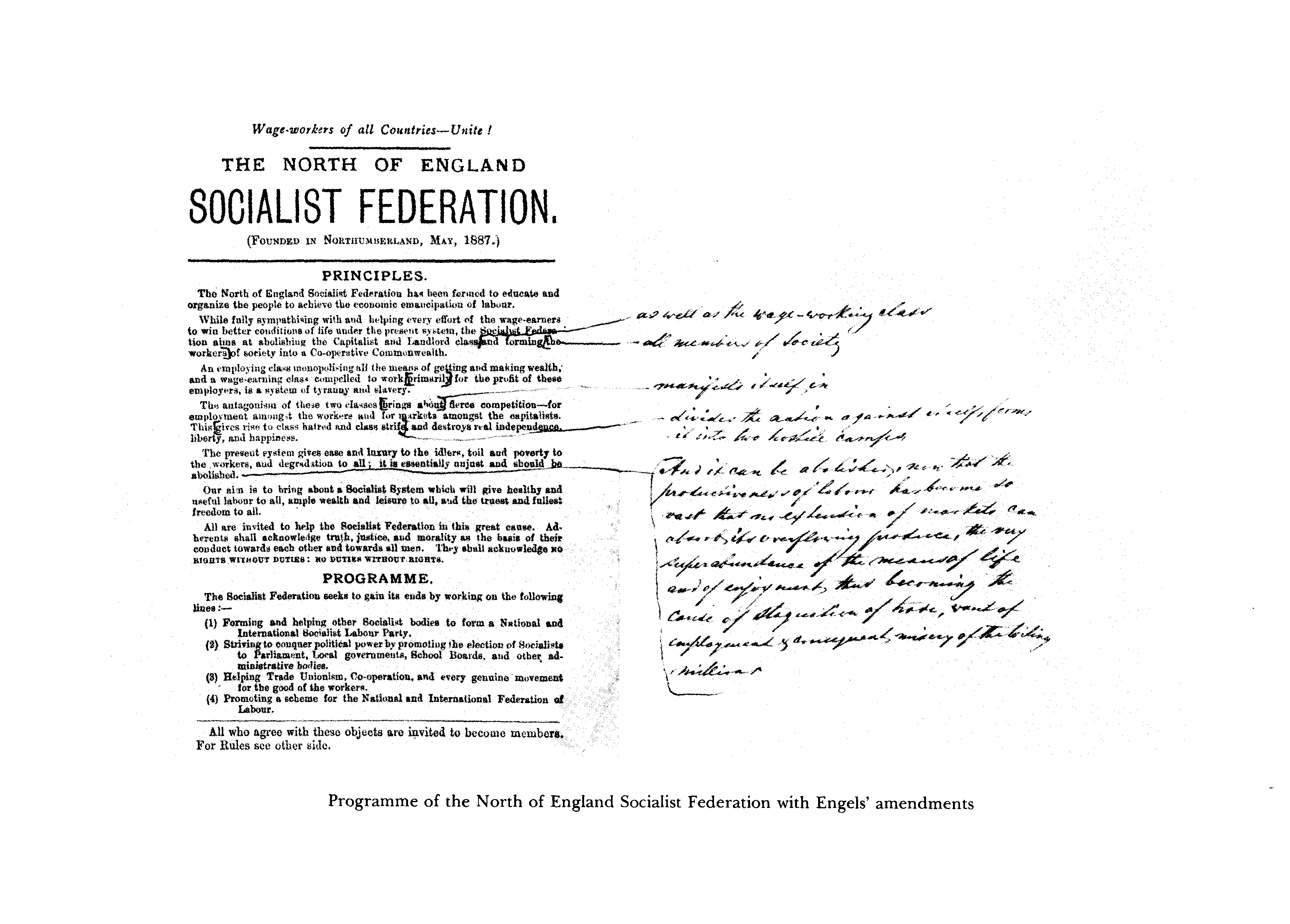
AU who agree with tbese objects are invited to become members. For Kulcs sei1 otber bkle. Programme of the North of England Socialist Federation with Engels' amendments
7. To the Editor of Justice[517]
Dear Comrade.—The Press has already announced that four German Socialists — Bernstein, Motteler, Schlueter and Tauscher, editors and publishers of the Zurich Sozial Demokrat,—have been expelled from Switzerland by the Federal Council of that country for "having abused the hospitality extended to them." This severe measure must appear all the more surprising, as the paper in question, during the eight years of its existence, has always carefully refrained from attacks upon Switzerland and Swiss institutions, and as its language generally has never been more moderate than during the last few months.
The official text of the order of expulsion giving the reasons upon which the Federal Council bases it, is now before us, and these reasons are surprising indeed. The Federal Council would make us believe that its attention was first called to the Sozial Demokrat, not by anything published by that paper itself, but by a comic paper, printed in the same office in January, 1887, of which only one number was bought! And yet the Sozial Demokrat from the first day of its publication had been watched with the greatest and most constant attention by the German authorities, and, at their request by the Swiss authorities.
The Federal Council having thus become aware of the necessity of watching the Sozial Demokrat, now found out, as it tells us, that this paper "was written in a generally violent language offensive to the authorities of the German Empire." That is to say, the paper did not proclaim actual and forcible resistance against the State power in Germany, much less in Switzerland. It merely stigmatised as such and called by their proper names, the infamies committed in Germany by the authors of the Anti-Socialist Law and their executive tools. That, however, is "abuse of hospitality" in a republic, which itself celebrates year by year in hundreds of commemorative festivals the homicidal act of William Tell, and brags of the asylum it offers to refugees of all nations.
In consequence of this violent language, we are further informed, an official warning was administered to the Sozial Demokrat, which, however, had not the desired effect. "Certainly the editors henceforth took care to avoid coarsely offensive expressions." But they declined "to change anything in the fundamental programme of the paper," and moreover they "reproduced articles which appeal to force, though accompanied by commentaries intended to make people believe in the moderation of the paper itself." To prove this latter grave offence, the Federal Council states that on April 7th, 1888, the Sozial Demokrat reprinted certain resolutions passed in 1866 — twenty-two years ago!—by 500 Germans in Zurich, resolutions calling upon the German people of that day to rise in arms against their government. In 1866 not one of the 500 Germans present at that meeting in Zurich was molested by the Federal Council on account of these resolutions. But if in 1888 the Sozial Demokrat merely states these facts, that is sufficient to expel from Switzerland four men connected with that paper.
Altogether the reasons given are ridiculous. But the fact is the Federal Council dared not state the real reasons for its actions: that Bismarck and Puttkamer, his home secretary, are furious at the German Social-Democrats in Switzerland having succeeded in unmasking a set of spies and agents provocateurs sent out by the German police in order to manufacture evidence to enable the government to demand the prolongation, and with increased stringency, of this Socialist Coercion Bill. The expulsion is Puttkamer's revenge for the defeat inflicted upon him by the Socialist members in the Reichstag and by the Sozial Demokrat, and the Federal Council acts as Puttkamer's humble servant. The expulsion of our comrades means the extension of the German Socialist Coercion Act to Switzerland; it means that the dynamitards of the Russian police will henceforth enjoy in Zurich the same official protection that is extended to them in Berlin.
The only country in Europe where a right of asylum may still be said to exist is England. No doubt Bismarck will try, as he has done before now, to draw England within the nets of his international political police and to place German Socialists, in England too, under his "petty state of siege." Will there be English statesmen prepared to meet him half way? If so, let us hope that English working men will know how to stop their government from playing the same abject and cowardly part now played by the Swiss Federal Council. I am, dear comrade, yours fraternally,
8. Interview Given by Frederick Engels to the New Yorker Volkszeitung[518]
Question: Is socialism in England moving forward — that is, do the English working men's organisations accept the socialist critique of economic development more readily than they used to, and do they aspire — to any extent worth mentioning — to the "ultimate aims" of socialism?
Engels: I am quite satisfied with the progress of socialism and the workers' movement in England; but this progress mainly consists in the development of the proletarian consciousness of the masses. The official workers' organisations, the trade unions, which were threatening in places to become reactionary, are obliged to limp along behind, like the Austrian Landsturm.[519]
Question: What is the position in this respect in Ireland? Is there anything there — apart from the national question — that could arouse hope among socialists?
Engels : A pure socialist movement cannot be expected from Ireland for quite a long time yet. First people want to become small landowning farmers, and when they are, along comes the mortgage and ruins them all over again. Meanwhile that is no reason why we shouldn't help them to free themselves from their landlords — that is, to make the transition from a semi-feudal to a capitalist condition.
Question: What is the attitude of the English workers to the Irish movement? Engels: The masses are for the Irish. The organisations, like the workers' aristocracy in general, follow Gladstone and the liberal bourgeois, and go no further than they.
Question: What do you think about Russia? That is, how far have you modified your view — which you and Marx expressed some six years ago when I (1) was in London — that because of the nihilist, terrorist successes of the day the impulse for a European revolutionary movement would probably come from Russia?(2)
Engels: On the whole I am still of the opinion that a revolution or even just the convocation of some kind of national assembly in Russia would revolutionise the whole European political situation. But today this is no longer the most obvious possibility. To make up for it, we have a new William.(3)
To the question of how he would characterise the present European situation, Engels answered: "I have not seen a European paper for seven weeks now, so I am in no position to characterise anything that is going on over there."
Endnotes
[502] The reference is to the first authorised French edition of Volume One of Capital. Under the agreement between Marx and publisher M. Lachâtre in February 1872, the work was to be published in instalments. It appeared between September 1872 and November 1875. When preparing this edition, Marx made changes and additions to nearly all parts of his work.
[503] This excerpt from the letter by Hermann Lopatin, a Russian revolutionary, to Maria Oshanina, a member of the Narodnaya Volya (People's Will) Executive, recounts his talk with Engels, naturally in his own interpretation, which bears the stamp of his Narodnik views based on Utopian peasant socialism and revolutionary democratism directed against autocracy. However, writing under a fresh impression from the talk, Lopatin obviously gives an accurate account of some of Engels' ideas. Lopatin and Engels met on September 19, 1883, several months after the former had escaped abroad from exile in Vologda. The excerpt was first published on Pyotr Lavrov's initiative and with Engels' permission in the book: The Foundations of Theoretical Socialism as Applied to Russia (in Russian), Geneva, 1893.
[504] Zemsky Sobor—a central representative institution of social estates in Russia in the mid-16th-late 17th centuries. Its composition, convocation and sessions were not strictly fixed and changed in the course of time. The interest in the convocation of the Zemsky Sobor at the end of the 19th century was evoked by hopes of limiting autocratic power and of changing the political system with the help of such representative institutions.
[505] The reference is to the letter addressed by the People's Will Executive to Tsar Alexander III on March 10, 1881 (after the events of March 1 of that year, when Tsar Alexander II had been assassinated by members of the organisation). The Executive agreed to renounce violence as a means of struggle on two conditions: 1) a general political amnesty, and 2) convocation of representatives of all the Russian people "to reconsider the existing forms of state and public life". The elections to the proposed Constituent Assembly were to be held on the basis of universal suffrage and guaranteed freedom of the press, speech, assembly and election manifestoes. The Executive further stated that it would comply with the decision of the future People's Assembly.
[506] The reference is to the Marx's ironic comment in the early 1880s on some sectarian and dogmatic mistakes made by the French Marxists in the struggle against the opportunist trend — Possibilism. Recollecting it, Engels wrote to Paul Lafargue on August 27, 1890 (present edition, Vol. 49) that Marx had said about these mistakes: "All I know is that I'm not a Marxist."
[508] See Note 350.
[509] See Note 432.
[510] Engels thought of writing this article in October 1886, when the book by the Austrian bourgeois sociologist and lawyer Anton Menger, Das Recht auf den vollen Arbeitsertrag in geschichtlicher Darstellung, was issued. Menger attempted to prove that Marx's economic theory was not original and that he had allegedly borrowed his conclusions from English Utopian socialists of the Ricardian school (Thompson et al.). Unable to ignore Menger's allegations and his falsification of the very essence of Marx's doctrine, Engels decided to reply in the press. However, fearing that a personal rebuttal may serve to give this third-rate scholar undeserved publicity, Engels considered it expedient to rebuke Menger through a Neue Zeit editorial or through a book review signed by the magazine's editor Karl Kautsky, and enlisted Kautsky's help in writing a piece against Menger. At first he intended to write the main part of the text himself, but fell ill and had to interrupt his work, so the piece was completed by Kautsky under Engels' instructions. It appeared anonymously in the Neue Zeit, No. 2, 1887; later, in the index to the magazine published in 1905, Engels and Kautsky were named as its authors. In 1904, the work was translated into French and printed by the Mouvement socialiste, No. 132, with Engels named as the author. The manuscript is not extant. Since it is impossible to ascertain which part of the work was written by Engels, and which by Kautsky, in the present edition it is published in full in the Appendices.
[511] See K. Marx, The Poverty of Philosophy. Answer to "The Philosophy of Poverty" by M. Proudhon (present edition, Vol. 6, pp. 105-212). In January 1849, Proudhon made an attempt to establish a "People's Bank" founded on the Utopian principles of "free" credit that he was expounding. The bank, through which Proudhon intended to effect peaceful social reform by abolishing loan interest and introducing money-free exchange based on the producer's receiving a full equivalent of his earned income, collapsed two months after its establishment.
[512] The reference is to the hostile campaign against Marx conducted in the 1870s by the German bourgeois economist Lujo Brentano, a leading representative of armchair socialism (see Note 289). He accused Marx of deliberately falsifying the phrase from Gladstone's speech delivered on April 16, 1863, which appeared on April 17 in almost all London newspaper reports of this parliamentary session {The Times, The Morning Star, The Daily Telegraph), but was omitted in Hansard's semi-official publication of parliamentary debates, in which the text was corrected by the speakers themselves. This gave Brentano a pretext for accusing Marx of unscrupulous misquotation. Marx retaliated in his letters to the Volksstaat editors on May 23 and July 28, 1872 (see present edition, Vol. 23, pp. 164-67 and 190-97). After Marx's death, the same accusation was made in November 1883 by the English bourgeois economist Taylor. It was disproved by Eleanor Marx in February and March 1884 in two letters to the To-Day magazine, and by Engels in June 1890 in his preface to the fourth German edition of Capital (see present edition, Vol. 35) and in 1891 in the pamphlet Brentano Contra Marx (present edition, Vol. 27).
[513] This inaccuracy in Marx's book was set right by Engels in the second German edition of The Poverty of Philosophy published in 1892. It also gave a more precise wording of the quotation used by Engels in the preface to the first German edition (see this volume, p. 280), and the correct date of the publication of Thompson's book.
[5] The great migration of peoples (Völkerwanderung)—a conventional name for mass intrusions of the Germanic, Slavic, Sarmatian and other peoples into the territory of the Roman Empire in the 4th-7th centuries, which led to the collapse of the Western Roman Empire and the transition from slavery to feudalism throughout the Roman Empire.
[515] The reference is to Aveling's letter of February 26, 1887 printed at the press and sent out to the sections of the Socialist Labor Party of North America and other socialist organisations. It was a detailed reply to the charges advanced against Aveling.
[516] Engels made the amendments to the programme of the North of England Socialist Federation at the request of John Lincoln Mahon, an English worker and socialist. In a letter to him of June 22, 1887, Engels voiced his appreciation of the programme, saying: "I consider it very good as a spontaneous working-class declaration of principles" (present edition, Vol. 48). Engels' amendments relate mainly to the introductory part of the programme; he made them on the leaflet containing the text of the programme. The North of England Socialist Federation—a workers' organisation set up in Northumberland (Northern England) on April 30, 1887 during a major miners' strike that lasted from late February to June 24, 1887. The organisation was sponsored by John Mahon, Thomas Binning, Alexander Donald, et al. Throughout 1887, the Federation conducted active work among the workers but failed to consolidate its initial success and soon ceased to exist.
[517] This letter, the original of which has recently been discovered by GDR researchers in the archive of the International Institute of Social History (Amsterdam), was written by Engels on the occasion of the expulsion from Switzerland, under pressure of the German authorities, of four leading editors and publishers of Der Sozialdemokrat, newspaper of the Social-Democratic Workers' Party of Germany, which was published in Zurich after the promulgation of the Anti-Socialist Law (see Note 174). The letter was to be sent out to the editorial boards of various newspapers for the purpose of informing English readers about the real causes and circumstances of this action by the Swiss Federal Council. When writing the letter, Engels most probably had the full text of the resolution on the expulsion, which he repeatedly quotes and which did not appear in Der Sozialdemokrat until April 28. Engels apparently believed that the letter should originate with German Social-Democrats, and so it was despatched bearing Kautsky's signature. Apart from Justice, on April 28, 1888 The Commonweal, press organ of the Socialist League, featured a note about "an interesting letter from a comrade on this subject" and gave a summary of it. Publications in other English papers have not been found.
[518] Engels gave this interview to a representative of the New Yorker Volkszeitung on September 19, 1888 at the end of his tour of the USA. Unwilling to meet certain members of German socialist organisations in America, towards which he had a negative attitude, Engels travelled incognito and did his best to avoid any kind of contacts with the press. However, Jonas, editor of the New Yorker Volkszeitung, who had learned about Engels' stay in New York, arranged an appointment for him with Theodor Cuno, former activist of the First International, as his representative. The interview was published by the newspaper without obtaining Engels' approval of the text. It was reprinted by the Chicagoer Arbeiter-Zeitung on September 25 and Wochenblatt der New Yorker Volkszeitung on September 29. Later, on October 13, it was also reprinted by the Sozialdemokrat.
[519] The Landsturm—an armed force, a second-rate militia, organised in Tyrol in 1809. In the 19th and the beginning of the 20th century, the Landsturm existed in Germany, Austria-Hungary, Holland, Switzerland and Sweden. It was called up in the event of national emergency (see also Note 386). p. 626