[I]
|sh.l| According to German ideologists, Germany has in the last few years gone through an unparalleled revolution. The decomposi-tion of the Hegelian system, which began with Strauss,[9] has developed into a universal ferment into which all the "powers of the past" are swept. In the general chaos mighty empires have arisen only to meet with immediate doom, heroes have emerged momen-tarily to be again hurled into obscurity by bolder and stronger rivals. It was a revolution beside which the French Revolution was child's play, a world struggle beside which the struggles of the Diadochi[10]
[ 1]
All this is supposed to have taken place in the realm of pure thought.
Certainly it is an interesting event we are dealing with: the putrescence of the absolute spirit. When the last spark of its life had failed, the various components of this caput mortuum(1) began to decompose, entered into new combinations and formed new substances. The industrialists of philosophy, who till then had lived on the exploitation of the absolute spirit, now seized upon the new combinations. Each with all possible zeal set about retailing his apportioned share. This was bound to give rise to competition, which, to start with, was carried on in moderately civil and staid fashion. Later, when the German market was glutted, and the commodity in spite of all efforts was not favourably received in the world market, the business was spoiled in the usual German manner by cheap and spurious production, deterioration in quality, adulteration of the raw materials, falsification of labels, fictitious purchases, bill-jobbing and a credit system devoid of any real basis. The competition turned into a bitter struggle, which is now being extolled and interpreted to us as an upheaval of world significance, the begetter of the most prodigious results and achievements.
If we wish to rate at its true value this philosophic charlatanry, which awakens even in the breast of the righteoifS German citizen a glow of patriotic feeling, if we wish to bring out clearly the pettiness, the parochial narrowness of this whole Young-Hegelian movement and in particular the tragicomic contrast between the illusions of these heroes about their achievements and the actual achievements themselves, we must look at the whole spectacle from a standpoint beyond the frontiers of Germany.(2)
[ l. J Ideology in General, German Ideology in Particular
|sh.2| German criticism has, right up to its latest efforts, never left the realm of philosophy. It by no means examines its general philosophic premises, but in fact all its problems originate in a definite philosophical system, that of Hegel. Not only in its answers, even in its questions there was a mystification. This dependence on Hegel is the reason why not one of these modern critics has even attempted a comprehensive criticism of the Hegelian system, however much each professes to have advanced beyond Hegel. Their polemics against Hegel and against one another are confined to this — each takes one aspect of the Hegelian system and turns this against the whole system as well as against the aspects chosen by the others. To begin with they took pure, unfal-sified Hegelian categories such as "substance" and "self-consciousness"/ later they secularised these categories by giving them more profane names such as "species", "the unique", "man",b etc.
The entire body of German philosophical criticism from Strauss to Stirner is confined to criticism of religious conceptions.(1) The critics started from real religion and theology proper. What religious consciousness and religious conception are was subsequently defined in various ways. The advance consisted in including the allegedly dominant metaphysical, political, juridical, moral and other conceptions under the category of religious or theological conceptions; and similarly in declaring that political, juridical, moral consciousness was religious or theological consciousness, and that the political, juridical, moral man—"Man" in the last resort — was religious. The dominance of religion was presupposed. Gradually every dominant relationship was declared to be a religious relationship and transformed into a cult, a cult of law, a cult of the state, etc. It was throughout merely a question of dogmas and belief in dogmas. The world was sanctified to an ever-increasing extent till at last the venerable Saint Maxc was able to canonise it en bloc and thus dispose of it once for all.
The Old Hegelians had understood everything as soon as it was
science, does not concern us here; but we will have to examine the history of men, since almost the whole ideology amounts either to a distorted conception of this history or to a complete abstraction from it. Ideology is itself only one of the aspects of this history.
[There follows a passage dealing with the premises of the materialist conception of history. It is not crossed out and in this volume it is reproduced as Section 2; see pp. 31-32.] reduced to a Hegelian logical category. The Young Hegelians criticised everything by ascribing religious conceptions to it or by declaring that it is a theological matter. The Young Hegelians are in agreement with the Old Hegelians in their belief in the rule of religion, of concepts, of a universal principle in the existing world. Except that the one party attacks this rule as usurpation, while the other extols it as legitimate.
Since the Young Hegelians consider conceptions, thoughts, ideas, in fact all the products of consciousness, to which they attribute an independent existence, as the real chains of men (just as the Old Hegelians declare them the true bonds of human society), it is evident that the Young Hegelians have to fight only against these illusions of consciousness. Since, according to their fantasy, the relations of men, all their doings, their fetters and their limitations are products of their consciousness, the Young Hegelians logically put to men the moral postulate of exchanging their present consciousness for human, critical or egoistic consciousness,3 and thus of removing their limitations. This demand to change consciousness amounts to a demand to interpret the existing world in a different way, i.e., to recognise it by means of a different interpretation. The Young-Hegelian ideologists, in spite of their allegedly "world-shattering"0 phrases, are the staunchest conservatives. The most recent of them have found the correct expression for their activity when they declare they are only fighting against "phrases". They forget, however, that they themselves are opposing nothing but phrases to these phrases, and that they are in no way combating the real existing world when they are combating solely the phrases of this world. The only results which this philosophic criticism was able to achieve were a few (and at that one-sided) elucidations of Christianity from the point of view of religious history; all the rest of their assertions are only further embellishments of their claim to have furnished, in these unimportant elucidations, discoveries of world-historic importance.
It has not occurred to any one of these philosophers to inquire into the connection of German philosophy with German reality, the connection of their criticism with their own material surroundings.0
[ 2. Premises of the Materialist Conception of History]
| p. 31 The premises from which we begin are not arbitrary ones, not dogmas, but real premises from which abstraction can only be made in the imagination. They are the real individuals, their activity and the material conditions of their life, both those which they find already existing and those produced by their activity. These premises can thus be | p. 41 verified in a purely empirical way.
The first premise of all human history is, of course, the existence of living human individuals.(1) Thus the first fact to be established is the physical organisation of these individuals and their consequent relation to the rest of nature. Of course, we cannot here go either into the actual physical nature of man, or into the natural conditions in which man finds himself — geological, oro-hydrographical, climatic and so on.(2) All historical writing must set out from these natural bases and their modification in the course of history through the action of men.
Men can be distinguished from animals by consciousness, by religion or anything else you like. They themselves begin to distinguish themselves from animals as soon as they begin to produce their means of subsistence, a step which is conditioned by their physical organisation. By producing their means of subsistence men are indirectly producing their material life.
The way in which men produce their means of subsistence depends first of all on the nature of the means of subsistence they actually find in existence and have to reproduce.
| p. 51 This mode of production must not be considered simply as being the reproduction of the physical existence of the individuals. Rather it is a definite form of activity of these individuals, a definite form of expressing their life, a definite mode of life on their part. As individuals express their life, so they are. What they are, therefore, coincides with their production, both with what they produce and with how they produce. Hence what individuals are depends on the material conditions of their production.
This production only makes its appearance with the increase of population. In its turn this presupposes the intercourse [Verkehr][11] of individuals with one another. The form of this intercourse is again determined by production.
[ 3. Production and Intercourse. Division of Labour and Forms of PropertyŠ Tribal, Ancient, Feudal]
[sh.3| The relations of different nations among themselves depend upon the extent to which each has developed its productive forces, the division of labour and internal intercourse. This proposition is generally recognised. But not only the relation of one nation to others, but also the whole internal structure of the nation itself depends on the stage of development reached by its production and its internal and external intercourse. How far the productive forces of a nation are developed is shown most manifestly by the degree to which the division of labour has been carried. Each new productive force, insofar as it is not merely a quantitative extension of productive forces already known (for instance, the bringing into cultivation of fresh land), causes a further development of the division of labour.
The division of labour inside a nation leads at first to the separation of industrial and commercial from agricultural labour, and hence to the separation of town and country and to the conflict of their interests. Its further development leads to the separation of commercial from industrial labour. At the same time through the division of labour inside these various branches there develop various divisions among the individuals co-operating in definite kinds of labour. The relative position of these individual groups is determined by the way work is organised in agriculture, industry and commerce (patriarchalism, slavery, estates, classes). These same conditions are to be seen (given a more developed intercourse) in the relations of different nations to one another.
The various stages of development in the division of labour are just so many different forms of property, i.e., the existing stage in the division of labour determines also the relations of individuals to one another with reference to the material, instrument and product of labour.
The first form of property is tribal property [Stammeigentum].[12] It corresponds to the undeveloped stage of production, at which a people lives by hunting and fishing, by cattle-raising or, at most, by agriculture. In the latter case it presupposes a great mass of uncultivated stretches of land. The division of labour is at this stage still very elementary and is confined to a further extension of the natural division of labour existing in the family. The social structure is, therefore, limited to an extension of the family: patriarchal chieftains, below them the members of the tribe, finally slaves. The slavery latent in the family only develops gradually with the increase of population, the growth of wants, and with the extension of external intercourse, both of war and of barter.
The second form is the ancient communal and state property, which proceeds especially from the union of several tribes into a city by agreement or by conquest, and which is still accompanied by slavery. Beside communal property we already find movable, and later also immovable, private property developing, but as an abnormal form subordinate to communal property. The citizens hold power over their labouring slaves only in their community, and even on this account alone they are bound to the form of communal property. It constitutes the communal private property of the active citizens who, in relation to their slaves, are compelled to remain in this spontaneously derived form of association. For this reason the whole structure of society based on this communal property, and with it the power of the people, decays in the same measure in which immovable private property evolves. The division of labour is already-more developed. We already find the opposition of town and country; later the opposition between those states which represent town interests and those which represent country interests, and inside the towns themselves the opposition between industry and maritime commerce. The class relations between citizens and slaves are now completely developed.
With the development of private property, we find here for the first time the same relations which we shall find again, only on a more extensive scale, with modern private property. On the one hand, the concentration of private property, which began very early in Rome (as the Licinian agrarian law proves) and proceeded very rapidly from the time of the civil wars and especially under the emperors [13]; on the other hand, coupled with this, the transformation of the plebeian small peasantry into a proletariat, which, however, owing to its intermediate position between propertied citizens and slaves, never achieved an independent development.
The third form is feudal or estate property. If antiquity started out from the town and its small territory, the Middle Ages started out from the country. This different starting-point was determined by the sparseness of the population at that time, which was scattered over a large area and which received no large increases from the conquerors. In contrast to Greece and Rome, feudal development, therefore, begins over a much wider territory, prepared by the Roman conquests and the spread of agriculture at first associated with them. The last centuries of the declining Roman Empire and its conquest by the barbarians destroyed a considerable part of the productive forces; agriculture had declined, industry had decayed for want of a market, trade had died out or been violently interrupted, the rural and urban population had decreased. These conditions and the mode of organisation of the conquest determined by them, together with the influence of the Germanic military constitution, led to the development of feudal property. Like tribal and communal property, it is also based on a community; but the directly producing class standing over against it is not, as in the case of the ancient community, the slaves, but the enserfed small peasantry. As soon as feudalism is fully developed, there also arises antagonism to the towns. The hierarchical structure of landownership, and the armed bodies of retainers associated with it, gave the nobility power over the serfs. This feudal organisation was, just as much as the ancient communal property, an association against a subjected producing class; but the form of association and the relation to the direct producers were different because of the different conditions of production.
This feudal structure of landownership had its counterpart in the towns in the shape of corporative property, the feudal organisation of trades. Here property consisted |sh.4| chiefly in the labour of each individual. The necessity for associating against the association of the robber-nobility, the need for communal covered markets in an age when the industrialist was at the same time a merchant, the growing competition of the escaped serfs swarming into the rising towns, the feudal structure of the whole country: these combined to bring about the guilds. The gradually accumulated small capital of individual craftsmen and their stable numbers, as against the growing population, evolved the relation of journeyman and apprentice, which brought into being in the towns a hierarchy similar to that in the country.
Thus property during the feudal epoch primarily consisted on the one hand of landed property with serf labour chained to it, and on the other of the personal labour of the individual who with his small capital commands the labour of journeymen. The organisation of
[ 4. The Essence of the Materialist Conception of History. Social Being and Social Consciousness]
materially, and hence as they work under definite material limits, presuppositions and conditions independent of their will.(1)
The production of ideas, of conceptions, of consciousness, is at first directly interwoven with the material activity and the material intercourse of men — the language of real life. Conceiving, thinking, the mental intercourse of men at this stage still appear as the direct efflux of their material behaviour. The same applies to mental production as expressed in the language of the politics, laws, morality, religion, metaphysics, etc., of a people. Men are the producers of their conceptions, ideas, etc., that is, real, active men, as they are conditioned by a definite development of their productive forces and of the intercourse corresponding to these, up to its furthest forms.(2) Consciousness [das Bewusstsein] can never be anything else than conscious being [das bewusste Sein], and the being of men is their actual life-process. If in all ideology men and their relations appear upside-down as in a camera obscura, this phenomenon arises just as much from their historical life-process as the inversion of objects on the retina does from their physical life-process.
In direct contrast to German philosophy which descends from heaven to earth, here it is a matter of ascending from earth to heaven. That is to say, not of setting out from what men say, imagine, conceive, nor from men as narrated, thought of, imagined, conceived, in order to arrive at men in the flesh; but setting out from real, active men, and on the basis of their real life-process demonstrating the development of the ideological reflexes and echoes of this life-process. The phantoms formed in the brains of men are also, necessarily, sublimates of their material life-process, which is empirically verifiable and bound to material premises. Morality, religion, metaphysics, and all the rest of ideology as well as the forms of consciousness corresponding to these, thus no longer retain the semblance of independence. They have no history, no development; but men, developing their material production and their material intercourse, alter, along with this their actual world, also their thinking and the products of their thinking. It is not consciousness that determines life, but life that determines consciousness. For the first manner of approach the starting-point is consciousness taken as the living individual; for the second manner of approach, which conforms to real life, it is the real living individuals themselves, and consciousness is considered solely as their consciousness.
This manner of approach is not devoid of premises. It starts out from the real premises and does not abandon them for a moment. Its premises are men, not in any fantastic isolation and fixity, but in their actual, empirically perceptible process of development under definite conditions. As soon as this active life-process is described, history ceases to be a collection of dead facts, as it is with the empiricists (themselves still abstract), or an imagined activity of imagined subjects, as with the idealists.
Where speculation ends, where real life starts, there consequently begins real, positive science, the expounding of the practical activity, of the practical process of development of men. Empty phrases about consciousness end, and real knowledge has to take their place. When the reality is described, a self-sufficient philosophy [die selbständige Philosophie] loses its medium of existence. At the best its place can only be taken by a summing-up of the most general results, abstractions which are derived from the observation of the historical development of men. These abstractions in themselves, divorced from real history, have no value whatsoever. They can only serve to facilitate the arrangement of historical material, to indicate the sequence of its separate strata. But they by no means afford a recipe or schema, as does philosophy, for neatly trimming the epochs of history. On the contrary, the difficulties begin only when one sets about the examination and arrangement of the material — whether of a past epoch or of the present — and its actual presentation. The removal of these difficulties is governed by premises which certainly cannot be stated here, but which only the study of the actual life-process and the activity of the individuals of each epoch will make evident. We shall select here some of these abstractions, which we use in contradistinction to ideology, and shall illustrate them by historical examples.(3)
Endnotes
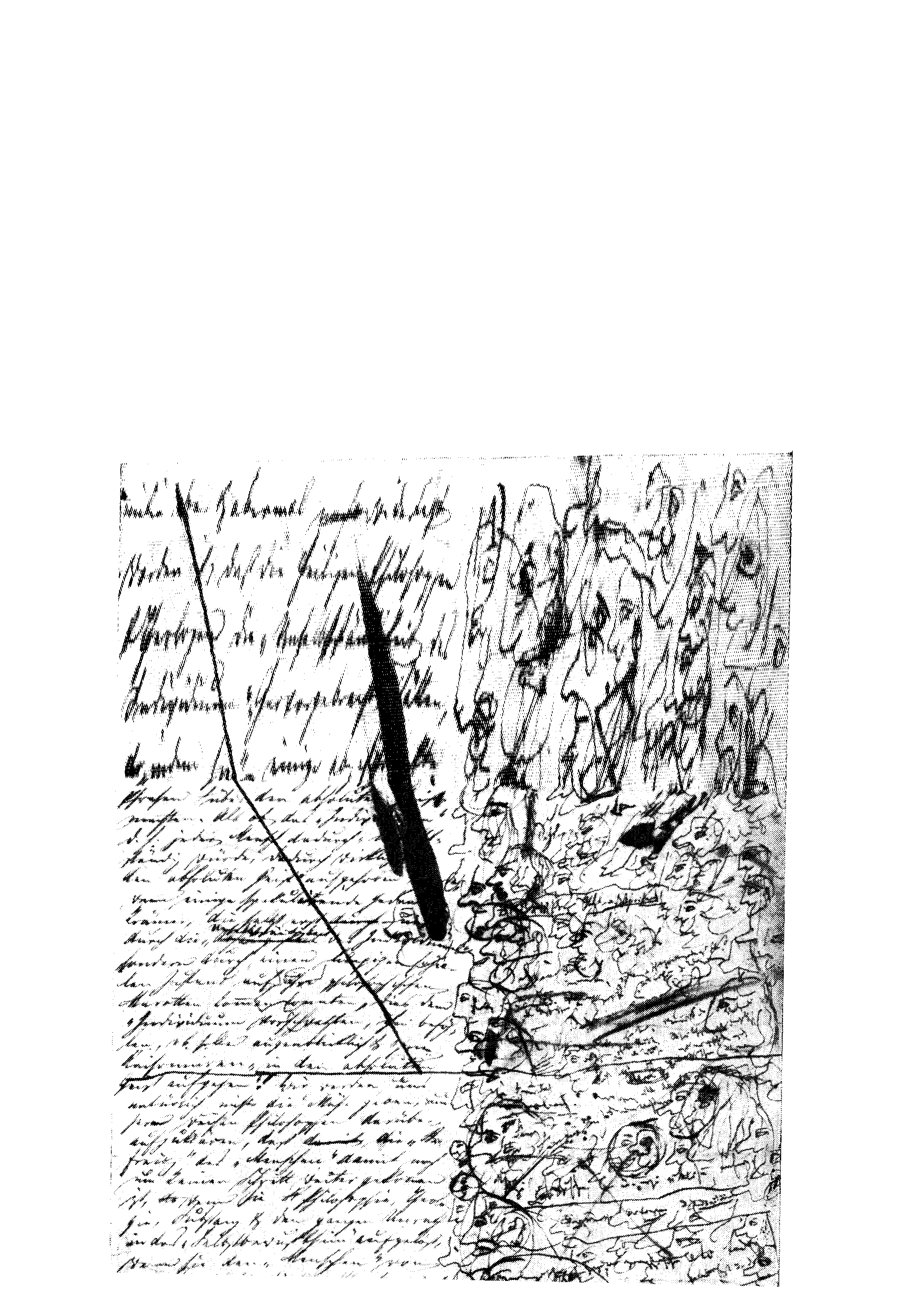
[8] The manuscript of Chapter I of the first volume of The German Ideology has come down to us in the form of several separate passages written at different times and in different circumstances. This is due to changes which Marx and Engels made in the general plan of the book as the work proceeded. Originally Marx and Engels began writing a purely critical work dealing simultaneously with Ludwig Feuerbach, Bruno Bauer and Max Stirner. Then they decided to discuss Bruno Bauer and Max Stirner in separate chapters ("II. Saint Bruno" and "III. Saint Max"), and the first chapter was conceived as a general introduction stating their own views in opposition to Feuerbach's. Therefore they crossed out nearly all passages referring to Bauer and Stirner in the original manuscript and transferred them to chapters II or III. Thus, the chronologically first part, which formed the original nucleus of the chapter on Feuerbach (29 pages numbered by Marx), took shape. Then they wrote Chapter II and began to work on Chapter III. In the course of their critical analysis of Stirner's book Der Einzige und sein Eigenthum, Marx and Engels made various theoretical digressions in which they developed their materialist conception of history. Two of these digressions were subsequently transferred by them from the chapter on Stirner to that on Feuerbach. The first — consisting of 6 pages — was written in connection with the criticism of Stirner's idealist view that history was dominated by spirit (this digression was originally in the section "D. Hierarchy"; see this volume, p. 175). The second theoretical digression — consisting of 37 pages — was written in connection with the criticism of Stirner's views of bourgeois society, competition and the interrelation between private property, state and law (this latter passage from the chapter on Stirner was replaced by another; see this volume, p. 355, etc.). These two digressions formed the chronologically second and third parts of the chapter on Feuerbach. The pages of these three parts were numbered by Marx (1 to 72) and thus form the rough copy of the whole chapter. Pages 3-7 and 36-39 of the manuscript have not been found. Marx and Engels then started revising the rough copy and writing out a clean copy, the beginning of which exists in two versions. We have thus four more or less independent parts of the manuscript (three parts of rough copy and one of clean copy). In the present edition the chapter on Feuerbach is accordingly divided into four parts. Part I consists of the combined fragments of the clean copy. Part II comprises the original nucleus of the whole chapter. Parts III and IV are the two theoretical digressions transferred from the chapter on Stirner. Each part is a consistent, logically coherent whole. The parts complement one another and together they are a comprehensive exposition of the materialist conception of history. The content of the four parts can be summarised in the following way: I. Introduction, general remarks concerning the idealism of German post-Hegelian philosophy. Premises, essence and general outline of the materialist conception of history. II. Materialist conception of historical development and conclusions from the materialist conception of history. Criticism of the idealist conception of history in general, criticism of the Young Hegelians and Feuerbach in particular. III. Origin of the idealist conception of history. IV. Development of the productive forces, of the division of labour and of the forms of property. The class structure of society. The political superstructure. Forms of social consciousness. Comparison of the different parts of the manuscript makes it possible to bring out the logical structure of the chapter, form an idea of the authors' intentions and reconstruct the general plan of the chapter. First Marx and Engels give a general description of German ideology, then they counterpose the materialist conception of history to the idealist conception, and, finally, criticise the latter. The central part of the chapter has the following structure: the authors' premises; their materialist conception of history; the conclusions following from their theory. The materialist conception of history is presented as follows: development of production — intercourse (social relations)—political superstructure— forms of social consciousness. On the whole, the plan of the chapter, recon-structed in accordance with the intentions of Marx and Engels, can be formulated thus: 1) General description of German ideology (Part I, introductory remarks and Section 1; Part II, Section 1). 2) Premises of the materialist conception of history (Part I, Section 2). 3) Production (Part II, Sections 3-5; Part I, Section 3; Part IV, Sections 1-5), intercourse (Part IV, Sections 6-10), political superstructure (Part IV, Section 11), forms of social consciousness (Part III, Section 1; Part IV, Section 12). 4) Conclusions from and summary of the materialist conception of history (Part II, Sections 6-7; Part I, Section 4). 5) Critique of the idealist conception of history in general, and of the Young Hegelians and Feuerbach in particular (Part II, Sections 8-9 and 2; Part III, Section 1). In the manuscript the chapter as a whole has the heading: "I. Feuerbach." While sorting out Marx's papers after his death in 1883, Engels found among them the manuscript of The German Ideology and reread it. At the end of the first chapter he made the note: "I. Feuerbach. Opposition of the materialist and idealist outlooks." The parts of this chapter are subdivided into sections. These subdivisions have been made by the editors,who also supplied most of the headings. All headings supplied by the editors and all editorial insertions are enclosed in square brackets. The pages of the manuscript are indicated in this volume. The sheets of the clean copy, partly numbered by Engels (sheets 3 and 5), are indicated thus: |sh. 11, |sh. 2 j, etc. The pages of the first version of the beginning of the clean copy, which were not numbered by the authors, are indicated thus: [p. 11, p. 21, etc. The pages of the three rough drafts, which were numbered by Marx, are indicated thus: NI, 2|, etc. The arrangement of the different parts of the manuscript within Chapter I and its subdivision into sections are the same as in the Russian version first published in the journal Voprosy Filosofii (Questions of Philosophy), Nos. 10 and 11, Moscow, 1965. In English this version was first published by Progress Publishers in Vol. 1 of Karl Marx and Frederick Engels, Selected Works (in three volumes), Moscow, 1969.
[9] A reference to David Friedrich Strauss' main work, Das Leben Jesu (Bd. 1-2, Tübingen, 1835-1836); with it began the philosophical criticism of religion and the disintegration of the Hegelian school into Old and Young Hegelians.
[10] Diadochi — the generals of Alexander the Great who, after his death, fought one another in a fierce struggle for power. In the course of this struggle (end of the 4th and the beginning of the 3rd century B.C.) Alexander's Empire, an unstable military and administrative union, disintegrated into several independent states.
[11] In The German Ideology the term " Verkehr" ("intercourse") is used in a very broad sense. It comprises both the material and spiritual intercourse of individuals, social groups and whole countries. Marx and Engels show that material intercourse, and above all the intercourse of men in the process of production, is the basis of all other forms of intercourse. The terms Verkehrsform (form of intercourse), Verkehrsweise (mode of intercourse), Verkehrsverhältnisse (relations of intercourse) and Produktions- und Verkehrsverhältnisse (relations of production and intercourse) are used by Marx and Engels in The German Ideology to express the concept "relations of production", which at that time was taking shape in their minds.
[12] The term "Stamm" used by Marx and Engels has been translated as "tribe" in this volume. It had a wider range of meaning at the time of the writing of The German Ideology than it has at present. It was used to denote a community of people descended from a common ancestor, and comprised the modern concepts of "gens" and "tribe". The first to define and differentiate these concepts was the American ethnologist and historian Lewis Henry Morgan in his main work Ancient Society; or, Researches in the Lines of Human Progress from Savagery Through Barbarism to Civilisation ( 1877). Morgan showed for the first time the significance of the gens as the primary cell of the primitive communal system and thereby laid the scientific foundations for the history of primitive society as a whole. In his work The Origin of the Family, Private Property and the State (1884) Engels showed the far-reaching significance of Morgan's discoveries and his concepts "gens" and "tribe" for the study of primitive society.
[13] The agrarian law proposed by Licinius and Sextius, Roman tribunes of the people, was passed in 367 B.C. as a result of the struggle waged by the plebeians against the patricians. It prohibited Roman citizens from holding more than 500 jugera (about 309 acres) of common land (ager publicus). By civil wars in Rome is usually meant the struggle between various groups of the Roman ruling class which started at the end of the 2nd century B.C. and continued until 30 B.C. These wars, together with the growing class contradictions and slave revolts, accelerated the decline of the Roman Republic and led to the establishment, in 30 B.C., of the Roman Empire.