Preface..
Hitherto men have always formed wrong ideas about themselves, about what they are and what they ought to be. They have arranged their relations according to their ideas of God, of normal man, etc. The products of their brains have got out of their hands. They, the creators, have bowed down before their creations. Let us liberate them from the chimeras, the ideas, dogmas, imaginary beings under the yoke of which they are pining away. Let us revolt against this rule of concepts. Let us teach men, says one,(1) how to exchange these imaginations for thoughts which correspond to the essence of man; says another,(2) how to take up a critical attitude to them; says the third,(3) how to get them out of their heads; and existing reality will collapse.
These innocent and child-like fancies are the kernel of the modern Young-Hegelian philosophy, which not only is received by the German public with horror and awe, but is announced by our philosophic heroes with the solemn consciousness of its world-shattering danger and criminal ruthlessness. The first volume of the present publication has the aim of uncloaking these sheep, who take themselves and are taken for wolves; of showing that their bleating merely imitates in a philosophic form the conceptions of the German middle class; that the boasting of these philosophic commentators only mirrors the wretchedness of the real conditions in Germany. It is its aim to ridicule and discredit the philosophic struggle with the shadows of reality, which appeals to the dreamy and muddled German nation.
Once upon a time a valiant fellow had the idea that men were drowned in water only because they were possessed with the idea of gravity. If they were to get this notion out of their heads, say by avowing it to be a superstitious, a religious concept, they would be sublimely proof against any danger from water. His whole life long he fought against the illusion of gravity, of whose harmful consequences all statistics brought him new and manifold evidence. This valiant fellow was the type of the new revolutionary philosophers in Germany.*
* [The following passage is crossed out in the manuscript:] There is no specific difference between German idealism and the ideology of all the other nations. The latter too regards the world as dominated by ideas, ideas and concepts as the determining principles, and certain notions as the mystery of the material world accessible to the philosophers.
Hegel completed positive idealism. He not only turned the whole material world into a world of ideas and the whole of history into a history of ideas. He was not content with recording thought entities, he also sought to describe the act of creation.
Roused from their world of fancy, the German philosophers protest against the world of ideas to which they [...] the conception of the real, material [...]
All the German philosophical critics assert that the real world of men has hitherto been dominated and determined by ideas, images, concepts, and that the real world is a product of the world of ideas. This has been the case up to now, but it ought to be changed. They differ from each other in the manner in which they intend to deliver mankind, which in their opinion is groaning under the weight of its own fixed ideas; they differ in respect of what they proclaim to be fixed ideas; they agree in their belief in the hegemony of ideas, they agree in the belief that the action of their critical reason must bring about the destruction of the existing order of things: whether they consider their isolated rational activity sufficient or want to conquer universal consciousness.
The belief that the real world is the product of the ideal world, that the world of ideas [...]
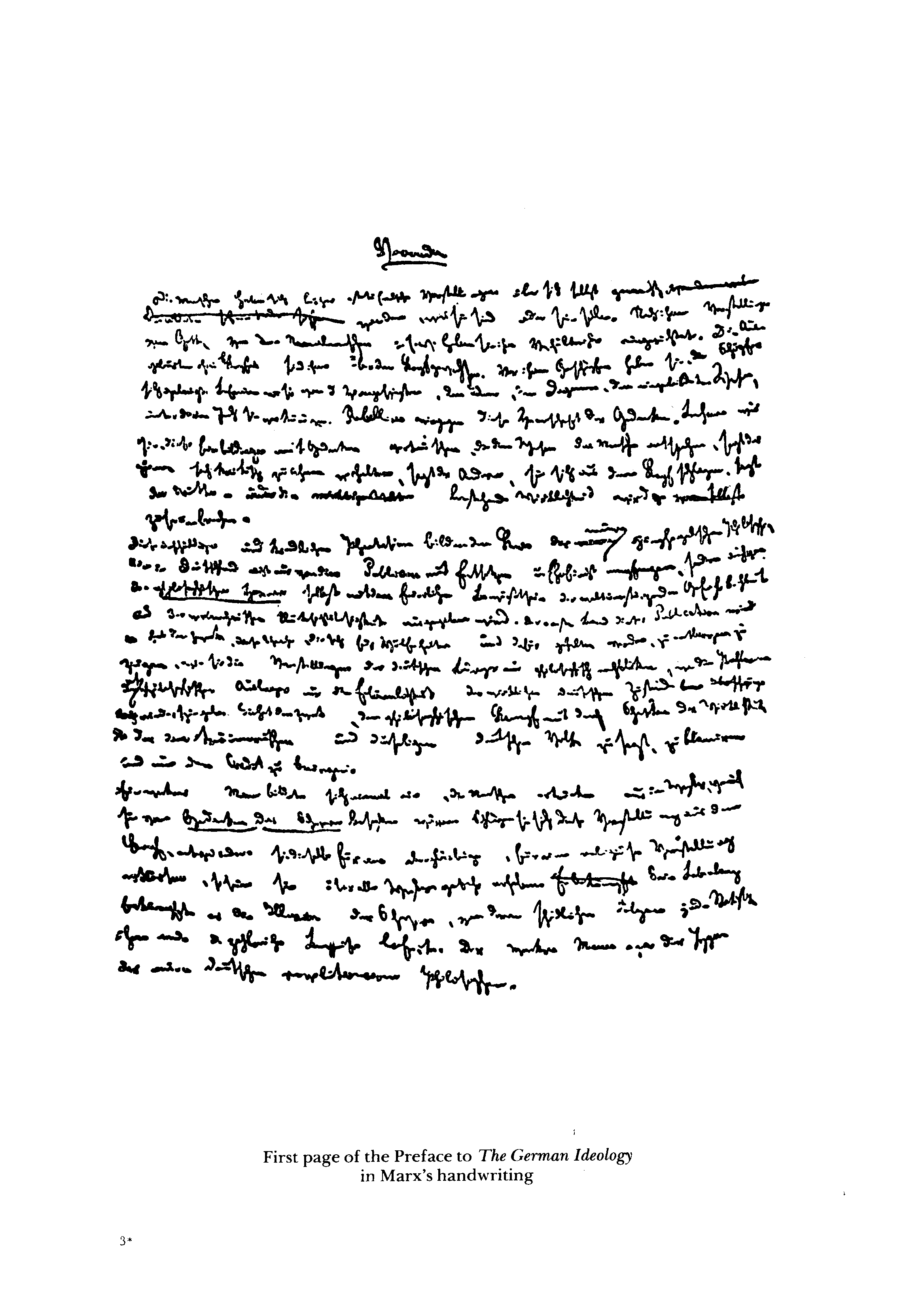
First page of the Preface to The German Ideology in Marx's handwriting