Chemistry
* * *
The motion of an actual chemically uniform matter – ancient as it is – fully corresponds to the childish view, widely held even up to Lavoisier, that the chemical affinity of two bodies depends on each one containing a common third body. (Kopp, Entwickelung, p. 105.)[245]
* * *
How old, convenient methods, adapted to previously customary practice, become transferred to other branches and there are a hindrance: in chemistry, the calculation of the composition of compounds in percentages, which was the most suitable method of all for making it impossible to discover the laws of constant proportion and multiple proportion in combination, and indeed did make them undiscoverable for long enough.
* * *
The new epoch begins in chemistry with atomistics (hence Dalton, not Lavoisier, is the father of modern chemistry), and correspondingly in physics with the molecular theory (in a different form, but essentially representing only the other side of this process, with the discovery of the transformation of the forms of motion). The new atomistics is distinguished from all previous to it by the fact that it does not maintain (idiots excepted) that matter is merely discrete, but that the discrete parts at various stages (ether atoms, chemical atoms masses, heavenly bodies) are various nodal points which determine the various qualitative modes of existence of matter in general – right down to weightlessness and repulsion.
* * *
Transformation of quantity into quality: the simplest example oxygen and ozone, where 2:3 produces quite different properties, even in regard to smell. Chemistry likewise explains the other allotropic bodies merely by a difference in the number of atoms in the molecule.
* * *
The significance of names. In organic chemistry the significance of a body, hence also its name, is no longer determined merely by its composition, but rather by its position in the series to which it belongs. If we find, therefore, that a body belongs to such a series, its old name becomes an obstacle to understanding it and must be replaced by a series name (paraffins, etc.).
Endnotes
224. Engels is referring to Clausius’s lecture “On the Second Law of the Mechanical Theory of Heat,” delivered in Frankfort-on-Main, September 23, 1867, at the 41st Congress of German Natural Scientists and Physicians, and published in book form in Braunschweig the same year.
225. This and the two following notes consist of extracts from the following books: J. H. Madler, Der Wunderbau des Weltalls, oder Populäre Astronomie, 5. Auflage, Berlin, 1861. (Sections IX and X); A. Secchi, Die Sonne, Braunschweig, 1872, Part III. Engels made use of these extracts in 1876 in the second part of Introduction to Dialectics of Nature.
226. Engels is referring to Rudolf Wolf’s book Geschichte der Astronomie, München, 1877 (see Note 124). On p. 325 of this book Wolf asserts that the law of the refraction of light was discovered not by Descartes but by Snell who formulated it in his unpublished works, from which Descartes subsequently (after Snell’s death) took it.
227. Engels is referring to Julius Robert Mayer’s book Die Mechanik der Wärme in gesammelten Schriften, 2. Auflage, Stuttgart, 1874, S. 328, 330.
228. Francis Bacon, Novum Organum (Francis Bacon, The New Organon), Book 11, Aphorism XX, published in London in 1620.
229. Cf. Hegel’s remark that force “has no other content than the phenomenon itself” and that this content expresses itself only “in the form of into-reflected determination or force,” the result being an “empty tautology” (Hegel, Science of Logic, Book II, Section I, Ch. 3, Observation on the formal method of explanation from tautological grounds).
230. G. W, F. Hegel, Philosophy of Nature, § 266, Observation.
231. Engels is referring to Lavrov’s book Onum ucmopuu muclu (Attempt at a History of Thought), Vol. 1, published anonymously in St. Petersburg in 1875. On page 109 of this book in the chapter “The Cosmic Basis of the History of Thought,” Lavrov writes: “Dead suns with their dead systems of planets and satellites continue their motion in space as long as they do not fall into a new nebula in process of formation. Then the remains of the dead world be come material for hastening the process of formation of the new world.” In a footnote Lavrov quotes the opinion of Zollner that the state of torpor of extinct heavenly bodies “can be ended only by external influences, e.g., by the heat evolved on collision with some other body.”
232. See Note 224.
233. See Note 224.
234. Engels is evidently referring to page 16 of the above pamphlet, where Clausius incidentally mentions the ether as existing outside the heavenly bodies. Here again, on p. 6, it is a question of the same ether, though not outside bodies but in the interstices between the most minute constituent particles of the bodies.
235. Horror vacui, abhorrence of a vacuum. The view, dating from Aristotle, that “nature abhors the void,” that is, does not allow a vacuum to form, prevailed in natural science till the mid-seventeenth century. This “abhorrence” was given, among other things, as the reason why the water rises in a piston. In 1643 Torricelli discovered atmospheric pressure and thereby refuted the Aristotelian notion of the impossibility of a vacuum.
236. Engels wrote Lavrov’s name in Russian characters. Engels is referring to Lavrov’s book Onum ucmopuu muclu (See Note 231). In the chapter “The Cosmic Basis of the History of Thought,” Lavrov mentions the views of various scientists (Albers, V. Struve) on the extinction of light coming from very great distances (pp. 103-04).
237. Gospel according to St. John, 1.
238. Fick, Die Naturkrafte in ihrer Wechselbeziehung (The Interaction of Natural Forces), Wurzburg, 1869.
239. Maxwell, Theory of Heat, Fourth Edition, London, 1875, pp. 87, 185.
240. Engels is referring to the diagram on page 632 of Secchi’s book, showing the relationship between the length of the wave and the intensity of the thermal, luminar and chemical actions of the sunrays, the main portion of which is reproduced below:
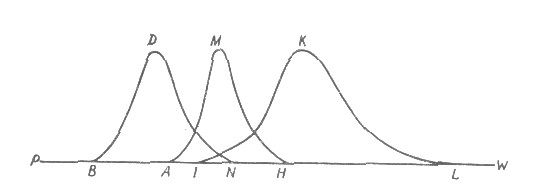
The curve BDN represents the intensity of heat radiation, from the longest wave heat-rays (at point B) to the shortest wave rays (at point N). The curve AMH represents the intensity of light radiation, from the longest wave rays (at point A) to the shortest wave rays (at point H). The curve IKL represents the intensity of chemical rays, from the longest wave rays (at point 1) to the shortest wave rays (at point L). In all three cases the intensity of the rays is shown by the distance of the point on the curve from the line PW.
241. Engels is referring to Hegel’s Philosophy of Nature, Berlin edition, 1842, § 320, Addendum.
242. Here and further on Engels quotes from Th. Thomson’s book, An Outline of the Sciences of Heat and Electricity, 2nd edition, London, 1840. Engels made use of these quotations in the chapter “Electricity.”
243. Here and in the following note Engels is referring to the book of the British physicist Frederick Guthrie Magnetism and Electricity, London and Glasgow, 1876. On page 210 Guthrie writes: “The strength of the current is proportional to the amount of zinc dissolved in the battery that is oxidised, and is proportional to the heat which the oxidation of that zinc would liberate.”
244. See Wiedemann, Die Lehre von Galvanismus und Elektromagnetismus, III, Braunschweig, 1874, S. 418 (see Note 95).
245. H. Kopp, Die Entwickelung der Chemie in der neueren Zeit, 1. Abt., München, 1871, S. 105.