1886
Dear Liebknecht,[3] ' '
Borkheim's wife died some 8 years ago. No great loss to him — she drank. His son,(1) aged 19, is a clerk in Dunkirk. To begin with he himself was in business in Liverpool; during the Crimean War a speculative trip to Balaklava with a load of bits and pieces earned him .£15,000 all at one go, which, however, he lost because he did the same thing again and peace supervened [5] ' [2]; became a wine merchant and discovered that his palate for Bordeaux was probably the finest in London; became the agent of a Bordeaux house, built up a clientèle for them, but was insufficiently circumspect and, when he sought a partnership, was given the push — they no longer needed him. No wiser for the experience, he tried to repeat this brilliant performance with another house, the result being the same, hence had to start from the beginning once more. Again promptly discovered two good con-nexions, lived like a lord as always, while at Badenweiler had an apoplectic fit (about 10 years ago), which completely paralysed his left side, whereupon it transpired that, rather than possessing money, he had been borrowing from his friends in order to support his madly extravagant mode of life. But in spite of it all he was so much liked that people calmly put up with their losses, while the two houses for which he had worked paid him a pension to live on. His housemaid, with whom there had undoubtedly been some highly intimate goings-on, looked after him up till his death — she was able to furnish 2
a boarding-house in Hastings[239] and still do pretty well out of it during the season. A year ago, when the last of his pensions was stopped, we succeeded in persuading his CITY friends, all of whom were owed money by him, to provide a new and adequate pension. Absurdly os-tentatious in his conduct while his luck was in, he behaved like a hero when suddenly assailed by the most atrocious ill-fortune. Never a word of complaint, unfailingly cheerful, no sign of his having been affected by this sudden downfall. Rarely have I met such resilience. He spent his time writing his autobiography, first in English, then in German; the latter is probably not quite finished.[248] If you could find a publisher for it as well as some money for the boy, who earns a wage of £70 after an upbringing that might almost suggest his having been born in the purple, you would be doing a good turn. The address is F. Borkheim, aux soins de* Messieurs Bourdon & Cie, Dunkerque, France.
You are on the wrong track with your suppositions about the secret insinuations concerning you that have come to my ears. The only good friend who might possibly have managed to find some fault with you, the one 'who told you' this, 'who told you' that? — is called Wilhelm Liebknecht[15] and his insinuations have appeared in writing in his letters and in print in the Sozialdemokrat and any number of German newspapers. Thanks to this source I have known for years that you have a pleasing and insuperable weakness for all the 'eddicated' elements that hover round the fringes of the party and that you wish to win them over, even though 95 per cent of them can only do us harm. I further understand from this source that last year you only noticed personal differences within the parliamentary group [49] whereas now you are already discovering 'backsliders'. I am also indebted to the above source for the knowledge that this same Wilhelm Liebknecht is on occasion inclined to forget what has been written if, at that moment, it doesn't suit his book and that he hopes others will be good-natured enough to do him a similar favour. Which is not, unfortunately, always possible. But as to your passion for picking up 'eddicated' elements and glossing over all differences, one must put up with such things and does so fairly readily for their being unavoidable. But don't ask that they be overlooked. And their inevitability causes me all the less concern because I know, and shall say as much
a care of - b See this volume, p. 387.
at every opportunity, that, come the moment of decision between the conflicting elements, you will be on the right side. [5] ' [3]
And now a Happy New Year.
Your
F. Engels
226. Engels to Florence Kelley-Wischnewetzky. 7 January[2 7]
Dear Mrs Wischnewetzky,
I have received your ms. [3 4 9] but have not as yet been able to look at it, so cannot say how long it will take me. Anyhow I shall lose no time, you may be sure.
As to those wise Americans who think their country exempt from the consequences of fully expanded capitalist production, they seem to live in blissful ignorance of the fact that sundry States, Massachu-setts, New Jersey, Pennsylvania, Ohio, etc., have such an institution as a Labour Bureau from the reports of which they might learn something to the contrary. [5] ' [4]
Yours very truly,
F. Engels
227. Engels to Wilhelm Liebknecht. 7 January
Dear Liebknecht,
Your conjecture re 'Bios'a 5 ' [5] merely provides me with further proof that the 'nervousness'you complain of is once again entirely of your own making. Still, as you say, NEVER MIND.
Borkheim was born in Glogau in 1825, studied at Greifswald and Berlin, was a three-year artillery volunteer in Glogau in 1848, came under investigation as a result of democratic meetings and bolt-ed; subsequently spent some time in Berlin, fled, I believe, after the storming of the arsenal[5][1][6] and went, if I'm not mistaken, to Switzerland, whence he returned with Struve. I don't remember thf exact details.
I shall be writing about the biographical note.[5] ' [7]
Tussy will be given your message on Sunday.a
If you and Bebel, both of you, go to America together, you will certainly be able to raise money; should either of you not go or be replaced by someone else, that would make a difference of 25%-30% in the money you would receive. [518] Besides, you yourself will be particularly needed, since at least one of you will, from time to time, have to make a speech in English.
As regards the Baltic Canal I'm all for its being at least 8 metres deep. [5] ' [9] The size and draught of merchant STEAMERS are constantly increasing (5,500 tons is already quite usual), and new docks are being increasingly taken to a depth of 9 or 10 metres, so that a shall-ower canal would become obsolete within a few years, just like the Eider Canal now, which became completely so 30 years ago (as to some extent it always had been).
Your trip might be brought forward by a dissolution occasioned by the dissolution of old Williamb which may happen at any moment.
228. Engels to Laura Lafargue. 17 January
But that would mean we sho.uld have the pleasure of seeing you here all the sooner.
Schorlemmer is still with us and sends his best wishes. Otherwise everything is going well, but not for the SOCIAL DEMOCRATIC FEDERATION 3 ° ° which Mr Hyndman would seem to have ruined good and proper this time.a Though he may win a spurious victory at his PACKED GENERAL MEETING next Sunday, he's done for in the provinces, and here all he's left with is a steadily dwindling number of supporters.
Kindest regards.
Your old friend
F.E.
228
ENGELS TO LAURA LAFARGUE
IN PARIS
London, 17 January 1886
My dear Laura,
Glad the dictionaries have arrived at last. b They were promised to be sent from here more than a week before Christmas.
Yesterday I received a post-card from Dr Max Quarck informing me that as a good extract from the Capital is wanted, he intends to translate DevilleV:
'Herr Deville hat mir nun eben auf mein Nachsuchen die alleinige Autorisation zur Übersetzung seines Auszuges ins Deutsche gegeberiA\
the great Quarck has offered it to Meissner and desires me to favour him with a preface.
Now if Deville has really done so, I cannot but consider that he has acted very unwisely and moreover contrary to all the international obligations practically existing amongst the lot of us. How in the world could he commit himself with a man of whom he knew nothing? This Quarck is one of half a dozen young literati who hover about the boundary land between our party and the Katheder-Sozialismus, [54] take jolly good care to keep clear of all the risks involved by being connected with our party, and yet expect to reap all the benefits that may accrue from such connection. They make a lively propaganda for das soziale Kaisertum der Hohenzol-lern* (which Quarck has dithyrambically celebrated), for Rodbertus against Marx (Quarck had the cheek to write to me that he honoured the Capital by placing it in his library neben die Werke des grossen Rodbertusa) and especially for each other. The fellow is so utterly impotent that even Liebknecht who has a certain tender-ness for these fellows, has agreed with Kautsky that he is not fit to write in the Neue £eü. [52]°
This moment Kautsky enters with Paul's letter,b according to that Deville has not replied and Quarck lies. I should be very glad if this was so, because then I should have that little scamp completely on the hip.
But now as to the translation itself. First of all, an extract from the Capital for our German workmen must be done from the German original, not from the French edition.[59] Secondly Deville's book is too big for the working men, and would in the translation, especially of the second half, be as difficult as the original, as it is composed as much as possible of literal extracts.[81] It does well enough for France where most of the terms are not Fremdwörter,c and where there is a large public, not exactly working men, who all the same wish to have some knowledge — of easy access — of the subject, without reading the big book. That public, in Germany, ought to read the original book. — Thirdly, and chiefly, if Deville's book appears in German, I do not see how I can consistently with, my duty towards Mohr let it pass un-challenged as a faithful résumé. I have held my tongue while it was published only in French, although I had distinctly protested against the whole second half of it, before publication.d But if it comes to be put before the German public that is quite a different thing. I cannot allow, in Germany, Mohr to be perverted — in his very words. If there had not been that absurd hurry at the time, if it had been revised as I suggested, there would not be that objection now. All I can say, I reserve my full liberty of action in case the book is published in Germany; and I am the more bound to do so as it has got abroad that I looked it over in the ms.
I cannot this moment ask Kautsky about his intentions as to Deville's book, because all the people for Sunday's dinner have come in, and I must conclude. Kautsky must write himself. As far as I know Kautsky and Bernstein intend making a fresh extract themselves which would be decidedly the best thing to do, and where they may make use of Deville's work and acknowledge it with thanks. [137]
Tussy, Edward, the Pumps' and Kautskys, all send their loves, kind regards and kisses and I don't know what more, ditto Johnny 3
and the other little ones.
Yours affectionately but hungry,
F.E.
229. Engels to August Bebel. 20- 23 January[5 2 1]
Dear Bebel,
So the great bolt has been fired. Schramm did me the honour of sending me a copy of the magnum opus b; but it is, I must say, a very pauvre" affair and the prompt reference to it in the Sozialdemokrat did him too signal an honour. Ede will undoubtedly give him a good dressing-down; I have, through Kautsky, drawn his attention to a number of points — the essentials can safely be left to him. [5 2 2]
For Kautsky this controversy with Schramm has been salutory in every way. [5 2 3] Schramm, being unable to say anything about the actual matter in hand, is skilful enough to pick on all the errors of form perpetrated by Kautsky, partly out of youthful impetuosity, partly out of the habits acquired at university and in literary practice, and this has been a very salutory lesson to him. In this respect Ede already has a considerable advantage over Kautsky because, though neither a university man nor a professional littérateur, he is, through being on the Sozialdemokrat, always in the thick of the fray, besides which he's a business man and, last but not least, a Jew. For after all it's only in war that you learn the art of war.
What you tell me about the parliamentary group's frame of mind is most encouraging. Provided the party remains sound — and here the petty bourgeoisie will surely not gain the upper hand — the blunders of the deputy gentlemen can only serve to give these last a rude lesson. As you yourself say — and this is also my opinion — we shall never get the right kind of people into the Reichstag in time of peace and here the help afforded us by the party through bringing pressure to bear on the deputy gentlemen is absolutely invaluable; it shows that they must avoid any serious conflict, and the knowledge that this is so might, at a crucial moment, be of the utmost importance, since it would enable us to make a resolute stand in the certainty that we should emerge unscathed.
Of late Liebknecht has been positively bombarding me with letters asking for information about this and that. I took the opportunity of telling him, briefly and unequivocally, if in an altogether friendly way, just what I thought of his inconsistent conduct; and when, as usual, he tried to attribute this to some piece of gossip I must have heard, I told him that there was only one person who could harm him in my eyes, and that was Wilhelm Liebknecht who was for ever forgetting what he had said in his letters and published in the press. However that might be, I went on, we should simply have to put up with his foibles, and would do so all the more readily for the knowledge that, when things really came to a head, he would be found in the right place. (1) Whereupon, contrary to his usual customary insistence upon having the last word, he calmed down again.
As he mentioned the matter of the Schleswig-Holstein Canal, I took the opportunity of telling him that it would be stupid to vote for a shallow canal less than 8 or 9 metres deep,a allegedly out of opposition to its use by the Fleet. The tonnage of large merchant ships is steadily on the increase, 5,000 or 6,000 tons being already the norm, and ever more ports are being adapted to accommodate vessels of corresponding draught. Those that cannot do so become obsolete and fall into decay, as will also happen in the Baltic. If the Baltic is to have its share of overseas trade, deep water harbours will accordingly have to be built there, and this will happen as surely as it has happened elsewhere. But to build the canal in such a way that, within the next 10 or 20 years, it will become as useless and obsolete as the old Eider Canal is now, would be throwing money down the drain.
As regards my proposal for productive cooperatives on state-owned land, b its sole purpose was to show the majority — which was, after all, then in favour of the Steamship Subsidies[342] — how they could de-cently vote against it and thus emerge from the impasse in which they found themselves. But in my view, the principle of the thing was altogether correct. It is perfectly true that, when we propose something positive, our proposals should always be practicable. But practicable as such, regardless of whether the present government can implement them. I would go even further and say that, if we propose socialist measures conducive to the downfall of capitalist production (as these are), we should restrict them to such as are essentially feasible, but could not be implemented by this government. For this government would tamper with and ruin any such measure, and put it through merely with a view to sabotaging it. This particular proposal, however, would not be implemented by any Junker or bourgeois government. To point the way for the rural proletariat in the Baltic provinces, if not set it upon the path that would enable it to put an end to exploitation by the Junkers and big farmers — to attract into the movement the very people whose servitude and stultification supplies the regiments upon which Prussia entirely depends, in short, to destroy Prussia from within, from the root up, is something that would never occur to them. The measure for which we must press, come what may, so long as big estates continue to exist there, and which we must ourselves put into practice the moment we come to the helm, is as follows: the transfer — initially on lease — of large estates to autonomous cooperatives under state management and effected in such a way that the State retains ownership of the land. But the great advantage of this measure is that it is perfectly feasible as such, although no party except ours would embark upon it, and thus no party can bedevil it. And it alone would suffice to put paid to Prussia, so that the sooner we popularise it the better for us.
The matter has nothing whatever to do either with Schulze-Delitzsch or with Lassalle. Both supported small cooperatives, in one case with, in the other without, state aid; but in neither were the cooperatives to take possession of the already extant means of production; rather they were to introduce new cooperative production alongside already extant capitalist production. My proposal envisages the introduction of cooperatives into existing production. They are to be given land which would otherwise be exploited along capitalist lines; just as the Paris Commune demanded that the workers should manage coop-eratively the factories closed down by the manufacturers.a Therein lies the great distinction. Nor have Marx and I ever doubted that, in the course of transition to a wholly communist economy, widespread use would have to be made of cooperative management as an intermediate stage.b Only it will mean so organising things that society, i. e. initially the State, retains ownership of the means of production and thus prevents the particular interests of the cooperatives from taking precedence over those of society as a whole. The fact that the Empire is not a land-owner is neither here nor there; you will find some formula, just as you did in the Polish debate, for here again the expulsions were no immediate concern of the Empire's.[524]
Precisely because the government cannot envisage anything of the sort, there would be no harm in demanding the grant I propose as a counterpart to the steamship grant. Had there been any possibility of the government's assenting to it, you would, of course, have been right.
The disintegration of the German Free Thinkers [231] in the sphere of economics tallies exactly with what is happening among the English Radicals. [4] ' [5] The old Manchester School men à la John Bright are dying off and, just like the Berliners, the younger generation is dabbling in piecemeal social reform. Save that here the bourgeois wish to help not so much the industrial worker as the agricultural la-bourer who rendered them such signal service during the late elections[487] and, in true English fashion, are demanding intervention not so much by the State as by the local authorities. For rural workers, allotments and potato patches, for those in the towns, sanitary improvements and the like, such is their programme. It is an excellent sign that the bourgeois should already be having to sacrifice their pet classical economic theory, partly on political grounds and partly because they themselves have lost faith in it as a result of its practical consequences. The same thing is evident in the growth of armchair socialism [54] which, in one form or another, is increasingly supplant-ing classical economics in academic faculties on both sides of the Channel. The real contradictions engendered by the mode of production have in fact become so glaring that no theory will now serve to conceal them save the hotch-potch of armchair socialism which, however, is not a theory but sheer drivel.
Six weeks ago there were said to be indications that business was looking up here. Now all that is over and done with; poverty is worse than ever before, as is the mood of hopelessness and, on top of that, the winter is an exceptionally severe one. This is already the eighth year in which overproduction has exerted pressure on the markets and, instead of improving, the situation is getting steadily worse, nor can there be any doubt that it is essentially different from what it used to be. Since the appearance of serious rivals to Britain on the world market, the era of crises, in the old sense of the term, has come to an end. If, from being acute, the crises become chronic yet lose nothing of their intensity, what is likely to happen? There is bound to be another, if brief, period of prosperity after the vast stocks of goods have been run down, but I am curious to see what will come of it all. Of two things, however, we may be sure: We have entered a period which poses a far greater threat to the existence of the old state of society than did the period of ten-year crises; and, secondly, prosperity, if it comes, will affect Britain to a much lesser extent than before, when it alone used to skim the cream off the world market. The day when this is clearly realised in this country will be the day when the socialist movement will begin here in real earnest — and not before.
I shall have to leave the composition of the English Liberals to another time. It is a complex subject because it involves depicting a state of transition. [4 3 0]
This morning I received from Dresden the debate on the Polish motion (1st day). No doubt the 2nd day will follow shortly.(2) It is all the more essential for me to be sent these things now that I see only the weekly edition of the Kölnische Leitung which contains only brief excerpts from the debates. How are the short-hand reports sold? I will gladly pay for those of all debates in which our people take a serious part.
Whatever happens, it's essential that you should also go on the American tour.[5] ' [8] On the one hand, its success greatly depends on your presence. On the other, the party will not be properly represented unless you are there. If you don't go, the first-comer will be sent along with Liebknecht, and who knows what might not happen then. Thirdly, you should not miss the opportunity of seeing with your own eyes the most progressive country in the world. Life in Germany exerts an oppressive and constricting influence on anyone, even the best, as I know from my own experience, and one ought to get out of the place — from time to time at any rate. And in that case we might also see you over here again. Had I been able to get away from my work, I should long since have slipped across to America, as I was always hoping to do with Marx. Anyway, to people abroad, you and Liebknecht represent the party and there is no substitute for either of you. Should you not go, it will mean a loss of anything between 5,000 and 10,000 marks, if not more.
It might, in fact, be a very pleasant experience. For Tussy and Aveling have been corresponding with American free-thinkers about the possibility of a trip to that country, and would like to combine it with yours. They expect to hear within the next 3 or 4 weeks. If it comes off, the four of you would make agreeable travelling compan-ions.
But now, good-bye for the present. Apropos, Ede exceeded my expectations in his first anti-Schramm article.[522] Absolutely splendid.
He has indeed learnt to make war in accordance with the rules of strategy and tactics.
Your
F. E.
230. Engels to Edward Pease. 27 January[5 2 5]
Dear Sir,
In answer to your kind note of yesterday I regret to say that my time is so entirely taken up by urgent work on hand, that I cannot possibly for at least a year to come undertake any fresh engagements whatever.
Having said this much, I need not enter upon other considerations which might stand in the way of my writing the article you desire. But I may state at all events that the party to which I belong, has no fixed ready-made proposals to submit. Our views as to the points of difference between a future, non-capitalistic society and that of today, are strict conclusions from existing historical facts and developments, and of no value — theoretical or practical — unless presented in connection with these facts and developments. The economical aspect of these points of difference I have tried to establish and to explain in my book Herrn E.D. Umwälzung der Wissenschaft 2nd ed. p. 253 to 271 ; reprinted in my pamphlet Die Entwicklung des Sozialismus etc. 3rd ed. p. 28-48.a Shorter I cannot possibly do even this partial abstract, where neither political nor non-economic social questions are even touched. To give you a résumé in 600 words is therefore a task utterly beyond my powers.
I am yours faithfully
231. Engels to Friedrich Adolph Sorge. 29 January[5 2 1]
Dear Sorge,
At last I have some time to spare and hence shall hasten to write to you before anything else comes to claim it.
I hope your Adolf has made a success of his new business. For he understands it and is a hard worker; besides, it's not a particularly speculative business — a great danger, in America as here — so I don't see why all should not be well. I therefore wish him every success.
I should greatly like to have Marx's comments re an English translation. [526] At last I have with me, here under my roof, the complete ms. of the English translation upon which I shall set to work next week. As soon as I know approximately how long the revision is going to take, and can thus determine the date when printing may begin, I shall make definite arrangements with the publisher. You will have seen (in To-Day) how Mr Hyndman, alias Broadhouse, endeavoured to put a spoke in my wheel.[527] This has forced me to get a move-on so as not further to impair my position vis-à-vis the publisher, but otherwise no harm has been done.
An American womanb has translated my book on the working 29 1886
class" into English, and has also sent me the ms. for revision — parts of which will be very time-consuming. Its publication in America is assured, but what this lady sees in the old thing I cannot imagine.
I further have in hand — to mention only revisions: 1) The Eighteenth Brumaire, b French — about lj[3] already done. 2) Wage Labour and Capital by Marx — Italian. 3) The Origin of the Family — Danish. 4) Manifesto'[1] and Socialism: Utopian and Scientific, etc., Danish; diese two already in print but stiff with mistakes. 5) The Origin of the Family, F r e n c h . [4 0 3] 6) Socialism: Utopian and Scientific, English. [5 2 8] PLENTY
MORE LOOMING IN THE DISTANCE. As you can see, I'm turning into a mere schoolmaster correcting exercise-books. It's lucky that my knowledge of languages is not more extensive, for if it were, they'd be piling Russian, Polish, Swedish, etc., stuff on to me as well. But it is work of which one easily tires — in any case all these nice little bits and pieces (at any rate Nos. 2 to 5) will have to give way before Volume III of Capital which I have finished dictating from the ms., though the editing of some of the most important chapters will involve a great deal of work, these consisting in little more than an assemblage of building blocks. That is the only task to which I look forward.
I have not yet had the New Torker Volkszeitung. I shall, if possible, send off To-Day, September, by the same post as this. You've no idea how difficult these things are to get hold of here — the slovenliness of the publishers is quite disgraceful.
If you haven't yet seen it, get Dietzgen to give you Hubert Bland's piece on Hyndman's simultaneous machinations with the Tories and Liberals over the elections. [4 9 6] It is absolutely true. After this, and provided it doesn't disintegrate, the SOCIAL DEMOCRATIC FEDERATION300
will be morally defunct. Hyndman must be mad to act as he does. You will have read all about his insane attack on Aveling, and will also have seen the relevant documents in Justice and Commonweal.[502]
Unfortunately, none of the other leaders of the FEDERATION are worth much more than he, being literati and political speculators. Indeed, the movement in this country has hitherto been quite bogus, but should it prove possible to educate within the SOCIALIST LEAGUE [3 4 6] a nucleus with an understanding of theoretical matters, considerable progress will have been made towards the eruption, which cannot be long in coming, of a genuine mass movement.
Give my regards to Dietzgen. It's uphill work for him, but he'll manage all right.[529] AFTER ALL, the movement in America has made tremendous strides. True, the Anglo-Americans want to do things their own way with a total disregard for reason and science, nor could one expect anything else, yet they are drawing closer and will end up by coming all the way. Over there capitalist centralisation is going ahead like a house on fire — unlike here.
I trust your health is completely restored. I'm pretty well on the whole, otherwise I should never get through my work.
I've been working on Bebel with a view to his visiting the States with Liebknecht.[3] Tussy and Aveling might go too. But that remains to be decided.
My kindest regards to Adolf.
Your
F. Engels
232. Engels to Florence Kelley-Wischnewetzky. 3 February[5 3 0]
My dear Mrs Wischnewetzky,
To-day I forwarded to you, registered, the first portion of the ms. up to your page 70, incl. I am sorry I could not possibly send it sooner. But I had a job on hand which must be finished before I could start with your ms. Now I shall go on swimmingly; as I proceed I find we get better acquainted with each other, you with my peculiar, old-fashioned German, I with your American. And indeed, I learn a good deal at it. Never before did the difference between British and American English strike me so vividly as in this experimentum in proprio corpore vili.* What a splendid future must there be in store for a language which gets enriched and developed on two sides of an ocean, and which may expect further additions from Australia and India!
I do not know whether this portion of the ms. will arrive in time to reach Miss Foster before her sailing, but I hope you will not be put to any particular inconvenience through my delay which was indeed unavoidable. I cannot be grateful enough to all the friends who wish to translate both Marx's and my writings into the various civilised languages and who show their confidence in me by asking me to look over their translations. And I am willing enough to do it, but for me as well as for others the day has but 24 hours, and so I cannot possibly always arrange to please everybody and to chime in with all arrangements made.
If I am not too often interrupted in the evenings I hope to be able to send you the remainder of the ms. and possibly also the introduction in a fortnight. This latter may be printed either as a prefaceb or as an appendix." As to the length of it, I am utterly incapable of giving you any idea. I shall try to make it as short as possible, especially as it will be useless for me to try to combat arguments of the American press with which I am not even superficially acquainted. Of course if American workingmen will not read their own States' Labour Reports,514 but trust to politicians' extracts, nobody can help them. But it strikes me that the present chronic depression which seems endless so far, will tell its tale in America as well as in England. America will smash up England's industrial monopoly — whatever there is left of it — but America cannot herself succeed to mat monopoly. And unless one country has the monopoly of the markets of the world, at least in the decisive branches of trade, the conditions — relatively favourable — which existed here in England from 1848 to 1870, cannot anywhere be reproduced, and even in America the condition of the working class must gradually sink lower and lower. For if there are three countries (say England, America and Germany) com-peting on comparatively equal terms for the possession of the Welt-markt* there is no chance but chronic overproduction, one of the three being capable of supplying the whole quantity required. That is the reason why I am watching the development of the present crisis with greater interest than ever and why I believe it will mark an epoch in the mental and political history of the American and English working classes — the very two whose assistance is as absolutely necessary as it is desirable.
Yours very truly,
F. Engels
233. Engels to Ferdinand Domela Nieuwenhuis. 4 February . . .[5 3 1]
Dear Comrade,
I am reading your work Hoe ons land geregeerd wordt with great pleasure, firstly because I am relearning a great deal of conversa-tional Dutch therefrom and secondly because I am learning so much about the internal administration of Holland. Along with England and Switzerland, Holland is the only West European country not to have had absolute monarchy in the period between the 16th and 18th centuries, and in consequence enjoys a number of advantages, notably a residue of local and provincial self-government and an absence of any real bureaucracy in the French or Prussian sense. This is a great advantage both as regards the development of a national character and as regards the future; for only a few changes will have to be made to establish here that free self-government by the working [people]a which will necessarily be our best tool in the reorganisation of the mode of production. All this is lacking in Germany and France and will have to be built up from scratch. May I congratulate you on your success in producing a popular exposition.
Your translation of my pamphletb places me most deeply in your debt. In this instance it will not be so easy to employ popular language throughout, as in your little opus, but this should present no problem to someone with so good a command of both languages as yourself.
'Gewanne'' are the strips of land of roughly the same quality into which common agricultural and pasture land is first divided; maybe ten or twenty in all. Then each commoner with full rights is given an equal share of each strip. Thus, if there are ten strips and a hundred commoners, there will be 1,000 parcels of land all told, each com-moner getting 10 parcels, one in each strip. Subsequently commoners may often swap parcels so that though they may have fewer individual plots, their holdings are more compact. The same thing was still happening until quite lately in Ireland in the 'RUNDALE' [532] villages, and in the Highlands of Scotland (cf. Fortnightly Review, November 1885, an article on VILLAGE COMMUNITIES in Scotlandc).
G. L. Maurer has written:
1 ) Einleitung in die Geschichte der Mark-, Hof-, Dorf- und Städteverfassung in Deutschland.
2) Geschichte der Markenverfassung in Deutschland. 3) Geschichte der Hofverfassung " " 4 vols. 4) ditto " Städteverfassung " " 2 " 5) ditto " Dorf Verfassung " " 2 " Nos. 1 and 2 are the most important, but the others are not without importance either, particularly as regards German history. Repeti-tiveness, poor style and lack of method make these otherwise excellent books difficult to study. On n'est pas Allemand pour rien! d
The best works on the great French Revolution are indubitably those of Georges Avenel who died round about 1875. Lundis révolu-tionnaires, a collection of feuilletons which came out in the République Française; also, Anacharsis Cloots, this last a survey, forming part of the biography, of the course of the Revolution up till Thermidor 1794. It's melodramatically written and, if one is not to lose the thread, one has continually to refer to Migneta or Thiersb for the exact dates. But Avenel has made a close study of the archives and also produces a vast amount of new and reliable material. He is indisputably the best source for the period from September 1792 to July 1794. Then there is a very good book by Bougeartc on Jean Paul Marat, L'Ami du peuple; also another about Marat, said to be good, the name of whose author eludes me — it begins with Ch.d Some other good stuff also appeared in the final years of the Empire; the Robespierrites (Hamel, St.-Just etc.) not, on the whole, so good — mostly mere rhe-toric and quotations from speeches.
Mignet still remains the bourgeois historian of my choice. The Kautskys, Avelings, and Lenchen send their kindest regards. What is the position about your coming over here in the summer?
With kindest regards from
Yours,
F. Engels
234. Engels to Pyotr Lavrov. 7 February[5 3]
My dear Lavrov,
Please tell me what meaning you attach to the word 'WORTHIES'. When uttered by you I should hesitate to assign to it the philistine meaning which is virtually the official meaning over here and which embraces a whole gamut ranging from a Faraday to a Peabody or a Lady Burdett-Coutts. However I shall try and find what you want. The manuscript of the English translation of Volume I is at last to hand; I shall revise it straight away.[56] After that I shall start final editing of Volume III." This will be hard, but I shall manage it in the end.
Yours ever,
F.E.
BHreAbca a
235. Engels to Nikolai Danielson. 8 February
My dear Sir,
I have received your kind letters 18/30 November, 19/31 December, 26 [December]/7 January and 8/20 January; also the four copies of the translationh one of which has gone to the British Museum, another to the Coloneld and a third to a lady well knowne who has also translated several works of the Authorf into your language. If you would be good enough to send another copy to Mr Otto Meissner, Hamburg, our German publisher, you would very much oblige me.
I have read your excellent preface[53]* with much pleasure, and that I have done so attentively, I should like to prove to you by stating that on page X, line 17, the printer seems to have left out a word; should it not read as follows: ITO H nepeMtHHaa nacrb nanumaMHOu CTOHMOCTH, s etc.? The omission is not of much consequence for any one who is used to the author's terminology, but would perhaps be puzzling to one who is not.
I thank you very much for your observations on the economical condition of your country.[5] [3 5] Anything of this class is always of the highest interest to me. The last 30 years have shown, all over the world, in how little time the immense productive powers of modern industry can be implanted and take a firm root even in countries hitherto purely agricultural. And the phenomena accompanying this process repeat themselves everywhere. What you tell me about payments in coupons not yet due occurred all over Germany ten or fifteen years ago and may occasionally occur still; but especially before the introduction of the new coinage the complaints about the circulation of such coupons, not yet due, and originally given in payment of wages were universal. The rapid development of German manufactures has now passed beyond that stage, and if it still occurs it will be an exception; but fifteen years ago it was the rule, especially in Saxony and Thuringia. But that your economists should consider this as a proof of a deficiency of circulating medium, and that in the face of a paper currency depreciated by over-issue at least 36%, that is on a level with the views of the American greenbackers [536] who demanded, too, an increased issue of paper money because that paper money was no longer depreciated and therefore evidently under-issued!
I am glad to learn that our friend b is recommended a change of climate— I suppose it will be about the same where the doctors sent him to before and which seemed to agree well enough with his state of health. At all events this is proof to me that all danger of a sudden crisis in his malady is now over.[362]
I have now at last the whole manuscript of the English translation of Volume I c in my hands and shall go into the revision of it next week, and when I may have an idea how soon I can finish, conclude at once with a publisher. [56] There are two translators, the one a barrister and old friend of ours d (you and he are the two men living who know the book most thoroughly) but his professional occupations do not allow him to do it all in time, so Dr Aveling, the husband of the author's youngest daughter/ offered his services; but both the economic theories and the language of the author are rather new to him and I know the portion done by him will give me more work. As soon as that is in a fair way of getting ready for the press, I shall start again with Volume III b and do it to the end, not allowing any other work to interrupt it.
Here the industrial crisis gets worse instead of better, and people begin to find out more and more that England's industrial monopoly is at an end. And with America, France, Germany for competitors in the world's market, and high duties excluding foreign goods from the markets of other rising industrial countries, it becomes a simple matter of calculation. If one great monopolist industrial country produced a crisis every ten years, what will four such countries produce? Approximatively a crisis in 10/4 years, that is to say practically a crisis without end. Uns kann recht sein.c
Very faithfully yours,
P.W. Rosher[363]
236. Engels to Friedrich Adolph Sorge. 9 February[5 3 7]
Dear Sorge,
You have no doubt received my letter of 30 January/ also To-Day and the new edition of the Communist Trial." Have had New Yorker
237. Engels to Laura Lafargue. 9 February
Volkszeitung, weekly editiona of 23 January, but nothing else. You should also have had the September number of To-Day.
Yesterday the gentlemen of the SOCIAL DEMOCRATIC FEDERATION were yet again responsible for a fearful public gaff — as you will already have heard by telegraph.[538] With any luck they will now be played out.
How is Adolfb getting along with his business?
Your
F.E.
237
ENGELS TO LAURA LAFARGUE
IN PARIS
London, 9 February 1886
My dear Laura,
Our clever folk of the Social Democratic Federation[300] scorn to rest on their laurels. Yesterday they must needs interfere in a meeting of the unemployed — who count now by hundreds of thousands — in order to preach La Révolution — revolution in general, and ask the mass to hold up their hands, those who were ready to follow Mr Champion to — well to what he does not know himself. Hyndman who can only overcome his personal cowardice by deafening himself by his own shouts, went on in the same strain.[538] Of course you know what a meeting at 3 p. m. in Trafalgar Square consists of: numbers of the poor devils of the East End who vegetate in the borderland between working class and lumpen proletariat, and a sufficient admix-ture of roughs and 'Arrys to leaven the whole into a mass ready for any 'lark' up to a wild riot à propos de rien.a Well just at the time when this element was getting the upper hand (Kautsky who was there [539]
says das eigentliche Meeting war vorbei; die Keilerei ging los und so ging ich wegb) the wiseacres above-named took these roughs in procession through Pall Mall and Piccadilly to Hyde Park for another and a truly revolutionary meeting. But on the road the roughs took matters into their own hands, smashed club windows and shop fronts, plundered first wine-stores and baker's shops, and then some jewel-lers' shops also, so that in Hyde Park our revolutionary swells had to preach 'le calme et la modération"! While they were soft-sawdering, the wrecking and plundering went on outside in Audley St. and even as far as Oxford Street where at last the police interfered.
The absence of the police shows that the row was wanted, but that Hyndman and Co. donnaient dans le piègec is impardonable and brands them finally as not only helpless fools but also as scamps. They wanted to wash off the disgrace of their electoral manoeuvres[496] and now they have done an irreparable damage to the movement here. To make a revolution — and that à propos de rien,e when and where they liked — they thought nothing else was required but the paltry tricks sufficient to 'boss' an agitation for any vile fad, packing meetings, lying in the press, and then, with five and twenty men seemed to back them up, appealing to the masses to 'rise' somehow, as best they might, against nobody in particular and everything in general, and trust to luck for the result. Well I don't know whether they will get over it so easily this time. I should not wonder if they were arrested before the week is out. English law is very definite in this respect: you may spout as long as you like, so long as nothing follows; but as soon as any 'overt acts' of rioting ensue, you are held responsible for them, and many a poor devil of a Chartist, Harney and Jones and others, got two years for less. [540] Besides, n'est pas Louise Michel qui veut.Cy*
At last I have got nearly the whole of the ms. of the English translation of Volume I r in my hands, the small remnant Edward has promised for Sunday. h 56 I shall go at it this week — the only thing that keeps me from it is the revision of a translation (English) of my old book on the English working class" by an American ladya who has also found a publisher for it in America — strange to say! This I do in the evenings and shall — unless much interrupted — finish this week. As soon as I see my way to fix a date for the printing to begin, I shall go and see Kegan Paul, and if we do not come to terms with him, go somewhere else, we have hints and offers from more than one. Our position in this respect is much improved. After that,— Volume III, h
and no more interruptions tolerated.
We thought it very strange that Bernstein should have recommended a fellow like Quarck c and asked him. Here is his reply which I give you literally so that there can be no mistake:
'Von einer Quarck-Empfehlung bin ich mir gar nichts bewusst, wie sollte ich einen Mann empfehlen den ich gar nicht kenne? Es ist möglich dass ich auf eine Anfrage einmal geantwortet, der Mann sei kein Parteigenosse, aber es liege nichts gegen ihn vor, aber auch nur möglich... Sollte da nicht eine Verwechslung vorliegen? Ich selbst kenne Quarck gar nicht, habe auch noch nie mit ihm korrespondiert. Also wie gesagt, ich bestreite nicht absolut, über Quarck einmal Auskunft erteilt zu haben, aber empfohlen habe ich ihn nicht.c
Pardon me that I bother you again with this affair, but I wish to have this extract forwarded to Paris in the original German. As to the rest I write to Paul about it. Otherwise I wish Deville every happiness in his new ménager and hope it will not interfere too much with his regularity of habits. If once settled down in a new routine, he promises to be the best and happiest of husbands.
The people here go on much as usual. Edward has taken a hall in Tottenham Court Road where he preaches twice every Sunday to an attentive and on the whole reasonably well paying audience — it interferes rather with his after-dinner port, but it's a good thing for him as it defeats Bradlaugh's plan to ruin him as a public lecturer, he also goes now and then to provincial towns for 3 lectures on a Sunday! and one the Saturday evening. Bax is something like Paul, writes 15 1886
charming articles often enough in The Commonweal, but utterly unac-countable when an idea runs away with him. For practical agitation poor Bax is most dangerous, being utterly inexperienced; throws the ideas of the study, quite raw, into the meeting-room; has the feeling that something must be done to set the ball rolling, and does not know what; withal very nice, very intelligent, very industrious, so that we may hope he will outlive his zeal.
Yours affectionately,
F. E.
238. Engels to August Bebel. 15 February[541]
Dear Bebel,
Your letter could not have arrived at a more opportune moment; I was in any case about to send you some further gladsome news today— of which more below.
Now as to the rumpus on the 8th inst. a
Despite publicity to the contrary, the SOCIAL DEMOCRATIC FEDERATION is an exceedingly weak organisation which comprises some good elements but is led by literary and political adventurers who, by a stroke of genius, had brought it to the very verge of dissolution on the occasion of the November elections. 496 At the time, Hyndman (pronounced Heindman), head of the society, had accepted money from the Tories (Conservatives) and used it to put up Social Democratic candidates in two London boroughs. Since they had not a single adherent in either constituency, the consequent debacle might have been foreseen (one of them got 27 and the other 32 votes, each out of a possible 4-5,000!). But hardly had Hyndman touched the Tories' money than his head began to swell inordinately, and he departed forthwith for Birmingham where he called on Chamberlain, now a Minister, and offered him his 'support' (amounting, for the whole of England, to barely 1,000 votes) if he, Chamberlain, would secure him, Hyndman, a constituency in Birmingham with the help of the Liberals, and also introduce an Eight Hours' Bill. Chamberlain, being no fool, showed him the door. Despite all attempts to hush up the matter, there was a great rumpus about it in the Federation, and dissolution was imminent. So something had to be done to get things going again.
In the meantime unemployment was steadily rising. As a result of the collapse of Britain's monopoly of the world market, a state of crisis has persisted uninterruptedly since 1878 and is growing worse rather than better. Poverty, particularly in London's East End, is appalling. The winter which, since January, has been exceptionally severe, combined with the abysmal indifference of the propertied classes, has given rise to great unrest among the mass of the unemployed. As always, political wire-pullers have sought to exploit that unrest for their own ends. The Conservatives, recently deprived of office,[542] blamed unemployment on foreign competition (rightly) and foreign protective tariffs (for the most part wrongly), and advocated 'FAIRTRADE', i. e. retaliatory tariffs. There is also a labour organisation which is predom-inantly in favour of such tariffs.[543] This last called the meeting of the 8th inst. in Trafalgar Square.[538] Meanwhile the SOCIAL DEMOCRATIC FEDERATION had not been idle; having already demonstrated in a minor way, they now sought to take advantage of the afore-mentioned meeting. Thus two meetings took place, that of the retaliatory tariffs men, round Nelson's Column, the other addressed by the SOCIAL DEMOCRATIC FEDERATION men from a street next to the NATIONAL GALLERY, some 25 feet above the north side of the square. Kautsky was present[539]; he left before the rumpus began and told me that practically all the genuine working men attended the other meeting, while Hyndman & Co. had a mixed audience who were out for a lark, and in some cases were already half seas over. If this was evident to Kautsky who has been here barely a year, it must have been even more so to the gentlemen of the Federation. Nevertheless, when things seemed to be already subsiding, they put into practice an idea long cherished by Hyndman, namely a procession of 'unemployed' along Pall Mall, the street of the great political, aristocratic and ultra-capitalist clubs which are the hubs of political intrigue in Britain. The unemployed who followed them to another meeting in Hyde Park were mostly of the kind who do not wish to work — barrow-boys, idlers, police spies and rogues. Jeered at by the aristo-crats from the club windows, they smashed the latter, likewise shop windows, and looted wineshops, the better to set up an impromptu consumers' club in the street so that, once in Hyde Park, Hyndman and Co. had hastily to swallow their bloodthirsty slogans and preach moderation. But by now the thing had gathered momentum. During the procession and this further little meeting as well as after it, most of the lumpen proletariat Hyndman had taken for unemployed poured along several of the grander streets nearby, looting jewellers' and other shops, and using the loaves of bread and legs of mutton thus looted solely for the purpose of smashing windows until eventually they scattered without encountering any resistance. Only a few stragglers were dispersed in Oxford Street by four (sic!) policemen.
Otherwise the police were nowhere to be seen, and so conspicuous were they by their absence that it was not only we who believed it to have been intentional. Evidently the chiefs of police are Conservatives and not averse to seeing a bit of a rumpus in these days of Liberal rule. However, the government immediately set up a Committee of Inquiry and this may cost more than one of these gentry his position.
In addition, very half-hearted proceedings have been instituted against Hyndman & Co. which, to all appearances, will be allowed to peter out, although English law provides for very stiff sentences the moment inflammatory speeches give way to overt acts. True, the gentlemen talked a lot of bunkum about social revolution which, having regard to their audience and in the absence of any organised support amongst the masses, was sheer lunacy, but I can hardly believe that the government would be so stupid as to make martyrs of them. These socialist gents are determined to conjure up overnight a movement which, here as elsewhere, necessarily calls for years of work,— though, once it has got going and has been imposed on the masses by historical events, it will admittedly advance far more rapidly here than on the Continent. But men of this type cannot wait — hence these childish pranks such as we are otherwise wont to see only among the anarchists.
The alarm of the philistines lasted four days and has now finally abated. One good thing about it is that the existence of poverty, which the Liberals simply denied and the Conservatives tried to exploit solely for their own ends, has now come to be recognised, and people see that something has got to be done, if only for appearances' sake. But the subscription fund started by the LORD MAYOR amounted, by Saturday,a to barely £ 20,000 [544] and, given the number of unemployed, would barely last out 2 days! But of one thing at least we have again received proof: Until something happens to frighten them, the propertied classes are totally indifferent to the destitution of the masses and I'm not at all sure they don't need rather more of a -fright.
Now for France. Last week saw an event of an epoch-making kind, namely the constitution of a workers' party in the Chamber. It has only three members, and two Radicals besides,[429] but a start has been made and the split is definitive.
Basly (pronounced Bali), a miner and then a landlord (because dis-ciplined) from Anzin, carried out an investigation on the spot of the killing of the infamous pit manager Watrin in Decazeville. [545] On his return, he first communicated his findings to a big meeting held on the 7 th in Paris, in the course of which the Radicals from the Chamber came off very badly. b On Thursday in the Chamber he made a really splendid speech when he questioned the Ministry.c He was left in the lurch by the whole of the extreme Left. The only ones to speak in support of him were the two other working men, Boyer (of Marseilles, ex-anarchist) and Camélinat (ex-Proudhonist, Communard refugee), besides which he was applauded by Clovis Hugues and Planteau, while the other extreme Radicals were as if thunderstruck by this first bold, independent move on the part of the French proletariat in the Chamber.
(Between ourselves, Basly is completely under the influence of our men, Lafargue, Guesde, etc., of whose theoretical advice he is greatly in need and which he gladly accepts.)
I am sending you the Cri du Peuple with a full account of this historic sitting which I suggest you study. It's well worth the trouble. The importance of the rupture has been confirmed by Longuet who has just been over here and who, as Clemenceau's friend and fellow-editor, spoke with some disapproval of this unparliamentary behaviour on the part of the workers.
239. Engels to Paul Lafargue. 16 February
So in Paris, too, we now have our people in parliament, and of this I am glad, not only for the sake of the French to whose progress it will give a tremendous impetus, but also for the sake of our parliamentary group, some of whose members might yet learn much about boldness of approach from the above; for now we also have foreigners whom we can hold up as an example to the faint-hearts and weaklings.
The best part of it is that the Radicals proposed these chaps in the hope of being able to manipulate them, and now their trouble has been for nothing. I, too, felt very doubtful about Camélinat as a former Proudhonist, but a point in his favour was that, when he came here as a refugee, he immediately sought work in Birmingham (he is one of the best engravers) and had nothing to do with refugee politics.
Time for the post.
Your
F.E.
239
ENGELS TO PAUL LAFARGUE [5 4 6]
IN PARIS
[Excerpt]
[London,] 16 February 1886
My dear Lafargue,
My congratulations. The sitting of the French Chamber on the 11 th was an historical event. a The ice — the parliamentary omnipotence of the Radicals [4 2 9]—has been broken and it matters little whether those who dared to break it numbered three or thirty. And it was this superstition amongst the Parisian working men — this belief that by going further than the Radicals they would endanger the Republic or
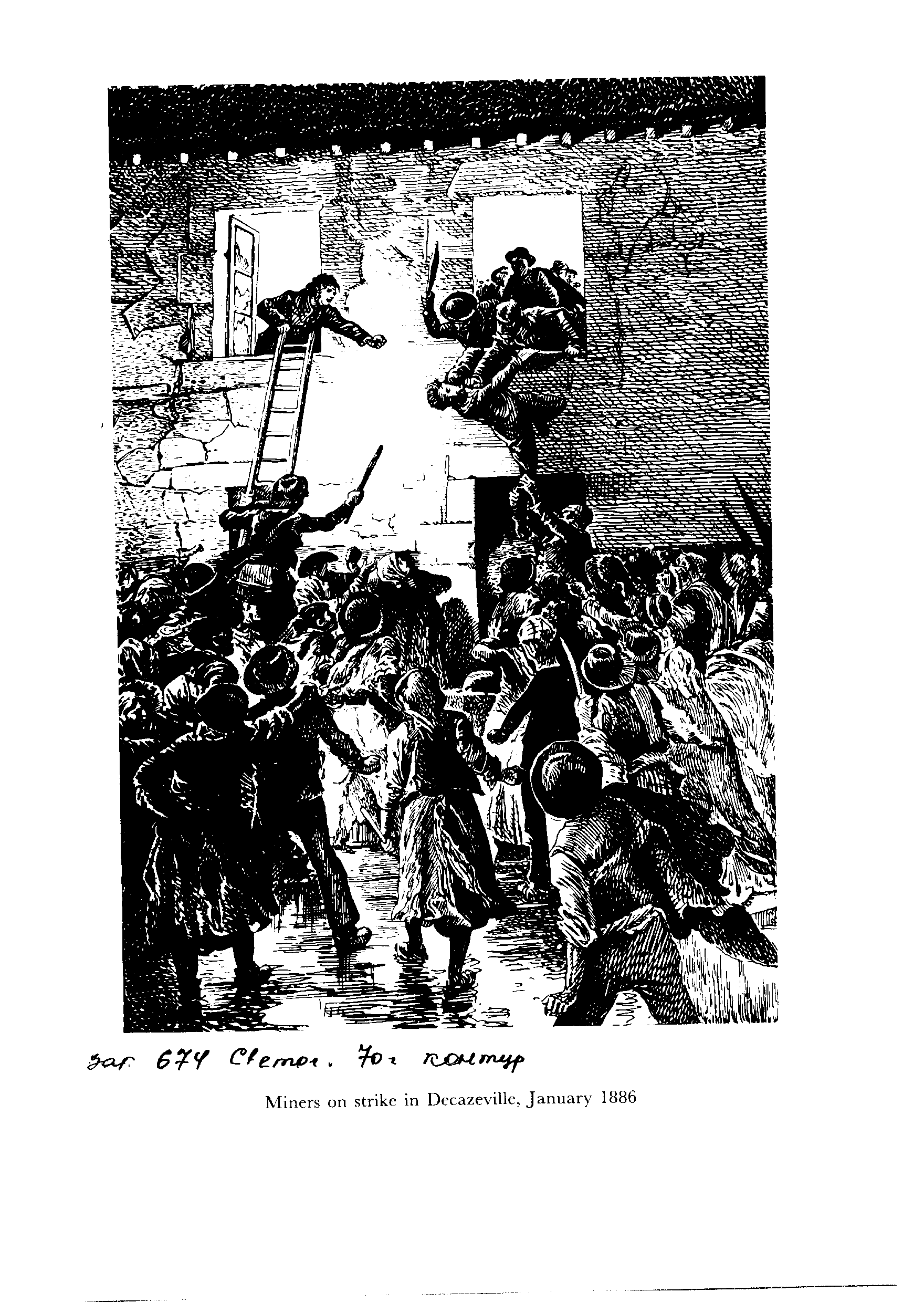
Miners on strike in Decazeville, January 1£
at least play the Opportunists' game [236] by dividing the 'revolutionary party'—which lent strength to the Radicals.
This is the definitive defeat of Utopian socialism in France. For the Radicals were all 'socialists' in the old sense of the term. What survived of Louis Blanc's and Proudhon's dieses served them as socialist trappings; they represent French Utopian socialism stripped of the Utopias and hence reduced to a phrase pure and simple. On 11 February this antiquated French socialism was crushed by the international socialism of today. The Poverty of Philosophy!
So far as your propaganda in Paris and in France generally is concerned, this is an event of prime importance. The effect will be felt very quickly. The Radicals — whether they make a clean break with the workers or whether they temporise by granting them more or less sterile concessions — will lose their influence over the masses and, along with that influence, such little potency as is left in traditional socialism will be lost, and people's minds will become more receptive to a new order of ideas...
Z...a has left me in no doubt that Clemenceau and the rest of his gang, embroiled as they are in ministerial intrigues, have caught the parliamentary disease, that they no longer see clearly what is going on outside the Palais Bourbon and the Luxembourg, that it is here that, for them, the pivot of the movement lies and that, in their eyes, extra-parliamentary France is of no more than secondary importance. All this has given me the measure of these gentlemen.
In short I have seen thatflectere si nequeo superos, Acheronta moveboh
is not to their taste. Their backsides are seated on the same chute as that down which Ranc, Gambetta & Co. once slid. What frightens them is the proletarian Acheron.
I told Z...: So long as the Radicals allow themselves to be frightened, as for example at the inconclusive elections, by the cry 'The Republic is in danger', they will be nothing more than the servants of the Opportunists, will act as their cat's paw. But give each work-man a gun and 50 cartridges and the Republic will never again be in danger!
240. Engels to Eduard Bernstein. 24 February[5 4 7]
Dear Ede,
Your articlesa on the subject of C. A. Schrammb were very nice and caused us much glee. The man's pretty well done for.
The new turn things have taken in France is most significant. See Cri du Peuple. On the 7th, Château d'Eau meetingc at which Basly disassociated himself from the Radicals.[429] On the 11th, in the Chamber, Basly's interpellation re Decazeville,d seconded by Camélinat and Boyer, applauded by Clovis Hugues and Planteau — separation from the Radicals, formation of parliamentary workers' party.e
Splendid entrée en scène. Great chagrin of the Radicals over these highly unparliamentary goings-on. The three working men are to be punished by a vote of no confidence on the part of the bourgeois constituents. Meeting called at Château d'Eau for 21 inst, but can-celled upon the three declaring their intention to attend. Instead a meeting du commercent the Château d'Eau announced, to discuss public works for the benefit of the unemployed, in fact for the purpose of obtaining a vote of censure against the 3. But instead a great victory for the working men, Basly in the chair, the bourgeois walk out, brilliant speech by Guesde. See Cri du Peuple of 23rd inst. r
The French parliamentary workers' party is a great historic event and a great stroke of luck for Germany. Will make certain persons in Berlin stir their stumps. Moreover, wholly international; chauvinistic heckling fell completely flat.
Your
F.E.
241. Engels to Florence Kelley-Wischnewetzky. 25 February[5 4 8]
Dear Mrs Wischnewetzky,
To-day mailed to you, registered, the rest of the ms. with my — introduction or postscript[3] [6] ° — according to where it may suit you to place it. I believe the title had better be a simple translation: The ' Condition of the Working Class in England in 1844, etc.
I am glad that all obstacles to publication have been successfully overcome. Only I am sorry that Miss Foster has applied to the Executive of the Sozialistische Arbeiterpartei in New York,[549] as appears from their report of meeting in Der Sozialist, New York, 13th February. Neither Marx nor myself have ever committed the least act which might be interpreted into asking any Working Organisation to do us any personal favour — and this was necessary not only for the sake of our own independence but also on account of the constant bourgeois denunciations of 'demagogues who coax the workmen out of their hard-earned pennies in order to spend them for their own purposes'. I shall therefore be compelled to inform that Executive that this application was made entirely without my knowledge or authority. Miss Foster no doubt acted in what she thought the best way, and this step of hers is in itself no doubt perfectly admissible; still, if I could have foreseen it, I should have been compelled to do everything in my power to prevent it. [5 5 0] The revision of your translation has delayed that of the English translation of Das Kapital[5] [6] by three weeks — and at a most critical period of the year too. I shall set about it to-night and it may take me several months. After that, the German 3rd volume must be taken in hand; you see, therefore, that for some time it will be impossible for me to undertake the revision of other translations, unless few and far between and of small volume. I have at this moment waiting here an Italian translation of Marx's Lohnarbeit und Kapital* which must wait some weeks at least. But if you will translate that into English (it was recently republished at Zurich) and will not be too pressing for time, I shall be glad to revise it, and you cannot have a better popular pamphlet than that. My Entwicklung0 Aveling intends to translate, and as the subject is iri part rather difficult, I could not well give it to anyone except he be here on the spot, accessible to verbal explanation. [528] As to my Anti-Diihring I hardly think the English speaking public would swallow that controversy and the hostility to religion which pervades the book. However we may discuss that later on, if you are of a different opinion. At present Marx's posthumous manuscripts must be dealt with before anything else.
The semi-Hegelian language of a good many passages of my old book is not only untranslatable but has lost the greater part of its meaning even in German. I have therefore modernised it as much as possible.
Yours very truly,
F. Engels
Wage Labour and Capital-b Socialism: Utopian and Scientific
242. Engels to Wilhelm Liebknecht. 25 February
IN BORSDORF NEAR LEIPZIG [3 4]
London, 25 February 1886
Dear Liebknecht,
It's really quite impossible to do anything about getting your Russian speechb [5 5] ' published in this country for, as you know, the big newspapers are barred to us and the monthly Commonweal is too small to take on that sort of thing. You will have to see to the matter yourselves, e. g. by getting in touch with the Standard correspondent as Longuet, for instance, did in Paris with Mother Crawford, the Daily News correspondent. Knowing that the Reichstag has no real sa^y in anything, the British press very rarely mentions it, save for quite short telegrams. If you had not virtually confined yourself to Faerber's view of the harm suffered by German capitalists,[15] but had introduced the present eastern imbroglio[445] and blamed it on Bismarck as the man who, because of the loan, has the Russians eating out of his hand, your speech could not have been passed over in complete silence. But what you say about the worthlessness of Russian paper is common knowledge even in this country.
Now as regards those charming German literati who infest the neutral border zone between ourselves and the armchair[54] and state socialists, and want to pocket all the advantages to be derived from our party while carefully shielding themselves against any disadvan-tage arising out of intercourse with us— I've just had another demonstration of what shits the said literati are. An importunate fellow by the name of Max Quarck — nomen est omenc—wrote to me saying that Deville in Paris had given him exclusive rights to translate his abridg-ment of Capital, and asking me to recommend him to Meissner and write a. preface for him.d It was all a lie, a fact of which I have received confirmation from Paris and as he himself informed Kautsky in a letter the selfsame day. And now the wretch has the effrontery to suggest that /should beg his pardon for his having lied to me! Just let him try that again, the scoundrel.[520]
You people will find you have competitors in France. The three working men, Basly, Boyer and Camélinat, since joined by Clovis Hugues, have set themselves up in the Chamber as a socialist labour groupa in opposition to the Radicals,[429] and when, at a meeting last Sunday, the Radicals tried to inveigle the constituents into passing a vote of no confidence, they met with a resounding defeat — so much so that at the meeting they themselves had convened, the Radicals did not dare to open their mouths.b These three French working men will make more of an impact in Europe than your 25 because they sit in a Chamber which, unlike the Reichstag, is not a debating society, and because they have shaken themselves free of the milk-and-water petty-bourgeois following which hangs like a millstone round your necks. Clemenceau is now faced with a last crucial decision, but we can be almost sure that he will not hesitate to join the bourgeois camp, in which case, though he will indeed become a minister, he will be done for.
Your
F.E.
243. Engels to Hermann Schlüter. 3 March
Dear Sir,
Would you kindly send Williams & Norgate, 14 Henrietta St., Covent Garden, London — 1 copy of Socialism: Utopian etc. together with bill (incl. postage) in a wrapper — these people applied to me (they are my booksellers and, incidentally, publishers, a big firm) and I wrote and told them that my things are always to be had from the Volksbuchhandlung."
Mrs Wischnewetzky played you a rotten trick with her ms.[349] For upon her insisting it was a matter of life and death, I had to buckle to straight away, and now the English translation of Capital has got to be done without delay, competition having cropped up (see To-Day) [527] in a menacing form. So if all is not to be lost, I must forge ahead and drop everything else, including the Peasant War.[213] The rival translation is, by the way, quite shocking, but so much the worse if it's not elbowed out forthwith.
Kindest regards,
Yours,
F.E.
time
244. Engels to Florence Kelley-Wischnewetzky. 12 March[2 7]
Dear Mrs Wischnewetzky,
Deep buried as I am in the English Capital,[56] I have only the time to write a few lines in haste. It did not require all your exposition of the circumstances to convince me that you were perfectly innocent of what had been done in America with your translation.[11] The thing is done and can't be helped, though we both are convinced that it was a mistake.(1)
245. Engels to Pasquale Martignetti. 12 March
I thank you for pointing out to me a passage in the appendix [552]
which indeed is far from clear. The gradation from the Polish Jew to the Hamburger, and from the Hamburger again to the Manchester merchant does not at all come out to the front. So I have tried to alter it in a way which may meet both your and my own objection to it and hope I have succeeded.
And now I cannot conclude without expressing to you my most sincere thanks to you for the very great trouble you have taken to re-vive, in English, a book of mine which is half-forgotten in the original German.
Ever at your service as far as my time and powers allow, believe me, dear Mrs Wischnewetzky
Yours very faithfully,
F. Engels
The dedication to the English working men should be left out.[359]
It has no meaning to-day.
245
ENGELS TO PASQJJALE MARTIGNETTI
IN BENEVENTO
London, 12 March 1886
Dear Citizen,
Please excuse the belated reply. I have received your kind letter of 8 February and the manuscript,a
which I shall deal with as soon as possible. But at the moment I am obliged before anything else to check through the English translation of Capital, Volume I, which is most pressing and must be printed without delay [5 6]; it is no easy task. When I have a free moment I shall devote it to your work.
I have also received, and I thank you for them, the 6 copies of the Origin etc.[302]
I am sorry that my error 'Paolo' caused you inconvenience. [5 5 3]
I shall not repeat it.
I must get hold of the calendar in order to restore the passage that was stuck and illegible [5 5 4]; I hope to find it here in London at a friend's house; this is another cause of delay.
I am sorry I cannot do better and more quickly than this, but the English Capital must take precedence; in any case I am committed by a deadline to the publisher. a
With respect I remain
F. Engels
I hope to spare some time in April on Wage Labour and Capital.
246. Engels to Hermann Schlüter. 12 March
Dear M r Schlüter,
If I a m to send you a speedy reply, I shall have to be brief.
1) T h e m a n with the money has not yet turned up. 2) We have Lexis 0 here. Thanks for the hint.
a William Swan Sonnenschein -b May in the original. - c W. Lexis, 'Die Marx'sche Kapital théorie', Jahrbücher für Nationalökonomie und Statistik, Vol. 11, Jena, 1885.
1964 3) Origin.a This business of the '2nd edition' has its dubious aspects, but when I consider that the two markets are completely different and that the '1st edition' is therefore unlikely to get in the way of the '2nd', it's unlikely to do much harm. [5 5 5] Admittedly I should have been happier had Dietz consulted us first. He has behaved very arbit-rarily in the past over other matters. This time it was quite unnecessary; he could, e. g., easily have informed me about the matter through Kautsky. But he likes faits accomplis and I shall get someone to tell him as much.
4) Reports of the International.[556] I was in Manchester at the time and can't really remember the details. The General Council did, at any rate, send a MESSAGE to all the congresses, but Marx's papers and pamphlets are all of them still in the unsorted state they were in when I lugged them over here and it will take about 6 weeks to put them in order. However I've asked Kautsky to make inquiries from Lessner; I should be very surprised if he hasn't collected everything.
5) Stephens' Speech. [557] Yes, the thing is by Weerth. As to the introduction, I shall be glad to go through your ms. But here too there are few sources and the bourgeois have been responsible for some serious falsification. Last year Harney scoured the whole of Yorkshire, Lancashire and London for one copy of The Northern Star, the paper which he had edited and which had had a circulation of 100,000 copies. In vain. Evanescence — such is the curse that af-flicts all proletarian literature not included in official literature. Thus Owen's works are nowhere to be had and the BRITISH MUSEUM would pay a great deal of money for a complete collection. A genuine account will therefore be difficult. The Brentanos and Co. know nothing. The Charter ' ° ' was drawn up in 1835, not 1838, and O'Connelb was also involved if I'm not mistaken. What Brentano says about the petition is utter nonsensec; after 10 April the bourgeois of both parties stuck together and in such a case lies are always disseminated, it being impossible to refute them either in Parliament or in the press. Even if a House of Commons Committee did scrutinise the petition (which I very much doubt), it would have been quite incapable of distinguishing the genuine from the bogus. [558] But in the spring of 1848, no one was able to take much interest in such dirty
247. Engels to Laura Lafargue. 15- 16 March
goings-on; there were other things to do. Besides, we weren't in England.
With kindest regards,
Yours,
F. Engels
247
ENGELS T O LAURA LAFARGUE
IN PARIS
London, 15-16 March 1886
My dear Laura,
You complain of the weather, and you are in Paris! Look at us here — nothing above freezing-point for the last ten days, a cutting east wind, of which you don't know which is the worst, the north-east or the south-east,— and to-night a fresh couche de neige[3]' on streets and roofs. Nim is at her second cold, but it's getting better, I had one too, Pumps and Percy are in the same boat too, fortunately the children are well. However there must be an end to this some time, only I wish it would come.
The English Capital is at last getting into shape and form.[56]
T have the whole ms. here and begun revising. Saving the 1st chapter which will require a severe overhauling, the first 200 pages of the original German are ready to go to press. I saw Kegan Paul last week, declined his proposals of two years ago and submitted mine. They were accepted in principle. This, with a man like Kegan Paul who is on all hands described as extremely slipping, means very little, and I expect there will be a tussle with him yet. But that matters nothing at all, because our position in the market has improved wonderfully and we have at least one other good firm who will be glad to take it on very favourable terms. As soon as the thing is concluded I will let you know.
The book will be published end of September so as not to come out in the dead season, and this gives me time to do the revising work thoroughly. Practically 300 pages of the original are revised, but the last 500 I have not as yet looked at, and there are some very difficult chapters there. And it would never do to hurry over them.
Broadhouse-Hyndman goes on translating 'from the original German' in To-Day.[527] He has in the sixth monthly number just finished Chapter I. But his 'original German' is the French translation now, and he insists on proving that with French he can play ducks and drakes quite as much as with German. The thing does so little harm, so far, that Kegan Paul never even mentioned it. But it "has done this good that I have got Moore and Edward to finish their work. You have no idea how difficult it is to get hold of this To-Day. I have paid in advance but have to dun them almost every month for my copy, moreover it comes out at all times of the next month. Tussy last year went and paid for a copy to be sent to you but as far as I have heard it was never sent! However there is nothing whatever in it except — Christian Socialism!
You will have seen from Justice— that at least you do receive in exchange for the Socialiste — how Hyndman keeps up his alliance with Brousse and even ignores the new proletarian party in the Chamber. [559]
To me, this appearance of a. parti ouvriera in the Palais Bourbon, is the great event of the year. The ice is now broken with which the Radicals[429] had so far succeeded to cover the working masses of France. These Radicals are now forced to come out in their true colours, or else follow the lead of Basly. The latter they will not do for long, nor willingly. Whatever they do, they must alienate the masses and drive them to us, and that quick. Events move rapidly, the Decazeville affair could not come more opportunely than it has done.[545] C'est coup sur coup!0 And a very good thing it is that this takes place not in Paris but in one of the darkest and most reactionary and clerical corners of la province. I am exceedingly curious to learn how the affair has ter-minated to-day in the Chamber." But whatever is done, must turn out to our benefit.
The reappearance of France on the scene of the proletarian movement 'comme grande puissance'a will have a tremendous effect everywhere, especially in Germany and America; in Germany I have done my best to let them know the full importance of the event, and sent Basly's speechb to Bebel; Camélinatf will follow as soon as I get it back from Kautsky. How furious Longuet must be that his old friend and as he believed protege Camélinat has turned his back upon him!
At the same time, our Paris friends have done whatever they could to pave the way so that the event, when it came, found a terrain préparé? Their action since the elections has been perfectly correct — their attempt to rally all revolutionary proletarian elements, their forbearance towards the Possibilists,[237] their limiting their attacks to those points and facts which showed Brousse and Co. as simple obstacles to union — all this was just what it should have been. And they are now reaping the fruits: Brousse has been driven into a position where he must find fault with Basly and Co. and thereby sever the last bond which still united him to the movement of the masses. Savoir attendre"—that is what our friends have learnt at last, and that will carry them through. Paul will be, if he likes, in the Palais Bourbon before Longuet.
A citoyen Hermann has applied to me for an addressed adhesion to what I suppose is your meeting on the 18th.[560] I send itd to you herewith 1 ) to be sure that it falls into the proper hands and 2) that you and Paul may look over and mend my rickety French.
Now good night, it's one o'clock and I must look over some papers yet to get them out of the way of to-morrow. Kind regards to Paul.
Yours most affectionately,
F. Engels
16th March. Just seen the ordre dujourc adopted by the Chamber.h
It sounds rather different to all previous ordres du jour voted under similar circumstances. It is a decided victory for us, and Freycinet too pfeift aus einem andern Loch als früher? La situation devient sérieuse pour MM. les Radicaux.h
248. Engels to August Bebel. 18 March[521]
Dear Bebel,
I am up to my eyes in the revision of the English translation of Capital, Volume I, which is at last on the point of coming out,[56] but since the business of Liebknecht's fund is urgent, I shall have to take a moment or two so as to be able to answer your letter quickly. Herewith, then my contribution,— a cheque for £10 on the UNION BANK OF London.[561]
Many thanks for the Anti-Socialist Law and spirits monopoly debates c and the Bürger-Leitung.
It is indeed striking how faithfully the Anti-Socialist Law debate reflects the mood of the majority in the parliamentary group. Unable, presumably, to do as they wished they had, willy-nilly, to voice relatively correct opinions, and the impression made by the debate is, on the whole, very good, particularly since Singer was compelled by the Ihring case[562] to speak pretty sharply. In general these people, not excepting even Frohme, are not too bad when they have to come out against the police, either in their own interests or in those of their constituents and hence keep the worthy citizen well out of sight, for one of their besetting sins is this very worthiness which seeks to convince an opponent rather than fight him because 'our cause is, after all, so noble and so just' that any other worthy citizen is bound to come over to us if only he can be made to understand it aright. This appeal to worthy sentiments, which neither recognises nor wishes to recognise the interests by which those sentiments are unconsciously motivated, is one of the chief characteristics of the philistinism which is peculiar to Germany and would be impossible over here or in France, either in parliament or in literature.
Never have I come across anything so tedious as the spirits debate; even Bamberger's jokes were as bad as ever, if not worse. So what matter if, after that, Schumacher also spoke tediously, proceeding to make what amounted to a naked appeal for 'étatisation" [Verstaat-lichungs]. Richter's speech, based on statistics, was quite the best.
I would not venture to pass judgment on Liebknecht's speech as reported in the Bürger-Leitung. So much depends on nuances and the manner in which something is said and, in a summarised report, all that gets lost.[563]
I have not seen the account by Kautsky of which you speak. But as regards Hyndman, his behaviour in Trafalgar Square and Hyde Park on 8 February did far more harm than good.[538] Revolutionary rant-ing, which in France would be seen as the outmoded rubbish it is and do no harm, is sheer folly over here, where the masses are totally un-prepared; it puts off the proletariat, encouraging only the worthless elements and, in this country, lends itself to but one interpretation, namely incitement to looting which in fact ensued, so that we shall be lastingly discredited over here, even in the eyes of the working class. As for its having drawn attention to socialism, you over there cannot know the extent to which, after centuries of freedom of the press and of assembly and its accompanying publicity, the public has become completely impervious to such methods. True, the initial alarm of the middle classes was quite funny, and brought in a subscription of some £40,000 for the unemployed — in all about £70,000 — but that has already been spent, nothing else is forthcoming and poverty is as before. What has been achieved is to equate socialism with looting in the minds of the bourgeois public and, while this may not have made matters much worse, it has certainly got us no further. You might think that Hyndman showed great courage and so it might seem. But Hyndman, as I have learnt from Morris and others, is a coward and has behaved as such on crucial occasions. This doesn't prevent him, having once got himself into a dangerous fix, from drowning his cowardice in his own clamour and giving vent to the most bloodthirsty utterances. But this only makes him all the more of a menace to his colleagues — for no one, neither he nor they, can tell beforehand what he is going to do. Fortunately the whole business has been pretty well forgotten over here.
I wholly agree with your view that periods of prosperity of over 6 months will cease to recur. The only prospect of a reactivation of trade — directly where iron, at any rate, is concerned and otherwise indirectly — lies in the possible opening up of China to railway construction and hence the destruction of the only remaining closed and self-sufficient civilisation based on a combination of agriculture and handicrafts. But 6 months will be enough to discount that, after which we shall, perhaps, experience yet another acute crisis. Apart from destroying Britain's monopoly of the world market, the new methods of communication— the electric telegraph, the railways, the Suez Canal and the supplanting of sail by steam — have gone some way towards breaking down the ten-year industrial cycle. If China is opened up, not only will overproduction risk losing its last safety-valve, but emigration from China will assume such massive propor-tions that this alone will suffice to revolutionise conditions of production throughout America, Australia and India, even to the extent of affecting Europe — if it lasts itself till then.
Bismarck's folly is indeed becoming excessive. But it has one recur-ring theme — more moneyl His craziest schemes always and infallibly involve the voting of subsidies, and the National-Liberal gents[243]
seem to have a positive passion for providing him with yet more cash.
Another victory in France. Camélinat's questiona about Decazeville[545] provoked a three-day debate, while on Saturday,b 7 mo-tions to proceed to the Order of the Day were thrown out, until finally the government and the Radical gents[429] agreed a resolution c unprecedented in French parliamentary history and which was passed on Monday [5 6 4]: That this Chamber proceed to the Order of the Day, confident that the Government will move all the necessary amendments to mining legislation and that its conduct in Decazeville will be dictated by the rights of the State and the interests of Labour.
The rights of Labour — it's absolutely unheard-of! And as if that was not enough, a decision unfavourable to the company which is wholly dependent on a state concession and now sees the terms of that concession turned against itself. All this, of course, is still on paper, but for a first step it's enough. The whole political situation in France has been revolutionised by the initiative of the three working men. The Radicals, who also call themselves socialists and who are, in fact, the representatives of French national socialism, of what survives of Proudhon and Louis Blanc, but who, as ministerial candidates, must make sure of keeping in with the republican bourgeoisie, are now compelled to show themselves in their true colours. The cool, almost hostile attitude they adopted from the outset towards the labour deputies, has shown the mass of the workers what is what; suddenly the latter see, alongside the 'eddicated' Radicals, genuine working-class socialists whom they joyously acclaim. The Radicals, incl. Clemenceau, must either temporarily renounce their ministerial aspirations and follow in Basly's and Camélinat's footsteps, or jeopardise their re-election. All of a sudden the question of capital and labour is included in the agenda, albeit as yet in very elementary form (rates of pay, the right to strike and, possibly, mining on a cooperative basis), but nevertheless it's there and there to stay. Since the workers of France, however, had received such a first-rate grounding from their history and from the altogether outstanding behaviour of our people during the past 2 years, nothing more was required to spark off the explosion but an event such as the Decazeville strike, combined with the stupidity of the Radicals in including 3 working men in their list of candidates. Now things will move fast in France. You'll have seen how afraid the Radicals are from the resolutions taken by the municipal councils of Paris, Lyons, etc., to vote money for the Decazeville strik-ers^ This again is unprecedented.
If that's the state your voice is in, don't go to America.[5] ' (1) The demands made on the vocal chords by what is universal practice there far exceed anything you can imagine. But anyway we shall look forward to seeing you over here in the autumn.
Time for the post, too late for registration. Please send me a postcard acknowledging receipt of the cheque.
Your
F.E.
249. Engels to Paul Lafargue. 20 March
249
ENGELS TO PAUL LAFARGUE [196]
IN PARIS
London, 20 March 1886
My dear Lafargue,
Herewith the cheque for £12. Yesterday I was again disturbed. It always happens when there is an urgent task to be done.
Monday'sa vote in the Chamber was a great victory.b For the first time a French Chamber has sided with labour against capital — greatly against its will! But Basly & Co. have been valiantly supported by the monarchist gents who, after their relative victory at the polls,[447] are in a state of high excitement and evidently believe— notably in their capacity as capitalists, shareholders, etc.—that they can do anything they please. Placed as they are between an ultra-monarchist group and the revolutionary workers, they had to plump for the latter. At least they are Republicans and, after all, low finance, as represented by the Opportunists and Radicals,[429] has no desire to restore the régime of high finance that was toppled with MacMahon and Thiers.[463]
It was what I suspected — this reappearance of Malon's behind the scenes.[565] A parliamentary party embracing every shade of possibilism with Malon for secret leader — what a beautiful dream! The same old Bakuninist tactics which, so far as these intriguers are concerned, are now much more deeply ingrained than the bombastic language of anarchism! A firm stand must be made against these endeavours. If you can ensure that Basly and Camélinat — even on their own — carry on as they have begun and refuse to let themselves be persuaded to join a party where they would form an impotent minority, then the game is won. Any negotiations on their part would be the ruin of them and could only further the Radical cause. So long as they go forward with a firm tread and pay no heed to the honeyed words of the moderators and mediators, all this confusion will be swept away, like it or not. It is not good will that activates these gentry; rather it is fear and fear alone that has created such little good will as they have and this, when all is said and done, is the good will to spoil what Basly has begun and nothing else. Moreover such a party is out of the question. Either Basly or Camélinat will turn traitor, which I don't believe, or they will be forced to part company with these gentry as soon as the first important problem arises. It would therefore be better not to enter into an alliance with them.
Your article in the Revue nouvelle* gave me much pleasure. Obviously one makes some 'ALLOWANCE' for what you are permitted to say in a periodical of that kind. Even so, I was surprised at the number of risqué allusions you were allowed to get away with — but sheb is a woman, she has a definite standpoint. Had the editor-in-chief been a man, you would have found yourself up against a much more fero-cious brand of morality.[566] What with the Journal des Economistes, the Revue philosophique and Juliette, you are now well launched in literature of a primarily official nature.[567] And since you write better French (because more 16th-century and less Parisian) than others, you ought to succeed.
Juliette amused me much with her high foreign policy.[568] This is Blowitz to the life, though less grotesque in form.
Fortunately the SOCIALIST LEAGUE [346] is dormant for the time being. Our good Bax and Morris, craving to do something (if only they knew what?), are restrained only by the fact that there is absolutely nothing to do. Moreover they have far more truck with the anarchists than is desirable. Their celebrations on the 18th were held in concert with the latter[569] and Kropotkin spoke there — twaddle, or so they tell me. All this will pass, if only because there is absolutely nothing to be done over here just now. But with Hyndman, who is well versed in political imposture and capable of all sorts of folly when his self-advancement is at stake — with the said Hyndman on the one hand and our two political babes in arms on the other, prospects are by no means bright. Yet now we have socialist papers abroad proclaiming at the top of their voices that socialism in England is
250. Engels to Vera Zasulich. 31 March
marching forward with gigantic strides! I am very glad to say that what passes for socialism here in England is not on the march— far from it.
Yours ever,
F.E.
By the way, Bax has published a short history of philosophy that has some very good stuff in it.(1)
250
ENGELS TO VERA ZASULICH
IN GENEVA
London, 31 March 1886
Dear Citizen,
Many thanks for sending me the translation of The Poverty of Philosophy, which has been safely received.[185]
When opening the parcel I tore the part showing the sender's address. After a good deal of trouble I managed to reassemble the pieces well enough to decipher the address I am using today. But since I don't know whether I have read it correctly, I would ask you to advise me of your address once again, as I should like to send you a copy of the Russian translation of Volume II of Capital, which has arrived from St Petersburg.[570] Please accept my apologies for the inconvenience caused by my clumsiness.
Yours sincerely,
F. Engels
251. Engels to August Bebel. 12 April
Thank you for the debate on the Anti-Socialist Law — it pleased me tremendously.[571] Here again we have something that does credit to the movement and this is the impression it gives from beginning to end. Even Liebknecht was quite his old self again; competition from the French seems to have had a good effect on him.(1) I like the spec-tacle of the whole gang — or pack of dogs ramer — crowding round you barking and snapping, only to be beaten off by the lash of a whip. What a mercy that, apart from you and Liebknecht, only Vollmar spoke a word or two, and that Singer, the victim of a concerted attack, was compelled to hit back hard, while the tractable majority held their tongues.
The gentlemen's fears about regicide are too ludicrous. Surely they or their fathers have all of them sung:
Has ever man had such hard luck As our poor Burgomaster Tschech, He shot at Fatty two paces away And yet his bullet went astray.
True, the German bourgeoisie still had some vitality in those days; another example of the difference is that 1844 saw the appearance of Das Lied von Freifrau von Droste-Vischering,[572] whereas now the Kulturkampf[162] is being waged with the most humdrum weapons wielded by the most flaccid hands.
The socialists here have been acquitted.[538] I am sending you today's copy of the highly Conservative Standard (also a Cri du Peuple) containing an account of the final hearing." You will be able to see from it how a judge goes about his business in England (though admittedly not in Ireland}.). Translated from legal jargon, what he said was: The law on seditious speeches applies to the accused, but the law is outdated and invalid in practice. Otherwise you would have to convict every radical spokesman and minister. All you have to ask yourselves, therefore, is this: Was it, or was it not, the intention of the accused that there should be looting on 8 February?b And Cave is one of England's 16 principal judges.
The verdict is a fine advertisement for Hyndman, but it has come too late. He has contrived to ruin his organisation beyond hope of re-pair; in London it's fizzling out, while in the provinces the various organisations have adopted a neutral, wait-and-see attitude to the rifts down here. Summa summarum the two organisations — FEDERATION and LEAGUE [346]—have a combined paid-up membership of less than 2,000 and their papers0 a combined readership of less than 5,000 — the majority being sympathisers in the persons of bourgeois, priests, literati, etc. As things are now, it is truly fortunate that these im-mature elements are failing to penetrate the masses. They must first complete the process of fermentation, after which all may be well.
For the rest, one might almost be back in the days of the International. Only this morning a whole stack of German, French, Spanish and Belgian papers arrived and are taking up time I ought to be devoting to the English translation of Capital.[56] I only hope there isn't a bust-up before I've managed to finish the 3rd volume — after that it can come, so far as I'm concerned.
Things are going splendidly in Decazeville.[545] You will see from the report (Cri du Peuple) of last Sunday's meetingd (a week ago yesterday) which I am sending you today how skilfully those Parisians, who have been decried as revolutionary braggarts, contrive without relinquishing their revolutionary posture to advocate calm and law-fulness during the strike. It is indicative of the progress the French have made, thanks to the revolutionary soil on which they stand, that in their case there is a complete absence of that mass of sophistries and second thoughts which still confuse the minds of so many people in Germany. That one should proceed lawfully or unlawfully, depending on the circumstances, is taken entirely for granted over there and no one sees anything inconsistent in it. As to Paris, it is significant that up till yesterday the Cri du Peuple had raised 35,000 frs for Decazeville, but Rochefort's Intransigeant less than 11,000.
Bismarck, who appears to have been in a frightful rage, though obviously speaking for the benefit of the Crown Prince,a will doubtless get a reply from Laura and Tussy to the ludicrous insinuations he made about Marx.[573] Of the other speeches, Hänel'sb was the best from a legal viewpoint; he came out with the absurd demand that a citizen should conform to the law not only outwardly but also in-wardly—that such a thing should be called for, that the mere intention and the public expression thereof, could be held punishable by depri-vation of rights shows how debased all middle-class concepts of legality have become in Germany — not that they have ever prevailed over there save in the case of the oppositional bourgeoisie; what has, in fact, always prevailed is the illegality of a police state, which in other countries (always excepting Ireland) could only assert itself shamefacedly and in the guise of a coup de main.
Must close because registration time (5 o'clock) draws near.
Your
F.E.
252. Engels to Philipp Victor Pauli. 12 Aprila
Heartiest congratulations on Clara's engagement.
Friedrich Engels
253. Engels to Laura Lafargue. 28 April
My dear Laura,
The English translation of Capital is awful work.[56] First theyb
translate. Then I revise and enter suggestions in pencil. Then it goes back to them. Then conference for settlement of doubtful points. Then I have to go through the whole again, to see that everything is made ready for the press, stylistically and technically, and all the quotations, which Tussy has looked up in the English originals, fitted in properly. So far I have finished 300 pages of the German, and shall soon have about 100 more. But then there is another hitch. Edward has missed translating some 50 pages of his share, and these I hope to get by the end of the week. As soon as I have got these, I shall stir up Kegan Paul's drowsiness.3 The wily Scot who still fancies that we do not know our favourable position in the market, plays a waiting game, but will find himself awfully mistaken one fine morning. It is we that can afford to wait, and we intend to wait until we are quite ready to begin to print, say in a week. And as we have a written offer from another firm, we can stick to our terms.
This must serve as an excuse for my last short letter[39] and the delay that has taken place since. The fact is we must begin to print by middle of May so as to be ready to publish by end of September. And that we can, though it will keep me hard at work till far into June at least.
Your billet-doux to Bismarck[573] is making great stir in Germany. Bebel writesb:
'Die Erklärung von Laura und Eleanor Marx ist famos, der grösste Teil der deutschen Presse nimmt davon Notiz, hütet sich selbstverständlich sie abzudrucken. Otto wird wütend sein, für dergleichen Angriffe ist er sehr empfindlich.'0
The effect of the new departure in France [5 7 4] is plainly visible in the debate on the Socialist Law in Berlin.[57] ' Library d would hardly have ventured to come out so strongly again in his best old manner, had it not been that events in Paris and Decazeville [545] had stirred him up again a bit. This competition is invaluable for our people in Germany. The split and dissensions in Paris gave the philistine section amongst them a pretext for looking down, de haut en bas, upon the French, as if they, themselves, had not wallowed for years in splits, quarrels and dissensions; and they began to talk as if they, the German kleinbürgerliche" section of the party, were the leaders of the universal movement. That precious bit of chauvinism has now been effectually knocked on the head. Unfortunately the Socialist Law has this one effect that it excludes pretty effectually the circulation of such papers as the Socialiste and Cri du Peuple, and that the daily, current information about France has to be taken from the vile bourgeois papers. I have sent on the Cris and Intransigeants you sent me, to Bebel and Liebknecht but that does not go much further and may not always reach them.
It strikes me as very curious that I see nothing of the Villefranche judgment being appealed against.[575] As far as I know there is a double appeal 1) on account of the alleged incompetency of the court, 2) against the judgment as such; and then a final pourvoi en cassation* on both these issues. It seems to me well worth while to go in for that, if only to expose the infamy of the courts and keep the thing before the public.
I scarcely dare hope that Roche will get in next Sunday.[576] Not having read any Cris for about a week, I do not know what other candidates besides Gaulier are in the field. But anyhow the poll will show a great progress and be enough to frighten the Radicals[429] still more.
Here all is muddle. Bax and Morris are getting deeper and deeper into the hands of a few anarchist phraseurs, and write nonsense with increasing intensity. The turning of The Commonweal into a 'weekly' — absurd in every respect — has given Edward a chance of getting out of his responsibility for this now incalculable organ.[577] Bax à la re-cherche^ by means of half-digested Hegelian dialectic, of extreme and paradox propositions, and Morris going head foremost, bull fashion, against 'parliamentarism', will have to learn by experience what sort of people their anarchist friends are. It would be ridiculous to expect the working class to take the slightest notice of these various vagaries of what is by courtesy called English Socialism, and it is very fortunate that it is so: These gentlemen have quite enough to do to set their own brains in order.
Schorlemmer who is here, and Nim have taken little Lily to the Zoo, Pumps is going to Manchester for a few days. In our evening chats we talk a good deal of your promised coming over to London. When is that to be? Schorlemmer says you had mentioned something about Paul coming over at the same time. That would be all the better. Anyhow it is getting time that these good intentions set about developing into more or less tangible plans and projects, the season for execution is not too long in this blessed climate.
Did you see in last Sozialdemokrat the affair about Kalle and the Weibergemeinschqft[578]? That fellow was nicely caught. He is a great light among the National Liberals[243] and has large chemical (dye-stufF) works at Wiesbaden.
Love from Schorlemmer and Nim and yours affectionately,
F. Engels
Paul I hope will excuse if I do not write to him as often as I should like.
254. Engels to Friedrich Adolph Sorge. 29 April[5 2 1]
Dear Sorge,
Have received your letters of 15 and 28 February and 8 March, and postcard of 21 March.
In most cases the notes contained in the ms. are the same as those Marx made in his copy for the 3rd edition.[526] In the case of those which provide for more insertions from the French, I would not commit myself unequivocally 1 ) because the work done for the 3rd edition is of much later date and hence, for me, more authoritative, 2) because, in respect of a translation to be made in America, i. e. outside his own orbit, Marx might have preferred some of the passages to be translated correctly from the simplified French version rather than incorrectly from the German — a consideration which no longer applies. Nevertheless, it has provided nie with very useful tips which will, in due course, also come in handy for the 4th German edition. As soon as I have finished with it I shall return it to you by registered post.
The Volkszeitung and Sozialist are now arriving regularly. Over the past fortnight I have sent you To-Day and Commonweal, March and April. Also yesterday To-Day, May, the delay being due solely to the slovenliness of the publishers. Should you require anything else let me know.
Broadhouse (Hyndman)'s translation of Capital is a complete farce.[527] The 1st chapter was from the German, full of mistakes to the point of absurdity.a Now he's translating from the French, and making the same mistakes. At the rate it's now going, the thing won't be finished before 1900.
Thanks for the Kalender. I certainly had no idea that Douai was so grossly neglected a great man.[579] May he take with him to the grave the knowledge of his greatness as of its total neglect, without first seeing it compressed into a sugar mould. But he was the right man for America and, had he remained an ordinary Democrat, I should have wished him the best of luck. As it was, however, he went whoring after false gods.
As for the purist who quibbles about our style and our punctuation he doesn't know either German or English, otherwise he could not discover Anglicisms where there aren't any.[580] The German of which he's so enamoured and which was drummed into us at school, with its frightful periodic structure whereby the verb is put right at the end and is separated from its subject by ten miles of subclauses, is a German which it has taken me thirty years to unlearn. This bureaucratic, pedagogical German, which completely ignores the fact that Lessing ever existed, is now on its last legs even in Germany. What would this worthy say were he to hear our people speaking in the Reichstag? Having done away with this horrible syntax because forever getting bogged down in it, they expressed themselves in that place like Jews b: 'Faced with this dilemma, Bismarck chose to kiss the pope's behind rather than the lips of the revolution', etc. Little Lasker was responsible for this improvement and it's the only good thing he ever did. Were the purist gent to go to Germany with his pedagogical German, he would be told that he spoke American. 'You know how petty your educated German philistine is' — especially so in America, it would seem. German syntax and punctuation, as taught at school 40 or 50 years ago, are fit only for the scrap-heap to which, in Germany, they're being well and truly consigned.
I think I wrote and told you that an American ladya married to a Russianb has taken it into her head to translate my old book.c
I have looked over the translation and this entailed a lot of work. But she had written to say that publication was assured and that I must do it at once, so I had to buckle to. It now transpires that she had entrusted the negotiations to a Miss Foster, secretary of a WOMEN'S RIGHTS society, who had been foolish enough to give the thing to the Socialist Labor Party.[550] I told the translator what I thought of this,d
but the damage had been done. For the rest, I am glad that these folk aren't translating anything of mine — a fine mess they'd make of it. Their German is bad enough, let alone their English!
The Volkszeitung people must be pleased with themselves. They have gained complete control over the movement amongst the Germans, and business must be flourishing. That a man like Dietzgen should go to the wall is understandable enough.[529] Playing around with the boycott and minor STRIKES is, of course, far more important than theoretical guidance. But despite all this, the cause is making enormous strides in America. For the first time there is a real mass movement amongst the English-speaking population. That it should still be feeling its way, awkwardly, at random and in ignorance, is inevitable. But all this will right itself; the movement must and will evolve by learning from its own mistakes. Theoretical ignorance is an at-tribute of all young nations, but so is speedy practical development. In America as in England no amount of exhortation will help until the need is really there. And in America it is there, as is a growing aware-ness of it. The entry of the indigenous working masses into the movement in America is for me one of the great events of 1886.[581] As for the Germans over there, let the presently prosperous kind gradually assimilate with the Americans — they'll still be a step or two ahead of the latter and a nucleus will nevertheless remain which will still retain a theoretical grasp of the nature and progress of the movement as a whole, will keep the process of fermentation going and, eventually, rise to the top again.
The second great event of 1886 is the formation of a workers' party in the French Chamber by Basly and Gamelinat, two working-class deputies who, for appearances' sake, were included in the list and given a leg up by the Radicals,[429] but failed to play the game and, in-
" Florence Kelley-Wischnewetzky -b Lazar Wischnewetzky -c The Condition of the Working-Class in England; see this volume, pp. 393-94. -d See this volume, p. 415.
stead of becoming the servants of the Radical gents, took the floor as working men. The Decazeville STRIKE[545] brought to a head the split between them — they were joined by "5 other deputies — and the Radicals.[3] The latter were thus forced to spell out their policy to the workers and, since it is only thanks to the Radicals that the government exists, this was highly distasteful, for it meant that they were rightly held responsible by the workers for everything done by the government. In short, the Radicals, Clemenceau et al, behaved con-temptibly, with a result which no amount of exhortation had hitherto succeeded in bringing about, namely the defection of the French workers from the Radicals. And a further result was the uniting of all socialist groups for the purpose of joint action. Only the miserable Possibilists[2] [3 7] held aloof, in consequence of which they are steadily going to pieces. This NEW DEPARTURE has been tremendously helped along by the government's foolishness, notably its attempt to raise a loan of 900 million frs for which purpose it needed the big financiers, while the latter, being also shareholders in Decazeville, refused their money unless the government broke the STRIKE. Hence the arrest of Due and Roche [575]; the workers' riposte was to put up Roche in Paris as a candidate (for the Chamber) in next Sunday's elections and Due (Quercy) as a candidate for the municipal council, where he is certain to get in.[576] In short, France can again boast a splendid movement, and this is making spanking progress but, best of all, our men, Guesde, Lafargue and Deville, are its theoretical leaders.
Nor has it been without repercussions in Germany. The revolutionary language and actions of the French have shown how lacklustre are the jeremiads of your Geisers, Vierecks, Auers & Co., which is why, in the recent Anti-Socialist Law debate, only Bebel and Liebknecht spoke, and very well too.[57] ' After this debate we can show our faces in' decent company again, which is something we can by no means do after all of them. On the whole, it's a good thing that German pre-eminence should not remain altogether unchallenged, especially now that so many philistine elements have been elected (inevitable though this may have been). In Germany, when times are quiet, there is a general tendency to philistinism, and then the spur of French competition is absolutely indispensable. Nor will it be lacking. From being a sect, French socialism has suddenly become a party and
See this volume, p. 409.
29 1886
only now and because of this has it become possible for the workers to join en masse, for the latter are sick to the teeth of sectarianism, which explains why they adhered to the extreme bourgeois party, the Radicals. Next Sunday's elections should already see a great step forward, although we can hardly expect Roche to get in.
I believe that the printing of the English translation of Capital, Volume I, will begin in 2 or 3 weeks' time. I haven't nearly finished revising it, but 300 pages are completely ready for the press, and another 200 very nearly so.
One more thing. Not long ago a Mr J. T. McEnnis interviewed me for the purpose of seeking my advice on labour legislation, osten-sibly on behalf of the State of Missouri. I soon smelt a journalistic rat and, indeed, he admitted working for THE LEADING DEMOCRATIC PAPER OF St Louis," but promised on his word of honour that he would first submit the whole thing to me for revision. The fellow was sent to see me by a Russian, Stepnyak. That was nearly a fortnight ago and I am afraid he may not have kept his word. I have forgotten the name of the St Louis paper, but if anything should appear about the interview, I would ask you to insert the following statementa in the Sozialist, the Volkszeitung and anywhere else you think fit. If, however, the fellow comes back after all and abides by his word, I.shall naturally let you know at once, and then you can tear up the statement.
Luckily the movement in this country has come to a complete standstill. Hyndman & Co. are political careerists who wreck everything and in the SOCIALIST LEAGUE[346] the anarchists are making enormous strides. Morris and Bax — the former as a sentimental socialist, the latter as a searcher after philosophical paradoxes — are presently as clay in their hands and must now find this out in corpore vili.b
From the next Commonweal you will see that, thanks largely to Tussy's eiForts, Aveling will no longer be responsible for this simulacrum, which is a good thing. c" And it's these addlepates who propose to
255. Engels to Paul Lafargue. 7 May
lead the British working class! Fortunately the latter refuse to have anything to do with them. Kindest regards,
Your
F.E.
255
ENGELS TO PAUL LAFARGUE [196]
IN PARIS
[Excerpt]
[London,] 7 May 1886
I congratulate you on Sunday's victory which has indeed confirmed the severance of the Parisian working man from radicalism.[576]
What idiots those Radicals are! But it is the fatal idiocy that seizes hold of any bourgeois party as soon as it finds itself on the threshold of power and thus loses the characteristics of an opposition party. They are impatient to take over the administration, although they know that the moment has not yet come; they play at running a shadow government, but nevertheless become responsible for the follies and faults of the government of the day. At the same time they are confronted by the Workers' Party [20] ' growing from day to day as a result of the follies of the government the responsibility for which they can only partially disclaim. The Workers' Party will no longer accept fine words and promises; it will call upon them to act and this they cannot do. While wanting to retain it, they are compelled to act against it. Being not, as yet, in power and finding that the masses are desert-ing them in increasing numbers, they are reduced to pointing a finger at the monarchist conspirators, to representing them as a real danger, to uttering the cry: Let us unite to save the Republic, in short, to becoming Opportunists.[2] [3] [6] Any party is lost if tries to assume power before the time is ripe for the implementation of its own programme. But the impatience of the bourgeois parties to arrive is such that all founder prematurely on this rock. That gives us even less time in which to develop.
On the other hand our movement in Paris has entered a phase in which even a blunder would do it no great harm. There can be no doubt that the rate of progress in the future will largely depend upon the group leaders. But once the masses are on the move, they will be like a healthy body that is strong enough to eliminate traces of dis-ease and even a modicum of poison.
256. Engels to Wilhelm Liebknecht. 12 May[5 2 1][3 4]
Dear Liebknecht,
The French papers (of which I have sent at least 3 parcels) were simply intended to give you an opportunity of reading at first hand some of the news about the brilliant turn things have taken in France. Since you take the Cri du Peuple, I need only send you the Intransigeant, etc. Lafargue sends me one now and again, when something happens, and I thought that in this way they could be turned to further account.
As regards Clemenceau, the moment may very well come when you would do better to drop La Justice. He is being pushed over onto the conservative, markedly bourgeois, side by, on the one hand, the immediate prospect of a ministerial post, and, on the other, by the to him unexpectedly rapid growth of the Workers' Party.[2] ° ' Even from his own point of view he is behaving stupidly. But that's how all these bourgeois are, even the most progressive. Longuet will soon have to choose, if he doesn't want to ruin himself utterly. Gaulier's candida-ture, supported solely by the press unaided by the comités radicaux-socialistes, cost the Radicals[429] 50,000 voters who have come over to us and are now the loudest in their denunciation of their one-time chiefs. [576] In the absence of colossal blunders — the movement is already strong enough now to absorb minor errors without damage to itself — we shall obtain between lj[4] and l/[3] of the seats at the next elections in Paris. And, now that they have something real to do, our people are behaving in quite exemplary fashion.
But to write for Justice without being paid is stupid. The paper is perfectly well able to pay; after all, its chief editors — deputies — are paid by the State.
Bebel has written to say that his voice is apt to give out after several days of exertion, and needless to say I told him that for an American STUMP tour the very first prerequisite was a voice that is proof against anything.a Whether he's not making too much of the business, I naturally cannot say, but it would in any case be quite a risk; once you're over there, you yourself will discover soon enough what the Yan-kees demand in return for their good money. If he doesn't go, you must at any rate make sure that no one of the tame, petty-bourgeois breed is sent with you. [518]
No doubt the Chicago affair[582] will put paid to the anarchist farce in America. The chaps can shout their heads off if they want, but pointless rowdyism is something the Americans refuse to put up with, now they have become an industrial nation.
There's nothing favourable to report of the so-called 'movement' over here. Hyndman loses more ground every day, having completely forfeited the confidence of his own people, and the LEAGUE[346] is increasingly coming under anarchist leadership. Since The Commonweal became a weekly — without adequate supplies either of money or talent — Aveling has had to resign his (honorary) editorship in favour of Bax who, like Morris, is strongly influenced by the anarchists.[577] The two gentlemen will have to learn in corpore vileh\ they'll soon be sick of it and it's a real stroke of luck that these teething troubles will have been left behind before the masses join the movement, which at present they obstinately refuse to do. It's just as it was in France; a really big working class cannot be got moving by exhortation, but when things have reached the right stage, the least impulse is enough to precipitate an avalanche. And that's what will happen over here as well, and soon. Most probably it will be the financial collapse of the big TRADES UNIONS under the pressure of chronic
257. Engels to F. H. Nestler & Melle's Verlag. 13 May
overproduction that will mark the moment when the eyes of the English are opened to the inadequacy of 'self-help' and of Radicalism. So [see you] here this autumn!
Your
F.E.
Tomorrow week Mrs Pfänder will be sailing for America to stay with her brother-in-law in New Ulm, Minnesota.
257
ENGELS T O F.H. NESTLER & MELLE'S VERLAG [5 8 3]
IN HAMBURG
[Draft]
[London,] 13 May 1886
Dear Sirs,
Greatly flattered though I am by the offer you made me in your kind note of the 10th inst., I regret that I must nevertheless decline it on the grounds that I cannot spare the time.
I am responsible for editing the mss. left by Marx and for turning to account all the other papers he left. It is a responsibility that will occupy my time for several years to come and must take precedence over everything else.
In addition, I am responsible for revising the translations of our works into foreign languages — an essential task in the majority of cases. Not only is there the English translation of Capital, which I must now finish and which goes to the printers next month,[56] but also a constant influx of mss. of the kind that call for revision, translations of shorter works into French, Italian, Danish, Dutch, etc.,a and these take up all that remains of my spare time.
But once I have put all this behind me, I shall, assuming I live so long, first have to turn my mind to the completion, once and for all, of my own independent works which have been totally neglected for the past three years.
Among those whose views correspond to my own, my friend Karl Kautsky would no doubt be suitable for such a position, especially as he now lives here, and I should be glad to give him all the help I could. Moreover the relevant English literature, most of it quite unknown, is obtainable nowhere save in the BRITISH MUSEUM. Yesterday, fherefore, I took the liberty of informing him of your proposal. But his commitments — apart from editing the Neue £eit—are so many and extend so far ahead that he was unable to authorise my suggesting him to you as a candidate.
I am, as you can see, most interested in your scheme and hence am all the sorrier for being unable to participate in its execution. Meanwhile I would thank you for honouring me with your proposal, and remain
Yours faithfully
258. Engels to Eduard Bernstein. 22 May[4 8 4]
Dear Ede,
I am sending you the (Daily News) report of Thursday's parliamentary debate on the Irish Arms Bill[584]: Restrictions on the right to carry or possess arms, hitherto aimed at the Nationalists in Ireland, are now to be extended to the Protestant braggarts in Ulster; rebellion is in the offing. Remarkable speech by Lord Randolph Churchill,a
brother of the Duke of Marlborough, democratising Tory, Secretary for India in the last Tory Cabinet, and as such a life member of the PRIVY COUNCIL. In view of our petty-bourgeois socialists' insipid and pusillanimous protests and assurances to the effect that, whatever the circumstances, they will pursue their objectives by peaceful means, this is surely the moment to point out that English ministers — Althorp, Peel, Morley, and even Gladstone — are advocating the right to revolt as a theory consistent with the Constitution, though admittedly only for such time as they remain in opposition, as Gladstone's subsequent vapourings have borne out,b though in none of them did he dare deny that right as such — and especially, too, because this emanates from England, the land of legality par excellence. Our Vierecks could hardly have had shorter shrift.
I'm glad to see from the Sozialdemokrat's renewed verve that you are in good shape again.
I'm up to my eyes in the English translation of Capital. Aveling fixed up everything with the publishers mis morning and the contract will be signed in a day or two, after which comes the printing, 5 sheets a week minimum.[56] Unfortunately I haven't finished revising it, but pp. 1-450 of the original are ready for the press; ditto, almost, pp. 450-640. But please don't make any announcement yet, as nothing has been signed so far.
Our Frenchmen are doing splendidly. Over here, on the other hand, everyone is playing about like a bunch of amateurs. The anarchist follies in America [582] may prove advantageous; it is undesirable that the American workers, given their present wholly bourgeois level of thinking — high wages and short hours — should win victories too quickly. That might unduly reinforce the biassed TRADES UNION spirit.
The most powerful TRADES UNION over here, the AMALGAMATED ENGINEERS, had to allocate from its reserve funds more than £43,000 for its unemployed members, bringing the reserves down from approx. £165,000 to approx. £122,000. Not until this fund is exhaust-ed, and only then, will it be possible to do something with those chaps.
Your
F.E.
a R. Churchill's speech in the House of Commons on 20 May 1886 (The Daily News, No. 12515, 21 May 1886). - b W. E. Gladstone's speech in the House of Commons on 20 May 1886 (The Daily News, No. 12515, 21 May 1886).
259. Engels to Laura Lafargue. 23 May
I am sending this to Schlüter as I don't know the new number of your house.
259
ENGELS TO LAURA LAFARGUE
IN PARIS
London, 23 May 1886
My dear Laura,
I think I can to-day announce to you that the affair about the English edition of the Kapital is at last settled.[56] With Kegan Paul and Co. it was impossible to come to a satisfactory conclusion, so we arranged terms with Swan Sonnenschein and Co. I saw Swan Sonnenschein yesterday, with Edward, and there is now only the agreement to be signed formally and then the ms. will go to press at once. Swan Sonnenschein and Co. pay us 10% of gross selling price first 500 copies sold and I2ll[2]% all following copies. First edition to be a library one, at 32/- in 2 volumes: the type to be clichéd at once but so that alterations for 2nd edition can be made within certain limits; then second edition in one volume say from 7/6 to 10/-, and this plan will suit us much better than Kegan Paul's who would have kept the price up at 28/- and thus excluded the book from general circulation.
As I have 450 pages (of the original German) ready to go to press, and about 200 more that can be got ready in 14 days, and all the rest done in the rough, there is no reason why we should not print 5 sheets a week and have done altogether by middle of August, and the book to be brought out 1st October.
I think Paul does not quite see why they wanted a letter from him on the Paris election for The Commonweal. The people here do not want directly to attack Justice and moreover their assertion would not go half as far as an authoritative statement from Paris. [585] But it's no great matter, as the League [3 4 6] is in a complete muddle through their having let the anarchists creep in. They will have their conference of delegates on Whit Sunday, [5 8 6] and then we shall see what comes of it. I cannot make out why Decazeville collapsed so suddenly,[587] especially as Paul, like Napoleon after the burning of Moscow, all at once ceased to supply Cris du Peuple to me, at the critical moment. Is it so absolutely impossible for the Parisian mind to own to unpleasant things that can't be helped? The victory of Decazeville would have been exceedingly nice, but after all the defeat may be more useful to the movement in the long run. So I do believe, too, that the anarchist follies of Chicago will do much good.[582] If the present American movement— which so far as it is not exclusively German, is still in the Trades Union stage — had got a great victory on the 8 hours question, Trades Unionism would have become a fixed and final dogma. While a mixed result will -help to show then that it is necessary to go beyond 'high wages and short hours'.
Yours affectionately,
F. Engels
260. Engels to Florence Kelley-Wischnewetzky. 3 June[5 8 8]
Dear Mrs Wischnewetzky,
I have looked over the proofs and corrected in pencil a few addi-tional mistakes.
That the set-up of the work would be anything but elegant, I fore-saw as soon as I knew who had it in charge, and am therefore not much surprised. I am afraid there is no help now, so it's no use grum-bling.
Whatever the mistakes and the Borrmrthdt of the leaders of the movement, and partly of the newly-awakening masses too, one thing is certain: the American working class is moving, and no mistake. And after a few false starts, they will get into the right track soon enough. This appearance of the Americans upon the scene I consider one of the greatest events of the year.[581] What the downbreak of Russian Czarism would be for the great military monarchies of Europe — the snapping of their mainstay — that is for the bourgeois of the whole world the breaking out of class war in America. For America after all was the ideal of all bourgeois: a country rich, vast, expanding, with purely bourgeois institutions unleavened by feudal remnants or monarchical traditions, and without a permanent and hereditary proletariat. Here every one could become, if not a capitalist, at all events an independent man, producing or trading, with his own means, for his own account. And because there were not, as yet, classes with opposing interests, our — and your — bourgeois thought that America stood above class antagonisms and struggles. That delusion has now broken down, the last Bourgeois Paradise on earth is fast changing into a Purgatory, and can only be prevented from becoming, like Europe, an Inferno by the go-ahead pace at which the development of the newly fledged proletariat of America will take place. The way in which they have made their appearance on the scene, is quite extraordinary: six months ago nobody suspected anything, and now they appear all of a sudden in such organised masses as to strike terror into the whole capitalist class. I only wish Marx could have lived to see it!
I am in doubt whether to send this to Zurich or to the address in Paris you give at foot of your letter. But as in case of mistake Zurich is safest, I forward this and the proofs to Mr Schlüter, who no doubt will forward wherever it may be necessary.
Ever sincerely yours,
F. Engels
261. Engels to Hermann Schlüter. 3 June
Dear Mr Schlüter,
Mrs Wischnewetzky has sent me some printed sheets(1) which I have got to return; she also gave me a Paris address, which I can't decipher properly, and without telling me whether they should be sent there. For safety's sake I am taking the liberty of posting my reply and corrections to you, with the request that you kindly forward them. You may perhaps know the Paris address, or else you could make inquiries at the Pension Tièfenau — it looks like c/Drexel, Harjes & Co., Paris.[589] I apologise for putting you to this trouble.
Your Chartism's[557] turn will come round as soon as the English translation of Capital allows me a free moment. Printing has just begun and, as only the first half is ready for the press, I absolutely must attend to the remainder first.[56] Hence I cannot allow anything more to stand in its way just now.
Regards to Ede.
Yours,
F. Engels
Works, First Russian Edition, Vol. XXVII, Moscow, 1935
Published in English for the first time 262
ENGELS TO KARL KAUTSKY
IN LONDON
[Eastbourne,[590]] Friday, 2 July 1886
Many thanks for all the trouble you've taken. Please don't send me, apart from Nature, any English papers, or the Manchester paper which arrives on Saturdays, or, after Saturday, any more papers at all, apart from the Sozialdemokrat, or, after Monday, any more letters, for we shall be home again on Wednesdaya afternoon. The weather continues magnificent — I await with interest the first election results from the larger towns [5 9] ' tomorrow morning. Best wishes from my family to yours.
Your
F.E.
263
262. Engels to Karl Kautsky. 2 July
263. Engels to Karl Kautsky. 4 July
Dear Kautsky,
I would naturally prefer not to have any more visitors here, [59]° as Schorlemmer will in any case probably be arriving tomorrow; however, what has to be has to be. Besides, I shall be back in London on Wednesdaya and hope that Mrs Guillaume-Schack will find enough
a 7 July to do in town until then. [3 9 2] Since yesterday it has been oppressively hot here too, though all the same there has been a bit of a breeze — on Friday it was actually chilly and I couldn't sit outside in the evening without my overcoat. Best wishes to your wife. Pumps, Percy and Moore have taken a boat and gone out to catch fish for supper, provided, that is, le bon dieu* doesn't object to their breaking the Sab-bath and visit sea-serpents upon them. The Pilsener beer is also good here.
Your
F.E.
264. Engels to Karl Kautsky. 8 July
Safely home [5 9 0]—today called to see Guillaume-Schack, but she was out — hence, so far have not had the pleasure of making her ac-quaintance. [592] Schorlemmer is with us — shall you be coming over here tomorrow evening?
Your
F.E.
God
265. Engels to Johann Philipp Becker. 9 July
Dear Old Comrade,
I put off answering your letter for a few days as I wanted to wait and see whether I could find some way of entering into your Paris scheme.[593] I couldn't, alas, if only because
1) I am tied down in England through having to attend to the proof-correction and publication of the English translation of Capital which is now printing [56]; nor could I leave this to anyone else even if I were not bound by my contract.
2) For the past 3 months, however, I have again become an in-valid, 200 or 300 paces being the most I can manage, and am dependent on all sorts of medical persons; the business is just gênant,(1) no more, but at any moment complications might set in if I didn't take things easy, so there can be no question of a long journey. And even if, as I hope, I am more mobile this autumn, I really must do my utmost this time to rid myself for good of this old trouble by which I have been crippled off and on during the past three years, and that means doing nothing that might bring about a relapse. I simply must get to the stage of being able to walk for 2 or 3 hours on end, otherwise I shall be done for and unable to do any sustained work. I had thought that, during the past fortnight, I might get to the stage of being able to register a positive improvement, but it's taking longer than I imagined.
Well, with luck we might be able to make some other arrangement. For once in Paris, you might just as well cross the Channel and spend a little while here. I would gladly bear the cost, and your stay over here wouldn't cost you a penny. In August I am being sent to the seaside to recuperate and in September I shall have visitors from the provinces, from Germany and most likely also the Lafargues from Paris and, since I only have one spare room, putting up all these people will be none too easy. But in October it will all be over and I shall be able to let you have the room any time you like, and should be delighted to see you here. Then we could also talk things over and exchange all our news at greater leisure than in Paris where, after all, one is never on one's own.
So make up your mind. By October, too, my urgent work will be so far advanced that I shall be able to shelve everything else; I also hope to have made sufficient progress to tipple again. If, by the by, you would rather come here in September, let me know; either way, I'm sure it can be managed. There are all sorts of things that still remain to be discussed and, above all, you have so much information — known, as you say, to no one else — about the historical origins of the movement to pass on to me, that it would be a crying shame if we didn't do our utmost to foregather once again and get all this off our chests.
I haven't yet had a chance to put Marx's papers in order, a job that would take me at least a month. Perhaps I shall get round to it in the autumn, for done it has got to be, and done before the days grow too short.
I am taking out another five pound money order for you which I hope will reach you soon after, or at the same time as, this letter.
So do make up your mind. I look forward immensely to seeing you again and discussing things with you face to face. If I were as steady on my pins as you, I should come to Geneva — but as it is! Well, I expect you to do it in my stead, and come over here.
Your old friend
F. Engels
266. Engels to Karl Kautsky. 26 July[5 9 4]
Dear Baron,
I have today sent you a Volkszeitung and shall tomorrow send off the one that arrived today; also Deutsche Worte, wherein the first in-stalment of an article on Gustav Cohn [5 9 5]—so far quite delightful. You really must get hold of the chapa for the Neue £eit.
Yesterday we were more or less on our own — Tussy was ill as well so that Aveling had to leave early — it's nothing much, but nevertheless troublesome. On top ofthat it was raining cats and dogs — I hope you are having better weather down in the south-east where the climate is more continental than anywhere else in England.
So Dilke has providentially gone into political exile — requiescat in pace! b That's what comes of protestant hypocrisy. None of this business could ever have happened in a Catholic country — either in Vienna or in Rome or in Paris — nor yet in Petersburg; such whited sepulchres are possible only in two centres — London and Berlin. In fact, if Berlin is becoming a metropolis, this is only because London is increasingly deteriorating into a Berlin. What could be more typical of Berlin than gallant Captain Forster escorting his lady-friend to a brothel? [396]
No other news to speak of — Schorlemmer has gone to Germany; I am getting better every day. Nim has just finished reading Märtyrer der Phantasiec aloud (end has come!!) and is knitting stockings. Kindest regards to you and your wife from us both.
Your
F.E.
If there should be anything you want doing at home, I have once more reached the stage at which I can perfectly well walk as far as that, and hope this will continue; so if I can do you any service, don't hesitate to let me know.
267. Engels to Karl Kautsky. 31 July[5 9 4]
Dear Kautsky,
I shall retain the POST OFFICE ORDER here as there would be no point in trying to cash it with the moron in Southampton Road. It will be kept at your disposal and, should you not return before, I shall leave it with Mrs Parker, alias Sarah, in an envelope addressed to you.
Instead, herewith a POST OFFICE ORDER for £ 4 in your name, Karl Kautsky, taken out by me Frederick Engels. If you could do with a few more pounds sterling, I will gladly let you have them.
Weather's improving — with you, too, I hope. So that there may be a chance of this letter's arriving today, I shall close. Kindest regards to your wife and yourself from Nim and
Your
F.E.
268. Engels to Friedrich Adolph Sorge. 3 August
IN MOUNT D E S E R T [5 9 7]
[London,] 3 August 1886
Interview[598] received with thanks; amused me greatly. Of course the idiota puts into my mouth all the silly things he himself'said. Commonweal, 1 May-17 July, will follow in 2 parcels tomorrow. I now get them through Lessner at intervals, but complete. To-Day will follow as soon as I have got the July no. which is still missing.
Translation of ms. b will be finished the day after tomorrow and last part handed over to publishers.0 320 pages have been printed, almost the same as 3rd German edition. Hope it will be finished by end of September and published in October. Am also going to the seaside this Saturday,d hope it will do us both and also your wife good.
Your
F.E.
269. Engels to Karl Kautsky. 6 August[5 9 4]
Dear Kautsky,
We leave tomorrow for Eastbourne.[5]" Address 4 Cavendish Place, as before.
Have just booked a passage for Liebknecht on the Cunard STEAMER Servia and sent him the receipt.[600]
You will find your MONEY ORDER here in an addressed envelope. Also sundry American Sozialists for yourself and sundry American Volks-Zeitungs along with the Missouri Republican containing the outrageous interview[5] [9 8] — please keep these Volkszeitungs and the Republican for me.
Will you please — when you get back — continue to forward my letters, etc., at regular intervals, i.e. at most every other day, but as a rule twice a week, just as you did before?
The translation of the ms.a was finally completed yesterday; 23 sheets have been set up and the proofs are in hand.
Liebknecht is sailing from Liverpool on 4 September, the Avelings on 31 August.[60] ' We shall be staying here until 28 August for certain and if possible a week longer; it depends on Liebknecht's arrival and other possible visitors.
You will have read about the sentences in Freibergb — 6 months for Dietz, Heinzel and Müller, 9 for the others.[602] Typically German.
Thank you for your news from Vienna. [6 0 3] Otherwise all is tran-quil while the world takes a breather, the one exception being the Russians who are surreptitiously intriguing away for all they are worth. Giers evidently intends to wangle something worthwhile out of Bismarck this year, but I don't imagine he will succeed.
Kindest regards to your wife.
Your
F.E.
270. Engels to Karl Kautsky. // August
IN LONDON
Eastbourne, 11 August 1886 4 Cavendish Place
Dear Baron,
I shall gladly do my best as regards your ms. [6 0 4] But to promise that it will be seen to by a specific date in the near future is utterly impossible: 1) everything depends upon the pressure of printed sheets,a each of which I must read through carefully at least 3 times for proof-correcting and the 1st and 2nd revisions; 2) I have accumulated such a pile of urgent correspondence — which has been completely neglected for the past 3 months — that I shall have to dispose of that first; 3) 2 mss. have been lying about here for 7 months awaiting revision; however, I shall set them aside if needs must.[605]
So send me the ms. and nous verrons. b In any case hec only needs the first instalment, so send me that.
Dietz must not hear a word about my going through it. I am only too familiar with the way he casts all discretion to the winds as soon as he senses that some commercial benefit may be in the offing. If necessary, therefore, you will have to find another source of information.
Changeable weather since yesterday. As regards papers, etc., please send me only the French, Spanish and German-American Socialists,d the Sozialdemokrat, the Volkszeitung, Volksfreund and Nature; the others can wait. All company prospectuses and reports can likewise wait.
I shall now get back to the printed sheets. I trust the sea air did you both good, especially your wife. Every night between 9 and 11 we have a hectic game of cards; so far I have been marvel-lously lucky — as a loser. Nim and the Roshers send their best wishes.
Regards to your wife.
Your
F.E.
271. Engels to Florence Kelley-Wischnewetzky. 13-14 August
Dear Mrs Wischnewetzky,
My reply to your kind letter of the 9th June was delayed for the simple reason that overwork compelled me to suspend all my correspondence (such as did not command immediate despatch) until the ms. of the translation of Das Kapital was finally ready for the printer. [56] Such is now the case, and I can at last attend to the heap of unanswered letters before me; and you shall have the first chance. Had you told me in the above letter that you had spare time on your hands for party work, I should at once have sent you a short reply; I am sorry if through my fault you were prevented from doing some useful work.
I quite forgot, when proposing to you Lohnarbeit und Kapital,(1)
that an English translation had already appeared in London. As this is offered for sale in New York it would be useless to translate it over again.
Now about Der Ursprung.a The thing is more difficult to translate than Die Lage,b and would require comparatively greater attention and more time per page on your part. But if I had time left to me for the looking it over, that would be no obstacle, provided you could devote that time and attention to it, and leave me a larger margin of blank paper to suggest alterations. There is however another matter to consider. If the thing is to come out in English at all, it ought to be published in such a way that the public can get hold of it through the regular book-trade. That will not be the case, as far as I can see, with Die Lage. Unless the trade arrangements are very different in America from those in Europe, the booksellers will not deal in works published by outside establishments belonging to a working men's party. This is why Chartist and Owenite publications are nowhere preserved and nowhere to be had, not even in the British Museum; and why all our German party publications are — and were, long before the Socialist Law [37] —not to be had through the trade, and remained unknown to the public outside the party. That is a state of things which sometimes cannot be avoided, but ought to be avoided wherever possible. And you will not blame me if I wish to avoid it for English translations of my writings having suffered from it in Germany for more than 40 years. The state of things in England is such that publishers can be got — either now or in the near future — for socialist works, and I have no doubt that in the course of next year I can have an English translation published here and the translator paid; and as I have, moreover, long since promised Dr Aveling the translation of the Entwicklung[528] and Ursprung, [606] if he can make it pay for himself, you see that an American edition, brought out outside the regular book-trade, would only spoil the chance of a London edition to be brought out in the way of the regular trade and therefore accessible to the public generally and everywhere.
Moreover I do not think that this book is exactly what is wanted at the present moment by the American working men. Das Kapital will be at their service before the year is out, that will serve them for a pièce de résistance.c For lighter, more popular literature, for real propaganda, my booklet will scarcely serve. In the present undevel-oped state of the movement, I think perhaps some of the French po-pularisations would answer best. Deville and Lafargue have published two series of lectures, Cours d'économie sociale, about two years ago, Deville taking the economic and Lafargue the more general, historic side of the Marxian theory. ' ' [9] No doubt Bernstein can let you look at a copy and get one from Paris, and then you might judge for yourself. Of course I do not mean Deville's larger work, the extract from Das Kapital, which in the latter half of it is very misleading.a
14th August
To return to the Ursprung. I do not mean to say that I have absolutely promised Aveling to let him have it, but I consider myself bound to him in case a translation is to come out in London. The final decision, then, would depend very much upon the nature of the publishing arrangements you can make in America. To a repetition of what Miss Foster has done with Die Lage I decidedly object.b
When I see my way to an English edition, brought out by a firm known in the bourgeois trade, and not only of this book, but probably of a collection of various other writings, with the advantage of having the translation done here (which saves to me a deal of time) you will admit that I ought to look twice before sanctioning the bringing out, in America, of this little book alone and thereby spoil-ing the whole arrangement. And with the present anti-socialist scare in America, I doubt whether you will find regular publishers very willing to associate their names with socialist works.
A very good bit of work would be a series of pamphlets stating, in popular language, the contents of Das Kapital. The theory of surplus value No. 1; the history of the various forms of surplus value (cooperation, manufacture, modern industry) No. 2; accumulation and the history of primitive accumulation No. 3; the development of surplus value making in colonies [last chapter) No. 4 — this would be especially instructive in America, as it would give the economical history of that country, from a land of independent peasants to a centre of modern industry, and might be completed by specially American facts.
In the meantime you may be sure that it will take some time yet before the mass of the American working people will begin to read socialist literature. And for those that do read and will read, there is matter enough being provided, and least of all will Der Ursprung be missed by them. With the Anglo-Saxon mind, and especially with the eminently practical development it has taken in America, theory counts for nothing until imposed by dire necessity, and I count above all things upon the teaching our friends will receive by the consequences of their own blunders, to prepare them for theoretical schooling.
Yours very sincerely,
F. Engels
I shall be in this place until 27th inst.[5]"; after that, in London.
272. Engels to Eduard Bernstein. 14 August[6 0 7]
Dear Ede,
A fortnight ago I sent you a Standard containing a Bulgarian report on Russian intrigues in the Balkans which was very important.(1) Meanwhile the situation has been getting more and more critical, for Alexander III is in need of a success after his many setbacks and, in view of the multifarious intrigues, it might well happen that matters get beyond the gentlemen's control and war breaks out. In this connection I wanted to pass on to you the story sent in by the Daily News correspondent in St Petersburg, which he insists is true despite all disclaimers, that between the 18th and the end of this month six Russian army corps, opposed by six ditto, will be engaged on manoeuvres in the neighbourhood of Vilna, i. e. close to the Prussian border; an assemblage, that is, of 12 army corps (the whole German army has only 18 of them) or, at a very modest estimate, 240,000 men. We may be sure that the vast sum of money involved isn't being chucked down die drain out of sheer bravado. Moreover Alexander III has forbidden all foreign officers to attend, even Werder, the Prussian. While these 240,000 men are concentrated on the border, Mr Giers will arrive in Germany to negotiate with Bismarck. It is a very bold stratagem, especially having regard to old William," for he is being tackled precisely on this, his most sensitive flank. So things may go wrong and war break out. It may equally well be settled on the quiet, for we may be sure that Giers will not willingly be a party to such out-rageous pranks. However I thought it as well to draw your attention to this curious business.
Tell Schlüter that I shall attend to his piece [5 5 7] as soon as I get back to London. I may possibly see old Harney before that, in which case I shall be able to glean a good deal of information that will be of interest to him.
Kindest regards. Back in London on the 28th of this month. (2) "
Your
F.E.
273. Engels to August Bebel. 18 August[6 0 8]
[IN PLAUEN NEAR DRESDEN]
Eastbourne, 18 August 1886 4 Cavendish Place
Dear Bebel,
It is a long time since I sent you word of myself, but on the one hand nothing in particular had happened that seemed to call for an exchange of opinions and, on the other, the ms. of the translation of Capital* was giving me such an immense amount of work that I had, quite literally and on principle, to let slide all correspondence that did not require immediate attention for about 10 weeks. Now that, too, has been dealt with, so that all that is pursuing me down to the seaside here are the very troublesome proofs and this means that I shall at last be able to make good my omissions, especially since various things have happened that are worth writing about.
First and foremost the Freiberg verdicts.[602] It would seem that your German, and notably Saxon, magistrate still deems himself insufficiently depraved. His case is like that of Eccarius in the days of the International, of whom Pfänder once said: 'You have absolutely no idea what Eccarius is like; he intends to become far worse than he already is.' And the Saxons are no exception. In Germany everything official is corrupt, but a petty state gives rise to a particular brand of corruption. For its semi or wholly hereditary official class is so small and at the same time so jealous of its caste privileges that its judiciary, police, administration and army, all brothers and relatives, come to one another's aid and play into one another's hands, and to such good purpose that the legal norms, indispensable in larger countries, are completely lost to view, and what is utterly impossible becomes possible. I myself have seen what can happen in this way, not only in Germany but also in Luxembourg and, quite recently, in Jersey, not to mention Switzerland in the bad old Bonapartist days. b And I am convinced that Bismarck could have achieved the same end in any other petty German state as soon as the Court, the chief of the robber band, ceased to oppose him. In the largest of the petty states, in Prussia itself, this mutual aid society is formed by the military and official élite and is capable of any infamy in the real or purported interest of the caste.
Just now the ruling clique has more than enough to do. The death of old Williama will usher in a period of uncertainty and indecision for them — hence, or so they believe, the need to consolidate their position as much as possible beforehand. Hence, too, the sudden furious hue and cry which is raised to an even higher pitch by their fury over the complete failure of all their previous machinations against us, and their hope of [provoking] minor disturbances which would make it possible to tighten up the law.b And that is why you people have got to spend nine months in jug.
I hope you will return from your travels this summer so fortified that those 9 months will not be deleterious to your health. This, your en-forced retirement, will prove extremely deleterious to the party; true, the tractable members will at last be made to realise that mildness is no safeguard against imprisonment, yet they are unlikely to change their spots and their endeavour to pass themselves off as the genuine representatives of the party will be facilitated by everything that im-pedes the organisation, and hence the organised expression of opinion, of our masses. And once they know you're safely under lock and key, they'll really start to give themselves airs. Much will then depend on Liebknecht, but upon what will he depend? He will be coming over here in a fortnight's time and will pass on to me a vast amount of party gossip, or as much of it as he thinks fit. But of one thing you may be sure — my view of the German movement as a whole, of the tactics it should adopt, and of its individual members including Liebknecht himself, will remain what it has always been. Come to that, I am greatly looking forward to seeing him again, although I know from experience that reasoning with him is a complete waste of time — at most he may take some account of my opinion while in America, where Tussy Aveling will be able to give him an occasional nudge and so keep him on the straight and narrow. [6 0 0] As regards the fund-raising success of the tour, I have my doubts. Now that the American movement is acquiring reality, it is bound to become an ever less productive source of funds for Germany. This it could only be while still a completely academic proposition. But now that the Anglo-American workers have been roused from their lethargy, it is essential that in speeches and the press they be helped to take their first, still tentative steps, that a truly socialist nucleus be formed in their midst, and this costs money. Nevertheless, this time there may still be some pickings to be had.
The entry of the Americans into the movement and the revival of the French movement by the three labour deputies and by Decazeville[545] — these are the two events of world historic importance this year. In America there's all sorts of tomfoolery going on — here the anarchists, there the KNIGHTS OF LABOR [6 0 9] — but no matter; the thing has got going and will make rapid progress. There are still many dis-appointments in store — the wire-pullers of the old political parties are preparing covertly to take over the leadership of the budding workers' party — and colossal blunders will be made, but nevertheless, things will go faster there than anywhere else.
In France the 108,000 votes obtained by Roche [576] prove that the Radicals' spell[429] is broken and the Paris workers are beginning to disown them, and to do so on a massive scale. To consolidate this victory, this new-won position, our men have managed to transform the temporary organisation set up for Roche's election into a permanent one [6] ' ° and in this way have become the theoretical teachers of the working men who are turning away from the Radicals. Though they all describe themselves as socialists, these people are learning from bitter experience that the threadbare remnants they have inherited from Proudhon and Louis Blanc are mere bourgeois and petty-bourgeois dross; hence they are proving quite accessible to Marx's theory. This is a consequence of the Radicals being partially at the helm; once wholly so, they will lose their entire working-class following and I maintain that the victory of Radicalism, i. e. of old, threadbare French socialism, in the Chamber will spell victory for Marxism, to begin with in the Paris municipal council. Oh, had Marx but lived to see his thesis vindicated in France and America,— his thesis that today's democratic republic is no more than the battleground upon which the decisive struggle between bourgeoisie and proletariat will be fought out!
For all that,(1) practically nothing is yet happening in this country.
Not even a socialist sect, as in Owen's day, can be said to exist. There are as many sects as there are heads. The SOCIAL DEMOCRATIC FEDERATION [300] does at least have a programme and a certain amount of discipline, but no backing whatever from the masses. Its bosses are political adventurers of the most ambitious kind, and their paper, Justice, is one long lie about the historic power and importance of the FEDERATION. Even the worthy Ede occasionally forgets this and inoppor-tunely cites the paper, thus doing the genuine movement over here more harm than he can make good; from where he is it is difficult for him to assess the way in which Justice exploits this. The LEAGUE [346] is going through a crisis. Morris, a sentimental dreamer pure and simple, the personification of good will with so good an opinion of itself that it turns into ill will if ever there's a question of learning anything, has been taken in by the catchword 'Revolution' and fallen victim to the anarchists. Bax is very talented and no fool but, philosopher-fashion, has concocted his own brand of socialism which he regards as true Marxian theory and with which he does a great deal of harm. However, in his case these are merely teething troubles and will soon dis-appear; only it's a pity the process should have to take place in public. Nor can Aveling learn very much, taken up as he is with working for his livelihood; he is the only one I see regularly. However, the publication of Capital in English [5 6] will clear the air enormously over here.
And with that I must close if I want to finish this letter. It is 6.45, tea is about to be served and the last post goes at 8. So take care of yourself and mind you don't pay my long silence back in kind. And above all, let me assure you that any gossip that might perhaps concern you yourself will make no impression on me whatever.
Your old friend
F.E.
I am sure to be here until the 28th of this month , [5] " after which you had better write to London.
274. Engels to Karl Kautsky. 20 August[6]
IN LONDON
Eastbourne, 20 August 1886 4 Cavendish Place
Dear Baron,
I return Dietz's letter herewith.[6] ' a Provided you are given an as-surance that Bios will not be allowed to put in anything whatever unless previously sanctioned by you, the mechanics could be left to him. If the worst came to the worst you might slip over to Stuttgart for a day or two and settle the matter. Anyhow that would be preferable to an attempt to spend 6 months there which would end in your being expelled after only 3 weeks, whereupon Mr Bios would have a completely free hand. But one thing you yourself should do is to exercise somewhat stricter censorship throughout that period, so that Bios should have no pretext for introducing anything slipshod.
It goes without saying that you may mention me in the prospectus as a contributor. Similarly, I will gladly let you have the introduction to the English translation of The Condition of the Working-Class'[1] as soon as I myself have got it. It is not long. I am not at present in a position to promise you anything definite, particularly since the en-terprising Schlüter wishes to republish The Housing Question which will require revision and an introduction[11]; also Borkheim's Mordspatrioten, for which I shall have to write a biographical note on Borkheim.b So you see, I need not bother about finding work; others do the bothering for me.
Your plan to settle into a house is a very sensible one, but in the long run you would find that the evening trains to Harrow leave too early and I would advise you to look round somewhere else. But it is more or less the same everywhere.
The sudden spate of prosecutions is clearly'due to the impending demise of old William.c For the gang now in power it will usher in a period of uncertainty, and hence they are anxious in so far as possible to consolidate their position, partly by faits accomplis in domestic policy, partly, if they can, by provoking disturbances and thus yet greater alarm amongst the philistines.a What wouldn't the gang give for a bit of eel-snatching in Berlin, as in Amsterdam.[613] In addition there is the personal ire of Puttkamer who, like the true Prussian he is, regards every setback to one of his follies as an insult to his own august person.
On Tuesday,b Percy, Pumps and Lily went to pay a visit to the old Roshers at Walmer near Deal. They are supposed to return today, but I haven't heard anything. Yesterday was terribly close and hu-mid, but marvellous weather today. Nim is well and sends her kindest regards, as I do mine. I trust your wife is well.
Your
F.E.
Thanks for Sonnenschein; the parcel had been addressed to Regent's Park Road by mistake; it contained something I needed and for which I had already dunned them. [6] ' [4]
275. Engels to Eduard Bernstein. 20 August
Dear Ede,
I hope you have received a note from me via Mrs Schack.c The Russians have eaten humble pie but are quietly going on with their intrigues, mainly directed against Britain in Asia — Turkestan and China. That eliminates the risk of war this year. It is now improbable that the Daily Mews correspondent's 240,000 men will marcha... This for your information. The aspect of things has changed so rapidly that people like us are mostly too late with our news. The poor Baron'sb in despair at not having heard from you.
Your
F.E.
276. Engels to Hermann Schlüter. 20 August
Dear Mr Schlüter,
Now it's your turn at last. I had to give up writing letters until the English ms.d had been finished.
Firstly, therefore, your letter of 10 March.
1) Funds received at last. Receipt made out in duplicate.c
2) Have read Lexis.r The man is far from stupid, but he's an out-and-out rascal and knows it.
3) The Origin*—Dietz's way of going about things gave me fresh proof of how arbitrarily he behaves in business matters and I shall be guided by this in future dealings with him. Apart from that, the outcome has been satisfactory and has enabled the thing to reappear in the bookshops.[555]
4) General Council's Addresses. Whether I have them all I shall only know when my friends give me sufficient time to put Marx's letters, etc., in order. So until then I shan't be able to help you.[615]
5) Chartist ms.[557] will be finished as soon as I get back to London after the 28th.[599] I shall probably have a chance to consult our old friend Harney about doubtful points; he is sure to be in London now. The article in the Rheinische Jahrbücher is by Weerth and you may name him.[3]
Postcard of 8/6.— You might send me the letters from the late Heß' papers when convenient, though they're unlikely to amount to more than tittle-tattle. After 1848 the good Moses ceased to be connected with any real movement and merely did a bit of Lassalling for a time under Schweitzer.
Letter 16/8.— I shall be glad to look over The Housing Question; the thing can be reprinted pretty well as it stands (so far as I am able to judge from memory). A word or two will be necessary by way of introduction.a
A re-issue of the Mordspatrioten would certainly be a very good idea. The thing is by Borkheim and I would write a short biographical noteb to go with it. But as I have only one copy, likewise of The Housing Question, and as both of them will probably call for notes, I should be grateful if you would send me one copy of each (to London).
Would you kindly give the enclosed line to Ede.
Yours,
F. Engels
time
277. Engels to Karl Kautsky. 23 August[6][6]
278. Engels to Karl Kautsky. 24 August
As you wrote to tell me you would be forwarding my letters, etc., on Saturday, I simply wanted to inform you that I got nothing either on Saturday or yesterday, nor had anything arrived by 7 p. m. today (Monday); I had at least counted on getting the Sozialdemokrat.
Liebknecht has written to say he will probably be here this week. I shall come up for the day to collect him and shall write beforehand.
Regards to your wife from Nim and
Your
F.E.
278
ENGELS TO KARL KAUTSKY
IN LONDON
Eastbourne, 24 August 1886 4 Cavendish Place
Dear Kautsky,
I have been completely crushed, smothered, squashed and stulti-fied by your avalanche of letters this morning. I shall have to see how I can manage to answer them. Very many thanks.
Liebknecht has written to say he may set off for London as early as tomorrow, taking the direct route via Flushing — I am expecting more definite word any day; as soon as I know the day he's arriving,
279. Engels to Laura Lafargue. 24 August
I shall come up for the day and bring him back here. I shouldn't buy him an Esel[611] if I were you, he can write perfectly well on board ship without an Esel. Or is he expecting to be seasick all the time? But so far no Esel has been able to cope with seasickness.
Old Beckera will be arriving from Geneva on the 12th-13th to stay with me in London.
Mother Schack has announced her intention of coming to London in the middle of September along with the Wischnewetzkys.[618]
If Schorlemmer and the Lafargues turn up as well — postcard arrived 16th August from Schorlemmer in Bellaggio, Lake of Como — it will be pretty hectic.
We shall be staying here until 4 September [5] " — a week on Saturday.
Nim and the Pumpses send their best wishes to your wife and yourself, as does
Your
F.E.
279
ENGELS TO LAURA LAFARGUE
IN PARIS
Eastbourne, 24 August 1886 4 Cavendish Place
My dear Laura,
This morning I receive your letter of the 20th from London with a perfect avalanche of other letters and papers — I cannot therefore do to-day more than send you the cheque £15. -
Old Beckera writes that he will be here (in London) with the van Kols' by 12th September.
Johann Philipp Becker Countess Guillaume-Schack who was here only a month ago writes she will be here about 15 September with the Wischnewetzkys[6] ' [8]
(male Russian, female Yankee).
Liebknecht writes he may leave for London to-morrow. As soon as he lets me know date of arrival, I shall go to London to see Edward and Tussy before their departure [60] ' and bring Liebknecht over here for a few days — we return to London 4 September.[599]
Glad to see that Vierzon [6] ' a is exploited again like Decazeville.a 545
The other day a postcard came from Schorlemmer from Bellaggio, Lake of Como.
Love from Nim, the Pumpses and yours affectionately,
F. Engels
280. Engels to Karl Kautsky. 25 August
Dear Baron,
Your letter sent to Offenbach will arrive in plenty of time, as Liebknecht doesn't leave Borsdorf until the evening of the 26th, i. e. will be in Offenbach on the 27th and won't leave Cologne until 1.40 p. m. on the 29th, assuming he is travelling via Flushing as he previously said he would.[600]
So I shall be arriving in London on Sunday eveningb between 9 and 10 [5] " and hope to see you both that same night. I have asked Liebknecht to take a CAB straight to my house, so what more could he want?
You would greatly oblige me if you would call round on Friday evening to see whether any letters have arrived for me, in particular one from the Umox BANK OF London, and if so send them on, as I want to attend to one or two business matters on Saturday if possible.
Kindest regards.
Your
F.E.
time
281. Engels to Karl Kautsky. 26 August
Dear Kautsky,
Liebknecht is arriving on Mondaya at a station to be specified by you — via Flushing; if he hasn't got your letter, then at Holborn. So he has no need of advice. If he finds no one at the station, he will take a CAB to my house.
I shall be arriving in London on Saturday afternoon or, at the latest, evening[599] — I hope if possible to get to Regent's Park Road by 4 or 5. Harney will probably visit me on Sunday.[620] More when we meet. Should there be a letter for me from the UNION BANK on Friday and you could send it on before 5.30, I should be most grateful; otherwise it can wait until I arrive, just as all the rest can wait; there is time enough.
Kindest regards to your wife.
Your
F.E.
282. Engels to Friedrich Adolph Sorge. 6 September[6 2 1]
The translation of Capital* is being published by W. Swan Sonnenschein, Lowrey & Co., Paternoster Square, London; 23 sheets have already been printed and the whole ms. is in the hands of the printers. Unfortunately I can't find the relevant article anywhere, otherwise I could doubtless have given you further information.[622]
No doubt you will already have seen Liebknecht before receiving this; he sailed day before yesterday on the Servia.[600] As soon as I have disposed of the more urgent tasks — that is to say by the end of this week — I shall write you a longer letter.
Your
F.E.
283. Engels to F. H. Nestler & Melle's Verlag. About 11 September .
Dear Sirs,
I must categorically reject the insinuation in your favour of the 9th inst.[623]
Even had it occurred to Kautsky and, via him, to Dietz, to bring out a similar collection of excerpts simply as a result of the proposal you made me, you could have no cause for complaint, since in your postcard of 15 May you told me:
'We must frankly admit that without you we shall n o t be able to bring our idea to fruition.'
When you withdrew, they were fully entitled to step in. And why I should be considered in any way blameworthy in this matter is utterly incomprehensible to me.
However the above assumption is not even correct. The need for such a collection has long been discussed in socialist circles and preparations to bring one into being have often been all but completed. I know that Dietz, in particular, has had this in mind ever since he started his firm. When I spoke to Kautsky about your proposal, one of the reasons he gave for his refusing was that he was already corresponding witii Dietz about a very similar offer and had committed himself to Dietz to the extent of being unable to entertain any proposition of a similar nature from elsewhere. I intimated as much when replying to you,a in so far as it was permissible for me to do so; I was not entitled to say more. In fact the matter had by then progressed so far that, at the time you wrote to me, Kautsky had already been engaged for several weeks in finishing off the first instalments (on Marx) [137] and hence needed no prompting from you.
Moreover, the appearance of Dietz's advertisement at this precise moment is in no way the result of your letter to me, of which Dietz, so
284. Engels to Laura Lafargue. 13 September
far as I know, is not even aware. It is solely the result of the fact that Dietz, following his conviction in Freiberg,[602] feels impelled to get various schemes of his to a stage at which they can go ahead without his supervision during his six months' detention.
When I was in business I grew accustomed to hearing overhasty criticisms based on insufficient information. It is one of those philistine German customs which make it virtually impossible for Germans to play a really prominent role in the world of business. But I must confess I am somewhat surprised that a firm of your repute could be capable of this sort of thing.
Yours faithfully
284
ENGELS TO LAURA LAFARGUE
IN PARIS
London, 13 September 1886
My dear Laura,
Here we are again in London [5] " — it's the same thing over and over again, jobs of all sorts. The last week I had to revise a German extract of the Kapital by Kautsky,[137] and it wanted revising very much. Two other mss. are in my desk and have been there for more than six months. Hope to clear them off this week. Fortunately for me, proof-sheetsa have been few and far between, else it would have been but a poor holiday for me. Anyhow I shall now cut this sort of work completely, else I should never get to my chief work.
Tussy and Edward's ship the City of Chicago arrived in New York on the 10th, and Liebknecht's, the Servia, must be there by this time too, as she sailed 4th September. They will have a severe job to go through with travelling and speechifying.[600] Liebknecht was four days with us at Eastbourne, he is quite fat and carries a deal of weight in front of himself, no doubt the Yankees will take some of that out of him. Otherwise he was very jolly and confident as usual: 'alles geht famos'.*
I wrote to you that I had a postcard from Schorlemmer about 18th August from the Lake of Como,b since then I have not heard from him. Anyhow he is now soon due in Paris whence he has sworn to bring you, and if possible Paul too, over to London. I sincerely trust that he will succeed, Nim is already busying her mind with the few necessary arrangements which indeed will not require great exer-tions. Paul's trial will not I hope prevent him from coming over,[624]
the old shop where he likes to buy drawers at l/6d. a pair is still there if that is an inducement. And if he cannot get off, surely you are bound to take a holiday too and see your old friends in London once more. You know what Meyer said: 'wenn sie im £immer kommt, ist es als wenn die Sonne aufginge'c — so do let the sun rise once more over London!
Nim has had her photograph taken in Eastbourne, it was very good and is paid for, this is perhaps the reason why the copies are not yet sent.
Please thank Paul for his letter on the wine manufacture — it not only confirmed, but also completed what I had heard from other sources. It is very satisfactory to know that in these latter days of capitalist production the phylloxera has smashed up the Château La-ffite, Lagrange and other grands crus,d as we that know how to appreciate them, do not get them, and the Jews and parvenus that get them, do not know [how] to appreciate them. Having thus no longer a mission to fulfil, they may as well go to smash, our successors will soon restore them when they are wanted for grand popular holidays.
What Mohr said in the Circular to the International in 1870,e that the annexation of Alsace, etc., had made Russia l'arbitre de l'Europe, is now at last becoming evident. Bismarck has had to cave in completely, and the will of Russia has to be done.[625] The dream of the German Empire, the guardian of European peace, without whose leave not a cannon-shot can be fired, is dispelled, and the German philistine finds he is as much the slave of the Czara as when Prussia was bder fünfte Rad am europäischen Wagen[1] .c And now he falls foul of Bismarck who after all does only what he is compelled to do. The rage is great in Germany, not only among the philistines, but also in the army. Liebknecht says since 1866 there has not been such an outcry against an act of the government. But there it will not stop. If the Balkan drama enters its second act, a war between Russia and Austria will break out and then vogue la galère" — all Europe may burst out in flames. I should be rather sorry — no doubt it would be the last war, and no doubt this as anything else must turn out ultimately to our advantage. But it may after all delay our victory and the other road is safer. For that however there is scarcely another road than a revolution in Russia, and as long as Alexanderd follows the lead of the Pan-Slavists, that is a very unlikely event. In fact, the decisive argument of Giers with Bismarck was this: we are between Pan-slavists and Nihilists,[356] if we keep the peace they will unite and the palace revolution will be a. fait accompli — so we must go on towards Constantinople, and this will be less harmful to you, Bismarck and William,c than a Russian revolution. This winter will decide matters, so I am bound to get the 3rd volumer ready by next spring.
Had several visits from Bax and one from Morris lately — Bax sees the impasse he has got himself into, and would get out if he could do so without a direct recantation, and no doubt will find some way or other. Morris is a settled sentimental socialist, he would be easily managed if one saw him regularly a couple of times a week, but who has the time to do it, and if you drop him for a month, he is sure to lose himself again. And is he worth all that trouble even if one had the time? In the meantime Hyndman fortifies his position more and more, because he has a definite programme and a definite line of political action, to both of which Morris seems to object, his ideal is a debating club uniting all shades. In all this confusion I expect the principal help from the English Kapital/ 23 sheets are printed and revised, but there is something wrong with the printer, I do not receive any fresh proofs and cannot get any information as Sonnenschein is away for his holiday and nobody can or will tell where the hitch lies.
Splendid weather to-day — hope it will last while you come.
Yours affectionately,
F. Engels
285. Engels to August Bebel. 13- 14 September
Dear Bebel,
What I find odd about this whole Bulgarian and oriental business [445] is the Russians having only just realised that, as a result of the annexation of Alsace, etc., they have become the arbiters of Europe, as indeed was pointed out to the members of the International by Marx as long ago as 1870.a The only possible explanation for this is the universal adoption since the war (in Russia in 1874) of the Prussian Landwehr system which takes between 10 and 12 years to produce a commensurately powerful army.[474] Russia and France now also possess such an army, hence the fun can now begin. And that is precisely why die Russian army, which supplies the hard core of Pan-Slavism, is now exerting such tremendous pressure on the government that the Tsarb is faced with only two possibilities — he must either overcome his old animosity to the French Republic and enter into alliance with it, or he must persuade Bismarck to endorse Russia's oriental policy. For Bismarck and William,0 the alternatives were, either resistance to Russia and the prospect of a Franco-Russian alliance and world war, or the certainty of a Russian revolution as a result of an alliance between the Pan-Slavs and the Nihilists,[356] or again submission to Russia, i.e. betrayal of Austria. That from their own standpoint Bismarck and William could not have acted otherwise, seems obvious to me, and this represents a great leap forward, in that the incompatibility of the Hohenzollerns' interests and those of Germany has now been made plainly and overwhelm-ingly manifest. The very existence of the German Empire is being imperilled by its Prussian foundations.
Temporarily — until after the winter, that is,— the affair will probably be glossed over, but the Pan-Slavs' appetite grows with eating, and they will never have such a favourable opportunity again. If the Russians succeed in occupying Bulgaria, they will also go on to attack Constantinople, unless insuperable obstacles — say an Austro-German-British alliance — intervene. Hence Bismarck's desperate plea for an actively anti-Russian policy on Britain's part, a plea he now gets The Standard to re-echo almost daily in the hope that Britain will avert a world war.
At all events, Austrian and Russian rivalry in the Balkan Peninsula is becoming so acute that war is more likely than the preservation of peace. And that will be the end of localised warfare. But what the outcome will be — who will win — we cannot say. The German army is certainly the best and the best-led, but is only one amongst many. The Austrians are an unknown quantity, both numerically and militarily, especially as regards leadership, and have always been dab-hands at getting their best troops beaten. The Russians, as always, are deluding themselves as to their strength which, on paper, is enormous; though exceedingly weak in attack, they are strong in the defence of their own country. Their weakest point, aside from the high command, is a lack of suitable material to officer the vast masses; the country does not produce the required number of educated people. The Turks are the best soldiers, but the high command is invariably execrable, if not suborned. Finally, the French are also short of officers, because too politically advanced to tolerate an institution such as that of one-year volunteers; also because the French bourgeois is (personally) utterly unwarlike. Lastly, the new organisation has never been put to the test anywhere save in Germany. Hence these quantities are very difficult to estimate, either numerically or qualita-tively. Of the Italians, it may be said with certainty that, given equal numbers, they would be beaten by any other army. But how these various quantities will group themselves, either with or against each other, in a world war is equally incalculable. Britain's importance — that of her Navy and that of her vast resources — will grow as the war goes on and, if she withholds her troops at the start, it may, in the end, be a British corps of 60,000 men which finally turns the scales.
All this presupposes that nothing happens inside the countries concerned. But in France a war might well bring revolutionary elements to /he helm, while in Germany a defeat or the death of the Old Man (1)
might result in a violent change of régime, which in turn might lead to a regrouping of the belligerents. In short, there will be chaos of which the only certain outcome will be wholesale slaughter on a hitherto unprecedented scale, the exhaustion of the whole of Europe to a hitherto unprecedented degree and, finally, the complete collapse of the old system.
Immediate victory for ourselves could only be produced by a revolution in France, which would confer on the French the role of libera-tors of the European proletariat. I do not know whether this would be the best thing for the latter; however it would raise ideal French chauvinism to the nth degree. A revolution in Germany following a defeat would be of use only if it led to peace with France. Best of all would be a Russian revolution which, however, can only be expected after severe defeats have been inflicted on the Russian army.
This much is certain: A war would above all retard our movement all over Europe, completely disrupt it in many countries, stir up chauvinism and xenophobia and leave us with the certain prospect, amongst many other uncertain ones, of having to begin all over again after the war, albeit on a basis far more favourable even than today.
Whether or not there is war, this much has been gained. Your German philistine has been shocked out of his lethargy and at last finds himself compelled to intervene actively in politics. Since numerous intermediary stages will have to be gone through between today's Prussian Bonapartism with its semi-feudal foundations and the socialist republic which will be our first stage, it can only be to our advantage that your German citizen should at last be forced to resume his political responsibilities and oppose the present régime, if only to make it get some sort of move-on. And so I look forward keenly to seeing what happens during the coming session of the Reichstag. Since I do not get any German papers at the moment, I should be greatly obliged if you would send me some from time to time, when they carry reports of important sittings, particularly those concerned with foreign policy.
Liebknecht, too, had a great deal to say about the indignation provoked in Germany by Bismarck's kow-towing to the Russians.[625] He spent several days with me at the seaside in Eastbourne,[599] was in very good spirits and, as always, 'everything was going swimmingly'. Since the gentlemen of the right wing are no longer stirring up any trouble to speak of and have had to knuckle under, Liebknecht could again give vent to quite revolutionary utterances and do his best to pass himself off as the most resolute of men. I intimated pretty plainly that I knew more about these goings-on than he might, perhaps, care for but, since he was completely on the right track, there was absolutely no reason why our intercourse should be other than exceedingly cordial. I am unaware of, and hence not responsible for, anything he may have told you in his letters about the matters he and I discussed.
14 September
Having again been interrupted, I must make sure that I finish this in time for the evening post so that you get this letter by Thursdaya
morning at the latest. The Hungarian parliament will also be con-vening in the near future when the Bulgarian affair[445] is sure to be brought up. The best thing for us would be for Russia to be peacefully or forcibly repulsed, in which case the stage would be set for revolution there. The Pan-Slavs would join in, only to find next morning that they had been duped. This was a point upon which Marx always expressed himself with the greatest conviction — and I know of no one who understood Russia, both as regards internal and external matters, as well as he. He maintained that, as soon as the old régime had been destroyed in Russia, no matter by whom, and a representative assembly had convened, no matter of what kind, Russia's policy of aggression would cease and domestic questions take precedence over everything else.b And the repercussions on Europe, once this last stronghold of reaction had been destroyed, would, he said, be tremendous; we in Germany would be the first to feel them.
Liebknecht's ship arrived in New York yesterday morning at 3 o'clock, that of the Avelings several days earlier.[600] If it's as hot there as it is here — now, at 4 in the afternoon it's 25 degrees Centi-grade[3] here in my room — their tub-thumping is going to make them sweat a bit.
In France the good work still goes on. The method of agitation that was tried out at Decazeville [545] is now being repeated at Vierzon where there is a strike on.[619] Vaillant, whose home it is, is taking a leading part there. In Paris, the Radicals [429] are working for us, as is Bismarck in Germany. They have got themselves into a frightful mess over the bucket-shops, and Clemenceau, though he had no need to do so, has nevertheless become too deeply involved with that crew to be able to keep out of it altogether. Thus the rift between him and the erstwhile radical working men yawns ever wider, and his loss is our gain. Our people are behaving with great address and I am surprised at the amount of discipline shown by the French. It was just what they lacked, and now they are acquiring it, but against a background of a wholly revolutionary tradition which, in France, is taken for granted and is innocent of all those philistine misgivings which are the bane of our Geisers and Vierecks. Next time, even with the scrutin de liste,[375] we shall score considerable successes in France. And it is precisely because everything's going so marvellously, both there and in Germany, and because a couple of years of uninterrupted internal development, helped along by the events inevitable in the circumstances, would contribute so enormously to our progress — it is precisely because of all diis that I wouldn't exactiy wish for a world war— but history recks little of that! It pursues its course and we have to take it as it comes.
There's one thing you people should learn from the French. For 50 years all revolutionaries there have subscribed to the rule that the accused should refuse to give the examining magistrate any information whatsoever. The latter has the right to ask, the accused has the right not to answer, not to incriminate himself and his comrades. This — once it has been generally accepted to the extent that any deviation from it ranks as quasi betrayal — is of enormous advantage in all trials. One is still free to say what one likes at the public proceedings.
But at the preliminary investigation all records are so worded as to falsify the statements made by the accused who is browbeaten into signing by all manner of subterfuges. You should see for yourselves sometime.
Your
F.E.
286. Engels to Friedrich Adolph Sorge. 16- 17 September[6 0 8]
Dear Sorge,
I am forcing myself to take an hour off in order to write to you. For weeks I have been kept so busy with the proofs (in triplicate) of the translation of Capital, * that I have been unable to do anything else, and now they are coming thick and fast. Allegedly I am to get 6 sheets a week (i. e. 18 sheets a week to be corrected), and the whole thing is supposed to be finished in 4 weeks' time. We shall see. But I'm going to have a lively time of it since, apart from anything else, old Becker b is arriving tomorrow from Geneva to stay with me, the following week I shall have Schorlemmer and probably the Lafargues, not to mention other people from Switzerland who are proposing to come over here. So I know that, if I don't get a letter written today, there'll be no chance of doing so later on.
Many thanks for the trouble you have gone to over the interview-er. c He shall be the last. Now the chap has broken his word and I shall be justified in sending them packing, unless it's to our advantage to impose upon some liar of this ilk. You are right in saying that I haven't, on the whole, any cause for complaint; the man does at least try to be decent from the personal point of view, and not he, but the American bourgeoisie, is to blame for his stupidity. 59a
A fine crew they'd seem to be at the head of the party in New York [5 4 9] and as for the Sozialist, it's a model of what a paper ought not to be. But nor can I congratulate Dietzgen on his article re anarchists[626]; it's an odd way he has of going about things. If, for instance, a person takes a somewhat narrow-minded view of a particular point, Dietzgen is at pains — often undue pains — to stress that there are two sides to every question. But now, because of the New Yorkers' abject behaviour, he suddenly takes the other side and tries to make us all out to be anarchists. This may be excusable as things are now, but even at a crucial juncture he should not, after all, entirely forget his dialectics. However, he has probably long since worked all this out of his system and is certainly back on the right track again, so there's no cause for alarm.
In a country as unsophisticated as America which, though wholly without a feudal past, has evolved along purely bourgeois lines yet has uncritically taken over from England a mass of ideology deriving from feudal times, such as English common law, religion, sectarianism, and where the exigencies of practical work and of the concen-tration of capital have engendered a general contempt, only now di-minishing amongst the most highly educated and learned circles, for all theory — in such a country, the people will have to find out what their own social interests are by making one blunder after another. Nor will the workers be spared this experience; the confusion of the TRADES UNIONS, the socialists, the KNIGHTS OF LABOR, [6]° [9] etc., will persist for some time yet, until wisdom is born of their own misfortunes. But the main thing is that they are now in motion, that they are actually progressing, and that the spell has been broken; things will move fast, faster than anywhere else, even though the course they take may seem erratic and, from the theoretical standpoint, almost demented.
Your letter arrived too late for me to speak to Aveling about Brooks [627] — I only saw him, Aveling, for a couple of hours on 30 August, and I had left your letter behind in Eastbourne. [5] " Anyhow, you will have seen him meanwhile in New York, also Liebknecht.
It would seem that your Adolf has already dissolved his PARTNER-
1886
SHIP with the agent in Rochester; I trust he has not burnt his fingers in the process, as may happen even to the best of men on such occasions.
I shall shortly be sending you the missing numbers of To-Day, in so far as I myself receive them, also Commonweals. It's not possible to subscribe to them direct. I shall send you some French papers when I myself get any from Paris. A few went off from Eastbourne. You should be able to obtain the Socialiste over there; the editorial and administrative offices are at 17 rue du Croissant, Paris, and the paper comes out weekly. Abonnement étranger" 4 frs a half year, inch postage. I myself get it very irregularly and often have to write, but I have to keep it for REFERENCE.
I a m also sending you some surplus proof-sheets of the Capital translation so that you can see how the thing's progressing and what it looks like.
I hope your health is improving; I seem robust enough, but for 3 years now my mobility has been restricted, sometimes very considerably and always to a certain extent by an internal ailment, so that I am, alas, no longer fit for active service.
The first thing I shall have to do, as soon as the translation is finished, is rid myself of the minor jobs that have been foisted on me — revising other people's work, notably translations — and avoid getting myself saddled with any more, so that I can return to the 3rd volume. (1) T h e whole thing's there, ready dictated, but there's still a good 6 months' hard slogging to be done. This confounded English translation has taken up the better part of a year. But it was absolutely essential and I don't regret it.
17 September
The proof-sheets went off yesterday and the Commonweals up to 18 September will follow today. I have got to look out the copies of To-Day.
The movement over here is still in the hands, on the one side of adventurers (DEMOCRATIC FEDERATION [3 0 0]) and, on the other, of hobby-horse riders and sentimental socialists (SOCIALIST LEAGUE [3] [4] [6] ) ; the masses are still holding aloof, although here too beginnings of a movement are perceptible. But it will be some time before the masses are in full spate, which is a good thing because it means that there will be time for proper leaders to emerge.
In Germany, some kind of movement will, presumably, at last come into being again among the bourgeoisie, whose cowardly inertia is becoming harmful to us; on the one hand the now imminent change of monarcha will induce a general state of instability, on the other Bismarck's kow-towing to the Tsarb is arousing even the most lethargic from their slumbers.[625] In France things are going fa-mously. Our people are learning discipline, in the provinces from the STRIKES, in Paris from their opposition to the Radicals.[429]
Kindest regards,
Your
F.E.
1906 and in full in: Marx and Engels, Works, First Russian Edition, Vol. XXVII, Moscow, 1935
287. Engels to Pasquale Martignetti. 17 September
...May [I th]ankc you for being so patient with [me] in the matter of your manuscript.d As soon as the English translation of Capital[56]
has been done — in October, I hope — your ms. will be the first thing
288. Engels to Laura Lafargue. 24 September
to which I shall turn my attention. I have found the Kalender and shall fill in the missing passage.[554]
Yours very sincerely,
F.E.
inal (German), in La comspondenza di „ , , . , , . T, ,• , r i r , . ~ , . . . . ,„.„ ,„„,-Published in English tor the first Marx e angels con italiam. 184ö-lo95, ° time
288
ENGELS TO LAURA LAFARGUE
IN PARIS
London, 24 September 1886
My dear Laura,
I suppose you are at this moment at the Assize Court watching Paul's trial,[624] I hope it will end in an acquittal. In the meantime I have a bit of agreeable news for you. Meissner sends this morning account for last seasons sales, and the result is a profit of 2,600 marks or about £130 for us, after deducting all expenses of the second vol-umea; so your share will be above £40-. I have told him to remit the money, and as soon as received I shall send you a cheque for your share. There were sold 320 copies of Volume I and 1,260 of Volume II.
The English edition b will hardly be out before the New Year.[56] It looks as if Sonnenschein had more pressing things on hand, and in the hands of the same printer, by which our book was pushed back. The thing is proceeding, but rather slowly.
I had a letter from Tussy on her arrival in New York,[601] she had a very pleasant voyage, but w.as rather disappointed at the live American bourgeois she met on board, it rather dampened her enthusiasm for America, but prepared her for the realities of American
289. Engels to Natalie Liebknecht. 25 September
life.
Old Beckera has been with me this last week, he is very jolly but getting rather rickety in body. He will leave for Paris next Tuesdayb
and hopes to see you there.[628] He is a splendid old chap, seventy-eight and still quite abreast of the movement.
No news from Schorlemmer here. How about your journey to London? You will be able to come to a resolution, if that be still necessary, after to-day's verdict. But even if Paul should be sent to Pélagie again, [4] °[2] that is not so pressing, surely they will give him a few weeks leave and so you and he might still come over for a bit.
Ever yours affectionately,
F. Engels
289
ENGELS TO NATALIE LIEBKNECHT
IN BORSDORF NEAR LEIPZIG [3 4]
London, 25 September 1886 122 Regent's Park Road
Dear Mrs Liebknecht,
At Liebknecht's behest, I am sending you herewith an Imperial bank-note for 100 marks, No. 1236179d, Berlin, 3 September 1883, which he left with me on his departure. He also gave me reason to hope that you might come over in December, to welcome him here at my house. We should all be delighted if this were to happen, in which case I trust you will share our humble board and look upon my house as your own.
290. Engels to Laura Lafargue. 2 October
From what we have heard so far, out friends' tour has been most successful. [60]°
With sincere regards to you and the children,
Yours truly,
F. Engels
290
ENGELS TO LAURA LAFARGUE
IN PARIS
London, 2 October 1886
My dear Laura,
To begin with the beginning, I enclose cheque for .£42,13.4, being one-third part of Meissner's remittance of £128.- a which I hope you will receive and get cashed all right.
I am sorry you cannot come just now while the weather is fine, but if you feel such a decided home-sickness after London fogs and our beautiful winter, you can be suited too. Nim undertakes to accommodate you at any time, Christmas or otherwise, and if we have other visitors at the same time, she undertakes to accommodate them too. So that is settled, and we shall this time not be disappointed.
I also forward 2 Volkszeitungen which please return, as they belong to Edward and he will expect to find them here on his return (his papers, etc., are forwarded to me in his absence).[601] From these you see that la république cosaque—Mohr's solution of Napoleon'sb alternative: ou république ou cosaque [6 2 9] — flourishes in New York as luxuriantly as in Paris. It is lucky for them that the first attempt at intimidation came so soon and was so clumsily executed.
I am afraid Paul exaggerates the significance of the Paris verdict in so far as it is a symptom of the accessibility of the industrial bourgeoisie for socialist ideas.[630] The struggle between usurer and industrial capitalist is one within the bourgeoisie itself, and though no doubt a certain number of petty bourgeois will be driven over to us by the certainty of their impending expropriation de la part des boursiers,a yet we can never hope to get the mass of them over to our side. Moreover this is not desirable, as they bring their narrow class prejudices along with them. In Germany we have too many of them, and it is they who form the dead weight which trammels the march of the party. It will ever be the lot of the petty bourgeois — as a mass — to float undecid-edly between the two great classes, one part to be crushed by the centralisation of capital, the other by the victory of the proletariat. On the decisive day, they will as usual be tottering, wavering and helpless, se laisseront faire, b and that is all we want. Even if they come round to our views they will say: of course communism is the ultimate solution, but it is far off, maybe 100 years before it can be realised — in other words: we do not mean to work for its realisation neither in our, nor in our children's lifetime. Such is our experience in Germany.
Otherwise the verdict is a grand victory and marks a decided step in advance. The bourgeoisie, from the moment it is faced by a conscious and organised proletariat, becomes entangled in hopeless contradictions between its liberal and democratic general tendencies here, and the repressive necessities of its defensive struggle against the proletariat there. A cowardly bourgeoisie, like the German and Russian, sacrifices its general class tendencies to the momentary advantages of brutal repression. But a bourgeoisie with a revolutionary history of its own, such as the English and particularly the French, cannot do that so easily. Hence that struggle within the bourgeoisie itself, which in spite of occasional fits of violence and oppression, on the whole drives it forward — see the various electoral reforms of Gladstone in England,[299] and the advance of Radicalism in France.[429] This verdict is a new étape. And so the bourgeoisie, in doing its own work, is doing ours.
But now I must conclude. I want this letter to be registered and have still to write to Tussy by first post.
Yours affectionately,
F. Engels
291. Engels to August Bebel. 8 Octobera
Dear Bebel,
I am writing to you today because of the conversations I have had with old Johann Philipp Becker who spent 10 days with me here and is now doubtless back in Geneva, having returned via Paris (where he discovered that his daughter had died suddenly).[628] It was a great pleasure to see the old colossus again; though he has aged physically, he's still as merry and pugnacious as ever. He is one of the characters out of our Rheno-Franconian saga that are personified in the Nibelungenlied— Volker the Fiddler to the life.
I had been asking him for years to set down his reminiscences and experiences" and he told me that, having also been encouraged by you and others, he himself felt very much inclined to do so and had actually made a start on several occasions, though he had met with little real encouragement when his work was published piecemeal (as in the Neue Welt to which he sent some quite splendid stuffb years ago, which was, however, considered insufficiently 'novelistic' as Liebknecht informed him via Motteler). A more formidable obstacle, however, was the need to work for his keep and earn 25 frs per week as correspondent to a Viennese paper.[6] [3] ' For that he has to read a vast number of papers and periodicals and, since he has suffered from weak eyesight ever since the explosion during his experiment in Paris,[632] this alone is more than he can cope with. I have now promised him that for a start I shall write to you and Ede.
I feel that in so far as its resources permit — as they now do, according to what I have been told by Liebknecht and have heard from Zurich — the party is under an obligation to admit this old veteran, at least partially, to its pension fund, and not to allow him to ruin his eyes for the sake of 25 frs per week. At present Becker gets 25 frs a month from van Kol, a similar amount from a friend in Basle, while I myself have undertaken to pay him £5 = 125 frs a quarter, making 1,100 frs a year in all. I may have made a mistake about the amounts paid by the other two; it may only be 20 frs, in which case the total would come to 980 frs. The balance to be made up by the party would therefore be of no great significance and could doubtless be raised without difficulty by private subscription, so that in the case of payments the party treasury would simply act as intermediary. As to what the balance should amount to, this would be best determined by Ede with the help of the old man himself.
If this can be arranged, he would have time to write and/or dictate his memoirs which, since they are of the utmost importance as regards the history of the revolutionary movement in Germany, i. e. our party's antecedents, and to some extent the actual history of the party since 1860, would make an extremely valuable and saleable addition to the Volksbuchhandlung's(1) list. I consider this work highly necessary, for otherwise a whole mass of the most valuable material will go down with old Becker to the grave, or at best these things will be pre-served and presented exclusively by those wholly or partially opposed to us, vulgar democrats, etc. Besides, the old man played quite an important political and military role. During the 1849 campaign he was the only commander who was a genuine product of the people and he achieved more with the crude, homespun strategy and tactics taught him by the Swiss army than any of the officers from Baden or Prussia, while at the same time he never deviated from the correct political course. Moreover he was a natural commander of a people's army, had remarkable presence of mind and was possessed of rare skill in the handling of young troops.
It was in fact my intention to write to Ede first about the bookselling aspect of the matter, because there would have been much I could have discussed in a more positive vein after receiving his reply, but that damned Freiberg verdict[602] may put paid to my plans at any moment and that is why I am approaching you straight away. If you take a favourable view of the matter, perhaps you would tell me whom I should deal with while you are in retreat, so that I can pursue this further — the old chap is somewhat mistrustful of Liebknecht, nor do I feel he is the right man, though I shall discuss it with him on his return; but the very fact of his being absent means that someone else will now have to deal with the business.
I must now close if this letter is to go off. I shan't forgive the court for depriving me of your visit and you of your trip to Paris. But could you, perhaps, come over here next summer before the elections and accompany me on a visit to the seaside so as to build up your strength for the campaign? Will it be more or less possible to contact you while you're in prison?
Liebknecht and the Avelings have been given a fairly, indeed unexpectedly, decent reception by the Anglo-American press.[600]
Kindest regards.
Your
F. E.
292. Engels to Eduard Bernstein. 9 October
Dear Ede,
Having perused with some perplexity your 3 pages of painstaking argument[633]—perplexity as to what you could actually be driving at — I couldn't help laughing out loud when I finally got to the nub of the matter and realised that all this was intended to explain your marriage which, after all, calls for no explanation whatsoever. If all proletarians were to be so hesitant, either the proletariat would become extinct or it would reproduce itself only through illegitimate children, a method we are unlikely to resort to en masse until the proletariat has ceased to be. So please accept my heartiest congratulations on having at last overcome your grave hesitations and given free rein to the promptings of your heart. You will find that living as a couple, even when times are bad, is better than living alone; I myself put it to the test long enough, sometimes under the most wretched conditions, and never had cause to rue it. So give your fiancéea my kindest regards and jump into thalamush with a will.
But it is already four o'clock and my letter must go off before 5.30, so now to business.
Old Becker has been here [6 2 8] and there was much talk about the necessity of his recording his reminiscences and experiences. It is something I and, he says, others as well, had often proposed to him, but how is he to do it? In order to live, he contributes to Schneeberger's Korrespondenz in Vienna [6 3 1] in return for 25 frs a week, and for this he must laboriously collect material. The toll on his strength and eyesight is such that he is able to do nothing else.[632] It is therefore essential that he be put in a position which will enable him to live while devoting all his time to the thing. Now van Kol, if I remember aright, gives him 25 frs a month and another friend the same amount. That makes 600 frs a year. I have undertaken to send him £ 5 = 125 frs a quarter. Total 1,100 frs. In my view, it is up to the party to supply the remainder, provided it has the means which, according to what Liebknecht told me, it does have. In fact, it ought really to provide wholly for the old veteran out of its pension fund. But I don't suppose there would be much difficulty about raising from well-to-do party comrades the few hundred francs still required, and this would mean that the party would merely act as intermediary for the regular payments.
The memoirs as such would be a highly valuable addition to the Volksbuchhandlung'sc list, a new source on our party's antecedents (the revolutionary movement from 1827 to 1860) and its history (from the '50s up till the present), a document that no real historiog-rapher could afford to overlook. And, what's more, a magnificently vivid account — genuine popular literature, if the samples published years ago in the Neue Welt are anything to go by. a And the sooner he gets down to it the better, for when a chap has already totted up a total of 77 years, his verbosity tends to outstrip his ability to assess what is important and what is not — such is the course of nature.
I wrote to Augustb about this yesterday; I had meant to write to you first and find out what you people at the publishing end thought about it, but since he is shortly due to go into jug, [6 0 2] there was no time to waste. I myself consider the thing to be of the utmost importance. An account of what happened by an active participant,— indeed the only survivor from the thirties whose standpoint is the same as our own — is an absolute necessity; it will cast a new light on the whole of the period between 1827 and 1840 and, unless done by Becker, will be lost forever. Or else it will be undertaken by people who are hostile to us — members of the People's Party [203] and other vulgar democrats, and that would serve no good purpose. It is an opportunity such as will never again present itself and to miss it would, I believe, be a crime.
I told August it would be best — once matters have got to that stage — if the details regarding the balance to be paid and the mode of publication were to be arranged personally between yourself and Becker. And in this connection there's another point which I thought it unnecessary to raise with August at this juncture, namely that the balance should be regarded simply as a pension and not as an advance on the fee. This last might be suggested by some of the 'leaders' but would be an exceedingly shabby way to treat the old warrior. Hence my proposal that as much of the balance as possible be raised by private subscription, when any such suggestion would be automatically precluded.
If all this should be settled and you enter into negotiations with Becker re publication, you should take no notice of his ideas about sales, etc., prospectus, and so forth. So far as his ideas about the sale of banned books are concerned, he might still be living in the '40s, and he has no inkling of the way this has now changed into a big industry.
So consider the matter and let me know what you think. So far the Bulgarians have indeed done unexpectedly well and, if they hold out another 8 or 10 days, either they will win through or, should the Russians march against them, it will be only at the risk of a European war. [634] This they owe to the circumstances of having been so long subject to the Turks, who were content to preserve what remained of their gentile institutions, while only preventing— through the depredations of the pashas — the rise of the middle classes. The Serbs, on the other hand, who had been free of the Turks for 80 years, wrecked their old gentile institutions by introducing Austrian legislation and an Austrian-trained bureaucracy, hence their inevitable drubbing at the hands of the Bulgarians. Give the Bulgarians 60 years of bourgeois evolution — when they would certainly accomplish nothing — and of bureaucratic rule, and they would go to wrack and ruin just as the Serbs have done. It would have been infinitely better for the Bulgarians as for us had they remained Turkish until the European revolution; their gentile institutions would have provided a first-rate point of departure for their further evolution along communist lines, just as would the Russian mir,a
which is now likewise being destroyed under our very noses.
As things are now I take the view that:
1) The southern Slavs should be supported if, and for as long as, they oppose Russia, for then they will go along with the European revolutionary movement.
2) If, however, they oppose the Turks, i. e. demand the annexation à tout prix b of the few Turkish Serbs and Bulgarians that still remain, then they will, consciously or unconsciously, be doing Russia's work for it, and we cannot go along with them. This could only be achieved at the risk of a European war, and isn't worth the candle. The chaps will have to wait, just like the Alsatians and the Lorrainers, the Trentini, etc. Moreover, the result of any renewed attack on the Turks could — in present circumstances — only be that the victorious small nationalities — victorious solely thanks to Russia — would come directly under the Russian yoke, or — cf. the linguistic map of the peninsula — become hopelessly embroiled with one another.
3) As soon as revolution breaks out in Russia, however, the chaps can do as they like. But then, too, they will realise that they are no match for the Turks. Time for the post.
Your
F.E.
293. Engels to Eduard Bernstein. 22 October
Dear Ede,
This is to inform you that our friend Belfort Bax will probably be visiting you towards the end of this month. He is a thoroughly good sort, very erudite, especially in German philosophy, and speaks German, though in all political matters he's of a childlike innocence that can drive one to despair and is also much in evidence in The Commonweal. But among the 'eddicated' here he and Aveling are the only ones who not only are in earnest where the cause is concerned, but also devote some study to it.
Kautsky will have informed you about the legal niceties involved in getting married over here; I hope it can be arranged.
As regards Becker,[3] August writes[635] to say he has asked you to clarify matters with the old man. I trust you have already written to him — the old man—, as it is something he has very much at heart. August says that Becker is already getting an annual allowance of 200 frs from the party — I know I had omitted one item from the amounts I had stated (1); this was it. I merely raise the point lest the impression should have been given that Becker had concealed it from me, which was not the case.
If the stories put about by the Zankovists in Sofia are true [6 3 6]
Alexander III can safely recall his discredited Kaulbars,[634] for he will then have everything he wants. It will be an improved version of the treaty of Unkiar-Skelessi [637] (1839, see Louis Blanc, Dix ans," where it is set out in the last volume). The Black Sea will then belong to him and Constantinople will be his for the asking. This would be the result of the appropriation of parts of Turkey, namely Bosnia and Egypt, by Austria and Britain respectively, who thus revealed themselves in Constantinople as Russia's equals when it came to plun-dering Turkey. That was why the peace-loving Gladstone had to bombard Alexandria and wage war in the Sudan.[638]—However the story is being contested and it is probable that no formal agreement has yet been concluded; but at all events we must watch out for further news of the affair. For even ^it were true, Austria in particular would try to hush it up lest it be compelled to attack before the Russians really showed signs of occupying the Dardanelles, i. e. when it was too late.
Meanwhile Alexander seems to have gone really insane — he is said to have taken one of his aides-de-camp for a Nihilist[356] and shot him—, while old William b is going rapidly downhill. The Russian revolution — be it ushered in by a palace revolution — is becoming more necessary than ever and would at once help to clear up the whole wretched business.
Your
F.E.
294. Engels to Laura Lafargue. 23 October
294
ENGELS TO LAURA LAFARGUE
IN PARIS
London, 23 October 1886
My dear Laura,
To-day I have a bit of a holiday that is to say no proof-sheets,a and the prefaces are as good as done. So I profit of it to write to you. Proofs are now up to sheet 40, or p. 644 of German 3rd edition. But there is a hitch again, otherwise I should be busy to-day at them again. It's awful work, every sheet 3 proofs, and a good many alterations to make in the text; the latter part of the manuscript was anything but ausgefeilt,b when we had to cede to pressure and hand it in to the printer. Sam Moore, in the polishing of the text, is invaluable to me, he has a capital eye for these things and a very ready hand. But I shall be glad when it's done, as it is I cannot take anything else in hand and there are about 5 jobs awaiting in my desk.
I certainly do hope that you will not again put off your journey till some other time which may be less foggy meteorologically but which after all would leave us both in a fog of fresh uncertainty. As to Schorlemmer he arrived here quite knocked up, had been laid up at home for a week with indigestion (it was the Vaterland I suppose he could not digest) and was in an awfully down-in-the-mouth mood here all the time — since then I have not heard a word from him.
I send you herewith two more letters from our transatlantic travellers, c please keep the lot for me until you come over, unless you return them before. They were yesterday in Providence (Rhode Island) and are now on the road from New England to the Great Lakes, stop-ping half way to-morrow at Albany and Troy (New York State) on die Hudson.[601] The press in die New England manufacturing districts has been almost cordial in its reception, thus showing not only its own dependence upon the working people, but also an evident sym-pathetic feeling towards socialism on the part of the latter. I am very glad of this and also of the favourable effect they have made on the bourgeois press generally, more particularly on account of their impending arrival in Chicago where the bourgeois, six weeks ago, seemed inclined to get up police rows on their arrival. But they will hardly attempt anything of the kind in the face of the decided change in public opinion down East.
The Vienna anarchist plot is a pure police affair.[639] The best proof is in the self-inflaming bottles the poor fools were told to put in timber yards to set them on fire. A bottle with nitric acid, stopped with cotton impregnated with sulphuric acid. This latter was to percolate and on reaching the nitric acid, was expected to cause an explosion and fire!! Thus the same police which excited the anarchist jackasses to this plot, took damned good care that the fire bottles were perfectly harmless. But the present anti-proletarian jurisprudence will there as everywhere find means to convict them of arson.
Yesterday I had a card from an unknown place in Canada 'Rolan-drie, P. O. Whitewood': 'Verehelicht*: Dr R. Meyer, Mathilda Meyer, geb.a Trautow.' This must be a cousin of his whom he left on his farm last winter to mind it. On the back a few words in French from a Comte Ives de Rossignac or Prossignac that Meyer has had an accident and cannot use his right hand for a short time, and therefore cannot write himself. That is the end of another of your adorers. The grapes being sour, people take to crab-apples.
The successful issue of the Lyons Congress I read in the Cri,b but nevertheless Paul's comments and details were very welcome to me. [6 4 0] Things seem everywhere ripe for us and we have only to gather in the fruit; all old-fashioned forms of socialism are exploded while nothing can touch our theory, and so the working people need only stirring up — whenever they get into movement, no matter how, they are sure to come round to us.
Altogether things are going on bravely in France. Vierzon [6] ' c continues Decazeville,[545] and rightly so. The government must be taught to respect their own laws and to get used to strikes. And on the other hand the discipline of a strike is most useful to the French working men; a movement in which strict legality is the first condition of success, and where all revolutionary brag and explosion necessarily brings on defeat. This discipline is the first condition of successful and lasting organisation, and the thing most feared by the bourgeoisie. And as it has brought on one ministerial crisis,[641] it may bring on more. As matters stand, it looks as if the present Chamber would soon become impossible and have to be dissolved. I believe it will be very necessary to prepare for that event, for in" the next general election the Socialists ought to force the Radicals [429] to place at least 20 of our people on the list for Paris; and the next Chamber ought to abolish scrutin de liste.[3] [7] [5] Paul ought to get into Parliament next time, he has effaced himself a good deal in favour of Guesde, Deville and others, taken the hard anonymous work upon himself and left to the others not only all the pay but also the greater part of the credit. I think the time is approaching when he ought to assert himself a little more. He is decidedly the best writer amongst the lot — now that he has once found his happy vein and sticks to it — and also the most studious. And he is far more than all the rest in constant touch with the international movement. He and Guesde at the very least ought to get in next time and shape for it from now. Guesde may be more flashy as an orator but Paul would be far better in bringing out facts.
However by next spring we may have a European war which up-sets all our calculations being incalculable in its results. About that I shall write Paula as soon as I find time. Now I must conclude, having just time enough left to send a few words to Tussy by to-day's mail.
Nim is very jolly and sends her love.
Yours affectionately,
F.E.
Liebknecht's wine-revolution is not very formidable, considering that he finds the most horrid wine 'famos'.b
Works, Second Russian Edition, Vol. 36, Moscow, 1964
295. Engels to August Bebel. 23 and 25 October
[IN PLAUEN NEAR DRESDEN]
London, 23 and 25 October 1886, Saturday
Dear Bebel,
The Sozialdemokrat containing your statement[642] arrived just now, at 9.30 p. m., and I am hastening to write to you although my letter cannot go off until 5.30 on Monday, when I shall have it registered. But on Monday, I may again have a whole lot of proofs[3] re-quiring my immediate attention.
Your statement is so worded that no exception whatever can be taken to it — assuming the necessity of such a step. As to this, I cannot rightly judge but, even in the absence of Freytag's opinion, it would seem to me justified. From the viewpoint both of the cause in general and of the newspaper in particular, it was, to my mind, most fortunate that the verdict enabled you to take this step in a seemly way. To have conferred an official character on the paper in the first place was, in my view, a great mistake, and so, indeed, it has proved to be in the Reichstag and elsewhere; but once it had been done, you could hardly go back on it without appearing to disown the paper and beat a retreat. The verdict gave you an opportunity of going back on it without producing that impression and you did right in making use of it. Nor, as Liebknecht saw it, was there any question of beating a retreat, and the paper will now be able to express the views of the great bulk of the party far more freely and with far less regard for the gentlemen of the right wing.
The Neue £eit has not yet arrived.[643] I too take the view that Bismarck has got far more involved with the Russians than he need have done on France's account, and for this the main reason — besides those adduced by you, and overshadowing them all — is his having been told by the Russians what he knows to be true, namely: 'Either we must have decisive and resounding victories on the road to Constantinople, or else — we shall have révolution.' Without making sacrifices, neither Alexander III nor yet the Russian diplomats can exor-eise the Pan-Slav and chauvinist spirit they have conjured up, for otherwise Alexander III will be bumped off by the generals and then, whether they like it or not, they'll get a national assembly. And a Russian revolution is what Bismarck fears above all else. The collapse of Russian tsarism would entail that of the Prusso-Bismarckian economy. And hence everything possible must be done to postpone the crash, despite Austria, despite the indignation of the middle classes in Germany, and despite Bismarck's knowledge that, either way, he will eventually undermine his system — which, after all, depends on German hegemony in Europe — and that, on the day old William(1) dies, both Russia and France will rattle their sabres in quite different fashion.
The worst of it is that, given the rascality of those in power, no one can say how, in case of war, the belligerents will assort themselves, who will side with, and who against whom. That the eventual outcome will be revolution is plain, but at the cost of what sacrifices, of what general prostration — and after who knows how many changes.
In the meanwhile there'll be a respite until the spring, and during that time much can happen. In Russia the fun might begin without more ado, old William might kick the bucket and Germany change its policy, the Turks (having been deprived of Bosnia by Austria and of Egypt by Britain, they will, of course, now regard these their former allies merely as traitors) may again get out of the Russian fur-row, etc.
Your opinion of the German bourgeoisie cannot be worse than mine. But it remains to be seen whether historical circumstances won't compel them actively to intervene willy-nilly, just like their French counterparts. The latter's performance is wretched enough and that of our lot would be even worse, but all the same they'd be forced to take a hand in their own history again. At the time, I read Berger's pronouncement with some pleasure, but as you say it's applicable only to Bismarck's lifetime. That it's their intention to drop their own 'liberal' slogans for good, I do not for a moment doubt. [6 4 4]
It remains to be seen whether they can do so once they no longer have a Bismarck to rule for them and find themselves face to face with nothing but imbecile squireens and dim-witted bureaucrats — people of their own moral calibre. For come war or peace, Germany's hegemony has, during the past few months, gone for a burton and she has again become the humble servant of Russia. And it was only the chauvinist satisfaction of being the arbiter of Europe that held the whole bag of tricks together. Fear of the proletariat will certainly help things along. And if these chaps gain admittance to the government, they will certainly start off by adopting the very attitude you describe, but will soon be forced to change their tune. I would go still further and say that even were the spell to be broken by the Old Man's death and the same people to remain at the helm as now, they would either be forced to resign as a result of renewed clashes — not only with the Court — or have to act in accordance with bourgeois views. Not at once, of course, but very soon. Political stagnation such as now obtains in Germany — a genuine Second Empire — can only be a transitory and exceptional state of affairs; large-scale industry will not allow its laws to be dictated by the cowardice of industrialists. Economic development will give rise to repeated clashes, each more severe than the last, nor will it suffer itself to be governed for any length of time by semi-feudal Junkers with feudal procliv-ities.
Come to that, there is also the possibility that in the spring they will all gird up their loins for war and, armed to the teeth, confront one another, each fearing to begin, until one of them puts forward a solution involving mutual compromise and the swallowing up of small states, whereupon they'll all grab their share. That Bismarck is presently adumbrating such an expedient seems probable enough.
25 October
Your remarks about Liebknecht's speeches presumably relate mainly to what he told the correspondent of the New Yorker Volhszeit-ung (little Cuno); this shouldn't be taken too literally — since inter-viewers always distort things. I agree that his other remarks about the Kulturkampf i&2 are somewhat misguided, but as you know, Liebknecht is very dependent on atmosphere and tends to chance his hand with his audiences (not always successfully), while he never has more than two colours — black and white — on his palette. Not that very much harm will have been done, since it will all have been long since forgotten in America.
Goodbye, then, and mind you keep fit and send us occasional news of yourself during your imprisonment.[602] I hardly imagine that you
296. Engels to Paul Lafargue. 25- 26 October
will have to stay there for the full term, and in 9 months' time everything may have changed.
Your
F.E.
296
ENGELS TO PAUL LAFARGUE [6 4 5]
IN PARIS
London, 25-26 October 1886
My dear Lafargue,
The Eastern affair is rather lengthy, and I shall be obliged to enter into a mass of detail in view of the absurdities which the French press, including the Cri,a has been disseminating on the subject, under the Russian patriotic influence.
In the winter of 1878 b Disraeli sent 4 ironclads into the Bosphorus, this being sufficient to halt the Russian advance on Constantinople and to tear up the Treaty of San Stefano.[6] [4 6] For a time the Treaty of Berlin stabilised the situation in the Orient. Bismarck succeeded in ef-fecting a settlement between the Russians and the Austrians, in accordance with which Austria was tacitly given dominion over Serbia, while Bulgaria and Eastern Roumelia were to be left exposed to the predominant influence of Russia. In other words, if the Russians were later permitted to take Constantinople, Austria would get Salonika and Macedonia.
But on top of that, Bosnia was allotted to Austria, just as the greater part of Poland proper had been handed over to the Prussians and Austrians by Russia in 1794, only to be taken back by the latter in 1814. [647] Bosnia represented a constant drain on Austria, a bone of contention between Hungary and Western Austria and, in particular—proof, where Turkey was concerned, that the fate awaiting it at the hands of Austria no less than at those of Russia, would be that suffered by Poland. Henceforward there could be no question of mutual trust between Turkey and Austria — a tremendous victory, this, for Russia.
Though Serbia's sympathies were Slavophil and, consequently, Russophil it had, since its emancipation, looked to Austria for all its means of bourgeois development. Its young men went to university in Austria, its bureaucratic system, its statute books, its judicial pro-cedure and its schools all conformed to the Austrian model, as was only natural. But Russia thought it necessary to prevent the same thing happening in Bulgaria and, besides, had no desire to act as Austria's cat's paw there. Thus, from the very outset, Bulgaria was organised along the lines of a Russian satrapy. The administration was Russian, as were the officers and non-commissioned officers in the army, the whole body of government officials and, indeed, the entire system, while Battenberg, imposed upon it as satrap, was a cousin of Alexander Ill's.
Russian domination, direct at first, then indirect, succeeded in stif-ling, within less than 4 years, all the sympathy Bulgaria had once felt for Russia, whole-hearted and enthusiastic though that sympathy had been. The people increasingly jibbed at the insolence of their 'li-berators', so that even Battenberg, a man of weak character and devoid of political ideas, who asked nothing better than to serve the Tsar on condition that he himself was accorded some measure of respect— even Battenberg was becoming increasingly rebellious.
In the meantime things were taking their course in Russia. The government had succeeded, by draconian measures, in temporarily dispersing and disorganising the Nihilists. [356] But this could not last forever; what was needed was to gain the support of public opinion and to distract people's minds from social and political miseries at home — in other words, a bit of chauvinist phantasmagoria. And just as, under Louis Napoleon, the left bank of the Rhine had served to divert revolutionary fervour to foreign policy matters, so, too, in Russia the image of a Constantinople subdued, of oppressed Turkish Slavs 'liberated' to form part of a great federation under Russian leadership, was conjured up before the eyes of the anxious and restive people. But merely to evoke that phantasmagoria was not enough; something would have to be done to make it enter the domain of reality.
Circumstances were favourable. The annexation of Alsace-
Lorraine had thrown an apple of discord between France and Germany so that those two powers appeared to cancel each other out. Austria on her own was scarcely in a position to fight Russia, since her most effective offensive weapon — an appeal to the Poles — must, thanks to Prussia, remain permanently in the scabbard. And the occupation— or theft — of Bosnia constituted another Alsace between Austria and Turkey. Italy fell to the highest bidder, that is to say Russia, whose stake was the Trentino and Istria, if not also Dalmatia and Tripoli. And England? Gladstone, that peaceable Russophil, had hearkened to Russia's siren call and had occupied Egypt in time of peace,[648] thus ensuring not only continual discord between England and France, but also and into the bargain the impossibility of any alliance between the Turks and the English who had just despoiled them by appropriating Egypt, a Turkish fief. Moreover, Russia's preparations in Asia were sufficiently advanced to keep the English, in case of war, fully occupied in India. Never had the moment presented so many and such favourable opportunities to the Russians; their diplomacy was proving victorious all. along the line.
The revolt of the Bulgarians against Russian domination provided the pretext for instituting a campaign. In the summer of 1885 a carrot was dangled before the Bulgarians of North and South — the possibility of unification, as pledged by the Peace of San Stefano and revoked by the Treaty of Berlin. They were told that, if they again entrusted themselves to the liberating arms of Russia, that country would accomplish her mission by accomplishing the said unification, but the Bulgarians, for their part, must first rid themselves of Battenberg. Duly forewarned, the latter reacted with unwonted promptitude and vigour. Off his own bat and on his own account he effected the unification which the Russians had intended to bring about in his despite. From that moment it was implacable war between him and Russia.
To begin with, that war was conducted covertly and by indirect means. The small Balkan states were reminded of Louis Bonaparte's splendid doctrine which held that, when a nation hitherto disunit-ed— say Italy or Germany — constituted itself a nation, other powers— say France — were entitled to territorial compensation. Serbia swallowed the bait and went to war with Bulgaria. Russia's triumph was the greater in that the war, instigated by her in her own interests, appeared to the rest of the world to be taking place under the auspices of Austria, which had failed to prevent it for fear this should bring the Russian party to power in Serbia.— Russia, for her part, disrupted the Bulgarian army by recalling all its senior officers, including battalion commanders.
But contrary to all expectations the Bulgarians, deprived of Russian officers and with two men to the enemy's three, inflicted a resounding defeat on the Serbs and won the respect and admiration of an astonished Europe. [4 7 8] For those victories there were two reasons. In the first place Alexander Battenberg, though a weak politician, was a good soldier who waged war as he had learned to do in the Prussian school, whereas the Serbs, in both strategy and tactics, turned to Austria for their model. Secondly, the Serbs had lived for 60 years under a bureaucratic Austrian regime which, while failing to give them a strong middle class and an independent peasantry (by now all their property was mortgaged), had succeeded in undermin-ing and disorganising what remained of the gentile communism which had lent them strength in their struggles against the Turks. In Bulgaria, on the other hand, these more or less communist institutions had been left intact by the Turks, and this is the explanation for their superior courage.
So Russia was foiled again and had to make a fresh start. And the Slavophil chauvinism which had been encouraged in the hope that it would counterbalance the revolutionary element, continued to grow day by day and had already begun to pose a threat to the government. So the Tsar betook himself to the Crimea[3] where, or so the Russian press maintained, he would achieve great things. He attempted to entice the Sultan b there so as to involve him in an alliance by demonstrating that his erstwhile allies — Austria and England — were traitors and robbers and that France was in tow to, and at the mercy of, Russia. But the Sultan did not come and, for the time being, there was no employment for the vast armaments Russia had accumulated in the west and the south.
The Tsar returned (last June) from the Crimea,0 but in the meantime the tide of chauvinism had continued to rise and the government, far from controlling this upward surge, found itself increasingly carried away by it. So much so that, on the Tsar's return to Moscow, there was no preventing the mayor,d in his address,e of speaking loud
" on 1 April 1886 - b Abdul-Hamid II -' Alexander III returned to Gatchina (near St Petersburg) on 30 May 1886 (see flpaeumeÄbcmeeHHuü etcmnuKb, No. 108, 20 May (1 June) 1886). -d Nikolai Alexeyev-' See Hoeoe speun, No. 3666, 15 (27) May 1886.
and clear about the conquest of Constantinople.[649] Under the influence of the generals, and under their aegis, the press openly expressed the expectation that the Tsar would take action against Austria and Germany which were hampering him, nor did the government have the courage to muzzle it. In short, Slavophil chauvinism was stronger than the Tsar. Either the latter must give way or else — the Slavo-phils would rebel.
All this was compounded by a shortage of cash. No one was willing to lend money to a government which between 1870 and 1875 had borrowed 70 million pounds sterling (1,750 million frs) in London and was posing a threat to the peace of Europe. Only three years before, in Germany, Bismarck had raised a loan of 375 million frs on its behalf, but that had been frittered away long since; and without Bismarck's signature the Germans wouldn't give another farthing. But that signature was no longer to be had save at the cost of humiliating conditions. At home, the government paper-mill had already been producing to excess; the rouble in silver was worth 3 fr. 80, but in paper-money only 2 fr. 20. And armaments were diabolically expensive.
Finally action became imperative. Either a successful move against Constantinople, or revolution. Which is why Giers went to call on Bismarck to explain the situation to him. And Bismarck understood him perfectly. He would have restrained the Russians, first because of their insatiability and secondly out of consideration for Austria. But revolution in Russia might involve the fall of Bismarck's régime in Germany. Without the large reserves of the reactionary army, the rule of the cabbage Junkers in Prussia would not last a day. Revolution in Russia would, at a stroke, change the situation in Germany; it would put an end to that blind faith in Bismarck's omnipotence which had rallied to his standard all the propertied classes; it would foment revolution in Germany.
Bismarck, who had no illusions but that the existence of tsarism in Russia was the base upon which the whole of his system rested, understood very well; he hastened to Vienna to tell his Austrian friends that, in the face of such a danger, it would not be opportune either for him or for them to place undue insistence on questions of amour-propre; that the Russians must be allowed at least a semblance of victory, and that it was in their own interests that Germany and Austria should bow the knee before the Tsar. Moreover, were his esteemed friends the Austrians to insist on meddling in Bulgarian affairs, he would wash his hands of them and then they'd see what would happen. Kâlnoky finally gave way, Alexander Battenberg was sacrificed, and Bismarck went in person to announce the fact to Giers.
There followed the kidnapping of Battenberg by military conspirators in circumstances which could not but shock any monarchically-minded conservative, in particular those princes who had armies of their own. But at this point Bismarck proceeded to the next item on the agenda, glad to have got off at so little cost.
Unfortunately, the Bulgarians gave evidence of a political aptitude and an energy which, in the circumstances, were highly inopportune, not to say intolerable in a Slav nation 'liberated' by Holy Russia. They arrested the conspirators and nominated an efficient government, energetic and — incorruptible (a quality wholly intolerable in a nation as yet barely emancipated!) which reinstated Battenberg. The latter thereupon proceeded to exert all his weakness by taking to his heels. But the Bulgarians proved incorrigible. Battenberg or no Battenberg, they resisted the supreme orders of the Tsar and forced even the heroic Kaulbars to make an ass of himself in the eyes of all Europe. [6 3 4]
Imagine the fury of the Tsar! Having curbed Bismarck, having broken the resistance of Austria, to find oneself brought up short by this runt of a nation, weaned only yesterday, which owes its 'independence' to oneself or to one's father (1) and fails to see that the afore-said independence means nothing more than blind obedience to the 'liberator'! The Greeks and Serbs have not shown themselves wanting in ingratitude, but the Bulgarians exceed all possible bounds. Taking their independence seriously — has such a thing ever been heard of before?
To save himself from revolution, the hapless Tsar was compelled to take another step forward. But with every new step the peril increased, for it brought closer the risk of European war — something Russian diplomacy had always been at pains to avoid. There could be no doubt that, if Russia intervened in Bulgaria, and if such intervention subsequently led to complications, the moment would come when the mutually inimical interests of Russia and Austria would lead to an open clash. And this time there could be no question of localising the affair. There would be general war. And, given the rascals who were at that juncture governing Europe, there was no foreseeing what the composition of the two camps might be. Bismarck was capable of ally-ing himself with the Russians against Austria if that was the only way of postponing revolution in Russia. What seemed more probable, however, was war between Austria and Russia, and that Germany would come to the help of Austria only in case of need, to prevent her being crushed.
While waiting for the spring — for before April the Russians cannot embark on a major war on the Danube — they did everything they could to lure Turkey into their snare, and Austria and England, by their treachery towards Turkey, furthered this ploy. Their object was to gain the right to occupy the Dardanelles, thus turning the Black Sea into a Russian lake, an unassailable haven for the organisation of powerful fleets which would sail out of it to dominate the French lake, as Napoleon called the Mediterranean. But in this they never succeeded, even though the cat had been let out of the bag by the few adherents they had in Sofia.
Such was the situation. To avoid revolution in Russia, the Tsar must have Constantinople. And Bismarck prevaricated, wishing to find some way of avoiding one or the other eventuality. And what of France?
For those Frenchmen whose thoughts, for 16 years, had centred solely on revenge, it would seem natural enough to seize on what might be a possible opportunity. But for our party it is not so simple, nor yet even for Messrs the chauvinists. War against Germany in alliance with Russia might lead to either revolution or counter-revolution in France. If a revolution were to bring the socialists to power, the alliance with Russia would collapse. In the first place, the Russians would immediately conclude peace with Bismarck so that they might together fall upon revolutionary France. And in the second, France would not put the socialists in power so that they might fight to prevent revolution in Russia. But such an eventuality is unlikely to arise. What is far more likely is a monarchist counter-revolution, promoted by the Russian alliance. You know how greatly the Tsar desires the restoration of the house of Orleans, and that this alone would enable him to conclude a good, stable alliance with France. Well, the war once embarked upon, good use would be made of the monarchist officers in the army who would help pave the way for the said restoration. For any partial defeat, however slight — and such there would be — they would blame the Republic, saying that, if victories were to be achieved and the whole-hearted cooperation of their Russian ally secured, there must be a stable, monarchical government — in short, Philippe VII (2); the monarchist generals would themselves act irresolutely so that their failures could be laid at the door of the republican government— and hey presto, you've got your monarchy! And, Philippe once installed, all those kings and emperors would suddenly be of one mind and, instead of killing each other, share out Europe between them, swallowing up the smaller states. Once the French Republic had been killed there'd be another Congress of Vienna [6 5 0] at which France's republican and socialist sins might, perhaps, be made a pretext for refusing her Alsace-Lorraine, whether in whole or in part, and at which the princes would deride the stupidity of the republicans for believing in the possibility of a genuine alliance between tsarism and anarchy.
Is it true, by the bye, that General Boulanger is saying to anyone who chooses to hear that war is to France a necessity, in that it is the only way to kill social revolution? If so, let it be a warning to you. The good Boulanger has a swashbuckling air, excusable perhaps in a soldier, but which gives me a low opinion of his political nous. It is not he who will save the Republic. If he had to choose between the socialists and the house of Orleans he would, if needs be, come to terms with the latter, especially if it secured the Russian alliance for him. Whatever the case, the bourgeois republicans in France are in the same boat as the Tsar in Russia; they see before them the spectre of revolution and can see only one means of salvation: war.
In France as is Germany things are going so well for us that all we can wish for is the continuation of the status quo. And if revolution were to break out in Russia it would create a combination of circumstances which could hardly be more favourable. Whereas if there were to be general war, we should find ourselves back in the realm of uncertainty and of unpredictable events. Revolution in Russia and France would be averted, our party's splendid development in Germany would be violently interrupted, and the monarchy would probably be restored in France. Doubtless all this would eventually re-dound in our favour, but what a waste of time, what sacrifices, what fresh obstacles to be overcome!
The temptation to go to war is everywhere great. In the first place the Prussian military system, universally adopted, takes some 12 to 16 years to complete its development; after that period, all reserve for-mations are made up of men trained in the handling of weapons. Everywhere the 12-16-year period has elapsed; everywhere there are 12-16 classes which have passed through the army each year. Thus everywhere people are prepared, and the Germans no longer enjoy any particular advantage in that respect. And in the second place, old Williama is probably about to die; then the system will undergo certain changes. Bismarck will see his position to some extent under-mined and may himself press for war as the only means of maintaining it. For others this would represent a further temptation to attack Germany which would seem to them less strong and less stable at a time when internal affairs were in a state of flux. Indeed, the Stock Exchange everywhere believes there will be war as soon as the Old Man has closed his eyes.
As for myself, I believe we must take for granted the fact that the war, if w^r there be, will be conducted simply with a view to preventing revolution: in Russia, to forestall common action by all malcon-tents— Slavophils, Constitutionals, Nihilists[356] and peasants; in Germany to keep Bismarck in power; in France to stem the victorious progress of the socialists and (or so all the big bourgeoisie hopes) to re-establish the monarchy. Hence I am for 'peace at any price', seeing that it is not we who will pay that price.
Yours ever,
F.E.
I return La France Juive. b What a tiresome book!
26 October, Tuesday, 3.30 p. m.
So this letter will reach you tomorrow morning.
297. Engels to Laura Lafargue. 2 November
297
ENGELS TO LAURA LAFARGUE
IN PARIS
London, 2 November 1886
My dear Laura,
I am sorry you gave yourself the trouble to copy out the Menger balderdash.[651] The fellow is a simple Streber* who knows that, the thicker he lays it on, the better will be his chance of promotion. We have got the book here and I shall give Kautsky notes enough to enable him to smash the cheeky devil up. The position he takes is so utterly ridiculous that it will nowhere be accepted unless in national-liberal newspapers, and there we must expect to have it served up again and again, but that is of the utmost indifference. The Rodbertus scare was far more serious and that we have already smashed up so completely that it is quite forgotten by this time. b
I don't think even Hyndman will venture to make capital out of this, except perhaps in a very small way.
Now I must begin writing my preface,c as Swan Sonnenschein and Co. are asking for it, so this looks like coming to a conclusion!
Very affectionately yours,
F.E.
298. Engels to Nikolai Danielson. 9 November
Dear Sir,
All this time I have been busy with the English translation of Volume 1 [5] a which I hope will now be finished in a few weeks as I have read the first proof-sheets of the whole and only now have to read 2nd and 3rd corrections of the last 10 sheets. It was very hard work, as after all I shall be held responsible for the text. I have not been able to do anything else during that time, and thus a heap of other little matters have accumulated which I now shall clear off and then return to the 3rd volume. This, as I believe I told you, I have dictated from the original ms. into a legible handwriting,b and the greater part of it will not require much revision, but the chapter on the transformation of the rate of surplus value into the rate of profit, and that on banking capital, and to some extent — also that on the rent of land [6 5 2] will take a deal of working out yet. I hope to bring the whole out next year, but shall not send anything off to the printer until the whole is completed.
The sale of Volume II up to March 1886 was 1,300 copies.[4]
As soon as the English translation is out, I shall forward you a copy.
The reviews of Volume II in the German press have been exceedingly stupid. One, by a Dr Gross in Vienna, was very decent,c but the man is an idiot. Another by Professor Lexis in Breslau" is very clever in its way, the man understands the book perfectly, and knows that nothing can be said against it; but he is a 'Streber''d and therefore disguises himself as a Vulgärökonom. It is in Hildebrand's Jahrbücher für Nationalökonomie und Statistik, XL Band, 1885, 5tes Heft (5 Dezember 1885).
I shall be only too glad when I can bring out the 3rd volume for as you say only then will the whole system of the author be completely understood and many stupid objections made at present will fall completely to the ground.
Yours faithfully,
P.W.Rosher [3 6 3]
299
ENGELS TO E.T. [6 5 3]
IN LONDON
[London, about 13 November 1886]
In answer to above I have got a translator for the pamphlet in question,[528] and as it is rather difficult to translate, I should certainly not like any translation to be published without my first having revised it.
Yours faithfully,
F. Engels
299. Engels to E. T. About 13 November 523 Ł 300. Engels to Laura Lafargue. 23 November
301. Engels to Laura Lafargue. 24 November
300
ENGELS TO LAURA LAFARGUE
IN PARIS
London, 23 November 1886
My dear Laura,
I intended to write to you today but had to write to Edward [39] first to catch the steamer, and that has taken me till now 5 p. m. So I must delay till to-morrow.
Prefaces, etc., [6 5 4] corrected in 14 proofs, so by end of week my share of the work will probably be done. Damned glad, it has worried me more than a little. How soon Swan Sonnenschein & Co. will now bring it out I cannot tell.
In the meantime I enclose the two American letters [655] I have just replied to.
Thanks for 'Fergus'[656] — they do decline then to take his name? Cyon has orders to start a large French paper (or to buy an existing one) in Paris in the interest of Russia, that was what he went home and brought the money for.
Yours affectionately,
F.E.
301
ENGELS TO LAURA LAFARGUE
IN PARIS
London, 24 November 1886
My dear Laura,
I hope you have received the American letters I sent you yesterday, [655] to-day I can keep my word and write. Our people have indeed hit upon a lucky moment for their journey,[601] it coincides with the first formation of a real American working men's party and what was practically an immense success, the Henry George 'boom' in New York. [657] Master George is rather a confused sort of a body and being a Yankee, has a nostrum of his own, and not a very excellent one, but his confusion is a very fair expression of the present stage of development of the Anglo-American working class mind, and we cannot expect even American masses to arrive at theoretical perfection in six or eight months — the age of this movement. And considering that the Germans in America are anything but a fair and adequate sample of the workmen of Germany, but rather of the elements the movement at home has eliminated — Lassalleans, disappointed ambitions, secta-rians of all sorts— I for one am not sorry that the Americans start in-dependently of them, or at least of their leadership. As a ferment the Germans can and will act, and at the same time undergo, themselves, a good deal of useful and necessary fermentation. The unavoidable starting point, in America, are the Knights of Labor, [6 0 9] who are a real power, and are sure to form the first embodiment of the movement. Their absurd organisation and very slippery leaders — used to the methods of corrupt American partisanship — will very soon provoke a crisis within that body itself, and then a more adequate and more effective organisation can be developed from it. All this I think will not take very long in Yankeeland; the great point gained is that the political action of the working class as an independent party is henceforth established there.
From America to Russia il n'y a qu'un pas.(1) Tussy told me last summer that Lawroff had asked her to write something about Lopatine, and to ask me to do the same, as he was to publish something about him. I told her that as far as I knew, Lopatine was still awaiting his trial,[362] and that surely under those circumstances Lawroff would not publish anything to aggravate his position; would she therefore again write to Lawroff to know how this was (for it led me almost to conclude Lawroff must have been informed that Lopatine was dead) and what he desired me to say about him. Since then I have not heard anything more with respect to this matter. I now see in the papers that a fresh Nihilist[356] trial is coming on in Petersburg, and from the way it is worded, it looks likely that this concerns Lopatine too if he be still alive. Would you be good enough to ask Lawroff next time you see him how all this is, and what he wishes me to do with regard to Lopatine as I shall be always ready and willing to contribute my testimony in confirmation and acknowledgment of the great services he has done to the cause, provided I know what is wanted and what is his position at the present moment.
Thanks to the stupidity of all its rivals and opponents, the Social Democratic Federation [3 0 0] is beginning to become a power. The government saved them from a, four* by forbidding their procession on Lord Mayor's Day, and prepared them a nominal triumph by allowing them to hold what they called a meeting the same afternoon on Trafalgar Square. And when after that, the Social Democratic Federation called a meeting for last Sunday on Trafalgar Square, [6 5 8] the same government made it a real triumph by first announcing that artillery should be brought out to St. James Park in readiness to act, and then countermanding this ridiculous plan. So the meeting — the first where the Social Democratic Federation had announced they would proceed orderly and peaceably — was puffed by the government into a great event, and when it did come off orderly and peace-ably, the bourgeois and Spiessbiirgerh found that whatever the strength of the Social Democratic Federation itself might be, it had a very powerful tail behind it. The fact is that as the Socialist League[346] is too deeply engaged in discussing its own rules and regulations with its anarchist members, to have a moment to spare for events outside No. 18 Farringdon Road, and as the Radical Clubs of the East End[659]
take no initiative whatever with regard to the unemployed, the Social Democratic Federation have no competitor, are alone in the field, and work this question, which springs up afresh as soon as winter comes on, entirely to their own liking. And they have certainly of late been far more sensible in their doings — of late, that is to say for the last fortnight. How long that will last, of course nobody can tell. Hyndman est capable de tout.d
That Professor Menger who seems to have frightened people all over the continent by his brazen impudence, is a vulgar Streber[6] who as-pires to the Ministry of Justice. I have given Kautsky the necessary materials and partly worked them out myself as far as necessary, and if we can manage it, bekommt er sein Fett schon in der ersten Nr. de jV. £. Januar 87.a Of course the Liberal papers have made an awful fuss about his discoveries, just as they did about Vogt's. Only times have changed and we can hit back now, and with effect. The conspiracy of the bourgeois press in 1859 against us [6 6 0] was 1,000 times more effective than Bismarck's contemptible Socialist Law. [3 7]
You have no idea how glad I am that the bookb is at last through the press. It was impossible to do anything else while it was going on. The arrangements were of necessity very complicated, proofs being sent to Edward, Moore, and myself, which naturally caused delay and constant pegging on the part of Swan Sonnenschein and Co. Then, as I only lately found out, the book was printed in — Perth[1]. And considerable neglect of business in Swan Sonnenschein and Co.'s office through which everything had to pass. Finally, the usual course of things: neglect and delay, on the part of the printers, in summer, then, towards end of September, hurry and worry, just over that part of the ms. which wanted most careful final révisai, and constant attempts to saddle the delay on us. [5 6] Grosse Industrie" in the publishing trade is all very well for periodicals, novels and Tagesliteratur,d but for works like this it won't do, unless your ms. is perfect to the dot on every i; otherwise, woe to the Author!
Well now, and how about your journey to London, you and Paul? Tussy will sail from New York 25 December, X-mas day, which brings her here about 6th January. But that is no reason why you should stay away so long, on the contrary we hope to have you here on Christmas day. And Paul this time has no excuse and I won't take any either, everything in France is nice and quiet, no trials, no prison, no great meetings, no excitement, and perfectly hopeless to get any during la saison des étrennes.e And you, as you have let the summer and autumn pass, you will have to face the fogs — don't you feel a little home-sick for them? — which fogs by the way so far treat us very well, for we have it clear and bright, while since Mondayr not only the City but even Kilburn are benighted and murky. So please make your minds and let us be knowing how many days before Christmas you will make your appearance here. Nim is getting very impatient and quite capable of going over to fetch you if there is any further delay. And herewith
Yours affectionately,
F. Engels
302. Engels to Hermann Schlüter. 26 November[6 6 1]
Dear Mr Schlüter,
Very many thanks for your communication re J. Ph. Becker.[662] As to his moving to Zurich, that is a matter I would rather leave to you to deal with direct. You say that the need for it is perfectly obvious; to you in Zurich that may seem entirely right, but to me here in London, where I am less able to weigh up the pros and cons, the case looks different. And for that reason I cannot possibly persuade him to move, at the drop of a hat, to Zurich from Geneva to which, after forty years, he has grown accustomed, having become, so to speak, part and parcel of the place. Accordingly I have so far said not a word about the matter.
The English translationa is all but done and once I have paid off my most pressing debts in the shape of letters owed to correspondents, I shall at last be able to attend to the items in suspense reposing in my desk. In order of seniority these are as follows:
1) Italian translation of Wage Labour and Capital^ 10 months old, 2) French ditto of the 18th Brumaire, [482] 8 months old, 3) your Chartist m s . , [5] " 4) and 5) my Housing Question, etc., and the Mordspatrioten.b To these you have now added 6) and 7).
26 1886
6) Theory of Force.[663] You are welcome to go ahead, but what do you mean by 'correspondingly altered'? T h e purely positive part amounts to no more than a few pages while the anti-Dühring polemic is itself positive and indispensable both factually and technically. However if you simply mean the deletion of individual passages having no particular relevance to the question of force and merely serving to link together the rest of the text, then I agree. This will amount to about 25 pages and is rather little. In my view the 2 chapters, M o -rality and Law: Eternal Truths and Equality, could be similarly revised and added on, since these also revolve round the materialist-economic view of history, in which case the whole could be entitled On Law and Force in World History or something of the kind.
7) On Social Relations in Russia.[664] If you reprint the little pamphlet as it stands I have no objection; a preface to it would mean my embarking on further Russian studies, for which I have absolutely no time; a preface without further studies would provide nothing new and would therefore best be omitted. T h e articles relating to it in the
Volksstaat would also best be omitted. No. 3 was an attack on Lavrov who since then has given us no cause to bring up the old business again and, like the beginning of No. 4 (attacking Tkachov), [3] it contains nothing, save for one or two perhaps tolerable jokes, that could be of any interest today, let alone have any effect as propaganda.
If Ede is not wholly engrossed in the Eternal Feminine, b kindly tell him that in my view the SOCIAL DEMOCRATIC FEDERATION300 ought now to be handled somewhat differently. The stupidity of the government, the inaction of the working men's Radical Clubs [6 5 9] vis-à-vis the enormous growth in the number of 'unemployed' and, finally, the wisdom of the SOCIALIST LEAGUE, [3] [4] [6] whose constant preoccupation with its own rules and regulations leaves it time for nothing else, have provided the SOCIAL DEMOCRATIC FEDERATION with so splendid a pitch that not even Hyndman & Co. have yet managed to queer it. The SO-
CIAL DEMOCRATIC FEDERATION is beginning to be something of a power, since the masses have absolutely no other organisation to which they can rally. T h e facts should therefore be recorded impartially, in particular the most important fact of all, namely that a genuinely socialist labour movement has come into being over here. But one must be very careful to draw a distinction between the masses and their temporary leaders and, in particular, make sure you don't identify yourselves with the latter in any way, for it is virtually certain that before very long these political adventurers will, with the impatience that is born of ambition, again commit the most appalling blunders. As soon as the movement has acquired substance, either it will keep these gentlemen in check or they will destroy themselves. Hitherto the irritation felt by the majority has simply taken the form of dull, uncon-scious dissatisfaction, but it is in this way that the ground has been prepared for sowing.
In America, apart from New York, the real movement is running ahead of the Germans. The Americans' real organisation is the KNIGHTS OF LABOR [609] which is as muddle-headed as the masses themselves. But it is from this chaos that the movement will evolve, not from the German sections — the Germans, that is, who, for the past 20 years, have proved incapable of extracting from their theory what America needs.[549] But this is just the moment when the Germans might exert a very enlightening influence — if only they had learnt English!
Kindest regards to everyone.
Yours,
F. Engels
303. Engels to Karl Kautsky. 29 November
Dear Kautsky,
This morning a letter from Mrs Liebknecht wherein, on her husband's advice, she informs me that she will be arriving day after tomorrow at Victoria Station via Flushing. As this question cropped up yesterday, I hasten to let you know and leave it to you to decide whether, as the only person acquainted with her, you are under any compulsion to go and meet her at the station in the middle of the night. Far be it from me to put any kind of pressure on you — I merely thought fit to acquaint you with this weighty Victorian fact.
We have got some more beer in, if only I were allowed to drink it! Regards to your wife.
Your
F.E.
304. Engels to Friedrich Adolph Sorge. 29 November[6 6 5]
Dear Sorge,
Today I have delivered the last corrected proofs of the Prefacea to the publishers, thus finally ridding myself of this incubus. I hope to be able to send you a copy of the translation in a fortnight's time. Mrs Liebknecht arrives here the day after tomorrow to await her husband who left New York only the day before yesterday.[600]
The Henry George boom [6 5 7] naturally brought a vast amount of dirty business to light, and I'm glad I wasn't there. Nevertheless, it was an epoch-making day. The Germans simply have not realised how they can use their theory as a lever that will set the American masses in motion; they themselves do not for the most part understand the theory and treat it in doctrinaire and dogmatic fashion as something which, having once been learnt by rote, is sufficient as it
F. Engels, Preface to the English edition of Volume I of Capital.
Stands for any and every need. To them it is a credo, not a guide to action. Besides which, they refuse to learn English on principle. Hence the American masses have had to find a way of their own and would appear to have done so for the time being in the KNIGHTS OF LABOR[609] whose muddle-headed principles and ridiculous organisation would seem to match their own muddle-headedness. From all that I hear, the KNIGHTS OF LABOR are a real power, particularly in New England and the West, and are daily becoming more so as a result of the brutality of the capitalist opposition. It is, I believe, necessary to work in their midst, to form, within this still fairly malleable mass, a nucleus of men who know the movement and its aims and will thus automatically take over the leadership of at least some part of it when, as is inevitable, the present 'Order' disintegrates. The worst aspect of the KNIGHTS OF LABOR is their political neutrality whose only result is the sharp practice of the Powderlys, etc. But this last has had its sting drawn by the response of the masses in the November elections, more especially in New York. In a country that has newly entered the movement, the first really crucial step is the formation by the workers of an independent political party, no matter how, so long as it is distin-guishable as a labour party. And this step has been taken far sooner than we might have expected, and that's the main thing. That the first programme of this party should still be muddle-headed and extremely inadequate,a that it should have picked Henry George for its figurehead, are unavoidable if merely transitory evils. The masses must have the time and the opportunity to evolve; and they will not get that opportunity until they have a movement of their own — no matter what its form, providing it is their own movement — in which they are impelled onwards by their own mistakes and learn by bitter experience.
The movement in America is at the same stage as it was at home before 1848; the really intelligent chaps will at first play the same role over there as did the Communist League before 1848 among the working men's associations.b Save that in America things will move infinitely faster; for it is completely unprecedented for a movement to achieve such electoral successes after an existence of barely eight months. And what is still lacking, the bourgeois will make good; nowhere else irt the world do they behave so outrageously and tyranically as there, and your judges knock Bismarck's imperial pettifoggers into a cocked hat. When the struggle is conducted by the bourgeois with weapons such as these, it will rapidly come quickly to a head and, unless we in Europe bestir ourselves, the Americans will soon steal a march on us. But just now it is doubly necessary to have a few chaps on our side who are thoroughly versed in theory and in well-tried tactics and who can also speak and write English, since the Americans, for good historical reasons, lag far behind in all theoretical matters; true, they did not bring with them from Europe any medieval institutions, but instead a mass of medieval traditions — religion, English common (feudal) law, superstition, spiritualism — in short, every kind of balderdash that was not immediately harmful to business and now comes in very handy for the stultification of the masses. And if people are available whose clear grasp of theory enables them to tell the Americans what the consequences of their mistakes are likely to be, and make them see that any movement which does not constantly bear in mind that the ultimate goal is the destruction of the wage system, must necessarily go astray and come to nothing, then much silliness can be avoided and the process be considerably curtailed. But it must be done in English, the specifically German character must be sloughed off, and this the gentlemen of the Sozialist are hardly qualified to do, while those of the Volkszeitung may be shrewder, but only in regard to business.
The American elections this month made a tremendous impact on Europe. The absence up till now of a labour movement in England, and more especially in America, has been the great trump card of radical Republicans everywhere, notably in France. Now these chaps are utterly dumbfounded — Mr Clemenceau in particular who, on 2 November, witnessed the collapse of all that his policy was based on. 'Just look at America,' he never tired of saying, 'that's a real republic for you — no poverty and no labour movement!' And it's the same with the men of Progress[93] and 'democrats' in Germany and over here — where they are just experiencing an incipient movement of their own. What has completely stunned these people is the fact that the movement is so strongly accentuated as a labour movement, and that it has sprung up so suddenly and with such force.
Over here it was the absence of all competition on the one hand and the stupidity of the government on the other that enabled the gentlemen of the SOCIAL DEMOCRATIC FEDERATION [300] to assume a position to which they would never have ventured to aspire 3 months ago.
29 1886
The hoo-hah that was created about the plan — never seriously con-templated — to form a procession behind the LORD MAYOR'S a Show on 9 November, and the similar hoo-hah later on, about the Trafalgar Square meeting of 21 November b when, despite talk of bringing u p the artillery, the government eventually had to back down — all this at long last compelled the gents of the SOCIAL DEMOCRATIC FEDERATION to hold a quite ordinary meeting on the 21st, without any hollow rhodo-montade or pseudo-revolutionary demonstrations with their obbli-gato plebeian accompaniment,— and all of a sudden the philistines began to feel respect for the men who had stirred up so much dust and yet behaved so reputably. [6 5 8] And, since no one except the SOCIAL
DEMOCRATIC FEDERATION bother about the UNEMPLOYED whose numbers, in these days of chronic stagnation of trade, increase substantially every winter and who suffer extreme want, the SOCIAL DEMOCRATIC FEDERATION can hardly fail to win. In this country we now have the beginnings of a labour movement, AND NO MISTAKE, and if the SOCIAL DEMOCRATIC FEDERATION is the first to reap the reward, this will be due to the cowardice of the Radicals and the stupidity of the SOCIALIST LEAGUE [3 4 6] which is bickering with the anarchists, is unable to shake them off and hence has no time to spare for the real live movement that is taking place there under its very nose. How long, for that matter, H y n d m a n & Co. will continue to act in this relatively rational way remains to be seen. I anticipate that, being in too much of a hurry, they will before long again perpetrate the most colossal blunders, whereupon they'll discover that, in a serious movement, this simply won't do.
In Germany things are getting nicer and nicer — sentences in Leipzig of up to 4 years' hard labour for 'insurrection'! [6 6 6] They are absolutely determined to provoke a rumpus.
I now have 7 lesser jobs in my desk — Italian and French translations, prefaces, new editions, etc. 0—and then inexorably on to Volume III. d
Your old friend
F . E .
a John Staples-b 31 November in the original; see also this volume, p. 526. - c See this volume, p. 528. - d of Capital
305. Engels to Hermann Schlüter. 7 December[6 6]
Please send me a copy of The Bakuninists at Work[668]; the only one I've got was in a bundle with other stuff. The thing is badly crumpled and requires close scrutiny. On Sundaya afternoon the soldierb
turned up here, where his wife had already been for several days — he's very satisfied with his success.[600] Yesterday Paul, the Berliner,c also turned up. Since I cannot easily apply myself to any really big jobs while they are here, I shall see if I can't get something or other ready for press for you; however, I would prefer to write my prefaces myself.
Kindest regards.
Yours,
F.E.
306. Engels to Halliday Sparling. 7 December
Dear Sir,
For your private information I beg to say that at present there is no English translation published of the work alluded to by you.[669]
307. Engels to Laura Lafargue. 13 December
I make this information private as I cannot see the use of having such things published in The Commonweal.
Yours truly,
F. Engels
[At the bottom of the letter]
H. H. Sparling Esq.
307
ENGELS T O LAURA LAFARGUE
IN PARIS
London, 13 December 1886
My dear Laura,
Well, here we have you at last nailed to a date,[670] and I hope you will make it the 23rd, so as to be able to go a bit about town with Nim before Christmas and look at the Christmas shops. And to cut short any further excuses, I enclose a check for £20.- to enable you to per-form your promise.
Also a letter from Tussy, who was yesterday in Williamsport, Penn-sylvania, and will have meetings after that in Baltimore, Wilmington and New York — but in New York a whole series from 19th to 23rd, and leave on 25th.[60]' Another letter from Edward will be sent tomorrow, I have to make a note or two out of it. Please bring all these letters with you when you come for I have a strong suspicion that they were written with one eye to business, for I find that Liebknecht also wrote almost daily his impressions de voyage to his wife, not so much for her sake as for that of forming the material basis of a book already contracted for.
Last Wednesday weeka Mrs Liebknecht arrived here, an extremely German lady, and before 24 hours had passed, she began to unbosom herself to Nim with an eagerness that was almost too much for Nim. The household seems to be a model German one, Sentimentalität und häuslicher £wist,h but considerably more of the latter. Nim will tell you more anon. On Sunday afternoon Liebknecht dropped in, more hungry than usual, fortunately there was a boiled leg of mutton to ap-pease his craving. He is quite the old Liebknecht, only Nim who has got the deepest inside in his household mysteries affirms that he is somewhat more of a Philistine. What Tussy says of him is quite correct, his notion of his own importance, capacities and absolute invin-cibility is astounding; but at the same time there is an undercurrent of a dim apprehension that after all he is not the stupendous man that he would like the people to believe him to be; which undercurrent drives him to be more in want of other people's admiration than he otherwise would be, and in order to obtain that, to manipulate facts considerably in all his tales about himself. But his wife says with truth that if he was not so immensely satisfied with himself, he would never be able to do the work he does. So we must take him as he is and be satisfied with a quiet laugh at much of what he says; he will create much mischief in a small way by his diplomatising ways pro aris etfo-cis,c but at the decisive moment he will always take the right side. They left on Friday for Leipzig.
Percy is quite well again, he always has these violent attacks, but if once over the first assault, he is soon right again.
The Kautskys are taking a house beyond the Archway — not the Archway Tavern but the real Archway farther on. That is to say, Scheu takes the house for three years, and takes part of it with his daughter, a rather silly girl of about 18 whom he has got over from Hungary; and the Kautskys take the other part. They are beginning to move into it to-day and hope to have done with it by Saturday.
I had a letter last week from old Harney, he sailed 12th October, much too late for his condition of body, and of course arrived rheu-matic and gouty all over. But he could not leave England which he adores while he hates America, and if he lives, he says he will come
308. Engels to Emil Engels Jun. 22 December
across again next spring and live and die in England! Poor fellow — when the Chartist movement broke down he found himself adrift and the glorious time of free-trade prosperity in England was indeed enough to drive a fellow to despair. Then he went to Boston, only to find there, in an exaggerated form and ruling supreme, those very things and qualities he had hated most in England. And now when a real movement begins on both sides of the Atlantic amongst the English speaking nations, he is too old, too decrepit, too much an out-sider, and — too patriotic to follow it. All he has learnt in America is British chauvinism!
Now Nim comes and brings me the out-of-the-way stamps to affix to this uncommon heavy letter, while Anni is getting the dinner things into shape and so I must conclude. Nim sends her love to both of you. As to Paul you will perhaps after all succeed in bringing him with you on the 23rd, what in the name of dickens is he going to mopse in Paris in Christmas week, not even the chambers sitting?
Ever affectionately yours,
F. Engels
308
ENGELS TO EMIL ENGELS Jun.
IN ENGELSKIRCHEN
London, 22 December 1886
Dear Emil,
I was very pleased to hear from you again and through you from your mother[3] and all the others.
As to your request, it occurs to me that it would be considered gross inconsistency on my part if/wished to contribute 150 marks to the Protestant Institute in Barmen because the aims it pursued were, as a rule, generally worthy. I believe your father-in-lawa would likewise think it inconsistent were he to make a donation to an avowedly Social Democratic workers' fund on account of its generally worthy aims. But where there's a will there's a way and since in any case it always strikes me as somewhat comical whenever I see myself listed in the books as a shareholder of the Protestant Institute, I hereby pre-sentyou with both the shares to do with as you please. I enclose a note for Hermann*b who will, I trust, attend to the matter.
I am glad to hear that you are all well and especially that your mother's solicitude for her children and grandchildren is giving her a new lease of life. All of you will indeed miss your fatherc for a long time to come, both in the family and in the business. He was every inch a man and such a one will never be replaced in the family and only with difficulty in the business. However it will be a great help to you young people to step into positions of responsibility early on; unfortunately it was rare enough in Germany in my day, yet it is absolutely essential to the formation of the mind and particularly of the character. So let the elderly gentlemen amuse themselves in Barmen and in summer use Engelskirchen more for recuperation than for business. If you can run the firm on your own, so much the better; it will give you self-confidence.
But now I must close; Schorlemmer will be arriving from Manchester in a few minutes and tomorrow I expect more visitors from Paris d; we shall therefore have a full house and that will put paid to my work and also to my correspondence. However I was anxious to settle the matter of the shares beforehand and have used my last free moment for this purpose.
So my particularly fond regards to your mother and to your wife,e
your boy,f Hermannsg and Moritzh and regards to yourself
From your Uncle
Friedrich
And in particular a very Merry Christmas and prosperous New Year to you all.
' ° Published in English for the first time
309. Engels to Florence Kelley-Wischnewetzky. 28 December
Dear Mrs Wischnewetzky,
Your letter of November 13th never reached me, of which I am very sorry; it would have suited me much better to write a preface then, and moreover would have left me more time.[671]
But let me first congratulate you on the happy family event in which you have been the principal actor and add my best wishes for your own health and that of the little one newly arrived.
Of course the appendix(1) is now a little out-of-date, and as I antici-pated something of the kind, proposed that it should be written when the book was ready through the press. Now a preface will be much wanted, and I will write you one; but before, I must await the return of the Avelings[60] ' to have a full report of the state of things in America; and it seems to me that my preface will not be exactly what you desire.
First you seem to me to treat New York a little as the Paris of America, and to overrate the importance, for the country at large, of the local New York movement with its local features. No doubt it has a great importance, but then the North-West with its background of a numerous farming population and its independent movement will hardly accept blindly the George theory.
Secondly the preface of this book is hardly the place for a thoroughgoing criticism of that theory, and offers even not the necessary space for it.
Thirdly I should have to study thoroughly Henry George's various writings and speeches[672] (most of which I have not got) so as to render impossible all replies based on subterfuges and side-issues.
My preface will of course turn entirely on the immense stride made by the American working-men in the last ten months, and naturally also touch Henry George and his land scheme. But it cannot pretend to deal extensively with it. Nor do I think the time for that has come. It is far more important that the movement should spread, proceed harmoniously, take root and embrace as much as possible the whole American proletariat, than that it should start and proceed, from the beginning, on theoretically perfectly correct lines. There is no better road to theoretical clearness of comprehension than to learn by one's own mistakes, 'durch Schaden klug werden'. And for a whole large class, there is no other road, especially for a nation so eminently practical and so contemptuous of theory as the Americans. The great thing is to get the working-class to move as a class; that once obtained, they will soon find the right direction, and all who resist, Henry George or Powderly, will be left out in the cold with small sects of their own. Therefore I think also the Knights of Labor [6 0 9] a most important fac-tor in the movement which ought not to be pooh-poohed from without but to be revolutionised from within, and I consider that many of the Germans there have made a grievous mistake when they tried, in the face of a mighty and glorious movement not of their creation, to make of their imported and not always understood theory a kind of alleinseligmachendes Dogma,* and to keep aloof from any movement which did not accept that dogma. Our theory is not a dogma but the exposition of a process of evolution, and that process involves succes-sive phases. To expect that the Americans will start with the full con-sciousness of the theory worked out in older industrial countries is to expect the impossible. What the Germans ought to do is to act up to their own theory — if they understand it, as we did in 1845 and 1848,— to go in for any real general working-class movement, accept its faktischeh starting point as such, and work it gradually up to the theoretical level by pointing out how every mistake made, every reverse suffered, was a necessary consequence of mistaken theoretical views in the original programme: they ought, in the words of the Kommunistischen Manifest: Hn der Gegenwart der Bewegung die Zukunft der Bewegung zu repräsentieren' .c [613] But above all give the movement time to consolidate, do not make the inevitable confusion of the first start, worse confounded by forcing down people's throats things which, at present, they cannot properly understand, but which they will soon learn. A million or two of working-men's votes next November for a bona fide working-men's party is worth infinitely more at present than a hundred thousand votes for a doctrinally perfect platform. The very first attempt — soon to be made if the movement progres-ses— to consolidate the moving masses on a national basis — will bring them all face to face, Georgites, Knights of Labor, Trade-Unionists and all; and if our German friends by that time have learnt enough of the language of the country to go in for a discussion, then will be the time for them to criticise the views of the others and thus, by showing up the inconsistencies of the various standpoints, to bring them gradually to understand their own actual position, the position made for them by the correlation of capital and wage labour. But anything that might delay or prevent that national consolidation of the working-men's party — on no matter what platform — I should consider a great mistake, and therefore I do not think the time has arrived to speak out fully and exhaustively either with regard to Henry George or the Knights of Labor.
I did not wire 'yes' because I could not exactly make out what you might make out that 'yes' to mean.
As to the title: /cannot omit the 1844, because the omission would give an entirely false idea of what the reader has to expect. And as I, by the preface and appendix, take a certain responsibility, I cannot consent to its being left out. You may add: 'With preface and appendix by the Author', if you think proper.
The proofs I return corrected by same mail.
Yours very faithfully,
F. Engels
Dietzgen, Friedrich Engels, Karl Marx u. A. an F. A. Sorge und Andere, Stuttgart, 1906
310. Engels to Eleanor Marx-Aveling. 25 March 1886
310
ENGELS TO ELEANOR MARX-AVELING [6 7 4]
[IN LONDON]
[London,] 25 March 1886 122 Regent's Park Road, N.W.
My dear Tussy,
You know I would do anything in my forces to please our friend Donkin, but I am afraid I cannot do so in this case.
The work I have had in hand for the last few years is so urgent and of such dimensions [675] that I have had to give up, once for all, attending meetings and societies and taking part in discussions or preparing for such. If I am to accomplish my work, I cannot break through this rule, and the less so, as having given way once, I could not plead the same reason again for refusing in other cases.
Moreover the subject I am asked to discuss, has been lost sights of by me for more than a year,[676] and I should therefore be compelled to read it up again and to look at whatever has been published since with respect to it, which would take me more than a week to be exclusively devoted to that purpose, and that week, I am sorry to say, I cannot spare.
And therefore, highly flattered as I feel by the invitation, I very much regret that circumstances will not allow me to avail myself of it.
Yours affectionately,
F. Engels
Kindest regards to Dr Donkin!
APPENDIX
1
Endnotes
[239] From 29 May to 4 June 1884 Engels stayed in Hastings with Sigismund Borkheim, a participant in the revolution of 1848-49 in Germany.— 144, 152, 381
[248] Sigismund Ludwig Borkheim's autobiography was published posthumously in Die Neue %eil, Nos. 3, 5, 6 and 7 for 1890 under the heading 'Erinnerungen eines deutschen Achtungvierzigers'.— 152, 381
[49] The reference is to the Social-Democratic group in the Reichstag which in 1880 was officially recognised as the party centre at the illegal congress in Wyden, Switzerland, against the background of the Anti-Socialist Law (see Note 37). Prior to that the party centre was in fact the Relief Committee for the repressed Social Democrats set up in 1878.—22, 145, 381
[52] This letter by Engels is his reply to the Italian economist Achille Loria whose article 'Karl Marx' had been carried by the journal Nuova antologia di scienze, lettere ed arti, ser. 2, Vol. 38, fas. 7, Rome, 1883, pp. 509-42. Engels' letter was published in German by Der Sozialdemokrat, No. 21,17 May 1883 in the article 'On the Death of Karl Marx' (see present edition, Vol. 24). For a critique of Loria's article, see also Engels' Preface to Volume III oîCapital (present edition, Vol. 37).— 24
[81] Following the appearance in 1875 of the French edition of Volume I of Capital (see Note 59), the French socialist Gabriel Deville considered issuing a short conspectus of this work (see Marx's letter to Deville of 23 January 1877, present edition, Vol. 45). On 2 August 1882 he met Marx in Paris where the latter looked through part of his manuscript. On 10 August 1883 Deville wrote to Engels that Paul Lafargue had told him he (Engels) was willing to read the rest of the work. He sent Engels the manuscript with the request that he make the necessary corrections. Deville's book was published that year under the title Le Capital de Karl Marx. Résumé et accom-pagné d'un aperçu sur le socialisme scientifique. In the Preface the author wrote that he had done the work 'at the courteous request and benevolent encouragement of Karl Marx'. Deville sent Engels a copy with his own dedication. For Engels' assessment of the book see this volume, pp. 61, 76-77.-44, 50, 52, 59, 61, 63, 94, 112, 385
[5 2 3] Kautsky began the polemic with Schramm by publishing a critique of Rodbertus' Das Kapital von Rodbertus in Die Neue £eit, Nos. 8 and 9, 1884. This was occasioned by the attempts of the armchair socialists (see Note 54) to set Rodbertus against Marx and depict him as the most outstanding theoretician of political economy. Engels looked through the article (see this volume, pp. 193-94). Schramm defend-ed Rodbertus in the article 'K. Kautsky und Rodbertus' carried by Die Neue £eit, No. 11, 1884. The same issue contained Kautsky's reply, 'Eine Replik'. Following the inclusion under the heading 'Marx und Rodbertus' in the January issue of Die Neue J^eit of Engels' preface to the German translation of Marx's La Misere de la philosophie, the polemic continued in Die Neue Zjil, No. 5, 1885 with the publication of Schramm's 'Antwort an Herrn K. Kautsky' and Kautsky's reply headed 'Das Schlusswort'. That marked its end.— 387
[342] In late 1884, Bismarck, seeking to step up German colonial policy (see Note 292) demanded that the Reichstag approve annual subsidies for steamship companies to organise regular services to Eastern Asia, Australia and Africa. This demand led to disagreements within the Social-Democratic group in the Reichstag. The Left wing headed by August Bebel and Wilhelm Liebknecht came out against supporting the government's policy. The Right-wing majority in the group (Dietz, Frohme, Grillenberger, etc.) intended to vote for the subsidies under the pretext that they promoted international links. Under pressure from the majority, the parliamentary group decided to declare the subsidies issue to be of no major importance and give each member the right to vote as they thought fit (see Der Sozialdemokrat, No. 50, 11 December 1884). The sharp criticism expressed in Der Sozialdemokrat and the resolutions adopted by the party leadership led the majority of the parliamentary group to somewhat mo-dify their attitude to the government's project when it was discussed in the Reichstag in March 1885 and to make their support conditional on the Reichstag accepting a number of the group's proposals. It was not until after the Reichstag declined to endorse the proposals made by the Social-Democratic group that they voted against the subsidies.—239, 240, 242, 245, 268, 295, 388
[524] The reference is to the expulsion of 30,000 Poles who were not German subjects from the Eastern provinces of Prussia. This prompted Dr Ludwig von Jazdzewski to request an explanation on behalf of the Polish faction in the Reichstag on 28 November 1885, a move supported by the Social-Democratic deputies. At the Reichstag sitting of 1 December 1885 Bismarck made use of a message from William I in an attempt to prevent the matter being discussed. He claimed that it came under the jurisdiction of the Prussian government and could not therefore be debated by the Reichstag. However, the Social Democrats successfully insisted on a discussion, which took place on 15-16 January 1886.— 389
[231] The reference is to the German Party of Free Thinkers formed in March 1884 through the merger of the Party of Progress with the Left wing of the National Liberal Party (see notes 93 and 243). Reflecting the interests of banking and trading capital, the middle and petty bourgeoisie, in the 1880s it was in opposition to the Bismarck government on a number of domestic policy issues and took a hostile stance towards the Social Democrats. The party fell apart in 1893.—140, 149, 389
[487] The British general election took place from 23 November to 19 December 1885. The Liberals obtained 335 seats of which 4 belonged to the 'independents', the Conservatives 249 and the supporters of Irish Home Rule, 86 seats. These were the first elections held after the parliamentary reform of 1884 (see Note 299).— 361,
[430] Engels is referring to the disagreements within the Liberal Party (see Note 415) and the noticeable rapprochement between its right wing — the Whigs — and the Conservatives. In 1886 this wing, which opposed the granting of Irish self-administration, split off and a Liberal-Unionist bloc headed by Joseph Chamberlain was formed of supporters of the 1801 Union of Ireland with Great Britain; the Liberal-Unionists backed the Conservatives on most issues. They constituted a political expression of a major regrouping among the British ruling classes and signi-fied a shift to the right.— 317, 391
[525] This is Engels' reply to a letter from Edward R. Pease, a member of the Executive Committee of the Fabian Society, who had requested him to write a brief résumé of the most important economic, social and political proposals of the party for a pamphlet called What Is Socialism? that was in preparation. The Fabian Society — an organisation founded in 1884 by democratically-minded intellectuals. The society took its name from a Roman general who lived in the third century B. C , viz. Quintus Fabius Maximus, surnamed Cunctator ('the delayer') for his cautious tactics in the war against Hannibal. A leading role in the society was played by Sidney and Beatrice Webb, George Bernard Shaw and others. The branches of the society included among their members workers attracted by the sharp criticism of capitalist relations contained in the Fabians' publications. The Fabians rejected Marx's and Engels' doctrine of class struggle and the revolutionary transformation of bourgeois society, considering it possible to carry out the transition from capitalism to socialism by way of a number of reforms within the framework of what they called municipal socialism.— 392
[4 0 3] Paul Lafargue intended to translate Engels' The Origin of the Family, Private Property and the State into French, but failed to carry out this plan. The French translation was done by Henri Rave from the fourth German edition edited by Laura Lafargue and looked through by Engels; it appeared in Paris in 1893.— 293, 394
[502] The reference is to two notes by Henry Mayers Hyndman published in Justice, No. 90, 3 October and No. 92, 17 October 1885 where he accuses Edward Aveling of offending against an agreement concluded between various socialist organisations about speeches to be made by socialists at the Dod Street demonstration of 27 September 1885. Hyndman's accusation was refuted in a statement signed by 31 members of socialist organisations. The statement together with both notes from Justice was carried by The Commonweal, No. 10, November 1885 in an article entitled 'Free Speech and the Police'.—370, 394
[530] This letter is Engels' reply to that from Florence Kelley-Wischnewetzky of 10 January 1886 in which she asked him to send her the corrected manuscript of her English translation of The Condition of the Working-Class in England for dispatch to the United States via R.M. Foster.— 395
[531] Engels is replying to a number of questions Nieuwenhuis posed in his letter of 28 January 1886 in connection with his work on the Dutch translation of the pamphlet Socialism: Utopian and Scientific; the pamphlet also included Engels' article 'The Mark' as an appendix (see present edition, Vol. 24). A fragment of this letter was first published in English in: K. Marx, F. Engels, V.l. Lenin, On Scientific Communism, Progress Publishers, Moscow, 1967.— 397
[532] Under the rundale system Irish tenant farmers each paid rent separately for his plot of the land which had formerly belonged to the entire gens but later had been seized by the British invaders. However, they then put all the arable and grazing land together and divided it into strips according to location and quality, with each farmer receiving a share of each lot. For Engels' description of this system, see present edition, Vol. 26, p. 234.-398
[35] Engels was unable to carry out these plans due to the enormous demands made on him by the preparation for the press of volumes I and II oiCapital and the publication of translations of Marx's and his own works. At the same time, he was working on his book The Origin of the Family, Private Property and the State (see Note 174).—17
[536] Greenbackers—a political party in the Western American states formed in March 1875 and chiefly composed of farmers. It opposed the removal from circulation of the paper money (bills with a green reverse) issued during the Civil War of 1861-65, a measure carried out due to its devaluation. The Greenbackers wrongly thought that the retention of a large volume of paper money would bring about a rise in the price of agricultural produce. Following the inclusion of a number of working-class demands in the party programme, a considerable number of workers joined the party, which became known as the Greenback Labor Party. The party fell apart after 1884.—401
[537] Engels wrote this letter on a postcard addressed: 'F. A. Sorge Esq., Hoboken N. Y., U. S. America.' On its first publication in English, see Note 27.— 402
[540] The reference is to the conviction of E.Jones, J. Fussell, I. Williams, A. Sharpe and T. Vernon, who were arrested in early June 1848 in connection with a Chartist demonstration planned for 12 June in London; they were each sentenced to two years' imprisonment and fined on a charge of incitement to revolt and overthrow the government. Harney was not among those arrested; it was at his initiative that a special fund was set up to assist the convicted and their families.— 404
[541] On 12 February 1886 Bebel requested Engels to provide him with information on the activities of the Social Democratic Federation (see Note 300) and on the events in London (see Note 538), since the German reactionary press was using them as an excuse in support of the need to prolong the Anti-Socialist Law (see Note 37). Bebel intended to take part in the discussion of this matter in the Reichstag. On the letter's first publication in English, see Note 521.— 406
[542] The Conservative government of Lord Robert Arthur Salisbury resigned on 26 January 1886; it was replaced in early February by a Liberal government formed by William Ewart Gladstone.— 407
[543] Fair Trade — the name given in 1881 in Great Britain to a movement to protect industry from foreign competition by means of import duties. The movement was organised by certain quarters from the Conservative Party who founded the Fair Trade League that same year. The League was joined by a small group of trade union officials.— 407
[544] According to The Annual Register: A Review of Public Events at Home and Abroad, for the year 1886, New Series, London, 1887, the subscription fund amounted to £ 78,000, or £ 28,000 more than the official estimation of the damage.— 409
[546] An excerpt from this letter has survived only as a newspaper publication in Le Socialiste, No. 115, 24 November 1900 with the heading 'Engels et les radicaux'. On the letter's first publication in English, see Note 196.—410
[236] Opportunists was the name given in France to the party of moderate bourgeois republicans after its split in 1881 and the formation of a radical party based on the Left wing and headed by Georges Clemenceau. The reason for this name, introduced in 1877 by the journalist Henri Rochefort, was the statement by Léon Gambetta, the party's leader, that reforms should be carried out 'at an opportune time'.— 141, 314, 413, 444
[547] This letter was written by Engels on a postcard addressed: 'Herrn E. Bernstein, Asylstr. 43, Hottingen-Zürich, Switzerland.' It was used in the editorial note 'Aus Frankreich', Der Sozialdemokrat, No. 10, 5 March 1886.—414
[548] This is Engels' reply to Florence Kelley-Wischnewetzky's letter of 22 February in which she wrote about the forthcoming publication in America of the English translation of his The Condition of the Working-Class in England, the major importance of this publication for the American workers and the need for translations of other works by Engels.— 415
[55] A fragment from this letter was first published in English in: K. Marx and F. Engels, Correspondence. 1846-1895, Martin Lawrence, London, 1934.— 25, 98
[520] In 1884 and 1885 Die Neue Zjil carried a number of articles by Max Quarck. Engels vehemently protested against Quarck contributing to the journal (see this volume, pp. 164 and 258).—385, 418
[213] The reference is to Engels' plans to revise The Peasant War in Germany (see present edition, Vol. 10), which he failed to carry out. For the fragments which have survived and plans of the book see present edition, Vol. 26, pp. 554-55.—130, 131, 133,
[552] For the appropriate passage in Engels' 'Appendix to the American edition of The Condition of the Working Class in England1, see present edition, Vol. 26, p. 400.—
[359] The reference is to Engels' preface to the first edition of his work The Condition of the Working-Class in England (see present edition, Vol. 4, pp. 302-04) and his dedication of this book 'to the Working-Classes of Great-Britain' (ibid., pp. 297-301). The preface and dedication were not included in the edition of this work which appeared in the United States (see Note 349).— 257, 420
[302] The Italian translation of Engels' work The Origin of the Family, Private Property and the State was done by Pasquale Martignetti and edited by Engels himself (see this volume, p. 215). The Polish edition appeared in Paris in 1885, and the Russian translation was published in St Petersburg in 1894.— 205, 421
[553] When addressing his letter of 21 December 1885 to Martignetti, Engels mistakenly gave his name as Paolo instead of Pasquale (see this volume, p. 374), which delayed delivery.— 421
[5 5 6] Hermann Schlüter intended to publish as a separate volume the reports of the General Council to the congresses of the International Working Men's Association and therefore enquired of Engels when and where they had been printed. He further informed him that 'a translation into Armenian of Marx's Wage Labour and Capital recently appeared in Constantinople'.— 422
[558] Engels is replying to Hermann Schlüter's question about when the People's Charter was drawn up. The purpose of the mass demonstration planned for 10 April 1848 was to present to Parliament the Chartists' third petition supporting the admission of the People's Charter. Unconfirmed reports said the petition was signed by some five million people. However, the demonstration was prohibited by the government and did not take place.— 422
[559] Engels is probably referring to the article 'French Socialists at the Ballot Box' by A. S. Headingley, carried by The Justice, No. 113, 13 March 1886. The article de-scribes the Possibilists (see Note 237) as the main socialist organisation in France but fails to mention the formation of a workers' group in the Chamber of Deputies (see this volume, pp. 409-10).— 424
[237] Possibilists—followers of a reformist trend in the French socialist movement between the 1880s and the beginning of the 20th century. It was led by Paul Louis Marie Brousse and Benoît Malon who caused a split in the French Workers' Party in 1882 by forming their own party called the Workers' Social-Revolutionary Party (see Note 201). Its ideological basis was the theory of municipal socialism. The Possibilists proclaimed the 'policy of possibilities' to be their principle; at the beginning of the 20th century they became part of the French Socialist Party.—141, 320, 425, 442
[560] On 18 March 1886 two thousand people gathered in Paris to commemorate the fif-teenth anniversary of the Paris Commune. The meeting was addressed by Paul Lafargue, Jules Guesde, Louise Michel, Gabriel Deville and Oury. Engels sent a letter of greetings which was published in Le Socialiste, No. 31, 27 March 1886 (see present edition, Vol. 26, pp. 406-07).— 425
[561] In connection with Wilhelm Liebknecht's forthcoming 60th birthday, on 29 March 1886, a group of Social-Democratic deputies in the Reichstag (Ignaz Auer, August Bebel, Paul Singer and others) proposed setting up a fund to assist him and his family. Bebel attached the group's appeal to his letter to Engels of 9 March and requested him to make his contribution.— 426
[562] At the sitting of 18 February 1886 in the Reichstag Paul Singer exposed Ferdinand Ihring, an employee of the police criminal investigation department, who had in-filtrated a workers' society in Berlin under the name of Mahlow and incited the workers to carry out acts of terrorism for the purpose of provocation.— 426
[563] This probably refers to Wilhelm Liebknecht's speech at the workers' meeting on 8 March 1886 in Berlin. Liebknecht rebuffed the claims by government circles that the Anti-Socialist Law was of an 'educative significance' for the Social Democrats and exposed the attempts to pass off the introduction of a state monopoly on spirits as a 'socialist' measure.— 427
[564] The Chamber of Deputies passed the resolution on 15 March 1886 by 379 votes to 100.—428
[447] At the elections held on 4 October 1885 to the French Chamber of Deputies, numerous candidates failed to receive the number of votes required for election, so that a second ballot was scheduled for 18 October. This ballot brought a republican majority, comprising representatives of the party of moderate republicans ('Opportunists') and the party of Radicals (see notes 236 and 429). The Chamber of Deputies was made up of 382 republicans (including 180 Radicals) and 202 monarchists.—330, 364, 430
[4 6 3] The reference is to an attempted coup aimed at restoring the monarchy in France and staged in 1877 by Marshal Mac-Mahon, President of the Third Republic. However, Mac-Mahon failed to gain support not only from large sections of the general public but also from a section of the officers and rank-and-file soldiers, who reflected the republican sentiments among the French peasantry. The parliamentary elections of October 1877 brought victory for the republicans and the formation of a government made up of bourgeois republicans; Mac-Mahon resigned in January 1879.—343, 430
[565] On 17 March 1886 Paul Lafargue wrote to Engels that Benoît Malon, one of the Possibilist (see Note 237) leaders, was seeking to set up a parliamentary group made up of socialists of all complexions except those who were 'too red'.— 430
[566] On 1 March 1886 La Nouvelle Revue, whose editor-in-chief was Juliette Adam, published Paul Lafargue's article 'Le Matriarcat...'. On 17 March 1886 he wrote to Engels, 'You will have received the copy of La Nouvelle Revue which I sent you yesterday. So as to correspond to the magazine's level of publications I have made the theoretical part much shorter; in the proofs Mme Adam has abridged it even more... However one should not blame her since she has dropped rather serious things which would have shocked brave philistines who subscribe to it. The prud-ery of the Parisian journals is incredible...' — 431
[567] In 1884 the Journal des Economistes. Revue de la science économique et de la statistique carried the following articles by Lafargue: in Nos. 7 and 8, 'Le blé en Amérique, production et commerce'; in No. 9, 'La théorie de la plus-value de Karl Marx et la critique de M. Paul Leroy-Beaulieu'; in No. 11, 'Le "Capital" de Karl Marx et la critique de M. Block'. The Revue philosophique de la France et de l'étranger, Vol. XX, September 1885, published Lafargue's article 'Recherches sur les origines de l'idée du bien et du juste'.— 431
[568] Each issue of La Nouvelle Revue contained a section headed 'Lettres sur la politique extérieure' and signed 'J. Adam'.— 431
[569] On 18 March 1886 South Place Chapel in London was the venue for a meeting to commemorate the anniversary of the Paris Commune. The meeting was addressed by representatives of the Socialist League (see Note 346) (Eleanor Marx-Aveling, Frank Kitz and others), the Social Democratic Federation (see Note 300) (Tom Mann, Harry Quelch and others), Friedrich Lessner from the German Workers' Educational Society (see Note 162) and also a number of anarchists, including Pyotr Kropotkin.— 431
[185] In her letter of 2 March 1884, Vera Zasulich, writing on behalf of the Russian revolutionary émigrés in Switzerland, requested permission from Engels to put out a Russian edition of Marx's The Poverty of Philosophy (see present edition, Vol. 6). She also asked Engels to send her the text of the preface which he intended to write for the first German edition then in preparation (see Note 118) and expressed the hope that he would look through the proofs of the Russian edition and, if need be, make his remarks. The Russian edition of The Poverty of Philosophy appeared in Geneva in 1886 in the fifth issue of the Library of Contemporary Socialism series.—Ill, 432
[570] In her letter of reply written in April 1886, Vera Zasulich thanked Engels for sending her the Russian translation of the second volume of Capital and gave her precise address: 'Madame Beldinsky, Maison Goss-Renevier, Chemin de la Queue d'Arve, Plain palais, Genève.' — 432
[571] The reference is to the Reichstag repeated debates on the prolongation of the Anti-Socialist Law held on 30 and 31 March and 2 April 1886. Engels is alluding to the bold interventions by the leaders of the German Social Democrats. Speaking on 31 March, for example, August Bebel stated that the government would not require any anti-socialist law if it was in a position to halt the proletarianisation of the masses but — since it was not in a position to do so — no anti-socialist laws would help it. In his speech of 2 April Wilhelm Liebknecht severely criticised Bismarck's speech in which he had accused Bebel of advocating terror, and compared Bismarck's regime with that of the Second Empire in France. On 2 April 1886 the Anti-Socialist Law was prolonged for two years at the third reading by 169 votes to 137.—433, 437, 442
[572] Engels is quoting from a popular satirical song dating from 1844-45. Tschech's At-tentat relates to the unsuccessful attempt on the life of Frederick William IV staged on 26 July 1844 by H. L. Tschech, the mayor of Storkow. The second song, Freifrau von Droste-Vischering, is a parody directed against the Catholic clergy in Trier.— 434
[162] The reference is probably to the German Workers' Educational Society formed in London in 1840 by Karl Schapper, Johann Moll, Heinrich Bauer, and other members of the League of the Just. Marx and Engels took part in its activities in 1847 and 1849-50. The name of the society was changed in the following years, and from the 1870s it was called Communist Workers' Educational Society (Kommu-nistischer Arbeiterbildungsverein). Soon after the introduction of the Anti-Socialist Law (see Note 37), a group of extremist-minded members gained the upper hand in the society. They opposed the tactics employed by the German Social Democrats against the background of the Anti-Socialist Law, came out against a combination of legal and illegal methods of struggle, against the Social Democrats working in Parliament and for individual acts of terrorism. In March 1880 a considerable number of members left the society and formed their own organisation retaining the previous name. The refounded society announced that it intended to act in accord with the principles and tactics of the German Social Democrats. The remaining members, including the supporters of Most, continued to ad-here to Leftist views and were active under the same name.— 95, 119, 210, 263
[574] Engels is referring to the formation of a workers' group in the French Chamber of Deputies (see this volume, pp. 409-10 and 413).— 437
[578] In the article 'Ein Musterbourgeois ist Herr Kalle...' published in the 'Sozialpolitische Rundschau' column, Der Sozialdemokrat, No. 16, 15 April 1886 carried a report on the speech made in the Reichstag on 2 April by manufacturers' association president Fritz Kalle during the debate on the prolongation of the Anti-Socialist Law (see Note 571). Kalle claimed that the Social Democrats aspired to the 'com-munality of wives' (Weibergemeinschaft) and quoted in a distorted manner from the Manifesto of the Communist Party to back up his claim. At the same sitting Wilhelm Liebknecht sharply rebuffed Kalle and provided documentary evidence to show that the quotation was not from Marx, but from Pastor Schuster.— 438
[579] Engels is referring to Pionier. Illustrirter Volks-Kalender für 1886, New York, which carried a biographical article entitled 'Aus dem Leben eines alten Sozialde-mokraten' about Carl Daniel Adolph Douai, a German socialist who had participated in the 1848 revolution and was living as an émigré in the United States.—
[580] The reference is to the critical remarks about the style of the second volume of Capital which Friedrich Adolph Sorge received from a German socialist emigre in the United States and communicated to Engels in his letter of 28 February 1886.—
[20] The reference is to the disruptive activities in the International of Mikhail Bakunin and his supporters. In the autumn of 1868 in Geneva they founded the International Alliance of Socialist Democracy, an organisation with its own programme and rules that contradicted those of the International (see present edition, Vol. 21, pp. 207-11). Following the refusal by the General Council of the International Working Men's Association to admit the Alliance to the International, in 1869 Bakunin, in violation of the promise he had given to disband his organisation, secretly introduced the Alliance into the International with the aim of seizing its leadership. Posing as sections of the International, sections of the Alliance publicised their anarchist programme, claiming it was the programme of the International. In November 1871, the Bakuninists' congress in Sonvillier, Switzerland, called for a revision of the International's Rules, notably the articles on the importance of the political struggle by the working class and its party.— 10, 108
[583] This letter is Engels' reply to that of 10 May 1886 from the Hamburg publishers F. H. Nestler und Melle asking him to edit the 'Handbibliothek der Sozial-Oekonomie' which they were planning to issue. The edition was to be a series of pamphlets containing statements on social issues by prominent academics. The letter was first published abridged in English in: K. Marx, F. Engels, V. I. Lenin, The Communist View on Morality, Novosti Press Agency Publishing House, Moscow, 1974.— 447
[484] An excerpt from this letter was first published in English in: K. Marx and F. Engels, Ireland and the Irish Question, Progress Publishers, Moscow, 1971.— 359, 363,
[584] The debates on the Irish Arms Bill to which Engels refers occurred at the second reading in the House of Commons on 20 May 1886. The purpose of the bill was to prolong the ban on the sale, carrying and importation of arms for certain areas of Ireland which had been instituted with The Peace Preservation (Ireland) Act of 1881. In his substantiation of the bill, John Morley, Secretary of State for Ireland, said that it was particularly important in the North of Ulster, where an overt campaign for the organisation of resistance to the introduction of Irish Home Rule was being carried on among the Protestant population (Englishmen). Randolph Churchill set out to show that these steps were legitimate by referring to Lord Althorp and Sir Robert Peel, who in 1833 had spoken of a possible justification for civil war should a threat emerge to the integrity of the British Empire. In his reply, Gladstone accused Churchill of supporting resistance to government measures. The bill was adopted in the House of Commons by 303 votes to 89. The material which Engels sent and the ideas expressed in his letter formed the basis for the leading article 'Das Recht zur Rebellion' in Der Sozialdemokrat, No. 22, 27 May 1886.—448
[585] On the eve of the by-elections to the Chamber of Deputies in Paris (see Note 576) Justice, No. 120, 1 May 1886 carried an item by A. S. Headingley headed 'The Socialists and the Paris Elections' in support of the position taken by the Possibilists (see Note 237). They had declined to support the candidature of Ernest Roche which had been put forward by the Workers' Party (see Note 201) together with all the other socialist groups and had nominated their own candidate in the shape of a working miner named Soubrié. In response to this, Eleanor Marx-Aveling published a short note in The Commonweal, No. 18, 15 May 1886 stating that one of its coming issues would carry an article by Lafargue about the strike in Decazeville (see Note 545) and the Paris elections. Lafargue did, indeed, write such an article, which was carried by The Commonweal, No. 22, 12 June 1886 under the heading 'The Decazeville Strike'; the article explained that the Possibilists' position had facilitated the victory of the bourgeois candidate.— 450
[58 6] -phe s e c o n cj annual conference of the Socialist League, held at 13 Farringdon Road on 13 June 1886 with 19 delegates attending, revealed a growth in disagreements between the anarchist-influenced supporters of 'direct action' and the proponents of a struggle by parliamentary means.— 451
[587] Engels' reference to the collapse of the Decazeville strike (see Note 545) is evidently based on incorrect sources, possibly the report by Le Socialiste, No. 38, 15 May 1886 that the strike was nearing its end. In reality the strike did not end until mid-June.— 451
[588] Engels is replying to Florence Kelley-Wischnewetzky's letter of 31 May 1886 in which she informed him that she had sent him the manuscript and proofs of the 'Appendix to the American Edition of The Condition of the Working Class in England1, wrote about the quality of the print of Engels' book and the importance for the American reader of its publication.— 451
[589] Schlüter replied to Engels' letter on 8 June 1886. He wrote out Florence Kelley-Wischnewetzky's address on a postcard: 'Drexel, Haryes & Co., Paris'.— 453
[392] Th;s letter was first published in English in an abridged form in Science and Society, New York, 1938, Vol. 2, No. 3 . - 2 8 6
[592] On 3 July 1886 Kautsky wrote to tell Engels that he had been visited by Mrs Guillaume-Schack who wished to see him in Eastbourne. She obtained Engels' address and wrote the same day asking him to receive her.— 455
[593] Becker wrote to Engels on 18-22 June 1886 suggesting that they meet in the autumn in Paris where he intended to visit the family of his eldest daughter.— 456
[595] The reference is to the unsigned article 'Die Kathederweisheit der "christlich-ethischen" Nationalökonomie', a résumé of Gustav Cohn's book System der Nationalökonomie, Vol. 1, Stuttgart, 1885, published in Deutsche Worte, Nos. 7, 8 and 9, 1886. Its author was the Zurich economist Julius Platter.— 458
[396] The Marseillaise—a French, revolutionary song. The words and music were written in Strasbourg in 1792 by Claude Joseph Rouget de Lisle. Its original title was 'Chant du guerre pour l'armée du Rhin' ('War chant for the Rhine army'). Having become widespread in the Republican army, it made its way to Marseilles, thus receiving the name 'Marseilles March' or 'Marseillaise', and later became popular in Paris.— 287
[597] Engels wrote this letter on a postcard addressed: 'F.A. Sorge, Esq. in Hoboken, JV. T., U.S. America.' The address was crossed out by an unknown hand and replaced with 'Mt. Desert, Maine'. It follows from Sorge's letter to Engels of 20 July 1886 that at this time Sorge and his wife were on holiday in Mount Desert (Maine), a small island in the north-east of the United States.— 460
[598] The reference is to the interview which Engels gave to J. T. McEnnis, a correspondent for The Missouri Republican (see this volume, p. 443). Following the publication of the interview, Sorge placed in the New Torker Volkszeitung, No. 162, 8 July 1886 the statement sent to him by Engels (see present edition, Vol. 26, p. 408).— 460-61, 491
[98] In January 1883 agreements were signed between Germany and Serbia on trade and the establishment of consular relations. On 12 July 1883 an agreement on trade and shipping was signed between Germany and Spain. In August 1883 talks were held on Romania's accession to the Triple Alliance (made up of Austria-Hungary, Germany and Italy); the talks ended with the conclusion of a defensive alliance between Romania and Austria-Hungary which reinforced Romania's subordination to the Triple Alliance.— 53
[6 0 3] On 3 August 1886 Karl Kautsky informed Engels that from that autumn Victor Adler was planning to publish a socialist weekly in Vienna which he wished to put at the party's disposal. Adler published the socialist weekly Gleichheit from December 1886 to June 1889.—461
[604] This is Engels' reply to the request made by Kautsky in his letter of 9 August 1886 that Engels look through the manuscript of the book Karl Marx's Oekonomische Lehren which he was preparing for the press at the time (see also Note 137). Engels read the manuscript in the first half of September and made a number of remarks which the author took into account when publishing the book.— 462
[6 0 5] This evidently refers to the Italian translation of Marx's Wage Labour and Capital and Hermann Schlüter's work on the history of the Chartist movement (see Note 557).—462
[606] There was no English translation of The Origin of the Family, Private Property and the State made during Engels' lifetime.— 464
[607] The substance of this letter by Engels was used in the editorial carried by Der Sozialdemokrat, No. 34, 18 August 1886.— 466
[615] Engels is evidently referring to the General Council reports which Schlüter planned to publish as a separate volume (see Note 556).— 475
[611] A fragment of this letter was first published in English in: K. Marx, F. Engels, On Reactionary Prussianism, Foreign Languages Publishing House, Moscow, 1943.—
[618] On 16 August 1886 Gertrud Guillaume-Schack informed Engels that she intended to come to London in mid-September in the company of the Wischnewetzkys.—
[6 2 0] On 25 August 1886 George Julian Harney informed Engels that he had intended to visit him in Eastbourne on 29 August but was no longer able to do so due to changed circumstances. On 26 August, Harney sent two consecutive letters to let Engels know he would visit him in London.— 479
[621] Engels wrote this letter on a postcard addressed: 'F. A. Sorge Esq., Hoboken jV. Y., U.S. America.'— 480
[622] The Mew Yorker Volkszeitung, No. 200, 21 August 1886 carried an item headed 'Ein Bedürfniß und eine Schmach' expressing surprise at the lack of a complete English translation of Volume I of Capital. It stated that the translation being printed by To-Day (see Note 527) could not meet with the readers' satisfaction since it was being published in numerous short parts. The author of the item described this situation as disgraceful and suggested that the funds for an English edition of Capital might be obtained from some well-to-do Social Democrat.— 480
[623] In the letter referred to, the Hamburg publishers F. H. Nestler und Melle accused Engels, once he had refused to edit the 'Handbibliothek der Sozial-Oekonomie' (see this volume, p. 448 and Note 583), of having passed on the offer to Karl Kautsky and then Die Neue 2^eit. Dietz's publishing house was advertising the forthcoming appearance of a series called 'Klassiker der Nationalökonomie und des Sozialismus', whilst Kautsky had also been planning a similar edition for some considerable time.— 481
[474] Landwehr—the army reserve formed in Prussia during the struggle against Napoleon. In the 1840s it consisted of men under forty who had done three years active service and not less than two years in the reserve. In contrast to the regular army, conscription to the army reserve took place in cases of extreme necessity (war, or threat of war).— 351, 485
[619] The reference is to the strike by the workers at the Vierzon (department of Cher) factory of the Société française de construction de matériel agricole which began on 4 August 1886 in response to the dismissal of some of them due to the crisis in the engineering industry. The events in Vierzon were widely reflected in the French press, as Laura Lafargue wrote in her letter to Engels of 20 August 1886.—
[3 7 5] Until 1885, France was divided into 'small constituencies', each sending one representative to the Chamber of Deputies. In June 1885, on the initiative of the moderate bourgeois republicans, a system of voting by department lists was introduced. Under this system, which operated until 1889, small constituencies were combined to form larger ones each corresponding to a department. Now a voter received a ballot paper with names of candidates from different parties, but he was obliged to vote for the total number of candidates to be elected, with one deputy for every 70,000 people. A deputy was considered elected in the first ballot provided he had received an absolute majority of votes; a relative majority was sufficient in the second ballot.—270, 314, 317, 320, 326, 330, 489, 508
[626] Engels is apparently referring to the article 'Haben wir etwas mit den Anarchisten gemein?' carried by Vorbote, the weekly supplement to the Chicagoer Arbeiter-Leitung, on 9 June 1886.—491
[627] In his letter of 10-11 August 1886 Sorge informed Engels that the Reverend J.G. Brooks from Brockton near Boston (Massachusetts) had asked for Edward Aveling and Eleanor Marx-Aveling to visit him during their tour of the United States. Brooks promised them the opportunity to address a large working-class audience.— 491
[629] An allusion to the following passage in Marx's The Eighteenth Brumaire of Louis Bonaparte: 'The French bourgeoisie had long ago found the solution to Napoleon's di-lemma: "Dans cinquante ans, l'Europe sera républicaine ou cosaque." It had found the solution to it in the "république cosaque" ' (the words are taken from the book: Las Cases, Mémorial de Sainte-Hélène, ou journal où se trouve consigné, jour par jour, ce qu'a dit et fait Napoléon durant dix-huit mois, Paris, 1823-24) (see present edition, Vol. 11, p. 182).—496
[6 3 0] In his letter to Engels of 30 September 1886 Paul Lafargue described the acquittal at his trial (see Note 624) as a manifestation of the fact that 'the bourgeois have ri-pened to appreciate some part of our theories'.— 497
[299] In 1884 the third parliamentary reform was carried out in England, as a result of which the suffrage was extended to include small farmers and the farm workers who were homeowners or householders. Suffrage was not extended to the poorer rural and urban sections of the population (tenants and domestic servants), nor to women. The first elections under the new electoral law took place in November-December 1885, with the electorate having a numerical strength of two million higher than at the previous poll (see Note 487).— 198, 270, 304, 314, 317, 318,
[633] The reference is to Eduard Bernstein's letter to Engels of 17 September 1886.—
[631] At that time Johann Philipp Becker was a contributor to Deutsch-Italienische Korrespondenz published by Franz Julius Schneeberger in Vienna.— 499, 501
[203] The German People's Party (Deutsche Volkspartei) appeared in Stuttgart in 1868. It consisted of democratic elements from the petty and middle bourgeoisie, mainly from the South German states, and thus was also called South German and Swabian. Opposing the establishment of Prussian hegemony in Germany and advancing general democratic slogans, the German People's Party at the same time expressed the particularist aspirations of the bourgeoisie in a number of German states. This was manifested in its campaign against the unification of Germany to become a single centralised democratic republic, in favour of a federal German state and a republican form of government. From the late 1870s the party took a negative stance on the Anti-Socialist Law (see Note 37). In an effort to gain control of the workers' movement, the party repeatedly came out in favour of joint action with the German Social Democrats during the election campaigns to the Reichstag. The party's permanent leader and the chairman of its parliamentary group from its foundation up to the 1890s was Leopold Sonnemann. The party ceased to exist in 1910 when it merged with the People's Party of Progress (Fort-schrittliche Volkspartei).—119, 282, 502
[6 3 5] The reference is to August Bebel's letter to Engels of 12 October 1886.— 504
[636] Several newspapers reported that the supporters of Dragan Zankoff, the leader of Bulgaria's liberal party, had spread rumours to the effect that the Russian government had concluded a secret agreement with Turkey. They alleged that the agreement guaranteed the inviolability of the Sultan's possessions and reduced the out-standing war debt to be paid by the Turks in return for the right to set up Russian fortifications in the Dardanelles.— 505
[637] The Treaty of Unkiar-Skelessi was signed by Russia and Turkey on 8 July 1833. It provided for mutual aid in the event of war with a third power. A secret article in the treaty freed Turkey from the obligation to give military aid to Russia in return for an undertaking to close the Straits to all foreign men-of-war on Russia's demand.— 505
[638] The reference is to the bombardment of Alexandria by the British Navy under Ad-miral Beauchamp Seymour on 11 July 1882. It represented one of the crucial actions carried out by the British in their quest to colonise Egypt. Following the sei-sure of Alexandria on 2 August, units of the Anglo-Indian army occupied the Suez Canal zone, and on 15 September Cairo was taken. Whilst nominally remaining a part of the Ottoman Empire, Egypt was actually turned into a British colony. The British colonisers' penetration into the Sudan from the early 1870s met with stiff resistance from the local people; an uprising of national liberation in 1881 drove British forces from almost the entire country. An independent centralised state was formed in the course of the uprising, and the British did not manage to break the Sudanese until 1899.—505
[639] It was announced in Vienna in early October 1886 that the police had uncovered an 'anarchist conspiracy', allegedly to organise fires and explosions in various parts of the city with the aim of creating panic among the public. It was also reported that the police had found a number of caches with explosives and side-arms; some 20 people were arrested as a result.— 507
[640] The first national congress of the French trade unions was held in Lyons from 11 to 17 October 1886, with representatives of more than 700 trade councils (chambres syndicales) taking part. The congress adopted a resolution recognising that the genuine liberation of the proletariat was not to be had by way of cooperation, profit-sharing for workers and similar measures, as proposed by the bourgeoisie, but only through the abolition of private property and its replacement by collective, social property, through the socialisation of the means of production. The congress also adopted a resolution on the need to campaign for an eight-hour working day and on the establishment of a National Federation of Trade Unions (La Fédération nationale des Syndicats). Commenting on the outcome of the congress in his letter to Engels of 22 October 1886, Paul Lafargue wrote that 'the congress in Lyons will be a crucial means for attracting the French workers to communism'.— 507
[641] The events in Vierzon (see Note 619) and Henry Maret's interpellation about the dispersal of a strikers' demonstration by gendarmes on 5 October and the arrest of demonstrators meant that Internal Affairs Minister Jean Sarrien was forced to resign on 18 October 1886. This coincided with the announcement of Finance Minister Sadi Carnot's resignation and raised the danger of a government crisis. However, President Jules Grévy and Prime Minister Charles de Freycinet were successful in persuading both ministers to withdraw their resignations.— 507
[642] The reference is to the statement by the Social-Democratic group in the Reichstag that Der Sozialdemokrat was no longer to be called the party's official printed organ; on 5 November 1886 the newspaper started to appear with the subheading 'Organ der Sozialdemokratie deutscher Zunge' (Organ of Social Democracy in the German tongue). This decision was occasioned by the confirmation on the part of the criminal chamber of the imperial court of the sentence imposed by the Saxon provincial court in Freiberg against a group of German Social-Democratic leaders on 4 August 1886 (see Note 602). They were accused of belonging to a 'secret society', the grounds behind the accusation including their links with Der Sozialdemokrat which carried the subheading 'Zentral-Organ der deutschen Sozialdemokratie' (Central Organ of German Social Democracy).— 509
[6 4 3] Engels is referring to Die Neue Zeit, No. 11,1886, which carried August Bebel's article 'Deutschland, Rußland und die orientalische Frage'. In his letter of 12 October 1886 Bebel expressed the view that one of the reasons for Bismarck's efforts to achieve a rapprochement with Russia was his fear that a European war might give rise to social upheavals.— 509
[644] In his speech of 20 May 1886 to the Prussian Chamber of Deputies, the National Liberal Louis Berger stated that he and his friends did not expect the establishment of a liberal cabinet and were prepared to content themselves with a moderate conservative one. August Bebel wrote to Engels on 12 October that, if the liberals came to power, all their 'opposition' to the present regime would come to an end.—510
[645] This letter was published slightly abridged and with editorial alterations as an article headed 'Situation politique de l'Europe' in Le Socialiste, No. 63, 6 November 1886 (see present edition, Vol. 26, pp. 410-17). On its first publication in English, see Note 196.— 512
[46] On 2 May 1883, Bebel wrote to Engels that 'Liebknecht, instead of showing the toughness [against Right-wing and the half-and-half members of the Socialist Workers' Party of Germany] he ought, is doing his utmost to blur and hush up the conflicts. He has the half-and-halfs for protection.' On the half-and-halfs, see Note 44.— 21
[647] The suppression of the Polish national insurrection (1794) was followed, in 1795, by the third partition of Poland between Austria, Prussia and Russia, and the final abolition of the Polish state. By a decision of the Vienna Congress (1814-15), the Kingdom of Poland was established as part of the Russian Empire and included a large part of the lands seized by Prussia and Austria in the third partition of Rzecz Pospolita.— 512
[648] In the 1870s, Britain and France, Egypt's main creditors, used the Egyptian government's financial difficulties, notably its large external debts, to impose their financial control on the country. This led in the 1880s to a growth in the national liberation movement and efforts by the Egyptians to free themselves from dependence on foreign powers. In the summer of 1882, Britain provoked a conflict with Egypt, took military action and seized the country, turning it into a British colony to all intents and purposes (see also Note 638).— 514
[478] The reference is to the first battle of the Serbian-Bulgarian war, which took place on 16 November 1885. The war was caused by the so-called Bulgarian crisis (see notes 445 and 634). Under the influence of Austria-Hungary, Serbia declared war on Bulgaria on 14 November 1885, demanding territorial compensation for the growth in Bulgarian territory. The Bulgarian forces inflicted a crushing defeat on the Serbian army in the very first month and entered Serbia. Bulgaria ceased its advance under pressure from Austria-Hungary and, on 3 March 1886, a peace treaty was concluded in Bucharest under which Serbia recognised the borders of the reunited Bulgaria.— 353, 515
[649] Welcoming Alexander III back from the Crimea at a meeting in Moscow on 25 May 1886, Nikolai Alexeyev, the mayor of the city, stated: 'Our hope gains wings, and strength is imparted to our belief that the Cross of Christ will shine upon St Sophia' (Alexeyev was referring to St Sophia's Church in Constantinople).— 516
[650] The Congress of Vienna was held by European monarchs and their ministers in September 1814-June 1815. They established the borders and status of the European states after the victory over Napoleonic France and sanctioned, contrary to the national interests and will of the peoples, the reshaping of Europe's political map and the restoration of the 'legitimate' dynasties.— 519
[651] In Das Recht auf den vollen Arbeitsertrag in geschichtlicher Darstellung, which appeared in 1886, the Austrian sociologist and lawyer Anton Menger set out to prove the 'unoriginality' of Marx's economic theory, claiming he had borrowed some of his conclusions from the English Utopian socialists of the Ricardian school (Thompson, etc.). Laura Lafargue wrote to Engels on 30 October 1886, informing him of the book's appearance. Feeling that if he personally was to oppose Menger in public, the latter might use this to boost his image, Engels thought it expedient to rebuff Menger with an editorial in Die Neue £eit or a résumé of the book in the name of Karl Kautsky, the editor of the said journal. Engels originally intended to write the bulk of the article himself, but was unable to continue his work on it due to illness. The article was completed by Kautsky in line with Engels' instructions. It appeared unsigned in Die Neue Zeit, No. 2, 1887 and was headed 'Juristen-Sozialismus' (see present edition, Vol. 26, pp. 597-616).— 521, 527
[652] The reference is to I, Part I; I, Part V; II, Part VI of the third volume of Capital (see present edition, Vol. 37).— 522
[6 5 3] This letter is Engels' reply to a certain E.T. who had published in The Commonweal an item called 'Socialisme utopique et socialisme scientifique' containing the following: 'Please say if there is an English translation of Engels' "Socialisme Utopique et Socialisme Scientifique". If not, do you know if Engels has given permission to any particular person to translate it; and is there any likelihood in that case of its being issued shortly? Or is it open to any one who wishes to translate it into English, to do so?' — 523
[654] Engels is probably referring to Marx's prefaces to the first and second editions of Volume I of Capital, which were included in the English edition, and also his own preface to this edition.— 524
[656] Paul Lafargue signed his articles in La Nouvelle Revue with the pseudonym 'Fergus'.— 524
[660] Engels is referring to the bourgeois press' attacks on Marx which were directly occasioned by the pamphlet: K. Vogt, Mein Prozess gegen die Allgemeine Leitung. Ste-nographischer Bericht. Dokumente und Erläuterungen. Published in Geneva in December 1859, it was directed against Marx and his associates in the Communist League. Marx exposed Vogt's attacks in his work Herr Vogt (see present edition, Vol. 17).—527
[661] A fragment of this letter was first published in English in: K. Marx, F. Engels, On the United States, Progress Publishers, Moscow, 1979.— 528
[662] On 4 November 1886 Schlüter wrote to Engels informing him of the successful conclusion of talks with Johann Philipp Becker on the granting of material assistance in return for his writing his memoirs (see this volume, pp. 498-500). The plan did not materialise as Becker died on 7 December 1886.— 528
[482] Apart from Paul Lavigne's manuscript, this refers to the translation of Marx's The Eighteenth Brumaire of Louis Bonaparte (present edition, Vol. 11 ) done by Edouard Fortin (see this volume, p. 345). This translation, edited by Engels, was published in Le Socialiste, January-November 1891 and appeared as a separate volume during the same year in Lille.— 358, 528
[663] This is Engels' reply to the suggestion made by Schlüter that he revise three chapters' from the second part of Anti-Diihring for publication as a separate pamphlet under the title The Theory of Force. They contain an exposition of the materialist views of the correlation between economics and politics. Engels subsequently changed his plans and decided to add a fourth chapter giving concrete form to the main propositions using the example of the history of Germany from 1848 to 1888 and analysing them from the viewpoint of a critique of Bismarck's policies. The pamphlet was to be called The Role of Force in History. Engels worked on the fourth chapter at a later date, between late December 1887 and March 1888, but did not complete it. The unfinished work, as well as various plans and fragments, were not published until after Engels' death (see present edition, Vol. 26, pp. 452-510, 511, 578-80).—529
[664] The reference is to the article 'On Social Relations in Russia' from the Refugee Literature series, published in Der Volksstaat from 1874 to 1875 (see present edition, Vol. 24, pp. 3-50); this article also appeared as a separate pamphlet in late June-early July 1875 in Leipzig. The third and fourth articles of the series to which Engels refers did not have any titles of their own. Schlüter's plans to publish a pamphlet Soziales aus Rußland were not carried out at the time. The first, second and fifth articles in the series, together with an afterword specially written by Engels ('Afterword (1894) to On Social Relations in Russia*, present edition, Vol. 27) appeared as a collection of articles by Engels published in Berlin in 1894 as Internationales aus dem 'Volksstaat' (1871-75).— 529
[665] A fragment of this letter was first published in English in The Socialist Review, London, 1908, III-VIII, and in full in: K.Marx, F.Engels, Selected Correspondence, Foreign Languages Publishing House, Moscow, 1955.— 531
[93] The Party of Progress {Fortschrittspartei) — a bourgeois-liberal party formed in Prussia in 1861. It represented the interests of the petty bourgeoisie and the section of the middle bourgeoisie that was involved in foreign trade. The party supported the idea of German unification under Prussian supremacy but demanded the establishment of a parliamentary system. In 1866 its Right wing split away to form the National Liberal Party. In 1884 the men of Progress merged with the Left wing which had broken away from the National Liberals to form the German Party of Free Thinkers (Deutsche Freisinnige Partei).— 51, 140, 147, 533
[666] In late November 1886 a Leipzig jury court sentenced the joiner and Social Democrat Karl Schumann to four years' and several others to various terms of imprisonment on a charge of'insurrection'. They were accused on the strength of the seeing-off ceremony which Leipzig workers organised for Schumann on 25 September 1886 in connection with his expulsion from the city under the Anti-Socialist Law (see Note 37).—534
[66] Here Engels quotes a thesis from the Programme of the Socialist Workers' Party of Germany adopted at the Gotha Congress in 1875 (sec Note 45). It read, 'The emancipation of labour must be the work of the working class, in relation to which all other classes are only one reactionary mass.' For comment of this thesis see Marx's Critique of the Gotha Programme (present edition, Vol. 24, p. 88).— 35
[668] Schlüter wrote to Engels on 4 December 1886 describing his plans to reissue Engels' pamphlet The Bakuninists at Work together with his article 'On Social Relations in Russia' as an issue in the Sozialdemokratische Bibliothek series (see Note 664). Schlüter further wrote about Eduard Bernstein's proposal that this issue be supplied with a preface from the publishers.— 535
[669] This apparently refers to the English translation of Engels' The Condition of the Working-Class in England made by Florence Kelley-Wischnewetzky (see Note 550).—535
[670] On 28 November 1886 Laura Lafargue wrote to Engels saying that she would be arriving in London on 23 or 24 December.— 536
[671] Florence Kelley-Wischnewetzky wrote to Engels on 10 December 1886 asking him to write a preface to the American edition of her translation of The Condition of the Working-Class in England in 1844 (see Note 550). She explained that the afterword Engels had written for this edition in February 1886 had become outdated and asked him to concentrate in the new preface on a critique of Henry George's doctrine, notably his plan for land reform. In the same letter Florence Kelley-Wischnewetzky asked Engels whether he was agreeable to omitting 'in 1844' from the title.— 540
[672] Engels may have meant the following works by Henry George: Our Land and Land Policy (1871), Progress and Poverty (1880), The Irish Land Question (1881), Social Problems (1883), Protection or Free Trade (1886).—540
[674] This is Engels' reply to the invitation to join Karl Pearson's Club (see Note 678) which Dr Horatio Bryan Donkin passed on to him via Eleanor Marx-Aveling (see Eleanor Marx-Aveling's letter to Horatio Bryan Donkin of 8 February 1886, this volume, pp. 547-48). The original is kept in the library at University College, London (Pearson Papers, 10/36). It was found by the German scholar Erhard Kiehnbaum and published in German translation in Die Wahrheit, 1/2 October 1988. We were kindly presented with a x-copy of the original for publication in Marx's and Engels' Collected Works.— 543
[675] The reference is to Engels' editing of the English translation of Volume I of Marx's Capital (see this volume, Note 56).— 543
[676] Engels is probably referring to the discussions at Pearson's Club of issues relating to the family and the social emancipation of women (see Note 678). He dealt with these questions in The Origin of the Family, Private Property and the Stale (see notes 174, 264 and 555).—543
[34] Following the introduction of a local state of siege in Leipzig in 1881 (see Note 67), Wilhelm Liebknecht, August Bebel and other German socialists had been forced to leave the city. They settled in the village of Borsdorf near Leipzig.— 16, 19, 20, 47,
[3] On 31 March 1883 Pyotr Lavrov informed Engels from Paris that he was sending him a postal order which he had received from the students of Technological Institute and Russian women students with the request that it be used to buy a wreath to be laid on Marx's grave. Engels had an announcement printed in Der Sozialdemokrat of 3 May 1883 to the effect that the request had been carried out (see F. Engels, 'On the Death of Karl Marx', present edition, Vol. 24, p. 473).— 3
[5] The idea of writing a study of dialectics came to Marx in late 1857 or early 1858 when Ferdinand Freiligrath gave him — most probably after 22 October 1857 — an incomplete set of Hegel's Works. On 16 January 1858, Marx wrote to Engels: Tf ever the time comes when such work is again possible, I should very much like to write 2 or 3 sheets making accessible to the common reader the rational aspect of the method which Hegel not only discovered but also mystified' (see present edition, Vol. 40, p. 249). Marx was going to call the study 'Dialectic' (see his letter to Joseph Dietzgen of 9 May 1868, present edition, Vol. 43, p. 31), but this plan failed to materialise.— 3
[2] Engels was busy sorting out Marx's library and archives. Apart from extensive economic manuscripts (including the manuscripts of the second and third books of Capital; see Note 4), he found a large number of diverse conspectuses, excerpts, letters and documents on the working-class movement (see notes 57, 72, 174). It took Engels until late March 1884 to put the archives in order, whereupon he moved all the manuscripts which had survived and the correspondence to his own house. He was faced with tasks of enormous dimensions, namely preparing for the press Marx's unfinished works, notably volumes II and III of Capital.— 3, 6, 33
[15] The reference is to the third congress of the Socialist Workers' Party of Germany which was held illegally in Copenhagen from 29 March to 2 April 1883, with 60 delegates taking part. The congress was to work out the German Social Democrats' political line on the social reforms being carried out by the bourgeois government, to decide on the party's tactics and the position to be taken by Der Sozialdemokrat, its printed organ, given the Anti-Socialist Law in Germany (see Note 37). The congress unanimously called on the party to expose the demagogy of Bismarck's domestic policy, endorsed the stance of the main printed organ and the general line of conduct of the parliamentary group (see Note 49). It further made it incumbent on every party member, including the Social-Democratic representatives in the Reichstag, to observe party discipline and help carry out party decisions (see also Note 16).—7, 14, 21
[27] This letter was first published in English in: K. Marx and F. Engels, Letters to Americans. 1848-1895. A Selection, International Publishers, New York, 1953.—13, 382,
[349] The reference is to the manuscript of the English translation of Engels' book The Condition of the Working-Class in England (present edition, Vol. 4) prepared by the American socialist Florence Keliey-Wischnewetzky for publication in the United States (see also Note 360).—248, 257, 373, 382, 419
[4] Engels is referring to the manuscripts of the second and third books of Capital, written by Marx. As he studied Marx's manuscripts, Engels was able to establish within certain limits the time span in which they must have been written (see Engels' prefaces to volumes II and III of Capital, present edition, vols 36 and 37). By the spring of 1884 Engels became convinced of the need to change Marx's original plan according to which the second volume of Capital was to consist of two books and decided to publish the manuscripts of these books as volumes II and III oi Capital (see this volume, pp. 121, 122). When preparing Volume II for the press, Engels used the later versions of the drafts (see Note 17) which came to his notice afterwards (see Engels' letters to Johann Philipp Becker of 22 May, to Friedrich Adolph Sorge of 29 June and to Karl Kautsky of 18 September 1883). The second volume of Capital, edited by Engels, appeared in 1885, and the third in 1894 — 3 , 6, 26, 29, 88, 121, 348, 522
[1] This letter was first published in English in an abridged form in: K. Marx.and F. Engels, Letters on 'Capital', New Park Publications, London, 1983.— 3, 6, 87, 92,
[6] On 24 February 1883 Hermann Lopatin fled from exile in Vologda to Paris, whence he proceeded to London in September 1883.— 4
[7] Engels is referring to the sister of Paul Lafargue's mother. It is clear from Laura's letter to Engels of 4 May 1883 that Lafargue's mother lived together with her sister and the latter's children in Bordeaux.— 4
[518] The reference is to Bebel's and Liebknecht's planned trip to the United States to raise funds for the German Social Democrats' election campaign (see this volume, pp. 14 and 114). Liebknecht departed alone on the trip, which lasted from September to December 1886, whilst Eleanor Marx-Aveling and Edward Aveling stayed in the United States almost concurrently with him (see Note 600).— 383,
[9] Paul Lafargue, Jules Guesde and Jean Dormoy were tried by a jury in Moulins in late April 1883 for their actions in the province of Montluçon and elsewhere in the autumn of 1882; the charges brought against them were conspiracy and incitement to civil war. The court sentenced each of them to six months' imprisonment as well as imposing fines. Guesde and Lafargue served their sentences in Ste Pélagie prison, Paris, from 21 May to 21 November 1883 (see Note 402).—5, 20, 28, 30, 41, 46, 48,
[54] economy which emerged in the last third of the 19th century in response to the growth of the workers' movement and the spread within it of the ideas of scientific socialism. They preached bourgeois reformism at universities, passing it off as socialism. They alleged that the state, specifically the German Empire, was above all classes and could help achieve improvements in the condition of the working class by way of social reforms.—24, 138, 184, 226, 348, 385, 390, 417
[59] The first volume of Capital was translated into French in full by Joseph Roy and appeared in Paris in 1872-75 as individual instalments which were then put together to form a book. Marx gave an assessment of the translation and the work which had been done in connection with it in the Preface and Afterword to the French edition (see present edition, Vol. 35) and also in his letter to Nikolai Danielson of 28 May 1872 (present edition, Vol. 44). The changes and additions which Engels made to the third German edition of Volume I of Capital (1883) on the basis of the French edition were pointed out by him in the Preface to the said edition (see present edition, Vol. 35).—29, 33, 41, 42, 385
[137] On 29 December 1883 Karl Kautsky informed Engels that he was planning to publish in Germany Gabriel Deville's Le Capital de Karl Marx. Résumé et accom-pagné d'un aperçu sur le socialisme scientifique (see Note 81) which had just appeared in Paris. On Engels' advice, Kautsky decided not simply to publish a translation but wrote a work of his own in accordance with the instructions Engels gave him in this and subsequent letters (see this volume, pp. 101 and 462); Kautsky's work appeared under the title Karl Marx's Oekonomische Lehren. Gemeinverständlich dargestellt und erläutert von Karl Kautsky, Stuttgart, 1887.—76, 78, 89, 101, 386, 481, 482
[521] A fragment from this letter was published in English for the first time in The Labour Monthly, London, 1933, Vol. 15, No. 11, XL — 386, 393, 426, 439, 445
[522] This letter is Engels' reply to August Bebel's letter of 7 December 1885 in which Bebel insisted on publishing in the press a critique of C. A. Schramm, Rodbertus, Marx, Lassalle. Sozialwissenschaftliche Studie and asked Engels to assist Karl Kautsky with the same. Schramm's book was the continuation of the polemic between Kautsky and himself (see Note 523). In it the author once again tried to play down the significance of Marx's theoretical and practical work. Eduard Bernstein provided a critical analysis of this work in a series of articles headed 'Ein moralischer Kritiker und seine kritische Moral' and published in Der Sozialdemokrat, Nos. 4-7, 21, 28 January, 5 and 12 February 1886.—387, 391
[8] The family of Jenny, Marx's eldest daughter who died in January 1883 — her husband Charles Longuet and their four children — lived, in Argenteuil near Paris.— 4
[526] Marx's comments on the English translation of Volume I of Capital in the margins of the manuscript in 1877 were occasioned by the planned publication of the book in the United States, which failed to materialise. Marx then sent the manuscript to Friedrich Adolph Sorge. Having discovered that Engels was editing the English translation of the first volume, Sorge wrote to him on 3 August 1885 offering to send him the manuscript. Engels received it in early 1886.— 393, 439
[527] In October 1885 To-Day began to publish the English translation of the first volume of Capital done by Henry Mayers Hyndman (pseudonym John Broadhouse). Engels criticised the beginning of this translation (of the first and a part of the second sections of Chapter One) carried by To-Day, vol. 4, No. 22, in his article 'How Not to Translate Marx' (see present edition, Vol. 26). The translation was published in the journal up to May 1889 inclusive; it covered the first seven chapters and a large part of Chapter Eight of the first volume.— 393, 419, 424, 440
[528] The English edition of Engels' Socialism: Utopian and Sdentific was published in Edward Aveling's translation in London in 1892.— 394, 416, 464, 523
[496] Henry Mayers Hyndman and Henry Hyde Champion, the leaders of the Social Democratic Federation (see Note 300) received money from the Conservative Party to put up their candidates at the 1885 general election (see Note 487). The Federation fielded candidates in London constituencies — Hampstead and Ken-sington— where they had no prospects of winning but could capture a proportion of the Liberal vote to the benefit of the Conservatives. The Federation's leadership attempted to justify their agreement to these conditions by claiming that the election campaign merely served as propaganda for the future revolution. This created displeasure among many of the Federation's members, as a result of which a number of them resigned and several local organisations split from the Federation. The Echo, Nos. 5285 and 5287, 5 and 7 December 1885 carried a statement from John Edward Williams, one of the Federation's candidates, claiming he was not aware of the receipt of any money from the Tories, an editorial giving details of how the money had been received and a note by Federation member Charles L. Fitzgerald criticising the leadership. Der Sozialdemokrat, No. 51, 17 December 1885, published an editorial based on this letter by Engels, material from The Echo and a letter by Hubert Bland, one of the Federation officials, dealing with the meetings of the Executive Committee on 9 and 12 November at which Hyndman and Champion had been censured for their actions.— 366-67, 369, 376, 394, 404, 406
[346] The reference is to the Social Democratic Federation (see Note 300) and the Socialist League. The Socialist League was formed in December 1884 by a group of English socialists who had left the Social Democratic Federation. Its organisers included Eleanor Marx, Ernest Belfort Bax, William Morris and others. 'The Manifesto of the Socialist League' (see The Commonweal, No. 1, February 1885) proclaimed that its members advocate 'the principles of Revolutionary International Socialism' and '...seek a change in the basis of Society ... which would destroy the distinctions of classes and nationalities'. The League set itself the task of establishing a national workers' party adhering to international stand, assisting the trade union and cooperative movements. In its initial years the League and its officials took an active part in the workers' movement. However, in 1887 the League's leadership split into three factions (anarchist elements, the 'parliamentarians' and the 'antiparlia-mentarians'); its links with the day-to-day struggles of the English workers were gradually weakened and there was a growth in sectarianism. In 1889-90 the League fell apart.—245, 247, 265, 275, 321, 394, 431, 434, 443, 446, 451, 471, 492,
[529] Engels is referring to Joseph Dietzgen's contributions to the American newspapers Der Sozialist and the New Yorker Volkszeitung, organs of the Socialist Labor Party (see Note 549) in which the Lassalleans held leading positions at the time. Sorge repeatedly informed Engels that Dietzgen's articles in these newspapers were being altered and distorted.— 395, 441
[53] Engels is referring to Loria's quotation in his article 'Karl Marx' of the expression Alphonse de Lamartine used with regard to Proudhon in his work Histoire de la revolution de 1848, Brussels, 1849, Vol. 1, Book VII, Ch. 5 . - 2 4
[56] The idea of translating Capital into English occurred to Marx as early as 1865, when he was working on the manuscript (see Marx's letter to Engels of 31 July 1865, present edition, Vol. 42). The British journalist and member of the International's General Council, Peter Fox, was to help Marx find a publisher. However, this matter was not settled due to Fox's death in 1869. The English translation of the first volume of Capital, edited by Engels, did not appear until after Marx's death, in January 1887, and was published by Swan Sonnenschein, Lowrey & Co., London. The translation was done by Samuel Moore and Edward Aveling between mid-1883 and March 1886. Eleanor Marx-Aveling took part in the preparatory work for the edition (see also this volume, pp. 33 and 127-28).—29, 31, 33, 52, 83, 419, 421, 423, 426, 434, 436, 447, 449-50, 453, 456, 460-63, 468, 471, 474, 480, 482, 493-94, 506, 509, 522, 527-28
[362] Hermann Lopa tin was arrested in St Petersburg on 6 October 1884 and was under investigation up to May 1887; on 4 June 1887 he was sentenced to death, later commuted to life imprisonment in Schlisselburg fortress. Lopatin was released on 28 October 1905.—260, 319, 349, 401, 525
[363] Engels' pseudonym in his correspondence with Nikolai Danielson; Engels used the name of the husband of his wife's niece — Percy White Rosher.— 260, 278, 294,
[538] The supporters of protective tariffs, including pro-Conservative trade union officials (S. Peters, T. M. Kelly, W. Kenny and T. Lemon, who were expelled at the Trades Union Congress in Manchester in 1882) held a meeting in Trafalgar Square on 8 February 1886. The Social Democratic Federation (see Note 300) organised a meeting and unemployed demonstration in opposition to the Conservative campaign for protective tariffs. This demonstration (see this volume, pp. 403-04 and 406-08) was joined by the lumpenproletarian elements, who began to be-have in an unruly manner and loot shops. The police subsequently arrested Henry Mayers Hyndman, John Burns, Henry Hyde Champion and John Edward Williams, the leaders of the Federation, on a charge of making 'inciting speeches'. The trial ended on 10 April with their acquittal.— 403, 407, 427, 434
[300] Social Democratic Federation — an English socialist organisation founded in August 1884 and based on the Democratic Federation (see Note 99); it united different socialist elements, mainly drawn from the intelligentsia and part of the politically active workers. The Federation's programme stated that all the wealth should belong to labour — its only source, it called for the socialisation of the means of production, distribution and exchange, for the set-up of society of'complete emancipation of labour'. It was the first socialist programme in England, which was on the main based on Marx's ideas. The leadership of the Federation was in the hands of Henry Mayers Hyndman, who was prone to use authoritarian methods, and his supporters, who denied the need to work in the trade unions. This doomed the organisation to isolation from the working masses. As a counter to Hyndman's line, a group of socialists within the Federation (Eleanor Marx-Aveling, Edward Aveling, Tom Mann, William Morris and others) campaigned for the establishment of close links with the mass workers' movement. The disagreements in the Federation over questions of tactics and international cooperation (attitude to the split in the French Workers' Party; see notes 201 and 348) led in December 1884 to a split and the foundation of an independent organisation called the Socialist League (see Note 346). In 1885-86 the local branches of the Federation took an active part in the unemployed movement, supported the strike campaign and the fight for an eight-hour working day.—198, 207, 224, 236, 245, 341,^376, 384, 394, 403, 471, 492, 526, 529, 533
[539] Karl Kautsky published a report on the events of 8 February 1886 in Der Sozialdemokrat, No. 8, 19 February under the heading 'Der anarchistisch-sozialistische Aufruhr in London' and in the Viennese newspaper Die Deutsche Wochenschrift, No. 8, 21 February under the heading 'Arbeiterunruhen in London'.— 404, 407
[429] The Radicals — in the 1880s and 1890s a parliamentary group which had split away from the party of moderate republicans in France ('Opportunists', see Note 236). The Radicals had their main base in the petty and, to some extent, the middle bourgeoisie and continued to press for a number of bourgeois-democratic demands: a single-chamber parliamentary system, the separation of the Church from the State, the introduction of a system of progressive income taxes, the limitation of the working day and settlement of a number of other social issues. The leader of the Radicals was Clemenceau. The group formed officially as the Republican Party of Radicals and Radical Socialists [Parti républicain radical et radical-socialiste) in 1901.—317, 326, 330, 343, 354, 409-10, 414, 418, 424, 428, 430, 438, 441, 445, 470, 489, 493, 497, 508
[545] 3,500 miners went on strike in Decazeville (department of Aveyron) on 26 (27?) January 1886 in response to the ruthless exploitation to which they were exposed by the owners of the Aveyron Association of Coalmines and Foundries. At the beginning of the strike, the miners killed Wratrin, the manager of the collieries, who had refused to heed their demands. The government sent troops to Decazeville. The strike continued until mid-June and evoked a broad response in France; the events led to the formation in the Chamber of Deputies of a workers' group which supported the miners' demands. The strike ended in the surrender of the company to the miners; an increased rate was promised, and the obnoxious officials dis-missed.—409, 424, 428, 434, 437, 442, 470, 478, 489, 507
[549] The Socialist Labor Party of the United States (originally called the Workingmen's Party) was founded at the unification congress held in Philadelphia on 19-22 June 1876 as a result of the merger between the American sections of the First International, led by Friedrich Adolph Sorge and Otto Weydemeyer, and the Labor Party of Illinois and Social Democratic Party, led by Adolph Strasser, A. Gabriel and Peter J. McGuire. However, the party failed to become a mass organisation throughout the country due to the sectarian policies pursued by the leadership which neglected to form links with the mass organisations of the indigenous American proletariat, and due to the predominance of the Lassallean influence in a number of local organisations.— 415, 491, 530
[550] On the instructions of Florence Kelley-Wischnewetzky, the translator of Engels' The Condition of the Working-Class in England, R. Foster — secretary of the National Women Suffrage Association — sought a publisher to put out the book in the USA. She turned to the Executive Committee of the Socialist Labor Party (see Note 549) for help, and on 8 February 1886 the latter set up a special commission for the purpose of negotiating with publishing houses. However, the negotiations were protracted, and the book was issued in May 1887 without any involvement on the part of the Committee.— 415, 441
[4 4 5] The reference is to the so-called Bulgarian crisis which began in September 1885. In the night of 5-6 September an uprising of Bulgarian patriots occurred in Plovdiv, the capital of Eastern Roumelia (Southern Bulgaria), which, according to the 1878 Treaty of Berlin, was under the control of Turkey (see present edition, Vol. 45, Note 430). The Turkish governor was overthrown. Roumelia was reunited with Bulgaria and Grand Duke (formerly Prince) Alexander Battenberg of Bulgaria proclaimed himself ruler of the united Bulgaria on 8 September. Russia, showing its displeasure at the rapprochement between Battenberg and Austria-Hungary which had begun some time previously, recalled its officers from the Bulgarian army. Reports on this were carried by the Kölnische Leitung, Nos. 276, 277, 278 and 279, 5, 6, 7 and 8 October 1885. On the subsequent course of the Bulgarian crisis, see Engels' article 'The Political Situation in Europe' (present edition, Vol. 26, and also this volume, pp. 512-20 and notes 478 and 634).—329, 364, 378-79, 417, 485, 488
[11] In his letter of 17 March 1883, Ferdinand Domela Nieuwenhuis, on behalf of the Dutch Socialist Workers' Party, asked Engels to 'pass on our homage and grateful acknowledgement, to the Marx family and to all those who join us in mourning at the grave of the master'. Nieuwenhuis also informed Engels that he planned to translate his work Socialism: Utopian and Scientific into Dutch, which he actually did in 1886. Nieuwenhuis further enquired about Engels' plan with regard to Volume II of Marx's Capital, further study of the English labour movement after 1845 and the reissue of Engels' The Condition of the Working-Class in England.— 6
[554] The Volks-Kalender published in Brunswick in 1878 contained Engels' work 'Karl Marx' (see present edition, Vol. 24) which Pasquale Martignetti was translating into Italian for publication in one volume together with Marx's Wage Labour and Capital. Since two pages were stuck together in Martignetti's copy of the Volks-Kalender, he was not able to translate them in full and asked Engels to fill in the missing text in the manuscript sent to him for editing.— 421, 494
[555] On 10 March 1886 Schlüter informed Engels that Dietz had received 1,000 copies of his The Origin of the Family, Private Property and the State from the Social-Democratic publishing house in Zurich and provided them with a new title page for sale as the second edition in Germany.— 422, 475
[557] On 10 March 1886 Hermann Schlüter informed Engels that he intended to publish as a separate pamphlet a speech by the Reverend Joseph Stephens, one of the leaders of the Chartist movement, which had been printed in Georg Weerth's article 'Joseph Rayner Stephens, Prediger zu Staleybridge, und die Bewegung der en-glischen Arbeiter im Jahre 1839' contained in Rheinische Jahrbücher zur gesellschaftlichen Reform, Herausgegeben unter Mitwirkung Webserer von Hermann Püttmann, Vol. II, Belle-Vue, near Constanz, 1846. Schlüter asked Engels to look through the introduction he had written for this publication. He later changed his plans and published the manuscript anonymously after Engels had looked through it under the title Die Chartistenbewegung in England, Hottingen-Zürich, 1887 (see also Note 453).—422, 453, 467, 475, 528
[243] The reference is to the National Liberals, a Prussian, and from 1871 all-German, Right-wing bourgeois party which existed from 1867 to 1918. It was one of the pil-lars of the Junker-bourgeois bloc. The party's programme called for civil equality and bourgeois-democratic freedoms, but as the workers' movement in Germany strengthened it abandoned these demands and contented itself with Bismarck's half-hearted reforms. Following the unification of Germany it definitively took shape as a party of the big, mainly industrial, bourgeoisie and for all practical purposes disavowed the demands it had made earlier.— 147, 192, 428, 439
[196] This letter was first published in English in: F. Engels, Paul and Laura Lafargue, Correspondence, Vol. 1, Foreign Languages Publishing House, Moscow, 1959.— 116,
[573] In the Reichstag discussion on the prolongation of the Anti-Socialist Law on 31 March 1886, Bismarck turned to August Bebel and said that, although he could not prove that Marx had engaged in 'training murderers', Ferdinand Blind — who had made an attempt on his life on 7 May 1866 — was a pupil of Marx. At Engels' insistence, Laura Lafargue and Eleanor Marx-Aveling made a statement on the matter in which they categorically rejected this false allegation. The statement was published in Der Sozialdemokrat, No. 16, 15 April 1886 and reprinted in Le Socialiste, No. 35, 24 April 1886.—435, 437
[39] The letter mentioned has not been found.— 18, 23, 62, 80, 108, 124, 147, 201, 204,
[57] Engels is referring to the extracts from statistical reports and specialised studies of the various forms of land ownership and the history of the village commune in Russia which Marx wrote down in the 1870s. He intended to use this material for the section on ground rent in Book III of Capital. However, this plan did not materialise (see Engels' Preface to Volume III of Capital, present edition, Vol. 37).— 29,
[575] The reference is to the sentence passed by the criminal court in Villefranche on 17 April 1886 on the socialists Ernest Roche and Albert Duc-Quercy. As special correspondents of L'Intransigeant and Le Cri du Peuple during the strike at Decazeville (see Note 545), they had been arrested there on a charge of inciting acts of violence and the organised downing of tools. Roche and Duc-Quercy were each sentenced to 15 months' imprisonment.— 438, 442
[576] The reference is to the by-elections to the Chamber of Deputies held in Paris on 2 May 1886. The socialist parties and groups (with the exception of the Possibilists, see Note 237) put forward Ernest Roche as their candidate, whilst the Radicals nominated Alfred Nicholas Gaulier. Roche received 100,000 votes, and Gaulier 146,000. At the previous elections on 4 October 1885 the socialist vote had been over 35,500. At the poll to elect part of the Paris municipal council on 31 October 1886 the socialist candidate Duc-Quercy received 901 votes, whilst Faillet collected 988 votes for the Possibilists.—438, 442, 444, 446, 470
[577] In May 1886, The Commonweal started to appear weekly instead of monthly. Edward Aveling used this as an occasion to leave the editorial board which was increasingly being influenced by anarchist ideas. Aveling's letter of resignation was made public in the first weekly issue (No. 16) of 1 May 1886. The letter merely said that 'the necessary demands of a weekly on an editor's time can only be met by those in relatively more fortunate positions'. Thereafter Aveling contributed to The Commonweal from time to time on a freelance basis.— 438, 443, 446
[581] Engels is referring to the mass campaign for the eight-hour working day which developed in major centres of US industry (Chicago, New York, Pittsburgh, Cinci-natti, St Louis, Boston, Baltimore, Milwaukee) in the spring of 1886. The campaign culminated in a general strike and mass demonstrations on 1 May 1886 involving over 350,000 people. Almost 200,000 workers secured a shorter working day as a result.— 441, 452
[37] The Exceptional Law Against the Socialists (Gesetz gegen die gemeingefährlichen Bestrebungen der Sozialdemokratie — the Law against the Harmful and Dangerous Aspirations of Social Democracy) was introduced by the Bismarck government, supported by the majority in the Reichstag, on 21 October 1878 to counter the socialist and workers' movement. This law, better known as the Anti-Socialist Law, made the Social-Democratic Party of Germany illegal, banned all party and mass workers' organisations, and the socialist and workers' press; on the basis of this law socialist literature was confiscated and Social Democrats subjected to reprisals. However, during its operation the Social-Democratic Party, assisted by Marx and Engels, uprooted both reformist and anarchist elements and managed to substan-tially strengthen and widen its influence among the people by skilfully combining illegal and legal methods of work. Under pressure from the mass workers' movement, the Anti-Socialist Law was abrogated on 1 October 1890. For Engels' assessment of this law, see his article 'Bismarck and the German Working Men's Party' (present edition, Vol. 24, pp. 407-09).—17, 21, 26, 32, 50, 93, 100, 114, 124, 125,
[582] In the spring of 1886 the United States witnessed a mass proletarian campaign for the eight-hour working day (see Note 581). Up to 65,000 people went on strike in Chicago in the first days of May. Workers clashed with police at a meeting held on 3 May. During the following day's protest meeting in Haymarket Square an agent provocateur threw a bomb which exploded and killed seven policemen and four workers. The police opened fire on the crowd, as a result of which a number were killed and over 200 wounded. Mass arrests were carried out and the leaders of the Chicago Labor Union brought before the court. Despite the broad campaign in defence of the accused in the United States and a number of European countries, four of them — Albert R. Parsons, August Spies, Adolph Fischer and George En-gel— were hanged on 11 November 1887 on the decision of the US Supreme Court. In memory of the events of 1886 in Chicago, the International Socialists' Congress held in Paris in 1889 resolved to proclaim 1 May International Workers' Day.—446, 449, 451
[590] Engels was on holiday in Eastbourne approximately from 25 June to 7 July 1886.—454, 455
[594] Karl Kautsky was on holiday in Deal near Dover from the latter half of July to the beginning of August.— 458-60
[600] At the invitation of the Executive Committee of the Socialist Labor Party (see Note 549) Wilhelm Liebknecht took part in a campaign tour of the United States to raise money for the German Social Democrats' election fund. Eleanor Marx-Aveling and Edward Aveling made a trip around the United States at approximately the same time (see Note 601). Liebknecht stayed in Eastbourne with Engels for four days, left Liverpool on 4 September and arrived in New York on 13 September where he met the Avelings. In New York, Philadelphia, Boston, Detroit, Chicago, Pittsburgh, Washington and other cities he gave talks and lectures on the theory and history of socialism, the state of the workers' movement in Europe and other subjects. This trip, which he completed on 26 November, raised 16,000 marks for the German Social Democrats' election fund. On his way back to Germany, Liebknecht stayed with Engels in London from 5 to 10 December, following which he set off on his way home to Borsdorf near Leipzig.— 461,. 469, 478, 480, 483, 489, 496, 500, 531, 535
[60] The reference is to Marx's and Engels' joint work on the manuscript of The German Ideology and to Engels' work The True Socialists (see present edition, Vol. 5) between 1845 and 1847. Not long before his death Engels dictated to Eduard Bernstein a list of manuscripts from his own and Marx's literary legacy and of other materials stored in his archives. The list contained the following note, '... manuscript of The German Ideology' ('Stirner, 1845/46, Moor and I', 'Feuerbach and Bauer, 1846/47, Moor and I', 'True Socialism, 1847, Moor and I').— 31
[602] As a re-examination of a sentence passed by a court in Chemnitz (see Note 446), a new trial began on 25 July 1886 in Freiberg (Saxony) of a group of leading figures in the Socialist Workers' Party of Germany. On 4 August 1886 the local provincial court sentenced Ignaz Auer, August Bebel, Carl Ulrich, Louis Viereck, Georg Heinrich von Vollmar and Karl Franz Egon Frohme to nine months', as well as Johann Heinrich Wilhelm Dietz, Philipp Heinrich Müller and Stefan Heinzel, to six months' imprisonment on a charge of belonging to a 'secret society'. Bebel served his prison sentence in Zwickau from mid-November 1886 to 14 August 1887.—
[608] This letter was first published in English abridged in The Labour Monthly, London, 1934, No. 2 . - 4 6 8 , 490
[609] "pjjg Knights of Labor (The Noble Order of the Knights of Labour) is the name of an American workers' organisation founded in Philadelphia in 1869 and constituting a secret society until 1881. The bulk of the members of the 'Order' were unskilled workers, including a large number of Blacks. Its aims were to set up cooperatives and organise mutual assistance, and it took part in a considerable number of working-class campaigns. However, the leadership of the 'Order' to all intents and purposes rejected the idea of workers' taking part in political struggle and advocated cooperation between classes. In 1886 the leadership worked against the general strike, forbidding its members to take part. Rank-and-file members of the 'Order' nevertheless did so, and after this the 'Order' began to lose influence among the working masses, falling apart by the end of the 1890s.— 470, 491, 525,
[6 1 3] Engels is referring to the following event: On 25 July 1886 the police in Amsterdam had tried to break up a traditional fete on the grounds that its participants were playing a forbidden game known as 'eel-snatching'. The police action met with considerable resistance, and clashes continued until the following day. Several dozen people were killed and an even greater number injured. Government bodies and the press used these events to launch a provocative campaign against the Socialist Party. Persecution began on a massive scale, a number of socialists were arrested and brought before the court.— 473
[599] Engels was on holiday in Eastbourne from 7 August to 4 September 1886.— 460, 466-67, 471, 475, 477-79, 482, 488, 491
[624] Engels is referring to the trial of Jules Guesde, Paul Lafargue, Etienne Suisini and Louise Michel for the speeches they had made in the Théâtre du Château-d'Eau on 3 June 1886. The trial took place on 12 August 1886, but Guesde, Lafargue and Suisini refused to appear before the court, so that only Louise Michel was present. All four of them were sentenced to terms of imprisonment between four and six months and fined 100 francs. On 24 September 1886 Guesde, Lafargue and Suisini appealed against the court's decision and all four were acquitted.— 483, 494
[625] Engels analysed Bismarck's relations with Russia in his letter to Paul Lafargue of 25-26 October 1866 (see this volume, pp. 512-18) which was subsequently published as an article entitled 'The Political Situation in Europe' (see present edition, Vol. 26).—483, 488, 493
[356] Nihilists — a term used in the 1860s to describe the progressive-minded Russian intellectuals of different social estates. The Nihilists refused to recognise the dominant ideology and morality, rejected religion and demanded freedom of the per-sonality. They advocated equality between the sexes and called for the study of the natural and exact sciences. Towards the end of the 1860s the term almost completely disappeared from polemic writing, although it was used later on occasions by reactionary political commentators as a label for revolutionaries. In West European writing, the term was applied to participants in the Russian revolutionary movement of the 1870s and 1880s, notably the members of the Narodnaya Volya
[601] Like Wilhelm Liebknecht, Eleanor Marx-Aveling and Edward Aveling toured the United States giving lectures and talks at the invitation of the Executive Committee of the Socialist Labor Party (see Note 549). They left Liverpool on 31 August and arrived in New York on 10 September. Their trip was a great success, ending on 25 December. On 4 January 1887 the Avelings returned to London. In early 1887 they gave numerous lectures and talks on the labour movement in the United States to a working-class audience in London.— 461, 478, 494, 496, 506,
[628] From 17 to 28 September 1886 Johann Philipp Becker stayed with Engels in London, and from 29 September to 4 October with the Lafargues in Paris.— 495, 498,
[632] As an émigré in Paris, in 1857 Becker engaged in applied chemistry; an explosion occurred during one of his experiments.— 499, 501
[634] The reference is to the political crisis which emerged in Bulgaria in the autumn of 1886 after Prince Alexander Battenberg was toppled from the throne by a group of military conspirators associated with the secret service of the Russian government. The interim government set up on 9 August survived for just a few days and was replaced by a pro-Austrian regency. An attempt to restore Alexander Battenberg to the throne was unsuccessful, meeting with overt Russian resistance. In September 1886, the Russian government sent Major-General Nikolai Kaulbars to Sofia with the mission of preparing the ground for the installation of a Russian candidate on the Bulgarian throne. The mission was unsuccessful, pardy due to the position taken by the West European powers, notably Britain. On 5 November Kaulbars was recalled and the government of the Russian Empire broke off diplomatic relations with Bulgaria (see also Note 445).— 503, 505, 517
[655] This seems to refer to letters by Eleanor Marx-Aveling and Edward Aveling who were on a tour of the United States with Wilhelm Liebknecht at the time (see Note 601).—524
[657] Engels is referring to the election for the mayor of New York which took place on 2 November 1886. Henry George, the candidate from the United Labor Party, received 68,110 votes, or 31 per cent of the poll. Workers' candidates were elected in Chicago, Milwaukee, Stanton and other cities. The United Labor Parly was formed in the run-up to the New York municipal elections in the autumn of 1886 to promote joint political action on the part of the working class. The initiative for its foundation was taken by the Central Labor Union of New York, an association of the city's trade unions established in March 1882. Following the New York example, similar parties were set up in other cities, including Baltimore, Milwaukee, Detroit, Chicago, etc.— 525, 531
[658] A special meeting of the General Council of the Social Democratic Federation on Tuesday (October 5) decided to call on the unemployed of London to follow the Lord Mayor's Show on 9 November 1886. The authorities banned all demonstrations in the vicinity of the procession and deployed a large number of police in the area. The leadership of the Federation nevertheless held a meeting in Trafalgar Square on 9 November without any of the rioting and disorder the authorities did so much to provoke. On 21 November the greatest working-class demonstration ever seen in London was held in Trafalgar Square. The demonstration, with tens of thousands participating, passed off without any incidents and contributed to a certain growth in the authority the Federation enjoyed among working people in London.—526, 534
[659] The Radical Clubs began to appear in London and other cities during the 1870s. They united bourgeois radicals and workers. The proletarian element was predo-minant in the poorest areas of the capital, like the East End. The clubs were distinctive for the fact that they criticised Gladstone's policy on Ireland and called for greater democracy (extension of the suffrage and other reforms). Socialist ideas were spread in the Radical Clubs from the early 1880s. In 1885 the Radical Clubs in London merged to form the Metropolitan Radical Federation.— 526, 529