1883
Dear Dr Williamson,
I return with best thanks the enclosed letter.[483]
My intended promenade was yesterday stopped by the rain. When rising this morning about a quarter past 9 o'clock, I got suddenly into a spasmodic cough, gasping, wrestling as if it were with suffocation. Unfortunately, I had used up the morphia, nor had I any of the 'loz-enges' prescribed by you, but I took a table-spoon-(rather somewhat more)-ful of the tonic. What in point of fact surprised me was, that during the course of yesterday my cough was much less troublesome than it had been for the last weeks. Nor was my night specially dis-turbed. Mere moral agencies, I suppose, do not touch the movements of the mucus.
Yesterday afternoon I had received from Paris a letter with bad news as to the health of Madame Longuet, my oldest daughter. I knew of course that her illness was serious, but I was not prepared to hear that it passes now through a critical phasis.
Yours very truly,
Karl Marx
231. Marx to Eleanor Marx. 8 January . .
231
MARX TO ELEANOR MARX [7 2]
IN LONDON
Ventnor, 8 January 1883 1 St Boniface Gardens
Dear Tussychen,
I received a short note on Saturday from Dr Williamson enclosing a letter to Williamson from Dr F. Bayshawe dated 4 January '83, 5 Warrior Square, St Leonards on Sea, in which he says amongst other things:
* 'We had a week of almost continuous rain or moist air, which gave place on the 2nd to dry weather, of varying direction. Since that we have had sunshine each afternoon, tho' not much of it. I will endeavour to send you some further statistics tomorrow. I believe we may say generally that the climate of Hastings is dryer than much of the South Coast, tho' this may be at the expense of some warmth etc' *
On Saturday (6 January) the weather here was fine round about midday; yesterday, too, it was dry, but colder; it is always sunniest on the esplanade. I went for a stroll yesterday and the day before, and today it promises to remain fine. It is generally coolish unless one is actually in the sun. At all events, a steady rise in temperature has now been predicted.
There's always Hastings to move to if prospects here prove decep-tive; besides which, there comes a moment when a change of place is of itself beneficial. This much at least we know — there is SOME SENSE in exchanging Ventnor for Hastings, but not for places on the South Coast that are closer to Ventnor and in which conditions are almost exactly the same as in the ISLE OF Wight.
Every now and again I still have to tussle furiously with the accu-mulation of MUCUS; after getting up on Saturday morning I EVEN had a spasmodic attack [of coughing] so that for several seconds I vainly struggled for breath. I believe it was due to nervous irritation — my anxiety over Jennychen! Upon that I need not enlarge. I would have hastened to Argenteuil at once, but for the possibility of saddling the child with the extra burden of a sick visitor! For no one can guarantee
232. Engels to Marx. 9 January
that the journey WOULD [not] HAVE PUNISHED ME WITH A RELAPSE such as I have so far fortunately escaped. All the same, it's hard not being able to go and see her.
Love from
O L D N I C K
232
ENGELS TO MARX
IN VENTNOR
London, 9 January 1883
Dear Moor,
In great haste I am sending you the following enclosures: 1. Lafargue, 2. Bebel, 3. Hepner,[484] of which I should like to have 2. and 3. back.
So at last there has been a report on Jenny's condition from which one can tell how matters really stand. In my opinion the case isn't as bad as it looks; the poor child has allowed herself to grow unduly weak as a result of over-exertion and her distaste for medical treatment, but she will soon pick up again under Laura's management. I at once sent Laura -£ 15, the last five being intended to give Laura a somewhat freer hand when she visits Jenny and buys things for her. Until Jenny is able to run her house again, Johnny ought certainly to remain over here.
Bebel's information on German industry is interesting, though it strikes me that one ought to take it cum grano salis.' What are ex-panding are for the most part the luxury industries and possibly mechanical weaving — though in the latter case export opportunities are restricted by the tariffs on yarn. Since the annexation of Alsace
233. Marx to Eleanor Marx. 9 January
they have had more spindles than they need as also, since 1870, iron-works, so how can big industry as such expand to any great extent? Moreover the fact that beet sugar has made such an impression on him suggests a narrow view. The circumstance that the state pays for the profits of the sugar-manufacturing Junkers has already been debated in the Landtag.
Hepner. What do you make of the little Jew's proposal (obviously at the insistence of his associé* Jonas) to hold a pistol to our heads as regards a preface to the Manifesto? In my view, either one completely ignores insolent letters like these or at most refers him to the preface of the Leipzig editionb; if that isn't good enough for him he ought to leave the Manifesto unprinted.
If you write to Sorge about Hartmannc (.supposing that you have not already done so) you might slip in a line or two about little Hepner.
Time for the post— I had to go into town to see to the money and then get it off, have therefore been delayed.
Your
F. E.
Abt. Ill, Bd. 4, Berlin, 1931 t l m e
233
MARX TO ELEANOR MARX [166]
IN LONDON
[Ventnor,] 9 January 1883
My Dear Good Child,
How kind of you to write to me so often and at such length; however I do not wish TO ENCROACH ON THE VERY LITTLE TREE' TIME YOU HAVE TO DISPOSE OF. I got your letter after I had sent off mine," after my return from an excursion by the sea. I have had no further news from Paris.
Today I was on the point of 'setting forth on foot' again — DESPITE THE NOISE OF THE WIND — when my doctor(1) arrived; he told me I was to stay at home as it was very cold outdoors. He examined me again. All as before, in as much as the catarrh is chronic (hence, too, the persistent hoarseness), though from a 'higher' viewpoint my condition has improved in as much as the critical spots have not been affected in any way. This semi-permanent cough would be tiresome enough, but with the daily vomissementsb it becomes loathsome. This frequently makes work impossible, though the doctor believes — he still believes AND THAT is SOMETHING! — he can rid me of this torment (with the help of a little remedy he has just prescribed). Qui vivra, verra.d
Apropos. SOMEWHERE in my bedroom or my desk there must still be COPIES of my photograph from Algiers in a writing case or some LITTLE BOX or other. * If you could find them, you might send me two photo-gramms. One of them I have promised to forward to Madame Williamson.*[485]
Yesterday Mr Meissner sent me his account for 1881; it shows a very slight drop, so there is bound to be a corresponding increase for 1882 as he also wrote saying that he is rapidly running out of copies of Capital.*[86] Naturally he is getting impatient about the revised sheets.(2) It is an unconscionable time since he heard from me on the subject. Now he will get some definite news.
Cowen's SPEECH quoad[1] 'EGYPT' [487] is on the same lines as Hyndman's political music of the future, English style. These groaning bourgeois (and even Cowen is a bourgeois in this respect), these poor British bourgeois, who groan as they assume more and more 'RESPONSABILITIES' S
in the service of their historic mission, while vainly protesting against it — and can even Cowen himself help smirking over the entrancing little prospect of all those fortified offensive positions between the Atlantic and the Indian Ocean and, INTO THE BARGAIN, an 'African-British Empire' from the Delta to the Cape? Very naice! In fact there could be no more blatant example of Christian hypocrisy than the 'conquest' of Egypt — conquest in the midst of peace! Even Cowen, and he is certainly the best of the English parlementaires,h secretly admires
234. Marx to Engels. 10 January
this 'heroic exploit'; 'THE DAZZLE OF OUR MILITARY PARADE'. POOR Cowen! He is a typical British 'BOURGEOIS' (on this point); he believes he has done a splendid 'deal', and very cheaply at that; he doesn't even see that the English 'OLD GRAND MAN' a is simply the tool of other, non-British smart Alecs in so far as 'policy' plays a part in this event; however Goschen & Co. coolly assumed 'RESPONSABILITY' for the 'HOME' INTEREST.
Cowen has actually become such a prey to superstition that he regards Lord Dufferin as INDEED AN OVERWHELMING DIPLOMATIC GENIUS. But drat the British!
* Kiss my grandson b for me.
Farewell,
Old Nick *
234
M A R X T O E N G E L S [7 2]
IN LONDON
[Ventnor,] 10 J a n u a r y 1883
Dear FRED,
It was very good of you to forward me Lafargue's letter so promptly. [4 8 4] It reassured me very much, the more so since, by the same post today, I heard direct from Lafargue, according to whom a turn for the better would seem to be assured. I entirely share your view that Johnny ought under no circumstances to leave just now. There can be no question of that until Jenny has completely recovered. It would be unpardonable to add to the difficulty of the child's position. I shall write to Longuet direct this very day. I should be glad if you could drop Jennychen a few lines to the same effect. After all, it's not as though Johnny is going to be lost pour l'armée territoriale.c It is curious how, nowadays, any sort of nervous excitement immediately grips me by the throat, as red Wolff did his brother, the corn profiteer.[488] Alias,* the initial shock of the bad news from Paris a few days ago induced a fit of spasmodic coughing during which I thought I was going to choke. Poor Jennychen must often have suffered from this highly DISTRESSING FEELING during the course of her asthma.
As for 'little Hepner', I suggest we treat him in a 'businesslike' way, telling him that he is at liberty to reprint our preface to the Leipzig edition(1) and also pointing out that the Russians published a new translation last year.b If he doesn't consider it worth while to reprint the Manifesto without our writing another special preface, he can take it or leave it, as he thinks fit in the circumstances. 'Holding a pistol to one's head' comes as second nature to 'our people' and, where little Hepner is concerned, it's something we have to accept as a matter of course.
POOR Meissner has sent me a statement of accounts/or 1881,[486] saying it had been a poor year; not that this really signifies for, by his own account, he was getting 'short' of copies in 1882; so the fewer he sold in 1881, the more he must have sold in 1882. My prolonged silence must have bamboozled him. At last Mahomet will be going to him, though not, alas, what he would greatly prefer — a bundle of revised sheets.d Since my long — and only seldom interrupted — confinement to the house first began, but especially as a result of constant nausea or, to use the more aesthetic South German expression à la Madame Karl Blind, née Cohen,' as a result of daily 'puking' (caused by my cough), I have up till now been scarcely capable of pressing on with the revision. But I believe that, given patience and rigorous self-discipline, I shall soon get back onto the rails again.
Moor
235. Marx to Eleanor Marx. 10 January
235
MARX TO ELEANOR MARX [7 2]
IN LONDON
[Ventnor,] 10 January 1883
Dear Child,
The enclosed letter from Lafargue (be so kind as to send it back sometime) reassured me greatly on Jennychen's account, although Lafargue may have painted too rosy a picture out of consideration for me; but it does seem as though the immediate danger is over.
Charming, the accounts of Wolf and Pab (who is now an IDOLATER OF Wolfs), etc.
As things are at present (and Engels agrees with me over this) it would be a most unfavourable moment to send Johnny off to Argenteuil. He cannot go back until Jenny is again in a condition to look after her household. All one must concentrate on is the main issue, not lesser considerations, and it was those that were very nearly the death of Jenny. What difference would a few months here or there make, quite apart from the fact that the poor boy would, from the start, be pre-cipitated into chaos.
I hope, Tussychen, that you will at once write to Jennychen telling her what I have said. I shall today drop Longuet a line on this subject, addressed to the Justice.
You must let Johnnychen have news of his brothers and sister; you will, OF COURSE, also give Lenchen the main gist of Lafargue's letter.
Yesterday the weather was horrible; today, too, it looks damp and far from 'glorious'. But I shall, I think, [take] my 'CONSTITUTIONAL' today [...]"
^ <*? ^
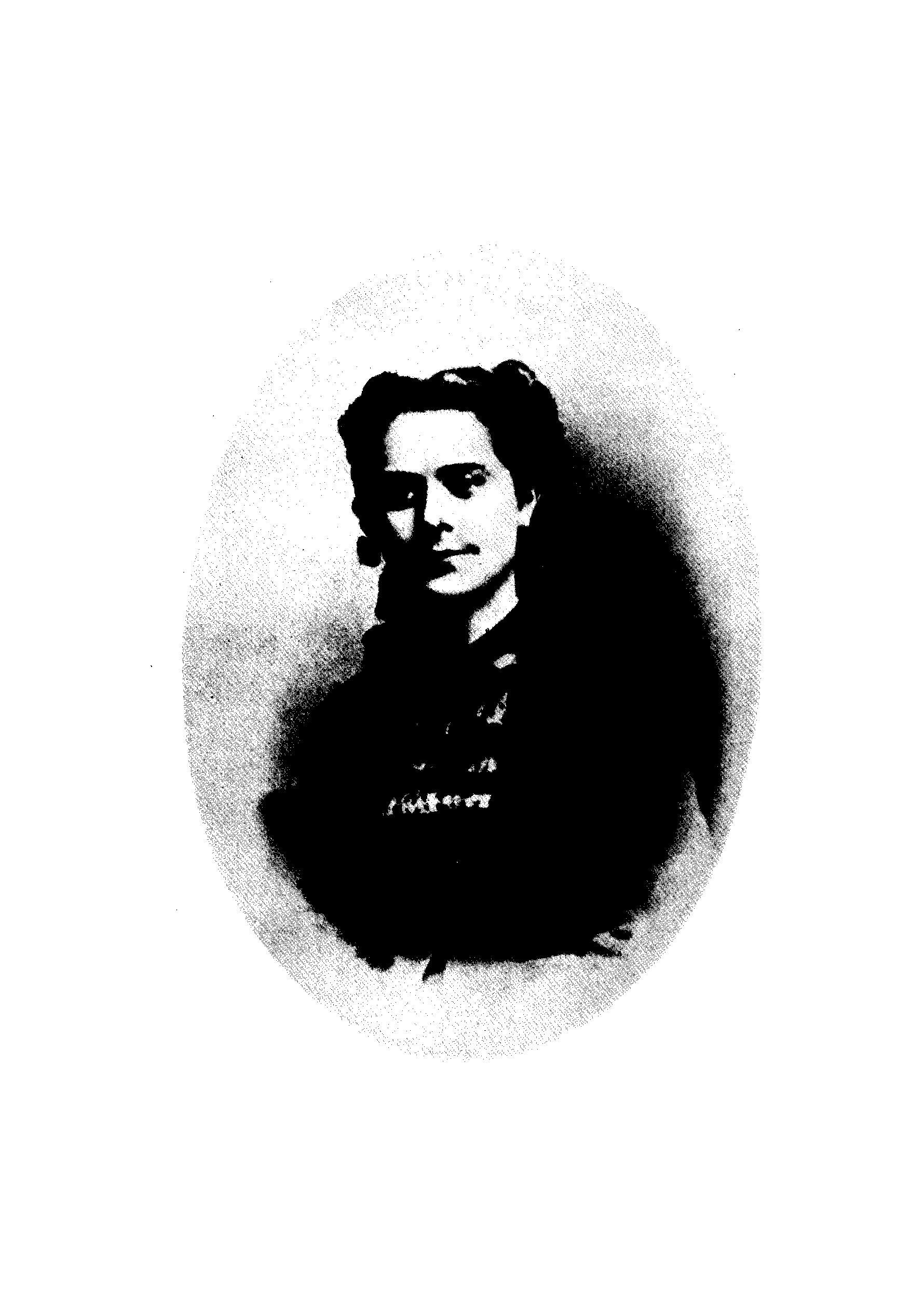
236. Marx to Mrs James M. Williamson. // January[4 8 9]
237. Marx to James M. Williamson. 13 January
Madame James M. Williamson with the wishes for a happy New Year.
Karl Marx
Published for the first time Reproduced from a photocopy of the original
237
MARX TO JAMES M. WILLIAMSON
IN VENTNOR
Ventnor, 13 January 1883 1 St Boniface Gardens
Dear Dr Williamson,
The fatal news of the death of my oldest daughter [4 9 0] forced me to at once return to London. [4] ' '
Please, dear Doctor, send your bill to 41 Maitland Park, London, N. W. I regret that I had not the time of taking leave from you. — Indeed I find some relief in a grim headache. Physical pain is the only 'stunner' of mental pain.
Yours very truly,
Karl Marx
238. Engels to Eduard Bernstein. 18 January[3]
Dear Mr Bernstein,
Days of festivity, followed by days of mourning,[4] [9] ° constant ob-structions. At present I have scarcely a moment to call my own, as you will understand when I tell you that Marx is back here from Ventnor,[4] ' ' confined to the house with bronchitis — so far, luckily, only a mild attack — and forbidden to talk much, while all the family business devolves on me. (But not a word of all this in the paper"; Marx would be furious if he were to see the worthy Viereck's indiscreet and, what's more, not altogether veracious comments in today's Süddeutsche Post.)
Enfin,b I still have an hour or so to spare for you. As for Gumbel, returned herewith, he resembles Heine's Gumpelinoc in as much as he too is interested in stocks and shares. For that matter, he's an outstanding example of the German socialist abroad, having obviously been in Paris. Because we have provided these chaps with a theory of which they are entirely innocent, seldom bothering, moreover, to acquire a rudimentary — if indeed any — understanding of it, every provincial nincompoop among them considers himself superior to all other foreigners. Arriving from Heilbronn, or whatever the potty little place may be called, in London or Paris, he is appalled when he finds that his particular brand of provincialism does not hold good there. Instead of broadening his horizons and learning something, he deliberately makes himself more blinkered than before, for this serves to render all the more glaring the contrast between himself and the bad, stupid foreigners — i. e. his supposed superiority over them. Yet this is the kind of person who predominates in German associations abroad, and if you are now under pressure from them, just ask yourself who it was, after the promulgation of the Anti-Socialist Law, ' [6]
that sought to give undeserved prominence to these associations by means of centralisation, etc. If you had known the chaps then as well
Der Sozialdemokrat - b Well -c See Heine's Reisebilder, 2nd part.
as you do now, you would have been unlikely to go to so much trouble.
'The party with clean hands' — meaning what? The hands, perhaps, of Hasselmann or Fritzsche and of so many others, about whom everyone arriving here as an exile or something of the kind had a tale to tell?
Gumpelino is at his best when he comes to his stocks and shares. When some such provincial champion of moral virtue tilts thus phari-saically at practices, unpleasant enough in themselves, but from which the party none the less derives a real advantage that far out-weighs any possible damage, there must be a catch somewhere. The workers do not have stocks and shares, nor do they give a damn for the financial page. Hence — the little bourgeois, who also wants to dabble in stocks and shares, proceeds to demand that his party paper carry a benevolent, honest, moral, financial page. In the first place, it is not the business of a socialist paper to indicate how best the workers can be exploited — income from stocks and shares is, however, also the product of unpaid labour. If, then, in the second place Gumpelino nevertheless demands that the socialist press should do this, it says little for his socialism and even less for his flair as a businessman. I, too, have stocks and shares, buying and selling from time to time. But I am not so simple as to look to the socialist press for advice on these operations. Anyone who does so will burn his fingers, and serve him right! Get yourself baptised, Abraham Gumpelino!
We were delighted by the way Grillenberger and the Sozialdemokrat replied to Puttkamer's piece of hypocrisy.[491] That's the way to do it. Not to twist and turn beneath the opponent's blows, or whine and whimper and stammer out excuses about no harm's being meant, as is still done by so many. Hit back — that's what one should do — for every blow dealt by the enemy, pay him back two or three. These have always been our tactics and up till now we have, I believe, always pretty well got the better of our opponents. 'Moreover, the genius of our soldiers lies in attacking, as is perfectly right,' says old Fritz in his orders to his generals[492] and that, indeed, is what our workers do in Germany. But when, in the debate on exceptional laws generally, — given that \_j 'sa abstract is right — Kayser, for instance, retracts whining that we are revolutionaries only in the Pickwick-
Louis Viereck (square in German = Viereck).
ian sense,(1) what then? What he should have said was that neither the entire Reichstag nor the Federal Council would be sitting had it not been for a revolution; that old William, when he gobbled up three crowns and a free city,[493] was likewise a revolutionary; that legiti-macy itself, and the very foundations of the so-called constitution, are no more than the product of innumerable revolutions effected against the will of the people and directed against the people. Oh, this damned German slackness of thought and will, introduced at such pains into the party with the 'eddicated' men,— if only we could rid ourselves of it again!
Time for the post. I shall reply as soon as possible to whatever points in your letter I may have overlooked. Thanks for the photograph. Proofsb when?
Regards, yours,
F. E.
239. Engels to Eduard Bernstein. 8 February[2 4]
Dear Mr Bernstein,
1. I trust you have received the final ms. ( The Mark) which was sent off from here registered on 20 December. But the printing delays are now getting really too outrageous. If it goes on like this you had better reset the title and put 1884 on it. When, exactly, will there be another sheet?
2. I have received — neither the first Accident Bill, nor Bebel's speech on the subject. Meanwhile it has struck me that a specific attack on Bismarckian socialism has become outdated.(1) Viereck's little paperb has lost all inclination for it. Singer, who had been suffering badly from nationalisation mania on the last occasion but one, was, on the last occasion, completely free of it and genuinely revolutionary, [494] while as for those weaklings in the Reichstag, Bios, Geiser & Co., their courage, if not their enthusiasm, would appear to have evaporated. So why crack a nut with a sledgeham-mer? I think we should let Bismarckian socialism dig its own grave. After which all that remains is a criticism of the rotten Lassallean remnants. But if the pamphlet[378] is printed so slowly, this attack, too, may have ceased to be topical by the time the thing comes out.
3. You are mistaken about Malon. The man is. not as stupid, or rather as naive, as he makes himself out to be. C'est un faux bonhomme'c
who has learnt from the Bakuninists how to manipulate people on the sly while making out that it is he himself who is being manipulated. One of these days you will see that I am right.
4. Stock exchange tax. Has long existed here in England in the form of a simple, everyday stamp on the transfer document — '/d% °f the amount paid and 5/- transfer fee (securities au porteurA are rare over here; they are free). The only consequence is that the real specu-lation on the stock exchange is in margin dealings where no actual transfer takes place. Hence only affects the so-called 'solid capital in-vestment'. Nor has anything ever been devised that the stock market speculators cannot circumvent.
I am against it, 1. because we, after all, demand only direct taxation, rejecting any that is indirect, so that the people may know and sense what they are paying, and also so that capital can be got at in this way, 2. because we certainly cannot vote one penny to this government.
You are right in describing the outcry against the stock exchange as petty-bourgeois. The stock exchange simply adjusts the distribution of the surplus value already stolen from the workers, and how that is done may at first be a matter of indifference to the workers as such. However the stock exchange adjusts this distribution in the direction of centralisation, vastly accelerates the concentration of capitals and is therefore as revolutionary as the steam engine.
Equally petty-bourgeois, though perhaps just excusable, are taxes with a moral purpose — beer, spirits. In this context they are quite ludicrous and altogether reactionary. Had the stock exchange in America not created colossal fortunes, how would large-scale industry and a social movement have been possible in that land of farmers?
It would be quite a good idea if you were to lash out here. But with circumspection. There must be no gap in one's defences where your Stoeckers are concerned.
5. 3rd edition of Capital.[227] Will doubtless take some time yet as Marx is still ailing. His stay in Ventnor, where it rained continuously, did him no good. On top ofthat there has been the loss of his daughter. [4] (2) ° He has been back here for the past 3 weeks and is so hoarse that he can barely speak, so not much could be discussed (only don't mention this in the paper,b of course).
6. We should be grateful for the Rodbertus-Meyer book.c
At one time the man was almost on the point of discovering surplus value, but his estate in Pomerania prevented him from doing so.
Very many thanks for the photograph. Kautsky has sent me his pamphlet on American grain. Choice irony: 3 years ago the population was to be reduced because it would otherwise have nothing to eat; now the population does not even suffice to eat what America produces![495] That's what happens when you study so-called 'questions' one by one without linking them together. In so doing you naturally fall victim to that dialectic which 'is objectively present', Diihring notwithstanding, 'in things themselves'. [4 9 6]
I am delighted to hear that the Hohenzollern family again boasts a professing pederast. It would not bè complete without one. Admittedly Prince Karl, like Frederick William II, also 'operated' in that line, but he also included women. That reminds me, did Adolf Beust give you Mirabeau's Secret History of the Court of Berlin" which I gave him to pass on to you? If not, get hold of it. The book is inimitable on the subject of Frederick William II; the best bits have been dog's-eared.
Kindest regards.
Yours,
F. E.
240. Engels to Eduard Bernstein. 10 February[24]
Dear Mr Bernstein,
I respectfully confirm mine of yesterday's date" and herewith enclose a letter for Kautskyb whose old address may no longer be any good.
To come back to the stock exchange tax, there is absolutely no need for us to deny the 'immorality' and rascality of that exchange; we can even paint a really lurid picture of it as the spearhead of capitalist gain where ownership becomes directly synonymous with theft, but then go on to conclude that it is by no means in the interests of the proletariat to destroy this immaculate spearhead of the present economy; rather it should be allowed to deploy perfectly freely, so that even the most stupid can see where the present economy is taking them. We shall leave moral indignation to those who are avaricious enough to have recourse to the stock exchange without themselves being stock exchange men and who, as is only right, are cleaned out. And then if the stock exchange and 'solid business' come to blows and if the country Junkers, who also seek to dabble in securities and are inevitably fleeced, make a third in the three-sided battle between the main elements of the exploiting class, then we, the fourth, shall be the ones to laugh.
The request for an exact address with number and street applies to you as well. Otherwise I cannot send any money, which I must certainly do, inter alia, for 6 copies of the Schmidt pamphlet[458]
which Schorlemmer and I wish to send to Germany and which I ask for.
But now I must close.
Yours,
F. E.
241. Engels to Karl Kautsky. 10 February
Dear Mr Kautsky,
At long last I can get round to answering you and thanking you for the various things you have sent. You have no idea of the way im-pediments of all kinds have prevented me, not only from working, but also from attending to the most urgent correspondence. Since Marx has been ill the burden has fallen upon myself alone and, on top of that, the number of inquiries, etc., has doubled. Moreover, I cannot very well write in the evenings because it tires my eyes and interferes with my sleep. Thus all written work is dependent on the few — in wintertime here, all too short — hours of daylight and, in view of the distances one has to cover here, a single trip into town will, as often as not, disrupt one's entire working day. And some fine to-ing and fro-ing I have had to do of late!
Enough of that. I have not yet seen Die Neue %eit. But I shall write to Dietz today. I must have street and house number if I am to send the subscription per money order; that's the rule here.
Your treatise on American food production is most timely. The fact that you make such use of the information supplied by Mr Meyer must have made him very proud. 49? Is he still in Vienna, and do you still see him from time to time?
But what irony of history! 3 or 4 years ago you, a neonato* Malthu-sian, were advocating the necessity of restricting the population by artificial means, because otherwise the time would soon come when we should none of us have enough to eat. And now you prove that the population is not even large enough to consume America's surplus food production as well as what Europe herself produces. Solve, I pray, Count Oerindur, this conundrum posed by nature!b Presumably, then, it won't be rations that are withheld, but rather that much-vaunted little sponge! Which is not to say, of course, that this same or some other method might not be of great practical use in middle-class families to keep the number of children proportionate to income, and prevent the wife's health being ruined by too frequent confinements, etc. But I still maintain that this is a private matter between husband and wife, or at most the family doctor (in one such case I myself recommended what you call the 'Raciborski method'), and that our proletarians will continue as before to live up to their name by producing numerous proles.c
It will not surprise you to learn that my standpoint in regard to your article on hetaerism[498] still remains the same, namely that community of wives (and of men for women) was the basis for sexual relations within the tribe. The psychological argument against this, de-riving from jealousy, interpolates more recent views, and is disproved by countless facts (some of which below). Darwin is no more of an authority in this field than in that of political economy, whence he imported his Malthusianism. We know practically nothing about apes in this respect, since observations in a menagerie prove nothing and are difficult to make in the case of a troop of wild apes, while such as are alleged to have been made cannot claim to be accurate, conclu-sive or even universally valid. Gorillas and orang-outangs must in any case be excluded, since they do not live in troops. Those primitive tribes you adduce, with a loose form of monogamy, are, in my view, degenerate, as Bancroft has shown of the Californians of the peninsu-la. (1) Proof of primitivity is provided, not by barbarism, but by the degree of integrity of ancient tribal blood ties. These, therefore, must first be established in each individual instance before conclusions can be drawn from individual manifestations in this tribe or that. For instance, in the case of the peninsular Californians, these ancient ties have become very much looser, nor has any other organisation come to take their place; a sure sign of degeneracy. But even these argue against you. For amongst them, too, the women periodically revert to concubinage. And this is a crucial point though you do not so much as mention it. Just as it may be confidently inferred that, wherever,— e.g. with the Hutzwang*[99]—the land periodically reverts to common ownership, there will once have been complete common ownership of land, so too, I believe, one may confidently conclude that there has originally been community of wives wherever women — symbolically or in reality — periodically revert to concubinage. And this happens, not only amongst your peninsular Californians, but also amongst many other Indian tribes, not to mention the Phoenicians, Babylonians, Indians, Slavs and Celts, either symbolically or in reality; hence it is very ancient and widespread and entirely refutes the psychological argument based on jealousy. I am curious to see how, in due course, you will contrive to overcome this obstacle, for you cannot after all omit all mention of it.
Here comes Pumps with her husband and childb and that means no more writing. This is always happening.
With kindest regards,
Yours,
F. E.
242. Engels to Laura Lafargue. 16 and 17 February
242
ENGELS TO LAURA LAFARGUE
IN PARIS
London, 16th February 1883
My dear Laura,
I begin this letter — 4 p. m.— uncertain when I may be able to finish it, the constant interruptions I have lately been subjected to leave me no quiet time except at night and then I dare not write much, as that affects my eyes.
Your Salas y Gomez* is on the whole a masterpiece. There is the same roughness of language as in the original — roughness as we like it in young good red wine, gesunde Herbigkeit,b and which makes Chamisso's terzine come nearer to Dante's than those of any other poet. I compared it with the original line for line and am astonished at the fidelity of the reproduction. Still I would wish you to try and alter a few passages so as to make it perfect. The end, you say yourself, is hurried and so indeed it is. But for details.
Introduction. Terz. 3. Thus towered it — it could not 'tower' while it could only be descried from the mast-head.— From the Ruric: impossible, because Chamisso himself was on board the Ruric.
Terz. 5. I think wants re-moulding. Den Versuch zu wagen" applies merely to the risk of getting the boats safely through the breakers caused by coral reefs which encircle all islands in those latitudes.
Terz. 7, 3. One syllable short, our cannot be used bisyllabic. Terz. 15. The translation: albeit ... that might obliterate, is open to misleading. The original says clearly that it is the men's own steps that have obliterated the writing.
Terz. 31, 1. This cold rock will never do while it burns his feet through his soles.
1st Tablet. Terz. 1. Ich sah bereits im Geiste* — that cannot be suppressed in the beginning. The reader, from the translation, must believe that the man was already in full possession of all these fancied treasures, and only at the end, Terz. 8, there is an indication, and that, after the previous omission, not strong enough, that all this was a mere fancy-dream. The character of the adventurous seafarer in quest of wealth forms the basis of the whole piece, and ought therefore to come out strong from the beginning of the story.
Terz. 4, 1 : and for myself too were content and gain, is not to be understood without reference to the original.a
Terz. 9, 3: the cabins gives a syllable too much in the verse, and is not literal. Der untre Raum is in ship's language the hold, and moreover monosyllabic.
2nd Tablet. Not a fault to find except one and that is one in copying. Terz. 16, 1: For they (have) sighted me, the have is omitted.
3rd Tablet. Terz. 7. 'Worser far' I prefer, but will the philistine public? And will you turn philistine enough to say 'worse by far'?
Terz. 15-20: your own variations indicate that you are not quite satisfied with your work. I do believe that here a fresh attempt might be made with advantage. The conclusion again is very good.
As usual the beginning, when one is not yet recht im £ug,b and the end when one gets tired a little, are the weak points, but I think after you have had it laid aside for a time, you will be able to go at it again with fresh vigour and make it what indeed you can make it.
Mohr wants to read it too, but not yet. Latterly he has had very bad sleepless nights which have broken down his intellectual appetite, so that he began to read, instead of novels, publisher's catalogues. However the night before last was good and he was quite another man yesterday; another good symptom: his feet, previously ice-cold in the evening and only to be warmed by hot mustard-baths, for the last two nights were quite warm and no baths required. The chronic inflammation of the larynx and bronchiae is slowly becoming subdued, but swallowing still painful and the voice very hoarse. I shall continue to-night after I have seen him. His appetite was very good yesterday, Nimc surpasses herself in inventing new dishes for his case.
17th February. It was 1 o'clock when I came back last night from Maitland Park,d so I could not finish this letter. Mohr was going on pretty much as usual, but he had given up the catalogues and returned to Frédéric Soulié, anyhow a good sign. What do you say to this, that he drinks a pint of milk a day, he who could not bear milk to be on the table! Anyhow it does him good. Besides rum now and then (in the milk especially) he takes a bottle of brandy about every four days.
The worst is that his case is so complicated that while the most pressing things, the breathing organs, have to be attended to, and now and then a sleeping draft is to be given, other things have to be neglected, for instance the stomach which is as you know none of the most perfect organs of digestion. But still his appetite keeps up pretty well, and we do our best to supply him such food chiefly as contains much nourishment in a small compass.
I think our friends have been in too great a hurry with the new Egalité. What is to become of the paper if Paula and Guesde get 'time to serve' at Moulins, and that is after all not quite impossible?[440]
Guesde's opening articleb is not at all what it should be. What he says of judges elected by universal suffrage, is quite as applicable to universal suffrage itself, to the Republic, to any political institution. If Messieurs les français do not know how to use this universal suffrage tant pis pour eux.c Give our people in Germany the right to elect the judges and they will carry the election in all large towns and make Berlin too hot a shop for old William and Bismarck, unless they have recourse to a coup d'état. But to say: white because my adversary says: black, is simply subir la loi de son adversaire, et une politique de bébés.d I am afraid Guesde's old anarchist rodomontades are cropping up again rather fast, and in that case he will lose himself. Paul's deux embêtés' [50]° are charming. That is just his line.'
time
243. Engels to Eduard Bernstein. 27 February[5 0 1]
Dear Mr Bernstein,
I recently had a little dispute with Viereck which has forced me to break with him. As he might possibly come to Zurich for the congress [502] and make use of the occasion to mention the matter in private conversation, I am concerned lest in that event his version be the only one to go the rounds. I therefore authorise you to read this letter to anyone Viereck may discuss the matter with, but at all events to Bebel and Liebknecht.
Some little while before Christmas Viereck, or rather his wife,a sent me the visiting card of one Deinhardt, a Munich engineer, with three questions of a chemico-physico-industrial nature and asked me to get hold of the information if possible. I sent the card to Schorlemmer in Manchester who rightly suspected from the questions a pushful and importunate inventor and for good measure appended a 'motto' to his extremely terse reply. Here is the card as returned to Viereck:
'1. Has ozone come into use alongside chlorine and chloride of lime for bleaching rags in English paper mills? — No.
'2. Compared with other bleaching agents, does ozone offer a manufacturing concern any noteworthy advantages in a technical or financial sense? — No.
'3. Is the production and use of ozone in an industrial concern attended by considerable difficulties? — Tes.
'C. Deinhardt, Engineer (printed on card). 'Motto: Apage inventor/'b
In this form the card went back. So if Viereck did not wish to show Deinhardt the motto, all he had to do was copy questions and answers onto a sheet of paper or a postcard, and that would have been that.
Next I received No. 7 (17 January) of the Süddeutsche Post (which Viereck sent me in exchange for The Labour Standard) and, in the 'Letter Box', saw the following:
'To Mr Deinhardt, engineer of this city. The author of the 'electrotechnical revolution' writes to tell us that, despite information to the contrary supplied by Prof. Schorlemmer, of Manchester, he must stand by his contention that the production of ozone would be effected by means of a dynamo, etc'
What was the meaning of this? How was it that this purely private piece of information found its way into the paper rather than into a proper letter box? And how could Viereck have had the impudence to make public use in his paper of private information supplied by Schorlemmer for Deinhardt — on Viereck's own evidence an extremely importunate man — purely to oblige Viereck? Either Viereck didn't know what he was doing or he did it out of revenge for the 'motto'.
But there is nothing whatever in the 3 questions and answers that turns on whether the production of ozone is effected by means of a dynamo; a dynamo is not mentioned at all. Thus, by indirectly attributing to Schorlemmer a statement actually denying that the production of ozone is effected with a dynamo, Viereck is guilty of outright falsification; he is attributing to Schorlemmer things he has never said. But obviously it cannot be a matter of indifference to a chemist whose reputation extends beyond Europe if someone attributes to him things about chemico-physical questions he has never said, and does so publicly in the university city of Munich where, after all, there are also chemists and physicists who might possibly read it.
So I sent the paper, as was only my duty, to Schorlemmer who sent me the following letter for Viereck:
'If anyone' (I am quoting from memory) 'publishes a private communication without permission, then it is improper. But if in addition he goes on to distort the said communication, then it is barely ethical.'
Accordingly Schorlemmer called for the publication of the card as it stood, with questions, answers and motto, in order that the matter might be clarified.
Whereupon a long letter arrived from Viereck addressed to me. Deinhardt, he said, had bombarded him with three letters on the subject of ozone (so the Apage inventor was wholly appropriate^.). By sending him [Viereck] the above-mentioned letter I was now holding a pistol to his head {which is untrue, let him show it to you; all I did was demand in polite terms full satisfaction for Schorlemmer), while Schorlemmer's letter and the demands made therein were even more intemperate. He could not, he added, publish the motto (needless to say this request was not intended seriously) and the remainder only if Schorlemmer withdrew the insulting expressions contained in his letter; for the time being he could not admit having made a mistake, but 27 1883
must refuse to accede to our peremptory demands in 'this entirely un-qualifiable form'.
'/ did not even know,'' his letter goes on, 'that Prof. Schorlemmer read the Süddeutsche Post and surely cannot in any circumstances assume that you had sent him this issue ad hoc'. For I regard it ... as out of the question that you could inform against me and I should have been only too pleased had you suggested what steps ought to have been taken to pacify the much agitated professor.' ... "/12 of his readers consisted of party members ... nothing ought to be imputed to him that was 'inconsistent with the conduct of a man of honour', etc.
So they make improper use of Schorlemmer's name and, on their own admission, distort what he says because they hope he won't find out. And when I, the sole cause of his involvement in the affair, tell him about it, then I am 'informing' against Viereck. Not Schorlemmer but Viereck is the injured party, because Schorlemmer characterises Viereck's conduct, and with great restraint at that. Not a word about the falsification of which Schorlemmer was the victim.
Well, Viereck may read our reply to anyone he chooses. We sent him a statement, addressed not to him but to the editorial board, i. e. a statement intended for publication, together with a request that at the same time they print questions and answers. What does Viereck do? First, a polite apology in the 'Letter Box', to wit:
'We profoundly regret this tiresome misunderstanding' and promise to put the matter right.
And then? In No. 17, 9 February:
'In regard to the electrotechnical revolution. On being consulted, Prof. Schorlemmer of Manchester supplied the following information which we herewith print in order to clear up a (!) misunderstanding (!)': (the questions and answers follow).
The clarification of this 'misunderstanding' is tantamount to the total obfuscation of the affair, as is satisfaction for Schorlemmer to attempted mockery and to further misuse of his name. Thereafter I returned the Süddeutsche Post unopened. Yet another postcard from Viereck, asking what he had done to deserve being rebuffed in this insulting (everything is insulting!) way, etc. What I said in my reply — also per postcard — he can read to you himself if he likes. 'One must make« complete break with a swine like that,' Schorlemmer writes to me. And that has been done.
Yours,
F. Engels
244. Engels to Eduard Bernstein. 27 February- 1 March[7]
Dear Mr Bernstein,
Your letter received yesterday evening.[503] The Egalité has gone phut again and I would ask you to publish the following facts (see enclosed slip of paper) in the Sozialdemokrat.[504] Let us hope that the chaps will finally learn some sense and not go founding daily papers on the strength of contracts of this kind. Taking legal action is a mug's game and costs money, and any French court of law would revel in non-suiting socialists and losing them their case, while the paper would still remain defunct.
Guesde and Lafargue, amongst others, were arraigned[440] under Article 91 of the Code pénal ' [6] [7] — conspiracy and incitement to civil war — death penalty. What a farce!
At any rate, it's a good thing that they can no longer publicly declare their solidarity with the anarchists, the latter being now behind bars — mere children who play with fire and, when given a hiding, try and make out they're the most innocent fellows in the world. And now some fool in Brussels sets off a bomb in his own trousers pocket! In due course dynamite will come to seem plain ridiculous.
Now for a different tableau. Because of a dirty trick Viereck played on Schorlemmer in the Süddeutsche Post, I have broken with him. Further details are contained in a letter I have sent to Schorlemmer[1] and which he, if he is agreeable, will send on to you tomorrow direct from Manchester (I have got it here, returned because I had forgotten to sign it).a I need hardly tell you that, when Viereck and Fritzsche were over here, they would have been given a very cool recep-tion by us had they not come as the official emissaries of the party. As it was, however, and since Marx was exempted by his indisposition, I had to some extent to do them the honours.[505] Moreover, a certain intimacy grew up between his (Viereck's) present wifeb and my niece0
(both of whom were then secretly engaged), etc., etc. At the same time I told him pretty plainly what I thought of his proclivity for vulgar democracy. In short, I became involved with him, but now it is all over.
The veriest boot-black could not have tolerated the treatment meted out to Schorlemmer by Viereck. Yet Schorlemmer is, after Marx, undoubtedly the most eminent man in the European socialist party. When I got to know him 20 years ago he was already a communist. At that time an impoverished private assistant to English professors, he is now a member of the ROYAL SOCIETY (the equivalent over here of the Akademie der Wissenschaften), and the world's leading authority in his own speciality, the chemistry of the simpler hydrocarbons (paraf-fin and its derivatives). His great Treatise on Chemistry, brought out jointly with Roscoe,d but written almost entirely by Schorlemmer (as all chemists know), is now without a rival in England and Germany. And this position he has carved out for himself abroad, in competition with men who exploited him for as long as they could, and he has done so entirely on the strength of genuinely scientific work, without ever making any concession to humbug. Moreover, he never hesitates to proclaim himself a socialist as, for instance, when he reads jokes aloud from the Sozialdemokrat for the benefit of the other lecturers with whom he is lunching; but he also demands, and justly so, that he should not have unwanted publicity, in whatever guise, thrust upon him, as was done by Viereck. But now, good-bye until tomorrow. It is almost midnight and I have broken my rule of not writing at night.
28 February. There is, however, one favour I would ask of you, and that is not to keep chucking the word 'comrade' at me in the paper.e To begin with, I detest anything that smacks of title-mongering and since, in all the German literature that counts for anything, people are called simply by their names and are not given titles unless under attack, we too should conform to this unless the designation 'comrade' is really intended to inform the reader that the person concerned belongs to the party. What is in place and normal on the platform and in verbal debate can look pretty awful in print. And then again, we here are not in fact 'comrades' in the narrower sense of the term. We can hardly be said to belong to the German party any more than to the French, American or Russian, nor can we regard ourselves as any more bound by the German programme [506] than by the minimum programme.6B We set no little store by this, our special position as representatives of international socialism. But it also pre-cludes us from belonging to one particular national party — so long, that is, as we are unable to return to Germany and participate immediately in the struggle there. Just now it would be pointless.
What you say about Liebknecht's complicity in importing philistine elements has long been our view. For all his excellent qualities, Liebknecht has one fault, namely the desire to attract 'educated' elements to the party by hook or by crook, and to him, a former teacher, the worst thing that can happen is for a working man in the Reichstag to say 'me' for T . A man like Viereck ought never to have been put up as a candidate. He would have exposed us in the Reichstag to far more deadly ridicule than would a hundred wrong 'mes' of which, after all, the Hohenzollerns and field marshals are likewise guilty. Unless the newcomers — the educated ones and those from bourgeois circles generally— adopt the proletarian standpoint unreservedly, they can do nothing but harm. But if they have genuinely adopted that standpoint, then they are exceedingly useful and welcome. Another of Liebknecht's characteristics is that, for the sake of a momentary success, he will unhesitatingly sacrifice subsequent, more important successes. Thus Viereck and Fritzsche's highly dubious mission to America. [119] It went off reasonably well, but is there any knowing to what ridicule Fritzsche may not expose us later on in America? And then people will say: 'And there you have the representative of German Social Democracy in America, sent over officially!' And the caution one has to observe vis-à-vis this type of person when it comes to candidatures is evident from the Oppenheimer case.[507]
Yet another interruption!
1 March. We have always done our utmost to combat the narrow, petty-bourgeois philistine mentality within the party because, having developed since the Thirty Years' War, [4 7 2] it has infected all classes in Germany, and has become a German hereditary ill, sister to servil-ity and humble submissiveness and every German hereditary vice! This it is that has made us ridiculous and contemptible abroad. It is the chief cause of the slackness and weakness of character so prevalent in our midst. It prevails on the throne no less frequently than in a cobbler's lodging. Only since the time a modern proletariat took shape in Germany, only since then has a class developed there that is virtually untainted by this hereditary German scourge, a class which has given proof of clear-sightedness, energy, humour and tenacity in the fray. And can we be expected not to combat every attempt at ar-tificially inoculating that healthy — in Germany, the only healthy — class with the old hereditary germ of philistine narrow-mindedness and philistine slackness? But during the first period of shock after the assassination attempts [120] and the Anti-Socialist Law, I6 the leaders fell prey to an anxiety which in itself is proof of their having lived far too much amongst philistines and been subject to pressure from philistine opinion. The idea at the time was that the party should, if not actually become philistine, at any rate appear to be so. That, I am glad to say, has now been overcome, but the philistine elements — these being particularly prevalent among university men, most of them incapable of passing their examinations — introduced in pre-Anti-Socialist Law days are still there, and a close watch must be kept upon them. We are glad to have your assistance here and, being on the Sozialdemokrat, you are in a key position.
But for goodness sake don't go raking up that wretched Jahrbuch article.a It was an apologia for the stock exchange men. But one can perfectly well be at one and the same time a stock exchange man and a socialist and therefore detest and despise the class of stock exchange men. Would it ever occur to me to apologise for the fact that I myself was once a partner in a firm of manufacturers? There's a fine recep-tion waiting for anyone who tries to throw that in my teeth! And if I could be certain of making a million on the stock exchange tomorrow, and thus put an ample supply of funds at the disposal
" [K. Höchberg, E. Bernstein, C. A. Schramm,] 'Rückblicke auf die sozialistische Bewegung in Deutschland. Kritische Aphorismen', Jahrbuch für Sozialwissenschafi und Sozialpolitik, 1. Jg., 1. Hälfte, Zürich-Oberstrass, 1879.
of the party in Europe and America, to the stock exchange I should promptly go.
What you say about courting the enemy's praise is perfectly right. We have often been infuriated by the glee with which the slightest sign, be it only a fart, of recognition from the armchair socialists[82]
was recorded in the Volksstaat and the Vorwärts. It was the phrase, 'We must exact recognition from the bourgeoisie in every sphere', that marked the beginning of Miquel's betrayal.[456] And however much Rudolf Meyer may butter us up, [4 8 2] all the recognition he is likely to get in return is for his really meritorious Politische Gründer. * We never, of course, discussed serious topics with him, but confined ourselves almost entirely to Bismarck and the like. But Meyer is at least a decent fellow and one who is also quite capable of defying the aristos, nor is he ambitious like all the rest of the armchair socialists, who are now also flourishing in Italy; one specimen, Achille Loria, was over here recently but two calls on me were enough for him.
In the case of Viereck, who knows absolutely nothing about the matter, the to-do over the electrotechnical revolution is merely an ad-vertisement for the pamphlet he has published.[15] In fact, however, it's a tremendously revolutionary affair. The steam engine taught us to transform heat into mechanical motion, but the exploitation of electricity has opened up the way to transforming all forms of energy — heat, mechanical motion, electricity, magnetism, light — one into the other and back again, and to their industrial exploitation. The circle is complete. And Deprez's latest discovery, namely that electric currents of very high voltage can, with a comparatively small loss of energy, be conveyed by simple telegraph wire over hitherto undreamed-of distances and be harnessed at the place of destination[426] — the thing is still in embryo — this discovery frees industry for good from virtually all local limitations, makes possible the harnessing of even the most remote hydraulic power and, though it may benefit the towns at the outset, will in the end inevitably prove the most powerful of levers in eliminating the antithesis between town and country. Again, it is obvious that the productive forces will thereby acquire a range such that they will, with increasing rapidity, outstrip the control of the bourgeoisie. All Viereck sees in it, short-sighted as he is, is
" R. Meyer, Politische Gründer und die Corruption in Deutschland, Leipzig, 1877. -h See previous letter.
a fresh argument in favour of his beloved nationalisation. What the bourgeoisie cannot do must be done by Bismarck.
I'm sorry about the Schumacher business. Let's hope it's just a passing phase; he used to be such a lively, resolute chap. But, as you say, it's that damned German imperial atmosphere![508]
There are a great many reasons why I should not consider coming to the congress.[502] Things being what they are just now on the Continent, I would sooner remain here.
Kautsky has sent me his second piece on marriage[498] in which he again tries to sneak in community of wives as a secondary manifestation. But that won't do. Indeed, I shall write to him about ita and enclose the letter in one to you. It is Kautsky's misfortune that, in his hands, complex questions do not resolve themselves into simple ones — rather, simple questions become complex. And then, it's impossible to achieve anything if one is so prolific. He ought to write popular stuff for the sake of the fee, and take his time over scientific matters, thus dealing with them in a considered and exhaustive way, which alone can be rewarding.
The pederast, who made us laugh a great deal, has already been posted on to Manchester where he will be widely disseminated.
Marx is still incapable of work, keeps to his room (he returned here immediately after his daughter's death [4 9]°), and reads French novels. His case seems to be a very complicated one. My hopes are high, now that a better season is on its way.
Yours,
F. Engels
Whatever you do, don't put anything about Marx's state of health into the paperb; Viereck shamefully exploited in the Süddeutsche Post the information I sent his wifec from time to time (he hardly ever wrote to me himself!), but naturally I was able to keep this from Marx, otherwise he would have hauled me over the coals. Here again Viereck had failed to ask my permission.
245. Engels to Karl Kautsky. 2 March
Dear Mr Kautsky,
I have received your second article on marriage[498] and, since this contains your answer to my criticism of the first one,a I shall continue where I left off; I happen to have an hour to spare which will not be the case tomorrow.
To begin with I consider it absolutely inadmissible that, having contested community of wives as a primary manifestation, you should seek to reintroduce it as a secondary one. Wherever common ownership exists, be it of land, women or anything else, it will necessarily be primitive, a legacy of the animal kingdom. The subsequent process of development consists entirely in the gradual dissolution of this prime-val common ownership; in no case do we find an instance of secondary common ownership evolving out of primitive private ownership. So irrefutable and universally valid do I consider this proposition to be that, even were you to produce what appeared to be exceptions — and however striking these might be at first sight — I would not regard them as an argument to the contrary, but only as a question yet to be solved.
Moreover, having made jealousy the one decisive factor in the first article, you ought not to discard it entirely in the second. Article I presupposes a loose form of monogamy, and this very largely on the strength of jealousy for, as I have said, your other reasons carry very little weight with me. But if jealousy is able to overcome natural community of sexes — and you do after all indirectly concede the existence of the latter when you say: 'Within the tribe complete sexual licence prevailed' —if jealousy can relegate that natural licence to the confines of temporary monogamy, how much more easily must it be able to overcome lesser obstacles. The tribe's common ownership of captives is, however, an obstacle of much less magnitude. A woman remains a woman, whether she is free or a slave; true, in the case of female slaves, a man's jealousy is able to impose sole possession much more easily than in the case of free women who have a right to adul-tery! But the moment there is any question of marriage with captives, the jealousy of the husbands suddenly evaporates; the community of sexes which so appalled them in the primitive state, becomes accept-able and pleasing and, even after monogamy or polygamy has already been introduced, even in the case of Semitic peoples where harems are the rule, husbands do not object to their wives coupling with every Tom, Dick and Harry, either in the temple or at special seasons. No, my dear fellow, you can't dismiss the thing as easily as all that. For you are duty-bound to stick to the point even when it becomes awkward for you to do so. If primary community of sexes was inhibited by jealousy, then community of sexes is excluded once and for all, right down to and including capitalist society. Either your second article refutes the first or vice versa.
Incidentally, I would contest your statement that the freedom of women, at your first stage, contributed to monogamy because there could be no question of repression. The argument that community of sexes is dependent on repression is itself false and a modern distortion arising out of the idea that common ownership in the sexual sphere was only of women by men and at the latter's pleasure. This is totally foreign to the primitive state. Common ownership in this sphere was available to both sexes. To refute the false assumption, however, is not the same thing as refuting the correct facts on which the distortion is based.
Again, by reducing all community of sexes and traces thereof to marriage by rapine with foreign women, you attribute to that form of marriage, qua predominant form, a really vast range. Yet you adduce not the slightest proof of this.
What follows is lost in a welter of hypotheses [among them much]a
that is undoubtedly correct [in regard to specific times and] a places. But you generalise at the speed of an express train, whereas questions of this kind do not lend themselves to such rapid despatch. And while the Celtic clan, the Roman gens and the German Geschlecht are, it is true, all sub-divisions of the tribe, they all have very marked differences and also, surely, different origins. As do the various kinds of clan amongst non-Celtic peoples.
I am convinced that, should you pursue these studies or resume
a Ms. damaged.
them after a lapse of time, you will arrive at quite different conclusions and, perhaps, regret your premature endeavours in this difficult field. You have done some hard slogging, but you have leapt too rapidly to conclusions, at the same time laying too much weight on the opinions of self-styled anthropologists, all of whom have what I might call a certain obliquity reminiscent of your armchair socialist.[82]
While you may refute Bachofen's deification and mystification of community of sexes,(1) this is not to say that community of sexes does not and will not continue to exist.
Well, the dinner-bell is being rung — no offence meant, and so I still remain,
Your old friend,
F. Engels
246. Engels to August Bebel. 7 March
Dear Bebel,
I shall have to reply to you from memory today as I must have left your letter with Marx, but first of all I should like to congratulate you on your release the day after tomorrow. [4] °[5]
The rapid advances in German industry you have described please me enormously. What we are now experiencing is the second Bonapartist empire in all its aspects: the stock exchange is mobilising all capitals that are still wholly or partially idle by attracting them and rapidly concentrating them in a few hands; the capitals thus made available to industry are ushering in an industrial boom (which is by no means necessarily the same thing as a high level of business activity) and, once the affair gets going, it will continue to accelerate. Only two things distinguish the era of Bismarck from the era of Bonaparte III: The latter owed its prosperity to what was relatively free trade; the former is making headway despite protective tariffs that are wholly uncalled for, particularly in Germany. And, secondly, the Bismarckian era is putting far more people out of work. This is partly because the increase in population is much greater in our case than in that of France where two children are the rule, partly because Bonaparte, thanks to his building operations in Paris, generated an artificial demand for labour, whereas in our case the milliard era ' [6 9] came to an early end; but again it must partly be due to other causes about which I am not clear. At all events philistine Germany is at last becoming a modern country, and that is absolutely vital if we are to make rapid progress.
When one reads the German bourgeois papers and the speeches in the Chamber one might imagine that one was living in the England of Henry VII and VIII; the same complaints about danger from vag-rants, the same outcry for the forcible suppression of vagrancy — the cachot* and the lash. Here is the best proof of how rapidly the producers are losing touch with their means of production, of how rapidly the smaller enterprises are being supplanted by the machine and the perfecting of the machine. But what could be more ludicrous and despicable than those bourgeois who hope that moral sermons and penal methods sermons will enable them to do away with the inevitable consequences of their own actions. It is a crying shame that you are not in the Reichstag [222]; this is a theme that would be right up your street.
The precedent you set in the Saxon Landtag by calmly taking the oath [5 0 9] has had its imitators. The Italians have unanimously declared that the oath need not be a stumbling-block and Costa took the oath without demur.[420] And, after all, these are people who declare themselves to be 'anarchists', even though they vote and are elected by vote!
There has been a scandalous delay over my pamphlet[3] [7] [8] in Zurich, but the printing ought to be done by now; whether the binding will
a prison take as long in tin-pot Zurich, I don't know. At all events I am still awaiting copies, having as yet had none. The part on the 'Mark' will clarify much of Maurer for you; the man's writing is atrociously slipshod but the content is excellent. I have read the book 5 or 6 times and shall reread it next week after I have again been through the relevant material in the remainder of his collected works. [465]
We were most delighted at the way the virtuously religious Puttkamer was dealt with, first by Grillenberger in the Reichstag and then several times in the Sozialdemokrat.[4] [9] ' He will be on his guard now!
Little Hepner has reprinted Unsere 2jele[5] ' ° in New York, allegedly improved and with a little picture that is said to represent your por-trait but in fact represents an honest to God YANKEE. AS I only have the 1st edition, I can't say whether or what changes have been made by him for the worse/better. If you haven't got his edition I can send you one; after all, you had better see what the Americans think you ought to look like.
Now I must close, for I must go and see Marx whose health is still not really making the progress it should. If it were two months from now, the warmth and air would do their work but as it is there's a north-east wind, a storm almost, with flurries of snow, so how can a man expect to cure himself of a long-standing case of bronchitis!
Regards to Liebknecht.
Your
F.E.
247. Engels to Laura Lafargue. 10 March
247
ENGELS TO LAURA LAFARGUE
IN PARIS
London, 10 March 1883
My dear Laura,
Not having received a letter from Paula this morning, I conclude that in this frosty and snowy weather with east wind, you will not be in too great a hurry to come to London. Anyhow, if you should make up your mind to come, everything is prepared for you.
Donkin saw Mohr yesterday evening and I am glad to say gave a far more favorable account of his health than a fortnight ago. He said Mohr was decidedly not worse, but better, if anything, than then; and if we could keep him up for the next two months, there would be a good chance of bringing him round again. Of course he is still getting weaker, on account of the difficulty of swallowing, but we must force him to eat and drink. This is what Tussy wrote me on a postcard last night and what Nimb told me today; I shall see Tussy tonight and if any more details are to be had shall write again at once. The abscess in the lungs he considers to be going on very favorably at present. The nocturnal sweats have now ceased the last 4 nights (or 5) but instead of that there is a certain feverishness in the day-time which of course is also weakening.
He gave me the Prolétaire and the reply of Guesde's Committee, as well as the lvW c number of the Citoyen and Bataille which I am to keep for him. The copy sent by Paul can therefore with the rest be used for Zurich.d So this time the business part of the affair can be attended to, fortunately, but with Mohr's present state of health, that cannot always be reckoned upon if he be in exclusive possession of the materials.
These ex-Bakounists Malon and Brousse are a beastly dirty lot. Such barefaced forgery would be enough, anywhere out of Paris, to kill them for ever. But with the immense hold of la phrase upon the Parisians, who knows how many thousand votes the 'ouvrier manuel'c
will not concentrate upon himself? Enfin espérons le mieux.r Kind regards to Paul.
Very affectionately yours,
F. Engels
248. Engels to Charles Longuet. 14 March
Marx expired suddenly at three this afternoon letter follows
Engels London
249. Engels to Friedrich Adolph Sorge. 14 March[5 1 1]
Marx died today
Engels London
250. Engels to Wilhelm Liebknecht. 14 March[5 1 2]
Dear Liebknecht,
You will all have learned from my telegram to Mrs Bebel[284] — the only address I have got — of the terrible loss suffered by the European socialist revolutionary party. Only last Friday the doctor" — one of the leading medical men in London — had told us that there was every prospect of getting him as well as he had ever been, provided only he sustained his strength by taking food. And from that very moment he began eating with a better appetite again. Then, just after two o'clock this afternoon, I found the household in tears and was told he was terribly weak; Lenchen called out to me to come upstairs, saying he was half asleep, and, when I got there — she had been out of the room for barely two minutes — he was sound asleep, but it was for ever. The greatest intellect of the second half of this century had ceased to think. What the immediate cause of death was, I would not venture to guess without medical advice, the whole case being so complex as to require pages if it were to be described adequately, even by a doctor. And, indeed, it is no longer of any real importance. I have suffered anxiety enough over the past six weeks, and all I can say is that, in my opinion, the death, first of his wife,[513] and then, in a most critical period, of Jenny, [4 9 0] helped to bring on the final crisis.
Although I have seen him this evening laid out on his bed, his features rigid in death, I simply cannot conceive that this man of genius has ceased to fructify the proletarian movement of both worlds with his stupendous ideas. We all of us are what we are because of him; and the movement is what it is today because of his theoretical and practical activities; but for him we should still be in a welter of confusion.
Your
F. Engels First published, as a facsimile, in: Printed according to the facsimile in W. Liebknecht, Karl Marx zum Gedächtnis, the book Nürnberg, 1896
251. Engels to Eduard Bernstein. 14 March[5][2]
Dear Bernstein,
You will have got my telegram.[284] The thing happened frightfully quickly. Our hopes were at their highest when, this morning, his strength suddenly failed him, after which he simply fell asleep. Within two minutes this intellect of genius had ceased to think, and at precisely the moment when we had been encouraged by the doctors to entertain the highest hopes. Only someone who constantly kept company with him could have any idea of how valuable this man was to us in regard to theory and also, at every critical moment, in regard to practice. Along with him, his great breadth of vision will also disappear from the stage for years to come. These are things we others are not equal to. The movement will continue on its way but it will miss the calm, timely, considered interventions which have hitherto saved it many a weary digression.
More shortly. It is now midnight and I have had to spend the entire afternoon and evening writing letters and seeing to all manner of things.
Yours,
F.E.
252. Engels to Johann Philipp Becker. 15 March[5][2]
Dear Old Man,
Rejoice that you saw Marx once more last autumn, [5] ' [4] you will never see him again. Yesterday afternoon, at 2.45, when he had been left on his own for barely two minutes, we found him peacefully asleep in his chair. The most powerful intellect our party possessed had ceased to think, the stoutest heart I have ever known was beating no more. An internal haemorrhage would seem to be indicated.
We two are now pretty well all that is left of the old guard of the days before '48. Well, we shall continue to man the breach. Though bullets may whistle and friends fall, it won't be the first time we two have seen that happen. And if one of us is hit by a bullet — well and good, provided only it is properly lodged so that one isn't left writh-ing for too long.
Your old comrade in arms,
F. Engels
253. Engels to Friedrich Adolph Sorge. 15 March[5 1 2]
Dear Sorge,
Your telegram arrived this evening. Many thanks. To keep you regularly informed about Marx's state of health was impossible because of his perpetual ups and downs. But here, briefly, are the main facts.
In October '81, shortly before the death of his wife,[513] he went down with PLEURISY. Having recovered from that, he was sent to Algiers in February '82 and, the weather during the journey being wet and cold, arrived there suffering from another bout of PLEURISY. The exe-crable weather persisted; he had only just recovered when, because of the approach of hot summer weather, he was sent to Monte Carlo (Monaco). Arrived there suffering from another, though milder, bout of PLEURISY. Further execrable weather. Cured again at last, he went to Argenteuil near Paris, to stay with his daughter, Madame Longuet. There he availed himself of the nearby sulphur springs at Enghien for the treatment of his long-standing bronchitis. And there, too, the weather continued to be really appalling, but the cure did some good. Next, 6 weeks in Vevey, whence he came back here in September, apparently almost restored to health. He had been authorised to spend the winter on the south coast of England. And he himself was so sick of a wandering and idle life that renewed exile in southern Europe would probably have damaged his morale as much as it would have benefited his physique. With the onset of London's foggy season he was sent to the Isle of Wight where it rained continuously and he again caught cold. Schorlemmer and I had intended to visit him early in the New Year, but then reports reached us which necessitated Tussy's going there at once. Immediately afterwards came the news of Jenny's death[490]—whereupon he came back here, again suffering from bronchitis. After all that had happened and at his age this spelt danger. On top ofthat there was a host of complications, in particular an abcess of the lung and a tremendously rapid loss of strength. Nevertheless, the illness as a whole was taking a favourable course, and only last Friday the doctor en chef" in whose hands he was — one of the leading younger doctors in London who had been specially recommended to him by Ray Lankester — held out the rosiest hopes. But anyone who has ever examined lung tissue under a microscope knows how great is the danger, when a lung is festering, of the wall of a blood vessel becoming perforated. And that is why, every morning for the past 6 weeks, as I turned the corner, I was mortally afraid that the blinds might have been lowered. Yesterday, at half past two in the afternoon, his best time for receiving visitors, I arrived to find
Donkin the household in tears; it seemed as if he was nearing his end. I asked for news, tried to get to the bottom of the matter and to offer consolation. There had been a slight haemorrhage, followed, however, by a sudden collapse. Our good, old Lenchen,a who has looked after him better than a mother would after her child, went upstairs, came down again: he was half asleep, she said, and invited me to come up with her. When we went in, he lay there sleeping, never to wake again. His pulse and breathing had stopped. In the space of two minutes he had passed away painlessly and peacefully.
All events, however terrible they may be, that come about with natural inevitability, bear within them their own consolation. So it was here. The art of medicine might, perhaps, have been able to secure for him a few years of vegetable-like existence, the life of a helpless creature, not dying suddenly but inch by inch, a triumphant testi-mony to the skill of the doctors. But that is something our Marx could never have stood. To live with so many uncompleted works before him, with the tantalising desire to complete them and the impossibility of doing so — that would have been a thousand times more bitter for him than the gentle death that overtook him. 'Death is not a misfortune for the one that dies but for the one that survives',b as he used to say with Epicurus. And to see this powerful man of genius continue to vegetate, a total wreck, for the greater glory of medicine and as a laughing-stock for the philistines whom, at the height of his powers, he had so often felled to the ground — no! A thousand times better that it should be as it is, a thousand times better that we should bear him the day after tomorrow to the grave in which his wife lies sleeping.
And after all that had gone before, with which not even the doctors are as familiar as I am, there could, in my view, have been only one choice.
Be that as it may. Mankind is the poorer for the loss of this intellect— the most important intellect, indeed, which it could boast today. The movement of the proletariat will continue on its course but it has lost its focal point, the point to which Frenchmen, Russians, Americans and Germans would automatically turn at moments of crisis, on every occasion receiving clear, indisputable advice such as only genius and consummate expertise can give. Local bigwigs and lesser luminaries, if not imposters, will be given a free hand. Ultimate
Helene Demuth - b Epicurus to Menoeceus victory remains assured, but the digressions, the temporary and local aberrations — already so inevitable — will now proliferate as never before. Well, we have got to see it through — what else are we here for? But we're not going to lose heart, for all that — not by a long chalk.
Your
F. Engels
254. Engels to Friedrich Lessner. 15 March[5 1 5]
Dear Lessner,
At three o'clock yesterday our old friend Marx went gently and peacefully to his eternal rest; the immediate cause of death was, or so we presume, an internal haemorrhage.
The funeral will take place on Saturday[3] at 12 noon, and Tussy asks you to attend.
In great haste,
Your
F. Engels
17 March
255. Engels to Pyotr Lavrov. 24 March
My dear Lavrov,
I have received a long telegram from Moscow asking me to lay a wreath on Marx's grave on behalf of the students of the Petrovsky Academy of Agriculture[516]; not having my address, they telegraphed the editorial department of The Daily Mews. Now they are asking me to let them know the price of the wreath and my address. But it is not signed with a name — merely: Students of the Petrovsky Academy in Moscow.
To whom should I reply? Perhaps you could advise me. As the telegram arrived after the burial, and the grave has today been re-opened for the burial of Longuet's little boy" who died last Tuesday,11 I shall not be able to lay the wreath on it till next week. But then I should like to let the worthy young men know that I have received their telegram and carried out the task they entrusted
Yours ever, in haste,
F. Engels
256. Engels to Laura Lafargue. 25 March
256
ENGELS TO LAURA LAFARGUE
IN PARIS
London, 25 March 1883
My dear Laura,
Enclosed a letter from Meyer which was directed to Maitland Park(1) — Tussy opened it without looking at the address, but when she saw from whom it was, she gave it at once to Nimb who handed it to me.
To-day Nim found among Mohr's manuscripts a large parcel containing the best part if not the whole of the second volume of the Capital[221] — above 500 pages in folio. As we do not yet know in what state of preparation for the press it is, nor either what else we may find, it will be better to keep this piece of good news out of the press for the present.
Pumps is expecting No. 2 daily and nightly if indeed it has not arrived to-day — since Friday no news from her. No. I(2) is a year old to-day. Jollymeier sends his love to you. Kind regards from both of us to Paul.c Tell him that the last No. of the Sozialdemokrat contains but the report of the funeral' — the same essentially which was in the Justice.r
The English and German press have been inexact and badly informed but upon the whole decent. Even Malon was not so bad.
Latest news. In walks Pumps and Percy[8]! So there the full 12 months is happily passed.
Most affectionately yours,
F. Engels
257. Engels to Friedrich Theodor Cuno. 29 March[3 4 9]
Dear Cuno,
Your letter evoked roars of laughter over here.[5] ' ' Anyone who knew Moor as he was at home and within his intimate circle, is aware that he was never called Marx there, or even Karl, but only Moor, just as each of us had his own nickname; indeed, at the point where nicknames ceased so too did the closest intimacy. Moor had been his nickname since his university days and on the Neue Rheinische Leitung he was always called Moor. If I had addressed him in any other way he would have thought something was amiss that needed putting right.
Your
F. Engels
APPENDICES
1
Endnotes
[483] A reference to Dr F. Bayshawe's letter to James M. Williamson dated 4 January 1883, 5 Warrior Square, St Leonards on Sea (see this volume, p. 420).— 419
[166] p a r t 0f this letter was published in English for the first time in: The Letters of Karl Marx, selected and translated with explanatory notes and an introduction by Saul K. Padover, Prentice-Hall, Inc., Englewood Cliffs, New Jersey, 1979.—110, 176,
[485] By all indications, Eleanor Marx failed to find a copy of Marx's Algerian photo, and he had to send Mrs Williamson a photo taken in 1875 (see this volume, pp. 166-67).—423
[86] On Engels' advice, this poem by Georg Weerth was reprinted by Der Sozialdemokrat on 11 August 1881. The title, 'Ein Sozialistenfresser aus dem Jahre 1848', was to mirror that of Ludwig Börne's well-known lampoon 'Menzel der Franzosen-fresser', Paris, 1837.—59
[487] Liberal M. P. and former Chartist Joseph Cowen justified the British invasion in Egypt (see Note 355) in his speech in Newcastle on 8 January 1883.— 423
[488] Marx is probably referring to the events of 1847. On 28 March 1847, the Deutsche-Brüsseler Leitung, No. 25, carried an article about corn speculation written, presumably, by Ferdinand Wolff, a member of the Communist League whose brother was a corn profiteer.— 425
[486] The reference is to the sales of the second German edition of Volume One ofCapi-tal published in 1872 by Otto Meissner in Hamburg.— 423, 425
[489] Marx's New Year wishes to Mrs Williamson were written on the back of a photo of his taken in 1875 (see this volume, pp. 166-67).— 429
[491] 49 ' Engels is referring to the speech made by the Social-Democratic deputy Karl Grillenberger at the Reichstag meeting on 14 December 1882. It was spearheaded against Minister of the Interior Robert Victor von Puttkamer, who tried to justify the need for the introduction of a state of siege in several regions of Germany in connection with the Anti-Socialist Law (see Note 16), insisting that Social Democracy was undermining the sanctity of the family and advocating free love. The reference is also to the Sozialdemokrat articles dealing with Grillenberger's speech, 'Aus Grillenberger's Rede über die Handhabung des Sozialistengesetzes' (Nos. 1 and 2, 1 and 4 January); 'Zum Kapitel von der freien Liebe. Etwas für Herrn von Puttkamer zum Vorlesen im Reichstage' (No. 2, 4 January); 'Puttkamer und die "Heiligkeit" der Familie' (No. 3, 11 January); 'Zum Kapitel von der freien Liebe. Den Herren v. Puttkamer und v. Nostiz Wallwitz gewidmet' and 'Von der paten-tierten Ehre' (No. 9, 22 February 1883).— 431, 455
[492] A phrase from Frederick William IPs instructions of 14 August 1748 for the major-generals of cavalry.— 431
[493] An allusion to Prussia's annexation of the formerly independent states — Hanover, Nassau and the Electorate of Hesse, as well as the free city Frankfurt am Main — as a result of the Austro-Prussian War of 1866 and the unification of Germany.—
[4 9 4] During his stay in London in May 1882, Paul Singer discussed with Engels the attitude the Social-Democratic Party should take to Bismarck's policies, which probably compelled Singer to modify his stand.— 433
[378] A reference to the preparation of the German edition of Engels' work Socialism: Utopian and Scientific (see Note 360). As he had promised, Engels prepared the German text by making additions to and changes in it, and wrote a preface (present edition, Vol. 24, pp. 457-59). He also supplemented it by his essay 'The Mark' (ibid., pp. 439-56) on the emergence and development of landed property in Germany. The work was finished in September 1882, and the pamphlet was printed in Hottingen-Zurich at the end of the year and was on sale in early 1883 under the title Die Entwicklung des Sozialismus von der Utopie zur Wissenschaft.— 324, 331, 344,
[227] The third German edition of Volume One of Capital, which appeared in print after Marx's death (in 1883), was edited by Engels. By the 2nd volume Marx means here the part of his work that later made up the second and the third volumes of Capital.— 158, 161, 162, 434, 465
[4 9 5] Engels compares Kautsky's book Der Einfluss der Volksvermehrung auf den Fortschritt der Gesellschaft (1880), which defended the 'sound core' of Malthus' theory, with his own pamphlet Die überseeische Lebensmittel-Konkurrenz, which was an off-print from Staatswirthschaftliche Abhandlungen (Serie II, Heft IV und V, 1881).— 434
[496] Engels is referring to Hegel's idea of the objectively existing dialectical contradic-tion in things and processes, which Dühring attacked in his book Kritische Geschichte der Nationalökonomie und des Socialismus.— 434
[458] A reference to the exposure of the German agent provocateur Johann Karl Friedrich Elias Schmidt in Zurich. The Sozialdemokrat editors brought forth a pamphlet Die deutsche Geheimpolizei im Kampfe mit der Sozialdemokratie. Aktenstücke und Enthül-lungen auf Grund authentischen Materials dargestellt (Hottingen-Zurich, 1882) that described the machinations of Schmidt and his superiors. It was reprinted there in the same year with the same subtitle under the heading Deutsche Polizeischufte-reien.— 390, 436
[99] Marx's polemic with Lujo Brentano was set off by the latter's article in the Berlin magazine Concordia, No. 10, 7 March 1872. Brentano, who had the article published anonymously, tried to discredit Marx as a scholar by accusing him of scientific incompetence and deliberate misquotation of the sources he used. When on 1 June 1872 Der Volksstaat carried Marx's reply (see present edition, Vol. 23, pp. 164-67), Concordia (No. 27, 4 July) responded with another article by Brentano (also anonymous) to which Marx replied in Der Volksstaat, No. 63, 7 August 1872 (see present edition, Vol. 23, pp. 190-97). After Marx's death, the campaign of slander launched by Brentano was taken up by the British bourgeois economist Sedley Taylor, who was exposed by Engels in June 1890 in the preface to the fourth German edition of Volume One of Capital and in 1891 in the pamphlet 'In the Case of Brentano versus Marx' (see present edition, Vol. 27, pp. 95-176). In the section of the pamphlet called 'Documents' Engels reproduced both of Marx's letters to Der Volksstaat.— 65
[50] Engels wrote this letter on the same sheet of paper as one to Laura Lafargue of the same date. This letter was published in English for the first time in: Frederick Engels, Paul and Laura Lafargue, Correspondence, Vol. I: 1868-1886, Foreign Languages Publishing House, Moscow, 1959.— 26
[501] Engels had first despatched this letter to be approved by Schorlemmer but by an oversight must have omitted to address it, and it was returned to the author. It was sent by Engels to Bernstein alongside with another letter, that of 27 February-1 March 1883 (see this volume, pp. 445-50).—442
[503] A reference t0 Bernstein's letter to Engels of 24 February 1883.— 445
[504] On 8 March 1883, Der Sozialdemokrat reported that the publication of L'Egalité was about to be stopped, as the owner of the printing press had cancelled his contract with the editorial board.— 445
[505] Viereck and Fritzsche stayed in London in the second half of January 1881 on their way to the United States (see Note 119).— 446
[506] This refers to the programme approved at the Unity Congress in Gotha on 22-27 May 1875 (see also Note 381).—447
[119] In February-March 1881, by decision of the Wyden Congress (see Note 418) of the Socialist Workers' Party of Germany, Friedrich Wilhelm Fritzsche and Louis Viereck visited the United States. Engels, who disapproved of the trip, wrote: '...this much is certain — no amount of American money will make good the damage that will infallibly be done if, after the manner of Fritzsche and Viereck, the emissaries again water down the party's viewpoint into a semblance of vulgar democracy and homespun philistinism' (see present edition, Vol. 47, letter to August Bebel of 18 January 1884).—75, 99, 447
[507] 5 0' In February 1883, the German socialist Moses Oppenheimer was proved guilty of secret contacts with the bourgeois press and embezzlement of party funds.— 447
[472] The Thirty Years' War (1618-48) — a European war in which the Pope, the Spanish and the Austrian Habsburgs and the German Catholic princes rallied under the banner of Catholicism and fought against the Protestant countries, Bohemia, Denmark, Sweden, the Republic of the Netherlands and a number of German states. The rulers of Catholic France — rivals of the Habsburgs — supported the Protestant camp. Germany was the principal battleground and the chief object of plunder and the belligerents' aggressive claims. The war ended with the signing of the Westphalian Peace Treaty, which fixed Germany's political fragmentat-ion.—404, 448
[120] An attempt on William I's life was made on 2 June 1878 by the German anarchist Karl Eduard Nobiling, who fired from a sporting rifle loaded with small shot. This attempted assassination, as well as that by apprentice E. M. Hödel on 11 May 1878, served as a convenient excuse for Bismarck to demand that the Reichstag pass the Exceptional Law against the Socialists (see Note 16).— 75, 175, 209,
[4 5 6] Engels alludes to the stand taken by Johannes Miquel, a former member of the Communist League and later a National Liberal and minister in the Prussian government. Miquel's departure from the revolutionary stand was apparent even in his letters to Marx of 6 April and 15 August 1856. Miquel maintained that a revolution in Germany was not 'all that near' and that during it the proletariat should form a firm alliance not only with the petty but with the liberal bourgeoisie as well, and after its victory adopt tactics that would not alienate the bourgeoisie.— 388, 449
[482] Xhis refers to Rodbertus' Briefe und Socialpolitische Aufsätze, published by Dr. Rudolf Meyer (vols I-II, Berlin [1882]). In a letter to Engels of 14 November 1882, Bebel jokingly noted that Meyer was full of praise for Marx and Engels, flattered probably by his 'good reception' in London in 1879-80, but that they had to share the 'glory' with 'the five cardinals who had honoured him in the same manner'.—
[15] The National Liberals (die Nationalliberale Partei) was the party of the German, mostly Prussian, bourgeoisie, which emerged in the autumn of 1866 as a result of the split in the Party of Progress (see Note 256). The policy of National Liberals showed that a considerable section of the liberal bourgeoisie renounced claims to broader political rights and capitulated before Bismarck's Junker government. After the unification of Germany, the National Liberal Party acquired its final shape as a party of the big bourgeoisie, notably the industrial tycoons.— 11
[4 2 6] At an Electricity Exhibition in Munich (1882), the French physicist Marcel Deprez demonstrated the first experimental electric transmission line he had installed between Miesbach and Munich.— 364, 374, 449
[508] Eduard Bernstein wrote to Engels on 24 February 1883 that as far as he knew, Georg Schumacher in Solingen was agitating for the Süddeutsche Post and urging the workers to read that newspaper and not Der Sozialdemokrat. Replying on 7 March to this letter by Engels Bernstein wrote that the things said about Schumacher were not true.— 450
[49] This letter was published in English for the first time in: Friedrich Engels, Paul et Laura Lafargue, Correspondance, Vol. I, Ed. Sociales, Paris, 1956.— 25
[69] From 1874, Charles Longuet taught French at King's College, and Jenny Longuet, German at the Clement Dun school.— 45, 61
[222] The following Social-Democrats won seats in the Reichstag at the elections of 27 October 1881: Wilhelm Bios, Johann Heinrich Wilhelm Dietz, Karl Frohme, Bruno Geiser, Karl Grillenberger, Wilhelm Hasenclever, Max Kayser, Julius Kräcker, Wilhelm Liebknecht, Moritz Rittinghausen, Karl Wilhelm Stolle and Georg Heinrich von Vollmar. August Bebel was not elected in either of the three constituencies where he had been nominated. Neither did he win at the second bal-lot in the Mainz constituency on 15 December.—154, 188, 259, 454
[509] Engels alludes to the oath taken by Liebknecht in the Saxon Landtag in November 1879, and by August Bebel in July 1881.—454
[4 2 0] At the general elections in Italy in October 1882, socialist Andrea Costa was elected to parliament from the city of Ravenna thus becoming the first socialist deputy in the country's history. The elections to the Norwegian parliament (Storting), in which the republicans scored an impressive victory, were held in September-November 1882.— 358,
[4 6 5] Georg Ludwig von Maurer's works on the agrarian, urban and state system in medieval Germany are: Einleitung zur Geschichte der Mark-, Hof-, Dorf- und Stadt-Verfassung und der öffentlichen Gewalt, Munich, 1854; Geschichte der Markenverfassung in Deutschland, Erlangen, 1856; Geschichte der Fronhöfe, der Bauernhöfe und der Hofver-fassung in Deutschland, vols I-IV, Erlangen, 1862-63; Geschichte der Dorfverfassung in Deutschland, vols I-II, Erlangen, 1865-66; Geschichte der Städteverfassung in Deutschland, vols I-IV, Erlangen, 1869-71.—395, 400, 408, 416, 455
[511] Engels' telegram to Sorge of 14 March 1883- was published in the New Yorker Volkszeitung without Engels' knowledge (the editors added the word 'afternoon') to create the impression that the telegram had been addressed to the newspaper. For the telegram that Engels did send to the paper, see present edition, Vol. 24, p. 462. Engels voiced his protest at the editors' high-handedness in a letter to the New Yorker Volkszeitung of 18 April 1883 (see present edition, Vol. 24, p. 472).— 457
[515] 5 ' 5 This letter was published in English for the first time in: F. Lessner, Sixty Years in the Social-Democratic Movement, The Twentieth Century Press, London, 1907.—
[516] Engels included the full text of the telegram from the students of the Petrovsky Academy of Agriculture in Moscow in his article 'On the Death of Karl Marx' printed by Der Sozialdemokrat, 3 and 17 May 1883 (see present edition, Vol. 24, pp. 473-81).—464
[221] This refers to August Bebel's letter to Engels of 18 November 1879.—154
[349] This letter was published in English for the first time in: Karl Marx and Frederick Engels, Letters to Americans. 1848-1895. A Selection, International Publishers, New York, 1953.—293, 466
[4] A reference to Bismarck's visit to Austria in September 1879 and the Austro-German alliance concluded in Vienna on 7 October of that year. Art. 1 of the treaty stipulated that, should one of the contracting parties be attacked by Russia, the other was obliged to come to its aid. Art. 2 stated that, should one of the signa-tories be attacked by any other country, the other was to maintain benevolent neutrality. Should the aggressor have Russian support, Art. 1 was to apply. Concluded for a term of five years and later repeatedly extended, this treaty was the first in a series of agreements that ultimately led to the establishment of a military bloc headed by Germany and to a division of the European countries into two hostile camps that subsequently clashed in the First World War.— 4
[72] This letter was published in English for the first time in: The Letters of Karl Marx, selected and translated with explanatory notes and an introduction by Saul K. Padover, Prentice-Hall, Inc., Englewood Cliffs, New Jersey, 1979.—48, 107,
[484] A reference to Paul Lafargue's letter to Engels of 6 January describing the state of Jenny Longuet's health, August Bebel's letter of the same date, in which he set forth his ideas about the impending crisis in the German economy, and Adolph Hepner's letter with the request for a new preface to the Manifesto of the Communist Party.—421,
[1] On 18 August 1879, in Ramsgate, Marx's daughter Jenny Longuet gave birth to a son, Edgar.— 3
[4 9 0] Jenny Longuet died on 11 January 1883.—429, 430, 434, 450, 458, 461
[3] Bimetallism, the practice of using both gold and silver as a monetary standard by specifying that both constitute legal tender at a fixed ratio to each other. This practice existed in a number of countries in the 18th and 19th centuries but did not meet the needs of developed commodity economy and went against the very nature of money as the only commodity which was to be a universal equivalent. Liebknecht quoted from this letter by Engels in his speech in the Saxon Landtag on 16 January 1880, opposing a return to bimetallism. Engels analysed the issue of bimetallism in some detail also in his letter to Eduard Bernstein of 10 May 1882 (see this volume, pp. 256-58).—3, 256
[9] At the Reichstag elections on 30 July 1878, shortly before the promulgation of the Anti-Socialist Law (see Note 16), the Social-Democrats won 437,158 votes.— 8
[6] This letter is printed according to a handwritten copy made by an unknown person. Failing to decipher Marx's handwriting, he put 'Kranz?' in square brackets after the addressee's name, Kraus. Also in square brackets and with a question mark is the word 'proceeded'. The copy contains further notes made by the same person.— 6
[24] Part of this letter was published in English for the first time in: Karl Marx and Frederick Engels, Letters on 'Capital', New Park Publications, London, 1983.—16,
[498] 49B ^ reference to the first article, entitled 'Hetärismus', from the series of Kautsky's articles Die Entstehung der Ehe und Familie in the Darwinist journal Kosmos (Stuttgart, Jg. VI, Bd. XII, October 1882-March 1883). The second article was called 'Die Raubehe und das Mutterrecht. Der Clan', and the third, 'Die Kaufehe und die patriarchalische Familie'. In 1883, they were published as a separate edition under the general heading of the series.— 437, 450, 451
[440] The reference is to the legal proceedings instituted against Guesde, Lafargue and other activists of the French Workers' Party for the speeches they had made in Lyons, Roanne, Montluçon, Bézenet, and Saint-Chamond, among other places, after the Roanne Congress (see Note 394). Guesde and Bazin were summoned by the examining magistrate Edouard Piquand to the court of the first instance in Montluçon for 14 November, and Lafargue, for 21 November on the charge of in-stigation to civil war, assassination, burglary and arson (see Note 444), but the sus-pects publicly refused to appear before the jury. Lafargue, who had been staying in Paris since 7 October, was arrested by the Paris police on 12 December. In late April 1883, the jury of the town of Moulins sentenced Lafargue, Guesde and Dor-moy to six months' imprisonment and a fine. Guesde and Lafargue served their sen-tences in the Ste Pélagie prison in Paris from 21 May 1883.— 378, 397, 401,
[502] A reference to the Copenhagen Congress of the Socialist Workers' Party of Germany, which took place from 29 March to 2 April 1883; originally, the congress was to be held in Zurich.— 442, 450
[7] Part of this letter was published in English for the first time in: Karl Marx and Friedrich Engels, Correspondence. 1846-1895. A Selection with Commentary and Notes, Martin Lawrence Ltd., London [1934].—7, 60, 320, 349, 394, 403, 410,
[82] Armchair socialists {Kathedersozialisten) — followers of a trend in bourgeois socialism that emerged in Germany in the 1860s-70s. In 1873, its champions (Gustav Schmoller, Adolph Wagner and Lujo Brentano) set up a society called Verein für Sozialpolitik which had its own printed organ, Schriften des Vereins für Sozialpolitik. Armchair socialists supported Bismarck's social policy, advocated class harmony and opposed the workers' revolutionary action.— 56, 65, 416, 449,
[5] The originals of this letter and that of 13 December 1879 (present edition, Vol. 45, p. 427) are kept in the family archive of Lord Walstone, who presented photocopies of them to the Institute of Marxism-Leninism in 1968. The addressee was Lord Walstone's father, the English archaeologist Charles Walstone, who held his father's surname, Waldstein, at the time.— 5
[8] A reference to the German Workers' Educational Society in London, which was founded in February 1840 by Karl Schapper, Joseph Moll and other leaders of the League of the Just. In 1847 and 1849-50 Marx and Engels took an active part in the Society's work, but on 17 September 1850 they and a number of their followers withdrew from it because the Willich-Schapper sectarian and adventurist faction had temporarily increased its influence in the Society. The subsequent weakening of the sectarians' influence made it possible for Marx and Engels to resume their work in the Educational Society late in 1850. When the International Working Men's Association was set up, the Society, with Friedrich Lessner as one of its leaders, became the German Section of the International in London. This letter deals with the differences of opinion associated with the need to work out a new tactics for the German Social-Democrats after the introduction of the Anti-Socialist Law in October 1878 (see Note 16).—7, 72, 252, 333, 334, 356
[512] 5 ' 2 This letter was published in English for the first time in: F. Engels, On the Death of Karl Marx, Cooperative Publishing Society of Foreign Workers in the USSR, Moscow, 1933, and F. Engels, The Fourteenth of March 1883, Lawrence, London, 1933.—458, 459, 460
[284] The Editors are not in possession of this letter (telegram, note).— 212, 213, 216,
[513] Jenny Marx died on 2 December 1881.— 458, 461
[2] The reference is to two trade unionists, Alexander Macdonald and Thomas Burt, who were elected to the House of Commons in 1874.— 3