1875
Dear Liebknecht,
Happy New Year! Tomorrow or the day after I shall send you the epilogue and list of printer's errors.[59]
Owing to lack of time I have not, for the most part, read the explanations of terms. Only one thing struck me: 'fleurs de lys', mentioned in connection with Fleury, are what the brand-marks were called that were imprinted on felons during the ancien régime in France.[60]
The essay on the banking system is downright bad.[3] Kirchmann's stuff, too, would have been better left out of the Volks-5iaa<.b
With kindest regards to all your family.
Your
K. M.
36. Marx to Max Oppenheim. 20 January
35. Marx to Wilhelm Liebknecht. 9 January
Dear LIBRARY,*
Herewith the epilogue, together with the list of printer's errors,b
which you must supplement with the printer's errors marked by me on the unpaginated proof I enclose in a wrapper. In future the prime consideration in such cases must be that the proofs are sent off to me before publication in the Volksstaat. Correct the epilogue carefully. Your Rörig has some nice ideas about my abundance of time. He actually demands of me that I do a work for him on game laws outside Germany. Had I the time I should have no objection. But as it is, twelve hours in the day are not enough for me.
With kindest regards to your wife and children.
Your
Moor
36
MARX TO MAX OPPENHEIM [16]
IN PRAGUE
London, 20 January 1875
Dear Friend,
Excuse the delay in writing. I have been exceptionally busy, for it was not until today that I finished dealing with the translation
37. Marx to Maurice Lachâtre. 30 January
(French) of the as yet unpublished livraisons* of Capital.[17] As soon as the whole thing comes out I shall send it to you, for I have altered a lot and added a lot, especially in the final sections of the French edition.
Your consignment of pheasants and livers arrived in good time and met with a genuinely enthusiastic reception here.
I am not familiar with the Berlin paperb about which you wrote to me; however one of my disciples here may be contributing to it, unbeknown to me.[61]
I now have another request to make of you. The doctors have forbidden me to smoke without a cigar-holder. I should therefore like 200 holders for myself and my friends here; they came to my notice in Karlsbad, can be thrown away after every cigar if they no longer seem usable, and are not to be had over here. But bear in mind that this is a commercial commission, the costs of which you must acquaint me with if you carry it out, for otherwise I should feel embarrassed about approaching you in a similar predicament.
My daughterc sends you her kindest regards. She corresponds with Mrs Kugelmann and daughter from whom she has recently had letters.
When you next write, would you be so good as to tell me something more about the state of business in Bohemia?
I much look forward to the time when I shall see you here.
Yours very cordially,
Karl Marx
37
MARX TO MAURICE LACHÂTRE
IN BRUSSELS
London, 30 January 1875 Dear Citizen,
I have today sent off to Paris the last part of the manuscript,d
save only for the afterword, the table of contents and the errata,
38. Marx to Juste Vernouillet. 3 February
none of which can be done until I have before me those FASCICLES which have not yet been published.[17]
I agree that it would be best to publish the last FASCICLES together, but that does not explain why Mr Lahure should have ceased printing three months ago. (He hasn't even sent me back the proofs of instalments 34 and 35.) I am hard-pressed by other work and am receiving letter after letter from my German,[3] and likewise my Russian ,b publisher, urging me to complete the final editing of the second volume.[62] So if, instead of printing and sending me the proofs as they come off the press, Mr Lahure continues to procrastinate, he alone will be to blame for any new delays and interruptions that may result. Not being desirous of writing further to that gentleman, I would request you to let him have your instructions.
Yours ever,
Karl Marx
Works, First Russian Edition, Vol. XXVI, Moscow, 1935
38
MARX TO JUSTE VERNOUILLET[6]*
IN PARIS
[London, 3 February 1875]
...The Bonapartist gentry, or so it would seem, have finally succeeded in alarming the Orleanists, who will now hastily and after their own fashion botch up a republic for you.[64] But once constituted it will, I believe, also frustrate Orleanist intrigue, put an end to the Rurals'" régime and potter along in its own way...
39. Marx to Pyotr Lavrov. 11 February
39
MARX T O PYOTR LAVROV[65]
IN LONDON
[London,] 11 February 1875
My dear Friend,
I am sending you today the German edition[3] in one volume (I no longer have any available Hefteh), and the first six fascicles of the French edition.[17] The latter contains many changes and additions (see e.g. fascicle 6, p. 222 attacking John Stuart Mill — a striking example of how bourgeois economists, even with the best of intentions, instinctively go off the rails at the very moment when they seem about to light on the truth0). The most important changes contained in the French edition, however, are to be found in those parts not yet published, namely the chapters on accumulation.
Many thanks for the publications you sent me. What particularly interested me were the articles 'MTO 4eAaeTCH Ha poAHHe?'.[66] If I had the time I would make excerpts for the Volksstaat. The 'He HauiH'd are first-rate people. I rather suspect that our friend Lopatin had a hand in the said article.[67]
A large parcel of books and official publications was despatched to me from St Petersburg but was stolen, probably by the Russian government. Amongst other things it contained the reports, KOMUCCIR no cejitcKOMy xo3RÜcmey u cejitcKoü npou3eobumemMocmu es Pocciu and IJo nodaniHOMy eonpocyf things that were absolutely essential to the chapter in the second volume in which I deal with landownership, etc., in Russia.[68]
My health has greatly improved since my stay at Karlsbad[43] but, for one thing, I am still compelled to greatly restrict my hours of
41. Engels to Hermann Ramm. 18 March
work and, for another, I was no sooner back in London than I caught a COLD which has not ceased to plague me ever since. I shall come and see you when the weather turns finer.
Yours ever,
Karl Marx
40. Marx to Engels. February-March[69]
Go to it, but in jovial fashion. So stupid, that Bakunin may have contributed. What Peter Tkachov is above all trying to tell his readers is that you had treated him as an enemy, and he therefore invents all manner of disputes that never occurred.
41 ENGELS TO HERMANN RAMM[70]
IN LEIPZIG
[London, 18 March 1875] Answered 18/3. Possibly 1,000 talers from me, but dependent on circumstances over which I have no control. Shall revert to this as soon as possible.[2]
42. Engels to August Bebel. 18- 28 March
42
ENGELS TO AUGUST BEBEL[72]
IN ZWICKAU
London, 18-28 March 1875
Dear Bebel,
I have received your letter of 23 February and am glad to hear that you are in such good bodily health.
You ask me what we think of the unification affair. We are, unfortunately, in exactly the same boat as yourself. Neither Liebknecht nor anyone else has let us have any kind of information, and hence we too know only what is in the papers — not that there was anything in them until a week or so ago, when the draft programme appeared. That astonished us not a little, I must say.
Our party had so often held out a conciliatory hand to the Lassalleans, or at least proffered co-operation, only to be rebuffed so often and so contemptuously by the Hasenclevers, Hasselmanns and Tölckes as to lead any child to the conclusion that, should these gentlemen now come and themselves proffer conciliation, they must be in a hell of a dilemma. Knowing full well what these people are like, however, it behoves us to make the most of that dilemma and insist on every conceivable guarantee that might prevent these people from restoring, at our party's expense, their shattered reputation in general working-class opinion. They should be given an exceedingly cool and cautious reception, and union be made dependent on the degree of their readiness to abandon their sectarian slogans and their state aid[74] and to accept in its essentials the Eisenach Programme of 1869[75] or an improved edition of it adapted to the present day. Our party has absolutely nothing to learn from the Lassalleans in the theoretical sphere, i.e. the crux of the matter where the programme is concerned, but the Lassalleans doubtless have something to learn from the party; the first prerequisite for union was that they cease to be sectarians, Lassalleans, i.e. that, first and foremost, they should, if not wholly relinquish the universal panacea of state aid, at least admit it to be a secondary provisional measure alongside and amongst many others recognised as possible. The draft programme shows that our people, while infinitely superior to the Lassallean leaders in matters of theory, are far from being a match for them where political guile is concerned; once again the 'honest men' have been cruelly done in the eye by the dishonest.[3]
To begin with, they adopt the high-sounding but historically false Lassallean dictum: in relation to the working class all other classes are only one reactionary mass. This proposition is true only in certain exceptional instances, for example in the case of a revolution by the proletariat, like the Commune, or in a country in which not only has the bourgeoisie constructed state and society after its own image but the democratic petty bourgeoisie, in its wake, has already carried that reconstruction to its logical conclusion. If, for instance, in Germany, the democratic petty bourgeoisie were part of this reactionary mass, then how could the Social-Democratic Workers' Party have gone hand in hand with it, with the People's Party,[76] for years on end? How could the
Volksstaat derive virtually all its political content from the petty-bourgeois democratic Frankfurter Zeitung? And how can one explain the adoption in this same programme of no less than seven demands that coincide exactly and word for word with the programme of the People's Party and of petty-bourgeois democracy? I mean the seven political demands, 1 to 5 and 1 to 2, of which there is not one that is not frowrgeois-democratic.[77]
Secondly, the principle that the workers' movement is an international one is, to all intents and purposes, utterly denied in respect of the present, and this by men who, for the space of five years and under the most difficult conditions, upheld that principle in the most laudable manner. The German workers' position in the van of the European movement rests essentially on their genuinely international attitude during the warb; no other proletariat would have behaved so well. And now this principle is to be denied by them at a moment when, everywhere abroad, workers are stressing it all the more by reason of the efforts made by governments to suppress every attempt at its practical application in an organisation! And what is left of the internationalism of the workers' movement? The dim prospect — not even of subsequent co-operation among European workers with a view to their liberation — nay, but of a future 'international brotherhood of peoples'—of your Peace League [8] bourgeois' 'United States of Europe'!
There was, of course, no need whatever to mention the International as such. But at the very least there should have been no going back on the programme of 1869, and some sort of statement should have been made to the effect that, though first of all the German workers' party is acting within the limits set by its political frontiers (it has no right to speak in the name of the European proletariat, especially when what it says is wrong), it is nevertheless conscious of its solidarity with the workers of all other countries and will, as before, always be ready to meet the obligations that solidarity entails. Such obligations, even if one does not definitely proclaim or regard oneself as part of the 'International', consist for example in aid, abstention from blacklegging during strikes, making sure that the party organs keep German workers informed of the movement abroad, agitation against impending or incipient dynastic wars and, during such wars, an attitude such as was exemplarily maintained in 1870 and 1871, etc.
Thirdly, our people have allowed themselves to be saddled with the Lassallean 'iron law of wages'[79] which is based on a completely outmoded economic view, namely that on average the worker receives only the minimum wage because, according to the Malthusian theory of population, there are always too many workers (such was Lassalle's reasoning). Now in Capital Marx has amply demonstrated that the laws governing wages are very complex, that, according to circumstances, now this law, now that, holds sway, that they are therefore by no means iron but are, on the contrary, exceedingly elastic, and that the subject really cannot be dismissed in a few words, as Lassalle imagined. Malthus' argument, upon which the law Lassalle derived from him and Ricardo (whom he misinterpreted) is based, as that argument appears, for instance, on p. 5 of the Arbeiterlesebuch* where it is quoted from another pamphlet of Lassalle's,b is exhaustively refuted by Marx in the section on 'Accumulation of Capital'.c
Thus, by adopting the Lassallean 'iron law' one commits oneself to a false proposition and false reasoning in support of the same.
Fourthly, as its one and only social demand, the programme puts forward — Lassallean state aid in its starkest form, as stolen by Lassalle from Bûchez.[80] And this, after Bracke has so ably demonstrated the sheer futility of that demand[81]; after almost all, if not all, of our party speakers have, in their struggle against the Lassalleans, been compelled to make a stand against this 'state aid'! Our party could hardly demean itself further. Internationalism sunk to the level of Amand Goegg, socialism to that of the bourgeois republican Bûchez, who confronted the socialists with this demand in order to supplant them!
But 'state aid' in the Lassallean sense of the word is, after all, at most only one measure among many others for the attainment of an end here lamely described as 'paving the way for the solution of the social question', as though in our case there were still a social question that remained unsolved in theory! Thus, if you were to say: The German workers' party strives to abolish wage labour and hence class distinctions by introducing co-operative production into industry and agriculture, and on a national scale; it is in favour of any measure calculated to attain that end! — then no Lassallean could possibly object.
Fifthly, there is absolutely no mention of the organisation of the working class as a class through the medium of trade unions. And that is a point of the utmost importance, this being the proletariat's true class organisation in which it fights its daily battles with capital, in which it trains itself and which nowadays can no longer simply be smashed, even with reaction at its worst (as presently in Paris). Considering the importance this organisation is likewise assuming in Germany, it would in our view be indispensable to accord it some mention in the programme and, possibly, to leave some room for it in the organisation of the party.
All these things have been done by our people to oblige the Lassalleans. And what have the others conceded? That a host of somewhat muddled and purely democratic demands should figure in the programme, some of them being of a purely fashionable nature — for instance 'legislation by the people' such as exists in Switzerland and does more harm than good, if it can be said to do anything at all. Administration by the people — that would at least be something. Similarly omitted is the first prerequisite of all liberty — that all officials be responsible for all their official actions to every citizen before the ordinary courts and in accordance with common law. That demands such as freedom of science and freedom of conscience figure in every liberal bourgeois programme and seem a trifle out of place here is something I shall not enlarge upon.
The free people's state is transformed into the free state. Grammatically speaking, a free state is one in which the state is free vis-à-vis its citizens, a state, that is, with a despotic government. All the palaver about the state ought to be dropped, especially after the Commune, which had ceased to be a state in the true sense of the term. The people's state has been flung in our teeth ad nauseam by the anarchists, although Marx's anti-Proudhon piece[3] and after it the Communist Manifesto* declare outright that, with the introduction of the socialist order of society, the state will dissolve of itself and disappear. Now, since the state is merely a transitional institution of which use is made in the struggle, in the revolution, to keep down one's enemies by force, it is utter nonsense to speak of a free people's state; so long as the proletariat still makes use of the state, it makes use of it, not for the purpose of freedom, but of keeping down its enemies and, as soon as there can be any question of freedom, the state as such ceases to exist. We would therefore suggest that Gemeinwesen0 be universally substituted for state; it is a good old German word that can very well do service for the French 'Commune'.
'The elimination of all social and political inequality', rather than 'the abolition of all class distinctions', is similarly a most dubious expression. As between one country, one province and even one place and another, living conditions will always evince a certain inequality which may be reduced to a minimum but never wholly eliminated. The living conditions of Alpine dwellers will always be different from those of the plainsmen. The concept of a socialist society as a realm of equality is a one-sided French concept deriv-ing from the old 'liberty, equality, fraternity', a concept which was justified in that, in its own time and place, it signified a phase of development, but which, like all the one-sided ideas of earlier socialist schools, ought now to be superseded, since they produce nothing but mental confusion, and more accurate ways of presenting the matter have been discovered.
I shall desist, although almost every word in this programme, a programme which is, moreover, insipidly written, lays itself open to criticism. It is such that, should it be adopted, Marx and I could never give our allegiance to a new party set up on that basis and shall have to consider most seriously what attitude — public as well as private — we should adopt towards it. Remember that abroad we are held responsible for any and every statement and action of the German Social-Democratic Workers' Party. E.g. by Bakunin in his work Statehood and Anarchy? in which we are made to answer for every injudicious word spoken or written by Liebknecht since the inception of the Demokratisches Wochenblatt. People imagine that we run the whole show from here, whereas you know as well as I do that we have hardly ever interfered in the least with internal party affairs, and then only in an attempt to make good, as far as possible, what we considered to have been blunders — and only theoretical blunders at that. But, as you yourself will realise, this programme marks a turning-point which may very well force us to renounce any kind of responsibility in regard to the party that adopts it.
Generally speaking, less importance attaches to the official programme of a party than to what it does. But a new programme is after all a banner planted in public, and the outside world judges the party by it. Hence, whatever happens there should be no going back, as there is here, on the Eisenach programme. It should further be considered what the workers of other countries will think of this programme; what impression will be created by this genuflection on the part of the entire German socialist proletariat before Lassalleanism.
I am, moreover, convinced that a union on this basis would not last a year. Are the best minds of our party to descend to repeating, parrot-fashion, Lassallean maxims concerning the iron law of wages and state aid? I'd like to see you, for one, thus employed! And were they to do so, their audiences would hiss them off the stage. And I feel sure that it is precisely on these bits of the programme that the Lassalleans are insisting, like Shylock the Jew on his pound of flesh.(1) The split will come; but we shall have 'made honest men' again of Hasselmann, Hasenclever and Tölcke and Co.; we shall emerge from the split weaker and the Lassalleans stronger; our party will have lost its political virginity and will never again be able to come out whole-heartedly against the Lassallean maxims which for a time it inscribed on its own banner; and then, should the Lassalleans again declare themselves to be the sole and most genuine workers' party and our people to be bourgeois, the programme would be there to prove it. All the socialist measures in it are theirs, and our party has introduced nothing save the demands of that petty-bourgeois democracy which it has itself described in that same programme as part of the 'reactionary mass'!
I had held this letter back in view of the fact that you would only be released on 1 April, in honour of Bismarck's birthday,[82]
43. Engels to Rudolf Engels. 22 March
not wanting to expose it to the risk of interception in the course of an attempt to smuggle it in. Well, I have just had a letter from Bracke, who has also felt grave doubts about the programme and asks for our opinion.[83] I shall therefore send this letter to him for forwarding, so that he can read it without my having to write the whole thing over again. I have, by the way, also spoken my mind to Ramm 1S; to Liebknecht I wrote but briefly.[15] I cannot forgive his not having told us a single word about the whole business (whereas Ramm and others believed he had given us exact information) until it was, in a manner of speaking, too late. True, this has always been his wont — hence the large amount of disagreeable correspondence which we, both Marx and myself, have had with him, but this time it really is too bad, and we definitely shan't act in concert with him.
Do see that you manage to come here in the summer; you would, of course, stay with me and, if the weather is fine, we might spend a day or two taking sea baths, which would really do you good after your long spell in jail.[84]
Ever your friend,
F. E.
Marx has just moved house. He is living at 41 Maitland Park Crescent, N. W. London.
43
ENGELS TO RUDOLF ENGELS[85]
IN BARMEN
London, 22 March 1875
Dear Rudolf,
I have received your letter as well as the two from Ermen & Engels and have made entries in conformity with them. Many thanks for dealing with the matter, which has been settled to my entire satisfaction.
Today there is something else. The day before yesterday in the evening little Heinrich Ermen suddenly turned up from Manchester with the following story:
Gottfried Ermen intends to retire in two years' time and has actually allowed Peter Ermen to insinuate his son-in-law, Matilda's husband, the schoolmaster Roby, into the business as an
associé? No more than a fortnight after Roby's arrival, however, he apparently had second thoughts when it transpired that the aforementioned Roby, who had been described to him in glowing terms as a man of many parts, a builder of schools and heaven knows what else, was no good at business. But Gottfried had become so deeply involved that he could find no way out and, despite the fact that Roby does nothing save study the bank account and The Times, Gottfried now wants to [force] him — now his nephew — onto his nephews as principal associé with a share approximately as large as those of the three nephews (Heinrich and his brother Franz and Franz, Franz's son) put together.
This Roby, you see, had a very nice little post on the ENDOWED SCHOOLS COMMISSION, a government commission set up by Gladstone several years ago to investigate and redress at least some of the most flagrant abuses in the administration of the very considerable endowments designated for schools; he was one of the commis-sioners. But as soon as Disraeli took the helm he engineered a vote in Parliament whereby he was authorised to disband the whole commission and assign such work as was still outstanding to the CHARITY COMMISSIONERS who, having been elected under a Conservative government, are much more inclined to conserve moderate abuses.[32] In this way our Roby lost his little post and, with Peter's help, hit upon the ingenious notion of becoming a manufacturer.
Now, the contract which Gottfried has had drawn up for this purpose between Roby and the three nephews is so framed that the three nephews actually undertake to work for fourteen years, in return for which Mr Roby can expect to get an income of £5,000 and they, between the three of them, perhaps slightly more. True, the two Franzes have signed but not, as yet, Heinrich, and if needs be this will enable the other two to withdraw, as Heinrich thinks his brother Franz would do, should he, Heinrich, not sign and find something else.
He then asked me to inquire whether you might feel disposed to carry on the business of Ermen & Engels in Manchester with him and/or his brother Franz and turn to account its already
[1] partner
7-406 established reputation, either by simply forming a partnership with the pair of them or, as is now very common over here, by turning the concern into a limited partnership (Ermen & Engels LIMITED, as the firm would then be called); in that case it would have to be ascertained which of the associés (the gérants of the Code Napoléon) would be liable to the full extent of their assets — the law on this point is almost exactly the same as in the Code Napoléon. As to the capital, he maintains that he will be able to raise it immediately — whether for the former or the latter — as soon as you give your assent, and this I can well believe, for after the good years of 1870-73 Lancashire is again so flush with money that people don't know how to invest it.
I said you would be unlikely to agree to this. You had quite enough to cope with; a limited company would be unlikely to suit you and you would be unlikely to agree to an ordinary company, if only because it might entail the removal of one of you to Manchester, and that wouldn't suit you; moreover you would be unlikely to start up a firm on the money that could be raised in Manchester. In short I was fairly lukewarm about the matter.
But the fact remains that there is still a fair amount of money to be made with the firm of Ermen & Engels in Manchester, particularly if, as would be the case here, one starts off with entirely new machinery which will soon be obtainable very cheaply. Heinrich is a very good spinner and twister and has a wife and 4J/2 children, which does at least provide some guarantee for his performance. Franz has an exhaustive knowledge of bleaching, dyeing and bobbin manufacture and of the whole actual manufac-turing process of SEWING and KNITTING yarns, including steel thread. On top of that Heinrich says that Franz has become an excellent businessman, which I can well believe, for all his talents lay in that direction. At any rate the two together would always be more acceptable to me than Gottfried. If you feel inclined to take up the idea, H. Ermen will come over at once when you will be able to take a closer look at him and question him at greater length about the details of his plan.
So think the matter over and let me know as soon as possible; apparently Heinrich can't postpone a definite decision vis-à-vis Gottfried for very much longer.
Love to Mathilde,[3] the children and yourself,
Your
Friedrich
44. Marx to Wilhelm Bracke. 5 May
Devil take the Rhenish Engelses! Trusting in the numerous assurances of prompt payment, I have let myself in for all kinds of things and am now in a bit of a jam.
Works, Second Russian Edition, Vol. 34, Moscow, 1964
44
MARX TO WILHELM BRACKE[86]
IN BRUNSWICK
London, 5 May 1875
Dear Bracke,
Will you be so kind, after you have read the following critical marginal notes[8] on the unity programme,[3] to pass them on for Geib and Auer, Bebel and Liebknecht to see. Notabene. The manuscript should be returned to you so as to be at my disposal if needs be. I have more than enough to do, and, as it is, must take on far more work than laid down for me by my doctor. Hence it was by no means a 'pleasure' to write such a lengthy screed. Yet it was necessary if the steps I shall have to take later on are not to be misinterpreted by the party friends for whom this communication is intended.
After the Unity Congress[71] is over, Engels and I will publish a short statement to the effect that we entirely disassociate ourselves from the said programme of principles and have nothing to do with it.[88]
This is indispensable because of the view taken abroad — a totally erroneous view, carefully nurtured by party enemies — that we are secretly directing the activities of the so-called Eisenach Party from here. Only recently, in a newly published Russian work,h Bakunin suggests that I, for instance, am responsible, not only for that party's every programme, etc., but actually for every step taken by Liebknecht from the day he began co-operating with the People's Party.[76]
Aside from this, it is my duty to refuse recognition, even by maintaining a diplomatic silence, to a programme which, I am convinced, is altogether deplorable as well as demoralising for the party.
Every step of real movement is more important than a dozen programmes. Hence, if it was impossible to advance beyond the Eisenach Programme[70]—and circumstances at the time precluded this — they should simply have come to an agreement about action against the common foe. But to draw up programmes of principles (instead of waiting till a longish spell of common activity has prepared the ground for that sort of thing) is to set up bench marks for all the world to see, whereby it may gauge how far the party has progressed.
The leaders of the Lassalleans came because circumstances forced them to. Had they been told from the start that there was to be no haggling over principles, they would have been compelled to content themselves with a programme of action or a plan of organisation for common action. Instead, our people allow them to present themselves armed with mandates, and recognise those mandates as binding, thus surrendering unconditionally to men who are themselves in need of help. To crown it all, they are holding another congress prior to the congress of compromise, whereas our own party is holding its congress post festum."[89] Obviously their idea was to elude all criticism and not allow their own party time for reflection. One knows that the mere fact of unification is enough to satisfy the workers, but it is wrong to suppose that this momentary success has not been bought too dear.
Besides, the programme's no good, even apart from its canonisation of the Lassallean articles of faith.
I shall shortly be sending you the final instalments of the French edition of Capital.[17] Printing was held up for a considerable time by the French government ban. The thing will be finished this week or at the beginning of next. Have you received the six previous instalments? Would you also very kindly send me the address of Bernhard Becker, to whom I must likewise send the final instalments.
The bookshop of the Volksstaat has peculiar manners. For -lujWt V<s»w«, «i"u ~*Ax «T^ , - A '^""^
W;U
^ »VA ^ , W > k U ^'W-vufc. 3 ^ ^ swwu^
^ , V I M \ wvvvi-> ~»v ^ -. ^ ^ H ^ ^
^ V W <w_W^\ v<v^»*^ ^ - ^ UW(1) V JpJWHt^
*"^^-s, W»M ^ u ^ v ^ „AW «JÂV^OV *-» t^-VW» v*^
ÂÏ»\ > W s»w-iA^S>s \»*Y«* ~ ^ ~ l """
45. Marx to Pyotr Lavrov. 8 May
instance, they haven't as yet sent me so much as a single copy of their reprint of the Cologne Communist Trial.[59]
With kind regards
Yours,
Karl Marx
45
MARX TO PYOTR LAVROV
IN LONDON
[London,] 8 May 1875
My dear Friend,
I have just received a letter from a Berlin businessman* (a very upright man and of no political importance at all, at any rate in the eyes of the world and the police), who asks me to explain to him some points in Capital.[90] When replying to him, which I did at once, I took the opportunity of requesting, in my turn, that he give me a safe address for your letters from Russia.[91] My letter will go off today.
Yours ever,
Karl Marx
46. Engels to Eugen Oswald. 8 May
46 ENGELS TO EUGEN OSWALD
IN LONDON
[London,] 8 May 1875 Dear Oswald,
I can't imagine what I was thinking about during our discussion yesterday when I maintained that teutsch was quite a modern spelling. What is modern is not the spelling but merely the significance attached to it as being the correct one. In Middle High German tiutsch, tiusch actually predominates throughout (e.g. Walther von der Vogelweide). Also diutisch (e.g. Annolied[92]). During the 16th century teutsch again predominated (e.g. Luther, U. von Hütten). In Old High German, on the other hand, it is always diutisk, diotisk. Indeed I believe that the older form thiodisk, theotisk has even been identified somewhere.
The facts are as follows: the Gothic, Old Norse, Anglo-Saxon, Old Saxon, Old Low Franconian th (p) subsequently changes into d in Saxon and Franconian as a result of reduction or slurring, and likewise into d in High German as a result of the sound shift (which is why all words beginning with th in English uniformly start with d both in High German and in Low German, including Dutch). This correspondence, ostensibly flouting all the rules, induced in 13th-century High German scribes, when dealing with a word as important as the name of the nation itself, a tendency to redress the ostensibly correct distinction resulting from the sound shift by using T and thus adulterating the language.—All this had been as completely forgotten in Luther's day as had the origin of the word itself. From the Renaissance onwards, on the other hand, the names handed down by the Romans— Teutones, Tuisto, etc.—were used as an etymological basis and continued as such up till the time of Jacob Grimm.
My philological conscience will give me no peace until I have sent you a rectification of the statement I made yesterday. Règle Générale[3]: one ought not to prattle away about comparative philology after 2 o'clock in the morning.
Yours,
F. Engels
47. Marx to Jenny Marx. 10 May :
47
MARX TO JENNY MARX
IN SHANKLIN
[London,] 10 May 1875
Dear Jenny,
We have all been greatly concerned about your indisposition, but after the CASTOR-OIL and now that the weather is fine, I hope it has passed.
Engels' suggestion that I accompany him to Shanklin suited me quite well in that I thought it expedient to stay there, if only for your sake; but I would not have wished him to delay on my account or, on the other hand, to restrict my freedom of movement, thereby inconveniencing both me and himself. I am awaiting the final PROOF-SHEETS from Paris, you see, and would have no peace of mind if, because of my absence, the unspeakably protracted publication of the final instalments[17] were to be still further protracted. This time I have received two letters in succession from Lachâtre who is presently staying in Vevey (Switzerland). The fool expresses his utmost satisfaction with the
dernières livraisons* these being,he says, generally comprehensible, i.e. even to him. Of course, I shall not reply to this stuff, any more than to his disgruntled letter from Brussels.
I have sent off the circular (now already in Bracke's possession) on Liebknecht-Hasselmann's concoction; it's a little pamphlet ; also given the required information to Mr Schramm in Berlin ; finally, made Willebrord unhappy by STRICTLY refusing to collaborate in any way on a journal[12] under the editorship of Messieurs de 'L'Indépendance'.^ I'm sorry for Willebrord's sake, but really, what a nonsensical request.[93]
Here at home everything goes on as usual. It seems to me that the finer weather is doing Jennychen good. To her great satisfaction MOTHER Lormier has subjected Longuet to a merciless criticism of his 'French' furniture RUBBISH. Lafargue's business appears to be getting on all right.[94]
I'm minding the house today, since Lenchen and Tussy have gone into town where they are to meet Jennychen at a furniture auction.
48. Engels to Patrick John Coleman. 20 May
Our little garden is beginning to look quite green and cheerful. Lopatin paid me a surprise visit on Friday.[3] The following Saturday he was already on his way to Hastings where he is to spend a few months. In Paris he found that his lodgings were never for one moment free of Russian visitors, which made it impossible for him to work.
With love,
Your
Karl
Give Madame Lizzy my regards.
48
ENGELS TO PATRICK JOHN COLEMAN[95]
IN LONDON
[London,] 20 May 1875
[Draft]
As to your own business, I am sorry I am not in position to become security for anybody. I have done it once and the experience I made then has been such that I shall never repeat the act. If it was in my power to assist you in any other way I should be glad to do it, but at present I do not see any possibility of being useful to you.
[Engels' later note, in German, on the envelope of Coleman's letter]
Coleman, [18]75. McDonnell's International.
Works, Second Russian Edition, Vol. 34, Moscow, 1964
follower at the time of the
49. Engels to A. Gouppy. 14 June
49
ENGELS TO A. GOUPPY
IN MANCHESTER
[Draft]
[London,] 14 June 1875
Sir,
If my memory serves me right, I have seen you only once in my life. Hence it was not without some surprise that I read your suggestion that I should stand surety for you in the sum of £100. In any case, I must forewarn you that I am not in a position to undertake any guarantees for anyone at all.
As for the Dupont children, I explicitly declared to Dupont before his departure that if he were to go to America and leave them in England, he would be doing so at his own risk and peril; that, having advanced him more than a hundred pounds for their maintenance and education, I could do nothing further; and that, in consequence, he could in no way count on obtaining my help again. This I can only repeat to you. Having done all that I could for these poor children,[3] there can be absolutely no question of my making any further sacrifices on their behalf.
Respectfully yours, etc.
Works, First Russian Edition, Vol. XXVI, Moscow, 1935
50. Marx to Pyotr Lavrov. 18 June
50
MARX TO PYOTR LAVROV[98]
IN LONDON
[London,] 18 June 1875
My dear Friend,
When I visited you the day before yesterday I forgot to tell you an important piece of news of which you may not yet be aware. Traube, a Berlin physiologist, has succeeded in making artificial cells.[97] Needless to say, they are not completely natural cells, being without a nucleus.
If a colloidal solution, e.g. of gelatine, is combined with copper sulphate, etc., this produces globules surrounded by a membrane that can be made to grow by intussusception. Here, then, membrane formation and cell growth have left the realm of hypothesis! It marks a great step forward, the more so since Helmholtz and others were engaged in disseminating the absurd doctrine that the germs of terrestrial life fall ready-made from the moon, i.e. that they were brought down here by aerolites.[3] I detest the kind of explanation which solves a problem by consigning it to some other locality.
The trade crisis goes on. Everything now depends on the news that will arrive from the Asiatic markets which, for years, have been getting increasingly overstocked — especially those in East Indies. Under certain conditions, which are, however, not likely to materialise, the final crash may yet be delayed until the autumn.
One truly remarkable phenomenon is the decrease in the number of years between general crises. I have always regarded that number not as a constant, but as a decreasing magnitude; what is pleasing, however, is that the signs of its decrease are so palpable as to augur ill for the survival of the bourgeois world.[98]
My compliments to Mrs and Mr Noel.b
Yours ever,
K. M.
52. Marx to Matilda Betham-Edwards. 14 July
51. Marx to Juste Vernouillet. 12 July[99]
You have done me a great service in telling me all about the affair. I shall at once write to M. Lahure, asking him to let me have an unequivocal reply.[100]
In the meantime, perhaps you would be so kind as to send me the name and address of that managerial Cerberus,a as also the address of a lawyer to whom I might have recourse should need arise.
If the French government wants a rumpus, I have sufficient contacts with the European press to do it signal service in that respect.
Yours very sincerely,
K. Marxb
52
MARX TO MATILDA BETHAM-EDWARDS
IN LONDON
[London,] 14 July 1875 41 Maitland Park Crescent, N. W. Sir,c
In your article 'The International Working Men's Association'd
there occur matter-of-facts errors to some of which I shall call your attention. But before doing so, allow me to express my astonishment at your statement:
'We believe that an abbreviated translation of this work' (Das Kapital) 'is to be brought out shortly.'
I have reserved the right of translation and there exists a copyright treaty between Germany and England.[101] I shall, therefore, certainly stop the circulation of any such epitome, not beforehand authorised by me. Abbreviation affords the traduttore[3]
peculiar facilities to turn traditore}' Even the revision of the not-abbreviated French translation, published in livraisons0 at Paris, has given me more trouble than the re-writing the whole book in French would have done.[17]
Supposing that you know the translator, and being anxious to avoid the nuisance of law-proceedings, I have taken the liberty to write to you upon this subject.
With regard to the matter-of-fact errors occurring in your article, I shall limit myself to a few items.
You say:
'Das Kapital came out soon after Proudhon's essays on the Fallacies of Political Economy, and in a little chapter called the Miseries of Philosophy Marx answered Proudhon's chapter on the Philosophy of Misery', etc.
It was Proudhon's voluminous work: Systeme des Contradictions Economiques ou Philosophie de la Misère, to which I replied by the brochure, written in French, Misère de la Philosophie? The latter was published in 1847, but Das Kapital only twenty years later, in 1867. I suppose that you have been led into error by Fribourg's most untrustworthy publication on the 'International'.[6]
Not being aware that, when giving in full the preamble of the Rules, and parts of the Inaugural Address of the International, you were actually quoting writings from my pen, you reprint from an address, nameless and dateless, a proposition which, you say, 'must have come from the pen of Dr Marx himself. Unfortunately, they did not. I never saw that address before I read it in the columns of Fraser.g It has evidently been indited by one of my adherents, but, at the same time, contains some loose phraseology I was not delighted to have fathered upon me.
Mazzini and Blanqui had never any 'correspondence' whatever with the General Council of the International. When the International was founded, some Italian workmen, partisans of Mazzini, and one Major Wolff (whom papers, detected at the time of the Paris Commune, have proved to have been a police spy, in the regular pay of the Bonapartist préfet de police), his agent, became members of the General Council. Wolff proposed an Inaugural Address and Rules which, it was known, had been written by Mazzini. Both documents being rejected, and those drawn up by me being accepted, Mazzini, soon after, induced his partisans to secede from the General Council, and remained, from that time to his death, the most irreconcilable enemy of the International.
Orsini(1) (the brother of the Italian patriot) was never present at the sittings of the General Council and never gave it any account, interesting or otherwise, of any subject whatever. He had some private correspondence with me, relating to his doings in the U. States.
Potter was never a member of the 'International', Hales was not present at the Basle Congress,[102] etc.
I have the honour, Sir,
To be yours most respectfully,
Karl Marx
53. Marx to Engels. 21 August
53
MARX TO ENGELS[26]
IN RAMSGATE[103]
Karlsbad, 21 August 1875 Germania, Schlossplatz
Dear FRED,
I arrived here last Sunday.'[04] Dr Kraus had already left for Gmünd where he has joined his family; has sorted out his relations with his wife.
As was my intention, I am now my own doctor and, as Dr Gans confided to me more in sorrow than in anger, the same applies to one third of the older visitors to the spa. Another very therapeutic factor so far as I am concerned is the absence of my personal physician Kugelmann.a
Though the dramatis personae may change, the public here looks much the same one time as another: Quetelet's AVERAGE MAN [105] is the exception; instead, extremes prevail — round as a barrel and thin as a rake.
I spend at least 12 hours out of doors, and once I have completed my business, my principal diversion consists in discovering new walks, beauty spots and vistas in the mountain forests, and here I am the more subject to surprises for having so little sense of direction.
As from today — when I received chits in return for the spa tax — I am safe from the police. I registered as a D. Phil, and not as a rentier, which is advantageous to my pocket. My namesake, the Vienna chief of police, is civil enough to arrive here always at the same time as myself.
Yesterday I went to the Hopfenstock,b renowned for its beer, to drink my glass of Giesshübler mineral water. There were some Karlsbad philistines there, and the entire conversation turned on what is locally an everlasting bone of contention, viz., the respective merits of the old Pilsner, Bürgerbräu and commercialised beer. 'Aye,' says one, 'I can sup 15 glasses (and they're big 'uns) of the old stuff and be none the worse.' 'Well,' says another, 'I used to stick up for it too, but now I'm above such bickering. I drink all and any of 'em and the result's the same,' etc. Beside these sagacious NATIVES, however, there sat two Berlin SWELLS, Referen-darien or some such.[106] They were arguing about the merits of the coffee in the various well-known Karlsbad restaurants, and one of them declared in all seriousness: 'It has been statistically' (!) 'demonstrated that the coffee at the Garten von Schönbrunnena is the best.' At this point a NATIVE cried: 'Our Bohemia's a pretty big place and it's done big things. Its Pilsner beer goes to every country in the world; Salzmann, the big brewer, has got a branch in Paris now, and it goes to America as well! A pity we can't also supply them with our big natural rock cellars, for they're part and parcel of Pilsner!'
Now that I've imparted to you the insights I have just gained with regard to the bustle of the world in nuce^ here are some of my travelling experiences.
In London, a crafty-looking little Jew with a small box under his arm climbed into our carriage with great haste. Shortly before we got to Harwich, he started looking for keys with which to open his box in order to see, as he said, whether his office-boy had packed the clothes he needed. 'For, while I was at the office,' he continued, 'I got a telegram from my brother in Berlin telling me to leave for Berlin immediately, so I sent the boy to my house to fetch the stuff I needed.' After searching here, there and everywhere, he at last found admittedly not the right key, but nevertheless a key that opened the box, only to discover that trousers and coat didn't match and that nightshirts, top-coat, etc., were missing. On the ship the little Jew poured out his heart to me. 'Such double-dealing! The world's never seen the like of it,' he cried, over and over again. This was his story: A German Yankee by the name of Born- or Bernstein, recommended to him by his Berlin friend Neumann, had done him out of £1,700 — him, who passed for one of the cleverest traders! This laddie, ostensibly engaged in the African trade, showed him invoices for goods worth many thousands of pounds which he had bought from leading houses in Bradford and Manchester; the ship they were in was berthed at Southampton. At this he gave him the advance he had asked for. But hearing nothing more from the man, he grew anxious and wrote to Manchester and Bradford. He even showed me the replies he received saying that Börnstein had taken samples and purchased goods from them, but payment was to be made only on receipt of the goods; the invoices were just a formality;
goods never received. In Southampton they were placed under distraint and the discovery made that B.'s shipment consisted merely of bales stuffed with straw matresses. Our little Jew who was incensed, not only about the £1,700, but above all by the fact that such a cunning trader should have let himself be taken in, wrote to his friend Neumann and to his brother in Berlin. The latter informed him by telegraph that B. had been located in Berlin, that the police had been notified and were keeping an eye on him, and that he must set off for Berlin without delay. 'Do you intend,' I asked, 'to hand the man over to the law?' 'Not on your life. I aim to get the money off him.' I: 'He'll have squandered it.' He: 'Not on your life! In the City, I tell yer, he did the fellers' (at this point he listed all manner of blokes) 'out of £12,000. It's me he's got to pay. The others will have to nab 'im where they can.' But the really choice part was that, when we arrived at Rotterdam, it was discovered that he couldn't travel beyond Minden where he would have to wait until 11 o'clock the following morning before continuing his journey. The fellow cursed the RAILWAY ADMINISTRATION like mad. All to no purpose.
We had a curious passenger on board — a corpse. His attendant was a red-haired German; he told me the dead man was called Nassauer, a young fellow of 34 from Mainz, on a trip to London, run over, his family wanted him buried at home. The dead man's escort, too, was unable to continue his journey straight away. The ship's captain told him they couldn't hand over the corpse until he had completed certain formalities with the German consul.
Between Cologne and Frankfurt (I travelled straight through) a Catholic priest[3] of worldly mien got in. From his conversation with others I gathered that he was on his way back to Frankfurt, his home, from Dublin where he had attended O'Connell's centenary.[107] He had plenty to say for himself. At Koblenz, where the carriages were changed, I found myself tëte-à-tête with him in the carriage. He had come by the new route via Flushing; obviously the boat was far preferable to the Harwich Dreckshuite. I tried to draw him on the subject of the Kulturkampf.[35] But to start off with he was mistrustful and exceedingly reserved, though he spoke with much enthusiasm of Monsignore Cappele's eloquence. Eventually the Holy Ghost came to my aid. The priest pulled out a BOTTLE — it was empty; and he now told me that he had been hungry and thirsty ever since arriving in Holland. I offered him my brandy BOTTLE, a few swigs from which loosened his tongue. He now began to talk nineteen to the dozen. When passengers got in, he cracked bad jokes with them in our mother tongue, but resumed his conversation with me in English, which he speaks very well. 'So great is the freedom we enjoy in the German Empire that one has to chat about the Kulturkampf in English.' Before we got out in Frankfurt I told him — without, however, disclosing my name — that he must not be surprised if, next day, he were to read in the newspapers about yet another conspiracy between the black and the red International.[108] At Frankfurt I learned (in the editorial office of the Frankfurter Zeitung) that my companion had been Mr Mutzelberger who acts as a kind of substitute for a Catholic bishop there. He too will have seen my name in the Frankfurter Zeitung (which he reads). It published a note about my passing through there.[109]
Saw Sonnemann, who had just made another appearance in court for refusing to reveal a correspondent's name and had been granted a further ten days' stay of execution which, however, was to be the last.[110] Sonnemann is a man of the world, though one can see that he is aware of his own importance. In what was a fairly long conversation he explained that his principal aim was to involve the petty bourgeoisie in the Social-Democratic movement. The financial strength of his paper lay in its being avowedly the best commercial and stock-market paper in southern Germany. He was, he said, well aware of the service his paper rendered as political retailer of the workers' press. By contrast, however, that party did nothing for him. He had, for instance, taken on Vahlteich as correspondent; but the latter had been forbidden to act as such by the Executive Committee of the united party.[111] In the Reichstag, he said, Liebknecht's attitude was unduly de-magogic; Bebel, on the other hand, was accorded the most universal acclaim, etc. I shall see him again on my return journey. I also saw Dr Guido Weiss who is spending a few days with his daughter (wife of Dr Stern, one of the editors of the Frankfurter Zeitung). Had I arrived at the office a little earlier, I would have had the misfortune to encounter Karl Mayer from Swabia (the former Beobachter man).
Incidentally, business in Frankfurt and all the other leading commercial centres is far worse than would appear from the German press.
Your friend Cafiero is living with Bakunin and he even bought the house in Lugano for him.
54. Marx to Max Oppenheim. 1 September
And now vale faveque." I must get back to business. My kindest regards to Madame Lizzy.
Your
Moor
54
MARX TO MAX OPPENHEIM
IN PRAGUE
Karlsbad, 1 September 1875 Germania
Dear Friend,
By the time your letter of the 12th ult. arrived in London, I had already set off on my journey here.[104] I found it extremely interesting. I shall be leaving here a week next Saturday (not this Saturday, that is, but the Saturday after)b and shall travel via Prague so that I may enjoy the pleasure of your company. However, urgent business will preclude my staying for more than 2 days.
With kindest regards.
Yours,
Karl Marx
55. Marx to Max Oppenheim. 6 September
56. Marx to Engels. 8 September
IN PRAGUE
Karlsbad, 6 September 1875 Germania
Dear Friend,
Having had no reply to the letter I sent you last week, I conclude that you are not in Prague. On that assumption, I shall not return home via Prague on Saturday (11th September) but direct via Frankfurt.
Au revoir,
Your most sincere friend,
Karl Marx
56
MARX TO ENGELS[16]
IN RAMSGATE
Karlsbad, 8 September 1875 Germania
Dear FRED,
You will doubtless have already heard from Tussy that my first letter to her, which I handed in personally at the main post office here on 18 August in the presence of Dr Gans junior, has been intercepted, doubtless by the Prussian postal authorities. The subsequent ones have arrived; the latest, which I sent her last week, appears to have shared the fate of the first, for I should otherwise surely have had an answer from her.[112]
This time I'm really getting on splendidly with the cure; with rare exceptions good nights, too. But I am also, or so my numerous doctor friends say, Karlsbad's model guest. From time to time these gentlemen have been at pains to lead me away from the path of 'salvation'[3] on the pretext 'praesente medico',b etc., but their attempts have failed.
As a second-year patient I have been promoted in the hierarchy of the springs. Last year my sources of supply were Theresien-brunn (41° R), Marktbrunn (39°) and Mühlbrunn (43.6°), while I only took a glass of Sprudel twice. This year, from the second week on, they have been Felsenquelle (one glass a day) (45° R), Bernardsbrunn (53.8°) (two glasses) and Sprudel (two glasses) 59°-60° R, making five glasses of hot every morning, on top of which come one cold Schlossbrunn on rising and one at bedtime.
According to Prof. Ferdinand Ragsky's analysis, Sprudel water consists of:
In 16 ounces=7680 g.
Sulphate of potash 1.2564 Sulphate of soda 18.2160 Chloride of sodium 7.9156 Carbonate of soda 10.4593 Carbonate of lime 2.2870 Carbonate of magnesia 0.9523 Carbonate of strontium 0.0061 Carbonate of ferric oxide 0.0215 Carbonate of manganic oxide 0.0046 Phosphate of clay 0.0030 Phosphate of lime 0.0015 Fluoride of potassium 0.0276 Silica 0.5590 Total of fixed constituents 41.7099 Free and uncombined carbonic acid 5.8670
Among the fellows calling for the celebration of Sedan Day[113]
here was a businessman from Barmen, Gustav Köttgen — might he be connected with the old fool[114]?
You had better watch out: Karl Grün is competing with you. He is bringing out a work on natural philosophy next spring and has already given a foretaste of it in the Berlin Wage which Weiss has sent me from Berlin.[115]
[3] 'Heil' in the original, meaning 'salvation' and 'treatment'. - b Here: that doctors were in attendance.
57. Marx to Max Oppenheim. 9 September
I shall be leaving here on Saturday,[3] initially for Prague, having got a letter from there today from Oppenheim.b From Prague I shall proceed via Frankfurt.
Dr Fleckles has just arrived and is taking me out for a meal. So my long letter has come to naught; moreover Dr Fleckles says it is unsuited to the cure. Kindest regards to Madame Lizzy.
Your
Moor
57
MARX TO MAX OPPENHEIM
IN PRAGUE
Karlsbad, 9 September 1875 Germania
Dear Friend,
I shall be leaving on Saturday (11th) at 3.57 and am due to arrive at the State Railway Station in Prague at 8.50.[104]
I shall be on my own, without any female companionc; hence any old bedroom will do.
Many thanks for the Prager Führer. With most cordial regards,
Your
K. M.
58. Marx to Hermann Schumacher. 21 September
58
MARX TO HERMANN SCHUMACHER
IN ZARCHLIN
London, 21 September 1875 41 Maitland Park Crescent, N. W.
Esteemed Sir,
Your letter of 27 June reached me in good time, but the book'[1]
did not arrive until much later, after I had already left London to take the cure at Karlsbad.[104] Hence the delay in replying. I didn't get back until yesterday.
While tendering my best thanks for your letter and the first part of Thünen, I shall be presumptuous enough to ask for the biography of Thünen you also offered- me.b If you do not possess the second edition of Capital' I shall send it to you with the greatest pleasure.
I have always regarded Thünen as something of an exception among German economists, since it is exceedingly rare for an objective, independent inquirer to be found in their midst.
I would endorse your preface in its entirety if our attitudes in regard to 'wages' did not differ materially. Thünen and you yourself regard wages as the immediate expression of a genuine economic relation; I regard them as a spurious form concealing a content materially different from the expression of that form.
I am, Sir,
Yours faithfully,
Karl Marx
59. Engels to Pyotr Lavrov. 24 September
59
ENGELS TO PYOTR LAVROV
IN LONDON
[London,] 24 September 1875 122 Regent's Park Road, N. W.
My dear Mr Lavrov,
On my return from Ramsgate where I had spent a few weeks,[103]
I found your letter of the 20th, along with a pile of newspapers, books, etc. which had arrived during my absence. To start with I shall try to get all this into some kind of order and, as soon as possible, turn to reading your article in Brieped^!*—so as to be able to tell you where we agree and where we differ in our views on the relationship of socialism to the struggle for existence as propounded by Darwin.b If this does not reach you within a day or two, you must excuse me on the grounds of the many letters I have to write and the backlog of work that remains to be tackled, since for the past month I have only been able to do those things which absolutely had to be done without delay.
I do not know the pamphlet of which you speak[116]; if you could let me have it by post for a day or two, I should be much obliged.
We once more have a Portuguese paper, O Protesto (The Protest) of Lisbon, of which six (weekly) issues have appeared— editorial department, Rua do Bemformoso 110, second floor, management, Rua dos Cardaes de Jesus (!) 69, second floor. I still have not looked through the four issues we have received.
Would you kindly remember me to Mr and Mrs Smirnov.c
Yours ever,
F. Engels
jogg Translated from the French Published in English for the first time
60. Marx to Peter Imandt. 27 September
60 MARX TO PETER IMANDT
IN DUNDEE
London, 27 September 1875 41 Maitland Park Road, N. W. Dear Imandt,
I was very glad to hear from you again at last. I have only just arrived back from taking the cure at Karlsbad.[104] It has done me a great deal of good and is also the reason why I didn't know about the article that was sent to me.[117] I imagine it originates from Barry, a very fanatical Scottish party member. The article in Fraser's (to which Eccarius, Hales, Mottershead, Jung contributed their share — chaps now in very low water) stems from a deplorable novelist, Mrs Betham-Edwards[3] who relates, e.g., that my anti-Proudhon pieceb is a short chapter in Capital.
Printing of the French edition of the latter (the last three FASCICLES in particular heavily revised by me) has been constantly disrupted by the French government. The last three instalments, which were set more than six months ago, are finally to be allowed to leave the press. I shall send them to you on receipt of the same.
Kaub and Dr C. Hirsch, who have come over from Paris for a few days, tell me that things are going ill with our old friend Schily (he is still living at 4 rue St Quentin); to begin with, there had been trouble for years between him and his better half, health ruined, lost most of his German clients through their having to leave Paris after the catastrophe,' has grown morose, francophobe and somewhat conservative. He could probably do well for himself in Strasbourg, but is rightly too proud to petition the Prussians.
In Germany I found much disenchantment, even among the philistines, following the sorry outcome of the milliards windfall.[118]
The whole family send their warmest regards. Drop us a line again soon.
Salut.
Your
K. M. First published in: Marx and Engels,
Works, Second Russian Edition, Vol. 34, Moscow, 1964
62. Marx to Pyotr Lavrov. 8 October
61. Marx to Bernhard Kraus. 30 September
Dear Kraus,
May I most heartily commend to you my friend Leo Frankel, the bearer of these lines and a former member of the Paris Commune. I enclose another photograph, since the first was a poor one. I should be grateful if you could let me have your compendium of the new medical sciences." You would already have received the French edition of Capital, had not the publication of the last instalments been delayed and obstructed by the French police.[17] It's bound to appear some day.
With best wishes from myself and daughter Eleanor,
Yours,
Karl Marx
62
MARX TO PYOTR LAVROV[119]
IN LONDON
[London,] 8 October 1875 41 Maitland Park Road, N. W.
Dear Friend,
I am sorry that I and my wife were not at home when you were kind enough to call.
I got the Quelques Mots d'un Groupe ... Russe etc. from Engelsb
and shall, with your permission, show it to another of my friends
63. Engels to Wilhelm Bracke. 11 October
before returning it. This puerile scriptum does not warrant an answer.
Yours sincerely,
K. M.
63
ENGELS TO WILHELM BRACKE[72]
IN BRUNSWICK
London, 11 October 1875
122 Regent's Park Road, N. W.(1)
Dear Bracke,
I have put off answering your last letters, the most recent dated 28 June, firstly because Marx and I have been apart for six weeks — he at Karlsbad [104] and I at the seaside,[103] where I didn't see the Volksstaat—and next, because I wanted to wait and see how the new coalition and the combined committee [120] got on in practice.
We entirely share your view that Liebknecht, in his anxiety to achieve unity and pay any price for it, has made a complete mess of everything. Even if they deemed this necessary, there was no need to say or indicate as much to the other contracting party. Thereafter the vindication of one mistake has inevitably entailed another. The Unity Congress,[89] once established on an unsound basis and blazoned abroad, could on no account be allowed to fail, and thus they again had to give way on essential issues. You are perfectly right: this unification bears within it the seeds of dissension, and I shall be happy if, when the split does come, the only ones to go are the incurable fanatics, and not, with them, the whole of the otherwise sound rank and file who could, if given a good training, be licked into shape. That will depend on the time when, and the circumstances under which, the inevitable happens. The programme in its final version [121] consists of 3 parts: 1. Lassallean dicta and slogans which ought in no circumstances to be adopted. When two factions are agreed, they should include in the programme what is agreed, not what is contested. By permitting this regardless, our people voluntarily passed under the Caudine yoke[122];
2. a series of vulgar democratic demands, drawn up in the spirit and style of the People's Party [6];
3. a number of would-be communist propositions, for the most part borrowed from the Manifesto," but so reworded that, looked at in the light of day, every one without exception contains hair-raising balderdash. If they don't understand these things, they should either leave them alone or else copy them word for word from those who are generally admitted to know what they are talking about.
Luckily the programme fared better than it deserved. Working men, bourgeois and petty bourgeois alike read into it what it ought, in fact, to contain but doesn't contain, and it occurred to no one, of whatever complexion, to submit one of these wondrous propositions to public scrutiny in order to discover its real import. That's what has made it possible for us to say nothing about this programme. A further consideration is that one cannot translate these propositions into any foreign language without being forced either to write down stuff that is palpably idiotic or else place a communist construction on them, the latter having already been done by friend and foe alike. I myself have had to do so when making a translation for our Spanish friends.[123]
What I have seen of the committee's activities has not so far been gratifying. Firstly, their proceedings against your book and that of B. Becker; it wasn't the committee's fault if they didn't succeed.[124] Secondly, Sonnemann, whom Marx saw when in transit, said that he had offered Vahlteich the post of correspondent to the Frankfurter Zeitung but that the committee had forbidden Vahlteich to acceptb! That's worse than censorship, and how Vahlteich could possibly submit to anything of the kind is beyond my comprehension. And then, what ineptitude! Rather they should have ensured that, everywhere in Germany, it was our people who worked for the Frankfurter] Finally, the methods adopted by the Lassallean members at the founding of the Berlin co-operative printing office would seem to me not altogether above-board; after our people had confidingly appointed the committee as supervisory board of the Leipzig printing office, those in Berlin had first to be coerced into doing so.[125] But I am not very well acquainted with the details in this instance.
However, it's a good thing that the committee is comparatively inactive and, as C. Hirsch says, who was over here recently, confines itself to the humdrum existence of a news and information agency. Any vigorous intervention on its part would only precipitate the crisis, something its members would appear to sense.
And what weakness, assenting to a committee of three Lassalleans and two of our chaps! U1
All in all, it looks as though they'll get away with a black eye, if a mighty one. Let us hope that that will be all and that meanwhile propaganda will have its effect upon the Lassalleans. If things hold out until the next Reichstag elections,[126] all may be well. But then Stieber and Tessendorf will do their damnedest and then, too, the time will come when our folk will see for the first time what exactly they have taken on in the persons of Hasselmann and Hasenclever.
Marx has returned from Karlsbad a completely different man, strong, invigorated, cheerful and healthy, and will soon be able to get down seriously to work again. He and I send our cordial regards. Write again every now and then and let us know how things are going. The Leipzigers[2] have all of them too deep interests of their own to be frank and open with us, and at this particular juncture the party would not dream of washing its dirty linen in public.
Most sincerely yours,
F. E.
1927
64. Engels to August Bebel. 12 October
64
ENGELS T O AUGUST BEBEL[72]
IN LEIPZIG
London, 12 October 1875 Dear Bebel,
Your letter" wholly corroborates our view that for us unification[71] is premature and bears within it the seeds of future dissension. Should it prove possible to stave off such dissension until after the next Reichstag elections[126]—well and good...
The programme, as it now stands,[121] consists of three parts:
1. of Lassallean propositions and slogans whose adoption is a lasting stigma on our party. When two factions agree upon a common programme, they should include in it what is agreed, and not touch on anything where they disagree. True, Lassallean state aid figures in the Eisenach programme, but as one of many transitional measures and, from all I have heard, it would almost certainly have been thrown out on Bracke's motion at this year's Congress[81] had there been no unification. Now it figures as a unique and infallible panacea for all social ills. To have let the 'iron law of wages' and other Lassallean dicta be imposed upon it was for our party a tremendous moral defeat. It became converted to the Lassallean creed. That is something which brooks no denial. This part of the programme is the Caudine yoke[122] beneath which our party has crawled for the greater glory of Saint Lassalle;
2. of democratic demands, drawn up in the very spirit and style of the People's Party[76];
3. of demands on the 'present-day state' (there is no knowing to whom, if anyone, the other 'demands' are addressed), which are very muddled and illogical;
4. of general propositions, for the most part borrowed from the Communist Manifesto and the Rules of the International,[13] but so reworded that what they convey is either totally wrong or pure balderdash, as Marx has made abundantly clear in the essay known to you.c
The whole thing is excessively disjointed, muddled, inconse-quential, illogical and discreditable. Had the bourgeois press possessed a single critical mind, he would have gone through this programme proposition by proposition, examined each proposition for its true content, shown it quite clearly to be nonsensical and enlarged on the contradictions and economic howlers (when it says, for instance, that the means of labour are today 'a monopoly of the capitalist class', as though there were no landowners, or talks of 'freeing labour' instead of the working class, the trouble nowadays being that labour as such is far too free!), thus exposing our whole party to the most dreadful ridicule. Instead of that the jackasses on the bourgeois papers have taken this programme perfectly seriously, reading into it what isn't there and interpreting it comrnunistically. The workers are apparently doing the same. It is this circumstance alone which has made it possible for Marx and myself not to disassociate ourselves publicly from a programme such as this. So long as our opponents as well as the workers continue to read our views into that programme, we are justified in saying nothing about it.
If you are satisfied with the outcome in the matter of personnel, then our side must have lowered its sights considerably. Two of our men and three Lassalleans! i n So here again our people are not equal allies but losers, and outvoted from the start. Nor, from what we know of it, is the committee's[3] activity edifying: 1. Resolution not to place the two books about Lassalleanism by Bracke and B. Becker on the party's list; if this was withdrawn, the fault did not lie with the committee or Liebknecht[124]; 2. Ban on Vahlteich's acceptance of the post of correspondent to the Frankfurter Zeitung offered by Sonnemann, who himself told Marx this when he was in transit there.b What surprises me even more than the arrogance of the committee and the readiness with which Vahlteich knuckled under instead of giving the committee a piece of his mind, is the colossal stupidity of the said resolution. Rather, the committee should have ensured that a paper like the Frankfurter be served exclusively by our people in all districts.
...You are perfectly right when you say that the whole thing is an educational experiment which promises the most favourable results even with circumstances as they are. The unification as such may be considered a great success if it holds out for two years. But it was undoubtedly to be had at a far cheaper price.
65. Engels to August Bebel. 15 October
65
ENGELS TO AUGUST BEBEL[127]
IN LEIPZIG
...but all I can see is that the legal status of the company must have changed considerably.[128] I'd like some elucidation on this point, and also as to what guarantees there are to prevent the Lassallean majority on the administrative board from taking over the whole printing office in the event of the split.[129]
From the fact of the [press's] removal, I gather indirectly that the plan to purchase a house for the purpose[3] has been abandoned or become unnecessary. That is undoubtedly a very good thing, for only in a case of the utmost necessity would a poor party like ours be justified in tying up money in property. First because it could be better used as working capital, and second because, in view of the total unpredictability of the law in Germany where political matters are concerned, one can never tell what might become of the property if, at any time, acute reaction should set in.
We again have a paper in Portugal, O Protesto—Protest. The movement there is forging ahead, despite much obstruction on the part of the government and the bourgeoisie.
Marx has complained bitterly about the incomprehensible comment in No. 104 on the passage in his 'Anti-Proudhon'— about the condemnation of coalitions by socialists and economists alike — namely that these were 'socialists of the Proudhonian stamp'.[130] In the first place, there was at that time not a single socialist of the Proudhonian stamp unless it were Proudhon himself. Secondly, Marx's assertion applied to all socialists who had hitherto entered the arena (except for us two, who were not known in France), in so far as they had occasion to concern themselves with coalitions — first and foremost Robert Owen. The same applies to the Owenites and, among the French, to Cabet inter alia. There being no right of coalition in France, this question was hardly touched on in that country. But since the only kind of socialism that existed before Marx was feudal, bourgeois, petty-bourgeois or Utopian, or a combination of various of these elements, it was clear that all these socialists, all of whom claimed to possess a definite universal panacea of their own, and were completely outside the real workers' movement, regarded every manifestation of the real movement — and that includes coalitions and strikes — as a wrong turning that would deflect the masses from the one redeeming path of the true faith. Thus, you see, the comment was not only mistaken but utterly preposterous. However, it would seem to be impossible for our people — some of them, at least — to confine their articles to what they have really understood. In proof I cite the endless columns of theoretical-socialist matter by K-Z,[13]' Symmachos[3] et al who, with their economic blunders and false perspectives and ignorance of socialist literature, furnish the means best calculated to destroy completely the superiority hitherto enjoyed by the German movement in the field of theory. Marx all but issued a statement on the subject of this comment.
But enough of complaining. I only trust that the hopes and expectations engendered by this injudicious and precipitate unification will be fulfilled, that the bulk of the Lassalleans will prove amenable to conversion from the Lassalle cult and adopt a more reasonable view of their real class position, and that the split, which will come as surely as two times two is four, will take place in what are for us the most favourable circumstances. But that I should also believe all this is more than anyone could ask.
Aside from Germany and Austria, the country to which we should continue to devote most of our attention is Russia. There, as in Germany, the government is the movement's principal ally. An infinitely better one, however, than our Bismarck-Stieber-Tessendorfs. The Russian court party, now more or less in the ascendant, is seeking to reverse all the concessions made during the 'new era' of 1861 [132] and the years that ensued, and to do so in true Russian style. Once again, for instance, only the 'sons of the upper classes' are to go to university and, in order to bring this about, all the rest are failed in their school-leaving examinations. In 1873 alone this fate befell no less than 24,000 young people, thus totally barring their way to a career, for they were even expressly banned from becoming elementary school-teachers! And then they're surprised at the spread of 'nihilism' in Russia. If Walster, with his knowledge of Russian, were to summarise a few of the pamphlets emanating from the liberal opposition and published by B. Behr in Berlin,b or if somebody could be found
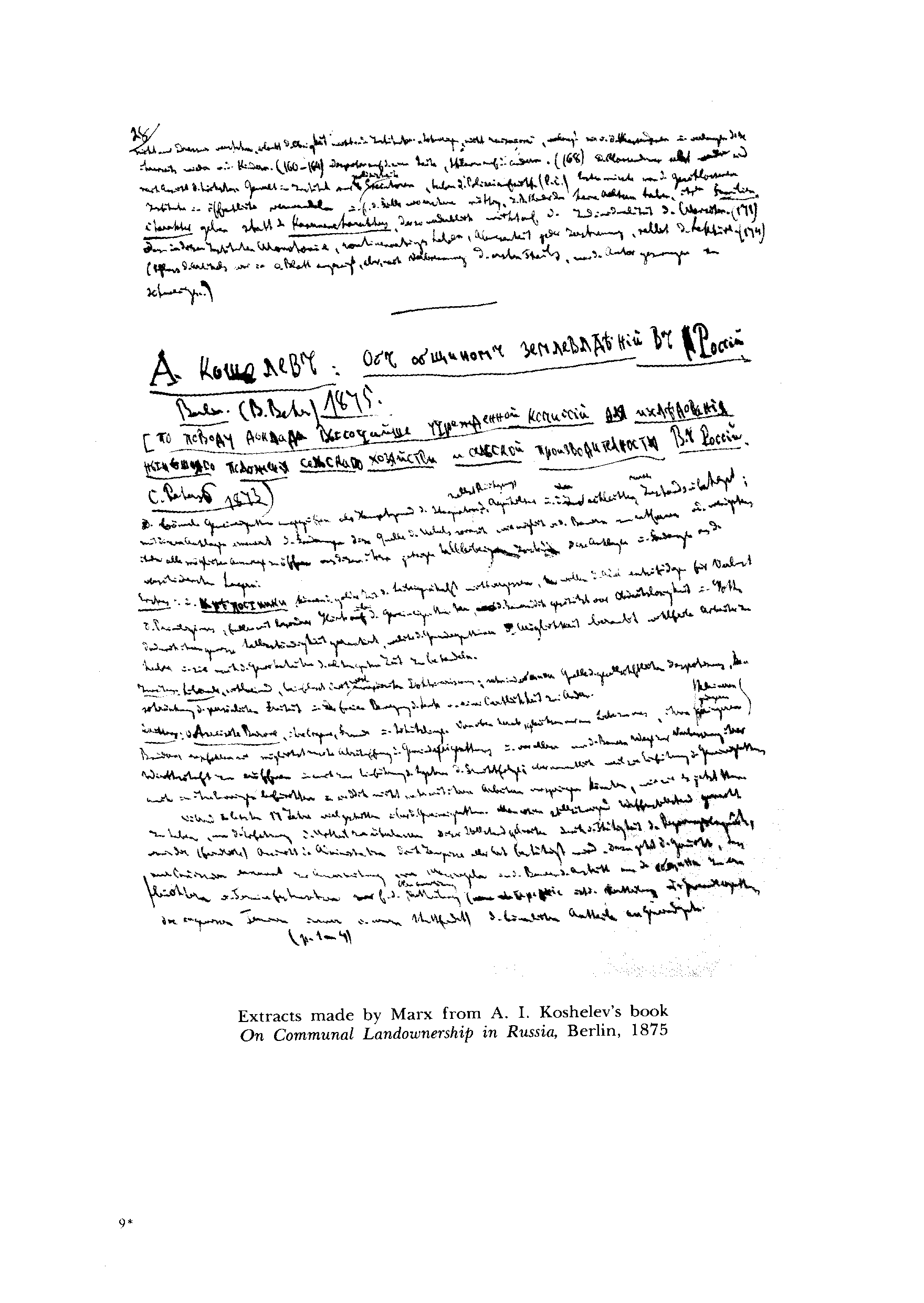
Extracts made by Marx from A. I. Koshelev's book On Communal Landownership in Russia, Berlin, 1875
66. Marx to Bernhard Kraus. 20 October
with enough Polish to read the Lemberga newspapers (e.g. Dziennik Polski or Gazeta Narodowa) and extract things of that nature, the Volksstaat could become Europe's leading newspaper on Russian affairs. And it almost looks as though the next do will take place in Russia. Should this happen at the time when the inevitable war between the German-Prussian Empire and Russia is in progress, as seems highly probable, it will have inevitable repercussions on Germany. Marx sends his best regards.
Yours very sincerely,
F. Engels
[London,] 15 October 1875 Cordial regards to Liebknecht.
66
MARX TO BERNHARD KRAUS[133]
IN VIENNA
London, 20 October 1875
Dear Friend,
You will have seen from my daughter's[5] letter that, of the 3 letters you wrote me, not one has reached London, and that the same thing happened to the letters I wrote [134] and those directed to me (during my stay at Karlsbad). This bears the stamp of — Stieber! So in future write to me at the following address: Mr John Withers, 54 Grafton Terrace, Maitland Park, London.
If I didn't write to you from Karlsbad, it was because your
" old name of Lvov - b Eleanor Marx
67. Engels to Philipp Pauli. 8 November
friends there told me that you intended to return thither from Gmünd.
With sincere regards, Your
K. M.
67
ENGELS TO PHILIPP PAULI
IN RHEINAU
London, 8 November 1875 (122 Regent's Park Road) Dear Pauli,
We got back here safely last Saturday afternoon, having stopped overnight in Bingen, Cologne and Dover.[135] In accordance with your advice we took the steamer from Bingen to Cologne and didn't regret it for one instant. The crossing from Ostend was quite good for the time of year, though my wife suffered a little from seasickness for a while. In Dover, where we stayed at the Lord Warden, we recalled how once, in this same hotel, an old Englishman with six daughters had said: 'THANK GOD, TS THE COMFORTS OF AN ENGLISH HOTEL'—consisting of a good bed and a bad breakfast and unpolished boots, for which they charged us the trifling sum of 16/-, say, sixteen shillings.
Once again my wife and I would like to say how deeply grateful we are to you and your dear wife for receiving us so warmly and for promising to take Pumps under your wing every so often during her exile; and we are definitely counting not only on your bringing Mrs Pauli over here as soon as possible, but also on your regarding our house as your own whenever you come to London
WITH OR WITHOUT NOTICE.
With sincere regards,
Yours,
F. Engels
69. Engels to Rudolf Engels. 9 November
68. Engels to Philipp Pauli. 9 November
Dear Pauli,
In my haste yesterday I forgot what was most important of all. I am therefore sending you today per BOOK POST a parcel containing:
1. 3 numbers of The Housing Question 2. The Bakuninists at Work 3. On Social Relations in Russia (separate copy of the first article, omitted from this publication, is on the wrapper of the parcel)[136]
4. The Peasant War in Germany 5. Savoy, Nice and the Rhine (1860) by me 6. the Communist Manifesto by Marx and me 7. Revelations Concerning the Communist Trial in Cologne by Marx (1851)OT and trust it will arrive safely. Once again warm regards, Yours,
F. Engels
69
ENGELS TO RUDOLF ENGELS
IN BARMEN
London, 9 November 1875 Dear Rudolf,
I'm sorry that nothing has come of Paul's[3] trip; next year, perhaps.
70. Engels to Pyotr Lavrov. 12[- 17] November
Last Saturday I and my wife returned from Heidelberg where we had taken our little one to spend a year en pension.[135] On the return journey we drank a truly excellent Oberingelheimer at the Domhotel; I at once ordered some to be sent to me and would ask you to arrange to pay Mr Theodor Metz, Domhotel, Cologne, 35 talers=l05 marks for my account. Cologne is a town of miracles. Thus, between the Cathedral and the Central Station, I came upon a gentleman so similar to Hermann [3] as to be indistinguishable from him, save that he seemed to have grown somewhat, had a more grizzled beard and looked frightfully serious. I was only waiting — alas in vain — for him to go through the usual performance of collecting himself before falling into his arms. This miracle happened last Friday morning between 10 and 11 o'clock.
Love to Mathildeb and the children.
Your
Friedrich
70
ENGELS TO PYOTR LAVROV[138]
IN LONDON
London, 12[-17] November 1875
Mon cher Monsieur Lavrov,
Enfin, de retour d'un voyage en Allemagne,[135] j'arrive à votre article,0
que je viens de lire avec beaucoup d'intérêt.d Voici mes observations y relatives, rédigées en allemand ce que me permettra d'être plus concis? [13]
1. Of Darwin's doctrine, I accept the theory of evolution, but assume Darwin's method of verification (STRUGGLE FOR LIFE, NATURAL SELECTION) to be merely a first, provisional, incomplete expression of a newly discovered fact. Before Darwin, the very people who now, wherever they look, see nothing but the struggle for existence
(Vogt, Büchner, Moleschott and others), once laid particular stress on co-operation in organic nature, the way in which the plant kingdom supplies oxygen and food to the animal kingdom and, conversely, the latter supplies plants with carbonic acid and manure, as indicated notably by Liebig. Both conceptions are to some extent justified, but each is as one-sided and narrow as the other. The interaction of natural bodies — both dead and living— comprises harmony as well as strife, struggle as well as co-operation. Hence, if a self-styled naturalist takes it upon himself to subsume all the manifold wealth of historical development under the one-sided and meagre axiom 'struggle for existence', a phrase which, even in the field of nature, can only be accepted cum grano salis," his method damns itself from the outset.
2. Of the three ubèzdennyie Darwinistyh you cite, only Hellwald would seem worthy of mention. After all, Seidlitz is at best no more than a minor luminary and Robert Byr a novelist, whose novel Drei Mal is currently appearing in Ueber Land und Meer. And that's where all his rodomontade belongs.
3. While not denying the merits of your mode of attack, which I might describe as psychological, I would for myself have chosen a different one. Every one of us is more or less swayed by the intellectual medium in which he predominantly moves. For Russia, where you are better acquainted with your public than I am, and for a propagandist journal which appeals to the sviazujuscij affect—the moral sense — your method is probably the better one. For Germany, where false sentimentality has wrought and still wreaks such untold havoc, it would not be suitable, since it would be misunderstood and a sentimental twist put upon it. In our case, hatred is needed rather than love — at any rate to start off with — and, above all, the abandonment of all remnants of German idealism, the placing of material facts in the historical context that is theirs by right. Hence I would — and some time perhaps will — attack these bourgeois Darwinians in about the following terms:
All that the Darwinian theory of the struggle for existence boils down to is an extrapolation from society to animate nature of Hobbes' theory of the bellum omnium contra omnes* and of the bourgeois-economic theory of competition together with the Malthusian theory of population. Having accomplished this feat (the absolute admissibility of which, as indicated above under 1, I contest, especially where the Malthusian theory is concerned), these people proceed to re-extrapolate the same theories from organic nature to history, and then claim to have proved their validity as eternal laws of human society. The puerility of this procedure is self-evident, and there is no need to waste words on it. If, however, I did wish to enlarge upon it, I should represent them, firstly as bad economists and secondly as bad naturalists and philosophers.
4. The essential distinction between human and animal society is that the most animals do is garner, whereas humans produce. This unique but crucial distinction alone makes it impossible simply to extrapolate the laws of animal societies to human societies. What it does make possible, as you rightly remark, is that celovëk vel borjbu ne toljko za suscestvovanie, no za naslazdenie i za uvelicenie svojich naslazdenij ... gotov byl dlja vyssago naslazdenija otrecsja ot nissichP
While not contesting the conclusions you proceed to draw from this, I would, from my own premisses, draw the following inferences: At a certain stage, then, human production reaches such a level that not only necessary requirements are produced, but also luxuries if, to begin with, only for a minority. The struggle for existence — if, for the moment, this category be allowed — thus becomes a struggle for enjoyment, not just for the means of subsistence, but for the means of development—socially produced means of development — and in respect of this stage the categories of animal kingdom are no longer applicable. If, however, as has now happened, production in its capitalist form produces means of subsistence and development far in excess of what can be consumed by capitalist society since it keeps the great mass of real producers artificially at a distance from these means of subsistence and development; if, by its own existential law, that society is compelled continually to raise what is, for its own purposes, an already excessive production and hence periodically, every ten years, gets to the point of destroying, not only huge quantitites of products, but even the productive forces themselves — what meaning still attaches to talk of the 'struggle for existence'? For in that case the struggle for existence can consist only in this — that the producing class takes over the management of production and distribution from the class formerly entrusted with that task but now no longer capable of it, and this, in effect, is socialist revolution.
I might remark en passant that the mere consideration of previous history as a series of class struggles is enough to reveal the utter shallowness of the view of that same history as a slightly modified representation of the 'struggle for existence'. Hence it's a favour I'd never do these bogus naturalists.
5. For the same reason I would have formulated rather differently your substantially correct proposition, cto ideja solidarnosti dlja oblegcenija borjby mogla ... vyrosti nakonec do togo, ctoby ochvatitj vcë celovêcestvo i protivupostavitj jego, kak solidarnoje obscestvo bratjev, ostaljnomu mini mineralov, rasteniji i zivotnych.[3]
6. I cannot, on the other hand, agree that the borjba vsëch protiv vséchh was the first phase of human evolution. I should regard the social instinct as one of the most essential factors in the evolution of humans from apes. The first humans must have lived in bands and, as far back as we can see, we find that such was the case.
17 novembre. J'ai été de nouveau interrompu et je reprends ces lignes aujourd'hui pour vous les remettre. Vous voyez que mes observations se rattachent plutôt à la forme, à la méthode de votre attaque, qu'au fond. J'espère que vous les trouverez assez claires, je les ai écrites à la hâte et en
les relisant, je voudrais changer bien des mots, mais je crains de rendre le manuscrit trop illisible. Te vous salue cordialement![1] . F. Engels First published, in Russian, in Letopisi Printed according to the original marksizma, Book V, Moscow-Leningrad, 1928
71. Engels to Paul Kersten. 24 November
IN LONDON
[London,] 24 November 1875 122 Regent's Park Road, N. W. Dear Mr Kersten,
I have just received your esteemed note of this morning[140] and hasten to inform you that I shall be pleased to see you and your friend at my house next Sunday evening at about six o'clock.
Yours faithfully,
F. Engels
[Engels' later note on Kersten's letter]
[18]75. Kersten has not been seen any more.
72. Marx to Morel. Probably autumn
Be so kind as to let me know, through Mr Theisz, your neighbour, what has become of the three copies of Capital* which you received from me.
Salutations,
Karl Marx
73
MARX TO PYOTR LAVROV[141]
IN LONDON
[London,] 3 December 1875 41 Maitland Park Road, N. W.
My dear Friend,
A carbuncle (and on my left nipple to boot)—which you may actually inspect for yourself by coming to call on me — makes it quite impossible for me to go out in the evening to attend the meeting of 4 December. For that matter, I should only have reiterated the opinion I have upheld for the past thirty years,[142]
namely that the emancipation of Poland is one of the precondi-tions for the emancipation of the working class in Europe. The new conspiracies of the Holy Alliance [143] provide further proof of this.
Yours ever,
Karl Marx
74
ENGELS TO WALERY WRÖBLEWSKI[141]
IN LONDON
[London,] 4 December 1875, midday 122 Regent's Park Road, N. W.
My dear Wroblewski,
This morning I awoke with so violent a cold in the head that it almost prevents me from talking. Hence, to my great regret, it will not be possible for me to attend your Polish meeting tonight, the more so since the evening promises to be one which will combine
73. Marx to Pyotr Lavrov. 3 December Ill 74. Engels to Walery Wröblewski. 4 December Ill 75. Engels to Friedrich Lessner. 16 December
all the advantages of the Polish climate with the pleasures of an English fog.
My feelings for the cause of the Polish people, feelings to which I am sorry not to be able to give expression tonight, will always remain the same; I shall always regard the liberation of Poland as being one of the foundation stones of the ultimate liberation of the European proletariat and, in particular, of the liberation of the other Slav nationalities. So long as the division and the subjection of the Polish people continues, so, too, will endure and reproduce itself with fatal inevitability the Holy Alliance between those who partitioned Poland, an alliance which signifies nothing but bondage for the Russian, Hungarian and German peoples, just as it does for the Polish people. Long Live Poland!
Yours ever,
F. Engels
75
ENGELS T O FRIEDRICH LESSNER
IN LONDON
[London,] 16 December 1875 Dear Lessner,
Frankel, who was imprudent enough to live in Vienna under an assumed name, has been found out and arrested. The French Embassy are demanding his extradition for arson and for taking part in the shooting of the Dominican monks.[144] But this is nonsensical, for a country does not extradite its own nationals but only foreigners, assuming in the first place that there could be any question of extradition here. H e will probably get off with a token punishment for using a false name.
Your
F. E.
76. Marx to Pyotr Lavrov. 17 December
76
MARX TO PYOTR LAVROV " [9]
IN LONDON
[London, 17 December 1875]
Dear Friend,
Our good Leblanc is very ill and likes to be visited. Definite limits were set for the last sheets (i.e. the last instalment, 44th, of the French edition of Capital).[17] Mr Lachâtre alleged that things had been so arranged with the printers that it would be impossible to go beyond the 44th sheet. This meant that I had to sacrifice the subject index which had already been drawn up. If I find a copy of it, I will send it to you.
Yours ever,
K. M.
1876
77
Endnotes
[60] An incorrect explanation of the French term (Fleurs de lys, Lilies — the symbol of legitimist monarchy) was given in an editorial footnote to Chapter IV of
[61] Revelations Concerning the Communist Trial in Cologne printed by Der Volksstaat,
[62] No. 140, 2 December 1874. After Marx's intervention, the error was set right
[64] 1875 (see also present edition. Vol. 11, p. 442).—54 In his letter to Marx of 29 December 1874, Max Oppenheim wrote that he was regularly receiving The International Gazette from Berlin. He believed that Marx was the paper's London correspondent.— 56 Following the publication of Part One of A Contribution to the Critique of Political Economy in 1859 (see present edition, Vol. 29), Marx wrote a lengthy economic manuscript in 1861-63. It was a second rough draft of Capital (the first being the 1857-58 manuscript). In 1863, he definitively decided that the work was to have four books, the first three being theoretical, and the fourth, presenting a historical and critical survey. In August 1863, having completed work on the manuscript of 1861-63, Marx began preparing Capital for the press. This work resulted in a third rough draft of Capital—the Economic Manuscript of 1863-65, consisting of three theoretical books. The draft for the fourth book (Theories of Surplus Value) formed part of the 1861-63 manuscript. Subsequently, Marx returned to the first book. On Engels' advice, Marx decided it would be the first to be published, and was preparing it for the press throughout 1866 and the first half of 1867. The first German edition of the book appeared in September 1867 as Volume One of Capital. Under the plan agreed with the publisher Otto Meissner, the second and third books, analysing the process of circulation of capital and the forms of capitalist process as a whole, were to appear as Volume Two, and the fourth book, dealing with 'the history of economic theories', as the third and final volume of Capital. Marx, however, did not manage to prepare the second and third volumes of Capital for the press. After his death, Engels completed the work and published Marx's manuscripts of the second and third books as Volume Two (1885) and Volume Three (1894). Engels also intended to prepare for the press and publish the above-mentioned manuscript of the fourth book as Volume Four of Capital but died before this plan had been carried out. In the present edition of the Collected Works of Marx and Engels, this book of Capital has been included in the Economic Manuscript of 1861-63 (vols 30-34), while the first three volumes of Capital make up vols 35-37 respectively.— 57, 115, 343, 415, 432 This excerpt from Marx's letter to Juste Vernouillet is the passage from Marx's original letter quoted by the Munich antique dealer Emil Hirsch in his letter to Dr Pappenheim of 9 September 1899. Marx's letter, according to Hirsch, was dated 'London, 3 February 1875', took up two pages and dealt with the publication of Marx's manuscript by Louis Lahure (probably a reference to the French translation of the first volume of Capital; see this volume, Marx's letter to Maurice Lachâtre of 30 January 1875). According to Hirsch the quoted passage was to be found in the concluding part of the letter. Marx's addressee was not mentioned.—57 On 21 January 1875, the French National Assembly began debating the draft 'law on the organisation of public authority' which formed part of the 1875 Constitution. The fundamental issue — the nature of the state system in France — was to be solved in the debate on the amendments to the Bill held on 29 and 30 January. By the final vote on 30 January the Constitution indirectly recognised the state system as a republic.— 57
[65] This letter was published in English for the first time in: K. Marx and F. Engels, Letters on 'Capital', New Park Publications Ltd., London, 1983.—58
[66] 'What's Going on at Home?'—a section in the Vperyod! (Forward!) magazine published by Pyotr Lavrov. It carried reports from Russia.— 58
[67] The section 'What's Going on at Home?' in Vperyod! (Vol. Ill, London, 1874) carried an anonymous article from Irkutsk dated February 1874; its actual author was Hermann Lopatin, who described a group of religious dissenters he met in Siberia called 'Not Ours'. They denied the existence of God and opposed government authority, property, family and all existing laws and customs in protest against the existing system in Russia.—58
[68] Marx finally received both books mentioned here. The name of the first appears on his list 'Russisches in my bookstall'. Marx intended to use the results of his research into the agrarian relations in Russia when putting the finishing touches to the section on ground rent in the second volume of his Capital (see Note 62). However, this intention was not fulfilled. After the Russian translation of the first volume of Capital appeared in print in 1872, Marx continued his study of Russian economic writings, making copious notes as he went along.—58
[43] consolidate the forces of reaction, and most of these laws were repealed.— 25, 84 In his letter of 24 June 1874 Lachâtre requested Marx to pass on his proposal to start a joint magazine or newspaper in London to the French émigré journalist Rochefort.— 25 Marx (accompanied by his daughter Eleanor) took a cure at Karlsbad from 19 August to 21 September 1874. Having returned to London on 3 October, he resumed work on the French translation of the first volume of Capital and finished editing the last instalments in late January 1875 (see this volume, pp. 55-56).—26 Under the contract signed by Marx and Maurice Lachâtre in February 1872 (see Note 17), the French edition of the first volume of Capital was to appear in instalments. The delay in the publication, which took four years (1872-75), was caused, alongside the circumstances mentioned in this letter, by the growth of political reaction following the Paris Commune. In mid-1875, the French government transferred legal rights over Lachâtre's publishing house in Paris to Adolph Quest, an official who procrastinated with the printing of the last instalments of Capital and did his best to obstruct its dissemination.— 26, 153, 227 Jenny Longuet's health was shaken by the death of her first son, Charles, in late July 1874. On 6 August, Marx took her to Ramsgate, where Engels was on holiday at the time. Marx stayed with .them until 9 August. In the second half of August, Engels with his family and Jenny Longuet took a trip to Jersey and returned to London on 5 September.—27, 38 Before leaving for Karlsbad for medical treatment in August 1874, Marx applied for British naturalisation to the Home Office as a precaution against possible reprisals by the Austrian authorities. The application was, however, turned down, ostensibly because Marx had failed to be 'loyal to his own King and Country' (see present edition, Vol. 24, p. 564).—28, 29, 35 An extract from this letter was published in English for the first time in: K. Marx and F. Engels, Letters to Americans. 1848-1895. A Selection. International Publishers, New York, 1953.—28, 410 Marx is referring to the inaugural congress of the Austrian Social-Democratic Workers' Party illegally held in Neudörf on 5 and 6 April 1874. Present at it were 74 delegates, 10 of them representing Czech workers' organisations that favoured a single Austrian Social-Democratic Party incorporating workers' organisations in the Slav territories. The congress founded the party and elected its leading bodies. The Délnické listy (Workers' Paper) published in Prague in Czech was to become the party's central printed organ alongside the Gleichheit.—30 On 15 August 1874 Marx, accompanied by his daughter Eleanor, left for Karlsbad (Karlovy Vary) on doctors' recommendations, where he stayed from 19 August to 21 September. On the way back to London, Marx stopped off in Dresden, Leipzig, Berlin and Hamburg. In Leipzig, where he stayed approximately from 25 to 28 September, he had talks about the state of the German working-class movement with Wilhelm Liebknecht and Wilhelm Bios, as well as with members of the Leipzig party branch. While in Hamburg on 29 September-1 October, Marx met Social-Democratic leaders.— 32, 33, 35, 43, 45, 48, 53, 58, 119
[69] Marx wrote this letter on the cover of Tkachov's pamphlet Offener Brief an Herrn Friedrich Engels, Zurich, 1874. Tkachov's work was written in reply to Engels' third article in the Refugee Literature series carried by Der Volksstaat on 6 and 8 October 1874 (see present edition, Vol. 24, pp. 19-28). In his letter to Engels of 1 February 1875 Wilhelm Liebknecht proposed that Engels write a refutation to the pamphlet. Marx may have read the pamphlet in February or March and passed it on to Engels with his comments. A short while later, Engels wrote articles IV and V in the Refugee Literature series, which were printed by Der Volksstaat on 28 March and 2, 16, 18 and 21 April 1875. This letter was published in English for the first time in: Marx and Engels, Collected Works (present edition, Vol. 24, Note 44).—59
[74] A reference to one of Ferdinand Lassalle's programme theses providing for the establishment of workers' producer associations with the aid of the state. Lassalle and his followers repeatedly stressed that what they had in mind was a state in which power would pass into the hands of the working people through universal suffrage.—60
[75] This refers to the Programm und Statuten der sozial-demokratischen Arbeiter-Partei, adopted at the general German workers' congress in Eisenach in August 1869 and published in the Demokratisches Wochenblatt on 14 August 1869. The congress founded the Social-Democratic Workers' Party of Germany, subsequently known as the Eisenachers. For the most part the programme complied with the principles of the International Working Men's Association.—60, 70
[77] A reference to the following articles of the draft Gotha Programme: 'The German workers' party demands as the free basis of the state: '1. Universal, equal and direct suffrage by secret ballot for all males who have reached the age of 21, for all elections in the state and in the community. 2. Direct legislation by the people with the right to initiate and to reject bills. 3. Universal military training. A people's militia in place of the standing army. Decisions regarding war and peace to be taken by a representative assembly of the people. 4. Abolition of all exceptional laws, in particular the laws on the press, associations and assembly. 5. Jurisdiction by the people. Administration of justice without fees. 'The German workers' party demands as the intellectual and moral basis of the state: '1. Universal and equal education of the people by the state. Compulsory school attendance. Free instruction. 2. Freedom of science. Freedom of conscience. '— 61
[79] The so-called iron law of wages was formulated by Ferdinand Lassalle in his Offnes Antwortschreiben an das Centrai-Comité zur Berufung eines Allgemeinen Deutschen Arbeitercongresses zu Leipzig, Zurich, 1863, pp. 15-16.— 62
[80] Philippe Joseph Bûchez, one of the first ideologists of the so-called Christian socialism, put forward a plan to set up workers' producer associations with the aid of the state.— 62
[82] In March 1872, August Bebel and Wilhelm Liebknecht were sentenced to two years' imprisonment for their membership of the International Working Men's Association, their socialist convictions and democratic politics. At another trial, on 6 July 1872, Bebel was sentenced to additional nine months' imprisonment and deprived of his seat in the Reichstag for 'insulting His Imperial Highness William I.' Liebknecht was released on 15 April 1874, while Bebel was freed only on 1 April 1875.—65
[83] In his letter to Engels of 25 March 1875, Bracke wrote: 'The programme, submitted for the "unity congress" and signed by Liebknecht and Geib, forces me to write these lines. The adoption of this programme is impossible as far as I am concerned, and Bebel is of the same opinion for his part.' Bracke particularly drew attention to the points of the programme which proclaimed the introduction of producers' co-operative societies with state aid. 'The Lassalleans have evidently made this point a conditio sine qua non for unification, and our representatives, Liebknecht and Geib included, have endorsed the same for the sake of unification. In order to "bring about" unification, they have discarded their convictions and given their consent to something of whose wrongness they are convinced... However, since Bebel seems determined to take up the struggle, I would at least feel moved to support him to the best of my abilities. But before that I should like to know what you and Marx think of the affair. Your experience is greater, and your understanding better, than mine.'—66
[15] Engels' letter has not been found.—14, 15, 24, 38, 66, 130, 132, 134, 159, 180, 184, 195, 201, 219, 243, 257, 271, 316, 345, 369, 375
[84] In a letter to August Bebel (which has not come to light), Engels invited him and Liebknecht to visit London. In his reply of 23 February 1875 Bebel wrote that he was too busy with party matters to make a trip in 1875. He did not visit Marx and Engels in London until 1880.— 66
[85] The original of this letter is kept at the Engels family archive in Engelskirchen.— 66
[32] In 1870, the Gladstone government introduced a reform of public education which provided for the opening of secular schools controlled by locally elected school boards (alongside parish schools) at which religious instruction was no longer compulsory. The reform was attacked by the Conservatives. In mid-July 1874, one of them, Lord Sandon, proposed an amendment to the law of 1869 which had established the Endowed Schools Commission. He suggested that the money be henceforth distributed by the Charity Commission, which would have allowed the church to regain the ground it had lost in school education. Sandon's Bill was strongly opposed by the Liberals.— 24, 67
[86] This is a covering letter to Marx's Marginal Notes on the Programme of the German Workers' Party, which went down in history as Critique of the Gotha Programme (see present edition, Vol. 24). Marx's letter to Bracke was first published by Engels, together with the Critique of the Gotha Programme, in 1891 in Die Neue Zeit, Vol. 1, No. 18. An excerpt from this letter was published in English for the first time in The Socialist Series, number one, under the title 'The Socialist Programme. By Karl Marx', The Socialist Labour Press, Glasgow [1918]. It appeared in English in full in: K. Marx and F. Engels, Selected Works. In two volumes, Moscow-Leningrad, 1936.—69
[88] Later, Marx and Engels decided against publicly opposing the Gotha Programme, considering such action inexpedient when the merger of the two German working-class organisations was already a fait accompli. Their attitude to the united party formed in Gotha was based on the belief that, in the long run, the elimination of the organisational rift in the German working-class movement would be conducive to the struggle of the German proletariat for its emancipation.— 69
[90] Marx is most probably referring to Schramm's letter of 31 March 1875, in which the latter wrote of his intention to contribute a series of popular articles about Capital to Der Volksstaat. Schramm requested Marx to explain to him some points on the theory of ground rent. Judging from Schramm's letter to Marx of 14 May (see Note 91), Marx actually did so, but his letter, written between 8 and 14 May, has not been found. The following year, Schramm published a book, Grundzüge der National Oekonomie. Abth. 1, Leipzig, 1876, a copy of which he probably sent to Marx. This book has been found in Marx's library.— 73
[91] Replying to Marx, Schramm wrote on 14 May 1875: 'Many thanks for your kind and detailed letter which is particularly valuable to me in view of its explanations of ground rent. As you requested, I am sending you the desired addresses below: the owners, Bamberger and Bernstein, are both known to me personally, and I think I can vouch for their reliability.' 32-406 Probably a reference to the Berlin wholesale firm of Bamberger & Co., Leinen- und Baumwollwaren engros, Breitestraße 22. It was owned jointly by Jacob Bamberger and Ad. Bernstein.— 73
[92] Annolied (The Song of Anno)—a poem written by an unknown author in the late 11th century in Middle High German in praise of Anno, Archbishop of Cologne.— 74
[12] Marx's letter has not been found.—10, 31, 33, 34, 75, 176, 189, 193, 222, 270, 276, 311, 353, 376, 382, 412
[93] In his letters of 29 March and 25 April 1875, E. Glaser de Willebrord asked Marx to contribute to the socialist weekly La Réforme sociale he was planning to start in Brussels.— 75
[94] After his withdrawal from the engravers' firm in the summer of 1873 (see Note 11), Lafargue bought a photolithographic and etching workshop in the hope of solving his financial problems.— 75, 132, 447
[95] This is a draft of Engels' reply to Patrick John Coleman's letter of 19 May 1875. It was written down on the last page of Coleman's letter informing Engels about his intention to go into trading business and requesting him to become security for him.— 76
[97] Traube's artificial cells—inorganic formations representing a model of living cells; they were created by the German chemist and physiologist Moritz Traube by mixing colloidal solutions. He read a paper on his experiments to the 47th Congress of German Naturalists and Physicians in Breslau on 23 September 1874. Marx and Engels thought highly of Traube's discovery.— 78
[99] This is Marx's reply to Juste Vernouillet's letter of 11 July 1875.— 79
[100] Marx is referring to the delay in the printing and distribution of the French
[101] edition of the first volume of Capital (see notes 17 and 38). The obstacles put up by the French government in the way of Capital are described in Marx's letter to Peter Imandt of 27 September 1875 (this volume, p. 92).— 79 01 The copyright treaty was signed by the free city of Hamburg and Great Britain on 16 August 1853. Article 2 of the treaty covered translations.— 80
[102] The Basle Congress of the International Working Men's Association was held between 6 and 11 September 1869. Present at it were 78 delegates from eight major European countries. For the first time the International's congress was attended by an American, the delegate of the National Labor Union of the United States, Andrew Carr Cameron. The congress heard a report written by Marx on the instructions of the General Council and stressing the International's role in leading the strike movement. The issues of landed property and the right of inheritance figured prominently at the congress. To all intents and purposes the Basle Congress resolution confirmed that of the Brussels Congress on the abolition of private ownership of land. No decision was taken on the question of abolishing the right of inheritance as the resolution submitted for consideration by the congress failed to win the required number of votes. There was almost no disagreement on the resolution recommending the workers to set up trade unions in all industries and to form associations on a nationwide scale. Defence of the workers' interests and a campaign to replace the wage labour system by 'associated free labour' were proclaimed the trade unions' main tasks. The Basle Congress also took a number of decisions directed at consolidating the International's organisation, extending the functions of the General Council and enhancing its role as the leading body of the International Working Men's Association. Paris was chosen as the venue for the next congress, scheduled for 1870.— 81
[26] An excerpt from this letter was published in English for the first time in The Letters of Karl Marx, selected and translated with explanatory notes and an introduction by Saul K. Padover, Prentice-Hall, Inc., Englewood Cliffs, New Jersey, 1979.—21, 82, 222, 324
[4] In the Reichstag elections of 10 January 1874, the German Social Democrats scored a significant victory. The number of votes cast for them rose from 41,461 in 1871 to 171,351; six deputies (including Wilhelm Liebknecht and August Bebel, who were serving a prison sentence at the time) were elected, as against two at the 1871 elections. For the first time, three seats went to the General Association of German Workers which polled 180,319 votes. Alongside the left-wingers, the clerical Party of the Centre (see Note 423) also managed to strengthen its position. Marx referred to its members as the 'ultramontanes'. The latter advocated unlimited authority for the Catholic Church and opposed the Kulturkampf (see Note 35) pursued by Bismarck. Engels learned about the results of the elections from Kugelmann's letter of 13 January 1874.—3, 6, 43
[105] The potior, 0f the 'average man' was elaborated in the works of the Belgian statistician Lambert Adolphe Jacques Quetelet. According to him, the 'average man' was the perfect, 'true type', while individuals were merely its distorted representatives. Marx used the English translation of Quetelet's main work, A Treatise on Man and the Development of His Faculties, Edinburgh, 1842.— 82
[106] Referendar—a junior official in Germany, usually a lawyer, doing a training course at a court of law or in the civil service.— 83
[107 6] 6 August 1875 was a birth centenary of David O'Connell, leader of the Irish national liberation movement.— 84
[35] Kulturkampf (struggle for culture)—the name given to a system of measures implemented by the Bismarck government in the 1870s against the Catholic Church and the Party of the Centre which was closely associated with it (see Note 423). Using the pretext of a campaign for 'secular culture', the Bismarck
[108] The red International—a name for the International Working Men's Association that came into use in the 1860s. The black International—a name for the Order of Jesus that became current after the publication in 1873 of N. Steffen's article 'Brief eines Luxemburgers an einem Landsmann. Dritter Brief in Die Grenzboten, No. 42, p. 119.— 85
[109] The 'Frankfurter Angelegenheiten' column of the Frankfurter Zeitung (No. 229, 17 August 1875) featured the following note: 'Frankfurt, 17 August. Late last
[110] week Mr Karl Marx arrived here from London. His friends were pleasantly struck by his healthy looks and high spirits. He was on his way to Karlsbad, where he intended to stay for about four weeks.' Marx passed through Frankfurt am Main around 13-14 August 1875.— 85 no A reference to one of the trials against the Frankfurter Zeitung. The immediate cause of the reprisals against the newspaper was the publication on 25 March 1875 of an article on Kulturkampf and of an article on the reptile fund on 30 March (see notes 35 and 408). The editors were sentenced to imprisonment for their refusal to name the authors of those articles. Leopold Sonnemann, editor-in-chief and publisher, was arrested on 28 August and remained in prison until late September 1875.— 85 32* 1 In line with the decision of the Gotha unity congress of 1875 (see Note 71), the
[111] leading bodies of the Socialist Workers' Party of Germany were the Executive
[112] Committe (Vorstand), Control Commission (Controlkomission) and Committee
[113] (Ausschuss). The Executive Committee elected at the Gotha Congress had five
[114] members: Hasenclever and Hartmann, the chairmen; Auer and Derossi, the
[115] secretaries, and Geib, the treasurer. Thus the Executive came to comprise three
[116] Lassalleans (Hasenclever, Hartmann and Derossi) and two Eisenachers (Auer
[117] and Geib). The Executive Committee was to be based in Hamburg.— 85, 96, 98, 246 2 Marx's letters from Karlsbad to his daughter Eleanor (Tussy) have not been
[118] found.—87 3 The reference is to the battle of 1 September 1870 during the Franco-Prussian war of 1870-71, in which the French army was smashed. The crushing defeat at Sedan speeded up the collapse of the Second Empire and led to the proclamation of a republic in France on 4 September 1870.— 88, 155, 251, 297 4 On Marx's and Engels' attitude to the German socialist Gustav Adolph Köttgen, see their 'Letter from the Brussels Communist Correspondence Committee to G. A. Köttgen' (present edition. Vol. 6, pp. 54-56).— 88 5 The introduction to Grün's book was published under the heading 'Ueber Weltanschauungen. Präludium zur Philosophie in der Gegenwart' in Die Wage, Nos. 33-38, 20 August-17 September 1875. The book itself was completed in March 1876 and issued by Otto Wiegand's publishing house (K. Grün, Die Philosophie in der Gegenwart. Realismus und Idealismus, Leipzig, 1876). In May 1873, Engels had made a start on one of his principal works, Dialectics of Nature.— 88 6 A reference to the anonymous and undated pamphlet published in Brussels under the title Quelques mots d'un groupe socialiste révolutionnaire russe à propos de la brochure: Alliance de la Démocratie socialiste et l'Association Internationale des Travailleurs. The pamphlet was presumably written by Michal Kasper Turski. It was spearheaded against Marx's and Engels' work The Alliance of Socialist Democracy and the International Working Men's Association (see present edition, Vol. 23). Lavrov wrote to Engels on 20 September 1875: 'You have probably seen a small pamphlet that Nechayev's anonymous followers have published in Brussels as a response to the pamphlet about the "Alliance". But, of course, neither the group nor its writings are of any value whatsoever.' In late September-early October 1875 Lavrov sent a copy of the pamphlet to Engels.— 91 7 In a letter to Marx of 25 September 1875, Peter Imandt enclosed an article, 'The International Working Men's Association. By an Internationalist', carried by The Dundee Advertiser on that day. 'The enclosure will show you that The Dundee Advertiser has a very good friend of yours among its correspondents. I was surprised to see the article this morning, and have no idea where it originates,' he wrote.— 92 8 Under the terms of the peace treaty signed after its defeat in the Franco-Prussian war of 1870-71, France paid 5,000-million-franc reparations to Germany, which contributed to the rapid growth of German economy. The period of feverish business activity, which witnessed the mushrooming of railway, industrial, construction and commercial joint-stock companies, banks and credit and social security companies and was accompanied by large-scale speculation, stock-exchange swindles and machinations, has come to be known as Gründerjahre (or the period of Criindertum). By 1873 it had resulted in a crash followed by an economic crisis, which lasted well into 1877.—92, 131, 218, 304, 335, 405, 447
[119] Marx wrote this letter on a postcard. On the side reserved for the address he wrote: 'Mons. P. Lawroff, 3, Evershot Road, Tollington Park, Holloway.'—93, 113
[120] Engels is referring to the Socialist Workers' Party of Germany formed at the
[123] '2' The reference is to the programme of the Socialist Workers' Party of Germany adopted by the unity congress in Gotha (see Note 71) in May 1875. Marx described it and gave a critical analysis of it in his Critique of the Gotha Programme (see present edition, Vol. 24), as well as in his letter to Wilhelm Bracke of 5 May 1875 (see this volume, pp. 69-73). Engels d-ealt with it in his letter to August Bebel of 18-28 March 1875 (ibid., pp. 60-66). The programme adopted at the congress ignored Marx's and Engels' comments on some of fundamental points. The point on proletarian internationalism was included at Liebknecht's suggestion.—95, 97, 294 '22 In 321 B.C., during the second Samnite war, the Samnites surrounded the Roman legions in the Caudine Forks near the Roman town of Caudium and drove them under a yoke, which signified the worst possible disgrace for a defeated army. Hence the phrase 'to pass under the Caudine yoke': to be submitted to extreme humiliation.— 95, 97 '23 As is clear from Jose Mesa's letter to Engels of 4 July 1875, Engels had read the text of the Gotha Programme to him during Mesa's stay in London, which he left for Paris in late June. In his letter, Mesa asked Engels for the latest news of his friends in Germany, their merger with the Lassalleans and the Gotha Programme. Mesa intended to pass on the information to his friends in Madrid.—95
[125] The national G e r m a n co-operative printing office in Berlin was founded in August 1875. Its board comprised the Lassalleans Wilhelm Hasselmann, Friedrich Wilhelm Fritzsche and Heinrich Rackow, The Leipzig co-operative printing office had been set u p by the Eisenachers in July 1872. After the introduction of the Anti-Socialist Law (see Note 462) the Social-Democratic co-operative printing offices were closed down.—96
[127] An extract from this letter was published in English for the first time in: K. Marx and F. Engels, Selected Correspondence, Foreign Languages Publishing House, Moscow, 1955.—99, 429
[128] The opening part of the letter is missing. At the top of the first extant page there is a note in Bebel's hand: 'Zu Engels' Brief vom 12. Okt. 1875.' This note, as well as the fact that Engels' letter to Bebel of 12 October 1875 was published by the latter in his book Aus meinem Leben without the concluding part, suggests that what Engels wrote to Bebel on 12 and 15 October belongs to the same letter. Since, however, there is no direct proof of this, and the middle part of the letter is missing, the two parts bearing different dates are published as independent letters in the present edition.— 99
[129] This is probably a reference to the Leipzig co-operative printing office set up by the Eisenachers in 1872. From June 1875, the Executive Committee of the Socialist Workers' Party of Germany, in which the majority were the former members of the General Association of German Workers, acted as a supervisory council over the printing office. Cf. this volume, pp. 74 and 118-19.—99
[130] Der Volksstaat, Nos. 103, 104 and 106, of 8, 10 and 15 September 1875, reprinted the article 'Karl Marx über Strikes und Arbeiter-Koalitionen' from the Viennese Gleichheit, the central organ of the Austrian Social-Democrats. This unsigned article was a translation into German of § 5 ('Strikes and Combinations of Workers') from Chapter II of Marx's The Poverty of Philosophy, with the introduction and conclusion by the author of the article. In the 1885 edition of The Poverty of Philosophy, Engels supplied the passage from Marx's book mentioned in this letter with the following note: 'That is, the socialists of that time: the Fourierists in France, the Owenites in England' (see present edition, Vol. 6, p. 209).—99
[132] Engels draws a parallel between the period of reforms in Russia following the abolition of serfdom in 1861 and the 'New Era' in Prussia. The 'New Era'—the reference is to the 'liberal' course announced by Prince William of Prussia (King of Prussia from 1861) when he became regent in October 1858. He made the Manteuffel Ministry resign and called the moderate liberals to power. The bourgeois press dubbed this the policy of the 'New Era'. It was, in fact, solely intended to strengthen the position of the Prussian monarchy and the Junkers. This soon became clear to the representatives of the liberal opposition whose hopes had been deceived and who refused to approve the government project of a military reform. The constitutional conflict that ensued and Bismarck's advance to power in September 1862 (see Note 311) put an end to the 'New Era'.— 100
[133] This letter of Marx's was written on the back of Eleanor Marx's letter to Bernhard Kraus of 20 October 1875.—103
[5] The Geneva Congress of the International Working Men's Association took place between 8 and 13 September 1873. Marx and Engels reversed their original intention to take part in its work, since the mounting reprisals against the working-class movement and financial difficulties precluded its being a truly international assembly. Unable to send their own delegations, nearly all the International's organisations handed over their mandates to the delegates of Romance Switzerland. When debating the Rules, the majority led by Johann Philipp Becker confirmed the Hague Congress resolutions (see Note 20) to extend the sphere of competence of the General Council, notwithstanding the opposition of the Swiss delegates Henri Perret and Theodore Duval. The congress emphasised the need for the working class to wage a political struggle. New York remained the seat of the General Council. The Geneva Congress of 1873 was the last congress of the International Working Men's Association.—4
[134] The letters mentioned by Marx and despatched from Karlsbad where he stayed taking a cure from 15 August to 11 September have not been found.—103
[136] stayed from November 1875 to March 1877. Engels and his wife returned to
[138] Leipzig, 1875) comprised an introduction and the fifth article from the Refugee
[140] the fourth article in the series, directed, like the fifth one, against Pyotr
[142] printed in Der Volksstaat, Nos. 36 and 37, 28 March and 2 April 1875.—105 7 The Cologne Communist Trial was held in 1852. It was preceded by arrests of
[143] many Communist League leaders and activists in the summer of 1851 and their
[144] detention for a period of eighteen months. Marx's work Revelations Concerning the Communist Trial in Cologne was written between late October and early December 1852. In 1853, two separate editions of the work appeared, one in Basle and the other in Boston. They were not, however, distributed in Germany. In the first half of 1875, a new separate edition appeared in Leipzig, a copy of which Engels probably sent to Pauli.—105 8 This letter was published in English for the first time in: K. Marx and F. Engels. Selected Correspondence, Foreign Languages Publishing House, Moscow, 1955.—106 9 In places this letter coincides almost word for word with the item 'Struggle for Life' in Engels' Dialectics of Nature (see present edition, Vol. 25, pp. 583-85).— 106 0 In his note dated 24 November 1875, Paul Kersten asked Engels to arrange a meeting with Marx and Engels for himself and his friend.— 110 1 An extract from this letter pertaining to the liberation of Poland was read by Walery Wröblewski at a meeting held in London on 4 December 1875 to mark the anniversary of the Polish uprising of 1830 and published on 31 December 1875 by the newspaper Vperyod! (Forward!), No. 24, as part of the article 'Anniversary of the 1830 Polish Uprising'.— 111 2 Marx's and Engels' first public speeches on the Polish question were made at the international meeting held in London on 29 November 1847 to commemo-rate the 17th anniversary of the 1830 Polish uprising (see present edition, Vol. 6, pp. 545-52).—Ill 3 Marx is referring to the so-called alliance of three emperors which came into being at the conference of the German, Austro-Hungarian and Russian emperors in Berlin in September 1872. It was an attempt to resurrect the reactionary Holv Alliance founded by Russia, Austria and Prussia in 1815.—Ill, 297,' 312, 340 4 This is Engels' reply to Lessner's letter of 15 December 1875. The latter wrote that he was told The Daily News of 13 December had carried a telegraph communication about Leo Frankel's arrest. Franke! was arrested in Vienna on 9 December 1875. As a member of the Paris Commune, he was charged with arson in the city and with shooting hostages, including the Archbishop of Paris, Georges Darboy. After two months' imprisonment in Vienna Frankel was transferred to Budapest. Since, for reasons of domestic policy, the French government did not dare to publicly demand Frankel's extradition, he was released on 27 March 1876. He informed Marx of this on 28 March.—112 143 An extract from this letter was published in English for the first time in: Karl
[9] In the Reichstag elections of 10 January 1874, Johann Jacoby failed to obtain a majority vote in any of the constituencies where he had been nominated. At the second ballot held on 27 January, he was elected in the Leipzig Constituency, but refused to take up his seat in protest at the Imperial Constitution. As a result, the Social-Democrats lost one seat in the Reichstag. Jacoby's conduct was criticised by Der Volksstaat, 20 February 1874.—7, 9
[59] The reference is to the reprint of Marx's Revelations Concerning the Communist Trial in Cologne (see present edition, Vol. 11) in Der Volksstaat (28 October-18 December 1874) (see also Note 137). It was the first time that Marx was named the author of this work. The epilogue, written for the Revelations and dated 'London, 8 January 1875', was printed in Der Volkstaat, No. 10, 27 January 1875 (see present edition, Vol. 24). In the first half of 1875, a separate edition of the work (based on the publication in Der Volksstaat) appeared in Leipzig.—54, 73
[3] Marx, accompanied by his daughter Eleanor, took a rest cure at Harrogate between 24 November and 15 December 1873.— 3, 17
[16] This letter was published in English for the first time in The Letters of Karl Marx, selected and translated with explanatory notes and an introduction by Saul K. Padover, Prentice-Hall, Inc., Englewood Cliffs, New Jersey, 1979.—15, 34, 37, 45, 55, 87, 143, 188, 191, 267, 416
[17] A reference to the French edition of the first volume of Capital. An attempt to translate Marx's principal work into French was first made by Charles Keller, a member of the Paris Section of the International. Between October 1869 and April 1870, he translated about 400 pages which he sent to Marx for editing, After the defeat of the Paris Commune, however, Keller was forced to emigrate to Switzerland, where he embraced Bakuninist views, after which Marx terminated co-operation with him. In December 1871, Paul Lafargue assisted Marx in concluding a contract for the publication of Capital with the progressive French journalist and publisher Maurice Lachâtre. The contract was signed on 15 February 1872. Under it, Capital was to appear in 44 instalments, one printer's sheet each. The work appeared between 1872 and 1875 in two instalments at a time, but was sold in series of five instalments each, making nine series in all. The last instalments having come out, the series were stitched together and sold as separate books. The first volume of Capital was translated into French by Joseph Roy. Marx did not think much of the effort and made a vast number of alterations, in fact, revised the book. As he himself said, the authorised French translation had an independent scientific value alongside the German original. In this edition, the first volume of Capital is published in Engels' authorised English translation with the interpolations from the French edition given in the Appendix (see present edition, Vol. 35).— 15, 16, 17, 26, 56, 57, 58, 70, 75, 80, 93, 113, 166, 276, 282, 287
[6] The reference is to the address 'Compagnons, notre Association traverse...' issued in Geneva in August 1873 and signed by H. Perret, C. Bernard, T. Duval, M. Josseron, P. Detallancourt, H. Renauld and Laplace. Timed to coincide with the Geneva Congress (see Note 5), it was directed against some of the Hague Congress resolutions (see Note 20) on organisational issues.—4
[70] This is a short record of a reply to Hermann Ramm's letter to Engels of 7 February 1875. Ramm wrote that the Volksstaat publishers planned to purchase a plot of land to build new premises for the party printing office in Leipzig and requested Engels to help collect the necessary funds. This plan is also mentioned in Engels' letter to August Bebel of 15 October 1875 (see this volume, pp. 123-25).—59
[2] Worried by the report of Marx's illness in the Frankfurter Zeitung, Ludwig Kugelmann wrote to Engels on 13 January 1874 asking him for more information concerning the state of Marx's health.—3
[72] This letter was published in English for the first time in: K. Marx, Critique of the Gotha Programme, Lawrence, London, [1933].— 60, 94, 97
[76] The German People's Party, founded in September 1868, embraced the democratic section of the bourgeoisie, mostly in the South-German states, which campaigned against Prussian hegemony in Germany and called for a federative German state.—61, 70, 95, 97
[8] On 14 January 1874, the Sheffield trade union congress refused to declare its solidarity with the Ligue universelle des Corporations ouvrières (see Note 7 ) . - 6
[81] Engels is referring to Wilhelm Bracke's work Der Lassalle'sche Vorschlag. Ein Wort an den 4. Congreß der social-demokratischen Arbeiterpartei (1873), which criticised Article 10 of the Eisenach programme. As an immediate target it demanded that the party campaign for 'state promotion of co-operatives and state credit for the free producer associations with democratic guarantees'. Bracke proposed that this provision be replaced by a statement of the need to set up an all-embracing trade union organisations, 'to abolish private ownership of what at present constitutes capital', and to 'attain the international unity of the proletariat'.—62, 97
[1] This letter was published in English for the first time in Letters to Dr. Kugelmann by Karl Marx, Co-operative Publishing Society of Foreign Workers in the USSR, Moscow-Leningrad, 1934.—3, 17, 21, 31, 32
[71] At the Gotha Congress, which met between 22 and 27 May 1875, the two trends in the German working-class movement — the Social-Democratic Workers' Party (the Eisenachers) led by August Bebel and Wilhelm Liebknecht and the Lassallean General Association of German Workers — united to form the Socialist Workers' Party of Germany. This put an end to the split in the German working class. The draft programme of the united party, which Marx and Engels subjected to fierce criticism, was adopted by the congress with only insignificant amendments.—59, 69, 97, 257
[89] The original plan was to hold the unity congress in Gotha on 23-25 May 1875, the Lassalleans' congress prior to it, and the Eisenachers' congress on 25-27 May. In reality, the unity congress took place on 22-27 May, and the Eisenachers' and the Lassalleans' congresses were held during it.— 70, 94.
[98] Marx elaborated these ideas in Chapter XXV of the French edition of the first volume of Capital (see Note 17). Engels did not include this passage in the English translation of the volume which is to be found in Vol. 35 of the present edition.— 78
[103] Engels was on holiday in Ramsgate between mid-August and 22 September 1875.—82, 91, 94
[104] Between 15 August and 11 September 1875, Marx was in Karlsbad for a second time taking treatment. On his way there, he stopped over in Frankfurt am Main (see Note 109). On his way back to London, he spent several days in Prague visiting Max Oppenheim.— 82, 86, 89, 90, 92, 94
[121] unity congress in Gotha in May 1875 (see Note 71), whose Executive
[122] Committee consisted of three Lassalleans and two Eisenachers (see Note 111).— 94
[124] In his letter to Engels of 28 June-7 July 1875, Wilhelm Bracke wrote that the Executive Committee of the Socialist Workers' Party of Germany decided, by the Lassalleans' three votes to the Eisenachers' two, to delete from the list of Party literature printed in its central organs, Der Volksstaat and the Neuer Social-Demokrat, two anti-Lassallean works, namely Wilhelm Bracke's 'Der Lassalle'sche Vorschlag' (Brunswick, 1873) and Bernhard Becker's 'Geschichte der Arbeiter-Agitation Ferdinand Lassalle's' (Brunswick, 1874). Both books had been issued by Wilhelm Bracke's publishing house. On Bracke's resolute demand, this decision by the Executive Committee was revoked.— 95, 98
[126] xhe n e x t Reichstag elections were held on 10 January 1877 (see Note 237).—96, 97
[13] An excerpt from this letter was published in English for the first time in: K. Marx, On History and People, McGraw Hill Book Company, New York, 1977. It appeared in English in full in The Letters of Karl Marx, selected and translated with explanatory notes and an introduction by Saul K. Padover, Prentice-Hall, Inc., Englewood Cliffs, New Jersey, 1979.—13, 135
[135] In late October-early November 1875, Engels and his wife Lizzie Burns took Lizzie's niece Mary Ellen Burns to a boarding house in Heidelberg, where she
[141] Tkachov's Offener Brief an Herrn Friedrich Engels. This fourth article was