1871
My dear Mrs Liebknecht,
The General Council of the 'International' has started a collection for the families of the German 'patriots' persecuted by the Prussian government — patriots in the true sense of the word. The first £5 I am sending you now are intended for Mrs Bebel and yourself.
The libellous London correspondent of that pedant Biedermann a undeniably belongs to the police personnel of the local Prussian Embassy, which was active in like fashion at the time of the Communist trial in Cologne in 1852.[138] We shall track the man down and publicise the activities of this clique in the local press and so shed light on the latest phase of Christian-Prussian-Germanic ethics.
In the issue of the Volksstaat that arrived today I see that there is a notice in which Mr Nechayev is yet again being treated with undue seriousness.b All the things that this Nechayev has had printed in the European press about his deeds and sufferings in Russia are bare-faced fabrications. I have the proofs of this to hand. His name, therefore, is one which should never be mentioned.
My wife and daughtersc send their warmest regards to you, your children and to Liebknecht.
With best wishes for the New Year.
Yours very sincerely,
Karl Marx
58. Marx to Hermann Jung. 18 January[3]
Dear Jung,
I have in yesterday's sitting of the General Council fully exposed the past history of Jules Favre. I send you a few main points relating to his counterrevolutionary deeds.[139]
The Council has also yesterday passed a Resolution instructing you to write to the Editors of the Felleisen—as the Organ of the German Arbeiterbildungsvereineb in Switzerland — in the following sense:
1) What is the position of those 'Vereine' and their organ, the Felleisen, to the International Workingmen's Association?
2) Till now they have never paid any contribution to the General Council.
3) In their organ — the Felleisen—the annexation to Germany of Alsace and Lorraine is defended in flagrant contradiction to the circulars of the General Council0 of which not even an extract has ever been published by them.
4) If they persist in the non-fulfilment of their duties (point 2) and in their opposition to the policy of the General Council (point 3 d), which is in consonance with the Statutes of the International, the General Council, using the right deferred to him by the Basel Congress, will provisionally — that is to say until the meeting of next General Congress — exclude them from the International[140]
Yours fraternally,
Karl Marx
Ladendorf is no longer the Editor of the Felleisen. You must address your letter: 'Redaktion des Felleisen. Deutscher Arbeiterbil-dungsverein, in Gassen, Zürich'.
Jules Favre
The infamous decree of 27th June 1848, by which many thousand Parisian workmen made prisoners during the June Insurrection,[113] were, without even the formality of any judicial inquiry, to be transported to Algeria, etc., was drawn up by Jules Favre. Afterwards, he constantly refused to join the motions of amnesty, brought forward from time to time by the Republican party of the Constituent Assembly.
Jules Favre was one of the most notorious tools of the reign of terror inflicted on the French working class by General Cavaignac after the Insurrection of June. He supported all the shameless laws then passed with a view to suppress the right of reunion, coalition, and the freedom of the press.[141]
On the 16th April 1849, Jules Favre, as the spokesman of the counterrevolutionary majority of a parliamentary committee, proposed to grant Louis Bonaparte the 1,200,000 francs he demanded for the expedition against the Roman Republic.[142]
59. Marx to G. Julian Harney. 21 January
IN BOSTON
London, 21 January 1871 1 a Maitland Park Road, H averstock Hill, N.W.
Dear Harney,
I want for the second volume of my Criticism of Political Economy documents on the disposal of public lands in the United States since the beginning of the Civil War.[143] Mr S. Meyer, a friend of mine at New York, has advised me to address myself to Mr Wilson, Commissioner of the General Land Office, Washington. As I am not at all acquainted with the form in which this ought to be done, I address myself to you. Perhaps, you will act as my negotiator.[144]
In spring, there will be offered a second edition in Germany of the first volume of my work.[145] A Russian translation at St Petersburg has been stopped by the Moscovite police,[146] a French edition at Paris by the war.[147] An 'homme de lettres'b at New York proposed me preparing an English translation for the United States[148] but I declined the offer since he seemed to me not a competent man for the task.
By our International Councilc we have stirred the English working class and provoked numerous demonstrations in favour of the French Republic[149] and against the policy of unctuous Gladstone, who has become a servile tool in the hands of the granddaughter of George III and the mother-in-law of 'Fritz'.d
Unfortunately, some of the leading workmen — like Mr Mottershead, an old Chartist and a member of our Council — have been bought up by the Peace Society.[56] They can do no harm at London but they do in the provinces.
The Trades' Councils at Manchester and Birmingham have lately become active agents of the General Council of the 'International'. At London I regret saying, most of the workmen's
60. Marx to Sigfrid Meyer. 21 January
representatives use their position in our council only as a means of furthering their own petty personal aims. To get into the House of Commons by hook or by crook, is their ultima Thule* and they like nothing better than rubbing elbows with the lords and M.P.'s by whom they are petted and demoralised.
The state of things in Germany you may judge from my letter to The Daily Newsh which I enclose.
Mrs Marx and F. Engels send you their best compliments. Salut et fraternité.
Yours,
Karl Marx
1969
60
MARX TO SIGFRID MEYER[150]
IN NEW YORK
[London,] 21 January 1871
Dear Meyer,
The formation of the so-called Central Committee in New York was absolutely not to my taste.[151] I deferred the approval of the General Council as long as possible but found the ground taken from under my feet as soon as it emerged from a letter from Mr Charnier that Dupont, our French secretary'—a thoroughly good man, but too forceful and so often led astray by his thirst for action — had been responsible for starting the whole thing. Alors, il n'y avait plus rien à faire? He was officially rebuked by the General Council, mais le jeu était fait*l Engels (who now lives here) and I would just like to remind Vogt and yourself that according to our Rules the General Council can only intervene with a veto in the event of open VIOLATIONS of the Rules and principles of the International. Apart from that, however, it is our invariable policy to let the sections have their head and conduct their own affairs. The only exception to this was France, because of her special situation under the Empire. It follows, therefore, that our friends will just have to cut their coat according to their cloth. Here in London, we work together with Englishmen, some of whom are not at all to our liking and who, as we know perfectly well, only want to exploit the International as a milch-cow for their own petty personal ambitions. Nevertheless, we have to put bonne mine
à mauvais jeu? If we were to withdraw in indignation on their account, we would only give them a power which is at present paralysed by our presence. And you must act in the same way.
Quant àa Vogt I was convinced from the outset that pompous Sorge was just blustering. However, I had to make a reply when he questioned me directly.b Otherwise he would have taken his gossip to my friend Schily in person, a piece of unpleasantness I wished the latter to be spared.[88]
We have given rise to a powerful movement among the working class over here against Gladstone (in support of the FRENCH REPUBLIC [149]), which will probably bring about his downfall. Prussia is wholly under the sway of the Russian Cabinet. If it gains a conclusive victory, the HEROIC GERMAN PHILISTINE will get what he deserves. Unfortunately, the present French government thinks it can wage a revolutionary war without a revolution.
Freiligrath, the noble poet, is on a visit to his daughtersc here at the moment. He does not dare to show his face to me. The 60,000 thalers presented to him by the German philistines[129] have to be paid off in Tyrtaean hymns like 'Germania, thou woman proud',e
etc.
My health has again been abominable for months on end, but who can give thought to such trivia at a time of such momentous historical events!
The semi-official Archives of Forensic Medicine* are published in St Petersburg (in Russian). One of the physicians writing for this journal published an article, 'On the Hygienic Conditions of the West European Proletariat', in the last quarto issue, chiefly quoting my bookf and mentioning the source. This resulted in the
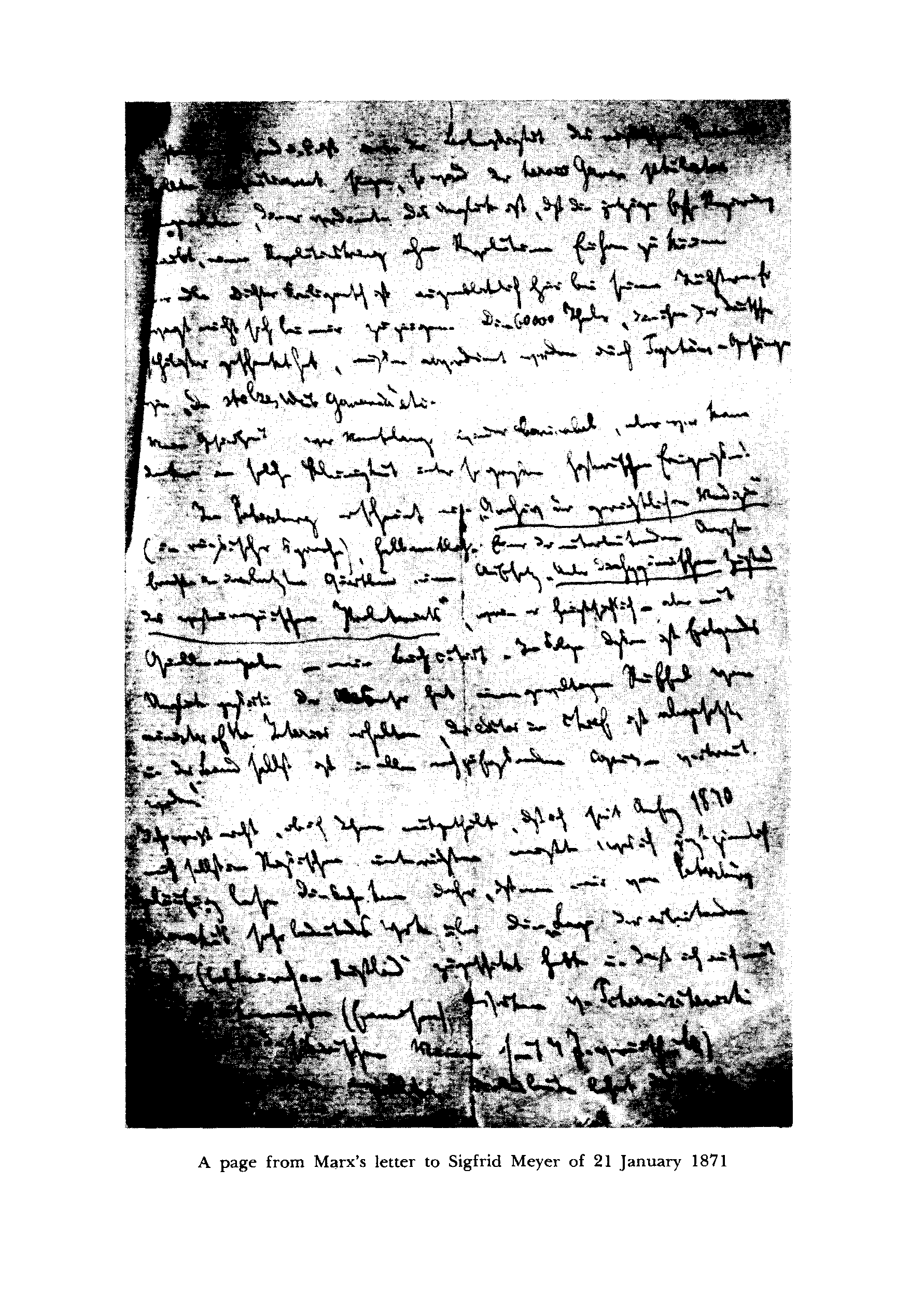
A page from Marx's letter to Sigfrid Meyer of 21 January 1871
following calamity: the censor was severely rebuked by the MINISTER OF THE INTERIOR,a the EDITOR-IN-CHIEF was fired, and that issue of the journal — all the COPIES they could still get hold of — was consigned to the flames![152]
I don't know whether I told you that since the beginning of 1870 I have been having to teach myself Russian, which I now read fairly fluently. This came about after I had been sent Flerovsky's very important work on The Condition of the Working Class (Especially the Peasants) in Russia from St Petersburg; I also wanted to familiarise myself with the (excellent) economic works of Chernyshevsky (who was rewarded by being sentenced to the Siberian mines for the past seven years[153]). The result was worth the effort that a man of my age must make to master a language differing so greatly from the classical, Germanic, and Romance languages. The intellectual movement now taking place in Russia testifies to the fact that things are seething deep below the surface. Minds are always connected by invisible threads with the BODY of the people.
You and Vogt still owe me your photograms. At least I think they were promised to me.
Regards to you and Vogt,
Yours,
Karl Marx
I wrote to my old friend G. J. Harney,b who is now Assis-tant Secretary of State of Massachusetts, concerning the PUBLIC LANDS.
Works, First Russian Edition, Vol. XXVI, Moscow, 1935
61. Marx to Friedrich Adolph Sorge. 21 January[137]
IN HOBOKEN
London, 21 January 1871 1 Maitland Park Road, Haverstock Hill, N.W.
Dear Mr Sorge,
All reports from the German sections in America are to be sent to me. Eccarius is only the correspondent for the Yankees. As Secretary TO THE GENERAL COUNCIL he has nothing to do with FOREIGN
CORRESPONDENCE.
I had completely forgotten the business about the 'contribution' of the German section.[154] On receiving your letter, therefore, I wrote to Eccarius [17] whose reply, which I enclose, can also serve as a receipt.
I have already written about the FORMATION of the CENTRAL COUNCIL (we would have preferred the term Central Committee '[51] to avoid confusion).a
I have not received Kellogg.b It was presumably sent in a yellow envelope that I received from the POST OFFICE here. It was torn open and had been stamped 'NO CONTENTS'. I expect that the envelope was not strong enough.
A few weeks ago I sent to your address a large parcel of publications of the GENERAL COUNCIL of different dates but up to now have had no notice of receipt. They belonged to me personally and I sent them because the supplies of the GENERAL COUNCIL are quite exhausted (for the majority of its publications).
Yours sincerely,
K. Marx
62. Marx to Johann Jacoby. 4 February
IN KÖNIGSBERGa
London, 4 February 1871 1 Maitland Park Road, Haverstock Hill, N.W.
Dear Friend,
Professor John Morley, the editor of The Fortnightly Review, wrote to me yesterday requesting me to ask you if you would like to write a short essay on conditions in Germany for the Review (it would be translated into English here). At Mr Morley's request I shall also probably submit something for the April issue (contributions for that issue have to be ready by 10 March) .b In the February number, the Fortnightly had essays in the Bismarckian spirit by the suspended republican Blindc and by Professor Kinkel, for the same purpose as the one for which the Spartans demonstrated off to their young men the slaves they had first made drunk.
Hoping for an early reply from you,
With sincere good wishes,
Karl Marx
63. Marx to Ludwig Kugelmann. 4 February[121]
Dear Kugelmann,
I am sorry to learn from your last letter that your state of health has again got worse. In the autumn and winter months mine was tolerable, although the cough which I contracted during my last stay in Hanover [55] is still troubling me.
I sent you The Daily News containing my letter.3 Obviously it has been intercepted like the other things I sent you. Today I am enclosing the cutting, as well as the first Address of the General Council. The letter actually contains nothing but facts, but was effective for precisely that reason.
You know my opinion of MIDDLE-CLASS HEROES. Still, Mr Jules Favre (notorious from the days of the Provisional Government and Cavaignacc) et Co. have contrived to surpass my worst anticipations. First of all they allowed the 'sabre orthodoxe', the 'crétin militaire', as Blanqui rightly dubs Trochu, to carry out his 'plan'. This plan consisted simply in prolonging the passive resistance of Paris to the utmost limit, that is, to STARVATION POINT, and in confining the offensive to sham manoeuvres and 'des sorties platoniques'. I am not 'guessing' all this. I know the contents of a letter which Jules Favre himself wrote to Gambetta, and in which he complains that he and other members of that part of the government cowering in Paris sought in vain to spur Trochu on to serious offensive measures. Trochu always answered that that would give the upper hand to Parisian demagogy. Gambetta replied: Vous avez prononcé votre propre condamnationd\ Trochu considered it much more important to keep down the Reds in Paris with the help of his Breton bodyguard — which rendered him the same service that the Corsicans rendered Louis Bonaparte [156]—than to defeat the Prussians. This is the real secret of the defeats not only at Paris, but throughout France, where the bourgeoisie, in agreement with the majority of the local authorities, have acted on the same principle.
After Trochu's plan had been carried through to its CLIMAX — to the point where Paris had to surrender or starve — Jules Favre et Co. were only to follow the example of the Governor of the fortress at Toul.a He did not surrender. He merely explained to the Prussians that he was compelled through lack of food to abandon the defence and open the gates of the fortress. They could now do as they chose.
But Jules Favre is not content with signing a formal surrender.[157] Having declared himself, his governmental colleagues and Paris to be prisoners of war of the roi de Prusse* he has the impudence to act on behalf of all France. What did he know of the state of affairs in France outside Paris? Absolutely nothing, except what Bismarck was gracious enough to tell him.
More. These Messieurs les prisonniers du roi de Prusseb go further and declare that the part of the French government still free in Bordeaux[158] has lost its power and must only act in unison with them — the prisoners of war of the Prussian King. Since they, as prisoners of war, can themselves only act at the command of their war-lord, they have thereby proclaimed the King of Prussia de facto the highest authority in France.
Even Louis Bonaparte, after he surrendered and was taken prisoner at Sedan,c was less shameless. To Bismarck's proposals he replied that he could enter into no negotiations because, by the very fact of his being a Prussian prisoner, he had ceased to hold any authority in France.
At the most Favre could have accepted a conditional armistice for the whole of France, with the proviso, namely, that this agreement should be sanctioned by the Bordeaux government, which alone had the right and the capacity to agree upon the clauses of such an armistice with the Prussians. They, at any rate, would not have allowed the latter to exclude the Eastern theatre of war from the armistice. They would not have allowed the Prussians to round off the outlines of their occupation so profitably to themselves.
Rendered impudent by the pretensions of his prisoners of war, who in that capacity continue to play at being the French government, Bismarck is now interfering sans gêned in internal French affairs. He protests, the noble fellow, against Gambetta's decree concerning the general elections to the Assemblée, because the decree is prejudicial to the freedom of the elections![160] INDEED! Gambetta should answer with a protest against the state of siege and other circumstances in Germany, which annul the freedom of the elections to the Reichstag.
I hope that Bismarck sticks to his conditions of peace! Four hundred million pounds sterling as war indemnity[1] '—half the English national debt! Even the French bourgeois will understand that. They will perhaps at last realise that by continuing the war they could, at the worst, only win.
The MOB, high class and low, judges by appearances, by the façade, the immediate success. During the last twenty years it has, ALL OVER THE WORLD, apotheosised Louis Bonaparte. I have in actual fact always exposed him, even at his apogée, as a mediocre canaille. That is also my opinion of the Junker Bismarck. Nevertheless, I do not consider Bismarck as stupid as he would be if his diplomacy were voluntary. The man is caught by the Russian Chancellery in a net which only a lion could tear through, and he is no lion.
For example, Bismarck's demand that France should hand over her twenty best men-of-war and Pondicherry in the East Indies! Such an idea could not emanate from a genuine Prussian diplomat. He would know that a Prussian Pondicherry would be nothing but a Prussian hostage in English hands; that England, if she wanted to, could seize the twenty men-of-war before they enter the Baltic Sea, and that such demands could only have the object, absurd from the Prussian point of view, of making John Bull distrustful before the Prussians are OUT OF THE FRENCH WOOD. But Russia is interested precisely in such a result, in order to secure Prussia's vassalage still more firmly. In fact these demands have given rise to a complete change of feeling even in the peace-loving English middle class. Everybody is now calling for war. This provocative act and this threat to English interests are making even the bourgeois mad. It is more than probable that, thanks to this piece of Prussian 'wisdom', Gladstone et Co. WILL BE KICKED OUT OF
OFFICE AND SUPPLANTED BY A MINISTRY DECLARING WAR AGAINST PRUSSIA.
On the other hand things look pretty 'awful' in Russia. Since William became an Emperor,[162] the old Muscovite, anti-German party, with the heir to the throne[3] at its head, has again won the upper hand completely. And it is supported by the sentiments of 4 1871
the people. Gorchakov's subtle policy is incomprehensible to them. It is therefore probable that the Tsara will either have to reverse his foreign policy altogether, or THAT HE WILL BE OBLIGED TO KICK THE BUCKET, like his predecessors Alexander I, Paul and Peter III.
With a simultaneous convulsion in the politics of England and Russia, WHERE WOULD PRUSSIA BE at a moment when her frontiers to both the north-east and south-east are left defenceless against any invasion and Germany's military strength is exhausted? Not forgetting that since the outbreak of war Prussia-Germany has sent 1,500,000 men to France, of whom only about 700,000 are still on their feet!
So, despite all appearance to the contrary, Prussia's position is ANYTHING BUT PLEASANT. If France holds out, uses the armistice to reorganise her army and finally gives the war a really revolutionary character — and the artful Bismarck is doing his best TO THIS END — the new German, Borussianb Empire may still get a quite unexpected thrashing as its baptism.
MY BEST COMPLIMENTS TO THE Comtesse AND Fränzchen.0
Your
K. M.
Apropos. You wrote to me once about a book by Haxthausen on Westphalian (I think) land ownership relations.0 I should be glad if you would send it to me.
Be so good as to forward the enclosure to Dr Jacoby (Königsberge) but stamp it by way of precaution.
Get your wife to write on the enclosed letter the address of Dr Johann Jacoby, Königsberg.
Jennychen has just asked me to send her greetings to 'Trautchen, Fränzchen and Wenzelchen'£, which I hereby do.
64. Marx to Paul Lafargue. 4 February
64
MARX TO PAUL LAFARGUE
IN BORDEAUX
[London,] 4 February 1871
Dear Paul,
Il faut créer des nouveaux défenseurs à la France* You and Laura seem seriously and successfully engaged in that patriotic business. The whole family was delighted to hear that our dear Laura has passed victoriously through the critical juncture and we hope the progress will prove no less favourable.
Embrace little Schnappyb on my part and tell him that Old Nickc feels highly elated at the two photograms of his successor. In the 'serious' copy the stern qualities of the little man protrude, while in his attitude as franc-fileurd there is a charming expression of humour and espièglerie."
You know my low opinion of middle-class heroes. Still, Jules Favre et Co. have contrived to surpass my worst anticipations. When Trochu had carried out his mysterious 'plan', that is to say, when that 'sabre orthodoxe', that 'crétin militaire' had pushed the passive resistance of Paris to that point where there remained only the alternative of starvation or capitulation — Jules Favre and Co. might have followed the precedent of the Governor of Toul.' When his power of resistance had altogether broken down, he did not capitulate. He simply informed the Prussians of the real state of things, declared that he could not any longer go on with the defence, being deprived of provisions, and that they might now do as they liked. He made them no concession at all. He simply recognised a fait accompli Favre et Co., on the contrary, not only sign a formal capitulation.[157] They have the impudence to act on behalf of all France, although in complete ignorance of the state of affairs en dehors de Paris* in regard to which they were strictly confined to the dishinterestedh information Bismarck condes-cended to vouchsafe them. Moreover, having capitulated, having become Messieurs les prisonniers du roi de Prusse,a they go further and declare that the bordelais delegation [158] has lost its power and must only act in union with 'Messieurs les prisonniers du roi de Prusse'. Why, even Louis Bonaparte, after his capitulation and surrender at Sedan,[159] declared to Bismarck he could enter into no negotiations with him, because he had ceased to be a free agent, and because, by the very fact of his being a Prussian prisoner, he had ceased to hold any authority over France!
Thus even L. Bonaparte was less shameless than Favre et Co.! The only condition which Favre could have accepted conditional-ly, that is to say under the reserve of his act being assented to by the bordelais delegation, was the armistice. Yet to settle the terms of that armistice he must have left to the men who were not prisoners of le roi de Prusse. They would certainly not have allowed the Prussians to exclude from that armistice the Eastern theatre of war, and would not have allowed the Prussians to improve, on the plea of the armistice, the whole outlines of their military occupation, rounding it off in the way most profitable to themselves.
Embolded by the dastardly servilism of the Paris delegation who presume to participate in the government of France, after having become Messieurs les capitulardsb et les prisonniers du roi de Prusse, Bismarck considers himself and acts already as the de facto supreme authority in France. He protests against Gambetta's decree relating to the general elections as interfering with their liberty.[160]
He dictates the terms on which the General Assembly ought to be chosen. Why! Gambetta might reply by protesting against the conditions under which at this very moment the general elections for the Reichstag are carried on in Germany? He might insist that to render these elections free, Bismarck ought above all things to abolish or at least to suspend the state of siege maintained through great part of Prussia. To give you one instance of the liberty of election in Germany. At Frankfort (on the Main) a workmen's candidate (not residing in Frankfort) is proposed and opens his electoral campaign in that town. What do the Prussian authorities resort to? To the expulsion of that candidate from Frankfort by the police force!16S
I hope that the Prussians will insist on their modest demand of 400 millions of £ sterling war contribution by France!c This may rouse even the French middle class whose manoeuvres together with the intrigues of the local administration (which Gambetta has allowed to a great part to rest in the hands of Bonapartists, Orleanists, etc.) are the true key to the till now reverses of the war. Even the middle class may at last become aware that they will lose more by giving than by fighting!
At the same time, if France holds out still for some time, the foreign relations will become much more favourable to her cause.
In England the Gladstone ministry is seriously endangered. It may soon be kicked out. The public opinion here is now again warlike to the highest degree. This change has been worked by Prussia's demands, mainly by her asking Pon dicherry and the 20 first-rate French men-of-war. John Bull sees in this a menace against England and a Russian intrigue (and these demands have indeed been suggested to Prussia by the St Petersburg cabinet).
In Russia itself a great change seems imminent. Since the assumption of the Imperial title by the King of Prussia,[162] the anti-German party, the so-called Moscovite party, led by the Prince successor,[3] has again got the upper hand. It is very probable that the present Emperorb will either have to accept its dictates and a consequent change of his foreign policy, or that he will share the fate of his predecessors and by some means or other [be] released of his 'mortal body'. If such a convulsion in Russia takes place, Prussia, whose frontiers ön the Russian and Austrian sides are quite denuded of troops, quite exposed and defenceless, will prove unable to keep up her present forces in France. She will at once lower her tone and become quite traitable.c
Hence, if France holds out, if she improves the armistice to repair her forces, if she understands at last that in order to carry on a revolutionary war, revolutionary measures and revolutionary energy are wanted, she may still be saved. Bismarck knows perfectly that he is in a fix. He hopes to get out of it by 'bullying'. He confides in the cooperation of all reactionary elements of France.
Yours,
Old Nick
P.S. The master who now employs Dupont has received a letter from a house at Bordeaux which wants an agent at Manchester.
66. Marx to Natalie Liebknecht. 2 March
Behind the back of his master — a most infamous and brutal parvenu — Dupont would like to ascertain whether he would get that agency. He therefore requests you to obtain information about this point. The address of the house in question, is: Labadie et Co. (Vins et esprits) Rue des terres de Bordes. Bordeaux.
What is Prudhomme doing? Has his health improved?
1958
65. Marx to Pyotr Lavrov. 27 February[164]
Dear Sir,
Lopatin has left for the United States and I have not yet heard from him.
I have the honour to be, Sir,
Your obedient servant,
Karl Marx
66
MARX TO NATALIE LIEBKNECHT[165]
IN LEIPZIG
London, 2 March 1871
My dear Mrs Liebknecht,[166]
The unfortunately very meagre contributions that I sent you for the benefit of the families of the imprisoned men did not in any sense stem from the General Council of the International which has absolutely no funds for such purposes. The General Council was merely chosen by the subscribers as 'trustee' to ensure that the money was duly sent. Incidentally, no further evidence of receipt is necessary.
On the subject of the articles on the German workers' movement which have appeared in English reviews, what Liebknecht probably had in mind was the enclosed article on the International by Professor Beeslya which appeared in the November NUMBER (1870) of The Fortnightly Review. It may well be the passages from p. 531 on (I have put a mark to show where they begin)[167] which Stieber wants to use to cook his proof. In the first place, Professor Beesly is not a member of the International and his statements are not authoritative for that reason. In the second place, he himself refutes Stieber's inferences.
The letter I sent to the Brunswick peopleb was not written in the name of or on the instructions of the General Council That is why it was not written on paper with the letterhead of the General Council. My statements there are made entirely in my own name. It was in fact a reply — and a long-deferred reply at that — to a letter asking me for my personal views. They were perfectly within their rights to ask for this. At least, I know of no § in the Penal Code that would proscribe it. At any rate, it is not Mr Bismarck's fault if 'my views' cannot be found printed in the Preussischer
Staats-Anzeiger. The worthy Lothar Bucher did invite me after the heady days of Sadowa to write the financial column for that paper. More likely than not he took care not to publicise my reply.[168]
The German Empire is carrying on the campaign of the French Empire against the International Nothing is so characteristic of the last days of the latter empire as the legal persecution of members of the International because they waged war on the intended war. The secret papers of Mr Ollivier published by the Republic are very revealing in this respect.[169]
I was very pleased to receive your letter today. An article by me was to have appeared in The Fortnightly Review, but I shall postpone it for the time being, since the inability of the Prussian government to intervene here might be more than made good at the expense of friends there [in Germany], who are of course in no way responsible for things that happen without their knowledge.
I would be greatly obliged to you if you could send me the complete stenographic report of the last session of the Reichstag that ended on 10 December 1870. I would of course reimburse you for the costs.
Jennychen has unfortunately come down with pleurisy. With warmest regards to Liebknecht and yourself.
Yours very sincerely,
K. M.
67. Engels to Karl Klein and Friedrich Moll. 10 March
122 Regent's Park Road, N.W.
Dear Friends Klein and Moll,
You must have been very surprised not to have received any reply to your letters of February last year. There were, however, a number of reasons for it. In the first place, I had hoped from one day to the next to be in a position to have something positive to say about the Association. But this turned out to be impossible and after the outbreak of the war it could no longer be expected. In the second place, your letter arrived in such a sorry state that I could be in no doubt that the postal authorities had been at pains to read it. So I waited for an opportune moment, particularly since the war, the state of siege and the many arrests. And, finally, I could not know whether both of you had not been conscripted into the Landwehr[11] during the war.
An opportunity has now arisen to send a letter to Barmen, whence it could be passed on with little danger, and so I shall make use of it to give you a sign of life, and to enclose the promised portrait of myself. I have not yet been able to obtain one of Schapper who, as you know, died last year; as soon as I can lay hands on one, you shall have it.
The German workers now have a hard time ahead of them; it seems to have been decided that they should be the victims whose sacrifice will provide the occasion for a reconciliation between Junker and bourgeoisie. But it doesn't matter. The workers' movement has become too powerful even in Germany to be snuffed out that easily by Prussian tricks. On the contrary, the persecutions we have to be prepared for will just give us greater strength, and when the bourgeois at present drunk with victory has overslept from intoxication and the hangover is beginning, a chance will arise for our party to raise its voice once more. At any rate, the exemplary behaviour of the German workers during the war has demonstrated that they know what is at stake and that they alone, of all the parties, have a correct insight into the history of our age, whereas the bourgeois have really let victory go to their heads.
I have been living here in London for the past five months. It seems doubtful whether you can continue for much longer to belong to the International Working Men's Association unless just in principle, since they seem to want to make it a criminal offence to be a member of that Association in Germany. At any rate, you may rest assured that having prepared the way for the association of the entire European and American proletariat over the past seven years, we shall take good care that it does not disintegrate whatever the circumstances. And that is the main thing.
With fraternal greetings,
Yours,
F. Engels
68. Engels to Rudolf Engels. 10 March
68
ENGELS TO RUDOLF ENGELS
IN ENGELSKIRCHEN
London, 10 March 1871
Dear Rudolf,
Since I am not yet acquainted with any lawyer here who is reliably informed or especially competent in commercial affairs, I have decided after some reflection that the best thing would be to write to the man in Manchester who made the contract with Funke on your behalf. I was quite clear in my mind about the issue at stake, but in matters of English law it is always better not to rely on common sense. However, on this occasion, the lawyer said: * law and common sense agree; the retirement of one of the partners in the German firm, from the German firm, in no way affects the firm in England, nor can the firm in England have any voice in the matter. On the other hand no member of the English firm can retire before the expiration of the term without the consent of the other members of the same concern.*
Therefore (1) Adolf'sa position in the firm of R. Funke & Co. remains unaltered even though he has left the firm of Ermen 8c Engels in Barmen; and (2) his resignation from R. Funke & Co. requires not just his agreement, but also the agreement of Funke, a point that may not have occurred to you.
Since these affairs affect Adolf, too, and since I cannot take sides on this matter, I am writing to him in the same terms today.
I purchased this information at a cost of 10/6d., which equals 3.15 thalers, and would be glad if you could credit me with it.
I find it quite natural that Adolf should want to retire from the business as soon as he can. The winter in Engelskirchen is fearfully boring and you will not take it amiss that he should long for some other entertainment than endless family drinking-sessions. I am only astonished that he stood it there for so long; I would have kicked up a fuss much sooner and more often. It is all very well for you and Hermann b to talk, but you both jib at the idea of moving to Engelskirchen, and you cannot persuade me that it is just because you know nothing of the manufacturing process. You could learn it up after all, it would do you both good. Adolf can find many pleasant and congenial occupations for himself even without the business, and anyone who can do that is quite right to withdraw as quickly as possible. You must have been prepared for this eventuality long since, and if it now arises, it can only be in your interest for him to leave as soon as possible. I do not understand therefore how you should find such major grounds for complaint. Let Adolf go his own way, resolve the dispute as friends and make the necessary arrangements to meet the new situation, one which will give a higher percentage yield to each of you.
Gottfrieda will not suffer any great inconvenience; the old MILL in West Lane was empty and available, machinery is also easily procured. In Manchester one can get quite a few things done, etc., by other people, so you should not entertain any exaggerated hopes. Moreover, it is self-evident that I am under a moral obligation not to do anything to harm a former associé who has given me a round sum in return for my own resignation. To what purpose then do you have agents and travellers? If they do their duty you do not need any further information.
I rather doubt that the present sympathy with France (both here and fairly generally all over the world) stems from the fact that the French were given the greater thrashing. However, this much is certain: if the Prussians should be given another thrashing at a later stage (which is not at all improbable) people will laugh at them, rather than sympathise with them. The fact is that you cannot see beyond the end of your noses; but the hangover will follow the victory celebrations soon enough, and then you will find it hard to take much pleasure in yourselves. For all your power and glory you are as firmly 'in the thrall of Olmiitz' as ever. Olmütz was made in Warsaw,[170] where your sovereign lord, the Emperor of Russia,b commanded you to bow to Austria and the Federal Diet, and now that you have made sure that for many years to come France (which after all lies on your border) will remain your enemy, Russia will be your only protector and will soon make you pay for that protection. You are more firmly in the grip of Russian domination than ever before.
Would you kindly give my motherc my warmest wishes and say that I shall be writing to her shortly. Give my regards to your wife
69. Marx to Paul Lafargue. 23 March
and children and all my brothers and sisters and all their encumbrances.
Your
Frederick
69
MARX TO PAUL LAFARGUE (1)
IN BORDEAUX[118]
London, 23 March 1871
Dear Paul,
I enclose Serraillier's declaration in the Courrier de l'Europe, 18 March, 1871—(this French paper is published at London) in regard to the impudent mystification of the Paris-Journal of March 14, of which you are probably aware.[17]'
The following is published in The Times of 22nd March 1871 under the title ' The International Association':
'M. Karl Marx asks us to contradict the statement contained in a letter published by us on the 16th of March, from our Paris correspondent, that
"Karl Marx has written a letter to one of his principal affiliés in Paris, stating that he is not satisfied with the attitude which the members of that society have taken up in that city, that they violate the Statutes of the Association in dabbling in politics, that they disorganise labour instead of organising it, etc."
'M. Karl Marx says this statement has evidently been taken from the Paris-Journal of the 14th of March, where also the publication in full of the pretended letter is promised, and that the Paris-Journal of the 19th of March contains a letter dated London, February 28, 1871, purporting to be signed by him, which letter M. Marx declares is from beginning to end an impudent forgery.'"
I come now to the second trick of that dirty Parisian reactionary press. When we were informed of the pretended exclusion of the German 'Internationals' by the Paris 'Internationals', we wrote to the 'frères et amis' at Paris, who replied that this story was nothing but an invention of the Paris press scum. Meanwhile, the false news spread like wildfire through the London press which indulged in long leaders upon that pleasant event proving at the same time the decomposition of the International and the incorrigible perversion of the Paris workmen.
In to-day's Times (23 March, 1871) the following declaration of the General Council* is published:
'The Anti-German League[172] of Paris To the Editor of "The Times"
'Sir,
'A statement has gone the round of the English press that the Paris members of the International Working Men's Association had in so far joined the so-called Anti-German League as to declare all Germans to be henceforth excluded from our association.
'This statement is the very reverse of fact. Neither the Federal Council of our association in Paris, nor any of the Paris sections represented by that council, have ever passed any such resolution. The so-called Anti-German League, as far as it exists at all, is the exclusive work of the upper and middle classes; it was started by the Jockey Club,[173] and kept up by the adhesions of the Academy, of the Stock Exchange, of some bankers and manufacturers, etc. The working classes have nothing whatever to do with it.
'The object of these calumnies is evident. A short time before the outbreak of the late war the International was made the general scapegoat for all untoward events. This is now repeated over again. While the Swiss and Prussian press accuse it of having created the late outrage upon Germans in Zurich,[174] French papers, such as the Courrier de Lyon, Le Courrier de la Gironde, La Liberté, etc., tell of certain secret meetings of Internationals having been held at Geneva and Bern, the Prussian ambassador in the chair, in which meetings a plan was concocted to hand over Lyons to the united Prussians and Internationals for the sake of common plunder.
'By order of the General Council of the International Working Men's Association
'J. G. Eccarius, General Secretary' London, March 22
I have to-day still so many letters to write that I must shut up. Tell Laura that I was greatly delighted with her letter.
Yours,
K. Marx3
Your letter to Jenny has just arrived. It is not my youthful ardour, as you believe, but manifestoes published by the Federal Council of Paris during the war and communicated to us officially, that made the GENERAL COUNCIL believe in the possibility of such a foolish thing as the exclusion of the German Internationals by the Parisian Internationals! I have today sent to the Volksstaat in
Leipzig (Liebknecht's newspaper) and the Zukunft in Berlin (Dr Jacoby's organ) a statement on the fantasies of the Paris-Journal and the alleged exclusion of the German Internationals by the Parisians, which has caused a great commotion in the German 'bonne presse'} I concluded this statement with the words:
'It is quite natural that the important dignitaries and the ruling classes of the old society who can only maintain their own power and the exploitation of the productive masses by national conflicts and antagonisms, recognise their common adversary in the International Working Men's Association.'
70. Marx to Peter Imandt. 30 March
Dear Imandt,
The 'letter' is a product of that trashy Paris paper, the Paris-Journal, in its issues of 14 and 19 March. [71] A statement from me in reply appeared in The Times on 22 March (a notice in small print just after the leading articles).[3] That lousy paper has direct connections with the Prussian police. Its rédacteur en chef,h the notorious Henri de Pêne, received two bullets in his body as a reward for his participation in the 'peaceable' procession of the parti de l'ordre.a
Regards to Bourbaki junior.b
Curiously enough the entire reactionary press in France printed the pseudo-letter. To give it more spice, the Paris-Journal published it under the high-faluting title: 'Le Grand Chef (translation of the Stieberian 'Hauptchef'"c) 'de L'Internationale'.
Salut
Your
K. M.
Works, Second Russian Edition, Vol. 33, Moscow, 1964
71. Engels to Philippe Coenen. 5 April[1 1 8]
To Citizen Ph. Coenen, Antwerp
Dear Citizen,
As I already told you in my last letter,[45] I felt it incumbent upon me to submit the contents of your letter concerning the strike of the cigar-workers to the Central" Council when it met yesterday evening.[177] At the same time I requested the Council to afford our Antwerp members all possible help and support.
In this I received vigorous support, more especially from Citizen Cohn, president of the London cigar-workers, who informed the Council that the cigar-workers of his Association had voted a loan of 150 pounds sterling, or about 3,750 francs, to their colleagues in Antwerp; that the Association of Belgian Cigar-workers employed over here had voted £20; that his Association proposed to urge another Association here, and that of the cigar-workers of Liverpool, to advance funds in support of the strike, etc.
The Council then unanimously resolved:
1. That an appeal to the English resistance societies in London and the provinces be immediately drafted, printed and despatched to all the associations, urging them to intervene on behalf of the Antwerp strikers.
2. That deputations from the Council be sent to the big centralised associations in London, with whom we are in touch, to approach them with the same end in view.
Having learned from Citizen Cohn that you had already taken the necessary steps to prevent the debouchment of Dutch cigar-workers by the Antwerp manufacturers and that similar attempts would not be successful here in England, all I could do on your behalf was to write a short note for our German journal, the Volksstaat of Leipzig, in which I relate the origins of the strike and urge the German cigar-workers to prevent any debouchment of workers for the [said] place, Antwerp, and, if possible, to advance you some funds to support the strike.b This note will be published next week; in addition I asked the editora to take up your cause.
As to the success of these various moves, it is hard to judge in advance. Should the English associations consent to give us advances, several weeks will probably have to elapse before the necessary formalities can be completed. The German associations, having been ruined by the war, will hardly be in a position to advance any funds.
In the meantime, please keep me informed of what is happening as regards the cigar-workers' strike, so that I shall be able to act if needs be, and without loss of time. Is it true, as Citizen Cohn has said, that the 300 cigar-workers of Brussels are also on strike? The Council has been told nothing about it and the Brussels people would be greatly to blame were this really the case; for how are we to act if news is kept back from us?
For some time copies of the Werker intended for the Council have failed to reach us. The General Council must be sent two copies of each of our journals, one for the library where a complete collection of all such journals is being made to help with the future history of the proletarian movement in all countries, the other for the secretary of the country where the journal appears. It would be a pity if De Werker were no longer to reach us, since we have always read it with close attention.
The £150 should have been sent to you today. If it fails to arrive within 24 hours after receipt of this letter, kindly write without delay to Citizen Cohn, whose address you have got.
I shall make it my business to do everything in my power for the Antwerp workers whom I have the honour to represent on the Council here; only please keep me properly informed about all that goes on.
With fraternal salutations,
Yours,
Frederick Engels
72. Engels to Wilhelm Liebknecht. 5 April
IN LEIPZIG
London, 5 April 1871 122 Regent's Park Road, N.W.
Dear Liebknecht,
Could you have the enclosed[3] inserted in the next issue of the Volksstaat? Precisely this STRIKE is one of supreme importance for the International in Belgium.[177]
I congratulate you on your release.[178]
Best regards.
Your
F. E.
If the German cigar-workers can afford to advance funds to Antwerp, this should be set in train. The Elberfeld Address was received by the GENERAL COUNCIL yesterday to be sent on and has already gone off.[179] I have read it.
73. Marx to Wilhelm Liebknecht. 6 Aprila
Dear Liebknecht,
The news that you and Bebel as well as the Brunswick people were released[178] was received here in the Centralb Council with great rejoicing.
It seems the Parisians are succumbing. It is their own fault but a fault which really was due to their too great honnêteté? The Central Committee and later the Commune gave that MISCHIEVOUS avorton,a
Thiers, time to consolidate hostile forces, in the first place by their folly of not wanting to start a civil war—as if Thiers had not already started it by his attempt at forcibly disarming Paris, as if the National Assembly, summoned merely to decide the question of war or peace with the Prussians, had not immediately declared war on the Republic] Secondly, in order that the appearance of having usurped power should not attach to them, they lost precious moments (they should immediately have advanced on Versailles after the defeat (Place Vendôme) of the réactionnaires in Paris [175]) by the election of the Commune, the organisation of which, etc., cost yet more time.
You must not believe a word of all the stuff you get to see in the papers about the internal events in Paris. It is all lies and deception. Never has the vileness of the reptile bourgeois newspaper hacks displayed itself more splendidly.
It is highly characteristic that the German Unity-Emperor,c
Unity-Empire, and Unity-Parliament in Berlin appear not to exist at all for the outside world. Every breath of wind that stirs in Paris excites more interest.
You should follow developments in the Danube Principalities with some care. If the revolution in France is defeated for the time being — the movement there can only be suppressed for a short time — Europe will have to face a new threat of war from the East, and Romania will be the first to present the orthodox Tsard
with a pretext. So keep an eye on events there.
One of the most comical phenomena in London is undoubtedly that ex-student Karl Blind. The self-important fellow eagerly seized on the recent war to show off his pan-Germanic allegiance. He was the first to start screaming for Alsace-Lorraine. He even had the impudence to deny the great revolutionary activities of the French people in the past. The scoundrel even ventured to warn the local workers not to incur the hostility of workers in Germany by their sympathy for France against Prussia! Each week this gentleman composes a report describing the activities of Karl Blind and sends it to all the London papers, two or three of which are actually so foolish as to print these bulletins of, about and for Karl Blind. If this system is applied consistently, one cannot fail to force oneself on the public in the end. In this manner this weighty 6 1871
personage has managed to delude a section of local public opinion into believing that he plays the same sort of role in Germany as Mazzini used to in Italy. In his bulletins he recounts what Karl Blind had announced in the Viennese Freie Presse, and how the whole of Germany looked forward to his oracular utterances with bated breath and anxiously awaited for Karl Blind to deliver himself of the watchword for the week. Now it would be extremely desirable — since this individual, this puffed-up frog, does make us Germans here ridiculous — if you people in the Volksstaat could publish a few home truths about the fellow and his 'complete unimportance'.[180] We would ensure that a translation appeared in The Eastern Post (a London workers' paper). It is quite simple. Karl Blind does not exist in the eyes of the German working class, and a republican German middle class, whose MOUTHPIECE he pretends to be, does not exist anywhere and hence cannot exist for Karl Blind either. HE IS NOWHERE. While such figures should not be taken seriously, it is no less true that they should not be allowed to delude the public ON FALSE PRETENCES.
Laura had already arrived in Bordeaux some days before the siege of Paris began.
Our children — Tussy and Jennychen (the latter suffering from pleurisy)—are also going to Bordeaux shortly.
Bebel would oblige me greatly if he could arrange for me to be sent regularly the stenographic reports of the Berlin Unity-Reichstag.
A visit from you here would be very welcome. The Volksstaat must be preserved at all costs now. I have some prospects of being able to raise money for it.
My warmest greetings to your dear wife.(1)
Your
K. M.
Could you not let me have a reliable address in Leipzig? Apropos. I enclose a charming notice about Stieber from the Petit Journal (which appears in Paris) in its issue of 5 April.[181]
74. Marx to Wilhelm Liebknecht. Around 10 April[137]a
Dear Wilhelm,
Just two notices in great haste which you could surely arrange to put into the Volksstaat:
1. In the Papiers et correspondance de la famille impériale, now officially published, there is a reference under the letter V (the recipients of money are arranged alphabetically ) which states verbo tenus :
'Vogt—il lui est remis en août 1859 40,000 francs.'b
2. Whereas the Bismarck government in Germany has made correspondence with me into a more or less highly penal affair (vide the Brunswick trial,[183] just like the Cologne Communist trial of earlier years [138]), in France it attempts to discredit me (and with me the International in Paris—that is the aim of the whole manoeuvre) by branding me as one of Mr Bismarck's agents. This is done through the organs of the old-Bonapartist police which is still entwined by international bonds with Stieber's police— particularly under the Thiers regime.
In consequence I have been compelled to publish denials in The Times of various lies that have appeared in the Paris-Journal, the Gaulois, and so on, because the rubbish is reported to the English press by telegraph.[171] The latest example was provided by the Soir (the paper of About, the well-known Plonplonistd), which has only very recently been suppressed by the Commune, and from the
Soir it circulated to all the French reactionary press throughout the provinces. E.g. today I received from Laura (BY THE BY, Lafargue is at this moment in Paris as a delegate from Bordeaux) the following extract from the paper La Province (and yesterday I received the same piece from a clerical newspaper in Belgium):
'Paris, 2 April. A piece of news just arrived from Germany is causing a great sensation here. Authentic proof is now to hand to show that Karl Marx, one of the most influential leaders of the International, was the private secretary of Count Bismarck in 1857, and has never ceased to remain in contact with his former patron.'"
Stieber really is becoming a 'terror'!
Salut.
Your
K. M.
75. Marx to Ludwig Kugelmann. 12 April[1 2 1]
Dear Kugelmann,
Your 'doctor's orders' were effective insofar as I consulted my Dr Maddison and have for the present put myself under his treatment. H e says, however, that my lungs are in excellent condition and the coughing is connected with bronchitis, etc. Ditto, it may affect the liver.
Yesterday we received the by no means reassuring news that Lafargue (not Laura) is in Paris at the moment.
If you look at the last chapter of my Eighteenth Brumaire you will find that I say that the next attempt of the French revolution will be no longer, as before, to transfer the bureaucratic military machine from one hand to another, but to break it, and that is essential for every real people's revolution on the Continent. And this is what our heroic Party comrades in Paris are attempting. What resilience, what historical initiative, what a capacity for sacrifice in these Parisians! After six months of hunger and ruin, caused rather by internal treachery than by the external enemy, they rise, beneath Prussian bayonets, as if there had never been a war between France and Germany and the enemy were not still at the gates of Paris! History has no like example of a like greatness.
a 'Nouvelles d'hier', La Province, No. 428, 5 April 1871.
If they are defeated only their 'decency' will be to blame. They should have marched at once on Versailles, after first Vinoy and then the reactionary section of the Paris National Guard had themselves retired from the battlefield. The right moment was missed because of conscientious scruples. They did not want to start the civil war, as if that MISCHIEVOUS avortona Thiers had not already started the civil war with his attempt to disarm Paris! Second mistake: The Central Committee surrendered its power too soon, to make way for the Commune.[184] Again from a too 'honourable' scrupulousness! However that may be, the present rising in Paris—-even if it be crushed by the wolves, swine and vile curs of the old society — is the most glorious deed of our Party since the June Insurrection in Paris.b Compare these Parisians, storming the heavens, with the slaves to heaven of the German-Prussian Holy Roman Empire, with its posthumous masquerades reeking of the barracks, the Church, the cabbage Junkers and above all, of the philistines.
Apropos. In the official publication* of the list of those receiving direct subsidies from Louis Bonaparte's treasury there is a note that Vogt received 40,000 francs in August 1859! I have informed Liebknecht of the fait, for further use.c
You can send me the Haxthausen,d because recently I have received various pamphlets, etc., undamaged, not only from Germany, but even from Petersburg.
Thanks for the various newspapers you have been sending (I would ask you for more, as I want to write something about Germany, the Reichstag, etc.).
Best greetings to the Countess and Käuzchen.e
Your
K. M.
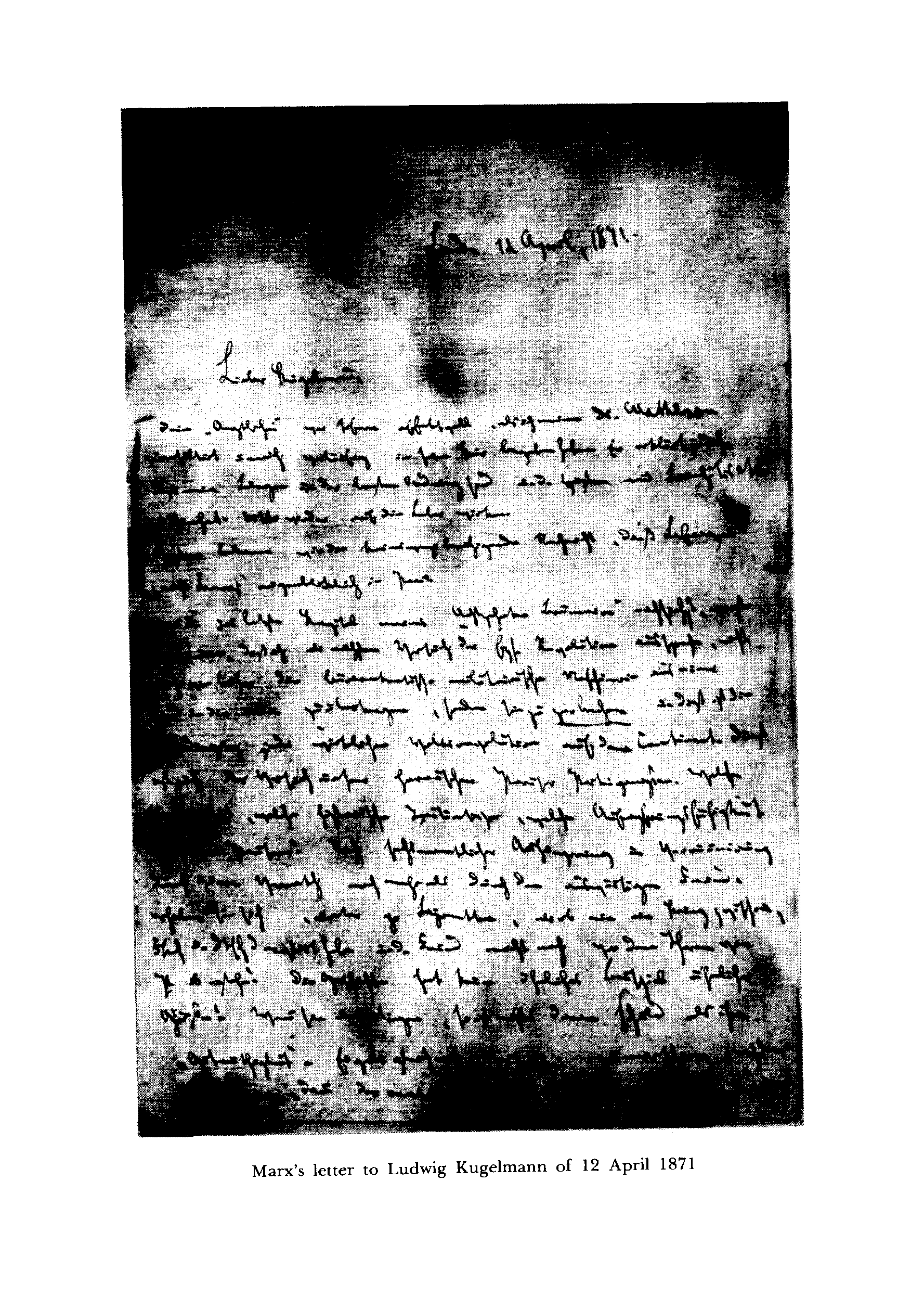
Marx's letter to Ludwig Kugelmann of 12 April 1871
76. Marx to Wilhelm Liebknecht. 13 April[185]
Dear Liebknecht,
You may make use of the 80 thalers either for your family, or for the Volksstaat.a Both are 'victims' of the recent war.
I do not have the Freiligrath poem; it came out in 1852 and appeared also in Cotta's Morgenblatt which you can perhaps unearth in Leipzig.[186]
I do not think it would be useful to reprint items from the Revue der Rheinischen Zeitung without introductions, additions, etc., and this is hardly the time for that.[187]
Engels asks me to tell you that his essay in the Deutsch-Französische Jahrbücherb is now only of historical interest and so no longer has any value as practical propaganda. On the other hand, you could print more extensive excerpts from Capital, e.g. extracts from the chapter on 'Primitive Accumulation',[188] etc.
Miquel was in the Leaguec and threw his weight about in the Kingdom of Hanover as the League's District Adviser Extraordinary. You can print that, but leave my name out of it, since I have to keep the 'secret' unless directly forced by Miquel [to reveal it].
'Bid me not speak, bid me be silent To keep the secret I am bound.'d
The Communist Manifesto cannot of course appear without a new preface. Engels and I will see what can be done about it. My kind regards to your dear wife.e
Your
K. M.
77. Engels to Wilhelm Liebknecht. 13 April
Dear Liebknecht,
It is absolutely out of the question for you to reprint my old article from the Deutsch-Französische Jahrbücher in the Volksstaat.(1) It is by now quite obsolete and full of inaccuracies that could only confuse people. Moreover, it was still written in a Hegelian style which likewise just will not do nowadays. Its sole value is as an historical document.
With best regards,
Your
F. E.
78. Marx to Ludwig Kugelmann. 17 April[190]
Dear Kugelmann,
Your letter arrived all right. At the moment I have my hands full. So only a few words. How you can compare petty-bourgeois demonstrations à la 13 June 1849,[191] etc., with the present struggle in Paris is quite incomprehensible to me.
World history would indeed be very easy to make if the struggle were taken up only on condition of infallibly favourable chances.
It would, on the other hand, be of a very mystical nature, if 'accidents' played no part. These accidents themselves fall naturally into the general course of development and are compensated again by other accidents. But acceleration and delay are very dependent upon such 'accidents', which include the 'accident' of the character of those who first stand at the head of the movement.
The decisively unfavourable 'accident' this time is by no means to be found in the general conditions of French society, but in the presence of the Prussians in France and their position right before Paris. Of this the Parisians were well aware. But of this, the bourgeois canaille of Versailles were also well aware. Precisely for that reason they presented the Parisians with the alternative of taking up the fight or succumbing without a struggle. In the latter case, the demoralisation of the working class would have been a far greater misfortune than the fall of any number of 'leaders'. The struggle of the working class against the capitalist class and its state has entered upon a new phase with the struggle in Paris. Whatever the immediate results may be, a new point of departure of world-historic importance has been gained.
Adio.
K. M.
79. Engels to Wilhelm Liebknecht. 20 April
Dear Liebknecht,
I must tell you today in all haste about the so-called INTERNATIONAL DEMOCRATIC ASSOCIATION,[192] which you may well never have heard of and which, therefore, might be confused with us.
The association is a caricature of the IWMA. It has vegetated in obscurity here for a number of years, but expresses its desire, from time to time, to present itself to a wider public, i.e. to make itself ridiculous, exhibiting at the same time a certain secondary tendency to let itself quietly be mistaken for the IWMA. Since these people again held a meeting on the Paris Commune in Hyde Park last Sundaya—a meeting which under their auspices was inevitably doomed to failure (they even let it be known that we had sent delegates, even though, when they sent a deputation to us, we roundly refused to do so)—and since they now also intend to establish branches on the Continent and will presumably send deputations to you as well, it has become necessary to make you acquainted with them. In the first place, there is Weber, that old trouble-maker from the Palatinate, whom you know; and secondly, Le Lubez, whom you have also come across. I enclose a cutting in which they present their muddled programme to the world in muddled language. Insofar as it is comprehensible, it is purely bourgeois; what they have to say on the subject of providing work and, alternatively, of making provision for those unable to work, is already fulfilled by the English Poor Law.[193] They take good care not to say a word about capital and labour. The NATIONALISATION OF LAND is so universally accepted here that they cannot evade it, and in itself is so little in conflict with bourgeois interests that only the day before yesterday a Tory who has his million thalers in safe keeping told me that he was in favour of it. Weber is also, as you know, a supporter of Heinzen and a pure 'democrat'.
As long as these fellows pursued their activities in obscurity here, we left them to themselves, but if they choose to expand, conflicts will be unavoidable and we shall then have to hit them where it hurts.
So the Volksstaat was confiscated again yesterday for lèse majesté, as we hear on the telegraph.[194] I am astonished that it did not happen earlier. You are extremely impudent. But 'after all, this is only right and proper', as Frederick II used to say.
The Vogt storyb should be kept alive for a while. It is evident from the context that Karl Vogt is the only Vogt who can be meant. In the first place, no other Vogt is so well known as to be referred to as Vogt, tout court, without first name and address. In the second place, what other Vogt performed such valuable services at that time for the Bonaparte family that he should have been given 40,000 frs in August, i.e. immediately after the 20 1871
conclusion of the Italian campaign? Moreover, the formula, 'il lui a été remis en Août 1859',' indicates that he had received other remittances. T h e more frequently you return to the point, the more the bourgeois press, which suppresses all this, will find itself forced to take note of it. You might also bring it to the attention of the Proletarier and the Volkswille. Since experience has taught me that Stieber's agents are as clumsy at opening letters as they are at fabricating conspiracies, I hereby inform you once and for all that all my letters to you are securely sealed with my seal and the initials F. E. in Gothic script. The Prussians cannot yet in all decency break open sealing-wax on rubber, and certainly not so that it cannot be noticed. Mostly they just tear open the side of the envelope with their oafish fists. So if my seal is not clear and legible you will know what has happened. It will at any rate infuriate the fellows to have to let a letter addressed to you and with F. E. on the seal pass through their hands unbroken.
It is time for the post and I still have all sorts of things to tell you, but I must end now.
Your
F. E.
80. Engels to Francisco Mora. Around 20 April[1 9 5]
O n 19 April the relevant extracts from Nos. 80-92 of the Federation about the SPINNERS'STRIKE in Barcelona b sent to Eccarius who was to report on it to the Manchester TRADE COUNCIL.
a 'it was remitted to him in August 1859' - b See F. Engels, 'Outline of an Appeal of the General Council to the Weavers' and Spinners' Trade Unions of Manchester for Assistance to the Spanish Textile Workers Strike'.
Wrote ditto to Mora, acknowledging receipt and reporting what had happened, pointing out that little help would be forthcoming because of the Belgian and Sunderland STRIKES and the general world situation. .
The loan an essential instrument and the one we have mainly used up to now. Therefore the Barcelonese must write a letter binding themselves to repay all loan-monies received through the agency of the General Council. This only necessary to comply with the formalities of the English TRADE UNIONS.
Promise a copy of the Address on Paris.[196]
81. Marx to Friedrich Adolph Sorge. Around20 April[137]
Dear Mr Sorge,
My best thanks for the Kellogg,[3] which arrived safely this time; ditto for the other things you sent.
The Committeea will receive its replies sooner in future, but in recent weeks business on the European Continent, together with agitation here among the English, b has taken up all the more time as the majority of the non-English secretaries are in Paris.
Yours most sincerely,
K. M.
Sorge und Andere, Stuttgart, 1906
82. Marx to Léo Frankel. Around 26 April
82
MARX TO LÉO FRANKEL[198]
IN PARIS [Draft]
[London, around 26 April 1871] Dear Citizen![199]
I have been authorised by the General Council to issue a most emphatic denial on its behalf of the foul slander being spread by Citizen F. Pyat against Serraillier.a Pyat's fury springs from one single source: his hatred for the International. Through the so-called French Section in London,[50] which has been expelled by the General Council, and which has been infiltrated by police spies, one-time imperial guardsmen and touts, Pyat has been trying to pose before the world as the secret leader of our Association, to which he does not belong, and to make us responsible for his absurd manifestations in London and his compromising indiscretions in Paris, which, by the way, Citizen Tridon has already flayed during his stay in Brussels.[200] That is why the General Council was forced to disown this dirty schemer publicly.b Hence his furies against Dupont and Serraillier. When Serraillier threatened to summon the vile toadies of Pyat in the so-called French Section before an English court to answer for the slander Pyat keeps spreading in Paris, the French Section itself disowned them and branded them as slanderers.
One of these days, the General Council is to issue an Address on the Commune.[196] It has put off this manifesto up to now, because it was expecting the Paris Section from day to day to supply it with precise information. In vain! Not a word! The Council could not afford to wait any longer because the English workers have been eagerly awaiting its explanation.
Meanwhile, time has not been wasted. The true character of this grand Paris revolution has been explained to workers everywhere in letters from various secretaries to sections on the Continent and in the United States.
Since Serraillier's political life has given no occasion for slander,c
it was his private life that was attacked. Had Pyat's private life been as clean as Serraillier's, he would not have had to submit here, in London, to affronts which it takes blood to wash away...a
I have had a letter and a visit from a certain citizen over the despatch of you know what. The mistake they made in Paris was not to hand over the papers required b to facilitate the operations. You should now have some three per cent securities which circulate freely and which can be sold at the current rate. The citizen will give you any other necessary explanations.
He can be quite safely entrusted with the document.
83. Engels to Ludwig Kugelmann. 28 April
122 Regent's Park Road, N.W.
Dear Kugelmann,
You can see from the above address that I have settled in London and have in fact been here since last autumn when I finally wound up my various business obligations in Manchester. I am happy with the move in every respect. My new house is not quite ten minutes away from Marx, which is very close indeed according to ideas here. Moreover, I have the park directly opposite the door and splendid fresh air.
As far as Marx' condition is concerned, you saw the situation in altogether too gloomy a light. D'abordc your bold diagnosis which blamed his cough on catarrh on the lungs. Marx and I have consulted a very able young doctord (a Scot), who knows his auscultation and percussion as well as most in Germany, and who says the same as I have been saying all along: that the source of the cough is solely in the larynx and that the lungs are completely unaffected. He says that it is, however, not easy to get rid of a cough that has been so greatly neglected and which has therefore become so firmly entrenched, and he prophesies a recurrence in the autumn, even if the summer drives it away. Given proper treatment, however, he says there is no cause for concern. The only trouble with the cough to begin with was that it prevented Marx from sleeping and so brought about a general deterioration in his health. That has now been attended to more or less. The doctor has mainly been treating his liver and there too he has had some success. You will understand, however, that there can be no speedy cure for a chronic illness that, to my knowledge, has been more or less permanent for the last 26 years. Incidentally, Marx's way of life is by no means as crazy as people imagine. While the excitement that started with the war still persists, he has given up work on heavy theoretical matters and is living fairly rationally; he even frequently takes his 1 V2 hour to 2 hour walks without my forcing him to and he does not drink a drop of beer for weeks on end as soon as he notices that it doesn't agree with him. That he has a capricious appetite which alternates between lack of appetite and ravenous hunger is not surprising in his condition. You need have no fear that his skin is not in order — apart from the considerable areas where the CUTIS has been completely destroyed by the carbuncles. A walk via Highgate to Hampstead and back to Maitland Park is about 1 V2 German miles and involves going up and down several steep hills. And up on top there is more ozone than in the whole of Hanover. He goes for this walk 3-4 times per week, at least in part. Naturally, I often have to make him do it, but he knows that it is good for him. And in general, like me, he lives circa 150 feet above the Thames in an open district, with hardly a hint of urban atmosphere, among large gardens and few houses, and if matters are not worse with him, it can be put down to this healthy environment.
I have just been called to the table and, since the crazy postal system closes down in half-an-hour, I shall have to break off. At any rate I have given you enough material to counteract your somewhat exaggerated fears. The fact is that I cannot bear to be without a lot of exercise out of doors and, whether he wants to or not, Marx mostly has to come along with me, and that is after all the best medicine for him.
With warm regards,
Yours,
F. E.
84. Marx to Wilhelm Liebknecht. 4 May
Dear LIBRARY,a
Just this in great haste. The Papiers et correspondance de la famille impériale, in which Vogt figures among others as someone who was subsidised from the official coffers,b were not published by the Commune, which has no time for such trivia, but by the gouvernement de la défense, i.e. by Jules Favre et Co., the honest republicans so greatly admired by Vogt in his letters to Kolb.[201]
Extracts from these official publications (and particularly the names of those who received subsidies) were printed in almost all the Paris papers. The cutting I enclose comes from the Petit Journal (issue of 3 May 187Ic), a paper which to this very day is conducting in Paris the same sort of campaign against the Commune as Signor Vogt in Vienna. From a sense of spiritual affinity with Vogt it even prints a (?) after his name.
Meanwhile, Vogt himself retracts all his talk when he says at the end of his gibberish:
'It is even possible that my name was misused as far back as 1859, albeit, so it seems, without my first name Karl.'d
So Louis Bonaparte misused 'Vogt' by inscribing his name in his expenses-book! 'Vogt' as someone subsidised by Louis Bonaparte in August 1859—and moreover, just plain 'Vogt', Vogt without 'first name', Vogt sans phrase—naturally, that could only be the 'celebrated' Karl Vogt of Geneva! Mr Vogt is so well aware of that that he says 'my name was misused'. The good man feels so stung that he forgets to have recourse to the simple evasion: Just as there are many 'Karls' in the world, so too are there many 'Vogts'. What does it matter to me if some 'Vogt' or other without a first name received 40,000 frs in August 1859 from the Emperor's central treasury? No, says Vogt, I am the Vogt, the Vogt to whom people refer even without 'first name', but 'my name' has been ' misused' !
You must use all this to make the necessary statement in your paper. It is quite absurd to mince words for the sake of Mr Weiß and similar 'People's Partyites'.[202]
Your
K. M.
85. Engels to Wilhelm Liebknecht. 4 May
Dear Liebknecht,
Enclosed an article for the VolksstaaL* The Antwerp cigar-makers maintain that, at the time of the great German cigar-workers' STRIKE, they had sent a contribution of 3,000 frs in support. The STRIKE in Antwerp and Brussels is still in progress " [7] and, if this story of the 3,000 frs is correct, it would damn-well be the responsibility of the Germans to pay it back. Please, try to find out about it and, depending on the result, write something on it briefly in the Volksstaat.
We have greatly enjoyed Bebel's speeches and articles here. His speech in the debate on Basic Rights was excellent,[203] and the elegant superiority with which he, a worker, poured ridicule on the assortment of priests, Junkers and bourgeois, was really by far the best thing that has yet happened in the entire Berlin spittoon.
We heard with pleasure that you were going to visit us soon. You can, of course, stay both with me and with Marx; we shall arrange all that.
Jenny and Tussy are in Bordeaux with Lafargue, arrived there last Monday.3
Best regards,
Your
F. E.
86. Marx to Wilhelm Liebknecht. 5 May
Dear Liebknecht,
Yesterday evening when your letter arrived, I wrote at once and made A MISTAKE. The date of the Petit Journal with the reference to Vogt is 25 March 1871? This date is important. The Journal, like other Paris papers, had begun to publish the list of those subsidised long before the revolution of 18 March, and continued to do so after it. It finished doing so on 25 March with the list of people whose names began with 'V.
Your
K. M.
87. Engels to Hermann Jung. 10 May
Dear Jung,
The subject in question has been talked over many times previously between Marx and myself and again to-night[204]—we cannot come to any other conclusion but that there are only two candidates likely to take the place that can be taken into consideration, viz. Hales and Mottershead. What you say about Hales is quite correct and if he was proposed, it might be made a condition that he should get himself cleared in a more satisfactory way than he has done hitherto — as to his being an overlooker, so is Dupont, and so long as he behaves straight otherwise, that, though a little unpleasant, should not be an absolute bar. We think him, on the whole, preferable to Mottershead whose temper does not perhaps fit him so well for successful agitation among the London masses and that ought to be the principal occupation of the Secretary.—As to the ignorance of the languages, that is a thing that cannot be helped so long as you yourself are not in a position to take the office which 1 am afraid you are not; so we shall have to take an Englishman. On the one hand I do not consider the absence of linguistic knowledge a serious impediment under our present organisation; on the other this very cir-cumstance might be the means to define more clearly the position of the Secretary which hitherto appears to be rather uncertain. To draw up the minutes and to carry on the correspondence with the English branches; at the same time to spread the Association amongst the masses of London and to render it independent of the aristocracy of the working classes and its acknowledged leaders,—if we could find a man capable and willing of doing that, we should probably get more consideration for our 15/- than hitherto.[205] We must not forget that the office to be filled up is not that of 'General Secretary' to the Association, as Eccarius chose to call himself, but merely Secretary to the General Council, an office which confines his official duties to those performed in the Council meetings and to the correspondence with English branches (English-American only by special resolution as far as I know); that is to say he is at the same time Secretary for Great Britain and as such has to keep up the agitation in this country which Eccarius never did and which yet is very important. This latter portion of his duties Marx and I consider the most important.
However, you will have to talk the matter over and see what can be done.
At all events here you have our opinion (confidentially of course) as you asked for it; there is no hurry, perhaps it might be as well merely to come to a provisional arrangement, but that will be for your committee to decide, as well as all the rest.
Very truly yours,
F. Engels
Those fellows that ran away from Fort Issy[206] without being attacked deserve to be shot. The military situation has become much worse through this piece of cowardice.
88. Marx to Leo Frankel and Louis Eugène Varlin. 13 May[207]
Dear Citizens Frankel and Varlin,
I have had a number of interviews with the bearer.[3]
Might it not be useful if all papers likely to compromise the riffraff of Versailles were kept in a safe place?b A precaution of this kind could never do any harm.
They have written to me from Bordeaux to say that four Internationalists have been elected at the last municipal elections.[208] The provinces are beginning to ferment. Unfortunately their action is localised and 'pacific'.
I have written hundreds of letters on behalf of your cause to all the corners of the earth where we have branches. The working class was, incidentally, pro-Commune since the latter's inception.
Even the bourgeois papers in this country have departed from their earlier ferocity. From time to time I contrive to slip a favourable paragraph into them.a
I believe that the Commune wastes too much time over trifles and personal squabbles. One can see that there are influences at work other than those of the working men. None of this would matter if you had time enough to make up for lost time.
It is very necessary to do quickly what you intend to do outside Paris, in England or elsewhere. The Prussians won't hand over the forts to the Versailles people, but after the definitive conclusion of peace (26 MAY[209])b they will allow the government to invest Paris with its gendarmes. Since Thiers & Co. had, as you know, stipulated a handsome bribe in their treaty concluded by Pouyer-Quertier,[210] they refused to accept Bismarck's offer of assistance by German bankers. Had they done so, they would have forfeited their bribe. Since the prior condition for the accomplish-ment of their treaty was the conquest of Paris, they asked Bismarck to delay payment of the first instalment until the occupation of Paris. Bismarck accepted this condition. Prussia, being herself in urgent need of that money, will therefore provide the Versailles people with every possible facility to hasten the occupation of Paris. So be on your guard!
89. Marx to Edward Spencer Beesly. 12 June[211]
1 Maitland Park Road, N.W.
My dear Sir,
Lafargue, his family and my daughters are in the Pyrenees near the Spanish border but on the French side of it.[212] As Lafargue was born in Cuba he was able to obtain a Spanish passport. I wish however he would definitely settle on the Spanish side, as he played a leading role in Bordeaux.
Despite my admiration for your articles in the Bee-Hive,[213] I am almost sorry to see your name in that newspaper. Permit me to observe in passing that as a Party man I take up an entirely hostile attitude towards Comtism,[214] while as a scholar I have a very poor opinion of it; I regard you however as the only Comtist, both in England and in France, who deals with historical turning points (CRISES) not as a sectarian but as an historian in the best sense of the word. The Bee-Hive pretends to be a workers' paper but it is really the organ of renegades, sold to Sam. Morley & Co. During the recent Franco-Prussian war, the General Council of the International was obliged to sever all connection with this paper and publicly to declare that it was a workers' paper only in appearance.[215] The big London papers, however, with the exception of the local London Eastern Post, refused to print this declaration.a In such circumstances your cooperation with the Bee-Hive is a further sacrifice you are making to the good cause.
A woman friend of mineb will be going to Paris in three or four days. I am giving her regular passports for some members of the Commune who are still hiding in Paris.c If you or one of your friends have any commissions there please write to me.
What comforts me is the nonsense which the petite pressed
publishes every day about my writings and my relations with the Commune; this is sent to me each day from Paris. It shows that the Versailles police is very hard put to it to get hold of genuine documents. My relations with the Commune were maintained through a German merchanta who travels on business between Paris and London all the year round. Everything was settled verbally with the exception of two matters:
First, through the same intermediary I sent the members of the Commune a letter in answer to a question from them as to how they could sell certain securities on the London Exchange.b"
Second, on 11 May, ten days before the catastrophe, I sent them via the same channel all the details of the secret agreement between Bismarck and Favre in Frankfurt.[216]
I had this information from Bismarck's right hand — a man c
who had formerly (from 1848 to 1853) belonged to a secret society of which I was the leader.[217] This man knows that I still have all the reports which he sent me from and about Germany. He is dependent on my discretion. Hence his continual efforts to prove to me his good intentions. It is the same man who, as I told you, had warned me that Bismarck was determined to have me arrested if I again visited Dr Kugelmann in Hanover this year.
If only the Commune had listened to my warnings! I advised its members to fortify the northern side of the heights of Montmartre, the Prussian side, and they still had time to do this; I told them beforehand that they would otherwise be caught in a trap; I denounced Pyat, Grousset and Vésinier to them; I demanded that they should at once send to London all the documents compromising the members of the National Defence, so that by this means the savagery of the enemies of the Commune could to some extent be held in check — thus the plan of the Versailles people would at least partially have been frustrated.
If the Versailles people had discovered these documents, they would not have published forged ones.
The "Address" of the Internationald will not be published before Wednesday.e I shall then send you a copy at once. Material for four to five sheets has been compressed into two. Hence the 13 1871
numerous corrections, revisions and misprints. Hence also the delay.
Faithfully yours,
Karl Marx
90. Marx to Nikolai Danielson. 13 June[185]
Dear Sir,
I shall be happy to see to the 'first chapter', but I cannot start work on it for another two weeks.[218] A period of illness lasting eight weeks has piled up work which has to be dealt with first. I shall then also send you a list of minor corrections.[3]
As to the continuation of my work, the report OF OUR FRIEND[11] is based on a misunderstanding. I have decided that a complete revision of the manuscript is necessary.[219] Moreover, even now a number of essential DOCUMENTS are still outstanding, which will eventually arrive from the UNITED STATES.0
*Our friend must return to London from his commercial expedition. I have received news from the correspondents of the firm for which he travels, from Switzerland and elsewhere. The business will be ruined if he defers his return, and he himself will be disabled for all time to do any further service to the firm. The competitors of the firm are informed, are looking about for him and will ensnare him with their intrigues. * [22]°
My best thanks for the various Russian books which you were so kind as to send me. All arrived safely. The other economic writings of the author would be very welcome to me (the one of John Stuart Mill I already haved).[221]
Despite my illness I have JUST PUBLISHED an ADDRESS e ABOUT 2 SHEETS l o n g . HOW TO SEND IT TO YOU?
a See this volume, pp. 239-40. - b Hermann Lopatin - c See this volume, p. 100. -d N. G. Chernyshevsky, 'JTonojmeHis H npHMi,HaHiH Ha nepByw KHHry nojiHTHHec-Koft SKOHOMW fl*OHa CnoapTa MHJIJIH' (Addenda and Notes to Book One on Political Economy by J. St. Mill). - e K. Marx, The Civil War in France.
91. Marx to His Daughters Jenny, Laura and Eleanor. 13 June
Since I very often travel and hence am not AT HOME, please send all letters, etc., to my friend A. Williams," Esq. (no second envelope necessary). He lives in my house, so use the same address: 1 Maitland Park Road, Chalk Farm, London, N. W.
A short extract from the letter was published, in Russian, in: K. Marx, Capital, Vol. II, St Petersburg, 1885 (Preface); the full text of the letter was first published, in Russian, in Minuvshiye gody, No. 1, St Petersburg, 1908
91
MARX TO HIS DAUGHTERS JENNY, LAURA AND ELEANOR
IN BAGNÈRES-DE-LUCHON[212]
[London,] 13 June 1871
My dear children,
After a 6 weeks' illness I am all right again, so far as this is possible under present circumstances. Besides, the devil is let loose in the house which is whitewashing, oiling, painting, papering, everything topsy-turvy. During the last days the noise and the continued expulsion from one corner to another got the better of my nervous system, and I have lived more at the general's13 house than at ours.
I wish to have fuller notice about Jenny's health. I fear to have read between the lines that she is not quite as she ought to be. Now, generally speaking, after consultation with doctors of notorious sagacity, and in possession of full information, I think all of you ought to leave the French for the Spanish side of the Pyrenees.[222] The climate is much better, the change you all stand in need of much more marked. As to Toole,c in particular, his health will deteriorate and may even incur great danger, if he any longer hesitates to follow the advice of medical men who know everything about his constitution and have besides consulted his
Yours sincerely,
M.
Published in English in full for the first time former doctors at Bordeaux, etc. Hence, I expect that you will not care for a little trouble, resort to a more healthy place, and soon send me your new address whither I would send you my new 'address'.a
Here in London life is just now dull enough. The cousins from the countryb are thronging its streets. You recognise them at once by their bewildered airs, their astonishment at everything they see and their feverish anxiety at the convolution of horses, cabs, omnibuses, people, babies, and dogs.
Mamma and Madame Lormier — as I hear — are fighting hard battles about politics. I do not know whether they have already come to blows, or whether they confine themselves to hard words, which will break no bones.
I have got from St Petersburg very valuable books and very friendly letters in which all sorts of advances are made to me.c
Lawroff (not Anoroff) is a good fellow enough, not at all without capacity, but he has spoiled his brain and lost his time, by reading throughout the last 20 years mainly the German literature (philosophical, etc.) of that period, the lousiest sort of literature in existence. Being German, he seems to have fancied, it must needs be 'scientific'.
Mrs Vivanti has come it out strongly, it seems. I have not seen her, but I remark, that now she is spoken of in terms of praise, perhaps a little exaggerated, but in the family Cutts there runs, as you know, a vein of extravagance.
Jung's sister-in-law has been buried the day before yesterday. Poor girl! She died in a hospital.
The little 'master'd is excellent in everything essential. So you may bear with his little weaknesses, his loquacity, his self-complacency, and the rehearsal of the 'happy speeches' he made here and there.
The German 'Knoten'-patriots,e of course, have celebrated in Bolleter's Gardens the 'glorious' upshot of the Borusso-French war by a 'Friedensfest'f in which, more teutonico,h they have not failed 'sich blutig zu keilen'.'
Kern, having first found a schoolmaster's place, has now, by the general's mediation, got a good place as engineer in the North of England.
92. Engels to Elisabeth Engels. 16 June
Dr Maddison sends his best compliments to Jenny and Tussy. And now farewell, my dear children.
Old Nicka
92
ENGELS TO ELISABETH ENGELS
IN ENGELSKIRCHEN
London, 16 June 1871
Dear Mother,
I was just sitting down to write to you when your letter from Leutesdorf arrived, which moved me to take out the map from which I was fortunate enough to discover the place. It must be very prettily situated, just there where the mountains come right up close to the Rhine again, with a view of the plain which stretches from Andernach to Koblenz. I am sure that the air there will have been very good for you.
You have done well to take a whole party of lively young girls home with you to Engelskirchen. Relations between the two adjoining housesb must be rather tense and embarrassing under the circumstances, and the presence of the girls will make sure that it is not talked about too much. Moreover, since the matter has now been settled it would be only right and proper for both sides to leave you in peace; it cannot do any good to keep raking over the ashes. As far as I am concerned, it was extremely unpleasant for me to find myself suddenly asked by Rudolf to do a favour for him, Hermann and Emil which I could not carry out without taking sides against Adolf. As you know, Rudolf is as honest as the day is long and is quite unable to dissemble, so that his letter did not leave me in the slightest doubt that the whole thing was to be arranged behind Adolf's back. However, Adolf had just as great a right to the information requested as the three others. I found the whole business so unpleasant that at first I just neglected it, but when they bombarded me with letters, I had to take a decision and in my view I could not do otherwise than to inform Adolf of the matter as well, since it was of great importance to him. To leave them time to make amends, I wrote to thema saying that I would write to Adolf and I did not in fact write to him until some days later.[45] I am at a loss to understand why they did not at once tell Adolf they had approached me and inform him of my reply. Had they done so all would have been well. But for them to obtain information behind Adolf's back which could be used against him, was something I could not be a party to. And that this was the intention is proved by Rudolf's subsequent letter to me. And in general Rudolf thought it a crime that Adolf should want to leave the firm at all, and since I had myself resigned only a short while earlier,[223] this seemed to me to go too far. Fortunately, the whole business is now settled and I hope they will soon make it up. I am writing to Adolf who has asked me for an account of the disagreements in Manchester and shall say to him that the most rational thing for them to do would be, either at the signing of the definitive contract, or even sooner, to give back to each other all the letters exchanged on the subject, throw them into the fire and drink a bottle of champagne.
As for my coming on a visit, that is a separate problem. As you know, ever since the business in Paris, there has been general hounding of us "Internationals"; we are supposed to have incited the whole revolution here from London, which is much the same as if someone were to accuse me of having stirred up the ill-feeling between Adolf and my brothers. But the hue and cry is on and we have definite information that Marx, who was expected in Hanover, would have been arrested there. True, they could not do me any serious harm if I did go over, but there could be minor conflicts, and I wouldn't have it for the world that they should take place in your house. Furthermore, the wretched Belgians still insist on passports. I think therefore that it would be best to wait a while until the police and the philistine heads have calmed down a little.
That is a strange business with Emma.b You seem to have curious accoucheurs in Barmen.
We have also had a lot of east wind here, but not until late May, so that the weather was often very fine and not excessively cold. Nevertheless, a fire had to be lit a few times early in June. It has been sultry since the day before yesterday, and there has been heavy rain which was very good for the plants, and it looks now as if we shall soon have fine weather. On the whole we had a very pleasant spring here, much better than in Manchester. I often have visitors from there. The day before yesterday, Dr Gumpert and his wife were here. She was puzzled about what I did with such a large house but was full of praise for the good order in which it was kept. Otherwise I have my usual good health and appetite, am now trying to accustom myself to an afternoon nap, am visibly greyer in the beard, and suffer, as always, almost only from thirst. I hope that you are also well and still able to take your walks in the linden avenue on the Agger, where I hope quite soon to be able to lie down again on a bench after a meal and fall asleep.
Affectionate greetings to all from your faithful son,
Frederick
93. Marx to Ludwig Kugelmann. 18 Junea
Dear Kugelmann,
You must forgive my silence; even now I have only time toHvrite a few lines.
You know that throughout the period of the last Paris revolution I was denounced continuously as the 'grand chef de l'Internationale'[3] by the Versailles papers (Stieber collaborating) and par répercussionh by the press here.
94. Marx to an Unknown Addressee. 19 June
And now the Address,[3] which you will have received. It is making the devil of a noise and I have the honour to be AT THIS MOMENT THE
BEST CALUMNIATED AND THE MOST MENACED MAN OF LONDON. T h a t r e a l l y d o e s one good after a tedious twenty years' idyll in the backwoods. T h e government paper — T h e Observer—threatens m e with legal prosecution. Qu'ils osent! Je me moque bien de ces canailles-là!h I am enclosing a cutting from The Eastern Post, because it has our answer to Jules Favre's circular.[224] Our answer appeared originally in The Times of 13 June. That honourable paper received a severe reprimand from M r Bob Lowe (CHANCELLOR OF THE EXCHEQUER and member of the Supervisory Committee of The Times) for this indiscretion.
My best thanks for the Reuters c and MY BEST COMPLIMENTS TO Madame la Comtesse et ma chère Fränzchen. d
Your
K. M.
94
MARX T O A N U N K N O W N ADDRESSEE [1 9 4]
[London,] 19 June 1871
1 Modena Villas, Maitland Park, Haverstock Hill, W.L.
Sir,
Please send me two copies of the Pall Mall of Saturday last (17 June). e I enclose 5 d. for the transmission.
Yours obediently,
Karl Marx
95. Engels to Wilhelm Liebknecht. 22 June[225]
Dear Liebknecht,
Herewith the translation of Section I of the Address.a The rest will follow so quickly that you can print Section I in two successive issues, i.e. you will have more copy in 8 days. On condition
1. that you print quickly and a lot in each issue; 2. that there are no marginal notes; I have translated so as to make them superfluous, apart from innuendos and details which could not in any case be explained in a few words;
3. that the type is left standing for separate publication as a pamphlet, which on this occasion is extremely necessary. If you do not have the money or credit for this, let us know.
Anything you cannot print you should replace with dots and send the relevant part of the manuscript to Becker in Geneva for him to publish it in the Vorbote (mark it clearly so that he can see where such passages fit in).[226]
You will have already received the copy of the original Address which I sent you as a letter with a few lines.[45] More of these are available.
The Address has caused a tremendous hullaballoo here in London. First they tried to ignore it, but it was not possible. On Wednesday the 14th, The Evening Standard published a denunciation, on the 15th The Daily News had an excerpt that then went through most other papers. Then The Echo, Spectator on Saturday, Graphic, Pall Mall Gazette, Telegraph—with leading articles, and that was it. On Monday The Times followed with a really lousy LEADER, then the Standard once more, yesterday The Times again, and the whole of London spoke only of us.[227] All wailing, of course. Tant mieux.b
I simply do not understand your scruples about deportation.[228]
In your place I would not give up Hessian citizenship without having a substitute safely in my pocket. You are too timid on this issue. A single great public scandal, which would make it clear to the whole world what a humbug all these imperial laws really are, would put an end to all this nonsense. But if you avoid the scandal which can only redound to the detriment of servile nationalists, instead of provoking it, then the police will obviously do what they like. N.B. all this refers only to the relevant passage in your letter, not the stance adopted by the paper3 which is extremely courageous, and which we wholeheartedly salute. But do not imagine that the police scum would attempt to do to you what they venture to do to individual workers; they would only dare try it once they had created enough precedents by deporting workers over a period of time.
I did not at all realise that your deportation from Prussia was still in force. It may be that the police maintain this. But I was never able to comprehend why you did not settle the matter while you were still a deputy.
I am unable to correspond for the Volksstaat, but, as you see, I help wherever I can.
Nothing can be done about The Pall Mall Gazette. I have myself had all sorts of conflicts with the paper, even in the case of exclusively military articles, and neither you nor I can get political things accepted. I only keep the contact going TO KEEP A FOOTING THERE, so as to be able to print things there from time to time. If they did accept you as a correspondent, which they will not do, none of your reports would be printed. I even went so far in the New Year as to tell the editorb I knew full well that I could only produce military articles for him and not political ones, and said I only did this in the hope that he would publish our factual notices dealing with Party affairs when we thought it necessary. And this is what has happened.
You seem to have a very good idea of Reynolds. The greatest scoundrel in the press here, an arrant coward whenever he is uncertain of success, he has suppressed the entire Address right down to the extract from The Daily News.
The German workers have behaved themselves quite splendidly in this last great crisis, better than anyone else. And Bebel has been an outstanding spokesman on their behalf; his speech on the Commune went through the entire English press and made a great impression here. You should send the Volksstaat to the Pall Mall from time to time; they publish items from it occasionally because the man is afraid of Marx and myself, and because there is another man' there who knows German and makes use of such things. Moreover, the paper readily publishes all sorts of curious information that others do not include.
I would be grateful if you could send my copy of the Volksstaat to me here, and not to Manchester any more. Please send me 3-4 copies of the issues with the Address, one for proof-reading, the rest for distribution.
Best regards to you and yours.
Your
F. E.
96. Engels to Carlo Cafiero. 1- 3 July[231]
My dear Friend,
I hope you received the copy of the Address of the General Council on the Civil War in Francea which I sent to the address in Florence that you left me. I shall send you another copy at Barletta in a couple of days, again in the form of a letter for greater safety.b
I was very pleased to receive your letter from Barletta, which I would have answered sooner had the Address not made a great deal of work for us. It was violently attacked by the press and we had to reply to different newspapers.— I am also busy translating it into German for our Leipzig newspaper (Der Volksstaat).[226] A Dutch translation is being published in the Toekomst (The Future) of The Hague. If you can arrange for an Italian translation to be published this will be of great material help in your propaganda, giving the Italian workers a ready means of knowing the opinions of the General Council, and the principles and methods of action of our Association.
On further consideration I think it would be opportune to send two copies of our Address to Castellazzo in Florence, asking him to send one of them to you in a letter.—This will give me the opportunity of establishing a correspondence with him,[232] which will be regularly maintained. You must excuse me for not writing to him sooner, but I have to correspond with Spain and Belgium, as well as with Italy. Now, as regards Naples and Caporusso, the latter attended one of our Congresses3 although he never kept a regular correspondence with the Council. To explain this I need to go into certain historical details.—Caporusso and his friends were followers of the Russian Bakunin. Bakunin has a theory peculiar to himself, which is really a mixture of communism and Proudhonism; the fact that he wants to unite these two theories in one shows that he understands absolutely nothing about political economy. Among other phrases he has borrowed from Proudhon is the one about anarchy being the final state of society; he is nevertheless opposed to all political action by the working classes, on the grounds that it would be a recognition of the political state of things; also all political acts are in his opinion 'authoritarian'. Just how he hopes that the present political oppression and the tyranny of capital will be broken, and how he intends to carry out his favourite idea on the abolition of inheritance without 'acts of authority', he does not explain.—But when in September 1870 the insurrection in Lyons was put down by force he decreed in the Hôtel de Villeb the abolition of the state, without taking any measures against all the bourgeois of the National Guard, who calmly walked into the Hôtel de Ville, kicked Bakunin out and put the state back on its feet, all in less than an hour.[128] However, Bakunin has founded a sect upon his theories, to which a small portion of French and Swiss workers belong, many of our members in Spain and some in Italy, among whom are Caporusso and his friends. Thus Caporusso is true to his name: he has a Russian for a boss.c
Now our Association has been founded to provide a central means of communication and joint activity for the working men's societies existing in different countries and aiming at the same end, viz., the protection, advancement and complete emancipation of the working classes (1st Rule of the Association)/ Since the particular theories of Bakunin and his friends come under this rule, there can be no objection to accepting them as members and allowing them to do what they can to propagate their ideas by every appropriate means. We have people of all sorts in our Association — communists, Proudhonists, unionists, commercial-unionists, cooperators, Bakuninists, etc.—and even in our General Council we have men of widely differing opinions.
The moment the Association were to become a sect it would be finished. Our power lies in the liberality with which the first rule is interpreted, namely that all men who are admitted aim for the complete emancipation of the working classes. Unfortunately the Bakuninists, with the narrowness of mentality common to all sects, were not satisfied with this. In their view the General Council consisted of reactionaries, the programme of the Association was too vague. Atheism and materialism (which Bakunin himself learnt from us Germans) had to become compulsory, the abolition of inheritance and the state, etc., had to be part of our programme.— Now Marx and I are almost as old and as good atheists and materialists as Bakunin, just like almost all our members. We know as well as he does that inheritance is nonsensical, although we differ from him over the importance and appropriateness of presenting its abolition as the deliverance from all evil; and the 'abolition of the state' is an old German philosophical phrase, of which we made much use when we were tender youths. But to put all these things into our programme would mean alienating an enormous number of our members, and dividing rather than uniting the European proletariat.—When the efforts to get the Bakuninist programme adopted as the programme of the Association failed, an attempt was made to make the Association take a roundabout route. Bakunin formed in Geneva an 'Alliance of Socialist Democracy', which was to be an international association separate from ours.[10]—The 'most radical minds in our sections', the Bakuninists, were to form sections of this Alliance everywhere, and these sections were to be subject to a separate General Council in Geneva (Bakunin) and to have national councils separate from ours; and at our General Congress this Alliance was to attend our congress in the morning and hold its own separate congress in the afternoon.—This delightful plan was put before the General Council in November 1868, but on 22 December 1868 the General Council annulled these rules as being contrary to the Rules of our Association and declared that the sections of the Alliance could only be admitted separately and that the Alliance must either be disbanded or cease to belong to the International.(1) On 9 March 1869, the General Council informed the Alliance that 'there exists, therefore, no obstacle to the transformation of the sections of the Alliance into sections of the Int. W. Ass. The dissolution of the Alliance, and the entrance of its sections into the Int. W. Ass., once settled, it would, according to our Regulations, become necessary to inform the General Council of the residence and the numerical strength of each new section.'a These conditions were never fulfilled exactly, but the Alliance as such disapproved of them everywhere except in France and Switzerland where it ended up creating a split. About 1,000 Bakuninists — less than a tenth of our members — withdrew from the French and Swiss federations and have now appealed to the Council to be recognised as a separate federation, which very probably the Council will not oppose. From this you can see that the main result of the Bakuninists' action has been to create splits in our ranks.—Nobody opposed their particular dogma, but they were not satisfied with that and wanted to be in command and impose their doctrines on all our members.—We have resisted, as was our duty, and if they will agree to work peaceably alongside our other members we have neither the right nor the will to exclude them. But one ought to consider whether the presence of these elements should be made apparent, and if we can win the Italian sections that are not steeped in this particular fanaticism we shall certainly be able to work better together. You will be able to judge for yourself on the basis of the situation you will have found in Naples. The programme quoted in Jules Favre's circular against us as the programme of the International, is a genuinely Bakuninist programme mentioned above.[233] You will find our reply to Favre in the London Times of 13 June.b
Mazzini in 1864 tried to transform our Association to suit his own ends, but he failed. His chief instrument was a Garibaldian Major Wolff (his real name was Prince Thurn und Taxis) who has now been exposed by Tibaldi as a French police spy.[234] When Mazzini saw that the International could not serve him as a means, he attacked it with great violence and availed himself of every opportunity to slander it, but as you say time has passed quickly and 'God and the people' is no longer the slogan of the Italian working class.
We are well aware that the system of tenant farmers or 'métayère* has been the basis of agricultural production in Italy since Roman times. There is no doubt that this system generally gives tenant farmers a greater degree of political independence in relation to the proletariat than is permitted to tenant farmers here.— But if we accept what Sismondi and recent writers on the subject say, the rate of exploitation of tenants by landowners is as great in Italy as everywhere else and the lowest stratum of peasants are extremely severely burdened. In Lombardy, where the plots are extensive, the tenant farmers when I was there[235]
were moderately well-off, but there still existed a class of rural proletarians employed by the tenants, who practically did all the work and derived no benefit from this system. In the other parts of Italy where there are fewer tenants, the sharecropping system, so far as I can tell from a distance, does not protect them from the same poverty, ignorance and degradation which is the fate of small tenant farmers in France, Germany, Belgium and Ireland.—Our policy towards agricultural populations has been generally and naturally as follows: where there are extensive landholdings, the tenant farmer is a capitalist in relation to the worker, and there we must support the worker; where there are smallholdings, the tenant although nominally a small capitalist or landowner (as in France and part of Germany) is however in reality generally reduced to the same level of poverty as the proletarian, and we must therefore work for him.—Without doubt it must be the same in Italy. But the Council will be most obliged if you can give us information about these matters and also about the recent legislation in Italy concerning rural properties and other social questions.
After numerous interruptions I am finishing this letter on 3 July, and I ask you only to be so good as to reply promptly. I shall write today to Castelazzo.
Your devoted
F. Engels
97. Engels to Wilhelm Liebknecht. 10 July
Dear Liebknecht,
Herewith the rest of Section III." Section IV will follow in 2-3 days, and at all events by the end of the week.[226] The proofs today or tomorrow.
Ad vocemb deportation,[228] the examples you give of deportations from Prussia and Mainz will not hold water, because they took place in wartime and so were legal. You ought by some means or other to force a decision on the cases in Saxony: either by the refusal of those involved to leave, or by appeal and petition to the Reichstag. The Party of Progress cannot refuse you support on this matter without ruining itself totally.[236] As long as the Reichstag does not explicitly refuse to recognise the rights of citizenship and the freedom to live and move where one likes, the issue is not settled. As to your particular case, you could have brought it to the boil very quickly by going to Berlin 8 days before the opening of the Reichstag and waiting to see what happened. I am convinced that they would not have touched you, and that would have been the end of it. If they had made a move against you, there would have been a fearful outcry and they would have had to release you as soon as the Reichstag convened; you would then have been able to expose the Reichstag in the eyes of the entire world if they had not behaved properly. There are certain decencies that even the most wretched assembly cannot openly violate in untroubled times. However, now that you are no longer in the Reichstag, it is no longer so simple. But if you allow all these rights that you possess on paper to be taken from you in reality without any sort of struggle, and if you do not force the Reichstag to decide publicly for or against its own creation, then there is no helping you.
The imperious tone in which you demanded that we should found a paper here amused us hugely. You must have confused London with Crimmitschau to have imagined that one can just go ahead and establish a Bürger- und Bauernfreund here without more ado.[237] You surely ought still to be aware that just as London is larger than Crimmitschau so too the difficulties in setting up a paper and all the demands made of it are correspondingly greater. If you can put some £10,000 at our disposal, we shall be at your service.
Ad vocem Odger, you forget that the man was elected by the Congress and could not be expelled without a valid reason.[238] From what you say on this point it is quite clear that you have completely lost touch with the situation here, which is not surprising since the papers maintain a total silence about events within the workers' party.
We have now thoroughly and definitively broken off relations with The Pall Mall Gazette.
Best regards to you and yours from my wifea and the Marx family.
Your
F. E.
98. Marx to Léon Bigot. 11 July[240]
Sir,
I declare that the letter attributed to me in which I allegedly speak of Mr Assi is a forgery, like all the other letters attributed to me by the French newspapers.
I have never dealt with Mr Assi either in private or in public with one exception. A few days after the revolution of 18 March the London newspapers published a telegram according to which that revolution was allegedly prepared by me in secret collaboration with Blanqui and Mr Assi who supposedly had come to London to reach an understanding with me. I then declared in The Times that this was all a fairy tale invented by the French police.(1)
I have the honour of remaining
Works, First Russian Edition, Vol. XXVI, Moscow, 1935
Karl Marx
99. Marx to Pyotr Lavrov. 12 July
My dear Friend,
Would you be so kind as to dine with us next Sunday at five o'clock in the evening?
You will find some of our friends from Paris here. Fraternal greetings,
K. M.
100. Marx to A. O. Rutson. 12 July
100
MARX TO A. O. RUTSON[241]
IN LONDON
[London,] 12 July 1871
1 Modena Villas, Maitland Park, Haverstock Hill, N.W.
Sir,
I send you together with these lines the following publications of the General Council of the 'International':
1) 'Inaugural Address and Provisional Rules'. 2) 'Rules of the International Workingmen's Association' as definitively accepted by the Geneva Congress of 1866.
3) 'Resolutions of the Congress of Geneva, 1866, and the Congress of Brussels, 1868'.
4) 'Report of the General Council to the Brussels Congress'a
(Times, 9 September 1868).
5) 'The Belgian massacres'. 6) 'Address to the National Labour Union of the United States'. 7) 'Report of the Fourth Annual Congress, held at Basle 1869'.b
8) 'Irish Amnesty'.c
9) 'Lockout of the Building Trades at Geneva'.
10) 'Programme of the Fifth Annual Congress'.d
N.B. The meeting of this Congress was prevented by the Franco-Prussian War.[242]
11) Two Addresses on the Franco-Prussian War.e
12) Address on the 'Civil War in France'. 13) I enclose a written copy of the 'Address to Abraham Lincoln' and his reply.[243]
This list, though not complete, contains the most important documents published by the General Council.
An Address to the American Committee of the 'International'a— which is just printing — I shall forward you tomorrow.
Yours truly,
Karl Marx
A. O. Rutson, Esq.
First publication of the fair copy. The Reproduced from the original rough copy was first published in: Marx and Engels, Works, First Russian Edition, Vol. XXVI, Moscow, 1935
101. Engels to Carlo Cafiero. 16 July[231]
My dear Friend,
I hope you have received my letter of 3 Julyb which I sent to Barletta. I got yours of 28 June the day after sending mine, and I was pleased to hear that you have received the Address,c which is currently being translated into Italian and will be published in that language. As for the Russian translation, urge the lady by every possible means to finish it, because the sooner it is done and published the better.[244] Besides, the German, Dutch and Spanish translations are being published in Madrid, the French translation will be published in Geneva and perhaps another in Brussels.[245]
Thus despite all the persecutions of the continental Government it is satisfying to recognise that our Association has greater means of international publishing than the semi-official press of any European Government.
When your letter arrived mine to Florence had not yet been sent,d and considering the position I thought it better not to write directly there. A letter containing printed documents sent from London to a shoemaker in Florence, whose name had appeared in the Address to the Commune,[246] would naturally arouse suspicion, whereas the same letter addressed to a doctor of law in Naples" would appear quite normal. 1 am therefore enclosing herewith:
1. Inaugural Address and Provisional Rules of 1864 2. Regulations established by the Congressb
3. Resolutions of the 1866 and 1868 Congresses 4. Two Addresses of the General Council on the War 5. Address on the Civil War in France. 2nd Edition 6. Idem on Mr Washburne.c 3 copies. Perhaps you will be so good as to send certain of these documents as you can afford to Florence and keep the rest for your own use. I do not know exactly which documents our secretary"1 gave you before you left. If you require further copies of some or all of these kindly let me know and they will be sent to you as soon as we have them. In any case, you now have enough material to communicate whatever information about the present state of our Association may be requested by our friends in Florence. It will perhaps be a good idea if, for the moment, I do not correspond with them except through you, until the present persecutions are over, because it would not be advantageous to compromise anyone more than is necessary. Meanwhile, and until their society is reconstituted, they could form a section of our Association right away among their closest friends, from six to a dozen, and write us a letter stating that they are affiliating and nominating their secretary, with whom I shall then enter into correspondence. This section could at a later date be merged into the reconstituted society. As soon as the letter arrives the list of names will be transcribed and sent for publication.
We are pleased to hear that you and other friends do not fear the persecutions but welcome them as the best means of propaganda. This is my opinion and it seems we are destined to have an abundance of such persecutions. In Spain many people have been imprisoned and others are in hiding. In Belgium the government is trying with all its might to give free rein to the law and even more against us. In Germany the followers of Bismarck are starting to play this game too, except that there more than in Spain they are impeded by the forceful resistance of our men who have been much more fortunate. No doubt you will still have your share in Italy, but we are satisfied that these persecutions will be met in a different spirit from that of Caporusso and his friends.[247] It is truly remarkable that these partisans of Bakunin should display such cowardice as soon as there is the slightest sign of danger. The Spanish Bakuninists, who recently wrote to tell us that their practice of abstention from political affairs had been a huge success, so much so that the socialists were no longer feared, but considered completely innocent people (!!), have not behaved at all well in the face of the recent persecutions, and we are not able to find a single one of them from any nation who has at any time allowed himself of his own will to be exposed to danger either on a barricade or elsewhere.— It will be good for us to get rid of them altogether, and if you can find people in Naples or in some other town who are not connected to this current in Geneva it will be so much the better.—Whatever we manage to do or whatever congress we prescribe these men will always form, in reality if not in name, an internal sect in our society, and the men of Naples, Spain,etc., will give more weight to our communications received through their own headquarters than to anything else our Association can do. Thus if they come back into our Association we think it will be for a short time only and once again the disputes will arise that will lead to their exclusion. We have had proofs of the fact that they still intend to form their own International within the Great International and they can rest assured that neither the General Council nor the Congress will warrant any violation of our Rules.
What you say about the state of the population in the south of Italy does not surprise us. Even here in England, where the movement of the working classes is almost as old as this century, one meets with apathy and ignorance in abundance. The trade-union movement has become more an obstacle to the general movement than an instrument of its progress, and outside the trade unions there exists here a huge mass of workers in London who for several years have kept quite apart from the political movement and are consequently very ignorant. But on the other hand they are also exempt from many of the traditional prejudices of trade-unionists and other old sects and thus constitute excellent material upon which to work. They are about to be mobilised by our Association, and we have recognised that they are intelligent.
I can understand perfectly your position in Naples. It is the same position as some of us were in 25 years ago in Germany, when we first founded the social movement. At that time we had among the proletarians the only few men in Switzerland, France and England who had absorbed socialist and communist ideas; we had very few means with which to work on the masses and, like you, we had to find supporters among the schoolmasters, journalists and students. Luckily in this period of the movement such men, not belonging exactly to the working class, were easy to find. Later, when the working people as a mass are in command of the movement, they certainly become rarer.
With the freedom granted by 1848, with the press and with the register of meetings and associations, this first phase of the movement was naturally much curtailed, and no doubt in a year or two you will be able to give us a different report of the state of affairs in Naples.
We thank you also for your resolution to tell us the facts as they really are. Our Association is strong enough to show itself willing to know the real truth, even when it seems unfavourable, and nothing can weaken it more than exaggerated reports without a real foundation. Act in this way and you will never receive from me any report which might in the slightest way make you see things differently from the way they are.
I enclose the report of the meeting of the Council on 4 July(1)
with all the facts relating to Major Wolff.[234] Since the man is well known in Italy it will be a good thing to publish them there.
May I add that we have a rule for all periodical newspapers published by our organisation: two copies must be sent regularly to the Council here, one for the archive where they are all kept, one for the secretary of the country where they are published. Would you trouble yourself to see to this as soon as there is an Italian organ of the Association? In the case of Italian translations, too, a number of copies should be sent here.
We now have Italian refugees here who fought in Paris for the Commune and are being helped by our refugee fund.
Fraternal greetings.
F. Engels
102. Marx to Eugen Oswald. 21 July
Dear Oswald,
I must once again pester you for a passport — one with a visa from the French Consulate. (The last one is already in Paris.)[248]
Through your efforts, you have already saved 6 people, and such a noble achievement is the best reward for your labours.
Yours in sincere friendship,
Karl Marx
103. Marx to Nikolai Danielson. 22 July
Dear Friend,
Excuse me for answering with such a delay.a I have been so much overworked during this latter time that I got hardly to bed.
Hence I could not think of doing anything concerning The Capital. Next week, however, I shall commence and make the whole thing ready for you.b
I had a packet ready for Berlin, but, unfortunately, it has, by some mistake, not been sent off. It is still here. So please send me a new address for Berlin, and I shall dispatch the packet at once.[249] As to our mutual friend3 the most alarming news has arrived here, but, I hope, it is false, or at all events exaggerated.
If you were able to find me a correspondent in Berlin who might serve as an intermediary for some of the commercial business I have to transact with Petersburg, it would be a useful thing, and for some articles that circuitous way might prove shorter than the direct way. The straight line is not in all cases, as the mathematicians fancy, the shortest one.
Yours most faithfully,
A. Williamsb
104. Marx to Eugen Oswald. 24 July
Dear Oswald,
I would like warmly to recommend my friend Josef Rozwadows-kic to you. He was Chef d'état major6 under General Wroblewski. He is an excellent young man, mais sans le sou." What he would like, is, for a start, to give French lessons. As soon as he can speak English, it will be possible to look around for a post as engineer for him.
He is living at 9 Packington Street, Essex Road, Islington.
Yours sincerely,
K. Marx
105. Marx to Charles Caron. 26 July[250]
IN NEW ORLEANS
[Résumé of a letter] [London,] 26 July 1871
Lettre sent to Chas. Caron, New Orleans (Président et Secrétaire par interim du Club International et Républicain, etc.). Accepted as branch of the International. Written them to communicate with Central Committee at New York. Sent them 1 Civil War* (2eme
edit), 1 Rules, et 1 Washburne.a
106. Marx to Ludwig Kugelmann. 27 July[121]
Dear Kugelmann,
Be so good as to send the enclosed note to Liebknecht at once.b
I find your silence very strange. I cannot assume that the various packages of printed matter have failed to reach you.
On the other hand, it would be very foolish if you wanted to punish me in this way for not writing — on the old principle of an eye for an eye, a tooth for a tooth. Remember, mon cher, that if the day had 48 hours, I would still not have finished my day's work for months now.
The work for the International is immense, and in addition London is overrun with REFUGEES, whom we have to look after.[251]
Moreover, I am overrun by other people — newspaper men and others of every description — who want to see the 'MONSTER' with their own eyes.
Up till now it has been thought that the emergence of the Christian myths during the Roman Empire was possible only because printing had not yet been invented. Precisely the contrary. The daily press and the telegraph, which in a moment spreads its inventions over the whole earth, fabricate more myths in one day (and the bourgeois cattle believe and propagate them still further), than could have previously been produced in a century.
My daughters have been in the Pyrenees for some months.[212]
Jennychen, who was still suffering from the after-effects of pleurésie, is, she writes me, mending visibly.
Best thanks for your Germanic despatches. I hope that you, as well as your dear wife and Fränzchena— whom I ask you to greet cordially — are well.
Apropos. You were probably astonished to see that I made references to a duel in my missive to the Pall Mall.b The matter was quite simple. Had I not given the EDITOR this excuse for making a few cheap jokes, he would simply have suppressed the whole thing. As it was he fell [into] the trap and did what was my real purpose — he published word for word the accusations against Jules Favre et Co. contained in the Address/
Salut.
Your
K. M. First published abridged in Die Neue Zeit, Printed according to the original Bd. 2, Nr. 25, Stuttgart, 1901-1902 and in full, in Russian, in Pisma Marksa k Kugelmanu (Letters from Marx to Kugelmann), Moscow-Leningrad, 1928
107. Engels to Wilhelm Liebknecht. Not later than 27 July
Dear Liebknecht,
Herewith the final portion/
When I gave you the Peasant War, you did not even send me a
108. Marx to Nikolai Utin. 27 July
single copy of it.[252] In order to procure some, I had to order them through the local Workers' Society.[135] This time I am counting on more decent treatment and would like to have for myself 25 copies of a separate offprint of the Address. I not only have private debts of politeness to repay, but I also have to present copies to the local and other German workers. Apart from myself, the General Council should also be sent 25 copies. You can add 50 copies of Borkheim's pamphlet, for which we shall pay, as well as around 6 copies each of your other publications (1 doz. each of Bebel's and of Dietzgen's things), for which we shall pay too.[253]
Your
F. E.
We shall also have the German translation printed in America as soon as the complete text becomes available.
108
MARX TO NIKOLAI UTIN[137]
IN GENEVA
[Draft]
[London,] 27 July 1871
Dear Citizen,
Last Tuesday" the General Council resolved that there would not be a Congress this year (in view of extraordinary circumstances) but that, as in 1865, there should be a private Conference in London[254] to which different sections would be invited to send their delegates. The convocation of this Conference must not be published in the press. Its meetings will not be public ones. The Conference will be required to concern itself, not with theoretical questions, but exclusively with questions of organisation. It will also deal with disputes between the different sections of a particular country. The Conference will open in London on 17 September (third Sunday in September). Jung will advise Becker and Perret of these resolutions.
a 25 July At last Tuesday's meeting two questions were put to the General Council by Guillaume[255]: 1) He sent copies of two letters, one, dated 28 July 1869, from Eccarius, whereby the Alliance was recognised as a section of the International, the other, dated 25 August 1869, from Jung. This was a receipt for the Alliance's contribution (year 1868-69). Now Guillaume is asking if these letters were authentic.
We replied saying that there could be no doubt on that score.
2nd question: 'Has the General Council passed a resolution excluding the Alliance from the International?' We replied, saying, as was the case, that there had been no resolution of this kind
Up till then, there had been nothing but facts to ascertain, but when Robin, on behalf of his mandatories, sought to interpret these facts in a light that would have prejudged the Swiss dispute,[9] the Council cut things short!
First it was pointed out that, in a letter preceding the one from Eccarius, the conditions of the Alliance's admission had been specified, that they had been accepted by the Alliance and that it was a question of knowing whether the Alliance had fulfilled those conditions — a question to be dealt with by the Conference.
As to the contribution for 1868-69, it was pointed out that this payment was made by the Alliance to buy its admission to the Basle Congress of 1869 and that thereafter the Alliance had paid nothing further.
As to the second question, it was pointed out that if the General Council had not passed a resolution excluding the Alliance, this certainly was no proof that the Alliance had not excluded itself by its own conduct and actions.
The Council then resolved that, while it might reply to the factual questions raised by Guillaume, it reserved for the Conference the right to pronounce on the essential aspects of the affair.
L'Egalité arrives here at very irregular intervals. You would oblige me by acknowledging receipt of this letter.
Fraternal greetings,
K. M.
P. S. I do not sign myself Secretary for Russia in the Council's manifestoes for fear of compromising our friends in Russia.
Works, First Russian Edition, Vol. XXVI, Moscow, 1935
109. Engels to Carlo Cafiero. 28 July[231]
IN NAPLES
London, 28 July 1871 122, R.P.R. N.W. Dear Cafiero,
I have received your letter of the 12th, and I hope you have received the one I sent to Naples a few days before," containing the Rules of the Association, the deliberations of the Geneva and Brussels congresses, the secondb edition of the address on the civil war in France, the addresses on the Franco-Prussian war, the Association's Inaugural Address of 1864, etc., etc. These documents will certainly suffice to explain to you what the rules and principles of our society are and the means which the General Council has available to act in the name and on behalf of the society. I have once again received the Plebe of Lodi, the bulletin on Caporusso and the issue of Roma del Popolo containing Mazzini's attack on us.c
As for the facts relating to Caporusso which have been published and subsequently quoted in your letter, they would seem to be sufficient to make him incapable of harming us in the future. If he were to dare to present himself again to the public as a representative of the working class, the story of the 300 lire[256]
would be made public and that would erase the last traces of his influence. We are pleased to hear that there is no sign of the Bakuninist sect over there. We had been led to believe the reverse because the Swiss Bakuninists always asserted it to be the case. They repeated it constantly and since we received no reply from Naples to our letters we believed it. We had no address in Naples other than that of Caporusso, to whom at least 3 letters were written by our French secretary E. Dupont in Marx's presence, but Caporusso must have suppressed them. If you think it is worth the trouble, ask Caporusso about those letters. Besides, no replies from Naples were ever received, and if those letters which were sent were addressed, as you say, directly to the Council, it is only too evident that, between them, the Italian, French and British police would have prevented them from arriving.
You are right to dwell on the moment of reflexion (in which I recognise with pleasure the very voice of old Hegel, to whom we are all so indebted)a and to say that the Association cannot be satisfied in its work with the mere assertion of Article 1 of the Rules, a principle which, unless developed, will remain a mere negation, the negation of the right of the aristocratic and bourgeois classes to 'exploit' the proletariat. In fact we must go much further, we must develop the positive side of the question, how the emancipation of the proletariat is to take effect, and thus the discussion of different opinions becomes not just inevitable but necessary. As I say, this discussion is going ahead constantly not only within the Association but also in the General Council, where there are Communists, Proudhonists, Owenists, Chartists, Bakuninists, etc., etc. The most difficult thing is to get them all together and ensure that the differences of opinion on these matters do not disturb the solidity and stability of the Association. In this we have always been fortunate, with the sole exception of the Swiss Bakuninists, who with true sectarian fury always dared to impose their programme on the Association, both by direct means and indirectly, by forming a special international society with its own General Council, its own congress, and all this within the great International itself. When this was attempted in the form of the Alliance de la démocratie socialiste de Genève ° the Council replied as follows (22 December 1868)b:
'According to these documents (the Programme and Regulations of the Alliancec), the said Alliance is merged entirely in the International, at the same time as it is established entirely outside this Association. Besides the General Council of the International, elected at the Geneva, Lausanne and Brussels congresses, there is to be, in line with the initiatory rules (of the Alliance), another Central Council in Geneva, which is self-appointed. Besides the local groups of the International, there are to be the local groups of the Alliance, which through their national bureaus, operating outside the national bureaus of the International, shall ask the Central Bureau of the Alliance to admit them into the International. The Alliance Central Committee thereby takes upon itself the right of admittance to the International.
Lastly, the General Congress of the International Working Men's Association will have its parallel (doublure) in the General Congress of the Alliance, for, as the initiatory rules say,
'"At the Annual Working Men's Congress the delegation of the Alliance of Socialist Democracy, as a branch of the International Working Men's Association, shall hold public meetings in a separate building."
'Considering: 'That the presence of a second international body operating within and outside the International Working Men's Association would be the infallible means of its disorganisation;
'That every other group of individuals, residing anywhere at all, would have the right to imitate the Geneva initiatory group (of the Alliance) and, under more or less plausible excuses, to bring into the International Working Men's Association other international associations with special missions;
'That the International Working Men's Association would thereby soon become a plaything for intriguers of any nationality and any party;
'That, moreover, the Rules of the International Working Men's Association admit only local and national branches into its ranks (see Art. 1 and Art. 6 of the Rules);
'That sections of the International Working Men's Association are forbidden to adopt rules or administrative regulations contrary to the General Rules and Administrative Regulations of the International Working Men's Association (see Art. 12 of the Administrative Regulations);
'That the matter has been prejudged by the resolutions against the Ligue de la Paix, adopted unanimously at the Brussels Congress. (This league had invited the International to join it, and this was our answer to these bourgeois)[257];
'That in these resolutions, the Congress declares that the Ligue de la Paix had no raison d'être, because after its recent declarations its aim and its principles were identical with those of the International Working Men's Association; that numerous members of the initiatory group of the Alliance, in their capacity as delegates to the Brussels Congress, voted for these resolutions;
'the General Council of the International Working Men's Association unanimously agreed:
'1) All articles of the Rules of the International Alliance of Socialist Democracy defining its relations with the International Working Men's Association are declared null and void;
'2) the International Alliance of Socialist Democracy may not be admitted as a branch of the International Working Men's Association.'
I do not think there can be any disagreement on this point, namely that the International cannot permit another, sectarian International to exist within its own organisation. There is not the slightest doubt that all future Congresses and General Councils will energetically oppose the organisation of such intrigues within our own ranks and it would be good if our friends in Naples, at least those of them that have links with Geneva, understood this: The Bakuninists are a tiny minority within the Association and they are the only ones who have at all times brought about dissension. I am referring mainly to the Swiss, because we had little or nothing to do with the others. We have always allowed them to have their principles and to promote them as they thought best, so long as they renounced all attempts at undermining the Association or imposing their programme on us. In this way they will see that the workers of Europe will not be made the playthings of a little sect. As for their theoretical views, the General Council wrote to the Alliance on 9 March 1869(1) citing Article 1 of the Rules:
'Since the sections of the working class in different countries find themselves in different conditions of development, it necessarily follows that their theoretical notions, which reflect the real movement, should also diverge. The community of action, however, called into life by the International Working Men's Association, the exchange of ideas facilitated by the public organs of the different national sections, and the direct debates at the General Congresses, are sure by and by to engender a common theoretical programme. Consequently, it belongs not to the functions of the General Council to subject the programme of the Alliance to a critical examination. It is not our task to find out whether it is or is not an adequate expression of the proletarian movement. All we have to know is whether its general tendency does not run against the general tendency of our Association, viz., the complete emancipation of the working class.'
I have given you these extensive quotations in order to prove the unfoundedness of any accusation that the General Council would be overstepping the limits of Article 1 of the Rules. In its official powers regarding the admission or refusal of divisions, it certainly cannot act in this way. But as regards discussions of theoretical points, the Council desires nothing more ardently than this. From discussions of this sort the Council hopes to arrive at a general theoretical programme acceptable to the European proletariat. At all our theoretical congresses, the discussions have taken up by far the largest part of the time, but it should be noted that in these discussions Bakunin and his friends have played a very small role. In its official papers too the General Council has gone much further than Article 1. Read all the addresses that have been sent to you,(2) and in particular number 5, the one on the civil war in France, where we declare ourselves in favour of communism, a fact which will no doubt have displeased the many Proudhonists in the Assembly. We were able to do this because we were led to it by the capitalist slanderers of the Paris Commune. No document has been issued by the General Council which does not go beyond Article 1. But the Council can go beyond the official programme of the Association only insofar as circumstances are able to justify it. It cannot give any section the right to say: you have broken our statutes; you are officially proclaiming things which are not in the Rules of the Association. You say that our friends in Naples are not content with mere abstraction, that they want something concrete, that they are not satisfied with anything except equality, social order instead of disorder. Good; we are willing to go further. There is not a single man in the General Council who does not support the total abolition of social classes and there is not a single document of the General Council which is not in accordance with this aim. We must free ourselves from landowners and capitalists, and for this end promote the development of the associated classes of agricultural and industrial workers and all the means of production, land, tools, machines, raw materials and whatever means exist to support life during the time necessary for production. In this way inequality must cease. And to bring this about we need the political supremacy of the proletariat. I think that is concrete enough for our friends in Naples. At the same time, since others are performing our role in working the bad soil, the General Council cannot be expected to send out incendiary statements at every other moment, statements which would please a good many of our members while certainly displeasing the rest. If however a real conjuncture arises, then we show our strength, as in the case of the address on the civil war in France. As for the religious question, we cannot speak about it officially, except when the priests provoke us, but you will detect the spirit of atheism in all our publications. Moreover, we do not admit any society which has the slightest hint of religious allusion in its statutes. Many wanted to apply, but they were all invariably rejected. If our friends in Naples were to form a society of atheists and admitted only atheists, whatever would happen to their propaganda in a city where, as you yourself say, it is not only God that is omnipotent but also St Januarius, who needs to be handled with kid gloves.
I am enclosing a letter for C. Palladino[45] containing expressions of solidarity with the Naples Section, as you requested. Please pass it on to him.
Now for Mazzini. I communicated his article in Roma del Popolo to the Council last Tuesday.a I shall send you the report published on the discussion in a few days.[258] For Italy, however, it is desirable that the following be published[259]:
'Mazzini says:
"This Association, founded in London some years ago and with which I refused to collaborate from the start ... a nucleus of individuals which takes it upon itself directly to govern a broad multitude of men of different nations, tendencies, political conditions, economic interests and methods of action will always end up by not functioning, or it will have to function tyrannically. For this reason I withdrew and shortly afterwards the Italian workers' section withdrew."'
Now for the facts. After the foundation meeting of our association on 28 September 1864, as soon as the Provisional Council was elected in public assembly, Major L. Wolff presented a manifesto and a number of rules drawn up by Mazzini himself. Not only was there no objection in these drafts to governing a multitude directly, etc., not only did he not say that this effort 'if it is to work at all, will have to function tyrannically', but on the contrary, the rules were conceived in the spirit of a centralised conspiracy, giving tyrannical powers to the central body. The manifesto was in Mazzini's usual style: la démocratie vulgaire, offering the workers political rights in order to preserve intact the social privileges of the middle and upper classes. This manifesto and draft statutes were subsequently thrown out. But the Italians (their names are listed at the end of our Inaugural Address) remained members until the said question was reopened with respect to certain French bourgeois democrats who wanted to manipulate the International. When they were refused admission, first Wolffb and then the others withdrew and we finished once and for all with Mazzini.[260] Some time afterwards, the Central Council, replying to an article by Vésinier, stated in the Liège newspaper that Mazzini had never been a member of the Association and the drafts of his manifesto and statutes had been rejected.[261] You will have seen that Mazzini has made a frenzied attack on the Paris Commune in the British press too, which is just what he always does when the proletarians rise up; after their defeat he denounces them to the bourgeoisie. After the insurrection of June 1848 he did the same thing, denouncing the insurgent proletarians in such offensive terms that even Louis Blanc wrote a pamphlet against him. And Louis Blanc has since told us several times that the June insurrection was the work of Bonapartist agents.[262]
If Mazzini calls our friend Marx a 'man of corrosive ... intellect, of domineering temper', etc., etc., I can only say that Marx's corrosive-domination and his jealous nature have kept our Association together for seven years, and that he has done more than anyone else to bring it to its present proud position. As for the break up of the Association, which is said to have begun already here in England, the fact is that two English members of the Council,a who had been getting on too close terms with the bourgeoisie, found our address on the civil war too strong and they withdrew.[238] In their place we have four new English membersb and one Irishman,d and we reckon ourselves to be much stronger here in England than we were before the two renegades left. Instead of being in a state of dissolution, we are now for the first time being publicly recognised by the entire English press as a great European power, and never has a greater sensation been caused by a little pamphlet than that produced here in London by the address on the civil war, the third edition of which is about to appear.
I repeat that it is highly desirable that this reply to Mazzini should be published in Italian and that the Italian workers are shown that the great agitator and conspirator Mazzini has no other advice for them than this: educate yourselves, teach yourselves as best you can (as if this were just up to them), strive to create more consumer cooperatives (not just producer ones) and trust in the future!!
At last Tuesday's[01] MEETING the Council resolved that a private conference of delegates from the various nations of workers of the International Association should be held on the third Sunday in September (17 September).
This resolution was passed because a public congress is now impossible, in view of the government persecutions now taking place in Spain, France, Germany and perhaps also in Italy. If we held a public congress, in the majority of these countries our delegates would not be publicly elected and they would probably be arrested on their return. Given this state of affairs we are compelled to resort to a private conference, of which neither the convocation, the meeting time nor the proceedings will be made public. A conference of this type took place in 1865 instead of a congress.[254] This conference can naturally meet only in London, since this is the only capital in Europe where foreigners are not condemned to expulsion by the police. The number of delegates and the norms for elections are left entirely to the various national divisions. The conference will only have a few days at its disposal and it will thus limit its discussions mainly to practical questions concerning the internal Administration of the general organisation of the society. Since its sessions will not be public, and the discussions will not subsequently be published, the discussion of theoretical points will be of little importance; nevertheless the delegates' meeting will be a propitious occasion for an exchange of ideas. The General Council will place before the conference a report on its work over the last two years and the conference will pronounce upon it. There will thus be several important questions to deal with before proceeding.
I beg you however to press for the reorganisation of our sections in Italy as far as possible so that they can be represented in this conference. Since Gambuzzi will be coming to London at about this time, he could perhaps rearrange his trip to suit and receive a mandate as one of your delegates. I must however draw your attention at the same time to paragraph 8 of the Administrative Regulations, which says:
'Only those delegates of divisions and sections that have paid their contributions to the General Council can take part in the work of the Congress.'[263]
The contribution is one soldo or 10 cents a year for each member; it would be a good idea to send it in advance of the conference, otherwise difficulties may arise regarding the powers of delegates.
I would be grateful if you could send me at least six copies of the Italian translation of The Civil War in France as soon as it is published, for the use of the Council.
It would be advisable if, in addressing your letter, instead of my name you used that of Miss Burns, as follows: Miss Burns, 122 Regent's Park, and rien de plus? with no other envelope or address inside. She is my niece, a girl who does not speak Italian, so there are no mistakes to fear.
I also enclose our address to the American Council denouncing the conduct of their ambassador in Paris, Mr Washburne.b
2) and 3) Published reports of the 2 meetings of the Council (these reports contain nothing but what we want published, having taken out all the internal administrative matters).
F. Engels
110. Marx to Adolphe Hubert. 28 July
Dear Citizen,
You would oblige me by coming to dine at my house next Sunday at 5 o'clock in the afternoon. You will find my friend from Brussels0 here and will be able to talk to him about the publication of the proceedings at the court martial.[264]
Fraternal greetings,
Karl Marx
111. Engels to the Mother Superior of the Convent of the Sisters of Providence in Hampstead. Early August
IN LONDON
[Draft]
[London, early August 1871]
Madam,
I am taking the liberty of writing to you, following a conversation I had yesterday with one of the sisters from your establishment.
My concern is to find places as boarders for three little girls, Eugénie Dupont (aged 9), Marie D. (aged 7) and Clarisse D. (aged 3). Their father works as foreman in Mr Joseph Higham's musical instrument factory in Manchester; their mother died some eighteen months ago and Mr Dupont, feeling he cannot bring up his children at home in a satisfactory manner, has requested me to find suitable places for them.
The lady who received me yesterday informed me that you would have room for the little girls and that the fee for boarding them would be £13 a child for the first year and £12 for subsequent years; she then suggested I communicate to you in writing what I require.
I would therefore beg you, Madam, to be so kind as to tell me whether you would agree to take them, in which case I should instruct their father to come to London without delay in order to introduce them to you. If, by any chance, you should need further information I would beg you to let me know at what time I should call and provide you with it.
It was Mr Clarkson of Maitland Park who gave me the address of your establishment.
I am, Madam, your most obedient servant,
F. E.
112. Engels to Philippe Coenen. 4 August(1)
Dear Citizen Coenen,
I duly received your two letters of 1 May and of the 1st inst., from which I learn that the cigar-workers of Antwerp have not been, and even now are still not, affiliated to the International. I cannot but be greatly surprised at your failure to tell us as much the moment the strike began,[177] since everything we have done for them here — no mere trifle, considering the assistance we procured for them amounted to 15,000 francs and more — was done in the belief that we were working for Internationals"; and now we hear that not only were they not of our ilk, but that, after all we have done for them, they are still not affiliated! It is really too much and, as for myself, I am determined to do nothing more whatsoever for such ingrates. Is that what these gentry call solidarity — taking the money of English working men and others, procured for them by the International, and, having pocketed it, failing to join our association, thus providing immediate proof that they are prepared to do as much for others? That is not how we understand the matter here, and it is not for such people that the International ought to work. Those who wish to draw on the assistance of our Association must also be prepared to carry their share of the burden, and the least proof they could give of their willingness to do so is to become affiliated. People who scream their heads off for the Internationals' money and yet refuse to belong to us deserve to be exploited good and proper by the bourgeoisie, for they reject the only possible way of escaping bourgeois exploitation: the association and organisation of all the workers of Europe. No such case has occurred since the International came into existence; it is to the Antwerp cigar-workers that the honour has been reserved of begging for assistance from the International and, having obtained that assistance, of telling us: Thank you, gentlemen, you may withdraw, we have no further use for you, there is the door!
I hope that I have judged them too harshly and that they have affiliated themselves by now, but if they do not do so at once, you must, I think, agree that their conduct is disgraceful beyond measure, and as long as I have heard no news of their affiliation I shall object to the despatch of so much as another centime to them. We can put our money to far better use by giving it to people who are on our side.
You ask me if the London cigar-workers are affiliated? But of course they are, and have been since the founding of the International. Their president, Citizen Cohn, represents them on the General Council. I spoke to him about the letter you wish him to write to the Antwerp people regarding affiliation, but what effect would a letter have where 15,000 francs has had none?
The Werker continues to arrive very irregularly, and only one copy at that. Since there are very few working men here who understand Flemish, it would be very difficult to find subscribers; however, I have asked the members of the Council to cry up the merits of your sheet.
It will not be possible to hold a Congress this year, it being wholly precluded by government persecution in France, Spain, Germany, Austria and Hungary. Instead, a private conference will be held to consolidate our organisation,[265] but this is a subject upon which the General Council can correspond only with the various central councils. Besides we doubt whether the Dutch government would be liberal enough to give full liberty to our Congress at which, after the events in Paris, some very delicate questions would certainly be raised.
At the last meeting of the General Council(2) the secretariats were reallocated; I was given Spain and Italy, and handed over Belgium to Citizen Alfred Herman of Liège, who had been recommended for the position by the last Belgian Congress. So it will be he who will henceforward correspond with you.
Fraternal greetings,
Frederick Engels
113. Engels to Pyotr Lavrov. 9 August
My dear Sidorov,a
Here are the prices of the English books:
Lecky, History of the Spirit of Rationalism* —£-. 16/ Ditto, Ditto of European Morals" Tylor, Primitive Culture Lubbock, Origin of Civilisationb
Maine, Ancient Law Ditto, Rural Communities*
1.8/-' 1.4/-'-. 16/-'-. 12/-'-. 9/-
These are bookseller's prices and there would be a discount of about 15 per cent on the above. However, if you authorise me to try and get them for you second-hand, I would probably have to pay no more than half the price and my little bookseller would gladly attend to the matter. I would have let you have this information sooner, but my bookseller has been away on his travels.
You will have received a letter from Williams[17] yesterday. We have not had more recent news from the indisposed traveller,[266]
but we have found the means of conveying a letter by safe hand to IleTep6yprbc and hope soon to have the more detailed news for which we have insistently been asking.
As to the Tauchnitz edition of Buckle,d I know nothing about it but I should be very surprised if it does not exist — any German bookseller in Paris would, by the way, be able to tell you.
I am sending you the last two numbers of The Eastern Post.e
We have had various new arrivals here, amongst others BaAbaH-b, Teöcb, AoHré,(1) probably Williams has written to you about that.
Could you arrange a subscription for me to the Gazette des Tribuneaux beginning on 7 August or even 1 August? We need the most authentic text of the Versailles trials[268] for our historical studies and there is no other journal to my knowledge that would give as comprehensive a report. At the same time I don't know how to get hold of it over here, and there is no time to lose, for if we delay we might miss the most interesting numbers. You would greatly oblige us if you could see to this matter; we shall attend to your outlays afterwards.
Another thing. In order to make a study of military events during the two sieges of Paris,[269] I need a plan of Paris and its environs, the best that is to be had, giving if possible also the street names in Neuilly and the other minor localities where fighting took place. I have tried in vain to obtain one here. Perhaps you could give me the title of a detailed map and the publisher's name after which I should have no difficulty in procuring it.
So you see, my dear friend, that you cannot live in Paris with impunity and that I shall probably have more commissions for you than you will have for me. Meanwhile let me know what to do about the English books and rest assured of my cordial respects.
F. Engels
114. Marx to Theodor Koll. 10 August
IN LONDON
[Draft]
[London,] 10 August [1871] 1 Maitland Park Road, Haverstock Hill, N.W.
Citizen Koll,
After I had received £4.1/6 from Lessner for the Pest tailors, I read in the German papers that the tailors' strike in Pest was
[271] over.
I therefore wrote at once to Jakob Holländer(1) (at the address of Johann Travnick, etc., which is the address Holländer himself had given to the Workers' Society[3]). In my letter [I] informed him that I had received £4.1/6 to send to him from the German Workers' Society, but that I had read in the German papers that the STRIKE was over, and therefore wanted to know— if the news turned out to be true—whether the Pest tailors would mind the money being put into the fund for the French refugees. I asked him for an immediate reply.
Since no answer came, on 27 June I paid the money into the refugee fund (as you can see from the enclosed receipt) in the name of the Workers' Society.
This was done with the reservation that if the Pest workers, acting through their correspondent Holländer, should direct me to put the money to another use, the £4.1/6 paid by me into the refugee fund in the name of the Workers' Educational Society should be regarded as a personal contribution from myself, and I would then send the money on to Pest on behalf of the Workers' Society.
However, no reply came from Pest and so I regarded the matter as settled.
In consequence of your letter I have now written to Bachruch [17]
(a Hungarian worker in Paris) and asked him to find a safe way to write to Jakob Holländer in Pest and request him to reply to my letter at once.
I would ask you at the same time to announce my resignation from the Society to its members.
Yours faithfully,
Karl Marx
115. Marx to Adolphe Hubert. 10 August[1]
Dear Citizen,
I think there has been a misunderstanding. In the first place it was not a bookseller, but my friend E. Glaser de Willebrord, who expressed his willingness to undertake, at his own expense, the publication of the reports in Brussels.[264]
The day before yesterday I received a letter from him in which he says:
'On Sunday I received the enclosed letter' (from Mr Bigot) 'to which I replied, pointing out that, owing to the already considerable costs of publication, I could not increase them by a daily sum of 100 francs, but that, since personal gain was not my object, I was prepared to pay the stenographer and the correspondent out of the profits expected to accrue. The absence of a reply indicated that my proposal had not been accepted. This caused me much delight, for the Figaro and the Gazette des Tribuneaux have arranged to publish full reports of the trial that began yesterday in Versailles. In any case my prolonged stay in London would have prevented me from making the necessary preparations.'
Mr Willebrord adds that in future all correspondence should be sent direct to him: E. Glaser de Willebrord, 24, Rue de la Pépinière,
Brussels.
The public prosecutor at Versailles has made a grotesque accusation against the International}[1]* In the interests of the defence it might be useful to acquaint Mr Bigot with the following facts:
1. Enclosed (under No. I) the General Council's two manifestoes on the Franco-Prussian War.(1) In its first manifesto, of 23 July 1870, the General Council declared that the war was being waged, not by the French people, but by the Empire and that at bottom Bismarck was as culpable as Bonaparte. At the same time the General Council appealed to German workers not to permit the Prussian government to change a defensive war into a war of conquest.
2. In the second manifesto, of 9 September 1870 (5 days after the proclamation of the Republic), there is a most emphatic denunciation of the Prussian government's plans for conquest. It is an appeal to German and English working men to throw in their lot with the French Republic.
In fact the working men in Germany belonging to the International Association opposed Bismarck's policies with such vigour that he illegally sequestered the principal German representatives of the International and cast them into Prussian fortresses on a false charge of 'conspiring' with the enemy.[115]
In London, following the appeal by the Council, English working men held mass meetings in order to compel their government to recognise the French Republic and do all in its power to oppose the dismemberment of France.[108]
3. Now, is the French government unaware of the support given to France by the International during the war? On the contrary. Mr Jules Favre's Consul in Vienna — Mr Lefaivre — has actually been so indiscreet as to publish — in the name of the French government — a letter of thanks to Messrs Liebknecht and Bebel, the two representatives of the International in the German Reichstag. In this letter he says, inter alia (I am retranslating this from a German translation of Lefaivre's letter):
'You, Sirs, and your Party' (i.e. the International) 'are alone upholding the ancient German tradition, i.e. the humanitarian spirit, etc.'
Well now. This letter figures in the action for alleged high treason which the Saxon government has been forced by Bismarck to bring against Liebknecht and Bebel and which is still being heard.[2 4] It gave Bismarck a pretext to order Bebel's arrest after the adjournment of the German Reichstag.
At the very moment when some scurrilous journals were denouncing me to Thiers as an agent of Bismarck, Bismarck was imprisoning my friends on a charge of high treason against Germany and ordering my arrest should I visit Germany.
4. Some time before the Armistice[157] the good Jules Favre—as the General Council pointed out in a letter to The Times of 12 June,a of which I enclose a reprint (No. II)—requested us through his private secretary, Dr Reitlinger, to organise public demonstrations in London in support of the 'government of defence'. Reitlinger, as the General Council stated in its letter to The Times, went on to say that we must not speak of 'the Republic' but simply 'of France'. The General Council refused to collaborate in demonstrations of that kind. But the whole thing proves that the French government itself regarded the International as an ally of the French Republic against the Prussian conqueror — and indeed it was France's sole ally during the war.
Fraternal greetings,
K. M.
116. Marx to Hermann Jung. 14 August
Dear Jung,
Would you tell Le Moussu (whose name must be Constant)b to go with the enclosed card to Mr Rosenthal, N. 2, Red Lion Square. He must say to be sent by Mr Eugène Oswald.
Rosenthal is a French Jew who perhaps will be able to employ Le Moussu as dessinateur!c He does of course best not to say at all that he is a refugee.
There are two Rosenthals, father and son. Le Moussu will do well to speak with both of them. He must go at once, because the places vacant must be filled this week.
Please send also to my house the Italian artist—I don't know his name, but remember to have seen him amongst our refugees. I can perhaps find him an occupation.
I enclose a few lines for Mdme Tomanowski.[275]
Mes civilités à Madame Jung?
Tout à vous,h
K. Marx
117. Marx to Adolphe Hubert. Not before 14 August
Dear Citizen,
First of all I haven't got Mr Bigot's address, so cannot write to him direct. Moreover, I believe it would be safer to send any mail through you.
I cannot immediately lay my hands on the German journals relating to the Lefaivre incident,0 but in the issue of the Volksstaat
(published in Leipzig and edited by Liebknecht), Mr Bigot will find the letter from Lefaivre as well as editorial comments on that letter. The trial of Liebknecht and Bebel has, by the bye, gained widespread notoriety.
In No. 63 of the Volksstaat (5 August 1871) (see marked passage) Mr Bigot will observe that the proceedings against Liebknecht, Bebel, etc., for planning high treason axe going ahead and that Lefaivre's letter figures amongst the documents used in the indictment.
For Jourde's defence I enclose a declaration by an Englishman, Mr Wm. Träte, in regard to the fire at the Ministry of Finance.[276]
I shall write to Willebrorda asking him to keep the things which he has received from Mr Bigot.
Fraternal greetings,
K. M.
118. Engels to Wilhelm Liebknecht. Mid-Augustb
Wrôblewski, Longuet, Bastelica are here. Why bother to rehabilitate that good-for-nothing B. Becker? And allow that jackass Goegg to parade his own idiocies before the public?[277]
Marx's daughters are in Bagnères-de-Luchon in the Pyrenees, where they were visited by the Prefect, the great Kératry, and Delpech, the Prosecutor-General, who made it clear that it was necessary for them to leave France. Lafargue was safely...c
mountains to Spain. Two gendarmes were posted in their garden until their departure! But do not mention any of this in public (apart from what might be reported in the French papers), until we have them safely back here again.[212] Thiers is determined to make a complete fool of himself.
Your
F. E.
119. Engels to Marx. 18 August
125. Marx to Jenny Marx. 25 August
119
ENGELS TO MARX
IN BRIGHTON [2 7 8]
[London,] 18 August 1871 Dear Moor,
Enclosed The Public Opinion with a fuller version of the article from the National-Zeitung.[279] You will see that immediately following the passage incriminated in 'The International', there is a further passage, prudently omitted by the latter, which must be answered. The paper has just lost a court case against Goldschmidt and Jenny Lind and is acquiring a reputation for premeditated libel. I would accordingly insist not only on their inserting a reply, but on AN AMPLE AND COMPLETE APOLOGY, IN THE SAME PLACE
OF THE PAPER.
It would also serve the National-Zeitung damn well right if we were to turn the tables on them and publish the article simultaneously in the Volksstaat. That louse Zabel feels far too much at his cannibalistic ease again under Bismarck.
Rozwadowski had a post as a schoolmaster in Somerset without salary, but free board and lodging, until 15 December.3 He leaves for there tomorrow. He must learn English there. I have procured his release — agent's commission £1.1/-, clothes £3.7/-, debts £1.13/-, travel and incidental expenses £1.10/-, total £7.11/-. In addition I laid out £12.12/- yesterday for Dupont's children,b
which has cleaned me out. Just after we left this morning to settle the matter, your wife arrived with a letter for me from Tibaldi, holding out other prospects for Rozwadowski from Davydov. But it was now too late and Rozwadowski had to leave for Somerset, at least for the moment. If we find out later that the arrangements can be changed to suit all sides, a Frenchman like Beaufort could take over his post and he could return and obtain the Russian money.
I hope the sea air does you good.
Your
F. E.
120. Marx to Engels. 19 August
120
MARX TO ENGELS
IN LONDON
Brighton, 19 August 1871 Globe Hotel, Manchester St.
Dear FRED,
Be so good as to write out the contents of the opposite pagea
and send it to The Public Opinion, 4 Southampton Street, Strand, with my signature. My own handwriting might give the fellows an excuse for MISPRINTS.[279] We shall deal with the German side of things b
[278] on my return.
Today is the first fine day here. Yesterday and the day before it rained. Unfortunately, I have not brought my liver-medicine with me, but the air does me a world of good. If possible (and if the children do not arrive before[212]), I would gladly stay here until Thursday, but NO CASH IN HAND, and I see from your letterc that you too are broke.
Nechayev has a highly idiosyncratic manner of circulating false rumours about himself. When I return it will be necessary for the GENERAL COUNCIL to take action against him publicly.[280]
Salut.
Your
K. M.
Add or change what you think necessary.
121. Marx to Engels. 21 August
122. Engels to Marx. 23 August
121
MARX TO ENGELS
IN LONDON
[Brighton,] 21 August 1871
DEAR FRED,
Time until Wednesday.[3]
Jung here since Saturday, goes back today. I shall get some money for the REFUGEES through a (French) priest called Pascal.[251]
Salut,
The pen too bad to write.
Your
K. M.
122
ENGELS TO MARX
IN BRIGHTON
London, 23 August 1871
Dear Moor,
In great haste. Enclosed B/57 68868, London, 27 July 1871, £5. Stay there as long as you can; it will do you more good than to come here. The girls won't be coming this week after all.[212]
According to the Pall Mall Lafargue too is at liberty.[281]
Lessner says that the Lassalleans have resolved to sue you if they do not receive the money next week![270] Frankel is here and was elected a member of the GENERAL COUNCIL yesterday, along with Chalain and Bastelica. He was here today with Rochat; does not seem to be a high-flyer.
Allsop was in the COUNCIL yesterday and gave me the sum of 5 shillings for you for the refugees. He is leaving town once more and will be writing to you again. In the crush there was of course no chance to speak with the deaf man in more detail.
Jung's letter saying that I should launch an appeal to the Yankees came yesterday at 7 p.m., i.e. too late. It was resolved that you should be charged with formulating the appeal[282] and despatching it by STEAMER next Saturday.2 If you can't, I could do something of the sort; the enclosed letter proves that it would be worth it. Yesterday between £2 and £3 came in altogether!
The whole meetingb was used once more for the following debate: Weston, Hales, Applegarth and another of our Englishmen had been invited by George Potter to a meeting at which Dr Engländer (!) was also present. Potter produced the information that Sir Edward Watkin had made an agreement with the Canadian government according to which the Versailles prisoners would be sent to Canada where they would each be given 1 ACRE of land — presumably Thiers is behind it in order to get l id of them. Weston was enthusiastically in favour, il radote de plus en plusf In
the end Longuet, Theisz and Vaillant moved the next item on the agenda — it was quite well done.
I am overrun from morning till night; can't even manage to read a newspaper, and at this very moment there is someone waiting for me downstairs again. To cap it all my brothers'* are due to come too.
Salut.
Your
F. E.
123. Marx to Engels. 24 August
123
MARX TO ENGELS
IN LONDON
[Brighton,] 24 August [1871]
Dear FRED,
Your letter with the £5—for which many thanks — arrived at midday, by which time I had already sent my telegram.[283]
I shall write a few lines to New York tomorrow.[3] The appeal can be made after my return to London (next Saturdaya).
You can see the abject collapse of The Public Opinion[279] from the letter which I have just sent to my wife today.b
So Lafargue is at liberty![281]
Salut.
Your
K. M.
124. Marx to Friedrich Boite. 25 August[284]
Dear Mr Bolte,
I have been here for about two weeks, sent by the doctor because my health was very much impaired as a result of overwork. I shall probably return to London next week, however.[278]
Next week you will receive an Appeal by the General Council for the refugee Communards.[282] Most of them are in London (over 80 to 90 by now). The General Council has kept them above water up to now, but in the past two weeks our funds have been melting away just like that, while the number of arrivals increases daily, so that they are in a very deplorable condition. I hope that everything possible will be done from New York. In Germany all the resources of the party are still absorbed by the victims of the police persecution there, as is the case in Austria, ditto Spain and Italy. In Switzerland they not only have a part of the refugees themselves to support, albeit a small part, but they also have to aid the members of the International as a result of the St Gallen LOCKOUT.[285] Lastly, there are also some refugees in Belgium, though only a few and, what is more, the Belgians have to aid them, particularly in getting them through to London.
Owing to these circumstances, up to the present all the funds for the bulk of the refugees in London have been raised exclusively in England.
The General Council now includes the following members of the Commune: Serraillier, Vaillant, Theisz, Longuet and Frankel, and the following agents of the Commune: Delahaye, Rochat, Bastelica and Chalain.
I have sent The New-York Herald a statement in which I disclaim all responsibility for its correspondent's absurd and wholly distorted report of his conversation with me.[286] I do not know whether it has printed the statement.
Give Sorge my regards. I shall answer his letter next week."
Faithfully yours,
Karl Marx
First published in Briefe und Auszüge aus Printed according to the book Briefen von Joh. Phil. Becker, Jos. Dietzgen, Friedrich Engels, Karl Marx u. A. an F. A. Sorge und Andere, Stuttgart, 1906 25 1871
125
MARX T O JENNY MARX [2 8 7]
IN LONDON
[Brighton,] 25 August 1871
Dear Jenny,
I forgot to tell you yesterday (1) of a curious événement* T h e second day after my arrival here,[278] I met a chap in a waiting posture at the corner of my street. H e was the same man whom I had told you about before as having accompanied Engels and myself on our way HOME on a number of occasions. Engels h a d thought h e was a spy and we once gave him a 'hint'. As you know, GENERALLY SPEAKING I am not good at detecting spies. But this fellow has obviously a n d undeniably dogged my every step down here. Yesterday, I became fed u p with it, so I stopped, turned round and stared at him with my notorious EYEGLASS. WHAT DID HE DO? H e doffed his hat very humbly a n d today h e n o longer honoured m e with the pleasure of his company.
I wrote a detailed letter to Dana today giving him, among other things, an extensive account of the adventures in Luchon and Spain.[212] H e will certainly be able to use it for his Sun. It is EXACTLY THAT SORT OF THING THE YANKEES ARE FOND OF. I have of course dealt with the matter in terms which can do the children no harm — should they stay longer over there.
N o one is so deaf as those who will not hear! A n d so OLD STEPNEY
IN REGARD TO THE REFUGEES! J u n g a n d I told him the whole story without mincing words. Hales sent him subscription lists/ I told him of the letter from Davydov,[288] and lastly I advised him of the steps taken here to obtain subsidies. But for all that the old jackass has TILL NOW NOT LOOSENED HIS PURSE-STRINGS NOR SEEMS HE AT ALL WILLING TO DO so. Yesterday h e told m e with his eunuch's voice that he had sent subscription lists — to Boston, and h e showed me a letter that he had written to a local lady, asking for contributions. But he himself! NOT HE!
T h e fellow is altogether 'off his head', as Jung says. J u n g came here last Saturday (2) a n d left again on Monday. H e brought his two boys with him and before his departure h e told Stepney that he 25 1871
was going to a family h e knew of who would look after the boys. Stepney went with him a n d after Jung had SETTLED everything with the LANDLADY, Stepney said: 'BUT I WANT FOR 8 DAYS TO TAKE CARE OF THE BOYS MYSELF.' And so all was UNSETTLED again.
O n the whole, the weather here has been stormy and rainy, so that I have not ceased to have colds with accompanying cough. But the wonderful air and the bath that I take daily have h a d a very good effect on my GENERAL STATE OF HEALTH. T h r o u g h o u t the whole period I have regretted nothing so much as the fact that you were not here. Anyhow, you must also — by hook or by crook — have, if not a summer trip, at least an autumn one this year.
As for those Swiss oafs, Schneider and Zichlinsky (the 'tailor'[3]
was a highly suspect individual even in Germany), they will soon realise that they are not in Germany any more. b
I find that too many Proudhonists are being admitted to the General Council, and on my return I shall insist on the admission of Martin a n d Le Moussu as an antidote.
Brighton — where, incidentally, I am living the life of a hermit on the whole — is naturally ABSORBED IN THE GREAT POISONING CASE, obviously a pure outbreak of hysterical boredom on the part of a SILLY, love-sick, 35-year-old SPINSTER in comfortable circumstances.
T h e reports by The Daily Newsc and The Daily Telegraph PARIS CORRESPONDENTS on the Versailles trial[268] are truly loathsome, infamous products of PENNY-A-LINERS.
Adio.
Your
Karl
126. Marx to Hermann Meyer. Around 25 August
126
M A R X T O H E R M A N N M E Y E R [2 8 9]
IN WASHINGTON
[Brighton, around 25 August 1871]
We are greatly in want of money... The affaire of the Commune increased our duties and obligations, while the war preceding it cut off our Continental supplies. We are now almost overwhelmed with letters from different parts of this country (England), from people wanting information about the International, and sections are being established in the provinces. There are also Irish sections in the course of formation, and we now have an Irish secretary on the Council in the person of MacDonnel,[3] of Fenian notoriety.a Besides that, we have had applications from the East Indies and New Zealand.
The Paris Federal Council is to be reorganised. After all Thiers has caught but very few of our men. There is not a prominent member of our association amongst all his prisoners, and there are but two or three missing, who must have been killed in the last days of fighting, as we cannot get either tale or doings of them. Many who were reported over and over again as shot, even detailed accounts given, have turned up again, and are now safely here b or in Switzerland.
There is great distress among the refugees here, and between fifty and sixty are without the means of subsistence. Money comes in very slowly. There is to be an appeal issued to your working-men[28] which we trust will be liberally responded to.
127. Marx to Moncure Daniel Conway. 29 August[290]
Sir,
On my return from Brighton[278] I found your note d.d. August 24. The next meeting of the General Council takes place to-day, but consequent upon a resolution passed on Tuesday last," there will during the continuance of the courts-martial in France[268]
no visitors be any longer admissible. This strict measure had been rendered necessary by the intrusion of French police agents.
I have the honour to inclose a subscription list for the French refugees. Their numbers (they are now 80-90) [are] increasing daily (there are now about 80 [in] number)b while our funds are quite exhausted. Their case is truly deplorable. The best thing would be, if possible, to form a separate committee charged to find employment for those men whose great majority consists of skilled workmen and artists.
I have the honour, Sir, to be
Yours sincerely,
Karl Marx
128. Engels to Pyotr Lavrov. 3 September
Dear Mr Sidorov,3
Thank you for your good offices in the matter of the Gazette des Tribuneaux, which reaches me regularly, and also for the mapsb; having consulted Rozwadowski, I think that I shall indeed have to write to a German bookseller. Rozwadowski, incidentally, has secured a post as schoolmaster in a boarding-school, unpaid, but with laundry, board and lodging up till December — he cannot fail to learn English there, after which it will be easy to find him something else.
As to the books, it now transpires that they have not yet reached the second-hand bookshops and must be paid for at publication prices with discounts ranging from 16 to 20 per cent. Let me know by return whether you authorise me to buy them on these terms, in which case you will receive them in a few days' time; they are as follows:
Lecky, Rationalism" Tylor, Primitive Culture Lubbock, Origin of Civilisation6
Maine, Ancient Law Ditto, Rural Communities,'' and, if it is to be had for 10/- or less,
Buckle, History of Civilization. Someone has just interrupted me, and so I am obliged to close this letter.
Yours ever,
F. Engels Williams' two daughters3 have arrived here, the third is in Spain with her husband.b212
Works, First Russian Edition, Vol. XXVI, Moscow, 1935
129. Marx to Friedrich Adolph Sorge. 5 September
Dear Mr Sorge,
Enclosed the appeal for the REFUGEES.[282] Your mail from America, dated 23 August, arrived today.[291]
Yours sincerely,
Works, First Russian Edition, Vol. XXVI, Moscow, 1935
Karl Marx
[Draft]
130. Marx to Collet Dobson Collet. 6 September
Dear Sir,
From your letter I see that you are not only 'alarmed',[292] but have also grown suspicious, since you tuned down your usual 'My dear Sir' to 'Dear Sir'.
For my own part I consider the feeling of 'alarm' not one peculiarly adapted to lend a scientific and objective point de vue.
I regret not being able to fulfil your wish. I have gone through the whole round of my Continental friends but found no one in possession of some of the numerous reviews and extracts of my booka that have appeared in Italian and French. The French edition in extenso has been cut short by the Prussian war.14
Neither translation nor review has appeared in English. Two years since my friend F. Engels sent a very accurate analysis of Das
Kapital to the Fortnightly, but it was returned with the remark that 'it was too scientific for the English Review-reader'.29S
I do not know of what manifestoes you speak. Save the address on The Civil War in France and Mr. Washburne,b which I had the honour to send you, the General Council has, since September 1870, published no manifesto except those on the Franco-Prussian Warc which I hereby forward you. Apart [from] the manifestoes published by the French and Prussian police in the name of the International, and which I have declared to be forgeries in La
Vérité (Paris),d no manifesto has besides been published in the latter times. The so-called Swiss manifesto, printed in The Times,' is, as The Examiner of last Saturday justly remarked,
'a garbled translation of a French version, itself far from accurate... It issues, not from the International Workingmen's Association, but from some of its Swiss members'.'
Yours faithfully,
K. M.
131. Marx to Engels. 8 September
131
M A R X T O E N G E L S 2 9 4
IN RAMSGATE
[London,] 8 September 1871
Dear FRED,
Allsop's address is Pegwell Bay. N o number has been given nor is it needed. EVERYBODY WILL TELL YOU THE WHEREABOUTS OF Pegwell Bay. It is a good thing that you can speak to him since he is coming to London on Tuesday b with the money and has invited me to come and see him there. I have written to him at length [17] a n d made it clear that I can only continue TO BE THE aumônier OF HIMSELF AND his FRIENDS if I a m allowed complete freedom of action AND am NOT BOTHERED WITH THE DEMAND TO PRODUCE LISTS OF THE DIFFERENT DEGREES OF DISTRESS' of the refugees.[295]
What d o you think of o u r honourable Favre? T h e lousy London press now has to report its own disgrace by telegraph. c
Last Monday L'Avenir liberal—journal bonapartiste, publié à Paris—reported my death .e
In consequence we have received a number of letters; among others, Dronke wrote to my wife today, and Imandt too sent the Dundee Advertiser which contained the same nonsense. À demain^ CALL UPON ME AFTER YOUR ARRIVAL AT LONDON. Regards to the WHOLE FAMILY.
Your
K. M.
Rochat does a splendid imitation of Frankel's French.
The Evening Standard of 6 September only published the letter to the EDITOR,' adding the note: ' W E HAVE RECEIVED NO ENCLOSURE.' [2 7]
I did not see the stuff until yesterday. Since the letters to the fellows were in your handwriting f I got my wife to write to them at once in her own name, on the pretext that I was out of London for a few days. She has sent the Public Opinion (and REGISTERED the letter), a n d demanded that it be printed together with an apologie, u n d e r threat of legal proceedings. She put in an 'old' card with it,
132. Engels to Miller & Richard. After 9 September
which reads: 'Mme Jenny Marx, née Baronesse de Westphalen', which will be bound to put fear into those Tories.
132
ENGELS TO MILLER & RICHARD[298]
IN LONDON
[Draft]
[London, after 9 September 1871] Gentlemen,
In reply to etc. I beg to say that I believe M. MD(1) to be well qualified as to character, talent, & political position, for the undertaking he has in view. As a representative Irishman, he will be able, as far as I can judge, to command considerable support in more than one way among his countrymen; he has very extensive connections among them; and personally, I believe him to be strictly honourable.
Requesting you to make use of the above in strict confidence and without my guarantee, I am etc.
Works, First Russian Edition, Vol. XXVI, Moscow, 1935
133. Engels to Wilhelm Liebknecht. 11 September
Dear Liebknecht,
I do not require any credentials — as secretary for Italy and Spain, I shall probably have to represent 2 countries in any event.[299] If you send anyone you could nominate 2 others; the French here are also nominating 3. Alternatively, you could send credentials for 3, but they must be here by Saturday.(1)
Marx and I do not deal in secret first names; we each have only
[300] one.
Why have you not sent any copies of the German edition of the Address[226]? We are daily being pestered for it here. I must say that to treat us in this manner is not the way to encourage us to do any further work. I shall not send another line of manuscript, nor Marx either, until you finally condescend to treat us with the barest minimum of common decency.
To compare Monsieur Goegg with Odger is a bit strong. In the first place, Odger has in his own way a thousand times as much political understanding as that stupid Badener, and in the second place, as secretary of the LONDON TRADES COUNCIL,[301] Odger was the spokesman for some 100,000 workers, and he still represents a whole sector of them, whereas I have never heard that Mr Goegg ever spoke for anyone other than a few reactionary Baden numbskulls in Switzerland, the only authentic 'numbskulls' still surviving in fossil form. But when you provide space in the
Volksstaat for the lucubrations of such people,[277] while we throw the Odgers out,[238] it is evident that there the parallel ends. As for Bernhard Becker, whose shabby dealings began when he was still here, in London, and are known to you, you could have knocked us over with a feather when we read that you had forgiven him his rascality because of his—abilities! I had always believed hitherto that his shabby dealings, his total rascality, could only be overlooked, if at all, on the grounds of his stupidity! Well, you will see what joy your latest acquisition will bring you. The wretch will never forgive you for having had to come to you 'with a rope round his neck'.[302] And as for the newspaper, better none at all than one of his sort! If Mr B. Becker has not betrayed the Party (which I do not know for certain), it can hardly be his fault. The man who could write that swinish book on Lassalle, his lord and master, is capable de tout? The book was of interest to us, but it rendered its author worthy of undying contempt.[303]
Marx was very astonished to see the notice in the Volksstaat announcing that you intend to publish a history of the Commune, etc., etc. (No. 73, p. 4).[304] I was no less surprised than him. How you arrived at the idea was a complete mystery to us. / have not promised you anything of the sort, and we have no idea where you might have heard the news that someone would write an authentic history of the Commune for the Volksstaat by agreement with the General Council. At any rate, since the General Council has been mentioned, could we be informed, since there would be questions about it?
You will soon have some jolly persecution to look forward to. There can be no doubt that Bismarck has just agreed a general witch-hunt with the Austrians and the Italians.[305] Bismarck does not feel too strongly about it himself; he wants to work off a little personal rancour and would also like to force the workers' movement back into the Schweitzer-channel that is useful to him. For the rest he is, as a Junker, a speculative bourgeois and a superficial, successful statesman (which he is all in one person), quite without fear of the red spectre. Austria is now being put in fear of the International, just as it was fooled about the 'revolution' and the 'Carbonari' in 1823 at Verona and later in Carlsbad.b306 But that you will come in for your share, is clear enough.
My wifec and Mrs Marx are in Ramsgate; I shall also spend a few days there this week, but shall be back here on Saturday.[307] If you do not come, I hope that Bebel will. We were very pleased to hear that the babyd is doing so well. With best regards from Marx and me to all your family.
Your
F E Still no news from Lafargue.
134. Marx to Friedrich Adolph Sorge. 12 September[308]
Dear Mr Sorge,
Kindly convey the enclosed letter from our Irish secretary, MacDonnell, to John Devoy.
I had no time to reply to you in greater detail. We are so extremely busy here at the present time that I have been compelled for the past 3 months (and still am) to interrupt some very urgent theoretical work.
I shall merely say in regard to the Rules that the English EDITION is the sole authentic one.a The conference[265] will issue authentic versions in English, French and German,[309] which is also necessary because various Congress resolutions relating to the Rules must be incorporated in them.
The CENTRAL COMMITTEE in New York [151] must not forget:
1. That the General Council had contacts in America long before the Committee was established;
2. That, as far as the Addressb is concerned, it was on sale in London, and hence anybody had the right to send it to his friends in America at his own expense. The first shipment to New York was so small because the first edition was sold out in two days, which is why I did not get the number of copies allotted for my shipments.
3. In Par. 6 of the Rules it is expressly stated that 'NO INDEPENDENT
LOCAL SOCIETY SHALL BE PRECLUDED FROM DIRECTLY CORRESPONDING WITH THE GENERAL COUNCIL', and in Washington, for example, the branch declared that it did not want to enter into contact with New York.[310].
Salut fraternel,
Karl Marx
135. Engels to Pyotr Lavrov. 12 September
My dear Mr Sidorov,a
Herewith the receipted account for the English books that were sent off to you yesterdayb—my little bookseller did not tell me through what channel, but I think it will have been by the CONTINENTAL PARCELS EXPRESS. If you have not received them in two days' time, please let me know.
Buckle,c 3 vols, the least expensive edition, costs 24/- and, since I am in no doubt that the book is to be had in Paris, I did not send it. However, should you require it, you need only tell me so.
Williamsd has had your letter. As you will have seen, he was reported to be dead,e which made us laugh a great deal.
EtpH-txajiH 3fltcb BpoÖJieBCKiH H KypHeTT»/ As you will know, Williams' daughtersf are back again.
Excuse my not writing at greater length this evening. I must, you see, leave at about eight o'clock for a meeting h and it is nearly eight o'clock now.
Yours ever,
F. Engels
136. Marx to Hermann Jung. 13 September
137. Marx to Adolphe Hubert. 15 September
IN LONDON
[London,] 13 September 1871 1 Maitland Park Road Dear Jung,
Enclosed please find £3.10/-. Would you be so good as to give £2.15/- to COLONEL Naze and 15/- to the fat Russian whom Lavrov sent us. Give it to them in my name and obtain a receipt.
Yours,
K. M.
Works, First Russian Edition, Vol. XXVI, Moscow, 1935
138. Marx to Jenny Marx. 23 September
138
MARX T O JENNY MARX m
IN RAMSGATE
[London,] 23 September 1871
Dear Jenny,
T h e Conference is at last coming to an end today.[265] It was HARD WORK. Morning a n d evening sessions, commission sessions in between, HEARING OF WITNESSES, REPORTS TO BE DRAWN UP AND so FORTH. But more was done than at all the previous Congresses p u t together, because there was n o audience in front of which to stage rhetorical comedies. Germany was not represented and from Zwitzerland only Perret and Outine were there.
Last week the revolutionary party in Rome held a banquet for Ricciotti Garibaldi, and a report on it in the Rome paper La
Capitale has been sent to me. One speaker {il signore Luciani) proposed an enthusiastically received toast to the working class and 'a Carlo Marx che (qui) se ne (en) è fatto (a fait) l'instancabile instrumenta (l'instrument infatigable)'.[3] This is a bitter pill for Mazzini!
T h e news OF MY DEATH b led to a MEETING of the 'COSMOPOLITAN SOCIETY' in New York whose resolutions in the World I am sending to you.[311]
Tussy has also received an anxious letter from o u r friends in St Petersburg.[312]
We had a hard time here with Robin a n d Bastelica, Bakunin's friends and fellow-intriguers. T h e revelations about Robin's activities in Geneva and Paris were, INDEED, STRANGE.[313] Jennychen's article was sent off to America today.[314]
Your
Karl
139. Marx to Gustav Kwasniewski. 29 September[315]
IN BERLIN
Ramsgate, 29 September 1871 As from: 1 Maitland Park Road, Haverstock Hill, London
The Conference of the delegates of the International Working Men's Association, which met in London last week,[265] has resolved that in the future no membership cards will be distributed by the General Council. Instead the General Council will send out stamps (after the manner of postage stamps) which each member should stick either to his copy of the Rules, or to his membership card in cases where, as in Switzerland, for example, national membership cards are issued. I shall accordingly send you a certain number of these stamps as soon as they become available.
As to the Rules themselves, a new edition of them is being arranged for here (London) in English, French and German (the last is to be printed in Germany). In accordance with the resolutions of the Conference every member must be in possession of a copy of the Rules. For it is important to include in them additions and amendments necessitated by the various resolutions passed by Congress since 1866.[309]
At the Conference, Germany was not represented either by delegates or by reports, and no financial contributions have been received since September 1869. It is not possible for the purely platonic relationship of the German workers' party to the International to continue. The party cannot expect services to be performed by the one side without any services being performed by the other in return. This relationship compromises the German working class. Therefore, I would request the Berlin Section to enter into direct correspondence with me, and I shall put the same request to all other sections, as long as the leadership of the Social-Democratic Workers' Party continues to do nothing about the organisation of the International in Germany. The laws may prevent normal organisation, but they cannot prevent the existing organisation of the Social-Democratic Workers' Party from carrying out the same tasks in practice as are performed in every other country, tasks such as enrolling individual members, paying dues, sending in reports, etc.
As a member of the Control Commission of the Social-Democratic Workers' Party, it will perhaps be possible for you personally to work in this direction.
Yours in sincere friendship,
Karl Marx
140. Engels to Pyotr Lavrov. 5 October
My dear Friend,
I found your Tetter[316] on my return from Ramsgate, where Johnson[3] and I had just been spending a couple of days.[317]
As to the money that is still owing to me, might I request you, first, before the end of this month to take out another quarterly subscription for me to the Gazette des Tribuneaux. My subscription expires on 31 October. Later on I may, perhaps, wish you to make some other purchases in Paris, so do not hasten to remit any money to me. As for the Buckle,b etc., I am always at your command. I shall also send you The Eastern Post whenever there is anything of interest.
As for the firm of TpH6ep-b,c it is perfectly sound and reliable, and you may therefore deliver goods to it without the slightest misgivings. The address was certainly written by Johnson and it was certainly Cep.d who delivered it to the person in question. Moreover, it was supplied over here with a goodly assortment of engravings. We are temporarily rather short of this article and shall not be able to make any deliveries just now.
I conveyed your letter to our friend in Lower Charles St.e He no longer deals with the matter in question, which has passed into other hands and has thus lost much of the interest it held for us.
a Marx - b H. T. Buckle, History of Civilization in England. - c Triber (written in Cyrillic in the original) - d Serraillier (written in Cyrillic in the original) - e Hermann Jung To give you more precise information would involve entering into endless detail; suffice it to say that a few of the people on whose behalf the business was to be undertaken have behaved in a shameful manner, and refuse, despite our admonitions, to break with individuals undeserving either of credit or of trust, and even go so far as to accept their guidance in their speculations.[318] As a result, their closest acquaintances have pulled out in the belief that it would be throwing money down the drain to encourage them in undertakings which would either end badly or merely serve to benefit out-and-out rogues. The individuals in question have, by the way, or so I believe, obtained what they needed elsewhere. But there are always a number of good honest lads whose business is gravely hampered by want of capital and if some way could be found of providing them with funds, we should be delighted. An approach might be made to Johnson who, as you know, is the general intermediary in such matters. My salutations to all our friends.
Yours ever,
F. E.
141. Marx to Hermann Jung. 11 October
Dear Jung,
From the enclosed letter of Perret[319] you will see that he has not yet received the Resolutions on the 'Alliance', etc.(1) If you have not yet sent them, do not do so, because I shall send you a corrected copy.
£1 I have sent to Rozwadowski. Give from the refugees' money so much to Duru that he can leave the lodgings he now lives in which are too dear considering their miserable state. It would be well, if Duru received money enough to get his things out of the pawning shop. But my opinion is that he should take them not to his present lodgings but depose them in your house and leave his lodgings without paying the rest of his house-rent I He has already paid more than was really due for such a hole.
Give also say £1 to the nouveau venu(2) of whom you spoke yesterday.
These expenses — this employment of part of the money remitted to us from the United States — I shall defend so soon as the disposal of those moneys will come before the Council.[320]
Yours fraternally,
Karl Marx
142. Marx to Hermann Jung. 13 October
Dear Jung,
Could I ask you to regard the £1 for Rozwadowski as privately donated to him from me.
As to Duru, he was already gone when your letter arrived. Therefore, if you have already advanced him further sums, I shall inform the Conseil that I shall reimburse you, if the expenditure is not approved.
*As to the man who committed the indiscretion in the Scotsman,a
I had from the beginning my so to say foregone conclusions. However, I should like to be on the wrong scent.
As to Perret, the letter might with all that have been intercepted.b I prepare, therefore, a new corrected copy, which, after having been signed by you, must be sent in a registered letter.
Yours fraternally,*
Karl Marx
143. Marx to John Hales. 14 October[321]
Dear Hales,
You must copy the following Resolutionc and send it to the daily London papers (the English ones; Serraillier sends it to the French papers).
Yours fraternally,
Karl Marx
144. Marx to Edward Spencer Beesly. 19 October
My dear Sir,
Enclosed the photograph for Mrs Beesly. The Christian name of the illustrious Greenwood is Frederick." This is not Frederick the Great. You know that Voltaire, in his Swiss retreat, had a Jesuit companion by the name of Adam, whom he used to introduce to his visitors by saying: This is not the first among men! Jennyb will give herself the pleasure to call on Mrs Beesly on Wednesday nextc about 1 o'clock.
Yours most sincerely,
Karl Marx
145. Marx to Hermann Jung. 19 October
Dear Jung,
In my opinion Forestier ought to have £4 instead of £3. In case of a man who is compromised care must be taken that during his travel he gets not into trouble by an empty purse.
Please to write to Outine (to be handed over to him by Forestier) a few lines, requesting him 1) to send me (in a registered letter) the passport he has promised to me;
2) Request him to inform me immediately whether he knows anything about the new Slavonian branch at Zurich.*[22] Under the names signed by them I find A. Dubov, Kasper Turski, Emanuel Ervacanin.a
Yours fraternally,
Karl Marx
146. Marx to Hermann Jung. 20 October
Dear Jung,
We could give them £2 and give them a first trial by making them print the circular containing the Conference Resolutions.[323] 1 shall be ready on Monday.b You know 500 copies are to be printed in English and 500 in French. As to the Statutes, etc., this requires consideration.
Yours fraternally,
K. Marx
147. Engels to Elisabeth Engels. 21 October
147
ENGELS TO ELISABETH ENGELS[225]
IN ENGELSKIRCHEN
London, 21 October 1871
Dear Mother,
If I have not written to you for so very long, it was because I wanted to answer your latest comments on my political activity in a way that would not give you offence. And again and again, whenever I read the despicable lies in the Kölnische Zeitung, above all the monstrous fabrications of that swine Wachenhusen, when I saw how the very same people who, during the war, had seen nothing but lies in the whole of the French press, now trumpet forth in Germany as gospel every police invention and every piece of slander about the Commune by the most venal Paris gossipmonger, I kept falling into a mood that little inclined me to my task. In the case of the few hostages who were shot in the Prussian manner, the few palaces burned down on Prussian precedent, a great hue and cry is raised — for all the rest was nothing but lies—, but when it comes to the 40,000 men, women and children whom the Versailles troops massacred with machinery after people had been disarmed — no one murmurs a single word! However, you can know nothing of all that, because you have to depend on the Kölner and Elberfelder Zeitung, and the lies are really drummed into you. And yet you have in the course of your lifetime heard quite a few people denounced as veritable cannibals — the members of the TugendbundS2i under the first Napoleon, the demagogues of 1817 and 1831,"[6] the men of 1848 — and subsequently it always turned out that they were not so bad after all, and that the horror-stories initially put into circulation about them by interested parties, subsequently dissolved into thin air. I hope, dear mother, that you will recall this and give the men of 1871 the benefit of the doubt when you read of these imaginary atrocities in the newspaper.
You knew that I had not modified my opinions, opinions which I shall soon have held for 30 years, and it could not come as a surprise to you that, as soon as events compelled me to do so, I should not only speak up for them but would do my duty in other respects too. You would have to be ashamed of me if I failed to do so. If Marx were not here, or did not even exist, it would make absolutely no difference at all. It is therefore quite wrong to put the blame on him. Incidentally, I can also remember the time when Marx's relations maintained that I had been the ruin of him.
But enough of that. The situation cannot be changed now and it just has to be accepted. If things are quiet for a while, the fuss will die down anyway and you yourself will take a calmer view of the situation.
I spent some time in Ramsgate during September,[307] a small, or rather fairly large, seaside resort on the East coast, somewhat to the north of Dover. It is the most amusing resort I know, extremely informal, very pretty firm beach immediately beneath the steep chalk cliffs; the beach is full of fake Negro-minstrels, conjurers, fire-eaters, Punch-and-Judy shows and nonsense of that sort. The place is not very fashionable, but cheap and easy-going. The bathing is very good, and since it was cold it did me twice as much good, my appetite became truly insatiable and I slept fully 10 hours a day. Although I live in one of the most healthy districts of London, where the air is as good as in the country, or so a doctor assures me, I nevertheless perceived what a difference such a change of air makes. You really ought to think of enjoying the sea air for 3-4 weeks next summer which makes even the healthiest more healthy.
My interesting neighbour has for some time now left me in peace with her piano, she must be away. To make up for it, however, I have now acquired a musician on the other side, where some new houses have been built. There is a tailor's shop there and, above it, rooms are being let. Up to now, however, it is not too bad and I cannot complain.
It has been raining abysmally, which comes very unexpectedly after the splendid autumn days we have had, and I am having to make a fire, whereas even 3 days ago it was so sultry that I could not bear to be in a room without open windows. In general, however, the weather here is much better than in Manchester, it hardly ever rains all day long, whereas in Manchester at this season it often rains without a break for 2-3 days on end.
From what Hermann and Emila are saying it appeared to me that it will probably take some time before their relations with Adolfb have got back on an even keel. If they do not see each other for a time, that will make it easier. At all events, it is good that the disagreement has been resolved, at least on the main points. Once the financial side has been sorted out, at least there can be no further occasion for dispute. I hope that all will resolve itself with time.
For the rest, I am well and cheerful and have returned to my first love, namely my long pipe, having finally managed to discover a reasonable tobacco here. This evening I have put aside a special pleasure for myself: despite the rain I am going to the Viennese beerhall in the Strand, where for once I shall be able to drink my fill; Emil Blank junior called in for a moment a few days ago, otherwise I never get to see the young madcap, since I hardly ever go to the CITY.
Good-bye for now, give my cordial greetings to all my brothers and sisters, and do not be cross with me for my long silence.
With all my heart,
Your
Frederick
You can tell Emil Blank that Marx does not need any money from me. But I should like to see the expression on the face of that same Emil Blank if J were to advise him about how to spend his money.
148. Marx to Edouard Vaillant. 22 October
Dear Mr Vaillant,
As I am having my pamphlet" printed next Monday, please make your corrections as soon as possible.
As to the resolution on political action,[325] the form initially produced by the Committee (Engels, [Martin],a Le Moussu) and the amendments subsequently adopted by vote of the General Council have created such an imbroglio that I have been compelled to alter the arrangement.
Yours ever,
Karl Marx
149. Marx to Hermann Jung. Around 25 October
Dear Jung,
Mr Chautard was here with the enclosed letter. That means that 4 days have been lost already. I told Chautard that I must have the resolutions back IMMEDIATELY, if they cannot finish them at once.[323] I do not see how the same people will be able to print the Rules, etc.
Veuillez me retourner la lettre.b
You will have to send those refugee riff-raff some money, let us say £10. The sooner we can finish with the fellows THE BETTER.
Yours,
K. Marx
Works, First Russian Edition, Vol. XXVI, Moscow, 1935
Published in English for the first time 1871
150. Marx to Hermann Jung. End of October
Dear Jung,
As soon as those people have finished a portion they must send m e the PROOFSHEETS.3
What are the names of the present Swiss MEMBERS OF THE COUNCIL? AND WHO IS Sadler?
YOURS FRATERNALLY,
K. M.
151. Engels to Wilhelm Liebknecht. 4 November
Dear Liebknecht,
I could not use your credentials at the Conference. [3 2 6] It had been resolved that countries without representatives be represented by their secretaries. So I sat as the member for Italy and h a d I used your credentials, I would have deprived Marx of his seat and his vote; so I simply left the papers in my pocket.
T o come back to your unfortunate Goegg, (1) his case is to be distinguished from that of Odger in two crucial respects. First, Odger is and always has been a worker, whereas Goegg is by nature a petty bourgeois, and will always be so. If you count yourself as belonging to the same party as Goegg, we certainly do not. Second, we have thrown Odger out,[238] while you are hanging on to your Goegg and won't let him go. Or are you reproaching us with not having clung to Odger as you have to Goegg?
You explicitly excused your readmission of Bernhard Becker by saying that you badly lacked 'men of ability'.[302] You must therefore have considered him to be one.
I do not know to whom I should address my 'rude comments', if not to you. I am beginning, it is true, gradually to accustom myself to the fact that you make all sorts of demands on us without it ever occurring to you to perform even the most self-evident services in return. I shall soon find it quite natural to send you the manuscript of an entire pamphlet, and then have to order my own copies from the bookseller, while at the same time reading in your letters that sales are going fantastically. In other countries, when the General Council sends a pamphlet ready for the press, it is not only sent, as a matter of course, the copies due to it, but also a share of the profits. In Germany, it is even asked to pay for the copies. You can bet your last penny, however, that we shall refuse to do so. Since I have no desire to figure in your books as your debtor, I am sending the invoice back with the request for a new one. The other things that I ordered for myself or for Marx and the German Workers' Society[135] we shall, of course, pay for as soon as the invoice has been corrected.
I have been sending you The Eastern Post regularly every week. One went off as recently as yesterday, along with The Times of 27 October, which has a (well-informed) article on the International.[327] If you have not received these things, announce it at once in the Volksstaat. This Stieber must be made to see that we are keeping an eye on him.
In the accompanying report[3] you will find a reply to Schwitz -guébel. The man is. one of the leading intriguers in the Bakunin clique in the Neuchâtel Canton. They have been striving to break up the International in Switzerland for the past two years, ever since the spectacular failure of their attempt to take it over. It is the continuation of the Alliance de la démocratie socialiste(2) in the Jura.
They have usurped the title of Comité Fédéral Romand and retained it despite the General Council's having forbidden them to do so.a Now the Conference has settled the matter once and for all.[328] Should Elpidin send you anything for publication (which I scarcely think possible), the best thing would be for you to send it straight back to him, giving him my address and telling him that he should get in touch with me directly for further clarification. I shall then oblige him in such a manner that he will not bother you again. The story is too long for me to tell it here.
You will receive the Conference resolutionsb in German and ready for the press in a day or two. The translation is in progress now.
Sorge is taken care of.c
For the rest, matters are proceeding excellently, in Italy we now have a whole mass of organs at our disposal (I enclose a list for publication),[329] and the correspondence is so lively that it involves a hell of a lot of work for me. You will have seen from the copy of The Eastern Postd we sent yesterday that we have established an ENGLISH FEDERAL COUNCIL here3S0 and so have relieved the GENERAL COUNCIL of all the details of purely English importance — a matter that had become highly necessary. An Irish COUNCIL will follow shortly.
The English version of the revised Rulese is in the press, French, German and Italian translations are in progress. All these things have meant an enormous amount of work for us, since Marx and I had to do almost all the editing and attend to all the details ourselves. Moreover, Marx has been unwell again, with an abscess under his arm, and must still stay at home because of a cold.
Johannard has arrived here from the Commune and has taken up his old seat in the General Council again. Jules Vallès is also here, Ranvier arrived during the Conference, Sicard in the last few days. You will have heard that Jaclard — one of the best of men — escaped from prison with Okolowicz and has arrived safely in Berne. They really are splendid people for the most part; of course, among such a mass of refugees there are inevitably a few out-and-out riff-raff, as always, including Vermersch, the editor of
Père Duchêne; an arch-scoundrel. Best regards to you and yours,
Your
F. E.
152. Marx to Hermann Jung. 4 November
Dear Jung,
Give Beaufort (who no longer has anywhere to live) 10 sh. for the coming week. If he is unable to find EMPLOYMENT in the course of the week, we shall have to send him off to Brussels, from where he will have to try to get back to France.
Yours,
K. M.
Works, First Russian Edition, Vol. XXVI, Moscow, 1935
153. Marx to Friedrich Adolph Sorge. 6 November[284]
IN HOBOKEN
[London,] 6 November 1871 Dear Friend,
Today 100 copies (50 in French and 50 in English) of the Conference resolutions" are being sent off to New York. The decisions not intended for publication will be communicated to you later.
A new, revised edition of the Rules and Regulations'3 is due to appear in English tomorrow, and you will receive 1,000 copies for sale in America (Id. each). The text must not be translated into French and German in New York, as we are issuing official editions in both languages.[309] Write us how many copies in each language will be wanted.
I have turned over the correspondence with the German Section and the New York Committee' to Eccarius (he has been appointed to handle that at my suggestion),ssl since my time does not allow me to perform this function properly.
Section 12 (New York) has submitted proposals to the General Council that it be constituted the leader in America. Eccarius will have sent the decisions against these pretensions and for the present Committeed to Section 12.[332]
As for the Washington BRANCH (which has sent the General Council a list of its members), the New York Committee went too far.[310] It had no right to demand anything but the number of members and the name, etc., of the corresponding secretary.
More in the next letter (this week).e
Yours,
K. M.
154. Marx to Ferdinand Jozewicz. 6 November[33]
Dear Friend,
I enclose a copy of the French translation of the Conference resolutions.a They have also appeared in English, and the German translation will be sent off to the Volksstaat tomorrow.
The single English edition of the Rules and Regulations of the Internationalb will come out tomorrow. We shall probably publish a German edition in Leipzig and a French one in Geneva. According to the latest Conference resolutions every member must possess a copy of the Rules. I shall send you the stamps as soon as they are available.
With regard to Berlin, my view is that public meetings 'in general' should not be held until more propaganda has been made on the spot. In the meantime, however, every situation with broader implications and of public interest should be exploited both for meetings and for printed manifestoes.[334]
The next opportune occasion will be the scandalous trial of the members of the ex-committee of the Social-Democratic Party in Brunswick, where the International figures as the central feature of the indictment.[335] However, it will be as well to bide one's time until the public sessions, which will focus the attention of Germany on Brunswick.
In the same way, the proposed laws concerning the International which the government intends to lay before the German Reichstag will provide a favourable opportunity. It is to be hoped that the German workers will come out as energetically as the Spanish workers did against similar government interventions.
I made one mistake in my last letter.c Bebel had sent me one detailed report in 1870, at the time when we had settled on Mainz as the venue for the Congress (shortly before the outbreak of the It is not just my duty as corresponding secretary for Germany, it is also a great pleasure for me to be in constant communication with our other friends in Berlin through yourself and Kwasniewski.
Salut et fraternité.
Karl Marx
155. Marx to Nikolai Danielson. 9 November[336]
Dear Friend,
Enclosed are a few changes, some of them just printing errors. Of some importance, however, are the changes on p. 192 [p. 225], p. 201 [p. 234], p. 288, Note 205a [p. 309, Note 1], and p. 376 [p. 390], which affect the content.[337]
It would be pointless to wait for the revision of Chapter I,[218]
since for months now my time has been so taken up that I have not been able to get to my theoretical work (and the foreseeable future holds out small prospect of an improvement in this respect).
* Certainly, I shall one fine morning put a stop to all this but there are circumstances where you are in duty bound to occupy yourselves with things much less attractive than theoretical study and research.
My warmest thanks for all the kindness I have met with on your part. The writings of Ehrlieb* I am partly acquainted with. I compare him as a writer to Lessing and Diderot.
I have received some curious numbers of the Moscow Gazette}
Yours truly,*
A. W.c [Appendix]
p. 68, Note 52, line —2 [p. 109, Note 1, line —4] read 'ne pouvant' instead of 'ne pouvant pas'.
p. 83, Note 62, line -6 [p. 123, Note 1, line -23] read 'specie' instead of 'species'.
p. 192, line 3 [p. 224, line - 2 ] read 'The annual return' [Umsatz] instead of 'The annual income' [Einkommen].
Ibid., line 7 [p. 225, lines 2-3] read 'Of the [23]/[23]rds' instead of 'Of these [23]/[2]s working hours', so that the sentence should now run, 'Of the [23]/2[3]rds (constituting the whole £115,000)', etc."
Ibid. Insert the following after Note 32, p. 192 [p. 225, Note 1]: Author's addition to Note 32: 'Apart from errors in principle, Senior's statement is confused. What he wants to say is this:
'The manufacturer employs the workman for 11 V2 hours or for 23 half-hours daily. As the working day, so, too, the working year, may be conceived to consist of 11 V2 hours or 23 half-hours, but each multiplied by the number of working days in the year. On this supposition,
the 23 half-hours yield a total product of £115,000;
1 half-hour yields [1]/ [2 3]x£l 15,000; 23 half-hours yield [23]/[23]x£115,000=£115,000a; 20 half-hours yield [20]/2Sx£l 15,000= 100,000, i.e. they replace no more than the capital of £100,000 advanced.
There remain 3 half-hours, which yield b/2Sx£115,000=£15,000 or
the gross profit. 'Of these 3 half-hours, one yields V2sx£ll5,000=£5,000; i.e. it makes up for the wear and tear of the factory and the machinery.
'The remaining 2 half-hours, i.e. the last hour, yield the last [2]/[2]s of the product, i.e. /2Sx£115,000=£10,000, i.e. they produce the net profit. Q.E.D.
'In the text, however, Senior says,
' "The remaining [2]/[2]3rds, that is, the last two of the twenty-three half-hours of every day, produce the net profit of 10 per cent."
'That is to say, he suddenly confuses the 23rds into which he has divided the product with the half-hours into which he has divided the working day.'
p. 201, line— 7 [p. 234, line 18] seqq read 'But if you consume it in 10 years, you pay me daily V10950 instead of Vs6so of its total value, i.e. only V3 of its daily value, and you rob me, therefore, every day of [2]/ä of the value of my commodity.'
p. 288, Note 205a [p. 309, Note 1] read 'The molecular theory of modern chemistry first scientifically worked out by Laurent and
Gerhardt rests on no other law', i.e. omitting the words 'on the foundations laid by Professor Wurtz in Paris'.
p. 307, line 8 [p. 326, line 14] read 'ANIMAL SPIRITS' instead of
'ANIMAL SPIRIT'.
p. 309, Note 15, line 4 [p. 328, end of French Note 2, continued from p. 327] read 'le poisson' instead of 'le poison'.
p. 319, Note 26, line -9 [p. 337, line -12] read 'dévider' instead of 'divider'.
Line —6 [lines —10 and —9] read 'dévidenses' instead of 'dividendes' and 'teinturiers' instead of 'teinturieurs'.
p. 376, line 20 [p. 390, line 1] read 'The less value it gives up' instead of 'The less value it creates'.
p. 593, Note 60, line —16 [p. 606, line —2] read ' ces services' instead of 'ses services'.
p. 658, line —17 [p. 669, line 7] read '2 silver Groschen, 6 Pfennige' instead of '1 silver Groschen, 8 Pfennige'.(1)
Published in English in full for the first time 9 1871
156. Marx to Friedrich Adolph Sorge. 9 November[2 8 4]
Dear Friend,
I sent you 100 copies of the Conference resolutions [3] the day before yesterday, 50 in ENGLISH and 50 in FRENCH.
This week 1,000 copies of the ENGLISH REVISED AND OFFICIAL STATUTES AND REGULATIONS b will be sent to you. Try to sell them.
T h e GENERAL COUNCIL has large expenditures to make as a result of the various tasks it was set by the Conference.
We shall have an official French edition of the REVISED STATUTES, etc., printed in Geneva, and the official German edition printed in Leipzig. Write and tell us approximately how many COPIES of each will be required in the UNITED STATES.
A section of the International, Section française de 1871 (about 24 strong), has been formed here among the FRENCH REFUGEES, which immediately clashed with the GENERAL COUNCIL because we demanded changes in its Rules.838 It will probably result in a SPLIT. These people are working together with some of the French refugees in Switzerland, who in turn are intriguing with the men of the Alliance de la démocratie socialiste (Bakunin), which we dissolved.[339] T h e object of their attack is not the governments a n d ruling classes of Europe, allied against us, but the General Council of London, a n d particularly my humble self. This is their gratitude for my having spent nearly 5 months working for the refugees and having acted as their vindicator through the Address on the Civil War.c
I defended them even at the Conference, where the delegates from Spain, Belgium, Switzerland, and Holland expressed their misgivings lest the General Council endanger its international character through too large an admixture of French refugees.[340]
But in the eyes of these 'Internationalists' it is in itself a sin for 'German' influence (because of German science) to predominate in the GENERAL COUNCIL.
9 1871
As for the New York CENTRAL COMMITTEE,151 the following:
1. According to the Conference decisions, see II, 1, in the future, it must call itself FEDERAL COUNCIL OR FEDERAL COMMITTEE OF THE UNITED STATES.
2. As soon as a much larger n u m b e r of BRANCHES has been established in the DIFFERENT STATES, the most practical thing to do will be to call a congress of the different SECTIONS — following the example of Belgium, Switzerland, and Spain (1)—to elect a FEDERAL COUNCIL OR COMMITTEE in New York.
3. FEDERAL COMMITTEES can in turn be established in the different States — as soon as they have a sufficient number of BRANCHES — for which the New York COMMITTEE will function as the central point.
4. T h e definitive special Rules, both of the New York FEDERAL COMMITTEE and of the COMMITTEES yet to be established, must be submitted to the GENERAL COUNCIL for sanction before their publication.[341]
We are making rapid progress in Italy. A great triumph over the Mazzini party. T h e progress in Spain is also considerable. A new section has been established in Copenhagen, which already has 1,500 MEMBERS and publishes its own paper, Socialisten. The Brunswick court's indictment of the local EX-COMMITTEE, Bracke and comrades, has been transmitted to m e — a n infamous document. [3 3 5]
All of us regret that you intend to resign from the Committee. I trust, however, that your decision is not final. I myself often think of doing the same, as the affairs of the International take too much of my time a n d interrupt my theoretical work.
Apropos. I should like to have 12 copies of Woodhull's etc. Weekly of 21 October, containing my daughter's story.[5] Only by ACCIDENT did we see a COPY of this issue.
Salut fraternel,
Karl Marx
157. Marx to Ludwig Kugelmann. 9 November[121]
Dear Kugelmann,
I still have my hands so overfull with work that I can only write you these few lines.
Document received. It is a worthy imitation of the Viennese model,[342] which was later quashed by the Vienna Court of Appeal.
Enclosed 1 FRENCH AND 1 ENGLISH COPY OF THE RESOLUTIONS.a Best greetings to Madame la Comtesse and Fränzchen.b
Your
K. M.
158. Marx to Carl Speyer. 10 November[1]
Dear Speyer,
Lessner acquainted me with your letter. Overwork and then illness have prevented me from replying to you sooner. There are a number of errors in your letter.
1. According to the Rules the General Council in YANKEELAND should concern itself primarily with the Yankees.
2. But as far as the private correspondence with West, etc., is concerned, the General Council has absolutely nothing to do with it A number of the English members of the General Council, in particular George Harris and other sectarians of the school of O'Brien, the CURRENCY QUACK DOCTOR,[343] are in contact with West et Co. Anything they may write to the UNITED STATES has no official status. If you can supply proof that Harris, etc., have taken it upon themselves to write to America in the name of the GENERAL COUNCIL, we shall soon put a stop to such mischief.
3. As far as any other correspondence from members of the General Council is concerned, we are not in a position to forbid it.
Firstly, I do not see what objection can be made to the correspondence between Eccarius and Jessup. It has not come to my notice that Jessup, one of our oldest correspondents in the UNITED STATES, has been acting against the New York COMMITTEE.[161]
Secondly, my correspondence with Sigfrid Meyer. Meyer and Vogt were mandataries of the GENERAL COUNCIL; I do not know either of them personally, but had regarded Meyer, and have always thought of Vogt, as having long been active members of the workers' party.[344] I have been advising them both for a long time now to join the organisation established by the Central Committee in New York.
I have not had a letter from Vogt for some years now, and if he does intrigue, he will certainly find no support from me. I am concerned only with the interests of your movement, and not with private individuals.
As for Sorge, I am no more acquainted with him personally than I am with Meyer and Vogt. It is my conviction, however, that the General Council owes him a profound debt of gratitude for his activities — a belief which I have repeatedly expressed in the GENERAL COUNCIL.
4. You must strive to win the support of the TRADES UNIONS AT ALL
COSTS.
This letter is addressed only to you personally. You must not show it to anyone except Sorge.
Write to me soon.
Salut fraternel
Yours sincerely,
Karl Marx
159. Engels to Theodor Cuno. 13 November[345]
IN MILAN
London, 13 November 1871 122 Regent's Park Road, N.W.
Esteemed Friend,
In reply to your kind letter of the 1st inst., I regret to have to tell you that we have no contacts in Milan at the moment, apart from the Gazzettino Rosa, to which we send documents for publication,[346] but which has otherwise made no offers so far on the establishment of sections, etc. The movement in Italy in International terms broke out so suddenly and unexpectedly that everything is still very disorganised and, as you know, the Mordecaiansa are doing their best to hamper the organisation. That there must be useful elements in Milan is obvious enough, if only from the fact that the Gazzettino Rosa has a reading public. In the meantime, the only thing you can do is to try and discover them. I promise to send you the address of the first one to get into contact with me from there. This will undoubtedly happen shortly, since my name will soon enough become known everywhere as secretary for Italy through the flood of forthcoming publications from the General Council. As the stronghold of Mazzini's followers hitherto, and as major industrial city, Milan is of great importance for us, particularly since, if it falls to us, the areas in Lombardy where the silk industry is concentrated will automatically be ours, too. So anything you and your friends can achieve in Milan for the common cause will have a very special value.
We have a strong section in Turin (address: Proletario Italiano); letters from Lodi (the Plebe), which presumably reported on the establishment of sections, have gone astray.
I met Ricciotti Garibaldi at Marx's house this morning. He is a highly intelligent young man with a very calm manner, but a soldier rather than a thinker. However, he may turn out to be very useful. It is just as with the old manb; his theoretical ideas give more proof of his good intentions than of his clarity of vision, but his last letter to Petroni is invaluable to us.[347] If the sons prove to have the same sure instincts in every great crisis as the old man, they will achieve much. Can you obtain a reliable address for us in Genoa? We want to be able to send our things safely to Caprera for the old man, and Ricciotti says that a lot gets intercepted.
Since the Mordecaians will now know my name as well, could I ask you to address letters for me to:
Miss Burns, 122 R.P.R., London, N.W. (as per letter-head), and not to High Holborn where I only go once a week and a lot of post just lies around waiting.
An inner envelope is not necessary. I am sending you an English paper chosen at random through the post and enclosing:
1. Résolutions de la Conférence de l'Internationale à Londres, Sept 1871.
2. 77ie Civil War in France. Address of the General Council. 3. The new edition of the Rules," available up to now only in English; French and German versions will appear shortly.
Write to me again soon. Salut et fraternité.
F. Engels
160. Marx to Hermann Jung. 16 November
Dear Jung,
From the enclosed letter[348] (for the return of which I would be grateful), you can see that this is a favourable moment for us to establish contact with the Paris workers without obtaining permission from Roullier.
Is there a JEWELLERS' UNION or SOCIETY of any kind? If so, it would be good if you could contact them directly. A reduction in the working hours of the Paris JEWELLERS would be of great importance for the Londoners, since Paris is their greatest competitor.
Salut fraternel,
Karl Marx
161. Marx to Wilhelm Liebknecht. 17 November[137]
Dear Liebknecht,
1. Letter to follow concerning the printing of the Rules," etc.
2. Your comments on my proposals concerning Berlin rest on a complete misunderstanding. I declared my opposition to unpro-voked demonstrations, but pointed to 'provocations', and imminent ones at that, which would provide demonstrations with a background and with prospects of success.b
3. First Bebel and yourself do not come to the Conference, and take no steps to ensure that other delegates turn up. Then you print a report from Boruttau in which, acting perhaps as an unconscious agent of the Geneva conspiracy against the General Council, he rebukes the latter for failing to invite delegates from Germany.' The construction already being put upon this in Geneva by the Bakuninists and the whole host of conspiratorial hangers-on among the émigrés, is that Marx has lost his influence even in Germany!
4. You may rest assured that I am better informed than you about the intrigues within the International. So when I write to you that letters from Boruttau with any bearing at all on the International (including the Manifesto already announced, which the aforesaid Boruttau has sent you) should not be printed in the
Volksstaat, you have simply to make up your mind whether you wish to act against us or with us. If the latter is the case, then my instructions, which are based on a thorough knowledge of the circumstances, should be followed to the letter.
5. Since we are most dissatisfied here with the way in which the affairs of the International have been conducted hitherto, it is my duty, in accordance with the instructions of the General Council, to make direct contact with the main centres in Germany. I have already made a start on this.[3]
6. We are so overwhelmed with International WORK here that Engels and myself have had no time up to now to write a Preface for the Communist Manifesto.™(1) At all events we shall not write one simply in order to trigger off a polemic with Mr Boruttau in the
Volksstaat.
Your
K. M.
162. Marx to Jules Johannard. 18 November
My dear Jules Johannard,
We expect you at my place tomorrow evening (Sunday) between 7 and 8 o'clock. We shall begin by discussing various International matters. Thereafter any subject under the sun!
Yours ever,
Karl Marx
163. Marx to Hermann Jung. 18 November
Dear Jung,
On second thoughts it seems to me better after all,
1. that you should write to Dilke simply on your own account, without mentioning me.[349] * There are reasons why I should not like to see him on this occasion.*
2. not to put Cournet's name forward as early as Tuesday.[350] It is in his own interests not to be in too much haste.
Best regards to your dear wife.
YOURS FRATERNALLY,
Karl Marx
164. Marx to Adolphe Hubert. 22 November[137]
Dear Citizen,
My ailment continues to keep me indoors, thereby preventing me from doing all I should like to do to support the better elements on the Qui Vive!.[351] Nevertheless I have spoken to several of my French friends, though I don't know whether they have started things moving.
As to the terms of admission to the International, all that is needed is recognition of our principles. I am sending you 30 CARDS OF MEMBERSHIP which you may dispose of as and when you find new candidates. They only have to pay ONE PENNY for their annual contribution but may subscribe more if they so wish. All you have to do is enter the names of new members on the cards.
I am also sending you 30 copies of the Rules.a Every member must be supplied with a copy, which costs ONE PENNY.
In accordance with a resolution passed at the last Conference,b
adhesive stamps are now being manufactured representing the value of one PENNY, and these must be affixed to the Rules in possession of members.
Those who have already paid for their cards will not have to make a further payment for the stamps.
THE PAMPHLET ON The Civil War in France is SOLD AT Truelove's, 256 High Holborn.
Fraternal greetings,
Karl Marx
165. Marx to Friedrich Bolte. 23 November[352]
Friend Boite,
I received your letter yesterday together with Sorge's report.[353]
1. First of all, as to the attitude of the General Council towards the New York Federal Council, I trust that my letters already sent to Sorge (and a letter to Speyer, which I authorised him to communicate to Sorge confidentially)" will have disposed of the highly erroneous viewpoint of the German Section which you represent.[354]
In the United States, as in every other country where the International first has to be established, the General Council originally had to authorise separate individuals and appoint them as its official correspondents. But from the moment the New York Committee had gained some stability, these correspondents were dropped one after the other, although they could not be removed all at once.
For some time past the official correspondence with formerly appointed authorised representatives has been confined to Eccarius' correspondence with Jessup, and I see from your own letter that you have no complaint at all to make regarding the latter.
Except for Eccarius, however, no one was to carry on official correspondence with the United States but myself and Dupont as correspondent (at the time) for the French sections, and whatever correspondence he conducted was confined to the latter.
With the exception of yourself and Sorge, I have not carried on any official correspondence at all. My correspondence with Sigfrid Meyer is private correspondence, of which he has never published the slightest detail, and which by its very nature could in no way be troublesome or harmful to the New York Committee.
There is no doubt, on the other hand, that George Harris and perhaps Boon — two English members of the General Council— are carrying on private correspondence with Internationals in New York, etc. Both of them belong to the sect of the late Bronterre O'Brien, and are full of follies and CROTCHETS, such as CURRENCY quackery, false emancipation of women, and the like.[343] They are thus BY NATURE allies of Section 12 in New York and its kindred souls.[332]
The General Council has no right to forbid its members to conduct private correspondence. But if it could be proved to us: either that this private correspondence pretends to be official, or that it counteracts the activity of the General Council — whether used for publication or to drag the New York Committee through the mire — the necessary measures would be taken to prevent such mischief.
These O'Brienites, in spite of their follies, constitute an often necessary counterweight to TRADES UNIONISTS in the COUNCIL. They are more revolutionary, firmer on the LAND QUESTION, less NATIONALISTIC, and not susceptible to bourgeois bribery in one form or another. Otherwise they would have been kicked out long ago.
2. I was greatly astonished to see that German Section No. 1 suspects the General Council of a preference for bourgeois philanthropists, sectarians, or amateur groups.
The position is quite the contrary. The International was founded in order to replace the socialist or semi-socialist sects by a real organisation of the working class for struggle. The original Rules and the Inaugural Address(1) show this at a glance. On the other hand, the International could not have asserted itself if the course of history had not already smashed sectarianism. The development of socialist sectarianism and that of the real labour movement always stand in indirect proportion to each other. So long as the sects are justified (historically), the working class is not yet ripe for an independent historical movement. As soon as it has attained this maturity all sects are essentially reactionary. For all that, what history exhibits everywhere was repeated in the history of the International. What is antiquated tries to reconstitute and assert itself within the newly acquired form.
And the history of the International was a continual struggle of the General Council against the sects and attempts by amateurs to assert themselves within the International itself against the real movement of the working class. This struggle was conducted at the Congresses, but far more in the private dealings of the General Council with the individual sections.
A page from Marx's letter to Friedrich Boite of 23 November 1871
As the Proudhonists (Mutualists35B) were co-founders of the Association in Paris, they naturally held the reirfs there for the first few years. Later, of course, collectivist, positivist, etc., groups were formed there in opposition to them.
In Germany — the Lassalle clique. I myself corresponded with the notorious Schweitzer for two years and irrefutably proved to him that Lassalle's organisation is purely a sectarian organisation and, as such, hostile to the organisation of the real workers' movement aimed at by the International. He had his 'reasons' for not understanding.
At the end of 1868 the Russian, Bakunin, joined the International with the aim of forming inside it a second International under the name of Alliance de la démocratie socialiste,[10] with himself as leader. He — a man devoid of all theoretical knowledge — claimed that this separate body was to represent the scientific propaganda of the International, and that this propaganda was to become the special function of this second International within the International
His programme was a mishmash superficially scraped together from left and right—equality of classes (!), abolition of the right of inheritance as the starting point of the social movement (Saint-Simonist nonsense), atheism as a dogma dictated to the members, etc., and, as the main dogma, (Proudhonist) abstention from the political movement
This children's primer found favour (and still has a certain hold) in Italy and Spain, where the real conditions for the workers' movement are as yet little developed, and among a few vain, ambitious, and empty doctrinaires in Romance Switzerland and Belgium.
For Mr Bakunin the doctrine (the rubbish he has scraped together from Proudhon, St. Simon, etc.) was and is a secondary matter — merely a means to his personal self-assertion. Though a nonentity theoretically, he is in his element as an intriguer.
For years the General Council had to fight against this conspiracy (which was supported up to a certain point by the French Proudhonists, especially in Southern France). At last, by means of Conference resolutions 1, 2 and 3, IX, XVI, and XVII, it delivered its long-prepared blow.[356]
Obviously the General Council does not support in America what it combats in Europe. Resolutions 1, 2 and 3 and IX now give the New York Committee the legal weapons with which to put an end to all sectarianism and amateurish groups, and, if necessary, to expel them.
10* 3. The New York Committee would do well to express its full agreement with the Conference decisions in an official letter to the General Council
Bakunin, personally threatened, moreover, by Resolution XIV (publication of the Nechayev trial in the Egalité),* which will bring to light his infamous doings in Russia, is making every possible effort to get protests started against the Conference among the remnants of his following.
For this purpose he has got into contact with the riff-raff among the French refugees in Geneva and London (a numerically weak component, anyway). The slogan issued is that the General Council is dominated by Pan-Germanism (or Bismarckism). This refers to the unpardonable fact that / am by birth a German and actually do exercise a decisive intellectual influence upon the General Council. (N. B. The German element in the COUNCIL is two-thirds weaker numerically than the English, and also weaker than the French. The crime therefore consists in the fact that the English and French elements are dominated by the German element theoretically (!) and find this domination, i. e. German science, very useful and even indispensable.)
In Geneva, under the patronage of the bourgeoise, Madame André Léo (who at the Lausanne Congress was so shameless as to denounce Ferré to his Versailles executioners[357]), they have published a paper, La Révolution sociale, which polemicises against us in almost literally the same words as the Journal de Genève, the most reactionary paper in Europe.
In London they tried to establish a French Section,a of whose activities you will find an example in No. 42 of Qui Vive!, which I enclose. (Ditto the issue containing the letter from our French secretary, Serraillier.)b This Section, consisting of 20 people (including many mquchards^), has not been recognised by the General Council, but another, a much larger section, has.[359]
In fact, despite the intrigues of this bunch of scoundrels, we are carrying on great propaganda in France — and in Russia, where they know what value to place on Bakunin, and where my book on capital is just being published in Russian.[360]
The secretary of the first-mentioned French Section (the one not recognised by us and now in the process of complete dissolution) was the same Durand whom we expelled from the Association as a mouchard.[361]
The Bakuninist abstentionists from politics, Blanca and Albert Richard of Lyons, are now paid Bonapartist agents. The evidence is in our hands. Bousquet (of the same clique in Geneva), the correspondent in Béziers (Southern France), has been denounced to us by the section there as a police officer![362]
4. With regard to the resolutions of the Conference, let me say that the whole edition was in my hands, and that I sent them first to New York (Sorge) as the most distant point.[323]
If reports on the Conference — half true and half false— appeared in the press before that, the blame rests on a delegate to the Conference,11 against whom the General Council has instituted an inquiry.0
5. As for the Washington Section, it applied first to the General Council in order to maintain contact with it as an independent section.[310] If the affair is now settled, it is useless to return to it.
With regard to sections the following general remarks ap-
p l y :
(a) According to Art. 7 of the Rules, sections that wish to be independent can apply directly to the General Council for admission (* 'no independent local society shall be precluded from directly corresponding with the General Council'*). II: Arts 4 and 5 of the Regulations: *'Every new branch or society'* (this refers to * 'independent local societies') 'intending to join the International is bound immediately to announce its adhesion to the General Council!'* (II: Art. 4) and *'The General Council has the right to admit or to refuse the affiliation of any new branch etc' * (II: Art. 5).
(b) According to Art. 5 of the Regulations,6 however, the GENERAL COUNCIL has to consult the FEDERAL COUNCILS or COMMITTEES beforehand regarding admission, etc., and
(c) according to the decision of the Conference (see V: Art. 3 of the Regulations), no section will be admitted any more from the outset that takes a sectarian name, etc., or (V: Art. 2) does not constitute itself simply as a Section of the International Working Men's Association.
Kindly communicate this letter to the German Section you represent, and make use of its contents for action but not for publication.
Salut et fraternité,
Karl Marx
Capital has not been published in English or French as yet. A French edition was being worked on but was discontinued as a result of the events.[147]
Eccarius has been appointed, at my request, secretary for all sections in the UNITED STATES (with the exception of the French, for which Le Moussu is secretary). Nevertheless I shall be glad to answer any private questions that you or Sorge may address to me. Engels has sent the Irish Republic article on the International to Italy for publication there.
In future, issues of The Eastern Post containing reports on the General Council's meetings will be sent to New York regularly, addressed to Sorge.
N.B. ad" POLITICAL MOVEMENT : The POLITICAL MOVEMENT of the working class naturally has as its final object the conquest of POLITICAL POWER for this class, and this requires, of course, a PREVIOUS ORGANISATION of the WORKING CLASS developed up to a certain point, which arises from the economic struggles themselves.
But on the other hand, every movement in which the working class comes out as a class against the ruling classes and tries to coerce them by PRESSURE FROM WITHOUT is a POLITICAL MOVEMENT. For instance, the attempt in a particular factory, or even in a particular trade, to force a shorter working day out of the individual capitalists by STRIKES, etc., is a purely economic movement. The movement to force through an eight-hour law, etc., however, is a political movement. And in this way, out of the separate economic movements of the workers there grows up everywhere a political movement, that is to say a movement of the class, with the object of achieving its interests in a general form, in a form possessing general, socially binding force. Though these movements presup-pose a certain degree of PREVIOUS organisation, they are in turn equally a means of developing this organisation.
Where the working class is not yet far enough advanced in its organisation to undertake a decisive campaign against the collective power, i.e. the political power, of the ruling classes, it must at any rate be trained for this by continual agitation against, and a hostile attitude towards, the policies of the ruling classes. Otherwise it remains a plaything in their hands, as the September revolution in France showed, and as is also proved to a certain degree by the game that Messrs Gladstone et Co. still succeed in playing in England up to the present time.
166. Engels to Carmelo Palladino. 23 November
Citizen Palladino,
I have just received your letter of the 13th and thank you for the Report on the History of the Naples Section,(1) which I shall submit to the General Council at its next meeting. "Whatever decisions the Council may arrive at in regard to the publicity to be given to the contents of that memoir, the necessary discretion will always be observed.
I am sorry you think yourself duty-bound to tell me that you in no way accept the resolutions of the last Conference.[265] Since it is evident from your letter that an organised section of the International no longer exists in Naples, I can only assume that the above declaration expresses your individual opinion and not that of the Naples Section, now forcibly dissolved. Being anxious, however, to avoid misunderstandings, I am answering your objections in detail.
(1) You are not satisfied
'with the way in which the said Conference was convened, which certainly did not conform to the regulations laid down by our General Rules'.[3]
To that accusation there are two rejoinders:
(a) It is indeed true that our General Rules make no provision for Conferences, but only for Congresses; they were drafted in the somewhat naïve belief that governments would leave us to our own devices.a Since the governments made it impossible for us to convene a Congress in 1870, the sections, having been directly consulted, confirmed and extended the powers of the General Council, and empowered it to decide upon the time and place at which the next Congress should meet. In 1871 the governments made the meeting of a Congress even more impracticable.b
We have proof of this, should you doubt it. But you will not; 'the Naples Section of the International no longer being able to meet' after 20 August 1871,[364] it could not elect a delegate to the Congress. And the same goes for France, Germany and Austria; the Federal Council in Spain was forced to take refuge in Portugal! So what could we do? There remained the precedent of 1865 when, for various reasons, the semi-public Congress was replaced by a private Conference held in London, the convening and actions of which were ratified by the next Congress.[365] You might tell me that such precedents are authoritarian and bourgeois survivals unworthy of the true revolutionaries of the proletariat, to which I should reply that the General Rules, Administrative Regulations, resolutions passed by the Congresses, etc., etc., belong in the same category, but that unfortunately no association, however revolutionary, can do without such things. So, the General Council, on its own responsibility, suggested to the sections that the impracticable Congress be temporarily replaced by a practicable Conference, practicable because the delegates would not be known to governments. The sections gave their assent, none protested, and the Council is prepared to answer to the future Congress for its action.
(b) As for the actual convening of the Conference, it was completely in order. All the Federations, all the individual sections in regular communication with the General Council, were notified in good time.
(c) Furthermore, if any observations on the legality or the method of convening the Conference were to be made, this should have been done before or during the Conference. None were made.
(2) You complain of the 'small number of delegates'. For that, the General Council is not to blame. Nonetheless, Belgium, Spain, Holland, England, Germany, Switzerland and Russia were directly represented. As to France, it was represented by practically all the members of the Paris Commune then in London, and I hardly suppose you would dispute the validity of their mandate. If Italy did not send delegates, you must look to your government.a
(3) You say that these delegates 'have arrogated to themselves the rights peculiar to a General Congress'. This runs completely counter to the facts. The resolutions of the Conference in no way affect the tenor of the Rules.b Some merely reaffirm the resolutions of previous Congresses, hardly if at all familiar to sections and members of recent date. Others are of a purely administrative nature. Far from lying outside the competence of a Conference, neither the former nor the latter go beyond even that of the General Council.
(4) You then go on to object to the
'very tenor of such resolutions which appear to you to be in direct opposition to the principles of our Association as laid down in our General Rules'.
With this I totally disagree and look to you to provide the proof. The founders of the International, those who drafted the Rules and the resolutions of our Association's Congresses, were very well represented at the Conference, and you will forgive me if, in the first instance, I lend credence to their interpretation of those Rules and to the interpretation given by successive Congresses ever since. Pray do not forget that the International has its own history and that history — of which it has every reason to be proud — is the best commentary on the Rules; that the International in no way intends to renege that glorious history and that, at this moment, the spontaneous movement of the proletarian masses in favour of our Association — a movement that is more marked and more enthusiastic in Italy than anywhere else — is the most striking ratification, not only of the letter of the Rules, but also of the whole of that history. Whatever your fears in regard to the great responsibility the General Council has taken upon itself, that Council will remain ever loyal to the flag entrusted to its care seven years ago by the faith of the working men of the civilised world. It will respect individual opinions, it is prepared to transfer its powers to the hands of its mandators, but as long as it is charged with the supreme direction of the Association, it will see to it that nothing is done to vitiate the character of the movement which has made the International what it now is, and will abide by the resolutions of the Conference until such time as a Congress has decided otherwise.
In accordance with Resolution X of the Conference[3] there can be no objection to the reconstitution of the disbanded Naples Section under the name of Federazione Operaia Napolitana, or under any other name whatsoever.
167. Marx to César De Paepe. 24 November[137]
My dear Friend,
I would have written to you long since had my time been my own. For the past four weeks I have been confined to the house, having had abscesses, operations, etc., secundum legem artis.b
Nevertheless, what with the business of the International on the one hand and the refugees on the other, I have not even got round to rewriting the first chapter of Capital for the Russian translation.[218] Since our friends in St Petersburg were becoming ever more pressing, I was forced to leave the chapter as it stands and make no more than a few minor alterations." As I told you in London, I have often asked myself if the time has not come to resign from the General Council. The more the society develops, the more my time is taken up and I must, after all, finally have done with Das Kapital Moreover, my resignation would rid the International of the threat of Pan-Germanism, a threat, or so say Messrs Rouillier, Malon, Bakunin, Robin & Co., represented by myself.b
I have spoken to my doctor about your case. He tells me:
1. If you are to set up in London as an English doctor, it would not be sufficient to pass the examinations over here. You would be obliged to do at least two years of study in a London hospital (or at university). They would take into account Belgian courses in some branches of the science but not all.
2. On the other hand, you can set up here as a doctor with your Belgian qualifications without passing further examinations and without attending any English courses. There are French and German doctors here who practise in this way. True, there are certain fields, not many of them (forensic medicine, for example), in which you would be precluded from working, but that is a minor matter.
3. Lastly you could — as many foreigners have done before you — combine the two methods, namely start practising straight away and at the same time take the necessary steps to transform yourself later into an English doctor and ultimately become *the physician of Her Most Gracious Majesty.*
So you can see, my dear friend, that there are many roads that lead to Rome. * Drop me a few lines about this subject.*
The conduct of the Belgian Federal Council vis-à-vis the General Council strikes me as suspect. Mr Hins and his wife — I am speaking frankly — are Bakuninists and Mr Steens has doubtless discovered that his eloquence is insufficiently admired. In Geneva it is even being said, as Utin wrote and told me (he doesn't believe it, needless to say), that you have sided with the Alliancists who are in league with André Léo, Malon, Razoua, etc.
This essentially insignificant business could have unpleasant consequences. England, the United States, Germany, Denmark, Holland, Austria, most of the French groups, the northern Italians, Sicily and Rome, the vast majority of the Romance Swiss, all the German Swiss and the Russians in Russia (as distinct from certain Russians abroad linked with Bakunin) are marching in step with the General Council.
On the other hand, there will be the Jura Federation in Switzerland (in other words the men of the Alliance who hide behind this name), Naples, possibly Spain, part of Belgium and certain groups of French refugees (who, by the by, to judge by the correspondence we have had from France, would not appear to exert any serious influence there), and these will form the opposing camp. Such a split, in itself no great danger, would be highly inopportune at a time when we must march shoulder to shoulder against the common foe. Our adversaries harbour no illusions whatever about their weakness, but they count on acquiring much moral support from the accession of the Belgian Federal Council.
Every day people keep asking me for the Anti-Proudhon.* I could carry out some degree of propaganda amongst the best minds in the French emigration were I to have the few copies of my piece against Proudhon you were kind enough to promise me.
Fraternal greetings,
Karl Marx
Your friend Léonard the painter is not having much luck over here, I am sorry to say. My family went to see his pictures yesterday. I have not seen any of them so far because * the fog is atrocious so that I have not yet been permitted to leave my room*.
168. Marx to Laura and Paul Lafargue. 24-25 November
168
MARX TO LAURA AND PAUL LAFARGUE[366]
IN SAN SEBASTIAN
London, 24[-25] November 1871
*My dear Laura and Toole,a
What with the International business, what with the * visits from members of the Commune, * I have not found the time to write. How my time is encroached upon, you may judge from one case. At Petersburg they have been translating Das Kapital into Russian, but they had reserved the first chapter because I had asked them to do so, since I intended to re-write it in a more popular manner. Since the events of Paris I was continually prevented from fulfilling my promise and was at last compelled to limit myself to a few alterations, in order not to stop the progress of the publication altogether.*[218]
As for the calumnies against Toole, *it is all moonshine*, a canard put about by the French branch No. 2. Serraillier, the secretary for France, * wrote immediately to Bordeaux. The six sections there existing have answered by a vote of absolute confidence in the illustrious Toole.
As to the scandals that have taken place at London and Geneva, I must begin from the beginning.
Amongst other French refugees we had admitted to the General Council Theisz, Chalain and Bastelica. The latter was hardly admitted when he proposed Avrial and Camélinat, but* est modus in rebusb * and we found that there were now enough * Proudhonists *in our ranks. On different pretexts the election of these two worthies was therefore delayed until the Conference, and dropped after the Conference, the latter having passed a Resolution inviting us not to admit too many refugees.c Hence * the great rage of citizens Avrial and Camélinat.
*On the Congress itself the Resolution on the political action of the working class was violently opposed by the Bakuninists— Robin, the Spaniard Lorenzo and the* Corsican Bastelica. *The latter, an empty-headed and very pretentious fellow, got the worse of it and was rather roughly handled. His main quality*—i.e. his amour-propre—*got him into steam*. There was a further incident. * On the affair of the * 'Alliance of Socialist Democracy'[10] * and the* dispute in Romance Switzerland, *the Conference appointed a * committee * (of which I was a member) and which met in my house.[367] Outine on the one side, Bastelica and Robin on the other, were summoned as witnesses. Robin behaved in the most shabby and cowardly manner.* After having had his say (at the beginning of the meeting) he declared that he must leave and rose, intending to go. Outine told him that he must stay, that the investigation was going to be a serious one and that he would not like to discuss him in his absence. Robin, in an admirable series of tactical moves, approached the door. Outine apostrophised him violently, saying that he would have to accuse him of being the mainspring of the Alliance's intrigues. * Meanwhile, to secure a safe retreat,* the great Robin had partly opened the door and, like a true Parthian,[368] delivered a parting shot at Outine with the words: 'Then I despise you.'
On 19 September, with Delahaye for intermediary, he communicated the following epistle to the Conference:
'Called upon as a witness in the matter of the Swiss dispute, before the committee nominated to examine it, I put in an appearance in the hope of contributing to an appeasement.
'Having been directly impugned, I state categorically that I do not accept the role of accused and will refrain from attending those meetings of the Conference at which the Swiss question is to be discussed.
'19 September 1871.
'P. Robin.'
Several members of the Conference, amongst whom De Paepe, demanded that the fellow be expelled forthwith from the General Council but on my advice it was resolved that he be asked to withdraw his letter and that, in case of refusal, the matter be left in the hands of the General Council. Since Robin obstinately persisted in standing by his letter, he was eventually expelled from the Council.
* Meanwhile, he had addressed to myself the following * billet doux of 28 September.
feelings of friendship towards you. Today, being unable to subordinate my gratitude to my conscience, and sorry though I am to break with you, I believe I owe you the following statement.
'I am convinced that, yielding to personal animosity, you have uttered or supported unjust accusations against the objects of that animosity, members of the International, whose sole crime is not to share the same.
'P. Robin.'
* I did not think it worth my while to answer to * R. R. R.— Robin the sheep. (He was already known by that name to Rabelais, who specifically includes him in Panurge's flock.)[369] Let me now return to our other sheep.[370]
After the Conference, Avrial and Camélinat urged the formation of a French branch ('London French Section of 1871').a
Collaborating therein were Theisz, Bastelica (who had already decided to go back to Switzerland and wished to create a prop for Bakunin in London before he left) and Chalain (a completely worthless wag). They published their own Rules in the paper Qui Vive!" of which more anon. Those Rules were contrary to the General Rules. In particular, these gentry (there were 20 of them, amongst whom several informers; their secretary was the illustrious Durand, publicly branded an informer by the General Council and expelled from the International[361]) arrogated to themselves the right to nominate delegates to the General Council with impera-tive mandates, at the same time resolving that no one belonging to their section must accept nomination as a member of the General Council save when sent as delegate by the Section itself.
Even before their Rules had been confirmed by the General Council, they had the impudence to send as Council delegates Chautard (a cretin who, during the Commune, was the laughing-stock of Paris) and Camélinat. They were politely invited to withdraw and await the confirmation of their Rules by the General Council. I was entrusted with a critique thereof. This first missive from the Councilb to the new Section was still couched in conciliatory terms. All they were asked to do was to delete the articles contrary to the spirit and the letter of the General Rules and Regulations.
They were enraged. Avrial (in collaboration with Theisz and Camélinat) wrote a reply which cost him a fortnight's work *and to which the last literary finish was given* by Vermersch (Le Père Duchêne)."
The said individual had wormed his way into their ranks because, with the aid of a few typographers (refugees), they had founded the paper Qui Vive!, under the provisional editorship of Le Verdet (a Schopenhauerian philosopher). Vermersch made much of them and stirred them up against the General Council in order to get hold of the paper — and in this he succeeded.
They sent Bastelica to Switzerland, whence they received a proclamation of policy: The General Council was under the yoke of Pan-Germanism (meaning me), authoritarian, etc. The prime duty of every citizen was to help bring about the fall of the said usurping Council, etc. All this emanated from Bakunin (acting through the Russian N. Zhukovsky, Secretary of the Alliance in Geneva,b Guillaume, etc.) whose clique (far from numerous in Switzerland by the by) had coalesced with Madame André Léo, Malon, Razoua and a small group of other French refugees SS9 who were not satisfied with playing second fiddle or * no part whatever.*
Incidentally, all the idiots who had been members of the Federal Council in Paris, or who falsely made themselves out so to have been — such as, e.g., Rouillier, that brawler, braggart and drunken sot — had deluded themselves into thinking they would be admitted — as of right — as members of the General Council.
Theisz (who had been nominated treasurer of the General Council, and not secretary for France) and Bastelica handed in their resignations from the Council on the grounds of the article in their Rules prohibiting them from accepting nomination by the Council.
I eventually replied to the letter embellished by old man Vermersch, whose wit is far more Flemish than French. So crushing was this replyc and at the same time so ironic that they resolved not to continue their correspondence with the Council. Hence they were not recognised as a section of the International.
Old man Vermersch had become editor-in-chief of Qui Vive!. In No. 42 he printed a letter[371] signed by Chautard, Chouteau (already denounced as an informer by Rigault in Patrie en danger [72]), by Landeck—who had given his word to Mr Piétri (see the last trial of the Internationalists in Paris) that he would withdraw from the International and from politics"—*and [by] similar riff-raff* in which they denounce the Resolution of the Conference which declares that the German working men (who demonstrated against the annexation of French provinces and, later, for the Commune, and many of whom are at this very moment suffering persecution at the hands of Bismarck) have done their duty, and adduce this as flagrant proof of 'pan-Germanism'!
This was rather too much for those zanies Theisz, Camélinat and Avrial. They refused to put their signatures to it. As members of the administrative council of Qui Viw/,.they also fell out with Vermersch over an immoral novel he had published in the feuilleton.c Vermersch, who had no further use for these gentry, proceeded, without naming names, to attack them in Qui Vive!. His nauseating articles have also led to quarrels with other refugees, and I believe that he yesterday had his face slapped by Sicard.[373] Now they are determined to relieve him of his editorship. We shall see! He is believed to be paid by Versailles to compromise the Communards. To cut the story short: in London the conspiracy has failed. The French branch No. 2 is in complete disarray (needless to say, it was pushed by Le Lubez, Bradlaugh, Besson, etc.). Another and far larger French section has been formed which is in agreement with the General Council.[359]
In place of those who have resigned, we have nominated as members of the Council Ant. Arnaud, F. Cournet and G. Ranvier.
In Geneva the 'Alliance', with André Léo, Malon, etc., is publishing a little journal La Révolution sociale (edited by one Claris) in which they openly attack the General Council and the Conference. Pan-Germanism (German and Bismarckian intellects), authoritarian, etc., etc. The 'Jura Federation' (still the same old bunch, but under another name) has held a tiny little Congress at Sonvilliers (Bernese Jura) at which it was resolved that all the sections of the International be invited to join the Jura Federation in order to bring about the meeting, at the earliest opportunity, of a special Congress at which the conduct of the Council should be reviewed and the resolutions of the Conference annulled as being contrary to the principle of autonomy which those resolutions 'openly infringe'.[374] In particular, they protest against Resolutions II, 2, 3, IX (Political action by the working class), XVI and XVII.[356]
They have not ventured to mention Resolution XIV, which is especially distasteful to Bakunin because it would reveal to the whole of Europe the turpitudes for which he was responsible in Russia."
The attitude of the Federal Council in Madrid (manipulated by Bakunin and Bastelica) is highly suspect. Since Lorenzo's departure Engels has received no reply whatever to his many letters. They are imbued with the doctrine of abstention in politics. Engels has written and told them today that, if they persist in their silence, steps will be taken.b In any case Toole MUST ACT. I shall send him English and French copies of the new edition, revised and enlarged, of the Rules and Regulations.[309]
Our adversaries are indeed unfortunate. As I have already said, the first secretary of the dissident Section in London was G. Durand whom we unmasked as an agent of Versailles. The Bakuninists Blanc and Albert Richard (of Lyons) sold themselves to Bonaparte. They were over here to enrol members under his banner since — Bonaparte is worth more than Thiers!
Finally, the Béziers correspondent0 of the hostile refugees in Geneva — virtually their only French correspondent — has been denounced to us by the Béziers section as a police agent (he is secretary to the superintendent of police)![362]
I trust I shall soon have good news of the state of health of my beloved Schnapsd and of the whole family.
Old Nicke
As regards Theisz, he has lost all influence in Paris because of the praises meted out to him and to old man Beslay by the Versailles papers.
Bastelica is the chief of Bakunin's lickspittles. I should also remark that the attacks upon us by the Révolution sociale of Geneva are couched in more or less the same terms as those in the Journal de Genève (the most reactionary newspaper in
169. Engels to Paul Lafargue. 25 November
Europe) and in The Times, which I am sending you. The newspaper mentioned in The Times is the Journal de Genève.
169
ENGELS TO PAUL LAFARGUE[375]
IN SAN SEBASTIAN
[London, 25 November 1871]
My dear Toole,"
Thank you for your letter of which I made good use on the Council. My ultimatum to the Federal Council in Madridb goes off today, by registered mail; I tell them that, if they persist in their silence, debuemos procéder como nos la dictarâ el interés de la
InternacionaU If they fail to reply, or do so in an unsatisfactory manner, we shall at once appoint you plenipotentiary for the whole of Spain. In the meantime, our Rules confer on you, as on any other member, the right to form new sections. It is important that, in the event of a split, we should continue to have a pied-à-terre in Spain, even if the whole of the present organisation were to go over, lock, stock and barrel, to the Bakuninist camp; and you will be the only person we shall then be able to count upon. So do what you can to resume communications everywhere with the men who might be of use to us in such an event. These Bakuninists are absolutely determined to transform the International into an abstentionist society, but they are not going to succeed.
La Federaciôn of Barcelona and La Emancipacian of Madrid arrive here only at very irregular intervals, so that I cannot know whether the intrigue has not already begun to betray its presence in these journals. But they have always preached abstention, which probably seems to them a question of far greater import than economic questions. So that's where they end up with their abstention from politics; they themselves turn politics into the most important factor!
Please convey my kind salutations to Laura, and give little Schnaps3 a kiss from me.
Yours ever,
F. E.
ig5g Translated from the French
170. Marx to Juliusz Balaszewicz-Potocki. 25 November[376]
Dear Sir,
I send you together with these lines 4 copies of the Statutes and Regulationsh and some copies of the Resolutions of the London Conference^
As to the Statutes etc. the French edition will be published in a few days. Please write me how many copies of that edition you want?
For all other communications relative to the International, please address them to General W. Wroblewski (22 Vincent Terrace, Islington), who is the Secretary for Poland of the General Council.
Yours faithfully,
Karl Marx
171. Marx to Juliusz Balaszewicz-Potocki. 29 November
IN LONDON
[London,] 29 November 1871 1 Maitland Park Road, Haverstock Hill,. N.W.
Dear Sir,
The French edition of the General Statutes and Rules will only be ready in a few days when I shall send you some copies.
I shall be glad to see you at my house after 6 o'clock in the evening.
Yours truly,
Karl Marx
172. Marx to Friedrich Adolph Sorge. 29 November[377]
My dear Sorge,
I hope you have at last received at New York the Resolutions of the Conference and the different letters I sent you.(1) I send together with this letter the 3 last Eastern Post reports on the sittings of the General Council. They contain, of course, only what is meant for public use.
In regard to financial matters I have only to remark: 1) the New York Committee [151] has nothing to pay but 2d per piece for the pamphlets on the Civil War it has received. It will pay Id per piece for the Statutes and Regulations à fur et mesure that they are sold. But you ought to write us how many French and German editions of the Statutes etc. you are in want of. Besides what you want immediately, you will perhaps find useful to have a certain stock in reserve.
2) With regard to the money sent us for the refugees, the General Council wants an express written declaration that the General Council alone is responsible for its distribution amongst the French refugees, and that the so-called 'Society of French refugees at London'[378] has no right of control over the Council.
This is necessary, because, although the mass of the above-named society are honest people, the committee at their head are ruffians, so that a great part — and the most meritorious part of the refugees — does not want to have anything to do with the 'Society' but to be relieved directly by the Council. We, therefore, give a weekly sum for distribution to the Society, and distribute another sum directly.
It is the above said ruffians who have spread the most atrocious calumnies against the General Council without whose aid (and many of its members have not only given their time, but paid out of their own purse) the French refugees would have 'crevé de faim'*.
I come now to the question of MacDonnell.[379]
Before admitting him, the Council instituted a most searching inquiry as to his integrity, he, like all other Irish politicians, being much calumniated by his own country-men.
The Council — after most incontrovertible evidence on his private character — chose him because the mass of the Irish workmen in England have more confidence in him than in any other person. He is a man quite superior to religious prejudices and as to his general views, it is absurd to say that he has any 'bourgeois' predilections. He is a proletarian, by his circumstances of life and by his ideas.
If any accusation is to be brought forward against him, let it be done in exact terms, and not by vague insinuation. My opinion is that the Irishmen, removed for long time by imprisonment, are not competent judges. The best proof is — their relations with The Irishman whose editor, Pigott, is a mere speculator, and whose manager, Murphy, is a ruffian. That paper — despite the exertions of the General Council for the Irish cause — has always intrigued against us. MacDonnel was constantly attacked in that paper by an Irishman (O'Donnell) connected with Campbell (an officer of the London Police) and an habitual drunkard who for a glass of gin will tell the first constable all the secrets he may have to dispose of.
After the nomination of MacDonnell, Murphy attacked and calumniated the International (not only MacDonnell) in The Irishman, and, at the same time, secretly, asked us to nominate him secretary for Ireland.
As to O'Donovan Rossa, I wonder that you quote him still as an authority after what you have written me about him. If any man was obliged, personally, to the International and the French Communards, it was he, and you have seen what thanks we have received at his hands.
Let the Irish members of the New York Committee not forget that to be useful to them, we want above all influence on the Irish in England, and that for that purpose there exists, as far as we have been able to ascertain, no better man than MacDonnell.
Yours fraternally,
Karl Marx
Train has never received credentials on the part of the General Council.
173. Engels to Pyotr Lavrov. 29 November
My dear Sidorov,"
I have had your last two letters[380] and if I have been unable to reply sooner, you must lay it at the door of that MOAO^eui» of EaKyHHHi>'s,a whose intrigues have been causing us no end of labour. Things are approaching a crisis and open warfare will shortly break out in the press. A clean split is in the offing. In short the matter will be decided before long. I shall not attempt to give you the details — it would take too long and they are too boring. What with all this tomfoolery to contend with, it need hardly be said that neither Johnsonb nor I have had any time for work.
Thank you for your further disbursements on my behalf in the matter of the Gazette des Tribuneaux.
As to Bpo6A.c we have been informed by Po3Ba40BCKHH,d who left his first position, but found another one a few days later.e We have done all we could but, considering the man's obstinate character and ferocious pride, we have had to be very tactful. However we think we have succeeded to the point where at least he will not lack for necessities. You see, he refuses all medical help and it will be even more difficult to overcome this prejudice.
Johnson is suffering from a slight attack of bronchitis and from one or two furunculi that are more troublesome than serious. Yesterday he attended the Council for the first time in a month. Apart from that he is tolerably well. The abominable weather we have been having here has given everyone colds.
As to the intrigues over here, they dwindle in importance day by day. The few honest men, who allowed themselves to be carried away, have withdrawn and left the field open for the out and out riff-raff about whom there is no need to bother one's head.f It is worse in Switzerland, since MaAOHi>,h etc., have fallen into the trap over there, some through spinelessness, others through vanity. So much the worse for them — the world can't stop turning because of their blunders!
Yours ever,
F. E.
Herbert Spencer Psychology* 16/-Do First Principles 16/-Bain Mental and Moral Science 10/6 Do Logic, 2 parts 10/6 Do Senses and Intellect 15/-
174. Engels to Paul Lafargue. 9 December
Do Emotions and the Will 15/-Do Study of Character with an Estimate of Phrenology 9/-
20% discount on the above prices. All the titles under Bain indicate individual works.
174
ENGELS TO PAUL LAFARGUE[381]
IN SAN SEBASTIAN
London, 9 December 1871 122 Regent's Park Road, N.W.
My dear Lafargue,
Herewith a line or two on matters in Spain. There must have been internal struggles within the Spanish International, struggles that were finally decided in our favour. That, in my view, explains their continued silence and the resolution finally taken to break it. I had written to Mora on the 25th,[45] on the 28th Mesa wrote to you[382] and on the 29th Mora wrote me a letter saying they knew nothing about the calumnies and intrigues against the General Council I had mentioned to him, etc. However, the first of the two issues of La Federation that subsequently reached us carried the resolutions passed at the Conference,(1) and the second an article on resolution No. IX reprinted from the Emancipaciôn, and with this we have every reason to be satisfied.[383] Mesa's letter is even more explicit. In Spain, then, we have won our case. I replied to Mora immediately and trust that everything will go well from now on.
Come to that, the others had done their work well and, as usual, had had recourse to some pretty vile methods. La Revolution sociale of 23 November published an article which had appeared in the Barcelona Federaci&n of 19 November to the effect that the emissary of the Swiss dissidents, etc., had arrived down there and that the Barcelona sections, having satisfied themselves of the revolutionary character of the dissidents' principles, etc., had accepted the offer of alliance made by these people. We have looked through the relevant issue of La Federation but cannot find the article. The issue of 3 December provides the explanation: it says that the article did not reflect the opinion of the sections or even of one section, but only that of one solitary editor of the paper, who had slipped it in behind the backs of the editorial committee!
The victory won in Spain has much reduced the field of conflict. There remain only the French branch, which is not recognised here (15 members),[338] the Geneva branch, the Jurassians, who are avowed adversaries, and the Italians, whose attitude is doubtful. But I have been working hard at Italy and we have now begun to shift the battleground; from private intrigue and correspondence we are moving into the public arena. Mazzini has given us an excellent opportunity, for in an article in his paper he has made the International responsible for Bakunin's words and deeds. So here was a chance to attack Mazzini and disavow Bakunin at one and the same time. I did so forthwith and sent the.article to all our Italian journals.[384] Some at least will publish it, but others are, I fear, too much hand-in-glove with Bakunin to do so. But with this article I have advised all of them of the adherence of the Spaniards to the Conference and of the progress of the International in Spain reported by Mesa. That will have an effect; they will see that the others have been telling them nothing but lies about Spain. In fact their policy was to win Spain over by telling her that Italy was unanimously on their side and vice versa. We may still have a few unpleasantnesses in Italy, but the decision of the Spaniards to come over to our side will decide the matter—UPON THE WHOLE—all along the line. As to the CANTANKEROUS Jurassians, we shall go for them in the very near future.[385]
I shall be much relieved when all this business has been settled once and for all. You wouldn't believe how much work, correspondence, etc., all this has caused us. For weeks past Moor, Serraillier and I have been unable to turn to anything else. And I, poor devil, have had to write long letters, one after the other, in Italian and Spanish, two languages I scarcely know!
In France we are doing famously. Twenty-six journals have offered to publish our documents.
It is devilish cold here and you should be glad to be spending the winter in a warm climate. Otherwise we are keeping well, likewise the Marx family. Compared with their condition last winter, Moor's health, as also Jenny's,3 has greatly improved. Moor is no longer coughing so much; he has had a small abscess below the shoulder but the carbunculosis has cleared up and not returned. His liver will never revert to a normal condition at his age, but is working a good deal better than before, and Moor, and this is the main thing, is leading a more sensible existence. Jenny, after the repeated attacks of pleurisy she has been through, will probably suffer permanently from mild emphysema, but she is beginning to understand that she must cosset herself a little and not try to harden herself, in good time, as she used to say, to the cold and the bad weather. She is singing again and her voice is stronger and clearer than ever before.
I learned with great pleasure of the recovery of little Schnaps.b
Give him a kiss from me — likewise one for your wife.c
Yours ever,
F. E.
General*
175. Engels to Wilhelm Liebknecht. 15 December
Dear Liebknecht,
About Schneider, the necessary steps will be taken at the local German Workers' Society[135] next Monday.e Unfortunately too many of Schweitzer's followers have been allowed in, and if we did not have Frankel, the whole Society would have fallen into their hands of late. (The issues of the Social-Demokrat have just this moment arrived.[386]) How Frankel can object, as you demand, to his old letter being reprinted, is not clear to me.[38] He certainly regrets the first half of the letter; but as for the second half, with its criticism of your erstwhile bourgeois-democratic inclinations, it says no more than what we too wrote to you at the time.—At all events, the other author in the Neuer Social-Demokrat must be Weber.
Against Schneider: 1. It goes without saying that the Conference(1) delegates were elected. To answer his other stupid questions would be absurd. 2. The 15-strong French contingent consists of 1 Commune member, Chalain; a number of drunkards; the same B. Landeck who declared in the course of the International trial in Paris that he had indeed belonged to the International, but would never do so again; 3 people who do not belong to the International at all (but only to this newly formed French Section in London, which has never been recognised [8])— and the whole fuss stems from the fact that since their rules contravene the Rules, no one has been willing to grant them recognition as the local French Section. Theisz and Avrial, the only decent people in the Section, have not signed this proclamation, and are now trying to make overtures to us once more! In contrast, in the General Council there are now 8 Commune members (Serraillier, Frankel, Vaillant, Cournet, Ranvier, Arnaud, Johannard, Longuet), and we have a French Section 50 men strong here, which includes the most decent of the refugees in its numbers.[359] Rouillier is not a Commune member but a loud-mouthed, drink-sodden cobbler. And these 15 men are described by the Neuer Social-Demokrat as 'the well-known French leaders'!
What the Neuer Social-Demokrat says about the English Federal Council and Dilke has been taken from an intentionally distorted report in the bourgeois press (The Daily News, etc.) and is false.[388]
The Neuer Social-Demokrat's report from Denmark proves that they have absolutely no contact with people there.im However, it would be a good idea for you to write to H. Brix, the editor of the Socialisten in Copenhagen, or to his deputy, L. Pio, offering them correspondents' reports from Germany if they are willing in return to send you reports in German or English from Denmark. They do understand English. And anyway, you can learn enough Danish in a fortnight to understand the Socialisten; the Tauchnitz dictionary will suffice. The language has no grammar whatever. Address: Editorial board of 'Socialisten', Copenhagen.
Incidentally, the Qui Vive! suffocated in its own filth a week ago.
Even if Vermersch, its editor, was not a mouchard,* his way of writing at least suited the French police to a tee. The paper was finally offered to us,[351] but we wanted nothing to do with such an inheritance, and so it died.
Boruttau. The letter returned herewith[390] shows even more clearly than the previous one that the ass really is entangled right up to his eyes in Bakunin's web. When he objects to our disavowal of the Alliance, or calls for compulsory atheism for all members of the International, is that Bakuninism or not? And when he expresses his partial approval of people's complaints on matters of which he knows nothing — every word he writes about the Conference is false — is that Bakuninism or not? And you would like to play him off against them? He may be 'honest', but when it comes to those honest dolts with their vast, silent expectations, I would much rather have their enmity than their friendship. The muddled blockhead will not receive a single line from us here.b
The events in Geneva[391] will either have opened his eyes, or else pushed him entirely into the ranks of the Bakuninists, where he belongs. Why don't you get him to send you the Révolution sociale, especially Nos. 5, 6 and 7? I presume that you read the Egalité; that is absolutely essential to keep yourself au courant
You cannot understand why all the Geneva Communards should be against us. This problem, which has no interest at all for me, you can easily solve for yourself by thinking back to the behaviour of the various refugee associations of '49 and '50 where groupings were often determined by the sheer chance of being thrown together. All the Geneva Communards are confined to 3 men: Malon, Lefrançais and Ostyn; the rest are people without any name at all.
When you say that the non-representation of Germany at the Conference was the fault of Marx's mystery-mongering, we have to reply that this is not the case. Marx merely wrote to say that the police should learn nothing of it. Is it not possible for you to inform your own committee or other local groups about the Conference, without its coming to the ears of the police? That would be a fine piece of 'organisation'! We did indeed want to hold the Conference privatim, i.e. unbeknown to the continental police, but that does not mean that if you and Bebel could not attend, you should not have taken steps to ensure that others might come! Marx emphatically rejects this allegation.
In the context, action souterranéec means nothing more than unobtrusive action and propaganda-making without forcing oneself on the general public, in contrast to French loud-mouths à la Pyat who called for a daily dose of murder announcements and against whom measures have been taken.[393]
In Spain we are in the clear, we have gained a resounding victory. The relevant Conference resolution has been recognised (you can find the Emancipation article on it in the Egalité[38] ) and even the business of abstaining from elections, on which they still insist for the moment, is about to crumble. Incidentally, this abstentionist ploy is just confined to the few Bakuninists and the remnants of the Proudhonists (we are rid of the majority) and has suffered a severe defeat this time. The matter is settled as far as/ Spain is concerned.
It was about the English company swindle that I wrote to you.a I know nothing of German ones. Have you any material on this? Without that nothing can be done.[394]
Your view that the German Internationalists do not need to pay dues, and that, in general, it is a matter of complete indifference whether the International has few members in Germany or many, is the exact opposite of ours. If you have not asked for the contributions of 1 silver groschen per person per annum, or if you have used them up yourselves, you will have to come up with your own justification. How you can imagine that the other nations would bear your share of the costs, so that you might come amongst them 'in the Spirit', like Jesus Christ, while saving your flesh and your money,—is something I quite fail to comprehend. At all events, this Platonic relationship has got to stop and the German workers must either be in the International or out of it. The French find themselves subjected to pressures of a completely different order, and we are better organised there than ever. If you personally treat the matter as being of no importance, we shall have to turn to others, but we shall clear the business up one way or the other, on that you may rely.
The French and English versions of the Rules take up less than 1 sheet of print,b309 so that special supplement will probably not be necessary — should this not be the case, let us know how much the costs of typesetting, on the one hand, and the cost of the special supplement, on the other, come to, and we shall see what we can do.
Marx is working on the 2nd edition of Capital; I have my hands full with the Italian and Spanish correspondence and other
176. Marx to Laura Lafargue. 18 December
business. We shall have to see what time we can find to do the preface for the Manifesto.3
With best wishes from us all to you and yours.
Your
F. E.
176
MARX TO LAURA LAFARGUE
IN SAN SEBASTIAN
[London,] 18 December 1871
My dear Laura,
In the first instance my best thanks for the offer of Toole.b395 I accept it under two express conditions,
1) that if the enterprise fails, I have to pay the sum advanced with the usual interest upon it,
2) that Toole does not advance more than the 2,000 frs. The expression of the Editor that this is only wanted for the beginning seems to me ominous. At all events Toole must stipulate that his obligations refer only to this 'beginning'.
I prefer in every respect a cheap popular edition. It is a fortunate combination that a second German edition has become necessary just now. I am fully occupied (and can therefore write only a few lines) in arranging it, and the French translator will of course have to translate the amended German edition.[396] (I shall forward him the old one with the changes inserted.) Möhmchen is just trying to find out the whereabouts of Keller.[147]
She has written for that purpose to his sister. If he is not to be found (and in due time), the translator of Feuerbach would be the man.c
The Russian edition (after the first German edition) will appear January next in St Petersburg.[360]
177. Engels to Paul Lafargue. 30 December
Many kisses to you and Schnappy,a Happy New Year to Toole and all.
Kakadou'sb old master
1958
177
ENGELS TO PAUL LAFARGUE[381]
IN MADRID
London, 30 December 1871
My dear Friend,
Yesterday evening, when I was on the point of writing a pretty tart letter to the Spanish Council regarding the translation and publication of the Bakuninists' manifesto,[397] a letter arrived from you which gave me a great deal of pleasure. Although I am sorry that circumstances should have necessitated your going to Madrid, it is most fortunate that you should be there at the moment, for the coyness and silence of the Spanish Council are really such as to invite a somewhat unpleasant interpretation. Though I wrote to Mora 24 days ago,c I have had no reply, or rather, for all reply, the publication of the hostile manifesto; if it were not for your letters, what could we make of this?
I am sending you herewith the resolutions of the 30 sections in Geneva in case they have not come your way. Likewise the Romance Committee's reply to the Bakuninists and / can only hope that the 'Emancipacion' will provide its readers also with a translation of that excellent piece.*[98] In the same issue of L'Egalité you will find several other articles relating to this debate and to the meeting of the 30 sections. For the time being the Genevans' reply will suffice; needless to say, the General Council must at once take the matter in hand and will reply in a circular embracing all phases of the dispute from its inception[385]; as you can imagine, it will be lengthy and will take us some time. Meanwhile, what the Spaniards must be made to realise is [the following]:
1) It is plainly apparent from the Sonvilliers circular what these gentry are after. The attack on the Conference[3] was no more than a pretext. What is now being attacked are the Basle resolutions[399]
which, for the Association, have the force of law and which have to be obeyed by the General Council. This is an act of open rebellion and it is fortunate that these people should have shown their hand. But
2) who were the authors of those Basle resolutions? The General Council in London? Certainly not. They were put forward by the Belgian delegates (amongst them Robinl the Bakuninist) and they were most warmly supported by whom?—Bakunin, Guillaume, Schwitzguébel, etc., the very men, that is, who are attacking them today as having, by their authoritarian character, demoralised the General Council. Not that this has prevented Guillaume and Schwitzguébel from signing the self-same circular. We have witnesses over here and, unless Sentinon and Farga Pellicer have been blinded by the spirit of sectarianism, they must surely remember this (if they were at the meeting, which I do not know). But then things were different. The Bakuninists believed that they were certain of a majority and that the General Council would be transferred to Geneva. It turned out otherwise, and resolutions which, had they been passed by a General Council of their choosing, would have been as revolutionary as might be, became all at once authoritarian and bourgeois!
3) The convening of the Conference was absolutely in order. The Jurassians, represented on the Council by Robin, who himself requested that the dispute be brought before that Conference, must have been notified of it by him since he was their regular correspondent. Jung, the secretary for Switzerland, could not continue to correspond officially with a committee which, flying in the face of a resolution passed by the General Council, continued to flaunt the title of Committee of the Romance Federation.a The said resolution of the General Councilb" was taken by virtue of the power delegated to it by the Administrative Resolution of Basle No. VIII (new edition of the Rules, etc., Administrative Regulationsc II, Art. 7). All the other sections were officially notified, and through the usual channels.
Our friends in Spain will now realise the way in which these gentry misuse the word 'authoritarian'. Whenever the Bakuninists take a dislike to something, they say: 'It's authoritarian' and believe that by so doing they damn it for ever and aye. If, instead of being bourgeois, journalists and so forth, they were working men, or if they had only devoted some study to economic questions and modern industrial conditions, they would know that no communal action is possible without submission on the part of some to an external will, that is to say an authority. Whether it be the will of a majority of voters, of a managing committee or of one man alone, it is invariably a will imposed on dissidents; but without that single, controlling will, no co-operation is possible. Just try and get one of Barcelona's big factories to function without control, that is to say, without an authority! Or to run a railway without knowing for certain that every engineer, stoker, etc., is at his post exactly when he ought to be! I should very much like to know whether the good Bakunin would entrust his portly frame to a railway carriage if that railway were administered on the principle that no one need be at his post unless he chose to submit to the authority of the regulations, regulations far more authoritarian in any conceivable state of society than those of the Congress of Basle! All these grandiloquent ultra-radical and revolutionary catchphrases serve only to conceal an abysmal paucity of ideas and an abysmal ignorance of the conditions under which the daily life of society takes place. Just try abolishing 'all authority, even by consent', among sailors on board a ship!
You are right, we must find some way of achieving a wider continental circulation for the reports of the General Council's meetings. I am still searching for such a way. For some time I have been sending The Eastern Post to Lorenzo, he having assured me they had someone who spoke English. Now I am sending you the latest issue of that journal and enclosing cuttings from earlier issues (care of Lorenzo). You might be able to do something with them for the Emancipacion. I really do not have the time to translate all these things myself, being obliged to conduct a vast correspondence with Italy. But I shall see what can be done — if there was someone in Barcelona who spoke English, might I not send the paper there?
I have not seen Moor today, he is hard at work on his second German edition,[3] but I will give him your letter this evening. We are very well. Jennyb is keeping well and Moor passably so. I make him go for walks as often as possible since what he needs is fresh 30 1871
air. My wife a sends you her compliments and wishes you A HAPPY NEW YEAR. REMEMBER ME TO LAURA WHEN YOU WRITE. THE POST CLOSES.
Yours ever,
T h e General b
Para Lafargue si esta a Madrid y si no para Mora y Lorenzo.c
First published in: F. Engels, P. et Printed according to the original L. Lafargue, Correspondance, t. I, Paris, IQcg Translated from the French 1872
178
Endnotes
[139] At the General Council meeting of 17 January 1871 (see present edition, Vol. 22, pp. 571-72), Marx strongly criticised George Odger, a trade union leader, who had praised the Government of National Defence and its Foreign Minister Jules Favre at a meeting in St James's Hall in London on 10 January.—98
[140] This refers to Administrative Resolution VI passed by the Basle Congress, 'The Procedure for Expelling Sections from the Association'. It conferred on the General Council the right to suspend individual sections of the International until the meeting of the next Congress.—99
[113] The reference is to the heroic uprising of Paris workers on 23-26 June 1848.—74, 99, 132
[141] The reference is to the reactionary laws passed by the Constituent Assembly of the French Republic after the suppression of the June 1848 insurrection. The press laws of 11 July and 11 August envisaged severe punishment for the printing of articles against the government, the existing order and private property. The decree on clubs, adopted on 28 July 1848, placed them under the surveillance of the authorities.—99
[142] In April 1849 the French bourgeois government, in alliance with Austria and Naples, intervened against the Roman Republic for the purpose of suppressing it and restoring the Pope's secular power. Despite its heroic resistance the Roman Republic was overthrown and Rome occupied by French troops.—99
[143] Marx is referring to his work on the third book of Capital, which was, with the second book, to form Volume II of Capital (see also Note 219). Marx planned to make a special study of agrarian relations in the United States in connection with his examination of the origin of rent. The American Civil War (1861-65) was caused mainly by the struggle between two social systems — the capitalist system of wage labour in the North and the slave system in the South. Workers, farmers and the Black population played a decisive role in the defeat of the slave-owners of the South and the conclusion of the war in favour of the North.—100
[144] In early February 1871, at Marx's request, Harney sent a written inquiry to the General Land Office in Washington (see The Harney Papers. Ed. by F. G. Black and R. M. Black, Van Gorcum and Co., Assen, 1969, pp. 267-69).—100
[145] 146 The second German edition of Volume I of Capital appeared between July 1872 and April 1873 in nine separate instalments, and in June 1873 it was published as a book. While preparing this edition Marx partly revised the text and introduced some changes in its structure.—100, 362, 367, 377, 385, 409, 21*
[146] Volume I of Capital was translated into Russian by Hermann Lopatin, Nikolai Danielson and Nikolai Lyubavin. It was the first translation of his work into any foreign language. The book was published in full in the spring of 1872 except for the portrait of Marx, because the censor had forbidden its reproduction in the Russian edition.—100, 578
[148] Xhis may refer to Nahmer, a G e r m a n émigré living in New York, who wrote to Marx on 20 September 1867 offering his services as a translator of Capital The English translation of Volume I of Capital, edited by Engels, was published in London in 1887; half of the printed copies were distributed in the USA. Later the London edition was reprinted in New York.—100
[56] The Peace Society—a pacifist organisation founded by the Quakers in London in 1816. The Society, which was actively supported by the Free Traders, donated £20 for the dissemination of the 'First Address of the General Council of the International Working Men's Association on the Franco-Prussian War'. Johann Philipp Becker used this money in Switzerland to have 30,000 copies of the Address printed in German and French. At a meeting of the General Council on 2 August 1870, John Weston, who acted as chairman, announced that John Stuart Mill had commended the Address.—40, 51, 77, 82, 100, 556
[150] p a r t of this letter was published in English for the first time in: K. Marx and F. Engels, Letters to Americans. 1848-1895. A Selection, International Publishers, New York, 1953.—101, 356, 367, 393, 398, 407, 414
[8 8] Marx is referring to the groundless assertion made by August Vogt, a member of German Section No. 1, that Victor Schily, who fought in the 1848-49 revolution in Germany and belonged to the International, was a spy.—57, 60,
[129] Marx has in mind the collection of donations for Ferdinand Freiligrath started 21-556 in 1867 by German petty-bourgeois democrats when the London branch of the Banque Générale Suisse he had managed was closed down. Special committees organised in Germany and New York raised 60,000 thalers by subscription.—90,
[152] Marx is referring to the article 'On the Condition of West-European Workers from the Social and Hygienic Points of View', written by P. I. Yakobi and V. A. Zaitsev and published in the journal Arkhiv sudebnoi meditsiny i obshchestvennoi gigiyeny (Archives of Forensic Medicine and Social Hygiene), Book 3 for 1870, under the initials 'P. Ya.'. The article was based mainly on the first volume of Marx's Capital A few copies of the journal appeared with this article and were sold out, then the censor stepped in and the article was banned. Marx received this information from Hermann Lopatin.—105
[153] Arrested in July 1862, Nikolai Chernyshevsky was kept in the Peter and Paul Fortress in St Petersburg until 1864 and then sentenced to seven years hard labour and exile for life in Siberia.—105
[154] xhis refers to the admission fees to the International Working Men's Association which German Section No. 1 (see Note 354) had sent without getting a written acknowledgement of the receipt.—106
[51] Marx wrote this letter on a form from Borkheim' s office bearing its address: 9 Billiter Square, E.C.—36
[5 5] The North German Confederation (Norddeutscher Bund)—a federative state formed in 1867 under the domination of Prussia, after her victory in the Austro-Prussian war of 1866. It replaced the defunct German Confederation. The North German Confederation included 19 German states and three free cities, which were formally recognised as autonomous. Bavaria, Baden, Württemberg and Hesse-Darmstadt joined it in 1870. The establishment of the North German Confederation was a major step towards German national unity. The Confederation ceased to exist in January 1871, when the German Empire was formed.—38, 91
[156] The Bretons—the Breton Mobile Guards, whom Trochu used as a gendarmerie to suppress the revolutionary movement in Paris. The Bretons replaced the Corsicans who, under the Second Empire, constituted a large section of the gendarmerie corps.—108
[159] On the surrender at Sedan see Note 91.—109, 113
[164] This letter is evidently an answer to Lavrov's inquiry concerning Hermann Lopatin's fate. From Lopatin's letter of 15 December 1870 Marx already knew that the latter was in Russia to make arrangements for Nikolai Chernyshevsky's escape from exile; however, probably for reasons of secrecy, he disclosed neither Lopatin's whereabouts nor the purpose of his trip.—115
[165] p a r t 0f this letter was published in English for the first time in: Karl Marx, On the First International Arranged and edited, with an introduction and new translations by Saul K. Padover. McGraw-Hill Book Company, New York, 1973.—115, 377, 421, 455, 469, 488
[166] This is Marx's reply to letters he had received from Wilhelm Liebknecht's wife Natalie, dated 18 January, 22 and 27 February 1871. Natalie Liebknecht informed Marx that she could not send a receipt for monies received for the benefit of the families of the leaders of the Social-Democratic Workers' Party who had been arrested in Germany. Such a receipt, she wrote, might have been used as additional evidence against Liebknecht and Bebel who had been charged with high treason. One of the points on the indictment was the affiliation of the German Social-Democratic Workers' Party to the International Working Men's Association since Prussian laws banned participation of German political parties and associations in any international organisation.—115
[167] In his article 'The International Working Men's Association' (The Fortnightly Review, p. 531) Beesly wrote that the members of the International 'are all Republicans, and all determined opponents of war. In both these qualities they have drawn upon themselves the persecution of the despots of France and Prussia'.—116
[168] In a letter of 8 October 1865 Lothar Bucher invited Marx to become the London financial correspondent of the Königlich Preußischer Staats-Anzeiger, and also suggested that Marx change sides and back Bismarck's government. These attempts to bribe him met with vehement protests from Marx (see present edition, Vol. 42, p. 202). At the Battle of Sadowa (3 July 1866) in the Austro-Prussian war the Austrian army sustained a crushing defeat at the hands of the Prussian troops.—116
[169] Marx has in mind Papiers et Correspondance de la Famille Impériale, published in two volumes in Paris at the end of 1870 and the beginning of 1871. Volume I included despatches by Minister Emile Ollivier in which he ordered the arrest of members of the International. These measures by the Bonapartist government were connected with preparations for a plebiscite called for 8 May 1870 (see Note 104). . On the eve of the plebiscite, members of the Paris Federation of the International were arrested and charged with conspiring to assassinate Napoleon III. Persecution of members of the International began simultaneously in Lyons, Rouen, Marseilles and other cities. The third trial of members of the Paris Federation was held from 22 June to 5 July 1870; the detainees were sentenced for being members of the International.—-116
[170] On 29 November 1850 Olmiitz (Olomouc) was the scene of a meeting between the Prime Ministers of Prussia and Austria, Baron von Manteuffel and Prince von Schwarzenberg. Under pressure from Nicholas I, Emperor of Russia, Prussia renounced her plans for suppressing the uprising in the Electorate of Hesse and complied with Austrian demands. On the initiative of Nicholas I negotiations between the Austrian Chancellor Prince von Schwarzenberg and the Prussian Prime Minister Count von Brandenburg had taken place in Warsaw in October 1850. The point at issue was the conflict between Austria and Prussia over supremacy in Germany. During this meeting Nicholas I intimated that he was firmly on Austria's side.—120
[172] In the first half of March 1871, the French bourgeois papers, notably the Paris-Journal and the Gaulois, actively campaigned for the foundation of a so-called Anti-German League.—122
[173] The Jockey Club—an aristocratic club founded in Paris in 1833.—122
[174] A meeting of Germans belonging to the propertied classes was held in Zurich in March 1871 to celebrate Germany's victory in the Franco-Prussian War. The meeting was the scene of a clash between a group of French officers interned in Switzerland and the Germans. The reactionary press tried to put the blame on the International. The Swiss section of the International exposed the slander in a special statement.—122
[71] Engels is referring to the German People's Party (Deutsche Volkspartei) which was set up in 1865 and consisted of democratic elements of the petty bourgeoisie and partly of the bourgeoisie, chiefly from South German states. As distinct from the National Liberals, the German People's Party opposed the establishment of Prussian supremacy in Germany and advocated a so-called Greater Germany embracing both Prussia and Austria. While pursuing an anti-Prussian policy and advancing general democratic slogans, the People's Party at the same time voiced the particularist aspirations of some German states.—48
[179] Engels is referring to a message of greetings to the Paris Commune members which was adopted on 26 March 1871 at a meeting of the General Association of German Workers in Elberfeld. The message was despatched direcdy to Paris, while a second copy, for safety's sake, was sent to the General Council, and later Eccarius forwarded it to Commune member Léo Frankel.—127
[175] On 22 March 1871 the royalists attempted to stage a counter-revolutionary putsch in Paris under the pretext of a peaceful demonstration. Its aim was the restoration of the bourgeois regime overthrown by the proletarian revolution of 18 March 1871. One of the main organisers of the putsch was Henri de Pêne, editor of the Paris-Journal (see K. Marx, The Civil War in France, present edition, Vol. 22, pp. 324-26).—124, 128
[180] On 4 October 1871 Der Volksstaat, No. 80, carried an item unmasking Blind as a chauvinist and phrasemonger who, by self-praise, tried to make a reputation for himself as a public figure.—129
[181] On 15 April 1871 Der Volksstaat, No. 31, carried a note reprinted from the Petit Journal of 5 April, which Marx sent to Liebknecht. It read: 'May we ask Mr Stieber, Chief of the German Police, in what kind of wagons he sent to Prussia the clocks, vases and statues from the apartment he occupied on the Königs-Boulevard?'—129
[183] This refers to preparations for a trial of the Brunswick Committee members who were arrested on 9 September 1870 (see Note 115). The charge of 'causing a breach of the peace' was 'based', i.a., on the fact that they were members of the International Working Men's Association. The trial took place in November 1871 (see Note 335).—130, 288
[171] The French newspaper Paris-Journal, in issue No. 71, 14 March 1871, carried an article, 'Le Grand Chef de l'Internationale', alleging that it had in its possession a letter from Marx to Auguste Serraillier testifying to strife between the French and German members of the International; on 19 March this forged letter attributed to Marx was published in the newspaper. The slanderous statement was reprinted in bourgeois newspapers of various countries, including The Times The attempts by the Paris-Journal to split the French and German members of the International were exposed by Marx at the General Council meeting of 21 March 1871 and also in a letter Engels wrote at his request to The Times (for the Times version of this letter see present edition, Vol. 22, p. 285). In addition, at Marx's request Serraillier wrote a letter on 16 March 1871 exposing the slander of the Paris-Journal (a clipping from the Courrier de l'Europe with the text of Serraillier's letter was enclosed by Marx with his letter to Paul Lafargue). At its meeting of 21 March 1871 the General Council exposed another provocative invention of the French reactionary press — the alleged expulsion of persons of German nationality from the Paris sections of the International.—
[184] After the victorious uprising of the Paris proletariat on 18 March 1871, power was in the hands of the Central Committee of the National Guard, which surrendered it to the Commune on 28 March following the elections of 26 March 1871.—132
[186] The reference is to Ferdinand Freiligrath's poem 'An Joseph Weydemeyer', an attack on Gottfried Kinkel, written in January 1852 (Marx has, erroneous-ly, '1851') specially for Die Revolution, a journal published in the USA by Weydemeyer. Since its publication in America was delayed, Freiligrath published this poem in the literary newspaper Morgenblatt für gebildete Leser (No. 10, 7 March 1852) printed in Stuttgart and Tübingen. In America the poem was published in May 1852.—135
[187] In his letter to Marx written around 10 April 1871, Liebknecht asked his consent to reprint articles from the Neue Rheinische Zeitung. Politisch-ökonomische Revue, and requested Marx to send a complete run of the journal. The magazine published several reviews by Marx and Engels, three international reviews written jointly by them, as- well as Marx's The Class Struggles in France, 1848 to 1850 and Louis Napoleon and Fould, and Engels' The Campaign for the German Imperial Constitution, The English Ten Hours' Bill and The Peasant War in Germany (see present edition, Vol. 10).—135
[188] This refers to Section 2 ('The So-Called Primitive Accumulation') of the last, sixth Chapter of the first German edition of Volume I of Capital When preparing the second German edition of this volume, which appeared in 1872-73, Marx made this section into a separate Chapter. In the authorised English edition Engels changed the composition of the volume making this Chapter into Part VIII (see present edition, Vol. 35).—135
[190] This letter was first published in English in full in: Karl Marx, Letters to Kugelmann, Co-operative Publishing Society of Foreign Workers in the Dr. USSR, Moscow-Leningrad, 1934, and in: K. Marx, The Civil War in France, Kerr, Chicago, 1934.—136
[191] On 13 June 1849 the petty-bourgeois Party of the Mountain organised a peaceful demonstration in Paris to protest against the infringements of the Constitution of the French Republic by the President and the majority of the Legislative Assembly. The demonstration was easily dispersed by government troops. It confirmed the bankruptcy of petty-bourgeois democracy in France.— 136
[192] The International Democratic Association included petty-bourgeois French and German emigres in London and also English bourgeois Republicans. In April 1871 members of the Association founded the Universal Republican League. Its leaders invited the General Council of the International to join, but their proposal was rejected unanimously at the General Council meeting on 25 April 1871. With his letter Engels enclosed a newspaper clipping with the League's programme.—137
[193] The Poor Law of 1834—An Act for the Amendment and Better Administration of the Laws Relating to the Poor in England and Wales — provided for only one form of relief for the able-bodied poor: workhouses with a prison-like regime.—138
[195] These are notes for a reply to Francisco Mora (the letter itself has not been found) Engels made on an official message sent by the Spanish Federal Council to the General Council on 11 April 1871 in connection with the spinners' strike in Barcelona. The document is marked by Engels: 'Received 18 April.'—139
[198] This letter was first published in English in full in: Karl Marx and Frederick Engels, On the Paris Commune, Progress Publishers, Moscow, 1971.—141
[199] Marx drafted this letter after the General Council, at its meeting of 25 April 1871, had entrusted him with answering the slanderous inventions of the French petty-bourgeois democrat Félix Pyat, who had attacked General Council member Auguste Serraillier in connection with the elections to the Paris Commune.—141
[50] This refers to the French Branch in London, founded in the autumn of 1865. Besides proletarian members (Eugène Dupont, Hermann Jung, Paul Lafargue and others), the Branch also included petty-bourgeois refugees (Victor Le Lubez and later Félix Pyat). In 1868, after the General Council had adopted a resolution proposed by Marx (7 July 1868) condemning Pyat's provocative calls for terrorist acts against Napoleon III (see present edition, Vol. 21, p. 7), a split occurred in the Branch, and its proletarian members resigned. But Pyat's group, having lost virtually all ties with the International, continued to call itself the French Branch in London. It also repeatedly gave support to anti-proletarian elements opposing Marx's line in the General Council. On 10 May 1870 the General Council officially dissociated itself from this group (see present edition, Vol. 21, p. 131).—33, 64, 141, 342
[200] This refers to Tridon's letter to the editors of La Cigale, who published it in No. 29, 19 July 1868 under the heading 'La commune révolutionnaire de Paris'. Tridon, who was a Blanquist, condemned the provocative speech made by Pyat at a meeting held in Cleveland Hall, London, on 29 June 1868, to celebrate the anniversary of the June 1848 uprising. At this meeting Pyat read out an appeal, which he had allegedly received from the 'Paris Revolutionary Commune', a secret society, and moved a resolution proclaiming the assassination of Napoleon III to be the sacred duty of every Frenchman. The same issue of La Cigale carried a resolution of the General Council disavowing Pyat's behaviour (see present edition, Vol. 21, p. 7).—141
[201] This refers to Karl Vogt's Politische Briefe an Friedrich Kolb, a pamphlet published in the autumn of 1870, in which the author tried to camouflage his one-time ties with the Bonapartists. This pamphlet was criticised by Engels in his article 'Once Again "Herr Vogt'" (see present edition, Vol. 22).—144
[202] On 3 May 1871 Liebknecht wrote to Marx that after the publication in Der Volksstaat of an item about Vogt receiving subsidies from funds belonging to the Bonaparte family (see Note 182), he was reproached for unnecessarily returning to the 'Vogt affair'. Liebknecht stressed the need to publish more material on this question. In connection with this, Engels sent to Der Volksstaat his article 'Once Again "Herr Vogt"' (see present edition, Vol. 22). On the People's Party see Note 71.—145
[7] A reference to the psychological law formulated, in the mid-19th century, by Ernst Weber and Gustav Fechner. It establishes the correlation between the intensity of a sensation and the intensity of the stimuli that cause it.—4
[203] Bebel was released from detention on 28 March 1871 and on 3 April he spoke in the German Reichstag during the debate on the proposition made by the representatives of several bourgeois parties to include articles 'on basic rights' (freedom of the press, association, speech, etc.) in the German Constitution. Bebel asserted that in the German Empire all these rights were purely abstract and that all possible measures, including the use of revolutionary force, had to be taken for their genuine implementation.—145
[204] This refers to the choice of candidates for the post of Secretary of the General Council following Eccarius' resignation as secretary on 9 May 1871. The committee of the General Council with Jung as chairman proposed Hales and Mottershead. During the discussion in the General Council questions were raised concerning the expulsion of Hales from the Elastic Web-Weavers' Society in 1867. When it was explained that the decision on expulsion had later been revoked, Hales was elected Secretary of the General Council on 16 May 1871.—147
[205] An allusion to the fact that at that time the salary of the General Council's Secretary was 15s. per week. From mid-May 1871 it was reduced to 10s. per week.—147
[206] On the night of 8 May 1871 the Paris Communards abandoned Fort Issy after ten days of bombardment by the Versailles troops that besieged Paris.—148
[207] Marx drafted this letter in reply to Léo Frankel's letter written around 25 April 1871, in which he informed Marx about his election to the Executive of the Commune and requested advice concerning its work. This letter was published in English for the first time in part in: Karl Marx and Friedrich Engels, Correspondence. 1846-1895. A Selection with Commentary and Notes, Martin Lawrence Ltd., London [1934] and in full in: Marx and Engels, Selected Correspondence, Foreign Languages Publishing House, Moscow, 1955.—148
[208] This refers to the municipal elections conducted by the Thiers government in April 1871 when the civil war was at its height. In Bordeaux the democratic forces won the day. Four delegates of the International's section were elected. Most likely Marx learned this from his daughter Jenny's letter to Engels datelined Bordeaux, 9 May 1871.—149
[209] -r^e finai peace treaty between France and the German Empire was signed in Frankfurt am Main on 10 May 1871. (The date given by Marx is a slip of the pen.) According to the terms of the preliminary peace treaty signed on 26 February 1871 at Versailles, France ceded Alsace and East Lorraine to Germany and paid 5 thousand million francs indemnity; until the indemnity was paid part of French territory continued to be occupied by the German troops. Under the treaty of 10 May France was to pay indemnities on more onerous terms and the occupation of French territory by the German troops was prolonged in exchange for help rendered by Bismarck to the Versailles Government in suppressing the Commune.—149
[210] According to newspaper reports, out of the domestic loan that the government of the Third Republic had decided to float, Thiers and his ministers, Finance Minister Pouyer-Quertier among them, were to receive over 300 million francs by way of 'commission'. The law on the loan was passed on 20 June 1871, after the suppression of the Commune.—149
[211] This letter was written in English, but the original has not been traced. It was published, abridged, in English for the first time in: Karl Marx and Friedrich Engels, Correspondence. 1846-1895. A Selection with Commentary and Notes, Martin Lawrence Ltd., London [1934] and in full in: Marx and Engels, Selected Correspondence, Foreign Languages Publishing House, Moscow, 1955.—150
[213] 21S A reference to Beesly's articles on the Paris Commune published in The Bee-Hive, No. 493, 25 March; Nos. 494, 495, 497 and 498, 1, 15, 22 and 29 April; Nos. 501-504, 20 and 27 May,3and 10 June 1871. Clippings of some of the articles with Marx's notes have been preserved in his archive.—150
[214] Comtism or positivism—a trend in philosophy, sociology and historiography that arose in the 1830s, its leading proponent being Auguste Comte, the French sociologist. The positivists extended methods of natural science to the study of society. They saw the historical process in terms of slow evolutionary changes and denied the role of revolutions.—150
[215] In November 1864, Bee-Hive became the official organ of the The International Working Men's Association, but, being closely linked with trade union leaders and bourgeois radicals, it remained a narrow trade unionist newspaper (see Marx's letter to Sigfrid Meyer of 4 July 1868, present edition, Vol. 43). Its editors delayed the publication of the International's documents and tampered with reports of the General Council meetings. The question of severing all links with the Bee-Hive editors was discussed in the General Council on 26 April 1870; Marx took part in the discussion (see present edition, Vol. 21, p. 444) and was asked to draft a resolution to this effect which he presented to the General Council at its meeting on 17 May 1870.—150
[216] At the same time as the official peace treaty between the German Empire and France was signed in Frankfurt am Main on 10 May 1871 (see Note 209), Bismarck and Favre made a secret verbal agreement on joint action against the Commune (negotiations had begun on 6 May 1871). The agreement allowed the Versailles troops to pass through the German lines, and the stopping of food supplies to Paris; the German High Command, moreover, was to present the Commune with an ultimatum demanding the dismantling of the fortifications protecting Paris. The Versailles troops invaded Paris on 21 May 1871. Evidently Marx has in mind his letter to Léo Frankel and Louis Eugène Varlin of 13 May 1871. See this volume, pp. 148-49.—151
[217] This refers to the Communist League, the first German and international communist organisation of the proletariat, formed under the leadership of Marx and Engels in London early in June 1847 as a result of the reorganisation of the League of the Just. The programme and organisational principles of the Communist League were drawn up with the participation of Marx and Engels. The Communist League's members took an active part in the bourgeois-democratic revolution in Germany in 1848-49. In 1849 and 1850, after the defeat of the revolution, it was reorganised and continued its activities. Owing to police persecution and arrests of League members, in May 1851 the activities of the Communist League as an organisation practically ceased in Germany. On 17 November 1852, on a motion by Marx, the League announced its dissolution.—151
[219] 2 , 9 In his letter to Marx, dated 11 (23) May 1871, Danielson wrote: '"Our mutual friend" [Lopatin], speaking in friendly company to people interested in the continuation of your work, said that your publisher, owing to commercial considerations, does not wish to print Volume II, which you have ready in manuscript, before Volume I has been sold out.' However, Volume II, which included the 2nd and 3rd books of Capital, was not actually ready for publication. After Marx's death Engels prepared the relevant manuscripts for the press and published them as Volumes II and III of Capital—152
[221] Danielson regularly supplied Marx with Russian literature chiefly on economic problems. Among the printed matter which Danielson sent Marx in May 1871 was Chernyshevsky's work On Landed Property, published in Sovremennik, Nos. 9 and 11 for 1857.—152
[222] Marx gave his advice in the form of medical prescriptions, knowing full well that his correspondence with Lafargue was under close surveillance. According to records in the French police archives, some of the letters sent by Paul Lafargue to Marx were intercepted.—153
[223] Engels' contract with his partner Gottfried Ermen expired on 30 June 1869, so he resigned from the firm Ermen & Engels.—156
[224] Jules Favre's Circular of 6 June 1871 to the diplomatic representatives of France urged the European governments to join forces in combating the International Working Men's Association. The Standing Committee of the General Council, at its meeting on 11 June 1871, discussed the text of the 'Statement by the General Council on Jules Favre's Circular' (see present edition, Vol. 22), drafted by Marx and Engels. The Statement was adopted by the General Council on 13 June and published in many papers, including The Eastern Post, No. 142, 17 June 1871, a copy of which was appended to the letter.—158
[227] No sooner had The Civil War in France been published than numerous hostile comments appeared in the bourgeois press, for example, in The Evening Standard, No. 14623, 14 June 1871 (leader); The Spectator, No. 2242, 17 June 1871, 'The English Communists on Paris'; The Pall Mall Gazette, No. 1979, 17 June 1871, 'The International Working Men's Association'(leader); The Standard, No. 14627, 19 June 1871 (leader); The Times, No. 27093, 19 June 1871 (leader); The Times, No. 27095, 21 June 1871 (leader).—159
[232] Engels' intention to establish correspondence with L. Castellazzo, whose address he knew from Carlo Cafiero, did not materialise. In his letter of 28 June 1871, Cafiero informed Engels that Castellazzo and the Florentine Société Democratica Internazionale were being harassed by the police.—162
[128] The news of the defeat at Sedan caused an uprising in Lyons on 4 September 1870. On his arrival in Lyons on 15 September, Bakunin tried to assume leadership of the movement and carry out his anarchist programme. On 28 September the anarchists attempted a coup d'état which was a complete failure.—88, 162
[233] A reference to Jules Favre's Circular of 6 June 1871 addressed to the diplomatic representatives of France (see Note 224). In his Circular Favre made use of police forgeries and documents of the Alliance.—164
[235] Engels made a tour of Lombardy in the summer of 1841.—165
[236] The Party of Progress was formed by members of the Prussian liberal bourgeoisie in June 1861. It advocated the unification of Germany under Prussian supremacy, the convocation of an all-German parliament, and the establishment of a liberal ministry responsible to the Chamber of Deputies. In 1866, after a split in the Party of Progress, its Right wing, the National Liberals (see Note 229), formed a separate party. Following the unification of Germany in 1871, the Left wing declared themselves the party of opposition, but this opposition remained only on paper.—166, 289
[237] A Social-Democratic daily newspaper, Crimmitschauer Bürger- und Bauernfreund, Organ des gesamten Osterlandes, was founded in the summer of 1870 in Crimmitschau (Saxony).—167
[240] Marx wrote this in reply to the letter the lawyer Léon Bigot had sent to the Secretary of the General Council of the International Working Men's Association. When a group of Communards were court-martialled in Paris (see Note 268) Bigot defended the accused Adolphe Alphonse Assi, a member of the Central Committee of the National Guard and the Paris Commune. In his letter, written with Assi's consent, Bigot asked the International's leaders what they thought of the slanderous accusation 'of spreading false rumours' about Assi which the bourgeois papers had levelled against Marx. The letter is printed from the rough copy Marx made in a notebook where, under the heading 'Affaire Assi', a collection of material is to be found relating to the above-mentioned affair.—167
[241] Marx wrote this letter in reply to A. O. Rutson, private secretary to' Bruce, British Home Secretary. Rutson had asked Marx to send him copies of all official documents issued by the General Council of the International Working Men's Association.—169
[242] On 17 May 1870 the General Council resolved to convene the Fifth Congress of the International in Mainz. However, the Congress was unable to meet owing to the Franco-Prussian War that broke out in July 1870 (see Note 40).—169, 237,
[243] This refers to the 'Address to Abraham Lincoln, President of the United States of America' (see present edition, Vol. 20) written by Marx on the occasion of Lincoln's re-election as President. The Address was forwarded to Lincoln through Adams, the American envoy to London. On 28 January 1865, Adams, on behalf of Lincoln, handed over the reply to the Address of the Central (General) Council. It was published in The Times on 6 February 1865.—169
[244] In his letter of 28 June 1871 Cafiero informed Engels that a Russian lady, one of his 'socialist republican' friends, had started to translate The Civil War in France into Russian. Nothing is known of the fate of this translation.—170
[245] The Civil War in France was published in French for the first time in L'Internationale in Brussels in July-September 1871 and in L'Égalité in Geneva in August-October 1871. It appeared between separate covers in Brussels in June 1872. In Spain Marx's work was published in La Emancipaciôn in July-September 1871. The publication of the Italian edition, started in L'Èguaglianza (Girgenti) in November-December 1871, was not completed. The Dutch edition appeared in De Toekomst in June-July 1871. On the German translation of The Civil War in France see Note 226.—170, 400, 583
[246] In his letter dated 28 June 1871 Cafiero informed Engels that for liaison with the Florentine Società Democratica Internationale he should write to Francesco Piccini, a shoemaker.—170
[247] Cafiero wrote that after serving a short term in prison on account of the strike organised by the Naples section in early 1870, Stefano Caporusso had renounced his socialist and republican convictions.—171
[248] A reference to passports allowing the Communards to leave Paris. See also this volume, p. 151.—174
[249] An allusion to the documents of the International Working Men's Association published by the General Council which Danielson asked Marx to send to him via Berlin for reasons of secrecy, giving the following address: Berlin poste Kirschbaum—174 restante. Herrn
[250] The letter has been preserved in the form of a resume in Marx's notebook of excerpts. It was written in reply to Charles Caron's letter to Hermann Jung of 15 July 1871, in which Caron informed Jung that the New Orleans Club International et Républicain wanted to affiliate to the International Working Men's Association. The Club was admitted into the International as Section No. 15.—176
[252] A reference to the second German edition of Engels' work, The Peasant War in Germany, put out by the Volksstaat Publishers in 1870.—178
[253] Engels has in mind Borkheim's work, Zur Erinnerung für die deutschen Mordspatrioten. 1806-1807, which was published in Lier Volksstaat in July-September 1871 and was to appear as a pamphlet some time later; A. Bebel's pamphlets Unsere Ziele (second edition) and Die Reden Bebel's, which were issued in August 1871 by the Volksstaat Publishers; and J. Dietzgen's Die Religion der Sozial-Demokratie, which was published between August 1870 and August 1871 in Der Volksstaat, and in 1871 appeared as a pamphlet.—178
[255] At the meeting of the General Council on 25 July 1871 the Bakuninist Robin, Guillaume's associate, raised the question about relations between the Bakuninist Alliance (see Note 10) and the International in connection with a speech made in Geneva by Utin, representative of the Russian Section of the International Working Men's Association, declaring that the Alliance had never been admitted into the International. In its resolutions of 22 December 1868 and 9 March 1869 (see present edition, Vol. 21, pp. 34-36, 45-46), the General Council did refuse to admit the Alliance as an international organisation; should the Alliance dissolve itself, however, its separate groups were to be allowed to affiliate to the International Association as sections. Following the Alliance's declaration that it had dissolved itself, the General Council admitted into the International the Geneva Section, which called itself the Alliance of Socialist Democracy. During the discussion of this question at its meeting of 25 July 1871, the General Council confirmed that the Geneva Section of the Alliance had been admitted into the International. However, at Marx's and Engels' suggestion the General Council resolved to examine at the forthcoming conference the question of whether the leaders of the Alliance complied with the terms on which its sections had been admitted into the International; any violation of those terms placed the organisations of the Alliance outside the International Working Men's Association.— 179
[9] At a congress of the Romance Federation held in La Chaux-de-Fonds between 4 and 6 April 1870, there occurred a split between the Bakuninists and the General Council supporters. The Bakuninist delegates, having usurped the name of the Romance Congress, elected their own Federal Committee and transferred its seat to La Chaux-de-Fonds. The General Council supporters continued their work under the leadership of the Romance Federal Committee residing in Geneva. On 28 June the General Council passed a resolution, submitted by Marx, which recognised the Geneva Committee as the Federal Committee of Romance Switzerland (see present edition, Vol. 21, p. 136); the resolution was sent to both Federal Committees by Jung and published in La Solidarité, No. 16, on 23 July 1870, and in Le Mirabeau, No. 53, on 24 July 1870.—5, 26, 179, 285, 316
[256] Caporusso embezzled the 300 lire which had been collected by members of the Naples Section to assist their imprisoned comrades.—180
[257] The League of Peace and Freedom was a pacifist organisation set up in 1867 with the active participation of Victor Hugo, Giuseppe Garibaldi and other democrats. In 1867-68 Mikhail Bakunin was also among the members of the League. Marx's tactics vis-à-vis the League of Peace and Freedom were approved by the Brussels Congress of the International in 1868, which opposed official affiliation to the League but was in favour of joint action by the working class and all the progressive anti-war forces.—182
[258] The report on the General Council meeting of 25 July was published in The Eastern Post, No. 148, 29 July 1871.—185
[259] On Engels' advice, Cafiero published the subsequent part of the letter (up to the words: 'At last Tuesday's meeting the Council...') in Libero Pensiero on 31 August 1871 and in several other Italian papers (see F. Engels, 'Mazzini's Statement Against the International Working Men's Association', present edition, Vol. 22).—185
[260] This refers to the withdrawal of the Italian Mazzinists from the Central (General) Council in April 1865 following the discussion of the conflict in the Paris Section of the International (see present edition, Vol. 20, pp. 82-83).—185
[261] This refers to Jung's letter to the editor of the bourgeois-democratic newspaper L'Echo de Verviers, in reply to the libellous attacks made on the International's leaders by the petty-bourgeois journalist Pierre Vésinier in the paper. Jung's letter, dated 15 February 1866, had been edited by Marx (see present edition, Vol. 20, pp. 392-400).—186
[262] In Volume 2 of his Histoire de la révolution de 1848, Louis Blanc maintained that the Bonapartists had taken an active part in the events of June 1848 (see Note 113), which, he alleged, had been provoked by them.—-186
[263] Engels is quoting Resolution VIII on organisational questions adopted by the Basle Congress of the International (1869). By decision of the London Conference of 1871 this Resolution was incorporated into the new edition of the Administrative Regulations (I. The General Congress, Art. 7) (see present edition, Vol. 23, p. 8).—187
[266] Engels has in mind the enquiry concerning Lopatin's fate which Marx made in his letter to Danielson dated 22 July 1871. In his reply to Marx on 31 July (12 August) Danielson wrote: 'The news about "our mutual friend" is correct. His position is extremely dangerous and may become chronic' (see Note 220).—
[269] Paris was besieged by the Prussians in September 1870-January 1871 and by the Versailles Government troops in April-May 1871.—193
[271] On 1 May 1871 the tailors of 28 factories in Pest, Austria-Hungary, staged a strike, which later spread to other factories. The workers demanded hourly rates instead of piece rates, shorter working hours and a 20 per cent rise in wages. The strike was crushed by troops.—194
[115] On 9 September 1870 Wilhelm Bracke, Leonhard von Bonhorst, Spier, Kühn, Gralle, and Ehlers, members of the Brunswick Committee of the German Social-Democratic Workers' Party, as well as Sievers, a printer, were arrested for publishing the Manifesto on the war on 5 September (see Note 107). In November 1871 these members of the Brunswick Committee were brought to trial (see Note 335).—75, 77, 79, 82, 85, 96, 196
[108] The General Council of the International including Marx played a major part in organising the movement of British workers for recognition of the French Republic by the British government. From 5 September mass demonstrations were held in London, Birmingham, Newcastle and other English cities.—70,
[24] Marx means renting a house for Engels who intended to move from Manchester to London for good in September 1870 after retiring from the firm of Ermen & Engels. Jenny Marx took an active part in looking for a suitable house.—12, 15, 19, 49, 52, 555, 558, 559
[275] The Russian revolutionary Yelizaveta Dmitrieva (Tomanovskaya) took an active part in the Paris Commune and helped Marx and the General Council in maintaining contacts with the French members of the International during the Commune and after its suppression. Marx's letter to Dmitrieva has not survived.—198
[276] In August 1871, at the trial of a group of Communards, François Jourde, delegate of the Finance Commission of the Commune, was accused, among other things, of having set fire to the Ministry of Finance building.This charge was based on evidence fabricated by the police.—199
[280] In 1869 Nechayev established contacts with Bakunin and began setting up a secret organisation called Narodnaya Rasprava (The People's Judgment) in a number of Russian cities. Having received from Bakunin the credentials of the 'Alliance révolutionnaire européenne', Nechayev passed himself off as a representative of the International. When members of Nechayev's organisation were arrested and put on trial in St Petersburg in the summer of 1871, the adventurist methods he had used — blackmail, intimidation, deception, etc.—were brought out into the open. The bourgeois press used the Nechayev case to discredit the International. On 22 September 1871 the London Conference charged the General Council to declare publicly that the International Working Men's Association had nothing to do with Nechayev's activities. On October 16 the General Council adopted an appropriate resolution drafted by Marx (see present edition, Vol. 23, p. 23).—201, 311, 436
[270] Marx wrote this letter to Theodor Koll, treasurer of the German Workers' Educational Society in London (see Note 135), in connection with the slander campaign which the Lassallean elements in the Society were conducting against him. They alleged that Marx had embezzled money collected by the Society for the striking tailors in Pest. Early in August 1871 Marx temporarily withdrew from the Society. In December 1871 the Lassalleans were expelled.—194, 202
[283] The text of Marx's telegram is not known.— 204
[285] A strike by dressers started on 11 June 1871 at clothing factories in St Gallen
[286] (Switzerland). Eight hundred strikers who had resolved at their meeting to join the International were sacked. The support of the Swiss sections of the International enabled the strikers to hold out until September, secure reinstatement for the sacked workers, and win a reduction of the working day by one hour.— 205 288 On 3 August 1871 The New-York Herald published a report from its London correspondent about his meeting with Marx on 20 July 1871. The author distorted the content of their talk. Le Gaulois published excerpts from this report and Marx sent its editor a copy of the relevant statement which he had sent to The New-York Herald. Marx's statement was published in Le Gaulois, No. 1145, 27 August 1871 (see present edition, Vol. 22, p. 395); it did not appear in the Herald.—205
[287] This letter was published in English, in full, for the first time in: The Letters of Karl Marx, selected and translated with explanatory notes and an introduction by Saul K. Padover, Prentice-Hall, Inc., Englewood Cliffs, New Jersey, 1979.—206
[288] The letter from the Russian revolutionary A. Davydov of 21 August 1871 was prompted by a request Engels had made to him on 15 August for assistance to Paris Commune refugees. A cheque for £4 was enclosed with Davydov's reply. The text of Engels' letter to Davydov is not extant. Marx wrote 'Davyson' instead of Davydov.— 206
[289] Of this letter only an excerpt cited in the article 'Pecuniary Position of the International' has been preserved. The article was published in The World, No. 3687, 21 September 1871.—208
[28] Marx sent to Paul and Laura Lafargue a clipping from Der Volksstaat, No. 59, 23 July 1870, with a report from Berlin which quoted the declaration made by Bebel and Liebknecht in the Reichstag on 21 July 1870. He may also have enclosed the 'Politische Uebersicht' column from the same issue, dealing with the attitude of the German working class to the Franco-Prussian War. On Bebel's and Liebknecht's declaration in the Reichstag see Note 31.—14
[290] Marx drafted this letter on the back of a letter from M. D. Conway, an American radical writer staying in Britain at the time. Conway enquired about the possibility of attending the General Council's forthcoming meetings. This letter was published in English for the first time in: K. Marx and F. Engels, Letters to Americans. 1848-1895, International Publishers, New York, 1953.—209
[291] The reference is to the report of the International Working Men's Association's Central Committee for North America on the situation in the country and the activities of the International's organisations; it was sent to the London Conference of 1871.—211
[292] In his letter of 30 August 1871 Collet asked Marx where he could get Volume I of Capital, or excerpts from it in English, French or Italian, for the purpose of comparing them with the addresses issued by the International, which, as he put it, alarmed him.— 211
[295] In his letter to Marx of 7 September 1871 Allsop proposed that they meet on 12 September to discuss the question of assistance to the Paris Commune refugees; he also asked Marx to make a list of those who were in particular need.—213
[27] On this see also Engels' 'Notes on the War.—I' in The Pall Mall Gazette, No. 1703, 29 July 1870 (present edition, Vol. 22).—13
[298] This is a draft of Engels' answer to an enquiry from this firm about MacDonnel who had applied to it for a loan to start a printshop.—214
[299] Liebknecht offered Engels a mandate to attend the International's 1871 London Conference (see Note 265). Engels was to represent the Saxonian members of the German Social-Democratic Workers' Party. See also this volume, p. 232.—215, 288
[300] Liebknecht and his wife decided to name their son, born on 13 August 1871, Karl Friedrich Paul, in honour of Marx, Engels and Paul Stumf, Liebknecht's associate. This was the reason why Liebknecht enquired about Marx's and Engels' full names.—215
[301] The London Trades Council was elected at a conference of trade union delegates in 1860. The Council headed the London trade unions, numbering many thousand members, and was fairly influential among the British workers. On 14 January 1867 the London Council resolved to co-operate with the International Association 'for the furtherance of all questions affecting the interests of labour; at the same time continuing the London Trades Council as a distinct and independent body as before'.— 215
[303] The reference is to B. Becker, Enthüllungen über das tragische Lebensende Ferdinand Lassalle's, Schleiz, 1868. Engels gave his assessment of this work in the article 'On the Dissolution of the Lassallean Workers' Association (Postscript)' (see present edition, Vol. 21, p. 24).—216
[304] On 9 September 1871 Der Volksstaat, No. 73, published an announcement, 'Zur Notiz', informing the readers that the paper, 'by agreement with the General Council, ... would be publishing an authentic history of the Paris Commune'.—
[305] In the summer of 1871, Bismarck and the Chancellor of Austria-Hungary Beust took coordinated steps to curb the working-class movement. The German and Austrian emperors specially discussed joint measures against the International at their meetings in Bad Gastein in August, and in Salzburg in September 1871. The Italian government joined the general crusade against the International by breaking up the Naples Section in August 1871, and persecuting members of the International, Theodor Cuno among others (see present edition, Vol. 23, pp. 151-52).—216
[308] This is Marx's reply to Sorge's letter of 8 August 1871. Sorge had informed Marx of the growing conflict in the International's Central Committee for North America with bourgeois reformists who were seeking to establish their influence over the organisations of the International. This letter was first published in English in: K. Marx and F. Engels, Letters to Americans. 1848-1895, International Publishers, New York, 1953.— 217
[311] On receiving a false report of Marx's death, the conference of the Cosmopolitan Society adopted a resolution saying that Marx was 'one of the most devoted, most fearless and most selfless defenders of all oppressed classes and peoples'. The Cosmopolitan Society was one of the many democratic organisations formed in the United States in the early 1870s. It consisted of petty-bourgeois elements and workers, and also included members of the International's sections. The society disbanded in early 1872.—220
[312] The reference is to Danielson's letter to Eleanor Marx of 31 August (12 September) 1871 in which he asked whether Russian newspaper reports about Marx's serious illness were true.— 220
[313] When the Swiss conflict (see Note 9) was discussed at the 1871 London Conference, Utin, Perret and Serraillier exposed the splitting activities of the Bakuninists Robin and Bastelica.— 220
[314] Jenny Marx's letter to the American newspaper Woodhull & Claflin's Weekly about the police persecution she and her sister Eleanor had been subjected to in France in the summer of 1871 (see Note 212) was sent by Marx and published on 21 October 1871 together with his covering letter (see present edition, Vol. 22, p. 432).—220
[315] This letter is printed according to a handwritten copy now in the Berlin police archives. It was published in English for the first time in: Karl Marx, On the First International. Arranged and edited, with an introduction and new translations by Saul K. Padover. McGraw-Hill Book Company, New York, 1973.—221
[316] Lavrov's letter of 29 September and this one by Engels refer to a consignment of books for Lavrov (see this volume, p. 218) and also discuss in a coded form the organisation of assistance to the French refugees.—222, 562
[317] Marx, his wife Jenny and Engels went on holiday to Ramsgate from 28 September to 3 October 1871.—222, 562
[318] This probably refers to certain French refugees and the Society of Commune Refugees (see this volume, p. 274).—223
[319] In his letter of 8 October 1871 Perret asked Marx to send urgently the London Conference resolution relating to the split in Romance Switzerland (see present edition, Vol. 22, pp. 419-22).—223
[320] A reference to the £42 collected by German Section No. 1 in the USA by subscription for the Paris Commune refugees. The money was later sent to the General Council to be distributed among the refugees. A deputation from the Society of Commune Refugees in London (see Note 378) attended the meeting of the General Council on 29 August 1871 to demand an account of how the émigré fund was being distributed. A resolution proposed by Engels was adopted, recognising the donors as the only persons with the right to monitor the actions of the General Council in this respect. At the Council's meeting of 16 October 1871 Marx insisted that the money should be distributed by the General Council to those Commune refugees who were hardest hit.— 224
[321] Marx's letter to Hales was written on a General Council form together with the text of the resolution on Nechayev (see present edition, Vol. 23, p. 23). British newspapers did not publish the Nechayev resolution.— 225
[6] The Fenians were Irish revolutionaries who named themselves after the 'Féne'—the name of the ancient inhabitants of Ireland. Their first organisations appeared in the 1850s in the USA among the Irish immigrants and later in Ireland itself. The secret Irish Revolutionary Brotherhood, as the organisation was known in the early 1860s, aimed at establishing an independent Irish republic by means of an armed uprising. The Fenians, who expressed the interests of the Irish peasantry, came chiefly from the urban petty bourgeoisie and intelligentsia and believed in conspiratorial tactics. The British Government attempted to suppress the Fenian movement with drastic police action.—3
[325] At the sitting of the London Conference on 20 September 1871 Vaillant tabled a draft resolution stressing the need for political action by the working class. In the course of the discussion of this resolution and Serraillier's and Frankel's addenda to it Marx and Engels made speeches which provided the basis for the resolution 'Political Action of the Working Class' (IX). To draw up the resolution a special commission of the General Council was set up which included Engels, Martin and Le Moussu. The resolution was then discussed at the General Council's meeting of 16 October. Marx was asked to prepare it for the press.—231, 331
[326] On 12 September 1871 Liebknecht sent Engels a mandate to attend the London Conference as a representative of the Saxonian members of the Social-Democratic Workers' Party.— 232, 571
[327] On 27 October 1871 Times published an unsigned article 'The The International Working Men's Association'. It described the origins of the International since 1848. Its closing lines stated that the Association's aim remained as it was at its foundation, 'the complete emancipation of the working class'.—233
[328] The reference is to a number of sections organised by Bakuninists in the Swiss Jura. Relying on these sections, the Bakuninists managed to obtain a formal majority at the Romance Federation Congress held in La Chaux-de-Fonds on 4-6 April 1870. The Bakuninists attempted to seize leadership of the whole federation, which caused a split (see Note 9). This conflict was discussed at the 1871 London Conference, and was resolved in favour of the genuine Romance Federal Committee. It was suggested that the Bakuninist Council should call itself the Council of the Jura Federation (see K. Marx, 'Resolution of the London Conference relating to the Split in Romance Switzerland', present edition, Vol. 22,pp. 419-22).— 234
[329] -phe list sent in by Engels appeared in Der Volksstaat, No. 92, 15 November 1871. It included II Proletario Italiano, Turin; Gazzettino Rosa, Milan; La Plebe, Lodi; II Libero Pensiero, Florence; II Romagnolo, Parma; II Tribuno (Ciceruacchio), Rome; L'Eguaglianza, Girgenti, Sicily, and L'Operaio Italiano, Catania, Sicily.—234
[33] Engels attached these calculations to his article 'Notes on the War.—III', which he enclosed with his letter to Marx. As from 31 July Engels forwarded his articles directly to The Pall Mall Gazette.—20
[334] In his letter of 18 October 1871 Ferdinand Jozewicz informed Marx about the activities of the Berlin Section of the International and enquired about the expediency of the Section's public statements.— 237
[336] A short excerpt from this letter was published in English for the first time in: Marx, Engels, On Literature and Art, Progress Publishers, Moscow, 1976; part of this letter appeared in: Karl Marx and Frederick Engels, Letters on 'Capital', New Park Publications, London, 1983.—238
[337] Marx gives the pages and numbers of footnotes according to the first German edition of Volume I of Capital which came out in 1867. Marx inserted all the amendments and printing corrections enumerated in the appendix, together with some minor editorial changes, in the second German edition of Volume I which appeared in 1872-73. They were also included in all subsequent editions. (Volume 35 of the present edition reproduces the text according to the 1887 English edition of Capital, edited by Engels.) Throughout this letter the page numbers in brackets refer to the corresponding pages of the paperback English edition of Capital, Volume I, Lawrence & Wishart, London, 1967, from which the passages cited have been taken (where relevant).—238
[20] The draft of a secret treaty between France and Prussia, drawn up in 1866, was published in the German press after 20 July 1870. On 25 July it was published in The Times. The draft treaty envisaged the annexation of Belgium and Luxembourg by France in return for which France undertook to observe neutrality in Prussia's war against Austria in 1866. By publishing the draft Bismarck sought to turn public opinion in England and Belgium against France.—11, 19
[339] fhe reference is to a group of French refugees, participants in the Paris Commune, who allied themselves with the Bakuninists in Switzerland (Aristide Claris, Benoît Malon, Jules Guesde, André Léo, and others). On 6 September 1871 they set up a section of propaganda and revolutionary socialist action together with members of the Geneva Section of the Alliance de la démocratie socialiste (Nikolai Zhukovsky, Charles Perron) which had dissolved on the eve of the London Conference. The General Council, proceeding from the London Conference decisions prohibiting the admission of sectarian groups, refused to admit the section. This was confirmed by the Hague Congress in September 1872.—241, 268, 315
[340] S40 At the morning sitting on 22 September 1871 the London Conference discussed the Belgian delegates' proposal, tabled by De Paepe, to limit the number of representatives from each nationality in the General Council. Marx opposed De Paepe. The Conference confirmed as members of the General Council all the previously admitted Communards.—241
[341] After the 1871 London Conference, the Rules of the International's local organisations were subject to approval by the General Council. They were first discussed by the Council's committee which had been appointed on 6 October 1871 to prepare a new edition of the General Rules and Administrative Regulations, and included Marx, Jung and Serraillier.—
[5] In July and August 1870, the town of Blois was the scene of a major political trial. Seventy-two people, among them such prominent Blanquists as Charles Victor Jaclard, Edme Marie Gustave Tridon, Gustave Paul Flourens, Théophile Charles Gilles Ferré, as well as Félix Pyat, were charged with conspiring to assassinate Napoleon III and stage a coup d'état. The Supreme Court sentenced most of the accused to penal servitude and to terms varying from 5 to 20 years in prison and exile.— 3
[342] On 1 November 1871 Kugelmann sent Marx the indictment handed down by the Brunswick court (see Note 335). Marx compares it to the Vienna court judgment Heinrich of 26 July 1870 which charged the Austrian Social-Democrats Oberwinder, J. Most and Andreas Scheu with high treason. They were sentenced to several years' imprisonment with a strict regime and one day a month without food.—243
[161] The indemnity which Bismarck demanded from France and which she undertook to pay under the treaty was 5,000 million francs. The report on the armistice published in The Times on 2 February 1871 spoke of 10,000 million francs.—110, 113
[344] Prior to the establishment in December 1870 of the International's Central Committee for North America, the General Council maintained contact with the International's sections in the USA through its local permanent correspondents, who received their plenary powers from the General Council. The General Council approved the appointment of Sigfrid Meyer and August Vogt on 29 September and 13 October 1868, and Marx sent their credentials to the USA on 28 October 1868 (see present edition, Vol. 43, pp. 148-49).—244
[345] This letter marks the beginning of Engels' correspondence with Theodor Cuno, a member of the German Social-Democratic Workers' Party, who organised a section of the International in Milan. On 1 November 1871,soon after he had arrived in Milan and begun working as an engineer at the large Elvetica plant, Cuno wrote to Engels, the General Council's Corresponding Secretary for Italy, requesting assistance in making contact with members of the International in Milan and Italy at large. Part of the letter was published in English for the first time in: K. Marx and F. Engels, Letters to Americans. 1848-1895. A Selection, International Publishers, New York, 1953.—245
[346] Engels established contact with the Gazzettino Rosa through Cafiero in July-August 1871; in the next few months the newspaper published several General Council documents.—245
[347] The reference is to Giuseppe Garibaldi's letter to Giuseppe Petroni, editor of La Roma del Popolo, of 21 October 1871. In it, Garibaldi declared his disagreement with Mazzini's attacks on the Paris Commune and the International. This letter was published in many Italian newspapers. On 7 November 1871 Engels reported the content of the letter to the General Council. Engels translated it and included it almost in full in the report of the Council's sitting. The report was published in The Eastern Post on 11 November 1871.—245
[348] Marx sent Jung a letter from Mainier, Secretary of the Eastern Paris Section, who requested the General Council on 15 November 1871 to support the Paris jewellers, who intended to go on strike for a shorter working day. Marx's letter to Mainier has not been found. Its content is known from Mainier's reply of 27 November, in which he thanked Marx for his promise of assistance and informed him that no strike had taken place.—246
[349] The reference is to the collection of funds for the Paris Commune refugees; in this connection the General Council appealed, in particular, to the British Radicals, notably to Charles Dilke, M.P.—249
[350] The reference is to the nomination of Frederick Cournet, an active Communard, to the General Council. He was coopted at the meeting of 21 November 1871.—249
[352] This letter was published in English for the first time in part in: The International Socialist Review, Chicago, 1911; and in full in: K. Marx and F. Engels, Letters to Americans. 1848-1895, International Publishers, New York, 1953.—251
[353] The reference is to the Report for October 1871 of the North American Central Committee of the International to the General Council, signed by Sorge and dated 5 November 1871.— 251
[354] A reference to German Section No. 1 in New York, which was the oldest section of the International in the USA, and originated from a Communist Club set up in 1857 by German revolutionary émigrés. The nucleus of this club consisted of former members of the Communist League and Marx's associates. Its members played a leading role in the New York General Association of German Workers, which propagated Marxism. In December 1869 the General Association of German Workers affiliated to the International and took the name of Section No. 1. The Section engaged in an active struggle against bourgeois reformers.— 251, 334
[357] 337 Marx is referring to André Léo's speech at the 1871 Peace Congress in Lausanne. Léo called Ferré and Rigault sinister figures of the Commune.—
[364] On 20 August 1871 the Naples Section was broken up by the police.—260
[365] On the London Conference of 1865, see Note 254. Engels probably has in mind the fact that the 1866 Geneva Congress of the International approved the agenda proposed by the London Conference of 1865 and worked out by the Central (General) Council.—260
[366] This letter was published in English for the first time in part in: Annali, an. 1, Milano, 1958, and in full in: Karl Marx, On the First International Arranged and edited, with an introduction and new translations by Saul K. Padover. McGraw-Hill Book Company, New York, 1973.—265
[367] The reference is to a commission set up by the London Conference to consider the Swiss conflict (see Note 9). It included Marx, Vaillant, Verrycken, MacDonnel and Eccarius; Engels also took part in the commission's work. The meeting mentioned by Marx was held on 18 September 1871. Marx reported on the commission's findings at the sitting of 21 September 1871, which unanimously adopted the resolution tabled by him (see present edition, Vol. 22, pp. 419-22). The question of Robin's expulsion from the General Council for his attempt to disrupt the work of the commission was considered at several Council meetings. On 17 October 1871 Robin was expelled.—266, 563
[368] An allusion to the custom of the ancient Parthians of shooting at an enemy from horseback with the horse turned away as if in flight. Hence the expression 'a Parthian shot', which means a parting shot or, in modern parlance, the last word in an argument.—266
[369] Marx had in mind an episode from Book Four of Rabelais' Gargantua and Pantagruel in which Panurge, having quarrelled with a sheep trader travelling on the same ship, bought a ram called Robin (the traditional name for a ram in France) from the trader and threw it overboard, and the whole flock followed.—267
[370] Revenons à nos moutons (let's return to our sheep)—an expression from a medieval French farce which means 'let us return to our starting point, the subject of our conversation'.—267
[371] An allusion to the 'Protestation' of the French Section of 1871, published in Qui Vive!, No. 42, 19-20 November 1871 (see Note 358).—268
[72] Engels wrote this letter in reply to Mrs Marx's letter of 10 August 1870 (see this volume, pp. 555-56).—49
[373] Marx is referring to Sicard's letter to Vermersch of 22 November published in Qui Vive!, No. 46, 24 November 1871.—269
[374] The Congress of the Bakuninist Jura Federation held in Sonvillier on 12 November 1871 adopted the Sonvillier circular, 'Circulaire à toutes les fédérations de l'Association Internationale des Travailleurs'. It was directed against the General Council and the 1871 London Conference, and countered the Conference decisions with anarchist phrases about the sections' political indifferentism and complete autonomy. The Bakuninists proposed that all the federations demand the immediate convocation of a congress to revise the General Rules and to condemn the General Council's actions. The International's sections in Germany, Britain, France, Belgium, Holland, the USA, and also the Section in Milan, came out against the circular. Engels gave the Bakuninists a vigorous rebuff in his article 'The Congress of Sonvillier and the International' (present edition, Vol. 23).—270, 289, 292, 299, 310, 318,
[375] 376 This letter by Engels to Lafargue is a postscript to Marx's letter to Laura and Paul Lafargue of 24-25 November 1871. It was published in English for the first time in: Frederick Engels, Paul and Laura Lafargue, Correspondence, Vol. Ill: 1891-1895, Moscow, 1963.—271
[376] Marx's letters to Balaszewicz-Potocki of 25 and 29 November 1871 were found in the archives of the Third Department (political police in Tsarist Russia). Juliusz Balaszewicz was an agent of the Russian secret police in London, where he posed as Count A. Potocki, a Polish emigre. These letters were written in reply to Balaszewicz's letters offering his assistance in distributing the documents of the International among Poles and Russians. Marx's letters were written on letterheads of the General Council of the International Working Men's Association.—272, 273
[377] The letter was written on a letterhead of the General Council of the International Working Men's Association.—273
[378] The Society of Commune Refugees, formed in London in July 1871, attempted to gain control over the distribution of funds the General Council was collecting for the refugees. At the beginning of 1872 the society was transformed into a mutual aid society.—274
[379] Answering the letter from Sorge of 12 November 1871 which said that the Irish members of the Central Committee of the International for North America in New York were against electing MacDonnel Corresponding Secretary of the General Council for Ireland, Marx deemed it necessary to give a detailed explanation of the matter. MacDonnel had been elected Secretary on 1 August 1871. His activities resulted in the establishment of Irish sections of the International in a number of English towns in 1871-1872.—274
[380] A reference to Lavrov's letters to Engels dated 26 October and 9 November 1871.—275
[382] Mesa's letter to Lafargue of 28 November 1871 was forwarded by Lafargue to Marx on 3 December. Mesa wrote that the Spanish Federal Council regarded abstention from voting at elections as the only possible way for the proletariat to separate from the bourgeoisie and to form its own, independent party.—277
[383] A reference to the article 'La politica de la Internacional', published in La Emancipation, No. 24, 27 November 1871. In the article the editorial board approved the London Conference resolution 'Political Action of the Working Class', but said that the policy of abstaining from political struggle was, for a time, a necessary measure in Spain. The article was reproduced in La Federation on 3 December 1871 (No. 120), and, slighdy abridged, in L'Egalité, No. 24, 24 December 1871.—277, 282
[338] The French Section of 1871 was formed in London in September of that year by French refugees. The leaders of the Section established close contacts with Bakuninists in Switzerland. The Rules of the French Section of 1871, published in Qui Vivel, its official newspaper, were submitted to the General Council at its extraordinary meeting on 16 October 1871 and referred to a special commission (see Note 341). At the General Council meeting of 17 October Marx tabled a resolution on behalf of the commission (present edition, Vol. 23, pp. 24-27), recommending that the Section bring several paragraphs of its Rules into line with the Rules of the International. In its letter of 31 October signed by Augustin Avrial, the Section rejected the General Council resolution. This reply was discussed in the commission and at the General Council meeting of 7 November 1871. Auguste Serraillier, Corresponding Secretary for France, submitted a resolution written by Marx, which was adopted unanimously by the Council (see present edition, Vol. 23, pp. 37-42). In December 1871 the French Section of 1871 split up into a number of groups. In some of his letters Marx called this section French Section No. 2 to distinguish it from the French Section in London, established in 1865 (see Note 50).—241, 256, 267, 278, 280, 302, 309,
[384] A reference to the 'Declaration Sent by the General Council to the Editors of Italian Newspapers Concerning Mazzini's Articles about the International' written by Engels (see present edition, Vol. 23). It was written in reply to Mazzini's articles 'Documenti sull'internazionale' published in La Roma del Popolo, No. 38, 16 November; No. 39, 23 November, and No. 41, 7 December 1871.—278
[386] After the 1871 London Conference the Lassalleans in the German Workers' Educational Society in London began campaigning against the General Council. They acted jointly with the Bakuninists and the petty-bourgeois refugees from the French Section of 1871. Joseph Schneider's article 'An die Socialdemokraten Deutschlands' was published in No. 67 of the Neuer Social-Demokrat, 3 December 1871. In it he calumniated Marx, Bebel and the International, citing, in particular, the 'Protestation' of 15 members of the French Section of 1871 (see Note 358). The Neuer Social-Demokrat, Nos. 68 and 69, 6 and 8 December 1871, published contributions by 'a socialist living in London' which contained attacks on the International. They could have been written by E. J. Weber. In December 1871 the Lassalleans were expelled from the Society, and it declared its solidarity with the General Council and the decisions of the London Conference.—279, 297, 320
[8] Marx is alluding to Léo Frankel's article 'Ein belauschtes Zwiegespräch' in the Volkswille, No. 10, 2 April 1870, in which Frankel evolved a 'formula' that, he thought, explained the essence of value. See also Marx's letter to Engels of 14 April 1870 (present edition, Vol. 43).—4
[388] On 10 December 1871 the Neuer Social-Demokrat, No. 70, carried an item which refuted the information published in the 'Politische Uebersicht' column of Der Volksstaat on 29 November 1871. Der Volksstaat had denied the assertion of the bourgeois press that Sir Charles Wentworth Dilke, M.P., Radical, was an honorary member of the London Section of the International.—280
[390] A reference to Karl Boruttau's letter which Liebknecht forwarded to Marx together with his own letter of 8 December 1871.— 281
[391] On 2 December 1871 the general meeting of the Geneva Federation of the International heard a report by Perret, its delegate to the London Conference, about the work of the Conference and the decisions it had adopted (see also Note 398).—281, 310
[393] A. reference to the adventurist and provocative activities of a group of French petty-bourgeois refugees in London headed by Félix Pyat, who were members of the French Section of the International (see Note 50).—282
[394] In his letter of 8 December 1871 Liebknecht asked Engels to write an article for Der Volksstaat on the large crop of new speculative undertakings in Europe.—282
[396] In his letter to Marx of 28 November 1871 Meissner wrote that almost the whole of the first German edition of Volume I of Capital, issued in 1867, had been sold out. He suggested that Marx should start preparing the second German edition (see Note 145).—283,298, 301, 314,327, 343,347, 374, 379, 396,
[397] A reference to the 'Circulaire à toutes les fédérations de l'Association Internationale des Travailleurs' adopted at Sonvillier on 12 November 1871 (see Note 374). It was printed in La Emancipation, the organ of the Spanish Federal Council, on 25 December 1871.—284
[9 8] The French army under Marshal Bazaine surrendered at the fortress of Metz on 27 October 1870.—62, 68
[399] A reference to the 1869 Basle Congress Administrative Resolutions, which extended the rights of the General Council; Resolution V gave the Council the right to refuse admission to new sections; Resolution VI gave it the right to suspend individual sections until the next congress. These resolutions were incorporated into the International's Administrative Regulations after the 1871 London Conference.—285, 289, 292, 296, 308, 313
[137] This letter was first published in English in full in: Karl Marx, On the First International Arranged and edited, with an introduction and new translations by Saul K. Padover. McGraw-Hill Book Company, New York, 1973.—97, 106,
[138] The Cologne Communist trial (4 October-12 November 1852) was organised and stage-managed by the Prussian Government. The defendants were members of the Communist League arrested in the spring of 1851 on charges of 'treasonable plotting'. The forged documents and false evidence presented by the police authorities were not only designed to secure the conviction of the defendants but also to compromise their London comrades and the proletarian organisation as a whole. Seven of the defendants were sentenced to imprisonment in a fortress for terms ranging from three to six years. (See K. Marx, Revelations Concerning the Communist Trial in Cologne, present edition, Vol. 11.)—97, 130, 320
[3] This refers to the Franco-Prussian War of 1870-71.— 3
[147] The translation of Volume I of Capital into French, started by Charles Keller, was interrupted by the Franco-Prussian War. The first French edition appeared in separate instalments between 1872 and 1875 in a translation by Joseph Roy. Roy's translation being too literal, Marx virtually retranslated the whole book, introducing changes as against the second German edition.— 100, 212, 258, 283,
[149] After a certain decline, the movement for recognition of the French Republic (see Note 108) gained fresh momentum in Britain at the end of December 1,870.—100, 102
[151] The Central Committee of the International Working Men's Association for the United States was formed on 1 December 1870 by delegates from several sections of the International: German Section No. 1, French Section No. 2 and Czech Section No. 3, with powers for a year.—101, 106, 217, 242, 244, 273
[17] This letter by Marx has not been found.—10, 15, 26, 33, 65, 70, 106, 176, 192,
[121] This letter was first published in English in full in: Karl Marx, Letters to Dr. Kugelmann, Co-operative Publishing Society of Foreign Workers in the USSR, Moscow-Leningrad [1934].—81, 91, 108, 131, 157, 176, 243, 409, 412,
[157] This refers to the Convention on the Armistice and Capitulation of Paris signed by Bismarck and Favre on 28 January 1871, after the Government of National Defence had ceased all resistance to the Prussian invaders and agreed to an ignominious surrender. In so doing, it sacrificed the national interests of France to the interests of the ruling classes, which needed all the available forces to suppress the revolutionary movement in the country. In signing the Convention Favre accepted the humiliating demands of the Prussians: payment of an indemnity of 200 million francs within a fortnight, immediate surrender of most of the Paris forts, handing over of the field guns and ammunition of the Paris army, and the disbanding of the francs-tireurs (see Note 130). The Convention provided for speedy elections to the National Assembly to decide on the question of a peace treaty.—109, 112, 197
[158] This refers to the delegation of the Government of National Defence sent to Tours in mid-September 1870 to organise resistance to the German invasion in the provinces and to carry on external relations. From the beginning of October till the end of the war the delegation was headed by Gambetta. In early December 1870, it moved to Bordeaux.—109, 113
[160] Marx is referring to a decree issued by Gambetta on 31 January 1871 which deprived all persons who had held high official posts during the Second Empire of the right to stand for election. On 3 February Bismarck sent a protest to Gambetta referring him to the clause on 'freedom of elections'. The government in Paris also issued a decree on electoral procedure which led to a serious conflict between Gambetta and the other members of the government, after which Gambetta resigned.—110, 113
[1] Part of this letter was published in English for the first time in: Karl Marx and Friedrich Engels, Correspondence. 1846-1895. A Selection with Commentary and Notes, Martin Lawrence Ltd., London [1934].—3, 30, 38, 61, 127
[162] King William I of Prussia was proclaimed Emperor of Germany on 18 January 1871.—110, 114
[11] 1 The Landwehr—a second-line army reserve formed in Prussia during the struggle against Napoleonic rule. In the 1870s, it consisted of men under forty years of age who had seen active service and had been in the first-line reserve. During the Franco-Prussian War of 1870-71, the Landwehr was used in military actions on a par with the regular troops.— 7, 12, 20, 117
[118] This letter was written on a letterhead of the General Council of the International Working Men's Association.—78, 100, 121, 125, 190, 248, 315, 341, 354,
[4 5] This letter by Engels has not been found.—29, 43, 125, 156, 159, 185, 277, 305,
[177] Marx and Engels learned about the strike of the cigar-workers in Antwerp from a letter written by Philippe Coenen, an organiser of the International's sections in Belgium and the Netherlands, on 29 March 1871. They immediately took steps to organise international aid for the strikers. At the General Council meeting of 4 April 1871 Engels spoke about the strike and proposed that the Council send letters and delegations to the British trade unions to organise support. In response to the General Council's appeal, money to the Antwerp cigar-workers was sent by a number of British trades unions and by the workers of Brussels, where the cigar-workers walked out in solidarity. The support by the General Council of the Antwerp cigar-workers defending their trade union enabled them to hold out till September 1871 and to push through their demands.—125, 127, 145, 190
[178] Wilhelm Liebknecht, August Bebel and Adolf Hepner , arrested on 17 December 1870 on a charge of high treason (see Note 134), were released from detention on 28 March 1871. Their trial took place in March 1872 (see Note 274).—127
[185] p a r t 0f this letter was published in English for the first time in: Karl Marx and Frederick Engels, Letters on 'Capital', New Park Publications, London, 1983.—
[194] Its revolutionary publications brought Der Volksstaat frequent harassment from the Prussian government. In April alone several issues were impounded 'for insulting state authorities and the Emperor of Germany'.—138, 158
[196] A reference to the appeal The Civil War in France, on which Marx was working at the time. It was first published in London on 13 June 1871, in English, as a pamphlet of 35 pages in 1,000 copies.—140, 141
[212] Towards the end of April 1871 Marx's daughters Jenny and Eleanor set out for Bordeaux to visit Laura and Paul Lafargue; in June all of them moved to Bagnères-de-Luchon. Early in August, fearful of persecution, Lafargue left for Spain and Laura followed him. Jenny and Eleanor were arrested in Luchon and later expelled from France. On this see K. Marx, 'Letter to the Editor of The Sun, Charles Dana' and Jenny Marx's Letter to the Editor of Woodhull & Claflin's Weekly (present edition, Vol. 22, pp. 396-99, 622).—150, 153, 177,
[218] In his letter of 11 (23) May 1871, Nikolai Danielson informed Marx that Hermann Lopatin could not complete the translation of Capital into Russian and had asked Danielson to finish the work. Knowing from Lopatin that Marx intended to revise the first chapter of the first German edition of Capital, Volume I, for the Russian edition, Danielson asked Marx to send him the new version of the chapter. Being very busy at the time, Marx was unable to revise the chapter for the first Russian edition. In preparing the second German edition of Volume I of Capital Marx substantially revised the chapter and turned it into Part I, 'Commodities and Money' (see present edition, Vol. 35). On the Russian edition of Capital see Note 146.—152, 238, 263, 265
[22] In the German original the term Haupt- und Staatsaktionen (principal and spectacular actions) is used; this has several meanings. In the 17th and the first half of the 18th century it denoted plays performed by German touring companies. The term can also denote major political events.— 11
[225] Part of this letter was published in English for the first time in: Karl Marx and Frederick Engels, the Paris Commune, Progress Publishers, Moscow, On 1971.—159, 228
[226] Yhe German translation of Marx's The Civil War in France was made by Engels and published in Der Volksstaat (Nos. 52-61, 28 June and 1, 5, 8, 12, 16, 19, 22, 26 and 29 July 1871), and, in abridged form, in Der Vorbote in August-October 1871; it also came out as a pamphlet in Leipzig.—159, 161,
[228] Following his expulsion from Prussia in 1865, Liebknecht became a Hessian subject but settled in Saxony. On 24 May 1871 Liebknecht wrote to Engels about his intention to give up Hessian citizenship and apply for Saxonian citizenship because he was in danger of being expelled from Saxony too. In the same letter Liebknecht asked Engels to recommend him as a correspondent for The Pall Mall Gazette; he also suggested that the Reynolds's Weekly Newspaper be used to publish the International's documents.—159, 166
[231] Engels' letters to Carlo Cafiero of l[-3], 16 and 28 July 1871, written in English, were confiscated by the police when Cafiero was arrested in August 1871. They were translated into Italian by a police translator. These copies were discovered in 1946 by the Italian historian Aldo Romano among the documents of the prefecture at the State Archives in Naples. Engels' original letters have not been traced. In the texts published in this volume, obvious distortions and errors by the translator and copyist have been corrected. The letter of l[-3] July 1871 was published in English for the first time in part in: Marx, Engels, Lenin, Anarchism and Anarcho-Syndicalism, Progress Publishers, Moscow, 1972.—161, 170, 180
[10] The International Alliance of Socialist Democracy (L'Alliance internationale de la démocratie socialiste)—an international anarchist organisation founded by Mikhail Bakunin and his followers in Geneva in October 1868. The programme of the Alliance called for the immediate abolition of all states, the equalisation of classes, and the abolition of the right of inheritance. The leaders of the Alliance sought admission to the International as an autonomous international organisation within the International Working Men's Association. Their claims were rejected by the General Council (see the resolution written by Marx and approved by the General Council on 22 December 1868: 'The International Working Men's Association and the International Alliance of Socialist Democracy', present edition, Vol. 21); and only after the leaders of the Alliance had expressed their readiness to dissolve it were its sections admitted to the International, on the common terms, in 1869. Having publicly declared the dissolution of the Alliance, the Bakuninist leaders actually preserved it as a secret, conspiratorial organisation and sought to use it to boost their influence in the International as a counter to the General Council. The struggle of the revolutionary proletarian wing of the International against the Bakuninist sectarians gained momentum after the Paris Commune, and became especially sharp after the London Conference of 1871. By a decision of the Hague Congress of the International (1872), at which the existence of the secret Bakuninist Alliance and its divisive activities were exposed, its chief leaders, Mikhail Bakunin and James Guillaume, were expelled from the International Working Men's Association.—5, 26, 163, 181, 233, 255,
[234] At the General Council meeting of 4 July 1871, Paolo Tibaldi, a Paris Commune fighter, exposed Luigi Wolff as a paid agent of the French police. The statement was published in The Eastern Post, No. 145, 8 July 1871.—164, 173
[238] -p n e General Council members Odger and Lucraft expressed their disapproval of the Address of the General Council The Civil War in France, virtually joining in the campaign of slander against the International started by the bourgeois press when this Address was published. At its meetings on 20 and 27 June 1871 the General Council unanimously condemned Odger and Lucraft and accepted their resignations.—167, 186, 215, 233
[251] 231 In June 1871 the General Council began to raise funds and distribute them among the Commune refugees; it also found jobs for them. In July the General Council formed a special Relief Committee which included Marx, Engels, Jung and other members of the Council. On 5 September 1871 Marx and Engels, being busy with the preparations for the London Conference of 1871, resigned from the Committee. Marx nevertheless continued to take an active part in organising assistance to the Commune refugees.—176, 202, 326, 566
[135] x h e German Society in London was founded in February Workers' Educational 1840 by Karl Schapper, Joseph Moll and other members of the League of the Just. The Society's leaders played a prominent part in founding the Communist League (1847). In 1847 and 1849-50, Marx and Engels took an active part in the Society's work, but on 17 September 1850 Marx, Engels and a number of their followers temporarily withdrew because the sectarian and adventurist faction led by August Willich and Karl Schapper had increased its influence in the Society. In the late 1850s Marx and Engels resumed their work in the Society. When the International was established the Society became its German Section in London and from late 1871 it was a section of the British Federation. The German Workers' Educational Society in London existed until 1918, when it was closed down by the British Government.—96, 178, 233, 279,
[254] An allusion to the preliminary conference held in London on 25-29 September 1865 instead of the congress of the International Working Men's Association planned for Brussels. In line with a resolution of the Basle Congress (1869), the next congress of the International Working Men's Association was to be held in Paris. However, the persecution of the International's sections by the police in France compelled the General Council to move the next congress to Mainz (see Note 40). The outbreak of the Franco-Prussian War made the congress impossible; nor was it possible to hold it in the atmosphere of severe reprisals against the members of the International during the civil war in France, especially after the suppression of the Paris Commune. In these circumstances, the majority of national federations agreed that the congress be postponed and the General Council be empowered to fix the date of its convocation. At the same time the urgent tasks to be undertaken in the struggle against the Bakuninists and other sectarian elements, as well as other pressing problems, demanded the adoption of collective decisions. At its meeting on 25 July 1871 the General Council, at Engels' suggestion, resolved to convene a private conference of the International in London on the third Sunday of September. The majority of the federations agreed to the proposal. The London Conference was held from 17 to 23 September 1871. Twenty-two voting, and ten non-voting, delegates took part in its work. The countries unable to send delegates were represented by the corresponding secretaries. Marx represented Germany, Engels — Italy. In all, nine sessions were held. The most important decision of the Conference was formulated in Resolution IX, 'Political Action of the Working Class', which declared the need to found, in each country, an independent proletarian party whose ultimate goal was the conquest of political power by the working class.—178, 187, 308, 326,
[264] Marx is referring to the planned publication of the proceedings of the third court martial, which was to try a group of Paris Communards (see Note 268). Owing to financial difficulties the proceedings were not published.—188,
[265] This refers to the London Conference of the International Working Men's Association held between 17 and 23 September 1871 (see Note 254).—191,
[268] This refers to the trial of 15 members of the Paris Commune and 2 members of the Central Committee of the National Guard which began on 7 August 1871 in the Third Court Martial. Following the suppression of the Paris Commune there were altogether 26 courts martial in France. Judicial proceedings continued until 1877. The number of people shot, sentenced to exile with hard labour or confined to prison amounted to 70,000.—193, 207, 209
[277] On 9 August 1871 Der Volksstaat published a statement by Amand Goegg addressed to the editors of the Schwäbischer Merkur, in which he declared himself an advocate of individualism. On 12 August Der Volksstaat published Bernhard Becker's letter headed 'Zur Geschichte des Preußischen Re-gierungssozialismus' referring to the time of his expulsion from the General Association of German Workers (1865).—199, 215
[278] Between 16 and 29 August 1871 Marx stayed at Brighton where, on his doctor's advice, he received treatment for overstrain.— 200, 201, 204, 206, 209
[279] On 19 August 1871 the newspaper Public Opinion (apparently Engels had a copy of this issue already on 18 August) published, under the title 'A German View of the International', an account of the leader 'Die Internationale' from the National-Zeitung, No. 351, 30 July 1871. On August 26 the Editor of Public Opinion published Marx's protest against the libels contained in the account (see present edition, Vol. 22, pp. 393-94) as well as an apology, as demanded by Marx.—200, 201, 204
[281] Early in August 1871 Lafargue had to flee to Spain in order to escape persecution by the Versailles Government. On 11 August he was arrested in Huesca on the orders of the Thiers government, but released 10 days later.—202, 204, 570
[282] The Appeal to members of the American sections of the International to raise money for the Paris Commune refugees was written by Marx and sent to Sorge, as can be seen from Marx's letter to Sorge of 5 September (see this volume, p. 211). The text of the Appeal has not been found.—203,
[284] This letter was published in English for the first time in: K. Marx and F. Engels, Letters to Americans. 1848-1895, International Publishers, New York, 1953.—204, 236, 241
[302] Referring to Engels' doubts about the wisdom of inviting Bernhard Becker to contribute to Der Volksstaat (see this volume, p. 199), Liebknecht wrote on 8 September 1871 that the editorial board 'needed men of ability', but that they intended to keep him 'on a string'.— 216, 233
[307] Engels was on another holiday in Ramsgate (see Note 294) around 13-15 September 1871.—216, 229
[309] -j-jje London Conference adopted a decision to put out a new authentic edition of the International's Rules and Administrative Regulations in English, French and German (see present edition, Vol. 23, pp. 3-20). This edition appeared in English as a pamphlet published in London in November 1871. The French edition appeared in December 1871. The official German edition appeared in Der Volksstaat on 10 February 1872, and as a separate publication in Leipzig in 1872.—217, 221, 236, 270, 282, 305
[310] The International's Central Committee for North America proposed that all sections submit to the Committee lists of their members with addresses and occupations. Washington's Section No. 23 responded by declaring that it preferred to maintain direct contact with the International's General Council residing in London rather than with the Central Committee.— 217, 236, 257
[323] The reference is to the 1871 London Conference resolutions (see present edition, Vol. 22, pp. 423-31). The General Council asked Marx to prepare them for publication in English, French and German.— 227, 231, 257
[332] Section No. 12 joined the American sections of the International in July 1871. Its leaders, the feminists Victoria Woodhull and Tennessee Claflin, began campaigning for bourgeois reforms on behalf of the International. On 27 September 1871, without the knowledge of the New York Central Committee, Section No. 12 demanded that the General Council recognise it as the leading body of the International in the USA. Simultaneously it campaigned in the press against the sections which upheld the proletarian character of the International. In its resolution of 5 November 1871 the General Council rejected the claims of Section No. 12 and confirmed the powers of the New York Central Committee. Nevertheless Section No. 12 continued to act in the same vein, which led to a split between the proletarian and petty-bourgeois sections. In March 1872 the General Council expelled Section No. 12 from the International, and in September 1872 this decision was confirmed by the Hague Congress.—
[335] -phg t r; ai 0f Bracke, Bonhorst, Spier and other members of the Committee of the German Social-Democratic Workers' Party took place in the Brunswick district court in November 1871. (On their arrest see Note 115.) The main point of the indictment was their membership of the International. The court found Bracke and Bonhorst guilty of 'infringing public order' and sentenced them to 16 months in prison. In February 1872, however, the court of appeal quashed the sentence as groundless and cut the term of imprisonment from 16 to 3 months, also deducting the period of preliminary detention; this virtually amounted to an acquittal.—237, 242, 360
[23] This refers to the letter of 24 July 1870 written by the members of the Committee of the Russian Section of the International and signed by Nikolai Utin, Victor Bartenev and Anton Trusov. They wrote about the Section's struggle against Mikhail Bakunin and his attacks on members of the Russian Section as well as the Romance Federation. The authors also referred to their intention to publish a pamphlet against Bakunin (their plan was not carried out). The Committee members warned the General Council that Sergei Nechayev and Vladimir Serebrennikov had left for London and that the latter had obtained a recommendation to Dupont. Marx replied to their letter in his letter to Johann Philipp Becker of 2 August 1870 (see this volume, pp. 26-27).—11, 19, 22, 26
[2] This refers to the letter which Ludwig Kugelmann wrote to Marx on the eve of France declaring war on Prussia (18 July 1870). He expressed his conviction that any further aggravation of Franco-Prussian relations would lead to war and criticised the proclamation adopted at a meeting of Brunswick workers held on 16 July 1870. He considered it to be a mistake to demand categorically of the French workers that they overthrow the Empire in order to avert war. The meeting was called by the leaders of the German Social-Democratic Workers' Party (the Eisenachers) in protest against war preparations by the ruling classes and to express solidarity with the manifesto issued by the Paris members of the International (see Le Réveil, 12 July 1870). Despite certain shortcomings the proclamation as a whole was internationalist in spirit. It is quoted by Marx in the 'First Address of the General Council of the International Working Men's Association on the Franco-Prussian War' (see present edition, Vol. 22).—3
[343] The reference is to the followers of James O'Brien. On a number of questions, such as nationalisation of the land and the Irish question, they supported Marx in the International. Some other points of their programme were of a Utopian character, viz: 'a just and direct exchange' of the products of labour at their cost-price through the establishment of public warehouses and the introduction of symbolic labour money.— 244, 252
[351] In his letter of 19 November 1871 Adolphe Hubert informed Marx of the forthcoming changes in the editorial board of Qui Vive!. He suggested that French members of the International and Paris Commune refugees close to Marx be brought onto the board.— 250, 281
[356] The reference is to the resolutions of the 1871 London Conference: 'Designation of National Councils, etc' (Resolution II, Points 1, 2, 3), 'Political Action of the Working Class' (Resolution IX), 'The Alliance of Socialist Democracy' (Resolution XVI) and 'Split in the French-speaking part of Switzerland' (Resolution XVII) (see present edition, Vol. 22).—255, 270
[359] The reference is to the French-Language Section in London, formed in November 1871 by the proletarian elements from among the Paris Commune refugees. On 18 November 1871 the Section adopted its Rules, which were approved by the General Council in February 1872. The French-Language Section in London included Marguerittes, Le Moussu, De Wolf fers, etc., and supported the General Council in its campaign against the petty-bourgeois stand adopted by some of the French refugees (Vermersch, etc.).— 256, 269, 280, 302
[360] The Russian edition of Volume I of Capital was published at the end of March 1872; the edition of 3,000 copies was rather large for that time. It was sold very quickly, contrary to the Tsarist censors' expectations; they considered Capital to be a work 'difficult to understand', and that was the reason they allowed its publication (see also Note 146).—256, 283, 362, 377, 385, 396, 399,
[361] The case of Gustave Durand, who tricked his way into the International as a leader of the French Section of 1871 and then was discovered to be a police agent, was considered at the special meeting of the General Council on 7 October 1871. Durand's correspondence with police officers was brought before the Council. The resolution on Durand's expulsion was drawn up and submitted to the General Council meeting by Engels (see present edition, Vol. 23, p. 21).—257, 267
[362] S62 The reference is to the letter to Serraillier of 13 November 1871 written on behalf of the International's sections in Béziers and Pézenas. The authors denounced Bousquet as a police agent and demanded his expulsion from the International.—257, 270
[381] This letter was published in English for the first time in: Frederick Engels, Paul and Laura Lafargue, Correspondence, Vol. I: 1868-1886, Moscow, 1959.—277,
[385] 386 From mid-January to early March 1872 Marx and Engels wrote 'Fictitious Splits in the International. Private Circular from the General Council of the International Working Men's Association' (see present edition, Vol. 23). Marx set forth its principal propositions at the meeting of the General Council on 5 March 1872. The circular was issued as a pamphlet in French at the end of May 1872; it was signed by all members of the General Council and sent to all federations of the International.—278, 284, 294, 393, 404, 407, 412, 415
[3 8] The agenda for the next Congress of the International, to be opened in Mainz on 5 September 1870, was drawn up by Marx and approved by the General Council on 12 July 1870 (see present edition, Vol. 21). The text adopted by the Council was issued in English as a leaflet entitled The Fifth Annual Congress of the International Working Men's Association and appeared in a number of English, French and German papers. On 14 July 1870 Marx sent to Hermann Jung the French text of the agenda for translation into German (see present edition, Vol. 43, pp. 537-38). The corrected German translation was published in Der Volksstaat, No. 65, on 13 August 1870.—25