1867
Dear Engels,
After a long silence, for which he pleaded overwork, Meissner has written that my plan 'is unacceptable to him'.
1. He wants to have the 2 volumes'' ready at the same time[233]; 2. not to print piecemeal, as he wants to have one proof-sheet done per day and only to leave the final correction (revision) to me.
I replied ad 2 that it is a matter of indifference to me, as he can shortly have the whole manuscript of Volume I. If he commences printing later but prints by so much faster, it will be all the same in the end. However, in the case of a book with so much annotation in various languages, he should reflect whether the manner of correcting he is wanting is feasible without the text being gravely marred by printing errors. Ad 1, it is an impossibility without the whole job being greatly delayed, nor is anything of the kind agreed in our contract. I explicated the various reasons to him, but have as yet had no reply.[111]
Aside from the delay, a yet greater obstacle to my committing myself to the 2nd volume is the fact that, when the first one has appeared, I shall have to make a pause for my health's sake; and I shall in any case have to travel to the Continent to ascertain whether I can in any way sort out my financial circumstances. These are becoming worse day by day, and there is a danger of everything coming crashing about our heads. The baker alone is owed £20, and there is the very devil with butcher, GROCER, TAXES, etc. To crown it all, I recently received a letter from a Mr Burton in Torquay, informing me he has bought the house from Sawyer, and he is dunning me 1. for the outstanding rent for the last
of Capital
207. Engels to Marx. 29 January
QUARTER, 2. as my lease expires in March, requesting me to state if I wish to take the house subsequently, either for a longer LEASE or annually. I did not reply immediately. Whereupon I received a second letter yesterday, saying I must explain myself, as otherwise his 'AGENT' would have to take steps to find another tenant. So IN A
FIX.
As for my physical condition, it has been better for some weeks, a few small carbuncles on my left loin, but not significant. Only dreadful insomnia, which makes me very RESTLESS, although the chief cause is probably mental.
THANKS for the Rogers.(1) A lot of material in it. Regarding the STRIKE question, or at least the Manchester WEAVERS' DISPUTE, I should be obliged to you if you would write me an exact account of the STATE OF AFFAIRS, as I can still include it.b
Politics frozen up, too cold even for the Russian bear. I am tickled by the Prussians' black, white and red flag![403]
Best wishes to MRS Lizzy.c
What does Gumpert have to say about Moilind?
Your
K. M.
207
ENGELS TO MARX
IN LONDON
Manchester, 29 January 1867
Dear Moor,
I have been so overrun by philistines this morning that I did not manage to despatch the second half of the note by first post, but am doing so herewith.
I expect Meissner will accept your opinion. At all events it is obvious that after the first volumee you must have a 6 week rest, 29 1867
and also see how you can put money in your purse on the Continent. I think it will be all right if you take him the rest of the manuscript yourself.
The position regarding WORKINGMEN AND MANUFACTURERS is as follows: India, China, Levant, etc., grossly oversupplied, in consequence of which CALICOS have been almost unsaleable for the last 6 months. In some districts feeble attempts by the MANUFACTURERS to organise SHORT TIME ensued. Being only sporadic, all of these collapsed. Meanwhile, the manufacturers go and send consignments of their goods, unsaleable here, to India and China, etc., thereby aggravating the GLUT. They then discover that this does not agree with them either, and they finally propose the HANDS should take a 5% REDUCTION OF WAGES. Whereupon counterproposal from the HANDS to work just 4 days a week. Refus" of the MASTERS — AGITATION. In the last fortnight, finally, a situation has gradually been reached, and most recently become general, where SHORT TIME at 4 days a week has been introduced everywhere in the weaving mills and in the spinning mills that spin for them, in some cases with and in some cases without the 5% reduction in wages. The workers therefore were right in theory and were proved right in practice, too.[404]
The scoundrel Bismarck has splendidly gulled the scoundrel Bonaparte over the Peace of Prague, exactly as Bonaparte gulled the Austrians at Villafranca about the expelled Italian princes qui
rentreront dans leurs états(2)—but without recourse to foreign troops.[365] Bismarck is thus saying: the South German states auront une existence internationale indépendante/ but only for so long as they themselves wish; from the moment that they wish to join with us, they shall be entirely free to do so, otherwise after all they would be not indépendants![405] POOR Bonaparte has never been a member of a student fraternity at a German university, nor has he ever practised the art of interpretation at one of their beer-conventions, and is consequently no match for the Hon. Bismarck. In Hanover they are most frightfully vexed at the Prussians,[355]
and not just the city itself but even more so amongst the peasantry — they are flocking to the queend and putting all their assets at her disposal.
There is much ludicrous sentimentality therein, mixed with hatred for the military and the police; the very same people, e. g., are themselves saying that the administration is much improved, etc., but the Prussians' talent for inspiring hatred for themselves has once again proved itself here, too. I have this from 2 people who were there a short while ago and are themselves annexation-ists and Hanoverians.
If I can manage it, I'll come down and see you for a few days at the end of this week or next, i. e., from Friday to Sunday evening. Providing it does not freeze again. Kindest regards to the LADIES.
Your
F. E.
208. Marx to Ludwig Kugelmann. 18 February[5]
Will you see to it that the following reply[3] is placed in the Zeitung für Norddeutschland, and, if they refuse it, in another Hanoverian paper? It is a matter of some importance to me as I really am intending to travel to Germany in a few weeks' time. The whole notice reeks of Stieber.[406]
In the next few days I shall send you the official report of the congress in Geneva, which is now appearing in instalments in English and French in a paper here.[407] The Commonwealth is entirely given over to the REFORM MOVEMENT. Its editorship is in very bad hands. For the present we have reasons for letting it go as it is, although as shareholders we are entitled to intervene.
Our Association has recently had all manner of bother with Mr Bonaparte.[402] More next time. Kindly inform me what Liebknecht is doing and where he is hiding.
Yours
K. M.
209. Marx to Engels. 21 February
210. Marx to Engels. 25 February
209
MARX TO ENGELS
IN MANCHESTER
[London,] 21 February 1867 Dear Engels,
I have been putting off writing from one day to the next, but I am hard pressed now. A GROCER is sending the bailiffs in on Saturday (the day after tomorrow) if I do not pay him at least £5.
I have had some additional expenses, firstly £2 for champagne (a small bottle), it having been prescribed for Laura's health, and secondly ditto for gymnastics lessons I had to send her to again on doctor's advice, with payment in advance.
The work" will soon be complete, and would have been so today if I had been subject to less harassment of late.
You will detect Stieber's hand in the enclosed cutting sent me by Dr Kugelmann (and which comes most amiss in view of my intended journey).[406]
Your
K. M.
210
MARX TO ENGELS[399]
IN MANCHESTER
[London,] 25 February 1867 DEAR FRED,
BEST THANKS FOR £20. Letter from Dr Kugelmann enclosed.[40]*' At this moment, I can only write you these few lines as the LANDLORD'S AGENT is here and I have to act the part of Mercadet in
211. Engels to Marx. 13 March
Balzac's comedy[3] for his benefit. Apropos Balzac, I advise you to read Le Chef-d'Œuvre Inconnu and Melmoth réconcilié. They are two little chefs d'ceuvres, full of the most delightful irony.
Salut
Your
K. M.
211
ENGELS TO MARX[26]
IN LONDON
Manchester, 13 March 1867
Dear Moor,
The reason I have not written to you is in part that all manner of things have prevented me, but in part also it was deliberate, as I wanted to let the date pass when 'the book'(4) was due to be completed, and now I hope that it is ready. So, when will you be going to see Mr Meissner? When you do, I will give you an authorisation to collect the fee for my last pamphlet.c
Apropos the latter, by now the Lassallean gentlemen will have had time enough to convince themselves how right I was about the effect of universal suffrage and the power it would give the aristocracy in the countryside.d The Lassallean gentlemen failed to get 2 men through; the two Saxon workers' candidatese who did get through are very dubious and appear to be rather of Wuttke's ilk. As a whole, incidentally, the elections did show that in Germany they are not remotely susceptible to the kinds of pressure that can be applied to them in France, and that is already to the good.[408] I am also convinced that the more bureaucratic meddling there is, the worse each fresh election in Germany will turn out for the government, and that 15 years of government-controlled elections such as we have had in France are impossible in our country.
But what a fine lot we have in the noble House,[409] to be sure! They may pull a wry face but they won't offer much protest as they are bartering away the few lousy safeguards still contained in the Prussian constitution for the indirect annexation of the 6 million people in the little states, who have de facto already been annexed and mediatised without any constitution at all.[376] Au fond,* it is quite immaterial what nonsense the fellows contrive; with the philistines in their present mood of Bismarckolatry, they represent bourgeois public opinion and will only do what the latter wants. The worthy burgher seems determined to avoid any further 'conflict'. The movement — both at home, where it is now bestirring itself once more, and in Europe — will soon enough leave all this ordure behind and turn to the real issues of the day.
Scoundrel Schweitzer offered himself for election here, there and everywhere, but got nowhere. I have been sent 2 pamphlets about him from Barmen, of which one enclosed and the other, shorter one, to follow; I do not have it with me. The enclosed obviously bears the mark of the Hatzfeldt lot.
Stieber is again creating in the Volks-Zeitung over Eichhoff's pieces in the Hermann, Koller is also mentioned. See Hermann.[410]
The moderate result of universal suffrage in Germany has, in any case, contributed to the sudden popularity of HOUSEHOLD SUFFRAGE in official circles here. It would be splendid if HOUSEHOLD SUFFRAGE got through as a result, there would soon be a good many changes here and the movement would get going.
TRADE HERE is still stagnant to an exceeding degree. India and China have been swamped by the consignments from the manufacturers, 20,000 people are on STRIKE in Stockport, SHORT TIME is spreading and, if this does not change soon, in May we shall have a superb crisis of overproduction. That can only benefit the radical reform movement.
The Diplomatic Review is excellent this time.(5) Provided old D. Urquhart gets hold of FACTS, he is ALL RIGHT; but Beust's curious manoeuvres had already aroused my suspicions. Notwithstanding the fact that the Saxons (videb Mr von Seebach in the Crimean War [4]") have always been in cahoots with the Russians, notwithstanding the fact that Beust sent that ostentatiously rude despatch
212. Marx to Engels. 2 April:
to the Russians during the Danish war,[9] I do, nevertheless, find it difficult to decide whether the Russians have actually bought the fellow or whether they have got him gratis and without being aware of it. It almost seems to me that the boundless vanity of that little Saxon shit suffices to explain the whole affair — the Russians naturally KNOW HOW TO IMPROVE THE OCCASION.
As an exercise in vulgar democracy, I have recently...(6)
212
MARX TO ENGELS[33]
IN MANCHESTER
[London,] 2 Aprilc 1867
Dear Engels,
I had resolved not to write to you until I could announce completion of the book,' which is now the case. Nor did I wish to bore you by explaining the further delay, viz., carbuncles on my posterior and near the PENIS, the final traces of which are now fading but which made it extremely painful for me to adopt a sitting (hence writing) posture. 1 am not taking arsenic because it dulls my mind too much and I needed to keep my wits about me at least at those times when writing was possible.
Next week I shall have to take the manuscript to Hamburg myself.[412] I did not like the tone of Mr Meissner's last letter. Added to which, I received the enclosed scrawl from Borkheim yesterday. I have every reason to believe that the 'continental friend' is Mr Privy Councillor Bucher.[413] Borkheim had written him a letter, you know, which he read out to me, about his arrangements for travelling to Silesia, which he wishes to visit on family business. Bücher replied directly. I therefore scent a plot behind these canards and will have to put the knife to Meissner's breast myself. Otherwise, the fellow would be in a position to hold back my manuscript (some 25 closely printed proof-sheets by my reckoning) and, at the same time, not have it printed on the pretext that he was 'awaiting' the second volume.[233]
I must now d'abord[3] reclaim my clothes and timepiece from their abode at the pawnbroker's. I can also hardly leave my family in their present situation, they being sans soub and the creditors becoming more brazen each day. Finally, before I forget, all the money that I could afford to spend on Laura's champagne-treatment has gone the way of all flesh. She now needs red wine, of better quality than I can command. Voilà la situation.c
Our 'INTERNATIONAL' has just celebrated a great victory. We were providing financial support from the LONDON TRADE-UNIONS for the Paris bronze WORKERS, who were out on STRIKE. As soon as the masters learnt of that, they gave in.[414] The affair has created a deal of commotion in the French papers, and we are now an established force in France.
It appears to me there must have been collusion between Bismarck and Bonaparte over the Luxemburg affair. It is possible, though improbable, that the former either cannot or will not keep his word.[415] That the Russians have been meddling in German affairs is crystal clear from:
1. the treaty between Württemberg and Prussia, which was already concluded on 13 August before all the others;
2. Bismarck's demeanour in respect of the Poles.[416]
The Russians are more active than ever. They are setting the stage for trouble between France and Germany. Austria is pretty well paralysed in herself. Our English gentlemen are about to be led a fine song and dance in the UNITED STATES.
Salut.
Your
K. M.
213. Engels to Marx. 4 April
213
ENGELS TO MARX[26]
IN LONDON
Manchester, 4 April 1867
Dear Moor,
Hurrah! There was no holding back that exclamation when at last I read in black and white that the 1st volume(7) is complete and that you intend taking it to Hamburg at once. So that you shall not be short of the nervus rerum,b I am sending you enclosed the halves of seven five-pound-notes, £35 in toto, and will despatch the other halves immediately I receive the usual telegram. Do not let the scrawl from Bücher[413]—it is undoubtedly from him — worry you, it is just Prussian police gossip and the scandal-mongering of men of letters, of the same ilk as that recent stuff about the Polish trip.[406] I enclose a note for you to give to Meissner, so that you can also collect my fee.c
There is no longer even a shadow of doubt about the alliance between Bismarck and the Russians. However, the Russians have never yet had to pay so high a price for their Prussian alliance, they have had to sacrifice their whole traditional policy in Germany and, if this time they were to imagine, as is their wont, that it is only 'for the moment', they may well be making the very deuce of a blunder. For all the shouting about the Empire, etc., German unity already seems on the point of outgrowing Bismarck and all those Prussians. They will have to press on all the harder in the Orient — the Russians, that is—, the present favourable conjuncture will surely not endure long. But how great does the financial need have to be and how sluggish must the industrial progress be, s'il y'en a,d in Russia, if those fellows are still without a railway to Odessa and Bessarabia, 11 years after the Crimean War, when it would now be worth two armies to them! And so I also believe that the storm will break this year, if everything goes well for the Russians.
The Luxemburg affair[415] appears to be taking the same course as with Saarlouis and Landau.[369] Bismarck undoubtedly offered to sell it in 1866, but Louise really does seem to have held back at
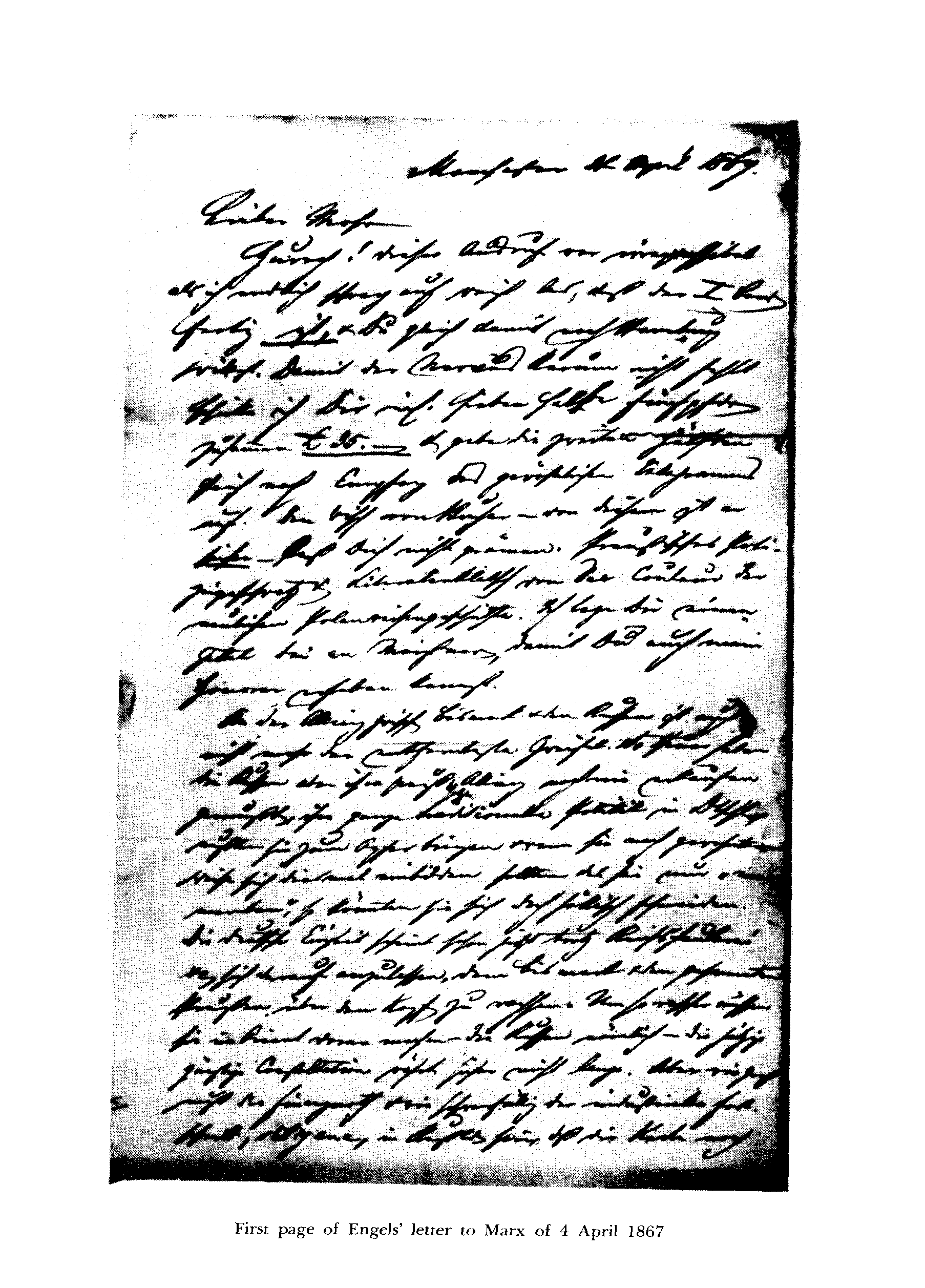
First page of Engels' letter to Marx of 4 April 1867
that time in the hope that he would later get far more as a present I have positive knowledge that the Prussian Ambassador Bernstorff told the Hanseatic ditto (Geffcken) in London a few days ago that he had received a despatch to the effect that Prussia was not going to give way over the Luxemburg question under any circumstances. This is the same despatch that The Owl refers to as requesting Britain to make representations at The Hague, which are then said to have succeeded in making Holland withdraw from the deal. The point is that in the present situation Bismarck cannot remotely allow the French to annex German territory without making all his achievements appear ridiculous. What is more, that old jackass William1' has gone and pronounced the words 'not a single German village' and is personally committed. It is, however, as yet by no means certain that the deal may not still come to fruition after all; the Kölnische Zeitung is screaming quite hysterically that we really cannot start a war over Luxemburg and that we have no right to it at all; Luxemburg, they say, should no longer be counted part of Germany, etc., so they have never behaved quite so despicably.
Bismarck may not be Faust, but he does have his Wagener.b The way in which the poor devil translates his Lord and Master into Wagnerese makes you die of laughing. Bismarck recently employed another of his horse-metaphors, and not wanting to be outdone in this either, Wagener ended a speech by trumpeting: Gentlemen, it is time for us to stop riding our hobby-horses and to mount that noble thoroughbred mare GermaniaV Montez Mademoiselle,4
the Parisians used to say during the Terror.[417]
I hope that your carbuncles are more or less mended now and that the journey will help get rid of them entirely. You must put an end to this nonsense this summer.
Many regards to the LADIES and Lafargue.
Your
F. E.
214. Marx to Engels. 13 April
214
MARX TO ENGELS"
IN MANCHESTER
Hamburg, 13 April 1867 Dear FRED,
I arrived here at 12 o'clock noon yesterday. The boat left London on Wednesdaya at 8 o'clock in the morning.[412] In which fact you see the whole history of the voyage. The most fearful weather and gales. Having been confined for so long, I felt as voraciously fit as 500 hogs.b However, with ALL that riti-raff being sea-sick and falling about to left and right of us, it would all have become ennuyant' in time, if a certain NUCLEUS had not held firm. It was a very 'mixed' nucleus, viz., a German ship's captain, who bore a marked resemblance to yourself in his face, but a small fellow, he also had a good deal of your humour and the same good-natured frivolous twinkling of the eyes; a London cattle-dealer, a true John Bull, BOVINE IN EVERY RESPECT; a German clockmaker from London, a nice fellow; a German from Texas; and, the real protagonist, a German who had been roaming around Eastern Peru for 15 years, an area that has only recently been geographically charted, where, amongst other things, human flesh is still consumed in no mean quantity. An eccentric, energetic and high-spirited fellow. He had a most valuable collection of stone axes with him, etc., which merited being discovered in the 'caves'. One female personage as hanger-on (the other ladies were all SEASICK and vomiting in the ladies CABIN), a toothless old hag with a refined Hanoverian accent, daughter of some primeval Hanoverian minister, von Baer or suchlike, she has now long been an improver of men, pietistic, concerned to raise the condition of the working class, acquainted with Jules Simon, full of spiritual radiance, with which she bored our BOVINE FRIEND to death. WELL! On Thursday evening, when the storm was at its worst, with all the tables and chairs adance, we were boozing en petit comité,d with that old hag of a woman lying on a couch, from which the movement of the ship — to divert her a trifle — occasionally tipped her onto the floor in the middle of the cabin. What was keeping this beautiful creature so spellbound in these inimical circumstances?
13 1867
Why did she not withdraw to the ladies' chamber? O u r savage German was regaling us with an enthusiastic account of the sexual depravities of savages. Voilà le charme" for this delicate, pure, refined lady. O n e example: he was received in an Indian hut where the woman was giving birth that very day. The afterbirth is roasted and — s u p r e m e expression of hospitality — he is obliged to partake of the SWEETBREAD!
I called on Meissner immediately upon our arrival. Clerk tells me he won't be back before 3 o'clock (afternoon). I left my card and invited Mr Meissner to dine with me. He came but he had someone with him and wanted me to accompany him as his wife was expecting him. I declined but agreed that he should call on me at 7 o'clock in the evening. He mentioned en passant that Strohn was probably still in Hamburg. I therefore called on Strohn's brother. b Our man had left for Paris THE VERY SAME MORNING. So, Meissner came round in the evening. A pleasant fellow, despite something Saxon about him, as his name suggests. After a brief parley, everything ALL RIGHT. Manuscript taken straight to his publishing house, where it was put in a SAFE. Printing will start IN A FEW DAYS and proceed apace. We then drank together, and he expressed his great 'delight' at making my esteemed acquaintance. H e now wants that the book should appear in 3 volumes. In particular he is opposed to my compressing the final book (the historico-literary part) as I h a d intended. H e said that from the publishing point of view and with the 'dull' mass of readers in mind, this was the part by which he was setting most store. I told him that, as far as that was concerned, I was his to command. [4 1 8]
A T ALL EVENTS, in Meissner we have someone entirely at our disposal; he has great contempt for the whole pack of vulgar scribblers. I thought it prudent to delay presenting your LITTLE BILL.C Always keep the pleasantest surprises till last.
And now adio, OLD BOY.
Your
K. Marx
BEST COMPLIMENTS TO MRS BURNS!
215. Marx to Ludwig Kugelmann. 16 April
IN HANOVER [Telegram]
Dr L. Kugelmann Hanover
I arrive this evening about nine.
Works, Second Russian Edition, Vol. 31, Moscow, 1963
[Hamburg, 16 April 1867]
Marx
216. Marx to Johann Philipp Becker. 17 April[4]
Dear Friend,
I left London by STEAMER last Wednesday" and after a tempestu-ous crossing reached Hamburg on Friday afternoon to deliver the manuscript of the first volume to Mr Meissner there. Printing has already started at the beginning of this week, so that the first volume will appear at the end of May. The whole work will appear in 3 volumes.[418] The title is Capital. A Critique of Political Economy. The first volume comprises the First Book: 'The Process of Production of Capital'. It is without question the most terrible MISSILE that has yet been hurled at the heads of the bourgeoisie (landowners included). It is important now that you draw attention to the forthcoming publication in the press, i.e., in the papers to which you have access.
217. Marx to Engels. 24 April
If you send the next issue of the Vorbote as a sample to Otto Meissner, Hamburg, he may be of assistance in the distribution of your paper, too.
I must finish now (more later) as Dr Kugelmann, who sends his best compliments, intends to acquaint me with the splendours of Hanover.
Tout à toi''
K. Marx
217
MARX TO ENGELS [101]
IN MANCHESTER
Hanover, 24 April 1867
Dear FRED,
I have been here as Dr Kugelmann's guest for a week now. I was obliged to stay in Hamburg or right near Hamburg on account of the printing.b Things stand as follows. Meissner wants to have the whole undertaking complete in 4-5 weeks, but cannot get the printing done in Hamburg, both because there are not enough printers, and because the proof-readers are insufficiently learned. He is therefore having the printing done at Otto Wigand's (or RATHER his son's,c as that puffed-up old cur only has a nominal share in the business now). He sent the manuscript to Leipzig a week ago. He now wants to have me to hand to check the first 2 proof-sheets and at the same lime to decide whether it is 'possible' to print quickly with a single proof-reading on my part. In this case, the whole undertaking would be complete in 4-5 weeks. However, Easter week is now holding it up. Wigand Jr wrote to Meissner that he cannot start until the end of this week. At Kugelmann's pressing invitation, I therefore came here (which also has economic advantages) for the interim. Before I say anything about 'local' affairs, I must not forget to tell you: Meissner would appreciate it, and asks me to pass on the request to you, if you would write a warning concerning Russia, for the benefit of the Germans and the French simultaneously. If you do undertake it, he wishes it done quickly. He would, however, prefer you to write at some length rather than more briefly, as small pamphlets do not sell well. You could discuss conditions when you send him the manuscript, as he says the two of you would not fall out over the matter. You could write with 'no holds barred', as Meissner considers that there is no need whatever to be concerned about considerations.
Regarding Hanover, then. Kugelmann is a doctor of great eminence in his special field, which is gynaecology. He is in correspondence with Virchow and the other authorities (including one Meyer in Berlin) and formerly with von Siebold in Göttingen and with Semmelweis in Vienna, before he went mad. Whenever there is a difficult case in this field over here, he is always brought in as consultant. As an instance of the professional jealousy and stupidity of the locals, he told me he had initially been blackballed, i.e., not admitted to the doctors' association here, because 'gynaecology' is a 'cesspit of immorality'. Kugelmann is very talented technically, too. He has invented a mass of new instruments in this field.
Kugelmann is secondly a fanatical supporter (and for my taste excessively Westphalian in his admiration) of our ideas and the two of us personally. He sometimes bores me with his enthusiasm, which is at odds with the detachment he displays as a doctor. But he understands, and he is a really excellent man, unaffected by qualms, capable of making sacrifices, and, most important of all, convinced. He has a charming little wife and an 8-year old daughter who is positively sweet." He has in his possession a far better collection of our works than the two of us together. I even came across The Holy Family again here, which he presented to me and of which he will be sending you a copy. I was pleasantly surprised to find that we have no need to feel ashamed of the piece, although the Feuerbach cult now makes a most comical impression upon one. The ordinary people, and in the capital, Hanover, even the bourgeoisie, are extremely hostile to the Prussians (ditto in Electoral Hesse) and miss no opportunity of expressing their sentiments. They openly proclaim their longing— for the French. If one remarks to them that this is unpatriotic, they say, 'The Prussians did just the same thing. When they marched through here, they were boasting, the officers first and foremost among them, that the French would come to their aid — if need be.' Wehner's father is much respected here and is considered a Guelph.[420] Bismarck sent one of his satraps, the advocate Warnebold, to see me yesterday (keep this under your hat). He wishes to 'make use of me and my great talents in the interests of the German people'. Von Benningsen will be paying 'meah'a his respects tomorrow.
The standing the two of us enjoy in Germany, particularly among the 'educated' officials, is of an altogether different order from what we imagined. Thus, e.g., the director of the statistical bureau here, Merkel, visited me and told me, he had been studying questions of money for years to no avail, and I had immediately clarified the matter once and for all. 'Your Dioscurus Engels,' he told me, 'was recently acknowledged by my colleague Engel before the royal family in Berlin.' These are trifling things, but they are important for us. We have more influence on these officials than on the louts.
I was also invited to attend the society of 'Europeans', as they call the anti-Prussian, North-Germanic members of the National Association [152] here. What jackasses!
I also received an invitation from the head (head-in-chief, as Stieber calls it[421]) of the railway here. I went along, he provided some good herb wine, his wife was 'delaighted', and as I was leaving, he thanked me 'for doing him such an honour'.
I have a debt of honour—£10—to settle with Mr Wheeler, a member of our COUNCIL b and MANAGER of the EMPIRE INSURANCE CORPORATION. YOU would oblige me greatly if you would send him the money on my behalf: 'G. Wheeler, Esq., 27 Gresham Street, E.C. PRIVATE (London). I am also very much afraid that my family in London may be 'in profundis'.' This grieves me the more particularly because poor good little Jenny's birthday is May 1st. I have cast out nets with a view to making a monetary haul. With what success remains to be seen.
My health is extraordinarily improved. No trace of the old complaint. What is more, in good spirits, despite all adversity, and no liver trouble.
218. Engels to Marx. 27 April
Do please write me a few lines by return (address: Dr Kugelmann, Hanover). Salut to MRS Burns.
Your
Moor
Freiligrath is making a fool of himself by his public beggary in Germany.[422] Meissner tells me he has disappeared without trace in North Germany.
C l „ , loiQ J • c ii • <^i?/~ A Published in English in full for the Stuttgart, 1913 and in lull in MEGA, (. .^ [6]
Abt. Ill, Bd. 3, Berlin, 1930
first time
218
ENGELS TO MARX[101]
IN HANOVER
Manchester, 27 April 1867
Dear Moor,
I have received both your letters, the second yesterday afternoon, and would have replied to your first long before, if I had known where to. Firstly, BUSINESS. I am sending £10 to your wife, who wrote to me this morning, and likewise the other £10 to Wheeler at the beginning of next month. This will give you some peace of mind in that regard, and, from what you write, the future also looks rosier at last. I always had the feeling that that damn book," which you have been carrying for so long, was at the bottom of all your misfortune, and you would and could never extricate yourself until you had got it off your back. Forever resisting completion, it was driving you physically, mentally and financially into the ground, and I can very well understand that, having shaken off that nightmare, you now feel quite a new man, especially as, once you have got back into it again, the world doesn't seem so gloomy a place as it did before. Especially when you have such a capital publisher as Meissner appears to be. Incidentally, a quick printing will only be possible, I fear, if you can remain in the vicinity throughout, i.e., on the continent;
Holland would also be near enough for the purpose. I do not believe the Leipzig proof-readers will have enough learning for your approach. Meissner also got Wigand to print my pamphlet," and the things those wretches corrected into it! I am convinced that the book will create a real stir from the moment it appears, but it will be very necessary to help the enthusiasm of the scientifically-inclined burghers and officials on to its feet and not to despise petty stratagems. There is much that can be done to that end from Hanover after publication, and you could also enlist to advantage the support of amicus0 Siebel, who is at the moment en route back from Madeira via England, in the best of spirits, as he says. This will be necessary vis-à-vis the vulgar scribbling fraternity, of whose deep-seated hatred for us we have proof enough. Furthermore, thick, scholarly works are always slow to make their mark without such assistance, but with it they act like 'wildfire'—confer" Heraclitus the Dark,d etc.[423] On this occasion, however, we must be all the more assiduous in ensuring this is done, as money is also at stake. Meissner will then be happy to take the collected essays, which would mean more money and further literary success. The pieces from the Neue Rheinische Zeitung, the T8th Brumaire',c etc., will make an enormous impression on the philistines just now, and once we have gained a little more ground on that basis, all manner of other lucrative possibilities will soon present themselves, too. I am exceedingly gratified by this whole turn of events, firstly, for its own sake, secondly, for your sake in particular and your wife's, and, thirdly, because it really is time things looked up. In 2 years my CONTRACT with that swine Gottfriedf expires, and the way things are going here, neither of us will really be wishing to extend it; it is even not impossible that our ways may part even earlier. If that should be so, I shall have to leave COMMERCE entirely, for to start up a business of my own at this late stage would mean 5-6 years of the most fearful drudgery with nothing worth speaking of to show for it, and then another 5-6 years of drudgery to reap the benefits of the first 5 years. But that would be the end of me. There is nothing I long for so much as for release from this vile COMMERCE, which is completely demoralising me with all the time it is wasting. For as long as I am in it, I am good for nothing else, especially since I have become principal it has been much aggravated on account of the greater responsibility. If it were not for the increased remuneration, I really would rather be a clerk again. At all events, in a few years my life as a businessman will come to an end, and then my income will be very, very much reduced, and the question of what we can do then has always been in my mind. However, if things go as they are now beginning to, we shall be able to make provision for that all right, too, even if no revolution intervenes and puts an end to all financial schemes. If that does not happen, I have a plan up my sleeve to have a fling for my deliverance and write a light-hearted book entitled: Woes and Joys of the English Bourgeoisie.
I cannot go along with Meissner's suggestion.3 À few sheets could be quickly knocked together, but something longer, 6 à 10 sheets, would require more work and be too late for the war now brewing.[415] One really cannot just knock together rubbish in the manner of Vogt's Studien.h Furthermore, the stuff would be looked upon more or less as a party manifesto, and for that we would have to discuss the matter first. However, I have had an anti-Russian piece in mind for some time, and, if events provide me with an excuse, I shall start on it without more ado and write to Meissner. The only thing I am still in two minds about is whether I should make the 'nationality principle'[424] or the 'Eastern Question' the chief theme.
I had expected that Bismarck would come knocking at your door, although not his haste.' It is characteristic of the fellow's mentality and outlook that he judges everybody by his own standards. The bourgeoisie may well admire the great men of today, it sees itself reflected in them. All the qualities to which Bonaparte and Bismarck owe their successes are the qualities of businessman: the pursuit of a specific purpose by a policy of wait-and-see and experimentation, until they hit the right moment, the diplomacy of always leaving the back door open, negotiating and haggling, swallowing insults if it is in one's interest, the attitude of 'ne soyons pas larrons '? in short, the businessman in all things. In his own way, Gottfried Ermen is as great a statesman as Bismarck, and, if one follows the tricks of these great men, one is constantly reminded of the Manchester Exchange. Bismarck thinks, if I only continue knocking at Marx's door, I am bound to hit upon the right moment eventually, and then we shall do a deal together after all. Gottfried Ermen to a tee.
I would not have expected the Prussians to be so hated there. But how do you reconcile that with the election results? Those jackasses from the National Association [152] did get half their men through, and in Electoral Hesse all but one.
Vogt has got a life-size portrait of himself in the Gartenlaube* He has become a proper porker in the last few years, and looks fine.
In the Demokratische Studien, which recently came my way, Simon of Trier has quite naively copied out whole pages from Po and Rhine,(9) without suspecting from what poisoned source he was drawing!b Similarly, in 'Preussen in Waffen', the lieutenant who writes the military articles in Unsere Zeit has borrowed at length from my pamphlet,c likewise without giving his sources, of course.
Rüstow will stop at nothing to become a Prussian general, as though that could be as easily done as with Garibaldi. In his abysmal and slipshod book on the war,[6] he grovels in optima formad
before William the Conqueror and the Prince.e That's why he is moving to Berlin.
I saw Ernest Jones the other day, he has had enquiries from 4 places about standing for election under the new BILL[425]—from Manchester as well. Has not a good word to say for the workers here AND BACKS THE PRUSSIANS AT ANY ODDS AGAINST THE FRENCH. I hope this wretched war passes over, I cannot see that any good can come of it. A French revolution saddled in advance with the obligation to go a-conquering would be very nasty; it almost seems as though Bonaparte would be satisfied with the tiniest tit-bit, but whether the Lord of Hosts will permit handsome William to grant him even that tit-bit, time alone will show.
My kindest regards to Dr Kugelmann, although we are not acquainted, and my thanks to him for The Holy Family.h
Your
F. E.
219. Marx to Sigfrid Meyer. 30 April
219
MARX TO SIGFRID MEYER[426]
IN NEW YORK
Hanover, 30 April 1867
Dear Friend,
You must think very badly of me, and all the more so when I tell you that your letters did not merely give me great pleasure but were a real comfort to me since they reached me at a time of great affliction. The knowledge that a capable man, à la hauteur des principes,* has been won for our party, is some compensation to me for the worst. Your letters were furthermore full of such warm friendship for me personally, and you will appreciate that I who am engaged in a most bitter struggle with the (official) world can least afford to underestimate such things.
Why then did I not answer you? Because I was the whole time at death's door. I thus had to make use of every moment when I was capable of work to complete my book,b to which I have sacrificed my health, happiness, and family. I hope this explanation suffices. I laugh at the so-called 'practical' men and their wisdom. If one wanted to be an ox, one could, of course, turn one's back on the sufferings of humanity and look after one's own hide. But I should really have thought myself unpractical if I had pegged out without finally completing my book, at least in manuscript.
The first volume of the book will be published by Otto Meissner in Hamburg in a few weeks. The title of the work is: 'Capital. A Critique of Political Economy'. I travelled to Germany to bring over the manuscript, and I am spending a few days with a friend in Hanoverc on my way back to London.[412]
Volume I comprises the 'Process of Production of Capital'. As well as setting out the general theory, I examine in great detail the conditions of the English — agricultural and industrial — proletariat over the last 20 years, ditto the condition of Ireland, basing myself on official sources that have never previously been used. You will immediately realise that all this serves me solely as an argumentum
ad hominem?
1 1867
I hope that a year from now the whole work will have appeared. Volume II contains the continuation and conclusion of the theory, Volume III the history of political economy from the middle of the 17th century*[16]
As to the 'International Working Men's Association', it has become a power to be reckoned with in England, France, Switzerland, and Belgium. You should form as many branches as possible in America. CONTRIBUTION PER MEMBER 1 PENNY (ABOUT 1 silver groschen) per year. However, every branch gives what it can. Congress in Lausanne this year, 3 September. Every branch can send one representative. Do write to me about this matter, about how you are faring in America and about conditions in general. If you do not write, I shall take it as showing that you have not yet absolved me.
With warmest greetings
Your
Karl Marx
220. Marx to Ludwig Büchner. 1 May[427]
Dear Sir,
Although we are entirely unacquainted, I am taking the liberty of addressing a personal letter to you, on a personal, although at the same time scientific, matter; and I hope you will excuse my so doing on account of the confidence you inspire in me as a man of science and of the party.
I have come to Germany to deliver the first volume of my work 'Capital. A Critique of Political Economy' to my publisher, Mr Otto Meissner in Hamburg. I have to stay here a few days longer to see if it will be possible for the printing to be done as quickly as Mr Meissner intends, viz., whether the proof-readers are sufficiently learned for such a mode of operation.
The reason I am writing to you personally is this: I should like to have the thing published in French as well, in Paris, after its publication in Germany. I cannot go there myself, at least not without risk, as I have been expelled from France, first under Louis Philippe and a second time under Louis Bonaparte (President),[428] and finally I have been ceaselessly attacking Mr Louis during my exile in London. I cannot therefore go personally to seek out a translator. I know that your work on 'Stoff und Kraft'(10) has appeared in French, and therefore suppose that you can put me in touch, directly or indirectly, with a suitable person. As I have to prepare the second volume for printing this summer and the concluding third volume[418] next winter, I do not have the time to attend to the French version of the book[429] myself.
I consider it to be of the greatest importance to emancipate the French from the erroneous views under which Proudhon with his idealised petty bourgeoisie has buried them. At the recent congress in Geneva,[375] ditto in the links that I have with the Paris branch as a member of the General Council of the International Working Men's Association, I am constantly confronted with Proudhonism's most repugnant consequences.
As I do not know for how long I shall be staying here, I should be obliged to you for an early answer. If I, for my part, can be of any service to you in London, I shall do so with the greatest pleasure.
Yours most respectfully
Karl Marx
221. Marx to His Daughter Jenny. 5 May
221
MARX TO HIS DAUGHTER JENNY
IN LONDON
Hanover, 5 May 1867
My dear Child,
Your letter gave me the greatest pleasure. It is written in the true Imperial style.(11) I hope to find you plump and fresh like a May rose.
The enclosed photograph was to be sent to you for your birthday, but was not ready. It is backed by the photograph of Mme Tenge (by-the-by, the aunt of the Baer's girl, of whom Edgarb told us so much), who, however, is not so beautiful in reality as her shadow indicates. But she is a really noble nature, of a peculiar suavity, frankness and simplicity of character. Nothing of 'falsche Bildung'.' She speaks English, French and Italian (she is of Italian descent) perfectly. Although a great musician, she does not kill one with Kunstgeschwäts,(12) which, on the contrary, she abhors. She is an atheist and inclines to Socialism, although rather little informed on that point. What distinguishes her above all is a spontaneous kindness and the absence of all pretensions. I feel sure you would in no time become very intimate friends. Mrs Kugelmann is also a nice little woman.
To-day, on my birthday, I receive the first 'Bogen'd for revision. I fear the book will become rather a little too big. In consequence of the Easter week business, the printing did not commence before 29th April, Meissner growing very wild at this suspense. Meanwhile, time has not been lost. Preliminary notices have been published almost in all German papers. Kugelmann has very many connections, which were all put into motion.
Your birthdaye was solemnly celebrated here. Except part of the bourgeoisie, lawyers and such ones, there reigns here at Hanover a fanatical hatred of the Prussians, which much amuses me.
I was very glad to hear of your Polish surprise. If the things have no mercantile value, they have a historical one.[430]
The delay of war is exclusively due to the Derby Cabinet. As
222. Marx to Engels. 7 May
long as it remains at the head of England, Russia will not (sound the war signal — a phrase, by-the-by, which is conceived in the true colletian style.
I cannot exactly state the day of my return. I have still to receive letters from different sides. I shall return directly from here via Hamburg (there to have another interview with my publishera) to London.
I had, very soon after my arrival here, written to Liebknecht.[111]
He has answered. His wifeb cannot be saved. She is approaching the catastrophe. She sends her compliments to you all and was cheered up by your letters.
Hegel's photograph will be looked after. It is not to be had at Hanover. As to his Thilos, of Hist.', I shall try to find it at London.
I consider that Cacadouc might have written some lines long since, but excuse her with her equestrian studies.
And now, with my best wishes to all, adio, my dear 'Joe'.d
Your
Old One
I add a few lines for Tussy.e
222
MARX TO ENGELS[26]
IN MANCHESTER
Hanover, 7 May 1867
Dear FRED,
D'abord,[1] best thanks for your intervention in the most pressing casus delicti,g as well as for your very detailed letter.
First, BUSINESS. That damned Wigand did not start printing3 until 29 April, so that I received the first sheet for correction the day before yesterday, on my birthday. Post tot pericula!h The misprints were relatively insignificant. It's impossible to wait here until the printing is completed. In the first instance, I fear that the book will prove much fatter than I had originally calculated. Second, I am not getting the manuscript back, so that for many quotations, especially those involving figures or Greek, I need to have my home manuscript to hand, nor can I impose on Dr Kugelmann's hospitality for too long. Finally, Meissner is demanding the 2nd volume by the end of the autumn at the latest. I shall therefore have to get my nose to the grindstone as soon as possible, as a lot of new material relating especially to the chapters on credit and landed property has become available since the manuscript was composed. The third volume must be completed during the winter, so that I shall have shaken off the whole opus by next spring.[418] The business of writing, of course, is quite different once the proofs for what has already been done start coming in à fur et mesure," and under PRESSURE from the publisher.
Meanwhile, my time here has not been wasted. Letters have been written to all and sundry, and preliminary notices have appeared in most German papers.
I hope and confidently believe that in the space of a year I shall be made, in the sense that I shall be able to fundamentally rectify my financial affairs and at last stand on my own feet again. Without you, I would never have been able to bring the work to a conclusion, and I can assure you it always weighed like a nightmare on my conscience that you were allowing your fine energies to be squandered and to rust in commerce, chiefly for my sake, and, INTO THE BARGAIN, that you had to share all my petites misèresd as well. On the other hand, I cannot conceal from myself that I still have a year OF TRIAL ahead of me. I have taken a step on which a great deal depends, viz., on which it depends whether several £100 will be made available to me from the only quarter where that is possible. There is a tolerable prospect of a positive outcome, but I shall remain uncertain for ABOUT 6 weeks. I shall not have definite confirmation until then. What I am most afraid of — apart from the uncertainty — is my return to London, which will be necessary in 6-8 days. My debts there are considerable, and the Manichaeans[431] are 'urgently' awaiting my return. And then the torments of family life, the domestic conflicts, the constant harassment, instead of settling down to work refreshed and free of care.
Dr Kugelmann and his wife[11] are being exceptionally kind to me and anticipate my every need. They are splendid people. They really leave me no time to explore 'the gloomy paths of my inner self. Apropos, the Bismarck affair must be kept absolutely secret.b
I promised to tell no one, not even Kugelmann, about it. Nor have I done so. I did, however, of course make the reservatio mentalis to except yourself.
You express surprise that the National-Liberals[432] (or, as Kugelmann calls them, the Europeans) did so well in the elections,c
when the Prussians are so hated here. The matter is very simple. They did badly in all the larger towns, in smaller places they owed their victories to their organisation, which has existed ever since Gotha.[433] These fellows do, on the whole, show how important party organisation is. That is the position in Hanover. In Electoral Hesse, there is no limit to the influence of Prussian intimidation, backed up by the shouting of the members of the National Association.[152] The Prussians meanwhile are operating quite in the Persian manner here. It is true that they cannot transplant the population to their Eastern provinces, but they are doing so with their officials, right down to the RAILWAY conductors, and for the officers. Even those poor devils of postmen are having to move to Pomerania. In the meantime, trains full of Hessians, Hanoverians, etc., are to be seen on the railway every day en route to Bremen, emigrating to the United States. Not since dear old Germany came into existence has it sent such a motley crowd of people from all parts across the Atlantic. One is trying to avoid his taxes, another, his military service, a third the political situation, and all of them the hegemony of the sword and the gathering storm of war.
I am greatly diverted by the (pro-Prussian) bourgeoisie here. They want war, but immédiatement.'d Business, they say, can stand the uncertainty no longer, and where the devil are the taxes to come from if business stagnates for much longer? Incidentally, you would scarcely conceive the burden that the last war and taxation have imposed upon the rural populace in Prussia. Here in the vicinity of Prussian Westphalia, e.g., truly Irish conditions prevail.
BY THE BY a few days ago the director of the joint-stock foundry here (manufacturing chiefly water and gas pipes) conducted me round the works. On the whole, it is very well organised and utilises much quite modern equipment. But, on the other hand, there is still a good deal of turning by hand (detail work), where the English and Scots are using automatic machinery. The same director took me into the Hermann's-column workshop. The thing is as long in the making as Germany itself. Hermann's head is so colossal that you'd seem like a child beside it, and it has a fine look of honest stupidity, and Mr Arminius was above all a diplomat. His air of worthy Westphalian simplicity served but as a mask for a most subtle mind. As chance would have it, I had renewed my acquaintance with Mr Arminius, shortly before my departure from London, in the Grimm edition of historical sources" with which you are familiar.
I am sure you will recall J. Meyer (at Bielefeld), who refused to print our manuscript on Stirner, etc.,b and sent the youth Kriege to annoy us?[434] A few months ago he threw himself out of the window in Warsaw, whither his business affairs had taken him, and broke his neck, if you please.
Our friend Miquel, who declared himself prepared to sacrifice freedom so readily for the sake of unity, is believed to be job-hunting. In my view, le brave homme' has miscalculated. Had he not hurled himself so fanatically and unconditionally at Bismarck's feet, he would have been able to pick up a generous gratuity. But now! What need is there for that? He has made himself so hated by his performance in the North German Parliament[435] that he is chained to the Prussians like one convict to the next. And the Prussians, as you know, do not like to make 'useless' and superfluous dépenses? Recently, the Bismarckite newspaper, the Norddeutsche Allgemeine, produced by that scoundrel Brass published a very witty articlee about the National-Associationites, pleading inability to emulate even the de mortuis nil nisi bene? It sent Bismarck's North-German-Confederationite, National-Associationite minions packing with some artistic kicks delivered con amore.s
As far as the war is concerned, I am entirely of your opinion. At the present moment, it can only do harm. If it could be delayed, even just for a year, that would be worth its weight in gold to us. In the first place, Bonaparte and William the Conquerorb would necessarily be made to look foolish. The opposition is reviving in Prussia (its only press organ just now is Die Zukunft in Berlin, founded by Jacobic), and events may occur in France. Business is becoming more and more stagnant, and it will then be impossible to cover up the suffering there on the Continent with empty phrases, whether they be of teutonic or gallic provenance.
In my view, we owe the postponement of war exclusively to the Derby ministry. It is anti-Russian, and Russia dares not give the signal until she is sure of Britain. Gladstone, THE PHRASEMONGER (entirely under the influence of LADY Palmerston, Shaftesbury, and LORD Cowper), and Bright, not forgetting Russell, would gladly provide her with the guarantees that Britain was disposed as recjuired. Derby had to be removed in 1859, too, in order to stage the Great Drama in Italy.d In the North German Parliament Bismarck was obliged to throw down the gauntlet to the Poles in the most brutal manner[416] and thus declare his total subservience to the Tsare.
In the Prussian army there prevails deep distrust of the Russians amongst the better officers, as I learnt personally from Captain von Bölzig here (Guards Regiment, raised in the Cadet Corps, loyal to the Prussian monarchy, but a nice fellow). 'Bismarck's conduct in North Schleswig is incomprehensible to me. Only the Russians,' this he said quite unprompted, 'have any interest in maintaining tension between ourselves and Denmark.' He went on to call Frederick William IV a 'shady cavalier', who had turned Germany into Russia's lackey for '/a century. The Russian officers were 'shitty fellows', the army good for nothing, except for the Guards Regiments, Austria alone was capable of matching the Russian army, etc. I also put a good many more ideas into his head about the Muscovites.
And now adio. Kindest regards to MRS Lizzy.f
Tout à vous! Your
Moor
223. Marx to Laura Marx. 13 May
223
MARX TO LAURA MARX
IN LONDON
Hanover, 13 May 1867 My pretty little Cacadou,"
My best thanks for your letter, and that of the worthy Quoquo.b
You complain that I had given no signs of life, but on reviewing the question you will find that, on the whole, I have given weekly signals. Moreover, you know that I am not of a very 'demonstra-tive' character, of rather retiring habitudes, a slow writer, a clumsy sort of man or, as Quoquo has it, an anxious man.
I shall leave Hanover the day after to-morrow, and probably leave Hamburg by first steamer for London. Yet, you must not expect me to settle the day and the hour. I have still some business to transact with my publisher.' At all events, this is the last week of my continental stay.[412]
I am very glad that my photogramm has met with such good reception. The shadow is at all events less troublesome than the original.
As to Mrs Tenge, I wonder that you ask me how she looks, whether she is pretty? I have sent Jenny her photogramm, hidden behind my own. How could it have been lost? Now, to answer your questions, she is 33 years of age, mother of 5 children, rather interesting than pretty, and certainly no professional wit. But she is a superior woman. As to 'flirting', he would be rather a bold man who were to try it. As to 'admiration', I owe it, and there may, perhaps, have been on her side, some overestimation of your most humble and 'modest' master. You know, if no one is a prophet on his own dunghill (speaking symbolically), people are easily overvalued by strangers who, legen sie nicht aus, so legen sie doch unter,d and find what they were resolved upon to find in a fellah. She has left Hanover Thursday last.
Eight days since, the weather was still frosty and rainy. Now summer has at once burst into full bloom. On the whole, the weather, since my departure, was here as bad and changeable as it used to be in London. Only, and this is a great thing, the air is thinner.
These continentals have an easier life of it than we on the other side of the Northern sea. With 2,000 Thalers (300£) you can live here most comfortably. For inst., there exist here different gardens (à la Cremourn,[436] but 'respectable', and where all sort of people meet), much more artistically arranged than any in London, good music being played every evening, etc., where you can subscribe for self and family — for the whole year — at the price of 2 Thalers, 6 sh.! This is only a specimen of the cheap life the Philister indulge in at this place. Young people amuse themselves more freely and at almost no expense, comparatively speaking. There is of course one great drawback — the atmosphere is pregnant with dullness. The standard of existence is too small. It is a lot of pygmées amongst whom you want no very high frame to feel like Gulliver amidst the Lilliputians.
There arrive this morning rather 'excited' letters from Berlin. It seems that a collision between the workmen and the Pickelhauben* is apprehended. I do not expect much for the present, but there is something brewing. The working class, in the greater centres of Germany, are commencing to assume a more decided and threatening attitude. One fine morning there will be a nice dance!
And now my dear little birdseye, Cacadou, secretary, cook, equestrian, poet, auf Wiedersehn.(13) Viele Grüsse, anb Möhmchen, Quoquo and Queque, Helen,c and, last not least, our 'mutual friend'.d
Adio.
Your master
Old Nicke
Enclosed Hegel,f presented by Kugelmann to Mons. Lafargue.
224. Marx to Engels. About 22 May
224
MARX TO ENGELS
IN MANCHESTER
Manchester [about 22 May 1867] 86 Mornington St.
Dear FRED,
Arrived in London Sunday.(14) Got here today.[437] But:
Notice: with me one H. Meyer from St Louis, whom I am about to collect from the railway REFRESHMENT ROOM, where I deposited him, and I am going to deposit him here in the NEIGHBOURHOOD, Star.
He was Weydemeyer's last compagnon at his death and took his wife (Weydemeyer's wife), who was also mourante,b away from St Louis to friends and gave her support. Came to me with a recommendation from Jacobic (New York).
This Meyer, who is travelling to Germany, came to England solely to visit us both. He arrived yesterday. I was not at home. My wife told him that I would be travelling to Manchester today to visit you.
These HINTS will be sufficient to explain to you how it comes about that he accompanied me on the journey here. He will only be staying here 2 days. AT FIRST I was vexed. But for Weydemeyer's sake! This Meyer is a fine, active fellow. However, COOKS slowly and somewhat boring.
Salut.
Your
Moor
225. Marx to Engels. 3 June
225
MARX T O ENGELS
IN MANCHESTER
[London,] 3 JUNE 1867
DEAR FRED,
T h e reason why sheets 10 and 11 are not being sent to you, indeed why no more proofs [3] at all, you will discover from the enclosed note from Wigand. On the other hand, you will receive the first 5 pulls that have been sent to me. You can keep them ABOUT 8-10 days, but then you must let me know exactly which points in the exposition of the form of value you think should be specially popularised for the philistines in the supplement.[438]
Fenians ordered. [4 3 9] Other commissions will be executed BY AND BY. See the Hermann of last week. It is now the private herald of Mr Freiligrath, who is reporting on the PROGRESS OE THE SUBSCRIFHON here each week via Juch.[422] Little Jenny says that if her father ever did such a thing, she would publicly proclaim him her non-father. Whereupon Lafargue asked her: Mais qu'est-ce que votre mère dirait là-dessus?b T h e noble poet' is incidentally sly enough to declare already that he will have to remain in London on account of his resp. part in the Shakespeare translation. Ferdinand and Ida, c Ida and Ferdinand, A WELL-ASSORTED COUPLE, THOSE TWO!
Apropos. When Gumpert asked me which hospital Lafargue was at, I said St Thomas's. I was, however, mistaken. He is at Bartholomew's Hospital and asks for the ERROR to be corrected. Please do not forget to supply a photogramm of yourself and Lupus.
MY BEST COMPLIMENTS TO MRS Lizzy,d Moore and Chlormayer. e
Salut.
Your
K. M.
I was exceedingly pleased to read in the Paris correspondence of The Times that the Parisians chanted their support for the Poles to Alexander's face, etc.[440] Mr Proudhon and his little doctrinaire clique are not the FRENCH PEOPLE.
226. Marx to Ludwig Kugelmann. 10 June[65]
Dear Friend,
The delay attending this letter will expose me to the more or less 'well-founded suspicion' of being a 'bad fellow'. The sole extenuating circumstance I can plead is that I have only been 'resident' in London for the last few days. In the interval I was visiting Engels in Manchester.[437] But I am sure you and your dear wifea now know me sufficiently to realise that epistolary negligence is the rule with me. Nevertheless, my thoughts were with you every day. I count my stay in Hanover among the most splendid and refreshing oases in life's desert.[412]
My stay in Hamburg was uneventful, except that, despite all precautions, I made the acquaintance of Mr Wilhelm Marr. In respect of his personal manner, he is Lassalle translated to Christianity, but there is naturally far less to him. Mr Niemann was also performing in the few days I spent there. However, I had been too spoiled by the society in Hanover to wish to attend a theatrical performance in less good company. Mr Niemann thus escaped me.
Apropos. Meissner is willing to print the medical pamphlet you are planning. You need only send him the manuscript and mention my name. Regarding the precise conditions, you will have to negotiate the rest with him yourself.
The crossing from Hamburg to London was by and large fair, if one discounts somewhat raw weather on the first day. A few hours before we reached London, a young German lady, who had already caught my attention by her military bearing, announced that she intended travelling from London to Weston supra Mare the same evening" and did not know how she should set about it with all her considerable luggage. The casus was all the more problematical as helping hands are hard to come by in England on the Sabbath. I got her to show me the name of the railway station to which she was to proceed in London. Friends had written it down on a card. It was the NORTH WESTERN STATION, which was on my way as well. I therefore chivalrously offered to set the young lady down there. Agreed. On further reflection, however, it occurred to me that Weston supra Mare lay to the south-west, whereas the STATION which I was to pass and which had been written down for the young lady was north-west. I consulted the SEA-CAPTAIN. Correct: it appeared she should be deposited in a quite different part of London from my own. However, I was now committed and had to assume bonne mine à mauvais jeu.b We arrived at 2 o'clock in the afternoon.. I took la donna errante" to her STATION, where I learned that her train did not leave until 8 o'clock in the evening. So, I WAS IN FOR IT, and had 6 hours to kill with Mademoiselle, walking in Hyde Park, sitting in ICE-SHOPS, etc. It emerged that her name was Elisabeth von Puttkamer, a niece of Bismarck's, as whose guest she had just spent several weeks in Berlin. She had the whole army list by heart, this family providing our 'gallant regiments' with stout hearts and true in super-abundance. She was a cheerful, educated girl, but aristocratic and black and whited to her finger-tips. She was not a little astonished when she learned that she had fallen into 'red' hands. I reassured her, however, that our encounter would pass 'without bloodshed' and saw her depart saine et sauvee
for her destination. Just think what fodder that would provide for Blind or other vulgar democrats — my CONSPIRACY WITH Bismarck!
Today I despatched the 14th corrected proof-sheet.f I received the majority of them while staying with Engels, who is exceedingly pleased with them and, except for sheets 2 and 3, finds them written in a manner very easy to understand. I was reassured by his verdict, as I am always very dissatisfied with my things when I see them printed, especially at first sight.
Please convey my special thanks to your dear wife once more for her warm and friendly welcome to me; I am sending her the photogramm of my 2nd daughter Laura, as the other photo-
227. Engels to Marx. 16 June
gramms have all gone and new ones will have to be made. Engels is ditto having fresh copies made of his own and Wolff's(15) photo-gramms. He was greatly amused by your missives.
My best compliments to 'little madam'b Eleanor is at school, otherwise she would write to her.
AND NOW, Adiol
Your
Karl Marx
227
ENGELS TO MARX[101]
IN LONDON
Manchester, 16 June 1867
Dear Moor,
I have been so distracted by all manner of bother with Monsieur Gottfriedc and other suchlike affairs and disturbances for the past week that I seldom had the leisure to study the form of value. Otherwise, I would have sent the sheetsd back to you long ago. Sheet 2 in particular has the marks of your carbuncles rather firmly stamped upon it, but there is not much that can be done about it now and I think you should not deal with it any further in the supplement, as your philistine really is not accustomed to this kind of abstract thinking and will certainly not torment himself for the sake of the form of value. At most, you could provide rather more extensive historical evidence for the conclusions you have here reached dialectically, you could, so to speak, apply the test of history, although you have already made the most essential points in that respect; but you have so much material that you can surely still write quite a good excursus on it, which will by historical means demonstrate to the philistine the need for the development of money and the process by which this takes place.
It was a serious mistake not to have made the development of these rather abstract arguments clearer by means of a larger number of short sections with their own headings. You ought to have treated this part in the manner of Hegel's Encyclopaedia,3
with short paragraphs, each dialectical transition emphasised by means of a special heading and, as far as possible, all the excurses or merely illustrative material printed in special type. The thing would have looked somewhat like a school text-book, but a very large class of readers would have found it considerably easier to understand. The populus, even the scholars, just are no longer at all accustomed to this way of thinking, and one has to make it as easy for them as one possibly can.
Compared with your earlier presentation (Duncker),b the dialectic of the argument has been greatly sharpened, but with regard to the actual exposition there are a number of things I like better in the first version. It is a great pity that the carbuncles have left their mark on the important second sheet in particular. However, there is nothing to be done about it now, and those who are capable of thinking dialectically will understand it, nevertheless. The other sheets are very good, and I was delighted by them. I hope you will soon be able to send me another five or six sheets (and could you please enclose sheet 5 again so that I can pick up the thread properly); the sheets I have been reading one by one here will make a much better impression when read together.
I've discovered a few more misprints. I would only list as errata those which really distort the sense.
I called on Gumpert yesterday. Pauvre garçon!' He is deteriorat-ing with each day that passes. It was impossible to arouse his interest in anything scientific or even political. Town gossip and nothing more than town gossip. And yet he cannot understand why people don't call oh him more often.
Have read Hofmann.d For all its faults, the latest chemical theory does represent a great advance on the old atomistic theory. The molecule as the smallest part of matter capable of independent existence is a perfectly rational category, a 'nodal point',[441] as Hegel calls it, in the infinite progression of subdivisions, which does not terminate it, but marks a qualitative change. The atom — formerly
228. Marx to Engels. 22 June
represented as the limit of divisibility — is now but a state, although Monsieur Hofmann himself is forever relapsing into the old idea that indivisible atoms really exist. For the rest, the advances in chemistry that this book records are truly enormous, and Schorlemmer says that this revolution is still going on day by day, so that new upheavals can be expected daily.
Best regards to your wife, the girls and the electrician.(16)
Am sending back 5 sheets today.
Your
F. E.
228
MARX TO ENGELS[101]
IN MANCHESTER
[London,] 22 June 1867
Dear FRED,
Herewith 4 more sheets[5] enclosed for you which reached me yesterday. The fellows have left a number of misprints that I corrected perfectly legibly. One error we corrected in ourselves was 'CHILDRENS' EMPLOYMENT COMMISSION', CHILDRENS'. For CHILDREN is nominative pluralis, genitive mark is'. I saw it at once when I had another look at the BLUE BOOKS 3M myself.
King has written to say that the Fenians[4]*b are not yet out. They are postponing it for as long as possible and as near to the close of the SESSION as possible.
I hope you are satisfied with the 4 sheets. That you have been satisfied with it so far is more important to me than ANYTHING the rest of the world MAY SAY OF IT. At all events, I hope the bourgeoisie will remember my carbuncles until their dying day. Here is a fresh 22 1867
sample of what swine they are! You know that the CHILDREN'S EMPLOYMENT COMMISSION has been at work for 5 years now. When its first report appeared in 1863, the industries it exposed were at once 'called to order'. At the beginning of this session the Tory ministry introduced a BILL per Walpole, THE WEEPING WILLOW, accepting all the Commission's proposals, though on a very reduced scale. The fellows who were to be called to order, among them the big metal manufacturers, and especially the vampires of 'domestic industry', maintained a cowardly silence. Now they are presenting a petition to Parliament and demanding — a New Enquiryl The old one, they say, was biassed! They are counting on the Reform Bill[425] taking up the public's entire attention, so that the thing would be cosily and PRIVATELY smuggled through, at the very time that the TRADE UNIONS are having a rough passage.[442] The worst things about the REPORTS are the fellows' own statements. They are well aware that a new enquiry means one thing only, and that is precisely 'what we bourgeois want'—a new 5-year lease for exploitation. Fortunately, my position in the 'INTERNATIONAL' enables me to frustrate those curs' little game. It is a matter of the utmost importance. What is at stake is the abolition of torture for
l'/ä million people, not including the ADULT MALE WORKINGMEN![443]
With regard to the development of the form of value, I have both followed and not followed your advice, thus striking a dialectical attitude in this matter, too. That is to say, 1. I have written an appendix in which I set out the same subject again as simply and as much in the manner of a school text-book as possible, and 2. I have divided each successive proposition into paras, etc., each with its own heading, as you advised. In the Preface I then tell the 'non-dialectical' reader to skip page x-y and instead read the appendix.[438] It is not only the philistines that I have in mind here, but young people, etc., who are thirsting for knowledge. Anyway, the issue is crucial for the whole book. The economists have hitherto overlooked the very simple fact that the equation 20 yards of linen = 1 coal is but the primitive form of 20 yards of linen=£2, and thus that the simplest form of a commodity, in which its value is not yet expressed in its relation to all other commodities but only as something differentiated from its own natural form, embodies the whole secret of the money form and thereby, in nuce," of all bourgeois forms of the product of labour. In my first presentation (Duncker),b I avoided the difficulty of the development by not actually analysing the" way value is expressed until it appears as its developed form, as expressed in money.
You are quite right about Hofmann.(17) Incidentally, you will see from the conclusion to my Chapter III, where I outline the transformation of the master of a trade into a capitalist — as a result of purely quantitative changes — that in the text there I quote Hegel's discovery of the law of the transformation of a merely quantitative change into a qualitative one as being attested by history and natural science alike. In the note to the text (I was as it happened attending Hofmann's lectures at that time) I mention the molecular theory, but not Hofmann, who has discovered nothing in the matter except contributing general direction; instead I do mention Laurent, Gerhardt and Wurtz, the latter being the real man.[444] Your letter struck a faint chord in my memory, and I therefore looked up my manuscript.
Printing has proceeded slowly in the last two weeks (only 4 sheets), probably on account of Whitsun. But Mr O. Wigand will have to make up for this lost time. Apropos. Your book(18) is still available. The Workers' Associationc has ordered and been sent 2 NEW COPIES from O. Wigand. (2nd impression 1848.[445])
Now for private matters. My children are obliged to invite some other girls for dancing on 2 July, as they have been unable to invite anyone for the whole of this year, to respond to invitations, and are therefore about TO I.OSE CASTE. So, hard-pressed though I am at the moment, I had to agree to it and am counting on you for the wine (claret and Rhenish), i.e. on your supplying me with it in the course of next week.
Secondly, as 'misfortunes' never come singly, Linad has announced her arrival for next week. My wife will then have to return to her the £5 which she owes her, and you will understand that after fending off the first wave of creditors, I cannot AFFORD that.
I am in fact exceedingly vexed with the people who have promised me money but have not sent word (so far, at least). They have a personal interest in me. That I do know. They also know that I cannot continue my work unless I have a modicum of peace and quiet. And yet they have sent no word!
Our 'noble' poet Freiligrath really is going to collect a tidy sum.[422] For they say that going begging to the rich Germans in
229. Engels to Marx. 24 June
South America and — China! and the West Indies! is most lucrative, as these fellows regard it as national duty I Meanwhile, the Freiligraths are continuing to live in relatively grand style, constantly entertaining and constantly visiting. That is one reason why the German merchants in London are so unforthcoming. Fat as he is, he is said (so I am told by my wife, who called on them) to look very nerve-wracked and unwell and depressed. But Ida" is positively blooming and has never been in better spirits in her life. Kindest regards to MRS Lizzy.b
Your
K. M.
Honoris causa' you must procure Madame Gumpert's photogramm for me.
229
ENGELS TO MARX419
IN LONDON
Manchester, 24 June 1867
Dear Moor,
Sheets'1 up to and incl. 12 received with thanks, though have not yet read beyond No. 8. Thus far, the chapters on the transformation of money into capital and the production of surplus-value [446] are the best, as far as presentation and content are concerned. Yesterday I did a rough translation of them for Moore, who understood them correctly and was most astonished that conclusions could be arrived at so simply. At the same time, I have solved the question of who should translate your book into English: Moore himself. He has enough German now to read Heine fairly fluently and will soon work his way into your style (except for the form of value and the terminology, where I shall have to give him considerable assistance). It is, of course, understood that the whole task will be performed under my immediate supervision. As soon as you have a publisher, who nota bene will pay him something for his work, he is quite ready to do it. The fellow is diligent and reliable, and, at the same time, has as much prior understanding of the theory as one can expect of an Englishman. I have told him that you would rewrite the analysis of commodities and the section on money in English yourself. For the rest, however, we also need a terminology (English) now to translate the Hegelian expressions, and you might be giving some thought to the matter in the meantime, as it is not easy, but there is no way round it.
I have quite lost track of how many sheets have now in fact been type-set — it must surely be half the book by now, mustn't it? I am looking forward to the embarrassment of the economists when they reach the two above-mentioned passages. The development of the form of value is, of course, the quintessence of all the bourgeois trash, but the revolutionary consequences are not yet fully evident, and people can more easily get round these abstractions and confine themselves to clichés. But an end is put to that here, the issue is so crystal clear that I do not see what they can say to it.
I hope you will succeed in tripping up our bourgeois gentlemen with their new Enquiry.[442] Just a few days ago, I heard one of the iron-founders and engineering manufacturers bemoaning the impending danger. Meanwhile, it is very good that the Commission has permanently frustrated the Sheffield star-chamber organisation.[447] It was precisely this local terrorism and its great success that deterred the fellows from joining the great national movement, and confirmed them in their parochialism. The cries of horror emanating from the bourgeoisie are comical. As though our bourgeois gentlemen had not had their own star-chambers, their VIGILANCE COMMITTEES in Australia and California, etc., which acted in exactly the same fashion, but claimed far more victims.
I shall be sending you the wine, and another £10 before the end of this month. I would have preferred it if you had set a later date than 2 July for your PARTY. YOU will understand that I cannot draw £100 on the very first day of the financial year without exciting considerable comment, and I shall have to prevent the people in the office wondering too much about what I may be up to with such a sum all at once.
Regarding the molecular theory, Schorlemmer tells me that Gerhardt and Kekulé are the chief figures involved, and that
230. Engels to Marx. 26 June
Wurtz has only popularised and elaborated it." He is going to send you a book setting out the historical development of the subject.
Are there not old pre-Baconian, pre-Lockeian philosophical writings in English, in which we might be able to find material for the terminology? I have a feeling that something of that kind exists. And how about English attempts at reproducing Hegel?
Kindest regards to your wife and the girls.
Your
F. E.
231. Marx to Engels. 27 June
with price, and value of labour with labour-wage, and absurd though its premiss may be that if for one hour's labour only half an hour is paid, then only V2 hour's worth goes into the value, I do, nevertheless, find it surprising that you have not already taken it into account, for you will most certainly be immediately confronted with this objection, and it is better to anticipate it. Perhaps you return to it in the following sheets.
You must supply me with an address in London to which I can have the £100 sent next week. I am thinking of taking Lizzie3 via Grimsby to Hamburg, Schleswig, Copenhagen, etc., one week from now, and will probably be away for 4 weeks.[449] I shall therefore have to get our cashier to send the money there on Thursday or Friday, for which purpose I need a neutral address, if possible commercial. You must therefore consider whom you would prefer for this purpose, and let me know at once.
When I have sent Lizzie back to Grimsby from Hamburg, I shall also go on to visit Meissner and Kugelmann, and then travel to the Rhine.
Kindest regards.
Your
F. E.
you must write and tell me when the money is to be sent to him. I do not see why I should involve yet a 3rd philistine.
T h e Fenians should be delivered to you today.[439]
I was so very pleased by your lines of yesterday, and that requires no further elaboration from me.
Sheet 2 0 (19) was the latest to reach me. It will probably run to 40 or 42 sheets in all. I've not as yet received any corrected proofs after the ones already sent you. On your departure send me back those which are in your possession.
Regarding the objection that you mentioned the philistines and vulgar economists will infallibly raise (they forget, of course, that, if they reckon paid labour as wages, they are reckoning unpaid labour as profit, etc.), it amounts, in scientific terms, to the following question:
How is the value of the commodity transformed into its price of production, in which 1. the whole of the labour appears paid for in the form of wages; 2. the surplus-labour, however, or the surplus-value, assumes the form of an addition to the price, and goes by the name of interest, profit, etc., over and above the cost-price (=price of the constant part of capital+wages).
Answering this question presupposes: I. That the transformation of, for example, the value of a day's labour-power into wages or the price of a day's labour has been explained. This is done in Chapter V of this volume.[450]
II. That the transformation of surplus-value into profit, and of profit into average profit, etc., has been explained. This presupposes that the process of the circulation of capital has been previously explained, since the turnover of capital, etc., plays a part here. This matter cannot therefore be treated prior to the 3rd book ( Volume II is to contain books 2 and 3).[418] Here it will be shown how the philistines' and vulgar economists' manner of conceiving things arises, namely, because the only thing that is ever reflected in their minds is the immediate form of appearance of relations, and not their inner connection. Incidentally, if the latter were the case, we would surely have no need of science at all.
Now if I wished to refute all such objections in advance, I should spoil the whole dialectical method of exposition. On the contrary, the good thing about this method is that it is constantly setting traps for those fellows which will provoke them into an untimely display of their idiocy.
232. Marx to Engels. 27 June
By the by, Para. 3: 'The Rate of Surplus Value', which was the last one you had in your possession, is immediately followed by the Para.: 'The Working Day' (struggle for the reduction of working time), whose argument demonstrates ad oculos* to what extent those bourgeois gentlemen comprehend the source and nature of their profit in practice. This is also shown in the Senior CASE, where your bourgeois assures us that his whole profit and interest derive from the last unpaid hour of labour.4:>1
Kindest regards to MRS Lizzy.b
Your
K. M.
You must stop over for a few days here on your journey home.[449]
Apropos. I judged it in every way imprudent to take Mr Meissner into my confidence regarding my private circumstances.
232
MARX TO ENGELS[419]
IN MANCHESTER
[London,] 27 June 1867
DEAR FRED,
The children send you their best thanks. I have written to Meissner today that the 'Leipzig' method cannot continue in this fashion.[111] I've had nothing since Monday. The proofs0 have been reaching me most irregularly throughout, so that I am for ever being interrupted in other work and am for ever kept quite pointlessly on tenterhooks. Having perhaps received 1 sheet in a whole week, on Saturday evening I at last get a successor which is too late for me to send off. I have written to Meissner that Wigand must send a minimum of 3 sheets on certain agreed days, but that he is always welcome to send more at ANYTIME. If I get 13th and 14th sheets of the corrected copy in time, you shall have them on Sunday. I would have liked you to see my dressing-down of Senior and my introduction to the analysis of the working day[451] before your departure.[449] Incidentally, the section on the 'Working Day' occupies 5 printed sheets, which do, of course, contain predominantly factual material. To show you how closely I have followed your advice in my treatment of the appendix,[3] I'll now copy out for you the divisions, sections, headings, etc., of same appendix.[438]
Appendix to Chapter I, 1
The Form of Value
I. Simple Form of Value
§ 1. The two poles of the expression of value: relative form and equivalent form of value.
a. Inseparability of the two forms. b. Polarity of the two forms. c. Relative value and equivalent, both being but forms of value. § 2. The relative form of value.
a. The relation of equality. b. Value-relations. c. Qualitative content of the relative form of value implied in value-relations.
d. Quantitative determination of the relative form of value implied in value-relations.
e. The relative form of value considered as a whole. § 3. The equivalent form.
a. The form of direct exchangeability.
b. Quantitative determination not contained in the equivalent form. c. The peculiarities of the equivalent form.
a. First peculiarity: use-value becomes the form of appearance of its opposite, value.
ß. Second peculiarity: concrete labour becomes the form of appearance of its opposite, abstract human labour.
a See this volume, p. 381.
7. Third peculiarity: private labour takes the form of its opposite, namely, labour in its directly social form.
Ô. Fourth peculiarity: the fetishism of the commodity-form more striking in the equivalent form than in the relative value-form.
§ 4. The form of value or independent manifestation of value = exchange value.
§ 5. Simple form of value of the commodity= simple manifestation of the contradictions it contains within itself between use-value and value.
§ 6. Simple form of value of the commodity = simple form of an object as commodity.
§ 7. Relationship between commodity-form and money-form. § 8. Simple relative form of value and individual equivalent form. § 9. Transition of the simple into the expanded form of value.
II. Total or Expanded Form of Value § 1. The endless series of relative expressions of value. § 2. Sequential determination implied in the expanded relative form of value.
§ 3. Defects of the expanded relative form of value. § 4. Expanded relative form of value and specific equivalent form. § 5. Transition to the general form of value.
III. The General Form of Value § 1. Altered character of the relative form of value. § 2. Altered character of the equivalent form. § 3. Concurrent development of relative form of value and equivalent form.
§ 4. Development of the polarity between relative form of value and equivalent form.
§ 5. Transition from the general form of value to the money-form.
IV. The Money-Form (The following on the money-form is simply for the sake of continuity — perhaps barely half a page.)
§ 1. How the transition from the general form of value to the money-form differs from the previous transitions in the development.
§ 2. Transformation of the relative form of value into the price form. § 3. The simple form of commodity is the secret of the money-form. You may sprinkle sand on this!
Your
K. Moro
15-1196 27 1867
Don't forget to d r o p a line to Borkheim before you depart, so that no 'misunderstanding' is possible.[3]
Regarding the English translation^ I am trying to track down a fellow in London who will pay decently, so that both Moro c as translator and I as author get our due. If I am successful, MRS Lizzyd shall also receive her share (you must IN THAT CASE allow me that pleasure — but the bird is not yet in the hand) in the form of a London DRESS. I have some expectations, as Mssrs Harrison et Co. are most desirous to study the book in English?™ Eccarius has, of course, told them that he is A HUMBLE pupil OF MINE—(his critique of Mill has impressed them hugely, they having previously been believers in Mill')—and that the Prophet Himself is JUST NOW having the quintessence of all wisdom published, that is printed, in Germany.
I am quite sickened by the REPORT on the FENIANS.439 These swine boast of their English humanity in not treating political prisoners worse than murderers, street-thieves, forgers and pederasts! A n d this O'Donovan Rossa, what 'A QUEER FELLOW', because as a FELONY-CONVICT he refused to grovel before his worst enemies! A QUEER FELLOW INDEED! Incidentally, would even the Prussians have been capable of acting in a more bureaucratic fashion than these emissaries of the WEEPING WILLOW,' that Knox (read ox) and Pollock (BULLDOG), who naturally accept the evidence given by the SUBORDINATE 'WARDER' as unimpeachable. But if you don't believe the WARDERS, you have the word of — Wermuth, the chief of police!
MRS O'Donovan Rossa has written the 'INTERNATIONAL' A VERY FLATTERING AND VERY GRACEFUL LETTER8 on her departure for America.
T h e fury of that Bismarck-oracle, the Norddeutsche ,h at Stanley's and Derby's statements about the L u x e m b u r g TREATY has quite cured my nausea.[432] That jackass Brass calls it an innovation! Palmerston has LAID DOWN once and for all the principle that COMMON TREATIES impose only the right and not by any means the duty of intervention FOR ANY STATE. And if that were not so, whatever BECAME of the OBLIGATIONS which England assumed at the Congress of
a See this volume, pp. 386-87 and 389-90. - b of the first volume of Capital (see this volume, pp. 386-87) - c Samuel Moore - d Lizzy Burns - e J. G. Eccarius, 'A Working Man's Refutation of some Points of Political Economy endorsed and advocated by John Stuart Mill', The Commonwealth, Nos. 192-195, 198, 200, 203, 204, 206-211, November 1866-March 1867. - f Walpole - g See this volume, p. 228. -h Norddeutsche Allgemeine Zeitung, Nos. 139 and 146, 18 and 26 June 1867: 'Politischer Tagesbericht'.
Vienna with regard to Poland, in respect of both Prussia and Russia, and France ditto?
233. Marx to Ludwig Kugelmann. 13 July[65]
Dear Friend,
THANKS FOR HEGEL AND the young madam!d
I shall now briefly answer all the points you raised. Engels is in Denmark at present and will be paying you a visit one day in the course of this month.[449] Ad vocemb the same: you recall you told me that Menke (or whatever the man in your statistical office in Hanover is called) made some very appreciative remarks about the work of minec that was published by Duncker. For Engels' ears I have twisted this, to the effect that Menke expressed his great appreciation to me of Engels' 'Condition of the Working Class'.*d The reason for this pia fraus'' (and I have perpetrated various fraudese with the same object in view): to spur Engels on to write and publish the second volume, concerning the period from 1845 to the present. I have at last succeeded in this to the extent that he has promised to get down to it. So, if by chance conversation should turn to the statistician, do not let the cat out of the bag.
Nothing is fixed for my wife's journey, nor can it be, it having been overtaken by another event, the proposed departure of my 3 daughters for Bordeaux, to visit Lafargue senior.f
I do not advise you to go to Paris. It is impossible to study anything in the midst of that Babylon of things and among that
234. Marx to Engels. 20 July
throng of people, unless one stays there for at least 6 weeks, which is very expensive.
My book a comprises ABOUT 50 sheets. You see how I had miscalculated AS TO ITS EXTENT. A few days ago I sent the Appendix, entitled The Form of Value, Appendix to Chapter I, 1, to Leipzig. You know who was the author of this plan, and I herewith offer him my thanks for his SUGGESTION.438
You will excuse me if I terminate these lines here. Another proof-sheet has just come.
With my best compliments to your wife and the young madam. b
Yours
K. Marx
With my next letter I shall send membership cards" for MRS Kugelmann and MRS Tenge. One lady, MRS Law, has been promoted to membership of our Central Council.
Best thanks from Eleanor for the STAMPS. The photograms will follow.
234
MARX T O ENGELS
IN HANOVER449
[London,] 20 July 1867
Dear Engels,
I am writing these lines in haste, in the hope that they may still find you in Hanover. C'est une chose brûlante."[1] Old Lafargue e has invited my 3 daughters to Bordeaux (they depart tomorrow with the secrétaire[1]), whence they will go with him and his wife to a seaside resort. It was all the harder for me to refuse as the state of health of all 3 girls made this invitation a real blessing. But propriety required that the secrétaire de l'Espagne should not be allowed to pay the expenses of the journey. The latter (return) approximately £30, which I thus had to disburse to him. Furthermore, their watches, dresses, etc., had to be reclaimed from the pawnshop. In this way, the £45 which I had in reserve for the rent on 3 August (bill drawn on myself) melted into thin air.
I can now think of no other recourse than writing to you. If the letter catches you, please write to me at once with enclosure to
Borkheim asking him to advance me the money.
While you are in Germany you must read: 'Zwölf Streiter der Revolution von Gustav Struve und Gustav Rasch'. Under the heading of the 'fighting revolutionary' Freiligrath, you will find a fresh instance of this fine fellow's treachery towards us.[3]
Your
K. M.
235. Marx to Ferdinand Freiligrath. 20 July(20)
Dear Freiligrath,
I am not a regular reader of German literary trash, but I cannot prevent friends in Germany from occasionally sending me excerpts containing personal references to me. Thus, yesterday I received all the passages referring to myself in a publication by a certain Rasch entitled 'Zwölf Streiter der Revolution'. I should be obliged to you for an explanation of the followingb:
236. Marx to Engels. 10 August
'Freiligrath had, etc., broken off relations with Marx entirely; a quite unpardonable action on Marx's part, about which I wish to say no more here, had been the last straw. It can only be explained as due to the obnoxious character of a man like Marx. I was so indignant about it that one day I asked Freiligrath for details, but he tactfully passed over it.'
Your
K. M.
Works, First Russian Edition, Vol. XXV, Moscow, 1934
Your
K. M.
236
MARX TO ENGELS
IN MANCHESTER
[London,] 10 August 1867
Dear FRED,
Enclosed charming letter from Dronke in Manchester, received today. He has taken about a fortnight to give me the good advice to 'sell' wine and coffee to cover the cost of transport!
By the by, the little Frenchman was here again today and threatened to write to OLD Lafargue.(21) All I could do was to appease him with the promise that he would have his money on Tuesday morning.
Parcel of Courrier français along with 2 Diplomatic Reviews now due will be despatched on Monday.
Salut.
237. Engels to Marx. 11 August
237
ENGELS TO MARX
IN LONDON
Manchester, 11 August 1867
Dear Moor,
Enclosed a five-pound-note which I fortunately obtained yesterday and which will now satisfy your FRENCHMAN. Also Dronke's letter. So, the little man has got himself properly into the mire with his petty speculations. I fear that, if he is to shake off his obligations in respect of the Barnedi shares, he will have to go through the BANKRUPTCY COURT. It is very hard for the little fellow, firstly the court-case over the insurance business, and now these blows. However, I assume he will still have his agency, and with its help and with speculation a little less heated, he may soon restore his fortunes.
I have cursorily read through as far as sheet 32a and will give you my comments on it in due course; the numerous examples in this section, on cursory first reading, somewhat obscure its coherence. But there are some very fine things in it, and both capital and its sycophants will be eternally grateful to you.
On my journey back here[449] I had the added pleasure of a rifle-bullet shattering the window and flying through the carriage not 12 inches from my chest: some VOLUNTEER probably wished to demonstrate yet again that he ought not to be entrusted with a firearm. It is the strangest RAILWAY ACCIDENT I have ever encountered.
Lizzieb also had a rather bad return journey, she says she will never go by sea again.
Kindest regards to your wife.
Your
F. E.
238. Marx to Engels. 14 August
238
MARX TO ENGELS
IN MANCHESTER
[London,] 14 August 1867
Dear FREDERICK,
As you will see from the enclosed, I am threatened with distraint if I do not pay the taxes (amounting to £ll-9s.) next Friday. I have an additional £1-15s. interest to pay to the pawnshop at the end of this week, or the things will lapse. I did not tell you of all these abominations before, as I had previously been attempting — vainly, I'm afraid — to rustle up the money in London.
With the huge sums that you have sent me this year, there would be no such PRESSURE, if it had not been for over £200 in previous debts. If I am to straighten out my affairs and not to PRESSURE you so dreadfully, it is imperative that I raise a loan somewhere else, even if another journey to the Continent is required for the purpose. But I cannot lift a finger until the printing is complete.[3] I received the 48th sheet today. So this week the whole vile business will be over.
Salut.
Your
K. M.
239. Marx to London Bookseller. 14 August
240. Engels to Marx. 15 August
[London,] 14 August 1867 1 Modena Villas, Maitland Park, Haverstock Hill Dear Sir,
Will you send me, The 2 reports on the Orissa famine*"; 'The Hours of Labour Regulation Act',c as soon as it is printed, and ditto:
'The Artisans' and Labourers' Dwelling Bill'.
Yours truly
Karl Marx
240
ENGELS TO MARX
IN LONDON
Manchester, 15 August 1867
Dear Moor,
End. 3 £5-notes I/V 65551] . , , « .< .• CFLII<A Manchester " " " 44954J 2 9 January 1 8 6 6
and the tax-slip returned. In these circumstances, it is essential that my return be kept a secret from Borkheim,[449] so that I do not
241. Marx to Engels. 16 August
need to pay him until as late as possible in September, otherwise I shall be completely stuck, since you will understand that I too have a mass of payments to make here, especially in the new half-year. Furthermore, consequent upon the fall in the price of yarns, we are having to enter the stock in the accounts at approx. £2,500 less than by the prices which applied at the time of my departure. Which is not very pleasant either!
When do you wish to have some of the sheets" returned? Schorlemmer asked me to pass them on to him a few at a time, as I finished with them, but that naturally depends on you. I have now read the thing through to the end (cursorily) and definitely think that the second volume is also indispensable, and the sooner you finish it, the better.[418] I am now looking through the whole thing again, i.e., the more theoretical aspects. The fellows will be astonished to see with what consummate ease the most difficult points, such as Ricardo's theory of profit, are dealt the coup de grâce here 'in this way'.
Kindest regards to your wife.
Your
F. E.
Lupus was born in Tarnau (23) on 21 June 1809, died 9 May 1864.b
241
MARX TO ENGELS[118]
IN MANCHESTER
[London,] 16 August 1867, 2.0.a.m.
DEAR FRED, Have just finished correcting the last sheet (49th) of the book." The appendix— Form of Value— in small print, takes up 1 '/[4] sheets.[438]
Marx's letter to Engels of 16 August 1867
242. Engels to Marx. 23 August
Preface ditto returned corrected yesterday. So, this volume is finished. I owe it to you alone that it was possible! Without your self-sacrifice for me I could not possibly have managed the immense labour demanded by the 3 volumes.[418] I EMBRACE YOU, FULL
OK THANKS!
Enclosed 2 sheets of corrected proofs. The £15 received with best thanks.
Salut, my dear, valued friend.
Your
K. Marx
I do not need to have the corrected proofs back until the book is completely out.
242
ENGELS TO MARX[419]
IN LONDON
Manchester, 23 August 1867
Dear Moor,
I have now worked through as far as sheet 36a approx,, and I congratulate you on the comprehensive way in which the most complex economic problems are elucidated simply and almost sensuously merely by arranging them suitably and by placing them in the right context. Likewise, in respect of subject-matter, on the quite splendid exposition of the relationship between labour and capital — for the first time here in its full context and complete. I was also greatly diverted to see how you have worked your way into the language of technology, which must surely have given you much trouble and on which account I had various MISGIVINGS. I have corrected several SLIPS OF THE PEN in pencil in the margin, and also ventured to make a few conjectures. But how could you leave the
of the first volume of Capital outward structure of the book in its present form! The 4th chapter is almost 200 pages long and only has 4 sub-sections, indicated by four headings in ordinary print, which it is hardly possible to refer back to. Furthermore, the train of thought is constantly interrupted by illustrations, and the point to be illustrated is never summarised after the illustration, so that one is for ever plunging straight from the illustration of one point into the exposition of another point. It is dreadfully tiring, and confusing, too, if one is not all attention. It would have been highly desirable here to have subdivided the text more frequently and to have made the most important sections stand out more,[454] and this must emphatically be done for the English version. In this exposition (especially of cooperation and manufacture) there are indeed several points that are not yet quite clear to me, where I cannot work out which facts lie behind the argument that is expressed solely in general terms. To judge by the outward form of the exposition, this 4th chapter also appears to be the most hurriedly written and the least carefully revised. However, all that is of no import, the main thing is that our economists are not given a weak point anywhere through which they can shoot holes; I am indeed curious to hear what these gentlemen will say, they have not been left even the smallest opening. Roscher and his ilk will not be unduly perturbed, but for the people here in England who do not write for 3-year-olds, it is a different matter altogether.
I very much look forward to your sending me some more sheets as soon as you can, I particularly want to read the section on accumulation in its context.[455]
Give your wife my best wishes. When are the girls coming back?(24)
Your
F. E.
243. Marx to Engels. 24 August
243
MARX TO ENGELS(25)"
IN MANCHESTER
[London,] 24 August 1867
DEAR FRED,
I have received no further corrected proofsb since the 2 last that I sent you. I am exceedingly vexed with Meissner. He has obviously held back what Wigand has sent him in order to send everything at once—and save 4d. postage!
The same Meissner wrote me last week that he is printing a certain part of my preface specially (and he has indeed made the right choice) to send to the German newspapers. I wrote asking him to send me COPIES of it at once. I reckoned that you would translate the thing into English (I shall then give it to The Bee-Hive, which is taken by Mill, Beesly, Harrison, etc.), and Lafargue with Laura's help into French for the Courrier français, finally I wanted to send ONE COPY to my correspondent in America.[456] To save the 4d., Meissner has sent nothing. He will be sending it all together. But a great deal of time is lost in the process!
The best points in my book are: 1. (this is fundamental to all understanding of the FACTS) the two-fold character of labour according to whether it is expressed in use-value or exchange-value, which is brought out in the very First Chapter; 2. the treatment of surplus-value regardless of its particular forms as profit, interest, ground rent, etc. This will be made clear in the second volume especially.[418] The treatment of the particular forms in classical political economy, where they are for ever being jumbled up together with the general form, is an olla potrida!c
Please enter your desiderata,d critical remarks, QUERIES, etc., on the corrected proofs. This is very important for me, as I am reckoning on a 2nd edition sooner or later.[454] As regards CHAPTER IV, it was a hard job finding things themselves, i.e., their interconnection? But with that once behind me, along came one BLUE BOOK[359] after another just as I was composing the final version, and I was delighted to find my theoretical conclusions fully confirmed by the 24 1867
FACTS. Finally, it was written to the accompaniment of CARBUNCLES and daily dunning by creditors!
For the conclusion to the 2nd book (Process of Circulation), which I am writing now,[457] I am again obliged to seek your advice on one point, as I did many years ago.
Fixed capital only has to be replaced in naturab after, say, 10 years. In the meantime, its value returns partially and gradatim,c as the goods that it has produced are sold. This PROGRESSIVE RETURN of the fixed capital is only required for its replacement (aside from REPAIRS and the like) when it becomes defunct in its material form, e.g., as a machine. Prior to that, however, these SUCCESSIVE RETURNS are in the capitalist's possession.
Many years ago I wrote to you that it seemed to m e that in this m a n n e r an accumulation fund was being built up, since in the intervening period the capitalist was of course using the returned money, before replacing the capital fixe with it. You disagreed with this SOMEWHAT SUPERFICIALLV in a letter.[458] I later found that MacCulloch describes this SINKING FUND as an accumulation fund![1] Being convinced that n o idea of MacCulloch's could ever be right, I let the matter drop. His apologetic purpose here has already been refuted by the Malthusians, but they, too, admit the FACT.
Now, as a manufacturer, you must know what you d o with the RETURNS on capital fixe before the time it has to be replaced in natura. And you must answer this point for me (without theorising, in purely practical terms). Salut.
Your
K. M.
(Salut TO MRS Lizzy d!)
T h e children are still at Royan, near Bordeaux.
244. Engels to Marx. 26 August
244
ENGELS TO MARX[419]
IN LONDON
Manchester, 26 August 1867
Dear Moor,
On the question of the replacement-fund, full details with accompanying calculations tomorrow. You see, I must ask some other manufacturers whether our practice is the customary one or an exception. The question is whether, with an original outlay of £1,000 on machinery, where £100 is written off in the 1st year, the rule is to write off 10% of the £1,000 in the 2nd year, or of £900, etc. We do the latter, and understandably the matter goes on thereby in infinitum," at least in theory. This complicates the arithmetic considerably. But, otherwise, there is no doubt that the manufacturer is using the replacement-fund on average for 4[1]/[2] years before the machinery is worn out, or at least has it at his disposal. However, this is included in the calculations, by way of what one might call a certain guarantee against moral wear and tear, or alternatively the manufacturer says: the assumption that in 10 years the machinery will be completely worn out is only approximately correct, i.e., it presupposes that I receive the money for the replacement-fund in 10 annual instalments from the outset. At all events, you shall have the calculations; regarding the economic significance of the matter, I am none too clear about it, I do not see how the manufacturer is supposed to be able to cheat the other partners in the surplus-value, that is, the ultimate consumers, by thus falsely representing the position — in the long run. Nota bene, as a rule, machinery is depreciated at 7 '/2%> which assumes a useful life of approximately 13 years.
Moore sends you his photograph, enclosed, and reminds you that you promised him yours, which he is very eager to have.
The chapter on accumulation is quite splendid.[455]
Your
F. E. First published in Der Briefwechsel zwischen Printed according to the original F. Engels und K. Marx, Bd. 3, Stuttgart, „ , , - . . • r •• . • c ., c u 1013 Published in English in lull for the first time [11] indefinitely
245. Engels to Marx. 27 August
245
ENGELS TO MARX«(26)
IN LONDON
Manchester, 27 August 1867 Dear Moor,
Enclosed two schedules for machinery, which will make the matter fully clear to you. The rule is that part of the original sum is written off each year, usually 7 72%. but to simplify the calculation I have kept to 10%, which is not excessive for many machines either. Thus, e.g.,
1860 1 Jan. Purchases £ 1,000 1861 1 Jan. Written off 10% " 100
£ 900 New purchase " 200
£ i.ioo 1862 1 Jan. Written off 10% £1,200 (£1,000+£200) " 120
£ 980 New purchase " 200
£ 1,180 1863 1 Jan. Written off 10% £l,OO0+£20O+£200 " 140 PtC . . . . .
£ 1,040» In schedule No. 1 I am now assuming that the manufacturer puts his [money] out at interest for writing-off purposes; on the day when he has to replace the old machinery with new, he has not £1,000 but £1,252-1 Is. Schedule No. 2 assumes that he puts the money straight into new machinery, each year. As is shown in the last column giving the value of the total purchases as it stands on the last day of the 10 years, it is true that the value of his machinery then does not exceed £1,000 (and he cannot have more, as he has, after all, only invested the value of what has been worn out, and the total value of the machinery cannot thus grow by the process), but he has extended his factory from year to year, and as an average over the 11 years he has employed machinery which cost £1,449 in investment, in other words, he has produced and earned substantially more than with the original £1,000. Let us assume he is a spinner and every £ represents one spindle together with the roving-frame; in that case, he has on average spun with 1,449 spindles instead of 1,000, and, after the original spindles have ended their useful lives, he begins the new period on 1 January 1866 with 1,357 spindles that he has purchased in the meantime,to which is added a further 236 from the writing off as per 1865, which makes 1,593 spindles. The money advanced for writing off has thus enabled him to increase his machinery by 60% and without putting a KARTHING of his actual profit into the new investment.
Repairs have been disregarded in both schedules. At 10% write-off, the machine should cover its own repair costs, i.e., the latter should be included. Nor do they affect the issue, as they are either included in the 10%, or else they prolong the useful life of the machine in proportion, which amounts to the same thing.
I hope schedule No. 2 will be sufficiently clear to you; if not, just write, I have a copy of it here.
In haste.
Your
F. E.
I. The manufacturer invests the renewal-fund at 5% interest
1856 on Jan. 1 machinery purchased for £ 1,000
1857 Jan. 1 10% written off for wear and tear £ 100 1858 " 1 10% " " " " £ 100 Interest on £100 " 5 " 105
£ 205 1859 " 1 Interest on £205 £ 10-5s. 10% written off " 1 0 0 " 110-5s.
£ 315-5s. 1860 " 1 Interest on £315-5s £ 15-15s. 10% written off " 100 " 115-15s.
£ 431 1861 '* 1 Interest on £431 £ 21-lls. 10% written off " 100 " 121-lls.
£ 552-1 Is. 1862 " 1 Interest on £552-1 Is £ 27-13s. 10%writtenoff " 100 £ 127-13s.
1864 " 1 Interest on £814-4s : £ 40-14s. 10% written off " 1 0 0 "140-14s.
£ 954-18s. 1865 " 1 Interest on £954-18s £ 42-15s. 10% written off " 100 £ 142-15s.
£ 1,097-13s. 1866 " 1 Interest on £l,097-13s £ 54-18s. 10% written off " 100 " 154-18s.
Total after 10 years £1,252-1 Is. or on January 1, 1866: instead of the £1,000 in worn-out machinery, £1,252-1 Is. in ready cash.
//. The renewal-fund is reinvested in machinery each year
reinvest- wear and value on
ment tear % Jan. 1, 1866 1856 on Jan. 1 machinery
purchased £ 1,000 100% £
1857 Jan. 1 10% written off
and reinvested £ 100 90% £ 10
1858 Jan. 1 10% write-off £1,000 £ 1 0 0
" 100" 10 " 110 80% " 22
£ 210
1859 Jan. 1 10% write-off £ 1,000 £ 1 0 0
" 210 " 21 " 121 70% " 36
£ 331
1860 Jan. 1 10% write-off £ 1,000 £ 100
" 331 " 33 " 133 60% " 53
£ 464
1861 Jan. 1 10% write-off £1,000 £ 1 0 0
" 464 " 46 £ 146 50% " 73
£ 610
1862 Jan. 1 10% write-off £ 1,000 £100 1864 Jan. 1 10% write-off £ 1,000 £ 1 0 0
" 948 " 95 " 195 20% £ 156
1865 Jan. 1 10% write-off
1866 Jan. 1 10% write-off
£1,143
£ 1,000 £ 100 " 1,143 " 114 " 214
£ 1357
£ 1,000 £ 100 " 1,357 " 136 " 236
10% " 193
0% " 236
Nominal value of the new machinery £ 1,593
Real value of the new machinery £ 1,000
@ £1 per spindle he has employed:
1856 1,000 spindles Brought forward 9,486 spindles 1857 1,100 1858 1,210 1859 1,331 1860 1,464 1861 1,610 1862 1,771
1863 1,948 1864 2,143 1865 2,357
In 11 years 15,934 spindles
On average 1,449 spindles
Brings forward 9,486 spindles and begins 1866 with 1,357 236
1,593 spindles.
246. Marx to Auguste Vermorel. 27 August[67]
IN PARIS
London, 27 August 1867 1 Modena Villas, Maitland Park, Haverstock Hill Citizen,
Two things astonish me in your newspaper,[3] for whose character, courage, good will and talent I have respect.
27 1867
1. You are turning your paper into an echo for Russian lies (and Greek, the Greeks having been taken in by the Russians) about the so-called revolution in Crete.[460] May I be permitted to send you an English extract on the true state of affairs in Candia.b
2. You reproduced the canards (of Russian origin) concerning the initiative North America is to take against the Turks. You ought to know that the President of the United States does not have the power to declare war. The Senate alone can decide. If President Johnson, who is a dirty tool of the SLAVEHOLDERS, although you are so naive as to make him out to be a second Washington,(27) seeks to win a little popularity by entangling foreign-policy affairs and BY SWAGGERING ABROAD, the YANKEES are neither children nor French. The mere fact that he has taken the initiative amid all this tentative exploration suffices to nullify any serious effect it may have.
You must excuse my taking the liberty of writing to you thus. We are both pursuing the same aim, the emancipation of the proletariat. This entitles us to be frank with one another.
I would ask you not to publish these lines. I am addressing them to you privately and as a friend.
Greetings and fraternity,
Karl Marx Member of the General Council of the International Working Men's Association
I am most astonished at your plaudits for the Peace League.4bl It is no less (I refer to the Peace Congress) than cowardice in action. One must either protest in Berlin and Paris, or else — if one is too cowardly to do that — at least not deceive the public with ambiguous, ineffectual and declamatory pronouncements^
247. Marx to Sigfrid Meyer. 27 August
247
MARX TO SIGFRID MEYER
IN NEW YORK
London, 27 August 1867 1 Modena Villas, Maitland Park, Haverstock Hill
Dear Meyer,
Excerpt enclosed from the preface to the first volume of my book," which is being published next week. Try to place it as far as you can in German-American papers and, where feasible, in English-American papers as well. Be so kind as to send me a copy, where it appears, since this is important for my publisher.b
Ad vocem Weber.c His fatherd is a fool, exilé from Baden, clockmaker. The boy with whose presence you are blessed there is a scoundrel. The Hatzfeldt woman picked him for the assassination of Lassalle's KILLER.6 He took the money and followed his intended victim as far as Augsburg or thereabouts. Then he funked it. He then absconded with the Hatzfeldt money from Germany to America (trying to squeeze yet more from the old woman by threats).
His worthy father and his brother/ living here, said in the (German) Communist SocietyR here that I denounced the good lad to the German police. That was how they explained his exit and cheating of Countess Hatzfeldt. I went along to the Society, denounced the scoundrels, and Weber jun. was chucked out in disgrace.
Now you know the facts of the matter.
Salut.
Your
K. Marx
248. Marx to Engels. 31 August
248
MARX TO ENGELS[33]
IN MANCHESTER
[London,] 31 August 1867
Dear FRED,
Received both your letters with the calculations. THANKS. I have got to pay £4 between 2 shitty épiciersb by next Tuesday (3 September), and that's only a part of what I owe them both. I have the feeling these fellows are pressing harder this year than ever.
The children are returning a week on Sunday (morning).c I wish they had stayed away longer. They were enjoying themselves over there. But Lafargue has to get back to his school. (It always vexes him if I ask: N'allez-vous pas à votre école?d)
For the congress at Lausanne (INTERNATIONAL)[462] from here: Eccarius, Lessner, Dupont. Also, the president of the Coventry RIBBON WEAVERS'[1] and A. Walton, Esq. (from Wales). Eccarius has safely received the contribution about the congress for The Times—having previously made enquiry of the latter. Judging from all the news from Paris, Bonaparte's position there is looking very shaky.
Salut.
Your
K. M.
249. Engels to Marx. 1 September
249
ENGELS TO MARX[419]
IN LONDON
Manchester, 1 September 1867
Dear Moor,
I have just received payment for a very long-standing bad debt of £5 which will put me in a position to send you that sum tomorrow as soon as I have cashed the CHEQUE. Otherwise, I should have been in something of a fix, what with the repayment of the £45 to Borkheim now due. What about Borkheim, is he back? I am now able and therefore wish to settle up.
The 8 sheets3 received with thanks. The theoretical side is quite splendid, as is the exposition of the history of expropriation. But the piece you have inserted on Ireland was done in the most fearful haste, and the material is not properly knocked into shape at all. On first reading often positively incomprehensible. Further comments as soon as I have considered the stuff more closely. The
résumé on the expropriation of the expropriators is most brilliant and will create quite an effect.4<i3
It is fortunate that almost all of the book is 'enacted' in England, so to speak; otherwise para. 100 of the Prussian Penal Code would be operable: 'Whosoever ... shall incite the subjects of the State to hatred or contempt of each other',b etc.—and confiscation would ensue. Bismarck seems to be needing to stage a little demonstration against the workers anyway. In Erfurt or thereabouts a Lassallean poet, printer and publisher[464] have been arraigned for high treason, and in Elberfeld they have even confiscated a scrawl by the noble Schweitzer.0 So, it is possible that the book would be prohibited in Prussia, but, anyway, that would not have any effect in present conditions.
Your
F. E.
250. Engels to Marx. 2 September
250
ENGELS TO MARX[10]
IN LONDON
Manchester, 2 September 1867
Dear Moor,
The £5 banknote enclosed. You will have received the booklet 'TRANSACTIONS' [OF THE] R[OYAL] SOCIETY.4M Can you send me the July and August Free Presses, as promised?
Things appear to have taken a very sharp turn in Paris; every day all the papers are following Girardin's example in recalling 1829 and 1847,[466] and the Lille speech, full of resignation, appears to prove that there is nothing to be done in South Germany and Austria precisely now when he (28) needs it, obviously solely in consequence of the sorry state of the latter. 'And hence' it is only 'weak governments' which incline to use foreign conflicts as a means of avoiding internal difficulties.[407] Then, the constantly reiterated allusions to 'mon fils'b do not appear to imply any very significant confidence in the longevity of the 'père' quem nuptiae demonstrantc either. You must press ahead with the second volume,[418] things may soon start to happen.
On Saturday I saw a Californian newspaper, which suggested the 8 HOURS-MOVEMENT must have had an enormous impact amongst the BUILDING TRADES there. The MASTERS are forming a 10-HOURS-ASSOCIATION to oppose it and are setting up a considerable wailing. Contracts for l'/[2] million dollars are said to have been withdrawn as a result of the 8 HOURS business.[468]
Gumpert is back and says that in Electoral Hesse the rage at the Prussians is as furious as in Hanover, though less demonstrative. The moment the military were to leave, every 'Prussian' would be slaughtered. Amongst other things the Prussians have confiscated the officers' widows and pension fund in Kassel which derived from compulsory contributions from the officers. He found things even hotter in Hanover than I did.
Kugelmann also wanted to attend the Lausanne Congress,[462] i.e., as a SPECTATOR, perhaps it would be a good thing to inform Eccarius of this. He will probably encounter Schorlemmer, who left yesterday (via Grimsby), at the Naturalists' Congress in Frankfurt.
251. Marx to Engels. 4 September
Moore is travelling to Thuringia in approx. 3 weeks, to learn German for 6 weeks; I have sent him off there so that he may get off the TRACK of the BRITISH TOURISTS. Kindest regards.
Your
F. E.
251
MARX TO ENGELS[33]
IN MANCHESTER
[London,] 4 September 1867
DEAR FRED, The £5 received with thanks. Borkheim wrote to me a few days ago from Berne and sent me 'for comment if you would be so kind' the brouillon'' for the speech, which he is intending to give at the PEACE CONGRESS in Geneva.[469] He also wanted your assistance. I wrote to him, as we had agreed, that you had not yet returned. You can, however, send the money to his associate Schyler, 65 Fenchurch Street. But it is £50, not 45. When I looked, I found that the bill was on £48, and Borkheim then told me that he could probably give me the full sum of £50. I did not tell you of this before, as I was expecting the money I had been promised any day, and then wanted to pay the £50 myself.
Enclosed:
1. the last sheets of the proofs.b
2. 2 Diplomatic Reviews and 1 number of Courrier français. Regarding the final sheets, they have put the Addendum to the Notes in large print, and the Appendix on the Form of Value in small print, despite my instructions.[470] They probably did this so that the book should be neither over nor under 50 sheets in length. In my opinion, Meissner has made a serious blunder in increasing the purchase-price from 3 talers to 3 talers 10 silver groschen. It is, however, possible as well that he has subsequently received so many more firm orders that this was commercially the correct thing to do.
A word of explanation concerning the article in the Courrier français (which you must send back to me after you have read it through): 'Les Conditions de la Paix'[3]:
You know that on the GENERAL COUNCIL I expressed my opposition to our joining the peace-at-any-price party.(29) My speech lasted ABOUT [1]/b HOUR. AS minute-secretary, Eccarius reported on it in The Bee-Hive, giving only a few sentences of what I said. The reprint in the Courrier even omits the sentences about the necessity for armies vis-à-vis Russia and about the cowardice of these fellows.[471] The affair has, nevertheless, created quite a stir. The jackasses from the PEACE CONGRESS, whose agent in London is M. de Colleville, completely changed their original programme and even smuggled into the new one, which is much more democratic, the words 'THE HARMONIZING OK ECONOMIC INTERESTS WITH LIBERTY', which could mean almost anything, including just FREETRADE. They have been bombarding me with letters and even had the impertinence to send me the enclosed scrap of paper with the new programme. Their impertinence consists in nominating me as a 'MEMBER OF THE GENEVA, ETC., CONGRESS'in the address. The Courrier, which was their most vociferous advocate in Paris, is deserting them, as you will see. The same Courrier has changed its policy in respect of Russia, following a private letter that I wrote to Vermorel ABOUT a fortnight agoc (we are not acquainted).
The main point was that these fine gentlemen from the peace congress, Victor Hugo, Garibaldi, L. Blanc, etc., had kept themselves supremely aloof from our INTERNATIONAL ASSOCIATION. I have now obliged them to acknowledge us as a real force.
From Naples I have received the first 2 numbers of a paper Libertà e Giustizia. In No. I they declare themselves to be our organ. I have passed it to Eccarius to place before the congress.[462]
No. II, which I shall send you, contains a very good attack on Mazzini.d I suspect that Bakunin has a hand in it.
With regard to the confiscation and prohibition of my book,e
there is a world of difference between prohibiting electoral pamphlets and a book of 50 sheets which has such an air of erudition and even contains notes in Greek. Admittedly, that might be of little avail if I had chosen 12 administrative districts in Prussia instead of 12 COUNTIES in England to describe the conditions of the agricultural workers. I also feel that Mr Bismarck will think twice about the matter before provoking me into attacking his regime in London and Paris.
What conditions are like in Prussia, incidentally, is shown by the following statement by O. Hübner, Director of the Central Statistical Archive, in a message to his electors:
'The people are already overburdened. Apart from the armament factories, almost every trade is depressed, hundreds of hungry men are applying for the humblest positions, in the cities the number of empty dwellings and of citizens, who cannot afford to pay rent, is growing, a whole host of estates and houses are being subjected to compulsory auction, the poor-houses are being besieged by our maimed victors and by the unemployed, everywhere there is a lack of confidence in the present and the future, and the budgets of the poorest are beset by the realisation that they are already paying more for the services of the state than they are worth,"
In Berlin, neither the government nor the National-Liberal Party[432] has got a single candidate through.2 But just what utter blockheads those men of Progress" are who now form the extreme left, is shown amongst other things by the following extract from their 'most radical' organ, the Zukunft:
'The whole English nation is permeated by a snobbery which treats all alike and to which all personal industry is anathema. [...] It is this same snobbery which is for ever urging reduction of working hours and prohibits overtime on account of the UNIONS!'b
Would you credit it! Even now the Parisian press is truly a giant compared with the German press!
Your
K. Marx
252. Marx to Engels. 7 September
253. Engels to Marx. 9 September
252
MARX T O ENGELS
IN MANCHESTER In haste
[London,] 7 September 1867
DEAR FRED,
1 letter from Lessner enclosed. I already had the Gazettes de Lausanne.[472] The Times has cut Eccarius quite disgracefully.[473] I am, at the same time, sending you NEWEST Diplomatic Review and copies of the Courrier français, which I must always have back. T h e Courrier français has made nonsense of the short notice I sent it about H ü bner [3] by putting 'tomber sous le marteau des démolisseurs'h
instead of tomber sous la subhastationc (which is an expression from the Code Napoléon). Adio.
Your
K. Marx
253
ENGELS T O MARX
IN LONDON
[Manchester, 9 September 1867J
Dear Moor,
I intended writing yesterday and today but COMMERCE prevented me from doing so. The Courriers returned enclosed. Vermorel is a fine one with his talk of the influence of the French at the congress and their caractère sérieux and them not making any speeches.[474] POOR Eccarius!
254. Marx to Engels. 11 September
I must congratulate you on your appendix on the form of value.[438] In this form, it is BROUGHT HOME TO THE MOST REBELLIOUS UNDERSTANDING. Likewise with regard to the preface. But who did the appalling, ungrammatical translation in The Bee-Hive?[456] Why was it not sent to me, saying what you wanted? I am afraid it will harm your reputation with Beesly, etc., who will think you did it yourself.
Apropos, what shores does the ' Jramatlantic Ocean' wash, exactly?
More tomorrow.
Your
F. E.
254
MARX TO ENGELS[101]
IN MANCHESTER
[London,] 11 September 1867
DEAR FRED,
Regarding the 'transatlantic Ocean', it is a matter for the final corrector to put right such lapsus pennae? I see that the Zukunft has reprinted this splendid 'flow' along with the greater part of the preface.b
The translation in The Bee-Hivec is by Eccarius. I believe that most of the errors stem not from him, but, because of his bad hand-writing, from The Bee-Hive's CORRECTORS. I would naturally have preferred you to do the translation. However, as Eccarius offered his services de prime abord,,d and is now on the staff of The Bee-Hive, that was not feasible.
I shall personally deliver the coup de grâce to those Proudhonist jackasses at the next congress in Brussels. I have DIPLOMATICALLY MANAGED the whole affair and did not want to COME OUT personally before my book appears and our Association is firmly rooted. By the by, I shall give them a caning in the OFFICIAL REPORT of the GENERAL COUNCIL (despite all their efforts, the Parisian wind-bags were unable to prevent our re-election[475]).
MEANWHILE our Association has made great progress. The wretched Star, which wanted to ignore us entirely, announced in its leading article yesterday that we are more important than the PEACE CONGRESS.(30) Schulze-Delitzsch could not prevent his ' Workers' Association' in Berlin from joining us.[476] Those wretches from among the English TRADE UNIONISTS, who think we are too 'extreme', are coming flocking. Besides the Courrier français, there have been reports on our congress in Girardin's Liberté, Siècle, Mode, Gazette de France, etc. Les choses marchentb And when the next revolution comes, and that will perhaps be sooner than might appear, we (i.e., you and I) will have this mighty ENGINE at our disposal. COMPARE WITH THIS THE RESULTS OF MAZZINFS, ETC, OPERATIONS SINCE 30 YEARS! And with no money to boot! And with the intrigues of the Proudhonists in Paris, Mazzini in Italy and the jealous Odger, Cremer, Potter in London, with the Schulze-Delitzsch and the Lassalleans in Germany! We can be well satisfied!
My children arrived back safe and in good spirits with Lafargue yesterday.c He has brought an enormous crystal goblet (holds IV2 POTS) back with him for you. He appears to be impressed with your 'transatlantic Ocean'.
In these days, Lafargue would like to visit you for 3 days at this time before his lectures begin again. The most awkward thing about it is that he is demanding (of course, not being IN THE SECRET OF MY MONEY-AFFAIRS) that I should accompany him, and I have not yet found a satisfactory excuse for turning down this tour, which I just cannot manage.
I am exceedingly vexed with Meissner. He has wasted weeks in bringing out the book. Why?
Salut.
Your
K. M.
2nd letter from Lessner enclosed.[477]
Apropos. Our plump poet'sd begging-campaign, which, videe the latest Hermann? is not proceeding quite as desired, has had one
255. Engels to Marx. 11 September
good result.[422] Kätchen of the sturdy calves(31) is to get married. Notice of betrothal to A CERTAIN Kröker (a most poetic name) in the Zvkunft\b
255
ENGELS TO MARX[419]
IN LONDON
Manchester, 11 September 1867
Dear Moor,
The congress really does appear to have been swept away in the French tide this time, the number of Proudhonist resolutions is really far too large.[462] It is good that it will be coming to Belgium next time, by then it will perhaps be possible to do something in North Germany as well, and then, with the help of the English, to dam up the flood. Meanwhile, whatever they resolve there is more or less just wasted breath as long as the CENTRAL COUNCIL remains in London. Once again notre cherd Philipp Becker appears to have committed some of his unpremeditated blunders, for which one must forgive the old agitator when he has no one to guide him.[478]
That Eccarius wrote the reports in The Times must be kept secret.[473] In view of the manner in which the editors have trimmed his story, it could do him enormous harm. The next time that he reports to the paper, he will have to consider more carefully to what extent his humour can be exploited by the bourgeois editors to cast RIDICULE on the whole business and not just on the few
crapauds?
Since you are in contact with Vermorel, can you not moderate the fellow's asininities with regard to Germany? It is really too much if the jackass is demanding that Bonaparte should become liberal, bourgeois liberal, and then start a war to liberate Germany from the tyranny of Bismarck!" These crapauds, who will have to handle Germany with great delicacy even if they do make a revolution, believe that but a slight turn toward liberalism would enable them to revert to their old roles. I regard it as most important, particularly in the event of a revolution, that these gentlemen should become accustomed to treating us d'égal à égalb
According to them, Bismarckism in Germany is an inherent characteristic of Germany, which they must destroy by intervening, but their own Bonapartism is a mere accident and could be terminated just by a change of ministers and transformed into its opposite.
The great Schweitzer has been happily elected with the assistance of the pietists[55] of Elberfeld and Barmen, and will now have the opportunity to bowdlerise various points from your bookc in the 'Reichstag'. You may wager your life that he will do so. However, it can only do good and will afford us much entertainment; once the book is out, only good can come of such things.
Apropos of Barmen, I am reminded of Siebel. The poor devil is dreadfully sick again and is once more having to leave Barmen, though I do not know whereto; it is possible he will not live out the winter. He must be very bad, so I cannot count on him raising any cry for your book in the newspapers. He has written me a very DESPONDING letter.
The TRADES OUTRAGE COMMISSION'S[442] conclusions here are entirely farcical and are no different from those reached 7 years ago. If they do not produce anything better, they might as well pack their bags. Just imagine seeing BRICKMAKING AND BRICKLAYING treated as the chief industries of Manchester!
The defects which have become apparent in the tests carried out on the Chassepot rifle here are the very ones which had already been discovered in Berlin and which Bölzig told me of in Hanover. At that time, I thought that they had deliberately allowed faulty specimens to fall into the hands of the Prussians, but now it rather looks as though there is something in it, in which case the rifle is not half as good as the Prussians' needle-gun.
Meissner's people in Leipzig appear to be taking an inordinately long time to send the book out. Still no notices anywhere. Do you think I should attack the thing from the bourgeois point of view,
256. Marx to Engels. 12 September
to get things under way? Meissner or Siebel would surely get that accepted by a paper.[479] As for it being prohibited,(33) I don't believe it myself, but one can never swear that the zeal of some government official will not get the better of him, and once a case has been brought, you could rely on your friend Lippe.
Kindest regards to your wife and the girls, who I presume are back now.b
The Diplomatic Reviews received with thanks.
Your
F. E.
Abt. Ill, Bd. 3, Berlin, 1930 h r s t t l m e
256
MARX TO ENGELS[33]
IN MANCHESTER
[London,] 12 September 1867
Dear FRED,
Meissner's procrastination bodes most ill. He could have disposed of many COPIES' at the congress in Lausanne.[462] And the book would have been discussed there as a real event. Such stupidity is beyond my comprehension. Next Saturday it will be 4 weeks since I sent the last corrections to Leipzig.d
Your plan to attack the book from the bourgeois point of view is the best tactic. However — once the thing is out — I consider it better to have this done through Siebel or Rittershaus, rather than Meissner. There is no need to let even the best publishers see through one's game. On the other hand, you must write a few instructions to Kugelmann, who is back, concerning the positive aspects he should emphasise. Otherwise, he will do something foolish, enthusiasm alone being insufficient in this case. Naturally, you will feel less inhibited about doing this than I.
12 1867
I am entirely of your mind quoad" Eccarius.r A worker is lacking in diplomatic finesse, especially one with the critical bluntness of Eccarius. H e writes to The Times as though he were writing for the Neue Rheinische Zeitungs-Revue.b However, no harm has been done. Here in London they are saying that the INTERNATIONAL ASSOCIATION, etc., must be strong indeed for The Times to report so expressly on it. Eccarius' SNEERS are taken to be Times SNEERS.473
It was the wretched French Swiss, who, being very strongly represented, gave the French wind-bags from Paris so much scope. Old Becker was responsible for the most serious BLUNDER.[478] H e first disrupted the agenda we had planned, so as to spring his freedom resolution. This then provided the Parisians with the opportunity to let themselves go.
But none of that signifies. T h e main thing is that the congress was held, not what happened there. On se moquera bienc of the Paris WISEACRES in our GENERAL REPORT. T O the latter's great dismay, a resolution was adopted that those who do not pay (and the Parisians have not paid a farthing) cannot send delegates in future. T h e aim must be to send 20 English and 30 Germans to Brussels next time.[475] As TO THE BELGIANS THEMSELVES, they can only send 1 MAN per 500, so there will not be very many of them. They are furthermore RATHER REBELLIOUS towards the Parisians. Nota bene: the worst thing is, we have not a single man in Paris who could make contact with the workers' sections which are hostile to the Proudhonists (and they form the majority!). If Dupont were to spend a few weeks in Paris, everything would be in order, but the police have him under close surveyance.
In d u e course I shall write privately to Vermorel and knock those absurd notions about German politics out of him. d I shall have to proceed gradatim* and therefore deliberately began with the UNITED STATES, RUSSIA and TURKEY, because this is 'neutral' ground between Germans and French. e
Laura and Lafargue are just now translating part of the preface for the Courrier français.[4]^ Salut. , , Your
K. M.
257. Marx to Engels. 12 September
258. Engels to Marx. 12 September
257
MARX TO ENGELS
IN MANCHESTER
[London,] 12 September 1867
DEAR FRED,
I am sending this 2nd letter, because Eccarius' LETTER has just arrived.[480]
Apropos. What Eccarius could not have known: L. Blanc has absented himself from the Geneva Congress,(34) because 'my' people would be playing tricks there; Jules Favre, because the 'class question'b (as a SUPPORTER of Cavaignac in the June days,[481] his CONSCIENCE is, of course, not CLEAN) has been adopted by the Courrier français, along London lines.
Your
K. M.
258
ENGELS TO MARX
IN LONDON
Manchester, 12 September 1867
Dear Moor,
You have not enclosed letter No. 2 from Lessner.[477] If Lafargue does come, I would much appreciate it if you came too,c as I do not rightly know how to entertain our comrade during my business hours. If possible, you should come straight away tomorrow, or at least on the morning of the day after, so that we can be together on Saturday and Sunday, and I can also more easily take some French leave on Monday. But write or telegraph beforehand, so that I can arrange lodging (telegraph the office, except Saturday after 11.0.a.m. and Sunday).
£5 enclosed to help with money-matters; apart from the cost of travelling here, you can leave it at home for your wife.
Here, too, the press is treating the International much more decently than before. All the newspapers here have carried some part of the proceedings,3 the Examiner & Timesb had a philistinish-ly benevolent LEADER.
Would it not be appropriate also to report on the meetings of the CENTRAL COUNCIL in the German newspapers? e.g., the Zukunft; Wilhelmchenc might perhaps find somewhere else, too. Where actually is the noble fellow now?
The Lassalleans are beset by a fresh shindig again. Dr Reincke in Hagen and Schweitzer are AT DAGGERS DRAWN. Reincke went along with the party-of-Progress clique"—Bürgers and E. Richter — to ensure his election in Hagen, Düsseldorf and Solingen, but failed in the two latter.
We really must try to establish a direct link with the workers in Germany again, that is what we most lack, otherwise everything is buoyant enough.
I read of the betrothal of Käthe,d as she calls herself, in the Kölnische Zeitung.
You will have to give me a verbal account of the congress telegrams from Germany.
The Courriers^ returned herewith. Apropos of the vote in Schleswig, it is splendid how those jackasses declared: avons une
carte devant nous,( which shows Holstein within Schleswig (or vice versa)! Likewise, they first have the Federal troops and then the Dutch (instead of the Luxemburgers themselves) marching into Luxemburg. And it is they who want to abolish IGNORANCE!
Your
F. E.
259. Marx to Engels. 13 September
260. Engels to Laura Marx. 23 September
259
MARX TO ENGELS[482]
IN MANCHESTER
[Telegram]
London, 13 September 1867
From Karl Marx, 1 Modena Villas, Maitland Park. To Fred Engels, Southgate, St. Mary's.
Will start from Euston station 4.15 p.m.
260
ENGELS TO LAURA MARX
IN LONDON
Manchester, 23 September 1867
Dear Löhrchen,
I have received your delightful letter, and as soon as the books arrived I despatched the various copies(35) to their resp. recipients— those to Imandt and Strohn sent securely packed by BOOK POST, but the one intended for me, for which my best thanks to Moor, straight to the binders.
You will be interested to learn that a week ago last Saturday I already showed Lafargue[482] the battlefield where the great Fenian liberation battle was enacted the previous Wednesday.[483] We were actually within ten paces of the railway arch; however, he will scarcely recollect it.
So that you may see what man, and cotton-man in particular, is capable of, I am sending you enclosed the latest abomination of this kind in the form of a cotton sheen-wig. These GUYS are now being made and sold in colossal quantities.
Your friend Libraryb has been successfully elected at Schneeberg in Saxony to the great North German Reichstag
261. Marx to Engels. 4 October
against Count zur Lippe, and will no doubt soon be making a great maiden speech.[484] THE RIGHT MAN IN THE RIGHT PLACE.
With hearty greetings to the whole family, most sincerely
Your
F. Engels
M .„„„ Published in English for the first time
261
MARX TO ENGELS[33]
IN MANCHESTER
[London,] 4 October 1867b
DEAR FRED, Since my return from Manchester[482] almost until now, I have had a feverish cold. I caught the COLD in the course of the railway malheur}'
As there are many things about which I wish to write to you, ON PUBLIC AND PRIVATE AFFAIRS, in this letter, I shall start with the book,'' so that I do not forget it. You would have spent long indeed searching in Table C for the decrease in the cultivation of green crops (p. 695). Mr Wigand has printed C instead of B (p. 690), which tells us, under the heading 'Green Crops', that from 1861-65 107,984 acres were put out of cultivation.[485] Indeed you will observe from the schedule of misprints on p. 784 that Mr Wigand has wilfully abbreviated it from p. 292 onwards in order to accommodate it on the last page. The section concerning Ireland was certainly written very hastily, but for a second edition it could be put in order with but a few formal alterations. The most important thing is the FACTS, which are not known even in England.[463]
I have heard nothing from Meissner. Schabelitz (Basle) told Borkheim he has requested 5 copies for sale or return on the strength of 5 copies which he ordered for cash payment, but Meissner replied he did not have enough to send him so many for sale or return. However, this may merely be a diplomatic manoeuvre on Meissner's part. I see from the enclosed note from Liebknecht (who BY THE BY has done us proud with his first intervention in the Reichstag, vide* the Zukunft No. 229 of 1 October[486]) that Meissner is not always so punctilious. It was agreed that he should send 1 copy to Liebknecht and 1 copy to Dr Weiss for the editors (Zukunft). Professor Beesly has now returned home, and I shall be hearing from him before very long. Quant àb Siebel, I should also like to know whether he has received the copies, 1 for himself and 1 for Rittershaus? and how the latter has requited it?
Ad vocemc Vogt: you will find some news about Vogt in the enclosed letter from Kugelmann.[487] After Kugelmann had departed d and the gang thought Borkheim had likewise gone, a final meeting of the Germans took place, at which Borkheim suddenly appeared and witnessed the following occurrence. Mr Goegg handed a slip of paper to the Vice-President, Büchner, in which he declared that the Bonapartist rumours, etc., regarding Vogt were false, and offered a testimonium virtutis' for the man, whom he claimed to have known for 20 years. He demanded that Büchner sign this note, i.e., certify that it had been communicated to him. Büchner naturally did so. Whereupon LITTLE Beust jumps up, states in writing that Goegg is only expressing a private opinion which is by no means shared in Switzerland, etc., etc. Ditto demands certification of his protest by Büchner, which the latter supplies. Vogt's manoeuvre was thus frustrated. To what depths that fellow has descended!
Another INCIDENT at the Peace Congress! Ludwig Simon approaches Goegg: 'Why have you not moved my name nearer to the top of the list of speakers! Why is Borkheim given the floor before me?' Goegg: 'Those fellows—the proletarians—had 4 of the German vice-presidents. To bring in our man Grün and get Borkheim to give up his place, we had to make this concession to him, etc.!' Hardly were the words out of that beau's' mouth than he looks round and to his horror sees Eccarius grinning behind his back.
Ad vocem Stumpf: Maybe Stumpf understands me, but I do not understand Stumpf. Perhaps you will be more fortunate and be able to 'delineate the scientific process of pauperisation' and ditto 'the correct conclusion' from the 'evidence' which he keeps in his pocket and does not divulge. His letter enclosed.[488]
Ad vocem Dronke: Borkheim spoke to a man in Paris who has a precise acquaintance with all Dronke's affairs and described him as a 'voleur'3 The copper company had served notice on Dronke a year ago. It now has a firm in Glasgow as its associate and therefore has no more need of an English agency. Dronke, dicitur,b has been guilty of much 'embezzlement' in the past year and has made himself the object of an 'embarrassing' investigation. I hope the affair will be hushed up.
Ad vocem Collet: what follows is by way of explanation for the enclosed curiosa: Collet's little girl (whom you have met) and her even younger brother were visiting us a few days ago. The boy had a boxing match with Lafargue, who eventually pinned him to the floor in a humiliating position. Then says the boy, 'REMEMBER HOW YOU GOT ON AT WATERLOO!' Hence this comical correspondence, with the girl denouncing the lad to the old man.
Collet has withdrawn from The Diplomatic Review, although his name still figures on the paper this time. I immediately noticed the change of editor, as I was only sent 1 COPY You shall have it as soon as I am finished with it. It is a thoroughly foolish number. Garibaldi is described as 'a common bandit, atheist, FOOL, etc.', M. Dupanloup, the évêquec of Orleans, by contrast, as the great man of the age.d Will David' yet become a Catholic one day perhaps? The Peace Congress in Geneva was, of course, a fabrication of the Russians, which is why they sent along their 'WELL WORN OUT AGENT Bakounine'. I have the impression that The Diplomatic Review is on its last legs.
Ad vocem INTERNATIONAL ASSOCIATION. At my suggestion, the office of president has been abolished, after Odger had already been proposed for re-election.[489]—Fox, who has missed no opportunity to exhibit his profound hatred for Eccarius since the latter's return,' gave notice for the next meeting (Tuesday) that he would ask the COUNCIL to consider censuring Eccarius for his 'Times' articles.[473] To Fox's great surprise I thereupon gave ditto notice that I would interpellate Fox next Tuesday about a 'SECRET LETTER' that he had written to Beckerg requesting him 'TO DO ALL IN HIS POWER TO REMOVE THE SEAT OF THE CENTRAL COUNCIL FROM LONDON'.[490] Fox, who is altogether composed of CAPRICES and CROTCHETS, imagines that he must found an 'opposition party' on the COUNCIL against the 'German dictatorship', as he calls it. He will be astonished at his success in this LINE!
Ad vocem Borkheim: d'abord,(37) the following FACTS. Borkheim spoke (or rather read from his manuscript) for over 20 minutes, whereas only 10 were permitted by the rules.[469] Naturally, like Garibaldi and Edgar Quinet, he too felt he could afford to take liberties. Secondly, he mounted the rostrum in a state of extreme excitement, and, as Eccarius says, 'did not let himself get a word in edgeways'. Nobody understood him. All that people heard were the few catchwords about Schulze-Delitzsch, at which Vogt jumped up and clenched both his fists, and about the Cossacks.b That was fortunate indeed. His speech was thought to be significant because it was not understood. He therefore plays some part, both in The Times[491] and in the French press. But now comes the DRAWBACK. The fool wishes to have his speech printed in German, English, Russian and in the French original. I now have the latter in front of me.c
He sent it to me so that Lafargue could look through it. With the exception of the few catchwords, which I whispered into his ear, it is not merely a tasteless hotchpotch, but often pure balderdash. And his French! E.g.,
'Sans stultification il serait impossible de discuter, s'il faudrait d'abord faire enlever la femelle Isabelle, faire sauter le mâle Bismarck ou faire s'évanouir l'agile hermaphrodite Beust. Il y a de grands orateurs, de profonds penseurs français, membres de cette union, mais fûssent-ils tous des Mirabeaux achevés et des Descartes consommés, les têtes allemandes seraient trop carrées pour le trouver rond, qu'il fût d'abord et avant tout le gouvernement français, l'abolition duquel introniserait l'ère de la paix internationale.'d
Assez!(38)
How little he suspected the quality of 'his French' is clear from the note he jotted in the margin of the manuscript he sent me:
'Please ask Mr Lafargue to look quickly through it and correct any (!) bad French in the margin!'
262. Engels to Marx. 8 October
I was, OF COURSE, OBLIGED to tell him that Lafargue would have to see him, as he could not proceed to make the 'deletions' (to begin with, Lafargue wants to delete the whole of THE FIRST HALF) and 'amendments' in his absence. He is therefore coming to see me this evening. Lafargue additionally showed me French commis voyageur* SLANG in almost every sentence. E.g., 'parlons rondement!'*
PRIVATE AFFAIRS: I have talked to Borkheim about the possibility of finding me a LOAN of at least £100 in London. He says yes, he is willing to be 1 guarantor if you will be the other. But he would, after all, need to hear from yourself about the matter first. The situation is simply that I can neither complete Volume II,[418] nor find the time for the intrigues required for the English edition,[229]
nor even remain in England, if I do not manage to pacify the Manichaeans[431] for SOME WEEKS AT LEAST. If the English transaction succeeds, and if they proceed in such a manner in Germany— which does not seem difficult to me — that a 2nd impression[454]
soon becomes necessary, the crisis will have been overcome.
This damned year has been made even worse by Lafargue staying with me until now, Laura is to marry in the spring, etc.
Salut.
Your
K. M.
Abt. III, Bd. 3, Berlin, 1930 t l r s t t l m e
262
ENGELS TO MARXC
IN LONDON
Manchester, 8 October 1867 7 Southgate
Dear Moor,
Detailed letter tomorrow. Just the letters returned enclosed and the one question: will Borkheim be writing to me about the LOAN or
263. Marx to Engels. 9 October
is he expecting me to write to him?[3] I shall send the newspapers back to you tomorrow.
Meissner will no doubt have sent the copies(39) to Weiss and Liebknecht through a bookshop, where they would not arrive until about 1 October in Berlin, about the time when the other copies arrived there and came into the shops. The Kölnische and Augsburger Zeitung only carried the notice a few days ago.b
Your
F. E.
263
MARX TO ENGELS[33]
IN MANCHESTER
[London,] 9 October 1867
DEAR FRED,
Borkheim is expecting a letter from you first that you are willing to be co-guarantor.c
Poor Lafargue is in the final throes today, putting Borkheim's preface into decent French (insofar as that is possible!). The latter has baptised his opus: 'Ma perle devant le Congrès de Genève'.[469]
Curious how the itch for literary fame can make a FOOL of an otherwise quite intelligent garçond!
So, yesterday, Fox was to decapitate Eccarius.e The former took more than 1 hour to speak his indictment. He had most maliciously assembled the worst passages and displayed all the arts of an Old Bailey[8] barrister, also continually attacking me. In my riposte I dealt him such telling blows that in his final REPLY he quite lost his composure and self-control. Everyone joined in the
264. Marx to Engels. 10 October
discussion. The outcome: my MOTION (or amendment RATHER) 'to proceed to the order of the day' was accepted by an enormous majority. Nevertheless, Eccarius got a regular dressing down in the course of the debate.
You must read the piece 'Le troisième larron' I have marked in the Courrier(40) that you will get at the same time (splendid that the French are already sans gêneb calling their Bonaparte one of the /arromc).[492] As soon as I have the numbers back from Lormier, I shall send the interesting COMMUNICATIONS about the MEXICAN affair.[270]
Salut
Your
K. M. Apropos. Strohn spent the day here yesterday. He fancies you meant to slight him on his last visit to Manchester, with your remark, 'Yes, in Bradford the commis voyageurd still counts for something.' I tried to drive this nonsense out of his mind.— He says Dronke had procured the British associé for the copper company himself. He had probably demanded to be indemnified for it, and no doubt he had based himself on spurious but legally defensible claims when appropriating or laying his hands on a portion of the copper passing through his hands. He did not believe that Dronke had unwarrantedly frisée the code pénal directly. Tant mieuxf
264
MARX TO ENGELS[302]
IN MANCHESTER
[London,] 10 October 1867 DEAR FRED, You will see from the enclosed letter from Kugelmann that the time for ACTION has now come.[493] You are better placed to write to
265. Engels to Marx. 11 October
him about my book(41) than I am. He must, at the same time, avoid divagations and not send us the things for correction, but after they have appeared. You must impress on him that 'making a commotion' is what matters most, far more than how it is done or being thorough.
Nothing in the enclosed note from Meissner. How can he expect reviews before his own publisher's notices have appeared?
Salut
Your
K. M.
265
ENGELS TO MARX
IN LONDON
Manchester, 11 October 1867
Dear Moor,
Kindest thanks for the letters and newspapers, which I shall send back in a few days.
I am writing to Borkheim that I will gladly take on the guarantee with him, provided he can so arrange the matter that everything proceeds secretly and that, e.g., no references are required of me — as I am contractually forbidden to become SURETY, and my relations with Monsieur Gottfried b are such that he would seize upon any occasion TO PUT ME IN THE WRONG BEFORE A COURT OF ARBITRATION. So long as he cannot do that, I am prepared to give him my solemn assurance that I will be co-liable for the £100, and await further proposals. Or would Freiligrath, e.g., be sufficient reference for me? The point is that the business would have to be concluded entirely behind the backs of all my commercial connections. Enfin nous verrons.c Tomorrow afternoon I shall put something together for Kugelmann; if we are to wait until he has read the book" through, we shall not get far. I shall write to Siebel, too. I do not know what you have in mind with the Freiligrath-bard Rittershaus, / do not know the fellow at all, and as far as I know, he is definitely not one of our people.
There was much else about which I wished to write to you, but then along comes that damned old Jew Leibel Choras, whom you know, and detains me for over an hour. Then another fellow immediately following. For a week now I have been overrun with clients, 2 more this morning. Yet another expected tomorrow morning. On top of that, endless bother with Gottfried, it is enough to drive one mad.
So till tomorrow.
Your
F. E.
266. Marx to Ludwig Kugelmann. 11 October[65]
Dear Kugelmann,
D'abora\b best thanks for your two letters.0 You would give me great pleasure if you were to write as often as your time allows. But you must not expect an exactly equal response, as my time is in any case scarcely sufficient now for the multifarious correspondence which I am obliged to conduct with a variety of parties.
First, before turning to the subject of my book, a preliminary word or a wordy preliminary. I fear that Borkheim is, malgré luic
on the point of doing me a very bad turn. He is publishing his 'Geneva speech'3 in 4 languages, French, German, English, and Russian. He has, furthermore, provided it with a baroque and tasteless preface, overladen with quotations. Between ourselves— and in the interests of the party — I must tell you the plain truth. Borkheim is a capable man and even an homme d'esprit* But when he takes up the pen, beware! All tact and taste leave him. Nor has he the necessary education. He is like those savages who imagine that they are enhancing their appearance by tattooing their faces with all possible gaudy colours. Banality and sen-sationalism always get the better of him. Almost his every phrase instinctively dons cap and bells. If he were not so vain through and through, I could have prevented the publication and made it clear to him that it was his good fortune that people had not understood him in Geneva except for a few good POINTS from his SPEECH. On the other hand, I owe him a debt of gratitude for the part he played in the Vogt affair,[494] and he is a personal friend of mine. There are in his speech, etc., a number of phrases in which he has fatuously garbled11 certain views of mine. My enemies (Vogt has already hinted in the Neue Zürcher-Zeitung that I am the secret author of the speechd) will now have the greatest fun in making me responsible for Mr Borkheim, his follies and eccentricities, instead of attacking my book If anything of that kind should occur, you will have to use Warnebold, etc., to place some short articles in the newspapers to which you have access, to expose these tactics and, without insulting Borkheim in any way, nevertheless to state quite plainly that only ill intention or an exceedingly uncritical mind could identify things that are so disparate. The baroque and confused manner in which our views are reflected in Borkheim's mind (from the moment he ceases to speak and starts to write), will naturally offer the vile PRESS-GANG the most welcome excuse for an offensive and might even indirectly serve to harm my book.
However, if, as I scarcely dare to hope, since Borkheim is meticulously despatching his progeny to all the newspapers, the press says nothing about it, you must do absolutely nothing to break this solemn silence.
If Borkheim were not a personal friend, I should publicly disown him. You will understand my fausse position* and at the same time my vexation. Here one is presenting to the public a work that has cost much trouble to write (and perhaps no work of this kind has ever been written in more difficult circumstances), with the purpose of giving the greatest possible lift to the party and of disarming even ill-disposed critics by the very method of its exposition, and at that same moment a member of the party clad in cap, bells and motley insists on standing next to one in the market-place and provokes a barrage of rotten apples and eggs, which may hit one in the head even as a party member!
Your manoeuvres against Vogt in Geneva have greatly satisfait(42)
me.[487] I am glad you like my book.
Concerning your questions: Ernest Jones had to speak as a party man to Irish men in Ireland, in other words, since the big landownership there is identical with English proprietorship of Ireland, he had to speak against the big landownership. You must never look for any matters of principle in HUSTINGS SPEECHES by English politicians, but only for what is immediately expedient.
Peonage is the advancing of money against future labour. The consequences of these advances are the same as with ordinary usury. The worker does not merely remain in debt throughout his life, thus performing forced labour for his creditor, but the relationship is inherited by the family and the next generation, who thus actually belong to the creditor.[495]
The completion of my second volume[418] depends chiefly on the success of the first. This I require in order to find a publisher in England, and, without the latter, my material circumstances will remain so difficult and disruptive that I shall be able to find neither time nor peace for speedy completion. Naturally, these are things which I do not wish Mr Meissner to know. It thus now depends on how skilful and active my party friends in Germany are, whether the second volume takes a long or a short time to appear. Considered criticism — whether from friend or foe — can only be expected to appear gradually, as one needs time to read and digest such a compendious and, in parts, difficult work. But its immediate success will not be decided by considered criticism, but, to put it bluntly, by making a noise and beating the drum, which compels even the adversaries to speak. To begin with, it is less important what is said than that something should be said. Above all, no time must be lost'.
I have sent your last letter to Engels for him to send you the necessary suggestions. He can write about my book better than I can myself.
My kindest compliments to your dear wife.a One of these days I shall send her a recipe for reading the book.b
Yours
K. M.
Please keep me au faitc with all developments in Germany respecting Volume I.
Paul Stumpf (Mainz) has written me a letterd in which he calls Borkheim's speech 'my' speech, and as at present I have no time to write to Stumpf, you would oblige me by writing to him yourself to tell him the true situation and to advise silence when Borkheim's pamphlet appears. Entre nous* Stumpf tends to put his foot in it himself whenever he takes up the pen.
267. Engels to Ludwig Kugelmann. 12 October
Dear Kugelmann,
Marx sent me your letter of the 8th,[493] believing I would be better able to give you the right ideas for a review of his bookf
than he could himself. To save trouble, I have just set out what are, in my opinion, the most suitable ideas for the populusg in two complete articles which will probably be appropriate for almost any bourgeois paper[496]; they may, however, be of use to you until you have worked your way through the 50 sheets' yourself, for writing both long and short articles for other publications. The main thing is not what and how but that the book be discussed, and that the Fauchers, Michaelis, Roschers and Raus forced to express an opinion on it. In as many papers as possible, political and other, wherever it can be done. Long and short notices, provided they come thick and fast. We must make it impossible for these gentlemen to pursue their policy of total silence, which they would dearly love to try, and indeed as quickly as possible. Make sure you always send a copy of what is printed to Marx, so that we, and Meissner, too, are informed of events.
Liebknecht is giving a pretty good account of himself in the Berlin cattle-shed." He is consistently voting against everything and also made a good maiden speech — immediately interrupted by Zeus Cronion Simson. And what's more, his motion[486] was the only sensible one.
I hope all has been well with you since my departure.[449] I have been back here for 2 months now, sitting at my office desk and frittering good time away with this lousy COMMERCE. You will have heard about our little Fenian coup de mainb here. The affair was splendidly organised and executed; but the ringleaders were caught unfortunately.[497]
With best greetings.
Yours
F. Engels
Marx expressly asks that all the articles should be placed there immediately and that you should only send them to him after publication.0
268. Engels to Marx. 13 October
268
ENGELS TO MARX[26]
IN LONDON
Manchester, 13 October 1867
Dear Moor,
I have written Kugelmann two articles about the book from different points of view and sent them to him[496]; I think they are such as almost any newspaper can take, and he can do others from them. That should help him a bit.
I shall be writing to Siebel tomorrow, I must first know where the fellow is and how his health is.[498]
Borkheim written to.[131]
Liebknecht is doing very well; he has retained sufficient from us to realise that the only correct policy consists in voting against everything without exception. This he has faithfully done so far. If you should be writing to him again these days, you can draw his attention to the following: the final article of the law on freedom of movement reads: this law shall not apply to the Aliens' Police.[499]
With the consequence that what one gains as a North German citizen, one loses again as an 'alien'. It would have a great effect here if Liebknecht were to propose: the Aliens' Police be abolished. Only on the Continent does such an absurdity exist; the proposition would have a great effect. In fact, it would in general strengthen his position to suggest he chaff the bourgeois members with the fact that he, the communist, is obliged to champion their own interests despite their opposition. Liebknecht's speech was much better in the Kölnische Zeitung, by the way, than in the Zukunft.**[1]*
I was very pleased to read the things about Vogt.(43) For all his manoeuvres, your attackb has put paid to him entirely, and only the liberal bourgeoisie still considers him the German Véron.
All that Stumpfc is asking for is that you supply him with theoretical and factual material to explain how it comes about that the petty bourgeois gradually yields to the proletarian. And you know that as well as I do, but you just want to get out of the work. Of course, good old Stumpf thinks that one page of a letter would suffice — for him to learn how to handle the question. That, however, I would doubt.
Dronke? Borkheim is just as much of a scandalmonger as the little fellow himself,(44) and if the 2 of them say anything about each other, it will be six OF ONE AND HALF A DOZEN OF THE OTHER. Dronke still has enough jusb in his little head to take care to avoid direct CRIMINAL PROSECUTION, within the periods prescribed by present extradition treaties.[500] You know, by the way, how in COMMERCE even the most blatantly criminal affairs can be taken care of simply as civil law cases. But the little fellow has certainly been too clever by half and much too greedy.
Strohn is the same curious old fellow as ever. Fancy him applying a remark to himself the moment that / make it, when he has made it countless times himself!*c
I cannot wait to see Borkheim's 'Pearl'.d In the matter of literary vanity, the fellow is pure 'Yid'.
Gumpert has a cousin staying here, ex-Electoral-Hessian, now Prussian lieutenant. The fellow enlisted with the Prussians, full of high expectations, but found the old pack-drill in full flower once again. Gymnastics, etc., performed by commands, parading, ramrod marching order, etc. Some of it may be exaggerated, but there is no doubt that the latest successese have also lent a certain sanction to military display. The exaggeration derives from the disagreeable impression, which the newly recruited officers have already received, that 9 out of every 10 of them will never reach the rank of staff-officer. And the fellow is just looking for an opportunity to extricate himself.
Kindest regards to your wife, the girls and Lafargue.
Your
F. E.
269. Marx to Engels. 14 October
269
MARX TO ENGELS
IN MANCHESTER
[London,] 14 October 1867
Dear FRED,
You will see from the enclosed letter No. II from Juch that, although Achilles(45) is dead, Beta is still alive. Juch's letter was probably provoked by the fact that Beta speaks well of Kinkel but not Freiligrath, and that Beta's article also contains some malicious remarks directed at Juch. When Freiligrath and Juch form an alliance, they are incapable of producing even a bad joke. For which reason I am to be incited to action, being 'thoroughly venomous', as Beta calls me in that vile scrawl of an article he wrote: 'Die Deutschen in London', which begins with the Norman Conquest and ends with that oily Jew Bender as the sole epitome of mankind in England.
This is about the 6th time now that Mr Juch has offered me his stale columns b for the purpose of 'self-glorification', for him a well proven tactic which he has used, successfully of course, with Blind, Kinkel, Freiligrath, and Heintzmann. I wrote him a few lines only.[111] And not to Mr. Freiligrath's liking either. I told him privatim of what happened at Beta's How do you do? editorial office when I went there in the company of Ziegenhainer, Freiligrath, and our W. Wolff.[501] So as to give him one bad joke for his trouble, I told him that I would not allow Kinkel the credit for being more than the a and o> to this Beta.
Typical of Juch: he sends me Payne's people's calendar[502] which contains the corpus delicti (like all such abominations in Germany,
Gartenlaube, etc., this calendar has 250,000 subscribers), along with the inevitable invoice for lid., which I immediately enclosed with my reply. Though admittedly he was once more on the threshold of the BANKRUPTCY COURT and has with great difficulty SETTLED with his creditors for monthly payments of 2s. 6d. in the £.
How shall I answer the enclosed from Nahmer?[503]
Has Borkheim sent you the Courrier français with the translation of my prefacec? I am asking because POOR Lafargue is on tenterhooks for 'your verdict'—every day. The Belgian Liberté
270. Engels to Marx. 15 October
arrived today, having ditto printed the préface, with very 'fulsome' PREAMBLE,[456] in which it reminds the Belgian government of my
[236] EXPULSION.
I had already replied to Liebknecht,"(46) but had to write to him again today because I only today received the 2 ACTS relating to the TRADE UNIONS COMMISSION.[504] Your tips
Salut COMPLIMENTS TO MRS BURNS.
270
ENGELS TO MARX
IN LONDON
Manchester, 15 October 1867
Dear Moor,
In the greatest of haste, just this: Borkheim wants me to allow a bill to be drawn on myself, which more than anything else I am not permitted to do. I have written to him[131] that I will give him a guarantee for the £150 (having at the same time increased the amount) and am prepared to give him privatim any SECURITY that it will be paid ANY TIME after 1 August 1868, and asked him whether in these circumstances he can raise the money.b He has said nothing further about the LOAN. Perhaps it would be best if you saw him, as he is going away at the end of the week and will not be back for a fortnight.
Your
F. E.
time
271. Marx to Ludwig Kugelmann. 15 October[65]
Dear Kugelmann,
You must not write to Borkheim. It would be poindess in any case as the work(47) has already been announced in the Buchhändler-börsenblatt*' and is being already published by Schabelitz. Moreover, Borkheim himself is now in Bordeaux: such a letter from you could have no effect whatsoever except to make an enemy of Borkheim for me.[505]
Ce qui est fait, est faitb NEVER MIND! It was just that, my mind being in a turmoil from working all night, I AT FIRST exaggerated the gravity of the événement? And indeed, je suis puni par où j'ai péché!c
You see I was amused au premier abordd by the thought of the scandal that our friend would create amongst the respectable philistines of Geneva. Of course, I did not foresee the fruits it would bear in the book trade. I should, moreover, have reflected that, in working out his plan, Borkheim would naturally overstep the bounds of prudence which I suggested to him in my letter.[469] The only policy we can pursue now is silence, for as long as our opponents do not speak; as soon as they speak and attempt to hold me responsible, we must make bad jokes about their being obliged to burden me with Borkheim's pranks in order not to have to reply to my book.e Borkheim ought furthermore to be treated indulgently in that event, for AFTER ALL, except for his literary vanity, he is a capable and well-meaning man, and good as an homme d'action^ as long as his sense of devilry does not get the better of him.
You will probably already have received Engels' recipes.[496] I am in correspondence with Liebknecht and Becker.h
By the 'success of the book', I only meant that it should sell quickly, on account of the effect this will have back in England.
The Courrier français (at present the Paris daily which creates the biggest stir) and the Liberté in Brussels have published a
272. Engels to Marx. 18 October
French translation of my preface alone with COMPLIMENTARY PREAM-
BLES.«6
One Nahmer in New York has offered his services as English translator over there.[503] Quod non.(48)
I am very pleased with Liebknecht's performance in Berlin.[486] I sent him over some instructions from here.
Poor Becker has reached such a pass that he is on the verge of abandoning politics and writing altogether.[506] How one regrets not being able to help in such circumstances!
My compliments to your dear wife and my litde friend,b for whose portrait I have not yet thanked you.
Yours
K. M.
272
ENGELS TO MARX[26]
IN LONDON
Manchester, 18 October 1867 Dear Moor,
I have written to Borkheim that I cannot accept in any circumstances and that now that I have guaranteed him the amount, it all depends on his sources of credit, as mine are tied up.<
The letters returned enclosed. Liebknecht appears to have been SICK, or else he could surely have said something about the combination law. PERHAPS IT IS BETTER SO. Schweitzer has shown himself to be a vain jackass and phrasemonger. He's finished now.[507]
I was much amused by the Beta correspondence.c
The Courtier français" has arrived, but I have no time whatsoever to form an opinion of it today.
273. Engels to Hermann Meyer. 18 October
I could write another 4-5 articles about your book" from various points of view, but don't know where to place them. Goodness knows where Siebel is! Maybe in Algiers or in Palermo! But I hope to have an answer from him soon. If I could have them copied in London, so that my handwriting would not be recognised, it might after all be wisest to send them to Meissner.
Kindest regards to all.
Your
F. E.
273
ENGELS T O HERMANN MEYER[1]"
IN LIVERPOOL
Manchester, 18 October 1867
Dear Meyer,
I received your telegram this morning and can't say how sorry I am that I am unable to go to Liverpool this evening. My associéh
and our chief clerk0 are both away tomorrow, and so I have to be here to sign cheques and keep an eye on everything myself. Moreover, we close at 1 o'clock here on Saturdays, and as you yourself are not arriving in Liverpool until about 11 o'clock this evening and the Russia sails at 12 o'clock, you will see for yourself that there is nothing to be done.
Please write your address and Mrs Weydemeyer's on the enclosed piece of paper and then hand in the envelope at the hotel for posting. Please convey my hearty greetings to Mrs Weydemeyer and tell her I would have written her a few lines long ago if I had known her address.
I hope you will be able to bring Marx's booka to the attention of the German-American press and of the workers. With the
274. Marx to Engels. 19 October
8-hour-agitation that is in progress in America now,[468] this book with its chapter on the working day will come at just the right time for you over there, and, in other respects too, it is likely to clarify people's minds on a variety of issues. The future of the party in America will be greatly beholden to you for any step you can take in that direction.
Please pass on my best greetings to Jacobia in New York as well. Have a safe journey!
Yours most sincerely
Friedrich Engels
274
MARX TO ENGELS[243]
IN MANCHESTER
London, 19 October 1867
DEAR FRED,
As regards Borkheim, I told him: what Engels wrote is final and is not subject to 'negotiation'. He (today he left for Bordeaux) let himself be ruled by me to the extent of paying out £40 to me and promising TO FIND THE REST by 10 November without further prevarication if you were unable, etc. But as a businessman and a Jew he had to make just one more attempt!
Incidentally, Borkheim has just had a hugely gratifying experience. Schabelitz put an exceedingly bombastic notice of Borkheim's 'Perle"3 in the Buchhändlerbörsenblattf in which Borkheim is featured as Peter the Hermit vis-à-vis Russia WELL! The Moscow Newspaper0 has printed this (in translation) as a curiosity, and he thus had the pleasure of seeing himself and his name in print in Russian] He showed me a copy and interpreted it for me.
Lafargue was put to a deal of trouble translating Borkheim's French at least passably into French.(49) I had to give him some assistance, of course, especially for the quotations from Kant, Fichte and Hegel, which Borkheim probably did not quite understand even in German. But he has these gentlemen in his library.
I am glad the matter is thus SETTLED. In recent weeks I have found it perfectly impossible to write for more than maybe 2 hours. Apart from the incursions FROM WITHOUT, there are all the aggravations of home life, which I always find especially nerve-racking. I have been suffering from insomnia again and had the pleasure of seeing 2 small carbuncles blossom near the membrum. Fortunately, they have faded away. My sickness always originates in the mind. While on the subject of the membrum, may I commend the following lines to you for Moore from the French satirist of the 16th century, Mathurin Régnier. Well-read though I am in this field, I do not think that chaude pisse has ever been more poetically described:
Mon cas, qui se lève et se hausse, Bave d'une estrange façon; Belle, vous fournîtes la sausse, Lors que je fournis le poisson.
Las! si ce membre eut l'arrogance De fouiller trop les lieux sacrés, Qu'on lui pardonne son offence, Car il pleure assez ses péchés.(50)
And this by the same poet is not bad either:
Fluxion D'Amour
L'amour est une affection Qui, par les yeux, dans le cœur entre, Finally:
Et, par la forme de fluxion, S'écoule par le bas du ventre."
Lizette tuée par Régnier
Lizette, à qui l'on faisait tort, Vint à Régnier tout éplorée, Je te pry: Donne-moi la mort, Que j'ai tant de fois désirée! Lui, ne la refusant en rien, Tire son... vous m'entendez bien; Et dedans le ventre la frappe. Elle, voulant finir ses jours, Lui dit: Mon cœur, pousse toujours, De crainte que je n'en réchappe. Régnier, las de la servir, Craignant une seconde plainte, Lui dit: Hastez-vous de mourir, Car mon poignard n'a plus de pointe.b
2 Freiligrath snippets enclosed.[508]
Enclosed 2 Courrier français and 1 Liberté. There is no need for you to send back these journals. But do keep them! I have not
a Love's Fluxion
Our love is an affection That by our eyes attains the heart, Then takes the form of fluxion And issues through the nether part.
M. Régnier, Epigrammes, X.
b Lizette slain by Régnier
Lizette, beset by slander's breath, To Régnier came with tearful eyes: My friend, I pray thee, give me death, Therein my only yearning lies. He, ever eager to obey, Unsheaths his ... what more need I say? And at her belly lunges low. She, hoping that he her would kill, Tells him, my heart it yearneth still, I fear I shall my fate forego, But Régnier, weary of his pledge, Fearing a second suppliant cry, Tells her, oh haste thee now and die, For this my sword has lost his edge.
read the nonsense in the Courrier on the Art Militaire, but I did read Proudhon on the generatio aequivoca*\ I suspect that l'un vaut l'autre.b
H. Meyer was here the day before yesterday en route for America. Perhaps he called on you, too.
Let me have your recipesc for the German newspapers. I will have them copied out and find the most suitable PLACEMENTS. They will even find double emploi[6] at least in part, as Meyer was also asking for something of the kind for over there and will put them to good use. As soon as this has been done in Germany—and that is the most important thing, for success here depends largely on what happens there — you must write a critique for The Fortnightly Review.[509] Beesly will get it in. This is a necessary prerequisite TO CATCH A PUBLISHER IN LONDON. The paper is secretly (so secretly that not a soul notices it) of Comteist persuasion, but wishes to provide an outlet for every point of view. If your critique arouses Mr Lewes' (the Goethe man, and unfortunately semi-Comteist, too) interest in the book (Lewes is secretly also CO-PROPRIETOR of the Review), it will be easy to find a publisher. And even without that, a publisher will in any case be easier to find then. The latest number contains a truly pitiful article by Thornton, in which he reproduces MALTHUSIANISM (in which the real MONGERS do not believe) in the most commonplace and trivial form.d
What our party lacks is money, as the enclosed letters from Eccarius and Becker once more painfully demonstrate.[510] But for this deficiency, we should always be, despite great and irreplace-able losses, today as in 1848, les plus forts.e
Regards to MRS Lizzy.f
Your
K. M.
275. Engels to Marx. 22 October
275
ENGELS TO MARX
IN LONDON
Manchester, 22 October 1867
Dear Moor,
The letters from Becker and Eccarius returned enclosed.[11] The lack of money is, of course, a great misfortune for the party, and a yet greater one for those poor devils.
Siebel has written to me from Honnef on the Rhine that he is coming here at the beginning of November to embark at Liverpool again for Madeira. He says I should send him the articles(51) by return; this evening I shall set to work to knock a few into shape for him. What I am writing for the German press is, of course, all dressed up in disguise; I shall have to write differently for America, since one can take greater liberties there.
Sam Moore has written from Eisenach; he seems to be making considerable progress with his German.
I am greatly amused by Liebknecht. It is truly fortunate that he is still thoroughly infected with the South-German-Federalist nonsense and can consequently attack Bismarckism with great SINGLENESS OF PURPOSE and with undaunted moral indignation. A somewhat more critical and more dialectical outlook would only sow confusion in his mind and lead him astray. He has obviously taken Lupus in the Frankfurt Parliament[511] as his model and has properly earned his call to order by describing the Reichstag as the fig-leaf of naked absolutism. You will have seen that he has inserted a paragraph for the protection of factory children in the combination law.b
The Party of Progress" has rejected the Commission of Inquiry as not being within the competence of the Reichstag.[504] The Confederation is, however, competent to deal with all matters of trade and industry, only the Reichstag cannot appoint a commission, although it can indeed request the Federal authority to do so.
In the interest debate Bismarck has rejected the idea of granting the mortgage banks state assistance, saying that if it is a question of state support, this could only be approved for the workers'
276. Engels to Marx. 1 November
associations at most. So, the scoundrel still thinks he can dupe the workers.
Victor Emmanuel appears to be playing a most risky game. For all that, the Roman fracas is not yet over.[5]'(52) The air is becoming more electric every day, and I should not be at all surprised if the storm were to break right next spring.
Best regards to your wife, the girls and Doctor Eisenbart.[3]
Your
F. E.
I'm glad the Borkheim business is straight now. Under no circumstances can I give Gottfried Ermen a pretext just now to terminate his contract with me on the grounds of direct breach of contract. I hope the money drives away your carbuncles; don't forget to take plenty of exercise in the open air.
I shall be glad to do the thing for The Fortnightly Review?[09] But you must let me know about how much space I am allowed for it. I presume you will prefer me to summarise, so as briefly to give the main points of the bookb—origin of capital — surplus-value— working day — revision of Ricardo's laws, etc., etc., after all I really cannot criticise the thing. I should also like to know approximately when the thing must be complete. It is too late for the 1 November number, so for the 1 December number it will have to be.
276
ENGELS TO MARX
IN LONDON
_. ... Manchester, 1 November 1867 Dear Moor,
What is the matter? Why have I not heard from you at all? Ever since your last letter I have been in constant fear that you have the
277. Marx to Engels. 2 November
carbuncles again. Have you heard any more from across the water? From Kugelmann or Meissner concerning articles on your book[3]? I am getting no news of any kind and, in the circumstances, there is damn little I can do.
Just how far Dizzy(53) has contrived not merely to DISH the Whigs but to disorganise the Tories, too, was demonstrated to me the day before yesterday in a conversation with two of that ilk. They were agreed:
1. that the Irish Church and thus the Established Church in England, too, should fall forthwith,
2. that the LAWS OF PRIMOGENITURE AND ENTAIL[514] are no longer tenable, 3. that when the Queenb dies, a revolution will probably soon follow here.
Your
F. E.
277
MARX TO ENGELS[101]
IN MANCHESTER
[London,] 2 November 1867
DEAR FRED, Although none of my recent CARBUNCLES has fully developed, fresh ones are forever appearing; they always disappear again, BUT FRET ME. And then my old insomnia. But it has been better for ABOUT the last 3 DAYS. The silence about my bookc makes me FIDGETY. I have had no news of any kind. What good fellows the Germans are! Their achievements in the service of the English, French and even the Italians in this field would indeed entitle them to ignore me and my affairs. Our people over there do not have the knack of agitation. Meanwhile, we must do as the Russians do — wait. Patience is the core of Russian diplomacy and of their successes. But the likes of us, who only live once, may well never live to see the day.
Letter enclosed from the German communist association.[515] Well meant. But strangely loutish in style.
Enclosed letter from Maughan, man of private means, old Owenite, very decent fellow. These people are obviously intending to emancipate the FREETHINK movement from the PROFESSIONAL AGITATORS Bradlaugh, etc. I very politely declined.[516] On the one hand, it is true that I would thereby have had the chance, which I am wanting so much, of becoming acquainted with all manner of people who are to a greater or lesser extent, directly or indirectly, connected with the English press. On the other hand, I have not the time, nor do I think it right that I should figure on the LEADING COMMITTEE of any English sect.
A certain Auberon Herbert,(54) brother of the EARL OF CARNARVON and COUSIN to Stepney (who is member of our CENTRAL COUNCIL) and much dabbling in socialism (I.E.. CO-OPERATIVE DODGES, etc.), has asked Stepney to arrange a rendezvous with me. As I first want to have sight of the man and smell him over, I have made an appointment to see him next Tuesday at the Cleveland Hall, where we hold our meetings. This 'channel' (Vogt)[517] may perhaps prove useful for reaching publishers.
Apropos. SUBSCRIPTIONS for the INTERNATIONAL: now have to be renewed. As soon as Moore is back send your SUBSCRIPTIONS to me per POST OFFICE ORDER (Charing Cross), but drawn on our TREASURER: Robert Shaw, 62 Hall Place, Hall Park, London W. It would be desirable for Schorlemmer to send his at the same time as you, even if only A FEW SHILLINGS. IS he back yet? When shall I be getting his Chemistry b?
I don't know whether you are familiar with the course of the Italian affair,c fragments of which have accidentellement found their way into the English and German press in the form of extracts from Russian and other papers. It is easy to lose track of such threads.
At the time of the Luxemburg affair[415] Mr Bonaparte came to an agreement (informal) with Victor Emmanuel, by which the latter was given the right to annex the remaining Papal States except Rome, in exchange for offensive alliance against Prussia in the event of war.[518] But when the Prussian hornets' nest[376] turned into good will to all men, Mr Bonaparte began to regret the thing and with his usual cunning attempted to betray Emmanuel and make advances to Austria. As we all know, nothing came of it in Salzburg either,[519] and so for a while the witches' cauldron that is Europe appeared not to seethe. Meanwhile the Russian gentlemen, who had as usual procured a copy of the agreement, thought the moment had come to inform Mr Bismarck of it, who, in his turn, had the Prussian envoy(55) lay it before the Pope.b Whereupon, at the Pope's instigation, the pamphlet written by Bishop Dupanloup of Orleans.[520] On the other side, Garibaldi set on by Emmanuel. Subsequently: Rattazzi dismissed as an enemy of Prussia and Bonapartist. Hence the present imbroglio!c That scoundrel Bonaparte is now up to his eyes in the mire. War, not just with Italy, but Prussia and Russia, and in a cause which in France enjoys the most fanatical hatred of Paris, etc., hated in England, etc.—or yet another retreat! The fellow attempted to save himself by appealing to Europe, a European Congress. But Prussia and England have already sent him their reply, that, having made his bed, he must now lie on it. The fellow does not know what year it is. He is no longer secret general to Russia and Europe.
If retreat, then with present corn-prices, business in crisis and disaffection in France revolution is possible ONE FINE MORNING.
One good thing about our Bismarck — although he is the chief instrument of Russian intrigues — is that he is pushing things towards crisis in France. However, in respect of our German philistines, their entire past has shown that unity can only be imposed on them by the grace of God and the sabre.
The Fenian trial in Manchester exactly as was to be expected.[497]
You will have seen what a scandal 'our people' have caused in the REFORM LEAGUE. I sought by every means at my disposal to incite the English workers to demonstrate in favour of FENIANISM.[521]
Salut.
Your
K. M.
I once believed the separation of Ireland from England to be impossible. I now regard it as inevitable, although FEDERATION may follow upon separation. The way the English are proceeding is
278. Engels to Marx. 5 November
shown by the AGRICULTURAL. STATISTICS for this year, which appeared a few days ago. Over and above that the manner of the EVICTION. The Irish VICEROY, Lord Abicorn (56) (the name is something like that), has 'CLEARED' his ESTATE in the last few weeks by forcibly driving thousands from their homes. Among them, well-to-do tenant-farmers, their IMPROVEMENTS and capital investments being thus confiscated! In no other European country has foreign rule assumed this form of direct expropriation of the natives. The Russians confiscate only for political reasons; the Prussians in West Prussia buy out.
278
ENGELS TO MARX[522]
IN LONDON
Manchester, 5 November 1867
Dear Moor,
Enclosed placed in the Elberfelder Zeitung by Siebel.b It is such a pity that the poor devil, who will probably be arriving here tomorrow, will have to leave straight away, he would probably have arranged a few more things. However, I will see what else he can do, perhaps something will be possible nonetheless.
Notre amic Kugelmann appears to have miscalculated in respect of the Hanoverian newspapers, too — at least, to my utter astonishment I discovered one of the articles'd sent him, and the tamest of them at that, shortened and mutilated to boot, in the Zukunft\e We hardly needed amicumf for that, and at all events I would have written differently for that paper. But I was writing for the national-liberal papers he had boasted about.
We must adopt a different approach. Have you Liebknecht's present address, or alternatively his old one in Leipzig? If you let me have it, I will spur him on a bit. I now realise that I shall have to write all the articles myself (Eccarius could probably also do one); the people on the Continent are finding the book is still lying too heavily on the stomach, and, if we are to wait until they have digested it, the opportunity will have been missed. I shall write to Kugelmann again, too,a asking him at least what he has done with the other article and whether he can place any more.[523]
You must write to Meissner and ask whether he can place any if they are sent to him, and where. In addition, I shall write to Klein in Cologne about the Rheinische Zeitung, and offer an article if need be. It is a dreadful handicap not being on the spot oneself. If we were in Germany, we should already have created a stir in all the papers, and have managed to get the book denounced, which is always the best thing.
Louisb in Paris does not know which way to turn. What a mess he has got himself into! Either another retreat or war on behalf of the Pope.c I can hardly believe that he has really served the Italians an ultimatum to evacuate Roman territory, no more than I can believe that he can let things rest with Moustier's churlish note.[524] In either case, he is foutu.d The present mood in Paris was shown at the cimetière Montmartre.[525] Things may begin to happen any day now, and I hardly believe that the great man will celebrate another 2 December," or at least it will probably be for the last time. He is in such a bad way that even the philistines here only treat him as a common adventurer now.
If the storm does break, however, the revolution will everywhere be faced with a quite different situation from 1848. After last year, the disorganisation of that time will be out of the question in Germany, and even if an immediate violent uprising in Berlin has little chance, the impact of events would provoke clashes there, too, which would inevitably end in the downfall of the present regime. Monsieur Bismarck would very soon lose command of the situation. And then this time England would be dragged in straightaway and ABOVE ALL the social question would at once become the burning issue throughout Europe.
Yesterday Blackburn showed the depths to which the English judges have sunk when he asked the witness Beck (who had first sworn to William Martin, but said afterwards that it was John M.):
279. Marx to Engels. 7 November
THEN YOU SWORE TO WILLIAM, AND YOU MEANT TO SWEAR TO JOHN? The whole prosecution will, I believe, crumble increasingly with each new BATCH of accused, the amount of perjury to get the £200 reward is quite incredible.[497]
Can you tell me where I can find more details about Lord Abercorn's EVICTIONS?"
Louis in Paris would once more have to mind bombs and bullets. The Italians are not to be trifled with.
I shall return the Courriers*" to you tomorrow if I can. Kindest regards to your wife, the girls and the lovelorn cobbler.c
Your
F. E.
279
MARX TO ENGELS[522]
IN MANCHESTER
[London,] 7 November 1867
DEAR FRED, My remercimentsd for the Elberfelder.e
Liebknecht's old address: '11, Braustrasse, Leipzig.' By the way, perhaps safer to forward it through Kugelmann, who is in contact with a friend of Liebknecht's in Leipzig.
I forgot to tell you in my letter of Saturdayf 1 sheet maximum for the Fortnightly?[509] If longer than half a sheet, it should be set out as FIRST NOTICE, SECOND NOTICE. As regards Meissner, it appears to me to be undiplomatic to let him see into our cards too much. What he can do from his own resources, he does anyway. It would be important — and for the present more important than the English article — to send a more 7 1867
detailed report (perhaps broken down into several articles) to the Austrian Internationale Revue (Arnold Hilberg's publishing house, 4, Kolowrat-Ring, Vienna). As Arnold Hilberg lists you and me as his contributors (and through me has asked us both for contributions), there are no obstacles here. It is in fact the sole German 'Review' which is open to us.
The only weekly paper here in London which has a certain impartiality and is much concerned with things German, such as German philology, natural science, Hegel, etc., is a—Catholic paper, The Chronicle. It is obviously their tendency to show that they are more learned than their Protestant rivals. I sent them ONE COPY3 at the end of last week with A SHORT LETTER TO THE PURPOSE, saying that my book does not share their opinions, but that the 'scholarly' nature of their paper suggests THAT SOME NOTICE WILL BE TAKEN or rms FIRST ATTEMPT AT APPLYING THE DIALECTIC METHOD TO POLITICAL ECONOMY'.1
Nous verrons!b T h e r e is a great desire prevailing at present in the more refined circles (I am referring, of course, to the INTELLECTUAL portion of the latter) to become acquainted with the dialectical method. And perhaps that is after all the easiest way to get at the English.
The most interesting thing in the enclosed Diplomatic Review is the excerpts from the new book by Prokesch.c
Detailed description of Abercorn's EVICTIONS appeared ABOUT a fortnight ago in the (Dublin) Irishman."d I may manage to get again the copy which was only lent me for 24 hours.
At the MEETING e presided over by Colonel Dickson and at which Bradlaugh delivered a lecture on Ireland, our OLD Weston, SECONDED BY Fox and Cremer, put forward a RESOLUTION in support of the FENIANS, which was passed unanimously. Last Tuesday ditto, during Acland's lecture on the REFORM BILL, Cleveland Hall (right above us, we were meeting downstairs in the COFFEE ROOM, which is in the basement), tempestuous demonstration in favour of the FENIANS. T h e business is boiling u p in the intelligent section of the WORKING CLASS here.
How very characteristic of the diplomatic farce being enacted in Europe at present, that at the same time as Bonaparte is intervening in Italy, France, Italy and Prussia are jointly, and most
280. Engels to Marx. 8 November
obediently at Russia's behest, delivering a threatening note to the Porte.[526]
Salut.
Your
K. M.
Old Urquhart with his Catholicism, etc., GROWS MORE AND MORE
DISGUSTING.
On lit dans un registre d'une inquisition d'Italie cet aveu d'une religieuse; elle disait innocentent à la Madonne: 'Degrâce, sainte Vierge, donne moi quelqu'un avec qui je puisse pécher.'* However, the Russians are plus fortsb in this, too. A case is reported of a fellow in the best of health who emerged dead after only 24 hours in a Russian nunnery. T h e nuns had ridden him to death. Of course, in their case le directeur des consciences n'entre pas tous les joursc\
280
ENGELS T O MARX
IN LONDON
Manchester, 8 November 1867
Dear Moor,
In great haste: Siebel will be here tomorrow or in Liverpool, where I shall see him. He can place another 3 articles,d which I have prepared at once and which we shall then despatch with all speed. If I had known that it would be so long before he came, he should have received them in Barmen long ago.
The idea about the Internationale Revue had already occurred to me, too, and shall be attended to. Likewise with The Fortnightly Review, as soon as acceptance is assured.[509] For the moment, however, I believe it is most important to create a rumpus in the German daily press, pour forcer la main à ces gueux d'économistes.*
The DowNBREAK of the police in the trial here has been more rapid and more complete than I had expected. But there is probably even better to come. OLD Blackburn also appears to be changing his tune, today he complimented Ernest Jones most fulsomely on his speech.[497]
Have you read Bismarck's instructions to Usedom (in the Augsburger Abendzeitung* denied, of course[518])? The fellow is making no bones about exposing the Italians' intrigues with Bonaparte; one has to grant him that he is capable of the most undiplomatic manners if it suits him. (Kölnische Zeitung of Wednesday has reprinted it.) This stance of Bismarck's also explains the Italians' retreat and their present grovelling.
Concerning the true nature of the inspections, checks and interferences of the Prussian bureaucracy: my brother writes that the manufacturers want to set up an association on the Rhine and in the Ruhr, like the ones here, to have their boilers periodically examined by competent engineers, and he goes on to say of the government control:
'Here at our place, a District Architect inspects 7 boilers in half an hour (!!) and goes home quite satisfied, in another factory a similar official took 2 hours for 35 boilersU If anyone is so foolish as to imagine he can sleep soundly after such an inspection, he is, of course, deceived. It would be a real blessing if this nonsense were done away with and replaced by some sensible practical arrangement. At one inspection, I first explained the boiler with all its fittings to the District Architect, then I carried out his instructions as well and finally wrote the report for the government for him.'
There are the Prussians for you! Portrayed by themselves.
281. Engels to Ludwig Kugelmann. 8 and 20 November[522]
Dear Kugelmann,
Since my last letter" neither Marx nor I have heard anything from you, and I can scarce believe that you are so deeply ensconced in some anteflexio uteri as to be entirely incommunicado. I have, moreover, a letter to send to Liebknecht, and Marx advises me to forward it to you, as we do not have the exact address and do not know whether he is in Berlin or Leipzig; I am therefore enclosing it.[131]
The German press is still observing complete silence in respect of Capital, and it really is of the greatest importance that something should be said. I have discovered that one of the articles'b I sent you is in the Zukunft; I am sorry I did not know that it might eventually be destined for that paper; one could probably have taken greater liberties there. However, it does not matter. The main thing is that the book should be discussed over and over again, in any way whatsoever. And as Marx is not a free agent in the matter, and is furthermore as bashful as a young girl, it is up to the rest of us to see to it. Please be so kind therefore and let me know what success you have so far had in the matter, and which papers you think you may still be able to use. In the words of our old friend Jesus Christ, we must be innocent as doves and wise as serpents.c The good old vulgar economists at least have enough intelligence to treat the book with respect and to take good care not to talk of it if they are not obliged to. And that is what we must compel them to do. If the book is being discussed in 15-20 newspapers at once — never mind whether favourably or not, whether in articles, regular features or unsolicited pieces in the correspondence section — even if merely as a phenomenon of some significance that merits attention, then the whole crowd of them will start yapping away, too, of their own accord, and the Fauchers, Michaelis, Roschers, and Max Wirths will then have to do the same. We have a moral obligation to damned well get these articles into the papers, and as near simultaneously as possible, especially the European ones, and that includes the reactionary ones. In the latter, we might point out that the vulgarian gentlemen make a deal of noise in parliaments and economic gatherings, but now, when they are confronted with the consequences of their own science, they prefer to keep their mouths shut. And so forth. If you think my assistance would be desirable, let me know which paper you wish to have something for — in the service of the party I am always on call. The letter to Liebknecht concerns the same business, and you will therefore oblige me exceedingly by ensuring it reaches its destination.
The Roman affair[513] has again been an absolute boon to us. The noble Bonaparte appears to me to be gargling his last gasp, and when this episode comes to an end in France, with the position in England becoming more revolutionary every day, and with revolution in Italy inescapable—, then this must surely also spell the end of the reign of the 'Europeans'(57) in Germany. Rapid progress is being made here in England with the formation of a really revolutionary party, and revolutionary conditions are developing hand in hand with it. With his REFORMBILL,[425] Disraeli has thrown the Tories into confusion and routed the Whigs, although all he has done is to render it impossible to continue dilly-dallying as before. This REFORMBILL will either prove to be nothing at all (and this is now impossible, there is too much momentum behind it), or it will infallibly and immediately bring in its train BILLS of an altogether different character, which will go much farther. The next steps, which will have to be taken forthwith, are the allotting of representatives in proportion to population and the secret ballot, and that will be the end of the old scheme of things here. The capital thing about Disraeli is that his hatred for the COUNTRY GENTLEMEN in his own party and his hatred of the Whigs have set things going on a course which can no longer be halted. You will be astonished, and the German philistines who think England is finished will be even more astonished, at what will happen here once the REFORMBILL is in force. The Irish are also doing their bit to keep things properly on the boil, and every day the London proletarians are more openly declaring their support for the Fenians,[237] in other words, and this is without precedent here and really splendid, for a movement that firstly advocates the use of force and secondly is anti-English.
Have you heeded my medical advice and t.iken to horseback?
Since my return[449] I have again found the beneficial effects of riding amply demonstrated, and you will see how quickly all your complaints and reservations about drink disappear thanks to an hour's riding daily. As a gynaecologist, you owe it to science, for after all gynaecology is intimately connected with riding or being ridden, and a gynaecologist must therefore be in every sense the master of his mount.
Schorlemmer kept an eye open for you at the congress of naturalists in Frankfurt but maintains you were not there.
So, dear friend, let us hear from you soon. The photograph of Lupus has been ordered and will be ready as soon as the fine weather comes, unfortunately we do not have much daylight here in winter. Please convey my best compliments to your wife,[3]
despite our being unacquainted, and best regards from
Yours
F. E. Address: Ermen & Engels, Manchester FOR F. E.
20 November. Since I wrote the above, Marx has communicated to me your letter to him,h and I am sorry to see from it that we can hardly count on further press-notices in your locality. Might it not be possible, perhaps through third persons, to get attacks on the book, either from a bourgeois or a reactionary point of view, into some of the papers? This seems to me to be one means of publicity, and there would be no difficulty in producing the articles. And then: what about scientific journals, or purely literary or semi-literary ones?
Respecting the Rheinische Zeitung, I am writing to Cologne in case there has still been no progress.[523]
Büchner ought to be able to get things into the papers as well; you can refer him to me for the articles if necessary. Give him no peace.
I have still not received the photographs, but they are sure to come one of these days.
Once more, in all friendship
Yours
F. E.
282. Marx to Engels. 9 November
283. Engels to Marx. 10 November
2 8 2
M A R X T O E N G E L S [5] [2] [7]
IN MANCHESTER
[London,] 9 November 1867
DEAR FRED,
Enclosed from Kugelmann. Salut.
Your
Moor
[Postscript from Laura Marx in English]
Dear Engels,
As Mohr's Secretary I am really rather ashamed to send off a letter of this kind.
Yours sincerely
Kakadou a
283
ENGELS TO MARX
IN LONDON
Manchester, 10 November 1867
Dear Moor,
What touching gaucheness in dear old Kugelmann's letter! And what discernment of character in respect of that Warnebold! The fellow extracts all his secrets from him, and all the while he is a Prussian spy! You must tell Kugelmann the truth about that cur — at least sufficiently to stop the Prussians learning every detail of our activities.[528] The cur is abusing your confidences, which absolves you from any obligation toward him.
I saw Siebel yesterday in Liverpool. I fear the poor devil's days are numbered. Since I last saw him, his desease has advanced considerably, his health broke down in Barmen, he has had 3 successive attacks of pleurisy and is coughing very violently (he calls them coughing-spasms, and they recur periodically), however he has lately regained some of his health and strength at Honnef on the Rhine. Unfortunately, I could only speak to him alone for a short while, there were always several relatives there apart from his wife. Despite that, we settled the most important things.
D'abord(58): Siebel has up to the present moment neither received a copyb nor even seen one, although he wrote to Meissner asking to be sent one by post immediately on publication. Mr Rittershaus, however, who has not lifted a finger, has received one, and Siebel thought you had not sent him one at all, but had done so to Rittershaus, which may have piqued him. I naturally explained the true position to him, but a few lines from you to him, which you can enclose in a letter to me, really are called for. But you must now take Meissner to task forthwith for this negligence. This affair has cost us 20 short notices which Siebel would immediately have had in all the papers, but could not because he did not have the book. Furthermore, I must have a copy here by 22 November at the latest to send to Siebel in Madeira, where he will make up for lost time as far as he can. But really what can one say to such a slapdash approach? And these are the Germans who are demanding self-government and CANNOT LOOK AFTER THEIR OWN BUSINESS!
Of the 3 articles I took with me, we sent off 2 to the Frankfurter Börsenzeitungc and to the Düsseldorfer Zeitung[529] forthwith — the latter will do Mr Heinrich Bürgers good, with his circumspect scruples: my article(59)—a very simple report, which makes no judgments and was composed for a national-liberal newspaper — is too dubious for that brute![523] Siebel took the 3rd with him, it will probably go to the Barmer Zeitung.e Notices will also appear in all kinds of illustrated and other papers, as soon as Siebel himself has the book. Furthermore, the Weser-Zeitung will receive an article a tempo" from him for its literary section, and one on the book, and will be faced only with the choice of taking both or neither. (Siebel is using the literary section articles as a bait for editors, they are desperate for them, and he often lets them pocket the fee themselves.) Other ideas will occur to him as soon as he has the book.
Ad vocem[3] Freiligrath: that worthy's debts amounted to approx. £6,000, £4,000 with the Swiss Bank advanced for shares in the Mansfield Co. which are now worthless, and the rest debts of honour. The Comité[422] has settled these debts at 5% dividend, a few of them at 10%. Freiligrath has thus gone bankrupt in optima forma.(60) The collection will amount to approx. 30,000 talers.
Freiligrath is said to have lied to the Comité through and through, concealed his debts and pretended his wife knew nothing of it and must not be allowed to know anything of it either, so that eventually they were very rude to him; even on the day when he knew that a letter was to arrive from London to say that the debts of honour totalled £2,000, he was still saying they were only £1,500, etc. In short, his conduct has been disgraceful and cowardly. I said I was quite convinced that dear old Idab knew all about it, to which he replied: how was it then possible for her to give fêtesc last summer in Barmen? Just imagine, Ida goes a-begging and at the same time holds fêtes for the people she is begging from with the money that has not yet been given!
I am surprised Tussyd has not yet sent me a receipt for my contribution to the Freiligrath funeral-fund. THAT IS NOT BUSINESSLIKE.
Your
F. E.
284. Marx to Carl Siebel. 10 November[531]
For the time being I am sending you this personal copy of mine.f At the same time I wrote to Meissner, the deuce take him! I
285. Marx to Engels. 14 November
had actually instructed him to send you the first copy to appear in Germany. I hope that Madeira will do you good.
Karl Marx
285
MARX TO ENGELS
IN MANCHESTER
[London,] 14 November 1867
DEAR FRED, A letter from Russia enclosed and one from Solingen.[532] I believe the Russo-Germana must be the same man that Meyerb
told us about.
Kugelmann has sent me a copy of the Deutsche Volkszeitung (Hanover) containing a short notice of my book' written by himself. In it, Kugelmann has imitated one of your articles,d and by no means happily. As this paper is democratic, he could have gone into the content more. Among other things, he has me arrive 'at the' admittedly 'astonishing conclusion that all capital is derived from unpaid labour power1. Among the 'German authorities on political economy' whose 'verdict' he seeks, Mr 'Faucher' (fortunately printed as 'Taucher') appears at the head of the list and Roscher at the end.
Your 'revelations' in respect of Freiligrath have created a great sensation here at home.
At this moment, Bonaparte has need of a riot or a secret society in Paris if he is to extricate himself from his predicament. For the time being, he is treating the Ligue de la Paixe46i as such. However,
286. Engels to Marx. 24 November
that jackass Pyat is JUST NOW preparing the necessary corpus delicti for him from here.
I am being plagued by a carbunculum on the right side of my back.
Salut.
Your
K. M.
286
ENGELS TO MARX[522]
IN LONDON
Manchester, 24 November 1867
Dear Moor,
The letters returned enclosed. So, yesterday morning, and by Mr Colcraft's hand, the Tories have really performed the ultimate act of separation between England and Ireland. The only thing the Fenians still lacked were martyrs. Derby and G. Hardy have now provided them with these. It was the execution of those 3 a which will transform the liberation of Kelly and Deasy into an act of heroism, such as will now be sung at the cradle of every Irish child in Ireland, England and America. The Irish women will see to that as surely as did the Polish womenfolk.
The only time that anyone has, to my knowledge, been executed for anything similar in a civilised state was the case of John Brown at Harpers ferry.[533] The Fenians could not wish for a better precedent. And yet even the SOUTHERNERS had the decency to treat J. Brown as a rebel, whereas here no effort is spared to convert an act of political violence into a common crime.
Everybody knows that while he was leading his band of ruffians at Boulogne, Louis Napoleon shot the duty-officer dead.[534] He
287. Engels to Marx. 26 November
thus did what Allen is supposed to have done but did not do. For which the English government hangs Allen, while the English queen(61) kisses Louis Napoleon's cheek and the English aristocracy and bourgeoisie his backside.
The latter point should be made in the press.
Your
F. E.
287
ENGELS TO MARX
IN LONDON
Manchester, 26 November 1867
Dear Moor,
I have not received the promised letter in quo tua res agebatur.b
Meissner's proposal to send out new notices with excerpts from the reviews was what I had in mind to suggest to you as soon as Siebel's articles (i.e. the ones I gave himc) appear. The excerpt from the Zukunft is quite good,[535] but a few more would be even better; he should send you the whole caboodle, and you can then prepare a notice from it. Or if you do not wish to, then he can send it to me and I will do it. I was most struck by the fact that the first notice took up precisely the same space as the one for my little pamphlet,d and it had not a word of commentary with it.[536]
If the matter does not turn out differently soon, then / shall have to write — with your consent OF COURSE — to Meissner and offer him articles written by myself for newspapers to be specified by him. I am sure that could not compromise you.
I have just managed to convey Meissner's excuses to Siebel1S1
before the post office closed. They are admittedly persuasive,
288. Marx to Engels. 27 November
Siebel was at the time AT A VERY LOW EBB and only recovered in Honnef.
You will have received my letter of Sunday with the returned letters." The tannerb returned enclosed, autodidactum integrum,'' which does not, however, mean that other nations are incapable of bringing forth such a tanner. Philosophy, which in Jakob Böhme's day was just a shoemaker, is making progress when it assumes the shape of a tanner.
How is the carbuncle? I do not like its location, I hope Lafargue has lanced it for you. A stop really must be put to this business.
Has Borkheim paid you the money? He has not written a word to me, although I am guarantor.d
Your
F. E.
288
MARX TO ENGELS
IN MANCHESTER
[London,] 27 November 1867
Dear Engels,
With regard to my private business (I intended writing to you on Saturdaye but was prevented on that and on the following days by people consulting me from every side about the FENIAN AFFAIRS,[497] etc., in short, they were confiscating my time), Mr Borkheim— despite the best of intentions, I am sure — has throughout this month kept me suspended between frying pan and fire. You will see from his latest letter, of yesterday, that we are again faced with a new, indefinite delay. The worst part of it all is that he had positively promised me he would pay out the whole sum on the 10th of this month (at the latest), and I had made my dispositions with the creditors accordingly. The amount he has actually paid since he returned is £5. So, you will realise what TROUBLE I find myself in. The state of my health has greatly worsened, and there has been virtually no question of working. I am furthermore expecting summonses any day, and we no longer know which way to turn from one day to the next.
With regard to Meissner, my view is that we should let him have a free hand with his notice, as everything else would mean further delay. Thimm told Borkheim that Meissner had requested all the booksellers to send any still unsold copies[3] back to him (or to his agent in Leipzig). I have also heard from York, the Workers' Society"(62) bookseller, that it is at the moment very difficult to obtain copies from Meissner. To me this indicates no more than 1. that the STOCK in Meissner's hands is very small, 2. that he wants to know how much of the STOCK not in his hands is really sold, 3. he wants to force his business 'friends' to hold as much as possible at their own expense. I shall write to Meissner that should he need notices or reviews for certain newspapers or journals (and he must tell me which), he can obtain them from friends such as yourself, etc. Must keep me informed.
Dr Contzen, private lecturer in political economy at Leipzig, PARTISAN and pupil of Roscher and friend of Liebknecht, has asked me through the latter for a copy with the promise of a detailed review. You will see that this has already been attended to through Meissner. Contzen is a good opening.
Liebknecht has sent me 50 of his PAMPHLETSb (of which I am sending you one today) for sale here, 3d. each. Lessner is seeing what can be done in the Workers' Society.
The extract from Liebknecht's SPEECH at the Berlin Workers' Societyc"' on the deferment of the 'social question' which he has published as an appendix admittedly gives some grounds for Kugelmann's censure.[537] As Liebknecht is asking you, among other things, to contribute to the little paper he is planning,[538] you can give him a few hints privatim about how to combine political opposition with social agitation.
Letters from Liebknecht and Kugelmann enclosed.
Salut.
Your
K. M.
289. Marx to Engels. 28 November
What is the position regarding Mr Schorlemmer's Chemistry" which I was to receive?
289
MARX TO ENGELS
IN MANCHESTER
London, 28 November 1867
DEAR FRED,
I see that I did not enclose the 2 letters from Borkheim for you. But it is not really necessary. Yesterday we had the 'discussion' he desired. He has reverted to the idea (which I suggested to him 2 months ago) of a loan from the 'Atlas' Life Assurance Company, whose secretary is a friend of his. I completed the papers yesterday at his house. You only figure as a REFERENCE on them. £150 (of which Borkheim would receive £45), repayable on 1 September.
I no longer have any faith in the success of Borkheim's operations. I have no doubt about his good will.
Have you received his 'Peart? (French and German so far(63)). Important letter from Schily enclosed. Please send it back by return; give your opinion at the same time. Whatever happens I shall not permit Mosesb to derive 'profit' from my workc without profiting to some extent from it myself.[539]
I am having to be diplomatic about Fenianism. I cannot keep entirely silent, but under no circumstances do I want the fellows, when criticising my book, to confine themselves to the statement that I am a demagogue.
I am sending you Borkheim's Gentz (important for the article on
290. Engels to Marx. 28 November
Russia)" without his knowledge. Please return it to me as soon as you have finished.
I now have a rash of furuncles more or less all over, and am glad of it. It puts paid to the carbuncle malady.
Salut.
Your
Moro
*My compliments to Mrs Burns. Jenny goes in black since the Manchester execution,[497] and wears her Polish cross on a green ribbon.*[430]
290
ENGELS TO MARX
IN LONDON
Manchester, 28 November 1867
Dear Moor,
Enclosed for your immediate relief £30 in 3 notes à 10, O/U 56068 to 70, Manchester, 9 January 1867. The letter from Borkheim was not enclosed. I have also received a letter from Kugelmannb which I enclose and wish to have returned, I have to answer him.
Liebknecht would have done better to leave his pamphlet unprinted.c His speeches appear better in the Kölnische Zeitung than in this form, and the stuff at the end indeed shows just how pig-headedly he is stuck in his errors.[537] It is true I have already told him a thing or two by letter, but now that he is starting up another little paper, he must be told some more home truths[538];
291. Engels to Hermann Engels. 28 November
we could do Bismarck no greater favour than to let ourselves be lumped together with the Austrians and South German Federalists, Ultramontanes and dispossessed princes. I am awaiting a letter from him daily and will then write to him about that, too. How goes it with your health?
Your
F. E.
More tomorrow. The Englishman in Kugelmann's letter is Moore, who has greatly improved his German and is now sweating away assiduous-ly at Capital. Schorlemmer's book(64) is still not out yet!!
291
ENGELS TO HERMANN ENGELS
IN BARMEN
Manchester, 28 November 1867
Dear Hermann,
Forgive me for leaving your two letters unanswered for so long. Many things were to blame for this, but above all the fact that yarns were certain not to go up for the time being and — with no demand from you at the moment — there was thus no danger in delay.
The SEWINGS we normally send out bleached and dyed in the finer nos., are doubled by us from the same COPS which we also send to you. (36/45 Taylor, finer No. Knowles.) But we can have these COPS doubled by a DOUBLER for you here, and the SEWINGS would at today's prices then cost No.: 36 40 50 60 70 80
19d. 19 7[2]d. 2/1 2/7 2/11 3/3 For DIAMOND 2d., however, we use a yarn that has been doubled on the DOUBLING FRAME but is more loosely spun; at today's prices that costs us
No.: 36 40 50 60 70 80
18d. 18 7*d. 20d. 2/1 2/3 2/5 I am enclosing a sample of the latter in No. 60, but you also had some of this last spring, bale No. 319, delivery note 9 April, so you can compare whether you need this cheaper product or whether you must have the more expensive yarns with real SEWING
TWIST.
We are all expecting a drop in prices here in view of the exceptionally good American harvest. MIDDLING was selling at 672 FREE ON BOARD in New Orleans. However, the spinning business is very much in the doldrums just now, and so when things first pick up again yarn might well remain stable, even if there is a fall in cotton. The fine nos. will hold their own best, the ORDINARY fine DOUBLES being already cheaper than in 1860 (16d. as against 18d. for 6O/RFOLD). The prices I gave you overleaf are approximately the same as those at the end of 1859 and the beginning of 1860, the more expensive 60s being then at 2s. 5d., the 40s at 19d., and the cheaper 60s was anything a little more expensive then. I cannot make an exact comparison as we were not using the same threads in those days.
Otherwise everything is pretty much as usual here. From time to time, a bit of a tussle, now with Anton, now with Gottfried,(65)* ensures that our old love never fades.
I am wishing myself many happy returns of my birthday today from all of you, and send you all my very best wishes. I shall be answering mother'sb letter one day soon.[131]
Your
Friedrich
Works, First Russian Edition, Vol. XXV, Moscow, 1934
292. Marx to Engels. 29 November
293. Marx to Engels. 29 November
292
MARX TO ENGELS
IN MANCHESTER
[London,] 29 November 1867
DEAR FRED,
BEST THANKS FOR THE £30. Letter from Kugelmann returned enclosed. We must watch out that he doesn't commit any stupidities in his enthusiasm. Such as with Miquel, for example.[528]
As regards the paper of the United States of Europe(66)—and the contributions I have been asked for from Geneva — it is the purest nonsense. Mr K. Grün probably the editor. And the thing is in itself a FAILURE.
Salut. ,, Your
K. M. Cold and disagreeable though it is, I am supposed to circumambulate the Heath,b etc., for a few days.
293
MARX TO ENGELS[540]
IN MANCHESTER
[London,] 29 November 1867
You can see how deucedly forgetful I am. I have just sent the letter off without enclosing Kugelmann.
294. Engels to Marx. 29 November
294
ENGELS TO MARX[522]
IN LONDON
Manchester, 29 November 1867 7 Southgate
Dear Moor,
Schily returned enclosed.[539] Oh, Lord, have mercy upon us, here comes olle Moses(67) pissing up to us again! And he is congratulating himself that you certified he was right when he asserted that capital is accumulated labour!
I would be just the tiniest bit reticent in respect of that worthy. He will then take the bait all the more surely, and you know how little we can trust him if we have not made quite sure of him. In my view, for the present you could permit him to publish a few extracts from itb in the Courrier français, so that we may see how he proposes to handle the thing. He will naturally put his signature to these, and we shall thereby again have him to some degree qualified as a repentant sinner. Then you could talk about the translation of the whole book which he is envisaging; your right of revision always reserved; and discuss conditions as soon as a publisher has been found. What Schily says of Reclus seems important to me, as the man knows German.
You are perfectly right about the Fenians.c The vile deeds of the English must not allow us to forget that most of the leaders of this sect are jackasses and some of them exploiters, and that we can, under no circumstances, make ourselves responsible for the idiocies that are perpetrated in any conspiracy. That there will be some, is certain.
I need hardly tell you that black and greend are the prevailing colours in my house, too. The English press has again conducted itself abominably.[497] Larkin is said to have fainted, and the otherse
to have looked pale and confused. The Catholic priests who were there declare that is a lie. Larkin, they say, stumbled over an irregularity in the ground and all three showed great courage.
295. Marx to Engels. 30 November
The Catholic Bishop of Salford complained bitterly that Allen refused to repent of his deed, saying he had nothing to repent, and if he were free, he would do the same thing again. The Catholic priests, incidentally, were very impudent, it was stated from the pulpit in every church on Sunday that THESE THREE MEN WERE
MURDERED.
You will have received my letter of yesterday with the £30.a As regards the life assurance,0 I am willing to guarantee the sum concerned, provided that Borkheim retains the original in his own keeping and merely gives the secretary a copy, in the hope that this will facilitate matters.
I agree that the furuncles appear to mark the crisis of the previous illness.
Best regards to your wife, the girls and Lafargue. Now that Liebknecht has got a little paper,[538] for which we shall be held responsible, it is very important that he does nothing stupid in respect of his German policy. I am most impatient for a letter from him.
Apropos. From 1 January the Internationale Revue will appear as joint successor to a journal produced by Prutzc which is to merge with it. Could put paid to our plans.d How do you think we should broach the matter with Hilberg? We shall have to be cunning about it.
Your
F. E.
295
MARX TO ENGELS[54]'
IN MANCHESTER
London, 30 November 1867 DEAR FRED,
Regarding Moses,' I shall follow your prescription exactly. At all events, we must make use of the man and, at the same time, 30 1867
prevent him from misusing us. Regarding Hilberg, it would indeed be a good thing if we could keep a hold on this Revue,[3]
being the only one still open to us, but how? is not yet clear to me. This morning I received a COPY of Schorlemmer b AND SEND HIM MY
THANKS FOR IT.
If you have read the papers, you will have seen that 1. the INTERNATIONAL COUNCIL sent MEMORIAL for the FENIANS542 to Hardy, 2. the debate on FENIANISM (a week ago last Tuesday c) was public and The Times carried a REPORT on it.d There were also REPORTERS there from the Dublin Irishman and Nation. I did not arrive until very late (I have been suffering from a fever for about 2 weeks, and have only got over it in the last 2 days) and had not in fact intended to speak, first on account of my uncomfortable physical condition, and second because of the delicacy of the situation. However, the CHAIRMAN Weston wanted to force me to, so I moved ADJOURNMENT, which obliged me to speak last Tuesday. f What I had in fact prepared for TUESDAY LAST was not a SPEECH but rather the POINTS for A SPEECH.' However, the IRISH REPORTERS did not come, and by the time we had finished waiting for them it was 9 o'clock, whereas the premises were only available to us until IOV2- At my suggestion, Fox had prepared a long SPEECH (because of a QUARREL on the COUNCIL he had made no appearance for 2 weeks, and furthermore sent in his RESIGNATION as MEMBER OF THE COUNCIL containing furious outbursts against Jung [5 4 3]). When the séance* opened I therefore declared that, on account of the BELATED HOUR, I would yield the floor to Fox. In fact — because the executions in Manchester had intervened — our subject 'FENIANISM' was bound u p with the passions and heated emotions of the moment, which would have compelled me (though not the abstract Fox) to unleash a revolutionary thunderbolt, instead of the intended objective analysis of the situation and the movement. T h e Irish REPORTERS thus did me a great service by staying away and so delaying the opening of the meeting. I do not enjoy getting embroiled with people like Roberts, Stephens, and the like.
Fox's SPEECH was good, first because it was delivered by an Englishman, and second insofar as it dealt only with political and international ASPECTS. However, for that very reason he only skated over the surface of things. T h e resolution he brought forward was 30 1867
silly and pointless.[544] I opposed it and had it referred back to the STANDING COMMITEE.21
What the English d o not yet realise, is that since 1846 the economic content and hence the political purpose of English rule in Ireland as well has entered an entirely new phase, and that for that very reason FENIANISM is characterised by socialist (in the negative sense, as directed against the APPROPRIATION of the SOIL) leanings and as a LOWER ORDERS MOVEMENT. What could be more absurd than to lump together the barbarities of Elizabeth o r Cromwell, who wanted to drive out the Irish by means of English colonists (in the Roman sense), and the present system, which wants to drive out the Irish by means of sheep, pigs and oxen! T h e system of 1801-1846 (EVICTIONS in that period were exceptional, particularly in Leinster, where the soil is especially suited to cattle-raising) with its RACKRENTS and MIDDLEMEN, collapsed in 1846. The ANTI-CORN-LAW-REPEAL, in part a consequence of or, at all events, hastened by the IRISH FAMINE,[545] took from Ireland its monopoly of supplying England with corn in normal times. Wool and meat became the watchword, hence CONVERSION OF TILLAGE INTO PASTURE. SO from then on, SYSTEMATIC CONSOLIDATION OF FARMS. T h e ENCUMBERED ESTATES ACT which made LANDLORDS of a mass of former MIDDLEMEN who had grown rich, hastened the process.[546] CLEARING OF THE ESTATES OF IRELAND! is now the sole meaning of English rule in Ireland. T h e stupid English government in London naturally knows even nothing of this IMMENSE CHANGE since 1846. But the Irish do. From Meagher's Proclamation (1848)[547] down to Hennessy's election address (Tory a n d Urquhartite) (1866) the Irish have been expressing their awareness of it in the clearest and MOST FORCIBLE MANNER.
T h e question now is, what advice should we give the English workers? In my view, they must make REPEAL of the UNION (in short, the farce of 1783, only democratised and adapted to meet present circumstances) an article of their pronunziamento."[548] This is the only legal a n d hence the only possible form of Irish emancipation which can be adopted by an English party in its programme. Experience must later show, whether mere personal union between the 2 countries can continue to exist. I half believe it could if it comes about in due time.
What the Irish need is:
1. Self-government and independence from England. 2. Agrarian revolution. With the best will in the world the English cannot do this for them, but they can give them the legal means to do it for themselves.
3. Protective tariffs against England. From 1783-1801 every branch of industry in Ireland flourished. By suppressing the protective tariffs which the Irish parliament had established, the Union destroyed all industrial life in Ireland. The little bit of linen industry is in no way a substitute. The Union of 1801 affected Irish industry exactly as did the measures for the suppression of the Irish wool industry, etc., on the part of the English parliament under Anne, George II, and others. As soon as the Irish became independent, necessity would turn them, like Canada, Australia, etc., into protectionists. Before I put forward my views at the CENTRAL COUNCIL (next Tuesday, this time fortunately without REPORTERS being present),[549] I would appreciate it if you would let me know your opinion in a few lines.
Salut.
Your
K. M.
Since Moses3 is a cousin of Hirsch? I am not surprised that he himself has a set of antlers. HE BEARS IT PROUDLY/
296. Marx to Victor Schily. 30 November[419]
Dear Schily,
I wrote to Meissner as soon as I received your letter and asked him to send you a COPY of the bookd for Reclus.[111] I believe Reclus to be just the man to undertake the French translation, with German co-operation. In a translation, I would indicate certain changes to be made in several parts and, at the same time, reserve the right to carry out the final revision myself.[539]
What should be done, in the first instance, and as quickly as possible, is to bring out passages from the book in the Courrier français. I do not see why Hess should need to involve any third person for this. He would best do it by himself. I also think that the topic he had in mind on English factory legislation is the most suitable as an introduction. However, even that cannot be treated without a few introductory words about the theory of value, as Proudhon has sown total confusion in people's minds on that subject. They believe that a commodity is sold for its value if it is sold for its prix de revient"(68) = price of the means of production which have been consumed in it, + wages (or price of the labour added to the means of production). They do not see that the unpaid labour which is contained in the commodity constitutes just as fundamental an element of value as the labour which has been paid for, and that this element of value now takes the form of profit, etc. They have no idea what wages are. Without an understanding of the nature of value, arguments about the working day, etc., in short, the factory laws, have no basis. A few words of introduction on this subject are thus called for.
My publisherb is satisfied with sales in Germany. The liberal and vulgar-economist gang is, of course, seeking to harm it as much as they can by their tried and tested method of conspiration de silence. But this time they will not succeed.
I am here enclosing 1 COPY of Liebknechtc for you. You will see from the back page that he is bringing out a little weekly paper of his own d in the coming weeks. I am to request contributions from you from Paris. (His address: 11 Braustrasse, Mr Miller!e) I have given him a dressing-down for the phrase about the 'social question' (in the supplement)[537] and ditto drew his attention to the fact that he should avoid uncritical stand of the South Germans in his polemic against Bismarck. What should already have perplexed him is the fact that Jakobus Venedey has become his admirer.
For all that Liebknecht's bold stand in the Reichstag has done good.
The whole family send you their warmest greetings.
Your
A. Williams[3]
The movement is on the march here!
297. Marx to Ludwig Kugelmann. 30 November[65]
Dear Kugelmann,
Ill-health alone is to blame for my not replying sooner. I have been laid low again for weeks now.
Firstly, my best thanks for your efforts. Engels has written to Liebknecht (or will be doing so). Liebknecht, incidentally, was intending (in conjunction with Götz, and others) to make a demand in the Reichstag for an ENQUIRY into the conditions of the workers. He wrote to me about his intention, and at his request I sent him a few relevant English Acts of Parliament.(69) The plan came to nothing because owing to the procedure there was no time left for it. On one point you are better placed to write to Liebknecht than either Engels or myself. And that is that it really is his duty to draw attention to my bookb at workers' meetings. If he fails to do so, the Lassalleans will seize upon the thing and misconstrue it.
Contzen (lecturer at Leipzig, a pupil and follower of Roscher) has requested a copy of the book from me via Liebknecht and promised a detailed review of it, from his point of view, in return. Meissner thereupon sent him the book. This could be a good start.— I was pleased about the misprint 'Taucher' in place of 'Faucher'1' in your notice.b Faucher is one of those 'travelling preachers' of political economy. The fellow has no place among the 'scholarly' German economists such as Roscher, Rau, Mohl, and others. It is doing him too great an honour even to mention him. And I have consequently never allowed him a role as a noun but only as a verb.c
Please be so kind as to tell your good wifed that the chapters on the 'Working Day', 'Co-operation, Division of Labour and Machinery' and finally on 'Primitive Accumulation'[550] are the most immediately readable. You will have to explain any incomprehensible terminology to her. If there are any other doubtful points, I shall be glad to help.
In France (Paris) there are the best prospects that the book will be discussed in detail (in the Courrier français, a Proudhonist paper unfortunately!) and even translated.[539]
As soon as I am better, I will write more. Meanwhile I hope you will write frequently. I always find it has a spurring effect on me.
Your
K. M.
[From Eleanor Marx, in English]
My dear Fränzchen.e
As Papa is in a hurry to send off his letter I have only time to send you my best love.
Your affectionate
Eleanor Marx
298. Engels to Marx. 4 December
299. Engels to Marx. 6 December
298
ENGELS TO MARX
IN LONDON
Manchester, 4 December 1867
Dear Moor,
I have given the LOAN COMPANY the REFERENCE, I said, FROM
CONFIDENTIAL INFORMATION I AM CONVINCED THAT M R M A R X WILL BE IN A POSITION
TO REPAY THE LOAN WHEN DUE.
The letters from Borkheim returned enclosed. I hope the business goes well.
I shall be sending you letters from Kugelmann and Liebknecht tomorrow or the day after. Both have some prospect of getting various things[3] placed in newspapers, though admittedly small ones, I shall be attending to it this and tomorrow evening.
As to Meissner's notice,(70) haste is not very advisable. The stuff must not appear in the papers until after New Year, otherwise it will get lost in the flood of notices for Christmas books.
Your
F. E.
299
ENGELS TO MARX
IN LONDON
Manchester, 6 December 1867
Dear Moor,
Enclosed letters from Kugelmann (with enclosure), Liebknecht and Siebel, as well as three acknowledgments from Rau, Hildebrand and Schulze-Delitzsch.[551] Please send back by return the ones from Kugelmann, with the enclosure, and Siebel, the post for Siebel is going off on Monday evening, and I also have to write to Kugelmann. What do you think of the little Swabian paper(71)? Kugelmann certainly does seem to be resorting to desperate means though.
I have written at length to Liebknecht and demanded that he should attack not only the Prussians but their opponents, too, the Austrians, Federalists, Guelphs[420] and other advocates of the smaller states. As I suspected, the fellow has become narrow-minded in exclusively South German fashion. He and Bebel have signed an address to the Viennese City Council,b in which Austria is hailed as the newly-arising state of freedom in the South, in contrast to the North's condition of servitude! ITS ALL VERY WELL for him to make a few vague speeches in the Reichstag, but a little newspaperc is a different matter altogether, we shall be held responsible for it, and we really cannot allow ourselves to be confused with Austrians, Federalists and Guelphs.[552] I have also written to him about his stupidity in suspending social agitation.ss7
This evening I shall be sending Jenny the trial of Adelaide Macdonald, who fired a pistol at the policeman.[553] Her relationship with Allen is not clear. Allen was betrothed to another girl and was to marry on the Monday after the 'OUTRAGE'.
In haste.
Your
F. E. LOAN ALL RIGHT, I presume? Enquiries today about life assurance.
300. Marx to Engels. 7 December
300
MARX TO ENGELS(72)
IN MANCHESTER
[London,] 7 December 1867
DEAR FRED,
Yesterday I presented myself at the LOAN SOCIETY for BODILY examination. This is more than just a formality, for if I were to die before September, the society would not get a FARTHING back. I was afraid I would have to undress (the fate of an Englishman who was there with me). In the first place, I do not like such inocular speculation, and second precisely at this moment I still have a carbuncle on the left loin not far from the centre of propagation, as well as numerous furuncles. Fortunately, the fellow was so impressed with my chest that he didn't want to know about anything else. I shall get the money on Monday at 12 o'clock.
You forgot to put in the letter from Siebel. I am sending you back Kugelmann, along with enclosure. Also, a letter he has written to me, together with enclosures. The screed from Bürgers[554] to be put with the documents. That jackass was rightly reminded by the workers in Düsseldorf that 1. in Lassalle's time he stated he 'wished to take due account of conditions', 2. he had 'lost his illusions about the class struggle, and 3. he had found in Schulze-Delitzsch the solution to all past and future social mysteries.b
As regards the litde Swabian paper,c it would be an amusing coup if we could hoodwink Vogt's friend, the Swabian Mayer. It would be easy to contrive the thing as follows. D'abordd to begin by saying that whatever one may think of the drift of the book,e it is a credit to the 'German spirit', for which reason, too, it was written by a Prussian in exile and not in Prussia; Prussia having long ceased to be a country where any scholarly initiative, especially in the political or historical or social field, is possible or is actually to be found, it now being the representative of the Russian and not of the German spirit. In respect of the book itself, a distinction has to be drawn between two things, between positive developments ('solid' would be the second epithet) given by the author, and the tendentious conclusions he arrives at. The former are a direct addition to the sum of human knowledge, since actual economic relations are treated in an entirely new way by a materialistic ('Mayer' has a liking for this catchword, on account of Vogt) method. Example: 1. the development of money, 2. the way in which co-operation, division of labour, the machine system and the corresponding social combinations and relations develop 'spon-taneously'.
Now as regards the tendency of the author, another distinction has to be drawn. When he demonstrates that present society, economically considered, is pregnant with a new, higher form, he is only showing in the social context the same gradual process of evolution that Darwin has demonstrated in natural history. The liberal doctrine of 'progress' (c'est Mayer tout pur(73)) embraces this idea, and it is to his credit that he himself shows there is hidden progress even where modern economic relations are accompanied by frightening direct consequences. At the same time, owing to this critical approach of his, the author has, perhaps malgré luib
sounded the death-knell to all socialism by the book, i. e. to utopianism, for evermore.
The author's tendency to be subjective, on the other hand— which he was perhaps bound and obligated to assume in view of his party position and his past — i.e. the manner in which he represents to himself or to others the ultimate outcome of the present movement, of the present social process, bears absolutely no relation to its real development. If space permitted this to be more closely examined, it could perhaps be shown that its 'objective' development refutes his own 'subjective' fancies.
Whereas Mr Lassalle hurled abuse at the capitalists and flattered the backwoods Prussian squirearchy, Mr Marx, on the contrary, shows the historical 'necessity' of capitalist production and severely criticises the landed aristocrat who does nought but consume. Just how little he shares the ideas of his renegade disciple Lassalle on Bismarck's vocation for ushering in an economic MILLENNIUM he has not merely shown in his previous protests against 'royal Prussian Socialism'c but he openly repeats it on pp. 762, 763, where he says that the system prevailing in France and Prussia at present will subject the continent of Europe to the regime of the Russian knout, if it is not checked in good time.[555] That is my view on how to hoodwink the Swabian Mayer (who did after all print my preface[456]), and small though his beastly rag is, it is, nevertheless, the popular oracle of all the Federalists in Germany and is also read abroad.
With regard to Liebknecht, it is indeed a disgrace that with the numerous petty provincial papers he has at his command,[556] he did not spontanément(74) send in short notices to them — it would not have required of him any of the study which is so contrary to his nature. Mr Schweitzer et Co. understand this better, as you can see from the enclosed Social-Demokrat[55]^ (Kugelmann sent it me.) Yesterday I sent Guido Weiss of the Zukunft (this just between ourselves) some juxtaposed texts,b on one side von Hofstetten's bowdlerised plagiarisms, on the other the original passages from my book. I wrote to him at the same time that this must be printed not in my name but as though emanating from the Zukunft (or, if that is not feasible, then as though from a Zukunft-reader in Berlin). If Weiss takes this (and I think he will), then not merely will the attention of the Berlin workers have been drawn to the book through the quotation of passages which are of direct interest to them, but an extremely useful polemic will have been initiated, and Schweitzer's plan to ignore the book and exploit its contents will have been dished. Marvellous how these fellows think they can go on with Lassalle's plan.c What could be more naive than the manner in which von Hofstetten and Citizen Geib have joined together at the general meeting of the General Association of German Workers in savaging the section I wrote on the 'working day'[558]?
Salut.
Your
K. Marx
MY COMPLIMENTS TO MRS BURNS. I have taken an extraordinary liking to Schorlemmer's compendium."d
301. Marx to Engels. 7 December
301
MARX TO ENGELS
IN MANCHESTER
[London,] 7 December 1867
DEAR FRED,
I see too late that I have forgotten to send you the Social-Demokrat.[557] I am now making amends and enclose a copy of Courrier which will interest you on account of the article by the American General Cluseret on Mentana and Garibaldi.(75) You must send the batch of Courriers back to me. I need the set because it is the only one which gives me a continuous report on stocks and shares.
Salut.
Your
Moor
302. Marx to Ludwig Kugelmann. 7 December[65]
Dear Kugelmann,
If there were 6 people of your calibre in Germany, we should already have overcome the resistance of the mass of philistines and the conspiration de silence of the experts and the riff-raff of the press, at least to the extent that serious discussion would have begun. Mais il faut attendre!b That phrase contains the entire secret of Russian policy.
303. Engels to Marx. 12 December
I enclose a letter (which you will be so kind as to return to me) from a German-Russian worker3 (tanner).[532] Engels rightly ob-serves that the autodidactic philosophy — pursued by workers themselves — has made great progress in this tanner, when compared with the cobbler Jakob Böhme, ditto that none but the 'German' worker is capable of such cerebral production.15
Borkheim asked me yesterday who wrote the article in the Zukunft? (he subscribes to the paper). He said it must originate from our side as you had sent him a copy. I said I did not know. N.B.! One must not let others see through one's game!
Heartiest thanks to your good wifed for the trouble she has taken in copying the letters. You should not exploit her so for 'surplus labour'.
As I told you, if I am not mistaken, Bücher has actually asked me himself to become economic correspondent for the 'Königlich Preußische Staats-Zeitung.* So you see, if I wished to avail myself of such sources, I could do so without the mediation of any third party.[559]
I am suffering from the same illness as before. Nothing dangerous to it, but a nuisance.
With best compliments to your good wife and Fränzchen.'
Yours
K. Marx
303
ENGELS TO MARX
IN LONDON
Manchester, 12 December 1867 Dear Moor,
Since Sunday I've been having a grand gala performance, with toothache, influenza, SORE THROAT, fever, and all manner of unpleasantnesses, only this morning am I fit to work again, and I will get down to the Swabian Mayer this evening, following your recipe,a which — with some excessively rigorous detail discounted which would make the thing 3 times as long — is very nice.
Bürgers has been put ad acta.[554] By one of the ironies of fate, the introduction to the article b sent him by Kugelmann necessarily cut him to the quick as the unsuccessful Reichstag candidate for Düsseldorf. I quite innocently mentioned in it the fact that the social-democratic party could no longer simply be ignored now that it is represented in the Reichstag, and that these gentlemen would make this book their Bible. With his customary tact,
Kugelmann sends this to Heinrich. Hinc Mae lacrimaeF I had quite forgotten the matter, and I was only reminded of it by Heinrich's anxious letter, which takes all this most seriously.
The Zukunft affair is very good.d Write and tell me when it appears,6 as I cannot spare the time to consult Zukunft every day at the Schiller Institute.[28]
Kugelmann becomes more simple-minded every day. If Bücher — why not go straight to Bismarck?[559] I do not understand, or else I've forgotten, what he says in the letter of 3 December to you about a letter from Meissner enclosed for me.
Enclosed 1. 2 letters from Kugelmann to you, returned, 2. 1 ditto " " " me and 1 from Stumpf to Kugelmann. 3. The letter from Siebel. Last post now. Kindest regards to the ladies and Lafargue.
Your
F. E.
304. Engels to Ludwig Kugelmann. 12 December
Dear Kugelmann,
Your zeal truly deserves my gratitude, but it appears greatly to overestimate my free time. I received your letter of 30 November on 2 December, held counsel with Marx, as there were several things in it to be considered, and would already have sent you various articles, if on Sunday I had not been visited by a toothache-influenza-sore throat with inevitable fever, which pros-trated me on the sofa. Fortunately, that kind of thing takes an acute course with me, and so I am fit for work again today and will be setting my nose to the grindstone at once. But you must not imagine that one can just toss off a dozen reviews of one and the same book3 and not merely say something different in each one but also so compose them that one cannot tell they are all by one author. One often has to pause for thought.[560]
I would advise against writing directly to Miquel. There are some things which can be achieved verbally with such people and which are scarcely to be risked in writing. He will surely be coming over to Hanover sometime.
The United States of Europe* was stillborn. And with Vogt's brother1 and minion as editor — pshaw!
The Englishman who called on Brandes was our friend Moore from here, who spent 7 weeks in Eisenach for German-learning purposes; I had no idea he would be passing by, or I should have written him a few lines to give to you. He might perhaps have called on you anyway, except that he had curiously got it fixed in his head that you lived in Hamburg. He will probably undertake the English translation of Marx' book.[229]
Concerning Liebknecht's South German outburst, I have written to him that nothing is achieved by it.[552] He would have done better not to publish his speeches,d in extenso* their effect is lost, the nonsense in them obtrudes too much. I also wrote to him about his curious theory on the postponement of the social question.[537] You will recall, incidentally, that I was already telling you last autumn that he had become too much of an Austrian owing to his hatred of the Prussians.
This brief epistle just to keep you informed. The articles will follow in a few days time, and you can then at all events tell the Lieutenant-Colonel" that there will be a few more, and there will then be something for him to do.
In friendship
Yours
F. E.
I have just been ejected from the office, as it was closing time.
305. Engels to Ludwig Kugelmann. 13 December
Dear Kugelmann,
'Pursuant to mine humbly of yesterday'—so that you do not forget all the elements of commercial style — you will find enclosed 2 articles, one examining the content of the book, for the
Beobachter? and the other merely discussing points of fact, for the Gewerbeblatt or the Staats-Anzeiger.c
You will appreciate the difficulties which had to be overcome with the first of these when you consider that the editor of the
Beobachter is the tedious talker from Swabia, Karl Mayer, from Herr Vogt, who will certainly never knowingly do us any favours. You realise that these articles must only be submitted in copy, but I
306. Marx to Engels. 14 December
would ask you to keep all the originals, as one never knows what they may be needed for.
I shall also be sending something for the Merkur,' but I cannot yet do so much work in the evening now as I get too excited by it and last night again e.g. I could scarce sleep for thinking of the articles. The weather, business and the vestiges of the tic douloureux* from last Sunday are keeping me from riding, and so I cannot get back to normal.
I have not read about the Siebenmark affair[561] in the Zukunft, I but rarely set eyes on the paper.
Farewell for today. It is 6 o'clock in the evening, closing time, and I am tired and hungry.
Yours
F. E.
306
MARX TO ENGELS[562]
IN MANCHESTER
[London,] 14 December 1867
DEAR FRED,
This latest FENIAN EXPLOIT in Clerkenwell663 is a great folly. The London masses, who have shown much sympathy for Ireland, will be enraged by it and driven into the arms of the government party. One cannot expect the London proletarians to let themselves be blown up for the benefit of FENIAN EMISSARIES. Secret, melodramatic conspiracies of this kind are, in general, more or less doomed to failure.
I received the money on Monday and paid Borkheim his £45 back together with £1 Is for INQUIRY FEES.
Would you do me a favour and inquire of Ernest Jones the most appropriate way of marrying civiliter0 in London, in DOCTORS' COMMONS or where, as Laura is to marry at the beginning of April. As it is not to be a church wedding, it was originally intended that the marriage should take place in Paris. That is, however, complicated. I should have to prove my identity there and, in so doing, might strike the police as being a little too familiar. On the other hand, my wife would like the civil marriage to take place, if in London, as far as possible in secret, as she wants no gossip among her English acquaintances. Please also ask Jones what the position is regarding the consent of Lafargue's parents? Whether it must previously be countersigned by the envoy (would that be the English one?) in Paris? I know that the formality is not necessary in England. It is, however, indispensable for the marriage to be valid according to French law as well. So, none of the formalities must be neglected in this respect.
What is the position regarding witnesses in England? Nothing from the Zukunft yet.(76) It is a pity these papers are so small in format, especially at a time when their columns are so full of parliamentary filibustering.
Our friend Stumpf is obviously a great muddle-head. Siebel returned enclosed. He is mistaken about Lange. The latter must 'buy' the bookb and will surely already have bought it long ago.[364]
The quid pro quo(77) with Heinrichd is indeed most amusing.e
Salut.
Your
K. Moor
307. Engels to Marx. 16 December
307
ENGELS TO MARX
IN LONDON
[Manchester,] 16 December 1867
Dear Moor,
Enclosed a letter from Liebknecht, who is another great muddle-head. Especially over the Austrian business. Because Austria stands on the eve of its 1789, Liebknecht therefore praises it as the state of freedom![552] I have not answered him yet, but will do so as soon as you send the letter back.
Have sent articles to Kugelmann 1. for the Swabian Mayer,a 2. for the Gewerbeblatt}' Ditto to Siebel for Mannheim.c Further Swabian articles to follow.
The pieced has appeared in the Zukunft. I now buy the paper SECOND HAND from the Schiller Institute[28] so that I can see it regularly.
In haste.
Your
F. E.
The marriage business is perfectly straightforward. THE MARRIAGE IS
PERFORMED BEFORE THE REGISTRAR FOR THE DlSTRICT, w h o a l s o p U t S U p t h e BANNS at his OFFICE 14 days previously. Two or more witnesses are necessary. You can find out all the details at that office. For England nothing else is required, but as regards validity in France, Jones cannot tell you either, so Laf argue senior will have to ask his lawyer in Bordeaux. I shall, incidentally, check the code civil.
Gumpert was married in this way. Your wife can tell her philistine neighbours that this way was chosen because Laura is protestant and Paul catholic.
308. Marx to Engels. 17 December
308
MARX TO ENGELS(78)
IN MANCHESTER
London, 17 December 1867 Dear FRED,
Wilhelmb returned enclosed. You must be careful in your reply. The position is difficult. To pursue an entirely correct course would require a much more critical spirit and dialectical skill than our Wilhelm possesses.[552] We can only restrain him from committing really grave blunders. In general, hostility to Prussia is the pathos to which alone he owes his VERVE AND SINGLENESS OF PURPOSE. He has rightly sensed that the true bourgeoisie forms the core of the 'National Liberals',[482] which gives him the opportunity to bestow on his political antipathy the more elevated sanction of economics. Ira facit poetamc and also gives our Wilhelmchen cunning up TO A CERTAIN POINT.
The correspondent of The Irishman here is willing to print, if you write it in English, a critique of the bookd about one column in length (Ireland must take the proper role in it, however) in that Dublin paper as a contribution under his own name. I shall send you a few copies of the paper and you will see what needs to be done.
The Zukunft has a talent for misprints'[1] which is all the odder as Dr Guido Weiss does after all have the original.
I have a small but infinitely irritating carbuncle on my left buttock.
And if the noble fellow has no bum. On what does he propose to sit?e
Yesterday I gave a 1 V2 hour lecture on Ireland[565] at our German Workers' Society (though a further 3 German workers' societies were represented, ABOUT 100 people in all), as 'standing' is the easiest posture for me just now.
Salut. ,, Your
K. M. First published in Der Briefwechsel zwischen Printed according to the original F. Engels und K. Marx, Bd. 3, Stuttgart, 1 gi3 Published in English in full for the first time
309. Engels to Marx. 19 December
309
ENGELS TO MARX[522]
IN LONDON
Manchester, 19 December 1867
Dear Moor,
OF COURSE our correspondence with Wilhelmchena requires cau-tion. As I have already told you,b his narrow-minded one-sided SINGLENESS OF PURPOSE was his good fortune and the secret of his effectiveness in the Reichstag. Unfortunately however that will only work once, and the publication of his speeches'—to say nothing of Kugelmann's letters — shows that it had gone too far. Now we have the little paperd to boot, in which his household words are recorded in black and white and are then laid at our door — then the Customs Union parliament,[566] and therewith certainly a disgrace for us unless Wilhelmchen is given some instruction. With his egregious talent for making blunders, much was to be expected there, and may be still. No doubt we can only protect him from the most serious blunders, but his Viennese address and his friendship with the Federalists," i.e. Grün!! is already dreadful enough. I can therefore only put 2 chief considerations to him: 1. to regard the events and outcome of 1866 not simplement negatively, i.e. not as a reactionary, but critically (which he will admittedly find difficult), and 2. to attack Bismarck's enemies just as much as the man himself, as they are equally worthless. You observe how beautifully he has already compromised himself with Grün et Co.; what a fine triumph that would be for Bismarck if we or our people concluded an alliance with that rabble! Well, we shall just have to wait and see what transpires.
The Clerkenwell folly563 was obviously the work of a few special fanatics; it is the misfortune of all conspiracies that they lead to such acts of folly because 'we really must do something, we really must get up to something'. Especially in America there has been a lot of BLUSTER amongst this explosive and incendiary fraternity, and then along come some individual jackasses and instigate this kind of nonsense. At the same time, these man-eaters are for the most part the greatest of cowards, including that man Allen who already appears to have turned QUEENS EVIDENCE. And then the notion that you can free Ireland by setting fire to some London tailor's shop!
Have you read the Russians' warning (Russian Invalid) that the alliance between France and Austria makes peace in Europe impossible because it prevents a solution to the German, Italian and Eastern questions?2 Very nice. Bismarck and Gorchakov now appear to be about to take the offensive.
Your friend Lippe has been sacrificed to the shades of the dispossessedb567 — his dismissal was the price for which the National Liberals are dropping their opposition to the 25 million for the Guelphs and the house of Nassau .c
Best regards to the LADIES.
Your
F. E.
1868
310
Endnotes
[403] A reference to the black-white-red flag of the North German Confederation which was founded in 1867 under the supremacy of Prussia (at the time the letter was written preparations were being carried on for forming it), and later of the German Empire.—344
[404] Marx used this information given by Engels in Volume One of Capital (see present edition, Vol. 35; English edition of 1887, Part IV, Chapter XV, Section 5, pp. 434-35).—345
[365] On 11 July 1859 Austria and France signed a separate preliminary peace treaty in Villafranca which put an end to the war of France and Piedmont against Austria. In accordance with the treaty, Lombardy fell to France, but later on Napoleon III ceded it to Piedmont in exchange for Savoy and Nice; Venice was to remain under the Austrian domination and the dukes of Tuscany and Modena were to be reinstalled to their thrones. Although some clauses of the preliminary treaty were never implemented (e. g. the clause on the restoration of the dukes of Tuscany and Modena) or were altered, on the whole it formed the basis of the final peace treaty signed in Zurich on 10 November 1859. The peace treaty between Austria and Prussia was signed in Prague on 23 August 1866. Under its terms Austria ceded its rights on Schleswig and Holstein and recognised Prussia's annexation of Hanover, Electorate of Hesse (Hesse-Cassel), Nassau and Frankfurt am Main; the German Confederation ceased to exist and instead of it the North German Confederation was formed under the hegemony of Prussia which did not incorporate Austria. The peace treaty between Austria and Italy was signed in Vienna on 3 October 1866. In accordance with it the region of Venice was returned to Italy, but its claims to Southern Tyrol and Trieste were rejected because of Prussia's opposition.— 300, 345
[4 0 5] Article 4 of the Peace Treaty of Prague between Prussia and Austria recognised the independence of the German states lying south of the Main and their right to form a separate South German Confederation (Napoleon Ill's aim). At the same time it mentioned the national ties between the North and South German states and envisaged the possibility of their joining the planned North German Confederation under Prussia's supremacy. In August 1866 Bismarck made a secret defence alliance with the South German states which provided that in the event of war their armies would be placed under the Prussian high command.— 345
[355] A reference to Prussia's annexation of the Kingdom of Hanover, the Electorate of Hesse-Cassel, the Grand Duchy of Nassau and other territories as a result of its victory over Austria in the war of 1866. According to a report published in the Augsburg Allgemeine Zeitung on 7 June 1866, the King of Naples Francis II Bourbon, who had been overthrown by the Garibaldist movement, was presented with an honorary shield at an election meeting of the Prussian conservatives in Berlin which was chaired by Count Stolberg; however, at the same meeting there were calls for Prussia's union with the Italian 'revolution'.— 292, 345
[402] Jules Gottraux, a Swiss-born subject of Great Britain and a member of the International, was detained by the French police on the Franco-Swiss border on 30 September 1866 when he was returning to London from Geneva. The police confiscated letters and printed matter which were to be handed to the General Council. The General Council made a public protest against this arbitrary act and other acts hostile to the International committed by the Bonapartist authorities and demanded the return of the seized documents (see Note 395). Receiving no reply from the French Minister of the Interior to its petition that the documents be returned, the General Council appealed to Lord Edward Stanley, the British Foreign Secretary, who through Henry Cowley, the British Ambassador to Paris, succeeded in returning the papers. At its meeting of 1 January 1867 the General Council passed a resolution in which it thanked Lord Stanley for his help.—341, 346
[399] Part of this letter was published in English for the first time in K. Marx and F. Engels, Literature and Art. Selection from Their Writings, New York, 1947.—339, 347
[40] The cotton crisis was caused by the stoppage of cotton deliveries from America because of the blockade of the slave-holding Southern States by the Northern fleet during the US Civil War of 1861-65 (see Note 11). The cotton famine in England occurred shortly before the crisis of overproduction.— 27, 53, 116
[408] This is a comment on the elections to the constituent North German Reichstag which took place in Germany in February 1867. Two Saxon constituencies elected August Bebe) who became the first ever working-class representative in the German parliament and the lawyer Reinhold Schraps, the candidate of the Saxon People's Party. Wilhelm Liebknecht had been in prison for three months until the middle of January and was therefore unable to organise an election campaign and to win the elections.— 348
[409] A reference to the constituent North German Reichstag convoked on the basis of universal suffrage that had been proclaimed by Bismarck. The Reichstag held its sessions from 24 February to 17 April 1867; it approved the creation of the North German Confederation and its constitution, which became valid on 1 July 1867.—349
[410] The weekly Hermann, No. 426, 2 March 1867, reprinted from the Volks-Zeitung Stieber's statement which refuted the report published in the Hermann, No. 424, to the effect that in January 1860 lie had attempted to bribe its editorial board in order to prevent the further publication of an article by Wilhelm Eichhoff exposing Stieber's activities as an agent provocateur during the Cologne Communist trial. Under this statement of Stieber's the editors placed a statement by R. Hirschfeld, the owner of the print-shop where at that time the weekly had been printed. Hirschfeld's statement cited facts showing Stieber's attempt to bribe the editorial board in January 1860. On 8 March 1867 the Volks-Zeitung carried a new statement by Stieber, in which he again denied his attempt.— 349
[414] On 25 January 1867, the Paris Bronze-Workers' Credit and Solidarity Society (Société de crédit et de solidarité des ouvriers du bronze) sent a circular to its members calling upon them to prepare for a general strike of solidarity with Barbedienne's bronze-workers who demanded fixed rates. They went on strike in February. In response to this, the owners of 120 enterprises adopted, at their meeting on 14 February, a resolution threatening to impose a lock-out if the society were not dissolved. A general meeting of bronze-workers that was held on 24 February and was attended by nearly 3,000 people resolved to fight the employers. The General Council of the International was immediately informed of this by a delegation of the bronze-workers' society specially sent to London, consisting of Camelinat, Kin, and Valdun who were joined by Tolain and Fribourg. On the initiative of Jung, Dupont and other members of the General Council funds began to be raised to aid the Paris workers. The broad movement of solidarity, which had been organised by the General Council, served to keep up the strikers' militant spirit and undermined the employers' position. Negotiations between employers and workers began at individual factories, and on 24 March representatives of the employers' association agreed to introduce fixed rates for separate jobs.—351
[369] A reference to a note handed to Bismarck in early August 1866 by the French Ambassador to Berlin Vincent Benedetti; it demanded the restoration of the 1814 frontiers as a compensation for France's neutrality during the Austro-Prussian war. This meant that the Saar Basin, the Palatinate, and the Rhenish part of Hesse-Darmstadt with the fortresses of Landau and Mainz were to be given over to France. The note also suggested that the Prussian garrison should be withdrawn from Luxemburg. The claims of Napoleon III were based on the secret promises made by Bismarck before the Austro-Prussian war not to impede the annexation of the German territories between the Rhine and Mosel by France in case the latter did not prevent the formation of the Prusso-Italian coalition and defeat of Austria. However, following the victory over Austria, Bismarck, who planned a war with France, changed his stand and rejected the French government's demands on 7 August.—306, 352
[417] In his speech of 11 March 1867 in the North German Reichstag Bismarck said: 'Gentlemen! Let us quickly get down to work! Let us put Germany in the saddle, as it were! She will be able to ride.' On 23 March of the same year a conservative deputy to the Reichstag, Hermann Wagener ended his speech with the words Engels cites in his letter.—355
[421] Head-in-chief (Haupt-Chef)—the name given by Wilhelm Stieber, one of the organisers of the Cologne Communist trial in 1852, to a police spy, Julian Cherval (real name Joseph Cramer). Stieber sought to represent Cherval as a dangerous conspirator and leader of the Communist League and make it appear that he was connected with Marx and the defendants (see K. Marx, Revelations Concerning the Communist Trial in Cologne, present edition, Vol. 11, pp. 407-19).—361
[423] A reference to the publicity Lassalle managed to achieve for his book about Heraclitus' philosophy, published in 1858. For this purpose he made use of his friends and officially joined the society of German Old Hegelian philosophers.—363
[424] The 'nationalities principle' was put forward by the ruling circles of the Second Empire and was extensively used by them as an ideological smoke-screen for their plans of conquest and adventurous foreign policy. Seeking to pass himself off as a 'defender of nationalities', Napoleon HI took advantage of the national interests of the oppressed nations with the aim of strengthening the hegemony of France and extending her frontiers. This principle was also used in the diplomacy of Tsarist Russia to spread Russian influence to the Balkans and Central Europe. The demagogical nature of the 'nationalities principle' used by the ruling circles of counter-revolutionary European states was exposed by Marx in his pamphlet Herr Vogt (see present edition, Vol. 17) and by Engels in the article 'What Have the Working Classes to Do with Poland?' (present edition, Vol. 20).—364
[4 2 6] Pan of this letter was published in English for the first time in K. Marx and F. Engels, Correspondence. 1846-1895, London, 1934. In full the letter was published in English in K. Marx and F. Engels, Selected Correspondence, Progress Publishers, Moscow, 1975 — 366
[16] The congress (general assembly) of the General Association of German Workers met in Düsseldorf on 27 December 1864. It elected Bernhard Becker President of the Association.—15
[427] Part of this letter was published in English for the first time in K. Marx, On the First International, New York, 1973. In full the letter was published in English in The Letters of Karl Marx, New Jersey, 1979.—367
[428] Marx was first expelled from France in January 1845 by the Guizot ministry at the demand of the Prussian government. The pretext for this was Marx's part in editing the newspaper Vorwärts! which violendy criticised Prussian reactionary order. Early in February Marx had to emigrate to Belgium. On 19 July 1849, Marx who was again in Paris — this time after the defeat of the German revolution — received a notice from the French authorities ordering him to leave Paris and move to the Department of Morbihan, a swampy and unhealthy part of Brittany. This prompted his departure to London in the second half of August 1849.—368
[429] Marx's attempts to find somebody to translate Capital into French were unsuccessful at the time. On the French translation of Volume One of Capital see Note 539.-368
[375] The Geneva Congress—the first congress of the International Working Men's Association — took place between 3 and 8 September 1866. It was attended by 60 delegates from the Central (General) Council, various sections of the International and workers' societies in Britain, France, Germany and Switzerland. Hermann Jung was elected chairman. In preparing for the Congress Marx wrote 'Instructions for the Delegates of the Provisional General Council. The Different Questions' (see present edition, Vol. 20). This document was read as the official report of the Council. The Proudhonists who enjoyed one-third of the votes at the Congress countered Marx's 'Instructions' with their own programme on all items of the agenda setting it out in a memorandum. Nevertheless, the Congress adopted a resolution based on six of the nine points formulated by Marx in the 'Instructions': on the international combination of efforts in the struggle between labour and capital, on limitation of the working day, on juvenile and children's labour, on co-operative labour, on trade unions, and on standing armies. A compromise resolution on Poland was moved by Johann Philipp Becker and was adopted. The Geneva Congress approved the Rules and the Regulations of the International Association and elected its General Council (officially called Central Council before the Congress) mostly in its former composition. The Congress completed the formation of the International as a mass international proletarian organisation.—312, 314, 316, 326, 368
[433] In June 1849 the right-wing liberal deputies of the Frankfurt National Assembly, who walked out after the Prussian King Frederick William IV had refused to accept the Imperial Crown, met in Gotha for a conference which resulted in the formation of the so-called Gotha party. The objective of this party, which reflected the sentiments of the big bourgeoisie and feared the victorious outcome of the revolution, was to achieve the unification of the Germany (with the exception of Austria) under the hegemony of Prussia. There was a certain continuity between the Gotha party and the National-Liberals.—372
[434] In 1846 Marx and Engels negotiated through Joseph Weydemeyer the financing of the publication of their two-volume work criticising the German ideology (see present edition, Vol. 5) with the Westphalian publishers Julius Meyer and Rudolph Rempel. In July 1846, after a series of subterfuges and delays, Meyer and Rempel refused their promised assistance on the pretext of financial difficulties, the actual reason being the differences of principle between Marx and Engels, on the one hand, and the champions of 'true socialism', on the other, whose views both publishers shared. In the spring of 1845 Hermann Kriege, one of the future exponents of 'true socialism', was recommended by Meyer to Engels and Marx and met the former in Barmen and the latter in Brussels.—373
[435] In his speech in the North German Reichstag on 9 March 1867 Johannes Miquel demanded that a North German Confederation should be formed as a 23-1196 single centralised state under the hegemony of Prussia and urged the other German states to sacrifice their freedom for Germany's unification.—373
[436] Cremorne gardens existed in the 1850s-1870s in London; they were closed in 1877.—376
[440] The Times of 3 June 1867 carried a report by its Paris correspondent which stated that during the ceremony of welcome for the Russian Emperor Alexander II in Paris, there had been shouts of 'Long Live Poland' in the crowd. At the meeting of 18 June 1867 the General Council of the First International passed a resolution approving the mass demonstration of solidarity in Paris with the Poles suppressed by Tsarism. The text of the,Council's resolution was published in The Commonwealth, No. 224 of 22 June 1867 (see The General Council of the First International. 1866-1868. Minutes, Moscow, 1974, pp. 129-30).— 379
[441] In Hegel's terminology, 'Knoten' ('nodal points') are certain moments in movement when a sudden qualitative leap takes place as a result of gradual quantitative change (see G. W. F. Hegel, Wissenschaft der Logik, Erstes Buch, Dritter Abschnitt, Zweites Kapitel).—382
[443] The new inquiry into working conditions resulted in the law of 15 August 1867 which extended the validity of the factory acts to new industries. Now the maximum working-day for women and children below eighteen years of age was restricted to 10 li hours, not only at the factories but also at smaller enterprises and in the domestic industry.—384
[444] Marx is referring to Chapter III of the first edition of Volume One of Capital; in the second and subsequent editions it corresponds to five chapters (V-IX) of Part III and in the English edition of 1887 to chapters VII-XI (see present edition, Vol. 35). The note to the text of the first edition that is mentioned here stated that the molecular theory was advanced by Auguste Laurent and Charles Frédéric Gerhardt, and Charles Adolphe Wurtz was the first who scientifically elaborated it. Later on Marx made an additional study of the history of this problem and omitted his reference to Wurtz in the second German edition of Volume One of Capital (1872); in the third edition of the volume (1883) Engels also made a more precise assessment of the role that had been played by Laurent and Gerhardt (see the English edition of 1887, Part III, Chapter XI, and the present edition, Vol. 35).—385
[445] Engels' The Condition of the Working-Class in England appeared in the spring of 1845. The part of the edition that had not been sold out was put on sale later on with a new tide page dated 1848.—385
[446] A reference to Chapter II ('The Transformation of Money into Capital') and Chapter III ('Production of Absolute Surplus-Value') of the first edition of Volume One of Capital. They correspond to Parts II and III in the second and subsequent German editions, and to Parts II and III (chapters IV-XI) of the English edition of 1887 (see present edition, Vol. 35).—386
[447] One of the reasons for appointing the Royal Commission to Make Inquiry Respecting the English Trade Unions (see Note 442) was the excesses committed in 1865-66 in Sheffield, the centre of metal-working industry, by some trade-unionists against strike-breakers. The Commission, however, failed to make any serious charges against the trade unions, since these instances were few and far between.—387
[450] Marx is referring to the last section of Chapter V in the first edition of Volume One of Capital. It corresponds to Chapter XVII of Part VI in the second and subsequent German editions of this volume and to Chapter XIX of Part VI in the English edition of 1887 (see present edition, Vol. 35).—390
[451] The paras mentioned in the letter, including the criticism of the theory of Nassau William Senior, were in Chapter III of the first edition of Volume One of Capital, and correspond to chapters VII and VIII of Part III in the second and subsequent German editions of this volume, and to chapters IX and X of Part III in the English edition of 1887 (see present edition, Vol. 35).—391, 392
[118] This letter was published in English for the first time in Karl Marx and Friedrich Engels, Correspondence. 1846-1895. A Selection with Commentary and Notes. Martin Lawrence Ltd., London [1934].—75, 86, 88, 402
[359] Blue Books—periodically published collections of documents of the British Parliament and Foreign Office. They have been appearing since the seventeenth century. Marx is referring to five reports of the Children's Employment Commission (1863-66) and the Eighth Report of the Medical Officer of the Privy Council (1866) which was supplemented by Dr Hunter's report about the housing conditions of the workers; Dr Hunter's report was extensively used by Marx in Volume One of Capital (see the English edition of 1887, Part III, Chapter XXV and also Vol. 35 of the present edition).—296, 301, 383, 407, 551
[457] A reference to Marx's work on Book Two of Capital in which he analysed 'The Process of Circulation of Capital'. By that time Marx had already finished the first rough version of the book, it being written presumably in the first half of 1865. From the latter half of 1865 to August 1867 he wrote another two manuscripts dealing with the subject. Between the end of 1868 and 1870 Marx wrote a second, complete version of this book, which, along with his later manuscripts, was subsequently used by Engels in preparing Volume Two of Capital for publication in 1885.—408
[458] A reference to Marx's letter to Engels of 20 August 1862 and Engels' reply of 9 September 1862 (see present edition, Vol. 41).—408
[67] Part of this letter was published in English for the first time in K. Marx, On America and the Civil War. Edited and translated by Saul K. Padover, New York, 1972.—46, 413
[460] In the summer of 1866 the Greek population of Crete (Candia) rose against Turkish domination demanding union with Greece. Despite the cruel punitive measures taken by the Turkish troops against the insurgents and civilians, the struggle continued, supported by volunteers from many other countries. The events on Crete brought about a new aggravation of the international contradictions in the Middle East. In November 1866 the Russian government proposed that the European powers should demand from the Turkish Empire the transfer of Crete to Greece. However, the western powers preferred Crete to remain under the Turkish rule since they were afraid that the position of Russia in the region might be strengthened and the national liberation movement of the nations ruled by the Sultan be further stepped up. The support of the Crete insurgents went no further than a joint statement made by Russia, France, Italy and Prussia of 29 October 1867 which recommended that the Turkish government should restrain from bloody excesses on Crete. In 1869 the insurrection was completely suppressed.—414
[464] Der Social-Demokrat, No. 102 of 30 August 1867 carried a report that J. M. Hirsch, publisher of a collection of songs, and two owners of the printing-house where it was printed had been arrested in Erfurt. Hirsch was charged with high treason.—417
[10] Part of this letter was published in English for the first time in Marx and Engels, On the United States, Progress Publishers, Moscow, 1979.—9, 61, 418, 451
[466] This is apparently a reference to Emile de Girardin's articles in La Liberté of which he became the owner in June 1866. Girardin treated the situation in France at that time as similar to that during the pre-revolutionary years 1829 and -1847.—418
[470] In addition to the ordinary footnotes for the first German edition of Volume One of Capital, Marx wrote nine notes in which he cited the latest facts from different sources. In preparing the second German edition (1872) he made some alterations in these additional notes and inserted them in the corresponding places of the main text. On the appendix to Chapter I see Note 438.—419
[471] A reference to Marx's speech on the International's attitude towards the congress of the League of Peace and Freedom (see Note 461) and the resolution on the issue proposed by him at the General Council meeting of 13 August 1867 (see present edition, Vol. 20, p. 204). Eccarius' brief report of the Council meeting was published in The Bee-Hive Newspaper, No. 305 of 17 August 1867; it was also cited in Lucien Dubois' article 'Les Conditions de la paix', published in Le Courrier français on 2 September 1867.—420
[472] In his letter to Marx of 5 September 1867 Friedrich Lessner gave him extensive information about the beginning of the International's Lausanne Congress (see Note 462) and referred to the report published in the Gazette de Lausanne.—422
[474] Beginning from 5 September 1867 Vermorel's newspaper Le Courrier français published Henri Tolain's articles about the International's Lausanne Congress (see Note 462) in which he praised the French delegates' position at the Congress.—422
[476] The Berlin Workers' Association was founded in January 1863 and was under the influence of the men of Progress (see Note 99), especially of Schulze-Delitzsch, and propagandised bourgeois co-operative societies. When the International Working Men's Association was set up, the advanced members of the Berlin Workers' Association were attracted towards it and sought to get rid of the liberals' protection. In October 1868 there was a split in the Berlin Workers' Association. Its radical members formed the Democratic Workers' Association which recognised the programme approved by the Nuremberg Congress of the Union of German Workers' Associations (headed by August Bebel and Wilhelm Liebknecht) based on the International's principles. The Democratic Workers' Association waged a vigorous struggle against the Lassalleans. In 1869 it joined the Social-Democratic Workers' Party which came into being at the Eisenach Congress.—424, 477
[479] To break the conspiracy of silence with which official bourgeois academics met the publication of Volume One of Marx's Capital, Engels resorted to a kind of stratagem by writing a number of reviews for some bourgeois newspapers which looked as if penned by an unbiased bourgeois scholar. The reviews were published in Die Zukunft, Elberfelder Zeitung, Düsseldorfer Zeitung, Staats-Anzeiger für Württemberg and others (see present edition, Vol. 20).—427
[480] In his letter to Marx of 9 September 1867 Johann Georg Eccarius informed him that he as well as Johann Philipp Becker, Ludwig Kugelmann, Sigismund Borkheim and others had been invited on 8 September to a preliminary conference of the German participants in the Geneva Congress of the League of Peace and Freedom (see Note 461). This conference made obvious the disagreements between participants in the workers' movement and the bourgeois democrats. Thus, in the discussion of the candidates to the presiding body of the Congress, the democrats Ludwig Simon and Jakob Venedey opposed the very principle of class representation and objected to Kugelmann, who had suggested that representatives of the proletariat be included in it. Nevertheless, as a result of the debates, Marx's followers Eccarius, Becker and Borkheim and also Ludwig Büchner and Armand Goegg were elected German vice-presidents of the Congress.—429
[481] The June days—the proletarian uprising in Paris on 23-26 June 1848.—429
[483] The reference is to the spot under the railway bridge in Manchester where on 18 September 1867 Fenians made an armed assault on a police van in order to free two arrested Fenian leaders (see Note 497).—431
[484] Wilhelm Liebknecht was elected deputy to the North German Reichstag by one of the Saxon constituencies on 31 August 1867; he delivered his first speech in the Reichstag on 30 September 1867.—432
[4 8 5] This misprint ('C' instead of 'B') also appeared in the second and all the subsequent editions of Volume One of Capital that were published during the lifetime of Marx and Engels.—432
[463] A reference to the printed sheets of Chapter VI, the last one, of Volume One of Capital. In the second German edition of Volume One (1872) Marx, on Engels' advice, substantially enlarged the section on Ireland and wrote some additional notes (see the English edition of 1887, Part VII, Chapter XXV, Section 5). The 'resume on the expropriation of the expropriators' mentioned by Engels is placed at the end of Chapter XXIV in the second and subsequent German editions and at the end of Chapter XXXII (Part VIII) of the English edition of 1887 (see present edition, Vol. 35).—417, 432
[488] Marx quotes from Paul Stumpfs letter to him from Mainz of 29 September 1867. In very vague terms Stumpf asked Marx to explain to him certain factors of the process of pauperisation and prolétarisation of the petty bourgeoisie, artisans, etc.—434
[489] The decision to abolish the office of the General Council's President was moved on Marx's initiative by John Hales and adopted at the General Council meeting of 24 September 1867. The abolition of this post, which had been permanently held since 1864 by one of the British trade union leaders, George Odger, considerably weakened the positions of the reformist wing of the International. Odger did not get any post when the appointment of officers in the Council took place. Before this William Cremer had been dismissed from the post of General Secretary. The International's Basle Congress (September 1869) approved the General Council's decision.—434, 519
[490] -phe- letter to which Marx refers was sent by Peter Fox to Johann Philipp Becker in Geneva on 29 August 1867, on the eve of the Lausanne Congress, and was marked as 'personal and confidential'. Fox's reason for suggesting that the seat of the General Council should be transferred to Geneva was that, in his opinion, guidance of the international labour movement kept the British members of the General Council away from more effective participation in the activities of the International's organisations in Britain.—434
[491] The editorial in The Times, No. 25917 of 16 September 1867, dealt with the Geneva Congress of the League of Peace and Freedom (see Note 461). It gave an account of the speeches by Garibaldi, Quinet, Dupont, Bakunin and others, and also mentioned speech by Borkheim who, according to the newspaper, suggested 'the abolition of classes'.—435
[8] Wilhelm Wolff (nicknamed Lupus), a friend and associate of Marx and Engels, died on 9 May 1864. In his will he named Marx and his family as principal beneficiaries of his small legacy. The legal procedure for receiving this legacy cost much trouble and energy, and Engels offered Marx his help.—6, 20, 21, 23, 29, 115, 116, 126
[492] The title of this article which was published in Le Courrier français, No. 113 of 8 October 1867, contains an allusion to La Fontaine's fable Les voleurs et lane.—438
[270] In December 1861 France started an armed intervention in Mexico, joindy with Britain and Spain, to overthrow the progressive government of Benito Juarez and turn the Mexican republic into a colony of European powers. The invaders also intended to use Mexican territory as a spring-board for intervening in the US Civil War on the side of the slaveholding Southern States. In the summer of 1863 the French occupied the city of Mexico (Britain and Spain recalled their troops in April 1862 because of contradictions with France) and declared Mexico an empire with Napoleon Ill's henchman, the Archduke of Austria Maximilian, at its head. However, the Mexican people put up a stubborn resistance to the French colonialists and inflicted a heavy defeat on them. In March 1867 they were compelled to withdraw.—208, 211, 215, 338, 438
[302] This letter was published in English for the first time in Karl Marx, Friedrich Engels, Selected Letters. The Personal Correspondence, 1844-1877, Boston, Toron-to, 1981.—233, 438, 539
[494] In February 1860 Marx who had started work on his pamphlet Herr Vogt wrote to Sigismund Borkheim, with whom he was not yet acquainted, asking him for any information that he could give about the so-called Brimstone Gang which existed in Geneva in 1849 and 1850 (see Note 393). Borkheim replied on 12 February and Marx used his letter in his pamphlet to expose Vogt's slanderous fabrications about proletarian revolutionaries. Ever since Marx and Borkheim had been friends.—441
[495] The definition of peonage as a concealed form of slavery is given by Marx in Volume One of Capital (see the English edition of 1887, pp. 146-47 and present edition, Vol. 35).—442
[498] There is no further evidence about the letter which Engels intended to write to Carl Siebel.—445
[499] The Bill on Freedom of Movement and Settlement was submitted on 3 October 1867 and passed by the North German Reichstag on 22 October. This was one in the series of legislative acts that were passed by the Reichstag from 1867 to 1870 with the aim of eliminating the obstacles to capitalist development in Germany that had been inherited from the period of feudal dismemberment. On 21 October 1867 in the debates on the bill Wilhelm Liebknecht proposed to abolish certain police obstacles to freedom of movement that remained in force.—445
[500] A reference to extradition treaties which were concluded between various states and became especially widespread in the latter half of the 19th century.— 446
[501] The German-language weekly in London How Do You Do} published abusive allusions to Marx's family connection with the Prussian Minister of the Interior, Ferdinand von Westphalen (Jenny Marx's stepbrother). On 19 August 1851 Marx went with Ferdinand Freiligrath and Wilhelm Wolff to the editorial office of the paper and demanded satisfaction of the publisher Louis Drucker and the editor Heinrich Bettziech (Beta) (see present edition, Vol. 38, p. 432).— 447
[502] A reference to the Illustrierte Familien-Kalender which had been published by A. H. Payne in Leipzig annually, since 1857. The article by Heinrich Bettziech (Beta) 'Die Deutschen in London' was published there.—447
[236] During their stay in Brussels Marx, Engels and other members of the Communist League were persecuted by the Belgian government. Early in March 1848 Marx received a royal order deporting him from Belgium; he and his wife were immediately arrested by the Brussels police. Engels, too, was detained and evicted across the French frontier in early October 1848 (he had come to Belgium in order to hide from the Prussian authorities).—179, 448
[505] A reference to the letter that Ludwig Kugelmann wanted to send to Sigismund Borkheim. Kugelmann wrote about this to Marx on 13 October 1867 asking for Marx's opinion of his intention to persuade Borkheim to refrain from extensively advertising his published speech at the Congress of the League of Peace and Freedom since Marx's opponents claimed that Marx was the virtual author of this speech, which could damage his prestige as a serious researcher and the author of Volume One of Capital.—449
[506] In his letter of 7 October 1867 addressed to Jenny Marx, Johann Philipp Becker told Marx about his strained circumstances, which was why he contemplated giving up his post as Chairman of the Central Committee of the German-language sections in Geneva and leaving the Vorbote editorial board. With the help of his friends Becker managed to cope with the difficulties and continue his public activity.—450
[507] On 14 October 1867, in the discussion in the North German Reichstag of the bill on the abrogation of the anti-coalition legislation which had been submitted by Schulze-Delitzsch, Schweitzer made a long demagogical speech. Although he did support the bill, he held a Lassallean stance denying the importance of strikes and coalitions in the workers' struggle against capitalist exploitation. He also made an attempt to expound some tenets of Marx's political economy but he did so in a primitive and distorted way. A report on Schweitzer's speech was published in Der Social-Demokrat, Nos. 122 and 123 of 16 and 18 October 1867.—450
[243] Part of this letter was published in English for the first time in The Letters of Karl Marx, selected and translated with explanatory notes and an introduction by Saul K. Padover, Prentice-Hall Inc., Englewood Cliffs, New Jersey, 1979.—183, 321, 452
[508] The reference is probably to clippings from the Hermann which carried reports of the London committee for raising money for Freiligrath (see Note 422), in particular from the final address of the committee published in No. 459 of 19 October 1867. On this clipping which has been preserved among his papers Marx wrote a saying widespread in the Rhineland: 'If that's not champion drivel, I don't know what is.'—454
[510] In his letter to Marx of 14 October 1867 Eccarius told him that he and his family were hard-up. For his active work for the International he had been black-listed by his employers and was out of work. For Becker's difficult financial circumstances see Note 506.—455
[511] On 26 May 1849, in the discussion of the drafts for an Appeal to the German people in the Frankfurt National Assembly, W. Wolff made a vivid speech exposing the enemies of the revolution and the indefinite conciliatory stand of the liberals and moderate democrats. He described the Imperial Regent, Archduke John, as the betrayer of the people. The chairman hurriedly called him to order.—456
[514] The laws of primogeniture and entail—feudal inheritance laws that were still in force in Britain in the 19th century. In accordance with them, the title and land were to be inherited by the elder son without the right of alienation.—458
[515] A reference to the letter to Marx from the secretary of the German Workers' Educational Society in London (see Note 150) Carl Speyer of 6 October 1867. Speyer thanked Marx, on behalf of the society, for sending Volume One of Capital.—459
[516] Atheistic societies of freethinkers became very active in Britain in the 1860s. Considerable influence on this movement was exercised by Charles Bradlaugh and other bourgeois radicals who grouped round The National Reformer and disseminated reformist ideas among the workers. In October 1867 a group of freethinkers, who thought the influence of Bradlaugh and those who were close to him burdensome, decided to convoke a conference in order to create a Central Association of Freethinkers for purely atheistic propaganda. Marx was also invited to join the preparatory committee for the conference but he declined the proposal.—459
[517] Marx ironically uses here Karl Vogt's expression from his book Mein Prozeß gegen die Allgemeine Zeitung, Geneva, 1859 (see K. Marx, Herr Vogt, present edition, Vol. 17, p. 72).—459
[519] Marx is referring to the meeting between Napoleon III and Emperor Francis Joseph of Austria in Salzburg on 18 August 1867. Napoleon III tried to negotiate an agreement with Austria directed against Prussia and Russia. However, due to the mutual distrust of the parties and Austria's unwillingness to get into a new conflict with Prussia, the agreement was not concluded.—460
[520] A reference to the letter which was written by Dupanloup on 15 September 1867, on the anniversary of the Franco-Italian agreement of 15 September 1864, guaranteeing the inviolability of the Papal States to the Italian Prime Minister Rattazzi calling upon him to fight Garibaldi's movement for their annexation to Italy. In a few days the letter was published in La Gazette de France and soon afterwards as a separate booklet entitled Lettre à M. Rattazzi, président du conseil des ministres du roi d'Italie, sur les enterprises de Garibaldi, Paris, 1867.—460
[521] The meeting of the Reform League's Council (see Note 155) on 23 October 1867 discussed a letter of the Chairman of the League, Edmond Beales in which he vigorously condemned the Fenian movement. George Odger and Benjamin Lucraft, trade union leaders and members of the League's Council, objected to its publication and sympathised with the Irish liberation movement. This was the effect of the internationalist influence exercised by Marx and his close followers in the General Council of the International on trade union leaders. However, at subsequent meetings of the League's Council, those on 30 October and 1 November, Odger and Lucraft, under pressure from bourgeois radicals, renounced their former stance announcing that they had been misunderstood.—460
[524] On 1 November 1867, Moustier, the Foreign Minister of France, sent the Italian government a Note to the effect that the French government could by no means agree to the Italian intervention in the Papal States. On 4 November the French newspaper La Presse carried a report claiming that Napoleon III had given an ultimatum to the Italian government demanding the withdrawal of its troops from the Papal States. However, next day the report was refuted.—462
[525] On All Saints' Day, 1 November 1867, a demonstration of supporters of Italy's independence and French republicans took place at Montmartre Cemetery in Paris. Wreaths were laid on the graves of the Italian patriot Daniele Manin and the French republican Godefroy Cavaignac. The police arrested some of the demonstrators.—462
[526] A reference to the joint statement which was made by Russia, France, Prussia and Italy and sent to the Turkish government on 29 October 1867. The statement called upon Turkey to put an end to the violence against the population of Crete perpetrated by the Turkish troops who were suppressing the national liberation uprising (see also Note 460).—465
[513] After Venetia was annexed to the Kingdom of Italy in 1866, the unification of the country would be completed if the Papal States were to be incorporated. Garibaldi was the initiator of the struggle for their annexation. At first Victor Emmanuel's government turned a blind eye to his preparations for a march on Rome, but it suddenly arrested Garibaldi on the eve of the march. However, his volunteers did invade the Papal States and the patriots in Rome began to prepare an uprising against the Pope. On 18 October 1867, the government of Napoleon III promised its assistance to Pius IX and with this aim in view began to prepare an expeditionary corps to be sent to Italy. When Garibaldi (he escaped from under arrest on 14 October) and his men were on the approaches to Rome, the French corps sailed off for Italy and on 30 October marched into Rome. It was only with the help of the French interventionist forces that the Papal army was able to defeat Garibaldi's volunteers at Mentana on 3 November 1867. The Roman question remained unsettled till 1870.—457, 459, 468, 496
[237] On 18 July 1865 an agreement was concluded between the Bismarck government and the Board of the Cologne-Minden Railway Joint-Stock Company. It granted the Company's Board the right to buy up its shares which until then belonged to the government alone. This deal placed a considerable sum of money at the disposal of the Bismarck government. The agreement was to be ratified by the Prussian Provincial Diet, but on 28 August the shareholders' general meeting unanimously approved it without the Diet's ratification.—179, 182, 211, 285
[7] On 2 September 1864 Engels wrote to Marx about his intention to travel to Schleswig and Holstein annexed to Prussia (Schleswig) and Austria (Holstein) after the defeat of Denmark in the war of 1864. Engels left Manchester on 8 September and after a short stay with Marx in London (presumably on 9 September) travelled to the Continent. He returned to England in mid-October — 6, 11
[529] Engels' review of Volume One of Capital which was written for the Frankfurter Zeitung und Handelsblatt has not been found. The review for the Düsseldorfer Zeitung, was published unsigned, with Carl Siebel's assistance, in No. 316 of 16 November 1867 (see present edition, Vol. 20).—471, 529, 532, 534, 536, 537
[531] The original of this letter, which was written by Marx on the copy of Volume One of Capital that he presented to Carl Siebel, is now not in the possession of the Institute of Marxism-Leninism.—472
[533] On 16 October 1859 John Brown, a fighter for the emancipation of the Negroes in the United States, made an attempt to start a slave uprising. With a small detachment of his supporters he captured the state armoury in Harpers Ferry, Virginia. Brown's attempt to engage more people in the uprising failed. Almost all the participants in the uprising (22 people, five of whom were Negroes) who put up a stiff resistance to the government forces were killed. Brown and five of his comrades were executed.—474
[534] In 1840, during an abortive attempt to carry out a coup d'état in Boulogne, Louis Bonaparte shot and wounded a government army officer.—474
[535] Enclosed with his letter of 19 November 1867, Otto Meissner sent Marx two clippings (from unidentified newspapers) with new notices on the publication of Volume One of Capital. One of the notices enumerated the main points of the volume, the other gave an excerpt from Engels' review of Volume One that had been published in Die Zukunft, No. 254 (Supplement) of 30 October 1867 (see present edition, Vol. 20).—475
[536] -y/hé first notice by Otto Meissner on the publication of Volume One of Marx's Capital was published in the Börsenblatt für den Deutschen Buchhandel und die mit ihm verwandten Geschäftszweige, No. 214 of 14 September 1867. Meissner's notice about Engels' pamphlet The Prussian Military Question and the German Workers' Party was also published in this newspaper, No. 27 of 3 March 1865.—475
[540] This was written by Marx on Kugelmann's letter to Engels of 25 November 1867.—482
[54] In the spring of 1849, during an uprising in defence of the Imperial Constitution in Southern and Western Germany, a Provisional Government was formed in Baden headed by the petty-bourgeois democrat Lorenz Peter Brentano. In face of the impending intervention of Prussian troops in Baden and the Palatinate, this government, having in fact sabotaged the actions of the revolutionary masses, applied for help to France. Karl Blind was sent to Paris with this purpose. The Baden government counted on the support of the party of petty-bourgeois democrats headed by Ledru-Rollin, but by that time it had heen pushed into the background by the bourgeois 'party of Order' and the Bonapartists. This predetermined the failure of Blind's mission.— 35
[543] At the meeting of the International's General Council of 5 November 1867 Peter Fox announced his intention of leaving his post as corresponding secretary for America and take a paid job at The Bee-Hive Newspaper. Hermann Jung, chairman of the meeting, condemned Fox's intention. Fox sent a letter to the next meeting which was held on 12 November reaffirming his resignation and accusing Jung of his alleged wish to remove Englishmen from the Council. All those present at the meeting supported Jung.—485
[544] The draft resolution that had been proposed by Peter Fox read: 'That this meeting desires that a setded peace and amity between the British and the Irish nations should be substituted for the war of seven hundred years between Englishry and Irishry; and with a view to that end this meeting exhorts the friends of Irish nationality to bring their cause before the British people and advises the latter to accord an unprejudiced hearing to the arguments advanced on behalf of Ireland's right to autonomy' ( The General Council of the First International. 1866-1868. Minutes, Progress Publishers, Moscow, p. 181). The draft was referred to the Standing Committee for consideration and for that reason it had not been adopted by the General Council.—486
[545] The Corn Laws, which imposed high import duties for corn in Great Britain and which had been introduced in order to meet the interests of large landowners, were repealed in 1846. From 1845 to 1847 a grievous famine blighted Ireland due to the ruin of farms and the pauperisation of the peasants, who were cruelly exploited by the English landlords. This had been caused by the almost total failure of the potato crop (potatoes were the principal diet of the Irish peasants). About a million people starved to death and the new wave of emigration caused by the famine carried away another million. As a result, large districts of Ireland were depopulated and the abandoned land was turned into pastures by the Irish and English landlords.—486
[546] In 1849 Parliament passed the Encumbered Estates Act for Ireland, which was supplemented with a series of other acts in 1852 and 1853. The Act of 1849 provided for the sale of mortgaged estates by auction if their owners were proved to be insolvent. As a result, the estates of many ruined landlords passed into the hands of usurers, middlemen and rich tenants.—486
[547] The reference is probably to the speech by Thomas Francis Meagher at a meeting in Dublin convoked on 15 March 1848 by the Irish Confederation. He said: 'If you do not give us a parliament in which to state our wrongs and grievances, we shall state them by arms and force.'—486
[548] The upsurge of the Irish national movement caused by Britain's defeat in the War of Independence of the American colonies, forced the British Parliament in 1782 to pass an act which abolished the right of the British Parliament to pass laws for Ireland and granted this right to the Irish Parliament. The act was once more confirmed in 1783 in the form of a new 'Renunciation Act', which meant Irish autonomy in legislation. However, after the Irish national liberation rising of 1798 had been suppressed, the British government virtually nullified these concessions to Ireland by imposing on it a union with England. The Act of Union which came into force on 1 January 1801 put an end to the remnants of Irish autonomy and abolished the Irish Parliament. One of its consequences was the abolition of the protective tariffs for the emerging Irish industry which had been introduced by the Irish Parliament in the late 18th century; this led to a total decline of the national industry.—486
[549] Marx apparendy did not make a speech on the Irish question in the General Council as planned. In December 1867, the Council met twice, on the 17th and 31st, and from January 1868, illness prevented Marx from attending the Council meetings for several months. His view of the Irish question, which reflected the position of the revolutionary proletarian wing of the General Council, was set forth in the detailed report he made on 16 December in the German Workers' Educational Society in London (see present edition, Vol. 21).—487
[550] A reference to the sections of the first German edition of Volume One of Capital. They are given as chapters VIII, XI, XII, XIII and XXIV in the second and subsequent German editions of this volume, and as chapters X, XIII, XIV, XV and XXVI in the English edition of 1887 (see present edition, Vol. 35).—490
[551] A reference to Ludwig Kugelmann's letters to Marx of 23 November and to Engels of 25 November (with enclosed reprints of Kugelmann's note on Volume One of Capital in the Deutsche Volkszeitung) and of 30 November 1867, and to Wilhelm Liebknecht's letter to Engels of 26 November 1867. In seeking to persuade German economists and philosophers to respond to Marx's book, Kugelmann sent reprints of his own and Engels' (from Die Zukunft) reviews of it to Faucher, Schulze-Delitzsch, Dühring, Röscher, Hildebrand and Rau, about which he told Marx in his letter of 23 November 1867.—492
[553] On 4 November 1867 Adelaide Macdonald who supported the Fenians made an attempt on the life of a policeman guarding the house of a witness at the Fenian trial in Manchester (see Note 497) who had given evidence against William Allen. She was arrested, put on trial and sentenced to five years' penal servitude.—492
[555] Engels fully accepted the draft of a review of Volume One of Capital for Der Beobachter that is being set out here by Marx and also used this letter in writing the review. The review was then published, with Kugelmann's assistance, in Der Beobachter, No. 303 of 27 December 1867, unsigned (see present edition, Vol. 20). The passage Marx mentions here is in a special additional note to Section 1 of Chapter VI in the first German edition of Volume One of Capital, at the end of the book. Marx deleted this note when preparing the second German edition (1872).—494
[556] l n his letter to Marx of 26 November 1867, Wilhelm Liebknecht told him that he had the opportunity to make use of several German newspapers such as Die Zukunft, Volksleitung (Hanover), Oberrheinischer Courier (Freiburg im Breisgau), Neue Baseler Zeitung, Correspondent (Leipzig), Süddeutsche Presse and Deutsche Arbeiterhalle (Mannheim).—495
[558] A reference to Section 4 of Chapter III of the first edition of Volume One of Capital. It is given as Chapter VIII of Part III in the second and subsequent German editions and Chapter X of the English edition of 1887 (see present edition, Vol. 35).—495
[557] A reference to No. 139 of Der Social-Demokrat of 29 November 1867 with its two supplements which carried a detailed report about the general meeting of the General Association of German Workers on 24 November 1867. Among the speakers was one of the publishers of Der Social-Demokrat, the Lassallean J. B. von Hofstetten, who included in his speech passages from Capital distorting their meaning and naming neither the work nor its author. Marx responded to this with an article, 'Plagiarism', which was published unsigned in Die Zukunft, No. 291 (Supplement) of 12 December 1867 (see present edition, Vol. 20). The mentioned letter of Marx to Guido Weiß, the editor of Die Zukunft, has not been found.—495, 496
[560] In his letter to Engels of 30 November 1867, Kugelmann asked him to write several reviews of Volume One of Capital by Marx. Kugelmann was going to arrange for their publication with the help of Lieutenant-Colonel Seubert, a writer and an official of the Württemberg War Ministry, to whose daughter he was giving treatment. Seubert promised his assistance in getting the reviews published in such newspapers as Der Beobachter, Staats-Anzeiger für Württemberg and Schwäbischer Merkur. For the first two Engels wrote reviews.—499, 510, 512
[561] A reference to a legal action of the Schulze & Siebenmark firm against a woman home-worker accused of concealing wool. During the trial which took place in Berlin late in 1867, the employers' shady practices were brought to light: they provided their home-workers with dampened wool that lost weight while being processed, for which the workers were heavily fined by the firm. The case was given great publicity.—501
[562] Part of this letter was published in English for the first time in the Labour Monthly, No. 11, London, 1932.—501, 504
[364] A reference to the Slav Congress which met in Prague on 2 June 1848. It was attended by representatives of the Slav regions of the Austrian Empire. The Right, moderately liberal wing, to which Palacky and Safafik, the leaders of the Congress, belonged, sought to solve the nationalities question by achieving autonomy for the Slav regions within the framework of the Habsburg monarchy (Austro-Slavism doctrine). The Left, radical wing (including Sabina, Fric and Libelt) wanted joint action with the democratic movement in Germany and Hungary. The radical delegates took an active part in the people's uprising in Prague (12-17 June 1848) and were subjected to severe reprisals. On 16 June the moderately liberal delegates declared the Congress adjourned indefinitely.—299
[565] A reference to Marx's report on the Irish question which he made on 16 December 1867 at a meeting of the German Workers' Educational Society in London (see Note 150); the meeting was also attended by members of other workers' societies of London as well as some members of the General Council. A detailed outline of the report which was written by Marx and a brief handwritten record of it by Eccarius (see present edition, Vol. 21) have come down to us.—504
[566] T h e Cvstoms Union Parliament was the guiding body of the Customs Union which was reorganised after the Austro-Prussian war of 1866 and the signing of a treaty between Prussia and South German states on 8 July 1867. The parliament consisted of members of the North German Confederation's Reichstag and specially elected deputies from the South German states— Bavaria, Baden, Württemberg and Hesse. It was to deal exclusively with problems of trade and customs policy; Bismarck's attempts to widen its jurisdiction met with the stubborn resistance of South German representatives.—505
[26] Part of this letter was published in English for the first time in Karl Marx, Friedrich Engels, Selected Letters. The Personal Correspondence, 1844-1877, Boston, Toronto, 1981.—19, 178, 225, 269, 309, 343, 348, 352, 370, 445, 450, 527, 538
[233] Thg reference is to the terms of the 1865 agreement between Marx and the Hamburg publisher Otto Meissner on which Marx's Capital was to be printed. The text of the agreement was sent to Marx by Meissner in his letter of 21 March 1865 (see Note 66). The date of the agreement was not indicated. As preliminarily agreed, the whole of Capital was to be printed simultaneously in two volumes, each not exceeding the agreed number of printed sheets (about 50). In 1867 Meissner agreed to change the terms: to print the entire work in three volumes, publishing them at different time and enlarging the size of each volume (see Marx's letter to Engels of 13 April 1865, this volume, p. 357). Meissner left it to Marx's discretion to decide how the manuscript was to be delivered to him: by instalments or as a whole. Marx could avail himself of the agreement only in two years, when he finished his work on Volume One of Capitals 175, 219, 226, 343, 351
[111] This letter by Marx has not been found.—73, 75, 101, 107, 108, 118, 149, 194, 246, 343, 370, 391, 447, 448, 464, 487, 516, 538, 542
[5] The inaugural meeting of the International Working Men's Association held in London on 28 September 1864 planned to call an international workers' congress in Belgium in a year's time to solve questions relating to the Rules and leadership of the entire organisation. At its meeting on 1 November 1864, the Central Council of the Association, elected on 28 September (known as the General Council from 1866), approved the Provisional Rules which made it incumbent upon the Council to convene the congress in Belgium. However, taking into account the ideological and organisational weakness of the national sections of the International, Marx proposed to convene a preliminary conference in London in September 1865 to discuss the programme of the future congress. The conference took place in London between 25 and 29 September 1865 (see Note 246).— 4
[3] The proposal to accept the presidency of the General Association of German Workers was made to Marx by Wilhelm Liebknecht in his letters, written at the 21* beginning of September and early October 1864. Liebknecht also wrote that Bernhard Becker and Johann Baptist Schweitzer, its leaders, backed him in this request.— 3
[406] In his letter to Marx of 15 February 1867 Ludwig Kugelmann enclosed a notice from the Hanover liberal newspaper Zeitung für Norddeutschland, No. 5522, of the same day which reported Marx's intention to go to the Continent with the alleged aim of preparing a Polish insurrection. Sending the text of his refutation ('A Correction', see present edition, Vol. 20, p. 202) Marx considered its publication all the more necessary since he did plan to visit Germany to take the manuscript of Volume One of Capital to the publisher Otto Meissner in Hamburg and to agree about the terms of its publication. On 21 February 1867 the Zeitung für Norddeutschland was forced to print a refutation of its fabrication about Marx's intention to take an active part in the preparations for a future insurrection in Poland. On 22 February Kugelmann sent the published refutation to Marx. This was probably what Marx told Engels in his letter of 25 February.—346, 347, 352
[407] The report on the Geneva Congress of the International (see Note 375) was published in English in The International Courier, Nos. 7-15 of 20 February, 13, 20 and 27 March, and 3, 10 and 17 April 1867 and in French in Le Courrier international, Nos. 8-16 of 9, 16, 23 and 30 March and 6, 13, 20 and 27 April 1867.—346
[376] As a result of its victory over Austria in 1866, Prussia was able to embark on the unification of Germany under its aegis. Besides its direct annexation of certain territories (see Note 355), it compelled Austria to agree to the disbandment of the German Confederation, and also succeeded in signing alliance treaties with 17 North German states (north of the Main) which had fought in the war on its side; later on Saxony and other German states joined alliance treaties. This form of union prepared the ground for the formation of the North German Confederation.—312, 349, 460
[4] At the additional elections to the Corps législatif in March 1864 the Parisian workers put up their own candidate, the engraver Henri Tolain, whereas previously they voted for moderate bourgeois republicans. In the 'Manifesto of the Sixty' printed in February 1864 they explained this move by the need of the working class to have its own representatives in legislative bodies. The Corps législatif was established, alongside the State Council and the Senate, under the Constitution of 4 February 1852, following the Bonaparte coup d'état of 1851. The members of the State Council and the Senate were appointed by the head of state, while the Corps législatif was an elected body, the elections being supervised by state officials and the police, so that a docile majority was always ensured. As its powers were confined to endorsing bills drawn up by the State Council, the Corps législatif was, in effect, a screen for Napoleon Ill's unlimited rule.—4, 15, 47, 274, 318
[9] Engels is referring to the fact that the Bismarck government used the national contradictions between the duchies of Schleswig and Holstein and Denmark to promote Germany's unification under the aegis of Prussia. On 13 November 1863 the Danish Parliament adopted a new constitution which proclaimed the annexation of Schleswig to Denmark in violation of the London Protocol of 1852 (the latter stipulated that Denmark and the duchies could be linked only by personal union). This served as a pretext for Bismarck to declare war on Denmark. Austria joined Prussia for she did not want Prussia, her main rival in Germany, to enjoy the fruits of victory alone. As a result of the Danish war (1 February-16 July 1864), a treaty was concluded in Vienna on 30 October 1864 which declared Schleswig and Holstein to be co-possessions of Austria and Prussia. After the 1866 Austro-Prussian war the two duchies were annexed to Prussia.— 7, 34, 121, 350
[33] Part of this letter was published in English for the first time in Karl Marx, On the First International. Arranged and edited, with an introduction and new translations by Saul K. Padover, New York, 1973.—22, 53, 107, 128, 139, 157, 206, 212, 213, 216, 223, 237, 249, 252, 258, 277, 282, 317, 341, 350,416,419,427, 432, 437
[412] On 10 April 1867 Marx went to Germany to deliver the manuscript of Volume One of Capital to the publisher Otto Meissner. He arrived in Hamburg by boat on 12 April. Having made all the arrangements with Meissner, he came to Hanover on 16 April and stayed with Ludwig Kugelmann till the middle of May. On his way back to Britain Marx once again saw Meissner in Hamburg on 16 and 17 May and returned to London on 19 May 1867.—350, 356, 366, 375, 379
[413] In his note to Marx of 1 April 1867 Sigismund Borkheim told him that 'a continental friend' ('ein Freund vom Kontinent') had written to him about Marx's strained circumstances and his need of the Party's material support.— 350, 352
[415] Early in 1867 a conflict broke out between the ruling circles of Prussia and France, since both sides had claims to the Grand Duchy of Luxemburg, which was connected by a personal union with the Netherlands (the King of the Netherlands was also the Grand Duke of Luxemburg) and was also a member of the German Confederation. However, after the latter was disbanded in 1866, Luxemburg refused to enter the North German Confederation which had been formed under Prussia's aegis. The government of Napoleon III and the King of the Netherlands agreed on the sale of Luxemburg to France, but Bismarck prevented it by making use of the Prussian garrison that was stationed in the duchy when the German Confederation still existed. In May 1867 the Luxemburg question was discussed at an international conference in London which made it a duty of the European powers to guarantee the preservation of Luxemburg's former status and neutrality. Prussia was to withdraw its troops from the duchy. In both states the Luxemburg conflict entailed preparations for war and extensive militaristic propaganda and became a stage in the preparation for the Franco-Prussian war of 1870-71.—351, 352, 364, 459
[416] In response to the protest of the Polish deputies to the North German Reichstag against the forcible incorporation of the Principality of Posen and other Polish territories in the North German Confederation, Bismarck made a demagogical speech on 18 March 1867 in the Reichstag in which he said in particular that the Polish peasantry trusted the Prussian and Russian authorities more than their own nobility.—351, 374
[418] According to the arrangement with the publisher that Marx mentions in his letter, he planned after the publication of Volume One of Capital (appeared in September 1867) to publish Book Two and Book Three as Volume Two, and Book Four, which contained a critical history of economic theories, as a concluding Volume Three. After Marx's death, Engels prepared for the press and published manuscripts belonging to Book Two and Book Three as Volumes Two and Three of Capital; he died before he could prepare for the press Book Four, Theories of Surplus Value (Volume Four of Capital) and have it published (see also Note 227).—357, 358, 367, 368, 371, 390, 402, 405, 407, 418, 436, 442, 509, 511, 515, 525, 544
[101] Part of this letter was published in English for the first time in Karl Marx and Friedrich Engels, Correspondence. 1846-1895. A Selection with Commentary and Notes, Martin Lawrence Ltd., London [1934].—68, 72, 77, 79, 94, 135, 159, 172, 227, 266, 289, 297, 299, 359, 362, 381, 383, 407, 423, 458, 519, 557
[420] Guelphs (Welfs)—members of a separatist party formed in Hanover following its annexation by Prussia in 1866. It consisted of supporters of the restoration of the independent Hanover monarchy headed by the house of Welfs which was once on the throne there.— 361, 492
[152] The National Association (Deutscher National-Verein) was a party of the German liberal bourgeoisie which advocated the unification of Germany (without Austria) in a centralised state under the supremacy of the Prussian monarchy. Its inaugural meeting was held in Frankfurt am Main in September 1859. The National Association was dissolved in November 1867, after the Austro-Prussian war of 1866 and the establishment of the North German Confederation.—102, 163, 204, 207, 266, 280, 340, 361, 365, 372
[422] A reference to the subscription for Ferdinand Freiligrath that was started in the spring of 1867. The poet's admirers wanted to present him with a 'people's donation' since he had lost his post of manager in the English branch of the Bank of Switzerland after the latter's bankruptcy. With this aim in view, committees were organised in Britain, Germany and the United States through which funds were gathered. Reports about the subscription were regularly published in the London newspaper Hermann.— 362, 378, 385, 425, 472, 532
[6] This letter was published in English for the first time in The Letters of Karl Marx, selected and translated with explanatory notes and an introduction by Saul K. Padover, Prentice-Hall Inc., Englewood Cliffs, New Jersey, 1979.—5, 193, 231, 330, 356, 397, 493, 553
[425] A reference to the second Reform Bill which was finally approved by Parliament on 15 August 1867. In accordance with the new law, the property qualifications for electors was lowered for lease-holders in the counties to 12-pound rent a year, and in the towns franchise was granted to all householders, and house tenants, and those tenants who had held their place of residence for not less than a year and paid not less than £10. Although as a result of the 1867 reform the number of electors in Britain doubled, and suffrage was also extended to a section of skilled industrial workers, the bulk of the country's population remained disfranchised as before.—365, 384, 468
[430] A reference to a cross given to Jenny on her birthday. Such crosses were worn by participants in the Polish national liberation struggle. Since the end of 1867 Jenny wore it on a green ribbon as a symbol of her mourning over the Irish Fenians executed in November 1867 (green colour was a symbol of struggle for the national liberation of Ireland).— 369, 479
[1] This letter was published in English for the first time in Karl Marx, On the First International. Arranged and edited, with an introduction and new translations by Saul K. Padover, New York, 1973.—3, 64, 92, 148, 191, 218, 314
[431] The Manichaeans were the followers of a religious trend current in the Middle East in the third century of the Christian era, its characteristics being asceticism and celibacy. In German students' slang the word Manichaean stood for a merciless creditor (in consonance with the German 'mahnender Gläubiger', i. e. a creditor demanding the payment of debt).— 372, 436
[11] The Civil War in America broke out in April 1861. The Southern slaveholders rose against the Union and formed the Confederacy of the Southern States. The war was caused mainly by the conflict between the two social systems: the capitalist system of wage labour established in the North and the slave system dominant in the South. The Civil War, which had the nature of a bourgeois-democratic revolution, underwent two stages in its development: the period of a constitutional war for maintaining the Union and the period of a revolutionary war for the abolition of slavery. The decisive role in the defeat of the Southern slaveholders and the victory of the North in April 1865 was played by the workers, farmers and the Negroes. The causes and the nature of war in America were analysed by Marx in the articles published in the Vienna newspaper Die Presse (see present edition, Vol. 19). The discontinuance of cotton imports from America as a result of the blockade of the Southern States by the Northern fleet caused a crisis in the cotton industry of several European countries. In England, for two or three years beginning in 1862, over 75 per cent of the spinners and weavers in Lancashire, Cheshire and other counties were fully or partly unemployed. Despite privation and distress, the European proletariat gave all possible support to the American fighters against slavery.—10, 38, 61, 199, 269, 523
[432] The National-Liberals—a party of the German, above all Prussian, bourgeoisie which was formed in the autumn of 1866 after a split in the Party of Progress (see Note 99). Their policy showed that a considerable section of the liberal bourgeoisie had abandoned its claims to extend its political prerogatives and capitulated to the Bismarck Junker government after Prussia's victory in the Austro-Prussian war and the establishment of her supremacy in Germany.— 372, 421, 504
[437] Marx stayed with Engels in Manchester from approximately 22 May to 2 June 1867.—377, 379
[438] During his stay in Hanover in April and May 1867, Marx decided to write an appendix on forms of value for Volume One of Capital—an idea that was supported by Ludwig Kugelmann. Marx wanted to supplement and specify Chapter I of the main text on commodities and money. He implemented this idea in the first edition of Volume One (1867). In the second German edition of 1872 Marx revised this appendix and incorporated it in the relevant passages of the text. In the subsequent editions of Capital, including the English one of 1887 edited by Engels, the text was given in this form.—378, 384, 392, 396, 402, 423
[439] A reference to the 'Report of the Commissioners on the Treatment of the Treason-Felony Convicts in the English Convict Prisons' by the police magistrate Alexander Knox and the medical officer George Pollock published in London in 1867 on Parliament's decision. The report dealt with the treatment of political prisoners, especially Irish Fenians (see Note 257) in the English prisons.—378, 383, 390, 394
[65] This letter was published in English for the first time in Karl Marx, Letters to Dr. Kugelmann, Co-operative Publishing Society of Foreign Workers in the USSR, Moscow-Leningrad, 1934.—45, 101, 220, 262, 311, 325, 327, 329, 346, 379, 395, 440, 449, 489, 496, 521, 528, 543, 551
[442] The Royal Commission to Make Inquiry Respecting the English Trade Unions was set up in February 1867 because the ruling classes were anxious about the mounting trade unions' activity and hoped that such inquiry would help to outlaw the trade unions or at least restrict the scope of their activity. At the same time an anti-trade union campaign was launched in bourgeois newspapers. The trade unions, supported by the General Council of the International, responded with meetings all over the country and a national conference in London on 5-8 March 1867. After the inquiry the Royal Commission failed to make any serious charges against the trade unions, but it hindered their complete legalisation (the legal protection of their funds, and the recognition of their right to fight strike-breakers and to support strikes organised by other trade unions).—384, 387, 426
[449] Between 5 July and early August 1867 Engels travelled in Sweden, Denmark and Germany and visited Ludwig Kugelmann in Hanover. His wife Lizzie Burns accompanied him during some part of the trip.— 389, 391, 392, 395, 396, 399, 401, 444, 469
[419] Part of this letter was published in English for the first time in Karl Marx & Frederick Engels, Letters on 'Capital', New Park Publications, London, 1983.— 358, 386, 391, 402, 405, 409, 417, 425, 442, 487, 507, 511
[454] For the second German edition of Volume One of Capital (published by Meissner in Hamburg in 1872) Marx revised and enlarged the text and improved the structure of the book. In doing this he also took into account the suggestions Engels made in this letter. Instead of the origina] six chapters the second and subsequent German editions of Volume One contained seven parts comprising 25 chapters. Chapter IV, which is being discussed in this letter, became Part IV consisting of four chapters; Chapter XII was divided into five and Chapter XIII into ten sections. The text of this volume in the English edition of 1887, edited by Engels, was divided into even more chapters. Chapter IV of the first edition corresponds to Part IV, chapters XII, XIII, XIV (sections 1-5) and Chapter XV (sections 1-10) (present edition, Vol. 35).— 406, 407, 436
[455] The reference is to Chapter VI ('The Process of the Accumulation of Capital') of the first edition of Volume One of Capital which corresponds to Part VII of the second and subsequent German editions, and to chapters XXIII-XXV of Part VII of the English edition of 1887 (see present edition, Vol. 35).—406, 409
[456] Part of the Preface to Volume One of Capital was soon published in a number of German periodicals such as Die Zukunft, No. 206 of 4 September 1867; Der Beobachter, No. 210 of 7 September 1867; Der Vorbote, Nos. 9-11 of September-November 1867; and Demokratisches Wochenblatt of 4 and 11 January 1868. The English translation of part of the Preface done by Georg Eccarius was published in The Bee-Hive Newspaper, No. 308 of 7 September 1867; the French translation done by Paul Lafargue and Marx's daughter Laura appeared in Le Courrier français, No. 106 of 1 October 1867 and in the Belgian newspaper La Liberté, No. 15 of 13 October 1867.—407, 423, 428, 448, 450, 495, 527
[2] In his letter to Marx of 28 September 1864, Carl Klings, a former member of the Communist League (see Note 17), wrote about the situation in the General Association of German Workers after the death of its President, Ferdinand Lassalle, and about the forthcoming election of a new president. Bernhard Becker and Moses Hess were nominated candidates, and Klings asked Marx for advice. The General Association of German Workers, which was founded at the congress of workers' associations in Leipzig on 23 May 1863 and included a number of former members of the Communist League, promoted the development of the German working-class movement and helped its members to overcome the ideological influence of the liberal bourgeoisie. However, Lassalle and his followers channelled the Association's activity along reformist lines limiting it to the campaign for universal suffrage; their programme contained a Utopian demand for the establishment of state-subsidised produc-ers' co-operatives, which they regarded as the basic means for solving social contradictions. The leaders of the Association supported the Prussian government in its drive for the unification of Germany 'from above', through dynastic wars. The sectarian, nationalistic policy of the Lassallean leaders of the General Association made it difficult to draw the German proletariat into the International Working Men's Association (the First International) (see Note 5). By the beginning of the 1870s, however, the progressive-minded German workers had split away from Lassalleanism thanks to the consistent efforts of Marx, Engels and their associates. At a congress in Gotha in May 1875, the General Association of German Workers merged with the German Social-Democratic Workers' Party (Eisenachers) founded in 1869 and headed by August Bebel and Karl Liebknecht. The united party assumed the name of the Socialist Workers' Party of Germany.—3, 15, 58, 65, 75, 78, 103, 125, 135, 141, 150
[462] The Lausanne Congress of the International was held from 2 to 8 September 1867. Marx took part in the preparations but he was unable to attend the congress, since he was busy reading the proofs of Volume One of Capital. The Congress was attended by 64 delegates from six countries (Britain, France, Germany, Switzerland, Belgium and Italy). Apart from the report of the General Council (see present edition, Vol. 20), the Congress heard reports from the local sections which showed the increased influence of the International on the proletariat and the growing strength of its organisations in different countries. The delegates holding Proudhonist views, especially those from France, sought to change the orientation of the International's activity and its programme principles. Having managed, despite the efforts of the General Council's delegates, to impose their agenda on the Congress, they sought to get the Congress to revise the Geneva Congress resolutions in a Proudhonist spirit. They did succeed in carrying through a number of their own resolutions, in particular the one on co-operation and credit, which they regarded as the principal instruments of changing society by means of reform. However, the Proudhonists failed to achieve their principal aim. The Congress retained as valid the Geneva Congress resolutions on the economic struggle and strikes. The Proudhonist dogma on abstaining from political struggle was countered by the resolution on political freedom passed by the Lausanne Congress which emphasised that the social emancipation of the working class was inseparable from its political liberation. The Proudhonists likewise failed to seize the leadership of the International. The Congress re-elected the General Council in its former composition and retained London as its seat.—416, 418, 420, 425, 427
[468] when the Civil War ended, the movement for the legislative introduction of an eight-hour working day intensified in the USA. Leagues of struggle for the eight-hour day were set up throughout the country; in California alone there were over 50. The National Labour Union, founded at a congress in Baltimore (see Note 383) in August 1866, joined the movement. Attaching great importance to the demand for the eight-hour working day Marx included it in the agenda of the Geneva Congress. In his 'Instructions for the Delegates of the Provisional General Council' he emphasised the need to raise it 'to the common platform of the working classes all over the world' (see present edition, Vol. 20, p. 187). This point as formulated by Marx was adopted as a congress resolution. On 25 June 1868, the US Congress which was forced to reckon with the mass movement, adopted a law on an eight-hour working day for the employees of all governmental and federal bodies.—418, 452
[469] Marx made a number of critical comments on the text of the speech prepared by Borkheim for the constituent congress of the League of Peace and Freedom in Geneva (see Note 461). Having delivered the speech at the congress, Borkheim then published it in French under the tide of 'Ma perle devant le congrès de Genève' and also in German.—419, 435, 437, 441, 449
[473] A reference to the first of Eccarius' series of articles about the Lausanne Congress of the International published in The Times, No. 25909 of 6 September 1867. The other articles of the series were published in The Times, Nos. 25911-25913 of 9-11 September 1867. In his articles Eccarius made ironical comments on the muddled views of the French Proudhonist delegates and their verbosity.—422, 425, 428, 434
[475] The activity of the Proudhonists at the International's Lausanne Congress (see Note 462) and the fact that they had some of their resolutions adopted, gave particular urgency to the struggle for the assertion of the main programme principles of scientific communism. In Marx's opinion, this task was to be carried out by the next Congress of the International which was to be held in Brussels in September 1868. Thanks to the energetic preparatory work that was done by Marx and his followers, die decisions of the Brussels Congress, especially the one on the collective ownership of land, paralysed to a considerable extent the influence of the Proudhonists in the International Association.—424, 428
[477] A reference to Lessner's letter of 7 September 1867 in which he informed Marx about the proceedings of the Lausanne Congress of the International (for Lessner's previous letter about the Congress see Note 472).—424, 429
[478] Contrary to the position held by Marx and the General Council of the International towards the bourgeois-pacifist League of Peace and Freedom (see Note 461), the Lausanne Congress, largely owing to the efforts of Johann Philipp Becker and other members of the Geneva Section of the International as well as the French Proudhonists, decided by majority vote to send an official delegation from the IWMA to the constituent congress of the League. On 9 July 1867, before the Lausanne Congress, the general meeting of the Geneva Section of the International decided to join the League's programme and expressed their full confidence to its organisers; several members of the Section, including Becker and Dupleix, joined the League's Organising Committee.—425, 428
[55] The Low Church—a trend in the Anglican Church which laid special emphasis on Christian morality; its following originally consisted predominantly of the bourgeoisie and the lower clergy. Pietism—a trend in the Lutheran Church that emerged in Germany in the seventeenth century. Distinguished by extreme mysticism, it rejected rites and attached special importance to personal religious experience.— 36, 426
[482] From 13 September 1867, Marx and Paul Lafargue stayed for a few days with Engels in Manchester.—431, 432
[486] In his first speech in the North German Reichstag on 30 September 1867 that he made in the discussion on the passports bill, Liebknecht violently criticised the police and bureaucratic order. He proposed a number of amendments to the bill that would restrict the authorities' arbitrary rule. Liebknecht's bold statements about the political system and the government's policy were repeatedly interrupted by Simson, president of the Reichstag, and his proposals were rejected. Apart from the reports in the newspapers, Liebknecht's speech was also published as a pamphlet, Was ich in Berliner Reichstag sagte, Leipzig, 1867.—433, 444, 445, 450
[487] A reference to Kugelmann's letter to Marx of 29 September 1867 which was written on his return to Hanover from the Geneva Congress of the League of Peace and Freedom. In this letter Kugelmann informed Marx that during the election of five German vice-presidents of the Congress (see Note 480) Karl Vogt was also nominated and that he (Kugelmann) objected giving as a reason the exposure of Vogt as a Bonapartist agent by Marx in his pamphlet Herr Vogt. In spite of the efforts of several democrats, in particular, Ludwig Simon, Vogt was not elected vice-president of the Congress.—433, 442
[229] The English translation of Volume One of Capital by Samuel Moore and Edward Aveling, edited by Engels, was published after Marx's death, in 1887. Eleanor Marx-Aveling took an active part in preparing this edition.—173, 394, 436, 499
[493] In his letter to Marx of 8 October 1867 Ludwig Kugelmann offered to publish short notes about Volume One of Capital and asked for the corresponding instructions. For Engels' efforts to popularise Volume One of Capital see Note 479.-438, 443
[496] A reference to Engels' reviews of Volume One of Marx's Capital, of which one was published with Kugelmann's help in Die Zukunft, No. 254 of 20 October 1867, Supplement (unsigned), while the other, meant for the Rheinische Zeitung, remained unpublished (see Note 523).—443, 445, 449
[497] On 18 September 1867 in Manchester there was an armed assault on a police van in order to free Thomas Kelly and Michael Deasy, two Fenian leaders (see Note 257) who had been arrested after the suppression of the armed uprising of February and March 1867 organised by Fenians. Kelly and Deasy managed to escape but during a clash a police officer was killed and mass arrests followed. From 1 to 23 November a trial of the arrested Fenians was held in Manchester in the course of which false evidence and other disgraceful methods were used by the prosecution. In spite of all the efforts by the counsels for the defence, primarily by Ernest Jones, five Fenians were sentenced to death. One of them (Thomas Maguire) was subsequently pardoned; the death sentence of another (Condon), an American citizen, was commuted to life imprisonment; the other three (Michael Larkin, William Allen and Michael O'Brien) were hanged on 23 November. During the investigation of the case and the trial, the General Council of the International organised, on Marx's initiative, a broad campaign of the English workers in support of the Irish national liberation movement (see this volume, pp. 460, 464).—444, 460, 463, 466, 476, 479, 483
[131] This letter by Engels has not been found.—88, 99, 174, 445, 448, 467, 475, 481, 513, 534, 566
[503] In his letter to Marx of 20 September 1867 a German emigre in New York, A. Nahmer, offered to translate into English Volume One of Capital. Marx asked some of his friends if they knew anything about Nahmer but none of them did, so he did not reply.—447, 450
[504] In his letter of 8 October 1867 Wilhelm Liebknecht informed Marx that he and another Reichstag deputy, Reincke, intended to table the proposal that a commission should be appointed for inquiry into the workers' condition in Prussia. To substantiate this proposal Liebknecht wanted to acquaint himself with the powers of similar commissions in England and asked Marx to send him the relevant legislative acts. Marx sent him the following acts: An Act for Facilitating in Certain Cases the Proceedings of the Commissioners appointed to make Inquiry respecting Trades Unions and other Associations of Employers or Workmen which had been passed by the British Parliament on 5 April 1867, and An Act to Extend the 'Trades Union Commission Act, 1867' which had been passed on 12 August 1867.—448, 456, 489
[509] Engels wrote the review of Volume One of Marx's Capital for The Fortnightly Review much later, in May and June 1868. As can be seen from their subsequent correspondence, Marx and Engels exchanged opinions several times on the content and form of the article. In spite of Professor Beesly's request, the review was rejected by the editorial board and has only been preserved in manuscript form (see present edition, Vol. 20).—455, 457, 463, 466, 512, 516, 518, 524, 526, 532, 533, 545, 555, 560, 583
[518] The Franco-Italian agreement of 15 September 1864 guaranteed the inviolability of the Papal States and envisaged the withdrawal of the French forces brought there during the revolution of 1848-49 in Italy. In the autumn of 1867, when Garibaldi's detachments invaded the Papal States (see Note 513), secret negotiations for a revision of the September 1864 agreement began between the Kingdom of Italy and France, which, however, came to nothing. In connection with these negotiations Bismarck gave instructions in October 1867 to the Prussian ambassador to Florence, Count of Usedom, ordering him to maintain an observer's attitude in the Franco-Italian conflict and mark time.—460, 466
[522] p a r t 0f this letter was published in English for the first time in K. Marx, F. Engels, Ireland and the Irish Question, Progress Publishers, Moscow, 1971.— 461, 463, 467, 474, 483, 505, 549
[523] It is obvious from Kugelmann's correspondence as well as from Engels' letters to Marx of 10 November and 12 December (see this volume, pp. 470, 498) that Kugelmann sent this second review of Volume One of Capital to Heinrich Bürgers, a former member of the Communist League and an editor of the Rheinische Zeitung. Bürgers refused to publish it saying in his reply to Kugelmann of 4 November 1867 that, in his opinion, this work was purely academic and unfit for practical purposes of agitation. Bürgers believed that the level of the workers' consciousness was quite low and that therefore they were unable to understand Capital; he also disputed the idea expressed in the review by Engels that Capital would become the 'theoretical Bible' of the Social-Democratic Party.—462, 469, 471
[528] In looking for ways to publish reviews of Volume One of Marx's Capital, Ludwig Kugelmann applied for help to the lawyer Ernst Warnebold who, as it turned out later, was one of Bismarck's informers, and the National-Liberal Johannes Miquel; both of them were prejudiced against proletarian revolutionaries.—471, 482
[532] A reference to the letter to Marx, dated 24 October 1867, from Joseph Dietzgen, a German self-taught philosopher then living in St. Petersburg and working at a tannery. He spoke highly of Marx's merits both before science and the working class and wrote about the deep impression Volume One of Capital had made on him and about his acquaintance with some of the earlier works by Marx, particularly A Contribution to the Critique of Political Economy. In his letter Dietzgen also outlined the basis of his own materialist world outlook. The letter was the beginning of a friendship between its author and Marx and Engels. From Solingen Marx received a letter from Karl Klein dated 8 November 1867; he informed Marx about the activities of the local section of the International.—473, 497
[537] Appended to the pamphlet containing Wilhelm Liebknecht's speech in the North German Reichstag on 30 September 1867 (see Note 486) was a report of his speeches before workers in Berlin on 14 and 15 October which had been published in Die Zukunft, No. 242 (Supplement) of 16 October 1867. In these speeches Liebknecht said that to put forward the social question in the given situation was inexpedient because premature attempts to solve it could, in his opinion, only serve to strengthen the absolute monarchy and delay the victory of socialist principles. In his letter to Marx of 23 November 1867, Ludwig Kugelmann criticised Liebknecht's point of view, emphasising that in practice this would give such people as the Lassallean Schweitzer and the conservative Wagener complete control over the social issue and the possibility of using it for demagogical aims.—477, 479, 488, 492, 499
[538] A reference to the German workers' newspaper Demokratisches Wochenblatt which appeared in Leipzig from January 1868 and was edited by Liebknecht. Initially the newspaper was to some extent influenced by the petty-bourgeois People's Party; however, thanks to the assistance given it by Marx and Engels it soon came to play an active part in the development of the proletarian movement in Germany, spreading the ideas of the International and promoting the preparations for forming the Social-Democratic Workers' Party.—477, 479, 484
[539] In his letter to Marx of 27 November 1867, Victor Schily informed him about Moses Hess' favourable opinion of Capital and the latter's intention to write an article about it for Le Courrier français. Schily also wrote about Hess' offer to translate, together with Elysée Reclus, Volume One of Capital into French and to publish it. Marx who attached great importance to the publication of Capital in French and saw this in particular as an important weapon against the influence of Proudhon's delusions (see this volume, p. 368) did not object to Reclus' participation in the French edition. However, the discussion which lasted for almost three years came to nothing. Later on, when it became clear that Reclus was one of the leaders of Bakunin's Alliance of Socialist Democracy, he could no longer be considered as a suitable translator of Capital. The translation of Capital into French which had been done by Joseph Roy and edited by Marx himself was published in Paris in 1872-75 by instalments.—478, 483, 488, 490, 528, 532, 533, 580
[552] Engels' letter to Liebknecht mentioned here has not been found. In his reply to this letter of 11 December 1867, Liebknecht said that he agreed with Engels' remarks on the policy pursued by the working-class representatives in Germany but that he had a different opinion on individual practical questions of agitation. In particular, he explained the reason for the address that he and Bebel had sent to the Vienna City Council by their confidence that Austria was on the eve of a revolution ('She has to experience her own 1789'), which was to have an impact on the whole of Germany.—492, 499, 503, 504
[554] with his letter to Marx of 3 December 1867 Ludwig Kugelmann enclosed his correspondence with Heinrich Bürgers (see Note 523).—493, 498
[559] l n his letter to Marx of 1 December 1867, Kugelmann asked whether Borkheim could make arrangements through his friend Lothar Bucher for the publication of Engels' review of Volume One of Capital in the Norddeutsche Allgemeine Zeitung. Since the newspaper was a semi-official mouthpiece of the Bismarck government, Kugelmann's offer was unacceptable to Marx and Engels.—497, 498
[28] The Schiller Institute, founded in Manchester in November 1859 in connection with the centenary of Friedrich Schiller's birth, strove to be a German emigre cultural and social centre. Engels was critical of the Institute, noted for its tendency to formalism and pedantry, and he initially kept aloof from it. But when certain changes were introduced into its Rules, he became a member of its Directorate in 1864. Later, as the President of the Institute, Engels devoted much time to it and exercised a considerable influence on its activities. In September 1868, while Engels was away from Manchester, the Institute invited Karl Vogt, who was connected with the Bonapartists and was slandering the proletarian revolutionaries, to deliver a lecture. Engels felt that his political reputation would be compromised if he remained President and so he left the Directorate. In April 1870 he was again elected a member of the Directorate of the Schiller Institute, but did not take an active part in it.— 20, 49, 81, 98, 116, 127, 235, 498, 503, 533, 555, 560