1864
1 Modena Villas, Maitland Park, Haverstock Hilla
Dear Friend,
I was glad to receive further signs of life from the workers of the Rhine Province, as conveyed in your letter of 28 September.[2]
B. Becker or M. Hess? I know them both; both are old members of the movement. Both are honest. Neither of them is capable of leading a movement of any import. Becker is a weak man, in fact, and Hess a muddle-head. It is therefore difficult to decide between the two. I also think it scarcely signifies which of the two you elect, as there will be no difficulty in finding the right people at the decisive moment.
Enquiries have reached me, e.g. from Berlin, as to whether I would accept the presidency?[3] I replied that it was impossible, because for the present I am still forbidden to take up residence in Prussia.b However, I would certainly think it a good gesture by the party, vis-à-vis both the Prussian government and the bourgeoisie, if the workers' congress were to elect me, to which I would make a public reply explaining why I cannot accept the election. Such a step would be important for the following reason in particular: a big public MEETING of workers took place here in London on 28 September, with English, German, French and Italian workers participating. The Parisian workers had, moreover, sent over a special delegation, headed by Tolain, a worker, who was put up as
[11] The Marx family lived here from March 1864 to March 1875. - b At this point, the following passage is deleted from the manuscript: 'in any case, if I were to assume the leadership, the government would immediately suppress the whole thing.' a candidate by the working class in Paris in the last elections for the Corps législatif.(1)
At this MEETING, a Comité was elected — an international Comité to represent the workers' interests, which is directly linked to the workers in Paris and includes the leaders of the London workers. I was elected as representative of the German workers (and my old friend Eccarius, the tailor, along with me)." If I were thus nominated by the German congress — although I would have to decline the election now — the Comité and with it the workers in London and Paris would regard this as a gesture on the part of the German workers. Next year, the Comité will be calling an international workers' congress in Brussels.b Unfortunately, I shall not be able to attend in person, as I am still exiled from the model state of Belgium, just as I am from France and Germany.
I shall send you some 'Manifestoes'c at the first safe opportunity. This letter will be brought to you by one of my friends' from Barmen.
I have been sick throughout the past year (being afflicted with carbuncles and furuncles). Had it not been for that, my work on political economy, 'Capital', would already have come out. I hope I may now complete it finally in a couple of months and deal the bourgeoisie a theoretical blow from which it will never recover.
Farewell; you may count on my remaining ever a loyal champion of the working class.
Yours
K. M.
2. Marx to Sophie von Hatzfeldt. 16 October
2
MARX TO SOPHIE VON HATZFELDT[6]
IN BERLIN
[Copy]
London, 16 October 1864 Modena Villas, Maitland Park, Haverstock Hill
My dear Countess,
In recent weeks I have been so seriously ill that I was obliged to keep to my bed and hence, unfortunately, to defer until now my reply to your friendly letter of 1 October.
I assure you that I still cannot bring myself to accept Lassalle's death as a fait accomplil I see him in my mind's eye so full of life, spirit, energy and plans, so very, very young, and now suddenly his voice is silenced and his breath departed — I find it impossible to reconcile the two, to conceive of both simultaneously, and the reality oppresses me like an awful, nightmarish dream.
You are quite right to imply that no one appreciated Lassalle's greatness and significance better than I. He himself was most aware of this, as his letters to me show. As long as the correspondence between us lasted, I always expressed to him my heartfelt appreciation of his achievements, on the one hand, while always frankly advising him of my criticisms and reservations regarding those things I considered faulty, on the other.
In one of his last letters to me he wrote, in that peculiarly forceful manner he had, of the satisfaction that this gave him. But, apart from all his abilities, I felt affection for him as a person. The pity is that we have always concealed this fact from one another, as if we were going to live for ever..."
3. Marx to Engels. 2 November
4. Engels to Marx. 2 November
3
MARX TO ENGELS
IN MANCHESTER
[London,] 2 November 1864
Dear Engels,
Your long silence worries me. I presume you are back.[7] Why have we not heard from you?
I have all kinds of important things to tell you, which I shall do immediately as soon as you give some sign of life.
Salut.
Your
K. M.
4
ENGELS TO MARX
IN LONDON
Manchester, 2 November 1864
Dear Moor,
The crisis and its innumerable vexations must be my excuse for not writing to you earlier. Never in my whole life have I had such a glut of Jewish chicanery as now, and you can just imagine how much correspondence that entails.
Later this week, I shall go and see Borchardt to complete the business of Lupus' legacy,[8] which is now about to be concluded.
My travels(1) took me as far as Sonderburg[3]; I did not go to Copenhagen, in part because I had neither the time nor a passport, and in part because Bille, the editor of the Dagbladet, had just arrived in Lübeck when I was in Kiel, and so I had no contact in Copenhagen at all, never having seen any of the other papers anywhere.
Schleswig is a curious country — the east coast very pretty and prosperous, the west coast also prosperous, heath and moors in the middle. AH the bays extremely beautiful. The people are decidedly one of the biggest and heaviest of all the human races on Earth, especially the Frisians on the west coast. One only needs to travel across the country to be convinced that the main stock of the English comes from Schleswig. You know the Dutch Frisians, in particular those colossal Frisian women with their delicate white and fresh red complexions (which also predominate in Schleswig). They are the ancestral types of the northern English, and in particular those colossal women, who are also found here in England, all are of decidedly Frisian type. There is no doubt in my mind that the 'Jutes' (Anglo-Saxon eotena cyn), who migrated to England with the Angles and Saxons, were Frisians, and that the Danish migration to Jutland, as to Schleswig, dates only from the 7th or 8th century. The present Jutland dialect is proof enough of this.
These fellows are great fanatics and, for that reason, really took my fancy. You must have read something by that extraordinary 'Dr K. J. Clement of North Friesland'. The man is typical of the whole race. These fellows are in deadly earnest about their struggle against the Danes, which is their whole purpose in life, and the Schleswig-Holstein theory is not an end but a means for them. They regard themselves as a physically and morally superior race to the Danes, and indeed they are. Bismarck was really kidding himself when he thought he could get the measure of such people by his own methods.[9] We have held out against the Danes for fifteen years and became consolidated on our territory, and are we supposed to let these Prussian bureaucrats get us down?—that's what these fellows were saying.
The situation regarding language and nationality is most bizarre. In Flensburg, where the Danes claim that the whole of the northern part is Danish, especially by the harbour, all the children, who were playing down by the harbour there in droves, spoke Low German. On the other hand, north of Flensburg the language of the people is Danish — i.e. the Low Danish dialect, of which I hardly understood a word. The peasants in the tavern at Sundewitt,[3] however, spoke Danish, Low German and High German by turns, and neither there nor in Sonderburg, where I always addressed the people in Danish, was I answered in any language but German. At all events, Germanisation has en-croached considerably on North Schleswig, and it would be very difficult to make it entirely Danish again, certainly more difficult than German. I would rather it was more Danish, for one day something will surely have to be given up to the Scandinavians here, for decency's sake.
I have recently been doing some work on the philology and archaeology of the Frisians, Angles, Jutes and Scandinavians, and here, too, I have come to the conclusion that the Danes are no more than a nation of advocates, who will knowingly and brazenly lie, even in matters of scholarship, if it is in their interest. Mr Worsaae ON THE DANES ETC. IN ENGLAND TO WIT.[3] By way of contrast, next time you come here I will show you a book, which is in the main very good, by the lunatic Clement from North Friesland about Schleswig and the migration to England in the 6th to 8th centuries.b The fellow is certainly knowledgeable, despite his eccentricity. But he does appear to be a prodigious drinker.
To my surprise, the Prussians in Schleswig created a very good impression, particularly the Westphalians, who looked like giants at the side of the Austrians, but admittedly much more ponderous. The whole army went around entirely unshaven, with their buttons undone and generally bearing themselves in a most unsoldier-like fashion, so that the natty Austrians acted almost like Prussians here. Amongst the officers of the Prussian artillery and engineers I encountered several very agreeable fellows, who told me all kinds of interesting things, but the infantry and cavalry maintained a most dignified reticence and enjoyed a thoroughly bad reputation with the population. There was a notable lack of enthusiasm for Prince Frederick Charles' conduct of the war, and no one at all, not even those who had been decorated, had a good word to say about the distribution of rewards. The non-commissioned officers behaved well towards the older soldiers, and indeed generally when in company; on the other hand, I did see one of the Brandenburg sappers drilling recruits in Sonderburg, a real old infamous Prussian. It was, by the way, remarkable to observe the different tone that prevailed in the 3rd and 7th army corps in this respect. Your March Tribe, as Georg Jung has
5. Engels to Hermann Engels. 2 November
it, submit to being kicked around and trampled on, whereas with the Westphalians (amongst whom there is a very strong admixture of Rhinelanders from the right bank) the non-commissioned officers mostly associate with their men d'égal à-égal.[3]
What do you think of the commercial crisis? I think it is all over, i.e. the worst is. It is a pity these things do not come to a proper head.
Can you explain: Rüm Hart, klar Kimmang? Give my kindest regards to your wife and the girls.
Your
F. E.
5
ENGELS TO HERMANN ENGELS[10]
IN BARMEN
Manchester, 2 November 1864
Dear Hermann,
No joy with the Niersteiner. The wine arrived here with a distinct sourness to it, it does not taste at all as it did at your house, and I shall therefore have to forgo any more orders.
The money crisis, I think, is over. Now only 3 things can have any effect:
1. possible major insolvencies owing to bad news from India. Such are, however, not expected by those most deeply involved. India had its crisis in the spring, when discount was at 32% in Bombay.
2. large deliveries of cotton arriving in Liverpool, say 100,000 bales in one week, which would mean the sudden completion of a mass of loss-making contracts and consequent insolvencies. This danger also appears to be receding. The Liverpool men know how deeply they are all implicated and are being extremely tolerant towards each other. Those who cannot pay the difference lost in full are offering part of it, and a settlement is usually reached. Moreover, the deliveries arriving are moderate, and the cotton now at sea (400,000 bales from India and China) will probably come little by little, and no one will be hit very hard.
A favourable factor in both cases is that the money market is experiencing a decided lift and confidence is returning.
3. if in America Lincoln were not elected. However, his re-election is as certain as anything ever can be in America. I have no doubt that the war will be continued until the South is totally subjugated,[11] irrespective of who becomes President, but if McClellan should be elected, at least 6 months of uncertainty would ensue, until people learned precisely what his policy was. But after the elections in the individual states, there can be no question of that happening.
The result of all this will, in my view, be as follows: the American war will continue, certainly, until late next year, and will end with bands of Southerners resorting to brigandry, as in Naples 2 years ago,[12] in the course of which much cotton will be burnt. We shall therefore remain dependent on the same sources for our cotton as in the past year. Supplies from these are only increasing slowly. However, since consumption has become more and more limited owing to high prices, stocks of finished goods, even in the hands of the individual consumers themselves, must now be exceedingly small, and as consumption after all absolutely requires a very large quantity of cotton goods, I believe that increased demand will fully accommodate the increased supply of raw cotton, and, consequently, not only will the downward trend cease to continue, but by next summer we ought, by and large, to see a general rise.
During the money crisis the price of cotton was not determined by the state of the cotton trade but by the state of the money market in general. I believe we've got over that now, and prices will once more be determined naturally by supply and demand, and then with the healthy state of business and the absolute deficiency in stocks, and with prices lower now, I am sure we can expect business to thrive with prices as a whole rising.
There may yet be sporadic shocks, perhaps from India, perhaps from Liverpool. We may, in consequence, again find ourselves momentarily somewhat depressed, but it cannot last, nor will it be of any import, and it would assuredly be an error to speculate à la baisse(2) on such evidence. Conversely, I am equally
6. Marx to Engels. 4 November
persuaded that any attempt to force prices up again rapidly would immediately be frustrated by the customers here and by the money market, too. This was already shown yesterday. Cotton has risen 3-3 [1]/(1)d. above its lowest point, yarns Id., in some instances 1 '^d. Yesterday, the spinners were demanding a further increase of approx. Id., and business[3] came to an immediate halt. If we succeed in forcing prices down another [1]/[2] PENNY à 1 PENNY in Liverpool, the spinners will be able to accept the prices being offered; otherwise, the purchasers will presumably have to pay the extra in the end, as the demand is undeniably there.
SEWINGS were still very quiet, especially seven LEAS, for which there is not a buyer to be found.
This is my opinion. We are covered for one to two months and are expecting substantial ORDERS in a week or two.
Please pass on my regards to Emma, the little ones, Rudolf, the Blanks and the Boellings, and, if you are writing to Engelskirchen, then to motherb and everyone there, too. The chicaneries arising from the fall in prices have caused me a deal of botheration.
Your
Frederick
6
MARX TO ENGELS[13]
IN MANCHESTER
[London,] 4 November 1864
Dear FREDERICK,
I was very pleased to hear from you again. All well here. Myself included, since your departure from here' until the day before yesterday, when yet another carbuncle appeared below my right breast. If the thing does not clear up quickly and others appear, I intend to use Gumpert's arsenic remedy this time.
I would translate your runic rum hart, etc.a as Dutch-Frisian for open heart, clear horizon. But I fear that there may be a quite different explanation, so I give up the riddle.
You must send all the enclosed papers back to me as soon as read. / still need them. So that I do not forget any of the things I wanted to tell you, I am going to number them.
1. Lassalle and Countess Hatzfeldt. The lengthy document is a copy of a circular that Herwegh's wife (honi soit qui mal y pense0), Emma, sent to Berlin immediately after the catastrophe,[14] so that EXTRACTS from it could be put in the newspapers. You will see from it how cleverly Emma manages to put herself and her spineless Georg in the limelight at the beginning, in the middle, and at the end of the report; how the account evades two important points, firstly Rüstow's meeting with Dönniges and daughter, when the latter must have renounced
Lassalle before the scene recounted by Emma took place. Secondly: how the duel came about. Lassalle wrote the insulting letter. But then something happened which is not reported and which led directly to the duel.
The suppression of two such important and crucial points makes one sceptical of the accuracy of the account.
The Hatzfeldt letter. On her arrival in Berlin I got Liebknecht to take her a brief letter of condolence from myself.' Liebknecht wrote to me d that she was complaining 'I left Lassalle in the lurch', as if I could have done the man any greater service than by keeping my mouth shut and letting him do as he liked. (In his last speech before the Düsseldorf assizes, he played the part of Marquis Posa with handsome William as Philipp II,e whom he was trying to persuade to suspend the present constitution, proclaim universal direct suffrage and ally himself with the proletariat.[15]) You can see what is behind her letter and what she wants of me. I wrote a very amicable but diplomatically discouraging letter in reply.1 The latterday Redeemer! That personage and the sycophants, who surround her, are mad.
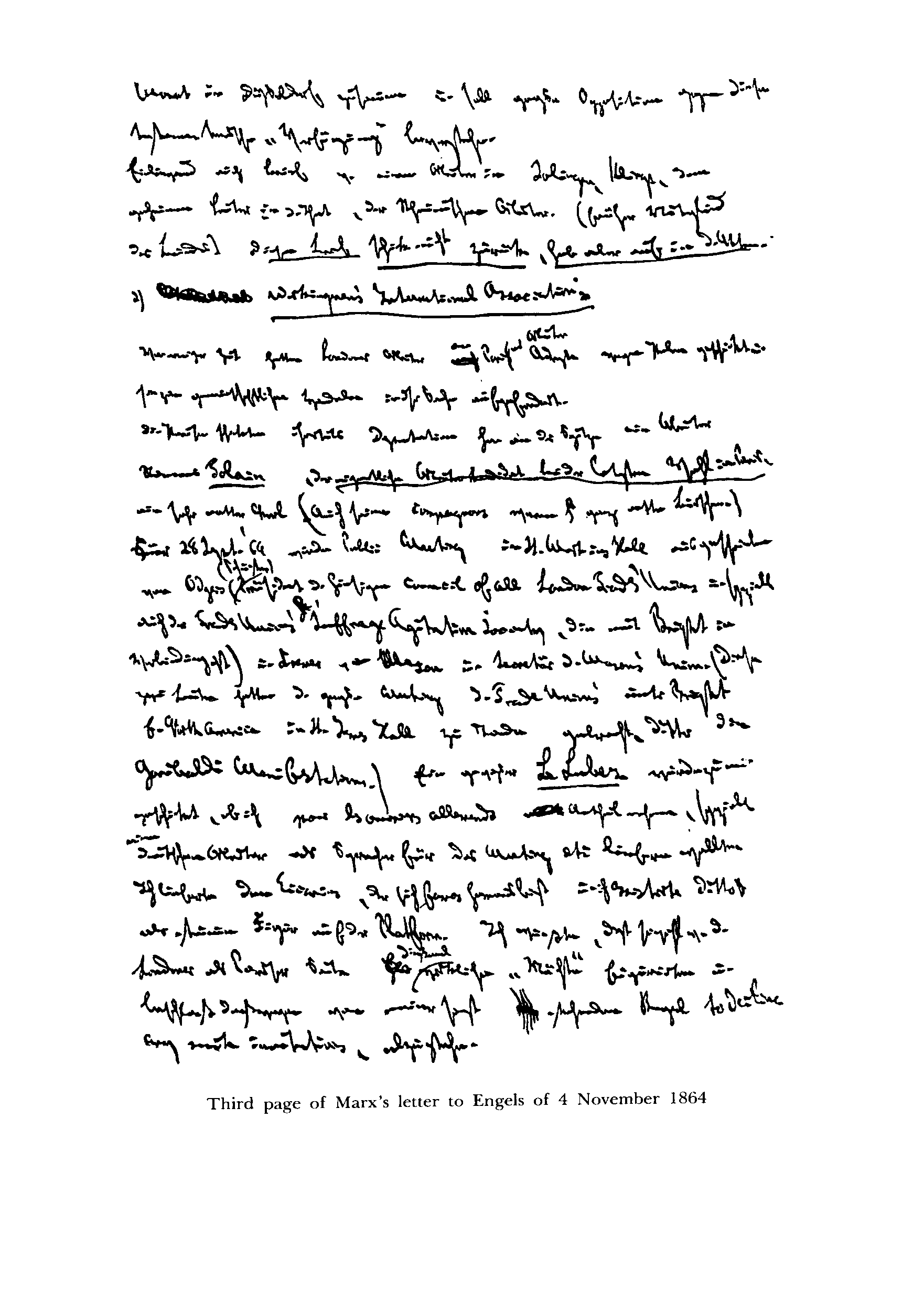
Third page of Marx's letter to Engels of 4 November 1864
4 1864
Apropos. A couple of NUMBERS of E. Jones' Notes to the People (1851, 1852) happened to fall into my hands again; as far as the economic articles are concerned, the main points in them had been written directly under my guidance and partly even in direct collaboration with myself.[3] WELL! What do I find in them? That at that time we conducted the same polemic — only better — against the co-operative movement, since it claimed, in its present narrow-minded form, to be the last word, as Lassalle conducted against Schulze-Delitzsch in Germany 10-12 years later.
In his last will and testament Lassalle has 'installed' Bernhard Becker, the unfortunate fellow, who was Juch's editor on the Hermann for a while, as his successor in the office of President of the General Association of German Workers[2]—in his 'last will and testament' (like a ruling prince). The Association's congress meets in Düsseldorf this month,[16] and strong opposition to this 'decree' by last will and testament is expected.
Also enclosed, letter from a worker in Solingen, Klings,(2) in fact the clandestine leader of the Rhineland workers (former member of the League "). This letter is not to be returned but filed.
2 . WoRKINGMENS INTERNATIONAL ASSOCIATION. Some time ago, London workers sent an address to workers in Paris about Poland and called upon them to act jointly in the matter.b
For their part, the Parisians sent over a deputation headed by a worker named Tolain, who was the real workers' candidate in the last elections in Paris,[4] a thoroughly nice fellow. (His compagnons were quite nice lads, too.) A PUBLIC MEETING in St Martin's Hall was called, for 28 September 1864, by Odger (shoemaker, President of the local COUNCIL OF ALL LONDON TRADES' UNIONS and, in particular, also of the TRADES' UNIONS SUFFRAGE AGITATION SOCIETY,[18] which is connected with Bright) and Cremer, a MASON and secretary of the MASONS' UNION. (These two had arranged the big TRADE-UNION MEETING on North America chaired by Bright in St James's Hall, ditto the Garibaldi manifestations.[19]) A certain Le Lubez was sent to ask me if I would participate pour les ouvriers allemands,'c and, in particular, whether I was willing to provide a German worker to speak at the MEETING, etc. I provided them with Eccarius, who put on a splendid 4 1864
performance, and I was also present myself in a non-speaking capacity on the PLATFORM. I knew that on this occasion 'people who really count' were appearing, both from London and from Paris, and I therefore decided to waive my usual standing rule to DECLINE
ANY SUCH INVITATIONS.
(Le Lubez is a young Frenchman, i.e. in his thirties; however, he grew u p in Jersey and London, speaks capital English and is a very good intermediary between the French and English workers.) (Music teacher and leçons" OF FRENCH.)
At the MEETING, which was chock-full (for THERE IS NOW EVIDENTLY A
REVIVAL OF THE WORKING CLASSES TAKING PLACE), M a j o r W o l f f ( T h u m - T a x i s , Garibaldi's adjutant) represented THE LONDON ITALIAN WORKINGMENS
SOCIETY.20 It was resolved to found a 'WORKINGMENS INTERNATIONAL ASSOCIATION', whose GENERAL COUNCIL is to have its seat in London and is to 'intermediate' between the workers' SOCIETIES in Germany, Italy, France, and England. Ditto that a General WORKINGMENS CONGRESS was to be convened in Belgium in 1865. A PROVISIONAL COMMITTEE was set u p at the MEETING, with Odger, Cremer and many others, some of them former Chartists, former Owenites, etc., representing England, Major Wolff, Fontana, and other Italians representing Italy, Le Lubez, etc. for France, Eccarius and myself for Germany. T h e COMMITTEE was empowered to co-opt as many people as it chose.
So FAR so GOOD. I attended the first meeting of the committee. A Sub-Committee (including myself) was set u p to draft a déclaration des principes and provisional rules.[21] Indisposition prevented m e from attending the meeting of the Sub-Committee and the subsequent meeting of the full committee.
At these two meetings, which I did not attend,—that of the Sub-Committee and the subsequent one of the full committee— the following occurred:
Major Wolff had submitted the regulations (statutes) of the Italian Workers' Associations (which possess a central organisation, but, as emerged later, are essentially associated BENEFIT SOCIETIES) to be used by the new Association. I saw the stuff later. It was EVIDENTLY a concoction of Mazzini's, and that tells you in advance in what spirit and phraseology the real question, the labour question, was dealt with. As well as how the NATIONALITIES question intruded into it.[22]
What is more, an old Owenite, Weston — now a MANUFACTURER himself, a very amiable and worthy man — h a d drawn u p a programme full of extreme confusion and of indescribable breadth.
The subsequent full committee meeting instructed the Sub-Committee to remodel Weston's programme, ditto Wolff's REGULATIONS. Wolff himself left to attend the congress of the ITALIAN WORKINGMEN'S ASSOCIATIONS in Naples and persuade them to join the central association in London.
A further meeting of the Sub-Committee, which again I did not attend, as I was informed of their rendezvous too late. At this meeting, 'une déclaration des principes' and a revised version of Wolff's rules were presented by Le Lubez and accepted by the Sub-Committee for submission to the full committee. The full committee met on 18 October. Eccarius wrote to me that it was a case of periculum in mora," so I went along and was really shocked when I heard the worthy Le Lubez read out a fearfully cliché-ridden, badly written and totally unpolished preamble
PRETENDING TO BE A DECLARATION OF PRINCIPLES, w i t h MaZZUli s h o w i n g through the whole thing from beneath a crust of the most insubstantial scraps of French socialism. What is more, the Italian rules had by and large been adopted, whose aim, apart from all their other faults, was really something quite impossible, a sort of central government of the European working classes (with Mazzini in the background, of course). I remonstrated mildly, and, after prolonged debate, Eccarius proposed that the Sub-Committee should subject the thing to further 'editing'. However, the 'SENTIMENTS' expressed in Lubez' DECLARATION were carried.
Two days later, on 20 October, Cremer representing England, Fontana (Italy) and Le Lubez met at my house. (Weston was unable to be present.) I had not previously had the papers (Wolff's and Le Lubez') in my hands, so could not prepare anything; but I was absolutely determined that NOT ONE SINGLE LINE of the stuff should be allowed to stand if I could help it. To gain time, I proposed that before we 'edited' the preamble, we ought to 'discuss' the RULES. This was done. It was 1 o'clock in the morning before the first of the 40 RULES was adopted. Cremer said (and that was my whole aim): we have nothing to put before the committee that is to meet on 25 October. We must postpone it until 1 November. But the Sub-Committee can meet on 27 October and attempt to reach a definite conclusion. This was agreed and the 'papers' were 'bequeathed' to me for my perusal.
4 1864
I could see it was impossible to make anything out of the stuff. In order to justify the extremely peculiar way in which I intended to edit the SENTIMENTS that had already been 'carried', I wrote AN ADDRESS TO THE WORKING CLASSES (3) (which was not in the original plan; A
SORT OF REVIEW OF THE ADVENTURES OF THE WoRKING CLASSES SINCE 184ô); O n t h e pretext that all the necessary facts were contained in this 'Address' and that we ought not to repeat the same things three times over, I altered the whole preamble, threw out the déclaration des principes
and finally replaced the 40 RULES by 10. Insofar as INTERNATIONAL POLITICS is mentioned in the 'Address', I refer to COUNTRIES and not to NATIONALITIES, and denounce Russia, not the minores gentium}' The Sub-Committee adopted all my proposals. I was, however, obliged to insert two sentences about 'DUTY' and 'RIGHT', and ditto about 'TRUTH, MORALITY AND JUSTICE' in the preamble to the rules,(4) but these are so placed that they can d o no harm. [2 3]
At the meeting of the General Committee my 'ADDRESS', etc., was adopted with great enthusiasm (UNANIMOUSLY). T h e debate on the form of publication, etc., is to take place next Tuesday. (5) Le Lubez has a copy of the 'Address' for translation into French and Fontana one for translation into Italian. (For a start there is a weekly CALLED Bee-Hive," edited by Trade Unionist Potter, a sort of Moniteur.) I am to translate the stuff into German myself.
It was very difficult to frame the thing so that our view should appear in a form that would make it ACCEPTABLE to the present outlook of the workers' movement. In a couple of weeks, the same people will be having MEETINGS on the franchise with Bright and Cobden. It will take time before the revival of the movement allows the old boldness of language to be used. We must be fortiter in re, suaviter in modo.[1] You will get the stuff as soon as it is printed.
3. Bakunin sends his regards. H e left today for Italy where he is living (Florence). I saw him yesterday for the first time in 16 years. I must say I liked him very much, more so than previously. With regard to the Polish movement, he said the Russian government had needed the movement to keep Russia itself quiet, but had not counted on anything like an 18-month struggle. They had thus provoked the affair in Poland. Poland had been defeated by two things, the influence of Bonaparte and, secondly, the hesitation of
7. Engels to Marx. 7 November
the Polish aristocracy in openly and unambiguously proclaiming peasant socialism from the outset.[24] From now on — after the collapse of the Polish affair — he (Bakunin) will only involve himself in the socialist movement.
On the whole, he is one of the few people whom after 16 years I find to have moved forwards and not backwards. I also discussed Urquhart's DENUNCIATIONS with him. (Apropos: the International Association will probably lead to a rupture between myself and these friends!2a) He inquired a great deal after yourself and Lupus. When I told him of the latter's death, he said straightaway that the movement had suffered an irreplaceable loss.
4. Crisis. By no means burnt out on the Continent yet (esp. France). Incidentally, what the crises have lost in intensity, they have now gained in frequency.
Salut.
Your
K. M.
7
ENGELS TO MARX[26]
IN LONDON
Manchester, 7 November 1864
Dear Moor,
Your Frisian solution is quite right, but for one word. In North Frisian, Kimmang means: look, or eye; these North Frisians are of a speculative disposition and have substituted the inward horizon for the outward one, rather as Wagener is now calling for an 'inward Düppel'.[27] It is an old sailors' saying.
The Herwegh and Hatzfeldt papers returned enclosed. What was the further provocation you refer to which Lassalle inflicted on the Walachiana and was suppressed by Emmab? Lassalle's fatal error was obviously that he did not throw the hossyc straight on the bed in the boarding house and deal with her appropriately, it was not his fine mind but his Jew's pizzle she was interested in. It is yet another of these affairs that only Lassalle could get involved in. That it was he, who forced the Walachian into the duel, is doubly crazy.
Old Hatzfeldt's idea that you should write an apotheosis of the latterday Redeemer" is really priceless.
The letter from the Solingen workerb was not enclosed. I cannot wait to see the Address to the Workers,' it must be a real masterpiece, to judge by what you tell me of the people involved. But it is good that we are again making contact with people who do at least represent their class, which is what really matters ultimately. The effect on the Italians will be particularly good, as there is some chance that this will at last put an end to this Dio e popoloc among the workers — it will come as quite a surprise to the worthy Giuseppe.d Incidentally, I suspect that there will very soon be a split in this new association between those who are bourgeois in their thinking and those who are proletarian, the moment the issues become a little more specific.
Concerning Lupus' legacy, we had a meeting with the lawyer this morning.(1) The sum still owing to you will amount to a little over £200; as soon as I have the money, I shall send most of it to you. There are still some details we do not know exactly, so we cannot finally calculate yet. The tax authorities want a list of all the books, and the exact value of the clock Lupus left. Please send me something itemising all the larger works and at the end just: so
MANY PAMPHLETS ETC., everything IN ONE CLUMP. I must close now, as I have to go to a Directors' meeting of the Schiller Institute,[28] of which I am chairman, as you know, to Mr Borchardt's annoyance. Happily, beer has been introduced.
Kind regards to your wife and the girls.
Your
F. E.
8. Engels to Marx. 9 November
8
ENGELS TO MARX[29]
IN LONDON
Manchester, 9 November 1864
Dear Moor,
In respect of the legacy,[8] a further £200 enclosed in 2/2 à £100 banknotes. All being well, there will be approx. £40 to come. I'll send the other two halves as soon as you telegraph receipt.
You will have received the Dagblätter" with the celebrated article. Unfortunately, I could not find the 2nd section of the article, but there was not much in it.
The end appears to be approaching at Richmond.(1) However, as long as Lee is not obliged to stay entirely on the defensive, which in particular means pulling all his troops back from the Shenandoah Valley as well, and as long as Richmond is not completely encircled, all the advances Grant makes against the defences at Richmond or Petersburg will be of little importance. It is just as it was at Sevastopol, which was not encircled either.[31] I cannot imagine what Monsieur de Beauregard will do, probably no more than Hood before him, if as much. I have no confidence at all in this much-vaunted hero.
I am sending you yesterday's Guardianb; you must have a look at the RELIEF Committee's report in it, and see what a difference there is between Mr Marie's ateliers nationaux and those of your English gentlemen.[32] In the case of the former, tasks of doubtful utility were performed, but most of the money that was spent passed into the hands of the workers, who had lost their jobs. Here, tasks of similarly doubtful importance (but ultimately of definite utility to the bourgeoisie) were also performed, but of the £230,000 a mere £12,100 is going to pass into the hands of the FACTORY OPERATIVES, for whom the whole sum was intended (in other words, just that which is set down as being for UNSKILLED LABOUR). The ACT FOR THE RELIEF OF THE DISTRESSED FACTORY OPERATIVES is thus turned into one FOR THE RELIEF OF THE UNDISTRESSED MIDDLE CLASSES, who thereby save on rates.
All my regards.
Your
F. E.
9. Marx to Engels. 14 November
[Note by Marx] Please return this letter, as I am going to file it on account of the remarks at the end.
9
MARX TO ENGELS[33]
IN MANCHESTER
[London,] 14 November 1864
Dear Engels,
I have had to stay mainly in bed for almost a week on account of the carbuncle. The thing is now healing up. However, as the carbuncle is just below the breast, I still have trouble leaning forward in order to write. So, to keep it as brief as possible:
1. Please send the enclosed letters addressed to me back to me (both the one from Schweitzer and the one from Liebknecht) and reply by return, as the people need our reply as soon as possible.[34]
My view is that we should promise occasional contributions from time to time. It is important for us to have a mouthpiece in Berlin, especially for the sake of the association I was involved in founding in London/ and for the sake of the bookb I am planning to publish. It is also important that whatever we do, we do it together.
If you agree with me, you can send me a few lines for these chaps, or say in a few lines what statement / am to make in your name.
2. You will receive the 'ADDRESS' along with the 'PROVISIONAL RULES', etc., in a few days. The thing was not quite so difficult as you think, because we are dealing with 'workers' all the time. The only LITERARY MAN in the Association is the Englishman, Peter Fox, a writer and AGITATOR who is, at the same time, one of the people from The National Reformer (atheist but anti-Holyoake). I am
10. Engels to Marx. 16 November
sending you the very kind note he passed on to me concerning the 'ADDRESS'. Mazzini is RATHER DISGUSTED that his people are among the signatories, mais il faut faire bonne mine à mauvais jeu?
3. Your stuff from the Guardian(1) I find most valuable. I had already pieced this abomination together from the 'FACTORY REPORTS', but only in a most laborious and fragmentary fashion.
4. 2 COPIES received from the Manchester SOLICITOR for signing, etc. In a day or two, I shall send you the signed copies, along with the list (inventory), etc., which you will then have to record. Of course, I can no longer reel off a complete list of all the stuff we left in the flat, etc., and put a value on it.b
That old HUMBUG McCulloch has died. I hope the British Museum buys up his ECONOMICAL LIBRARY. But no doubt Edinburgh will get in first.
Salut.
Your
K. M.
I have just come across P. Fox's letter, which I am enclosing; please send it back as soon as you have had time to peruse it.
10
ENGELS TO MARX
IN LONDON
Manchester, 16 November 1864
Dear Moor,
Glad that the carbuncle is getting better. Let us hope it is the last. But do take arsenic.
Acknowledgement from the charming private secretaryc gratefully received.
A few lines for Schweitzer enclosed.[35] It is a very good thing that we shall again be getting a voice in the press; also very good that Liebknecht is going to be co-editor (as long as he is under no illusions); that does at least provide some safeguard. Meanwhile, we shall do better if we conceal our enthusiasm, as 1. Liebknecht is no diplomat, and one cannot rely too much on his CLAIRVOYANCE, 2. the countess(2) will, above all, be trying to swamp the paper from beginning to end with a deliberate 'apotheosis',b and 3. we really must find out first who else has been approached. Perhaps you are better informed than I am, but in the letters from Liebknecht you sent me there is no mention of the paper nor of this man Schweitzer, so I am very much in the dark. For that reason, I have asked for some clarification about the company we shall be seen to be keeping. We might after all find ourselves cheek by jowl with Mr Karl Grün or some such scum.
And what a dreadful title: Der Socialdemokratl Why do these fellows not simply call it the Proletarier?
Enclosed papers returned with thanks. Why haven't you sent the Solingen letterc you promised?
Amid the nonsense written by Emma Herwegh,d I notice there is a further attempt to turn Lassalle into a demi-god, as follows: only his mighty spirit kept him alive for so long, anyone else would have given up the ghost 2 hours after being wounded — but you ask Allen some time about the way peritonitis develops following a wound, and he will tell you inflammation hardly sets in at all within 2 hours, and is scarcely ever fatal in less than 24 hours, and usually not until much later. These people are really given to deification.
Schaaffhausen in Bonn has given a pretty lecture on man and apes, pointing out that Asiatic anthropoids have rounded heads, like the human beings there, but in Africa both are long-headed, and commenting that, with the present state of knowledge, this is the strongest argument against the unity of the human race. Someone ought to try saying that at a gathering of naturalists in England!
It is splendid how Müller and the Rev. Cappell have made fools of that gang Kinkel, Juch & Co. even from the gallows. It is a long time since I have come across anything quite so absurd as the conduct of these fellows. How fortunate Gottfriede is in the people whose cases he takes up! First MacDonald, then Müller. And then
11. Marx to Engels. 18 November
the way these gentlemen threw their weight around was the immediate cause of Koehl cutting that other lad's throat in the Thames marshes.[36] Just you wait and see what a mass of MARES NESTS they unearth concerning that affair, too. Kindest regards to the family.
Your
F. E.
11
MARX TO ENGELS
IN MANCHESTER
[London,] 18 November [1864]
DEAR FRED,
1. I am sending the stuff for the SOLICITOR. You will have to copy the enclosed inventory and put it into whatever shape you think fit.1
2. Ad vocemh Solingen. I had put the letter out READY when I sent you the last but one letter-package, and it hasn't been 'seen any more since then'.' I suspect it has ensconced itself in a notebook and WILL TURN UP one fine morning.
3. Ad vocem Schweitzer. Is a Dr of Law, formerly of Frankfurt am Main. Published a confused pamphlet against Vogt in 1859.d Subsequently, a social novel I have not read.e Declared his vigorous support for Lassalle. Later, during Lassalle's lifetime, he got to know sundry writings of ours at Liebknecht's house while staying in Berlin and, even at that time, sent me a message through Liebknecht saying how amazed he was at finding that everything about Lassalle that he liked had been plagiarised.
I have written, like you, concerning the prospectus of contributors.^ Have sent Liebknecht German translation of the address of the INTERNATIONAL COMMITTEE at the same time, with a view to eventual publication in the paper. (The stuff will appear today or tomorrow and will be sent to you.(1))
As far as Lassalle's apotheosis is concerned,(2) the Hamburg Nordstern, edited by that jackass Bruhn (who at the same time continues to print Heinzen's ELUCUBRATIONS, as though nothing had happened), is exclusively dedicated to this matter just as before, and the Social-Demokrat can scarcely compete with it in that respect.
Old Hatzfeldt seems to be most disappointed by the letter I sent in reply to her 'ploy',c although it was most delicate and considerate in tone. Since that time, she has — kept silence.
Social-Demokrat is a bad title. But there is no need to throw away the best tides immediately on things that may prove to be FAILURES.
Wilhelm Liebknecht is an unquestionably big man among the Berlin workers, as you can see from the Berlin correspondence of The Morning Star. I am only afraid he will soon be sent packing.
4. Ad voce m Peritonitis, it says in Andral: 'Clinique Médicale': 'La Péritonite aiguë ... en certains cas un petit nombre d'heures s'écoulent entre l'époque de l'invasion de la maladie et celle de la mort, tandis que d'autres fois la péritonite, toujours aiguë par ses symptômes, ne devient mortelle qu'au bout de 30 à 40 jours.'d
And under the rubric: 'Péritonite par violence extérieure'[1] he describes the case of a Parisian worker who was kicked in the stomach by a horse, in the region of his navel. Was only taken to the Charitée le surlende-main, 'offre tous les symptômes d'une phlegmasie aiguë du péritoine"f (later confirmed by ouverture du cadavre'). Died du 5-ème au 6-ème jour,h and amongst the general OBSERVATIONS concerning this case, it says: 'jusqu'au dernier moment, on n'observe aucun trouble des facultés intellectuelles et sensoriales.'k 5. Take care to keep the enclosed memorandum for student Blind published in a rag in which he has puffed himself up with surpassing zeal since 1859.[38] This 'Beobachter(3) est le 'grand' organe de la démocratie Suabaise"l
6. Prof. Huber has held his 'labour convention' with ABOUT 100 workers' associations. He is conservative in politics but a co-operator as far as POLITICAL ECONOMY is concerned. His Leipzig Convention nearly ended in a real 'thrashing' for Huber and his comrades, with the great majority declaring themselves to be 'radical' in politics.[39]
7. I gather all kinds of things have been published by the COMMITTEE in Manchester about the COTTON-FAMINE[40]—I mean IN REGARD TO THE woRKiNGMEN. Can you get hold of it for me?
8. My chest still hurts me when I write and lean forward. Hence this 'itemised' letter.
Regards to Gumpert. Ditto to Madame Lizzy.b
Your
K. M.
[Enclosure: List relating to W. Wolff's Legacy]
SILVER WATCH £2
BOOKS : Schlosser, Weltgeschichte £1 10s. Schieiden, Studien 3s. Schiller's Werke 10s. Duller, Geschichte des Deutschen Volkes 5s. Duncker, Geschichte £1 Mommsen, Geschichte 10s. Schoemann, Griechische Alterthümer 5s. Lange, Römische Alterthümer 3s. Preller, Griechische Mythologie 5s. Nösselt, Weltgeschichte 4s. Völter, Geographie 5s. Mortimer-Ternaux, Histoire de la Terreur, 2 v 5s. Arago, Astronomie Populaire 10s. Müller, Physik 3s. Baer, Magnetismus ls. Figuier, Année scientifique, 3 vol 5s.
Mignet, Revolution française 5s. Egli, Handelsgeographie 2s. Ritter, Europa 3s. Cotta, Geologische Briefe 2s. Garrido, Spanien ls. Freytag, Bilder aus dem Leben des Volkes 2s. Moleschott, Lehre der Nahrungsmittel 3s. Harting, Die Macht des Kleinen ls. Grube, Biographieen aus der Naturkunde ls. Reisen des Marco Polo ls. Kiesselbach, Gang des Welthandels ls. Jacobs, Hellas ls. Smith, English Latin Lexicon 5s. Rost, Griechisch-Deutsches Lexicon 5s. Giebel, Säugethiere 5s. Tschudi, Thierleben der Alpenwelt 5s. Freytag, Soll und Haben 2s. Pauli, Bilder aus England ls. Overbeck, Pompeji 10s. Guhl, Leben der Griechen und Römer 10s. Lau, Sulla ls. Macauley, History of England 10s. Frankenheim, Völkerkunde ls. Stieler's Handatlas £1 10s. Berghaus, Physikalischer Schulatlas 5s. Spruner, Historischer Schulatlas 5s. Mozin, Dictionnaire £1 55 PAMPHLETS 10s. 1 0 2 ELEMENTARY SCHOOLBOOKS £ 3 1 I have put a much higher valuation on the stuff than it would fetch if sold, what with the selling-price of SECONDHAND BOOKS in England. On the other hand, all kinds of things are missing that I have not been able to remember. There is thus COMPENSATION. If you want to add anything regarding the other goods and chattels, please do so.
12. Engels to Marx. 22 November
13. Marx to Engels. 24 November
12
ENGELS TO MARX
IN LONDON
Manchester, 22 November 1864
Dear Moor,
I received enclosed today from Schweitzer.[41] Herwegh and Hess — fine company. As things stand and as I am not very familiar with the exact circumstances, I shall have to leave it to you to answer the man on behalf of both of us, as he wants his answer by return. Moses(1) of all people!
Please return the letter to me and let me know what you have written, and I can then confirm your statement to him later on.
Solicitor's stuff received.[8]
Kindest regards.
Your
F. E.
13
MARX TO ENGELS
IN MANCHESTER
[London, 24 November 1864]
Dear FREDHUCK,
Letter from the old Hatzfeldt woman enclosed, which I would like sent back by return.[4]-
Also enclosed the letter from the man in Solingenb which has turned up again, and Schweitzer's letter.
I sent off 3 'Addresses'3 to you today, 1 for yourself, 1 for Gumpert and 1 for Ernest Jones. If you can distribute some more anywhere (gratis), you only have to ask.
As for Schweitzer, I have written — not to him but to Liebknecht — that we both dislike the company, but we intend FOR A NONCE to adopt bonne mine à mauvais jeu,h but to disown them immediately as soon as they do anything silly. I also ask why Bûcher and especially Rodbertus are not among them![43]
Moses0 and Herwegh (who are, incidentally, of some stature, compared with B. and Ph. Becker, IN A LITERARY SENSE) are, after all, more highly regarded by people in Germany than by us. At least, one cannot publicly denigrate them, as one can fellows like Grün, etc.
In great haste. Salut.
Your
K. M.
I have just been obliged to write long letter to the old womand
to extricate myself from the Blind affair she has tried to involve me in. Student Blind has, of course, not let the opportunity slip by of puffing himself up, by issuing a 'protest' in the name of the Republic" and selecting a few passages from Lassalle's speeches which are indeed quite sickeningly royalist.[44] Also to advise her against reproducing the 'wanted' portraits of her enemies.[45]
14. Marx to Sophie von Hatzfeldt. 24 November
14
MARX TO SOPHIE VON HATZFELDT
IN BERLIN
London, 24 November 1864
1 Modena Villas, Maitland Park, Haverstock Hill
My dear Countess,
I have just informed you by telegraph[46] (to avoid all delay in reply) of my view that the two photograms of von R. et Co.(1)
should, in no circumstances, appear together with Lassalle's in the pamphlet. It would, on the one hand, dishonour the deceased, and, on the other, give the publication a gaudy appearance which should be avoided completely. Furthermore, as you know, 'contra hostem vindicatio aeterna sit'b is my motto too, but, for revenge to be successfully executed, it is advisable not to initiate the public in one's vindictive 'intent'.[45]
'Ex ossibus ultor'c would seem to me the best title for Lassalle's portrait. They were also my last words spoken at the graveside of my never-to-be-forgotten friend W. Wolff[47] some six months ago.
As regards ex-student Blind, that fellow who made himself known before 1848 by peddling Heinzen's nonsense and as the
homme entretenu"d of the wife of the Jewish banker Cohene (whom he later married in London), so I would ask you to remember that in my piece Herr Vogt (see pp. 58-69 and Appendices 9 and 11 )f I do not merely describe this student Blind as a 'deliberate liar', but I prove by reference to legal documents that this wretched man fabricated 'false witness' to cast suspicion on myself and to extricate his neck from a noose that this creature had made for himself for the purpose of merely making himself look big (which is indeed this rascal's sole purpose in every public step, or rather crawl, he undertakes).[48]
Then Blind succeeded in deflecting the catastrophe of his 24 1864
political operations — by simply saying nothing. In this he was sustained firstly by the fact that Freiligrath (this entre nous*) unfortunately continued to parade publicly as his friend, and that Lassalle, although I had strongly urged him to do so, neglected to force my pillorying of Blind d'une manière ou d'une autreb on the attention of the German public.[49] This appeared necessary to me because the liberal press in Germany instinctively took the side of a scoundrel like Blind, and therefore sought to hush up my attack. Lassalle considered Blind too insignificant. It was only later that he discovered that there are times when one cannot decline a 'combat with a flea'.c
When Lassalle was here in London,[50] he sought to enlighten Louis Blanc and Mazzini about Blind on his personal visits to them, but in vain. The man is exactly what Mazzini, Ledru, etc., had hoped, but failed, to find in the other Germans of standing, a servile lackey and sycophant. Through his relations with these people he makes the English think that he represents Germany, and he impresses the Germans by his boasting here. Yet the whole of this fellow's activity consists in writing, in conjunction with 3 or 4 South Germans/ from, for and about 'Karl Blind' and, at every possible opportunity, to force on the English, Germans and Americans his 'unofficial judgment' as the self-appointed representative of 'German republicanism' (a party, which is well known to exist only on the moon, since the German bourgeois is interested in a constitutional monarchy, the feudal lord in an aristocratic monarchy, and the worker in general not in mere forms of state, but in the form of state as the expression of economic social conditions, and, at all events, has never recognised ex-student Blind as representative). He is a true master of dictating letters to one of his 6 satellites,[51] in which they call on the said, etc., 'Karl Blind' to do this or that, or congratulate him on this or that, and then — by oversight or OTHERWISE — the replies from the same Karl Blind gain entry to the press.
As one of the 'YOUNG MEN' who were active in the service of F. Hecker, Blind learnt that art, which is by no means rare among the South Germans, of self-defamation and creating a spurious PUBLIC OPINION about people who are essentially nonentities. In London he thought himself far enough advanced along the road or to have served long enough in the 'Democratic cause' to
a between ourselves - b in one way or another - c Heinrich Heine, Atta Troll. Ein Sommernachtstraum, 11. - d Marx presumably has in mind, first and foremost, Eduard Bronner and Karl Heinrich Schaible.
exploit for himself those arts he had acquired in the service of others.
Regarding his education, it is, as I told Lassalle during his sojourn here, that of a Baden publican," who has read Rotteck's
Weltgeschichte, Welker's Staatslexikon and Mr Struve's republican Almanac.b
In his manoeuvres in Germany Mr Blind enjoys the particular support of Mr Gustav Rasch of Berlin.
Bernhard Becker, as the former SUBEDITOR of the London Hermann, best knows how Blind composed with his own fair hand the paeans of praise to himself that appeared e.g. in the Hermann. He does this mostly and on average. By way of variation he will occasionally get a certain Dr Bronner in Bradford or his Schaible (see 'Herr Vogt') via London to put their names to his epistles. All the agitation of this person is nothing but a tissue of lies, self-deception and hot air. In this field, however, he has no rivals. He demonstrated the height of his dexterity when Garibaldi visited London.19 He first spread the rumour in the English papers that he was an intimate friend of Garibaldi. Imposing himself as is his custom, he issued 'addresses' to Garibaldi from London and you know that in his kind-hearted naivety Garibaldi will write a nice letter back to anyone. Then he descends on the Isle of Wight (before Garibaldi made his ceremonial entry to London), and 'appoints' with him the date on which Garibaldi would receive the German deputation (Blind, you see, had so arranged things as to get a few Germans, including Kinkel and unfortunately my friend Freiligrath as well, to elect him as the leader of a deputation) and at the same time sends mysterious hints to some London papersc that Garibaldi WAS CLOSETED' WITH 'HIS FRIEND' (Blind) and, of course, settled some very important affairs of state with him.[52] But Blind's masterstroke is still to come. As serving-man to the European 'kings of democracy"1 (for so he designates Mazzini, Ledru Rollin, Louis Blanc, and indeed COMPARED WITH student Blind even they are 'great men"), our Baden trickster manages so to arrange things that he, as a member of the society and a leader, fetches Garibaldi from the Duke of Sutherland's, where he is staying, and escorts him in the Duke's State Carriage 24 1864
to Ledru Rollin and Louis Blanc. He seizes the opportunity to have the carriage stand for a while outside Mr Blind's house for Garibaldi to 'PAY HIS COMPLIMENTS TO Madame Karl Blind'. By skilful MANAGEMENT all this even appears in The Times," and at the moment when Garibaldi is being idolized by all London. Perhaps you recall how 'Rameau', the nephew, in Diderot's wonderful piece, bursts out in admiration at the genius of Bouret, the general tax-collector, who cunningly devised a way to disaffect his little dog from himself and make it prefer the minister! This Garibaldi-farce was Blind's Bouret-prank! It is my belief that from that time on he began bona fide to think himself a great man! He has really got hold of something with Schleswig-Holstein! Did you not know then that for years Blind has been deriving his chief importance from acting as a 'representative' for Schleswig-Holstein against Denmark, saying 'he' had 'forced' the German tyrants into war against Denmark,(2) and that was why friend Rasch dedicated his piece about the 'orphaned' kith and kinb to him! Did you not know that in the Prussian House Prof. Virchow (probably at Mr Rasch's instigation) cited Blind's great influence in the Schleswig-Holstein affairc as proof of what a single man can do by his own efforts for a whole nation! The shameless man had made those German jackasses believe that he had got the English to change their view of Schleswig-Holstein! His feeble leaflets about Schleswig-Holstein are just about (and that is saying something) the most stupid thing that has appeared in this LINE. (Incidentally, Mr ex-student's best friend and associate is that lout Karl Heinzen in America, whose business for 20 years past has been to slander me in a manner such as even Lassalle never experienced. I have never thought it worth the trouble to reply to this fellow, but I was astonished that the Nordstern—for a long time also a major mouthpiece for student Blind — is constantly printing Heinzen's filth, which is extremely hostile to the principles of the workers' party, and generally makes propaganda for Mr Heinzen.)
But Garibaldi, Schleswig-Holstein, America, Lassalle, all are for the ex-student only a pretext for puffing up his own self-importance! The modest fellow wrote in his own fair hand a short while ago to the 'Glasgow Sentinel' that the whole of Europe 24 1864
(literally) was not yet divided into two hostile camps with regard to 'Karl Blind', but that a tiers parti existed in this respect, too!a In The Observer he describes himself as 'THE ILLUSTRIOUS CHIEF OF THE GERMAN REPUBLICANS'.h A few more little touches to the description of this man, who, if one views him aright, is a highly comical character.
After his success with Garibaldi MR KARL BLIND JOINED THE SHAKESPEARE COMMITTEE,[53] as was stated in the Athenaeum\c He had now clearly progressed to the status of 'literary' representative of Germany, too!
During the skirmish in Baden (1849),[54] Struve, as he himself recounts in a piece about the 'Baden revolution',[1]* sent the 'young man', as he calls Blind, as Under-Secretary to Schütz, who had been appointed Secretary, from Mainz to Paris, to rescue ex-student Blind from conflict with Brentano. The government to which Blind was directed as Under-Secretary to Secretary Schütz,— the provisional government no longer existed when Secretary and Under-Secretary arrived in Paris. Nevertheless, in mysterious hints in English papers, he let it be understood that he held an important diplomatic post as agent of the German 'republican government' in Paris!
In the first few years after 1849 he lived in Belgium with his present wife. Since this woman has children from her marriage to the dead banker (and they inherited) and she also has children by Blind (at that time still illegitimate), a court in Baden ruled that Cohen's children should be taken away from his widow Cohen because of her 'immoral' relations with ex-student Blind. The court in Brussels gave this ruling legal force in Belgium, and this caused Blind to flee to England together with his wife and the children. He later got English papers to print (and was brazen enough to boast publicly of it on a visit to South Germany) that he had been expelled from Belgium for political reasons!e
His next deed you will see from the enclosed cutting, which he had printed in many London papers. What provoked it was the report disseminated in some papers that Garibaldi had declared his support for the slave-oumersl Blind used this to extort a short letter from Garibaldi with 'CORDIAL GREETINGS FOR MRS BLIND'. YOU can see what lies he told Garibaldi from his remark 'I THANK YOU FOR YOUR GOOD NEWS'.2 What on earth could this 'GOOD NEWS' have been in October 1864? Blind was obviously writing Garibaldi the most monstrous lies about the progress of 'republicanism' in Germany, which is presumably just awaiting Blind's arrival to lash out.
The most splendid aspect of the affair is that the London paper to which Blind is a regular contributor, the mouthpiece of the publicans (a most appropriate context to a 'Blind'), is a fanatical supporter of the Confederates!b And by the by, the paper— The Morning Advertiser—is at one and the same time the mouthpiece of spirits, the Low CHURCH (English pietism),[55] the SWELL-MOB which is concerned with gambling, PRICEFIGHTS AND SO FORTH, and the most lickspittling poodle of Palmerston's. FROM A LITERARY STANDPOINT, it cannot be counted among the English daily press and is in general only read in TAPROOMS.
So much for the man. In Lassalle's lifetime he issued an address casting doubt on the former's integrity.[56] But Lassalle — as far as I know — did not think it worth the trouble of a reply. I was only surprised that B. Becker, who is fully aware of Blind's doings, did not then take the opportunity to blazon abroad my revelations about Blind?
One of the reasons why I have joined the International Working Men's Association here is to expose that man. After the statements I have made against Blind, branding him as a 'deliberate liar' and a 'falsifier of evidence', I cannot of course further involve myself in polemic against the fellow. I reserve the right to treat him as a figure of comedy should the occasion arise. If I should now take his scrawl against Lassalle, which I have incidentally not seen, as grounds for an attack on him, people here, who know of my implacable hostility to Blind, will think that in fact I am only using Lassalle's name as a pretext for personal spite.
But do send me the (printed) declaration by the workers. I shall ensure that it gets into a German paper here and if student Blind then makes any further moves, perhaps he will give me the opportunity to let me fall upon him.
At all events, you may depend on it that he will be shown no favours. In the meantime, the best thing you can do is to disseminate my revelations about Blind as a 'deliberate liar' and 'falsifier' as far as possible in Germany. (If his scrawl about Lassalle had set any mice stirring here, a word or two about it at all events would have reached my ears.) This would force him to break his silence and so enable me to open my mouth again concerning a fellow whom I have publicly declared to be atrocious.
Apart from anything else, it would be quite impossible for me to travel to Berlin on account of the fresh outbreak of the fearful carbuncle disease that I have been struggling against for 14 months with slight interruptions.
You may, however, be sure that I shall seize whatever opportunity I find appropriate (but you will have to leave it to me to choose whatever moment appears favourable to me) to rebuff all malicious attacks on the friend who has been prematurely taken from me.
Yours very respectfully
K. M.
15. Engels to Joseph Weydemeyer. 24 November[57]
Dear Weydemeyer,
I was most pleased to hear from you again at long last.[58] We have been without your address for years, otherwise you would already have received a reminder from me earlier on. My address is still Ermen & Engels and will probably continue to be so for five years or so yet, unless the storm breaks in Germany. Marx' address is No. 1, Modena Villas, Maitland Park, Haverstock Hill, London, but Dr Marx, London, will also suffice if need be.
Our plump little pig Blind is showing off here in Europe, wherever he can, just as he did over there, it is the only little pleasure the poor wee creature has, and he indulges it with an assiduity worthy of a better cause and greater success. However, ever since Marx belaboured him so thoroughly in Herr Vogt, he has been keeping out of our range.
As far as Lassalle's flirtations with Bismarck are concerned, they are beyond dispute. The passages quoted by Blind[3] were, of course, actually uttered by Lassalle in the speech he made in Düsseldorf in his defence and published by him, so there is nothing to be done there.[15] For all his distinctive qualities, Lassalle had that Jewish respect for momentary success, which made it impossible for him to deny Louis Bonaparte his respect, or to refrain from professing such overtly Bonapartist principles as he did. Those, who were more closely acquainted with him, knew that these things were not occasional happenings. You can readily imagine that this was as disagreeable to us as it was grist to the mill of piglet Blind, and that alone would have been sufficient ground for us to have had nothing to do with all Lassalle's agitation during his lifetime, although there were other reasons, too. Nevertheless, that is all over and done with now, and we shall have to see whether his agitation was just a flash in the pan, or whether there was really something to it.
You will have heard that our poor Lupus died here on 9 May of this year. His was a loss for the party of an altogether different order from Lassalle's. We shall never again find such a steadfast fellow, who knew how to talk to the people and was always there when things were at their most difficult. For 4 long weeks he had the most terrible headaches, his German doctor(1) neglected him, and at length a vessel burst in his brain from the colossal pressure of the blood, he gradually lost consciousness and died 10 days later.
Nothing of much interest is happening here in Europe. The suppression of the Polish uprising was the last decisive event; for his assistance in this, the Tsarb gave Bismarck permission to take Schleswig-Holstein from the Danes. It will be a long time before Poland is capable of rising again, even with help from outside, and yet Poland is quite indispensable to us. The despicable behaviour of the liberal German philistines is to blame; if those curs in the Prussian Chamber had had more insight and courage, all might be well — Austria was ready to march in support of the Poles at any time, and it was only Prussia's attitude that prevented it, and the treachery of Mr Bonaparte, who was, of course, only prepared to keep his promises to the Poles if he could do so safely, i.e. if he was covered by Prussia and Austria.
That war of yours over therec is really one of the most stupendous things that one can experience. Despite the numerous blunders made by the Northern armies (enough by the South, too), the tide of conquest is rolling slowly but surely onward, and, in the course of 1865, at all events the moment will undoubtedly come when the organised resistance of the South will fold up like a pocket-knife, and the warfare turn into banditry, as in the Carlist war in Spain[59] and more recently in Naples.[12] A people's war of this kind, on both sides, has not taken place since great states have been in existence, and it will, at all events, point the direction for the future of the whole of America for hundreds of years to come. Once slavery, the greatest shackle on the political and social development of the United States, has been broken, the country is bound to receive an impetus from which it will acquire quite a differed position in world history within the shortest possible time, and a use will then soon be found for the army and navy with which the war is providing it.
It was incidentally quite understandable that the North had some difficulty in providing itself with an army and generals. From the outset, the South's oligarchy had brought the country's few military forces under its control, it supplied the officers and furthermore raided the arsenals. The North found itself with no resources other than the militia, while the South had been training for years. From the outset, the South had a population accustomed to the saddle for use as light cavalry, on a scale the North could not match. The North adopted the habit, introduced from the South, of filling positions with party supporters; the South, in the midst of a revolution and with a military dictatorship, could brush that aside. Hence, all the blunders. I do not deny that Lee is a better general than any the North has, and that his latest operations around the fortified camp at Richmond[30] are master-pieces from which our glorious Prince Frederick Charles of Prussia could learn much. But, ultimately, the determined attacks of Grant and Sherman made all strategy superfluous. It is clear that Grant is sacrificing a colossal number of men, but what else could he do? I have absolutely no idea of the level of discipline in your army, its cohesion under fire, its capacity and willingness to endure hardship, and in particular the nature of its MORALE, i.e. what can be demanded of it without its becoming demoralised. With such scanty reports and no proper maps, one needs to know all this before permitting oneself any judgment on this side of the water. What does seem certain to me, however, is that the army now commanded by Sherman is the best you have, as superior to Hood's as Lee's is to Grant's.
16. Marx to Engels. 25 November
Your field-manual and elementary tactics are, as I hear, positively French — the basic formation thus presumably being the column with intervals between platoons. What kind of field artillery do you now have? If you can enlighten me on these points, I shall be greatly obliged. What has become of the great Anneke? Since the battle at Pittsburgh-Landing was all but lost[60]
because he was not supplied with everything which he should have had, according to the Prussian field-manual, he has quite vanished from my view. Of the Germans who have joined in the war, Willich appears to have given the best account of himself, whereas Sigel has UNMISTAKEABLY demonstrated his mediocrity. And Schurz, the valiant Schurz, farting away amidst the shower of bullets and shells, what foes is he demolishing now?
Apropos. The Prussian cannons that smashed Düppela and Sonderburg[61] from 6,500 paces were our old long bronze 24-pounders, rifled and rebuilt as breech-loaders, 54-pound shells with 4-pound-charge! I've seen them with my own eyes.
Kindest regards to your wife.b
Your
F. Engels
16
MARX TO ENGELS
IN MANCHESTER
[London,] 25 November [1864]
DEAR FREDERICK! Weydemeyer's letter returned enclosed (how odd it should come at the same time as the one from the countessc)[58] with Schweitzer's letter/ which I forgot to enclose yesterday.
I still need to hold on to the 'clipping' .a
The position is now as follows:
1. It was not until after I wrote to you that I saw that Blind has sent an answer to the Swabian Beobachter via Dr Bronner (unsigned, of course, but dated Bradford; letter, naturally, written by Blind himself, in which he firstly proves that by his influence over '7' million Germans he in fact shaped American politics; secondly, he has the impudence to say that the Vogt affair has been disposed of by statements from all sides.[62] So, I have grounds here for replying and referring to the 'AFFIDAVITS',[63] and, at the same time, an extract from Weydemeyer's letter would kill two birds with one stone, firstly exposing Blind's influence on America and secondly giving the old countess some kind of satisfaction as far as Lassalle is concerned.
2. These 'Republican Protests', which Blind has sent with the same date to St Louis, Frankfurt am Main and the London Hermann, are only identical in their general drift. In the shit in the Hermann and the Frankfurter Journal^" which I shall try to send you later today, this Baden publican" has simply put together the passages which were most damaging to ourselves, whilst across the ocean he is more insolent and resorts to bare-faced lies.
But the real 'POINT' is this, a 'POINT' typical of the way he manufactures his pamphlets: in the European edition he says that the protest comes from American and European republicans, whilst in the American edition he calls upon the American government to protest. Here we have caught the dog in flagranti.0
3. Since Lassalle is dead and can do no more harm, we must of course — as far as possible, i.e. without compromising ourselves— defend him against these petty-bourgeois scoundrels.
My plan is therefore this: to reply (briefly) in the Siuabian Beobachter; 1. putting the record straight about the 'statements from all sides' in the Vogt affair; 2. giving an extract from Weydemeyer's letter about Blind's influence in America; 3. exposing the fellow afresh by comparing the European and American editions of his 'Republican Protest'; finally 4. concluding that it is NOT WORTH WHILE defending Lassalle against such a comical character.
If this seems all right to you, send me a wire and I will tie the whole business up tomorrow, amongst other things in order to have some peace with the 'old girl'. I said in my letter to her, by
17. Marx to Sophie von Hatzfeldt. 26 November
the way, that Lassalle only has himself to blame for being kicked by that jackass, because, although I strongly and repeatedly urged him to do so, he did not give all possible publicity in Germany to my denunciation of Blind in Herr Vogt." Salut.
Your
K. M.
17
MARX TO SOPHIE VON HATZFELDT
IN BERLIN
[London,] Saturday, 26 November 1864
My dear Countess,
These few lines in the greatest of haste (there being just time before the last post goes) to inform you that I have been fortunate enough to be vouchsafed the opportunity to get a hold on Blind immediately and deliver him a vigorous kick for his attack on our Lassalle.[62]
I shall send you my attack on him on Monday which will appear in the form of a short letter to the Stuttgart Beobachter}" You will then learn of the circumstances of the case, too.
Yours very respectfully
K. M.
18. Marx to Sophie von Hatzfeldt. 28 November
My dear Countess,
From the enclosed" you will see the circumstances that have presented me with the opportunity to renew my tussle with ex-student Blind and, at the same time, deliver him a kick in the name of Lassalle.
You must arrange for publication in the papers at your disposal, but not before two days have elapsed after you receive this, so that Mayer of Swabia — i.e. the editor of the Beobachter in Stuttgart— has no excuse for refusing it.[1]'b
Yours very respectfully
K. Marx
19. Marx to Joseph Weydemeyer. 29 November[57]
1 Modena Villas, Maitland Park, Haverstock Hill, N. W.
Dear Weiwi,
The whole household and myself were extraordinarily pleased to hear from you and your family again. My wife asserts that she wrote to yours*' last and is thus expecting to have the first letter back from her.
I am, at the same time, sending you by mail 4 copies of a printed 'Address',[3] of which I am the author. The newly established INTERNATIONAL Workers' Committee, in whose name it has been put out, is not without significance. Its English members consist chiefly of the heads of the TRADE-UNIONS here, in other words, the real worker-kings of London, the same people who organised that gigantic reception for Garibaldi and who, by that monster meeting in St James's Hall (under Bright's chairmanship), prevented Palmerston declaring war on the United States, which hè was on the point of doing.[19] On the French side, the members are unimpor-tant figures, but they are the direct spokesmen of the leading 'workers' in Paris. There is likewise a link with the Italian associations, which recently held their congress in Naples.[22]
Although I have been systematically refusing to participate in any way whatsoever in all the 'organisations', etc. for years now, I accepted this time because it concerns a matter by means of which it is possible to have a significant influence.
For the past 14 months I have been suffering almost constantly from carbuncles, which often threatened my life. More or less cured now.
Engels will have written to you of the loss of our friend Lupus.(1)
Curiously enough, I received a letter from Berlin last Friday, in which the old Hatzfeldt woman urged me to defend Lassalle against Blind's 'Republican Protest'.[42] The next day I received your letter to Engels, containing the much amended American edition of the same garbage. By a third coincidence, I was, at the same time, sent 2 numbers of the Swabian Beobachter (from Stuttgart) which I never see otherwise. In the first number the editorc was poking fun at a letter from Mr Blind to the American nation which had been translated from the English by 'Mr Blind' and sent to him and to other South German editors; in it, 'almost at official request', as he puts it, he gives his inexpert opinion on Lincoln's election, etc.d In the same number, the editor said that one can see from my book attacking Vogte what Blind's vanity leads to, etc. Whereupon, Blind sent the enclosed reply through his man-of-straw, Dr Bronner of Bradford, 1. setting out just how powerful his influence in America was, and 2. having the impudence to say that the Vogt affair was 'a put-up-job'.[62] This then enabled me (using your letter and copying the passages relating to Blind) to put out the statement(2) as desired by the old Hatzfeldt woman against that clown, without identifying myself with those aspects of Lassalle's agitation b
which are not to my liking. Write soon.
Your
K. Marx
The source of Blind's boastful epistle which I am copying out for you is No. 268 of the Beobachter (Stuttgart), 17 Nov., 1864.
It is absolutely essential that you write me a few lines, suitable for publication, about Mr Blind's American influence.
20. Marx to Ludwig Kugelmann. 29 November[65]
1 Modena Villas, Maitland Park, Haverstock Hill, N. W.
Dear Friend, Today you will receive from me by post 6 copies of the ADDRESS
OF THE WORKINGMEN'S INTERNATIONAL ASSOCIATION'/ o f w h i c h I a m t h e author. Please be so good as to convey a copy with my kindest regards to Madame Markheim (Fulda). Give one to Mr Miquel as well.
The Association — or rather its Committee — is important because the leaders of the London TRADE-UNIONS belong to it, the same people who organised that enormous reception for Garibaldi and thwarted Palmerston's plan for a war with the United States by means of the monster meeting in St James's Hall.c The leaders of the Parisian workers are also in contact with it.
21. Marx to Lion Philips. 29 November
In the last few years I have been much afflicted with illness (e.g., in the last 14 months by a recurrence of carbuncles). My private circumstances have improved in consequence of a legacy from the death of my mother.(1)
I think that my book on capital (60 sheets) will at last be ready for the press next year.[66]
You will doubtless understand the reasons for not allowing myself to become involved in Lassalle's movement in his lifetime, without my spelling them out in detail. However, that cannot deter me — the more so since persons close to him are urging me to do so — from taking up his defence, now that he is dead, against such despicable curs as the clamorous K. Blind.b
I am afraid that in mid-spring or early summer of next year there will be war between Italy, Austria and France. This will be very damaging for the movement in France and England, which is growing significantly.
I hope to hear from you soon.
Yours very respectfully
K. Marx
21
MARX TO LION PHILIPS[67]
IN ZALT-BOMMEL
London, 29 November 1864
1 Modena Villas, Maitland Park, Haverstock Hill
Dear Uncle,
I hope that you are in the best of health despite the ABOMINABLE weather. All is well here. Except that, to the great alarm of the whole family, I had a most malignant carbuncle below the left breast at the beginning of this month, which kept me in great pain for 2-3 weeks. Other than that, everything has been going well.
The trade crisis, which I predicted to you long before its actual arrival,[2] has by this time long since lost its edge, although its consequences in the manufacturing districts proper are still very considerable. On the other hand, I believe a political crisis is to be expected in the spring or early summer. Bonaparte has again reached the point where he will have to make war again if he is to raise a loan. The Venetian business is being kept open (I am acquainted with some of the agents there) so that it can provide a point of contact if need be.[68] It is possible that Bonaparte will again find a way out, and then he will keep the peace (for he is no REAL Napoleon), but that is rather improbable.
The enclosed printed 'Address"[3] is written by myself. The matter hangs together like this: in September the Parisian workers sent a delegation to the London workers to demonstrate support for Poland. On that occasion, an international Workers' Committee was formed. The matter is not without importance because 1. in London the same people are at the head who organised the gigantic reception for Garibaldi and, by their monster meeting with Bright in St James's Hall, prevented war with the United States.(2)
In a word, these are the real workers' leaders in London, with one or two exceptions all workers themselves. 2. On the Parisian side, Mr Tolain (ouvrierb himself, as well) et Co. are at the head, i.e., the same people who were prevented by a mere intrigue on the part of Garnier-Pages, Carnot, etc., from entering the Corps législatif at the last elections in Paris as representatives of the workers there,c and 3. on the Italian side, it has been joined by the representatives of the 4-500 Italian workers' clubs which held their general congress in Naples some weeks ago,[22] an event which even The Times considered important enough to merit a few dozen lines in the paper.d
Courtesy toward the French and the Italians, who always require florid language, has obliged me to include a few superfluous turns of phrase in the preamble to the 'Rules',e though not in the 'Address'.[23]
A few days ago I received a letter from America from my friend Weydemeyer, Colonel in the regiment stationed at St Louis (Missouri). Amongst other things, he writes — and these are his exact words:
'We are regrettably being detained here at St Louis, since, in view of the many "conservative" elements here, a military force is a continuing necessity to prevent a break-out and the possible release of the numerous Southern prisoners.... The whole campaign in Virginia is a BLUNDER, which has cost us innumerable men. But for all that, the South will not be able to hold out much longer: it has sent its last man into battle and has no fresh army to call upon. The present invasion of Missouri, like the incursions into Tennessee, has only the character of a RAID, a foray: there can be no thought of a lasting re-occupation of districts that have been lost.'[3]
When you reflect, my dear Uncle, how at the time of Lincoln's election 37(3) years ago it was only a matter of making no further concessions to the slave-owners, whereas now the avowed aim, which has in part already been realised, is the abolition of slavery, one has to admit that never has such a gigantic revolution occurred with such rapidity. It will have a highly beneficial influence on the whole world.
At a public MEETING this week the fellow-member of our race Benjamin Disraeli has again made a dreadful laughing-stock of himself by assuming the mantle of guardian angel of the HIGH CHURCH[69] and CHURCH RATES, repudiating criticism in religious affairs.b
He furnishes the best evidence of how a great talent unaccom-panied by conviction creates rogues, albeit gold-braided and 'RIGHT HONORABLE' ones.
Those jackasses in Germany have again made a proper laughing-stock of themselves over the Müller affair,[36] with ex-parson Kinkel at their head.
With kindest regards from the whole family to you and from me to Jettchen, Dr, Fritzc et Co.
Ever your faithful nephew
K. M.
22. Marx to Engels. 2 December
22
MARX TO ENGELS[29]
IN MANCHESTER
[London,] 2 December 1864
DEAR FRED,
THANKS FOR THE GUARDIAN* I did send on a few COPIES of the 'Address"3 to E. Jones afterwards, with a letter to him saying that he would probably receive one from you first. He writes today that he has neither seen nor heard anything from you. His address is 55, not 52, Cross Street. He says in his letter that, when the Assizes are over, he will form a branch association in Manchester amongst his acquaintances.
Could you by any chance dig up the address of the musician Petzler (maybe from the Manchester directory, or the Schiller Association[28])? He has a lot of contacts among the Manchester workers, and without ANY INTERVENTION ON YOUR PART I could put him in touch with E. Jones from here. You would only need to send me Petzler's address.
The worst thing about agitation of this kind is that one gets very BOTHERED as soon as one becomes involved in it. E.g. Address to Lincoln now on the agenda again, and again I had to compose the thingc (which is far more difficult than writing a proper work)—so that the phraseology to which that kind of writing is limited, is at least distinguishable from vulgar-democratic phraseology.[70] Fortunately, Mr Fox is doing the Polish business which is coming up in connection with 29 November, the anniversary of the Polish revolution of 1830.[71]
In the Committee, since the address for Lincoln is to be handed over to Adams, some of the English wanted to have the deputation introduced BY A MEMBER OF PARLIAMENT — as is CUSTOMARY. This desire was suppressed by the majority OF the ENGLISH and the unanimity of the continentals, and it was declared instead that such OLD ENGLISH CUSTOMS OUGHT TO BE ABOLISHED. On the other hand: M. Le Lubez, as a real crapaud,d wanted the address to be directed not to Lincoln but TO THE AMERICAN PEOPLE. I made him look suitably foolish and made it clear to the English that FRENCH DEMOCRATIC ETIQUETTE is not worth a FARTHING more than MONARCHICAL ETIQUETTE.
Apropos. Naturally it is impossible to have a movement here without its own press-organ. The Bee-Hive (weekly, organ of the TRADES-UNIONS) was therefore declared to be the organ of the Association. By a stroke of ill-luck, to which the workers are particularly susceptible, a scoundrel called George Potter (in the BUILDING STRIKES[72] he acted as MOUTHPIECE in The Times, but with articles written not by himself but by others) has installed himself as MANAGER with a clique of shareholders, who have so far formed the majority. The COMMITTEE, whose English members are mostly Bee-Hive shareholders (a share costs only 5s., and no one can have more than 5 votes, even if he holds 5,000 shares; thus 1 vote per share up to a maximum of 5), has therefore decided that we should set up a share-fund here which will enable us to create shareholders AND TO SWAMP THE OLD MAJORITY. I would appreciate it if you would let us have a contribution for this purpose as well. The whole operation must, of course, be confined to the close friends of the members of the Committee, as otherwise counter-measures would be promptly taken by the other side (i.e. before the GENERAL MEETING OF SHAREHOLDERS which is not far off now).
Besides the Hermann, there was also another little paper here, the Londoner Anzeiger, which belongs to the worthy Jewish bookseller Bender. It is trying to build itself up as a competitor to the Hermann, as the editorship has been taken over by a certain L. Otto von Breidtschwerdt, although he writes under the name of L. Otto. I shall hardly become directly involved in the thing at all, as I had my fill with the Volk, but it is good for reprinting statements in London as soon as they appear in the German newspapers, e.g. like the one against Blind.(1)
This Otto first got to know Eccarius, at whose suggestion he became a German member of the INTERNATIONAL COMMITTEE. He is a Swabian, Stuttgarter born and bred. Quite a young fellow, ABOUT 27 OR as. Very much like my wife's elder brother.b Began as a cadet in the Austrian army, where he learnt all kinds of languages and was stationed all over the place. Subsequently studied in Tübingen. As a person, he is a very pleasant, witty fellow and well-mannered. His head is still stuffed full of petty Swabianisms and Germanic nonsense. For all that, very good knowledge and ability. But he seems to me to have more inclination than a gift for writing; dull, doctrinaire. He is useful as a go-between with South Germany and especially the Land of the Swabians. Also writes in the Augsburger" from time to time, which is, incidentally, entirely what you would expect from the Vogt standpoint.
I wrote to Mr Klings that it was difficult, but also quite unnecessary, to decide between Moses and Bernhard.b Both were honest and both incompetent. I said that, at the present moment, it was neither here nor there who has the title of President. When the time became decisive, there would be no difficulty in finding the right people.'
I am very much afraid I can feel another carbuncle starting on my right hip. Allen knows nothing about it as I have been treating myself for some time. If I went to him now about the arsenic business, which after all you cannot start without a doctor and to which he might perhaps not even agree, he would give me the most dreadful dressing down for having been carbuncling for so long behind his back!!
YOURS
K. M.
In his reply to Mayer the Swabian (via his man-of-straw Bronner),d Blind states that Lincoln and Fremont were fighting for his vote because it would decide the ELECTION.[62] And in an American newspaper, The Radical Democrat? that he was responsible for the Polish revolution.
23. Marx to Engels. 8 December
23
MARX TO ENGELS
IN MANCHESTER
[London,] 8 December 1864
Dear Engels,
You will find enclosed
1. Free Press." 2. Swabian Beobachter. (With the latter, I have managed to get the fellow at least to adopt an ironical tone towards Blind again, whereas, as a result of the letter transmitted by Bronner,b he was so bowled over by Blind's boasting — I have sent the scrawl to Weydemeyer—that he absolutely drew in his horns and paid compliments to the 'excellent man'. Incidentally, the editor—hinc Mae lacrimaec—is the man whom I referred to in Herr Vogt as the 'garrulous Swabian, Karl Mayer',d and who is moreover the son of that Mayer the Swabian so incessantly derided by Heine.[73])
3. Letter enclosed from Red Becker/ I had, you see, sent a copy of the statement' to the Rheinische Zeitung. Please return Becker's letter to me.[74]
Apropos Liebknecht. At the end of the year he is, of course, in a very tight spot. I have sent him money several times in the course of the last six months and now I want to send his wife8 something in the form of a Christmas present for the children, since I know they are in dire straits. I would appreciate it if you would make a contribution, too. But you must let me know quickly, as periculum in mora.h I would then send the whole lot to Frau Liebknecht at the same time.
Salut. Your
K. M.
24. Marx to Engels. 10 December
24
MARX T O ENGELS [3 3]
IN MANCHESTER
[London,] 10 December 1864
DEAR FRED,
MY COMPLIMENT TO MRS LIZZY.3
You had already given m e your PRIVATE ADDRESS some time ago, but not the 'FIRM' to which to write. I am very glad to have it now, as I sometimes find it desirable to drop you a few lines ON SATURDAYS.
T h e £ 5 for Wilhelm b is already on its way to Berlin today. You have not sent m e back the Becker.[74] However cunningly 'the Red' fancies he has extricated himself from the matter, his letter is a DOCUMENT WHICH ONE FINE MORNING HE MAY FIND TO TURN UP for unforeseen purposes. T h e old Hatzfeldt woman will, incidentally, ensure that the statement' gets to the right person. [6 4]
WHAT ABOUT SHERMAN'S EXPEDITION? [5]
Apropos. Your POOR-HOUSE Purdy is said to have published an absolutely disgraceful document during the COTTON-FAMINE,[40] recom-mending reducing support to a minimum, on the grounds that the HEALTH of THE COTTON-OPERATIVES was said to have improved; as a result of this, FAMINE DISEASES are said to have broken out in the EAST OF LANCASHIRE. (That was in the early days of the COTTON-FAMINE.) D O you know anything about it? And, in general, can you obtain for me the OFFICIAL PAPERS in Manchester (of the Committee, d etc.) relating to the COTTON-FAMINE?
Lothario Bücher, whom Lassalle appointed executor to his will and to whom h e left £ 1 5 0 a year pension, has, as you probably already know, gone over to Bismarck's camp. Baron Izzye would perhaps have done the same himself as 'Minister of Labour[1], Marquis Posa to Philipp II of the Uckermark/ but not IN THE SMALL WAY OF Lothario, with whom the Hatzfeldt woman has fallen out and who can now shake hands with Edgar Bauer and the Prussian consul in Milan, Mr R. Schramm. T h e Prussians were looking for a post for Mr Schramm 'where yer don't need n o exam'. f I also fancy Mr Rodbertus' intentions are 'none too 'onourable' because he is claiming to 'have entirely divorced the social question from polities',(1) a sure sign that he has got the ministerial itch. What a contempt-ible gang, all that riff-raff from Berlin, Brandenburg and Pome-rania!
I fancy there is a SECRET UNDERSTANDING between Prussia, Russia and France for THE WAR AGAINST AUSTRIA IN NEXT SPRING. Venetia will, of course, provide the WAR-CRY.[68] The Austrians are behaving with abysmal cowardice and stupidity. This ensues from Francis Joseph himself interfering personally in Austrian politics. Buol-Schauenstein, etc., all the sensible hommes d-état,b are obliged to keep their traps shut, and the Russian agents, such notorious fellows as the present Austrian FOREIGN MINISTER,c are giving all the orders. For all that, the Austrians' behaviour would be inexplicable, unless these fellows either have faith in Prussia's perfidious promises or are determined to accept the long-standing promise of compensation in Turkey.
What do you say to Collet's profound discoveries — based on Urquhart — about Nebuchadnezzar and the Russians' Assyrian ancestry, and the further discovery, which is cited as 'Urquhart's', that IN ITALY THE POPE IS THE ONLY REAL THING ?d
Today's The Miner and Workman's Advocate—the Moniteur^ of the mineworkers in England and Wales — is printing the whole of my 'Address'/ The London 'BRICKLAYERS' (over 3,000 men) have announced they are joining the International Association, and they are fellows who have never before joined a MOVEMENT.
There was a SUB-COMMITTEEe' meeting last Tuesday,(2) at which Mr Peter Fox (his real name is P. Fox André) presented his address on Poland " to us. (This kind of thing is always dealt with beforehand in the SUBCOMMITTEE before going to the GENERAL COMMITTEE.) The piece is not badly written and Fox has en-deavoured to apply the concept of 'class', at least a semblance of it, although it is normally alien to him. His real forte is FOREIGN POLICY, and it is only as a propagandist of atheism that he has had dealings with the WORKING CLASSES AS SUCH.
But easy though it is to get the English workers to accept a rational approach, one has to be all the more careful the moment 10 1864
men of letters, members of the bourgeoisie or semi-literary people become involved in the movement. Fox, like his friend Beesly (Professor of Political Economy at the University of London, he took the chair at the founding MEETING in St Martin's Halla) and other 'DEMOCRATS', have a fanatical 'love' of France, which, as far as FOREIGN POLICY is concerned, they extend not only to Napoleon I but even to Boustrapa," [1] as opposed to what they call, not without justice, the English aristocratic tradition, and as a continuation of what they call the English democratic tradition of 1791/92. WELL! Not content in his address (which, incidentally, is not to appear as an address from the whole Association but as an address from the English section concerning the POLISH QUESTION, endorsed by the whole Committee) with telling the Poles, which is true, that the French people has been traditionally more sympathetic towards them than the English, Mr Fox WINDS UP HIS ADDRESS mainly by consoling the Poles with the passionate friendship that THE ENGLISH WORKING CLASSES have conceived FOR THE FRENCH DEMOCRATS. I opposed this and unfolded a historically irrefutable tableau of the constant French betrayal of Poland from Louis XV to Bonaparte III. At the same time, I pointed out how thoroughly inappropriate it was that the ANGLO-FRENCH-ALLIANCE should appear as the 'core' of the INTERNATIONAL ASSOCIATION, albeit in a democratic version. T o cut matters short, Fox's address was accepted by the SUBCOMMITTEE on condition that he altered the 'TAIL' in accordance with my suggestions. Jung, the Swiss SECRETARY (from French Switzerland), declared that, as a MINORITY on the GENERAL COUNCIL, he would move that the address be rejected as ALTOGETHER 'bourgeois'.[7]'
O u r Major Wolff has been locked u p by the Piedmontese for the moment in the fortress of Alexandria.
Louis Blanc has written to the General Secretary Cremer that he approves the 'Address' and regrets not having been able to attend the St Martin's Hall MEETING, etc. ALTOGETHER, the sole purpose of his letter is to get him co-opted an HONORARY MEMBER. Foreseeing that attempts of this kind would be made, I had, however, fortunately got the BYLAW accepted that no one (except workers' SOCIETIES) could be invited to join and that nobody at all could be an honorary member.'*
Salut.
Your
K. M.
25. Marx to Engels. 22 December
Gumpert will get the photograph as soon as he sends me the long-promised one of his wife.
25
MARX TO ENGELS
IN MANCHESTER
[London,] 22 December 1864 Dear FREDERICK,
In great haste. Please send Becker's letter back to me.(1) I hope you have not lost it.
Happy New Year!
Your
K. M.
26. Marx to Sophie von Hatzfeldt. 22 December
1 Modena Villas, Maitland Park, Haverstock Hill
My dear Countess,
A few days ago, a friend in Hamburg sent me the Nordstern containing my statement against Blind,b duly emended with misprints.
It was at your request that I made this statement, although its composition did not come easily to me as I did not agree with Lassalle's political tactics. However, all my scruples were removed by Blind's shameless outburst against the deceased in the St Louis
'Westliche Post'.*[4] I had not the slightest idea which papers you would send the statement to. The Nordstern was the furthest from my mind. Mr Bruhn has now seized upon this opportunity to make an 'indecent gesture' in my direction, by hinting to his readers in the commentaries that I had sought access to his emporium through the back door and had been granted it as an act of extreme graciousness only because a third party had intervened especially on my behalf.[64] I have no doubt that his accomplice in Americab will make use of this. Is it Mr Bruhn's desire that I should be forced into exposing him publicly for the conceited nonentity that he is?
If Bruhn, Bernhard Becker and tutti quanti set out to oppose me and my efforts in any manner whatsoever that I consider harmful to the workers' movement itself, a storm will break about these gentlemen's heads that will take their breath away. Reasons of long-standing personal friendship and party interest, which held me back vis-à-vis Lassalle, can no longer have the slightest force in respect of these dii minorum gentium}' This I am stating once and for all, so that I cannot later be charged with ambiguity or inconsiderateness.
In no circumstances, do I wish the Eighteenth Brumaire to be published, and, if steps have already been taken to this end, they are to be checked forthwith.[79]
I scarcely dare express any good wishes for the New Year, knowing as I do that the old year has left you, my dear Countess, only with memories.
Yours very respectfully
K. M.
27. Marx to Carl Siebel. 22 December
1 Modena Villas, Maitland Park, Haverstock Hill
Dear Siebel,
A Happy New Year! You will perhaps have seen that Engels and I have agreed to become contributors to the Berlin Social-Demokrat.[80] Nevertheless — this entre nous*—either that paper will have to dissociate itself from the apotheosis of Lassalle, or we shall dissociate ourselves from it. But the poor devils have a lot to contend with.
You will have received the 'Addresses'11 sent to you and have no doubt guessed I am the author. For the sake of the movement here, it is important for us that German workers' associations should join the Central Committee here. (As has happened in many cases with the Italians and the French.) Now Liebknecht has written to me that the Berlin printers' association will be joining, but that it is very doubtful whether the 'General Association of German Workers'2 will join, on account of the intrigues of Mr Bernhard Becker, whose importance was 'invented' by Lassalle. (Entre nous this is perhaps Lassalle's only invention.)[81]
Today I wrote the old Hatzfeldt woman a kind of threatening letter, sub rosa,c of course.
Now it would be highly desirable for you to pay a brief visit to Solingen to explain on my behalf to the cutler, Klings, how exceedingly important it is that the Association of German Workers should decide to join the INTERNATIONAL ASSOCIATION at its congress in Düsseldorf on 27 December of this year.[82] You might surreptitiously hint that, for such nonentities as B. Becker, etc., what matters is, naturally, not the cause but the 'infiniment petit'? i.e., their own persons. But such a hint must be dropped diplomatically, without implicating me.
You understand that it is necessary that the General Association of German Workers should join only for a start, on account of our opponents here. At a later date, the whole organisation of this association will have to be broken up, as its basis is fundamentally wrong.
If you do not now at last write me a few lines, I shall presume that you have become totally disloyal to me, and will proclaim you excommunicated.
Your
K. M.
1865
28
Endnotes
[6] This letter was published in English for the first time in The Letters of Karl Marx, selected and translated with explanatory notes and an introduction by Saul K. Padover, Prentice-Hall Inc., Englewood Cliffs, New Jersey, 1979.—5, 193, 231, 330, 356, 397, 493, 553
[9] Engels is referring to the fact that the Bismarck government used the national contradictions between the duchies of Schleswig and Holstein and Denmark to promote Germany's unification under the aegis of Prussia. On 13 November 1863 the Danish Parliament adopted a new constitution which proclaimed the annexation of Schleswig to Denmark in violation of the London Protocol of 1852 (the latter stipulated that Denmark and the duchies could be linked only by personal union). This served as a pretext for Bismarck to declare war on Denmark. Austria joined Prussia for she did not want Prussia, her main rival in Germany, to enjoy the fruits of victory alone. As a result of the Danish war (1 February-16 July 1864), a treaty was concluded in Vienna on 30 October 1864 which declared Schleswig and Holstein to be co-possessions of Austria and Prussia. After the 1866 Austro-Prussian war the two duchies were annexed to Prussia.— 7, 34, 121, 350
[10] Part of this letter was published in English for the first time in Marx and Engels, On the United States, Progress Publishers, Moscow, 1979.—9, 61, 418, 451
[13] Part of this letter was published in English for the first time in the Labour Monthly, No. 4, London, 1923.—11
[14] Marx means the death of Ferdinand Lassalle on 31 August 1864 after being fatally wounded in a duel with the Romanian nobleman Janko von Racowija.—12
[16] The congress (general assembly) of the General Association of German Workers met in Düsseldorf on 27 December 1864. It elected Bernhard Becker President of the Association.—15
[18] reorganisation of the League of the Just (a secret association of workers and
[21] circles.
[24] June 1864 by the Italian workers resident in London. Initially the Society numbered about 300 members and was influenced by Mazzini. Garibaldi was elected its Honorary President. In January 1865 the Society became affiliated to the International Association.—16, 110, 140, 150, 170, 250 The Sub-Committee or Standing Committee was the executive body of the Central (General) Council of the International. It usually assembled once a week and drafted many of the decisions which were later adopted by the Council. The Sub-Committee evolved from a commission, elected when the International Working Men's Association was set up, to draft its programme documents. The Sub-Committee included the President of the General Council (until this office was abolished in September 1867), its General Secretary and the corresponding secretaries for the different countries. Marx took an active part in the work of the Standing Committee as Corresponding Secretary for Germany.—16, 54, 130, 131, 172, 207, 214, 486 The Statutes submitted by Luigi Wolff at a meeting of the Sub-Committee on 8 October 1864 were an English translation of TAtto di fratellanza délie Società operaie italiane' (Fraternal Bond Between the Italian Workmen's Associations) published in // Giornale delle Associazioni Operaie on 31 July 1864 and adopted at the eleventh congress of Italian pro-Mazzini working men's associations in Naples on 27 October 1864. Attended by delegates from 57 organisations, the congress set up an association of Italian workers' societies which joined the International Working Men's Association. By submitting to the International these Statutes, written from bourgeois-democratic positions, Mazzini and his followers sought to take over the leadership of the international working-class movement.—16, 44, 47 A reference to the following passage in the Provisional Rules of the Association: '...This International Association and all societies and individuals adhering to it, will acknowledge truth, justice, and morality, as the basis of their conduct towards each other, and towards all men, without regard to colour, creed, or nationality; 'They hold it the duty of a man to claim the rights of a man and a citizen, not only for himself, but for every man who does his duty. No rights without duties, no duties without rights' (see present edition, Vol. 20, p. 15).—18, 47 In January 1863 an uprising against Tsarist oppression flared up in the Kingdom of Poland, the territory annexed to Russia by decision of the Vienna Congress of 1815. The uprising of 1863-64 was caused by the Poles' striving for national independence and the crisis of feudal relations within the Kingdom. The National Central Committee, which headed the uprising, put forward a programme of struggle for Poland's independence and a number of democratic agrarian demands. However, the inconsistency and indecision of the insurgent government, in particular its failure to abolish the privileges of the big landowners, drove the majority of the peasants away from the uprising. This was one of the main causes of its defeat. In addition, serious damage to the uprising was done by the policy of its Right-wing leaders. They pinned great hopes on help from the ruling circles of Bonapartist France and bourgeois-aristocratic England who were pursuing their own selfish interests in the Polish question. The national liberation uprising was, by and large, crushed by the Tsarist government in the autumn of 1863, though some units of the insurgents continued the struggle until the end of 1864.—19, 38, 73, 164
[26] Part of this letter was published in English for the first time in Karl Marx, Friedrich Engels, Selected Letters. The Personal Correspondence, 1844-1877, Boston, Toronto, 1981.—19, 178, 225, 269, 309, 343, 348, 352, 370, 445, 450, 527, 538
[27] The original has 'inneren Düppel', an expression first used in the meaning of 'enemy within' in a political survey published in the Bismarckian Norddeutsche Allgemeine Zeitung on 30 September 1864. It became widely current later. Düppel (Dybböl)—Danish fortification in Schleswig which the Prussians captured by storm on 18 April 1864, during the war of Prussia and Austria against Denmark (see Note 9).—19, 121, 254, 256, 263
[31] Engels is referring to the nearly nine-month-long siege of Sevastopol during the Crimean war of 1853-56.—21
[32] In April 1863 the British Parliament passed the Public Works Act in view of the reduced production and mass unemployment in the cotton districts of England. This Act provided the municipal authorities of these districts with funds to pay the unemployed temporarily used for public works, mainly on laying the sewerage system, building roads, etc. The Relief Committees, which guarded the interests of the capitalists, were in charge of organising these works and paying the workers. The unemployed were forced to agree to hard labour for miserable pay. The ateliers nationaux (national workshops) were instituted by the French Provisional Government immediately after the February revolution of 1848. By this means the government sought to discredit Louis Blanc's ideas on 'the organisation of labour' in thé eyes of the workers and, at the same time, to utilise those employed in the national workshops, organised on military lines, against the revolutionary proletariat. Revolutionary ideas, however, continued to gain ground in the national workshops. The government took steps to reduce the number of workers employed in them, to send a large number off to public works in the provinces and finally to liquidate the workshops. This precipitated a proletarian uprising in Paris in June 1848. After its suppression, the Cavaignac government issued a decree on 3 July, disbanding the national workshops.—21, 117
[34] In their letters of 11 November 1864, Schweitzer and Liebknecht invited Marx to contribute to Der Social-Demokrat, the prospective newspaper of the General Association of German Workers (see Note 2). In the same month, Schweitzer sent Marx and Engels the prospectus, which did not contain Lassalle's slogans. Since they had no other press organ to influence the workers' movement in Germany, they agreed to collaborate with Der Social-Demokrat. They also took into account the fact that Wilhelm Liebknecht was an unofficial member of its editorial board. Marx's 'Inaugural Address of the Working Men's International Association' and 'On Proudhon', and Engels' translation of the old Danish folk song 'Herr Tidmann' were printed in the newspaper. However, fully convinced that Schweitzer, the editor of the newspaper, was continuing the Lassallean policy of flirting with the government and the Junkers and trying to spread the cult of Lassalle, Marx and Engels on 23 February 1865 announced their break with the newspaper (see present edition, Vol. 20, p. 80). Wilhelm Liebknecht followed suit and refused to collaborate with the paper.— 22, 102, 136
[35] Engels' letter to Schweitzer has not been found. This letter of Engels to Marx and Marx's reply of 18 November 1864 show that Engels wrote to Schweitzer expressing his agreement to contribute to Der Social-Demokrat but asked Schweitzer first to let him know who the proposed contributors were.—24
[38] Marx presumably means the leading article, 'Bescheidenheit — ein Ehrenkleid' (Modesty — a Festive Garment), published in the Stuttgart Beobachter (No. 245) on 21 October 1864. It ridiculed Karl Blind's address to the American people (on the occasion of presidential elections), which was distinguished for his excessive claims to political importance and boasting. The article was probably written by the paper's editor, Karl Mayer.—27
[39] This refers to the second congress of the Union of German Workers' Associations (set up in June 1863) which met in Leipzig on 23-24 October 1864. The Union at this stage was still under the influence of the liberal bourgeoisie (Schulze-Delitzsch and other members of the Party of Progress — see Note 99). The congress developed into a fierce battle between the followers of Schulze-Delitzsch and members of the General Association of German Workers (see Note 2), the latter striving to persuade the workers' educational societies into adopting the Lassallean political programme (the demand for universal suffrage). The young August Bebel was elected, among others, into the Union's leading body. Under his influence the organisation began to shake off the liberals' tutelage and acquire a proletarian class character. Professor Huber, mentioned by Marx, was a conservative champion of co-operativism and attended the congress as a guest.—27
[41] In a letter to Engels of 19 November 1864, Schweitzer, in reply to Engels' enquiry, named the proposed contributors to Der Social-Demokrat. They were: Moses Hess, Georg Herwegh, Bernhard Becker, Johann Philipp Becker, Wilhelm Liebknecht, Friedrich Wilhelm Rüstow and Johann Karl Heinrich Wuttke.—29
[43] Marx's letter to Liebknecht in which Marx enquired about the contributors to Der Social-Demokrat has not been found. In his reply of 2 December 1864, Liebknecht wrote that Lothar Bucher and Johann Rodbertus had gone over to the side of the Prussian government.— 30
[44] In this article Karl Blind, polemising with the Lassalleans, quoted Lassalle's defence speech at the Berlin assizes in March 1864.—30, 57
[46] Marx's telegram has not been found.—31, 288, 297
[47] Wilhelm Wolff, to whom Marx dedicated the first volume of Capital, died in Manchester on 9 May 1864. Marx delivered a short oration at his funeral (see Marx's letter to Jenny Marx of 13 May 1864, present edition, Vol. 41).—31
[48] In his pamphlet Herr Vogt (a copy of which Marx sent to Lassalle and Sophie von Hatzfeldt after its publication), Marx exposed Blind's cowardly attempts to deny his authorship of the flysheet Zur Warnung (A Warning) (it was published in London in 1859 and reprinted in the Augsburg Allgemeine Zeitung), which revealed Vogt's connections with the Bonapartists. Blind's statements in the press citing false evidence of Fidelio Hollinger, the owner of a print-shop where the flysheet had been printed, and of a compositor, Johann Wiehe, gave Vogt a pretext to attribute the authorship of the flysheet to Marx and his friends.—31
[49] On 15 November 1859 Marx sent Lassalle his reply to Blind's declaration regarding Karl Vogt (see present edition, Vol. 40, p. 526), asking him to have it published in the Berlin Volks-Zeitung. In his reply of 20 November 1859 Lassalle recommended Marx to avoid any controversy with Blind in the press. Marx's declaration was published in the supplement to the Allgemeine Zeitung, No. 325, 21 November 1859 (see present edition, Vol. 17, pp. 8-9).—32
[50] Lassalle was in London in July 1862.—32, 101
[51] Marx presumably means the members of the Deutsche Freiheit und Einheit, an association which was founded in London about 1860 and included, besides Blind, Eduard Bronner, Karl Heinrich Schaible, Ravenstein (secretary) and Wolffsohn (cashier).—32
[52] In view of Garibaldi's forthcoming visit to England, the German refugees in London set up a Garibaldi Committee on 6 April 1864. It included Blind, Juch (publisher of the Hermann), Trübner, Freiligrath, Kinkel and others. Blind met Garibaldi on the Isle of Wight on 9 April. Blind and his associates took advantage of the meeting with Italy's national hero to advertise themselves in the English press.—33
[53] T h e Shakespeare Committee was set u p to mark the tercentenary of Shakespeare's birthday which was celebrated from 23 April to 3 May 1864. German men of letters were represented by Freiligrath, who recommended that Karl Blind should also be a m e m b e r of the committee.— 35
[54] In the spring of 1849, during an uprising in defence of the Imperial Constitution in Southern and Western Germany, a Provisional Government was formed in Baden headed by the petty-bourgeois democrat Lorenz Peter Brentano. In face of the impending intervention of Prussian troops in Baden and the Palatinate, this government, having in fact sabotaged the actions of the revolutionary masses, applied for help to France. Karl Blind was sent to Paris with this purpose. The Baden government counted on the support of the party of petty-bourgeois democrats headed by Ledru-Rollin, but by that time it had heen pushed into the background by the bourgeois 'party of Order' and the Bonapartists. This predetermined the failure of Blind's mission.— 35
[55] The Low Church—a trend in the Anglican Church which laid special emphasis on Christian morality; its following originally consisted predominantly of the bourgeoisie and the lower clergy. Pietism—a trend in the Lutheran Church that emerged in Germany in the seventeenth century. Distinguished by extreme mysticism, it rejected rites and attached special importance to personal religious experience.— 36, 426
[56] Blind's address 'Ein Freundeswort an Deutschlands Arbeiter, Bürger und Bauer' was published in a number of German newspapers and as a leaflet in June 1863. In it, Blind opposed Lassalle's agitation among the workers saying that the campaign for universal suffrage did not accord with the 'main principles of German democracy'.—36
[59] The Carlists—a reactionary clerico-absolutist group in Spain consisting of adherents of the pretender to the Spanish throne Don Carlos, the brother of Ferdinand VII. Relying on the military and the Catholic clergy, and also making use of the support of the backward peasants in some regions of Spain, the Carlists launched in 1833 a civil war which in fact turned into a struggle between the feudal-Catholic and liberal-bourgeois elements and led to the third bourgeois revolution (1834-43).—39
[30] Engels is referring to the operations of the Northerners at the final stage of the Civil War in America (see Note 11) when, during the general offensive started in May 1864, they besieged Richmond (Virginia), the capital of the Southern Confederacy and its main stronghold. The Southerners entrenched in Richmond resisted until April 1865, when the city was seized by the army of General Grant.—21, 39, 61, 82, 113, 121, 147, 153
[60] The battle at Pittsburgh-Landing also known as the battle of Shiloh, took place on 6-7 April 1862 on the Tennessee River, twenty miles north of Corinth. The Northern army under General Grant inflicted a heavy blow to the Confederate troops commanded by generals Johnston and Beauregard.— 40
[61] Sonderburg (now S0nderborg)—the town and fortress on the Alsen Island, one of the strongpoints on the Düppel fortification line captured by Prussian troops on 18 April 1864, during the war of Prussia and Austria against Denmark (see notes 9 and 27).—40
[63] Marx is referring to the affidavits made by two London compositors, Wiehe and Vögele, on Blind's authorship of the flysheet Zur Warnung (see Note 48), which exposed Karl Vogt as a Bonapartist agent. Blind cravenly denied his participation in composing the flysheet, thus making Marx's campaign against Vogt's lies more difficult. Marx described Blind's cowardly behaviour both in Herr Vogt (see present edition, Vol. 17, pp. 128-31 and 318-20) and the statement 'To the Editor of the Stuttgart Beobachter' (Vol. 20).—41, 518
[42] In her letter to Marx of 21 November 1864, Countess von Hatzfeldt wrote that a pamphlet in commemoration of Lassalle was being prepared and asked Marx's advice about illustrations. The pamphlet Ferdinand Lassalle. Dokumen-tarische Darstellung seine letzten Lebenstage. Von Augenzeugen und Freunden appeared in Berlin in 1865. At first Wilhelm Liebknecht agreed to edit it, but when he learned, at the end of 1864, about Lassalle's direct association with Bismarck, he refused to take part in the work. The Countess also asked Marx to come out in defence of Lassalle against the attacks on him by the petty-bourgeois democrat Karl Blind.—29, 44
[65] This letter was published in English for the first time in Karl Marx, Letters to Dr. Kugelmann, Co-operative Publishing Society of Foreign Workers in the USSR, Moscow-Leningrad, 1934.—45, 101, 220, 262, 311, 325, 327, 329, 346, 379, 395, 440, 449, 489, 496, 521, 528, 543, 551
[66] This refers to Marx's plans for the publication of his main work, Capital. At that time, Wilhelm Strohn, at Marx's request, conducted talks with the Hamburg publishing house of Meissner and Behre. At the end of January 1865, a preliminary agreement was reached on publishing the book in two volumes. The text of the agreement (see present edition, Vol. 20, p. 361) was sent to Marx by Meissner in his letter of 21 March 1865.—46, 78
[67] Part of this letter was published in English for the first time in K. Marx, On America and the Civil War. Edited and translated by Saul K. Padover, New York, 1972.—46, 413
[69] The High Church—a trend in the Anglican Church which stressed the latter's derivation from Catholicism, maintained the traditional rituals and originally drew its following mainly from the aristocracy.—48
[70] The address 'To Abraham Lincoln, President of the United States of America' (see present edition, Vol. 20) was written by Marx on the occasion of Lincoln's re-election to the presidency. The text was approved by the Sub-Committee, unanimously confirmed by the Central Council of the International Working Men's Association on 29 November 1864 and sent to President Lincoln through Adams, the American envoy to London.—49
[71] In view of the anniversary of the Polish insurrection of 1830-31, the Central Council of the International resolved, on Peter Fox's proposal, at its meeting of 29 November 1864 to issue an address to the Polish people on behalf of the British members of the Council. The latter delegated the drafting of the address to the Sub-Committee, which in its turn instructed Fox accordingly. Fox's address, however, reflected the view current among the Right-wing Polish émigrés and certain West European bourgeois democrats. It alleged that the foreign policy of the French ruling circles favoured the restoration of Poland's independence. That was why Marx and other members of the Sub-Committee and the Central Council opposed it (see Marx's letter to Engels of 10 December 1864, and Note 77).—49, 54
[72] The London Amalgamated Union of Building Workers (George Potter, a reformist, was one of its leaders) started a campaign for a nine-hour working day in 1859. At the end of July 1859 they called a strike in response to the employers' refusal to reduce working hours. At a joint meeting on 27 July the employers declared open war on the trade unions. They refused to employ their members and on 6 August locked out over 20,000 workers. The strike ended in February 1860 with a compromise: the employers agreed to take on trade union members, while the workers were compelled to withdraw their demand for a nine-hour working day.—50
[73] Heinrich Heine caustically derided Karl Mayer, a poet of the reactionary-Romantic Swabian school, in his Atta Troll (Chap. 22) and in Deutschland. Ein Wintermärchen (Chap. 3).—52
[5] The inaugural meeting of the International Working Men's Association held in London on 28 September 1864 planned to call an international workers' congress in Belgium in a year's time to solve questions relating to the Rules and leadership of the entire organisation. At its meeting on 1 November 1864, the Central Council of the Association, elected on 28 September (known as the General Council from 1866), approved the Provisional Rules which made it incumbent upon the Council to convene the congress in Belgium. However, taking into account the ideological and organisational weakness of the national sections of the International, Marx proposed to convene a preliminary conference in London in September 1865 to discuss the programme of the future congress. The conference took place in London between 25 and 29 September 1865 (see Note 246).— 4
[79] This refers to Sophie von Hatzfeldt's intention to republish Marx's The Eighteenth Brumaire of Louis Bonaparte. It was to be printed in Switzerland. Liebknecht informed Marx of this on 2 December 1864 and asked him to send two copies of the book for the purpose. Marx objected because he was obviously afraid that the Lassalleans might use his works to propagate Lassalle's cult. Subsequently, Liebknecht, independently of Hatzfeldt, attempted to come to terms with the Swiss publisher, but in vain. The second edition of The Eighteenth Brumaire appeared only in 1869, in Germany.— 57, 139, 165
[80] Marx seems to be referring to the advertisement about his and Engels' contribution to Der Social-Demokral, published in the specimen issue of the newspaper (No. 1) on 15 December 1864 (see also notes 34 and 35).—58
[81] The reference is presumably to Wilhelm Liebknecht's letter to Marx of 20 December 1864. It clearly shows that Marx asked Liebknecht to do his utmost to get the General Association of German Workers to join the International Working Men's Association. In this way Marx hoped to encourage this workers' organisation to abandon its Lassallean reformist programme and tactics and take the path of genuinely proletarian, revolutionary struggle.—58
[82] The congress (general assembly) of the General Association of German Workers which opened in Düsseldorf on 27 December 1864 did not discuss the affiliation of this organisation to the International Working Men's Association.—58
[1] This letter was published in English for the first time in Karl Marx, On the First International. Arranged and edited, with an introduction and new translations by Saul K. Padover, New York, 1973.—3, 64, 92, 148, 191, 218, 314
[2] In his letter to Marx of 28 September 1864, Carl Klings, a former member of the Communist League (see Note 17), wrote about the situation in the General Association of German Workers after the death of its President, Ferdinand Lassalle, and about the forthcoming election of a new president. Bernhard Becker and Moses Hess were nominated candidates, and Klings asked Marx for advice. The General Association of German Workers, which was founded at the congress of workers' associations in Leipzig on 23 May 1863 and included a number of former members of the Communist League, promoted the development of the German working-class movement and helped its members to overcome the ideological influence of the liberal bourgeoisie. However, Lassalle and his followers channelled the Association's activity along reformist lines limiting it to the campaign for universal suffrage; their programme contained a Utopian demand for the establishment of state-subsidised produc-ers' co-operatives, which they regarded as the basic means for solving social contradictions. The leaders of the Association supported the Prussian government in its drive for the unification of Germany 'from above', through dynastic wars. The sectarian, nationalistic policy of the Lassallean leaders of the General Association made it difficult to draw the German proletariat into the International Working Men's Association (the First International) (see Note 5). By the beginning of the 1870s, however, the progressive-minded German workers had split away from Lassalleanism thanks to the consistent efforts of Marx, Engels and their associates. At a congress in Gotha in May 1875, the General Association of German Workers merged with the German Social-Democratic Workers' Party (Eisenachers) founded in 1869 and headed by August Bebel and Karl Liebknecht. The united party assumed the name of the Socialist Workers' Party of Germany.—3, 15, 58, 65, 75, 78, 103, 125, 135, 141, 150
[3] The proposal to accept the presidency of the General Association of German Workers was made to Marx by Wilhelm Liebknecht in his letters, written at the 21* beginning of September and early October 1864. Liebknecht also wrote that Bernhard Becker and Johann Baptist Schweitzer, its leaders, backed him in this request.— 3
[11] The Civil War in America broke out in April 1861. The Southern slaveholders rose against the Union and formed the Confederacy of the Southern States. The war was caused mainly by the conflict between the two social systems: the capitalist system of wage labour established in the North and the slave system dominant in the South. The Civil War, which had the nature of a bourgeois-democratic revolution, underwent two stages in its development: the period of a constitutional war for maintaining the Union and the period of a revolutionary war for the abolition of slavery. The decisive role in the defeat of the Southern slaveholders and the victory of the North in April 1865 was played by the workers, farmers and the Negroes. The causes and the nature of war in America were analysed by Marx in the articles published in the Vienna newspaper Die Presse (see present edition, Vol. 19). The discontinuance of cotton imports from America as a result of the blockade of the Southern States by the Northern fleet caused a crisis in the cotton industry of several European countries. In England, for two or three years beginning in 1862, over 75 per cent of the spinners and weavers in Lancashire, Cheshire and other counties were fully or partly unemployed. Despite privation and distress, the European proletariat gave all possible support to the American fighters against slavery.—10, 38, 61, 199, 269, 523
[7] On 2 September 1864 Engels wrote to Marx about his intention to travel to Schleswig and Holstein annexed to Prussia (Schleswig) and Austria (Holstein) after the defeat of Denmark in the war of 1864. Engels left Manchester on 8 September and after a short stay with Marx in London (presumably on 9 September) travelled to the Continent. He returned to England in mid-October — 6, 11
[8] Wilhelm Wolff (nicknamed Lupus), a friend and associate of Marx and Engels, died on 9 May 1864. In his will he named Marx and his family as principal beneficiaries of his small legacy. The legal procedure for receiving this legacy cost much trouble and energy, and Engels offered Marx his help.—6, 20, 21, 23, 29, 115, 116, 126
[12] Engels has in mind the war against the Kingdom of Italy (formed in March 1861) waged by the counter-revolutionary forces under the former King of Naples, Francis II (he was dethroned in 1860 as a result of the liberation of Sicily and Southern Italy by Garibaldi). The actions of the Naples reactionaries assumed the form of brigandage.— 10, 39
[15] Lassalle spoke before the Düsseldorf assizes on 27 June 1864. His speech was first published in the Düsseldorfer Zeitung Nos. 176-78 for 1864, and appeared separately under the title Prozeß gegen den Schriftsteller Herrn Ferdinand Lassalle, verhandelt zu Düsseldorf vor der korrektioneilen Appelkammer am 27. Juni 1864, Düsseldorf, 1864.—12, 38
[4] At the additional elections to the Corps législatif in March 1864 the Parisian workers put up their own candidate, the engraver Henri Tolain, whereas previously they voted for moderate bourgeois republicans. In the 'Manifesto of the Sixty' printed in February 1864 they explained this move by the need of the working class to have its own representatives in legislative bodies. The Corps législatif was established, alongside the State Council and the Senate, under the Constitution of 4 February 1852, following the Bonaparte coup d'état of 1851. The members of the State Council and the Senate were appointed by the head of state, while the Corps législatif was an elected body, the elections being supervised by state officials and the police, so that a docile majority was always ensured. As its powers were confined to endorsing bills drawn up by the State Council, the Corps législatif was, in effect, a screen for Napoleon Ill's unlimited rule.—4, 15, 47, 274, 318
[19] artisans that appeared in the 1830s and had communities in Germany, France, Switzerland and England). The programme and organisational principles of the Communist League were drawn up with the direct participation of Marx and Engels. The League's members took an active part in the bourgeois-democratic revolution in Germany in 1848-49. Though the defeat of the revolution dealt a blow to the League, in 1849-50 it was reorganised and continued its activities. In the summer of 1850, disagreements arose in the League between the supporters of Marx and Engels and the sectarian Willich-Schapper group which tried to impose on the League its adventurist tactics of immediately unleashing a revolution without taking into account the actual situation and the practical possibilities. The discord resulted in a split within the League. Owing to police persecutions and arrests of League members in May 1851, the activities of the Communist League as an organisation practically ceased in Germany. On 17 November 1852, on a motion by Marx, the London District announced the dissolution of the League. The Communist League played an important historical role as the first proletarian party based on the principles of scientific communism, as a school of proletarian revolutionaries, and as the historical forerunner of the International Working Men's Association.—15 Marx is referring to the London Trades Council, first elected at a conference of trade union delegates held in London in May 1860. It headed the London trade unions numbering many thousands of members and was influential amongst the British workers. In the first half of the 1860s the Council directed the British workers' campaign against intervention in the USA, in defence of Poland and Italy, and later for the legal status of the trade unions. The leaders of the following large trade unions played a big role in the Council: the Amalgamated Society of Carpenters and Joiners (Robert Applegarth), the Shoemakers' Society (George Odger), the Operative Bricklayers' Society (Edwin Coulson and George Howell) and the Amalgamated Engineers (William Allan). The London Trades Council's representatives took part in establishing the International Working Men's Association (the First International) and were members of its Central (General) Council. But, while maintaining contacts with the International Association and collaborating with it, the London Council, influenced by some reformist trade unionists, refused (finally in January 1867) to officially affiliate to it as an English section. The Trades' Unionists Manhood Suffrage and Vote by Ballot Association was founded in September 1864. Odger was its President, Hartwell its Secretary, and Trimlett its Treasurer. Subsequently all of them became members of the Central (General) Council of the International Working Men's Association.—15, 154, 329, 519 On 26 March 1863 the London Trades Council held a meeting at St James's Hall to express the British workers' solidarity with the struggle of the North American States to abolish slavery. The participants also protested against Britain's plans for armed intervention in the US Civil War (see Note 11) on the side of the Southern States. The meeting was chaired by the bourgeois radical John Bright. In early April 1864, Garibaldi visited England with a view to raising funds for an expedition to end Austrian domination in Venetia. The English public at large gave an enthusiastic welcome to Italy's national hero and official honours were therefore heaped on him at the beginning of his visit. However, Garibaldi's meeting with Mazzini, who lived in England as a political emigrant,
[22] Garibaldi left England at the end of April.—15, 33, 44, 45, 47
[23] Marx is referring to the Associazione di Mutuo Progresso founded at the end of
[28] The Schiller Institute, founded in Manchester in November 1859 in connection with the centenary of Friedrich Schiller's birth, strove to be a German emigre cultural and social centre. Engels was critical of the Institute, noted for its tendency to formalism and pedantry, and he initially kept aloof from it. But when certain changes were introduced into its Rules, he became a member of its Directorate in 1864. Later, as the President of the Institute, Engels devoted much time to it and exercised a considerable influence on its activities. In September 1868, while Engels was away from Manchester, the Institute invited Karl Vogt, who was connected with the Bonapartists and was slandering the proletarian revolutionaries, to deliver a lecture. Engels felt that his political reputation would be compromised if he remained President and so he left the Directorate. In April 1870 he was again elected a member of the Directorate of the Schiller Institute, but did not take an active part in it.— 20, 49, 81, 98, 116, 127, 235, 498, 503, 533, 555, 560
[29] Part of this letter was published in English for the first time in K. Marx and F. Engels, The Civil War in the United States, International Publishers, New York, [1937].—21, 49, 81, 84, 147, 149, 151, 154, 161, 167
[33] Part of this letter was published in English for the first time in Karl Marx, On the First International. Arranged and edited, with an introduction and new translations by Saul K. Padover, New York, 1973.—22, 53, 107, 128, 139, 157, 206, 212, 213, 216, 223, 237, 249, 252, 258, 277, 282, 317, 341, 350,416,419,427, 432, 437
[36] Engels is referring to the Kinkel-inspired campaign in the English press in defence of MacDonald, a British captain arrested in Bonn in September 1860 and brought to trial for disobeying the local authorities; and to the campaign by Kinkel, Hermann Juch and others in defence of a German tailor, Franz Müller, living in London, who was sentenced to death in the autumn of 1864 for assassinating an Englishman. Müller confessed his guilt to the priest Cappell on the gallows. In mid-November 1864 the newspapers reported that the body of a man, presumably a German, had been found in the Thames, near London. The Dutchman Koehl was suspected.—25, 48
[40] The cotton crisis was caused by the stoppage of cotton deliveries from America because of the blockade of the slave-holding Southern States by the Northern fleet during the US Civil War of 1861-65 (see Note 11). The cotton famine in England occurred shortly before the crisis of overproduction.— 27, 53, 116
[45] In the pamphlet in honour of Lassalle's memory (see Note 42) Countess von Hatzfeldt intended to place, next to a photograph of Lassalle on his death bed, portraits of Janko von Racowija and Helene von Dönniges, who were guilty of his death, regarding this as a form of revenge on the 'assassins'. In a letter to Marx on 21 November 1864 she asked Marx for his opinion of her intention.— 30, 31
[57] Part of this letter was published in English for the first time in K. Marx and F. Engels, Letters to Americans. 1848-1895, International Publishers, New York, 1953.—37, 43, 121
[5 8] Engels' correspondence with Joseph Weydemeyer was interrupted by the Civil War in America, in which Weydemeyer fought on the side of the North. In a letter written at the end of October 1864, Weydemeyer told Engels about Karl Blind's attacks on Lassalle in the American press and sent him a cutting from Die Westliche Post with Blind's article 'Ein Republikanischer Protest'. Engels forwarded Weydemeyer's letter to Marx who quoted it in his statement 'To the Editor of the Stuttgart Beobachter' (see present edition, Vol. 20, p. 23).—37, 40
[62] Der Beobachter, No. 268, 17 November 1864 carried an anonymous report from Bradford, which was a reply to the criticism of Blind in the newspaper's leading article 'Bescheidenheit — ein Ehrenkleid' published on 21 October 1864 (see Note 38). The anonymous writer exaggerated Blind's role in the political life of the USA. He also attempted to dispute the reference of the leader's author to the description of Blind by Marx in his Herr VogJ,and to refute the pamphlet's revelations concerning Blind's cowardly attitude towards Vogt's slanderous campaign against proletarian revolutionaries (see Note 48). All this prompted Marx to write a letter to the editor of Der Beobachter on 28 November 1864 (see present edition, Vol. 20, pp. 23-25). At the request of Sophie von Hatzfeldt, a friend of Ferdinand Lassalle, Marx also came out in this letter against Blind's attacks on Lassalle.—41, 42, 44, 51, 107
[68] From 1799 to 1805 and 1814 to 1866 the Venetian Region was part of the Austrian Empire and a centre of the Italian national liberation movement against Austrian rule, of which the Bismarck government made use when preparing for a war with Austria for supremacy in Germany.— 47, 54
[74] Hermann Becker (nicknamed Red Becker), a former Communist League member (in the 1860s he went over to the liberals), wrote to Marx on 7 December 1864 that the Rheinische Zeitung editors refused to print his statement against Karl Blind (see notes 62 and 64) justifying this on the grounds of their 'unwillingness' to advertise such an 'insignificant' figure as Blind.—52, 53
[64] The Beobachter editor confined himself to publishing only the covering letter to Marx's statement (see present edition, Vol. 20, p. 22) and his own 'comments' on this statement. Marx foresaw that the Beobachter editor might not publish his statement and sent a copy of it to Sophie von Hatzfeldt for publication in other German papers. Without notifying Marx, the Countess sent the statement to Karl Bruhn, the editor of the Lassallean Nordstern. He published it on 10 December 1864, with the following editorial note: 'We have got the article through second hand, and only because of this particular circumstance is it accepted for publication in the Nordstern: Marx expressed his indignation at this in a letter to Sophie von Hatzfeldt on 22 December (see this volume, pp. 56-57).—43, 53, 57