1851
Dear Engels,
You would very much oblige me, s'il est possible," by sending me the money by return. My landlady is VERY POOR, this is the second week she has not been paid, and she's dunning me with dreadful determination.
At yesterday's district meeting Wolffb appeared, but not Liebknecht or Schramm.1 Once the new Rules[342] had been adopted, I adjourned the wretched thing indefinitely.
Your
K. M.
Our Revue will probably appear afresh in Switzerland. Work out SOMETHING then, so that I have the manuscript READY if needs be.
130. Marx to Engels. 7 January
130
MARX T O ENGELS [3 4 3]
IN MANCHESTER
London, 7 January 1851
Dear Engels,
I am writing to you today, to lay before you a questiuncula theoretical naturally naturae politico-economicae.b
You know, to begin ab ovo,c that according to Ricardo's theory, rent is nothing else but the difference between the production costs and the price of agricultural produce, or, as he also expressed it, the difference in the price at which the produce of the poorest land must be sold in order to cover costs (the tenant-farmer's profit and interest being always included in the costs), and that at which the produce of the best land can be sold.
The increase in rent proves, according to his own exposition of his theory, that:
1. Recourse is had to ever poorer types of soil, or that the same amount of capital, successively employed on the same land, does not give the same yield. In a word: the soil deteriorates in like proportion to the increasing demands the population must make upon it. It becomes relatively less fertile. Wherein Malthus discovered the real basis for his theory of population, and wherein his disciples now seek their last sheet-anchor.
2. Rent can only rise when the price of corn rises (at least according to economic laws); it must fall when the latter falls.
3. When a country's overall rental rises, this can only be explained by the fact that a very large mass of relatively poorer land has been brought under cultivation.
Now these 3 PROPOSITIONS are everywhere refuted by history.
1. There is no doubt that, with the advance of civilisation, ever poorer types of soil are brought under cultivation. But equally, there is no doubt that, as a result of the progress of science and industry, these poorer types of soil are relatively good as against those previously regarded as good.
2. Since 1815 the price of corn has fallen, irregularly but steadily, from 90 to 50 shillings and, before the repeal of the Corn a a small question of theory - b of a politico-economic nature - c at the beginning (literally: from the egg)
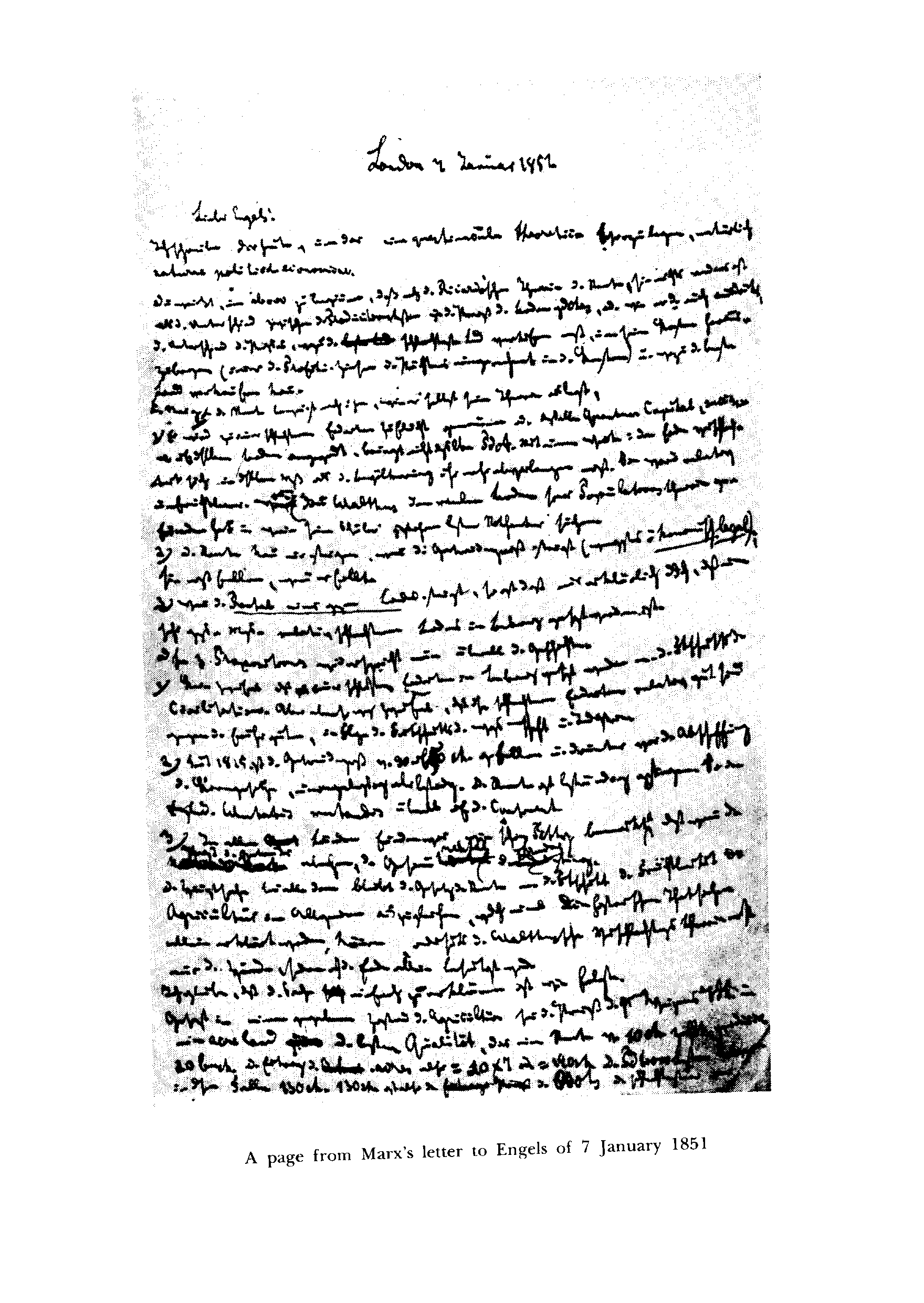
A page from Marx's letter to Engels of 7 January 1851
Laws,[270] even lower. Rent has steadily risen. Thus in England. Mutatis mutandis everywhere on the Continent.
3. In all countries, as Petty has already observed, we find that, when the price of corn fell, the country's overall rental rose.
The main point of all this is to adjust the law of rent to progress in fertility in agriculture generally, this being the only way, firstly, to explain the historical facts and, secondly, to eliminate the Malthusian theory of the deterioration, not only of the 'hands', but also of the soil.
I believe that the matter can be explained simply, as follows: Let us assume that, at a given state of agriculture, the price of wheat is 7 shillings a quarter(1) and one acre of the best quality land, subject to a rent of 10 shillings, produces 20 bushels. The return per acre thus=20x7 or=140 shillings. In this case the production costs amount to 130 shillings. Hence 130 shillings is the price of the product of the poorest land under cultivation.
Let us assume that there is a general improvement in agriculture. If this be presupposed, we at the same time assume that science, industry and population are in a state of growth. A general increase in the fertility of the land resulting from improvements presupposes these conditions, as against the fertility fortuitously induced by a favourable season.
Say the price of wheat falls from 7 to 5 shillings a quarter.[3] The best land, No. 1, which formerly yielded 20 bushels now yields 30 bushels. This now returns, instead of 20x7, or 140 shillings, 30x5, or 150 shillings. I. e. a rent of 20 shillings instead of 10 as formerly. The poorest land, which bears no rent, must produce 26 bushels, for, in accordance with our foregoing assumption, the requisite price of these is 130 shillings and 26x5=130. If the improvement, i. e. the general progress of science, which goes hand in hand with the overall progress of society, growth of population, etc., is not so general as to enable the poorest land that must be brought under cultivation to produce 26 bushels, the price of corn cannot fall to 5 shillings a quarter.[3]
As before, the 20 shillings rent is an expression of the difference between production costs and the price of corn on the best land, or between the production costs on the poorest and those on the best land. Relatively speaking, one piece of land is no less infertile by comparison with the other than before. But fertility in general has improved.
All that is presupposed is that, if the price of corn falls from 7 to 5 shillings, consumption or demand increases correspondingly, or that productivity does not exceed the demand that may be expected when the price is 5 shillings. False though this hypothesis might be if the price had fallen from 7 to 5 as the result of an exceptionally abundant harvest, it is a necessary one where fertility has increased gradually and as a result of measures taken by the producers themselves. In any case, all we are concerned with here is the economic feasibility of this hypothesis.
From this it follows that:
1. Rent may rise although the price of agricultural produce falls, and yet Ricardo's law still holds good.
2. The law of rent, as laid down by Ricardo in its simplest form and leaving aside its exposition, does not presuppose the diminishing fertility of the land, but only — and this despite the general increase in fertility that accompanies the development of society—the varying fertility of fields or the varying results obtained by the capital successively employed on the same land.
3. The more general the improvement in the land, the greater the variety of the fields it will embrace, and the country's overall rental may rise, although there is a general fall in the price of corn. E. g., given the above example, it is simply a question of the number of fields producing over 26 bushels at 5 shillings without actually having to go as high as 30, i.e. of the extent to which the quality of the land varies as between the best and the poorest. This has nothing to do with the RATIO of rent of the best land. In fact it has nothing to do directly with the RATIO of rent at all.
As you know, the real joke where rent is concerned is that it is generated by evening out the price for the resultants of varying production costs, but that this law of market price is nothing other than the law of bourgeois competition. Even after the elimination of bourgeois production, however, there remains the snag that the soil would become relatively more infertile, that, with the same amount of labour, successively less would be achieved, although the best land would no longer, as under bourgeois rule, yield as dear a product as the poorest. The foregoing would do away with this objection.
I should like to have your views on the matter. Having bored you with this muck, I am sending you by way of comic relief the enclosed bundle of letters from Dr Magnus Gross (doubly great Great! Greatest of the Great!) of Cincinnati.[344] You will see that if Monsieur Gross is not grand, he is nevertheless
131. Engels to Marx. 8 January
gros? Tellering II in nuce!c These Coblenzers are all alike!b Send the things back to me with, if you have the time and the inclination, a line or two for Drönke.
Your
K. M.
131
ENGELS T O MARX
IN LONDON
Manchester, 8 January 1851
Dear Marx,
Herewith POST OFFICE ORDER for £1, PARTICULARS as before. My buyerd—our clerk — having apparently paid out a great deal of late, seems anxious not to take too much money from the firm all at once. He is rather reluctant — I don't press him overmuch, cela se conçoit." I myself have been involved in very heavy outlays as a result of my trip to London,[345] otherwise I would gladly send you the whole amount; as it is, I must for today confine myself to fulfilling the obligation of an ordinary CONSIGNEE and send you half the amount in part payment. The second half will follow — at the latest — in the early part of February, perhaps sooner; as soon, that is, as the firm sends my old man a letter containing the payments made to me.
Jones was up here and bearded his opponents at a PUBLIC MEETING in their own den.[346] Leach and Donovan opposed him. The debate, however, wasn't quite what I had expected. Petty stratagems on both sides; much chronique scandaleusef which partly made up for the absence of some of London's amenities. On Jones' part, superiority of rhetorical talent. Leach, on the other hand, tremendously IMPERTURBABLE but at times abysmally absurd. Donovan, a common, intriguing, local panjandrum. Jones, by the way, because of the Neue Rheinische Zeitung* and my presence, was compelled to proclaim himself a RED REPUBLICAN and supporter of the NATIONALISATION OF LANDED PROPERTY, while Leach, on the other hand, took his stand as the wholehearted representative of the co OPERATIVE SOCIETIES, insofar as they reject political agitation. These societies, incidentally, would now seem to be very numerous in Lancashire, and Jones and his friends are afraid that, if some sort of alliance were formed between them and the Chartists, they would gain control of the CHARTIST MOVEMENT. This circumstance explains many of the concessions Harney thought fit to make them.
The success of Jones' performance here was all that could be expected; he put forward as the point to be decided between himself and the Manchester CHARTIST COUNCIL the question of recognising the Executive in London; the votes were evenly divided, although Leach and Co. had had about 3 hours in which to fetch their people to the meeting and a crowd of them had duly turned up. At the beginning, when the company was simply a random gathering (Leach had counted on Jones' not arriving before 9 o'clock but, much to the former's chagrin, he was there as early as 8), Jones was given an enthusiastic reception.
When in the company of Chartists whom he wishes to win over or attach more closely to his person, Jones is by no means as naive as he is with us. HE IS VERY WIDE AWAKE. Perhaps a little too much so — at least, the likes of us 'notice the design'.b
One of Harney's friends here is a boring Scotsman of infinite sensibilities and hence interminable speeches; a second is a small, resolute, aggressive lad, about whose intellectual capacity I have not yet made up my mind; a third, a man whom Harney did not mention to me, one Robertson, seems to me to be far and away the most intelligent. I shall try to start up a small club with these fellows, or organise regular meetings to discuss the Manifestoc with them. Harney and Jones have a host of friends here, and O'Connor a host of hidden enemies but, until he makes a downright fool of himself in public, it won't be possible to bring about his — official — downfall here. At the meeting, by the way,
132. Marx to Engels. 22 January
Jones referred to him and Reynolds with the scantest possible respect.
Recently my brother-in-law" told me some good news concerning myself: my prospective American partner was in London and from a conversation between the two of them it transpired that I was not the man to be of use to his firm. Thus America is put off pretty well indefinitely, since no fresh plan can now be hatched without my consent.
Best regards to your wife and children.
Your
F. E.
132
MARX TO ENGELS
IN MANCHESTER
[London,] 22 January 1851
Dear Engels,
You are taciturne comme la mort!' Enclosed I send you 1) a statement by Oswald Dietz in the Basle National-Zeitung against Pfänder and Bauer,b 2) a tattling article against us concocted by Mr A. Ruge in company with Struve and Willich.d You must return the garbage to me within two days at the latest, telling me what action you think we should take against No. 2. If you would like to draft some sort of statement, send it along as well.
C. Schramm is going to issue his own statement. What do you think of this coup de maître' by Atta Troll* and, entrenched behind him, that 'outstanding, resolute man, Struve',
133. Engels to Marx. 25 January
not to speak of the 'valiant Willich'. C'est un peu fort." I happened to light upon the paper at Bamberger's. Who else would either read or know of the Bremer Tages-Chronik. Organ der Demokratie?
Bauer and Pfänder naturally won't answer and silence would, indeed, seem to be the most advisable course for them just now.
I have as yet had no news, either from Schabelitz, who wished to take over our Revueh or from Becker, who was going to see to the publication of my essays.[347] None of my approaches to Mr Schuberth have so far been of any avail. If Haupt can find a lawyer who will take over the case, he will bring an action against him.[348]
What are Mary and Lizzyc doing? And above all you yourself? Harney was here one evening with Pieper, Eccarius, etc., and very gay, until his 'dear spouse'd—'half drew she him, half sank he in'e—carried him off almost by force.
Your
K. M.
133
ENGELS TO MARX
IN LONDON
[Manchester,] Saturday [25 January 1851]
Dear Marx,
Je te trouve joli en me disant que je suis taciturne comme la mort! However, I'll refrain from making any further riposte.
The perfidy of that Pomeranian blackguard, Ruge, is crude beyond all measure.g It would be the simplest if you were to draft a statement to be signed by us both.a A few personal remarks could, if necessary, be appended in the form of notes and signed separately by each of us. I don't know whether I should add something on my own account, if only to say that, in my commercial employment, I have maintained complete independence and hence do not have to let myself be ordered by my 'principals', as Mr Ruge was by his superior Mazzini, despite all his earlier atheistic boasting,[349] to append my signature to moving appeals to the bon dieub; and that I have adopted this LINE SO as not to fall into the necessity, congenial enough to other worthy gents held up to us as an example by Mr Ruge, namely, of living on democratic charity — or some such. Tell me if you think this is necessary.
The article, by the way, with its moral indignation and its monumental lies, provides splendid stuff for ridicule. It immediately puts one on the track of Ruge's intrigues. It's very natural that Mr Ruge and Mazzini's European Committee should be as incense in the nostrils of the worthy Reverend Dulon, and that Mazzini's sublime manifestos should find their only fertile soil in Germany among those wailing North German, Lower-Saxon democrats swimming in Bremen-concocted, belletristic, drivel-sauce. These gentlemen's Friendship of Light[350] was bound to find desirable allies in Ronge-Mazzini and in the now once more god-fearing Ruge, while the honour of officially corresponding as the 'German Committee' with the greatest men of respectable European democracy must inevitably have made that malleable parson Dulon receptive to the worst scurrilities levelled against the 'frivolous' and godless folk of the Neue Rheinische Zeitung. Ruge, too, has only plucked up courage since coming to believe that the Revue is dead. But I think he is mistaken and will shortly bring down a pretty thunderstorm upon his ludicrous cranium.
Would it not be a good idea — since we cannot possibly raise a real shindy about this article or reply to it anywhere save in the Tages-Chronikc—to have the aforesaid Dulon secretly worked upon by his friend, red Beckerd? After these scurrilities we can't even be sure that our reply will be accepted.
But it is clear as day that it was only Schramm's' fatuous manner and the ill-considered prating which, to judge by this article, he indulged in at his brother's,' that inspired these
134. Marx to Engels. 27 January
jackasses with sufficient courage to vent themselves so vulgarly against us, the 'isolated and forsaken by all'. The fellow will now himself realise how base are the machinations whose tool he has become, and he must also realise that his stupidity harms himself more than others. The great Ruge doesn't even pay him the half-hearted court he pays to Tellering. 'C. Schramm, not to be confused!'[3] What's the fellow up to now? Cette affaire est de peu d'importance.b Trumped-up and misconstrued tittle-tattle, clumsy and incomprehensible insinuations and moral bombast—nous avons soutenu, Dieu merci, de bien autres charges !c The only unpleasantness is that the thing will upset your wife so much, which, as things are now, is undesirable.[351]
Next week in The Friend of the People I shall duly take the European Committee to task and have already notified Harney.[352]
I must stop now, as the office is just closing and it's nearly time for the post. More anon.
Your
F. E.
134
MARX TO ENGELS
IN MANCHESTER
[London,] 27 January 1851
Dear Engels,
Enclosed you will find the statement for signature.d There can be no question of sending it to Dulon, for Ruge has made himself co-proprietor of the Bremer Chronik.e It must be sent to the conservative paper, the Weser-Zeitung in Bremen.[353] Write to its editors when you send the statement; tell them to send us two copies to London, to my address, 28 Dean Street, at the same time informing us what the announcement will cost and how it is to be paid for. Don't forget, however, to prepay the letter.
Now, as it's nearly time for the post, no more than the following:
1. Did you forward to Weerth the letter[354] which my wife sent with a few lines for youa?
2. Did you get my letter in which I sent you Dr Magnus Gross' scrawl, etc., and to which I wanted to know your answerb? If you haven't received it, I beg you to complain to the Post Office at once. I sent you this letter the day after I had received yours—about a fortnight ago, that is.
Write soon and tell me whether you approve of the statement.
Your
K. M.
I think it would be superfluous to add any special notes to the statement.
P.S. You mustn't forget, either, to tell the Bremen editors, i.e. the editors of the Weser-Zeitung, to make sure they observe the right sequence, putting Schramm'sc statement after, and not before purs. Apropos! If you have really not received the 2 letters, write to me in English, after you yourself have made inquiries in Manchester, telling me how I should write to the Post-Master General. In my letter of a fortnight ago I apprised you of a new viewpoint about land rent d on which I must have your opinion.
Your
K. M.
[From Wilhelm Pieper]
Dear Engels, I must inform you in haste that Marx is highly indignant at your complete silence on the subject of his new theory of land rent about which he recently wrote to you. Marx leads a very retired life, his only friends being John
135. Engels to Marx. 29 January
Stuart Mill and Loyd, and whenever one goes to see him one is welcomed with economic categories in lieu of greetings.
On ne peut pas vivre qu'avec toi, après tout,a and if one wishes to live uneconomically, as I love doing, I have to indulge my extravagance quietly, there being no longer anyone here for me to consort with. In between times I try to do some copying, and even sometimes do exercises in composition on my own account, but I still very much doubt whether I shall achieve anything worthwhile. I am glad to hear that you are in good spirits and shall before long find the time to write you something rather more coherent.
Cordial greetings,
W. Pieper
135
ENGELS TO MARX[220]
IN LONDON
[Manchester,] Wednesday evening, 29 January [1851]
Dear Marx,
Your silence and your astonishment at my silence became suddenly explicable to me when today my old witch of a landlady, AFTER SOME SHARP CROSS-EXAMINATION hunted out your letter of 7 inst. from among a pile of books in my room where it had been peacefully slumbering since 8 January.b I happened to be out that evening, and this person had simply placed the letter on top of the books; later, when tidying up, she had in her haste put another book on top of it, and as that pile of books has remained un-touched all this while, the letter might, without your reminder, have gone on slumbering there till Doomsday. Had I been studying Russian this month instead of physiology, this wouldn't have happened.
Anyhow, your new thing about land rent is absolutely right. The increasing infertility of the land concomitant with an ever-increasing population in Ricardo has always seemed to me implausible, nor have I ever been able to discover any evidence in support of his ever-rising price of corn, but with my notorious sloth en fait de théorie,a I have silenced the inward grumbling of my better self and have never gone to the root of the matter. There can be no doubt that you have hit on the right solution, thereby entitling yourself afresh to the title of economist of land rent. If there were still right and justice on this earth, all land rents for at least a year would now be yours, and that would be the least which you could claim.
I have never really been able to accept Ricardo's simple proposition in which he represents land rent as the difference in the productivity of various types of land and, seeking to prove this proposition, 1) acknowledges no other factor than the bringing under cultivation of ever poorer types of soil, 2) completely ignores advances in agriculture and 3) finally abandons almost entirely the bringing under cultivation of poorer types of soil, and instead continually proceeds from the assumption that capital, employed successively on a particular field, contributes less and less to the increase in the yield. Convincing as was the proposition to be proved, the factors adduced in proof of that same proposition were wholly alien to it. You will remember that, in the Deutsch-Französische Jahrbücher, I already invoked the progress made by scientific agriculture as against the theory of increasing infertilityb—of course very CRUDE and not at all closely argued. You have now cleared up the matter, which is yet another reason why you must make haste to finish the Economy and get it published. If we could somehow get an article of yours on land rent into an English periodical, it would create a tremendous stir. Think it over. Je me charge de la traduction?
Enclosed I return Mr Great-Gross.d In my next I shall include a line or two for the delectable Dronke, but tonight I'm too sleepy to do any more work. A fine band of scallywags, Gross, Wilhelmi, and the progressive pamphleteer from Cincinnatie! The fellows must really imagine that we're on our physical, moral and intellectual beam ends to ask such things of us.[344] C'est amusant, cependant! and I laughed heartily at these backwoods saviours of society and their proposals, including fee for Dronke. Dr Siegfried Weiss' 'sharp and spicy'[355] is OUTDONE by the 'red, piquant, sarcastic and versatile' of the 'Adonis of a long-forgotten Beauty'. Que Dieu le bénisse!"
Tomorrow the statements will go off to Bremen together with the necessary instructions.b" Mr Schrammc might really have rewritten his; it's so wretchedly scrawled that it will probably give rise to misunderstanding.
The O'Connor conference here has turned out to be sheer humbug.[356] Ostensibly representing the whole of English Chartism, it consists of 8 men who represent 4 towns: Manchester, Bradford, Warrington and Sowerby. Of these, Warrington and Bradford belong to the opposition and see eye to eye with the Executive. Mantle, the Warrington representative, who doesn't give a fig for the majority, opened the PROCEEDINGS with the motion that the conference, SEEING THEIR UTTER INSIGNIFICANCE AND CONTEMPTIBILITY, should resolve to go home forthwith, and tomorrow he will extort from them a vote of confidence for the Executive, i.e. for Harney and Jones, from which O'Connor will be unable to abstain. On the question of union with the FINANCIAL REFORMERS [284] 3 voted for and 2 against, 3 abstaining, among them O'Connor, whom Mantle had unfortunately intimidated by his insolent conduct; otherwise the fellow would have voted in favour, thereby making a colossal and irretrievable fool of himself. At the conference O'Connor, Leach, McGrath, Clark and a certain Hurst formed the majority. At a dinner given for O'Connor on Monday, Mr Thomas Clark proposed the following toast: THE QUEEN: HER RIGHTS AND NO MORE; THE PEOPLE: THEIR RIGHTS AND NO LESS. Here again Mantle, a fiery, undiplomatic hot-head, stopped O'Connor from getting up and drinking the toast.
The letter to Weerthd has gone off and should be in his hands within a few days, provided he isn't buried in the heart of Morocco.
No more for today.
Your
F. E.
136. Marx to Hermann Becker. About 1 February[357]
...You would very greatly oblige me by sending me Willich's letters.[3] Partly because we here by the rivers of Babylonb should also be vouchsafed a share of your Homeric laughter. And on the other hand because the man is exploiting the 'alleged' connection in order to brag in front of foreigners and, at the same time, make denunciations. Finally I feel it necessary that you should convey a note to him, either through me or direct, in which you most politely decline further correspondence on the grounds that, while humour may not greatly endanger him in London, for you in Cologne — and not for you alone but, by way of repercussion, for our party comrades in Germany — its effects may be dire. And what could be more ominous and at the same time more absurd than to be nailed to the cross as a result of a trick played through some mere whim of the 'carpenter's'[358]...
137. Marx to Engels. 3 February
Dear Engels,
Is it on Maryc you're studying physiology, or elsewhere? If the first, I can understand that this n'est pas de l'hébreux? nor even Russian.
U p till now all that my new theory of rent has yielded is the commendable state of mind to which every worthy man necessarily aspires. However, I am at least satisfied that you should be satisfied with it. An inverse relationship of the fertility of the soil to human fertility must needs deeply affect a strong-loined paterfamilias like myself, the more so since mon manage est plus productif que mon industrie:[1]
I shall now submit to you just one illustration of the CURRENCY theory, my study of which might be described by Hegelians as a study of 'otherness', of the 'alien', in short of the 'holy'.
T h e theory of Mr Loyd and tutti frutti,b from Ricardo onwards, consists in the following:
Let us assume that we have a purely metallic CURRENCY. If there were too much of it here, prices would rise and hence the export of commodities decrease. Their import from abroad into this country would increase. Thus IMPORTS would rise above EXPORTS. Hence an unfavourable balance of trade. An unfavourable rate of exchange. Hard cash would be exported, the CURRENCY would shrink, the prices of commodities would fall, IMPORTS decrease, EXPORTS increase, money flow back again; in short, the SITUATION would attain its former equilibrium.
In the converse case likewise, mutatis mutandis. T h e moral of this: since paper money must imitate the movement of METALLIC CURRENCY, and since artificial regulation must here take the place of what, in the other case, is natural law, the Bank of England must increase its paper issues if BULLION flows in (e.g. by the purchase of GOVERNMENT SECURITIES. EXCHEQUER BILLS, etc.) and reduce it by the reduction of discounts, or by the sale of government paper, if BULLION decreases. However I contend that the Bank should take the opposite course and increase its discounts if BULLION decreases and let them take their normal course if it increases. Upon pain of unnecessarily intensifying the impending commercial crisis. However, more of that une autre fois.c
What I wish to elucidate here goes to the basic principles of the matter. For my contention is that, even with a purely metallic CURRENCY, the quantity thereof, its expansion or contraction, has nothing to do with the outflow and inflow of precious metals, with the favourable or unfavourable balance of trade, with the favourable or unfavourable rate of exchange, except in the most extreme cases, which practically never occur but are theoretically determinable. The same contention is made by Tooke, but I have found no proof of it in his History of Prices for 1843-47.
As you can see, it's an important matter. Firstly, the whole theory of circulation is denied in its very fundamentals. Secondly, it is shown that the progress of crises, even though the credit system be a condition of the same, is concerned with CURRENCY only in so far as crackbrained meddling by the authorities in its regulation may aggravate an existing crisis, as in 1847.
Note that in the following illustration it is assumed: The inflow of BULLION goes hand in hand with flourishing trade, prices not yet high but rising, a surplus of capital, excess of EXPORTS over IMPORTS. The outflow of gold vice versa, mutatis mutandis. Now this is the assumption of those against whom the polemic is directed. They cannot gainsay it. In reality there may be 1,001 cases in which there is an outflow of gold, although the prices of other commodities in the country exporting it are far lower than in those to which the gold is being sent, e.g. as in England in 1809-11 and 1812, etc., etc. Yet the general assumption is, firstly, right in
abstracto and, secondly, accepted by the CURRENCY chaps.[359] Hence not to be debated here for the time being.
Let us assume, then, that a purely metallic CURRENCY is in circulation in England. But that does not presuppose that the credit system has ceased. Rather, the Bank of England would turn itself into both a deposit and lending bank. Save that its' loans would consist simply in cash. If this assumption were to be rejected, what appears here as a DEPOSIT of the Bank of England would appear as HOARDS of private individuals and the loans of the Bank as loans of private individuals. Thus, in this context, the term Bank of England DEPOSITS is simply an abbreviation, to present the process, not in fragmented form, but concentrated in a FOCUS.
Case I. Influx of BULLION. Here the matter is very simple. A great deal of idle capital, hence increase in deposits. In order to make use of them the Bank would lower its rate of interest. Hence, expansion of business in the country. The circulation would only rise if business increased to the extent that additional CURRENCY was required to conduct it. Otherwise the surplus CURRENCY issued would flow back into the Bank as DEPOSITS,, etc., as a result of maturing bills, etc. Thus CURRENCY does not act here as a cause. Its increase is ultimately the consequence of a greater amount of capital put to use, not vice versa. (Hence, in the case under discussion, the first 3 1851
consequence would be growth of DEPOSITS, i.e. of idle capital, not of circulation.)
Case II. This is where the matter really begins. EXPORT of BULLION is assumed. Beginning of a period of PRESSURE. Unfavourable rate of exchange. At the same time a poor harvest, etc. (or else dearer raw materials for industry) necessitate ever larger imports of commodities. Suppose that the accounts of the Bank of England at the beginning of such a period appear as follows:
a) CAPITAL £14,500,000 GOVERNMENT SECURITIES £10,000,000 REST £ 3,500,000 BILLS or EXCHANGE £12,000,000 DEPOSITS £12,000,000 BULLION OR COIN £ 8,000,000
£30,000,000 £30,000,000
T h e Bank is in debt, since it has been assumed that n o notes exist, only the 12 millions of DEPOSITS. According to its principle (in common with the DEPOSIT and circulation banks, only a third of its LIABILITIES have to be IN CASH), its 8 millions of BULLION is too large by half. T o make more profit it lowers the interest rate and raises its DISCOUNTS, e.g. by 4 millions, which are exported for corn, etc. The Bank's accounts then appear as follows:
b) CAPITAL £14,500,000 GOVERNMENT SECURITIES £10,000,000 REST £ 3,500,000 BILLS OF EXCHANGE £16,000,000 DEPOSITS £12,000,000 BULLION OR COIN £ 4,000,000
£30,000,000 £30,000,000
From these FIGURES it follows that: Merchants, as soon as they have to export gold, act first upon the Bank's BULLION RESERVE. T h e gold thus exported diminishes its (the Bank's) reserve without having the slightest effect on the CURRENCY. Whether the 4 millions are in its cellars or aboard a ship bound for Hamburg is all the same so far as the CURRENCY is concerned. It finally becomes evident that a significant DRAIN of BULLION, in this case £4 millions sterling, can take place without in any way affecting either the CURRENCY or the business of the country in general. Throughout the whole period, that is, during which the BULLION RESERVE, which was too large in relation to LIABILITIES, is being reduced to n o more than its DUE PROPORTION to the same.
c) But let us suppose that the circumstances which necessitated the DRAIN of 4 millions continue, shortage of corn, rise in the price of raw cotton, etc. The Bank grows concerned about its security. It 3 1851
raises the interest rate and limits its DISCOUNTS. Hence, PRESSURE in the world of commerce. What effect does this PRESSURE have? Withdraw-als are made from the Bank's DEPOSITS, its BULLION falls proportion-ately. Should the DEPOSITS fall to 9 millions, i.e. be reduced by 3 millions, those 3 millions must come from the Bank's BULLION reserve. This would therefore fall (4 millions — 3 millions) to 1 million against DEPOSITS of 9 millions, a proportion which would be dangerous to the Bank, If, then, the Bank wishes to maintain its BULLION RESERVE at one third of the DEPOSITS, it will diminish its DISCOUNTS by 2 millions.
The accounts would then appear as follows:
CAPITAL £14,500,000 GOVERNMENT SECURITIES .... £10,000,000 REST £ 3,500,000 BILLS UNDER DISCOUNT £14,000,000 DEPOSITS £ 9,000,000 BULLION OR COIN £ 3,000,000
£27,000,000 £27,000,000
It follows that, as soon as the DRAIN becomes so great that the BULLION RESERVE reaches its DUE PROPORTION in relation to DEPOSITS, the Bank will raise the interest rate and reduce the DISCOUNTS. But then the DEPOSITS begin to be affected and, as a result of their decrease, the BULLION RESERVE decreases but so, to an even greater extent, does the DISCOUNT of BILLS. T h e CURRENCY is not in the least affected. A portion of the BULLION and DEPOSITS withdrawn fills the vacuum which the contraction of the Bank's accommodation creates in the circulation at home, while another portion finds its way abroad.
d) Supposing that imports of corn, etc., continue and the DEPOSITS sink to 4,500,000, the Bank, in order to maintain the necessary reserve against its LIABILITIES, would reduce its DISCOUNTS by a further 3 millions, and the accounts would appear as follows:
CAPITAL £14,500,000 GOVERNMENT SECURITIES .... £10,000,000 REST £ 3,500,000 BILLS UNDER DISCOUNT £11,000,000 DEPOSITS £ 4,500,000 BULLIONORCOIN £ 1,500,000
£22,500,000 £22,500,000
O n this assumption the Bank would have reduced its DISCOUNTS from 16 to 11 millions, that is, by 5 millions. T h e necessary requirements of the circulation replaced by the DEPOSITS withdrawn. But simultaneously shortage of capital, rise in the price of raw materials, decrease of demand, hence of business activity, hence
138. Engels to Marx. 5 February
ultimately of the circulation, of the necessary CURRENCY. T h e surplus portion of the same would be sent abroad in the form of BULLION to pay for imports. T h e CURRENCY is the last to be affected, and it would only be reduced to less than the necessary quantity should the BULLION RESERVE fall below the minimal proportion to DEPOSITS. With regard to the above, it should also be noted that:
1. Instead of reducing its DISCOUNTS, the Bank could dispose of its PUBLIC SECURITIES, which, on this assumption, would be unprofitable. However same, result. Instead of reducing its own RESERVE and DISCOUNTS, it would reduce those of private persons who put their money in PUBLIC SECURITIES.
2. I have assumed here a DRAIN of 6,500,000 on the Bank. In 1839 there was one of 9-10 millions.
3. The process assumed in the case of a purely METALLIC CURRENCY can lead, as with paper, to a closure of the till, as happened twice in Hamburg in the eighteenth century.
Write soon.
Your
K. M.
138
ENGELS T O MARX [2 2 0]
IN LONDON
Manchester, 5 February 1851
Dear Marx,
Herewith the remaining £ 1 for the atlas,[3] which I was unfortunately not able to send you sooner.
Tell Harney when you see him that by the end of this week he will receive at the very least the 1st half of a series of articles on
-the articles so arranged that each one of
a Historischer und geographischer Atlas von Europa (see this volume, pp. 263, 301).
them will not fill more than 2-2 V2 columns in his Friend of the People. I shall use the above as a pretext for crying down the whole democratic establishment and rendering it suspect to the English proletariat by putting it — Mazzini, Ledru-Rollin, etc. included— on the same footing as the FINANCIAL REFORMERS.[284] The European Committee WILL CATCH IT NICELY. These gentry will be dealt with one by one, Mazzini's writings, Ledru-Rollin's splendid acts of heroism in February-June 1848 — not, of course, forgetting Mr Ruge. I shall make it quite plain to the Italians, Poles and Hungarians that they are to keep their traps shut on all current issues. This business of the hoax Harney is perpetrating with Mazzini & Co.'s begging letters is really going too far and, since there's no other way of reforming him, I shall be obliged to expose in his own journal the fatuity and baseness of these fellows and to unveil the mysteries of continental democracy for the benefit of the English Chartists. A detailed polemical article is always more salutary in Harney's case than any amount of debate. Unfortunately I have damned little material here.
What I have at the moment is Sarrans jeune,[3] Lafayette et la révolution de Juillet. If I could find a few more sources, I could do an article for our Revue on the July Revolution and subsequent events up till the February Revolution, at the same time subjecting the Histoire de dix ansa to a friendly criticism. These TO ans' have remained largely unchallenged by advanced opinion and, in Germany as in France, constitute a very important formative element in the revolutionary party as a whole. It would do no harm, I think, to reduce the influence of this book to the appropriate limits; hitherto it has been an uncontested authority.
Mr Russell, the craven cur, has made a splendid fool of himself yet again. First he breathes fire and brimstone against PAPAL AGGRESSION,[560] then, realising that the MANCHESTER MEN have absolutely no intention of getting embroiled in the mummery, he is brought to bed of an heroic measure, namely wanting to ban the use of English titles by Catholic bishops. And then the nice hint, dropped at his behest by Mr Peto, that it would indeed have been desirable to extend the franchise during the present session, but since LAW-REFORM came next on the agenda, the franchise would have to be postponed till next year! A prime example of Whig logic. The MPs, by the way, are very captious and unsure of themselves, with
•' the Younger - b L. Blanc, Histoire de dix ans. 1830-1840.
elections in the offing; they have to make liberal or protectionist FLOURISHES and, but for the fact that the EXHIBITIONa happens to coincide with the most lively period of the session's grande politique,b things might go ill with the little manikin/ And even so, qui sait.d
In general the daily political bread is growing ever drier. The happy situation in which la belle France now delights is, indeed, edifying. For there is no denying that Messieurs the Burgraves3S1 are becoming less and less representative of the bourgeois fraction or rather, that the bourgeoisie is moving further and further away from its erstwhile Legitimist and Orleanist leaders. First, the important minority in favour of Baroche at the session in which he was unseated by the coalition, a minority which also consisted of a great many non-Bonapartists, former Orleanists, etc., etc.; next the unmistakable' mood of the conservative bourgeoisie en masse, which is far more favourable to Napoleon than hitherto. The mass of these fellows are now resolutely opposed to Orleanist no less than to Legitimist plots for a restoration; les solutions les embêtent? and what they want is the daily round of the presidential present. The fellows are neither royalist, nor republican, nor imperialist, but presidential; but the best thing about it is that such delicious indecision is possible only in the mass, and that anyone who wished to make his mark as official representative of this tendency would, within six months, find himself compelled to abandon his neutrality in favour of a definite royalist or imperialist fraction. By the way, the only French papers I have here are the Débats and the Charivari which, sad to say, grâce à l'esprit exquis du peuple dans ces parages,[361] is coming to seem almost witty again.
From a stupid Hungarian refugee whom I recently happened upon, I heard that this noble breed are once again jabbering about murder plots and riots on the occasion of the GREAT EXHIBITION. Amidst the din I seemed almost to detect the heroic voices of those London hotspurs, Willich and Barthélémy. There's really no getting away from the creatures; recently a fellow accosted me in the street and lo, it was a Great Windmill Street refugee[331] now employed in Liverpool. 'If I take the wings of the morning, and dwell in the uttermost parts of the sea',g I shall not escape that band.
The FREE TRADERS here are exploiting the prosperity or semi-prosperity to buy the proletariat, with John Watts for broker. You will be familiar with Cobden's new plan: a NATIONAL FREE SCHOOL ASSOCIATION for the purpose of putting through a BILL by which the TOWNSHIPS would be authorised to impose local taxes for the building of schools. The thing is being splendidly promoted. In addition, Salford already has a FREE LIBRARY and museum — lending library and reading room gratis. In Manchester the Hall of Science was purchased — and here, as the Lord Mayor of Manchester most graciously acknowledged, Watts really was the broker — by a committee out of the proceeds of public collections (some £7,000 in all) and is to be turned into a FREE LIBRARY. The thing is to be opened at the end of July — with 14,000 volumes TO BEGIN WITH. All the meetings and assemblies held for this purpose resound with praise for the workers, and in particular for the good, modest, helpful Watts who is now on the best of terms with the Bishop of Manchester. I am already looking forward to the indignant uproar over the workers' ingratitude which will break out on all sides when the first SHOCK makes itself felt.
Not long ago my worthy pater wrote me a pleasant letter expressing the wish that I remain here indefinitely, that is, for as long as the trouble with the Ermens lasts (and that might mean until 1854). Very agreeable to me, of course, s'il me paie bien mon
ennui." Of this, naturally, I give no hint, but 'sacrifice' myself for the 'firm' and express my readiness 'to remain here for the time being and see how circumstances develop'. He's coming over next summer, and I shall then try to make myself so indispensable to him that he will have to agree to anything.
Kind regards to your wife and children.
Your
F. E.
PARTICULARS on the POST OFFICE ORDER as before.
139. Marx to Hermann Becker. 8 February[357]
...apropos! Willich and Schapper in company with Barthélémy, etc., have, by monstrous bragging about their influence in Germany and by monstrous calumnies against ourselves, at long last succeeded in bamboozling Louis Blanc to such an extent that he has combined with this 'scum' to arrange a banquet for February and, in concert with same, has issued a programme of festivities along with a kind of manifesto. The little man walked into the trap out of vanity, so as to show Ledru-Rollin that he, too, could wag a German-French-Polish-Hungarian tail. Now the business is en pleine déroute'a again and the little man suspects that he has compromised himself for nothing and has committed a fruitless piece of perfidy against ourselves who, since 1843, have maintained a kind of lukewarm alliance with him.
But do you know what Willich impresses strangersb by most? His tremendous influence in Cologne. Hence it is all the more necessary for you to send me the letters/ so that a dyke can be thrown up against the 'carpenter's'[358] machinations. Adieu....
140. Marx to Engels. 10 February
140
MARX TO ENGELS
IN MANCHESTER
[London,] 10 February 1851 28 Dean Street, Soho
Dear Engels,
When you wrote saying that it would soon be time to attack Louis Blanc, you were a clairvoyant, to say the least.
Now hearken to the following story: A few days or perhaps a week ago, I ran into Landolphe and, from the embarrassed way in which he greeted me and my wife, noted that there was something 'rotten' in the statea of our ami
chevaleresque? our Bayard of the Montagne.[260] Eh bien!b Landolphe and Louis Blanc have joined up with the Willich-Schapper committee, from which Mr Adam has resigned! And only a fortnight previously Landolphe had been raving and ranting about Barthélémy and I had been telling him about the affair of Messrs Willich and Schapper. Qu'en dis-tu?c Not a word from these worthies to apprise me of it.
The nub of the matter is as follows: On 24 February Church Streetd are holding a banquet to which they have invited Blanc and Ledru-Rollin and, among others, Landolphe. Louis Blanc, anxious to show Ledru-Rollin that he too has a cosmopolitan committee behind him, and to punish Church Street for treating him and Ledru as 'of equal importance', rallied his army from Great Windmill Street[331] and from the pub where the feckless Poles foregather.
Encore un coup! Qu'en dis-tu?e
A few days ago Church Street received a printed circular (combining a manifesto) with an invitation to a monster banquet on 24 February, and signed primof Landolphe and, immediately after, Schapper, L. Blanc. Intense indignation in Church Street! Intense delight in Great Windmill Street]
In the circular-manifesto Louis Blanc does not speak in the name of a nation, but in the name and on behalf of the eternal formula: liberté, égalité, fraternité! The only fly in the ointment so far as I'm concerned is that I still owe Landolphe £1.10s. which ought now to be sent him forthwith through Wolff.a
You can easily imagine how greatly Willich and Schapper have grown in their own esteem and how they fancy us beaten!
But we'll beat them in a different sense. We are well on the way to driving Corporal and Carpenter Willich[358] mad, literaliterh
mad.
You will recall the letter written to Willich by Schramm on Becker's behalf/ in which he offered him military dictatorship, abolished the press, and cast mild aspersions on Schapper's moral character.
Eh bien! Willich, the uneducated, four times cuckolded jackass, fell into the trap. He has been bombarding Becker with letters, already has an envoy awaiting dispatch, treats Schapper de haut en
bas,d ignores, insults and intrigues against that worthy man in every possible manner, has already adopted the overbearing manner of a Cromwell II, has grown irascible, no longer tolerates contradiction, and has entrusted Becker with the task of starting a revolution in Cologne, after which he declares himself ready to assume the supreme leadership.
A short time ago, while in company, he suddenly jumped up shouting that his letters from Paris and Cologne had not yet arrived — it was on the occasion of the last French ministerial crisis — complained that his (stupid head) was in a whirl, whirl, whirl, dashed off to Bond Street and had a bucket of water poured over it. I now have a showerbath prepared for him which should have quite the opposite effect. In a few days' time Becker is going to let me have Willich's letters and then I shall spring the mine.
A fresh swarm of democratic scallywags here, Frenchmen driven out of Brussels, Heise from Cassel, Oppenheim from Brussels, Günther from Frankfurt, etc. Fortunately, however, I have seen none of the latter.
You did receive my last letter, didn't you?
Your
K. M.
141. Marx to Engels. 11 February
141
MARX TO ENGELS[43]
IN MANCHESTER
[London,] 11 February 1851
Dear Engels, Iterum Crispinus!a
I have just learned that there was a meeting earlier this evening in the Tottenham Court Road in honour of the late Bern. On the platform were: Chairman Schapper, etc., Louis Blanc and the remaining members of the new League of Peoples Committee. In one of the front rows of the auditorium sat Harney and wife. The bulk of those present were from Great Windmill Street.[331]
Applause greeted Schapper's inevitable speech, WAR TO THE KNIFE-, delivered in English. Louis Blanc spoke no better. Vive la guerre!b
Tausenau, also present, spoke about Bern. Harney delivered a long and, they say, good harangue in which he finally hailed Blanqui, Barbes and, last of all, Louis Blanc, as the socialist Messiah.
Qu'en dis-tu?c
Suppose you attended a meeting presided over by Th. Clark Esq., and it was your presence and your speeches alone that lent any real weight to the meeting, would friend Harney regard that as loyal?
Not content, then, with boosting Ruge in his Friend of the People, he must needs indirectly boost Schapper-Willich as well.
Last Sunday he sent for me. The purpose being to persuade Jones to accept the title, 'Friend of the People'. I didn't go. If that's what he wants, let him turn to L. Blanc, Landolphe, Schapper or Willich. I am fatiguéd of this public incense so tirelessly used by Harney to fill the nostrils of les petits grands
hommes."
Apart from this accident, namely, that you, too, Brutus (Harney), if you don't take sides against us at least play the neutral, while Engels does his best for you in Manchester, Eccariuse writes for your paper[363] and I occasionally work on
142. Engels to Marx. 12 February
Jones for you — apart from that, I am greatly pleased by the public, authentic isolation in which we two, you and I, now find ourselves. It is wholly in accord with our attitude and our principles. The system of mutual concessions, half-measures tolerated for decency's sake, and the obligation to bear one's share of public ridicule in the party along with all these jackasses, all this is now over.
Now, I'd appreciate an early answer to this note, too. I hardly see anyone here save Pieper and live in complete retirement. So you'll realise that I miss you all the more and feel the need to talk things over with you.
You'll see from tomorrow's newspapers that the grant was rejected by a majority of 102 votes.[364]
Your
K. M.
142
ENGELS TO MARX
IN LONDON
[Manchester,] Wednesday [12 February 1851]
Dear Marx,
I have just found your letter at home and am at once writing by today's post to tell you that by the end of this or the beginning of next week at the latest, I shall somehow arrange to send you the £ 1.10s. for Landolphe so that this business, which must be protracted no longer, is settled once and for all.a Notre amib
Landolphe has once again shown what an old woman he is, while the fatuous vanity of the hyperclever L. Blanc is taking such a turn as to brand the sublime dwarf a fool pure and simple. C'est bien." One conies to realise more and more that emigration is an institution which inevitably turns a man into a fool, an ass and a base rascal unless he withdraws wholly therefrom, and unless he is content to be an independent writer who doesn't give a tinker's curse for the so-called revolutionary party. It is a real SCHOOL OF SCANDAL AND MEANNESS in which the hindmost donkey becomes the foremost saviour of his country. At any rate the little popularity-monger will atone for it once we have a press organ again. As you know, I have none of my papers with me here, so I'd like you to suggest a few more sources on French affairs between 1830 and 1848 which you may happen to know about, and I shall endeavour to shovel coals of fire, at least in a literary sense, under the worthy pretender's backside. At all events, in my articles in The Friend of the People, I shall call on him to publish — provided you have no objection, since it was you to whom he told the story — the information given him by Mr Mazzini concerning the character of the European Central Committee and its attitude towards socialists and communists, and shall make such allusions as are necessary for this to be understood.[352] Pourquoi nous gênerions-
nous?h
Today Harney will be getting 3 articles by way of introduction, pretty lengthy, a gentle hint dropped here and there. The awkward part of it is that it's difficult to attack Ledru & Co., without at least partially identifying oneself with the Willich-Barthélemy clique in the eyes of the English proletariat and Harney's readers. Ultimately the only way out will be to devote a few special articles to that clique. Not, however, in the first 3 articles, which have been written for Harney's benefit, TO PUT HIM IN THE RIGHT TRACK, rather than for any other purpose. But in numbers 4-9 Ledru, Mazzini, Ruge, etc., etc., will be attacked in rapid succession and in as direct and personal a manner as possible.
The Willich affair is impayable? Only do make sure that you get hold of the letters^ I'd like to witness the moral indignation when the bomb goes off. It would seem that for some time past you've again had good spies in Great Windmill Street[331]; cela ne fait pas de male
and at least provides some entertainment. I confess I could never have thought the fellow so stupid. He will, incidentally, be well and truly on fire now that the Prussian ministerial press is holding out the prospect of war with Switzerland and the reserve guardsmen — as they were informed on parade — are being kept under arms for that very reason.[365] The governments of the Holy Alliance[271] are playing into the hands of these fantastic idiots in a truly irresponsible way and, were it not for Palmerston, the next 'emancipation of general stupidity' might well see the light of day six months prematurely.
Your latest economic discovery is at present being subjected to my most earnest scrutiny. I have no time today to go into it further, but the thing seems to me to be absolutely right. But figures are not to be trifled with and I am therefore considering the matter in detail.
Quelle bête que ce Louis-Napoléon!* He sells his doubts about the electoral law to the assembly, and himself to Montalembert, for 1,800,000 fr. which in the end he does not get after all.[366] There's nothing you can do with an adventurer of this stamp. If, for the space of four weeks, he allows himself to be guided by ingenious intriguers, you may be quite sure that, come the fifth, he will in the most fatuous fashion bring to nought all that has been accomplished. Aut Caesar aut Clichy!b
Not long ago we inaugurated a new CHARTIST LOCALITY here. These English are far less conscientious than we honest, timid Germans in the matter of democratic forms. There were thirteen of us, and it was immediately resolved to elect a COUNCIL of thirteen members, namely those present. Thereupon each man proposed one of those present and, in place of myself, since I, of course, refused, one who was absent and, in less than five minutes, these PRIVATE GENTLEMEN had turned themselves into a COUNCIL, and yet each one of them had been elected, and this comical PROCEEDING PASSED OFF VERY SERIOUSLY AND AS A MATTER OF COURSE. What will come of this business I shall see ere long. For today, prosit.c
Your
F. E.
143. Engels to Marx. 13 February
143
ENGELS TO MARX
IN LONDON
[Manchester,] Thursday, 13 February 1851
Dear Marx,
I had been more or less expecting this business with Harney.a 1 saw the notice of the Bern meeting in The Friend of the Peopled which stated that the Germans, French, Poles and Hungarians, as well as the FRATERNAL DEMOCRATS[122] would be taking part, and it was quite clear that these could be none other than Great Windmill Street"' & Co. I forgot to draw your attention to this announcement before. There's no possibility of my pursuing the matter any further today. But tomorrow I shall write a letter to Harney in which I shall tell him not to print the manuscript I sent him, as I shall not be providing a sequel,b'' and in which I shall at the same time explain the whole business to him in detail. If this letter is of no avail, the whole rigmarole will have to be dropped until Mr Harney returns of his own accord, which will happen very soon. I have a very strong suspicion that he will be up here shortly and then I shall duly take him to task. It's about time he realised that we're in earnest with him, too. At any rate, so as to save time and avoid writing twice I shall send the letter to you to be passed on to him as quickly as possible once you've read it.
Personally I find this inanity and want of tact on Harney's part more irritating than anything else. But au fondc it is of little moment.
At long last we again have the opportunity — the first time in ages — to show that we need neither popularity, nor the SUPPORT of any party in any country, and that our position is completely independent of such ludicrous trifles. From now on we are only answerable for ourselves and, come the time when these gentry need us, we shall be in a position to dictate our own terms. Until then we shall at least have some peace and quiet. A measure of loneliness, too, of course—mon Dieu, I've already had a 3 months' spell of that in Manchester and have grown used to it, and this, moreover, as a BACHELOR, which here, at any rate, is excessively boring. Besides we have no real grounds for complaint if we are shunned by the petits grands hommes*; haven't we been acting for years as though Cherethites and Plethitesb were our party when, in fact, we had no party, and when the people whom we considered as belonging to our party, at least officially, sous réserve de les appeler des bêtes incorrigibles entre nous,c didn't even understand the rudiments of our stuff? How can people like us, who shun official appointments like the plague, fit into a 'party? And what have we, who spit on popularity, who don't know what to make of ourselves if we show signs of growing popular, to do with a 'party', i.e. a herd of jackasses who swear by us because they think we're of the same kidney as they? Truly, it is no loss if we are no longer held to be the 'right and adequate expression' of the ignorant curs with whom we have been thrown together over the past few years.
A revolution is a purely natural phenomenon which is subject to physical laws rather than to the rules that determine the development of society in ordinary times. Or rather, in revolution these rules assume a much more physical character, the material force of necessity makes itself more strongly felt. And as soon as one steps forward as the representative of a party, one is dragged into this whirlpool of irresistible natural necessity. By the mere fact of keeping oneself INDEPENDENT, being in the nature of things more revolutionary than the others, one is able at least for a time to maintain one's independence from this whirlpool, although one does, of course, end up by being dragged into it.
This is the position we can and must adopt on the next occasion. Not only no official government appointments but also, and for as long as possible, no official party appointments, no seat on committees, etc., no responsibility for jackasses, merciless criticism of everyone, and, besides, that serenity of which all the con-spiracies of blockheads cannot deprive us. And this much we are able to do. We can always, in the nature of things, be more revolutionary than the phrase-mongers because we have learnt our lesson and they have not, because we know what we want and they do not, and BECAUSE, AFTER WHAT WE HAVE SEEN FOR THE LAST THREE YEARS, WE
SHALL TAKE IT A GREAT DEAL MORE COOLLY THAN ANY ONE WHO HAS AN INTEREST IN
THE BUSINESS.
The main thing at the moment is to find some way of getting
144. Marx to Engels. 23 February
our things published; either in a quarterly in which we make a frontal attack and consolidate our position so far as persons are concerned; or in fat books where we do the same without being under the necessity of mentioning any one of these vipers. Either way suits me; in the long run, and with reaction on the increase, it seems to me that the feasibility of the former is decreasing and that the latter will come more and more to be the expedient to which we must apply ourselves. What price all the tittle-tattle the entire émigré crowd can muster against you, when you answer it with your political economy?
Tomorrow, the letter for Harney. En attendant, salute
Your
F. E.
144
MARX TO ENGELS[220]
IN MANCHESTER
London, 23 February [1851]
Dear Engels,
For a week you've had no news of me, firstly because 1 was awaiting the documents from Cologneb" and wished to tell you about them, secondly because 1 had to wait for further details about our 'EXFRIEND'. The former have not yet arrived. As to the latter, I am now rather better informed.
Harney received your letter all right.
According to what I am told by Tessier du Mothay, who is now here, the Louis Blanc affair originated as follows:
The association in Church Street[362] gave itself out to be a philanthropic association for assistance to French political réfugiés. Ledru-Rollin, L. Blanc, Adam, everyone, in short, made this a pretext for participating in it. Politics were banned by the statutes. Then 24 February[3] hove into view. As you know, when presented with the opportunity of making themselves important, the French prepare for it as long in advance and treat it with as much solemnity as the prospective lying-in of a pregnant woman. Even if the association was merely a philanthropic one, so the argument ran, its members in their capacity as Frenchmen must nevertheless celebrate 24 February. A definite evening was fixed for a debate on this important matter. On that evening both Ledru and Blanc were present. The latter delivered a carefully prepared, spuriously temperate, Jesuitical speech, in which he sought to prove that a political banquet contravened the association's statutes, that it would simply make France aware of their dissensions, etc., and, amidst much pious talk of fraternité, the Corsican mandrake, vented his chagrin at not having been included in the provisional government[368] by Ledru and Mazzini. He got his answer. Despite his speech, which none admired more sincerely than he did, it was decided to hold the banquet.
And what does la blanche Louiseb do now? She declares that, as a result of this decision, the association has dissolved itself thereby restoring to each his individual freedom, and that he will make use of this restitution of his 'free will' and organise a banquet without any spirit of faction, pure fraternité and other delectable tidbits.
His eyes turned naturally to Barthélémy, knowing as he did that the latter, the Germans, Poles, etc., together formed a compact mass. On the other hand Landolphe, le bel homme,c was entrusted with the mission of winning over our DEAR Harney. L. Blanc was even gracious enough to invite Harney to the dinner, though, during the past six months, he and Landolphe have been consigning him to the devil. What magnanimity!
On the other hand L. Blanc drafted a manifesto which, as our DEAR would say, is OUT AND OUT. YOU will have read it in The Friend of the People. It even repudiates the 'aristocracy of the mind', thereby on the one hand ostensibly providing a motive for condescending to the dii minorum gentium* and, on the other, holding out to Schapper & Co. the immediate and cheerful prospect of an 'aristocracy of stupidity'. But this manifesto — feeble platitudes, naturally — is regarded by L. Blanc as the 'wisest possible thing' to which human nature, under the MOST HAPPY CIRCUMSTANCES, could aspire. It was intended not only to astound the whole of Europe but also and more particularly to give Ledru-Rollin a slap in the face, and to lead all the Blanquists in France to believe that, out of sheer intrepidity of principle, the INCORRUPTIBLE LITTLE MAN had disassociated himself from Church Street.
Thus the worthy Harney has made himself the tool of a vulgar intrigue and, what is more, an intrigue directed against Ledru-Rollin to whom, at the same time, he goes running and whose banquet he will also honour with his presence tomorrow. In order further to nettle this, despite his qualités très aimables and respectables*' highly impressionable plebeian—impressionable, that is, to famous names, in whose shadow he feels touched and honoured — and in order at the same time to show Ledru-Mazzini that the Napoleon of socialism cannot be thwarted with impunity, the little man goes and solicits the felicitations of the Parisian workers. These 'Parisian workers', whose appearance on the scene was bound to make the blood rise to our DEAR'S head, are, of course, none other than the notorious 25 délégués des Luxembourg, who have never been delegated by anyone, and who, throughout Paris, are the object, now of the hatred, now of the riséec of the other workers,— fellows whose importance is no greater than that of the members of the Pre-parliament or the Committee of Fifty in Germany.[369] They feel a need for a petit bon dieu quelconque,d a fetish, and there is something monstrous about the little man's appearance which all along has made it a suitable object of worship. He for his part assures them that they are the greatest men and the truest socialists on earth. And had he not already nominated them pairs" of the future Workers' Republic? Hence, whenever he raises a finger, they offer their felicitations and, whenever they offer their felicitations, he publicly expresses his heartfelt thanks. And he raised a finger this time. In these professional felicitators Harney, of course, sees Paris, the whole of Paris.
Before I take leave of the mandrake, two more items which I learned from Tessier, both of them highly characteristic of this fausse pleureuse."
Louise never speaks extempore. He writes down every word of his speeches and learns them by heart in front of the looking-glass. Ledru, on the other hand, always improvises and, on important occasions, confines himself to a few MATTER OF FACT notes. Hence, quite aside from the difference in personal appearance, Louise is completely incapable of making the slightest impression when alongside Ledru. He therefore welcomed any pretext that permitted him to avoid comparison with this dangerous rival!
So far as his historical works are concerned, he wrote them in the same way that A. Dumas wrote his feuilletons. He never studies more material than is needed for the next chapter. This is how such books as the Histoire des dix ans are produced. In this way it lends a certain freshness to his accounts. For what he's conveying is at least as new to him as it is to the reader; on the other hand the thing as a whole is weak.
So much for L. Blanc. Now for our DEAR. He was not content with merely attending the fellows' meeting. Indeed not. He has turned their banquet of 24 February which, without him, would have been a complete fiasco, into a London event. A thousand tickets have already been sold for the banquet, which is being held in the City. It was Harney who placed the majority of the tickets, as Jones informed me the day before yesterday. O'Connor, Reynolds, hundreds of Chartists will be there. Harney has been drumming them up. Again according to Jones, he is en routeb all day, carrying out L. Blanc's orders.
He has even perpetrated a little piece of perfidy with regard to Jones by getting him to translate L. Blanc & Co.'s manifesto and then asking him whether he would have any objection to being named as the translator. That was on Wednesday.' So by then he already had your letter, although he gave no hint of this to Jones. Jones saw in his question merely an appeal to his own 'socialist' sentiments — and naturally replied that he had no objection.
Jones told me that, as a result of my arguments, he might stay away from the banquet, though he couldn't say for certain. The reason for his indecision'is perfectly sensible. Were he not to turn up, he would forfeit some of his popularity since, thanks to our DEAR, this banquet has become a Chartist occasion. He is also afraid that Reynolds might intrigue behind his back.
Jones disapproves of the behaviour of our DEAR, whom I have not 'seen again'. He tried to excuse it on the grounds that, if the Chartists failed to attend either of the banquets, they would be accused of political apathy, or of antipathy towards the foreign revolutionaries. To this I replied that in that case Harney, etc., should have held a Chartist meeting to celebrate the rotten 24 February instead of constituting a pedestal for a dwarf and half a dozen jackasses — a dwarf who never describes Harney as anything but a 'brave garçon',3 and who, if a movement were to go into action in London tomorrow, or in one year's or 20 years' time, would produce official documents to prove that he had set these
pauvres Anglais dans la route du progrès,b a path which led from 1688 to 24 February 1851, when Louis Blanc heard himself acclaimed by the whole of London, as once before by 50,000 workers in the courtyard of the Réforme, which holds barely 50 men. And how many crocodile's tears about this event that never happened will he consign to paper!
Harney has become embroiled in this business,firstly, because of his inordinate admiration for official great men, which we have often derided in the past. Secondly, because he loves theatrical effects. He is truly avid of applause, if not actually vaniteux." There is no disputing that he himself is profoundly susceptible to the stock phrase and generates the most copious and impassioned gas. Is more deeply bogged in the democratic mire than he would care to admit. He has a twofold SPIRIT, one inculcated by Frederick Engels, and one that is all his own. The former is for him a kind of straitjacket. The latter is he himself in puris naturalibus.d But there is in addition a third, a Spiritus familiarise and that is his worthy spouse/ She has a great predilection for gants jaunesg à la Landolphe and Louis Blanc. She hates me, for one, as a frivolous fellow who might endanger her PROPERTY TO BE WATCHED UPON-. I have irrefutable proof that this female has more than one of her long plebeian fingers in this pie. The extent of Harney's thraldom to this Spiritus familiaris, and of the petty Scottish wiliness with which she conducts her intrigues, will be apparent to you from the following: You will recall how on New Year's Eve she insulted Miss Macfarlane in the presence of my wife. Later she told my wife, with a smile on her lips, that Harney had not seen Miss Macfarlane throughout the evening. Later she told him that she had DECLINED her acquaintanceship because the cleft dragoon had evoked the dismay and ridicule of the whole company and of my wife in particular. And Harney was idiotic and cowardly enough not to give Miss Macfarlane a chance to avenge the insult, thus breaking in the most unworthy manner with the only collaborator on his insignificant little ragb who really had any ideas. On his rag, a rara avis.b
What lends added weight to this meeting is the stir created in London by LITTLE JOHNNY'S C resignation and the avènementd of Stanley-d'Israeli.[370]
There's nothing the FRENCHMEN fear more than a general amnesty. It would rob all the local cardboard heroes of their halos.
A. Ruge, in company with Struve, Kinkel, Schramm,' Bücher, etc., has been trying to bring into being a Volksfreund or, as our Gustav' would have it, a Deutscher Zuschauer. Came to nought. Some of the others did not want Winkelried'se patronage, some, like the 'easy-going' Kinkel, demanded payment in cash, ce qui ne fait pas le compte de M. Ruge}b His chief aim was, as you will know, to extract money from the reading public. This was frustrated by Julius, since he too wants to bring out a paper here.
K. Heinzen is rédacteur en chef of the bankrupt New York Schnellpost and has entered into a hair-raising polemic with Weitling.
You would do well to write sometime soon to Red Becker' in New York and inform him about l'état actuel des choses}"
Enclosed a letter from Dronke. Send it back to me by return; if you wish to write yourself with it, tant mieux!
Your remittance was a great help to me as I couldn't possibly go on owing the bel hommem a FARTHING any longer.
In my next letter, something about French literature of 1830-48. Write, too, and tell me whether my sums are right.
Your
K. M.
145. Marx to Engels. 24 February
Incidentally, in our dealings with our DEAR — for he will seek to come back as soon as he has done with this great historical event[371]—we must assume an air of superiority and make him feel that he has 'lost'.
Apropos! Harney has had himself elected to a Chartist deputation to Church Street, whence, having made his entrée, he will repair to the City, where he will make himself at home.
Since, incidentally, there was nothing naive about his action, it follows that he arranged everything with the 'bel' homme behind my back and was no less reticent towards yourself.
145
MARX TO ENGELS[43]
IN MANCHESTER
[London,] 24 February 1851 28 Dean Street, Soho
Dear Engels,
It is now one o'clock in the morning. About an hour ago Pieper came rushing in, hatless, dishevelled, his clothing in tatters. This is what had happened.
Earlier this evening the meeting or banquet took place in the City. Willich presided. Jones, in accordance with his promise, didn't go. Our DEARa was wearing a red armlet. Some 700 men were present, 150 Frenchmen, about 250 Germans, 200 Chartists and the remainder Poles and Hungarians. Blanc read out the addresses received from his brethren in Paris, Willich one from La Chaux-de-Fonds. There was none from Germany. An address from Poles in Paris was also read.
The speeches were, it seems, ludicrous and, despite all the fraternité, the sweat of tedium beaded men's brows and lamed their tongues.
Schramma and Pieper had bought tickets in order to watch the fun. They were molested from the very start. Schramm went across to one of the stewards, the worthy, chivalrous Landolphe, and begged him to ensure that, in return for their money, they should at least be left in peace. The worthy fellow replied that this was not the place to embark on explanations.
BY AND BY the Great Windmill Streeters[331] began to grow restive. They set up a shout of, 'SPY, SPY', Haynau, Haynau,b'c whereupon Schramm and Pieper were man-handled out of the hall, their hats torn off; in the courtyard outside the hall they were kicked, stamped on, cuffed, nearly rent in pieces, handfuls of hair torn out, etc. Barthélémy came up and said of Schramm: 'C'est un infâme! Il faut l'écraser.'d Schramm replied: 'Vous êtes un forçat libéré!"e
Some 200 individuals took part in the scuffle, Germans, Frenchmen, and, no less 'plucky', the fraternal gentry/ against two unarmed men.
Post festum who should arrive but our DEAR; instead of interven-ing energetically however, as behoved him, he stammered something about knowing these people and would have launched into long explanations. A fine remedy, of course, at such a moment.
The two defended themselves as bravely as lions. The Windmillers yelled: 'It was him who stole 19 shillings from our cash box!'
So much for today. Qu'en dis-tu, mon cher?*" If revolution breaks out in London tomorrow, Willich-Barthélemy will assuredly come to power.
Your
K. M.
146. Engels to Marx. 25 February
146
ENGELS TO MARX
IN LONDON
[Manchester,] Tuesday, 25 February [1851] Dear Marx,
A week ago yesterday I sent you a letter for Harney" and have had no answer from you since; this might put me in a bit of a quandary if a letter from Harney, which may arrive any day, should require a speedy answer, or if the new Chartist clique here succeeds in negotiating a visit by Harney, and one fine morning I find he has turned up at the pub. I hope that you received everything safely and that it's not ill-health that is preventing you from writing. Perhaps you don't care for the letter or the way I acted off my own bat without further consultation with you. But that was precisely why I sent it to you, and if there had been anything you took exception to, nothing could have been simpler than to let Harney know he wasn't to print my articleb for the time being, and to return me the letter with marginal comments,
WHICH YOU KNOW WOULD HAVE HAD ALL DUE ATTENTION.
In any case, I have long owed you an answer to the CURRENCY business.c In my opinion the thing as such is perfectly correct and will go a long way towards reducing the crazy theory of circulation to simple and lucid FUNDAMENTAL FACTS. AS regards the exposition in your letter I have only the following remarks to make:
1. Given that, at the beginning of a PERIOD OF PRESSURE the Bank of England accounts show, as you say, £12,000,000 DEPOSITS and £8 million BULLION or COIN. In order to get rid of the surplus £4 million BULLION, you suggest it [the Bank] should lower the discount rate. I don't believe that it needs to do this, and as far as I remember the discount rate has never yet been lowered at the beginning of the PRESSURE. In my view the PRESSURE would immediately affect the DEPOSITS and very soon not only establish an equilibrium between BULLION and DEPOSITS, but also compel the Bank to raise the discount rate so that the BULLION would not fall below V3 of the DEPOSITS. To the extent that PRESSURE increases, the circulation of capital, the turnover of goods will stagnate. Once bills have been drawn, however, they mature and have to be honoured. Hence the reserve capital — the DEPOSITS — has to be set in motion — not qua CURRENCY, as you will appreciate, but qua CAPITAL, and thus the simple 25 1851
DRAIN OF BULLION, combined with PRESSURE, will of itself suffice to rid the Bank of its surplus BULLION. This takes place without the Bank having to lower its rate of interest under circumstances which simultaneously raise the general interest rate throughout the country.
2. In a period of growing PRESSURE, it seems to me, the Bank (so as not to get into difficulties) must increase the proportion of BULLION to DEPOSITS to the same extent that PRESSURE increases. The 4 surplus millions would be a boon and a blessing, and the Bank would release them as slowly as possible. With increasing PRESSURE, according to your assumptions, a proportion of BULLION to DEPOSITS of the order of [2]/s:l, V2-1 and even s/ [5]:l would be in no way excessive, and, all the easier to bring about as, with the decrease of DEPOSITS, the BULLION RESERVE would also decrease in absolute terms, though relatively speaking it would increase. In this case a RUN on the Bank is just as possible as with paper money and may be induced by perfectly normal commercial conditions without any ruinous effect on the Bank's credit.
3. 'The CURRENCY is the last to be affected', you say. Your own assumptions that it is affected as a result of stagnating commercial activity, and that then, of course, less CURRENCY is required, lead to the conclusion that the CURRENCY contracts simultaneously with commercial activity, and that part of it becomes surplus to the extent that PRESSURE increases. Admittedly it is only at the end, in a condition of high PRESSURE, that it contracts perceptibly. But looked at as a whole this process is well under way from the beginning of the PRESSURE, even though this cannot be factually demonstrated in detail. But in so far as this SUPERSEDING of part of the CURRENCY is a consequence of the other commercial conditions, of PRESSURE which is independent of the CURRENCY, and all other commodities and commercial conditions are affected before the CURRENCY, and also in so far as in practice the currency is the last to be sensitive to this decrease, so it will, indeed, be the last to be affected by the crisis.
These comments, as you see, are entirely confined to your modus illustrandi[3]; the thing itself is quite unexceptionable.
Your
F. E.
147. Engels to Marx. 26 February
147
ENGELS TO MARX
IN LONDON
[Manchester,] Wednesday, 26 February [1851]
Dear Marx,
Your letter of the 23rd, postmarked the 25th, arrived this morning. In future you should always write to me 'care of Messrs Ermen & Engels, Manchester'. Your letters will reach me more surely and quickly since my homecomings are often irregular, and in any case the letters addressed to my lodgings are sometimes delivered by the post to the office — where I go at least once a day anyway. If possible send them by the first evening post from London — up till 6 from Charing Cross, or half past five from the smaller offices, and the letters will certainly reach the office by ten the next morning.
You forgot to enclose the letter from Dronke. Send it soon, as I want to write to him, particularly so as to resume my correspondence with Lupus, of whose whereabouts I know nothing, as I receive no reply to any of my letters.[373] If you would rather not bear the cost of postage of overseas letters and of pre-paid replies, send them, or have them addressed, to me, and I shall charge it to the firm.
According to the Constitutionnel, d'Ester has been banished from Switzerland and has already left—en sais-tu quelque chose"?
Your atlasb has been saved. In the end I refused to sell it and am keeping it here for the time being as I need it badly; I am now reading the history of the Consulat and Empire in the works of French and English historians, particularly military. The best I have found so far in this LINE is W. P. Napier (now General), History of the War in the Peninsula. Like all Napiers, the fellow has his quirks but also an enormous amount of COMMON SENSE and, what is more, shows a very true eye in evaluating Napoleon's military and administrative genius. A Frenchman would be utterly incapable of writing such a book. So far as historical reliability and even correct judgment are concerned, Thiersc is no whit better than that wretched Tory, Southey, late POET LAUREATE, who has also written a history of the Peninsular War replete with invec-tive and rodomontade.a Napier, however, gives too much prom-inence to his commander-in-chief, Wellington, but I haven't yet read enough of his account to be able to give a definite opinion.
I shall take due note of the information on citoyensb Blanc and Harney. As yet I have heard nothing from the latter. I rather suspected that his Spiritus familiarisc had a finger in this pie. She has unbounded admiration for great men, and has become generally increasingly disagreeable. He must, incidentally, be made to feel this when he turns up again. As for that little man Blanc, it could do no harm if we were to go over his oeuvres complètesd at the earliest opportunity — you the Organisation du travail and the
Histoire de la révolution, I the Dix ans, sauf à critiquer ensemble l'association du travail mise en pratique après février, et les 'Pages d'histoire'.e I shall be coming to London at Easter and something might be done then. The things themselves should be obtainable here cheaply in a Belgian reprint. Since my ploy with my old man has proved wholly successful, at least up till now, I can definitely settle down here, and shall in any case be sending for my books from Brussels. If you by chance have anything to be sent for from Cologne, let me know; I shall be writing to Daniels about my things in the next few days, and then it could all be sent in one parcel. NB. Everything, except English books reprinted on the Continent. How matters are developing with my old man, and the new ploy I had to think up, firstly, to prolong my indispensability here and 2, to spare myself undue work in the office, I will tell you when we meet; in any case Easter is only six weeks away and it's an involved story. What is certain is that my old man is going to pay through the nose in cash to compensate me for everything, especially once he's been here and I've got him even further embroiled. The difficulty is this: to be given an official appointment vis-à-vis the Ermens as my old man's representative, and yet to have no official appointment within the firm here, which would involve working for and drawing a salary from the firm. I hope, however, to bring it off; my old man is enchanted with my business letters and he regards my remaining here as a great
148. Marx to Engels. 26 February
sacrifice on my part. Ceci me vaut, ou me vaudra sous peu, £5 additionelles par mois, sauf additions futures."
Your
F. E.
Don't forget to send me the titbits from Cologne with which to solace my loneliness, as soon as you have received and read them.b
148
MARX TO ENGELS
IN MANCHESTER
[London, 26 February 1851]
Dear Engels,
I am sending you Pieper's and Schramm'sc letters so that you may learn the facts from the actual participants. This is the best way for you to form your own opinion. Incomprehensible lâchetéd
on the part of the 200 FRATERNAL' MURDERERS who discharged their revolutionary energies upon two individuals, incomprehensible
lâcheté on the part of our DEAR/ of Landolphe, of Louis Blanc, etc., who calmly looked on, memorising their fraternal slogans.
One further point from Schramm's conversation with Harney: Harney emphasised that Schapper was a 'long-standing acquaintance' of his, and had been on the most intimate terms with him while we were in Brussels.
Apropos! Messrs L. Blanc & Co. had already sent a complete report of the meeting to a Paris paper the day before.[374] Legal proceedings would ruin L. Blanc. You can imagine what a feast it would be for The Times, more especially as Barthélémy, the
galérien, the meurtrier* etc., would appear as the accused and provocateur à l'assassinat}' For in the middle of the brawl, Barthélémy said pointing to Schramm: 'C'est un infâme, il faut l'écraser. 'c
Nothing but ill can come of litigation: Harney's and Jones' projected paper in the soup, Harney and the FRATERNALS in the soup, The Times will be jubilant, Pieper will lose his job (he's magnanimous enough not to bother about it), and Schramm, etc., will end up by having to take on all the Chartists at once. Que faire?d I shall discuss this tomorrow with Jones. Friend Harney, like Schapper, seems to count on the whole affair quietly blowing over. Hence he has thought it not worth his while to take the necessary STEPS with regard to us or to make the necessary concessions. In this way the jackass is ag-gravating the situation. One can't allow this dirty business to go unavenged.
If Harney writes to you, there's one thing you must guard against. In your lettere you dwell too much on Ledru's and Blanc's theoretical criticism. Harney now makes out that we demanded that he should form part of our queue.f Hence, what above all must be pointed out to him is that:
1. the one and only issue is his relationship with Schapper and Willich, in that he has constituted himself the supporter of our immediate, personal, rascally foes and, in the eyes of Germany, has thrown what weight he has into the scales for them against us. And did he not together with us break off all connections with Vidil, with Barthélémy and with Willich in writing?[375] How, then, could he resume them without us, behind our backs, and against our wishes! If that is FAIR it's beyond me.
2. He has disavowed us in that, after the incident with Schramm and Pieper, he failed to make immediate public amends at the meeting and then withdraw forthwith. Instead of which he did everything to make out to his friends that the thing was irrelevant.
Enclosed Dronke's letter. You must write and tell him in detail about the whole mummery, including the most recent affair. I have masses to write to Cologne, Hamburg, etc.
149. Engels to Marx. 26 February
If today's letter hasn't been stamped, you must excuse me. It is too late to go out for STAMPS, and it is essential that the letter be posted this evening.
Your
K. Marx
149
ENGELS TO MARX
IN LONDON
[Manchester,] Wednesday [26 February 1851]
Dear Marx,
I have just come upon your 2nd letter. I at once wrote another one to Harney: if you approve of it, send it on to him forthwith." This infamous affair is altogether too much, and he's got to be made aware of the fact. If he allies himself with the others, tant pis
pOUr lui,h I CARE THE DEVH.. Enclosed a letter which looks very odd to me.[376] What's behind the whole business? I don't know to what extent red Wolffh is his own master. Besides, there's so much that's crack-brained about the letter that I can't reply to it without having further information. So let me know at once what kind of a DODGE this is and return the piffle to me. One o'clock in the morning.
Your
F. E.
Having no STAMPS, I shan't be able to put any on this letter as I am now going out to post it.
150. Engels to Marx. 27 February
150
ENGELS TO MARX
IN LONDON
[Manchester,] Thursday, 27 February 1851
Dear Marx,
When last night at 12 o'clock I arrived home and found your letter with its account of the infamy perpetrated upon Schramm and Pieper,[3] I at once sent off to you a letter for Harney. From that letter, the shaky hand, the passionate indignation, the bumbling, stumbling train of thought and the not exactly harmonious whole, it will have been evident to you that it was written under the influence of a glass or two of strong rum-punch which I had unwontedly imbibed that evening, and you will therefore not have sent it off. IN FACT, I was so enraged that I couldn't have gone to bed without sending itjoff and hence, more to calm myself than to convey my opinion in all haste to Harney, I dashed off to the post at 1 o'clock. You'll have received the letter around midday today, and since today there's no post until the evening, it has not been possible to send you another letter before this one. I now enclose an amended letter for Harney, which you will kindly convey to him if, as I hope, you haven't yet forwarded the first.[377]
In future address letters to me as follows:
1. All letters which you send from the Charing Cross office before six in the evening, or before half past five from smaller offices, to the office (Ermen and Engels). Then I shall get them at 10 in the morning.
2. All letters posted after 6 o'clock in the evening to Great Ducie Street. I shall get them the following evening at 6 o'clock, whereas in the office I wouldn't get them until the following morning.
Hühnerbein wrote to me recently. Mirbach got away safely and is leaving Paris to follow his wife to Athens.
Your
F. E.
151. Engels to Marx. 28 February
151
ENGELS TO MARX
IN LONDON
[Manchester,] Friday [28 February 1851]
Dear Marx,
Your letter of the day before yesterday didn't arrive till this morning. Had I already had all these details yesterday I would have written to our DEAR Harney in quite a different vein. But sooner or later he'll turn up and then I'll let him have a piece of my mind.
It would not, I believe, be a great deal of use to take serious legal proceedings over this business. Apart from Harney and Jones and the Chartists, the business would fizzle out in mutual recriminations and accusations. With the help of any advocate, the others would cause the most impudent questions to be put to Schramm and Pieper, e. g. whether Schramm had not stolen funds from Great Windmill Street,[378] etc., etc., which, however vigorously they were parried, would be enough to ruin the whole effect. The defendants' witnesses would swear that Schramm had said such and such, they would recall certain of Schramm's scenes in Great Windmill Street and inflate them out of all proportion so as to depict Schramm as a DISTURBER OF PUBLIC MEETINGS, etc., and the MAGISTRATE, only too happy to see the demagogues dubbing each other rascals, would allow anything that might throw a compromising light on either party. Schramm, however, should use it as a threat.
Besides, he is taken FOR A CARE-THE-DEVIL, RECKLESS SORT OF CHARACTER, and they'll believe him capable of such excesses. He should give Landolphe a box on the ears and practise shooting; the chap's always getting involved in such affairs(1) and, more than anyone else, he should know how to shoot.
The case would after all end up with nothing more than the rudest of snubs for both parties from the MAGISTRATE — especially as it would be heard up in Islington, where heaven knows what sort of old jackasses the MAGISTRATES are. And if Landolphe, représentant du peuple," were to state that Schramm could only have come with the intention of making trouble, etc., don't you think that ultimately this would impress the public more than Schramm's and Pieper's statement? A great scandal could be made of the business, but then Schramm would risk having part of the scandal rebound on him in the form of insinuations.
And again, one sure consequence of such a scandal would be the introduction of a new Aliens Bill[380] to protect the honest reactionaries coming over from the Continent for the Exhibition.
But when given the cold shoulder by Landolphe, why the devil didn't Schramm go straight to Harney pour le mettre ei
cause?"
Just time for the post. Adieu.
Your
F. E.
152. Marx to Hermann Becker. 28 February[357]
Dear Becker,
I trust you have received the Rh.Z.a I cannot understand your silence. Had you sent me Willich's letters for which I asked you,b I would not have had to report the abominations related below. I must again insist on your sending these letters forthwith.... The following report is to be read out to all our friends, who must make it known throughout the whole of Germany.
It concerns the banquet held in London on 24 February, at which two of our friends and party comrades" were publicly 'haynaued'[372] under the chairmanship of the bold Chevalier de Willich. To help you understand what follows, a few preliminary remarks:
The French emigres, like all the others, had split up into various factions. Thereupon they combined to found an association in Church Street.[362] It was to be of a philanthropic nature, for the assistance of refugees. Politics were excluded. Thus all shades of French émigré opinion were provided with a neutral terrain. In this way, then, Ledru-Rollin and Louis Blanc, Montagnards[260]
and Cabetists, Blanquists, etc., happened to be here at the same time.
24 February was approaching. As you know, when presented with such a chance of appearing important, the French prepare for it, discuss it, examine its every aspect as long in advance as they would do a woman's impending lying-in. Accordingly, the Church Street association convened a general meeting in order to arrange the celebration of this 'glorious' day. L. Blanc and Ledru-Rollin were present. Little Blanc — NB he cannot improvise but writes his speeches and learns them by heart in front of a looking-glass — rose and made a cleverly couched, elaborate, Jesuitical speech in which he sought to prove that this association, being of a philanthropic nature, could not stage a political banquet and hence could not celebrate the February Revolution. Ledru-Rollin replied. In the heat of replying, little Blanc blurted out that, since Ledru and Mazzini had not included him in the European Central Committee,3is he would not partake of any banquet with them. He was told that it was not the European Central Committee which was giving the banquet, but the Church Street association, comprising all shades of French émigré opinion.
The following day that association received a letter from L. Blanc in which he notified them that he intended to stage a rival monster banquet....
So L. Blanc secured Harney and with him part of his following, for his banquet. The English foundations had been laid. But the Continental background, which was also to have all the colours of a European central rainbow, was still missing. To that end Louis Blanc ran a knowledgeable eye over the caricature of Mazzini's committee — the Willich-Schapper-Barthélemy-Vidil-Peter and Paul committee.
Just a few words about the origins and nature of this committee and its various hangers-on from the respective associations.
When Willich and Schapper, along with their association, were thrown out of the League," they joined up with Vidil and Barthélémy ... and the dregs of the Polish, Hungarian and Italian émigrés, by which rabble they had themselves dubbed European Central Committee.... Schapper and Willich, who could reasonably hope that, from a distance, this dirty, tasteless and paltry piece of mosaic might be taken for a work of art, also had the particular aim of showing the German communists that it was themselves, not we, who had the European émigrés behind them and that, whether Germany liked it or not, they were determined to take over her government at the earliest opportunity....
In order to conduct his intrigue against Church Street, L. Blanc was not above associating himself with this gang he so despised. They, of course, were delighted. At last they were to attain a position. Although these gentlemen wish to exclude all writers, they welcome with open arms any writer of repute who places himself at their disposal. Schapper and Willich saw their day of triumph approaching ... when the German communists would assuredly not be able to resist, and would repentantly return to seek shelter beneath their wings....
The banquet took place in Islington on 24 February. Two of our friends, Schramm and Pieper attended.... Addresses were read out. L. Blanc read an address from his delegates, Landolphe one from Deputy Greppo (no other was to be had from Paris), a Pole an address from a few fellow thinkers in Paris, and the great Willich, who presided, one from La Chaux-de-Fonds. They had been unable to get hold of any from Germany....b'
Now it is up to you to do everything in your power to brand
153. Marx to Engels. 1 March
these cowardly, calumnious, infamous assassins before the German proletariat, and wherever else this can be done.
To that end it is essential that you send us Willich's letters forthwith....
153
MARX TO ENGELS
IN MANCHESTER
[London,] Saturday, 1 March 1851
Dear Engels,
You must have the most singular post-horses, seeing that all my letters reach you too late.
As you will very well know, if you have given due attention to the letters you have received, everything you advise has already happened, with the exception of the box on the ears for Landolphe, which I do not consider a proper remedy. If anybody is to be done an injury, it must be the little HIPHIPHIPHURRAH Scots-man, George Julian Harney, and no other, and then it is Harney who will have to practise shooting.
With both your letters to Harney in front of me," I sent the first, because in my opinion it was better written and more apt than the second, amended, edition.
Both Harney and Landolphe have been sufficiently threatened with legal proceedings. Your fear that Landolphe would testify against Schramm unfounded. Rather, he will swear that he, as a committee member, was approached by Schramm before the scandal and asked to keep order among the gang.
Since, then, the 'threat' of legal proceedings is of no avail, que faireb except quietly swallow blows, 'spy', and Schapper-Willich triumph!
All your fears concerning scandal justified. But we, too, will have a SHARP advocate on our side. A little disrepute, whether more or less, can be of no moment to Schramm. But if he lets the matter drop, now that the Church Street[362] Frenchmen have become embroiled in it, he will be perdu" unless he either obtains public satisfaction from the Chartists or takes the matter to court. One thing or the other.
Jones, as I told you in my letter, wasn't at Monday's meeting. I had arranged a meeting with him at my house, but as early as Tuesday rushed round to see him, didn't find him in, left a note asking him to come without fail on Wednesday. Didn't come. Went there on Thursday. Was turned away. Left a note of invitation. Didn't come. Thursday evening I wrote him a lengthy letter[381]
calmly, simply and clearly setting forth the whole dirty business from the beginning, placing, for his benefit, the repulsive consequences in their perspective, demanding public satisfaction, and finally requesting him to call on me and discuss matters. Didn't come, although he was in town, nor yet any written reply from him. So Jones has clearly been worked upon by that little Scottish intriguer, who is afraid of leaving him alone with rne. You see, then, no prospect of public satisfaction from the Chartists. There only remains legal proceedings. Adviendra que pourrai The only drawback being that Pieper will lose his job as a result and that we may well have plus ou moinsb the whole of the Chartist mob at our heels.
The introduction of an Aliens Billis0 would be the most fortunate event so far as we are concerned. Where would those jackasses be without a public demonstration every day?
There's only one other way of settling the matter without creating an almighty scandal, and that is for you to come down, immediately and without delay.c You could stay with me, as I have now rented two additional rooms. There is, I definitely assure you, no other way. Letters confuse, delay and achieve nothing.
Your
K. M.
154. Marx to Engels. 8 March
154
MARX TO ENGELS
IN MANCHESTER
[London,] 8 Marcha 1851
Dear Engels,
No more than a MATTER OF FACT line or two today. As you will have seen, The Times didn't accept the stuff.b Mais ça ne nous regarde plus.c
Harney had already written to Schramm the day before yesterday morning. That idle jackass went out at 9 in the morning and didn't return home until one o'clock at night. So he did not find the letter till yesterday.
Harney is publishing his statement.*d Has written a satisfactory introduction to it. Addresses Schramm as 'DEAR Schramm' and reminds him that he too must abide by his obligations and not have recourse to the POLICE COURT — this document is aimed at the French.
Yesterday the Patrie* (and today the Constitutionnel) carried a statement by Messrs Blanc, Barthélémy, Schapper, Willich and all the rest of the committee, in which these gentlemen declare that Blanqui had not sent the toast to any member of the committee. The Patries comment is that it had not wished to print the statement without first making inquiries. Whereupon it had been informed by Mr Antoine — Blanqui's brother-in-law — that the toast had been dispatched to Barthélémy, one of the co-signatories, who had acknowledged receipt of same. You can imagine the lamentations in that camp!
Mais ce n'est pas tout.e
Yesterday morning, then, Wolfff sent Wdloff, in company with a real live Englishman, to see Landolphe. The fellow behaved like a discountenanced Grec,h first lamenting, declaiming, vapouring, expostulating, arms and legs all over the place, and then relapsing into a state of total and ineffectual pusillanimity. Will be placed on
155. Engels to Marx. 10 March
record this evening before the miserable crapaudsa of Church Street.[362]
Finally, bad news from my mater. She has made everything dependent on Bommel.b I shall probably have to hazard a coup de désespoir!"
Your
K. Marx
I have received Willich's letters from Becker.c You will get them on Tuesday.
155
ENGELS TO MARX
IN LONDON
[Manchester,] Monday, 10 March 1851
D. M.,
This morning I received the enclosed letter from Weerth and am at once sending it on to you. So the business between Schramme and Harney is now settled. If you can inveigle that idle fellow into doing it, get him to send Harney a copy of the translation of Blanqui's toast; cela fera son effet.f It would be an altogether good idea if, now that he is again on the best of terms with Harney, he was to maintain the connection — after all, Harney has a paper.[8] A copy of the article that was sent to The Timesh might also be sent to Blanqui in Belle-Isle. Schramm
156. Engels to Marx. 17 March
shouldn't be too lackadaisical in this matter — for he would thereby secure his rear in various directions. Money tomorrow.
Your
F. E.
Barthélémy has made a prize ass of himself — that's one consolation.
Tell Schramm to put the whole story down on paper for Harney. Then we shall have GIVEN NOTICE, and that's always something that may later carry weight.
156
ENGELS TO MARX
IN LONDON
[Manchester,] 17 March 1851
Dear Marx,
I have had a very tiresome attack of influenza, which has rendered me incapable of anything, whether sensible or otherwise, hence my silence. All I could do last week was send you a POST OFFICE ORDER — which you'll have received. The 5 shillings are for Lenchen, who happened to be out when I left your house. If at all possible, I will send you the £2 for HIPHIPHURRAH[3] if not this week, then next week at the latest. Schramm can take it to him. Not having heard anything from you up to the present — since sending you Weerth's letter — I, of course, am completely in the dark and am, moreover, still awaiting Willich's precious letters.a I have not seen The Friend of the People containing Schramm's statementb; the thing arrives here at very irregular intervals. Ask Schramm to send me a copy sous bandec; he should be able to get
157. Marx to Engels. 17 March
one easily enough if he has none to hand. It is good to hear that Landolphe has in the end turned out to be an arrant coward. I am still waiting for him to send me the famous letter.
I am dreadfully irritated by the stupidity of the arrangements here, which make regular and uninterrupted swotting virtually impossible. I have no access to one of the libraries, and in the other, public one, things of immediate interest to me are only to be found sporadically, and the hours are inconvenient, hence all I have to fall back on is the wretched Athenaeum, where nothing is to be had and whose library is in the most frightful disorder. For instance, I have again been vainly pursuing the Napier,a and it always takes 2-3 weeks before one can get hold of the next volume. In despair I have taken out Cicero's Letters* which I have been using to study the règne de Louis Philippe and the corruption of the Directoire. A very jolly chronique scandaleuse. Cicero is really priceless; Professor Krug and Sebastian Seiler rolled into one. Since the world began the ranks of respectability have been able to boast no more infamous canaille than this fellow. I shall duly take excerpts from this charming little volume. No more for today.
Your
F. Engels
157
MARX TO ENGELS
IN MANCHESTER
London, 17 March 1851
Dear Engels,
I haven't written for a week. For one thing, I too had influenza, out of elective affinity. For another, was criblé de petites misères,c all of which came to a head this fateful week.
Enclosed you will find the Chevalier de Willich's hilarious letters.[3]
Heinzen's disgusting rag a contains what purports to be a letter from Paris, concocted here in London, in which, I need hardly say, we two are attacked first, and then Rudolf Schramm, the deputy, because 'he did not scruple to fritter away his wife's money', and then the 'half-men Tausenau, Julius and Bücher'; finally, and with much bitterness, the great Kinkel. Heinzen will never, ever, forgive him for competing with him in the begging business. Praise is meted out only to the great Ruge and Struve. In this letter from Paris, Ruge lets it be said that he made a one-day excursion from Brighton to London. This scandal-mongering article derived from gossip in a private letter from Ruge and a private letter from Bamberger, i.e. two diametrically opposed accusations, thrown together and edited by Heinzen.
The great banquet, where Ruge performed the part of the 'Infinite Dullard'—Wolffb and Liebknecht heard him with their own ears — was not attended by deputies from either Berlin or Frankfurt.*c They don't want a Ruge-Struve hegemony.[383] The R. Schramm, Count Reichenbach (the Frankfurt Reichenbach, not the party's beard),e and Oppenheim, Bucher clique and, finally, Julius off his own bat, have all resumed their intrigues against the deities of dullness. Of course for noble reasons. Je vous dis, de la merde, la merde tout pure, toute cette canaille-là.f
At the banquet Kinkel, who is publishing the scandalous allegations about us, adopted his best red morocco manner, to speak wistfully of conciliation, 'from the simple champion of the Constitution even unto the red republican.'
All the jackasses, while sighing for a republic, and Kinkel even on occasion for a red republic, paid the most abject homage to the English Constitution, a contradiction to which even the innocent Morning Chronicle deigned to draw their attention as being short on logic.
Nothing further about Landolphe. As befits an homme d'honneur^ he goes his way unruffled by the knowledge of being a Grech
unmasked.
The Blanqui comedy was not yet over. Vidil, the ancien capitaine? sent the Patrieh a statement in which he declared that his sense of honour and feeling for truth compelled him to make a statement to the effect that, in the original statement, L. Blanc, and all the others including himself, had been lying. The committee had consisted of 13 persons, not 6. All of them had been shown Blanqui's toast and all of them had discussed it. He had been among the 6. A few days later the noble Barthélémy, without having seen this letter, also sent a statement to the Patriec
saying that he had received the toast but had not informed the others; he thus reveals himself to be a threefold liar. Beneath this letter, the Patrie appended the remark that it would accept nothing more from these jackasses. Its introductory comment was as follows:
'Nous nous sommes demandés souvent — et la question est difficile à résoudre— qui l'emportait chez les démagogues, de la vantardise ou de la stupidité? Une quatrième lettre de Londres augmente encore notre perplexité à cet égard. Ils sont là nous ne savons combien de pauvres diables, tourmentés à tel point de la rage d'écrire et de voir leurs noms cités dans les journaux réactionnaires, qu'ils ne reculent pas même devant la perspective d'une confusion et d'une dépréciation sans borne. Peu leur importe la risée et l'indignation publiques: le 'Journal des Débats', 'l'Assemblée nationale' et la 'Patrie', inséreront leur prose; pour obtenir ce bonheur, rien ne coûte à la Démocratie cosmopolite etc. Nous accueillons donc au nom de la commisération littéraire, la lettre suivante du citoyen Barthélémy... C'est une nouvelle, et nous l'espérons bien, une dernière preuve à l'appui du trop célèbre toast Blanqui, qu'ils ont tous nié d'abord, et pour l'affirmation duquel ils se prennent maintenant aux cheveux.'d
Is that not SUPERB? I received your POST OFFICE ORDER. If you pay such rates of
a former captain - b La Patrie, No. 69, 10 March 1851. - c La Patrie, No. 71, 12 March 1851. On the statement of Blanqui and others see this volume, p. 313. - A 'We have often asked ourselves, and it is a difficult question to answer, whether the demagogues are notable more for their beastfulness or their stupidity. A fourth letter from London has increased our perplexity. There they are, we do not know how many poor wretches, who are so tormented by the longing to write and to see their names published in the reactionary press that they are undeterred even by the prospect of infinite humiliation and mortification. What do they care for the laughter and the indignation of the public — the Journal des Débats, the Assemblée nationale and the Patrie will publish their stylistic exercises; to achieve this no cost to the cause of cosmopolitan democracy can be too high.... In the name of literary commiseration we therefore include the following letter from "citizen" Barthélémy — it is a novel, and, we hope, the last proof of the authenticity of Blanqui's famous toast whose existence they first all denied and now fight among themselves for the right to acknowledge.' P. Mayer, [Comments on Barthélemy's letter,] La Patrie, No. 71, 12 March 1851.
158. Engels to Marx. 19 March
interest in your business, either your profits or your losses must be vast.
Don't forget to write to Dronke. Galeer is dead. Hence enclosed to be sent to Th. Schuster in Frankfurt.
Your
K. Marx
158
ENGELS TO MARX
IN LONDON
[Manchester,] Wednesday, 19 March 1851
Dear Marx,
The business of Blanqui's toast is coming on very nicely indeed. Vidil's statement" with regard to Louis Blanc is priceless— the fellow branded a common liar in the eyes of France and England. Barthélémy has got himself wonderfully embroiled.— There's part of your letter I don't understand: Vidil declares: 'The committee had consisted of 13 persons, not 6.... He had been among the 6.' Who are the 6? The signatories of the first statement or, perhaps, the faction which voted in favour of reading out Blanqui's toast?[384]
The tittle-tattle among the Germans also makes agreeable reading. I saw the account of the banquet in the Daily Newsb—since the thing was respectable it was an occasion which even Mr Mazzini felt able to attend without embarrassment. 'General Haug IN THE CHAIR!' That fellow shows promise of becoming a caricature of General Dubourg as he was in 1830. To judge by the advertisement in The Times, Göhringer's Golden Star TAVERN is now very RESPECTABLE. Since I must collect together all the tittle-tattle, it might not be a bad idea to send out a patrol to reconnoitre there—il s'en trouvera bien un qui voudra mettre son nez dans cette merde-là, même au risque d'être mis à la porte.*
LAST — BUT NOT LEAST — the Willichianaa did a great deal to enliven my breakfast this morning. What a numskull! How he could regard Schramm'sb letter as an answer to his first one, I really cannot conceive. But the chance of a military dictatorship in the Rhine province, without a press to plague him, sapristi,A that would be quite enough to turn the dense oaf's head. Capitaine d'armes" and sergeant, no more nor less! Social revolution by means of providing paupers' victuals for Landwehrc families; statistics reduced to a register of 'rations, livestock, vehicles, and troops'! This plan for revolution knocks into a cocked hat the earlier one for conquering Germany with 5,000 men. If that doesn't make sense to the Landwehr, one can only despair of humankind. 'I would take a few men with me and call upon others'—and do you know what the fellow's intention was? 'Citizen Karl Marx is called upon to present himself in Cologne within 48 hours and to take charge of public finance and social reforms under the supervision and control of Citizen Gebert. Failure to comply with this order and any contrariness or argument, as also unseemly jokes, will be punishable with death. Citizen Marx will be provided with a guard of one corporal and six men.'—And now, hearken to what this fellow says of Schapper: 'Nous ne voulons plus de jouisseurs!'d So even the spartan POT HALF AND HALF and the fat pig's unresisting inamorata count for sybaritism with this self-sufficient sergeant who tipples gratis. Indeed, who knows whether, if Cologne were to be besieged, the fat pig would not imitate the conduct of the noble Palafox at Saragossa who, throughout the whole of the second (the real) siege of Saragossa,[386] never put in an appearance because, together with 3-4 dissolute fellows and a crowd of whores, he was busying himself among the wine barrels in the bomb-proof cellar of a convent, and didn't show his nose until the time came to conclude the capitulation.
But to what is Willich replying in the third, jubilant letter which betrays a certainty of victory and a lack of nothing but funds? Had Schramm written him a second one, or had Becker replied to Willich's 2nd letter? Explique-moi celaf and let me know whether you need the things back yet; I'd like to keep them here for the present so that I can occasionally make what notes I want.
159. Marx to Engels. 22 March
Speculation in railways is again reaching dazzling heights — since 1 January most shares have risen by 40 per cent, and the worst ones more than any. Ça promet!a
Your
F. Engels
159
MARX TO ENGELS[387]
IN MANCHESTER
[London, 22 March 1851]
Dear Engels,
Above you will find the splendid document which I got Pieper to copy out for you. On the pretext of having guaranteed Mazzini's loan, Ruge is calling for money to be converted into 'public opinion'. Among the 'Prussians' here, Bücher, Eisner, Zimmermann, etc., there is great indignation at these 'vigorous provisionals'.
As for the 'six' who have caused you so much TROUBLE.b those 6 were Landolphe and Blanc, Willich and Schapper, Barthélémy and Vidil, in a word, the 6 matadors; Hungarians, Poles, etc., the unconsulted mob, did not figure.
In the 3rd letter Willich is replying to nothing but the expression of his own thoughts. N'a reçu ni lettre ni rien de la part des Becker et des Schramm? Today will be an agreeable day for the lad. About a fortnight ago Wolffc encountered him in a whores' coffee house at 2 o'clock in the morning and loudly exclaimed: 'What? The virtuous Willich here?' Whereupon the virtuous one sloped off.
The actual CONTRIVER of the German central DODGEe is the tireless,
160. Marx to Engels. 31 March
leathery Struve, bunion specialist and herbivore. All the fellow's up to is the old business of using cranioscopy, morality and suchlike trivialities to draw attention to himself. A quack, and one with a hoarse, laryngitical voice to boot. For the past 25 years the jackass has been writing a 'democratic political encyclopaedia'[3] and a 'democratic universal history',[388] the first being, nothing more than Welcker-Rotteckb translated into Struvese, the second, Rotteckc
democratically paraphrased. And Ruge has sunk so low that only the compassion of the police prevented him from printing this nonsense in Germany.
That dim-witted Kinkel is good at ridding the philistines of their illusions. No better means of unmasking this jackass than for him to fall into the hands of such highly experienced harlequins as Struve and Ruge. In that company, at any rate, he'll lose his lion's skin.
Your
K. Marx
A few days ago Jones came to see me and, especially in view of the latest revelations, is congratulating himself on having been saved by me from taking part in the banquet.
160
MARX TO ENGELS[43]
IN MANCHESTER
[London,] 31 March 1851 28 Dean Street, Soho
Dear Engels,
While you busy yourself with military history, I am conducting a little campaign in which I am likely to be vanquished BY AND BY, and from which neither Napoleon nor even Willich — the communist Cromwell — would have been able to extricate themselves.
You should know that I had to pay £31.10 shillings to old Bamberger[3] on 23 March, and £10 to the Jew, Stiebel, on the sixteenth, all on current bills. I first got Jenny to ask my mother-in-lawa outright. The answer to this was that Mr Edgarb
had been sent back to Mexico with the remainder of Jenny's money, and I couldn't extract a single centime.
Then I wrote to my mother, threatening to draw bills on her and, in case of non-payment, to go to Prussia and get myself locked up. I had really intended to take the latter course if such should be the case, but this device ceased to be feasible from the moment the jackasses began to fill the press with their jeremiads about the workers deserting me, my declining popularity and the like. As it was, the thing would have looked like a piece of political histrionics, a more or less deliberate imitation of Jesus Christ-Kinkel. The time-limit I set my mater was 20 March.
On 10 March she wrote and told me they intended to write to our relations; on 18 March she wrote to say the relations had not written which was intended to mean the matter was concluded. I at once replied, saying that I stood by my first letter.[389]
On 16 March, with Pieper's help, I paid Stiebel his £10. On 23 March, after I had made a number of fruitless moves, the bill for old Bamberger was inevitably protested. I had a frightful scene with the old man who, moreover, was frightfully abusive about me to the worthy Seiler. Through his BANKER in Trier the idiot had asked for information about me from the banker, Lautz. This fellow, my mater's banker and my personal enemy, naturally wrote and told him the most absurd things about me and, on top of that, thoroughly stirred up my mater against me.
As regards old Bamberger, I had no alternative but to make out two bills for him, one on him in London to run for 4 weeks from 24 March, the other, payable in Trier in 3 weeks, on my mater in order to cover the first. I at once advised my mater of this. Today, at the same time as your letter, one arrived from my mater in which, full of moral indignation, she addresses me in the most insolent terms, declaring positivement that she will protest any bill I draw on her.
So when 21 April comes round I shall have to expect the very worst from a thoroughly incensed old Simon Bamberger.
At the same time my wife was brought to bed on 28 March.[3]
Though the confinement was an easy one, she is now very ill in bed, the causes being domestic rather than physical. And thereby I have verbalement not a FARTHING in the house, so that tradesmen's bills — butcher's, baker's AND so FORTH — keep mounting up.
In 7 or 8 days' time, I shall have a copy of the will from Scotland.[390] If anything's to be made of it, little Bambergerc
is the one to do so, if only in his own interest. But I can't rely on it.
You will admit that this is a pretty kettle of fish and that I am up to my neck in petty-bourgeois muck. And at the same time one is also said to have exploited the workers! and to aspire to dictatorship! Quelle horreur!d
Mais ce n'est pas tout* The manufacturer who, in Brussels, loaned me money from Trier, is dunning me for it because his iron-works are doing badly. Tant pis pour lui! I can't do as he asks.
But finally, to give the matter a tragi-comic turn, there is in addition a mystère which I will now reveal to you en très peu de mots? However, I've just been interrupted and must go and help nurse my wife. The rest, then, in which you also figure, in my next.
Your
K. M.
Apropos, how do merchants, manufacturers, etc., account for the portion of their income which they themselves consume? Is this money too fetched from the BANKER or how is it arranged? I'd be glad to have your answer to this.
161. Marx to Engels. 2 April
161
MARX TO ENGELS[220]
IN MANCHESTER
[London,] 2 Aprila 1851
Dear Engels,
I return herewith the cover of the letter I received from you today. Might it have been opened by Pitt Ermen? You must
éclaircirb this matter.
Your post office order arrived most opportunely. And this time celerity has increased the capital tenfold, like Signore Proudhon's railway revenues.[391]
As you can imagine, I'm not being idle. And with the avances* you are making, I hope to collect what is wanting from various parts of the world.
I'm not writing to you about the mystère since, coûte que coûte? I shall be coming in any case to see you at the end of April. I must get away from here for a week.d
The worst of it is that I now suddenly find myself hampered in my work at the library. I am so far advanced that I will have finished with the whole economic stuff in 5 weeks' time. Et cela fait? I shall complete the political economy at home and apply myself to another branch of learning at the Museum.' Ça commence à m'ennuyer. Au fond,e this science has made no progress since A. Smith and D. Ricardo, however much has been done in the way of individual research, often extremely discerning.
Send me an answer to the question I put to you in my last letter. As you are now devoting yourself to military science, couldn't you embark on a fresh study of the Hungarian campaigns with the help of the Neue Rheinische Zeitung, Palmerston's Blue Book,f etc.? Ça serait très utile.' Sooner or later I shall be bringing out 2 volumes of 60 sheets, and that would fit in splendidly.[393] If you wish to find out any details about intrigues, battles, personalities, all you have to do is send me the inquiries in unsealed letters addressed to Baroness von Beck. I have established contact with her. She was a spy for Kossuth. And she's a veritable chronicler of
162. Engels to Marx. 3 April
the Hungarian muck. Il faut l'exploiter.a She's too stupid to be able to conceal the truth. I have done some experiments to find out.
My wife, alas, has been delivered of a girl,b and not a garçon.c
And, what is worse, she's very poorly.
Enclosed a letter from Daniels, to whom I wrote at length about his Physiologie.d What little sense there is in his letter is a reflection of my own to him.[394] At any rate let me have the scrawl back and tell me what you think of it.
Your
K. M.
You would, by the way, oblige me if, dans les circonstances actuelles,' you wrote to me as often as possible. As you know, my acquaintanceship here is confined plus ou moinse to stupid youngsters.
162
ENGELS TO MARX
IN LONDON
[Manchester,] 3 April [1851]
Dear Marx,
The business of my opened letter is strange indeed. It could only have been opened by our clerk in the office and I doubt whether he possesses the nerve; besides, he could only have done it in old Hill's absence and I don't believe the latter left the office for as much as a second. None of the Ermens was in town. It is, of course, impossible to get to the bottom of the matter as there would seem to be a strong possibility— vuf questions in Parliament concerning refugees — that it actually happened at the post office. I had already noticed that the clerk, who is more a servant of Ermen Brothers than of Ermen and Engels, had been regarding me with some suspicion of late, but from there to tampering with letters il y a loin encore." In any case I shall know how to forestall that sort of thing in future. Even if the fool actually read the letter, it would be of no great moment; for if the fellow ever tried to make use of the information, e.g. if my old man were to come here, it would so compromise him that he would at once get the sack. Anyhow, as I have said, I doubt whether he possesses the nerve.
As to the question raised in your last letter but one, it is not entirely clear. However, I think the following might suffice.
In commerce the merchant as a firm, as a producer of profits, and the same merchant as a consumer are two entirely different people who confront one another as antagonists. The merchant as a firm means capital account and/or profit and loss account. The merchant as a guzzler, toper, householder and procreator means household expense account. Hence the capital account debits the household expense account with every centime that makes its way from the commercial to the private purse and, since the household expense account shows only a debit but no credit and is thus one of the firm's worst debtors, the total debit standing to the household expense account at the end of the year is pure loss and is written off the profit. In the balance sheet, however, and in calculating the percentage of profit, the sum expended for housekeeping is usually regarded as being still in hand, as part of the profit; e.g. if, on a capital of 100,000 talers, 10,000 talers are earned but 5,000 frittered away, it is calculated that a profit of 10 per cent has been made and, when everything has been correctly entered, the capital account in the following year figures with a debit of 105,000 talers. The actual procedure is rather more complicated than I have described here, in that the capital account and the household expense account seldom come in contact save at the end of the year, and the household expense account generally figures as a debtor to the cash account, which serves as broker; but in the end this is what it amounts to.
Where there are several partners, the matter is very simple. E.g. A has 50,000 talers in the business and B likewise 50,000; they make a profit of 10,000 talers and each spends 2,500 talers. So at the end of the year the accounts appear as follows — in single entry book-keeping and omitting the imaginary accounts:
A Credit with A & B — capital invested 50,000 talers A " " " —share of profit 5,000
55,000 talers Debit with A & B — for cash 2,500 "
A Credit for the following year 52,500 talers
Similarly B. Yet the firm continues to calculate that it has made 10 per cent profit. In a word: the merchants, when calculating the percentage of profit, ignore the partners' living expenses, whereas they allow for them in calculating the increase in capital resulting from the profit.
I'd be happy enough to write about the Hungarian campaign— or better still, if that were possible, about the campaigns of 1848/50 as a whole — if only all the sources were available. The Neue Rheinische Zeitung could only serve for comparison with the Austrian bulletins, and you know how much these leave to be desired. I should require at least 10-12 works on this campaign alone, and even then wouldn't have what I needed most — Kossuth's Közlöny (Moniteur). There's no easier way to make an ass of oneself than by trying to argue about military history without having at one's finger-tips all the facts concerning strength, provisioning, munitions, etc. That may be allright for a newspaper when all journals are equally ill-informed and reduced to drawing correct inferences from the few data at their disposal. But I don't believe that as yet sufficient material on the Hungarian war is available to the public to enable one to say post festum of every crucial occasion: 'Here such and such ought to have been done, and here what was done was right, even though the outcome might seem to belie it.' Who, for instance, will provide me with data on the establishment of the Austrian and Hungarian armies and of the various corps on the eve of every battle and of every important movement? For that Kossuth's and Görgey's memoirs would have to be published first, and an authentic version of the battle and campaign plans submitted by Dembinski be available. However, even with the existing material, much could be elucidated and perhaps quite an interesting article produced. What is already clear is that, at the beginning of 1849, it was the winter alone which saved the Hungarian insurrection, as it did the Polish in 1830, and the Russian Empire in 1812." Hungary, Poland and Russia are the only countries in Europe where invasion is impossible in winter. But it's always fatal when an insurrection is saved merely by the bottomless mud which surrounds it. If the business between Austria and Hungary had come to a head in May instead of in December, a Hungarian army would never have been organised and the whole mess would have ended up like Baden, ni plus ni moins}a The more I mug up on war, the greater my contempt for heroism — a fatuous expression, heroism, and never heard on the lips of a proper soldier. When Napoleon was not haranguing or making proclamations but speaking COOLLY he never spoke of glorieux courage indomptable,b etc., but would say at most, 'il s'est bien battu'.c
Incidentally, should a revolution break out in France next year, there can be no doubt that the Holy Alliance[271] will advance at least as far as the gates of Paris. And, despite the remarkable attainments and rare energy of our French revolutionaries, it still remains highly questionable whether the forts and the enceinte of Paris are so much as armed and provisioned. But even if 2 forts are taken, e.g. St Denis and the next one to the east, it will be all to hell with Paris and the Revolution, jusqu'à nouvel ordre!" Soon I shall explain this to you exactly in military terms/ together with the only countermeasure that might at least temper the invasion: the occupation of the Belgian fortresses by the French, and of those on the Rhine by means of a highly problematic insurrection-al coup de main.
I think you'll enjoy the following joke about the nature of your Prussian foot-sloggers which throws light on the later defeat at Jena,[395] etc. So inspired was Prussian General Bülow, of the same school as old Fritz,d father or uncle to the later Bülow of 1813, by the apparently reckless but au jonde exceedingly sure blows struck by Napoleon at Marengo,[396] that he arrived at the following insight: 1 ) To lay down a system of warfare based on the absurd for the purpose of 'confounding' the enemy with one folly after another and, 2) to provide the infantry, not with bayonets, but with lances as in the Thirty Years' War![397] In order to beat Napoleon, one does away with gun-powder, qu'en dis-tu?'
I'm delighted that, despite everything, you should be coming here at the end of the month. But you must make use of the opportunity to bring me the complete run of the Neue Rheinische Zeitung, from which I shall compile dossiers on all the German democratic jackasses and the French ones likewise — a task that must in any case be done before we again find ourselves precipitated into some kind of mess. It would be good if for this purpose the worthy Liebknecht, qui est assez bon pour cela,[3] could go to the Museumb and look up details of the voting in the Berlin, Frankfurt and Vienna assemblies, which must be there (in stenographic records), and make extracts for the whole of the Left.
You know, I haven't read Daniels' conclusion.c That the fellow should insist on 'concepts' as mediating between human beings, etc., is explicable; nor will you ever persuade one who writes about physiology that it is not. In the final count he can always argue that, every time an actual fact affects men, it provokes concepts in them, and hence that the reaction to this fact, though in the second instance a consequence of the fact, is, in the first instance, a consequence of the concept. Of course there is no objection to this formal logic, and it all really depends on the manner, which I do not know, of its presentation in the manuscript.c I think it would be best to write and tell him that, knowing now to what misinterpretations certain sections are open, he should so alter them that his 'true' opinion plainly emerges. That is all you can do, unless you yourself rewrite the more questionable passages of the manuscript, which is not feasible either.
Let me know how your wife is, and give her my warm regards. I'm glad that you've at long last finished with political economy. The thing has really been dragging on far too long, and so long as you have in front of you an unread book which you believe to be important, you won't be able to settle down to writing.
What are the prospects of finding a publisher for the two volumes of 60 sheets you have in mind? If that turns out ALL RIGHT, we might be able to inveigle the fellow into getting the necessary material for the Hungarian article — I'd let him know about it — the cost to be deducted later, au besoin,' from the fee. In that case I should also need a very good special map of Hungary and Transylvania, if possible battle-plans which, to the best of my knowledge, are not contained in existing works — and the map alone could cost some 15-20 talers. I would arrange for Weydemeyer to look for one. Apropos, do you know his address? I'd like to ask him about the military ABC books on organisation and tactics, since I can't get that sort of stuff here. You might also see if you can get any books on Hungary out of the Beck woman, or else through her. I shall also need the Decker, which you still have.a
Your
F. E.
163. Marx to Hermann Becker. 9 April[357]
Dear Becker,
Herewith the jolly scribble from the School of Kinkel. 15 shillings have accumulated here for the League."b 10 shillings are still outstanding, having been promised but not yet collected. I shall proceed in the manner you indicate. So debit me with £1. For, owing to the reduced circumstances of the member who should pay it, five shillings cannot be collected....
164. Engels to Marx. 11 April
164
ENGELS TO MARX
IN LONDON
[Manchester,] 11 April 1851
Dear Marx,
I thought that by today I would at last have been done with my grand strategical treatise.a Partly because of interruptions, partly through having to look up details, and partly because the thing is turning out longer than I thought, I shall hardly finish it before the small hours. It is, by the way, wholly UNFIT for publication, is for PRIVATE INFORMATION only, and a kind of exercise for me.
I am gradually gaining a clearer conception of Wellington. A self-willed, tough, obstinate Englishman, with all the bon sens,b all the resourcefulness of his nation; slow in his deliberations, cautious, never counting on a lucky chance despite his most colossal luck; he would be a genius if COMMON SENSE were not incapable of rising to the heights of genius. All his things are exemplary, not one of them masterly.c A general like him is as if created for the English army where every soldier, every second lieutenant, is a miniature Wellington in his own sphere. And he knows his army, its self-willed, DEFENSIVE DOGGEDNESS, which every Englishman brings with him from the boxing ring, and which enables it, after eight hours of strenuous defensive fighting that would bring any other army to its knees, to launch yet another formidable attack in which lack of élan is compensated by uniformity and steadiness. The defensive battle of Waterloo,[277]
until the Prussians arrived, would have been too much for any army not having a nucleus of 35,000 Englishmen.
During the Peninsular War, incidentally, Wellington showed greater insight into Napoleon's military art than those nations upon whose backs Napoleon left the imprint of the superiority of his military art. Whereas the Austrians simply became confused, and the Prussians, because their judgment n'y voyait que du feu,d
declared imbecility and genius to be identical, Wellington showed a measure of finesse and avoided the blunders committed by the Austrians and Prussians. He never imitated Napoleon's manoeuvres, but made it exceedingly difficult for the French to employ their manoeuvres against himself. He never made a single mistake, unless compelled by political considerations; on the other hand I have never discovered the least evidence of his having ever betrayed so much as a spark of genius. Napier himselfa says of him that, on occasions when a stroke of genius would have been decisive, no such thing ever entered his mind. So far as I can learn, he never knew how to exploit such an opportunity. He is great in his own way, as great, that is, as it is possible to be without ceasing to be mediocre. He has all the qualities of the soldier, all of them equally developed and in remarkable harmony one with the other; but it is precisely this harmony which prevents any one individual quality from evolving to the point of genius. Tel soldat, tel politique? Peel, his political bosom friend, is to some extent his replica. Both represent a Toryism which has enough bon sens decently to surrender one position after another and to merge with the bourgeoisie. It is the retreat to Torres Vedras.[398] Voilà Wellington.
Your
F. E.
165
MARX TO ENGELS
165. Marx to Engels. 15 April
You have not had a letter and are getting no more than these few lines now, because FROM DAY TO DAY I have been awaiting your letter — the one you promised. Enclosed a letter from Lupus. I wrote to him 4 days ago, but didn't answer the questions addressed to you.[399] A letter from a Fischer in America whom I don't know. In the meantime I have asked Liebknecht to write to him.
I shall send you a letter from Rothacker in my next. That jackass, too, is an editor in America. From his letter it transpires that, from the extreme FAR WEST to the east we are being loudly inveighed against, both in speech and in print. In his rag Weitling published an article said to be from Paris but in fact by Willich, attacking me and you.[3] Schnauffer, on the other hand, has attacked the great Willich.
As for Struve, no sooner had he made himself answerable for the 10 millions, than he distributed a leaflet in the City begging for money to help him emigrate to America, together with Amalia.b In this he was successful. Last Friday he pushed off, still with Amalia.
Willich, with Göhringer for mentor, is said to have become very devoted to the TRICKER. Incidentally, for a fortnight after receiving the latest reply from pseudo-Becker, enclosing the toast, he suffered from a bilious fever. For 2 weeks never left the chapel, i.e. the barracks. And on his return to the Windmill,[331] he brought up for discussion the question of the toast and the introductory comment,' presumably so as to equip himself with a testimonium paupertatis.d
Schapper has framed a constitution for England since, after mature consideration and lengthy discussion in that same Windmill, they decided that England had no written constitution and must therefore be given one. And Schapper-Gebert will provide her with this constitution. It's already written.
Schimmelpfennig has been travelling round Germany and has everywhere been busily engaged in intrigues against us, in the common interest of Willich-Schapper, Ruge-Kinkel, Becker e-Sigel. Especially at the seats of Kinkel-mania, and more particularly in Westphalia, Osnabrück, Bielefeld, etc., where they've never been well-disposed towards us, there is no end to the tittle-tattle.
Your
K. M.
166. Engels to Marx. 15 April
166
ENGELS T O MARX
IN LONDON
Manchester, Tuesday, 15 April [1851]
Dear Marx,
Herewith POST OFFICE ORDER for £ 5 . If your wife's state of health and your other circumstances permit, come u p the day after tomorrow, Thursday. [3 9 2] T h e r e are three trains for you to choose from: 1. at half past six in the morning, arriving here at 2 o'clock (has 2nd class); 2. the PARLIAMENTARY TRAIN [4 0 0] at seven in the morning (2nd and 3rd class), arriving at half past six in the evening; 3. at 12 o'clock midday, arriving at 9 in the evening (2nd class). Then , from Friday to Monday we could make a t o u r of the neighbourhood.
Anyway, write and tell me by return whether you're coming and by which train; I shall then be at the station. If you can't come u p on Thursday, although sous beaucoup de rapports[3] that would be preferable, then come u p on Friday. At any rate, let me know at once how and when.
All else I'll leave for verbal discussion, since I'd better go and get the POST OFFICE ORDER straight away. My regards to your wife and children.
Your
F. E.
Once again the Post Office was too crowded — enclosed half a five-pound note — the other half by the next post.
Works, First Russian Edition, Vol. XXII, Moscow, 1929
167. Engels to Marx. 1 May
167
ENGELS TO MARX
IN LONDON
[Manchester,] 1 May 1851
Dear Marx,
Within a few days, a week at the most, you will receive another £5 — I'd have sent it today, had I not just had to pay out £10 in cash.
For the past few days I have been vainly searching for the letters from Lupusa and Dronke. You must have taken them both with you.[401] If you find them, send them to me by return and I shall then write at once. Nor have I been able to find Fischer's letter from New Orleans.
Ne nous plaignons pas trop de la mauvaise queued I happen to have Savary's memoirsd at home. Heaven knows, Napoleon was similarly afflicted. Savary himself providing a splendid example. Nothing could be more mediocre than this fellow. Just as some people think they're UP TO THE MARK, yet don't even understand the Communist Manifesto? so too Savary imagines that he's got the measure of Napoleon, that he's one of the few elect who can comprehend the full greatness of the fellow, and yet he has failed to comprehend one single campaign- or battle-plan. When he wrote these memoirs, virtually no proper account of these campaigns had been written and, since the thing's an apologia both for Napoleon and for himself, he would certainly not have failed to do his best in this respect; instead, we find nothing but a few general platitudes and a disconnected jumble of detail as seen through the eyes of a subordinate. All the fellow knows about Austerlitz,[402] for instance, is that the enemy was surprised by a flanking march, and was split up into as many fragments as there were French columns — a word-for-word copy of Napoleon's bulletin. But how it happened, he has no idea. For the rest, a vast amount of Empire and Consulate tittle-tattle; a real prize crapaud,"
boastful, mendacious, servile, positively revelling in the noble activities of the policeman, both as regards the pleasures of spying and the delight in wielding authority when making an arrest; at the same time lending himself to all manner of tomfooleries and intrigues, yet so mediocre, so obsequious and so blinkered that he had always to be kept on a short rein and issued with definite orders. Enfin,a a far from impressive character, au fond,h neither better nor worse, neither more reliable nor more shady than certain amici,c and yet in course of time Napoleon made a passable machine of him, a Duke of Rovigo and a courtier who did him no discredit with the Tsar of Russia.d But indeed fellows such as these have to be bought, and that means above all money and power.
Savary's memoirs, which were pretty well known in France, have, by the way, been copied by the worthy Thierse with an effrontery which, in terms of plagiarism, yields nothing to that of the English economists, and this not only where tittle-tattle is concerned. Here and there he also uses Mr Savary as his main source on questions of administration, etc., etc.
To go by The Times, things must be pretty terrible in London now that the Tatars, French, Russians and other barbarians have taken complete possession of it. And, withal, the prospect of brigades of informers arriving from all parts of the world, and even Prussian gendarmes, not to speak of German democratic friends à la Otterberg, who'll be turning up in June to see the Great Exhibition' and the great men. A fine how-d'ye-do. If you're not careful, you'll have foisted upon you people, with or without letters of introduction, who will demand to be shown Ledru, Mazzini, L. Blanc and Caussidière and who, once back in Germany, will grumble furiously because you failed to procure them an invitation to dinner with Feargus O'Connor. There'll be people coming to you and saying: 'Mr Marx?—Delighted — You'll have heard of me, I'm Neuhaus, leader of the Thuringian movement!'
You probably read about the fracas in the Cologne City Council over Deputy Burgomaster Schenk's address to the Prince of Prussia,* and also about the latter's insolent speech.[403] 'The press is bad, the press in Cologne has got to improve!'h Ce pauvre' Brüggemann — he, of course, is seizing on the occasion to write a lot of twaddle such as, in all modesty and with the best intentions, one used to take the immense liberty of writing under the censorship. But now 'our Stupp' is burgomaster into the bargain, and the greatest man in Cologne, while your brother-in-law" is confiscating books with praiseworthy zeal. My only fear is that en Brutus prusso-bureaucrateb he will soon be laying violent hands on your stuff, and that might put an unwelcome stop to the payment of fees. This noble fellow's other brother-in-law, what-you-may-call-him Florencourt, has, as announced in the German papers, betaken himself tambour battant et mèche allumée0 to the bosom of the Catholic Church. Your family is at least interesting, whereas in mine it's I alone who have to cut the capers.
Apropos, you'd do me a very great favour if you would arrange for Daniels, or anyone else you think suitable in Cologne, to send me a letter (direct here and so with a Cologne postmark) as soon as possible, in which he acknowledges receipt of two five-pound notes, as well as one sent previously, that is, £15 in all, adding that he paid this money to specific individuals in accordance with my instructions, and that my accounts with various people in Cologne are settled in full. He could throw in a few casual remarks, greetings, etc., so that the letter doesn't look contrived. For I foresee a discussion about the monies that have been raised, and hence must have a document which will help me if necessary to prove that I have paid debts in Cologne. The sooner I have the letter the better. How you broach the matter I leave entirely to you, and I would rather it was you who procured the document for me, since the business we two transact between us concerns nobody else. For all I care, you can write and say that it was women who got me into debt, or that, for League purposes, I once stood security for this sum and have now been compelled to pay up, or anything else you choose—n'importe? The letter will, by the way, be returned promptly in June to the writer. The main thing is the Cologne postmark, date-stamped sometime in the first half of May.
How goes it with your household? My regards to your wife and children, and write soon.
Your
F. E.
I have just found the letters from Lupus and Fischer — but I can't find the one from Dronke. I shall write to Lupus today.a
When you write to Cologne, it would be a good idea to press them for Lupus' fare — you know what these Cologne peopleb are!
168. Engels to Wilhelm Wolff. 1 May
Dear Lupus,
From the date on your letter which Marx brought me when he visited me here in Manchester a few days ago, I am horrified to see that it is nearly a month old. However Marx tells me that he wrote to you at once.c
As to your American plans,d dismiss them from your mind. They are superfluous and you'll find something in London straight away, since you know English and there is a demand for people as well-grounded as yourself in ancient languages, especially if you have your testimonials with you. After all, quite insignificant persons have been given the most excellent positions. The American journale affair is nothing but humbug; do you imagine that if there were anything in it, the fellow" would write to Europe for an editor and wait so long? Who knows what is really the case and what has happened in the meantime? You might have to wait till doomsday before being advanced the money for your trip. Moreover at best the thing isn't such as to warrant your going to Chicago on the strength of it; 4 dollars a week is less than the lowliest wood-cutter's daily wage, and, on top of that, one week's notice, which is very general there!
[...] I hope that you'll have it by now and, as soon as it is in your possession, pack your bags, obtain a passport to London and up anchor. I see that newspapers on the Continent are implying that the British Government are not admitting any more refugees. Stuff! Don't let anything put you off, not even, say, a directive from the police that you must have a visa from the British Ambassador in Berne. You need nothing of the kind. All you need is a visa enabling you to cross France, i.e. from the French Embassy, which the Swiss will procure for you. You simply pass through the country and cross over here. Even should the French — and they're quite capable of this — direct you to Le Havre and thence to America, all you have to do at Le Havre is board the steamer for Southampton or London. You know that no one is ever stopped at a port of entry here, and despite all the empty chatter in the reactionary press, I hope to see you in London for the Exhibition.[3] As I have told you, don't let anything put you off but, whatever happens, insist on going to London. Should you experience difficulties over transit with the French Government, and if funds permit, it might even be preferable to take the route I took[405] [...] write Lorenzo Chiozza [...] very nice letter saying you have been given his address by a compatriot of his, and would be much obliged if he would advise you whether any vessels and which, bound for England, are lying there (sailing vessels, there are also steamers) and approximately when they are due to sail. Ask him, too, for the names of the captains. Then you can either communicate with these captains by letter (addressed to them aboard their vessels), or go to them direct. My passage, including food, cost me six pounds (150 French fr.). You might get one cheaper. The trip to Genoa isn't expensive provided you do as much as possible of the journey to Turin on foot — up to that point the country is wonderful — via Geneva and Mont Cenis or, more direct, via the Great St Bernhard (Martigny-Ivrea). From Turin you have the railway almost to the foot of the Apennines. Or by footpath (even more direct) via the Reuss Valley, the Furka, the Simplon, straight to Alessandria. These are all very beautiful trips, the weather is now splendid for a sea voyage (easterlies predominating), and the Mediterranean passage most diverting. If possible an English vessel. In my opinion the whole thing could be done on 250 fr., certainly on 300. But whether the people in Cologne[3] will be able to manage this is debatable. But in any case you must get to England. I am on the point of writing to Marx, asking him to write once more to Cologne about the moneya; if you haven't got it yet, it could do no harm if you, too, were to write again to Daniels or Bürgers.
As regards the fares from England to New York, they are devilish high—'tween-deck passengers often come off very badly, one such case being still before Parliament — 1st class cabin usually costs £15-20; this we discovered when we ourselves were proposing to press on further.[406] 2nd class on the Southampton steamers is good and cheap; there are also a few screw-steamers aboard which you could travel 2nd class quickly and cheaply if you chanced on one. But whatever the case, I hope that you will come here and stay here. You would have more opportunities here than in America and it's not so easy, once you're there, to come back again. It's frightful in America where the greatest man is Heinzen and where, too, the prolix Struve is now about to inundate the whole country with his piddle. The devil take the public there. Sooner a galley-slave in Turkey than a journalist in America.
Send us word soon and come soon yourself.
Your
F. E.
F. Engels Address: Ermen & Engels, Manchester
Works, First Russian Edition, Vol. XXV, Moscow, 1934
169. Marx to Engels. 3 May
169
MARX TO ENGELS
IN MANCHESTER
[London,] 3 May 1851
Dear Engels,
Lupus himself has written to tell me that he has received from Cologne a passport to England and the fares for himself and Dronke.[404] Dronke has also sent the people in Cologne[3] an essay on the Italian revolution.
Mais ce qu'il y a de drôlea: Dronke's signature is there for all to see — printed by Louis Blanc — beneath the address to the then committee for the celebration of the February Revolution. Nous lui demanderons des éclaircissements sur ce fait étrange. Dans le meilleur cas, ce n'est pas un trait d'esprit de la part de ce gnome.b
Beckerc has removed his printing and publishing business to Verviers, and wouldn't appear to be harmed by the government's persecution. An instalment of my stuff has arrived here, but only one copy.[347]
The German Central Democratic Committee[407] here broke up at the very same time as the great Karl Heinzen announced that he would pay it 'military obedience'. The charming Kinkel has withdrawn, since he must, of course, avoid compromising himself on account of his dramatic lectures to respectable City men — 12 lectures for 1 guinea: the charmer distributes these tickets through a committee (including Oppenheim of Berlin) to all and sundry, and has an audience of 300 or so. Haug, too, has quarrelled with everybody. Ruge, whose finances seem to be in extreme disarray, intended to buy a daguerreotype establishment and to travel the country as a daguerreotype photographer.
Weerth has written to me today in the highest dudgeon: he is sick of long noses and smoked meat. Besides, he says, he is threatened with 'an excellent situation'—marriage? but is too old to become a philistine. You know our friend Weerth. He soon gets bored, and soonest of all when surrounded by bourgeois comforts. His friend Campe, morosely indicating a pile of unsold copies, told him: 'Everything is well received but nothing sells.' And that's how things are generally in Germany.
This place is swarming with PEOPLE of every kind. I don't think that this will inconvenience me IN ANY WAY. For such of the industrialists as are liberal, radical or even simply curious are carefully bagged by Göhringer or the Kinkel clique and then immediately fed with scandal about us two. Tant mieux pour nous!*
The library has been closed all this week. There's no more news of the red fool.b
Daniels writes to say that they are nowhere better represented than in Berlin, where they have at their disposal two 'gentlemen' and 'men of talent' who are very active.
Tupman c has the clap very badly. After a violent scene with Madame la baronessed they have partly made it up again but, as a result of his frivolity, his position is now more subordinate than it was.
Foucault's experiment with a pendulum is being demonstrated at the Polytechnical Institute here.
I shall send off the said letter to Daniels tomorrow.[408] Schramm, mirabile dictu,e has succeeded in obtaining a SEASON TICKET!
In his filthy rag g Heinzen has again been chucking his 'NATIVE' mud at me, the malheureux!' The fellow's so stupid that, under the name Müller, Schramm is acting as a paid correspondent, and surreptitiously introducing all sorts of unsuitable tomfoolery, such . as the Blanqui toast, etc., into his journalistic stuff.
A few days ago Willich met Bamberger,' whom he had seen once before. Walked up to him. Shook him by the hand: 'I've been very ill for 3 weeks. Couldn't leave the house. The revolution's going famously. We are very active, particularly here in London. Two new branches founded. Schapper's working like a Trojan.'
More another time. Next week I shall really get down to finding your L. Blanc sources at the library.
Your
K. M.
170. Marx to Engels. 5 May
My wife sends her regards. She was furious at the importunate way in which Pieper promptly thrust himself upon us.
By the way, you invariably make the Post Office the present of a
Oi NE WILL DO.
170
MARX TO ENGELS
IN MANCHESTER
[London,] 5 May [1851]
Dear Engels,
Below you will find in the original English a copy of an article concerning the application of electricity to agriculture.(1) Please be good enough to write by return, telling me
1. What you think of the thing. 2. Explaining the business to me IN PLAIN CERMAN, as I can make little sense of it.
North E
Yards
Seventy six ^ Yard,
F South
H 'A field is divided into oblong squares, 76 yards long and 40 yards wide, and containing, therefore, just one acre each.' The above is the plan of such a 'square'.
At each of the points A, B, C and D 'pegs are driven into the ground; the external lines represent strong iron wires, extending from and fastened to each of the 4 pegs, and communicating with each other, so as to form a square of wire, sunk 3 inches below the surface; at the Points E and F poles are fixed in the ground 15 feet high; a wire is connected with the cross wire beneath the surface at the Point E,—carried up the pole and along the centre of the square to the top of the pole at F, down which it is conducted and fixed to the cross wire beneath the surface at that point. We must here remark that the square must be so formed, to run from north to south, so that the wire passing from E to F shall be at right angles with the equator. It is well known that a considerable body of electricity is generated in the atmosphere, and constantly travelling from east to west with the motion of the earth. This electricity is attracted by the wire suspended from E to F, and communicated to the wires forming the square under the surface of the ground, from the points A, B, C and D. ... any quantity of electricity could be generated, that might be required, by placing under the ground at the point G, a bag of charcoal, and plates of zinc at the point H, and to connect the two by a wire passing over two poles similar to those at E and F and crossing the longitudinal wire passing from those points. The cost at which this application can be made is computed at one pound per acre, and it is reckoned to last 10-15 years, the wires being carefully taken up and replaced each year.'
The poles are made of 'dry wood. As the area increases the cost diminishes.... The mode in which the plot is laid out is as follows. With a mariners' compass and measured lengths of common string, lay out the places for the wooden pins, to which the buried wire is attached (by passing through a small staple). Care must be taken to lay the length of the buried wire due north and south by compass, and the breadth due east and west. This wire must be placed from two to three inches deep in the soil. The lines of the buried wire are then completed. The suspended wire must be attached and in contact with the buried wires at both of its ends. A wooden pin with a staple must therefore be driven in, and the two poles (one 14 feet and the other 15 feet) being placed by the compass due north and south, the wire is placed over them, and fastened to the wooden stake, but touching likewise at this point the buried wire. The suspended wire must not be drawn too tight, otherwise the wind will break it.'*
Voilà l'affaire." The German Central chapsb have reunited for the nth time, and General Haug has accordingly issued an advertisement announc-ing the appearance on 10 May of his Kosmos, with Messrs Rüge, Kinkel, Ronge, etc., for collaborators. That'll be worth seeing.
Tupman c has just brought me a letter from Miquel from which it transpires that the German democrats — as well as a number of communists — with Ruge's rotten Bremen rag d in the lead, are slandering me indefatigably, that sort of thing being, of course,
171. Engels to Marx. About 6 May
greedily lapped up by German philistines and Straubingers.[86] The fellows must really be scared to death of me if, even at this stage, they're employing all available means to make it impossible for me to take up residence in Germany.
Your
K. M.
Jones gave a truly splendid lecture yesterday in which he attacked the COOPERATIVE MOVEMENT and assailed his own public de front? He told me that nothing was likely to come of producing a newspaper with Harney, since the latter's wife a made it impossible to transact business. For the time being he intends to publish a magazine on his own.'[09]
171
ENGELS TO MARX
IN LONDON
[Manchester, about 6 May 1851]
Dear Marx,
You will get the POST OFFICE ORDER tomorrow or the day after. Today our bookkeeper is again without CASH.
Since when have you been using the enclosed beautiful seal on your letters — or has there been a mishap?
Il paraît doncb that the whole of the Neue Rheinische Zeitung will foregather in London this summer, minus, perhaps, Freiligrathc
and the honorariusd Bürgers. I am delighted to hear that Lupus is definitely coming; incidentally, I know for certain that the ALIEN-OFFICES here are far less strict than before and hence all
First published in Der Briefwechsel zwischen F. Engels und K. Marx, Bd. 1, Stuttgart, 1913 that to-do about the ban on sending refugees here is sheer humbug.
The mandrake's signature to the Geneva address is strange indeed—une bévue inconcevable*—further proof that one must maintain A SHARP LOOKOUT AFTER THESE YOUNG MEN and that they must be kept on a tight rein. It can only be a bévue; the little chap's letters were over-zealous and he may have believed that what he was doing was a wonderful stroke of genius. He must be rigorously questioned, upbraided and told, surtout pas de zèle!*
I shall shortly tell you of an economic treatise written by Wellington in 1811 on FREE TRADE and monopoly in colonial trade. It's a curious thing and, since it relates to the Spanish and not the English colonies, he can play at being a FREETRADER although right at the outset he rails at merchants like the dyed-in-the-wool soldier and aristocrat he is. It never occurred to him that he would later have to help apply these principles in the English colonies. But that's the irony of it. In return for his undeserved victory over Napoleon, the old Irishman subsequently had to yield to Cobden and, en économie politique,c to pass under the Caudine yoke " of FREE-TRADE. World history does indeed give occasion for a great many pleasing reflections!
The dissolution of the Democratic Provisional Government fo Germany in London'[1] fills me with sorrow. Such a fine opportunit for the jackasses to hold themselves up to public ridicule will no readily recur. On the other hand the great Franz Raveaux has reopened his cliquish polemic in the Kölnische Zeitung with Mr Paul Franck and other jackasses. He is again ripe for election to some national mad-house in which to declare: 'Gentlemen, this is a very great day for the city of Cologne!' The oaf is now in Brussels. Our friend Engels, the Commandant, has become General and First Commandant, and the philistines gave a dinner for him at which 'our Stupp' proposed his health. So you see, you can still get somewhere, even if your name is Engels. And, in returning thanks, that fat old swine, once a lieutenant under Napoleon, expressed his pleasure at the specifically Prussian spirit both of the celebration and of the city of Cologne.'
172. Engels to Marx. 8 May
I am, by the way, morally convinced that Willich and Co. are hatching an ambitious plan for the revolutionisation of England during the Exhibition, although it's equally certain that they won't raise a finger. It won't be the first or last time.
The 2nd ST^MP on my letters is for late posting. The STAMP enables me to get the letter off by the same train 1b/a hours after the ordinary post office has closed. In any case it's the firm that pays.
Your
F. E.
First published in Der Briefwechsel zwischen F. Engels und K. Marx, Bd. 1, Stuttgart, 1913 off to the postmaster here, demanding an explanation as to why the letter was only delivered this evening instead of yesterday morning. Let me know by return exactly when it was posted and whether the seal is in order. We'll raise such a shindy as will give the scoundrels something to think about. That these fellows are capable of dirty tricks is apparent from today's Daily News, which declares outright that Palmerston has asked Vienna and Berlin for spies to keep watch on the refugees, and duly goes on to give the English public a description of Messrs Stieber and Goldheim of Berlin/ It would be splendid if we could catch Grey in the act, just as Mazzini once caught Graham.[412]
The fact that something untoward befell the letter is also evident from a mark they have made on it. In the address there is a cross before and after the word Manchester, thus:
x Manchester x
only with thicker strokes than mine.
Keep any seals I return to you; we may perhaps need them. Tomorrow I'll write to you about the other points you raised; now I shall go straight out and post this letter and the one to the postmaster. My kindest regards to your wife.
Your
F. E.
The letter has been so clumsily opened that the outline of the original, larger seal is still plainly visible. Sealing-wax is of little avail if, underneath, there's no wafer to secure all four sides of the envelope. As it happens I have none here and, since I want this letter to reach you unopened, I have no alternative but to send it to Schramm,(1) who lives closer to you than Pieper, and through whom you at least have a chance of getting it quickly.
Le tout considéré? it would, perhaps, be better to send it to Pieper, which I shall do.
173. Engels to Marx. 9 May
173
ENGELS TO MARX
IN LONDON
[Manchester,] Friday, 9 May 1851
Dear Marx,
Yesterday I sent you 2 letters, one containing nothing but a POST OFFICE ORDER, the other through Tupraan." I hope you received them both.
As far as the construction goes, the electrical business is simple.b
At the four corners, A, B, C and D — I assume that you have the drawing before you — pegs are driven into the ground and a stout wire, buried 3 inches below ground, is led from one of these pegs to the next, so that it encompasses the whole field below the surface. At E and F, North and South, two poles are driven into the ground, the tops of which, 15 feet above the surface, are also connected by a wire. The two ends of this wire are carried down the poles and connected below ground with the buried wire, A B C D. Similarly a transverse wire from G to H, on two posts, crossing the wire E F at its centre. I'm not quite clear about the function of the bag of charcoal and the plates of zinc, since I have forgotten the electrical properties of charcoal — but I suspect that, by means of this charcoal at G and zinc at H, both of them also buried and connected to the main buried wire, the fellow intends to polarise the electricity, to establish a positive (zinc) and a negative (charcoal) pole.
The rest is concerned with technical matters, insulation of the wires, etc.
Since you say nothing else about the subject, I assume that the business refers to some sort of experiment; I believe you once told me that it had appeared in The Economist or some such paper.c
I'm a little doubtful about the success of the thing, but maybe something could be made of it if it were expanded and improved. The question remains: 1) how much electricity can be extracted from the air by this means and, 2) how that electricity affects the growth and germination of plants. Anyhow, let me know if the experiment has already been carried out and with what success, and where an account of it may be found.
In any case there are two snags about the thing:
1. The fellow wishes the wire, which is to catch the electricity, to lie due north and south, and instructs the FARMERS to lay it out by compass. He makes absolutely no mention of magnetic variation, which here in England is of the order of 20-23 degrees, and he should at least say whether he has taken this into account. The FARMERS, at any rate, know nothing about magnetic variation and would lay the wire according to the compass needle, which, however, would not be pointing from north to south, but from north-north-west to south-south-east.
2. If the effect of the electricity is to encourage the germination and growth of plants, it will cause them to germinate too early in the spring, thus exposing them to night frosts, etc. Anyhow, this would inevitably come to light and could be remedied only by disconnecting the overhead and underground wires during the winter. This point, too, the fellow fails to mention. But either the electricity so caught has no effect whatever on growth, or it forces it prematurely. Here again, elucidation is required.
There's no assessing the thing, however, until it's been tried out and the results are available, so let me know where I can find out more about the subject.
I render thanks to the Lord on high that the Central jackasses" have come together again, and I don't even begrudge them their
Kosmos. We shall, after all, have a press organ again soon, so far as we need one, in which we shall be able to repel all attacks without appearing responsible for so doing.[413] That is the advantage the proposed Cologne monthly will have over our Revue. We'll lay the entire responsibility on the bonhomme Bürgers; after all, he must get something for his profound thinking.
It was only to be expected that vituperation should breed in Germany no less freely than in America and London. You are now in the proud position of being attacked by two worlds at once, something that never happened to Napoleon. Our friends in Germany, incidentally, are jackasses. To ignore mere vituperation, apart from issuing a brief comment once a quarter on the state of this savoury TRADE, may be all very well. But when it comes to slander, when the democratic philistine, no longer content with the simple conviction that one is the blackest of monsters, begins to lay about him with trumped-up and distorted facts, then it would really not be asking too much of these gentlemen that they should send one the document so that one could take steps accordingly. But your German thinks he's done enough if he simplement* does not believe such nonsense. So get Tupman to write to Miquel, telling him that there's no actual need for an immediate reply; rather, having accumulated a few dozen examples of the stuff, one should let fly in earnest and squash the bedbugs d'un seul coup de pied.b As for their seeking to make it impossible for us to live in Germany— laissons-leur ce plaisir!c They can't erase from history the Neue Rheinische Zeitung, the Manifestod
and tutte quante,e and all their howling will avail them nothing. The only people in Germany who might be dangerous to us are hired assassins and, now that Gottschalk's dead, no one there would have the courage to turn such people loose on us. Et puis* again, in 1848 in Cologne were we not first compelled to fight for our position — and anyway we shall never be loved by the democratic, the red, or even the communist mob.
I'm glad that the Exhibition chaps have so far left you in peace. I'm already being plagued by them. Two merchants from Lecco were here yesterday, one of them an old acquaintance of 1841. The Austrians are managing very nicely in Lombardy. After all the levies, the succession of compulsory loans, and thrice yearly tax demands, things are at last becoming regularised. The average merchant in Lecco has to pay 10,000-24,000 zwanzigers (£350-700) a year — in direct, regular taxes, all in HARD CASH. Since Austrian bank-notes are also to be introduced there next year, the government intends to withdraw all metallic currency beforehand. This means that the great aristocracy—i gran ricchig—and the peasants will, relatively speaking, be let off very lightly, the whole burden falling on il medio liberale, the liberal middle classes of the cities. You can see the policy these fellows are pursuing. Under this sort of pressure — in Lecco they have sent the government a signed declaration to the effect that they will pay no more even if it means distraint, but rather emigrate en masse if the system is not abandoned, and already several have suffered distraint — it is understandable that the fellows are waiting for Mazzini and declare that things must come to a head because they can stand it no longer, perché rovinati siamo e rovinati saremo in ogni caso!' This explains much of the Italians' furious desire to go into the attack. The fellows here are all republicans and highly respected bourgeois at that — one of them is the leading merchant in Lecco
174. Engels to Marx. 15 May
and pays 2,000 zwanzigers a month in taxes. He asked me straight out when the fun was going to begin, since in Lecco — the only place where I'm popular — they had come to the conclusion that I must know the exact day and hour.
Tomorrow Wellington, whom these fellows have kept me from.
Your
F. E.
This letter is sealed with sealing-wax and our firm's seal, E. & E. So you'll be able to see if it's been opened.
174
ENGELS TO MARX
IN LONDON
[Manchester,] Thursday [15 May 1851]
Dear Marx,
Last week I sent off a whole SHIPLOAD of letters to you, among them 1 containing money and 1 through Pieper. Then last Tuesday, yet another, to which I was expecting an answer at least today. Pas une ligne? I can only suppose that all the letters went astray, since I had at least expected an answer to the one sent through Pieper; its failure to arrive has put me in an awkward position vis-à-vis the postmaster here. Or else there's been some mishap, in which case, too, deux motsh would be welcome since I'm
considérablement worried by the business and, unless I hear from you tomorrow, or the day after tomorrow at the latest, I shan't know what's the matter, or how I should arrange for letters to reach you without going astray.
175. Marx to Engels. 16 May
The postmaster here has asked that in future you should not address your letters as up till now, but like this: at the top, the name, beneath it, number and street and, right at the bottom, Manchester. He blames this for the fact that a recent letter of yours made the return journey to London and then back here again. An answer by return, then.
Your
F. E.
175
MARX TO ENGELS
IN MANCHESTER
London, 16 May 1851
Dear Engels,
I received your letter, which arrived the day before yesterday,[414]
too late for me to answer. I was, as it happens, already at the Museuma by the time the POSTMAN arrived, and didn't return home until 7 o'clock in the evening. Even with the best will in the world I couldn't have written to you yesterday since I had such severe abdominal trouble that I felt as though my head would burst like the negro's drum in Freiligrath's poem.b
The earlier confusion was due simply to the fact that I immediately gave one of the two idlers (Schramm)c a note to post off to you in answer to your first letter. He missed the post, and still had the note in his pocket-book yesterday.[415]
As for the ELECTRICITY, the account appeared in The Economist of 1845d and contains, besides what I passed on to you, nothing save the statement that the experiment was carried out with great success in Scotland. Even the FARMER is named.
Freiligrath will be here within the next few days. Now to the business of the post. I believe the post office to be innocent. At all events I alone am responsible for the poor shape of the seal. The only thing that quite alienum est[3] to me is the X Manchester X.a
Did you see how the impertinent Kinkel got his wife to deny in the Kölnische Zeitung that he had any connection with the manifesto of the bold 'Provisionals'?c and how, in order to titillate the interest of the German philistine, he purports to have a 'serious disease'?
As a result of intervention by my worthy brother-in-law-cum-minister,d the printing of my things, as of the Revue? has again come to a standstill.[347] It would seem that Becker' has run into difficulties in Verviers.
In France Cavaignac appears to be making spanking progress. While his election would be the rational solution,[416] it would postpone the revolution for years to come. The meeting between Nicholas, Frederick William and Habsburg[417] is neither more nor less significant than that between General Haug, Ruge and Ronge. Incidentally, to tax incomes was at that particular moment the shrewdest thing the Prussians could do.
Now a look at the émigrés here. Led by a fellow (a German) whose name I don't know, or rather, along with this fellow, the immortal Faucher, the inevitable E. Meyen, now also here, etc., undertook the editing of the German article for the London (DAILY) Illustrated News. As none of the chaps knows English, they asked that a German-Englishman should supervise the editing. The superior allotted to them was an old woman who was last in Germany 20 years ago and speaks broken German. Her deletions equalled old DolleschalFs, notably E. Meyen's profound article 'Skulptur'. What this idiot was doing was to reproduce here in London the asinine artistic concoctions that appeared 10 years ago in a Berlin literary gossip sheet.e
Faucher was also unmercifully blue-pencilled. And a few days ago the editor summoned these louts, who humbly, if reluctantly, suffer the old woman's domination, and told the gentlemen that
176. Engels to Marx. 19 May
he couldn't use their concoctions and that they must confine themselves to translating articles from the English. Since the unfortunate pair know not a word of English, this was tantamount to a polite good-bye. And they went. And Meyen will have to wait and while away another decade before he can find a taker for his 'Skulptur'.
What is more, Mr Faucher was unceremoniously jettisoned by the Kölnische Zeitung weeks ago on the grounds that the public found his articles boring.
What is your view of the Portuguese revolution?[418]
Mr A. Goegg is here, was immediately taken in tow by Willich & Co., and gives lectures in Windmill Street.[331] Hurrah!
Maintenant, mon cher,(1) farewell. From now on our correspondence will get properly back on the rails again.
Your
K. M.
176
ENGELS TO MARX
IN LONDON
Manchester, Monday, 19 May 1851
Dear Marx,
I'm glad that nothing untoward happened to the letters, it's always better thus. The postmaster here also gave me a satisfactory explanation for the late arrival of the letter. In future, when writing the address, put street and number above the name of the town, so that 'Manchester' is right at the bottom. It's what the post office clerks are used to and, because the name of the street was at the bottom they overlooked the 'Manchester' in that particular letter and ent it back to London s as a local London letter. The latest is that you have been utterly worsted. You believe you have discovered the correct theory-of land rent. You believe you are the first to demolish Ricardo'^ theory. Malheureux que tu es,* you have been outflanked, destroyed, beaten, overwhelmed, the whole foundation of your monumentum aere perenniusa has crum-bled away. Hearken: Mr Rodbertus has just brought out the third volume of his Sociale Briefe an v. Kirchmann—18 sheets. This volume contains a 'complete refutation of Ricardo's doctrine of land rent and the exposition of a new theory of rent'—last week's Leipzig Illustrierte Zeitung^ That's cooked your goose for you!
The great Kinkel's efforts to extricate himself from the disreputable society known as the European Committee without getting into bad odour are most entertaining.*b You'll have seen in Saturday's Sunc that a handful of wailing democrats have succeeded in organising a meeting and some little RIOTS near Elberfeld, at which they distributed these proclamations. This was made possible through German-Catholic connections[419] of Ronge's. Neither Kinkel nor any other member of the chorus would have done anything there.
The Cavaignac business is unfortunate in all respects; if Girardin regards him as having the best prospects, it must be true. Besides, the fellows are coming increasingly to realise that a revisione is impossible — by legal means. And, if illegal, it would be a coup d'état, and whoever first embarks on coups d'état will be crushed, the Débatsf declares. Napoleon is beginning to grow horriblement threadbare. Changarnier's done for, permanently pensioned off; however nice coalition may be, it can have no immediate practical results—il n'y a que Cavaignac? Whether or not the fellow postpones the revolution would after all be of no great moment; a few years of determined industrial development, a crisis surmounted and a new era of prosperity could do no harm at all, particularly if accompanied by bourgeois reforms in France, etc. But in France Cavaignac and bourgeois reform mean tariff reform and an alliance with England and, at the first opportunity, war against the Holy Alliance,[271] with English help, with due time to arm, with a long prepared invasion of Germany, and that might cost us the Rhine frontier which is, in any case, the best means of quieting crapaud" socialism with a part-payment in gloire.a
The Débats, by the way, has fallen so low that it sees no salvation for society except in upholding the new electoral law.b
The Faucher and Meyen affair is truly splendid. All I have seen of the German Illustrated London News is the front page of the first number in a SHOP window, so I was RATHER curious to know who the 'leading German writers' of this pompous nonsense might be.
The Frankfurter Journal purports to have heard from Colognec
that things are now tolerable for the refugees in London, with the exception of those in the barracks, amongst whom is Willich. The Augsburg Allgemeine actually believes that the ALIENS BILL[380] is still in force and pictures the refugees — those Wandering Jews of the nineteenth century — creeping round London in mortal terror of this Bill.
I'll say nothing about the Portuguese revolution.[418] Except how remarkable it is that, as a purely individual insurgent, as ôte-toi de là, Costa Cabrai, que je m'y mettef Saldanha should have achieved absolutely nothing, but that from the moment he was compelled to ally himself with the liberal bourgeoisie of Oporto and bring to his side an omnipotent representative of this bourgeois power in the person of Manueld Passos, the whole army should then have rallied to him. The position accorded to Passos, and what happens next, will show whether or not Saldanha and the Queene will immediately set about trying to cheat the bourgeoisie again. Lisbon is nothing, Oporto being the centre of the constitutional bourgeoisie, of Portugal's MANCHESTER SCHOOL[422]
You can thank your stars that Mr Goegg didn't call on you. Le diable emporte toutes ces médiocrités gonflées^
Your
F. E.
177. Marx to Engels. 21 May
177
MARX TO ENGELS
IN MANCHESTER
London, 21 May 1851
Dear Engels,
Freiligrath is here and sends you his regards. He's come to look around for a situation. If he doesn't find one, he intends to go to America.
He brought quite good news from Germany. The people in Colognea are very active. Their agents have been travelling about since September. They have two tolerably good representatives in Berlin and, since the democrats are constantly coming to Cologne to consult them, they as constantly put spokes in those other gentry's wheels. For instance, the Brunswickers were all set to give Schimmelpfennig 2,000 talers for the London Committee (social). But first they sent Dr Lucius to Cologne, and so the matter came to nothing.
Kinkel is seriously discredited in the Rhine Province, particularly in Bonn. The committee there had sent Johannab £200, but after a fortnight she was already asking for more. This greatly displeased the philistines.
In a few weeks' time the people in Cologne will be holding a communist congress.
Sigel, the general-in-chief, is here and has attached himself to Windmill Street.[331]
Further, General Haug has brought out an issue of Kosmos. Contains puffs for Willich, Kinkel and Göhringer. The various bands are becoming more and more alike. Never have I seen or heard such inflated and complacent twaddle. Amongst other things it contains a harlequinade by Arnold Winkelried Ruge.c This creature pretends to have received a letter from a German 'hospitable friend' in which the latter expresses surprise at everything he reads in the papers about 'English hospitality', and anxiety lest Ruge, 'being overwhelmed by affairs of state', may be prevented from enjoying his fair share of this 'sybaritism of hospitality', and asks him:
'It was not, I take it, the traitor Radowitz who was invited to Windsor, but Mazzini, Ledru-Rollin, Citizen Willich, Kinkel and yourself?'
Ruge then proceeds to disabuse his friend and assure him that English hospitality will not prevent them from returning to Germany torch in hand. L'imbécile!
The style of the whole is pretentious, puerile, piffling and of a complacent stupidity unequalled in the annals of world history. To cap it all, an unheard-of want of talent. But I must try and hunt out a copy of this rubbishy sheet for you.
That bedbug Meyen is busily scurrying around here telling everyone who will listen the secret that Marx and Engels have lost all influence and support in Germany. Frightful Meyen!
To give you but one example of the bare-faced forwardness of these blackguards, of their shabby importunities:
Last Sunday" I was at John Street where old Owen was giving a lecture on the occasion of his eightieth birthday. Despite his idées fixes, the old man was ironical and endearing. When the old gentleman had finished, one of the Kosmofs satellites pushed his way through to him and thrust the Kosmos into his hand, saying that the paper expressed his principles. And the old man actually commended it to the audience. C'est par trop drôle!a
That evening, by the way, I was unable to avoid speaking to Harney again; he came up to me, rather the worse for drink and, with a very ingratiating air, asked after you.
Willich's begging business -is doing pretty well. When the Schleswig-Holstein refugees arrived here, he wheedled over £200 'for the latter' (!) out of the CITY-MERCHANTS.
Girardin does indeed say that Cavaignac is now the only serious candidate of the parti de l'ordre,[267] of the bourgeois mass. He himself, however, furiously attacks both him and Changarnier, and his polemic recalls once more the best period of his battle with the National. This fellow is responsible for more agitation in France than the whole gang of Montagnards[260] and redsb put together. Bonaparte would seem to be hors de question.d However, if the royalist majority in the National Assembly again violates the Constitution and, with a simple majority, decides upon its revision, it will finally be compelled — having lost all legal standing — to
178. Engels to Marx. 23 May
conclude a compromise with Bonaparte as the holder of executive power. In which case there could be serious clashes, since Cavaignac is unlikely to let such an opportunity be snatched away under his nose again.
All the Neue Rheinische Zeitung lads will be here soon.a I'm surprised that Lupus should not have arrived yet, and only hope some misfortune has not befallen him.
I am now spending every day, from 10 in the morning until 7 in the evening, at the library and am saving up the industrial exhibition till you come.h
Did you read the bogus and the genuine epistle by Mazzini in the Débats"?
Your
K. M.
Muschc sends his love to 'Friedrich Engels'. Apropos, Willich and Schimmelpfennig have published the inevitable appeal to 'their brothers in the Prussian Army'.
178
ENGELS TO MARX[220]
IN LONDON
Manchester, 23 May 1851
Dear Marx,
I saw with pleasure in the papers that the Neue Rheinische Zeitung was represented by you in person also at Soyer's universal press symposium. I hope you enjoyed the homardsd à la Washington and the champagne frappé. But I am still in the dark about how M. Soyer found your address.
Do you know what has become of that drunkard Laroche of Great Windmill Street[331]? He has, according to German newspaper reports, been caught and sentenced in Berlin to death by hanging. It transpires that this self-styled former Prussian lieutenant of hussars is none other than the shoemaker August Friedrich Gottlieb Lehmann of Triebel near Soraua in Upper Silesian Wasserpolackei,[421] militiaman of the 1st levy, who, on 23 March 1842, had been sentenced to be stripped of military honours and to 16 months' service in a penal detachment for desertion in peacetime, forgery and unauthorised contraction of debts. Yet another ray of light shed on our German revolutionary heroes.
That those great warriors, Willich, Schimmelpfennig and Sigel, should be increasingly consorting with each other is all to the good. This pack of soldiery has an unbelievably sordid esprit de
corps. They hate each other à mortb and, like schoolboys, begrudge each other the most paltry marks of distinction, but they are all united against the 'civilians'. Punctilious, as in the first French armies of 1792/93, but scaled down to a dwarfish caricature. They all regard the Windmill Street Society as a battalion, ready, willing and eager to march over here; it's the only one left, since the ones in Switzerland were broken up and deported. Small wonder that they all cleave to this noble corps. It's a very good thing that word of this officers' corps spirit should already have reached us from the old barracks and the officers' mess and that we should already see how this cliquishness prevails as much among the émigré officer material as in the 'glorious army'.[425] In due course we shall show these gentry what 'civilian really signifies. All of this goes to show that the very best thing for me to do is to go on with my military studies so that at least one of the 'civilians' is a match for them in theoretical matters. At any rate I want to reach a point where jackasses such as these can't talk me down. I'm delighted, by the way, to hear that they were cheated of 2,000 talers. The news from Cologne is very pleasing, but the people there should be on their guard.
Where begging is concerned that precious Johannac really surpasses anything that has ever been known before. Heinzen is quite eclipsed; he has never attained to the same degree of effrontery as this woman who, moreover, is said to be as ugly as sin.
It is clear even from the English press that Girardin doesn't support Cavaignac. But the very fact that he remarked on the brightness of Cavaignac's prospects is enough to characterise the situation. You mentioned the possibility that the majoritya might conclude an agreement with Bonaparte and endeavour to carry out an illegal revision[420]; if they do so, I think it will go awry. They'll never succeed so long as it's opposed by Thiers, Changarnier and the Débats* and their respective adherents. It would be too fine an opportunity for Cavaignac; and in that case he could, I believe, count on the army.
If there's a fracas next year, Germany will be in the devil of a position.b France, Italy and Poland all have an interest in her dismemberment. As you'll have seen, Mazzini has even promised the Czechs rehabilitation. Apart from Hungary, Germany would have only one possible ally, Russia — provided that a peasants' revolution had taken place there. Otherwise we shall have a guerre à mortc with our noble friends from all points of the compass, and it's very questionable how the business will end.
The more I think about it, the more obvious it becomes to me that the Poles are une nation foutued who can only continue to serve a purpose until such time as Russia herself becomes caught up into the agrarian revolution. From that moment Poland will have absolutely no raison d'être any more. The Poles' sole contribution to history has been to indulge in foolish pranks at once valiant and provocative. Nor can a single moment be cited when Poland, even if only by comparison with Russia, has successfully represented progress or done anything of historical significance. Russia, on the other hand, is truly progressive by comparison with the East. Russian rule, for all its infamy, all its Slavic dirtiness, is civilising for the Black and Caspian Seas and Central Asia, for the Bashkirs and Tatars; and Russia has absorbed far more cultural elements, and especially industrial elements than Poland, which by nature is chivalrously indolent. The very fact that the Russian aristocracy, from the Tsare and Prince Demidov down to the most louse-ridden Boyar, 14th class, who's merely blagorodno, well-born, manufactures, haggles, cheats, lays itself open to corruption, engages in all manner of business, Christian and Jewish,—that is in itself an advantage. Poland has never been able to naturalise foreign elements — the Germans in the cities are and will remain Germans. In Russia, every second-generation Russo-German is a living example of that country's ability to Russify Germans and Jews. There, even the Jews acquire Slav cheekbones.
Napoleon's wars of 1807 and 1812 provide striking examples of Poland's 'immortality'. The only immortal thing about the Poles was their aimless quarrelling. Moreover, the greater part of Poland, what is known as West Russia, i.e. Byelostok, Grodno, Vilna, Smolensk, Minsk, Mogilev, Volhynia and Podolia, has, with minor exceptions, quietly allowed itself to be ruled by Russia since 1772[427]; save for a few scattered members of the bourgeoisie and the nobility, ils n'ont pas bougé." A quarter of all Poles speak Lithuanian, one quarter Ruthenian, a small portion semi-Russian, while a good third of the Polish element proper is Ger-manised.
Fortunately, in the Neue Rheinische Zeitung, we assumed no positive obligations towards the Poles, save the unavoidable one of restoration combined with a SUITABLE frontier — and even that only on the condition of there being an agrarian revolution. I'm convinced that such a revolution will sooner be fully effected in Russia than in Poland, because of the national character and because of Russia's more developed bourgeois elements. What are Warsaw and Cracow as compared with Petersburg, Moscow, Odessa, etc., etc.!
Conclusion: To take as much as possible away from the Poles in the West, to man their fortresses, especially Posen, with Germans on the pretext of defence, to let them stew in their own juice, send them into battle, gobble bare their land, fob them off with promises of Riga and Odessa and, should it be possible to get the Russians moving, to ally oneself with the latter and compel the Poles to give way. Every inch of the frontier between Memel" and Cracow we cede to the Poles will, militarily speaking, be utterly ruinous to this already wretchedly weak frontier, and will leave exposed the whole of the Baltic coast as far as Stettin.c
Besides, I am convinced that, come the next fracas, the entire Polish insurrection will be confined to Poseners and Galician nobility together with a few who have come over from the Kingdom, this having been bled so white that it's capable of nothing more, and that the pretensions of these knights, unless supported by French, Italians and Scandinavians, etc., and bolstered up by rumpuses on the part of the Czechs, will founder on the wretchedness of their performance. A nation which can
179. Engels to Marx. 27 May
muster 20,000 to 30,000 men at most, is not entitled to a voice. And Poland certainly could not muster very much more.
Give my regards to Freiligrath when you see him, and also to your family, not forgetting Citizen Musch.a I shall be coming to London about a week later than I thought, the thing being dependent on a host of trifling matters.b
Apropos, not a word yet from Cologne. Have you written? Unless I get the letter soon, it will be no good to me.c I don't know why Daniels shouldn't oblige me. Couldn't you write again? Daniels could dash off a line or two and let me have it by return. Otherwise I might find myself in the deuce of a predicament.
Your
F. E.
179
ENGELS TO MARX
IN LONDON
[Manchester,] Tuesday [27 May 1851]
D. M.,
I shall be coming to London on Saturday if nothing inter-
[423] venes.
My fears for the people in Cologne have all too soon been realised; the arrests of red Beckerd and Röser on charges of high treason and attempts to subvert the state system, and the attempted arrest of silent Heinriche are clearly not unconnected with the business of the League.' Fortunately no papers whatever, according to the Frankfurter Journal,f were found on the two who
180. Marx to Engels. 28 May
were arrested — whether any were found on Bürgers is not speci-fied.[428] No doubt Heinrich will be coming to London, to make up the complement of the Neue Rheinische Zeitung?[10] The affair could take an unpleasant turn if the fellows have acted foolishly.
Your
F. E.
180
MARX TO ENGELS
IN MANCHESTER
[London,] 28 May 1851
Dear Engels,
The reasons for Daniels' failure to reply (I shall, by the way, send him another letter tomorrow if I get none today), are most disturbing. Nothjung has been arrested in Leipzig, at the station. I don't know, of course, what papers were found on him. Thereupon (or simultaneously, I don't know) Becker and Röser were arrested in Cologne and their houses searched, as was that of Bürgers, too. The latter is in Berlin with a warrant out against him; no doubt he will soon turn up here.[430]
The measures adopted by the police against the emissaries, etc., can be attributed purely and simply to the wretched braying of the jackasses in London. These gasbags know that they are neither conspiring, nor pursuing any real goal, and that they have no organisation behind them in Germany. All they want is to seem dangerous and set the treadmill of the press turning. In this way the canaille hamper and imperil the real movement and put the police on the qui vive. Has there ever been a party like this, whose avowed aim is simply to show off?
Freiligrath instinctively chose the right moment to leave and thereby avoid capture. No sooner was he here than snares were set for him by all the émigré cliques, philanthropic Kinkel-lovers, aestheticising Howitts, etc., in order to lure him into their coterie. To all these attempts he replied very rudely, saying that he belonged to the Rheinische Zeitung,a had nothing to do with cosmopolitan offal, and would consort only with 'Dr Marx and his most intimate friends'.
Presently I shall have something to tell you about the Kosmos. But first one more motb about the situation in France.
I am becoming de plus en plusc convinced that, in spite of everything, Napoleon's chances are, for the present, better than those of any other candidate. They will en principe decide on a revision but en pratique^ will confine themselves to a revision of the Article relating to the President.[420] Should the minority kick up too much fuss, a simple majority [resolution]d will be taken whereby the National Assembly will be dissolved and a new one convoked, which will then function under auspiciis Faucheri,e of the telegraph and of the law of 31 May.[431] The bourgeoisie would prefer Cavaignac; but the threat to the status quo of a radical change of choice seems to them too grave. Already a great many manufacturers have compelled their HANDS to sign petitions for a revision of the Constitution and the prolongation of presidential rule. En tout cash the thing must soon be decided and nous verronsH
The Kosmos, then, has made a prize ass of itself. Under the heading Kinkel's Lectures, and signed 'A Worker', it carries the following:
'While looking once at Döbler's misty images I was surprised by the whimsical question of whether it was possible to produce such chaotic creations in "words", whether it was possible to utter misty images. It is no doubt unpleasant for the critic to have to confess, at the very outset, that in this case his critical autonomy will vibrate against the galvanised nerves of a stimulating reminiscence, as the fading sound of a dying note echoes in the strings. Nevertheless I would prefer to renounce any attempt at a bewigged and boring analysis of pedantic insensitivity than to deny that tone which the charming muse of the German refugee caused to resonate in my receptive imagination. This keynote of Kinkel's paintings, this sounding board of his chords is the sonorous, creative, formative and gradually shaping "word"— modern thought. The human "judgment " of this thought leads truth out of the chaos of mendacious traditions, and places it, as the inviolable property of mankind, under the protection of spiritually active, logical minorities who will lead mankind from a credulous ignorance to a state of more sceptical science. It is the task of the science of doubt to profane the mysticism of pious deceit, to undermine the absolutism of a stupefied tradition; through scepticism, that ceaselessly labouring guillotine of philosophy, to decapitate accepted authority and to lead the nations out of the misty regions of theocracy by means of revolution into the luscious meadows of democracy' (of nonsense). 'The sustained, unflagging search in the annals of mankind, and the understanding of man himself, is the great task of all revolutionaries and this had been understood by that proscribed poet-rebel who on three recent Monday evenings uttered his "DISSOLVING VIEWS" before a bourgeois audience in the course of his lectures on the history of the modern theatre.'
'A Worker^
If that's not champion drivel, Then I really don't know what is.a
Vale faveque!b
Your
K. M.
181. Marx to Roland Daniels. Second half of May[433]
... Communists must demonstrate that technological truths already attained can only become practicable under communist relations....
182. Marx to Engels. 16 June
182
MARX TO ENGELS
IN MANCHESTER
[London,] 16 June 1851 28 Dean Street, Soho
Dear Engels,
Daniels' house has been searched and he himself arrested. I don't think anything was found there.[434]
This morning I received a letter, obviously in Daniels' handwriting but unsigned, informing me of the above and asking me to remove all letters since it had been learnt from a ' reliable ' (thus in the original) source that house searches would also be taking place here in England.
Whether that is legally possible I don't know. At any rate, I shall remove everything. You, too, would be well-advised to burn all — irrelevant — letters and to deposit the rest, those containing any data and the like, under seal with Mary(1) or your clerk.
It seems probable that an introduction from Daniels was found on Jacobi.
This morning at the same time I received, through a merchant, a letter from Weydemeyer, who is in hiding near Frankfurt. I enclose that letter. Do you happen to know the exact ratio, home to foreign, of Britain's trade, a figure which Weydemeyer wishes to know? The thing has changed significantly of late.
Salut!
Your
K. Marx
183. Engels to Joseph Weydemeyer. 19 June[435]
IN FRANKFURT AM MAIN
Manchester, 19 June 1851
Dear Hans,
Marx has just communicated to me a letter of yours from which I at last find a definite address for you, which I have been seeking for some time past. For I wish to consult you about the following matter:
Since arriving in Manchestera I have been swotting up military affairs, on which — at least to start off with — I found fairly adequate material here. I was prompted to do this by the immense importance which must attach to the partie militaireb in the next movement, combined with a long-standing inclination on my part, my articles on the Hungarian campaign in the days of the newspaperc and finally my glorious exploits in Baden,[264] and I would like to take it at least far enough to be able to join in theoretical discussion without making too much of a fool of myself. Now the material available to me here—-on the Napoleonic and, to some extent, revolutionary campaigns — presupposes a mass of detail, my knowledge of which is non-existent or very superficial, and about which only superficial, if any, information can be obtained by dint of laborious research. Autodidacticism, however, is sheer foolishness and, unless one devotes oneself systematically to the thing, one achieves nothing worthwhile. What I now actually need, you will better understand if I remind you that — disregarding, of course, my promotion in Baden — I never rose higher than a Royal Prussian Bombardier in the Landwehr[436]
and consequently my comprehension of the details of the campaigns — and indeed as regards the various arms of the service — is hampered by the absence of the middle link which, in Prussia, is provided by the subalterns' examination. I am not concerned, of course, with the tedious minutiae of military drill, etc., which would be of little use to me since my eye trouble, as I have now found out once and for all, renders me completely unfit for active service of any sort; rather, I am concerned with an overall survey of the elementary knowledge needed in the various branches, going into detail only in so far as is necessary to enable me to understand and correctly evaluate historical facts of a military nature. Hence, e.g. elementary tactics, the theory of fortification, from a more or less historical point of view, comprising the various systems from Vauban up to the modern forts détachés," along with an investigation into field works and other matters associated with the engineering branch, e.g. the various types of bridge, etc.; further, a general history of military science and the changes brought about by the development and perfection both of weapons and of the ways in which they are employed. Then something really sound on artillery, since I have forgotten a great deal and there is much I simply don't know; also other requirements which I can't think of just now, but which will certainly occur to you.
I would ask you to indicate sources on all these elementary matters and this in such a way that I can immediately get hold of the things. Indeed, what I would like best of all would be things from which I could see, on the one hand, the present general average state of individual branches .and, on the other, the differences existing between the various modern armies. For instance, the different construction of field-piece carriages, etc., the different methods of sub-dividing and organising divisions, army corps, etc. Again I should be particularly interested in learning about the organisation of armies, commissariat, hospitals, about every aspect of the matériel necessary to any given army.
From this you will be able to gauge approximately what I need and which books you should recommend to me. I would suppose that as regards such manuals German military literature contains more useful matter than does the French or the English. I need hardly say that I am concerned with the knowledge of what is practical and really exists rather than with the systems or quirks of some unrecognised genius. As regards artillery Bem's manualb
would no doubt be the best.
Anything I am able to find here on more recent military history — earlier periods are of relatively little interest to me and I've got old Montecucculic for those — is naturally in French and English. Among the latter more especially Lieutenant-General William Napier's history of the Peninsular War — by far the best work of military history I have seen up till now. If you don't know it and are able to get hold of it there, it would be worth your while reading it (History of the War in the Peninsula and the South of France, 6 volumes). I have no German stuff and must certainly obtain some; Willisen and Clausewitz immediately spring to mind. What do you think of these two, and what is and what is not worth reading? Theoretical as well as historical. As soon as I have made some progress, I shall mug up properly on the campaigns of 1848/49, especially the Italian and Hungarian. Do you happen to know of a more or less official or otherwise reasonably sober account of the Baden affair from the Prussian side?
In addition can you recommend some good, specialised maps of Germany, not too expensive but adequate for the study of the campaigns since 1792 (in particular maps of Württemberg, Bavaria, Austria for 1801-1809, Saxony, Thuringia, Prussia for 1806/7 and 1813, North-East France for 1814, Lombardy, Hungary, Schleswig-Holstein, Belgium). I have the large Stieler" here, which, however, is far from adequate. Though I have here batde-plans for the period 1792-1814 in the atlas to Alison's History of Europe*" since the French Revolution, I have discovered that several of them are inaccurate. Are there similar collections in Germany which, without being too dear, are nevertheless reliable?
Do you know Monsieur Jomini, of whom the French make such a fuss? I know of him only through Mr Thiers who, as everyone is aware, plagiarised him outrageously.c This litde Thiers is one of the most bare-faced liars in existence; there is not one batde in which the relative strengths are correcdy given. Since, however, Mr Jomini later made off to Russia, it may be supposed that he must have had motives for cutting down the exploits de la bravoure françaised to something less than the super-human dimensions vouchsafed them by Mr Thiers, according to whom 1 Frenchman always whacks 2 foes.
Voilà a whole heap of questions. I hope, by the way, that the present persecution of Jews in Germany will spread no further.[437]
However, I find Daniels' arrest disquieting. It would seem that they want to make searches here in order to implicate us; that would be no easy matte», however, and would fail dismally since they would find nothing.
184. Engels to Marx. 27 June
Marx will no doubt be writing to you about the scheme for organising from London a lithographic bureau for America.* But if this sort of thing is done properly, it rapidly runs into great expense here, and most of the American papers are by no means sound financially. Lupus is in London and Freiligrath likewise; at the beginning of this month I, too, was there for a fortnight.[423]
Since, by all accounts, you will also be arriving here soon, it would be best for you to come to some arrangement with one or more papers or periodicals to act as correspondent, etc. That sort of thing is very profitable in London, though admittedly most of the best-paying newspapers are already provided for. Another question is what the press is like in Germany just now.
Capitano Willich continues to live in, on, and with his barracks. What do you say to our erecting a magnificent counterpart to it?
Write soon to your
F. E.
Address: Ermen & Engels, Manchester
184
ENGELS TO MARX
IN LONDON
[Manchester,] 27 June 1851
Dear Marx,
It is very bonasseb of the good Saxon police actually to inform us themselves of what we did not previously know or could not have discovered. Bürgers' didactically dignified circular letter with the
Published in English in full for the first time familiar clair-obscur* of its reasoning must have cost them much fruitless brain-racking[438]; they even picked out all the wrong passages for printing in bold. A pretty figure the great Windmil-lers a cut now, thrown out of their own party before the eyes of the whole world, the great Willich bracketed with Haude, Gebert and other such unknown rabble, with a certain 'Schopper' (derived from 'Schoppen')b whose rare services are so little known that even in Cologne they can't print his name correctly! So FAR ALL RIGHT. But Article 1 of the Rules bodes ill for the arrested men: 'all methods of revolutionary activity', or however it goes.[439] It removes the business from the sphere of mere prohibited association to that of high treason. To judge, by the way, from an allusion in the Kölnische Zeitung, I would seem to be right in supposing that the intention is to arraign the whole company in Berlin before the State tribunal which is to be brought into being specifically for this grandiose occasion.
The utter failure of the government's attempt to make a bogy out of the great Dresden disclosure augurs well for the mood of the bourgeoisie. So little terror does the red spectre now hold for the bourgeois that he refuses to listen to talk of a big communist plot and is already beginning to fear that the system of house searches will ere long be extended to himself.
Not a single paper has taken the bait and the government's frantic endeavour to discover further machinations in gymnastic societies, 'free communities'[350] and among democratically-minded master tailors proves, on the one hand, how much it is vexed by the indifference of the bourgeoisie whose curiosity it is seeking to whet, and, on the other, how little the Rules and the circular letter have led to further disclosures. It would seem that Miquel's house also was searched in vain.
Qu'y a-t-il de nouveau à Londres?d
Your
F. E.
J9J3 Published in English for the first time
185. Marx to Joseph Weydemeyer. 27 June[435]
Dear Hans,
I am not at all sure whether I am doing the right thing in sending you a letter with Fabricius. What assurance have I that this man won't be nabbed at the border, since he is letting people here burden him with a veritable valiseful of letters?
As your proposed American plan — Engels may have already written to you about this[3]—has come to n. thing, you will have no alternative but to come and reinforce us here. Something might even turn up that would enable us to collaborate — for payment, of course, car il faut vivre!'
I have now heard from a reliable source that betrayal and denunciation are playing a part in the arrests of our friends. I am morally convinced that Messrs Willich and Schapper and their good-for-nothing pack of rascally curs are directly taking part in this infamy. You will appreciate how important it is to these 'great men' in partibusc to remove such people in Germany as they believe to be directly in the way of their accession to the throne. The jackasses fail to comprehend that we regard them as jackasses and accord them at best our disdain.
Despite his respectably high-minded, broth-without-bread, non-commissioned officer's moral hypocrisy, Willich is a thoroughly common, mark well, thoroughly common chevalier d'industrie, pillier
d'estaminetà and — or so I am told by a respectable philistine, though I cannot myself vouch for it — also cardsharper. The lad loafs around all day at the pub, a democratic pub, naturally, where he drinks gratis, bringing customers in lieu of payment and entertaining them with his stereotyped phrases about a future revolution in which the chevalier himself no longer believes, so often has he reiterated them under such widely disparate circumstances, and always with the same result. The fellow is a parasite of the basest kind — invariably, of course, under patriotic pretences.
All this individual's communism amounts to is a determination to tread the primrose path, always at the public expense, in communion with other footloose chevaliers. This man's activities consist solely in gossiping and lying about us in pubs, and boasting of connections in Germany which, though non-existent, are nevertheless taken for gospel by the Central clown A. Ruge,[440] the ideological boor Heinzen and by the stagey, coquettish, theologis-ing belletrist Kinkel, connections of which he also boasts to the French.
Apropos, while this last-named sanctimonious Adonis runs off his legs in bourgeois cercles, permitting himself to be fed, cosseted, etc., etc., by them, he associates secretly and illicitly with Schapper and Willich in order to keep in touch with the 'Workers' Party' as well. This lad would greatly like to be all things to all men. In every respect he bears a most striking resemblance to Frederick William IV who is nothing more than a Kinkel enthroned and is afflicted with the same rhetorical leucorrhoea.
Were you to ask me how you are to subsist here, my answer would be: follow in the footsteps of the doughty Willich. He sows not neither does he reap, and yet the heavenly Father feeds him.a
But now au sérieux! If living in Germany is becoming too dangerous for you, it might be good for you to come here. If you could remain in Germany unmolested, that would, of course, be preferable, since it's more useful to have people there than here.
Your
K. M.
Apropos, Britain's overseas trade amounts to at least '/s of its entire trade — more, since the repeal of the corn duties.[270] There is, by the by, no sense at all in Mr Christ's arguments.b Pintoc has already pointed out that, if 10/io are necessary to something, the final Vio is as important as the previous 9/io- Granted that Britain's overseas trade amounts to only l/4 (which is wrong), there can be no doubt that without that, the other 3/4 would not exist, and still less the 4/4 which alone can produce the numeral 1.
The democrats have long been accustomed to miss no opportunity of compromising themselves, making themselves ridicules, and risking their own skins. But never has the impotence of the
infiniment petits[11] succeeded in demonstrating itself so strikingly as in the paper which the local Central democrats — Ruge, Haug, Ronge, etc.—are bringing out. Under the presumptuous title Der Kosmos (or Das Kosmos as Freiligrath aptly calls it)b there appears a weekly scrawl the like of which, in its brazen and insipid insignificance, the German language — and that is saying a great deal — has never, perhaps, produced before. Not even one of little-German democratic parish magazines has ever brought forth such evil-smelling wind as this.
It would perhaps be as well if things were to remain quiet for a few years yet, so that all this 1848 democracy has time to moulder away. Untalented as our governments may be, they are veritable lumina mundi' as compared with these bumptious mediocre jackasses.
Adieu!
I am usually at the British Museum from 9 in the morning until 7 in the evening. The material I am working on is so damnably involved that, no matter how I exert myself, I shall not finish for another 6-8 weeks. There are, moreover, constant interruptions of a practical kind, inevitable in the wretched circumstances in which we are vegetating here. But for all that, for all that,d the thing is rapidly approaching completion. There comes a time when one has forcibly to break off. The democratic SIMPLETONS' to whom inspiration comes 'from above' need not, of course, exert themselves thus. Why should these people, born under a lucky star, bother their heads with economic and historical material? It's really all so simple, as the doughty Willich used to tell me. All so simple to these addled brains!—Ultra-simple fellows!
186. Engels to Marx. About 6 July
186
ENGELS TO MARX
IN LONDON
[Manchester, about 6 July 1851]
Dear Marx,
After trailing around here for a week with my old man, I have happily sent him on his way again and today am at last able to send you the enclosed POST OFFICE ORDER for 5 pounds. On the whole I can declare myself satisfied with the results of my encounter with the old man. He will need me here for three years at least, and I have entered into no long-term obligations, not even for 3 years, nor was I asked for any, either with regard to my writing, or to my staying here in case of a revolution.
This last would appear to be far from his mind, so secure do these people now feel! On the other hand, I stipulated at the very start what my expense and entertainment allowance was to be — approx. £200 a year, which was agreed without over-much difficulty. With such a salary, all should be well, and if there are no ructions before the next balance sheet and if business prospers here, he'll have quite a different bill to foot — even this year I'll exceed the two hundred pounds by far. Moreover, he has acquainted me with every aspect of his business, both here and over there and, since business has been very good and he is now more than twice as wealthy as he was in 1837, it goes without saying that I shan't be needlessly scrupulous.
Besides, the old man is artful enough, too. His plan, which, however, can only be executed very gradually and laboriously and, indeed, is unlikely to go through on account of the trouble with the Ermens, is that Peter Ermen should be moved to Liverpool, as he himself wishes, and that I should be left solely responsible for the office here — G. Ermen would then look after the mill. Thus I would be completely tied down. I, of course, feigned modesty, claiming that this was beyond my capabilities. Had my old man stayed here a few days longer, however, we'd have been at each other's throats; good fortune seems to upset the chap; he gets above himself, reverts to his old schoolmasterly habits and becomes provocative. What's more, he's so stupid and tactless that, on the last day of his visit, for example, he sought to take advantage of the presence of one of the Ermens, before whom he thought I would keep my mouth shut and behave myself, to indulge himself at my expense by intoning a dithyramb in praise of Prussia's institutions. A word or two and a furious look were, of course, enough to bring him back to heel, but also just enough to place us suddenly on a less cordial footing — just at the moment of parting — and I can be quite sure that, one way or another, he will seek to avenge himself for this CHECK. Nous allons voir? So long as the affair has no immediate, practical repercussions, i.e. on my financial situation, a dispassionate business relationship is obviously preferable to any kind of emotional humbug.
Ceci entre nous^ The Kölner Zeitung hasn't been seen here since the beginning of July, perhaps because the subscription has been allowed to lapse, so I don't know whether anything further has happened. If you have any news, do pass it on to me. I shall at long last be able to start working properly again, now that the interruptions caused by the Exhibition' are more or less over and the Athenaeum catalogued is finally complete. It is also my intention to move out into the country soon, so that I shall be completely undisturbed. Since I shan't see my old man within the year, I can arrange things to suit myself and use the expense allowance largely for other purposes.
Give my regards to your wife and write soon,
Your
F. E.
187. Engels to Ernst Dronke. 9 July
Dear Dronke,
You have heard nothing from us for some considerable time — firstly because, since Galeer's death, we haven't had any address, and then because, after you had given us Schuster's address, news reached us that you yourself would soon be coming to England. But, since Lupus has now been in London for almost a month and we have heard nothing from you, we can only suppose that you will be remaining where you are for the time being.
You will have been informed of the happenings in London last autumn.[441] What you did not hear from this quarter you will have seen in the documents published since then. So to put you au fait I need only tell you about a few of the things that have happened in the meantime.
As I have been stuck here in Manchester since Nov. '50 and as Marx speaks little English, our connection with Harney and the Chartists was making little or no headway. This was exploited by Schapper, Willich, L. Blanc, Barthélémy, etc.,—in short, the whole Franco-German caboodle, displeased on the one hand with us and on the other with the Ledru-Mazzini Committee[442]—to get Harney involved in a banquet planned for 24 February; in this they succeeded. During that banquet the following curious things happened:
1. Two of our people who were present, one of them Schramm,a were thrown out by the German refugee rabble — the thing took a serious turn and legal proceedings might have ensued had we not been able to settle it well enough to satisfy the injured parties; on the other hand it led — momentarily — to somewhat strained relations with Harney, who showed weakness on that occasion. Jones, however, a fellow quite unlike Harney, is wholly on our side and is at present expounding the Manifestob to the English.
2. Mr Willich, for want of an address from Germany, read out one from Switzerland, beneath which was your signature among others. By what deception or forgery your name found its way onto such a document we here cannot of course know; at all events, you must duly investigate the matter, and let us have the necessary information. The address, by the way, is printed in the compte rendu[3] of the banquet with your name under it, and you can imagine the glee occasion by the name of someone from the Neue Rheinische Zeitung appearing at its foot.
3. The business of Blanqui's toast.a As a professed Blanquist, Barthélémy transmitted a request to Blanqui for a toast and Blanqui obliged with a splendid attack on the entire prov. government, Blanc and Co. included. Thunderstruck, Barthélémy laid it before the Committee, who resolved to suppress it. Blanqui, however, knew his men, the toast was published in the Paris papersb to coincide with the banquet and quite spoiled the dramatic effect. That pious little swindler, L. Blanc, now asserted in The Times, as did the Committee — Willich, Schapper, L. Blanc, Barthélémy, Vidil, etc.,—in the Patrie, that they knew nothing whatever about the toast.c The Patrie, however, added the comment that, in reply to their inquiries, Blanqui's brother-in-law, Antoine, had told them he had sent the toast to Mr Barthélémy and was in possession of an acknowledgment from the latter — one of the co-signatories of the statement. Barthélémy thereupon declared that this was so, that he accepted full responsibility, had lied, had received the toast but, in the interests of concord, had suppressed it.d Unfortunately, however, the ex-capitaine de dragons Vidil simultaneously declared that he wished to confess everything: the toast had been submitted by Barthélémy to the Committee and suppressed by a resolution of the latter.e Can one imagine a more horrid fiasco for the whole band? We translated the toast into German' and had 30,000 copies distributed in Germany and England.
During the November mobilisation[443] Willich, transported to the height of ecstasy by bogus letters, wanted to revolutionise the world with the Prussian Landwehr?[85] We have in our hands some exceedingly comical documents and revolutionary plans relating to this.a They will be put to use in due course. First and foremost, all 'quill-pushing elements' were to be extirpated, root and branch, and the dictatorship of the mobilised Eifel peasants proclaimed.
Malheureusement il n'en fut rien.b
Since then the associated great men, amidst mutual assurances of power and immortality, have been fruitlessly attempting to gain a footing somewhere. All in vain. And they have the gratification of knowing that, of all the house searches and arrests that have taken place in Germany, not one has been due to connections with themselves.
We, on the other hand, have the satisfaction of being rid of the entire loud-mouthed, muddle-headed, impotent émigré rabble in London, and of being at long last able to work again undisturbed. The innumerable private iniquities of that gang need not concern us. We have always been superior to the riff-raff and, in any serious movement, have dominated them; but we have, meanwhile, learnt an enormous amount from our experiences since 1848, and have made good use of the lull since 1850 to resume our swotting. If anything should blow up again, the advantage we shall have over them will this time be of quite a different order, and in fields, furthermore, of which they have small inkling. Apart from all that, we have the enormous advantage that, unlike us, they are place-seekers to a man. It is beyond comprehension that there should still be jackasses whose supreme ambition, after the experiences they have been through, is to join some government or other, le lendemain même de la première insurrection victorieuse^— as they call revolution — only to be spurned or thrown out in disgrace 4 weeks later, as were Blanc and Flocon in 1848! And a Schapper-Gebert-Meyen-Haude-Willich government to boot! Alas, the poor devils will never achieve this satisfaction; they will, alas, revert to being mere appendages and, as such, may continue to sow confusion in the small towns and among the peasantry.
What are you actually doing in Geneva? They say you are a husband and a father, and that you are also on very friendly terms with Mosesd—with an eye to Mrs Moses.e Others have it that all this is sheer calumny but — at a distance of 10 degrees of latitude — that would be difficult to judge. Freiligrath, too, is in London and is bringing out a new volume of poetry. Weerth is in
188. Marx to Engels. 13 July
Hamburg and, like myself, is writing business letters pending the next set-to. He brought nothing back from his travels in Spain, not even the clap. He is, by the way, coming to London this month. Red Wolff[3] has gone through various phases of being an Irishman, a worthy bourgeois, a m a d m a n and other interesting states, and has completely abandoned Schnaps in favour of HALF AND-HALF. Père Marx goes daily to the library and is adding amazingly to his knowledge — but also to his family. Finally, as to myself, I drink rum and water, swot and spend my time 'twixt TWIST and tedium. So much for the Personal Column.
Since we over here have been compelled by the arrests in Germany to provide in many respects for the re-establishment of contacts, and to resume responsibility for much of the work we had delegated, it is essential that you write and tell us as soon as possible how things are in Switzerland. Reply at once, therefore, and should you want further elucidation, let us know upon what points. Write to me — CARE OF MESSRS Ermen & Engels, Manchester — via Calais.
Your
F. Engels
Moscow 1934 Published in English for the first time
188
MARX T O ENGELS [2 2 0]
IN MANCHESTER
[London,] 13 July 1851 28 Dean Street, Soho
Dear Engels,
I have put off writing from day to day so as to send you complete the documents communicated below. But as they won't be complete for several days, I am writing today so as not to keep you waiting any longer for an answer.
D'abord* From your letter it would seem that, during your old man's visit to Manchester, you did not hear that a second document had appeared in the Kölnische Zeitung under the heading 'Der Bund der Kommunisten'.b This was the piece we wrote jointly, 'Ansprache an den Bund'c—au fond,d nothing less than a plan of campaign against democracy. From one point of view its publication was desirable, unlike Bürgers' document,[438]
of which the form was absurd, plus ou moins? and the content not very reassuring. On the other hand, certain passages will make the present prisoners' position more difficult.
From Louis Schulze in Cologne I have heard that Bürgers writes most dolefully from Dresden. On the other hand it is generally believed in Cologne that Daniels will be released, since there is nothing against him, and all the wailers[300] in the Holy City have reacted in his favour. Naturally they consider him to be incapable of such 'foolery'.
Miquel has written from Göttingen. Has been subjected to several house searches. Nothing was found. Wasn't locked up. Five new emissaries — GENTLEMEN — have left Göttingen for Berlin, etc. The persecution of the Jews[437] has, of course, stimulated both zeal and interest.
The funniest thing is that that fatuous sheet, the Augsburg Allgemeine Zeitung, attributes paternity of our document to Messrs Mazzini and Ruge, beats its breast over and over again and can find no better way of expressing its shock at the enormity than by crying at intervals, 'Madness! Madness! Madness!'[8]
The Trier'sche Zeitung—i.e. K. Grün — has, of course, climbed onto its high horse and used the first document to prove the material, and the second, the 'intellectual' impotence of the party."f Needless to say, neither the stock phrases of the friends of light[350] nor the most extreme 'anarchist' catch-words are wanting. Everything to be done from above! Police state! All dissenters literally to be proscribed and expelled. Mon Dieu! That really is the limit.
Now for the local storms — which customarily take place in a tea-cup.
First. Father Willich has bolted from the barracks — the demise of which, it seems, has been decided — and has become deeply involved in squabbles with most of his bodyguard.
Second. The great Fickler has arrived here. A few days before he came to England he was in Strassburg with Lupus. Liebknecht has long been an intimate of his. Both, therefore, went to see him on 5 July. He chatted away most affably, spoke of the need for reconciling the parties, etc. Then they were joined by the great A. Goegg. He called Willich a 'mere fantasist', Schapper a 'disgust-ing character'—having several times heard the fellows blustering in the Windmill,[331] he had disassociated himself from them and hadn't darkened their door again. Fickler and Goegg inveighed with exceptional vigour against the great Kinkel, who here plays the role of- happy parvenu, thus bringing down on his head the ire of the other great men. Ruge, on the other hand, was regarded as a kind of lumen.a
Fickler asked for my address and Lupus and Liebknecht departed, duped by the worthies and their striving for 'concord'.
A few days later Freiligrath sent me the following letter which he had received:
4 Brunswick Place, North Brighton, 4 July 1851
Dear Freiligrath,
We are planning a kind of club or society which does away with the privacy of such organisations and excludes no one from the revolutionary social democratic party save him who desires to be exclusive or is debarred by his own character and antecedents.
Fickler, Goegg, Sigel, Ronge and Ruge are promoting the affair and I have undertaken to inform you, and to invite you if, as I suppose, you are interested, to a meeting to be held for this purpose on 14 July (Monday week) at 11 in the morning at Fickler's lodgings, 26 York Buildings, which form part of New Road b at the lower end of Baker Street. We have invited about 24 people whom we know to be reliable and to have remained true. At present we know of no more.
I would have liked to talk to you. If the plan comes off, this will be possible in any case. Even if you are not going to remain in London, you still ought to come.
With regards and a handshake.
Your
A. Ruge
Qu'en dis-tu?c
Freiligrath has made the great mistake of not sending off his answer until yesterday, 12 July, so that Ruge won't even get it before leaving Brighton for London. Freiligrath was altogether too lackadaisical over the matter. Mais enfin chacun a sa manière d'agir? Lupus, to whom I communicated the letter, immediately wrote to Fickler:
10 July 1851
Citizen Fickler,
On the 5th of this month Liebknecht and I came to visit you. From the manner in which you addressed us, I could not possibly have inferred that only the previous day the following letter had been sent to Freiligrath. (The above letter follows.)
If, on the 5th of this month, I had so much as remotely suspected that such a connection existed between yourself and A. Ruge, that fatuous, insolent, rapscal-lion, I would certainly not have set foot inside your lodgings.
Since I perceive from the above, however, that you consort with a person 'who is debarred by his own character and antecedents' (e.g. by his own cowardly flight from Berlin, etc.) from any truly revolutionary party, and who has already been sent to Coventry by the whole communist party in Germany, I would hereby inform you that I neither will nor can have anything to do with people who move so intimately within the orbit of an individual such as Ruge.
W. Wolff
3 Broad Street, Golden Square
P.S. You can make whatever use you like of this note. I for my part shall bring it to the notice of my comrades in the party.
The above
To this Lupus received the following answer:
London, 11 July 1851
Dear Citizen Wolff,
So feeble indeed are my powers of prescience that they never remotely led me to fear the loss of your goodwill and of your company, should I associate with that 'rapscallion' Ruge.— More, I was not even aware of being subject in this respect to the tutelage of one section of the party and to police rule by the men of the future. It is to this want of percipience as also to what I have learned in twenty years of political activity, namely that there is not one political party able to avoid co-operating with rapscallions — that I owe my resolve to offer my hand to any qualified man desirous of treading the same revolutionary path as myself;—whether he goes no more than half way to the goal I have set myself; —whether he accompanies me all the way there, or whether he continues beyond it.
Anathemas, whether political or religious, are anachronisms, even if emanating from Emperor or Pope;—how infinitely more ridiculous do they appear when hurled by the kinglets and popelets of a party which, to judge by public avowals, is as inconsistent as your own, and which today transforms into 'rapscallions' those in its own midst to whom only yesterday it accorded almost divine honours!
In the course of my life I have encountered disproportionately more 'rapscallions' than upright people, and have been disproportionately less deceived by the former than by the latter. I therefore waste no time in drawing distinctions of this kind, but rather look for those qualities which may be put to use in the most diverse ways.
Should you desire, therefore, together with Marx and Liebknecht — whom I would beg you to inform — to take part in the said 'meeting', I hereby invite you to it, only pointing out that it will be no more than a preliminary discussion and that the chief disadvantage for you, as for half the company in general, will probably be the absence of accommodation for the grosser portions of the anatomy — a fact which, however, should contribute materially to expediting the proceedings.
With warm regards
Yours
Fickler, etc.
The most comical thing about the whole business is and will remain the unending efforts of Ruge and his clique to thrust themselves on the public by constantly changing the combination. If it doesn't work as ABCDEF, it will assuredly do so as FEDCBA. Just try calculating how many variations and permutations of this kind are possible. Has there ever been a more impotent, ludicrously pretentious clique of barren jackasses?
Your
K. M.
Apropos, have received the 5 pounds. They arrived like a deus ex machina," for CIRCUMSTANCES are "orrible', and it's hard to see how to extricate oneself. Write direct to Klose (6 Upper Rupert Street, NEAR Princes Street, Soho), since the jackass will otherwise think that the letter he addressed to you, the one about the £10, remember? hasn't reached you.
189. Marx to Engels. About 17 July —
189
MARX TO ENGELS
IN MANCHESTER
[London, about 17 July 1851] 28 Dean Street, Soho
Dear Engels,
Be so kind as to post enclosed letter for Schulz[444] in Manchester without delay.
Herewith you will find Freiligrath's letter to Ruge, which I would ask you to return, and Bermbach's letter to me. Also a letter from Miquel.
A certain 'Ulmer', a shoemaker, fled from Cologne at the time of the recent house searches. He gave a Straubinger[86] at Schärttner's a letter to take to his relations. Immediately afterwards this Straubinger was caught with the letter at the Dutch border. The only people to be compromised by this are those who set him free. So well organised are the police at the Schärttner place.
Weydemeyer has got across the border. We are expecting him here.
That wretched pair, Heinzen and Ruge, claim to have received all kinds of stupid tittle-tattle about the events in Cologne, allegedly from Germany. To judge by the total inaccuracy of the contents they are acting as their own correspondents.
Let me hear from you soon.
Your
K. M.
P.S. It has just occurred to me that it would be better if you were to send the letter to Bermbach yourself. On the outside namely: Louis Schulz, 2 Schildergasse, Cologne. Inside, the sealed letter to Bermbach. Of course you will see to it that the inside address is quite invisible, and seal the letter as a merchant does.
190. Engels to Marx. 17 July:
190
ENGELS TO MARX[220]
IN LONDON
Manchester, 17 July 1851
Dear Marx,
I'll write to Klose this very day[445]—I'm glad you included his address, which I hadn't got.
That you're in a pretty tight corner, I can readily conceive, and this is all the more vexatious as I shan't be able to lay my hands on another centime until the beginning of next month. If you can't wait so long, could it not be arranged for Weerth to advance you something until then? I can repay £5 on 1 August, and another £5 on 1 September, and that is as safe as cash.
The newspaper subscriptions here are at last in order again, and thus I have at last set eyes on our old document* in the Kölnische Zeitung. By the way, in an otherwise apparently well-informed article entitled 'Dresden', the Augsburg paper relates that, as a result of browbeating during interrogation, Nothjung eventually made the most sweeping confessions.[15] However, I think it more than probable that skilled interrogators can soon corner him and get him embroiled in the wildest contradictions. A Prussian official is said to have gone there to squeeze still more out of him. Apparently the King of Hanovera has refused to engage in persecution in his domains, at least in the crude manner usual in Prussia, Hamburg, etc., etc. Miquel's letter seems to bear this out. As you know, Martens has been arrested in Hamburg.[446]
Incidentally, nowhere has the stupidity of the Prussians been more in evidence than during the house search at Carl am Rhein's, who was also suspected of belonging to the Communist League, and was found to have only letters from Raveaux!
The only passage in the old document that could harm the arrested men is the one about 'excesses',[447] all the rest is directed against the democrats and would aggravate their position only if they were to appear before a semi-democratic jury; but it seems likely that, if they come before a jury at all, it will be a hand-picked special, or federal, jury. And even these matters had been largely restated in the Bürgers document,[438] which was seized at the very start. In all other respects, however, it is of enormous advantage that the thing has been published and has appeared in all the newspapers. It will tremendously encourage the mute, isolated groups of aspiring communists of which one knows nothing and which, to judge by past experience, must exist all over Germany, and even the article in the Augsburg paper betrays that the thing has affected it in quite a different way from the first disclosures. Its arrangement of the material shows that it has understood the 'madness' only too well—en effet il n'y avait pas moyen de s'y méprendre."
Moreover, so madly and recklessly is feudal reaction galloping into the fray that the bogy that had been raised is not having the slightest effect on the bourgeoisie. It is too amusing to see how the
Kölnische Zeitung daily preaches that il faut passer par la mer rougeb
and admits all the mistakes made by the Constitutionalists of 1848. But in truth, with a Kleist-Retzow as Oberpräsident in Coblenz and with the impertinent Kreuz-Zeitung sc flat jokes and doggerel becoming ever more insulting, what can the cultured and sober constitutional opposition do? It's a pity we don't have the
Kreuz-Zeitung over here. I see sundry excerpts from it. You can have no conception of the excessively vulgar, guttersnipish, cretinously Prussian manner in which that rag is now belabouring the decent, well-to-do and respectable constitutional bigwigs. If fellows such as Beckerath and Co. possessed even so much as an ounce of self-respect and resilience, they would be bound to prefer the maltreatment and abuse of a Père Duchesne, in the rude Rhenish manner and the entire terreur rouge,d to the treatment they have to endure daily at the hands of the Junkers and the
Kreuz-Zeitung.
Then spake the donkey: 'Furthermore Wesel has a councillor. And were I not a moke,' quoth he, 'A Wesel councillor I'd be' e
—such are the witty verses with which the Kreuz-Zeitung is now bespattering each of the great constitutional figures seriatim and the fellows meekly put up with it. But it serves these dogs right, who once decried the best articles in the Neue Rheinische Zeitung as 'vulgar abuse', to have the difference knocked into their cowardly skulls. They will look back nostalgically to what was, by comparison, the infinitely Attic raillery of the N.Rh.Z. The Willich businessa is like a ray of sunshine on a cloudy day. So the 'most popular of men' has reached the zenith of his popularity and may now, as unrecognised saviour of humanity, console himself for the world's ingratitude with a pot of beer and Schapper's friendship. I can imagine his distress, now that the army of the future, the 'nucleus' round which the whole of Europe was to gather, has been destroyed. Where will the noble fellow find his new 'men of principle'?
I can't quite make sense of the Fickler business.b Why did Lupus go straight to Fickler instead of first getting Liebknecht to take soundings, puisque celui-ce n'aurait compromis que lui-même"! It looks as though they were trying to win Fickler over. And then, after Lupus had been there, his letter was altogether too brutal. Either it was not worth taking any trouble at all with Fickler, or — after Ruge had been set up as a kind of lumenc during the actual conversation that took place between Fickler and Goegg — it would have been enough to break with him without doing it so thoroughly and brutally. It was a mean trick on Fickler's part, c'est clair,d but should it not have been assumed from the outset that South German worthies are capable of such things? And he had certainly made no secret of his respect for Ruge. Ruge's importunity is, of course, unspeakable. But these ever new variations are in themselves proof enough that not one of them can have any appeal whatsoever, and that the 'comité allemand'e to which Mazzini sends his Roman Epistlesf is still no more than a figment of Ruge's imagination.
See to it that Weerth comes here, and write again soon.
Your
F. E.
191. Engels to Marx. About 20 July
191
ENGELS TO MARX
IN LONDON
[Manchester, about 20 July 1851]
Dear Marx,
I return the documents herewith. I like the letter from Miquel. The fellow does at least think, and would assuredly turn out very well if he were to spend some time abroad. His fears concerning the ill-effects of our document,[3] now published, on the democrats are without doubt perfectly correct as regards his own district; this primitive, Lower Saxon, middle peasant democracy, whose arse the Kölnische Zeitung has recently been licking and to whom it has offered an alliance, is just what one might expect and is greatly inferior to the philistine democracy of the larger towns by which, after all, it is dominated. And this humdrum, petty-bourgeois democracy, although obviously much piqued by the documentais itself so pinched and oppressed that it is far more likely, in common with the big bourgeoisie, to come round to the necessity of passer par la mer rouge.a The fellows will increasingly resign themselves to the need for a short reign of terror by the proletariat — it can't, of course, last very long, for so nonsensical, indeed, is the actual tenor of the document that there can be no question of permanent rule by such people or of the eventual implementation of such principles! On the other hand the Hanoverian big and middle peasant, who has nothing but his land, and whose house, farm, barn, etc., are exposed, with the prospective ruin of all the assurance companies, to every kind of peril, and who in any case, since the accession of Ernst August, has tasted all the sweets of lawful resistance — this STURDY German YEOMAN will take good care not to enter the Red Sea any sooner than he has to.
According to Bermbach's letter, the traitor was Haupt — which I cannot believe.[449] The business must in any case be investigated. It may of course seem suspicious that Haupt, at least so far as I know, is still free. The possibility of travelling to Hamburg from Göttingen or Cologne cannot be entertained. What sort of explanation will emerge, and when, from the record of the trial or from the proceedings is impossible to say. S'il y a trahison,a it must not be forgotten, and it would be most desirable, given the opportunity, were an example to be made.
I hope that Daniels will be released soon, après tout c'est la seule tête politique, qu'il y ait dans Cologne* and, despite surveillance by the police, he would still be in a position to keep the business on the right track.
To come back to the effect of our document on the democrats: Miquel should not forget that we have continuously and uninter-ruptedly harried the gentry in writings which were, after all, more or less party manifestos. Why, then, the present outcry about a programme that merely sums up in a very calm and, above all, quite impersonal manner, what has already long been in print? Did our disciples on the continent, then, deny us? Did they involve themselves more deeply with the democrats than party policy and party honour permitted? If it was because of freedom from contradiction that the democrats shouted in such revolutionary tones, who was it that freed them from contradiction? Not we, to be sure, but in all likelihood the German communists in Germany. And there, it would seem, lies the snag. Any democrat with a modicum of intelligence must have known from the start what was to be expected of our party — the document cannot have taught him much that was new. In so far as they allied themselves pro tempore with the communists, they were fully au fait with the conditions and duration of the alliance, and no one but Hanoverian middle peasants and lawyers could have ever believed that the communists had, after 1850, turned away from the principles and the policy of the Neue Rheinische Zeitung. The thought certainly never occurred to Waldeck and Jacoby. Anyhow, in the long run publications of this kind can have no effect either on the 'nature of things' or on the 'concept of relation', to use Stirner's expressions^ and the democrats will soon be in full cry again, wire-pulling as busily as ever and proceeding hand in hand with the communists. And we have long known that, on the lendemaind of the movement, the fellows are bound to play us some dirty tricks. No amount of diplomacy will prevent this.
On the other hand, I am delighted that, as I anticipated, small communist groups are being formed everywhere on the basis of the Manifesto." This is just what we lacked, the General Staff having hitherto been so weak. There'll never be any shortage of rank and file when it comes to the point, but it is agreeable indeed to have in prospect a General Staff not consisting of Straubinger[86]
elements, and admitting of a wider selection of men with a modicum of education than does the existing staff of 25. It would be a good idea to issue a general recommendation to carry out propaganda among office workers everywhere. In the event of having to set up an administration, such fellows would be indispensable — they are accustomed to hard work and intelligible book-keeping, and commerce is the only practical school for reliable clerks. Our jurists, etc., are no good for that. Clerks for book-keeping and accounts, talented, well-educated men for preparing dispatches, letters, and documents, voilà ce qu'il faut![1] I could organise an administrative office infinitely more simply, practically and more conveniently with 6 office workers than with 60 government advisers and financial experts. The latter cannot even write legibly, and make such a mess of one's books that the devil himself couldn't make head or tail of them. Since we are increasingly obliged to prepare for this eventuality, the matter is not without importance. Besides, these office workers, being accustomed to sustained mechanical activity, are less exacting, more easily kept from loafing about, and easier to get rid of in case of inefficiency.
The letter to Cologne has gone off — all nicely taken care ofc; if it doesn't arrive safely, I don't know why. Otherwise Schulz's address isn't to be recommended — ex-co-publisherc!
192. Engels to Marx. 30 July
192
ENGELS TO MARX
IN LONDON
[Manchester,] 30 July 1851
Dear Marx,
I am surprised not to have heard from you for a fortnight. Our predictions in the last Revue of an enormous expansion in ocean-going steam shipping are already being borne out.a Apart from several small lines, there are now two new, large and highly important lines in operation: 1. the screw-vessels from Liverpool to Philadelphia — every fortnight — 4 vessels in the line; 2. the steamers between Liverpool, Rio de Janeiro and Valparaiso, etc., every 7 weeks, 4 vessels in the line. Furthermore, in a month or two there will be regular overland journeys to California — New York, to San Juan, from there by steamer to Lake Nicaragua— overland to Léon, thence direct to San Francisco; the journey to California cut by a week at least.
Next month a train will be running between London and Aberdeen — 550 English miles, or 8 degrees of latitude, in one day.
One can now travel from Leeds to London and back for five shillings with one railway company and four and sixpence with another. Next Saturday the fares are going to be reduced here as well. If they get as low as that, I shall come to London at least once a fortnight.
Provided nothing untoward happens within the next 6 weeks, this year's cotton crop will amount to 3,000,000 bales or 1,200 million to 1,350 million lbs in weight. Jamais on n'a vu la plante aussi florissante}' At the same time symptoms of declining trade: East India is overstocked and is crying out for a STOPPAGE of imports of cotton goods, in this country the market for yarn and cloth still upset by fluctuating cotton prices — if the CRASH in the market coincides with such a gigantic crop, things will be cheery indeed. Peter Ermen
193. Marx to Engels. 31 July
is already fouling his breeches at the very thought of it, and the little tree-frog's a pretty good barometer.
Voilà[3] the industrial potpourri for today.
Your
F. E.
193
MARX TO ENGELS[450]
IN MANCHESTER
[London,] 31 July 1851 28 Dean Street, Soho
Dear Engels,
I have just received your letter which opens up very pleasing prospects of a trade crisis.
I haven't written for about a fortnight because during such time as I haven't spent at the library, I've been harried from pillar to post and hence, despite the best will in the world, have constantly been deflected from writing.
After I'd been put off from week to week — at first, from month to month — by the two Bambergers, father and son,b with the promise that they'd discount a bill for me, after I had at length been summoned to the Jew's place for that purpose last Monday,c and had actually brought the STAMPED PAPER with me, the younger one explained that the old one, who was also present, could not ect., etc.
It was highly regrettable that I couldn't give those two Jews a box on the ears for such infamous stalling and wasting of time and for putting me in a faussed position vis-à-vis other people.
Incidentally, I have Mr Conrad Schramm to thank, if not in fact, then in principle, for my having been bamboozled, truly à la Sancho, first for months on end, and then again for the past 6 weeks.
As you know, that individual left for Paris four or five weeks ago. In their usual fashion, our precious friends here — e.g. that booby Hain — have only just divulged what they have long known about the blackguard. But I am now forbidding them to raise an 'outcry', as it could only do more harm than good. Well, one evening — I don't know whether I've written to you about this before — I was told by Mr Schramm that he intended to leave in 2x24 hours. I therefore decided to take the necessary steps regarding League" documents and other papers still in Mr Conrad's possession. That same evening I learned through Liebknecht that Mr Conrad refused to hand over these documents, but had given them to Mr Louis Bamberger under sealed cover. And what made rapid action even more necessary was my discovery, upon emerging from the Museumb the following day, that Mr Vagabond wasn't leaving in 2x24 hours,but actually within the first 24 hours, i.e. at 2 o'clock the following morning. The precious Conrad had asked for a private rendezvous with me that evening, but I thwarted him by taking Lupus, Liebknecht and Pieper with me. Hardly had we SETTLED down in an INSULATED pub, when I called on Mr Conrad to account for his dpings over the documents, etc. As always when he makes a faux pas? the fellow flew off the handle, declaring that he wouldn't hand over the documents since he needed them to vindicate himself, and other inanities. He was, he said, as much the League as you and me, he too was capable of deeds of deliverance. He had no idea, he went on, whether or not I was head of the district in London. Then Stirnerisms about his uniqueness in the party.d Some of the others, particularly Lupus, flared up; he threatened to make off, shouted, raved — all connu" Once again I quelled the tumult, and since I know how to handle the lad, and no purpose could be served by a rumpus, the point being to get hold of the documents and that without delay — I succeeded with threats and smooth talk in persuading Mr Conrad to give me a note for Bamberger instructing the latter to hand over the sealed package to me.
This I obtained the following day. It contained everything, even including your and my statement against A. Ruge,f which the precious Conrad had not after all sent to the Staatszeitung, probably because he had told his brothera so many lies that he was afraid of any — public — explanation.
At the same time this blackguard — thinking to further his own business thereby — had warned the Bambergers against me, telling them that I had exhausted the last of my credit to meet the last bill etc., etc. In general he has intrigued against and calumniated us, etc., in the meanest fashion.
Now — all this being a fait accompli—we mustn't, as the boobies here wanted to do and in fact did, cry out in self-righteous indignation, but rather let the vagabond continue for a while to believe he's still connected with us, until such time as we have the power and the opportunity to dispose of the fellow, d'une manière ou de l'autre!b If we were in any way to confront him with our knowledge of his dishonourable scoundrelly conduct, he might at this moment constitute a real danger to our German comrades.
You will believe, by the by, without my insisting, that I am damned sick of my situation. I've written to America to find out whether there's any possibility of setting up, in collaboration with Lupus, as correspondent here for a couple of dozen of journals. It is IMPOSSIBLE to go on living like this.
As to the negotiations with Ebner in Frankfurt, he writes to say that Cotta will probably take my Political Economy — of which I sent an outline — and that, if not, he will find another publisher. I should have finished at the library long ago. But there have been too many interruptions and disturbances and at home everything's always in a state of siege. For nights on end, I am set on edge and infuriated by floods of tears. So I cannot of course do very much. I feel sorry for my wife. The main burden falls on her and, au fond,c she is right. // faut que l'industrie soit plus productive que le mariage!d For all thate you must remember that by nature I am très peu endurant' and even quelque peu dur* so that from time to time I lose my equanimity.
Julius was buried about a week ago. I was present at the funeral. The precious Kinkel delivered a few platitudes at the grave-side. Julius was the only one of the émigrés who applied himself to study and was progressively moving away from idealism into our own sphere.
The precious Dulon is here.
194. Engels to Marx. About 1 August
Heinzen and Rüge are still thundering in the New York Schnellpost against the communists and against ourselves in particular. But the stuff's so abysmally stupid that it's impossible to deal with it other than by selecting, at some opportune moment, the funniest bits in Ruge's concoctions and thereby revealing to the Germans by whom, malgré eux' they are ruled.
Have you by any chance read Proudhon's latest bookb? Weydemeyer has written to me from Zurich. Karstensc is jailed in Mainz. He made an unsuccessful attempt to escape.461
Vale faveque?
Your
K. M.
It would, by the by, be a very good idea if you were to write a signed article for Jones. He is making progress with his paper. He is learning. Ce n'est pas un Harney.e The Notes to the People is, accordingly, on the up and up, while The Friend of the People is going to pot.
194
ENGELS TO MARX
IN LONDON
[Manchester, about 1 August 1851]
Dear Marx,
Enclosed the 2nd half of the 5 pound note.
I didn't know that Schramm had gone off to Paris.' You had told me nothing about it. Hence it was with the utmost astonishment that I read in the Kölnische Zeitung that he had been drowned — it can't, alas, be true. The cur is very obtrusive — we have allowed him to become too familiar — and he's a complete blackguard. However, you're perfectly right in saying that protests and recriminations are useless; we must just leave the fellow to go his own way until we have him in our power. As I said, it would have been quite a good thing if he really had been drowned in the Channel; but as likely as not he spread the rumour himself—c'est une manière comme une autre de faire parler de soi.a
So Weydemeyer's going to America to see whether he can take over the New York Arbeiterzeitung presently being run by Fenner von Fenneberg. If he can stay in New York he will be more useful to us there than in London, where the embarras^ would only be made worse. A reliable chap like him is just what we've been wanting in New York and after all, New York isn't the back of beyond and with Weydemeyer one can be sure that, le cas échéant,c
he would immediately be to hand.
The lithographic correspondenced scheme is quite a good one. Only you must keep it completely under your hat. Should little Bambergere and others ever get hold of the idea, they would immediately steal a march on you. As soon as the initial arrangements have been made I should, if I were you, advertise in the German-American papers and, indeed, sign the thing myself, as director, to give it appeal. If it can be done on your responsibility and you think it might help in some way to name me as collaborator, you are, of course, entirely at liberty to do so. If, however, you want to keep your name out of the affair, although I see absolutely no need for this, car enfin' why shouldn't you, too, be entitled to set up an industrial firm and carry on the Neue Rheinische Zeitung in lithograph — the man to set up the firm is Lupus. In this connection Weydemeyer could be of great service to you in New York, especially as regards the collection of money, which is the main thing. I'm convinced the thing will have enormous appeal and that the many American correspondents in London, etc., will soon become aware of it.
If you name yourself as a director there can be no question but that the thing will attract more custom, and this right from the outset; if you choose to name only Lupus, there's no longer any moral responsibility, and his Silesian tirades à la Luther, which are very well suited to the German Americans,—better than your style, which compels them to think — can be given free rein.[452] In any case you must make a point of writing as badly and as décousu* as possible, otherwise you'd soon be in hot water with your readers.
What's this new thing of Proudhon's you mentionb?
I shall write a signed article for Jones[453]; I only wish that he would send me as complete a run as possible of his Notes,c which isn't to be had here. What is his address? I've forgotten it.
From America, too, reports on the cotton goods trade sound bad. The markets are OVERSTOCKED, and the YANKEES themselves are producing too much, given the present state of the market.
Write again soon, I am bored to death here.
Your
F. E.
N.B. Always keep your papers well away from home; for some time now I've been under very close observation here and can't move a step without having 2-3 INFORMERS at my heels. Mr Bunsen will not have missed the opportunity of providing the British government with new and important disclosures about how dangerous we are.[454]
195. Marx to Joseph Weydemeyer. 2 August[43]
Dear Weydemeyer,
Engels has just sent me your letter, which I hasten to answer. I would, of course, have liked very much — if it was impossible to keep you here — at least to see and talk to you before you left.
But if you are really going to America you couldn't have chosen a better moment, both as regards finding a source of livelihood there and being of service to our party.
For it is almost as good as certain that you will obtain a position as editor with the New-Yorker Staatszeitung. It was previously offered to Lupus. Enclosed is a letter from him to Reichhelm, the co-proprietor of the paper. So much for the industrial aspect. But you have no time to lose.
On the other hand, Mr Heinzen, and with him the worthy Ruge, sounds weekly trumpet blasts against the communists, especially myself, Engels, etc., in the New York Schnellpost. Our local democratic riff-raff have a pit over there where they deposit their guano which forces neither seed nor fruit but rather a luxuriant growth of weeds. Finally Heinzen is harrying the Staatszeitung, which is no match even for this opponent.
Whatever the attitude of the Staatszeitung to American politics, you will have la voix libre* as regards European politics. Heinzen goes around posing as a great writer. The American press will be delighted by the arrival of someone who will rap this loud-mouthed poltroon over the knuckles.
If you become editor, we shall give your department every support. Unfortunately that blackguard and jackass, Seiler, is the Staatszeitung's London correspondent. In addition, the member of the European government,b Ruge, needs to have his mouth stopped.
Your article against Christc is good. I have no alterations to suggest but would simply remark, by way of parenthesis, that the workers in the manufacturing areas do indeed marry in order to coin money out of the children. It's a sad fact but a true one.
As you can imagine, my circumstances are very dismal. My wife will go under if things continue like this much longer. The constant worries, the slightest everyday struggle wears her out; and on top of that, there are the infamies of my opponents who have never yet so much as attempted to attack me as to the substance, who seek to avenge their impotence by casting suspicions on my civil character and by disseminating the most unspeakable infamies about me. Willich, Schapper, Ruge and countless other democratic rabble make this their business. No sooner does someone arrive from the Continent than he is collared and worked upon so that he in turn takes up the self-same handiwork.
A few days ago the 'famous' referendary Schramm,[3] on meeting an acquaintance in the street, at once whispered in his ear: Whatever the outcome of the revolution, everyone is agreed that Marx is perdu!a Rodbertus, who has the best prospects, will have him shot outright — and all the rest likewise. I, of course, would make a joke of the whole dirty business; not for one moment do I allow it to interfere with my work but, as you will understand, my wife, who is poorly and caught up from morning till night in the most disagreeable of domestic quandaries, and whose nervous system is impaired, is not revived by the exhalations from the pestiferous democratic cloaca daily administered to her by stupid tell-tales. The tactlessness of some individuals in this respect can often be colossal.
By the by, there's no question of parties here. The great men, despite their professed disparity of views, do nothing except mutually underwrite one another's importance. Never has revolution brought a hollower crew to the surface.
When you reach New York, go and see A. Dana of the New-York Tribune and give him my and Freiligrath's regards. He may be of use to you. As soon as you arrive, write to me at once, but still care of Engels, who is better able to afford the postage than any of us. At any rate I expect a line or two from you before you actually put to sea. When your wifeb arrives, convey to her the warm regards of myself and my wife.
If you are able to remain in New York, you will not be very far from Europe and, with the wholesale suppression of newspapers in Germany, it is only over there that we can conduct the struggle in the press.
Your
K. Marx
P.S. I have just learnt that the great men, Ruge and clique, Kinkel and clique, Schapper, Willich and clique, and these great ones' go-betweens, Fickler, Goegg and clique, have combined to form a spongey mass.[455] Remember the story of the peasant who sold a dozen bushels a time at below cost price. But, he said, it's the volume that does it; and that's what these weaklings also say: it's the volume that will do it. The cement, by the by, which has kneaded this dough together, is hatred of the 'Neue Rheinische Zeitung clique', and in particular of myself. When there's a dozen of them together, they're proper fellows.
If you don't become master of the Arbeiterzeitung in New York — which would undoubtedly be best — if, that is, you are compelled to negotiate with the Staatszeitung, beware of your friend Kapp, who's always in and out of the place. We have proof to hand that this individual — for what reason I know not — is one of the main intriguers against us.
Adieu mon cher.
196. Engels to Wilhelm Wolff. 6 August
Dear Lupus,
I shall make inquiries here about Mr Kendall this very day, and let you know tomorrow what I find out about him. Were I to approach him myself at this stage, before he has given you an answer, and some indication that he is considering you, the only result would be that he would dismiss me very coolly and with inadequate information. These GENTLEMEN are extremely formal. Not long ago Hain also applied to this same Kendall for a post and promptly mentioned my name, yet Kendall did not think it worth the trouble to approach me for information about him — if, after this incident, I were to importune Kendall, this could only do you harm. As soon as you have an answer from Kendall, let me know and tell me what he writes; I'll then at once go to him and find out everything I can, and shall do my best to make him well disposed towards you. Of course, if it were not for Hassenpflug's warrants against you, you would be engaged straight away. But even so, all will probably be well. If I could somehow procure you a position here it would be splendid, but unfortunately I have too few acquaintances in this LINE, and only in modern languages is there permanent employment for private tutors, and of these there are enough. I shall see, by the way, about setting Watts in motion — the fellow is in the EDUCATIONAL MOVEMENT [339] and now has a mass of connections.
Your
F. E.
In future, wet the glue on your ENVELOPES more thoroughly— your letter arrived ± (1) open.
197. Engels to Joseph Weydemeyer. 7 August[293]
Dear Weydemeyer,
Many thanks for your information. If you can get anything further out of Hoffstetter,[456] I would be much obliged to you. I should, by the way, have thought that you might still remember from earlier days the titles of a few manuals and other military text-books; what I need particularly is precisely the utterly commonplace and ordinary stuff required for the ensign's and lieutenant's examination, and which for that reason is generally assumed to be common knowledge. I had already acquired a Decker in Switzerland, in a bad French translation and without plans,[3] but Marx has mislaid it, and will hardly be able to find it again. I will get hold of the atlas myself, but must also have a map of Hungary. I see that the Austrian General Staff has published several works on the subject; tell me whether your map is of this kind and how much it costs; at the very worst, it's bound to be more serviceable than the large Stieler.a As regards Baden and the Rhine frontier between Baden and Switzerland, I salvaged sufficient maps from the campaign.Aal I shall now find out about prices, etc., from Weerth, who is back in Hamburg, and then see what to buy. But as I said, any further information you can obtain for me will be most welcome.
It is bad that you should be going to America, and yet I honestly don't know what other advice I should give you if you can't find anything in Switzerland. There's nothing much doing in London, and Lupus still hasn't found anything here. He's looking round for a position, and I am trying to obtain one for him here, but so far without success. As regards music, the competition here is enormous. Après tout,b looked at from England and particularly from here, New York does not seem so very far away, when you see STEAMERS regularly making the passage, which begins on a Wednesday and ends on the Saturday of the following week, and seldom taking the full 10 days. In New York you will also find little red Beckerd; he was recently in the dispatch department of the Arbeiterzeitung, but whether he is still there I don't know, since I have not heard from him for a long time. His last address was 24 North William Street, UPSTAIRS, but should you not be able to discover his present one, you can certainly find out where he is from Lièvre, Shakespeare Hotel, or at the Staatszeitung. In New York, by the way, there's a great deal to be done, and a proper representative of our party, who has also had a theoretical training, is badly needed there. You'll find enough material there, your greatest obstacle, however, being the fact that reliable Germans, those who are worth anything, readily become Americanised and give up all idea of returning; and then there are the special American circumstances to be considered — the ease with which the surplus population can drain off into the country, the necessarily rapid, indeed ever more rapid, increase in the country's prosperity — which cause them to regard bourgeois conditions as the beau idéal, etc. Such of the Germans there as are minded to return are mostly good-for-nothing individuals, exploi-ters of revolution — à la Metternich or Heinzen—, who are the more pitiful the more subordinate they are. You will, incidentally, find the fatherland's imperial rabble[458] in New York. That you'll be able to support yourself there, I have no doubt — besides New York, the only place that is at all tolerable is St Louis; Philadelphia and Boston are ghastly holes.
If you could win the paper over, that would be splendid. Otherwise, make sure that you approach the New-Yorker Staatszeitung, which is very favourable to us and whose European reports were constantly under our supervision.
The best thing would be for correspondence from there to go through me, I can then get the postage paid by the firm.
I hear very little about the barracks now, save that Willich has quarrelled with that crew and no longer lives in barracks. The nucleus of the army of the future has been disbanded,* so Marx informs me, and Willich is without a Besançon.[459] Quelle horreur! This Willich, by the way, is not merely a fool but an infinitely perfidious, malicious fellow, whose wickedness — serving as tool for the most colossally and unimaginably puffed-up vanity and self-adulation — knows absolutely no bounds. Never have I seen a creature who is so consummate a liar. I can assure you that I have literally never heard a true word fall from his lips. You can hardly conceive the figure cut by this fellow as a result of the idée fixe that, thanks to his genius as soldier, politician and organiser of societies, he is destined to lead the revolution to victory and completion. This folly has, of course, come upon him only by degrees. While considering him capable of any dirty trick, no matter how base, I do not, by the way, believe him guilty of actual betrayal on this occasion. The Hamburg affair has resolved itself in a different fashion; Bruhn, the only agent Willich and Schapper have there, is not the traitor. Haupt is said to have blabbed, but this I cannot believe.[460]
We, naturally, leave the whole crew to their own devices — their activity being, of course, confined to rodomontade, the forging of crazy schemes, and abuse of ourselves — and leaves us indifferent. We have no need to keep them under observation, this being done for us by the Prussian police. Not a word is spoken in Schärttner's pub, where they meet, that isn't reported.
Anyhow, write to me again before you leave and give me the
198. Marx to Engels. 8 August
name of the vessel on which you are sailing — I can see from the papers here when it is due in New York. Once in New York, let us have your address straight away.— Marx's is 28 Dean Street, Soho Square, London. All my regards,
Your
F. Engels
Have you heard anything of Dronke? He's stuck in Geneva; Schuster will have given you his address.
1934
198
MARX TO ENGELS
IN MANCHESTER
[London,] 8 August 1851 28 Dean Street, Soho
Dear Engels,
You'll excuse me for not having written sooner, and at the same time acknowledging receipt of the £5. So great was the PRESSURE FROM WITHOUT this week that I didn't get round to writing. For the time being I've saved myself from being thrown out of the house by signing a BILL on the LANDLORD
I enclose herewith a copy of the Schnellpost in which you'll be able to see how infamously inane are the doings and chatterings of that bunch of old women, Ruge & Co. As soon as you've read the muck, sent it back. About the letter from which the boorish Heinzen cites extracts — and which in any case, originates from Fickler — a word of explanation: for some 2-3 weeks the jackasses— the émigrés — have been holding MEETINGS in order to 'settle their differences', constitute themselves a round 'dozen' and mutually 'set each other up' as the great men of the future. Today they held their definitive sitting. I shall be hearing the result and shall inform you of it.' But already the seed of dissension has grown so prolific that Mr Sigel has sent me a message through Schabelitz, who is here for the Exhibition,h saying he would call on me.
The New-York Tribune has invited me and Freiligrath to work as paid collaborators.[461] It's the most widely disseminated journal in North America. If you could possibly let me have an article in English on conditions in Germany by Friday morning (15 August), that would make a splendid beginning.
As to Schramm, we know that he corresponds regularly with his brother.c He wrote and told Bamberger not to give us his address. Fresh reports come in daily of his infamous doings here.
Red Wolff has once again become an 'Irishman'.[11]
Now for the Idée générale de la Révolution au XIX siècle par P. J. Proudhon. The first time I wrote to you about this book," I had read no more than extracts from it — often misquoted, to boot. Now I can send you the crxeXerov.' First of all, the book contains well-written attacks on Rousseau, Robespierre, the Montagne,[2]"'[1]
etc. The force of the true sequence, to use the words of the immortal Ruge, is generated as follows:
I. Etude." It was reaction that first brought about the development of the revolution.
II. Etude. Y a-t-il raison suffisante de la Révolution au XIX siècle?h
The revolution of 1789 overthrew the ancien régime. But it omitted to create a new society or to create society anew. It was concerned only with politique' instead of with économie politique^ At present 'anarchie des forces économiques* prevails, hence 'tendance de la société à la misère!' This manifests itself in the division of labour, machinery, competition, the credit system. Increase in pauperism and crime. Again, the State (l'état) becomes ever greater, endowed with all the attributes of absolutism, acquires ever more independence and power. Increase in the national debt. The State sides with wealth against poverty. Corruption. The State subjugates society. There is a need for the new revolution. The task of the revolution consists à changer, à redresser la mauvaise tendance de la société.™ Society itself must not be touched. In its case there can be no question of reconstitution arbitraire."
;' See this volume, pp. 436-38. - b the Great Exhibition of 1851 - c Conrad and Rudolf Schramm - d See this volume, p. 383. - e ibid., p. 399. - f skeleton - 8 First Essay. - h Second Essay. Is there sufficient reason for revolution in the nineteenth century? - ' politics - i political economy - k anarchy of economic forces - ' the tendency of society towards poverty - m in changing, in redressing the evil tendency of society - " arbitrary reconstruction III. Étude. Du Principe d'Association?
Association is a dogma, but not a force économique. Association is in no way organic or productive, as are the division of labour, commerce, exchange, etc. Association should not be confused with force collective.
La force collective est un acte impersonnel, l'association un engagement volontaire. L'association est de sa nature stérile, nuisible même, car elle est une entrave à la liberté du travailleur. b
The force that has been ascribed to the contrat de sociétéc' belongs solely to the division of labour, to exchange, to the force collective. When an association is founded for the purpose of carrying out great works, these must be ascribed to its means rather than to the principe of association. A man submits to an association only if it offers him une indemnité suffisante? Only to the associé faible or paresseux'' is the association productive d'utilité.c It is solidarité, responsabilité commune^ vis-à-vis third parties. As a rule an association is only feasible dans des conditions spéciales, dépendantes de ses moyens.h
L'association, formée en vue du lien de famille et de la loi du dévouement, et en dehors de toute considération économique extérieure — l'association pour elle même, est un acte de pure religion, un lien surnaturel, sans valeur positive, un mythe.i
Association should not be confused with the
rapports nouveaux que se propose de développer la réciprocité entre les producteurs et les consommateurs. L'association met de niveau les contractants, subordonne leur liberté au devoir social, les dépersonnalise.J IV. Étude. Du Principe d'Autorité."
The idée gouvernementale naquit des mœurs de famille et de l'expérience domestique. The démocratie is the dernier terme of évolution gouvernementale.a
The idea of government is in opposition to that of contract. The true revolutionary motto is: Plus de Gouvernement!"[1] The autorité absolue[6] is soon compelled to negate itself and to circumscribe itself with loisb and institutions. The laws enacted are as innumerable as the interests which they outwardly determine. They have an ominous tendency to multiply. The law is a fetter forced on me from without. Constitutional monarchy. A contradiction in terms. Suffrage universel. The intuition divinatoire de la multitude[1] is nonsense. Qu'ai-je besoin de mandataires, pas plus que de représentants!c Votes, even though unanimous, decide nothing. According to suffrage universel, Bonaparte would be the right man, etc. La
démocratie pure ou le gouvernement direct*[1]—figments in the minds of Rittinghausen, Considérant, Ledru-Rollin—aboutit à l'impossible et à l'absurde.[1] In being carried to extremes this idea of the State is revealed for the nonsense it is.
V. Etude. Liquidation sociale. 1. Banque nationale. The liquidation of the Bank of France is decreed. It is not declared a national bank, but rather an
'établissement d'utilité publique'? Interest is reduced to V2 or eU per cent.
2. The national debt. The capitaux particuliers,1, having been deprived of the industrie de l'escompte,[1] flows into the Bourse, the State no longer pays more than V2 or 'A per cent, and thus interest ceases to be of interest. Instead of interest, the State pays annuities, i.e. it repays in yearly quotas the capital it has been loaned. Or in other words, a decree to the effect that the interest on the debt paid by the State be deemed annuities and deducted from the principal.
3. Dettes hypothécaires. Obligations simples.
'Les intérêts te toutes créances, hypothécaires, chirographaires, actions de commandite, sont fixés à h/[4] or kl^%. Les remboursements ne pourront être exigés que par annuités. L'annuité, pour toutes les sommes au-dessous de 2000frs. sera de
10%; pour les sommes au-dessus de 2000frs., 5%. Pour faciliter le remboursement des créances et suppléer à la fonction des anciens prêteurs, une division des bureaux de la banque nationale d'escompte deviendra Banque foncière: le maximum de ses avances sera, par année, de 500 millions.'[3] [op. cit., p. 213.]
4. Propriété immobilière: Bâtiments.
Decree: 'Tout payement fait à titre de loyer sera porté en à compte de la propriété, celle-ci estimée au vingtuple du prix de location. Tout acquittement de terme vaudra au locataire part proportioneile et indivise dans la maison par lui habitée, et dans la totalité des constructions exploitées à loyer, et servant à la demeure des citoyens. La propriété ainsi remboursée passera à fur et mesure au droit de l'administration communale qui, par le fait du remboursement, prendra hypothè-que et privilège de premier ordre, au nom de la masse des locataires, et leur garantira à tous, à perpétuité, le domicile, au prix de revient du bâtiment. Les communes pourront traiter de gré à gré avec les propriétaires, pour la liquidation et le remboursement immédiat des propriétés louées. Dans ce cas, et afin de faire jouir la génération présente de la réduction des prix de loyer, les dites communes pourront opérer immédiatement une diminution sur le loyer des maisons pour lesquelles elles auront traité, de manière que l'amortissement en soit opéré seulement en trente ans. Pour les réparations, l'agencement et l'entretien des édifices, comme pour les constructions nouvelles, les communes traiteront avec les Compagnies maçonnes ou associations d'ouvriers en bâtiment, d'après les principes et les règles du nouveau contrat social. Les propriétaires, occupant seuls leurs propres maisons, en conserveront la propriété aussi longtemps qu'ils le jugeront utile à leurs intérêts.'b [op. cit., pp. 221-22.]
[11] 3. Mortgage Debts. Simple Bonds. 'Interest on all debts, mortgages, simple contract debts, joint-stock shares, is fixed at V4 or V2 P e r cent. Repayment claims can be met only by annual instalments. The annual instalment for all sums below 2,000 fr. will be 10 per cent, for sums above 2,000 fr. 5 per cent. In order to facilitate the repayment and replace the function of the former money-lenders a section of the offices of the National Discount Bank will become a mortgage bank, the maximum of its advances will be 500 million per annum.' - a 4. Real estate: Buildings. Decree: 'Every payment made in respect of rent shall be entered to the account of the property reckoned as twenty times the rent. With every instalment of rent the tenant will acquire a proportional and joint share in the house he occupies and in the totality of all buildings let for rent and serving as dwellings for the citizens. Property thus paid for will pass by degrees into the hands of the communal administration, which by the fact of the payment will take over the mortgages and prerogatives in the name of the mass of tenants, and will guarantee their domicile to all of them in perpetuity at the cost price of the building. The communes will be able to negotiate separate agreements with the owners for the immediate liquidation and repayment of the leased properties. In this case, and in order that the present generations shall enjoy reduced rents, the said communes will be able immediately to reduce the rent of houses for which they have concluded agreements, in such a way that amortisation be completed only in thirty years. For repairs, fittings and upkeep of the buildings, as in the case of new constructions, the communes will negotiate with the companies of masons or associations of building workers according to the principles and rules of the new social contract. The owners, sole occupiers of their own houses, will retain the property as long as they judge this advantageous to their interests.' 5. Propriété foncière.
'Tout payement de redevance pour l'exploitation d'un immeuble acquerra au fermier une part de propriété dans l'immeuble, et lui vaudra hypothèque. La propriété, intégralement ' remboursée, relèvera immédiotement de la commune, laquelle succédera à l'ancien propriétaire et partagera avec le fermier la nue-propriété et le produit net. Les communes pourront traiter de gré à gré avec les propriétaires qui le désireront, pour le rachat des rentes et le remboursement immédiat des propriétés. Dans ce cas il sera pourvu, à la diligence des communes, à l'installation des cultivateurs et à la délimitation des possessions, en ayant soin de compenser autant que possible l'étendue superficiaire avec la qualité du fonds, et de proportionner la redevance au produit. Aussitôt que la propriété foncière aura été intégralement remboursée, toutes les communes de la République devront s'eniendre pour égaliser entre elles les différences de qualité des terrains, ainsi que les accidents de la culture. La part de redevance à laquelle elles ont droits sur les fractions de leurs territoires respectifs, servira à cette compensation et assurance générale. A partir de la même époque, les anciens propriétaires qui, faisant valoir par eux-mêmes leurs propriétés, auront conservé leur titre, seront assimilés aux nouveaux, soumis à la même redevance et investis des mêmes droits, de manière que le hasard des localités et des successions ne favorise personne, cl que les conditions de culture soient pour tous égales. L'impôt foncier sera aboli. La police agricole est dévolue aux conseils municipaux.'[3] [op. cit., p. 228.]
VI. Elude. Organisation des forces économiques. 1. Crédit. T h e above-mentioned banque nationale, together with its branches. Gradual withdrawal of gold and silver from circulation. Substitution of paper. Quant au crédit personnel, c'est dans les compagnies ouvrières et les sociétés agricoles et industrielles qu'il doit trouver son exercise.'
a 5. Landed property. 'Every payment of rent for the use of a piece of real estate will make the farmer part-proprietor of it and will count as a mortgage payment by him. When the property has been entirely paid for it will be immediately taken over by the commune, which will take the place of the former owner and will share with the farmer the ownership and the net product. The communes will be able to negotiate separate agreements with the owners who desire it for the redemption of the rents and the immediate repayment of the properties. In that case at the request of the communes steps shall be taken to instal the cultivators, and to delimit their properties, taking care that as far as possible the size of the area shall make up for the quality of the land, and that the rent shall be proportional to the product. As soon as the property has been entirely paid for, all the communes of the Republic will have to reach agreement among themselves to equalise the differences in the quality of the strips of land, and also the contingencies of farming. The part of the rent due to them from the plots in their particular area will be used for this compensation and general insurance. Dating from the same period the old owners who worked themselves on their properties, will retain their title, and will be treated in the same way as the new owners, will have to pay the same rent and will be granted the same rights in such a way that no one i. favoured by the chance of location and inheritance and that the conditions of cultivation are equal for all. The land tax will be abolished. The functions of the rural police will devolve on the municipal councils. - h As for personal credit, it should be operated in the workers' companies and the agricultural and industrial societies.
2. Propriété. See 'Propriété foncière' cited above. Under the above conditions it is possible sans la moindre inquiétude, permettre au propriétaire de vendre, transmettre, aliéner, faire circuler à volonté la propriété ... Avec les facilités du remboursement par annuités, la valeur de l'immeuble peut être indéfiniment partagée, échangée, subir toutes les mutations imaginables, sans que l'immeuble soit entamé jamais. Le travail agricole repousse la forme sociétaire.[3]
3. Division du travail, forces collectives, machines. Compagnies ouvrières.
Toute industrie, exploitation ou entreprise qui par sa nature exige l'emploi combiné d'un grand nombre d'ouvriers de spécialités différentes, est destinée à devenir le foyer d'une société ou compagnie de travailleurs. Mais là où le produit peut s'obtenir sans un concours de facultés spéciales, par l'action d'un individu ou d'une famille, il n'y a pas lieu à l'association.b
Hence no associations in small workshops, among artisans, shoemakers, tailors, etc., marchands,"[1] etc. Association in big industry. Here, then, compagnies ouvrières.
Tout individu employé dans l'association a un droit indivisé dans la propriété de la compagnie; il a le droit d'en remplir successivement toutes les fonctions; son éducation, son instruction et son apprentissage, doivent être dirigés de telle sorte, qu'en lui faisant supporter sa part des corvées répugnantes et pénibles, ils lui fassent parcourir une série de travaux et de connaissances, et lui assurent, à l'époque de la maturité, une aptitude encyclopédique et une revenue suffisant; les fonctions sont électives et les règlements soumis à l'adoption des associés; le salaire est proportionné à la nature de la fonction, à l'importance du talent, à l'étendue de la responsabilité; tout associé participe aux bénéfices comme aux charges de la compagnie, dans la proportion de ses services; chacun est libre de quitter à volonté l'association, de faire régler son compte et liquider ses droits, et réciproquement la compagnie maîtresse de s'adjoindre toujours de nouveaux membresd...
a without the slightest misgiving, to permit the owner to sell, transfer, alienate or otherwise dispose of his property as he pleases... Given the facility of repayment by annual instalments, the value of a piece of real estate can be indefinitely divided, exchanged, and undergo any conceivable change, without the real estate being in the least affected. Agricultural labour rejects associatory forms. - h 3. Division of labour, collective forces, machinery. Companies of workers. Every industry, enterprise or undertaking which by its nature requires the combined employment of a large number of workers with different skills is bound to become the basis for an association or company of workers. But where a product may be obtained without a combination of special skills, through the activity of an individual or family, there is no need for association. - c shopkeepers - d Every person working in the association possesses an indivisible right in the property of the company; he has the right to perform successively all duties. His education, training and apprenticeship ought therefore to be conducted in such a way that, while he is made to take his share of disagreeable and arduous tasks, he will acquire experience in various sorts of work and fields of This is the solution to the deux problèmes: celui de la force collective, et celui de la division du travail...' In the transitional period these workshops will be managed by the manufacturers, etc.
4. Constitution de la valeur: organisation du bon marché.b To combat cherté de la marchandisec and the arbitraire du prix.d The juste prix représente avec exactitude: a) le montant des frais de production, d'après la moyenne officielle des libres producteurs; b) le salaire du commerçant, ou l'indemnité de l'avantage dont le vendeur se prive en se dessaisissant de la chose." To induce the merchant so to do, he must be given a guarantee. This may be de plusieures manières: soit que les consommateurs qui veulent jouir du juste prix, et qui sont en même temps producteurs, s'obligent à leur tour envers le marchand à lui livrer, à des conditions égales, leurs propres produits, comme cela se pratique entre les différentes associations ouvrières parisiennes; soit que les dits consommateurs se contentent d'assurer au débitant une crime ou bien encore une vente assez considérable pour lui assurer une revenue.
E.g., the State
au nom des intérêts que provisoirement il représente, les départements et communes, au nom de leurs habitants respectifs, voulant assurer à tous le juste prix et la bonne qualité des produits et services, offrent de garantir aux entrepreneurs qui offriront les conditions les plus avantageuses, soit un intérêt pour les capitaux et le matériel engagé dans leurs entreprises, soit un traitement fixe, soit, s'il y a lieu, une masse suffisante de commandes. Les soumissionnaires s'obligeront, en retour, à fournir les produits et services pour lesquels ils s'engagent, à toute réquisition des consommateurs. Toute latitude réservée, du reste, à la concurrence. Ils devront indiquer les éléments de leurs prix, le mode des
knowledge, so that when he reaches mature age he will have a wide range of qualifications and a sufficient income. Posts are subject to election and the rules are adopted by the members of the association. The size of the recompense depends on the nature of the work, the degree of the proficiency, and the amount of responsibility. Every member of the association shares both in the profits and in the expenses of the company in proportion to his services. Everyone is free to resign from the association whenever he wishes, and therefore to settle his accounts and renounce his rights; conversely the company is entitled to recruit new members at any time. a two problems', that of collective force, and that of the division of labour - b The Determination of Value; the Establishment of a Cheap Market. - ' the high price of goods - d arbitrariness of prices - e The fair price accurately reflects: a) a total production cost according to the official average for free producers, b) the merchant's salary or the compensation for the advantages which the seller forgoes by parting with the article. - f of several kinds: either the consumers, who wish to have the benefit of a fair price and who are at the same time producers themselves, undertake in their turn to supply the merchant with their own products on equal terms, as is done by the various workers' associations in Paris; or else the said consumers confine themselves to guaranteeing the dealer either a premium, or a sale large enough to guarantee him an income.
8 1851
livraisons, la durée de leurs engagements, leurs moyens d'exécution. Les soumissions déposées, sous cachet, dans les délais prescrits, seront ensuite ouvertes et publiées, 8 jours, 15 jours, 1 mois, 3 mois, selon l'importance des traités, avant l'adjudication. A l'expiration de chaque engagement, il sera procédé à de nouvelles enchères.[3]
5. Commerce extérieur}' As soon as the interest falls, it is necessary to abaisser les tarifsc and, if it be depressed or standing between [1]/[4] and V2 per cent, the Customs must be abolished.
VII. Etude. Dissolution du gouvernement dans l'organisme économique.
La société sans l'autorité. Elimination des cultes, Justice, administration, police, Instruction publique, Guerre, Marine etc.d, the whole with appropriate Stirnerian stock phrases.
Write and tell me in detail what you think of this formula. Salut.
Your
K. Marx
a on behalf of the interests which it temporarily represents, and the departments and communes on behalf of their respective inhabitants, being desirous of ensuring a fair price and a high standard of goods and services for all, propose to guarantee that the entrepreneurs who offer the most advantageous conditions will receive either interest on the capital and material invested in their enterprises, or a fixed salary, or in appropriate cases a sufficient quantity of orders. In return, the tendering parties will pledge themselves to meet all consumers' requests for the goods and services they have undertaken to supply. Apart from that, full scope is left for competition. They must state the component parts of their prices, the method of delivery, the duration • of their commitments, and their means of fulfilment. The tenders submitted under seal within the periods prescribed will subsequently be opened and made public 8 days, 15 days, 1 month or 3 months before the contracts are allocated depending on the importance of the contracts. At the expiry of each contract, new tenders will be invited. - b External trade. - c to lower the tariffs - A Seventh Essay. The Merging of Government in the Economic Organism. Society without authority. Elimination of cults, Justice, Administration, police, Public Education, War, the Navy.
199. Engels to Marx. About 10 August
199
ENGELS TO MARX
IN LONDON
[Manchester, about 10 August 1851]
Dear Marx.
I was very much tickled by the Schnellpost. It's a long time since I've read such consummate balderdash as 'A. Ruge an K. Heinzen'.a I couldn't have believed that even two jackasses such as Ruge and Heinzen could emerge from three years of revolutionary tumult so completely unchanged and still so encumbered with the same old stock phrases, absurd mannerisms, turns of speech, etc. It's like the clown in the circus riders' troupe who, after performing the most hair-raising leaps, makes yet another bow, says: 'HERE WE ARE AGAIN!' and then, without the least compunction, proceeds to repeat every item in his ail-too familiar repertoire. I can just see Ruge, that egregious literary laxative, as he seriously declares that
'the fundamental answer to tyranny, anarchy and high treason ... is precisely the bull's-eye which it behoves us to hit',
and then himself hits the bull's-eye with the discovery that the modern class struggle is the secessio plebis^ whence, by a process of effortless association, he goes on to the Roman schoolmasterc
whose name I forget, his fable of the stomach and the hands4b2
and other such charming fourth form pedagogic recollections. The chap's impayable1* when he comes to speak of 'circumstances',
'As you know ... by "circumstances" all I mean are the thoughts which are presently uppermost in men's minds!'
His lame attempts at making wittily malicious allusions were a dismal failure. The fellow is adroit enough; his malice is plain for all to see, but nobody has the faintest idea of its object nor of the general why and wherefore. And whereas the great Ruge is turning out to be a buffoon pure and simple, the great Heinzen excels no less as a boor, a condition now become chronic. The manner in which the fellow seeks, in his note of 23 July 1851, to fob off on his readers his old nonsense about communism couched in the very same terms as those he used in the Deutsche-Brüsseler-Zeitung in the summer of 1847, is impudent beyond words."
Et pourtant,h the fellows are compelled to recognise the superiority of our stuff, not only by their constant preoccupation with it, but even more by its influence on them of which despite their stubbornness and rage they are quite unaware. In all this scribble, there is not a single phrase that does not contain a plagiarism, an uncomprehending distortion of our stuff, or something suggested by it.
Mr Meyen or Faucher has published a fatuous article in Manteuffel's semi-official Lithographische Correspondenz in Berlin about the attempted conciliation in Londonc; only we two still stick to one another, etc.—all the rest being united and opposed to us. No mention of Freiligrath or Wolff. It would seem that, following the disbandment of the army of the future, the great Willich finds himself obliged to gain recognition as 'a character'd among the great men of all parties; he is even said to have attended their meetings. A
quoi tous ces coups de désespoir ont-ils abouti?" And has the great Sigel been to see you?
I have just been assured by a German social jackass who arrived from Dessau with an introduction from Julius, that the gentlemen there have been circulating the rumour that, by your own confession — you yourself are alleged to have told Mr Louis Drucker (!) so — you are writing for the Neue Preussische Zeitung. En voilà une bonne!f
As for Proudhon,g the man seems to be making progress. The phases of development through which his nonsense passes are at least assuming a more tolerable form and these 'hérésies' are something for Mr Louis Blanc to break his teeth on. Thus, au bout du compte? Mr Proudhon has now also come to the conclusion that the true meaning of property rights lies in the disguised confiscation of all property by a more or less disguised State, and that what abolition of the State really means is intensified state centralisation. What else are
200. Engels to Marx. About 11 August
'toutes les communes de la république qui s'entendent pour égaliser entre elles les différences de qualité des terrains ainsi que les accidents de la culture',a
with all the appurtenances and consequences this would entail?
More about this old character tomorrow, provided I have the time. I can't possibly let you have Friday's article this week.h But write and tell me soon what sort of thing it should be — whether you wish it to stand on its own or to be one of a series, and 2) what attitude I should adopt, as I know nothing about the POLITICS of the New-York Tribune beyond the fact that they are American Whigs.[463] Also, any other available information that may help me find my bearings.
Your
F. E.
200 ENGELS TO MARX
IN LONDON
[Manchester, about 11 August 1851]
Dear Marx,
Today I shall continue the glosses on Proudhond which were interrupted yesterday. For the time being I shall disregard the many gaps in the formula, e.g. the fact that one cannot see how the factories are to be transferred from the hands of the manufacturers to the compagnies ouvrières,e since interest and land rent are to be abolished, but not profit (for there will still be competition); further, what is to become of the big landowners who exploit their land by means of hired labour, and other such deficiencies. In order to assess the thing as a theoretical whole, I should have to have the actual book in front of me. Hence I can give an opinion only in so far as I consider the feasibility, le cas échéant* of the individual measures and at the same time examine the extent to which they lend themselves to the centralisation of all the productive forces. And even then. I really ought to have the book in order to see all the développements.
The fact that Mr Proudhon has at last come to realise the need for mere or less covert confiscation is, as I have already said, a step forward. The question is, however, whether his pretext for confiscation will serve, for, as always with these blinkered fellows who persuade themselves that compulsory measures of this kind are not confiscation, the whole thing hinges on that pretext. 'Interest is reduced to 7[2] or llA per cent.' But your extracts say nothing of how this is done, save that the State, or the Bank which secretly and under another name is part and parcel of the State, must make an annua! loan on mortgage of 500 mill. fr. at that rate of interest. From this I conclude that the reduction is intended to take place gradually. Once interest was as low as that, the annual liquidation of al! debts etc., etc., at a rate of 5 to 10 per cent per annum would, of course, be easy. But Mr Proudhon fails to »ndicate by what means this is to be attained. In this connection I recall our recent discussion about your scheme for reducing the interest rate by setting up a national bank with exclusive privileges . nd a monopoly of paper CURRENCY, gold and silver being excluded from circulation." I believe that any attempt to lower the interest rate rapidly and steadily would inevitably fail because of the growing need, at a time of revolution and stagnating business, for usury, for the granting of credit to people who are momentarily in a tight corner, at a loss what to do, in other words, momentarily unsound financially. Even if that portion of the interest rate intended for the actual repayment of the loan can be depressed by weight of capital, there still remains the portion representing the guarantee of repayment, which, at times of crisis, rises enormously. In any revolution merchants are grateful to a government which lends to them, not at l/[4] or [1]/.[2] per cent, but at 5 per cent. Cf. 1848, loan offices, etc., etc. The State, and any large, centralised state bank, unless it operates branches in the most out-of-the-way places and has given its officials a long training in commercial practice, can lend to large businesses only, otherwise it would be lending at random. And small businesses cannot pledge their goods like large ones. Done? 1. the consequence of any reduction in interest rate for government loans=increased profits for big businessmen and a general advancement of that class.
Small businesses would, as before, be compelled to have recourse to middlemen to whom the government had advanced money at b/[2] per cent so that they could lend it again at 5-10 per cent. That is inevitable. Small businesses furnish no guarantees, and can offer no pledges. Hence in this respect, too, advancement of the big bourgeoisie — indirect creation of a large usurer class, bankers at a lower level.
The constant harping by the socialists and Proudhon on the reduction of interest is, in my opinion, no more than a glorified pious wish of the bourgeoisie and petty bourgeoisie. So long as interest and profit remain in inverse proportion, a reduction of interest can only lead to an increase in profit. And so long as there are people who are financially unsound, unable to provide a guarantee and for that very reason truly in need of money, state lending cannot supersede private lending, i.e. cannot bring down interest rates in respect of all transactions. The State, which lends at V2 per cent, would be in precisely the same position vis-à-vis the usurer whom it provides with money as was the French Government of 1795 vis-à-vis the property speculators and stock jobbers of that time when it collected taxes to the tune of 500 mill, in assignats[3] and reissued them for 3 mill, and, simply to maintain its 'credit' which had already collapsed, accepted the assignats used for tax payments at their face value, or 200 times their real value.
Proudhon is altogether too naive. Le crédit personnel trouve or doit trouver son exercice dans les compagnies ouvrières}' Hence the dilemma: either management and finally administration and regulation of these companies by the State, which Proudhon doesn't want, or the organisation of the most splendid association fraud, the fraud of 1825 and 1845, reproduced at the level of the proletariat, Lumpenproletariat and petty bourgeoisie.
To seek to place the main emphasis on the gradual reduction of the interest rate by commercial and compulsory measures so that all debts etc., etc., are liquidated by converting interest payments into repayments, all real wealth being concentrated in the hands of the State or the communes, seems to me utterly impracticable, 1) on the grounds already cited; 2) because it takes far too long; 3) because the only consequences, if state paper maintained its credit, would necessarily be the country's indebtedness to foreigners, since all money repaid would find its way abroad; 4) because, even if the feasibility of the thing were accepted in principle, it would be nonsense to believe that France, la République, could carry this out in the teeth of England and America; 5) because war abroad and the PRESSURE OF THE MOMENT generally, make sheer nonsense of
201. Marx to Engels. 14 August
such systematically protracted measures, extending over 20 or 30 years and more especially of money payments.
The only practical significance of the thing would seem to be that it is indeed possible, at a certain point of revolutionary development, and with the help of a monopolist state bank, to decree: Art. 1: interest is abolished or limited to V1/4 per cent; Art. 2: interest will continue to be paid as hitherto, being regarded as repayment; Art. 3: the State is empowered to purchase all real estate, etc., at current tax value and pay for it over 20 years at 5 per cent. Such might perhaps one day serve as the final and immediate precursor of undisguised confiscation; but it would be pure speculation to ponder on the when, where and how.
In any case it would seem that this book of Proudhon's is much more down-to-earth than his earlier ones — even the constitution de
la valeur assumed a more fleshly aspect: that of the juste prix des boutiquiers. Quatre francs, Monsieur, c'est le plus juste prixt What there is in common between the abolition of customs and that of interest is not clear. The fact that, since 1847, Proudhon should have made so complete a transition from Hegel to Stirner is another step forward. Be it said, however, that he won't understand German philosophy even should he persist with it until his corpse is in the final stage of decomposition.
Write soon and tell me what you think of the foregoing.
Your
F. E.
201 MARX TO ENGELS
IN MANCHESTER
[London,] 14 August 1851 28 Dean Street, Soho
Dear Engels,
In a day or two I shall be sending you the Proudhon itself,b but send it back as soon as you've read it. For I intend — for the money — to publish 2-3 sheets about the book. So let me have your views in greater detail than your hasty letter-writing generally allows.[464]
The Proudhon business — and the whole is first and foremost a polemic against communism, however much he may filch from it and however much it may appear to him in the light of the Cabet-Blanc transfiguration — boils down, in my opinion, to the following line of reasoning:
The real enemy to be combatted is capital. The pure economic affirmation of capital is interest. So-called profit is nothing but a particular form of wage. We abolish interest by transforming it into an annuity, i.e. repayment of capital by annual instalments. Thus the working class;—read industrial class — will be assured precedence for ever, while the actual capitalist class will be condemned to an ever-diminishing existence. The various forms of interest are money interest, rent interest and lease interest. In this way bourgeois society is retained, justified, and divested only of its mauvaise tendance.a
Liquidation sociale is simply a means of building anew a 'healthy' bourgeois society. Quick or slow, peu nous importe!b I want first to hear your views on the contradictions, uncertainties and obs-curities of this liquidation as such. The truly healing balm of the newly built society, however, consists in the abolition of interest, i.e. in the yearly transformation of interest into an annuité. This, introduced not as a means but as an economic law of the reformed bourgeois society, has, of course, a twofold result:
1. The transformation of small, non-industrial capitalists into industrial capitalists. 2. The perpetuation of the big capitalist class, for au fondc if one takes an overall view of the thing, it becomes apparent that, by and large,—and aside from industrial profits— society never pays anything except the annuité. Were the converse true, Dr Price's compound interest calculations'd would become a reality and the entire globe would not suffice to pay interest on a capital, however tiny, invested at the time of Christ. In fact, however, it may be confidently said that the capital invested, whether in land or otherwise, over the past 50 or 100 years e.g. in England — the most tranquil and bourgeois of countries, that is — has never as yet paid interest, at least in terms of price, which is what we are concerned with here. Let us assume, e.g., that at the highest estimate, England's national wealth amounts to e.g. 5 thousand million. Suppose England produces 500 millions each year. Hence England's entire wealth merely=England's annual labourXlO. Hence, not only is this capita! not paying interest, it is not even reproducing itself in terms of value. And this by reason of the simple law. Value originally determined by the original production costs, in terms of the working time originally needed to manufacture the object. But once the product is produced, its price is determined by the costs necessarily incurred in reproducing it. And reproduction costs fall steadily and at a speed proportion-ate to the current state of industrialisation. Hence the law of the continuous depreciation of capital value itself, through which the law des rentes'' and of interest, which would otherwise lead to absurdity, is nullified. This also explains the thesis you yourself put forward that no factory covers its production costs. Thus Proudhon cannot refashion society by introducing a law which, au fond, is already being observed without his counsel.
The means by which Proudhon proposes to achieve all this is the bank. Il y a ici un qui pro quo!' The bank's business is divisible into two parts: 1. The conversion of capital into cash. Here money is simply substituted for capital, which can, of course, be done simply at production cost, i.e. at '/a to lU per cent 2. Advances of capital in the form of money, and here the interest rate will adjust itself in accordance with the amount of capital. Al! that credit can do here is to convert by means of concentration, etc., etc., existing but unproductive wealth into truly active capital. Proudhon considers No. 2 to be as easy as No. 1, and au bout du compte1^ he will find that by making over an illusory mass of capital in the form of money he will at best reduce the interest on the capital, only to increase its price in like proportion. Whereby nothing is gained but the discrediting of his paper.
I shall allow you to savour in the original the correlation between customs and interest. The thing's too delicious to spoil it by mutilation. Mr Proudhon entirely fails to elucidate either the commune's share in the houses and land — something he certainly should have done as regards the communists — or how the workers come into possession of the factories. At any rate, while anxious to have 'des compagnies ouvrières puissantes',d he is so afraid of these industrial 'guilds' that he reserves the right, if not for the State, then for société, to dissolve them. As a true Frenchman who knows neither a Moses & Sone nor a MIDLOTHIAN FARMER, he confines 14 1851
association to the factory. To him, the French peasant and the French shoemaker, tailor, MERCHANT appear as des données éternelles et qu'il faut accepter* But the more I go into the stuff, the more f become convinced that the reform of agriculture, and hence the question of property based on it, is the alpha and omega of the coming upheaval. Without that, Father Malthus will turn out to be right.
So far as Louis Blanc, etc., are concerned the piece is capital, notably because of its cheeky outpourings about Rousseau, Robespierre, God, fraternité and similar twaddle.
As to the Neiv-York Tribune, you've got to help me, now that I'm so busy with political economy. Write a series of articles on Germany, from 1848 onwards/"" Witty and uninhibited. The gentlemen of the foreign department are exceedingly uppish.
In a few days' time I'll send you 2 volumes of Roman stuff. To wit Economie politique des Romains. Par Bureau de la Malle. I sent to Paris for the book (very erudite). It will open your eyes to, amongst other things, the economic backing of the Roman way ot waging war, which was nothing else than the—cadastre. What's the cheapest way of sending the thing to you? There are 2 fat volumes.
You must pinch the Lithographische Correspondent article ' or try to get hold of a copy. As soon as WTeydemeyer gets there, he must make the jackasses in New York run the gauntlet. For that all the documents are needed. Faucher is correspondent of the Neue
Preussische Zeitung. Sigel has not yet turned up. Willich, of course, is a unifying member of the Emigré Fraternity. They held their first general meeting on Friday. We had a spy there.' The proceedings opened with a reading (by General Haug) of the Lithographische
Correspondenz article in which we are attacked. For because of us they live and move and have their being. Next, a resolution in favour of all manner of undesirable and contentious lectures. Mr Meyen undertook to do Prussia; Oppenheim, England; Ruge, France; and Kinkel, America — and the future. I very much look forward, by the way, to hearing what you think about ail this.
202. Marx to Hermann Ebner. 15- 22 August
IN FRANKFURT AM MAIN
[Copy]
[London, 15-22 August 1851]
...You will have read, in various German papers, the semi-ministerial Lithographische Correspondenz* article in which the official German emigration in London notifies the public of its fraternal unification, its constitution as a joint body. The agreement-seeking united democrats fall into 3 cliques: the Ruge clique, the Kinkel clique, and the indescribable Willich clique. Between the three hover the intercalated deities, minor literati such as Meyen, Faucher, Oppenheim, etc., erstwhile Berlin agreersa and, finally, Tausenau along with a few Austrians.
Let us begin, as is fitting, with A. Ruge, the 5th wheel of European Central Democracy's[468] state coach. A. Ruge arrived in London, not exactly weighed down with laurels. All that was known of him was that, at the critical moment, he had cut and run from Berlin and had later vainly applied to Brentano for the post of Ambassador in Paris, that throughout the period of revolution he had espoused, always with the same unshakable conviction, whatever illusion happened to be in vogue and, at one inspired moment, had even discovered that the simplest way of resolving modern conflicts was 'after the Dessau pattern'. For that is what he called this little model state's royalist-constitutional-democratic farce. Meanwhile he was firmly determined to become a great man in London. As always, he had prudently arranged to maintain contact with a democratic local paper in Germany so that he could, without constraint, regale the German public with talk of his important person. This time the lot fell to the Bremer Tages-Chronik. Now Ruge could embark on further operations. Since he speaks only very broken French, no one could stop him presenting himself to foreigners as Germany's most important man, and Mazzini aptly summed him up at first glance as a homme sans conséquence* whom he could, without hesitation, call on to supply the German counter-signature to his manifesto. In this way A. Ruge became the 5th wheel of the Provisional Government of Europe and, as Ledru-Rollin once said, l'homme de Mazzini. He found himself outdone in his own ideal. However, it now behoved him to make himself appear a power in the eyes of Mazzini and Ledru-Rollin, and to prove that there was more to be thrown onto the scales than an equivocal name. A. Ruge set himself to perform three great deeds. In company with Messrs Haug, Ronge, Struve and Kinkel, he founded a so-called German Central Committee,[469]
he founded a journal modestly entitled Der Kosmos and, finally, he sought to extract a loan of 10 millions from the German people, the quid pro quo being that he would gain them their liberty. The 10 millions never came in, but the Kosmos came to an end and the Central Committee came apart, disintegrating into its original elements. The Kosmos had appeared only three times. Ruge's classical style put his profane readers to flight, but nevertheless this much had been achieved: A. Ruge had been able to place on record his amazement at the fact that the Queen should have invited Herr von Radowitz to Windsor Castle rather than himself[470]; and in letters of his own fabrication he had had himself hailed from Germany 'as provisional government' and condoled with in advance by gullible friends on the score that, after his return to the fatherland, 'affairs of state' would debar him from all companionable intercourse.
Hardly had the invitation to subscribe to the loan of 10 millions appeared, signed by Messrs Ruge, Ronge, Haug, Struve and Kinkel,[3] when the rumour was suddenly put round that a subscription list was circulating in the City for the purpose of dispatching Struve to America, while at the same time the
Kölnische Zeitung carried a statement by Mrs Johanna Kinkel to the effect that her husband had not signed that appeal and had resigned from the newly formed Central Committee.b
Mr Struve's entire political wisdom before and after the March revolution had notoriously confined itself to preaching 'hatred of princes'. Nevertheless in London he found himself compelled to contribute articles for cash to Duke Karl of Brunswick's German paperc and even to submit to the ducal blue pencil wielded by His Grace himself. Mazzini had been secretly informed of this and, when Mr Struve wished to see his name appear in splendour beneath the European circular letter, Mazzini pronounced an interdict. His heart filled with rage against the Central Committee, Struve shook the dust off his feet and sailed for New York, there to acclimatise his idée fixe, his inevitable Deutscher Zuschauer.
Now as for Kinkel, he had not, if the gossip of A. Ruge and the New York Schnellpost are to be believed, actually signed that appeal but had approved it, the scheme had been hatched in his own room, he had himself undertaken to dispatch a number of copies to Germany and had only resigned because the Central Committee had elected General Haug chairman instead of himself. A. Ruge accompanied this explanation with angry attacks upon the 'vanity' of Kinkel whom he described as a democratic Beckerath and with aspersions upon Mrs Johanna Kinkel for having access to newspapers as execrated as the Kölnische Zeitung.
Thus the democratic Central Committee was reduced to Messrs Ruge, Ronge and Haug; even A. Ruge realised that this trinity was incapable of creating anything at all, let alone a world. However, the tireless fellow by no means threw up the sponge. All this great man was really concerned about was that something or other should be always afoot, which would lend him an air of activity, of being engaged in deep political combinations, and, above all, afford him material for self-important chitchat, for comings and goings, negotiations, complacent gossip and notices in the press. Luckily for him, Fickler now arrived in London. Like his fellow South Germans, Goegg and Sigel, he was repelled by Kinkel's pretentious mannerisms. Sigel felt no inclination whatever to place himself under the supreme command of Willich, any more than did Goegg to accept his plans for world improvement. Finally, all 3 were too little acquainted with the history of German philosophy not to mistake Ruge for a significant thinker, too naive not to be taken in by his false bonhomie, and too gullible not to take au sérieux'"a all the doings of the so-called emigration. They decided, as one of them b writes in the New York Schnellpost, upon union with the other coteries for the purpose of restoring the reputation of the moribund Central Committee. But, the same correspondent complains, there was little prospect for this pious and well-intentioned task; Kinkel was continuing to intrigue; he had formed a committee consisting of his saviour,c his biographerd and several Prussian lieutenants; it was to work unseen, expand in secret, if possible attract democratic funds and then, suddenly, emerge into the light of day as the mighty Kinkel party. This was neither honourable, nor just, nor sensible. In the same issue of the paper Rüge was unable to resist a few innuendoes at the expense of the 'absolute martyr'. On the very same day that the New York Schnellpost brought this gossip to London, the hostile coteries for the first time officially celebrated their fraternal unification. But that is not all. A. Ruge is making propaganda in America through the New York Schnellpost on behalf of the unfortunate European loan. But Kinkel, who disavowed this absurd undertaking in the
Kölnische Zeitung, is now, off his own bat, calling for a loan in the transatlantic papers, with the comment that the money should be sent to the man who enjoys the greatest confidence; that he is that man, goes without saying.
For the present he is demanding an instalment of £500 sterling in order to manufacture revolutionary paper money. Ruge, no sluggard, lets it be known through the Schnellpost that he, A. Ruge, is the treasurer of the democratic Central Committee and the notes, ready and to hand, are to be had from him; anybody with £500 sterling to lose would do better to exchange it for already printed notes than as yet non-existent ones. And the editorial department of the Schnellpost has stated pretty plainly that, if Mr Kinkel does not desist from his machinations, he will be treated as an enemy of the revolution. Finally, while Ruge disposes of his weekly gossip in the Schnellpost, cuts his capers here as man of the future and has himself accorded all the honours due to a 5th wheel, Kinkel writes in the New-Yorker Staatszeitung, the direct antagonist of the Schnellpost:
'So you sec that, on the other side of the Atlantic Ocean, war is waged in due form, whereas on this side Judas kisses are exchanged.'
If you were to ask me how an A. Ruge — a man who, almost from the start, has been quite useless, who in theory has long departed this life and distinguished himself only by his classically confused style — how he can continue to play any role at all, I would first remark that that role is a pure newspaper fiction which he tries, with a unique and persistent diligence and by the most mean-minded methods, to disseminate and convince himself and others. As regards his position among the so-called emigration here, it is a fitting one, be it only as a gutter for the reception of all the contradictions, inconsistencies and limitations of the united democrats. As the classic representative of their general confusion and woolly state of mind, he rightly claims his place as their Confucius."
From the foregoing you will have seen how Kinkel now advances, now retreats, now embarks on an undertaking, now disavows it, always in accordance with the way he believes the popular wind to be blowing. In a piece for the short-lived Kosmos, he expressed particular admiration for a gigantic mirror exhibited in the Crystal Palace.a That's Kinkel for you; the mirror is the element in which he exists. He is first and foremost an actor. As the martyr par excellence of the German revolution, he has received here in London the honours due to the other battle victims. But while, officially, he allows himself to be paid and feted by the liberal-aesthetic bourgeoisie, he engages behind the latter's back in illicit dealings with the most extreme fraction of the agreement-seeking émigrés represented by Willich, thinking thereby to assure himself both the delights of the bourgeois present and a title to the revolutionary future. While the conditions in which he lives here might be called splendid by comparison with his former position in Bonn, he nonetheless writes to St Louis saying he lodges and lives as befits the representative of the poor.b Thus he simultaneously complies with the required etiquette vis-à-vis the bourgeoisie, while making the obeisance that is due to the proletariat. However, as a man in whom imagination far outweighs intelligence, he has been unable to avoid succumbing to some of the vices and pretensions of the parvenu, and this has alienated from him many a pompous émigré worthy. At this moment he apparently intends to make a tour of England to lecture in various towns to audiences of German merchants, receive homage and extend to the North of England the privilege of the double harvest normally confined to southern climes. It is self-delusion on Kinkel's part if he regards himself as ambitious. He is a man of vain appetites, and fate could play this otherwise innocuous speechifier no worse trick than to permit him to attain the goal of his desires and a responsible position. He would be a complete and irretrievable failure.
Finally, as to Willich, I need do no more than apprise you of the opinion of his acquaintances, all of whom regard him as an uninspired visionary. They doubt his talent but, for that very reason, declare him to be a character^ He is happy in this situation and exploits it with more Prussian cunning than he is generally credited with. Now you know who the great men of the future are.
The vast majority of the official emigration consists with very few exceptions of noughts, each of whom thinks to become the number one by combining with others to form a dozen. Hence their constant attempts at uniting and conglomerating, which are constantly being undone by the petty jealousies, intrigues, basenesses and rivalries of these petits grands hommes? and as ceaselessly entered into again. While slinging mud at each other in the North American papers they believe that, vis-à-vis Germany, they form a front, and that by coagulating to form a great gossiping cheese-pat they will inevitably produce the effect of being a power and a corpus venerabile}' They are always under the impression that there is still something they lack if they are to impress, hence their organised courtship of every new arrival. Their efforts to win over Freiligrath, whom they have now sent to Coventry, and to lure him away from Marx, were as importunate as they were, of course, fruitless. Kinkel left no stone unturned, and A. Ruge actually wrote him a letter to induce him to join the League of the Just. He does not now, of course, belong to 'the emigration' any more than W. Wolff and other refugees who remain aloof from these goings-on. One more name! If these capuchins of the revolution, these mendicant friars of the same, had anything at all to give away, they would give a kingdom for one more name,c especially a name as popular as Freiligrath's. Place-seekers and popularity-mongers, that's what all this crowd amounts to. These gentlemen believe that the revolution is at hand and that they must naturally make their dispositions. In like manner did the Imperial Assemblyd men in Switzerland form themselves into an association in which future posts were shared out hierarchically by number. And it bred bitter strife as to who should represent No. 17 or 18.
You express surprise that these gentlemen should make the semi-ministerial Lithographische Correspondent their monitor. Your surprise will be at an end when I tell you that one of its scribes regularly scribbles in the Neue Preussische Zeitung," another serves as general factotum to the Russian Morning Chronicle, etc., etc. Nor does this take place behind the backs of the official emigration— far from it. Indeed, their first general assembly opened with a reading of the article from the Lithographische Correspondenz. They mustered some 50 men, a number which, at the second sitting, dwindled to less than half.[3] The seed of discord had already begun to germinate freely among those craving agreement, who, by the by, as one of them remarked in confidence, consisted solely of 'superior refugees'. Of the profane vulgusb of the refugee working men, none was to be seen.
If there is one point upon which the fraternising emigration are all unanimous, it is their common and fanatical hatred of Marx, a hatred which regards no fatuity, no baseness, no intrigue as too high a price to pay for the gratification of their ill-humour towards this, their bête noire. For these gentlemen have not even thought it beneath their dignity to make contact with Beta or Bettziech, a former collaborator on Gubitz's Gesellschafter, and through that great author and patriot writing in the organ of the merry vintner, Louis Drucker,c to insinuate that Marx is a spy because he is brother-in-law to the Prussian minister, von Westphalen.[471] The only connection Herr von Westphalen ever had with Marx lay in the former's confiscation of Becker's printing works and the incarceration of H. Becker in Cologne, by which he frustrated the publication of Marx's Gesammelte Aufsätze which Becker had undertaken and of which the first volume had already appeared,[347] and likewise prevented the publication of a Revue then actually printing. Their hatred of Marx was further intensified by the Saxon Government's publication of the communist address,d since he was held to be its author. Marx, however, being wholly engaged in working out his critique and history of political economy, begun years before, had no more time or inclination than Freiligrath and their mutual friends to attend to the tittle-tattle of the fraternising emigration.
But the more one ignores them, the more frantic the yapping of these pug-dogs of the future becomes. Gustav Julius, a man with a thoroughly critical and scientifically trained intellect, who died all too young and is now being claimed by the emigration for their own, grew so weary of their shallow and preposterous goings-on
203. Marx to Engels. About 20 August
that he wrote a full and detailed description of the same and, only a few weeks before his death, sent it to a North German newspaper" which, however, rejected it....
203
MARX TO ENGELS
IN MANCHESTER
[London, about 20 August 1851]
Dear Engels,
It would be best if you read the Proudhonh first, since I must have it back. I have made as many notes as I need from the Dureau.c
Apropos, do for goodness' sake unite to Fischer in New Orleans. (Liebknecht is at present his regular correspondent). This is all the more important because it is precisely from New Orleans that the Kinkels, Ruges, etc., are hoping to draw subsidies. So don't forget to write to the man who complained in a letter to Liebknecht about your silence.
Your
K. M.
204. Engels to Marx. 21 August
204
ENGELS TO MARX
IN LONDON
Manchester, 21 August 1851
Dear Marx,
Herewith an article of a sort.a Various circumstances have conspired to spoil the thing. In the first place I have, for a change, been unwell ever since Saturday. Then there was the total absence of material — all I could do was scrape the bottom of the barrel, and rely on memory. Then the shortness of time and working to order, almost total ignorance of the paperh and its readership, precluding any proper plan. Finally, the impossibility of keeping the manuscript of the whole series for comparison, hence the need for a plus ou moinsc pedantically methodical beginning to obviate repetitions in subsequent articles. All this, combined with the fact that I have quite got out of the habit of writing, has made the piece very dry and, if there's anything to be said in its favour, it is the greater fluency of the English, which I owe to the fact that for the past eight months I have been accustomed to speak and read practically nothing but English. Enfin, tu en feras ce que tu voudras.0
I am half way through the Proudhon and heartily endorse your view. His appeal to the bourgeoisie, his reversion to Saint-Simon and a hundred and one other matters in the critical section alone, provide confirmation that he regards the industrial class, the bourgeoisie and the proletariat as virtually identical and as having been brought into opposition only by the fact that the revolution was never completed. The pseudo-philosophical nature of the historical construction is plain for all to see: before the revolution, the industrial class an entity in itself, 1789-1848 in opposition: negation; Proudhonian synthesis TO WIND UP THE WHOLE WITH A FLOURISH. The whole thing seems to me a last attempt to maintain the bourgeoisie in theory; our premises on the decisive historical initiative of material production, class struggle, etc., largely adopted, for the most part distorted and used as the basis for the endeavour apparently to reincorporate the proletariat in the bourgeoisie by a pseudo-Hegelian sleight-of-hand. I have not yet read the synthetic part. There are one or two nice things in the attacks on L. Blanc, Robespierre, and Rousseau, but on the whole it would be hard to find anything more pretentiously insipid than his critique of politics, e.g. in the case of democracy, in which, like the Neue Preussische Zeitung and all the old historical school,[472] he comes up with head-counting, and in which, without a blush, he builds up systems out of small, practical deliberations worthy of a schoolboy. And what a great idea that pouvoir and liberté* are irreconcilably opposed, and that no form of government can provide him with sufficient moral grounds why he should obev it! Par Dieu!b Then what does one need pouvoir for?
I'm convinced, by the way, that Mr Ewerbeck let him have his translation of the Manifestoc and also, perhaps, in an underhand manner, passages translated from your articles in the Revue.d A number of points were indubitably lifted from them — e.g. that a gouvernement is nothing but the power of one class to repress the other, and will disappear with the disappearance of the contradiction between classes. Then, a number of points concerning the French movement since 1848. I don't think he can have found all that in your book against him.e
In a few days' time, as soon as I've read the whole thing, I'll write about it in greater detail. Meanwhile, Weerth, who is making one of his sudden visits to Bradford, is likely to turn up here any day, in which case I may be obliged to keep the Proudhon for another two or three days.
Tell Lupus that I've spoken to Watts, who is going to make every effort, and with every prospect of success, to obtain a position for him here. Watts believes that his having been a member of the National Assembly' will be quite sufficient here. He knows the whole genus of schoolmasters and clergy of liberal complexion and, once he gets moving, will certainly be able to arrange something. I shall therefore keep him in good humour; as soon as I hear anything further, I shall let him know. By the way, Watts is, all things considered, no less tolerable than the usual type of philistine. Since the man lives the life of an Englishman, socialist, doctor and paterfamilias, allowance must be made for the fact that he's been a TEETOTALLER for the past 7 years — and has even felt a yearning to become a Struvian herbivore. His wife," on the other hand, tipples and guzzles enough for two. It's regrettable, but a fact, that here in Manchester your ordinary little man is, by and large, more congenial than anyone else; he tipples, talks smut, is a repooblican (like Martens), and you can laugh about him.
What news have you from Germany? In Hamburg 3 have been released and one re-arrested. So all the journeyman tailor Nothjung's confessions amount to is that he's the emissary of a propagandist secret society—quelle decouverte!b
Your
F. E.
205. Marx to Engels. 25 August
Dear Engels,
D'abord mes remercîments pour Ion article? Despite all the bad things you say about it, it was splendid and has set sail unaltered for New York. You hit just the right note for the Tribune. As soon as we get the first number of it, I'll send it to you, and continue to do so regularly from then on.
Maintenant,"* I've got a whole load of emigre dung to forward to you and, should you know a farmer in the neighbourhood who requires the guano of these cleanly birds for manure, you can do a deal with him.
Well, then, as you already know, the first official meeting of the fraternising émigrés took place on Friday, 8 August, the leading lights being: The 'Damm', who presided; Schurz, secretary, Goegg, two Sigels,c Fickler, Tausenau, Franck (the Austrian worthy), Willich, Borkheim, Schimmelpfennig, Johannes Ronge, Meyen, Count Reichenbach, Oppenheim, Bauer (Stolpe),[3] the intolerable Lüders, Haug, A. Rüge, Techow, Schmölze (Bavarian lieutenant), Petzler, Böhler, Gehrke, Schärttner, Göhringer, etc., not, of course, forgetting Kinkel and Strodtmann. Thus the main cliques: 1. Ruge-Fickler, 2. Kinkel, 3. Tausenau. Interspersed with other independent literary loafers and agreers.a The real issue with which this great historical event[371] was concerned was the following: Ruge-Fickler-Tausenau-Goegg-Sigel-Haug, etc., sought the election of an official committee, partly to denounce the mis-deeds of the reactionaries, partly to represent the émigrés, partly for 'Action'—agitation as regards Germany. A further snag about that idiot, Ruge, was that he had been recognised as plenipotentiary vis-à-vis Ledru-Mazzini and, in addition to his name, was now in fact able to place an army at their disposal in the shape of the German refugee corps. Mr Kinkel (and with him, besides his saviour Schurz and his biographer Furz,b more esp. Willich, Techow, Schmölze, Schimmelpfenning), on the other hand, did not want a public institution of this kind, partly so as not to imperil his position vis-à-vis the bourgeoisie here in London — since it's the guineas that count — partly so as not to have to more or less recognise Ruge vis-à-vis Mazzini-Ledru.
From the start the Ruge-Fickler clique was furious to see that the meeting-room was full to overflowing. It had been agreed at a secret sitting that only notables were to be asked to attend. But the Kinkel clique had brought in le menu peuplec so as to assure themselves of a majority.
The sitting opened with the reading of a piece of rubbish from the Lithographische Correspondenz by General Haug, who at the same time declared that there must be spies present, that the document might be abused, etc. Willich, his pathos as yet unimpaired, seconded this and called on the miscreants to declare themselves. Thereupon Bauer of Stolpe (whom, by the way, I hold to be a regular spy) rose to his feet and declared he was unable to understand Willich's virtuous horror since, at the first preparatory sitting, he had introduced Mr Scheidler without any opposition as editor of the Lithographische Correspondent.
This incident settled, Tausenau, with much cosily emotional grunting and groaning, doubtless under the impression that he was before a Viennese audience, made his proposal for nomina-tions to the committee. In reply, Mr Meyen said that what he wanted was not deeds but voluntary lectures. As prearranged, Kinkel at once undertook to deal with America and its future, Oppenheim England, Schurz France, and Meyen Prussia. Tausenau's proposal having met with a resounding defeat, he declared with emotion that, despite his failure, he would sacrifice his righteous anger on the altar of the fatherland and remain in the bosom of the fraternising.
But the Fickler-Ruge clique immediately assumed the menacing and injured air of beautiful souls who've been cheated.
At the end of the sitting Kinkel went up to Schabelitz (who was there purely in the capacity of our agent — and a very useful agent, too, since he enjoyed the confidence of all those worthies), declared him to be an honest democrat, declared the Basier National-Zeitung to be an excellent democratic paper and asked, among other things, about the state of its finances. Schabelitz: Poor. Kinkel: But aren't the working men doing anything? Schabelitz: Everything we ask of them; they read the paper. Kinkel: The workers should do more. They don't support us either as they ought to. And you know, we really do so much for the workers. We do everything we can to make them into 'respectable',—you understand me, of course,—'honourable citizens'. En
voilà une bonne!"
The agreers' meeting on the 15th was not well attended and was, as the English say, INDIFFERENT.
Meanwhile great things were taking place — on the 17th — and the true course of the affair assumed, as our great A. Ruge would say, the following course:
Mr Kinkel summoned Willich, Techow, Goegg, Sigel and a few others, and revealed to them that he had received £160 through Fischer from New Orleans and had been charged with disposing of this money in consultation with the above-named and with Mr 'Fr. Engels'. Instead of the latter, he had invited Fickler who, however, had declared that he had nothing to do with the 'scoundrels'. Mr Kinkel was forced to show the letter from which it transpired that, anonymous and incognito, this money had already been at his lodgings for three weeks, unable to decide whether or not it should generously unbosom itself to the profane world. Though Kinkel spake with the tongues of angels, it availed him nothing. The Fickler clique realised that the Kinkel clique was doing some considerable angling on the side and would merely exploit the storm in the émigrés' communal tea-cup to lure the 'goldfish' away by stealth. And thus it was in vain that the great Heinzen had cast such lovelorn and plain-speaking glances at the £s collected in New Orleans! Goegg and Sigel left the conclave. A separate sitting of the Fickler-Ruge-Tausenau clique took place.
For the South Germans had privily discovered that A. Ruge was an imbecile. They need him because he provides a channel to Ledru-Mazzini, and this patronage is of great importance to the South Germans. Tausenau appears to have opened their eyes for them and is now their real LEADER alongside Fickler. Tausenau is, in general, very much a wiseacre and intriguer, dabbling in diplomacy and equipped with the petty Jew's flair for calculation; he believes in the imminence of the revolution. Hence his presence in this League.
Ruge, in a tremendous rage over the lost £160, now revealed to his friends that, more than 12 months previously, Willich-Kinkel had sent Schimmelpfennig to Mazzini, saying that he was an emissary and .had come for money so that he could travel to Germany for the purpose of agitation. Mazzini gave him 1,000 fr. in cash and 5,000 fr. in his Italian notes on condition that in 12 months' time he would return the 1,000 fr. and [2]/[3] of the Italian notes provided. On these Schimmelpfennig travelled round France and Germany. The 12 months elapsed but nothing more was heard of either Kinkel-Schimmelpfennig, or the 1,000 fr., or the Italian notes. Now, when the money had arrived from New Orleans, Kinkel had once more sent his envoys to Mazzini, not to pay, but to blow their own trumpets and enter into an alliance with, him. Mazzini had too much delicacy to remind them of their debt but told them that, since he had connections in Germany, he could not enter into any new ones. These gentlemen, A. Ruge went on, had also betaken themselves to Ledru-Rollin. But here Ruge had stolen a march on them: since Ledru-Rollin already considers himself President of the French Republic and has determined to wage war abroad forthwith, Ruge had presented Sigel to him as commander-in-chief of the German revolutionary army, whereupon Ledru-Rollin had embarked on a strategical discussion with Sigel. Another snub, then, for Kinkel-Willich.
After these revelations of Ruge's, therefore, the turpitude of the Kinkel-Willich clique was laid bare before the eyes of the bemused beautiful souls. Now was the time for action, but what action is Ruge capable of other than new combinations and permutations of his mouldy old Central Committee? Hence it was resolved to form an agitation club,*[13] not for debating, but 'essentially for working, productive not of WORDS but of WORKS, and above all for inducing like-minded comrades to make financial contributions. To be composed of: Fickler, Tausenau, Franck, Goegg, Sigel, Hertle, J. Ronge, Haug, Ruge. You will immediately note the reconstruction Ruge-Ronge-Haug. But closer inspection reveals that the main components of the club are 1. the western South German worthies, Fickler, Goegg, Sigel, Hertle, 2. the eastern South Germans, Tausenau, Haug, and Franck, and hence that the club has been formed mainly as a South German one in opposition to the 'Prussians', and Ruge is only the umbilical cord maintaining the connection with the European Central Committee.[318] In fact, they now cal! the other societies simply 'the Prussians. This agitation club nominated Tausenau to its executive authority and simultaneously made him its Minister of the Exterior. This meant that the Central Ruge was completely ousted. But in order to sugar the pill for him, he was given a douceur in the shape of an acknowledg-ment that his position on the Central Committee was recognised, as also his previous activities and his representation of the German people in accordance with the wishes of the German people. You'll have seen this testimonium paupertatis'' in print since it appeared in a no! ice, published in almost every English newspaper, in which the agitation society most humbly announces its birth to the European public and solicits its custom. Even this douceur was soured for poor Ruge by the fact that Bauer-Fickler imposed the intolerable conditio sine qua nonh that Ruge should desist 'from writing and publishing his stupid stuff.
Before I go on, 1 should observe that, all unbeknown to the others, we are represented in the united democratic club by a working man called Ulmer who has fled from Cologne to join our League'; he's a man who, when he's with us, is very quiet and taciturn and of whom we would never have believed that he would hold the united democrats in check. But indignatio facit poetam,'[1] and the silent Ulmer, or so he told me, has a genius' for flaring up easily, whereupon he shakes all over and lets fly like a Berserk. Despite his weedy tailor's build, he is the best gymnast in Mainz, and has a considerable awareness of his physical strength and agility. In addition a communist's pride in infallibility'.
On 22 August, then, the 3rd sitting was held. Meeting very well attended in anticipation of great row over the highly treasonable
:l certificate of poverty - •' indispensable condition - ,: the Communist League-'' indignation makes the poet — adaptation of fnc.il indignatio versum (indignation makes the verse), Juvenal, Satires, I agitation club. President: Meyen. Also present: R. Schramm and Bucher. The Kinkel clique proposed that a refugee committee be set up. For Mr Kinkel has no wish to make his exit from the public stage. Nor does he wish to compromise himself in the eyes of England's aesthetic-liberal bourgeoisie. A refugee committee, besides being politico-philanthropic, is a source of funds, and thus combines all the desirable prerequisites. On the other hand, Ulmer and a certain Hollinger put forward a proposal that the refugee committee be elected at a general meeting of refugees, whereat the
Kinkel clique began to harp on the danger that people (namely we, the unnamed) would kick up a row behind the backs of the assembly. But they also had enemies before them. Goegg, Sigel and his brother were the only members of the agitation club present. Goegg was elected to the refugee committee. This provided an opportunity, 1) to announce Tausenau's resignation, 2) to reject the agitation club's statement, 3) finally, after the conclusion of the debate, to announce their resignation in a body. Uproar. Techow and Schramm gave A. Ruge a fearsome dressing down. Altogether a great deal of abuse was hurled. Goegg replied to the others with assurance, launched a bitter attack on the ambivalent Kinkel, who, replying only through his satellites, stroked his beard like the Great Mogul and dictated to Schurz, who was constantly dancing attendance on him, notes which he then, like the agreers in Berlin, caused to be circulated among his trusties and, after the circulation, recorded his final vote. Only when Goegg said that the agitation club would publish its declaration in the English papers, did Kinkel answer majestically that he already controlled the whole of the American press and that steps had been taken to bring the whole of the French press likewise under his control within a very short space of time.
Besides this scandal-laden theme, others were mooted which stirred up the most almighty turmoil in the bosom of the fraternising democrats. Fists were shaken and there was a great clamour and hullaballoo until, at 2 o'clock in the morning, the landlord put out the lamps, thus plunging the agreement-seekers into impenetrable darkness. The row pivoted on two people, Schramm and Ulmer. For in his diatribe against Ruge, Schramm simultaneously vented his wrath on the communists, which received much acclaim, launched a most virulent attack on Willich,
and called the workers cowards. To this Ulmer replied; but, for his part and in company with Hollinger — Sigel's friend— demanded the convening of a general meeting of refugees to elect a relief committee. He accused Willich, etc., outright of dissipating
16-1543 and squandering refugee funds. Indescribable tumult. Up sprang Dietz, the cockroach, stated that he was the treasurer of the Great Windmill Street[331] refugee committee[292] and demanded that the allegation be withdrawn. Ulmer declared that, should the gentlemen so desire, he would provide proof. He would withdraw nothing. Willich, in his usual manner, tried to mollify him and invited him to his lodgings for a private discussion. But Cato Ulmer stood his ground and would say nothing without witnesses. By the by, during Goegg's speech Schimmelpfennig, who was sitting behind Ulmer, had kept on grunting and making noises until Ulmer, suddenly seized by his 'genius', turned round with clenched fist and roared at Schimmelpfennig: 'If you don't keep your mouth shut, you miserable penny-pincher, I'll chuck you out of the window.' Schimmelpfennig turned white as a sheet but, discretion getting the better of a Prussian officer's valour, he betook himself to the farthest corner of the room.
Time and again in the course of this memorable séance Willich was so savagely assailed from all sides — by Goegg, Schramm, Hollinger, Ulmer, etc.—that on 6 occasions he declared he would have to resign if they refused to leave his worthy person alone.
But now a new element enters the row which was all our doing. For, the 'superior refugees' as these gentlemen call themselves, had left the 'inferior émigrés' completely out of account. We had got Ulmer, Rumpf and Liebknecht to give these 'inferior émigrés', who are faring very badly, a spicy account of the fact that the Great Windmill Street refugee committee had received 800 gulden from Württemberg, and that they were being well and truly diddled. So yesterday, there was a row at the sitting of the Windmill Street committee, praesidio Schapperi." The refugees demanded to see the letters, accounts, etc. Willich, who had made the same demands as these jackasses' when he was opposing us, tells them curtly that he and co. are answerable only to the Workers' Society.[52] When a refugee comes too close, he tells him to stand back and keep his lice to himself. In return the man calls him an 'empty-headed half-wit'. Schapper is asked to account for his hippopotamus's belly and addressed as 'Snapper'. Willich calls the landlord and asks him to eject one of the refugees. The latter says he will leave if they call a POLICEMAN. The gents, he states, are rascals, and there the matter rests. Willich and Schapper declare that in the circumstances they will resign.
These 'inferior émigrés' have now been told by Rumpf and Ulmer that next Friday their interests will be placed before the general emigration society. They will proceed there en masse armed with clubs in order to assert their claims. I then let them know through Ulmer that Kinkel has received £160 on their behalf which he has secreted for weeks and is now proposing to share with Willich, and that in any case they are simply being used—et c'est vrai*—as a trade-mark to bolster up the finances of these statesmen. Ulmer is to be the speaker and since Schramm, etc., are completely unaware of this surprise — the row should be edifying from every point of view.
You may write a — belated but necessary — letter to Kinkel as soon as I have informed you about Friday's sitting. What you must do forthwith, however, is write to Fischer in New Orleans, explaining the whole dirty business to him and letting him know that henceforward he should collect money only under the 'FreiligratH trade-mark, which is quite popular. Our party of course needs it. It is the only active one, the only one to be in direct confrontation with the Federal Diet,[474] God and the devil, and we have no money whatever for agitation. Again, money must be raised for our people in prison who are, for the most part, quite penniless. These two aspects, it seems to me, should be easy to explain to the man. If possible, by the way, he should make the collections in secret, since our efficiency can only be impaired by newspaper gossip.
Vale faveque^
Your
K. Marx
25 August
I should further remark that Schapper, that orthodox ox, is by no means prepared to consort with 'unbelievers'; rather he has told Willich that he'd sooner have his skull split open than betake himself to 'the curs'.
If a few days sometimes elapse between letters, it is because I want to send you a fuller report.
206. Engels to Marx. About 27 August
206
ENGELS TO MARX
IN LONDON
[Manchester, about 27 August 1851]
Dear Marx,
The homeric struggles of these great men in their striving after unity have cheered me up wonderfully. What an Iliad!
I have written to Fischer.[475] But is it absolutely certain that my name appears in the letter to Kinkel? For I don't want to make an ass of myself with Fischer. The Freiligrath idea is a splendid one; it must surely have been thought up by your wife. A request to Fischer to raise money specifically for our party purposes is altogether inappropriate; but if any should be forthcoming— which to judge by the experience of the people in America, I rather doubt — I think my letter will be enough to channel it into Freiligrath's hands et cela suffit.b'
Write to me immediately about the upshot of Friday's scene so that I can take the necessary steps against Kinkel. To begin with I can do no more than ask for information and to be sent the records and then, after their receipt or non-receipt, take further steps. But do you know Kinkel's address?
It would have been a good idea had you let me have Freiligrath's address, too, so that I could have passed it to Fischer immediately. It's now too late for this steamer and, by the time his answer arrives, 4 weeks will have gone by during which we ought not to bombard him overmuch with letters.
My letter will have cooked Kinkel's and Willich's goose over there. It will give them something to think about.
More on Proudhon tomorrow or the day after.e Weerth's presence and then this mummery, combined with office rubbish, have prevented me from tackling the thing seriously. At all events the charlatanry of it is superb. Part 2, from liquidation onwards, is to be marvelled at for its blend of Girardin display and Stirner braggadocio. Moreover, both grammatically and logically much of it is pure galimatias, of which he himself knows that it is totally
207. Marx to Engels. 31 August
devoid of meaning. This second part is really not to be treated seriously; with the best will in the world one couldn't do so.
I have not, of course, been able to do anything for the Tribune—shall resume next week." In great haste.
Your
F. E.
Kirst published slightly abridged in Der Printed according to the original Briefwechsel zwischen F. Engels und K. Marx, Bd. 1, Stuttgart, 1913 and in Published m English for the first full in MEGA, Abt. Ill, Bd. 1, 1929 , l m e
207
MARX TO ENGELS
IK MANCHESTER
[London,] 31 August 1851 28 Dean Street, Soho
Dear Engels,
One always miscalculates badly if one reckons on a definitive crisis among the democratic heroes. A row like the one a fortnight ago demands a recuperation of several weeks for these PERFORMERS. Hence nothing of any moment happened the day before yesterday, Friday the 29th.
D'abord!' On Monday, 25 August, as I have already told you, Willich and Schapper threatened to resign from the Great Windmill refugee committee.[292] The following Tuesday they did in fact resign during an official sitting, and all in all the committee came to a satisfactory end. Harsh words were exchanged on this occasion. Willich moralised and pontificated, whereupon he was confronted with his iniquities. The main charge against him was that on this, as on an earlier occasion, when account had to be given of the twenty or so pounds invested in the brush-making business, matters had been so arranged that Mr Lüssel, the manager responsible for same, had absconded.
On Friday General Sigelc had attended the general meeting of the agreement-seekers. He had counted on the appearance of the 'inferior émigrés', on whose behalf he broke a few mighty lances with Willich, who gave free rein to his indignation over the herd of immoral louts he had once apotheosised vis-à-vis ourselves. Conspicuous by their absence, however, were the lumpenproletariat. Those who had presented themselves before the gates of the Areopagus were too few in number to be able to count on success, and therefore withdrew. You know that they are cowardly rascals, and that every one of the rapscallions has too bad a conscience to appear before a gathering of any size and take the floor as public prosecutor.
A few Rugians such as Ronge, 4 in number, had been elected to the refugee committee of the 'united democrats'. These men announced their resignation. So the committee was dissolved. A new, provisional, one was elected, consisting of Mr Kinkel, Count Reichenbach,a Mr Bücher and Mr Semper from Saxony.
From this you will see that they have entered a new phase. They have thrown themselves into the arms of the respectable 'hommes d'état'^ since the former leaders are now compromised as being bourgeois scum. The 'hommes d'état'-—their nucleus — are the 'doughty men of the people' Bûcher (Berlin agréerb), Count
Reichenbach (Knight of the Spirit and compromised deputy to the Frankfurt Assembly, not the Berlin beard of the partyc) and that eminent stutterer 'Rudolf Schramm' (connud).
Because of his long-standing friendship with Countess Reichenbach and her brother — also now in this country — Lupus now and again frequents the Reichenbach's house, and yesterday found there Mr Techow, whom he had known in Switzerland. Not long afterwards Willich himself appeared, in company with the melancholy Eduard Meyen. Lupus left when these two great ones took their seats.
Voilà tout ce que j'ai à rapporter pour le moment* With the help of the 160 pounds from America, Kinkel has clearly succeeded — partly himself and partly through his followers — in inducing in the 'respectables' and 'hommes d'état' a tremendous opinion of his power and connections. But with the dissolution of the Windmill committee, the precious Willich has broken the stoutest link that bound him to the 'rascals'.
Maintenant,e as to yourself, there is no doubt whatever that Fischer expressly named you as one of the godfathers of the £160. General Sigel and Goegg told their friend Schabelitz about this, ostensibly au secret? but in fact, I believe, in order that it should come to your ears. In my opinion, all you should do is write to Mr Kinkel saying you have heard from New Orleans about the remittance and your role as co-advisor as to its disposal. You simplement** ask him what has happened to the money, or what it is intended to do with it. Kinkel's address is: Dr. phil. (that's how he describes himself on his visiting cards) Kinkel, 1, Henstridge Villas, St. Johns Wood. Some time, just for fun, I'll send you one of these visiting cards, in form and content exactly like a London advertisement for corn cures AND SO FORTH.
Lest I forget the big event. In the issuec of 13 August, the unfortunate Heinzen announces that Otto has withdrawn his capital, thus leaving him on his own with his mental capital which will not, in industrial America, keep a newspaper going. Hence he writes an elegy on the premature fall of Hector. And in the same issue Hoff and Kapp invite readers to subscribe for shares in a newspaper which is to take the place of the Schnellpost. And, fate having strange quirks, the Staatszeitung has at the same time begun proceedings against the precious Heinzen — incidentally disclosing many of his financial villainies — for libel, proceedings which, he anticipates, will land him up in a 'house of correction'. Le pauvred Heinzen! Moreover this great man is now morally outraged at America and the 'unemotional Yankees' and at the German Americans who take after them, instead of working for the 'humanisation of society' and going into raptures over A. Ruge's politico-social revelations.
In the said issue we read, for example:
'That free German spirit, which is to fill the world ... that spring which, for almost two millennia now, and in ever richer spiritual measure, has been flowing over the continents of the earth.'
'For what purpose, then, are there Germans in the world? For what purpose a German heart, for what purpose the German tongue? To what purpose, e.g., this instrument, invented by the German Gutenberg, for the education and enlightenment of the mind? All this exists, and so does the very soil on which it is coming or should come to pass, this America, discovered by A German
'The free communities, lusty German philosophy, magnificent German literature, transposed and brought into intellectual interaction with everything excellent and enduring that the country and its inhabitants possess,—from factors such as these there must arise an American-ness [Amerikanertum] of world-historical importance, an ail-powerfully humane, spiritual and moral greatness, whose heart is activated by a never-ceasing influx of Teuton-ness [Teutschtum], its head by a refined Yankee-ness [Yankeetum] and its arm by both combined.' 'Indeed, I maintain that the German people are more ripe for a democratic republic than the American.... Verily, were Germany to be freed of her fetters and bloodsuckers, she would be better equipped to "fix", as the Americans say, a purely democratic republic and to bring it about more successfully than the Yankees, for in as much as even the politically most educated section of the Americans is still so much a prey to superstition, so unfree intellectually, and so remote from any humane education, how can the final goal of democracy, true humanity, the harmonious development of mankind, be realised politically, socially and morally or spiritually?'
Thus writes the German buffoon,[3] or gets someone to write, at the very time when the Americans have successfully made their way across the isthmus.[476] In the same issue the hooligan has himself addressed as follows:
'So aptly do you castigate American conditions, notably the German Americans, that any discriminating and unbiassed person must agree with you. You would be doing really praiseworthy work were you, through your paper, to help assure the refinement and education of Germans in America, and even if your voice should elude the untutored masses, enough would be achieved if you freed the individual German of the simian and pernicious urge to ape the Americans.'
And then, with all stops pulled out, the churl proceeds to vent the foul, morning-after-the-night — before pecuniary jeremiads.
You'll have undoubtedly long since learnt from the papers that Girardin has allied himself with Ledru-Rollin. He was already convinced he was the future Great Mogul of France. But now a Lamennais-Michel (de Bourges)-Schoelcher rival committee has been set up in Paris whose intention is to bring into being the 'United States of Europe' with the help of the Romance peoples— French, Spanish and Italians — round whom the Germans, etc., will then crystallise. So the Spanish! are to civilise us! Mon Dieu,b
that even outdoes K. Heinzen, who wants to introduce Feuerbach and A. Ruge among the Yankees in order to 'humanise' them. Ledru's Proscrit bitterly attacked the rival committee.c They replied in the same coin. But what was still more bitter for the Great Mogul in partibusd was this: a conclave of the entire press was held in Paris. The Proscrit, too, was represented by a delegate.e
Purpose: to agree on a common President. The rejection of all the Proscrit's proposals was followed by the unequivocal declaration that, let the gentlemen in London chatter as they would, what was necessary for France must emanate from France herself; Ledru was very much mistaken if he regarded himself as 'the important personage' Mazzini made him out to be.
208. Engels to Marx. 1 September
For the rest, the conclave broke up amidst much uproar without having achieved anything. Unity-seeking democrats are everywhere as like as two peas.
Adieu.
Your
K. M.
208
ENGELS TO MARX
IN LONDON
[Manchester,] Monday, 1 September [1851]
Dear Marx,
Once again you must excuse me.
1. I still haven't been able to make a start on the Proudhon,a
having for the past 4 days been plagued by the most atrocious toothache, which has rendered me quite incapable of anything. On top of that my brotherb (whom you know) is arriving this evening from London and will keep me from my work for heaven knows how long. Que le diable emporte l'exposition!c
2. I can't send the £5 I promised for today until tomorrow, since there is absolutely no money at all in the firm's cash box, and so I won't be able to get it until tomorrow.
The triumphant article in the Lithographische Correspondenz on the unity finally achieved by the honest emigres is belied by another lament and the attacks by the 'Prussians' on the 'South Germans' and on Ruge the 'Pomeranian' in the very same number of the Lithographische Correspondenz. Sic transit gloriad—their joy was short-lived. It's a good thing that, having so many friends in both the new societies,' we'll be molested by neither.
Have you read the edifying article in today's Daily News about that genuine whore and putative baroness Beck, who breathed her last in Birmingham, in the midst of her swindles, whilst in the hands of the English police[3]? A delightful business, the more so since it revealed that that importunate mendicant, 'Dr' Heinemann was also a spy in the direct pay of the 'newly established foreign department of the British police'. You will remember how suspect that base creature has always seemed to us. Again, the handing over of documents 'concerning a German communist association existing in London' explains the chicanery of the police last summer, and I should like to know to what extent Mr Christian Joseph Esser is involved in this affair. Do you know the 'Baron Soden' who vouches for these stories and offers to provide proof? It would be a good thing if we could have this man secretly investigated. There would be no difficulty in finding a pretext and much would emerge about the rascally elements among the émigrés which might later come in useful. I shall get hold of this number of the Daily News and keep it; it's a document that may be of use some time or other.
In Liverpool and London the bankruptcies have already begun and The Economist, despite the evidence it adduces that the country's TRADE is exceptionally healthy, i.e. that most of the surplus capital is invested in soundly based production, has to admit that East India is again over-stocked and that the old story of consignment goods and cash advances is once again the rule rather than the exception in Indian trade.a Next week it proposes to tell us how to run the consignment business on a sound basis — to which I much look forward. In the meantime the spinners and weavers here are making an enormous amount of money — most of them are booked up until the New Year, and in the country they generally work until at least 8 o'clock in the evening, that is, between 12 and 12 V2 hours, and often longer. They are spinning yarn at 7-8d a pound from cotton at 3 b/ [4] to 4 /[2]d per pound; the cost of spinning these coarse counts is barely 1 '/2-2d per pound, hence, with a weekly production of 12 million pounds (with 600,000,000 pounds of raw cotton imports) and taking the coarse counts as the norm, English spinners as a whole are earning £75,000 a week, 3[3]A million
209. Engels to Marx. 8 September
pounds a year net. The same holds good if, instead of Nos. 6-12, we take an average yarn count of 18-24 and many of those who can use inferior cotton on good machines earn, not 1 [1]l?d per pound of yarn, but 2 Väd. All this dates back to the fall in cotton prices in April and May, and the people who buy relatively more twist than anyone else are the Germans. When the trouble starts — and the present state of TRADE will certainly not persist beyond March at the latest — and if at the same time the fun begins in France, it will be keenly felt by the Germans, with all that unsaleable yarn on their hands, and in this way, too, the country will be well prepared.
Let us dedicate a silent tear to the shade of Brüggemann.[477]
Never before, perhaps, has a worthy citizen met with more undeserved misfortune—sit Uli terra levis.a
Your
F. E.
209
ENGELS TO MARX
IN LONDON
[Manchester,] Monday, 8 September [1851]
Dear Marx,
My brotherb is going away tomorrow and then I shall at last get some peace again. All this while I haven't had a moment to myself, and it was quite impossible to get the banknote off to you before Saturday, both pieces going by the same post, since there's only one DELIVERY on Sundays. As this involves the risk of its misapprop-riation, herewith the PARTICULARS of the note — its number was E/X 01780 and it was dated Leeds, 15 July 1850. So if it hasn't reached you, go at once to.the bank and STOP PAYMENT; there's still time enough. It was a five pound note.
On Friday evening I suddenly got a letter from my old man in which he tells me that I'm spending far too much money and must make do with £150. Naturally I shan't stand for this ludicrous imposition, all the less so that it is accompanied by the threat that, if necessary, the Ermens will be instructed not to pay me more than that amount. I shall, of course, at once write and tell him that the moment he attempts to put his scandalous plan into practice, I shall turn my back on the office for ever and immediately hie me to London again. The man's completely mad. The whole thing's all the more absurd and preposterous in that this point was agreed verbally between us long ago, and I have given him absolutely no pretext for it. I think that, with the help of my brother and mater, I shall be able to settle the matter, but at first shall have to retrench a little, having already spent £230 summa summarum and, from now until November when I shall have been here a year, I had better not to go too far beyond that sum. Anyhow this fresh piece of knavery is most disagreeable and vexes me considerably, the more so because of the mean attitude my old man has adopted. Admittedly he is making far less money here than he did last year, but that's due entirely to the bad MANAGEMENT of his partners over whom I have no control.
What's this fresh piece of knavery in Paris[478]? This time it's the hippopotamus[3] clique that seems to have got into trouble; to judge by the names of the Germans arrested, they are all former Weitlingians from the 1847 period and earlier.[479] A number of little betrayals seem to have been involved. The Swabian saviour appears to be one of the lucky ones. Tant mieux pour lui.h If you hear anything, let me know.
According to the German papers, the Cologne peoplec will not be brought before the next — October — assizes.
More tomorrow or the day after.
Your
F. E.
1913
210. Engels to Marx. 11 September
IN LONDON
[Manchester,] Thursday, 11 September [1851]
Dear Marx,
Today I had hoped to be able to finish an article for you to send to America.a I still have about 3-4 pages to do. So I must give up all idea of tomorrow's post but, unless I'm mistaken, a Collins steamer is leaving on Wednesday — the article can go by that, to be followed by the 3rd on Friday. I shall make inquiries about it. IN THE PRESENT MOMENT I consider this American business, which definitely brings in money, to be more urgent than the Proudhon,b of which I can't tell whether it will bring so certain and rapid a return; that is why I have tackled the former first. If you should think otherwise, write and say so.
You'll have got my Monday's letter.
En attendant tes nouvelles?
Your
F. E.
211. Marx to Joseph Weydemeyer. 11 September[220]
Dear Weydemeyer,
Lupus has written to his acquaintance on the Staatszeitung about your affairs. The only cause for regret is that Mr Kinkel has recently ensconced himself there. On the other hand, there is cause for rejoicing that Mr Heinzen's paper, the New-York
Schnellpost, has been compelled to declare itself insolvent. Messrs Hoff and Kapp are now trying to found a new paper by issuing shares. At any rate, this is a favourable moment for speculating in newspapers.
Our local great men are now completely at loggerheads. They are behaving as though they were Alexander's successors and were having to share out the Macedonian-Asiatic Empire between them, les drôles*
If only I knew more people here, I would have tried to get you a post as an engineer, railroad surveyor or the like. Unfortunately I have no contacts whatever. Otherwise I feel sure that employment is to be found here in that LINE. The pity of it is that we are all so SHORT OF MONEY and that you haven't the means to spend some time here and take a look around. But if you really succeed in carrying out your plans in New York, you will at all events find it easier, in case of revolution, to return to Europe from there than we from here.
And yet I rack my brains trying to think of ways for you to SETTLE here, for once over there, who can say that you won't lose yourself in the FAR WEST! And we have so few people and have to be so sparing of the talent we have.
Besides, you are choosing a bad and uncomfortable time to travel. However, il n'y a rien à faire contre la nécessité des choses.b And if there is one thing of which I am convinced, it is that, once you are over there, you will not have to go through the same misère as all of us here. And that prospect, at least, has to be taken into account.
That this is a time of dissolution for 'democratic' provisional governments, Mr Mazzini, too, has had to learn. After some violent clashes the minority has resigned from the Italian Committee.[480] It is said that they are the more advanced ones.
I regard Mazzini's policy as basically wrong. He is working wholly in the Austrian interest by inciting Italy to the present secession. On the other hand, by failing to turn to the part of Italy that has been repressed for centuries, to the peasants, he is laying up fresh resources for the counter-revolution. Mr Mazzini knows only the towns with their liberal nobility and their citoyens éclairés^
212. Marx to Engels. 13 September
The material needs of the Italian country folk — bled white and systematically enervated and stultified just like their Irish counterparts— are, of course, too lowly for the platitudinous paradise of his cosmopolitan-neo-catholic-ideological manifestos. But admittedly it required some courage to tell the bourgeoisie and the nobility that the first step towards gaining Italy's independence was the complete emancipation of the peasants and the transformation of their métayage system into bourgeois freeholdings. Mazzini would seem to regard a loan of 10 million francs as more revolutionary than a gain of 10 million human beings. I very much fear that, if the worst comes to the worst, the Austrian Government itself will alter the state of tenure in Italy and effect 'Galician' reforms.[481]
Tell Dronke that I shall write to him in a few days' time. Warm regards to you and your wife from my wife and myself. Consider once again whether you mightn't give it a try here.
Your
K. Marx
212
MARX TO ENGELS[482]
IN MANCHESTER
[London,] Saturday, 13 September 1851 28 Dean Street, Soho
Dear Engels,
Did you in fact — while your brother[3] was there — get a letter from me? I ask, because you don't mention it, not on account of its contents. It contained only gossip, although even that might as well be kept on record. But I would rather it didn't fall into the hands of strangers.
Your various letters, including the one with the five pounds, have arrived here safely.
Kinkel is now making his tour of northern England. Hasn't he been to Manchester yet?
Little has happened here since the matter referred to in my last letter. A week ago yesterday (Friday), Count Reichenbach" announced his resignation from the general refugee society. You, too, Brutus? Sigel, etc., who had still not definitively resigned, have now done so. Willich, however, is conducting a campaign against the 'Lumpenproletariat' among the refugees. As yet I've had no report of the sitting held yesterday evening.
There has also been a split in the Italian committee.[480] An appreciable minority has resigned. Mazzini gives a sorrowful account of the event in the Voix du Peuple.' The main causes would appear to be:
D'abord Dio. Ils ne veulent pas de dieu. Ensuite, et c'est plus grave, ils reprochent à Maître Mazzini de travailler dans l'intérêt autrichien en prêchant l'insurrection, d. h. en la précipitant. Enfin: Ils insistent sur un appel direct aux intérêts matériels des paysans italiens, ce qui ne peut se faire sans attaquer de l'autre côté les intérêts matériels des bourgeois et de la noblesse libérale qui forment la grande phalange mazzinienne.d
This last matter is exceedingly important. If Mazzini, or anyone else puts himself at the head of the Italian agitators and fails this time to transform the peasants, franchement and immédiatement* from
métaires( into free landowners,—the condition of the Italian peasants is atrocious, I have thoroughly mugged up the beastly subject—, the Austrian government will, in the event of revolution, have recourse to Galician methods.[481] In the Lloyd it has already threatened 'a complete transformation of the state of tenure' and the 'extermina-tion of the turbulent nobility'. If Mazzini's eyes have not yet been opened, then he's a dunderhead. Admittedly certain agitational interests are involved here. Where will he find the 10 million fr. if he
213. Engels to Marx. 19 September
antagonises the bourgeoisie? How retain the services of the nobility, if he informs them that their expropriation comes first on the agenda? Such are the difficulties encountered by a demagogue of the old school.
Unfortunately those arrested in Paris include that rascal Schramm.[483] The day before yesterday Liebknecht had a letter from the rogue, and we are faced with the agreeable prospect of having this dissolute character once again in our midst. But he'll get a bit of a shock, ce monsieur là!" You would greatly oblige me by sending me the essay for Dana by Tuesday morning!'
Herewith letter from Dronke. By the by, should you write him a letter, you must send it direct to his address. Schuster's is by no means safe. In a day or two I'll send you a note for him, to which you can add something before forwarding it to the little fellow.
213
ENGELS TO MARX
IN LONDON
[Manchester,] Friday, 19 September [1851]
Dear Marx,
Yesterday, in the greatest haste, I managed to finish the American articlec—tel quelf with many interruptions over the past 3 weeks and finally the remainder thrown together in haste. Tu en feras ce que tu pourras.' At all events you'll get it by the first post today.
The only letter I got after my brother's' arrival was yours of 31
214. Engels to Marx. 23 September
August, which I only received on 2 September and in which you quoted the passages from Heinzen (in the Schnellpost concerning the refinement of Yankee-ness). My laziness was due to:
1. a business trip to Bradford, 2. our clerk's departure for London, whence he won't be returning till Monday,
3. the sudden dismissal of our WAREHOUSEMAN and assistant, leaving me with my hands full.
Tomorrow or Monday I shall devote myself to the 3rd American article, which will definitely reach you in time for the next steamer — by Tuesday if there's a sailing on Wednesday, otherwise by Friday. More tomorrow; the office is now closing, and as yet we have no gas, so that I am writing virtually in darkness.
Your
F. E.
The Willich document in the Débats is superb(1)!
10,13 Published in English for the first time
214
ENGELS TO MARX[482]
IN LONDON
Manchester, 23 September 1851
Dear Marx,
At last I think I've reached the point at which, after so many deplorable interruptions, I can settle down to regular work again. Article No. 3 for America[3] will be finished by this evening and 23 1851
dispatched to you forthwith, and then I will at once get down to the Proudhon.b
I have heard nothing more about Kinkel's tour. The split among the Italians is wonderful. It's excellent that that astute visionary, Mazzini, should at last find himself thwarted by material interests, and in his own country to boot. One advantage of the Italian revolution has been that there, too, it has swept the most isolated classes into the movement, and that a new party, more radical than the old Mazzinian emigration, is now being formed, and is gradually displacing Mr Mazzini. Newspaper reports would also seem to indicate that il Mazzinismo[6] is falling into disrepute even among people who are neither constitutionally nor reactionarily minded, and that what remains of the freedom of the press in Piedmont is being used by them for attacks on Mazzini, the portée' of which the government fails to grasp. In other respects the Italian revolution far outdoes the German in poverty of ideas and wealth of hot air. It is fortunate that a country which, instead of proletarians, has virtually nothing but /azzaroni,[485] should at least possess métayers. The other reasons given by the Italian dissidents are delightful too, and, finally, it is really splendid that the only émigrés to have remained united, at least in public, should now be at each other's throats.
The little man'sc report pleased me greatly. Pompous tittle-tattle, a duel, a bit of money to be collected in Hamburg, Piedmontese plans — DODGE, DODGE and DODGE againd! There are two things one can never understand about the little fellow, firstly what he's up to, and secondly what he lives on. I return the letter herewith, send me the answer and I shall forward it to him post free. I have noted his own address — much good Schuster's would be, now that his house has been searched.
It was only to be expected that the precious Schramme should be one of the first to fall into the clutches of the Parisian police. He must have been vociferating in cafés and been nabbed for it. But since he has no connection with the Willich-Schapper conspiracy, you'll no doubt have him back in London again by now.[483] The excerpts from the Willich documentf in the Kölnische Zeitung[1] are much nicer than in the French papers, the original German text being given, and the great all-rounder's vigorous arguments emerge here quite unadulterated. E. g. where he says that, in the next revolution, 'the League' and the 'fourth estate' (not, of course, to be confused with the bogus article from the Marx-Engels factory, placed on the market under the label 'proletariat') 'are to bring the historical developments of the economic question to a conclusive conclusion'!! The poor translation by the French police has altogether spoilt this incomparable document. The age-old idées fixes of this crazy martial clod, the hoary fatuities about social revolution stemming from the village commune, the cunningly calculated little schemes, which, as long ago as last November, were to have stood the world on its head through the agency of the Rhenish Landwehr,[385] none of this really comes through. But the most infuriating thing about it is that this poor translation almost completely spoils one's pleasure in observing how the ideas we instilled have gradually, after 12 months of independent cerebration within this misshapen skull, been finally converted into pompous nonsense. In the translation the prove-nance is everywhere discernible, but precisely the accretion of underived craziness, the distortion, is not in evidence. And are we to be deprived of the pleasure of at last being able to read in the vernacular a piece of unalloyed Willich which has assuredly been long chewed over by the noble man? One sees nothing but the most appalling dearth of ideas and the attempt to conceal the same beneath an immense heap of revolutionary admonition as brought forth of a gloomy evening in the inglenook by Mr Willich and Mr Barthélémy. Unsurpassed, too, the financial measures: first you make paper money, n'importe combien,a second you confiscate, third you requisition. Then the social ones, which are equally simple: 1) you organise, tellement quellement,b 2) you guzzle, guzzle a great deal, until you get to 3) when there's nothing left to guzzle, which is fortunate, for you then reach the point at which, 4) you start all over again, since the most radical tabula rasac
consists in leaving not a crumb on the table, by which time the hour will have come for the word of the prophet Willich to be fulfilled: 'We must march into Germany as into a waste land that we are to colonise and render fertile'. From the beginning the fellow's one idea has been to conquer the communist Canaan from without, exterminating the original inhabitants, with the help of '5,000 men', hand-picked from the 'people of the Lord'. Moses and Joshua rolled into one; alas, during their exile in Egypt the Children of Israel had already dispersed in all directions.
One must hope the Australian gold business won't interfere with 23 1851
the trade crisis.[487] At any rate it has momentarily created a new, largely fictitious market, sending wool sky-high, since the flocks are being neglected. Otherwise it's a splendid thing. In six months' time the circumnavigation of the world by steam will be fully under way and our predictions concerning the supremacy of the Pacific Ocean will be fulfilled even more quickly than we could have anticipated." When this happens the British will be thrown out and the united states of deported murderers, burglars, rapists and pickpockets b will startle the world by demonstrating what wonders can be performed by a state consisting of undisguised rascals. THEY WILL BEAT CALIFORNIA HOLLOW. But whereas in California rascals are still lynched, in Australia they'll lynch the honnêtes gens,c
and Carlyle will see his ARISTOCRACY OF ROGUES established in all its glory.
The numerous asseverations in the press to the effect that, notwithstanding the recent bankruptcies and the depression prevailing in Liverpool and elsewhere, the country's TRADE has never been healthier, are most suspect. What is certain is that East India is OVERSTOCKED and that for months past sales there have been made at a loss. I am not clear about where the mass of stuff manufactured in Manchester and district is going; a great deal, a very great deal, of speculation must be involved, for as soon as cotton had reached its lowest point in July, and the spinners began to lay in a stock of raw material, all the spinners and weavers were immediately given long-term contracts by the local commission houses, which were very far from having orders for all the goods they were ordering from manufacturers. In the case of the East Indian houses, the old cash advance system is obviously in full swing again; this has already come to light in a few cases, and in others there will sooner or later be a fine old CRASH. AS the manufacturers here are working at full stretch, and productive power, particularly within a 5-20 mile radius of Manchester, has increased by at least 30 per cent since 1847 (in Lancashire it was 30,000 in 1842, 40,000 in 1845; now certainly 55,000-60,000 horsepower), this brisk activity has only to continue until March or April and we shall have such over-production as will warm the cockles of your heart.
The following information, prepared by the Liverpool Cotton Brokers Corporation, may not have come to your notice in so detailed a form. First I should explain that delivery to the ports of each year's cotton crop is completed by 1 September of the following year, so that the cotton year runs from one 1 September to the next. Hence it follows that what is here described e. g. as the 1851 crop was grown in the summer of 1850, harvested in the autumn of 1850 and conveyed to the ports between September '50 and September '51. The crop now ripening which, by the way, will be poorer as the result of drought and storms, and will amount to about 2Va millions, would thus figure as that of 1852.
Cotton crop in the year: American domestic
consumption:
1846 2,110,537 bales not given
1847 1,778,651 " 427,967 bales
1848 2,347,634 " 531,772
1849 2,728,596 " 518,039
1850 2,096,706 " 487,769
1851 2,355,257 " 404,108 The Americans, therefore, have consumed between 7s and 'A of their entire crop themselves. I have not yet any information concerning exports and imports of other types of cotton besides those from the United States. Exports from the US to Britain amounted to about 55-60 per cent of the crop, to France, 7s- But both countries in their turn export fairly heavily, Britain to France, Germany and Russia, France to Switzerland.
At the present moment the Russians are no longer taking so much as a pound of twist from Britain, very few finished cotton goods, a great deal of raw cotton — 2,000-3,000 bales per week and, despite the reduction in duty on yarn from 7d to 5d a pound, new spinning mills are going up daily. Nicholas seems at last to be growing apprehensive about this industry and wants to reduce the duty even further. But since all his rich nobility and all the bourgeoisie have an interest in this business, the affair might become serious should he insist on it.
Your
F. E.
215. Marx to Engels. 23 September
215
MARX TO ENGELS
IN MANCHESTER
[London,] 23 September 1851 28 Dean Street, Soho Dear Engels,
This business of the Paris documenta is quite stupid. The German papers, the Kölnische and the Augsburg? as might be expected of such undiscerning curs, attribute it to us. On the other hand, the wretched Willich & Co. are putting it about that we had had the rubbish denounced by acquaintances of ours in Paris. Qu'en dis-tu?b
C. Schramm is also in jug. Habeat sibi.c Next time — when I've gleaned some further news — I'll write and tell you more about the dirty business here. Today I shall regale you with the following résumé of Citizen Techow's manifesto which occupies several columns in the New-Yorker Staatszeitung,d and is entitled: 'Umrisse des kommenden Kriegs. London, 7. August.' (Ill-written, doctrinaire, sundry echoes of our Revue? seemingly intelligently developed, but insipid in content, undynamic in form, nothing striking.) I shall spare you Techow's initial narrative of the revolution of 1849. These, for a start, are the general lessons he draws from it:
1. Force can be resisted only by force. 2. A revolution can only be victorious if it becomes general, i. e. if it is kindled in the larger centres of the movement (Bavaria-Palatinate, Baden) and if, furthermore, it is not the expression of one single oppositional faction. (Example: the June insurrection of 1848.e)
3. National struggles cannot be decisive because they are divisive. 4. Fighting on the barricades has no significance other than to signal a population's resistance and to put the power of governments, i. e. the troops' frame of mind, to the test by confronting them with that resistance. Whatever the outcome of this test, the first and most important step in revolution always remains organisation for war, the raising of disciplined armies. For this alone makes an offensive possible and it is only in the offensive that victory lies.
5. National constituent assemblies are not capable of organising for war. They invariably waste time on questions of internal politics, the time for whose solution does not come till after victory has been won.
6. In order to be able to organise for war, a revolution must gain time and space. Hence it must attack politically, i. e. bring into its domain as many stretches of country as possible, since militarily it is at first always restricted to the defensive.
7. In the republican, no less than in the royalist, camp organisation for war can only be based on compulsion. No pitched battle has ever been won by political enthusiasm or fantastically bedizened volunteers against disciplined and well-led soldiers. Military enthusiasm only sets in after a series of successes.— Initially there can be no better basis for such successes than the iron rigour of discipline. In armies, even more so than in the internal organisation of a country, democratic principles can only apply after the victory of the revolution.
8. By its nature the coming war will be a war of extermination— of peoples or princes. From this follows the recognition of the political and military solidarity of all peoples, i. e. of intervention.
9. Spatially the area of the coming revolution falls within the boundaries of that of the defeated ones: France, Germany, Italy, Hungary, Poland.
From all this it follows that the question of the coming revolution is equally as important as that of a European war. Object of the war: a Cossack or republican Europe." Theatre of the war — as before: Northern Italy and Germany.
Mr Techow now enumerates: 1. the armed forces of the counter-revolution; 2. the armed forces of revolution.
/. Armed Forces of the Counter-Revolution 1. Russia. Suppose that it could bring its armed forces up to 300,000. That would be a great deal. How quickly and at what strength could it then appear on the Rhine or in Italy? At the best, in 2 months. Deduct at least '/(1) for sickness and for manning the lines of communication. That leaves 200,000 men who, 2 months after the action has begun, will make their appearance at the crucial points in the theatre of war.
2. Austria. Estimates the strength of its army at 600,000 men. In 1848 and '49 employed 150,000 men in Italy. Radetzky is demanding that number even now, in time of peace. In Hungary he now requires, in peacetime, 90,000 men. During the last war, 200,000 were not enough. 7s of this army consists of Hungarians and Italians, who will defect. At best, if the uprising does not take place simultaneously in Hungary and Italy, she will be able to reach the Rhine in 6 weeks with 50,000 men, having been delayed by sundry battles at the barricades.
3. Prussia. Numbers 500,000 men, incl. of the replacement battalions and the Landwehr[385] of the First Levy, which do not accompany the army into the field. For operations in the field, 300,000 men, 7[2] line, 7[2] Landwehr. Mobilisation: 2 to 3 weeks. The officers' corps in the Prussian army aristocratic, the non-commissioned officers bureaucratic, the masses 'democratic' through and through. The revolution has further opportunities in the mobilisation of the Landwehr. Disorganisation of the Prussian army by the revolution which will be mastered by the Kinga only under the protection of the Russian army and in order to lead the remnants of his army, in company with the Russians, against the rebels. Rhine Province, Westphalia, Saxony lost to him, thus the most important fortified lines and at least 7s of his army. He will need 7â against the uprisings in Berlin, Breslau,0 the province of Posen and West Prussia. This leaves at most 100,000 who will be unable to appear on the battlefield any earlier than the Russians themselves.
4. The German Federal Army. The regiments of Baden, Schleswig-Holstein, the Electorate of Hesse, and the Palatinate belong to the revolution. Only the remnants of the German Federal Army, following the fleeing princes, will reinforce the armies of reaction. Of no military significance.
5. Italy. Italy's only military force, the Sardinian army, belongs to the revolution.
To sum up, then:
Theatre of war in Germany
150,000 Russians 100,000 Prussians 50,000 Austrians 300,000 men
Theatre of war in Italy
150,000e Austrians 50,000 Russians 200,000 men
Total: 500,000 men 77. Armed Forces of the Revolution
1. France. 500,000 men at the disposal of the revolution from the very start. Of these, 200,000 on the Rhine, 100,000 in Italy (North) ensure that the revolution in Italy and Germany has time and space to organise itself.
2. Prussia. 50,000| i.(2). half the defecting armies 3. Austria. 100,000/ organised.
4. Small German armies: 100,000. This adds up as follows:
Active French Army 300,000 men German revolutionary army .... 150,000 Italy and Hungary 200,000
650,000
Thus the revolution will lead 650,000 men against absolutism's 500,000.
He concludes:
'Whatever differences of nationality or principle may, after all, split the great party of the revolution — we have all of us learnt that the time to combat these different views amongst ourselves will only come after victory has been won', etc., etc.
What do you make of these calculations? Techow presupposes that there will be disorganisation on the part of the regular armies and organisation on the part of the revolutionary armed forces. That forms the basis of his calculation. However, you'll be better able than I to judge these statistics.
But the essay's actual political tendency, which emerges even more clearly in the exposition, is as follows: No revolution ever breaks out, i. e. there is no party struggle, no civil war, no class dissension, until after the ending of the war and the collapse of Russia. But in order to organise these armies for this war, force is needed. And where is the force to come from? From General Cavaignac, or some similar military dictator in France, who has his generals in Germany and Northern Italy. Voilà la solution,* which is not very far removed from Willich's ideas. World war, i. e. as understood by your revolutionary Prussian lieutenant, domination, at least temporarily, of civilians by the military. But how any general, even were the old Napoleon himself to rise up out of his grave, is to get, not only the means, but also so much influence without preliminary and simultaneous internal struggles, without those damned 'internal polities', is not vouchsafed by the oracle. At least this future world-warrior's 'pious wish', which finds its due political expression precisely in the classless politicians and democrats as such, has been clearly and frankly stated.
Farewell.
Your
K. M.
I have just received your letter which I acknowledge herewith.
NB. You know, of course, that Stechahn or Steckhahna has been arrested in Hanover and, before he joined our association, was corresponding with the Schapper committee, etc. Well, 2 letters which he wrote to the secretary of this committee — Dietz, the cockroach — and which the latter received, are at present in the police inspector's office in Hanover. We then entrusted Ulmer with the task of questioning Messrs Dietz & Co. on the subject at next Friday's public sitting of the 'refugee or émigré society'. This we countermanded again. Stechan has done a bunk and is, therefore, either on his way to London or already here. And who's to say that Stechan won't go to our enemies rather than to us?
The Straubingers[86] are capables de tout.b Further proof:*Mr Paul Stumpf who, during his short visit to London, did not come to see either myself or Lupus but consorted exclusively with the blackguards.
I found your trade news exceedingly interesting. As for C. Schramm, he was carrying in his pocket-book a brief note from me establishing his bona fides. Those lines could have been as fatal Uriah's letter.c They were originally given to him to make him think he was trusted and to disarm him, since the fellow could do us considerable damage. But at the same time a letter went off to Reinhardt warning him to be on his guard should he
216. Engels to Marx. 25 September
(Schramm) present himself with the note, which was couched in general terms. The worst of it is that my name is at the bottom. It could earn Schramm 6 months. Addio!
216
ENGELS TO MARX
IN LONDON
[Manchester,] [25]a September 1851
Dear Marx,
Your letter has arrived. Will write about Techow's erudition tomorrow. Kinkel's begging letter to New Orleans is very charming, but unfortunately I only saw the French version. Mr Stechan must also be in London by now; should he fail to announce himself, you will be absolutely right to leave the fellow to his own devices and to wait and see what happens before allowing anyone to take his side. Those released in Paris, of whom there is word in today's papers, will doubtless include Mr Conrad.b
I, too, was much annoyed by the stupidity of the German newspapers in laying Willich's document[484] at our door. However, it will soon transpire that we have nothing to do with this wretched screed. Par dieu, nous en avons assez sur les brasc with other people's documents, as regards both style and content. Herewith article No. 3 d for New York, at least a little less trashy than No. 2. I shall shortly be tackling No. 4.
217. Engels to Marx. 26 September
You might from time to time send me an American paper sous bande,* it being occasionally desirable to see the muck in natura. I shall shortly be sending you another LOT OF STAMPS for this purpose.
Adieu!
Your
F. E.
217
ENGELS TO MARX
IN LONDON
[Manchester, 26 September 1851]
Dear Marx,
As regards Techow's war story,h from a military standpoint too, it is tremendously superficial and in parts downright wrong. Apart from the profound verities that only force avails against force and from the absurd discovery that revolution can only be victorious if it is general (i.e. literally if it meets no resistance and, by inference, if it is a bourgeois revolution), apart from the well-meaning intention to suppress those awkward 'internal polities', that is, the revolution itself through the agency of a military dictator as yet to be discovered, pace Cavaignac and Willich, and apart from this very significant political formulation of the views on revolution held by these gentlemen, it should, militarily speaking, be noted that:
1. The iron discipline which alone can procure victory is the exact obverse of the 'postponement of internal politics' and of military dictatorship. Whence is that discipline to come? The gentlemen really should have gleaned some experience in Baden and the Palatinate.c It is a manifest fact that the disorganisation of armies and a total relaxation of discipline have been both precondition and consequence of all successful revolutions hitherto. It took France from 1789 to 1792 to reorganise an army — Dumouriez's — of only about 60,000-80,000 men, and even that disintegrated again and there was no organised army to speak of in France until the end of 1793. It took Hungary from March 1848 to the middle of 1849 to create a properly organised army. And who brought discipline to the army in the first French Revolution? Not the generals who, at a time of revolution, do not acquire influence and authority in improvised armies until a few victories have been won, but rather the terreur of internal politics, of the civil power.
Armed forces of the Coalition:
1. Russia. The estimate of an effective force of 300,000 men, 200,000 of them under arms in the theatre of war, is on the high side. Passe encore." But they could not be on the Rhine (at most an advance guard on the Lower Rhine, at Cologne), or in Northern Italy in 2 months. In order to act in concert, to co-ordinate their movements adequately with those of Prussia, Austria, etc., etc., they would require 3 months — a Russian army does not cover more than 2-2'/a German milesa a day, and rests every third. It took them almost 2 months to reach the theatre of war in Hungary.
2. Prussia. Mobilisation: at least 4-6 weeks. The speculation regarding defections, uprisings, etc., etc., very uncertain. At best can make 150,000 men available, at worst maybe less than 50,000. This being so, to count on 'A or [/b is sheer humbug, since everything depends on chance.
3. Austria. Equally chanceuxc and even more complex. No possibility here of estimating probabilities à la Techow. At best it could, as Techow supposes, put some 200,000 men into the field against France, at worst it would not succeed in detaching one man, and might at the very outside pit 100,000 men against the French at Trieste.
4. Federal army — of the Bavarian, [2]/s would certainly march against the revolution, and here and there even a bit more. At all events a corps 30,000-50,000 strong could be raised within 3 months, and against revolutionary soldiers this is enough to start off with.
5. Denmark would immediately put 40,000-50,000 good troops into the field and, as in 1813, the Swedes and also the Norwegians would have to accompany it on the great crusade. Techow has overlooked this, as he has overlooked Belgium and Holland. Armed forces of the revolution:
1. France. Has 430,000 men under arms. Of these, 100,000 in Algiers. 90,000 not présent sous les armes[3]—aU of the remainder. This leaves 240,000 — of whom not more than 100,000 could reach the Belgo-German and 80,000 the Savoyard-Piedmontese frontier in 4-6 weeks, despite the now largely completed railways. This time Sardinia will try, like Belgium in 1848, to be the firm rock in the turbulent sea; hence whether the Piedmontese army, crammed as it is with bigoted Sardinian peasant lads, is — at least in its present form, officered by aristocrats — as committed to the revolution as Techow imagines is highly questionable. Victor Emmanuel has taken Leopold for his model, c'est dangereux}b
2. Prussia—? 3. Austria—?; i.e. so far as regular organised soldiers are concerned. As regards volunteers, they will turn up in their thousands, useless, of course. If in the first months 50,000-60,000 useful soldiers can be made out of troops who have defected, that's a great deal. Where are the officers to come from in so short a time?
Judging by all this, it is more likely that since any revolution (even in France) is bound to lack the very thing which enabled Napoleon to muster vast armies rapidly, to wit, good cadres, the revolution, if it takes place next year, will first either have to remain on the defensive or else confine itself to empty proclamations from Paris and highly inadequate, reprehensible and damaging Risquons-Tout expeditions[489] on a larger scale. Unless, of course, the Rhine fortresses come over during the first attack and the Piedmontese army responds to Citizen Techow's call; or unless the disorganisation of the Prussian and Austrian troops immediately centres on Berlin and Vienna, thus placing Russia on the defensive; or unless something else happens which cannot be foreseen. And to speculate on this and to calculate probabilities
à la Techow is both otiose and arbitrary, as I know well enough from my own experience. All that can be said in this connection is that a very great deal depends on the Rhine Province.
218. Marx to Amalie Daniels. Between 4 and 8 October
218
MARX TO AMALIE DANIELS[490]
IN COLOGNE
[London, between 4 and 8 October 1851]
My dear Mrs Daniels,
I believe it is hardly necessary for me to mention the deep concern I feel about your husband's" arrest and your own separation from him. I console myself with the conviction that the courts will not be able to allow his detention to drag on much longer without bringing the case before a jury, and that you and your husband possess fortitude enough to defy adversity. I should be much obliged to you if you would hand over to the bearer of these lines the following books for me....
219. Marx to Engels. 13 October[491]
Dear Engels,
You'll have seen in the Kölnische Zeitung that I've made a statementb refuting the Augsburg Allgemeine Zeüung's nonsense.r
The tittle-tattle was becoming altogether too wild. The ruffians' intention, in launching the recent series of prolonged attacks in all the German newspapers, was, I am quite sure, to place me on the horns of a dilemma. Either I must publicly disown the conspiracy and hence our party friends, or I must publicly acknowledge it, thus committing an act of treason 'in law'. However, these gentlemen are too clumsy to catch us out.
On 29 September Weydemeyer sailed for New York from Le Havre. There he met Reich, who was also crossing the ocean to the Atlantic regions. Reich had been arrested with Schramm" and reports that the police found Schramm in possession of a copy of the minutes containing the transaction which caused his duel with Willich, the minutes, that is, of that same evening when he insulted Willich and walked out of the meeting.a The thing was written in his own hand and was unsigned. In this way the police found out that his name was Schramm and not 'Bamberger' on whose passport he was staying in Paris. On the other hand the minutes have added to the confusion of Messrs Chief of the City Police Weiss & Co. in that our names thus became mixed up in the dirty business. Since it was Schramm who committed this blunder, it is at least gratifying that this man of honour is himself being punished for it.
So the £160 sent from America has been used by Kinkel to go collecting in America in person, accompanied by his saviour, Schurz.b Whether he's going at the right time, in view of the present PRESSURE ON THE AMERICAN MONEY-MARKET, would seem doubtful. He chose the moment so as to arrive before Kossuth, and likes to imagine that he will have some opportunity of publicly embracing the latter in the land of the future and of seeing the legend 'Kossuth and Kinkel!' in all the newspapers.
On the strength of his clamour over the emancipation of slaves, Mr Heinzen succeeded in forming a new joint-stock company in New York and is continuing to run his paperr under a somewhat modified title.
Stechan — never trust a Straubinger[86]—has been here for several weeks in Willich-Schapper's retinue. While the fact remains that the letters he wrote to the cockroach Dietz are now in the possession of the Hanover police, Stechan has written an article for the Norddeutsche Zeitung* in which he reports that Mr Dietz's desk was broken into (quelle bêtise!)b and that was how the letters were purloined. The spy, as has now been established, was Haupt of Hamburg, who had long been in the service of the police. How fortunate that a few weeks ago I forestalled any overt moves in the Dietz-Stechan affair. As for Haupt, I've heard nothing more of him, and am vainly racking my brains to find some way of having a letter conveyed to him in person, for Haupt has got to declare himself. I've already tried to do so through Weerth but Haupt's fellow lodgers always turned him away on the pretext that he wasn't in. Que penses-tu de Haupt?c I'm convinced that he isn't a spy and never has been.
Edgar Bauer is also said to be here. I have not yet seen him. A week ago Blind and his wife (Madame Cohen) arrived to visit the exhibition and left again on Sunday last. I didn't see him again after the Monday, and this because of the following absurd incident, which will show you how very much henpecked the wretched man is. Today I received a locally posted letter in which he announces his departure. Now, the previous Monday he had come to see me with his wife. Others present were Freiligrath, red Wolffd (who, be it said in passing, has crept back again all unobtrusively and has, moreover, married an English bluestock-ing), Liebknecht, and the luckless Pieper. The wife is a vivacious Jewess and we were laughing and chatting quite merrily when the father of all liese brought the conversation round to religion. She was showing off on atheism, Feuerbach, etc. I attacked Feuer-bachus, but very civilly, of course, and in a most affable way. At first it seemed to me that the Jewess was enjoying the discussion which, of course, was the only reason why I had engaged in this boring topic. In between whiles my dogmatically obtrusive echo, Mr Pieper, held forth — but not exactly in a tactful manner. Suddenly I noticed that the woman was in floods of tears. Blind was casting sorrowfully expressive glances in my direction, she decamped — and was not seen again,' ni lui non plus? It was something the like of which I had never seen before in all my long experience.
Pieper has set sail for Frankfurt am Main with the house of Rothschild. He has acquired a most disagreeable habit of butting in on my conversations with other people in a very fatuous, pedantic tone..
What they have just learnt, they must needs teach others forthwith. Ah me, what a short gut these gentry have!a
The honourable Göhringer has sent me a SUMMONS for the 22nd of this month because of the old demand. At the same time the great man set off for Southampton to welcome Kossuth. It would seem that I am to pay for the reception ceremonies.
I have had 2 letters from Paris, one from Ewerbeck and one from Sasonow. Mr Ewerbeck is publishing an immortal work:
L'Allemagne et les Allemands. Ranging from Arminius the Cheruscan (his actual words) to the year of Our Lord 1850. He asks me for biographical-literary-historical notes on 3 men: F. Engels, K. Marx and B. Bauer. The muck's already printing. Que faire?b I fear that if we don't send the fellow any answer at all, he will spread the most arrant nonsense about us. Write and tell me what you think about this.
The most interesting thing about Sasonow's letter at any rate is the postmark, 'Paris'. How does Sasonow come to be in Paris just when things are so difficult? I shall ask him to explain this
mystère. He, for his part, goes into long complaints about Dronke's being a fainéant" and allowing himself to be enjôlerc by a few bourgeois. He says he has translated half the Manifesto!' Dronke had apparently undertaken to translate the other half but, because of his customary negligence and idleness, the whole thing had come to naught. This last is, indeed, just like our Dronke.
After the rejection by Mr Campe of my offer regarding the anti-Proudhon pamphlet, and by Mr Cotta and, later, Löwenthal of the one (transmitted through Ebner in Frankfurt) concerning my Economy, there would at last appear to be some prospect for the latter.[492] I shall know in a week whether anything will come of it. It's a publisher in Dessaue and through Ebner too. This man Ebner is a friend of Freiligrath's.
I haven't yet had a letter from the Tribune, which I have not so much as seen, but I don't doubt that the thing is going ahead.f At any rate it's bound to resolve itself in a few days' time.
By the way, you must at long last let me have your vuesh on Proudhon,a however brief. They are of particular interest to me since I am now in the throes of working out the Economy. Incidentally, during my recent visits to the library, which I continue to frequent, I have been delving mainly into technology, the history thereof, and agronomy, so that I can form at least some sort of an opinion of the stuff.
Qu'est ce que fait la crise commerciale?b The Economist is full of the anodynes, assurances and appeals which regularly precede a crisis. However, one senses its fear as it seeks to dispel the fears of others. If you happen to come upon the following book: Johnston, Notes on North America, 2 vols., 1851, you will find all manner of interesting information in it. For this Johnston is the English Liebig. An atlas of physical geography by 'Johnston', not to be confused with the above, may perhaps be had from one of Manchester's lending libraries. It is a compilation of all the most recent as well as earlier research in this field. Costs 10 guineas. Thus not meant for private individuals. Not a word from our DEAR Harney. He would seem to be still living in Scotland.
The English admit that, at the industrial exhibition, the Americans carried off the prize and beat them at everything. 1. Gutta-percha. New materials and new industries. 2. Weapons. Revolvers. 3. Machines. Reapers, seed drills and sewing-machines. 4. Daguerreotypes, used for the first time on a large scale. 5. Shipping, with their yacht. Finally, to show that they are also capable of producing luxury articles, they exhibited an enormous lump of Californian gold ore and beside it a golden SERVICE of VIRGIN gold.
Salut!
Your
K. Marx
220. Engels to Marx. 15 October
220
ENGELS T O MARX
IN LONDON
[Manchester,] Wednesday, 15 October 1851
Dear Marx,
Herewith POST OFFICE ORDER for two pounds. PARTICULARS as before. The business with Göhringer is a great nuisance. You'll have to pay; the GENTLEMEN of the COUNTY COURT make short work of it, and the handwriting is there. If I were you, I'd raise the money along with the cost of the SUMMONS as soon as possible, and send it to the fellow. Il n'y à rien à faire? and to go to court and be sentenced only increases the costs and isn't exactly pleasant. What is the total amount, and how much can you raise? Let me have as exact a figure as possible and I shall certainly do everything in my power to keep the BROKERS away from your door, short though I myself am just now.
The business with Schramm is not very pleasantb and it would have been better had we been kept out of this beastly mess altogether. That the minutes concerning those edifying squabbles over Bauer's and Pfänder's trust funds[328] should be in the hands of these gentlemen is far from pleasant, and Schramm deserves to have his backside kicked for carting such things around with him. At any rate, it serves him right if, as a result, he's locked up for a time and gets six months for using a false passport.
As for Haupt, I shall not regard him as a spy until I have the actual proof before my eyes. The fellow may have done some stupid things while in clink and there's admittedly something fishy about the business with Daniels, who is said to have been arrested on the strength of his denunciation. But all this journeymen's club chatter from Windmill Street[331] is the more fatuous for coinciding with the story of the forcing of Dietz's desk. Doubtless it was actually from Hamburg that Haupt broke into the cockroach's desk! And then, why doesn't the precious Dietz complain to the English police? It would, by the way, be a very good idea if Haupt could be induced to make a statement about the matter. If you send Weerth a letter for him, I would imagine that Weerth would be bound to find some opportunity of handing it to him personally within the fortnight and, if needs be, could even call on him at the office. A merchant can always be found.
The affair of Blind and spousea is truly inimitable. To shed tears and push off because Monsieur Pieper maligned Feuerbach,
c'est fort.h
When you use the word 'married' of red Wolff,c is it in the English, respectably bourgeois sense? I'm inclined to believe this, since you underline it. That would really beat everything hollow. M. Wolff bon époux, peut-être même bon père de famille!d
I think you'd be well-advised to fob Ewerbeck off with a few meagre notes and keep him in tolerably good humour; no purpose would be served by the fellow's spreading something altogether too idiotic about us in France. By the way, the tenacity this fellow evinces in his endeavours to become a great man is unbelievable considering that it actually gets the better of his avarice; for this new piece of 'immortality'e is undoubtedly again being paid for out of his own pocket, with a sale of 50 copies in prospect.
I'd like to hear more about Sasonow should you hear from him. This episode is piquant and Mr Sasonow is becoming extremely suspect.
I am at present engaged in making what summaries I need from the Proudhon. Wait until the end of this week, and it'll be returned to you, with my comments.' Once again the fellow's calculations are capital. Wherever there's a figure there's a howler.
What course the crisis will take here cannot be foreseen. Nothing was done last week because of the Queen.g Not much this week either. But the market has a DOWNWARD TENDENCY, with raw material prices still firm. Both will fall considerably within a few weeks and probably, to go by current prospects, the industrial product relatively further than the raw material; hence the spinners, weavers and printers will have to work on lower margins. That in itself is suspect enough. But the American market threatens to expire, the reports from Germany are not too favourable and, if markets continue moribund, we might see the beginning of the end in a few weeks' time. In America it's hard to say whether PRESSURE and bankruptcies (debts of 16 million dollars in all) really are the beginning, or are merely straws in the wind. Here, at all events, there are already some very significant straws.
The IRON TRADE is totally paralysed, and 2 of the main banks which supply it with money — those in Newport — have gone broke; now, besides the recent FAILURES in London and Liverpool, a tallow speculator in Glasgow and, on the London STOCK EXCHANGE, Mr Thomas Allsop, a friend of O'Connor's and Harney's. I haven't seen today's reports from the woollen, silk and hardware districts,
cela ne sera pas trop brillant non plus." At any rate there will no longer be any question of mistaking present indications, and there is the prospect, if not actually the certainty, of next spring's convulsions on the Continent coinciding with quite a nice little crisis. Even Australia seems incapable of doing very much; since California, the discovery of gold has become an old story and the world has grown blasé about it; it's beginning to be a REGULAR TRADE and the surrounding markets are themselves so overstocked that, without making very much impression on their own GLUT, they are capable of bringing about an EXTRA GLUT among the 150,000 inhabitants of New South Wales.
So Mr Louis Napoleon has enfinb decided to give Mr Faucher the boot. It was only to be expected that, this time, he would not allow the prorogation to go by without repeating the previous year's coup with Changarnier — whether with equal success, we shall see. He has, to use an expression from the hunting field, at last been BROUGHT TO BAY by the royalists, has turned on them and is threatening them with his antlers. It remains to be seen, however, when he will tuck his tail between his legs again. At all events, the miserable adventurer is fallen so low that, do what he will, il est foutuf but the affair is now beginning to become interesting.In one respect it's a pity that the splendid Faucher-Carlier repression, the progressive state of siege, the gendarmerie's tyranny, etc., is so soon threatened with interruption and, should the cowardly Napoleon really be brave enough to launch a serious attack on the electoral law,d he could even now bring about its repeal, which would also be a pity as it would again provide a lawful basis for these jackasses, the legal progressives of 13 June[493]—but who knows what is good and what is bad where these Frenchmen are concerned? What do you make of the dirty business? You see more newspapers there.
Your
F. E.
I have had a circular from Jones; he must either get 600 more subscribers or go broke," mais que puis-je faire?h
221. Marx to Joseph Weydemeyer. 16 October[494]
Dear Weydemeyer,
Not only have I myself written to A. Charles Dana,[495] one of the editors of the New-York Tribune, but I have sent him a letter of introduction for you from Freiligrath. So all you have to do is to call on him and mention our names.
You ask about a statistical manual. I would recommend — since it also contains economic expositions — the Commercial Dictionary by MacCulloch, 1845. There are more recent things, e.g., by MacGregor, whose works on statistics are, generally speaking, probably the best so far as Europe as a whole is concerned.c But they are very dear. However, you will certainly find them in one of the New York libraries. MacCulloch, on the other hand, is a manual which every journalist ought to possess.
On England, specially to be recommended: Porter, The Progress of the Nation. New edition, 1851.
On the history of commerce generally: Tooke: History of Prices. 3 vols. Up to 1848. On North America, especially MacGregor, who has written a statistical study of the United States.
On Germany: Freiherr von Reden: Vergleichende Kulturstatistik. On France: Moreau.a
Now I have another commission for you. At the request of Koch, a former German Catholic priest, whom you may inquire after at the Staatszeitung, for which he writes from time to time, I sent him 20 Manifestos'h (in German) and one English translation of the same, instructing him to have it — the English translation— printed in pamphlet form, along with Harney's introductory note.c
Since that time there hasn't been a word from Mr Koch. Please ask him, 1) for an explanation of this most suspect silence, after he had written to me so urgently, and 2) get him to give you the English translation and see if you can dispose of it in pamphlet form, i.e. if you can publish, distribute and sell it. Needless to say, any proceeds there may be will go to you, but we should iike to have 20-50 copies for ourselves.
Dronke is coming here on the 23rd inst.[49]'d
Write soon. Regards to you and your wife'[1] fiom n.y wife, myself and all friends.
I hope that you have weathered the voyage successfully and that things will go well with you in the United States.
Your
K. Marx
[From Mrs Jenny Marx]
Tell your dear wife that, during this time, 1 have been thinking of her with heartfelt sympathy and concern. What must she have endured on the long sea voyage with two small children! I hope these lines will not reach New York too long before yourselves. I feel sure that you will manage to make a provisional home for yourselves there.
We have had no news of Edgarc since his departure in April. He left Bremen on the sailing vessel Reform, Captain Ammerman, intending to disembark at Galveston and stay, to begin with, in New Braunfels. Perhaps, dear Mr Weydemeyer, it might be possible for you to track him down somewhere from New York. His silence is all the more incomprehensible as he knows that, because of the
222. Marx to Engels. 19 October
paralysis of her right hand, our poor, lonely little mania[3] has been deprived of the last solace fate has left her — to communicate in writing with those she loves most.
Farewell, and warm regards from
Jenny Marx
Works, Second Russian Edition, Vol. 27, Moscow, 1962
222
MARX TO ENGELS
IN MANCHESTER
[London,] 19 October 1851 28 Dean Street, Soho
Dear Engels,
A few days ago I received a letter from Dronke wherein— ostensibly on account of his expulsion — he announces that he will be arriving in London on the 23rd or 24th of this month.(1) The question of subsistence will loom larger for him here than ever before.
A still more baleful piece of news is this: Of late my correspondence with Cologne has been carried on in such a way that letters for me are brought to Liège by Schmidt, a railway guard, and I, for my part, sent a letter to him in Liège under cover through a third person. Well, this man Schmidt was arrested and later released, but the investigation is still going on. This would seem to be a case of outright betrayal. In accordance with the arrangement, Pieper should, by the way, have long since sent news from Cologne, where the Rothschilds stopped for a day, and from Frankfurt. Instead, I see from one of Ebner's letters (from Frankfurt) to Freiligrath that, although he has already spent a week in Frankfurt, he has not yet been to see Ebner, to whom he was to deliver a letter from me. It is our great misfortune that our agents should always go about their business in so very slipshod a manner, and invariably as though it were of secondary importance. The others are unquestionably better served.
Kinkel, to whom it seemed that the ground had been cut away under his feet by that boor Heinzen, and who in any case feels able to take the floor only when unanimously hailed as a saviour, did not hold a meeting in New York, nor did he sell any 'interest-bearing notes' on the future German republic.[497] In Philadelphia, on the other hand, as he writes and tells the emigration club, he sold 4,000 dollars' worth. Throughout Pennsylvania he found the inevitable crowd of light-loving German-Catholics.[498] All Kinkel did was to enter into the inheritance of Johannes Ronge. The latter was John.a He is Christ.
This evening I shall be meeting Göhringer. The whole thing's the fault of Willich & Co. For at the urgent request of these oafs, he allegedly gave them the sum I owed him. I shall give him a promissory note payable in 4 weeks' time. I think he will agree to this. If not, let him go to court. I have, in the interim, everv prospect of concluding the contract with the Dessau publisher,b
who will, of course, have to pay me a sum in advance.
Weerth is in Bradford again. II importec that you should write and ask him whether he can take a letter to Haupt in person. The entire calumny seems to me to emanate from 2 sources, on the one hand, Stechan-Dietz, on the other, Willich the beadle, who was the first person here to bruit it about among Schärttner's customers that Haupt might be a spy. For • Willich associated regularly with Berthold, the ex-Prussian corporal. Haupt had managed to place this beast with a merchant in Hamburg. Berthold stole from the merchant and was charged by the police. Haupt, of course, gave evidence against the rascal, who may, perhaps, have shared the proceeds with his friend Willich. Whereupon the latter began to yelp about the betrayal of 'a poor, fugitive patriot'. If this story is made public, the 'noble' Willich will be all eyes. Now it would be important, not only for us to call on Haupt for an explanation regarding the suspicions overtly and covertly cast upon him, but for him, if innocent, to make a public statement, declaring that the whole business is based on Willich's calumny and at the same time hinting at the latter's association, maybe as partner, with the rascally Berthold. For Haupt doesn't yet know about this dirty trick of Willich's, which was the actual source of the suspicions cast upon him. If Weerth is willing, you could give him a letter to Haupt couched in these terms. La chose presse." In his Statement Haupt should also refer to 'Dietz' and the equivocal matter of the forcing of his desk.
Now, as regards Ewerbeck, you must let me have a line or two concerning yourself, at least up to the year 1845.b
Mr Louis Bonaparte's sudden about-face, whatever its consequences may be, is a master-stroke of Girardin's. As you know, this gent had allied himself in London with Ledru-Rollin and his paper' really became, for a time, as stupid as might be expected from an ally of Ledru's and Mazzini's. Unexpectedly he adopted the ploy of suffrage universel, determining Bonaparte in its favour with the aid of his articles, Dr Véron and personal entrevues.d In this way the royalist conspiracy was smashed. The fury of the normally so diplomatic Journal des Débats is the clearest proof of this. The whole lot were hand-in-glove, Faucher, Carlier, Changarnier, and even the noble Berryer and Broglie, who had ostensibly rallied to Bonaparte. At any rate the 'revolution'—in the sense of triggering it off — has been juggled away. With suffrage universel there can be no question of it. But Mr Girardin doesn't care for a revolutionary mise en scène. He has duped both royalists and professional revolutionaries, and it may even be asked whether he is not intentionally duping Louis Bonaparte. For suffrage universel once restored, who will guarantee Bonaparte revision, and revision once achieved, who will guarantee that it will turn out as he wants?[420] Nevertheless, in view of the native stupidity of the French peasantry, the question arises whether the elu du suffrage
universel" will not be re-elected out of gratitude for having restored the said suffrage, more especially if, BY AND BV, he nominates liberal ministers and with the help of ingenious pamphlets, puts the blame for all the mischief on the royalist conspirators, who kept him prisoner for 3 years. It will depend on his ingenuity. At all events, Bonaparte now knows that, with the parti de l'ordre,[267] he's not in clover.
One of the most comical interludes in this game of intrigue is the melancholy mien of the National and the Siècle which, as every one knows, have for some considerable time been howling for suffrage universel. Now that France is in danger of being presented with it again, they cannot conceal their chagrin. For as the royalists had counted on suffrage restreint,f for Changarnier's election, so they counted on the same for Cavaignac's. Girardin told them bluntly that he knew that beneath their republican horror of
223. Marx to Engels. 25 October
revision — with its prospect of re-election for Bonaparte — they were merely concealing their hatred of suffrage universel, which would exclude their man, Cavaignac, and their entire coterie. The National, poor thing, s'était déjà consolé du départ du suffrage universel?
So much is certain. This coup will have thwarted the May 1852 uprising,[499] which at best might now break out earlier should one of the ruling coteries attempt a coup d'état.
Your
K. M.
223
MARX TO ENGELS
IN MANCHESTER
[London,] 25 October 1851
Dear Engels,
Did you get my letter of last Monday? You're so meticulous about writing that your silence disturbs me.
I have heard nothing from Pieper up to the present. If nothing has happened to him, he is being unpardonably irresponsible. Dronke has not yet arrived. Have heard nothing from Cologne.
Enclosed a letter from Fischer who writes like a true democratic philistine. For the time being, il faut le laisser faired since nothing further can be done about it. If only he doesn't do anything silly where Kinkel is concerned. His letter rather gives the impression that he might.
Well, as we now learn, Kinkel had arranged matters as follows. Part of the £160 sterling was used to send Schurz on a secret mission to Belgium, France and Switzerland. He induced all the
224. Engels to Marx. About 27 October
great men there, including the Parliamentariansa (and not excluding the LATE Raveaux), to confer plenary powers on Kinkel and, at the same time, to guarantee the debt to be contracted in respect of the future German republic.[497] Hence the vast majority are now united and E. Meyen was able to promulgate in the New-Yorker Staatszeitung the great secret that the meaning of the future movement in Germany had now been discovered, namely, the principle of nationhood. Even at the time of his finest flowering, this individual never wrote as foolishly as he does now. Intellectually, these fellows are completely bankrupt. Addio!
Your
K. M.
I have for the time being postponed the Göhringer business. Unfortunately the jackass is leaving for Spain on 1 November, having sold his public house here. Meanwhile, I need not fear any further hostile moves from him.
224
ENGELS TO MARX
IN LONDON
[Manchester, about 27 October 1851]
Dear Marx,
If I didn't at once reply to your letter of the 19th inst., this was because I was expecting Weerth here within a few days and wanted to settle matters with regard to Haupt; and also because I wanted to be done with the Proudhon screed.b That will be today and tomorrow evening, and Weerth was here on Saturday and Sunday; he will be remaining in Bradford for some time yet, and hence cannot take the letter over himself and refuses to do so even if he could, present conditions in Germany being so brilliant that one is liable to summary arrest on the slightest provocation, and he has no desire to be in any way mixed up in this League matter." This cannot au fondb be held against him. He will, however, certainly see for me that a letter reaches Haupt, and only asks to be kept out of the thing completely. He told me, moreover, that he had come across Haupt on several occasions of late, but that, each time he had gone up to him, the man had, with a considerable show of embarrassment, suddenly avoided him and made off. It could be that, while in jug, Haupt was to some extent talked round by his family, etc., etc., and made certain admissions which now weigh heavily upon him. For the rest, Weerth is also of the opinion that those other stories emanating from Willich-Stechan are downright calumnies, since Haupt could have had no reason to sell himself.
I shall now write to Haupt anonymously,[500] since he knows my hand, and leave the conveyance of the letter to Weerth. I shall call upon him to declare himself openly and shall suggest that the Berthold business may well have been the cause of all the rumours. However, I shall omit the further suggestion that Willich might have gone shares with Berthold, because 1) Haupt will take care not to put his name to such insinuations, 2) the story is too improbable, Mr Berthold not being the man to go shares with distant acquaintances, particularly with Willich whom au fondc he detests, and 3) within the week the others would write to all the newspapers, describing this as a fresh calumny put about by Mr Marx, and appealing to philistine sentiment on behalf of that calumniated worthy Willich. The fellow's already enough of a rogue without our trying to make him into a greater one, or spreading lies about him which he can refute.
I must say that the Fischer letter is the stupidest thing I have seen in a long while. But I was expecting something of the kind and believe, moreover, that it will get no further than promises of money. The democratic jackasses can hardly be asked to send us money when their own people are coming in person to beg it from them, and the most they can be persuaded to do is, as Fischer himself says, to accord us some say in the disposal of the money, if we are prepared to consent to sit in conclave with such rabble and as a minority at that. The borrowing scheme à la Mazzini, with an imperial guaranteeb (the German Empire guarantees the Republic!), isn't bad at all, and it did at least require the combined efforts of all the most exemplary mendicants to produce it. Now that this has been invented, no other course remains open to our party than to withdraw completely from the democratic money market. THIS IMPUDENCE BEATS US HOLLOW. Such money as we have received from the democrats for political purposes has in any case come our way purely per abusumc and, now that the great men have themselves appeared on the market as a JOINT STOCK COMPANY, this illusion entirely ceases to be. All we should incur by our requests would be refusd and humiliation unless, of course, Weydemeyer should succeed in achieving something in New York, and even then it would only be among the workers.
Weerth will be writing to you shortly. He is very undecided about what he should do. He has had some splendid offers, but none of them really suit him.
Like the Apostle Paul, Mr Kossuth is all things to all men.e In Marseilles he shouts Vive la République, in Southampton GOD SAVE THE QUEEN What remarkable and hyper-constitutional moderation the fellow now parades! But Mr Pettie and the Harney clique are happy enough that he should have no intention whatever of attending their banquet. Even Mr Mazzini would be given a very cool reception — at least in public. Yet another one about whom we weren't mistaken. Should there be no secousses" next year, how long before Mr Kossuth, too, stoops to common, tub-thumping demagogy à la Mazzini?
Proudhon tomorrow or the day after. If possible, I shall send Fischer the Revue but only of the last issue have I more than one copy. Can you still get hold of Nos. 1-4 for me?
Your
F. E.
225. Marx to Joseph Weydemeyer. 31 October[3]a
IN NEW YORK
London, 31 October 1851 28 Dean Street, Soho
Dear Weydemeyer,
I am sending yet another letter to America in your wake. For after mature consideration with Lupus, I believe that we might do some business together.
Firstlx. The erstwhile Neue Rheinische Zeitung was not widely distributed in America. If you could manage to ferret out some bourgeois or other, or even just the necessary credit with a printer and paper merchant, I believe it would pay to create out of the N.Rh.Z. a kind of pocket library in the form of small booklets such as those produced by Becker in Cologne.[001] E.g. the Schlesische
Milliarde by W. Wolff, Hungary by Engels,b the Prussian bourgeoisie by myselfc and some of Weerth's feuilletons, etc. ï would send you the things from here if they are not to be found there, at the same time indicating the most suitable for selection. You would have to write a short general introduction to this 'N.Rh.Z. Pocket Library', and notes or a postcript to individual volumes where circumstances seemed to demand it.
Serondh. Similarly, you could bring out in the same form and with explanatory remarks Engels' and my anti-Heinzen pieces from the Deutsche-Briisseler-Zeitung? I think they should sell well.
We would share the profits after deducting production costs.
Thirdly. I have had all kinds of inquiries and orders from America for the 6 numbers of my Revue that have appeared, but have not responded to any of them as I could not trust the rascals there. You could announce that the thing is to be had from you, but obviously a fair number of orders would have to be received before we would dispatch anything from here.
Fourthly. You as well as ourselves could, if the moment demanded it, include in the small library referred to above
226. Marx to Engels. 24 November
pamphlets written in response to that demand. Commercially it is, of course, safer and more convenient to start off with material that is ready to hand. In your short forewords and postscripts you could conduct the necessary polemic, both to the left and to the right.
I therefore suggest that you should turn publisher. There's less to it than to a newspaper, and politically you achieve the same end. You avoid the long, time-consuming preparations attaching to a journal.
I believe that if you put the matter properly to Reich, who has money, he will join you in the enterprise.
Warm regards to your family from my family, Freiligrath, Lupus, etc.
Your
K. Marx
226
MARX TO ENGELS
IN MANCHESTER
[London,] 24 November 1851
Dear Frederick,
You must understand that, if I have not written to you before, it is because my household is all at sixes and sevens.
You will remember that in his last letter Pieper wrote that the contract for my anti-Proudhon was about to be concluded.(1) From his letter, enclosed herewith, you will see that there is no further mention of this manuscript. This is typical of the way in which I have been kept on tenterhooks by our dear henchmen these six months past. On the other hand, Ebner has written to say that Löwenthal is willing to try out one volume but didn't mention whether I am to start with the 'history of economy'.a If so, it would mean upsetting my whole scheme. Ebner further said that Löwenthal could only pay 'a little'. This I am prepared to accept, provided he publishes what I want published first. But if he forces me to ruin my whole scheme, he will have to pay me as though I were directly commissioned by him. However, I shall for the time being let Ebner do as he thinks fit. He has informed me that he won't conclude anything without my consent. Qu'en penses-tu?b
I am glad that our people in Colognec are at last to appear before the assizes and indeed, or so I was assured yesterday by Schiiller, the Düsseldorf publisher, will do so this very December when there are to be extraordinary assizes.
Apropos, don't forget to let me have the New York Schnellpost back by return. Bamberger is pressing me, and it's the only way of extracting from him the subsequent numbers which are said to contain all manner of curious things.
I know that you yourself are now feeling the pinch and that my sudden descent, my razzia, on Manchester[502] has made things even tighter for you, at least so far as this month is concerned. Nevertheless, I must ask you whether, in an emergency, you could lay your hands on another £2. For before leaving London I borrowed £2 and at the same time stated in writing that I'd repay it before December. At all events I would ask you to write by return to let me know whether or not this is possible.
Eccarius' brothere has arrived here. He and all the other Straubingers[86] arrested in Hamburg have been set free and given their marching orders. That Haupt originally had no treacherous intentions is apparent from the following: Bürgers' letter to him fell into the hands of his old man, who taxed him with it and proposed to hand it over to the police. This he prevented, tore the thing up and later took the pieces to Eccarius, etc., first to reassemble and read them, and then to burn them in their presence. This fact is important. It is pressure from his family that has ruined the unfortunate fellow.
A few days ago at the library I read Mr Proudhon's lucubrations on Gratuité du crédit against Bastiat. In terms of charlatanism, poltroonery, bluster and ineffectuality it exceeds anything this man has done before. Exempli gratia," the French believe that on average they are paying 5-6 per cent interest. They are paying 160 per cent. Comment done?a Well, like this. Interest on mortgage, unsecured, state, etc., debts amounts to 1,600 millions. Now in France there is only 1 thousand million of -capital in existence, i.e. gold and silver. Hence, q.e.d. A further example: When the Banque de France was set up, its capital amounted to 90 millions. At that time it was legally empowered to take 5 per cent on this sum. It is now operating (deposits, etc., included) on a capital of 450-460 millions, of which [3]/[4] belong not to it, but to the PUBLIC. If the bank, therefore, (90:450=1:5) takes only 1 per cent instead of 5, it will be making a legitimate profit. And because the Banque de France could, in an emergency (2), content itself (i.e. the stockholders) with 1 per cent, the interest rate for France can therefore be reduced to 1 per cent. And 1 per cent, c'est la presque gratuité du crédita
And you should see how the fellow flaunts his dialectique hégélienne" vis-à-vis Bastiat.
I have been through your critique again here.*d It's a pity qu'il n'y a pas moyene of getting it printed. If my own twaddle were added to it, we could bring it out under both our names, provided this didn't upset your firm in any way.
As you know, Kossuth left on the 20th, but what you don't know is that he was accompanied by Lola Montez and caballero Göhringer.
Schramm/ with an officious obstinacy wholly sans pareil* is endeavouring to attach himself to me again. Il n'y parviendra pas.h
How goes it with K. Schnapper's' 'tippling jaunts'?sos
Your
K.M.
227. Engels to Marx. 27 November
227
ENGELS T O MARX
IN LONDON
[Manchester,] 27 November 1851
Dear Marx,
You will have received the few lines 1 wrote you the day before yesterday.[504] If Weerth can't raise the necessary forthwith, I shall see to it that the thing's cleared up the day after tomorrow or by Monday at the latest. In any case you will be able if needs must to keep the matter in suspense until Tuesday.
I return Master Pieper's letter herewith. Heine seems to have come in very handy in helping him fill up the requisite 4 pages.[505]
You have, I hope, written him a letter about the Proudhona that will spur him on to action, for once he's back here again you'll neither see nor hear anything of the manuscript for some time to come. Pieper and Ebner give very conflicting reports about Löwenthal, but the second is at any rate the more trustworthy. As regards what Pieper says about starting off with the history of economy, I believe that, if Löwenthal really has this in mind, it would be best for Ebner to object that it wouldn't do to upset your whole scheme, that you had already begun to elaborate the critique, etc. But if there's no other alternative, Löwenthal should undertake to contract for two volumes and, indeed, you would need something of this length, partly on account of the critical section to be anticipated, partly to make the proposition reasonably economic for you, the fee being in no way commensurate with the price of things in London. Next would come the socialists as 3rd volume, and as 4th the critique—ce qu'il en resteraitb—and the much-vaunted 'positive', being what you 'really' want. In such a form the thing may have its difficulties, but it has the advantage of not divulging the much coveted secret until the very last and of keeping bourgeois curiosity whetted throughout 3 volumes before revealing the fact that what one is producing isn't Morison's Pills.[506] For those with a modicum of intelligence the allusions in the first volumes, the anti-Proudhona and the Manifesto? will suffice to put them on the right track; the common run of buyers and readers will lose interest in the history, etc., if the great mystery has already been revealed to them in Volume I; they will, as Hegel says in his Phänomenologie, have read the 'preamble', where the general outline is to be found.
Undoubtedly your best course is to conclude an agreement with Löwenthal in any case — with decorum, but on any acceptable terms, and to strike while the iron is hot. The best for you would be to do the opposite of the Sibyl. For every louis d'or he cuts you down per sheet, you force him to take the number of extra sheets required to extract it from him again, and you fill those additional sheets with quotations, etc., which cost you nothing. 20 sheets at £3, or 30 sheets at £2 amount after all to £60, and to put together 10 sheets, at no expense in time or money, from Petty, Stewart, Culpeper and other such fellows is, after all, easy enough and your book will be all the more 'instructive'...
The main thing is that you should once again make a public debut with a substantial book, and preferably with the most harmless, the history. Germany's mediocre and lamentable literati-know perfectly well that they would be ruined if they did not present the public with some kind of trash 2 or 3 times yearly. Their tenacity sees them through; although their books sell only moderately, the booksellers finally end up by believing that they must be great men because their names appear several times in every Fair catalogue. Again, it's absolutely essential to break the spell created by your prolonged absence from the German book market and, later, by funk on the part of the booksellers. But once one or two instructive, erudite, well-grounded and withal interesting things of yours have appeared, alors c'est tout autre chose,c
and you can snap your fingers at booksellers who offer you too little.
Another thing is that you can do this history only in London, whereas you can do the socialists and the critique anywhere. Hence it would be a good idea if you were to take advantage of the opportunity now, before the crapaudsd get up to some sort of nonsense and again deposit us on the theatrum mundif
The New York Schnellpost will arrive tomorrow.
As I have already said, stick to Löwenthal so long as circumstances are at all propitious. If it's no go with him, then Ebner's resources, Pieper writes, will be exhausted. In any case, we should subsequently be able to do more with Löwenthal than with the others, because we have Ebner in Frankfurt who can be for ever at his heels. Should he fail to achieve anything with Löwenthal, upon whom he can bring pressure to bear day in day out, the thing becomes much more problematical in the case of the other ones who are not in Frankfurt. You should write to Ebner telling him that he has full authority to act and should at once conclude an agreement; the longer the thing drags on, the sooner Löwenthal will tire of it, and political fears about 1852 intervene. Should there be the slightest curtain raiser in Paris, any prospect of a publisher will go to pot, and if the Federal Diet passes press laws before a contract has been drawn up in black and white, it will also be all up with you. You must cast a sprat to catch a mackerel, or else—te résigner, ce qui n'est pas trop agréable?
The more I think about the matter, the more practical it seems to me to start off with the history. Sois donc un peu commerçant, cette fois!b
So far as my Proudhon commentariesc are concerned, they are too insignificant to warrant much being done with them. The same thing would happen as in the case of the Critical Criticismd
for which I similarly wrote a few sheets because a pamphlet was envisaged, and you turned it into a full-blown book of 20 sheets in which my trifle looked strange indeed. Once again you would assuredly do so much to it that my contribution, in any case hardly worth mentioning, would quite disappear before your heavy artillery. Otherwise I should have no objection, save that your business with Löwenthal is far more important and urgent.
Your
F. E.
228. Marx to Adolf Cluss. Beginning of December[507]
... One of our best friends, Joseph Weydemeyer, has now arrived in New York. Make contact with him straight away; I do not yet know his address. But if you send a letter to the Staatszeitung or the Abendzeitung it will no doubt reach him. He can enlighten you on all matters relating to the party. He will be useful to you in the gathering in New York[508] and you can help him to arrange his living in America. Write and tell him that I asked you to write to him....
229. Marx to Engels. 1 December
Dear Engels,
I enclose herewith: 1. Extract from Cluss' letter (from Washington) to WolfP; 2. Letter from Pieper from Brussels.
As to No. 1, Lupus forgot to extract two more items of information which you will find not uninteresting. Firstly: the article 'Revolution and Counter-Revolution in Germany' has appeared in German in the New-Yorker Abendzeitung, has been reprinted in various papers and has created a furore. Cluss doesn't say whether or not this is a translation from the Tribune. I've written direct to Dana about it.[509] Secondly: Mr Wiss, KinkeFs principal tool, has publicly declared that 'economically' he shares our views. You can see how the curs operate.
As for Mr Tupman,a he mentions neither our letter from Manchester nor a subsequent letter written him from here by my wife at my behest.[510]
But as to the people in Cologne? it is typical of these dastardly émigré swine, who root about in all the cess-pits of the press, that they should maintain la conspiration du silence in this matter so as not to detract from their own importance. This must now be counteracted. Today I have sent letters to Paris attacking Prussian justice, in order to raise the matter in the press there.[511] Lupus has undertaken to do the articles for America and Switzerland.
Maintenant* you must hammer out for me something for England, along with a private letter to the EDITOR of The Times, to which the thing must tentatively be sent. If The Times, which at present is seeking to regain its popularity and would certainly feel flat-tered if treated as the only influential paper on the Continent and which is in any case hostile to Prussia — if The Times were to accept the thing, we could exert some influence in Germany. Stress should be laid on the state of the judicial system generally in Prussia.
Should this attempt not succeed — it can in any case do no harm — then write from Manchester direct to The Sun. If they receive the thing before The Times, the latter would not accept it under any circumstances.[512]
You can hardly be aware that addresses have reached O'Connor from almost every city in England and have been published in The Northern Star and Reynolds's Newspaper in which Thornton Hunt was described as 'INFAMOUS' and the scene at 'Copenhagen Fields' roundly denounced.[513] In addition there was a meeting of all the Chartist sections in London at which abuse was heaped upon Th. Hunt, who was present. When the executive committee is renewed, he will definitely be thrown out. In his desperation, this
allié of the great Ruge now publicly proclaims himself a 'communist.
E. Jones — drawing on my letter[514]—has attacked Kossuth sans miséricorde.b
* 'I tell him that the revolutions of Europe mean the crusade of labour against capital, and I tell him they are not to be cut down to the intellectual and social standard of an obscure semi-barbarous people, like the Magyars, still standing in the half-civilisation of the 16th century, who actually presume to dictate to the great enlightenment of Germany and France, and to gain a false won cheer from the gullibility of England.'*c
You'll have seen that Kinkel will, tout bonnement,d set himself up here, after the pattern of the provisional government in France. I, for my part, believe it would be a good idea if, as soon as we know that Weydemeyer is editor of the Abendzeitung, you were to communicate, initially in the form of pamphlets, fragments from K. Schnapper/e whose first confessions I long to see. (See continuation after Pieper's letter.')
Apropos! I'd almost forgotten an important item in the chronique scandaleuse. Stechan, Hirsch, Gümpel, etc., in short the working men who have arrived from Germany, have announced their intention of calling on me. I shall receive them today. They have already considerably fallen out with Schapper and Wiilich. Stechan has publicly denounced Dietz as a spy before the Workers' Society[331] and, though a few voices declared him to be an agent of Marx, effected the establishment of a committee in which, however, the chief role is played by the friends and patrons of Dietz-Schapper and Willich. At all events I shall use these
Straubingers[86] to precipitate fresh crises in the wretched hostel for tailors and idlers.
I herewith acknowledge receipt of the £3. Salut.
Your
K.M.
230. Marx to Hermann Ebner. 2 December[515]
IN FRANKFURT AM MAIN
[London, 2 December 1851]
...You know that Mr Kinkel is continuing his tour of the United States.[497] So far he has raised some 12,000 dollars, but has taken very good care not to give any inkling of the true party positions of the various émigré fractions, as you will realise if only from the fact that he even addresses himself to personal friends of mine and has even inveigled them into collaborating with him. He has sent the press the following fatuous manifesto:
*'To the friends of the People
'The shameful tyranny and injustice of the German despots have reached the highest point. Every free institution gained during the revolutionary struggle of 1848, has been destroyed by the brutal power of the Monarchs. The time has arrived when it becomes a right as well as a duty of the oppressed people to draw their swords and fight for the most sacred rights which the supreme being has granted all men alike. The hatred against the despots who cowardly murder or imprison every man, whoever raised his arm or tongue for a republican reform and for the freedom of the downtrodden, is on the point of a tremendous outbreak, and it is most likely that next spring the sun will rise over the most desperate struggle ever waged by men against their oppressors. Italy will set the ball in motion, until tyranny is swept away and liberty proclaimed in every province of the Old World. America having set the noble example in 1776, Europe is ready to follow in the footsteps of her young and noble sister on Columbia's shores. To bring about this much desired aim, more especially in Germany, the leading German republicans (?), now refugees in London, have united for the purpose of creating a national loan, with the promise to use every effort, after the establishment of the republic, to liquidate the same with full interest. All friends of liberty in this country are now called upon to lend their willing aid for this purpose. Without money nothing can be accomplished. It rests in a high degree with the sympathisers of Republicanism whether the project shall be accomplished.
'Baltimore, October, 1851. Dr. G. Kinkel. In behalf of the London Committee.'*
In the United States Mr Gottfried found only one ardent adversary, namely K. Heinzen, who represents the Ruge-Fickler clique. But the enmity of a base blusterer like Heinzen cannot but be beneficial to anyone against whom it is directed. Among those who figure publicly as guarantors of Kinkel's loan are the 3 Prussian ex-lieutenants, Schimmelpfennig, Willich, Techow, the Studiosus(1) Schurz, Count Oskar Reichenbach and the mediocre Berlin literatus, Meyen. Privately, however, Kinkel has also secured the signature of Löwe of Calbe (better named Kalb of Löweb), ex-President of the Imperial Rump Parliament in Stuttgart.[516]
This Löwe is in possession of a document from Stuttgart empow-ering him to convene the Imperial Parliament when and where he will. To Kinkel, who hopes to move into Germany as provisional government, the accaparationc of this man, in order to place his 'rule' .on a 'legal basis', was therefore of moment.
The second secret guarantor is Dr d'Ester. His numerous creditors in Germany will assuredly learn with satisfaction that he is guaranteeing the interest on Kinkel's 2 million loan and that, as Finance Minister, he will at the same time administer the 20,000 dollars so far received. Mr d'Ester, as a country doctor in Switzerland, intends to go on fleecing the peasants (he is said to be in better circumstances there than in Cologne where he was swamped, not by patients, but by debts) while at the same time keeping a foot in the great door that leads to the heaven of revolutionary government. That is why he would give his guarantee only under the seal of secrecy. It could do no harm if he were compelled to advocate in public what he is, after his usual fashion, 'adumbrating in private'/
From the material once sent to you by Freiligrath,d you will be familiar enough with Mr Gottfried Kinkel's character. Hence it will not surprise you to learn that 'lies' were his 'chief and, come to that, his sole recourse in the United States. Thus a friend writes, inter alia:
'Kinkel is vigorously coquetting with Ledru-Rollin who has promised some esteemed friends from Germany that, as soon as Kinkel takes over the helm and, with him, Löwe, he will send armies across the border to wage a war of propaganda. Kinkel, he says, will establish contact with Mazzini as soon as he is flush and thereby (!) has become his equal (!).'
Now, as you know, Ledru maintains contact with the committee hostile to Kinkel, and he sent Kinkel's emissary away with a flea in his ear. But as for Mazzini, the following will be explanation enough: Some 14-15 months ago the great Gottfried Kinkel sent the very insignificant Prussian ex-lieutenant Schimmelpfennig to Mazzini to say that he, Schimmelpfennig, would be undertaking a missionary tour of Germany on Kinkel's behalf. For this, much was wanting, money included. Mazzini gave him 1,000 fr. in cash, and 4,000 fr. in Mazzinian government bonds on condition that the 1,000 fr. be paid back without 12 months and half the placed government bonds within the same period. Schimmelpfennig returned from Germany where he had downed a great many bottles of wine but scarcely one 'tyrant'. The 12 months went by. Whoever may have visited Mazzini, it was not Kinkel or Kinkel's emissary. A few weeks later this same Schimmelpfennig again presented himself to Mazzini, not in order to pay up, but rather to invite Mazzini yet again to ally himself with Gottfried. For Gottfried had just received £160 sterling from New Orleans and since, in his view, only a few more pounds were needed to make him a 'great man', he now believed himself to be Mazzini's equal. Mazzini was of a different opinion and declared that he had his own people (Ruge & Co.) in Germany and that he would have none of Mr Gottfried's alliance. Kinkel, however, is imperturbable and profondément convaincu* that, if £160 were still not enough to make him Mazzini's 'equal', this miracle could not fail to be effected by 20,000 dollars. Blessed are they that ... have believed.b
Kinkel's success in the United States is explained partly by the fact that he was no less hazy about the movement than the masses over there, and hence is sympathetic to them, and partly by his lies and prevarications about what he really stands for. Messrs Kinkel Sc Co. want to elect a revolutionary committee of 7 men, each of whom will be given a special ministry, e.g. d'Ester finance, Kinkel the ministry of rhetoric and higher politics, Techow ministry of war, Willich minister for requisitioning, at which he is a past master, Meyen minister for education, etc. One of the seven will occupy a seat on one of these committees in order to keep the supreme body, the Septarchy, thoroughly posted on with everything. Exactly after the pattern of the French provisional government, you see, except that the Septarchy have their seat outside Germany while their people consists of a clubc 50-100 strong.
Mr Kinkel has expressly stated that he will not use for the support of refugees the money raised in America. He has actually entered into an obligation to that effect. As you will understand, this is no more than a way of dodging the obligation to allow inferior refugees to share the cash, and of gobbling it up oneself instead. This is already happening now and, as the hoard increases, will happen to an ever greater extent, and in the following way:
1. The 7 septarchs and their 7 ministries, i.e. all the creatures of Kinkel, Willich, etc., must be paid, and thus these gentlemen, on the pretext of working for the revolution, secure for themselves the lion's share of the funds. Mr Willich, for one, who for the past two years has been living here by public begging.
2. The gentlemen publish lithographed reports and distribute them free to the newspapers. A further share of the funds goes to those wretched literati, Meyen, Oppenheim, Studiosus Schurz, etc., for their services as writers.
3. Others of the great men such as Schimmelpfennig, Schurz, etc., receive further payment as 'emissaries'.
Thus, you see, the whole plan has a twofold aim: to exclude the mass of exceedingly needy refugees (workers, etc.) from a share in the funds and, on the other hand, to provide Mr Kinkel and his creatures with safe, and at the same time politically profitable, sinecures, all this on the pretext of using the money solely for revolutionary purposes. It would certainly be very fitting if these financial speculations, cooked up by Studiosus Schurz, were brought to the knowledge of the public at large.
Before I close, I have a few brief comments to make about Kossuth. Kossuth gave evidence of considerable talent and generally showed tact in handling the British public. However, the situation was not as simple as the man from the East had supposed. On the one hand he fawned over-much on the MIDDLE-CLASS and was oriental in his praise of institutions such as, for example, the City of London and its municipal constitution which even The Times castigates daily as PUBLIC NUISANCES. On the other hand he has made an enemy of the Chartist party which, through its most talented representative, Ernest Jones, is attacking him with all the virulence they might accord a Haynau. And it was, indeed, tactless of Kossuth, after forbidding all demonstrations of partisan-ship, to turn partisan himself. Finally Kossuth has become convinced that enthusiasm and ready* cash are in inverse proportion to one another. So far, no amount of enthusiasm for his loan has succeeded in bringing him in more than £800 sterling.
On this occasion our democratic emigration has yet again made a fool of itself as is its wont. Kossuth has not deigned to answer its addresses. That foppishly vain and importunate dwarf, L. Blanc,
231. Engels to Marx. 3 December
was lucky enough to receive a reply to his address, but it was a reply in which Kossuth disavowed socialism outright.
I remain your truly
K. Marx
231
ENGELS TO MARX[517]
IN LONDON
[Manchester,] 3 December 1851
'Représentants de la France, délibérez en paix!'[3] And where can the gentlemen deliberate more peacefully than in the Caserne d'Orsay, guarded by a battalion of chasseurs de Vincennes!
The history of France has entered a stage of utmost comicality. Can one imagine anything funnier than this travesty of the 18th Brumaire, effected in peacetime with the help of discontented soldiers by the most insignificant man in the world without, so far as it has hitherto been possible to judge, any opposition whatsoever? And how beautifully have all the old jackasses been caught! The slyest fox in the whole of France, old Thiers, the astutest advocate of the barreau,a Mr Dupin, caught in the trap set for them by the most notorious blockhead of the century; caught as easily as Mr Cavaignac's inflexible republican virtue and as that braggart of a Changarnier! And to complete the tableau, a rump parliament with Odilon Barrot as 'Löwe of Calbe'b'*-, and, in view of this violation of the Constitution, the said Odilon demands to be arrested and cannot contrive to get himself hauled off to Vincennes! The whole thing is as if expressly invented for the benefit of red Wolff[3]; henceforward he alone will be capable of writing the history of France. Has ever a coup been effected with more fatuous proclamations than this one? And the ludicrous Napoleonic apparatus, the anniversary of the coronation and of Austerlitz,[519] the provocation against the consular Constitution and so on — the fact that anything of this kind could succeed even for a day — does indeed lower Messieurs les Français to a level of puerility that is without parallel.
Wonderful, the arrest of those great, loud-mouthed advocates of order,[3]"a of little Thiers first and foremost, and of the bold Changarnier. Wonderful, the sitting of the rump parliament in the 10th Arrondissement, with Mr Berryer yelling 'Vive la République', out of the window, until finally the whole lot were apprehended and shut up in a barrack square among the soldiers. And then the stupid Napoleon, who at once packed his bags to move into the Tuileries. Even though one racked ones brains for a whole year, one couldn't think up a prettier comedy.
And that evening, when the stupid Napoleon at last flung himself down on the long coveted bed in the Tuileries, the numskull must really have been at a loss to know what he was about. Le consulat sans premier consul!b Internal difficulties no greater than they had been, generally speaking, for the past three years, no exceptional financial straits, not even as regards his private purse, no coalition on the borders, no St Bernard to be crossed, no Marengo to be won."[6] It's enough to make one despair. And now there's no longer even a National Assembly to foil the great schemes of this unappreciated man; nay, for the time being at least the jackass is as free, as untrammelled, as absolute as the old man on the night of the 18th Brumaire,_so completely unrestrained that he can't help coming the jackass on each and every occasion. Appalling, a prospect devoid of conflict!
Mais le peuple, le peuple!—Le peuple se fiche pas mal de toute cette boutique,c are happy as children over the franchise accorded to them and which, indeed, they will probably make use of like children.[520] What can result from these ridiculous elections a week on Sunday, if in fact it ever comes to that? No press, no meetings, martial law enough and to spare and, on top of it all, the order to produce a deputy within 14 days.
What is to come of the whole business? 'If we adopt the standpoint of world history',[3] we are presented with a splendid subject for declamation. Thus, e.g.: it remains to be seen whether the Praetorian regime of the time of the Roman Empire, for which the prerequisite was an extensive state organised on strictly military lines, a depopulated Italy and the absence of a modern proletariat, is possible in a geographically compact, densely-populated country such as France, which has a large industrial proletariat. Either: Louis Napoleon has no party of his own; having spurned the Orleanists and Legitimists, he must now turn towards the left. Turning towards the left implies an amnesty, an amnesty implies a collision, etc. Or else: Universal suffrage is the basis of Louis Napoleon's power, he cannot attack it, and universal suffrage is now incompatible with a Louis Napoleon. And other suchlike conjectural theses which would lend themselves splendidly to prolixity. But, after what we saw yesterday, there can be no counting on the peuple, and it really seems as though old Hegel, in the guise of the World Spirit, were directing history from the grave and, with the greatest conscientiousness, causing everything to be re-enacted twice over, once as grand tragedy and the second time as rotten farce,[521] Caussidière for Danton, L. Blanc for Robespierre, Barthélémy for Saint-Just, Flocon for Carnot, and the moon-calfb together with the first available dozen debt-encumbered lieutenants for the little corporalc and his band of marshals. Thus the 18th Brumaire would already be upon us.
The people of Paris have behaved with childish stupidity. Cela ne nous regarde pas; que le président et l'assemblée s'entre-tuent, peu nous importe!d But that the army should presume to foist a government — and what a government!—on France, that undoubtedly does concern them, and the mob will wonder what kind of a 'free' universal suffrage it is they are now to exercise 'for the first time since 1804'!
How much longer the World Spirit, clearly much incensed at mankind, is going to continue this farce, whether within the year we shall see Consulate, Empire, Restoration and all pass by before our eyes, whether, too, the Napoleonic dynasty must first be thrashed in the streets of Paris before it is deemed impossible in France, the devil only knows. But it strikes me that things are taking a remarkably lunatic turn and that the crapaudsa are heading for an astonishing humiliation.
Even assuming that Louis Napoleon momentarily consolidates his position, such stuff and nonsense can hardly endure, despite the fathomless depths to which the French have sunk. But what then? There's damned little red in prospect, that much is clear, and if Mr Blanc and Ledru packed their bags at midday yesterday, they may as well begin unpacking them again. La voix tonnante du peuple ne les rappelle pas encore.b
Here and in Liverpool the affair suddenly brought business to a standstill, but today in Liverpool they are already briskly speculating again. And French funds have only fallen by 2 per cent.
In the circumstances any attempt to intercede for the Cologne peoplec in the British press must, of course, be postponed.
With regard to the articles for the Tribune,d which have obviously already appeared in it, write to the EDITOR of the Tribune in English. Dana may well be away, and a BUSINESS LETTER will certainly be answered. *Tell him that he must distinctly state per next returning steamer what has become of these papers, and in case they have been made use of, he is requested to send by the same opportunity copies of the Tribune containing them, as no copy has been kept here and without having the articles already sent, again before our eyes, we cannot, after such a lapse of time, undertake to go on with the following numbers of the series.*
The news from France must have had a jolly effect on the European émigré rabble. I'd like to have witnessed it.
En attendant tes nouvellese
Your
F. E.
232. Marx to Engels. 9 December
232
MARX TO ENGELS[115]
IN MANCHESTER
[London,] 9 December 1851 28 Dean Street, Soho
DEAR Frederic,
I have kept you waiting for an answer, QUITE BEWILDERED by the tragi-comic sequence of events in Paris. Unlike Willich, I couldn't say: 'Strange, we've had no advice from Paris!' Nor, like Schapper, declare myself and my pot of beer a permanent fixture at Schärttner's. To save the fatherland, Schapper and a few of his satellites slept two nights at Schärttner's on the pretext of holding a vigil. These gentlemen, like Löwe of Calbe and his like, had packed their mallesa but, discretion being the better part of valour,'b decided not to move there until the issue had been 'decided'.
Have you read Louis Blanc's Misererec? The other day Bernard le Clubiste protested that he had not been a co-signatory of this jeremiad.
Enclosed a letter from Reinhardt from Paris and the 'drunken gossip' I spoke to you about when I was in Manchester.*d
Pieper is here again, highly delighted with himself. He is leaving the Rothschilds but continuing to give German lessons there; Madame has given him notice as resident private tutor. Since writing to me last he has done nothing, seen nothing and heard nothing in connection with my Proudhon business." It seems to me that he has treated the translation as his own work, ce qui n'est pas!
Maintenant? what can I tell you about the situation? This much is clear, the proletariat has spared its strength. For the time being Bonaparte is victorious because, overnight, he transformed the open ballot into a secret one. With the million £ sterling purloined, despite all d'Argout's posthumous protestations, from the bank, he has bought the army. Will his coup again succeed if the vote goes against him? Will the majority vote at all? The Orléans have left for France. It is difficult, indeed impossible, to
233. Engels to Marx. 10 December
make any prognostication in a drama with Krapülinskia for its hero. At all events it seems to me that the situation has improved rather than deteriorated as a result of the coup d'état. It is easier to deal with Bonaparte than it would have been with the National Assembly and its generals. And the dictatorship of the National Assembly was imminent.
Capital, the disappointment of Techow & Co., who, without more ado, saw in the French army les apôtres de la trinité démocratique, de la liberté, de l'égalité, de la fraternité. Les pauvres hommes!b And Messrs Mazzini and Ledru can also now sleep easy. The catastrophe was the DOWNFALL of the émigrés. It has been shown that they are pour rieuc in the revolution. For these gentlemen had resolved to suspend world history until Kossuth's return. Apropos, the penny subscription for the latter in London yielded exactly lOOd., pronounced pence.
Salut.
Your
K. M.
Apropos, didn't I send you a letter from Pieper to me, written in French? If so, let me have it back by return.
233
ENGELS TO MARX
IN LONDON
Manchester, 10 December 1851
Dear Marx,
What are the great men doing in this EVENTFUL CRISIS? It is said that L. Blanc has been arrested in France, but this cannot alas be true;
nous connaissons notre petit bonhomme? By the way, since nothing has come of the Paris insurrection,[522] I'm glad that the first storm is over. On such occasions, tout blasé qu'on est? one is always to some extent gripped by the old political fever and one always has some personal interest in the upshot of such a business. Now I can at least resume my ethnological study [132] upon which I was engaged at the onset of this great coup.
By the way, in spite of all this there's no sign of a return of confiance? either here or in Liverpool, and P. Ermen alone is as cocksure and as faithful to Napoleon as 4 days ago he was DEJECTED and CHAPFALLEN. By and large the bourgeois here are too shrewd to regard this Napoleonic farce as anything other than ephemeral. But what is to come of the whole dirty business? Napoleon will be elected, no question of that, the bourgeoisie has no choice, and who is to verify the ballot-papers? To make a wrong count in favour of the adventurer is too much of a temptation, and the full measure of the French property-owning class's turpitude, its servile abjection in the face of the slightest success, its habit of crawling before a pouvoir quelconque? have this time come more splendidly to light than ever before. But how does the jackass propose to rule? He will receive fewer votes than in 1848, c'est clair? perhaps 3 to 3 V2 million in all; that is already a dangerous setback so far as credit is concerned. Any financial and taxation reform is impossible 1. because of shortage of money, 2. because it can only be effected by a military dictator who wages successful wars abroad, où la guerre paie la guerre? whereas in peacetime any surplus, and a great deal more besides, inevitably finds its way into the pockets of the army, 3. because Napoleon is too stupid. What remains for him? La guerre?c Against whom, against England perhaps? Or simple military despotism, which in peacetime must necessarily lead to a fresh military revolution and call into being the parties of the National Assembly within the army itself? Here there is no way out, the farce is bound to collapse. And what if a trade crisis comes!
That Louis Napoleon has something 'big' up his sleeve, I do not for a moment doubt. But I shall be curious to see what sort of foolishness it will be. The développement of the Napoleonic ideasg
will fly exceeding high and come a cropper over the most ordinary obstacles.
What emerges pretty clearly from the whole transaction is that
234. Engels to Marx! 11 December
the reds[3] have abdicated, completely abdicated. To attempt to vindicate them now for not having defended themselves en masse would be nonsensical. The next few months will show whether prostration in France is such that several years' peace and quiet will be needed before the reds are capable of another '48. But where, on the other hand, is that peace and quiet to come from?
I see only 2 ways out of this beastly mess: Either the factions of the party of order, as reflected in the army, now take the place of the 'anarchists', i.e. bring about such a state of anarchy that ultimately the reds and Ledru-Rollin will appear as saviours just as now Louis Napoleon; or Louis Napoleon abolishes the tax on drinks and lets himself be inveigled into introducing one or two bourgeois reforms — though where the money and power are to come from is hard to say. In this highly unlikely event he might be able to maintain his position.
Qu'en penses-tu?a
Your
F. E.
234
ENGELS TO MARX[523]
IN LONDON
Manchester, 11 December 1851
Dear Marx,
Herewith I return Reinhardt's letter as well as the one from Pieper which I had been keeping for a time because of the happenings in Cologne.
It seems that the 700 vagabonds' great expedition to Paris, so loudly proclaimed by the press, will not take place; and little L. Blanc, too, to judge by his renewed groans of pain in today's Daily News* is, even if allegedly not in London, at least for the time being in safety. The first jeremiad b was divine by comparison with today's. Peuple français—noble fierté—courage indomptable— éternel amour de la liberté—honneur au courage malheureuxc—and thereupon the little fellow makes a demi-tour à droited and preaches trust and union between the people and the bourgeoisie. Vide Proudhon: Appel à la bourgeoisie, page 2.e And such reasoning! If the insurgents were beaten, it was due to the fact that they were not the vrai peuple'; the vrai peuple cannot be beaten; and if the
vrai peuple failed to fight, this was due to the fact that it didn't wish to fight for the National Assembly; true, it may be objected that, once victorious, the vrai peuple would itself have been a dictator, but it was taken so much by surprise that it could never have thought of that and, after all, it had so often been duped before!
It's the old, vulgar, democratic logic of the kind disseminated whenever the revolutionary party suffers defeat. Le fait est? in my opinion, that if, this time, the proletariat failed to fight en masse, it was because it was fully aware of its own prostration and impotence and was prepared to submit with fatalistic resignation to a renewed cycle of Republic, Empire, restoration and fresh revolution, until such time as it regained fresh strength from a few years of misère under a rule of maximum order. I'm not saying that this will be so, but it seems to me to have been at bottom the instinctive attitude which prevailed among the people of Paris on Tuesday and Wednesday,h and after the introduction of the secret ballot and the resulting retreat of the bourgeoisie on Friday. It is nonsense to say that this was not an opportunity for the people. If the proletariat wants to wait until confronted by the government with its own question, until a collision occurs in which the conflict will assume a sharper and more definite form than in June 1848,[488] it may have to wait a long time. The last time the question between proletariat and bourgeoisie was posed with any degree of precision was on the occasion of the 1850 electoral law, and then the people chose not to fight. This and the perpetual references to 1852 were of themselves proof enough of inertia for us to make a fairly gloomy prognostication for 1852 also, always assuming that no trade crisis supervened. Universal suffrage having been abolished and the proletariat elbowed off the official stage, it is asking rather too much to expect the official parties to pose the question in a way that will suit the proletariat. And how did matters stand in Februarya? At that time the people were just as hors de causeb as they are now. And there can be no denying that if, at a time of revolutionary development, a revolutionary party begins by allowing things to take a decisive turn without itself having any say in them, or if it does intervene and fails to win, it can be regarded with some certainty as temporarily done for. WITNESS the insurrections after Thermidor and after 1830.[524] And the gentlemen who now so loudly maintain that the vrai peuple is biding its time, are in danger of gradually finding themselves in the same boat as the powerless Jacobins of 1795-99 and the Republicans of 1831-39, and of making thorough fools of themselves.
Nor is there any denying that the effect which the establishment of the secret ballot has had on the bourgeoisie, the petty bourgeoisie and, au bout du compte" upon many proletarians as well (as all the reports go to show), casts a curious light on the courage and insight of the Parisians. It has clearly never occurred to many of them how fatuous is the question posed by Louis Napoleon, or to ask what guarantees there were that the votes would be correctly recorded, yet the majority must have seen through this humbug and have nevertheless persuaded themselves that everything was now ALL RIGHT, merely in order to have a pretext for not fighting.
According to Reinhardt's letter, according to the fresh revelations each day brings about the infamies perpetrated by the soldiery and in particular their outrages on the boulevards against any and every pékin quelconque, n'imported whether worker or bourgeois, red or Bonapartist — according to the accumulating reports of local insurrections even in the remotest places where no one expected any resistance,[522] according to the letter in yesterday's Daily News from a French ex-deputy and commerçant' it would indeed seem that the appel au peuplee is taking an undesirable turn for Bonaparte. The mass of the bourgeoisie in Paris would not appear very much to RELISH this new régime and the deportation laws it has imposed. Military terrorism is increasing too rapidly and too brazenly. 2/3 of France is in a state of siege. I believe that after all this the bulk of the bourgeoisie won't vote at all, that the whole electoral farce will come to nothing; for in all the doubtful localities, where Louis Napoleon's opponents will turn up in crowds to vote, the gendarmes will stir up trouble with the voters, and then the whole electoral procedure will be declared null and void there. Then Louis Napoleon will declare France to be en état d'aliénation mentale'' and proclaim the army the sole saviour of society and then the whole dungheap will be plain to all and Louis Napoleon in the middle of it. Yet it is precisely through this business of elections that things could take a very nasty turn, if by then any really serious resistance to an established government could still be expected.
The fellow's assured of a million votes from officials and soldiers. There are also half a million Bonapartists in the country, maybe more. Half a million, maybe more, irresolute townspeople will vote for him. Half a million stupid peasants, a million mistakes in adding up, that makes 3 V2 millions already — more than the old Napoleon could boast in an empire which included the entire left bank of the Rhine and Belgium, i.e. certainly 32 million inhabitants. Why shouldn't he be content with that to start off with? And were he to get them with, perhaps, 1 million against him, the bourgeois would soon fall into his lap. But maybe he won't get the 2V2 millions and maybe — though this might be asking too much of the probity of French officials — he will not succeed in having himself credited with mistakes in adding up to the tune of 1 million. At all events a great deal depends on the measures he is forced to take in the meantime. Anyhow, what's to prevent the officials from chucking a few hundred oufsb into the ballot box before the voting starts? 77 n'y a plus de presse"—nobody can verify it.
At any rate it's unfortunate for Krapülinskid that funds should be falling again, and for L. Blanc that he should now have to recognise England as a free country.
In a few months' time the reds are bound to be given another opportunity of proving their mettle, perhaps actually when the •voting takes place; but if they again hang back, then I shall give them up, and then, even with the finest of trade crises, all that they can hope for is a sound thrashing which will most assuredly eliminate them for several years to come. What is the rabble worth if it has forgotten how to fight?
235. Engels to Marie Blank. 15 December
Is Pieper back in London? I wanted him to do something for me about books in Frankfurt and don't know whether he is still in Brighton.
The worst of it is that you will now run into difficulties with Löwenthal. It would have been best had the contract already been concluded.
* Liverpool Market — quiet at yesterday's prices; Manchester Market — firm. Some overtrading going on to the Levant. German buyers continue keeping out of the Market.*
Your
F. E.
235
ENGELS TO MARIE BLANK
IN LONDON
Manchester, Monday, 15 December 1851
Dear Marie,
I got your letter on Saturday, the only day of the week on which I can never manage to write a private letter because we then shut up the office as early as noon; otherwise you'd have had an answer sooner.
I'm sorry that you should have had so much illness in the house of late, but am glad to hear that things are now taking a better turn; I hope to see Hermann as well as little Titi fully recovered by the time I arrive. You should really have written to tell me all about it for, so long as I don't hear, I have to assume that all is well; and besides you also owed me a letter in reply to the one in which I returned you your latch-key last summer.[525]
I have as usual been well all this while, and am merely somewhat vexed by the onset of bad weather which prevents me going out into the country, this being a real necessity here in Manchester. For the past few days I have been aware of certain premonitory symptoms which lead me to believe that there may be a recurrence of the disagreeable tooth-ache I suffered from last
236. Engels to Marx. 16 December
winter, the more disagreeable in that it interferes with my customary bathing, etc. I hope, however, that the thing will pass off without too much inconvenience — at any rate I don't intend to fret in advance about pain which I'm not yet suffering.
By the end of this week I shall probably have put my current business in order and, this being a quiet time for us anyway, I shall see to it that I leave here on Saturday eveninga and, since the trains all arrive in London either too late at night or too early in the morning for one to drive across to Camberwell directly, I shall recuperate a while in the Euston Hotel and arrive at your place BEFORE DINNER TIME on Sunday. At any rate you can expect me at the Grove for dinner on Sunday, unless you get a letter to the contrary from me on Saturday morning.
As for the French, the jackasses can do what they like, it's all one to me.
My warm regards to Emil and Hermann and your children. Your description of your new maids has made me eager to see them. Nota bene, should you have too much BOTHER in the house on Sunday, thus making my company and any further inconvenience seem undesirable just now, you have only to write and send me an army order instructing me when to present myself, and I shall not fail to be punctual.
Toujours* your
Friedrich
236
ENGELS TO MARX
IN LONDON
[Manchester,] 16 December 1851
Dear Marx,
Herewith a letter from Weydemeyer which reached me at midday today. So far, the news is quite good, Heinzen's paperb
about to expire and Weydemeyer already in a position to bring out a weekly.[52]' But the demand to send off an article to him by Friday evening is rather too much — particularly under present circumstances. And yet this is just the moment when people there are pining for arguments and cogent facts about the French business, and if one could say something sensational about the situation, the success of the enterprise would be assured in the very first number. But that's just the snag, and as usual I shall again pass on the difficulty to you and, whatever I may write, it will not at any rate be about Krapülinski's coup de tête." You, at any rate, can write a diplomatic non-committal-epoch-making article for him.[528] What I shall do, I don't know yet, but shall at any rate attempt something or other. I cannot send the Schnapper,a firstly because the first chapter is weak, and secondly because I have dropped the thing altogether now that History is starting to write comic novels — a rather too dangerous form of competition. Meanwhile I'll introduce a few more comic scenes into the plot and then begin the thing again — but it would be quite unsuitable for them over there and in any case Weydemeyer wants stuff with our names at the bottom. Write and tell me by return what you propose to do; le temps pressed Saturday's steamer won't reach New York before the. New Year and that's bad; even worse is the short respite still left us.
Weydemeyer must really keep his fingers out of the American pie until he is able to get the local names right. It's a pity he hasn't the time to orient himself first and learn a little English. The 'abolutionists'b would make a splendid tidbit for Heinzen. As for Weerth, I shall see him here tomorrow or the day after and find out what he can do. Next week, or maybe even on Saturday evening, I shall be in London,c when we can discuss matters further; meanwhile there remains only the question of what is to be done for the first number; this cannot be put off, so you must write and tell me by return what you propose to do.
To judge by this letter Weydemeyer certainly appears to be still somewhat 'green' in regard to business matters; I shall drop him such hints on the subject as are necessary. As yet he knows nothing whatever about his readers.
Lupus might also bestir himself and see what he can produce for the first number. Weydemeyer will be very hard put to it to find material.
What do you think of the French funds, which yesterday were Standing at 101.50 c,— 1 a/b per cent above par — and which, better than any venal lies in the press, will pull in a mass of votes for Louis Napoleon. He's even being helped by the excesses of the peasantry in the south and central parts of France.[3] Some did undoubtedly occur, nor could anything else be expected of this race of barbarians. The fellows don't give a rap for the government, etc., etc., but think only of tearing down the tax collector's or notary's house, raping his wife and killing the man himself if they can lay hands on him. In itself the matter is au fondc of scant significance and serves these gentlemen perfectly right, but it drives into Napoleon's camp everyone who has anything to lose. In fact, the invasion of native barbarians, should it ever come to pass, promises to be an amusing spectacle, and happy are those under whose governance such agreeable events take place. The present rise in the funds is assuredly no longer a mere government manoeuvre but the expression of the fear— translated into confidence in Louis Napoleon — felt by haute finance' of being flayed alive, as depicted in such vivid colours by the truthful Constitutionnel.
Write to me at once, then, about Weydemeyer.
Your
F. E.
237. Engels to Jenny Marx. 18 December
Dear Mrs Marx,
I have received both your lettersd and hasten to write and tell you that it goes without saying that each of us will send off his article separately, as there is otherwise every prospect of none of 19 1851
them catching the steamer.[329] In London the letters should be at the post office by 5 or 6 o'clock on Friday evening. I shall see what I can do — for some time now the fatherland has bored me so dreadfully that I know nothing about anything. Anyway I shall send off something. The English Manifestoa together with such New York Schnellposts as are still available here, I shall be bringing with me. Tell Marx to be sure not to forget to write to Weydemeyer, asking him to obtain the relevant numbers of the Tribune immediately from Dana and send them on to me here so that I may proceed.[13]
When I shall be able to leave — maybe not until Saturday morning — I don't yet know exactly.h But I think I shall arrive at the latest at 6 o'clock on Saturday evening, perhaps as early as 11 in the morning. Until then, my warm regards to you and all your family from your
F. Engels
238
MARX TO JOSEPH WEYDEMEYER[435]
IN NEW YORK
[London,] 19 December 1851 28 Dean Street, Soho
DEAR Weydemeyer,
The day before yesterday I received your letter, sent on to me by Engels.
First, my best New Year wishes to your wifec and yourself. Ditto from my wife.
I am at this moment sitting here working on an article for you. Your commission arrived too late for me to be able to carry it out today. On Tuesday (23 December) the following will go off to you 1. Der 18te Brumaire des Louis Bonaparte by K. Marx. 2. Der Staatsstreich in Frankreich by F. Wolff. 3. Nemesis by Wilhelm Wolff. Engels will send you his article — on Prussia, I believe— possibly even by today's mail. Freiligrath has nothing ready but authorises you to name him as one of your collaborators. We are negotiating with Weerth. Likewise with Eccarius.
You can now settle down in the United States for du moins* a year. 'It' is not going to begin on 2 May 1852.[530]
I suppose that you will hold back your first numberb until the above articles arrive. After all, it will only make a difference of 5 days. For the following numbers you can announce a serialised work of mine, to appear article by article, namely, Neuste Offenbarungen des Sozialismus, oder 'Idée generale de la Révolution au XIX' siècle' par J. P. Proudhon.— Kritik von K.M."'i[
Write forthwith to 'Adolf Cluss, U.S. Navy Yard, Washington D . C We've already told him you are coming.c He is one of our best and most talented men and could be of the greatest use to you both generally and for the preparation and founding of your paper in particular.
Don't forget the following: Go and see Dana; ask him to give you the numbers of the Tribune in which my articles appeared,d and send them to me forthwith. Hearing nothing from him, I had stopped writing, and there's been such a long interval that I must see the paper itself in order to write the sequel, which I must do, if only for pecuniary reasons.
As soon as your paper appears you must not only send it to us regularly, but let us have a sufficient number of copies so that we can send them out as samples.
Tout à toi"
K. Marx
Unless you are contractually committed, don't buy the Arbeiter-republik' from the wretched Weitling. While you might gain 200 Straubingers,[86] you would lose a wider readership. Write only under the old name. Règle générale."
239
238. Marx to Joseph Weydemeyer. 19 December 518" 239. Marx to Ferdinand Freiligrath. 27 December
Moorish Princeh'!
Enclosed a letter from Ebner. Today I also received another letter from Wevdemeyer in which, among other things, he says:
'Not long ago an emissary arrived from the London "agitation club" for the purpose of opposing Kinkel's loan. These people probably imagine that here in America all are split into Kinkelians and anti-Kinkelians simply because a handful of refugees have made much ado about nothing. The stir over Kossuth has long consigned Kinkel to oblivion and the couple of thousand dollars he is collecting are, indeed, hardly worth making a fuss about.
'In any case, I can see to the sale of the Revue for you over here. Similarly it would be possible to dispose of some more of Freiligrath's more recent poetry.'
After dunning us once again Weydemeyer goes on:
'But above all, a poem from Freiligrath: that is the most popular of all.'
Take that to heart and hammer out a New Year's ode to the New World. As things are now, it seems to me really more feasible to write in verse than in prose, whether sentimental or humorous. If, by the by, you were some time to attempt to render as art the humour that is peculiar to Your African Majesty in private life, I feel sure you would play a role in this genre also, since you are, as your wife[3] has rightly remarked, rather a rogue.
I would enclose Weydemeyer's letter if I hadn't first to show it to Engels, who will probably be staying here until Thursday and who had hoped last Tuesday to find you ensconced in the 'synagogue'.
The Association has now moved its quarters to 'Farringdon Street, City, Market House, c/o W. J. Masters. Wine and Spirit Merchant.' Meetings henceforward on Thursdays, 9 o'clock. The Association rightly claims that its quarters are now within your district.[53]"
Palmerston has been dismissed by Russell,a'b 1) in order that the latter may act the constitutional hero vis-à-vis Bonaparte, 2) in order to make a concession to Russia and Austria. While I do not share the view that this FACT will in any way affect the fate of the refugees generally or our own in particular, I believe that for Britain it presages a most lively year politically. From what Engels tells me, the CITY MERCHANTS now also share our view that the crisis, held in check by all kinds of factors (including, e.g., political misgivings, the high price of cotton last year), etc., must blow up at the latest next autumn. And, après les derniers événements je suis plus convaincu que jamais, qu'il n'y aura pas de révolution sérieuse sans crise commerciale!'
Regards from my family to yours.
Expiring,
The Moor
APPENDICES
1
Endnotes
[342] This refers to the Communist League Rules drawn up by the Cologne Central Authority in the autumn of 1850 after the split in the League (see present edition, Vol. 10, pp. 634-36). The Rules were received in London on 18 December 1850 and were approved on 5 January 1851 by a London district committee meeting, at which Marx was present.— 257, 552
[343] An extract from this letter was published in English for the first time in: Karl Marx and Friedrich Engels, Correspondence. 1846-1895, London, 1934. The letter was published in fuller form but without the last paragraph in: K. Marx and F. Engels, Selected Correspondence, Foreign Languages Publishing House, Moscow, 1955.—258
[345] At the end of 1850 Engels stayed with Marx's family in London for a whole week and on 30 December he made a speech at a New Year party organised by the Fraternal Democrats. Marx and his wife were also present (see present edition, Vol. 10, p. 637).—263, 561
[346] On 5 January 1851 a public meeting was organised at the People's Institute by the Manchester Chartist Council in which reformist elements (James Leach, Daniel Donovan), supporters of O'Connor, who had favoured collaboration with the bourgeois radicals since 1848, were in the majority. The initiators of the meeting wanted to counteract the influence of Ernest Jones and George Harney, representatives of the revolutionär wing of the Chartists, who played the leading role in the London Executive of the National Charter Association and were working to reorganise the Chartist Party on the basis of open recognition of the movement's socialist aims. On learning of the proposed meeting Ernest Jones went to Manchester. On Harney's request Engels attended the meeting and supported Jones. A bitterly contested issue at the meeting on 5 January 1851 was that of the relations between the Manchester Council and the London Executive to which Harney and Jones had been reelected in December 1850. Despite opposition from the reformist leaders, half of those present supported the new Executive.—263
[348] Marx intended to bring an action against the Hamburg publisher Julius Schuberth to make him continue publication of the Neue Rheinische Zeitung. Politisch-ökonomische Revue.—266
[349] This refers to the manifesto of the Central Committee of European Democracy (see Note 338) 'Aux peoples! Organisation de la démocratie' published in Le Proscrit, No. 2, 6 August 1850 and signed by Mazzini, Ledru-Rollin, Darasz and Ruge. Ruge, who posed as an atheist, signed the manifesto, despite the religious slogans it contained. For criticism of the manifesto see: K. Marx and F. Engels, 'Review (May to October [1850])' (present edition, Vol. 10, pp. 528-32).—267
[351] Jenny Marx who was extremely grieved by the death of her son Heinrich Guido (Fawksy) was soon to have a baby. On 28 March 1851 she gave birth to a daughter, Franziska, the Marxes' fifth child.—268
[353] Marx's and Engels' statement on Ruge's article in the Bremer Tages-Chronik was not published either in the Weser-Zeitung or in the New-Yorker Staatszeitung (see this volume, p. 397).—269
[354] Marx's letter to Georg Weerth, sent through Engels, has not been found.—269
[355] An allusion to what Siegfried Weiss, a petty-bourgeois democrat, wrote to Marx on 2 April 1850, offering to contribute to the Neue Rheinische Zeitung. Politisch-ökonomische Revue: 'My pen is sharp and spicy.' Below Engels, presumably, plays on words from this letter.—272
[356] This refers to the Chartist Conference held in Manchester on 26-30 January 1851 by O'Connor's supporters, despite opposition from the Executive of the National Charter Association. At Harney's request Engels attended the conference in order to inform the revolutionary wing of the Chartists of its proceedings and results. The majority of the participants took a conciliatory reformist stand on the attitude to be adopted towards other parties and the organisation of cooperative societies, etc. However, at the Chartist Convention which took place in London from 31 March to 10 April the supporters of the revolutionary line of Harney and Jones were in the majority. The Convention adopted the programme of the National Charter Association, which openly proclaimed socialist aims.—272 24 February was the anniversary of the February 1848 revolution in France.—283, 292, 309, 312, 314
[359] By currency chaps Marx presumably meant the Birmingham school of 'little shilling men', so called after the Birmingham banker Thomas Attwood who founded it. This school's views were expounded in The Currency Question. The Gemini Letters, London, 1844 written anonymously by Thomas Wright and John Harlow, calling themselves the 'Gemini'.—275
[560] The reference is to the Address of the Cologne Central Autho
[361] The reference is to the commission of 17 Orleanist and Legitimist deputies to the Legislative Assembly appointed by the Minister of the Interior on 1 May 1850 to draft a new electoral law. Its members were nicknamed burgraves, a name borrowed from the title of Victor Hugo's historical drama as an allusion to their unwarranted claims to power and their reactionary aspirations. The drama is set in medieval Germany where a Burggraf was governor of a Burg (city) or a district, appointed by the Emperor.—280
[363] A reference to Eccarius' contribution to Harney's journal The Friend of the People; Nos. 4-7 of 4, 11, 18 and 25 January 1851 carried Eccarius' article 'The Last Stage of Bourgeois Society'.— 285
[364] In February 1851 the Party of Order (a bloc of monarchist parties of Legitimists and Orleanists) in coalition with the Mountain party in the Legislative Assembly rejected by a majority of 102 votes a motion to grant President Louis Napoleon a supplementary provision of 1,800,000 francs.—
[365] A reference to a conflict between Prussia and Switzerland over the principality of Neuchâtel and Valangin which prior to 1848 was under Prussian rule, but which since 1815 had been incorporated into the Swiss Confederation as a canton. In February 1848 a bourgeois revolution broke out in Neuchâtel and a republic was proclaimed. However only in 1857 under pressure from France did Prussia give up its claims to Neuchâtel and Valangin.—288
[366] An allusion to Montalembert, a representative of the monarchist coalition (the Party of Order), who in February 1851 supported in the Legislative Assembly the motion to grant Louis Napoleon a supplementary provision of 1,800,000 francs. The majority of the Party of Order voted against (see also Note 364).—288
[122] Fraternal Democrats—an international democratic society founded in London on
[368] A reference to the Central Committee of European Democracy (see Note 338).—292
[369] The reference is to the Labour Commission which sat at the Luxembourg Palace from 28 February to 16 May 1848 and was presided over by Louis Blanc (see Note 213). The Pre-parliament, which sat at Frankfurt am Main from 31 March to 4 April 1848, consisted of representatives of the German states, mostly constitutional monarchists. On a motion of the Pre-parliament a Committee of Fifty was formed which was to provide, in agreement with the United Diet, for the convocation of an all-German National Assembly. The Pre-parliament worked out the 'Fundamental Rights and Demands of the German People'. This document proclaimed some rights and freedoms, but it did not actually affect the foundation of the semi-feudal absolutist regime prevalent in Germany at the time.—293
[370] An allusion to a governmental crisis in Britain. In February 1851 the Prime Minister, Lord John Russell, resigned after failing in his opposition to M.P. Locke King's motion to assimilate the county to the borough franchise. However, the Tory leader Stanley failed to form a cabinet and in March Russell again became Prime Minister.—296
[5] Engels is referring to Kritik der Politik und National-Okonomie, a work which Marx planned to write. Marx began to study political economy at the end of 1843 and by spring 1844 he set himself the task of writing a criticism of bourgeois political economv from the standpoint of materialism and communism. The draft 'Economic and Philosophic Manuscripts of 1844' (see present edition. Vol. 3), written at that time, have reached us incomplete. Work on The Hoh Family forced Marx temporarily to interrupt his study of political economy until December 1844. In February 1845, just before his expulsion from Paris, he signed a contract for his Kritik der Politik und Nationalökonomie with the publisher Leske (see Note 27). In Brussels Marx continued to study the works of English, French, German, Italian and other economists and added several more notebooks of excerpts to those compiled in Paris, although his original plan for the book was not carried out.—6, 27, 94, 105, 532
[373] Engels' letters to Wilhelm Wolff, who was in Zurich (Switzerland) at the time and did not come to London till early July 1851, have not been found.—301 304
[374] This may mean Le Constitutionnel, the issue No. 58 of which on 27 February 1851 carried a report of the so-called 'banquet of the equals' held on 24 February on the initiative of Louis Blanc, Willich, Schapper and other emigrants to mark the anniversary of the February 1848 revolution.— 303
[375] Harney joined Marx and Engels in officially breaking with the Blanquists and the members of the Willich-Schapper separatist group who supported them. The result was the cancellation of the previously concluded agreement to establish a Universal Society of Revolutionary Communists (see Note 313).—
[376] A reference to Ferdinand Wolff's letter sent to Engels from London on 25 February 1851. Wolff wrote about the clearly unrealistic plans to publish, in order to make money, a guide-book in Russian for the Great Exhibition which was to open in May 1851, and asked for Engels' advice.—305
[377] Neither of the two versions — of 26 and 27 February 1851 — of Engels' letter to Harney has been found.—306
[378] An allusion to the false accusation made against Marx's and Engels' associates, Heinrich Bauer and Karl Pfänder, of appropriating money belonging to the German Workers' Educational Society in London (see Note 328).—307
[372] These cries were used at the meeting to get those present to deal with Pieper and Schramm in the same way as the workers of the Barclay, Perkins & Co. did with the Austrian Field Marshal Julius Haynau, who directed the suppression of the revolution in Italy and Hungary. Haynau was attacked by workers during a visit to Britain in September 1850.—298, 309
[381] Marx's invitation to Ernest Jones of 27 February 1851 and another note mentioned earlier have not been found.— 312
[383] This refers to the banquet organised in London on 13 March 1851 by a group of emigrants to mark the anniversary of the March revolution in Vienna. Marx and Engels gave their assessment of the banquet in The Great Men of the Exile (see present edition, Vol. 11, p. 297).— 317
[384] Vidil was one of the six members of the organising committee of the banquet held on 24 February 1851 who voted for Blanqui's toast to be read out. Seven committee members voted against. Yet the statement in La Patrie, No. 67 of 7 March, denying reception of Blanqui's toast, was also signed by six committee members, including Vidil. Marx drew attention to this in his letter to Engels of
[386] During the liberation war of the Spanish people against Napoleonic rule the French twice laid siege to Saragossa: from 15 June to 14 August 1808 and from
[387] The beginning of this letter was written on the last page of Wilhelm Pieper's letter to Engels of 22 March 1851 in which Pieper on Marx's request cites the full text of the proclamation 'To the Germans' issued by Ruge, Struve, Haug, Ronge and Kinkel on 13 March 1851 on behalf of the Committee for German Affairs ('Der Ausschuss für die deutschen Gelegenheiten') set up by them at the time. An abridged version of the proclamation was quoted by Marx and Engels in The Great Men of the Exile (see present edition, Vol. 11, pp. 297-98).— 321
[388] M a r x has in mind the Weltgeschichte which Struve was working upon at the time and which was published by him in 9 volumes in New York, beginning in 1856. In 1864 it was published in 6 volumes in Coburg.— 322
[389] Neither of Marx's two letters to his mother mentioned here, or the notification of the bill on her he had made out to Simon Bamberger, has been found.—323
[390] This presumably refers to the will of Jenny Marx's Scottish relative who died in the early 1850s. Under this will Jenny inherited about £200.—324
[391] An ironical allusion to Proudhon's assertion in La philosophie de la misère that 'since in society time is value itself, the railway would, prices being equal, present an advantage of 400 per cent over road transport'. For criticism of this proposition see Marx's The Poverty of Philosophy (present edition, Vol. 6, pp. 153-55).—325 3 April 1851 has not been established. Most likely Marx intended to prepare publication in two volumes of works summing up the experience of the 1848-49 revolution in Europe. This seems to emerge from Marx's suggestion that Engels should write a survey of the revolutionary war in Hungary in 1848-49 for this publication. Blue Books—periodical collections of documents of the British Parliament and Foreign Office. The first were published in the seventeenth century.— 325 20 March.—326
[393] Exactly what was Marx's plan mentioned here and in Engels' letter to Marx of
[394] The letter to Roland Daniels, containing Marx's analysis of Daniels' manuscript Mikrokosmos. Entwurf einer physiologischen Anthropologie which the author sent to Marx in mid-February 1851 requesting his opinion of it and a preface to it, is not extant. Judging by Daniels' reply of 25 March 1851 (which Marx forwarded to Engels), Marx's letter containing critical notes on the manuscript was dated
[395] In the battle of Jena on 14 October 1806 a considerable Prussian force was defeated by Napoleon's army and another was beaten on the same day at Auerstadt by Marshal Davu's army.— 329
[396] In the battle at Marengo (Northern Italy) on 14 June 1800 the French army under Napoleon Bonaparte defeated the Austrians. This battle decided France's victory over the forces of the second anti-French coalition (1798-1801).—329, 504
[397] The Thirty Years' War, 1618-48 — a European war, in which the Pope, the Spanish and Austrian Habsburgs and the German Catholic princes rallied under the banner of Catholicism and fought against the Protestant countries: Bohemia, Denmark, Sweden, the Republic of the Netherlands and a number of German states. The rulers of Catholic France — rivals of the Habsburgs— supported the Protestant camp.— 329
[277] An allusion to the setback of the Montagne on 13 June 1849 (see Note 260). In the battle of Waterloo (18 June 1815) Napoleon's army was defeated by the Anglo-Dutch and Prussian forces commanded by Wellington and Blücher.—209, 332
[398] Engels compares the policy of some Tory leaders who made forced concessions to the bourgeoisie, with the military tactics of Wellington in the Peninsular war of 1808-14, when the Anglo-Portuguese army under his command retreated to the fortified line at Torres Vc-dras (near Lisbon) in the autumn of 1810. Wellington left covering forces along the French line of advance which the enemy could overcome only after stubborn fighting. As a result, when the French troops reached Torres Vedras they were so exhausted that they could not attack the fortifications and were compelled to withdraw to the Spanish border in March 1811.—333
[399] Marx's letter to Wilhelm Wolff of 11 April 1851 has not been found.—333
[392] Marx visited Engels in Manchester in the second half of April 1851 and stayed from about 17 to 26 April.—325, 335
[400] Parliamentary trains—name given in England in the nineteenth century to trains, which under a law of 1844 each railway company had to run once a day at a speed of twelve miles per hour, fares not exceeding one penny per mile.—335 On Marx's stay in Manchester see Note 392.— 336
[401] On Marx's stay in Manchester see Note 392 5 April Wolff asked for assistance in getting a passport and money to go to England and on to the USA via Liverpool. Engels did his utmost to get passports and money for Wolff and Dronke through the Cologne Central Authority of the Communist League. About 9 June 1851 Wolff arrived in London and remained in England.— 339, 342 13 March an expulsion order was issued against him. In his letter to Marx of
[402] In the battle of Austerlitz (now Slavkow in Czechoslovakia) on 2 December 1805 the French army under Napoleon defeated the allied Russo-Austrian forces thus predetermining the defeat of the third anti-French coalition.— 336
[403] On 25 April 1851 Cologne's deputy burgomaster Schenk, welcoming Prince William of Prussia on his arrival there, expressed gratitude on behalf of the City Council for suppression of the 1848-49 revolution in Prussia. In reply the Prince declared that his army was prepared to suppress any revolutionary movement at any time, but that the Cologne press should 'reform'. Schenk's speech aroused the dissatisfaction of the City Council.—337
[405] On Engels' journey from Switzerland to England see Note 290.—340
[406] Engels may have in mind Marx's and his prospective crossing the Atlantic to settle in the USA. No documents have been found to prove this, but the perspective may have occurred to them in the summer of 1850. That was when Marx wrote to Joseph Weydemeyer that if the Whig ministry were to fall they would be 'the Tories' first victims', in which case 'long-intended expulsion' would become a probability (see this volume, p. 240).—341
[404] Engels refers to Wolff's plans to emigrate from Switzerland to the USA. In March 1851 Wolff received through Anneke an offer of a post as editor of the Illinois Staats-Zeitung, while his Silesian friend Voidechovsky invited him to teach at a high school for girls at St. Louis (Missouri). Meanwhile, on
[407] This apparently refers to the so-called Committee for German Affairs (see Note 387).—342
[408] Marx's letter to Roland Daniels written on about 4 May 1851 has not been found.—343
[9] This letter without an address on the back of it was publ
[412] An allusion to Mazzini's exposure of Sir James Graham, the British Home Secretary, on whose order letters of Italian revolutionary emigrants, including the Bandiera brothers and Mazzini, were opened. The letters of the Bandiera brothers contained the plan of their expedition to Calabria to spark off an insurrection in Italy against the Bourbons of Naples and Austrian rule. In June 1844 the participants in the expedition were arrested. The Bandiera brothers were shot.—349
[413] The members of the Cologne Central Authority of the Communist League planned to start a periodical in Cologne. On 5 April 1851 Hermann Becker informed Marx that he, Bürgers, Daniels, Weydemeyer and others intended to publish a monthly, the Neue Zeitschrift, and asked for articles. Marx agreed to contribute and on 8 April he asked Georg Weerth (who was in Hamburg at the time) to write an article against Gottfried Kinkel. Early in May, on Becker's request, Marx sent his Poverty of Philosophy for him to publish excerpts from it in the Neue Zeitschrift. But as early as mid-May Becker was compelled to abandon the idea of starting a periodical because of lack of funds and harassment by the police. The subsequent arrests of Communist League members in Germany made its publication impossible.— 351
[414] Engels' letter written on about 12-13 May 1851 has not been found.—354
[415] Marx's letter to Engels apparently in reply to Engels' letter of 9 May 1851 (see this volume, pp. 350-53) has not been found.—354
[416] In this letter and the reply to it written on 19 May 1851, Marx and Engels discussed the situation in France and noted that there were two ways in which the bourgeoisie could Succeed in its attempt to maintain the existing very unstable state of affairs: either by prolonging Louis Bonaparte's powers, which were to expire in May 1852 or by electing Cavaignac, another pretender to dictatorship, to the presidency. A section of the bourgeoisie favoured the second solution (see present edition, Vol. 11, p. 172).— 355
[417] Nicholas I, Emperor of Russia, Prince William of Prussia and Emperor Francis Joseph I of Austria and their ministers met in Warsaw in October 1850 (see Note 332).—355
[419] 'German Catholicism'—a religious movement which arose in a number of German states in 1844 and spread to a considerable section of the middle and petty bourgeoisie. 'German Catholicism' did not recognise the supremacy of the Pope, rejected many dogmas and rites of the Roman Catholic Church and sought to adapt Catholicism to the needs of the German bourgeoisie.—357 122 The Manchester School—a trend in economic thinking which reflected the interests of the industrial bourgeoisie. Its supporters, known as Free Traders (the centre of their agitation was Manchester), advocated free trade and non-interference by government in the economy. In the 1840s and 1850s the Free Traders formed a separate political group which later constituted the Left wing of the Liberal Party.— 358
[422] The Manchester School — a trend in economic thinking which ref
[421] This refers to the law adopted by the French Legislative Assembly on 31 May 1850 abolishing universal suffrage. It introduced a veiled property qualification of three years' permanent residence in the given locality and payment of personal tax.—358
[425] Frederick William IV in his New-Year (ireeting 'To My Army' (1 January 1849) gave this name to the troops who suppressed the 1848-49 revolution and helped to carry out the coup d'état in Prussia on 5 December 1848 (see K. Marx, 'A New-Year Greeting', present edition, Vol. 8, pp. 222-26).— 362
[427] Engels enumerates here Byelorussian, Lithuanian and Ukrainian lands which formed part of the Polish state (Rzecz Pospolita) and were ceded to Russia after the three partitions of Poland in 1772, 1793 and 1795, between Russia, Prussia and — apart from the second partition — Austria. Below Engels uses the term by which West-European scholars denoted the Ukrainian population of Galicia and Bukovina who came under the Habsburg rule as a result of Poland's partitions. In this particular case Engels calls all Ukrainians Ruthenians.— 364 1 The reference is to the false information which Minister of the Interior Léon Faucher sent by telegraph to the prefects during the elections to the Legislative Assembly in May 1849. In it he intimidated the voters with a possible repetition of the events of June 1848 to make them vote for the Right-wing candidates. On the law of 31 May 1850 see Note 421.—367 2 In The Great Men of the Exile, in which this article from Der Kosmos was quoted, Marx and Engels note that it was written by Johanna Mockel, Kinkel's wife (see present edition, Vol. 11, p. 258).— 368 s All that remains of this letter is an excerpt quoted by Roland Daniels in his letter to Marx of 1 June 1851.—368 4 Roland Daniels was arrested on 13 June 1851. During the search the police did not find any documents compromising him.—369 r> An excerpt from this letter was published in English for the first time in: K. Marx and F. Engels, Letters to Americans. 1848-1895, New York, 1953.—370, 6 Engels was promoted to bombardier in the autumn of 1841 when he was doing his twelve months military service as a volunteer in an artillery brigade in Berlin. Landwehr—see Note 385.— 370 8 For details on the arrest of Hermann Becker and Heinrich Bürgers see Note 9 Marx's letters to Daniels mentioned here have not been found.— 366 0 Peter Nothjung was arrested in Leipzig on 10 May 1851 during his tour of Northern Germany as emissary of the Cologne Central Authority of the Communist League. Marx was informed of this by Hermann Haupt in a letter from Hamburg of 22 May 1851. Haupt for his part referred to information sent to him by Heinrich Burgers in Berlin. The police discovered on Nothjung a mandate of the Central Authority, the March 1850 Address of the Central Authority and the new Rules of the Communist League (see present edition, Vol. 10, pp. 277-87 and 634-36). In the same letter Haupt wrote about the arrest of Hermann Becker and Peter Röser in Cologne on 19 May 1851. Documents compromising Heinrich Bürgers were found on them. At the time Bürgers was away, having gone to Hamburg and then on to Berlin. The police did not find anything incriminating when they searched his apartment in Cologne on 19 May. Bürgers was arrested in Dresden on 23 May 1851 according to a report in the Kölnische Zeitung on 27 May, to which Freiligrath drew Marx's attention. Arrests of the League's Central Authority members in Germany were followed by police repression against participants in the working-class movement.— 3 66
[428] For details on the arrest of Hermann Becker and Heinrich Bür
[10] The letter written by Marx and Bürgers to Engels on 8 October 1844 has not been found.—9 3 Rationalists—representatives of a Protestant trend which tried to combine theology with philosophy and to prove that 'divine truths' can be explained by reason. Rationalism opposed pietism, an extremely mystical trend in Lutheranism.— 10
[430] 430.—366 430 during his tour of
[431] Authority and the new Rules of the Communist League (see pre
[433] Documents compromising Heinrich Bürgers were found on them.
[434] The reference is to the false information which Minister of
[264] At the beginning of June 1849, when in Kaiserslautern, Engels entered into close contact with d'Ester, the most energetic member of the Palatinate Provisional Government, but refused, however, to accept any civil or military post. On 13 June Engels left for Offenburg, where he joined Willich's volunteer corps of 800 men, mostly workers, which was part of the Baden-Palatinate insurgent army. Engels fought the whole campaign as Willich's adjutant. Willich's corps covered the retreat of this army under pressure from numerically superior counter-revolutionary forces and was among the last units to cross the Swiss border on 12 July 1849. On 24 July Engels arrived at Vevey (Canton Vaud) where he stayed for a month. He described the operations of the insurgent army in The Campaign for the German Imperial Constitution (see present edition, Vol. 10, pp. 147-239). Engels' letter to Marx from Kaiserslautern has not survived. An extract from Engels' letter to Jenny Marx was published in English for the first time in: K. Marx and F. Engels, Correspondence. 1846-1895, Martin Lawrence Ltd., London, 1934, and International Publishers, New York, 1935.—202, 370
[436] In The Great Men of the Exile, in which this article from De
[439] On the new Rules of the Communist League see Note 342. The first paragraph of the Rules said: The aim of the Communist League is to bring about the destruction of the old society — and the overthrow of the bourgeoisie—the spiritual, political and economic emancipation of the proletariat, the communist revolution, using all the resources of propaganda and political struggle towards this goal...' (see present edition, Vol. 10, p. 634).— 374
[440] Marx hints that Ruge was a member of the Central Committee of European Democracy (see Note 338).—376
[441] Engels has in mind the split in the Communist League and Marx's, his own and their followers' withdrawal from the German Workers' Educational Society in London (see Note 328).—380
[442] This refers to the Central Committee of European Democracy (see Note 338).—380
[443] In the autumn of 1850 the struggle between Austria and Prussia for supremacy in Germany was aggravated as a result of a conflict between them over Hesse-Cassel. Revolutionary actions in Hesse-Cassel were used by Austria and Prussia as a pretext for interfering in the electorate's internal affairs each party claiming the right to suppress them. The Prussian Government reacted to the entry of Austrian troops into Hesse-Cassel by mobilising and sending its own troops there in November 1850. But under pressure from Nicholas I Prussia yielded to Austria without offering any serious resistance.— 381
[85] By labour-bazars or labour markets Engels means equitable-labour exchange bazars which were organised by the Owenites and Ricardian socialists (John Gray, William Thompson, John Bray) in various towns of England in the 1830s for fair exchange without a capitalist intermediary. The products were exchanged for labour notes, or labour money, certificates showing the cost of the products delivered, calculated on the basis of the amount of labour necessary for their production. The organisers considered these bazars as a means for publicising the advantages of a non-capitalist form of exchange and a peaceful way — together with cooperatives — of transition to socialism. The subsequent and invariable bankruptcy of such enterprises proved their Utopian character.—63
[300] The club referred to by Engels is the emigrant Democratic Association (see Note 292). In 1848-49 the republican democrats in Germany called the moderate bourgeois constitutionalists 'wailers' (Heuler). In this particular instance the reference is to petty-bourgeois democrats who left the London German Workers' Educational Society and took part in setting up the Democratic Association.—222, 384
[444] Marx's letter to Louis Schulz, written on about 17 July 1851, has not been found. It follows from the text below that Marx may have used this address when writing to the lawyer Adolph Bermbach on matters concerning the Cologne accused.— 388 44s No information is available on Engels' letter to Klose, presumably written on 17 July 1851.—389 4!l> J. F. Martens was soon released for lack of evidence and emigrated to London.—389
[445] No information is available on Engels' letter to Klose, presumably written on 17 July 1851
[15] Originally Engels planned to write a work on the social hist
[446] claiming the right to suppress them. The Prussian Government
[447] Engels has in mind the following passage from the March (1850) Address of 447 , has not been the Central Authority to the League: 'Far from opposing so-called excesses, instances of popular revenge against hated individuals or public buildings that are associated only with hateful recollections, such instances must not only be tolerated but the lead in them must be taken' (see present edition, Vol. 10, p. 282).—389 50 of 21 February, 27 March and 10 April 1852 (see present edition, Vol. 11, pp. 212-22).—401
[449] Haupt in fact played an unseemly role in the legal proceedings against the Communist League members in Germany. Arrested on 22 or 23 May 1851, he gave evidence which was used as incriminating material against the accused by investigators and the police, who were preparing a case of 'communist conspiracy' (it came up for trial in Cologne in the autumn of 1852).— 392
[450] This letter was first published in English abridged in The Letters of Karl Marx, selected and translated with explanatory notes and an introduction by Saul K. Padover, Prentice-Hall, Inc., Englewood Cliff, New Jersey, 1979.—396, 397
[452] An allusion to Wilhelm Wolff's articles and statements of the 1848-49 revolution period in which he castigated the enemies of the revolution, and also to the series of articles Die Schlesische Milliarde, published in the Neue Rheinische Zeitung from 22 March to 25 April 1849, in which he exposed the plundering of the peasants by the Junkers in his native Silesia, which he represented at the Frankfurt National Assembly. Marx and Engels did not carry out their plan to put out lithographed bulletins.—400
[453] Engels could prepare an article for Ernest Jones only in the beginning of 1852. His article 'Real Causes Why the French Proletarians Remained Comparatively Inactive in December Last' was published in Notes to the People, Nos. 43, 48 and
[454] In May and June 1850 the Prussian Government tried through Baron Bunsen, its envoy in London, to get the British Government to deport Marx, Engels and other emigrants it considered hostile to its interests. For this purpose Prussian police agents organised the shadowing of emigrants (see K. Marx and F. Engels, 'The Prussian Refugees', 'Prussian Spies in London', present edition, Vol. 10, pp. 378-79, 381-84). In 1851 the Prussian Government again tried to get the Hauptrevolutionäre ('chief revolutionaries') deported from Britain to the colonies. In March 1851, at the request of the Minister of the Interior— Ferdinand von Westphalen, Jenny Marx's stepbrother — the Prussian Prime Minister, Otto Manteuffel, inquired of Bunsen whether the British Government would consent to such a deportation. Bunsen replied that, fearing public opinion, the English authorities hesitated to take such measures. Nevertheless, Ferdinand von Westphalen did not abandon his intention to persuade the British Government to deport the emigrants, in the first place Prussians, and continued using police agents to collect material compromising them.—401
[455] An allusion to the German Emigration Club set up in London on 27 July 1851 on the initiative of Kinkel, Willich and the groups of refugees supporting them. In August 1851 the rival German Agitation Club, headed by Ruge, Tausenau, Fickler, Haug and others, was set up to counter it. The rivalry between these two refugee associations and the vain attempts to achieve agreement between them are described in satirical form in Marx's and Engels' The Great Men of the Exile (see present edition, Vol. 11, pp. 317-25).—403
[339] By educational movement Engels means the attempts of the Christian socialists and bourgeois radicals in Britain in the late 1840s and early 1850s to divert the working class from independent political struggle by means of various educational and associated institutions (schools, libraries, etc.). 440 Moral force—the name given in the political vocabulary of the time to peaceful, non-revolutionary methods of carrying out social and political reforms. From the 1830s to the 1850s the moral force supporters included Right-wing Chartists oriented towards collaboration with the bourgeois radicals. Engels made the acquaintance of John Watts during his stay in England in 1842-44 and assessed his part in disseminating Robert Owen's socialist ideas in his 'Letters from London' (see present edition, Vol. 3, pp. 385-89).—255, 405
[293] In English this letter was first published abridged in: K. Marx and F. Engels, Letters to Americans. 1848-1895, International Publishers, New York, 1953.—
[456] Weydemeyer met the Swiss officer Gustav Hoffstetter, author of Tagebuch aus Italien 1849 (Zurich-Stuttgart, 1851), in Zurich at the time.—405
[458] Engels ironically gave this name to the deputies of the all-German Frankfurt National Assembly, who took part in drawing up the Imperial Constitution which was adopted by the Assembly on 27 March 1849, but was rejected by the German princes and their governments.—407
[459] Informing Weydemeyer of the break-up of the community of Willich's supporters formed according to the principles of barracks communism, Engels hinted at Willich's earlier experiments along this line in forming a military unit out of German émigré workers and artisans in Besançon (France) in November 1848. The members of this unit received an allowance from the French Government but it was stopped at the beginning of 1849. Later the unit was incorporated in Willich's detachment which took part in the Baden-Palatinate uprising in May-June 1849.—407
[460] On the Hamburg affair and Haupt's unseemly behaviour during the investigation see notes 430 and 449.—407
[461] About 8 August 1851 Marx was invited by Charles Dana, editor of the New-York Daily Tribune, to contribute to that paper. Because of the progressive orientation of the newspaper and its wide circulation Marx agreed. He contributed from August 1851 till March 1862; at Marx's request many of the articles for the New-York Daily Tribune were written by Engels (beginning with the series Revolution and Counter-Revolution in Germany, the first of which was dispatched to New York in August 1851). Marx began to send his own articles to the newspaper in August 1852. Marx's and Engels' articles in the New-York Daily Tribune dealt with major questions of foreign and home policy, the working-class movement, economic development in the European countries, colonial expansion, and the national liberation movement in oppressed and dependent countries. The articles at once attracted attention by the amount of information they conveyed, the clarity of their political analysis and their literary qualities. Many of the articles were reprinted in the Tribunes special editions, the New-York Weekly Tribune and the New-York Semi-Weekly Tribune, and were quoted by other American newspapers. The editors of the New-York Daily Tribune arbitrarily printed some of Marx's and Engels' articles without the author's signature as editorial leading articles, and occasionally made insertions and additions which were sometimes at variance with their content. Marx repeatedly protested against this. In the autumn of 1857, as a result of the economic crisis in the USA, which also affected the newspaper's finances, Marx had to reduce the number of his contributions. His final break with the newspaper occurred during the Civil War in the United States, and was largely due to the fact that its editorial policies increasingly supported compromise with the slave-owning states, and to its decline in support for progressive views.—409 423
[463] American Whigs were members of a political party in the USA mainly representing the interests of the industrial and financial bourgeoisie and supported by some of the plantation owners. The American Whig Party existed from 1838 to 1854, when the intensified struggle over slavery gave rise to splits and regroupings in the political parties of the country. In 1854 the majority of the Whigs, together with a section of the Democratic Party and the farmers' party (Free-Soilers), formed the Republican Party, which opposed slavery. The Right-wing Whigs joined the Democratic Party, which defended the interests of the slave-owning planters.—419
[464] At Marx's request Engels prepared the 'Critical Review of Proudhon's Book Idée générale de la révolution au XIXe siècle' (see present edition, Vol. 11, pp. 545-70). Engels worked on it in August (approximately from 16 to 21) and from mid-October. He sent the material to Marx at the end of October 1851 (see this volume, pp. 488, 495). Marx's attempt to publish a pamphlet against Proudhon with Hoffmann and Campe, book-sellers in Hamburg, failed but he did not give up his plans to produce a critique of Proudhon's work. At the end of 1851 he hoped to publish this in the USA, because in the autumn of 1851 Weydemeyer moved to the United States and intended to publish the weekly Die Revolution in New York from January 1852 (see this volume, p. 519). But Marx's plans did not materialise because publication of the journal ceased.—
[468] An allusion to Ruge's participation in the Central Committee of European Democracy (see Note 338).—426
[469] The reference is to the Committee for German Affairs (see Note 387).—427
[470] From the end of 1850 to February 1851 Joseph Radowitz, then Prussian Minister of Foreign Affairs, was in London trying to conclude an official alliance between Prussia and Britain. His attempts met with no sympathy among British ruling circles.—427
[471] The London German weekly How Do You Do? published insulting allusions to Marx's family connection with the Prussian Minister of the Interior, Ferdinand von Westphalen (Jenny Marx's stepbrother). On 19 August 1851 Marx, accompanied by Freiligrath and Wilhelm Wolff, went to the office of the paper and demanded satisfaction of the publisher Louis Drucker and the editor Heinrich Beta.—432
[472] The Historical School of Law—a trend in German historiography and jurisprudence which emerged in the late eighteenth century. The representatives of this school — Gustav Hugo, Friedrich Karl Savigny and others — sought to justify feudal institutions and the privileges of the nobility on the grounds of the inviolability of historical tradition.—435
[318] The foreign policy of the Russell cabinet was debated in the House of Commons on 24-27 June 1850. Despite strong Tory opposition the Whig Government was given a vote of confidence by majority of 46.—238
[474] The Federal Diet—a representative body of the German Confederation, an ephemeral union of German states, founded in 1815 by decision of the Congress of Vienna. Though it had no real power, it was nevertheless a vehicle for feudal and monarchical reaction. During the 1848-49 revolution in Germany, reactionary circles made vain attempts to revive the Federal Diet, intending to use it to prevent the democratic unification of Germany. After the defeat of the revolution, the Federal Diet was reestablished in its former rights in 1850 and survived till 1866.—443, 540
[475] Engels' letter to Fischer has not been found.—444
[476] Marx apparently has in mind the treaty between the USA and Britain (known as the Clayton-Bulwer treaty), signed in Washington on 19 April 1850, on the cutting of a navigable canal from the Atlantic to the Pacific across Nicaragua. On 30 August 1851, a day before this letter was written, The Economist (No. 418) carried an item on the project 'New Route Between the Atlantic and the Pacific'.—448
[477] , a day before this letter was written, The Economist
[478] In September 1851 arrests were made in France among the members of local communities belonging to the separatist Willich-Schapper group, which was responsible for the split in the Communist League in September 1850. The group's petty-bourgeois conspiratorial tactics, ignoring realities and aiming at an immediate uprising, enabled the French and Prussian police, with the help of the agent-provocateur Cherval (real name Cramer), who headed one of the local communities in Paris, to fabricate the case of the so-called Franco-German conspiracy. In February 1852 the accused were sentenced on a charge of plotting a coup d'état. Cherval was allowed to escape from prison. The provocative character of the trial was exposed by Marx in Revelations Concerning the Communist Trial in Cologne and Herr Vogt (see present edition, vols. 11 and 17).—452
[479] The reference is to the supporters of Weitling's Utopian egalitarian communism in the Paris communities of the League of the Just (later, the Communist League), whose sectarian tendencies Engels had to fight (on this see Note 70).—452
[485] Lazzaroni—a contemptuous nickname for declassed proletarians, primarily in the Kingdom of Naples, who were repeatedly used by the Government in the struggle against liberal and democratic movements.—459
[487] In 1851 gold was found in the South Australian colony of Victoria. The Australian 'gold rush', like the discovery of gold in California in 1848, led to a greater inflow of colonists, the opening of new markets, the development of sea routes, and a growth in world trade and credit.—461
[484] The reference is to the appeal to the members of the separatist organisation set up by Willich and Schapper after the split in the Communist League. (Marx and Engels called this organisation the Sonderbund by analogy with the separatist union of the Swiss Catholic cantons formed in the 1840s.) The appeal adopted at the congress of this organisation in the summer of 1851 was pervaded with adventuristic tendencies and voluntaristic-sectarian ideas of carrying out a revolution without any regard for objective conditions. In September 1851 the appeal fell into the hands of the police when they arrested members of local communities of this organisation in France (see Note 478). It was published in French papers under the heading: 'Instructions pour la Ligue, avant, pendant et après la révolution'. Excerpts were also published in the Kölnische Zeitung, No. 225, 19 September 1851.—458, 459, 463, 468
[489] The reference is to the clash on 29 March 1848 between the Belgian Republican Legion bound home from France and a detachment of soldiers near the village of Risquons-Tout not far from the French border. The Republican Legion was dispersed by the soldiers. The Government of King Leopold used this incident as a pretext for legal proceedings against the Belgian democrats. The case lasted from 9 to 30 August 1848. Seventeen of the accused received the death sentence, which was later commuted to long-term imprisonment; subsequently the accused were pardoned (see Engels' article 'The Antwerp Death Sentences', present edition, Vol. 7, pp. 404-06).—471
[490] This was a postscript written by Marx to Jenny Marx's letter to Amalie Daniels. It may be assumed that the reference is to books from Marx's library left in Cologne in Daniels' care when Marx was compelled to leave the Rhine Province after the suppression of the Neue Rheinische Zeitung. In the autumn of 1850 Daniels sent a list of these books to Marx in London. Marx marked with asterisks those in which he was most interested and which he wished to be sent to him in England. They included grammar books, dictionaries, works by Hegel, Holbach, and Vico, and books on the history of political economy, and a considerable number of works by Utopian thinkers and socialists — Campanella, Morelly, Saint-Simon, Fourier, Owen, Dézamy, Louis Blanc, Cabet, Weitling and others. The end of the letter, where Marx enumerated the books he needed, did not appear in the Kölnische Zeitung. The text of the letter, which got into the hands of the police, as well as of Marx's postscript has survived only as published in the Kölnische Zeitung together with other material concerning the communist trial in Cologne in October 1852.—472
[491] An extract from this letter was published in English for the first time in: Marx and Engels, On the United States, Progress Publishers, Moscow, 1979.—472
[492] Hoffmann and Campe in Hamburg rejected Marx's request made in August 1851 to publish a pamphlet containing Marx's criticism of Proudhon's Idée générale de la Révolution au XIXe siècle (see Note 464). Marx had been trying since the spring of 1851 to find a German publisher for his work on political economy. In particular he asked Freiligrath, while the latter was still in Germany, to act as a go-between. As emerges from Roland Daniels' letter to Marx of 12 April 1851, Freiligrath's attempts to get the book published by J. G. Cotta proved abortive and Freiligrath requested H. Ebner's assistance. Neither Freiligrath nor Marx had any idea of Ebner's secret activities as an informer (see Note 466) and Freiligrath hoped to use his publishing connections in Marx's interest. In August 1851 Freiligrath moved to London and continued to keep Marx abreast of negotiations Ebner was carrying on with various publishers on Freiligrath's instructions. On 2 October he wrote to Marx that Ebner had had a refusal from Löwenthal, but was not abandoning attempts to have the book published by someone else, Suchsland in particular. In early October 1851 Marx asked Pieper, who was going to Frankfurt, to get in touch with Ebner and find out whether there was any possibility of publishing his work. But all efforts up to December 1851 remained fruitless.—475
[328] In mid-September 1850 the Communist League split due to the adventurist activities of the Willich-Schapper separatist group, which, contrary to the majority of the League's Central Authority, stood for the tactics of immediately launching a revolution without due consideration of the real conditions in Europe. On 17 September Marx, Engels and their followers withdrew from the London German Workers' Educational Society which fell under the influence of the group. The spokesmen of the Willich-Schapper group brought a suit on behalf of the Society against Heinrich Bauer and Karl Pfänder, supporters of the majority of the League's Central Authority, who held some of the Society's money as trustees to cover the needs of the League and help political refugees. Bauer and Pfänder were willing to return the money in instalments, provided it was not spent by the separatists to the detriment of the Communist League. However, the separatists insisted on the immediate return of the entire sum. On 20 November 1850 the court rejected the Society's suit, but the followers of Willich and Schapper did not halt their insinuations and started a press campaign against Bauer and Pfänder, accusing them of embezzlement. Marx and Engels helped to refute this slander (see present edition, Vol. 10, p. 533).—243, 245, 477
[493] This refers to French bourgeois and petty-bourgeois democrats who still harboured constitutional illusions and believed exclusively in peaceful means of political struggle despite the lessons of the defeat suffered by the petty-bourgeois Mountain party who, on 13 June 1849, called upon the masses to organise a peaceful demonstration instead of taking the lead in revolutionary resistance to reaction. On the 13 June 1849 events, see Note 260.—479
[494] This letter was published in English for the first time slightly abridged and without the postscript by Jenny Marx in: K. Marx and F. Engels, Letters to Americans. 1848-1895, International Publishers, New York, 1953.—480
[495] Marx's letter to Charles Dana has not been found.—480
[49] The bulk of the letter was compiled by Marx, copied by Gigot and signed by Marx. Without the P.S. by Marx and the additions by Gigot and Engels, it was first published in English in: Marx and Engels, Selected Correspondence, Foreign Languages Publishing House, Moscow, 1955.—38
[498] See notes 350 and 419.—483
[499] In May 1852 Louis Bonaparte's presidential powers were to expire and according to the Constitution of the French Republic of 1848 new elections were to be held on the second Sunday in May. Major events, popular unrest and attempts at a coup d'état were expected on that occasion owing to the acute struggle between different political groups and the growing contradictions between the president and the royalist majority in the Legislative Assembly. However Bonapartist circles carried out a coup d'état earlier, on 2 December 1851,-485
[500] it ;s n o l known whether Engels actually wrote an anonymous letter to Haupt.—487
[502] Marx arrived in Manchester to visit Engels on about 5 November 1851 and stayed some ten days.—491
[504] Engels' letter to Marx written about 25 November 1851 has not been found.—493
[505] An allusion to the fact that Pieper's letter to Marx of 17 November 1851 contained excerpts from Heinrich Heine's poems.—493
[506] Morison pills—pills invented by the English quack James Morison and widely advertised as a cure for all illnesses in the mid-1820s. Their main ingredient was the juice of certain tropical plants.—493
[507] The original of Marx's letter to Cluss is not extant. The excerpt published here is translated from Cluss' letter to Weydemeyer of 20 December 1851.—496
[508] In his letter to Weydemeyer of 20 December 1851 Cluss explains this passage as follows: 'Kinkel's loan, in which I let myself become involved through lack of knowledge of the state of affairs, and in which, in Marx's view, I should maintain my position for the present.' On the so-called German-American revolutionary loan see Note 497.—496
[509] Marx's letter to Charles Dana has not been found.—497 5io Neither the letter Marx and Engels wrote to Pieper from Manchester during Marx's stay there from 5 to 15 November 1851, nor the letter Jenny Marx wrote to him on her husband's request has been found.—497
[510] The statements Marx sent to Paris to be published in the Fre
[511] The statements Marx sent to Paris to be published in the French press did not appear in the papers and their originals have not survived.—497
[512] Engels supported Marx's initiative of denouncing in the English press the Prussian Government's arbitrary treatment of the arrested Cologne communists under investigation. At Marx's request he wrote a letter to the editor of The Times at the end of January 1852 and prepared a similar letter for The Daily News, but the newspapers did not publish them. Only a rough copy of the letter 'To the Editor of The Times' written by Marx and Engels is extant (see present edition, Vol. 11, pp. 210-11).—497
[513] On 2 November 1851 a meeting was held at Copenhagen House (Copenhagen Fields) in London to mark Kossuth's arrival (in October 1851) in England. communist. As Marx foresaw, Hunt was not elected to the new Executive of the National Charter Association.—497 8 An allusion to the fact that during the coup d'état some of the deputies to the Legislative Assembly who belonged to the conservative Party of Order gathered in Odilon Barrot's mansion, others went to the municipal hall of the 10th arrondissement about which Engels writes below. In both cases the deputies confined themselves to merely protesting at the president's actions and formally removing Louis Bonaparte from his post. Engels compares Barrot with Löwe von Calbe who was elected chairman of the German Frankfurt National Assembly after its remnants had moved to Stuttgart early in June 1849 (see Note 516) and remained in office until the Assembly was dispersed by Württemberg troops.—503 9 The Bonapartist coup d'état was timed to coincide with the anniversary of two events in the history of the First Empire — the coronation of Napoleon I in Notre-Dame de Paris on 2 December 1804 and the victory of Austerlitz a year later, on 2 December 1805 (see Note 402).—504 !0 The Bonapartist circles exploited for demagogical purposes the popular discontent over the abrogation by the Legislative Assembly of the universal suffrage law of 31 May 1849. The suffrage was restored by a presidential decree. The initial system of open ballot was replaced by secret ballot because of the popular discontent. A plebiscite on the new political system proposed by the president was announced for the period 14-21 December 1851. It took place on 21 December 1851 in an atmosphere of Bonapartist terror and 22» 14 Marx's letter to Ernest Jones has not survived.—498 15 This letter, the beginning of which has not survived, and the one written between 15 and 22 August 1851 (see this volume, pp. 426-33) and also sent by Marx to Ebner, show that Marx intended to use the Frankfurt journalist's connections with a view to publishing in the German press material denouncing the pseudo-revolutionary schemes of the petty-bourgeois emigrant leaders. Both letters fell into the hands of the Austrian police through the secret police agent Ebner (see Note 466).—499 16 An ironical allusion to the Frankfurt National Assembly after it had moved to Stuttgart in early June 1849. On 18 June the remnants of the National Assembly were dispersed by troops.—500 17 This letter was written by Engels on the occasion of the coup d'état of 2 December 1851 carried out by the supporters of Louis Bonaparte, President of the French Republic, which led to the dissolution of the Legislative Assembly and the establishment of the Bonapartist regime (from December 1852 — the Second Empire under Napoleon III). Some ideas expressed by Engels in this letter were developed by Marx in The Eighteenth Brumaire of Louis Bonaparte (see present edition, Vol. 11), in particular the ironical comparison of Louis Bonaparte's coup with that of 9 November (18th Brumaire according to the Republican calendar) 1799, which resulted in the establishment of Napoleon Bonaparte's dictatorship, and also the thought that Hegel was right in saying that historical events occur first as tragedy and then as farce. An excerpt from this letter was published in English for the first time in: Karl Marx and Friedrich Engels, Correspondence. 1846-1895, London, 1934; the letter was published in full in: K. Marx and F. Engels, Selected Correspondence, Foreign Languages Publishing House, Moscow, 1955.— 503
[514] This letter, the beginning of which has not survived, and th
[515] This letter, the beginning of which has not survived, and th
[516] An ironical allusion to the Frankfurt National Assembly afte
[517] , which resulted in the establishment of Napoleon
[519] The Bonapartist coup d'état was timed to coincide with the a
[520] The Bonapartist coup d'état was timed to coincide with the a suppression of all opposition and was actually only a show to produce an impression of popular support for the military and police regime.—504
[521] Hegel expressed this idea of the recurrence of historical events in his work Vorlesungen über die Philosophie der Geschichte (the first edition was published in Berlin in 1837). In the third part of this work, at the end of Section 2, entitled 'Rom vom zweiten punischen Krieg bis zum Kaiserthum', Hegel wrote, in particular, that 'a coup d'état is sanctioned as it were in the opinion of people if it is repeated. Thus, Napoleon was defeated twice and twice the Bourbons were driven out. Through repetition, what at the beginning seemed to be merely accidental and possible becomes real and established'. Hegel also repeatedly expressed the idea that in the process of dialectical development there is bound to be a transition from the stage of formation and efflorescence to that of disintegration and ruin (see, in particular, G. W. F. Hegel, Grundlinien der Philosophie des Rechts, Th. 3, Abt. 3, § 347). Hegel's idea was developed by Marx in The Eighteenth Brumaire of Louis Bonaparte (see present edition, Vol. 11, p. 103), 'Contribution to the Critique of Hegel's Philosophy of Law. Introduction' (Vol. 3, p. 179) and 'The Deeds of the Hohenzollern Dynasty' (Vol. 9, p. 421).—505
[115] This letter was published in English in part for the first time in: Marx and Engels, Selected Correspondence, Foreign Languages Publishing House, Moscow, 1955.—81
[132] (included in MEGAi,
[523] This letter was published in English for the first time in:
[488] -phe reference is to the uprising of the Paris workers on 22-25 June 1848. Marx assessed its historical importance in The Class Struggles in France, 1848 to 1850 (see present edition, Vol. 10, pp. 67-70).—463, 511
[524] An allusion to the workers' uprisings in Paris on 1 April (12 Germinal according to the Republican calendar) 1795 and 20-23 May (1-4 Prairial) the same year against the Thermidor reactionary regime set up on 27 and 28 July 1794 (after the overthrow of the Jacobin revolutionary dictatorship on 9-10 Thermidor), and to the proletarian uprisings in Lyons in 1831 and 1834 after the July 1830 bourgeois revolution in France.—512
[525] Engels' letter to his sister Marie Blank has not been found.—514
[528] This letter was published in English for the first time in: K. Marx and F. Engels, Selected Correspondence, Foreign Languages Publishing House, Moscow, 1955.—510 334 Only part of this letter is extant; the beginning and the end are missing. The year of its writing has been established by the fact that it deals with the expulsion of Marx from Paris by the French authorities early in February 1845 and the worries of his wife, who was forced to sell family heirlooms in a hurry to raise money for her journey with her small child to join Marx in Brussels. As emerges from the letter, Jenny Marx was convinced that the German scientist, Alexander Humboldt, relative of the Prussian Foreign Minister, had played an unseemly role in Marx's expulsion from Paris, acting as mediator 528 This apparently refers to the first in a series of articles on the coup d'état of 2 December 1851 in France, conceived by Marx and intended for Joseph Weydemeyer's weekly Die Revolution published in America. The articles arrived too late for inclusion in the two January 1852 issues of the weekly. They were published in May in a non-periodic issue under the title The Eighteenth Brumaire of Louis Bonaparte.—516
[329] Engels' letter to Marx mentioned here has not been found.—243
[530] The Bonapartist coup d'état of 2 December 1851 shattered all earlier expectations of major revolutionary events in France in May 1852 based on the expiry of the presidential powers that month (see Note 499).—519
[53] 53. of the League's members showed the influence of various Utopian socialist ideas, primarily those of Wilhelm Weitling. The German Workers' Educational Society in London was founded in February 1840 by Karl Schapper, Joseph Moll and other members of the League of the Just, its aim being political education of workers and dissemination of socialist ideas among them. After the Communist League had been founded the leading role in the Society belonged to the League's local communities. In 1847 and 1849-50 Marx and Engels took an active part in the Society's work.— 39, 551 53 In his reply to Marx of 17 May 1846 Proudhon refused to collaborate and declared that he was opposed to revolutionary methods of struggle and to communism (see MEGA% Abt. Ill, Bd. 2, S. 205-07).—39
[270] The Corn Laws (first introduced in the fifteenth century) imposed high import duties on agricultural produce in the interests of landowners in order to maintain high prices for these products on the home market. In 1838 the Manchester factory owners Cobden and Bright founded the Anti-Corn Law League.
[3] August 1844. On 13 December 1844 Bernays was sentenced to two months' imprisonment and a fine.—4 '* Engels left Germany in November 1842 and lived for nearly two years in England, working in the office of a Manchester cotton-mill of which his father was co-proprietor.—4
[344] At the end of 1850 the German democratic refugees Gross, Hine and Wilhelmi in Cincinnati wrote to Marx and Engels asking them to contribute free of charge to so-called 'progressive pamphlets' and to the planned periodicals Social-Demokrat and Republik der Bauern. However, Marx and Engels ignored their offer because of their differences of views with the petty-bourgeois democrats and the commercial interests behind the offer.—262, 271
[347] Marx has in mind negotiations concerning publication of his works started with Hermann Becker in December 1850. The first issue of Gesammelte Aufsätze von Karl Marx was published in Cologne in April 1851. It contained the article 'Comments on the Latest Prussian Censorship Instruction' and part of the first article 'Proceedings of the Sixth Rhine Province Assembly' (see present edition, Vol. 1, pp. 109-31 and 132-81), written by Marx in 1842. The edition was discontinued owing to Becker's arrest.—266, 342, 355, 432
[350] Friends of Light—a religious trend which arose in 1841. It was directed against pietism which, supported by Junker circles and predominant in the official Protestant Church, was distinguished by extreme mysticism and bigotry. The 'Friends of Light' movement was an expression of bourgeois discontent with the reactionary order in Germany in the 1840s, which led in 1846-47 to the formation of so-called free communities, which broke away from the official Protestant Church.—267, 374, 384, 447
[352] At this time Engels was working on a series of articles on the European petty-bourgeois democratic leaders which he intended for The Friend of the People, a weekly edited by G. J. Harney. His intention did not materialise, however, owing to disagreements with Harney because of the latter's sympathising with opponents of Marx and Engels — petty-bourgeois emigrants and sectarian elements. Later Marx and Engels used this material in The Great Men of the Exile (see present edition, Vol. 11).—268, 278, 287
[220] An extract from this letter was published in English for the first time in: Karl Marx and Friedrich Engels, Correspondence. 1846-1895. A Selection with Commentary and Notes, Martin Lawrence Ltd., London, 1934, and International Publishers, New York, 1935.—172, 270, 278, 291, 325, 361, 383, 389, 453
[284] At the meeting on 13 August 1849 in the London Drury Lane Theatre of the National Association for Parliamentary and Financial Reform (founded by the bourgeois radicals in 1849 with the aim of achieving a democratic electoral system and changes in the tax system) O'Connor advocated a union of the middle and working classes. His speech was supported by the Free Trader Thomas Thompson.—211, 219, 272, 279, 549
[357] The original of the letter is not extant. The excerpt published here was quoted in the indictment of Hermann Becker and others at the Cologne communist trial (1852).—273, 282, 308, 331
[358] Marx's reference to Joseph, the carpenter, husband of Mary, the mother of Christ, is an ironical allusion to August Willich who resigned his commission in the Prussian army just before the 1848 revolution and worked as a carpenter in Cologne.—273, 282, 284
[1] This is the earliest extant letter of Engels to Marx, written soon after Engels' return to Germany from England. On his way back to Germany at the end of August 1844, he stopped in Paris, where he met Marx. During the days they spent together they discovered that their theoretical views coincided, and they immediately began their first joint work, directed against the Young Hegelians. Engels finished his part before leaving Paris, while Marx continued to write his. At first they intended to call the book A Critique of Critical Criticism. Against Bruno Bauer and Co. But while it was being printed Marx added The Holy Family to the title. This meeting of Marx and Engels in Paris marked the beginning of their friendship, joint scientific work and revolutionary struggle. The extant original of this letter bears no date. The approximate time of its writing was determined on the basis of Engels' letter to Marx of 19 November 1844 (see this volume, pp. 9-14). This letter was published in English in full for the first time in: Marx and Engels. Selected Correspondence, Foreign Languages Publishing House, Moscow, 1955.—3
[331] The London German Workers' Educational Society (see Note 52) had its premises in Great Windmill Street.—245, 280, 283, 285, 287, 289, 298, 334, 356,
[260] Montagnards—during the French revolution of 1848-49 representatives in the Constituent and subsequently Legislative Assembly of a bloc of democrats and petty-bourgeois socialists grouped around the newspaper La Réforme. They called themselves the Montagne by analogy with the Montagne in the Convention of 1792-94. On 13 June 1849 the Montagne staged a peaceful demonstration to protest against the sending of French troops to suppress the Roman Republic. The demonstration was dispersed by the army and the bourgeois detachments of the National Guards and there followed a counter-revolutionary offensive, persecution of democrats and proletarian activists, including emigrants. Many Montagnards were arrested or emigrated.—199, 211, 283, 309, 360, 409,547
[43] This letter was first published in English in full in The Letters of Karl Marx, selected and translated with explanatory notes and an introduction by Saul K. Padover, Prentice-Hall, Inc., Englewood Cliff, New Jersey, 1979.—30, 207,
[271] Marx mentions the Holy Alliance in connection with the attempts of feudal-monarchical circles in Prussia, Austria and tsarist Russia to form a coalition similar to the counter-revolutionary Holy Alliance founded in 1815 by the European monarchs, and which ceased to exist after the 1830 revolution in France.
[362] Church Street—a street in London where the Fraternal Society of French Socialist Democrats had its seat. The Society included different elements of the French emigration in London, Ledru-Rollin and Louis Blanc were among its members. The Society was founded in the autumn of 1850 for the purpose of providing material assistance to French political emigrants (see also this volume, p. 292).
[371] In the original Marx used the term Haupt- und Staatsaktion ('principal and spectacular action', 'main and state action') which has a double meaning. First, in the seventeenth and the first half of the eighteenth century, it denoted plays performed by German touring companies. Second, this term can denote major political events. It was used in this sense by a trend in German historical writing known as 'objective historiography', of which Leopold Ranke was one of the chief representatives, regarding Haupt- und Staatsaktion as history's main subject-matter.—297, 437
[2] Karl Bernays, one of the editors of the German newspaper Vorwärts!, published in Paris, was sued by the French authorities in September 1844 at the request of the Prussian Government for not having paid the caution-money required for the publication of a political newspaper. The real reason, however, was the article 'Attentat auf den König von Preußen' published in Vorwärts!, No. 62,
[380] The Aliens Bill, enacted by the British Parliament in 1793, was renewed in 1802, 1803, 1816, 1818 and, finally, in 1848 (An Act to Authorise for One Year, and to the End of the Then Next Session of Parliament, the Removal of Aliens from the Realm). In 1850 public opinion obstructed the renewal of this Bill despite Conservative efforts.—308, 312, 358
[8] L. Feuerbach's Das Wesen des Glaubens im Sinne Luther's was published in instalments in Vorwärts! from the middle of August to the end of October 1844.—8 lJ This letter without an address on the back of it was published in English for the first time in: K. Marx and F. Engels, On Britain, Foreign Languages Publishing House, Moscow, 1953 and in full in Letters of the Young Engels, 1838-1845, Progress Publishers, Moscow, 1976.—9
[86] Straubingers—travelling journeymen in Germany. Marx and Engels used this term for German artisans, including some participants in the working-class movement of that time, who were still largely swayed by guild prejudices and cherished the petty-bourgeois illusion that it was possible to return from capitalist large-scale industry to petty handicraft production.—63, 80, 138, 154, 161, 249, 346, 388, 394, 467, 47« t91, 498, 520
[418] The reference is to an uprising which began in April 1851 against the reactionary dictatorial regime established in Portugal by the Costa Cabrai Government representing the extreme monarchist bourgeoisie and the landowners. The uprising ended in May, with Costa Cabrai fleeing from the country and Marshal Saldanha, a representative of the liberal-constitutional section of the big bourgeoisie, coming to power.—356, 358
[267] These were the two factions in the so-called Party of Order — a conservative bloc of the monarchist groups formed in 1848 which had the majority in the Legislative Assembly of the French Republic (opened at the end of May 1849).
[420] In 1851 Bonapartist circles strongly advocated a revision of the Constitution of the French Republic adopted on 4 November 1848, in particular the articles defining the presidential powers. Under that Constitution the president of the Republic was elected for four years and could not be reelected till four years after his term of office had expired. For details see Marx's 'The Constitution of the French Republic Adopted November 4, 1848' (present edition, Vol. 10, pp. 567-80).—357, 363, 367, 484
[423] Engels visited Marx in London presumably on 31 May 1851 and stayed for two weeks, till about 15 June.—361, 365, 373
[435] An excerpt from this letter was published in English for the first time in: K. Marx and F. Engels, Letters to Americans. 1848-1895, New York, 1953
[437] Engels uses the words "persecution of Jews' here, for security reasons, meaning the arrests of Communist League members which had begun in Germany. Marx uses the same formulation with the same meaning in his letter to Engels of 13 July 1851. Similarly, Freiligrath when writing to Marx called the London district of the League the 'synagogue'.—372, 384
[438] The reference is to the Address of the Cologne Central Authority of the Communist League of 1 December 1850, which was discovered by the police during the arrests of Communis League members in Dresden and published in the Kölnische Zeitung and other bourgeois papers in June 1851. On the whole, the authors of the Address, especially Bürgers, supported Marx and Engels in their condemnation of the splitting activities of the Willich-Schapper group. They stated in the Address that the Cologne Central Authority was expelling from the League all the members of the separatist union set up by Willich and Schapper. However, instead of disclosing the real causes of the split in the League, the Address put the blame partially on Marx and his followers. Some propositions set forth in the Address were vague and obscure.— 374, 384, 390
[11] The disagreements between Marx and Engels on the one hand and Arnold Ruge on the other dated back to the time of the publication of the Deutsch-Französische Jahrbücher, under the editorship of Marx and Ruge. These disagreements were due to Ruge's negative attitude towards communism and the revolutionary proletarian movement, the fundamental difference between Marx's views and those of the Young Hegelian Ruge, who was an adherent of philosophical idealism. The final break between Marx and Ruge occurred in March 1844. Ruge's condemnation of the Silesian weavers' rising in June 1844 impelled Marx to criticise his views in the article 'Critical Marginal Notes on the Article "The King of Prussia and Social Reform. By a Prussian'" (see present edition, Vol. 3, pp. 189-206).—10
[6] The Hoh Family by Marx and Engels was published not in Hamburg by Hoffmann and Campe, but in Frankfurt am Main by Z. Löwenthal, founder of the Literarische Anstalt publishing house (owned by Joseph Rütten since the autumn of 1844).— 7
[4] In July 1844 Marx began to contribute to the newspaper Vorwärts!, which prior to that — from early 1844 to the summer of the same year — reflected the moderate liberalism of its publisher, the German businessman H. Börnstein, and its editor A. Bornstedt. However, when Karl Bernays, a friend of Marx, became its editor in the summer of 1844, the newspaper assumed a democratic character. By contributing to the newspaper, Marx began to influence its policy and in September became one of its editors. Other contributors were Engels, Heine, Herwegh, Ewerbeck and Bakunin. Under Marx's influence the newspaper came to express communist views, and attacked Prussian absolutism and moderate German liberalism. At the behest of the Prussian Government, the Guizot ministry took repressive measures against its editors and contributors in January 1845, when publication ceased.—5
[13] Rationalists-representatives of a Protestant trend which tried to combine theology with philosophy and to prove that 'divine truths' can be explained by reason.
[292] Societies referred to are the German Workers' Educational Society (London) (see Note 52) and the Democratic Association formed by a group of petty-bourgeois democrats headed by Kallenberg in London early in November 1849, and joined later by some former members of the Educational Society, Ludwig Bauer among them. Engels also wrote to Jakob Schabelitz on the collision between the two organisations (see this volume, p. 222). The German Political Refugee Committee was set up on Marx's initiative under the auspices of the German Workers' Educational Society in London on 18 September 1849. Besides Marx and other members of the Communist League it included some petty-bourgeois democrats. At the meeting of the Educational Society on 18 November the Committee was transformed into the Social-Democratic Refugee Committee, the aim being to dissociate the proletarian section of the London refugees from the petty-bourgeois elements. The new Committee included only members of the Communist League. Marx was elected its chairman. Engels, who after his arrival in London was included in the Central Authority of the Communist League restored by Marx, also became a member of the Social-Democratic Refugee Committee. Besides rendering material aid to the proletarian refugees, the Committee played an important role in reorganising the Communist League and reestablishing ties between its members. In September 1850, Marx, Engels and their adherents withdrew from the Committee because the followers of the Willich-Schapper sectarian group were in the majority in the Educational Society to which the Refugee Committee was accountable. Early in November 1849, the petty-bourgeois democrats of the Democratic Association formed their own Refugee Committee headed by Ludwig Bauer, Friedrich Bobzin and Gustav Struve.—218, 442, 445 391 This letter has not been found.—217 18 January 1850 Proudhon polemicised bitterly with Louis Blanc, particularly against the latter's idea of using the existing State for solving the social problem, and censured his activity as a member of the Provisional Government of the French Republic (see Note 213) calling him a pseudo-socialist and pseudo-democrat. Proudhon criticised from anarcho-reformist positions Louis Blanc's 'state socialism' and other French socialists' ideas close to Blanc's.—219
[52] Marx has in mind members of the League of the Just in Paris and the German Workers' Educational Society in London. The League of the Just—the first political organisation of German workers and artisans — was formed between 1836 and 1838 as a result of a split in the Outlaws' League, which consisted of artisans led by petty-bourgeois democrats. The League of the Just, whose supreme body — the People's Chamber — was in Paris, and from the autumn of 1846 in London, was connected with French secret conspiratorial societies and had groups in Germany, Switzerland and England. Besides Germans it included workers of other nationalities. The views
[480] This refers to the split in the provisional Italian National Committee formed after the fall of the Roman Republic (July 1849) by members of its Constituent Assembly who had emigrated to England. Mazzini and his followers were in the majority. The Committee was empowered among other things to organise a national movement and to float loans for Italy's liberation.—454, 456
[481] In February-March 1846, simultaneously with the national liberation insurrection in the free city of Cracow, which had been under the joint control of Austria, Prussia and Russia since 1815, a big peasant revolt flared up in Galicia. Taking advantage of class contradictions, the Austrian authorities provoked clashes between the insurgent Galician peasants and the Polish nobility who sought to help Cracow. After quelling the insurgent movement of the nobility, the Austrian Government also suppressed the peasant uprising in Galicia. In the spring of 1848 in another effort to gain the support of the Galician peasants against the Polish national liberation movement, the Austrian Government abolished corvée and some other services. However, this half-hearted reform did not affect the big landed estates and the whole burden of the redemption payment fell on the peasants.—455, 456
[482] An excerpt from this letter was published in English in: Karl Marx and Friedrich Engels, Correspondence. 1846-1895, London, 1934 and also in: K. Marx, F. Engels, Selected Correspondence, Foreign Languages Publishing House, Moscow, 1955.—455, 458
[483] Conrad Schramm left for Paris at the end of June 1851 on Louis Bamberger's passport. This journey, the purpose and cause of which cannot be established by the available documents, met with Marx's disapproval. On 3 September 1851 Conrad Schramm was arrested in Paris on a charge of participation in the so-called Franco-German conspiracy (see Note 478). However, he was released from prison for lack of evidence at the end of October 1851 and expelled from France. The Prussian police's attempts to use Schramm's arrest in order to incriminate the followers of Marx and Engels in the Communist League failed.—457, 459
[385] Landwehr (the army reserve) in Prussia was formed at the time of the struggle against Napoleonic rule. In the 1840s it was made up of persons up to forty years of age who had served three years in the army and been on the reserve list for at least two years. As distinct from the regular troops, the army reserve was mobilised only in special emergencies (war or threat of war). In the autumn of 1850, in connection with the aggravation of the Austro-Prussian conflict, the Prussian Government mobilised the army reserve.—320, 382, 460, 560
[497] A reference to the attempts by Gottfried Kinkel and other leaders of the Emigration Club to organise a so-called German-American revolutionary loan, for which purpose Kinkel went to the USA in September 1851. The loan was to be subscribed to by German-born Americans and used to begin an immediate revolution in Germany. The rival Agitation Union headed by Arnold Ruge also sent a representative to the USA to raise money for the revolution. In a number of works and letters Marx and Engels denounced the undertaking as an adventurist attempt to produce a revolution artificially in a period when the revolutionary movement was on the wane.—483, 486, 499,
[522] An allusion to the attempts of the Left republicans and democrats, supported by certain leaders of the workers' organisations, to offer armed resistance to the Bonapartist coup d'état. A thirty-thousand-strong army was sent against the not more than 1,200 defenders of the barricades erected on 3 and 4 December 1851. Not only insurgents, but all those who happened to be in the streets, were massacred. Scattered uprisings of republicans in the south-eastern, south-western and central départements of France, in which local democratic intelligentsia, artisans, workers, peasants and small traders participated, were also crushed.—509, 512