1847
Dear Marx,
I would have written to you sooner had Bernays not left me in the lurch. That damned Börnstein, who was one of the people of whom I inquired about your coming here,[139] was never to be found, and I therefore entrusted the matter to Bernays, who said he would come to town on Monday[3] at the latest, bringing a letter for you. Instead I received late last night the enclosed scrawl which the lazy fellow had dashed off in Sarcelles the day before yesterday evening, the explanation it contains being hardly of the kind to necessitate 5-6 days' study. But that's the sort of chap he is. I shall, by the way, speak to Börnstein personally, for I'm far from satisfied with this explanation and, to be honest, there is no one whose word I trust less than that of Bernays. For six months the man's been drumming into me that you could come here any day, with bag and baggage, and, now that it comes to the point, he makes all this to-do about a passport. As though you needed a passport! No one asks for it at the frontier; Mosesb came here without anyone asking just as I did and, if you stay with me, I should like to know who is going to ask for it. At most, a Belgian passeport pour l'intérieur" to establish your identity if necessary, or Mr Leopold's well-known missive: Cabinet du Roid — which would suffice for all eventualities. Heine is of exactly the same opinion and, as soon as I can get hold of Börnstein, I'll ask him about it.
Bernays, too, had invented the Tolstoy affair," or rather had been led by Börnstein to believe it, for Börnstein can make him
[11] 11 January 1847-b Hess - c inland passport - d King's private secretariat - e See this volume, p. 65.
believe anything he choses. All the various items of news contained in Bernays' earlier letters to us come from the same source and, having on a number of occasions witnessed the air of infallibility assumed by Bernstein when spouting his suppositions, his tittle-tattle and his own fabrications to Bernays, who takes everything at its face value, I no longer believe a single word of all those important news items 'from the best of sources' which he has conveyed to us in the past.
I saw with my own eyes how Börnstein, merely by affecting omniscience, made Bernays believe (and you know with what enthusiasm Bernays believes once he does believe) that the National had been sold lock, stock and barrel, body and soul, to Thiers, argent± comptant.* The little man b would have been willing to stake his life on it. He's as incorrigible in this respect as in his highly exalted mortally melancholy disposition. Pendant le cours de la dernière quinzaine il a été seize fois au bord du désespoir!1
Cela entre nous.d I shall ask Börnstein again what he thinks about your coming here; Heine, as already mentioned, maintains that you can come in all confidence. Or would you prefer to go to the French Ambassador' and demand a passport on the strength of your Prussian emigration certificate}
It was very good of you to let me know about Moses' advent. The worthy man came to see me, didn't find me in, I wrote and told him to arrange a rendezvous. This took place yesterday. The man has changed a great deal. His head is adorned with youthful locks, a dainty little beard lends some grace to his angular jaw, a virginal blush hovered about his cheeks, but la grandeur déchue se peignait dans ses beaux yeux* and a strange modesty had come over him. Here in Paris I have come to adopt a very insolent manner, for bluster is all in the day's work, and it works well with the female sex. But the ravished exterior of that erstwhile world-shaking high-flyer, Hess, all but disarmed me. However, the heroic deeds of the true socialists, his disciples (of whom more anon), and his own, unchanged inner self, restored my courage.[140]
Suffice it to say that my treatment of him was so cold and scornful that he will have no desire to return. All I did for him was to give him some good advice about the clap he had brought with him from Germany. He was also a complete fiasco with a number of German painters, some of whom he had known before. Only Gustav Adolf Köttgen has remained faithful to him.
The man in Bremen" is at any rate preferable to the one in Switzerland."[5] I cannot write to the Swiss, 1. because I have forgotten his address, 2. because I don't want to propose to the fellow a lower fee per sheet than you are proposing to the Bremen man. So [let me know] your proposals for the Bremen man, and at the same time send me the fellow's address. He paid Bernays well for his bad Rothschild pamphlet,r but he cheated Püttmann, printing his stuff,d but indefinitely postponing payment of the fee on the pretext that his capital was tied up.
Splendid that you should be attacking Proudhon in French. I hope the pamphlet will be finished by the time this reaches you. That you can anticipate as much as you wish of our publication goes without saying so far as I am concerned. I too believe that Proudhon's association amounts to the same thing as Bray's plan.[141] I had quite forgotten about the good Bray.
You may have read in the Trier'sche Zeitung about the new Leipzig socialist periodical called Veilchen" a sheet for inoffensive modern criticism!'/ wherein Mr Semmig, as Sarastro, bellows:
"We know no thought of vengeance within these temple walls, where love leads back to duty who'er from duty falls, by frie-ie-ie-iendship's kindly hand held fast, he finds the land of light at last."[8]
But unfortunately, unlike the late Reichel, he hasn't got a bass voice to match. Here Sarastro-Semmig is sacrificing to the 3 deities: 1) Hess — 2) Stirner — 3) Ruge — all in one breath. The two former have [plumbed] the depths of knowledge. This humble sheet, or humble violet is the craziest thing I have ever read. Such unobtrusive and at the same time insolent insanity is possible only in Saxony.
If only we could rewrite the chapter on 'true socialists' now that they've spread in every direction, now that the Westphalian school, the Saxon school, the Berlin school, etc., etc., have set themselves up separately, alongside the lonely stars of Püttmann, etc.[142] They could be classified according to the celestial constellations. Püttmann the Great Bear, and Semmig the Little Bear, or Püttmann Taurus, and the Pleiades his 8 children. Anyway, he deserves horns if he hasn't already got them. Grün Aquarius and so on.
A propos Grün, I intend to revise the article on Grün's Goethe,[3]
reducing it to a [1]/[2] or [3]/[4] sheet and adapting it for our publication,b
if you are agreeable; write to me soon about this.[143] The book is too characteristic; Grün extols all Goethe's philistinisms as human, making out that Goethe, the citizen of Frankfurt and the official,[144]
is the 'true human being', while passing over if not reviling all that is colossal and of genius. To such an extent that this book provides the most splendid proof of the fact that human being= German petty bourgeois. This I had no more than touched on, but I could elaborate it and more or less cut out the remainder of the article, since it isn't suitable for our thing. What do you think?
Your
Engels
[On the back of the letter]
Monsieur Charles Marx, 42, rue d'Orléans, Faubourg de Namur, Bruxelles
38. Marx to Roland Daniels. 7 March
Dear Daniels,
You or one of the others in Cologne may get a letter from Hess about communist affairs. I would urgently ask that none of you should answer until I have provided you with documents and letters through W.a At all events, I must again urgently request you to come here. I have some important things to tell you which cannot be communicated by post. If you can't come, then H. Bürgers must spend a few days here. You or your representative will stay with me....b
So either you or H. Bürgers come to Malines as soon as possible.
Forward the enclosed letter to ZuZau//,[145] Grünstrasse, Elberfeld. Do not come to Brussels but to Malines and write the day before to say when you or Bürgers are coming.
You can neglect your bourgeois affairs for a day or two.
Your
Marx
39
ENGELS TO MARX
IN BRUSSELS
[Paris,] Tuesday, 9 March [1847] Dear Marx,
The wee pamphlet enclosed was delivered to me this morning by Junge; Ewerbeck had brought it to them a few days ago. Having looked at the thing, I declared it to be by Mosesc and explained this to Junge, point by point. This evening I saw Ewerbeck, who confessed that he had brought it to them and, after I had thoroughly demolished the thing, came out with the information that he himself, Ewerbeck, was the author of the pretty concoction. He wrote it, he maintains, during the months that followed my arrival here, inspired by the first rapture into which he had been thrown by the novelties I communicated. That's how these lads are. While mocking Hess for decking himself out in borrowed plumes that didn't suit him, and forbidding the Straubingers [146] to convey what I had told them to Grün lest he purloin it, he sits him down and — with the best intentions in the world, as always — conducts himself no whit better. Moses and Grün could not have more thoroughly bungled matters than this homespun clap-doctor. I, of course, first made fun of him a little and ended up by forbidding him ever to give vent to such stuff again. But it's in these people's bones. Last week I sat down and, partly out of foolishness, partly because I absolutely had to have some money, wrote for anonymous publication a letter, pullulating with smutty jokes, in which I expressed gratitude to Lola Montez.[147] On Saturday I read him some bits out of it, and this evening he tells me, with his. customary bonhomie, that this inspired him to produce something similar and that he did so the very next day on the same subject, handing it in to Maurer for his anonymous periodical[3] (it really does appear quite sub rosa and only for the benefit of the editors, being censored by Madame Maurer, who has already blue-pencilled a poem by Heine). He was, he said, telling me about this in good time to save his honour and avoid committing a plagiarism! This fresh masterpiece by this passionately keen author will, of course, simply be my joke translated into a solemnly effusive style. This most recent exercise of the short gut, though of no significance, shows how extremely urgent it is that either your book or our manuscripts0 should appear as soon as possible. The fellows are all worried by the thought that such splendid ideas should remain so long concealed from the people, and can think up no better way of getting this load off their minds than by voiding as much of it as they think they have passablement'[2]
digested. So don't let the Bremen man d slip through your fingers. If he doesn't reply, write again and accept a minimum, if needs must. Each month they lie idle these manuscripts lose 5-10 fr. per sheet in EXCHANGEABLE VALUE. A few months from now, with la diète prussienne[141]* en discussion, la querelle bien entamée à Berlin," Bauer and Stirner will not fetch more than 10 fr. per sheet. With such a topical work one gradually gets to the stage where the high fee demanded as a writer's point d'honneur has to be completely set aside.
I spent about a week with Bernays in Sarcelles. He too does stupid things. Writes for the Berliner Zeitungs-Halle and is happy as a sandboy that his soidisant" communist anti-bourgeois expecto-rations appear in it. The editors and censors naturally allow anything purely anti-bourgeois to stand, but delete the few references that might also reflect unpleasantly on themselves. Fulminates about juries, 'bourgeois freedom of the press', the representation system, etc. I explain to him that this means literally working pour le roi de Prusse,b and indirectly, against our party — usual warm-hearted outpourings, impossibility of effecting anything; I point out that the Zeitungs-Halle is in the pay of the government, obstinate denials, references to symptoms which, in the eyes of everyone save the sensitive inhabitants of Sarcelles, precisely bear out my contention. Result: Inability of warm heart, ingenuous enthusiasm, to write contrary to its convictions, to comprehend any policy that spares those who hitherto were the objects of its mortal hatred. 'Ain't in me nature!' the inevitable ultima ratio." I have read x of these articles dated from Paris; they are on ne peut plus[6] in the interests of the government and in the style of true socialism. I feel inclined to give up Bernays and to meddle no more in the high-minded and repellent family woes in which he plays the heros des dévouements," of boundless devotion. II faut avoir vu cela! The stench is like five thousand unaired featherbeds, multiplied by the release therein of innumerable farts — the result of Austrian vegetable cookery. And though the fellow should ten times tear himself away from the riff-raff and come to Paris, he will return to them as often. You can imagine the kind of moralising humbug all this puts into his head. The mode composée% family in which he lives is turning him into a perfect narrow-minded philistine. He'll never get me to come to his boutique" again, nor is he likely to feel any urgent desire to see so unfeeling an individual as myself.
You will very soon be receiving the pamphlet on the Constitution.[1] 1 shall write it on separate sheets, so that you can insert and discard.[149] If there's any prospect of Vogler paying something, ask him if he will take the Lola Montez joke — approx. l'/2-2 sheets, but you needn't tell him the thing originated with me. Let me know by return, for otherwise I shall try in Belle-Vue. You'll have seen from the Débats or the Constitutionnel that, as a result of complaints made by Württemberg, the Great Council has made it impossible for the scoundrelly Schläpfer in Herisau to go on publishing revolutionary stuff; he himself has confirmed this in letters to us and has asked that nothing further be sent to him. All the more reason, therefore, to maintain contact with the man in Bremen. If nothing at all comes of it with him, there remains only the publishers and booksellers in Belle-Vue near Constance. Au reste," should the placing of our manuscripts clash with the placing of your book, then, for heaven's sake, chuck the manuscripts into a corner, for it's far more important that your book should appear. We're neither of us likely to make much out of our work in that quarter.
In yesterday's (Monday's) Kölner Zeitung you may have seen a smug article on the scandalous affair of Martin du Nord.b That article was by Bernays — from time to time he takes Börnstein's place as correspondent.
The police here are in a very ugly mood just now. It would seem that, by hook or by crook, they are determined to exploit the food shortage to provoke a riot or a mass conspiracy. First they scatter all manner of leaflets about; put up placats incendiaires,0 and now they have even manufactured and strewn around fire-raising devices which, however, were not set alight, in order to make plain to the épicier[6] the lengths to which diabolical wickedness can go. On top of this they began a fine game with the communistes matérialistes[150] arresting a whole mass of fellows, among whom A knows B, B knows C, C knows D, etc., and now, on the strength of these acquaintanceships and a few statements made by witnesses, they transmogrify the whole lot of them, for the most part unknown to each other, into a 'gang'. The trial of this 'gang' is soon to take place, and if the old complicité morale be added to this new system, any individual you care to name can be sentenced without more ado. Cela sent son Hébert." By this means, nothing could be easier than to pin something even on père Cabet.
If at all possible, do come here some time in April. By 7 April I shall be moving — I don't yet know where to — and about that time I shall also have a little money. So for a time we could enjoy ourselves famously, squandering our all in taverns. However, since the police are being beastly at the moment[151] (besides the Saxon I wrote to you about, my old opponent Eisermann was banished; both have remained here, cf. K. Grün in the Kölner Zeitung[11]), it might be as well to follow Bernstein's advice. Try to obtain a passport from the French Ambassadorb on the grounds of your emigration; if that doesn't work, we'll see what can be done at this end — no doubt there is still a conservative deputy who can be persuaded to help. It's absolutely essential that you get out of ennuyantec Brussels for once and come to Paris, and I for my part have a great desire to go carousing with you. Either mauvais sujetd
or schoolmaster; these are the only alternatives open to one here; a mauvais sujet among disreputable good-for-nothings, et cela vous va fort mal quand vous n'avez pas d'argent," or schoolmaster to Ewerbeck, Bernays and Co. Or else submit to wise counsel from the leaders of the French radicals which one must later vindicate among the other jackasses lest they unduly flaunt their bloated Germanness. If I had an income of 5,000 fr. I would do nothing but work and amuse myself with women until I went to pieces. If there were no Frenchwomen, life wouldn't be worth living.
Mais tant qu'il y a des grisettes, va! Cela n'empêche pas[1] one from sometimes wishing to discuss a decent topic or enjoy life with a measure of refinement, neither of which is possible with anyone in the whole band of my acquaintances. You must come here.
Have you seen L. Blanc's Revolution^ A wild mixture of correct hunches and unbounded craziness. I only read half of the first volume while at Sarcelles Ça fait un drôle d'effet^ Hardly has he surprised one with some nice observation when he falls head over heels into the most dreadful lunacy. But L. Blanc has a good nose and, despite all the lunacy, the scent he is on is by no means bad. Yet he will get no further than the point he has already reached, being 'rooted to the spot by a spell'—ideology.
Do you know Achille de Vaulabelle's Chute de l'Empire, Histoire des deux Restaurations? Came out last year, a republican on the National, and in the historiographical manner of the old school— before Thierry, Mignet, etc. Abysmal lack of insight into the most ordinary relations — in this respect even Capefigue in his Cent jours does infinitely better — but interesting on account of the Bourbon and allied basenesses, all of which he catalogues, and of a fairly exact representation and criticism of the facts in so far as his national and political interests don't obtrude. On the whole tediously written, however, precisely because of a lack of perspective. The National is a bad historian, and Vaulabelle is said to be Marrast's amicus."
Moses has vanished completely. He promises to give lectures to those ouvriers'' with whom I do not 'consort', makes himself out to be Grün's opponent and my intimate friend! God knows and so does Moses that, at our second and last entrevue0 in the Passage Vivienne, the painter Körner and I left him standing agape, in order to lead astray two girls Körner had picked up. Since then I have only met him once, on mardi gras,A when he was dragging his world-weary self through the most dreadful downpour and the most arid boredom in the direction of the Exchange. We didn't even deign to recognise each other.
I will take care of the letter to Bakunin [152] as soon as I am sure of his address — up to now it is still chanceux."
Apropos, do write to Ewerbeck about the wee pamphlet and make fun of him a little;.he is most humbly presenting ambas posaderas' and is anxious to see blows rained down upon them — you know what I mean.
Well then, write soon and see to it that you come here.
Your
F. E.
39. Engels to Marx. 9 March Ill 40. Marx to Engels. 15 May
40
MARX TO ENGELS
IN PARIS
[Brussels,] 15 May [1847]
Dear Engels,
As you know, Vogler has been under arrest in Aachen since the beginning of May.a This has for the time being precluded the possibility of getting the pamphletb you sent here into print. The first V3 of itT liked very much. The other 2 will in any case need some alteration. Something more specific on this point in my next.
I enclose the print of your cartoon. I sent it to the B rüsseler-Zeitung. '[53]
As for the truly nauseous article by Grün or his associates in the Trier'sche Zeitung," it is of course now too late; it would have been good if at the outset you had published a two-line counter-statement in the same rag.
I cannot go to London, not having sufficient funds. But we hope to send Wolff over. And then it will be enough that the two of you are there.[154]
Voce6 money: You will remember that Hess owes me and my brother-in-law Edgar6 money from the Gesellschaftsspiegel So I am drawing a bill on him from here, payable 30 days at sight. Bernays likewise has owed me 150 fr. since May of last year. So he too will also be presented with a bill.
I would therefore ask you to do the following: 1. First send me the addresses of both; 2. Inform both of them of the facts and tell the jackasses 3. that if they believe they will be unable to pay the respective sums by 15 June, they are nevertheless to accept the bills. I shall then arrange for cover in Paris. Naturally you will only inform the jackasses of the latter if absolutely unavoidable.
At the moment I'm in such financial straits that I have had to have recourse to drawing bills, and after all I don't intend to make the two jackasses a present of anything. Should the asses only feign acceptance of the bills, I must, of course, know at once.
Since the matter is very pressing, I expect you not to let a day go by before setting everything in order and informing me.
Here in Brussels I have managed to hunt out an escompteur.* I cannot write to you at any greater lengths About 12 days ago Breyer let a vein, but in my right arm instead of the left. Since I went on working as though nothing had happened, the wound festered instead of closing. The thing could have been dangerous and cost me my arm. Now it's as good as healed. But the arm's still weak. Mustn't be overtaxed.
Your
Marx
[From Gigot]
My dear Fritzchen,
I am just in the middle of reading your pamphlet — so far it has amused me greatly — and feel really happy that I ain't no German. May God or Reason or Race preserve us from the petty bourgeoisie!
Avec laquelle j'ai l'honneur d'êtreP
YOURS MOST TRULY
Philippe
P.S. Do drop me un demi motc sometime.
41. Marx to Georg Herwegh. 27 July
Dear Herwegh,
Engels has just arrived here for a few weeks from Paris,[155]
whence he has brought the following anecdote; I should be glad if you would elucidate it at the earliest opportunity.
Bernays told Ewerbeck: Herwegh came to see me and said that Marx had welcomed him in such a friendly manner that he seemed to want something of him. Bernays then gave Ewerbeck his unqualified permission to pass on this bon mot.
I would not, of course, put pen to paper on account of this piece of gossip had it not achieved a kind of notoriety among my acquaintances in Paris.
I would therefore request you to tell me categorically by return whether or not there is any truth in this.
Your
Marx
42. Marx to Georg Herwegh. 8 August
Dear Herwegh,
I hasten to acknowledge receipt of your letter. I learn no more from it than I already knew in advance, namely that the whole thing was the most miserable piece of tattle. All I wanted was a few lines from you in order to show Engels in black and white the nature of German petty bourgeois gossip in Paris. I assure you that, since I moved from Paris, and despite all the precautions I have taken to make myself unfindable and inaccessible, these old women have continued to pursue me with trifles of this kind. Only by being excessively rude can one free oneself of these fools.
I am only sorry to have disturbed you with such stuff in your retreat.— It's typical of these old women to want to hush up and sugar over any genuine party struggle while mistaking for revolutionary activity the German habit of gossiping and making trouble. Les malheureux." Here in Brussels we don't suffer from that misère at least.
The Prussian Embassy here has been vigilantly shadowing and observing Bornstedt in order to catch him out in some transgres-sion or other. At last they've succeeded. They denounced him and brought down 3 actions on his head: 1) fiscal, for contravening the stamp law, 2) political, for saying in his papera that Louis Philippe ought to be killed, 3) an action for calumniating a Belgian grandee, Mr Osy, whom Bornstedt had accused, and rightly so, of profiteering on corn.
None of the 3 actions is of any consequence here, and they will almost certainly result in making the Prussian Embassy, already little esteemed, appear ridiculous. What have Louis Philippe, Osy and the Belgian stamp law to do with them?
The examining magistrate himselfb declared that all these actions were pour le roi de Prusse.c The Brüsseler-Zeitung, on the other hand, which, despite its many failings, does have some merit and might well have improved,[156] particularly now that Bornstedt has expressed his readiness to help us in every way, is threatened with a sudden pecuniary disaster. How have the noble Teutons behaved in this affair? The booksellers have cheated Bornstedt because he couldn't prosecute them. The opposition of all shades, instead of lifting a finger to help, whether in the literary or financial sense, found it more convenient to take exception to the name of Bornstedt. And will such people ever be short of excuses for doing nothing? Now it's the man who's no good, now the wife, now the policy, now the style, now the format — or even, the distribution is more or less risky, etc., etc. These gentry want things presented to them on a platter. If there's only one opposition paper which is immune from censorship, which is a thorn in the flesh of the government, and whose editor, by the very logic of the enterprise, shows himself complaisant towards all that is progressive, is not this above all an opportunity to be exploited? And, if the paper is inadequate, to make it adequate? But no, our Germans always have 1,000 wise sayings up their sleeve to show why they must let an opportunity slip. An opportunity to do something is to them only a source of embarrassment.
My manuscripts, too, are faring in much the same way as the Brüsseler-Zeitung, and on top of that the jackasses keep writing to me day after day, asking why I'm not having anything published, and even reproach me for having written French in preference to nothing at all. One will long have to atone for having been horn a Teuton.
Farewell. Warm regards to your wife" and yourself from my wife and me.
In Paris you'll find an additional list of errata for my French scrawl.b Without it some passages are unintelligible.
As soon as you have an hour to spare and nothing better to do, write to your
Marx
[Postscript from Jenny Marx to Emma and Georg Herwegh]
I take advantage of this little space to send you, dear Mrs Herwegh, and your dear husband my hearty greetings. How are you and your two youngsters? They came a little en retardc compared to my three. We only need a girl to make three couples. My girlsd are wonderful, but the boy, the boy!!e Un petit monstre.[1] Our best greetings, remember sometimes
Your
Jenny Marx
43. Marx to Moses Hess. 2 September
Dear Hess,
Present yourself today in the Chaussee d'Etterbeck, in the Grand Salon, also known as Palais royal.
Marx
Works, First Russian Edition, Vol. XXV, Moscow, 1934
44. Engels to Marx. 28- 30 September
44
ENGELS TO MARX[157]
IN ZALT-BOMMEL
[Brussels,] 28-30 September 1847
Tuesday, 28 September Dear Marx,
There has recently been a very curious business here. All those elements among the local Germans who are dissatisfied with us and what we do have formed a coalition for the purpose of overthrowing you, me and the communists in general, and competing with the Workers' Society.[158] Bornstedt is exceedingly displeased; the story emanating from Otterberg, passed on and confirmed by Sandkuhl and exploited by Crüger and Moras, to the effect that we were simply exploiting him, Bornstedt, has made him furious with all of us; Moras and Crüger, who go about complaining of our alleged cavalier treatment of them, have put his back up even further. Seiler is annoyed because of the unpardonable neglect he suffered at the founding of the Workers' Society, and because of its good progress, which has given the lie to all his predictions. Heilberg is seeking to take spectacular if unbloody revenge for all the slights that have been, and are being, daily meted out to him. Bornstedt, too, is seething because his gifts of books and maps have failed to buy him the status of an influential democrat and honorary membership of, and a place for his bust in, the Society, instead of which his typesetter" will, tomorrow evening, put his name to the vote like that of any ordinary mortal. He is also vexed that he, the aristocratic homme d'esprit? should find much less opportunity to make fun of the workers than he had hoped. Then Moras is annoyed at having been unable to win over the Brüsseler-Zeitung for Heinzen. Enfin all these heterogeneous elements agreed upon a coup that was to reduce us one and all to a secondary role vis-à-vis Imbert and the Belgian democrats, and to call into being a society far more grandiose and universal than our uncouth Workers' Society. All these gentlemen were fired by the idea of taking the initiative in something for once, and the cowardly rascals deemed the moment of your absence admirably suited to that end. But they had shamefully miscalculated.
They therefore decided quite on the sly to arrange a cosmopolitan-democratic supper and there to propose without prior warning a society à la FRATERNAL DEMOCRATS [122] with workers' meetings, etc., etc. They set up a kind of committee onto which as a matter of form they co-opted the, to them, completely harmless Imbert. After hearing all kinds of vague rumours, it was not until Sundaya
evening at the Society that I learned anything positive about it from Bornstedt, and on Monday the meal was to take place. I could get no details from Bornstedt except that Jottrand, General Mellinet, Adolf Bartels, Kats, etc., etc., would be there, Poles, Italians, etc., etc. Although I had no inkling whatever about the whole coalition (only on Monday morning did I learn that Bornstedt was somewhat piqued and that Moras and Crüger were moaning and plotting: about Seiler and Heilberg I knew nothing), nonetheless I smelled a rat. But it was essential to attend because of the Belgians and because nothing democratic must be allowed to take place in little Brussels without our participating. But something had to be done about forming a group. Wallau and I accordingly put the matter forward and advocated it vigorously, upon which some thirty immediately agreed to go. On Monday morning I was told by Lupus that, besides the président d'honneur, old Mellinet, and the actual chairman, Jottrand, they would have to have two vice-chairmen, one of whom would be Imbert and the other a German, preferably a working man. Wallau was, unfortunately, out of the running since he didn't speak French. That's what he'd been told by Bornstedt. He, Lupus, had replied that in that case it must be me. I told Lupus that it must be him, but he refused point-blank. I was also reluctant because I look so awfully young, but finally I thought that, for all eventualities, it would be best for me to accept.
We went there in the evening.[159] Bornstedt was all innocence, as though nothing had as yet been arranged, merely the officials (toujours à l'exception de l'Allemandb), and a few registered speakers, none of whose names, save for Crüger and Moras I was able to discover; he kept making off to see to the arrangement of the place, hurried from one person to the next, duping, intriguing, bootlicking for all he was worth. However I saw no evidence of any specific intrigue; this didn't transpire till later on. We were at the Estaminetc Liégeois in the Place du Palais de justice. When it came to electing the officials, Bornstedt, contrary to all that had been agreed, proposed Wallau. The latter declined through Wolff (Lupus) and had me proposed, this being carried in style. Thus thwarted, the whole plot collapsed. They now ± a lost their heads and gave themselves away. After Imbert had proposed the health of the martyrs de la liberté, I came out with a toast in French au souvenir de la révolution de 1792h and, as an afterthought, of the anniversaire du 1 " vendémiaire an I de la république^ Criiger followed me with a ludicrous speech during which he dried up and had to resort to his manuscript. Then Moras, who read out an harangue almost entirely devoted to his humble self.d Both in German. So confused were their toasts that I have absolutely no recollection of them. Then Pellering in Flemish. The lawyer Spilthoorn of Ghent, speaking French au peuple anglais' then, to my great astonishment, that hunchbacked spider Heilberg, with a long, school-masterly, vapid speech in French in which he 1) patted himself on the back as editor of the Atelier Démocratique; 2) declared that he, Maximus Heilberg, had for several months been pursuing—mais cela doit se dire en français: L'association des ouvriers belges, voilà le but que Je poursuis depuis quelques mois (c. àd. depuis le moment où J'ai daigné prendre connaissance du dernier chapitre de la Misère de la philosophie). He, then, and not Kats and the other Belgians. ' Nous entrerons dans la carrière quand nos aînés n'y seront plus',g
etc., etc. He will achieve what Kats and Jottrand could not do; 3) proposed to found a FRATERNAL DEMOCRACY and to reorganise the meetings; 4) to entrust the elected bureau with the organisation of both.
Well now, what confusion! First lump together the cosmopolitan business and Belgian meetings on Belgian affairs and 2) instead of dropping this proposal because everything's going wrong for you, pass it on to the existing bureau! And if he had my departure in mind, should he not have known that it would be unthinkable to bring anyone else but you into the bureau? But the numskull had already written the whole of his speech and his vanity wouldn't allow him to omit anything by which he could seize the initiative in some way. The thing, of course, went through, but in view of the highly factice* albeit noisy enthusiasm, there could be no question of putting the confused proposal into better order. Next A. Bartels spoke (Julesb wasn't there), and then Wallau demanded the floor. But how intense was my astonishment when suddenly Bornstedt thrust himself forward and urgently demanded the floor for Seiler as a speaker whose name was higher up the register. Having got it, Seiler delivered an interminably long, garrulous, silly, absurdly vapid and truly shameful speech (in French) in which he talked the most hair-raising nonsense about pouvoirs législatif, administratif et exécutif, gave all manner of wise advice to the democrats (as did Heilberg, who invented the most wondrous things about instruction et question de Venseignement), in which Seiler, further posing en grand homme,A spoke of democratic societies, auxquelles j'ai participé et que j'ai peut-être même dirigées (littéralement),c and finally, with the dernières nouvelles arrivées de Paris,[1] etc., etc., actually dragged in his precious bureau.[161]
In short, it was ghastly. Several speakers followed, a Swiss jackass,g
Pellering, Kats (very good), etc., etc., and at ten o'clock Jottrand (who blushed with shame for the Germans) declared the sitting closed. Suddenly Heilberg called for silence and announced that Weerth's speech at the FREE-TRADE CONGRESS [162] would be appearing next day in a supplement to the Atelier qui se vendra séparément* ! ! ! Then Zalewski also spoke, whining a while sur l'union de cette malheureuse Pologne et de cette grande, noble et poétique Allemagne—enfin,' all went home quietly enough but very much out of temper.
Thursday, 30 September
Since the above was written a great deal more has happened and various things have been decided. On Tuesday morning, when the whole plot was clear to me, I hurried round to counter it; that same night at 2 o'clock I went to see Lupus at the bureau ' : could not Bornstedt be balloted out of the Workers' Society? Wednesday called on all and sundry, but everybody was of the opinion that we couldn't do it. On Wednesday evening, when I arrived at the Society, Bornstedt was already there; his attitude was equivocal; finally Thomis came in with the latest issue; my anti-Heinzen article which I'd brought him as long ago as Monday and, not finding him in (2 o'clock in the afternoon), had taken to the printers, was not in it? On my questioning him, he said there had been no space. I reminded him of what you and he had agreed.[163] He denied it; I waited till Wallau arrived and he told me there had been space enough but that on Tuesday Bornstedt had had .the article fetched .from the printers and had not sent it back again. I went to Bornstedt and very rudely told him as much. He tried to lie his way out. I again reverted to the agreement, which he again denied, save for a few trivial generalities. I passed some insulting remarks— Grüger, Gigot and Imbert, etc., etc., were present — and asked: 'Do you intend to publish the article on Sunday, oui ou non?'—'We'll have to discuss it first.'—'I refuse to discuss it with you.'—And thereupon I left him.
The sitting began. Bornstedt, chin cradled in his hands, sat looking at me with a curiously gloating expression. I stared back at him and waited. Up got Mr Thomis, who, as you know, had demanded the floor. He drew a prepared speech out of his pocket and read out a series of the most peculiar aspersions on our sham battle.[164] This went on for some time but, as cela ne finissait pas,b
there was a general muttering, a mass of people demanded the floor, and Wallau called Thomis to order. The latter, Thomis, then read out some half dozen inane phrases on the question and withdrew. Then Hess spoke and defended us pretty well. Then Junge. Then Wolffc of Paris who, though he dried up 3 times, was much applauded. Then several more. Wolff had betrayed the fact that our opposition had been purely formal. So I had to take the floor. I spoke — à la grande déconfiture ded Bornstedt, who had believed that I was too much preoccupied with personal squabbles— I spoke, then, about the revolutionary aspect of the protectionist system, completely ignoring the aforesaid Thomis, of course, and proposed a new question. Agreed.— Pause.— Bornstedt, badly shaken by the vehement way I had addressed him, by Thomis' ratting on him (il y avait du Bornstedt dans son discours') and by the vehemence of my peroration — Bornstedt came up to me: My dear boy, how terribly impassioned you are, etc., etc. In short, I was to sign the article.—No.—Then at least we should agree on a short editorial introduction.— Bien, à demain à onze heures au Café Suisse."
There followed the matter of the admission of Bornstedt, Crüger, Wolff. Hess was the first to get up; he addressed 2 questions to Bornstedt about Monday's meeting. Bornstedt lied his way out, and Hess was weak enough to declare himself satisfait. Junge went for Bornstedt personally because of his behaviour at the Society and because he had introduced Sandkuhl under a false name. Fischer came out very energetically against Bornstedt, quite impromptu but very well. Several others likewise. In short, the triumphant Mr von Bornstedt had almost literally to run the gauntlet of the workers. He took a severe drubbing and was so thunderstruck — he, who of course believed he had well and truly bought his way in with his gifts of books — that he could only answer evasively, feebly, concedingly — in spite of the fact that Wallau, fanatically in support of him, was a wretched chairman who permitted him to interrupt the speakers at any and every opportunity. Everything was still hanging in the balance when Wallau directed the candidates to withdraw and called for a vote.
Crüger, proposed by me as an exceptionally guileless man, who could in no way harm the Society, and purement et simplement seconded by Wolff, got through. In the case of Bornstedt, Wallau came out with a long, impassioned speech on his behalf. Then I stood up, went into the whole matter of the plot in so far as it concerned the Society, demolished Bornstedt's evasions, each by means of the other, and finally declared: Bornstedt has intrigued against us, has sought to compete with us, but we have won, and hence can now admit him into the Society. During my speech — the best I have ever made — I was constantly interrupted by applause; notably when I said: these gentlemen believed that all had been won because I, their vice-chairman, was going away, but it had not occurred to them that there is, amongst us, one to whom the position belongs by right, one who alone is able to represent the German democrats here in Brussels» and that is Marx— whereupon tremendous applause. In short, no one spoke after me, and thus Bornstedt was not done the honour of being thrown out. He was standing outside the door and listening to it all. I would rather have said my say while he was still in the room, mais il n'y avait pas moyen? because I had to spare myself for the final blow, and Wallau broke off the discussion. But, like Wolff and Criiger, he had heard every word. As opposed to him, Wolff was admitted almost without a hitch.
In short, at yesterday's sitting Bornstedt, Criiger, etc., etc., suffered such an affront that they cannot honourably frequent the Society again, and they've had enough to last them a long time. But frequent it they certainly will; the shameless Bornstedt has been so reduced by our even greater insolence, by the utter failure of all his calculations, and by our vehemence, that all he can do is trot around Brussels whining to everyone about his disgrace—le
dernier degré de l'abaissement.* He came back into the hall raging but impotent and, when I took my leave of the Society and was allowed to go with every imaginable mark of respect, he departed seething. Bürgers, who has been here since the day before yesterday evening, was present while we discussed Bornstedt.
Throughout, the behaviour of our workers was really splendid: the gifts, 26 books and 27 maps, were never mentioned, they treated Bornstedt with the utmost frigidity and lack of consideration — and, when I spoke and had reached my peroration, I had it in my power to have him rejected by a vast majority. Even Wallau admits as much. But we treated him worse than that by adopting him with scorn and contumely. The affair has made a capital impression on the Society; for the first time they have had a role to play, have dominated a meeting despite all the plotting, and have put in his place a fellow who was trying to set himself up against them. Only a few clerks, etc., etc., are dissatisfied, the vast majority being enthusiastically on our side. They have experienced what it means to be associated.
This morning I went to the Café Suisse, and who should fail to turn up but Bornstedt.—Weerth and Seiler, however, were there to meet me; they had just been talking to Bornstedt, and Seiler was obsequiousness and ingratiation personified. I, of course, gave him the cold shoulder. Yesterday's sitting, by the way, was so dramatic, and evolved so splendidly towards its climax that sheer aesthetic emotion momentarily turned Wolff of Paris into a party man. Today I also went to see A. Bartels and explained to him that the German Society was in no way responsible for what had happened on Monday, that Criiger, Bornstedt, Moras, Seiler, Heilberg, etc., etc., were not even members, and that the whole affair, staged à l'insub of the German Society, was in fact a bid to set up a rival faction. A letter in similar vein, signed by all the committee members, is to be sent to Jottrand tomorrow, when I and Lupus will also be going to see Imbert. I have further written the following letter to Jottrand about the place on the organising committee of the Brussels FRATERNAL DEMOCRATS which will become vacant on my departure:
'Monsieur! Obligé de quitter Bruxelles pour quelques mois, je me trouve dans l'impossibilité de remplir les fonctions dont la réunion du 27 de ce mois a bien voulu m'investir.—Je vous prie donc d'appeler un démocrate allemand résidant à Bruxelles à assister aux travaux de la commission chargée d'organiser une société démocratique universelle.— Je me permettrai de vous proposer celui parmi les démocrates allemands de Bruxelles, que la réunion, s'il avait pu y assister, aurait nommé à la charge qu'en son absence on m'a fait l'honneur de me conférer. Je parle de Mr Marx qui dans mon intime conviction a le droit le plus fondé de représenter à la commission la démocratie allemande. Ce ne serait donc pas Mr Marx qui m'y remplacerait, c'était plutôt moi qui à la réunion ai remplacé Mr Marx. Agréez, pp. pp.'(1)
I had in fact already agreed with Jottrand that I would advise him in writing of my departure and propose you for the committee. Jottrand is also away and will be back in a fortnight. If, as I believe, nothing comes of the whole affair, it will be Heilberg's proposal that falls through; if something does come of it, then it will be we who have brought the thing about. Either way we have succeeded in getting you and, after you, myself, recognised as representatives of the German democrats in Brussels, besides the whole plot having been brought to a dreadfully ignominious end.
This evening there was a meeting of the community [165] at which I took the chair. With the exception of Wallau who, by the way, allowed himself to be converted and whose conduct yesterday was, indeed, excusable on various grounds for which I made allowance — with this one exception, then, the enthusiasm about the Bornstedt affair was unanimous. The fellows are beginning to feel their own importance. They have at last taken their stand as a society, as a power, vis-à-vis other people, and the fact that everything went with such a splendid swing and that their victory was so complete has made them enormously proud. Junge's in the seventh heaven, Riedel is beside himself with joy, even little Ohnemans goes strutting about like a FIGHTING COCK. Anyway, as I said before, this affair has given, and will continue to give, the Society a tremendous impetus, both internal and external Fellows who otherwise never open their traps have attacked Bornstedt. And even the plot has helped us: firstly Bornstedt went about telling everyone that the German democratic Workers' Society had arranged the meeting and secondly we denied it all and, as a result of both these things, the society has become a general topic of conversation among Belgian democrats and is regarded as a highly significant, plus ou moins[3] mysterious power. La démocratie allemande devient très forte à Bruxelles^ Bartels remarked this morning.
By the way, you too are to be included in the committee's letter to Jottrand. Gigot will sign himself 'Secretary in Marx's absence'.
Settle your financial affairs as quickly as possible and come back here again. I'm itching to get away, but must first wait until these plots have run their course. Just now I can't possibly leave. So the sooner you come the better. But first put your financial affairs in order. At all events I'll remain at my post as long as I possibly can; si c'est possible? until you arrive. But for that very reason it's desirable that you come soon.
Your
Engels
45. Marx to Werner von Veltheim. 29 September
IN OSTRAU NEAR HALLE
Zalt-Bommel, 29 September [1847]
Dear Veitheim,
It will surprise you to receive a letter from me, whom you will by now have all but forgotten.
I will explain to you briefly the reason why I am writing. You know the present state of affairs in Germany respecting the press. The censorship makes virtually every rational undertaking impossible. On the other hand, such a confusion of views prevails that German literature, after having laboriously achieved a certain unity, is threatened with disintegrating again into a host of local literatures — those of Berlin, Saxony, the Rhineland, Baden, etc.[166]
Within these fragmented literatures, moreover, we find in turn a welter of the most heterogeneous religious, political and social views.
Friends in Germany have drawn my attention to the fact that precisely now, in this state of anarchy, the needs of the day would be exactly met by a comprehensive and regular review which, while maintaining a critical attitude towards all these parties and views, would not derive its criticism from preconceived principles, but would rather portray the correlation between Germany's political, religious and social parties and aspirations, and also their literature, on the one hand, and German economic conditions, on the other — a review in which, therefore, political economy would play a leading role. That a periodical would be out of the question in Germany itself was a point upon which all were agreed.
It was therefore decided in Brussels to bring out, subsequent to an issue of shares, a periodical of this kind, the editorial side of which would be under my supervision. It was also decided to establish our own type-setting and printing shop out of the proceeds of the shares in order to reduce the costs of production.
Since subscriptions for these shares are being collected all over Germany — at 25 talers a share — I should like to ask you whether you and your acquaintances might wish to associate yourselves with this enterprise.
To me it seems beyond dispute that clarity of consciousness can be introduced into the now highly fragmented German movement, as into the modern movement generally, only by elucidating in the first place the relations of production and examining and appraising the other spheres of social existence in connection with them.
An exact statement of income and expenditure would be rendered annually. The number of shares amounts to two hundred.[167]
When you reply kindly do so to the following address: A Mr Charles Marx, Bruxelles, Fbg Namur, Rue d'Orléans 42.
I am only here in Holland for a few days on a family matter and am staying with my uncle.a
Yours faithfully
Karl Marx
Have you heard anything of Edgarb?
46. Engels to Lucien-Léopold Jottrand. 30 September
Dear Sir,
Being obliged to leave Brussels for several months', I find myself unable to carry out the functions which the meeting of 27 September saw fit to entrust to me.[159]
I therefore request you to call on a German democrat resident in Brussels to participate in the work of the committee charged with organising a universal democratic society.
I would take the liberty of proposing to you one of the German democrats in Brussels whom the meeting, had he been
47. Engels to Marx. 25- 26 October
able to attend it, would have nominated for the office which, in his absence, it honoured me by conferring upon myself. I mean Mr Marx, who, I am firmly convinced, has the best claim to represent German democracy on the committee. Hence it would not be Mr Marx who would be replacing me there, but rather I who, at the meeting, replaced Mr Marx.
Assuring you, Sir, of my profound esteem, I am,
Yours very sincerely
Frederick Engels
Mr Marx, who was absent from Brussels at the time of the meeting, lives at 42, rue d'Orléans, Faubourg de Namur.
47
ENGELS TO MARX
IN BRUSSELS
Paris, [25-]26 October 1847
Dear Bartholomäus,
Only today am I able to write to you because it was only today that I managed to see little Louis Blanc — after terrible tussles with the portière. As a result of my long conversation with him, the little man is prepared to do anything. He was courtesy and friendliness itself, and seems to have no more urgent wish than to associate with us as closely as possible. There is none of the French national patronage about him. I had written to tell him that I was coming with a mandat formel to him from the London, Brussels and Rhineland democrats, and also as a CHARTIST AGENT.[168] He asked for details about everything; I described the condition of our party to him in the most glowing terms, spoke about Switzerland, Jacoby, the Badeners as allies [169] etc., etc.
Published in English for the first time You, I said, were the chief: Vous pouvez regarder M. Marx comme le chef de notre parti (i.e. de la fraction la plus avancée de la démocratie allemande, que je représentais vis-à-vis de lui) et son récent livre contre M. Proudhona comme notre programme."[3] Of this he took most careful note. Then finally he promised to comment on your book in the Réforme. He told me a great deal about the
mouvement souterrain,0 that is now going on among the workers; he also said that the workers had printed 3,000 copies of his Organisation du travail cheaply and that at the end of a fortnight a further edition of 3,000 copies had been needed — he said the workers were more revolutionary than ever, but had learned to bide their time, no riots, only major coups that would be sure to succeed, etc., etc. By the way he too would seem to have got out of the habit of patronising the workers.
'Quand je vois des choses comme ce nouveau programme de M. de Lamartine, cela me fait rire! Pour bien juger de l'état actuel de la société française, il faut être dans une position qui vous permet de voir un peu de tout, d'aller le matin chez un ministre, l'après-diner chez un négociant, et le soir chez un ouvrier.'
The coming revolution, he went on, would be quite different from, and much more drastic than, all previous ones, and it would be sheer bêtise" to keep on thundering only against kings, etc., etc.
By and large, he was very well-behaved and perfectly cordial. You see, the man is ALL RIGHT, il a les meilleures dispositions du monde[1]
He spoke of you with great sympathy and said he was sorry that you and he had parted rather froidement^ ect., etc. He still has a special hankering after a German and French review to be published in Paris. Might come in useful later.
As to Ruge, after whom he inquired, I warned him; il s'est fait le panégyriste de la diète prussienne, et cela même après que la diète s'était séparée sans résultat.[110]—Donc il a fait un pas en arrièrea?—Yes, indeed.
With père Flocon I am hitting it off well. I first approached him as if I were an Englishman and asked him in Harney's name why he so ignored the Star.b Well, yes, he said, he was sorry, he'd be only too glad to mention it, only there was no one on the editorial staff who understood English! I offered to write a weekly article for him c which he accepted de grand coeur.d When I told him I was the Star's correspondent, he seemed quite moved.[172] If things go on like this we shall have won over this whole trend in four weeks. Flocon wishes me to write an essay on Chartism for his personal benefit, he hasn't the vaguest idea about it. I shall call on him presently and ensnare him further in our net. I shall tell him that the Atelier is making approaches to me (which is true; I am going there this evening), and that, if he behaves decently, I shall turn them down. That will touch his worthy heart.
When I've been here a little longer and have grown more accustomed to writing French, I'll make a start on the Revue
indépendante.
I quite forgot to ask L. Blanc why he hadn't accepted your Congress article.[173] I shall tax him with it when he next comes to see me. By the way I doubt whether he has, in fact, received your book. He was quite unable to remember having done so today. And before I went away he spoke in very uncertain terms about it. I shall find out within a day or two. If he hasn't got it, I shall give him my copy.
Just imagine, little Bernays, who trots round here and plays the 'martyr'—one betrayed by everybody, one 'who has helped everybody with money or good advice' (littéralement)—this creature has a HORSE AND GIG! It's Bernstein's, of course, but no matter. This same chap who makes himself out to be an oppressed, penniless martyr one day, boasts the next that he is the only one who knows how to earn money. He has been plodding away at 21 sheets (!) on the Praslin affair[174] which are coming out in Switzerland."[1] The nub of the matter is this: not la duchesse but le duc is the martyr! My response to his prating about martyrdom was to remind him that he has long owed me 60 fr. He is becoming every inch the industrialist and brags about it. In any case he's cracked.—Even Ewerbeck is furious with him.
I have not yet seen Cabet. He is happy, it seems, to be leaving, having noticed that things are showing signs of disintegrating here. Flocon wants to commence the attack, not so L. Blanc, and rightly, although L. Blanc has a finger in all manner of pies and looks forward with glee to seeing the bourgeoisie jolted out of their security by the sudden onset of revolution.
I have been to see père Flocon. The good man was cordiality itself, and the honest frankness with which I told him about my affair with the Atelier nearly brought tears to his eyes. From the Atelier I went on to talk about the National: 'Lorsque à Bruxelles nous discutions la question à quelle fraction de la démocratie française on s'adresserait, nous étions unanimement d'accord que dès le premier abord on se mettrait en rapport avec la Réforme ; car à l'étranger il existe de fortes et de bien fondées préventions contre le National. D'abord les préjugés nationaux de cette feuille empêchent tout rapprochement'—'oui, oui, c'est vrai,' said Flocon 'et ceci était même la raison pour laquelle la Réforme fut fondée; nous avons déclaré dès le premier jour que nous ne voulons pas des conquêtes'—'et puis,' I went on, 'si je peux en croire mes prédécesseurs, car moi je n'ai jamais été au National, ces messieurs se donnent toujours l'air de vouloir protéger les étrangers, ce qui au reste est parfaitement d'accord avec leurs préjugés nationaux; et nous autres, nous n'avons pas besoin de leur protection, nous ne voulons pas de protecteurs, nous voulons des alliés.'—'Ah oui, mais c'est tout à fait différent avec nous, nous n'y pensons pas.'—'C'est vrai, aussi n'ai-je qu'à me louer des procédés des Messieurs de la Réforme'.[3]
But how helpful it was that I reminded little Blanc of our affairs. Your Congress speech had, à ce qu'il paraît? been mislaid;
today he hastened to look for it and send it to Flocon with a very urgent note requesting him to print it forthwith. I explained the thing to Flocon; the man was unable to understand the cur, quomodo, quando* because Blanc had sent it to him without any further explanation. Flocon greatly regretted that the thing had become so outdated; while parfaitement d'accordh with it, he thought it was now too late. Nevertheless he would see whether it could not be included in an article. He would, he said, do his very best.
The article in the Réforme on Lamartine's pious intentions was by L. Blanc,c as you will have seen. It isn't bad, and in all respects a thousand times better than perpetual Flocon. Undoubtedly he would attack Lamartine very harshly, did he not happen to be his rival just now.
People, you see, are as well-disposed as one could wish. My relations with them are already ten times better than Ewerbeck's ever were. I shall now utterly forbid the latter to write for the
Réforme. He can relieve himself in the National and there compete with Venedey & Co.; he'll do no harm there, and anyway nothing of his will be published.
Afterwards I again visited the Atelier. I took with me an amendment to an article in the last issue on English working men d
which will also be included. The fellows were very well-behaved; I told them un tas d'anecdotes" about English workers, etc. They requested me most urgently to collaborate, which I shall only do, however, if needs must. Just imagine, the rédacteur en chef thought it would be a good idea if the English workers were to dispatch an address to their French counterparts, calling on them to oppose the libre-échange[1] movement and champion the cause of travail nationalhl Quel héroïque dévouement!' But in this he failed even where his own people were concerned.
By the way, I was not compelled to make any concessions to these people. I told L. Blanc que nous étions d'accord avec eux sur toutes les questions pratiques et d'actualité, et que dans les questions purement théoriques nous marchions vers le même but; que les principes énoncés dans son premier volume' s'accordaient sous beaucoup de rapports avec les nôtres, et que pour le reste il en trouverait de plus amples développements dans ton livre. Quant à la question religieuse, nous la considérions comme tout-à-fait subor-donnée, comme une question qui jamais ne devrait former le prétexte d'une querelle entre les hommes du même parti.a For ail that, I went on, a friendly discussion of theoretical questions was perfectly feasible and indeed desirable, with which he was parfaitement d'accord.
Lupus was perfectly right in assuming that I would very soon meet the management.[175] Barely three days after my arrival here I ran into Seiler in the Boulevard des Italiens. You will long since have heard that he has done a bolt and has no intention of returning. He is going the rounds of the French correspondence bureaux in search of a berth. Since then I have repeatedly failed to find him and don't know how his affairs are going. If he meddles with the Réforme we shall have to disown him.
Ask that accursed Bornstedt what he means by not sending me his paper.b I cannot forever be chasing after the Straubingers[86] for it. Should he feign ignorance of my address, give it to him, 5, rue Neuve Saint-Martin. I'll send him a few articles as soon as ever I can.
Hellish confusion among the Straubingers. In the days immediately preceding my arrival, the last of the Griinians were thrown out, an entire community of whom, however, half will return. We are now only thirty strong. I at once set up a propaganda community and I rush round speechifying. I was immediately elected to the districtc and have been entrusted with the correspondence. Some 20-30 candidates have been put up for admission. We shall soon grow stronger again. Strictly between ourselves, I've played an infernal trick on Mosi.d He had actually put through a delightfully amended confession of faith.[176] Last Fridaye at the district I dealt with this, point by point, and was not yet half way through when the lads declared themselves satisfaits.
Completely unopposed, I got them to entrust me with the task of drafting a new one" which will be discussed next Friday by the district and will be sent to London behind the backs of the communities. Naturally not a soul must know about this, otherwise we shall all be unseated and there'll be the deuce of a row.
Born will be coming to see you in Brussels; he is going to London.[177] He may arrive before this letter. He will be travelling, somewhat rashly, down the Rhine through Prussia, always provided they don't cop him. Drum something more into him when he arrives; the fellow is the most receptive of all to our ideas and with a little preparation will be able to do good service in London.
Great heavens, I was on the point of forgetting all that avalanche of trash unloosed upon me from the heights of the Alps by the great Heinzen .b It is truly fortunate that it should all have been packed into one issue; nobody will plough his way through it. I myself had to break off several times. What a blockhead! Having first maintained that he can't write, I now find myself compelled to add that he can't read either, nor does he seem particularly conversant with the four rules of arithmetic. The ass ought to read F. O'Connor's letter in the last Star, addressed to the radical newspapers, which begins with YOU RUFFIANS' and ends with YOU RUFFIANS.C then he would see what a miserable duffer he is in the matter of invective. Well, you will be duly hauling this low, stupid lout over the coals.d I'm very glad that you intend to keep your answer quite brief. I could never answer such an attack, simply couldn't bring myself to — save perhaps with a box on the ears.
Tuesday
My article' has appeared in the Réforme. Curiously enough Flocon hasn't altered one syllable, which greatly surprises me.
I have not yet called on père Heine. As you can well imagine, with all this business, I've had a devilish lot to do and a fearsome amount of running about and writing.
48. Engels to Georg Herwegh. 26 October[178]a
You really should read O'Connor's article in the last Star attacking the six radical newspapers; it's a masterpiece of inspired abuse, in many places better than Cobbett and approaching Shakespeare.
Quelle mouche a donc piqué ce pauvre Moses qu'il ne cesse pas d'exposer dans le journal ses fantaisies sur les suites d'une révolution du prolétariatb?
48
MARX TO GEORG HERWEGH
IN PARIS
Brussels, 26 October [1847] rue d'Orléans, 42, Faubourg Namur
Dear Herwegh,
I wanted to give Engels a letter to bring you, but there was so much pressing business on the day of his departure that this was lost sight of and forgotten.
I had further been asked by Countess Hatzfeldt to write you a few lines of introduction for her. I imagine that by now you will already have made her acquaintance. For a German woman, she has developed great vigour sparring with her husband.[179]
Here in Brussels we have founded two public democratic societies.
1. A German Workers' Society[158] which already has about 100 members. Besides debates of quite a parliamentary nature, there is also social entertainment with singing, recitation, theatricals and the like.
2. A smaller cosmopolitan-democratic society to which Belgians, French, Poles, Swiss and Germans belong.[159]
If you come up here again you'll find that even in little Belgium more can be done by way of direct propaganda than in big France. Moreover, I believe that, however minor it may be, public activity is infinitely refreshing for everyone.
It is possible, there being now a liberal ministry at the helm," that we shall run into some trouble with the police, for liberals always remain liberals.
But we shall be able to deal with them. Here it is not as in Paris, where foreigners confront the government in isolation.
Since it is impossible in present circumstances to make any use of the book trade in Germany, I have agreed with Germans from Germany to produce a review — monthly — supported by subscriptions to shares.[167] In the Rhine Province and Baden a number of shares have already been bought up. We intend to make a start as soon as there's enough money to last 3 months.
If subscriptions in any way permitted, we would establish our own type-setting room here, which could also be used for printing separate works.
Now I should like you to tell me:
1. Whether you, for your part, would also be prepared to drum up a few subscriptions for shares (25 talers per share).
2. Whether you are prepared to collaborate and to figure as a collaborator on the tide page.
But I would ask you, since you have in any case long owed me a letter, to overcome for once your aversion to writing and to reply soon. I also wanted to request you to ask Bakunin by what route, to what address and by what means a letter can be conveyed to Tolstoy.
My wife sends her warm regards to you and your wife. The strange business of the Prussian Embassy in Paris[180] is certainly indicative of our sovereign'sb mounting and impotent rage.
Farewell.
Your
Marx
49. Engels to Marx. 14- 15 November
[The address written by Jenny Marx on the fourth page of the letter]
Dr Gottschalk, General Practitioner in Cologne.
[Beneath it Karl Marx has written]
Dear Herwegh, Due to an oversight, the above wrong address nearly appeared on this letter.
49
ENGELS TO MARX
IN BRUSSELS
Paris, [14-J15 November 1847
Dear Marx,
Yesterday, having sent friend Reinhardt several times to see Frank about your book,a I learned, suddenly and at last, that that cur, Frank, had begun by sending several of the free copies to Frenchmen, in every case demanding 15 sous expenses, and in every case getting the copies back again.[181] Thereupon he calmly hung on, not only to those he had got back, but also to such as had not yet been sent out, and it was not until a few days ago that he sent them to the addressees without demanding 15 sous. The conspiration de silence was thus of Mr Frank's making! I at once hurried along to L. Blanc, whom a few days previously I had again failed to find in because he was en garde (le petit bonhomme en
bonnet à poil!)b; this time I did find him in and the copy had still not arrived! I have at last got my own copy back, which may be of help in case of need. Today, Sunday, nothing can be done. I have arranged to meet Reinhardt tomorrow, whereupon he will go with me to see Frank, which should have happened earlier but did not happen through negligence on Reinhardts part. He must introduce me to Frank, since I have no other means of establishing my bona fides with the fellow. I shall get him to give me the copy for L. Blanc and take it along with me. But what an ass Flocon is! L. Blanc told me yesterday that Flocon had objected to your libre-échange[3] article[173] qu'il était un peu confusa!H! The muddle-headed creature! I naturally objected, oh, said the litde man, ce n'est pas moi qui ai trouvé cela, tout au contraire, l'article m'a beaucoup plu, et en effet, je ne sais pas ce que M. Flocon ... mais enfinb (with a somewhat equivocal grimace intended for Flocon), c'est ce qu'il m'a di(.c All in all the editorial board of the Réforme is tout ce qu'il y a de plus* wretchedly constituted. The article on the English crisis and all economic topics en général are churned out by a poor, worthy PENNY-A-LINER whose schooling appears to have been confined to the financial articles of a correspondence bureau, and who sees everything through the eyes of a third-rate Parisian clerk in a fourth-rate bank, and judges it with the infallibility peculiar to such an EMPIRIC, as the English say. Flocon understands nothing of the matter and seems to me to grow more ignorant day by day. C'est tout au plus un homme de bonne volonté.d Indeed, L. Blanc also makes no secret of his contempt for him.
Monday
I did not find the accursed Reinhardt at home. I shall go there again this evening. Come what may, I must get the whole business cleared up by tomorrow.. If I don't write to you again at once, it means that everything's in order.
Yesterday evening the election of delegates took place.[182] After an extremely muddled session I was elected with a e/f [majority]. This time I had engaged in no intrigues whatsoever, there had been little opportunity for any. The opposition was merely a fiction; a working man was proposed for appearances' sake, but those who proposed him voted for me.
The money is coming in. Write and tell me whether you and Tedesco are going. If that proves impossible, I can hardly go there and 'congress' on my own, that wouldn't make sense. If neither of you can go, the whole business will fall through and will have to be postponed for a few months. Should this be the case, write and tell London, so that all can be advised in good time.
Flocon had further told L. Blanc that if your article was to be accepted it would need altering a little, precisely to make it 'clearer'. L. Blanc asked m e once again to remind Flocon de sa
part[1] about the article; but in the circumstances I think it would be far better to let the matter drop. For Flocon to make the article clearer — that would be the last straw! Such block-headed stubborn-ness is beyond my comprehension and, as I have mentioned, Blanc plus ou moinsb apologised to m e for his colleague. But what can be done in such a case? I shall let Flocon do what he wants, have litüe to d o with him and deal mainly with L. Blanc, who is the most reasonable of the lot. There's absolutely nothing one can d o with the National, it's becoming more narrow-minded every day and is increasingly allying itself with Barrot and Thiers, WITNESS THE LILLE BANQUET.183
Seiler will have written to tell you that your book's going very badly here. That's not true. Frank has told Reinhardt that he is pretty well satisfied with the sales. Despite his preposterous behaviour he has, I believe, disposed of some 40 copies. More about this shortly. Seiler — he called on me recently, met with a very cool reception and did not come again — maintains that he has left sufficient in the way of bedding, furniture, paper, etc., etc., to cover Wolff's and Heilberg's needs. See to it, si cela est,c
that Lupus, at least, isn't swindled again, this time by Heilberg. But no doubt it's all so much hot air.
Rothschild has made a profit of 10 million francs on the new loan — 4 per cent net.
I shall not be able to pass through Brussels on my way to London, since money is too short. We shall have to arrange to meet in O s t e n d — o n the evening of the 27th (Saturday), and cross over on Sunday so that we can make a start on Monday. O n that day, the 29th, the Polish anniversary, there may be something FRATERNALLY democratic going on, in which case we shall have to attend. That would be quite a good thing. You make a French speech in London and then we print it in the Réforme.[184] T h e Germans absolutely must do something to hold their own with the French. A single speech would be of more help than ten articles or a hundred visits.
You'll have seen in The Northern Star, 2 October, the demand put forward by Harney and the FRATERNALS for a democratic congress." Do lend it your support, as I shall do among the French. We could try and hold it if possible next year in London, perhaps at the same time as our own. Should it come about, it might have a very salutary effect on the French and humble them somewhat. Should it fail to materialise, the fault will lie with the French and they will at least be compelled to declare themselves. It would be even better if Brussels could be the venue[185]; in London Feargusb might get up to some kind of foolishness.
Otherwise nothing new. Give the enclosed to Bornstedtc and write soon telling me whether you are going to London.
Your E.
Write to the painter's0 address if you still have it. It is better. Heine sends his regards. Is extremely weak and somewhat languid. Who actually sent your article to L. Blanc? He says the name at the foot of the letter was quite unknown. That could well be the reason why he allowed the matter to hang fire.
[On the back of the letter]
Monsieur Charles Marx, 42, rue d'Orléans, Faubourg d'lxelles, Bruxelles
50. Engels to Marx. 23- 24 November
50
ENGELS TO MARX[186]
IN BRUSSELS
[Paris, 23-24 November 1847]
Dear Marx,
Not until this evening was it decided that I should be coming. Saturday evening," then, in Ostend, Hôtel de la Couronne, just opposite the railway station beside the harbour, AND SUNDAY MORNING ACROSS THE WATER. If you take the train that leaves between 4 and 5, you'll arrive at about the same time as I do.
If, contrary to expectations, there is no packet-boat to Dover on Sundays, write and^ell me by return. I. e., since you will receive this letter on Thursday morning, you must make inquiries at once and, should a letter be necessary, it must be posted the same evening — before five o'clock, I think — at the main post office. So if you want to make any changes as regards the meeting place there is still time. If I haven't heard by Friday morning I shall count on meeting you and Tedesco on Saturday evening at the Couronne. We shall then have time enough to talk things over; this congress must be a decisive one, AS THIS TIME WE SHALL HAVE IT ALL
OUR OWN WAY. For a long time now I have been completely at a loss to understand why you have not put a stop to Moses' gossip.b It's been giving rise to the most devilish confusion for me here and the most tedious contradictory speeches to the workers. Entire district sittings have been wasted over it, nor is there any possibility of effectively combating this 'vapid' nonsense in the communities; particularly before the elections there could be no question of it.
I expect to see L. Blanc again tomorrow. If not, I shall in any case see him the day after tomorrow. If I have nothing to add at the end of this letter, you will hear the sequel on Saturday.
By die way, Reinhardt talked nonsense to me about the number of copies soldc—not 37, but 96 had been sold a week ago today. That same day I myself took your book to L. Blanc. All the copies had been despatched save to Lamartine (not here), L. Blanc and
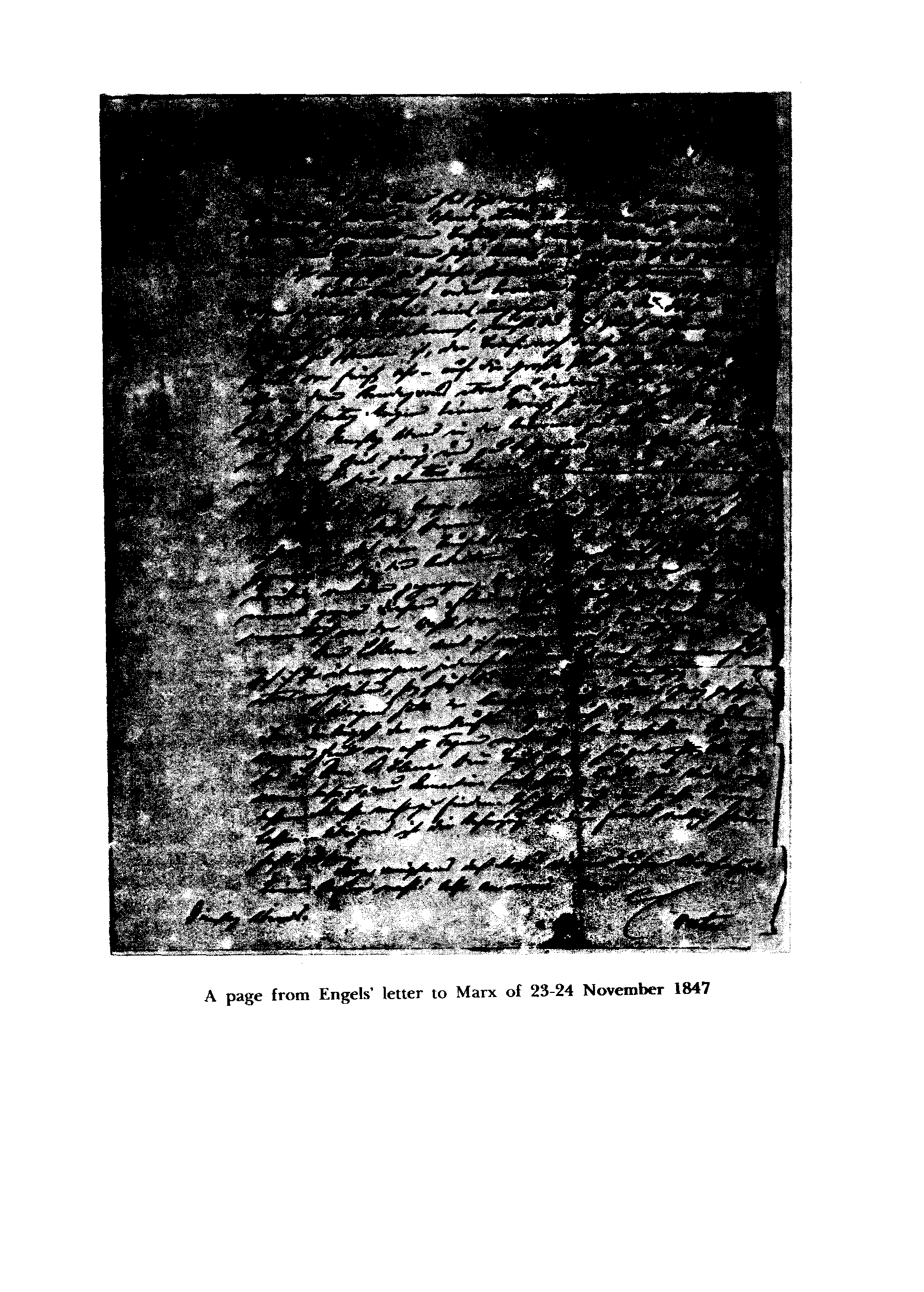
A page from Engels letter to Marx of 23-24 November 1847
Vidal, whose address cannot be found. I have had it taken to the
Presse.
By the way, Frank's despatch arrangements have been truly appalling.
At least see that Moses doesn't get up to any nonsense during our absence! Au revoir, then!
Your E.
Tuesday evening Vertea
Give a little thought to the Confession of Faith. I think we would do best to abandon the catachetical form and call the thing Communist Manifesto!' Since a certain amount of history has to be narrated in it, the form hitherto adopted is quite unsuitable. I shall be bringing with me the one from here, which I didc; it is in simple narrative form, but wretchedly worded, in a tearing hurry. I start off by asking: What is communism? and then straight on to the proletariat — the history of its origins, how it differs from earlier workers, development of the antithesis between the proletariat and the bourgeoisie, crises, conclusions. In between, all kinds of secondary matter and, finally, the communists' party policy, in so far as it should be made public. The one here has not yet been submitted in its entirety for endorsement but, save for a few quite minor points, I think I can get it through in such a form that at least there is nothing in it which conflicts with our views.
Wednesday morning
Have just received your letter[187] to which the above is an answer. I went to see L. Blanc. I'm remarkably unlucky with him—il est en voyage, il reviendra peut-être aujourd'hui.[6] I shall go there again tomorrow and, if necessary, the day after.
I can't be in Ostend by Friday everiing because the money won't have been got together until Friday.
This morning your cousin Philips came to see me. Born should make quite a good speech if you drum something into him. It's good that the Germans are represented by a working man.[188] But Lupus must be purged of all trace of his excessive 9 1847
modesty. The good fellow is one of those rare people who have to be thrust into the foreground. Not Weerth, for heaven's sake, as representative! A man who was always too lazy, until pitchforked by his succès d'un jour" at the Congress.[189] And who, to boot, wishes to be AN INDEPENDENT MEMBER. 77 faut le retenir dans sa sphère.h
Published first time
F. Engels und K. Marx, Bd. 1, Stuttgart, . iqia Published in English in lull tor the
51. Marx to Pavel Vasilyevich Annenkov. 9 December
Dear Annenkov,
Party considerations, into which I cannot enter here, obliged me to pay a visit to London.[190] I took advantage of this visit both to put the Brussels Democratic Association in touch with the English Chartists and to harangue the latter at a public meeting.' You perhaps saw some reports about it in the English and French press.
But when I set out on this trip — and I am compelled to stay here a few days longer — I left my family behind in the most difficult and direst of circumstances. It is not simply that my wife is ill and the children d likewise. My economic situation just now is so critical that my wife is being veritably harassed by creditors and is in the most wretched financial straits.
How this crisis came about is easily explained. The German manuscripts are not being published as a whole. Those parts that are being published' I am supplying gratis, simply in order to launch them on the world. My anti-Proudhon pamphlet" has sold very well. However I shall not receive a share of the proceeds until Easter.
By itself, my wife's income is insufficient and I have been negotiating with my own mother for quite some time to extract at least part of my fortune. There would now seem to be an immediate prospect of this. But that is of no help at the present moment.
In this situation, which I am not ashamed frankly to disclose to you, you would in truth save me from the worst if you could arrange to let my wife have a sum of between 100 and 200 francs. I shall, of course, be unable to repay you until my money matters have been settled with my family.
If you are able to agree to my proposal, I would request you to send the money to my old address: M. Charles Marx, Bruxelles, Faubourg Namur, rue d'Orléans, 42. However my wife must not be able to deduce from your letter that I wrote to you from London. I'll tell you the reason later.
Another time, I trust, I shall be able to send you more cheerful news.
Yours
K. Marx
Published in English for the first time 1848
52
Endnotes
[138] The letter was dated 1845 by mistake. The correct date was established on the basis of the contents and the postmark: 'Paris 60, 15. Janv. 47'. An extract from this letter was published in English for the first time in: K. Marx and F. Engels, Literature and Art, International Publishers, N. Y., p. 81, 1947.—107
[139] The reference here and below is to Marx's possible removal to Paris and the documents he needed for that move. The text below shows that Marx had the permission of the Belgian authorities to stay in Belgium. It was issued to him after his expulsion from France in February 1845 and signed on 22 March 1845 on condition that Marx would not publish anything concerning current politics. Besides, on 1 December 1845 Marx received a certificate of renunciation of his Prussian citizenship and perhaps permission to emigrate to America for which he had applied in order to deprive the Prussian authorities of any pretext for interfering in his future. However, Marx was not able to go to Paris until after the February 1848 revolution.—107 0 An allusion to relations with Hess which deteriorated in February and March 1846 when Marx and Engels started a decisive struggle against 'true socialism' and Weitling's Utopian egalitarian communism. In an effort to avoid an open break, Marx and Engels persuaded Hess to leave Brussels in March 1846.—108 1 The reference is to The Poverty of Philosophy by Marx. He worked on it from the end of December 1846 to the beginning of April 1847. It came out early in July 1847 in Brussels and Paris. In it Marx compared Proudhon's views and the theory of the British Utopian communist John Bray. The latter advocated exchange of the products of labour without money as a method of transition to a society free from exploitation (see present edition, Vol. 6, pp. 138-44). Bray expounded his theory in his Labour's Wrongs and Labour's Remedy, Leeds, 1839. By 'our publication' Engels meant the manuscripts of The Oerman Ideology intended for publication.— 109 2 Here Engels refers to the second part of his and Marx's joint work The Oerman Ideology devoted to the critique of 'true socialism' (see present edition, Vol. 5, pp. 453-539). Engels continued his work on this section up to April 1847 and its results have reached us in the form of an unfinished manuscript 'The True Socialists' supplementing The German Ideology (see present edition, Vol. 5, pp. 540-81).—109 3 As is seen from this letter Engels originally intended to work up the article he had apparently written in the autumn of 1846 or early in 1847 on Grüns Über Goethe for the second part of The German Ideology, devoted to the critique of 'true socialism'. Later this article served as a basis for the second essay in the series German Socialism in Verse and Prose (see present edition, Vol. 6, pp. 249-73). It is quite possible that Engels also used the manuscripts of The German Ideology for the first essay in that series. The essays on Grün were published in the Deutsche-Brüsseler-Zeitung, Nos. 93-98 of 21, 25 and 28 November and 2, 5 and 9 December 1847.—110 4 Engels has in mind the time the young Goethe spent among the burghers of his native town Frankfurt am Main, and his service at the Duke of Weimar's court: from 1782 to 1786 Goethe held several high administrative posts, was a member of the Privy Council, Minister of Education, etc.—110 15 Marx's letter to Zulauff has not been found. Like the letter published here, it apparently concerned the tasks facing the Brussels Communist Correspondence Committee and the communist groups close to it when Marx and Engels joined the League of the Just as a result of their negotiations at the end of January and the beginning of February 1847 with Joseph Moll, a representative of the London leaders of the League who was sent to Brussels and Paris specially for this purpose. The negotiations showed that the League leaders were prepared to recognise the principles of scientific communism as a basis when drawing up its programme and carrying out its reorganisation. Marx and Engels, therefore, called on their followers grouped around the Brussels Communist Correspondence Committee not only to join the League of the Just but also to take an active part in its reorganisation.— 111 16 See Note 86. Here the reference is to the members of the Paris communities of the League of the Just.— 112 17 The reference is to Engels' as yet unfound satirical pamphlet about Lola Montez, a favourite of King Ludwig I of Bavaria. The scandalous influence of
[140] An allusion to relations with Hess which deteriorated in Feb
[5] Engels is referring to Kritik der Politik und National-Okonomie, a work which Marx planned to write. Marx began to study political economy at the end of 1843 and by spring 1844 he set himself the task of writing a criticism of bourgeois political economv from the standpoint of materialism and communism. The draft 'Economic and Philosophic Manuscripts of 1844' (see present edition. Vol. 3), written at that time, have reached us incomplete. Work on The Hoh Family forced Marx temporarily to interrupt his study of political economy until December 1844. In February 1845, just before his expulsion from Paris, he signed a contract for his Kritik der Politik und Nationalökonomie with the publisher Leske (see Note 27). In Brussels Marx continued to study the works of English, French, German, Italian and other economists and added several more notebooks of excerpts to those compiled in Paris, although his original plan for the book was not carried out.—6, 27, 94, 105, 532
[8] L. Feuerbach's Das Wesen des Glaubens im Sinne Luther's was published in instalments in Vorwärts! from the middle of August to the end of October 1844.—8 lJ This letter without an address on the back of it was published in English for the first time in: K. Marx and F. Engels, On Britain, Foreign Languages Publishing House, Moscow, 1953 and in full in Letters of the Young Engels, 1838-1845, Progress Publishers, Moscow, 1976.—9
[142] Here Engels refers to the second part of his and Marx's join
[4] In July 1844 Marx began to contribute to the newspaper Vorwärts!, which prior to that — from early 1844 to the summer of the same year — reflected the moderate liberalism of its publisher, the German businessman H. Börnstein, and its editor A. Bornstedt. However, when Karl Bernays, a friend of Marx, became its editor in the summer of 1844, the newspaper assumed a democratic character. By contributing to the newspaper, Marx began to influence its policy and in September became one of its editors. Other contributors were Engels, Heine, Herwegh, Ewerbeck and Bakunin. Under Marx's influence the newspaper came to express communist views, and attacked Prussian absolutism and moderate German liberalism. At the behest of the Prussian Government, the Guizot ministry took repressive measures against its editors and contributors in January 1845, when publication ceased.—5
[143] As is seen from this letter Engels originally intended to wo
[144] Engels has in mind the time the young Goethe spent among the
[145] Marx's letter to Zulauff has not been found. Like the letter
[146] Here the reference is to the members of the Paris communitie
[147] The reference is to Engels' as yet unfound satirical pamphle this Spanish dancer on the policy of the Bavarian Government caused in 1847-48 the appearance of numerous pamphlets, articles, cartoons, etc. Further on, the text (see p. 114) shows that Engels tried to have this pamphlet published by Vogler in Brussels and by the Belle-Vue publishers in Switzerland. A letter has survived which Vogler wrote on 3 April 1847 in reply to Engels' letter of 28 March which has not been found. Engels' proposal was rejected because of the censorship existing in the Great Duchy of Baden where the publishers had moved by that time.—112
[149] Engels intended to have this work published as a pamphlet by Vogler in Brussels who was printing Marx's The Poverty of Philosophy. However, when Marx received the manuscript, Vogler had been arrested in Aachen (see this volume, p. 117). The part of the pamphlet which has reached us was first published in Russian in the USSR in 1929.—114 15(1 Communistes matérialistes—members of the secret society of materialist communists founded in the 1840s (see Note 90). The members of this society were tried in July 1847 and sentenced to long terms of imprisonment.—114
[150] Communistes matérialistes — members of the secret society of m
[151] The persecution of the Paris members of the League of the Just by the French police was reported in an item datelined Paris, 2 April 1847, published in the Berliner Zeitungs-Halle, No. 81,8 April 1847. It said of Engels: "Several police agents have also been to Fr. Engels, who lives here in great retirement and devotes himself only to economic and historical studies; naturally they could find nothing against him." —115
[152] Marx's letter to Bakunin has not been found.—116
[53] 53. of the League's members showed the influence of various Utopian socialist ideas, primarily those of Wilhelm Weitling. The German Workers' Educational Society in London was founded in February 1840 by Karl Schapper, Joseph Moll and other members of the League of the Just, its aim being political education of workers and dissemination of socialist ideas among them. After the Communist League had been founded the leading role in the Society belonged to the League's local communities. In 1847 and 1849-50 Marx and Engels took an active part in the Society's work.— 39, 551 53 In his reply to Marx of 17 May 1846 Proudhon refused to collaborate and declared that he was opposed to revolutionary methods of struggle and to communism (see MEGA% Abt. Ill, Bd. 2, S. 205-07).—39
[154] The reference is to the congress of the League of the Just a been drawn up either by Engels or with his help (see present edition, Vol. 6, pp. 96-103 and 585-88). Both documents and the congress circular to the League members were sent to the local communities and districts for discussion to be finally approved at the next, second congress. This congress laid the foundation for the first international proletarian communist organisation in history.—117 9 September 1847 Marx and Engels were its regular contributors, directly influenced its line and at the end of 1847 concentrated editorial affairs in their own hands. During this period the newspaper became a mouthpiece of the proletarian party then being formed, virtually the press organ of the Communist League.—120
[155] Engels arrived 1 5 5 a This letter was first published in English abridged in in Brussels about 27 July 1847 and stayed there u p to mid-October. H e actively contributed to enhancing the influence of the Communist League among the German workers residing in Belgium and to the establishment of international contacts between representatives of the proletarian movement and progressive democratic circles.—118 The Letters of Karl Marx, selected and translated with explanatory notes and an introduction by Saul K. Padover, Prentice-Hall, Inc., Englewood Cliff, New Jersey, 1979.—119
[156] Marx refers here to the prospects of his and Engels' regular collaboration in the Deutsche-Brüsseler-Zeitung. Previously they had only occasionally contributed to this emigrant newspaper, though they approved of the collaboration in it of W. Wolff, G. Weerth and others of their followers. On the whole up to that time the newspaper's line had reflected the desire of its editor-in-chief, the petty-bourgeois democrat A. Bornstedt, to combine eclectic ideological trends in opposition. But financial and other difficulties compelled him to agree to the collaboration of the proletarian revolutionaries in the newspaper. From
[157] Engels wrote this letter to Marx when the latter was on a visit to his relatives in Holland to settle his financial affairs. At the end of September 1847 Marx spent a few days in Zalt-Bommel at his uncle's (on his mother's side), Lion Philips, and returned to Brussels early in October.—122
[122] Fraternal Democrats—an international democratic society founded in London on
[161] The reference is to the newspaper Correspondence Bureau (Deutsche Zeitungs-Correspondenzbureau), set up by S. Seiler and K. Reinhardt in the spring of 1845. It supplied information and correspondence material to the German newspapers.—125
[162] "The reference is to Georg Weerth's speech at the International Congress of Economists held in Brussels on 16-18 September 1847 to discuss free trade. Marx, Engels and Wilhelm Wolff also attended the congress, intending to make use of it to criticise bourgeois economics (the free trade doctrine, in particular) and to defend working-class interests. When Weerth made a speech along these lines the congress organisers closed the discussion on 18 September without allowing Marx to speak. Excerpts from Weerth's speech were published in a few German, British and French newspapers. It was published in full in the Atelier Démocratique on 29 September 1847. A report on the Belgian proceedings of the congress is given by Engels in his articles 'The Economic Congress' and 'The Free Trade Congress at Brussels' (see present edition, Vol. 6, pp. 274-78 and 282-90).—125
[163] This refers to the agreement reached with Bornstedt in September 1847 concerning Marx's and Engels' regular contribution to the Deutsche-Brüsseler-Zeitung (see Note 156).—126
[164] The discussion of protective tariffs and free trade which had begun before Marx went on a visit to Holland continued at a meeting of the German Workers' Society on 29 September 1847. To enliven this discussion Marx and Engels started a 'sham battle' which Engels later recalled in a letter to Hermann Schlüter of 29 January 1891: '...I remember only that when the debates in the German Workers' Society in Brussels became dull Marx and I agreed to start a sham discussion in which he defended free trade and I protective tariffs....'—
[165] Engels means the meeting of the Brussels community of the Communist League. T h e community and the Brussels District Committee of the League were formed on the basis of the Communist Correspondence Committee on
[166] Marx seems to have in mind primarily literary works reflecting local peculiarities in the various shades of 'true socialism' (cf. F. Engels, 'The True Socialists', present edition, Vol. 5, pp. 540-81).—131
[168] Engels' letter to Louis Blanc presumably written soon after his arrival in Paris from Brussels in mid-October 1847 has not been found.—133 , 6 9 At that time a civil war was imminent in Switzerland between the Sonderbund (a separatist union formed by seven economically backward cantons which opposed progressive bourgeois reforms and defended the privileges of the Church and the Jesuits) and the other cantons which persuaded the Swiss Diet to declare the dissolution of the Sonderbund in July 1847. Hostilities began early in November, and the Sonderbund army was defeated by the federal forces on 23 November 1847. Johann Jacoby, a representative of the German radicals since the convocation of the United Diet in Prussia in 1847 (see Note 148), criticised it as a substitute for people's representation. In April and June 1847 he made a trip to Saxony, South Germany, Switzerland, visited Cologne and Brussels where he established contact with the Deutsche-Brüsseler-Zeitung. A radical programme of political reforms was adopted at a meeting of representatives of the democratic wing of the opposition movement (F. Hecker, G. Struve, etc.) in Offenburg (Grand Duchy of Baden) on 12 September 1847.—133 1V0 The Prussian United Diet (see Note 148) was dissolved in June 1847. In calling A. Ruge the panegyrist of the Diet Engels refers to the 'Adresse an die Opposition des vereinigten Landtages in Berlin' of 11 June 1847 included by Ruge in the Polemische Briefe published in Mannheim that year.—135
[169] At that time a civil war was imminent in Switzerland between
[110] Marx's letter to Engels mentioned here has not been found.— 79
[172] Engels contributed to the Chartist Northern Star from the end of 1843 to 1848. From May 1844 he sent in regular reports about European events, primarily about the political and social movement.—135
[174] Engels alludes to the case of the Duke of Praslin. In August 1847 the Duchess of Praslin was found murdered in her house. Suspicion fell on her husband and he was arrested. A political scandal broke out which caused the Duke of Praslin to take poison during the investigation.—135
[175] The management referred to is that of the Correspondence Bureau of S. Seiler and K. Reinhardt (see Note 161).—138
[86] Straubingers—travelling journeymen in Germany. Marx and Engels used this term for German artisans, including some participants in the working-class movement of that time, who were still largely swayed by guild prejudices and cherished the petty-bourgeois illusion that it was possible to return from capitalist large-scale industry to petty handicraft production.—63, 80, 138, 154, 161, 249, 346, 388, 394, 467, 47« t91, 498, 520
[176] In the summer of 1847 the London Central Authority of the Communist League distributed for discussion in the League's local communities and districts the 'Draft of a Communist Confession of Faith' drawn up by Engels and approved by the First Congress (see Note 154). In mid-October, when Engels returned to Paris from Brussels, the League's draft programme written in the form of a catechism was already being discussed in the Paris communities. Hess proposed to the Paris District Committee his own version of the draft, which was rejected after sharp criticism by Engels. But Engels was no longer satisfied with his own version because in drafting it he had to take into account the fact that the delegates to the League's First Congress were still influenced by Utopian communism. In a new version—'Principles of Communism'—drawn up by Engels this shortcoming was eliminated and the programme principles of the working-class movement were elaborated in greater detail, but still in the form of a catechism. This new document was later approved by the Paris communities as the draft programme for the Second Congress of the Communist League.—138
[177] Engels refers to Born's intended participation in the Second Congress of the Communist League, but Born did not go to the congress.—139
[178] Neither Engels' letter to the Elberfeld communists nor their reply to it has been found. Presumably they were about the possibilities for publishing Marx's and Engels' works on free trade and protective tariffs (see Note 173).—140
[179] Marx alludes here to Countess Hatzfeldt's divorce case which lasted from 1846 to 1854.—140
[180] Marx presumably has in mind here the refusal of Baron Arnim, Prussian Ambassador to Paris, to give Emma Herwegh, Georg Herwegh's wife, a visa for Berlin. The fact was reported in the Deutsche-Brüsseler-Zeitung on 21 October 1847. Later Emma Herwegh set out with a Swiss passport without a visa.—141
[181] Marx's The Poverty of Philosophy was published simultaneously by Vogler in Brussels and by Frank in Paris. As is seen from Marx's letter to Engels of
[182] The reference is to the election of delegates from the Paris district to the Second Congress of the Communist League which was to meet in London on
[184] An international meeting organised by the Fraternal Democrats (see Note 122) took place in London on 29 November 1847 to mark the anniversary of the Polish insurrection of 1830. Marx and Engels, who had come to London for the Second Congress of the Communist League, made speeches about Poland. The report on the meeting and accounts of the speeches made by Marx and Engels appeared in the Deutsche Londoner Zeitung, No. 140, 3 December 1847, The Northern Star, No. 528, 4 December 1847, and the Deutsche-Brüsseler-Zeitung, No. 98, 9 December 1847. Engels wrote a special item on this subject for La Réforme, which published it on 5 December 1847 (see present edition, Vol. 6, pp. 391-92).—144 29 November to 8 December 1847. It was attended by delegates from Germany, France, Belgium, Switzerland, Poland and Denmark. Marx represented the League's Brussels communities, Engels the Paris communities and Victor Tedesco the Liège communities. During many days of discussion Marx and Engels defended the principles of scientific communism on which the congress based its decisions. It was resolved that in all its external relations the League would come out openly as a communist party. The congress adopted the previously drawn up Rules in an improved form, a clause clearly defining the League's communist aim being included. On the instruction of the Second Congress Marx and Engels wrote as the League's programme the Manifesto of the Communist Party, which was published in February 1848 (see present edition, Vol. 6, pp. 477-519). An excerpt from this letter was published in English for the first time in: Karl Marx and Friedrich Engels, Correspondence, 1846-1895. A Selection with Commentary and Notes, Martin Lawrence Ltd., London, 1934, and International Publishers, New York, 1935.—146
[185] Proposals to convene an international democratic congress were made both by the Fraternal Democrats and the Brussels Democratic Association. During his stay in London at the end of November 1847, Marx had talks on the subject with the Chartist leaders and representatives of the proletarian and democratic emigrants. Engels had similar talks with French socialists and democrats. In the beginning of 1848 it was agreed to convene the congress in Brussels. It was scheduled for 25 August 1848, the eighteenth anniversary of the Belgian revolution. However, these plans did not materialise because in February 1848 a revolution began in Europe.—145
[186] Engels sent this letter to Marx on the eve of the Second Congress of the Communist League for which they both made thorough preparations and expected to reach a final agreement concerning their stand during their meeting on the way to London. What Engels writes here on certain points, e.g. a Communist League programme not in the form of a catechism or confession of faith (see notes 154 and 176) but of a manifesto, found expression in the congress decisions. The Second Congress of the Communist League was held in London from
[187] Marx's letter to Engels written about 22 November 1847 has not been found.—149
[188] The working man referred to was Stephan Born, who was to speak at the meeting of the Democratic Association in Brussels held to mark the seventeenth anniversary of the Polish revolution of 1830 instead of Marx who at that time was to take part in the Second Congress of the Communist League in London. Below Engels mentions Wilhelm Wolff (Lupus) and Georg Weerth as possible representatives, with Born, of the German Workers' Society at the Brussels meeting. It was held on 29 November 1847, and Born spoke on behalf of the German workers. A report on the meeting was published in the Deutsche-Brüsseler-Zeitung, No. 96, 2 December 1847.—149 3 March, when he was preparing to leave, the police burst into Marx's flat, arrested him and then his wife. After 18 hours of imprisonment Marx and his family were forced to leave Belgium at once. On the invitation of Flocon, who had been elected member of the Provisional Government of the French Republic, Marx moved to Paris. Engels, expelled from Paris at the end of January 1848 for his revolutionary activity, was in Brussels from 31 January. The time of writing of this letter, as well as of many other undated ones, is established on the basis of the chronology of events mentioned, in particular the constitution of the new Central Authority of the Communist League on 7 March 1848, and of Jones' departure for England, where he arrived not later than 12 March, etc. An excerpt from this letter was published in English for the first time in Labour Monthly, 1948, No. 3, III.—158 17 December (Marx and Engels had gone to England to participate in the Second Congress of the Communist League — see Note 186). In Brussels Engels worked with Marx on the Manifesto of the Communist Party. On his arrival in Paris, Engels wished to meet Louis Blanc, as he writes at the beginning of the letter, to get him to write a review of Marx's The Poverty of Philosophy for La Réforme.—152
[189] Engels refers to the Congress of Economists in Brussels where Georg Weerth made a speech on 18 September (see Note 162).—150
[190] The reason for Marx's visit to London was to attend the Second Congress of the Communist League. Marx and Engels profited by this occasion to attend the international meeting (mentioned in this letter) held in London to mark the anniversary of the Polish insurrection of 1830 (see Note 184).—150
[3] August 1844. On 13 December 1844 Bernays was sentenced to two months' imprisonment and a fine.—4 '* Engels left Germany in November 1842 and lived for nearly two years in England, working in the office of a Manchester cotton-mill of which his father was co-proprietor.—4
[11] The disagreements between Marx and Engels on the one hand and Arnold Ruge on the other dated back to the time of the publication of the Deutsch-Französische Jahrbücher, under the editorship of Marx and Ruge. These disagreements were due to Ruge's negative attitude towards communism and the revolutionary proletarian movement, the fundamental difference between Marx's views and those of the Young Hegelian Ruge, who was an adherent of philosophical idealism. The final break between Marx and Ruge occurred in March 1844. Ruge's condemnation of the Silesian weavers' rising in June 1844 impelled Marx to criticise his views in the article 'Critical Marginal Notes on the Article "The King of Prussia and Social Reform. By a Prussian'" (see present edition, Vol. 3, pp. 189-206).—10
[141] The reference is to The Poverty of Philosophy by Marx. He wo
[1] This is the earliest extant letter of Engels to Marx, written soon after Engels' return to Germany from England. On his way back to Germany at the end of August 1844, he stopped in Paris, where he met Marx. During the days they spent together they discovered that their theoretical views coincided, and they immediately began their first joint work, directed against the Young Hegelians. Engels finished his part before leaving Paris, while Marx continued to write his. At first they intended to call the book A Critique of Critical Criticism. Against Bruno Bauer and Co. But while it was being printed Marx added The Holy Family to the title. This meeting of Marx and Engels in Paris marked the beginning of their friendship, joint scientific work and revolutionary struggle. The extant original of this letter bears no date. The approximate time of its writing was determined on the basis of Engels' letter to Marx of 19 November 1844 (see this volume, pp. 9-14). This letter was published in English in full for the first time in: Marx and Engels. Selected Correspondence, Foreign Languages Publishing House, Moscow, 1955.—3
[2] Karl Bernays, one of the editors of the German newspaper Vorwärts!, published in Paris, was sued by the French authorities in September 1844 at the request of the Prussian Government for not having paid the caution-money required for the publication of a political newspaper. The real reason, however, was the article 'Attentat auf den König von Preußen' published in Vorwärts!, No. 62,
[6] The Hoh Family by Marx and Engels was published not in Hamburg by Hoffmann and Campe, but in Frankfurt am Main by Z. Löwenthal, founder of the Literarische Anstalt publishing house (owned by Joseph Rütten since the autumn of 1844).— 7
[158] Xhe German Workers' Society was founded by Marx and Engels in Brussels at the end of August 1847, its aim being the political education of the German workers who lived in Belgium and dissemination of the ideas of scientific communism among them. With Marx, Engels and their followers at its head, the Society became the legal centre rallying the revolutionary proletarian forces in Belgium. Its most active members belonged to the Communist League. The Society played an important part in founding the Brussels Democratic Association. After the February 1848 revolution in France, the Belgian authorities arrested and banished many of its members.—122, 141, 153
[159] The international banquet of democrats in Brussels on 27 September 1847, of which Engels speaks here, adopted the decision to found a Democratic Association. Engels was elected to its Organising Committee. The Democratic Association united proletarian revolutionaries, mainly German refugees and advanced bourgeois and petty-bourgeois democrats. Marx and Engels took an active part in its establishment. On 15 November 1847 Marx was elected its Vice-President (the President was Lucien Jottrand, a Belgian democrat) and under his influence it became a centre of the international democratic movement. During the February 1848 revolution in France, the proletarian wing of the Brussels Democratic Association sought to arm the Belgian workers and to intensify the struggle for a democratic republic. However, when Marx was expelled from Brussels in March 1848 and the most revolutionary elements were repressed by the Belgian authorities, its activity assumed a narrow, purely local character and in 1849 the Association ceased to exist.—123, 132, 141 5 August 1847. The District Committee included Marx, Engels, Junge and Wolff (see present edition, Vol. 6, p. 601).—129 126
[167] Marx's intention to start a joint-stock company for the publication of a communist monthly in 1847, about which he also wrote to Herwegh on 26 October 1847 (see this volume, p. 141) like similar earlier plans did not materialise.—132, 141
[173] Here Engels refers to the speech on free trade Marx intended to deliver at the International Congress of Economists in Brussels held between 16 and 18 September 1847 (see Note 162). Not being allowed to speak, Marx published it in the Atelier Démocratique on 29 September. Part of the speech was also published by Joseph Weydemeyer in 1848 under the title 'The Protectionists, the Free Traders and the Working Class' and excerpts from it were quoted by Engels in his article 'The Free Trade Congress at Brussels' in The Northern Star, No. 520, 9 October 1847 (see present edition, Vol. 6, pp. 279-90). As is seen from this letter the version sent to La Réforme was not printed, and it is not extant.—135, 143 15 October 1868, both Vogler and Frank were mere 'commissioners' (agents de vente), all printing expenses being paid by the author.—142 29 November 1847.—143