1) Robert Torrens, An Essay on the Production of Wealth etc., London, 1821
Observation of competition — the phenomena of production— shows that capitals of equal size yield an equal amount of profit ON
AN AVERAGE, or that, given the AVERAGE RATE OF PROFIT (and the term, AVERAGE RATE OF PROFIT, has n o other meaning), the amount of profit depends on the amount of capital advanced.
Adam Smith has noted this FACT. Its connection with the theory of value which he put forward caused him no pangs of conscience — especially since in addition to what one might call his esoteric theory,[72] h e advanced many others, and could recall one or another at his pleasure. T h e sole reflection to which this question gives rise is his polemic against the view which seeks to resolve profit into WAGES OF SUPERINTENDENCE, SINCE, APART FROM ANY OTHER CIRCUMSTANCE, the labour OF SUPERINTENDENCE does not increase in the same measure as the scale of production and, moreover, the value of the capital advanced can increase, for instance, as a result of the dearness of raw materials, without a corresponding growth in the scale of production^ H e has no immanent law to determine the AVERAGE PROFIT or its amount. H e merely says that competition reduces this x.
Ricardo (apart from a few merely chance remarks) directly identifies profit with SURPLUS VALUE everywhere. Hence with him, commodities sell at a profit not because they are sold above their value, but because they are sold at their value. Nevertheless, in considering VALUE (in CHAPTER I of the Principles) he is the first to reflect at all on the relationship between the determination of the value of commodities and the phenomenon that capitals of equal size yield equal profits. They can only d o this inasmuch as the commodities they produce — although they are not sold at equal prices (one can, however, say that their output has equal prices
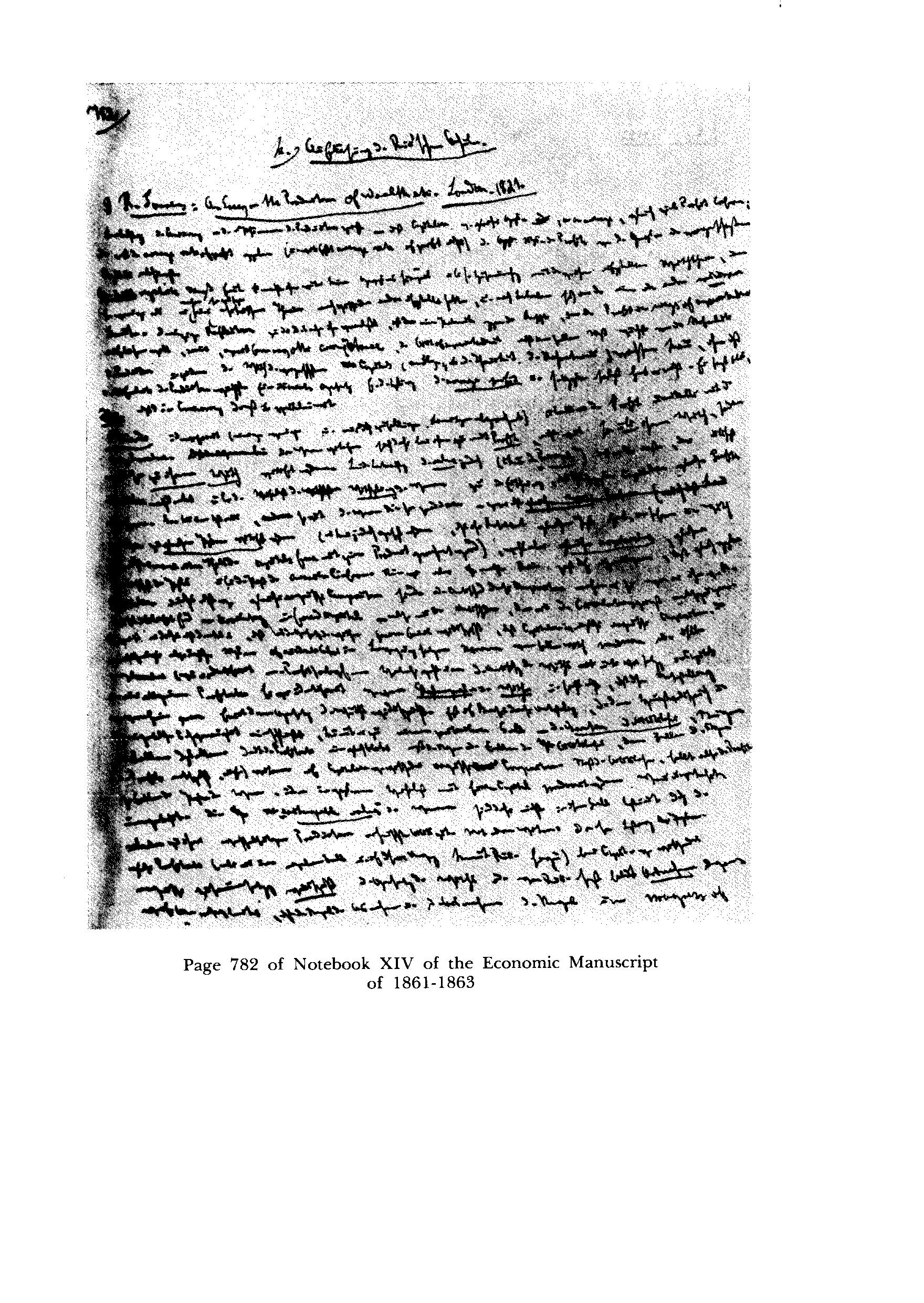
Page 782 of Notebook XIV of the Economic Manuscript of 1861-1863
provided the value of that part of constant capital which is not consumed is added to the product)—yield the same SURPLUS VALUE, the same surplus of price over the price of the capital outlay. Ricardo moreover is the first to draw attention to the fact that capitals of equal size are by no means of equal organic composition. The difference in this composition he defined in the way traditional since Adam Smith, namely as CIRCULATING and FIXED CAPITAL, that is, only the differences arising from the process of circulation. He certainly does not directly say that it is a prima facie contradiction of the law of value that capitals of unequal organic composition, which consequently set unequal amounts OF IMMEDIATE LABOUR in motion, produce commodities of the same value and yield the same SURPLUS VALUE (which he identifies with profit). On the contrary he begins his investigation of value by assuming capital and a general rate of profit. He identifies cost price[6] with value from the very outset, and does not see that from the very start this assumption is a prima facie contradiction of the law of value. It is only on the basis of this assumption — which contains the main contradiction and the real difficulty — that he comes to a particular case, changes in the level of wages, their rise or fall. For the rate of profit to remain uniform the rise or fall in wages, to which corresponds a fall or rise in profit, must have unequal effects on capitals of different organic composition. If wages rise, then profits fall, and also the prices of commodities in whose production a relatively large amount of fixed capital is employed. Where the opposite is the case, the results are likewise opposite. Under these circumstances, therefore, the "EXCHANGEABLE VALUES " of the commodities are not determined by the labour time required for their respective production. In other words, this definition of an equal rate of profit (and Ricardo arrives at it only in individual cases and in this roundabout way) yielded by capitals of different organic composition contradicts the law of value or, as Ricardo says, constitutes an exception to it, whereupon Malthus rightly remarks that in the PROGRESS OF [XIV-783] INDUSTRY, the rule becomes the exception and the exception the rule.(1) The contradiction itself is not clearly expressed by Ricardo, namely, not in the form: although one of the commodities contains more unpaid labour than the other — for the amount of unpaid labour depends on the amount of paid labour, that is, the amount of IMMEDIATE LABOUR employed provided the rate of exploitation of the workers is equal — they nevertheless yield equal values, or the same surplus of unpaid over paid labour. The contradiction however occurs with him in a particular form: in certain cases, wages, variations in wages, affect the cost price (he says, the EXCHANGEABLE VALUES) of commodities.
Equally, differences in the time of turnover of capital — whether the capital remains in the process of production (even if not in the labour process)7S or in circulation for a longer period, requiring not more work, but more time for its RETURN — these differences have just as little effect on the equality of profit, and this again contradicts (is, according to Ricardo, an exception to) the law of value.
He has therefore presented the problem very one-sidedly. Had he expressed it in a general way, he would also have had a general solution.
But his great contribution remains: Ricardo has a notion that there is a difference between value and cost price, and, in certain cases, even though he calls them exceptions to the law, he formulates the contradiction that capitals of unequal organic composition (that is, in the last analysis, capitals which do not exploit the same amount of living labour) yield equal SURPLUS VALUE (profit) and — if one disregards the fact that a portion of the fixed capital enters into the labour process without entering into the valorisation process — equal values, commodities of equal value (or rather [of equal] cost price, but he confuses this).a
As we have seen,b Malthus uses this in order to deny the validity of the Ricardian law of value.
At the very beginning of his book, Torrens takes this discovery of Ricardo as his point of departure, not, however, to solve the problem, but to present the "phenomenon" as the law of the phenomenon.
"Supposing that capitals of DIFFERENT DEGREES OF DURABILITY are employed. If a WOOLLEN and a SILK MANUFACTURER were each to employ a capital of £2,000 and if the former were to employ £1,500 IN DURABLE MACHINES, and £500 IN WAGES and MATERIALS; while the latter employed only £500 IN DURABLE MACHINES, and £1,500 IN WAGES and MATERIALS. Supposing that [1]/[10] of these fixed capitals is annually consumed, and that the rate of profit is 10%; then, as THE RESULTS OF THE WOOLLEN MANUFACTURER'S CAPITAL OF £2,000, must, TO GIVE HIM THIS PROFIT, be £2,200, a n d as the value of his fixed capital has been reduced by the process of production from £1,500 to £1,350, THE GOODS PRODUCED must SELL FOR £850. And, IN LIKE MANNER, as the fixed capital of the SILK MANUFACTURER is by the PROCESS OF PRODUCTION reduced Vio, or from £500 to £450, *the silks produced must, in order to yield him the customary rate of profit upon his whole capital of £2,000, sell
a See present edition, Vol. 31, pp. 415-23.— Ed. b See this volume, pp. 210, 222-25.— Ed.
for £1,750 ... when capitals equal in amount, but of different degrees of durability, are employed, the articles produced, together with the residue of capital, in one occupation, will be equal in exchangeable value to the things produced, and the residue of capital, in another occupation"* (p[p. 28-]29).
Here the phenomenon manifested in competition is merely mentioned, registered. Ditto A "CUSTOMARY RATE OF PROFIT" is presupposed without explaining how it comes about, or even the feeling that this ought to be explained.
"EQUAL CAPITALS, or, in other words, EQUAL QUANTITIES OF ACCUMULATED LABOUR, WILL OFTEN PUT IN MOTION DIFFERENT QUANTITIES OF IMMEDIATE LABOUR; but this changes nothing in substance" (p[p. 29-]31),a
namely, in the fact that the value of the product+the RESIDUE OF THE CAPITAL NOT CONSUMED, yield equal values, or, what is the same thing, equal profits.
The merit of this passage does not consist in the fact that Torrens here merely registers the phenomenon once again without explaining it, but in the fact that he defines the difference by stating that equal capitals set in motion unequal quantities of living labour, though he immediately SPOILS it by declaring it to be a "special" case. If the value=the labour worked up, realised in a commodity, then it is clear that — if the commodities are sold at their value — the SURPLUS VALUE contained in them can only=the unpaid, or SURPLUS LABOUR, which they contain. But this SURPLUS LABOUR — given the same rate of exploitation of the worker — cannot be equal in the case of capitals WHICH PUT IN MOTION DIFFERENT QUANTITIES OF IMMEDIATE LABOUR, whether it is the immediate production process or the period of circulation which is the cause of this difference. It is therefore to Torrens' credit that he expresses this. What does he conclude from it? That here [XIV-784] within capitalist production the law of value suddenly changes. That is, that the law of value, which is abstracted from capitalist production, contradicts capitalist phenomena. And what does he put in its place? Absolutely nothing but the crude, thoughtless, verbal expression of the phenomenon which has to be explained.
* "In the early period of society" * (that is, precisely when exchange value in general, the product as commodity, is hardly developed at all, and consequently when there is no law of value either)
"it is the TOTAL QUANTITY OF LABOUR, ACCUMULATED AND IMMEDIATE, EXPENDED ON PRODUCTION, that determines the relative value of commodities. But as soon as STOCK has ACCUMULATED, and there emerges a class of capitalists distinct from that
a Here and below cf. present edition, Vol. 29, p. 196.— Ed.
18-733 of labourers, WHEN THE PERSON, WHO UNDERTAKES ANY BRANCH OF INDUSTRY, DOES NOT
PERFORM HIS OWN WORK, BUT ADVANCES SUBSISTENCE AND MATERIALS TO OTHERS, THEN
IT IS THE AMOUNT OF CAPITAL, OR THE QUANTITY OF ACCUMULATED LABOUR EXPENDED
IN PRODUCTION, that determines the EXCHANGEABLE POWER O F COMMODITIES" (I.e., [pp.] 33-34).
"As long as two capitals [are] equal, their products are of equal value, HOWEVER
WE MAY VARY THE QUANTITY OF IMMEDIATE LABOUR WHICH THEY PUT IN MOTION, OR
W H I C H THEIR PRODUCTS MAY REQUIRE. If they are unequal, their PRODUCTS are O F UNEQUAL VALUE, THOUGH THE TOTAL QUANTITY OF LABOUR EXPENDED UPON EACH SHOULD BE PRECISELY EQUAL" ([p.] 39). " T h e r e f o r e after the SEPARATION OF CAPITALISTS AND LABOURERS], it is the AMOUNT OF CAPITAL, THE QUANTITY OF
ACCUMULATED LABOUR, a n d not, as before this separation, T H E SUM O F ACCUMULATED
AND IMMEDIATE LABOUR, EXPENDED O N PRODUCTION, which determines the exchange value" (I.e., [pp. 39-40]). a
Here again, he merely states the phenomenon that capitals of equal size yield equal profits or that the cost price of commodities is equal to the price of the capital advanced + the AVERAGE profit; there is at the same time a HINT that — SINCE EQUAL CAPITALS PUT IN MOTION DIFFERENT QUANTITIES OF LABOUR — this phenomenon is, prima facie, inconsistent with the determination of the value of commodities by the amount of labour time embodied in them. The remark that this phenomenon of capitalist production only manifests itself when capital comes into existence—[when] the classes of capitalists and workers [arise, and] the objective conditions of labour acquire an independent existence as capital — is tautology.
But how the separation of the [factors necessary] for the production of commodities — into capitalists and workers, capital and wage labour — upsets the law of value of commodities, is merely "inferred" from the uncomprehended phenomenon.
Ricardo sought to prove that, apart from certain exceptions, the separation between capital and wage labour does not change anything in the determination of the value of commodities. Basing himself on the exceptions noted by Ricardo, Torrens rejects the law. He reverts to Adam Smith (against whom the Ricardian demonstration is directed) according to whom the value of commodities was determined by the labour time embodied in them "IN THE EARLY PERIOD" when men confronted one another simply as owners and exchangers of goods, but not when capital and property in land have been evolved. This means (as I observed in Part One') that the law which applies to commodities qua commodities, no longer applies to them once they are regarded as
a Marx quotes Torrens with some alterations.— Ed b See K. Marx, A Contribution to the Critique of Political Economy. Part One (present edition, Vol. 29, p p . 299-300).— Ed.
capital or as products of capital, or as soon as there is, in general, an advance from the commodity to capital. On the other hand, the product wholly assumes the form of a commodity only — as a result of the fact that the entire product has to be transformed into exchange value and that also all the ingredients necessary for its production enter it as commodities — in other words it wholly becomes a commodity only with the development and on the basis of capitalist production. Thus the law of the commodity is supposed to be valid for a type of production which produces no commodities (or only to a limited extent) and not to be valid for a type of production which is based on the product as a commodity. The law itself, as well as the commodity as the general form of the product, is abstracted from capitalist production and yet it is precisely in respect of capitalist production that the law is held to be invalid.
The proposition regarding the influence of the separation of "CAPITAL and LABOUR" on the determination of value — apart from the tautology that capital cannot determine prices so long as it does not as yet exist — is moreover a quite superficial translation of a fact manifesting itself on the surface of capitalist production. So long as each person works himself with his own tools and sells his product himself //but in reality, the necessity to sell products on a [XIV-785] social scale never coincides with production carried on with the producer's own conditions of labour //, his costs comprise the cost of both the tools and the labour he performs. The cost to the capitalist consists in the capital he advances — in the sum of values he EXPENDS on production — not in labour, which he does not perform, and which only costs him what he pays for it. This is a very good reason for the capitalists to calculate and distribute the (social) SURPLUS VALUE amongst themselves according to the size of their capital outlay and not according to the quanitity OF IMMEDIATE LABOUR WHICH A GIVEN CAPITAL PUTS IN MOTION. But it does not explain where the SURPLUS VALUE — which has to be distributed and is distributed in this way — comes from.
Torrens adheres to Ricardo in so far as he maintains that the value of a commodity is determined by the quantity of labour, but he declares [that it is] only "THE QUANTITY OF ACCUMULATED LABOUR" EXPENDED UPON THE PRODUCTION OF COMMODITIES which determines their value. Here, however, Torrens lands himself in a fine mess.
For example, the value of woollen cloth is determined by the ACCUMULATED LABOUR contained in the loom, the wool, etc., and the WAGES, which constitute the ingredients of its production, accumulated labour, which, in this context, means nothing else but REALISED
18 LABOUR, objectified labour time. However, once the woollen cloth is ready and production is over, the IMMEDIATE LABOUR EXPENDED on the woollen cloth has likewise been transformed into ACCUMULATED or REALISED LABOUR. Then why should the value of the loom and of the wool be determined by the REALISED LABOUR (which is nothing but IMMEDIATE LABOUR REALISED IN AN OBJECT, IN A RESULT, IN A USEFUL THING) they contain, and the value of the woollen cloth not be so determined? If the woollen cloth in turn becomes a component part OF PRODUCTION in say dyeing or tailoring, then it is "ACCUMULATED LABOUR", and the value of the coat is determined by the value of the WAGES of the workers, their tools a n d the woollen cloth, the value of which is determined by the "ACCUMULATED LABOUR" contained in it. If I regard a commodity as capital, that means in this context as a condition of production, then its value resolves itself into IMMEDIATE LABOUR, which is called "ACCUMULATED LABOUR" because it exists in an objectified form. O n the other hand, if I regard the same commodity as a commodity, as a product a n d result of the [production] process, then it is definitely not determined by the LABOUR which is accumulated in it, but by the LABOUR accumulated in its conditions of production.
It is indeed a fine cercle vicieux" to seek to determine the value of a commodity by the value of the capital, since the value of the capital = the value of the commodities of which it is made up. James Mill is right as against this fellow when he says:
" CAPITAL IS COMMODITIES. If the value of commodities, then, depends upon the value of capital, it depends upon the value of commodities."74
One thing more is to be noted here. Since [according to Torrens] the value of a commodity is determined by the value of the capital which produces it, or, in other words, by the quantity of LABOUR, the LABOUR ACCUMULATED and REALISED in this capital, then only two possibilities ensue.
The commodity contains: first, the value of the fixed capital used up; second, the value of the raw material or the quantity of labour contained in the fixed capital and raw material; third, the quantity of labour which is objectified in the money or in the commodities which function as WAGES.[13]
Now there are two [possibilities]. The "accumulated" labour contained in the fixed capital and raw material remains the same after the process of production as it was before. As far as the 3rd part of the "ACCUMULATED LABOUR"
a Vicious circle.— Ed. b See this volume, pp. 263-64.— Ed.
ADVANCED is concerned, the worker replaces it by his IMMEDIATE LABOUR, that is, the "IMMEDIATE LABOUR" added to the raw material, etc., represents just as much ACCUMULATED LABOUR in the commodity as was contained in the WAGES. O r it represents more. If it represents more, the commodity contains more ACCUMULATED LABOUR than the capital advanced did. T h e n profit arises precisely out of the surplus of ACCUMULATED LABOUR contained in the commodity over that contained in the CAPITAL ADVANCED. And the value of [XIV-786] the commodity is determined, as previously, by the quantity of labour (ACCUMULATED+IMMEDIATE) contained in it (in the commodity the latter type of labour likewise constitutes ACCUMULATED, and no longer IMMEDIATE [labour]. It is IMMEDIATE [labour] in the production process, and ACCUMULATED [labour] in the product).
Or immediate labour only represents the quantity embodied in the WAGES, is only an equivalent of it. (If it were less than this, the point to be explained would not be why the capitalist makes a profit but how it comes about that he makes no loss.) Where does the profit come from in this case? Where does the SURPLUS VALUE, i.e. the excess of the value of the commodity over the value of the component parts of production, or over that of the capital outlay, arise? Not in the production process itself — so that merely its realisation takes place in the process of EXCHANGE, or in the circulation process — but in the EXCHANGE process, in the circulation process. We thus come back to Malthus and the crude mercantilist conception of "PROFIT UPON EXPROPRIATION".75 And it is this conception at which Mr. Torrens consistently arrives, although he is, on the other hand, sufficiently inconsistent to explain this payable value not by means of an inexplicable fund dropped down from the skies, namely, a fund which provides not only an equivalent for the commodity, but a surplus over and above this equivalent, and is derived from the MEANS of the purchaser, who is always able to pay for the commodity above its value without selling it above its value — thus reducing the whole thing to thin air. Torrens, who is not as consistent as Malthus, does not have recourse to such a fiction, but, on the contrary, asserts that "EFFECTUAL DEMAND"—the sum of values paid for the product — arises from SUPPLY alone, and is therefore likewise a commodity; and thus, since the two sides are both buyers and sellers, it is impossible to see how they can mutually cheat one another AT THE SAME RATE.
* "The effectual demand for any commodity is always determined, and under any given rate of profit, is constantly commensurate with the quantity of the ingredients of capital, or of the things required in its production, which consumers may be able and willing to offer in exchange for it" (I.e., p. 344).
is the one and of ([p.] 348).
Malthus, who quotes this passage from Torrens, is quite justified in protesting against it (Definitions in Political Economy, London, 1827, p. 59).a
But the following passages about production costs, etc., demonstrate that Torrens does indeed arrive at such absurd conclusions:
*"Market price"* (Malthus calls it PURCHASING VALUE) "always includes the * customary rate of profit for the time being. Natural price, consisting of the cost of production, or, in other words, of the capital expended in raising or fabricating commodities, cannot include the rate of profit"* (I.e., [p.] 51).
"The farmer expends 100 qrs OF CORN and obtains IN RETURN 120 qrs. In this case, 20 qrs constitute the profit; [but] it would be absurd to call this EXCESS, or profit, A PART OF THE EXPENDITURE... Likewise the MANUFACTURER obtains IN RETURN A QUANTITY OF FINISHED WORK OF A HIGHER EXCHANGEABLE VALUE than the MATERIALS, etc." ([pp.] 51-53).
* "Effectual demand consists in the power and inclination, on the part of the consumers, to give for commodities, either by immediate or circuitous barter, some greater proportion of all the ingredients of capital than their production costs" * (I.e., [p.] 349).
120 qrs of corn are most certainly more than 100 qrs. But — if one merely considers the use value and the process it goes through, that is, in reality, the vegetative or physiological [XIV-787] process, as is the case here — it would be wrong to say, not indeed, with regard to the 20 qrs, but with regard to the elements which go to make them up, that they do [not] enter into the production process. If this were so, they could never emerge from it. In addition to the 100 qrs of corn — the seeds[76]—various chemical ingredients supplied by the manure, salts contained in the soil, water, air, light, are all involved in the process which transforms 100 qrs of corn into 120. The transformation and absorption of the elements, the ingredients, the conditions — the EXPENDITURE OF NATURE, which transforms 100 qrs into 120 — takes place in the production process itself and the elements of these 20 qrs enter into this process itself as physiological "EXPENDITURE", the result of which is the transformation of 100 qrs into 120 qrs.
Regarded merely from the standpoint of use value, these 20 qrs are not mere profit. The inorganic components have been merely assimilated by the organic components and transformed into organic material. Without the addition of matter — and this is the physiological EXPENDITURE — the 100 qrs would never become 120. Thus it can in fact be said even from the point of view of mere use value, that is, regarding corn as corn — what enters into corn
a See this volume, p. 250.— Ed.
in inorganic form, as EXPENDITURE, appears in organic form, as the actual result, the 20 qrs, i.e. as the surplus of the corn harvested over the corn sown.
But these considerations, in themselves, have as little to do with the question of profit, as if one were to say that lengths of wire which, in the labour process, are stretched to a thousand times the length of the metal from which they are fabricated, yield a thousandfold profit since their length has been increased a thousandfold. In the CASE of the wire, the length has been increased, in the CASE of CORN, the quantity. But neither increase in length nor increase in quantity constitutes profit, which is applicable solely to exchange value, although exchange value manifests itself in a SURPLUS PRODUCE.
As far as exchange value is concerned, there is no need to explain further that the value of 90 qrs of corn can be equal to (or greater than) the value of 100, that the value of 100 can be greater than that of 120, and that of 120 greater than that of 500.
Thus, on the basis of one example which has nothing to do with profit, with the surplus in the value of the product over the value of the capital outlay, Torrens draws conclusions about profit. And even considered physiologically, as use value, his example is wrong since, in actual fact, the 20 qrs of corn which form the SURPLUS PRODUCE already exist d'une manière ou d'une autre(2) in the production process, although in a different form.
Finally, Torrens blurts out the brilliant old conception that profit is profit UPON EXPROPRIATION. One of Torrens' merits is that he has at all raised the controversial question: what are production costs. Ricardo continually confuses the values of commodities with their production costs (in so far as they = the cost price) and is consequently astonished that Say, although he believes that prices are determined by production costs, draws different conclusions.(3)
Malthus, like Ricardo, asserts that the price of a commodity is determined by the production costs, and, like Ricardo, he includes the profit in the production costs. Nevertheless, he defines value in a different way, not by the quantity of labour contained in the commodity, but by the quantity of labour it can command.
The ambiguities surrounding the concept of production costs arise from the very nature of capitalist production.
Firstly: The cost to the capitalist of the commodity (he produces) is, naturally, what it costs him. It costs him nothing — that is, he EXPENDS NO VALUE UPON IT — apart from the value of the capital ADVANCED. If he lays out £ 1 0 0 on raw materials, machinery, WAGES, etc., in order to produce the commodity, it costs him £ 1 0 0 , ni plus ni moins.[3] Apart from the labour embodied in these ADVANCES, apart from the accumulated labour that is contained in the capital expended and determines the value of the commodities expended, it costs him no labour. What the IMMEDIATE LABOUR costs him is the WAGES he pays for it. Apart from these WAGES, the IMMEDIATE LABOUR costs him nothing, and apart from IMMEDIATE LABOUR he advances nothing EXCEPT THE VALUE OF THE CONSTANT CAPITAL.
[XIV-788] It is in this sense that Torrens understands production costs, and this is the sense in which every capitalist understands them when he calculates his profit, WHATEVER ITS RATE
MAY BE.
Production costs are here=the ADVANCES OF THE CAPITALIST=THE VALUE OF
THE CAPITAL ADVANCED = THE QUANTITY OF the LABOUR CONTAINED IN THE ADVANCED COMMODITIES. Every economist, including Ricardo, uses this definition of production costs, whether they are called ADVANCES or EXPENSES, etc. This is what Malthus calls THE PRODUCING PRICE as opposed to the PURCHASER'S price. The transformation of SURPLUS VALUE into profit corresponds to this definition of ADVANCES.
Secondly: According to the first definition, the production costs are the price which the capitalist pays for the manufacture of the commodity DURING THE PROCESS OF PRODUCTION, therefore they are what the commodity costs him. But what the production of a commodity costs the capitalist and what the production of the commodity itself costs, are two entirely different things. The labour (REALISED and IMMEDIATE) which the capitalist pays for the production of the commodity and the labour which is necessary in order to produce the commodity are entirely different. Their difference constitutes the difference between the VALUE ADVANCED and the VALUE EARNED; between the purchase price of the commodity for the capitalist and its sale price (that is, if it is sold at its value). If this difference did not exist, then neither money nor commodities would ever be transformed into capital. The source of profit would disappear together with the SURPLUS VALUE. T h e production costs of the commodity itself consist of the value of the capital consumed in the process of its production, that is, the quantity of objectified labour embodied in the commodity + the quantity OF IMMEDIATE LABOUR
WHICH IS EXPENDED UPON IT. The total amount of "REALISED" + "IMMEDIATE LABOUR" consumed in it constitutes the production costs of the
a Neither more nor less.— Ed.
commodity itself. The commodity can only be produced by means of the industrial consumption of this quantity OF REALISED AND IMMEDIATE LABOUR. This is the precondition for its emergence out of the process of production as a product, as a commodity and as a use value. And no matter how profit and wages may vary, these immanent production costs of the commodity remain the same so long as the technological conditions of the real labour process remain the same, or, what amounts to the same thing, as long as there is no variation in the existing development of the productive powers of labour. In this sense, the production costs of a commodity = its value. The living labour EXPENDED UPON THE COMMODITY and the living labour PAID BY THE CAPITALIST are two different things. HENCE de prime abord the production costs of a commodity to the capitalist (HIS ADVANCES) differ from the production costs of the commodity itself, its value. THE EXCESS OF ITS VALUE (that is, what the commodity itself costs) OVER AND BEYOND THE VALUE OF THE ADVANCES (that is, what it costs the capitalist) constitutes the profit WHICH, THEREFORE, RESULTS NOT FROM SELLING THE COMMODITY BEYOND ITS VALUE, BUT BEYOND THE VALUE OF THE ADVANCES PAID BY THE CAPITALIST.
The production costs thus defined, the immanent production costs of the commodity, which are equal to its value, i.e. to the total amount of labour time (REALISED AND IMMEDIATE) required for its production, remain the fundamental condition for its production and remain unchangeable so long as the productive powers of labour remain unchanged. Thirdly: I have however previously shown" that, in each separate TRADE OR PARTICULAR OCCUPATION, the capitalist does not by any means sell his commodities — which are also the product of a particular TRADE, OCCUPATION or SPHERE OF PRODUCTION — at the value contained in them, and that, therefore, the AMOUNT OF ITS PROFIT IS NOT IDENTICAL WITH THE AMOUNT OF SURPLUS VALUE, OF SURPLUS LABOUR or UNPAID LABOUR REALISED IN THE COMMODITIES HE SELLS. On the contrary, he can, ON THE AVERAGE, only realise as much SURPLUS VALUE in the commodity as devolves on it as the product of an aliquot part of the social capital. If the social capital = 1,000 and the capital in a particular [XIV-789] OCCUPATION amounts to 100, and if the TOTAL AMOUNT OF
SURPLUS VALUE (HENCE OF THE SURPLUS PRODUCE IN WHICH THAT SURPLUS VALUE IS REALISED) = 200, that is, 20%, then the capital of 100 in this particular OCCUPATION would sell its commodity for 120, * whatever might be the value of that commodity, whether 120, less, or more; whether, therefore, the unpaid labour contained in his commodity
a See present edition, Vol. 31, pp. 262-65, 269, 301-06.— Ed.
forms V5 of the labour advanced upon it, or whether it dofes] not.*
This is the cost price, and when one speaks of production costs in the proper sense (in the economic, capitalist sense), then the term denotes THE VALUE OF THE ADVANCES + THE VALUE OF THE AVERAGE PROFITS.6
It is clear that, however much the cost price of an individual commodity may diverge from its value, it is determined by the value of the total product of the social capital. It is through the equalisation of the profits of the different capitals that they are connected with one another as aliquot parts of the aggregate social capital, and as such aliquot parts they draw dividends out of the
COMMON FUNDS OF SURPLUS VALUE (SURPLUS PRODUCE), O r SURPLUS LABOUR, OR
UNPAID LABOUR. This does not alter in any way the value of the commodity; it does not alter the fact * that, whether its cost price is equal to, greater or smaller than its value, it can never be produced without its value being produced, that is to say, without the total amount of realised and immediate labour required for its production being expended upon it.* This quantity of labour, NOT ONLY OF PAID, BUT OF UNPAID LABOUR, must be expended on it, and nothing in the general relationship between capital and LABOUR is altered by the fact THAT IN SOME OCCUPATIONS PART OF THE UNPAID LABOUR IS
<! " 77 APPROPRIATED BY BROTHER CAPITALISTS INSTEAD OF BY THE CAPITALIST WHO PUTS THE LABOUR IN MOTION IN THAT PECULIAR DEPARTMENT OF INDUSTRY. Further, it is clear * that whatever the relation between the value and the cost price of a commodity, the latter will always change, rise or fall, according with the changes of value, that is to say, the quantity of labour required for the production of the commodity *. It is furthermore clear that * part of the profit must always represent surplus value, unpaid labour, realised in the commodity itself, because, on the basis of capitalistic production, in all commodities there is more labour worked u p than has been paid by the capitalist putting that labour in motion. Some part of the profit may consist of labour not worked u p in the commodity yielded by a definite trade, or resulting from a given sphere of production; but, then, there is some other commodity, resulting from some other sphere of production, whose cost price falls below its value, or in whose cost price less unpaid labour is accounted for, paid for, than is contained in it.*
It is clear, therefore, that although the *cost prices of most commodities must differ from their values, and hence the "costs of production" [of these commodities must differ] from the total quantity of labour contained in them, nevertheless, those costs of production and those cost prices are not only determined by the values of [the] commodities [and] confirm the law of value instead of contradicting it, but, moreover, that the very existence of costs of production and cost prices can be conceived only on the foundation of value and its law, and becomes a meaningless absurdity without that premiss.*
At the same time one perceives how economists who, on the one hand, observe the actual phenomena of competition and, on the other hand, do not understand the relationship BETWEEN THE LAW OF VALUE AND THE LAW OF COST PRICE, resort to the fiction that capital, not labour, determines the value of commodities or RATHER that there is no such thing as value.[3]
[XIV-790] Profit enters into the production costs of commodities; it is rightly included in the "natural price" of commodities by Adam Smith, because, in conditions of capitalist production, the commodity—*in the long run, on the average — is not brought to market if it does not yield the cost price=the value of the advances + the average profit.* (4) Or, as Malthus puts it — although he does not understand the origin of profit, ITS REAL CAUSE(5)— because the profit, and therefore the cost price WHICH includes IT, IS (on the basis of capitalist production) * a condition of the supply of the commodity. To be produced, to be brought to the market, the commodity must at least fetch that market price, that cost price to the seller, whether its own value be greater or smaller than that cost price.* It is a matter of indifference to the capitalist whether his commodity contains more or less UNPAID LABOUR than other commodities, * if into its price enters so much of the general stock of unpaid labour, or the surplus produce in which it is fixed, as every other equal quantity of capital will draw from that common stock.* In this respect, the capitalists are "communists". In competition, each naturally tries to secure more than the AVERAGE PROFIT, which is only possible if others secure less. It is precisely as a result of this struggle that the AVERAGE PROFIT is established.
A part of the SURPLUS VALUE realised in profit, i.e. that part which assumes the form of interest on capital laid out (whether borrowed or not), appears to the capitalist as outlay, as production cost which he has as a capitalist, just as profit in general is the immediate aim of capitalist production. But in interest (especially on borrowed capital), this appears also as the actual precondition of his production.
At the same time, this reveals the significance of the distinction between the forms of production and of distribution. Profit, a form of distribution, is here simultaneously a form of production, a condition of production, A NECESSARY INGREDIENCY OF THE PROCESS OF PRODUCTION. How absurd it is, therefore, for John Stuart Mill and others to conceive bourgeois forms of production as absolute, but the bourgeois forms of distribution as historically relative, HENCE TRANSITORY. I shall return to this later." The form of distribution is simply the form of production seen sub alia specie} The differentia specifica—and therefore also the specific limitation — which sets bounds to bourgeois distribution, enters into production itself, as a determining factor, which overlaps and dominates production. The fact that bourgeois production is compelled by its own immanent laws, on the one hand, to develop the productive forces as if production did not take place on a narrow restricted social foundation, while, on the other hand, it can develop these forces only within these narrow limits, is the deepest and most hidden cause of crises, of the crying contradictions within which bourgeois production is carried on and which, even at a cursory glance, reveal it as only a transitional, historical form. This is grasped rather crudely but nonetheless correctly by Sismondi, for example, as a contradiction between production for the sake of production and distribution which eo ipsoc makes absolute development of productivity impossible.11
Endnotes
[72] Marx considered it a peculiar characteristic of Smith's economic theory that he combined two lines of study — esoteric, i.e., the study of economic relations in their internal, concealed nexus, and exoteric, i.e., the investigation of these relations in the forms in which they manifest themselves on the surface. This brought with it contradictory interpretations of the self-same categories. See present edition, Vol. 31, pp. 390-91, 394.-258
[6] The term "cost price" (Kostpreis, Kostenpreis) was used by Marx in three different senses: 1) in the sense of the costs of production for the capitalist (c + v), 2) in the sense of the "immanent costs of production" of a commodity (c + v + s) which coincide with the value of the commodity, and 3) in the sense of the price of production (c + v+average profit). Here the term is used in the third sense. In notebooks X-XIII of the manuscript Marx used the term "cost price" to mean the price of production, or the average price. He thus treats the two terms as identical (see present edition, Vol. 31, pp. 402-03, 559). In notebooks XIV-XV of the manuscript this term is used now in the sense of the price of production, and now in that of the costs of production for the capitalist (see this volume, pp. 261, 271, 462). The use of the term "Kostenpreis" in three different senses is due to the fact that "Kosten" has three different meanings in political economy, as specifically pointed out by Marx (see this volume, pp. 269-73, 513): 1) in the sense of what is advanced by the capitalist, 2) in the sense of the price of the capital advanced plus average profit, 3) in the sense of the actual (or immanent) production costs of the commodity itself. Apart from these three meanings which we encounter in the classics of bourgeois political economy, there exists a fourth, vulgar meaning of the term "costs of production" as used by J. B. Say. He defined the "costs of production" as something paid for the "productive services" performed by labour, capital or land (J. B. Say, Traité d'économie politique. Seconde édition, Tome II, Paris, 1814, p. 453). Marx resolutely rejects this vulgar interpretation of "costs of production" (see, for example, present edition, Vol. 31, pp. 361, 439 and this volume, p. 102).—9, 102, 210
[1] The Theories of Surplus Value on which Marx began work in March 1862 constitutes the fifth and final section of the first chapter of his study of capital, "The Production Process of Capital". His original intention was to examine absolute and relative surplus value in their combination. The Theories of Surplus Value was to form an historical survey pursuant to the chapter on surplus value, similar to that introducing the chapters on commodity and on money in A Contribution to the Critique of Political Economy. However, substantial changes occurred in the character of the Theories of Surplus Value during the course of Marx's work on the manuscript. It considerably exceeded the scope of the tasks set by the author, both in terms of volume (approx. 100 printed sheets) and content. The manuscript not only examined the views of bourgeois economists but also elaborated a number of important theoretical propositions of Marx's economic doctrine. The Theories of Surplus Value were first published in English in 1951 in an abridged form as: K. Marx, Theories of Surplus Value. A selection from the volumes published between 1905 and 1910 as Theorien über den Mehrwert, edited by K. Kautsky, taken from Marx's preliminary manuscript for the projected fourth volume of Capital. Translated from the German by G. A. Bonner and Emile Burns, Lawrence & Wishart, London, 1951. The work was published in full in 1963-71 as: K. Marx, Theories of Surplus Value (Vol. IV of Capital). Part I, Foreign Languages Publishing House, Moscow, 1963; Part II, Progress Publishers, Moscow, 1968; Part III, Progress Publishers, Moscow, 1971. The present volume contains the concluding part of Marx's Theories of Surplus Value. Volume 30 is given over to the first five notebooks of the Economic Manuscripts of 1861-63 and the beginning of the Theories of Surplus Value (notebook VI and part of notebook VII), whilst Volume 31 contains the continuation of the Theories of Surplus Value (the remainder of notebook VII, notebooks VIII to XI and part of notebook XII).—7
[10] Marx is referring to sections IV and V of the first chapter of Ricardo's book On the Principles of Political Economy, and Taxation in which the author analyses the impact of a rise or fall of wages on the "relative value" of commodities produced by capitals of different organic composition. In his manuscript Marx gave a detailed critique of these two sections (see present edition, Vol. 31, pp. 400-25).— 27
[13] Marx has 1836. It is still not known whether an 1836 edition actually existed. The quotation has been checked with the 1835 edition. Cf. this volume, p. 371.—35, 371, 388
[76] Here, Marx assumes that all costs of corn production which occur in Torrens for a volume of 100 quarters amount to expenditure on seed. In fact, a considerably smaller volume of seed is required to produce 120 quarters of corn, say, 20 or 30 quarters. The remaining 70 or 80 quarters go to pay for the instruments of labour, fertiliser, wages for the workers, etc. However, this fact is of no significance to Marx's argument.—268
[3] The two final points were subsequently crossed out in pencil and instead of them Marx inserted the point "Theory of Cost Price".—7