Ricardo's Theory of Surplus Value
(Just to add a further comment to what has already been said: Ricardo knows no other difference between VALUE and NATURAL PRICE than that the latter is the MONETARY EXPRESSION of the VALUE, and that it can therefore change because of a CHANGE in value of the PRECIOUS METALS, without VALUE itself changing. This CHANGE, however, only affects the evaluation or the EXPRESSION of VALUE IN MONEY. Thus, he says, for instance:
* "It" (foreign trade) "can only be regulated by altering the natural price, not the natural value, at which commodities can be produced in those countries, and that is effected by altering the distribution of the precious metals"* (I.e., [p.] 409).)[5]
Nowhere does Ricardo consider surplus value separately and independently from its particular forms — profit (interest) and rent. His observations on the organic composition of capital, which is of such decisive importance, are therefore confined to those differences in the organic composition which he took over from Adam Smith (actually from the Physiocrats), namely, those arising from the process of circulation (fixed and circulating capital). Nowhere does he touch on or perceive the differences in the organic composition within the actual process of production. Hence his confusion of value with cost price,[6] his wrong theory of rent, his erroneous laws relating to the causes of the rise and fall in the rate of profit, etc.
Profit and surplus value are only identical when the capital advanced is identical with the capital laid out directly in wages. (Rent is not taken into account here since the surplus value is, in the first place, entirely appropriated by the capitalist, [irrespective of] what portion he has subsequently to hand over to his COPARTNERS. Furthermore, Ricardo himself presents rent as an item
2» The Production Process of Capital
which is separated, detached from profit.) In his observations on profit and wages, Ricardo also abstracts from the constant part of capital, which is not laid out in wages. He treats the matter as though the entire capital were laid out directly in wages. To this extent, therefore, he considers surplus value and not profit, hence it is possible to speak of his theory of surplus value. On the other hand, however, he thinks that he is dealing with profit as such, and in fact views which are based on the assumption of profit and not of surplus value, constantly creep in. Where he correctly sets forth the laws of surplus value, he distorts them by immediately expressing them as laws of profit. On the other hand, he seeks to present the laws of profit directly, without the intermediate links, as laws of surplus value.
When we speak of his theory of surplus value, we are, therefore, speaking of his theory of profit, in so far as he confuses the latter with surplus value, i.e. in so far as he only considers profit in relation to variable capital, the part of capital laid out in wages. We shall later deal with what he says of profit as distinct from surplus value.[3]
It is so much in the nature of the subject-matter that surplus value can only be considered in relation to the variable capital, capital laid out directly in wages — and without an understanding of surplus value no theory of profit is possible — that Ricardo treats the entire capital as variable capital and abstracts from constant capital, although he occasionally mentions it in the form
Of ADVANCES.
[XII-637] (In Chapter XXVI, "On Gross and Net Revenue") Ricardo speaks of:
* "trades where profits are in proportion to the capital, and not in proportion to the quantity of labour employed"* (I.e., p. 418).
What does his whole doctrine of AVERAGE PROFIT (on which his theory of rent depends) mean, but that PROFITS -ARE IN PROPORTION TO
THE CAPITAL, AND NOT IN PROPORTION TO THE QUANTITY OF LABOUR EMPLOYED"? I f they were "IN PROPORTION TO THE QUANTITY OF LABOUR EMPLOYED", then equal capitals would yield very unequal profits, since their profit would be equal to the surplus value created in their own TRADE; the surplus value however depends not on the size of the capital as a whole, but on the size of the variable capital, which = THE QUANTITY OF LABOUR EMPLOYED. What then is the meaning of attributing to a specific use of capital, to specific TRADES, by way of exception, THAT IN
a See this volume, pp. 59-64, 67-68.— Ed.
THEM PROFITS ARE PROPORTIONATE TO THE AMOUNT OF CAPITAL and not to THE QUANTITY OF LABOUR EMPLOYED? With a given rate of surplus value, the AMOUNT of surplus value for a particular capital must always depend, not on the absolute size of the capital, but on the QUANTITY
OF LABOUR EMPLOYED. On the other hand, if the AVERAGE RATE OF PROFIT is given, the AMOUNT OF PROFIT must always depend on the AMOUNT OF CAPITAL EMPLOYED and not on the QUANTITY OF LABOUR EMPLOYED. Ricardo expressly mentions such TRADES as
* "carrying trade, the distant foreign trade, and trades where expensive machinery is required"* (I.e., [p.] 418).
That is to say, he speaks of TRADES which employ relatively large amounts of constant, and little variable capital. At the same time, they are TRADES in which, compared with others, the TOTAL AMOUNT of the capital advanced is large, or which can only be carried on with large capitals. If the RATE of profit is given, the AMOUNT OF PROFITS depends altogether on the size of the capitals advanced. This, however, by no means distinguishes the TRADES in which large capitals and much constant capital are employed (the two always go together) from those in which small capitals are employed, but is merely an application of the theory that equal capitals yield equal profits, a larger capital therefore yields more profit than a smaller capital. This has nothing to do with the "QUANTITY OF LABOUR EMPLOYED". But whether the rate of profit in general is great or small, depends indeed on the TOTAL QUANTITY OF LABOUR EMPLOYED BY THE
CAPITAL OF THE WHOLE CLASS OF CAPITALISTS, AND o n THE PROPORTIONAL QUANTITY
OF UNPAID LABOUR EMPLOYED; AND, LASTLY, O i l THE PROPORTION BETWEEN THE
CAPITAL EMPLOYED IN LABOUR, AND THE CAPITAL MERELY REPRODUCED AS A CONDITION
OF PRODUCTION.
Ricardo himself argues against Adam Smith's view,
that a higher rate of profit in * foreign trade ("that the great profits, which are sometimes made by particular merchants in foreign trade") "will elevate the general rate of profits in the country"* (I.e., CH. VII, "On Foreign Trade", [p.] 132).
He says:
FOREIGN TRADE and the expansion of the market can not raise the rate of profit. But granted that he is right, and, on the whole granted the "EQUALITY OF PROFITS", how can he distinguish between TRADES "WHERE PROFITS ARE IN PROPORTION TO THE CAPITAL" and OTHERS WHERE THEY ARE
"iN PROPORTION TO THE QUANTITY OF LABOUR EMPLOYED"?
In the same CH. XXVI, " O n Gross and Net Revenue", Ricardo says:
* "I admit, that from the nature of rent, a given capital employed in agriculture, on any but the land last cultivated, puts in motion a greater quantity of labour than an equal capital employed in manufactures and trade"* (I.e., [p.] 419).
The whole statement is nonsense. In the first place, according to Ricardo, A GREATER QUANTITY OF LABOUR is EMPLOYED on the LAND LAST CULTIVATED than on all the other land. That is why, according to him, rent arises on the other land. How, therefore, is a given capital to set in motion a greater quantity of labour than in MANUFACTURES AND TRADE, on all other land except the LAND LAST CULTIVATED? That the product of the better land has a market value that is higher than the individual value, which is determined by the QUANTITY OF LABOUR EMPLOYED BY THE CAPITAL THAT CULTIVATES it, is surely not the same thing as that THIS CAPITAL "PUTS IN MOTION A GREATER QUANTITY OF LABOUR THAN AN EQUAL CAPITAL EMPLOYED IN MANUFACTURES AND TRADE"? But it would have been correct, had Ricardo said that, apart from differences in the fertility of the land, altogether rent arises because agricultural capital sets in motion a greater quantity of labour in proportion to the constant part of the capital, than does the average capital in NON-AGRICULTURAL INDUSTRY.
[XII-638] Ricardo overlooks the fact that, with a given surplus value, various factors may raise or lower and in general influence the profit. Because he identifies surplus value with profit, he quite consistently seeks to demonstrate that the rise and fall in the rate of profit is caused only by circumstances that make the rate of surplus value rise or fall. Apart from the circumstances which, when the amount of surplus value is given, influence the rate of profit, although not the AMOUNT OF PROFIT, he furthermore overlooks the fact that the rate of profit depends on the AMOUNT of s u r p l u s v a l u e , and by no means on the rate of surplus value. When the rate of surplus value, i.e. of SURPLUS labour, is given, the AMOUNT of surplus value depends on the organic composition of the capital, that is to say, on the n u m b e r of workers which a capital OF GIVEN VALUE, for instance £100, employs. It depends on the rate of surplus value if the organic composition of the capital is given. It is thus determined by two factors: the number of workers simultaneously employed and the rate of surplus labour. If the capital increases, then the AMOUNT OF SURPLUS VALUE also increases whatever its organic composition, provided it remains unchanged. But this in no way alters the fact that for a CAPITAL OF GIVEN VALUE, for example 100, it remains the same. If in this case it is 10, then it is 100 for [£] 1,000, but this does not alter the proportion.
(Ricardo:
* "There cannot be two rates of profit in the same employment, and therefore when the value of the produce is in different proportions to capital, it is the rent which will differ, and not the profit"* (CH. XII, "Land-Tax", [pp.] 212-13).
This only applies to the normal rate of profit "IN THE SAME EMPLOYMENT". Otherwise it is in direct contradiction to the statements quoted earlier on" (CH. II, "On Rent", [pp.] 60, 61):
* "The exchangeable value of all commodities, whether they be manufactured, or the produce of the mines, or the produce of land, is always regulated, not by the less quantity of labour that will suffice for their production under circumstances highly favorable, and exclusively enjoyed by those who have peculiar facilities of production; but by the greater quantity of labour necessarily bestowed on their production by those who have no such facilities; by those who continue to produce them under the most unfavorable circumstances; meaning — by the most unfavorable circumstances, the most unfavorable under which the quantity of produce required, renders it necessary to carry on the production." *)
In CH. XII, "Land-Tax", Ricardo incidentally makes the following remark directed against Say; it shows that the Englishman is always very conscious of the economic distinctions whereas the Continental constantly forgets them:
* "M. Say supposes, 'A landlord by his assiduity, economy and skill, to increase his annual revenue by 5,000 francs'b; but a landlord has no means of employing his assiduity, economy and skill on his land, unless he farms it himself; and then it is in quality of capitalist and farmer that he makes the improvement, and not in quality of landlord. It is not conceivable that he could so augment the produce of his farm by any peculiar skill" * //the "SKILL" therefore is plus ou moinsc empty talk// * "on his part, without first increasing the quantity of capital employed upon it" * (I.e., [p.] 209).
In CH. XIII, "Taxes on Gold" (important for Ricardo's theory of money), Ricardo makes some additional reflections or further definitions relating to MARKET PRICE and NATURAL PRICE. They amount to this, how long the equalisation of the two prices takes depends on whether the particular TRADE permits a rapid or slow increase or reduction of SUPPLY, which in turn is equivalent to a rapid or slow TRASSFER OR WITHDRAWAL o f Capital TO OR FROM THE TRADE IN QUESTION. Ricardo has been criticised by many writers (Sismondi, etc.) because, in his observations on rent, he disregards the difficulties that the WITHDRAWAL OF CAPITAL presents for the farmer who employs a great deal of fixed capital, etc. (The history of England from 1815 to 1830 provides strong proof for this.) Although this objection is quite correct, it does not in any way affect the theory, it leaves it quite untouched, because in this case it is invariably only a question of the plus ou moins rapid or slow operation of the economic law. But as regards the reverse objection, which refers to the APPLICATION OF NEW CAPITAL TO NEW SOILS, the situation is quite different. Ricardo assumes that this can take place without the intervention of the LANDLORD, that in this case capital is operating in a field of action [XII-639], in which it does not meet with any resistance. But this is fundamentally wrong. In order to prove this assumption, that this is indeed so, where capitalist production and landed property are developed, Ricardo always presupposes cases in which landed property does not exist, either in fact or in law, and where capitalist production too is not yet developed, at least not on the land.
The statements just referred to are the following:
* "The rise in the price of commodities, in consequence of taxation or of difficulty of production, will in all cases ultimately ensue; but the duration of the interval, before the market price will conform to the natural price, must depend on the nature of the commodity, and on the facility with which it can be reduced in quantity. If the quantity of the commodity taxed could not be diminished, if the capital of the farmer or [of] the hatter for instance, could not be withdrawn to other employments, it would be of no consequence that their profits were reduced below the general level by means of a tax; unless the demand for their commodities should increase, they would never be able to elevate the market price of corn and of hats up to their increased natural price. Their threats to leave their employments, and remove their capitals to more favoured trades, would be treated as an idle menace which could not be carried into effect; and consequently the price would not be raised by diminished production. Commodities, however, of all descriptions can be reduced in quantity, and capital can be removed from trades which are less profitable to those which are more so, but with different degrees of rapidity. In proportion as the supply of a particular commodity can be more easily reduced, without inconvenience to the producer, the price of it will more quickly rise after the difficulty of its production has been increased by taxation, or by any other means" ([pp.] 214-15). "The agreement of the market and natural prices of all commodities, depends at all times on the facility with which the supply can be increased or diminished. In the case of gold, houses, and labour, as well as many other things, this effect cannot, under some circumstances, be speedily produced. But it is different with those commodities which are consumed and reproduced from year to year, such as hats, shoes, corn, and cloth; they may be reduced, if necessary, and the interval cannot be long before the supply is contracted in proportion to the increased charge of producing them"* (I.e., [pp.] 220-21).
In the same CH. XIII, "Taxes on Gold", Ricardo speaks of
*"rent being not a creation, but merely a transfer of wealth"* (I.e., [p.] 221). * Is profit a creation of wealth, or is it not rather a transfer of the surplus labour, from the workman to the capitalist? As to wages too, they are, in fact, not a creation of wealth. But they are not a transfer. They are the appropriation of part of the produce of labour to those who produced it.*
In the same chapter Ricardo says:
* "A tax on raw produce from the surface of the earth, will ... fall on the consumer, and will in no way affect rent; unless, by diminishing the funds for the maintenance of labour, it lowers wages, reduces the population, and diminishes the demand for corn"* ([p.] 221).
Whether Ricardo is right when he says that "A TAX ON RAW PRODUCE FROM THE SURFACE OF THE EARTH " falls neither on the LANDLORD nor on the farmer but on the CONSUMER, does not concern us here. I maintain, however, that, if he is right, such a tax may raise the rent, whereas he thinks that it does not affect it, unless, by increasing the price of the means of subsistence, etc., it diminishes capital, etc., population and the demand for corn. For Ricardo imagines that an increase in the price of RAW PRODUCE only affects the rate of profit in so far as it raises the price of the means of subsistence of the worker. And it is true that an increase in the price of RAW PRODUCE can only in this way affect the rate of surplus value and consequently surplus value itself, thereby affecting the rate of profit. But assuming a given surplus value, an increase in the price of the "RAW PRODUCE FROM THE SURFACE OF THE EARTH" would raise the value of constant capital in proportion to the variable, would increase the ratio of constant capital to variable and therefore reduce the rate of profit, thus raising the rent. Ricardo starts out from the viewpoint [XII-640] that in so far as the rise or fall in the price of the raw produce does not affect wages, it does not affect profit; for, he argues //except in one passage to which we shall return at a later stage[3]// that the rate of profit remains the same, whether the value of the capital advanced falls or rises. If the value of the capital advanced grows, then the value of the product grows and also the part of the product which forms the surplus product, [i.e.] profit. The reverse happens when the value of the capital advanced falls. This is only correct, if the values of variable and constant capital change in the same proportion, whether the change is caused by a rise in the price of raw materials or by taxes, etc. In this case the rate remains unaffected, because [no] PLACE IN THE ORGANIC COMPOSITION OF THE CAPITAL. And even then it must be assumed—as is the case with TEMPORARY CHANGES — that wages remain the same, whether the price of RAW PRODUCE rises or falls (in other words [wages] remain the same, that is, their value remains unchanged irrespective of any rise or fall in the use value of the wages).
The following possibilities exist: First the two major differences:
A) A CHANGE in the mode of production brings about a change in the proportion between the amounts of constant and variable capital employed. In this case the rate of surplus value remains the same provided wages remain constant (in terms of value). But the surplus value itself is affected if a different number of workers is employed by the same capital, i.e. if there is an alteration in the variable capital. If the CHANGE in the mode of production results in a relative fall in constant capital, the surplus value grows and thus the rate of profit. The reverse case produces the opposite result.
It is here assumed throughout that the value pro tanto, per 100 for example, of constant and variable capital remains the same.
In this case the CHANGE in the mode of production cannot affect constant and variable capital equally; that is, for instance, constant and variable capital — without a change in value — cannot increase or diminish to the same extent, for the fall or rise is here always the result of a change in the productivity of labour. A CHANGE in the mode of production has not the same but a different effect [on constant and variable capital]; and this has nothing to do with whether a large or small amount of capital has to be employed with a given ORGANIC COMPOSITION of capital.
B) The mode of production remains the same. There is a CHANGE in the ratio of constant to variable capital, while their relative volume remains the same (so that each of them forms the same ALIQUOT PART of the total capital as before). This change in their ratio is caused by a change in the value of the commodities which enter into constant or variable capital.'
The following possibilities exist here: The value of the constant capital remains the same while that of the variable capital rises or falls. This would always affect the surplus value, and thereby the rate of profit. The value of the variable capital remains the same while that of the constant rises or falls. Then the rate of profit would fall in the first case and rise in the second. If both fall simultaneously, but in different proportions, then the one has always risen or fallen as compared with the other.
The value of the constant and of the variable capital is equally affected, whether both rise or both fall. If both rise, then the rate of profit falls, not because the constant capital rises but because the variable capital rises and accordingly the surplus value falls (for only the value [of the variable capital] rises, although it sets in motion the same number of workers as before, or perhaps even a smaller number). If both fall, then the rate of profit rises, not because constant capital falls, but because the variable falls (in terms of value) and therefore the surplus value increases.
C) CHANGE in the mode of production and CHANGE in the value of the elements that form constant or variable capital. Here one CHANGE may neutralise the other, for example, when the amount of constant capital grows while its value falls or remains the same (i.e. it falls pro tanto, per 100) or when its amount falls but its value rises in the same proportion or remains the same (i.e. it rises pro tanto). In this case there would be no change at all in the organic composition. The rate of profit would remain unchanged. But it can never happen — except in the case of agricultural capital — that the amount of the constant capital falls as compared with the variable capital, while its value rises.
This type of- nullification cannot possibly apply to variable capital (while the real wage remains unchanged).
Except for this one case, it is therefore only possible for the value and amount of the constant capital to fall or rise simultaneously in relation to the variable capital, its value therefore rises or falls absolutely as compared with the variable capital. This CASE has already been considered. Or they may fall or rise simultaneously [XII-641] but in unequal proportion. On the assumption made, this possibility always reduces itself to the case in which the value of the constant capital rises or falls relatively to the variable.
This also includes the other case. For if the amount of the constant capital rises, then the amount of the variable capital falls relatively, and vice versa. Similarly with the value.
It is clear that what has been regarded here as a variation within the organic composition of one capital, can apply equally to the difference in the organic composition between different capitals, capitals in DIFFERENT TRADES.
Firstly: Instead of a variation in the organic composition of one capital — a difference in the organic composition of different capitals.
Secondly: Alteration in the organic composition through a change in value in the two parts of one capital, similarly a difference in the value of the raw materials and machinery employed by different capitals. This does not apply to variable capital, since equal wages in the DIFFERENT TRADES are assumed. The difference in the VALUE OF DIFFERENT DAYS OF LABOUR IN DIFFERENT TRADES haS n o t h i n g tO d o with it. If the labour of a goldsmith is dearer than that of a LABOURER, then the surplus time of the goldsmith is proportionately dearer than that of the PEASANT.
(See p. 632?) O n HOUSE RENT Adam Smith says:
* "Whatever part of the whole rent of a house is over and above what is sufficient for affording this reasonable profit" (to the builder) "naturally goes to the ground rent; and where the owner of the ground, and the owner of the building, are two different persons, it is in most cases completely paid to the former. In country houses, at a distance from any great town, where there is a plentiful choice of ground, the ground rent is scarcely any thing, or no more than what the space upon which the house stands, would pay employed in agriculture" * (BOOK V, CH. II).?
In the case of the GROUND RENT OF HOUSES, SITUATION constitutes just as decisive a factor for the differential rent, as FERTILITY (and SITUATION) in the case of AGRICULTURAL RENT.
Adam Smith shares with the Physiocrats, not only the partiality for AGRICULTURE and the LANDLORD, but also the view that they are particularly suitable OBJECTS OF TAXATION. H e says:
* "Both ground rents, and the ordinary rent of land, are a species of revenue, which the owner in many cases enjoys, without any care or attention of his own. Though a part of this revenue should be taken from him, in order to defray the expenses of the State, no discouragement will thereby be given to any sort of industry. The annual produce of the land and labour of the society, the real wealth and revenue of the great body of the people, might be the same after such a tax as before. Ground rents, and the ordinary rent of land are, therefore, perhaps, the species of revenue, which can best bear to have a peculiar tax imposed upon them"(1) (BOOK V, C H . II).
The considerations which Ricardo (p. 230) b advances are very philistine.
In CH. XV, "Taxes on Profits", Ricardo says:
profits of stock; therefore every tax on any commodity consumed by the labourer, has a tendency to lower the rate of profits"* ([p.] 231).
TAXES ON CONSUMERS are at the same time TAXES ON PRODUCERS, in so far as the object TAXED enters not only into individual consumption but also into industrial consumption, or only into the latter. This does not, however, apply only to the NECESSARIES CONSUMED BY WORKMEN. It applies to all materials INDUSTRIALLY CONSUMED BY THE CAPITALIST. Every tax of this kind reduces the rate of profit, because it raises the value of the constant capital in relation to the variable. For example, a tax imposed on flax or wool. [XII-642] The flax rises in price. The flax spinner can therefore no longer purchase the same quantity of flax with a capital of 100. Since the mode of production has remained the same, he needs the same number of workers to spin the same quantity of flax. But the flax has a greater value than before, in relation to the capital laid out in wages. The rate of profit therefore falls. It does not help him at all that the price of LINEN YARN rises. The absolute level of this price is in fact immaterial to him. What matters is only the excess of this price over the price of the ADVANCES. If he wanted to raise [the price of] the total product, not only by [the amount necessary to cover the increase in] the price of the flax, but to such an extent that the same quantity of yarn would yield him the same profit as before, then the demand — which is already falling as a result of the rising price of the raw material of the yarn — would fail still further because of the artificial rise which is due to the higher profit. Although, ON AN AVERAGE the rate of profit is given, it is not possible in such cases to raise the price in this way.
In regard to case C, [p.] 640, it should also be noted: It would be possible for the wages to rise but for constant capital to fall in terms of value, not in physical terms. If the rise and fall were proportional on both sides, the rate of profit could remain unchanged. For instance, if the constant capital were £60, wages 40 and the rate of surplus value 50%, then the product would be 120. The rate of profit would be 20%. If the constant capital fell to 40, although its volume [in physical terms] remained unchanged, and wages rose to 60, while the surplus value fell from 50% to 33Vs%, then the product would be 120 and the rate of profit 20. This is wrong. According to the assumption, the total value of the quantity of labour employed=£60. Hence, if the wage rose to 60, surplus value and therefore the rate of profit would be 0. But if it did not rise to such an extent, then any rise in the wage would bring about a fall in the surplus value. If wages rose to 50, then the surplus value=£10, if [they rose] to £45, then [the surplus value would be] 15, etc. Under all circumstances, therefore, the surplus value and the rate of profit would fall to the same degree. For we are measuring the unchanged total capital here. While the magnitude of the capital (the total capital) remains the same the rate of profit must always rise and fall, not with the rate of surplus value but with the ABSOLUTE AMOUNT OF SURPLUS VALUE. But if, in the above example, the flax fell so low that the amount which the same number of workers were spinning could be bought for £40, then we would have the following:
Constant Variable Surplus Value of Capital Rate of capital capital value the product advanced profit
£40 50 10 100 90 The rate of profit would have fallen below 20%. But supposing:
11V[9]%
Constant capital
Variable capital
Surplus value
Value of the product
Capital advanced
Rate of profit
30 50 10 90 80 12V(2)% Supposing:
Constant capital
Variable capital
Surplus value
Value of the product
Capital advanced
Rate of profit
20 50 10 80 70 • 142/[7]% According to the assumption, the fall in the value of the constant capital never completely counterbalances the rise in the value of the variable capital. On the assumption made, it can never entirely cancel it out, since for the rate of profit to be 20, [£]10 would have to be Vs of the total capital advanced. But in the case in which the variable capital=50, this would only be possible when the constant capital=0. Assume, on the other hand, that variable capital rose only to 45; in this case the surplus value would be 15. And, say, the constant capital fell to 30, in this case
Constant Variable Surplus Value of Capital Rate of capital capital value the product advanced profit
30 45 15 90 75 20% In this case the two movements cancel each other out entirely. [XII-643] Assume further:
Constant Variable Surplus Value of Capital Rate of capital capital value the product advanced profit
20 45 15 80 65 23Vis% Even with the fall in the surplus value,[3] therefore, the rate of profit could rise in this case, because of the proportionately greater fall in the value of the constant capital. More workers could be employed with the same capital of 100, despite the rise in wages and the fall in the rate of surplus value. Despite the fall in the rate of surplus value, the amount of surplus value, and hence the profit, would increase, because the number of workers had increased. For the above ratio of 20c+45v gives us the following proportions with a capital outlay of 100:
Constant Variable Surplus Value of Capital Rate of capital capital value the product advanced profit
30 I 0/ [1 3] 693/[13] 231/is 1231/13 100 23V,[3]%
The relation between the rate of surplus value and the number of workers becomes very important here. Ricardo never considers it.
[In] CH. XV, "Taxes on Profits", Ricardo says:
* "In a former part of this work, we discussed the effects of the division of capital into fixed and circulating, or rather into durable and perishable capital, on the prices of commodities. We shewed that two manufacturers might employ precisely the same amount of capital, and might derive from it precisely the same amount of profits, but that they would sell their commodities for very different sums of money, according as the capitals they employed were rapidly, or slowly, consumed and reproduced. The one might sell his goods for £4,000, the other for £10,000, and they might both employ £10,000 of capital, and obtain 20% profit, or £2,000. The capital of one might consist, for example, of £2,000 circulating capital, to be reproduced, and £8,000 fixed, in buildings and machinery; the capital of the other, on the contrary, might consist of £8,000 of circulating, and of only 2,000 fixed capital in machinery, and buildings. Now, if each of these persons were to be taxed ten per cent on his income, or £200, the one, to make his business yield him the general rate of profit, must raise his goods from £10,000 to £10,200; the other would also be obliged to raise the price of his goods from £4,000 to £4,200. Before the tax, the goods sold by one of these manufacturers were 2V2 times more valuable than the goods of the other; after the tax they will be 2.42 times more valuable: the one kind will have risen two per cent; the other five per cent: consequently a tax upon income, whilst money continued unaltered in value, would alter the relative prices and value of commodities" * ([pp.] 234-35).
The error lies in this final "AND" — "PRICES AND VALUE". This CHANGE OF PRICES would only show — just as in the case of capital containing different proportions of fixed and circulating capital — that the establishment of the GENERAL RATE OF PROFIT requires that the prices or cost prices which are determined and regulated by that general rate of profit [are] very different from the values of the commodities. And this most important aspect of the question does not exist for Ricardo at all.
In the same CHAPTER he says:
of
money ought to be accompanied by its abundance in every market// [XII-644] "would produce similar effects in each. If meat rose 20 per cent, bread, beer, shoes, labour, and every commodity, would also rise 20 per cent; it is necessary they should do so, to secure to each trade the same rate of profits. But this is no longer true when any of these commodities is taxed; if, in that case they should all rise in proportion to the fall in the value of money, profits would be rendered unequal; in the case of the commodities taxed, profits would be raised above the general level, and capital would be removed from one employment to another, till an equilibrium of profits was restored, which could only be, after the relative prices were altered" * ([pp. 236-J37).
A n d s o t h e EQUILIBRIUM OF PROFITS is a l t o g e t h e r b r o u g h t a b o u t b y
[ a l t e r a t i o n s i n ] the RELATIVE VALUES; t h e REAL VALUES OF t h e COMMODITIES ARE
ALTERED, AND SO ADAPTED THAT THEY CORRESPOND, NOT T O THEIR REAL VALUE, BUT T O
THE AVERAGE PROFIT t h e y yield.
I n C H . X V I I : " T a x e s o n O t h e r C o m m o d i t i e s t h a n R a w P r o -d u c e " , R i c a r d o says:
* "Mr. Buchanan considers corn and raw produce as at a monopoly price, because they yield a rent: all commodities which yield a rent, he supposes, must be at a monopoly price; and thence he infers, that all taxes on raw produce would fall on the landlord, and not on the consumer.
" 'The price of corn,' he says, 'which always affords a rent, being in no respect influenced by the expenses of its production, those expenses must be paid out of the rent; and when they rise or fall, therefore, the consequence is not a higher or lower price, but a higher or lower rent. In this view, all taxes on farm servants, horses, or the implements of agriculture, are in reality land taxes; the burden falling on the farmer during the currency of his lease, and on the landlord, when the lease comes to be renewed. In like manner all those improved implements of husbandry which save expense to the farmer, such as machines for threshing and reaping, whatever gives him easier access to the market, such as good roads, canals and bridges, though they lessen the original cost of corn, do not lessen its market price. Whatever is saved by those improvements, therefore, belongs to the landlord as part of his rent.'a
"It is evident"* (says Ricardo) *"that if we yield to Mr. Buchanan the basis on which his argument is built, namely, that the price of corn always yields a rent, all the consequences which he contends for would follow of course" * ([pp.] 292-93).
T H I S IS BY NO MEANS EVIDENT. W h a t B u c h a n a n bases h i s a r g u m e n t o n
is not THAT ALL CORN YIEDS A RENT, b u t THAT ALL CORN WHICH YIELDS A RENT IS
SOLD AT A MONOPOLY PRICE, a n d t h a t MONOPOLY P R I C E — i n t h e s e n s e i n w h i c h A d a m S m i t h e x p l a i n s it and it h a s t h e s a m e m e a n i n g with
R i c a r d o — i s " T H E VERY HIGHEST PRICE AT WHICH THE CONSUMERS ARE WILLING TO
PURCHASE THE COMMODITY".8
B u t this is w r o n g . CORN WHICH YIELDS A RENT ( a p a r t f r o m differential r e n t ) is not SOLD AT A MONOPOLY PRICE i n Buchanan ' s sense. It is sold a t a m o n o p o l y p r i c e , only i n so far as it is sold above its cost price, i.e. at its value. I t s p r i c e is d e t e r m i n e d b y t h e QUANTITY OF LABOUR REALISED
a D. Buchanan, Observations on the Subjects Treated of in Dr. Smith's Inquiry into the Nature and Causes of the Wealth of Nations, Edinburgh, 1814, pp. 37-38.— Ed IN IT, not by the EXPENSES OF ITS PRODUCTION, and the rent is the excess of the VALUE over the cost price, it is therefore determined by the latter. The smaller is the cost price relatively to the VALUE, the greater will be [the rent], and the greater the cost price in relation to the VALUE, the smaller [the rent]. All IMPROVEMENTS lower the value of the corn because [they reduce] the quantity of labour required for its production. Whether they reduce the rent, depends on various circumstances. If the corn becomes cheaper, and if wages are thereby reduced, then the rate of surplus value rises. Furthermore, the FARMER'S EXPENSES in seeds, fodder, etc., would fall. And therewith the rate of profit in all other, NON-AGRICULTURAL TRADES would rise, hence also in agriculture. The relative amounts of IMMEDIATE and ACCUMULATED LABOUR would remain unchanged in the NON-AGRICULTURAL TRADES; the number of workers (in relation to constant capital) would remain the same, but the value of the variable capital would fall, the surplus value [XII-645] would therefore rise, and also the rate of profit. Consequently [they would] also [rise] in AGRICULTURAL TRADE. Rent falls here because the rate of profit rises. Corn becomes cheaper, but its cost price rises. Hence the difference between its value and its cost price falls.
According to our assumption the ratio for the average NON-AGRICULTURAL CAPITAL=80C + 20v, the rate of surplus value=50%, hence surplus value=10 and the rate of profit=10%. The value of the product of the average capital of 100 therefore=l 10.
If one assumes, that as a result of the lowering of the price of grain, wages fell by [1]U, then the same number of workers employed on a constant capital of £80, that is on the same amount of raw material and machinery, would now cost only 15. And the same amount of commodities would be worth 80c + 15u+ 15s, since, according to the assumption, the quantity of labour which they perform=£30. Thus the value of the same amount of commodities=l 10, as before. But the capital advanced would now amount only to 95 and 15 on 95=15[15]/i[9]%. If, however, the same amount of capital were laid out, that is 100, then the ratio would be: 84[4]/igc +15[15]/igi;. The profit, however, would be 15[15]/i9- And the value of the product would amount to £115I5/i9. According to the assumption, however, the AGRICULTURAL capital=60c+40v and the value of its product=120. Rent=10, while the cost price=110. Now the rent=only 4[4]/ig. For 115[15]/i9+4[4]/,9=£120.
We see here that the average capital of 100 produces commodities at a cost price of 115[1] /i[9] instead of the previous 110. Has this caused the average price of the commodity to rise? Its
3-733 value has remained the same, since the same amount of labour is required to transform the same amount of raw material and machinery into product. But the same capital of 100 sets in motion more labour, and while previously it transformed 80, now it transforms 84[4]/ig constant capital into product. A greater proportion of this labour is, however, now unpaid. Hence there is an increase in profit and in the total value of the commodities produced by £100. The value of the individual commodity has remained the same, but more commodities at the same value are being produced with a capital of 100. What is however the position of the cost price in the individual TRADES?
Let us assume that the NON-AGRICULTURAL CAPITAL consisted of the following capitals:
Difference between value and cost price
1) 8 0 C + 2 0 D In order =110 (value = 110) =0 2) 60c+40v to sell at =110 (value=120) = - 1 0 3) 85c + \5v the same =110 (value=107>/[2]) = +2'/ [2] 4) 95c+ 5v c o s t P n c e s = n o (value =102 V[2]) = + 7>/[2]
Thus the average capital=80c + 20v
For 2) the difference=-10, for 3)+4)= + 10. For the whole capital of 400=0-10+10=0. If the product of the capital of 400 is sold at 440, then the commodities produced by it are sold at their value. This yields [a profit of] 10%. But [in case] 2), the commodities are sold at £10 below their value, [in case] 3) at 2V[2] above their value and [in case] 4) at 7'/[2] above their value. Only [in case] 1) are they sold at their value if they are sold at their cost price, i.e., 100 capital+10 profit.
[XII-646] But what would be the situation as a result of the fall in wages by 'A?
For capital 1). Instead of 80c + 20t;, [the outlay is] now 84[4]/wc+ 15[15]/igv, profit 15[15]/i9, value of the product 115I5/[19]. For capital 2). Now only 30 laid out in wages, since [1]U of 40=10 and 40 — 10=30. The product=60 c + 30i; and the surplus value=30. (For the value of the labour applied = £60.) On a capital of 90 [the wages] = 33Vs%- For [a capital of] 100 the ratio is: 66[2]/sc + 33'/[3]v and the value = 133*/[3]. The rate of profit=33V3-
For capital 3). Now only 11 lU [laid out] in wages, for lU of 15=3[3]/[4] and 15-3 [3]/ [4]=ll [1]/ [4]. The product would be 85c+ll'/4f and the surplus value equal to ll'A- (Value of the labour
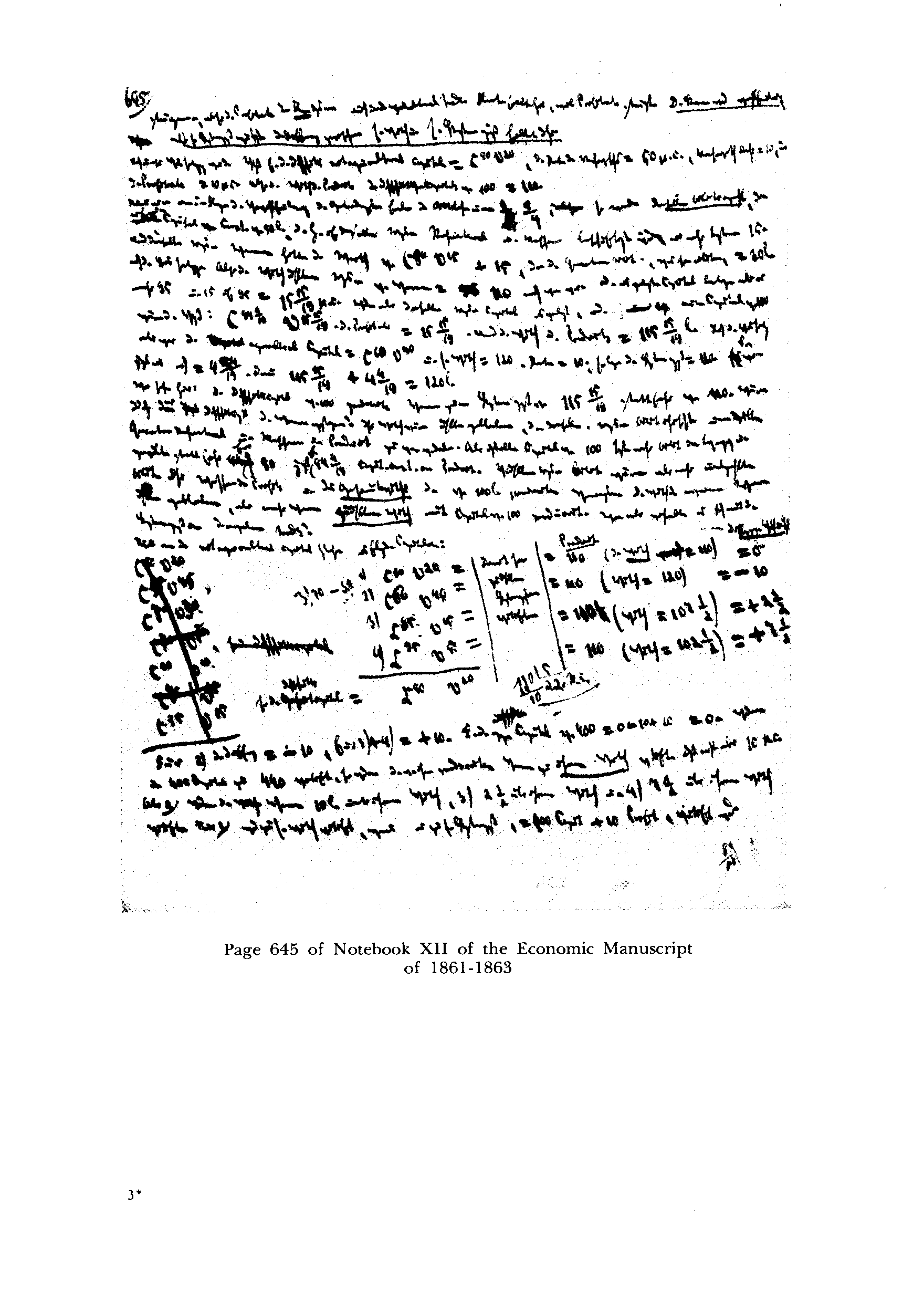
Page 645 of Notebook XII of the Economic Manuscript of 1861-1863
applied = 22[2]/[4].) On a capital of 96'/4. But this [the wages]=ll[53]/[7]7%. For 100 the ratio is 88[24]/[77]c+ll[53]/7[7]v. The rate of profit= 11 [53]/[77] and [the value of the] product= 111 [53]/[77].
For capital 4). Now only 3[3]/[4] laid out in wages, for V4 of 5=1'A and 5 — lV4=3[3]/4- The product 95c+3[3]/[4]v and the surplus value equal to 3[3]/[4] (for the value of the total labour=7[2]/[4]). On a capital of 98[3]/[4]. This [the wages] = 3[63]/[79]%. For 100 the ratio is: 96l6/[7]9C + 3[63]/[79]v. The rate of profit=3[63]/[7]<>. The value [of the product] =103[63]/[79].
We would therefore have the following:
Rate of profit
Difference Product between cost price and value
= 116 (value= •115»/[19]) = + [4]/l9 = 116 (value= = 1331/3) = -17»/ s = 116 (value= = lll53/7 7) = + 424/77 = 116 (value= • 103*>/79) = +12'6/[79]
1) 84*/19C+ I S » / » » 15'[5]/i9 I n o r d e r 2) 66*/[3]c + 33V[3]i; 331/3 t o s e l l a t 3) 8824/„ c+H53 / 7 7 t ) n 5 3 / 7 7 t h e s a m e
4) 961 6/7 9C + 3 6 3/ 7 9D 3 6 3/ 7 9 cost prices
Total: 400 64 (to the nearest whole number) This makes 16%. More exactly, a little more than £16'/7.[9] The calculation is not quite correct because we have disregarded, not taken into account a fraction of the average profit; this makes the negative difference in 2) appear a little too large and [the positive] in 1), 3), 4) a litde too small. But it can be seen that otherwise the positive and negative differences would cancel out; further, it can be seen that on the one hand the sale of 2) below its value and of 3) and particularly of 4) above their value would increase considerably. True, the addition to or reduction of the price would not be so great for the individual product as might appear here, since in all 4 categories more labour is employed and hence more constant capital (raw materials and machinery) is transformed into product. The increase or reduction in price would thus be spread over a larger volume of commodities. Nevertheless it would still be considerable. It is thus evident that a fall in wages would cause a rise in the cost prices of 1), 3), 4), in fact a very considerable rise in the cost price of 4). It is the same law as that developed by Ricardo in relation to the difference between circulating and fixed capital,[10] but he did not by any means prove, nor could he have proved, that this is reconcilable with the law of value and that the value of the products remains the same for the total capital.
[XII-647] The calculation and the adjustment becomes much more complicated if we take into account those differences in the organic composition of the capital which arise from the circulation process. For in our calculation, above, we assumed that the whole of the constant capital which has been advanced, enters into the product, i.e. that it contains only the wear and tear of the fixed capital, for one year, for example (since we have to calculate the profit for the year). The values of the total product would otherwise be very different, whereas here they only change with the variable capital. Secondly, with a constant rate of surplus value but varying periods of circulation, there would be greater differences in the amount of surplus value created, relatively to the capital advanced. Leaving out of account any differences in variable capital, the amounts of the surplus values would be proportionate to the amounts of the values created by the same capitals. The rate of profit would be even lower where a relatively large part of the constant capital consisted of fixed capital and considerably higher, where a relatively large part of the capital consisted of circulating capital. It would be highest where the variable capital was relatively large as compared with the constant capital and where the fixed portion of the latter was at the same time relatively small. If the ratio of circulating to fixed capital in the constant capital were the same in the different capitals, then the only determining factor would be the difference between variable and constant capital. If the ratio of variable to constant capital were the same, then it would be the difference between fixed and circulating capital, that is, only the difference within the constant capital itself.
As we have seen above, the FARMERS rate of profit would rise, in any case, if, as a result of the lower price of corn, the general rate of profit of the NON-AGRICULTURAL CAPITAL increased. The question is whether his rate of profit would rise directly, and this appears to depend on the nature of the IMPROVEMENTS. If the IMPROVEMENTS were of such a kind that the capital laid out in wages decreased considerably compared with that laid out in machinery, etc., then his rate of profit need not necessarily rise directly. If, for example, it was such that he required 'U less workers, then instead of his original outlay of £40 in wages, he would now pay only 30. Thus his capital would be 60c + 30t>, or on 100 it would be 66[2]/[3]c + 33V3f. And since the labour costing 40 [provides a surplus value of] 20, the labour costing 30 provides 15. And 16[2]/s [surplus value is derived] from the labour costing 33'/3- Thus the organic composition [of the agricultural capital] would grow closer to the NON-AGRICULTURAL CAPITAL. And in the above case, with a simultaneous decrease in wages by lU, it would even come within the range of that of the non-agricultural capital.[11] In this case, rent (absolute rent) would disappear.
Following upon the above-quoted passage on Buchanan, Ricardo says:
* "I hope I have made it sufficiently clear, that until a country is cultivated in every part, and up to the highest degree, there is always a portion of capital employed on the land which yields no rent, and" (!) "that it is this portion of capital, the result of which, as in manufactures, is divided between profits and wages that regulates the price of corn. The price of corn, then, which does not afford a rent, being influenced by the expenses of its production, those expenses cannot be paid out of rent. The consequence therefore of those expenses increasing, is a higher price, and not a lower rent" * (I.e., [p.] 293).
Since absolute rent is equal to the excess of the value of the AGRICULTURAL product over its price of production, it is clear that all factors which reduce the total quantity of labour required in the production OF CORN, etc., reduce the rent, because they reduce the value, hence the excess of the value over the price of production. In so far as the price of production consists of EXPENSES, its fall is identical and goes hand in hand with the fall in value. But in so far as the price of production (or the EXPENSES)=THE CAPITAL ADVANCED+the AVERAGE PROFIT, the very reverse is the case. The market value of the product falls, but that part of it, which=the price of production, rises, if the general rate of profit rises as a result of the fall in the market value of corn. The rent, therefore, falls, because the EXPENSES in this sense rise — and this is how Ricardo takes expenses elsewhere, when he speaks of COST OF PRODUCTION. Improvements in agriculture, which bring about an increase in constant capital as compared with variable, would reduce rent considerably, even if the total quantity of labour employed fell only slightly, or so slightly that it did not influence wages (surplus value, directly) at all. Suppose, as a result of such improvements, the composition of the capital altered from 60c+40v to 66[2]/3C + 337si/ (this might occur, for example, as a result of rising wages, caused by emigration, war, discovery of new markets, PROSPERITY IN THE NON-AGRICULTURAL INDUSTRY, [or it could occur as a result of the] competition of foreign corn, the farmer might feel impelled to find means of employing more constant capital and less variable; the same circumstances could continue to operate after the introduction of the improvement and wages therefore might not fall despite the improvement). [XII-648] Then the value of the AGRICULTURAL PRODUCT would be reduced from 120 to 116[2]/[3], that is by 3V3. The rate of profit would continue to be 10%.
The rent would fall from 10 to 6[2]/s and, moreover, this reduction would have taken place without any reduction whatsoever in wages.
The absolute rent may rise because the general rate of profit falls, owing to new advances in industry. T h e rate of profit may fall due to a rise in rent, because of an increase in the value of AGRICULTURAL PRODUCE which is accompanied by an increase in the difference between its value and its cost price. (At the same time, the rate of profit falls because wages rise.)
The absolute rent can fall, because the value of AGRICULTURAL PRODUCE falls and the general rate of profit rises. It can fall, because the value of the AGRICULTURAL PRODUCE falls as a result of a fundamental change in the ORGANIC COMPOSITION OF CAPITAL, without the rate of profit rising. It can disappear completely, as soon as the value of the AGRICULTURAL PRODUCE becomes=the cost price, in other words when the AGRICULTURAL CAPITAL has the same composition as t h e NON-AGRICULTURAL AVERAGE CAPITAL. Ricardo's proposition would only be correct if expressed like this: When the value of AGRICULTURAL pRODucE=its cost price, then there is no absolute rent. But he is wrong because he says: There is n o ABSOLUTE RENT because value and cost price are altogether identical, both in industry and in agriculture. On the contrary, agriculture would belong to an exceptional class of industry, if its value and cost price were identical.
Even when admitting that there may be no portion of LAND which does not pay a rent, Ricardo believes that by referring to the fact that at least some portion of the capital EMPLOYED on the LAND pays no rent he substantially improves his case. T h e one FACT is as irrelevant to the theory as the other. T h e real question is this: Do the products of these lands or of this capital regulate the market value? O r must they not rather sell their products below their value, because their ADDITIONAL SUPPLY is only saleable at, not above, this market value which is regulated without them. So far as the portion of capital is concerned, the matter is simple, because for the FARMER who invests an ADDITIONAL amount of capital LANDED PROPERTY does not exist and as a capitalist he is only concerned with the cost price; if he possesses the ADDITIONAL capital, it is more advantageous for him to invest it on his FARM, even below the AVERAGE PROFIT, than to lend it out and to receive only interest and n o profit. So far as the land is concerned, those portions of land which do not pay a rent form component parts of estates that pay rent and are not separable from the estates with which they are let; they cannot however be let in isolation from the rest to a 3]
CAPITALIST FARMER (but perhaps to a COTTIER or to a SMALL CAPITALIST). In relation to these bits of land, the FARMER is again not confronted by "LANDED PROPERTY". Alternatively, the PROPRIETOR must cultivate the land himself. T h e FARMER cannot pay a rent for it and the LANDLORD does not let it for nothing, unless he wants to have his land made arable in this fashion without incurring any expense.
The situation would be different in a country in which the COMPOSITION o f t h e AGRICULTURAL CAPITAL = t h e AVERAGE COMPOSITION o f t h e NON-AGRICULTURAL CAPITAL, which presupposes a high level of development in agriculture or a low level of development in industry. In this case the value of the AGRICULTURAL PRODUCE=its cost price. Only differential rent could be paid then. T h e land which yields no differential rent but only an AGRICULTURAL RENT, could then pay no rent. For if the farmer sells the agricultural produce at its value, it only covers its cost price. He therefore pays no rent. T h e PROPRIETOR must then cultivate the land himself, or the so-called fermage* collected by him is a part of his tenant's profit or even of his wages. That this might be the case in one country does not mean that the opposite might not happen in another country. Where, however, industry — and therefore capitalist production— is at a low level of development, there are no CAPITALIST FARMERS, whose existence would presuppose capitalist production on the land. Thus, quite different circumstances have to be considered here, from those involved in the economic organisation in which landed property as an economic category exists only in the form of rent.
In the same C H . XVII, Ricardo says:
* "Raw produce is not at a monopoly price, because the market price of barley and wheat is as much regulated by their cost of production, as the market price of cloth and linen. The only difference is this, that one portion of the capital employed in agriculture regulates the price of corn, namely, that portion which pays no rent; whereas, in the production of manufactured commodities, euerji portion of capital is employed with the same results; and as no portion pays rent, every portion is equally a regulator of price"* (I.e., pp. 290-91),
This assertion, THAT EVERY PORTION OF CAPITAL IS EMPLOYED WITH THE SAME RESULTS and that none pays RENT (which is, however, called SURPLUS PROFIT here) is not only wrong, but has been refuted by Ricardo himself [XII-650] [1 2] as we have seen previously.b
We now come to the presentation of Ricardo's theory of surplus value.
a Rent.— Ed b See present edition, Vol. 31, pp. 428, 526-27 and also this volume, p. 13.— Ed
1) Quantity of Labour and Value of Labour
Ricardo opens CH. I, "On Value", with the following heading of SECT. I:
* "The value of a commodity, or the quantity of any other commodity for which it will exchange, depends on the relative quantity of labour which is necessary for its production, and not on the greater or less compensation which is paid for that labour."*
In the style which runs through the whole of his enquiry, Ricardo begins his book here by stating that the determination of the value of commodities by labour time is not incompatible with wages, in other words with the varying compensation paid for that labour time or that quantity of labour. From the very outset, he turns against Adam Smith's confusion between the determination of the value of commodities by the PROPORTIONAL QUANTITY OF LABOUR REQUIRED FOR THEIR PRODUCTION AND THE VALUE OF LABOUR (OT the Compensation paid for LABOUR). It is clear that the proportional quantity of labour contained in two commodities A and B, is absolutely unaffected by whether the workers who produce A and B receive much or little of the product of their labour. The value of A and B is determined by the quantity of labour which their production costs, and not by the costs of labour to the OWNERS of A and B. Quantity of labour and value of labour are two different things. The quantity of labour which is contained in A and B respectively, has nothing to do with how much of the labour contained in A and B the owners of A and B have paid or even performed themselves. A and B are exchanged not in proportion to the paid labour contained in them, but in proportion to the total quantity of labour they contain, paid and unpaid.
* "Adam Smith, who so accurately defined the original source of exchangeable value and who was bound in consistency to maintain, that all things became more or less valuable in proportion as more or less labour was bestowed on their production, has himself erected another standard measure of value, and speaks of things being more or less valuable, in proportion as they will exchange for more or less of this standard measure... as if these were two equivalent expressions, and as if because a man's labour had become doubly efficient, and he could therefore produce twice the quantity of a commodity, he would necessarily receive twice the former quantity in exchange for it" * (that is for his * labour). "If this indeed were true, if the reward of the labourer were always in proportion to what he produced, the quantity of labour [bestowed on a commodity, and the quantity of labour] which that commodity would purchase, would be equal, and either might accurately measure the variations of other things: but they are not equal" * ([p.] 5).
Adam Smith nowhere asserts THAT "THESE WERE TWO EQUIVALENT EXPRESSIONS". On the contrary, he says: Because in capitalist production, the wage of the worker is no longer equal to his product, therefore, the quantity of labour which a commodity costs a n d the quantity of commodities that the worker can purchase with this labour are two different things—for this very reason the relative quantity of labour contained in commodities ceases to determine their value, which is now determined rather by the VALUE OF LABOUR, by the quantity of labour that I can purchase, or command with a given amount of commodities. Thus the VALVE OF LABOUR, instead of the RELATIVE QUANTITY OF LABOUR becomes the measure of value. Ricardo's reply to Adam Smith is correct — that the relative quantity of labour which is contained in two commodities is in no way affected by how much of this quantity of labour falls to the workers themselves and by the way this labour is remunerated ; if the RELATIVE QUANTITY OF LABOUR was the measure of value of commodities before the supervention of wages (wages that differ from the value of the products themselves), there is therefore n o reason at all, why it should not continue to be so after wages have come into being. H e argues correctly, that Adam Smith could use both expressions so long as they were EQUIVALENT, but that this is n o reason for using the wrong expression instead of the right one when they have ceased to be
EQUIVALENT.
But Ricardo has by n o means thereby solved the problem which is the real cause of Adam Smith's contradiction. VALUE OF LABOUR and QUANTITY OF LABOUR remain "EQUIVALENT EXPRESSIONS" , so long as it is a question of objectified labourl [XII-651] They cease to be equivalents as soon as objectified labour is exchanged for living labour.
Two commodities exchange in proportion to the labour objectified in them. Equal quantities of objectified labour are exchanged for one another. Labour time is their STANDARD MEASURE, but precisely for this reason they are "MORE OR LESS VALUABLE, IN PROPORTION AS THEY WILL EXCHANGE FOR MORE OR LESS OF THIS STANDARD MEASURE". If the commodity A contains one working day, then it will exchange against any quantity of commodities which likewise contains one working day and it is "MORE OR LESS VALUABLE" in proportion as it exchanges for more or less objectified labour in other commodities, since this exchange relationship expresses, is identical with, the relative quantity of labour which it itself contains.
Now wage labour, however, is a commodity. It is even the basis on which the production of products as commodities takes place. T h e law of value is not applicable to it. Capitalist production therefore is not governed at all by this law. Therein lies a contradiction. This is the first of Adam Smith's problems. T h e second — which we shall find further amplified by Malthus*—lies in the fact that the utilisation of a commodity (as capital) is proportional not to the amount of labour it contains, but to the extent to which it commands the labour of others, gives power over more labour of others than it itself contains. This is IN FACT a second latent reason for asserting that since the beginning of capitalist production, the value of commodities is determined not by the labour they contain but by the living labour which they command, in other words, by the value of labour.
Ricardo simply answers that this is how matters are in capitalist production. Not only does he fail to solve the problem; he does not even realise its existence in Adam Smith's work. In conformity with the whole arrangement of his investigation, Ricardo is satisfied with demonstrating that the changing value of labour — in short, wages — does not invalidate the determination of the value of the commodities, which are distinct from labour itself, by the relative quantity of labour contained in them. " THEY ARE NOT EQUAL" , that is "THE QUANTITY OF LABOUR BESTOWED ON A COMMODITY, AND THE QUANTITY
OF LABOUR WHICH THAT COMMODITY WOULD PURCHASE". H e contents himself with stating this fact. But how does the commodity labour differ from other commodities? O n e is living labour and the other objectified labour. They are, therefore, only two different forms of labour. Since the difference is only a matter of form, why should a law apply to one and not to the other? Ricardo does not answer — he does not even raise this question.
Nor does it help when he says:
*"Is not the value of labour ... variable; being not only affected, as all other things" * (should read * commodities) "are, by the proportion between the supply and demand, which uniformly varies with every change in the condition of the community, but also by the varying price of food and other necessaries, on which the wages of labour are expended?" * ([p.] 7).
That the PRICE OF LABOUR, like that of other commodities, changes with DEMAND and SUPPLY proves nothing in regard to the VALUE OF LABOUR, according to Ricardo, just as this change of price with SUPPLY and DEMAND proves nothing in regard to the VALUE OF OTHER COMMODITIES. But that the "WAGES OF LABOUR"—which is only another expression for the VALUE OF LABOUR — are affected by "THE VARYING PRICE
OF FOOD AND OTHER NECESSARIES, ON WHICH THE WAGES OF LABOUR ARE EXPENDED", shows just as little why the VALUE OF LABOUR is (or appears to be) determined differently from the VALUE of other COMMODITIES. For
a See this volume, pp. 210-11.— Ed.
t h e s e t o o are affected b y t h e VARYING PRICE OF OTHER COMMODITIES WHICH
ENTER INTO THEIR PRODUCTION. AGAINST WHICH THEY ARE EXCHANGED. A n d a f t e r
a l l , t h e EXPENDITURE OF THE WAGES OF LABOUR UPON FOOD AND NECESSARIES means nothing other than the EXCHANGE of the VALUE OF LABOUR AGAINST FOOD AND NECESSARIES. The question is just why LABOUR and the commodities against which it is exchanged, do not exchange according to the law of value, according to the relative quantities of labour.
Posed in this way, and presupposing the law of value, the question is intrinsically insoluble, because LABOUR as such is counterposed to commodity, a definite quantity of immediate labour as such is counterposed to a definite quantity of objectified labour.
This weakness in Ricardo's discourse, as we shall see later,a has contributed to the disintegration of his school, and led to the proposition of absurd hypotheses.
[XII-652] Wakefield is right when he says:
* "Treating labour as a commodity, and capital, the produce of labour, as another, then, if the value of these two commodities were regulated by equal quantities of labour, a given amount of labour would, under all circumstances, exchange for that quantity of capital which had been produced by the same amount of labour; antecedent labour [...] would always exchange for the same amount of present labour [...] But the value of labour, in relation to other commodities, in so far, at least, as wages depend upon share, is determined, not by equal quantities of labour, but by the proportion between supply and demand"* (E. G. Wakefield, Note on p. [230], 231 of Vol. I of his edition of Adam Smith's Wealth of Nations, London, 1835.1S)
This is also one of Bailey's hobby-horses; to be looked up later.b
Also Say, who is very pleased to find that here, all of a sudden, SUPPLY AND DEMAND are said to be the decisive factors.c
2) Value of Labour Capacity. Value of Labour
In order to determine surplus value, Ricardo, like the Physiocrats, Adam Smith, etc., must first determine the value of labour capacity or, as he puts it — following Adam Smith and his predecessors — THE VALUE OF LABOUR.
Re I. Another point to be noted here: CH. I, SECT. 3, bears the following heading:
* "Not only the labour applied immediately to commodities affects their value, but the labour also which is bestowed on the implements, tools, and buildings, with which such labour is assisted"* [Ricardo, On the Principles of Political Economy..., 3rd ed., London, 1821, p. 16].
a See this volume, pp. 258 et seq.— Ed. b Ibid., pp. 334-39— Ed c Cf. ibid., p. 36.— Ed Thus the value of a commodity is equally determined by the quantity of objectified (past) labour and by the quantity of living (immediate) labour required for its production. In other words: the quantities of labour are in no way affected by the formal difference of whether the labour is objectified or living, past or present (immediate). If this difference is of no significance in the determination of the value of commodities, why does it assume such decisive importance when past labour (capital) is exchanged against living labour? Why should it, in this case, invalidate the law of value, since the difference in itself, as shown in the case of commodities, has no effect on the determination of value? Ricardo does not answer this question, he does not even raise it.
How then is the value or NATURAL PRICE of labour determined? According to Ricardo, the NATURAL PRICE is in fact nothing but the
MONETARY EXPRESSION OF VALUE.
* "Labour, like all other things which are purchased and sold, and which may be increased or diminished [in quantity]"* (i.e. like all other commodities) * "has its natural and its market price. The natural price of labour is that price which is necessary to enable the labourers, one with another, to subsist and perpetuate their race, without either increase or diminution."* (Should read: *with that rate of increase required by the average progress of production.) "The power of the labourer to support himself, and the family which may be necessary to keep up the number of labourers, ... depends on the price of the food, necessaries, and conveniences, required for the support of the labourer and his family. With a rise in the price of food and necessaries, the natural price of labour will rise; with the fall in their price, the natural price of labour will fall" ([p.] 86).
"Tt is not to be understood that the natural price of labour, estimated even in food and necessaries, is absolutely fixed and constant. It varies at different times in the same country, and very materially differs in different countries. It essentially depends on the habits and customs of the people"* ([p.] 91).
The VALUE or LABOUR is therefore determined by the means of subsistence which, in a given society, are traditionally necessary for the maintenance and reproduction of the labourers.
But why? By what law is the VALUE OF LABOUR determined in this way?
Ricardo has in fact no answer, other than that the law OF SUPPLY AND DEMAND reduced the average price of labour to the means of subsistence that are necessary (physically or socially necessary in a given society) for the maintenance of the labourer. [XII-653] He determines value here, in one of the basic propositions of the whole system, by demand and supply—as Say notes with malicious pleasure. (See Constancio's translation.[14])
Instead of labour, Ricardo should have discussed labour capacity. But had he done so, capital would also have been revealed as the material conditions of labour, confronting the labourer as power that had acquired an independent existence. And capital would at once have been revealed as a definite social relationship. Ricardo thus only distinguishes capital as "ACCUMULATED LABOUR" from "IMMEDIATE LABOUR". And it is something purely physical, only an element in the labour process, from which the relation between the worker and capital, WAGES AND PROFITS, could never be developed.
* " Capital is that part of the wealth of a country which is employed in production, and consists of food, clothing, tools, raw materials, machinery, etc., necessary to give effect to labour" ([p.] 89). "Less capital, which is the same thing as less labour" ([p.] 73). "Labour and capital, that is, accumulated labour" * (I.e., p. 499).
T h e j u m p which Ricardo makes here is correctly sensed by Bailey:
* "Mr. Ricardo, ingeniously enough, avoids a difficulty, which, on a first view, threatens to encumber his doctrine, that value depends on the quantity of labour employed in production. If this principle is rigidly adhered to, it follows, that the value of labour depends on the quantity of labour employed in producing it—which is evidently absurd. By a dexterous turn, therefore, Mr. Ricardo makes the value of labour depend on the quantity of labour required to produce wages, or, to give him the benefit of his own language, he maintains, that the value of labour is to be estimated by the quantity of labour required to produce wages; by which he means, the quantity of labour required to produce the money or commodities given to the labourer. This is similar to saying, that the value of cloth is to be estimated, not by the quantity of labour bestowed upon its production, but by the quantity of labour bestowed on the production of silver, for which the cloth is exchanged" * (A Critical Dissertation on the Nature, Measures, and Causes of Value etc., London, 1825, [pp.] 50-51).
Literally the objection raised here is correct. Ricardo distinguishes between NOMINAL a n d REAL WAGES. NOMINAL WAGES are wages expressed in money, MONEY WAGES.
"NOMINAL WAGES" are "THE NUMBER OF POUNDS THAT MAY BE ANNUALLY PAID TO
THE LABOURER", b u t REAL WAGES a r e " T H E NUMBER OF DAY'S WORK? NECESSARY T O OBTAIN THOSE POUNDS" (Ricardo, I.e. [p.] 152).
As WAGES=the NECESSARIES for the LABOURER, and the value of these WAGES (the REAL WAGES) = the value of these NECESSARIES, it is obvious that the value of these NECESSARIES=the REAL WAGES,=the labour which they can command. If the value of the NECESSARIES changes, then the value of the REAL WAGES changes. Assume that the NECESSARIES of the labourer consist only of corn, and that the quantity of means of subsistence which he requires is 1 qr of corn per month. Then the value of his wages=the value of 1 qr of corn; if the value of the qr
a In the manuscript these words are followed by the German equivalent in brackets.— Ed.
of corn rises or falls, then the value of the month's labour rises or falls. But however much the value of the qr of corn rises or falls (however much or little labour the qr of corn contains), it is always=to the value of one month's labour. A n d here we have the hidden reason for Adam Smith's assertion, that as soon as capital, and consequently wage labour, intervenes, the value of the product is not regulated by the QUANTITY OF LABOUR BESTOWED UPON it,
BUT b y THE QUANTITY OF LABOUR IT CAN COMMAND. T h e V a l u e o f C O m (AND OF OTHER NECESSARIES) determined by labour time, changes; but, so long as the NATURAL PRICE OF LABOUR is paid, the quantity of labour that the qr of corn can command remains the same. Labour has, therefore, a permanent relative value as compared with corn. That is why for Smith too, the VALUE OF LABOUR and the VALUE OF CORN (FOR FOOD. See Deacon Hume ) [are] STANDARD MEASURES OF VALUE, BECAUSE A CERTAIN
QUANTITY OF CORN SO LONG AS THE NATURAL PRICE OF LABOUR IS PAID, COMMANDS A
CERTAIN QUANTITY OF LABOUR, WHATEVER THE QUANTITY OF LABOUR BESTOWED UPON ONE QR OF CORN. T h e same quantity of labour always commands the same use value, or rather the same use value always commands the same quantity of labour. Even Ricardo determines the VALUE OF LABOUR, ITS NATURAL PRICE, in this way. Ricardo says: The qr of CORN may have very different values, although it always c o m m a n d s — o r is commanded b y — the same [XII-654] quantity of labour. Yes, says Adam Smith: However much the value of the qr of corn, determined by labour time, may change, the worker must always pay (sacrifice) the same quantity of labour in order to buy it. The value of corn therefore alters, but the value of labour does not, since 1 month's labour = 1 qr of corn. T h e value of corn too changes only in so far as we are considering the labour required for its production. If, on the other hand, we examine the quantity of labour against which it exchanges, which it sets into motion, its value does not change. A n d that is precisely why the QUANTITY OF
LABOUR, AGAINST WHICH A QR OF CORN IS EXCHANGED, [is] THE STANDARD MEASURE OF
VALUE. But the values of the other commodities have the same relation to labour as they have to corn. A given quantity of corn commands * a given quantity of labour. A given quantity of every other commodity commands a certain quantity of corn. Hence every other commodity — or rather the value of every other commodity — is expressed by the quantity of labour it commands, since it is expressed by the quantity of corn it commands, and the latter is expressed by the quantity of labour it commands.*
But how is the value of other commodities in relation to corn
(NECESSARIES) determined? By the QUANTITY OF LABOUR THEY COMMAND. A n d how is the QUANTITY OF LABOUR THEY COMMAND determined? By the QUANTITY OF CORN THAT LABOUR COMMANDS. Here Adam Smith is inevitably caught up in a cercle vicieux* (Although, BY THE BY, he never uses this MEASURE OF VALUE when making an actual analysis.) Moreover here he confuses — as Ricardo also often does — labour, the intrinsic measure of value, with money, the external measure, which presupposes that value is already determined; although he and Ricardo have declared that labour is
"THE FOUNDATION OF THE VALVE OF COMMODITIES" w h i l e "THE COMPARATIVE QUANTITY OF LABOUR WHICH IS NECESSARY TO THEIR PRODUCTION" is " T H E RULE WHICH DETERMINES THE RESPECTIVE QUANTITIES OF GOODS WHICH SHALL BE GIVEN IN EXCHANGE FOR EACH OTHER" ( Ricardo , I.e., p . 8 0 ) .
Adam Smith errs when he concludes from the fact that a definite quantity of labour is EXCHANGEABLE for a definite quantity of use value, that this definite quantity of labour is the measure of value and that it always has the same value, whereas the same quantity of use value can represent very different exchange values. But Ricardo errs twice over; firstly because he does not understand the problem which causes Adam Smith's errors; secondly because disregarding the law of value of commodities and taking ' refuge in the LAW OF SUPPLY AND DEMAND, he himself determines the value of labour, not by the quantity of labour
BESTOWED UPON THE FORCE OF LABOUR, BUT UPON THE WAGES ALLOTTED TO THE LABOURER. Thus IN FACT he says: The value of labour is determined by the value of the money which is paid for it! And what determines this? What determines the amount of money that is paid for it? The quantity of use value that a given amount of labour commands or the quantity of labour that a definite quantity of use value commands. And thereby he falls literally into the very inconsistency which he himself condemned in Smith.
This, as we have seen, also prevents him from grasping the specific distinction between commodity and capital, between the exchange of commodity for commodity and the exchange of capital for commodity — in accordance with the law of exchange of commodities.
The above example was this: 1 qr of corn=l month's labour, say 30 working days. (A working day of 12 hours.) In this case the value of 1 qr corn < 30 working days. IF 1 qr corn were the product of 30 working days, the value of the labour=its product. There would be no surplus value, and therefore no profit. No capital. In actual fact, therefore, if 1 qr corn represents the wages for 30 working days, the value of 1 qr corn always < 30 working days.
The surplus value depends on how much less it is. For example, 1 qr corn = 2 5 working days. T h e n the surplus value=5 working days='/6 of the total labour time. If 1 qr (8 BUSHELS)=25 working days, then 30 working days= 1 qr 1 (1)/s BUSHELS. T h e value of the 30 working days (i.e. the wage) is therefore always smaller than the value of the product which contains the labour of 30 working days. T h e value of the corn is thus determined not by the [XII-655] labour which it commands, for which it exchanges, but by the labour which is contained in it. O n the other hand, the value of the 30 days' labour is always determined by 1 qr corn, whatever this may be.
3) Surplus Value
Apart from the confusion between LABOUR and labour capacity, Ricardo defines the AVERAGE WAGES or the VALUE OF LABOUR correctly. For he says that it is determined neither by the money nor by the means of subsistence which the labourer receives, but by the labour time which it costs to produce them, that is, by the quantity of labour objectified in the means of subsistence of the labourer. This he calls the REAL WAGES. (See later.[3])
This definition, moreover, necessarily follows from his theory. Since the VALUE OF LABOUR is determined by the VALUE of the necessary means of subsistence on which this VALUE IS TO BE EXPENDED, and the
VALUE OF NECESSARIES, LIKE THAT OF ALL OTHER COMMODITIES, IS DETERMINED BY THE
QUANTITY OF LABOUR BESTOWED UPON THEM, i t n a t u r a l l y f o l l o W S THAT THE
VALUE OF LABOUR = THE VALUE OF NECESSARIES = THE QUANTITY OF LABOUR BESTOWED
UPON THESE NECESSARIES. However correct this formula is (apart from the direct opposition of LABOUR and CAPITAL), it is, nevertheless, inadequate. Although in replacement of his WAGES the individual labourer does not directly produce—or reproduce, taking into account the continuity of this process — products on which he lives / / h e may produce products which do not enter into his consumption at all, and even if he produces NECESSARIES, he may, due to the division of labour, only produce A SINGLE PART OF the NECESSARIES, for instance CORN — and GIVES IT ONLY ONE FORM (e.g. in that OF CORN, NOT OF BREAD) //, but he produces commodities to the value of his means of subsistence, that is, he produces the value of his means of subsistence. This means, therefore, if we consider his daily average consumption, that the labour time which is contained in his daily NECESSARIES, forms one part of h i s working day. He works one part of the day in order to reproduce the value of his NECESSARIES; the commodities which he produces in this part of the working day have the same value, or represent a quantity of labour time equal to that contained in his daily NECESSARIES. It depends on the value of these NECESSARIES (in other words on the social productivity of labour and not on the productivity of the individual branch of production in which he works) how great a part of his working day is devoted to the reproduction or production of the value, i.e. the equivalent, of his means of subsistence. Ricardo of course assumes that the labour time contained in the daily NECESSARIES=the labour time which the labourer must work daily in order to reproduce the value of these NECESSARIES. But by not directly showing that one part of the labourer's working day is assigned to the reproduction of the value of his own labour capacity, he introduces a difficulty and obscures the clear understanding of the relationship. A twofold confusion arises from this. The origin of surplus value does not become clear and consequendy Ricardo is reproached by his successors for having failed to grasp and expound the nature of surplus value. That is part of the reason for their scholastic attempts at explaining it. But because thus the origin and nature of surplus value is not clearly comprehended, the surplus labour+the necessary labour, in short, the total working day, is regarded as a fixed magnitude, the differences in the amount of surplus value are overlooked, and the productivity of capital, the compulsion to perform surplus labour—on the one hand [capital's enforcement of] absolute [surplus value], and on the other its innate urge to shorten the necessary labour time — are not recognised, and therefore the historical justification for capital is not set forth. Adam Smith, however, had already stated the correct formula. Important as it was, to resolve VALUE into LABOUR, it was equally important to resolve SURPLUS VALUE into SURPLUS LABOUR, and to do so in explicit terms.
Ricardo starts out from the actual fact of capitalist production. The value of labour < the value of the product which it creates. The value of the product therefore > the value of the labour which produces it, or the value of the WAGES. The excess of the value of the product over the value of the wAGEs=the surplus value.
(Ricardo wrongly uses the word profit, but, as we noted earlier, he identifies profit with surplus value here and is really speaking of the latter.) For him it is a fact, that the value of the product > the value of the WAGES. HOW this fact arises, remains unclear. The total working day is greater than that part of the working day which is required for the production of the Why? That does not emerge. The magnitude of the total working day is therefore wrongly assumed to be fixed, and directly entails wrong conclusions. The increase or decrease in surplus value can therefore be explained only from the growing or diminishing productivity of social labour which produces the NECESSARIES. That is to say, only relative surplus value is understood.
[XII-656] It is obvious that if the labourer needed his whole day to produce his own means of subsistence (i.e. commodities equal to the value of his own means of subsistence), there could be no surplus value, and therefore no capitalist production and no wage labour. This can only exist when the productivity of social labour is sufficiendy developed to make possible some sort of excess of the total working day over the labour time required for the reproduction of the WAGES — i.e. surplus labour, whatever its magnitude. But it is equally obvious, that with a given labour time ([a given] length of the working day) the productivity of labour may be very different, on the other hand, with a given productivity of labour, the labour time, the length of the working day, may be very different. Furthermore, it is clear that though the existence of surplus labour presupposes that the productivity of labour has reached a certain level, the mere possibility of this surplus labour (i.e. the existence of that necessary minimum productivity of labour), does not in itself make it a reality. For this to occur, the labourer must first be compelled to work beyond the limits [of necessary labour], and this compulsion is exerted by capital. This is missing in Ricardo's work, and therefore also the whole struggle over the regulation of the normal working day.
At a low stage of development of the social productive power of labour, that is to say, where the surplus labour is relatively small, the class of those who live on the labour of others will generally be small in relation to the number of labourers. It can considerably grow (proportionately) in the measure in which productivity and therefore relative surplus value develop.
It is moreover UNDERSTOOD that the value of labour varies greatly in the same country at different periods and in different countries during the same period. The temperate zones are however the home of capitalist production. The social productive power of labour may be very undeveloped; yet this may be compensated precisely in the production of the NECESSARIES, on the one hand, by the fertility of the natural agents, such as the land; on the other hand, by the limited requirements of the population, due to climate, etc.—this is, for instance, the case in India. Where conditions are primitive, the minimum wage may be very small (quantitatively in use values) because the social needs are not yet developed though it may cost much labour. But even if an average amount of labour were required to produce this minimum wage, the surplus value created, although it would be high in proportion to the wage (to the necessary labour time), would, even with a high rate of surplus value, be just as meagre (proportionately)—when expressed in terms of use values — as the wage itself.
Let the necessary labour time=10, the surplus labour=2, and the total working day=12 hours. If the necessary labour time=12, the surplus labour=2[2]/s and the total working day=14[2]/[5] hours, then the values produced would be very different. In the first case [they] = 12 hours, in the second=14[2]/[5] hours. Similarly, the absolute magnitude of the surplus value: In the former case [it]=2 hours, in the latter=2[2]/s. And yet the rate of surplus value or of surplus labour would be the same, because 2:10=2 /s: 12. If, in the second case, the variable capital which is laid out were greater, then so also would be the surplus value or surplus labour appropriated by it. If in the latter case, the surplus labour were to rise by [5]/[5] hours instead of by [2]/[5] hours, so that it=3 hours and the total working day=15 hours, then, although the necessary labour time or the minimum wage had increased, the rate of surplus value would have risen, for 2:10='/5; but 3:12 = '/4. Both could occur if, as a result of the corn, etc., becoming dearer, the minimum wage had increased from 10 to 12 hours. Even in this case, therefore, not only might the rate of surplus value remain the same, but the AMOUNT and RATE of surplus value might grow. But let us suppose that the necessary wage=10 hours, as previously, the surplus labour =2 hours and all other conditions remained the same (that is, leaving out of account here any lowering in the production costs of constant capital). Now let the labourer work 2[2]/s hours longer, and appropriate 2 hours, while the [2]/[5] forms surplus labour. In this case wages and surplus value would increase in equal proportion, the former, however, representing more than the necessary wage or the necessary labour time.
If one takes a given magnitude and divides it into two parts, it is clear that one part can only increase in so far as the other decreases, and vice versa. But this is by no means the case with growing magnitudes (fluxions[16]). And the working day represents such a growing magnitude (as long as no normal working day has been won). With such magnitudes, both parts can grow, either to an equal or unequal extent. An increase in one is not brought about by a decrease in the other and vice versa. This is moreover the only case in which wages and surplus value, in terms of exchange value, can both increase and possibly even in equal proportions. That they can increase in terms of use value is self-evident; this can increase [XII-657] even if, for example, the value of LABOUR decreases. From 1797 to 1815, when the price of corn and [also] the nominal wage rose considerably in England, the daily hours of labour increased greatly in the principal industries, which were then in a phase of ruthless expansion; and I believe that this arrested the fall in the rate of profit, because it arrested the fall in the rate of surplus value. In this case, however, whatever the circumstances, the normal working day is lengthened and the normal span of life of the labourer, hence the normal duration of his labour capacity, is correspondingly shortened. This applies where a constant lengthening [of the working day] occurs. If it is only temporary, in order to compensate for a temporary rise in wages, it may (except in the case of children and women) have no other result than to prevent a fall in the rate of profit in those enterprises where the nature of the work makes a prolongation of labour time possible. (This is least possible in agriculture.)
Ricardo did not consider this at all since he investigated neither the origin of surplus value nor absolute surplus value and therefore regarded the working day as a given magnitude. For this case, therefore, his law—that surplus value and wages (he erroneously says profit and wages) in terms of exchange value can rise or fall only in inverse proportion—is incorrect
Firstly let us assume that the necessary labour time and the surplus labour remain constant. That is 10+2; the working day =12 hours, surplus value=2 hours; the rate of surplus value = [1]/s-
The necessary labour time remains the same; surplus labour increases from 2 to 4 hours. Hence 10+4=a working day of 14 hours; surplus value=4 hours; rate of surplus value=4:10=[4]/[1]o=[2]/s.
In both cases the necessary labour time is the same; but the surplus value in the one case is twice as great as in the other and the working day in the second case is [1]/[6] longer than in the first. Furthermore, although the wage is the same, the values produced, corresponding to the quantities of labour, would be very different; in the first case [it] =12 hours, in the second=12+I2/6=T4. It is therefore wrong to say that, presupposing that the wage remains the same (in terms of value, of necessary labour time), the surplus value contained in two commodities is proportionate to the quantities of labour contained in them. This is only correct where the normal working day is the same.
Let us further assume that as a result of the rise in the productive power of labour, the necessary wage (although it remains CONSTANT in terms of EXPENDED use values) falls from 10 to 9 hours and similarly that the surplus labour time falls from 2 to 1[4]/[5] hours ([9]/[5]). In this case 10:9=2:l[4]h- Thus the surplus labour time would fall in the same proportion as the necessary labour time. The rate of surplus value would be the same in both cases, for 2 = ' % and l[4]/[5]=[9]/[5]. 1[4]/(1):9=2:10. The quantity of use values that could be bought with the surplus value, would — according to the assumption — also remain the same. (But this would apply only to those use values which are NECESSARIES.) The working day would decrease from 12 to 10[4]/[5]. The amount of value produced in the second case would be smaller than that produced in the first. And despite these unequal quantities of labour, the rate of surplus value would be the same in both cases.
In discussing surplus value we have distinguished between surplus value and the rate of surplus value. Considered in relation to one working day, the surplus value=the absolute number of hours which it represents, 2, 3, etc. The rate=the proportion of this number of hours to the number of hours which makes up the necessary labour time. This distinction is very important, because it indicates the varying length of the working day. If the surplus value=2, then [the rate] = [1]/5, if the necessary labour time=10; and VÔ, if the necessary labour time=12. In the first case the working day=12 hours and in the second=14. In the first case the rate of surplus value is greater, while at the same time the labourer works a smaller number of hours per day. In the second case the rate of surplus value is smaller, the value of the labour capacity is greater, while at the same time the labourer works a greater number of hours per day. This shows that, with a constant surplus value (but a working day of unequal length), the rate of surplus value may be different. The earlier case, 10:2 and 9:l[4]/[5], shows how with a constant rate of surplus value (but a working day of unequal length), the surplus value itself may be different (in one case 2 [hours] and in the other 1 [4]/[5]).
I have shown previously (CH. II), that if the length of the working day and also the necessary labour time, and therefore the rate of surplus value are given, the amount of surplus value depends on the number of workers simultaneously employed by the same capital.[2] This was a tautological statement. For if 1 working day gives me 2 surplus hours, then 12 working days give me 24 surplus hours or 2 surplus days. The statement, however, becomes very important in connection with the determination of profit, which is equal to the proportion of surplus value to the capital advanced, thus depending on the absolute amount of surplus value. It becomes important because capitals of equal size but different organic composition employ unequal numbers of labourers; they must thus produce unequal amounts of surplus value, and therefore unequal profits. With a falling rate of surplus value, the profit may rise and with a rising rate of surplus value, the profit may fall; or the profit may remain unchanged, if a rise or fall in the rate of surplus value is compensated by a counter movement affecting the number of workers employed. Here we see immediately, how extremely wrong it is [XII-658] to identify the laws relating to the rise and fall of surplus value with the laws relating to the rise and fall of profit. If one merely considers the simple law of surplus value, then it seems a tautology to say that with a given rate of surplus value (and a given length of the working day), the ABSOLUTE AMOUNT of surplus value depends on the amount of capital employed. For an increase in this amount of capital and an increase in the number of labourers simultaneously employed are, on the assumption made, identical, or merely [different] expressions of the same fact. But when one turns to an examination of profit, where the amount of the total capital employed and the number of workers employed vary greatly for capitals of equal size, then the importance of the law becomes clear.
Ricardo starts by considering commodities of a given value, that is to say, commodities which represent a given quantity of labour. And from this starting-point, absolute and relative surplus value appear to be always identical. (This at any rate explains the one-sidedness of his mode of procedure and corresponds with his whole method of investigation: to start with the value of the commodities as determined by the definite labour time they contain, and then to examine to what extent this is affected by wages, profits, etc.) This appearance is nevertheless false, since it is not a question of commodities here, but of capitalist production, of commodities as products of capital. Assume that a capital employs a certain number of workers, for example 20, and that wages=£20. To simplify matters let us assume that the fixed capital=0, i.e. we leave it out of account. Further, assume that these 20 workers spin £80 of cotton into yarn, if they work 12 hours per day. If 1 lb. of cotton costs 1 s. then 20 lbs cost £1 and £80=1,600 lbs. If 20 workers spin 1,600 lbs in 12 hours, then [they spin] 1,60%2 lbs= 133 7s lbs in 1 hour. Thus, if the necessary labour time=10 hours, then the surplus labour time=2 [hours] and this=266[2]/s lbs yarn. The value of the 1,600 lbs would=£104. For if 10 hours of work=£20, then 1 hour of work=£2 and 2 hours of work=£4, hence 12 = 24. (80+24=£104.) But if each of the workers worked 4 hours of surplus labour, then their product=£8 (I mean the surplus value which they create — their product IN FACT=£28 [17]). The total product=£121 7s' [8] And this £1217s= 1,866 [2]/s lbs of yarn. As before, since the conditions of production remained the same, 1 lb. of yarn would have the same value; it would contain the same amount of labour time. Moreover, according to the assumption, the necessary wages— their value, the labour time they contained — would have remained
CONSTANT.
Whether these 1,866 [2]/[3] lbs of yarn were being produced under the first set of conditions or under the second, i.e. with 2 or with 4 hours surplus labour, they would have the same value in both cases. The value therefore of the additional 266 [2]/[3] lbs of cotton that are spun, is £13 6[2]/sS. This, added to the £80 for the 1,600 lbs, amounts to £93 6[2]/ss. and in both cases 4 working hours more for 20 men=£8. Altogether £28 for the labour, that is £121 6[2]/[3]s. The wages are, in both cases, the same. The lb. of yarn costs in both cases l[3]/ioS. Since the value of the lb. of cotton=ls., what remained for the newly added labour in 1 lb. of yarn would in both cases amount to [3]/i0s.=3s/äd. (or [18]/[5]d.). Nevertheless, under the conditions assumed, the relation between value and surplus value in each lb. of yarn would be very different. In the first case, since the necessary labour=£20 and the surplus labour=£4, or since the former=10 hours and the latter=2 hours, the ratio of surplus labour to necessary labour=2:10=[2]/io=1/5-(Similarly £4:£20=V[2]o=7[5].) The 3[3]/[5]d. in a lb. of yarn would in this case contain 7s unpaid labour =[18]/[25]d. or [72]/[25]f.=2[22]/[25]f. In the second case, on the other hand, the necessary labour=£20 (10 working hours), the surplus labour=£8 (4 working hours). The ratio of surplus labour to necessary labour= =8:20=[8]/[2]o=[4]/io=[2]/[5]. Thus the 3[3]/[5]d. in a lb. of yarn would contain 2/5 unpaid labour, i.e. 519/25f. or Id. l19/25f. [XII-659] Although the yarn has the same value in both cases and although the same wages are paid in both cases, the surplus value in a lb. of yarn is in one case twice as large as in the other. The ratio of value of labour to surplus value is of course the same in the individual commodity, that is, in a portion of the product, as in the whole product. In the one case, the capital advanced =£93 6[2]/[3]s. for cotton, and how much for wages? The wages for 1,600 lbs=£20 here, hence for the additional 266 [2]/[3] lbs=£3[1]/s-This makes £23V[3]. And the total capital outlay is £93 6[2]/[3]s.+£237s=£116 lSVss. The product=£121 6[2]/[3]s. (The additional outlay in [variable] capital, of £3Vs> only yields 13'/[3]s. surplus value. £20:£4=£3[1]/[3]:r7[3]=13[1]/[3]s. (£'/[5]=4s.)
In the other case, however, the capital outlay would amount to only £93 6[2]/[3][s.]+£20=[£]113 6[2]/[3][s.] and £4 would have to be added to the £4 surplus value. The same number of lbs of yarn are produced in both cases and both have the same value, that is to say, they represent equal total quantities of labour, but these equal total quantities of labour are set in motion by capitals of unequal size, although the wages are the same; but the working days are of unequal length and, therefore, unequal quantities of unpaid labour are produced. Taking the individual lb. of yarn, the wages paid for it, or the amounts of paid labour a pound contains, are different. The same wages are spread over a larger volume of commodities here, not because labour is more productive in the one case than in the other, but because the total amount of unpaid surplus labour which is set into motion in the one case is greater than in the other. With the same quantity of paid labour, therefore, more lbs of yarn are produced in the one case than in the other, although in both cases the same quantities of yarn are produced, representing the same quantity of total labour (paid and unpaid). If, on the other hand, the productivity of labour had increased in the second case, then the value of the lb. of yarn would at all events have fallen (whatever the ratio of surplus value to variable capital).
In such a case, therefore, it would be wrong to say that— because the value of the lb. of yarn=ls. 3s/[5]d., the value of the labour which is added is also fixed and = 3s/[5]d., and the wages, i.e. the necessary labour time, remain, according to the assumption, unchanged—the surplus value [must] be the same and the 2 capitals under otherwise equal conditions would have produced the yarn with equal profits. This would be correct if we were concerned with 1 lb. of yarn, but we are in fact concerned here with a capital which has produced l,866[2]/[3] lbs yarn. And in order to know the amount of profit (actually of surplus value) on one lb., we must know the length of the working day, or the quantity of unpaid labour (when the productivity is given) that the capital sets in motion. But this information cannot be gathered by looking at the individual commodity.
Thus Ricardo deals only with what I have called the relative surplus value. From the outset he assumes, as Adam Smith and his predecessors seem to have done as well, that the length of the working day is given. (At most, Adam Smith mentions differences in the length of the working day in different branches of labour, which are levelled out or compensated by the relatively greater intensity of labour, difficulty, unpleasantness, etc.) On the basis of this postulate Ricardo, on the whole, explains relative surplus value correctly. Before we give the principal points of his theory, we shall cite a few more passages to illustrate Ricardo's point of view.
* "The labour of a million of men in manufactures, will allways produce the same value, but will not always produce the same riches" * (I.e., [p.] 320).
This means that the product of their daily labour will always be the product of 1 million working days containing the same labour time; this is wrong, or is only true where the same normal working day — taking into account the DIFFERENT DIFFICULTIES etc. OF DIFFERENT BRANCHES OF LABOUR — has been generally established.
Even then, however, the statement is wrong in the general form in which it is expressed here. If the normal working day is 12 hours, and the annual product of one man is, in terms of money, £50 and the value of money remains unchanged, then, in this case, the product of 1 million men would always=£50 million per year. If the necessary labour=6 hours, then the capital laid out for these million men=£25,000,000 per annum. The surplus value also=£25 million. The product would always be 50 million, whether the workers received 25 or 30 or 40 million. But in the first case the surplus value=25 million, in the second=20 million and in the third=10 million. If the capital advanced consisted only of variable capital, i.e. only of the capital which is laid out in the wages of these 1 million men, then Ricardo would be right. He is, therefore, only right in the one case, where the total capital=the variable capital; a presupposition which pervades all his, and Adam Smith's, [XII-660] observations regarding the capital of society as a whole, but in capitalist production this precondition does not exist in a single TRADE, much less in the production of society as a whole.
That part of the constant capital which enters into the labour process without entering into the valorisation process, does not enter into the product (into the value of the product), and, therefore, important as it is in the determination of the general rate of profit, it does not concern us here, where we are considering the value of the annual product But matters are quite different with that part of constant capital which enters into the annual product. We have seen that a portion of this part of constant capital, or what appears as constant capital in one sphere of production, appears as a direct product of labour within another sphere of production, during the same production period of one year; a large part of the capital laid out annually, which appears to be constant capital from the standpoint of the individual capitalist or the particular sphere of production, therefore, resolves itself into variable capital from the standpoint of society or of the capitalist class. This part is thus included in the 50 million, in that part of the 50 million which forms variable capital or is laid out in wages. But the position is different with that part of the constant capital which is used up in order to replace the constant capital consumed in industry and agriculture — with the consumed part of the constant capital employed in those branches of production which produce constant capital, raw material in its primary form, fixed capital and matières instrumentales.* The value of this part reappears, it is reproduced in the product. In what proportion [it] enters into the value of the whole product depends entirely on its actual magnitude — provided the productivity of labour does not change; but however the productivity may change, the value of this part will always have a definite magnitude. (On the average, apart from certain exceptions in agriculture, the amount of the product, i.e. the wealth—which Ricardo distinguishes from the VALUE—produced by 1 million men will, indeed, also depend on the magnitude of this constant capital which is antecedent to production.) This part of the value of the product would not exist without the new labour of 1 million men during the year. On the other hand, the labour of 1 million men would not yield the same amount of product without this constant capital which exists independently of their year's labour. It enters into the labour process as a condition of production but not a single additional hour is worked in order to reproduce this part in terms of its value. As value it is, therefore, not the result of the year's labour, although its value would not have been reproduced without this year's labour. If the part of the constant capital which enters into the product were 25 million, then the value of the product of the 1 million men would be 75 million; if this part [of the constant capital] were 10 million, then [the value of the product] would only be 60 million, etc. And since the ratio of constant capital to variable capital increases in the course of capitalist development,
Instrumental materials.— Ed.
the value of the annual product of 1 million men will tend to rise continuously, in proportion to the growth of the past labour which plays a part in their annual production. This alone shows that Ricardo was unable to understand either the essence of accumulation or the nature of profit. With the growth in the proportion of constant to variable capital, grows also the productivity of labour, the productive forces brought into being, with which social labour operates. As a result of this increasing productivity of labour, however, a part of the existing constant capital is continuously depreciated in value, for its value depends not on the labour time that it cost originally, but on the labour time with which it can be reproduced, and this is continuously diminishing as the productivity of labour grows. Although, therefore, the value of the constant capital does not increase in proportion to its amount, it increases nevertheless, because its amount increases even more rapidly than its value falls. But we shall return later to Ricardo's views on accumulation.[2] It is evident, however, that if the length of the working day is given, the value of the annual product of the labour of 1 million [men] will differ greatly according to the different amount of constant capital that enters into the product; and that, despite the growing productivity of labour, it will be greater where the constant capital forms a large part of the total capital, than under social conditions where it forms a relatively small part of the total capital. With the advance in the productivity of social labour, accompanied as it is by the growth of constant capital, a relatively ever increasing part of the annual product of labour will, therefore, fall to the share of capital as such, and thus property in the form of capital (apart from REVENUE) will be constantly increasing and proportionately that part of value which the individual worker and even the working class creates, will be steadily decreasing, [XII-661] compared with the product of their past labour that confronts them as capital. The alienation and the antagonism between labour capacity and the objective conditions of labour which have become independent in the form of capital, thereby grow continuously. (Not taking into account the variable capital, i.e. that part of the product of the annual labour which is required for the reproduction of the working class; even these means of subsistence, however, confront them as capital.)
Ricardo's view, that the working day is given, limited, a fixed magnitude, is also expressed by him elsewhere, for instance:
* "They" (the wages of labour and the profits of stock) are "together always of the same value"* (I.e., p. 499 (CH. XXXII, "Mr. Malthus' Opinions on Rent")),
in other words this only means that the (daily) labour time whose product is divided between the WAGES OF LABOUR and the PROFITS OF STOCK, is always the same, is constant
•"Wages and profits together will be of the same value"* (I.e., [p.] 491, note). I hardly need to repeat here that in these passages one should always read SURPLUS VALUE instead of PROFIT.
•"Wages and profits taken together will continue always of the same value"* (pp. 490[-91]).
•"Wages are to be estimated by their real value, viz., by the quantity of labour and capital employed in producing them, and not by their nominal value either in coats, hats, money, or corn" * (I.e., CH. I, "On Value", [p.] 50).
The value of the means of subsistence which the worker obtains (buys with his WAGES), corn, clothes, etc., is determined by the total labour time required for their production, the quantity of immediate labour as well as the quantity of objectified labour NECESSARY FOR THEIR PRODUCTION. But Ricardo confuses the issue because he does not state it plainly, he does not say: * "their [the wages'] real value, viz., that quantity of the working day required to reproduce the value of their [the workers'] own necessaries, the equivalent of the necessaries paid to them, or exchanged for their labour".* REAL WAGES have to be determined by the AVERAGE TIME which the worker must work each day in order to produce or reproduce his own WAGES.
* "The labourer is only paid a really high price for his labour, when his wages will purchase the produce of a great deal of labour" • (I.e., [p.] 322, [note]).
4) Relative Surplus Value
This is IN FACT the only form of surplus value which Ricardo analyses under the name of profit
The quantity of labour required for the production of a commodity, and contained in it, determines its value, which is thus a given factor, a definite amount This amount is divided between wage labourer and capitalist. (Ricardo, like Adam Smith, does not take constant capital into account here.) It is obvious that the share of one can only rise or fall in proportion to the fall or rise of the share of the other. Since the value of the commodities is due to the labour of the workers, labour is under all circumstances the prerequisite of value, but there can be no labour unless the worker lives and maintains himself, i.e. receives the necessary wages (the minimum wages, wages = the value of labour capacity). Wages and surplus value — these two categories into which the value of the commodity or the product itself is divided — are therefore not only in inverse proportion to each other, but the prius, the determinant factor is the movement of wages. Their rise or fall causes the opposite movement on the part of profit (surplus value). Wages do not rise or fall because profit (surplus value) falls or rises, but on the contrary, surplus value (profit) falls or rises because wages rise or fall. The surplus product (one should really say surplus value) which remains after the working class has received its share of its own annual production forms the substance on which the capitalist class lives.
Since the value of the commodities is determined by the quantity of labour contained in them, and since wages and surplus value (profit) are only shares, proportions in which two classes of producers divide the value of the commodity between themselves, it is clear that a rise or fall in wages, although it determines the rate of surplus value (profit), does not affect the value of the commodity or the PRICE (AS MONETARY EXPRESSION OF THE VALUE OF A COMMODITY). The proportion in which a whole is divided between two SHAREHOLDERS makes the whole neither larger nor smaller. It is, therefore, an erroneous preconception to assume that a rise in wages raises the prices of commodities; it only makes profit (surplus value) fall. Even the exceptions cited by Ricardo, where a rise in wages is supposed to make the exchange values of some commodities fall and those of others rise, are wrong so far as value is concerned and only correct for cost prices.[6]
[XII-662] Since the rate of surplus value (profit) is determined by the relative height of wages, how is the latter determined? Apart from competition, by the price of the necessary means of subsistence. This, in turn, depends on the productivity of labour, which increases with the fertility of the land (Ricardo assumes capitalist production here). Every "IMPROVEMENT" reduces the prices of commodities, of the means of subsistence. Wages, or the VALUE OF LABOUR, thus rise and fall in inverse proportion to the development of the productive power of labour, in so far as the latter produces NECESSARIES which enter into the AVERAGE consumption of the working class. The rate of surplus value (profit) falls or rises, therefore, in direct proportion to the development of the productive power of labour, because this development reduces or raises wages.
The rate of profit (surplus value) cannot fall unless wages rise, and cannot rise unless wages fall.
The value of wages has to be reckoned not according to the quantity of the means of subsistence received by the worker, but according to the quantity of labour which these means of subsistence cost (in fact, the proportion of the working day which he appropriates for himself), that is according to the relative share of the total product, or rather of the total value of this product, which the worker receives. It is possible that, reckoned in terms of use values (quantity of commodities or money), his wages rise (as productivity increases) and yet the value of the wages may fall and vice versa. It is one of Ricardo's great merits that he examined relative or proportionate wages, and established them as a definite category. Up to this time, wages had always been regarded as something simple and consequently the worker was considered an animal. But here he is considered in his social relationships. The position of the classes to one another depends more on
PROPORTIONATE WAGES t h a n O n t h e ABSOLUTE AMOUNT OF WAGES.
Now these propositions have to be substantiated by quotations from Ricardo.
* "The value of the deer, the produce of the hunter's day's labour, would be exactly equal to the value of the fish, the produce of the fisherman's day's labour. The comparative value of the fish and the game, would be entirely regulated by the quantity of labour realised in each; whatever might be the quantity of production, or however high or low general wages or profits might be. If ... the fisherman ... employed ten men, whose annual labour cost £100 and who in one day obtained by their labour twenty salmon: If ... the hunter also employed ten men, whose annual labour cost £100 and who in one day procured him ten deer; then the natural price of a deer would be two salmon, whether the proportion of the whole produce bestowed on the men who obtained [it], were large or small. The proportion which might be paid for wages, is of the utmost importance in the question of profits; for it must at once be seen, that profits would be high or low, exactly in proportion as wages were low or high; but it could not in the least affect the relative value of fish and game, as wages would be high or low at the same time in both occupations"* (CH. I, "On Value", pp. 20-21).
It can be seen that Ricardo derives the whole value of the commodity from the LABOUR of the MEN EMPLOYED. It is their own labour or the product of that labour or the value of this product, which is divided between them and capital.
[XII-663] * "Adam Smith, and all the writers who have followed him, have, without one exception that I know of, maintained that a rise in the price of labour would be uniformly followed by a rise in the price of all commodities. I hope I have succeeded in showing, that there are no grounds for such an opinion" * (I.e. [p.] 45).
* "A rise of wages, from the circumstance of the labourer being more liberally rewarded, or from a difficulty of procuring the necessaries on which wages are expended, does not, except in some instances, produce the effect of raising price, but has a great effect in lowering profits. " *
The position is different, however, when the RISE OF WAGES is due to "AN ALTERATION IN THE VALUE OF MONEY". *"In the one case"* //namely, in the last-mentioned case//, *"no greater proportion of the annual labour of the country is devoted to the support of [the] labourers; in the other case, a larger portion is so devoted" * (I.e. [p.] 48).
([We see from the following passage] that Ricardo deliberately identifies VALUE with COST OF PRODUCTION :
* "Mr. Malthus appears to think that it is a part of my doctrine, that the cost and value of a thing should be the same;—it is, if he means by cost 'cost of production' including profits" * (I.e., [p.] 46 [note]).)
* "With a rise in the price of food and necessaries, the natural price of labour will rise; with a fall in their price, the natural price of labour will fall" * (I.e., [p.] 86).
without a fall of its price or relative value"* (I.e., [p.] 70). * "Diminish the cost of production of hats, and their price will ultimately fall to their new natural price, although the demand should be doubled, trebled, or quadrupled. Diminish the cost of subsistence of men, by diminishing the natural price of the food and clothing, by which life is sustained, and wages will ultimately fall, notwithstanding that the demand for labourers may [XII-664] very greatly increase"* (I.e., [p.] 460).
* "In proportion as less is appropriated for wages, more will be appropriated for profits, and vice versa" * (I.e., [p.] 500).
* "It has been one of the objects of this work to shew, that with every fall in the real value of necessaries, the wages of labour would fall, and that the profits of stock would rise — in other words, that of any given annual value a less portion would be paid to the labouring class, and a larger portion to those whose funds employed this class."*
//It is only in this statement, which has now become a commonplace, that Ricardo expresses the NATURE OF CAPITAL, though he may not be aware of it. It is not * accumulated labour employed by the labouring class, by the labourers themselves, but it is "funds", "accumulated labour", "employing this class", employing present, immediate labour.*//
•"Suppose the value of the commodities produced in a particular manufacture to be £1,000, and to be divided between the master and his labourers"* (here again [he expresses] the nature of capital; the capitalist is the MASTER, the workers are His LABOURERS) *"in the proportion of £800 to labourers, and £200 to the master; if the value of these commodities should fall to £900, and £100 be saved from the wages of labour, in consequence of the fall of necessaries, the net income of the masters would be in no degree impaired"* ([pp. 511-]12).
*"If the shoes and clothing of the labourer, could, by improvements in machinery, be produced by one-fourth of the labour now necessary to their production, they would probably fall 75 per cent.; but so far is it from being true, that the labourer would thereby be enabled permanently to consume four coats, or four pair of shoes, instead of one, that it is probable his wages would in no long time be adjusted by the effects of competition, and the stimulus to population, to the new value of the necessaries on which they were expended. If these improvements extended to all the objects of the labourer's consumption, we should find him probably at the end of a very few years, in possession of only a small, if any, addition to his enjoyments, although the exchangeable value of those commodities, compared with any other commodity, had sustained a very considerable reduction; and though they were the produce of a very considerably diminished quantity of labour"* (I.e., [p.] 8).
cheaper rate, by the extension of foreign commerce, or by the improvement of machinery, be exclusively the commodities consumed by the rich, no alteration will take place in the rate of profits. The rate of wages would not be affected, although wine, velvets, silks, and other expensive commodities should fall 50 per cent., and consequently profits would continue unaltered. Foreign trade, then, though highly beneficial to a country, as it increases the amount and variety of the objects on which revenue may be expended, and affords, by the abundance and cheapness of commodities, incentives to saving"* (and *why not incentives to spending?), "and to the accumulation of capital, has no tendency to raise the profits of stock, unless the commodities imported be of that description on which the wages of labour are expended. The remarks which have been made respecting foreign trade, apply equally to home trade. The rate of profits is never increased" *
//he has just said the very opposite; evidently he means NEVER
UNLESS BY THE IMPROVEMENTS MENTIONED THE VALUE OF LABOUR IS DIMINISHED//
* "by a better distribution of labour, by the invention of machinery, by the establishment of roads and canals, or by any means of abridging labour in the manufacture or in the conveyance of goods. These are causes which operate on price, and never fail to be highly beneficial to consumers; since they enable them with the same labour, to obtain in exchange a greater quantity of the commodity to which the improvement is applied; but they have no effect whatever on profit. On the other hand, every [XII-665] diminution in the wages of labour raises profits, but produces no effect on the price of commodities. One is advantageous to all classes, for all classes are consumers";*
(but how is it ADVANTAGEOUS TO THE LABOURING CLASS? For Ricardo presupposes that if these commodities enter into the consumption of the wage earner they reduce wages, and if these commodities become cheaper without reducing wages they are not commodities on which wages are expended)
* "the other is beneficial only to producers; they gain more, but every thing remains at its former price." *
(Again, how is this possible, since Ricardo presupposes that the DIMINUTION IN WAGES OF LABOUR WHICH RAISES PROFITS, takes place precisely because the price of the NECESSARIES has fallen and therefore by no means "EVERY THING REMAINS AT ITS FORMER PRICE".)
of the above-mentioned influences, the value of the constant capital falls proportionately to the variable, or the period of turnover is reduced (i.e. a CHANGE takes place in the circulation process), then the rate of profit rises. Furthermore, the influence of FOREIGN TRADE is expounded in an entirely one-sided way. The development of the product into a commodity is fundamental to capitalist production and this is intrinsically bound up with the expansion of the market, the creation of the world market, and therefore FOREIGN TRADE.
Apart from this, Ricardo is right when he states that all IMPROVEMENTS, be they brought about through the division of labour, improvements in machinery, the perfection of means of communication, foreign trade — in short all measures that reduce the necessary labour time involved in the manufacture or transport of commodities increase the surplus value (HENCE PROFIT) and thus enrich the capitalist class because, and in so far as, these "IMPROVEMENTS" reduce THE VALUE OF LABOUR.
Finally, in this section, we must quote a few passages in which Ricardo analyses the NATURE OF PROPORTIONAL WAGES.
* "If I have to hire a labourer for a week, and instead of ten shillings I pay him eight, no variation having taken place in the value of money, the labourer can probably obtain more food and necessaries, with his eight shillings, than he before obtained for ten: but this is owing, not to a rise in the real value of his wages, as stated by Adam Smith, and more recendy by Mr. Malthus, but to a fall in the value of the things, on which his wages are expended, things perfecdy distinct; and yet for calling this a fall in the real value of wages, I am told that I adopt new and unusual language, not reconcilable with the true principles of the science" * (I.e., [pp.] 11-12).
* "It is not by the absolute quantity of produce obtained by either class, that we can correcdy judge of the rate of profit, rent, and wages, but by the quantity of labour required to obtain that produce. By improvements in machinery and agriculture, the whole produce may be doubled; but if wages, rent, and profit be also doubled, these three will bear the same proportions to one another as before, and neither could be said to have relatively varied. But if wages partook not of the whole of this increase; if they, instead of being doubled, were only increased one-half; ... it would, I apprehend, be correct for me to say, that ... wages had fallen while profits had risen; for if we had an invariable standard by which to measure the value of this produce, we should find that a less value had fallen to the class of labourers..., and a greater to the class of capitalists, dian had been given before" * (I.e., [p.] 49). * "It will not the less be a real fall, because they" (the wages) "might furnish him with a greater quantity of cheap commodities than his former wages"* (I.e., [p.]51).
De Quincey points out the contrast between some of the propositions developed by Ricardo and those of the other economists. By the economists before Ricardo:
asked — what determined wages? it was recollected that wages must be adjusted to the value of the commodities upon which they were spent; and the answer was in effect that wages were determined by the value of commodities" * (Dialogues of Three Templars on Political Economy, chiefly in Relation to the Principles of Mr. Ricardo, [XII-666] The London Magazine, Vol. IX, 1824, [p.] 560).
The same Dialogues contains the following passage about the law governing the measurement OF VALUE BY THE QUANTITY OF LABOUR and BY
THE VALUE OF LABOUR'.
* "So far are the two formulae from presenting merely two different expressions of the same law, that the very best way of expressing negatively Mr. Ricardo's law (viz. A is to B in value as the quantities of the producing labour) would be to say — A is not to B in value as the values of the producing labour" * [I.e., p. 348].
(If the organic composition of the capital in A and B were the same, then it could in fact be said that their relation to one another is proportionate to the VALUES OF THE PRODUCING LABOUR. For the ACCUMULATED LABOUR in each would be in the same proportion as the IMMEDIATE LABOUR in each. The quantities of paid labour in each, however, would be proportionate to the total quantities of IMMEDIATE LABOUR in each. Assume the composition to be 80c + 20v and the rate of surplus value=50%. If one capital=[£]500 and the other=300, then the product in the first case = 550 and in the second =330. The products would then be as 5x20=100 (wages) to 3x20 = 60; 100:60 = 10:6=5:3. 550:330 = 55:33 or as ss/n-./u (5x11=55 and 3x11=33); i.e. as 5:3. But even then one would only know their relation to one another and not their true values, since many different values correspond to the ratio 5:3.)
"If the price is 10s., then WAGES and PROFITS, TAKEN AS A WHOLE, CANNOT EXCEED
TEN SHILLINGS. BUT DO NOT THE WAGES AND PROFITS AS A WHOLE, THEMSELVES, ON THE CONTRARY, PREDETERMINE THE PRICE? N O ; THAT IS THE OLD SUPERANNUATED DOCTRINE" (Thomas de Quincey, The Logic of Political Economy, Edinburgh, 1844,a [p.] 204). "The new political economy has shown THAT ALL PRICE IS GOVERNED BY THE PROPORTIONAL QUANTITY OF THE PRODUCING LABOUR, AND BY THAT ONLY. BEING ITSELF ONCE SETTLED, THEN, ipso facto,b PRICE SETTLES THE FUND OUT OF WHICH BOTH
WAGES AND PROFITS MUST DRAW THEIR SEPARATE DIVIDENDS" (I.e., [p.] 204). "ANY CHANGE THAT CAN DISTURB THE EXISTING RELATIONS BETWEEN WAGES AND PROFITS,
MUST ORIGINATE IN WAGES" (I.e., [p.] 205). "Ricardo's doctrine of rent is new in so far as he poses the question whether in fact it sets aside the LAW OF ACTUAL VALUE" 2° (I.e., [p.] 158).
a In the manuscript: "1845".— Ed.
b By virtue of this.— Ed
5) Theory of Profit
It has already been shown in some detail, that the laws of surplus value — or rather of the rate of surplus value—(assuming the working day as given) do not so directly and simply coincide with, nor are they applicable to, the laws of profit, as Ricardo supposes. It has been shown that he wrongly identifies surplus value with profit and that these are only identical in so far as the total capital consists of variable capital or is laid out directly in wages; and that therefore what Ricardo deals with under the name of "profit" is in fact surplus value. Only in this case can the total product simply be resolved into wages and surplus value. Ricardo evidently shares Smith's view, that the total value of the annual product resolves itself into revenues. Hence also his confusion of value with cost price.
It is not necessary to repeat here that the rate of profit is not directly governed by the same laws as the rate of surplus value.
Firstly: We have seen that the rate of profit can rise or fall as a result of a fall or rise in rent, independently of ANY CHANGE IN THE
VALUE OF LABOUR.
Secondly. The ABSOLUTE AMOUNT OF PROFIT=the ABSOLUTE AMOUNT OF SURPLUS VALUE. The latter, however, is determined not only by the rate of surplus value but just as much by the number of workers employed. The same AMOUNT OF PROFIT is therefore possible, with a falling rate of surplus value and a rising number of workers and vice versa, etc.
Thirdly: With a given rate of surplus value, the rate of profit depends on the ORGANIC COMPOSITION OF CAPITAL.
Fourthly. With a given surplus value (the ORGANIC COMPOSITION or CAPITAL per 100 is also assumed to be given) the rate of profit depends on the relative value of the different parts of the capital, which may be differently affected, partly by ECONOMY OF POWER etc. in the use of the means of production, partly by VARIATIONS in VALUE which may affect one part of capital while they leave the rest untouched.
Finally, one has to take into account the differences in the COMPOSITION of capital arising from the process of circulation.
[XII-667] Some of the observations that occur in Ricardo's writing should have led him to the distinction between surplus value and profit. Because he fails to make this distinction, he appears in some passages to descend to the vulgar view — as has already been indicated in the analysis of CH. I, "On Value"—the view that profit is a mere addition over and above the value of the commodity; for instance when he speaks of the determination of profit on capital in which the fixed capital predominates, etc.[3] This was the source of much nonsense among his successors. This vulgar view is bound to arise, if the proposition (which in practice is correct) that on the average capitals of equal size yield equal profits or that profit depends on the size of the capital employed, is not connected by a series of intermediary links with the general laws of value etc.: in short, if profit and surplus value are treated as identical, which is only correct for the aggregate capital. Accordingly Ricardo has n o means for determining a general rate of profit
Ricardo realises that the rate of profit is not modified by those VARIATIONS OF THE VALUE OF COMMODITIES which af f ect all parts of capital equally as, for example, VARIATIONS IN THE VALUE OF MONEY. H e should therefore have concluded that it is affected by such VARIATIONS IN THE VALUE OF COMMODITIES which d o not affect all parts of capital equally, that therefore VARIATIONS in the rate of profit may occur while the VALUE OF LABOUR remains unchanged, and that even the rate of profit may move in the opposite direction to VARIATIONS IN THE VALUE OF LABOUR. Above all, however, he should have kept in mind that here the SURPLUS PRODUCE, or what is for him the same thing, SURPLUS VALUE, or again the same thing, SURPLUS LABOUR, when he is considering it sub specieh profit, is not calculated in proportion to the variable capial alone, but in proportion to the total capital advanced.
With reference to a CHANGE in the VALUE OF MONEY, he says:
* "The variation in the value of money, however great, makes no difference in the rate of prof its; for suppose the goods of the manufacturer to rise from £1,000 to £2,000, or 100%, if his capital, on which the variations of money have as much effect as on the value of produce, if his machinery, buildings, and stock in trade rise also 100 per cent., his rate of profits will be the same.... If, with a capital of a given value, he can, by economy in labour, double the quantity of produce, and it fall to half its former price, it will bear the same proportion to the capital that produced it which it did before, and consequently profits will still be at the same rate. If, at the same time that he doubles the quantity of produce by the employment of the same capital, the value of money is by any accident lowered one half, the produce will sell for twice the money [value] that it did before; but the capital employed to produce it will also be of twice its former money value; and therefore in this case too, the value of the produce will bear the same proportion to the value of the capital as it did before"* (I.e., [pp.] 51-52).
If Ricardo means SURPLUS PRODUCE when he writes PRODUCE in the last passage then this is correct. For the rate of profit =
a See present edition, Vol. 31, pp. 406-08.— Ed. b From the viewpoint of.— Ed SURPLUS PRODUCE (VALUE) , ... , , , , . inus it the SURPLUS PRODUCE=1U and the capi-capital tal=100, the rate of profit= 10/100='/' [1 0]= 10%. If however h e means the total product, then the way h e puts it is not accurate. In that case by proportion of the VALUE OF THE PRODUCE TO THE VALUE OF CAPITAL, h e evidendy means nothing but the excess of the value of the commodity over the value of the capital advanced. In any case, it is obvious that here h e does not identify profit with surplus value or the rate of profit with the rate of surplus
SURPLUS VALUE SURPLUS VALUE value, = or VALUE OF LABOUR VARIABLE CAPITAL Ricardo says on p. 518 (I.e., CH. XXXII):
* "The raw produce of which commodities are made, is supposed to have fallen in price, and, therefore, commodities will fall on that account. True, they will fall, but their fall will not be attended with any diminution in the money income of the producer. If he sell his commodity for less money, it is only because one of the materials from which it is made has fallen in value. If the clothier sell his cloth for £900 instead of £1,000, his income will not be less, if the wool from which it is made, has declined £100 in value"* (I.e., [p.] 518).
(The particular point with which Ricardo is actually dealing, the effect in a practical CASE, does not concern us here. But a sudden DEPRECIATION of wool would of course affect (adversely) the MONEY INCOME of those CLOTHIERS who had on their hands a large STOCK of ready-made cloth manufactured at a time when wool was dearer and which has to be sold after the price [XII-668] of wool has dropped.) If, as Ricardo assumes here, the CLOTHIERS set in motion the same amount of labour as before //they could set in motion a much greater amount of labour because a part of the capital which was previously EXPENDED only on raw material is now at their disposal and can be EXPENDED on raw material-(-LABOUR//, it is clear that their "MONEY INCOME" taken in absolute terms, "WILL NOT BE LESS" but their rate of profit will be greater than previously; for — say it was 10%, i.e. £ 1 0 0 — the same amount as before would now have to be reckoned on £900 instead of 1,000. In the first case the rate of profit=10%. In the second = 1/g= 11[1]/g%. Since Ricardo moreover presupposes that the RAW PRODUCE OF WHICH COMMODITIES ARE MADE has fallen generally, the GENERAL RATE OF PROFIT would rise and not only the RATE OF PROFIT in one TRADE. It is all the more strange that Ricardo does not realise this, because he understands it when the opposite takes place.
For in C H . VI " O n Profits" Ricardo deals with the CASE where, as a result of an increase in the price of NECESSARIES owing to the cultivation of worse land and the consequent rise in differential rent, firstly wages rise and secondly all RAW PRODUCE from the SURFACE OF THE EARTH. (This assumption is by n o means necessary; cotton may very well fall in price, so can silk and even wool and linen, although the price of corn may be rising.)
In the first place h e says that the surplus value (he calls it profit) of the farmer will fall because the value of the product of the 10 men whom he employs, continues to be £720 and from this fund of 720 he has to hand over more in WAGES. And he continues:
* "But the rate of profits will fall still more, because the capital of the farmer ... consists in a great measure of raw produce, such as his corn and hay-ricks, his unthreshed wheat and barley, his horses and cows, which would all rise in price in consequence of the rise of produce. His absolute profits would fall from £480 to £445 15s.; but if from the cause which I have just stated, his capital should rise from £3,000 to £3,200, the rate of his profits would, when corn was at £5 2s. 10d., be under 14 per cent. If a manufacturer had also employed £3,000 in his business, he would be obliged in consequence of the rise of wages, to increase his capital, in order to be enabled to carry on the same business. If his commodities sold before for £720 they would continue to sell at the same price; but the wages of labour, which were before £240, would rise when corn was at £5 2s. 10d., to £274 5s. In the first case he would have a balance of £480 as profit on £3,000, in the second he would have a profit only of £445 15s., on an increased capital, and therefore his profits would conform to the altered rate of those of the farmer" * (I.e., [pp.] 116-17).
In this passage, therefore, Ricardo distinguishes between ABSOLUTE PROFITS (=SURPLUS VALUE) a n d «ATE OF PROFITS and also shows that the rate of profit falls more as a result of the change in the value of the capital advanced, than the ABSOLUTE PROFITS (SURPLUS VALUE) fall as a result of the RISE IN THE VALUE OF LABOUR. T h e RATE OF PROFITS would have also fallen, if the VALUE OF LABOUR [had] remained the same, because the same ABSOLUTE PROFIT would have to be calculated on a greater capital. T h e reverse result, i.e. a rise in the rate of profit (as distinct from a rise in SURPLUS VALUE or ABSOLUTE PROFIT), would take place in the first instance cited from him, where the value of the RAW PRODUCE falls. It is evident, therefore, that rises and falls in the rate of profit may also be brought about by circumstances other than the rise and fall in the absolute profit and the rise and fall in its rate, reckoned on the capital laid out in wages. In connection with the last quoted passage Ricardo writes:
two reasons: firstly, because the outlay in wages had increased; secondly, because the outlay in raw materials had increased. In the second case [XII-669] there is a smaller surplus value on a capital outlay in which only the variable part has grown because of the rise in wages.
In these passages, Ricardo himself throws overboard his whole theory of profit, which is based on the false identification of the rate of surplus value with the rate of profit.
* "In every case, agricultural, as well as manufacturing profits are lowered by a rise in the price of raw produce, if it be accompanied by a rise of wages" * (I.e., [pp.] 113-14).
It follows from what Ricardo himself has said, that, even if [the rise in the price of raw produce] is not ACCOMPANIED BY A RISE OF WAGES,
t h e RATE OF PROFITS WOULD BE LOWERED BY AN ENHANCEMENT OF THAT PART OF THE
ADVANCED CAPITAL CONSISTING OF RAW PRODUCE.
* "Suppose the price of silks, velvets, furniture, and any other commodities, not required by the labourer, to rise in consequence of more labour being expended on them, would not that affect profits} Certainly not: for nothing can affect profits but a rise in wages; silks and velvets are not consumed by the labourer, and therefore cannot raise wages"(1) (I.e., [p.] 118).
CERTAINLY, THE RATE OF PROFITS IN THOSE particular TRADES WOULD FALL, ALTHOUGH THE VALUE OF LABOUR — WAGES —REMAINED THE SAME. The raw material used by the silk manufacturers, piano manufacturers, furniture manufacturers, etc. would have become dearer, and therefore the proportion borne by the same surplus value to the capital laid out would have fallen and HENCE THE RATE OF PROFIT. And the general rate of profit consists of the AVERAGE of the particular rates of profit in all BRANCHES OF BUSINESS. Or, in order to make the same average profit as before, these manufacturers would raise the price of their commodities. Such a nominal rise in prices does not directly affect the rate of profit, but the EXPENDITURE OF PROFIT.
Ricardo returns once more to the case considered above, where the surplus value (ABSOLUTE PROFIT) falls, because the price of the NECESSARIES (and along with these, also rent) rises.
Front cover page of Notebook XIII, Economic Manuscript of 1861-1863
same source. The brewer, the distiller, die clodiier, the linen manufacturer, would be partly compensated for the diminution of their profits, by the rise in the value of their stock of raw and finished materials; but a manufacturer of hardware, of jewellery, and of many other commodities, as well as those whose capitals uniformly consisted of money, would be subject to the whole fall in the rate of profits, without any compensation whatever"(2) (I.e., [pp.] 123-24).
What is important here is only something of which Ricardo is not aware, namely, that he throws overboard his identification of profit with surplus value and [admits] that the rate of profit can be affected by a VARIATION IN THE VALUE OF THE CONSTANT CAPITAL independently of the VALUE OF LABOUR. Moreover, his illustration is only partially correct. The gain which the FARMER, CLOTHIER, etc., would derive from the rise in price of the STOCK OF COMMODITIES they have on hand and on the market, would of course cease as soon as they had sold these commodities. The increased value of their capital would similarly no longer represent a gain for them, when this capital was used up and had to be reproduced. They would then all find themselves in the position of the new farmer cited by Ricardo himself, who would have to advance a capital of £6,000 in order to make a profit of 3%. On the other hand, [XIII-670] the JEWELLER, MANUFACTURER OF HARDWARE, MONEY DEALER etc.—although at first they would not [receive] any compensation for their losses — would realise a rate of profit of more than 3%, for only the capital laid out in wages would have risen in value whereas their constant capital remained unchanged.
One further point of importance in connection with this compensation of the falling profit by the rise in value of the capital, mentioned by Ricardo, is that for the capitalist — and generally, as far as the division of the product of annual labour is concerned — it is a question not only of the distribution of the product among the various SHAREHOLDERS in the REVENUE, but also of the division of this product into capital and REVENUE.
Formation of the General Rate of Profit. ( Average Profits or " Usual Profits")
Ricardo is by no means theoretically clear here.
to the general level A fall in the general rate of profits is by no means incompatible with a partial rise of profits in particular employments. It is t h r o u g h t h e i n e q u a l i t y of p r o f i t s , that c a p i t a l is m o v e d f r o m o n e e m p l o y -m e n t to another . Whilst then general profits are falling, and gradually settling at a lower level in consequence of the rise of wages, and the increasing difficulty of supplying the increasing population with necessaries, the profits of the farmer may, for an interval of some little duration, be above the former level. An extraordinary stimulus may be also given for a certain time, to a particular branch of foreign and colonial trade."* (I.e., [pp.] 118-19).
* "It should be recollected that prices always vary in the market, and in the first instance, through the comparative state of demand and supply. Although cloth could be furnished at 40s. per yard, and give the usual profits of stock, it may rise to 60 or 80s. from a general change of fashion.... The makers of cloth will for a time have unusual profits, but capital will naturally flow to that manufacture, till the supply and demand are again at their fair level, when the price of cloth will again sink to 40s., its natural or necessary price. In the same manner, with every increased demand for corn, it may rise so high as to afford more than the general profits to the farmer. If there be plenty of fertile land, the price of corn will again fall to its former standard, after the requisite quantity of capital has been employed in producing it, and profits will be as before; but if there be not plenty of fertile land, if, to produce this additional quantity, more than the usual quantity of capital and labour be required, corn will not fall to its former level. Its natural price will be raised, and the farmer, instead of obtaining permanently larger profits, will find himself obliged to be satisfied with the diminished rate which is the inevitable consequence of the rise of wages, produced by the rise of necessaries" * (I.e., [pp.] 119-20).
If the working day is given (or if only such DIFFERENCES occur IN THE
WORKING DAY IN DIFFERENT TRADES AS ARE COMPENSATED BY THE PECULIARITIES OF DIFFERENT LABOUR) then the general rate of surplus value, i.e. OF SURPLUS LABOUR, is given since wages are ON AN AVERAGE the same. Ricardo is preoccupied with this idea, a n d h e confuses the GENERAL RATE OF SURPLUS VALUE with the GENERAL RATE OF PROFITS. I have shown that with the same GENERAL RATE OF SURPLUS VALUE, the rates of profits IN DIFFERENT TRADES must be very different, if the commodities are to be sold at their respective values. T h e general rate of profits is formed through the total surplus value produced being calculated on the total capital of society (of the class of capitalists). Each capital, therefore, in each particular TRADE, represents a portion of a total capital of the same [XIII-671] organic composition, both as regards constant and variable capital, a n d circulating a n d fixed capital. As such a portion, it draws its dividends from the SURPLUS VALUE created by the aggregate capital, in accordance with its size. The surplus value thus distributed, the amount of surplus value which falls to the share of a block of capital of given size, for example 100, d u r i n g a given period of time, for example one year, constitutes the AVERAGE PROFIT or the GENERAL RATE OF PROFIT, and as such it enters into the costs of production OF EVERY TRADE. If this share = 1 5 , then the USUAL PROFIT= 15% and the cost price=115. It can be less if, for instance, only a part of the capital advanced enters as wear and tear into the valorisation process. But it is always=to the capital c o n s u m e d + 1 5 , the AVERAGE profit on the capital advanced. If in one case 100 entered into the product and in another only 50, then in the first case the cost price = 1 0 0 + 1 5 = 1 1 5 and in the second case it= 5 0 + 1 5 = 6 5 ; thus both capitals would have sold their commodities at the same cost price, i.e. at a price which yielded the same RATE OF PROFIT to boch. It is evident, that the emergence, realisation, creation of the general rate of profit necessitates the transformation of values into cost prices that are different from these values. Ricardo on the contrary assumes the identity of values and cost prices, because he confuses the rate of profit with the rate of surplus value. Hence h e has not the faintest notion of the GENERAL CHANGE which takes place in the PRICES of commodities, in the course of the establishment of a GENERAL RATE OF PROFIT, before there can be any talk of a GENERAL RATE OF PROFIT. H e accepts this RATE OF PROFITS as something pre-existent which, therefore, even plays a part in his determination of value. (See CH. I, " O n Value".) T h e GENERALRATEOF PROFIT having been presupposed, he only concerns himself with the exceptional modifications in prices which are necessary for the maintenance, for the continued existence of this GENERAL RATE OF PROFIT. H e does not realise at all that in order to create the GENERAL RATE OF PROFITS VALUES must first be transformed into COST PRICES and that therefore, when he presupposes a GENERAL RATE OF PROFITS, he is no longer dealing directly with the VALUES OF COMMODITIES.
Moreover, the passage under consideration, only [expresses] the Smithian concept a n d even this in a one-sided way, because Ricardo is preoccupied with his notion of a GENERAL RATE OF SURPLUS VALUE. According to him, the rate of profit rises above the [average] LEVEL only in particular TRADES, because there the MARKET PRICE rises above the NATURAL PRICE owing to the relation between SUPPLY a n d DEMAND, underproduction or overproduction. Competition, influx of new capital into one TRADE or withdrawal of old capital from another, will then equalise MARKET PRICE and NATURAL PRICE a n d reduce the profit of the particular TRADE to the GENERAL LEVEL. H e r e the REAL LEVEL OF PROFITS is assumed as constant and presupposed as given, and it is only a question of reducing the profit to this level in particular TRADES in which it has risen above or fallen below it, as a result of the action of SUPPLY a n d DEMAND. Ricardo, moreover, always assumes that the commodities whose prices yield more than the AVERAGE PROFIT stand above their value and that those which yield less than the average profit stand below their value. If competition makes their market value conform to their value, then the LEVEL is established.
According to Ricardo, the LEVEL itself can only rise or fall if wages fall or rise (for a relatively long period), that is to say, if the rate of relative surplus value falls or rises; and this occurs without any change in prices. (Yet Ricardo himself admits here that there can be very significant variations in prices IN DIFFERENT TRADES, according to the ratio of circulating and fixed capital.)
But even when a GESERAL RATE OF PROFITS is established and therefore cost prices, the RATE OF PROFITS in particular TRADES may rise, because the hours of work in them are longer and consequendy the RATE OF ABSOLUTE SURPLUS VALUE rises. That competition between the workers cannot level this out, is proved by the intervention of the state. T h e rate of profit will rise in these particular TRADES without the MARKET PRICE rising above the NATURAL PRICE. Competition between capitals, however, can and in the long r u n will prevent this excess profit from accruing entirely to the capitalists in these particular TRADES. They will have to reduce the prices of their commodities below their "NATURAL PRICES", or the other TRADES will raise their prices a little (or if they do not actually raise them, because a fall in value of these commodities may supervene, then [XIII-672] at any rate they will not lower them as much as the development of the productive power of labour in their own TRADES required). T h e GENERAL LEVEL will rise and the cost prices will change.
Furthermore: if a new TRADE comes into being in which a disproportionate amount of living labour is employed in relation to accumulated labour, in which therefore the composition of capital is far below the AVERAGE COMPOSITION which determines the AVERAGE PROFIT, the relations of SUPPLY and DEMAND in this new TRADE may make it possible to sell its output above its cost price, at a price approximating more closely to its actual value. Competition can level this out, only through the raising of the GENERAL LEVEL, because capital on the whole realises, sets in motion, a greater quantity of unpaid surplus labour. T h e relations of SUPPLY a n d DEMAND d o not, in the first instance as Ricardo maintains, cause the commodity to be sold above its value, but merely cause it to be sold above its cost price, at a price approximating to its value. T h e equalisation can therefore bring about not its reduction to the old LEVEL, but the establishment of a new LEVEL.
The same applies, for example, to COLONIAL TRADE, where as a result of slavery and the bounty of nature, the VALUE OF LABOUR is lower than in the old COUNTRY (or perhaps because, in fact or in law, landed property has not developed there). If capitals from the mother country are freely TRANSFERABLE TO THIS NEW TRADE, then they will reduce the specific SURPLUS PROFIT in this TRADE, but will raise the GENERAL LEVEL OF PROFIT (as Adam Smith observes quite correctly).
O n this point, Ricardo always helps himself out with the phrase: But in the old TRADES the quantity of labour employed has nevertheless remained the same, a n d so have wages. T h e GENERAL RATE OF PROFIT is, however, determined by the ratio of unpaid labour to paid labour a n d to the capital advanced not in this or that TRADE, but in all TRADES to which the CAPITAL MAY BE FREELY TRANSFERRED. T h e ratio may stay the same in [9]/i 0; but if it alters in Vio, then the GENERAL RATE OF PROFIT in the [10]/io must change. Whenever there is an increase in the quantity of unpaid labour set in motion by a capital of a given size, the effect of competition can only be that capitals of equal size draw equal dividends, equal shares in this increased surplus labour; but not that the dividend of each individual capital remains the same or is reduced to its former share in surplus labour, despite the increase of surplus labour in proportion to the total capital advanced. If Ricardo makes this assumption h e has no grounds whatsoever for contesting Adam Smith's view that the rate of profit is reduced merely by the growing competition between capitals d u e to their accumulation. For h e himself assumes here that the rate of profit is reduced simply by competition, although the RATE OF SURPLUS VALUE is increasing. This is indeed connected with his second false assumption, that (leaving out of account the lowering or raising of wages) the RATE OF PROFITS can never rise or fall, except as a result of temporary deviations of the MARKET PRICE from the NATURAL PRICE. And what is NATURAL PRICE? T h a t price=ADVANCES+AVERAGE PROFIT. T h u s one arrives again at the assumption that AVERAGE PROFIT can only fall or rise in the same way as the RELATIVE SURPLUS VALUE.
Ricardo is therefore wrong when, contradicting Adam Smith, he says:
•"They contend, that the equality of profits will be brought about by the general rise of profits; and I am of opinion, that the profits of the favoured trade will speedily subside to the general level"* ([pp.] 132-33).
Because of his completely wrong conception of the rate of profit, Ricardo misunderstands entirely the influence of FOREIGN TRADE, when it does not direcdy lower the price of the LABOURERS-FOOD. He does not see how enormously important it is for England, for example, to secure [XIII-673] cheaper raw materials for industry, and that in diis case, as I have shown previously," the rate of profit rises although prices fall, whereas in the reverse case, with rising prices, the rate of profit can fall, even if wages remain the same in both cases.
*"It is not, therefore, in consequence of the extension of the market that the rate of profit is raised"* (I.e., [p.] 136).
The RATE OF PROFIT does not depend on die price of the individual commodity but on the amount of surplus labour which can be realised with a given capital. Elsewhere Ricardo also fails to recognise the importance of the market because he does not understand the nature of money.
Law of the Diminishing Rate of Profit
(In connection with the above it must be noted that Ricardo commits all these BLUNDERS, because he attempts to carry through his identification of the rate of surplus value with the rate of profit by means of forced abstraction. The vulgus has therefore concluded that theoretical truths are abstractions which are at variance with reality, instead of seeing, on the contrary, that Ricardo does not carry true abstract thinking far enough and is therefore driven into false abstraction.(1))
This is one of the most important points in the Ricardian system.
The rate of profit has a tendency to fall. Why? Adam Smith says: As a result of the growing ACCUMULATION and the growing competition between capitals which accompanies it. Ricardo retorts: Competition can level out profits in DIFFERENT TRADES (we have seen above that he is not consistent in this); but it cannot lower the general rate of profit. This would only be possible if, as a result of the ACCUMULATION of capital, the capital grew so much more rapidly than the POPULATION, that the demand for labour were constantly greater than its SUPPLY, and therefore wages — both nominal and real wages and in terms of use value — were constandy rising in value and in use value. This is not the case. Ricardo is not an optimist who believes such fairy-tales.
But because for Ricardo the rate of profit and the rate of surplus value—that is, relative surplus value, since he assumes the length of the working day to be constant — are identical terms, a permanent fall in profit or the tendency of profit to fall can only be explained as the result of the same causes that bring about a permanent fall or tendency to fall in the rate of surplus value, i.e. in that part of the day during which the worker does not work for himself but for the capitalist. What are these causes? If the length of the working day is assumed to remain constant, then the part of it during which the worker works for nothing for the capitalist can only fall, diminish, if the part during which he works for himself grows. And this is only possible (assuming that LABOUR is paid at its VALUE), if the value of the NECESSARIES — the means of subsistence on which the worker spends his wages — increases. But as a result of the development of the productive power of labour, the value of industrial commodities is constantly decreasing. The diminishing rate of profit can therefore only be explained by the fact that the value of FOOD, the principal component part of the means of subsistence, is constantly rising. This happens because agriculture is becoming less productive. This is the same presupposition which, according to Ricardo's interpretation, explains the existence and growth of rent. The continuous fall in profits is thus bound up with the continuous rise in the rate of rent. I have already shown that Ricardo's view of rent is wrong. This then cuts out one of the grounds for his explanation of the FALL IN THE RATE OF PROFITS. But secondly, it rests on the false assumption that the RATE OF SURPLUS VALUE and the RATE OF PROFIT are identical, that therefore a fall in the RATE OF PROFIT is identical with a fall in the RATE OF SURPLUS VALUE, which in fact could only be explained in Ricardo's way. And this puts an end to his theory. The rate of profit falls, although the RATE OF SURPLUS VALUE remains the same or rises, because the proportion of variable capital to constant capital decreases with the development of the productive power of labour. The rate of profit thus falls, not because labour becomes less productive, but because it becomes more productive. Not because the worker is less exploited, but because he is more exploited, whether the ABSOLUTE SURPLUS TIME grows or, when the state prevents this, the RELATIVE SURPLUS TIME grows, for capitalist production is inseparable from falling RELATIVE VALUE OF LABOUR. Thus Ricardo's theory rests on two false presuppositions:
1) The false supposition that the existence and growth of rent is determined by the diminishing productivity of agriculture;
2) The false assumption that the rate of profit=the rate of relative surplus value and can only rise or fall in inverse proportion to a fall or rise in wages.
[XIII-674] I shall now place together the statements in which Ricardo expounds the view that has just been described.
First, however, some comments on the way in which, given his concept of rent, Ricardo thinks that rent gradually swallows up the rate of profit.
We shall use the tables on page 574,(2) but with the necessary modifications.
In these tables it is assumed that the capital employed = 60c+40v, the surplus labour=50%, the value of the product therefore=£120, whatever the productivity of labour. Of this £10=profit and £10=absolute rent. Say, the £40 represents wages for 20 men (for a week's labour for example or rather because of the rate of profit, say, a year's labour; but this does not matter here at all). According to Table A, where land I determines the market value, the number of tons=60, therefore 60 tons=£120, 1 ton=£[120]/eo=£2. The wages, £40, thus=20 tons [of coal] or qrs of grain. This then is the necessary wage for the number of workers employed by the capital of 100. Now if it were necessary to descend to an inferior type of soil, where a capital of 110 (60 constant capital and the 20 workers which this sets in motion, that is, 60 constant capital and 50 variable capital) was required, in order to produce 48 tons. In this case the surplus value=£10, and the price per ton=£2V2- If we descended to an even worse type of land where £120=40 tons, the price per ton = [120]/4o:=£3. In this case there would be no surplus value on the worse type of land. What the 20 men produce always=the value of £60 (£3=1 working day of a given length). Thus if wages grow from 40 to 60, the surplus value disappears altogether. It is assumed throughout that 1 qr is the necessary wage FOR ONE MAN. Assume that in both these cases a capital of only 100 is to be laid out. Or, which is the same thing, whatever capital may be laid out, what is the proportion for 100? For instead of calculating that, if the same number of workers and the same constant capital is employed as before, the capital outlay will amount to 110 or 120, we shall calculate on the basis of the same organic composition (not measured in value but in amount of labour employed and amount of constant capital) how much constant capital and how. great a number of workers a capital of 100 contains (in order to keep to the comparison of 100 with the other classes).
The proportion 110:60 = 100:54% and 110:50= 100:45[5]/n. 20 men set in motion 60 constant capital; so how many [men] set in motion 54[6]/u?
The situation is as follows: The value obtained from employing a number of workers (say 20) is £60. In this case 20 qrs or tons=£40 will fall to the share of the workers employed, if the value of the ton or qr=£2. If the value of a ton rises to £3, the surplus value disappears. If it rises to 2V2, then that V2 of the surplus value disappears, which constituted the absolute rent.
In the first case, where a capital of £120 (60c and 60v) is laid out the product=£ 120=40 tons (40x3).
In the second case, where a capital of 110 (60c and 50v) is laid out the product=£120=48 tons (48x27[2])-
In the first case, if the capital laid out were £100 (50c and 50t>) the product= 100=337s tons (£3x337[3]=100).
Moreover, since only the land has deteriorated while the capital has undergone no change, the proportionate number [of workers] who set in motion the constant capital of 50 will be the same as that previously setting in motion the capital of 60. Thus if the latter was set in motion by 20 men (who received £40 while the value of 1 ton=£2) it will now be set in motion by 16[2]/ä men, who receive £50 since the value of a ton has risen to £3. As before, 1 man receives 1 ton or 1 qr=£3, for 16[2]/äX3 = 50. If the value created by 16[2]/s men=50, then that created by 20 men=£60. Thus the assumption that a day's labour of 20 men=£60 remains unchanged.
Now let us take the 2nd case. With a capital outlay of 100, the product=109 7n=43 [7]/n tons (2 7 [2]x43 [7]/„=109 7n)- The constant capital=54[6]/a and the variable=45[5]/u. How many men does the £45[5]/n represent?
18s A 1 men. [XIII-675] For if the value of a day's labour of 20 men=£60, then that of 18[2]/n men=54[6]/n, hence the value of the product=£1097ii-
It can be seen that in both cases the same capital sets in motion fewer men who, however, cost more. They work for the same length of time, but the surplus [labour] time decreases or disappears altogether, because they produce a smaller amount of product using the same amount of labour (and this product consists of their therefore they use more labour time for the production of 1 ton or 1 qr although they work the same length of time as before. In his calculations, Ricardo always presupposes that the capital must set in motion more labour and that therefore a greater capital, i.e. 120, 110, must be laid out instead of the previous 100. This is only correct if the same quantity is to be produced, i.e. 60 tons in the cases cited above, instead of 40 tons being produced INCASE I, with an ouday of 120, and 48 in case II with an ouday of 110. With an outlay of 100, therefore, 33V3 tons are produced in case I and 437n tons in case II. Ricardo thus departs from the correct view point, which is not that more workers must be employed in order to create the same product, but that a given number of workers create a smaller product, a greater share of which is in turn taken up by wages.
We shall now compile two tables, firstly Table A from page 574 and the new table which follows from the data given above.
Capital Tons TV [Total value]
MV [Market value] per ton
IV [Individual value] per ton
DV [Differential value] per ton
CP [Cost price]
per ton
AR [Absolute rent]
DR puf-fer-en ti-
al rent]
AR [Absolute rent]
[£] £ £ £ £ £ £ £ tons
i) 100 60 120 2 2 0 l[5]/[6] 10 0 5
ii) 100 65 130 2 1 U/ [1 9] 2 / l 3 l 9 / l 3 10 10 5 ni) 100 75 150 2 l 9 / l 5 [2]/[5] l ? / l 5 10 30 5
300 200 400 30 40 15
DR REN-[Differ-TAL ential rent]
RENTAL
COMPOSITION OF CAPITAL
Surplus value
Number of workers
Wages Wages Rate of profit
tons £ tons % £ tons %
[i)] 0 10 5 60c+40u 50 20 40 20 10 [ID] 5 20 10 60c+40t; ditto ditto [HD] 15 40 20 6 0 C + 4 0 J J ditto ditto
20 70 35
If this table were constructed in the reverse direction, according to Ricardo's DESCENDING LINE: that is beginning from III and if at the same time one assumed that the more fertile land which is cultivated first, pays no rent, then we would, in the first place, have a capital of 100 in III, [which] produces a value of 120, consisting of 60 constant capital and 60 newly added labour. According to Ricardo, one would further have to assume, that the rate of profit stood at a higher level than entered in Table A, since, when the ton of coal (qr of wheat)=£2, the 20 men received 20 tons=£40; now that, as a result of the fall in the value, the ton=£l[9]/,5, or £1 12s., the 20 men receive only £32 (=20 tons). The capital advanced to employ the same number of workers would amount to 60c and 32v=£92 and the produced value=120, since the value of the work carried out by the 20 men=£60 as before. Accordingly, a capital of 100 would produce a value of 130[10]/[23], for 92:120=100:130[10]/[23] (or 23:30= 100:130[10]/2S). Moreover this capital of 100 would be composed as follows: 65[5]/[23]c and 34[18]/[23]u Thus the capital would be 65 /[23]c+34[18]/[23]ir, the value of the product=130[10]/[23]. The number of workers would be 21[17]/[23] and the rate of surplus value 87'/[2]%. 1) So we would have:
Capital TV Number MV IV DV [Total value] of tons [Market [Individual [Differential value value] value per ton] per ton per ton]
[ £ ] [ £ ] £ £
III) 100 130io/2s 81 1 2/ 2 3 1 [9]/ B 19/[15] 0
Rent Profit Rate of Composition Surplus Number profit of capital value of work-
ers
[III)] 0 S0">/[23] 30io/[23] 655/[23]c+34i8/[23]„ [8 7] i / [2] 21i7/[23]
Expressed in tons, wages=21[17]/[23] tons and prof it = 19746 tons. [XIII-676] Continuing on the Ricardian assumption, let us now suppose that as a result of the increasing population, the market price rises so high that class II must be cultivated, where the value per ton=£l n/i [3].
In this case it is impossible to assume as Ricardo wants that the 21[17]/[23] workers produce always the same value, i.e. £65[5]/[23] (wages added to surplus value). For the number of workers whom III can employ, and therefore exploit, decreases — according to his own assumption — hence also the total amount of surplus value.
At the same time, the composition of the AGRICULTURAL CAPITAL always remains the same. Whatever their wages may be, 20 workers are always required (with a given length of the working day) in order to set in motion 60 c.
Since these 20 workers receive 20 tons and the ton=£1 "/is. 20 workers cost £20 (l + n/l3)=£20+£\6[12]/[13]=£S6[12]/[13]. The value which these 20 workers produce, whatever the productivity of their labour, =60; thus the capital advanced=96[12]/i3, the value=120, and profit=£23Vis- The profit on a capital of 100 will therefore be 23[17]/[2]i and the composition: 61[19]/[2]ic + 38[2]/[21]v. 20[40]/[63] workers [are] employed. Since the total value 123[17]/[2]i, and the individual value per ton in class III=£l [9]/i [5], of how many tons does the product consist? 77[8]/[2]i tons. The rate of surplus value is 62'/2%- But III sells the ton at £l n/i3- This results in a differential value of 4[12]/[13]s. or £[16]/6s per ton, and on 77[8]/[2]i tons it amounts to (77[8]/[21]) (4[12]/i3s.)=£19[20]/[21]s. Instead of selling its product at 123[17]/[21], III sells at 123I7/[2]i+£19[20]/[21]s. (or £19V[2]i)=£142 17V7S. The £19 [20]/[21]s. constitutes the rent.
Thus we would have the following for III:
Capital Tons Actual total value
Total market value
IV [Individual value per ton]
MV [Market
value per ton]
DC] £ £ £ [£)
n i ) 100 778/21 12317/21 £142 171/7S. 1%5 l n / [1 3]
DV S> [Differential value per ton]
urplus value
%
Rate
of profit
%
Number
of workers
Composition
of capital
Rent Rent in tons
[III)] +4>2/[13]s. 62V[2] 2317/21 204<>/63 6119/ 2 1C + 382/ 2 1Ü £1920/[21]s 10 tons and fraction
The wages measured in tons = 20 [40]/[6]3 tons. And the profit=12[113]/i[26] tons.
We now pass on to class II; there is no rent here. Market value and individual value are equal. The number of tons produced by II=67[4]/[63].
Thus we have the following for II:
Capital Tons
II)
l£]
100 67V[6],
TV [Total value]
MV [Market value
per ton]
IV [Individual value per ton]
[£] m m 123i7/[2]i l n / l [3] l n / [1 3] DV [Differential value
Surplus value
Rate of profit
Number of workers
Composition of capital
per ton]
[%]
[II)] 0 62V[2] 2 3 " / J I 204°/[63] 61i9/ [2 1]c+382/ [2 1]v 0
Wages measured in tons=20[40]/6S and profit=12[113]/i26 tons. [XIII-677] For the 2nd CASE, in which class II is introduced and rent comes into existence, we have the following:
2) Capital Tons ATV [Actual
total value]
TMV [Total market
value]
MV [Market
value per ton]
IV [Individual
value per ton]
DV [Differential value per ton]
[£] [£] [£] £ DC]
III) 100 778/[21] 123"/[2]i £142 171/ys. 1"/» l[9]/l5 +4'[2]/i[3]s. II) 100 67*/[63] 12317/21 12317/21 l H/,3 l U/l3 0
Composition of capital
Number of workers
Surplus
value
Rate of Wages profit in tons
Profit in tons
Rent Rent in tons
[III)]61i9/[21]c+382/[21]t>20«/[63] 62'/ [2] 23i7/[21] 20«/ [6 3] 12>13/[126] £19[2]°/[21]s. 10[2]<V[63] [II)]61i9/[21]c+382/[2]if 20«/ [6 3] 62V[2] 23i7/[2]i 20*°/[63] 12i[13]/[126] 0 0
Let us now pass on to the 3rd CASE and, like Ricardo, let us assume that mine I, a poorer mine, must and can be worked, because the market value has risen to £2. Since 20 workers are required for a constant capital of 60 and their wages are now £40, we have the same composition of capital as in Table A p. 574, i.e. 60c+40v, and as the value produced by the 20 workers always=60, the total value of the product produced by a capital of 100=120, whatever its productivity. The rate of profit in this case=20 and the surplus value=50%. Measured in tons, the profit=10 tons. We must now see what changes occur in III and II as a result of this change in the market value and the introduction of I, which determines the rate of profit.
Although III works the most fertile land he can with 100 only employ 20 workers, costing him £40, for a constant capital of 60 requires 20 workers. The number of workers employed with a capital of 100 therefore falls to 20. And the actual total value of the product now=120. But how many tons have been produced by III when the individual value of one ton=£l[9]/i[5]? 75 tons, since 120 divided by [24]/is (£l[9]/is) = 75. The number of tons produced by III decreases because he can employ less labour with the same capital, not more (as Ricardo wrongly declares, because he always considers merely how much labour is required in order to create the same output; and not how much living labour can be employed with the new composition of capital though this is the only important point). But he sells these 75 tons at 150 (instead of at 120, which is their value) and so the rent rises to £30 in III. So far as II is concerned, the value of the product here ditto =120 etc. But, as the individual value per ton=l n/is, 65 tons are produced (for 120 divided by [24]/i[3] (ln/i3)=65). In short, we arrive here at Table A from p. 574. But since for our purpose we need new headings here, now that I is introduced and the market value has risen to £2 we set out the table anew.
3) Capital Tons ATV [Actual total value]
TMV [Total market
value]
MV [Market
value per ton] 1
IV [Individual value per ton]
DV [Differential value per ton]
C£] [£] [£] £ £
III) 100 75 120 150 2 l 9 / l 5 8s. II) 100 65 120 130 2 1 U/ [1 3] 3'/[13]s.
I) 100 60 120 120 2 2 0
Composition of capital
Number
of workers
Surplus value
%
Rate of profit
%
Wages in tons
Profit in tons
Rent Rent in tons £
[III)] 60c+40v 20 50 20 20 10 30 15
[II)] 60c+40v 20 50 20 20 10 10 5
[I)] 60c+40c 20 50 20 20 10 0
40 20
[XIII-678] In short, this CASE III) corresponds to Table A p. 574 (apart from absolute rent which appears as a part of profit here) only the order is reversed.
Let us now go on to the newly assumed CASES.[3] First of all the class which still yields a profit. Let it be called lb. With a capital of 100 it only yields 43[7]/n tons.
The value of a ton has risen to £2'/2- The composition of the capital=54 [6]/ nc+45 s/ uu The value of the product=£l09Vn. £45[5]/n is enough to pay 18[2]/n men. And since the value of a day's
a See this volume, pp. 74-77.— Ed.
labour of 20 men=£60, that of 18[2]/n men=54 [6]/ n. The value of the product therefore=109Vn. The rate of profit=£9'/ii=3[7]/'n tons. T h e rate of surplus value is 20%.
Since the organic composition of the capitals in III, II, I is the same as in lb and they must pay the same wages, they too can employ only 18[2]/n men with £100, these men produce a total value of 54[6]/n, and therefore a surplus value of 20% and a rate of profit of 9'/n% as in lb. The total value of the product here, as in Ib,=£1097n.
But since the individual value of a ton in III=£l[9]/i5, III produces (or its product=) £109Vn divided by l[9]/
15 Ol" /i5=68[2]/n tons. Moreover, the difference between the market value of a ton and the individual value amounts to £2'/[2]— £l[9]/i5-That is £ 2 10 s. — £ 1 12 s. = 18 s. And on 68 [2]/n tons this=18(68+7 n)s. = l,2277iis.=£61 77nS. Instead of selling at £109Vn, HI sells at £170 9VnS. And this excess=the rent of III. This rent, expressed in tons,=24[6]/n tons.
Since the individual value of a ton in II=£ln/is> II produces 109Vn divided by l'Vis and this=59'/n tons. The difference between the market value of one ton in II and its [individual] value is £2 10s.-£l 16[12]/[13]s. or (-£l n/is), which=13'/i[3]s. And on 59l/n tons, this=13Vi3 (59+Vn)s.=£38 127ns. And this is the rent. The total market value=£147 14[6]/ns. The rent expressed in tons =157it tons.
Finally, since the individual value of a ton in I=£2, £109Vii = 54[6]/ii tons. The difference between the market value and the individual value=£2[1]/2-£2=10s. And on 54[6]/n tons this=(54+[6]/n) 10s.=540s.+[60]/iis.=£27 + 57nS. The total market value therefore=£136 7[3]/nS. And the value of the rent expressed in tons=10[4]/5 tons,[22] if we omit a fraction (5[5]/nS.).
Bringing together all the data for CASE 4), one gets the following: [XIII-679]
4) Capital Tons
[£]
HI) 100
II) 100
I) 100 lb) 100
682/! i 59V„
546/!, 43[7]/„
ATV [Actual total value]
£
1091/n 109VU 1091/n 1091/n
TMV [Total market value]
MV [Market
value per ton]
£
IV [Individual value per ton]
£
l 9/l5 l U / ! 3 2 2V[2]
DV [Differential value per ton]
18s. 13V[13]s. 10s. 0
£170 9Vns. 2V[2] £147 146/n[s.] 2V[2] £136 73/nts.] 2V[2] £109Vn 2'/[2] Composition Number Surplus Rate of Wages Profit Rent Rent of capital of value profit [in] [in] [in] workers tons tons tons
[III)] 546/[11]c+45[5]/ui' 18[2]/n 20 9VU 18[2]/n SVn £61 7»/ns. 24<Vn [II)] 546/nc+45[5]/ut< 182/u 20 9Vn 18[2]/„ 3[7]/„ £38 12[8]/ns. 15»/n [I)] 546/uC+45[5]/nl/ 182/n 20 9'/„ 18*/n 3'/„ £27 5*/„s. lO[4]^ [lb)] 546/I1c+45[5]/„v 182/n 20 9Vii 182/n 3 ' / n 0 0
Finally let us look at the last CASE in which, according to Ricardo, the entire profit disappears and there is no surplus value.
In this case the value of the product rises to £ 3 , so that if 20 men are employed, their wage = £ 6 0 = t h e value produced by them. The composition of the capital=50 c + 50 v. Now 16s/$ men are employed. If the value produced by 20 men = 6 0 , then that produced by 16[2]/s men = £ 5 0 . T h e wages, therefore, swallow u p the whole value. Now, as before, a man receives 1 ton. The value of the product = 1 0 0 and therefore the number of tons produced=33'/3 tons, of which V2 merely replaces the value of the constant capital and the other half the value of the variable capital.
Since in III, the individual value of a t o n = l [9] / i [5] or £[24]/i5, how many tons does III produce? 100 divided by [24]/i[5], i.e. 62V2 tons, whose value =100. The difference, however, between market value and individual value = £ 3 - £ l [9] / [1 6] = £ l [6] / i [5] or £ l [2] / [5] . O n 627 [2] tons this=£87V2- Hence the total market value of the product=£18772-And the rent in tons=29'/6 tons.
In II the individual value of a t o n = £ l n / i 3 -Hence the differential value=£3—£l [1 1]/i3=£l [2]/is- Since the individual value of a ton here = £ l n / i 3 or £[24]/is, the capital of 100 produces 100 divided by [24]/is=54V6 tons. O n this number of tons, that difference=£62 10s. And the market value of the product=£162 10s. Expressed in tons, the rent=20 [5]/6 tons.
In I the individual value of a ton = £ 2 . The differential value therefore=3 — 2 = £ 1 . Since the individual value of a t o n = £ 2 here, a capital of 100 produces 50 tons. This makes a difference of £50. The market value of the product=150 and the rent in tons=16 [2]/3 tons.
We now come to lb, which until now has not carried a rent. Here the individual value=£2 ]/2-Hence differential value=3— £2[1]/i=£l/[2] or 10s. And since the individual value of a ton is here=2V2 or £[5]/2> [£]100 produces 40 tons. The differential value on these=£20, so that the total market value=120. And the rent expressed in tons=6 [2]/s tons.
Let us now construct CASE 5) in which, according to Ricardo, profit disappears. [XIII-680]
5) Capital Tons ATV [Actual
total value]
MV [Market
value
per ton]
IV [Individual value per
ton]
DV [Differential value per ton]
DC] DC] £ DC] £
III) 100 62 V[2] 100 3 19/15 l2/5 II) 100 54V[6] 100 3 1 U/ [1 3] 12/13 I) 100 50 100 3 2 1 lb) 100 40 100 3 2V[2] v2 la) 100 331/j 100 3 3 0
Composition of capital
Number Surplus of value workers
Rate
of profit
Wages Rent [in tons] £
Rent in tons
[HI)] 50C+50« 162/[3] 0 0 16[2]/[3] 87V[2] 29V[6] [ID] 50< :+50u 162/[3] 0 0 162/[3] 62V[2] 205/[6] [I)] 50c :+50v 162/s 0 0 162/[3] 50 16[2]/[3] [lb)] 50< :+50i> 162/[3] 0 0 162/[3] 20 6[2]/[3] [la)] 50< :+50u 162/[3] 0 0 16[2]/[3] 0 0
On the following page I shall now put all five CASES in tabular form [see pp. 84-85].
[XII-683] If in the first place we examine Table E) on the previous page, we see that the position in the last class, la, is very clear. In this case wages swallow up the whole product and the whole value of the labour. Surplus value is non-existent, hence there is neither profit nor rent. The value of the product=the value of the capital advanced, so that the workers — who are here in possession of their own capital — can invariably reproduce their wages and the conditions of their labour, but no more. In this last class it cannot be said that the rent swallows up the profit. There is no rent and no profit because there is no surplus value. Wages swallow up the surplus value and therefore the profit.
In the 4 other classes the position is prima facie by no means clear. If there is no surplus value, how can rent exist? Moreover, the productivity of labour on the types of land lb, I, II and III has not altered at all. The non-existence of surplus value must therefore be sheer illusion.
[XIII-681]
The Movement of the Rent According to Ricardo
(with Certain Corrections)
P ÎM«
i c , ,
o M
[13] S 1 ^ '•v
c Is
A) (Only the best class, III, is cultivated.) Non-existence of rent.
Ill) 100 8112/[23] 130l0/[23] 130l0/[23] 1% [5] 19/[15] 0 655/[2]sC+34i[8]/[2]sV
B) Second class, II, is added. Rent comes into existence on land (mine) III
III) 100 778/[21] 123i7/[21] £142 17i/[7] s. in/ [1 3] 1% [5] +4i2/[13] s.61i9/[2],c+382/2ll II) 100 67V[63] 12317/21 123[17]/[21] lii/ [1 3] I [1 1]/« 0 6Ii[9]/[21]c + 38[2]/[2]it
Total 200 144% 247i3/[21] £266 13i/[3] s.
C) Third class, I, is added. Rent comes into existence on land (mine) II
III) 100 75 120 150 2 l 9/l5 8s. 60c+40v II) 100 65 120 130 2 1"/» 3i/ 1 3s. 60c+40v
I) 100 60 120 120 2 2 0 60c +40 v
Total 300 200 360 400
D) Fourth class, lb, is added. Rent comes into existence on land (mine) I
III) 100 682/,, 109l/„ £170 9i/ us. 2V[2] l 9/l5 18s. II) 100 59'/„ 109VU £147 146/ns. 2V[2] 1"/» 13l/)s! I) 100 546/1, 109Vii £136 73/us. 2'/ [2] 2 10s. lb) 100 437/,, 109V n £109 i / n 21/2 2V[2] 0
Tota 1400 2255/,, 436 [4]/ n £563 12[8]/„s.
546/ [1]ic+45 [5]/ n« 546/i [1]c+45 [6]/„v 546/,ic+45 [5]/ nü 546/ uc+45 [5]/ nv
E) Fifth class, la, is added. Surplus value and profit disappear altogether
III) 100 62i/[2] 100 187V, 3 l 9/l5 l 2/ 5 50c+50u II) 100 54V[6] 100 1621/a 3 l U / , 3 l 2/l3 50c+50v I) 100 50 100 150 3 2 1 50c+50ti lb) 100 40 100 120 3 2V[2] '/« 50c+50t> la) 100 331/3 100 100 3 3 0 50c+50w
Total 500 240 500 720 Number of workers
Rate of surplus value
Profit
£
Profit in tons
Wages in tons
Money rent £
Rent in tons
[XIII-682] Only the most fertile land or mine : is cultivated A)
21 1 7/ 2 S 87V[2] 30l0/ 2 3 19V46 21' 7/ 2 3 0 0
B)
2 0 * 0 ^
20*0/63
12113/,26 1211S/i26
20*0/63 20*0/63
£19 20/[2],s. 0
1020/63
0
41 I 7/ 6 3 4713/2, 2550/63 41 1 7/ 6 3 £ 1 9 20/ 2, s. 1020/63
C)
20 50 20 10 20 30 15 20 50 20 10 20 10 5 20 50 20 10 20 0 0
60 60 30 60 40 20
D)
18 2/ii 20 9Vi, 3'/n IS [2]/,, £ 6 1 73/i ,S. 246/,,
182/,, 20 9'/n 3[7]/n IS [2]/,, £38 12[8]/„s. 155/,,
18[2]/n 20 9'/,, 3[7]/n 182/,, £27 55/i ,s. io*/[5] 182/,, 20 9V,i 3[7]/n IS [2]/,, 0 0
72«/,, 36*/, ! 14[6]/„ 72 [8]/ u £127 55/„s. 50*/ 5
E)
162/s 0 0 0 162/s 87V[2] 29V[6] 162/3 0 0 0 I62/3 62!/2 205/ 6 162/s 0 0 0 162/3 50 I62/3
162/s 0 0 0 162/s 20 6 2/ 3 162/s 0 0 0 162/s 0 0
83>/[3] 831/3 220 73 i/s Furthermore, another phenomenon becomes apparent and this, prima facie, is equally inexplicable. The rent in tons [of coal] or [in quarters] of corn for III amounts to 29'/6 tons or qrs, whereas in Table A, where only land III was cultivated, where there was no rent and where, moreover, 21[17]/2s men were EMPLOYED whereas now only 16[2]/[5] men are employed, the profit (which absorbed the entire surplus value) only amounted to 19746 tons.
The same contradiction is apparent in II, where the rent in Table £)=207 [6] tons or qrs while in Table B) the profit, which absorbed the entire surplus value (aO[40]/« men being EMPLOYED, instead of 16[2]A men now), amounted to only 12I13/i26 tons or qrs.
Similary in I, where the rent in Table E)=16[2]/s tons or qrs, while in Table C the profit of I), which absorbs the entire surplus value,=only 10 tons (20 men being EMPLOYED, instead of the present 16[2]/s).
Finally in lb, where the rent in Table £)=6 [2]/ [3] tons or qrs, while the profit of lb in Table D), where the profit absorbed the entire surplus value, =only 3[7]/n tons or qrs (while 18[2]/n MEN were EMPLOYED, instead of the 16[2]A now being employed). It is, however, clear, that whereas the rise in market value above the individual value of the products of III, II, I, lb can alter the distribution of the product, shifting it from one class of SHAREHOLDERS to the other, it can by no means increase the product which represents the surplus value over and above the wages. Since the productivity of the various types of land has remained the same, as has the productivity of capital, how can III to lb become more productive in tons or qrs through the entry into the market of the less productive type of land or mine la?
The riddle is solved in the following manner: If a day's labour of 20 men=£60, then that of 16[2]/s men produces £50. And since in land of class III, the labour time contained in l[9]/i[5] or £[24]/i[5] is represented in 1 ton or 1 qr, £50 will be represented in 31'A tons or qrs. 16[2]/s tons or qrs have to be deducted from this for wages, thus leaving 14[7]/[12] tons as surplus value.
Furthermore, because the market value of a ton has risen from l[9]/i5 or £[24]/i5 to £3, 16[2]/[3] tons or qrs out of the product of 62V2 tons or qrs, will suffice to replace the value of the constant capital [£50]. On the other hand, so long as the ton or qr produced on III itself determined the market value, and the latter was therefore equal to its individual value, 3 l'A tons or qrs were required in order to replace a constant capital of £50. Out of the 31V4 tons or qrs — the part of the product which was necessary to replace the capital when the value of a ton was £[24]/is — only 16[2]/[3] are now required. Thus 31V4— 16[2]/s tons or qrs, [XIII-684] i.e. 14[7]/i2 tons or qrs, become available and fall to the share of rent.
If one now adds the surplus value produced by 16[2]/s workers with a constant capital of £50 on III, which amounts to 14[7]/i2 tons or qrs,
to 14[7]/i2 tons or qrs, the part of the product which instead of replacing the constant capital now takes on the form of SURPLUS PRODUCE, then the total surplus PRODUCE amounts to 28[14]/i2 tons or qrs=29[2]/i2=29V6 qrs or tons. And this is EXACTLY the ton or corn rent of III in Table E). The apparent contradiction in the amount of ton or corn rent in classes II, I, lb in Table E) is solved in exactly the same way.
Thus it becomes evident that the differential rent—which arises on the better types of land owing to the difference between market value and individual value of the products raised on them — in its material form as rent in kind, surplus product, rent in tons or corn in the above example, is made up of two elements and due to two transformations. [Firstly:] The surplus product which represents the surplus labour of the workers or the surplus value, is changed from the form of profit to the form of rent, and therefore falls to the LANDLORD instead of the capitalist. Secondly: a part of the product which previously — when the product of the better type of land or mine was being sold at its own value — was needed to replace the value of the constant capital, is now, when each portion of the product possesses a higher market value, free and appears in the form of SURPLUS PRODUCE, thus falling to the LANDLORD instead of the capitalist.
The rent in kind in so far as it is differential rent comes into being as the result of two processes: the transformation of the surplus PRODUCE into rent, and not into profit, and the transformation of a portion of the product which was previously allotted for the replacement of the value of the constant capital into surplus PRODUCE, and thus into rent. The latter circumstance, that a part of the product is converted into rent instead of capital, has been overlooked by Ricardo and all his followers. They only see the transformation of surplus PRODUCE into rent, but not the transformation of a part of the product which previously fell to the share of capital (not of profit) into surplus PRODUCE.
The nominal value of the surplus PRODUCE thus constituted or of the differential rent, is determined (according to the presupposition made) by the value of the product produced on the worst land or in
7-733 the worst mine. But this market value only instigates the different distribution- of this product, it does not bring it about.
These same two elements are [present] in all excess profit, for instance, if as a result of new machinery, etc., a cheaply produced product is sold at a higher market value than its own value. A part of the surplus labour of the workers appears as surplus product (excess profit) instead of as profit. And a part of the product which — if the product were sold at its own lower value — would have to replace the value of the capitalist's constant capital, now becomes free, has not got to replace anything, becomes surplus product and therefore swells the profit.
It was assumed throughout this discussion, that the product whose price (according to market value) had risen did not enter naturaliter* into the composition of the constant capital, but only into wages, only into the variable capital. If the former were the case, Ricardo says that this would cause the rate of profit to fall even more and the rent to rise. This has to be examined. We have assumed until now, that the value of the product has to replace the value of the constant capital, i.e. the £50 in the case cited above. Thus if 1 ton or qr costs £3, it is obvious that not so many tons or qrs are required for the replacement of this value than would be needed if the ton or qr cost only £l[9]/is, etc. But supposing that the coal or the corn or whatever other product of the earth, the product produced by AGRICULTURAL CAPITAL, itself enters naturaliter into the formation of the constant capital. Let us assume for instance that it makes up half of the constant capital. In this case it is clear that whatever the price of the coal or the corn [XIII-685] a constant capital of definite size, in other words, one which is set in motion by a definite number of workers, always requires a definite portion of the total product in natura for its replacement — since the composition of agricultural capital has, according to the assumption, remained unchanged in its proportionate amounts of accumulated and living labour.
If, for example, half the constant capital consists of coal or corn and half of other commodities, then the constant capital of 50 will consist of £25 of other commodities and £25 (or 15[5]/[8] qrs or tons), when the value of a ton=£[24]/is or £l[9]/i(3). And however the market value of a ton or a qr may change, 16[2]/s men require a constant capital of £25+15[5]/s qrs or tons, for the nature of the constant capital remains the same, ditto the proportionate number of workers required to set it in motion.
Now if, as in Table E), the value of a ton or qr rises to £3, then the constant capital required for the 16[2]/s men=£25+£3 (15+ [5]/ [8])=£25+£45+£ [1 5]/ [8]=£71 [7]/ [8]. And since the 16[2]/[3] men cost £50, they would require a total capital outlay of £7l [7]/ [8]+ +£50=£121 [7]/ [8].
The correlation of values within the AGRICULTURAL capital would have changed while organic composition remained the same.
It would be 7l[7]/[8]c+50z> (for 16[2]/[3] workers). For [£]100 the composition would be 58S8/[3]9C+4l7[3]9i>. Slightly more than 13[2]/s workers (that is, leaving out of account the fraction Vin)- Since 16[2]/s workers set in motion 15[5]/g qrs or tons constant capital, 13[79]/n7 workers set in motion 12[32]/3g tons or qrs=£38[6]/i[3]. The remainder of the constant capital=£20[20]/[3]9, would consist of other commodities. Whatever the circumstances, 12[32]/[3]g tons or qrs would always have to be deducted from the product in order to replace that part of constant capital into which they enter in
natura. Since the value produced by 20 workers=£60, that produced by 13[79]/ii7=£4lVs9- Wages in Table E), however, ditto amount to 41 V[3]9- Therefore no surplus value.
The total number of tons would be 1) [51n/[3]9 tons,[23] of which] 12S2/[3]9 tons are again reproduced; a further 13[79]/in are for the workers, altogether 26[58]/in. 6[98]/n7 tons, at £3 a ton, are used to replace the remainder of the constant capital. That is altogether 33'/s tons. This would leave l7[37]/[3]g tons for the rent.
To shorten the matter, let us take the most extreme case, the one most favourable to Ricardo, i.e. that the constant capital, just as the variable, consists purely of AGRICULTURAL PRODUCE whose value rises to £3 per qr or ton, when class la governs the market.
The technological composition of the capital remains the same; that is, the ratio between living labour or number of workers (since the normal working day has been assumed to be constant) represented by the variable capital and the quantity of the means of labour required, which now, according to our assumption, consist of tons of coal or qrs of corn, remains constant for a given number of workers.
Since with the original composition of the capital, of 60c+40t>, and the price per ton of £2, 40« represented 20 workers or 20 qrs, or tons, 60c represented 30 tons; and since these 20 workers produced 75 tons on III, 13V[3] workers (and 40v = 13[1]/s tons or workers if the ton costs £3) produce 50 tons and set in motion a constant capital [XIII-686] of [60]/[3]=20 tons or qrs.
Moreover, since 20 workers produce a value of £60, 13'/[3] produce £40.
Since the capitalist must pay £60 for the 20 tons and 40 for the 137s workers, but the latter only produce a value of £40, the value of the product=£100; the ouday=£100. Surplus value and prof it=0.
But because the productivity of III has remained the same, as has already been said, 1373 men produce 50 tons or qrs. The outlay in kind of tons, or qrs, however, only amounts to 20 tons for constant capital and 137s tons for wages, i.e. 337s tons. The 50 tons thus leave a SURPLUS PRODUCE of 16[2]A and this forms the rent.
But what do the 16[2]/s represent? Since the value of the product=100 and the product itself=50 tons, the value of the ton produced here would IN FACT be £2 = [100]/50. And so long as the product in natura is greater than what is required for the replacement of the capital in kind, the individual value of a ton must remain smaller than its market value according to this criterion.
The FARMER must pay £60 in order to replace the 20 tons, and he reckons the 20 tons at £3, since this is the market value per ton and a ton is sold at this price. Similarly he must pay £40 for the 137s workers, or for the tons or qrs which he pays to the workers. Thus the workers only receive 137s tons in the transaction.
In actual fact, however, so far as class III is concerned, the 20 tons cost £40 and the 137s cost only 26[2]/s- But the 137s workers produce a value of £40, and therefore a surplus value of £137s-At £2 per ton, this=6[4]/[6] or 6[2]/[3] tons. And since the 20 tons cost only £40 on III, this leaves an excess of £20=10 tons.
The 16[2]/[3] tons rent are thus=6[2]/s tons surplus value which is converted into rent and 10 tons capital which is converted into rent. But because the market value per ton has risen to £3, the 20 tons cost the farmer £60 and the 137s cost him £40, while the 16[2]/s tons, that is the excess of the market value over the [individual] value of his product, appear as rent, and=£50.
How many tons are produced by 137s men in class II? 20 men produce 65 here, 137s therefore — 437s tons. The value of the product=100, as above. Of the 437s tons, however, 337s or 33[4]/i2 are required for the replacement of the capital. This leaves 437s — 33[4]/i2 — 10 tons as surplus product or rent.
But this rent of 10 tons can be explained as follows: the value of the product of 11=100, the product=437s [tons], thus the value of
100 a ton= ——— =£2 6 As[s.]. The 13 7s workers therefore cost 43+Vs 30[10]/is, and this leaves a surplus value of £9 4[8]/i[3]. Moreover, the 20 tons constant capital cost 46[2]/is and of the 60 that are paid for this, there remain 13(4)/is- Together with the surplus value this comes to £23 l[7]/t3.
Only in class la, where 33 Vs tons or qrs, that is the total product, is required in natura to replace constant capital and wages, there is IN FACT neither surplus value, nor SURPLUS PRODUCE, nor profit, nor rent. So long as this is not the case, so long as the product is greater than is necessary to replace the capital in natura, there will be conversion of profit (surplus VALUE) and capital into rent. Conversion of capital into rent takes place when a part of the product is freed, which, with a lower value, would have had to replace the capital, or [when] a part of the product which would have been converted into capital and surplus value falls to rent.
At the same time it is evident that if constant capital becomes dearer as a result of dearer AGRICULTURAL PRODUCE, the rent is very much reduced, for example, the rent of III and II [in Table E] from 50 tons=£l50 with a market value of £3, to 26[2]/s tons, i.e. almost to half. Such a reduction is inevitable [XIII-687] since the number of workers employed with the same capital of 100 is reduced for two reasons, firstly, because wages rise, i.e. the value of the variable capital rises, secondly, because the value of the means of production, the constant capital, rises. In itself, the rise in wages necessitates that out of the 100 less can be laid out in labour, hence relatively less (if the value of the commodities that enter into the constant capital remains the same) can be laid out in constant capital; thus £100 represents less accumulated and less living labour TOGETHER. In addition, however, the rise in the value of the commodities which enter into the constant capital, reduces the amount of accumulated labour and for this reason of living labour, which can be employed for the same sum of money, as the technological ratio between accumulated and living labour remains the same. But since, with the same productivity of the land and a given technological composition of the capital, the total product depends on the quantity of labour employed, as the latter decreases, so the rent must also decrease.
This only becomes evident when profit disappears. So long as there is a profit, the rent can increase despite the absolute decrease in the product in all classes, as shown in the table on p. 681.* It is after all obvious that as soon as rent alone exists, the decrease in the product, HENCE in the SURPLUS PRODUCE, must hit rent itself. This would occur more rapidly at the outset, if the value of the constant capital increased with that of variable capital.
But this apart, the table on p. 681 shows that with declining fertility in agriculture, the growth of differential rent is always accompanied, even on the better classes of land, by a diminishing volume of total product in proportion to a capital outlay of a definite size, say 100. Ricardo has no inkling of this. The rate of profit decreases, because the same capital, say 100, sets in motion less labour and pays more for this labour, thus yielding an ever smaller surplus. The actual product, however, like the surplus value, depends on the number of workers employed by the capital, when the productivity is given. This is overlooked by Ricardo. He ditto ignores the manner in which the rent is formed: not only by transforming SURPLUS VALUE into rent, but also capital into SURPLUS VALUE. Of course this is only an apparent transformation of capital into SURPLUS VALUE. Each particle of SURPLUS PRODUCE would represent SURPLUS VALUE or SURPLUS labour, if the market value were determined by the value of the product of III etc. Ricardo, moreover, only considers that in order to produce the same volume of product, more labour has to be employed, but disregards the fact that with the same capital, an ever diminishing quantity of living labour is employed, of which an ever greater part is NECESSARY LABOUR and an ever smaller part SURPLUS LABOUR, and this is the decisive factor for the determination of both the rate of profit and the quantity of product produced.
ALL THIS CONSIDERED, it must be said that even if rent is taken to be purely differential rent, Ricardo has not made the slightest advance over his predecessors. His important achievement in this field is, as De Quincey pointed out, the scientific formulation of the question. In solving it Ricardo accepts the traditional views. Namely:
"Ricardo's doctrine of rent is new in so far as he poses the question whether in fact it sets aside the LAW OF ACTUAL VALUE" [20] (Thomas de Quincey, The Logic of Political Economy, Edinburgh, 1844, [p.] 158).
On p. 163 of the same work, Quincey says further:
being cultivated "NO SEPARATE CLASS OF OCCUPANTS AND TENANTS DISTINCT FROM THE CLASS OF OWNERS [XIII-688] CAN HAVE BEEN FORMED."3
So according to De Quincey this law of "landownership" [is valid] so long as there is no landownership in the modern sense of the word.
Now to the relevant quotations from Ricardo. (First the following note on differential rent: In reality, the ASCENDING and DESCENDING LINES alternate, run across one another and intertwine.
But it cannot by any means be said that if for individual short periods (such as 1797-1813) the DESCENDING LINE clearly predominates, that because of this, the rate of profit must fall (in so far, that is, as the latter is determined by the rate of surplus value). Rather I believe that during that period, the rate of profit in England rose by way of exception, despite the greatly increased prices of wheat and AGRICULTURAL PRODUCE GENERALLY. I do not know of any English statistician who does not share this view on the rise in the rate of profit during that period. Individual economists, such as Chalmers, Blake, etc. have advanced special theories based on this fact.b First, I must add that it is foolish to attempt to explain the rise in the price of wheat during that period by the depreciation of money. No one who has studied the history of the prices of commodities during that period, can agree with this. Besides, the rise in prices begins much earlier and reaches a high level before any kind of DEPRECIATION of money occurs. As soon as it appears it must simply be allowed for. If one asks why the rate of profit rose despite the rising corn prices, this is to be explained from the following circumstances: Prolongation of the working day, the direct consequence of the newly introduced machinery; depreciation of the manufactured goods and colonial commodities which enter into the consumption of the workers; reduction of wages (although the nominal wage rose) below their traditional average level (this FACT is acknowledged for that period; P. /. Stirling in The Philosophy of Trade etc., Edinburgh, 1846, who, on the whole, accepts Ricardo's theory of rent, seeks, however, to prove that the immediate consequence of a permanent (that is, not accidental, dependent on the seasons) rise in the price of corn, is
a Marx gives here, in his own words, a brief summary of the idea developed by De Quincey.— Ed.
b Cf. Th. Chalmers, On Political Economy in Connexion with the Moral State and Moral Prospects of Society, 2nd ed., Glasgow, 1832 and W. Blake, Observations on the Effects Produced by the Expenditure of Government during the Restriction of Cash Payments, London, 1823.— Ed.
always reduction in the AVERAGE wage(5); finally, the rise in the rate of profit was due to rising nominal prices of commodities, because loans and government expenditure increased the demand for capital even more rapidly than its supply, and this enabled the manufacturers to retrieve part of the product paid to the landowning rentiers and OTHER MEN on a FIXED INCOME in the form of rent, etc. This transaction is of no concern to us here, where we are considering the basic relationships, and therefore are concerned only with 3 classes: LANDLORDS, CAPITALISTS and WORKMEN. On the other hand it plays a significant part in practice, under appropriate circumstances as Blake has shown.[24])
//Incidentally, when speaking of the law of the falling rate of profit in the course of the development of capitalist production, we mean by profit, the total sum of surplus value which is seized in the first place by industrial capitalist, [irrespective of] how he may have to share this later with the money-lending capitalist (in the form of interest) and the LANDLORD (in the form of rent). Thus here
i r <•• surplus value . . . . . the rate of profit = The rate of profit in this capital advanced sense may fall, although, for instance, the industrial profit rises proportionately to interest or vice versa, or although rent rises proportionately to industrial profit or vice versa. If P=the profit, P'=the industrial profit, J interest and R rent, then P=P' + I+R. And it is clear, that whatever the absolute magnitude of P, P', I, R can increase or decrease as compared with one another, independendy of the magnitude of P or the rise and fall of P. The reciprocal rise of P', I and R only represents an altered distribution of P among different persons. A further examination of the circumstances on which this distribution of P depends but which does not coincide with a rise or fall of P itself, does not belong here, but into a consideration of the competition between capitals. That, however, R can rise to a level higher even than that of P, if it were only divided into P' and I, is therefore — as has already been explained — due to an illusion which arises from the fact that a part of the product whose [market] value is rising, becomes free and is converted into rent instead of being reconverted into constant capital. //
[XIII-689] // Mr. Hallett from Brighton exhibited "PEDIGREE NURSERY WHEAT" at the 1862 EXHIBITION.25 * "Mr. Hallett insists that ears of corn, like racehorses, must be carefully reared, instead of, as is done ordinarily, grown in higgledy-piggledy fashion, with no regard to the theory of natural selection. In illustration of what good education may do even with wheat, some remarkable examples are given. In 1857, Mr. Hallett planted an ear of the first quality of the red wheat, exactly 4 [3]/ [8] inches long, and containing 47 grains. From the produce of the small crops ensuing, he again selected, in 1858, the finest ear, 6V2 inches long, and with 79 grains; and this was repeated, in 1859, again with the best offspring, this time 7[3]/[4] inches long, and containing 91 grains. The next year, 1860, was a bad season for agricultural education, and the wheat refused to grow any bigger and better; but the year after, 1861, the best ear came to be 8[3]/[4] inches long, with no less than 123 grains on the single stalk. Thus the wheat had increased, in five years, to very nearly double its size, and to a threefold amount of productiveness in number of grains. These results were obtained by what Mr. Hallett calls the 'natural system' of cultivating wheat; that is, the planting of single grains at such a distance — about 9 inches from each other — every way — as to afford each sufficient space for full development.... He asserts that the corn produce of England may be doubled by adopting 'pedigree wheat' and the 'natural system' of cultivation. He states that from single grains, planted at the proper time, one only on each square foot of ground, he obtained plants consisting of 23 ears on the average, with about 36 grains in each ear. The produce of an acre at. this rate was, accurately counted, 1,001,880 ears of wheat; while, when sown in the ordinary fashion, with an expenditure of more than 20 times the amount of seed, the crop amounted to only 934,120 ears of corn, or 67,760 ears less..."//
"With the progress of society the natural price of labour has always a tendency to rise, because one of the principal commodities by which its natural price is regulated, has a tendency to become dearer, from the greater difficulty of producing it As, however, the improvements in agriculture, the discovery of new markets, whence provisions may be imported, may for a time counteract the tendency to a rise in the price of necessaries, and may even occasion their natural price to fall, so will the same causes produce the correspondent effects on the natural price of labour" * (I.e., [pp.] 86-87). * "The natural price of all commodities, excepting raw produce and labour, has a tendency to fall, in the progress of wealth and population; for though, on one hand, they are enhanced in real value, from the rise in the natural price of the raw material of which they are made, this is more than counterbalanced by the improvements in machinery, by the better division and distribution of labour, and by the increasing skill, both in science and art, of the producers" * (I.e., [p.] 87).
* "As population increases, these necessaries will be constantly rising in price, because more labour will be necessary to produce them.... Instead, therefore, of the money wages of labour falling, they would rise; but they would not rise sufficiently to enable the labourer to purchase as many comforts and necessaries as he did before the rise in the price of those commodities.... Notwithstanding, then, that the labourer would be really worse paid, yet this increase in his wages would necessarily diminish the profits of the manufacturer; for his goods would sell at no higher price, and yet the expense of producing them would be increased.... It appears, then, that the same cause which raises rent, the increasing difficulty of providing an additional quantity of food with the same proportional quantity of labour, will also raise wages; and therefore if money be of an unvarying value, both rent and wages will have a tendency to rise with the progress of wealth and population"* (I.e., [pp.] 96-97). * "But there is this essential difference between the rise of rent and the rise of wages. The rise in the money value of rent is accompanied by an [XIII-690] increased share of the produce; not only is the landlord's money rent greater, but his corn rent also.... The fate of the labourer will be less happy; he will receive more money wages, it is true, but his corn wages will be reduced; and not only his command of corn, but his general condition will be deteriorated, by his finding it more difficult to maintain the market rate of wages above their natural rate" * (I.e., [pp.] 97-98).
* "Supposing corn and manufactured goods always to sell at the same price, profits would be high or low in proportion as wages were low or high. But suppose corn to rise in price because more labour is necessary to produce it; that cause will not raise the price of manufactured goods in the production of which no additional quantity of labour is required ... if, as is absolutely certain, wages should rise with the rise of corn, then their [the manufacturers'] profits would necessarily fall" * (I.e., [p.] 108). But it may be asked, * "whether the farmer at least would not have the same rate of profits, although he should pay an additional sum for wages? Certainly not: for he will not only have to pay, in common with the manufacturer, an increase of wages to each labourer he employs, but he will be obliged either to pay rent, or to employ an additional number of labourers to obtain the same produce; and the rise in the price of the raw produce will be proportioned only to that rent, or that additional number, and will not compensate him for the rise of wages" * (I.e., [p.] 108).
* "We have shewn that in early stages of society, both the landlord's and the labourer's share of the value of the produce of the earth, would be but small; and that it would increase in proportion to the progress of wealth, and the difficulty of procuring food" * (I.e., [p.] 109).
These "EARLY STAGES OF SOCIETY" are a peculiar bourgeois fantasy. In these EARLY STAGES, the LABOURER is either slave or SELF-SUSTAINING PEASANT, etc. In the first case he belongs to the LANDLORD, together with the land; in the second case he is his own LANDLORD. In neither case does any capitalist stand between the LANDLORD and the LABOURER. The subjugation of agriculture to capitalist production, and hence the transformation of SLAVES or PEASANTS into WAGE LABOURERS and the intervention of the capitalist between LANDLORD and LABOURER — which is only the final result of capitalist production — is regarded by Ricardo as a p h e n o m e n o n belonging to the "EARLY STAGES OF SOCIETY".
* "The natural tendency of profits then is to fall; for, in the progress of society and wealth, the additional quantity of food required is obtained by the sacrifice of more and more labour. This tendency, this gravitation as it were of profits, is happily checked at repeated intervals by the improvements of machinery, connected with the production of necessaries, as well as by discoveries in the science of agriculture which enable us to relinquish a portion of labour before required, and therefore to lower the price of the prime necessary of the labourer"(6) (I.e., [pp. 120-]21).
In the following sentence, Ricardo says in plain terms that by RATE OF PROFITS he understands the RATE OF SURPLUS VALUE :
In other words, apart from rent, the rate of profit=the excess of the value of the commodity over the value of the labour which is paid during its production, or that part of its value which is consumed by the PRODUCERS. Ricardo calls only the workers PRODUCERS.19 H e assumes that the PRODUCED VALUE is produced by them. H e thus defines surplus value here, as that part of the value created by the workers which the capitalist retains.
But if Ricardo identifies RATE OF SURPLUS VALUE with RATE OF PROFIT — and at the same time assumes, as h e does, that the working day is of given length — t h e n the TENDENCY of the RATE OF PROFIT to fall can only be explained by the same factors which make the RATE OF SURPLUS VALUE fall. But, with a given working day, the rate of surplus value can only fall if the RATE OF WAGES is rising PERMANENTLY. This is only possible if the VALUE of NECESSARIES is rising PERMANENTLY. A n d this only if agriculture is constandy deteriorating, in other words, if Ricardo's theory of rent is accepted. Since Ricardo identifies RATE OF SURPLUS VALUE with RATE OF PROFIT, [XIII-691] and since the rate OF SURPLUS VALUE can only be reckoned in relation to variable capital, capital laid out in wages, Ricardo, like Adam Smith, assumes that the value of the whole product—after deduction of rent — is divided between WORKMEN a n d CAPITALISTS, into WAGES and PROFITS. This means that h e makes the false presupposition that the whole of the capital advanced consists only of variable capital. Thus, for example, after the passage quoted above, he goes on:
* "When poor lands are taken into cultivation, or when more capital and labour are expended on the old land, with a less return of produce, the effect must be permanent. A greater proportion of that part of the produce which remains to be divided after paying rent, between the owners of stock and the labourers, will be apportioned to the latter" * (I.e., [pp.] 127-28).
The passage continues:
* "Each man may, and probably will, have a less absolute quantity; but as more labourers are employed in proportion to the whole produce retained by the farmer, the value of a greater proportion of the whole produce will be absorbed by wages, and consequently the value of a smaller proportion will be devoted to profits"(7) (I.e., [p.] 128).
And shortly before:
* "In the Chapter on Wages, we have endeavoured to shew that the money price of commodities would not be raised by a rise of wages.... But if it were otherwise, if the prices of commodities were permanently raised by high wages, the proposition would not be less true, which asserts that high wages invariably affect the employers of labour, by depriving them of a portion of their real profits. Supposing the hatter, die hosier, and the shoemaker, each paid £10 more wages in the manufacture of a particular quantity of their commodities, and that the price of hats, stockings, and shoes, rose by a sum sufficient to repay the manufacturer the £10, their situation would be no better than if no such rise took place. If the hosier sold his stockings for £110 instead of £100, his profits would be precisely the same money amount as before; but as he would obtain in exchange for this equal sum, one-tenth less of hats, shoes, and every other commodity, and as he could with his former amount of savings"* (that is with the same capital) * " employ fewer labourers at the increased wages, and purchase fewer raw materials at the increased prices, he would be in no better situation than if his money profits had been really diminished in amount, and every thing had remained at its former price" * (I.e., [p.] 129).
Whereas elsewhere in his argument Ricardo always only stressed that in order to produce the same quantity of product on worse land, more labourers have to be paid, here at last he stresses what is decisive for the rate of profit, namely, that with the same AMOUNT OF
CAPITAL FEWER LABOURERS ARE EMPLOYED AT INCREASED WAGES. A p a r t frOHl t h i s , he is not quite right in what he says. It makes n o difference to the capitalist, if the price of HATS etc. rises by 10%, but the LANDLORD would have to give u p m o r e of his rent. His rent may have risen for example, from 10 to £ 2 0 . But he gets proportionately fewer HATS etc. for his £ 2 0 than for the 10.
Ricardo says quite rightly:
*"In an improving state of society, the net produce of land is always diminishing in proportion to its gross produce"* (I.e., [p.] 198).
By this he means that the rent initially rises IN AN IMPROVING STATE OF SOCIETY. The real reason is that IN AN IMPROVING STATE OF SOCIETY, the variable capital decreases in proportion to the constant capital.
Regarding the origin of surplus value:
* "In rich and powerful countries, where large capitals are invested in machinery, more distress will be experienced from a revulsion in trade, than in poorer countries where there is proportionally a much smaller amount of fixed, and a much larger amount of circulating capital, and where consequently more work is done by the labour of men. It is not so difficult to withdraw a circulating as a fixed capital, from any employment in which it may be engaged. It is often impossible to divert the machinery which may have been erected for one manufacture, to the purposes of another; but the clothing, the food, and the lodging of the labourer in one employment may be devoted to the support of the labourer in another; " *
(here, therefore, circulating capital comprises only variable capital, capital laid out in wages)
* "or the same labourer may receive the same food, clothing and lodging, whilst his employment is changed. This, however, is an evil to which a rich nation must submit; and it would not be more reasonable to complain of it, than it would be in a rich merchant to lament that his ship was exposed to the dangers of the sea, whilst his poor neighbour's cottage was safe from all such hazard"* (I.e., [p.] 311).
Ricardo himself mentions one reason for the rise in rent, which is quite independent of the RISE IN THE PRICE OF AGRICULTURAL PRODUCE:
* "Whatever capital becomes fixed on the land, must necessarily be the landlord's, and not the tenant's, at the expiration of the lease. Whatever compensation the landlord may receive for this capital, on re-letting his land, will appear in the form of rent; but no rent will be paid, if, with a given capital, more corn can be obtained from abroad, than can be grown on this land at home" * (I.e., [p.] 315, note).
On the same subject Ricardo says:
* "In a former part of this work, I have noticed the difference between rent, properly so called, and the remuneration paid to the landlord under that name, for the advantages which the expenditure of his capital has procured to his tenant; but I did not perhaps sufficiently distinguish the difference which would arise from the different modes in which this capital might be applied. As a part of this capital, when once expended in the improvement of a farm, is inseparably amalgamated with the land, and tends to increase its productive powers, the remuneration paid to the landlord for its use is strictly of the nature of rent, and is subject to all the laws of rent. Whether the improvement be made at the expense of the landlord or the tenant, it will not be undertaken in the first instance, unless there is a strong probability that the return will at least be equal to the profit that can be made by the disposition of any other equal capital; but when once made, the return obtained will ever after be wholly of the nature of rent, and will be subject to all the variations of rent. Some of these expenses, however, only give advantages to the land for a limited period, and do not add permanently to its productive powers: being bestowed on buildings, and other perishable improvements, they require to be constandy renewed, and therefore do not obtain for the landlord any permanent addition to his real rent"* (I.e., p. 306, note).
Ricardo says:
According to this, the profit of the farmer on that land — the worst land, which according to Ricardo pays no rent — regulates THE GENERAL RATE OF PROFIT. The reasoning is this: the product of the worst land is sold at its value and pays no rent. We see here exacdy, therefore, how much surplus value remains for the capitalist after deduction of the value of that part of the product which is merely an equivalent for the worker. And this surplus value is the profit. This is based on the assumption that cost price and value are identical, that this product, because it is sold at its cost price, is sold at its value.
This is incorrect, historically and theoretically. I have shown(8)
that, where there is capitalist production and where landed property exists, the land or mine of the worst type cannot pay a rent, because its produce is sold below its value if it is sold at the market value of corn (which is not regulated by it). For the market value only covers its cost price. But what regulates this cost price? The rate of profit of the NON-AGRICULTURAL CAPITAL, into whose determination the price of corn naturally enters as well, however far removed the latter may be from being its sole determinant. Ricardo's assertion would only be correct if VALUES and COST PRICES were [XIII-693] identical. Historically too, as the capitalist mode of production appears later in agriculture than in industry, AGRICULTURAL PROFIT is determined by INDUSTRIAL, and not the other way about. The only correct point is that on the land which pays a profit but no rent, which sells its product at the cost price, the AVERAGE RATE OF PROFITS becomes apparent, is tangibly presented, but this does not mean at all that the AVERAGE PROFITS are thereby regulated ; that would be a very different matter.
The rate of profit can fall, without any rise in the rate of interest and rate of rent.
* "From the account which has been given of the profits of stock, it will appear, that no accumulation of capital will permanently lower profits,"(9)
(By PROFITS Ricardo means here that part of surplus value which the capitalist appropriates, but by no means the [entire] surplus value; and wrong as it is to say that accumulation can cause the surplus value to fall, so it is right that accumulation can cause a fall in profit.)
accumulated. Adam Smith, however, uniformly ascribes the fall of profits to the accumulation of capital, and to the competition which will result from it, without ever adverting to the increasing difficulty of providing food for the additional number of labourers which the additional capital will employ"* (I.e., [pp.] 338-39).
The whole thing would only be right if profit=SURPLUS VALUE. Thus Adam Smith says that the RATE OF PROFIT FALLS with the accumulation of capital, because of the growing competition between the capitalists; Ricardo says that it does so because of the growing DETERIORATION OF AGRICULTURE (increased price of NECESSARIES). We have refuted his view, which would only be correct if RATE OF SURPLUS VALUE and RATE OF PROFIT were identical, and therefore the RATE OF PROFIT could not fall unless the RATE OF WAGES rose (provided the working day remained unchanged). Smith's view rests on his compounding VALUE out of WAGES, PROFITS and RENTS (in accordance with his false view, which he himself refuted). According to him, the accumulation of capitals forces the reduction in ARBITRARY PROFITS — for which there is no inherent measure — through the reduction in the prices of commodities; [they,] according to this conception, being merely a nominal addition to the prices of commodities. Ricardo is of course theoretically right when he maintains, in opposition to Adam Smith, that the accumulation of capitals does not alter the determination of the value of commodities; but Ricardo is quite wrong when he seeks to refute Adam Smith by asserting that overproduction in one country is impossible. Ricardo denies the PLETHORA OF CAPITAL, which later became an established axiom in English political economy. Firstly he overlooks that in reality, where not only the capitalist confronts
the WORKMAN, b u t CAPITALIST, WORKMAN, LANDLORD, MONEYED INTEREST, [ p e o p l e receiving] FIXED INCOMES from the state etc., confront one another, the fall in the prices of commodities which hits both the industrial capitalists and the WORKMEN, benefits the other classes. Secondly [he overlooks] that the output level is by no means arbitrarily chosen, but the more capitalist production develops, the more it is forced to produce on a scale which has nothing to do with the IMMEDIATE DEMAND but depends on a constant expansion of the world market. He has recourse to Say's absurd assumption that the capitalist produces not for the sake of profit, for exchange value, but directly for consumption, for use value — for his own consumption. He overlooks the fact that the commodity has to be converted into money. The DEMAND of the workers does not suffice, since profit arises precisely from the fact that the DEMAND of the workers is smaller than the value of their product, and that it [profit] is all the greater the smaller, relatively, is this DEMAND. The DEMAND of the CAPITALISTS among themselves is equally insufficient. Overproduction does not call forth a lasting fall in profit, but it is lastingly periodic. It is followed by periods of underproduction etc. Overproduction arises precisely from the fact that the mass of the people can never consume m o r e than the AVERAGE QUANTITY OF NECESSARIES, that their consumption therefore does not grow correspondingly with the productivity of labour. But the whole of this section belongs to the competition of capitals. All that Ricardo says on this isn't worth a rap. (This is contained in C H . XXI, "Effects of Accumulation on Profits and Interest".)
* "There is only one case, and that will be temporary, in which the accumulation of capital with a low price of food may be attended with a fall of profits; and that is, when the funds for the maintenance of labour increase much more rapidly than population;—wages will then be high, and profits low" * (p. 343).
Ricardo directs against Say the following ironical remarks on the relation between PROFITS and INTEREST:
* "M. Say allows, that the rate of interest depends on the rate of profits; but it does not therefore follow, that the rate of profits depends on the rate of interest. One is the cause, the other the effect, and it is impossible for any circumstances to make them change places"* (I.e., [p.] 353, note).*
However, the same causes which bring down profits can make INTEREST rise, and vice versa.[26]
* "M. Say acknowledges that the cost of production is the foundation of price, and yet in various parts of his book he maintains that price is regulated by the proportion which demand bears to supply"* (I.e., [p.] 411).
Ricardo should have seen from this that [XIII-694] the COST OF PRODUCTION6 is something very different from the QUANTITY OF LABOUR EMPLOYED FOR THE PRODUCTION OF A COMMODITY. Instead h e continues:
* "The real and ultimate regulator of the relative value of any two commodities, is the cost of their production" * (I.e.).
* "And does not Adam Smith agree in this opinion" //that prices are regulated neither by wages nor profits// "when he says, that 'the prices of commodities, or the value of gold and silver as compared with commodities, depend upon the proportion between the quantity of labour which is necessary in order to bring a certain quantity of gold and silver to market, and that which is necessary to bring thither a certain quantity of any other sort of goods?'b That quantity will not be affected, whether profits be high or low, or wages low or high. How then can prices be raised by high profits}"* (pp. 413-14).
In the passage quoted, Adam Smith means by PRICES nothing other than THE MONETARY EXPRESSION OF THE VALUES OF COMMODITIES. T h a t
a Cf. also this volume, p. 181.— Ed. b A. Smith, An Inquiry into the Nature and Causes of the Wealth of Nations, Book II, Ch. II.— Ed.
these and the gold and silver against which they exchange, are d e t e r m i n e d b y t h e RELATIVE QUANTITIES OF LABOUR REQUIRED FOR PRODUCING
THOSE TWO SORTS OF COMMODITIES //COMMODITIES ON THE ONE SIDE. GOLD a n d SILVER ON THE OTHER//, in no way contradicts the fact that the actual prices of commodities, i.e. their COST PRICES "CAN BE RAISED BY HIGH PROFITS". Although not all prices simultaneously, as Smith thinks. But as a result of HIGH PROFITS, some commodities will rise higher above their value, than if the AVERAGE PROFITS were LOW, while another group of commodities will sink to a smaller extent below their value.[27]
Theory of Accumulation
First we shall compare Ricardo's propositions, which are widely scattered over the whole of his work.
*"...AU the productions of a country are consumed; but it makes the greatest difference imaginable whether they are consumed by those who reproduce, or by those who do not reproduce another value. When we say that revenue is saved, and added to capital, what we mean is, that the portion of revenue, so said to be added to capital, is consumed by productive instead of unproductive labourers." * (This is the same distinction as Adam Smith makes.) * "There can be no greater error than in supposing that capital is increased by non-consumption. If the price of labour should rise so high, that notwithstanding the increase of capital, no more could be employed, I should say that such increase of capital would be still unproductively consumed" * (p. 163, note).
Here, therefore — as with Adam Smith and others—[it is] only [a question] of whether [the products] are CONSUMED by workers or not. But it is at the same time also a question of the INDUSTRIAL CONSUMPTION of the commodities which form constant capital, and are consumed as instruments of labour or materials of labour, or are consumed in such a way that through this consumption they are transformed into instruments of labour or materials of labour. The conception that accumulation OF CAPITAL=CONVERSION OF REVENUE INTO WAGES, in other words, that it=ACCUMULATION OF VARIABLE CAPITAL — is one-sided, that is, incorrect. This leads to a wrong approach to the whole question of accumulation.
Above all it is necessary to have a clear understanding of the reproduction of constant capital. We are considering the annual reproduction here, taking the year as the time measure of the process of reproduction.
A large part of the constant capital — the fixed capital—enters into the annual process of labour without entering into the annual valorisation process. It is not consumed and, therefore, does not need to be reproduced. Because it enters into the production process and remains in contact with living labour it is kept in
8-733 existence — and along with its use value, also its exchange value. The greater this part of capital is in a particular country in one year, the greater, relatively, will be its purely formal reproduction (preservation) in the following year, providing that the production process is renewed, continued and kept flowing, even if only on the same scale. Repairs and so on, which are necessary to maintain the fixed capital, are reckoned as part of its original labour costs. This has nothing in common with preservation in the sense used above.
A second part of the constant capital is consumed annually in the production of commodities and must therefore also be reproduced. This includes the whole of that part of fixed capital which enters annually into the valorisation process, as well as the whole of that part of constant capital which consists of circulating capital, raw materials and matières instrumentales?
As regards this second part of constant capital, the following distinctions must be made:
[XIII-695] A large part of what appears as constant capital— means and materials of labour — in one sphere of production, is simultaneously the product of another, parallel sphere of production. For example, yarn which forms part of the constant capital of the weaver, is the product of the spinner, and may still have been in the process of becoming yarn on the previous day. When we use the term simultaneous here, we mean produced during the same year. The same commodities in different phases pass through various spheres of production in the course of the same year. They emerge as products from one sphere and enter another as commodities constituting constant capital. And as constant capital they are all consumed during the year; whether only their value enters into the commodity, as in the case of fixed capital, or their use value too, as with circulating capital. While the commodity produced in one sphere of production enters into another, to be consumed there as constant capital — in addition to the same commodity entering a succession of spheres of production — the various elements or the various phases of this commodity are being produced simultaneously, side by side. In the course of the same year, it is continuously consumed as constant capital in one sphere and in another parallel sphere it is produced as a commodity. The same commodities which are thus consumed as constant capital in the course of the year are also, in the same way, continuously being produced during the same year. A machine is
Instrumental materials.— Ed.
wearing out in sphere A). It is simultaneously being produced in sphere B). The constant capital that is consumed during a year in those spheres of production which produce the means of subsistence, is simultaneously being produced in other spheres of production, so that during the course of the year or by the end of the year it is renewed in natura. Both of them, the means of subsistence as well as this part of the constant capital, are the products of new labour employed during the year. In the spheres producing the means of subsistence, as I have shown earlier,(1) that portion of the value of the product which replaces the constant capital in these spheres, forms the REVENUE of the producers of this constant capital.
But there is also a further portion of the constant capital which is consumed annually, without entering as a component part into the spheres of production which produce the means of subsistence (consumable goods). Therefore, it cannot be replaced [by products] from these spheres. We mean instruments of labour, raw materials and matières instrumentales, i.e. that portion of constant capital which is itself consumed industrially in the creation or production of constant capital, that is to say, machinery, raw materials and matières instrumentales. This part, as we have seen,(2) is replaced in natura either directly out of the product of these spheres of production themselves (as in the case of seeds, livestock and to a certain extent coal) or through the exchange of a portion of the products of the various spheres of production manufacturing constant capital. In this case capital is exchanged for capital. The existence and consumption of this portion of constant capital increases not only the mass of products, but also the value of the annual product. The portion of the value of the annual product which=the value of this section of the consumed constant capital, buys back in natura or withdraws from the annual product that part of it, which must replace in natura the constant capital that is consumed. For example, the value of the seed sown determined the portion of the value of the harvest (and thus the quantity of corn) which must be returned to the land, to production, as constant capital. This portion would not be reproduced without the labour newly added during the course of the year; but it is in fact produced by the labour of the year before, or past labour and — in so far as the productivity of labour remains unchanged— the value which it adds to the annual product is not the result of this year's labour, but of that of the previous year. The greater, proportionately, is the constant capital employed in a country, the greater will also be the part of the constant capital which is consumed in the production of the constant capital, and which not only expresses itself in a greater quantity of products, but also raises the value of this quantity of products. This value, therefore, is the result not only of the current year's labour, but equally the result of the labour of the previous year, of past labour, although without the IMMEDIATE ANNUAL LABOUR it would not reappear, any more than would the product of which it forms a part. If this portion [of constant capital] grows, not only does the annual mass of products grow, but also their value, even if the ANNUAL LABOUR remains the same. This growth is one form of the accumulation of capital, which it is essential to understand. And nothing could be further removed from such an understanding than Ricardo's proposition:
* "The labour of a million of men in manufactures, will always produce the same value, but will not always produce the same riches" * (I.e., [p.] 320).
These million MEN — with a given working day — will not only produce very different quantities of commodities depending on the productivity of labour, but the value of these quantities of commodities will be very different, according to whether they are produced with much or little constant capital, that is, whether much or litde value originating in the past labour of previous years is added to them.
For the sake of simplicity, when we speak of the reproduction of constant capital we shall in the first place assume that the productivity of labour, and consequently the mode of production, remain the same. At a given level of production, the constant capital which has to be replaced is a definite quantity in natura. If productivity remains the same, then the value [XIII-696] of this quantity also remains constant. If there are changes in the productivity of labour which make it possible to reproduce the same quantity, at greater or less cost, with more or less labour, then similarly changes will occur in the value of the constant capital, which will affect the SURPLUS PRODUCE after deduction of the constant capital.
For example, supposing 20 qrs [of wheat] at £3 =£60 were required for sowing. If '/s less labour is used to reproduce a qr it would now cost only £2. 20 qrs have to be deducted from the product, for the sowing, as before; but their share in the value of the whole product only amounts to £40. The replacement of the same constant capital thus requires a smaller portion of value, a smaller share in kind out of the total product, although, as previously, 20 qrs have to be returned to the land as seed.[28]
If the constant capital consumed annually by one nation were 10 million and that consumed by another were only 1 million and the annual labour of 1 million men=£100 million, then the value of the product of the first nation=110 and of the second only 101 million. It would be, moreover, not only possible, but certain, that the individual commodity of nation I would be cheaper than of nation II, because the latter would produce a much smaller quantity of commodities with the same amount of labour, much smaller than the difference between 10 and 1. It is true that a greater portion of the value of the product goes to the replacement of capital in nation I as compared with nation II, and therefore also a greater portion of the total product. But the total product is also much greater.
In the case of factory-made commodities, it is known that a million [workers] in England produce not only a much greater product but also a product of much greater value than in Russia for example, although the individual commodity is much cheaper. In the case of agriculture, however, the same relation between capitalistically developed and relatively undeveloped nations does not appear to exist. The product of the more backward nation is cheaper than that of the capitalistically developed nation, in terms of its money price. And yet the product of the developed nation appears to be produced by much less (annual) labour than that of the backward one. In England, for example, less than Vs [of the people] are employed in agriculture, while in Russia it is [4]/[5]; in the former [5]/[15], in the latter [12]/i(3). These figures are not to be taken à la lettre? In England, for instance, a large number of people in NON-AGRICULTURAL INDUSTRY—in engineering, trade, transport etc.—are engaged in the production and distribution of elements of AGRICULTURAL PRODUCTION, but this is not the case in Russia. The proportion of persons engaged in agriculture cannot therefore be directly determined by [the number] of INDIVIDUALS IMMEDIATELY EMPLOYED in AGRICULTURE. In countries with a capitalist mode of production, many people participate indirectly in AGRICULTURAL PRODUCTION, who in less developed countries are directly included in it. The difference therefore appears to be greater than it is. For the civilisation of the country as a whole, however, this difference is very important, even in so far as it only means that a large section of the workers involved in agriculture do not participate in it directly; they are thus saved from the narrow parochialism of country life and belong to the industrial population.
But d'abord à part' this point and also the fact that most AGRICULTURAL PEOPLES are f orced to sell their product below its value whereas in countries with advanced capitalist production the AGRICULTURAL PRODUCE rises to its value. At any rate, a portion of the value of the constant capital enters into the value of the product of the ENGLISH agriculturist, which does not enter into the product of the RUSSIAN AGRICULTURIST. Let us assume that this portion of value=a day's labour of 10 men, and that one English worker sets this constant capital in motion. I am speaking of that part of the constant capital of the AGRICULTURAL PRODUCE, which is not replaced by new labour, such as is the case, for example, with agricultural implements. If 5 Russian workers were required in order to produce the same product which one Englishman produces with the help of the constant capital, and if the constant capital used by the Russian were equal to 1 [day's labour], then the English product=10+l = l l working days, and that of the Russian=5+1=6. If the Russian soil were so much more fertile than the English, that without the application of any constant capital or with a constant capital that was Vio the size, it could produce as much corn as the Englishman with a constant capital 10 times as great, then the values of the same quantities of English and Russian corn would compare as 11:6. If the qr of Russian corn were sold at £2, then the English would be sold at £3[2]/(4), for 2:3 [2]/ [3]=6:ll. The money price and the value of the English corn would thus be much higher than that of the Russian, but nevertheless, the English corn would be produced with less labour, since the past labour, which reappears in the quantity as well as in the value of product, costs no additional new labour. This would always be the case, if the Englishman uses less IMMEDIATE LABOUR than the Russian, but the greater constant capital which he uses — and which costs him nothing, although it has cost something and must be paid for — does not raise the productivity of labour to such an extent that it compensates for the natural fertility of the Russian soil. The money prices of AGRICULTURAL PRODUCE can, therefore, be higher in countries of capitalist production than in [XIII-697] less developed countries, although in fact it costs less labour. It contains more IMMEDIATE+PAST LABOUR, but this PAST LABOUR costs nothing. The product would be cheaper if the difference in natural fertility did not intervene. This would also explain the higher money price of the labourer's wage.
Up to now we have only spoken of the reproduction of the capital involved. The labourer replaces his wage with a SURPLUS PRODUCE or SURPLUS VALUE, which forms the profit (including rent) of the capitalist. He replaces that part of the annual product which serves him anew as wages. The capitalist has consumed his profit during the course of the year, but the labourer has created a portion of the product which can again be consumed as profit. That part of the constant capital which is consumed in the production of the means of subsistence, is replaced by constant capital which has been produced by new labour, during the course of the year. The producers of this new portion of constant capital realise their revenue (profit and wages) in that part of the means of subsistence which=the part of the value of the constant capital consumed in their production. Finally, the constant capital which is consumed in the production of constant capital, in the production of machinery, raw materials and matière instrumentale, is replaced in natura or through the exchange of capital, out of the total product of the various spheres of production which produce constant capital.
What then is the position with regard to the increase of capital, its accumulation as distinct from reproduction, the transformation of REVENUE into capital?
In order to simplify the question, it is assumed that the productivity of labour remains the same, that no CHANGES occur in the mode of production, that therefore the same quantity of labour is required to produce the same quantity of commodities, and consequently that the increase in capital costs the same amount of labour as the production of capital of the same AMOUNT cost the previous year.
A portion of the surplus value must be transformed into capital, instead of being consumed as revenue. It must be converted partly into constant and partly into variable capital. And the proportion in which it is divided into these two different parts of capital, depends on the given organic composition of the capital, since the mode of production remains unaltered and also the proportional value of both parts. The higher the development of production, the greater will be that part of surplus value which is transformed into constant capital, compared with that part of the surplus value which is transformed into variable capital.
To begin with, a portion of the surplus value (and the corresponding SURPLUS PRODUCE in the form of means of subsistence)
has to be transformed into variable capital, that is to say, new labour has to be bought with it. This is only possible if the number of labourers grows or if the labour time during which they work, is prolonged. The latter takes place, for instance, when a part of the labouring population was only employed for half or [2]/[3], or also, when for longer or shorter periods, the working day is absolutely prolonged, this however, must be paid for. But that cannot be regarded as a method of accumulation which can be continuously used. The labouring population can increase, when previously unproductive labourers are turned into productive ones, or sections of the population who did not work previously, such as women and children, or PAUPERS, are drawn into the production process. We leave this latter point out of account here. Finally, together with the growth of the population in general, the labouring population can grow absolutely. If accumulation is to be a steady, continuous process, then this absolute growth in population — although it may be decreasing in relation to the capital employed — is a necessary condition. An increasing population appears to be the basis of accumulation as a continuous process. But this presupposes an AVERAGE wage which permits not only reproduction of the labouring population but also its constant growth. Capitalist production provides for unexpected contingen-cies by overworking one section of the labouring population and keeping the other in petto, as a reserve army consisting of partially or entirely pauperised people.
What then is the position with regard to the other portion of the surplus value which has to be converted into constant capital? In order to simplify this question, we shall leave out of account foreign trade and consider a self-sufficing nation. Let us take an example. Let us assume that the surplus value produced by a linen weaver=£10,000, and that he wants to convert into capital ONE HALF of it, i.e. £5,000. Let V5 of this be laid out in wages in accordance with the organic composition [of capital] in mechanised weaving. In this case we are disregarding the turnover of capital, which may perhaps enable him to carry on with an amount sufficient for 5 weeks, after which he would sell [his product] and so receive back from circulation the capital for the payment of wages. We are assuming that in the course of the year he will gradually lay out IN WAGES (for 20 men) £1,000 which he must hold in reserve with his BANKER. Then £4,000 are to be converted into constant capital. Firstly he must purchase as much yarn as 20 men can weave during the year. (The turnover of the circulating part of capital is disregarded throughout.) Further, he must increase the number of looms in his factory, ditto perhaps install an additional steam-engine or enlarge the existing one, etc. But in order to purchase all these things, he must find yarn, looms etc. available on the market. He must convert his £4,000 into yarn, looms, coal, etc., [XIII-698] i.e. he must buy them. In order to buy them, they must be available. Since we have assumed that the reproduction of the old capital has taken place under the old conditions, the spinner of yarn has spent the whole of his capital in order to supply the amount of yarn required by the weavers during the previous year. How then is he to satisfy the ADDITIONAL DEMAND BY AN ADDITIONAL SUPPLY OF YARN? The position of the manufacturer of machines, who supplies looms, etc., is just the same. He has produced only sufficient new looms in order to cover the average consumption in weaving. But the weaver who is keen on accumulation, orders yarn for £3,000 and for £1,000 looms, coal (since the position of the coal producer is the same), etc. Or IN FACT, he gives £3,000 to the spinner, and £1,000 to the machinery manufacturer and the coal merchant, etc., so that they will transform this money into yarn, looms and coal for him. He would thus have to wait until this process is completed before he could begin with his accumulation — his production of new linen. This would be interruption number I.
But now the owner of the spinning-mill finds himself in the same position with the £3,000 as the weaver with the 4,000, only he deducts his profit right away. He can find an ADDITIONAL NUMBER OF SPINNERS, but he needs flax, spindles, coal, etc. Similarly the coal producer [needs] new machinery or implements apart from the additional workers. And the owner of the engineering works who is supposed to supply the new looms, spindles, etc. [needs] iron and so forth, apart from ADDITIONAL LABOURERS. But the position of the flax-grower is the worst of all, since he can supply the ADDITIONAL QUANTITY OF FLAX only in the following year.
So that accumulation can be a continuous process and the weaver able to transform a portion of his profit into constant capital every year, without long-winded complications and interruptions, he must find AN ADDITIONAL QUANTITY OF YARN, looms, etc. available on the market. He [the weaver], the spinner, the producer of coal, etc. require additional workers, only if they are able to obtain flax, spindles and machines on the market.
A part of the constant capital which is calculated to be used up annually and enters as wear and tear into the value of the product, is in fact not used up. Take, for example, a machine which lasts 12 years and costs £12,000; its AVERAGE wear and tear, which has to be charged each year,=£l,000. Thus, since £1,000 is incorporated into the product each year, the value of £12,000 will have been reproduced at the end of the 12 years and a new machine of the same kind can be bought for this price. The repairs and patching up which are required during the 12 years are reckoned as part of the production costs of the machine and have nothing to do with the question under discussion. In fact, however, reality differs from this calculation of averages. The machine may perhaps run more smoothly in the 2nd year than in the first. And yet after 12 years it is no longer usable. It is the same as with an animal whose AVERAGE life is 10 years, but this does not mean that it dies by Vio each year, although at the end of 10 years it must be replaced by a new individual. Naturally, during the course of a particular year, a certain quantity of machinery, etc. always reaches the stage when it must actually be replaced by new machines. Each year, therefore, a certain quantity of old machinery, etc. has in fact to be replaced in natura by new machines, etc. And the AVERAGE annual PRODUCTION OF MACHINERY, etc., corresponds with this. The value with which they are to be paid for, lies READY; it is derived from the [proceeds of the] commodities, according to the reproduction period (of the machines). But the FACT remains, that although a large part of the value of the annual product, of the value which is paid for it each year, is needed to replace, for example, the old machines after 12 years, it is by no means actually required to replace V12 in natura each year, and IN FACT this would not be feasible. This fund may be used partly for wages or for the purchase of raw material, before the commodity, which is constantly thrown into circulation but does not immediately return from circulation, is sold and paid for. This cannot, however, be the case throughout the whole year, since the commodities which complete their turnover during the year realise their whole value, and must therefore replace the wages, raw material and used up machinery contained in them, as well as pay SURPLUS VALUE. Hence where much constant capital, and therefore also much fixed capital, is employed, that part of the value of the product which replaces the wear and tear of the fixed capital, provides an accumulation fund, which can be invested by the person controlling it, as new fixed capital (or also circulating capital), without any deduction whatsoever having to be made from the SURPLUS VALUE for this part of the accumulation. (See MacCulloch.[29]) This accumulation fund does not exist at levels of production and in nations where there is not much fixed capital. This is an important point. It is a fund for the continuous introduction of improvements, expansions etc. But the point we want to make here is the following: Even if the total capital employed in machine-building were only large enough to replace the annual wear and tear of machinery, it would produce much more machinery each year than required, since in part the wear and tear merely exists nominally, and in reality it only has to be replaced in natura after a certain number of years. The capital thus employed, therefore yields annually a mass of machinery which is available for new capital investments and anticipates these new capital investments. For example, the factory of the machine-builder begins production, say, this year. He supplies £12,000 worth of machinery during the year. If he were merely to replace the machinery produced by him, he would only have to produce machinery worth £1,000 in each of the 11 following years and even this annual production would not be annually consumed. An even smaller part [of his production would be used], if he invested the whole of his capital. A continuous expansion of production in the branches of industry which use these machines is required in order to keep his capital employed and merely to reproduce it annually [XIII-699]. (An even greater [expansion is required] if he himself accumulates.) Thus even the mere reproduction of the capital invested in this sphere requires continuous accumulation in the remaining spheres of production. But because of this, one of the elements of continuous accumulation is always available on the market. Here, in one sphere of production — even if only the existing capital is reproduced in this sphere — exists a continuous supply of commodities for accumulation, for new, additional industrial consumption in other spheres.
As regards the £5,000 profit or surplus value which is to be transformed into capital, for instance by the weaver, there are 2 possibilities — always assuming that he finds available on the market the labour which he must buy with part of the £5,000, i.e. 1,000 in order to transform the £5,000 into capital according to the conditions prevailing in his sphere of production. This part is transformed into variable capital and is laid out IN WAGES. But in order to employ this labour, he requires yarn, additional matières instrumentales and ADDITIONAL MACHINERY (unless the working day is prolonged). //In that case the machinery is merely used up faster, its reproduction period is curtailed, but at the same time more SURPLUS VALUE is produced; and though the value of the machinery has to be distributed over the commodities produced during a shorter period far more commodities are being produced, so that despite this more rapid depreciation of the machine, a smaller portion of machine value enters into the value or price of the individual commodity. In this case, no new capital has to be laid out directly in machinery. It is only necessary to replace the value of the machinery a litde more rapidly. But in this case matières instrumentales require THE ADVANCE OF ADDITIONAL CAPITAL.// Either the weaver finds these, his conditions of production, on the market; then the purchase of these commodities only differs from that of other commodities by the fact that he buys commodities for industrial consumption instead of for individual consumption. Or he does not find these conditions of production on the market; then he must order them (as for instance machines of a new design), just as he has to order articles for his private consumption which are not readily available on the market. If the raw material (flax) were only produced to order //as, for instance, indigo, jute etc. are produced by the Indian Ryots to orders and with advances from English merchants//, then the linen weaver could not accumulate in his own business during that year. On the other hand, assuming, that the spinner converts the £5,000 into capital and that the weaver does not accumulate, then the spun yarn— although all the conditions for its production were in supply on the market — will be unsaleable and the £5,000 have IN FACT been transformed into yarn but not into capital.
(Credit, which does not concern us further here, is the means whereby accumulated capital is not just used in that sphere in which it is created, but wherever it has the best chance of being turned to good account. Every capitalist will however prefer to invest his accumulation as far as possible in his own TRADE. If he invests it in another, then he becomes a MONEYED CAPITALIST and instead of profit he draws only interest — unless he goes in for speculative transactions. We are, however, concerned with AVERAGE ACCUMULATION here and only [assume] for the sake of illustration that [it] is invested in a particular TRADE.)
If, on the other hand, the flax-grower had expanded his production, that is to say, had accumulated, and the spinner and weaver and machine-builder, etc. had not done so, then he would have superfluous flax in store and would probably produce less in the following year.
//At present we are leaving individual consumption completely out of account and are only considering the mutual relations between producers. If these relations exist, then in the first place the producers constitute a market for the capitals which they must replace for one another. The newly employed, or more fully employed workers constitute a market for some of the means of subsistence; and since the surplus value increases in the following year, the capitalists can consume an increasing part of their revenue, TO A CERTAIN EXTENT therefore they also constitute a market for one another. Even so, a large part of the annual product may still remain unsaleable.//
The question has now to be formulated thus: assuming general accumulation, in other words, assuming that capital is accumulated to some extent in all TRADES — this is IN FACT a condition of capitalist production and is just as much the urge of the capitalist as a capitalist, as the urge of the hoarder is the piling up of money (it is also a necessity if capitalist production is to go ahead)—what are the conditions of this general accumulation, what does it amount to? Or, since the linen weaver may be taken to represent the capitalist in general, what are the conditions in which he can uninterruptedly reconvert the £5,000 surplus value into capital and steadily continue the process of accumulation year in, year out? The accumulation of the £5,000 means nothing but the transformation of this money, this amount of value, into capital. The conditions for the accumulation of capital are thus the very same as those for its original production or for reproduction in general.
These conditions, however, were: that labour was bought with one part of the money, and with the other, commodities (raw material, machinery, etc.) which could be consumed industrially by this labour. //Some commodities can only be consumed industrially, such as machinery, raw material, semi-finished goods, etc.; others, such as houses, horses, wheat, grain (from which brandy or starch, etc., is made), can be consumed industrially or individually.// These commodities can only be purchased, if they are available on the [XIII-700] market as commodities — in the intermediate stage when production is completed and consumption has not as yet begun, in the hands of the seller, in the stage of circulation — or if they can be procured to order (or produced as is the case with the construction of new factories etc.). Commodities were available — this was presupposed in the production and reproduction of capital — as a result of the division of labour carried out in capitalist production on a social scale (DISTRIBUTION OF LABOUR AND CAPITAL BETWEEN THE DIFFERENT TRADES); as a result of parallel production and reproduction which takes place simultaneously over the whole field. This was the condition of the market, of the production and the reproduction of capital. The greater the capital, the more developed the productivity of labour and the scale of capitalist production in general, the greater is also the volume of commodities found on the market, in circulation, in transition between production and consumption (individual and industrial), and the greater the certainty that each particular capital will find its conditions for reproduction readily available on the market. This is all the more the case, since it is in the nature of capitalist production that: 1) each particular capital operates on a scale which is not determined by individual demand (orders, etc., private needs), but by the endeavour to realise as much labour and therefore as much surplus labour as possible and to produce the largest possible quantity of commodities with a given capital; 2) each individual capital strives to capture the largest possible share of the market and to supplant its competitors and exclude them from the market—competition of capitals. //The greater the development of the means of communication, the more can the stocks on the market be reduced.//
* "There will, indeed, where production and consumption are comparatively great, naturally be, at any given moment, a comparatively great surplus in the intermediate state, in the market, on its way from having been produced to the hands of the consumer; unless indeed the quickness with which things are sold off should have increased so as to counteract what would else have been the consequence of the increased production" * (An Inquiry into those Principles respecting the Nature of Demand and the Necessity of Consumption, lately Advocated by Mr. Malthus etc, London, 1821, [pp.] 6-7).
The accumulation of new capital can therefore proceed only under the same conditions as the reproduction of already existing capital. //We disregard here the case in which more capital is accumulated than can be invested in production, and for example lies fallow in the form of money at the bank. This results in loans abroad, etc., in short, speculative investments. Nor do we consider the case in which it is impossible to sell the mass of commodities produced, crises, etc. This belongs into the section on competition.[30] Here we examine only the forms of capital in the various phases of its process, assuming throughout, that the commodities are sold at their value. // The weaver can reconvert the £5,000 surplus value into capital, if besides labour for £1,000 he finds yarn, etc. READY on the market or is able to obtain it to order; this presupposes the production of a SURPLUS PRODUCE consisting of commodities which enter into his constant capital, particularly of those which require a longer period of production and whose volume cannot be increased rapidly, or cannot be increased at all during the course of the year, such as raw material, for example flax. //What comes into play here is the merchants' capital, which keeps warehouses stocked with goods READY to meet growing individual and industrial consumption; but this is only a form of intermediary agency, hence does not belong here, but into the consideration of the competition of capitals.// Just as the production and reproduction of existing capital in one sphere presupposes parallel production and reproduction in other spheres, so accumulation or the formation OF ADDITIONAL CAPITAL IN ONE TRADE presupposes simultaneous or parallel creation OF ADDITIONAL PRODUCTION IN OTHER TRADES. Thus the scale of production in all spheres which supply constant capital must grow simultaneously (in accordance with the AVERAGE participation — determined by the demand — of each particular sphere in the general growth of production) and all spheres which do not produce FINISHED PRODUCE for individual consumption, supply constant capital. Of the greatest importance, is the increase in machinery (tools), raw material, and matières instrumentales, for, if these preconditions are present, all other industries into which they enter, whether they produce semifinished or finished goods, only need to set in motion more labour.
It seems therefore, that for accumulation to take place, continuous surplus production in all spheres is necessary.
This will have to be more closely defined. Then there is the second essential question: The surplus. value [or] in this case the part of profit (including rent; if the LANDLORD wants to accumulate, to transform rent into capital, it is always the industrial capitalist who gets hold of the surplus value; this applies even when the worker transforms a portion of his revenue into capital), which is reconverted into capital, consists only of labour newly added during [XIII-701] the past year. The question is, whether this new capital is entirely expended on wages, i.e. exchanged only against new labour.
The following speaks for this: All value is originally derived from labour. All constant capital is originally just as much the product of labour as is variable capital. And here we seem to encounter again the direct genesis of capital from labour.
An argument against it is: Can one suppose that the formation of additional capital takes place under worse conditions of production than the reproduction of the old capital? Does a reversion to a lower level of production occur? This would have to be the case if the new value [were] spent only on IMMEDIATE LABOUR, which, without fixed capital, etc., would thus also first have to produce this fixed capital, just as originally, labour had first to create its constant capital. This is sheer NONSENSE. But this is the assumption made by Ricardo, etc. This needs to be examined more closely.
The first question is this:
Can the capitalist transform a part of the surplus value into capital by employing it directly as capital instead of selling the surplus value, or rather the surplus PRODUCE in which it is expressed? An affirmative answer to this question would already imply that the whole of the surplus value to be transformed into capital is not transformed into variable capital, or is not laid out in wages.
With that part of the AGRICULTURAL PRODUCE which consists of corn or livestock, this is clear from the outset. Some of the corn which belongs to that part of the harvest representing the SURPLUS PRODUCE or the SURPLUS VALUE of the FARMER (similarly some of the livestock), instead of being sold, can at once serve again as a condition of production, as seed or draught animals. The same applies to that part of the manure produced on the land itself, which at the same time can circulate in COMMERCE as a commodity, that is to say, can be sold. This part of the SURPLUS PRODUCE which falls to the share of the FARMER as SURPLUS VALUE, as profit, can be at once transformed by him into a condition of production within his own branch of production, it is thus directly converted into capital. This part is not expended on WAGES; it is not transformed into variable capital. It is withdrawn from individual consumption without being consumed productively in the sense used by Smith and Ricardo. It is consumed industrially, but as raw material, not as means of subsistence either of productive or of unproductive workers. Corn, however, serves not only as means of subsistence for productive worker, etc., but also as matière instrumentale* for livestock, as raw material for spirits, starch, etc. Livestock (for fattening or draught animals) in turn serves not only as means of subsistence, but its fur, hide, fat, bones, horns, etc. supply raw materials for a large number of industries, and it also provides motive power, partly for agriculture itself and partly for the transport industry.
In all industries, in which the period of reproduction extends over more than a year, as is the case with a major part of livestock, timber, etc., but whose products at the same time have to be continuously reproduced, thus requiring the application of a certain amount of labour, accumulation and reproduction coincide in so far as the newly added labour, which includes not only paid but also unpaid labour, must be accumulated in natura, until the product is ready for sale. (We are not speaking here of the accumulation of the profit which according to the general rate of profit is added each year — this is not real accumulation, but only a method of accounting. We are concerned here with the accumulation of the total labour which is repeated in the course of several years, during which not only paid, but also unpaid labour is accumulated in natura and at once reconverted into capital. The accumulation of profit is in such cases however independent of the quantity of newly added labour.)
The position is the same with commercial crops (whether they provide raw materials or matières instrumentales). Their seeds and that part of them which can be used again as manure, etc., represent a portion of the total product. Even if this were unsaleable, it would not alter the fact that as soon as it re-enters as a condition of production, it forms a part of the total value and as [XIII-702] such constitutes constant capital for new production.
This settles one major point — the question of raw materials and means of subsistence (FOOD), in so far as they are actually AGRICULTURAL PRODUCE. Here therefore, accumulation coincides directly with reproduction on a larger scale, so that a part of the SURPLUS PRODUCE serves again as a means of production in its own sphere, without being exchanged for wages or other commodities.
The second important question relates to machinery. Not the machines which produce commodities, but the machines which produce machines, the constant capital of the machine-producing industry. Given this machinery, the extractive industries require nothing but labour in order to provide the raw material, iron, etc. for the production of containers and machines. And with the latter are produced the machines for working up the raw materials themselves. The difficulty here is not to get entangled in a cercle vicieux of presuppositions. For, in order to produce more machinery, more material is required (iron etc., coal etc.) and in order to produce this, more machinery is required. Whether we assume that industrialists who build machine-building machines and industrialists who manufacture machines (with the machine-building machines) are in one and the same category, does not alter the situation. This much is clear: One part of the SURPLUS PRODUCE is embodied in machine-building machines (at least it is up to the manufacturers of machines to see that this happens). These need not be sold but can re-enter the new production in natura, as constant capital. This is therefore a second category of SURPLUS PRODUCE which enters directly (or through exchange within the same sphere of production) as constant capital into the new production (accumulation), without having gone through the process of first being transformed into variable capital.
The question whether a part of the SURPLUS VALVE can be directly transformed into constant capital, resolves, in the first place, into the question whether a part of the SURPLUS PRODUCE, in which the SURPLUS VALUE is expressed, can directly re-enter its own sphere of production as a condition of production, without first having been alienated.
The general law is as follows: Where a part of the product, and therefore also of the SURPLUS PRODUCE (i.e. the use value in which the SURPLUS VALUE is expressed) can re-enter as a condition of production — as instrument of labour or material of labour — into the sphere of production from which it came, directly, without an intermediary phase, ACCUMULATION within this sphere of production can and must take place in such a way that a part of the SURPLUS PRODUCE, instead of being sold, is as a condition of reproduction re-incorporated into the process directly (or through exchange with other specialists in the same sphere of production who are similarly accumulating), so that accumulation and reproduction on a larger scale coincide here directly. They must coincide everywhere, but not in this direct manner.
This also applies to a part of the matières instrumentales. For example to the coal produced in a year. A part of the SURPLUS PRODUCE can itself be used to produce more coal and can therefore be used up again directly by its producer, without any intermediary phase, as constant capital for production on a larger scale.
In industrial areas there are machine-builders who build whole factories for the manufacturers. Let us assume Vio is SURPLUS PRODUCE or unpaid labour. Whether this Vio, the SURPLUS PRODUCE, consists of factory buildings which are built for a third party and are sold to them, or of factory buildings which the producer builds for himself — sells to himself — clearly makes no difference. The only thing that matters here is whether the kind of use value in which the SURPLUS labour is expressed, can re-enter as condition of production into the sphere of production [XIII-703] of the capitalist to whom the SURPLUS PRODUCE belongs. This is yet another example of how important is the analysis of use value for the determination of economic phenomena.
Here, therefore, we already have a considerable portion of the SURPLUS PRODUCE, and hinc" of the SURPLUS VALUE, which can and must be transformed directly into constant capital, in order to be accumulated as capital and without which no ACCUMULATION of capital can take place at all.
Secondly, we have seen that where capitalist production is developed, that is, where the productivity of labour, the constant capital and particularly that part of constant capital which consists of fixed capital are developed, the mere reproduction of fixed capital in all spheres and the parallel reproduction of the existing capital which produces fixed capital, forms an accumulation fund, that is to say, provides machinery, i.e. constant capital, for production on an extended scale.
Thirdly: There remains the question: Can a part of the SURPLUS PRODUCE be re-transformed into capital (that is constant capital) through an (intermediary) exchange between the producer, for example of machinery, implements of labour, etc. and the producer of raw material, iron, coal, metals, timber, etc., that is, through the exchange of various components of constant capital? If, for example, the manufacturer of iron, coal, timber, etc., buys machinery or tools from the machine-builder and the machine-builder buys metal, timber, coal, etc. from the primary producer, then they replace or form new constant capital through this exchange of the reciprocal component parts of their constant capital. The question here is: to what extent is the SURPLUS PRODUCE converted in this way?
We saw earlier,(5) that in the simple reproduction of the capital which has been posited in advance, the portion of the constant capital which is used up in the reproduction of constant capital is replaced either directly in natura or through exchange between the producers of constant capital — an exchange of capital against capital and not of REVENUE against REVENUE or REVENUE against capital. Moreover, the constant capital which is used up or consumed industrially in the production of consumable goods — commodities which enter into individual consumption — is replaced by new products of the same kind, which are the result of newly added labour, and therefore resolve into REVENUE (wages and profit). Accordingly, therefore, in the spheres which produce consumable goods, the portion of the mass of products, which=the portion of their value which replaces their constant capital, represents the REVENUE of the producers of constant capital; while, on the other hand, in the spheres which produce constant capital, the part of the mass of products which represents newly added labour and therefore forms the REVENUE of the producers of this constant capital, represents the constant capital (replacement capital) of the producers of the means of subsistence.
This presupposes, therefore, that the producers of constant capital exchange their surplus PRODUCE (which means here, the excess of their product over that part of it which = their constant capital) against means of subsistence, and consume its value individually. This SURPLUS PRODUCE, however, 1)=wages (or the reproduced FUND for wages), and this portion must continue to be allocated (by the capitalist) for paying out WAGES, that is, for individual consumption (and assuming a minimum wage, the worker too can only convert the WAGES he receives, into means of subsistence); 2) = the profit of the capitalist (including rent). If this portion is large enough, it can be consumed partly individually and partly industrially. And in this latter case, an exchange of products takes place between the producers of constant capital; this is, however, no longer an exchange of the portion of their products representing their constant capital which has to be mutually replaced between them, but is an exchange of a part of their SURPLUS PRODUCE, REVENUE (newly added labour) which is directly transformed into constant capital, thus increasing the amount of constant capital and expanding the scale of reproduction. In this case, too, therefore, a part of the existing SURPLUS PRODUCE, that is, of the labour which has been newly added during the year, is transformed directly into constant capital, without first having been converted into variable capital. This demonstrates again that the industrial consumption of the SURPLUS PRODUCE — or accumulation — is by no means identical with the conversion of the entire SURPLUS PRODUCE into WAGES paid to productive workers.
It is quite possible that the manufacturer of machines sells (part of) his commodity to the producer, say, of cloth. The latter pays him in money. With this money he purchases iron, coal, etc. instead of means of subsistence. But when one considers the process as a whole, it is evident that the producers of means of subsistence cannot purchase any replacement machinery or replacement raw materials, unless the producers of the replace-ments of constant capital buy their means of subsistence from them, in other words, unless this circulation is fundamentally an exchange between means of subsistence and constant capital. The separation of the acts of buying and selling can of course cause considerable disturbances and complications in this compensatory process.
[XIII-704] If a country cannot itself produce the amount of machinery required for the accumulation of capital, then it buys it from abroad. Ditto, if it cannot itself produce a sufficient quantity of means of subsistence (for WAGES) and the raw material. As soon as international trade intervenes, it becomes quite obvious that a part of the SURPLUS PRODUCE of a country — in so far as it is intended for accumulation — is not transformed into wages, but directly into constant capital. But then there may remain the notion that over there, in the foreign country, the money thus laid out is spent entirely on wages. We have seen that, even leaving foreign trade out of account, this is not so and cannot be so. The proportion in which the SURPLUS PRODUCE is divided between variable and constant capital, depends on the average composition of capital, and the more developed capitalist production is, the smaller, relatively, will be the part which is directly laid out in wages. The idea that, because the SURPLUS PRODUCE is solely the product of the labour newly added during the year, it can therefore only be converted into variable capital, i.e. only be laid out in wages, corresponds altogether to the false conception that because the product is only the result, or the materialisation, of labour, its value is resolved only into revenue — wages, profit, and rent — the false conception of Smith and Ricardo.
A large part of constant capital, namely, the fixed capital, may enter directly into the process of the production of means of subsistence, raw materials, etc., or it may serve either to shorten the circulation process, like railways, roads, navigation, telegraphs, etc. or to store and accumulate stocks of commodities like docks, warehouses, etc., alternatively it may increase the yield only after a long period of reproduction, as for instance levelling operations, drainage, etc. The direct consequences for the reproduction of the means of subsistence, etc. will be very different according to whether a greater or smaller part of the SURPLUS PRODUCE is converted into one of these types of fixed capital.
If surplus production of constant capital is assumed — that is greater production than is required for the replacement of the former capital and therefore also for the production of the former quantity of means of subsistence — surplus production or accumulation in the spheres using the machinery, raw materials, etc. encounters no further difficulties. If sufficient surplus labour is available, they [the manufacturers] will find on the market all the means for the formation of new capital, for the transformation of their surplus money into new capital. But the whole process of accumulation in the first place resolves itself into surplus production, which on the one hand corresponds to the natural growth of the population, and on the other hand, forms an inherent basis for the phenomena which appear during crises. The criterion of this surplus production is capital itself, the scale on which the conditions of production are available and the unlimited desire of the capitalists to enrich themselves and to enlarge their capital, but by no means consumption, which from the outset is inhibited, since the majority of the population, the working people, can only expand their consumption within very narrow limits, whereas the demand for labour, although it grows absolutely, decreases relatively, to the same extent as capitalism develops. Moreover, all equalisa-tions are accidental and although the proportion of capital employed in individual spheres is equalised by a continuous process, the continuity of this process itself equally presupposes the constant disproportion which it has continuously, often violently, to even out.
Here we need only consider the forms which capital passes through in the various stages of its development. The real conditions within which the actual process of production takes place are therefore not analysed. It is assumed throughout, that the commodity is sold at its value. We do not examine the competition of capitals, nor the credit system, nor the actual composition of society, which by no means consists only of two classes, workers and industrial capitalists, and where therefore consumers and producers are not identical categories. The first category, that of the consumers (whose revenues are in part not primary, but secondary, derived from profit and wages), is much broader than the second category, and therefore the way in which they spend their revenue, and the very size of the revenue give rise to very considerable modifications in the economy and particularly in the circulation and reproduction process of capital. Nevertheless, just as the examination of money3—both in so far as it represents a form altogether different from the natural form of commodities, and also in its form as means of payment — has shown that it contained the possibility of crises, the examination of the general nature of capital, even without going further into the actual relations which all constitute prerequisites for the real process of production, reveals this still more clearly.
[XIII-705] The conception (which really belongs to Mill), adopted by Ricardo from the tedious Say (and to which we shall return when we discuss that miserable individual), that overproduction is not possible or at least that NO GENERAL GLUT OF THE MARKET is possible, is based on the proposition that products are exchanged against products^ or as Mill put it, on the "metaphysical equilibrium of sellers and buyers",[31] and this led to [the conclusion] that demand is determined only by production, or also that DEMAND and OFFER are identical. The same proposition exists also in the form, which Ricardo liked particularly, that ANY AMOUNT OF CAPITAL can BE EMPLOYED PRODUCTIVELY in any country.
*"M. Say,"* writes Ricardo in Ch. XXI (Effects of Accumulation on Profits and Interest), * "has ... most satisfactorily shewn, that there is no amount of capital which may not be employed in a country, because demand is only limited by production. No man produces, but with a view to consume or sell, and he never sells, but with an intention to purchase some other commodity, which may be immediately useful to him, or which may contribute to future production. By producing, then, he necessarily becomes either the consumer of his own goods, or the purchaser and consumer of the goods of some other person. It is not to be supposed that he should, for any length of time, be ill-informed of the commodities which he can most advantageously produce, to attain the object which he has in view, namely, the possession of other goods; and, therefore, it is not probable, that he will continually"* (the point in question here is not eternal life) * "produce a commodity for which there is no demand" * ([pp.] 339-40.)
Ricardo, who always strives to be consistent, discovers that his authority, Say, is playing a trick on him here. He makes the following comment in a footnote to this passage:
* "Is the following quite consistent with M. Say's principle? 'The more disposable capitals are abundant in proportion to the extent of employment for them, the more will the rate of interest on loans of capital fall.' (Say, Vol. 2, p. 108). If capital to any extent can be employed by a country, how can it be said to be abundant, compared with the extent of employment for it?" * (I.e., [p.] 340, note).
Since Ricardo cites Say, we shall criticise Say's theories later, when we deal with this humbug himself.
Meanwhile we just note here: In reproduction, just as in the accumulation OF CAPITAL, it is not only a question of replacing the same quantity of use values of which capital consists, on the former scale or on an enlarged scale (in the case of accumulation), but of replacing the value of the capital advanced along with the usual rate of profit (surplus value). If, therefore, through any circumstance or combination of circumstances, the market prices of the commodities (of all or most of them, it makes no difference) fall far below their cost prices, then reproduction of capital is curtailed as far as possible. Accumulation, however, stagnates even more. SURPLUS VALUE amassed in the form of money (gold or notes) could only be transformed into capital at a loss. It therefore lies idle as a hoard in the banks or in the form of credit money, which in essence makes no difference at all. The same hold up could occur for the opposite reasons, if the real prerequisites of reproduction were missing (for instance if grain became more expensive or because not enough constant capital had been accumulated in natura). There occurs a stoppage in reproduction, and thus in the flow of circulation. Purchase and sale get bogged down and unemployed capital appears in the form of idle money. The same phenomenon (and this usually precedes crises) can appear when SURPLUS CAPITAL is produced at a very rapid rate and its reconversion into productive capital increases the demand for all the elements of the latter to such an extent, that actual production cannot keep pace with it; this brings about a rise in the prices of all commodities, which enter into the formation of capital. In this case the rate of interest falls sharply, however much the profit may rise and this fall in the rate of interest then leads to the most risky speculative ventures. The interruption of the reproduction process leads to the decrease in variable capital, to a fall in wages and in the quantity of labour employed. This in turn reacts anew on prices and leads to their further fall.
It must never be forgotten, that in capitalist production what matters is not the immediate use value but the exchange value and, in particular, the expansion of surplus value. This is the driving motive of capitalist production, and it is a pretty conception that — in order to reason away the contradictions of capitalist production — abstracts from its very basis and depicts it as a production aiming at the direct satisfaction of the consumption of the producers.
Further: since the circulation process of capital is not completed in one day but extends over a fairly long period until the capital returns to its original form, since this period coincides with the period within which market prices [XIII-706] equalise with cost prices, and great upheavals and CHANGES take place in the market in the course of this period, since great CHANGES take place in the productivity of labour and therefore also in the real value of commodities, it is quite clear, that between the starting-point, the prerequisite capital, and the time of its return at the end of one of these periods, great catastrophes must occur and elements of crisis must have gathered and develop, and these cannot in any way be dismissed by the pitiful proposition that products exchange for products. The comparison of value in one period with the value of the same commodities in a later period is no scholastic illusion, as Mr. Bailey maintains,(6) but rather forms the fundamental principle of the circulation process of capital.
When speaking of the destruction of capital through crises, one must distinguish between two factors.
In so far as the reproduction process is checked and the labour process is restricted or in some instances is completely stopped, real capital is destroyed. Machinery which is not used is not capital. Labour which is not exploited is equivalent to lost production. Raw material which lies unused is no capital. Buildings (also newly built machinery) which are either unused or remain unfinished, commodities which rot in warehouses — all this is destruction of capital. All this means that the process of reproduction is checked and that the existing means of production are not really used as means of production, are not put into operation. Thus their use value and their exchange value go to the devil.
Secondly, however, the destruction of capital through crises means the DEPRECIATION of values which prevents them from later renewing their reproduction process as capital on the same scale. This is the ruinous effect of the fall in the prices of commodities. It does not cause the destruction of any use values. What one loses, the other gains. Values used as capital are prevented from acting again as capital in the hands of the same person. The old capitalists go bankrupt. If the value of the commodities from whose sale a capitalist reproduces his capital=£12,000, of which say £2,000 were profit, and their price falls to £6,000, then the capitalist can neither meet his contracted obligations nor, even if he had none, could he, with the £6,000, restart his business on the former scale, for the commodity prices have risen once more to the level of their cost prices. In this way, £6,000 has been destroyed, although the buyer of these commodities, because he has acquired them at half their cost price, can go ahead very well once business livens up again, and may even have made a profit. A large part of the nominal capital of the society, i.e. of the exchange value of the existing capital, is once for all destroyed, although this very destruction, since it does not affect the use value, may very much expedite the new reproduction. This is also the period during which MONIED INTEREST enriches itself at the cost of INDUSTRIAL INTEREST. As regards the fall in the purely nominal capital, state bonds, shares, etc.— in so far as it does not lead to the bankruptcy of the state or of the share company, or to the complete stoppage of reproduction through undermining the credit of the industrial capitalists who hold such securities — it amounts only to the transfer of wealth from one hand to another and will, on the whole, act favourably upon reproduction, since the parvenus into whose hands these stocks or shares fall cheaply, are mostly more enterprising than their former owners.
To the best of his knowledge, Ricardo is always consistent. For him, therefore, the statement that no overproduction (of commodities) is possible, is synonymous with the statement that no
PLETHORA O r SUPERABUNDANCE OF CAPITAL is p o s s i b l e . *
"There cannot, then, be accumulated in a country any amount of capital which cannot be employed productively, until wages rise so high in consequence of the rise of necessaries, and so little consequently remains for the profits of stock, that the motive for accumulation ceases" (i.e., [p.] 340).
"It follows then ... that there is no limit to demand — no limit to the employment of capital while it yields any profit, and that however abundant capital may become, there is no other adequate reason for a fall of profit but a rise of wages, and further it may be added, that the only adequate and permanent cause for the rise of wages is the increasing difficulty of providing food and necessaries [XIII-707] for the increasing number of workmen" (I.e., [pp.] 347-48).a
What then would Ricardo have said to the stupidity of his successors, who deny overproduction in one form (as a GENERAL GLUT
OF COMMODITIES IN THE MARKET) and who, not only admit its existence in another form, as overproduction OF CAPITAL, PLETHORA OF CAPITAL, SUPERABUNDANCE OF CAPITAL, but actually turn it into an essential point in their doctrines?
Not a single responsible economist of the post-Ricardian period denies the PLETHORA OF CAPITAL. On the contrary, all of them regard it as the cause of crises (in so far as they do not explain the latter by factors relating to credit). Therefore, they all admit overproduction in one form but deny its existence in another. The only remaining question thus is: what is the relation between these two forms of overproduction, i.e. between the form in which it is denied and the form in which it is asserted?
Ricardo himself did not actually know anything of crises, of general crises of the world market, arising out of the production process itself. He could explain that the crises which occurred between 1800 and 1815, were caused by the rise in the price of corn due to poor harvests, by the DEPRECIATION of paper money, the DEPRECIATION of colonial products etc., because, in consequence of the continental blockade,[32] the market was forcibly contracted for
*A distinction must be made here. When Adam Smith explains the fall in the rate of profit from a SUPERABUNDANCE OF CAPITAL, an ACCUMULATION OF CAPITAL, he is speaking of a permanent effect and this is wrong. As against this, the transitory SUPERABUNDANCE OF CAPITAL, overproduction and crises are something different. Permanent crises do not exist.
a Marx quotes these two passages in English.— Ed.
political and not economic reasons. He was also able to explain the crises after 1815, partly by a bad year and a shortage of corn, and partly by the fall in corn prices, because those causes which, according to his own theory, had forced up the price of corn during the war when England was cut off from the continent, had ceased to operate; partly by the transition from war to peace which brought about "SUDDEN CHANGES IN THE CHANNELS OF TRADE" . (See CH. XIX—"On Sudden Changes in the Channels of Trade"—of his Principles.) Later historical phenomena, especially the almost regular periodicity of crises on the world market, no longer permitted Ricardo's successors to deny the FACTS or to interpret them as accidental. Instead — apart from those who explain everything by credit, but then have to admit that they themselves are forced to presuppose the SUPERABUNDANCE OF CAPITAL — they invented the nice distinction between PLETHORA OF CAPITAL and OVERPRODUCTION. Against the latter, they arm themselves with the phrases and good reasons used by Ricardo and Smith, while by means of the first they attempt to explain phenomena that they are otherwise unable to explain. Wilson, for example, explains certain crises by the PLETHORA of fixed capital, while he explains others by the PLETHORA of circulating capital.(7) The PLETHORA of capital itself is affirmed by the best economists (such as Fullar-ton(8)), and has already become a matter of course to such an extent, that it can even be found in the learned Roscher's compendium(9) as a self-evident fact.
The question is, therefore, what is the PLETHORA OF CAPITAL and how does it differ from OVERPRODUCTION? (In all fairness,however, it must be said, that other economists, such as Ure, Corbet, etc., declare OVERPRODUCTION to be the usual condition in large-scale industry, so far as the home country is concerned and that it thus only leads to crises UNDER CERTAIN CIRCUMSTANCES, in which the foreign market also contracts.) According to the same economists, capital=money or commodities. Overproduction of capital thus=overproduction of money or of commodities. And yet these two phenomena are supposed to have nothing in common with each other. Even the overproduction of money [is of] no [avail], since money for them is a commodity, so that the entire phenomenon resolves into one of overproduction of commodities which they admit under one name and deny under another. Moreover, the statement that there is overproduction of fixed or of circulating capital, is based on the fact that commodities are here no longer considered in this simple form, but in their designation as capital. This, however, is an admission that in capitalist [XIII-708] production and its phenomena — e.g. OVERPRODUCTION — it is a question not only of the simple relationship in which the product appears, is designated, as commodity, but of its designation within the social framework; it thereby becomes something more than, and also different from, a commodity.
Altogether, the phrase PLETHORA OF CAPITAL instead of overproduction of commodities in so far as it is not merely a prevaricating expression, or unscrupulous thoughtlessness, which admits the existence and necessity of a particular phenomenon when it is called a, but denies it as soon as it is called b, in fact therefore showing scruples and doubts only about the name of the phenomenon and not the phenomenon itself; or in so far as it is not merely an attempt to avoid the difficulty of explaining the phenomenon, by denying it in one form (under one name) in which it contradicts existing prejudices and admitting it in a form only in which it becomes meaningless — apart from these aspects, the transition from the phrase "overproduction of commodities" to the phrase "PLETHORA OF CAPITAL" is indeed an advance. In what does this consist? In [expressing the fact], that the producers confront one another not purely as owners of commodities, but as capitalists.
A few more passages from Ricardo:
* "One would be led to think ... that Adam Smith concluded we were under some necessity" * (this is indeed the case) * of producing a surplus of corn, woollen goods, and hardware, and that the capital which produced them could not be otherwise employed. It is, however, always a matter of choice in what way a capital shall be employed, and therefore there can never, for any length of time, be a surplus of any commodity; for if there were, it would fall below its natural price, and capital would be removed to some more profitable employment"(10) ([pp.] 341-42, note). * "Productions are always bought by productions, or by services; money is only the medium by which the exchange is effected." (11)
(That is to say, money is merely a means of circulation, and exchange value itself is merely a fleeting aspect of the exchange of product against product — which is wrong.)
wages, excepting for a limited period, on the facility of producing the food and the necessaries of the labourer" * (I.e., [p.] 343).
* "When merchants engage their capitals in foreign trade, or in the carrying trade, it is always from choice, and never from necessity: it is because in that trade their profits will be somewhat greater than in the home trade" * (p. 344).
So far as crises are concerned, all those writers who describe the real movement of prices, or all experts, who write in the actual situation of a crisis, have been right in ignoring the allegedly theoretical twaddle and in contenting themselves with the idea that what may be true in abstract theory — namely, that no GLUTS in the MARKET and so forth are possible — is, nevertheless, wrong in practice. The constant recurrence of crises has in fact reduced the rigmarole of Say and others to a phraseology which is now only
USED IN TIMES OF PROSPERITY BUT IS THROWN T O THE WINDS IN TIMES OF CRISIS.
[XIII-709] In the crises of the world market, the contradictions and antagonisms of bourgeois production are strikingly revealed. Instead of investigating the nature of the conflicting elements which errupt in the catastrophe, the apologists content themselves with denying the catastrophe itself and insisting, in the face of its regular and periodic recurrence, that if production were carried on according to the textbooks, crises would never occur. Thus the apologetics consist in the falsification of the simplest economic relations, and particularly in clinging to the concept of unity in the face of contradiction.
If, for example, purchase and sale — or the metamorphosis of commodities — represent the unity of two processes, or rather the movement of one process through two opposite phases, and thus essentially the unity of the two phases, the movement is essentially just as much the separation of these two phases and their becoming independent of each other. Since, however, they belong together, the independence of the two correlated aspects can only show itself forcibly, as a destructive process. It is just the crisis in which they assert their unity, the unity of the different aspects. The independence which these two linked and complimentary phases assume in relation to each other is forcibly destroyed. Thus the crisis manifests the unity of the two phases that have become independent of each other. There would be no crisis without this inner unity of factors that are apparently indifferent to each other. But no, says the apologetic economist. Because there is this unity, there can be no crises. Which in turn means nothing but that the unity of contradictory factors excludes contradiction.
In order to prove that capitalist production cannot lead to general crises, all its conditions and distinct forms, all its principles and differentiae specificae—in short capitalist production itself — are denied. In fact it is demonstrated that if the capitalist mode of production had not developed in a specific way and become a unique form of social production, but were a mode of production dating back to the most rudimentary stages, then its peculiar contradictions and conflicts and hence also their eruption in crises would not exist.
Following Say, Ricardo writes: "Productions are always bought by productions, or by services; money is only the medium by which the exchange is effected" [p. 341],
Here, therefore, firstly commodity, in which the contradiction between exchange value and use value exists, becomes mere product (use value) and therefore the exchange of commodities is transformed into mere barter of products, of simple use values. This is a return not only to the time before capitalist production, but even to the time before there was simple commodity production; and the most complicated phenomenon of capitalist production — the world market crisis — is flatly denied, by denying the first condition of capitalist production, namely, that the product must be a commodity and therefore express itself as money and undergo the process of metamorphosis. Instead of speaking of wage labour, the term "SERVICES" is used. This word again omits the specific characteristic of wage labour and of its use — namely, that it increases the value of the commodities against which it is exchanged, that it creates surplus value — and in doing so, it disregards the specific relationship through which money and commodities are transformed into capital. "SERVICE" is labour seen only as use value (which is a side issue in capitalist production) just as the word "product" fails to express the essence of commodity and its inherent contradiction. It is quite consistent that money is then regarded merely as the medium in the exchange of products, and not as an essential and necessary form of existence of the commodity which must manifest itself as exchange value, as general social labour. Since the transformation of the commodity into mere use value (product) obliterates the essence of [XII1-710] exchange value, it is just as easy to deny, or rather it is necessary to deny, that money is an essential aspect of the commodity and that in the process of metamorphosis it is independent of the original form of the commodity.
Crises are thus reasoned out of existence here by forgetting or denying the first prerequisite of capitalist production: the existence of the product as a commodity, the duplication of the commodity in commodity and money, the consequent separation which takes place in the exchange of commodities and finally the relation of money or commodities to wage labour.
Incidentally, those economists are no better who (like John Stuart Mill) want to explain the crises by these simple possibilities of crisis contained in the metamorphosis of commodities — such as the separation between purchase and sale. These definitions which explain the possibility of crises, by no means explain their actual occurrence. They do not explain why the phases of the process come into such conflict that iheir inner unity can only assert itself through a crisis, through a violent process. This separation appears in the crisis; it is the elementary form of the crisis. To explain the crisis on the basis of this, its elementary form, is to explain the existence of the crisis by describing its most abstract form, that is to say, to explain the crisis by the crisis.
Ricardo says: "No man produces, but with a view to consume or sell, and he never sells, but with an intention to purchase some other commodity, which may be immediately useful to him, or which may contribute to future production. By-producing, then, he necessarily becomes either the consumer of his own goods," or the purchaser and consumer of the goods of some person. It is not to be supposed that he should, for any length of time, be ill-informed of the commodities which he can most advantageously produce, to attain the object which he has in view, namely, the possession of other goods; and, therefore, it is not probable that he will continually produce a commodity for which there is no demand" [pp. 339-40].
This is the childish babble of a Say, but it is not worthy of Ricardo. In the first place, no capitalist produces in order to consume his product. And when speaking of capitalist production, it is right to say that: "no man produces with a view to consume his own product", even if he uses portions of his product for industrial consumption. But here the point in question is private consumption. Previously it was forgotten that the product is a commodity. Now even the social division of labour is forgotten. In a situation where men produce for themselves, there are indeed no crises, but neither is there capitalist production. Nor have we ever heard that the ancients, with their slave production ever knew crises, although individual producers among the ancients too, did go bankrupt. The first part of the alternative is nonsense. The second as well. A man who has produced, does not have the choice of selling or not selling. He must sell In the crisis there arises the very situation in which he cannot sell or can only sell below the cost price or must even sell at a positive loss. What difference does it make, therefore, to him or to us that he has produced in order to sell? T h e very question we want to solve is what has thwarted this good intention of his? Further:
"he never sells, but with an intention to purchase some other commodity, which may be immediately useful to him, or which may contribute to future production".[3]
What a cosy description of bourgeois conditions! Ricardo even forgets that a person may sell in order to pay, and that these forced sales play a very significant role in the crises. T h e capitalist's immediate object in selling, is to turn his commodity, or rather his commodity capital, back into money capital, and thereby to realise his profit. Consumption — REVENUE — is by no means the guiding motive in this process, although it is for the person who only sells commodities in order to transform them into means of subsistence. But this is not capitalist production, in which revenue appears as the result and not as the determining purpose. Everyone selb first of all in order to sell, that is to say, in order to transform commodities into money.
[XIII-711] During the crisis, a m a n may be very pleased, if he has sold his commodities without immediately thinking of a purchase. O n the other hand, if the value that has been realised is again to be used as capital, it must go through the process of reproduction, that is, it must be exchanged for labour and commodities. But the crisis is precisely the phase of disturbance and interruption of the process of reproduction. A n d this disturbance cannot be explained by the fact that it does not occur in those times when there is no crisis. There is n o doubt that no one "WILL CONTINUALLY PRODUCE A COMMODITY FOR WHICH THERE IS NO DEMAND" ([pp. 339-]40), but no one is talking about such an absurd hypothesis. Nor has it anything to do with the problem. T h e immediate purpose of capitalist production is not "THE POSSESSION OF OTHER GOODS", but the APPROPRIATION OF VALUE, OF MONEY, OF ABSTRACT WEALTH.
Ricardo's statements here are also based on James Mill's proposition on the "metaphysical equilibrium of purchases and sales", which I examined previously [3]—an equilibrium which sees only the unity, but not the separation in the processes of purchase and sale. Hence also Ricardo's assertion (following James Mill):
OTHER, AND DISTANT FROM EACH OTHER, IN TIME AND SPACE. W i t h R i c a r d o , however, this false conception of money is due to the fact that he concentrates exclusively on the quantitative determination of exchange value, namely, that it=a definite quantity of labour time, forgetting on the other hand the qualitative characteristic, that individual labour must present itself as abstract general social labour only through its alienation.*[3]
That only particular commodities, and not all kinds of commodities, can form "A GLUT IN THE MARKET" and that therefore overproduction can always only be partial, is a poor way out. In the first place, if we consider only the nature of the commodity, there is nothing to prevent all commodities from being super-abundant on the market, and therefore all falling below their price.[34] We are here only concerned with the factor of crisis. That is all commodities, apart from money. [The proposition] the commodity must be converted into money, only means that all commodities must do so. And just as the difficulty of undergoing this metamorphosis exists for an individual commodity, so it can exist for all commodities. The general nature of the metamorphosis of commodities — which includes the separation of purchase and sale just as it does their unity — instead of excluding the possibility of a GENERAL GLUT, on the contrary, contains the possibility of a GENERAL GLUT.
Ricardo's and similar types of raisonnements(12) are moreover based not only on the relation of purchase and sale, but also on that of demand and supply, which we have to examine only when considering the competition of capitals. As Mill says purchase is sale, etc., therefore demand is supply and supply demand. But they also fall apart and can become independent of each other. At a given moment, the supply of all commodities can be greater than the demand for all commodities, since the demand for the general commodity, money, exchange value, is greater than the demand for all particular commodities, in other words the motive to turn the commodity into money, to realise its exchange value, prevails over the motive to transform the commodity again into use value.
If the relation of demand and supply is taken in a wider and more concrete sense, then it comprises the relation of production and consumption as well. Here again, the unity of these two phases, which does exist and which forcibly asserts itself during the crisis, must be seen as opposed to the separation and antagonism of these two phases, separation and antagonism which exist just as much, and are moreover typical of bourgeois production.
With regard to the contradiction between partial and universal overproduction, in so far as the existence of the former is affirmed in order to evade the latter, the following observation may be made:
Firstly: Crises are usually preceded by a general INFLATION in PRICES of all articles of capitalist production. All of them therefore participate in the subsequent CRASH, and at their prices before the CRASH, OVERBURDENING THE MARKET. The market can absorb a larger volume of commodities at falling prices, at prices which have fallen below their cost prices, than it could absorb at their former prices. The excess of commodities is always relative; in other words it is an excess at particular prices. The prices at which the commodities are then absorbed are ruinous for the producer or merchant.
[XIII-712] Secondly: For a crisis (and therefore also for overproduction) to be general, it suffices for it to affect the principal commercial goods.
Let us take a closer look at how Ricardo seeks to deny the possibility of A GENERAL GLUT in THE MARKET:
* "Too much of a particular commodity may be produced, of which there may be such a glut in the market, as not to repay the capital expended on it; but this cannot be the case with respect to all commodities; the demand for corn is limited by the mouths which are to eat it, for shoes and coats by the persons who are to wear them; but though a community, or a part of a community, may have as much corn, and as many hats and shoes, as it is able or may wish to consume, the same cannot be said of every commodity produced by nature or by art. Some would consume more wine, if they had the ability to procure it. Others having enough of wine, would wish to increase the quantity or improve the quality of their furniture. Others might wish to ornament their grounds, or to enlarge their houses. The wish to do all or some of these is implanted in every man's breast; nothing is required but the means, and nothing can afford the means, but an increase of production"* (I.e., [pp.] 341-42).
Could there be a more childish raisonnement? It runs like this: more of a particular commodity may be produced than can be consumed of it; but this cannot apply to all commodities at the same time. Because the needs, which the commodities satisfy, have no limits and all these needs are not satisfied at the same time. On the contrary. The fulfilment of one need makes another, so to speak, latent. Thus nothing is required, but the means to satisfy these wants, and these means can only be provided through an increase in production. Hence no general overproduction is possible.
What is the purpose of all this? In periods of overproduction, a large part of the nation (especially the working class) is less well provided than ever with corn, shoes, etc., not to speak of wine and FURNITURE. If overproduction could only occur when all the members of a nation had satisfied even their most urgent needs, there could never, in the history of bourgeois society up to now, have been a state of general overproduction or even of partial overproduction. When, for instance, THE MARKET is GLUTTED BY SHOES OR CALICOES OR WINES OR COLONIAL PRODUCE, does this perhaps mean that [4]/[6] of the nation have more than satisfied their needs in shoes, CALICOES, etc.? What after all has overproduction to do with absolute needs? It is only concerned with demand that is backed by ability to pay. It is not a question of absolute overproduction— overproduction as such in relation to the absolute need or the desire to possess commodities. In this sense there is neither partial nor general overproduction; and the one is not opposed to the other.
But — Ricardo will say — WHEN THERE are A LOT OF PEOPLE, WHO WANT
SHOES AND CALICOES, WHY DO THEY NOT PROCURE THEMSELVES THE MEANS OF
OBTAINING THEM BY PRODUCING SOMETHING WHEREWITH TO BUY SHOES AND CALICOES? Would it not be even simpler to say: Why do they not produce shoes and CALICOES for themselves? An even stranger aspect of overproduction is that the workers, the actual producers of the
VERY COMMODITIES WHICH GLUT THE MARKET STAND IN WANT OF THEM. I t C a n n o t be said here that they should produce things in order to OBTAIN them, for they have produced them and yet they have not got them. Nor can it be said that a particular commodity GLUTS THE MARKET, because no one is in want of it. If, therefore, it is even impossible to explain that partial overproduction arises because the demand for the commodities WHICH GLUT THE MARKET has been more than satisfied, it is quite impossible to explain away universal overproduction by declaring that needs, unsatisfied needs, exist for many of the commodities which are on the market.
Let us keep to the example of the weaver of CALICO/ SO long as reproduction continued uninterruptedly — and therefore also the phase of this reproduction in which the product existing as a saleable commodity, the calico, was reconverted into money, at its value — so long, shall we say, the workers who produced the CALICO, also consumed a part of it, and with the expansion of reproduction, that is to say, with accumulation, they were consuming more of it, or also more workers were employed in the production of CALICO, who also consumed part of it.
Now before we proceed further, the following must be said: The possibility of crisis, which became apparent in the simple metamorphosis of the commodity, is once more demonstrated, and further developed, by the disjunction between the process of production (direct) and the process of circulation.(13) As soon as these processes do not merge smoothly into one another [XIII-713] but become independent of one another, the crisis is there.
The possibility of crisis is indicated in the metamorphosis of the commodity like this:
Firstly, the commodity which actually exists as use value, and nominally, in its price, as exchange value, must be transformed into money. C—M. If this difficulty, the sale, is solved then the purchase, M — C, presents no difficulty, since money is directly exchangeable for everything else. The use value of the commodity, the usefulness of the labour contained in it, must be assumed from the start, otherwise it is no commodity at all. It is further assumed that the individual value of the commodity=its social value, that is to say, that the labour time materialised in it=the socially necessary labour time for the production of this commodity. The possibility of a crisis, in so far as it shows itself in the simple form of metamorphosis, thus only arises from the fact that the differences in form — the phases — which it passes through in the course of its progress, are in the first place necessarily complimentary and secondly, despite this intrinsic and necessary correlation, they are distinct parts and forms of the process, independent of each other, diverging in time and space, separable and separated from each other. The possibility of crisis therefore lies solely in the separation of sale from purchase. It is thus only in the form of commodity that the commodity has to pass through this difficulty here. As soon as it assumes the form of money it has got over this difficulty. Subsequently however this too resolves into the separation of sale and purchase. If the commodity could not be withdrawn from circulation in the form of money or its retransformation into commodity could not be postponed — as with direct barter — if purchase and sale coincided, then the possibility of crisis would, under the assumptions made, disappear. For it is assumed that the commodity represents use value for other owners of commodities. In the form of direct barter, the commodity is not exchangeable only if it has no use value or when there are no other use values on the other side which can be exchanged for it; therefore, only under these two conditions: either if one side has produced useless things or if the other side has nothing useful to exchange as an equivalent for the first use value. In both cases, however, no exchange whatsoever would take place. But in so far as exchange did take place, its phases would not be separated. The buyer would be seller and the seller buyer. The critical stage, which arises from the form of the exchange — in so far as it is circulation — would therefore cease to exist, and if we say that the simple form of metamorphosis comprises the possibility of crisis, we only say that in this form itself lies the possibility of the rupture and separation of essentially complimentary phases. But this applies also to the content. In direct barter, the bulk of production is intended by the producer to satisfy his own needs, or, where the division of labour is more developed, to satisfy the needs of his fellow producers, needs that are known to him. What is exchanged as a commodity is the surplus and it is unimportant whether this surplus is exchanged or not. In commodity production the conversion of the product into money, the sale, is a conditio sine qua [non]. Direct production for personal needs does not take place. Crisis results from the impossibility to sell. The difficulty of transforming the commodity—the particular product of individual labour — into its opposite, money, i.e. abstract general social labour, lies in the fact that money is not the particular product of individual labour, and that the person who has effected a sale, who therefore has commodities in the form of money, is not compelled to buy again at once, to transform the money again into a particular product of individual labour. In barter this contradiction does not exist: no one can be a seller without being a buyer or a buyer without being a seller. The difficulty of the seller — on the assumption that his commodity has use value — only stems from the ease with which the buyer can defer the retransformation of money into commodity. The difficulty of converting the commodity into money, of selling it, only arises from the fact that the commodity must be turned into money but the money need not be immediately turned into commodity, and therefore sale and purchase can be separated. We have said that this form contains the possibility of crisis, that is to say, the possibility that elements which are correlated, which are inseparable, are separated and consequently are forcibly reunited, their coherence is violently asserted against their mutual independence. [XIII-714] Crisis is nothing but the forcible assertion of the unity of phases of the production process which have become independent of each other.
The general, abstract possibility of crisis denotes no more than the most abstract form of crisis, without content, without a compelling motivating factor. Sale and purchase may fall apart. They thus represent crisis potentia and their coincidence always remains a critical factor for the commodity. The transition from one to the other may, however, proceed smoothly. The most abstract form of crisis (and therefore the formal possibility of crisis) is thus the metamorphosis of the commodity itself; the contradiction of exchange value and use value, and furthermore of money and commodity, comprised within the unity of the commodity, exists in metamorphosis only as an involved movement. The factors which turn this possibility of crisis into [an actual] crisis are not contained in this form itself; it only implies that the framework for a crisis exists.
And in a consideration of the bourgeois economy, that is the important thing. The world trade crises must be regarded as the real concentration and forcible adjustment of all the contradictions of bourgeois economy. The individual factors, which are con-densed in these crises, must therefore emerge and must be described in each sphere of the bourgeois economy and the further we advance in our examination of the latter, the more aspects of this conflict must be traced on the one hand, and on the other hand it must be shown that its more abstract forms are recurring and are contained in the more conciete forms.
It can therefore be said that the crisis in its first form is the metamorphosis of the commodity itself, the falling asunder of purchase and sale.
The crisis in its second form is the function of money as a means of payment, in which money has 2 different functions and figures in two different phases, divided from each other in time. Both these forms are as yet quite abstract, although the second is more concrete than the first.
To begin with therefore, in considering the reproduction process of capital (which coincides with its circulation) it is necessary to prove that the above forms are simply repeated, or rather, that only here they receive a content, a basis on which to manifest themselves.
Let us look at the movement of capital from the moment in which it leaves the production process as a commodity in order once again to emerge from it as a commodity. If we abstract here from all the other factors determining its content, then the total commodity capital and each individual commodity of which it is made up, must go through the process C—M—C, the metamorphosis of the commodity. The general possibility of crisis, which is contained in this form — the falling apart of purchase and sale — is thus contained in the movement of capital, in so far as the latter is also commodity and nothing but commodity. From the intercon-nection of the metamorphoses of commodities it follows, moreover, that one commodity is -transformed into money because another is retransformed from the form of money into commodity. Furthermore, the separation of purchase and sale appears here in such a way that the transformation of one capital from the form of commodity into the form of money, must correspond to the retransformation of the other capital from the form of money into the form of commodity. The first metamorphosis of one capital [must correspond] to the second [metamorphosis] of the other; one capital leaves the production process as the other capital returns into the production process. This intertwining and coalescence of the processes of reproduction or circulation of different capitals is on the one hand necessitated by the division of labour, on the other hand it is accidental; and thus the definition of the content of crisis is already fuller.
Secondly, however, with regard to the possibility of crisis arising from the form of money as means of payment, it appears that capital may provide a much more concrete basis for turning this possibility into reality. For example, the weaver must pay for the whole of the constant capital whose elements have been produced by the spinner, the flax-grower, the machine-builder, the iron and timber manufacturer, the producer of coal, etc. In so far as these latter produce constant capital that only enters into the production of constant capital, without entering into the cloth, the final commodity, they replace each other's means of production through the exchange of capital. Supposing the [XIII-715] weaver now sells the cloth for £1,000 to the merchant but in return for a bill of exchange so that money figures as means of payment. The weaver for his part hands over the bill of exchange to the banker, to whom he may thus be repaying a debt or, on the other hand, the banker may negotiate the bill for him. The flax-grower has sold to the spinner in return for a bill of exchange, the spinner to the weaver, the machine manufacturer to the weaver, the iron and timber manufacturer to the machine manufacturer, the coal producer to the spinner, weaver, machine manufacturer, iron and timber supplier. Besides, the iron, coal, timber and flax producers have paid one another with bills of exchange. Now if the merchant does not pay, then the weaver cannot pay his bill of exchange to the banker. The flax-grower has drawn on the spinner, the machine manufacturer on the weaver and the spinner. The spinner cannot pay because the weaver [can]not pay, neither of them pay the machine manufacturer, and the latter does not pay the iron, timber or coal supplier. And all of these in turn, as they cannot realise the value of their commodities, cannot replace that portion of value which is to replace their constant capital. Thus the general crisis comes into being. This is nothing other than the possibility of crisis described when dealing with money as a means of payment; but here — in capitalist production — we can already see the connection between the mutual claims and obligations, the sales and purchases, through which the possibility can develop into actuality.
In any case: If purchase and sale do not get bogged down, and therefore do not require forcible adjustment — and, on the other hand, money as means of payment functions in such a way that claims are mutually settled, and thus the contradiction inherent in money as a means of payment is not realised — if therefore neither of these two abstract forms of crisis become real, no crisis exists. No crisis can exist unless sale and purchase are separated from one another and come into conflict, or the contradictions contained in money as a means of payment actually come into play; crisis, therefore, cannot exist without manifesting itself at the same time in its simple form, as the contradiction between sale and purchase and the contradiction of money as a means of payment. But these are merely forms, general possibilities of crisis, and hence also forms, abstract forms, of actual crisis. In them, the existence of crisis appears in its simplest forms, and, in so far as this form is itself the simplest content of crisis, in its simplest content. But the content is not yet substantiated. Simple circulation of money and even the circulation of money as a means of payment— and both come into being long before capitalist production, while there are no crises — are possible and actually take place without crises. These forms alone, therefore, do not explain why their crucial aspect becomes prominent and why the contradiction contained in them potentially becomes a real contradiction.
This shows the economists' enormous fadaise,(14) when they are no longer able to explain away the phenomenon of overproduction and crises, are content to say that these forms contain the possibility of crises, that it is therefore accidental whether or not crises occur and consequently their occurrence is itself merely a matter of chance.
The contradictions inherent in the circulation of commodities, which are further developed in the circulation of money — and thus, also, the possibilities of crisis — reproduce themselves, automatically, in capital, since developed circulation of commodities and of money, in fact, only takes place on the basis of capital.
But now the further development of the potential CRISIS has to be traced — the real crisis can only be educed from the real movement of capitalist production, competition and credit — in so far as crisis arises out of the special aspects of capital which are peculiar to it as capital, and not merely comprised in its existence as commodity and money.
[XIII-716] The mere (direct) production process of capital in itself, cannot add anything new in this context. In order to exist at all, its conditions are presupposed. The first section dealing with capital — the direct process of production — does not contribute any new element of crisis. Although it does contain such an element, because the production process implies appropriation and hence production of surplus value. But this cannot be shown when dealing with the production process itself, for the latter is not concerned with the realisation either of the reproduced value or of the surplus value.
This can only emerge in the circulation process which is in itself also a process of reproduction.
Furthermore it is necessary to describe the circulation or reproduction process before dealing with the already existing capital—capital and profit—since we have to explain, not only how capital produces, but also how capital is produced. But the actual movement starts from the existing capital — i.e. the actual movement denotes developed capitalist production, which starts from and presupposes its own basis. The process of reproduction and the predisposition to crisis which is further developed in it, are therefore only partially described under this heading and require further elaboration in the chapter on "Capital and Profit".[35]
The circulation process as a whole or the reproduction process of capital as a whole is the unity of its production phase and its circulation phase, so that it comprises both these processes or phases. Therein lies a further developed possibility or abstract form of crisis. The economists who deny crises consequently assert only the unity of these two phases. If they were only separate, without being a unity, then their unity could not be established by force and there could be no crisis. If they were only a unity without being separate, then no violent separation would be possible implying a crisis. Crisis is the forcible establishment of unity between elements that have become independent and the enforced separation from one another of elements which are essentially one. [XIII-716]
[XIII-770a][36] Therefore: 1) The general possibility of crisis is given in the process of metamorphosis of capital itself, and in two ways: in so far as money functions as means of circulation, there is the separation of purchase and sale, and in so far as money functions as means of payment, it has two different aspects, it acts as measure of value and as realisation of value. These two aspects become separated. If in the interval between them the value has changed, if the commodity at the moment of its sale is not worth what it was worth at the moment when money was acting as a measure of value and therefore as a measure of the reciprocal obligations, then the obligation cannot be met from the proceeds of the sale of the commodity, and therefore the whole series of transactions which retrogressively depend on this one transaction, cannot be settled. If even for only a limited period of time the commodity cannot be sold then, although its value has not altered, money cannot function as means of payment, since it must function as such in a definite given period of time. But as the same sum of money acts for a whole series of reciprocal transactions and obligations here, inability to pay occurs not only at one, but at many points, hence a crisis arises.
These are the formal possibilities of crisis. The form mentioned first is possible without the latter — that is to say, crises are possible without credit, without money functioning as a means of payment. But the second form is not possible without the first—that is to say, without the separation between purchase and sale. But in the latter case, the crisis occurs not only because the commodity is unsaleable, but because it is not saleable within a particular period of time, and the crisis arises and derives its character not only from the unsaleability of the commodity, but from the non-fulfilment of a whole series of payments which depend on the sale of this particular commodity within this particular period of time. This is the actual form of money crises.
If the crisis appears, therefore, because purchase and sale become separated, it becomes a money crisis, as soon as money has developed as means of payment, and this second form of crisis follows as a matter of course, when the first occurs. In investigating why the general possibility of crisis becomes a reality, in investigating the conditions of crisis, it is therefore quite superfluous to concern oneself with the forms of crisis which arise out of the development of money as means of payment. This is precisely why economists like to suggest that this obvious form is the cause of crises. (In so far as the development of money as means of payment is linked with the development of credit and of OVERCREDIT the causes of the latter have to be examined, but this is not yet the place to do it.)
2) In so far as crises arise from changes in prices and revolutions in prices, which do not coincide with changes in the values of commodities, they naturally cannot be investigated during the examination of capital in general, in which the prices of commodities are assumed to be identical with the values of commodities.
3) The general possibility of crisis is the formal metamorphosis of capital itself, the separation, in time and space, of purchase and sale. But this is never the cause of the crisis. For it is nothing but the most general form of crisis, i.e. the crisis[37] itself in its most generalised expression. But it cannot be said that the abstract form of crisis is the cause of crisis. If one asks what its cause is, one wants to know why its abstract form, the form of its possibility, turns from possibility into actuality.
4) The general conditions of crises, in so far as they are independent of price fluctuations (whether these are linked with the credit system or not) as distinct from fluctuations in value, must be explicable from the general conditions of capitalist production.
First phase. The reconversion of money into capital. A definite level of production or reproduction is assumed. Fixed capital can be regarded here as given, as remaining unchanged and not entering into the valorisation process. Since the reproduction of raw material is not dependent solely on the labour employed on it, but on the productivity of this labour which is bound up with natural conditions, it is possible for the volume, [XIV-77la][38] the amount of the product of the same quantity of labour, to fall (as a result of BAD SEASONS). The value of the raw material therefore rises; its volume decreases, in other words the proportions in which the money has to be reconverted into the various component parts of capital in order to continue production on the former scale, are upset. More must be expended on raw material, less remains for labour, and it is not possible to absorb the same quantity of labour as before. Firstly this is physically impossible, because of the deficiency in raw material. Secondly, it is impossible because a greater portion of the value of the product has to be converted into raw material, thus leaving less for conversion into variable capital Reproduction cannot be repeated on the same scale. A part of fixed capital stands idle and a part of the workers is thrown out on the streets. T h e rate of profit falls because the value of constant capital has risen as against that of variable capital and less variable capital is employed. T h e fixed charges — interest, rent — which were based on the anticipation of a constant rate of profit and exploitation of labour, remain the same and in part cannot be paid Hence crisis. Crisis of labour and crisis of capital. This is therefore a disturbance in the reproduction process due to the increase in the value of that part of constant capital which has to be replaced out of the value of the product. Moreover, although the rate of profit is decreasing, there is a rise in the price of the product If this product enters into other spheres of production as a means of production, the rise in its price will result in the same DERANGEMENT in reproduction in these spheres. If it enters into general consumption as a means of subsistence, it either enters also into the consumption of the workers or not. If it does so, then its effects will be the same as those of a DERANGEMENT in variable capital, of which we shall speak later. But in so far as it enters into general consumption it may result (if its consumption is not reduced) in a diminished demand for other products and consequently prevent their reconversion into money at their value, thus disturbing the other aspect of their reproduction— not the reconversion of money into productive capital but the reconversion of commodities into money. In any case, the volume of profits and the volume of wages is reduced in this branch of production thereby reducing a part of the necessary RETURNS from the sale of commodities from other branches of production.
Such a shortage of raw material may, however, occur not only because of the influence of SEASONS or of the natural productivity of the labour which supplies the raw material. For if an excessive portion of the surplus value, of the surplus capital, is laid out in machinery, etc. in a particular branch of production, then, although the [raw] MATERIAL would have been sufficient for the old level of production, it will be insufficient for the new. This therefore arises from the DISPROPORTIONATE conversion of SURPLUS CAPITAL into its various elements. It is a CASE of surplus production of fixed capital and gives rise to exactly the same phenomena as occur in the first case. (See the previous page.)
[XIV-861a][39]
Or they [the crises] are due to an overproduction of fixed capital and therefore a relative underproduction of circulating capital.
Since fixed capital, like circulating, consists of commodities, it is quite ridiculous that the same economists who admit the overproduction of fixed capital, deny the overproduction of commodities.
5) Crises arising from disturbances in the first phase of reproduction ; that is to say, interrupted conversion of commodities into money or interruption of sale. In the case of crises of the first sort the crisis arises from interruptions in the flowing back of the elements of productive capital.
[XIII-716] Before embarking on an investigation of the new forms of crisis,[40] we shall resume our consideration of Ricardo and the above example.(15)
(A crisis can arise: 1) in the course of the reconversion [of money] into productive capital, [2)] through changes in the value of the elements of productive capital, particularly of raw material, for example when there is a decrease in the quantity of cotton harvested. Its value will thus rise. We are not as yet concerned with prices here but with values.)
So long as the owner of the weaving-mill reproduces and accumulates, his workers, too, purchase a part of his product, they spend a part of their wages on calico. Because he produces, they have the MEANS to purchase a part of his product and thus to some extent give him the MEANS to sell it. The worker can only buy — he can represent a DEMAND only for — commodities which enter into individual consumption, for he does not himself turn his labour to account nor does he himself possess the means to do so — the instruments of labour and materials of labour. This already, therefore, excludes the majority of producers (the workers themselves, where capitalist production prevails) as consumers, buyers. They buy neither raw material nor means of labour; they buy only means of subsistence (commodities which enter directly into individual consumption). Hence nothing is more ridiculous than to speak of the identity of producers and consumers, since for an extraordinarily large number of TRADES— all those that do not supply articles for direct consumption — the mass of those who participate in production are entirely excluded from the purchase of their own products. They are never direct consumers or buyers of this large part of their own products, although they pay a portion of the value of these products in the articles of consumption that they buy. This also shows the ambiguity of the word consumer and how wrong it is to identify it with the word buyer. As regards industrial consumption, it is precisely the workers who consume machinery and raw material, using them up in the labour process. But they do not use them up for themselves and they are therefore not buyers of them. Machinery and raw material are for them neither use values nor commodities, but objective conditions of a process of which they themselves are the subjective conditions.
[XIII-717] It may, however, be said that their EMPLOYER represents them in the purchase of the means and materials of labour. But he represents them under different conditions from those in which they would represent themselves. Namely, on the market. He must sell a quantity of commodities which represents surplus value, unpaid labour. They [the workers] would only have to sell the quantity of commodities which would reproduce the value advanced in production — the value of the means of labour, the materials of labour and the wages. He therefore requires a wider market than they would require. It depends, moreover, on him and not on them, whether he considers the conditions of the market sufficiently favourable to begin reproduction.
They are therefore producers without being consumers — even when no interruption of the reproduction process takes place — in relation to all articles which have to be consumed not individually but industrially.
Thus nothing is more absurd as a means of denying crises, than the assertion that the consumers (buyers) and producers (sellers) are identical in capitalist production. They are entirely distinct categories. In so far as the reproduction process takes place, this identity can be asserted only for one out of 3,000 producers, namely, the capitalist. On the other hand, it is equally wrong to say that the consumers are producers. The LANDLORD (rent) does not produce, and yet he consumes. The same applies to the whole of the
MONIED INTEREST.
The apologetic phrases used to deny crises are important in so far as they always prove the opposite of what they are meant to prove. In order to deny crises, they assert unity where there is conflict and contradiction. They are therefore important in so far as one can say: they prove that there would be no crises if the contradictions which they have erased in their imagination, did not exist in fact. But in reality crises exist because these contradictions exist. Every reason which they put forward against crisis is an exorcised contradiction, and, therefore, a real contradiction, which can cause crises. The desire to convince oneself of the non-existence of contradictions, is at the same time the expression of a pious wish that the contradictions, which are really present, should not exist.
What the workers in fact produce, is surplus value. So long as they produce it, they are able to consume. As soon as they cease [to produce it], their consumption ceases, because their production ceases. But that they are able to consume is by no means due to their having produced an equivalent for their consumption. On the contrary, as soon as they produce merely such an equivalent, their consumption ceases, they have no equivalent to consume. Their work is either stopped or curtailed, or at all events their wages are reduced. In the latter case — if the level of production remains the same — they do not consume an equivalent of what they produce. But they lack these means not because they do not produce enough, but because they receive too little of their product for themselves.
By reducing these relations simply to those of consumer and producer, one leaves out of account that the wage labourer who produces and the capitalist who produces are two producers of a completely different kind, quite apart from the fact that some consumers do not produce at all. Once again, a contradiction is denied, by abstracting from a contradiction which really exists in production. The mere relationship of wage labourer and capitalist implies:
1) that the majority of the producers (the workers) are non-consumers (non-buyers) of a very large part of their product, namely, of the means and materials of labour;
2) that the majority of the producers, the workers, can consume an equivalent for their product only so long as they produce more than this equivalent, that is, so long as they produce SURPLUS VALUE or SURPLUS PRODUCE. They must always be overproducers, produce over and above their needs, in order to be able to be consumers or buyers within the [XIII-718] limits of their needs.[41]
As regards this class of producers, the unity between production and consumption is, at any rate prima facie, false.
When Ricardo says that the only limit to DEMAND is production itself, and that this is limited by capital,(16) then this means, in fact, when stripped of false assumptions, nothing more than that capitalist production finds its measure only in capital; in this context, however, the term capital also includes the labour capacity which is incorporated in (bought by) capital as one of its conditions of production. The question is whether capital as such is also the limit for consumption. At any rate, it is so in a negative sense, that is, more cannot be consumed than is produced. But the question is, whether this applies in a positive sense too, whether— on the basis of capitalist production — as much can and must be consumed as is produced. Ricardo's proposition, when correctly analysed, says the very opposite of what it is meant to say— namely, that production takes place without regard to the existing limits to consumption, but is limited only by capital itself. And this is indeed characteristic of this mode of production.
Thus according to the assumption, the market is GLUTTED, for instance with COTTONS,(17) so that part of it remains unsold or all of it, or it can only be sold well below its price. (For the time being, we shall call it value, because while we are considering circulation or the reproduction process, we are still concerned with value and not yet with cost price, even less with market price.)
It goes without saying that, in the whole of this observation, it is not denied that too much may be produced in individual spheres and therefore too little in others; partial crises can thus arise from
DISPROPORTIONATE PRODUCTION (PROPORTIONATE PRODUCTION is, however , a l -ways only the result of DISPROPORTIONATE PRODUCTION on the basis of competition) and a general form of this DISPROPORTIONATE PRODUCTION may be overproduction of fixed capital, or on the other hand, overproduction of circulating capital.(18) Just as it is a condition for the sale of commodities at their value, that they contain only the socially necessary labour time, so it is for an entire sphere of production of capital, that only the necessary part of the total labour time of society is used in the particular sphere, only the labour time which is required for the satisfaction of social need (DEMAND). If more [is used], then, even if each individual commodity only contains the necessary labour time, the total contains more than the socially necessary labour time; in the same way, although the individual commodity has use value, the total sum of commodities loses some of its use value under the conditions assumed.
However, we are not speaking of crisis here in so far as it arises from DISPROPORTIONATE production, that is to say, the disproportion in the distribution of social labour between the individual spheres of production. This can only be dealt with in connection with the competition of capitals. In that context it has already been stated(19)
that the rise or fall of market value which is caused by this DISPROPORTION, results in the TRANSFER or WITHDRAWAL OF CAPITAL FROM ONE TRADE TO another, the MIGRATION OF CAPITAL FROM ONE TRADE TO another. This equalisation itself however already implies as a precondition the opposite of equalisation and may therefore comprise crisis; the crisis itself may be a form of equalisation. Ricardo, etc., admit this form of crisis.
When considering the production process[43] we saw that the whole aim of capitalist production is appropriation of the greatest possible amount of surplus labour, in other words, the realisation of the greatest possible amount of immediate labour time with the given capital, be it through the prolongation of the labour day or the reduction of the necessary labour time, through the development of the productive power of labour by means of cooperation, division of labour, machinery, etc., in short, large-scale production, i.e. mass production. It is thus in the nature of capitalist production, to produce without regard to the limits of the market. During the examination of reproduction, it is, in the first place, assumed that the mode of production remains the same and it remains the same, moreover, for a period while production expands. The volume of commodities produced is increased in this case, because more capital is employed and not because capital is employed more productively. But the mere quantitative increase in [XIII-719] capital at the same time implies that its productive power grows. If its quantitative increase is the result of the development of productive power, then the latter in turn develops on the assumption of a broader, extended capitalist basis. Reciprocal interaction takes place in this case. Reproduction on an extended basis — accumulation — even if originally it appears only as a quantitative expansion of production — the use of more capital under the same conditions of production — at a certain point, therefore, always represents also a qualitative expansion in the form of greater productivity of the conditions under which reproduction is carried out. Consequently the volume of products increases not only in simple proportion to the growth of capital in expanded reproduction — accumulation. Now let us return to our example of CALICO.
T h e stagnation in the market, WHICH IS GLUTTED WITH CALICOES, hampers the reproduction process of the weaver. This disturbance first affects his workers. Thus they are now to a smaller extent, or not at all, consumers of his commodity — COTTONS — and of other commodities which entered into their consumption. It is true, that they need COTTONS, but they cannot buy it because they have not the MEANS, and they have not the MEANS because they cannot continue to produce and they cannot continue to produce because too much has been produced, TOO MANY COTTONS GLUT THE MARKET. Neither Ricardo's advice "TO INCREASE THEIR PRODUCTION", nor his alternative "TO PRODUCE SOMETHING ELSE" can help them. a They now form a part of the temporary surplus population, of the SURPLUS PRODUCTION OF LABOURERS, in this CASE of COTTON PRODUCERS, because there is a SURPLUS PRODUCTION OF COTTONS UPON THE MARKET.
But apart from the workers who are directly employed by the capital invested in COTTON weaving, a large number of other producers are hit by this interruption in the reproduction process of COTTON: SPINNERS, COTTON DEALERS (OR COTTON CULTIVATORS), MECHANICS (PRODUCERS OF SPINDLES AND LOOMS, etc.), IRON, COAL PRODUCERS, etc. Reproduction in all these spheres would also be impeded because the reproduction of COTTONS is a condition for their own reproduction. This would happen even if they had not overproduced in their own spheres, that is to say, had not produced beyond the limit set and justified by the cotton industry when it was working smoothly. All these industries have this in common, that their REVENUE (wages and profit, in so far as the latter is consumed as REVENUE and not accumulated) is not consumed by them in their own product but in the product of other spheres, which produce articles of consumption, CALICO among others. Thus the consumption of and the demand for CALICO fall just because there is too much of it on the market. But this also applies to all other commodities on which, as articles of consumption, the REVENUE of these indirect producers of COTTON is spent. Their MEANS for buying CALICO and other articles of consumption shrink, contract, because there is too much CALICO on the market. This also affects other commodities (articles of consumption). They are now, all of a sudden, relatively overproduced, because the means with which to buy them and therefore the d e m a n d for them, have contracted. Even if there has been no overproduction in these spheres, now they are over-producing.
If overproduction has taken place not only in CALICOES, but also in LINENS, SILKS, and WOOLLENS, then it can be understood how overproduction in these few, but leading articles, calls forth a more or less general (relative) overproduction on the whole market. On the one hand there is a superabundance of all the means of reproduction and a superabundance c .' all kinds of unsold commodities on the market. On the other hand bankrupt capitalists and destitute, starving workers.
This ARGUMENT, HOWEVER, CUTS TWO WAYS. If it is easily understood how overproduction of some leading articles of consumption must bring in its wake the phenomenon of a more or less general overproduction, it is by no means clear how overproduction of these articles can arise. For the phenomenon of general overproduction is derived from the interdependence not only of the workers directly employed in these industries, but of all branches of industries which produce the elements of their products, the various stages of their constant capital. In the latter branches of industry, overproduction is an effect. But whence does it come in the former? For the latter continue to produce so long as the former go on producing, and along with this continued production, a general growth in REVENUE, and therefore in their own consumption, seems assured.
[XIII-720](20) If one were to answer the question by pointing out that the constandy expanding production //it expands annually for two reasons; firstly because the capital invested in production is continually growing; secondly because the capital is constantly used more productively; in the course of reproduction and accumulation, small improvements are continuously building up, which eventually alter the whole level of production. There is a piling up of improvements, a cumulative development of productive powers// requires a constantly expanding market and that production expands more rapidly than the market, then one would merely have used different terms to express the phenomenon which has to be explained — concrete terms instead of abstract terms. The market expands more slowly than production; or in the cycle through which capital passes during its reproduction — a cycle in which it is not simply reproduced but reproduced on an extended scale, in which it describes not a circle but a spiral— there comes a moment at which the market manifests itself as too narrow for production. This occurs at the end of the cycle. But it merely means: the market is GLUTTED. Overproduction is MANIFEST. If the expansion of the market had kept pace with the expansion of production THERE WOULD BE NO GLUT in the MARKET, NO OVERPRODUCTION. However, the mere admission that the market must expand with production, is, on the other hand, again an admission of the possibility of overproduction, for the market is limited externally in the geographical sense, the internal market is limited as compared with a market that is both internal and external, the latter in turn is limited as compared with the world market, which however is, in turn, limited at each moment of time, [though] in itself capable of expansion. The admission that the market must expand if there is to be no overproduction, is therefore also an admission that there can be overproduction. For it is then possible — since market and production are two independent factors — that the expansion of one does not correspond with the expansion of the other; that the limits of the market are not extended rapidly enough for production, or that new markets— new extensions of the market — may be rapidly outpaced by production, so that the expanded market becomes just as much a barrier as the narrower market was formerly.
Ricardo is therefore consistent in denying the necessity of an expansion of the market simultaneously with the expansion of production and growth of capital. All the available capital in a country can also be advantageously employed in that country. Hence he polemises against Adam Smith, who on the one hand put forward his (Ricardo's) view and, with his usual rational instinct, contradicted it as well. Adam Smith did not yet know the phenomenon of overproduction, and crises resulting from overproduction. What he knew were only credit and money crises, which automatically appear, along with the credit and banking system. In fact he sees in the accumulation of capital an unqualified increase in the general wealth and well-being of the nation. On the other hand, he regards the mere fact that the internal market develops into an external, colonial and world market, as proof of a so-to-speak relative overproduction (existing in itself) in the internal market. It is worth quoting Ricardo's polemic against him at this point:
//Adam Smith is very much mistaken here, for he excludes the luxury products of AGRICULTURE. //
* " 'but the desire of the conveniences and ornaments of building, dress, equipage, and household furniture, seems to have no limit or certain boundary.'(21)
Nature then"* (Ricardo continues) * "has necessarily limited the amount of capital which can at any time be profitably engaged in agriculture " *
// Is that why there are nations which export AGRICULTURAL PRODUCE? As if it were impossible, despite NATURE, to sink all possible capital into agriculture in order to produce, in England for example, melons, figs, grapes, etc., flowers, and birds and game, etc. And as if the raw materials of industry were not produced by means of AGRICULTURAL CAPITAL. // (See, for example, the capital that the Romans put into artificial fish culture alone.)
*"but she has placed no limits"* (as if nature had anything to do with the matter!) *"to the amount of capital that may be employed in procuring 'the conveniences and ornaments' of life. To procure these gratifications in the greatest abundance is the object in view, and it is only because foreign trade, or the carrying trade, will accomplish it better, that men engage in them in preference to manufacturing the commodities required, or a substitute for them, at home. If, however, from peculiar circumstances, we were precluded from engaging capital in foreign trade, or in the carrying trade, we should, though with less advantage, employ it at home; and while there is no limit to the desire of 'conveniences, ornaments of building, dress, equipage, and [XIII-721] household furniture', there can be no limit to the capital that may be employed in procuring them, except that which bounds our power to maintain the workmen who are to produce them.
"Adam Smith, however, speaks of the carrying trade as one, not of choice, but of necessity; as if the capital engaged in it would be inert if not so employed, as if the capital in the home trade could overflow, if not confined to a limited amount. He says, 'when the capital stock of any country is increased to such a degree, that it cannot be all employed in supplying the consumption, and supporting the productive labour of that particular country'," * (this passage is printed in italics by Ricardo himself) * " 'the surplus part of it naturally disgorges itself into the carrying trade, and is employed in performing the same offices to other countries'...(22) But could not this portion of the productive labour of Great Britain be employed in preparing some other sort of goods, with which something more in demand at home might be purchased? And if it could not, might we not employ this productive labour, though with less advantage, in making those goods in demand at home, or at least some substitute for them? If we wanted velvets, might we not attempt to make velvets; and if we could not succeed, might we not make more cloth, or some other object desirable to us?
"We manufacture commodities, and with them buy goods abroad, because we can obtain a greater quantity"* //the qualitative difference does not exist!// * "than we could make at home. Deprive us of this trade, and we immediately manufacture again for ourselves. But this opinion of Adam Smith is at variance with all his general doctrines on this subject. 'If " * (Ricardo now cites Smith) * " 'If a foreign country can supply us with a commodity, cheaper than we ourselves can make it, better buy it of them with some part of the produce of our own industry, employed in a way in which we have some advantage. The general industry of the country being always in proportion to the capital which employs it'," * //in very different proportion// (this sentence too is emphasised by Ricardo) * " 'will not thereby be diminished, but only left to find out the way in which it can be employed with the greatest advantage.'(23)
// "Again. 'Those, therefore, who have the command of more food than they themselves can consume, are always willing to exchange the surplus, or, what is the same thing, the price of it, for gratifications of another kind. What is over and above satisfying the limited desire, is given for the amusement of those desires which cannot be satisfied, but seem to be altogether endless. The poor, in order to obtain food, exert themselves to gratify those fancies of the rich; and to obtain it more certainly, they vie with one another in the cheapness and perfection of their work. The number of workmen increases with the increasing quantity of food, or with the growing improvement and cultivation of the lands; and as the nature of their business admits of the utmost subdivisions of labours, the quantity of materials which they can work up increases in a much greater proportion than their numbers. Hence arises a demand for every sort of material which human invention can employ, either usefully or ornamentally, in building, dress, equipage, or household furniture; for the fossils and minerals contained in the bowels of the earth, the precious metals, and the precious stones.'(24)
"It follows then from these admissions that there is no limit to demand—no limit to the employment of capital while it yields any profit, and that however abundant capital may become, there is no other adequate reason for a fall of profit but a rise of wages, and further it may be added, that the only adequate and permanent cause for the rise of wages is the increasing difficulty of providing food and necessaries for the increasing number of workmen"* (1. c, [pp.] 344-48).
The world OVERPRODUCTION in itself leads to error. So long as the most urgent needs of a large part of society are not satisfied, or only the most immediate needs are satisfied, there can of course be absolutely no talk of an overproduction of products—in the sense that the amount of products is excessive in relation to the need for them. On the contrary, it must be said that on the basis of capitalist production, there is constant underproduction in this sense. The limits to production are set by the profit of the capitalist and in no way by the needs of the producers. But overproduction of products and overproduction of commodities are two entirely different things. If Ricardo thinks that the commodity form makes no difference to the product, and furthermore, that commodity circulation differs only formally from barter, that in this context the exchange value is only a fleeting form of the exchange of things, and that money is therefore merely a formal means of circulation — then this in fact is in line with his presupposition that the bourgeois mode of production is the absolute mode of production, hence it is a mode of production without any definite specific characteristics, its distinctive traits are merely formal. He cannot therefore admit that the bourgeois mode of production contains within itself a barrier to the free development of the productive forces, a barrier which comes to the surface in crises and, in particular, in overproduction—the basic phenomenon in crises.
[XIII-722] Ricardo saw from the passages of Adam Smith, which he quotes, approves, and therefore also repeats, that the limitless "DESIRE" for all kinds of use values is always satisfied on the basis of a state of affairs in which the mass of producers remains more or less restricted to necessities—"FOOD" and other "NECESSARIES"—that consequently this great majority of producers remains more or less excluded from the consumption of wealth— in so far as wealth goes beyond the bounds of the NECESSARIES.
This was indeed also the case, and to an even higher degree, in the ancient mode of production which depended on slavery. But the ancients never thought of transforming the SURPLUS PRODUCE into capital. Or at least only to a very limited extent. (The fact that the hoarding of treasure in the narrow sense was widespread among them shows how much SURPLUS PRODUCE lay completely idle.) They used a large part of the SURPLUS PRODUCE for unproductive expenditure on art, religious works and travaux publics.' Still less was their production directed to the release and development of the material productive forces — division of labour, machinery, the application of the powers of nature and science to private production. In fact, by and large, they never went beyond handicraft labour. The wealth which they produced for private consumption was therefore relatively small and only appears great because it was amassed in the hands of a few persons, who, incidentally, did not know what to do with it. Although, therefore, there was no overproduction among the ancients, there was over consumption by the rich, which in the final periods of Rome and Greece turned into mad extravagance. The few trading peoples among them lived partly at the expense of all these essentiellement poor nations. It is the unconditional development of the productive forces and therefore mass production on the basis of a mass of producers who are confined within the bounds of the NECESSARIES on the one hand and, on the other, the barrier set up by the capitalists' profit, which [forms] the basis of modern overproduction.
All the objections which Ricardo and others raise against overproduction, etc., rest on the fact that they regard bourgeois production either as a mode of production in which no distinction exists between purchase and sale-—direct barter — or as social production, implying that society, as if according to a plan, distributes its means of production and productive forces in the degree and measure which is required for the fulfilment of the various social needs, so that each sphere of production receives the quota of social capital required to satisfy the corresponding need. This fiction arises entirely from the inability to grasp the specific form of bourgeois production and this inability in turn arises from the obsession that bourgeois production is production as such, just like a man who believes in a particular religion and sees it as the religion, and everything outside of it only as false religions.
On the contrary, the question that has to be answered is: since, on the basis of capitalist production, everyone works for himself and a particular labour must at the same time appear as its opposite, as abstract general labour and in this form as social labour — how is it possible to achieve the necessary balance and interdependence of the various spheres of production, their dimensions and the proportions between them, except through the constant neutralisation of a constant disharmony? This is admitted by those who speak of adjustments through competition, for these adjustments always presuppose that there is something to adjust, and therefore that harmony is always only a result of the movement which neutralises the existing disharmony.
That is why Ricardo admits that a GLUT of certain commodities is possible. What is supposed to be impossible is only A SIMULTANEOUS, GENERAL GLUT in THE MARKET. The possibility of overproduction in any particular sphere of production is therefore not denied. It is the simultaneity of this phenomenon for all spheres of production which is said to be impossible and therefore makes impossible [general] overproduction and thus a GENERAL GLUT in THE MARKET (this expression must always be taken cum grano salis* since in times of general overproduction, the overproduction in some spheres is always only the result, the consequence, of overproduction in the leading articles of commerce; [it is] always only relative, i.e. overproduction because overproduction exists in other spheres).
Apologetics turns this into its very opposite. [There is only] overproduction in the leading articles of commerce, in which alone, active overproduction shows itself — these are on the whole articles which can only be produced on a mass scale and by factory methods (also in agriculture), because overproduction exists in those articles in which relative or passive overproduction manifests itself. According to this, overproduction only exists because overproduction is not universal. The relativity of overproduction— that actual overproduction in a few spheres calls forth overproduction in others — is expressed in this way: There is no universal overproduction, because if overproduction were universal, all spheres of production would retain the same relation to one another; therefore universal overproduction=PROPORTIONATE PRODUCTION which excludes overproduction. And this is supposed to be an argument against universal overproduction. [XIII-723] For, since universal overproduction in the absolute sense would not be overproduction but only a greater than usual development of the productive forces in all spheres of production, it is alleged that actual overproduction, which is precisely not this non-existent, self-abrogating overproduction, does not exist — although it only exists because it is not this.
If this miserable sophistry is more closely examined, it amounts to this: Suppose, that there is overproduction in iron, cotton goods, LINENS, SILKS, WOOLLENS, etc.; then it cannot be said, for example, that too little coal has been produced and that this is the reason for the above overproduction. For that overproduction of iron, etc. involves an exactly similar overproduction of coal, as, say, the overproduction of woven cloth does of yarn. //Overproduction of yarn as compared with cloth, iron as compared with machinery, etc. could occur. This would always be a relative overproduction of constant capital.// There cannot, therefore, be any question of the underproduction of those articles whose overproduction is implied because they enter as an element, raw material, matière instrumentale or means of production, into those articles (the "PARTICULAR COMMODITY OF WHICH TOO MUCH MAY BE PRODUCED, OF
WHICH THERE MAY BE SUCH A GLUT IN THE MARKET, AS NOT TO REPAY THE CAPITAL EXPENDED ON IT" a), whose positive overproduction is precisely the FACT TO BE EXPLAINED. Rather, it is a question of other articles which belong directly to [other] spheres of production and [can] neither [be] subsumed under the leading articles of commerce which, according to the assumption, have been OVERPRODUCED, nor be attributed to spheres in which, because they supply the intermediate product for the leading articles of commerce, production must have reached at least the same level as in the final phases of the product — although there is nothing to prevent production in those spheres from having gone even further ahead thus causing an overproduction within the overproduction. For example, although sufficient coal must have been produced in order to keep going all those industries into which coal enters as necessary condition of production, and therefore the overproduction of coal is implied in the overproduction of iron, yarn, etc. (even if coal was produced only in proportion to the production of iron and yarn), it is also possible that more coal was produced than was required even for the overproduction of iron, yarn, etc. This is not only possible, but very probable. For the production of coal and yarn and of all other spheres of production which produce only the conditions or earlier phases of a product to be completed in another sphere, is governed not by the immediate demand, by the immediate production or reproduction, but by the degree, measure, proportion* in which these are expanding. And it is SELF-EVIDENT that in this calculation, the target may well be overshot. Thus not enough has been produced of other articles such as, for example, pianos, precious stones, etc., they have been underproduced. //There are, however, also cases where the overproduction of non-leading articles is not the result of overproduction, but where, on the contrary, underproduction is the cause of overproduction, as for instance when there has been a failure in the grain crop or the cotton crop, etc.//
The absurdity of this statement becomes particularly marked if it is applied to the international scene, as it has been by Say and others after him.(25) For instance, that England has not overproduced but Italy has underproduced There would have been no overproduction, if Italy 1) had enough capital to replace the English capital exported to Italy in the form of commodities; 2) if Italy had invested this capital in such a way that it produced those particular articles which are required by English capital — partly in order to replace itself and partly in order to replace the REVENUE yielded by it. Thus the fact of the actually existing overproduction in England—in relation to the actual production in Italy — would not have existed, but only the fact of imaginary underproduction in Italy; imaginary because it [XIII-724] presupposes a capital in Italy and a development of the productive powers that does not exist there, and secondly because it makes the equally Utopian assumption, that this capital which does not exist in Italy, has been employed in exactly the way required to make ENGLISH SUPPLY AND ITALIAN DEMAND, English and Italian production, complementary to each other. In other words, this means nothing but: there would be no overproduction, if demand and supply corresponded to each other, if the capital were distributed in such proportions in all spheres of production, that the production of one article involved the consumption of the other, and thus its own consumption. There would be no overproduction, if there were no overproduction. Since, however, capitalist production can allow itself free rein only in certain spheres, under certain conditions, there could be no capitalist production at all if it had to develop simultaneously and evenly in all spheres. Because absolute overproduction takes place in certain spheres, relative overproduction occurs also in the spheres where there has been no overproduction.
This explanation of overproduction in one field by underproduction in another field therefore means merely that if production were proportionate, there would be no overproduction. Ditto, if demand and supply corresponded to each other. Ditto, if all spheres provided equal opportunities for capitalist production and its expansion — division of labour, machinery, export to distant markets, etc., including mass production, if all countries which traded with one another possessed the same capacity for production (and indeed for different and complementary production). Thus overproduction takes place because all these pious wishes are not fulfilled. Or, in even more abstract form: There would be no overproduction in one place, if overproduction took place to the same extent everywhere. But there is not enough capital to overproduce so universally, and therefore there is [no] universal overproduction. Let us examine this fantasy more closely:
It is admitted that there can be overproduction in each particular TRADE. The only circumstance which could prevent overproduction in all [trades] simultaneously is, according to the assertions made, the fact that commodity exchanges against commodity — i.e. RECOURSE [is taken] TO THE SUPPOSED conditions OF BARTER. But this loop-hole is blocked by the very fact that TRADE is not BARTER, and that therefore the seller of a commodity is not necessarily AT THE SAME TIME THE BUYER OF ANOTHER. This whole subterfuge then rests on abstracting from money and from the fact that we are not concerned with the exchange of products, but with the circulation of commodities, an essential part of which is the separation of purchase and sale.[45] //The circulation of capital contains within itself the possibilities of interruptions. In the reconversion of money into its conditions of production, for example, it is not only a question of transforming money into the same use values (in kind), but for the repetition of the reproduction process [it is] essential that these use values can again be obtained at their old value (at a lower value would of course be even better). A very significant part of these elements of reproduction, which consists of raw materials, can however rise in price for two reasons: Firstly, if the instruments of production increase more rapidly than the amount of raw materials that can be provided at THE GIVEN TIME. Secondly, as a result of the variable character of the SEASONS. That is why weather conditions, as Tooke rightly observes, play such an important part in modern industry.(26) (The same applies to the means of subsistence in relation to wages.) The reconversion of money into commodity can thus come up against difficulties and can create the possibilities of crisis, just as well as can the conversion of commodity into money. When one examines simple circulation— not the circulation of capital — these difficulties do not arise.// (There are, besides, a large number of other factors — conditions, possibilities of crises, which can only be examined when considering the concrete conditions, particularly the competition of capitals and credit.[30])
[XIII-725] The overproduction of commodities is denied but the overproduction of capital is admitted. Capital itself however consists of commodities or, in so far as it consists of money, it must be reconverted, into commodities d'une manière ou d'une autre,(27) in order to be able to function as capital. What then does overproduction of capital means? Overproduction of amounts of value destined to produce surplus value (or, if one considers the material content, overproduction of commodities destined for reproduction)—that is, reproduction on too large a scale, which is the same as overproduction pure and simple.
Defined more closely, this means nothing more than that too much has been produced for the purpose of enrichment, or that too great a part of the product is intended not for consumption as REVENUE, but for making more money (for accumulation); not to satisfy the personal needs of its owner, but to give him money, abstract social riches and capital, more power over the labour of others, i.e. to increase this power. This is what one side says. (Ricardo denies it.a) And the other side, how does it explain the overproduction of commodities? By saying that production is NOT DIVERSIFIED ENOUGH, that certain articles of consumption have not been produced in sufficiently large quantities. That it is not a matter of industrial consumption is obvious, for the manufacturer who overproduces linen, thereby necessarily increases his demand for yarn, machinery, labour, etc. It is therefore a question of personal consumption. Too much linen has been produced, but perhaps too few oranges. Previously the existence of money was denied, in order to show [that there was no] separation between sale and purchase. Here the existence of capital is denied, in order to transform the capitalists into people who carry out the simple operation C—M—C and who produce for individual consumption and not as capitalists with the aim of enrichment, i.e. the reconversion of part of the surplus value into capital. But the statement that there is too much capital, after all means merely that too little is consumed as REVENUE, and that more cannot be consumed in the given conditions. (Sismondi.[46]) Why does the producer of linen demand from the producer of corn, that he should consume more linen, or the latter demand that the linen manufacturer should consume more corn? Why does the man who produces linen not himself convert a larger part of his REVENUE (surplus value) into linen and the FARMER into corn? So far as each individual is concerned, it will be admitted that his desire for capitalisation (apart from the limits of his needs) prevents him from doing this. But for all of them collectively, this is not admitted.
(We are entirely leaving out of account here that element of crises which arises from the fact that commodities are reproduced more cheaply than they were produced. HENCE the depreciation of the commodities on the market.)
In world market crises, all the contradictions of bourgeois production erupt collectively; in particular crises (particular in their content and in extent) the eruptions are only sporadical, isolated and one-sided.
Overproduction is specifically conditioned by the general law of the production of capital: to produce to the limit set by the productive forces (that is to say, to exploit the maximum amount of labour with the given amount of capital), without any consideration for the actual limits of the market or the needs backed by the ability to pay; and this is carried out through continuous expansion of reproduction and accumulation, and therefore constant reconversion of REVENUE into capital, while [XIII-726] on the other hand, the mass of the producers remain tied to the AVERAGE level of needs, and must remain tied to it according to the nature of capitalist production. In CH. VIII, "On Taxes", Ricardo says:
* "When the annual productions of a country more than replace its annual consumption, it is said to increase its capital; when its annual consumption is not at least replaced by its annual production, it is said to diminish its capital. Capital may therefore be increased by an increased production, or by a diminished unproductive consumption"* ([pp.] 162-63).
By "UNPRODUCTIVE CONSUMPTION" Ricardo means here, as he says in the note on p. 163, consumption by unproductive workers, "BY THOSE WHO DO NOT REPRODUCE ANOTHER VALUE". By increase in the annual production, therefore, is meant increase in the annual industrial consumption. This can be increased by the direct expansion of it, while non-industrial consumption remains constant or even grows, or by reducing non-industrial consumption.
* "When we say," * writes Ricardo in the same note, * "that revenue is saved, and added to capital, what we mean is, that the portion of revenue, so said to be added to capital, is consumed by productive instead of unproductive labourers."*
I have shown that the conversion of REVENUE into capital is by no means synonymous with the conversion of REVENUE into variable capital or with its expenditure on wages.(28) Ricardo however thinks so. In the same note he says:
* "If the price of labour should rise so high, that notwithstanding the increase of capital, no more could be employed, I should say that such increase of capital would be still unproductively consumed."*
It is therefore not the consumption of REVENUE by productive workers, which makes this consumption "productive", but its consumption by workers who produce surplus value. According to this, capital increases only when it commands more labour.
CH. VII. "On Foreign Trade".
effectually as if my revenue had been raised 20 per cent.; but in one case the rate of profits is stationary, in the other it is raised 20 per cent.—If, by the introduction of cheap foreign goods, I can save 20 per cent, from my expenditure, the effect will be precisely the same as if machinery had lowered the expense of their production, but profits would not be raised"* ([p.] 136).
(That is to say, they would NOT BE RAISED IF THE CHEAPER GOODS ENTERED
NEITHER INTO THE VARIABLE NOR THE CONSTANT CAPITAL.)
Thus with the same expenditure of REVENUE accumulation is the result of the rise in the rate of profit (but accumulation depends not only on the rate of profit but on the amount of profit); with a constant rate of profit accumulation is the result of decreasing EXPENDITURE, which is however assumed by Ricardo to occur because of the reduced price (whether this is brought about by machinery
O r FOREIGN TRADE) o f "COMMODITIES ON WHICH REVENUE WAS EXPENDED".
CH. XX, "Value and Riches, their Distinctive Properties".
* "The wealth" * (Ricardo takes this to mean use values) * "of a country may be increased in two ways; it may be increased by employing a greater portion of revenue in the maintenance of productive labour,—which will not only add to the quantity, but to the value of the mass of commodities; or it may be increased, without employing any additional quantity of labour, by making the same quantity more productive,—which will add to the abundance, but not to the value of commodities. In the first case, a country would not only become rich, but the value of its riches would increase. It would become rich by parsimony; by diminishing its expenditure on objects of luxury and enjoyment; and employing those savings in reproduction.
[XIII-727] "In the second case, there will not necessarily be either any diminished expenditure on luxuries and enjoyments, or any increased quantity of productive labour employed, but with the same labour more would be produced; wealth would increase, but not value. Of these two modes of increasing wealth, the last must be preferred, since it produces the same effect without the privation and diminution of enjoyments, which can never fail to accompany the first mode. Capital is that part of the wealth of a country which is employed with a view to future production, and may be increased in the same manner as wealth. An additional capital will be equally efficacious in the production of future wealth, whether it be obtained from improvements in skill and machinery, or from using more revenue reproductively; for wealth always depends on the quantity of commodities produced, without any regard to the facility with which the instruments employed in production may have been procured. A certain quantity of clothes and provisions will maintain and employ the same number of men, and will therefore procure the same quantity of work to be done, whether they be produced by the labour of 100 or 200 men; but they will be of twice the value if 200 have been employed on their production" * ([pp.] 327-28).
Now he puts forward another antithetical proposition. Accumulation grows, capital is accumulated in amount and value, if a larger part of the REVENUE is withdrawn from individual consumption and directed to industrial consumption, if more productive labour is set in motion with the portion of REVENUE thus saved. In this case accumulation is brought about by PARSIMONY.
Or EXPENDITURE remains the same, and no additional productive labour is employed; but the same labour produces more, its productive power is raised. The elements which make up the productive capital, raw materials, machinery, etc. //previously it was the commodities UPON WHICH REVENUE IS EXPENDED; now it is the commodities EMPLOYED AS INSTRUMENTS IN PRODUCTION// are produced with the same labour in greater quantities, better and therefore cheaper. In this case, accumulation depends neither on a rising rate of profit, nor on a greater portion of REVENUE being converted into capital as a result of PARSIMONY, nor on a smaller portion of the REVENUE being spent unproductively as a result of a reduction in the price of those commodities on which REVENUE is expended. It depends here on labour becoming more productive in the spheres of production which produce the elements of capital itself, thus lowering the price of the commodities which enter into the production process as raw materials, instruments, etc.
If the productive power of labour has been increased through greater production of fixed capital in proportion to variable capital, then not only the amount, but also the value of reproduction will rise, since a part of the value of the fixed capital enters into the annual reproduction. This can occur simultaneously with the growth of the population and with an increase in the number of workers employed, although the number of workers steadily declines relatively, in proportion to the constant capital which they set in motion. There is therefore a growth, not only OF WEALTH, but OF VALUE, and a larger quantity of living labour is set in motion, although the labour has become more productive and the quantity of labour in proportion to the quantity of commodities produced, has decreased. Finally, variable and constant capital can grow in equal degree with the natural, annual increase in population while the productivity of labour remains the same. In this case, too, capital will accumulate in volume and in value. These last points are all disregarded by Ricardo.
In the same chapter Ricardo says:
(This is quite wrong. The value of the product of a MILLION OF MEN does not depend solely on their labour but also on the value of the capital with which they work; it will thus vary considerably, according to the amount of the already produced productive powers with which they work.)
* "By the invention of machinery, by improvements in skill, by a better division of labour, or by the discovery of new markets, where more advantageous exchanges may be made, a million of men may produce double, or treble the amount of riches, of 'necessaries, conveniences, and amusements', in one state of society, that they could produce in another, but they will not on that account add any thing to value" *
(they certainly will, since their past [XIII-728] labour enters into the new reproduction to a much greater extent),
* "for every thing rises or falls in value, in proportion to the facility or difficulty of producing it, or, in other words, in proportion to the quantity of labour employed on its production." *
(Each individual commodity may become cheaper but the value of the increased total mass of commodities [will] rise.)
* "Suppose with a given capital, the labour of a certain number of men produced 1,000 pair of stockings, and that by inventions in machinery, the same number of men can produce 2,000 pair, or that they can continue to produce 1,000 pair, and can produce besides 500 hats; then the value of the 2,000 pair of stockings,[3] and 500 hats, will be neither more nor less than that of the 1,000 pair of stockings before the introduction of machinery; for they will be the produce of the same quantity of labour."*
(N.B. provided the NEWLY INTRODUCED MACHINERY costs nothing.)
* "But the value of the general mass of commodities will nevertheless be diminished; for, although the value of the increased quantity produced, in consequence of the improvement, will be the same exactly as the value would have been of the less quantity that would have been produced, had no improvement taken place, an effect is also produced on the portion of goods still unconsumed, which were manufactured previously to the improvement; the value of those goods will be reduced, inasmuch as they must fall to the level, quantity for quantity, of the goods produced under all the advantages of the improvement: and the society will, notwithstanding the increased quantity of commodities, notwithstanding its augmented riches, and its augmented means of enjoyment, have a less amount of value. By constantly increasing the facility of production, we constantly diminish the value of some of the commodities before produced, though by the same means we not only add to the national riches, but also to the power of future production"* ([pp.] 320-22).
Ricardo says here that the progressive development of the productive powers causes the DEPRECIATION of the commodities produced under less favourable conditions, whether they are still on the market, or functioning as capital in the production process.
But, although the value of one part of the commodities will be reduced, it does not by any means follow from this that "THE VALUE
OF THE GENERAL MASS OF COMMODITIES WILL BE DIMINISHED". T h i s W O u l d b e t h e only effect if, 1) the value of the machinery and commodities that have been newly added as a result of the IMPROVEMENTS, is smaller than the loss in value suffered by previously existing goods of the same kind; 2) if one leaves out of account the fact that with the development of the productive forces, the number of spheres OF PRODUCTION is also steadily increasing, thus creating possibilities for capital investment which previously did not exist at all. Production not only becomes cheaper in the course of the development, but it is also diversified.
CH. IX, "Taxes on Raw Produce".
* "With respect to the third objection against taxes on raw produce, namely, that the raising wages, and lowering profits, is a discouragement to accumulation, and acts in the same way as a natural poverty of soil; I have endeavoured to shew in another part of this work that savings may be as effectually made from expenditure as from production; from a reduction in the value of commodities, as from a rise in the rate of profits. By increasing my profits from [£] 1,000 to £1,200, whilst prices continue the same, my power of increasing my capital by savings is increased, but it is not increased so much as it would be if my profits continued as before, whilst commodities were so lowered in price, that £800 would procure me as much as £1,000 purchased before"(29) ([pp.] 183-84).
The total value of the product (or rather that part of the product which is divided between capitalist and worker) can decrease, without causing a fall in the NET INCOME, in terms of the amount of value it represents. (It may even rise proportionally.) This in:
CH. XXXII, "Mr. Malthus's Opinions on Rent".
CH. V, "On Wages".
* "Notwithstanding the tendency of wages to conform to their natural rate, their market rate may, in an improving society, for an indefinite period, be constantly above it; for no sooner may the impulse, which an increased capital gives to a new demand for labour be obeyed, than another increase of capital may produce the same effect; and thus, if the increase of capital be gradual and constant, the demand for labour may give a continued stimulus to an increase of people" * ([p-] 88).
From the capitalist standpoint, everything is seen upside down. The number of the labouring population and the degree of the productivity of labour determine both the reproduction of capital and the reproduction of the population. Here, on the contrary, it appears that capital determines the population.
CH. IX, "Taxes on Raw Produce".
* "An accumulation of capital naturally produces an increased competition among the employers of labour, and a consequent rise in its price"* ([p.] 178).
This depends on the proportion in which the various component parts of CAPITAL grow as a result of its ACCUMULATION. Capital can be accumulated and the demand for labour can decrease absolutely or relatively.
According to Ricardo's theory of rent, the rate of profit has a tendency to fall, as a result of the accumulation of capital and the growth of the population, because the NECESSARIES rise in value, or agriculture becomes less productive. Consequently accumulation has the tendency to check accumulation, and the law of the falling rate of profit—since agriculture becomes relatively less productive as industry develops — hangs ominously over bourgeois production. On the other hand, Adam Smith regarded the falling rate of profit with satisfaction. Holland is his model. It compels most capitalists, except the largest ones, to employ their capital in industry, instead of living on interest and is thus a spur to production. The dread of this pernicious tendency assumes tragi-comic forms among Ricardo's disciples.
Let us here compare the passages in which Ricardo refers to this subject.
CH. V, "On Wages".
case, wages during the whole period would have a tendency to rise, because the demand for labour would increase still faster than the supply.
"In new settlements, where the arts and knowledge of countries far advanced in refinement are introduced, it is probable that capital has a tendency to increase faster than mankind: and if the deficiency of labourers were not supplied by more populous countries, this tendency would very much raise the price of labour. In proportion as these countries become populous, and land of a worse quality is taken into cultivation, the tendency to an increase of capital diminishes; for the surplus produce remaining, after satisfying the wants of the existing population, must necessarily be in proportion to the facility of production, viz. to the smaller number of persons employed in production. Although, then, it is probable, that under the most favourable circumstances, the power of production is still greater than that of population, it will not long continue so; for the land being limited in quantity, and differing in quality, with every increased portion of capital employed on it, there will be a decreased rate of production, whilst the power of population continues always the same"* ([pp.] 92-93).
(The latter statement is a parson's fabrication. THE POWER OF POPULATION DECREASES with the POWER OF PRODUCTION). First it should be noted here that Ricardo admits that "THE ACCUMULATION OF CAPITAL ...
MUST IN ALL CASES DEPEND ON THE PRODUCTIVE POWERS OF LABOUR", LABOUR therefore is prius[3] and not capital.
Further, according to Ricardo, it would appear that IN long SETTLED, industrially developed COUNTRIES more people are engaged in agriculture than are in the colonies — while in fact it is the other way about. In proportion to the output [XIII-730], England, for example, uses fewer AGRICULTURAL LABOURERS THAN ANY OTHER COUNTRY, NEW
OR OLD, although a larger section of the NON-AGRICULTURAL POPULATION participates indirectly in AGRICULTURAL PRODUCTION. But even this is by no means proportionate to the extra numbers of the directly AGRICULTURAL POPULATION in the less developed countries. Supposing even that in England grain is dearer, and the costs of production are higher. More capital is employed. More past labour, even though less living labour is used in AGRICULTURAL PRODUCTION. But the reproduction of this capital, although its value is reproduced in the product, costs less labour because of the already existing basis of production.
CH. VI, " O n Profits". First, however, a few observations. [The amount of] surplus value, as we saw, depends not only on the rate of surplus value but on the n u m b e r of workers simultaneously employed, that is to say, on the size of the variable capital.
Accumulation for its part is not determined — directly — by the rate of surplus value, but by the ratio of surplus value to the TOTAL AMOUNT OF THE CAPITAL ADVANCED, that is, by the rate of profit, and not so much by the rate of profit as by the total AMOUNT OF PROFIT. This, as we have seen, is for the total capital of society identical with the aggregate AMOUNT OF SURPLUS VALUE, but for individual capitals employed IN THE DIFFERENT TRADES MAY VARIATE VERY MUCH FROM THE AMOUNT
OF SURPLUS VALUE PRODUCED BY THEM. If we consider the accumulation of capital en bloc' then profit=surplus value and the rate of
profit=
surplus value , or rather surplus value reckoned on a capi-
capital tal of 100.
If the rate of profit (per cent) is given, then the total AMOUNT OF PROFIT depends on the size of the capital advanced, and therefore accumulation too in so far as it is determined by profit.
If the total sum of capital is given then the total AMOUNT OF PROFIT depends on the rate of profit.
A small capital with a higher rate of profit may therefore yield more PROFIT than a larger capital with a lower rate of profit.
Let us suppose:
1)
Capital Rate of profit Total profit
[£] % [£] 100 10 10 (100x2) 200 10/2 or 5 10 (100x3) 300 I 0/ 2 or 5 15
(lOOxlVa) 150 5
2)
7V[2]
Capital Rate of profit Total profit
[£] % [£]
2x100
100 (200) 1 0 _ ^
10
8 2'/ [2]xl00 (250) 2V[2] [4] 10 3x100 [(300)] 4 12
3)
Capital Rate of profit Total profit
[£] t%] [£] If the multiplier of the capital and the divisor of the rate of profit are the same, that is to say, if the size of the capital increases in the same proportion as the rate of profit falls, then the total PROFIT remains unchanged. 100 at 10% amounts to 10, and 2x100 at [1 0]/ [2] or 5% also amounts to 10. In other words, the amount of PROFIT remains unchanged if the rate of profit falls in the same proportion in which capital accumulates (grows).
If the rate of profit falls more rapidly than the capital grows, then the amount of PROFIT decreases. 500 at 10% yields a total
PROFIT of 50. But six times as much, 6x500 or 3,000 at [10]/i0% or 1% yields only 30.
Finally, if capital grows faster than the rate of profit falls, the amount of PROFIT increases in spite of the falling rate of profit. Thus 100 at 10% profit yields a profit of 10. But 300 (3x100) at 4% (i.e. where the rate of profit has fallen by 60 per cent) yields a total profit of 12.
Now to the passages from Ricardo.
CH. VI, "On Profits". * "The natural tendency of profits then is to fall; for, in the progress of society and wealth, the additional quantity of food required is obtained by the sacrifice of more and more labour. This tendency, this gravitation as it were of profits, is happily checked at repeated intervals by the improvements in machinery, connected with the production of necessaries, as well as by discoveries in the science of agriculture which enable us to relinquish a portion of labour before required, and [XIII-731] therefore to lower the price of the prime necessaries of the labourer. The rise in the price of necessaries and in the wages of labour is however limited; for as soon as wages should be equal ... to £720, the whole receipts of the farmer, there must be an end of accumulation; for no capital can then yield any profit whatever, and no additional labour can be demanded, and consequendy population will have reached its highest point Long indeed before this period, the very low rate of profits will have arrested all accumulation, and almost the whole produce of the country, after paying the labourers, will be the property of the owners of land and the receivers of tithes and taxes"* ([pp.] 120-21).
This, as Ricardo sees it, is the bourgeois "Twilight of the Gods" — the Day of Judgement.
* "Long before this state of prices was become permanent, there would be no motive for accumulation; for no one accumulates but with a view to make his accumulation productive, and [...] consequently such a state of prices never could take place. The farmer and manufacturer can no more live without profit, than the labourer without wages. Their motive for accumulation will diminish with every diminution of profit, and will cease altogether when their profits are so low as not to afford them an adequate compensation for their trouble, and the risk which they must necessarilly encounter in employing their capital productively" ([p.] 123).
"I must again observe, that the rate of profits would fall much more rapidly ... for the value of the produce being what I have stated it under the circumstances supposed, the value of the farmer's stock would be greatly increased from its necessarily consisting of many of the commodities which had risen in value. Before corn could rise from £4 to £12, his capital would probably be doubled in exchangeable value, and be worth £6,000 instead of £3,000. If then his profit were £180, or 6 per cent, on his original capital, profits would not at that time be really at a higher rate than 3 per cent.; for £6,000 at 3 per cent, gives £180; and on those terms only could a new farmer with £6,000 money in his pocket enter into the farming business" ([pp. 123-]24).
"We should also expect that, however the rate of the profits of stock might diminish in consequence of the accumulation of capital on the land, and the rise of wages, yet that the aggregate amount of profits would increase. Thus supposing that, with repeated accumulations of £100,000, the rate of profit should fall from 20 to 19, to 18, to 17 per cent., a constantly diminishing rate, we should expect that the whole amount of profits received by those successive owners of capital would be always progressive; that it would be greater when the capital was £200,000, than when £100,000; still greater when £300,000; and so on, increasing, though at a diminishing rate, with every increase of capital This progression however is only true for a certain time: thus 19 per cent, on £200,000 is more than 20 on £100,000; again 18 per cent, on £300,000 is more than 19 per cent, on £200,000; but after capital has accumulated to a large amount, and profits have fallen, the further accumulation diminishes the aggregate of profits. Thus suppose the accumulation should be £1,000,000, and the profits 7 per cent, the whole amount of profits will be £70,000; now if an addition of £100,000 capital be made to the million, and profits should fall to 6 per cent., £66,000 or a diminution of £4,000 will be received by the owners of stock, although the whole amount of stock will be increased from £1,000,000 to £1,100,000.
" There can, however, be no accumulation of capital, so long as stock yields any profit at all, without its yielding not only an increase of produce, but an increase of value. By employing £100,000 additional capital, no part of the former capital will be rendered less productive. The produce of the land and labour of the country must increase, and its value will be raised, not only by the value of the addition which is made to the former quantity of productions, but by the new value which is given to the whole produce of the land, by the increased difficulty of producing the last portion of it. When the accumulation of capital, however, becomes very great, notwithstanding this increased value, it will be so distributed that a less value than before will be appropriated to profits, while that which is devoted to rent and wages will be increased" ([pp.] 124-26).
"Although a greater value is produced, a greater proportion of what remains of that value, after paying rent, is consumed by the producers, and it is this, and this alone, which regulates profits. Whilst the land yields abundantly, wages may temporarily rise, and the producers may consume more than their accustomed proportion; but the stimulus which will thus be given to population, will speedily reduce the labourers to their usual consumption. But when poor lands are taken into cultivation, or when more capital and labour are expended on the old land, with a less return of produce, the effect must be permanent" ([p.] 127).
[XIII-732] "The effects then of accumulation will be different in different countries, and will depend chiefly on the fertility of the land. However extensive a country may be where the land is of a poor quality, and where the importation of food is prohibited, the most moderate accumulations of capital will be attended with great reductions in the rate of profit, and a rapid rise in rent; and on the contrary a small but fertile country, particularly if it freely permits the importation of food, may accumulate a large stock of capital without any great diminution in the rate of profits, or any great increase in the rent of land" * ([pp.] 128-29).
[It can] also [happen] as a result of taxation that * "sufficient surplus produce may not be left to stimulate the exertions of those who usually augment by their savings the capital of the State" * (CH. XII, "Land-Tax", [p.] 206).
/ / C H . XXI, "Effects of Accumulation on Profits and Interest// * "There is only one case, and that will be temporary, in which the accumulation of capital with a low price of food may be attended with a fall of profits; and that is, when the funds for the maintenance of labour increase much more rapidly than population;—wages will then be high, and profits low. If every man were to forego the use of luxuries, and be intent only on accumulation, a quantity of necessaries might be produced, for which there could not be any immediate consumption. Of commodities so limited in number, there might undoubtedly be a universal glut, and consequently there might neither be demand for an additional quantity of such commodities, nor profits on the employment of more capital. If men ceased to consume, they would cease to produce" * ([p.] 343).
Thus Ricardo on accumulation and the law of the falling rate of profit.
Ricardo's Miscellanea
Gross and Net Income
Net income, as opposed to gross income (which=the total product or the value of the total product), is the form in which the Physiocrats originally conceived surplus value. They consider rent to be its sole form, since they think of industrial profit as merely a kind of wage; later economists who blur the concept of PROFIT by calling it WAGES for the SUPERINTENDENCE OF LABOUR, ought to agree with them.
NET REVENUE is therefore in fact the excess of the product (or the excess of its value) over that part of it which replaces the capital outlay, comprising both constant and variable capital. It thus consists simply of profit and rent, the latter, in turn, is only a separate portion of the profit, a portion accruing to a class other than the capitalist class.
The direct purpose of capitalist production is not the production of commodities, but of surplus value or profit (in its developed form); the aim is not the product, but the SURPLUS PRODUCE. Labour itself, from this standpoint, is only productive in so far as it creates profit or SURPLUS PRODUCE for capital. If the worker does not create profit, his labour is unproductive. The mass of productive labour employed is only of interest to capital in so far as through it — or in proportion to it — the mass of surplus labour grows. Only to this extent is what we called necessary labour time, necessary. In so far as it does not have this result, it is superfluous and to be suppressed.
It is the constant aim of capitalist production to produce a maximum of surplus value or surplus product with the minimum capital outlay; and to the extent that this result is not achieved by overworking the workers, it is a tendency of capital to seek to produce a given product with the least possible expenditure— ECONOMY OF POWER AND EXPENSE. It is therefore the economic tendency of capital which teaches humanity to husband its strength and to achieve its productive aim with the least possible expenditure of means.
In this conception, the workers themselves appear as that which they are in capitalist production — mere means of production, not an end in themselves and not the aim of production.
NET INCOME is not determined by the value of the total product, but by the excess of the value of the total product over the value of the capital outlay, or by the size of the SURPLUS PRODUCE in relation to the total product. Provided this surplus grows the aim of capitalist production has been achieved even if the value decreases [XIII-733] or, if along with the value, the total quantity of the product also decreases.
Ricardo expressed these tendencies consistently and ruthlessly. Hence much howling against him on the part of the philanthropic philistines.
In considering NET INCOME, Ricardo again commits the error of resolving the total product into REVENUE, WAGES, PROFITS and RENT, and disregarding the constant capital which has to be replaced. But we will leave this out of account here.
CH. XXXII, "Mr. Malthus's Opinions on Rent".
*"It is of importance to distinguish clearly between gross revenue and net revenue, for it is from the net revenue of a society that all taxes must be paid. Suppose that all the commodities in the country, all the corn, raw produce, manufactured goods, etc. which could be brought to market in the course of the year, were of the value of 20 millions, and that in order to obtain this value, the labour of a certain number of men was necessary, and that the absolute necessaries of these labourers required an expenditure of 10 millions. I should say that the gross revenue of such society was 20 millions, and its net revenue 10 millions. It does not follow from this supposition, that the labourers should receive only 10 millions for their labour; they might receive 12, 14, or 15 millions, and in that case they would have 2, 4, or 5 millions of the net income. The rest would be divided between landlords and capitalists; but the whole net income would not exceed 10 millions. Suppose such a society paid 2 millions in taxes, its net income would be reduced to 8 millions"(1) ([pp.] 512-13).
[CH. XXVI, "Gross and Net Income".] every country is divided into three portions : of these, one portion is devoted to wages, another to profits, and the other to rent"*
(This is wrong because the portion WHICH IS DEVOTED TO REPLACE THE CAPITAL (WAGES EXCLUDED) EMPLOYED IN PRODUCTION has been forgotten.)
* "It is from the two last portions only, that any deductions can be made for taxes, or for savings; the former, if moderate, constituting always the necessary expenses of production." *
(Ricardo himself makes the following comment on this passage in a note on p. 416:
* "Perhaps this is expressed too strongly, as more is generally allotted to the labourer under the name of wages, than the absolutely necessary expenses of production. In that case a part of the net produce of the country is received by the labourer, and may be saved or expended by him; or it may enable him to contribute to the defence of the country.)
"To an individual with a capital of £20,000, whose profits were £2,000 per annum, it would be a matter quite indifferent whether his capital would employ a hundred or a thousand men, whether the commodity produced, sold for £10,000, or for £20,000, provided, in all cases, his profits were not diminished below £2,000. Is not the real interest of the nation similar? Provided its net real income, its rent and profits be the same, it is of no importance whether the nation consists of ten or 12 millions of inhabitants. Its power of supporting fleets and armies, and all species of unproductive labour, must be in proportion to its net, and not in proportion to its gross income. If five millions of men could produce as much food and clothing as was necessary for ten millions, food and clothing for five millions would be the net revenue. Would it be of any advantage to the country, that to produce this same net revenue, seven millions of men should be required, that is to say, that seven millions should be employed to produce food and clothing sufficient for 12 millions? The food and clothing of five millions would be still the net revenue. The employing a greater number of men would enable us neither to add a man to our army and navy, nor to contribute one guinea more in taxes" * ([pp.] 416-17).
To gain a better understanding of Ricardo's views, the following passages must also be considered:
* "There is this advantage always resulting from a relatively low price of corn,— that the division of the actual production is more likely to increase the fund for the maintenance of labour, inasmuch as more will be allotted, under the name of profit, to the productive class, and less under the name rent, to the unproductive class"* ([p.] 317).
PRODUCTIVE CLASS here refers only to the INDUSTRIAL CAPITALISTS.
commodities from their former possessors to the landlords. Rent then is a creation of value, but not a creation of wealth; it adds nothing to the resources of a country" * ([pp.] 485-86).
[XIII-734] Supposing that through the import of foreign corn the price of corn falls so that rent is decreased by 1 million. Ricardo says that as a result the MONEY INCOMES of the CAPITALISTS will increase, and then continues:
* "But it may be said, that the capitalist's income will not be increased; that the million deducted from the landlord's rent, will be paid in additional wages to labourers! Be it so; ... the situation of the society will be improved, and they will be able to bear the same money burthens with greater facility than before; it will only prove what is still more desirable, that the situation of another class, and by far the most important class in society, is the one which is chiefly benefited by the new distribution. All that they receive more than 9 millions, forms part of the net income of the country, and it cannot be expended without adding to its revenue, its happiness, or its power. Distribute then the net income as you please. Give a little more to one class, and a little less to another, yet you do not thereby diminish it; a greater amount of commodities will be still produced with the same labour, although the amount of the gross money value of such commodities will be diminished; but the net money income of the country, that fund from which taxes are paid and enjoyments procured, would be much more adequate, than before, to maintain the actual population, to afford it enjoyments and luxuries, and to support any given amount of taxation"* ([pp.] 515-16).
Machinery
CH. I (SECT. V), "On Value".
* "Suppose ... a machine which could in any particular trade be employed to do the work of one hundred men for a year, and that it would last only for one year. Suppose too, the machine to cost £5,000, and the wages annually paid to one hundred men to be £5,000, it is evident that it would be a matter of indifference to the manufacturer whether he bought the machine or employed the men. But suppose labour to rise, and consequently the wages of one hundred men for a year to amount to £5,500, it is obvious that the manufacturer would now no longer hesitate, it would be for his interest to buy the machine and get his work done for £5,000. But will not the machine rise in price, will not that also be worth £5,500 in consequence of the rise of labour? It would rise in price if there were no stock employed on its construction, and no profits to be paid to the maker of it If for example, the machine were the produce of the labour of one hundred men, working one year upon it with wages of £50 each, and its price were consequently £5,000; should those wages rise to £55, its price would be £5,500, but this cannot be the case; less than one hundred men are employed or it could not be sold for £5,000, for out of the £5,000 must be paid the profits of stock which employed the men. Suppose then that only eighty-five men were employed at an expense of £50 each, or £4,250 per annum, and that the £750 which the sale of the machine would produce over and above the wages advanced to the men, constituted the profits of the engineer's stock. When wages rose 10 per cent, he would be obliged to employ an additional capital of £425 and would therefore employ £4,675 instead of £4,250, on which capital he would only get a profit of £325 if he continued to sell his machine for £5,000; but this is precisely the case of all manufacturers and capitalists; the rise of wages affects them all. If therefore the maker of the machine should raise the price of it in consequence of a rise of wages, an unusual quantity of capital would be employed in the construction of such machines, till their price afforded only the common rate of profits. We see then that machines would not rise in price, in consequence of a rise of wages. The manufacturer, however, who in a general rise of wages, can have recourse to a machine which shall not increase the charge of production on his commodity, would enjoy peculiar advantages if he could continue to charge the same price for his goods; but he, as we have already seen, would be obliged to lower the price of his commodities, or capital would flow to his trade till his profits had sunk to the general level. Thus then is the public benefited by machinery: these mute agents are always the produce of much less labour than that which they displace, even when they are of the same money value" * ([pp.] 38-40).
This point is quite right. At the same time it provides the answer to those who believe that the workers DISPLACED by machines find employment in machine manufacture itself. This view, incidentally, belongs to an epoch in which the MECHANIC ATELIER was still based entirely on the division of labour, and machines were not as yet employed on the production of machines. Suppose the annual wage of one man =£50, then that of 100=£5,000. If these 100 men are replaced by a machine which costs, similarly, £5,000, then this machine must be the product of the labour of less than 100 men. For besides paid labour it contains unpaid labour which forms the profit of the machine manufacturer. If it were the product of 100 men, then it would contain only paid labour. If the rate of profit were 10%, then approximately 4,545 of the £5,000 would represent the capital advanced and 454 the profit. At [a wage of] £50, 4,545 would only represent 90[9]/i0 men.
[XIII-735][47] [But] the capital of 4,545 by no means represents only variable capital (capital laid out directly in wages). It represents [also] raw materials and the wear and tear of the fixed capital employed by the machine manufacturer. The machine costing £5,000, which [replaces] 100 men whose wages=£5,000, thus represents the product of far fewer than 90 men. Moreover, the machine can only be employed profitably, if it //at least that portion of it which enters annually with interest into the product, i.e. into its value// is the (annual) product of far fewer MEN than it replaces.
Every rise in wages increases the variable capital that has to be laid out, although the value of the product—since this=the variable capital+the surplus labour — remains the same (for the number of workers which the variable capital sets in motion remains the same); the value produced or reproduced by the variable capital remains the same.
CH. XX, "Value a n d Riches, their Distinctive Properties". NATURAL AGENTS ADD nothing to the VALUE OF COMMODITIES, on the contrary, they reduce it. But by doing so they ADD to the SURPLUS VALUE, which alone interests the capitalists.
* "In contradiction to the opinion of Adam Smith, M. Say, in the fourth chapter,[3] speaks of the value which is given to commodities by natural agents, such as the sun, the air, the pressure of ihe atmosphere, etc., which are sometimes substituted for the labour of man, and sometimes concur with him in producing. But these natural agents, though they add greatly to value in use, never add exchangeable value, of which M. Say is speaking, to a commodity: as soon as by the aid of machinery, o r by the knowlegde of natural philosophy, you oblige natural agents to do the work which was before done by man, the exchangeable value of such work falls accordingly"* ([pp.] 335-36).
The machine costs something. NATURAL AGENTS as such cost nothing. They cannot, therefore, add any value to the product; rather they diminish its value in so far as they replace capital or labour,
IMMEDIATE OR ACCUMULATED LABOUR. I n a s m u c h a S NATURAL PHILOSOPHY teaches how to replace human labour by NATURAL AGENTS, without the AID OF MACHINERY or only with the same machinery as before (perhaps even more cheaply, as with the steam boiler, many chemical processes, etc.), it costs the capitalist, a n d society as well, nothing and cheapens commodities absolutely.
Ricardo continues the above-quoted passage thus:
* "If ten men turned a corn mill, and it be discovered that by the assistance of wind, or of water, the labour of these ten men may be spared, the flour which is the produce partly of the work performed by the mill, would immediately fall in value, in proportion to the quantity of labour saved; and the society would be richer by the commodities which the labour of the ten men could produce, the funds destined for their maintenance being in no degree impaired" * ([p.] 336).
Society would in the first place be richer by the diminished price of flour. It would either consume more flour or SPEND THE MONEY
FORMERLY DESTINED FOR FLOUR UPON SOME OTHER COMMODITY, EITHER EXISTING, OR
CALLED INTO LIFE, BECAUSE A NEW FUND FOR CONSUMPTION HAD BECOME FREE.
Of this part of the REVENUE, FORMERLY SPENT on FLOUR AND NOW,
CONSEQUENT UPON THE DIMINISHED PRICE OF FLOUR, BECOME FREE FOR ANY
OTHER APPLICATION, IT MAY BE SAID THAT IT WAS "DESTINED" b y v i r t u e o f t h e whole economy of the society — FOR A CERTAIN THING, AND THAT IT IS NOW FREED FROM THAT "DESTINY". It is the same as if new capital had been accumulated. A n d in this way, the application of machinery and NATURAL AGENTS frees capital and enables previously "latent needs" to be satisfied.
a See J.-B. Say, Traité d'économie politique..., Vol. 1, Paris, 1814, p. 31.— Ed. b Cf. this volume, p. 365.— Ed.
O n the other hand, it is wrong to speak of "THE FUNDS DESTINED FOR
THE MAINTENANCE" OF THE TEN MEN THROWN OUT OF EMPLOYMENT BY THE NEW DISCOVERY. For the first FUND which is saved or created through the DISCOVERY is that part of the REVENUE which society previously paid for flour and which it now saves as a result of the diminished price of flour. T h e second FUND which is saved, however, is that which the miller previously paid for the TEN MEN NOW DISPLACED. This "FUND" indeed, as Ricardo notes, is IN NO WAY IMPAIRED by the DISCOVERY and the DISPLACEMENT of the 10 MEN. But the FUND has no NATURAL connexus with the 10 MEN. They may become PAUPERS, starve, etc. One thing only is certain, that 10 MEN of the NEW GENERATION who should take the place of these 10 MEN in order to turn the mill, must now be absorbed in other EMPLOYMENT; and so the relative population has increased (independently of the AVERAGE INCREASE OF POPULATION) in that the mill is now driven and the 10 men who would otherwise have had to turn it ARE EMPLOYED IN PRODUCING SOME OTHER COMMODITY. The invention of machinery and the EMPLOYMENT OF NATURAL AGENTS thus set free capital and men (workers) and create together with freed capital freed hands (FREE HANDS, as Steuart calls them a), whether [XIII-736] [for] newly created spheres of production or [for] the old ones which are expanded and operated on a larger scale.
The miller with his freed capital will build new mills or will lend out his capital if he cannot spend it himself as capital.
O n no account, however, is there a FUND "DESTINED" FOR THE TEN MEN DISPLACED. We shall return b to this absurd assumption: namely that, if the introduction of machines (or NATURAL AGENTS) does not (as is partly the case in AGRICULTURE, when horses take the place of men or stock-raising takes the place of corn growing) reduce the quantity of means of subsistence which can be laid out in wages, the FUND which has thus been set free must necessarily be laid out as variable capital (as if there was no possibility of exporting means of subsistence, or spending them on unproductive workers, or [as if] wages in certain spheres could not rise, etc.) and must even be paid out to the DISPLACED LABOURERS. Machinery always creates a relative SURPLUS POPULATION, a reserve army of workers, which greatly increases the power of capital.
In the note on P. 335, Ricardo also makes the following observation directed against Say:
a J. Steuart, An Inquiry into the Principles of Political Oeconomy..., Vol. I, Dublin, 1770, p. 396. Cf. also K. Marx, Outlines of the Critique of Political Economy... (present edition, Vol. 29, p. 164) and present edition, Vol. 30, p. 357.— Ed.
b See this volume, pp. 183-90.— Ed.
* "Though Adam Smith, who defined riches to consist in the abundance of necessaries, conveniences and enjoyments of human life, would have allowed that machines a n d natural agents might very greatly add to the riches of a country, he would not have allowed that they add any thing to the value of those riches." *
NATURAL AGENTS, INDEED, ADD NOTHING TO VALUE, SO long as there are no CIRCUMSTANCES in which they give occasion for the CREATION OF RENT. But machines invariably add their own value to the already existing value and 1) in so far as their existence facilitates the further transformation of circulating into fixed capital, and makes it possible to carry on this transformation on an ever growing scale, they increase not only RICHES but also the value which is added by past labour to the product of the annual labour; 2) since machines make possible the absolute growth of population and with it the growth of the mass of the annual labour, they increase the value of the annual product in this second way.
//In CH. XXI, "On Profits and Interest" (pp. 352 and 353, note), Ricardo directs against Say the following remarks:
*"M. Say allows, that the rate of interest depends on the rate of profits; but it does not therefore follow, that the rate of profits depends on the rate of interest. One is the cause, the other the effect, and it is impossible for any circumstances to make them change places." *
The last is definitely not correct "UNDER CERTAIN CIRCUMSTANCES".//(1)
CH. XXXI, "On Machinery". This section, which Ricardo added to his THIRD EDITION, bears witness to his bonne foi(2) which so essentially distinguishes him from the vulgar economists.
*"It is more incumbent on me to declare my opinions on this question" //viz. "the influence of machinery on the interests of the different classes of society" //, "because they have, on further reflection, undergone a considerable change; and although I am not aware that I have ever published any thing respecting machinery which it is necessary for me to retract, yet I have in other ways" * (as a Member of Parliament?) * "given my support to doctrines which I now think erroneous; it, therefore, becomes a duty in me to submit my present views to examination, with my reasons for entertaining them" ([p.] 466).
"Ever since I first turned my attention to questions of political economy, I have been of opinion, that such an application of machinery to any branch of production, as should have the effect of saving labour, was a general good, accompanied only with that portion of inconvenience which in most cases attends the removal of capital and labour from one employment to another."*
// This INCONVENIENCE is great enough for the worker, if, as in modern production, it is perpetual. // on which those rents were expended, and which reduction of price could not fail to be the consequence of the employment of machinery. The capitalist, I thought, was eventually benefited precisely in the same manner. He, indeed, who made the discovery of the machine, or who first applied it, would enjoy an additional advantage, by making great profits for a time; but, in proportion as the machine came into general use, the price of the commodity produced, would, from the effects of competition, sink to its cost of production, when the capitalist would get the same money profits as before, and he would only participate in the general advantage, [XIII-737] as a consumer, by being enabled, with the same money revenue, to command an additional quantity of comforts and enjoyments. The class of labourers also, I thought, was equally benefited by the use of machinery, as they would have the means of buying more commodities with the same money wages, and I thought that no reduction of wages would take place, because the capitalist would have the power of demanding and employing the same quantity of labour as before, although he might be under the necessity of employing it in the production of a new, or at any rate of a different commodity. If, by improved machinery, with the employment of the same quantity of labour, the quantity of stockings could be quadrupled, and the demand for stockings were only doubled, some labourers would necessarily be discharged from the stocking trade; but as the capital which employed them was still in being, and as it was the interest of those who had it to employ it productively, it appeared to me that it would be employed on the production of some other commodities, useful to the society, for which there could not fail to be a demand.... As then, it appeared to me that there would be the same demand for labour as before, and that wages would not be lower, I thought that the labouring class would, equally with the other classes, participate in the advantage, from the general cheapness of commodities arising from the use of machinery. These were my opinions, and they continue unaltered, as far as regards the landlord and the capitalist; but I am convinced, that the substitution of machinery for human labour, is often very injurious to the class of labourers"* ([pp.] 466-68).
In the first place, Ricardo starts from the false assumption that machinery is always introduced into spheres of production in which the capitalist mode of production already exists. But the mechanised loom originally replaced the hand-loom weaver, the spinning jenny the hand spinner, the mowing, threshing and sowing machines often the SELF-LABOURING PEASANT, etc. In this case, not only is the labourer displaced, but his instrument of production too ceases to be capital (in the Ricardian sense). This entire or complete devaluation of the old capital also takes place when machinery revolutionises manufacture previously based on the simple division of labour. It is ridiculous to say in this case that the "old capital" continues to make THE SAME DEMAND ON LABOUR as before.
may be introduced into the workshop already based on machinery, thus increasing the mechanisation of the labour processes or bringing into use improved machinery, which makes it possible either to dismiss a section of the workers previously employed or to produce a greater product while employing the same number of workers as before. The latter is OF COURSE the most favourable case.
In order to reduce CONFUSION, we must distinguish here between: 1) the FUNDS of the capitalist who employs mavhinery and dismisses workers; 2) the FUNDS of society, that is, of the consumers of the commodities produced by this capitalist.
Ad 1) So far as the capitalist who introduces the machinery is concerned, it is wrong and absurd to say that he can lay out the same amount of capital in wages as before. (Even if he borrows, it is still equally wrong, not for him, but for society.) One part of his capital he will convert into machinery and other forms of fixed capital; another part into matières instrumentales which he did not need before, and a larger part into raw materials, if we assume that he produces more commodities with fewer workers, thus requiring more raw material. The proportion of variable capital— that is to say, of capital laid out in wages — to constant capital has decreased in his branch of business. And this reduction in the proportion will be permanent (indeed, the decrease in variable capital relatively to constant will even continue at a faster rate as a result of the productive power of labour developing along with accumulation), even if his business on the new scale of production expands to such an extent that he can re-employ the total number of dismissed workers, and employ even more workers than before. //The demand for labour in his business will grow with the accumulation of his capital, but to a much smaller degree than his capital accumulates, and his capital will in absolute terms never again require the same amount of labour as before. The immediate result, however, will be that a section of the workers is thrown on to the street. //
But it may be said that indirecdy the demand for workers will remain the same, for more workers will be required for the construction of machines. But Ricardo himself has already shown(3)
that machinery never costs as much labour as the labour which it displaces. It is possible for the hours of labour in the mechanic ateliers to be lengthened FOR SOME TIME [XIII-738] and that, in the first instance, not a man more may be employed in them. Raw material — cotton for example — can come from America and China and it makes no difference whatsoever to the Englishmen who have been thrown out of work, whether the demand for NIGGERS3 or COOLIES grows. But even assuming that the raw materials are supplied within the country, more women and children will be employed in agriculture, more horses, etc., and perhaps more of one product and less of another will be produced. But there will be no demand for the dismissed workers, for in agriculture, too, the same process which creates a constant relative SURPLUS POPULATION is taking place.
Prima facie it is not likely that the introduction of machinery will set free any of the capital of the manufacturer when he makes his first investment. It merely provides a new type of investment for his capital, its immediate result, according to the assumption, is the dismissal of workers and the conversion of part of the variable capital into constant capital.
Ad 2) So far as the general public is concerned, in the first place, REVENUE is set free as a result of the lowering in price of the commodity produced by means of the machine; capital—directly— only in so far as the manufactured article enters into constant capital as an element of production. // If it entered into the AVERAGE consumption of the worker, it would, according to Ricardo, bring in its wake a reduction in REAL WAGES* also in the other branches of industry. // A part of the REVENUE thus set free, will be consumed in the same article, either because the reduction in price makes it accessible to new classes of consumers (in this case, incidentally, it is not the REVENUE which is set free that is EXPENDED ON THE ARTICLE), or because the old consumers consume more of the cheaper article, for instance 4 pairs of cotton stockings instead of one pair. Another part of the REVENUE thus set free may serve to expand the TRADE into which the machinery has been introduced, or it may be used in the formation of a new TRADE producing A DIFFERENT COMMODITY, or it may serve to expand a TRADE which already existed before. For whatever purpose the REVENUE thus set free and reconverted into capital is used, it will in the first place hardly be sufficient to absorb that part of the increased population which each year streams into each TRADE, and which is now debarred from entering the old TRADE. It is, however, also possible for a portion of the freed REVENUE to be exchanged against foreign products or to be consumed by unproductive workers. But by no means does a necessary CONNEX exist between the revenue that has been set free and the workers that have been set free of REVENUE.
3) The absurd fundamental notion, however, which underlies Ricardo's view, is the following:
The capital of the manufacturer who introduces machinery is not SET FREE. It is merely utilised in a different manner, namely, in such a manner that it is not, as before, transformed into wages for the DISCHARGED WORKING MEN. A part of the variable capital is converted into constant capital. Even if some of it were set free, it would be absorbed by spheres in which the DISCHARGED LABOURERS could not work and where, at the most, their remplaçants[3] could find refuge.
By expanding old spheres of production or opening up new ones the REVENUE set free — in so far as it is not offset by greater consumption of the cheaper article or is not exchanged against foreign luxury articles — only gives the necessary VENT (IF IT DOES so!) for that part of the annual population increase that is for the time being debarred from the old TRADE into which the machinery has been introduced.
But the absurdity which lies concealed at the root of Ricardo's notions, is this:
The means of subsistence which were previously consumed by the workers [now] discharged, remain after all in existence and are still on the market. The workers, on the other hand, are also available on the market. Thus there are, on the one hand, means of subsistence (and therefore means of payment) for workers, 8vv(i(JLEub variable capital, and on the other, unemployed workers. Hence the FUND is there to set them in motion. Consequently they will find employment.
Is it possible that even such an economist as Ricardo can babble such hair-raising NONSENSE?
According to this, no human being who is capable of work and willing, could ever starve in bourgeois society, when there are means of subsistence on the market, at the disposal of the society, to pay him FOR ANY OCCUPATION WHATEVER. These means of subsistence, in the first place, do not by any means confront those workers as capital.
Assume that 100,000 workers have suddenly been thrown out on the streets by machinery. Then in the first place there is no doubt whatsoever [XIII-739] that the AGRICULTURAL PRODUCTS on the market, which on the average suffice for the whole year and which were previously consumed by these workers, are still on the market as before. If there were no demand for them — and if, at the same time, they were not exportable — what would happen? As the supply relative to the demand would have grown, they would fall in price, and as a result of this fall in price, their consumption would rise, even if the 100,000 [workers] were starving to death. The price need not even fall. Perhaps less of these means of subsistence is imported or more of them exported.
Ricardo imagines quixotically that the entire bourgeois social mechanism is arranged so NICELY that if, for instance, 10 men are discharged from their work, the means of subsistence of these workers — now set free — must definitely be consumed d'une façon ou d'une autre* by the identical 10 men and that otherwise they could not be sold; as if a mass of semi-employed or completely unemployed were not for ever crawling around at the bottom of this society — and as if the capital existing in the form of means of subsistence were a fixed amount. If the market price of corn fell due to the decreasing demand, then the capital available in the shape of corn would be diminished (money capital) and would exchange for a smaller portion of the society's MONEY REVENUE, in so far as it is not exportable. And this applies even more to manufactures. During the many years in which the HAND-LOOM WEAVERS WERE GRADUALLY STARVING, the production and export of English cotton cloth increased enormously. At the same time (1838-41) the prices OF PROVISIONS rose. And the weavers had only rags in which to clothe themselves and not enough food to keep body and soul together. The constant artificial production of a SURPLUS POPULATION, which disappears only in times of feverish PROSPERITY, is one of the necessary conditions of production of modern industry. There is nothing to prevent a part of the money capital lying idle and without employment and the prices of the means of subsistence falling because of relative surproduction while at the same time WORKING MEN who have been DISPLACED by machinery, ARE BEING STARVED.
It is true that IN THE LONG RUN the labour that has been released together with the portion of REVENUE or capital that has been released, will FIND its vent in a new trade or by the expansion of the old one, but this is of more benefit to the
remplaçants of the DISPLACED MEN than to the displaced men themselves. New ramifications of more or less unproductive branches of labour are continually being formed and in these REVENUE is directly expended. Then there is the formation of fixed capital (railways, etc.) and the LABOUR OF SUPERINTENDENCE which this opens up; the manufacture of luxuries, etc.; foreign trade, which increasingly diversifies the articles on which REVENUE is spent.
From his absurd standpoint, Ricardo therefore assumes that the introduction of machinery harms the workers only when it diminishes the GROSS PRODUCE (and therefore GROSS REVENUE), a case which may occur, it is true, in large-scale agriculture, with the introduction of horses which consume corn in place of the workers, with the transition from corn-growing to sheep-raising, etc.; but it is quite preposterous [to extend this case] to industry proper, whose ability to sell its GROSS PRODUCT is by no means restricted by the internal market. (Incidentally, while one section of the workers starves, another section may be better fed and clothed, as may also the unproductive workers and the middle strata between worker and capitalist.)
It is wrong, in itself, to say that the increase (or the quantity) of articles entering into REVENUE as such, forms a FUND for the workers or forms capital for them. A portion of these articles is consumed by unproductive workers or non-workers, another portion may be transformed by means of foreign trade, from its coarse form, the form in which it serves as wages, into a form in which it enters into the REVENUE of the wealthy, or in which it serves as an element of production of constant capital. Finally, a portion will be consumed by the discharged workers themselves in the WORKHOUSE, or in prison, or as alms, or as stolen goods, or as payment for the prostitution of their daughters.
In the following pages I shall briefly compare the passages in which Ricardo develops this nonsense. As he says himself, he received the impetus for it from Barton's work,(4) which must therefore be examined, after citing those passages.
[XIII-740] It is self-evident, that in order to employ a certain number of workers each year, a certain quantity of FOOD and NECESSARIES must be produced annually. In large-scale agriculture, stock-raising, etc., it is possible for the NET INCOME (profit and rent) to be increased while the GROSS INCOME is reduced, that is to say, while the quantity of NECESSARIES intended for the maintenance of the workers is reduced. But that is not the question here. The quantity of articles entering into consumption or, to use Ricardo's expression, the quantity of articles of which the GROSS REVENUE consists, can be increased, without a consequent increase in that portion of this quantity which is transformed into variable capital. This may even decrease. In this case more is consumed as REVENUE by capitalists, LANDLORDS and their RETAINERS, the unproductive classes, the state, the middle strata (merchants), etc. What lies behind the view taken by Ricardo (and Barton) is that he originally set out from the assumption that every accumulation of capital = an increase in variable capital, that the demand for labour therefore increases directly, in the same proportion, as capital is accumulated. But this is wrong, since with the accumulation of capital a change takes place in its organic composition and the constant part of the capital grows at a faster rate than the variable. This does not, however, prevent REVENUE from constantly growing, in value and in quantity. But it does not result in a proportionately larger part of the total product being laid out in wages. Those classes and sub-classes who do not live directly from their labour become more numerous and live better than before, and the number of unproductive workers increases as well.
Since, in the first place, it has nothing to do with the question, we will not concern ourselves with the REVENUE of the capitalist who transforms a part of his variable capital into machinery (and therefore also puts more into raw material relatively to the amount of labour employed in all those spheres of production where raw material is an element of the valorisation process). His REVENUE and that part of his capital which has actually gone into the production process exist, at first, in the form of products or rather commodities which he produces himself, for example yarn if he is a spinner. AFTER THE INTRODUCTION OF MACHINERY he transforms one part of these commodities — or the money for which he sells them-—into machinery, matières instrumentales and raw materials whereas, previously, he paid it out as wages to the workers, thus transforming it indirectly into means of subsistence for the workers. With some exceptions in agriculture, he will produce more of these commodities than before, although his discharged workers have ceased to be consumers, i.e. DEMANDERS, of his own articles, though they were so before. More of these commodities will now be present on the market, although for the workers THROWN ON THE STREET, they have ceased to exist or have ceased to exist in their previous quantity. Thus, so far as his own product is concerned, in the first place, even if it enters into the consumption of the workers, its increased production in no way contradicts the fact that a part of it has ceased to exist as capital for the workers.
A larger part of it (of the total product) on the other hand must now replace that portion of the constant capital which resolves into machinery, matières instrumentales and raw materials, that is to say, it must be exchanged against more of these ingredients of reproduction than formerly. If the increase in commodities through machinery and the decrease in a previously existing demand (namely in the demand of the workers that have been discharged) for the commodities produced by this machinery were contradictory, then IN MOST CASES, no machinery could in fact be introduced. The mass of commodities produced and the portion of these commodities which is reconverted into wages, therefore, have no definite relationship or necessary connection, when we consider the capital of which a part is transformed into machinery instead of into wage labour.
So far as society in general is concerned, the replacement or rather the extension of the limits of its REVENUE takes place first of all on account of the articles whose price has been lowered by the introduction of machinery. This REVENUE may continue to BE SPENT as REVENUE, and if a considerable part of it is transformed into capital, the increased population — apart from the artificially created SURPLUS POPULATION — is already there to absorb that part of the REVENUE which is transformed into variable capital.
Prima facie, therefore, what this comes to is only: the production of all other articles, particularly in the spheres which produce articles entering into the consumption of the workers — despite the DISCHARGING of the 100 MEN, etc.—continues on the same scale as before; quite certainly at the moment when the workers are discharged. In so far, therefore, as the dismissed workers represented a demand for these articles, the demand has decreased, although the supply has remained the same. If the reduced demand is not made good, the price will fall //or instead of a fall in price a larger stock may remain on the market for the following year //. If the article is not produced for export, too, and if the decrease in demand were to persist, then reproduction would decrease, but it does not follow that the capital employed in this sphere [XIII-741] must necessarily decrease. Perhaps more meat or commercial crops or luxury foods are produced [and] less wheat or more oats for horses, etc., or fewer FUSTIAN JACKETS and more bourgeois frock-coats. But none of these consequences need necessarily materialise, if, for instance, as a result of the cheapening of COTTONS, the employed workers are able to spend more on food, etc. The same quantity of commodities and even more of them — including those consumed by the workers — can be produced, although less capital, a smaller portion of the total product, is transformed into variable capital, that is laid out in wages.
Neither is it the case that part of the capital of the producers of these articles has been set free. At worst the demand for their commodities would have decreased, and the reproduction of their capital impeded by the reduced price of their commodities. Hence their own REVENUE would immediately decrease, as it would with any fall in the prices of commodities. But it cannot be said that any particular part of their commodities had previously confronted the discharged workers as capital and was now "set free" along with the workers. What confronted them as capital, was a part of the commodities now being produced with machinery; this part came to them in the form of money and was exchanged by them for other commodities (means of subsistence), which did not face them as capital, but confronted their money as commodities. This is therefore an entirely different relationship. T h e FARMER, etc., whose commodity they bought with their wages, did not confront them as capitalist and did not employ them as workers. They have only ceased to be buyers for him, which may possibly — IF
NOT COUNTERBALANCED By OTHER CIRCUMSTANCES — bring about a temporary DEPRECIATION in his capital, but does not set free any capital for the discharged workers. T h e capital that employed them "is STILL IN BEING", but no longer in a form in which it resolves into wages, or only indirectly and to a smaller extent.
Otherwise anyone who through some bad luck ceased to have money, would inevitably set free sufficient capital FOR HIS OWN EMPLOYMENT.
By CROSS REVENUE Ricardo means that part of the product which replaces wages and SURPLUS VALUE (PROFITS a n d RENT); by NET REVENUE h e means the SURPLUS PRODUCE = the SURPLUS VALUE. H e forgets here, as throughout his work, that a portion of the GROSS PRODUCE must replace the value of the machinery and raw material, in short, of the constant capital.
Ricardo's subsequent treatment is of interest, partly because of some of the observations h e makes in passing, partly because, mutatis mutandis, it is of practical importance for large-scale AGRICULTURE, particularly sheep-rearing, and shows the limitations of capitalist production. Not only is its determining purpose not production for the producers (WORKMEN), but its exclusive aim is NET REVENUE (PROFIT a n d RENT), even if this is achieved at the cost of the volume of production — at the cost of the volume of commodities produced.
*"My mistake arose from the supposition, that whenever the net income of a society increased, its gross income would also increase; I now, however, see reason to be satisfied that the one fund, from which landlords and capitalists derive their revenue, may increase, while the other, that upon which the labouring class mainly depend, may diminish, and therefore it follows, if I am right, that the same cause which may increase the net revenue of the country, may at the same time render the population redundant, and deteriorate the condition of the labourer" * ([p.] 469).
First it is noteworthy that Ricardo here admits that causes which further the wealth of the capitalists and LANDLORDS, "MAY ... RENDER THE POPULATION REDUNDANT" so that the REDUNDANCY of the population or OVERPOPULATION is presented here as the result of the process of enrichment itself, and of the development of productive forces which conditions this process.
So far as the FUND is concerned, out of which the capitalists and LANDLORDS draw their REVENUE and on the other h a n d the FUND from which the workers draw theirs, to begin with, it is the total product which forms this common FUND. A large part of the products which enter into the consumption of the capitalists and LANDLORDS, does not enter into the consumption of the workers. On the other hand, almost all, IN FACT plus ou moins all products which enter into the consumption of the workers also enter into that of the LANDLORDS a n d CAPITALISTS, their RETAINERS a n d HANGERS-ON, including dogs and cats. O n e cannot suppose that there are two essentially distinct fixed FUNDS in existence. T h e important point is, what aliquot PARTS each of these groups draws from the common FUND. T h e aim of capitalist production is to obtain as large an amount of SURPLUS PRODUCE or SURPLUS VALUE as possible with a given amount of WEALTH. This aim is achieved by constant capital growing more rapidly in proportion to variable capital or by setting in motion the greatest possible [XIII-742] constant capital with the least possible variable capital. In much more general terms than Ricardo conceives here, the same CAUSE effects an increase in the FUNDS out of which CAPITALISTS a n d LANDLORDS draw their REVENUE, by a decrease in the FUND out of which the workers draw theirs.
It does not follow from this that the FUND from which the workers draw their REVENUE is diminished absolutely; only that it is diminished relatively, in proportion to the total result of their production. And that is the only important factor in the determination of the portion which they appropriate out of the wealth they themselves created.
employed as circulating capital in the support of labour. Let us suppose, too, that profits are 10%, and consequently that the capitalist's capital is every year put into its original state of efficiency, and yields a profit of £2,000. Each year the capitalist begins his operations, by having food and necessaries in his possession of the value of £13,000, all of which he sells in the course of the year to his own workmen for that sum of money, and, during the same period, he pays them the like amount of money for wages: at the end of the year they replace in his possession food and necessaries of the value of £15,000, £2,000 of which he consumes himself, or disposes of as may best suit his pleasure and gratification."*
//The nature of SURPLUS VALUE is very palpably expressed here. (The passage [is on] pp. 469-70.)//
* "As far as these products are concerned, the gross produce for that year is £15,000 and the net produce £2,000. Suppose now, that the following year the capitalist employs half his men in constructing a machine, and the other half in producing food and necessaries as usual. During that year he would pay the sum of £13,000 in wages as usual, and would sell food and necessaries to the same amount to his workmen; but what would be the case the following year? While the machine was being made, only one-half of the usual quantity of food and necessaries would be obtained, and they would be only one-half the value of the quantity which was produced before. The machine would be worth £7,500, and the food and necessaries £7,500, and, therefore, the capital of the capitalist would be as great as before; for he would have besides these two values, his fixed capital worth £7,000, making in the whole £20,000 capital, and £2,000 profit. After deducting this latter sum for his own expenses, he would have a no greater circulating capital than £5,500 with which to carry on his subsequent operations; and, therefore, his means of employing labour, would be reduced in the proportion of £13,000 to £5,500, and, consequently, all the labour which was before employed by £7,500, would become redundant" *
(This would, however, also be the case if by means of the machine which costs £7,500, exactly the same quantity of products were produced as previously with a variable capital of £13,000. Suppose the wear and tear of the machine =1/io in one year, = £750, then the value of the product — previously £15,000— = £8,250. (Apart from the wear and tear of the original fixed capital of £7,000, whose replacement Ricardo does not mention at all.) Of these £8,250, £2,000 would be profit, as previously out of the £15,000. The lower price would be advantageous to the FARMER in so far as he himself consumes FOOD and NECESSARIES as REVENUE. It would also be advantageous to him in so far as it enables him to reduce the wages of the workers he employs thus releasing a portion of his variable capital. It is this portion, which TO A CERTAIN DEGREE could employ new labour, but only because the real wage of the workers who have been retained had fallen. A small number of those who have been discharged could thus — at the cost of those who had been retained — be re-employed. The fact however that the product would be just as great as before, would not help the dismissed workers. If the wage remained the same, no part of the variable capital would be [released]. T h e fact that the product of £8,250 represents the same amount of NECESSARIES and FOOD as previously £15,000 does not cause its value to rise. T h e farmer would have to sell it for £8,250, partly in order to replace the wear and tear of his machinery and partly in order to replace his variable capital. In so far as this lowering of the price of FOOD and NECESSARIES did not bring about a fall in wages in general, or a fall
in the INGREDIENTS ENTERING INTO THE REPRODUCTION OF THE CONSTANT CAPITAL, the REVENUE of society would have expanded only in so far as IT IS EXPENDED ON FOOD AND NECESSARIES. A section of the unproductive and productive workers, etc., would live better. Voilà tout." (They could also save, but that is always ACTION IN THE FUTURE.) T h e discharged workers would remain on the street, although the physical possibility of their maintenance existed just as much as before. Moreover, the same capital would be employed in the reproduction process as before. But a part of the product (whose value had fallen), which previously existed as capital has now become revenue.)
* "The reduced quantity of labour which the capitalist can employ, must, indeed, with the assistance of the machine, and after deductions for its repair, produce a value equal to £7,500, it must replace the circulating capital with a profit of £2,000 on the whole capital; but if this be done, [XIII-743] if the net income be not diminished, of what importance is it to the capitalist, whether the gross income be of the value of £3,000, of £10,000, or of £15,000?"*
(This is perfectly correct. The GROSS INCOME is of absolutely no importance to the capitalist. T h e only thing which is of interest to him is the NET INCOME.)
*"In this case, then, although the net produce will not be diminished in value, although its power of purchasing commodities may be greatly increased, the gross produce will have fallen from a value of £15,000 to a value of £7,500 and as the power of supporting a population, and employing labour, depends always on the gross produce of a nation, and not on its net produce," *
II hence Adam Smith's partiality for GROSS PRODUCE, a partiality to which Ricardo objects. See CH. XXVI, " O n Gross and Net Revenue", which Ricardo opens with the words:
* "As, however, the power of saving from revenue to add to capital, must depend on the efficiency of the net revenue, to satisfy the wants of the capitalist, it could not fail to follow from the reduction in the price of commodities consequent on the introduction of machinery, that with the same wants" //but his wants enlarge// "he would have increased means of saving,—increased facility of transferring revenue into capital."*
//According to this, first one part of capital is transformed into REVENUE, TRANSFERRED TO REVENUE — not in terms of value, but as regards the use value, the material elements of which the capital consists — in order later TO TRANSFER a part of the REVENUE back into CAPITAL. For example, when £13,000 was laid out in variable capital a part of the product amounting to £7,500, entered into the consumption of the workers whom the FARMER employed, and this part of the product formed part of his capital. Following upon the introduction of machinery, for example, according to our supposition, the same amount of product is produced as previously, but its value does not amount to £15,000, as previously, but only to £8,250; and a larger part of this cheaper product enters into the REVENUE of the FARMERS or the REVENUE of the buyers of FOOD and NECESSARIES. They now consume a part of the product as REVENUE which was previously consumed industrially, as capital, by the FARMER, although his LABOURERS (since dismissed) consumed it as REVENUE as well. As a result of this growth in REVENUE — which has come about because a part of the product which was previously consumed as capital is now consumed as REVENUE — new capital is formed a n d revenue is reconverted into capital. //
*"But with every increase of capital he would employ more labourers;"*
(this in any case not in proportion to the INCREASE of capital, not
TO THE WHOLE EXTENT OF THAT INCREASE. PERHAPS HE WOULD BUY MORE HORSES, OR
GUANO, OR NEW IMPLEMENTS)
* "and, therefore, a portion of the people thrown out of work in the first instance, would be subsequently employed; and if the increased production, in consequence of the employment of the machine, was so great as to afford, in the shape of net produce, as great a quantity of food and necessaries as existed before in the form of gross produce, there would be the same ability to employ the whole population, and, therefore, there would not necessarily" //but possibly, and probably!// "be any redundancy of people"* ([pp.] 469-72).
In the last lines, Ricardo thus says what I observed above. In order that REVENUE is transformed in this way into capital, capital is first transformed into REVENUE. Or, as Ricardo puts it: First the NET PRODUCE is increased at the expense of the GROSS PRODUCE in order then to reconvert a part of the NET PRODUCE into GROSS PRODUCE. PRODUCE IS PRODUCE. NET or GROSS makes n o difference // although this antithesis may also mean that the excess over and above the outlay increases, that therefore the NET PRODUCE grows although the total product, i.e. the GROSS PRODUCE, diminishes//. The produce only becomes one or the other, according to the determinate form which it assumes in the process of production.
* "All I wish to prove, is, that the discovery and use of machinery may be attended with a diminution of gross produce; and whenever that is the case, it will be injurious to the labouring class, as some of their number will be thrown out of employment, and population will become redundant, compared with the funds which are to employ it"* ([p.] 472).
B u t THE SAME MAY, AND IN MOST INSTANCES [ X I I I - [7] [4] [4] ] WILL BE THE CASE,
EVEN IF THE GROSS PRODUCE REMAINS THE SAME OR ENLARGES; ONLY THAT PART
OF I T , FORMERLY ACTING AS VARIABLE CAPITAL, IS NOW BEING CONSUMED AS REVENUE.
It is superfluous for us to go into Ricardo's absurd example of the CLOTHIER who reduces his production because of the introduction of machinery (pp. 472-74).
*"If these views be correct, it follows, " 1st) That the discovery, and useful application of machinery, always leads to the increase of the net produce of the country, although it may not, and will not, after an inconsiderable interval, increase the value of that net produce" ([p.] 474).
It will always increase that value whenever it diminishes the value of labour.
"2dly) That the increase of the net produce of a country is compatible with a diminution of the gross produce, and that the motives for employing machinery are always sufficient to insure its employment, if it will increase the net produce, although it may, and frequently must, diminish both the quantity of the gross produce, and its value" ([p.] 474).
"3dly) That the opinion entertained by the labouring class, that the employment of machinery is frequently detrimental to their interests, is not founded on prejudice and error, but is conformable to the correct principles of political economy" ([p.] 474).
"4thly) That if the improved means of production, in consequence of the use of machinery, should increase the net produce of a country in a degree so great as not to diminish the gross produce, (I mean always quantity of commodities and not value,) then the situation of all classes will be improved. The landlord and capitalist will benefit, not by an increase of rent and profit, but by the advantages resulting from the expenditure of the same rent, and profit, on commodities, very considerably reduced in value," *
(this sentence contradicts the whole of Ricardo's doctrine, according to which the lowering in the price of NECESSARIES, and therefore OF WAGES, RAISES PROFITS, whereas machinery, which permits more to be extracted from the same land with less labour, MUST
LOWER RENT), section of the female and male labouring class is turned into servants)
* "2ndly, from the stimulus to savings from revenue, which such an abundant net produce will afford; and 3dly, from the low price of all articles of consumption on which their wages will be expended" // and in consequence of which their wages will be reduced*// (pp.474-75).
The entire apologetic bourgeois presentation of machinery does not deny,
1) that machinery — sometimes here, sometimes there, but continually — MAKES A PART OF THE POPULATION REDUNDANT, throws a section of the labouring population on the street. It creates a SURPLUS POPULATION, thus leading to lower wages in certain spheres of production, here or there, not because the population grows more rapidly than the means of subsistence, but because the rapid growth in the means of subsistence, due to machinery, enables more machinery to be introduced and therefore reduces the immediate demand for labour. This comes about not because the social FUND diminishes, but because of the growth of this fund, the part of it WHICH is SPENT IN WAGES falls relatively.
2) Even less does this apologetics deny the subjugation of the workers who operate the machines and the misère of the manual workers or craftsmen who are displaced by machinery and perish.
What it [asserts]—and PARTLY correctly — is [firstly] that as a result of machinery (of the development of the productive powers of labour in general) the NET REVENUE (PROFIT and RENT) grows to such an extent, that the bourgeois needs more MENIAL SERVANTS than before; whereas previously he had to lay out more of his product in
PRODUCTIVE LABOUR, he can now lay out more in UNPRODUCTIVE LABOUR, [so that] servants and other workers living on the unproductive class increase in number. This progressive transformation of a section of the workers into servants is a fine prospect. For them it is equally consoling that because of the growth in the NET PRODUCE, more spheres are opened u p for UNPRODUCTIVE LABOUR, who live on their product and whose interest in their exploitation coincides plus ou moins with that of the directly exploiting classes.
Secondly, that because of the spur given to accumulation, on the new basis requiring less living labour in proportion to past labour, the workers who were dismissed and pauperised, or at least that part of the population increase [XIII-745] which replaces them, are either absorbed in the expanding engineering-works themselves, or in supplementary TRADES which machinery has made necessary and brought into being, or IN NEW FIELDS OF EMPLOYMENT OPENED BY THE NEW CAPITAL, AND SATISFYING NEW WANTS. This then is another wonder-fui p r o s p e c t : t h e LABOURING CLASS h a s t o b e a r all t h e "TEMPORARY INCONVENIENCES" THROWING OUT OF LABOUR, DISPLACEMENT OF LABOUR AND CAPITAL — but wage labour is nevertheless not to be abolished, on the contrary it will be reproduced on an ever growing scale, growing absolutely, even though decreasing relatively to the growing total capital which employs it.
Thirdly: that consumption becomes more refined due to machinery. The reduced price of the immediate necessities of life allows the scope of luxury production to be extended. Thus the 3rd fine prospect opens before the workers: in order TO WIN THEIR
NECESSARIES, THE SAME AMOUNT OF THEM, THE SAME NUMBER OF LABOURERS WILL
ENABLE THE HIGHER CLASSES T O EXTEND, REFINE, AND d i v e r s i f y THE CIRCLE OF THEIR
ENJOYMENTS, AND THUS T O WIDEN THE ECONOMICAL, SOCIAL, AND POLITICAL GULF
SEPARATING THEM FROM THEIR BETTERS. F l N E PROSPECTS, THESE, AND VERY DESIRABLE
RESULTS, FOR THE LABOURER, OF THE DEVELOPMENT OF THE PRODUCTIVE POWERS OF HIS
LABOUR.
Furthermore, Ricardo then shows that it [is in] the interest of the labouring classes,
" T H A T AS MUCH OF THE REVENUE AS POSSIBLE SHOULD BE DIVERTED FROM EXPENDITURE ON LUXURIES, T O BE EXPENDED ON MENIAL SERVANTS" ([p.] 4 7 6 ) . F o r w h e t h e r I [purchase] furniture or keep MENIAL SERVANTS, I thereby present a demand for a definite amount of commodities and set in motion approximately the same amount of PRODUCTIVE LABOUR in one case as in the other; but in the latter case, I ADD [a new demand] "TO THE FORMER DEMAND FOR LABOURERS, AND THIS ADDITION WOULD TAKE PLACE ONLY BECAUSE I CHOSE THIS MODE OF EXPENDING MY REVENUE" ([pp. 475-]76).
The same applies to the maintenance OF LARGE FLEETS AND ARMIES ([p.] 476).
* "Whether it" (the revenue) "was expended in the one way or in the other, there would be the same quantity of labour employed in production; for the food and clothing of the soldier and sailor would require the same amount of industry to produce it as the more luxurious commodities; but in the case of the war, there would be the additional demand for men as soldiers and sailors; and, consequendy, a war which is supported out of the revenue, and not from the capital of a country, is favourable to the increase of population" ([p.] 477).
"There is one other case that should be noticed of the possibility of an increase in the amount of the net revenue of a country, and even of its gross revenue, with a diminution of demand for labour, and that is, when the labour of horses is substituted for that of man. If I employed one hundred men on my farm, and if I found that the food bestowed on fifty of those men, could be diverted to the support of horses, and afford me a greater return of raw produce, after allowing for the interest of the capital which the purchase of the horses would absorb, it would be advantageous to me to substitute the horses for the men, and I should accordingly do so; but this would not be for the interest of the men, and unless the income I obtained, was so much increased as to enable me to employ the men as well as the horses, it is evident that the population would become redundant, and the labourers' condition would sink in the general scale. It is evident, he could not, under any circumstances, be employed in agriculture;" (why not? if the field of agriculture were enlarged?) "but if the produce of the land were increased by the substitution of horses for men, he might be employed in manufactures, or as a menial servant"* ([pp.] 477-78).
There are two tendencies which constantly cut across one another; to employ as little labour as possible, in order to produce the same or a greater quantity of commodities, in order to produce the same or a greater NET PRODUCE, SURPLUS VALUE, NET REVENUE; secondly, to employ the largest possible number of workers (although as few as possible in proportion to the quantity of commodities produced by them), because — at a given level of productive power — t h e mass of SURPLUS VALUE and of SURPLUS PRODUCE grows with the amount of labour employed. T h e o n e tendency throws the labourers on to the streets and makes a part of the POPULATION REDUNDANT, the other absorbs them again and extends WAGE SLAVERY absolutely, so that the lot of the worker is always fluctuating but he never escapes from it. The worker, therefore, justifiably regards the development of the productive power of his own labour as hostile to himself; the capitalist, on the other hand, always treats him as an element to be eliminated from production. These are the contradictions with which Ricardo struggles in this chapter. What he forgets to emphasise [XIII-746] is the constantly growing number of the middle classes, those who stand between the WORKMAN on the one hand and the capitalist and LANDLORD on the other. T h e middle classes maintain themselves to an ever increasing extent directly out of REVENUE, they are a burden weighing heavily on the WORKING base and increase the social security and power of the UPPER TEN THOUSAND.
According to the bourgeoisie the perpetuation of WAGE SLAVERY through the application of machinery is a "vindication" of the latter.
* "I have before observed, too, that the increase of net incomes, estimated in commodities, which is always the consequence of improved machinery, will lead to new savings and accumulations. These savings, it must be remembered, are annual, and must soon create a fund, much greater than the gross revenue, originally lost by the discovery of the machinery, when the demand for labour will be as great as before, and the situation of the people will be still further improved by the increased savings which the increased net revenue will still enable them to make" * ([p.] 480).
First GROSS REVENUE declines and NET REVENUE increases. Then a portion of the INCREASED NET REVENUE is transformed into capital again and hence into GROSS REVENUE. T h u s the workman must constantly enlarge the power of capital, and then, after VERY SERIOUS DISTURBANCES, obtain permission to repeat the process on a larger scale.
•"With every increase of capital and population, food will generally rise, on account of its being more difficult to produce"* ([pp.] 478-79).
It then goes straight on:
* "The consequence of a rise of food will be a rise of wages, and every rise of wages will have a tendency to determine the saved capital in a greater proportion than before to the employment of machinery. Machinery and labour are in constant competition, and the former can frequently not be employed until labour rises" * ([p.] 479).
The machinery is thus a means to prevent a RISE OF LABOUR.
* "To elucidate the principle, I have been supposing that improved machinery is suddenly discovered and extensively used; but the truth is, that these discoveries are gradual, and rather operate in determining the employment of the capital which is saved and accumulated, than in diverting capital from its actual employment" * ([p.] 478).
T H E TRUTH IS, THAT IT IS NOT so MUCH THE DISPLACED LABOUR AS, RATHER, THE
NEW SUPPLY OF LABOUR — THE PART OF THE GROWING POPULATION WHICH WAS TO
REPLACE IT WHICH, BY THE NEW ACCUMULATIONS, GETS FOR ITSELF NEW FIELDS
OF EMPLOYMENT OPENED.
* "In America and many other countries, where the food of man is easily provided, there is not nearly such great temptation to employ machinery" * (nowhere is it used on such a massive scale and also, so to speak, for domestic needs as in America) * "as in England, where food is high, and costs much labour for its production."*
//How little the employment of machinery is dependent on the PRICE OF FOOD is shown precisely by America, which employs relatively m u c h m o r e machinery than England, WHERE THERE IS ALWAYS A REDUNDANT POPULATION. The use of machinery may, however, depend on the relative scarcity OF LABOUR as, for instance, in America, where a comparatively small population is spread over immense tracts of land. T h u s we read in The Standard of September 19, 1862, in an article o n the Exhibition [2 5]:
*"Man is a machine-making animal.... If we consider the American as a representative man, the definition [...] is perfect. It is one of the cardinal points of an American's system to do nothing with his hands that he can do by a machine. From rocking a cradle to making a coffin, from milking a cow to clearing a forest, from sewing on a button to voting for a President, almost, he has a machine for everything. He has invented a machine for saving the trouble of masticating food.... The exceeding scarcity of labour and its consequent high value" //despite the low value of food //, "as well as a certain innate 'cuteness have stimulated this inventive spirit.... The machines produced in America are, generally speaking, inferior in value to those made in England ... they are rather, as a whole, makeshifts to save labour than inventions to accomplish former impossibilities" * // And the steam ships?// ... "In the UNITED STATES department of the »Exhibition is Emery's cotton-gin. For many a year after the introduction of cotton to America the crop was very small; because not only was the demand rather limited, but the difficulty of cleaning the crop by manual labour rendered it anything but remunerative. When Eli Whitney, however invented the saw [XIII-747] cotton-gin there was an immediate increase in the breadth planted, and that increase has up to the present time gone on
14-733 almost in an arithmetical progression. In fact, it is not too much to say that Whitney made the cotton trade. With modifications more or less important and useful his gin has remained in use ever since; and until the invention of the present improvement and addition Whitney's original gin was quite as good as the most of its would-be supplanters. By the present machine, which bears the name of Messrs. Emery, of Albany, N.Y., we have no doubt that Whitney's gin, on which it is based, will be almost entirely supplanted. It is as simple and more efficacious; it delivers the cotton not only cleaner, but in sheets like wadding, and thus the layers as they leave the machine are at once fit for the cotton press and the bale.... In [the] American Court proper there is little else than machinery: The cow-milker ... a belt-shifter ... a hemp carding and spinning machine, which at one operation reels the sliver direct from the bale.... A machine for the manufacture of paper-bags, which it cuts from the sheet, pastes, folds, and perfects at the rate of 300 a minute.... Hawes's clothes-wringer, which by two indiarubber rollers presses from clothes the water, leaving them almost dry, saves time, but does not injure the texture ... bookbinder's machinery.... Machines for making shoes. It is well known that the uppers have been for a long time made up by machinery in this country, but here are machines for putting on the sole, others for cutting the sole to shape, and others again for trimming the heels.... A stone-breaking machine is very powerful and ingenious, and no doubt will come extensively into use for ballasting roads and crushing ores.... A system of marine signals by Mr. W. H. Ward of Auburn, New York.... Reaping and mowing machines are an American invention coming into very general favour in England. McCormick's the best.... Hansbrow's California Prize Medal Force Pump, in simplicity and efficiency the best in the Exhibition ... it will throw more water with the same power than any pump in the world.... Sewing machines...." * II3
* "The same cause that raises labour, does not raise the value of machines, and, therefore, with every augmentation of capital, a greater proportion of it is employed on machinery. The demand for labour will continue to increase with an increase of capital, but not in proportion to its increase; the ratio will necessarily be a diminishing ratio"(5) ([p.] 479).
In the last sentence Ricardo expresses the correct law of growth of capital, although his reasoning is very one-sided. H e adds a note to this, from which it is evident that h e follows Barton here, whose work we will therefore examine briefly. But first one more comment: When Ricardo discussed REVENUE EXPENDED either on MENIAL SERVANTS or LUXURIES, he wrote:
John Barton, Observations on the Circumstances which Influence the Condition of the Labouring Classes of Society, London, 1817.
Let us first gather together the small number of theoretical propositions to be found in Barton's work.
* "The demand for labour depends on the increase of circulating, and not of fixed capital. Were it true that the proportion between these two sorts of capital is the same at all times, and in all countries, then, indeed, it follows that the number of labourers employed is in proportion to the wealth of the State. But such a position has not the semblance of probability. As arts are cultivated, and civilization is extended, fixed capital bears a larger and larger proportion to circulating capital The amount of fixed capital employed in the production of a piece of British muslin is at least a hundred, probably a thousand times greater than that employed in the production of a similar piece of Indian muslin. And the [XIII-748] proportion of circulating capital employed is a hundred or a thousand times less. It is easy to conceive that, under certain circumstances, the whole of the annual savings of an industrious people might be added to fixed capital, in which case they would have no effect in increasing the demand for labour"* (I.e. pp. 16-17).
(Ricardo comments on this passage in a note on p. 480:
*"It is not easy, I think, to conceive that under any circumstances, an increase of capital should not be followed by an increased demand for labour; the most that can be said is, that the demand will be in a diminishing ratio. Mr. Barton, in the above publication, has, I think, taken a correct view of some of the effects of an increasing amount of fixed capital on the condition of the labouring classes. His Essay contains much valuable information."*)
To Barton's above proposition we must add the following:
* "Fixed capital, when once formed, ceases to affect the demand for labour," * (incorrect, since it necessitates reproduction, even if only at intervals and gradually) * "but during its formation it gives employment to just as many hands as an equal amount would employ, either of circulating capital, or of revenue" * (p. 56).
And:
* "The demand for labour absolutely depends on the joint amount of revenue and circulating capital" * ([pp. 34-]35).
Indisputably, Barton has very great merit. Adam Smith believes that the DEMAND FOR LABOUR grows in direct proportion to capital accumulation. Malthus derives surplus population from capital not being accumulated (that is, reproduced on a growing scale) as rapidly as the population. Barton was the first to point out that the different organic component parts of capital do not grow evenly with accumulation and development of the productive forces, that on the contrary, in the process of this growth, that part of capital which resolves into wages decreases in proportion to that part (he calls it fixed capital) which, in relation to its size, alters the DEMAND FOR LABOUR only to a very small degree. He is therefore the first to put forward the important proposition:
WEALTH OF the STATE"; that relatively more workers are employed in an industrially undeveloped country than in one which is industrially developed.
In the 3rd edition of his Principles, CH. XXXI, "On Machinery", Ricardo — having followed exactly in Smith's footsteps in his earlier editions — now takes up Barton's correction on this point, and moreover, in the same one-sided formulation in which Barton gives it. The only point in which he makes an advance — and this is important — is that, unlike Barton, he not only says that the demand for labour does not grow proportionally with the development of machinery, but that the machines themselves "MAKE POPULATION REDUNDANT",a i.e. create surplus population. But he wrongly limits this EFFECT to the case in which the NET PRODUCE is increased at the cost of the GROSS PRODUCE. This only occurs in agriculture, but he also transfers it into industry. In nuce? however, the whole of the absurd theory of population was thus overthrown, in particular also the claptrap of the vulgar economists, that the workers must strive TO KEEP THEIR MULTIPLICATION BELOW THE STANDARD OF THE ACCUMULATION OF CAPITAL. The opposite follows from Barton's and Ricardo's presentation, namely that to keep down THE
LABOURING POPULATION, DIMINISHING THE SUPPLY OF LABOUR, AND, CONSEQUENTLY,
RAISING ITS PRICE, WOULD ONLY ACCELERATE THE APPLICATION OF MACHINERY, THE
CONVERSION OF CIRCULATING INTO FIXED CAPITAL, AND, HENCE, MAKE THE POPULATION
ARTIFICIALLY "REDUNDANT"; THAT REDUNDANCY EXISTS, GENERALLY, NOT IN REGARD TO
THE QUANTITY OF [ t h e m e a n s ] OF SUBSISTENCE, BUT THE MEANS OF EMPLOYMENT,
THE ACTUAL DEMAND FOR LABOUR.
[XIII-749] Barton's error or deficiency lies in his conceiving the organic differentiation or composition of capital only in the form in which it appears in the circulation process—as fixed and circulating capital — a difference which the Physiocrats had already discovered, which Adam Smith had developed further and which became a prepossession among the economists who succeeded him; a prepossession in so far as they see only this difference— which was handed down to them — in the organic composition of capital. This difference, which arises out of the process of circulation, has a considerable effect on the reproduction of wealth in general, and therefore also on that part of it which forms the LABOUR FUND. But that is not decisive here. The difference between fixed capital such as machinery, buildings, breeding cattle, etc., and circulating capital, does not directly lie in their relation to wages, but in their mode of circulation and reproduction.
The direct relation of the different component parts of capital to living labour is not connected with the phenomena of the circulation process. It does not arise from the latter, but from the immediate process of production, and is the relation of constant to variable capital, whose difference is based only on their relationship to living labour.
Thus Barton says for example: The DEMAND FOR LABOUR does not depend on fixed capital, but only on circulating capital. But a part of circulating capital, raw material and matières instrumentales, is not exchanged against living labour, any more than is machinery, etc. In all branches of industry in which raw material enters as an element into the valorisation process — in so far as we consider only that portion of the fixed capital which enters into the commodity — it forms the most important part of that portion of capital which is not laid out in wages. Another part of the circulating capital, namely of the commodity capital, consists of articles of consumption which enter into the REVENUE of the non-productive class (i.e. [not of] the working class). The growth of these two parts of circulating capital therefore does not influence the demand for labour any more than does that of fixed capital. Furthermore, the part of the circulating capital which resolves into
matières brutes(6) and matières instrumentales increases in the same or even greater proportion as that part of capital which is fixed in machinery, etc.
On the basis of the distinction made by Barton, Ramsay goes further. He improves on Barton but retains his method of approach. Indeed he reduces the distinction to constant and variable capital, but continues to call constant capital fixed capital, although he includes raw materials, etc., and [calls] variable capital circulating capital, although he excludes from it all circulating capital which is not directly laid out in wages. More on this later, when we come to Ramsay.(7) It does, however, show the intrinsic necessity of the process.
Once the distinction between constant capital and variable capital has been grasped, a distinction which arises simply out of the immediate process of production, out of the relationship of the different component parts of capital to living labour, it also becomes evident that in itself it has nothing to do with the absolute amount of the consumption goods produced, although plenty with the way in which these are realised—*this way, however, of realising the gross revenue in different commodities is not, as Ricardo has it, and Barton intimates it, the cause, but the effect of the immanent laws of capitalistic production, leading to a diminishing proportion, if compared with the total amount of produce, of that part of it which forms the fund for the reproduction of the labouring class.* If a large part of the capital consists of machinery, raw materials, matières instrumentales, etc., then a smaller portion of the working class as a whole will be employed in the reproduction of the means of subsistence [XIII-750] which enter into the consumption of the workers. This relative DIMINUTION in the reproduction of variable capital, however, is not the reason for the relative DECREASE IN THE DEMAND FOR LABOUR, but on the contrary, its effect. Similarly: A larger section of the workers employed in the production of articles of consumption which enter into REVENUE in general will produce articles which enter into the consumption — the EXPENDITURE OF the REVENUE — of CAPITALISTS, LANDLORDS AND THEIR RETAINERS (STATE, CHURCH, etc.), than that which [will produce] articles destined for the REVENUE of the workers. But this again is effect, not cause. A change in the social relation of workers and capitalists, a revolution in the conditions governing capitalist production, would change this at once. THE
REVENUE WOULD BE "REALISED IN DIFFERENT COMMODITIES", TO USE AN EXPRESSION OF RICARDOS. There is nothing in the, so-to-speak, physical conditions of production which forces the above to take place. * The workmen, if they were dominant, if [they were] allowed to produce for themselves, would very soon, and without any great exertion, bring the capital (to use a phrase of the vulgar economists) up to the standard of their wants.* The very great difference is whether the available means of production confront the workers as capital and can therefore be employed by them only in so far as it is necessary for the increased production of
SURPLUS VALUE AND SURPLUS PRODUCE FOR THEIR EMPLOYERS, i n O t h e r W O r d s whether the means of production employ them, or whether they, as subjects, employ the means of production — in the accusative case — in order to produce wealth for themselves. It is of course assumed here that capitalist production has already developed the productive powers of labour in general to a sufficiently high level for this revolution to take place.
//Take for example 1862 (the present autumn). The plight of the Lancashire LABOURERS OUT OF EMPLOYMENT, on the other hand, "THE
DIFFICULTY OF FINDING EMPLOYMENT FOR MONEY" ON THE L o n d o n MONEY MARKET, this has almost made necessary the formation of fraudulent companies, since it [is] difficult to obtain 2% for money. According to Ricardo's theory "SOME OTHER EMPLOYMENT OUGHT TO HAVE BEEN OPENED", for on the one hand there is capital in London, and on the other, unemployed workers in Manchester.//
Barton explains further, that the accumulation of capital increases the DEMAND FOR LABOUR only very slowly, unless the population has grown to such an extent previously, that the RATE OF
WAGES is l o w .
"The proportion which the WAGES OF LABOUR AT ANY GIVEN TIME BEAR TO THE
WHOLE PRODUCE OF LABOUR, determine the APPROPRIATION OF CAPITAL IN ONE (FIXED) OR THE OTHER (CIRCULATING) WAY" (I.e., p. 17).
"For if the rate of wages should decline, while the price of goods remained the same, or if goods should rise, while wages remained the same, the PROFIT of the
EMPLOYER would increase, and HE would be INDUCED T O HIRE MORE HANDS. If on the other hand, WAGES should rise in proportion to commodities, the MANUFACTURER would keep as few HANDS as possible.—He would aim at performing every thing by machinery" (pp. 17-18).
"WE HAVE GOOD EVIDENCE THAT POPULATION ADVANCED MUCH MORE SLOWLY UNDER A GRADUAL RISE OF WAGES during the EARLIER PART of the last CENTURY, than during the LATTER PART of the same CENTURY WHILE THE REAL PRICE OF LABOUR FELL RAPIDLY" ([p.] 25).
"A RISE OF WAGES, OF ITSELF, THEN, NEVER INCREASES THE LABOURING POPULATION; A FALL OF WAGES may sometimes increase it very rapidly. Suppose that the Englishman's demands should sink to the level of the Irishman's. Then the manufacturer would engage more [workers] IN PROPORTION T O THE DIMINISHED EXPENSE OF MAINTENANCE" (I.e., [p. 26]).
" I T IS THE DIFFICULTY OF FINDING EMPLOYMENT, MUCH MORE THAN THE INSUFFICIEN-CY OF THE RATE OF WAGES, WHICH DISCOURAGES MARRIAGE" ([p.] 27).
"IT IS ADMITTED THAT EVERY INCREASE OF WEALTH HAS THE TENDENCY TO CREATE A FRESH DEMAND FOR LABOUR; but as LABOUR, of all commodities, requires the greatest length of time for its production"
// for the same reason, the RATE OF WAGES can remain below the AVERAGE for long periods, because of all commodities, LABOUR is the most difficult TO WITHDRAW FROM THE MARKET AND THUS TO BRING DOWN TO THE
LEVEL OF THE ACTUAL DEMAND / /
"SO, OF ALL COMMODITIES, [XIII-751] IT IS THE MOST RAISED BY A GIVEN INCREASE OF DEMAND; and as every RISE OF WAGES PRODUCES A TENFOLD REDUCTION OF PROFITS, it is evident that the accumulation of capital can operate only in an inconsiderable degree IN ADDING TO THE EFFECTUAL DEMAND FOR LABOUR, UNLESS PRECEDED BY SUCH AN INCREASE OF POPULATION AS SHALL HAVE THE EFFECT OF KEEPING DOWN THE RATE OF WAGES" ([p.] 28). a
Barton puts forward various propositions here: First: It is not the rise of wages in itself which increases the labouring population, but a fall in wages may very easily and rapidly make it rise. Proof: First half of the 18th century, gradual
a Marx gives these quotations with some alterations.— Ed rise in wages, slow movement in population; in the second half of the 18th century, on the other band, sharp fall in real wages, rapid increase in the labouring population. Reason: It is not the
INSUFFICIENT RATE OF WAGES w h i c h p r e v e n t s MARRIAGES, b u t t h e DIFFICULTY OF
FINDING EMPLOYMENT.
Secondly: The FACILITY OF FINDING EMPLOYMENT stands, however, in inverse ratio to the rate of wages. For capital is transformed into circulating or fixed capital, that is to say, capital which EMPLOYS labour or capital which DOES NOT EMPLOY IT, in inverse proportion to the high or low level of wages. If wages are low, then the demand for labour is great because it is then profitable for the EMPLOYER to use much labour, and he can employ more with the same circulating capital. If wages are high, then the MANUFACTURER employs as few HANDS as possible and seeks to do everything with the aid of machines.
Thirdly: The accumulation of capital by itself raises the demand for labour only slowly, because each increase in this demand, IF [labour is] scarce, causes [the price] of labour to rise rapidly and brings about a fall of profit which is ten times greater than the rise in wages. Accumulation can have a rapid effect on the demand for labour only if accumulation was preceded by a large increase in the labouring population, and wages are therefore very low so that even a rise of wages still leaves them low because the demand mainly absorbs unemployed workers rather than competing for those fully employed.
This is all, cum grano salis? correct so far as fully developed capitalist production is concerned. But it does not explain this development itself.
And even Barton's historical proof therefore contradicts that which it is supposed to prove.
During the first half of the 18th century, wages rose gradually, the population grew slowly and [there was] no machinery; moreover, compared with the following half of the century, little other fixed capital [was employed].
During the second half of the 18th century, however, wages fell continuously, population grew amazingly — and [so did] machinery. But it was precisely the machinery which on the one hand made the existing population REDUNDANT, thus reducing wages, and on the other hand, as a result of the rapid development of the world market, absorbed the population again, made it REDUNDANT once more and then absorbed it again; while at the same time, it
Literally: with a grain of salt; figuratively: with scepticism.— Ed.
speeded up the accumulation of capital to an extraordinary extent, and increased the amount of variable capital, although variable capital fell relatively, both compared with the total value of the product and also compared with the number of workers it employed. In the first half of the 18th century, however, large-scale industry did not as yet exist, but only manufacture based on the division of labour. The principal component part of capital was still variable capital laid out in wages. The productive powers of labour developed, but slowly, compared with the second half of the century. The demand for labour, and therefore also wages, rose almost proportionately to the accumulation of capital. England was as yet essentially an AGRICULTURAL NATION and a very extensive HOME MANUFACTURE — spinning and weaving — which was carried on by the agricultural population, continued to exist, and even to expand. A numerous proletariat could not as yet come into being, any more than there could exist industrial millionaires at the time. In the first half of the 18th century, variable capital was relatively dominant; in the second, fixed capital; but the latter requires a large mass of human material. Its introduction on a large scale MUST BE PRECEDED BY AN INCREASE OF POPULATION. The whole course of things, however, contradicts Barton's presentation, inasmuch as it is evident that a general CHANGE in the mode of production took place. The laws which correspond to large-scale industry are not identical with those corresponding to manufacture [XIII-752]. The latter constitutes merely a phase of development leading to the former.
But in this context some of Barton's historical data — comparing the development in England during the first half and the second half of the 18th century — are of interest, partly because they show the movement of wages, and partly because they show the movement in corn prices.
"The following STATEMENT will shew" (the "WAGES increased from the middle of the 17th, till near the middle of the 18th century, for the price of corn declined within that space of time not less than 35%"), "WHAT PROPORTION THE WAGES OF HUSBANDRY HAVE BORNE TO THE PRICE OF CORN during the last 70 years.
PERIODS WEEKLY PAY
WHEAT PER QR
WAGES IN PINTS OF WHEAT
1742-1752 6s. 0d. 30s. Od. 102 1761-1770 7 6 42 6 90 1780-1790 8 0 51 2 80 1795-1799 9 0 70 8 65 1800-1808 11 0 86 8 60" (pp. [25-]26)
"From a table of the number of BILLS FOR THE INCLOSING OF LAND PASSED IN EACH SESSION SINCE THE REVOLUTION,49 given IN THE LORD'S REPORT ON THE POOR LAWS" 5 0 (1816?), "it appears that in 66 years from 1688 to 1754, that number of BILLS was 123; in the 69 yearsa from 1754 to 1813 it was 3,315.—THE PROGRESS OF CULTIVATION was then about 25 times more rapid during the last period than the former. But during the first 66 years MORE AND MORE CORN WAS GROWN CONTINUALLY FOR EXPORTATION; whereas, during the GREATER PART of the last 69 years, we not only consumed all that we had formerly sent abroad, but likewise imported AN INCREASING, and at last A VERY LARGE QUANTITY, for our own consumption ... the increase of population in the former period, as compared with the latter, was still slower than the PROGRESS OF CULTIVATION MIGHT APPEAR TO INDICATE" ([pp.] 11-12).
"In the year 1688, the population of England and Wales was computed by Gregory King, from the number of houses, at 5*/2 millions."b The population in 1780 is put down by Mr. Malthus at 7,700,OOO.c In 92 years then it had increased 2,200,000—-in the succeeding 30 years it increased something more than 2,700,000. But of the first increase there is every probability, that the far greater part took place from 1750 to 1780" ([p.] 13).
Barton calculates from good sources that
"the number of inhabitants in 1750 [was] 5,946,000, MAKING AN INCREASE since the revolution of 446,000, or 7,200 per annum" ([pp.] 13-14). "At the LOWEST ESTIMATE then the PROGRESS OF POPULATION OF LATE YEARS has been 10 times more rapid than A CENTURY AGO. Yet it is impossible to believe, that the accumulation of capital has been ten times greater" ([p.] 14).
It is not a question of how great a quantity of means of subsistence is produced annually, but how large a portion of living labour enters into the annual production of fixed and circulating capital. This determines the size of the variable capital in relation to constant.
Barton explains the REMARKABLE INCREASE in population which took place almost all over Europe during the last 50 to 60 YEARS, from the INCREASED PRODUCTIVENESS of the AMERICAN MINES, since this abundance of PRECIOUS METALS raised commodity prices more than wages, thus IN FACT, lowering the latter and causing the rate of profit to rise ([pp.] 29-35).d
a Barton has 69, though in fact the period from 1754 to 1813 comprises only 59 years.— Ed
b See G. King, Natural and Political Observations and Conclusions upon the State and Condition of England, 1696. In: G. Chalmers, An Estimate of the Comparative Strength of Great Britain..., London, 1804, p. 36.— Ed.
c See T. R. Malthus, An Essay on the Principle of Population..., 5th ed., Vol. II, London, 1817, p. 92 (Malthus has: "7,721,000").— Ed.
d See present edition, Vol. 31, p. 10.— Ed.
Endnotes
[72] Marx considered it a peculiar characteristic of Smith's economic theory that he combined two lines of study — esoteric, i.e., the study of economic relations in their internal, concealed nexus, and exoteric, i.e., the investigation of these relations in the forms in which they manifest themselves on the surface. This brought with it contradictory interpretations of the self-same categories. See present edition, Vol. 31, pp. 390-91, 394.-258
[87] The anonymous author is mistaken. The statement in question by Say is to be found in his Traité d'économie politique.., 4 éd. T. 2, Paris, 1819, p. 60.—309
[58] Marx is quoting from the French translation of Smith's book made by Gamier: A. Smith, Recherches sur la nature et les causes de la richesse des nations, Paris, 1802. Marx made excerpts from this book whilst in Paris in the spring of 1844. In the present edition, all quotations from the French edition of Smith's book are reproduced in English in accordance with: A. Smith, An Inquiry into the Nature and Causes of the Wealth of Nations. With a Life of the Author, an Introductory Discourse, Notes, and Supplemental Dissertations. By J. C. McCulloch. In four volumes. Edinburgh, London, 1828. The page references are given in square brackets. Marx made extensive use of the 1828 edition when working on the manuscript of 1861-63.—221
[98] If, instead of the random figures "50, 60 or 70 qrs per man", we take the figures which correspond to Bailey's example given above (this volume, p. 338) we will obtain 12 X— , 25 or 37 — qrs per man.—342
[100] Marx has "1830", i.e. the year when the second edition of MacCulloch's book appeared. Since the pages given accord with the first edition, an appropriate correction has been made here.—353, 369, 508
[27] Here Marx returns to the question as to what is the influence on the average rate of profit, and thus on cost prices, of profits obtained from colonial and foreign trade in general which exceed those in the metropolis. Marx shows that Smith's views on this question accorded more closely with the truth than those of Ricardo (see this volume, pp. 11-12, 70-72). Cf. also Capital, Volume Three, Chapter XIV (present edition, Vol. 37).—103
[28] This example is based on the supposition that, given higher labour productivity, 20 quarters of wheat expended as seed will yield a harvest 50 per cent greater than before. If the previous harvest, for example, amounted to 100 quarters, it will now amount to 150 quarters given the expenditure of the same amount of labour, but these 150 quarters will cost the same as 100 quarters did previously, i.e. £300. Whilst the seed previously constituted 20 per cent of the harvest (in terms of volume and value alike), it now represents just 13'/ 3 per cent.—107
[29] The words "See MacCulloch" in brackets were later inserted by Marx in pencil. Marx first expressed the idea of using the sinking fund as a means of accumulation in his letter to Engels of August 20, 1862 (see present edition, Vol. 41, pp. 411-12). Marx returned to this problem when he was already working on Book II of Capital. He dealt with it in the letter to Engels of August 24, 1867, referring to letters dating back to 1862. He stated that he had found some clues in MacCulloch (see present edition, Vol. 42, p. 408). What he meant was J. R. MacCulloch, The Principles of Political Economy..., Edinburgh, London, 1825, pp. 181-82. Marx returns to this subject on pages XIV — 777 and 781 of his manuscript (see this volume, pp. 251-52, 257).—112
[31] Marx is referring to James Mill's idea that there will always and necessarily be an equilibrium between production and consumption, supply and demand, the sum of purchases and the sum of sales. See J. Mill, Elements of Political Economy, London, 1821, pp. 186-95. Marx deals in greater detail with this view of Mill's (which he first expressed in the pamphlet Commerce Defended..., London, 1808) in A Contribution to the Critique of Political Economy, Part One (see present edition, Vol. 29, p. 333).—125, 134
[34] On p. X — 426 of the manuscript Marx specifies this as follows: "sold under its price, i.e., for less than the sum of money which represents its [the commodity's] value" (see present edition, Vol. 31, p. 215).—135
[35] Marx is referring to that part of his study which subsequently grew to become Volume Three of Capital. Cf. also present edition, Vol. 31, pp. 282 and 397.—143
[36] The pages have been rearranged according to Marx's direct instructions. Pages 770a, 771a and 861a of the manuscript are the outside back cover of notebook XIII, the inside front cover and inside back cover of notebook XIV respectively.—144
[38] This page of the manuscript, which is the inside front cover of notebook XIV, carries the table of contents of the notebook (see this volume, pp. 7-8) and the remark "Continuation of cover page (last) of notebook XIII". See also Note 36.—145
[39] The top left-hand corner of this page has been torn off in the manuscript so that only the right-hand side of the first seven lines has been preserved, making it impossible to reproduce the text in full. From what has survived it can be assumed that this passage deals with crises occurring as a result of changes in the value of variable capital. The passage in question has been omitted from the present volume.—146
[41] The manuscript continues with a brief insertion in brackets on Ricardo's views of money and exchange value. In line with its substance, this insertion has been placed on p. 135 of this volume as a note at the bottom of the page.—149
[43] Marx is referring to notebooks I-V of his manuscript, and in particular to the sections on the production of absolute and relative surplus value (see present edition, Vol. 30, pp. 172-346).—151
[4 5] Compare with the critique by Marx of James Mill's and Say's theses on the impossibility of general overproduction which he presented in his economic manuscript of 1857-58 (see present edition, Vol. 28, pp. 338-39, 351-52).—161
[46] Sismondi's explanation for crises was "the growing disproportion between production and consumption" (J. C. L. Simonde de Sismondi, Nouveaux principes d'économie politique, ou de la richesse dans ses rapports avec la population. Seconde édition, T. 1, Paris, 1827, p. 371). Cf. also this volume, pp. 247-48.— 163
[47] The top left-hand corner of this page in the manuscript is missing. The words reinstated are given in square brackets.—178
[5] This excerpt enclosed in brackets is a supplement to the Marxian analysis of Ricardo's theory of cost price and, in terms of content, belongs to p. XI — 549 of the manuscript (see present edition, Vol. 31, p. 439).—9
[6] The term "cost price" (Kostpreis, Kostenpreis) was used by Marx in three different senses: 1) in the sense of the costs of production for the capitalist (c + v), 2) in the sense of the "immanent costs of production" of a commodity (c + v + s) which coincide with the value of the commodity, and 3) in the sense of the price of production (c + v+average profit). Here the term is used in the third sense. In notebooks X-XIII of the manuscript Marx used the term "cost price" to mean the price of production, or the average price. He thus treats the two terms as identical (see present edition, Vol. 31, pp. 402-03, 559). In notebooks XIV-XV of the manuscript this term is used now in the sense of the price of production, and now in that of the costs of production for the capitalist (see this volume, pp. 261, 271, 462). The use of the term "Kostenpreis" in three different senses is due to the fact that "Kosten" has three different meanings in political economy, as specifically pointed out by Marx (see this volume, pp. 269-73, 513): 1) in the sense of what is advanced by the capitalist, 2) in the sense of the price of the capital advanced plus average profit, 3) in the sense of the actual (or immanent) production costs of the commodity itself. Apart from these three meanings which we encounter in the classics of bourgeois political economy, there exists a fourth, vulgar meaning of the term "costs of production" as used by J. B. Say. He defined the "costs of production" as something paid for the "productive services" performed by labour, capital or land (J. B. Say, Traité d'économie politique. Seconde édition, Tome II, Paris, 1814, p. 453). Marx resolutely rejects this vulgar interpretation of "costs of production" (see, for example, present edition, Vol. 31, pp. 361, 439 and this volume, p. 102).—9, 102, 210
[3] The two final points were subsequently crossed out in pencil and instead of them Marx inserted the point "Theory of Cost Price".—7
[9] In the original: "More exacdy, £16 li1/^. disregarding a few fractions not even=2d." 211016 52754 The total profit equals £64 3 4 6 7 3 1, and the average profit on capital £16 346731 • or £16.1521. 16'/7=16.1429.—27
[7] Here and below Marx quotes Adam Smith as cited by David Ricardo in On the Principles of Political Economy, and Taxation, third edition, London, 1821, pp. 227, 229 and 230.—18
[13] Marx has 1836. It is still not known whether an 1836 edition actually existed. The quotation has been checked with the 1835 edition. Cf. this volume, p. 371.—35, 371, 388
[1] The Theories of Surplus Value on which Marx began work in March 1862 constitutes the fifth and final section of the first chapter of his study of capital, "The Production Process of Capital". His original intention was to examine absolute and relative surplus value in their combination. The Theories of Surplus Value was to form an historical survey pursuant to the chapter on surplus value, similar to that introducing the chapters on commodity and on money in A Contribution to the Critique of Political Economy. However, substantial changes occurred in the character of the Theories of Surplus Value during the course of Marx's work on the manuscript. It considerably exceeded the scope of the tasks set by the author, both in terms of volume (approx. 100 printed sheets) and content. The manuscript not only examined the views of bourgeois economists but also elaborated a number of important theoretical propositions of Marx's economic doctrine. The Theories of Surplus Value were first published in English in 1951 in an abridged form as: K. Marx, Theories of Surplus Value. A selection from the volumes published between 1905 and 1910 as Theorien über den Mehrwert, edited by K. Kautsky, taken from Marx's preliminary manuscript for the projected fourth volume of Capital. Translated from the German by G. A. Bonner and Emile Burns, Lawrence & Wishart, London, 1951. The work was published in full in 1963-71 as: K. Marx, Theories of Surplus Value (Vol. IV of Capital). Part I, Foreign Languages Publishing House, Moscow, 1963; Part II, Progress Publishers, Moscow, 1968; Part III, Progress Publishers, Moscow, 1971. The present volume contains the concluding part of Marx's Theories of Surplus Value. Volume 30 is given over to the first five notebooks of the Economic Manuscripts of 1861-63 and the beginning of the Theories of Surplus Value (notebook VI and part of notebook VII), whilst Volume 31 contains the continuation of the Theories of Surplus Value (the remainder of notebook VII, notebooks VIII to XI and part of notebook XII).—7
[15] The reference is to the pamphlet by James Deacon Hume Thoughts on the Corn-Laws..., London, 1815. Commenting on Adam Smith's proposition "that the price of labour is governed by the price of corn", Hume writes: "Dr. Smith in speaking of corn must be understood to be speaking of food, because the value of all agricultural produce ... has a natural tendency to equalize itself" (p. 59).—38
[4] The actual location of the materials in notebooks XIV and XV does not always accord with that given by Marx in the table of contents. Notebook XIV, for example, contains only the beginning of the section on the adversaries of the economists. The continuation of this section is to be found in the first half of notebook XV. The section on Bray is located in notebook X of the manuscript (see present edition, Vol. 31, pp. 245-50). This section was not completed. The sections on Ramsay, Cherbuliez and Richard Jones are to be found on pp. XVIII —1086-1157 (present edition, Vol. 33). Marx did not follow up his original intention to complete the fifth section in notebook XIV. The survey of revenue and its sources is located in the second half of notebook XV (this volume, pp. 449-541). The section on Ravenstone begins on p. XIV — 861 (this volume, p. 392). This section is preceded by that numbered 1 ) and devoted to the anonymous pamphlet The Source and Remedy of the National Difficulties. The end of the section on Hodgskin is contained on pp. XVIII — 1084-1086 (see present edition, Vol. 33). Marx did not write any section specifically devoted to vulgar political economy. He dealt with this subject in the section entitled "Revenue and Its Sources".—8
[2] At the side of this line in the manuscript there is written in pencil, without any indication as to where it should be inserted: "(circulating and fixed capital, p. 643) in Ricardo".—7 36-733
[19] Here and on pp. XIII — 690 and XIV — 774 of his manuscript (this volume, pp. 97, 247) Marx points out the place in Ricardo's Principles... where the word "producer" is used in die sense of "labourer". Elsewhere in the book Ricardo uses the word "producer" in the sense of "industrial capitalist" (see, for example, the quotations from Ricardo given on pp. 57, 62 and 176 of this volume).—55, 97, 247
[53] Above, on p. 4 of his book, Malthus comments on Smith's views as follows: "The substance of his argument is, that corn is of so peculiar a nature, that its real price cannot be raised by an increase of its money-price", and so Smith supposes that "the real price of corn is unchangeable".—209
[24] Marx is referring to the book: W. Blake. Observations on the Effects Produced by the Expenditure of Government during the Restriction of Cash Payments, London, 1823. Excerpts from this book on the question dealt with in the text are to be found together with Marx's remarks in the Outlines of the Critique of Political Economy (see present edition, Vol. 29, pp. 168-70).—94
[77] Marx describes capitalists as competitors—"hostile brothers"—at the end of Chapter X of Volume Three of Capital (present edition, Vol. 37). Cf. also present edition, Vol. 31, p. 264.-272
[63] Here, and in some places below, Marx uses the term "cost price" ("Kostpreis", "Kostenpreis") to mean the costs of production for the capitalist (c + v). See Note 6 . - 2 3 4
[79] In 1882 the German mathematician Ferdinand Lindemann proved that the value of IT is transcendental and that it is therefore impossible to square the circle algebraically.—277
[10] Marx is referring to sections IV and V of the first chapter of Ricardo's book On the Principles of Political Economy, and Taxation in which the author analyses the impact of a rise or fall of wages on the "relative value" of commodities produced by capitals of different organic composition. In his manuscript Marx gave a detailed critique of these two sections (see present edition, Vol. 31, pp. 400-25).— 27
[11] Here Marx illustrates by way of an example one of the ways in which the organic composition of agricultural capital can come closer to that of industrial capital. As the starting point he takes 60c+40u — for agricultural capital, 80c + 20t>—for non-agricultural capital. Marx assumes that, with increased productivity of agricultural labour, the number of workers employed in this sector falls by a quarter. There is a corresponding change in the organic composition of agricultural capital: the same product as previously called for the expenditure of 100 units of capital (60c+40v) now only calls for 90 units of capital (60c+30v) which, in percentage terms, represents 662l3c+S$1/iv. The organic composition of capital in agriculture has thus drawn closer to the organic composition of capital in industry. Marx further assumes that the fall in the number of agricultural workers is accompanied by a fall in wages by one quarter as a result of the decline in the price of corn. In this case, it must be assumed that wages in industry will fall by the same proportion. However, since agricultural capital has a lower composition, a fall in wages will be reflected to a greater extent here than in the case of non-agricultural capital. This would lead to a further reduction of the difference in the composition of capital in agriculture and that in industry. Given a fall in wages of one quarter, agricultural capital of 662/$c + 33l/$v will 662/sc+25i/ be transformed into capital of or, in percentage terms, 72 8/nc+27 s/„v. Given a fall in wages of one quarter, non-agricultural capital composed of 80 c+20 v will be transformed into capital composed of 80 c +15 v or, in percentage terms, 844/19c + 1515/19t>. In the case of further reduction in the number of agricultural workers and further falls in wages, the organic composition of agricultural capital would grow increasingly close to the organic composition of non-agricultural capital. In examining this hypothetical case, and in order to illustrate the influence a rise in the productivity of agricultural labour has on the organic composition ?6* simultaneous, and frequently more rapid, increase in the productivity of industrial labour, which would be expressed in a further rise of the organic composition of industrial capital as compared with agricultural. On the correlation between the organic composition of capital in industry and in agriculture, see present edition, Vol. 31, pp. 254-56, 325-26, 334-35, 337, 341-43, 464-65.-29
[12] When numbering the pages, Marx left out "649".—31
[14] Marx is referring to the book: D. Ricardo, Des principes de l'économie politique et de l'impôt. Traduit de l'anglais par F. S. Constancio, avec des notes explicatives et critiques par J. B. Say. Seconde édition, Tome II, Paris, 1835, pp. 206-07. Marx is not quite correct here. In his notes on Ricardo's text Say "gloats" over the fact that Ricardo uses supply and demand to determine the value of money and not the "value of labour". Marx quotes the relevant passage from Say's notes in The Poverty of Philosophy (see present edition, Vol. 6, p. 151).—36, 285
[16] Fluxion—a term in an early system of differential and integral calculus worked out by Isaac Newton. Newton gave the name fluents (from the Latin fluens—flowing) to denote magnitudes of a system which (the magnitudes) change simultaneously and incessantly depending on time, and fluxions (from the Latin fluxio—flow) to the speed at which the fluents change. Thus fluxions are time derivatives of fluents.— 43
[17] Marx is referring to the value newly created by twenty workers: each hour of work by these twenty labourers creates a value of £2, and a working day of 14 hours creates a value of £28.—47
[8] This definition of monopoly price is given by Ricardo in Chapter XVII of On the Principles of Political Economy, and Taxation, third edition, London, 1821, pp. 289-90. A similar definition of monopoly price given by Adam Smith is quoted by Marx on p. XII — 623 of the manuscript (present edition, Vol. 31, p. 558).—22
[18] The value of the total product is made up of the value transferred to the product (c) and the newly created value (v + s). Since Marx ignores fixed capital in this case, the value transferred amounts to that of the raw materials. In the example given, the value of the raw materials is £93'/$ (the amount of cotton turned into yarn in one hour equals 133'/3 pounds, and in 14 hours l,8662/3 pounds; each pound of cotton costs one shilling). Together with the newly created value (£28) this makes £1211/3.—47
[25] The reference is to the world exhibition, opened in London on May 1, 1862, displaying the latest achievements of science, agricultural and industrial products and works of art. The source of this quotation is unknown.—94, 199
[22] Marx has "13>/2 tons", which is the amount of the rent calculated for the individual value of a ton. However, since previous calculations were based on the market value of a ton, an appropriate correction has been made here.—81
[120] The chapter on the real movement of wages was not written by Marx. He deals with this question in Volume One of Capital (see present edition, Vol. 35).— 445
[23] The figure 51n/39 tons results from the following calculation: if 162/3 workers in III) of Table E) produce 62V2 tons, then, provided labour productivity IS / xfi2*/ remains the same, 1 3 7 9 / u 7 workers will produce u^ 2=51 n/sg tons. (See table on pp. 84-85).—89 16 '«
[21] Marx is referring here to such critics of Ricardo as Say who reproached Ricardo that he "sometimes reasons on abstract principles to which he gives too general validity" and thus allegedly arrives at conclusions which do riot accord with reality (J. B. Say, d'économie politique..., 5 éd., Paris, 1826, Traité p. LXXXI).—72
[40] Marx made short remarks on the forms of crisis on the covers of notebook XIII (page 770a of the manuscript) and notebook XIV (pp. 77la and 861a). In accordance with Marx's remark "To page 716", these pages have been inserted above. The insertion in brackets was made by Marx at a later date and it is here that he describes these new forms.—147
[20] See Thomas de Quincey, The Logic of Political Economy, Edinburgh, London, 1844, p. 158: "Now, then, is rent a disturbance of value simply in the sense of being a modification, (as here explained,) or does it suspend and defeat the law? Ricardo has not pushed the question to that formal issue; but, generally, he has endeavoured to bring the question of rent into immediate relation with value, by putting the question upon it in this shape—'Whether the appropriation of land, and the consequent creation of rent, will occasion any variation in the relative value of commodities, independently of the quantity of labour necessary to production?' Whether, in short, the proportions between the two labours producing A and B will continue, in spite of rent, to determine the prices of A and B; or whether this law will be limited by the law of rent; or whether, in any case, this law will be actually set aside by rent?"—59, 92
[113] A critique of bourgeois economists who as apologists of bourgeois society confused capital with material elements of the labour process was given by Marx in his economic manuscript of 1857-58 (see present edition, Vol. 28, pp. 188-89, 235-36). In his manuscript of 1861-63, Marx returns to this question in the section "Unity of the Labour Process and the Valorisation Process" (see present edition, Vol. 30, pp. 95, 98-99).—398
[26] In Volume Three of Capital (Chapter XXII) Marx shows that it is possible for the rate of profit and the rate of interest to move in opposite directions at various phases in the capitalist cycle (see present edition, Vol. 37).—102
[126] Marx is referring to such followers of Saint-Simon as S. A. Bazard and B. P. Enfantin who accorded a special role to the banking system in the future organisation of the economy, the so-called industrial system.—464
[60] This quotation from Malthus reproduces Adam Smith's reasoning as illustrated on p. VII — 302 of the manuscript (see present edition,Vol. 31, p. 11): "...The labour of a manufacturer adds, generally, to the value of the materials which he works upon, that of his own maintenance, and of his master's profit. The labour of a menial servant, on the contrary, adds to the value of nothing. ... A man grows rich by employing a multitude of manufacturers: he grows poor by maintaining a multitude of menial servants" (A. Smith, An Inquiry into the Nature and Causes of the Wealth of Nations. With a Life of the Author, an Introductory Discourse, Notes, and Supplemental Dissertations. By McCulloch. Vol. II, Edinburgh, London, 1828, pp. 93-94). By giving the title to the relevant section ("The Distinction Between Productive and Unproductive Labour") in terms typical of Smith, Marx is hinting that this view of Malthus' was borrowed from Smith. Marx gives a detailed analysis of Smith's interpretation of productive labour as labour objectified in a commodity on pp. VII — 316-316 of the manuscript (present edition, Vol. 31, pp. 16-31).—228
[32] The continental blockade announced by Napoleon I in November 1806 prohibited the continental European countries from trading with England, greatly hindering the import of some commodities, including sugar and coffee, to Europe. Following Napoleon's defeat in Russia in 1812, the continental blockade was virtually ignored, and in 1814 it was removed altogether.—128
[37] This page of the manuscript is damaged, and for this reason it was impossible to decipher the word "crisis" with certainty.—145
[30] Working on his manuscript of 1861-63 devoted to the study of capital, Marx based himself on the plan he had drawn up when preparing to compile the manuscript of 1857-58. He had intended to include in the book on capital special sections devoted to competition and credit (see Marx's letter to Engels of April 2, 1858, present edition, Vol. 40, p. 298). When subsequendy preparing the manuscript of Volume Three of Capital, Marx considered it expedient to deal here with a number of questions related to competition and credit (see present edition, Vol. 37).—116, 162, 444, 460