h) Ricardo
With Anderson's thesis (partly also in Adam Smith): "IT is NOT THE
RENT OF THE LAND THAT DETERMINES THE PRICE OF ITS PRODUCE, BUT IT IS THE PRICE
OF THAT PRODUCE WHICH DETERMINES THE RENT OF THE LAND" a the doctrine of the Physiocrats was overthrown. The price of the agricultural produce, and neither this produce itself nor the land, had thus become the source of rent. This finished the notion that rent was the OFFSPRING of the exceptional productivity of agriculture, which again was supposed to be THE OFFSPRING of the special FERTILITY of the SOIL. For, if the same quantity of labour was exerted in a particularly productive element and hence was itself exceptionally productive, then the result could only be that this labour manifested itself in a relatively large quantity of products and that the price of the individual product was therefore relatively low; but it could never have the opposite result, namely, that the price of its product was higher than that of other products in which the same quantity of labour was realised and that this price, as distinct from that of other commodities, thus yielded a rent, in addition to profit and wages. (In his treatment of rent, Adam Smith to some extent returns to the Physiocratic view, having previously refuted or at least rejected it by his original conception of rent as part of surplus labour.)
Buchanan sums up this discarding of the Physiocratic view in the following words:
* "The notion of agriculture yielding a produce, and a rent in consequence, because nature concurs with human industry in the process of cultivation, is a mere fancy. It is not from the produce, but from the price at which the produce is sold, that the rent is derived; and this price is got not because nature assists in the production, but because it is the price which suits the consumption to the supply." * [137]
After the rejection of this notion of the Physiocrats — which, however, was fully justified IN ITS DEEPER SENSE, because they regarded rent as the only surplus, and CAPITALISTS and LABOURERS TOGETHER merely as the salariésb of the LANDLORD — only the following viewpoints were possible.
[XI-523] The view that rent arises from the monopoly price of agricultural products, the monopoly price being due to the landowners possessing the monopoly of the land.c According to this concept, the price of the agricultural product is constantly above its value. There is a SURCHARGE OF PRICE and the law of the value of commodities is breached by the monopoly of landed property.
Rent arises out of the monopoly price of agricultural products, because supply is constantly below the LEVEL of demand or demand is constantly above the LEVEL of supply. But why does supply not rise to the LEVEL of demand? Why does not an ADDITIONAL supply equalise this relationship and thus, according to this theory, abolish all rent? In order to explain this, Malthus on the one hand takes refuge in the fiction that agricultural products directly create consumers for themselves (about which more later, in connection with his row with Ricardo); on the other hand, in the Andersonian theory, that agriculture becomes less productive because the ADDITIONAL SUPPLY costs more labour. Hence, in so far as this view is not based on mere fiction, it coincides with the Ricardian theory. Here too, price stands above value, SURCHARGE.
The Ricardian theory: Absolute rent does not exist, only a differential rent Here too, the price of the agricultural products that bear rent is above their individual value, and in so far as rent exists at all, it does so through the excess of the price of agricultural products over their value. Only here this excess of price over value does not contradict the general theory of value (although the FACT remains) because within each sphere of production the value of the commodities belonging to it is not determined by the individual value of the commodity but by its value as modified by the general conditions of production of that sphere. Here too, the price of the rent-bearing products is a monopoly price, a monopoly however as it occurs in all spheres of industry and only becomes permanent in this one, hence assuming the form of rent as distinct from excess profit. Here too, it is an excess of DEMAND over SUPPLY, or, what amounts to the same thing, that the ADDITIONAL DEMAND cannot be satisfied by an ADDITIONAL SUPPLY at prices corresponding to those of the ORIGINAL SUPPLY, before its prices were forced up by the excess of demand over supply. Here too, rent (differential rent) comes into being because of excess of price over value, the rise of prices on the better land above the value of the product, and this leads to the
ADDITIONAL SUPPLY.
Rent is merely interest on the capital sunk in the land[3] This view has the following in common with the Ricardian, namely, that it denies the existence of absolute rent. It must admit the existence of differential rent when pieces of land in which equal amounts of capital have been invested, yield rents of varying size. Hence in fact, it amounts to the Ricardian view, that certain land yields no rent and that where actual rent is yielded, this is differential rent. But it is absolutely incapable of explaining the rent of land in which no capital has been invested, of waterfalls, mines, etc. It was, in fact, nothing but an attempt from a capitalist point of view to save rent despite Ricardo — under the name of interest
Finally: Ricardo assumes that on the land which does not bear a rent, the price of the product=its value because it equals the average price, i.e., capital outlay+average profit. He thus wrongly assumes that the value of the commodity=the average price of the commodity. If this wrong assumption is dropped, then absolute rent becomes possible because the value of agricultural products, like that of a whole large category of other commodities, stands above their average price, but owing to landed property, the value of the agricultural products, unlike that of these other commodities, is not levelled out at the average price. Hence this view assumes, like the monopoly theory, that property in land, as such, has something to do with rent; it assumes differential rent along with Ricardo, and finally it assumes that absolute rent by no means infringes the law of value.
Ricardo starts out from the determination OF THE RELATIVE VALUES ( o r EXCHANGEABLE VALUES) OF COMMODITIES BY " THE QUANTITY OF LABOUR". ( W e can examine later the various senses in which Ricardo uses the term VALUE. This is the basis of Bailey's criticism and, at the same time, of Ricardo's shortcomings.[3]) The character of this "LABOUR" is not further examined. If two commodities are equivalents — or bear a definite proportion to each other or, which is the same thing, if their magnitude differs according to the [XI-524] quantity of "labour" which they contain — then it is obvious that regarded as exchange values, their substance must be the same. Their substance is labour. That is why they are "values". Their magnitude varies, according to whether they contain more or less of this substance. But Ricardo does not examine the form — the peculiar characteristic of labour that creates exchange value or manifests itself in exchange values — the nature of this labour. Hence he does not grasp the connection of this labour with money or that it must assume the form of money. Hence he completely fails to grasp the connection between the determination of the exchange value of the commodity by labour time and the fact that the development of commodities necessarily leads to the formation of money. Hence his erroneous theory of money. Right from the start he is only concerned with the magnitude of value, i.e., the fact that the magnitudes of the values of the commodities are proportionate to the quantities of labour which are required for their production. Ricardo proceeds from here and he expressly names Adam Smith as his starting-point (CHAPTER I, SECTION I).
Ricardo's method is as follows: He begins with the determination of the magnitude of the value of the commodity by labour time and then examines whether the other economic relations[3]
contradict this determination of value or to what extent they modify it. The historical justification of this method of procedure, its scientific necessity in the history of political economy, are evident at first sight, but so is, at the same time, its scientific inadequacy. This inadequacy not only shows itself in the method of presentation (in a formal sense) but leads to erroneous results because it omits some essential links and directly seeks to prove the congruity of the economic categories with one another.
Historically, this method of investigation was justified and necessary. Political economy had achieved a certain comprehen-siveness with Adam Smith; to a certain extent he had covered the whole of its territory, so that Say was able to summarise it all in one textbook, superficially but quite systematically. The only investigations that were made in the period between Smith and Ricardo were ones of detail, on productive and unproductive labour, finance, theory of population, landed property and taxes. Smith himself moves with great naïveté in a perpetual contradiction. On the one hand,he traces the intrinsic connection existing between economic categories or the obscure structure of the bourgeois economic system. On the other, he simultaneously sets forth the connection as it appears in the phenomena of competition and thus as it presents itself to the unscientific observer just as to him who is actually involved and interested in the process of bourgeois production. One of these conceptions fathoms the inner connection, the physiology, so to speak, of the bourgeois system, whereas the other takes the external phenomena of life process as they seem and appear and merely describes, catalogues, recounts and arranges them under formal definitions.
With Smith both these methods of approach not only merrily run alongside one another, but also intermingle and constantly contradict one another. With him this is justifiable (with the exception of a few special investigations, [such as] that into money) since his task was indeed a twofold one. On the one hand he attempted to penetrate the inner physiology of bourgeois society but on the other, he partly tried to describe its externally apparent forms of life for the first time, to show its relations as they appear outwardly and partly he had even to find a nomenclature and corresponding mental concepts for these phenomena, i.e., to reproduce them for the first time in the language and [in the] thought process. The one task interests him as much as the other and since both proceed independently of one another, this results in completely contradictory ways of presentation: the one expresses the intrinsic connections more or less correctly, the other, with the same justification — and without any connection to the other method of approach — expresses the apparent connections without any internal relation.
Adam Smith's successors, in so far as they do not represent the reaction against him of older and obsolete methods of approach, can pursue their particular investigations and observations undis-turbedly and can always regard Adam Smith as their base, whether they follow the esoteric or the exoteric part of his work or whether, as is almost always the case, they jumble up the two. But at last Ricardo steps in and calls to science: Halt! The basis, the starting-point for the physiology of the bourgeois system — for the understanding of its internal organic coherence and life process— is the determination of value by labour time. Ricardo starts with this and forces science to get out of the rut, to render an account of the extent to which the other categories — the relations of production and commerce, forms of this basis — evolved and described by it, correspond to or contradict this basis, this starting-point; to elucidate how far a science which in fact only reflects and reproduces the manifest forms of the process (therefore also these manifestations themselves) corresponds to the basis on which the inner coherence, the actual physiology of bourgeois society rests or the basis which forms its starting-point; and in general, to examine how matters stand with the contradiction between the apparent and the actual movement of the system. This then is Ricardo's great [XI-525] historical significance for science. This is why the inane Say, Ricardo having cut the ground from right under his feet, gave vent to his anger in the phrase that "under the pretext of expanding it" (science) "it had been pushed into a vacuum".[3]
Closely bound up with this scientific merit is the fact that Ricardo exposes and describes the economic antagonism of classes — as shown by the intrinsic nexus — and that consequently political economy perceives, discovers the root of the historical struggle and development. Carey (the passage to be looked up later) therefore denounces him as the father of communism.
* "Mr. Ricardo's system is one of discords ... its whole tends to the production of hostility among classes and nations. ... His book is the true manual of the demagogue, who seeks power by means of agrarianism, war, and plunder" * (H. Carey, The Past, the Present, and the Future, Philadelphia, 1848, pp. 74-75).
Thus it follows on the one hand that the Ricardian method of investigation is scientifically justified and has great historical value, on the other hand the scientific deficiencies of his procedure are clearly visible and will become more evident in what follows later.
Hence also the very peculiar and necessarily faulty architectonics of his work. The whole consists of 32 chapters (in the 3rd edition). Of this, 14 chapters deal with taxes, thus dealing only with the application of the theoretical principles.[138] The 20th chapter, "Value and Riches, Their Distinctive Properties", is nothing but an examination of the difference between use value and exchange value, i.e., a supplement to the first chapter, "On Value". The 24th chapter "Doctrine of A. Smith Concerning the Rent of Land", like the 28th chapter "On the Comparative Value of Gold, Corn and Labour etc." and the 32nd chapter "Mr. Malthus's Opinions on Rent", are mere supplements to, and in part a vindication of, Ricardo's rent theory, thus forming mere appen-dices to chapters II and III which deal with rent. The 30th chapter, "On the Influence of Demand and Supply on Prices", is simply an appendix to the 4th chapter "On Natural and Market Price". The 19th chapter, "On Sudden Changes in the Channels of Trade", forms a second appendix to this chapter. The 31st chapter, "On Machinery", is purely an appendix to the 5th and 6th chapters "On Wages" and "On Profits". The 7th chapter, "On Foreign Trade", and [Chapter] XXV, "On Colonial Trade"—like the chapters on taxes — are mere applications of previously established principles. The 21st chapter, "Effects of Accumulation on Profits and Interest", is an appendix to the chapters on rent, profits and wages. The 26th chapter, "On Gross and Net Revenue", is an appendix to the chapters on wages, profits and rent. Finally, the 27th chapter "On Currency and Banks" stands quite apart from the rest of the work and merely consists of further explanations and in part modifications of views put forward in his earlier writings on money.
The Ricardian theory is therefore contained exclusively in the first 6 chapters of the work. It is in respect of this part of the work that I use the term faulty architectonics. The other part (with the exception of the section on money) consists of applications, elucidations and addenda which, by their very nature, are jumbled together and make no claim to being systematically arranged. But the faulty architectonics of the theoretical part (the first 6 chapters) is not accidental, rather it is the result of Ricardo's method of investigation itself and of the definite task which he set himself in his work. It expresses the scientific deficiencies of this method of investigation itself.
CHAPTER I is "On Value". It is subdivided into 7 sections. The first section actually examines whether wages contradict the determination of the values of commodities by the labour time they contain. In the third section Ricardo demonstrates that the entry of what I call constant capital into the value of the commodity does not contradict the determination of value and that the values of commodities are equally unaffected by the rise or fall in wages. The 4th section examines to what extent the determination of EXCHANGEABLE VALUES by labour time is altered by the application of machinery and other fixed and durable capital, in so far as it enters into the total capital in varying proportions in different spheres of production. The 5th section examines how far a rise or fall in WAGES modifies the determination of values by labour time, if capitals of unequal durability and varying periods of turnover are employed in different spheres of production. Thus one can see that in this first chapter not only are commodities assumed to exist — and when considering value as such, nothing further is required — but also wages, capital, profit and even, as we shall see, the general rate of profit, the various forms of capital as they arise from the process of circulation, and also the difference between "NATURAL AND MARKET PRICE". This latter, moreover, plays a decisive role in the following chapters, II and III: "On Rent" and "On the Rent of Mines".
In accordance with his method of investigation, the second chapter, "On Rent" [XI-526]—the 3rd "On the Rent of Mines" is only a supplement to this — again opens with the question: Do landed property, and rent, contradict the determination of the value of commodities by labour time?
This is how he opens the 2nd chapter "On Rent":
*"It remains however to be considered, whether the appropriation of land, and the consequent creation of rent, will occasion any variation in the relative value of commodities, independently of the quantity of labour necessary to production"* (Principles of Political Economy, 3rd ed., London, 1821, p. 53).
In order to carry out this investigation, he introduces not only, en passant, the relationship of "MARKET PRICE" AND "REAL PRICE" (MONETARY EXPRESSION OF VALUE) but postulates the whole of capitalist production and his entire conception of the relationship between wages and profit. The 4th chapter "On Natural and Market Price", the 5th "On Wages" and the 6th "On Profits" are thus not only taken for granted, but fully developed in the first two chapters "On Value" and "On Rent" (and in Chapter III as an appendix to II). The later 3 chapters, in so far as they bring any new theoretical points, fill in gaps here and there, and provide closer definitions, which for the most part should by rights have found their place in I or II.
Thus the entire Ricardian contribution is contained in the first two chapters of his work. In these chapters, the developed relations of bourgeois production, and therefore also the developed categories of political economy, are confronted with their principle — the determination of value — and examined in order to determine the degree to which they directly correspond to this principle and the position regarding the apparent discrepancies which they introduce into the value relations of commodities. They contain the whole of his critique of hitherto existing political economy, the determined break with the contradiction that pervades Adam Smith's work with its esoteric and exoteric method of approach, and, at the same time, because of this critique, they produce some quite new and startling results. Hence the great theoretical satisfaction afforded by these first two chapters; for they provide with concise brevity a critique of the diffuse and meandering old conceptions, present the whole bourgeois system of economy as subject to one fundamental law, and extract the quintessence out of the divergency and diversity of the various phenomena. But this theoretical satisfaction afforded by these first two chapters BECAUSE OF THEIR ORIGINALITY, unity of fundamental approach, SIMPLENESS, concentration, depth, novelty and COMPREHEN-SIVENESS, is of necessity lost as the work proceeds. Here too, we are at times captivated by the originality of certain arguments. But as a whole, it gives rise to weariness and boredom. As the work
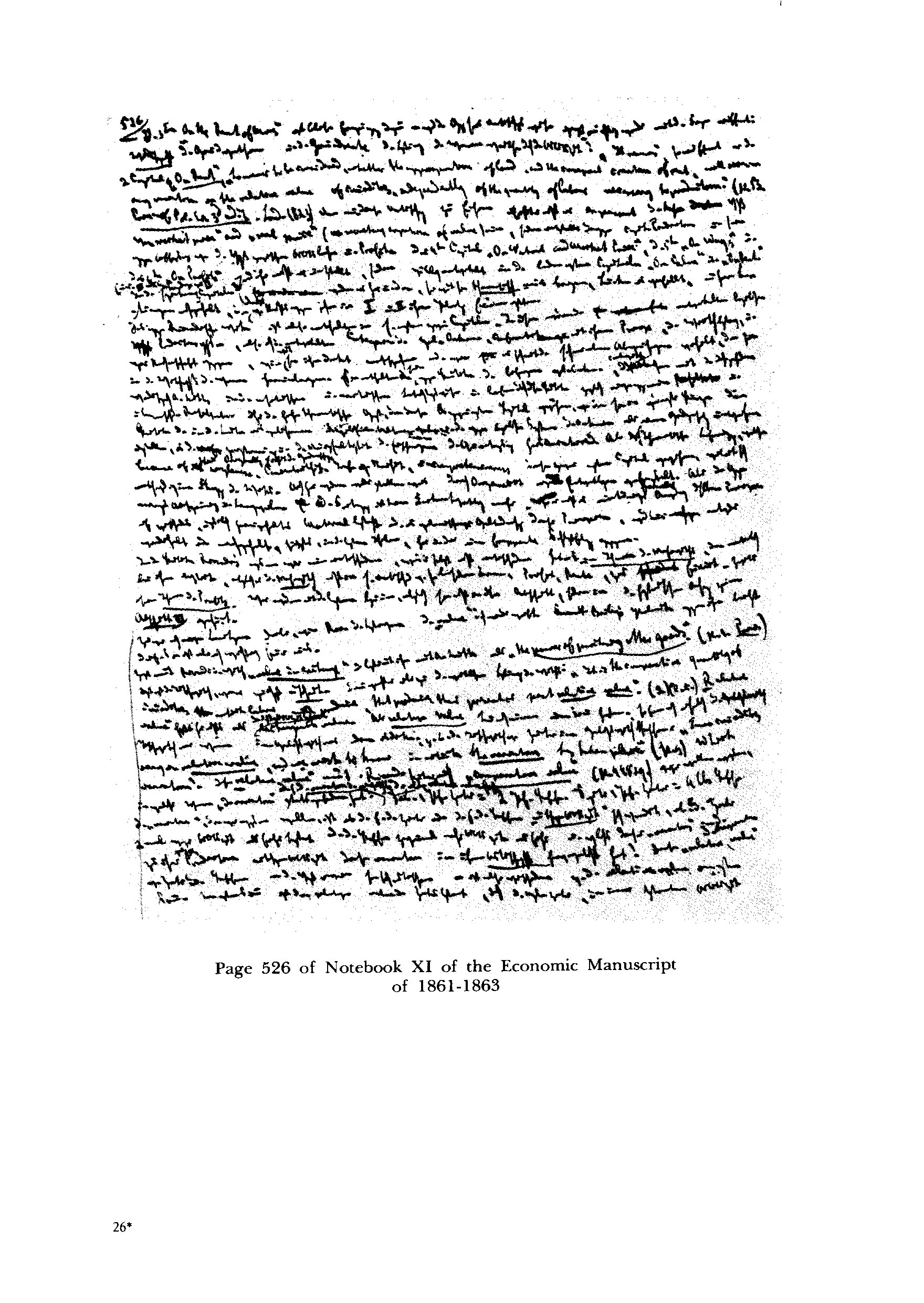
Page 526 of Notebook XI of the Economie Manuscript of 1861-1863
proceeds, there is no further development. Where it does not consist of monotonous formal application of the same principles to various extraneous matters, or of polemical vindication of these principles, there is only repetition or amplification; at most one can occasionally find a striking chain of reasoning in the final sections.
In the critique of Ricardo, we have to separate what he himself failed to separate. His theory of surplus value, which of course exists in his work, although he does not define surplus value as distinct from its particular forms, profit, rent, interest. Secondly, his theory of profit. We shall begin with the latter, although it does not belong into this section, but into the historical appendix to Section III.*[9]
Before we go on, just a few comments on how Ricardo confuses the definitions of "VALUE". Bailey's polemic against him is based on this; it is however also important for us. a
First of all Ricardo speaks of " VALUE IN EXCHANGE " and, like Adam Smith, defines it as "THY POWER OF PURCHASING OTHER GOODS" (Principles, p. 1). This is exchange value as it appears at first. Then , however, he proceeds to the real determination of value:
* "It is the comparative quantity of commodities which labour will produce, that produces their present or past relative value" * (I.e., p. 9).
"RELATIVE VALUE" here means nothing other than the EXCHANGEABLE VALUE as determined by labour time. But RELATIVE VALUE can also have another meaning, namely, if I express the exchange value of a commodity in terms of the use value of another, for instance the exchange value of sugar in terms of the use value of coffee.
* "Two commodities vary in relative value, and we wish to know in which the variation has taken place" * (p. 9).
WHICH VARIATION? Ricardo later also calls this "RELATIVE VALUE" "COMPARATIVE VALUE" (p. 448 et seq.). We want to know in which commodity "the VARIATION" has taken place. This means the VARIATION of the "value" which was called "RELATIVE VALUE" above. For instance, 1 lb. sugar=2 lbs coffee. Later 1 lb. sugar=4 lbs coffee. T h e "VARIATION" which we want to know about is: whether the "necessary labour time" has altered for sugar or for coffee, whether sugar costs twice as much labour time as before or whether coffee costs half as much labour time as before and which of these "VARIATIONS" in the labour time required for their respective production has called forth this VARIATION in their exchange relation. This "RELATIVE or COMPARATIVE VALUE" of sugar and coffee — the ratio in which they exchange — is thus different from RELATIVE VALUE in the first sense. In the first sense, the RELATIVE VALUE of sugar is determined by the quantity of sugar which can be produced by a certain amount of labour time [XI-527]. In the second case, the RELATIVE VALUE of sugar [and coffee] expresses the ratio in which they are exchanged for one another and changes in this ratio can be the result of a change in the "RELATIVE VALUE" in the first sense, in coffee or in sugar. T h e proportion in which they exchange for one another can remain the same, although their "RELATIVE VALUES" in the first sense have altered. 1 lb. sugar c a n = 2 lbs coffee, as before, even though the labour time for the production of sugar and of coffee has risen to double or has fallen to a half. VARIATIONS in their COMPARATIVE VALUE, that is, if the exchange value of sugar is expressed in coffee, and vice versa, will only appear when the VARIATIONS in their RELATIVE VALUE in the first sense, i.e., the VALUES determined by the quantity of labour, have altered to a different extent, when therefore COMPARATIVE CHANGES have occurred. ABSOLUTE CHANGES, when they do not alter the original ratio, but are of equal magnitude and move in the same direction, will not call forth any VARIATION in the COMPARATIVE VALUES — nor in the money prices of these commodities, since, if the value of money should change, it would do so equally for both [commodities]. Hence, whether the values of two commodities are expressed in their own reciprocal use values or in their money price— representing both values in the form of the use value of a third commodity — these RELATIVE or COMPARATIVE VALUES or prices are the same, and the CHANGES in them must be distinguished from their RELATIVE VALUES in the first sense of the term, i.e., in so far as they only express the change in the labour time required for their own production, and thus realised in themselves. T h e latter RELATIVE VALUE thus appears as "ABSOLUTE VALUE" compared with RELATIVE VALUES in the second sense, i.e., in the sense of actually representing the exchange value of one commodity in terms of the use value of the other or in money. That is why the term "ABSOLUTE VALUE" occurs in Ricardo's work to denote "RELATIVE VALUE" in the first sense.
If, in the above example, 1 lb. sugar costs the same amount of labour time as before, then its "RELATIVE VALUE" in the first sense has not altered. If, however, the labour cost of coffee has halved, then the VALUE of sugar expressed in terms of coffee has altered, because the "RELATIVE VALUE" of coffee, in the first sense, has altered. T h e RELATIVE VALUES of sugar and coffee thus appear to be different from their "ABSOLUTE VALUES" and this difference becomes evident because the COMPARATIVE VALUE of sugar, for instance, has not altered in comparison with commodities whose ABSOLUTE VALUES have remained unchanged.
* "The inquiry to which I wish to draw the reader's attention, relates to the effect of the variations in the relative value of commodities, and not in their absolute value"* (p. 15).
At times Ricardo also calls this "ABSOLUTE" VALUE "REAL VALUE" or simply VALUE (for instance on p. 16).
(See the whole of Bailey's polemic against Ricardo in: A Critical Dissertation on the Nature, Measures, and Causes of Value; chiefly in reference to the Writings of Mr. Ricardo and his Followers. By the Author of Essays on the Formation and Publication of Opinions, London, 1825.) (See also his A Letter to a Political Economist; occasioned by an article in the Westminster Review etc., London, 1826. [Bailey's polemic] partially revolves around these different instances of definitions of value, which are not explained by Ricardo but only occur de facto and are confused with one another, and Bailey sees in this only "contradictions".) Secondly, [it is directed] against "ABSOLUTE VALUE" or "REAL VALUE" as distinct from COMPARATIVE VALUE (or RELATIVE VALUE in the second sense). In the first of the above-mentioned works, Bailey says:
* "Instead of regarding value as a relation between two objects, they" (Ricardo and his followers) "consider it as a positive result produced by a definite quantity of labour" * (I.e., p. 30).
They regard * "value as something intrinsic and absolute" * (I.e., p. 8).
The latter reproach arises from Ricardo's inadequate presentation, because he does not even examine the form of value — the particular form which labour assumes as the substance of value. H e only examines the magnitudes of value, the quantities of this abstract, general and, in this form, social labour which engender differences in the magnitudes of value of commodities. Otherwise Bailey would have recognised that the relativity of the concept of value is by no means negated by the fact that all commodities, in so far as they are exchange values, are only relative expressions of social labour time and their relativity consists by no means solely of the ratio in which they exchange for one another, but of the ratio of all of them to this social labour which is their substance.
O n the contrary, as we shall see, Ricardo is rather to be reproached for very often losing sight of this "REAL" or "ABSOLUTE VALUE" and only retaining "RELATIVE" or "COMPARATIVE VALUES".
[XI-528] Thus:
Endnotes
[137] See Adam Smith, An Inquiry into the Nature and Causes of the Wealth of Nations; with Notes and an Additional Volume by David Buchanan. In three volumes. Vol. II, Edinburgh, London, 1814, p. 55, note.—387
[138] In Ricardo's book, Marx classifies as chapters on taxes, apart from the twelve chapters (VIII-XVIII and XXIX) dealing with taxes proper, also chapters XXII ("Bounties on Exportation and Prohibitions of Importation") and XXIII ("On Bounties on Production"), which likewise touch upon taxation; under Ricardo's theory, bounties are paid from a fund which is made up of various taxes on the population.—392
[9] Marx analyses the Physiocrats' views in Notebook VI of the manuscript of 1861-63 (see present edition, Vol. 30, pp. 354-55 and 358-61).—9
[3] This is in fact not the conclusion but only the continuation of the section on Smith. The conclusion of this section can be found in Notebook IX.—6