Cover page of Notebook I of the Economic Manuscript of 1861-63
J?s>-?%* ^'S^i
tl^f $ß^ ***yz* ****
• -*\ ••X.-::. . :*
. ^ t w v - ^ ' -
*«•*»* *»*W -*•£"*%,
> : H « r ^ ^ - v v ^ H = ± * - ^ ^ 7 ™^ j c U ^ - î~** .. ^
L.vi *^r* *"4 ^4~~ -A*«*- ?"V"L
*^"« ^fs». ^**4<3\Tcp£
Inside cover page of Notebook I of the Economic Manuscript of 1861- 63
Page 113 of Notebook III of the Economic Manuscript of 1861- 63
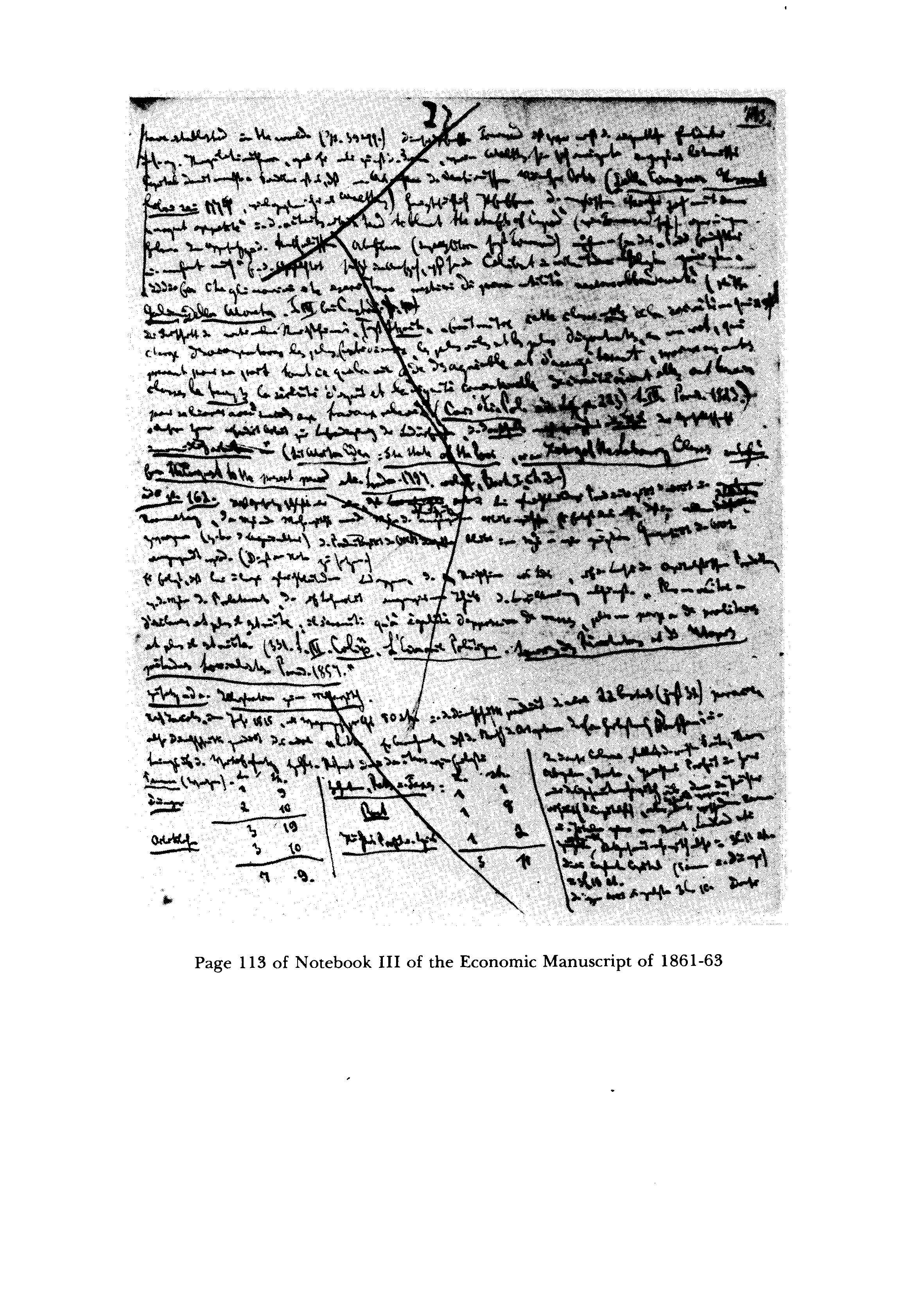
Page 113 of Notebook III of the Economic Manuscript of 1861-63
It is this [III-114] latter portion of capital, variable capital, which is alone to be considered when we are dealing with surplus value and the ratio of surplus value. In the present case, therefore, the ratio between surplus value and the capital expended on wages, or the rate at which the capital expended on wages increases is given by the ratio £3 lis. to £3 10s. The capital of £3 10[s.] expended on labour is reproduced as a capital of £7 Is. Only £3 10[s.] of this represents the replacement of the wages, whereas £3 lis. represents the surplus value, which therefore amounts to more than 100%. The necessary labour time would accordingly be slightly smaller than the surplus labour, roughly equal to it, so that 6 of the 12 hours of the normal working day would belong to the capitalist (including the various people who share in this surplus value). It may admittedly be the case that e.g., at 80s., the price of the quarter of wheat stands above its value, hence that a part of its price derives from the sale of other commodities in return for wheat at less than their value. But, firstly,, it is only a matter of making clear how, in general, surplus value and hence the rate of surplus value are to be understood. On the other hand, if the market price of a bushel of wheat stands, say, 10s. above its value, this can only increase the surplus value received by the farmer provided that he does not pay the agricultural worker, whose labour has risen above its normal value, the amount by which his labour now exceeds the normal value. Let us take another example from modern English agriculture, namely the following REAL BILL from a HIGH FORMED ESTATE:
Yearly Expenditure Farmer's Income and Outgoings in Production Itself
£ £ Manure 686 Rent 843 Seed 150 Taxes 150 Cattle fodder 100 Tithes none Losses, tradesmen's bills, etc. 453 Profit 488
1,389 1,481 Wages 1,690
3,079
(F. W. Newman, Lectures on Political Economy, London, 1851, p. 166 [167]).
In this example, therefore, variable capital, or capital exchanged for living labour, amounts to £1,690. It is reproduced as £1,690+1,481 =£3,171. The surplus value is £1,481, and the ratio of the surplus value to the part of the capital from which it arises = 1,481/1,690, or something over 87%.
//"The inextinguishable passion for gain — the auri sacri fames(1)—will always lead capitalists" (McCulloch, The Principles of Political Economy, London, 1825, p. 163).//
Addition to e, p. 104.
"It is because one works that the other can rest" (Sismondi, Nouveaux principes d'économie politique, Vol. 1, pp. 76-77).(2)
Addition to e, p. 107. Surplus labour and the multiplication of products provides the conditions for the production of luxuries, for part of production throwing itself into the production of luxury products, or, what is the same thing, being exchanged for these products (through foreign trade).
"Once there is an overabundance of products, the excess labour must be devoted to luxury objects. The consumption of objects of prime necessity is limited, that of objects of luxury is unlimited" (Sismondi, Nouveaux principes etc., Vol. 1, p. 78). "Luxury is only possible when it is bought with the labour of others; assiduous, uninterrupted labour is only possible when it is the sole means of obtaining, not the frivolities, but the necessities of life" (I.e. p. 79).
//The demand of the workers for capital is therefore the only-thing the capitalist needs, i.e. for him everything turns on the proportion in which living labour offers itself for objectified labour.
* "As to the demand from labour, that is, either the giving labour [III-115] in exchange for goods, or, if you choose to consider it in another form, but which comes to the same thing, the giving, in exchange for complete products, a future and accruing addition of value..., conferred on certain particles of matter entrusted to the labourer. This is the real demand that it is material to the producers to get increased, as far as any demand is wanted, extrinsic to that which articles furnish to each other when increased" * (An Inquiry into those Principles, Respecting the Nature of Demand and the Necessity of Consumption etc., London, 1821, [p.] 57). /'/
When James Mill for example says:
The capitalist's task is to "obtain from the capital expended" (the capital exchanged for living labour) " the largest possible amount of labour" (J. G. Courcelle-Seneuil, Traité théorique et pratique des entreprises industrielles etc., 2nd ed., Paris,
1857, p. 62).a
That the valorisation of capital, the surplus value it produces over and above its own value, hence its productive power, consists in the surplus labour it appropriates to itself, is stated by /. St. Mill for example.
" Capital, strictly speaking, has no productive power. The only productive power is that of labour; assisted, no doubt, by TOOLS, and ACTING UPON MATERIALS.... The productive power of capital can only mean the quantity of real productive power" (labour) "which the capitalist, by means of his capital, can command" (J. St. Mill, Essays on Some Unsettled Questions of Political Economy, London, 1844, pp. 90, 91).
Addition to a.) It is clear that in the reproduction of capital and its increase the value of the raw material and machinery as such is altogether a matter of indifference for the production process. Take a raw material, e.g. flax. The amount of labour the flax can absorb to be converted into linen for example — if the level of production, a certain degree of technological development, is given — does not depend on its value but on its quantity, and in the same way the assistance a machine can give to 100 workers depends not on its price but on its use value.
Addition to p. 114.) Or let us take another example. J. C. Symons, Arts and Artisans at Home and Abroad, Edinburgh, 1839 [p. 233], gives the following calculation for a Glasgow power-loom factory with 500 LOOMS, CALCULATED TO WEAVE A GOOD FABRIC OF CALICO OR
SHIRTING, SUCH AS IS GENERALLY MADE IN G l a S g O W :
Expense of erecting the factory and machinery £18,000 Annual produce, 150,000 pieces of 24 yards at
6s. £45,000 Interest on fixed capital and for DEPRECIATION OF r,--, VALUE of the machinery, reckoning 900 (5%) for interest 1,800 Steam-power, oil, tallow, keeping up machinery,
etc. 2,000 YARNS AND FLAX 32,000 Wages 7,500 Profit 1,700 The self-reproducing and self-increasing part of capital laid out for labour is £7,500. Surplus value = 2,600; rate of surplus value therefore: nearly 33%.[162]
[III-116] Addition to b.) p. 99)
Richard Jones, in his Essay on the Distribution of Wealth, London, 1831, rightly regards corvée labour, or what he calls LABOUR RENT, as the most primitive form of rent. We have only to consider it here as a particular form of surplus value which falls to the landed proprietor.[163] It is, thus, a form in which the agricultural workers possess a part of the land, and cultivate it to obtain their own subsistence. The labour time they employ for this purpose corresponds to the necessary labour time with which the wage labourer replaces his own wage. However, whereas the modern agricultural day labourer realises the whole of his labour time — both the part that replaces his wages and the part that forms the surplus value — on the same land (which is rented from the farmer)—just as the factory worker employs the same machinery for the realisation of his necessary and his surplus labour — here, in contrast, there takes place not only a division of the time (and much more tangibly than in wage labour) but also a division of the conditions of production (the sphere of production) by means of which this labour time is realised.
For example, the corvée labourer cultivates the field assigned to him as his possession on certain days of the week. On other days he works on the seignorial estate, for the landowner. What this form of labour has in common with wage labour is the fact that the worker gives to the owner of the conditions of production not, as in other modes of production, the product, and not money, but labour itself. Surplus labour is here more distinctly marked off from necessary labour than in the wage system, because here necessary and surplus labour are performed on two different plots of land. The corvée labourer does the labour necessary for the reproduction of his own labour capacity on the field he himself possesses. He performs surplus labour for the landed proprietor on the seignorial estate. This spatial separation makes the division of the total labour time into two parts more clearly apparent, whereas with the wage labourer one may just as well say that he works, e.g., 2 out of 12 hours for the capitalist as that he works for the capitalist for [1]/[6] of every hour or of any other aliquot part of the 12 hours.
Firstly, then, the division into necessary labour and surplus labour, labour for the reproduction of one's own labour capacity and labour for the owner of the conditions of production, is more clearly, more distinctly apparent in the form of corvée labour than in the form of wage labour. Secondly, however, it follows from its appearing more clearly in the corvée form than in wage labour that surplus labour is unpaid labour and that the whole of surplus value can be reduced to surplus labour, i.e. unpaid labour. If the
corvée labourers work 5 days of the week on their own land, and the 6th day on the landowner's, it is clear that on this 6th day they perform unpaid labour, they work not for themselves but [for] another, and that all the receipts of this other person are the product of their unpaid labour; it is called corvée labour precisely for that reason. If factory workers work 2 hours out of 12 every day for the capitalist, it is the same as if they worked 5 days of the week for themselves and 1 for the capitalist, hence in effect the same as if they performed 1 day of corvée labour a week for the capitalist.
The form of the wage is absent from the whole corvée system, and this makes the relation yet more tangible. The corvée labourer receives the conditions of production required for the realisation of his own necessary labour; he is allotted them once and for all. He therefore pays his own wages or directly appropriates the product of his necessary labour. With the wage labourer, in contrast, the whole of his product is first converted into capital, in order to flow back to him subsequently in the form of wages. If the corvée labourer, who works 1 day in the week for his lord, had to hand over to him the product of the whole week, so that the lord could convert it into money and pay back [5]/[6] of this money to the corvee labourer, the latter would have been turned into a wage labourer in this respect. Inversely. If the wage labourer, who works 2 hours every day for the capitalist, were himself to pocket the product or the value of the product of 5 days of his labour (deductions from the value for the conditions of production and the material and means of labour take place in both situations, even if in different forms) and work for capital during the 6th day for nothing, he would have turned into a corvée labourer. In so far as the nature of necessary labour and surplus labour and their relationship come into consideration, the result is the same.
We find corvée labour in larger or smaller quantities combined with all forms of serfdom. But where it appears in its pure form, as the dominant relation of production, which was particularly the case and in part still is the case in the Slav countries and the Danubian provinces occupied by the Romans, we can certainly say [III-117] that it did not arise on the basis of serfdom; instead serfdom arose, inversely, from corvée labour. The latter is based on a community, and the surplus labour the members of the commune performed over and above that required for their subsistence, which served partly as a (communal) reserve fund, and partly to cover the costs of their communal, political and religious requirements, gradually became transformed into corvée labour performed for the families which had usurped the reserve fund and the political and religious offices as their private property. In the Danubian Principalities, and similarly in Russia, this process of usurpation can be precisely demonstrated. A comparison between the Wallachian boyars and the English manufacturers from the point of view of their thirst for alien labour time is interesting in that the appropriation of alien labour appears in both cases as the direct source of wealth: surplus value as surplus labour.[3]
II * "The employer will be always on the stretch to economize time and labour" * (Dugald Stewart, Lectures on Political Economy, Vol. I, Edinburgh, 1855, p. 318, in Vol. VIII of the COLLECTED WORKS, ED. BY Sir W. Hamilton). For p. 107, to the Addition to e. II
Surplus labour appears in its most primitive "independent", "free" form in corvée labour; free in so far as in slavery the whole of the slaves' day, like the cattle's, belongs to the proprietor, and he must naturally feed them.
Even in Moldavia and Wallachia payment in kind still exists alongside the corvée.(3)* Let us take here the Règlement organique, put into effect in 1831.[165] For our present purpose it is irrelevant, and therefore only needs mentioning in passing, that the land, cattle, etc., in fact belong to the Wallachian peasants, that the obligations to the proprietors arose through usurpation, and that the Russian Règlement raised this usurpation to the level of a law. The payments in kind consist of Vs of the hay; V20 of the wine; and /10 of all other products (all this in Wallachia). The peasant possesses: 1) 400 stagenes (a stagene is about 2 square metres) for house and garden on the plain, 300 in the mountains; 2) 3 pogones (IV2 hectares) of ploughland; 3) 3 pogones of grassland (pasture for 5 horned cattle).
Here we must mention incidentally that this code of serfdom was proclaimed a code of freedom by the Russians (under Kiselev) and recognised as such by Europe. Secondly: the boyars in fact edited the Règlement. Thirdly: it was much worse, relatively speaking, in Moldavia than in Wallachia.
According to the Règlement every peasant owes the proprietor annually: 1) 12 days of general labour; 2) 1 day of field labour; 3) 1 day of wood-carrying. However, these days are measured not by time but by the work to be accomplished. The Règlement organique therefore itself lays down that the 12 days of [general] labour are to be the equivalent of 36 days of manual labour, the day of field labour = 3 days, and the day of wood-carrying similarly = 3 days. Summa summarum* 42 days. But there has to be added to this the so-called jobbagio (service, SERVITUDE), i.e. labour for the proprietor's extraordinary production requirements. This extraordinary labour involves the provision by the villages of 4 men for each 100 families, 3 men by villages of 63-75 families, 2 men by villages of 38-50 families, and 1 by villages of 13-25 families. This jobbagio is estimated at 14 working days for each Wallachian peasant. Thus the corvée prescribed by the Règlement itself = 42+14=56 working days. Owing to the severe climate the agricultural year in Wallachia consists of only 210 days, of which 40 must be deducted for Sundays and holidays, 30 on an average for bad weather; taken together this is 70 days less. There remain 140 days. Subtract from this the 56 corvée days. This leaves 84 days: a proportion which is even so no worse than that for the English agricultural workers, if we compare the time they work for their wages with the time they work for the creation of the surplus value which is divided between the farmer, the church, the state, the landowner, etc.
These are the days of corvée legally at the disposal of the proprietor, the legally established surplus labour. Yet the Règlement made provision for the further extension of the corvée without any infringement of the letter of the law. Namely, each day's task was determined in such a way that a certain amount remained over, so that it could only be completed during the next day's labour time. For example, particularly on the maize plantations, "a day's weeding was estimated at twelve perches, thereby imposing a task twice as large as a man could perform in one day".(4) The day's weeding is in fact determined by the
Règlement in such a way
"that it begins in the month of May and ends in the month of October".(5)
[III-118] "In Moldavia," as one of the grand boyars himself said, "the 12 working days of the peasant, granted by the Règlement, amount in fact to 365 days" [p. 311].(6)
The ingenuity with which the boyars have exploited this law in order to appropriate the peasants' labour time can be explored in further detail in E. Regnault, Histoire politique et sociale des principautés danubiennes, Paris, 1855, pp. 305 et seq.
Let us now compare with this the greedy appetite for labour time — surplus labour time — characteristic of capitalist production in England.
It is not my intention here to go into the history of overwork in England since the invention of machinery. The fact is that as a result of these excesses there broke out epidemics whose devastating effects were equally threatening to capitalists and workers; that the state, against tremendous resistance from the capitalists, was compelled to introduce normal [working] days in the factories (later imitated in greater or lesser degree all over the Continent); that, as things are at the moment, this introduction of the normal day has yet to be extended from the factories proper to other branches of labour (bleachworks, printworks, dyeworks); and that this process is still going forward at the present time, the struggle for the normal day continues (e.g. the introduction of the Ten Hours' Bill, the extension of the FACTORY ACTS,[166] e.g., to the LACE MANUFACTURE in Nottingham, etc.). I refer for details on the earlier phases of this process to F. Engels, Die Lage der arbeitenden Klasse in England, Leipzig, 1845. Moreover, the practical resistance of the manufacturers was no fiercer than the theoretical resistance offered by their spokesmen and apologists, the professional economists. Indeed, Mr. Newmarch, the joint editor of Tooke's History of Prices, felt himself obliged, as President of the section for economic science, at the last Congress of the BRITISH ASSOCIATION FOR ARTS etc. (the name of the association to be checked), held at Manchester in September 1861, to stress that the understanding of the necessity for legal regulation and compulsory limitation of the normal working day in factories, etc., was one of the very latest achievements of present-day political economy, in virtue of which it was superior to its predecessors I67!
My purpose here is simply to illustrate the parallel with the greedy appetite of the boyars by adducing certain quotations from the latest Factory Reports; and similarly to bring forward one or two examples in respect of branches of industry where the FACTORY ACTS have not yet been introduced (LACEmaking) or have only just been introduced (PRINTING WORKS). All we need here is a few illustrations for a tendency which does not operate any more strongly in Wallachia than in England.
First illustration. LACE TRADE in Nottingham. "The Daily Telegraph" of January 17, I860.[168]
"It was declared by Mr. Broughton, a county magistrate, who filled the chair at a meeting held in the Nottingham Town Hall on Saturday last (January 14, 1860) that there is an amount of suffering and privation among that portion of the local population connected with the lace trade such as is utterly unknown anywhere else in the civilised world ... children of 9 or 10 years are dragged from their squalid beds at 2, 3, or 4 o'clock in the morning, and compelled to work for a bare subsistance until 10, 11, or 12 at night, their limbs wearing away, their frames dwindling, their faces whitening, and their humanity absolutely sinking into stone — like torpor utterly horrible to contemplate.... We are not surprised that Mr. Mallett or any other manufacturer should stand forward and protest against discussion.... The system, as Rev. Montagu Valpy describes it, is one of unmitigated slavery, socially, physically, morally, and spiritually.... What can be thought of a town which holds a public meeting to petition that the period of labour for men shall be diminished to 18 hours a day.... We declaim against the Virginian and Carolinian cottonplanters. Is their black-market, however, their lash, and their barter of human flesh, more detestable than this slow sacrifice of humanity, which takes place in order that veils and collars [III-119] may be fabricated for the benefit of capitalists?" * a
[111-119] Second illustration. FACTORY REPORTS.
"The fraudulent mill-owner begins work a quarter of an hour (sometimes more, sometimes less), before 6 a.m.; and leaves off a quarter of an hour (sometimes more, sometimes less) after 6 p.m. He takes 5 minutes from the beginning and end of the half hour nominally allowed for breakfast, and 10 minutes at the beginning and end of the hour nominally allowed for dinner. He works for a quarter of an hour (sometimes more, sometimes less) after 2 p.m. on Saturdays.[3]
* [III-120] // To p. 119. Since there is in existence that incorrect view that the factory system has become completely different, I quote here a note from General Register Office, 28 October 1857 ("The Quarterly Return of the Marriages, Births and Deaths", etc. published by authority of the Registrar-General, etc., No. 35, p. 6), where it says:
"Mr. Leigh, of the Deans gate subdistrict (Manchester), makes the following judicious remarks, which deserve the careful attention of the people at Manchester: Very sad there is the life of a child.... The total number of deaths, exclusive of coroner's cases, is 224, and of this number 156 were children under 5 years of age.... So large a proportion I have never before known. It is evident that whilst the ordinary circumstances affecting adult life have been to a considerable extent in abeyance, those militating against the very young have been in great activity.... 87 of the children died under the age of one year. Neglected diarrhoea, close confinement to ill ventilated rooms during hooping cough, want of proper nutrition, and free administration of laudanum, producing marasmus and convulsions, as well as hydrocephalus and congestion of brain, these must explain why ... the mortality (of children) is still so high."// [3] [III-120] "THUS HIS GAIN" II here directly identified with the surplus labour he has filched // 'is as follows:
"Before 6 a.m. 15 minutes After 6 p.m. 15 ditto At breakfast time 10 " At dinner time 20
Total for 5 days: 300 minutes
On Saturdays Before 6 a.m. At breakfast time After 2 p.m.
60
15 m. 10 15
40*
* "Total weekly gain: 340 minutes, or 5 hours and 40 minutes weekly, which multiplied by 50 working weeks in the year, allowing two for holidays and occasional stoppages, are equal to 27 working days"* (Suggestions, etc., by Mr. L. Horner, in "Factories Regulation Acts. Ordered by the House of Commons to be printed, 9 August 1859", pp. 4-5).
* "The profit to be gained by it (overworking over the legal time) appears to be, to many (millowners) a greater temptation than they can resist; they calculate upon the chance of not being found out; and when they see the small amount of penalty and costs, which those who have been convicted have had to pay, they find that if they should de detected there will still be a considerable balance of gain" * (Report of the Inspectors of Factories for the Half Year ending 31st Oct. 1856, [p.] 34).
* "Five minutes a day's increased work, multiplied by weeks, are equal to 2V2 days of production in the year" * (I.e., [p.] 35).
* "In cases where the additional time is gained by a multiplication of small thefts in the course of the day, there are insuperable difficulties to the Inspectors making out a case" * (I.e., p. 35).
(Here the OVERTIME appropriated in this way is directly characterised as "THEFT" by the official English Factory Inspectors.)
[III-120] These SMALL THEFTS are also described as "PETTY PILFERINGS OF MINUTES" (I.e., p. 48), later on AS "SNATCHING A FEW MINUTES" (I.e.), "OR AS IT IS TERMED, 'NIBBLING', OR CRIBBLING AT MEAL TIMES'" (I.e.). * " 'If you allow me,' said a highly respectable master to me, " 'to work only 10 minutes in the day over time, you put one thousand a year in my pocket'"* (I.e., p. 48).
According to the Factory Inspectors, the working time is in practice still unrestricted in English PRINTWORKS, and even as late as 1857 children of 8 years and upwards had to work from 6 o'clock in the morning until 9 o'clock in the evening (15 hours).
that no child — that is, no child between the ages of 8 and 13 years — shall be employed during the night, which is defined to be between 10 p.m. and 6 a.m. of the following morning. Children, therefore, of the age of 8 years, may be lawfully employed in labour analogous in many respects to factory labour, frequently in rooms in which the temperature is oppressive, continuously and without any cessation from work for rest or refreshment, from 6 a.m. to 10 p.m. (16 hours); and a boy, having attained the age of 13, may lawfully be employed day and night for any numbers of hours without any restriction whatever. Children of the age of 8 years and upwards have been employed from 6 a.m. to 9 p.m. during the last half-year in my district" * (Reports of the Inspectors of Factories, 31st Oct. 1857, Report of Mr. A. Redgrave, [p.] 39).
* "An additional hour a day, gained by small instalments before 6 a.m. and after 6 p.m., and at the beginning and end of the times nominally fixed for meals, is nearly equivalent to making 13 months in the year" * (Reports of the Inspectors of Factories. 30th April 1858. Report of Mr. L. Horner, p. 9 [10]).
So concerned are the Factory Inspectors to make it clear that the GAIN is nothing but labour time, surplus labour time, and the extra GAIN is therefore surplus labour time over and above the normal working day.
[Ill-121] A period of crisis therefore does nothing to change the attempt to have the workers work OVERTIME. If only 3 or 4 days in the week are worked, the profit consists only in the surplus time that is worked during these 3 or 4 days. Hence an EXTRAORDINARY PROFIT is only to be made during the unpaid SURPLUS TIME, which is worked beyond the normal surplus time, and therefore beyond the legally determined normal working day. If I multiply 2 hours of surplus labour by 3 days of the week, the surplus value is of course only half as great as if I multiplied it by 6 days of the week. There is therefore an even greater temptation during crises to have the workers work overtime, i.e. more unpaid labour time than would otherwise be worked, on the days when work actually takes place. (Other manufacturers do the same thing in practice by reducing wages, i.e. by lessening necessary labour time during the 3 or 4 days on which work is done.) Hence in 1857-58:
district had been given up, 143 stood idle, and all the rest were on SHORT-TIME working, OVERWORK OVER THE LEGAL TIME was continuing (I.e.). Similarly another Factory Inspector, T . J. Howell, remarks of the same year:
* "I continue, however,"* (ALTHOUGH in most of factories only HALF TIME was WORKED owing to the BAD TIME) * "to receive the usual number of complaints that half or 3 quarters on an hour in the day are snatched from the workers by encroaching upon the times allowed for rest and refreshment during the working day, and by starting 5 minutes and more before the proper time in the morning and by stopping 5 minutes or more after the proper time in the evening. These petty pilferings, amounting in the whole to from half to three quarters on an hour daily, are very difficult of detection"* (T. / . Howell's Report, I.e., p. 25).
* "To prove a systematic course of overworking, made up of minutes taken at 6 different times of the day, could manifestly not be done by the observation of an Inspector"* (Reports. L. Horner. 31st Oct. 1856 [p. 35]).
* "It is this general acquiescence in the practice, if not approbation of the principle, and the general concurrence that the limitation of labour is expedient, etc."* (Reports etc. 31st Oct. 1855, p. 77).
T h e governments on the Continent (France, Prussia, Austria, etc.) were compelled, in proportion with the development there of capitalist production, hence of the factory system, to follow the English example by limiting the working day d'une manière ou d'une autre* They have for the most part, with certain modifications, copied, and inevitably so, the English FACTORY LEGISLATION.
[Ill-122] In France there existed in practice until 1848 no law for the limitation of the working day in factories. T h e law of March 22, 1841 for the limitation of the work of children in factories (FACTORIES, WORKS and WORKSHOPS EMPLOYING MOVING POWER, OR A CONTINUOUS FIRE, AND ALL ESTABLISHMENTS GIVING EMPLOYMENT TO MORE THAN 20 WORKMEN), the basis of which was 3 and 4 William IV, C. 103, remained a dead letter and has u p to this day been implemented in practice in the Département du Nord alone.[169] In any case, according to this law children under 13 years old can be employed even at night (BETWEEN 9 p.m. and 5 a.m.) "UPON THE OCCASION OF URGENT REPAIRS,
OR THE STOPPAGE OF A WATERWHEEL". Children more than 13 years old can be employed even during the night "IF THEIR LABOUR IS INDISPENSABLE". O n March 2, 1848 the Provisional Government promulgated a law limiting the working time to 10 hours in Paris and 11 in the Departments, not only in factories but in all places of manufacture and craft workshops, not only for children but for adult WORKMEN too. T h e Provisional Government proceeded from the false assumption that the normal working day was 11 hours in Paris and 12 in the Departments. But:
"In many of the spinning mills the work lasted 14 to 15 hours a day, and even longer, greatly damaging the health and morality of the workers and particularly the children" ([J. A.] Blanqui, Des classes ouvrières en France, pendant l'année 1848).
The National Assembly modified this law, by the law of September 8, 1848, as follows:
* "The daily labour of the workman in manufactures and works shall not exceed 12 hours. The government has the power to declare exceptions to the above enactment in those cases where the nature of the work or of the apparatus requires it."(7)
The government put these exceptions into effect by the decree of May 17, 1851. Firstly, it listed the various branches of industry to which the law of September 8, 1848 did not apply. In addition, however, the following limitations were made:
* "The cleaning of machinery at the end of the day; work rendered necessary by accident to the moving power, the boiler, the machinery, or the building. Labour may be extended in the following cases: For 1 hour at the end of the day for washing and stretching pieces in dye works, bleach works, and cotton print works. For 2 hours in sugar factories, and refineries, and in chemical works. For 2 hours during 120 days a year, at the choice of the manufacturer, and with the sanction of the Préfet, in dye works,print works, and finishing establishments."(8)
//FACTORY INSPECTOR A. Redgrave remarks in Reports etc. 31st October 1855, p. 80, in regard to the implementation of this law in France:
* "I have been assured by several manufacturers that when they have wished to avail themselves of the permission to extend the working day, the workmen have objected upon the ground that an extension of the working day at one moment would be followed by a curtailment of the ordinary number of hours at another ... and they especially objected to work beyond the 12 hours per day, because the law which fixed those hours is the only good which remains to them of the legislation of the Republic."
* "The prolongation of the working day is optional with the workmen.... When it is mutually agreed ... the rate per hour (beyond 12) is generally higher than their ordinary pay" * (I.e., p. 80).
A. Redgrave remarks on p. 81 that as a result of overwork and the physical enervation and mental demoralisation bound up with this * "One of the many objections made to the Ten Hours' Bill was the danger of throwing upon the hands of the young persons and females 50 much leisure time, which, from their defective education, they would [III-123] either waste or misuse; and it was urged that until education progressed, and means were provided for occupying in profitable mental or social employment the leisure Hours which the Ten Hours' Bill proposed to award to the Factory population, it was more advisable, in the interests of morality, that the whole of the day should be spent in the factory"* (A. Redgrave, I.e., [p.] 87).//
// How much Macaulay distorts the economic FACTS SO as to be able to act as Whig apologist for the here-and-now — Cato the Censor[3] towards the past alone, a sycophant towards the present — can be seen from the following passage among others:
* "The practice of setting children prematurely to work, a practice which the state, the legitimate protector of those who cannot protect themselves, has, in our time, wisely and humanely interdicted, prevailed in the 17th century to an extent which, when compared with the extent of the manufacturing system, seems almost incredible. At Norwich, the chief seat of the clothing trade, a little creature of six years old was thought fit for labour. Several writers of that time, and among them some who were considered as eminently benevolent, mention, with exultation, the fact, that in that single city boys and girls of tender age, created wealth exceeding what was necessary, for their own subsistence by 12,000 pounds a year. The more carefully we examine the history of the past, the more reason shall we find to dissent from those who imagine that our age has been fruitful of new social evils. The truth is, that the evils are, with scarcely an exception, old. That which is new is the intelligence which discerns and humanity which remedies them" * ([Th. B.] Macaulay, [The History of] England, Vol. I, p. 417).
This passage proves precisely the opposite, namely that at that time child labour was still an exceptional phenomenon, noted with exultation as particularly praiseworthy by political economists. What modern writer would mention it as something particularly noteworthy that children of tender age were being used up in factories? Anyone who reads writers like Child, Culpeper, etc., with common sense would come to the same conclusion. //
T h e LEGAL TIME OF WORKING is o f t e n EXCEEDED contend with serious difficulties.*) This is what Horner says in his last report, dated 30th April 1859[170]:
* "The education of the children, professedly provided for, is, in numerous cases, an utter mockery; the protection of the workpeople against bodily injuries and death from unfenced machinery, also professedly provided for, has become, practically, a dead letter; the reporting of accidents is, to a great extent, a mere waste of public money.... Overworking to a very considerable extent, still prevails; and, in most instances, with that security against detection and punishment, which the law itself affords" * (I.e., pp. 9, 8).
(* Children above 13 years qualified to be employed for the same number of hours as adult men; half-timers children under 13 years.*)
[III-124] *"The fact is, that prior to the Act of 1833, young persons and children were worked all night, all day, or both ad libitum"* (Reports etc. 30th April 1860, p[p. 50-]51).
According to the Act of 1833 NIGHT lay BETWEEN 8 V2 p-ni. and 5 V2 a.m. The MILLOWNERS were PERMITTED
* "to take their legal hours of labour at any period within 5 V2 a r n -a n d 8V [2] p.m.".*
*This signification of "day" and "night" continued through all the subsequent Factory acts, though with restricted hours of work until 1850, when, for the first time, the day hours of permitted labour were fixed at from 6 a.m. to 6 p.m., and in winter from 7 a.m. to 7 p.m. if so desired by the mill occupier.*(9)
*"The bulk of the accidents happened in the largest mills.... The perpetual scramble for every minute of time, where work is going on by an unvarying power, which is indicated at perhaps a thousand horses, necessarily leads to danger. In such mills, moments are the elements of profit—the attention of everybody's every instant is demanded. It is here, where ... there may be seen a perpetual struggle between life and inorganic forces; where the mental energies must direct, and the animal energies must move and be kept equivalent to the revolutions of the spindles. They must not lag, notwithstanding the strain upon them either by excessive excitement or by heat; nor be suspended for an instant by any counter attention to the various movements around, for in every lagging there is loss" * (Reports of the Inspectors of Factories. 30th April 1860, p. 56).
*The Factory Acts "have put an end to the premature decrepitude of the former long-hour workers; by making them masters of their own time they have given them a moral energy which is directing them to the eventual possession of political power" * (Reports of the Inspectors of Factories. 31st Oct 1859, [p.] 47).
* "A still greater boon is, the distinction at last made clear between the worker's own time and his master's. The worker knows now when that which he sells is ended, and when his own begins; and by possessing a sure foreknowledge of this, is enabled to pre-arrange his own minutes for his own purposes]"* (I.e., p. 52.)(10)
This is very important with regard to the establishment of a normal working day. Before 1833:
* "The master had no time for anything but money, the servant had no time for anything but labour" * (I.e., p. 48).
* "The cupidity of millowners, whose cruelties in the pursuit of gain have hardly been exceeded by those perpetrated by the Spaniards on the conquest of America, in the pursuit of gold" * (John Wade, History of the Middle and Working Classes, 3rd ed., London, 1835, p. 114).
[111-124a] * "Certain classes of workers (such as the adult males, and female weavers) have a direct interest in working overtime, and it may be supposed that they exercise some influence over the more juvenile classes, which latter have, besides, a natural dread of dismissal by giving any evidence or information calculated to implicate their employers ... even when detected (the juvenile workers) in working at illegal times, their evidence to prove the facts before a Bench of Magistrates, can seldom be relied on, as it is given at the risk of losing their employments" * (Reports of the Inspectors of Factories for the Half Year Ending 31st Oct 1860, p. 8).
* "A factory employs 400 people, the half of which work by the 'piece' and have ... a direct interest in working longer hours. The other 200 are paid by the day, work equally long with the others, and get no more money for their overtime. A habit has arisen in some localities of starting systematically 5 minutes before and ceasing 5 minutes after the proper hour. There are 3 starting and 3 leaving off times each day; and thus 5 minutes at 6 different times, equal to half an hour are gained daily, not by one person only, but by 200 who work and are paid by the day. The work of these 200 people for half an hour a day is equal to one person's work for 50 hours, or [5]/[6] of one person's labour in a week, and is a positive gain to the employer" * (I.e., p. 9).
If piece-wages are paid, the worker has indeed a share in his OVERTIME, and he himself appropriates a portion of the SURPLUS TIME during which he works. But the capitalist, quite apart from the more rapid valorisation of his fixed capital, enjoys a SURPLUS PROFIT even if he pays an hour of OVERTIME at the same rate as, or even higher than, the hours of the normal working day: 1) Because he does not need to increase the number of machines on which the work is done (e.g. spindles, looms). The same worker works at the same POWER LOOM whether he works for 12 or 15 hours. Thus a part of the capital outlay is subtracted with this production of SURPLUS TIME. 2) If the normal working day is 12 hours, of which 2 hours are surplus labour, 10 hours must be paid for 2 hours of surplus time.
Here of the 30 minutes ( V2 hour) VÔ is gained,=5 minutes, and the worker is paid 25 minutes. The surplus time is otherwise d e p e n d e n t on the worker's having first worked 10 hours for himself. Here it is already assumed in advance that he has earned his necessary wages. H e can therefore be fobbed off with 1 aliquot part of the OVERTIME.
If the OVERTIME is gratis, capital acquires it without paying necessary labour time; 100 hours of OVERTIME, if 10 hours a day are being worked , = t h e labour time of 10 workers, whose wages are completely saved.
[111-124b] The BLEACHING AND DYEING ACTS WERE TO COME INTO OPERATION
ON AUGUST 1, 1861.
T h e main provisions of the FACTORY ACTS proper are:
* "All persons under 16 years of age must be examined by the certifying surgeon. Children cannot be employed under the age of 8 years. Children between 8 and 13 years of age can only be employed for half-time, and must attend school daily. Females and young persons under the age of 18 years cannot be employed before 6 o'clock in the morning nor after 6 o'clock in the evening, nor after 2 o'clock in the afternoon of Saturdays. Females and young persons cannot be employed during a meal time, nor be allowed to remain in any room in a factory while any manufacturing process is carried on. Children under 13 years of age cannot be employed both before noon and after 1 o'clock on the same day" (11) ([Reports...,] I.e., pp. 22-23).
* "The hours of work are governed by a public clock; generally the clock of the nearest railway station.... It is sometimes advanced by way of excuse, when persons are found in a factory either during a meal hour or at some other illegal time, that they will not leave the mill at the appointed hour, and that compulsion is necessary to force them to cease work, especially on Saturday afternoons. But, if the hands remain in a factory after the machinery has ceased to revolve, and occupy themselves in cleaning their machines and in other like work, they would not have been so employed if sufficient time had been set apart specially for cleaning, etc., either before 6 p.m. or before 2 p.m. on Saturday afternoons"(12) (I.e., p. 23).
A further provision of the FACTORY ACTS in regard to MEALTIMES:
In earlier centuries too, in the period preceding capitalist production, we likewise find forcible regulation, i.e. regulation by laws, on the part of governments. But the aim then was to force the workers to work for a definite period of time, whereas the present regulations all have the opposite objective, to force the capitalist to have them work for no more than a definite period of time. In the face of developed capital it is only government compulsion that can limit labour time. At the stage at which capital is only entering on its development, [111-124c] government compulsion steps in to transform the worker forcibly into a wage labourer.
* "When population is scanty, and land abundant, the free labourer is idle and saucy. Artificial regulation has often been found, not only useful, but absolutely necessary to compel him to work. At this day, according to Mr. Carlyle, the emancipated negroes in our West India Islands, having hot sun for nothing, and plenty of pumpkin for next to nothing, will not work. He seems to think legal regulations compelling work absolutely necessary, even for their own sakes. For they are rapidly relapsing into their original barbarism. So in England 500 years ago, it was found, by experience, that the poor need not, and would not work. A great plague in the 14th century having thinned the population, the difficulty of getting men to work on reasonable terms grew to such a height as to be quite intolerable, and to threaten the industry of the kingdom. Accordingly, in the year 1349, the Statute 23rd, Edward III, was passed, compelling the poor to work, and interfering with the wages of labour. It was followed with the same view through several centuries by a long series of statutable enactments. The wages of artisans, as well as of agricultural labourers; the prices of piece-work, as well as of day-work; the periods during which the poor were obliged to work, nay, the very intervals for meals (as in the Factory acts of the present day) were defined by law. Acts of Parliament regulating wages, but against the labourer, and in favour of the master, lasted for the long period of 464 years. Population grew. These laws were then found, and really became, unnecessary and burdensome. In the year 1813, they were all repealed"* ([J. B. Byles,] Sophisms of Free-Trade etc., 7th ed., London, 1850, pp. 205-06).
"It appears from the Statute of 1496 that the diet was considered equivalent to V3 of the income of an artificer and V2 the income of a LABOURER, which indicates a greater degree of independence among the working classes than prevails at present; for the board, both of LABOURERS and ARTIFICERS, is now reckoned at a higher proportion of their WAGES. The hours for MEALS and RELAXATION were more liberal than at this day. They amounted to e.g. 1 hour for breakfast from March to September, 1 V[2] hours for dinner, and V2 hour for 'NOONMEATE'." (Thus 3 hours altogether.) "In winter they worked from 5 o'clock in the morning until it went dark. In the COTTON factories of the present time, in contrast, Vg hour is allowed for [III-124d] breakfast, 1 hour for DINNER", hence only 1 V2 hours, exactly half as much as in the 15th century (John Wade, History of the Middle and Working Classes, 3rd ed., London, 1835, pp. 24-25 and 577-78).
The BLEACHING AND DYEING WORKS ACT. Passed in 1860. There are different provisions in the PRINT WORK ACT, BLEACHING AND DYEING WORKS ACT and the FACTORY ACT.
* "The Bleaching etc Works Act limits the hours of work of all females and young persons between 6 a.m. and 8 p.m., but does not permit children to work after 6 p.m. The Print Works Act limits the hours of females, young persons and children between 6 a.m. and 10 p.m., provided the children have attended some school for 5 hours in any day but Saturday before 6 o'clock p.m."* (Reports of the Inspectors of Factories for the Half Year Ending 31st Oct 1861, pp. 20-21).
* "The Factory Acts require 1 V2 hours to be allowed during the day, and that they shall be taken between 7.30 a.m. and 6 p.m. and one hour thereof shall be given before 3 o'clock in the afternoon; and that no child, young person, or female shall be employed more than 5 hours before 1 o'clock in the afternoon of any day without an interval for meal time of at least 30 minutes.... In the Print Works Act there is no requisition ... for any meal time at all Accordingly, young persons and females may work from 6 o'clock in the morning till 10 o'clock at night without stopping for meals"* (I.e., p. 21).
* "In Print Works a child may work between 6 o'clock in the morning and 10 o'clock at night.... By the Bleach Works Act a child may only work as under the Factories Act, whilst the labour of the young persons and females, with whom it has been previously working during the day, may be continued till 8 o'clock in the evening" * (I.e., [p.] 22).
*"To take the silk manufacture for example, since 1850, it has been lawful to employ children above 11 years of age"* (from 11 to 13 years, therefore) * "in the winding and throwing of raw silk for 10 V2 hours a day. From 1844 to 1850 their daily work, less Saturday, was limited to 10 hours; and before that period to 9 hours. These alterations took place on the ground that labour in silk mills was lighter than in mills for other fabrics, and less likely, in other respects also, to be prejudicial to health"* (I.e., p. 26).
*"The allegation put forth in 1850 about the manufacture of silk being a healthier occupation than that of other textile fabrics, not only entirely [III-124e] fails of proof, but the proof is quite the other way; for the average death rate is exceedingly high in the silk districts, and amongst the female part of the population is higher even than it is in the cotton districts of Lancashire, where, although it is true that the children only work half time, yet from the conditional causes which render cotton manufacture unhealthy, a high rate of pulmonary mortality might be supposed to be inevitable" * (I.e., p. 27).
Lord Ashley said in his speech on the Ten Hours' Bill (MARCH 15, 1844) that hours of labour in Austrian factories at that time were [V-196] * Subinspector Baker reports (Factory Reports, 1843), as to "having seen several females, who, he was sure, could only just have completed their 18th year, who had been obliged to work from 6 a.m. to 10 p.m., with only 1 [1]/[2] hours for meals. In other cases, he shows, females are obliged to work all night, in a temperature from 70 to 80 degrees.... I found (says Mr. Horner, Factory Reports, 1843) many young women, just 18 years of age, at work from half past 5 in the morning until 8 o'clock at night, with no cessation except a quarter of an hour for breakfast, and 3 quarters of an hour for dinner. They may be fairly said to labour for 15 hours and a half[3] out of 24. There are (says Mr. Saunders, Factory Reports, 1843) among them females who have been employed for some weeks, with an interval only of a few days, from 6 o'clock in the morning until 12 o'clock at night, less than 2 hours for meals, thus giving them for 5 nights in the week, 6 hours out of its 24 to go to and from their homes, and to obtain rest in bed" * (I.e., [pp.] 20-21).
T h e e a r l i e r w e a r i n g o u t of l a b o u r capacity, in o t h e r w o r d s p r e m a t u r e a g e i n g , i n c o n s e q u e n c e of the forcible lengthening of l a b o u r t i m e :
*"In the year 1833, a letter was addressed to me by Mr. Ashworth, a very considerable millowner in Lancashire, which contains the following curious passage: 'You will next naturally inquire about the old men, who are said to die, or become unfit for work, when they attain 40 years of age, or soon after.' Mark the phrase 'old men' at 40 years of age!"* (I.e., p. 12).
* The government commissioner M'Intosh (one of those commissioners, sent expressly to collect evidence against that taken by the committee of 1832), says in his report of 1833: "Although prepared by seeing childhood occupied in such a manner, it is very difficult to believe the ages of men advanced in years, as given by themselves, so complete is their premature old age" * (I.e., p. 13).
[ I I I - 1 2 4 e ] I n 1 8 1 6 Sir R. Peel PROCURED A COMMITTEE OF THE HOUSE OF
COMMONS TO EXAMINE INTO THE APPRENTICE A C T OF 1 8 0 2 ( a m o n g o t h e r t h i n g s ) . According t o t h e EVIDENCE OF J o h n Moss, OVERSEER OF a MILL n e a r P r e s t o n , b t h e APPRENTICE A C T WAS CONSTANTLY SET AT NOUGHT. T H E
WITNESS DID NOT EVEN KNOW OF IT. T h e CHILDREN in the MILL w e r e a l m o s t all
APPRENTICES of L o n d o n PARISHES; t h e y WERE WORKED f r o m 5 o'clock i n t h e m o r n i n g until 8 at n i g h t , all the y e a r r o u n d , with 1 h o u r for t h e 2 MEALS; THEY INVARIABLY WORKED f r o m 6 o n t h e S u n d a y m o r n i n g till 12, IN CLEANING THE MACHINERY FOR THE WEEK ( 1 5 h o u r s ) .
A v e r a g e w o r k i n g d a y a m o n g t h e L o n d o n b a k e r s 17 h o u r s . R e g u l a r l y 17 h o u r s i n t h e earliest stages of the c o t t o n i n d u s t r y . Shortly after this i n t r o d u c t i o n of n i g h t w o r k .
a Here Marx reproduces an inaccuracy contained in the Reports. It should be "13 hours and a half".— Ed.
b J. Fielden, The Curse of the Factory System; or, a Short Account of the Origin of Factory Cruelties, London, [1836,] p. 15.— Ed.
Page 182 of Notebook V of the Economic Manuscript of 1861- 63
brings to its originator himself. The criminal moreover produces the whole of the police and of criminal justice, constables, judges, hangmen, juries, etc.; and all these different lines of business, which form just as many categories of the social division of labour, develop different capacities of the human mind, create new needs and new ways of satisfying them. Torture alone has given rise to the most ingenious mechanical inventions, and employed many honourable craftsmen in the production of its instruments. The criminal produces an impression, partly moral and partly tragic, as the case may be, and in this way renders a "service" by arousing the moral and aesthetic feelings of the public. He produces not only compendia on Criminal Law, not only penal codes and along with them legislators in this field, but also art, belles-lettres, novels, and even tragedies, as not only Müllner's Schuld and Schiller's
Räuber show, but Oedipus and Richard the Third. The criminal breaks the monotony and everyday security of bourgeois life. In this way he keeps it from stagnation, and gives rise to that uneasy tension and agility without which even the spur of competition would get blunted. Thus he gives a stimulus to the productive forces. While crime takes a part of the redundant population off the labour market and thus reduces competition among the labourers — up to a certain point preventing wages from falling below the minimum — the struggle against crime absorbs another part of this population. Thus the criminal comes in as one of those natural "counterweights" which bring about a correct balance and open up a whole perspective of "useful" occupations. The effects of the criminal on the development of productive power can be shown in detail. Would locks ever have reached their present degree of excellence had there been no thieves? Would the making of bank-notes have reached its present perfection had there been no [V-183] forgers? Would the microscope have found its way into the sphere of ordinary commerce (see Babbage(1)) but for trading frauds? Does not practical chemistry owe just as much to the adulteration of commodities and the efforts to show it up as to the honest zeal for production? Crime, through its ever new methods of attack on property, constantly calls into being new methods of defence, and so is as productive as STRIKES for the invention of machines. And if one leaves the sphere of private crime: would the world market ever have come into being but for national crime? Indeed, would even the nations have arisen? And has not the Tree of Sin been at the same time the Tree of Knowledge ever since the time of Adam?
In his Fable of the Bees (1705) Mandeville had already shown that every possible kind of occupation is productive, and had given expression to the tendency of this whole line of argument:
* "That what we call Evil in this World, Moral as well as Natural, is the grand Principle that makes us Sociable Creatures, the solid Basis, the Life and Support of all Trades and Employments without exception; there we must look for the true origin of all Arts and Sciences; and the moment Evil ceases, the Society must be spoiled if not totally destroyed."*(2)
Only Mandeville was of course infinitely bolder and more honest than the philistine apologists of bourgeois society.
What strikes us in looking at the division of labour, as with all forms of capitalist production, is the character of the antagonism.
[Firstly.] In the division of labour within the workshop, the workers are quantitatively distributed, in strict system, between the individual operations according to certain numerical proportions, as required by production as a whole, by the product of their combined labours. If instead we look at the whole of society — the social division of labour — there are now too many producers to be found in one branch of business and now in another. Competition, through which the price of a commodity is now raised above its value and now lowered beneath it, constantly adjusts these inequalities and disproportions, but just as constantly reproduces them. It is the movement of commodity prices, mediated by competition, that regulates the distribution of the mass of producers among the specific branches of production, bringing about a constant efflux from, or influx into, particular spheres of production — the so-called law of supply and demand, which on the one hand determines prices, and on the other hand is determined by them. Even without going into this point more closely, one's eye is immediately struck by the difference between this anarchic distribution of labour within society and the regulated, fixed distribution within the workshop itself.
Secondly. There are different branches of business within society which themselves merely represent the different phases of production a product must pass through in order to attain its ultimate, its final form, the form in which its use value is a finished product, as for example flax cultivation, the spinning of flax, and weaving of linen cloth. These different branches are brought into contact with each other through the circulation of commodities, so that they ultimately cooperate in the manufacture of a product. The flax confronts the spinner [V-184] as a commodity, the yarn confronts the weaver as a commodity. Here the purchase and sale of commodities mediate the connection which exists internally — as an inner necessity — between these branches of production which operate independently of each other. In contrast to this, the division of labour within manufacture presupposes a direct combination of the various operations which provide a particular product. This product first becomes a commodity as a result of these combined operations. But the portion of the product created by each of these partial operations is not converted into a commodity. Here cooperation is not mediated through the product of one process entering into the other process as a commodity and thus causing the divided labours to supplement each other. Instead, the direct combination of labours is the prerequisite here for the entry of their joint product into the market as a commodity.
Thirdly: //After relative surplus value, absolute and relative surplus value are to be considered in combination.[210] Then their proportional rise and fall. After this, or rather before it, the alteration the mode of production itself undergoes in becoming capitalist. No longer a merely formal subsumption of the labour process under capital.[75] The different means whereby capital creates relative surplus value, raises the productive forces, and increases the mass of products, are all social forms of labour; but they appear, even within production, rather as social forms of capital — modes of capital's existence. So that one not only sees how capital produces, but how capital is itself produced — its own genesis. It then also emerges that this particular form of the social relation of production, the form through which past labour becomes capital, corresponds to a particular stage of development of the material production process, to particular material conditions of production, which are themselves first created historically, conditions of production whose point of departure naturally belongs to a pre-capitalist stage of social production; their formation and development coincides with the genesis of capital itself, until the movement of production starts to take place on the capitalist basis now obtained, from which point there occurs simply an expansion and reproduction of those conditions of production. Moreover, this genesis of capital appears at the same time as a process of divestiture of labour, of alienation, whereby its own social forms are presented as alien powers. Also, in view of the mass of people required by capitalist production, capital appears as a social form, not as a form of the labour of the independent individual. After this we need to show how far capital is productive, which leads on to questions about productive and unproductive labour.[108] Then wages and surplus value as revenue, in general the form of revenue, which we need for the transition to the accumulation of capital.[127]//
Within the workshop, the different operations are separated out systematically, according to a plan, and different workers are assigned to them according to a rule which they are faced with as a compelling and alien law imposed on them from outside. The interconnection of the combined labours, their unity, similarly confronts the individual worker as the will, personal unity, command and overall supervision of the capitalist; just as their own cooperation itself appears to them not as their deed, their own social existence, but as the presence of the capital that keeps them together, as a form of existence of [V-185] capital in the direct production process, the labour process. Within society, in contrast, the division of labour appears free, i.e. in this case accidental, admittedly bound together by an inner connection, which however presents itself as just as much the product of circumstances as of the arbitrary actions of the mutually independent individual commodity producers. Although the division of labour as a specifically capitalist mode of production, the division of labour within the workshop, is essentially different from the division of labour in the whole of society, they condition each other. This means in fact only that large-scale industry and free competition are mutually conditioning forms, creations of capitalist production. Nevertheless, we need to avoid any introduction of competition here, for this is the impact of capitals upon each other, hence already presupposes the development of capital as such.
The commodity, as the most elementary form of wealth, was our point of departure. Commodity and money are both elementary modes of the presence, of the existence, of capital, but they first develop into capital under specific conditions. The formation of capital can only take place on the basis of the production and circulation of commodities, hence at a stage of commerce which is already given, and has already grown to a certain volume, whereas the production and circulation of commodities (which includes the circulation of money) on the contrary by no means require capitalist production for their existence, appearing rather as the necessary, given, historical prerequisite of capitalist production.[20] On the other hand, it is only on the basis of capitalist production that the commodity first becomes the general form of the product, that every product has to assume the form of a commodity, that sale and purchase seize hold of not only surplus production but also subsistence itself, and that the different conditions of production themselves enter extensively into the production process itself as commodities, mediated through sale and purchase. If, therefore, on the one hand the commodity appears as the prerequisite for the formation of capital, on the other hand the commodity, as the general form of the product, appears just as much as essentially the product and result of capital.[60] Products assume in part the form of the commodity under other modes of production. Capital, in contrast, necessarily produces commodities, produces its product as commodity, or it produces nothing. Therefore the general laws formulated in respect of the commodity, e.g. that the value of the commodity is determined by the socially necessary labour time contained in it, first come to be realised with the development of capitalist production, i.e. of capital.[70] This demonstrates how even categories belonging to earlier epochs of production receive a specifically distinct character — an historical character — on the basis of a different mode of production.[211]
The conversion of money — which is itself only a converted form of the commodity — into capital only takes place once labour capacity (not the worker) has been converted into a commodity, hence the category of the commodity has already from the outset taken possession of a whole sphere which was otherwise excluded from it. Only when the working mass of the population have ceased to enter the market as commodity producers, and begun to sell, instead of the product of labour, labour itself, or RATHER their labour capacity, does production in its entire extent, in its entire breadth and depth become the p r o d u c t i o n of commodities, with all products being converted into commodities, and the objective conditions of every individual sphere of production entering into it as themselves commodities. Only on the basis of capital, of capitalist production, does the commodity in fact become the general elementary form of wealth. But this already implies [V-186] that the development of the division of labour in society, where it appears in an accidental form, and the capitalist division of labour within the workshop, condition and produce each other. For the producer to produce commodities alone, i.e. for the use value of the product to exist for him exclusively as a means of exchange, it is necessary that his production should be based entirely on the social division of labour, that he therefore should satisfy only an entirely one-sided need through his production. On the other hand, however, this general production of products as commodities only takes place on the basis of capitalist production and in the measure of its spread. If, for example, capital has not yet taken control of agriculture, a great part of the product will still be produced directly as means of subsistence, not as commodity; a great part of the working population will not yet have been turned into wage labourers, and a great part of the conditions of labour will not yet have been converted into capital.[95]
Capitalist production, hence the division of labour within the workshop according to certain rules, directly increases the free division of labour within society (quite apart from the extension of the sphere of exchange, the world market, conditioned by mass production), by making the labour of a particular number of workers more effective, therefore by constantly setting free a part of the labour force for new kinds of employment and thereby simultaneously developing needs which were so far latent or not present at all, and modes of labour to satisfy those needs. This process is also promoted by the increase of the population, by the cheapening of the means of subsistence required for the reproduction and multiplication of labour capacities; also by the fact that the surplus value, which becomes a part of revenue, now seeks to realise itself in the most diverse use values.
Where the commodity appears as the dominant form of the product, and the individuals, in order to produce anything at all, must produce not merely products, use values, means of subsistence, where the use value of a commodity is for them, rather, simply a material repository of exchange value, a means of exchange, money potentia, where they therefore have to produce commodities, their relation to each other — in so far as the material interchange between their activities, their relation within production generally, comes into consideration — is that of owners of commodities.[20] But just as the commodity first develops in the exchange of commodities — i.e. the circulation of commodities — so also does the owner of commodities develop in the characters of seller and buyer. Sale and purchase, first the representation of the product as commodity, then the representation of the commodity as money and the metamorphosis of the commodity, in which it presents itself in successive stages as commodity, money, and commodity once again, these are the movements through which the production of the mutually independent individuals is socially mediated. The social form of their product and their production, i.e. the social relation into which the commodity producers as such enter, is constituted precisely by the representation of their product as commodity and money, and the acts of sale and purchase, the movements in which their product alternately assumes these different functions.
Therefore, whatever the necessary inner connection arising out of the nature of their needs and the manner of the activities themselves that produce them, which binds together the different use values, hence also the different modes of labour producing them, contained within them, so as to form a whole, a totality, a system of activities and riches — in whatever relation the use value of one commodity as a means of consumption or a means of production is a use value for the other owners of commodities— the social relation into which the owners of commodities enter is the representation of their product as commodity and money, and the movement in which they confront each other as vehicles for the metamorphosis [V-187] of the commodities. So that if the existence of the products for each other as commodities and therefore the existence of the individuals as owners of commodities, further developed as sellers and buyers, in and for itself presupposes the social division of labour — for without this the individuals would not produce commodities but rather directly use values, means of subsistence for themselves — this presupposes further a particular division of social labour, namely a division which is formally absolutely accidental, and is left to the free will and dealings of the commodity producers.
Where this freedom is restricted, the restriction does not come about through the influence of the state or any other external factor, but through the conditions of existence, the characteristics, that make a commodity a commodity. It must possess a use value for society, i.e. the buyers, hence it must satisfy certain real or imagined needs. Here is a basis on which the individual producer of commodities builds, but it is his affair whether he satisfies existing needs or calls forth new ones with his use value, or whether he has miscalculated and produced something useless. His task is to discover a buyer for whom his commodity has a use value. The second condition he has to fulfil is not to utilise more labour in making his commodity than the labour time socially necessary for its production, and this means that he does not need more labour time to produce it than the average producer who is producing the same commodity. The production of the product as a commodity — if the commodity is the necessary form of the product, the general form of production, and hence the satisfac-
23-1098 tion of the requirements of life is mediated through sale and purchase — therefore necessitates a social division of labour which admittedly rests on a basis of needs, an interconnection of activities, etc., in its content, but in formal terms this interconnection is only mediated through the representation of the product as commodity, the confrontation of the producers with each other as owners of commodities, as sellers and buyers. It therefore appears as on the one hand equally the product of a concealed natural necessity, which appears in the individuals only as a need, a requirement, a capacity, etc., and on the other hand the result of their independent wills, conditioned only by the essence of the product — namely that it must be both use value and exchange value.
On the other hand: the product only assumes the form of the commodity generally — the relation of the producers to each other as sellers and buyers only becomes the social connection that rules over them — where labour capacity has itself become a commodity for its owner, where the worker has therefore become a wage labourer and money has become capital. The social connection between the owner of money and the worker is also only a connection between owners of commodities.[20] The relation is modified, brings forth new social relations, through the specific nature of the commodity the worker has to sell and the peculiar manner in which the buyer consumes it, and equally the special purpose for which he buys it. Capitalist production brings with it, among other things, the division of labour within the workshop, and it is this, like the other means of production employed by capital, which further develops mass production, hence the irrelevance of the use value of the product for the producer, production merely for sale, production of the product [V-188] merely as a commodity.
This explains, therefore, how the free, apparently accidental, uncontrolled division of labour within society, which is left to the commodity producers to deal with at their discretion, corresponds with the systematic, planned, and regulated division of labour within the workshop, which proceeds under the command of capital, and how both develop in step with each other, and produce each other through mutual interaction.
In contrast to this, in forms of society where social division itself appears as a fixed law, an external norm, and is subject to rules, the division of labour, as forming the basis of manufacture, does not take place, or exists only sporadically and in its initial stages.
For example, the guild regulations establish a very low maximum for the n u m b e r of journeymen a master can set on. This is precisely what prevents him from becoming a capitalist. The division of labour is thereby of itself excluded from the workshop. (This must be dealt with somewhat more extensively.) Plato's main argument for the division of labour, that if one person does several different kinds of work, i.e. if he does one or the other of them as a subsidiary occupation, the product must wait until an occasion offers itself to the worker for dealing with it, whereas the work ought to be determined in the opposite way, by the requirements of the product, [3] has recently been put forward by the BLEACHERS and DYERS against their inclusion in the FACTORY ACTS 11 the Bleaching and Dyeing Works Act CAME INTO OPERATION ON 1ST August 1861//. For according to the FACTORY ACT, whose PROVISIONS in this connection are reproduced for BLEACHING, etc.,
* "during any meal time which shall form any part of the hour and a half allowed for meals no child, young person, or female shall be employed or allowed to remain in any room in which any manufacturing process is then carried on; and all the young persons and females shall have the time for meals at the same period of the day"* (Factory Report for the half year ending 31st Oct. 1861).
* "The bleachers complain of the required uniformity of meal times for them, on the plea that whilst machinery in factories may be stopped without detriment at any moment, and if stopped the production is all that is lost, yet in the various operations of singeing, washing, bleaching, mangling, calendering and dyeing, none of them can be stopped at a given moment without risk of damage ... to enforce the same dinner hour for all the workpeople might occasionally subject valuable goods to the risk of danger from incomplete operations"* (I.e., pp. 21, 22).
( The same DINNER HOUR was fixed because otherwise it would have been impossible to check whether the workers had received their
MEALTIMES at all.)
Different Kinds of Division of Labour
"Among peoples which have reached a certain level of civilisation, we meet with three kinds of division of labour: the first, which we shall call general, brings about the division of the producers into agriculturalists, manufacturers, and traders, it corresponds to the three main branches of the nation's labour; the second, which one [V-189] could call particular, is the division of each branch of labour into species. It is thus, for example, that in primitive industry one needs to distinguish the trade of the ploughman from that of the mineworker, etc. The third division of labour, which one should designate as a division of tasks, or of labour properly so called, is that which grows up in the individual crafts and trades, and which consists in the division made by numerous workers between themselves of the tasks which need to be performed to manufacture a single object of use and commerce, each of
a See this volume, p. 283.— Ed.
23* them having only one kind of work to perform, not resulting in itself in the production of the whole of the manufactured object; the latter result only occurs thanks to the combination of the labour of all the workers who are occupied in the manufacture of the product. Such is the division of labour which is established in the majority of the manufactories and workshops, where one sees a greater or lesser number of workers engaged in producing a single kind of commodity, all of them carrying out different tasks" (F. Skarbek, Théorie des richesses sociales, 2nd ed., Vol. I, Paris, 1839, pp. 84-86).a
"The third kind of division of labour is that which occurs within the workshop itself... It arises from the moment when there emerge capitals destined to establish manufactures and heads of workshops who make all the advances necessary to put the workers to work, and who are able, thanks to their reserves, to wait for the return of the outgoings utilised in the manufacture of the products they provide for exchange" (I.e., pp. [94-]95).
Simple Cooperation
"It should be noted further that this partial division of labour can occur even when the workers are engaged in the same task. Masons, for example, engaged in passing bricks from hand to hand to a higher stage of the building, are all performing the same task, and yet there does exist amongst them a sort of division of labour. This consists in the fact that each of them passes the brick through a given space, and, taken together, they make it arrive much more quickly at the required spot than they would do if each of them carried his brick separately to the upper storey" (Skarbek, I.e., pp. 97-98).
Page 220 of Notebook VI of the Economic Manuscript of 1861- 63
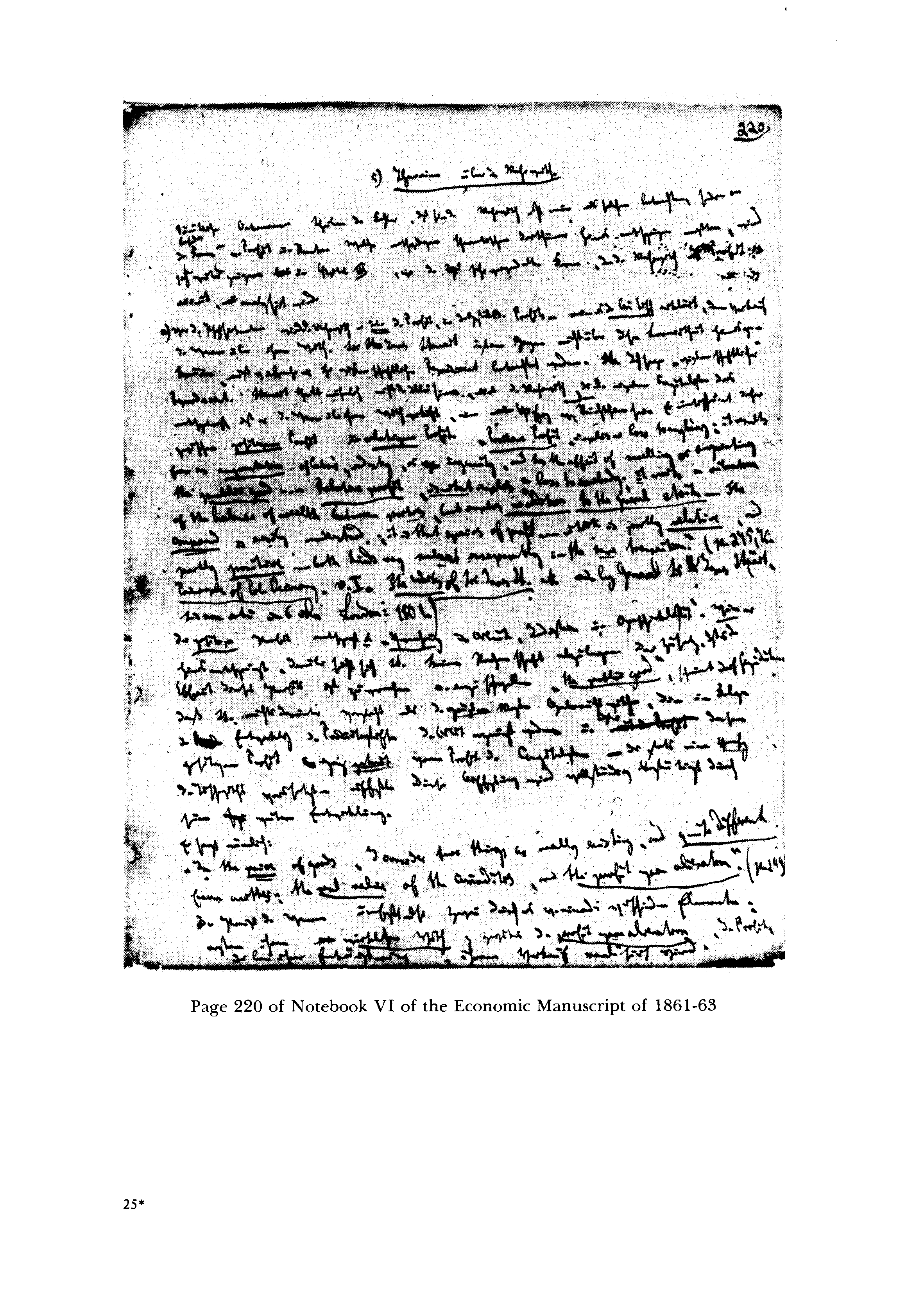
Page 220 of Notebook VI of the Economic Manuscript of 1861-63
augment a n d swell " THE PUBLIC GOOD" seems to indicate that Steuart means by it nothing but the greater mass of use values produced in consequence of the development of the productive powers of labour, and that he thinks of this positive profit as quite distinct from the capitalist's profit — which always presupposes an increase of exchange value. This interpretation is fully confirmed by his further exposition. H e says to wit:
* "In the price of goods, I consider two things as really existing, and quite different from one another; the real value of the commodity, and the profit upon alienation"* (p. 244).
T h e price of goods therefore comprises two elements that are completely different from each other: firstly their real value, secondly, the PROFIT UPON ALIENATION, the profit realised through their transfer to another person, their sale.
[VI-221] This PROFIT UPON ALIENATION therefore arises from the price of the goods being greater than their real value, or from the goods being sold above their value. Gain on the one side therefore always involves loss on the other. N o ADDITION TO THE GENERAL STOCK is created. Profit, i.e., surplus value, is relative and resolves itself INTO
"A VIBRATION OF THE BALANCE OF WEALTH BETWEEN PARTIES". Steuart himself rejects the idea that surplus value can be explained in this way. His theory of "VIBRATION OF THE BALANCE OF WEALTH BETWEEN PARTIES", however little it touches the nature and origin of surplus value itself, remains important in considering the distribution of surplus value among different classes and among different categories such as profit, interest and rent.
That Steuart limits all profit of the individual capitalist to this "RELATIVE PROFIT", PROFIT UPON ALIENATION, is shown by the following:
The "REAL VALUE", he says, is determined by the "QUANTITY" of labour, which "UPON AN AVERAGE A WORKMAN OF THE COUNTRY IN GENERAL MAY PERFORM ... IN A DAY, A WEEK, A MONTH etc.". Secondly: "THE VALUE OF THE WORKMAN'S SUBSISTENCE AND NECESSARY EXPENSE, BOTH FOR SUPPLYING HIS PERSONAL WANTS, AND ... THE INSTRUMENTS BELONGING TO HIS PROFESSION, WHICH MUST BE TAKEN UPON AN AVERAGE AS ABOVE." Thirdly: "THE VALUE OF THE MATERIALS" (pp. 244-45). "THESE THREE ARTICLES BEING KNOWN, THE PRICE OF MANUFACTURE IS DETERMINED. I T CANNOT BE LOWER THAN THE AMOUNT OF ALL THE THREE, THAT IS, THAN THE REAL VALUE; WHATEVER IS HIGHER, IS THE MANUFACTURER'S PROFIT. T H I S WILL BE IN PROPORTION TO DEMAND. AND THEREFORE WILL FLUCTUATE ACCORDING TO CIRCUMSTANCES" (1. C , p . 2 4 5 ) . " H E N C E APPEARS THE NECESSITY OF A GREAT DEMAND, IN ORDER TO PROMOTE FLOURISHING MANUFACTURES ... THE INDUSTRIOUS REGULATE THEIR LIVING AND EXPENSE ACCORDING TO THEIR CERTAIN PROFIT" (1. C , [ p . ] 2 4 6 ) . 2 3 0
From this it is clear that: T h e profit of the "MANUFACTURER", of the individual capitalist, is always RELATIVE PROFIT, always PROFIT UPON ALIENATION, always derived from the excess of the price of the commodity over its real value, from its sale above its value. If therefore all commodities were sold at their value, no profit would exist.
Steuart wrote a special chapter on this; he examines in detail:
"HOW PROFITS CONSOLIDATE INTO PRIME COST" (I.e., Vol. Ill , p. 11 Sq.). Steuart on the one hand rejects the conception of the Monetary and Mercantile systems, according to which the sale of commodities above their value, and the profit resulting therefrom, creates surplus value, a positive increase of wealth.(1) On the other hand he holds to their view that the profit of the individual capital is nothing but this excess of the price over the [VI-222] value, the PROFIT UPON ALIENATION. This however according to him is only relative, the gain on the one side being compensated by the loss on the other, and consequently this movement is nothing more than
" A VIBRATION OF THE BALANCE OF WEALTH BETWEEN PARTIES".
In this respect Steuart is therefore the rational expression of the Monetary and Mercantile systems.
His service to the theory of capital is that he shows how the process of separation takes place between the conditions of production, as the property of a definite class, and labour capacity. He gives a great deal of attention to this genesis of capital— without as yet seeing it directly as the genesis of capital, although he sees it as a condition for large-scale industry. He examines the process particularly in agriculture; and he rightly considers that manufacturing industry proper only came into being through this process of separation in agriculture. In Adam Smith's writings this process of separation is assumed to be already completed.
(Steuart's book [appeared in] 1767 (London),[8] Turgot's [was written in] 1766,M Adam Smith's [in] 7775.)[231]
Endnotes
[162] Cf. excerpts from the work by Symons at the end of the Chapter on Capital in the economic manuscript of 1857-58 (present edition, Vol. 29, pp. 206-07).— 212
[163] Marx goes back to examining Richard Jones' views on rent in Notebook XXII of this manuscript (see present edition, Vol. 33).—212
[165] T h e Règlement organique, the first constitution of the Danubian Principalities (Moldavia and Wallachia), was introduced in 1831 by P. D. Kiselev, head of the Russian administration there. The principalities h a d been occupied by the Russian troops after the Russo-Turkish War of 1828-29. Under the Règlement, the legislative power in each of the principalities was granted to the assembly, elected by big landowners, and executive power to the hospodars, representatives of the landed gentry, the clergy and the towns, elected for life. The Règlement consolidated the dominant position of the top stratum of the boyars and the clergy by perpetuating the feudal order, including the corvée.—214
[1 6 6] A reference to the Factory Acts of 1850, which introduced the 10-hour working day. In the chapter " The Working-Day" (Volume I of Capital) Marx went into the history of this act (see present edition, Vol. 35).—216
[168] Marx first gave a G e r m a n translation from The Daily Telegraph and then quoted the original, preceding it with the words: " The original r u n s " . — 217
[169] when recounting facts from the history of factory legislation, including the quotation from Blanqui given below, Marx used A. Redgrave's material from the Reports of the Inspectors of Factories ... for the Half Year ending 31st October 1855, London, 1856, pp. 77-81, 87.—220
[170] L. Horner wrote on page 9 of his report of April 30, 1859 (which Marx quotes) that it would probably be his last one. H e managed, however, to continue his work as Inspector of Factories and published one m o r e report, covering the half year ending October 3 1 , 1859. See Marx's letter to Engels of January 11, 1860 (present edition, Vol. 4 1 , p. 5).—223
[210] Marx partially realised this plan in Notebook XX of this manuscript (see present edition, Vol. 34).—311
[75] The formal subsumption of the labour process under capital and the formation by capital of a corresponding mode of production, i.e. the real subsumption of the labour process under capital, are examined in detail in Notebook XXI of the manuscript of 1861-63 (see present edition, Vol. 34).—93, 188, 262, 311
[108] when discussing the views of bourgeois economists in the manuscript of 1861-63, Marx returned more than once to the nature of productive and non-productive labour under the conditions of bourgeois production (see present edition, vols 31 and 34, pp. VII — 300, IX — 419, XXI — 1317-1331).— 136, 312
[127] Marx described surplus value as income in notebooks XV and XXII of the manuscript of 1861-63 (see present edition, vols 32 and 34).—159, 312
[60] In the manuscript of 1861-63, in the course of his further analysis, Marx repeatedly pointed to one of the specific features of his method for analysing capitalist production relations: the transformation of the prerequisite for the analysis into its result (of the commodity as the most elementary form of wealth into a product of capital) (see this volume, pp. 96-97 and 291 and also Vol. 32, p. XV — 899). Marx returns to this issue in the manuscript of Volume I of Capital, Chapter Six, "The Results of the Direct Process of Production" (see present edition, Vol. 34).—69, 97, 291, 298, 313
[70] Cf. the definition of necessary labour time as it is formulated in Part One of A Contribution to the Critique of Political Economy (present edition, Vol. 29, p. 274).—82, 242, 313
[211] Marx wrote about the specifically historical character of economic categories within the framework of the capitalist mode of production in the Introduction to the manuscript of 1857-58 (see present edition, Vol. 28, pp. 41-42).—313
[95] Marx had written about the formation of bourgeois landed property by capital as a necessary prerequisite for the existence of wage labour in the economic manuscript of 1857-58 (see present edition, Vol.28, pp. 206-09).—112, 314
[8] This work by James Steuart was first published in 1767. In his Excerpt Notebook VII, Marx copied out passages from the six-volume edition of this work published in London in 1805. When writing his synopsis, Marx mistakenly put 1801 as the year of publication. This error occurred again in the manuscript of 1861-63 and in all four editions of Volume I of Capital.—16, 348, 352
[231] Marx is referring to the work by Adam Smith An Inquiry into the Nature and Causes of the Wealth of Nations. In two volumes, London, 1776. Garnier's French translation, which Marx owned and used (A. Smith, Recherches..., Vol. I, Paris, 1802) indicated, on page 1, that the first edition appeared in late 1775-early 1776. That was probably why a mistake was made over the year of publication of Adam Smith's work.—352
[1] After completing the economic manuscript of 1857-58 (see present edition, vols 28 and 29), Marx started work to realise his idea of a substantial economic work to encompass all aspects of life in capitalist society. The first step was the publication, in 1859, of A Contribution to the Critique of Political Economy. Part One. In the Preface to this work, Marx sets out the plan of his ambitious project: "I examine the system of bourgeois economy in the following order: capital, landed property, wage-labour; the State, foreign trade, world market... The first part of the first book, dealing with Capital, comprises the following chapters: 1. The commodity; 2. Money or simple circulation; 3. Capital in general. The present part consists of the first two chapters" (see present edition, Vol. 29, p. 261). From extant correspondence (see present edition, Vol. 40) it is clear that after publishing Part One Marx intended to start immediately on the second part, which was to consist of a chapter on capital in general. However, certain other circumstances, his preoccupation with Herr Vogt among them, prevented him from carrying through this intention. Preparatory work continued up to the summer of 1861 (drafting plans, reviewing the 1857-58 manuscript and excerpts dealing with capital, making new excerpts, etc.), and in August 1861 Marx began writing. Viewed as the second part of A Contribution to the Critique of Political Economy, the manuscript of 1861-63 originally bore the same title. But soon its size grew considerably and reached 23 notebooks, 1,472 large pages in all. In addition to the main title, the covers of the first two notebooks were given the subtitle "Third Chapter. Capital in General".— 5
[6] Part of the text from pages 16 and 17 of the manuscript has been transferred here in accordance with Marx's note: "Addition to I 1) a, p. 4, line 2."—13
[5] Marx summarised the following passage from MacLeod: "When currency is employed in this method, that is when it is employed in producing articles which are themselves intended to be subservient to the production of other articles, it is usually called CAPITAL, and the use of the word Capital is also extended to apply to the article itself so produced to act as an agent in the production of others" (H. D. MacLeod, The Theory and Practice of Banking, Vol. I, London, 1855, p. 55).—13
[3] This note was originally made on the inside cover of Notebook II, which Marx also marked "A".— 6
[2] This note was made on the inside cover of Notebook I (which Marx marked "A"), presumably once it was complete. Other notes on the cover have been inserted in the relevant passages of the manuscript by the compilers.— 6
[20] While working on the manuscript of 1861-63, Marx repeatedly described the prerequisites for analysing capital proper. He thus pointed out a characteristic feature of the dialectical approach to the subject, the transition from the abstract to the concrete, and continued, as it were, his criticism of the vulgar economists, which he had begun in the manuscript of 1857-58 (see present edition, Vol. 28, pp. 180-81, 195-96, 248), for their attempts to reduce the fundamental production relation between the wage labourer and the capitalist to a simple relation between commodity owners, as it appears on the surface of capitalist production in the process of simple commodity circulation.— 33, 35, 37, 39, 69, 105, 134, 312, 314, 316