Published according to the manu-First published in the journal Die Neue script Zeit, Bd. 2, No. 27, 1903-04 [M-l] A) INTRODUCTION [6]
1. Production
(a) To begin with, the subject to be discussed is material production.
Individuals producing in a society — hence the socially determined production by individuals is of course the point of departure. The individual and isolated hunter and fisherman, who serves Adam Smith and Ricardo as a starting point,[3] is one of the unimaginative fantasies of the 18th century. Robinsonades which, contrary to the fancies of the historians of civilisation, by no means signify simply a reaction against over-refinement and a reversion to a misconceived natural life. No more is Rousseau's contrat social,[8]
which by means of a contract establishes a relationship and connection between subjects that are by nature INDEPENDENT, based on this kind of naturalism. This is an illusion and nothing but the aesthetic illusion of the small and big Robinsonades. It is, rather, the anticipation of "bourgeois society",[9] which began to evolve in the 16th century and was making giant strides towards maturity in the 18th. In this society of free competition the individual seems to be rid of the natural, etc., ties which in earlier historical epochs made him an appurtenance of a particular, limited aggregation of human beings. The prophets of the 18th century, on whose shoulders Smith and Ricardo were still standing completely, envisaged this 18th-century individual — a product of the dissolution of the feudal forms of society on the one hand, and of the new productive forces evolved since the 16th century on the other — as an ideal whose existence belonged to the past. They saw this individual not as an historical result, but as the starting point of history; not as something evolving in the course of history, but posited by nature, because for them this individual was the natural individual, according to their idea of human nature. This delusion has been characteristic of every new epoch hitherto. Steuart, who in many respects was in opposition to the 18th century and as an aristocrat tended rather to regard things from an historical standpoint, avoided this naive view.
The further back we go in history, the more does the individual, and accordingly also the producing individual, appear to be dependent and belonging to a larger whole. At first, he is still in a quite natural manner part of the family, and of the family expanded into the tribe [10]; later he is part of a community, of one of the different forms of community which arise from the conflict and the merging of tribes. It is not until the 18th century, in "bourgeois society", that the various forms of the social nexus confront the individual as merely a means towards his private ends, as external necessity. But the epoch which produces this standpoint, that of the isolated individual, is precisely the epoch of the hitherto most highly developed social (according to this standpoint, general) relations. Man is a £wov TTOA-ITIXOV[11] in the most literal sense: he is not only a social animal, but an animal that can isolate itself [M-2] only within society. Production by an isolated individual outside society — something rare, which might occur when a civilised person already dynamically in possession of the social forces is accidentally cast into the wilderness — is just as preposterous as the development of language without individuals who live together and speak to one another. It is unnecessary to dwell upon this point further. It need not have been mentioned at all if this inanity, which was understandable in people of the 18th century, had not been in all seriousness introduced into the most modern [political] economy by Bastiat, Carey, Proudhon,[3] etc. It is of course pleasant for Proudhon, for instance, to give a historico-philosophical explanation of the origin of an economic relationship whose historical genesis he does not know by indulging in a bit of mythology asserting that Adam or Prom-etheus hit upon the ready-made idea, which was then put into practice,[13] etc. Nothing is more tedious and dull than the fantasies of locus communis.
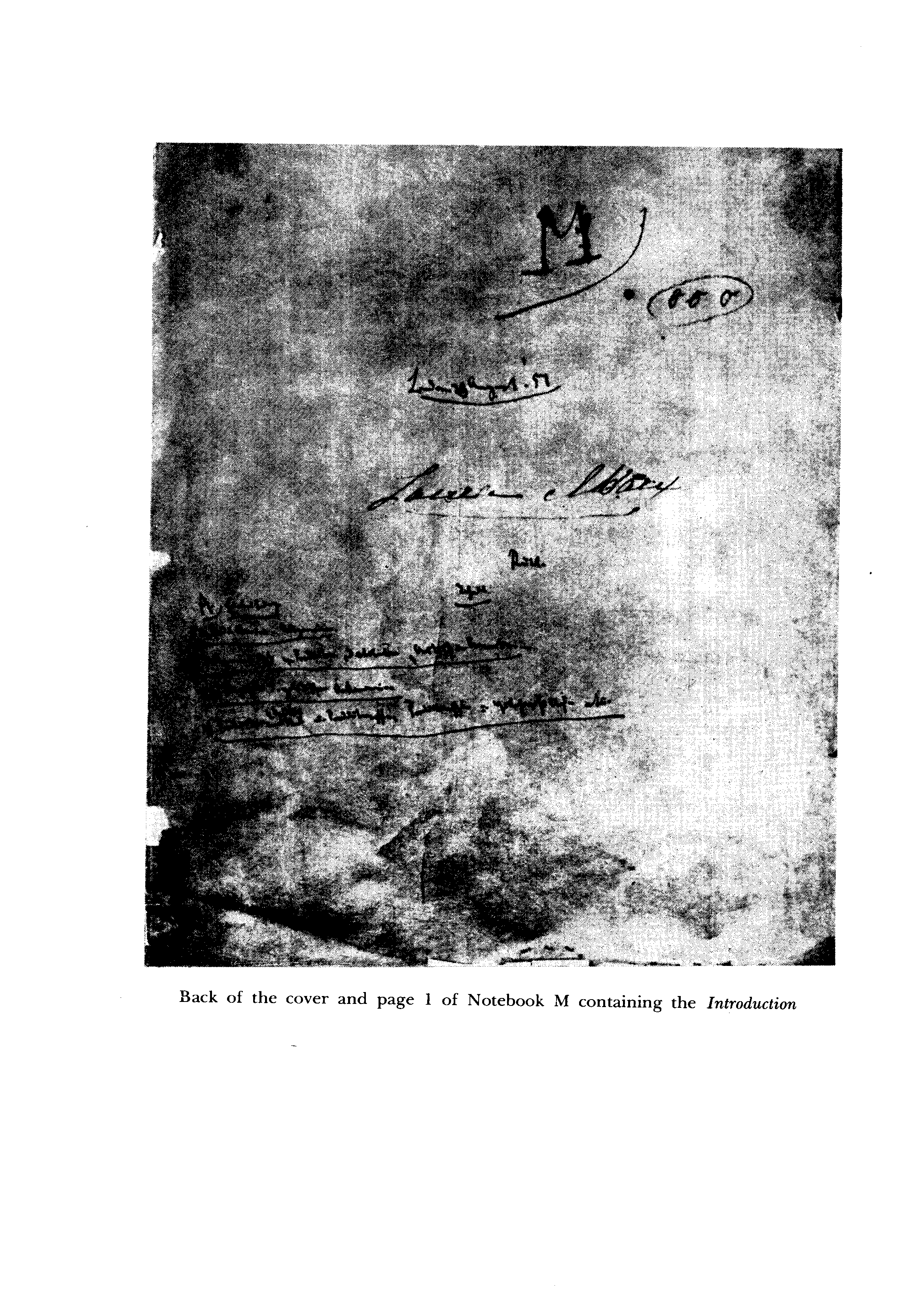
Back of the cover and page 1 of Notebook M containing the Introduction
2. The General Relation of Production to Distribution, Exchange and Consumption
Before starting upon a further analysis of production it is necessary to consider the various rubrics which economists place alongside it.
The quite obvious conception is this: in production members of society appropriate (produce, fashion) natural products in accordance with human needs; distribution determines the proportion in which the individual shares in these products; exchange supplies him with the particular products into which he wants to convert the portion accruing to him through distribution; finally, in consumption the products become objects of use, of appropriation by individuals. Production creates articles corresponding to needs; distribution allocates them according to social laws; exchange in its turn distributes what has already been al-located, according to the individual needs; finally, in consumption the product drops out of this social movement, becomes the direct object and servant of an individual need, which its use satisfies. Production thus appears as the point of departure, consumption as the final point, distribution and exchange as the middle, which has a dual aspect since distribution is determined as actuated by society, and exchange as actuated by individuals. In production the person acquires an objective aspect, in the person the object acquires a subjective aspect; in distribution, society in the form of general, dominating determinations takes over the mediation between production and consumption; in exchange, they are mediated by the chance determinateness of the individual.
Distribution determines the proportion (the quantity) of the products accruing to the individuals; exchange determines the products in which the individual claims the share [M-6] assigned to him by distribution.
Production, distribution, exchange and consumption thus form a proper syllogism; production represents the general, distribution and exchange the particular, and consumption the individual case which sums up the whole. This is indeed a connection, but a superficial one. Production [according to the political economists] is determined by general laws of nature, distribution by social chance, and it may therefore exert a more or less stimulating influence on production; exchange lies between the two as a formal social movement, and consumption, as the concluding act, which is regarded not only as the ultimate aim but as the ultimate purpose, falls properly outside the sphere of [political] economy, except in so far as it in turn reacts on the point of departure thus once again initiating the whole process.
The opponents of the political economists, whether within or without the latter's domain, who accuse them of crudely separating interconnected elements, either argue from the same standpoint or from an inferior one. Nothing is more common than the reproach that the political economists regard production too much as an end in itself. Distribution, they say, is equally important. This reproach is based on the economic conception that distribution is an independent sphere in its own right alongside production. Or [the reproach] that the different moments are not considered in their unity. As though this separation had not forced its way from real life into the textbooks, but, on the contrary, from the textbooks into real life, and as though it were a question of a dialectical reconciliation of concepts and not of comprehending actually existing relations.
( a) [ Consumption and Production]
Production is directly also consumption. Two-fold consumption, subjective and objective: [firstly,] the individual, who develops his capacities while producing, expends them as well, using them up in the act of production, just as in natural procreation vital energy is consumed. Secondly, consumption of the means of production, which are used and expended and in part (as, for instance, in combustion) are broken down into the basic elements. Similarly consumption of raw material, which does not retain its natural form and condition; these are, rather, extinguished. The act of production itself is thus in all its moments also an act of consumption. But the economists concede this. Production as directly identical with consumption, consumption as directly coinciding with production, is called by them productive consumption. This identity of production and consumption amounts to Spinoza's proposition: determinate est negatio.]2
[M-7] But this determination of productive consumption is only advanced in order to separate consumption that is identical with production from consumption proper, which is regarded rather as the destructive antithesis of production. Let us therefore consider consumption proper.
Consumption is directly also production, just as in nature consumption of elements and chemical substances is production of a plant. It is obvious that man produces his own body, e.g., through nutrition, a form of consumption. But the same applies to any other kind of consumption which in one way or another produces man in some aspect. Consumptive production. But, says [political] economy, this [type of] production, which is identical with consumption, is a second [type, one] arising from the destruction of the first product. In the first [type] the producer objectifies himself, in the second the object created by him personifies itself. Hence this consumptive production— although it represents a direct unity of production and consumption — is essentially different from production proper. The direct unity, in which production coincides with consumption and consumption with production, allows their direct duality to persist.
Production is thus directly consumption, consumption is directly production. Each is immediately its opposite. At the same time, however, a mediating movement takes place between the two. Production mediates consumption, for which it provides the material; consumption without production would have no object. But consumption also mediates production, by providing for the products the subject for whom they are products. The product only attains its final FINISH in consumption. A railway on which no one travels, which is therefore not used up, not consumed, is only a railway 8vvàu.ei.,(1) not in reality. Without production there is no consumption, but without consumption there is no production either, since in that case production would be useless. Consumption produces production in two ways. (1) In that only through consumption does a product become a real product. For example, a dress becomes really a dress only by being worn, a house which is not lived in is IN FACT not really a house; in other words, a product as distinct from a mere natural object manifests itself as a product, becomes a product, only in consumption. It is only consumption that, by dissolving the product, gives it the FINISHING STROKE, for [the result of] production is a product not merely as objectified activity, but only as an object for the active subject.
(2) In that consumption creates the need for new production, and therefore the ideal, intrinsically actuating reason for production, which is the presupposition of production. Consumption furnishes the urge to produce, and also creates the object which determines the purpose of production. If it is evident that production supplies the object of consumption externally, it is [M-8] equally evident that consumption posits the object of production ideally, as an internal image, a need, an urge and a purpose. Consumption furnishes the objects of production in a form that is still subjective. No production without need. But consumption reproduces the need.
This is matched on the side of production, (1) by the fact that it supplies the material, the object of consumption. Consumption without an object is no consumption; in this respect, therefore, production creates, produces consumption.
(2) But it is not only the object that production creates for consumption. It also gives consumption its definite form, its character, its FINISH. Just as consumption gave the product its FINISH as a product, so production gives the FINISH to consumption. For one thing, the object is not an object in general, but a definite object which must be consumed in a definite way, a way mediated by production itself. Hunger is hunger; but hunger that is satisfied by cooked meat eaten with knife and fork differs from hunger that devours raw meat with the help of hands, nails and teeth. Production thus produces not only the object of consumption but also the mode of consumption, not only objectively but also subjectively. Production therefore creates the consumer.
(3) Production not only provides the material to satisfy a need, but it also provides a need for the material. When consumption emerges from its original natural crudeness and immediacy — and its remaining in that state would be due to the fact that production was still caught in natural crudeness — then it is itself, as an urge, mediated by the object. The need felt for the object is created by the perception of the object. An objet d'art—just like any other product — creates a public that has artistic taste and is capable of enjoying beauty. Production therefore produces not only an object for the subject, but also a subject for the object.
Hence production produces consumption: (1) by creating the material for consumption; (2) by determining the mode of consumption; (3) by creating in the consumer a need for the products which it first posits as objects. It therefore produces the object of consumption, the mode of consumption and the urge to consume. Similarly, consumption produces the predisposition of the producer by soliciting him as a purpose-determining need.
The identity of consumption and production thus appears three-fold:
(1) Direct identity: production is consumption; consumption is production. Consumptive production. Productive consumption. Economists call both [M-9] productive consumption, but they still make a distinction. The former figures as reproduction, the latter as productive consumption. All investigations into the former are concerned with productive and unproductive labour, those into the latter with productive and non-productive consumption.
(2) Each appears as a means of the other, is mediated by it; this is expressed as their mutual dependence; a movement through which they are brought into mutual relation and appear to be indispensable to each other, but nevertheless remain external to each other. Production creates the material as the external object for consumption, consumption creates the need as the internal object, the purpose of production. No consumption without production; no production without consumption. [This proposition] appears in political economy in many forms.
(3) Production is not only directly consumption, and consumption directly production; nor is production only a means of consumption and consumption the purpose of production, in the sense that each provides the other with its object, with production supplying the external object of consumption, and consumption the notional object of production. Each of them is not only directly the other, nor does it merely mediate the other, but each of the two, by the fact of its taking place, creates the other, creates itself as the other. It is only consumption that consummates the act of production, since consumption completes the product as a product by dissolving it, by consuming its independent material form. Moreover, by the need for repetition consumption raises the abilities evolved during the first act of production to a skill. Consumption is therefore the concluding act which not only turns the product into a product, but also turns the producer into a producer. Production, on the other hand, produces consumption by creating the definite mode of consumption, and also by creating the incentive to consumption, the very capacity to consume, as a need. The last [kind of] identity, defined in point 3, has many times been explained by economists when discussing the relation of demand and supply, of objects and needs, of needs created by society and natural needs.
After this, nothing is simpler for a Hegelian than to posit production and consumption as identical. And this has been done not only by socialist belletrists[13] but also by prosaic economists, such as Say, in declaring that if one considers a nation — or mankind in abstracto—then its production is its consumption.(2)
Storch has shown that this proposition of Say's is wrong,(3) since a nation, for instance, does not consume its entire product, but also creates means of production, etc., fixed capital, etc.[14] Moreover, to consider society as a single subject is wrong; a speculative approach. With regard to one subject, production and consumption appear as moments of a single act. One must only [M-9] emphasise the important point here that production and consumption, if considered as activities of one subject or of many individuals, appear in any case as moments of a process in which production is the actual point of departure and hence also the dominant moment. Consumption as a necessity, as a need, is itself an intrinsic moment of productive activity. The latter, however, is the point where the realisation begins and thus also its dominant moment, the act epitomising the entire process. An individual produces an object and by consuming it returns again to himself; he returns however as a productive individual and an individual reproducing himself. Consumption thus appears as a moment of production.
But in society, the relation of the producer to the product, once it has been completed, is extrinsic, and the return of the product to the subject depends on his relations to other individuals. The product does not immediately come into his possession. Nor is its direct appropriation his aim, if he produces in society. Distribution, which on the basis of social laws determines the individual's share in the world of products, intervenes between the producer and the products, i.e. between production and consumption.
Is distribution, therefore, an independent sphere alongside and outside production?
( b) [ Distribution and Production]
When looking through the ordinary run of economic works, one is struck at once by the fact that everything is posited twice in them, e.g. rent, wages, interest and profit figure under the heading of distribution, while under the heading of production we see land, labour and capital figure as agents of production. As to capital, it is evident from the outset that it is posited twice, (1) as an agent of production, and (2) as a source of income; as determining and determined forms of distribution. Interest and profit as such therefore figure in production as well, since they are forms in which capital increases and grows, and are thus moments of its very production. As forms of distribution, interest and profit presuppose capital as an agent of production. They are modes of distribution whose presupposition is capital as an agent of production. They are likewise modes of reproduction of capital.
Wages are also wage labour, which is examined in another section; the determinateness that labour has here as an agent of production appears as a determinateness of distribution. If labour were not determined as wage labour, then, as is the case, for instance, under slavery, its share in the products would not appear as wages. Finally rent — if we take the most developed form of distribution by which landed property shares [M-10] in the products — presupposes large-scale landed property (strictly speaking, large-scale agriculture) as an agent of production, and not land in general; just as wages do not presuppose labour in general. The relations and modes of distribution thus appear merely as the reverse aspect of the agents of production. An individual whose participation in production takes the form of wage labour receives a share in the products, the results of production, in the form of wages. The structure of distribution is entirely determined by the structure of production. Distribution itself is a product of production, not only with regard to the object, [in the sense] that only the results of production can be distributed, but also with regard to the form, [in the sense] that the particular mode of participation in production determines the specific forms of distribution, the form in which one shares in distribution. It is altogether an illusion to posit land in production, and rent in distribution, etc.
Economists like Ricardo, who are mainly reproached with having paid exclusive attention to production, have accordingly regarded distribution as the only subject of [political] economy,(1)
for they have instinctively treated the forms of distribution as the most definite expression in which the agents of production are found in a given society.
To the single individual distribution naturally appears as a social law, which determines his position within [the system of] production in which he produces; distribution thus being antecedent to production. The individual starts out with neither capital nor landed property. He is dependent by birth on wage labour as a consequence of social distribution. But this dependence is itself the result of the existence of capital and landed property as independent agents of production.
When one considers whole societies, distribution appears in yet another way to be antecedent to production and to determine it; an ante-economic FACT, as it were. A conquering people divides the land among the conquerors and in this way imposes a definite mode of distribution and form of landed property, thus determining production. Or it turns the conquered into slaves, thus making slave labour the basis of production. Or a people breaks up the large landed estates into plots in a revolution; hence gives production a new character by this new distribution. Or legislation perpetuates land ownership in certain families, or allocates labour [as] a hereditary privilege, thus fixing it according to caste. In all these cases, and they are all historical, distribution does not seem to be regulated and determined by production but, on the contrary, production seems to be regulated and determined by distribution.
[M-ll] Conceived most superficially, distribution appears as the distribution of products, and thus further removed from production and quasi-independent of it. But before distribution becomes the distribution of products, it is (1) distribution of the instruments of production, and (2) (which is another determination of the same relation) distribution of the members of society among the various types of production (the subsuming of individuals under definite relations of production). The distribution of products is obviously merely a result of this distribution, which is comprised in the production process itself and determines the structure of production. To examine production separately from this distribution, which is included in it, is obviously, idle abstraction; whereas conversely the distribution of products is automatically given by that distribution, which is initially a moment of production. Ricardo, whose object was the understanding of modern production in its specific social structure, and who is the economist of production par excellence, for this very reason declares distribution, not production, the proper subject of modern [political] economy. This is added proof of the absurdity of those economists who treat production as an eternal truth, and confine history to the domain of distribution.
The question as to how this form of distribution determining production itself relates to production obviously belongs to [the sphere of] production itself. If it should be said that, since production must proceed from a specific distribution of the instruments of production, distribution is at least in this sense antecedent to and a presupposition of production, then the answer would be that production in fact has its conditions and presuppositions which constitute moments of it. At the very outset these may appear as naturally evolved. Through the process of production itself they are transformed from naturally evolved factors into historical ones, and although they appear as natural preconditions of production for one period, they were its historical result for another. They are continuously changed within production itself. For example, the employment of machinery altered the distribution of both the instruments of production and the products. Modern large-scale landed property itself is the result not only of modern trade and modern industry, but also of the application of the latter to agriculture.
The questions raised above can be ultimately resolved into this: what role do historical conditions generally play in production and how is production related to the process of history in general? This question clearly belongs to the analysis and discussion of production itself.
[M-12] In the trivial form, however, in which these questions have been raised above, they can be dealt with quite briefly. Conquests may lead to either of three results. The conquering people imposes its own mode of production upon the conquered (for example, the English in Ireland during this century, and partly in India); or it allows the old [mode of production] to continue and contents itself with tribute (e.g. the Turks and Romans); or interaction takes place, giving rise to something new, a synthesis ([this occurred] partly in the Germanic conquests). In all cases it is the mode of production — whether that of the conquering people or of the conquered or that brought about by a merging of the two — that determines the new [mode of] distribution that is established. Although the latter appears as a presupposition of the new period of production, it is itself a product of production, not only of the historical [evolution of] production in general, but of a definite historical [form of] production.
The Mongols, for example, who caused devastation in Russia, acted in accordance with their [mode of] production, cattle-breeding, for which large uninhabited tracts are a fundamental requirement. The Germanic barbarians, whose traditional [mode of] production was agriculture involving serfs and an isolated life in the countryside, could the more easily subject the Roman provinces to these conditions because the concentration of landed property carried out there had already uprooted the older agricultural relations.
It is a long-established view that at certain periods people lived exclusively by plunder. But to be able to plunder, there must be something to plunder, and this implies production. Moreover, the manner of plunder is itself determined by the manner of production, e.g. a STOCKJOBBING NATION cannot be robbed in the same way as a nation of cowherds.
The instrument of production may be taken away by force directly in the case of slaves. But then the system of production in the country to which the slave is abducted must admit of slave labour, or (as in South America,(2) etc.) a mode of production appropriate to slave labour must be established.
Laws may perpetuate an instrument of production, e.g., land, in certain families. These laws acquire economic significance only if large-scale landed property is in harmony with the mode of social production, as for instance in England. In France, agriculture was carried on on a small scale, despite the existence of large estates, which were therefore broken up by the Revolution. But can the small plot system be perpetuated, e.g. by laws? Property concen-trates itself again despite these laws. The influence of laws aimed at preserving [existing] relations of distribution, and hence their effect on production, have to be examined specially.
( c) Lastly, Exchange and Circulation
Circulation itself is only a definite moment of exchange, or it is also exchange regarded in its totality.
Since exchange is only a mediating moment linking production and distribution (which is determined by production) with consumption; since consumption moreover itself appears as a moment of production, exchange is obviously also comprised in production as one of its moments.
Firstly, it is clear that the exchange of activities and capacities which takes place in production itself is a direct and essential part of production. Secondly, the same applies to the exchange of products in so far as this exchange is a means for manufacturing the finished product intended for immediate consumption. To this extent the act of exchange itself is comprised in production. Thirdly, what is called EXCHANGE between DEALERS and DEALERS[15] is by virtue of its organisation entirely determined by production and is itself a productive activity. Exchange appears to exist independently alongside production, to be indifferent to it, only in the last stage, when the product is exchanged directly for consumption. But (1) [there is] no exchange without division of labour, whether this is naturally evolved or is itself already the result of an historical process; (2) private exchange presupposes private production; (3) the intensity of exchange, its extent and nature, are determined by the development and structure of production. E.g. exchange between town and country, exchange in the countryside, in the town, etc. Thus exchange in all its moments appears either to be directly comprised in production, or else determined by it.
The result at which we arrive is, not that production, distribution, exchange and consumption are identical, but that they are all elements of a totality, differences within a unity. Production is the dominant moment, both with regard to itself in the contradictory determination of production and with regard to the other moments. The process always starts afresh with production. That exchange and consumption cannot be the dominant moments is self-evident, and the same applies to distribution as the distribution of products. As distribution of the agents of production, however, it is itself a moment of production. A definite [mode of] production thus determines a definite [mode of] consumption, distribution, exchange and definite relations of these different moments to one another. Production in its one-sided form, however, is in its turn also determined by the other moments. For example, if the market, i.e. the sphere of exchange, expands, production grows in volume, and becomes more differentiated. Changes in distribution, e.g. concentration of capital, different distribution of the population in town and country, and the like, entail changes in production. Lastly, production is determined by the needs of consumption. There is an interaction between the different moments. This is the case with any organic entity.
3. The Method of Political Economy
When considering a given country from the standpoint of political economy, we begin with its population, the division of the population into classes, town and country, sea, the different branches of production, export and import, annual production and consumption, commodity prices, etc.
It would seem right to start with the real and concrete, with the actual presupposition, e.g. in political economy to start with the population, which forms the basis and the subject of the whole social act of production. Closer consideration shows, however, that this is wrong. Population is an abstraction if, for instance, one disregards the classes of which it is composed. These classes in turn remain an empty phrase if one does not know the elements on which they are based, e.g. wage labour, capital, etc. These presuppose exchange, division of labour, prices, etc. For example, capital is nothing without wage labour, without value, money, price, etc. If one were to start with population, it would be a chaotic conception of the whole, and through closer definition one would arrive analytically at increasingly simple concepts; from the imagined concrete, one would move to more and more tenuous abstractions until one arrived at the simplest determinations. From there it would be necessary to make a return journey until one finally arrived once more at population, which this time would be not a chaotic conception of a whole, but a rich totality of many determinations and relations.
The first course is the one taken by political economy historically at its inception. The 17th-century economists, for example, always started with the living whole, the population, the nation, the State, several States, etc., but analysis always led them in the end to the discovery of a few determining abstract, general relations, such as division of labour, money, value, etc. As soon as these individual moments were more or less clearly deduced and abstracted, economic systems were evolved which from the simple [concepts], such as labour, division of labour, need, exchange value, advanced to the State, international exchange and world market.
The latter is obviously the correct scientific method. The concrete is concrete because it is a synthesis of many determinations, thus a unity of the diverse. In thinking, it therefore appears as a process of summing-up, as a result, not as the starting point, although it is the real starting point, and thus also the starting point of perception and conception. The first procedure at-tenuates the comprehensive visualisation to abstract determinations, the second leads from abstract determinations by way of thinking to the reproduction of the concrete.
Hegel accordingly arrived at the illusion that the real was the result of thinking synthesising itself within itself, delving ever deeper into itself and moving by its inner motivation; actually, the method of advancing from the abstract to the concrete is simply the way in which thinking assimilates the concrete and reproduces it as a mental concrete. This is, however, by no means the process by which the concrete itself originates. For example, the simplest economic category, e.g. exchange value, presupposes population, population which produces under definite conditions, as well as [M-15] a distinct type of family, or community, or State, etc. Exchange value cannot exist except as an abstract, one-sided relation of an already existing concrete living whole.
But as a category exchange value leads an antediluvian existence. Hence to the kind of consciousness — and philosophical consciousness is precisely of this kind — which regards the com-prehending mind as the real man, and only the comprehended world as such as the real world — to this consciousness, therefore, the movement of categories appears as the real act of production — which unfortunately receives an impulse from outside— whose result is the world; and this (which is however again a tautology) is true in so far as the concrete totality regarded as a conceptual totality, as a mental concretum, is IN FACT a product of thinking, of comprehension; yet it is by no means a product of the self-evolving concept whose thinking proceeds outside and above perception and conception, but of the assimilation and transformation of perceptions and images into concepts. The totality as a conceptual totality seen by the mind is a product of the thinking mind, which assimilates the world in the only way open to it, a way which differs from the artistic-, religious- and practical-intellectual assimilation of this world. The real subject remains outside the mind and independent of it — that is to say, so long as the mind adopts a purely speculative, purely theoretical attitude. Hence the subject, society, must always be envisaged as the premiss of conception even when the theoretical method is employed.
But have not these simple categories also an independent historical or natural existence preceding that of the more concrete ones? Ça dépend.(1) Hegel, for example, correctly takes possession, the simplest legal relation of the subject, as the point of departure of the philosophy of law.(2) No possession exists, however, before the family or the relations of lord and servant are evolved, and these are much more concrete relations. It would, on the other hand, be correct to say that families and entire tribes exist which have as yet only possession and not property. The simpler category appears thus as a relation of simpler family or tribal associations with regard to property. In a society which has reached a higher stage the category appears as the simpler relation of a developed organisation. The more concrete substratum underlying the relation of possession is, however, always presupposed. One can conceive an individual savage who has possessions; possession in this case, however, is not a legal relation. It is incorrect that historically possession develops into the family. On the contrary, possession always presupposes this "more concrete legal category". Still, one may say that the simple categories express relations in which the less developed concrete may have realised itself without as yet having posited the more complex connection or relation which is conceptually expressed in the more concrete category; whereas the more developed concrete retains the same category as a subordinate relation.
Money can exist and has existed in history before capital, banks, wage labour, etc., came into being. In this respect it can be said, therefore, that the simpler category can express relations pre-dominating in a less developed whole or subordinate relations in a more developed whole, relations which already existed historically before the whole had developed the aspect expressed in a more concrete category. To that extent, the course of abstract thinking which advances from the elementary to the combined corresponds to the actual [M-16] historical process.
It can be said, on the other hand, that there are highly developed, and yet historically less mature, forms of society in which one finds the most advanced forms of economy, e.g. cooperation, developed division of labour, etc., but no form of money at all, for instance Peru.[16] In Slavonic communities too, money — and exchange, which conditions it — occurs little, or not at all, within the individual community, but is used on the borders, in the intercourse with other communities; and it is altogether wrong to posit exchange within the community as the original constituting element. On the contrary, in the beginning exchange tends to arise in the intercourse of different communities with one another, rather than among members of the same community. Moreover, although money plays a role very early and in diverse ways, it was a dominant element in antiquity only among nations determined in one particular manner, i.e. trading nations. Even in the most advanced antiquity, among the Greeks and Romans, money reaches its full development, which is presupposed in modern bourgeois society, only in the period of their disintegration. Thus this quite simple category does not emerge historically in its intensive form until the most highly developed phases of society, and it certainly does not penetrate all economic relations. For example, taxes in kind and deliveries in kind remained the basis in the Roman empire even at the height of its development. In effect, the monetary system in its fully developed form was to be encountered there only in the army,[17] and it never embraced the whole of labour.
So although the simpler category may have existed historically before the more concrete category, its complete intensive and extensive development can nevertheless occur precisely in a complex form of society, whereas the more concrete category was more fully evolved in a less developed form of society.
Labour seems to be a very simple category. The notion of labour in this universal form, as labour in general, is also as old as the hills. Nevertheless, considered economically in this simplicity, "labour" is just as modern a category as the relations which give rise to this simple abstraction. The monetary system, for example, still posits wealth quite objectively, as a thing existing independently in the form of money. Compared with this standpoint, it was a great advance when the manufacturing or mercantile system transferred the source of wealth from the object to the subjective activity — mercantile or manufacturing labour — but it still considered that only this circumscribed activity itself produced money. In contrast to this system, the Physiocrats posit one definite form of labour — agriculture — as wealth-producing, and the object itself no longer in the guise of money, but as a product in general, as the universal result of labour. In accordance with the still circumscribed activity, the product remains a naturally determined product, an agricultural product, a product of the earth par excellence.
[M-17] It was an immense advance when Adam Smith discarded any definiteness of the wealth-producing activity — for him it was labour as such, neither manufacturing, nor mercantile, nor agricultural labour, but all types of labour. The abstract universality of wealth-creating activity [implies] also the universality of the object determined as wealth: product in general, or once more labour in general, but as past, objectified labour. How difficult and immense a transition this was is demonstrated by the fact that Adam Smith himself still occasionally relapses into the Physiocrat-ic system. It might seem that in this way merely an abstract expression was found for the simplest and most ancient relation in which human beings act as producers — whatever the type of society they live in. This is true in one respect, but not in another.
The fact that the specific kind of labour is irrelevant presupposes a highly developed totality of actually existing kinds of labour, none of which is any more the dominating one. Thus the most general abstractions arise on the whole only with the most profuse concrete development, when one [phenomenon] is seen to be common to many, common to all. Then it is no longer perceived solely in a particular form. On the other hand, this abstraction of labour in general is not simply the conceptual result of a concrete totality of labours. The fact that the particular kind of labour is irrelevant corresponds to a form of society in which individuals easily pass from one kind of labour to another, the particular kind of labour being accidental to them and therefore indifferent. Labour, not only as a category but in reality, has become here a means to create wealth in general, and has ceased as a determination to be tied with the individuals in any particularity. This state of affairs is most pronounced in the most modern form of bourgeois society, the United States. It is only there that the abstract category "labour", "labour as such", labour sans phrase, the point of departure of modern [political] economy, is first seen to be true in practice.
The simplest abstraction which plays the key role in modern [political] economy, and which expresses an ancient relation existing in all forms of society, appears to be true in practice in this abstract form only as a category of the most modern society. It might be said that what is a historical product in the United States — this indifference to the particular kind of labour— appears to be among the Russians, for instance, a natural predisposition. But in the first place, there is an enormous difference between barbarians having a predisposition to be applied to everything, and civilised people applying themselves to everything. And then, as regards the Russians, this indifference to the particular kind of labour in practice goes hand in hand with the traditional stagnation in some very definite kind of labour, from which they can only be wrenched by external influences.
[M-18] The example of labour strikingly demonstrates that even the most abstract categories, despite their being valid — precisely because they are abstractions — for all epochs, are, in the determinateness of their abstraction, just as much a product of historical conditions and retain their full validity only for and within these conditions.
Bourgeois society is the most developed and many-faceted historical organisation of production. The categories which express its relations, an understanding of its structure, therefore, provide, at the same time, an insight into the structure and the relations of production of all previous forms of society the ruins and components of which were used in the creation of bourgeois society. Some of these remains are still dragged along within bourgeois society unassimilated, while elements which previously were barely indicated have developed and attained their full significance, etc. The anatomy of man is a key to the anatomy of the ape. On the other hand, indications of higher forms in the lower species of animals can only be understood when the higher forms themselves are already known. Bourgeois economy thus provides a key to that of antiquity, etc. But by no means in the manner of those economists who obliterate all historical differences and see in all forms of society the bourgeois forms. One can understand tribute, tithe, etc., if one knows rent. But they must not be treated as identical.
Since bourgeois society is, moreover, only a contradictory form of development, it contains relations of earlier forms of society often only in very stunted shape or as mere travesties, e.g. communal property. Thus, if it is true that the categories of bourgeois economy are valid for all other forms of society, this has to be taken cum grano salis,(3) for they may contain them in a developed, stunted, caricatured, etc., form, always with substantial differences. What is called historical development rests, in general, on the fact that the latest form regards the earlier ones as stages leading towards itself and always conceives them in a one-sided manner, since only rarely, and under quite definite conditions, is it capable of self-criticism (this of course does not apply to historical periods which regard themselves as times of decline). It was not until its self-criticism was to a certain extent prepared, as it were hvvcL\xei, that the Christian religion was able to contribute to an objective understanding of earlier mythologies. Similarly, it was not until the self-criticism of bourgeois society had begun that bourgeois [political] economy came to understand the feudal, ancient and oriental economies. In so far as bourgeois economy did not simply identify itself with the earlier economies in a mythological manner, its criticism of them — especially of the feudal economy, against which it still had to wage a direct struggle — resembled the criticism that Christianity directed against heathenism, or which Protestantism directed against Catholicism.
[M-19] Just as generally in the case of any historical, social science, so also in examining the development of economic categories it is always necessary to remember that the subject, in this context modern bourgeois society, is given, both in reality and in the mind, and that therefore the categories express forms of being, determinations of existence — and sometimes only individual aspects — of this particular society, of this subject, and that even from the scientific standpoint it therefore by no means begins at the moment when it is first discussed as such. This has to be remembered because it provides the decisive criteria for the arrangement [of the material].
For example, nothing seems more natural than to begin with rent, with landed property, since it is bound up with the earth, the source of all production and all life, and with agriculture, the first form of production in all more or less established societies. But nothing would be more erroneous. In every form of society there is a particular [branch of] production which determines the position and importance of all the others, and the relations obtaining in this branch accordingly determine those in all other branches. It is the general light tingeing all other colours and modifying them in their specific quality; it is a special ether determining the specific gravity of everything found in it.
For example, pastoral peoples (peoples living exclusively on hunting or fishing are beyond the point from which real development begins). A certain type of agriculture occurs among them, sporadically, and this determines landed property. It is common property and retains this form in a larger or smaller measure, depending on the degree to which these peoples maintain their traditions, e.g. communal property among the Slavs. Among peoples with settled agriculture — this settling is already a great advance — where agriculture predominates, as in antiquity and the feudal period, even industry, its organisation and the forms of property corresponding thereto, have more or less the character of landed property. Industry is either completely dependent on it, as with the ancient Romans, or, as in the Middle Ages, it copies in the town and in its conditions the organisation of the countryside. In the Middle Ages even capital — unless it was purely money capital — capital as traditional tools, etc., has this character of landed property.
The reverse is the case in bourgeois society. Agriculture to an increasing extent becomes merely a branch of industry and is completely dominated by capital. The same applies to rent. In all forms in which landed property rules supreme, the nature relationship still predominates; in the forms in which capital rules supreme, the social, historically evolved element predominates. Rent cannot be understood without capital, but capital can be understood without rent. Capital is the economic power that dominates everything in bourgeois society. It must form both the point of departure and the conclusion and must be analysed before landed property. After each has been considered separately, their interconnection must be examined.
[M-20] It would therefore be inexpedient and wrong to present the economic categories successively in the order in which they played the determining role in history. Their order of succession is determined rather by their mutual relation in modern bourgeois society, and this is quite the reverse of what appears to be their natural relation or corresponds to the sequence of historical development. The point at issue is not the place the economic relations took relative to each other in the succession of various forms of society in the course of history; even less is it their sequence "in the Idea" (Pronation*) (a nebulous notion of the historical process), but their position within modern bourgeois society.
It was the predominance of agricultural peoples that made the trading peoples — Phoenicians, Carthaginians — appear in such purity (abstract determinateness) in the ancient world. For capital as merchant or money capital appears precisely in that abstract form where capital is not yet the dominant factor in society. Lombards and Jews occupied the same position in relation to mediaeval agrarian societies.
P. J. Proudhon, op. cit., Vol. I, pp. 145-46.— Ed.
Another example of the different roles which the same categories play at different stages of society are JOINT-STOCK COMPANIES, one of the most recent features of bourgeois society; but they appear also in its early period in the form of large privileged commercial companies with rights of monopoly.
The concept of national wealth finds its way into the works of the economists of the 17th century as the notion that wealth is created solely for the State, whose power, on the other hand, is proportional to this wealth — a notion which to some extent survives among 18th-century economists. This was still the unintentionally hypocritical form in which wealth itself and the production of wealth was proclaimed to be the goal of the modern State, which was regarded merely as a means for producing wealth.
The arrangement has evidently to be made as follows: (1) The general abstract determinations, which therefore apper-tain more or less to all forms of society, but in the sense set forth above. (2) The categories which constitute the internal structure of bourgeois society and on which the principal classes are based. Capital, wage labour, landed property. Their relation to one another. Town and country. The 3 large social classes. Exchange between them. Circulation. Credit system (private). (3) The State as the epitome of bourgeois society. Analysed in relation to itself. The "unproductive" classes. Taxes. National debt. Public credit. Population. Colonies. Emigration. (4) International character of production. International division of labour. International exchange. Export and import. Rate of exchange. (5) World market and crises.
[M-21] 4. PRODUCTION.
4. Production. Means of Production and Relations of Production. Relations of Production and Conditions of Communication. Forms of the State and of Consciousness in Relation to the Relations of Production and of Commerce. Legal Relations. Family Relations
NB. Notes regarding points which have to be mentioned here and should not be forgotten:
(1) War develops [certain features] earlier than peace; the way in which as a result of war, and in the armies, etc., certain economic conditions, e.g. wage labour, machinery, etc., were evolved earlier than within civil society. The relation between productive power and conditions of communication is likewise particularly evident in the army.
(2) The relation of the hitherto existing idealistic historiography to realistic historiography. In particular what is known as history of civilisation, which is all a history of religion and states. (In this context something can also be said about the various kinds of historiography hitherto existing. So-called objective,[18] subjective (moral and other kinds), philosophical [historiography].)
(3) Secondary and tertiary [relations], in general derived and transmitted, non-original, relations of production. The influence of international relations here.
(4) Reproaches about the materialism of this conception. Relation to naturalistic materialism.
(5) Dialectic of the concepts productive power (means of production) and relation of production, a dialectic whose limits have to be defined and which does not abolish real difference.
(6) The unequal development of material production and e.g. art. In general, the concept of progress is not to be taken in the usual abstract form. With regard to art, etc., this disproportion is not so important and [not so] difficult to grasp as within practical social relations themselves, e.g. in culture. Relation of the United States to Europe. However, the really difficult point to be discussed here is how the relations of production as legal relations enter into uneven development. For example, the relation of Roman civil law (this applies in smaller measure to criminal and public law) to modern production.
(7) This conception(1) appears to be an inevitable development. But vindication of chance. How. (Of freedom, etc., as well.) (Influence of the means of communication. World history did not exist always; history as world history is a result).
(8) The starting point is of course determinateness by nature; subjectively and objectively. Tribes, races, etc.
(1) As regards art, it is known that certain periods of its florescence by no means correspond to the general development of society, or, therefore, to the material basis, the skeleton as it were of its organisation. For example, the Greeks compared with the moderns, or else Shakespeare. It is even acknowledged that certain forms of art, e.g. epos, can no longer be produced in their epoch-making, classic form after artistic production as such has begun; in other words that certain important creations within the compass of art are only possible at an early stage of its development. If this is the case with regard to the different arts within the sphere of art itself, it is not so remarkable that this should also be the case with regard to the entire sphere of art in its relation to the general development of society. The difficulty lies only in the general formulation of these contradictions. As soon as they are specified, they are already explained.
[M-22] Let us take, for example, the relation of Greek art, and that of Shakespeare, to the present time. We know that Greek mythology is not only the arsenal of Greek art, but also its basis. Is the conception of nature and of social relations which underlies Greek imagination and therefore Greek [art] possible in the age of SELFACTORS, railways, locomotives and electric telegraphs? What is Vulcan compared with Roberts and Co.,[19] Jupiter compared with the lightning conductor, and Hermes compared with the Crédit Mobilier[20]? All mythology subdues, dominates and fashions the forces of nature in the imagination and through the imagination; it therefore disappears when real domination over these forces is established. What becomes of Fama beside Printing House Square[21]? Greek art presupposes Greek mythology, in other words, nature and even the social forms have already been worked up in an unconsciously artistic manner by the popular imagination. This is the material of Greek art. Not just any mythology, i.e. not any unconsciously artistic working up of nature (here the term comprises all objective phenomena, including society). Egyptian mythology could never become the basis or material womb of Greek art. But at any rate [it presupposes] a mythology. Hence, on no account a social development which precludes any mythological, [i.e.] any mythologising, attitude towards nature, and therefore demands from the artist an imagination independent of mythology.
Regarded from another angle: is Achilles possible when powder and shot have been invented? And is the Iliad possible at all when the printing press and even printing machines exist? Does not the press bar inevitably spell the end of singing and reciting and the muses, that is, do not the conditions necessary for epic poetry disappear?
But the difficulty lies not in understanding that Greek art and epic poetry are bound up with certain forms of social development. The difficulty is that they still give us aesthetic pleasure and are in certain respects regarded as a standard and unattainable model.
An adult cannot become a child again, or he becomes childish. But does not the naivete of the child give him pleasure, and must he not himself endeavour to reproduce the child's veracity on a higher level? Does not the specific character of every epoch come to life again in its natural veracity in the child's nature? Why should not the historical childhood of humanity, where it attained its most beautiful form, exert an eternal charm as a stage that will never recur? There are unbred children and precocious children. Many of the ancient peoples belong to this category. The Greeks were normal children. The charm their art has for us does not conflict with the immature stage of the society in which it originated. On the contrary, that charm is a consequence of this and is, rather, inseparably linked with the fact that the immature social conditions which gave rise, and which alone could give rise, to this art can never recur.
Endnotes
[6] This Introduction, prefaced by Marx to the Outlines of the Critique of Political Economy, the first rough draft of Capital, holds an important place among his Economic Manuscripts of 1857-58. It is contained in Notebook M, marked "London, 23 August '57", which is probably the day when Marx began writing the Introduction. He interrupted this work, in all likelihood, in the last days of August, leaving the Introduction unfinished. On the cover of Notebook M, Marx listed the main items to be discussed in the Introduction. The headings of the individual sections in this table of contents differ somewhat from the corresponding headings in the text proper. Marx's list is as follows: "Contents "A. Introduction "1) Production in general "2) General relationship between production, distribution, exchange and consumption "3) The method of political economy "4) The means (forces) of production and production relations; production relations and relations of intercourse, etc." As the table reflects the overall structure of the Introduction more accurately than the headings of some of the sections in the text do, one may assume that Marx wrote it after drafting the Introduction. The fourth, closing section is in the form of a detailed outline. Of the subsections listed in it, only subsection 1, containing Marx's views on art, was written, and even that not in full. For instance contrary to his original intention, he did not investigate the relation of Shakespeare to the modern world. Having put to paper his views on Greek art, Marx broke off the work on the Introduction. Later, when preparing the manuscripts for publication, he abandoned his intention to open them with an extensive introduction and confined himself to a shorter preface formulating in brief the general philosophical premisses of his method of economic research (the materialist conception of history). In the Preface to Part One of A Contribution to the Critique of Political Economy, dated January 1859, Marx wrote: "A general introduction, which I had drafted, is omitted, since on further consideration it seems to me confusing to anticipate results which still have to be substantiated, and the reader who really wishes to follow me will have to decide to advance from the particular to the general" (see present edition, Vol. 29). The Introduction was first published in the journal Die Neue Zeit, Vol. 1, Nos. 23-25, Stuttgart, 1902-1903. In English, in first appeared in A Contribution to the Critique of Political Economy by Karl Marx. Translated from the second German edition by N. I. Stone. With an appendix containing Marx's Introduction to the Critique recently published among his posthumous papers. Charles H. Kirr & Company, Chicago, 1904, pp. 265-312. It was also published in Marx and Modern Economics, ed. by D. Horowitz. Mac Gibbon & Kee, London, 1968, pp. 21-48, in Marx's Grundrisse by David McLellan, Macmillan Press Ltd., London, 1971, pp. 16-46, and in Karl Marx, Grundrisse. Translated with a Foreword by Martin Nicolaus. London, 1973, pp. 81-111.—17
[7] The heading "I. Production, Consumption, Distribution, Exchange (Circulation)" does not occur in Marx's table of contents on the cover of Notebook M and refers, strictly speaking, only to the first two sections of the Introduction, that headed "Production" (the heading in the table of contents on the cover is more accurate: "Production in general") and that headed "The General Relation of Production to Distribution, Exchange and Consumption". There are no Roman numerals in the further text of the Introduction to correspond to the figure I marking the section "Production, Consumption, Distribution, Exchange (Circulation)".—17
[8] Contrat social—in Rousseau's theory, the voluntary agreement entered into by primitive people — originally living in "the state of nature"—which led to the formation of the political state. The theory was set forth in Rousseau's Du Contrat social; ou Principes du droit politique, London, 1782.—17
[9] The term bürgerliche Gesellschaft (see G.W.F. Hegel, Grundlinien der Philosophie des Rechts, in: Werke, Vol. 8, Berlin, 1833, § 182, Addendum) was used by Marx, even in his early writings, in two senses: in a broader one, to denote the economic system of society regardless of the historical stage of its development, i.e. the totality of material relations determining the political institutions and ideological life; and in a narrower one, to denote the material relations of bourgeois society (later, bourgeois society as a whole), i.e. capitalism. Depending on the context, the term is translated in this edition either as "bourgeois society" or as "civil society".—17
[10] In subsequent years Marx modified his views on family relations in primitive society and the early tribal system in accordance with the latest studies in ethnography and ancient history, notably the books Das Mutterrecht by the Swiss historian Johann Jacob Bachofen and Society by the American Ancient anthropologist Lewis Henry Morgan, published in the 1860s and 1870s. In particular, he abandoned the view, commonly held by historians in the 1840s and 1850s, asserting the primacy of the family and the secondary nature of the tribe and deriving the tribe from the developing family. The new conception of the relation between tribe and family was reflected, in particular, in Marx's synopsis of Morgan's Ancient Society. Frederick Engels drew on this book in writing The Origin of the Family, Private Property and the State.—18
[11] The zoon politicon—literally, "political animal" or, in a broader sense, "social animal"—was Aristotle's description of man. The term occurs in Book I of his Politica. In a note to Chapter XIII of Vol. I of Capital Marx says: "Strictly, Aristotle's definition is that man is by nature a town-citizen" (see present edition, Vol. 35).—18, 420
[14] Marx discusses the views of Say and Storch on the relation between production and consumption in the chapter "Adam Smith" of his manuscripts of 1861-63 (see present edition, Vol. 30).—31, 339
[15] Speaking of "what is called exchange between dealers and dealers", Marx has in mind Adam Smith's division of circulation into that between dealers, and that between dealers, on the one hand, and individual consumers, on the other (see Smith's An Inquiry into the Nature and Causes of the Wealth of Nations, Vol. II, Book II, Chapter II).—36
[16] Marx drew the data on pre-Spanish Peru from the American scholar William Hickling Prescott's History of the Conquest of Peru, with a preliminary view of the civilisation of the Incas, in three volumes, 4th ed., London, 1850. Excerpts from Volume I of this book are contained in Marx's Notebook XIV, begun in London in 1851. That the Incas had no knowledge of money is stated on p. 147 of Volume I.—40
[17] Marx expresses similar ideas in his letter to Engels of September 25, 1857: "More graphically than anything else the history of the army demonstrates the Tightness of our views as to the connection between the productive forces and social relations. Altogether, the army is of importance in economic development. E.g. it was in the army of Antiquity that the salaire was first fully developed. Likewise the peculium castrense [personal property of soldiers in military camps] in Rome, the first legal form according recognition to the movable property of others than fathers of families. Likewise the guild system in the corporation of the fabri [teams of artisans attached to the army in ancient Rome]. Here too the first use of machinery on a large scale. Even the special value of metals and their use as money would seem to have been based originally — as soon as Grimm's Stone Age was over — on their significance in war. Again, the division of labour within a branch was first put into practice by armies. All this, moreover, a very striking epitome of the whole history of civil societies" (see present edition, Vol. 40, p. 186).—40, 396
[18] The reference is to the school of Ranke, a trend in German historiography which was above all interested in political and diplomatic history, proclaimed the pre-eminence of foreign policy over domestic, ignored the history of social relations and exaggerated the part played by outstanding personalities. The views of Leopold von Ranke (1795-1886) were formed under the influence of philosophical idealism and Protestantism. According to Ranke, religion played the key role in the life of nations, another important factor being the political idea, embodied in the state. His historical concept was Eurocentrist, with chauvinistic overtones.—46
[19] A Manchester firm which designed tools, machines and locomotives. From 1843 it was headed by Richard Roberts, the inventor of many machines, including the self-actor.—47
[20] The Crédit Mobilier (Société générale du Crédit mobilier) was a big French joint-stock bank founded by_ the Péreire brothers in 1852. It was notorious for speculation and other irregular practices. The Crédit Mobilier took an active part in railway construction and the establishment of industrial enterprises. Though closely linked with and enjoying the protection of Napoleon Ill's government, it went bankrupt in 1867. In 1856 and 1857, Marx wrote a series of articles about its speculative activities for the Chartist People's Paper, published in London, and the New-York Daily Tribune (see this edition, Vol. 15, pp. 8-24, 270-77, 357-60).—47, 59
[21] Printing House Square—a small square in London where The Times, the biggest British daily newspaper, had its editorial offices and printshop, famous in the mid-19th century for exemplary organisation and efficiency.—47
[3] According to Bastiat, "the workers' pension fund" was to be made up of contributions by the workers themselves, for thus alone the necessary degree of "stability" could be ensured (Fr. Bastiat, Harmonies économiques, 2nd edition, Paris, 1851, p. 395).—11
[13] Marx refers to vulgar socialists like the German "true socialists" (in particular, Karl Grün) and the French petty-bourgeois socialist Proudhon. See present edition, Vol. 5, pp. 509, 515, 518 and Vol. 6, pp. 157-58.—31