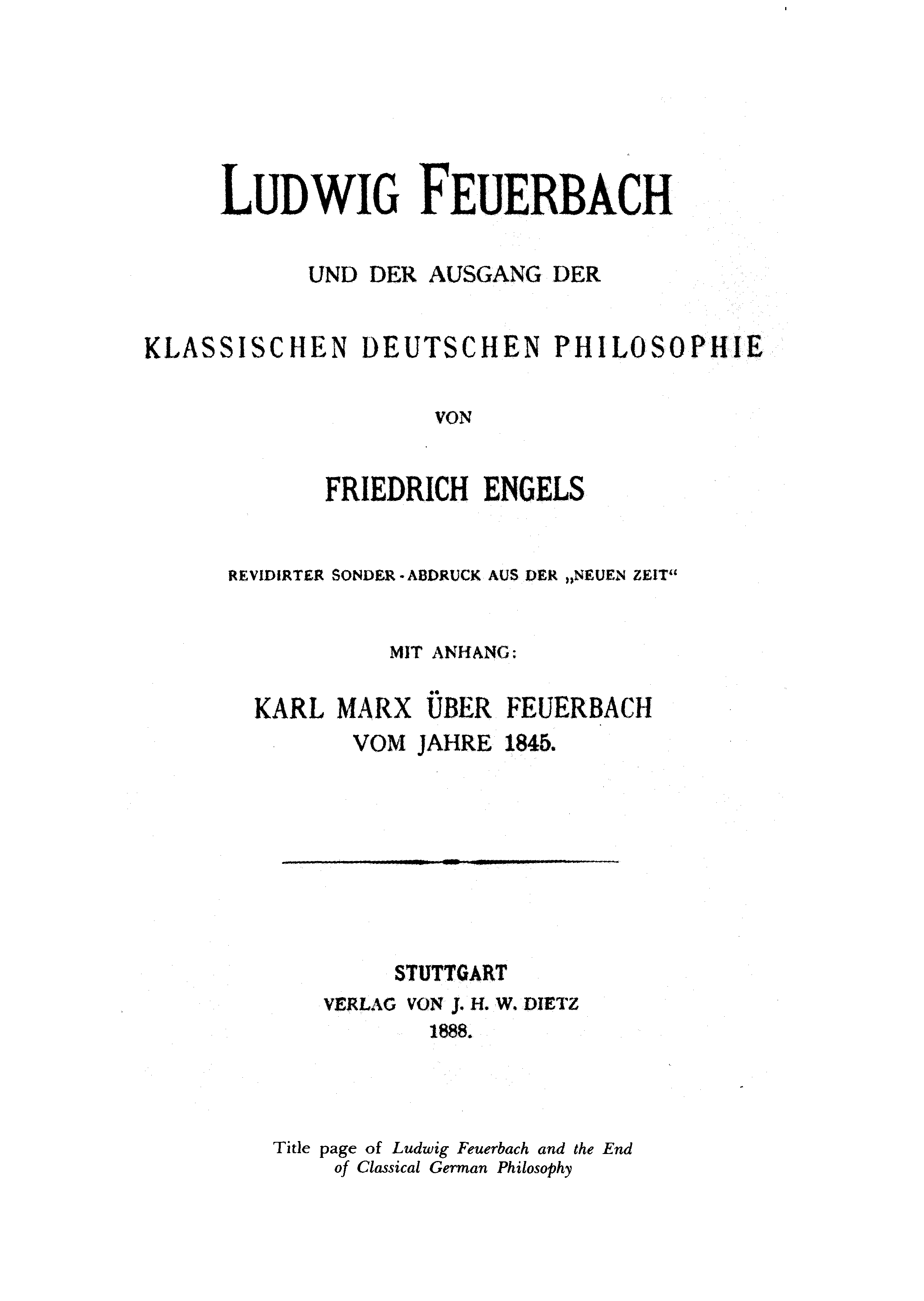
Title page of Ludwig Feuerbach and the End of Classical German Philosophy
I
The work(1) before us takes us back to a period which, although in time no more than a good generation behind us, has become as foreign to the present generation in Germany as if it were already a full century old. Yet it was the period of Germany's preparation for the Revolution of 1848; and all that has happened since then in our country has been merely a continuation of 1848, merely the execution of the testament of the revolution.
Just as in France in the eighteenth century, so in Germany in the nineteenth, a philosophical revolution ushered in the political collapse. But how different the two looked! The French were in open combat against all official science, against the Church and often also against the State; their writings were printed across the frontier, in Holland or England, while they themselves were often in jeopardy of imprisonment in the Bastille. On the other hand, the Germans were professors, State-appointed instructors of youth; their writings were recognised textbooks, and the system that rounded off the whole development — the Hegelian system— was even raised, as it were, to the rank of a royal Prussian philosophy of State! Was it possible that a revolution could hide behind these professors, behind their obscure, pedantic phrases, their ponderous, wearisome periods? Were not precisely those people who were then regarded as the representatives of the revolution, the liberals, the bitterest opponents of this befuddling philosophy? But what neither governments nor liberals saw was seen at least by one man as early as 1833, and this man was none other than Heinrich Heine.[234]
Let us take an example. No philosophical proposition has earned more gratitude from narrow-minded governments and wrath from equally narrow-minded liberals than Hegel's famous statement:
"All that is real is rational; and all that is rational is real."
That was blatantly a sanctification of the existing order of things, the philosophical benediction upon despotism, the police state, arbitrary justice, and censorship. And so it was understood by Frederick William III, and by his subjects. But according to Hegel certainly not everything that exists is also real, without further qualification. For Hegel the attribute of reality belongs only to that which is at the same time necessary:
"In the course of its development reality proves to be necessity."
Any particular governmental measure — Hegel himself cites the example of "a certain tax regulation"(2)—is therefore for him by no means real without qualification. That which is necessary, however, proves in the last resort to be also rational; and, applied to the Prussian state of that time, the Hegelian proposition, therefore, merely means: this state is rational, corresponds to reason, in so far as it [the state] is necessary; and if it nevertheless appears evil to us, but still, in spite of its evilness, continues to exist, then the evilness of the government is justified and explained by the corresponding evilness of the subjects. The Prussians of that day had the government that they deserved.
Now, according to Hegel, reality is, however, in no way an attribute predicable of any given state of affairs, social or political, in all circumstances and at all times. On the contrary. The Roman Republic was real, but so was the Roman Empire which superseded it. In I789(3) the French monarchy had become so unreal, that is to say, so robbed of all necessity, so irrational, that it had to be destroyed by the Great Revolution, of which Hegel always speaks with the greatest enthusiasm. In this case, therefore, the monarchy was the unreal and the revolution the real. And so, in the course of development, all that was previously real becomes unreal, loses its necessity, its right of existence, its rationality. And in the place of moribund reality comes a new, viable reality— peacefully if the old has enough common sense to go to its death without a struggle; forcibly if it resists this necessity. Thus the Hegelian proposition turns into its opposite through Hegelian dialectics itself: All that is real in the sphere of human history becomes irrational in the course of time, is therefore irrational by its very destination, is encumbered with irrationality from the outset; and everything which is rational in the minds of men is destined to become real, however much it may contradict existing apparent reality. In accordance with all the rules of the Hegelian method of thought, the proposition of the rationality of everything which is real is dissolved to become the other proposition: All that exists deserves to perish .(4)
But precisely therein lay the true significance and the revolutionary character of Hegelian philosophy (to which, as the termination of the whole movement since Kant, we must here confine ourselves), that it once and for all dealt the death blow to the finality of all products of human thought and action. Truth, the cognition of which was the business of philosophy, was in the hands of Hegel no longer a collection of ready-made dogmatic statements, which, once discovered, had merely to be learned by heart. Truth now lay in the process of cognition itself, in the long historical development of science, which ascends from lower to ever higher levels of knowledge without ever reaching, by discovering so-called absolute truth, a point at which it can proceed no further, where it has nothing more to do than to sit back and gaze in wonder at the absolute truth to which it had attained. And what holds good for the realm of philosophical cognition holds good also for that of every other kind of cognition and also for practical action. Just as cognition is unable to reach a definitive conclusion in a perfect, ideal condition of humanity, so is history; a perfect society, a perfect "State", are things which can only exist in the imagination. On the contrary, all successive historical states are only transitory stages in the endless course of development of human society from the lower to the higher. Each stage is necessary, and therefore justified for the time and conditions to which it owes its origin. But in the face of new, higher conditions which gradually develop in its own womb, it loses its validity and justification. It must give way to a higher stage, which will also in its turn decay and perish. Just as the bourgeoisie by large-scale industry, competition and the world market dissolves in practice all stable time-honoured institutions, so this dialectical philosophy dissolves all conceptions of final, absolute truth and of absolute states of humanity corresponding to it. Against it [dialectical philosophy] nothing is final, absolute, sacred. It reveals the transitory character of everything and in everything; nothing can endure against it except the uninterrupted process of becoming and passing away, of ascending without end from the lower to the higher. And dialectical philosophy itself is nothing more than the mere reflection of this process in the thinking brain. It has, however, also a conservative side: it recognises that definite stages of cognition and society are justified for their time and circumstances; but only so far. The conservatism of this outlook is relative; its revolutionary character is absolute — the only absolute dialectical philosophy admits.
It is not necessary, here, to go into the question of whether this outlook is thoroughly in accord with the present state of natural science, which predicts a possible end for the earth itself and for its habitability a fairly certain one; which therefore recognises that for the history of mankind, too, there is not only an ascending but also a descending branch. At any rate we are still a considerable distance from the turning-point at which the historical course of society becomes one of descent, and we cannot expect Hegelian philosophy to be concerned with a subject which, in its time, natural science had not yet placed on the agenda at all.
But what really must be said here is this: that in Hegel the views developed above are not so sharply defined. They are a necessary conclusion from his method, but one which he himself never drew with such explicitness. And this, indeed, for the simple reason that he was compelled to make a system and, in accordance with traditional requirements, a system of philosophy must conclude with some sort of absolute truth. Therefore, however much Hegel, especially in his Logik, emphasises that this eternal truth is nothing but the logical, or, the historical, process itself, he nevertheless finds himself compelled to supply this process with an end, just because he has to bring his system to a termination at some point or other. In his Logik he can make this end a beginning again, since here the point of conclusion, the absolute idea — which is only absolute in so far as he has absolutely nothing to say about it—"alienates", that is, transforms itself into nature and comes to itself again later in the mind, that is, in thought and in history. But at the end of the whole philosophy a similar return to the beginning is possible only in one way. Namely, by conceiving the end of history as follows: mankind arrives at the cognition of this selfsame absolute idea, and declares that this cognition of the absolute idea is attained in Hegelian philosophy.(5) In this way, however, the whole dogmatic content of the Hegelian system is declared to be absolute truth, in contradiction to his dialectical method, which dissolves all that is dogmatic. Thus the revolutionary side is smothered beneath the overgrowth of the conservative side. And what applies to philosophical cognition applies also to historical practice. Having, in the person of Hegel, reached the point of working out the absolute idea, mankind must also in practice have advanced so far that it can carry out this absolute idea in reality. Hence the practical political demands of the absolute idea on contemporaries should not be pitched too high. And so we find at the conclusion of the Rechtsphilosophie** that the absolute idea is to be implemented in that monarchy based on social estates which Frederick William III so persistently promised his subjects to no avail, that is, in a limited and moderate, indirect rule of the possessing classes suited to the petty-bourgeois German conditions of that time; and, moreover, the necessity of the nobility is demonstrated to us in a speculative fashion.
The inner necessities of the system are, therefore, of themselves sufficient to explain why a thoroughly revolutionary method of thinking produced an extremely tame political conclusion. As a matter of fact, the specific form of this conclusion derives from the fact that Hegel was a German, and like his contemporary Goethe, had a bit of the philistine's tail dangling behind. Each of them was an Olympian Zeus in his own sphere, yet neither of them ever quite freed himself from German philistinism.
But all this did not prevent the Hegelian system from covering an incomparably greater domain than any earlier system, nor from developing in this domain a wealth of thought which is astounding even today. The phenomenology of the mind (which one may call a parallel to the embryology and palaeontology of the mind, a development of individual consciousness through its different stages, set in the form of an abbreviated reproduction of the stages through which the consciousness of man has passed in the course of history), logic, philosophy of nature, philosophy of the mind, and the latter in turn elaborated in its separate, historical subdivisions: philosophy of history, of law, of religion, history of philosophy, aesthetics, etc.—in all these different historical fields Hegel worked to discover and demonstrate the pervading thread of development. And as he was not only a creative genius but also a man of encyclopaedic erudition, he played an epoch-making role in every sphere. It is self-evident that owing to the needs of the "system" he very often had to resort to those forced constructions about which his pygmean opponents make such a terrible fuss even today. But these constructions are only the frame and scaffolding of his work. If one does not loiter here needlessly, but presses on farther into the huge edifice, one finds innumerable treasures which still today retain their full value. With all philosophers it is precisely the "system" which is perishable; and for the simple reason that it springs from an imperishable need of the human mind — the need to overcome all contradictions. But if all contradictions are once for all disposed of, we shall have arrived at so-called absolute truth — world history will be at an end. And yet it has to continue, although there is nothing left for it to do — hence, a new, insoluble contradiction. Once we have realised — and in the long run no one has helped us to realise it more than Hegel himself — that the task of philosophy thus stated means nothing but the task that a single philosopher should accomplish that which can only be accomplished by the entire human race in its ongoing development — as soon as we realise that, it is the end of all philosophy in the hitherto accepted sense of the word. One leaves alone "absolute truth", which is unattainable along this path or by any single individual; instead, one pursues attainable relative truths along the path of the positive sciences, and the summation of their results by means of dialectical thinking. With Hegel philosophy comes to an end altogether: on the one hand, because in his system he sums up its whole development in the most splendid fashion; and on the other hand, because, even if unconsciously,(6) he shows us the way out of the labyrinth of systems to real positive cognition of the world. One can imagine what a tremendous effect this Hegelian system must have produced in the philosophy-tinged atmosphere of Germany. It was a triumphal procession which lasted for decades and which by no means came to a standstill on the death of Hegel. On the contrary, it was precisely from 1830 to 1840 that "Hegelianism" reigned most exclusively, and to a greater or lesser extent infected even its opponents. It was precisely in this period that Hegelian views, consciously or unconsciously, most extensively penetrated the most diversified sciences and leavened even popular literature and the daily press, from which the average "educated consciousness" derives its mental pabulum. But this victory along the whole front was only the prelude to an internal struggle.
As we have seen, Hegel's doctrine, taken as a whole, left plenty of room to accommodate the most diverse practical party views. And in the theoretical Germany of that time, two things were practical above all; religion and politics. Whoever placed the emphasis on the Hegelian system could be fairly conservative in both spheres; whoever regarded the dialectical method as the main thing could belong to the most extreme opposition, both in religion and politics. Hegel himself, despite the fairly frequent outbursts of revolutionary wrath in his works, seemed on the whole to be more inclined to the conservative side. Indeed, his system had cost him much more "hard mental plugging" than his method. Towards the end of the thirties, the cleavage in the school became more and more apparent. The Left wing, the so-called Young Hegelians, in their fight with the pietist orthodox and the feudal reactionaries, abandoned bit by bit that philosophical-genteel reserve in regard to the burning questions of the day which up to that time had secured state toleration and even protection for their teachings. And when, in 1840, orthodox sanctimony and absolutist feudal reaction ascended the throne with Frederick William IV, open partisanship became unavoidable. The fight was still carried on with philosophical weapons, but no longer for abstract philosophical aids. It turned directly on the destruction of traditional religion and the existing state. And while in the Deutsche Jahrbücher the practical ends were still predominantly put forward in philosophical disguise, in the Rheinische Zeitung of 1842 the Young Hegelian school revealed itself directly as the philosophy of the aspiring radical bourgeoisie and used the meagre cloak of philosophy only to deceive the censors.
At that time, however, politics was a very thorny field, and hence the main fight came to be directed against religion; this fight, particularly since 1840, was indirectly also political. Strauss'
Leben Jesu, published in 1835, had provided the initial impetus. The theory therein developed of the formation of the gospel myths was combated later by Bruno Bauer with proof that a whole series of evangelical stories had been invented by the authors themselves. The controversy between these two was carried on in the philosophical disguise of a battle between "self-consciousness"
and "substance". The question whether the miracle stories of the gospels came into being through unconscious traditional myth-creation within the bosom of the community or whether they were invented by the evangelists themselves was blown up into the question whether, in world history, "substance" or "self-consciousness" was the decisive operative force. Finally came Stirner, the prophet of contemporary anarchism — Bakunin has taken a great deal from him — and surpassed the sovereign "self-consciousness" by his sovereign "ego".(7)
We shall not go further into this aspect of the decomposition process of the Hegelian school. More important for us is the following: the bulk of the most determined Young Hegelians were, by the practical necessities of their fight against positive religion,[236] driven back to Anglo-French materialism. This brought them into conflict with their school system. While materialism conceives nature as the sole reality, nature in the Hegelian system represents merely the "alienation" of the absolute idea, so to say, a degradation of the idea. At all events, thinking and its thought-product, the idea, is here the primary, nature the derivative, which only exists at all by the condescension of the idea. And in this contradiction they floundered as well or as ill as they could.
Then came Feuerbach's Wesen des Christenthums. With one blow it pulverised the contradiction, by plainly placing materialism on the throne again. Nature exists independently of all philosophy. It is the foundation upon which we human beings, ourselves products of nature, have grown up. Nothing exists outside nature and man, and the higher beings our religious fantasies have created are only the fantastic reflection of our own essence. The spell was broken; the "system" was exploded and cast aside, and the contradiction, shown to exist only in our imagination, was dissolved.—One must have experienced the liberating effect of this book for oneself to get an idea of it. Enthusiasm was universal: we were all Feuerbachians for a moment. How enthusiastically Marx greeted the new conception and how much — in spite of all critical reservations — he was influenced by it,(8) one may read in The Holy Family.
Even the shortcomings of the book contributed to its immediate effect. Its literary, sometimes even bombastic, style secured for it a large public and was at any rate refreshing after long years of abstract and abstruse Hegelianising. The same is true of its extravagant deification of love, which, coming after the now intolerable sovereign rule of "pure reason", had its excuse, if not justification. But what we must not forget is that it was precisely these two weaknesses of Feuerbach that "true socialism",[237] which had been spreading like a plague in "educated" Germany since 1844, took as its starting-point, putting literary phrases in the place of scientific knowledge, the liberation of mankind by means of "love" in place of the emancipation of the proletariat through the economic transformation of production — in short, losing itself in the nauseous fine writing and ecstasies of love typified by Herr Karl Grün.
Another thing we must not forget is this: the Hegelian school had disintegrated, but Hegelian philosophy had not been overcome through criticism; Strauss and Bauer each took one of its sides and set it polemically against the other. Feuerbach broke through the system and simply discarded it. But a philosophy is not disposed of by the mere assertion that it is false. And so mighty a work as Hegelian philosophy, which had exercised so enormous an influence on the intellectual development of the nation, could not be disposed of by simply being ignored. It had to be "transcended" in its own sense, that is, in the sense that while its form had to be annihilated through criticism, the new content which had been won through it had to be saved. How this was brought about we shall see below.
But in the meantime the Revolution of 1848 thrust the whole of philosophy aside as unceremoniously as Feuerbach had thrust aside Hegel. And in the process Feuerbach himself was also pushed into the background.
II
The great basic question of all, especially of latter-day, philosophy, is that concerning the relation of thinking and being. From very early times when men, still completely ignorant of the structure of their own bodies, and prompted by dream apparitions(1) came to believe that their thinking and sensation were not activities of their bodies, but of a distinct soul which inhabits the body and leaves it upon death — from this time men have been driven to reflect about the relation between this soul and the outside world. If upon death it left the body and lived on, there was no occasion to ascribe another distinct death to it. Thus arose the idea of its immortality, which at that stage of development appeared not at all as a consolation but as a fate which it was pointless to fight, and often enough, as among the Greeks, a positive misfortune. Not religious desire for consolation, but the quandary arising from the universal ignorance of what to do with this soul, once its existence had been accepted, after the death of the body, led everywhere to the tedious fancy of personal immortality. In quite a similar manner the first gods arose through the personification of natural forces. And as religions continued to take shape, these gods assumed more and more an extramundane form, until finally by a process of abstraction, I might almost say of distillation, occurring naturally in the course of man's intellectual development, out of the many more or less limited and mutually limiting gods there arose in the minds of men the idea of the one exclusive God of the monotheistic religions.
Thus the question of the relation of thinking to being, of the mind to nature — the paramount question of the whole of philosophy — has, no less than all religion, its roots in the narrow-minded and ignorant notions of savagery. But it was possible to put forward this question for the first time in full clarity to give it its full significance, only after humanity in Europe had awakened from the long hibernation of the Christian Middle Ages. The question of the position of thinking in relation to being, a question which, by the way, had played a great part also in the scholasticism of the Middle Ages, the question: which is primary, mind or nature — that question, in relation to the Church, was sharpened into this: Did God create the world or has the world existed for all time?
Answers to this question split the philosophers into two great camps. Those who asserted the primacy of the mind over nature and, therefore, in the last instance, assumed world creation in some form or other — and among the philosophers, e.g., Hegel, this creation often becomes still more intricate and impossible than in Christianity — comprised the camp of idealism. The others, who regarded nature as primary, belong to the various schools of materialism.
These two expressions, idealism and materialism, originally signify nothing else but this; and here they are not used in any other sense either. What confusion arises when some other meaning is put into them will be seen below.
But the question of the relation of thinking and being has yet another side: in what relation do our thoughts about the world surrounding us stand to this world itself? Is our thinking capable of cognition of the real world? Are we able in our ideas and notions of the real world to produce a correct reflection of reality? In the language of philosophy this question is called the question of the identity of thinking and being, and the overwhelming majority of philosophers answer it in the affirmative. In Hegel, for example, its affirmation is self-evident: for what we cognise in the real world is precisely its thought content — that which makes the world a gradual realisation of the absolute idea, which absolute idea has existed somewhere from eternity, independent of the world and before the world. But it is manifest without further proof that thinking can cognise a content which is from the outset a thought content. It is equally manifest that what is to be proved here is already tacitly contained in the premiss. But that in no way prevents Hegel from drawing the further conclusion from his proof of the identity of thinking and being that his philosophy, because it is correct for his thinking, is therefore the only correct one, and that the identity of thinking and being must prove its validity by mankind immediately translating his philosophy from theory into practice and transforming the whole world according to Hegelian principles. This is an illusion which he shares with well-nigh all philosophers.
In addition there is yet another set of philosophers — those who dispute the possibility of any cognition, or at least of an exhaustive cognition, of the world. Among them, of the more recent ones, we find Hume and Kant, and they have played a very important role in philosophical development. What is decisive in the refutation of this view has already been said by Hegel, as far as this was possible from an idealist standpoint. The materialist additions made by Feuerbach are more quick-witted than profound. The most telling refutation of this as of all other philosophical quirks is practice, namely, experimentation and industry. If we are able to prove the correctness of our conception of a natural phenomenon by bringing it about ourselves, producing it out of its conditions and making it serve our own purposes into the bargain, then the ungraspable Kantian "thing-in-itself" is finished. The chemical substances produced in the bodies of plants and animals remained just such "things-in-themselves" until organic chemistry began to produce them one after another, whereupon the "thing-in-itself"
became a thing for us, as, for instance, alizarin, the colouring matter of the madder, which we no longer trouble to grow in the madder roots in the field, but produce much more cheaply and simply from coal tar. For three hundred years the Copernican solar system was a hypothesis with a hundred, a thousand or ten thousand chances to one in its favour, but still always a hypothesis. But when Leverrier, by means of the data provided by this system, not only deduced that an unknown planet must exist, but also calculated the position in the heavens which this planet must necessarily occupy, and when Galle really found this planet,[238] the Copernican system was proved. If, nevertheless, the Neo-Kantians are attempting to resurrect the Kantian conception in Germany and the agnostics that of Hume in England (where it never became extinct), this is, in view of their theoretical and practical refutation accomplished long ago, scientifically a regression and practically merely a shamefaced way of surreptitiously accepting materialism, while denying it before the world.
But during this long period from Descartes to Hegel and from Hobbes to Feuerbach, the philosophers were by no means impelled, as they thought they were, solely by the force of pure reason. On the contrary, what really pushed them forward most was the powerful and ever more rapidly onrushing progress of natural science and industry.(2) Among the materialists this was plain on the surface, but the idealist systems also filled themselves more and more with a materialist content and attempted pantheistically to reconcile the antithesis between mind and matter. Thus, ultimately, the Hegelian system represents merely a materialism idealistically turned upside down in method and content.
It is, therefore, comprehensible that Starcke in his characterisa-tion of Feuerbach first of all investigates the latter's position in regard to this fundamental question of the relation of thinking and being. After a short introduction, in which the views of the preceding philosophers, particularly since Kant, are described in unnecessarily ponderous philosophical language, and in which Hegel, by an all too formalistic adherence to certain passages of his works, gets far less than his due, there follows a detailed description of the course of development of Feuerbach's "metaphysics" itself, in the manner it arises from the sequence of this philosopher's relevant works. This description is industriously and lucidly elaborated; only, like the whole book, it is loaded with a ballast of philosophical phraseology by no means everywhere unavoidable, which is the more disturbing in its effect the less the author keeps to the manner of expression of one and the same school, or even of Feuerbach himself, and the more he interjects expressions of the most various tendencies, especially of those now rampant and calling themselves philosophical.
Feuerbach's evolution is that of a Hegelian — a never quite orthodox Hegelian, it is true — into a materialist; an evolution which at a certain stage gives rise to a complete break with the idealist system of his predecessor. With irresistible force Feuerbach is finally driven to the realisation that the Hegelian premundane existence of the "absolute idea", the "pre-existence of the logical categories" before the world existed, is nothing more than a fantastic remnant of the belief in the existence of an extramun-dane creator; that the material sensuously perceptible world to which we ourselves belong is the only reality; and that our consciousness and thinking, however suprasensuous they may seem, are the product of a material, bodily organ, the brain. Matter is not a product of the mind, but the mind itself is merely the highest product of matter. This is, of course, pure materialism. But, having got so far, Feuerbach stops short. He cannot overcome the habitual philosophical prejudice, prejudice not against the thing but against the name materialism. He says:
"To me materialism is the foundation of the edifice of human essence and knowledge; but to me it is not what it is to the physiologist, to the natural scientist in the narrower sense, for example, to Moleschott, and necessarily is from their standpoint and profession, namely, the edifice itself. Backwards I fully agree with the materialists; but not forwards."[239]
Here Feuerbach lumps together the materialism that is a general world outlook resting upon a definite conception of the relation between matter and mind, and the special form in which this world outlook was expressed at a definite historical stage, namely, in the eighteenth century.(3) More than that, he lumps it together with the shallow, vulgarised form in which the materialism of the eighteenth century continues to exist today in the heads of naturalists and doctors, the form in which it was preached on their tours in the fifties by Büchner, Vogt and Moleschott. But just as idealism underwent a series of stages of development, so also did materialism. With each epoch-making discovery even in the sphere of natural science it has to change its form; and history too having been subjected to materialistic treatment, a new avenue of development has opened here as well.
The materialism of the last century was predominantly mechanical, because at that time, of all the natural sciences, only mechanics, and indeed only the mechanics of solid bodies— celestial and terrestrial — in short, the mechanics of gravity, had come to any certain conclusion. Chemistry at that time existed only in its infantile, phlogistic form.[240] Biology still lay in swaddling clothes; plant and animal organisms had been only crudely examined and were explained as the result of purely mechanical causes. What the animal was to Descartes, man was to the materialists of the eighteenth century — a machine. This application exclusively of the standards of mechanics to processes of a chemical and organic nature — in which processes the laws of mechanics are, indeed, also valid, but are pushed into the background by other, higher laws — constitutes one specific, but at that time inevitable, limitation of classical French materialism.
The other specific limitation of this materialism lay in its inability to comprehend the world as a process, as matter undergoing uninterrupted historical development. This accorded with the state of the natural science of that time, and with the metaphysical, that is, anti-dialectical manner of philosophising connected with it. Nature, so much was known, was in eternal motion. But according to the ideas of that time, this motion turned just as eternally in a circle and therefore never moved from the spot; it produced the same results over and over again. This conception was at that time inevitable. The Kantian theory of the origin of the solar system had only been put forward and was still regarded merely as an oddity. The history of the evolution of the earth, geology, was still totally unknown, and the idea that the animate natural beings of today are the result of a long sequence of evolution from the simple to the complex could not at that time scientifically be put forward at all. The unhistorical view of nature was therefore inevitable.(4) We have the less reason to reproach the philosophers of the eighteenth century on this account since the same thing is found in Hegel. According to him, nature, as a mere "alienation" of the idea, is incapable of evolution in time — capable only of extending its manifoldness in space, so that it displays simultaneously and side by side all the stages of evolution comprised in it, and is condemned to an eternal repetition of the same processes. This absurdity of evolution in space, but outside of time — the fundamental condition of all evolution — Hegel imposes upon nature just at the very time when geology, embryology, the physiology of plants and animals, and organic chemistry were taking shape, and when everywhere on the basis of these new sciences brilliant presentiments of the subsequent theory of evolution were appearing (for instance, Goethe and Lamarck). But the system demanded it; hence the method, for the sake of the system, had to become untrue to itself.
This same unhistorical conception prevailed also in the domain of history. Here the struggle against the remnants of the Middle Ages captured the limelight. The Middle Ages were regarded as a mere interruption of history by a thousand years of universal barbarism. The great progress made in the Middle Ages — the extension of the domain of European civilisation, the viable great nations taking form there next to each other, and finally the enormous technical advances of the fourteenth and fifteenth centuries — all this was not seen. Thus a rational insight into the great historical coherence was made impossible, and history served at best as a collection of examples and illustrations for the use of philosophers.
The vulgarising pedlars, who dabbled in materialism in the Germany of the fifties in no way overcame this limitation of their teachers. All the advances of natural science which had been made in the meantime served them only as fresh evidence against the existence of a world creator, and, indeed, they did not in the least make it their business to develop the theory any further. Though idealism was stumped and (5) was dealt a death-blow by the Revolution of 1848, it had the satisfaction of seeing that materialism had for the moment sunk to even greater depths. Feuerbach was unquestionably right when he refused to take responsibility for this materialism; only he should not have confounded the doctrines of these itinerant preachers with materialism in general.
Here, however, there are two things to be pointed out. First, even during Feuerbach's lifetime, natural science was still in that process of intense fermentation which has reached a clarifying, relative conclusion only during the last fifteen years. New data for cognition were acquired to a hitherto unheard-of extent, but the establishment of coherence, and thereby of order, in this chaos of discoveries following closely upon each other's heels, has only quite recently become possible. It is true that Feuerbach lived to see all three of the decisive discoveries — that of the cell, the transformation of energy and the theory of evolution named after Darwin. But how was the lonely philosopher in the country to sufficiently follow scientific developments in order to appreciate at their full value discoveries which natural scientists themselves at that time either still contested or did not know how to adequately exploit? The blame for this falls solely upon the wretched conditions in Germany, in consequence of which brooding eclectic flea-crackers had taken possession of the chairs of philosophy, while Feuerbach, who towered above them all, had to rusticate and go to seed in a little village. It is therefore not Feuerbach's fault that the historical conception of nature, which has now become possible and has removed all the one-sidedness of French materialism, remained inaccessible to him.
Secondly, Feuerbach is quite correct in asserting that exclusively natural-scientific materialism is indeed
"the foundation of the edifice of human knowledge, but not the edifice itself". For we live not only in nature but also in human society, and this also has its evolution and its science no less than nature. It was therefore a question of bringing the science of society, that is, the sum total of the so-called historical and philosophical sciences, into harmony with the materialist foundation, and of reconstruct-ing it thereupon. But it did not fall to Feuerbach's lot to do this. In spite of the "foundation", he remained bound here by the traditional idealist fetters, a fact which he recognises in these words:
"Backwards I agree with the materialists, but not forwards." But it was Feuerbach himself who did not go "forwards" here, in the social domain, who did not get beyond his standpoint of 1840 or 1844. And this was again chiefly due to his réclusion, which compelled him — of all philosophers the most inclined to social intercourse — to produce thoughts out of his solitary head instead of in amicable and hostile encounters with other men of his calibre. Below we shall see in detail how much he remained an idealist in this sphere.
It need only be added here that Starcke looks for Feuerbach's idealism in the wrong place.
ideal trends. Are not compassion, love and enthusiasm for truth and justice ideal forces?" (p. VIII).
In the first place, idealism here means nothing but the pursuit of ideal goals. But these necessarily have to do with Kantian idealism at best, and its "categorical imperative"; however, Kant himself called his philosophy "transcendental idealism"; by no means because it dealt also with ethical ideals, but for quite other reasons, as Starcke will remember. The superstition that philosophical idealism revolves around a belief in ethical, that is, social, ideals, arose outside philosophy, among the German philistines, who learned by heart from Schiller's poems the few morsels of philosophical culture they needed. No one has criticised more severely the impotent Kantian "categorical imperative"— impotent because it demands the impossible, and therefore never attains to any reality — no one has more cruelly derided the philistine passion for unrealisable ideals purveyed by Schiller than Hegel of all people, the perfect idealist (see, for example, his
Phänomenologie ).
In the second place, we simply cannot evade the fact that everything which motivates men must pass through their brains— even eating and drinking, which begins as a consequence of the sensation of hunger or thirst transmitted through the brain, and ends as a result of the sensation of satisfaction likewise transmitted through the brain. The influences of the external world upon man express themselves in his brain, are reflected therein as feelings, thoughts, impulses, volitions — in short, as "ideal tendencies", and in this form become "ideal powers". If, then, a man is to be deemed an idealist because he follows "ideal tendencies" and admits that "ideal powers" have an influence over him, then every person who is at all normally developed is a born idealist and how, in that case, can there be any materialists at all?
In the third place, the conviction that humanity, at least at the present moment, is moving on the whole in a progressive direction has absolutely nothing to do with the antagonism between materialism and idealism. The French materialists no less than the deists[241] Voltaire and Rousseau held this conviction to an almost fanatical degree, and often enough made the greatest personal sacrifices to it. If ever anybody dedicated his whole life to "enthusiasm for truth and justice"—using this phrase in the positive sense — it was Diderot, for instance. If, therefore, Starcke declares all this to be idealism, this merely proves that the word materialism, and the whole antagonism between the two trends, has lost all meaning for him here.
The fact is that Starcke, although perhaps unconsciously, makes an unpardonable concession here to the traditional philistine prejudice against the word materialism resulting from its long-continued defamation by the priests. By the word materialism the philistine understands gluttony, drunkenness, lust of the eye, lust of the flesh, arrogance, cupidity, avarice, covetousness, profiteer-ing and stock-exchange swindling — in short, all the filthy vices in which he himself indulges in private. By the word idealism he understands the belief in virtue, universal philanthropy and altogether a "better world", of which he boasts to others but in which he himself believes at best only so long as he is having the blues or going through the bankruptcy consequent upon his customary "materialist" excesses. It is then that he sings his favourite song, What is man?—Half beast half angel.
For the rest, Starcke takes great pains to defend Feuerbach against the attacks and doctrines of the vociferous assistant professors who today go by the name of philosophers in Germany. For people who afe interested in this afterbirth of classical German philosophy this is, of course, a matter of importance, for Starcke himself it may have appeared necessary. We will spare the reader this.
III
The real idealism of Feuerbach becomes evident as soon as we come to his philosophy of religion and ethics. He by no means wishes to abolish religion; he wants to perfect it. Philosophy itself must be absorbed in religion.
"The periods of humanity are distinguished only by religious changes. A historical movement is fundamental only when it is rooted in the hearts of men. The heart is not a form of religion, so that the latter should exist also in the heart; the heart is the essence of religion." (Quoted by Starcke, p. 168).(1)
According to Feuerbach, religion is the relation between human beings based on affection, on the heart, which relation until now has sought its truth in a fantastic mirror image of reality — in the mediation of one or many gods, the fantastic mirror images of human qualities — but now finds it directly and without any mediation in the love between "I" and "Thou". Thus, in Feuerbach sex love ultimately becomes one of the highest forms, if not the highest form, of the practice of his new religion.
Now relations between human beings, based on affection, and especially between the two sexes, have existed as long as mankind. Sex love in particular has undergone a development and won a place during the last eight hundred years which has made it a compulsory pivot of all poetry during this period. The existing positive religions[242] have limited themselves to the higher consec-ration of state-regulated sex love, that is, of the marriage laws, and they could all disappear tomorrow without changing in the slightest the practice of love and friendship. Thus the Christian religion in France, as a matter of fact, so completely disappeared in the years 1793-98 that even Napoleon could not re-introduce it without opposition and difficulty; and this without any need for a substitute, in Feuerbach's sense, making itself felt in the interval.
Feuerbach's idealism consists here in this: he does not simply accept people's relations based on reciprocal inclination, such as sex love, friendship, compassion, self-sacrifice, etc., as what they are in themselves — without relating them back to a particular religion which to him, too, belongs to the past; but instead he asserts that they will attain their full value only when consecrated by the name of religion. The chief thing for him is not that these purely human relations exist, but that they shall be conceived of as the new, true religion. They are to have full value only after they have been marked with a religious stamp. Religion is derived from religare and meant originally a bond. Therefore, every bond between two people is a religion. Such etymological tricks are the last resort of idealist philosophy. Not what the word means according to the historical development of its actual use, but what it ought to mean according to its derivation, is what counts. And so sex love and sex bonds are apotheosised to a "religion", merely in order that the word religion, which is so dear to idealist memories, may not disappear from the language. The Parisian reformers of the Louis Blanc trend used to speak in precisely the same way in the forties. They likewise were able to conceive of a man without religion only as a monster, and used to say to us: "Donc, l'athéisme c'est votre religion]"a If Feuerbach wishes to establish a true religion upon the basis of an essentially materialist conception of nature, that is the same as regarding modern chemistry as true alchemy. If religion can exist without its god, then alchemy can exist without its philosopher's stone. By the way, there exists a very close connection between alchemy and religion. The philosopher's stone has many godlike properties and the
a "Well, then atheism is your religion!"—Ed.
Egyptian-Greek alchemists of the first two centuries of our era had a hand in the development of Christian doctrines, as the facts given in Kopp and Berthelot have proved.(2)
Decidedly false is Feuerbach's assertion that
"the periods of humanity are distinguished only by religious changes". Great historical turning-points have been accompanied by religious changes only so far as the three world religions which have existed up to the present, Buddhism, Christianity and Islam, are concerned.(3) The old tribal and national religions, which arose spontaneously, did not proselytise and(4) lost all their power of resistance as soon as the independence of the tribe or people was lost. For the Germans it was sufficient simply to have contact with the decaying Roman world empire and with its just adopted Christian world religion that accorded with its economic, political and ideological conditions. Only with these world religions, which arose more or less artificially, particularly Christianity and Islam, do we find that more general historical movements acquire a religious imprint. Even in regard to Christianity(5) the religious stamp in revolutions of really universal significance is restricted to the first stages of the bourgeoisie's struggle for emancipation— from the thirteenth to the seventeenth century — and is to be accounted for not, as Feuerbach thinks, by the hearts of men and their religious needs, but by the entire previous history of the Middle Ages, which knew no other form of ideology than actual religion and theology. But when the bourgeoisie of the eighteenth century had strengthened enough to possess an ideology of its own, suited to its own class standpoint, it made its great and conclusive revolution, the French one, appealing exclusively to juristic and(6) political ideas, and troubled itself with religion only in so far as it stood in its way. But it never occurred to it to put a new religion in place of the old one. Everyone knows how Robespierre failed in that/[243]
The possibility of purely human sentiments in our intercourse with other human beings has nowadays been sufficiently curtailed by the society in which we must live, which is based upon class antagonism and class rule. We have no reason to curtail it still more by exalting these sentiments to a religion. And similarly the understanding of the great historical class struggles has already been sufficiently obscured by current historiography, particularly in Germany, so that there is also no need for us to make such an understanding totally impossible by transforming the history of these struggles into a mere appendix of ecclesiastical history. Already here it becomes evident how far today we have moved beyond Feuerbach. His "finest passages" in glorification of this new religion of love are totally unreadable today.
The only religion which Feuerbach examines seriously is Christianity, the world religion of the Occident, based upon monotheism. He proves that the Christian God is only a fantastic reflection, a mirror image, of man. Now, this God is, however, himself the product of a protracted process of abstraction, the concentrated quintessence of the numerous earlier tribal and national gods. And accordingly man, whose image this God is, is also not a real man, but likewise the quintessence of the numerous real men, man in the abstract, therefore himself again a mental image. The same Feuerbach, who on every page preaches sensuousness, immersion in the concrete, in actuality, becomes thoroughly abstract as soon as he begins to talk of any other than mere sexual intercourse between human beings.
This intercourse presents him with only one aspect: morality. And here we are again struck by Feuerbach's astonishing poverty when compared with Hegel. The latter's ethics or doctrine of social ethics, is the philosophy of law and embraces: 1) abstract law; 2) morality; 3) social ethics under which again are comprised: the family, civil society and the state. Here the content is as realistic as the form is idealistic. Besides morality the whole sphere of law, economy, politics is included here. With Feuerbach it is just the reverse. In form he is realistic since he takes man as his point of departure; but there is absolutely no mention of the world in which this man lives; hence, this man remains always the same abstract man who occupied the field in the philosophy of religion. For this man is not born of woman; he emerged, as if from a chrysalis, from the god of the monotheistic religions. He therefore does not live in a real world historically come into being and historically determined. True, he has contact with other men; however, each one of them is just as much an abstraction as he himself. In the philosophy of religion we still had men and women at least, but in ethics even this last distinction disappears. Feuerbach, however, at long intervals makes such statements as:
"Man thinks differently in a palace and in a hut." (7) "If because of hunger, of misery, you have no stuff in your body, you likewise have no stuff for morality in your head, in your mind or heart." (8) "Politics must become our religion,"(9) etc.
But Feuerbach knows absolutely nothing what to do with these maxims. They remain mere phrases, and even Starcke has to admit that for Feuerbach politics constituted an impassable frontier and the
"science of society, sociology, was terra incognita to him." (10)
He appears just as shallow, in comparison with Hegel, in his treatment of the antithesis of good and evil.
"One believes one is saying something great," Hegel remarks, "if one says that 'man is naturally good'. But one forgets that one says something far greater when one says 'man is naturally evil'."(11)
In Hegel evil is the form in which the motive force of historical development presents itself. Herein lies the twofold meaning that, on the one hand, each new advance necessarily appears as a heinous deed against what is sacred, as a rebellion against conditions, though old and moribund, yet sanctified by custom; and that, on the other hand, it is precisely the wicked passions of man — greed and lust for power — which, since the emergence of class antagonisms, have become levers of historical development— of which the history of feudalism and of the bourgeoisie, for example, constitutes singular continual proof/ But it does not occur to Feuerbach to investigate the historical role of moral evil. To him history is altogether an uncomfortable, uncanny domain. Even his dictum:
"Man as he sprang originally from nature was only a mere creature of nature, not man. Man is a product of man, of culture, of history"(12)— with him even this dictum remains absolutely sterile.
What Feuerbach has to tell us about morality can, therefore, only be extremely meagre. The urge for bliss is innate in man, and must therefore form the basis of all morality. But the urge for bliss is subject to a double correction. First, by the natural consequences of our actions: after the intoxication comes the "hangover", and habitual excess is followed by illness. Second, by their social consequences: if we do not respect the same urge of other people for bliss they will defend themselves, and so interfere with our own urge for bliss. Consequently, in order to satisfy our urge, we must be in a position to correctly appreciate the results of our conduct and must likewise allow others an equal right to seek bliss. Rational self-restraint with regard to ourselves, and love— again and again love!—in our contact with others — these are the basic rules of Feuerbach's morality; from them all others are derived. And neither the wisest utterances of Feuerbach nor the strongest eulogies of Starcke can hide the tenuity and banality of these few propositions.
Only very exceptionally, and by no means to his and other people's profit, can an individual satisfy his urge for bliss by preoccupation with himself. Rather it requires preoccupation with the outside world, means to satisfy his needs, that is to say, food, an individual of the opposite sex, books, conversation, argument, activity, objects to use and work. Feuerbach's morality either presupposes that these means and objects of satisfaction are given to every individual as a matter of course, or else it offers him only impracticable good advice and is, therefore, not worth a brass farthing to people who lack these means. And Feuerbach himself states this in plain terms:
"Man thinks differently in a palace and in a hut." "If because of hunger, of misery, you have no stuff in your body, you likewise have no stuff for morality in your head, in your mind or heart."
Do matters fare any better in regard to the equal right of others to satisfy their urge for bliss? Feuerbach poses this claim as absolute, as holding good for all times and circumstances. But since when has it been valid? Was there ever in antiquity between slaves and masters, or in the Middle Ages between serfs and barons, any talk about an equal right in the urge for bliss? Was not the urge for bliss of the oppressed class sacrificed ruthlessly and "by right of law" to that of the ruling class?—Yes, that was indeed immoral; nowadays, however, equality of rights is recognised.— Recognised in words ever since and inasmuch as the bourgeoisie, in its fight against feudalism and in the development of capitalist production, was compelled to abolish all privileges of estate, that is, personal privileges, and to introduce the equality of all individuals before the law, first in the sphere of private law, then gradually also in the sphere of public law. But the urge for bliss lives only to a trivial extent on idealistic rights. To the greatest extent of all it lives on material means; and capitalist production takes care to ensure that the great majority of those with equal rights shall get only what is essential for bare existence. It scarcely has, therefore, more respect, if indeed at all, for the equal right to the urge for bliss of the majority than had slavery or serfdom. And are we better off in regard to the mental means of bliss, the educational means? Is not even "the school-master of Sadowa"[244] a mythical person?
More. According to Feuerbach's theory of morals the Stock Exchange is the highest temple of social ethics, provided only that one always speculates right. If my urge for bliss leads me to the Stock Exchange, and if there I correctly gauge the consequences of my actions so that only agreeable results and no disadvantages ensue, that is, if I always win, then I am fulfilling Feuerbach's precept. Moreover, I do not thereby interfere with the equal right of another person to pursue his bliss; for that other man went to the Exchange just as voluntarily as I did and in concluding the speculative transaction with me he has followed his urge for bliss as I have followed mine. If he loses his money, his action is ipso facto proved to have been unethical, because it was poorly calculated, and since I have given him the punishment he deserves, I can even slap my chest proudly, like a modern Rhadamanthus. Love, too, rules on the Stock Exchange, in so far as it is not simply a sentimental figure of speech, for each finds in others the satisfaction of his own urge for bliss, which is just what love ought to achieve and how it acts in practice. And if I gamble with correct prevision of the consequences of my operations, and therefore with success, I fulfil all the strictest injunctions of Feuerbachian morality — and become a rich man into the bargain. In other words, Feuerbach's morality is geared to contemporary capitalist society, little though Feuerbach himself might desire or imagine it.(13)
But love!—ryes, in Feuerbach love is everywhere and at all times the miracle-working god called on to help surmount all difficulties of practical life — and that in a society which is split into classes with diametrically opposite interests. At this point the last relic of its revolutionary character disappears from his philosophy, leaving only the old cant: Love one another — fall into each other's arms without distinction as to sex or estate — a universal orgy of reconciliation!
In short, the Feuerbachian theory of morals fares like all its predecessors. It is designed to suit all times, all peoples and all conditions, and precisely for that reason it is never and nowhere applicable. Vis-à-vis the real world it remains as powerless as Kant's categorical imperative. In reality every class, even every profession, has its own morality, and even this it violates whenever it can do so with impunity. And love, which is to unite all, manifests itself in wars, altercations, lawsuits, domestic broils, divorces and every possible exploitation of one by another.
Now how was it possible that the powerful impetus given by Feuerbach turned out to be so unfruitful for himself? For the simple reason that Feuerbach himself cannot find the way out of the realm of abstraction — for which he has a deadly hatred — into that of living reality. He clings fiercely to nature and man; but nature and man remain mere words to him. He is incapable of telling us anything definite either about real nature or real men. But from the abstract man of Feuerbach one arrives at real living men only when one considers them as participants in history. And that is what Feuerbach resisted, and therefore the year 1848, which he did not understand, meant to him merely the final break with the real world, withdrawal into solitude. The blame for this again falls chiefly on the conditions then obtaining in Germany, which condemned him to rot away miserably.
But the step which Feuerbach did not take had nevertheless to be taken. The cult of abstract man, which formed the kernel of Feuerbach's new religion, had to be replaced by the science of real men and of their historical development. This further development of Feuerbach's standpoint beyond Feuerbach was inaugurated by Marx in 1845 in The Holy Family.
IV
Strauss, Bauer, Stirner, Feuerbach — these were the offshoots of Hegelian philosophy, in so far as they did not abandon the field of philosophy. Strauss, after his Leben Jesu and Dogmatik? produced only literary studies in philosophy and ecclesiastical history à la Renan. Bauer worked only in the field of the history of the origin of Christianity, though what he did here was important. Stirner remained an oddity, even after Bakunin blended him with Proudhon and labelled the blend "anarchism". Feuerbach alone was of significance as a philosopher. But not only did philosophy — claimed to soar above all individual sciences and to be the science of sciences, connecting them — remain to him an impassable barrier, an inviolable sacrament, but as a philosopher, too, he stopped halfway, was a materialist below and an idealist above. He could not cope with Hegel through criticism; he simply cast him aside as useless, while he himself, compared with the encyclopaedic wealth of the Hegelian system, achieved nothing positive beyond a bombastic religion of love and a meagre, impotent morality.
Out of the dissolution of the Hegelian school, however, there emerged still another tendency, the only one which has borne real fruit. And this tendency is essentially connected with the name of Marx.(1)
The departure from Hegelian philosophy was here too the result of a return to the materialist standpoint. That means it was resolved to comprehend the real world — nature and history — just as it presents itself to everyone who approaches it free from preconceived idealist quirks. It was decided mercilessly to sacrifice every idealist quirk which could not be brought into harmony with the facts conceived in their own, and not in a fantastic, interconnection. And materialism means nothing more than this. But here the materialistic world outlook was taken really seriously for the first time and was carried through consistently — at least in its basic features — in all relevant domains of knowledge.
Hegel was not simply put aside. On the contrary, his revolutionary side, described above, the dialectical method was taken up. But in its Hegelian form this method was no use. According to Hegel, dialectics is the self-development of the concept. The absolute concept does not only exist — unknown where — from eternity, it is also the actual living soul of the whole existing world. It develops into itself through all the preliminary stages which are treated at length in Logik and which are all included in it. Then it "alienates" itself by changing itself into nature, where, without consciousness of itself, disguised as the necessity of nature, it goes through a new development and finally comes again to self-consciousness in man. This self-consciousness then elaborates itself again in history from the crude form until finally the absolute concept again comes to itself completely in Hegelian philosophy. According to Hegel, therefore, the dialectical development apparent in nature and history, that is, the causal interconnection of the progressive movement from the lower to the higher, which asserts itself through all zigzag movements and temporary retrogressions, is only a copy of the self-movement of the concept going on from eternity, no one knows where, but at all events independently of any thinking human brain. This ideological perversion had to be done away with. We comprehended the concepts in our heads once more materialistically — as images of real things instead of regarding the real things as images of some or other stage of the absolute concept. Thus dialectics reduced itself to the science of the general laws of motion, both of the external world and of human thinking — two sets of laws which are identical in substance, but differ in their expression in so far as the human mind can apply them consciously, while in nature and also up to now for the most part in human history, these laws assert themselves unconsciously, in the form of external necessity, in the midst of an endless series of apparent accidents. Thereby the dialectic of concepts itself became merely the conscious reflection of the dialectical motion of the real world and thus the Hegelian dialectic was placed upon its head; or rather, turned off its head, on which it was standing, and placed upon its feet. And this materialist dialectic, which for years was our best means of labour and our sharpest weapon, was, remarkably enough, rediscovered not only by us but also, independently of us and even of Hegel, by a German worker, Joseph Dietzgen.(2)
In this way, however, the revolutionary side of Hegelian philosophy was again taken up and at the same time freed from the idealist trimmings which with Hegel had prevented its consistent execution. The great basic thought that the world is not to be comprehended as a complex of ready-made things, but as a complex of processes, in which the apparently stable things, no less than their mental images in our heads, the concepts, go through uninterrupted change of coming into being and passing away, in which, for all apparent accidentality and despite all temporary retrogression, a progressive development asserts itself in the end — this great fundamental thought has, especially since the time of Hegel, so thoroughly permeated ordinary consciousness that in this generality it is now scarcely ever contradicted. But to acknowledge this fundamental thought in words and to apply it in reality in detail to each domain of investigation are two different things. If, however, investigation always proceeds from this standpoint, the demand for final solutions and eternal truth ceases once and for all; one is always conscious of the necessary limitation of all acquired knowledge, of the fact that it is conditioned by the circumstances in which it was acquired. On the other hand, one no longer permits oneself to be impressed by the antitheses, unsuperable for the still common old metaphysics, between true and false, good and bad, identical and different, necessary and accidental. One knows that these antitheses have only a relative validity; that that which is now recognised as true has also its hidden false side which will later manifest itself, just as that which is now recognised as false has also its true side by virtue of which it was previously regarded as true. One knows that what is maintained to be necessary is composed of sheer accidents and that the allegedly accidental is the form behind which necessity hides itself — and so on.
The old method of. investigation and thinking which Hegel calls "metaphysical", which preferred to investigate things as given, as fixed and stable, a method the relics of which still strongly haunt people's minds, had a great deal of historical justification in its day. It was necessary first to examine things before it was possible to examine processes. One had first to know what any particular thing was before one could observe the changes it was undergoing. And such was the case with natural science. The old metaphysics, which accepted things as faits accomplis, arose from a natural science which investigated dead and living things as faits accomplis. But when this investigation had progressed so far that it became possible to take the decisive step forward, that is, to pass on to the systematic investigation of the changes which these things undergo in nature itself, then the death knell of the old metaphysics struck in the realm of philosophy too. And in fact, while natural science up to the end of the last century was predominantly a collecting science, a science of faits accomplis, in our century it is essentially a systematising science, a science of the processes, of the origin and development of these things and of the interconnection which binds all these natural processes into one great whole. Physiology, which investigates the processes occurring in plant and animal organisms; embryology, which deals with the development of individual organisms from germ to maturity; geology, which traces the gradual formation of the earth's surface — all these are the offspring of our century.
But, above all, there are three great discoveries which have advanced our knowledge of the interconnection of natural processes by leaps and bounds:
First, the discovery of the cell as the unit from whose multiplication and differentiation the whole plant and animal body develops, so that not only is the development and growth of all higher organisms recognised to proceed according to a single general law,(3) but also, in the capacity of the cell to change, the way is pointed out by which organisms can change their species and thus go through a more than individual development.
Second, the transformation of energy, which has demonstrated to us that all the so-called forces operative in the first instance in inorganic nature — mechanical force and its complement, so-called potential energy, heat, radiation (light, or radiant heat), electricity, magnetism and chemical energy — are different forms of manifes-tation of universal motion, which pass into one another in definite proportions so that in place of a certain quantity of one which disappears, a certain quantity of another makes its appearance and thus the whole motion of nature(4) is reduced to this incessant process of transformation from one form into another. Finally, the proof which Darwin first developed in coherent form that the stock of organic products of nature surrounding us today, including man, is the product of a long process of evolution from a few originally unicellular germs, and that these in turn arose from protoplasm or albumen, which came into existence by chemical means.
Thanks to these three great discoveries and the other immense advances in natural science, we have now arrived at the point where we can demonstrate the interconnection between the processes in nature not only in particular spheres but also the interconnection of these particular spheres as a whole, and so can present in an approximately systematic form a clear picture of the coherence in nature by means of the facts provided by empirical natural science itself. To furnish this overall picture was formerly the task of so-called philosophy of nature. It could do this only by putting in place of the real but as yet unknown interconnections ideational, fancied ones, filling in the missing facts by mental images and bridging the actual gaps merely in imagination. In the course of this procedure it conceived many brilliant ideas and foreshadowed many later discoveries, but it also produced a considerable amount of nonsense, which indeed could not have been otherwise. Today, when one needs to comprehend the results of natural science only dialectically, that is, in the sense of their own interconnection, in order to arrive at a "system of nature" sufficient for our time; when the dialectical character of this interconnection is forcing itself against their will even into the metaphysically trained minds of the natural scientists, today the philosophy of nature is definitively discarded. Every attempt at resurrecting it would be not only superfluous but a step backwards.
But what is true of nature, which is hereby recognised also as a historical process of development, is likewise true of the history of society in all its branches and of the totality of all sciences which occupy themselves with things human (and divine). Here, too, the philosophy of history, of law, of religion, etc., has consisted in the substitution of an interconnection fabricated in the mind of the philosopher for the real interconnection demonstrable in events; has consisted in the comprehension of history as a whole, as well as in its separate parts, as the gradual implementation of ideas — and naturally always only the pet ideas of the philosopher himself. According to this, history worked unconsciously but of necessity towards a certain ideal goal set in advance — as, for example, in Hegel, towards the implementation of his absolute idea — and the unshakeable trend towards this absolute idea formed the inner interconnection of the events in history. A new mysterious providence — unconscious or gradually coming into consciousness — was thus put in the place of the real, still unknown interconnection. Here, therefore, just as in the realm of nature, it was necessary to do away with these fabricated, artificial interconnections by the discovery of the real ones — a task which ultimately amounts to the discovery of the general laws of motion which assert themselves as the ruling ones in the history of human society.
In one point, however, the history of the development of society turns out to be essentially different from that of nature. In nature — in so far as we ignore man's reverse action upon nature — there are only blind, unconscious agencies acting upon one another, out of whose interplay the general law comes into operation. Of all that happens — whether in the innumerable apparent accidents observable upon the surface, or in the ultimate results which confirm the regularity inherent in these accidents— nothing happens as a consciously desired aim. In the history of society, on the contrary, the actors are all endowed with consciousness, are men acting with deliberation or passion, working towards definite goals; nothing happens without a deliberate intention, without a desired aim. But this distinction, important as it is for historical investigation, particularly of individual epochs and events, cannot alter the fact that the course of history is governed by innate general laws. For here, too, on the whole, in spite of the consciously desired aims of all individuals, accident apparently reigns on the surface. What is desired happens but rarely; in the majority of instances the numerous desired ends cross and conflict with one another, or these ends themselves are from the outset impracticable or the means of attaining them are insufficient. Thus the conflicts of innumerable individual wills and individual actions in the domain of history lead to a state of affairs quite similar to that prevailing in the realm of unconscious nature. The ends of the actions are desired, but the results which actually follow from these actions are not desired; or when they do seem to correspond to the desired end, they ultimately have consequences quite other than those desired. Historical events thus appear on the whole to be likewise governed by chance. But wherever on the surface chance holds sway, it is always governed by inner, hidden laws and these laws only have to be discovered.
Men make their own history, whatever its outcome may be, in that each person follows his own consciously desired end, and it is precisely the result of these many wills operating in different directions and of their manifold effects upon the world outside
that constitutes history. Thus it is also a question of what the many individuals desire. The will is determined by passion or deliberation. But the levers which immediately determine passion or deliberation are of very different kinds. In part they may be external objects, in part ideal motives, ambition, "enthusiasm for truth and justice", personal hatred or even purely individual whims of all kinds. But, on the one hand, we have seen that the many individual wills active in history for the most part produce results quite other than those desired — often quite the opposite; that their motives, therefore, in relation to the total result are likewise of only secondary importance. On the other hand, the question also arises: What driving forces in turn stand behind these motives? What are the historical causes which transform themselves into these motives in the minds of the actors?
The old materialism never asked itself this question. Its conception of history, as far as it has one at all, is therefore essentially pragmatic; it judges everything according to the motives of the action; it divides men who act in history into noble and ignoble and then finds that as a rule the noble are defrauded and the ignoble are victorious. Hence, it follows for the old materialism that nothing very edifying is to be got from the study of history, and for us that in the realm of history the old materialism becomes untrue to itself because it takes the ideal driving forces which operate there as ultimate causes, instead of investigating what is behind them, what are the driving forces of these driving forces. The inconsistency does not lie in the fact that ideal driving forces are recognised, but in the investigation not being carried further back from these into their motive causes. On the other hand, the philosophy of history, particularly as represented by Hegel, recognises that the ostensible and also the actually operating motives of men who act in history are by no means the ultimate causes of historical events; that behind these motives are other motive powers, which have to be explored. But it does not seek these powers in history itself, it imports them rather from outside, from philosophical ideology, into history. Hegel, for example, instead of explaining the history of Ancient Greece out of its own inner coherence, simply maintains that it is nothing more than the bringing out of "forms of beautiful individuality", the realisation of a "work of art" as such.(5) He says much in this connection about the Ancient Greeks that is fine and profound, but that does not prevent us today from refusing to be palmed off with such an explanation, which is mere empty talk.
When, therefore, it is a question of investigating the driving powers which — consciously or unconsciously, and indeed very often unconsciously — lie behind the motives of men who act in history and which constitute the real ultimate driving forces of history, then it is not a question so much of the motives of single individuals, however eminent, as of those motives which set in motion great masses, whole peoples, and again whole classes of the people in each people; and even this, not momentarily, giving rise to the transient flaring up of a straw-fire which quickly dies down, but to lasting action resulting in a great historical transformation. Ascertaining the driving causes which in this context, in the minds of the acting masses and their leaders — the so-called great men — are reflected as conscious motives, clearly or unclearly, directly or in ideological, even sanctified form — that is the only way which can put us on the track of the laws holding sway in history as a whole, as well as in particular periods and in particular countries. Everything which sets men in motion must pass through their minds; but what form it takes in the mind depends very much upon the circumstances. The workers have by no means become reconciled to capitalist machine industry now that they no longer simply break the machines to pieces, as they did as recently as 1848 on the Rhine.
But while in all earlier periods the investigation of these driving causes of history was almost impossible — on account of the complicated and concealed interconnections with their effects— our present period has so far simplified these interconnections that it has been possible to solve the riddle. Since the establishment of large-scale industry, that is, at least since the European peace of 1815, it has been no longer a secret to any man in England that the whole political struggle there turned on the claims to supremacy of two classes: the LANDED ARISTOCRACY(6) and the bourgeoisie (MIDDLE CLASS). In France, with the return of the Bourbons, the same fact was perceived, the historians of the Restoration period, from Thierry to Guizot, Mignet and Thiers, speak of it everywhere as the key to the understanding of French history since the Middle Ages. And since 1830 the working class, the proletariat, has been recognised in both countries as a third competitor for power. Conditions had become so simplified that one would have had to close one's eyes deliberately not to see in the fight of these three great classes and in the conflict of their interests the driving force of modern history — at least in the two most advanced countries.
But how had these classes come into existence? If it was possible at first glance still to ascribe the origin of the large, formerly feudal landed property — at least in the first instance — to political causes, to seizure by force, this could not be done in regard to the bourgeoisie and the proletariat. Here the origin and development of two great classes was seen to lie clearly and palpably in purely economic causes. And it was just as clear that in the struggle between landed proprietors and the bourgeoisie, no less than in the struggle between the bourgeoisie and the proletariat, the matter at issue was, first and foremost, economic interests, which were to be secured using political power merely as a means. Bourgeoisie and proletariat both arose in consequence of a change in the economic conditions, more precisely, in the mode of production. The transition, first from guild handicrafts to manufacture, and then from manufacture to large-scale industry with steam and mechanical power, had caused the development of these two classes. At a certain stage the new forces of production set in motion by the bourgeoisie — in the first place the division of labour and the combination of many workers performing individual operations in one manufactory handling all stages of production — and the conditions and requirements of exchange, developed through these forces of production, became incompatible with the existing ordera of production handed down through history and sanctified by law, that is to say, incompatible with the privileges of the guild and the numerous other personal and local privileges (which were just as numerous fetters for the un-privileged estates) of the feudal order of society. The forces of production represented by the bourgeoisie rebelled against the ordera of production represented by the feudal landlords and the guild-masters. The result is well known: the feudal fetters were smashed, gradually in England, at one blow in France. In Germany the process is not yet finished. But just as, at a definite stage of its development, manufacture came into conflict with the feudal ordera of production, so large-scale industry has even now come into conflict with the bourgeois order of production established in its place. Tied down by this order, by the narrow limits of the capitalist mode of production, this industry produces, on the one hand, an ever-increasing proletarianisation of the great mass of the people, and on the other hand, an ever greater volume of unsaleable products. Overproduction and mass destitu-tion, each the cause of the other — that is the absurd contradiction which is its outcome, and which of necessity calls for the productive forces to be unfettered by means of a change in the mode of production.
In modern history at least it is, therefore, proved that all political struggles are class struggles, and all struggles by classes for emancipation, despite their necessarily political form — for every class struggle is a political struggle(7)—turn ultimately on the question of economic emancipation. Therefore, here at least, the state — the political order — is the subordinate factor and civil society — the realm of economic relations — the decisive element. The traditional conception, to which Hegel, too, pays homage, saw in the state the determining element, and in civil society the element determined by it. Appearances correspond to this. As all the driving forces of the actions of any individual person must pass through his brain, and transform themselves into motives of his will in order to set him into action, so also all the needs of civil society — no matter which class happens to be the ruling one— must pass through the will of the state in order to attain general validity in the form of laws. That is the formal aspect of the matter which is self-evident. The question arises, however, as to the content of this merely formal will — of the individual as well as of the state — and whence this content is derived. Why is just this willed and not something else? If we enquire into this, we discover that in modern history the will of the state is, on the whole, determined by the changing needs of civil society, by the supremacy of this or that class, in the last resort, by the development of the productive forces and relations of exchange.
But if even in our modern era, with its gigantic means of production and communication, the state is not an independent domain with independent development, but one whose existence as well as development is to be explained in the last resort by the economic conditions of life of society, then this must be still more true of all earlier times when the production of the material life of man was not yet carried on with these abundant auxiliary aids, and when, therefore, the necessity of such production must have exercised a still greater rule over men. If the state even today, in the era of large-scale industry and railways, is on the whole only the reflection, in concentrated form, of the economic needs of the class controlling production, then this must have been much more the case ini.an epoch when each generation of men had to spend a far greater part of its aggregate lifetime satisfying its material needs, and was therefore much more dependent on them than we are today. An examination of the history of earlier periods, as soon as it deals seriously with this aspect, most abundantly confirms this. But, of course, this cannot be gone into here.
If the state and public law are determined by economic relations, so, too, of course is private law, which indeed in essence only sanctions the existing economic relations between individuals which are normal in the given circumstances.(8) The form in which this occurs can, however, vary considerably. It is possible, as happened in England, in harmony with the whole of national development, to retain to a large extent the forms of the old feudal laws and give them a bourgeois content; in fact, directly reading a bourgeois meaning into the feudal name. But, also, as happened in continental Western Europe, Roman Law, the first world law of a commodity-producing society, with its unsurpassa-bly fine elaboration of all the essential legal relations of simple commodity owners (of buyers and sellers, creditors and debtors, contracts, obligations, etc.), can be taken as the foundation. In which case, for the benefit of a still petty-bourgeois and semi-feudal society it can either be reduced to the level of such a society simply through judicial practice (common law) or else, with the help of allegedly enlightened, moralising jurists, it can be worked into a special code of law to correspond with such a social level — a code which in these circumstances will be a bad one even from the legal standpoint (for instance, Prussian common law). In which case, however, after a great bourgeois revolution, it is also possible to work out upon the basis of this same Roman Law such a classic legal code of bourgeois society as the French Code civile. If, therefore, bourgeois legal rules merely express the economic conditions of life in society in legal form, then they can do so well or badly according to circumstances.
The state presents itself to us as the first ideological power over man. Society creates for itself an organ for the safeguarding of its common interests against internal and external attacks. This organ is the state power. Hardly come into being, this organ makes itself independent vis-à-vis society; and, indeed, all the more so, the more it becomes the organ of a particular class, the more it directly enforces the rule of that class. The fight of the oppressed class against the ruling class necessarily becomes a political fight, a fight first of all against the political rule of this class. Consciousness of the connection between this political struggle and its economic foundation becomes dulled and can be lost altogether. While this is not wholly the case with the participants, it almost always happens with the historians. Of the ancient sources on the struggles within the Roman Republic only Appian tells us clearly and distinctly what was ultimately at issue — namely, landed property.(9)
But once the state has become an independent power vis-à-vis society, it immediately produces a further ideology. It is among professional politicians, theorists of public law and jurists of private law that the connection with economic facts gets well and truly lost. Since in each particular case the economic facts must assume the form of juristic motives in order to receive legal sanction; and since, in so doing, consideration has, of course, to be given to the whole legal system already in operation, the juristic form is, in consequence, made everything and the economic content nothing. Public law and private law are treated as separate spheres, each having its own independent historical development, each being capable of, and needing, a systematic presentation by the consistent elimination of all innate contradictions.
Still higher ideologies, that is, such as are still further removed from the material, economic basis, take the form of philosophy and religion. Here the connection between conceptions and their material conditions of existence becomes more and more complicated, more and more obscured by intermediate links. But the connection exists. Just as the whole Renaissance period, from the middle of the fifteenth century, was an essential product of the towns and, therefore, of the burghers, so also was the subsequently newly awakened philosophy. Its content was in essence only the philosophical expression of the thoughts corresponding to the development of the small and middle burghers into a big bourgeoisie. Among the last century's Englishmen and Frenchmen who in many cases were just as much political economists as philosophers, this is clearly evident; and we have proved it above in regard to the Hegelian school.
Let us now in addition deal only briefly with religion, since this stands furthest away from material life and seems to be most alien to it. Religion arose in very primitive times from erroneous, primitive conceptions by men about their own nature and external nature surrounding them. Every ideology, however, once it has arisen, develops in connection with the given concept-material, and develops this material further; otherwise it would not be an ideology, that is, occupation with thoughts as with independent entities, developing independently and subject only to their own laws. That the material conditions of life of the persons inside whose heads this thought process goes on in the last resort determine the course of this process remains of necessity unknown to these persons, for otherwise all ideology would be finished. These original religious notions, therefore, which in the main are common to each group of kindred peoples, develop, after the group separates, in a manner peculiar to each people, according to the conditions of life falling to their lot. For a number of groups of peoples, and particularly for the Aryans (so-called Indo-Europeans), this process has been demonstrated in detail by comparative mythology. The gods thus fashioned among each people were national gods, whose domain extended no farther than the national territory which they were to protect; on the other side of its frontiers other gods held undisputed sway. They could continue to exist, in the imagination, only as long as the nation existed; they fell with its fall. The Roman world empire, the economic conditions of whose origin we do not need to examine here, brought about this downfall of the old nationalities. The old national gods declined, even those of the Romans, which also were geared to suit only the narrow confines of the city of Rome. The need to complement the world empire by means of a world religion was clearly revealed in the attempts made to provide in Rome recognition and altars for all the foreign gods that were to the slightest degree respectable, alongside the indigenous ones. But a new world religion is not to be made in this fashion, by imperial decrees. The new world religion, Christianity, had already quietly come into being, out of a mixture of generalised Oriental, particularly Jewish, theology, and vulgar-ised Greek, particularly Stoic, philosophy. What it originally looked like has yet to be laboriously discovered, since its official form, as it has been handed down to us, is merely that in which it became the state religion, to which purpose it was adapted by the Council of Nicaea.[245] The fact that it became the state religion in as little as 250 years suffices to show that it was the religion corresponding to the conditions of the time. In the Middle Ages, in the same measure as feudalism developed, Christianity grew into its religious counterpart, with a corresponding feudal hierarchy. And when the burghers began to thrive, there developed, in opposition to feudal Catholicism, the Protestant heresy, which first appeared in Southern France, among the Albigenses,[246] at the time the cities there were in their heyday. The Middle Ages had attached to theology all the other forms of ideology — philosophy, politics, jurisprudence — and made them subdivisions of theology. It thereby constrained every social and political movement to take on a theological form. The sentiments of the masses, fed exclusively on religion, had to have their own interests presented to them in a religious guise in order to create a great turbulence. And just as the burghers from the beginning produced an appendage of propertyless urban plebeians, day labourers and servants of all kinds, belonging to no recognised social estate, precursors of the later proletariat, so likewise(10) heresy soon became divided into a moderate burgher heresy and a revolutionary plebeian one, the latter an abomination even to the burgher heretics.
The ineradicableness of the Protestant heresy corresponded to the invincibility of the rising burghers. When these burghers had become sufficiently strengthened, their struggle against the feudal nobility, which till then had been predominantly local, began to assume national dimensions. The first great campaign occurred in Germany — the so-called Reformation. The burghers were neither powerful enough nor sufficiently developed to be able to unite under their banner the remaining rebellious estates — the plebeians of the towns, the lower nobility and the peasants in the countryside. The nobles were the first to be defeated; the peasants rose in a revolt which formed the climax of the whole revolutionary movement; the cities left them in the lurch, and thus the revolution succumbed to the armies of the sovereigns, who swept the board. Thenceforward Germany disappears for three centuries from among the countries playing an independent active part in history. But beside the German Luther there had appeared the Frenchman Calvin. With true French acuity he put the bourgeois character of the Reformation in the forefront, repub-licanised and democratised the Church. While the Lutheran Reformation in Germany degenerated and reduced the Country to rack and ruin, the Calvinist Reformation served as a banner for the republicans in Geneva, in Holland and in Scotland, freed Holland from Spain and from the German Empire and provided the ideological costume for the second act of the bourgeois revolution, which was taking place in England. Here Calvinism stood the test as the true religious disguise of the interests of the contemporary bourgeoisie and on this account did not attain full recognition when the revolution ended in 1689 in a compromise between part of the nobility and the bourgeoisie.[247] The English Established Church was reconstituted; but not in its earlier form, as a Catholicism with the king for its pope, being, instead, strongly Calvinised. The old Established Church had celebrated the merry Catholic Sunday and had fought against the dull Calvinist one. The new, bourgeois Church introduced the latter, which adorns England to this day.
In France, the Calvinist minority was suppressed in 1685 and either Catholicised or driven out of the country.[248] But what was the good? Already at that time the freethinker Pierre Bay le was hard at work, and in 1694 Voltaire was born. The forcible measures of Louis XIV only made it easier for the French bourgeoisie to carry through its revolution in the irreligious, exclusively political form which alone was suited to a developed bourgeoisie. Instead of Protestants, freethinkers took their seats in the national assemblies. Christianity had thus entered into its final stage. It had become incapable of continuing to serve any progressive class as the ideological garb of its aspirations. It became more and more the exclusive possession of the ruling classes and they use it as a mere means of government, to keep the lower classes within certain bounds. Moreover, each of the different classes uses its own appropriate religion: the landed junkers — Catholic Jesuitism or Protestant orthodoxy; the liberal and radical bourgeoisie — rationalism; and it makes no difference whether these gentlemen themselves believe in their respective religions or not.
We see, therefore: religion, once formed, always contains traditional material, just as in all ideological domains tradition constitutes a great conservative force. But the changes which this material undergoes spring from class relations, that is to say, from the economic relations of the people who carry out these changes. And here that is sufficient.
In the above it could only be a question of giving a general outline of the Marxian conception of history, at most with a few illustrations as well. The proof must be derived from history itself; and in this regard I may be permitted to say that it has been sufficiently provided in other writings. This conception, however, puts an end to philosophy in the realm of history, just as the dialectical conception of nature makes all philosophy of nature as unnecessary as it is impossible. It is no longer a question anywhere of inventing interconnections from out of our brains, but of discovering them in the facts. For philosophy, having been expelled from nature and history, there remains only the realm of pure thought, so far as anything is left of it: the theory of the laws of the thought process itself, logic and dialectics.
* * *
With the revolution of 1848, "educated" Germany said farewell to theory and went over to the field of practice. Small-scale production and manufacture, based upon manual labour, were superseded by real large-scale industry. Germany again appeared on the world market. The new little German Empire[249] abolished at least the most flagrant of the abuses with which this development had been obstructed by the system of petty states, the relics of feudalism, and bureaucratic management. But to the same degree that speculation abandoned the philosopher's study in order to erect its temple in the Stock Exchange, educated Germany lost the great aptitude for theory which had been the glory of Germany in the days of its deepest political humiliation — the aptitude for purely scientific investigation, irrespective of whether the result obtained was applicable in practice or not, adverse to the police or not. Official German natural science, it is true, kept abreast of the times, particularly in the field of specialised research. But even the American journal Science rightly remarks that the decisive advances in the sphere of the comprehensive correlation of particular facts and their generalisation into laws are now being made much more in England, instead of in Germany, as used to be the case. And in the sphere of the historical sciences, philosophy included, the old reckless zeal for theory has now well and truly disappeared, along with classical philosophy. Inane eclecticism and an obsessive concern for career and income, down to the most vulgar tuft-hunting, have taken its place. The official representatives of these sciences have become the undisguised ideologists of the bourgeoisie and the existing state — but at a time when both stand in open antagonism to the working class.
Only among the working class does the German aptitude for theory remain unimpaired. Here it cannot be exterminated. Here there is no concern for careers, for profiteering, or for gracious patronage from above. On the contrary, the more ruthlessly and disinterestedly science proceeds the more it finds itself in harmony with the interests and aspirations of the workers. The new tendency, which recognised that the key to the understanding of the whole history of society lies in the history of the development of labour, from the outset addressed itself preferentially to the working class and here found the response which it neither sought nor expected from official science. The German working-class movement is the heir to German classical philosophy.
Endnotes
[2] In the nineteenth century the term Aryans referred to the peoples using Indo-European languages. Nowadays the term is applied to the tribes and peoples speaking Indo-Iranian languages.
[234] The reference is to Heinrich Heine's Zur Geschichte der Religion und Philosophie in Deutschland, originally published in French translation in the Paris Revue des deux mondes in March-December 1834. In his work Heine draws a parallel between the development of German philosophy and the events of the French Revolution of 1789. In conclusion he says: "Our philosophical revolution is concluded. Hegel has closed its great circle.... Such methodical people as we are had to begin with the Reformation; only after that could we occupy ourselves with philosophy, and only after its consummation could we pass on to political revolution."
[236] The term positive religion was used by Hegel in his Philosophy of Religion where he says: "that it is revealed, is positive religion in the sense that it has come to man from without, has been given to him" ("daß sie geoffenbart ist, positive Religion sei, in dem Sinne, daß sie dem Menschen von Außen gekommen, gegeben worden" (See Hegel, Vorlesungen über die Philosophie der Religion, Vol. II, Part 3, 2nd ed., Stuttgart, 1928, p. 198.)
[237] The reference is to German, or "true", socialism which was widespread in Germany in the 1840s, mostly among petty-bourgeois intellectuals. The "true socialists"—Karl Grün, Moses Hess, Hermann Kriege — substituted the sentimental preaching of love and brotherhood for the ideas of socialism and denied the need for a bourgeois-democratic revolution in Germany. Marx and Engels criticised this trend in The German Ideology (see present edition, Vol. 5), Circular Against Kriege, German Socialism in Verse and Prose and Manifesto of the Communist Party (ibid., Vol. 6).
[238] The planet referred to is Neptune, discovered on September 23, 1846 by the German astronomer Johann Galle.
[239] This passage is quoted in C. N. Starcke, Ludwig Feuerbach, Stuttgart, 1885, p. 166. The quotation was taken from K. Grün, Ludwig Feuerbach in seinem Briefwechsel und Nachlaß sowie in seiner Philosophischen Charakterentwicklung, Vol. II, Leipzig and Heidelberg, 1874, p. 308.
[240] The phlogiston theory was formulated in 1703 by Georg Stahl, a German physician and chemist, who asserted that all combustible materials and base metals contained a substance called phlogiston which was emitted during combustion. Towards the end of the 18th century this hypothesis was disproved by Antoine Lavoisier, but it played a considerable role in the development of chemistry as a science.
[241] The deists recognise the idea of God as the rational creator of the universe, but deny God's interference in nature and social life.
[242] See Note 236.
[243] The state religion—Culte de l'Etre suprême—was decreed by the Convention on May 7, 1794 during the Jacobine dictatorship. Its creed was a powerful supreme being and the immortality of the soul. The new religion was needed, on the one hand, to stop the de-Christianisation of the population connected with the dissemination of the cult of reason rejected by believers, and, on the other, to strengthen the ideological influence of the authorities upon the masses. The cult disappeared together with the Jacobine dictatorship, p. 376
[244] "The school-master of Sadowa"—an expression first used by Oskar Peschel, editor of the Augsburg journal Ausland, in his article "Die Lehren der jüngsten Kriegsgeschichte", published in No. 29 of that journal on July 17, 1866, and then widely employed by German journalists, especially after the Prussian victory at Königgrätz in the Austro-Prussian War of 1866 (the Battle of Sadowa), the implication being that the Prussian victory was to be attributed to the superiority of the Prussian system of public education.
[245] The Council of Nicaea—the first ecumenical council of the Christian Bishops of the Roman Empire, convened by Emperor Constantine I in the town of Nicaea (Asia Minor) in 325. The Council formulated the Nicene Creed and made it obligatory for all Christians. Non-recognition of it was punishable as a state offence.
[246] The Albigenses—a religious sect that existed in the 12th and 13th centuries in Southern France (notably in Provence and Toulouse) and in Northern Italy. This movement took the form of a "heresy", being directed against the power and doctrine of the Catholic Church, and against the secular power of the feudal state. Its adherents were called Albigenses because the city of Albi was one of the sect's main centres.
[247] Thg reference is to the revolution of 1688 (the overthrow of the House of Stuart and the enthronement of William III of Orange), following which (1689) the constitutional monarchy was consolidated in England on the basis of a compromise between the landed aristocracy and the bourgeoisie.
[248] From the 1620s political and religious repressions of Huguenots (Calvinist Protestants) intensified, and in 1685 Louis XIV revoked the Edict of Nantes which had been enacted by Henry IV in 1598 and granted Huguenots religious freedom and considerable political independence. After the revocation of the Edict of Nantes several hundred thousand Huguenots left France. p. 396.
[249] The reference is to the German Empire which was founded in January 1871 under the supremacy of Prussia and did not include Austria.