
Written in early April-May 26, 1884 First published as a book in Zurich in 1884 Printed according to the 1891 edition collated with the 1884 edition Signed: Frederick Engels
Preface to the First Edition
The following chapters constitute, in a sense, the fulfilment of a behest. It was no less a person than Karl Marx who had planned to present the results of Morgan's researches in connection with the conclusions arrived at by his own — within certain limits I might say our own — materialist investigation of history and only thus to make clear their whole significance. For Morgan rediscovered in America, in his own way, the materialist conception of history that had been discovered by Marx forty years ago, and in his comparison of barbarism and civilisation was led by this conception to the same conclusions, in the main points, as Marx. And just as Capital was for years both zealously plagiarised and persistently hushed up by the official economists in Germany, so was Morgan's Ancient Society(1) treated by the spokesmen of "prehistoric" science in England. My work can offer but a meagre substitute for that which my departed friend was not destined to accomplish. However, I have before me, in his extensive extracts from Morgan,[78] critical notes which I reproduce here as far as they refer to the subject in any way.
According to the materialist conception, the determining factor in history is, in the last resort, the production and reproduction of immediate life. But this itself is again of a twofold character. On the one hand, the production of the means of subsistence, of food, clothing and shelter and the implements required for this; on the other, the production of human beings themselves, the propaga-tion of the species. The social institutions under which men of a definite historical epoch and of a definite country live are determined by both kinds of production: by the stage of development of labour, on the one hand, and of the family, on the other. The less labour is developed and the more limited the volume of its products and, therefore, the wealth of society, the more predominantly the social order appears to be dominated by ties of kinship. However, within this structure of society based on ties of kinship, the productivity of labour develops more and more; with it, private property and exchange, differences in wealth, the possibility of utilising the labour power of others, and thereby the basis of class antagonisms: new social elements, which strive in the course of generations to adapt the old structure of society to the new conditions, until, finally, incompatibility of the two leads to a complete transformation. The old society, based on ties of kinship, bursts asunder with the collision of the newly developed social classes; in its place a new society appears, constituted in a state, the lower units of which are no longer groups based on ties of kinship but territorial groups, a society in which the family system is entirely dominated by the property system, and in which the class antagonisms and class struggle, which make up the content of all hitherto written history now freely unfold.
Morgan's great merit lies in having discovered and recon-structed this prehistoric foundation of our written history in its main features, and in having found in the ties of kinship of the North American Indians the key to the most important, hitherto insoluble, riddles of the earliest Greek, Roman and German history. His book, however, was not the work of one day. He grappled with his material for nearly forty years until he completely mastered it. But for this reason his book is one of the few epoch-making works of our time.
In the following exposition the reader will, on the whole, easily be able to distinguish between what has been taken from Morgan and what I have added myself. In the historical sections dealing with Greece and Rome I have not limited myself to Morgan's evidence, but have added what I had at my disposal. The sections dealing with the Celts and the Germans are substantially my own; here Morgan had at his disposal almost exclusively second-hand sources, and, as far as German conditions were concerned — with the exception of Tacitus — only the wretched liberal falsification of Mr. Freeman.(2) The economic arguments, sufficient for Morgan's purpose but wholly inadequate for my own, have all been elaborated afresh by myself. And, finally, I, of course, am responsible for all conclusions wherever Morgan is not expressly quoted.
I. Prehistoric Stages of Culture
Morgan was the first specialist to attempt to introduce a definite order into the prehistory of man; unless important additional material necessitates alterations, his classification may be expected to remain in force.
Of the three main epochs, savagery, barbarism and civilisation, he is naturally concerned only with the first two, and with the transition to the third. He subdivides each of these two epochs into a lower, middle and upper stage, according to the progress made in the production of the means of subsistence; for, as he says:
"Upon their skill in this direction, the whole question of human supremacy on the earth depended. Mankind are the only beings who may be said to have gained an absolute control over the production of food. [...] The great epochs of human progress have been identified, more or less directly, with the enlargement of the sources of subsistence."(1)
The evolution of the family proceeds concurrently, but does not offer such conclusive criteria for the delimitation of the periods.
1. Savagery
1. Lower Stage. Infancy of the human race. Man still lived in his original habitat, tropical or subtropical forests, dwelling, at least partially, in trees; this alone explains his survival in face of the large beasts of prey. Fruits, nuts and roots served him as food; the formation of articulate speech was the main achievement of this period. None of the peoples that became known during the historical period were any longer in this primeval state. Although this period may have lasted for many thousands of years, we have no direct evidence to prove its existence; but once we admit the descent of man from the animal kingdom, the acceptance of this transitional stage is inevitable.
2. Middle Stage. Begins with the utilisation of fish (under which heading, we also include crabs, shellfish and other aquatic animals) for food and with the employment of fire. These two are complementary, since fish food becomes fully available only by the use of fire. This new food, however, made men independent of climate and locality. By following the rivers and coasts they were able, even in their savage state, to spread over the greater part of the earth's surface. The crudely fashioned, unpolished stone implements of the earlier Stone Age — the so-called palaeolithic— which belong wholly, or predominantly, to this period, being scattered over all the continents, are evidence of these migrations. The newly occupied territories as well as the unceasingly active urge for discovery, linked with the command of the art of producing fire by friction, made available new foodstuffs, such as farinaceous roots and tubers, baked in hot ashes or in baking pits (ground ovens), and game, which was occasionally added to the diet after the invention of the first weapons — the club and the spear. Exclusively hunting peoples, such as figure in books, that is, peoples subsisting solely by hunting, have never existed, since the fruits of the chase are much too precarious for that. As a consequence of the continued uncertainty with regard to sources of food, cannibalism appears to have arisen at this stage, and continued for a long time. The Australians and many Polynesians are to this day in this middle stage of savagery.
3. Upper Stage. Begins with the invention of the bow and arrow, making game a regular item of food and hunting one of the normal occupations. To be sure, bow, string and arrow constitute a very composite instrument, the invention of which presupposes long accumulated experience and sharpened mental powers, and, consequently, a simultaneous acquaintance with a host of other inventions. If we compare the peoples which, although familiar with the bow and arrow, are not yet acquainted with the art of pottery (from which point Morgan dates the transition to barbarism), we actually already find a few beginnings of settlement in villages, a certain mastery of the production of means of subsistence: wooden vessels and utensils, finger weaving (without looms) with filaments of bast, baskets woven from bast or rushes, and polished (neolithic) stone implements. Also for the most part, fire and the stone axe have already provided the dug-out canoe and, in places, timber and planks for house-building. All these advances are to be found, for example, among the Indians of the American North-West, who, although familiar with the bow and arrow, know nothing of pottery. The bow and arrow was for savagery what the iron sword was for barbarism and the firearm for civilisation, namely, the decisive weapon.
2. Barbarism
1. Lower Stage. Dates from the introduction of pottery. The latter had its origin, demonstrably in many cases and probably everywhere, in the coating of woven or wooden vessels with clay in order to render them fire-proof; though it was soon discovered that moulded clay also served the purpose without the inner vessel.
Up to this point we have been able to regard the course of evolution as being generally valid for a definite period among all peoples, irrespective of locality. With the advent of barbarism, however, we reach a stage where the difference in natural endowment of the two great continents begins to assert itself. The characteristic feature of the period of barbarism is the domestication and breeding of animals and the cultivation of plants. Now the Eastern Continent, the so-called Old World, possessed almost all the animals suitable for domestication and all the cultivable cereals with one exception; while the Western one, America, possessed only one domesticable mammal, the llama, and even this only in a part of the South; and of all cultivable cereals only one, but the best: maize. The effect of these different natural conditions was that from now on the population of each hemisphere went its own separate way, and the landmarks on the borderlines between the various stages are different in each of the two cases.
2. Middle Stage. Begins, in the East, with the domestication of animals; in the West, with the cultivation of edible plants by means of irrigation, and with the use of adobes (bricks dried in the sun) and stone for buildings.
We shall commence with the West, because there this stage was nowhere surpassed until the European Conquest.
At the time of their discovery, the Indians in the lower stage of barbarism (to which all those found east of the Mississippi belonged) already engaged to a certain extent in the garden cultivation of maize and perhaps also of pumpkins, melons and other garden plants, which supplied a very substantial part of their food. They lived in wooden houses, in villages surrounded by stockades. The tribes of the North-West, particularly those living in the region of the Columbia River, still remained in the upper stage of savagery and were familiar neither with pottery nor with any kind of plant cultivation. On the other hand, the so-called Pueblo Indians of New Mexico,[79] the Mexicans, Central Americans and Peruvians were in the middle stage of barbarism at the time of the Conquest. They lived in fort-like houses built of adobe or stone; they cultivated, in artificially irrigated gardens, maize and other edible plants, varying according to location and climate, which constituted their chief source of food, and they had even domesticated a few animals — the Mexicans the turkey and other birds, and the Peruvians the llama. They were furthermore acquainted with the working of metals — except iron, which was the reason why they could not yet dispense with stone weapons and stone implements. The Spanish Conquest cut short all further independent development.
In the East, the middle stage of barbarism commenced with the domestication of milk and meat-yielding cattle, while plant cultivation appears to have remained unknown until well into this period. The domestication and breeding of cattle and the formation of large herds seem to have been the cause of the differentiation of the Aryans and the Semites from the remaining mass of barbarians. Names of cattle are still common to the European and the Asiatic Aryans, the names of cultivable plants hardly at all.
The formation of herds led in suitable places to pastoral life; among the Semites, on the grassy plains of the Euphrates and the Tigris; among the Aryans, on those of India, of the Oxus and the Jaxartes, of the Don and the Dnieper. The domestication of animals must have been first accomplished on the borders of such pasture lands. It thus appears to later generations that the pastoral peoples originated in areas which, far from being the cradle of mankind, were, on the contrary, almost uninhabitable for their savage forebears and even for people in the lower stage of barbarism. Conversely, once these barbarians of the middle stage had taken to pastoral life, it would never have occurred to them to leave the grassy watered plains of their own accord and return to the forest regions which had been the home of their ancestors.
Even when the Semites and Aryans were driven farther north and west, they found it impossible to settle in the forest regions of Western Asia and Europe until they were enabled, by the cultivation of cereals, to feed their cattle on this less favourable soil, and particularly to pass the winter there. It is more than probable that the cultivation of cereals was introduced here primarily because of the need to provide fodder for cattle and only later became important for human nourishment.
The abundant diet of meat and milk among the Aryans and the Semites, and particularly the beneficial effects of these foods on the development of children, may, perhaps, explain the superior development of these two races. In fact, the Pueblo Indians of New Mexico, who are reduced to an almost exclusively vegetarian diet, have a smaller brain than the Indians at the lower stage of barbarism who ate more meat and fish. At any rate, cannibalism gradually disappears at this stage, and survives only as a religious rite or, what is almost identical in this instance, sorcery.
3. Upper Stage. Begins with the smelting of iron ore and passes into civilisation through the invention of alphabetic script and its utilisation for literary records. At this stage, which, as we have already noted, was traversed independently only in the eastern hemisphere, more progress was made in production than in all the previous stages put together. To it belong the Greeks of the Heroic Age, the Italic tribes shortly before the foundation of Rome, the Germans of Tacitus and the Normans of the days of the Vikings.(1)
Above all, we encounter here for the first time the iron ploughshare drawn by cattle, making possible land cultivation on a wide scale—tillage—and, in the conditions of that time, a practically unlimited increase in the means of subsistence; in connection with this we find also the clearing of forests and their transformation into arable and pasture land — which, again, would have been impossible on a wide scale without the iron axe and spade. But with this there also came a rapid increase in the population and dense population of small areas. Prior to tillage only very exceptional circumstances could have brought together half a million people under a single central leadership; in all probability this had never happened.
In the poems of Homer, particularly the Iliad, we find the upper stage of barbarism at its zenith. Improved iron tools, the bellows, the handmill, the potter's wheel, the making of oil and wine, the advanced working of metals developing into a craft, waggons and war chariots, shipbuilding with beams and planks, the beginnings of architecture as an art, walled towns with towers and battlements, the Homeric epic and the whole of mythology— these are the chief heritages carried over by the Greeks from barbarism to civilisation. If we compare with this Caesar's and even Tacitus' descriptions of the Germans,(2) who were at the beginning of that stage of culture from which the Homeric Greeks were preparing to advance to a higher one, we will see what wealth was embodied in the development of production at the upper stage of barbarism.
The picture of the evolution of mankind through savagery and barbarism to the beginnings of civilisation that I have here sketched after Morgan is already rich enough in new and, what is more, incontestable features, incontestable because they are taken straight from production; nevertheless it will appear faint and meagre compared with the picture which will unfold at the end of our journey. Only then will it be possible to give a full view of the transition from barbarism to civilisation and the striking contrast between the two. For the time being we can generalise Morgan's periodisation as follows: Savagery — the period in which the appropriation of natural products, ready for use, predominated; the things produced by man are, in the main, instruments that facilitate this appropriation. Barbarism — the period in which knowledge of cattle breeding and land cultivation is acquired, in which methods of increasing the yield of nature's products through human activity are learnt. Civilisation — the period in which knowledge of the further processing of nature's products, of industry proper, and of art are acquired.
II. The Family
Morgan, who spent the greater part of his life among the Iroquois — who still inhabit the State of New York — and was adopted by one of their tribes (the Senecas), found a system of consanguinity prevailing among them that stood in contradiction to their actual family relations. Marriage between single pairs, with easy dissolution by either side, which Morgan termed the "pairing family", was the rule among them. The offspring of such a married couple was known and recognised by all, and no doubt could arise as to the person to whom the designation father, mother, son, daughter, brother, sister should be applied. But the actual use of these terms contradicted this. The Iroquois calls not only his own children sons and daughters, but those of his brothers also; and they call him father. On the other hand, he calls his sisters' children his nephews and nieces; and they call him uncle. Conversely, the Iroquois woman calls her sisters' children her sons and daughters along with her own; and they call her mother. On the other hand, she calls her brothers' children her nephews and nieces; and she is called their aunt. In the same way, the children of brothers call one another brothers and sisters, and so do the children of sisters. The children of a woman and those of her brother, in contrast, call each other cousins. And these are no mere empty terms, but expressions of ideas actually in force concerning proximity and remoteness, equality and inequality of blood relationship; and these ideas serve as the foundation of a fully elaborated system of consanguinity, capable of expressing several hundred different relationships of a single individual. Furthermore, this system not only exists in full force among all American Indians (no exceptions have as yet been discovered), but also prevails almost unchanged among the aborigines of India, among the Dravidian tribes in the Deccan and the Gaura tribes in Hindustan. The terms of kinship current among the Tamils of South India and the Seneca Iroquois in the State of New York are identical even at the present day for more than two hundred different relationships. And among these tribes in India, too, as among all the American Indians, the relationships arising out of the prevailing form of the family stand in contradiction to the system of consanguinity.
How is this to be explained? In view of the decisive role which kinship plays in the social order of all peoples in the stage of savagery and barbarism, the significance of so widespread a system cannot be explained away by mere phrases. A system which is generally prevalent throughout America, which likewise exists in Asia among peoples of an entirely different race, and more or less modified forms of which abound everywhere throughout Africa and Australia, needs to be historically explained, not talked away, as McLennan, for example, attempted to do.(1) The terms father, child, brother and sister are no mere honorary titles, but carry with them absolutely definite and very serious mutual obligations, the totality of which forms an essential part of the social constitution of these peoples. And the explanation was found. In the Sandwich Islands (Hawaii) there existed as late as the first half of the present century a form of the family which yielded just such fathers and mothers, brothers and sisters, sons and daughters, uncles and aunts, nephews and nieces, as are demanded by the American and ancient Indian system of consanguinity. But strangely enough, the system of consanguinity prevalent in Hawaii again did not coincide with the actual form of the family existing there. There, all first cousins, without exception, are regarded as brothers and sisters, and as the common children, not only of their mother and her sisters, or of their father and his brothers, but of all the brothers and sisters of their parents without distinction. Thus, if the American system of consanguinity presupposes a more primitive form of the family, no longer existing in America itself, but actually still found in Hawaii, the Hawaiian system of consanguinity, on the other hand, points to an even more primitive form of the family, which, though we cannot prove it still exists anywhere, must nevertheless have existed, for otherwise the system of consanguinity corresponding to it could not have arisen.
"The family," says Morgan, "represents an active principle. It is never stationary, but advances from a lower to a higher form as society advances from a lower to a higher condition. [...] Systems of consanguinity, on the contrary, are passive; recording the progress made by the family at long intervals apart, and only changing radically when the family has radically changed."(2)
"And," adds Marx, "the same applies to political, juridical, religious and philosophical systems generally."(3) While the family continues to live, the system of consanguinity becomes ossified, and while this latter continues to exist in the customary form, the family outgrows it. However, just as Cuvier could with certainty conclude, from the pouch bones of an animal skeleton found near Paris, that this belonged to a marsupial and that now extinct marsupials had once lived there, so we, with the same certainty, can conclude, from a historically transmitted system of consanguinity, that an extinct form of the family corresponding to it did once exist.
The systems of consanguinity and forms of the family just referred to differ from those which prevail today in that each child has several fathers and mothers. According to the American system of consanguinity, to which the Hawaiian family corresponds, brother and sister cannot be the father and the mother of one and the same child; but the Hawaiian system of consanguinity presupposes a family in which this, on the contrary, was the rule. We are confronted with a series of forms of the family which directly contradict the forms hitherto generally accepted as being the only ones prevailing. The traditional conception knows monogamy only, along with polygamy on the part of individual men, and even, perhaps, polyandry on the part of individual women, and hushes up the fact — as is the way with moralising philistines — that in practice these bounds imposed by official society are silently but unblushingly transgressed. The study of primeval history, on the contrary, reveals to us conditions in which men live in polygamy and their wives simultaneously in polyandry, and the common children are, therefore, regarded as being common to them all; in their turn, these conditions undergo a whole series of modifications until they are ultimately dissolved in monogamy. These modifications are of such a character that the circle of people embraced by the common tie of marriage — very wide originally — becomes narrower and narrower, until, finally, only the single couple is left, which predominates today.
By thus constructing the history of the family in reverse, Morgan, in agreement with the majority of his professional colleagues, arrived at a primitive stage at which promiscuous intercourse prevailed within a tribe, so that every woman belonged equally to every man and every man to every woman.(4) There had been talk about such a primitive condition ever since the last century, but only in general clichés; Bachofen was the first — and this was one of his great services — to take this condition seriously and to search for traces of it in historical and religious traditions.(5)
We know today that the traces he discovered do not at all lead back to a social stage of sexual promiscuity, but to a much later form, group marriage. That primitive social stage, if it really existed, belongs to so remote an epoch that we can scarcely expect to find direct evidence of its one-time existence in social fossils, among backward savages. What Bachofen deserves credit for is that he placed this question in the forefront of investigation.(6)
It has become the fashion of late to deny the existence of this initial stage in the sexual life of mankind. The aim is to spare humanity this "shame". Apart from pointing to the absence of any direct evidence, reference is particularly made to the example of the rest of the animal world; wherefrom Letourneau (L'évolution du manage et de la famille, 1888) collected numerous facts purporting to show that here, too, complete sexual promiscuity belongs to a lower stage. The only conclusion I can draw from all these facts, however, is that they prove absolutely nothing as far as man and his primeval conditions of life are concerned. The fact that vertebrates mate for lengthy periods of time can be sufficiently explained on physiological grounds; for example, among birds, the female's need for assistance during brooding time; the examples of faithful monogamy among birds prove nothing whatsoever for human beings, since these are not actually descended from birds. And if strict monogamy is to be regarded as the acme of all virtue, then the palm must be given to the tapeworm, which possesses complete male and female genitals in every one of its 50 to 200 proglottides or body segments, and passes the whole of its life cohabiting with itself in every one of these segments. If, however, we limit ourselves to mammals, we find all forms of sexual life among them: promiscuity, suggestions of group marriage, polygamy and monogamy. Only polyandry is absent. This was only achieved by humans. Even our nearest relatives, the tetrapods, exhibit all possible variations in the grouping of male and female; and, if we draw the line closer and consider only the four anthropoid apes, Letourneau can tell us only that they are sometimes monogamous and sometimes polygamous, while Saussure, quoted by Giraud-Teulon, asserts that they are monogamous.(7) The recent assertions by Westermarck (The History of Human Marriage, London, 1891) regarding monogamy among anthropoid apes are no proof by any means. In short, the reports are of such a character that the honest Letourneau admits:
"For the rest, there exists among the mammals absolutely no strict relations between the degree of intellectual development and the form of sexual union."
And Espinas (Des sociétés animales, 1877) says point-blank:
"The horde is the highest social group observable among animals. It seems to be composed of families, but right from the outset the family and the horde stand in antagonism to each other, they develop in inverse ratio."(8)
As is evident from the above, we know next to nothing conclusive about the family and other gregarious groupings of the anthropoid apes. The reports directly contradict one another. Nor is this surprising. How contradictory, how much in need of critical examination and sifting are the reports in our possession concerning even savage human tribes! But ape communities are still more difficult to observe than human ones. We must, therefore, for the present reject every conclusion drawn from such absolutely unreliable reports.
The passage from Espinas, quoted above, however, provides us with a better clue. Among the higher animals the horde and the family are not complementary, but antagonistic to each other. Espinas describes very neatly how jealousy amongst the males in the rutting season loosens, or temporarily dissolves, every grega-rious horde.
"Where the family is closely bound together hordes are rare exceptions. On the other hand, the horde arises almost naturally where free sexual intercourse or polygamy is the rule....For a horde to arise the family ties must have been loosened and the individual freed again. That is why we so rarely find organised flocks among birds.... Among mammals, on the other hand, more or less organised communities are to be found, precisely because the individual in this case is not merged in the family.... Thus, at its inception, the collective feeling of the horde can have no greater enemy than the collective feeling of the family. Let us not hesitate to say: if a higher social form than the family has evolved, it can have been due solely to the fact that it incorporated within itself families which had undergone a fundamental transformation; which does not exclude the possibility that, precisely for this reason, these families were later able to reconstitute themselves under infinitely more favourable circumstances" (Espinas, op. cit. [Ch. I]; quoted by Giraud-Teulon in his
Origines du mariage et de la famille, 1884, pp. 518-20).
From this it becomes apparent that animal communities have, to be sure, a certain value in drawing conclusions regarding human ones — but only in a negative sense. As far as we have ascertained, the higher vertebrates know only two forms of the family: polygamy or the single pair. In both cases only one adult male, only one husband is permissible. The jealousy of the male, representing both the ties and limits of the family, brings the animal family into conflict with the horde. The horde, the higher form of gregariousness, is rendered impossible here, loosened there, or dissolved altogether during the rutting season; at best, its continued development is hindered by the jealousy of the male. This alone suffices to prove that the animal family and primitive human society are incompatible things; that primitive man, working his way up out of the animal stage, either knew no family whatsoever, or at the most knew a family that is non-existent among animals. Such an unarmed animal as man in the making could survive in small numbers even in isolation, which knows monogamy as its highest form of gregariousness, as ascribed by Westermarck to the gorilla and chimpanzee on the basis of hunters' reports. For evolution out of the animal stage, for the accomplishment of the greatest advance known to nature, an additional element was needed: the replacement of the individual's inadequate power of defence by the united strength and joint effort of the horde. The transition to the human stage out of conditions such as those under which the anthropoid apes live today would be absolutely inexplicable. These apes rather give the impression of being stray sidelines gradually approaching extinction, and, at any rate, in process of decline. This alone is sufficient reason for rejecting all conclusions based on parallels drawn between their family forms and those of primitive man. Mutual toleration among the adult males, freedom from jealousy, was, however, the first condition for the formation of those large and enduring groups in the sole midst of which the transition from animal to man could take place. And indeed, what do we find as the oldest, most primitive form of the family, of which undeniable evidence can be found in history, and which even today can be studied here and there? Group marriage, the form in which whole groups of men and whole groups of women belong to one another, and which leaves but little scope for jealousy. And further, we find at a later stage of development the exceptional form of polyandry, which still more militates against all feeling of jealousy, and is, therefore, unknown to animals. Since, however, the forms of group marriage known to us are accompanied by such peculiarly complicated conditions that they necessarily point to earlier, simpler forms of sexual behaviour and thus, in the last analysis, to a period of promiscuous intercourse coinciding with the period of transition from animality to humanity, references to the forms of marriage among animals bring us back again to the very point from which they were supposed to have led us away once and for all.
What, then, does promiscuous sexual intercourse mean? That the prohibitive restrictions in force at present or in earlier times did not exist. We have already witnessed the collapse of the barrier of jealousy. If anything is certain, it is that jealousy is an emotion of comparatively late development. The same applies to the conception of incest. Not only did brother and sister live as man and wife originally, but sexual intercourse between parents and children is permitted among many peoples to this day. Bancroft (The Native Races of the Pacific States of North America, 1875, Vol. I) testifies to the existence of this among the Kadiaks of the Bering Strait, the Kadiaks near Alaska and the Tinnehs in the interior of British North America. Letourneau has collected reports of the same fact among the Chippewa Indians, the Cucus in Chile, the Caribbeans and the Karens of Indo-China, not to mention the accounts of the ancient Greeks and Romans concerning the Parthians, Persians, Scythians, Huns, etc. Prior to the discovery of incest (and it is a discovery, and one of the utmost value), sexual intercourse between parents and children could be no more disgusting than between other persons belonging to different generations — such as indeed occurs today even in the most Philistine countries without exciting great horror; in fact, even old "maids" of over sixty, if they are rich enough, sometimes marry young men of about thirty. However, if we eliminate from the most primitive forms of the family known to us the conceptions of incest that are associated with them— conceptions totally different from our own and often in direct contradiction to them — we arrive at a form of sexual intercourse which can only be described as promiscuous — promiscuous insofar as the restrictions later established by custom did not yet exist. But it by no means necessarily follows from this that a higgledy-piggledy promiscuity was daily practice. Temporary monogamous pairings are by no means excluded; in fact, even in group marriage they now constitute the majority of cases. And if Westermarck, the latest to deny this original state, defines as marriage every case where the two sexes remain mated until the birth of offspring, then it may be said that this kind of marriage could very well occur under the conditions of promiscuous intercourse, without in any way contradicting promiscuity, that is, the absence of barriers to sexual intercourse set up by custom. Westermarck, to be sure, starts out from the viewpoint that
"promiscuity involves a suppression of individual inclinations," so that "prostitution is its most genuine form".(9)
To me it rather seems that all understanding of primitive conditions remains impossible so long as we regard them through brothel spectacles. We shall return to this point again when dealing with group marriage.
According to Morgan, there developed out of this original condition of promiscuous intercourse, probably at a very early stage:
1. The Consanguine Family, the first stage of the family. Here the marriage groups are ranged according to generations: all the grandfathers and grandmothers within the limits of the family are all mutual husbands and wives, the same being the case with their children, the fathers and mothers, whose children will again form a third circle of common marriage partners, their children — the great-grandchildren of the first — in turn, forming a fourth circle. Thus, in this form of the family, only ancestors and descendants, parents and children, are excluded from the rights and obligations (as we would say) of marriage with one another. Brothers and sisters, male and female cousins of the first, second and more remote degrees are all mutually brothers and sisters, and precisely because of this are all mutually husbands and wives. At this stage the relation of brother and sister includes the exercise of sexual intercourse with one another as a matter of course.* In its typical
* Marx, in a letter written in the spring of 1882,[80] expresses himself in the strongest possible terms about the utter falsification of primeval times appearing in Wagner's Nibelung text.[81] "Whoever heard of a brother embracing his sister as his bride?" (10) To these "lewd gods" of Wagner's, who in quite modern style spiced their love affairs with a little incest, Marx gave the answer: "In primeval times the sister was the wife, and that was moral" [Note by Engels to the 1884 edition.]
A French friend and admirer of Wagner does not agree with this note, and points out that already in the Ögisdrekka, the Elder Edda,[82] which Wagner took as his model, Loki reproaches Freya thus: "Thine own brother has thou embraced before the gods."(11) Marriage between brother and sister, he claimed, was form, such a family would consist of the descendants of a couple, among whom, again, the descendants of each degree are all brothers and sisters, and, precisely for that reason, all mutual husbands and wives.
The consanguine family has become extinct. Even the crudest peoples known to history furnish no verifiable example of this form of the family. The conclusion that it must have existed, however, is forced upon us by the Hawaiian system of consanguinity, still prevalent throughout Polynesia, which expresses degrees of consanguinity such as can arise only under such a form of the family; and we are forced to the same conclusion by the entire further development of the family, which postulates this form as a necessary preliminary stage.
2. The Punaluan Family. If the first advance in organisation was the exclusion of parents and children from mutual sexual intercourse, the second was the exclusion of brothers and sisters. In view of the greater similarity in the ages of the participants, this step forward was infinitely more important, but also more difficult, than the first. It was accomplished gradually, commenc-ing most probably(12) with the exclusion of natural brothers and sisters (that is, on the maternal side) from sexual intercourse, at first in isolated cases, then gradually becoming the rule (in Hawaii exceptions to this rule still existed in the present century), and ending with the prohibition of marriage even between collateral brothers and sisters, or, as we would call them, between first, second and third cousins. According to Morgan it proscribed already at that time. The Ogisdrekka is the expression of a time when belief in the ancient myths was completely shattered; it is a truly Lucianian satire on the gods. If Loki, as Mephistopheles, thus reproaches Freya, it argues rather against Wagner. A few verses later, Loki also says to Njordr: "You begat [such] a son by your sister" (vidh systur thinni gaztu slikan mög). Now, Njordr is not an Asa but a Vana, and says, in the Ynglinga saga,[83] that marriages between brothers and sisters are customary in Vanaland, which is not the case amongst the Asas.(13) This would seem to indicate that the Vanas were older gods than the Asas. At any rate, Njordr lived among the Asas as their equal, and the Ogisdrekka is thus rather proof that intermarriage between brothers and sisters, at least among the gods, did not yet arouse any revulsion at the time the Norwegian Sagas of the gods originated. If one wants to excuse Wagner, one would do better to cite Goethe instead of the Edda, for Goethe, in his ballad of God and the Bayadere,(14) makes a similar mistake regarding the religious surrender of women, which he likens far too closely to modern prostitution. [Addition by Engels in the 1891 edition.]
"affords a good illustration of the operation of the principle of natural selection".(15)
It is beyond question that tribes among whom inbreeding was restricted by this advance were bound to develop more rapidly and fully than those among whom intermarriage between brothers and sisters remained both rule and duty. And how powerfully the effect of this advance was felt is proved by the institution of the gens, which arose directly from it and shot far beyond the mark. The gens was the foundation of the social order of most, if not all, the barbarian peoples of the world, and in Greece and Rome we pass directly from it into civilisation.
Every primeval family had to split up after a couple of generations, at the latest. The original communistic common household, which prevailed without exception until the late middle stage of barbarism, determined a certain maximum size of the family community, varying according to circumstances but fairly definite in each locality. As soon as the conception of the impropriety of sexual intercourse between the children of a common mother arose, it was bound to have an effect upon such divisions of old and the foundation of new household communities (which, however, did not necessarily coincide with the family group). One or more groups of sisters became the nucleus of one household, their natural brothers the nucleus of the other. In this or some similar way the form of the family which Morgan calls the punaluan family developed out of the consanguine family. According to the Hawaiian custom, a number of sisters, either natural or collateral (that is, first, second or more distant cousins), were the common wives of their common husbands, from which relation, however, their brothers were excluded. These husbands no longer addressed one another as brothers — which indeed they no longer had to be — but as punalua, that is, intimate companion, associé, as it were. In the same way, a group of natural or collateral brothers held in common marriage a number of women, who were not their sisters, and these women addressed one another as punalua. This is the classical form of family structure which later admitted of a series of variations, and the essential characteristic feature of which was: mutual community of husbands and wives within a definite family circle, from which, however, the brothers of the wives — first the natural brothers, and later the collateral brothers also — were excluded, the same applying conversely to the sisters of the husbands.
This form of the family now furnishes us with the most complete accuracy the degrees of kinship as expressed in the American system. The children of my mother's sisters still remain her children, the children of my father's brothers being likewise his children, and all of them are my brothers and sisters; but the children of my mother's brothers are now her nephews and nieces, the children of my father's sisters are his nephews and nieces, and they all are my cousins. For while my mother's sisters' husbands still remain her husbands, and my father's brothers' wives likewise still remain his wives — by right, if not always in actual fact — the social proscription of sexual intercourse between brothers and sisters now divided the first cousins, hitherto indiscriminately regarded as brothers and sisters, into two classes: some remain (collateral) brothers and sisters as before; the others, the children of brothers on the one hand and of sisters on the other, can no longer be brothers and sisters, can no longer have common parents, whether father, mother, or both, and therefore the class of nephews and nieces, male and female cousins — which would have been senseless in the previous family system — becomes necessary for the first time. The American system of consanguinity, which appears to be utterly absurd in every family form based on some kind of individual marriage, is rationally explained, and naturally justified, down to its minutest details, by the punaluan family. To the extent that this system of consanguinity was prevalent, to exactly the same extent, at least, must the punaluan family, or a form similar to it,(16) have existed.
This form of the family, proved actually to have existed in Hawaii, would probably have been demonstrable throughout Polynesia, had the pious missionaries — like the quondam Spanish monks in America — been able to perceive in these unchristian relations something more than mere "abomination".(17) When Caesar tells us of the Britons, who at that time were in the middle stage of barbarism, that "by tens and by twelves they possessed their wives in common; and it was mostly brothers with brothers and parents with their children",(18) this is best explained as group marriage.(19) Barbarian mothers have not ten or twelve sons old enough to be able to keep wives in common, but the American system of consanguinity, which corresponds to the punaluan family, provides many brothers, since all a man's near and distant cousins are his brothers. The expression "parents with their children" may be a misunderstanding on Caesar's part; this system, however, does not absolutely exclude the presence of father and son, or mother and daughter, in the same marriage group, though it does exclude the presence of father and daughter, or mother and son. In the same way, this or a similar form of group marriage(20) provides the simplest explanation of the reports by Herodotus(21) and other ancient writers concerning community of wives among savage and barbarian peoples. This also applies to the description of the Tikurs of Oudh (north of the Ganges) given by Watson and Kaye in The People of India [Vol. II, p. 85]:
"They live together" (that is, sexually) "almost indiscriminately in large communities, and when two people are regarded as married, the tie is but nominal."
In by far the majority of cases the institution of the gens seems to have originated directly from the punaluan family. To be sure, the Australian class system[84] also offers a starting-point for it: the Australians have gentes; but they have not yet the punaluan family; they have a cruder form of group marriage.(22)
In all forms of the group family it is uncertain who the father of a child is, but it is certain who the mother is. Although she calls all the children of the aggregate family her children and is charged with the duties of a mother towards them, she, nevertheless, knows her natural children from the others. It is thus clear that, wherever group marriage exists, descent is traceable only on the maternal side, and thus the female line alone is recognised. This, in fact, is the case among all savage peoples and among those belonging to the lower stage of barbarism; and it is Bachofen's second great service to have been the first to discover this. He terms this exclusive recognition of lineage through the mother, and the inheritance relations that arose out of it in the course of time, mother right. I retain this term for the sake of brevity. It is, however, an unhappy choice, for at this stage of society, there is as yet no such thing as right in the legal sense.
Now if we take from the punaluan family one of the two typical groups — namely, that consisting of a number of natural and collateral sisters (i.e., those descendant from natural sisters of the first, second or more remote degree), together with their children and their natural or collateral brothers on the mother's side (who according to our premiss are not their husbands), we obtain exactly that circle of persons who later appear as members of a gens in the original form of this institution. They all have a common ancestress, whose female descendants, generation by generation, are sisters by virtue of descent from her. These sisters' husbands, however, can no longer be their brothers, i.e., cannot be descended from this ancestress, and, therefore, do not belong to the consanguineous group, later the gens; but their children do belong to this group, since descent on the mother's side alone is decisive, because it alone is certain. Once the proscription of sexual intercourse between all brothers and sisters, including even the most remote collateral relations on the mother's side, becomes established, the above group is transformed into a gens — i.e., constitutes itself as a defined circle of blood relatives in the female line, who are not allowed to marry one another; from now on it increasingly consolidates itself through other common institutions of a social and religious character, and differentiates itself from the other gentes of the same tribe. We shall deal with this in detail later. If, however, we find that the gens not only necessarily, but even obviously, evolved out of the punaluan family, then there is ground for assuming almost for certain that this form of the family used to exist among all peoples for whom gentile institutions can be established — i.e., virtually all barbarian and civilised peoples.(23)
At the time Morgan wrote his book our knowledge of group marriage was still very limited. A little was known about the group marriages current among the Australians, who were organised in classes, and, in addition, Morgan, as early as 1871, had published the information that reached him concerning the Hawaiian punaluan family.(24) On the one hand, the punaluan family provided a complete explanation of the system of consanguinity prevalent among the American Indians — the system which was the starting-point of all Morgan's investigations; on the other hand, it constituted a ready-made point of departure for the derivation of the mother-right gens; and, finally, it represented a far higher stage of development than the Australian classes. It was, therefore, comprehensible that Morgan should conceive the punaluan family as a stage of development necessarily preceding the pairing family, and assume that it was generally prevalent in earlier times. Since then we have learned of a number of other forms of group marriage and now know that Morgan went too far in this respect. Nevertheless, in his punaluan family, he had the good fortune to come across the highest, the classical form of group marriage, the form from which the transition to a higher stage is most easily explained.
We are indebted to the English missionary Lorimer Fison for the most substantial enrichment of our knowledge of group marriage, for he studied this form of the family for years in its classical home, Australia.(25) He found the lowest stage of development among the Australian Negroes of Mount Gambier in South Australia. The whole tribe is here divided into two large classes — Kroki and Kumite. Sexual intercourse within each of these classes is strictly proscribed; on the other hand, every man of one class is the born husband of every woman of the other class, and she is his born wife. Not individuals, but entire groups are married to one another, class to class. And let it be noted, no reservations at all are made here concerning difference of age, or special blood relationship, other than those determined by the division into two exogamous classes. A Kroki has every Kumite woman as his legitimate wife; since, however, his own daughter, being the daughter of a Kumite woman, is, according to mother right, also a Kumite, she is thereby the born wife of every Kroki, and thus also her father. At all events, the class organisation, as we know it, imposes no restriction here. Hence, this organisation either arose at a time when, despite all dim impulses to limit inbreeding, sexual intercourse between parents and children was not yet regarded with any particular horror, in which case the class system would have arisen directly out of a condition of promiscuous sexual behaviour. Or intercourse between parents and children had already been proscribed by custom when the classes arose, in which case the present position points back to the consanguine family, and is the first advance beyond it. The latter is the more probable. Cases of marital contacts between parents and children have not, as far as I am aware, been reported from Australia; and the later form of exogamy, the mother-right gens, also, as a rule, tacitly presupposes the prohibition of such contacts as something already existing upon its establishment.
Apart from Mount Gambier, in South Australia, the too-class system is likewise to be found along the Darling River, farther east, and in Queensland, in the North-East, thus being very widespread. This system excludes only marriage between brothers and sisters, between the children of brothers and between the children of sisters on the mother's side, because these belong to the same class; on the other hand, the children of brother and sister are permitted to marry. A further step towards the prevention of inbreeding is to be found among the Kamilaroi, along the Darling River, in New South Wales, where the two original classes are split into four, and each of these four classes is likewise married lock, stock and barrel to a certain other class. The first two classes are the born spouses of each other; the children become members of the third or the fourth class, depending on whether the mother belongs to the first or the second class; and the children of the third and fourth classes, which are likewise married to each other, belong again to the first and second classes. So that one generation always belongs to the first and second classes, the next belongs to the third and fourth, and the next again to the first and second. According to this system, the children of brothers and sisters (on the mother's side) may not become man and wife — their grandchildren, however, may. This strangely complicated system is made even more intricate by the — at any rate, subsequent — superimposition of mother-right gentes; but we cannot go into this here. We see, then, how the impulse towards the prevention of inbreeding asserts itself time and again, but in a groping, spontaneous way, without a clear consciousness of the purpose.
Group marriage, which in the case of Australia is still class marriage, the state of marriage of a whole class of men, often scattered over the whole breadth of the continent, with an equally widely distributed class of women — this group marriage, when observed more closely, does not appear quite so horrible as is fancied by the Philistine in his brothel-tainted imagination. On the contrary, long years passed before its existence was even suspected, and indeed, it has again been disputed only quite recently. To the superficial observer it appears to be a kind of loose monogamy and, in places, polygamy, accompanied by occasional infidelity. One must spend years, as Fison and Howitt did, in order to discover the law that regulates these states of marriage— which in practice rather remind the average European of his own marital customs — the law according to which an Australian Negro, even when a stranger thousands of miles away from his home, among people whose language he does not understand, nevertheless, quite often, in roaming from camp to camp, from tribe to tribe, finds women who guilelessly, without resistance, give themselves to him; and according to which he who has several wives cedes one of them to his guest for the night. Where the European can see only immorality and lawlessness, strict law actually reigns. The women belong to the stranger's marriage class, and are therefore his born wives; the same moral law which assigns one to the other, prohibits, on pain of banishment, all intercourse outside the marriage classes that belong to each other. Even where women are abducted, which is frequently the case, and in some areas the rule, the class law is scrupulously observed.
Incidentally, the abduction of women reveals even here a trace of the transition to monogamy — at least in the form of the pairing marriage: After the young man has abducted, or eloped with, the girl with the assistance of his friends, all of them have sexual intercourse with her one after the other, whereupon, however, she is regarded the wife of the young man who initiated the abduction. And, conversely, should the abducted woman run away from the man and be captured by another, she becomes the latter's wife, and the first man loses his privilege. Thus, exclusive relations, pairing for longer or shorter periods, and also polygamy, establish themselves alongside and within the system of group marriage, which, in general, continues to exist; so that here too group marriage is gradually dying out, the only question being which will disappear first from the scene as a result of European influence — group marriage or the Australian Negroes who indulge in it.
In any case, marriage based on whole classes, such as prevails in Australia, is a very low and primitive form of group marriage; whereas the punaluan family is, as far as we know, its highest stage of development. The former would seem to be the form corresponding to the social status of roving savages, while the latter already presupposes relatively stable settlements of communistic communities and leads directly to the next higher stage of development. Some intermediate stages will assuredly be found between these two; here an only just opened and barely trodden field of investigation lies before us.
3. The Pairing Family. A certain pairing for longer or shorter periods took place already under group marriage, or even earlier. Among his numerous wives, the man had a principal wife (one can scarcely yet call her his favourite wife) and he was the principal one of all her husbands. This situation contributed in no small degree to the confusion among missionaries, who saw in group marriage,(26) now promiscuous community of wives, now wanton adultery. Such habitual pairing, however, necessarily became more and more established as the gens developed and as the numbers of classes of "brothers" and "sisters" between which marriage was now impossible increased. The impetus given by the gens to the prevention of marriage between blood relatives drove things still further. Thus we find that among the Iroquois and most other Indian tribes in the lower stage of barbarism marriage is prohibited between all relatives recognised by their system, and these are of several hundred kinds. This growing complexity of marriage prohibitions rendered group marriages more and more impossible; they were supplanted by the pairing family. At this stage one man lives with one woman, yet in such a manner that polygamy and occasional infidelity remain men's prerogative, even though the former is seldom practised for economic reasons; at the same time, the strictest fidelity is usually demanded of the woman during the period of cohabitation, adultery on her part being cruelly punished. The marriage bond can, however, be easily dissolved by either side, and the children still belong solely to the mother.
Even in this ever widening exclusion of blood relatives from marriage bonds, natural selection continues to have its effect. In Morgan's words,
"marriage between non-consanguineous gentes tended to create a more vigorous stock physically and mentally. ... When two advancing tribes ... are blended into one people the new skull and brain would ... widen and lengthen to the sum of the capabilities of both".(27)
Tribes constituted according to gentes were bound, therefore, to gain the upper hand over the more backward ones, or carry them along by force of their example.
Thus, the evolution of the family in prehistoric times consisted in the continual narrowing of the circle — originally embracing the whole tribe — within which marital community between the two sexes prevailed. By the successive exclusion, first of closer, then of ever more remote relatives, and finally even of those merely related by marriage, every kind of group marriage was ultimately rendered practically impossible; and in the end there remained only the couple, for the moment still loosely united, the molecule, with the dissolution of which marriage itself ceases completely. This fact alone shows how little individual sex love, in the modern sense of the word, had to do with the origin of monogamy. The practice of all peoples in this stage affords still further proof of this. Whereas under previous forms of the family men were never in want of women but, on the contrary, had a surfeit of them, women now became scarce and were sought after. Consequently, with pairing marriage there begins the abduction and purchase of women — widespread symptoms, but nothing more, of a much more deeply rooted change that had set in. These symptoms, mere methods of obtaining women, McLennan, the pedantic Scot, nevertheless metamorphosed into special classes of families which he called "marriage by abduction" and "marriage by purchase".(28)
Moreover, among the American Indians, and elsewhere (at the same stage), the arrangement of a marriage is not the affair of the two parties to the same, who are often not even consulted at all, but of their respective mothers. Two complete strangers are thus often betrothed and only learn of the conclusion of the deal when the marriage day approaches. Prior to the marriage, presents are given by the bridegroom to the gentile relatives of the bride (that is, to her relatives on her mother's side, not to the father and his relatives), these presents serving as purchase gifts for the ceded girl. The marriage may, as before, be dissolved at the discretion of either of the two spouses. Nevertheless, among many tribes, for example, the Iroquois, public sentiment gradually developed against such separations. When conflicts arise, the gentile relatives of both parties intervene and attempt a reconciliation, and separation takes place only if this proves fruitless, the children remaining with the mother and each party being free to marry again.
The pairing family, itself too weak and unstable to make an independent household necessary, or even desirable, did not by any means dissolve the communistic household inherited from earlier times. But the communistic household implies the supremacy of women in the house, just as the exclusive recognition of a natural mother, because of the impossibility of determining the natural father with certainty, signifies high esteem for the women, i.e. for the mothers. That woman was the slave of man at the commencement of society is one of the most absurd notions that have come down to us from the Enlightenment of the eighteenth century. Woman occupied not only a free but also a highly respected position among all savages and all barbarians of the lower and middle stages and partly even of the upper stage. Let Arthur (29) Wright,[85] missionary for many years among the Seneca Iroquois, testify what her place still was in the pairing marriage:
"As to their family system, when occupying the old long houses" (communistic households embracing several families) "it is probable that some one clan" (gens) "predominated, the women taking in husbands ... from other clans" (gentes). "...Usually, the female portion ruled the house...; the stores were in common; but woe to the luckless husband or lover who was too shiftless to do his share of the providing. No matter how many children, or whatever goods he might have in the house, he might at any time be ordered to pick up his blanket and budge; and after such orders it would not be healthful for him to attempt to disobey. The house would be too hot for him; and ... he had to retreat to his own clan" (gens); "or, as was often done, go and start a new matrimonial alliance in some other. The women were the great power among the clans" (gentes), "as everywhere else. They did not hesitate, when occasion required, ... to knock off the horns, as it was technically called, from the head of the chief and send him back to the ranks of the warriors."(30)
The communistic household, in which most or even all of the women belong to one and the same gens, while the men come from various other gentes, is the material foundation of that predominancy of women which universally obtained in primitive times; and Bachofen's discovery of this constitutes his third great service.— I may add, furthermore, that the reports of travellers and missionaries about women among savages and barbarians being burdened with excessive toil in no way conflict with what has been said above. The division of labour between the two sexes is determined by causes entirely different from those that determine the status of women in society. Peoples whose women have to work much harder than we would consider proper often have far more real respect for women than our Europeans have for theirs. The social status of the lady of civilisation, surrounded by sham homage and estranged from all real work, is infinitely lower than that of the hard-working woman of barbarism, who was regarded among her people as a real lady (LADY, frowa, Frau=mistress) and was such by the nature of her position.
Whether or not the pairing marriage has totally supplanted group marriage(31) in America today must be determined by closer investigation among the North-Western, and particularly among the South American, peoples, who are still in the higher stage of savagery. So very many instances of sexual freedom are reported with regard to the latter that the complete suppression of the old group marriage can scarcely be assumed.(32) At any rate, not all traces of it have as yet disappeared. Among at least forty North American tribes, the man who marries an eldest sister is entitled to all her sisters as wives as soon as they reach the requisite age — a survival of the community of husbands for the whole group of sisters. And Bancroft relates that the inhabitants of the Californian peninsula (in the upper stage of savagery) have certain festivities during which several "tribes" congregate for the purpose of indiscriminate sexual intercourse.(33) These are manifestly gentes for whom these festivities represent dim memories of the times when the women of one gens had all the men of another as their common husbands, and vice versa.(34) The same custom still prevails in Australia. Among a few peoples it happens that the older men, the chiefs and sorcerer-priests, exploit the community of wives for their own ends and monopolise most of the women for themselves; but they, in their turn, have to allow the old common possession to be restored during certain feasts and great public gatherings and permit their wives to enjoy themselves with the young men. Westermarck (pp. 28 and 29) adduces a whole series of examples of such periodical Saturnalian feasts[86] during which the old free sexual intercourse comes into force again for a short period, as, for example, among the Hos, the Santals, the Panjas and Kotars of India, among some African peoples, etc. Curiously enough, Westermarck concludes from this that they are relics, not of group marriage, which he rejects, but — of the rutting season common alike to primitive man and the other animals.
We now come to Bachofen's fourth great discovery, that of the widespread transitionary form between group marriage and pairing. What Bachofen construes as a penance for infringing the ancient commandments of the gods, the penance with which the woman buys her right to chastity, is in fact nothing more than a mystical expression for the penance by means of which the woman purchases her redemption from the ancient community of husbands and acquires the right to give herself to one man only. This penance takes the form of limited surrender: the Babylonian women had to surrender themselves once a year in the Temple of Mylitta. Other Middle Eastern peoples sent their girls for years to the Temple of Anaitis, where they had to practise free love with favourites of their own choice before they were allowed to marry. Similar customs bearing a religious guise are common to nearly all Asiatic peoples between the Mediterranean and the Ganges. The expiatory sacrifice for the purpose of redemption becomes ever lighter in the course of time, as Bachofen notes:
"The annually repeated offering yields place to the single performance; the hetaerism of the matrons is succeeded by that of the maidens, its practice during marriage by practice before marriage, the indiscriminate surrender to all by surrender to certain persons" (Mutterrecht, p. XIX).
Among other peoples, the religious guise is absent; among some — the Thracians, Celts, etc., of antiquity, and many aborigi-nal inhabitants of India, the Malay peoples, South Sea Islanders and many American Indians even to this day — the girls enjoy the greatest sexual freedom until their marriage. Particularly is this the case throughout almost the whole of South America, as anybody who has penetrated a little into the interior can testify. Thus, Agassiz (A Journey in Brazil, Boston and New York, 1868, p. 266) relates the following about a rich family of Indian descent. When he was introduced to the daughter and enquired after her father, who, he supposed, as the mother's husband, an officer on active service in the war against Paraguay, the mother answered smilingly: "naö tern pat, é filha da fortuna"—she has no father, she is the daughter of chance.
they have no knowledge of their father, nor does it seem to occur to the woman that she or her children have any claim upon him." (35)
What appears so strange to the civilised man here is simply the rule according to mother right and in group marriage.
Among still other peoples, the bridegroom's friends and relatives, or the wedding guests, exercise their old traditional right to the bride at the wedding itself, and the bridegroom has his turn last of all; for instance, on the Balearic Islands and among the African Augilas of antiquity, and among the Bareas of Abyssinia even now. In the case of still other peoples, again, an official person — the chief of the tribe or of the gens, the cacique, shaman, priest, prince or whatever his title — represents the community and exercises the right of the first night with the bride. Despite all neoromantic whitewashing, this jus primae noctis(36) persists to this day as a relic of group marriage among most of the natives of the Alaska territory (Bancroft, Native Races, I, p. 81), among the Tahus in North Mexico (ibid., p. 584) and among other peoples; and it existed throughout the Middle Ages at least in the originally Celtic countries, where it was directly transmitted from group marriage; for instance, in Aragon. While the peasant in Castile was never a serf, in Aragon the most ignominious serfdom prevailed until abolished by the decree issued by Ferdinand the Catholic in I486.[87] This public act states:
"We pass judgment and declare that the aforementioned lords" (senores, barons) "... also shall not sleep the first night with the woman taken in wedlock by a peasant, nor on the wedding night, after she has gone to bed, stride over it and over the woman as a sign of their authority; not shall the aforementioned lords avail themselves of the services of the sons or daughters of the peasant, with or without payment, against their will." (Quoted in the Catalonian original by Sugenheim, Leibeigenschaft, Petersburg, 1861, p. 35.(37))
Bachofen is again absolutely right when he contends throughout that the transition from what he terms "hetaerism" or " Sumpfzeugung" to monogamy was brought about essentially by the women. The more the old traditional sexual relations lost their naïve, primeval character, as a result of the development of the economic conditions of life, that is, with the undermining of the old communism and the growing density of the population, the more degrading and oppressive they must have appeared to the women; the more fervently they must have longed for the right to chastity, to temporary or permanent marriage with one man only, as a deliverance. This advance could not have originated from the men, if only for the reason that they have never — not even to the present day — dreamed of renouncing the pleasures of actual group marriage. Only after the transition to pairing marriage had been effected by the women could the men introduce strict monogamy — for the women only, of course.
The pairing family arose on the borderline between savagery and barbarism, mostly at the upper stage of savagery already, and here and there only at the lower stage of barbarism. It is the form of the family characteristic of barbarism, in the same way as group marriage is characteristic of savagery and monogamy of civilisation. For its further development to stable monogamy, causes different from those we have hitherto found operating were required. In the pairing family, the group was already reduced to its last unit, its diatomic molecule — to one man and one woman. Natural selection had completed its work by constantly extending the circle excluded from the community of marriage; there was nothing more left for it to do in this direction. If no new, social driving forces had come into operation, there would have been no reason why a new form of the family should arise out of the pairing family. But these driving forces did begin to operate.
We now leave America, the classical soil of the pairing family. There is no evidence enabling us to conclude that a higher form of the family developed there, or that strict monogamy existed in any part of it at any time before its discovery and conquest. It was otherwise in the Old World.
Here the domestication of animals and the breeding of herds had developed a hitherto unsuspected source of wealth and created entirely new social relations. Until the lower stage of barbarism, fixed wealth consisted almost entirely of the house, clothing, crude ornaments and the implements for procuring and preparing food: boats, weapons and household utensils of the simplest kind. Food had to be won anew day by day. Now, with herds of horses, camels, donkeys, oxen, sheep, goats and pigs, the advancing pastoral peoples — the Aryans in the Indian land of the five rivers and the Ganges area, as well as in the then much more richly watered steppes of the Oxus and the Jaxartes, and the Semites on the Euphrates and the Tigris — acquired possessions demanding merely supervision and most elementary care in order to propagate in ever-increasing numbers and to yield the richest nutriment in milk and meat. All previous means of procuring food now sank into the background. Hunting, once a necessity, now became a luxury.
But to whom did this new wealth belong? Originally, doubtless, to the gens. But private ownership of herds must have developed at a very early stage. It is hard to say whether Father Abraham appeared to the author of what is known as the First Book of Moses as the owner of his herds and flocks in his own right as head of a family community or by virtue of his status as actual hereditary chief of a gens.(38) One thing, however, is certain, and that is that we must not regard him as a property owner in the modern sense of the term. Equally certain is that on the threshold of authenticated history we find everywhere the herds as already the separate property(39) of the family chiefs, in exactly the same way as were the artistic products of barbarism, metal utensils, articles of luxury and, finally, human cattle — the slaves.
For now slavery too had been invented. The slave was of no value to the barbarian of the lower stage. It was for this reason that the American Indians treated their vanquished foes quite differently from the way they were treated in the upper stage. The men were either killed or adopted as brothers by the tribe of the victors. The women were either taken in marriage or likewise just adopted along with their surviving children. Human labour power at this stage yielded no noticeable surplus as yet over the cost of its maintenance. With the introduction of cattle breeding, of metalworking, of weaving and, finally, of field cultivation, this changed. Just as the once so easily obtainable wives had now acquired an exchange value(40) and were bought, so it happened with labour power, especially after the herds had finally been converted into family(41) possessions. The family did not multiply as rapidly as the cattle. More people were required to mind them; the captives taken in war were useful for just this purpose, and, furthermore, they could be bred like the cattle themselves.
Such riches, once they had passed into the private possession of families(42) and there rapidly multiplied, struck a.powerful blow at a society founded on pairing marriage and mother-right gens. Pairing marriage had introduced a new element into the family. By the side of the natural mother it had placed the attested natural father — who was probably better attested than many a "father" of the present day. According to the division of labour then prevailing in the family, the procurement of food and the means of labour necessary thereto, and therefore, also, the ownership of the latter, fell to the man; he took them with him in case of separation, just as the woman retained the household goods. Thus, according to the custom of society at that time, the man was also the owner of the new sources of food — the cattle — and later, of the new means of labour — the slaves. According to the custom of the same society, however, his children could not inherit from him, for the position in this respect was as follows.
According to mother right, that is, as long as descent was counted solely through the female line, and according to the original custom of inheritance in the gens, it was the gentile relatives that at first inherited from a deceased member of the gens. The property had to remain within the gens. In view of the insignificance of the objects in question, it may, from time immemorial, have passed in practice to the nearest gentile relatives — that is, to the blood relatives on the mother's side. The children of the deceased man, however, belonged not to his gens, but to that of their mother. In the beginning, they inherited from their mother, along with the rest of their mother's blood relatives, and later, perhaps, had first claim upon her property; but they could not inherit from their father, because they did not belong to his gens, and his property had to remain in the latter. On the death of the herd owner, therefore, his herds passed, first of all, to his brothers and sisters and to his sisters' children or to the descendants of his mother's sisters. His own children, however, were disinherited.
Thus, as wealth increased, it, on the one hand, gave the man a more important status in the family than the woman, and, on the other hand, created a stimulus to utilise this strengthened position in order to overthrow the traditional order of inheritance in favour of the children. But this was impossible as long as descent according to mother right prevailed. This had, therefore, to be overthrown, and it was overthrown. It was not so difficult to do this as appears to us now. For this revolution — one of the most far-reaching ever experienced by mankind — did not have to affect one single living member of a gens. All the members could remain what they had been previously. The simple decision sufficed that in future the descendants of the male members should remain in the gens, but that those of the females were to be excluded from the gens by being transferred to that of their father. The reckoning of descent through the female line and the right of inheritance through the mother were thus overthrown and male lineage and right of inheritance from the father instituted. We know nothing as to how and when this revolution was effected among the civilised peoples. It falls entirely within prehistoric times. That it was actually effected is more than sufficiently proved by the abundant traces of mother right which have been collected, especially by Bachofen. How easily it is accomplished can be seen from a whole number of Indian tribes, among whom it has only recently taken place and is still proceeding, partly under the influence of increasing wealth and changed mode of life (reloca-tion from the forests to the prairies), and partly under the moral influence of civilisation and the missionaries. Of eight Missouri tribes, six have male, and two still retain the female, lineage and inheritance line. Among the Shawnees, Miamis and Delawares it has become the custom to transfer the children to the father's gens by giving them one of the gentile names obtaining therein, in order that they may inherit from him. "Innate casuistry of man to change things by changing names! And to find loopholes for breaking through tradition within tradition itself, wherever actual interest provided a powerful motive!" (Marx.)(43) As a consequence, hopeless confusion arose; and matters could only be straightened out, and partly were straightened out, by the transition to father right. "This appears altogether to be the most natural transition." (Marx.)—As for what the experts on comparative method have to tell us regarding the ways and means by which this transition was effected among the civilised peoples of the Old World — almost only hypotheses, of course — see M. Kovalevsky, Tableau des origines et de l'évolution de la famille et de la propriété, Stockholm, 1890.(44)
The overthrow of mother right was the world-historic defeat of the female sex. The man seized the reins in the house too, the woman was degraded, enthralled, became the slave of the man's lust, a mere instrument for breeding children. This humiliated position of women, especially manifest among the Greeks of the Heroic and still more of the Classical Age, has become gradually embellished and dissembled and, in part, clothed in a milder form, but by no means abolished.
The first effect of the sole rule of the men that was now established is shown in the intermediate form of the family which now emerges, the patriarchal family. Its chief attribute is not polygamy — of which more anon — but
"the organisation of a number of persons, bond and free, into a family, under paternal power of the head of the family. In the Semitic form, this family chief lives in polygamy, the bondsman has a wife and children, and the purpose of the whole organisation is the care of flocks and herds over a limited area".(45)
The essential features are the incorporation of bondsmen and paternal power; the Roman family, accordingly, constitutes the perfected type of this form of the family. The word familia did not originally signify the ideal of our modern philistine, which is a compound of sentimentality and domestic discord. Among the Romans, in the beginning, it did not even refer to the married couple and their children, but to the slaves alone. Famulus means a household slave and familia signifies the totality of slaves belonging to one individual. Even in the time of Gaius the familia, id est Patrimonium (i.e., the inheritance) was bequeathed by will. The expression was invented by the Romans to describe a new social organism, the head of which had under him wife and children and a number of slaves, under Roman paternal power, with power of life and death over them all.
"The term, therefore, is no older than the ironclad family system of the Latin tribes, which came in after field agriculture and after legalised servitude, as well as after the separation of the Greeks and (Aryan) Latins."(46)
To which Marx adds: "The modern family contains in embryo not only slavery (servitus) but serfdom also, since from the very beginning it is connected with agricultural services. It contains within itself in miniature all the antagonisms which later develop on a wide scale within society and its state."(47)
Such a form of the family shows the transition of the pairing marriage to monogamy. In order to guarantee the fidelity of the wife, that is, the paternity of the children, the woman is placed in the man's absolute power; if he kills her, he is but exercising his right.(48)
With the patriarchal family we enter the field of written history and, therewith, a field in which the science of comparative law can render us major assistance. And in fact it has brought us considerable progress here. We are indebted to Maxim Kovalevsky (Tableau etc. de la famille et de la propriété, Stockholm, 1890, pp. 60-100) for the proof that the patriarchal household community, such as we still find today among the Serbs and the Bulgars under the designations of Zâdruga (meaning something like fraternity) or Bratstvo (brotherhood), and among the Oriental peoples in a modified form, constituted the transition stage between the mother-right family which evolved out of group marriage and the individual family of the modern world. This appears to be proved at least as far as the civilised peoples of the Old World, the Aryans and Semites, are concerned.
The South Slavic Zâdruga provides the best still surviving example of such a family community. It embraces several generations of the descendants of one father and their wives, who all live together on one farm, till their fields in common, feed and clothe themselves from the common stocks and communally own all surplus yield. The community is under the supreme management of the master of the house (domacin), who represents it in external affairs, may dispose of smaller objects, and manages the finances, being responsible for the latter as well as for the regular conduct of business. He is elected and does not by any means need to be the eldest. The women and their work are under the direction of the mistress of the house (domacica), who is usually the domacin's wife. In the choice of husbands for the girls she has an important, often the decisive voice. Supreme power, however, is vested in the Family Council, the assembly of all adult members, women as well as men. The master of the house reports back to this assembly; it makes all the important decisions, administers justice among the members, decides on purchases and sales of any importance, especially of landed property, etc.
It was only about ten years ago that the existence of such large family communities also in Russia was proved(49); they are now generally recognised as being just as firmly rooted in the popular customs of the Russians as the obscina, or village community. They figure in the most ancient Russian law code — the Pravda of Yaroslav[88]—under the same name (verv) as in the Dalmatian Laws,[89] and references to them may be found also in Polish and Czech historical sources.
According to Heusler (Institutionen des deutschen Rechts(50)), the economic unit among the Germans as well was not originally the individual family in the modern sense, but the "household community", consisting of several generations, or individual families, and often enough including bondsmen besides. The Roman family, too, has been traced back to this type, and in consequence the absolute power of the head of the house, as also the lack of rights of the remaining members of the family in relation to him, has recently been strongly questioned. Similar family communities are likewise supposed to have existed among the Celts in Ireland; in France they continued to exist in Nivernais under the name of parçonneries right up to the French Revolution, while in Franche-Comté they are not quite extinct even today. In the district of Louhans (Saône et Loire) there may be seen large peasant houses with a lofty communal central hall reaching up to the roof, surrounded by sleeping rooms to which access is had by staircases of six to eight steps, and in which dwell several generations of the same family.[90]
In India, the household community with common tillage of the soil was already mentioned by Nearchus,(51) at the time of Alexander the Great, and exists to this day in the same area, in the Punjab and the entire North-Western part of the country. Kovalevsky himself was able to testify to its existence in the Caucasus. It still exists in Algeria among the Kabyles. It is said to have occurred even in America; attempts are being made to find it in the calpullis in ancient Mexico,[91] described by Zurita(52); Cunow, on the other hand, has proved fairly clearly (in Ausland, Nos 42-44, 1890),° that a kind of Mark constitution existed in Peru (where, peculiarly enough, the Mark was called marca) at the time of the Conquest, with periodical allotment of the cultivated land, that is, individual tillage.
At any rate, the patriarchal household community with common land ownership and common tillage now assumes quite another significance than hitherto. We can no longer doubt the important transitional role which it played among the civilised and many other peoples of the Old World between the mother-right family and the monogamian family. We shall return later on to the further conclusion drawn by Kovalevsky, namely, that it was likewise the transition stage out of which developed the village, or Mark, community with individual cultivation and at first periodical, then definitive, allotment of arable and pasture lands.
As regards family life within these household communities, it should be noted that in Russia, at least, the head of the house is reputed to be strongly abusing his position as far as the younger women of the community, particularly his daughters-in-law, are concerned, and to be very often making a harem of them for himself; this is rather eloquently reflected in the Russian folk songs.(53)
A few words more about polygamy and polyandry before we deal with monogamy, which developed rapidly following the overthrow of mother right. Both these marriage forms can only be exceptions, historical luxury products, so to speak, unless they appeared side by side in one country, which, it will be recalled, is not the case. As, therefore, the men, excluded from polygamy, could not console themselves with the women left over from polyandry, the numerical strength of men and women without regard to social institutions having been fairly equal hitherto, it is evident that neither the one nor the other form of marriage could rise to general prevalence. Actually, polygamy on the part of a man was clearly a product of slavery and limited to a few exceptional positions. In the Semitic patriarchal family, only the patriarch himself and, at most, a couple of his sons lived in polygamy; the others had to be content with one wife each. It remains the same today throughout the entire Orient. Polygamy is a privilege of the rich and of the nobility, the wives being recruited chiefly by the purchase of female slaves; the mass of the people live in monogamy. Just such an exception is provided by polyandry in India and Tibet, the certainly not uninteresting origin of which from group marriage (54) requires closer investigation. In its practice, at any rate, it appears to be much more generous than the jealous harem system of the Mohammedans. At least, among the Nairs in India, the men, in groups of three, four or more, have, to be sure, one wife in common; but each of them can simultaneously have a second wife in common with three or more other men, and, in the same way, a third wife, a fourth and so on. It is a wonder that McLennan did not discover a new class — that of club marriage—in these marriage clubs, of which one could belong to several at a time, and which he himself described. This marriage club system, however, is by no means real polyandry; on the contrary, as has been noted by Giraud-Teulon, it is a specialised form of group marriage, the men living in polygamy, the women in polyandry.(55)
4. The Monogamian Family. As already indicated, this arises out of the pairing family in the transition period from the middle to the upper stage of barbarism, its final victory being one of the signs of fledgling civilisation. It is based on the supremacy of the man; its express aim is the procreation of children of undisputed paternity, this paternity being required in order that these children may in due time inherit their father's wealth as his natural heirs. The monogamian family differs from pairing marriage in the far greater rigidity of the marriage bond, which can now no longer be dissolved at the pleasure of either party. Now, as a rule, only the man can dissolve it and disown his wife. The right of conjugal infidelity remains his even now, sanctioned, at least, by custom (the Code Napoléon expressly concedes this right to the husband as long as he does not bring his concubine into the conjugal home(56)), and is exercised more and more with the growing development of society. Should the wife recall the ancient sexual practice and desire to revive it, she is punished more severely than ever before.
We are confronted with this new form of the family in all its severity among the Greeks. While, as Marx observes,(57) the position of the goddesses in mythology represents an earlier period, when women still occupied a freer and more respected place, in the Heroic Age we already find women degraded owing to the predominance of the man and the competition of female slaves.(58)
One may read in the Odyssey how Telemachus cuts his mother short and enjoins silence upon her.(59) In Homer the young female captives become enslaved to the sensual lust of the victors; the military chiefs, one after the other, according to rank, choose the most beautiful ones for themselves. The whole of the Iliad, as we know, revolves around the quarrel between Achilles and Agamemnon over such a female slave. In connection with each Homeric hero of importance mention is made of a captive maiden with whom he shares tent and bed. These maidens are taken back home and into the conjugal house, as was Cassandra by Agamemnon in Aeschylus.(60) Sons born of these slaves receive a small share of their father's estate and are regarded as freemen. Teucer was such an illegitimate son of Telamon and was permitted to adopt his father's name. The wedded wife is expected to tolerate all this, but to maintain strict chastity and conjugal fidelity herself. True, in the Heroic Age the Greek wife is more respected than in the period of civilisation; for the husband, however, she is, in reality, merely the mother of his legitimate heirs, his chief housekeeper, and the superintendent of the female slaves, whom he may make, and does make, his concubines at will. It is the existence of slavery side by side with monogamy, the existence of beautiful young female slaves who belong to the man with all they have, that from the very beginning stamped on monogamy its specific character as monogamy only for the woman, but not for the man. And it retains this character to this day.
As regards the Greeks of later times, we must differentiate between the Dorians and the Ionians. The former, of whom Sparta was the classical example, have in many respects more ancient marriage relationships than even Homer indicates. In Sparta we find a form of pairing marriage — modified by the state in accordance with the conceptions there prevailing — which still displays many vestiges of group marriage. Childless marriages are dissolved: King Anaxandridas (about 560 B.C.) took another wife in addition to his first, childless one, and maintained two households; King Aristones of the same period added a third wife to two who were barren, one of whom he, however, let go. On the other hand, several brothers could have a wife in common. A person having a preference for his friend's wife could share her with him; and it was regarded as proper to place one's wife at the disposal of a strapping "stallion", as Bismarck would say, even when this person was not a citizen. A passage in Plutarch, where a Spartan woman refers a lover who is pursuing her with his attentions to her husband, would indicate, according to Schoemann, still greater freedom of manners.(61) Real adultery, the infidelity of the wife behind the back of her husband, was thus unheard of. On the other hand, domestic slavery was unknown in Sparta, at least in its heyday; the serf Helots lived separately on the estates and thus there was less temptation for the Spartiates[92]
to pursue their women. That in all these circumstances the women of Sparta enjoyed a very much more respected position than all other Greek women was quite natural. The Spartan women and the élite of the Athenian hetaerae are the only Greek women of whom the ancients speak with respect, and whose remarks they consider as being worthy of record.
Among the Ionians — of whom Athens is characteristic — things were quite different. Girls learned only spinning, weaving and sewing, at best a little reading and writing. They were practically kept in seclusion and consorted only with other women. The women's quarter was a separate part of the house, on the upper floor, or in the rear of the building, not easily accessible to men, particularly strangers; to this the women retired when male visitors came. The women did not go out unless accompanied by a female slave; at home they were positively kept under guard; Aristophanes speaks of Molossian hounds kept to frighten off adulterers, while in Asiatic towns, at least, eunuchs were maintained to keep guard over the women; they were manufactured for the trade in Chios as early as Herodotus' day, and according to Wachsmuth, not merely for the barbarians. In Euripides, the wife is described as oikurema,* a thing for housekeeping (the word is a neuter), and apart from the business of bearing children, she was nothing more to the Athenian than the chief housemaid. The husband had his gymnastic exercises, his public affairs, from which the wife was excluded; in addition, he often had female slaves at his disposal and, in the heyday of Athens, extensive prostitution, which was viewed with favour by the state, to say the least. It was precisely on the basis of this prostitution that the sole outstanding characters of Greek women developed, who by their esprit and artistic taste towered as much above the general level of ancient womanhood as the Spartan women did by virtue of their character. That one had first to become a hetaera in order to become a woman is the strongest indictment of the Athenian family.
In the course of time, this Athenian family became the model upon which not only the rest of the Ionians, but also all the Greeks of the mainland and of the colonies increasingly moulded their domestic relations. But despite all the seclusion and surveillance the Greek women found opportunities often enough for deceiving their husbands. The latter, who would have been ashamed to evince any love for their own wives, amused themselves with hetaerae in all kinds of amours. But the degradation of the women recoiled on the men and degraded them too, until they sank into the perversion of boy-love, degrading both themselves and their gods by the myth of Ganymede.
This was the origin of monogamy, as far as we can trace it among the most civilised and highly developed people of antiquity. It was not in any way the fruit of individual sex love, with which it had absolutely nothing to do, for the marriages remained marriages of convenience, as before. It was the first form of the family based not on natural but on economic conditions,(62) namely, on the victory of private property over original, naturally developed, common ownership. The rule of the man in the family, the procreation of children who could only be his, destined to be the heirs of his wealth — these alone were frankly avowed by the Greeks as the exclusive aims of monogamy. For the rest, it was a burden, a duty to the gods, to the state and to their own ancestors, which just had to be fulfilled. In Athens the law made not only marriage compulsory, but also the fulfilment by the man of a minimum of so-called conjugal duties.(63)
Thus, monogamy does not by any means make its appearance in history as the reconciliation of man and woman, still less as the highest form of such a reconciliation. On the contrary, it appears as the subjection of one sex by the other, as the proclamation of a conflict between the sexes hitherto unknown throughout preceding history. In an old unpublished manuscript, the work of Marx and myself in 1846, I find the following: "The first division of labour is that between man and woman for child breeding."(64) And today I can add: The first class antithesis which appears in history coincides with the development of the antagonism between man and woman in monogamian marriage, and the first class oppression with that of the female sex by the male. Monogamy was a great historical advance, but at the same time it inaugurated, along with slavery and private wealth, that epoch, surviving to this day, in which every advance is likewise a relative regression, in which the well-being and development of some are attained through the misery and repression of others. It is the cellular form of civilised society, in which we can already study the nature of the antitheses and contradictions which develop fully in the latter.
The old relative freedom of sexual intercourse by no means disappeared with the victory of the pairing marriage, or even of monogamy.
"The old conjugal system, now reduced to narrower limits by the gradual disappearance of the punaluan groups, still environed the advancing family, which it was to follow to the verge of civilisation.... It finally disappeared in the new form of hetaerism, which still follows mankind in civilisation as a dark shadow upon the family."(65)
By hetaerism Morgan means that extramarital sexual intercourse between men and unmarried women which exists alongside monogamy, and, as is well known, has flourished in the most diverse forms during the whole period of civilisation and is steadily developing into open prostitution.(66) This hetaerism is directly traceable to group marriage, to the sacrificial surrender of the women, whereby they purchased their right to chastity. The surrender for money was at first a religious act, taking place in the temple of the Goddess of Love, and the money originally flowed into the coffers of the temple. The hierodules[93] of Anaitis in Armenia, of Aphrodite in Corinth, as well as the religious dancing girls attached to the temples in India — the so-called bayaderes (the word is a corruption of the Portuguese bailadeira, a female dancer)—were the first prostitutes. This sacrificial surrender, originally obligatory for all women, was later practised by these priestesses alone on behalf of all other women. Hetaerism among other peoples grows out of the sexual freedom permitted to girls before marriage — hence likewise a survival of group marriage, only transmitted to us by another route. With the rise of property differentiation — that is, as far back as the upper stage of barbarism — wage labour appears sporadically alongside slave labour; and simultaneously, as its necessary correlate, the professional prostitution of free women appears side by side with the forced surrender of the female slave. Thus, the heritage bequeathed to civilisation by group marriage is double-sided, just as everything engendered by civilisation is double-sided, two-faced, self-contradictory and antagonistic: on the one hand, monogamy, on the other, hetaerism, including its most extreme form, prostitution. Hetaerism is as much a social institution as any other; it is a continuation of the old sexual freedom — in favour of the men. Although, in reality, it is not only tolerated but even practised with gusto, particularly by the ruling classes, it is condemned in words. In reality, however, this condemnation by no means falls on the men who indulge in it, it falls only on the women: they are scorned and cast out in order to proclaim once again the absolute domination of the men over the female sex as the fundamental law of society.
A second contradiction, however, is hereby developed within monogamy itself. By the side of the husband, whose life is embellished by hetaerism, stands the neglected wife.(67) And it is just as impossible to have one side of a contradiction without the other as it is to retain the whole of an apple in one's hand after eating half of it. Nevertheless, the men appear to have thought differently, until their wives taught them to know better. Two permanent social figures, previously unknown, appear on the scene along with monogamy — the wife's steady lover and the cuckold. The men had gained the victory over the women, but the act of crowning the victor was magnanimously undertaken by the vanquished. Adultery — proscribed, severely penalised, but irrepressible — became an unavoidable social institution alongside monogamy and hetaerism. The assured paternity of children was now, as before, based, at best, on moral conviction; and in order to solve the insoluble contradiction, Article 312 of the Code
Napoléon decreed:
"L'enfant conçu pendant le manage a pour père le mari," "a child conceived during marriage has for its father the husband."
This is the final outcome of three thousand years of monogamy. Thus, in the monogamian family, in those cases that faithfully reflect its historical origin and that clearly bring out the sharp conflict between man and woman resulting from the exclusive domination of the male, we have a picture in miniature of the very antagonisms and contradictions in which society, split up into classes since the commencement of civilisation, moves, without being able to resolve and overcome them. Naturally, I refer here only to those cases of monogamy where matrimonial life really takes its course according to the rules governing the original character of the whole institution, but where the wife rebels against the domination of the husband. That this is not the case with all marriages no one knows better than the German philistine, who is no more capable of ruling in the home than in the state, and whose wife, therefore, with full justification, wears the breeches of which he is unworthy. But in consolation he imagines himself to be far superior to his French companion in misfortune, who, more often than he, fares far worse.
The monogamian family, however, did not by any means appear everywhere and always in the classically harsh form which it assumed among the Greeks. Among the Romans, who as future world conquerors took a broader, if less refined, view than the Greeks, woman was more free and respected. The Roman believed the conjugal fidelity of his wife to be adequately safeguarded by his power of life and death over her. Besides, here the wife, just as well as the husband, could dissolve the marriage voluntarily. But the greatest advance in the development of monogamy definitely occurred with the entry of the Germans into history, because, probably owing to their poverty, monogamy does not yet appear to have completely evolved among them out of the pairing marriage. We conclude this from three circumstances mentioned by Tacitus: Firstly, despite their firm belief in the sanctity of marriage—"each man is contented with a single wife, and the women lived fenced around with chastity"(68)—polygamy existed for high society and the tribal chiefs, a situation similar to that of the Americans among whom pairing marriage prevailed. Secondly, the transition from mother right to father right could only have been accomplished a short time previously, for the mother's brother— the closest male gentile relative according to mother right — was still regarded as being an almost closer relative than one's own father, which likewise corresponds to the standpoint of the American Indians, among whom Marx found the key to the understanding of our own prehistoric past, as he often used to say. And thirdly, women among the Germans were highly respected and were influential in public affairs too — which directly conflicts with the domination of the male characteristic of monogamy. Nearly all these are points on which the Germans are in accord with the Spartans, among whom, likewise, as we have already seen, pairing marriage had not completely disappeared.(69)
Thus, in this connection also, an entirely new element acquired world supremacy with the emergence of the Germans. The new monogamy, which now developed out of the mingling of races on the ruins of the Roman world, clothed the domination of the men in milder forms and permitted women to occupy, at least externally, a far more respected and freer position than classical antiquity had ever known. This, for the first time, created the possibility for the greatest moral advance which we derive from and owe to monogamy — a development taking place within it, parallel with it, or in opposition to it, as the case may be, namely, modern individual sex love, previously unknown to the whole world.
This advance, however, definitely arose out of the circumstance that the Germans still lived in the pairing family, and as far as possible, superimposed the position of woman corresponding thereto onto monogamy. It by no means arose as a result of the legendary, wonderful moral purity of natural disposition of the Germans, which was limited to the fact that, in practice, the pairing marriage did not reveal the same glaring moral antagonisms as monogamy. On the contrary, the Germans, in their migrations, particularly south-eastwards, to the nomads of the steppes on the Black Sea, suffered considerable moral degeneration and, apart from their horsemanship, acquired serious unnatural vices from them, as is attested to explicitly by Ammianus about the Taifali, and by Procopius about the Heruli.(70)
Although monogamy was the only known form of the family under which modern sex love could develop, it does not follow that this love developed exclusively, or even predominantly, within it as the mutual love of the spouses. The whole nature of strict monogamian marriage under male domination ruled this out. Among all historically active classes, i.e., among all ruling classes, matrimony remained what it had been since pairing marriage — a matter of convenience arranged by the parents. And the first form of sex love that historically emerges as a passion, and as a passion in which any person (at least of the ruling classes) has a right to indulge, as the highest form of the sex drive — which is precisely its specific feature — this, its first form, the chivalrous love of the Middle Ages, was by no means conjugal love. On the contrary, in its classical form, among the Provencals, it steers under full sail towards adultery, and their poets praise this. The Albas, in German Tagelieder, are the flower of Provençal love poetry.[94] They describe in glowing colours how the knight lies in bed with his love — the wife of another — while the watchman stands guard outside, calling him at the first faint streaks of dawn (alba) so that he may yet escape unnoticed. The parting scene then constitutes the climax. The Northern French, as well as the worthy Germans, likewise adopted this style of poetry, along with the manners of chivalrous love which corresponded to it; and on this same suggestive theme our own old Wolfram von Eschenbach has left us three exquisite Tagelieder, which I prefer to his three long heroic
[95] poems.
Bourgeois marriage of our own times is of two kinds. In Catholic countries the parents, as heretofore, still provide a suitable wife for their young bourgeois son, and the consequence is naturally the fullest unfolding of the contradiction inherent in monogamy — flourishing hetaerism on the part of the husband, and flourishing adultery on the part of the wife. The Catholic Church doubtless abolished divorce only because it was convinced that for adultery, as for death, there is no cure whatsoever. In Protestant countries, on the other hand, it is the rule that the bourgeois son is allowed to seek a wife for himself from his own class, more or less freely. Consequently, marriage can be based on a certain degree of love which, for decency's sake, is always assumed, in accordance with Protestant hypocrisy. In this case, hetaerism on the part of the man is less actively pursued, and adultery on the woman's part is not so much the rule. Since, in every kind of marriage, however, people remain what they were before they married, and since the bourgeoisie of Protestant countries are mostly philistines, this Protestant monogamy leads merely, if we take the average of the best cases, to a wedded life of leaden boredom, which is described as domestic bliss. The best mirror of these two ways of marriage is the novel; the French novel for the Catholic style, and the German(71) novel for the Protestant. In both cases "he gets it": in the German novel the young man gets the girl; in the French, the husband gets the cuckold's horns. Which of the two is in the worse plight is not always made out. For the dullness of the German novel excites the same horror in the French bourgeois as the "immorality" of the French novel excites in the German philistine, although lately, now that "Berlin is becoming a metropolis", the German novel has begun to deal a little less timidly with hetaerism and adultery, long known to exist there.
In both cases, however, marriage is determined by the class position of the participants, and to that extent always remains marriage of convenience.(72) In both cases, this marriage of convenience often enough turns into the crassest prostitution— sometimes on both sides, but much more usually on the part of the wife, who differs from the ordinary courtesan only in that she does not hire out her body, like a wage worker, on piecework, but sells it into slavery once and for all. And Fourier's maxim holds good for all marriages of convenience:
"Just as in grammar two negatives make a positive, so in the morals of marriage, two prostitutions make one virtue."(73)
Sex love in the relationship of husband and wife is and can become the genuine rule only among the oppressed classes, that is, at the present day, among the proletariat, no matter whether this relationship is officially sanctioned or not. But here all the foundations of classical monogamy are removed. Here, there is a complete absence of all property, for the safeguarding and bequeathing of which monogamy and male domination were established. Therefore, there is no stimulus whatever here to assert male domination. What is more, the means, too, are absent; bourgeois law, which protects this domination, exists only for the propertied classes and their dealings with the proletarians. It costs money, and therefore, owing to the worker's poverty, has no validity in his position vis-à-vis his wife. Personal and social factors of quite a different sort are decisive here. Moreover, since large-scale industry has moved the woman from the house to the labour market and the factory, and made her, often enough, the bread-winner of the family, the last remnants of male domination in the proletarian home have lost all foundation — except, perhaps, for a bit of that brutality towards women which became firmly rooted with the establishment of monogamy. Thus, the proletarian family is no longer monogamian in the strict sense, even with most passionate love and strictest faithfulness of the two parties, and despite all spiritual and worldly benedictions which may have been received. The two eternal adjuncts of monogamy — hetaerism and adultery — therefore, play an almost negligible role here; the woman has regained, in fact, the right of dissolution of marriage, and when the man and woman cannot get along they prefer to part. In short, proletarian marriage is monogamous in the etymological sense of the word, but by no means in the historical sense.(74)
Our lawyers, to be sure, hold that the progress of legislation to an increasing degree removes all cause for complaint on the part of the woman. Modern civilised systems of law are recognising more and more, first, that, in order to be effective, marriage must be an agreement voluntarily entered into by both parties; and secondly, that during marriage, too, both parties must have equal rights and responsibilities vis-à-vis each other. If, however, these two demands were consistently carried into effect, women would have all they could ask for.
This typical lawyer's reasoning is exactly the same as that with which the radical republican bourgeois dismisses and enjoins silence on the proletarian. The labour contract is supposed to be voluntarily entered into by both parties. But it is taken to be voluntarily entered into as soon as the law has put both parties on an equal footing on paper. The power given to one party by its specific class position, the pressure it exercises on the other — the real economic position of the two — all this is no concern of the law. And both parties, again, are supposed to have equal rights for the duration of the labour contract, unless one or the other of the parties has explicitly waived them. That the concrete economic situation compels the worker to forego even the slightest semblance of equal rights — this again is something the law cannot help.
As far as marriage is concerned, even the most progressive law is fully satisfied as soon as the parties formally register their voluntary desire to get married. What happens behind the scenes of the law where real life is enacted, how this voluntary agreement is arrived at — is no concern of the law and the lawyer. And yet the simplest comparison of laws should serve to show the lawyer what this voluntary agreement really amounts to. In countries where the children are legally guaranteed an obligatory share of their parents' property and thus cannot be disinherited — in Germany, in the countries under French law, etc.—the children are bound by their parents' consent in the question of marriage. In countries under English law, where parental consent to marriage is not legally requisite, the parents have full testatory freedom over their property and can disinherit their children at their discretion. It is clear, therefore, that despite this, or rather just because of this, among those classes where there is something to inherit, freedom to marry is not one whit greater in England and America than in France or Germany.
The position is no better with regard to the legal equality of man and woman in marriage. The inequality of the two before the law, which is a legacy of previous social conditions, is not the cause but the effect of the economic oppression of women. In the old communistic household, which embraced numerous couples and their children, the administration of the household, entrusted to the women, was just as much a public, a socially necessary industry as the procurement of food by the men. This situation changed with the patriarchal family, and even more with the monogamian individual family. The administration of the household lost its public character. It was no longer the concern of society. It became a private service. The wife became the first domestic servant, pushed out of participation in social production. Only the large-scale industry of our time has again thrown open to her — and only to the proletarian woman at that — the avenue to social production; but in such a way that, if she fulfils her duties in the private service of her family, she remains excluded from public production and cannot earn anything; and if she wishes to take part in public industry and earn her living independently, she is not in a position to fulfil her family duties. What applies to the woman in the factory applies to her in all branches of business, right up to medicine and law. The modern individual family is based on the overt or covert domestic slavery of the woman; and modern society is a mass composed solely of individual families as its molecules. Today, in the great majority of cases, the man has to be the earner, the bread-winner of the family, at least among the propertied classes, and this gives him a dominating position which requires no special legal privileges. In the family, he is the bourgeois; the wife represents the proletariat. In the industrial world, however, the specific character of the economic oppression weighing down on the proletariat emerges in its full vividness only after all the special legal privileges of the capitalist class have been eliminated and the complete juridical equality of both classes established. The democratic republic does not abolish the antagonism between the two classes; on the contrary, it provides the field on which it is fought out. And, similarly, the peculiar character of man's domination over woman in the modern family, and the necessity, as well as the manner, of establishing real social equality between the two, will be brought out in full relief only when both are completely equal before the law. It will then become evident that the first precondition for the emancipation of women is the reintroduction of the entire female sex into public industry; and that this again demands that the quality possessed by the individual family of being the economic unit of society be eliminated.
* * *
We have, then, three chief forms of marriage, which, by and large, conform to the three main stages of human development. For savagery — group marriage; for barbarism — pairing marriage; for civilisation — monogamy, supplemented by adultery and prostitution. In the upper stage of barbarism, between pairing marriage and monogamy, are wedged in the dominion exercised by men over female slaves, and polygamy.
As our whole exposition has shown, the advance which manifests itself in this sequence is linked with the peculiar fact that, while women are more and more deprived of the sexual freedom of group marriage, the men are not. Actually, for men, group marriage exists to this day. What for a woman is a crime entailing dire legal and social consequences, is regarded in the case of a man as being honourable or, at most, as a slight moral stigma that one bears with pleasure. But the more the old traditional hetaerism is changed in our day by capitalist commodity production and adapted to it, and the more it is transformed into unconcealed prostitution, the more demoralising are its effects. And it demoralises the men far more than it does the women. Among women, prostitution degrades only those unfortunates who fall into its clutches; and even these are not degraded to the degree that is generally believed. On the other hand, it degrades the character of the entire male world. Thus, in nine cases out of ten, a long engagement is positively a preparatory school for conjugal infidelity.
We are now approaching a social revolution in which the hitherto existing economic foundations of monogamy will disappear just as certainly as those of its complement — prostitution. Monogamy arose out of the concentration of considerable wealth in the hands of one person — in those of a man — and out of the desire to bequeath this wealth to this man's children and to no one else's. For this purpose monogamy was essential on the woman's part, but not on the man's; so that this monogamy of the woman in no way hindered the overt or covert polygamy of the man. The impending social revolution, however, by transforming at least by far the greater part of durable inheritable wealth — the means of production — into social property, will reduce all this anxiety about inheritance to a minimum. Since, however, monogamy arose from economic causes, will it disappear when these causes disappear?
One would not be wrong to reply: far from disappearing, it will only begin to be completely realised. For with the conversion of the means of production into social property, wage labour, the proletariat, also disappears, and therewith, also the necessity for a certain — statistically calculable — number of women to surrender themselves for money. Prostitution disappears; monogamy, instead of meeting its demise, finally becomes a reality — for the men as well.
At all events, the position of the men is thus greatly altered. But that of the women, of all women, also undergoes considerable change. With the passage of the means of production into common property, the individual family ceases to be the economic unit of society. Private housekeeping is transformed into a social industry. The care and upbringing of the children becomes a public affair. Society takes care of all children equally, irrespective of whether they are born in wedlock or not. Thus, the anxiety about the "consequences", which is today the most important social factor — both moral and economic — that hinders a girl from giving herself freely to the man she loves, disappears. Will this not be cause enough for a gradual rise of more unrestrained sexual intercourse, and along with it, a laxer public opinion regarding virginal honour and female shame? And finally, have we not seen that monogamy and prostitution in the modern world, although opposites, are nevertheless inseparable opposites, poles of the same social conditions? Can prostitution disappear without drag-ging monogamy with it into the abyss?
Here a new factor comes into operation, a factor that, at most, existed in embryonic form at the time when monogamy emerged, namely, individual sex love.
No such thing as individual sex love existed before the Middle Ages. That personal beauty, intimate association, similarity in inclinations, etc., aroused desire for sexual intercourse among people of opposite sexes, that men as well as women were not totally indifferent to the question of with whom they entered into this most intimate relation is obvious. But this is still a far cry from the sex love of our day. Throughout antiquity marriages were arranged by the parents; the parties quietly acquiesced. The little conjugal love that was known to antiquity was not in any way a subjective inclination, but an objective duty; not a reason for, but a correlate of, marriage. In antiquity, love affairs in the modern sense occur only outside official society. The shepherds, whose joys and sorrows in love are sung by Theocritus and Moschus, or by Longus' Daphnis and Chloe,[96] are mere slaves, who have no share in the state, the sphere of life of the free citizen. Except among slaves, however, we find love affairs only as disintegration products of the declining ancient world; and with women who are also beyond the pale of official society, with hetaerae, that is, with alien or freed women: in Athens beginning with the eve of its decline, in Rome at the time of the emperors. If love affairs really occurred between free male and female citizens, it was only in the form of adultery. And sex love in our sense of the term was so immaterial to that classical love poet of antiquity, old Anacreon, that even the sex of the beloved one was a matter of complete indifference to him.
Our sex love differs essentially from the simple sexual desire, the eros, of the ancients. First, it presupposes reciprocal love on the part of the loved one; in this respect, the woman stands on a par with the man; whereas in the ancient eros, the woman was by no means always consulted. Secondly, sex love attains a degree of intensity and permanency where the two parties regard non-possession or separation as a great, if not the greatest, misfortune; in order to possess each other they confront great hazards, even risking life itself — which in antiquity happened, at best, only in cases of adultery. And finally, a new moral standard arises for judging sexual contact. The question asked is not only whether such contact was in or out of wedlock, but also whether it arose from mutual love or not. It goes without saying that in feudal or bourgeois practice this new standard fares no better than all the other moral standards — it is simply ignored. But it fares no worse either. It is recognised in theory, on paper, like all the rest. And more than this cannot be expected for the present.
Where antiquity broke off with its start towards sex love, the Middle Ages began, namely, with adultery. We have already described chivalrous love, which gave rise to the Tagelieder. It is still a long way from this kind of love, which aimed at breaking up matrimony, to the love which was meant to establish it, a way never completely covered by the age of chivalry. Even when we pass from the frivolous Romance peoples to the virtuous Germans, we find, in the Nibelungenlied, that Kriemhild — although secretly in love with Siegfried every bit as much as he is with her — nevertheless, in reply to Gunther's intimation that he has plighted her to a knight whom he does not name, answers simply:
"You have no need to ask; as you command, so will I be for ever. He whom you, my lord, choose for my husband, to him will I gladly plight my troth." (75)
It never even occurs to her that her love could possibly be considered in this matter. Günther seeks the hand of Brunhild without ever having seen her, and Etzel does the same with Kriemhild. The same occurs in the Gutrun?[97] where Siegebant of Ireland seeks the hand of Ute the Norwegian, Hettel of Hegelingen that of Hilde of Ireland; and lastly, Siegfried of Morland, Hartmut of Ormany and Herwig of Seeland seek the hand of Gutrun; and here for the first time it happens that Gutrun, of her own free will, decides in favour of the last named. As a rule, the bride of a young prince is selected by his parents if they are still alive; otherwise he chooses her himself with the counsel of his highest vassal chiefs, whose word carries great weight in all cases. Nor can it be otherwise. For the knight, or baron, just as for the prince himself, marriage is a political act, an opportunity for the enhancement of power through new alliances; the interest of the House and not individual discretion is the decisive factor. How can love here hope to have the last word regarding marriage?
It was the same for the guildsman of the medieval towns. The very privileges which protected him — the guild charters with their special stipulations, the artificial lines of demarcation which legally separated him from other guilds, from his own fellow guildsmen and from his journeymen and apprentices — considerably restricted the circle in which he could hope to secure a suitable spouse. And the question as to who was the most suitable was definitely decided under this complicated system, not by his discretion, but by family interest.
Up to the end of the Middle Ages, therefore, marriage, in the overwhelming majority of cases, remained what it had been right from the beginning, an affair that was not decided by the parties concerned. In the beginning one came into the world married, married to a whole group of the opposite sex. A similar relation probably existed in the later forms of group marriage, only with an ever increasing narrowing of the group. In pairing marriage it is the rule that the mothers arrange their children's marriages; and here also, considerations of new ties of relationship that are to strengthen the young couple's position in the gens and tribe are the decisive factor. And when, with the predominance of private property over common property, and with the interest in bequeathing, father right and monogamy came to dominate, marriage became more than ever dependent on economic considerations. The form of marriage by purchase disappears, the transaction itself is to an ever increasing degree carried out in such a way that not only the woman but the man also is appraised, not by his personal qualities but by his possessions. The idea that the mutual affection of the parties concerned should be the overriding reason for matrimony had been unheard of in the practice of the ruling classes from the very beginning. Such things took place, at best, in romance, or — among the oppressed classes, which did not count.
This was the situation encountered by capitalist production when, following the era of geographical discoveries, it set out to conquer the world through international trade and manufacture. One would think that this mode of matrimony should have suited it down to the ground, and such was indeed the case. And yet — the irony of world history is unfathomable — it was capitalist production that was to make the decisive breach in it. By transforming all things into commodities, it abolished all ancient traditional relations, and for inherited customs and historical rights it substituted purchase and sale, "free" contract. And H. S. Maine, the English legal scholar, believed he had made a colossal discovery when he said that our entire progress in comparison with previous epochs consisted in our having evolved FROM STATUS TO CONTRACT, from an inherited state of affairs to one voluntary contracted(76)—a statement which, insofar as it is correct, was contained long ago in the Communist Manifesto?
But the conclusion of contracts presupposes people who can freely dispose of their persons, actions and possessions, and who meet each other on equal terms. To create such "free" and "equal" people was precisely one of the main achievements of capitalist production. Although in the beginning this took place only in a semi-conscious manner, and in religious guise to boot, nevertheless, from the time of the Lutheran and Calvinistic Reformation it became a firm principle that a person was completely responsible for his actions only if he possessed full freedom of the will when performing them, and that it was a moral duty to resist all compulsion to commit immoral acts. But how did this fit in with the previous practice of matrimony? According to bourgeois conceptions, matrimony was a contract, a legal transaction, indeed the most important of all, since it disposed of the body and mind of two persons for life. True enough, formally the bargain was struck voluntarily; it could not be concluded without the consent of the parties; but how this consent was obtained, and who really arranged the marriage was known only too well. But if real freedom to decide was demanded for all other contracts, why not for this one? Had not the two young people about to be paired the right freely to dispose of themselves, their bodies and organs? Had not sex love become the fashion as a consequence of chivalry, and was not the love of the spouses its correct bourgeois form, as against the adulterous love of the knights? But if it was the duty of married people to love each other, was it not just as much the duty of lovers to marry each other and nobody else? And did not the right of these lovers stand higher than that of parents, relatives and other traditional marriage brokers and matchmakers? If the right of free personal examination unceremoniously forced its way into church and religion, how could it halt at the intolerable claim of the older generation to dispose of body and soul, the property, the happiness and unhappiness of the younger generation?
These questions were bound to arise in a period which loosened all the old social ties and which shook the foundations of all inherited conceptions. At one stroke the size of the world had increased nearly tenfold. Instead of only a quadrant of a hemisphere the whole globe was now open to the gaze of the West Europeans, who hastened to take possession of the other seven quadrants. And the thousand-year-old barriers set up by the medieval prescribed mode of thought vanished in the same way as did the old, narrow barriers of the homeland. An infinitely wider horizon opened up both to man's outer and inner eye. Of what avail were the good intentions of respectability, the honoured guild privileges handed down through the generations, to the young man who was allured by India's riches, by the gold and silver mines of Mexico and Potosi? It was the knight-errant period of the bourgeoisie; it had its romance also, and its love dreams, but on a bourgeois basis and, in the last analysis, with bourgeois ends in mind.
Thus it happened that the rising bourgeoisie, particularly in the Protestant countries, where the existing order was shaken up most of all, increasingly recognised freedom of contract for marriage as well and carried it through in the manner described above. Marriage remained class marriage, but, within the confines of the class, the parties were accorded a certain degree of freedom to choose. And on paper, in moral theory as in poetic description, nothing was more unshakably established than that every marriage not based on mutual sex love and on the really free agreement of the spouses was immoral. In short, love marriage was proclaimed a human right; not only as droit de l'homme(77) but also, by way of exception, as droit de la femme.(78)
But in one respect this human right differed from all other so-called human rights. While, in practice, the latter remained limited to the ruling class, the bourgeoisie — the oppressed class, the proletariat, being directly or indirectly deprived of them — the irony of history asserts itself here once again. The ruling class continues to be dominated by well-known economic influences and, therefore, only in exceptional cases does it bear witness to really voluntary marriages; whereas, as we have seen, these are the rule among the dominated class.
Thus, full freedom of marriage can become generally operative only when the abolition of capitalist production, and of the property relations created by it, has removed all those secondary economic considerations which still exert so powerful an influence on the choice of a partner. Then, no other motive remains than mutual affection.
Since sex love is by its very nature exclusive — although this exclusiveness is fully realised today only in the woman — then marriage based on sex love is by its very nature monogamy. We have seen how right Bachofen was when he regarded the advance from group marriage to individual marriage chiefly as the work of women; only the advance from pairing marriage to monogamy can be placed to the men's account, and, historically, this consisted essentially in a worsening of the position of women and in the facilitation of infidelity on the part of the men. With the disappearance of the economic considerations which compelled women to tolerate the customary infidelity of the men — the anxiety about their own livelihood and even more about the future of their children — the equality of woman thus achieved will, judging from all previous experience, be infinitely more effective in making the men really monogamous than in making the women polyandrous.
What will most definitely disappear from monogamy, however, are all the characteristics stamped on it in consequence of its having arisen out of property relationships. These are, first, the predominance of the man, and secondly, the indissolubility of marriage. The predominance of the man in marriage is simply a consequence of his economic predominance and will vanish automatically with it. The indissolubility of marriage is partly the result of the economic conditions under which monogamy arose, and partly a tradition from the time when the connection between these economic conditions and monogamy was not yet correctly understood and was exaggerated by religion. Already today it has been breached a thousandfold. If only marriages that are based on love are moral, then, also, only those are moral in which love continues. The duration of the urge of individual sex love' differs very much according to the individual, particularly among men; and a definite cessation of affection, or its displacement by a new passionate love, makes separation a blessing for both parties as well as for society. People will only be spared the experience of wading through the useless mire of divorce proceedings.
Thus, what we can conjecture at present about the regulation of sex relationships after the impending effacement of capitalist production is, in the main, of a negative character, limited mostly to what will vanish. But what will be added? That will be settled after a new generation has grown up: a generation of men who never in their lives have had occasion to purchase a woman's surrender either with money or with any other social means of power, and of women who have never had occasion to surrender to any man out of any consideration other than that of real love, or to refrain from giving themselves to their beloved for fear of the economic consequences. Once such people appear, they will not care a damn about what we today think they should do. They will establish their own practice and their own public opinion, conforming therewith, on the practice of each individual — and that's the end of it.
In the meantime, let us return to Morgan, from whom we have strayed quite considerably. The historical investigation of the social institutions which developed during the period of civilisation lies outside the scope of his book. Consequently, he concerns himself only briefly with the fate of monogamy during this period. He, too, regards the development of the monogamian family as an advance, as an approximation to the complete equality of the sexes, without, however, considering that this goal has been reached. But, he says,
"when the fact is accepted that the family has passed through four successive forms, and is now in a fifth, the question at once arises whether this form can be permanent in the future. The only answer that can be given is that it must advance as society advances, and change as society changes, even as it has done in the past. It is the creature of the social system, and will reflect its culture. As the monogamian family has improved greatly since the commencement of civilisation, and very sensibly in modern times, it is at least supposable that it is capable of still farther improvement until the equality of the sexes is attained. Should the monogamian family in the distant future fail to answer the requirements of society [...] it is impossible to predict the nature of its successor".(79)
III. The Iroquois Gens
We now come to a further discovery of Morgan's, which is at least as important as the reconstruction of the primitive form of the family out of the systems of consanguinity. The demonstration of the fact that the bodies of consanguinei within the American Indian tribe, designated by the names of animals, are in essence identical with the genea of the Greeks and the gentes of the Romans; that the American form was the original and the Greek and Roman the later, derivative; that the entire social organisation of the Greeks and Romans of primitive times in gens, phratry and tribe finds its faithful parallel in that of the American Indians; that (as far as our present sources of information go) the gens is an institution common to all barbarians up to their entry into civilisation, and even afterwards — this demonstration cleared up at one stroke the most difficult parts of the earliest Greek and Roman history. At the same time it has thrown unexpected light on the fundamental features of the social constitution of primitive times — before the introduction of the state. Simple as this may seem when one knows it — nevertheless, Morgan discovered it only very recently. In his previous work, published in 187l,(1) he had not yet hit upon the secret, the discovery of which since reduced for a time(2) the otherwise so confident English prehistorians to a mouse-like silence.
The Latin word gens, which Morgan employs as a general designation for this body of consanguinei, is, like its Greek equivalent, genos, derived from the common Aryan root gan (in German, where the Aryan g is, according to rule, replaced by k, it is kan), which means to beget. Gens, genos, the Sanscrit ganas, the Gothic kuni (in accordance with the above-mentioned rule), the Old Norse and Anglo-Saxon kyn, the English kin, the Middle High German kiinne, all equally signify kinship, descent. However, gens in the Latin and genos in the Greek are specially used for a body of consanguinei which boasts a common descent (in this case from a common male ancestor) and which, owing to certain social and religious institutions, forms a separate community, whose origin and nature have hitherto, nevertheless, remained obscure to all our historians.
We have already seen above, in connection with the punaluan family, how a gens in its original form is constituted. It consists of all persons who, by virtue of punaluan marriage and in accordance with the conceptions necessarily predominating therein, constitute the recognised descendants of a definite individual ancestress, the founder of the gens. Since paternity is uncertain in this form of the family, female lineage alone is valid. Since the brothers may not marry their sisters, but only women of different descent, the children born of such alien women fall, according to mother right, outside the gens. Thus, only the offspring of the daughters of each generation remain in the body of consanguinei, while the offspring of the sons go over into the gentes of their mothers. What, then, becomes of this consanguine group once it constitutes itself as a separate group as against similar groups within the tribe?
Morgan takes the gens of the Iroquois, in particular that of the Seneca tribe, as the classical form of the original gens. They have eight gentes, named after the following animals: 1) Wolf; 2) Bear; 3) Turtle; 4) Beaver; 5) Deer; 6) Snipe; 7) Heron; 8) Hawk. The following usages prevail in each gens:
1. It elects its sachem (headman in times of peace) and its chief (leader in war). The sachem had to be elected from within the gens itself and his office was hereditary in the gens, in the sense that it had to be immediately filled whenever a vacancy occurred. The war chief could also be elected outside the gens and could at times be completely non-existent. The son of the previous sachem was never elected as his successor, since mother right prevailed among the Iroquois, and the son, therefore, belonged to a different gens. The brother or the sister's son, however, was often elected. All voted at the election — men and women alike. The choice, however, had to be endorsed by the remaining seven gentes and only then was the elected person ceremonially installed, this being carried out by the general council of the entire Iroquois Confederacy. The significance of this will be seen later. The sachem's authority within the gens was of a paternal and purely moral character. He had no means of coercion at his command. He was by virtue of his office a member also of the tribal council of the Senecas, as well as of the Council of the Confederacy of all the Iroquois. The war chief could give orders only in military expeditions.
2. The gens can depose the sachem and war chief at will. This again is carried out jointly by the men and women. Thereafter, the deposed rank as simple warriors and private persons like the rest. The council of the tribe can also depose the sachems, even against the wishes of the gens.
3. No member is permitted to marry within the gens. This is the fundamental rule of the gens, the bond which keeps it together; it is the negative expression of the very positive blood relationship by virtue of which the individuals included in it become a gens at all. By the discovery of this simple fact Morgan, for the first time, revealed the nature of the gens. How little the gens had been understood until then is proved by the earlier reports concerning savages and barbarians, in which the various bodies constituting the gentile organisation are ignorantly and indiscriminately referred to as tribe, clan, thum, etc.; and regarding these it is sometimes asserted that marriage within any such body is prohibited. This gave rise to the hopeless confusion in which Mr. McLennan was able to intervene as a Napoleon, creating order by his fiat: All tribes are divided into those within which marriage is forbidden (exogamous) and those within which it is permitted (endogamous). And having thus thoroughly muddled matters, he was able to indulge in most profound investigations as to which of his two fatuous classes was the older, exogamy or endogamy. This nonsense ceased automatically with the discovery of the gens based oh blood relationship and the consequent impossibility of marriage between its members.— Obviously, at the stage at which we find the Iroquois, the prohibition of marriage within the gens is strictly observed.
4. The property of deceased persons was distributed among the remaining members of the gens — it had to remain in the gens. In view of the insignificance of the effects which an Iroquois could leave, the heritage was divided among the nearest relatives in the gens; when a man died, among his natural brothers and sisters and his maternal uncle; when a woman died, then among her children and natural sisters, but not her brothers. That is precisely the reason why it was impossible for man and wife to inherit from each other, and why children could not inherit from their father.
5. The members of the gens were bound to give one another assistance, protection and particularly support in avenging injuries inflicted by outsiders. The individual depended, and could depend, for his security on the protection of the gens. Whoever injured him injured the whole gens. From this — the blood ties of the gens — arose the obligation of blood revenge, which was recognised unconditionally by the Iroquois. If a non-member of a gens slew a member of the gens the whole gens to which the slain person belonged was bound to take blood revenge. First mediation was tried. A council of the slayer's gens was held and propositions were made to the council of the victim's gens for a settlement of the matter — mostly in the form of expressions of regret and presents of considerable value. If these were accepted, the affair was closed. If not, the injured gens appointed one or more avengers, whose duty it was to pursue and slay the murderer. If this happened the gens of the latter had no right to complain; the matter was regarded as even.
6. The gens has definite names or series of names which it alone, in the whole tribe, is entitled to use, so that an individual's name also indicates the gens to which he belongs. A gentile name carries gentile rights with it as a matter of course.
7. The gens can adopt strangers and thereby admit them into the tribe as a whole. Prisoners of war that were not slain became members of the Seneca tribe by adoption into a gens and thereby obtained full tribal and gentile rights. The adoption took place at the request of individual members of the gens — men placed the stranger in the relation of a brother or sister, women in that of a child. For confirmation of this, ceremonial acceptance into the gens was necessary. Individual, exceptionally depleted gentes were often replenished by mass adoption from another gens, with the latter's consent. Among the Iroquois, the ceremony of adoption into the gens was performed at a public meeting of the council of the tribe, which turned it practically into a religious rite.
8. It would be difficult to prove special religious rites among the Indian gentes — and yet the religious ceremonies of the Indians are more or less connected with the gentes. Among the Iroquois, at their six annual religious festivals, the sachems and war chiefs of the individual gentes were included among the "Keepers of the Faith" ex officio and exercised priestly functions.
9. The gens has a common burial place. That of the Iroquois of New York State, who have been hemmed in by the whites, has now disappeared, but it did use to exist. It still survives amongst other Indian tribes, as, for instance, amongst the Tuscaroras, a tribe closely related to the Iroquois, who, although Christian, still retain in their cemetery a special row for each gens, so that the mother is buried in the same row as her children, but not the father. And also among the Iroquois, all the members of the gens are mourners at the funeral, prepare the grave, deliver funeral orations, etc.
10. The gens has a council, the democratic assembly of all adult male and female members of the gens, all with equal voice. This council elected and deposed the sachems and war chiefs and, likewise, the remaining "Keepers of the Faith". It decided about penance gifts (wergeld) or blood revenge, for murdered gentiles. It adopted strangers into the gens. In short, it was the sovereign power in the gens.
These are the powers of a typical Indian gens.
"All its members were personally free, and they were bound to defend each other's freedom; they were equal [...] in personal rights, the sachems and chiefs claiming no superiority; and they were a brotherhood bound together by the ties of kin. Liberty, equality, and fraternity, though never formulated, were cardinal principles of the gens. [...] The gens was the unit for a social system, the foundation upon which Indian society was organised. [...] [This] serves to explain that sense of independence and personal dignity universally an attribute of Indian character."a
At the time of their discovery the Indians throughout North America were organised in gentes in accordance with mother right. Only in a few tribes, as amongst the Dakotas, had the gentes fallen into decay, while in some others, such as the Ojibwas and Omahas, they were organised in accordance with father right.
Among numerous Indian tribes having more than five or six gentes, we find three, four and more gentes united in a special group which Morgan — faithfully translating the Indian term by its Greek counterpart — calls the phratry (brotherhood). Thus, the Senecas have two phratries, the first embracing gentes 1 to 4, and the second gentes 5 to 8. Closer investigation shows that these phratries, in the main, represent those original gentes into which the tribe split at the outset; for with the prohibition of marriage within the gens, each tribe had necessarily to consist of at least two gentes in order to be capable of surviving on its own. As the tribe multiplied, each gens again subdivided into two or more gentes, each of which now appears as a separate gens, while the original
3 L. H. Morgan, Ancient Society, pp. 85-86. The quotation is somewhat abridged and slightly changed according to "Marx's Excerpts...", op. cit., p. 150.— Ed.
gens, which embraces all the daughter gentes, lives on as the phratry. Among the Senecas and most other Indians, the gentes in one phratry are brother gentes, while those in another are their cousin gentes — designations which, as we have seen, have a very real and expressive significance in the American system of consanguinity. Originally, indeed, no Seneca could marry within his phratry; but this prohibition has long since lapsed and is limited only to the gens. The Senecas had a tradition that the Bear and the Deer were the two original gentes, of which the others were offshoots. Once this new institution had become firmly rooted, it was modified according to need. In order to maintain equilibrium, whole gentes out of other phratries were occasionally transferred to those in which gentes had died out. This explains why we find in different tribes gentes of the same name variously grouped among the phratries.
Among the Iroquois the functions of the phratry are partly social and partly religious. 1) The ball game is played by phratries, one against the other; each phratry puts forward its best players, the remaining members of the phratry being spectators arranged according to phratry, who bet against each other on the success of their respective sides. 2) At the council of the tribe the sachems and war chiefs of each phratry sit together, the two groups facing each other, and each speaker addresses the representatives of each phratry as a separate body. 3) If a murder had been committed in the tribe and the slayer and the victim did not belong to the same phratry, the aggrieved gens often appealed to its brother gentes; these held a phratry council and addressed themselves to the other phratry as a whole, asking it also to summon a council for the adjustment of the matter. Here again the phratry appears as the original gens and with greater prospects of success than the weaker individual gens, its offspring. 4) On the death of persons of consequence, the opposite phratry undertook the arrangement of the funeral and the burial rites, while the phratry of the deceased went along as mourners. When a sachem died, the opposite phratry notified the federal council of the Iroquois of the vacant office. 5) The council of the phratry again appeared on the scene at the election of a sachem. Confirmation by the brother gentes was regarded as rather a matter of course, but the gentes of the other phratry might oppose. In such a case the council of this phratry met and, if it upheld the opposition, the election was null and void. 6) Previously, the Iroquois has special religious mysteries, which white men called "MEDICINE LODGES". Among the Senecas they were celebrated by two religious fraternities, one for
each phratry, with a regular initiation ritual for new members. 7) If, as is almost certain, the four LINEAGES (kinship groups) that occupied the four quarters of Tlascala at the time of the Conquest[98] were four phratries, this proves that the phratries, as among the Greeks, and similar bodies of consanguinei among the Germans, also served as military units. These four LINEAGES went into battle, each one as a separate division, with its own uniform and standard, and a leader of its own.
Just as several gentes constitute a phratry, so, in the classical form, several phratries constitute a tribe. In many cases the middle link, the phratry, is missing among greatly depleted tribes. What are the distinctive features of the Indian tribe in America?
1. Its own territory and its own name. In addition to the area of actual settlement, each tribe possessed considerable territory for hunting and fishing. Beyond this there was a wide stretch of neutral land reaching to the territory of the next tribe; the extent of this neutral territory was less where the two tribes were related linguistically, and greater where not. Such neutral ground was the border forest of the Germans, the wasteland which Caesar's Suebi created around their territory, the îsarnholt (Danish jarnved, limes Danicus) between the Danes and the Germans, the Saxon forest and the branibor (protective forest in Slavic)—from which Brandenburg derives its name — between Germans and Slavs. The territory thus marked out by imperfectly defined boundaries was the common land of the tribe, recognised as such by neighbouring tribes, and defended by the tribe against any encroachment. In most cases, the uncertainty of the boundaries became a practical inconvenience only when the population had greatly increased.— The tribal names appear to have been the result more of accident than of deliberate choice. As time passed it frequently happened that neighbouring tribes designated a tribe by a name different from that which it itself used, like the case of the Germans, whose first all-embracing historical name — Teutons — was bestowed on them by the Celts.
2. A separate dialect peculiar to this tribe only. In fact, tribe and dialect are substantially co-extensive. The establishment of new tribes and dialects through subdivision was in progress in America until quite recently, and can hardly have ceased altogether even now. Where two depleted tribes have amalgamated into one, it happens, by way of exception, that two closely related dialects are spoken in the same tribe. The average strength of American tribes is under 2,000. The Cherokees, however, are nearly 26,000 strong — being the largest number of Indians in the United States that speak the same dialect.
3. The right of investing the sachems and war chiefs elected by the gentes, and
4. The right to depose them again, even against the wishes of their gens. As these sachems and war chiefs are members of the tribal council, these rights of the tribe in relation to them are self-explanatory. Wherever a confederacy of tribes was established and all the tribes were represented in a federal council, the above rights were transferred to this latter body.
5. The possession of common religious ideas (mythology) and rites of worship.
"After the fashion of barbarians the [...] Indians were a religious people."(3)
Their mythology has not yet been critically investigated at all. They already personified their religious ideas — spirits of all kinds — but in the lower stage of barbarism in which they lived there was as yet no graphic depictions, no so-called idols. It was a nature and element worship evolving towards polytheism. The various tribes had their regular festivals with definite forms of worship, particularly, dancing and games. Dances especially were an essential part of all religious ceremonies, each tribe performing its own separately.
6. A tribal council for common affairs. It consisted of all the sachems and war chiefs of the separate gentes — the real representatives of the latter, because they could always be deposed. The council sat in public, surrounded by the other members of the tribe, who had the right to join in the discussion and to secure a hearing for their opinions, and the council took the decisions. As a rule it was open to everyone present who desired to address it; even the women could express their views through a spokesman of their own choice. Among the Iroquois the final decisions had to be adopted unanimously, as was also the case with many of the decisions of the German Mark communities.(4) In particular, the regulation of relations with other tribes devolved upon the tribal council. It received and sent embassies, it declared war and made peace. When war broke out it was carried on mainly by volunteers. In principle each tribe was in a state of war with every other tribe
"Mark", that is all the remaining land — woods, grassland, heath, bog, waters, paths, etc.
The divided Mark was first divided into a number of plots according to location and fertility, called "gewänne". Each "gewänne" was, in turn, divided into as many plots of equal size as there were members of the community, i.e. heads of families. These plots were then distributed by lot in such a way that each member of the community received his share of each "gewänne", in other words, as much land — and as good — as everyone else. House and yard became each member's personal property at an early stage; the communal lands, on the other hand, were redistributed, annually to begin with, and later on every four, six or twelve years. But they, too, soon became the owner's hereditary and disposable property. Only around the Rhine did the constant cycle of redistribution persist — into this century, in the Palatinate and the now Prussian districts south of the Mosel — and may still exist in a few villages under the name of "gehöferschaften". But even where arable land and grassland had become private property it had to be tilled according to a communal plan laid down by the community (arable land was generally divided into winter fields, summer fields and fallow fields), and after harvest and when lying fallow it was open to all the members of the community as communal grazing.
The undivided or common "Mark" was the communal property of all members and was used equally by all for grazing, pannage, timber felling, hay-making, hunting, fishing, etc.
How it should be used, the rights of each individual, the cultivation and common use of the divided "Mark" and all other land matters, were discussed at the members' public assembly and decided by voting, as were all disputes and breaches of the land law. Here all members were equal, no matter if one man was a serf and the other his liege lord, as was often the case in the later Middle Ages; at the Mark assembly no man was more worth than the next: it was democracy in its most perfect form.
The original Mark communities embraced large districts (entire Gaus, or hundreds), with each village owning its own common land, while alongside it there still existed a large amount of common land that belonged to them all. In the Rheingau this existed right up into the sixteenth and seventeenth centuries. This was also the case in Scandinavia. The old Swedish law knew village commons, district commons, provincial commons and finally the King's (that is, properly speaking, the people's) commons; in other words, apart from village common land, common land belonging to the hundred, the province and ultimately land belonging to the King as the whole nation's representative. In Germany as late as the fourteenth century there were six to twelve villages to a "Mark"; later as a rule each village had only its own "Mark", that is to say, the large common "Mark" of earlier times had been stolen by the feudal lords.
with which it had not expressly concluded a treaty of peace. Military expeditions against such enemies were for the most part organised by a few outstanding warriors. They gave a war dance; whoever joined in the dance thereby declared his intention to participate in the expedition. A detachment was immediately formed and set out forthwith. When the tribal territory was attacked, its defence was likewise conducted mainly by volunteers. The departure and return of such detachments always provided an occasion for public festivities. The sanction of the tribal council for such expeditions was not necessary. It was neither sought nor given. They were exactly like the private war expeditions of the German retainers, as Tacitus has described them,(5) except that among the Germans the body of retainers had assumed a more permanent character, and constituted a strong nucleus, already organised in times of peace, around which the remaining volunteers grouped in the event of war. Such military detachments were seldom numerically strong. The most important expeditions of the Indians, even those covering great distances, were carried out by insignificant fighting forces. When several such retinues gathered for an important engagement, each group obeyed its own leader only. The cohesion of the plan of campaign was ensured, more or less, by a council of these leaders. It was the method of war adopted by the Alamanni of the Upper Rhine in the fourth century, as described by Ammianus Marcellinus.
7. In some tribes we find a head chief, whose powers, however, are very slight. He is one of the sachems, who in cases demanding community became a closed aristocracy of the town's "families", the patricians. Newly arrived outsiders, artisans, etc. comprised the town's plebs, whose struggle for equal rights with the privileged families fills the history of whole towns all through the Middle Ages.
Where the "Mark" came under the control of a feudal lord, it was, initially, only transformed into a manorial system in so far as the lord became the permanent head of the Mark assembly and received a larger share of the cultivation of the common "Mark"; legislative, executive and judicial powers remained with the members as a whole. But early on the feudal lords encroached on the members' rights, undermining them until in the end there was little or nothing left of them.
The Mark system was the original system of all the Germanic tribes; it was at its strongest in Germany, Scandinavia, England and northern France; in all these countries remains of it are still to be found. But only in Germany has its history been studied in detail, namely by G. L. Maurer. [Engels' note to the 1888 Danish edition.] speedy action has to take provisional measures until such time as the council can assemble and take the final decision. This is a feeble but, subsequently, generally fruitless attempt to create an official with executive authority; actually, as will be seen, it was the supreme military commander who, in most cases, if not in all, developed into such an official.
The great majority of American Indians never got beyond the stage of tribal integration. Constituting numerically small tribes, separated from one another by wide border-lands, and enfeebled by perpetual warfare, they occupied an enormous territory with but few people. Alliances arising out of temporary emergencies were concluded here and there between kindred tribes and dissolved when they passed. But in certain areas originally kindred but subsequently disunited tribes reunited in lasting confederacies, and so took the first step towards the formation of nations. In the United States we find the most advanced form of such a confederacy among the Iroquois. Emigrating from their original home west of the Mississippi, where they probably constituted a branch of the great Dakota family, they settled down after protracted wanderings in what is today the State of New York. They were divided into five tribes: Senecas, Cayugas, Onondagas, Oneidas and Mohawks. Subsisting on fish, game and the produce of crude horticulture, they lived in villages protected mostly by palisades. Never more than 20,000 strong, they had a number of gentes common to all five tribes; they spoke closely related dialects of the same language and occupied a continuous tract of territory that was divided among the five tribes. Since this area had been newly conquered, habitual cooperation among these tribes against those they displaced was only natural. No later than the beginning of the fifteenth century, this developed into a regular "permanent league", a confederacy, which, conscious of its new-found strength, immediately assumed an offensive character and at the height of its power — about 1675 — had conquered large stretches of the surrounding country, expelling some of the inhabitants and forcing others to pay tributes. The Iroquois Confederacy was the most advanced social organisation attained by the Indians who had not gone beyond the lower stage of barbarism (that is, excepting the Mexicans, New Mexicans" and Peruvians). The main rules of the Confederacy were as follows:
1. Perpetual alliance of the five consanguine tribes on the basis of complete equality and independence in all internal tribal affairs. This blood relationship constituted the true basis of the Confederacy. Of the five tribes, three were called the father tribes and were brothers one to another; the other two were called son tribes and were likewise brother tribes to each other. Three gen tes — the oldest — still had living representatives in all the five tribes, while another three had in three tribes. The members of each of these gentes were all brothers throughout the five tribes. The common language, with mere dialectal differences, was the expression and the proof of common descent.
2. The organ of the Confederacy was a Federal Council comprised of fifty sachems, all of equal rank and dignity; this council passed final decisions on all matters pertaining to the Confederacy.
3. At the time the Confederacy was constituted these fifty sachems were distributed among the tribes and gentes as the bearers of new offices especially created to suit the aims of the Confederacy. They were elected anew by the gentes concerned whenever a vacancy arose, and could always be removed by them. The right to invest them with office belonged, however, to the Federal Council.
4. These federal sachems were also sachems in their own respective tribes, and each had a seat and a vote in the tribal council.
5. All decisions of the Federal Council had to be unanimous. 6. Voting was by tribes, so that each tribe and all the council members in each tribe had to agree before a binding decision could be made.
7. Each of the five tribal councils could convene the Federal Council, but the latter had no power to convene itself.
8. Its meetings took place before the assembled people. Every Iroquois had the right to speak; the council alone decided.
9. The Confederacy had no official head, no chief executive.
10. It did, however, have two supreme war chiefs, enjoying equal authority and equal power (the two "kings" of the Spartans, the two consuls in Rome).
This was the entire social constitution under which the Iroquois lived for over four hundred years, and still do live. I have described it in some detail after Morgan because it gives us the opportunity of studying the organisation of a society which as yet knows no state. The state presupposes a special public authority separated from the totality of those respectively concerned; and Maurer's instinct is correct in recognising the German Mark constitution as a purely social institution, differing essentially from the state, although it largely served as its foundation later on. In all his writings, therefore, Maurer investigates the gradual rise of public authority out of and side by side with the original constitutions of the Marks, villages, manors and towns.[100] The North American Indians show how an originally united tribe gradually spread over an immense continent; how tribes, by breaking up, became peoples, whole groups of tribes; how the languages changed not only until they became mutually unintelligible, but until nearly every trace of original unity disappeared; and how at the same time individual gentes within the tribes broke up to become several; how the old mother gentes persisted as phratries, and yet the names of these oldest gentes still remain the same among very remote and long-separated tribes— the Wolf and the Bear are still gentile names among a majority of Indian tribes. Generally speaking, the constitution described above can be applied to them all — except that many of them did not get as far as a confederation of kindred tribes.
But we also see that once the gens existed as a social unit, the entire system of gentes, phratries and tribe developed with almost compelling necessity — because naturally — out of this unit. All three are groups of various degrees of consanguinity, each complete in itself and managing its own affairs, but each also complementing the rest. And the sphere of affairs devolving on them comprised the totality of the public affairs of the barbarians in the lower stage. Wherever, therefore, we find among a people the gens as the social unit, we may look for an organisation of the tribe similar to that described here; and where sufficient sources are available, as, for example, amongst the Greeks and the Romans, we shall not only find it, but also convince ourselves that, where the sources fail us, a comparison with the American social constitution will help us out of the most difficult doubts and enigmas.
And this gentile constitution is wonderful in all its childlike simplicity! Everything runs smoothly without soldiers, gendarmes or police; without nobles, kings, governors, prefects or judges; without prisons; without trials. All quarrels and disputes are settled by the whole body of those concerned — the gens or the tribe or the individual gentes among themselves. Blood revenge is threatened only as an extreme, rarely applied measure, of which our capital punishment is only the civilised form, possessed of all the advantages and drawbacks of civilisation. Although there are many more affairs in common than at present — the household is run in common and communistically by a number of families, the land is tribal property, only the small gardens being temporarily assigned to the households — still, not a bit of our extensive and complicated machinery of administration is required. Those concerned decide, and in most cases centuries-old custom has already settled everything. There can be no poor and needy — the communistic household and gens know their obligations towards the aged, the sick and those disabled in war. All are free and equal — including the women. There is as yet no room for slaves, nor, as a rule, for the subjugation of alien tribes. When the Iroquois conquered the Eries and the "Neutral Nations" [101] about the year 1651, they invited them to join the Confederacy as equal members; only when the vanquished refused were they driven out of their territory. And the kind of the men and women that are produced by such a society is indicated by the admiration felt by all white men who came into contact with uncorrupted Indians, admiration of the personal dignity, rectitude, strength of character and bravery of these barbarians.
We have witnessed quite recently examples of this bravery in Africa. The Zulu Kaffirs a few years ago, like the Nubians a couple of months ago — both tribes in which gentile institutions have not yet died out — did what no European army can do.[102]
Armed only with pikes and spears and without firearms, they advanced, under a hail of bullets from the breech loaders, right up to the bayonets of the English infantry — acknowledged as the best in the world for fighting at close formation — throwing them into disorder more than once and even beating them back; and this, despite the colossal disparity in arms and despite the fact that they have no such thing as military service, and do not know what military exercises are. Their capacity and endurance are proved by the complaint of the English that a Kaffir can move faster and cover a longer distance in twenty-four hours than a horse. As an English painter says, their smallest muscle stands out, hard and steely, like whipcord.
This is what mankind and human society were like before class divisions arose. And if we compare their condition with that of the overwhelming majority of civilised people today, we will find an enormous gulf between the present-day proletarian and small peasant and the ancient free member of a gens.
This is one side of the matter. Let us not forget, however, that this organisation was doomed to extinction. It never developed beyond the tribe; the confederacy of tribes already signified the commencement of its downfall, as we shall see later, and as the attempts of the Iroquois to subjugate others have shown. What was outside the tribe was outside the law. Where no express treaty of peace existed, war raged between tribe and tribe; and war was waged with the cruelty that distinguishes man from all other animals and which was abated only later in self-interest. The gentile constitution in full bloom, as we have seen it in America, presupposed extremely undeveloped production, thus an extremely sparse population spread over a wide territory, and therefore the almost complete domination of man confronted by an alien and incomprehensible external nature, a domination reflected in his childish religious ideas. The tribe remained the boundary for man, in relation to outsider as well as himself: the tribe, the gens and their institutions were sacred and inviolable, a superior power, instituted by nature, to which the individual remained absolutely subject in feeling, thought and deed. Impres-sive as the people of this epoch may appear to us, they differ in no way one from another, they are still bound, as Marx says, to the umbilical cord of naturally evolved community. The power of these naturally evolved communities had to be broken, and it was broken. But it was broken by influences which from the outset appear to us as a degradation, a fall from the simple moral grandeur of the old gentile society. The lowest interests — base greed, brutal sensuality, sordid avarice, selfish plunder of common possessions — usher in the new, civilised society, class society; the most outrageous means — theft, rape, deceit and treachery— undermine and topple the old, classless, gentile society. And the new society, during all the 2,500 years of its existence, has never been anything but the development of the small minority at the expense of the exploited and oppressed great majority; and it is so today more than ever before.
IV. The Grecian Gens
Greeks, as well as Pelasgians and other peoples of the same tribal origin, were constituted since prehistoric times in the same organic series as the Americans: gens, phratry, tribe, confederacy of tribes. The phratry might be missing, as among the Dorians; the confederacy of tribes might not yet be developed everywhere, but in every case the gens was the unit. At the time the Greeks entered history, they were on the threshold of civilisation. Almost two entire great periods of development lie between the Greeks and the above-mentioned American tribes, the Greeks of the Heroic Age being by this much ahead of the Iroquois. For this reason the Grecian gens no longer bore the archaic character of the Iroquois gens; the stamp of group marriage(1) was becoming considerably blurred. Mother right had given way to father right; thereby rising private wealth made its first breach in the gentile constitution. A second breach naturally followed the first: after the introduction of father right, the fortune of a wealthy heiress would, by virtue of her marriage, fall to her husband, that is to say, to another gens; and so the foundation of all gentile law was broken, and in such cases the girl was not only permitted, but obliged to marry within the gens, in order that the latter might retain the fortune.
According to Grote's history of Greece,(2) the Athenian gens in particular was held together by:
1. Common religious. ceremonies, and exclusive right of the priesthood in honour of a definite god, supposed to be the forefather of the gens, and characterised in this capacity by a special surname.
2. A common burial place (cf. Demosthenes' Eubulides[103]). 3. Mutual rights of inheritance. 4. Reciprocal obligation to afford help, defence and support against the use of force.
5. Mutual right and obligation to intermarry within the gens in certain cases, especially for orphaned daughters or heiresses.
6. Possession, in some cases at least, of common property, and of an archon (magistrate) and treasurer of its own.
The phratry, binding together several gentes, was less intimate, but here too we find mutual rights and duties of similar character, especially a communion of particular religious rites and the right of prosecution in the event of a phrator being slain. Again, all the phratries of a tribe performed periodically certain common sacred ceremonies under the presidency of a phylobasileus (tribal magistrate), selected from among the nobles (eupatrides).
Thus Grote. And Marx adds: "In the Grecian gens the savage (for example, the Iroquois) is unmistakably discerned."(3) He becomes still more unmistakable when we investigate somewhat further.
For the Grecian gens has also the following attributes: 7. Descent according to father right. 8. Prohibition of intermarriage within the gens except in the case of heiresses. This exception, and its formulation as an injunction, proves the validity of the old rule. This follows also from the universally accepted rule that when a woman married she renounced the religious rites of her gens and acquired those of her husband, in whose phratry she was enrolled. This, and a famous passage in Dicaearchus,(4) go to prove that marriage outside the gens was the rule. Becker in Charikles directly assumes that nobody was permitted to marry in his or her own gens.(5)
9. The right of adoption into the gens; it was practised by adoption into the family, but with public formalities, and only in exceptional cases.
10. The right to elect and depose the chiefs. We know that every gens had its archon; but nowhere is it stated that this office was hereditary in certain families. Until the end of barbarism, the probability is always against strict(6) heredity, which would be totally incompatible with conditions where rich and poor had absolutely equal rights in the gens.
Not only Grote, but also Niebuhr, Mommsen and all other previous historians of classical antiquity, failed with the gens. Although they correctly noted many of its distinguishing features, they always regarded it as a group of families and thus made it impossible for themselves to understand the nature and origin of the gens. Under the gentile constitution, the family was never a unit of organisation, nor could it be, for man and wife necessarily belonged to two different gentes. The gens as a whole belonged to the phratry, the phratry to the tribe; but in the case of the family, half of it belonged to the gens of the husband and half to that of the wife. The state, too, does not recognise the family in public law; to this day it exists only in civil law. Nevertheless, all our historiography so far takes as its point of departure the absurd assumption, which became inviolable particularly in the eighteenth century, that the monogamian individual family, which is scarcely older than civilisation, is the nucleus around which society and the state gradually crystallised.
"Mr. Grote will also please note," adds Marx,[104] "that although the Greeks traced their gentes to mythology, the gentes are older than mythology with its gods and demigods, which they themselves had created." (7)
Grote is quoted with preference by Morgan as a respected witness beyond suspicion. He further relates that every Athenian gens had a name derived from its supposed forefather; that before Solon's time as a general rule, and afterwards if a man died intestate, his gentiles (gennêtes) inherited his property; and that if a man was murdered, first his relatives, next his gentiles, and finally the phrators of the slain had the right and duty to prosecute the criminal in the courts:
"All that we hear of the most ancient Athenian laws is based upon the gentile and phratrie divisions."(8)
The descent of the gentes from common ancestors has been a brain-racking puzzle to the "school-taught Philistines" (Marx).(9)
Naturally, since they claim that these ancestors are purely mythical, they are at a loss to explain how the gentes developed out of separate and distinct, originally totally unrelated families; yet they must accomplish this somehow, if only to explain the existence of the gentes. So they circle round in a whirlpool of words and do not get beyond the phrase: the genealogy is indeed mythical, but the gens is real. And finally, Grote says — the bracketed remarks being by Marx—:
"We hear of this genealogy but rarely, because it is only brought before the public in certain cases pre-eminent and venerable. But the humbler gentes had their common rites" (rather peculiar, Mr. Grote!) "and common superhuman ancestor and genealogy, as well as the more celebrated" (how very strange this on the part of humbler gentes!); "the scheme and ideal (my dear Sir! Not ideal, but carnal—germanice(10) fleischlichl) basis was the same in all."(11)
Marx sums up Morgan's reply to this as follows: "The system of consanguinity which pertained to the gens in its archaic form— and which the Greeks once possessed like other mortals— preserved a knowledge of the relationships of all the members of a gens to each other. They learned this for them decisively important fact by practice from early childhood. This fell into desuetude with the rise of the monogamian family. The gentile name created a pedigree beside which that of the individual family was insignificant. This name was now to preserve the fact of the common descent of those who bore it; but the lineage of the gens went so far back that its members could no longer prove the actual relationship existing between them, except in a limited number of
cases through recent common ancestors. The name itself was the evidence of a common descent, and conclusive proof, except in cases of adoption. The actual denial of all kinship between gentiles à la Grote(12) and Niebuhr, which transforms the gens into a purely fictitious, fanciful creation of the brain, is, on the other hand, worthy of 'ideal' scientists, that is, of cloistered bookworms. Because the concatenation of the generations, especially with the incipience of monogamy, is removed into the distance, and the reality of the past seems reflected in mythological fantasy, the good old Philistines concluded, and still conclude, that the fancied genealogy created real gentes!"[105]
As among the Americans, the phratry was a mother gens, split up into several daughter gentes, and uniting them, often tracing them all to a common ancestor. Thus, according to Grote,
"all the contemporary members of the phratry of Hekataeus had a common god for their ancestor at the sixteenth degree".(13)
Hence, all the gentes of this phratry were literally brother gentes. The phratry still occurs in Homer as a military unit in that famous passage where Nestor advises Agamemnon: Draw up people by tribes and by phratries so that phratry may support phratry, and tribe tribe.(14) Moreover, the phratry has the right and the duty to prosecute the murderer of a phrator, indicating that at an earlier stage it had the duty of blood revenge. Furthermore, it has common shrines and festivals; for the development of all Greek mythology from the traditional old Aryan cult of nature was essentially due to the gentes and phratries and took place within them. The phratry also had a chief (phratriarchos) and, according to de Coulanges, assemblies and binding decisions, a tribunal and an administration.(15) Even the state of a later period, while ignoring the gens, left certain public functions to the phratry.
A number of kindred phratries constituted a tribe. In Attica there were four tribes of three phratries each, each phratry consisting of thirty gentes. Such a meticulous demarcation of the groups presupposes a conscious and planned interference with the naturally evolved order of things. On how, when and why this happened Grecian history keeps silent, for the Greeks themselves preserved memories reaching back no further than the Heroic Age.
Closely packed in a comparatively small territory as the Greeks were, their dialectal differences were less developed than those in the extensive American forests. Nevertheless, even here we find only tribes of the same main dialect united in a larger whole; and even little Attica had its own dialect, which was later to become dominant as the universal language of prose.
In the epics of Homer we mostly find the Grecian tribes already combined into small peoples, within which, however, the gentes, phratries and tribes still retained their full independence. They already lived in walled cities. The population increased with the growth of the herds, with field agriculture and the beginnings of the handicrafts. With this came increased differences in wealth, which gave rise to an aristocratic element within the old naturally evolved democracy. The separate small peoples engaged in constant warfare for the possession of the best land and also for the sake of loot. The enslavement of prisoners of war was already a recognised institution.
The constitution of these tribes and small peoples was as follows:
1. The permanent authority was the council (boulé), originally composed, most likely, of the chiefs of the gentes, but later on, when their number became too large, of a selection, which created the opportunity to develop and strengthen the aristocratic element. Dionysius definitely speaks of the council of the Heroic Age as being composed of notables (kratistoi).(16) The council had the final decision in important matters. In Aeschylus, the council of Thebes passes a decision definitive in the given case that the body of Eteocles be buried with full honours, and the body of Polynices be thrown out to be devoured by the dogs.(17) Later, with the rise of the state, this council was transformed into a senate.
2. The popular assembly (agora). Among the Iroquois we saw that the people, men and women, stood in a circle around the council meetings, taking an orderly part in the discussions and thus influencing its decisions. Among the Homeric Greeks, this Umstand? to use an old German legal expression, had already developed into a plenary assembly of the people, as was also the case with the ancient Germans. The assembly was convened by the council to decide important matters; every man had the right to speak. Decisions were taken by a show of hands (Aeschylus in The Suppliants), or by acclamation. They were sovereign and final, for, as Schoemann says in his Griechische Alterthümer [Vol. I, p. 27],
"whenever a matter is discussed that requires the co-operation of the people for its execution, Homer gives us no indication of any means by which the people could be forced into it against their will".
At this time, when every adult male member of the tribe was a warrior, there was as yet no public authority separated from the people that could have been set against it. Naturally evolved democracy was still in full bloom, and this must remain the point of departure in judging the power and status of the council and of the basileus.
3. The military commander (basileus). On this point, Marx makes the following comment: "The European savants, most of them born servants of princes, represent the basileus as a monarch in the modern sense. The Yankee republican Morgan objects to this. Very ironically, but, truthfully, he says of the oily Gladstone and his Juventus Mundi:
" 'Mr. Gladstone, who presents to his readers the Grecian chiefs of the Heroic Age as kings and princes, with the superadded qualities of gentlemen, is forced to admit that on the whole we seem to have the custom or law of primogeniture sufficiently, but not oversharply defined.' " (18)
As a matter of fact, Mr. Gladstone himself must realise that such a contingent system of primogeniture, sufficiently but not over-sharply defined, is as good as none at all.
What the position as regards heredity was in the case of the offices of chiefs among the Iroquois and other Indians we have already seen. All officials were elected, mostly within the gens, and were, to that extent, hereditary in the gens. Gradually, vacancies came to be filled preferably by the next gentile relative — the brother or the sister's son — unless good reasons existed for passing him over. The fact that in Greece, under father right, the office of basileus was generally transmitted to the son, or one of the sons, only indicates that the probability of succession by public election was in favour of the sons; but it by no means implies legally binding succession without public election. What we have here, among the Iroquois and Greeks, are the first rudiments of special aristocratic families within the gentes and, among the Greeks, also the first rudiments of a future hereditary chieftain-ship or monarchy. Hence it is to be supposed that among the Greeks the basileus was either elected by the people or, at least, had to be confirmed by its recognised organs — the council or the agora—as was the case with the Roman "king" (rex).
In the Iliad the ruler of men, Agamemnon, appears, not as the supreme king of the Greeks, but as supreme commander of a federal army before a besieged city. And when dissension broke out among the Greeks, it is to this quality of his that Odysseus points in the famous passage: the rule of many is not a good thing; let us have one commander, etc. (to which the popular verse about the sceptre was added later).(19) "Odysseus is not here lecturing on the form of government, but is demanding obedience to the supreme commander of the army in the field. For the Greeks, who appear before Troy only as an army, the proceedings in the agora are sufficiently democratic. When speaking of gifts, that is, the division of the spoils, Achilles never makes Agamemnon or some other basileus the divider, but always the 'sons of the Achaeans', i.e. the people. The attributes 'begotten of Zeus', 'nourished by Zeus', do not prove anything because every gens is descended from some god, and the gens of the tribal chief from a 'prominent' god, in this case Zeus. Even personally unfree, such as the swineherd Eumaeus and others, are 'divine' (dioi or theioi), and this in the Odyssey, and hence in a much later period than the Iliad. Likewise in the Odyssey, we find the name of heros given to the herald Mulios as well as to the blind bard Demodocus.(20) In short, the word basileia, which the Greek writers apply to Homer's so-called kingship (because military leadership is its chief distinguishing mark), with the council and popular assembly alongside of it, means merely — military democracy." (Marx.)(21)
Besides military functions, the basileus also had priestly and judicial functions; the latter were not clearly specified, but the former he exercised in his capacity of supreme representative of the tribe, or of the confederacy of tribes. There is no reference anywhere to civil, administrative functions; but it seems that he was ex officio a member of the council. Etymologically, it is quite correct to translate basileus as König (king), because König (kuning)
is derived from kuni, kiinne, and signifies chief of a gens. But the ancient Greek basileus in no way corresponds to the modern meaning of the word König. Thucydides expressly refers to the old basileia as patrikê, that is, derived from gentes, and states that it had specified, hence restricted, functions.(22) And Aristotle says that the basileia of the Heroic Age was a leadership over freemen, and that the basileus was a military chief, judge and high priest.(23)
Hence, the basileus had no governmental power in the later sense.(24)
Thus, in the Grecian constitution of the Heroic Age, we still find the old gentile system full of vigour; but we also see the beginning of its decay: father right and the inheritance of property by the children, which favoured the accumulation of wealth in the family and gave the latter power as against the gens; differentiation in wealth affecting in turn the social constitution by creating the first rudiments of a hereditary nobility and monarchy; slavery, first limited to prisoners of war, but already opening up the prospect of the enslavement of fellow members of the tribe and even of the gens; the degeneration of the old intertribal warfare into systematic robbery on land and sea for the purpose of capturing cattle, slaves and treasure, into a regular source of income. In short, wealth is praised and respected as the highest treasure, and the old gentile systems are abused in order to justify forcible robbery of wealth. Only one thing was missing: an institution that would not only safeguard the newly acquired wealth of individuals against the communistic traditions of the gentile system, would not only sanctify private property, formerly held in such low esteem, and pronounce this sanctification the supreme purpose of every human society, but would also stamp the successively developing new forms of acquiring property, and consequently, of constantly accelerating the increase in wealth, with the seal of general public recognition; an institution that would perpetuate, not only the arising class division of society, but also the right of the possessing class to exploit the non-possessing classes and the rule of the former over the latter. And this institution arrived. The state was invented.
V. The Emergence of the Athenian State
How the state developed, with some of the organs of the gentile constitution being transformed, some displaced, by the intrusion of new organs, and, finally, all superseded by real state authorities — while the place of the actual "people in arms" defending themselves through their gentes, phratries and tribes was taken by an armed "public power" at the service of these state authorities and, therefore, also usable against the people — all this can nowhere be better traced, at least in its initial stage, than in ancient Athens. The changes in form are, in the main, described by Morgan; the economic content which gave rise to them I had largely to add myself.
In the Heroic Age, the four tribes of the Athenians were still installed in separate parts of Attica. Even the twelve phratries comprising them seem still to have had separate seats in the twelve towns of Cecrops. The constitution was that of the Heroic Age: a popular assembly, a popular Council, a basileus. As far back as written history goes we find the land already divided up and transformed into private property, which corresponds with the relatively developed commodity production and the commodity trade that went with it towards the end of the higher stage of barbarism. In addition to cereals, wine and oil were produced. Maritime commerce on the Aegean Sea passed more and more from Phoenician into Attic hands. As a result of the purchase and sale of landed property and the advancing division of labour between agriculture and handicrafts, trade and navigation, the members of gentes, phratries and tribes very soon intermingled. The districts of the phratry and the tribe received inhabitants who, although they were fellow countrymen, did not belong to these bodies and, therefore, were outsiders in their own place of abode. For in times of calm every phratry and every tribe administered its own affairs without consulting the popular council or the basileus in Athens. But inhabitants of the area of the phratry or tribe not belonging to either naturally could not take part in this administration.
This disturbed the normal functioning of the organs of the gentile constitution so much that a remedy was needed as far back as the Heroic Age. A constitution, attributed to Theseus, was introduced. The main feature of this change was the institution of a central administration in Athens, i.e., some of the affairs that hitherto had been administered independently by the tribes were declared to be common affairs and transferred to a general council sitting in Athens. Thereby, the Athenians went a step further than any indigenous people in America had ever gone: the simple confederacy of neighbouring tribes was now supplanted by their coales-cence into one single people. This gave rise to a general Athenian popular law, which stood above the legal customs of the tribes and gentes. It bestowed on the citizens of Athens, as such, certain rights and additional legal protection even in territory where they were aliens. This, however, was the first step towards undermining the gentile constitution; for it was the first step towards the subsequent admission of citizens who were alien to all the Attic tribes and were and remained entirely outside the pale of the Athenian gentile constitution. A second institution attributed to Theseus was the division of the entire people, irrespective of gentes, phratries and tribes, into three classes: eupatrides, or nobles; geomoroi, or tillers of the land; and demiurgi, or artisans, and the granting to the nobles of the exclusive right to public office. True, apart from reserving for the nobles the right to hold public office, this division had no effect, as it created no other legal distinctions between the classes.(1) It is important, however, because it reveals to us the new social elements that had quietly developed. It shows that the customary holding of office in the gens by certain families had already developed into an entitlement of these families that was little contested; that these families, already powerful owing to their wealth, began to unite outside of their gentes into a privileged class of their own; and that the nascent state sanctified this presumptuousness. It shows, furthermore, that the division of labour between husbandmen and artisans had already become strong enough to call into question, in the social sense, the supremacy of the old division into gentes and tribes. And finally, it proclaimed the irreconcilable antagonism between gentile society and the state. The first attempt to form a state consisted in breaking up the gentes by dividing the members of each into a privileged and an inferior class, and the latter again into two vocational classes, thus setting one against the other.
The ensuing political history of Athens up to the time of Solon is only incompletely known. The office of basileus fell into disuse; archons, elected from among the nobility, became the heads of the state. The rule of the nobility steadily increased until, round about 600 B.C., it became unbearable. The principal means for stifling common liberty were — money and usury. The nobility lived mainly in and around Athens, where maritime commerce, with occasional piracy still as a sideline, enriched it and concentrated monetary wealth in its hands. From this point the developing money system penetrated like corroding nitric acid into the traditional life of the rural communities founded on the natural economy. The gentile constitution is absolutely incompatible with the money system. The ruin of the Attic small-holding peasants coincided with the loosening of the old gentile bonds that protected them. Creditor's bills and mortgage bonds — for by then the Athenians had also invented the mortgage — respected neither the gens nor the phratry. But the old gentile constitution knew nothing of money, credit and monetary debt. Hence the constantly expanding money rule of the nobility gave rise to a new body of common law to protect the creditor against the debtor and sanction the exploitation of the small peasant by the money owner. All the fields of Attica bristled with mortgage posts bearing the legend that the lot on which they stood was mortgaged to so and so for so and so much. The fields that were not so designated had for the most part been sold on account of overdue mortgages or non-payment of interest and had become the property of the noble-born usurers; the peasant was glad if he was permitted to remain as a tenant and live on one-sixth of the product of his labour while paying five-sixths to his new master as rent. More than that: if the sum obtained from the sale of the lot did not cover the debt, or if such a debt was not secured by a pledge, the debtor had to sell his children into slavery abroad in order to satisfy the creditor's claim. The sale of his children by the father — such was the first fruit of father right and monogamy! And if the blood-sucker was still unsatisfied, he could sell the debtor himself into slavery. Such was the pleasant dawn of civilisation among the Athenian people.
Previously, when the conditions of life of the people were still in keeping with the gentile constitution, such a revolution would have been impossible; but here it had come about nobody knew how. Let us return for a moment to our Iroquois. Among them a state of affairs like that which had now imposed itself on the Athenians without their own doing, so to say, and certainly against their will, was inconceivable. There the mode of production of the means of subsistence, which, year in and year out, remained unchanged, could never give rise to such conflicts, imposed from without, as it were; to antagonism between rich and poor, between exploiters and exploited. The Iroquois were still far from controlling the forces of nature but within the limits set for them by nature they were masters of their production. Apart from poor harvests in their little gardens, the exhaustion of the fish stocks in their lakes and rivers, or of game in their forests, they knew what the outcome would be of their mode of gaining a livelihood. The outcome would be: means of sustenance, meagre or abundant; but it could never be unpremeditated social upheavals, the severing of gentile bonds, or the splitting of the members of gentes and tribes into antagonistic classes fighting each other. Production was carried on within the most restricted limits, but — the producers exercised control over their own product. This was the immense advantage of barbarian production that was lost with the advent of civilisation; and to win it back on the basis of the enormous control man now exercises over the forces of nature, and of the free association that is now possible, will be the task of the next generations.
Not so among the Greeks. The appearance of private property in herds and articles of luxury led to exchange between individuals, to the transformation of products into commodities. Here lies the root of the entire revolution that followed. As soon as producers no longer directly consumed their product, but surrendered it in the course of exchange, they lost control over it. They no longer knew what became of it, and the possibility arose that the product might some day be turned against the producer, used as a means of exploiting and oppressing him. Hence, no society can for long remain master of its own production and continue to control the social effects of its production process, unless it abolishes exchange between individuals.
The Athenians were to learn, however, how quickly after individual exchange is established and products are converted into commodities, the product brings to bear its rule over the producer. With the production of commodities came the tilling of the soil by individual cultivators for their own account, soon followed by individual ownership of the land. There also came money, that universal commodity for which all others could be exchanged. But when men invented money they little suspected that they were creating a new social power, the one universal power to which the whole of society must bow. It was this new power, suddenly sprung into existence without the knowledge or will of its own creators, which, in all the brutality of its youth, exposed the Athenians to its rule.
What was to be done? The old gentile organisation had not only proved impotent against the triumphant march of money; it was also absolutely incapable of even providing a place within its framework for such things as money, creditors, debtors and the forcible collection of debts. But the new social power was there, and neither pious wishes nor a longing for the return of the good old times could drive money and usury out of existence. Moreover, a number of other, minor breaches had been made in the gentile constitution. The indiscriminate mingling of the gentiles and phrators throughout the whole of Attica, and especially in the city of Athens itself, had increased from generation to generation, in spite of the fact that an Athenian, while allowed to sell plots of land out of his gens, was still prohibited from thus selling his dwelling. The division of labour between the different branches of production — agriculture, handicrafts, numerous skills within the various crafts, trade, navigation, etc.—had developed more and more fully with the progress of industry and commerce. The population was now divided according to occupation into rather well-established groups, each of which had a number of new, common interests that found no place in the gens or phratry and, therefore, necessitated the creation of new offices to attend to them. The number of slaves had increased considerably and must have far exceeded that of the free Athenians even then. The gentile constitution originally knew no slavery and, therefore, no means of holding this mass of bondsmen in check. And finally, commerce had attracted a great many outsiders to Athens who settled there because it was easier to make money there, and according to the old constitution these outsiders enjoyed neither rights nor the protection of the law. In spite of traditional toleration, they remained a disturbingly alien element among the people.
In short, the gentile constitution was coming to an end. Society was outgrowing it by the day; it was powerless to allay or check even the worst evils that were arising under its very eyes. In the meantime, however, the state had developed. The new groups formed by division of labour, first between town and country, then between the various branches of urban industry, had created new organs to protect their interests. Public offices of every description had been instituted. And then the young state needed, above all, its own fighting forces, which among the seafaring Athenians could at first be only naval forces, to be used for occasional minor wars and to protect merchant vessels. At some uncertain time before Solon, the naucraries were instituted, small territorial districts, twelve in each tribe. Every naucrary had to supply, equip and man a war vessel and, in addition, provided two horsemen. This arrangement was a twofold attack on the gentile constitution. First, it created a public power which was no longer simply identical with the armed people in their totality; secondly, for the first time it divided the people for public purposes, not according to kinship groups, but according to common domicile. We shall see what this signified.
As the gentile constitution could not come to the assistance of the exploited people, they could look only to the emerging state. And the state brought help in the form of the constitution of Solon, while at the same time strengthening itself anew at the expense of the old constitution. Solon — the manner in which his reform of 594 B.C. was carried out does not concern us here — started the series of so-called political revolutions by an encroachment on property. All revolutions to date have been revolutions for the protection of one kind of property against another kind of property. They cannot protect one kind without violating another. In the Great French Revolution feudal property was sacrificed in order to save bourgeois property; in Solon's revolution, creditors' property had to suffer for the benefit of debtors' property. The debts were simply annulled. We are not acquainted with the exact details, but Solon boasts in his poems that he removed the mortgage posts from the encumbered lands and enabled all who had been sold or had fled abroad because of debt to return home. This could have been done only by openly violating property rights. And indeed, the object of all so-called political revolutions, from first to last, was to protect one kind of property by confiscating — also called stealing—another kind of property. This is so true that for 2,500 years it has been possible to maintain private property only by violating property rights.
But now a way had to be found to prevent such re-enslavement of the free Athenians. This was first achieved by general measures; for example, the prohibition of contracts which involved the mortgaging of the debtor's person. Furthermore, a maximum was fixed for the amount of landed property any one individual could own, in order to put some curb, at least, on the voracious craving of the nobility for the peasants' land. Then followed constitutional amendments, of which the most important for us are the following:
The council was increased to four hundred members, one hundred from each tribe. Here, then, the tribe was still the basis. But this was the only side of the old constitution that was incorporated in the new body politic. For the rest, Solon divided the citizens into four classes, according to the amount of land owned and its yield. Five hundred, three hundred and one hundred and fifty medimni of grain (1 medimnus=appr. 41 litres) were the minimum yields for the first three classes; whoever had less land or none at all belonged to the fourth class. Only members of the first three classes could hold office; the highest offices were filled exclusively by the first class. The fourth class had only the right to speak and vote in the popular assembly. But it was here that all officials were elected, here that they had to give account of their actions, here that all the laws were made, and here that the fourth class was in the majority. The aristocratic privileges were partly renewed in the form of privileges of wealth, but the people retained the decisive power. The four classes also formed the basis for the reorganisation of the fighting forces. The first two classes furnished the cavalry; the third had to serve as heavy infantry; the fourth served as light infantry, without armour, or in the navy, in which case they probably were paid.
Thus, an entirely new element was introduced into the constitution: private ownership. The rights and duties of the citizens of the state were graded according to the amount of land they owned; and as the propertied classes gained influence the old consanguine groups were displaced. The gentile constitution suffered another defeat.
The gradation of political rights according to property, however, was not an indispensable institution for the state. Important as it may have been in the constitutional history of states, nevertheless, a good many states, and the most developed at that, did without it. Even in Athens it played only a transient role. From the time of Aristides, all offices were open to all the citizens.[107]
During the next eighty years Athenian society gradually found its way to the path along which it continued to develop in subsequent centuries. Usurious land operations, rampant in the pre-Solon period, were checked, as was the excessive concentration of landed property. Commerce and the arts and crafts conducted on an ever-increasing scale with slave labour became the predominant branches of industry. People became more enlightened. Instead of exploiting their own fellow-citizens in the old brutal manner, the Athenians now exploited mainly the slaves and non-Athenian clients. Movable property, wealth in money, slaves and ships, increased more and more; but instead of being simply a means for acquiring landed property, as in the initial, bigoted period, they became an end in themselves. This, on the one hand, gave rise to the successful competition of the new, wealthy industrial and commercial class against the old power of the nobility, but, on the other hand, it deprived the remnants of the old gentile constitution of their last foothold. The gentes, phratries and tribes, whose members were now scattered all over Attica and lived completely intermingled, thus became quite unsuitable for political bodies. A large number of Athenian citizens did not belong to any gens; they were immigrants who had been adopted into citizenship sure enough but not into any of the old bodies of consanguinei. Besides, there was a steadily increasing number of foreign immigrants who only enjoyed protection.[108]
Meanwhile, the struggles of the parties proceeded. The nobility tried to regain its former privileges and for a short time got the upper hand again, until the revolution of Cleisthenes (509 B.C.) brought about its ultimate downfall; and with it fell the last remnants of the gentile constitution.[109]
In his new constitution, Cleisthenes ignored the four old tribes based on the gentes and phratries. Their place was taken by an entirely new organisation based exclusively on the division of the citizens according to place of abode, already attempted in the naucraries. Not membership of a body of consanguinei, but place of abode was now the deciding factor. Not people, but territory was now divided; politically, the inhabitants became mere adjuncts of the territory.
The whole of Attica was divided into one hundred self-governing districts, or denies. The citizens of a deme (demots) elected their head (demarch), a treasurer and thirty judges with jurisdiction in minor cases. They also received their own temple and a tutelary god, or heros, whose priests they elected. The supreme power in the deme was the assembly of the demots. This, as Morgan correctly remarks, is the prototype of the self-governing American township.(2) The modern state in its highest form ends with the very unit with which the rising state in Athens began.
Ten of these units (demes) formed a tribe, which, however, as distinct from the old kinship tribe, was now called a territorial tribe. The territorial tribe was not only a self-governing political body, but also a military body. It elected a phylarch or tribal head, who commanded the cavalry, a taxiarch, who commanded the infantry, and a strategos, who was in command of the entire contingent levied in the tribal territory. Furthermore, it furnished five war vessels with crews and commander; and it received an Attic heros, by whose name it was called, as its patron saint. Finally, it elected fifty councillors to the council of Athens.
The consummation was the Athenian state, governed by a council of five hundred — elected by the ten tribes — and, in the last instance, by the popular assembly, which every Athenian citizen could attend and vote in. Moreover, archons and other officials attended to the different departments of administration and the courts. In Athens there was no official possessing supreme executive authority.
By this new constitution, and by the admission of a very large number of wards, partly immigrants and partly freed slaves, the organs of the gentile constitution were ousted from public affairs. They sank to the position of private societies and religious associations. But their moral influence, the traditional conceptions and views of the old gentile period, were passed on for a long time and expired only gradually. This manifested itself in another state institution.
We have seen that an essential feature of the state is a public power distinct from the mass of the people. At that time Athens possessed only a militia and a navy manned directly by the people. These afforded protection against external enemies and held in check the slaves who at that time already constituted the great majority of the population. For the citizens, this public power at first existed only in the shape of the police force, which is as old as the state, and that is why the naive Frenchmen of the eighteenth century spoke, not of civilised, but of policed nations (nations policées). Thus, simultaneously with their state, the Athenians established a police force, a veritable gendarmerie of bowmen on foot and horseback—Landjäger, as they say in South Germany and Switzerland. But this gendarmerie consisted — of slaves. The free Athenian regarded this dirty work as being so degrading that he preferred being arrested by an armed slave rather than perform such ignominious acts himself. This was still an expression of the old gentile mentality. The state could not exist without a police force, but it was still young and did not yet command sufficient moral respect to give prestige to an occupation that was bound to appear infamous to the old gentiles.
How well this state, now complete in its main features, suited the new social condition of the Athenians was apparent from the rapid flourishing of wealth, commerce and industry. The class antagonism on which the social and political institutions rested was no longer that between the nobles and the common people, but that between slaves and freemen, wards and citizens. When Athens was in its heyday the total number of free Athenian citizens, women and children included, amounted to about 90,000; the slaves of both sexes numbered 365,000, and the wards— immigrants and freed men — 45,000. Thus, for every adult male citizen there were at least eighteen slaves and more than two wards. The large number of slaves is explained by the fact that many of them worked together in manufactories, large rooms, under overseers. But with the development of commerce and industry came the accumulation and concentration of wealth in few hands; the mass of the free citizens were impoverished and had to choose between competing with slave labour by going into handicrafts themselves, which was considered ignoble and base and, moreover, promised little success — and complete pauperisation. Under the prevailing circumstances what inevitably happened was the latter, and, being in the majority, they dragged the whole Athenian state down with them. It was not democracy that caused the downfall of Athens, as the European schoolmasters who fawn upon royalty would have us believe, but slavery, which brought the labour of the free citizen into contempt.
The emergence of the state among the Athenians represents a very typical model of state building in general; because, on the one hand, it took place in an entirely pure form, without the interference of violence, external or internal (the short period of usurpation by Pisistratus left no trace behind it[110]); because, on the other hand, it gave rise to a highly developed form of state, the democratic republic, directly from gentile society; and lastly, because we are sufficiently acquainted with all the essential details.
VI. The Gens and the State in Rome
According to the legend about the foundation of Rome, the first settlement was undertaken by a number of Latin gentes (one hundred, the legend says) united into one tribe. A Sabellian tribe, also said to consist of one hundred gentes, soon followed, and finally a third tribe of various elements, again allegedly of one hundred gentes, joined them. The whole story reveals at the very first glance that there was hardly anything naturally evolved except the gens, and that the gens itself, in some cases, was only an offshoot of a mother gens still existing in the old habitat. The tribes bear the mark of having been artificially constituted; nevertheless, they consisted mostly of kindred elements and were formed on the model of the old, naturally grown, not artificially constituted, tribe; and it is not impossible that an actual old tribe formed the nucleus of each of these three tribes. The middle link, the phratry, contained ten gentes and was called the curia. Hence, there were thirty of them.
That the Roman gens was an institution identical with the Grecian gens is a recognised fact; if the Grecian gens was a more advanced form of the social unit the primitive form of which is presented by the American Redskins, then the same, naturally, holds good for the Roman gens. Hence, we can be briefer in its treatment.
At least during the earliest times of the city, the Roman gens had the following constitution:
1. Mutual right of inheritance of the gentiles; the property remained in the gens. Since father right was already in force in the Roman gens, as it was in the Grecian gens, the offspring of female lineage were excluded. According to the law of the Twelve Tables, the oldest written Roman law known to us,[111] the natural children had the first title to the estate; in case no natural children existed, the agnates (kin of male lineage) took their place; and in their absence came the gentiles. In all cases the property remained in the gens. Here we observe the gradual infiltration into gentile practice of new legal provisions born of increased wealth and monogamy: the originally equal right of inheritance of the gentiles was first limited in practice to the agnates — probably at an early stage, as mentioned above — and eventually to the children and their offspring in the male line. Of course, in the Twelve Tables this appears in reverse order.
2. Possession of a common burial place. The patrician gens Claudia, on immigrating to Rome from Regili, was allocated a plot, and also a common burial place in the city. Even under Augustus, the head of Varus, who had fallen in the Teutoburg Forest,[112] was brought to Rome and interred in the gentilitius tumulus*; hence, the gens (Quinctilia) still had a separate burial mound.(1)
3. Common religious celebrations. These, the sacra gentilitia, are well known.
4. Obligation not to marry within the gens. In Rome this does not appear to have ever become a written law, but the custom remained. Of the innumerable names of Roman married couples that have come down to our day there is not a single case where husband and wife have the same gentile name. The law of inheritance also proves this rule. A woman by her marriage forfeited her agnatic rights, left her gens, and neither she nor her children could inherit from her father, or his brothers, for otherwise the father's gens would lose part of the inheritance. This rule has a meaning only on the assumption that the woman was not permitted to marry a member of her own gens.
5. Possession of land in common. In primeval times this always existed since the tribal territory was first divided. Among the Latin tribes we find the land partly in the possession of the tribe, partly of the gens, and partly of households that at that time hardly(2) represented single families. Romulus is credited with having been the first to assign land to individuals, about a hectare (two jugera) to each. Nevertheless, even later we still find land in the hands of the gentes, not to mention state lands, around which turned the whole internal history of the republic.
6. Obligation of gentiles to protect and assist one another. Written history records only paltry remnants of this; from the outset the Roman state manifested such superior power that the right to redress injury was transferred to it. When Appius Claudius was arrested, his whole gens, even his personal enemies, went into mourning. At the time of the second Punic War[113] the gentes united to ransom their fellow gentiles who were in captivity; the senate forbade them to do this.
7. Right to bear the gentile name. This was in force until the time of the emperors. Freed men were permitted to assume the gentile names of their former masters, but without gentile rights.
8. Right of adopting outsiders into the gens. This was done by adoption into a family (as among the American Indians), which brought with it adoption into the gens.
9. The right to elect and depose chiefs is nowhere mentioned. Inasmuch, however, as during the initial period of Rome's existence all offices, from the elective king downward, were filled by election or appointment, and as the curiae elected also their own priests, we may assume that the same existed in regard to the gentile chiefs (principes)—no matter how well-established the rule of election from one and the same family in the gens may have already been.
Such were the powers of a Roman gens. With the exception of the already completed transition to father right, they are the faithful image of the rights and duties of an Iroquois gens. Here, too, "the Iroquois is unmistakably discerned".(3)
Of the confusion(4) that still reigns even among our most authoritative historians on the question of the Roman gentile order here only one example: In his treatise on Roman proper names of the Republican and Augustinian eras (Römische Forschungen, Berlin, 1864,* Vol. I), Mommsen writes:
"The gentile name is not only borne by all male gentiles, including adopted persons and wards, except, of course, the slaves, but also by the women.... The tribe [Stamm]" (as Mommsen here translates gens) "is ... a community derived from a common — actual, assumed or even invented — ancestor and united by common rites, burial places and inheritance. All personally free individuals, hence women also, may and must be allocated to it. But determining the gentile name of a married woman presents some difficulty. This indeed did not exist as long as women were prohibited from marrying anyone but members of their own gens; and evidently for a long time the women found it much more difficult to marry outside the gens than within it. This right, the gentis enuptio,(5) was still bestowed as a personal privilege and reward during the sixth century.... But wherever such outside marriages occurred the woman in primeval times must have been transferred to the tribe of her husband. Nothing is more certain than that by the old religious marriage the woman fully joined the legal and sacral community of her husband and left her own. Who does not know that the married woman forfeits her active and passive right of inheritance in respect to her gentiles, but enters the inheritance group of her husband, her children and his gentiles? And if her husband adopts her as his child and brings her into his family, how can she remain separated from his gens?" (pp. 8-11).
Thus, Mommsen asserts that Roman women belonging to a certain gens were originally free to marry only within their gens; the Roman gens, therefore, was endogamous, not exogamous. This opinion, which contradicts all experience among other peoples, is principally, if not exclusively, based on a single, much disputed passage in Livy (Book XXXIX, Ch. 19) according to which the senate decreed in the year of the City 568, that is, 186 B.C.,
uti Feceniae Hispalae datio, deminutio, gentis enuptio, tutoris optio item esset quasi ei vir testamento dedisset; utique ei ingenuo nubere liceret, neu quid ei qui earn duxisset, ob id fraudi ignominiaeve esset—that Fecenia Hispala shall have the right to dispose of her property, to diminish it, to marry outside of the gens, to choose a guardian, just as if her (deceased) husband had conferred this right on her by testament; that she shall be permitted to marry a freeman and that for the man who marries her this shall not constitute a misdemeanour or disgrace.(6)
Undoubtedly, Fecenia, a freed woman, here obtained permission to marry outside of the gens. And it is equally doubtless, according to this, that the husband had the right to confer on his wife by testament the right to marry outside the gens after his death. But outside which gens?
If a woman had to marry within her gens, as Mommsen assumes, then she remained in this gens after her marriage. In the first place, however, this assertion that the gens was endogamous is the very thing to be proved. In the second place, if the woman had to marry in the gens, then naturally the man had to do the same, otherwise he could never get a wife. Then we arrive at a state where a man could by testament confer on his wife a right which he did not possess himself for his own enjoyment; we arrive at a legal absurdity. Mommsen realises this, and therefore conjectures:
"Marriage outside of the gens most probably required in law not only the consent of the person authorised, but of all members of the gens" (p. 10, note).
First, this is a very bold assumption; and second, it contradicts the clear wording of the passage. The senate gives her this right as her husband's proxy; it expressly gives her no more and no less than her husband could have given her; but what it does give is an absolute right, not dependent on any other restriction, so that, if she should make use of it, her new husband shall not suffer in consequence. The senate even instructs the present and future consuls and praetors to see that she suffers no hardship from the use of this right. Mommsen's supposition, therefore, appears to be absolutely inadmissible.
Then again: suppose a woman married a man from another gens, but remained in the gens into which she was born. According to the passage quoted above, her husband would then have the right to permit his wife to marry out of her own gens. That is, he would have the right to make provisions in regard to the affairs of a gens to which he did not belong at all. The thing is so utterly absurd that we need say no more about it.
Nothing remains but to assume that in her first marriage the woman wedded a man from another gens and thereby became without more ado a member of her husband's gens, which Mommsen actually admits for such cases. Then the whole matter at once explains itself. The woman, torn from her old gens by her marriage, and adopted into the new gentile group of her husband occupies a quite special position there. She is now a gentile, but not akin by blood; the manner in which she was adopted excludes from the outset all prohibition of her marrying within the gens into which she has entered by marriage. She has, moreover, been adopted into the marriage group of the gens and on her husband's death inherits some of his property, that is to say, the property of a fellow member of the gens. What is more natural than that this property should remain in the gens and that she should be obliged to marry a member of her first husband's gens and no other? If, however, an exception is to be made, who is more competent to authorise this than the man who bequeathed this property to her, her first husband? At the time he bequeathed a part of his property to her and simultaneously gave her permission to transfer this part of property to another gens by marriage, or as a result of marriage, this property still belonged to him; hence he was literally only disposing of his own property. As for the woman and her relation to her husband's gens, it was the husband who, by an act of his own free will — the marriage— introduced her into his gens. Thus, it appears quite natural, too, that he should be the proper person to authorise her to leave this gens by another marriage. In short, the matter appears simple and obvious as soon as we discard the strange conception of an endogamous Roman gens and, with Morgan, regard it as having originally been exogamous.
Finally, there is still another assumption, which has also found its advocates, and probably the most numerous, namely, that the passage only means
"that freed slave girls (libertae) cannot, without special permission, e gente enubere" (marry outside the gens) "or take any step which, being connected with capitis deminutio minima? would result in the liberta leaving the gentile group." (Lange, Römische Alterthiimer, Berlin, 1856, I, p. 195, where the passage we have taken from Livy is commented on in a reference to Huschke.(7))
If this assumption is correct, the passage proves still less as regards the status of free-born Roman women, and there is so much less ground for speaking of their obligation to marry within the gens.
The expression enuptio gentis occurs only in this single passage and is not found anywhere else in the whole of Roman literature. The word enubere, to marry outside, is found only three times, also in Livy, and not in reference to the gens. The fantastic idea that Roman women were permitted to marry only within their gens owes its existence solely to this single passage. But it cannot be sustained in the least; for either the passage refers to special restrictions for freed women, in which case it proves nothing for free-born women (ingenuae); or it applies also to free-born women, in which case it rather proves that the women as a rule married outside their gens and were by their marriage transferred to their husbands' gentes. Hence it speaks against Mommsen and for Morgan.
Almost three hundred years after the foundation of Rome the gentile bonds were still so strong that a patrician gens, the Fabians, with permission from the senate, was able to undertake off its own back an expedition against the neighbouring town of Veji. Three hundred and six Fabians are said to have set out and to have been killed in an ambush. A single boy, left behind, propagated the gens.
As we have said, ten gentes formed a phratry, which here was called a curia, and was endowed with more important social functions than the Grecian phratry. Every curia had its own religious practices, sacred relics and priests. The latter in a body formed one of the Roman colleges of priests. Ten curiae formed a tribe, which probably had originally its own elected chief — military chief and high priest — like the rest of the Latin tribes. The three tribes together formed the Roman people, the populus Romanus.
Thus, only those could belong to the Roman people who were members of a gens, and hence of a curia and tribe. The first constitution of this people was as follows. Public affairs were conducted at first by the senate composed, as Niebuhr was the first to state correctly, of the chiefs of the three hundred gentes(8); precisely for this reason, as the elders of the gentes, they were called fathers, patres, and, as a body, senate (council of elders, from senex, old). Here too the customary choice of men always from the same family in each gens brought into being the first hereditary nobility. These families called themselves patricians and claimed the exclusive right to the seats in the senate and to all other offices. The fact that in the course of time the people acquiesced this claim so that it became an actual right is expressed in the legend that Romulus bestowed the rank of patrician and its privileges on the first senators and their descendants. The senate, like the Athenian boulé, had power to decide in many affairs and to undertake the preliminary discussion of more important matters, especially of new laws. These were decided by the popular assembly, called comitia curiata (assembly of curiae). The assembled people were grouped by curiae, in each curia probably by gentes, and in decision-making each of the thirty curiae had one vote. The assembly of curiae adopted or rejected all laws, elected all higher officials including the rex (so-called king), declared war (but the senate concluded peace), and decided as a supreme court, on appeal of the parties, all cases involving capital punishment for Roman citizens.— Finally, by the side of the senate and the popular assembly stood the rex, corresponding exactly to the Grecian basileus, and by no means such an almost absolute monarch as Mommsen(9) depicts him.(10) The rex also was military commander, high priest and presiding officer of certain courts. He had no civil functions, or any power over life, liberty and property of the citizens whatever, except such as resulted from his disciplinary power as military commander or from his power to execute sentence as presiding officer of the court. The office of rex was not hereditary; on the contrary, he was first elected, probably on the nomination of his predecessor, by the assembly of curiae and then solemnly invested by a second assembly. That he could also be deposed is proved by the fate of Tarquinius Superbus.
Like the Greeks in the Heroic Age, the Romans at the time of the so-called kings lived in a military democracy based on gentes, phratries and tribes, from which it developed. Even though the curiae and tribes may have been partly artificial formations, they were moulded after the genuine and naturally evolved models of the society from which they emerged and which still surrounded them on all sides. And though the naturally evolved patrician nobility had already gained ground, though the reges attempted gradually to extend their powers — this does not change the original fundamental character of the constitution, and this alone matters.
Meanwhile, the population of the city of Rome and of the Roman territory, enlarged by conquest, increased, partly by immigration, partly through the inhabitants of the subjugated, mostly Latin, districts. All these new subjects of the state (we leave out the question of the clients) were outside of the old gentes, curiae and tribes, and so were not part of the populus Romanus, the Roman people proper. They were personally free, could own landed property, had to pay taxes and were liable to military service. But they were not eligible for office and could neither participate in the assembly of curiae nor in the distribution of conquered state lands. They constituted the plebs, excluded from all public rights. Owing to their continually increasing numbers, their military training and armament, they became a menace to the old populus who had now firmly closed their ranks against any growth from the outside. The landed property, moreover, seems to have been fairly evenly divided between populus and plebs, while the mercantile and industrial wealth, though as yet not very developed, may have been mainly in the hands of the plebs.
In view of the large measure of obscurity that enshrouds the whole legendary primeval history of Rome — an obscurity considerably further intensified by the rationalistic-pragmatic attempts at interpretation and reports of later legally trained authors whose works serve us as source material — it is impossible to make any definite statements about the time, the course and the cause of the revolution that put an end to the old gentile constitution. The only thing we are certain of is that its cause lay in the conflicts between the plebs and the populus.
The new constitution, attributed to rex Servius Tullius and based on the Grecian model, more especially that of Solon, created a new popular assembly including or excluding all, populus and plebeians without distinction, according to whether they rendered military service or not. The whole male population liable to military service was divided into six classes, according to wealth. The minimum property qualifications for each of the first five classes were, respectively: I, 100,000 asses; II, 75,000 asses; III, 50,000 asses; IV, 25,000 asses; V, 11,000 asses; which, according to Dureau de la Malle, is equal to about 14,000, 10,500, 7,000, 3,600 and 1,570 marks, respectively.[114] The sixth class, the proletarians, consisted of those who possessed less and were exempt from military service and taxation. In the new popular assembly of centuriae (comitia centuriata) the citizens formed ranks after the manner of soldiers, in companies of one hundred (centuria), and each centuria had one vote. The first class placed 80 centuriae in the field; the second 22, the third 20, the fourth 22, the fifth 30 and the sixth, for propriety's sake, one. To these one must add 18 centuriae of horsemen composed of the wealthiest of all; altogether 193. For a majority 97 votes were required. But the horsemen and the first class alone had together 98 votes, thus being in the majority; when they were agreed, valid decisions were made without even asking the other classes.
Upon this new assembly of centuriae there now devolved all the political rights of the former assembly of curiae (a few nominal ones excepted); the curiae and the gentes composing them were thereby, as was the case in Athens, degraded to the position of mere private societies and religious associations, and as such they continued to vegetate for a long time, while the assembly of curiae soon ceased to exist. In order to displace also the three old gentile tribes from the state, four territorial tribes were introduced, each tribe inhabiting one quarter of the city and receiving certain political rights.
Thus, in Rome too, the old social order based on personal blood ties was destroyed even before the abolition of the so-called kingdom, and a new constitution, based on territorial division and differences in wealth, a real state constitution, took its place. Public power here was vested in the citizenry liable to military service, and was directed not only against the slaves, but also against the so-called proletarians, who were excluded from military service and the right to carry arms.
The new constitution was merely further developed upon the expulsion of Tarquinius Superbus, the last rex, who had usurped real royal power, and the replacement of the rex with two military commanders (consuls) having equal authority (as among the Iroquois). Within this constitution moved the whole history of the Roman republic with all its struggles between patricians and plebeians for access to office and a share in the state lands and the final dissolution of the patrician nobility in the new class of big land and money owners, who gradually absorbed all the land of the peasants ruined by military service, cultivated with the aid of slaves the enormous tracts thus created, depopulated Italy, and thus opened the gates not only to imperial rule, but also to its successors, the German barbarians.
VII. The Gens Among the Celts and Germans[1]
Space prevents us from going into the gentile institutions still found, in purer or more adulterated form, among the most diverse savage and barbarian peoples of the present day; or into the traces of such institutions found in the ancient history of civilised nations in Asia.(1) One or the other is encountered everywhere. A few illustrations may suffice: Even before the gens had been recognised its existence was proved and it was described more or less correctly by the man who took the greatest pains to misinterpret it, McLennan, who wrote of this institution among the Kalmucks, the Circassians, the Samoyeds(2) and three peoples in India: the Waralis, the Magars and the Munniporees.(3) Recently it was described by Maxim Kovalevsky, who discovered it among the Pshavs, Khevsurs, Svanetians and other Caucasian tribes.(4) Here we shall confine ourselves to a few brief notes on the occurrence of the gens among Celts and Teutons.
The oldest Celtic laws that have come down to our day show the gens still in full vitality. In Ireland it is alive, at least instinctively in the national consciousness, to this day, now that the English have forcibly torn it apart. It was still in full bloom in Scotland in the middle of the last century, and here, too, it succumbed only to the arms, laws and courts of the English.
The old Welsh laws, written several centuries before the English conquest,[116] not later than the eleventh century, still show communal field agriculture for whole villages, be it only as an exceptional remnant of a former universal custom. Every family had five acres for its own cultivation; another plot was at the same time cultivated in common and its yield divided. Judging by the Irish and Scottish analogies there cannot be any doubt that these village communities represent gentes or subdivisions of gentes, even if a reinvestigation of the Welsh laws, which I cannot undertake for lack of time (my notes are from 1869 [117]), may not directly corroborate this. What, however, the Welsh sources, and the Irish with them, do prove directly is that among the Celts pairing marriage had not yet given way by any means to monogamy in the eleventh century. In Wales, marriage did not become indissoluble, or rather did not cease to be subject to notice of dissolution, until after seven years. Even if only three nights were lacking to make up the seven years, a married couple could still separate. Then their property was divided between them; the woman divided, the man made his choice. The furniture was divided according to certain very funny rules. If the marriage was dissolved by the man, he had to return the woman's dowry and a few other articles; if the woman initiated the dissolution, she received less. Of the children the man was given two, the woman one, namely, the middle child. If the woman married again after her divorce, and her first husband fetched her back, she was obliged to follow him, even if she already had one foot in the new conjugal bed. But if two people had lived together for seven years, they were considered man and wife, even if they had not previously been formally married. Chastity among girls before marriage was by no means strictly observed, nor was it demanded; the regulations governing this subject are of an extremely frivolous nature and in no way conform to bourgeois morals. If a woman committed adultery, her husband had a right to beat her — this was one of three cases when he could do so without incurring a penalty — but after that he could not demand any other redress, for
"the same offence shall either be atoned for or avenged, but not both".(5)
The reasons that entitled a woman to a divorce without detriment to her rights at the settlement were of a very diverse nature: the man's foul breath was sufficient. The redemption money to be paid to the tribal chief or king for the right of the first night (gobr merch, hence the medieval name marcheta, French marquette) plays a conspicuous part in the legal code. The women had the right to vote at the popular assemblies. Add to this that similar conditions are shown to have existed in Ireland; that temporary marriages were also quite the custom there, and that the women were assured of well-defined generous privileges in case of separation, even to the point of remuneration for domestic services; that a "first wife" existed by the side of others, and in dividing an inheritance no distinction was made between children born in or out of wedlock — and we have a picture of the pairing marriage compared with which the form of marriage valid in North America seems strict; but this is not surprising in the eleventh century for a people which in Caesar's time were still living in group marriage.
The Irish gens (sept; the tribe was called clainne, clan) is confirmed and described not only by the ancient law-books, but also by the English jurists of the seventeenth century who were sent across for the purpose of transforming the clan lands into domains of the King of England. Up to this time, the land had been the common property of the clan or gens, except where the chiefs had already converted it into their private domains. When a gentile died, and a household thus ceased to exist, the gentile chief (called caput cognationis by the English jurists) redistributed the whole land among the remaining households. This distribution must in general have taken place according to rules such as were observed in Germany. We still find a few villages — very numerous forty or fifty years ago — with fields held in so-called rundale. Each of the peasants, individual tenants on the soil that once was the common property of the gens but had been seized by the English conquerors, pays rent for his plot, but all the arable and meadow land is combined and shared out, according to situation and quality, in strips, or "Gewanne", as they are called on the Mosel, and each one receives a share of each Gewann. Moorland and pastures are used in common. As recently as fifty years ago, redivision was still practised occasionally, sometimes annually. The map of such a rundale village looks exactly like that of a German community of farming households on the Mosel or in the Hochwald. The gens also survives in the "FACTIONS". The Irish peasants often divide into parties that seem to be founded on absolutely absurd and senseless distinctions and are quite incomprehensible to Englishmen and appear to have no other purpose than to rally for the popular sport of solemnly beating the life out of one another. They are artificial reincarnations, later substitutes for the broken-up gentes that in their own peculiar way demonstrate the continuation of the inherited gentile instinct. Incidentally, in some areas members of the same gens still live together on what is practically their old territory. During the thirties, for instance, the great majority of the inhabitants of the county of Monaghan had only four surnames, that is, were descended from four gentes, or clans.(6)
The downfall of the gentile order in Scotland dates from the suppression of the rebellion of 1-745.[119] Precisely what link in this order the Scottish clan represents remains to be investigated; no doubt it is a link. Walter Scott's novels bring the clan in the Highlands of Scotland vividly before our eyes. It is, as Morgan says,
"an excellent type of the gens in organisation and in spirit, and an extraordinary illustration of the power of the gentile life over its members.... We find in their feuds and blood revenge, in their localisation by gentes, in their use of lands in common, in the fidelity of the clansman to his chief and of the members of the clan to each other, the usual and persistent features of gentile society.... Descent was in the male line, the children of the males remaining members of the clan, while the children of its female members belonged to the clans of their respective fathers".a
That mother right used to be in force in Scotland is proved by the fact that in the royal family of the Picts, according to Beda,b
inheritance in the female line prevailed. We even see evidence of the punaluan family preserved among the Scots as well as the Welsh until the Middle Ages in the right of the first night, which the chief of the clan or the king, as the last representative of the former common husbands, could claim with every bride, unless redeemed.0
all, is entitled to tribute from the peasant in the form of rent, but also has to assist the peasant in emergencies. Likewise, everyone in more comfortable circumstances is considered under obligation to help his poorer neighbours whenever they are in distress. Such assistance is not charity; it is what the poor clansman is entitled to by right from his rich fellow clansman or clan chief. This explains why political economists and jurists complain of the impossibility of inculcating the idea of modern bourgeois property into the minds of the Irish peasants. Property that has only rights, but no duties, is absolutely beyond the ken of the Irish-man. No wonder that Irishmen with such naive gentile conceptions, who are suddenly cast into the great cities of England and America, among a population with entirely different moral and legal standards, easily become utterly confused in their views of morals and justice, lose all hold and often are bound to suc-cumb en masse to demoralisation. [Note to the 1891 edition.]
* * *
That the Germans were organised in gentes up to the time of the migration of peoples [12]° is indisputable. Evidently they settled in the area between the Danube, Rhine, Vistula and the northern seas only a few centuries before our era; the Cimbri and Teutons were still in full migration, and the Suebi did not settle down until Caesar's time. Caesar expressly states that they settled down in gentes and kinships (gentibus cognationibusque),* and in the mouth of a Roman of the Julia gens the word gentibus has a definite meaning that cannot possibly be misconstrued. This holds good for all Germans; even the settling of the conquered Roman provinces[120] appears still to have proceeded in gentes. The Alamannian Law confirms that the people settled on the conquered land south of the Danube in gentes (genealogiae); genealogia is used in exactly the same sense as Mark or village community* was used later. Recently Kovalevsky has expressed
* Mark in German means land originally belonging in common to the inhabitants of a village or district. The fields and meadows were divided among heads of families, but in early times they were subject to further periodic division (this still exists in several villages on the Mosel); each person's portion soon became his own property, but it was still subject to the rules of cultivation for the community. The pastures, woodland and the other uncultivated land remained, and in many cases are still today, common property. The collectivity of the interested parties determines the method of field cultivation and the use of common land. The constitution of the Mark is the oldest constitution among the German people and it is the foundation on which all their medieval institutions were built. [Engels' note to the 1885 Italian edition.]
Louhans (Saône-et-Loire), for example, one can still find a great deal of strangely built peasant houses with a communal central hall and sleeping rooms all around, which are inhabited by several generations of the same family."—Ed
a Caesar, Commentarii de hello Gallico, VI, 22.— Ed. b The text below, up to the words "Among the Germans..." (p. 237), was included by Engels in the 1891 edition instead of the following passage in the 1884 edition: "still proceeded in gentes. In the Alamannian law[121] of the eighth century, genealogia is used in exactly the same sense as Mark community; so that here we see a German people, once again the Suebi, settled in gentes and each allocated a particular district. Among the Burgundians and the Langobards the gens was called fara, and the term for members of a gens (faramanni) is used in Burgundian law[122] in exactly the same sense as Burgundian, in contrast to the Roman inhabitants, who are not of course included in the Burgundian gentes. The division of land in Burgundy was thus effected according to gentes. It settled the issue of the faramanni about which Germanic jurists had in vain been racking their brains for a hundred years. This name, fara, for gens, can hardly have been generally valid among the Germans, although we find it here applied both to a people of Gothic descent and to another of Herminonic (High German) descent. The linguistic roots used in German to denote relationships are extremely numerous and are likewise used for expressions which we may assume refer to the gens."—Ed.
the view that these genealogiae were large household communities among which the land was divided, and from which the village communities developed only later. The same may be true of the jar a, the term which the Burgundians and Langobards — a Gothic and a Herminonian, or High German, tribe — applied to nearly, if not exactly, the same thing that in the Alamannian book of laws is called genealogia. Whether this really represents the gens or the household community is a matter that must be further investigated.
Linguistic records leave us in doubt as to whether all the Germans had a common term for gens, and if so, what term. Etymologically, the Greek genos, the Latin gens, corresponds to the Gothic kuni, Middle High Gerrrian künne, and is used in the same sense. We are led back to the time of mother right by the fact that the terms for "woman" are derived from the same root: Greek gynê, Slav zena, Gothic qvino, Old Norse kona, kuna.—Among Langobards and Burgundians we find, as stated, the term fara, which Grimm derives from the hypothetical root fisan, to beget. I should prefer to trace it to the more obvious root faran [fahren], to wander, return, a term which designates a certain well-defined section of the nomadic train, composed, it almost goes without saying, of relatives; a term, which, in the course of centuries of wandering, first to the East and then to the West, was gradually applied to the gentile community itself.— Further, there is the Gothic sibja, Anglo-Saxon sib, Old High German sippia, sippa,
[Sippe], kinsfolk. Old Norse has only the plural sifjar, relatives; the singular occurs only as the name of a goddess, Sif.— Finally, another expression occurs in the Hildebrand Song[123] where Hildebrand asks Hadubrand,
"who is your father among the men of the people ... or what is your kin?" (eddo huêlîhhes cnuosles du sîs).
If there was a common German term for gens, it might well have been the Gothic kuni; this is not only indicated by its identity with the corresponding term in kindred languages, but also by the fact that the word kuning, König, which originally signified chief of gens or tribe, is derived from it. Sibja, kinsfolk, does not appear worthy of consideration; in Old Norse, at least, sifjar signified not only relatives by blood, but also by marriage; hence it comprises the members of at least two gentes; thus sif cannot have been the term for gens.
Among the Germans, as among the Mexicans and Greeks, the horsemen as well as the wedge-like columns of infantry were grouped in battle array by gentes. If Tacitus says: by families and kinships,3 the indefinite expression he uses is explained by the fact that in his time the gens had long ceased to be a living association in Rome.
Of decisive significance is a passage in Tacitus where he says: The mother's brother regards his nephew as his son; some even hold that the blood tie between the maternal uncle and the nephew is more sacred and close than that between father and son, so that when hostages are demanded the sister's son is considered a better pledge than the natural son of the man whom they desire to place under bond. Here we have a living survival of the mother-right, and hence original, gens, and it is described as something which particularly distinguishes the Germans.(7) If a member of such a gens gave his own son as a pledge for a solemn obligation he had undertaken, and if this son became the victim of his father's breach of contract, that was for the father to settle with himself. If the son of a sister was sacrificed, however, then the most sacred gentile law was violated. The next of kin, who was bound above all others to protect the boy or young man, was responsible for his death; he should either have refrained from giving the boy as a pledge, or have kept the contract. If we had no other trace of gentile organisation among the Germans, this one passage would be sufficient proof.c
Still more decisive, as it comes about eight hundred years later, is a passage in the Old Norse song about the twilight of the gods and the end of the world, the Völuspa.[124] In this "Vision of the Seeress", in which, as Bang and Bugge have now shown, also elements of Christianity are interwoven, the description of the period of universal depravity and corruption preceding the cataclysm contains this passage:
Broedhr munu berjask ok at bönum verdask, munu systrungar sifjum spilla. "Brothers will wage war against one another and become each other's slayers, and sisters' children will break the bonds of kinship."
Systrungar means son of the mother's sister, and in the poet's eyes, the repudiation by such of blood relationship caps the climax of the crime of fratricide. The climax lies in systrungar, which emphasises the kinship on the maternal side. If the term syskina-börn, brother's and sister's children, or syskina-synir, brother's and sister's sons, had been used, the second line would not have been a crescendo as against the first but a weakening diminuendo. Thus, even in the time of the Vikings, when the
Völuspa was composed, the memory of mother right was not yet obliterated in Scandinavia.
For the rest, in Tacitus' time, at least among the Germans with whom he was more familiar,(8) mother right had already given way to father right: the children were the heirs of the father; in the absence of children, the brothers and the paternal and maternal uncles were the heirs. The admission of the mother's brother to inheritance is connected with the preservation of the above-mentioned custom, and also proves how recent father right was among the Germans at that time. We find traces of mother right even well into the Middle Ages. In this period fatherhood seems to have been open to some suspicion, especially among serfs, and when a feudal lord demanded the return of a fugitive serf from a city, it was required, for instance, in Augsburg, Basle and Kaiserslautern, that the fact of his serfdom should be established by the oaths of six of his immediate blood relatives, exclusively on his mother's side (Maurer, Städteverfassung, I, p. 381).
Another relic of mother right, then only in its initial stage of decay, was the respect the Germans had for the female sex, from the Roman standpoint almost inexplicable. Virgins of noble family were regarded as the best hostages guaranteeing the keeping of contracts with Germans. In battle, nothing spurred their courage so much as the horrible thought that their wives and daughters might be captured and carried into slavery. They regarded the woman as being holy and a prophetess, and they heeded her advice even in the most important matters. Veleda, the Bructerian priestess on the Lippe River, was the moving spirit of the whole Batavian insurrection, in which Civilis, at the head of Germans and Belgians, shook the foundations of Roman rule in Gaul.[125]
The women appear to have held undisputed sway in the house. They, with the old men and children, had, of course, to do all the work, for the men went hunting, drank or loafed around. So Tacitus reports; but he does not say who cultivated the fields, and explicitly states that the slaves only paid dues and performed no statute labour, so it would appear that what little agricultural work was required had to be performed by the bulk of the adult men.
As was stated above, the form of marriage was pairing marriage gradually approximating to monogamy. It was not yet strict monogamy, for polygamy was permitted among high society. On the whole (unlike the Celts) they insisted on strict chastity among girls. Tacitus likewise speaks with particular warmth of the inviolability of the matrimonial bond among the Germans. He gives adultery on the part of the woman as the sole reason for divorce. But his report contains many gaps here, and in any case, it excessively holds up the mirror of virtue to the loose Romans. So much is certain: if the Germans in their forests were such exceptional models of virtue, only slight contact with the outer world was required to bring them down to the level of the other, average, Europeans. In the whirl of Roman life the last trace of strict morality disappeared even faster than the German language. It is enough to read Gregory of Tours.(9) It goes without saying that the refined opulence of sensuality could not exist in the primeval forests of Germany as it did in Rome, and so in this respect also the Germans were superior enough to the Roman world, without ascribing to them a continence in carnal matters that has never prevailed among any people as a whole.
From the gentile system arose the obligation to inherit the feuds as well as the friendships of one's father and relatives; and also wergeld, the fine paid in atonement for murder or injury, in place of blood revenge. A generation ago this wergeld was regarded as a specifically German institution, but it has since been proved that hundreds of peoples practised this milder form of blood revenge which had its origin in the gentile system. Like the obligation to render hospitality, it is found, for instance, among the American Indians. Tacitus' description of the manner in which hospitality was exercised {Germania, 21) is almost identical, down to details, with Morgan's relating to his Indians.
The heated and ceaseless controversy as to whether or not the Germans in Tacitus' time had definitively divided up the cultivated land and how the pertinent passages should be interpreted is now a thing of the past. Now it has been established that the cultivated land of nearly all peoples was tilled in common by the gens and later on by communistic family communities, which Caesar still found among the Suebi(10); that later the land was allotted and periodically re-allotted to the individual families; and that this periodical re-allotment of the cultivated land has been preserved in parts of Germany down to this day, no more need be said on the subject. If the Germans in one hundred and fifty years passed from common cultivation, such as Caesar expressly attributes to the Suebi — they have no divided or private tillage whatsoever, he says — to individual cultivation with the annual redistribution of the land in Tacitus' time, it is surely progress enough; a transition from that stage to the complete private ownership of land in such a short period and without any outside intervention was an utter impossibility. Hence I read in Tacitus only what he states in so many words: They change (or redivide) the cultivated land every year, and enough common land is left over in the process.(11) It is the stage of agriculture and appropriation of the soil which exactly tallies with the gentile constitution of the Germans of that time.(12)
I leave the preceding paragraph unchanged, just as it stood in former editions. Meantime the question has assumed another aspect. Since Kovalevsky has demonstrated (see above, p. 44(13)) that the patriarchal household community was widespread, if not universal, as the intermediate stage between the mother-right communistic family and the modern isolated family, the question is no longer whether the land was common or private property, as was still discussed between Maurer and Waitz, but what form common property assumed. There is no doubt whatever that in Caesar's time the Suebi not only owned their land in common, but also tilled it in common for common account. The questions whether their economic unit was the gens or the household community or an intermediate communistic kinship group, or whether all three of these groups existed depending on land conditions will remain subjects of controversy for a long time yet. But Kovalevsky maintains that the conditions described by Tacitus presuppose not the Mark or village community, but the household community; only this latter developed, much later into the village community, owing to the growth of the population.
Hence, it is claimed, the German settlements on the territory they occupied in the time of the Romans, and on the territory they later took from the Romans, must have been not villages, but large family communities comprising several generations, which cultivated a corresponding tract of land and used the surrounding waste land as a common Mark with their neighbours. The passage in Tacitus concerning the change of the cultivated land would then actually have an agronomic sense, namely, that the community cultivated a different tract of land every year, and the land cultivated during the previous year was left fallow or allowed to grow quite wild again. The sparsity of the population would have left enough spare waste land to make all disputes about land unnecessary. Only after the lapse of centuries, when the members of the household had increased in number to such an extent that common housekeeping became no longer possible under prevailing conditions of production, did the household communities dissolve. The former common fields and meadows were then divided in the familiar manner among the individual households now forming, at first for a time, and later once and for all, while forests, pastures and bodies of water remained common property.
As far as Russia is concerned, this course of development appears to have been fully proved historically. As for Germany, and, to a lesser extent, for other Germanic countries, it cannot be denied that, in many respects, this view affords a better interpretation of the sources and an easier solution of difficulties than the former idea of tracing the village community back to the time of Tacitus. The oldest documents, for instance, the Codex Laureshamensis,[126] are on the whole more easily explained with the help of the household community than of the village Mark community. On the other hand, it presents new difficulties and new problems that need solution. Here, only further investigation can decide. I cannot deny, however, that it is highly probable the household community was also the intermediate stage in Germany, Scandinavia and England.
While in Caesar the Germans had partly just taken up settled abodes, and partly were still seeking such, they had been settled for a full century in Tacitus' time; correspondingly, the progress in the production of means of subsistence was unmistakable. They lived in log houses; their clothing was still of the primitive forest type, consisting of rough woollen cloaks and animal skins, and linen underclothing for the women and high society. They lived on milk, meat, wild fruit and, as Pliny adds, oatmeal porridge(14)
(the Celtic national dish in Ireland and Scotland to this day). Their wealth consisted of livestock, of an inferior breed, however, the animals being small, unsightly and hornless; the horses were small ponies and no racers. Money, Roman only, was little and rarely used. They made no gold- or silverware, nor did they attach any value to them. Iron was scarce and, at least among the tribes on the Rhine and the Danube, was apparently almost wholly imported, not mined by themselves. The runic script (imitations of Greek and Latin letters) was only known as a secret code and used exclusively for religious sorcery. Human sacrifices were still in vogue. In short, they were a people just risen from the middle stage of barbarism to the upper stage. While, however, the tribes immediately bordering on the Romans were prevented by the easy import of Roman industrial products from developing a metal and textile industry of their own, there is not the least doubt that the tribes of the North-East, on the Baltic, did develop these industries. The pieces of armour found in the bogs of Schleswig— a long iron sword, a coat of mail, a silver helmet, etc., together with Roman coins from the close of the second century — and the German metalware spread by the migration of peoples represent a peculiar type of fine workmanship, even where they are modelled on Roman originals. With the exception of England, emigration to the civilised Roman Empire everywhere put an end to this native industry. How uniformly this industry arose and developed is shown, for instance, by the bronze spangles. The specimens found in Burgundy, in Romania and along the Sea of Azov might have been produced in the very same workshop as the English and the Swedish ones, and are likewise of undoubtedly Germanic origin.
Their constitution was also in keeping with the upper stage of barbarism. According to Tacitus,*(15) there was commonly a council of chiefs (principes) which decided matters of minor importance and prepared more important matters for the decision of the popular assembly. The latter, in the lower stage of barbarism, at least in places where we know it, among the Americans, existed only for the gens, not yet for the tribe or the confederacy of tribes. The chiefs (principes) were still sharply distinguished from the war chiefs (duces), just as among the Iroquois. The former were already living, in part, on honorary gifts, such as livestock, grain, etc., from their fellow tribesmen. As in America, they were mostly elected from the same family. The transition to father right favoured, as in Greece and Rome, the gradual transformation of elective office into hereditary office, thus giving rise to a noble family in each gens. Most of this ancient, so-called tribal nobility perished during the migration of peoples,[127] or shortly after. The military leaders were elected solely on their efficiency, irrespective of descent. They had little power and had to rely on force of example. As Tacitus explicitly states, actual disciplinary power in the army was held by the priests.(16) The popular assembly was the real power. The king or tribal chief presided; the people decided: a murmur signified "nay", acclamation and clanging of weapons meant "aye". The popular assembly was also the court of justice. Complaints were brought up here and decided; and death sentences were pronounced, the latter only in cases of cowardice, treason or unnatural lasciviousness. The gentes and other subdivisions also judged in a body, presided over by the chief, who, as in all original German courts, could be only director of the proceedings and questioner. Among the Germans, always and everywhere, sentence was pronounced by the entire community.
Confederacies of tribes came into existence from Caesar's time. Some of them already had kings. The supreme military commander already aspired to tyrannic power, as among the Greeks and Romans, and sometimes succeeded in achieving it. Such successful usurpers were by no means absolute rulers; nevertheless, they began to break the fetters of the gentile constitution. While freed slaves generally occupied an inferior position, because they could not belong to any gens, they often gained rank, wealth and honours as favourites of the new kings. The same occurred after the conquest of the Roman Empire in the case of the military leaders who had now become kings of large lands. Among the Franks, the king's slaves and freedmen played a major role first at court and then in the state; a large part of the new nobility was descended from them.
There was one institution that especially favoured the rise of royalty: the retinue. We have already seen how among the American Redskins private associations were formed alongside the gentile system for the purpose of waging war off their own back. Among the Germans, these private associations had already developed into standing bodies. The military commander, who had earned himself a reputation, gathered around his person a host of young people, who were eager for booty and pledged personal loyalty to him, as he did to them. He fed them, gave them gifts and organised them on hierarchical principles: a bodyguard and a troop poised for immediate action in short expeditions, a corps of officers ready for larger campaigns. Weak as these retinues must have been, as indeed they proved to be later, for example, under Odoacer in Italy,[128] they, nevertheless, served as the germ of decay of the old popular liberties, and stood the test as such during and after the migration of peoples. Because, first, they created favourable ground for the rise of royal power. Secondly, as Tacitus already observed,(17) they could be held together only by continuous warfare and plundering expeditions. Looting became the main object. If the chieftain found nothing to do in his neighbourhood, he marched his troops to other peoples among whom there was war and the prospect of booty. The German auxiliaries, who under the Roman standard even fought Germans in large numbers, partly consisted of such retinues. They were the first germs of the Landsknecht(18) system, the shame and curse of the Germans. After the conquest of the Roman Empire, these kings' retainers, together with the bonded and the Roman court attendants, formed the second main constituent part of the subsequent nobility.
In general, then, the German tribes, combined into peoples, had the same constitution that had developed among the Greeks of the Heroic Age and among the Romans at the time of the so-called kings: a popular assembly, council of gentile chiefs and military commander who was already aspiring to real royal power. It was the most highly developed constitution the gentile order could actually produce; it was the model constitution of the higher stage of barbarism. As soon as society passed beyond the limits for which this constitution sufficed, the gentile order was finished. It burst asunder and the state took its place.
VIII. The Formation of the State Among the Germans
According to Tacitus the Germans were a very numerous people. An approximate idea of the strength of individual German peoples we get from Caesar(1); he puts the number of Usipetes and Tencteri who appeared on the left bank of the Rhine at 180,000, including women and children. Thus, about 100,000 to a single people,(2) considerably more than, say, the entire number of Iroquois in their heyday, when they, not quite 20,000 strong, became the terror of the whole country, from the Great Lakes to the Ohio and Potomac. If we were to attempt to group on a map the individual peoples settled near the Rhine who are better known to us from reports, we would find that such a people would occupy on the average approximately the area of a Prussian administrative district, about 10,000 square kilometres, or 182 geographical square miles.(3) The Germania Magna of the Romans, reaching to the Vistula, comprised, however, roundly 500,000 square kilometres. Counting an average of 100,000 for any single people, the total population of Germania Magna would have amounted to five million — a respectable figure for a barbarian group of peoples; by our standards — 10 inhabitants to the square kilometre, or 550 to the geographical square mile — very little. But this does not by any means include all the Germans living at that time. We know that German peoples of Gothic origin, Bastarnae, Peucini and others, lived along the Carpathian Mountains all the way down to the mouth of the Danube. They were so numerous that Pliny designated them as the fifth main tribe of the Germans(4); in 180 B.C. they were already serving as mercenaries of the Macedonian King Perseus, and even in the first years of the reign of Augustus they were pushing their way as far as the vicinity of Adrianople. If we assume that they numbered only one million, then, at the beginning of the Christian era, the Germans numbered probably six million at the least.
After settling in Germany, the population must have grown with increasing rapidity. The industrial progress mentioned above would suffice to prove this. The finds in the bogs of Schleswig, to judge by the Roman coins uncovered with them, date from the third century. Hence at that time the metal and textile industry was already well developed on the Baltic, lively trade was carried on with the Roman Empire, and the wealthier class enjoyed a certain luxury — all evidence of a greater population density. At this time, however, the Germans started their general assault along the whole line of the Rhine, the Roman frontier rampart and the Danube, a line stretching from the North Sea to the Black Sea — direct proof of the ever-growing population striving out-wards. During the three centuries of battle, the whole main body of the Gothic peoples (with the exception of the Scandinavian Goths and the Burgundians) moved towards the South-East and formed the left wing of the long line of attack; the High Germans (Herminones) pushed forward in the centre of this line, on the Upper Danube, and the Iscaevones, now called Franks, on the right wing, along the Rhine. The conquest of Britain fell to the lot of the Ingaevones. At the end of the fifth century the Roman Empire, exhausted, bloodless and helpless, lay open to the invading Germans.
In preceding chapters we stood at the cradle of ancient Greek and Roman civilisation. Now we are standing at its grave. The levelling plane of Roman world domination had been passing over all countries of the Mediterranean basin, and this for centuries. Where the Greek language offered no resistance all national languages had had to give way to a corrupt Latin. There were no longer any distinctions of nationality, no more Gauls, Iberians, Ligurians, Noricans; all had become Romans. Roman administration and Roman law had everywhere dissolved the old bodies of consanguinei and thus crushed the last remnants of local and national self-expression. The new-fangled Romanism offered no compensation; it expressed no nationality, but only lack of nationality. The elements of new nations existed everywhere. The Latin dialects of the different provinces diverged more and more; the natural boundaries that had once made Italy, Gaul, Spain, Africa[129] independent territories still existed and still made themselves felt. Yet nowhere was there a force capable of combining these elements into new nations; nowhere was there the least trace of any capacity for development or any power of resistance, much less of creative capacity. The immense human mass of that enormous territory was held together by one bond alone — the Roman state; and this, in the course of time, had become its worst enemy and oppressor. The provinces had ruined Rome; Rome itself had become a provincial town like all the others, privileged, but no longer ruling, no longer the centre of the world empire, no longer even the seat of the emperors and vice-emperors, who lived in Constantinople, Trier and Milan. The Roman state had become an immense complicated machine, designed exclusively for draining dry its subjects. Taxes, services for the state and levies of all kinds drove the mass of the people deeper and deeper into poverty. The extortionate practices of the governors, tax collectors and soldiers caused the pressure to become intolerable. This is what the Roman state with its world domination had brought things to: it had based its right to existence on the preservation of order within and protection against the barbarians without. But its order was worse than the worst disorder, and the barbarians, against whom the state pretended to protect its citizens, were longed for by them as saviours.
Social conditions were no less desperate. Right from the last period of the republic, Roman rule had been intent on the ruthless exploitation of the conquered provinces. The emperors had not abolished this exploitation; on the contrary, they had regularised it. The more the empire fell into decay, the higher rose the taxes and compulsory services, and the more shamelessly the officials robbed and blackmailed the people. Commerce and industry were never the business of the Romans, who dominated other peoples. Only in usury did they excel all others, before and after them. The commerce that existed and managed to maintain itself for a time was reduced to ruin by official extortion; what survived was carried on in the eastern, Grecian, part of the empire, but this is beyond the scope of our study. Universal impoverishment; decline of commerce, handicrafts, the arts, and of the population; decay of the towns; retrogression of agriculture to a lower stage — this was the ultimate outcome of Roman world domination.
Agriculture, the decisive branch of production in the whole ancient world, now became so more than ever. In Italy, the immense aggregations of estates (latifundia) which had covered nearly the whole territory since the end of the republic, had been utilised in two ways: either as pastures, on which the population had been replaced by sheep and oxen, the care of which required only a few slaves; or as villas, on which large-scale horticulture had been pursued with masses of slaves, partly to serve the luxurious needs of the owners and partly for sale at the urban markets. The great pastures had been preserved and even enlarged. But the villa estates and their horticulture had fallen into ruin with the impoverishment of their owners and the decay of the towns. Latifundian economy based on slave labour was no longer profitable; but at that time it was the only possible form of large-scale agriculture. Small-scale farming again became the only profitable form. Villa after villa was parcelled out and leased in small lots to hereditary tenants, who paid a fixed sum, or to partiarii,* farm managers rather than tenants, who received one-sixth or even only one-ninth of the year's product for their work. Mainly, however, these small plots were distributed to colons, who paid a fixed amount annually, were tied to the land and could be sold together with the plots. Admittedly, they were not slaves, but neither were they free; they could not marry free citizens, and marriages among themselves were not regarded as fully valid marriages, but as mere concubinage (contubernium), as in the case of the slaves. They were the forerunners of the medieval serfs.
The slavery of antiquity had outlived itself. Neither in large-scale agriculture in the country, nor in the manufactories of the towns did it any longer bring in a worthwhile return — the market for its products had disappeared. Small-scale agriculture, however, and small handicrafts, to which the gigantic production of the flourishing times of the empire was now reduced, had no room for numerous slaves. Society found room only for the domestic and luxury slaves of the rich. But moribund slavery was still sufficiently virile to make all productive work appear as slave labour, unworthy of a free Roman — and everybody was now a free Roman. On this account, on the one hand, there was an increase in the number of superfluous slaves who, having become a drag, were emancipated; on the other hand, there was an increase in the number of colons and of ruined freemen (similar to the POOR WHITES in the ex-slave states of America). Christianity is perfectly innocent of this gradual dying out of ancient slavery. It had partaken in slavery in the Roman Empire for centuries, and later did nothing to prevent the slave trade of Christians, either of the Germans in the North, or of the Venetians on the Mediterranean, or the Negro slave trade of later years.* Slavery no longer paid, and so it died out; but dying slavery left behind its poisonous sting by outlawing the productive work of the free. This was the blind alley in which the Roman world was caught: slavery was economically impossible, while the labour of the free was morally proscribed. The one could no longer, the other could not yet, be the basic form of social production. Only a complete revolution could be of help here.
Things were no better in the provinces. Most of the reports we have concern Gaul. By the side of the colons, free small peasants still existed there. In order to protect themselves against the brutal extortions of the officials, judges and usurers, they frequently placed themselves under the protection, the patronage, of a man possessed of power; and they did this not only singly, but in whole communities, so much so that the emperors of the fourth century often issued decrees prohibiting this practice. But what use was it to those who sought this protection? The patron imposed the condition that they transfer the title of their lands to him, and in return he ensured them usufruct of their land for life — a trick which the Holy Church remembered and freely imitated during the ninth and tenth centuries, for the greater glory of God and the enlargement of its own landed possessions. At that time, to be sure, about the year 475, Bishop Salvianus of Marseilles still vehemently denounced such robbery and related that the oppression of the Roman officials and great landlords had become so intolerable that many "Romans" fled to the districts already occupied by the barbarians, and the Roman citizens who had settled there feared nothing so much as coming under Roman rule again.(5) That poor parents frequently sold their children into slavery in those days is proved by a law issued against it.
In return for liberating the Romans from their own state, the German barbarians appropriated two-thirds of the entire land and divided it among themselves. The division was made in accordance with the gentile system; as the conquerors were relatively small in number, large tracts remained undivided, in the possession partly of the whole people and partly of individual tribes or gentes. In each gens fields and pastures were distributed among the individual households in equal shares by lot. We do not know whether repeated redivisions took place at that time; at all events, this practice was soon discarded in the Roman provinces, and the individual allotment became alienable private property, allodium. Forests and pastures remained undivided for common use; this use and the mode of cultivating the divided land were regulated by ancient custom and the decision of the entire community. The longer the gens existed in its village, and the more Germans and Romans merged in the course of time, the more the consanguineous character of the ties retreated before territorial ties. The gens disappeared in the Mark community, in which, however, traces of the original kinship of the members were visible still often enough. Thus, the gentile constitution, at least in those countries where Mark communities were preserved — in the North of France, in England, Germany and Scandinavia — was imperceptibly transformed into a territorial constitution, and thus became capable of being fitted into the state. Nevertheless, it retained the naturally evolved democratic character which distinguishes the whole gentile order, and thus preserved a piece of the gentile constitution even in its degeneration, forced upon it in later times, thereby leaving a weapon in the hands of the oppressed, ready to be wielded even in modern times.
The rapid disappearance of the blood tie in the gens was due to the fact that its organs in the tribe and the whole people had also degenerated as a result of the conquest. We know that rule over subjugated people is incompatible with the gentile constitution. Here we see it on a large scale. The German peoples, masters of the Roman provinces, had to organise their conquest; but the mass of the Romans could neither be absorbed into the gentile bodies nor ruled by means of the latter. A substitute for the Roman state had to be placed at the head of the Roman local administrative bodies, which at first largely continued to function, and this substitute could only be another state. Thus, the organs of the gentile constitution had to be transformed into organs of state, and owing to the pressure of circumstances, this had to be done very quickly. The first representative of the conquering people was, however, the military commander. The securing of the conquered territory internally and externally demanded that his power be increased. The moment had arrived for transforming military leadership into kingship. This was done.
Let us take the kingdom of the Franks. Here, not only the wide dominions of the Roman state, but also all the very large tracts of land that had not been assigned to the large and small Gau and Mark communities, especially all the large forests, fell into the hands of the victorious Salian people as their unrestricted possession. The first thing the king of the Franks, transformed from an ordinary supreme military commander into a real monarch, did was to convert this property of the people into a royal estate, to steal it from the people and to donate or grant it to his retainers. This retinue, originally composed of his personal military retainers and the rest of the subcommanders of the army, was soon augmented not only by Romans, that is, Romanised Gauls, who quickly became indispensable to him owing to their knowledge of writing, their education and familiarity with the Romance vernacular and literary Latin as well as with the laws of the land, but also by slaves, serfs and freedmen, who constituted his Court and from among whom he chose his favourites. All these were granted tracts of public land, first mostly as gifts and later in the form of benefices — originally in most cases for the period of the life of the king[130]—and so the basis was laid for a new nobility at the expense of the people.
But this was not all. The far-flung empire could not be governed by means of the old gentile constitution. The council of chiefs, even if it had not long died out, could not have assembled and was soon replaced by the king's permanent retinue. The old popular assembly was still ostensibly preserved, but more and more as an assembly of the subcommanders of the army and the newly-rising magnates. The free landowning peasants, the mass of the Frankish people, were exhausted and reduced to penury by continuous civil war and wars of conquest, the latter particularly under Charlemagne, just as the Roman peasants had been during the last period of the republic. These peasants, who originally had formed the whole army, and after the conquest of the Frankish lands had been its core, were so impoverished at the beginning of the ninth century that scarcely one out of five could provide the accoutrements of war. The army of free peasants, called up directly by the king, was replaced by an army composed of the servitors of the newly arisen magnates. Among these servitors were also villeins, the descendants of the peasants who previously had known no master but the king, and still earlier had known no master at all, not even a king. Under Charlemagne's successors the ruin of the Frankish peasantry was completed by internal wars, the weakness of royal authority and corresponding encroachments of the magnates, whose ranks were augmented by the Gau counts,[131]
established by Charlemagne and eager to make their office hereditary, and finally by the incursions of the Normans. Fifty years after the death of Charlemagne, the Frankish Empire lay as helpless at the feet of the Normans as four hundred years previously the Roman Empire had lain at the feet of the Franks.
Not only the external impotence, but the internal order, or rather disorder, of society, was almost the same. The free Frankish peasants found themselves in a position similar to that of their predecessors, the Roman colons. [132] Ruined by war and plunder, they had to seek the protection of the newly arisen magnates or the Church, for royal authority was too weak to protect them; but they had to pay dear for this protection. Like the Gallic peasants before them, they had to transfer the ownership of their land to their patrons, and received it back from them as tenants in different and varying forms, but always on condition of performing services and paying dues. Once driven into this form of dependence, they gradually lost their personal freedom; after a few generations most of them became serfs. How rapidly the free peasants were degraded is shown by Irminon's land records of the Abbey Saint-Germain-des-Prés, then near, now in, Paris.(6) Even during the life of Charlemagne, on the vast estates of this abbey, stretching into the surrounding country, there were 2,788 households, almost exclusively Franks with German names; 2,080 of them were colons, 35 lites,[133] 220 slaves and only 8 freeholders! The custom by which the patron had the land of the peasants transferred to himself, giving to them only the usufruct of it for life, the custom denounced as ungodly by Salvianus, was now universally practised by the Church in its dealings with the peasants. Feudal servitude, now coming more and more into vogue, was modelled as much on the lines of the Roman angariae,[134] compulsory services for the state, as on the services rendered by the members of the German Mark in bridge and road building and other work for common purposes. Thus, it looked as if, after four hundred years, the mass of the population had come back to the point it had started from.
This proved only two things, however: First, that the social stratification and the distribution of property in the declining Roman Empire had corresponded entirely to the then prevailing level of production in agriculture and industry, and hence had been inevitable; second, that this level of production had not sunk or risen to any material extent in the course of the ensuing four hundred years, and, therefore, had just as necessarily produced the same distribution of property and the same class division of the population. During the last centuries of the Roman Empire, the town had lost its earlier supremacy over the country, and did not regain it during the first centuries of German rule. This presupposes a low level of development in agriculture, and in industry as well. Such an overall situation necessarily gives rise to big ruling landowners and dependent small peasants. How scarcely possible it was to superimpose either the Roman latifundian economy run with slave labour or the newer large-scale farming run with serf labour onto such a society, is proved by Charlemagne's massive experiments with his famous imperial villas,[135]
which passed away leaving hardly a trace. These experiments were continued only by the monasteries and were fruitful only for them; but the monasteries were abnormal social bodies founded on celibacy. They could do the exceptional, and for that very reason were bound to remain exceptions.
Nevertheless, progress was made during these four hundred years. Even if in the end we find almost the same main classes as in the beginning, still, the people who constituted these classes had changed. Ancient slavery had disappeared; gone were also the ruined poor freemen, who had despised work as slavish. Between the Roman colonus and the new villein there had been the free Frankish peasant. The "useless reminiscences and vain strife" of decaying Romanism were dead and buried. The social classes of the ninth century had taken shape not in the bog of a declining civilisation, but in the travail of a new one. The new race, masters as well as servants, was a race of men compared with its Roman predecessors. The relation of powerful landlords and serving peasants, which for the latter had been the hopeless form of the decline of the world of antiquity, was now for the former the starting-point of a new development. Moreover, unproductive as these four hundred years appear to have been, they, nevertheless, left one great product behind them: the modern nationalities, the refashioning and regrouping of West European humanity for impending history. The Germans, in fact, had infused new life into Europe; and that is why the dissolution of the states in the German period ended, not in Norman-Saracen subjugation, but in the development from the benefices and patronage (commendation [136]) to feudalism, and in such a tremendous increase in the population that the profuse bloodshed caused by the Crusades barely two centuries later could be borne without injury.(7)
But what was the mysterious magic potion with which the Germans infused new vitality into dying Europe? Was it in the innate miraculous power of the German race, as our chauvinistic historians would have it? By no means. The Germans were a highly gifted Aryan tribe, especially at that time, in the process of all-out vigorous development. It was not their specific national qualities that rejuvenated Europe, however, but simply — their barbarism, their gentile constitution.
Their personal competence and bravery, their love of liberty, and their democratic instinct, which regarded all public affairs as its own affairs, in short, all those qualities which the Romans had lost and which were alone capable of forming new states and of raising new nationalities out of the muck of the Roman world — what were they but the characteristic features of barbarians in the upper stage, fruits of their gentile constitution?
If they transformed the ancient form of monogamy, moderated male rule in the family and gave a higher status to women than the classical world had ever known, what enabled them to do so if not their barbarism, their gentile customs, their still vital heritage from the time of mother right?
If they were able in at least three of the most important countries — Germany, Northern France and England — to preserve and carry over to the feudal state a piece of the genuine gentile constitution in the form of the Mark communities, and thus give to the oppressed class, the peasants, even under the hardest conditions of medieval serfdom, local cohesion and the means of resistance which neither the slaves of antiquity nor the modern proletarians found ready at hand — to what did they owe this if not to their barbarism, their exclusively barbarian mode of settling in gentes?
And lastly, if they were able to develop and raise to universality the milder form of servitude which they had been practising at home, into which also slavery in the Roman Empire was more and more converted — a form which, as Fourier first emphasised, gave to those subjected to servitude the means of gradual emancipation as a class (fournit aux cultivateurs des moyens d'affranchissement collectif et progressif(8)) and is therefore far superior to slavery, which permits only of the immediate manumission of the individual without any transitory stage (antiquity did not know any abolition of slavery by a victorious rebellion), whereas in fact the serfs of the Middle Ages, step by step, achieved their emancipation as a class — to what was this due if not their barbarism, thanks to which they had not yet arrived at complete slavery, either in the form of the ancient labour slavery or in that of the Oriental domestic slavery?
All that was vital and life-bringing in what the Germans infused into the Roman world was barbarism. In fact, only barbarians are capable of rejuvenating a world labouring in the throes of a dying civilisation. And the highest stage of barbarism, to which and in which the Germans worked their way u p previous to the migration of peoples, was precisely the most favourable one for this process. This explains everything.
IX. Barbarism and Civilisation
We have now traced the dissolution of the gentile order in the three great individual examples: Greek, Roman, and German. We shall investigate, in conclusion, the general economic conditions that had already undermined the gentile organisation of society in the upper stage of barbarism and completely abolished it with the advent of civilisation. For this, Marx's Capital will be as necessary as Morgan's book.
Having germinated in the middle stage and developed further in the upper stage of savagery, the gens reached its prime, as far as our sources enable us to judge, in the lower stage of barbarism. With this stage of development, then, we shall begin our investigation.
We find here, where the American Redskins must serve as our example, the gentile system fully developed. A tribe was divided u p into several, in most cases two,(1) gentes; with the increase in the population, each of these original gentes again divided into several daughter gentes, in relation to which the mother gens appeared as the phratry; the tribe itself split u p into several tribes, in each of which, in most cases, we again find the old gentes. In some cases, at least, a confederacy embraced the kindred tribes. This simple organisation was fully adequate for the social conditions from which it sprang. It was nothing more than a peculiar naturally evolved grouping, capable of smoothing out all internal conflicts that might arise in a society organised on these lines. Externally, conflicts were settled by war, which could end in the annihilation of a tribe, but never in its subjugation. The magnificence, and at the same time the limitation, of the gentile order was that it left no room for domination and servitude. Internally, there was as yet no distinction between rights and duties; the question of whether participation in public affairs, blood revenge or atonement for
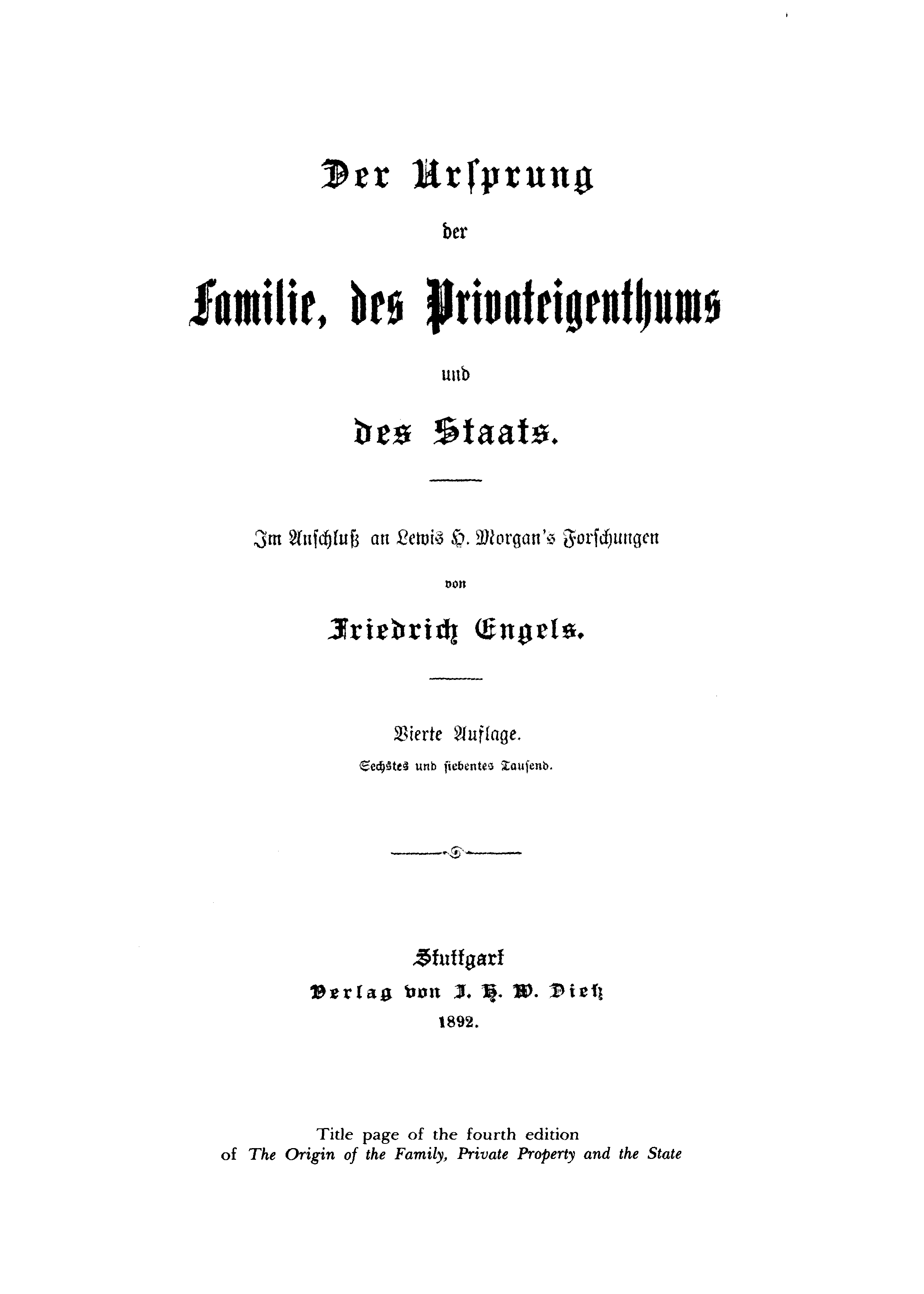
Title page of the fourth edition of The Origin of the Family, Private Property and the State
injuries was a right or a duty never confronted the Indian; it would have appeared as absurd to him as the question of whether eating, sleeping or hunting was a right or a duty. Nor could any tribe or gens split up into different classes. This leads us to the investigation of the economic basis of those conditions.
The population was very sparse. It was dense only in the habitat of the tribe, surrounded by its extensive hunting grounds and beyond these the neutral protective forest which separated it from other tribes. Division of labour was purely and simply that which had naturally evolved; it existed only between the two sexes. The men went to war, hunted, fished, provided the raw material for food and the implements necessary for these pursuits. The women c'ared for the house, and prepared food and clothing; they cooked, wove, and sewed. Each of them was master in his or her own field of activity: the men in the forest, the women in the house. Each owned the implements he or she made and used: the men, the weapons and the hunting and fishing tackle, the women, the household utensils. The household was communistic, comprising several, and often many, families.(2) Whatever was produced and used in common was common property; the house, the garden, the longboat. Here, and only here, then, does the "earned property" exist which jurists and economists have attributed to civilised society — the last mendacious legal pretext on which modern capitalist property still rests.
But man did not remain in this stage everywhere. In Asia he found animals that could be domesticated and bred in captivity. The wild buffalo cow had to be hunted down; the domesticated one gave birth to a calf once a year, and provided milk into the bargain. A number of the most advanced tribes — Aryans, Semites, perhaps also the Turanians — made first the domestication, and later the breeding and tending, of cattle, their principal occupation. Pastoral tribes separated themselves from the remaining mass of the barbarians: the first great social division of labour. The pastoral tribes not only produced more means of subsistence, but also a greater variety than the rest of the barbarians. They not only had milk, milk products and meat in greater abundance than the others, but also skins, wool, goat's hair, and more spun and woven fabrics with the increasing quantities of raw material. This, for the first time, made regular exchange possible. In the preceding stages, exchange could only take place occasionally; exceptional ability in the making of weapons and implements may have led to a temporary division of labour. Thus, unquestionable remains of workshops for stone implements of the Neolithic period have been found in many places. The artificers who developed their skills in those workshops most probably worked for the community, as the permanent handicraftsmen of the gentile communities in India still do. No other exchange than that within the tribe could arise in that stage, and even that was an exception. After the separation of the pastoral tribes, however, we find here all the conditions ready for exchange between members of different tribes, and for its further development and consolidation as a regular institution. Originally, tribe exchanged with tribe through their respective gentile chiefs. When, however, the herds began to be converted into separate property,(3) exchange between individuals predominated more and more, until eventually it became the sole form. The principal article which the pastoral tribes offered their neighbours for exchange was livestock; livestock became the commodity by which all other commodities were appraised, and was everywhere readily taken in exchange for other commodities — in short, livestock assumed the function of money and served as money already at this stage. Such was the necessity and rapidity with which the demand for a money commodity developed right at the very beginning of commodity exchange.
Horticulture, probably unknown to the Asiatic barbarians of the lower stage, arose, among them, no later than at the middle stage, as the forerunner of field agriculture. The climate of the Turanian plateau does not admit of a pastoral life without a supply of fodder for the long and severe winter. Hence, the sowing of meadows and cultivation of grain was indispensable here. The same is true of the steppes north of the Black Sea. Once grown for livestock, grain soon became human food. The cultivated land still remained tribal property and was assigned first to the gens, which, later, in its turn distributed it for use to the household communities, and finally(4) to individuals; these may have had certain rights of possession, but no more.
Of the industrial achievements of this stage two are particularly important. The first is the weaving loom, the second, the smelting of metal ores and metalworking. Copper, tin, and their alloy, bronze, were by far the most important; bronze provided useful implements and weapons, but could not oust stone implements. Only iron could do that, but its production was as yet unknown. Gold and silver began to be used for ornaments and decorations, and must already have been of far higher value than copper and bronze.
The increase of production in all branches — livestock breeding, agriculture, domestic handicrafts — enabled human labour power to produce more than was necessary for its maintenance. It simultaneously increased the amount of work that daily fell to every member of the gens or household community or single family. The attraction of more labour power became desirable. This was provided by war; captives were made slaves. Under the given overall historical conditions, the first great social division of labour, by increasing the productivity of labour, that is, wealth, and enlarging the field of production, necessarily carried slavery in its wake. Out of the first great social division of labour arose the first great division of society into two classes: masters and slaves, exploiters and exploited.
How and when the herds were converted from the common property of the tribe or gens into the property of the individual heads of families we do not know to this day; but it must have occurred, in the main, at this stage. The herds and the other new objects of wealth brought about a revolution in the family. Gaining a livelihood had always been the business of the man; he produced and owned the means to that end. The herds were the new means of gaining a livelihood, and their initial domestication and subsequent tending were his work. Hence, he owned the livestock, and the commodities and slaves obtained in exchange for them. All the surplus now resulting from the task of gaining a livelihood fell to the man; the woman shared in consuming it, but she had no share in owning it. The "savage" warrior and hunter had been content to occupy second place in the house, after the woman. The "gentler" shepherd, insisting on his wealth, pushed forward to first place and forced the woman into second place. And she could not complain. Division of labour in the family had regulated the distribution of property between man and wife. This division of labour remained unchanged, and yet it now turned the former domestic relationship upside down simply because the division of labour outside the family had changed. The very cause that had formerly ensured the woman supremacy in the house, namely, her being confined to domestic work, now ensured supremacy in the house for the man: the woman's housework lost its significance compared with the man's work in obtaining a livelihood; the latter was everything, the former an insignificant addition. Here we see already that the emancipation of women and their equality with men are impossible and must remain so as long as women are excluded from socially productive work and remain restricted to private domestic duties. The emancipation of women becomes possible only when women are enabled to take part in production on a large, social scale, and when domestic duties require their attention only to a minor degree. And this has become possible only as a result of modern large-scale industry, which not only permits of the participation of women in production in large numbers, but actually calls for it and, moreover, strives more and more to reduce private domestic duties to a public industry.
His achievement of actual supremacy in the house threw down the last barrier to the man's autocracy. This autocracy was confirmed and perpetuated by the overthrow of mother right, the introduction of father right and the gradual transition from pairing marriage to monogamy. But this made a breach in the old gentile order: the individual family became a power and rose threateningly against the gens.
The next step brings us to the upper stage of barbarism, the period in which all civilised peoples passed through their Heroic Age: it is the period of the iron sword, but also of the iron ploughshare and axe. Iron came to be utilised by man, the last and most important of all raw materials to play a revolutionary role in history, the last — if we exclude the potato. Iron made possible field agriculture on a larger area and the clearing of extensive forest tracts for cultivation; it gave the craftsman implements of hardness and sharpness that no stone, no other known metal, could withstand. All this came about gradually; the first iron produced was often softer than bronze. Thus, stone weapons disappeared but slowly; stone axes were still used in battle not only in the Hildebrand Song, but also in the Battle of Hastings, in 1066.[137] But progress was now irresistible, less interrupted and more rapid. The town, enclosing houses of stone or brick within its turreted and crenellated stone walls, became the headquarters of the tribe or confederacy of tribes. It marked an enormous advance in the art of building; but it was also a sign of increased danger and need for protection. Wealth increased rapidly, but it was the wealth of single individuals. Weaving, metalworking and the other crafts that were becoming more and more specialised displayed growing diversity and skill in their products; agriculture now provided not only cereals, pulse and fruit, but also oil and wine, which people had now learned to make. Such diverse activities could no longer be conducted by any single individual; the second great division of labour took place: handicrafts separated from agriculture. The continuing increase in production, and with it the increased productivity of labour, raised the value of human labour power. Slavery, which had been nascent and sporadic in the preceding stage, now became an essential part of the social system. The slaves ceased to be simple assistants; they were now driven in scores to work in the fields and workshops. The division of production into two large main branches, agriculture and handicrafts, gave rise to production directly for exchange, the production of commodities; and with it came trade, not only in the interior and on the tribal boundaries, but also overseas. But all this was still very undeveloped; the precious metals started to become the predominant and universal money commodity, but they were not yet minted and were exchanged merely by bare weight.
The distinction between rich and poor was added to that between freemen and slaves — with the new division of labour came a new division of society into classes. The differences in the property of the individual heads of families caused the old communistic household communities to break up wherever they had survived until then; and this put an end to the common cultivation of the soil for the account of this community. The arable land was assigned for use to the separate families, first for a limited time and later in perpetuity; the transition to complete private ownership took place gradually and parallel to the transition from pairing marriage to monogamy. The individual family started to become the economic unit of society.
The increased population density necessitated firmer cohesion internally and externally. Everywhere the confederacy of kindred tribes became a necessity, and soon after, their amalgamation, and thus the amalgamation of the separate tribal territories into a single territory of the people. The military commander of the people—rex, basileus, thiudans—became an indispensable and permanent official. The popular assembly was instituted wherever it did not yet exist. The military commander, the council and the popular assembly formed the organs of the gentile society which had developed into a military democracy. Military — because war and organisation for war were now regular functions of the life of the people. The wealth of their neighbours excited the greed of the peoples to whom the acquisition of wealth appeared one of the main purposes in life. They were barbarians: plunder appeared to them easier and even more honourable than productive work. War, previously waged simply to avenge aggression or as a means of enlarging territory that had become inadequate, was now waged for the sake of plunder alone, and became a regular source of living. It was not for nothing that formidable walls were reared around the new fortified towns: their yawning moats were the graves of the gentile constitution, and their turrets already reached up into civilisation. Internal affairs underwent a similar change. The predatory wars increased the power of the supreme military commander as well as the subcommanders. The customary election of successors from the same families, especially after the introduction of father right, was gradually transformed into hereditary succession, first tolerated, then claimed and finally usurped; the foundation of hereditary royalty and hereditary nobility was laid. In this manner the organs of the gentile constitution were gradually torn away from their roots in the people, in gens, phratry and tribe, and the whole gentile order was transformed into its opposite: from being an organisation of tribes for the free administration of their own affairs, it became an organisation for plundering and oppressing their neighbours; and correspondingly its organs were transformed from instruments of the will of the people into independent organs for ruling and oppressing their own people. But this could not have happened had not the greed for wealth divided the members of the gentes into rich and poor; had not "property differences in the same gens changed the community of interests into antagonism between its members" (Marx)(5); and had not the growth of slavery already begun to brand working for a living as an activity worthy only of slaves and more ignominious than engaging in plunder.
* * *
This brings us to the threshold of civilisation. This stage is inaugurated by another advance in the division of labour. In the lowest stage men produced only for their own immediate needs; any possible exchange was confined to sporadic cases when a surplus was obtained by chance. In the middle stage of barbarism we find that the pastoral peoples had in their livestock a form of property which, if herds and flocks were of a certain size, regularly provided a surplus over and above their needs; and we also find a division of labour between the pastoral peoples and backward tribes without herds, so that there were two different stages of production side by side, and therefore the conditions for regular exchange. The upper stage of barbarism introduced a further division of labour between agriculture and handicrafts, resulting in the production of a continually increasing portion of products of labour directly for exchange, so that exchange between individual producers reached the point where it became a vital necessity for society. Civilisation consolidated and magnified all these established divisions of labour, particularly by intensifying the contrast between town and country (either the town exercising economic supremacy over the country, as in antiquity, or the country over the town, as in the Middle Ages) and added a third division of labour, peculiar to itself and of decisive importance: it created a class that was no longer engaged in production, but exclusively in exchanging products — the merchants. All previous inchoative class formations were exclusively connected with production; they divided those engaged in production into managers and executors, or else into producers on a large scale and producers on a small scale. Here a class appears for the first time which, without taking any part in production, captures the management of production as a whole and economically subordinates the producers to itself; a class that makes itself the indispensable intermediary between any two producers and exploits them both. On the pretext of saving the producers the trouble and risk of exchange, of extending the sale of their products to distant markets, and of thus becoming the most useful class among the population, a class of parasites arises, of genuine social bloodsuckers, which, as a reward for very insignificant real services, skims the cream off production both at home and abroad, rapidly acquires enormous wealth and corresponding social influence, and for this very reason is destined to reap ever new honours and gain increasing control over production during the period of civilisation, until it at last creates a product of its own — periodic commercial crises.
At the stage of development we are discussing, the young merchant class, however, had no inkling as yet of the big things that were in store for it. But it took shape and made itself indispensable, and that was sufficient. With it, however, metal money, minted coins, emerged, and with this a new means by which the non-producer could rule the producer and his production. The commodity of commodities, which conceals within itself all other commodities, was discovered; the magic potion that can transform itself at will into anything desirable and desired. Whoever possessed it ruled the world of production; and who had it above all others? The merchant. In his hands the cult of money was safe. He took care to make it plain that all commodities, and hence all commodity producers, must grovel in the dust before money. He proved in practice that all other forms of wealth were mere semblances compared with this incarnation of wealth as such. Never again has the power of money revealed itself with such primitive crudity and violence as it did in this period, its youth. After the purchase of commodities for money came the lending of money, entailing interest and usury. And no legislation of any later period throws the debtor so pitilessly and helplessly at the feet of the usurious creditor as that of ancient Athens and Rome — both sets of law arose spontaneously, as common law, without other than economic compulsion.
Besides wealth in commodities and slaves, besides money wealth, there now came into being wealth in landed property. The entitlement of individuals to own parcels of land originally assigned to them by the gens or tribe had now become so well established that these parcels became their hereditary property. What they had most aspired to just before that time was liberation from the claim of the gentile community to their parcels of land, a claim which had become a fetter for them. They were freed from this fetter — but soon after also from their new landed property. The full, free ownership of land implied not only the possibility of unrestricted and uncurtailed possession, but also the possibility of alienating it. As long as the land belonged to the gens there was no such possibility. But when the new landowner definitively shook off the chains of the paramount title of the gens and tribe, he also tore the bond that had until then tied him inseverably to the soil. What that meant was made plain to him by the money invented simultaneously with the advent of private property. Land could now become a commodity to be sold and mortgaged. Hardly had the private ownership of land been introduced when mortgage was discovered (see Athens). Just as hetaerism and prostitution clung to the heels of monogamy, so from now on mortgage clung to the ownership of land. You wanted full, free, alienable ownership of land. Well, here you have it— tu l'as voulu,(6) George Dandin!
Commercial expansion, money and usury, landed property and mortgage were thus accompanied by the rapid concentration and centralisation of wealth in the hands of a small class, on the one hand, and by the increasing impoverishment of the masses and a growing mass of paupers, on the other. The new aristocracy of wealth, unless it coincided from the outset with the old tribal nobility, forced the latter definitively into the background (in Athens, in Rome, among the Germans). And this division of freemen into classes according to their wealth was accompanied, especially in Greece, by an enormous increase in the number of slaves,(7) whose forced labour formed the basis on which the superstructure of the entire society was reared.
Let us now see what became of the gentile constitution as a result of this social revolution. It stood powerless in the face of the new elements that had grown up without its aid. Its precondition was that the members of a gens, or else of a tribe, should live together in the same territory, be its sole inhabitants. This had long ceased to be the case. Gentes and tribes were everywhere intermingled; everywhere slaves, wards and outsiders lived among the citizens. The sedentary state, which had been acquired only towards the end of the middle stage of barbarism, was time and again interrupted by the mobility and changes of abode brought about by commerce, changes of occupation and the transfer of land. The members of the gentile bodies could no longer meet for the purpose of attending to their own common affairs; only matters of minor importance, such as religious ceremonies, were still observed in a rough-and-ready way. Beside the requirements and interests which the gentile bodies were appointed and empowered to take care of, new requirements and interests had arisen from the revolution in the conditions of earning a livelihood and the resulting change in social structure. These new requirements and interests were not only alien to the old gentile order, but thwarted it in every way. The interests of the groups of craftsmen which arose through division of labour, and the special needs of the town as opposed to the country, required new organs; but each of these groups was composed of people from different gentes, phratries and tribes; they even included outsiders. Hence, the new organs necessarily had to take shape outside the gentile constitution, alongside it, and that meant against it.—And again, in every gentile body the conflict of interests made itself felt and reached its apex by combining rich and poor, usurers and debtors, in the same gens and tribe.—Then there was the mass of new inhabitants, strangers to the gentile associations, which, as in Rome, became a power in the land, and was too numerous to be gradually absorbed by the consanguine gentes and tribes. The gentile associations confronted these masses as exclusive, privileged bodies; what had originally been a naturally evolved democracy was transformed into a hateful aristocracy. Lastly, the gentile constitution had grown out of a society that knew no internal antagonisms, and was suited only to such a society. It had no means of coercion except public opinion. But now a society had come into being that by virtue of all its economic conditions of existence had to split up into freemen and slaves, into exploiting rich and exploited poor; a society that was not only incapable of reconciling these antagonisms, but had to carry them to extremes. Such a society could only exist either in a state of continuous, open struggle of these classes against one another or under the rule of a third power which, while ostensibly standing above the conflicting classes, suppressed their open conflict and permitted a class struggle at most in the economic field, in a so-called legal form. The gentile constitution had outlived itself. It was burst asunder by the division of labour and by its result, the division of society into classes. Its place was taken by the state.
Above we discussed in detail each of the three main forms in which the state raised itself up on the ruins of the gentile constitution. Athens represented the purest, most classical form. Here the state derived directly and mainly from the class antagonisms that developed within gentile society. In Rome gentile society became an exclusive aristocracy amidst numerous plebs, standing outside of it, having no rights but only duties. The victory of the plebs burst the old gentile constitution asunder and erected on its ruins the state, into which both the gentile aristocracy and the plebs were soon wholly absorbed. Finally, among the German vanquishers of the Roman Empire, the state derived directly from the conquest of large foreign territories, which the gentile constitution had no means of ruling. As this conquest did not entail either a serious struggle with the old population or a more advanced division of labour, and as conquered and conquerors were almost at the same stage of economic development and thus the economic basis of society remained the same as before, the gentile constitution was able to continue for many centuries in a changed, territorial shape as a Mark constitution, and even rejuvenate itself for a time in enfeebled form in the noble and patrician families of later years, and even in peasant families, as in Dithmarschen.(8)
The state is, therefore, by no means a power forced on society from without; just as little is it "the reality of the ethical idea", "the image and reality of reason", as Hegel maintains.(9) Rather, it is a product of society at a certain stage of development; it is the admission that this society has become entangled in an insoluble contradiction with itself, that it has split into irreconcilable opposites which it is powerless to dispel. But in order that these opposites, classes with conflicting economic interests, might not consume themselves and society in fruitless struggle, it became necessary to have a power seemingly standing above society which would alleviate the conflict and keep it within the bounds of "order"; and this power, having arisen out of society but placing itself above it, and alienating itself more and more from it, is the state.
As distinct from the old gentile order, the state, first, divides its subjects according to territory. As we have seen, the old gentile associations, built upon and held together by ties of blood, became inadequate, largely because they were conditional on the members being bound to a given territory, a bond which had long ceased to exist. The territory remained, but the people had become mobile. Hence, division according to territory was taken as the point of departure, and citizens were allowed to exercise their public rights and duties wherever they settled, irrespective of gens and tribe. This organisation ' of citizens according to locality is a feature common to all states. That is why it seems natural to us; but we have seen what long and arduous struggles were needed before it replaced, in Athens and Rome, the old organisation according to gentes.
The second distinguishing feature is the establishment of a public authority which no longer directly coincides with the population organising itself as an armed force. This special public authority is necessary because a self-acting armed organisation of the population has become impossible since the split into classes. The slaves also belong to the population; the 90,000 citizens of Athens formed only a privileged class as against the 365,000 slaves. The people's army of the Athenian democracy was an aristocratic public authority vis-à-vis the slaves, whom it kept in check; however, a gendarmerie also became necessary to keep the citizens in check, as we related above. This public authority exists in every state; it consists not merely of armed men but also of material adjuncts, prisons and institutions of coercion of all kinds, of which gentile society knew nothing. It may be very insignificant, almost infinitesimal, in societies where class antagonisms are still undeveloped and in remote territories as was the case at certain times and in certain regions in the United States of America. It [the public authority] grows stronger, however, to the extent that class antagonisms within the state become exacerbated and adjacent states become larger and more populous. We have only to look at our present-day Europe, where class struggle and competition for conquests have raised the public power to such a level that it threatens to swallow the whole of society and even the state.
In order to maintain this public power, contributions from the citizens are necessary—taxes. These were absolutely unknown in gentile society; but we know enough about them today. As civilisation advances, these taxes become inadequate too; the state makes drafts on the future, contracts loans, public debts. Old Europe can tell a tale about these, too.
Having public authority and the right to levy taxes, the officials now stand, as organs of society, above society. The free, voluntary respect that was accorded to the organs of the gentile constitution does not satisfy them, even if they could gain it; being the vehicles of a power that is becoming alien to society, respect for them must be enforced by means of exceptional laws by virtue of which they enjoy special sanctity and inviolability. The shabbiest police servant in the civilised state has more "authority" than all the organs of gentile society put together; but the most powerful prince and the greatest statesman, or commander, of civilisation may well envy the humblest gentile chief for the unforced and undisputed respect that is paid to him. The one stands in the midst of society, the other is forced to attempt to represent something outside and above it.
Because the state arose from the need to hold class antagonisms in check, but because it arose, at the same time, in the midst of the conflict of these classes, it is, as a rule, the state of the most powerful, economically dominant class, which, .through the medium of the state, becomes also the politically dominant class, and thus acquires new means of keeping down and exploiting the oppressed class. Thus, the state of antiquity was above all the state of the slave owners for keeping down the slaves, as the feudal state was the organ of the nobility for keeping down the peasant serfs and villeins, and the modern representative state is an instrument for the exploitation of wage labour by capital. By way of exception, however, periods occur in which the warring classes balance each other so closely that the state authority, as ostensible mediator, acquires, for the moment, a certain degree of independence of both. Such was the absolute monarchy of the seventeenth and eighteenth centuries, which held the balance between the nobility and burghers; such was the Bonapartism of the First, and especially of the Second French Empire, which played off the proletariat against the bourgeoisie and the bourgeoisie against the proletariat. The latest performance of this kind, in which ruler and ruled appear equally ridiculous, is the new German Empire of the Bismarck nation: here capitalists and workers are balanced against each other and equally cheated for the benefit of the impoverished Prussian backwoods Junkers.
In most historical states, the rights granted to citizens are, besides, apportioned according to their wealth, thus directly expressing the fact that the state is an organisation of the possessing class for its protection against the non-possessing class. It was so already in the Athenian and Roman classification according to property. It was so in the medieval feudal state, in which political power was in conformity with the amount of land owned. It is seen in the electoral qualifications of the modern representative states. Yet this political recognition of property distinctions is by no means inherent. On the contrary, it marks a low stage of state development. The highest form of the state, the democratic republic, which under our modern conditions of society is more and more becoming an inevitable necessity, and is the only form of state in which the last decisive struggle between proletariat and bourgeoisie can be fought out — the democratic republic officially knows no more of property distinctions. In it wealth exercises its power indirectly, but all the more surely. On the one hand, in the form of the direct corruption of officials, of which America provides the classical example; on the other hand, in the form of an alliance between government and stock exchange, which becomes the easier to achieve the more the national debt increases and the more joint-stock companies concentrate in their hands not only transport but also production itself, using the stock exchange as their centre. Besides America, the latest French republic is a striking example of this; and even good old Switzerland has contributed its share in this field. But that a democratic republic is not essential for this fraternal alliance between government and stock exchange is proved by England and also by the new German Empire, where one cannot tell who was elevated more by universal suffrage, Bismarck or Bleichröder. And lastly, the possessing class rules directly through the medium of universal suffrage. As long as the oppressed class, in our case, therefore, the proletariat, is not yet ripe to emancipate itself, it will in its majority regard the existing order of society as the only one possible and, politically, will form the tail of the capitalist class, its extreme Left wing. To the extent, however, that this class matures for its self-emancipation, it constitutes itself as a party of its own and elects its own representatives, not those of the capitalists. Thus, universal suffrage is the gauge of the maturity of the working class. It cannot and never will be anything more in the present-day state; but that is sufficient. On the day the thermome-ter of universal suffrage registers boiling point among the workers, both they and the capitalists will know where they stand.
The state, then, has not existed from eternity. There have been societies that managed without it, that had no idea of the state and state authority. At a certain stage of economic development, which was necessarily bound up with the split of society into classes, the state became a necessity owing to this split. We are now rapidly approaching a stage in the development of production at which the existence of these classes not only will have ceased to be a necessity, but will become a positive hindrance to production. They will fall as inevitably as they arose at an earlier stage. Along with them the state will inevitably fall. Society, which will reorganise production on the basis of a free and equal association of the producers, will put the whole machinery of state where it will then belong: into the museum of antiquities, by the side of the spinning-wheel and the bronze axe.
* * *
Thus, from the foregoing, civilisation is that stage of development of society at which division of labour, the resulting exchange between individuals, and commodity production, which combines the two, reach their full development and revolutionise the whole of hitherto existing society.
Production at all previous stages of society was essentially common production and, likewise, consumption took place by the direct distribution of the products within larger or smaller communistic communities. This production in common was carried on within the narrowest limits, but concomitantly the producers were masters of their process of production and of their product. They knew what became of the product: they consumed it, it did not leave their hands; and as long as production was carried on on this basis, it could not grow beyond the control of the producers, and it could not conjure up any alien, phantom powers against them, as is the case regularly and inevitably under civilisation.
But, slowly, division of labour crept into this process of production. It undermined the communality of production and appropriation, it made appropriation by individuals the predominant rule, and thus gave rise to exchange between individuals— how, we examined above. Gradually, the production of commodities became the dominant form.
With the production of commodities, production no longer for one's own consumption but for exchange, the products necessarily change hands. The producer parts with his product in the course of exchange; he no longer knows what becomes of it. As soon as money, and with it the merchant, steps in as a mediator between the producers, the process of exchange becomes still more complicated, the ultimate fate of the products still more uncertain. The merchants are numerous and none of them knows what the other is doing. Commodities now pass not only from hand to hand, but also from market to market. The producers have lost control of the total production of their life cycle, and the merchants have not acquired it. Products and production fall victim to chance.
But chance is only one pole of an interrelation, the other pole of which is called necessity. In nature, where chance, too, seems to reign, we have long since demonstrated in each particular field the inherent necessity and regularity that asserts itself in this chance. What is true of nature holds good also for society. The more a social activity, a series of social processes, becomes too powerful for conscious human control, grows beyond human reach, the more it seems to have been left to pure chance, the more do its peculiar and innate laws assert themselves in this chance, as if by natural necessity. Such laws also control the fortuities of the production and exchange of commodities; these laws confront the individual producer and exchanger as strange and, in the beginning, even as unknown powers, the nature of which must first be laboriously investigated and ascertained. These economic laws of commodity production are modified at the different stages of development of this form of production; on the whole, however, the entire period of civilisation has been dominated by these laws. To this day, the product is master of the producer; to this day, the total production of society is regulated, not by a plan thought out in common, but by blind laws, which operate with elemental force, in the last resort in the storms of periodic commercial crises.
We saw above how human labour power became able, at a rather early stage of development of production, to deliver considerably more products than were needed for the producer's maintenance, and how this stage, in the main, coincided with that where the division of labour and exchange appeared between individuals. Now, it was not long before the great "truth" was discovered that man, too, may be a commodity; that human power(10) may be exchanged and utilised by converting man into a slave. Men had barely started to engage in exchange when they themselves were exchanged. The active became a passive, whether man wanted it or not.
With slavery, which reached its fullest development under civilisation, came the first great split of society into an exploiting and an exploited class. This split has continued during the whole period of civilisation. Slavery was the first form of exploitation, peculiar to the world of antiquity; it was followed by serfdom in the Middle Ages, and by wage labour in modern times. These are the three great forms of servitude, characteristic of the three great epochs of civilisation; overt, and, latterly, covert slavery, are its constant companions.
The stage of commodity production, with which civilisation began, is marked economically by the introduction of 1) metal money and, thus, of money capital, interest and usury; 2) the merchants acting as mediating class between producers; 3) private ownership of land and mortgage; 4) slave labour as the prevailing form of production. The form of the family corresponding to civilisation and under it becoming the definitively prevailing form is monogamy, the supremacy of the man over the woman, and the individual family as the economic unit of society. The cohesive force of civilised society is the state, which in all typical periods is exclusively the state of the ruling class, and in all cases remains essentially a machine for keeping down the oppressed, exploited class. Other marks of civilisation are: on the one hand, fixation of the antithesis between town and country as the basis of the entire social division of labour; on the other hand, the introduction of testaments, by which the property holder is able to dispose of his property even after his death. This institution, which was a direct blow in the face of the old gentile constitution, was unknown in Athens until the time of Solon; in Rome it was introduced very early, but we do not know when.(11) Among the Germans it was introduced by the priests in order that the good honest German might without hindrance bequeath his property to the Church.
With this constitution as its foundation civilisation has accomplished things of which the old gentile society was not remotely capable. But it accomplished them by setting in motion the most sordid instincts and passions of man, and by developing them at the expense of all his other faculties. Naked greed has been the moving spirit of civilisation from its first day to the present time; wealth, wealth and wealth again; wealth, not of society, but of this shabby individual was its sole determining aim. If, in the pursuit of this aim, the increasing development of science and repeated periods of the fullest blooming of art fell into its lap, it was only because without them the ample present-day achievements in the accumulation of wealth would have been impossible.
Since the exploitation of one class by another is the basis of civilisation, its whole development moves in a continuous contradiction. Every advance in production is at the same time a retrogression in the condition of the oppressed class, that is, of the great majority. What is a boon for the one is necessarily a bane for the other; each new emancipation of one class means a new oppression of another class. The most striking proof of this is furnished by the introduction of machinery, the effects of which are today known throughout the world. And while among barbarians, as we have seen, hardly any distinction could be made between rights and duties, civilisation makes the difference and antithesis between these two plain even to the dullest mind by assigning to one class pretty nearly all the rights, and to the other class pretty nearly all the duties.
But this is not as it ought to be. What is good for the ruling class should be good for the whole of the society with which the ruling class identifies itself. Therefore, the more civilisation advances, the more it is compelled to cover the ills it necessarily creates with the cloak of love, to embellish them, or to deny their existence; in short, to introduce conventional hypocrisy— unknown either in previous forms of society or even in the earliest stages of civilisation — that eventually culminates in the declaration: The exploiting class exploits the oppressed class solely and exclusively in the interest of the exploited class itself; and if the latter fails to appreciate this, and even becomes rebellious, it thereby shows the basest ingratitude to its benefactors, the exploiters.(12)
And now, in conclusion, Morgan's verdict on civilisation:
"Since the advent of civilisation, the outgrowth of property has been so immense, its forms so diversified, its uses so expanding and its management so intelligent in the interests of its owners that it has become, on the part of the people, an unmanageable power. The human mind stands bewildered in the presence of its own creation. The time will come, nevertheless, when human intelligence will rise to the mastery over property, and define the relations of the state to the property it protects, as well as [...] the limits of the rights of its owners. The interests of society are paramount to individual interests, and the two must be brought into just and harmonious relation. A mere property career is not the final destiny of mankind, if progress is to be the law of the future as it has been of the past. The time which has passed away since civilisation began is but a fragment of the past duration of man's existence; and but a fragment of the ages yet to come. The dissolution of society bids fair to become the termination of a career of which property is the end and aim, because such a career contains the elements of self-destruction. Democracy in government, brotherhood in society, equality in rights [...], and universal education, foreshadow the next higher plane of society to which experience, intelligence and knowledge are steadily tending. It will be a revival, in a higher form, of the liberty, equality and fraternity of the ancient gentes." (Morgan, Ancient Society, p. 552.)(13)
Endnotes
[77] The Origin of the Family, Private Property and the State is one of Engels' most important works. It is based on a detailed synopsis made by Marx in 1880-81 of Lewis H. Morgan's book, Ancient Society or Researches in the Lines of Human Progress from Savagery, Through Barbarism to Civilization, London, 1877. Marx's synopsis contained his critical notes, his own propositions and also some factual material taken from other sources. Engels assumed that Marx had planned to write a special work on the history of mankind in the early period of its development using Morgan's book as a basis. Having acquainted himself with Marx's synopsis and Morgan's book, Engels deemed it necessary to write such a work, regarding it as the fulfilment of Marx's behest. On March 24, 1884 Engels wrote to Karl Kautsky: "Actually I am indebted to Marx for it and can incorporate his notes" (see present edition, Vol. 47). In his work on the book, Engels made use of almost all Marx's notes, pointing this out in every case, and also of the structure of Marx's synopsis, which differed from that of Morgan's book. Engels relied, particularly in the first three chapters, on the factual material from Morgan's observations of the life of the North American Indians and in several cases on his arguments and conclusions; he also employed information provided by other scholars about peoples at the same stage of development. In chapters IV-VI, in addition to the information from Morgan's book, Engels used a number of specialised works on ancient history. Chapters VII and VIII are based exclusively on Engels' own studies of the early history of the Germans (see this volume, pp. 6-107). Chapter IX, the last one, contains conclusions drawn by Engels himself. The first edition of The Origin of the Family appeared early in October 1884 in Zurich, since it was impossible to publish the book in Germany given the Anti-Socialist Law. The two editions that followed (in 1886 and 1889) were published in Stuttgart without any changes. Polish, Romanian, Italian, Danish and Serbian translations were issued in the latter half of the 1880s. The fourth edition of the book, with considerable addenda and certain changes made by Engels on the basis of the latest findings in the field of archaeology, ethnography and anthropology, appeared in 1891. In this volume all the essential differences in reading occurring in the 1884 and 1891 editions are given in footnotes. The first English edition of the book appeared in 1902.
[78] Marx's synopsis of Morgan's book was first published in Russian translation in: Marx-Engels Archives, Vol. IX, Moscow, 1941, and later in Marx and Engels, Works, Second Russian Edition, Vol. 45, Moscow, 1975. The first publication in the languages of the original appeared in The Ethnological Notebooks of Karl Marx. Translated and edited, with an introduction by Lawrence Krader, Assen, 1972. All references in the text of the present volume are given according to this edition.
[79] Pueblo (Sp.— people, population) is the name of the four linguistic groups of Indian tribes who lived on the territory of New Mexico (now the South-Western part of the USA). Originally the Spanish conquerors applied this name to five-or six-storey fortress-like houses inhabited by Indian communities; later this name was also applied to the inhabitants of these unusual villages. The Pueblo culture had its heyday in the 12th and 13th centuries.
[80] This letter of Marx's is not extant. Engels mentions it in his letter to Karl Kautsky of April 11, 1884 (see present edition, Vol. 47).
[81] The reference is to the libretto of the operatic tetralogy Ring of the Nibelungs (Der Ring des Nibelungen) composed by Richard Wagner, the subject of which was taken from the Scandinavian epic Edda and the German epic Nibelungenlied. The Nibelungenlied is the ancient German heroic epic based on myths and lays. Written versions of the song appeared only in the 13th-16th centuries. The Nibelungenlied penetrated into Scandinavia (6th-8th cent.) where it found reflection in the songs of Edda. The events that accompanied the great migration of peoples (see Note 5), notably the invasion of Europe by the Huns (5th cent.), served as the historical basis of the Nibelungenlied, though its final character owed more to the conditions of life in Germany in the 12th century.
[82] The Ogisdrekka (Lokasenna) is a song from the first part of The Elder Edda, known as Songs about Gods. The Ogisdrekka describes the quarrel between Loki, the god of fire, and other gods at a feast given by the sea giant Ogir. The Elder Edda is a collection of epic poems and songs about the lives and deeds of the Scandinavian gods and heroes. It has come down to us in a manuscript dating back to the 13th century, discovered in 1643 by the Icelandic Bishop B. Sveinsson.
[83] Asa and Vana—gods in Scandinavian mythology. The Ynglinga Saga is the first of the 16 sagas in the book about Norwegian kings (from ancient times to the 12th century) entitled Heimskringla. It was written by Snorri Sturluson, an Icelandic poet and chronicler, in the first half of the 13th century.
[84] According to this system each tribe was divided into two or four marriage classes (sections). Marriage was allowed only between certain specified pairs of these classes. Children born of this marriage belonged to the third marriage class which was part of the tribe including either a maternal or a paternal marriage class. Such a division restricted marriages between close relatives.
[85] Wright's letters found in Morgan's archives were published in the magazine American Anthropologist. New Series, Vol. 35, No. 1, 1933.
[86] Saturnalian feasts were held annually in Ancient Rome in honour of Saturn, the god of agriculture. They began on December 17, after the harvest, and were accompanied by carnivals and festivals, with the entire population taking part, including slaves who were allowed to sit at the table alongside free citizens. The cult of fertility presupposed the freedom of sexual intercourse during Saturnalian feasts.
[87] This refers to the decision which King Ferdinand V of Spain, acting as mediator between peasants and seigniors, took under the pressure of the insurgent peasants of Northern Catalonia in 1484. The decision is known as the Guadalupe decree after the name of the monastery in Estremadura, where, on April 21, 1486, the King met authorised representatives of the peasants and the landlords. The decree granted the peasants personal freedom, but for the right to keep land holdings they had to pay their landlords high redemption fees. The decree abolished the jurisdiction of the landlords and several humiliating feudal practices. A number of burdensome duties had to be redeemed.
[88] The Pravda of Yaroslav, or the Ancient Pravda, is the first part of the Russian Pravda, the code of laws of ancient Rus. It appeared in the first half of the 11th century and is associated with the name of Prince Yaroslav the Wise of Kiev. The Pravda is based on the common law of the Eastern Slavs in the period of early feudalism and reflects the social and economic relations of the 11th and 12th centuries.
[89] The Dalmatian Laws, or the Poljica Statute, were in force in Poljica, a historical part of Dalmatia, up to the beginning of the 19th century. The first articles of the Statute were drawn up in the first half of the 15th century. The document reflects the norms of the criminal, civil and procedural law as well as the social and economic relations existing in the communities of Poljica in the 15th-18th centuries.
[90] Engels may have taken the information on family communities in France from M. M. Kovalevsky's book Tableau des origines et de l'évolution de la famille et de la propriété, Stockholm, 1890.
[91] Calpullis—a territorial community of the Aztecs (ancient Mexico) based on the common ownership of land. Part of the land was assigned to individual families each of which embraced several generations inhabiting a common dwelling and constituted a household community.
[92] The Helots, part of the agricultural population of Ancient Sparta subjugated by the Dorians, belonged to the state and were attached to the land owned by the Spartiates—a class of citizens of Ancient Sparta enjoying full civil rights. Helots could be neither sold nor killed; they owned the means of production and worked on their plots of land.
[93] The hierodules—temple slaves and attendants in Ancient Greece and the Greek colonies. In many places, including Asia Minor and Corinth, the female temple slaves were engaged in prostitution.
[94] This refers to the troubadour poetry of Provence (Southern France) between the end of the 11th and the beginning of the 13th centuries.
[95] Engels is referring to the nine poems that have survived from the lyrical cycle attributed to Wolfram von Eschenbach and written in the Tagelieder genre, as well as his epic poem Parzival and two unfinished poems Titurel and Willehalm.
[96] Daphnis and Chloe—heroes of the ancient Greek novel (2nd-3rd century); no information concerning its author, Longus, is extant.
[97] Gutrun (Kudrun)—a German epic poem of the 13th century. It has survived in a manuscript dating back to the 16th century and was not discovered until the beginning of the 19th century.
[98] The reference is to the conquest of Mexico by Spanish conquistadors in 1519-21.
[100] The main works written by Georg Ludwig Maurer are: Einleitung zur Geschichte der Mark-, Hof-, Dorf- und Stadt-Verfassung und der öffentlichen Gewalt, Munich, 1854; Geschichte der Markenverfassung in Deutschland, Erlangen, 1856; Geschichte der Fronhöfe, der Bauernhöfe und der Hofverfassung in Deutschland, vols I-IV, Erlangen, 1862-63; Geschichte der Dorfverfassung in Deutschland, vols I-II, Erlangen, 1865-66; Geschichte der Städteverfassung in Deutschland, vols I-IV, Erlangen, 1869-71.
[101] The "Neutral Nations" was the name of a 17th-century tribe related to the Iroquois which lived on the northern shore of Lake Erie. It was given this name by the French colonists because it remained neutral in the war between the Iroquois proper and the Hurons. The war ended in victory for the Iroquois in 1651.
[102] In January 1879, the British troops invaded Zululand (South Africa) with the aim of conquering this country. On January 22, the Zulu army under Cetschwayo (Cetywayo) defeated the colonialist troops near Isandhlwana, inflicting heavy losses. It was only after the arrival of fresh reinforcements that the British troops succeeded in finally defeating the Zulus in the summer of 1879. In 1881, the Nubians, Arabs and other nationalities of the Sudan rose up against the British colonialists, Turkish and Egyptian authorities and native feudal lords. The uprising was led by Mohammed Ahmed, who proclaimed himself "Mahdi" (saviour). On November 5, 1883, the ten-thousand-strong expeditionary corps under General Hicks was defeated and routed by the insurgents near the town of El Obeid. The uprising lasted till 1898-99.
[103] The reference is to Demosthenes' speech in court, Against Eubulides (LVII), in which he mentions the ancient custom of laying to rest only persons of the given gens in gentile burial places.
[104] This passage written in Marx's synopsis in German is a concise summary of Morgan's following argument: "Although these [Grote's] observations seem to imply that they [the Grecian gentes] are no older than the then existing mythology ... in the light of the facts presented, the gentes are seen to have existed long before this mythology was developed — before Jupiter or Neptune, Mars or Venus were conceived in the human mind" (Lewis H. Morgan, Ancient Society, London, 1877, p. 228).
[105] In the passage which Engels quotes from Marx's synopsis, part of the quotation (from the words "The system of consanguinity" to "the relationships of all the members of a gens to each other" and from the words "This fell into desuetude" to "a purely fictitious, fanciful creation of the brain") is a slightly abridged version of Morgan's text (Lewis H. Morgan, Ancient Society, pp. 233-34).
[107] Thetes, the fourth, and lowest, class of Athenian citizens, were admitted to civil offices by the law on lower electoral qualifications adopted in 477 B.C.
[108] The reference is to the metoikos, or aliens who settled in a Greek city state (polis). Being personally free, they were denied political rights, could not marry Athenian citizens and, as a rule, could not own real estate and land on the territory of the city state where they settled. The metoikos were obliged to have "patrons" from among the Athenian citizens, to pay a special tax to the state and serve in the army. In the 5th-4th centuries B.C. the metoikos formed a considerable part of the urban population in Attica and played an important role in its economic life, particularly in trade.
[109] The reference is to the reforms carried out by Cleisthenes in 510-509 B.C. They deprived the gentile nobility of its supremacy in governing Athens and abolished the last remnants of the gentile constitution, since the population was now divided according to the territorial principle, and not according to the gentile principle as before. The reforms increased the importance of the urban population; many metoikos (see Note 108) and freedmen who engaged in trade and handicrafts received civic rights.
[110] Pisistratus, who belonged to an impoverished aristocratic family, usurped power in Athens in 560 B.C. and established a dictatorial regime, becoming a tyrant. This regime existed with intervals (Pisistratus was twice driven out of Athens and returned again) until his death in 527 B.C., and then up to 510 B.C. when his son Hippius was banished and the slave-owning democracy headed by Cleisthenes won the day in Athens. Pisistratus' efforts to defend the interests of small and medium landowners and penalise the gentile aristocracy did not give rise to any serious changes in the political structure of the Athenian state.
[111] The Laws of the Twelve Tables (Leges duodecim tabularum) were enacted in 451-450 B.C. by the Committee of Decemvirs. Originally the laws were carved on ten tables, later two more tables were added. The laws preserved remnants of the gentile system and reflected the social relations of Ancient Rome, referring mainly to civil and criminal law and legal procedure. They were used as the basis for the further development of Roman civil law.
[112] The reference is to the battle in Teutoburg Forest (A.D. 9) fought between the Germanic tribes led by the Cherusci chief Arminius in revolt against Rome and the Roman legions commanded by Quintilius Varus. The Roman troops were routed and their general killed.
[113] This refers to the end of the rule of Appius Claudius, head of the Committee of Decemvirs which enacted the Laws of the Twelve Tables in 451-450 B.C. (see Note 111). However, abuses of power on the part of Appius Claudius led to an insurrection by the plebeians; he was arrested and died in prison. The Second Punic War (218-201 B.C.) was one of the three wars between Rome and Carthage, the two largest slave-owning states of antiquity. Rome sought to abolish Carthage's domination of trade in the Western Mediterranean and indeed defeated it.
[114] The reference is to the comparative tables of ancient and modern measures and also of monetary units, given at the end of A. Dureau de la Malle's Economie politique des Romains, Vol. I.
[1] Engels' works on the early history of the Germans relate to his study of the early stages in the development of society. They laid the basis for the historical materialist explanation of the origin of classes and the state and made a major contribution to the research into the history of the formation of European peoples. These manuscripts were not published during the author's lifetime. Engels used part of the material he had collected in the essay "The Mark" (see present edition, Vol. 24, pp. 439-56). During his work on the manuscript Engels may have changed his initial plan. The material relating to point 2 ("The District and Army Structure") of the draft plan, published here, is missing in the manuscript On the Early History of the Germans and is evidently used in the second chapter of The Frankish Period directly linked with the first manuscript. That Engels departed from his initial plan is also proved by the fact that The Franconian Dialect (see this volume, pp. 81-107), originally planned as a note, was transferred to The Frankish Period and elaborated as its component part. The headings of the first three chapters of Engels' manuscript On the Early History of the Germans ("Caesar and Tacitus", "The First Battles Against Rome" and "Progress Until the Migration Period") were supplied by the editors according to Engels' draft plan; the heading of the fourth chapter ("Note: The German Peoples") is given in the manuscript by Engels himself. On the Early History of the Germans was first published in Marx and Engels, Works, First Russian Edition, Vol. XVI, Part I, Moscow, 1937 and in the language of the original in Friedrich Engels, Zur Geschichte und Sprache der deutschen Frühzeit. Ein Sammelband. Besorgt vom Marx-Engels-Lenin Institut beim ZK des SED, Berlin, 1952, S. 37-94. Passages from this work were published in English for the first time in: Marx, Engels, On Literature and Art, Progress Publishers, Moscow, 1976, pp. 187-88 and 212-14 and in full in Marx, Engels, Pre-Capitalist Socio-Economic Formations. A Collection, Progress Publishers, Moscow, 1979, pp. 298-360. The dating of the draft plan, as of the works themselves, is given according to MEGA2, Abt. I, Bd. 25, S. 988-89. In this volume, these works have been arranged according to the dates on which Engels completed them.
[116] The conquest of Wales by the English was completed in 1283. However, Wales retained its autonomy and was united with England in the mid-16th century.
[117] In 1869-70 Engels devoted himself to a major work on the history of Ireland, but failed to complete it (see present edition, Vol. 21, pp. 145-85 and 283-314 and also Marx and Engels, Ireland and the Irish Question, Progress Publishers, Moscow, 1978, pp. 306-56, and Marx-Engels Archives, Russian edition, Vol. X, Moscow, 1948, pp. 157-248). Simultaneously with the study of Celtic history Engels analysed the old Welsh laws.
[119] A reference to the rebellion of the Scottish highlanders in 1745 caused by oppression and eviction from the land carried out in the interests of the Anglo-Scottish landed aristocracy and bourgeoisie. Part of the nobility in the Scottish Highlands, who supported the claims of the overthrown House of Stuart to the English Crown (the official aim of the insurgents was to enthrone Charles Edward, the grandson of James II), took advantage of the discontent among the highlanders. The suppression of the rebellion put an end to the clan system in the Scottish Highlands and resulted in further evictions.
[12] The reference is to the insurrection of the Illyrian tribes (A.D. 6-9) sparked off by oppression on the part of the Roman administration, and unbearable taxes. It swept over Dalmatia and Pannonia, that is the whole of Illyricum. The insurgents killed Roman soldiers and merchants, attacked Macedonia and threatened Italy. Fifteen Roman legions were brought together to suppress the insurrection which was not quelled until the August of A.D. 9, following three military expeditions under the command of Tiberius and Germanicus. p. 30
[120] See Note 5.
[121] See Note 18.
[122] Burgundian law (Lex Burgundionum)—a code of legislative acts promulgated by the Burgundian kings in the second half of the 5th and the beginning of the 6th century. It regulated the major aspects of the life of Burgundian society and its relations with the Gallic and Roman population.
[123] The Hildebrand Song (Hildebrandslied) — an 8th-century German epic poem, of which only a few passages have survived.
[124] The Völuspa (Vision of the Seeress)—the best-known song from The Elder Edda (see Note 82), depicting the history of the world from its creation to the final desctruction — the "Twilight of the Gods"—and its second birth — the triumph of peace and justice.
[125] In 69-70, Claudius Julius Civilis, chief of the Batavians, who lived at the Rhine estuary and were allied with the Romans, led an insurrection against Rome. It was joined by other Germanic peoples and some of the Gauls. The insurrection was sparked off by the growing taxes, increased levies to the army and the abuse of power by Roman officials. Initially the insurgents achieved considerable success. The Gaulish aristocracy, however, continued to support Rome, and this spelled defeat for the insurgents. The insurrection was quelled, but the Batavians were freed from taxes.
[126] Codex Laureshamensis (Lorch Capitulary)—a collection of the copies of letters patent and privileges belonging to the Lorch Monastery which was founded in the latter half of the 8th century in the Frankish state. A large feudal estate in South-Western Germany, it was located close to the town of Worms. The collection was compiled in the 12th century and is an important historical document on the system of peasant and feudal landownership in the 8th-9th centuries.
[127] See Note 5.
[128] The reference may have been to the defeats which the retinues of Odoacer, the founder of the first barbarian kingdom on the territory of Italy, suffered from the Ostgoth leader Theodoric in the battles of Aquileja and Verona in 489. As a result of these defeats Odoacer lost power in Italy and was killed, 43"
[129] The reference is to the provinces which were part of the Roman state.
[130] Benefices—plots of land bestowed as rewards — were a transitional form of holding, on the road to feudal ownership. This form of remuneration became common practice in the Frankish state following Charles Martel's reform on benefices in the 730s. Gradually the beneficiaries succeeded in turning these life-long grants into fiefs, or hereditary feudal estates. A detailed description of the role which the system of benefices played in the development of feudalism is given by Engels in his unfinished work The Frankish Period (see this volume, pp. 58-81).
[131] Gau counts (Gaugrafen)—royal officers appointed to administer districts or counties in the Frankish state. They were invested with judicial power, collected taxes and led the troops during military campaigns. For their service they received one-third of the royal income collected in the given county and were rewarded with landed estates. Gradually the counts became feudal seigneurs endowed with sovereign powers, particularly after 877, when the office was formally proclaimed hereditary.
[132] See Note 37.
[133] See Note 37.
[134] Angariae—compulsory services performed by residents of the Roman Empire, who were obliged to supply carriers and horses for state transports,
[135] The reference is to the economic organisation of vast estates owned by Charlemagne. It was established by the so-called Capitulary on Royal Estates (capitulare de villis) promulgated in about 800. Special attention was given to more effective control over the fulfilment of numerous obligations imposed on the peasants working on such estates, as well as to the preservation of the estates themselves and of profits received from them. All this testified to the growth of feudalism in Frankish society.
[136] Commendation—an act by which a peasant commended himself to the "patronage" of a small landowner or a small landowner to the "patronage" of a powerful feudal lord in accordance with the established practice (military and other services for the benefit of the "patron", the transfer to him of a plot of land in return for a conventional holding). This meant the loss of personal freedom for the peasants and made small landowners vassals of the powerful feudal lords. This practice, widespread in Europe from the 8th and 9th centuries onwards, led, on the one hand, to the transformation of the peasants into serfs and, on the other, to the consolidation of the feudal hierarchy.
[137] The Hildebrand Song—see Note 123. The Battle of Hastings took place on October 14, 1066 between the troops of William, Duke of Normandy, which invaded England, and the Anglo-Saxon army of King Harold. The poorly armed Anglo-Saxons were defeated and King Harold killed. In December 1066 William took London, was crowned King of England and came to be known as William the Conqueror,
[106] See Note 79.
[118] In September 1891 Engels toured Scotland and Ireland.
[138] Dithmarschen—a district in the south-west of present-day Schleswig-Holstein. It was remarkable for its peculiar historical development; in particular, up to the second half of the 19th century there were still survivals of patriarchal customs and the communal system was preserved among the peasants even after the conquest by Danish and Holstein feudal lords in the 16th century.