The first page of Marx's Critique of the Gotha Programme
^ *U- -H :U ^ ( Urfw ^ 4 ^ ^ * * * . > • *Ä * * *
• « ^ f u W ^ * ^ ^ ^ ~ * ^ U 4 u w t w ^ « - A ~ > « « ^ ^ " f
M«* ^ ^ M L ^ r. . . .
V " ^ 5-<fU*. - ^ » W H Lj*^.\*>.c*t p«** *********
^•&»V*- ^ Ï U . . ^ ^ J ^ J ^ I U ^ J&U*. &**** **~<0>M
^ ^ ^ f****** "ÎAAs^Ai *«NVW^U „ K A # o>^U - * -^ ^
The title-page of Engels' pamphlet On Social Relations in Russia, Leipzig, 1875
Joviale* ana ftttfürtut
»Ott
gtiebridj (Sttgetö*
)tud unb SJertag bet ©enoifenfdjaftS&ucijbrudleret.
1875.
the last great mainstay of all West European reaction. That was demonstrated with striking clarity in 1848 and 1849. Because Germany neglected to stir up revolt in Poland in 1848 and to wage war on the Russian Tsara (as the Neue Rheinische Zeitung had demanded from the outset[119]) that same Tsar was able in 1849 to put down the Hungarian revolution, which has advanced to the gates of Vienna, to sit in judgement over Austria, Prussia and the minor German states at Warsaw in 1850, and to restore the old Federal Diet.[120] And only a few days ago at the beginning of May 1875 — just the same as 25 years ago, the Russian Tsarb received the homage of his vassals in Berlin and proved that he is still today the arbiter of Europe's fate.[121] No revolution can achieve ultimate success in Western Europe whilst the present Russian state exists alongside it. But Germany is its closest neighbour, and it will therefore be Germany that will feel the first impact of the Russian armies of reaction. The overthrow of Tsarist Russia, the elimination of the Russian Empire, is therefore one of the first conditions of the German proletariat's ultimate triumph.
It is by no means essential, however, for this overthrow to be brought about from outside, although a foreign war could accelerate it considerably. Within the Russian Empire itself there are elements which are working energetically to bring about its ruin.
First there are the Poles. A century of oppression has placed them in a position where they must either be revolutionary, supporting every truly revolutionary uprising in the West as a first step towards the liberation of Poland, or they must perish. And at this very moment they are in a position where they can seek West European allies only in the camp of the proletariat. For a century now they have been continually betrayed by all the bourgeois parties of the West. The bourgeoisie in Germany has only been a force to be reckoned with since 1848, and since that time it has been hostile towards Poland. As for France, Napoleon betrayed Poland in 1812, and, as a consequence of that betrayal, lost his campaign, his crown and his empire; in 1830 and 1846 the bourgeois royalty followed his example, as did the bourgeois republic in 1848, and the Second Empire during the Crimean campaign and in 1863. Each betrayed Poland as contemptuously as the other. And even today the radical bourgeois republicans of France grovel before the Tsar, seeking in reward for a renewed betrayal of Poland to bargain on a revanchist alliance against Prussia, in just the same way as the German imperial bourgeois idolise that same Tsar as the protector of peace in Europe, i.e. of German-Prussian annexations. Only amongst the revolutionary workers do the Poles find sincere and unreserved support, because the two share the same interest in the overthrow of their common enemy, and because the liberation of Poland is synonymous with that overthrow.
But the activity of the Poles is confined to a particular locality. It is limited to Poland, Lithuania, and Little Russia; the actual core of the Russian Empire, Great Russia, remains practically un-touched by their efforts. The forty million inhabitants of Great Russia constitute much too large a people and have had far too unique a development to force a movement on them from outside. That is not at all necessary, however. Of course, the mass of the Russian people, the peasants, have gone on for centuries, from generation to generation, living their dull, unimaginative lives in a sort of ahistorical torpor; and the only changes that occurred to interrupt this desolate condition were isolated and fruitless uprisings and new waves of repression carried out by nobility and government. The Russian government itself put an end to this ahistorical existence (in 1861) with the abolition of serfdom which could not be delayed any longer and the redemption of the
corvée—a measure which was introduced with such amazing cunning that it is leading the majority of both the peasants and the nobility towards certain ruin. The very conditions themselves, therefore, which the Russian peasant is now obliged to face, force him into the movement, a movement which, of course, is still in its very initial stages, but which is bound to advance thanks to the daily worsening economic situation of the mass of the peasants. The rumbling dissatisfaction of the peasants is already a fact which must be acknowledged by the government, by all those who are disaffected, and by the opposition parties alike.
It follows from this that, if below the discussion centres on Russia, then what is meant is not the whole of the Russian Empire but Great Russia alone, i.e. the territory whose westernmost gubernias are Pskov and Smolensk, and whose southernmost gubernias are Kursk and Voronezh.
The title-page of the Volks-Kalender, Brunswick, 1878
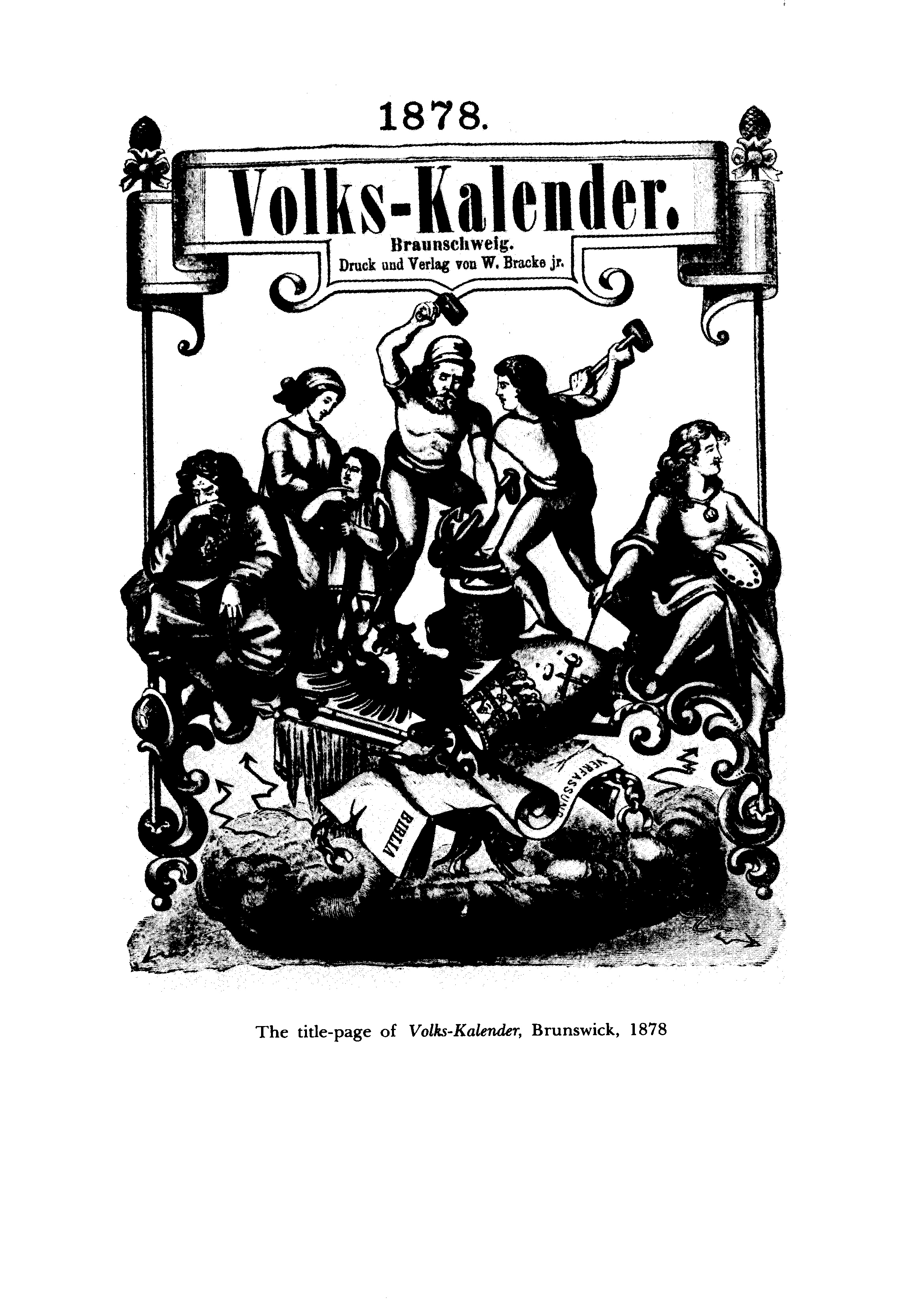
The title-page of Volks-Kalender, Brunswick, 1878
only secret because necessity compelled it to be so, the first organisation of the German Social-Democratic Party. The League existed wherever German workers' associations were to be found; in almost all of these associations in England, Belgium, France and Switzerland, and in very many of the associations in Germany, the leading members belonged to the League and the share of the League in the fledgling German workers' movement was very considerable. Moreover, our League was the first to emphasise the international character of the whole workers' movement and implement it in practice, having Englishmen, Belgians, Hungarians, Poles, etc., as members and organising international workers' meetings, especially in London.
The transformation of the League took place at two congresses held in 1847,[220] the second of which resolved on the elaboration and publication of the fundamental principles of the Party in a manifesto to be drawn up by Marx and Engels. Thus appeared Manifesto of the Communist Party, which first saw the light of day in 1848, shortly before the February Revolution, and has since been translated into almost all European languages.
The Deutsche-Brüsseler-Zeitung, in which Marx participated and which mercilessly exposed the blessings of the police regime of the fatherland, caused the Prussian government to try to effect Marx's expulsion once more, but in vain. When, however, the February Revolution resulted in popular movements also in Brussels, and a radical change appeared to be imminent in Belgium, the Belgian government arrested Marx without ceremony and deported him. In the meantime, the French Provisional Government had sent him through Flocon an invitation to return to Paris, and he accepted this call.
In Paris he came out especially against the swindle, widespread among the Germans there, of wanting to form the German workers in France into armed legions in order to carry the revolution and the republic into Germany. On the one hand, Germany had to make her revolution herself, and, on the other hand, every revolutionary foreign legion formed in France was betrayed in advance by the Lamartines of the Provisional Government to the government which was to be overthrown, as occurred in Belgium and Baden.
After the March Revolution, Marx went to Cologne where he founded the Neue Rheinische Zeitung, which was in existence from June 1, 1848 to May 19, 1849 — the only paper which represented the standpoint of the proletariat within the democratic movement of the time, as shown e.g. in its unreserved support for the Paris June insurgents of 1848,[221] which cost the paper the defection of almost all its shareholders. In vain the Kreuz-Zeitung* pointed to the "Chimborazob insolence" with which the Neue Rheinische Zeitung attacked everything sacred, from the King and Imperial Regent0 down to the gendarme, and that, too, in a Prussian fortress with a garrison of 8,000 at that time; in vain was the rage of the Rhenish liberal philistines, who had suddenly become reactionary; in vain was the paper suspended for a lengthy period by martial law in Cologne in the autumn of 1848; in vain the Imperial Ministry of Justice in Frankfurt denounced article after article to the Cologne Public Prosecutor in order that judicial proceedings should be taken; under the very eyes of the police the paper calmly went on being edited and printed, and its distribution and reputation increased with the vehemence of its attacks on the government and the bourgeoisie. When the Prussian coup d'état took place in November 1848,[222] the Neue Rheinische Zeitung called at the head of each issue upon the people to refuse to pay taxes and to meet force with force. In the spring of 1849, both on this account and because of another article,0 it was made to face a jury, but on both occasions was acquitted. Finally, when the May revolts of 1848 in Dresden and the Rhine Province had been suppressed, and the Prussian campaign against the Baden-Palatinate uprising had been inaugurated by the concentration and mobilisation of considerable masses of troops,[223]
the government believed itself strong enough to suppress the Neue Rheinische Zeitung by force. The last number — printed in red— appeared on May 19.
Marx again went to Paris, but only a few weeks after the demonstration of June 13, 1849, he was faced by the French government with the choice of either moving his residence to Brittany or leaving France. He preferred the latter and moved to London, where he has lived uninterruptedly ever since.
An attempt to continue to issue the Neue Rheinische Zeitung in the form of a review (in Hamburg in 1850)e had to be given up after a while in view of the ever-increasing onslaughts of the reaction. Immediately after the coup d'état in France in December 1851, Marx published The Eighteenth Brumaire of Louis Bonaparte (New York, 1852; second edition, Hamburg, 1869, shortly before the war). In 1853 he wrote Revelations Concerning the Communist Trial in Cologne (first printed in Basle, later in Boston and again recently in Leipzig).
After the condemnation of the members of the Communist League in Cologne, Marx withdrew from political agitation and for ten years devoted himself, on the one hand, to the study of the rich treasures offered by the library of the British Museum in the sphere of political economy, and, on the other hand, to writing for the New-York Tribune, which up to the outbreak of the American Civil War published not only contributions signed by him but also numerous leading articles on conditions in Europe and Asia from his pen. His attacks on Lord Palmerston, based on an exhaustive study of British official documents, were reprinted in London in pamphlet form.(1)
As the first fruit of his many years studying economics, there appeared in 1859 A Contribution to the Critique of Political Economy, Part One (Berlin, Duncker). This work contains the first coherent exposition of the Marxian theory of value, including the doctrine of money. During the Italian War[224] Marx, in the German newspaper Das Volk, appearing in London, attacked Bonapartism, which at that time posed as liberal and played the part of liberator of the oppressed nationalities, and also the Prussian policy of the day, which under the cover of neutrality was seeking to fish in troubled waters. In this connection it was necessary to attack also Herr Karl Vogt, who at that time, on the commission of Prince Napoleon (Plon-Plon) and in the pay of Louis Napoleon, was carrying on agitation for the neutrality, and indeed the sympathy, of Germany. When Vogt heaped upon him the most abominable and deliberately false calumnies, Marx answered with Herr Vogt (London, I860), in which Vogt and the other gentlemen of the imperial sham-democratic gang were exposed, and Vogt himself on the basis of both external and internal evidence was convicted of receiving bribes from the December Empire .(2) The confirmation came just ten years later: in the list of the Bonaparte hirelings, found in the Tuileries in 1870 and published by the September government, there was the following entry under the letter V: "Vogt — in August 1859 there were remitted to him — Frs. 40,000."[225] At last, in 1867, there appeared in Hamburg: Capital. A Critique of Political Economy, Volume I, Marx's chief work, which expounds the foundations of his economic and socialist conceptions and the main features of his criticism of existing society, the capitalist mode of production and its consequences. The second edition of this epoch-making work appeared in 1872; the author is engaged in the elaboration of the second volume.
Meanwhile the workers' movement in various countries of Europe had regained strength to the extent that Marx could entertain the idea of realising a long-cherished wish: the foundation of a Workers' Association embracing the most advanced countries of Europe and America, which would demonstrate bodily, so to speak, the international character of the socialist movement both to the workers themselves and to the bourgeois and the governments — for the encouragement and strengthening of the proletariat, for striking fear into the hearts of its enemies. A public meeting in favour of Poland, which had just then again been crushed by Russia, held on September 28, 1864, in St. Martin's Hall, London, provided the occasion for bringing forward the matter, which was enthusiastically taken up. The International Working Men's Association was founded; a Provisional General Council, with its seat in London, was elected at the meeting, and Marx was the soul of this as of all subsequent General Councils up to the Hague Congress. He drafted almost every one of the documents issued by the General Council of the International, from the Inaugural Address, 1864, to the Address on the Civil War in France, 1871. To describe Marx's activity in the International is to write the history of this Association itself, which in any case lives on in the memory of European workers.
The fall of the Paris Commune put the International in an impossible position. It was thrust into the forefront of European history at a moment when it had everywhere been deprived of all possibility of successful practical action. The events which raised it to the position of the seventh Great Power simultaneously forbade it to mobilise its fighting forces and employ them in action, on pain of inevitable defeat and the setting back of the workers' movement for decades. In addition, from various sides elements were pushing themselves forward that sought to exploit the suddenly enhanced fame of the Association for the purpose of gratifying personal vanity or personal ambition, without understanding the real position of the International or without regard for it. A heroic decision had to be taken, and it was again Marx who took it and who carried it through at the Hague Congress. In a solemn resolution, the International disclaimed all responsibility for the doings of the Bakuninists, who formed the centre of those unreasonable and unsavoury elements. Then, in view of the impossibility of also meeting, in the face of the general reaction, the increased demands which were being imposed upon it, and of maintaining its complete efficacy other than by a series of sacrifices which would have drained the workers' movement of its life-blood — in view of this situation, the International withdrew from the stage for the time being by transferring the General Council to America.(3) The results proved the correctness of this decision — which was at the time, and has been since, so often censured. On the one hand, it put a stop then and since to all attempts to make useless putsches in the name of the International, while, on the other hand, the continuing close intercourse between the socialist workers' parties of the various countries proved that the consciousness of the identity of interests and of the solidarity of the proletariat of all countries evoked by the International is able to assert itself even without the bond of a formal international association, which for the moment has become a fetter.
After the Hague Congress, Marx at last found peace and leisure again for resuming his theoretical work, and it is to be hoped he will be able before long to have the second volume of Capital ready for the press.
Of the many important discoveries through which Marx has inscribed his name in the annals of science, we can here dwell on only two.
The first is the revolution brought about by him in the whole conception of world history. The entire view of history hitherto was based on the conception that the ultimate causes of all historical changes are to be sought in the changing ideas of human beings, and that of all historical changes political changes are the most important and dominate the whole of history. But the question was not asked as to whence the ideas come into men's minds and what the driving causes of the political changes are. Only upon the newer school of French, and partly also of English, historians had the conviction forced itself that, since the Middle Ages at least, the driving force in European history had been the struggle of the developing bourgeoisie with the feudal aristocracy for social and political domination. Now Marx has proved that the whole of history hitherto is a history of class struggles, that in all the manifold and complicated political struggles the only thing at issue has been the social and political rule of classes of society, the maintenance of domination by older classes and the conquest of domination by newly arising classes. To what, however, do these classes owe their origin and their continued existence? They owe it to the particular material, physically sensible conditions in which society in a given period produces and exchanges its means of subsistence. The feudal rule of the Middle Ages rested on the self-sufficient economy of small peasant communities, which themselves produced almost all their requirements, in which there was almost no exchange and which received from the arms-bearing nobility protection from without and national or at least political cohesion. When the towns arose and with them separate handicraft industry and trade, at first internal and later international, the urban bourgeoisie developed, and already during the Middle Ages achieved, in struggle with the nobility, its inclusion in the feudal order as a likewise privileged estate. But with the discovery of the extra-European lands, from the middle of the fifteenth century onwards, this bourgeoisie acquired a far more extensive sphere of trade and therewith a new spur for its industry; in the most important branches handicrafts were supplanted by manufacture, now on a factory scale, and this again was supplanted by large-scale industry, which became possible owing to the discoveries of the previous century, especially that of the steam engine. Large-scale industry, in its turn, had an effect on trade, driving out the old manual labour in backward countries and creating the present-day new means of communication: steam engines, railways, electric telegraphy, in the more developed ones. Thus the bourgeoisie came more and more to combine social wealth and social power in its hands, while it still for a long period remained excluded from political power which was in the hands of the nobility and the monarchy supported by the nobility. But at a certain stage — in France since the Great Revolution — it also conquered political power, and now in turn became the ruling class over the proletariat and small peasants. From this point of view all the historical phenomena are explicable in the simplest possible way — with sufficient knowledge of the particular economic condition of society, which it is true is totally lacking in our professional historians — and in the same way the conceptions and ideas of each historical period are most simply to be explained from the economic conditions of life and from the social and political relations of the period, which are in turn determined by these economic conditions. History was for the first time placed on its real basis; the palpable but previously totally overlooked fact that men must first of all eat, drink, have shelter and clothing, therefore must work, before they can fight for domination, pursue politics, religion, philosophy, etc.—this palpable fact at last came into its historical right.
This new conception of history, however, was of supreme significance for the socialist outlook. It showed that all history hitherto revolved around class antagonisms and class struggles, that there have always existed ruling and ruled, exploiting and exploited classes, and that the great majority of mankind has always been condemned to arduous labour and little enjoyment. Why is this? Simply because in all earlier stages of development of mankind production was so little developed that historical development could proceed only in this antagonistic form, that historical progress on the whole was assigned to the activity of a small privileged minority, while the great mass remained condemned to producing by their labour their own meagre means of subsistence and also the increasingly rich means of the privileged. But the same investigation of history, which in this way provides a natural and reasonable explanation of class rule hitherto, otherwise only explicable from the wickedness of man, also leads to the realisation that, in consequence of the so tremendously increased productive forces of the present time, even the last pretext has vanished, at least in the most advanced countries, for a division of mankind into rulers and ruled, exploiters and exploited; that the ruling big bourgeoisie has fulfilled its historic mission, that it is no longer capable of the leadership of society and has even become a hindrance to the development of production, as the trade crises, and especially the last great crash, [26] and the depressed condition of industry in all countries have proved; that historical leadership has passed to the proletariat, a class which, owing to its whole position in society, can only free itself by abolishing altogether all class rule, all servitude and all exploitation; and that the productive forces of society, which have outgrown the control of the bourgeoisie, are only waiting for the associated proletariat to take possession of them in order to bring about a state of things in which every member of society will be enabled to participate not only in production but also in the distribution and administration of social wealth, and which so increases the productive forces of society and their yield by planned operation of the whole of production that the satisfaction of all reasonable needs will be assured to everyone in an ever-increasing measure.
15-1317 The second important discovery of Marx is the final elucidation of the relation between capital and labour, in other words, the demonstration how, within present society and under the existing capitalist mode of production, the exploitation of the worker by the capitalist takes place. Ever since political economy had put forward the proposition that labour is the source of all wealth and of all value, the question became inevitable: How is this then to be reconciled with the fact that the wage labourer does not receive the whole sum of value created by his labour but has to surrender a part of it to the capitalist? Both the bourgeois economists and the socialists exerted themselves to give a scientifically valid answer to this question, but in vain, until at last Marx came forward with the solution. This solution is as follows: The present-day capitalist mode of production presupposes the existence of two social classes — on the one hand, that of the capitalists, who are in possession of the means of production and subsistence, and, on the other hand, that of the proletarians, who, being excluded from this possession, have only a single commodity for sale, their labour power, and who therefore have to sell this labour power of theirs in order to obtain possession of means of subsistence. The value of a commodity is, however, determined by the socially necessary quantity of labour embodied in its production, and, therefore, also in its reproduction; the value of the labour power of an average human being during a day, month or year is determined, therefore, by the quantity of labour embodied in the quantity of means of subsistence necessary for the maintenance of this labour power during a day, month or year. Let us assume that the means of subsistence of a worker for one day require six hours of labour for their production, or, what is the same thing, that the labour contained in them represents a quantity of labour of six hours; then the value of labour power for one day will be expressed in a sum of money which also embodies six hours of labour. Let us also assume that the capitalist who employs our worker pays him this sum in return, that is the full value of his labour power. If now the worker works six hours of the day for the capitalist, he has completely replaced the latter's outlay — six hours' labour for six hours' labour. But then there would be nothing in it for the capitalist, and the latter therefore looks at the matter quite differently. He says: I have bought the labour power of this worker not for six hours but for a whole day, and accordingly he makes the worker work 8, 10, 12, 14 or more hours according to circumstances, so that the product of the seventh, eighth and following hours is a product of unpaid labour and finds its way, to begin with, into the pocket of the capitalist. Thus the worker in the service of the capitalist not only reproduces the value of his labour power, for which he receives pay, but over and above that he also produces a surplus value which, appropriated in the first place by the capitalist, is subsequently divided according to definite economic laws among the whole capitalist class and forms the basic stock from which arise ground rent, profit, accumulation of capital, in short, all the wealth consumed or accumulated by the non-labouring classes. But this proved that the acquisition of riches by the present-day capitalists consists just as much in the appropriation of the unpaid labour of others as that of the slaveowner or the feudal lord exploiting serf labour, and that all these forms of exploitation are only to be distinguished by the difference in manner and method by which the unpaid labour is appropriated. This, however, also removed the last justification for all the hypocritical phrases of the possessing classes to the effect that in the present social order right and justice, equality of rights and duties and a universal harmony of interests prevail, and present-day bourgeois society, no less than its predecessors, was exposed as a grandiose institution for the exploitation of the huge majority of the people by a small, ever-diminishing minority.
Modern, scientific socialism is based on these two important facts. In the second volume of Capital, these and other hardly less important scientific discoveries concerning the capitalist system of society will be further developed, and thereby those aspects of political economy not touched upon in the first volume will also undergo révolutionisation. May it be vouchsafed to Marx to be able soon to have it ready for the press.
15*
The first page of Marx's " Letter to Otechestvenniye ZapiskV
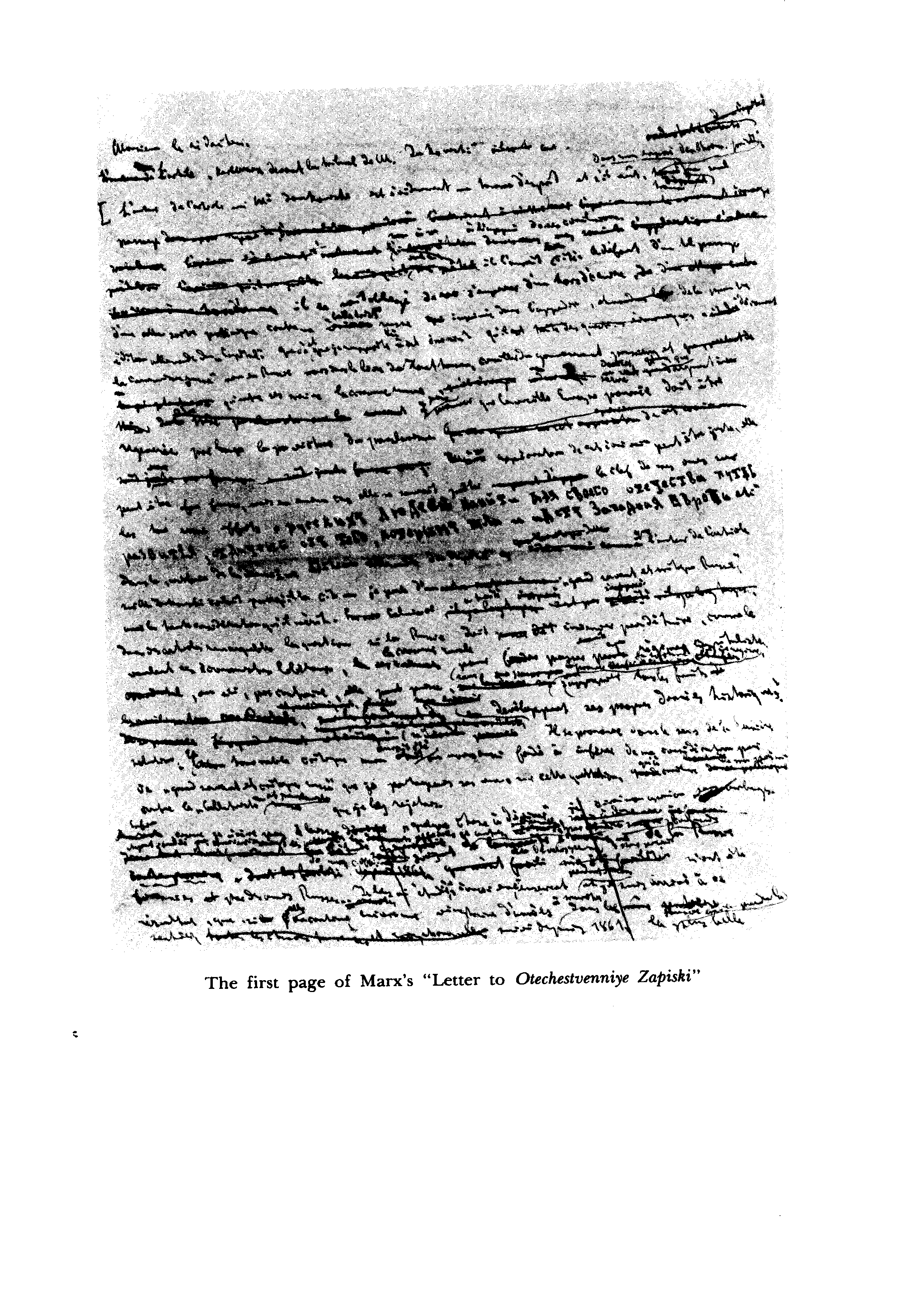
The first page of Marx's "Letter to Otechestvenniye Zapiski"
because he quotes it — I speak of "a great Russian scholar and critic"(1) with the high esteem which he deserves. In his noteworthy articles(2) the latter dealt with the question whether Russia should start, as its liberal economists wish, by destroying the rural community in order to pass to a capitalist system or whether, on the contrary, it can acquire all the fruits of this system without suffering its torments, by developing its own historical conditions. He comes out in favour of the second solution. And my honourable critic would have been at least as justified in inferring from my esteem for this "great Russian scholar and critic" that I shared his views on this question as he is in concluding from my polemic against the "belletrist" and Pan-Slavist that I rejected them.
Be that as it may, as I do not like to leave anything to "guesswork", I shall speak straight out. In order to reach an informed judgment of the economic development of contemporary Russia, I learned Russian and then spent several long years studying official publications and others with a bearing on this subject. I have arrived at this result: if Russia continues along the path it has followed since 1861, it will miss the finest chance that history has ever offered to a nation, only to undergo all the fatal vicissitudes of the capitalist system.(3)
il
The chapter on primitive accumulation does not pretend to do more than trace the road by which in Western Europe the capitalist economic order emerged from the entrails of the feudal economic order. It thus describes the historical movement which by divorcing the producers from their means of production transforms them into wage-workers (proletarians in the modern sense of the word) and the owners of the means of production into capitalists. In this history, "every revolution which acts as a lever for the advancement of the capitalist class in its process of formation marks an epoch; above all that which, by stripping great masses of men of their traditional means of production and subsistence, suddenly hurls them on the labour market. But the basis of this whole development. is the expropriation of the agricultural producer. T o date this has not been accomplished in a radical fashion anywhere except in England ... but all the other countries of Western Europe are undergoing the same process etc." (Capital, French edition, p. 315). At the end of the chapter the historical tendency of capitalist production is summed u p thus: That it "itself begets its own negation with the inexorability which governs the metamorphoses of nature"; that it has itself created the elements of a new economic order, by giving the greatest impulse at once to the productive forces of social labour and to the integral development of every individual producer; that capitalist property, which actually rests already on a collective mode of production, can only be transformed into social property.
I do not give any proof at this point for the very good reason that this assertion itself is nothing but a summary recapitulation of long developments previously set out in the chapters on capitalist production.
Now, in what way was my critic[3] able to apply this historical sketch to Russia? Only this: if Russia is tending to become a capitalist nation, on the model of the countries of Western Europe,—and in recent years it has gone to great pains to move in this direction — it will not succeed without having first transformed a large proportion of its peasants into proletarians; and after that, once it has been placed in the bosom of the capitalist system, it will be subjected to its pitiless laws, like other profane peoples. That is all! But this is too little for my critic. It is absolutely necessary for him to metamorphose my historical sketch of the genesis of capitalism in Western Europe into a historico-philosophical theory of general development, imposed by fate on all peoples, whatever the historical circumstances in which they are placed, in order to eventually attain this economic formation which, with a tremendous leap of the productive forces of social labour, assures the most integral development of every individual producer. But I beg his pardon. This does me too much honour, and yet puts me to shame at the same time. Let us take an example. In various places in Capital I allude to the destiny of the plebeians of Ancient Rome. They were originally free peasants cultivating their own plots of land on their own account. In the course of Roman history they were expropriated. The same movement which cut them off from their means of production and subsistence involved not only the formation of large landed property but also the formation of large money capital. Thus, one fine morning, there were on the one hand free men stripped of everything except their labour power, and on the other, in order to exploit this labour, the owners of all the acquired wealth. What happened? The Roman proletarians became not wage labourers but an idle "MOB", more abject than the former "POOR WHITES"[228] of the southern states of America; and alongside them there developed a mode of production that was not capitalist but based on slavery. Thus events strikingly analogous, but occurring in different historical milieux, led to quite disparate results. By studying each of these evolutions on its own, and then comparing them, one will easily discover the key to the phenomenon, but it will never be arrived at by employing the all-purpose formula of a general historico-philosophical theory whose supreme virtue consists in being supra-historical.
A page of the " Circular Letter to August Bebel, Wilhelm Liebknecht, Wilhelm Bracke and Others" by Karl Marx and Frederick Engels
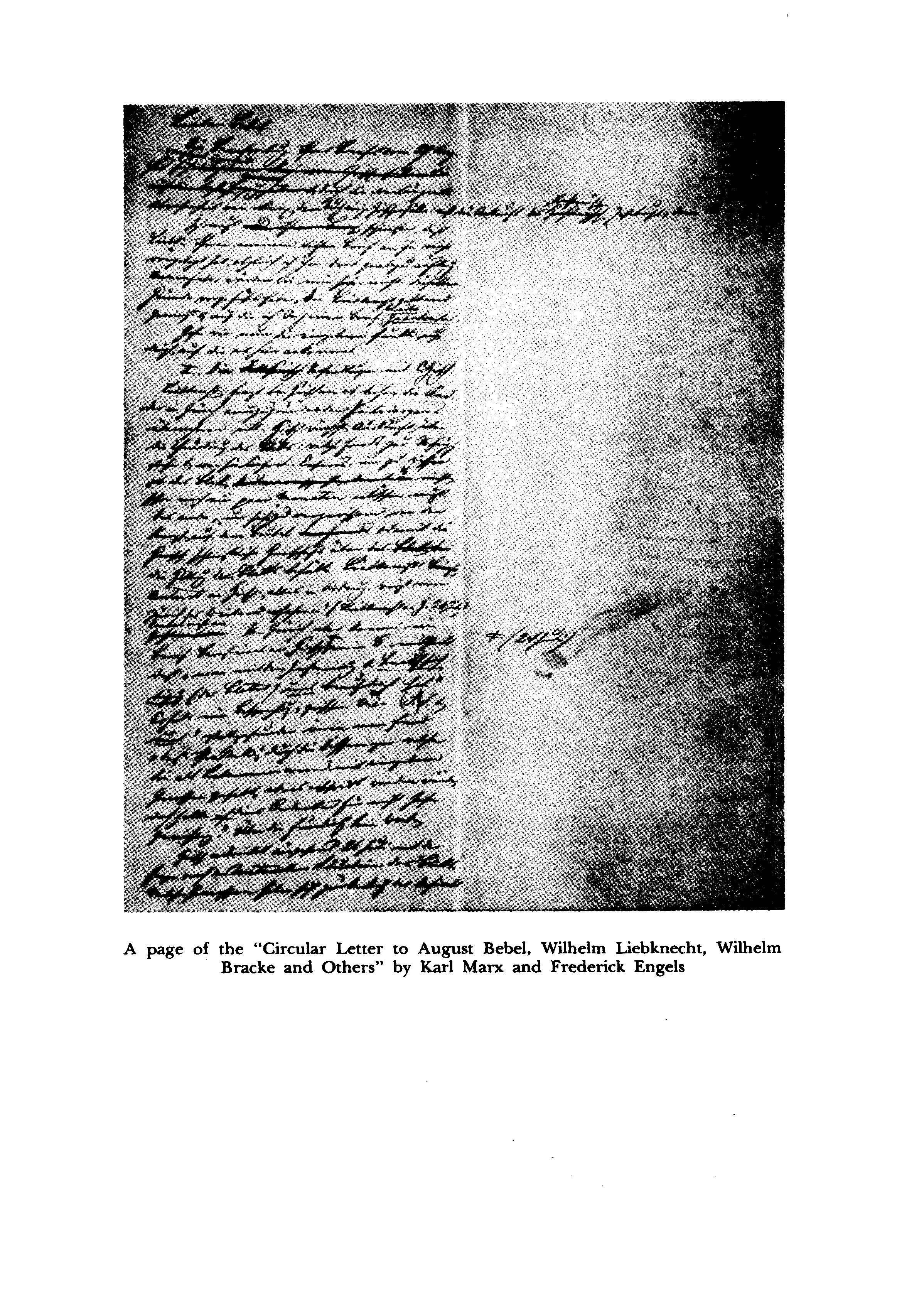
A page of the "Circular Letter to August Bebel, Wilhelm Liebknecht, Wilhelm Bracke and Others" by Karl Marx and Frederick Engels
editorial committee, but is only to be entrusted with administration and the financial side. As late as August 14, Liebknecht wrote to me along the same lines, and asked that we persuade Hirsch to accept. You yourself, as late as August 20 were still so little acquainted with the actual circumstances that you wrote to me saying:
"He" (Höchberg) "has no more say in the editing of the paper than any other well-known member of the party."
Finally, Hirsch received a letter from Viereck, dated August 11, containing the admission that
"the 3 men domiciled in Zurich are to, qua editorial committee, apply themselves to founding the paper and, subject to the agreement of the three Leipzigers, select an editor ... so far as I recall, the resolutions that were sent them also asserted that the (Zurich) founding committee mentioned under 2., was to assume both political and financial responsibility towards the party.... From this state of affairs it follows, or so it seems to me, that ... there can be no question of anyone assuming the editorship without the concurrence of the 3 men domiciled in Zurich and entrusted with the founding by the party".
Here at last was something definite, at least, for Hirsch to go on, if only in regard to the position of the editor vis-à-vis the Zürichers. They were an editorial committee; they were also politically responsible; without their concurrence no one could assume the editorship. In short, Hirsch was simply instructed to come to an understanding with three men in Zurich whose names had still not been disclosed to him.
But to make the confusion worse, Liebknecht added a postscript to Viereck's letter:
"Singer from Berlin was here just now and informed us that the supervisory committee in Zurich is not, as Viereck imagines, an editorial committee, but essentially an administrative committee which is financially responsible to the party, i.e. to ourselves, for the paper; of course, its members also have the right and the duty to discuss the editing with you (a right and a duty of which, by the way, every member is possessed); they are not empowered to place you under their guardianship."
The Zurich trio and one member of the Leipzig committee — the only one(1) present at the discussions — insist that Hirsch is to be subject to official direction by Zurich, while another Leipzig member(2) contests this outright. And yet Hirsch is to make up his mind before these gentlemen are agreed amongst themselves! The fact that Hirsch was entitled to acquaint himself with the resolutions they had adopted and which embodied the conditions with which he was expected to comply, was entirely overlooked, the more so since it never seems to have occurred to the Leipzigers that they themselves should become properly acquainted with those resolutions. How, otherwise, can the above-mentioned inconsistency be accounted for?
If the Leipzigers were unable to agree upon the powers vested in the Zurich people, the latter harboured no doubts on this score.
Schramm to Hirsch, August 14:
"Had you not written at one time that in a similar case" (as that of Kayser),(3)
"you would do just as you had done before, thus holding out the prospect of a similar modus operandi?[1]"[1] we would not be wasting words on the subject. As it is, however, and in view of that statement of yours, we must reserve the right to have the casting vote as to what articles the new paper should take."
The letter to Bernstein in which Hirsch was alleged to have said this was dated July 26, long after the conference in Zurich at which the Zurich trio's powers were laid down. But so much were those in Zurich already revelling in the sense of their own bureaucratic authority that, in reply to this subsequent letter of Hirsch's, they were already laying claim to new powers, namely the decision as to what articles should be included. The editorial committee was already a censorship committee.
Not until Höchberg arrived in Paris did Hirsch learn from him the names of the members of the two committees.[318]
If, then, discussions with Hirsch broke down, what was the cause?
1. The obstinate refusal, on the part of both Leipzig and Zurich, to give him any hard and fast information about the paper's financial basis and hence the likelihood of keeping it afloat, if only for a year. Not until he was over here did he learn from me (following your communication to me(4)) how much had been subscribed. Hence, the only conclusion it was really possible to draw from previous communications (the party + Höchberg) was either that the paper was already being largely financed by Höchberg or that it would soon be entirely dependent on his subsidies. And this latter eventuality is still far from being excluded. The sum of — if I read it right — 800 marks is precisely the same (40 pounds sterling) as had to be contributed by the local association, Freiheit?[19] during the first half year.
2. Liebknecht's repeated assurances, which have since proved totally erroneous, that Zurich was to have no official control whatever over the editorship, and the resulting comedy of errors;
3. The certainty finally established that not only were the Zurich people to control the editing, they were actually to censor it, and that the only role that would redound upon him, Hirsch, would be that of the man of straw.
His refusal at that juncture is something we cannot but approve. The Leipzig committee, or so we hear from Höchberg, ° has received reinforcements in the shape of two more who do not live in the place[3] and hence that committee can intervene quickly only if the three Leipzigers are agreed. As a result, the real centre of gravity has altogether shifted to Zurich, and Hirsch or, for that matter, any true revolutionary and proletarian-minded editor, would not have been able to work with the people there for any length of time. More about this later.
The title-page of the authorised English edition of Engels' Socialism: Utopian and Scientific
The first page of Marx's "Introduction to the French Edition of Engels' Socialism: Utopian and Scientific"
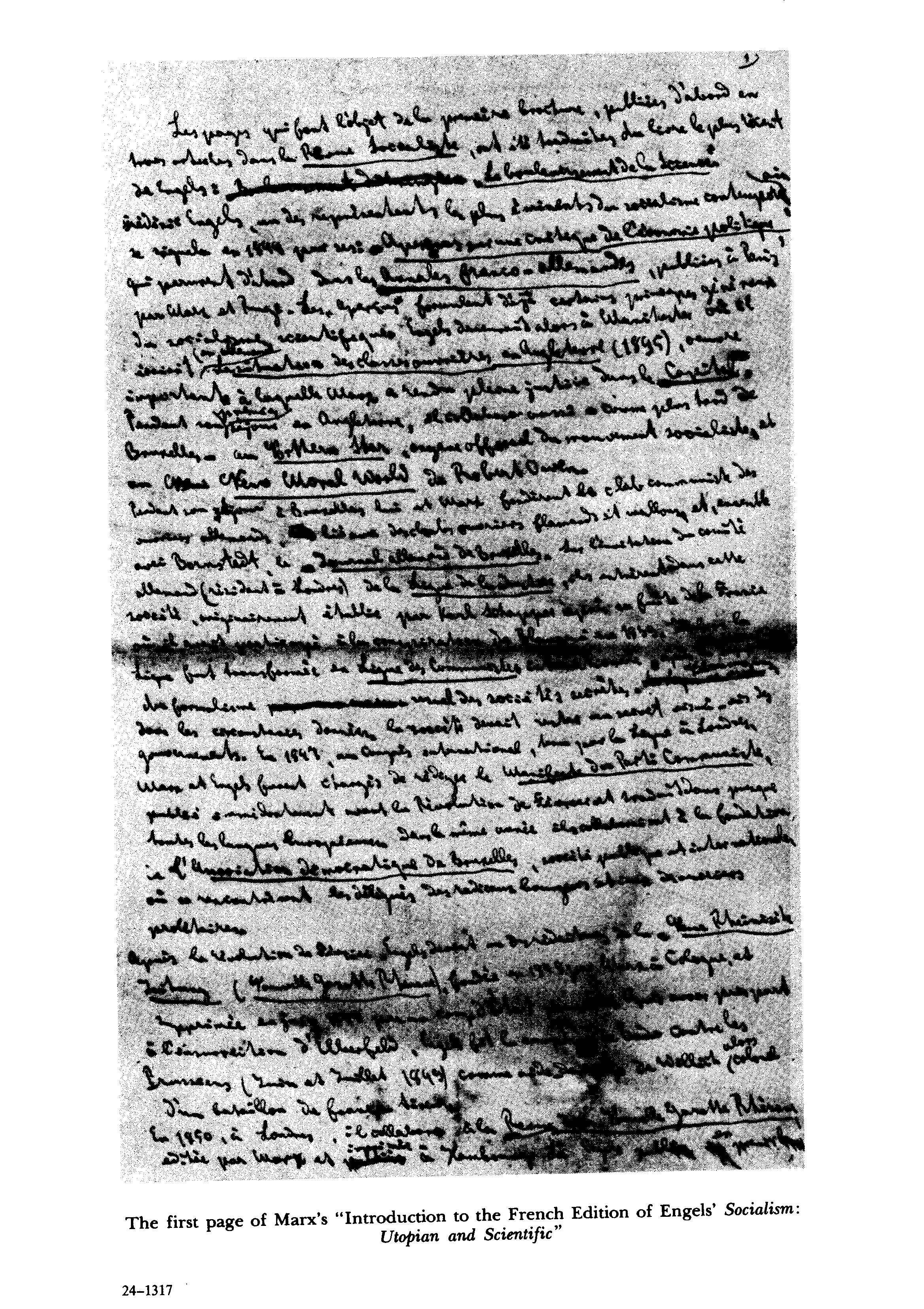
The first page of Marx's "Introduction to the French Edition of Engels' Socialism: Utopian and Scientific
important articles, most of which were reprinted in the form of pamphlets such as On Social Relations in Russia, The Prussian Schnapps in the German Reichstag, The Housing Question, The Cantonalist Rising in Spain* etc.
In 1870, after leaving Manchester for London, Engels joined the General Council of the International, where he was entrusted with the correspondence with Spain, Portugal and Italy.
L'Égalité, No. 24, June 30, 1880, containing Marx's "Preamble to the Programme of the French Workers' Party"
A page of the first draft of Marx's letter to Vera Zasulich
v ^>>W^'*%'V» ******««** v^*^^*- X*\5L*
W** <â-L5* «5^2 <*J*** *W - P V ^ V ^ Y * / \
<\ i%war ft fh«i\ wV^ » M|i*^Uv^^* fcÄ** ^TjfjV"*
i»**»»
1 -»gum»' v " "
' ^^«iuppp^"" -"-»
w " ~ »•
iV**k
k ^ i
tb» <*» *¥*"%
JS0»«i$5%V* c*-*
vrC»
2) From the historical point of view the only serious argument put forward in favour of the fatal dissolution of the Russian peasants' commune is this: By going back a long way communal property of a more or less archaic type[400] may be found throughout Western Europe; everywhere it has disappeared with increasing social progress. Why should it be able to escape the same fate in Russia alone? I reply: because in Russia, thanks to a unique combination of circumstances, the rural commune, still established on a nationwide scale, may gradually detach itself from its primitive features and develop directly as an element of collective production on a nationwide scale. It is precisely thanks to its contemporaneity with capitalist production that it may appropriate the latter's positive acquisitions without experiencing all its frightful misfortunes. Russia does not live in isolation from the modern world; neither is it the prey of a foreign invader like the East Indies.
If the Russian admirers of the capitalist system denied the theoretical possibility of such a development, I would ask them this question: In order to utilise machines, steam engines, railways, etc., was Russia forced, like the West, to pass through a long incubation period in the engineering industry? Let them explain to me, too, how they managed to introduce in their own country, in the twinkling of an eye, the entire mechanism of exchange (banks, credit institutions, etc.), which it took the West centuries to devise?
If at the time of emancipation the rural communes had first been placed in conditions of normal prosperity; if the immense public debt, mostly paid for at the expense of the peasants, with the other enormous sums provided through the agency of the State (and still at the expense of the peasants) to the "new pillars of society",[401] transformed into capitalists,—if all this expenditure had been applied to further developing the rural commune, no one would today be envisaging the "historical inevitability" of the destruction of the commune: everyone would recognise in it the element of regeneration of Russian society and an element of superiority over the countries still enslaved by the capitalist regime.
Another circumstance favouring the preservation of the Russian commune (by the path of development) is the fact that it is not only contemporaneous with capitalist production but has outlasted the era when this social system still appeared to be intact; that it now finds it, on the contrary, in Western Europe as well as in the United States, engaged in battle both with science, with the popular masses, and widi the very productive forces which it engenders.[3] In a word, it finds it in a crisis which will only end in its elimination, in the return of modern societies to the "archaic" type of communal property, a form in which, in the words of an American writer(1) quite free from any suspicion of revolutionary tendencies and subsidised in his work by the Washington government, "the new system" towards which modern society tends "will be A REVIVAL IN A SUPERIOR FORM of an archaic social type". So we must not let ourselves to be alarmed at the word "archaic".
But then we would at least have to be familiar with these vicissitudes. We know nothing about them. In one way or another this commune perished in the midst of incessant wars, foreign and internal; it probably died a violent death. When the Germanic tribes came to conquer Italy, Spain, Gaul, etc.,[402] the commune of the archaic type no longer existed. Yet its natural viability is demonstrated by two facts. There are sporadic examples which survived all the vicissitudes of the Middle Ages and have been preserved into our own day, for instance the district of Trier, in my native country. But more importantly, it imprinted its own characteristics so effectively on the commune which replaced it — a commune in which the arable land has become private property, whereas forests, pastures, common lands, etc., still remain communal property — that Maurer,(2) when analysing this commune of secondary formation, was able to reconstruct the archaic prototype. Thanks to the characteristic features borrowed from the latter, the new commune introduced by the Germanic peoples in all the countries they invaded was the sole centre of popular liberty and life throughout the Middle Ages.
If we know nothing about the life of the commune or about the manner and time of its disappearance after the age of Tacitus, at least we know the starting point, thanks to Julius Caesar.(3) In his day the land was already shared out annually, but between the gentes and the tribes of the Germanic confederations, and not yet between the individual members of the commune. The rural commune in Germany is therefore descended from a more archaic type; it was the product of a spontaneous development instead of being imported fully developed from Asia. There — in the East Indies — we also encounter it, and always as the final stage or final period of the archaic formation.
To assess the possible outcomes from a purely theoretical point of view, that is to say, assuming normal conditions of life, I must now point out certain characteristic features which distinguish the "agricultural commune" from the more archaic types.
Firstly, previous primitive communities are all based on the natural kinship of their members; by breaking this strong but tight bond, the agricultural commune is better able to spread and to withstand contact with strangers.
Next, in this form the house and its complement, the courtyard, are already the private property of the cultivator, whereas long before the introduction of agriculture the communal house was one of the material bases of previous communities.
Finally, although arable land remains communal property, it is divided periodically between the members of the agricultural commune, so that each cultivator tills the fields assigned to him on his own account and appropriates as an individual the fruits thereof, whereas in more archaic communities production took place communally and only the yield was shared out. This primitive type of cooperative or collective production resulted, of course, from the weakness of the isolated individual, and not from the socialisation of the means of production. It is easy to see that the dualism inherent in the "agricultural commune" might endow it with a vigorous life, since on the one hand communal property and all the social relations springing from it make for its solid foundation, whereas the private house, the cultivation of arable land in parcels and the private appropriation of its fruits permit a development of individuality which is incompatible with conditions in more primitive communities.
But it is no less evident that this very dualism might in time become a source of decay. Apart from all the influences of hostile surroundings, the mere gradual accumulation of chattels which begins with wealth in the form of cattle (even admitting wealth in the form of serfs), the increasingly pronounced role which the movable element plays in agriculture itself, and a host of other circumstances inseparable from this accumulation but which it would take me too long to go into here, will eat away at economic and social equality and give rise to a conflict of interests at the very heart of the commune, entailing first the conversion of arable land into private property and ending with the private appropriation of the forests, pastures, common lands, etc., which have already become communal appendages of private property.
This is why the "agricultural commune" occurs everywhere as the most recent type of the archaic form of societies, and why in the historical development of Western Europe, ancient and modern, the period of the agricultural commune appears as a period of transition from communal property to private property, as a period of transition from the primary form to the secondary one. But does this mean that in all circumstances the development of the "agricultural commune" must follow this path? Not at all. Its constitutive form allows this alternative: either the element of private property which it implies will gain the upper hand over the collective element, or the latter will gain the upper hand over the former. Both these solutions are a priori possible, but for either one to prevail over the other it is obvious that quite different historical surroundings are needed.3 All this depends on the historical surroundings in which it finds itself (see p. 10 V
Russia is the sole European country where the "agricultural commune" has kept going on a nationwide scale up to the present day. It is not the prey of a foreign conqueror, as the East Indies, and neither does it lead a life cut off from the modern world. On the one hand, the common ownership of land allows it to transform individualist farming in parcels directly and gradually into collective farming, and the Russian peasants are already practising it in the undivided grasslands; the physical lie of the land invites mechanical cultivation on a large scale; the peasant's familiarity with the contract of artel403 facilitates the transition from parcel labour to cooperative labour; and, finally, Russian society, which has so long lived at his expense, owes him the necessary advances for such a transition.0 On the other hand, the contemporaneity of western production, which dominates the world market, allows Russia to incorporate in the commune all the positive acquisitions devised by the capitalist system without passing through its Caudine Forks.[404]
If the spokesmen of the "new pillars of society" were to deny the theoretical possibility of the suggested evolution of the modern rural commune, one might ask them: Was Russia forced to pass through a long incubation period in the engineering industry, as was the West, in order to arrive at the machines, the steam engines, the railways, etc.? One would also ask them how they managed to introduce in their own country in the twinkling of an eye the entire mechanism of exchange (banks, joint-stock companies, etc.), which it took the West centuries to devise?
There is one characteristic of the "agricultural commune" in Russia which afflicts it with weakness, hostile in every sense. That is its isolation, the lack of connexion between the life of one commune and that of the others, this localised microcosm which is not encountered everywhere as an immanent characteristic of this type but which, wherever it is found, has caused a more or less centralised despotism to arise on top of the communes. The federation of Russian republics of the North proves that this isolation, which seems to have been originally imposed by the vast expanse of the territory, was largely consolidated by the political destinies which Russia had to suffer after the Mongol invasion.[405]
Today it is an obstacle which could easily be eliminated. It would simply be necessary to replace the volost,[406] the government body, with an assembly of peasants elected by the communes themselves, serving as the economic and administrative organ for their interests.
One circumstance very favourable, from the historical point of view, to the preservation of the "agricultural commune" by the path of its further development is the fact that it is not only the contemporary of Western capitalist production and is thus able to appropriate its fruits without subjecting itself to its modus operandi,' but has outlasted the era when the capitalist system still appeared to be intact; that it now finds it, on the contrary, in Western Europe as well as in the United States, engaged in battle both with the working-class masses, with science, and with the very productive forces which it engenders — in a word, in a crisis which will end in its elimination, in the return of modern societies to a superior form of an "archaic" type of collective property and production.
It goes without saying that the evolution of the commune would be carried out gradually, and that the first step would be to place it in normal conditions on its present basis.
Theoretically speaking, then, the Russian "rural commune" can preserve itself by developing its basis, the common ownership of land, and by eliminating the principle of private property which it also implies; it can become a direct point of departure for the economic system towards which modern society tends; it can turn over a new leaf without beginning by committing suicide; it can gain possession of the fruits with which capitalist production has enriched mankind, without passing through the capitalist regime, a regime which, considered solely from the point of view of its possible duration hardly counts in the life of society. But we must descend from pure theory to the Russian reality.[3]
3) To expropriate the agricultural producers it is not necessary to chase them off their land, as was done in England and elsewhere; nor is it necessary to abolish communal property by means of an ukase. Go and seize from the peasants the product of their agricultural labour beyond a certain measure, and despite your gendarmerie and your army you will not succeed in chaining them to their fields! In the last years of the Roman Empire, the provincial decurions[407]—not peasants but landowners — fled from their houses, abandoning their lands, even selling themselves into slavery, all in order to get rid of a property which was no longer anything more than an official pretext for extorting money from them, mercilessly and pitilessly.
From the time of the so-called emancipation of the peasants the Russian commune has been placed by the State in abnormal economic conditions and ever since then it has never ceased to overwhelm it with the social forces concentrated in its hands. Exhausted by its fiscal exactions, the commune became an inert thing, easily exploited by trade, landed property and usury. This oppression from without unleashed in the heart of the commune itself the conflict of interests already present, and rapidly developed the seeds of decay. But that is not all. At the expense of the peasants the State has forced, as in a hothouse, some branches of the Western capitalist system which, without developing the productive forces of agriculture in any way, are most calculated to facilitate and precipitate the theft of its fruits by unproductive middlemen. It has thus cooperated in the enrichment of a new capitalist vermin, sucking the already impoverished blood of the "rural commune".(4)
...In a word, the State has given its assistance to the precocious development of the technical and economic means most calculated to facilitate and precipitate the exploitation of the agricultural producer, that is to say, of the largest productive force in Russia, and to enrich the "new pillars of society".
5) This combination of destructive influences, unless smashed by a powerful reaction, is bound to lead to the death of the rural commune.
But one wonders why all these interests (including the large industries placed under government protection), seeing that they are doing so well out of the current state of the rural commune — why would they deliberately conspire to kill the goose that lays the golclen eggs? Precisely because they sense that this "current state" is no longer tenable, and that consequently the current method of exploiting it is now outdated. Already the poverty of the agricultural producer has affected the land, which is becoming barren. Good harvests succeed famines by turns. The average of the last ten years showed agricultural production not simply standing still but actually declining. Finally, for the first time Russia now has to import cereals instead of exporting them. So there is no time to lose. There must be an end to it. It is necessary to make an intermediate rural class of the more or less prosperous minority of the peasants, and turn the majority into proletarians, without mincing matters. To this end the spokesmen of the "new pillars of society" denounce the very wounds which they have inflicted on the commune as being as many natural symptoms of its decrepitude.
Disregarding all the miseries which are at present overwhelming the Russian "rural commune", and considering only its constitutive form and its historical surroundings, it is first of all evident that one of its fundamental characteristics, communal ownership of the land, forms the natural basis of collective production and appropriation. What is more, the Russian peasant's familiarity with the contract of artel would ease the transition from parcel labour to collective labour, which he already practises to a certain extent in the undivided grasslands, in land drainage and other undertakings of general interest. But for collective labour to supplant parcel labour — the source of private appropriation — in agriculture in the strict sense, two things are required: the economic need for such a change, and the material conditions to bring it about.
As for the economic need, it will be felt by the "rural commune" itself from the moment it is placed in normal conditions, that is to say, as soon as the burdens weighing on it are removed and its cultivable land has assumed a normal extent. Gone are the days when Russian agriculture called for nothing but land and its parcel cultivator, armed with more or less primitive tools. These days have passed all the more swiftly as the oppression of the agricultural producer infects and lays waste his fields. What he needs now is cooperative labour, organised on a large scale. Moreover, will the peasant who lacks(5) the necessary things for cultivating two or three dessiatines (6) be better off with ten times the number of dessiatines?
But where are the tools, the manure, the agronomic methods, etc., all the means that are indispensable to collective labour, to come from? It is precisely this point which demonstrates the great superiority of the Russian "rural commune" over archaic communes of the same type. Alone in Europe it has kept going on a vast, nationwide scale. It thus finds itself in historical surroundings in which its contemporaneity with capitalist production endows it with all the conditions necessary for collective labour. It is in a position to incorporate all the positive acquisitions devised by the capitalist system without passing through its Caudine Forks. The physical lie of the land in Russia invites agricultural exploitation with the aid of machines, organised on a vast scale and managed by cooperative labour. As for the costs of establishment — the intellectual and material costs — Russian society owes this much to the "rural commune", at whose expense it has lived for so long and to which it must still look for its "element of regeneration".
The best proof that this development of the "rural commune" is in keeping with the historical trend of our age is the fatal crisis which capitalist production has undergone in the European and American countries where it has reached its highest peak, a crisis that will end in its destruction, in the return of modern society to a higher form of the most archaic type — collective production and appropriation.
Since so many different interests, and especially those of the "new pillars of society" erected under the benign rule of Alexander II, have gained a good deal from the present state of the "rural commune", why would they deliberately plot to bring about its death? Why do their spokesmen denounce the wounds inflicted on it as so much irrefutable proof of its natural decrepitude? Why do they wish to kill the goose that lays the golden eggs?
Simply because the economic facts, which it would take me too long to analyse here, have revealed the mystery that the current state of the commune is no longer tenable and that soon, by sheer force of circumstances, the current method of exploiting the mass of the people will no longer be in fashion. So new measures are needed — and the innovation stealthily introduced in widely differing forms always comes down to this: abolish communal property, make an intermediate rural class of the more or less prosperous minority of the peasants, and turn the majority into proletarians, without mincing matters.
On the one hand, the "rural commune" has nearly been brought to the point of extinction; on the other, a powerful conspiracy is keeping watch with a view to administering the final blow. To save the Russian commune, a Russian revolution is needed. For that matter, the holders of political and social power are doing their very best to prepare the masses for just such a disaster.
And the historical situation of the Russian "rural commune" is unparalleled! Alone in Europe, it has kept going not merely as scattered debris such as the rare and curious miniatures in a state of the archaic type which one could still come across until quite recently in the West, but as the virtually predominant form of popular life covering an immense empire. If it possesses in the communal ownership of the soil the basis of collective appropriation, its historical surroundings, its contemporaneity with capitalist production, lend it all the material conditions of communal labour on a vast scale. It is thus in a position to incorporate all the positive acquisitions devised by the capitalist system without passing through its Caudine Forks. It can gradually replace parcel farming with large-scale agriculture assisted by machines, which the physical lie of the land in Russia invites. It can thus become the direct point of departure for the economic system towards which modern society tends, and turn over a new leaf without beginning by committing suicide. On the contrary, it would be necessary to begin by putting it on a normal footing.
But opposing it is landed property controlling almost half the land — and the best land, at that — not to mention the domains of the State. That is where the preservation of the "rural commune" by way of its further development merges with the general trend of Russian society, of whose regeneration it is the price.
Even from the economic point of view alone, Russia can emerge from its agrarian cul-de-sac by developing its rural commune; it would try in vain to get out of it by capitalised farming on the English model, to which all the social conditions of the country are inimical.(7)
In order to be able to develop, it needs above all to live, and there is no escaping the fact that at the moment the life of the "rural commune" is in jeopardy.
Apart from the reaction of any other destructive element from hostile surroundings, the gradual growth of chattels in the hands of private families, e.g. their wealth in the form of cattle, and sometimes even slaves or serfs — this sort of private accumulation is, in itself, enough to eat away at primitive economic and social equality in the long run, and give rise in the very heart of the commune to a conflict of interests which first undermines the communal ownership of arable land and ends by removing that of the forests, pastures, common lands, etc., after first converting them into a communal appendage of private property.
4) The history of the decline of primitive communities (it would be a mistake to place them all on the same level; as in geological formations, these historical forms contain a whole series of primary, secondary, tertiary types, etc.) has still to be written. All we have seen so far are some rather meagre outlines. But in any event the research has advanced far enough to establish that: (1) the vitality of primitive communities was incomparably greater than that of Semitic, Greek, Roman, etc. societies, and, a fortiori, that of modern capitalist societies; (2) the causes of their decline stem from economic facts which prevented them from passing a certain stage of development, from historical surroundings not at all analogous with the historical surroundings of the Russian commune of today.
When reading the histories of primitive communities written by bourgeois writers it is necessary to be on one's guard. They do not even shrink from falsehoods. Sir Henry Maine, for example, who was a keen collaborator of the British Government in carrying out the violent destruction of the Indian communes, hypocritically assures us that all the government's noble efforts to support the communes were thwarted by the spontaneous forces of economic laws!(8)
5) You know perfectly well that today the very existence of the Russian commune has been jeopardised by a conspiracy of powerful interests; crushed by the direct extortions of the State, fraudulently exploited by the "capitalist" intruders, merchants, etc., and the land "owners", it is undermined, into the bargain, by the village usurers, by conflicts of interests provoked in its very heart by the situation prepared for it.
To expropriate the agricultural producers it is not necessary to chase them off their land, as was done in England and elsewhere; nor is it necessary to abolish communal property by an ukase. On the contrary: go and seize the product of their agricultural labour beyond a certain point and, despite all the gendarmes at your command, you will not succeed in keeping them on the land! In the last years of the Roman Empire the provincial decurions— large landowners — left their lands, becoming vagabonds, even selling themselves into slavery, simply in order to get rid of a "property" which was no more than an official pretext for extorting money from them.
At the same time as the commune is bled dry and tortured, its land rendered barren and poor, the literary lackeys of the "new pillars of society" ironically depict the wounds inflicted on it as so many symptoms of its spontaneous decrepitude. They allege that it is dying a natural death and they would be doing a good job by shortening its agony. As far as this is concerned, it is no longer a matter of solving a problem; it is simply a matter of beating an enemy. To save the Russian commune, a Russian revolution is needed. For that matter, the government and the "new pillars of society" are doing their best to prepare the masses for just such a disaster. If revolution comes at the opportune moment, if it concentrates all its forces so as to allow the rural commune full scope, the latter will soon develop as an element of regeneration in Russian society and an element of superiority over the countries enslaved by the capitalist system.
A page of Der Sozialdemokrat, No. 13, March 22, 1883, containing Engels' article "Karl Marx's Funeral"
- - Ä -genftaf-§)r$ati bcx beut fdjett ^ojtaCbemoRxatie. SR: 1H. ~ ~ " ~ $wwi4^»71mb^ " 1883.
asa.rjT'^SLï "?*Ä
»epntlw* of tu fri%Mn KteMwlMiM. M>
Atgrattiat pnttiterti««.; MnSnriflTJTty "*rt*- * "•""^ »"-**••" Marin lirtnmliiu r«Kiii«l m of hi (B ) « « m (Nil« ptaw Mn Mm. • - " — ._£? * « W tefaWet«« Mew *»*#«. M • « M» MnfnM IMTut ebae.« M, il aetiafitem. }W4. 1. Jttq 1*81
K> M*a»« a* «larkrtiai In ,ti»ltiMtnt".
Her • t t r t t « .
«MeM kk «Mat a »élira a»h «M«, *kM kk CNfcfcÇ etMJte» M» r«4ttt, ettW kk mtfcrk «eMaat n* ettatâttt, « * Ht «trite« m ak^iMiMKit, t „ Mi t.c««.i. • law', w ü 3>kl
tlak «*He4 lab |k tarn M tatfeiHl, tin w. «Mae« j * miw « , u*k «4* kk *»«*t tel «Jaattt k»t4llil «*t ut mil «trat «t««*» «m *t4t.
. . . t.teekrtrit a«fl «tat krareMi * k warft »M »M mfc'r» erettißt. » tertre»««! «ak rakmk tat Unkt trMee)t.
«Kr ««V« «a ««At attka»trt* «M, «tin «eert MUM f w te» «fc«»»tt» fffitt. «ter »mal krt eetfcr »antatet** «»«te «ttttlt a«« kt« «tut« eef'l «teat ta'» «été«, »Jam a» ak trkttt »twetafaa wir etk'a.
Sraa. fratearkr, auajt ta«) ketta, 3w lafttMKHM ai rakthk »k &«. S. «Mit taIle»»* k» fcrtrr 14» M a t S feaat «*t» aaaMdl ea» »«M 14e« «ea»)»». «ttktt eeleawr«, tri Starr ta «tern. tmtt eektt kat Darr» »rr SJrtikea »tree.
$«• $c«t*fettt »m JUot Pttnc. Corfu« IT. «t«, »erM « » r ««.Ma l * * t »» t * * » * tat était «rlefl, i» WMla «r«M, « bra, (mit gréa •»> (•»!-irt« SUtaMa kerrMfl aeiM«.
« • • r a t i Ittu «t. ïtmtt ,««l«r«»4t ak i«H«.e*lr»«t ut Ma «Sat«, rat etaan Mr Marnet '«•• *r»*i*>ti W> ,»»|tetktaett«l- tat i« Ma M» £aaktattr > < « « » . • if,.!*,» «r»«itt.»ll»««««»er(l»«. «am «ara« «.«««tl« «>set«»t Wfoktt M tiiMf««t
.«•. 14. CUn. «aa)wlta(I ri« «tat« »at art., iat krr « H « latantt ï » ttt ~ltt»Jrt. j . acatn. »«a. ) M B a n ail» Jëadt«, lartr. la» i*. »rial «rttrtM fa («««• ««»* taiia «trWaaaatBt — ahr Kt attattr.
. » . » M btiitart tmtAtay « • «wttfa.ii«V »Jrairjami. • M Mt »iHatitay BSI|h.l»«ti u Mrrt» Stam Milar» »•»«". ka« «I I»« ai*l l> «n»i»»ea. »W» ««»» • * * » » > « » « < ftKter -a*r». « tel « . » « * « «»«»Ititr. «trait« tat.
.SMt t«»<« art » * » »<r *tl»i*«n9 W »rj««((«a» Rattirt, (• oriarft» »«T art «Itt»t«»a8»«fi*| »rr aw>r«)lt«)tK etfa)Utr^ Ut trl>> aMR ik»uai|*r« U.irt.»*<i»««t« Hr. M k t»fa* ïlaliaaV, V«, W» Wt«(«o. . . . «tir. «haaa ,«nii rjt«, Ittm«. ut«t» w» M "riktn ««*», jtjk iMMr. Bt»t«l**, « u i * Stl%i<« ». f. ». trr»«» g"»»; kai aifa ait *jra»«fti«« art «aarutdfattt« «aaianEBi« ïtMal-•irtrl. m* »a«ll Ma l*«*au««< «ai«».if*t «iraaMtaaijNtlah ri.r> «alM a»tt run« g*«««»*«« *< «"•»»J' » * * •»• brt (4 »it »î««»»i«i*tl«»Jt«, kit »a»»»»»«!«»«««»»«;. »« •h»«/.«« WW Wt »H»«« ««*»ll"«9<» •»» hmfWkot SttaM« «IttMdatt ».»t.. a»> M* ttt fàl •«»'«») «•«•• amïtr, mURm -««H »* ««•». ,tt**«.^^ •»?•*<• .Ham« ««*« fBBif, *<tt «*•*» ««* •»• » * * » * * * lOTBtadrt k« tt.lip« «.»»»lim»» »ahÄ»W»»* « * >rt îimi!< tilt««*. »ar»trH*t« «MAKOt. » > •« « • » * « « Mt •lt|o»«W • » liât t»»«4 » • • «<(*»«•». »»*««• «»« Irälltt» n.«rl««ir««t» r«M|I Mt >»r«tTfii»« OUtBMa« « t ktr i»|i«li(ti»»V« «t«»B, « »»«M C* '<•*" **""•
.gawi hUVt »»ikrfaaat« talk» Ht ri» Cran
OUitki Ma« art. Mat t« Mrataat tft, •«> liât I»!*
•nay«. Wart auf ftktai ttaatïBta «tkift, »fit narr Mr B«trr>
4aa)«a| KmtraMtî. mk fcitftr «Wttttt «Mtrra ft^t aielt an» Ttiirtl
»ai « IW M4Ü, MriVl - aaf ItM». ittk» « I Ma ktr
ttarMauaif. |at rr ftf»fantkà«r V«iM««i«|m t^n««)t.
. t a M H i lUaa Mr SHMaWk. t»tr »al atar «a* la«|t » • Mr (aOt » a » , «it «r<«la>Mi »ar («< »art Itat «d«>4tli4 MataicaM, nwt matait»««» Sraft. »S» rchK ' " ' * * «HiiM«««« «t trftt*
catHaak tt, «Ma« t« flaj «at tint «tniMiritii« |a«ktltt, ki« M»n
taMIaaaatt ri^ti« i« Ut >»»»ri., la kir «t!«i.»iii«)t «at.
atftaai kkttlaakt. «a |at tr kit tatwi«««« Mr IKrsikfoVratni
aai Mai «tMH Mr «eM»jtit ink jaltki aäa) kit M« SUR
Xnitri, |t«a« Mrfal«i.
.Xlcaa 3K«r »Mr «M Sffttat ItYMratunfair. MM«««^»». «*
Wain »Mr |t«R B«., aatCUt) Mr ra^lat«ma» tMltl*»«
I«k Mt karà) Ht «tf«)«"»«»« «^ÀaxhNaaRHtolMalta, aatraMNrtc»
«a MT Bthtfaaf M« »»»tr««» t^nttkfrtat«. ktw rr »ttnfr MA
StaMftrM* tetatar <t«tat« e«|t «Bk ftiatr Brkarfmit, MA Ba>
antlrEri« Mr »3tktag««|t« ftrMr Cat«a|iaali«R a«|t»t« tattr ~-
Mat aw fti« »Nrltt4tt SeWalMtKl. Tm Xuitf »m tritt
»t«t«i. U«» tt kat at«««*! au ««tt »tikoiiajatl ttaar
âHifM, liant «Mal» «it «*«t«t. «r»t .kr».la>« ârta«,
»842. »attirr «araàhl» iHt,
<3rtHiltr krutia« Jtii«a| 184.T,
Ktar rMii«M)t âttOn« 1148 — 49, »»-Bart lit»«« 1812 Mt
taet — kaj« C«aîf»r«t4&i« kit StrHgt, firktit i« tBtrtiat«
r> «art«. BrltW ««» ftaâan, til r»kt«» Ht |t«it >irt««n»««<i
«rk»tttr«1f»l«»«w ait Jhftau»« Mt »«««itn «trftaak
awtrlak.
Mal »MK »tlMr Cm SMwitat, »*<««l ftt« UrMMv ftotl fit«
Ct««tl, kattt rr t««9 aaa) ««tri «Itliitrt.
,tl«k kt«»««|t« «ar affÜKi Mr t«|«]a>a|tl aak kcftMrtatnaMli
fia«» triatr &L
9t««itr«a|t«, «»an«« va rt»««itl««ifa)a.
«Htfr» i|« «trft, Wtnnftart, faut««««»! «Ht t|trra«MaH)lrat«*a>t.
Ia«ta ik» um oit »tilt Bartifltrwan «aa). 0r la)»» kat
«ttrl Wi &titr, atlt «Ski«««!*», «oklrtt Mfftn «iajt, aatawrtrtt
•ar, an«« iakrtfte gra«, i l » .
ttak <t iD «ttlaaMa,
Mrtktt, «ttirtt, ktnoMlt »a« fàrufeWKt» rt»«t«a»»«rfr aait.
«rMittr, kit »M kra a*irifa)t* »««awrtt« «« tilt «a»i fera»«
aak «atrtila t u MStariram k» »rt«t«, ink i* tant M <«|a
f««t«: tr «taa)rt «aak ataaakst «tffltt ^akt«, aktr taaai «a«)
ûra »«taatitjt» Jn»k.
.Cria (tain kitk kara> Ml 3«ktt«.»trK lartltkt« >«k I» a«a> Ma aStttl-
CTan' «aWmtat». tain»«. »rt1al»«»n i««t»»t, afri « . lllilitt «»«»«it ti.M«a«t«r *»tt«t«:
I. .««4 M «rat »a« «art »air «tttat M« M» raffln)« »ajwiülra:
.3» »««t. allir rat«fa>ia ®«ii«ii»r. tt«M la) «im Irk«.
Sàtir Mi et»»»« Maft r» railajlrft«, ttatr Mt
txrtüarfir. ttartrr arr« kat UMattt
kat «raiataria« I*
•tftarfc«.
.CM r.l»(4t. »J«ali»t« «i»t« M
Ht k » ttnaVl Ml
Ruart, »tr «nt IM<» 6r|tn*««»rii i»»»«lti«Tl |M iat 9m
«ni atkr Baaklinji« ä)t« l«)tt«Ua)t« »««Wf«; «M« taxaft,
M» (Il t»tt(»ttt« »»M«, Mt Mr «™*|t»t Mr t«<ia»t« tttaa-
!««»• nk|«U| laatkn MaaafkM take«. C« mtW+t «Sar«a)t
•a* fcii «tr. k« r»t OaVrrtrk-k Mt .JtQitttl' ttfaf. Mata»
tftata>>M>l M« »mat.««!«)!« «5«*^».«». «tt 6l«ktM<«
Mt raidi««« tt«r»rr«*t« Mira kat tr><«, karca « ta »Mil
KnM, ri« faaaMtMtay «artiaaat «|«k«tt« Ml tktrtit« M»
•tantu«.« «taUtt, M« • * r * «rtt»«« faiaak aStaf M«,
tatao, M M ml kn« «riant Mr .3»Kt«.l«r»«to. lrkrarr-
««„•ar«»- m »H-b» MhaMa ta Ben«, «rl ».«WaV Ckaa.
«•Mantfraiia. anMn M kaa) tait twan m Mt ««tt.lr.kt«
»»«i.m.11 ink Mr t«»« ÏMJfc.t«. Mt ka» neu» m »atitiii«
•ekitatt, Mi »tat»««a«| ko Uaaaainiia »»rlrltaJalttW««»,
«ak Me «k»l«|>i(t« Mr «tt««-«. «]lt«|»kiHH'"l'*" " "
»itlt« e«l«««l»«»»t»<>»m i« rttranM« Mtfaaki«. «a» MMt
Mt Irjktaaaafrlia^« «taarr. Ml tr mtw M« »tikta Mr «ae.
tatlMir« «SajeiitarMti «aak, «a»«« »i*t «i*tt« «H M«t »wl
aakarakat, M« tt ter 95 JhMni. wtatm««« «K Mn JHMIM
litnrl ïtktnl, ta kir Kilt |iamitrriitt« kam:
.Çrairlari« aiïlt Étakrr, atttrat«! *««)!"
,*et t « «a *•<! «art «Jtrk kttrainrl »a««»!», Mt («i«t«
»tkaart« i« trtatlw «ak ttllir« Si«»«» «4 »»te d * »«
taXtta Mrjtimktn.
.ttak ia) trl»»M «.r »»(«(«iatr«, kat tt «aa) l«)»»«t,U«jtt
km««« Bit» »»« kra«, kü Karr tat Matra »3tr<*i« «tteael.
MlaaMtl M« "«>", Mt >|» «U ft'«"k «"«»' »«»<»
.««tit. 15. 3»8«| t883.
». î««>t»H."
ti. Xeftarailiat.
,*»r *»rift« 8r»»Sr«l«)«tt Mr tr«it(îll(«l» WWtlr»«ttri
krstfi iMt« §d>meri »«t Mtat tjrrlttfi kt* «Vatrr». ktfit«
«altrialHlil«t «Ma)ia>Ha«ttalla«i «•» krtlm ««a»it ktr t4i.it«. ItfttHV« $rek«fti«n kt« «üat«Hi«fitie>t« Saiiolitmut un» Mt ««llRailriia« tt»«t«1i«a«tt r«taai««ittife)r ftrmtgt'-fia. arltkatttn laala. «Sit kr«« frnirr ««« ikrr tttttM««« fat Ma «ttt«ia)r« Vint «ak »Vt »»Sflattkiitt tîttiiti«««»«« «lit ttint« «rktt«.
.Satt«, 1S. tRiti trt83. Ttt «rrtrtar «.ki«t.'
tu. t>tc«r«M«i. .3« atratrt» tiaata »««K« a«k «H Xtttatttn krt ikaMriMa «rkaeraami (t^e««m«ta)«ti «a« Sftakti») Mtkriltat tàj «ttél «a km «itjtaeatt« «5«Wtt| Mr gtr««M »ak t»*irt »»« Vl«rr tei ktat f» «T«i(aaK« Cttfttft krt «rafcr« ^»«atiat». kit «atlt Kstt Vttiftn aaar.
Itari«, t«. »Sr» ms. 3 . 1 * î«ti« » *f«»»«ti.-S«t««i Im«* S!itkt«ia)i. aat Mai. i» kt«tla)tr •>-¥•• .3«) M« «at Mt fAtut «rMtattaak« «rtairtiiim. «t« km un* »tr«t|lta)rff ütMw «ak irlttr« fftvàtA »it'ttt titkt «ak lauf. aerttrt «nt|»krftât«. ïkw rmult rtrrunk' £tin «ttrtirr ittt«»« »ak fatrlrrtb» |«1 Jtari «Satr farkm km kt^tkdMtn ^a«a kirin 3«kiMuMri< ara«««. «»M tTt i»et Mt MftarM«, rr f(t »Mt «ml, Mt MaV'teMt«twrita tptnattatt «a« M» UatttMiaV» .»» «atkrmrr« M» Sdtt, >t(l|iii<H »a km ttattrkriulu« ««k «»t«rM«ittn, iaaitii Ar «4 ikrrr y««! M. amlt Sak «>t IBatl kn uattttoarftffi »n» «t«i«tMttitu« tttkt flte, ler« rr ri «rttrM tat. Ktm ktttaktt, Mflt« %tti«S km »tfi««tn, «m |t»| m trittrr ftrM, wit ia {titan« 4>| >$ttn (Ml «Mt Mt siM ntiaraaftrR. $t «nr tm era«t« a>< ri, «ar «r tta «rater &rt»; war Xi* a»|ft« Kt!t, kit tt« («antr«. ,T«k ia) »Ht kt« aattatt » «4>l« «ak ,itru*. 14 «e>r Mer ««4 «t« fMttekr krt ktatta)t» £aiiaffttt«a> tta Ht, kit »ut kraaltratt »«t, M« «M«M>II »uik.aj i« «etea. wrta)t fat tir a>na Sttttt «a»tl«kti. |är kt« «tan«, Mt aftfrtt tpartrt «t{4«tfra kat, fataeti ma« t« Mir O», v«4««« ea« «S4alrta nke» («a«,
.(H antrM H "i41 ratuA». »»ttu t« k«. »i4 .« 84»«. ttki» fttek». tEBar k*4kamt«8k et« ttikt«f4aftii4etrt Stt«k kit Vitatt «it (artWaa;. Ce« attaM lit In« »«flrtHt4rl e^ektlaft. Ma) tr kat VreUtertat, ktr Vertn kr« «tMttr«M» M t n i kir »Jkr.it kttritt »rt itt m lr»t, kat« a«*» j« tt(4«Hrt«K «aW Mt Btllt . i 4 . l 1 «MtM« |el. «tentaltantt ktr SBrlnntMtt, llnMatiaiiet »ut» w Witt«. k*att, tat et M» |»a#n «tkht Mr ffl.lr.i4.l1 frtleawm. »ai Irrettaleteni tam ttaïc ««k kit ftat(Ma)e!i >«i» katiaei«.
.C<| «Si«t«i4a(l lit kit etttttrrta ktr 3»r^4ltti. . ï i t Sat.tmltr.i4.lt hfutt «»« •»« tS.tt «a4 Mt «tett lai tiauait litt tatt, eu») tem« ktr IBt)fr«|a)ett «)« ft'
. t * i»«it!M4«!lk»iitti.t4«tt. taeteVOtatr Ma «Ml. ttr4t»f|ea |et, ttktet Ma ftiwttau««!««, «ak wtt 4 « Mi 4»»Mn aak (terre« Mr Crkt, wda)t te teaat tkt teM», ke. ®ett ma)!
. lit «Bi«r.l4att itt «ia)t kl»tl4. Sit team teat •54t«»teit »ar «fiew «atjt M« »54taasm Mt «tattanattiei a«k fa .«aattal" «et«r«t«»t| a«4 .3« «tt« .«([«tie
.Dit »eltt Mr J5tut.i4.ft, aektjt m «art »rt«.t.(t». itkt «at i» M» »tktak, «Se« «nattffia ktt r)n«M |a trekt«. «Kk Ma *«atM. »"14" aar »auraeaaMa M™, an ttrt »«4tt««,« trttir« Hetrafeke«.
.Rari k« kit «nt«»r«M»i.tit la« ri«tr «t!l«, a«« «air «S4»lt j» eatr partit «e«i«a)t, pt Mr ».«»i, »eta)t |ea>k fa)aa ««Mttjl (Ureti, aak M» «Met >nt«an aatt
.tl«k M IA «tey kt.» «a. itltittlti , . Siatr |0)»il Ma t)r»lit«rttt. *e« «rMeierkira eOcr tfaakrr ka» fei« faakt« cite» eekkanaei. fwt M«Pjatt|ia, Matmbn tataittartir «fier Staket «ak e)a la kaeirtatet «kerekrttae ktMJpxtea.
. M * eut taVaatri «4U«, Mr aal «mette« tel tae) »tr ttearr» ««tt. «et tatet Ht ue)l leM. ( t nk la k a 4}ttti«. it 1 * ta Ma Ce»! M «talatatia«. «et, «a-ttatM aatt «M)t »n»ta«t», fesrtr iaMt wrirb ia atari wrüernt Xnitra ktrlna feta.
.«Stat I« ««an». kMSea ail la »„«t an |re|r* Zeklta katiktl., ait .Set IMt IreVra, ke| >»«ti4lt tan »tt. » irlti 4 t »MtM. wet «r |na)tt aat rrtrrkt tat. «5a (linn ait ea »rill« In« ejekaftait.
.ê^ttr, IrtraMr gerankt «Bir » tiki « kl« 9Bt«, kr« k» «a» « ijrijt »a», waakli« ktl | « a giet. » a l « t l . t t a a n ea X i t a i a « tektl -
Va flkrcM weit« aatet Ma fa)ea taeaaaatca «ea) %tit** «art*, a. ». in aatetl «e)aitea*ta «ee «Ut(, «.ill « a t . t , « t , Jtitkti * f t l . t t . 1952 • • «aaar taata» «rftajiiReect 1« tftitf jeVra geaaaf aeraaaranV • • C»e)«tt, etiata9t «Mr« tBtit«tiek kit tBaaMI Mr «aaejatitlia. «5te 9UtatwitTt«t4att a« kertrtti« kar4 j«« aMeirileM« trftt«
Part of a page from Marx's " Notes on Bakunin's Book Statehood and Anarchy"
6
A » - * V U L ^ ^ U«JC H VUH^ ^ ^ | ^ ^ 5 ^ ^ * M * ?&*** VtWi^ O ^ ^ V U * ^ ^ g £
^VW^ ^ ^ ^ 44,<o*H ^HOW \**V**~HU V ^ § . W ^ ^ y ^ ^ W ^ ( ^ v ^ ^ l H | ^
w^«*** ******* -^ .*•** *-* w***~ V^M** ^ x L ^ i u ^
freedom—is as opposed to their nature (1) as any economic autonomy is incompatible with them» (p. 17).
Representative democracy (npeAcraBHTeAbHafl /teMOKparifl) on the other hand has two requirements for its success: «state centralisation and the actual subjugation of the sovereign people by an intellectual minority which governs and unfailingly exploits it, while ostensibly representing it» (p. 17).
«The essence of our Tartar-German Empire» (p. 14). The new German Empire is warlike; it must conquer or be conquered (pp. 17, 18): it has a «compelling aspiration to become a world state» (p. 18). Hegemony is merely the modest expression of this aspiration; its precondition is the weakness and subjugation of as many of the surrounding empires as possible.(2) The last French Empire had this role, at present the German has it, and «In our view the German state is the only true state in Europe» (p. 19).
«State» (empire, royaume(3)); «ruler» (souverain, monarque, empereur, roi(4)); rule (régner, dominer^). (In German, on the other hand, Reich originally referred only to a piece of territory (large OR small) with definite boundaries, named after the tribe, etc., the people it belonged to. For example, the region of the Upper Palatinate on the Regen up to Viechtach was called the Viechtreich; Aachner-reich; Vrankryk (in the Netherlands); the Reich of Nimwegen; Reich of Megen; the district of Trarbuch on the Moselle is still called Cröverreich to this day; Westrich is another region on the Moselle.)
France's «career as a state» is at an end; anyone who knows anything of the character of the French knows like us (Bakunin) that as France was able to be the «predominant power» for so long, she will find it impossible to accept a secondary position or even one of equality with others. She will prepare for a new war, for revenge, for the re-establishment of her lost nepBeHCTBa (primacy) (p. 19). But will she achieve it? Surely not. The latest events have shown that patriotism, the highest civic virtue (sma evtcuian zocydapcmeenuoR do6podemeAt>) no longer exists in France (p. 19). The patriotism of the upper classes(5) is nothing more than vanity which, however, they will abandon in favour of their real interests, as the last war demonstrated. The French rural population displayed just as little patriotism. Peasants ceased to be patriots once they became property owners. Only in Alsace and Lorraine, as if in mockery of the Germans, did French patriotism make its appearance. Patriotism survives now only in the urban proletariat. This is the main reason why the hatred of the propertied classes turned against them. But they are not patriotic in the true sense, because they are socialist (fraternal towards the workers of all other countries). They took up arms not against the German people, but against Germanic military despotism (pp. 20-22). The war began only four years after the First Geneva Congress[546] and the propaganda of the International created «especially» among the workers «of Latin origin» a new antipatriotic outlook (p. 22).
This also became apparent at a MEETING in Vienna in 1868 "in response to a whole series of political and patriotic «proposals»" made by the young Germanic(6) bourgeois democrats.[547] The workers replied by saying that they were being exploited by them, had always been deceived and oppressed by them, and that all workers of all countries were their brothers... The international camp of working men was their only fatherland, the international world of exploiters their only enemy (pp. 22, 23). As proof they sent a telegram "to their Paris brethren, the pioneers of «workers' liberation throughout the world»" (p. 23).(7) This reply raised quite a furore in Germany; it sent waves of panic through all bourgeois democrats, including even Johann Jacoby, and "not only wounded their patriotic feelings but also offended against the official faith (rocy4apcTBeHHyio Bipy) of the school of Lassalle and Marx. Probably on the advice of the latter, Mr. Liebknecht, who is now one of the leaders of the German Social-Democrats, but who was at the time still a member of the bourgeois-democratic party (the defunct People's Party 548), immediately left Leipzig for Vienna to have negotiations (neperoBopw) with the Viennese workers about the "political tactlessness" that had given rise to the scandal. In justice to him it must be said he acted so successfully that only a few months later, namely in August 1868, at the Nuremberg Congress of German workers, all the leaders of the Austrian proletariat subscribed without protest to the narrowly patriotic programme of the Social-Democratic Party"[549] (pp. 23, 24). This revealed "the profound gulf between the political leanings of the leaders of the Party, all of whom were more or less learned and bourgeois, and the revolutionary instincts of the Germanic or at least the Austrian proletariat itself". However, such instincts have barely developed in Germany and Austria since 1868, but have come on famously in Belgium, Italy, Spain and above all in France (p. 24). The French workers are fully conscious that, as social revolutionaries, they are working for the whole world (p. 25), "and more for the world than for themselves" (p. 25). "This dream" (sTa MeMTa) "has become second nature to the French proletariat and has expelled the last vestiges of imperial patriotism from their minds and their hearts" (p. 26). When the French proletariat issued its call to arms, it was in the conviction that it was fighting as much for the freedom and rights of the German proletariat as for its own (p. 26). "They were not fighting for greatness and honour, but for victory over the hated «military power» which in the hands of the bourgeoisie had been the means of their oppression. They detested the German army, not because it was German, but because it was an army" (p. 26). The uprising of the Paris Commune against the Versailles National Assembly [550] and against the saviour of the fatherland— Thiers— makes crystal-clear the nature of the passion which alone motivates the French proletariat today for whom only a social-revolutionary war continues, etc., to exist (p. 27). In their passion for social revolution "they proclaimed the ultimate dissolution of the French Empire, the shattering of the imperial unity of France, which is incompatible with the autonomy of the French Communes (communities). The Germans only reduced the frontiers and the power (cnwy) of their political fatherland; they however aimed to «y6HTb» (kill, destroy) it entirely, and as if to symbolise their treasonable intent, they toppled into the dust the Vendôme Column, the revered memorial of French glory" 551 (p- 27).
«Hence the state on the one hand, the social revolution on the other» (p. 29). This struggle at its sharpest in France; even among the peasants, at least in Southern France (p. 30). "And this hostile antagonism between two now irreconcilable worlds constitutes the second reason why it is impossible for France to become once again a state of the first rank, the predominant «state»" (p. 30). The men of Versailles, the stock exchange, the bourgeoisie, etc., lost their heads when Thiers announced the withdrawal of the Prussian troops[552] (p. 31). «That is to say, the curious patriotism of the French bourgeoisie looks to the ignominious capitulation of the fatherland for its salvation» (p. 31).
"The sympathies for the Spanish revolution, evinced so clearly nowadays by French workers, particularly in Southern France,[553] where the proletariat evidently longs for fraternal alliance with the Spanish proletariat and would even like to form a «people's» federation with them, based on free labour and collective ownership" [p. 3 2 ] , -
Hapcwb, people, nation (natio, nasci—something born, birth)—
"despite all national differences and state frontiers — these sympathies and aspirations, I say, prove that for the French proletariat above all, as well as for the privileged classes, the age of imperial patriotism is over" (p. 32).
«How then can such an ancient, incurably sick state» (like France) «take on the youthful and hitherto still healthy German state» (p. 33)? No form of state, no republic however democratic, can give the people what it needs, "i.e. the free (BOAbHMH — free, but also unbridled) organisation of its own interests from below (cHH3y B"b BepxT>), without any interference, tutelage, compulsion from above, because every such statehood (rocy4apcTBo), even the most republican and most democratic, even the so-called people's state" (MHHMO-Hapo/iHoe rocy^apcTBo) «which has been thought up by Mr. Marx, is in essence» nothing but the government of the masses from above by an intelligent and hence privileged minority, which rules as if it comprehended the real interests of the people better than the people itself" (pp. 34, 35).
Since therefore the propertied classes cannot satisfy the passion and the aspirations of the people, "only one means is left them — state force (rocy^apcTBeH-Hoe HacHAne), in a word, the «state», because the actual meaning of «state» is «force» (violence, vehemence, force), «government by force, concealed if possible, but if the worst comes to the worst, ruthless force», etc." (p. 35). Gambetta cannot mend matters here; the desperate struggle between bourgeoisie and proletariat (in France) "calls for the deployment of all means and forces at the disposal of the government (the state), thus leaving no means and forces to spare to enable the French Empire to maintain its external supremacy over the European powers". «How could it compete with Bismarck's empire!» (p. 37). France must submit to the superior leadership, the friendly tutelage of the German Empire, just as the Italian state had to bow to the policies of the French (pp. 37, 38).
England: Influence greatly reduced. Following sentence characteristic:
«Even as recently as thirty years ago she would not have acquiesced so calmly in either the German conquest of the Rhine provinces, the re-establishment of Russian predominance on the Black Sea, or the Russian campaign in Khiva»[554] (p. 39). The reason for this complaisance, etc.—the struggle of the workers' world with the exploitative and politically dominant bourgeois world (p. 39). The social revolution is not far off there, etc. (I.e.).
On this point: Spain roused herself again in the people's war against Napoleon[555] which was initiated by the untutored masses themselves. Nothing of the kind in Germany in 1812 and 1813. Remained unmoved until Napoleon's defeat in Russia. The Tirol the only exception[556] (pp. 40, 41).
Meanwhile:
«We have seen that the ownership of property sufficed to corrupt the French peasantry and to extinguish its last remaining sparks of patriotism» (p. 42). In Germany (1812-13) the young citizens or rather the loyal subjects (BÏ>pHonx>4-4aHHbie), stirred up by philosophers and poets, took up arms to protect and restore the German Empire, for it was just at this time that the idea of the Pan-Germanic Empire was born in Germany. In the meantime, the Spanish people rose up as one man (noroAOBHo) to defend (OTCTOHTI>) the freedom of their «homeland» and the independence of their «national life» against the ferocious and powerful oppressor (p. 43). Every form of government was then tried out in Spain, but to no purpose: despotism, constitutionalism, conservative republicanism, etc.; even the petty-bourgeois federal republic along Swiss lines (p. 43).
"Spain was seized (possessed) in real earnest by the demon of revolutionary socialism.[557] Andalusian and Estremaduran peasants, without asking anyone's permission or waiting for anyone's orders, made themselves masters of the estates of the erstwhile landowners. Catalonia, and particularly Barcelona, loudly assert their independence and autonomy. The people of Madrid proclaim a federal republic and refuse to subject the revolution to the future commands of a constituent assembly. Even in the North, in territory under Carlist control,[558] the social revolution is proceeding openly: the fueros (^yapocw)[559] are proclaimed, as is the independence of the districts and communities; all legal and civil records are burnt; throughout the whole of Spain the army fraternises with the people and drives away its officers. General bankruptcy has set in, public and private — the first prerequisite for social and economic revolution" (p. 44). "An end to finance, to the army, the courts, the police; away with government forces and with the «state»; what remains is the vigorous and fresh (CBOKHH) people, sustained now only by the passion of the social revolution. Under the collective leadership of the International and the Alliance of Social Revolutionaries[560] it rallies and organises its forces, etc." (p. 44). The only living tradition still surviving in the Italian people is that of absolute autonomy, not only of the «o6AacTeö» (province, region, district), but of the communities (o6mHHw).(8) To this, the «only political concept» which really is peculiar to the «people», we must add the historical and ethnographic «variety» of the «regions» where so many dialects are spoken that people in one «o6AacTb» (which en passant also means "power, force") only understand the inhabitants of other «regions» with difficulty and sometimes not at all. But «socially», Italy is not disunited. On the contrary, there is a «common Italian character and type», by which Italians are distinguished from all other peoples, even southern ones (p. 45). The break-up of the latest Italian «state» will unfailingly have «free, social unification» as its consequence (p. 46). All this refers only to the «mass of the people».
In the «upper strata» of the Italian bourgeoisie, on the other hand, as in other countries, we find that «state unity has given rise to the social unity of the class of the privileged exploiters of the labour of the people, a unity which is now being steadily developed. This class is now known in Italy under the collective term Consorteria ... the whole» official world, bureaucratic and military, police and judicial; big landowners, industrialists, merchants and bankers; the entire official and semi-official host of lawyers and writers, the whole parliament (p. 46).
But even the most terrible destitution (poverty), even when it afflicts «the many millions» of proletarians, is not a sufficient guarantee (3aAon>) of revolution. When man (the destitute) is driven to despair, his rebellion becomes that much more possible... In desperation even the German ceases to reason; but an enormous amount is needed to drive him to despair... However, «destitution» and «despair» can do no more than provoke personal or at best local «revolts»; they are insufficient to grip «whole masses of the people». For that a «universal popular ideal» is needed which historically «always» evolves from the «depths of popular instinct», in addition a belief (BÏ>pa) in one's right, «it could be said, a religious belief in this right».
This together with poverty and despair provides the right recipe for social revolution (pp. 47, 48).
"This is the situation in which the Italian people finds itself today" (p. 48). In particular, it was the International—i.e. the Alliance, which has been especially effective in Italy in the last two years (1872 and 1873) — that acted as midwife to this ideal.
«It(9) pointed out to it [the proletariat] the objective to be achieved and at the same time provided it with the ways and means to organise the energies of the people» (p. 48).
"It is worthy of note that in Italy as in Spain it was not «Marx's state-communist programme» which carried the day (triumphed), but that in both countries there was a widespread and passionate endorsement of the programme of the world-famous (npecAOByToro) Alliance or «League of Social Revolutionaries» with its implacable declaration of war on «domination, governmental tutelage, prerogative and authority» of every kind"[561] (p. 49).
"Under these conditions the people can emancipate itself and establish its own particular mode of life «on the basis of the most extensive freedom» of each and everyone, but without constituting a threat at all to the liberty of other peoples" (p. 49).
Therefore, since Italy and Spain adhere to the programme of the Alliance, the social revolution in those countries is at hand, but no policy of conquest is to be feared from them (p. 49).
The small states—Switzerland, Belgium, Holland, Denmark, Sweden, «for the very same reasons» (i.e. because they have embraced the programme of the Alliance!),
"but chiefly" because of "their political insignificance" (p. 49) present no threat but, on the contrary, have many reasons to "fear annexation by the new German Empire" (p. 50).
Austria sick unto death. Divided into two states, Magyar-Slav and German-Slav[562] (p. 50). The Germans wish for hegemony in the latter.
"The Germans, «state-worshippers» and bureaucrats by nature, it can be said, base their pretentions on their historic right, i.e. on the right of conquest and «tradition», on the one hand, and on the alleged superiority of their culture, on the other" (p. 52). In recent years the Germans have been compelled to concede an independent «existence» to the Magyars. «Of all the tribes» that inhabit the Austrian Empire, the Magyars have the «most developed state-consciousness» after the Germans (p. 52). They assert their historic right to lord it over all the other tribes who live with them in the Kingdom of Hungary, even though they do not amount to much more than V3 (I.e.) (viz. 5,500,000 Magyars, 5,000,000 Slavs, 2,700,000 Romanians, 1,800,000 Jews and Germans, around 500,000 other «tribes», making 15,500,000 all told) (I.e.). So the Austro-Hungarian Empire [divides] into 2: the Cisleithan state, Slav-German with 20,500,000 (7,200,000 Germans and Jews, 11,500,000 Slavs, about 1,800,000 Italians and other «tribes»); and the Magyar-Slav-Romanian-German state (p. 53).
In Hungary
the "majority of the population is subject to the Magyars, does not like them, bears their yoke grudgingly, hence perpetual struggle" (p. 53). The Magyars fear revolt from the Romanians and Slavs: hence in secret league with Bismarck who, "foreseeing the inevitable war with the Austrian Empire, which is destined to disappear, «makes advances» to the Magyars" (p. 54).
In the Cisleithan state the situation is no better; there the Germans want to rule over the Slav majority: "The Germans hate the Slavs as the master is wont to hate his slaves" (p. 54), fear their emancipation, etc. "Like all conquerors of foreign land and subjugators of foreign peoples, the Germans simultaneously and highly «unjustly» both hate and despise the Slavs" (I.e.). The Prussian Germans' main criticism of the Austrian government is that it is incapable of Germanicising the Slavs. "This, in their view and also in fact, constitutes the greatest crime against German patriotic interests in general and against Pan-Germanism" (p. 55) (his(10)
emphasis). With the exception of the Poles, the Austrian Slavs have countered this Pan-Germanism with Pan-Slavism, which likewise is a piece of "nauseating folly", "an ideal incompatible with freedom and fatal to the people" (p. 55).
Hereto a footnote in which Mr. Bakunin threatens to treat this question at greater length; here he just calls on Russian revolutionary youth to resist this trend; he admits that Russian agents are busy propagating Pan-Slavism among the Austrian Slavs and trying to persuade them that the Tsar is eager to free their land from the German yoke, and "this at a time when the Petersburg Cabinet is «openly» betraying the whole of Bohemia and Moravia, selling them to Bismarck as a reward for the promised assistance in the East".
How does it come about, then, that in the Austro-Slav territories there is a whole class of educated, etc., people who either expect to be liberated by the Russians or even hope for "the establishment of a Slav great power under the supremacy of the Russian Tsar"? (p. 57).
This only goes to show "the degree to which this accursed German civilisation which is «bourgeois» in essence and hence «statist», has succeeded in entering the soul of the Slav patriots themselves ... they would remain completely German even though the goal they are seeking to achieve is anti-German; using ways and means borrowed from the Germans they want, they think to free the Slavs from the German yoke. Because of their German education they cannot conceive of any way of obtaining their freedom but through the formation of Slav states or a single great Slav empire. They therefore set themselves a purely German objective because the «modern state»—centralist, bureaucratic, a police and military state after the fashion, for example, of the new German or «All-Russian» Empire — is a purely German «creation». In Russia it formerly contained a certain Tartar element, «but even in Germany there is certainly no lack of Tartar civility nowadays»" (p. 57).
"The entire nature, the entire character of the Slav tribe is definitely unpolitical, i.e. non-«statist». In vain do the Czechs hark back to (noMHHaioTb) their Great Moravian Empire [5 6 3] and the Serbs their Empire of Dusan. All such things are either ephemeral phenomena or old fairy-tales. The truth is that no single Slav tribe has ever of itself created a «state»" (p. 57).
Polish Monarchy-Republic :
founded under the dual influence of Germanism and Latinism, after the Slav people (xoAom. — bondsman, serf) had been suppressed by the Szlachta who are not of Slav origin in the opinion of many Polish historians (such as «Mickiewicz») (p. 58).
Bohemian state (Czech):
patched together on the German model and openly influenced by the Germans; hence soon formed an organic part of the German Empire.
Russian Empire:
Tartar knout, Byzantine blessing (6AarocAOBeme) and German bureaucratic, military and police Enlightenment (p. 58).
"Hence it is indubitable that the Slavs have never established a «state» on their own initiative. Because they have never been a tribe bent on conquest. Only warlike people found «states» and they invariably found them for their own benefit and to the detriment of subjugated nations." The Slavs were predominantly peaceful, agrarian tribes; they lived cut off and independently in their communities, administered (ynpaBAHTb — also govern) in patriarchal fashion by their «elders» on the basis of the «electoral principle», collective ownership of land, no nobility, no special priest-caste, all equal, "implementing in a patriarchal and hence imperfect manner the idea of human fraternity". No political bonds between communities; only a defensive alliance in case of attacks from outside; no Slav «state»; but social, fraternal bonds between all Slav tribes, hospitable in the highest degree (pp. 58, 59). "Such an organisation rendered them defenceless against the incursions and attacks of warlike tribes, especially the Germans who sought to extend their rule everywhere" (p. 59). "The Slavs were exterminated in part, the majority subjugated by Turks, Tartars, Magyars and above all Germans" (p. 59). "The second half of the 10th century witnesses the beginning of the tormented, but also heroic history of their slavery" (p. 59).
In our century the Western and Southern Slavs have also awakened; Bohemia the centre for the one, Serbia for the other (pp. 61, 62).
The latest expression of the «state»: the Pan-Germanic Empire: "its days are numbered and all nations expect that its collapse will bring about their ultimate emancipation... Are the Slavs envious of the Germans for having earned the hatred of all the other peoples of Europe?" (p. 63)
England does not exist for this COFFEE-HOUSE politician; it is the true apex of bourgeois society in Europe.
Either there will be no Slav «state» at all, or else there will be a vast, all-devouring Pan-Slav, «St. Petersburg knout State» (pp. 64, 65).
Nor is it possible to oppose Pan-Germanic centralisation by forming a Pan-Slav Federation after the manner of the United States (p. 66). Federation in North America is possible only because there is no powerful «state» like Russia, Germany or France on the American continent adjacent to the great republic. Hence, in order to counter a victorious Pan-Germanism on the level of the «state» or politics, only one way remains: to establish a Pan-Slav «state».
Universal Slav servitude beneath the «All-Russian knout» (p. 67). But even this would be impossible. Numerically, there are almost three times as many Slavs in Europe as Germans. Despite this, a Pan-Slav Empire would never be able to match the Pan-Germanic Empire in terms of power and actual «political and military strength». Why not? "Because German blood, German instinct and the German tradition are all imbued with a passion for «state» order and «state» discipline"; with the Slavs the position is the reverse; "this is why they can only be disciplined by having the threat of a big stick hanging over them, while any German will swallow the stick with the conviction (CT> y6fe?K4eHieMT,) of his own free will. To him freedom consists in «being drilled» and he «willingly bows down» to every authority. Furthermore, the Germans are earnest, diligent people, learned, thrifty, «orderly, careful and calculating», which does not prevent them from fighting splendidly if need be, namely when the authorities desire it. They proved this in the recent wars. Moreover, their military and administrative organisation has been perfected to the highest possible degree, beyond the reach of any other nation. So is it thinkable that the Slavs could ever match them on the plane of «statehood»? (pp. 68, 69). "The Germans look to the «state» for their life and their freedom; for the Slavs the «state» is a tomb. They seek their liberation outside the «state», not just in the struggle against the German «state», but in the «universal revolt» against «states» of every kind, in social revolution" (p. 69). "But «states» will not fall of their own accord: they can only be overthrown by an international social revolution which encompasses all nations and peoples" (p. 69). The Slavs' hostility to the state, which hitherto has been their weakness, becomes their strength for the present popular movement (p. 69). The moment is drawing near for the total emancipation of «the mass of unskilled workers» and for «their free social organisation «from below», without any «npaBHTeAbCTBeHHoro» (directing, governmental) interference, by means of free economic, «Hapo4Hwx» (popular, public) «coio30B-b» (union, alliance, coalition, federation), «disregarding» all old state frontiers and all national differences, on the sole basis of productive labour, humanised through and through and with total solidarity amidst all its diversity" (p. 70).
Every people, like every individual, is «inevitably» what it is and has the undoubted right to be itself. This is what the entire so-called «national right» amounts to" (P- 70).
But it does not follow from this that one should lay down his nationality and the other his individuality as a «special principle», etc.: "The less they think about themselves, and the more they «are imbued» with a common humanity, then the more the nationality of the one and the individuality of the other gain in vitality and ideas" (p. 71). The Slavs too will only be able to assume «their rightful place» in history and in the free brotherhood of peoples if, jointly with others, they embrace universal interests (p. 71).
"In Germany the Reformation very quickly abandoned its «insurrectionary» character, which is anyway incompatible with the German temperament, and assumed the shape of a «peaceful state» reform which soon came to form the basis for the «most methodical», systematic, learned «state» despotism. In France, after a long and bloody struggle which made no small contribution to the growth of free thought in that country, they (desires for reform) were crushed by the victorious Catholic Church. In Holland, England and later in the United States of America they created a new civilisation which was in essence anti-«statist», but «bourgeois-economic» and liberal" (p. 72).
This passage is very typical for Bakunin; the genuine capitalist state for him anti-governmental; secondly, the different developments in Germany, on the one hand, and Holland and England, on the other, are not the result of changes in world trade, but etc.
"The religious reform" (also very brilliant that the Renaissance is only thought of in the context of religion)
"produced two main trends in civilised mankind: an economic and liberal-« bourgeois» trend, particularly in England and then in America, and the despotic, «statist», essentially also «bourgeois»"—
he uses this word bourgeois both for capitalism and for the medieval philistines [Spießbürger] in Germany—
"and the Protestant trend, even though the latter is mixed with aristocratic Catholic elements which, incidentally, became completely subordinate to the «state». The chief representatives of this trend were France and Germany, the Austrian part to begin with and then the Prussian" (p. 73).
"The French Revolution founded a new universal human interest, the ideal of unlimited human liberty, but exclusively in the political realm; contradiction, political freedom [on its own] cannot be put into practice; freedom within a «state» is a lie. Resulted in two main tendencies. Systematic exploitation of the proletariat and the enrichment of a minority. On this exploitation of the people one party desires to set up a democratic republic, the other, more consistent, strives for the monarchic, i.e. an openly «state» despotism" (p. 73).
Against all these aspirations, there is a new trend "leading directly" to Bakunin (p. 74).[564] 1868" (p. 75) against the Pan-Germanic programme. But the Austrian workers failed to follow this up with the necessary measures, "because they were stopped short (prevented) at the very first step by the patriotic-Germanic propaganda of Mr. Liebknecht and the other Social-Democrats who came with him to Vienna, it would seem, in July 1868 expressly for the purpose of throwing off course (leading astray) the true social instinct of the Austrian workers from the path of international revolution and diverting it towards political agitation in favour of establishing a «state», what they call «Hapo4HWM» (people's state), Pan-Germanic, of course — in short, for implementing the patriotic ideal of Count Bismarck,only on a Social-Democratic basis and by means of so-called legal «popular agitation» " (p. 76).
"For the Slavs this would mean voluntarily submitting to the German yoke and this [is] «repugnant» to every Slav heart (p. 77). Hence we shall not only not persuade our Slav brothers to enter the ranks of the Social-Democratic Party of the German workers which is presided over with dictatorial powers by Messrs. Marx and Engels and after them Messrs. Bebel, Liebknecht and some literary Jews; on the contrary, we must strive with all our might to prevent the Slav proletariat from «forming» a suicidal «alliance» with this party which is in no sense a «people's» party but in its tendency, its aims and its methods is purely «bourgeois» and moreover exclusively German, i.e. «fatal to Slavs» " (p. 77).
The Slav proletariat must not only not join this party, it must avoid all contact with it, and instead must strengthen its bonds with the International Working Men's Association. "The German Social-Democratic Party should on no account be confused with the International (p. 77). The political and patriotic programme of the former has almost nothing in common with the programme of the latter and is indeed diametrically opposed to it. At the Hague Congress the Marxists tried to impose it on the entire International.[565] But this attempt provoked a general loud protest from Italy, Spain, part of Switzerland, France, Belgium, Holland, England and even to some extent of the United States of America, so that it became apparent to the whole world that no one wants the German programme except for the Germans themselves" (p. 78).
The Slav proletariat must join the International en masse, form sections and, if it appears necessary, a «Pan-Slav federation» (p. 78).
Serbia, «Serbian principality»: The Serbs founded a «state» after emancipation from the Turks; its yoke heavier than that of the Turks (p. 79). At the mercy of bureaucratic «robbery» and despotism (I.e.). In Turkish Serbia there is neither a nobility nor very big landowners, nor industrialists, nor even particularly rich merchants; a new bureaucratic aristocracy has grown up, educated for the most part at government expense in Odessa, Moscow, Petersburg, Vienna, Germany, Switzerland and Paris (p. 79).
The Bulgarians want nothing to do with the Serbian «Dusan Kingdom»; nor do the «Croats», the «Montenegrins» and the Bosnian Serbs. For all these lands there is only one possible means of escape, and of unification — social revolution; «certainly not a war between states» which could lead only to their subjugation by Russia or Austria or both (p. 86).
In Czech Bohemia Wenceslas's kingdom and crown [566] have fortunately not yet been restored; the Viennese authorities treat it simply as a province, without even the privileges of Galicia; and yet there are as many political parties in Bohemia as in the dear (11) Slav «state». "Indeed, this damned German spirit of politicking and «statehood» has made such inroads into the education of Czech youth that there is a serious risk of the latter ending up by «losing» the capacity «to understand their own people» " (p. 86). "In all Austrian towns where the Slav population has intermingled with the German, the Slav workers play the most active part in all the general rallies of the proletariat. But there are almost no workers' associations in these towns apart from those which have recognised the programme of German Social-Democracy, so that in effect the Slav workers, carried away by their social-revolutionary instincts, have been recruited into a party whose direct and loudly proclaimed goal is the foundation of a pan-Germanic «state», i.e. a vast German «prison» " (p. 88).
They must accept the programme of the International under the leadership of Bakunin (p. 89) (the Slav section in Zurich, a member of the Jura Federation,[567] is specially recommended as a recruiting office in the Note to p. 89).
Austria (Conclusion).
The Empire continues to exist only through the calculated tolerance of Prussia and Russia who do not yet wish to proceed with dismembering it because each is waiting for a favourable opportunity to seize the lion's share [p. 93].
Russia :
"There is but one constitution of benefit to the people — the destruction of the (Russian) Empire" (p. 96).
Does it have the military power to take on the new German Empire? At present this the only political issue in Russia (I.e.). "This question ... inexorably posed by Germany's new situation, i.e. by the fact that it «has grown» overnight (3a o£Hy HOHI>) «into a gigantic and omnipotent state». But all history shows, and rational logic confirms, that two states of equal strength cannot subsist side by side. One must conquer the other" (p. 97). This is essential for Germany. "After long, long political humiliation it has suddenly become the most powerful empire on the European continent. Can it endure beside itself, under its very nose as it were, a power entirely independent of it, one it has not yet subdued and which dares to claim equal status; and the power of Russia at that, «the most hated of all»!" (p. 97).
"There can be few Russians, we believe, who are unaware of the degree to which the Germans, all Germans, but chiefly the German bourgeois, and under their influence, alas!, the German people too, hate Russia" (p. 97). This hatred [is] one of Germany's most powerful national passions, (p. 98).
Initially, a genuine hatred by German civilisation for Tartar barbarism (p. 98). In the twenties the protest of political liberalism against political despotism (I.e.). They put the entire blame for the Holy Alliance onto Russia (I.e.). In the early thirties sympathy with the Poles, hatred of the Russians for suppressing the Polish uprising (I.e.). They forgot again that Prussia had helped to put down the Poles; Prussia gave her assistance because a Polish victory would have meant rebellion throughout the whole of Prussian Poland, which would have "nipped the «rising power» of the Prussian monarchy in the bud" (I.e.).
iron. In the early thirties and forties Russian agents travelled to the Slav territories from Petersburg and Moscow, some officially, others as unpaid volunteers; the latter belonged to the Moscow Slavophile Society.[568] Pan-Slav propaganda spread among the Southern and Western Slavs. Many pamphlets, some written in German, others translated into it. Fear among the Pan-Germanic public. Bohemia—Russianl Spoilt their appetite and ruined their sleep (p. 99). The greatest hatred of Russia from this time; for their part the Russians have no love for the Germans. Under these circumstances what possibility is there for the All-Russian (12) and Pan-Germanic Empires to live as neighbours? (p. 100). But there were and still are grounds for them both to keep the peace. First: Poland (I.e.). Austria opposed to partition, etc. For Austria, Poland a bulwark against Russia and Prussia. Second: Austria, which they wish to dismember. The partition of Austria will divide them, but until then nothing can separate them (pp. 100-102). Third: the new German Empire, hated by all and with no ally apart from Russia, and perhaps the United States. Still has much to do before it can achieve the idea of Pan-Germanic Empire; would have to take the whole of Lorraine away from France; to devour Belgium, Holland, Switzerland, Denmark and the Scandinavian peninsula; the Russian Baltic provinces, so as to achieve sole control of the Baltic. It would leave Hungary to the Magyars, Galicia with the Austrian Bukovina to the Russians; it would reserve its rights to the whole of Austria up to and including Trieste and also Bohemia, which the Russian Cabinet would not even dream of contesting... "We" (Bakunin) "have certain knowledge that secret negotiations about the partition of the Austrian Empire in the shorter or longer term have long since been in train between the Petersburg and the German courts", in the course of which each side naturally tries to dupe the other. On its own, the Prussian-German Empire [is] not capable of carrying out these great plans; "hence an alliance with Russia is and will for a long time remain an «urgent necessity» "... The same true of Russia "Conquest in every direction and at any price is the normal condition of life for the Russian Empire." In which direction then? To west or east? The western route is that of Pan-Slavism and an alliance with France against the united military might of Prussia and Austria and with the probable neutrality of England and the United States. The other, eastern, route leads to India, Persia, Constantinople. The enemies there [are] Austria and England, probably joined by France; allies—Germany and the United States (pp. 102-104).
The first route (Pan-Slavism, against the German Empire). The assistance of France worthless, her unity shattered forever, etc.; this route is revolutionary; it leads to an uprising of the peoples, the Slavs especially, against their legitimate «rulers», both Austrian and Prussian-German. Nicholas rejected this course of action from instinct, principle, etc. (!) But over and above that «it must not be forgotten that the liberation of Poland is absolutely impossible to All-Russian statehood». Centuries of struggle between two opposing forms of the «state»: the «will of the Sczlachta» and the Tsarist knout. The Poles often seemed on the verge of victory. But as soon as the people rose up — in Moscow in 1612,[569] and then the insurrection of the Ukrainians and the Lithuanian «serfs» under Bogdan Khmelnitsky[570]—it was at an end. "The Russian knout triumphed thanks to the people."
This admission on p. 110.
The All-Russian knout-Empire built on the ruins of the Sczlachta Polish «state». "Take these supports away from it, i.e. the provinces which «formed part» of the Polish «state» up to 1772, and the All-Russian Empire will vanish" (p. 110).
These are the wealthiest, most fertile and best populated provinces; if they were lost the wealth and might of the Russian Empire would be halved. This loss would be followed by that of the «Baltic provinces» and, on the assumption that the Polish state were really invested with new life, it would wrest from Russia control of the whole of the Ukraine, which would become either a Polish province or an «independent state». Russia would thereby forfeit her frontier on the Black Sea; she would be cut off from Europe on every side and be forced into Asia. Some imagine that the Russian Empire could at least cede Lithuania to Poland. «No». The proximity of «Moscow» and Poland necessarily leads Polish patriotism to the conquest of the Baltic provinces and the Ukraine. Were the present Kingdom of Poland once freed, Warsaw would immediately unite with Vilna, Grodno, «Minsk» and Kiev, to say nothing of Podolia and Volhyniya. The Poles such a restless people that it cannot be given an inch of free space; it instantly becomes the focal point of general revolutionary resistances In 1841 there remained only one free city, Cracow, and Cracow became the focal point of general revolutionary resistance. The Russian Empire can only prolong its existence by using the Muravyovian system «to keep» the Poles «doum»[571]... The Russian people has nothing in common with the Russian Empire; [their] interests are opposed.
At this point Bakunin puts forward the following proposition, a nonsensical one from the standpoint of his own system:
"As soon as the Russian Empire collapses and the Great Russians, Ukrainians and other peoples have established their freedom, the ambitious intentions of the Polish «state»-patriots will cease to hold any «terrors» for them" (comment done!(13)). "They can be fatal only to the Empire" (p. 111). This is why the Tsar will not voluntarily give up the least patch of Polish territory. "And without liberating the Poles, can he call on the Slavs «to rebel»?" (pp. 104-111).
And in Nicholas' day the Pan-Slav way was more promising than today. At that time an uprising of the Magyars and the Italians against Austria was still to be counted on. At present Italy probably(14) neutral, since (in such an event) Austria would just hand over the few remaining Italian enclaves in her possession voluntarily. As for the Magyars, in view of their own «state» (15) position vis-à-vis the Slavs, they would vigorously support the Germans against Russia. The Russian Emperor could only rely on limited support from among the Austrian Slavs; if he tried to induce the Turkish Slavs to rise up too, then [he would face a] new enemy: England. But in the Austrian Empire there are no more than 17 million Slavs; of these 5 million are in Galicia, where the Poles would paralyse the Ruthenians; this leaves 12 million, minus those serving in the Austrian army, who would fight against anyone their superiors commanded them to, as is the fashion in any army. These 12 million
(who, according to Bakunin, are exclusively male and adult)
are not concentrated in one or a few places; scattered over the whole expanse of the Austrian Empire, speaking very different dialects, mixed with Germans, Magyars, Italians and Romanians.
"This is a huge number with which to keep the Austrian authorities and the Germans in general in a state of constant uneasiness, but it is very little to give the Russian armies serious support against the combined forces of Prussian Germany and Austria." The Russian government knows this and so does not even contemplate a Pan-Slav war against Austria, which would inevitably turn into war against the whole of Germany. Nevertheless, it does employ agents to disseminate actual Pan-Slav propaganda in the Austrian territories. It is very useful for it to have such blind, etc., supporters in all the Austrian provinces. " This paralyses, impedes and alarms the Austrian government and strengthens the influence of Russia not just on Austria, but on the whole of Germany. Imperial Russia incites the Austrian Slavs against Magyars and Germans, knowing full well that in the last analysis it would abandon them to the mercies of those Germans and Magyars" (pp. 112, 113).
By taking the western, Pan-Slav course of action Russia has to fight against all the Germans, both Prussian and Austrian, against the Magyars and against the Poles. Could Russia defeat even Prussian Germany alone in an offensive war (which she would have to conduct under the pretext of liberating the Slavs)? The Russian nation would have no interest in a war; for peoples in general have no interest in purely political wars conducted by governments; the only instance [of a popular war] in recent history [was] Napoleon I, but he was regarded rather as continuing the Revolution; the only genuine example [was] the last Prussian war against the Second Empire. At that time Pan-Germanic interest outweighed all others in the hearts and minds of all Germans without distinction, and at the present moment this is what constitutes the special strength of Germany... Russians displayed no interest in their government even in the Crimean War, "which was a defensive war, not a war of conquest".
This on p. 117; by contrast the war against Napoleon III was evidently a mere offensive war?[572]
The Russian peasant is not even aware that he is a Slav ... for the Slav peoples there must be war against all «states», to begin with in alliance with the Latin nations, who like the Slavs are threatened by the German policy of conquest... And then with the Germans, but only when they too have become opposed to the «state»... But until then an alliance of the Slavs and the Latin nations against the German politicians bent on conquest remains a necessity... "Étrange[3] vocation for the German tribe! By stirring up (arousing) universal alarm and universal hate against themselves, they unite the nations"... "In this sense the Russian people too [is] completely Slav." But its hostility does not extend to the point of declaring war against them on their own initiative; it will only reveal itself if the Germans invade Russia and try to set up their own rule there,—but it would take no part in an offensive war against the Germans... But do the government resources, both financial and military, suffice [for a war] against Germany?... In the situation postulated here (a Russian offensive) the Germans would be righting on their own soil and «this time» there would be a truly «universal» uprising of all classes and of the entire population of Germany (pp. 114-120).
training... First break the soldier's body in and thereby the spirit... Discipline, etc.... The superiority of the German officers over those of other nations lies in their knowledge, their theoretical and practical grasp of military affairs, their ardent and completely pedantic devotion to soldiering, their precision, their methodicalness, «self-control», inexhaustible stamina (Tepntmie) and, on top of it all, a relative probity (necTHOCTb). The organisation and equipment of the German army are genuine and not merely something that exists on paper, as with Napoleon III and as it will be with us. And then [there is] the administrative, civil and above all military control, so that widespread deception is impossible. "With us by contrast there is nothing but back-scratching from bottom to top and from top to bottom, so that it is almost impossible to discover the truth" (pp. 121-128).
(Last sentence p. 128.)
Even if Russia maintains a million troops, half of them are needed domestically to keep an eye on the beloved people. How many needed then for the Ukraine, Lithuania and Poland (p. 128).
Germany will have a real «million»-strong army, which in organisation, «drilling», morale, knowledge and equipment will be the best in the world. And behind it the entire people in arms "which in all probability would not have risen up against the French if Napoleon III rather than the Prussian Fritz[3] had been the victor in the last war, but which would rise up as one man against a Russian «invasion» "... But where will the Russian million be? On paper... Where the officers and the equipment?... No money... The Germans received 5 thousand million from the French.[573] At least 2 went on armaments... "Indeed at the moment the whole of Germany is transformed into a menacing arsenal, bristling on every side." At your very first step on German soil you will be utterly defeated and your offensive war will be turned into a defensive war at a stroke; the German army will cross the frontiers of the All-Russian Empire. Then a general uprising of the Russian people? " Yes, if the Germans occupy Russian «regions» and march e.g. directly to Moscow; but if they do not commit this act of folly, but march northwards towards Petersburg, through the Baltic provinces, there they will find many friends, not just among the bourgeois, the Protestant parsons and Jews, disaffected barons and their children, and students, but also among our countless Baltic generals, officers, officials both high and low who congregate in Petersburg but are also scattered throughout the whole of Russia; even more, they will lead Poland and the Ukraine to rise up against the Russian Empire" (pp. 128-131).
The Poles have no more dangerous or insidious enemy than Bismarck. "It appears as if he has made it his life's task to wipe (cTepeTb) them from the face of the earth. And this does not prevent him from exhorting the Poles to rise up against Russia when German interests require it. And despite the fact that the Poles loathe him and Prussia, not to say Germany as a whole, which the Poles «will not admit even to themselves, although in the depths of their souls there burns the same historical hatred of the Germans that is to be found among all the other Slav peoples» ... the Poles will doubtless rise up at Bismarck's summons" (p. 133).
"In Germany and in Prussia herself a numerous and serious political party has existed for a very long time; even three parties: a liberal-progressive party, a purely democratic one and a Social-Democratic party,[574] which taken together have an undoubted majority in the German and Prussian parliaments, and an even more decisive one in society itself; these parties, which have foreseen and in part desire and, as it were, call forth a German war with Russia, have realised that the uprising and the restoration of Poland «within certain limits»(16) will be the necessary precondition of that war" (p. 133). Neither Bismarck nor any of these parties has any wish to restore to Poland all the territories taken from her by Prussia: neither Königsberg nor Danzig, nor even the smallest portion of West Prussia; and only a very little of the Duchy of Posen. But they will give the Poles the whole of Galicia together with «Lvov» and Cracow since all this is Austrian at present, and as much of the Russian territory as they can seize. In addition, money, weapons and military aid, in the form of a Polish loan on German security of course... The Poles will jump at it... With a few exceptions the Poles do not concern themselves with the «Slav question»; they «find the Magyars much closer and more comprehensible»... Numerous parties among the Poles; in the background always the restoration of the Polish «state» within the frontiers of 1772. The only difference between the parties is that some favour one means and others another to achieve this end... Bismarck will demand that they formally renounce their claims to the greater part of the old Polish territories which are now Prussian... It is true, it will be a strange Poland that will have been restored under the aegis of Count Bismarck. But better a «strange» Poland than none at all; besides the Poles envisage the possibility of freeing themselves from Bismarck's protection at a later date... Poland will rise; Lithuania ditto, and, given a little bit of a squall, the Ukraine as well... The Polish patriots are poor socialists and at home they would not concern themselves with socialist revolutionary propaganda; even if they wished to do so, Bismarck would not permit it—«too close to Germany»... but it could be done in Russia and against Russia. A peasant «revolt» in Russia useful for the Germans and the Poles and not difficult to them; so many Poles and Germans scattered through Russia; all allies of Bismarck and the Poles: "Just picture our situation: our armies utterly defeated and in headlong flight; at their heels the Germans are marching on Petersburg, and in the south and west, the Poles are marching towards «Smolensk» and the Ukraine,—and at the same time, fired by foreign and home propaganda, a general, victorious peasants' revolt in Russia and the Ukraine."
(This sentence on p. 138.)
...In this way the German «state» would cut the Russian state off from Europe. "We are speaking, of course, of the Empire" (Russian) "and not of the Russian people, which, when it needs to, will find or «make a path for itself» (npoÔHTboi, clear, force its way, percer, se faire jour) eaody dopozy (everywhere, on all sides)."
(This sentence pp. 138-139.) So, while the Russian people is acting as a whole and forcing its way through so as to prevent itself from being cut off from Europe, these anarchists conduct a political war. And what does Bakunin want? The Germans and Poles lay the Russian Empire in ruins but, at the same time, they trigger off a general, victorious peasants' revolt in Russia. Bismarck and the Poles will do nothing to prevent these peasants from asserting themselves as "anarchists". On the contrary, they make more effective propaganda among them than the "world-famous" Alliance; and once this anarchistic state of affairs has been established on such a giant scale, their Latin and Slav brethren will also catch fire. And it can change nothing about the matter whether this takes place as the result of a war started by Russia against Germany, or vice versa. Incidentally, since according to Bakunin there is nothing but a "class of officials" in Serbia, apart from the people, what shall the Serbian social revolution consist in, if not in the elimination of the class of officials, since it is this class which alone constitutes the «state» there? (pp. 138, 139)
Hence for the All-Russian Empire the road to Europe is now blocked; Count Bismarck holds the keys to its gates and nothing in the whole wide world could induce him to hand them over to Prince Gorchakov. But if the north-western route is blocked, then there remain the southern and the south-eastern routes—Bokhara, Persia, Afghanistan, East India and finally Constantinople. Russian politicians have long raised the question as to whether the capital and the centre of gravity of the Empire should not be transferred from Petersburg to Constantinople. It is true that these insatiable patriots wanted both, the Baltic and Constantinople. But they are getting used to the idea of giving that up; their eyes were opened above all by events of recent years, in particular the "union of Schleswig-Holstein and Hanover with the Prussian Kingdom,[575] which was thereby transformed into a North Sea power" (p. 139).
"All are familiar with the axiom that no «state» can lay claim to a place in the first rank without extensive frontiers to the sea which ensure it direct communication with the whole world and allow it direct participation in world communication, material and social, political and moral (noAHTHnecKH-HpaBCTBeHHOM)" ... without that soon stagnation... China ... A host of conditions must be fulfilled for a people consolidated (3aMKHyTWH) into a «state» to participate in world communication; nowadays they include (npHHa4Ae>KHTb) «natural common sense and innate energy», education, the capacity for productive labour «and the most extensive inner freedom, impossible as this may be for the masses within a state». "But these conditions necessarily include also navigation, sea trade, because the sea as a form of transport surpasses all others — the railways included — in relative cheapness, speed and also freedom in the sense that the sea belongs to nobody. It may be that air travel will prove to be even more serviceable in every respect and will be particularly important because it will finally level out (ypaBroieTh) the conditions of development and life of all countries."
This is the central issue for Bakunin—levelling out, e.g. the whole of Europe to the level of Slovak mouse-trap sellers. ... "For the present, navigation remains the chief instrument for bringing about the well-being (the great progress, «the prosperity») of the peoples." This [is] the only point at which Mr. Bakunin speaks of economic conditions and understands that they create conditions and differences among peoples independent of the «state»...
noneHeHifi» ([state] concern, welfare, care), «B3HMaHift» (levies), taxes, restrictions, harassment, prohibitions, authorisations and interference. But even then the coastal dwellers will enjoy a number of natural advantages, of an intellectual and ethical as well as a material kind. Direct contact with the world market and world communication in general is extraordinarily conducive to development, including that of relations not thus levelled out, those living in the interior, denied these advantages, will live and develop at a slower and more indolent pace than the coastal inhabitants. This is why air travel will be of such immense significance ... but until then ... the coastal inhabitants will form the vanguard in all respects and will constitute a sort of aristocracy of mankind"
As in Britanny, for examplel And the distinction between plains and highlands, river valleys, climate, soil, coal, iron, acquired productive forces, material and intellectual, language, literature, technical skills, etc. etc. Fourier tackles the problem of levelling out in a much more heroic manner (pp. 139-142).
In this connection Bakunin makes the discovery that Germany (as a non-maritime nation) is inferior to Holland in trade and to Belgium in industry (p. 143).
Prussia is now the embodiment, the head and hands of Germany, she has established (based) herself firmly on the Baltic and the North Sea (p. 145). Hamburg, Bremen, Lübeck, Mecklenburg, Oldenburg, Schleswig-Holstein — all Prussian; Prussia is building two large fleets with French money, one in the Baltic, the other in the North Sea, and with the aid of the ship-canal[576] now being dug to join the two seas, the two fleets will soon become one. Will soon be much stronger than the Russian Baltic fleet. Then to the devil with Riga, Reval, Finland, Petersburg, Kronstadt. To the devil with the significance of Petersburg. Gorchakov had to admit this to himself on the day when his ally Prussia plundered our confederate Denmark with impunity and as if with our consent.
The Polish insurrection, «Mr.» Bakunin![577]
"He should have grasped the fact that from the day on which Prussia, basing herself now on the whole of Germany and constituting in indissoluble unity with the latter the strongest continental power; since the time, in a word, when under the Prussian sceptre the new German Empire took up its present position on the Baltic and became such a threat to all neighbouring powers, the supremacy of Petersburgian Russia over that sea was at an end, Peter's great political creation lay in ruins, and with it the power of the All-Russian «state» was destroyed, if it is not compensated for the loss of the open sea route in the north by the opening up of a new route in the south" (pp. 145-147).
But how far open, s'il vous plait? As far as the English are concerned, [it was] "open" to the ramparts of Kronstadt.
For Bakunin it is an established fact that an offensive and defensive alliance between Prussia and Russia was concluded after the Paris Treaty[578] or at least at the period of the Polish insurrection of 1863.
Hence Bismarck's nonchalance in launching the war with Austria and the greater part of Germany in the face of the threat of French intervention, and hence the even more decisive war with France. The slightest show of force by Russia on the frontier in either war, especially in the last one, would have put a stop to the victorious advance of the Prussian army. The whole of Germany, particularly the north of Germany, was completely denuded of troops in the last war; Austria only remained inactive because of Russian threats; Italy and England only refrained from intervening because Russia did not want them to. If she had not shown herself to be such a determined ally of Prussia, the Germans would never have taken Paris. But Bismarck was obviously convinced that Russia would not let him down. On what did this conviction rest? Bismarck knows that Russian and Prussian interests are entirely antagonistic, apart from on the Polish question. War between them inevitable. But there may be grounds for delaying it since each hopes to derive greater benefit from their enforced alliance until the day of crisis arrives. The German Empire far from secure either internally or externally. Internally, still a host of petty princes. Externally, Austria and France. Obeying an inner necessity, it contemplates new adventures,[579] new wars. Restoration of the mediaeval Empire with its original frontiers, based on the patriotic Pan-Germanic feeling that fills the whole of German society; [dreams of] annexing the whole of Austria with the exception of Hungary, but including Trieste as well as Bohemia, the whole of German-speaking Switzerland, a part of Belgium, the whole of Holland and Denmark, essential for the establishment of its naval power: plans stirring up a considerable section of western and southern Europe against it and their implementation not feasible without Russian agreement. Hence the Russian alliance still necessary for the new German Empire (pp. 148-151).
The All-Russian Empire, for its part, cannot dispense with the Prusso-Germanic alliance. It must advance towards the south-east — the Black Sea instead of the Baltic; otherwise [it will be] cut off from Europe; and for that Constantinople essential; otherwise can always be denied access to the Mediterranean, as was the case during the Crimean War. Hence Constantinople the great goal. This in conflict with the interests of the whole of southern Europe, France included; in conflict with English interests and even those of Germany, since if Russia had absolute control over the Black Sea, the entire Danube «basin» would be made directly dependent upon Russia. Despite this Prussia has formally promised Russia to assist her in her south-eastern policy; it is no less certain that she will break her promise at the first opportunity. But such a breach of the agreement not to be expected now, at the very beginning of its fulfilment. Prussia helped Russia to nullify the clauses of the Paris Peace Treaty; will support her just as strongly on the issue of Khiva. It is of benefit to the Germans that Russia should be engaged as far to the east as possible. What is the purpose of the Russian war against Khiva?... India? Not at all. China would be much simpler; and the Russian government is indeed planning something of the sort. "It is striving quite openly to detach Mongolia and Manchuria from China"; "one fine day we shall hear of a victory of Russian forces on the western frontier (!) of China... The Chinese feel themselves constricted within their own territory, too numerous; hence emigration to Australia, California; other masses may move to the north and north-west. And then in a trice Siberia, the whole area stretching from the Gulf of Tartary to the Urals and the Caspian Sea, will cease to be Russian. In this giant territory, 12,200,000 square kilometres, more than 20 times as large as France (528,600 square kilometres), there are at present only 6 million inhabitants, of whom only about 2,600,000 are Russian, all others are natives of Tartar or Finnish origin, and the number of troops there is quite negligible... The Chinese will be able to cross the Urals and penetrate as far as the Volga... The increase in population makes it almost impossible for the Chinese to maintain an existence within the frontiers of China. In the Chinese interior there are vigorous, warlike people, reared amidst constant civil wars in which tens and hundreds of thousands have been annihilated at a stroke... In recent times they have become acquainted with European weapons and discipline, in short, with the «state» civilisation of Europe. At the same time, great barbarity; no instinct for freedom or humanity. At present they band together under the leadership of a crowd of military adventurers, American and European, who have made their way to China since the last Anglo-French expedition (I860),[580] this is the great threat from the East... And our Russian authorities are playing with this threat with all the naivety of a child... They want to extend their frontiers; and yet Russia neither has been to this day, nor will she ever be able, to populate the newly acquired Amur region where in a territory of 2,100,000 square kilometres, almost four times the size of France, there are a mere 65,000 inhabitants including the army and navy; and with all this there is the wretched condition of the Russian people driving it to a general «revolt»; and despite this the Russian government hopes to extend its sway over the whole of the Asiatic East. It would have to turn its back on Europe, as Bismarck wishes, and hurl its whole army into Siberia and Central Asia, and conquer the East like Tamerlane. But Tamerlane, unlike the Russian government, was followed by his own people"... As far as India is concerned, the Russians cannot help themselves to her in the face of English opposition... "But if we cannot conquer India, we can destroy or at least weaken the hold of the English there, provoke native «rebellions» against England, assist them, maintain them, if need be even with the aid of military intervention." "It will cost us very dear in terms of both money and men... What for?... To alarm the English to no purpose? «No», but because the English are in our way. Where are they in our way? In Constantinople.(17) As long as the English retain their power they will never and at no price in the world agree to Constantinople falling into our hands, becoming the new capital not just of the All-Russian Empire, but of a Slav and Eastern Empire too." This is why the Russian government is waging war in Khiva; this is the reason for its long-standing wish to move closer to India. "It is on the lookout for the spot where England is vulnerable, and, not finding one anywhere else, threatens her in India. In this way it attempts to reconcile England to the idea that Constantinople must become a Russian city"... Its supremacy in the Baltic irretrievably lost... The Russian Empire, built on the bayonet and the knout, hated by the mass of all the peoples, including the Slavs and starting with the Great Russians themselves, demoralised, disorganised, etc. ... is incapable of waging a war against the newly risen German Empire. Hence, "it is necessary to renounce the Baltic and to await the moment when the entire Baltic «region» will become a German province. This can be prevented only by a «popular revolution». But such a revolution would be death to the «state», and our government will not look to it for its salvation".
(This last sentence p. 160.) For our government the only solution lies in an alliance with Germany. Sacrificing the Baltic, it must look to the Black Sea for compensation and even for its political survival; and this can only be achieved with German aid. "The Germans have committed themselves to assist us. We have no doubt that a formal treaty has been agreed between Bismarck and Gorchakov." Naturally, the Germans have no intention of implementing it. They cannot abandon the mouth of the Danube and their Danube trade to the arbitrary will of the Russians; to set up a great Pan-Slav Empire in southern Europe would be suicidal for the Pan-Germanic Empire. But "to guide and push the Russian armies towards Central Asia, towards Khiva, on the pretext that this is the most direct way to Constantinople, that is quite another matter.".Gorchakov and Alexander II tricked by Bismarck, as Napoleon III had been before them.[581] But this is what has happened, and there is no use crying over spilt milk. It is impossible for the feeble Russian forces (APH6AMMT> ca\aM) to overturn the new Germanic Empire; only the revolution could do that, and as long as it is not victorious in Russia or Europe the victor will be «statist» Germany which will carry all before her, and the Russian government, like all continental governments in Europe, will survive only with her permission and by her «favour»... "More than ever before the Germans have become our masters, and it is not for nothing that all the Germans in Russia celebrated the victory of the German armies over France with such noise and enthusiasm; it is not for nothing that all the Petersburg Germans gave such a triumphant welcome to the new Pan-Germanic Emperor." "At the present time, on the whole continent of Europe, only one truly independent «state» survives: Germany... The chief reason for this the «community instinct» which is the characteristic feature of the German people. The instinct on the one hand, for blind obedience towards the more powerful, [on the other,] for ruthless suppression of the weaker" (pp. 151-163).
T her e n o w follows a s u r v e y of t h e r e c e n t history of Germany (especially since 1815) as proof of h e r instinct for servility a n d s u p p r e s s i o n . . .
The Slavs in particular have had to suffer from the latter. The "historic mission" of the Germans at least in the north and east consisted, in their own view, in the extermination, enslavement and "forcible Germanisation" of the Slav tribes. "This long and «melancholy» history the memory of which is deeply rooted in every Slav heart will doubtless resound in the last inevitable struggle [of the Slavs] against the Germans unless the social revolution pacifies them first" (p. 164).
This is followed by a history of German patriotism since 1815. (His material from Professor Miiller's History from 1816 to 1866.)*
"The political existence of the Prussian monarchy (in 1807) was only preserved thanks to the intercession of Alexander I" (pp. 168-169).[582]
Fichte's Speeches to the German Nation[583]: «But contemporary Germans, while retaining all the outsized pretentions of their patriotic philosopher, have renounced his humanism... The patriotism of Prince Bismarck or Mr. Marx is more accessible to them» (p. 171).
After Napoleon's flight from Russia, Bakunin maintains, "Frederick William III embraced his saviour, the Emperor of all the Russias, in Berlin with tears of «emotion and gratitude»" (I.e.).
"Only one course remained open to Austria: to avoid stifling Germany" by entering the German Confederation with all her possessions as she originally wanted, "while at the same time preventing Prussia from seizing the leadership of the German Confederation. Following this policy, she could reckon on the active help of France and Russia. Russian policy until recent times, i.e. up to the Crimean War, consisted above all in systematically encouraging the mutual rivalry between Austria and Prussia so that neither might gain the upper hand over the other, and at the same time, in sowing the seeds of mistrust and fear in the smaller and medium principalities of Germany, whilst protecting them from both Austria and Prussia" (p. 183). Prussia's influence chiefly moral; much expected of her (after 1815). Hence it was vital for Metternich to ensure that the (promised) constitution should not be granted and that Prussia should join Austria at the head of the reaction. "In his pursuit of this plan he discovered the most enthusiastic «support» in France which was ruled by the Bourbons and in Tsar Alexander who was manipulated by «Arakcheyev»" (p. 184).
"The Germans have no need of freedom. Life for them is simply unthinkable without authority, i.e. without a supreme will, a supreme idea and an iron hand «to drive them on». The stronger this hand, the prouder they are and life is more congenial to them" (p. 192).
1830-1840. Blind imitation of the French. "The Germans stopped devouring the Gauls and instead turned all their hatred towards the Russians" (p. 196). "Everything hinged on the outcome of the Polish revolution. If it had been victorious, the Prussian monarchy, cut off (separated) from its north-east rampart and compelled" to surrender if not all then at least a considerable part of its Polish possessions, "would have been forced to seek new bases in Germany herself, and since at the time it could not achieve this by conquest... it would have had to do so by means of liberal reforms" (p. 199). Following the defeat of the Poles, Frederick William III, who had performed such important services for his son-in-law Tsar Nicholas,[584] "cast off his mask and pursued the Pan-Germanic patriots even more vehemently than before" (p. 200).
"In the conviction that the mass of the people harbour all the elements of their future normal organisation in their instincts, as these have been developed to a greater or lesser extent by history, in their daily needs and their conscious or unconscious aspirations, we seek that ideal" (the ideal of social organisation) "in the people itself; and since every «state» power, every authority is by its very nature and its position placed outside the people and above it, and since it must necessarily strive to force the people to submit to rules and objectives alien to it, this is why we declare ourselves the enemies of all power vested in authority, the «state», the enemies of all «state» organisation in general and believe that the people can only be happy and free when «it creates its own life» by organising itself «from below», by means of autonomous and completely free associations (coe4HHeHifi) and «without» any official tutelage «but not independently of various and equally free influences, both of people and parties»" (p. 213). These are "the convictions of the social revolutionaries, and this is why we are called anarchists" (p. 213). "Idealists of every kind, metaphysicians, positivists, advocates of the primacy of science over life, doctrinaire revolutionaries, all together, with the same zeal (>KapoM-B), although with differing arguments, defend (oTcraHBaioTB) the idea of the «state» and of «state» power, seeing in it, and very logically* in their way, the only salvation for society. Very logically* because, starting from the «assumption» that the idea precedes life, that abstract theory takes precedence over social practice and that therefore the science of sociology must form the starting-point for social revolutions and transformations, they necessarily arrive at the conclusion that since the idea, theory, science, at the present time at least, is everywhere the province of a very few people, this small number of people must therefore be entrusted with the management of society, and that they should provide not merely the inspiration, but also the leadership of every popular movement and that on the day after the revolution a new social organisation should be established not by the free association of popular organisations, communities, «districts, regions from below» in accordance with the people's requirements and instincts, but solely through the dictatorial authority of that learned minority, albeit a minority elected by the «will of the whole people»" (p. 214).
Hence the "doctrinaire revolutionaries" are never enemies of the «state», but only of existing governments whose place they wish to occupy as dictators (p. 215).
"And this is so true that at the present time when reaction is triumphant throughout Europe, when all the governments, etc., are making preparations under the leadership of Count Bismarck for a desperate struggle against the social revolution; at a time when it would seem that all sincere revolutionaries should join forces to resist the desperate onslaught of international reaction, we see the opposite, namely that under the leadership of Mr. Marx the doctrinaire revolutionaries everywhere take up the cudgels on behalf of «statehood» and the «worshippers of the state» and against the «popular revolution» (p. 216). In France they stood on the side of the «state» republican-reactionary Gambetta against the revolutionary Ligue du Midi[585] which alone could have saved France both from the German yoke and from the much more dangerous and now victorious coalition of clerics, Legitimists, Bonapartists and Orleanists; in Spain they openly sided with Castelar, Pi y Margall and the Madrid Constituent Assembly; lastly, in Germany and around her, in Austria, Switzerland, Holland and Denmark, they serve Count Bismarck whom on their own admission they regard as an extremely useful revolutionary «statesman» and assist him in the Pan-Germanisation[586] of all these countries" (pp. 216, 217).
(Feuerbach was still a metaphysician: "he had to make way for his «legitimate» successors, the leaders of the school of materialists or realists, most of whom, such as, for instance, Messrs. Büchner, Marx and others" have not yet succeeded in liberating themselves "from the dominance of metaphysical abstract thought") (p. 207).
"But the principal propagandist of socialism in Germany, at first in secret and not long afterwards in public, was Karl Marx. Mr. Marx played and still plays too important a role in the socialist movement of the German proletariat for it to be possible to overlook this remarkable personality without having made the attempt to describe some of his true characteristics. By origin Mr. Marx is a Jew. It may be said that he combines in himself all the virtues and defects of this gifted race. Nervous (HepBHbift), as some say, to the point of cowardice, he is extraordinarily ambitious and vain, quarrelsome, intolerant and absolute like Jehovah, the God of his forefathers, and like Him, vindictive to the point of insanity. There is no lie, slander, which he would be incapable of inventing against anyone who had the misfortune to arouse his jealousy, or, what amounts to the same thing, his hatred. And he stops short at no intrigue, however «infamous», if only in his opinion (which incidentally is mostly mistaken) this intrigue can serve to strengthen his position, his influence or his power. In this respect he is a political «man» through and through. These are his negative characteristics. But he has also a great many positive qualities. He is very «clever» and extraordinarily versatile and «learned». A doctor of philosophy, it can be said that, as early as 1840 in Cologne he was the heart and soul of a very important circle of leading Hegelians[587] with whom he began to publish an oppositional journal(18) which was soon suppressed on ministerial orders. To this circle belonged the brothers Edgar and Bruno Bauer, Marx, Stirner and later in Berlin the first circle of German nihilists[588] whose cynical logic far surpassed that of the most ferocious Russian nihilists. In 1843 or 1844 Marx moved to Paris. There for the first time he made contact with the society of French and German communists and with his compatriot, Moritz Hess,(19)
another German Jew, who had been a learned economist and socialist even before him and who at this period exerted an important influence on the intellectual development of Mr. Marx. It is rare that one comes across a man who «knows» as much and has read «as intelligently» as Mr. Marx. Even at this early date the economy was the sole object of his concern. He studied the English economists with particular zeal since they excel all others in the positive character of their «knowledge» and in their practical sense, nourished by the facts of the English economy, their vigorous criticism and the scrupulous boldness of their conclusions. But to all this Mr. Marx added two new features of his own: the most abstract, «most ingenious» dialectics which he had acquired in the Hegelian school and which he frequently «pushed to mischievous, not to say perverted lengths», and the communist point of view. Mr. Marx read, it goes without saying, all the French socialists from St. Simon to Proudhon inclusively, the last named being someone he hated, as is well known, and there is no doubt that the merciless criticism that he directed against Proudhon contains more than a grain of truth (20); Proudhon, despite all his efforts to stand on the firm ground of reality, remained an idealist and a metaphysician. His point of departure was the abstract idea of law; he proceeds from law to the economic fact, while Mr. Marx, on the other hand, has stated and proved the indubitable truth, which is confirmed by the entire history of human society, of peoples and of states, both past and present, that the economic fact everywhere took and takes precedence over juridical and political law. The «exposition» and proof of this truth is one of the principal scientific achievements of Mr. Marx. But the most remarkable fact, and one which Mr. Marx has never acknowledged, is that in the political sphere Mr. Marx is a direct disciple of M. Louis Blanc. Mr. Marx is incomparably «more intelligent» and incomparably more erudite than that «little unsuccessful» revolutionary and statesman; but as a German and despite «his respectable height», he served his apprenticeship with the diminutive Frenchman. And there is a simple explanation for this singular fact: the rhetorical Frenchman, as a bourgeois politician and a self-confessed follower of Robespierre, and the learned German in his threefold character as Hegelian, Jew and German, are both ferocious «worshippers of the state» and preachers of «state» communism, only with the difference that the one rests content with rhetorical declamations instead of arguments, and the other, as befits a learned and PAINSTAKING German, supported the principle which was equally dear to him with every subtlety of Hegelian dialectics and the whole wealth of his vast erudition. In around 1845 Mr. Marx became the leader of the German communists and subsequently, together with Mr. Engels, his devoted (HeH3MÏ>HHbiM-b) friend, who was just as «intelligent», though less learned, albeit much more practical and no less capable of political slander, lies and intrigue, he founded a secret society of German communists or «state» socialists.[590] Their central committee,which was — of course — led by himself and Mr. Engels, was transferred to Brussels when both were expelled from Paris in 1846,[591] and it remained there until 1848. Incidentally, until that year their propaganda, although it had made some headway in Germany, remained secret and «therefore did not penetrate to the outside world»" (pp. 221-225).
At the time (of the revolution of 1848) the urban proletariat in Germany, at least in its vast majority, was still beyond the reach of Marx's propaganda and beyond the organisation of his communist party. The latter was concentrated chiefly in the industrial towns of Rhenish Prussia, especially in Cologne; branches in Berlin, Breslau and, «finally», in Vienna, but very weak. Instinctively the German proletariat was naturally in favour of socialist aspirations, but no conscious demands for social revolution in 1848-49 even though the Communist Manifesto had been published as early as March 1848. It made almost no impression at all on the German people. The urban revolutionary proletariat still under the direct influence of the political party of radicals or at best the democrats (p. 230). At that time there was one more element in Germany, which now does not exist there, the revolutionary peasantry, or a peasantry at least ready to become revolutionary ... at that time it was ready for anything, even for a «general revolt». "In 1848 as in 1830 the German liberals and radicals feared nothing so much as such a «revolt»; nor do socialists of Marx's school like it any better. It is a well-known fact that Ferdinand Lassalle who confessed to being a direct disciple of the supreme leader of the communist party in Germany, which did not prevent his teacher from giving vent, after Lassalle's death, to his jealous and envious (malevolent — 3aBHCTAHBoe) dissatisfaction with his brilliant pupil, who had left his teacher far behind him in terms of practical politics; it is a well-known fact ... that Lassalle more than once gave it as his opinion that the defeat of the peasants' uprising in the 16th century and the subsequent strengthening and blossoming of the bureaucratic «state» in Germany was a real victory for the revolution. For the communist or socialist democrats of Germany, the peasantry, any peasantry, is reactionary; and the «state», every «state», even the Bismarckian one, revolutionary. And let no one imagine that we are slandering them. As proof that they actually think in this way we shall point to their speeches, their pamphlets, journalistic STATEMENTS and lastly their letters—all these things will be made available (npe^cTaBAeHo) to the Russian public in due course. Moreover, the Marxists cannot in fact think in any other way; «state worshippers» at any price, they must inevitably abominate every popular revolution, especially peasant ones, peasant(21) by their very nature and directly aiming at the destruction of the «state». As all-devouring Pan-Germanisers they must repudiate peasant revolution if only because that is the specific form of the Slav revolution" (pp. 230-232).
"Not only in 1848, but even now the German workers blindly submit to their leaders, while the leaders, the organisers of the German Social-Democratic(22) Party, lead them neither to liberty nor to international fraternity, but beneath the yoke of the Pan-Germanic «state»" (p. 254).
Bakunin recounts how Frederick William IV was afraid of Nicholas (reply to the Polish deputation in March 1848 and
Olmütz, November 1850)[592] (pp. 254-257).
1849-1858: The German Confederation counted for less than nothing among the other great powers. "Prussia was more than ever the slave of Russia... Her subservience to the interests of the Petersburg court went so far that the Prussian Minister of War and the Prussian ambassador to the English court, a friend of the King's, were both dismissed because they had revealed their pro-western sympathies." Nicholas furious about Schwarzenberg's and Austria's ingratitude. "Austria, the natural enemy of Russia on account of her interests in the east, openly took sides with England and France against her. To the great indignation of the whole of Germany, Prussia remained «true to the last»" (p. 259). "Manteuffel became Prime Minister in November 1850 to put his signature to all the conditions of the Olmütz conference, which were humiliating in the extreme for Prussia, and to put the finishing touches to subjecting both Prussia and the whole of Germany to the hegemony of Austria. Such was the will of Nicholas ... such too were the aspirations of the major part of the Prussian Junkers or nobles who could not even bear to talk of merging Prussia into Germany and who were even more devoted to the Austrian" (?) "and All-Russian Emperors than to their own king" (p. 261).
"At this time (1866 et seq.) the so-called People's Party came into existence. Its centre Stuttgart. A group wanting federation with republican Switzerland was the main impetus behind the founding of the Ligue de la Paix et de la Liberté[593]
(p. 271).
"Lassalle founded a mainly political party of German workers, organised it hierarchically and subjected it to strict discipline and to his dictatorship; in a word he did what Mr. Marx intended to do in the International in the next three years. Marx's attempt failed, but Lassalle's was completely successful" (p. 275).
"The first act of the people's «state»" (according to Lassalle) "will be the granting of unlimited credit to the workers' production and consumption associations, for only then will these be able to fight bourgeois capital and to defeat and absorb it in the not too distant future. When the process of absorbing it is completed, then the period of the radical transformation of society will commence. This is Lassalle's programme and this is the programme of the Social-Democratic Party. In actual fact it belongs not to Lassalle, but to Marx, who gave a complete «exposition» of it in the celebrated Manifesto of the Communist Party, published by him and Engels in
1848. And there is a «definite pointer to it» in the first Manifesto of the International Association* written by Marx in 1864, in the words: 'the great duty of the working classes', etc., or, as it is put in the Communist Manifesto, 'the first step in the revolution', etc., and ending with 'to concentrate all instruments of production in the hands of the «state»', i.e. of the proletariat «raised to the level of the ruling estate »" (23) (pp. 275, 276). "But is it not «clear» that Lassalle's programme is indistinguishable from that of Marx whom he ackhowledged as his teacher? In the pamphlet directed against Schulze-Delitzsch, Lassalle ... having explained his basic conception of the social and political development of modern society, says explicitly that the ideas themselves and even the terminology he uses belong not to him but to Mr. Marx (24)... All the «stranger» is it, therefore, to see the protest printed by Mr. Marx after the death(25) of Lassalle in the Preface to Capital. Marx complains bitterly that Lassalle has robbed him by appropriating his ideas.[594] This protest, a very «strange» one from a communist who preaches collective ownership but who does not comprehend the fact that an idea, once uttered, ceases to be the property of an individual. It would be another matter if Lassalle had «copied one or more pages»..." (p. 276). "In contrast to his teacher Marx, who is strong on theory and on intrigue behind the scenes or under cover, but loses all importance and force in the public arena, Lassalle was made by nature for open struggle in practical politics" (p. 277). "The entire liberal and democratic bourgeoisie deeply detested him; «like-minded comrades», socialists, Marxists and Marx himself, concentrated on him all the force of their malevolent envy (3aBHCTH). Indeed, their loathing of him equalled that felt by the bourgeoisie; during his life they did not venture to express their hatred because he was too strong for them" (pp. 277, 278).
"We have already expressed our deep aversion to the theory of Lassalle and Marx which recommends to the workers, if not as an ultimate ideal, at least as the principal immediate objective, the establishment of a people's state (Hapo4Haro rocyAapcTBa), which, as they put it, will be nothing other than 'the proletariat «raised to the level of the ruling estate»'. The question is, if the proletariat is to be the ruling class, over whom will it rule? This means (this implies — 3HaHHTb) that another proletariat will remain which will be subject to this new domination, this new state (rocy^apcrBy)."
It implies that as long as the other classes, above all the capitalist class, still exist, and as long as the proletariat is still fighting against it (for when the proletariat obtains control of the government its enemies and the old organisation of society will not yet have disappeared), it must use forcible means, that is to say, governmental means; as long as it remains a class itself, and the economic conditions which give rise to the class struggle and the existence of classes have not vanished they must be removed or transformed by force, and the process of transforming them must be accelerated by force.
"For example, the «KpecTbHHCKa« nepHb», the vulgar peasants, the peasant rabble, who, as is well known, do not enjoy the goodwill of the Marxists and who, standing on the lowest rung of civilisation, will probably be governed by the urban and factory proletariat" [p. 278].
That is to say, where peasants en masse exist as owners of private property, where they even form a more or less considerable majority, as in all the states of the West European continent, where they have not yet disappeared and have not been replaced by agricultural day labourers, as in England, there the following may happen: either the peasants prevent or bring about the downfall of every workers' revolution, as they have done hitherto in France; or else the proletariat (for the peasant proprietor does not belong to the proletariat, and even if he does belong to it in terms of his actual position, he does not think of himself as belonging to it) must, as the government, take the measures needed to enable the peasant to directly improve his condition, i.e. to win him over to the revolution; these measures, however, contain the seeds which will facilitate the transition from the private ownership of the land to collective ownership, so that the peasant arrives at this economically of his own accord; but it is important not to antagonise the peasant, e.g. by proclaiming the abolition of the right of inheritance or the abolition of his property; the latter is possible only where the capitalist tenant farmer has ousted the peasants, so that the actual farmer is as much a proletarian, a wage-labourer, as the urban worker, so that he has the same interests as the latter directly and not indirectly. Still less should smallholdings be strengthened by increasing the size of allotments simply by dividing up the large estates among the peasantry, as in Bakunin's revolutionary campaign.
"Or, if this question is considered from the national point of view, then it must be assumed that for the Germans the Slavs will, for the same reason, be placed in the same relationship of slavish dependency on the victorious German proletariat as that in which the latter finds itself vis-à-vis its own bourgeoisie" (p. 278).
Schoolboyish rot! A radical social revolution is bound up with definite historical conditions of economic development; these are its premisses. It is only possible, therefore, where alongside capitalist production the industrial proletariat accounts for at least a significant portion of the mass of the people. And for it to have any chance of victory, it must be able mutatis mutandis* at the very least to do as much directly for the peasants as the French bourgeoisie did in its revolution for the French peasantry at that time. A fine idea to imagine that the rule of the workers implies the oppression of rural labour! But this is where we glimpse Mr. Bakunin's innermost thought. He understands absolutely nothing of social revolution, only its political rhetoric; its economic conditions simply do not exist for him. Now since all previous economic formations, whether developed or undeveloped, have entailed the enslavement of the worker (whether as wage labourer, peasant, etc.), he imagines that radical revolution is equally possible in all these formations. What is more, he wants the European social revolution, whose economic basis is capitalist production, to be carried out on the level of the Russian or Slav agricultural and pastoral peoples, and that it should not surpass this level, even though he can see that navigation creates distinctions among brethren; but of course he only thinks of navigation because this distinction is familiar to all politicians! Willpower, not economic conditions, is the basis of his social revolution.
"Where there is a state (rocy4apcTBo), there is inevitably domination (rocno4-CTBO) and consequently there is also «slavery»; domination without slavery, hidden b
or masked, is unthinkable — that is why we are enemies of the «state»" (p. 278).
"What does it mean to talk of the proletariat «raised to the level of the ruling estate»"?
It means that the proletariat, instead of fighting in individual instances against the economically privileged classes, has gained sufficient strength and organisation to use general means of coercion in its struggle against them; but it can only make use of such economic means as abolish its own character as wage labourer and hence as a class; when its victory is complete, its rule too is therefore at an end, since its class character will have disappeared.
"Will perhaps the entire proletariat stand at the head of the government?" In a TRADES UNION, for example, does the entire union form its executive committee? Will all division of labour in the factory come to an end as well as the various functions arising from it? And with Bakunin's constitution «from below», will everyone be «at the top»? If so, there will be no one «at the bottom». Will all the members of the community at the same time administer the common interests of the «region»? If so, there will be no distinction between community and «region».
"There are about 40 million Germans. Does this mean that all 40 million will be members of the government?"
CERTAINLY! For the system starts with the self-government of the communities.
"The entire people will rule, and no one will be ruled." When a person rules himself, he does not do so according to this principle; for he is only himself and not another.
"Then there will be no government, no state, but if there is a state, there will be both rulers and slaves."
That just means when class rule has disappeared there [will] be no state in the present political sense (p. 279).
"The dilemma in the theory of the Marxists is easily resolved. By people's government they" (i.e. Bakunin) "understand the government of the people by means of a small number of representatives chosen (elected) by the people."
Asine!(26) This is democratic twaddle, political claptrap! Elections — a political form found in the tiniest Russian commune and in the artel. The character of an election does not depend on this name but on the economic foundation, the economic interrelations of the voters, and as soon as the functions have ceased to be political, 1) government functions no longer exist; 2) the distribution of general functions has become a routine matter which entails no domination; 3) elections lose their present political character.
"The universal suffrage of the whole people" — such a thing as the whole people, in the present meaning of the word, is an illusion—
"to elect its representatives and «rulers of state»—that is the last word of the Marxists and also of the democratic school — is a lie which conceals the despotism of the ruling minority, a lie that is all the more dangerous as it appears as the expression of the so-called will of the people."
With collective ownership the so-called will of the people disappears and makes way for the genuine will of the cooperative.
"So the result is the control of the vast majority of the people by a privileged minority. But this minority, the Marxists say,"
Where?
"will consist of workers. Yes, quite possibly of former workers, but, as soon as they have become the representatives or rulers of the people, they cease to be workers" —
no more than a factory owner today ceases to be a capitalist when he becomes a municipal councillor—
"and will gaze down upon the whole world of the common workers from the eminence of «statehood»; they will no longer represent the people, but only themselves and their «claims» to govern the people. Anyone who can doubt this knows nothing of human nature" (p. 279).
If Mr. Bakunin were familiar even with the position of a manager in a workers' co-operative factory, all his fantasies about domination would go to the devil. He should have asked himself: what forms could management functions assume within such a workers' state, if he wants to call it that? (p. 279).
"But these chosen people will become passionately convinced as well as learned socialists. The words 'learned socialism'"—
never used —
" 'scientific socialism' "—
u>ed only in contrast to Utopian socialism which wishes to foist new illusions onto the people instead of confining its scientific investigations to the social movement created by the people itself; see my book against Proudhon(27)—
"which recur repeatedly in the writings and speeches of the Lassalleans and Marxists, prove themselves that the so-called people's state will be nothing more than the highly despotic direction of the masses of the people by a new and very small aristocracy of genuinely or supposedly learned men. The people is not scientific; that means it will be wholly liberated from the cares of government, it will be completely incorporated into the herd that is to be governed. A fine liberation!" (pp. 279, 280).
"The Marxists perceive this" (!) "contradiction and, recognising that a government of scholars" (quelle rêveriel)(28) "will be the most oppressive, most hated and most despicable in the world, and that for all its democratic forms it will actually be a dictatorship, they console themselves with the thought that this dictatorship will be provisional and brief" [p. 280].
Non, mon cher]—The class rule of the workers over the strata of the old world who are struggling against them can only last as long as the economic basis of class society has not been destroyed.
"They say that their sole concern and objective will be to educate and uplift the people" (ale-house politician!) "both economically and politically to such a level that all government will soon become unnecessary and the state will completely lose its political, i.e. its «dominating» character, and will change of its own accord into the free organisation of economic interests and communities. This is an evident contradiction. If their state is truly a people's state, why destroy it, and if its abolition is necessary for the real liberation of the people, then how dare they call it a people's state?" (p. 280).
Apart from his harping on Liebknecht's people's state, which is nonsense directed against the Communist Manifesto, etc., it only means that, as the proletariat in the period of struggle leading to the overthrow of the old society still acts on the basis of the old society and hence still moves within political forms which more or less correspond to it, it has at that stage not yet arrived at its final organisation, and hence to achieve its liberation has recourse to methods which will be discarded once that liberation has been attained. Hence Mr. Bakunin deduces that the proletariat should rather do nothing at all... and just wait for the day of universal liquidation—the Last Judgement.
"By our polemics against them" (which appeared, of course, before my book against Proudhon and the Communist Manifesto, and even before St. Simon) (a beautiful vorepov TrpoTepov(29))
"we have forced them to admit that freedom or anarchy" (Mr. Bakunin has only translated Proudhon's and Stirner's anarchy into the barbaric idiom of the Tartars),
"i.e. the free organisation of the working masses from below" (nonsense!) "is the ultimate goal of social development and that every «state», the people's state included, is a yoke which engenders despotism, on the one hand, and slavery, on the other" (p. 280).
"They assert that this authoritarian yoke, dictatorship, is a transitional phase essential to the attainment of the complete liberation of the people: anarchy or freedom — the end; domination or dictatorship — the means. Hence in order to liberate the mass of the people, it is first necessary to enslave them. It is on this contradiction that our polemics rest. They assure us that only a dictatorship, their own of course, can form the basis of the people's freedom; we reply that no dictatorship can ever have any goal but to «perpetuate itself» and that it is «capable only of breeding and nurturing slavery in the people that is forced to endure it»; freedom can only be created by freedom" ([the freedom] of the permanent citoyen Bakunin), "i.e. by the «rebellion of the whole people» and the free organisation of the masses from below" (p. 281).
"Whereas the political and social theory of the anti-state socialists or anarchists leads «inexorably» and directly to a complete break with all governments, with all modes of bourgeois politics, leaving no alternative but social revolution,"
(leaving nothing of the social revolution but phrases),
"the opposite theory, the theory of the state communists and of scientific authority, on the pretext of political tactics, lures its supporters no less «inexorably» and ensnares them in an incessant process of «horsetrading» with governments and the various bourgeois political parties; that is to say, it drives them directly into the arms of the reaction" (p. 281). "The best proof of this is Lassalle. Who is ignorant of his relations and his deals with Bismarck? The liberals and democrats [...] used this to accuse him of venality. The same, though not so openly, has been «whispered» among various(30) followers of Mr. Marx in Germany" (p. 282).
Lassalle's attitude towards the mass of common workers was more like that of a doctor towards his patients than one brother to another. He would not have betrayed the people for anything in the world (I.e.). Lassalle had openly declared war on the liberals and democrats; he detested and despised them. Bismarck's attitude to them was the same. This was the first reason for their rapprochement. "The chief basis for this «rapprochement» was implicit in Lassalle's political and social programme, in the theory of communism founded by Mr. Marx" (p. 283).
"The principal point of this programme: the (supposed) liberation of the proletariat by means of the «state alone»... Two means ... the proletariat must carry out revolution in order to subject the state to it — this the heroic method ... according to the theory of Mr. Marx" ... the people must then put all power into his own hands and the hands of his friends... "They will found a single state bank, concentrating in their hands all commercial, industrial, agricultural and even scientific production, and divide the population into two armies, industrial and agricultural, under the direct command of engineers of the state who will form a new privileged scientific and political estate" (pp. 283, 284).
As for making a revolution, Germans themselves do not believe in it.— "It is necessary for another people to make a start or for some external «force» to drag them along or «give» them «a push»." Hence some other means required to obtain control of the state. Necessary to gain the sympathy of people who stand or can stand at the head of the state. In Lassalle's day, as today, Bismarck stood at the head of the state... Lassalle chiefly endowed with practical instinct and «intelligence», which are missing in Mr. Marx and his followers. Like all theoreticians, Marx a lifelong and «incorrigible» dreamer in practice. He demonstrated this by his hapless campaign in the International Association, whose goal was to set up his dictatorship in the International and to extend it through the International to the entire revolutionary movement of the proletariat in Europe and America. To set yourself such a goal you must be either a madman or a completely abstract theoretician. This year Mr. Marx suffered a complete and thoroughly merited defeat, but it "is unlikely to rid (H36aBHTb) him of his ambitious dreaming" (pp. 284, 285). "Such dreams, together with his desire to gain admirers and adherents among the bourgeoisie, led and lead Marx again and again to drive the proletariat into negotiations with the bourgeois radicals. Gambetta and Castelar— those are his «true» ideals" (pp. 284, 285). "These attempts, which have intensified in Marx in recent years, to make deals (c^eAKavi) with the radical bourgeoisie, testify to two different dreams: first, if the radical bourgeoisie attains power, it will perhaps be in a position to «want» to use that power to the advantage of the proletariat, and second, it will be able to hold out against the reaction whose roots are hidden within itself" (p. 285).
As a practical man Lassalle realised this (i.e. that the radical bourgeoisie is neither willing nor able to liberate the people, but wishes only to exploit it); moreover he detested the German bourgeoisie; Lassalle also knew his fellow countrymen too well to expect any revolutionary initiative from them. Only Bismarck remained to him. "What brought them together was provided to him by Marxian theory itself: a unified, forcibly centralised state. Lassalle wanted this and Bismarck created it. How could they not come together?" Bismarck the enemy (!) of the bourgeois. His present activities prove that he is no fanatic and no slave of the aristocratic-feudal party... "His chief purpose, like that of Lassalle and Marx — the state. And therefore Lassalle proved himself to be incomparably more logical and practical than Marx, who ackhowledges Bismarck as a revolutionary, «albeit in his own way», and who dreams of his overthrow, probably because he occupies the first place in the state, a position which in Mr. Marx's opinion ought to be his." Lassalle lacked such vanity; therefore he did not recoil from the idea of forming an alliance with Bismarck. "In complete conformity with the political programme propounded by Messrs. Marx and Engels in the Communist Manifesto, Lassalle put only one demand to Bismarck: that he should make government credit available to workers' production associations." And at the same time, "in agreement with the programme, he began peaceful and legal agitation among the workers to achieve the introduction of the franchise" (pp. 288-289).
After Lassalle's death, alongside the workers' educational societies and Lassalle's General Association of German Workers, "a third party — the Social-Democratic Party of the German Workers—was formed under the direct influence of the friends and followers of Mr. Marx. At its head were Bebel, noAypaöoTHHicb (a semi-worker), and Liebknecht, a complete theorist3 and agent of Mr. Marx" (p. 289).
We have already referred to Liebknecht's activities in Vienna in 1868. These resulted in the Nuremberg Congress^ (August 1868) at which the Social-Democratic Party was finally organised. "The desire (intention) of its founders, acting under the direct leadership of Marx, was to make it the Pan-Germanic section of the International Working Men's Association." But the German and, above all, the Prussian laws were opposed to such a union. Hence it was only touched on indirectly: "The Social-Democratic Party of the German Workers enters into relations with the International Working Men's Association within the limits permitted by German laws." " There can be no doubt that this new party was founded in Germany with the secret hope and intention of making use of it to introduce into the International the entire programme of Marx which the first Geneva Congress (of 1866) had rejected."[595] "Marx's programme became the programme of the Social-Democratic Party", the «conquest» of "political power" became the "first and immediate objective", a recommendation followed by this significant phrase: "The conquest of political power (universal suffrage, freedom of the press, freedom of association and meetings, etc.) as the indispensable preliminary (npe/raapHTeAbHoe) condition of the economic emancipation of the workers." "This phrase means: before advancing towards social revolution, the workers must carry out the political revolution, or, as better befits the German character, conquer, or, better still, acquire, political rights by means of peaceful agitation. But since every political movement preceding or, what amounts to the same thing, occurring outside the social one can be none other than a bourgeois movement, it follows that this programme recommends the German workers first and foremost to acquire bourgeois interests and objectives and to carry out the political movement for the benefit of the radical bourgeoisie which then in gratitude will not liberate the people, but will subject it to a new rule and new exploitation" (pp. 289-291).
"On the basis of this programme a moving reconciliation took place between the German and Austrian workers and the bourgeois radicals of the People's Party." On the basis of "the Nuremberg Congress delegates nominated by the Congress for the purpose went to Stuttgart where a formal defensive and offensive alliance was concluded[596] between the elders of the deceived workers and the ring-leaders of the bourgeois radical party. As a consequence of this alliance both groups appeared together at the second Congress of the Ligue de la Paix et de la Liberté,
which opened in September in Berne. But a very remarkable fact. There was a split between the bourgeois socialists and the radicals on the one hand — and the social revolutionaries belonging to the party of the Alliance on the other" (pp. 291, 292).[597] "Marx's school has provided us with many examples of this (ability to call oneself a socialist and a friend of the people while remaining opposed to popular socialism); and the German dictator is very hospitable under the indispensable condition that people bow down to him, so that his banner covers a very large number of people who are bourgeois socialists and democrats from top to toe; even the Ligue de la Paix et de la Liberté could find refuge there if it were only prepared to acknowledge him as the top man (HCAOBCICB). If the bourgeois congress had proceeded in this fashion, the position of the Alliancists would have been incomparably more difficult; it would have led to the same struggle between the League and the Alliance that now rages between the Alliance and Marx. However, the League showed itself to be more stupid, but also more honest than the Marxists; it denied equality" (nonsense!) "in the economic sphere. It thereby cut itself off from the proletariat, died and left behind it only two shades who roam around uttering lamentations: Amand Goegg and the St. Simonist millionaire, Lemonier... Another FACT about this Congress: the delegates who came from Nuremberg and Stuttgart, i.e. the workers mandated by the Nuremberg Congress of the new Social-Democratic Party of the German Workers and the bourgeois Swabian 'People's Party', together with the majority of the League, voted unanimously against equality... And a further remarkable FACT is that the Brussels Congress of the International, which concluded its deliberations some days before the one in Berne, repudiated all solidarity with the latter, and all the Marxists who took part in the Brussels Congress spoke and voted along those lines. How could it come about then that other Marxists, acting like the first under the direct influence of Marx, should have gone along in such touching harmony with the majority at the Berne Congress? All that remained an enigma which has still not been resolved to the present day. The same contradiction became manifest throughout 1868 and even into 1869 in the Volksstaat... At times very powerful articles were printed in it against the bourgeois League; these were then followed by unmistakable «declarations» of affection, and at other times friendly remonstrances. The paper as it were implored the League to «moderate» its over-enthusiastic proclamations of bourgeois instincts which compromised its defenders in the eyes of the workers. This indecision persisted in Mr. Marx's party up to September 1869, i.e. up to the Basle Congress. This Congress is epoch-making in the history of the International" (pp. 293-296).
For the first time the Germans appeared at an international congress, and they came as a party organised around a bourgeois political programme rather than a national people's(31) one. Under the leadership of Liebknecht they voted as one man. His first concern, understandably in view of his programme, was to put the political question before everything else. The Germans decisively defeated. The Basle Congress retained the programme of the International in all its purity; it refused to allow the Germans to mutilate it by introducing their bourgeois policies. It was in this way that the split in the International came about, and it was the Germans who were responsible for it. They wished to impose their narrowly bourgeois, national-political, exclusively German and Pan-Germanic programme on an association which was first and foremost international. "They were squarely defeated and the League of Social Revolutionaries, the Alliancists, were not slow to make use of this defeat.(32) Hence the bitter hatred of the Germans for the Alliance. The end of 1869 and first half of 1870 were filled with venomous attacks and even more insidious and not infrequently base intrigues by the Marxists against the Alliance people" (p. 296).
A victory by Napoleon III would not have had such long-lasting adverse effects as the German one (p. 297).
All Germans without exception rejoiced at the victory, even though they knew that it would set the seal on the predominance of the military; "not a single German, or scarcely one, was dismayed, all joined together in unanimous jubilation". Their passion: domination and slavery (p. 298). "And what about the German workers? Well, the German workers did nothing at all, not a single vigorous demonstration of sympathy, of compassion for the workers of France. A few MEETINGS where a few phrases were mouthed in which victorious national pride fell silent, so to speak, before the demonstration of international solidarity. But no one went beyond phrases, even though in Germany cleaned of all troops at the time it would have been possible to start and do something. It is true that a majority of workers had been drafted into the army where they distinguished themselves in carrying out their duty as soldiers, killed everyone, etc., at the command of their superiors and even took part in plundering. Some of them, while carrying out their warlike duty in this way, at the same time wrote heart-rending letters to the
Volksstaat with vivid accounts of the barbarous crimes committed by the German armies in France" (pp. 298, 299). Meanwhile there were a few instances of bolder opposition: the protests of Jacoby, Liebknecht and Bebel; these were isolated and also very rare cases.
"We cannot forget the article published in the Volksstaat in September 1870 in which Pan-Germanic victory jubilation is openly expressed. It begins with the words: 'Thanks to the victories gained by the German armies, the historical initiative has finally passed from France to Germany: we Germans, etc.'" (p. 299).
"In a word, we can say without any exception that the triumphant feeling of national military and political victory predominated and still predominates among all Germans. It is upon this that the power of the Pan-Germanic Empire and its great Chancellor, Count Bismarck, may be said chiefly to be founded" (p. 299).
"And do you know what ambition now predominates in the mind or the instinct of every German? The desire to expand (pacnpocTpaHHTb) «far, wide» the German Empire" (p. 303). This passion is "now also the entire activity of the Social-Democratic Party. And do not imagine that Bismarck is such an ardent enemy of that party as he pretends (npHKH^braaeTCfl). He is too «cunning» not to perceive that it serves him as an advance guard, spreading the idea of the Germanic state in Austria, Sweden, Denmark, Belgium, Holland and Switzerland. The dissemination of this Germanic idea is at present the principal aspiration of Mr. Marx who, as we have already remarked, has attempted to renew (BO3O6HOBHTI)) to his own advantage within the International the exploits and the victories of Count Bismarck. Bismarck holds all parties in his hand and is hardly likely to hand them over to Mr. Marx" (p. 304).
"Through the voice of its great Chancellor, this" (Pan-Germanic) "Empire has declared a war to the death on social revolution. Count Bismarck uttered this death sentence in the name of 40 million Germans who stand behind him and support him. Marx too, his envious rival, and behind him all the [ring-]leaders of the German Social-Democratic Party, for their part declared the same desperate war on social revolution. We shall discuss all this in depth in the next section" (pp. 307, 308). "Hitherto, it" (the social revolution) "has concentrated its forces in Southern Europe: Italy, Spain, France; but soon, we hope, the peoples of the north-west will rise up beneath its banner: Belgium, Holland and, above all, England, and then at last the Slav tribes too" (p. 308).
APPENDIX
"The main features of the ideal" of the Russian people: 1. "the universal conviction, shared by the entire people, that the earth, the whole earth watered by their sweat and fertilised by the labour of their own hands, belongs to the people; 2. that the right to use it belongs not to the individual, but to the «community», to the «communal assembly» which shares it out among individuals for «a fixed period»; 3. quasi-absolute autonomy, communal self-administration and in consequence the resolutely hostile attitude of the «community» towards the state" (p. 10).
"The three negative features are: 1. the patriarchal state; 2. the engulfing of the individual by the «communal assembly»; 3. faith in the Tsar. One could add 4. the Christian faith, whether of the established church or the sects (p. 10); but this plays a less significant part in Russia than in Western Europe" (I.e.).
Points 2 and 3 are "natural consequences" of point 1, the «patriarchal state». Father, «communal assembly», the Tsar (p. 15). "The «community» is his world. It is nothing but the natural extension of his family, his clan. It is for this reason that the patriarchal principle dominates in it, the same odious despotism and the same general submissiveness and hence too the KopeHHa« (quintessential, deeply rooted) injustice and the same radical denial of every right of the individual, as in the family too. The decisions of the «communal assembly», whatever they may be, are law. «Who dares to go against the communal assembly?» enthuses the peasant with «amazement»... In the «communal assembly» only the «elders», the heads of the family, have the right to vote... But above the «community», above all the communities, stands the Tsar, the «universal» patriarch and progenitor, the father of all Russia. Hence his power is without limit" (p. 15). "Every community forms a «closed whole», and in consequence no community has, or feels the need for, any independent organic bonds with other communities. They are only joined to each other through the «Tsar, the Father», and only by virtue of the supreme, fatherly power which he wields" (pp. 15, 16).
Endnotes
[119] 1i9 Engels is referring to his own and Marx's articles in the Neue Rheinische Zeitung. Organ der Demokratie, which was edited by Marx in 1848-49 and published in Cologne, and, above all, to his "The Frankfurt Assembly Debates the Polish Question" and their joint work "German Foreign Policy and the Latest Events in Prague" (present edition, Vol. 7, pp. 337-81 and 212-15).
[120] 12° Engels is referring to the talks that took place in Warsaw in October 1850 between Francis Joseph I of Austria and the Prussian Minister-President Friedrich Wilhelm von Brandenburg, with the Russian Tsar Nicholas I as the mediator.
[121] 121 The Russian Tsar Alexander II and the Minister for Foreign Affairs Alexander Gorchakov visited Berlin in May 1875 at the time of the sharp deterioration of relations between France and Germany (see Note 82).
[220] The First Congress of the Communist League was held in London on June 2-9, 1847. It was a final stage in the reorganisation of the League of the Just (see Note 378). The activity of Marx and Engels directed towards the ideological and organisational unity of the socialists and advanced workers prompted the leaders of the League, who resided in London from November 1846, to ask for their help in reorganising the League and drafting its new programme. When Marx and Engels were convinced that the leaders of the League of the Just were ready to adopt the principles of scientific communism as its programme, they accepted the offer to join the League made to them late in January 1847. Engels' active participation in the work of the Congress affected the course and the results of its proceedings. The League was renamed the Communist League, the old motto of the League of the Just "All men are brothers" was replaced by a new, Marxist one: "Working Men of All Countries, Unite!" The last sitting on June 9 approved the draft programme and the draft Rules of the League, which had been drawn up either by Engels or with his involvement (see present edition, Vol. 6, pp. 96-103 and 585-88). The Second Congress of the Communist League was held on November 29-December 8, 1847. It instructed Marx and Engels to draw up the League's programme. In pursuance of this decision, the Manifesto of the Communist Party was written in January (see present edition, Vol. 6, pp. 477-519).
[221] 221 See Note 17.
[222] 222 See Note 173.
[223] 223 See Note 139.
[224] This refers to the Austro-Italo-French war between the Kingdom of Sardinia (Piedmont) and France, on the one hand, and Austria, on the other (April 29 to July 8, 1859). On July 11, the French and Austrian emperors concluded a separate preliminary peace in Villafranca.
[225] See Note 191.
[26] 26 In the days of the Paris Commune about 400 Polish revolutionary refugees fought side by side with the Paris workers. The best-known among them were Walery Wroblewski and Jaroslaw Dabrowski. General Wröblewski commanded one of the three Commune's armies. In early May 1871 General Dabrowski was appointed commander-in-chief of all the Commune's armed forces.
[228] The term poor whites was applied in the ante-bellum South to those non-slaveholders who fell in the social class below yeomen farmers, artisans and sturdy frontiersmen. As originally used, the term carried a stigma beyond poverty and was applied only to a small group, usually squatters on the poorest lands.
[318] 318 Hirsch and Höchberg met in Paris on August 15 and 16, 1879.
[19] 19 The Crimean war (1853-56), or the Eastern war, was waged by Russia against the allied forces of Britain, France, the Kingdom of Piedmont and Turkey for supremacy in the Near East. It ended with the signing of the Paris Peace Treaty (1856). The war is described by Marx and Engels in the articles included in volumes 13-15 of the present edition.
[400] Zasulich wrote to Marx on February 16, 1881: "Recently we have often heard the opinion that the rural commune is an archaic form which history, scientific socialism — in a word all that is the most indisputable — condemns to death" (for Marx's interpretation of "the archaic form" of the commune, see this volume, p. 350).
[401] The expression "new pillars of society" (nouvelles colonnes de la société) dates back to Mikhail Saltykov-Shchedrin's yb\>3Kuw,e Monpeno (The Monreper Asylum), St. Petersburg, 1880, pp. 181, 189. There was a copy of this book in Marx's library containing his numerous marginal notes and markings.
[402] The reference is, in particular, to the conquest of Italy by the Germanic tribe of Ostrogoths in 493 under the leadership of Theodoric. They founded a vast kingdom with Ravenna as the capital, which incorporated Italy, Sicily, Dalmatia and the lands to the north of Italy.
[404] In 321 B.C. during the second Samnite war the Samnites defeated the Roman legions in the Caudine pass, near the ancient Roman town of Caudium, and compelled them to go under the "forks", which was the greatest shame for the defeated army. Hence the expression "to go under the Caudine Forks", i.e., to undergo extreme humiliation.
[405] In 1237-41 Russian territories were invaded by the Mongols and Tartars who established a harsh rule there in the interests of the Mongol nomadic military-feudal nobility. After 240 years of resistance Russia finally threw off the Mongol yoke in 1480.
[406] Volost—an administrative-territorial division in Russia in the llth-first half of the 20th centuries. Marx wrote the word in Russian in the original,
[407] Decurions, at the time of the decline of the Roman Empire, an estate embracing landowners of medium means. They were entrusted with the distribution and collection of taxes and the spending of public money. When entering office, they contributed considerable sums, and were then obliged to spend money for public needs and compensate for arrears when collecting taxes out of their own property. As the taxes in money and in kind rose, the decurions' position deteriorated to such an extent that by the edicts of 316 and 325 they were made to hold their offices for life, while their duties became hereditary and were only cancelled by death or financial ruin.
[546] The Geneva Congress of the International Working Men's Association was held on September 3-8, 1866.
[547] At the shooting festival (Schützenfest) in Vienna in August 1868, during the discussion of Germany's unification, the South-German democrats, members of the People's Party (see Note 99), opposed Prussian hegemony in Germany. They advocated the plan for a "Great Germany" that would incorporate all German states, including Austria.
[549] The reference is to the Fifth Nuremberg Congress of the Union of German Workers' Associations led by August Bebel which was held on September 5-7, 1868. The congress signified the break of the Union's majority from the liberal bourgeoisie and its firm adherence to class proletarian stand. By 69 votes against 44 the delegates accepted the International's platform, which was put concisely in the new programme of the Union proposed to the congress. This programme declared the abolition of the capitalist system to be the goal, and .the proletarian class struggle the means of attaining it. The congress stated that the workers would be able to emancipate themselves only by seizing political power and acting "jointly with the workers of all countries".
[550] The reference is to the French National Assembly, the elections to which were held on February 8, 1871. The majority of the deputies were monarchists. After the uprising of March 18, 1871, the Assembly fled to Versailles, from where it fought against the Commune.
[552] In the spring of 1873 the last units of the Prussian occupation troops were withdrawn from French territory. They were stationed there under the terms of the Frankfurt Peace of 1871, which concluded the Franco-Prussian war of 1870-71.
[553] Marx is referring to the activities of the Comité de propagande révolutionnaire socialiste de la France méridionale. It was founded by the former Paris Commune refugees living in Barcelona Charles Alerini and Paul Brousse and the member of the International's Lyons section Camille Carnet in the spring of 1873 for spreading anarchist ideas in France and among the Commune refugees.
[554] The reference is to Alsace and the north-eastern part of Lorraine captured by Germany in the Franco-Prussian war of 1870-71, to Russia's refusal to observe the article of the Paris Treaty of 1856 (see Note 578) which forbade it to maintain its navy in the Black Sea, and to the campaign undertaken by the Russian government in the spring of 1873 against the Khiva Khanate.
[555] The reference is to the Spanish Revolution of 1808-14 (see K. Marx, "Revolutionary Spain", present edition, Vol. 13).
[556] In 1809 Tirol was the scene of a popular uprising, headed by Andreas Hof er, against the Franco-Bavarian occupation. The uprising was a failure,
[557] See Note 62.
[558] The Carlists—a reactionary clerical-absolutist group in Spain consisting of
[559] adherents of the pretender to the Spanish throne Don Carlos, the brother of Ferdinand VII. Relying on the military and the Catholic clergy, and making use of the support of the backward peasants in some regions of Spain, the Carlists launched a civil war in 1833, which in fact turned into a struggle between the feudal-Catholic and liberal-bourgeois elements and led to the third bourgeois revolution (1834-43). After Don Carlos' death in 1855 the Carlists supported his grandson Don Carlos Jr. In 1872, in the situation of political crisis and sharper class conflicts, the Carlists stepped up their activity, which took on the scope of a new civil war that ended only in 1876. 559 Fueros here means the charters which, in medieval Spain, established the rights, privileges and duties of townspeople and members of village communities in matters of local government, jurisdiction, taxation, military service, etc.
[560] A reference to the activity of the Alliance of Socialist Democracy (see Note 30) during the fifth bourgeois revolution in Spain (see Note 62).
[561] The programme of the International Alliance of Socialist Democracy was drawn up by Bakunin and published as a leaflet in Geneva in 1868 in French and German. It proclaimed atheism, equality of classes and the abolition of the state, and rejected the need for political action on the part of the working class (for Marx's remarks and criticism of this programme, see present edition, Vol. 21, pp. 207-11).
[562] According to the Austro-Hungarian compromise of 1867 the Habsburg Empire was transformed into a dual constitutional monarchy, Austria-Hungary. The Czech territories were incorporated into Cisleidiania — part of the empire with Austria as its centre, and Slovakia, into Transleithania with Hungary as its centre.
[563] The Great Moravian Kingdom (the Great Moravian Principality) was the early-feudal state of the Western Slavs in the 9th-early 10th centuries. At the time of its flourishing, it embraced the territories of Moravia, Slovakia, Bohemia, Luzica, Pannonia, and probably Malopolska and part of the Slovenian lands.
[564] An ironical allusion to the following passage from Bakunin's book: "Against these people-suppressing trends ... an entirely new trend has finally developed leading direcdy to the abolition of all exploitation and all political or legal, as well as governmental-administrative oppression, i.e. to the abolition of all classes by means of making all estates economically equal, and to the abolition of their last stronghold, the State" (p. 74).
[565] Bakunin is referring to Article 7a, "On the Political Action of the Working Class", which was included into the "General Rules of the International Working Men's Association" by the majority vote at the Hague Congress (see Note 38).
[566] St. Wenceslas's croxvn—a symbol of the Czech people's historical right to state independence. In the 1860s-early 1870s, the campaign of the Czechs for state sovereignty and national equality proceeded under the banner of the restoration of the rights of St. Wenceslas's crown.
[567] Under the direct influence of anarchists, Serbian and Bulgarian students in Zurich organised a small group, Slavenski Savez, within the Alliance of Socialist Democracy (see Note 30). After several attempts in the spring of 1872 to constitute itself as a section of the International and the General Council's refusal to recognise it, the group affiliated to the Jura Federation (see Note 298) in June-July 1872. The group's programme was drawn up by Bakunin and published as "Supplement 'B' " to his Statehood and Anarchy. The Slavenski Savez ceased to exist in the summer of 1873.
[568] Slavophiles (A. Khomyakov, the brothers Aksakov, I. Kireevsky, Yu. Samarin and others)—representatives of a trend in the 19th-century Russian social and philosophical thought. In the late 1830s-1850s they advanced a theory of Russia's unique path of historical development which, in their opinion, differed from that of Western Europe. Among the characteristic features of their theory were monarchism, a negative attitude to revolution and a leaning towards religious-philosophical conceptions. The Slavophiles met mostly at the literary salons of Moscow.
[569] The reference is to the liberation of Moscow on October 22-26, 1612 by the people's militia under Minin and Pozharsky, who united the country's patriotic forces at the final stage of the struggle against the Polish-Lithuanian and Swedish invaders in the early 17th century.
[570] Bogdan Khmelnitsky led the liberation struggle of the Ukrainian people in 1648-54 against the rule of the Polish szlachta and for the re-union with Russia. As a result, the Ukraine was re-united with Russia in a single state (1654).
[571] Bakunin is referring to the bloody suppression of the Polish uprising of 1863-64 (see Note 14) by Mikhail Muravyov, the Governor-General of Lithuania and Byelorussia, who was nicknamed "the hangman" for this. p. 503
[572] This remark relates to the Franco-Prussian war of 1870-71, the beginning of which Marx described as follows: "On the German side the war is a war of defence, but who put Germany to the necessity of defending herself? Who enabled Louis Bonaparte to wage war upon her? Prussia] It was Bismarck who conspired with that very same Louis Bonaparte for the purpose of crushing popular opposition at home, and annexing Germany to the Hohenzollern dynasty" (see present edition, Vol. 22, p. 5).
[5 7 3] See Note 84.
[574] The three parties are: The National-Liberal Party—the party of German and, above all, Prussian bourgeoisie formed in the autumn of 1866 after a split in the Party of Progress. The policies of the National Liberals mirrored the capitulation of a significant part of the liberal bourgeoisie to Bismarck's Junker government after Prussia's victory in the Austro-Prussian war of 1866 and the establishment of its supremacy in Germany. The Party of Progress was founded in June 1861. It advocated the unification of Germany under Prussian aegis, the convocation of an all-German Parliament, and the establishment of a strong liberal Ministry responsible to the Chamber of Deputies. Its opposition to the Bismarck government was just so many words. By the Social-Democratic Party Bakunin means the Social-Democratic Workers' Party (the so-called Eisenachers) and the General Association of German Workers uniting Lassalle's followers (see Note 334).
[575] As a result of victory in the Austro-Prussian war of 1866, Prussia substantially expanded its territory by incorporating small German states. Besides, Austria had to renounce its rights to Schleswig and Holstein (see Note 577).
[576] The digging of the Kiel Canal, the project of which was first mentioned in the press in the 1870s, began in 1887. The opening took place on June 20, 1895.
[577] After the defeat in the Austro-Danish-Prussian war of 1864 (see Note 70), Denmark lost Schleswig, Holstein and Lauenburg, which were declared the joint possession of Austria and Prussia. Contrary to the opinion of Gorchakov, who considered unification of Germany under Prussia's supremacy damaging to Russian interests, Emperor Alexander II did not try to hamper Prussia's policy towards Denmark as a sign of gratitude for the "service" rendered by Prussia in the suppression of the Polish uprising of 1863 (see Note 14). This is what Marx means by his remark.
[578] The paris Treaty—the peace treaty that concluded the Crimean war (1853-56) (see Note 19). It was signed by Austria, Britain, France, Prussia, Sardinia and Turkey, on the one hand, and Russia on the other, at the Congress of Paris on March 30, 1856. Under the treaty, Russia ceded the mouth of the Danube and part of Bessarabia, renounced its protectorate over the Danubian Principalities and its protection of Christians in Turkey, agreed to the neutralisation of the Black Sea (involving the closure of the Straits to foreign warships and a ban on Russia and Turkey maintaining navies and naval arsenals on the Black Sea), and returned the fortress of Kars to Turkey in exchange for Sevastopol and other Russian towns held by the Allies.
[579] A reference to the Holy Roman Empire of the German Nation (see Note 94).
[580] The reference is to the events of the Anglo-French-Chinese war of 1856-60 (Second Opium War). In August 1860 Anglo-French troops captured Tientsin and in October 1860 Peking. The Chinese government was forced to sign new, very damaging treaties with Britain and France in 1860. The war was an important step towards turning China into a semi-colony.
[581] Preparing for a war with Austria (see Note 5), in the autumn of 1865 in Biarritz Bismarck managed to extract a promise of French neutrality in the war from Napoleon III in exchange for raising no objections to the incorporation of Luxembourg into the French Empire. Bismarck did not keep his promise.
[582] The reference is to the treaties of Tilsit—peace treaties signed on July 7 and 9, 1807 by Napoleonic France, and Russia and Prussia, members of the fourth anti-French coalition. In an attempt to split defeated powers, Napoleon made no territorial claims on Russia and even succeeded in transferring some of the Prussian monarchy's eastern lands to Russia. The treaty imposed harsh terms on Prussia, which lost nearly half its territory to the German states dependent on France, was made to pay indemnities and had its army reduced. However, Russia, like Prussia, had to break its alliance with Britain and, to its disadvantage, join Napoleon's Continental System. Napoleon formed the vassal Duchy of Warsaw on Polish territory seized by Prussia during the partitions of Poland at the end of the 18th century, and planned to use it as an advanced post in the event of war with Russia.
[583] J. G. Fichte, Reden an die deutsche Nation (Berlin, 1808)—a course of lectures delivered by Fichte at Berlin University in the winter of 1807, when after the signing of the Peace of Tilsit Germany was in a state of extreme national humiliation. They developed the idea of the nation as a collective personality having its own, special vocation. Fichte called on his compatriots to unite; he believed that political independence can be attained through stronger moral principles and an education reform. According to him, a nation should foster an awareness of its vocation and duty.
[584] Nicholas I was married in 1817 to the Prussian Princess Charlotte (Alexandra Fyodorovna), daughter of Frederick William III.
[585] Ligue du Midi—a revolutionary-democratic organisation embracing 15 depart-ments. It was set up on September 18, 1870 in Marseilles on the initiative of the more active section of the middle commercial and industrial bourgeoisie, and assumed responsibility for providing local defence in view of the weakness of the central authority. The League's programme included the basic democratic demands set forth by the French sections of the International. By late 1870 it had been declared illegal and disbanded.
[586] In the notes for his L'Empire knouto-germanique, Bakunin wrote: "It is clear that urged by the same logic Mr. Engels could say in a letter written this year to a friend of ours, without the slightest irony but, on the contrary,quite seriously, that Mr. Bismarck, like King Victor Emmanuel, has rendered immense services to the revolution by creating great political centralisation in their respective countries" (Archives Bakounine, par A. Lehning, Vol. II, Leiden, 1965, p. 195). It is probably this letter by Engels that is interpreted so freely by Bakunin in this work. Marx and Engels advocated a revolutionary way of uniting Germany and were sharply opposed to both the home and foreign policy pursued by Bismarck. In the works included in this volume (see pp. 251-52, 578), they emphasised that Bismarck's reactionary domestic policy was turning the German proletariat towards revolutionary struggle.
[587] The reference is to the so-called Doctors' Club, a Berlin group of Young Hegelians in which Marx had a prominent place. The Young Hegelians drew radical atheistic conclusions from Hegel's philosophy, but at the same time removed philosophy from reality, turning it into a self-contained, determining force. In fact, the Young Hegelians were withdrawing more and more from practical revolutionary action. Here and below, Bakunin made many inaccuracies when citing the facts of Marx's biography.
[588] This refers to " The Free" (Die Freien)—a Berlin group of Left Hegelians which was formed in the first half of the 1840s and included Edgar Bauer, Max Stirner and others. Marx gave a highly negative assessment of the actions of "The Free" and of their empty abstract criticism.
[590] A reference to the Communist League—the first German and international communist organisation of the proletariat formed under the leadership of Marx and Engels in London early in June 1847 as a result of the reorganisation of the League of the Just (see Note 220). The League's members took an active part in the bourgeois-democratic revolution in Germany in 1848-49. In 1849 and 1850, after the defeat of the revolution, it was reorganised and continued its activities. In the summer of 1850 disagreements arose between the supporters of Marx and Engels and the sectarian Willich-Schapper group, which ended in a split within the League. Owing to police persecutions and arrests of League members in May 1851, the activities of the Communist League as an organisation practically ceased in Germany. On November 17, 1852, on a motion by Marx, the London District announced the dissolution of the League. The Communist League played an important historical role as the first proletarian party based on the principles of scientific communism, as a school of proletarian revolutionaries, and as the historical forerunner of the International Working Men's Association.
[591] Marx moved to Brussels on February 3, 1845, after the French government had expelled him from Paris by the decree of January 16, 1845. At that time, Engels was in Barmen and joined Marx in Brussels on April 5, 1845.
[592] See Note 18.
[593] See Note 102.
[594] In the note to the Preface to the first German edition of Volume One of
[595] Capital Marx wrote: "This is the more necessary, as even the section of Ferdinand Lassalle's work against Schulze-Delitzsch, in which he professes to give 'the intellectual quintessence' of my explanations on these subjects, contains important mistakes. If Ferdinand Lassalle has borrowed almost literally from my writings, and without any acknowledgement, all the general theoretical propositions in his economic works, e.g., those on the historical character of capital, on the connexion between the conditions of production and the mode of production, &c. &c. even to the terminology created by me, this may perhaps be due to purposes of propaganda. I am here, of course, not speaking of his detailed working out and application of these propositions, with which I have nothing to do" (see present edition, Vol. 35). 595 The Geneva Congress of the International Working Men's Association adopted the principal ideas set forth in Marx's "Instructions for the Delegates of the Provisional General Council. The Different Questions" (present edition, Vol. 20, pp. 185-94) as its programme.
[596] The Nuremberg Congress (see Note 549) sent a delegation to the conference of the People's Party (see Note 99), which took place on September 19-20, 1868 in Stuttgart and declared the Party's support for the Nuremberg programme.
[597] The second congress of the League of Peace and Freedom was held on September 21-25, 1868 in Berne.
[3] 3 A reference to the assassination attempt on the Russian Emperor Alexander II made by Antoni Berezowski in Paris in 1867. Berezowski was sentenced to twenty years of hard labour.
[1] 1 Engels worked on the Refugee Literature series, with interruptions, from mid-May 1874 to April 1875. The articles were published as they were completed in the German Social-Democrats' newspaper, Der Volksstaat. In 1875, Article V appeared as a separate pamphlet under the title Soziales aus Rußland (see Note 52). Articles I, II and V were included by Engels in a collection of his works, Internationales aus dem "Volksstaat" (1871-75), Berlin, 1894. Individual articles were published in English, in full or abridged, in a number of collections.