11. F. Engels. The Prussian Military Question and the German Workers' Party
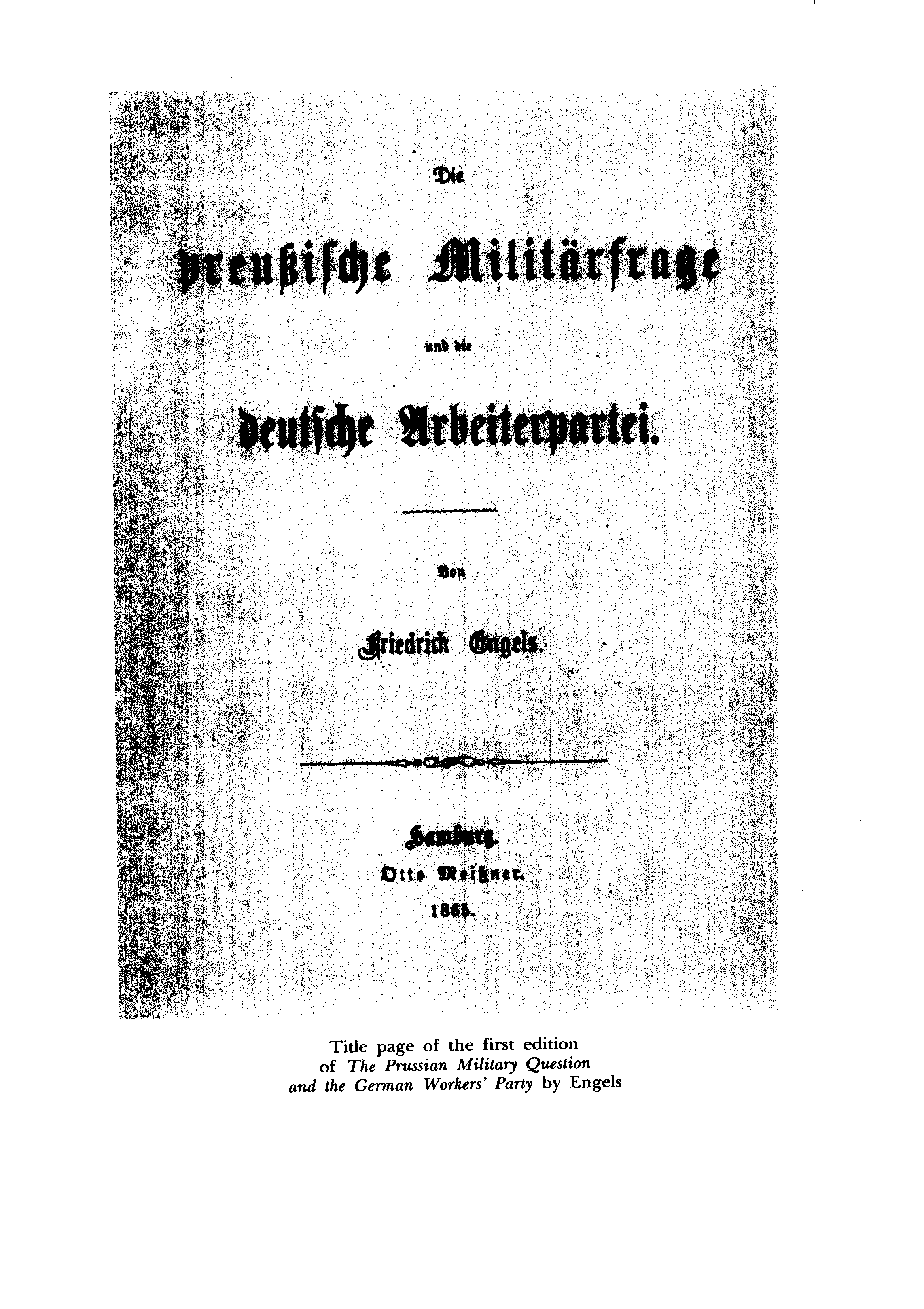
Title page of the first edition of The Prussian Military Question and the German Workers' Party by Engels
Until now the debate on the military question has merely been conducted between the government and the feudal party on the one hand, and the liberal and radical bourgeoisie on the other. Now, as the crisis approaches, it is time for the workers' party to make its position known too.
In attempting a critique of the military situation in question, we can only proceed from the actual condition facing us. As long as present conditions persist in Germany and Europe we cannot expect the Prussian government to act with any other interests in mind than those of Prussia herself. No more can we seriously expect the bourgeois opposition to proceed from any other standpoint than that of its own bourgeois interests.
The workers' party, which in all questions at issue between reaction and bourgeoisie stands outside the actual conflict, enjoys the advantage of being able to treat such questions quite cold-bloodedly and impartially. It alone can treat them scientifically, historically, as though they were already in the past, anatomi-cally, as though they were already corpses.
I
After the attempts at mobilisation in 1850 and 1859[29] there can be but one verdict on the condition of the Prussian army under the old system. Since 1815 the absolute monarchy had been bound by a public promise: not to raise new taxes, nor to float loans without obtaining prior approval from the future representative assembly of the country. It was impossible to break this promise; no loan had the smallest chance of success without such approval. The general system of taxation was however so organised that the increase in yield quite failed to keep pace with the growth of the country's wealth. Absolutism was poor, poor indeed, and the extraordinary expenditure consequent upon the storms of 1830[30]
was enough to oblige it to practise the utmost economy. Hence the introduction of two-year military service, and hence a system of economy in all branches of military administration which reduced the equipment to be held in readiness for mobilisation to the very lowest level, with regard both to quantity and quality. Despite this, Prussia's position as a great power was to be maintained; to this end the first field army needed to be as strong as possible at the outbreak of a war and therefore also included the first levy of the Landwehr.[31] The necessity for mobilisation at the very first threat of war was thereby ensured and with it the collapse of the whole edifice. This duly occurred in 1850, resulting in a complete and utter fiasco for Prussia.
1
hold matériel in such a state of readiness as would within 14 days see the called-up reserves and after 14 days the whole of the first levy of the Landwehr fully equipped for battle. It should not be forgotten that while the soldiers of the line represented the recruitment of 3 years at most, the reserve and the first levy together represented 9 years' recruitment, and that for every 3 soldiers of the line in battle order therefore, at least 7 called-up men had to be equipped in 4 weeks. Then came the Italian war of 1859 and with it another general mobilisation. On this occasion too a goodly number of material shortcomings were still evident, but they paled into insignificance beside the adverse effects the system had on morale, which were only uncovered now that the state of mobilisation was prolonged. Undeniably the Landwehr had been neglected; its battalion-cadres for the most part simply did not exist and had first to be built up; of the existing officers many were unfit for service in the field. But even if all this had not been so, the fact still remained that the officers could not be other than quite estranged from their men, particularly regarding their military ability, and that this military ability was in most cases insufficient for battalions with such officers to be sent with confidence against seasoned troops. If the Landwehr officers gave an excellent account of themselves in the Danish war,[32] one should not forget that there is a great difference between a battalion which has [4]/[5] officers of the line and l/[5] Landwehr officers, and the reverse. But there was a further point that was decisive. As might have been realised beforehand, it became obvious at once that the Landwehr can certainly be used to fight, especially in defence of their own country, but under no circumstances can they be tfsed for a show of force. The Landwehr is a defensive institution which only lends itself to offensive warfare after repelling an invasion, as in 1814 and 1815. A levy consisting for the most part of married men aged from 26 to 32 cannot be stationed idly at the frontiers for months whilst letters from home come in daily telling of the hardship suffered by their wives and children; for the support given to the families of the men called out also proved to be woefully inadequate. Then there was the fact that the men did not know whom they had to fight, the French or the Austrians— neither of whom had at that time injured Prussia in any way. How could such troops, demoralised by months of inactivity, be expected to attack highly organised and battle-hardened armies? That a change was inevitable is obvious. In the prevailing circumstances, Prussia's first field army needed to be more strongly organised. How was this achieved?
The 36 regiments of conscripted infantry of the Landwehr were allowed to continue in existence for the time being, but were gradually transformed into new regiments of the line. Little by little the cavalry and artillery were also expanded until they achieved equivalent strength to the reinforced infantry; and finally the siege-artillery was detached from the field artillery, which was an improvement in any event, especially for Prussia. In a nutshell, the infantry was doubled and the cavalry and artillery expanded by about one half. In order to maintain this increased standing army, it was proposed to extend the period of service in the line from 5 years to 7 — 3 years with the colours (in the case of the infantry), 4 in the reserve; on the other hand, liability for the second levy of the Landwehr was to be cut by 4 years; and finally annual recruitment was to be increased from the previous figure of 40,000 to 63,000. In the meantime, the Landwehr was completely neglected.
The increased battalions, squadrons and batteries thus decreed corresponded almost exactly to the increase in Prussia's population from 10 million in 1815 to 18 million in 1861; since Prussia's wealth has meanwhile grown faster than her population, and since the other major European states have strengthened their armies to a much greater degree since 1815, such an increase in the number of cadres was undoubtedly not excessive. At the same time, of all the obligations borne by conscripts, the proposal added only to those of the youngest age-groups — the liability to serve in the reserve — but reduced liability for Landwehr-service for the oldest age-groups by twice as much and in fact almost totally did away with the second levy, the first levy more or less taking over the function the second formerly had.
On the other hand, the following objections could be made to the plan:
Universal conscription — incidentally the sole democratic institution existing in Prussia, albeit only on paper — marks such an enormous advance on all previous forms of military organisation that, having once existed, even if its implementation left much to be desired, it cannot again be permanently reversed. An army today must be based on one of the two clearly defined systems: either the recruitment of volunteers — which is antiquated and only possible in exceptional cases such as England — or universal conscription. All conscriptive systems and ballots[33] are after all no more than very imperfect forms of the latter. The basic idea behind the Prussian law of 1814 is that every citizen who is physically capable of bearing arms thereby has the obligation to do so personally in defence of his country, during his years of military fitness; this basic idea is far superior to the principle of purchasing substitutes which we find in every other country having a conscriptive system, and having existed for fifty years it will undoubtedly not succumb to the bourgeoisie's burning desire for the introduction of the "trade in human flesh", as the French call it.
However once we accept that the Prussian military system is founded on universal, compulsory service without substitution, the only way it can be further improved without its own spirit being breached is for its basic principle to be put increasingly into practice. Let us consider how things stand in that respect.
40,000 conscripts for 10 million inhabitants in 1815 makes 4 per thousand. 63,000 conscripts for 18 million inhabitants in 1861 makes 3V2 P e r thousand. This represents a deterioration, although it is an improvement compared with the position prior to 1859 when only 2[2]/(1) per thousand were conscripted. Merely to restore the 1815 percentage, 72,000 men would have to be conscripted. (We shall see that every year approximately this number of men or more do indeed enter the army.) But is the fighting potential of the Prussian people exhausted if 4 per 1,000 of the population are recruited each year?
The Darmstadt Allgemeine Militär-Zeitung has time and again shown from the statistics of the middle states that in Germany a full half of the young men presenting themselves for recruitment are fit for service. Now according to the Zeitschrift des
preussischen statistischen Bureaus (March 1864) the number of young men registering in 1861 was 227,005.(2) This would make 113,500 recruits fit for service each year. Of these we will discount 6,500 as not available or morally incapable, which still leaves us with 107,000. Why do only 63,000 of these, or at most 72,000-75,000 actually serve?
In the 1863 session, the Minister for War, von Roon, presented[5]
the following analysis of the 1861 levy to the Military Commission of the Assembly:
Total population (1858 census) 17,758,823 Twenty-year-olds liable for military service class of 1861 217,438 Men liable for military service carried over
from previous years, pending final decision 348,364 565,802 Of these:
1. Untraced 55,770 2. Moved to other districts and required to register for service there 82,216 3. Failed to register without being
excused 10,960 4. Enlisted as 3-year volunteers 5,025 5. Endued to serve as 1-year volunteers 14,811 6. Theologians, deferred or exempted 1,638 7. Liable for naval service 299 8. Struck off as morally unfit 596 9. Rejected by the Regional Commission as manifestedly unfit 2,489 10. Rejected by the Regional Commission as permanently unfit 15,238
11. Transferred to the Supplementary Reserve [34]: a) Below 5 foot after three musters 8,998 b) Below 5 foot IV4 inches after
three musters 9,553 c) Temporarily unfit after three
musters 46,761 d) By reason of domestic circumstances after three musters 4,213 e) Available after five musters 291 69,816 12. Allocated to the Service Corps, not including those recruited for the Service Corps 6,774 13. Deferred for one year:
a) Temporarily unfit 219,136 b) By reason of domestic circumstances 10,013 c) By reason of loss of civil rights
and under investigation 1,087 230,236 495,868 Remainder available for recruitment 69,934 Actually recruited 59,459 Remainder still available 10,475 However imperfect these statistics are, however much they confuse the whole issue under every heading from 1 to 13 by amalgamating the men from the class of 1861 and those from the two previous classes who are still available, they do nevertheless contain some very valuable admissions.
59,459 men were conscripted. 5,025 enlisted as 3-year volunteers. 14,811 were entitled to serve for one year; as it is common knowledge that the authorities are not so punctilious about the fitness of the one-year volunteers because they cost nothing, we may assume that at least half of them, that is, 7,400, did actually enlist. That is a very low estimate; the class of men who qualify for one-year service in any case consists chiefly of people fit for service; those who are unfit at the outset do not even go to the trouble of qualifying. But let us assume 7,400. By this count a total of 71,884 men entered the army in 1861.
Let us take this further. 1,638 men were deferred or exempted as theologians. Why theologians should be too grand to serve is incomprehensible. On the contrary, a year's army service, living in the open air, and contact with the outside world can only benefit them. So without more ado we will recruit them; Vs of the total number for the current year, with V[4] unfit, still leaves 139 men to be included.
18,551 men were rejected for not being of sufficient stature. Note: not rejected for service altogether but "passed to the reserve". Therefore, in the event of war they should serve after all. They are only excused parade-service in peace-time, being insufficiently imposing for that. It is thus admitted that these short men are quite good enough for service, and it is intended to use them even in emergencies. The fact that these short men can be quite good soldiers is demonstrated by the French army, which includes men down to 4 feet 8 inches. We therefore have no hesitation in counting them in with the military resources of the country. The above figure merely includes those who were finally rejected after three musters as being too short; it is thus a number that recurs each year. We will discount half of them as unfit for other reasons and we are then left with 9,275 little fellows whom a capable officer would no doubt soon knock into splendid soldiers.
Then we find 6,774 allocated to the Service Corps, not including the men recruited for the Service Corps. The Service Corps is however also part of the army, and there is no evident reason why these men should not spend the short six-month period of service with the Service Corps, which would be of benefit both to them and to the Service Corps.
We thus have:
Men actually serving 71,884 Theologians 139 Men who are fit but not tall enough 9,275 Men allocated to the Service Corps 6,774
Total 88,072 men, who on the admission of von Roon's own statistics could join the army each year if universal conscription were seriously implemented.
Now let us examine those who are unfit.
Deferred for one year as temporarily
unfit
219,136 men
Transferred to the reserve after three
musters as ditto 46,761 Struck off as permanently unfit only 17,727 "
Total 283,624 men,
so that the men permanently unfit on account of real physical defects do not even constitute 7% of all the group rejected as unfit and not even 4% of the total number of men appearing annually before the Recruitment Commissions. Almost 17% of the temporarily unfit are transferred each year to the reserve after three musters. These men are thus 23 years old, men at an age when the body's constitution is already beginning to settle down. We are surely not being too optimistic if we assume that of these a third will be quite fit for service by the time they are 25; that makes 15,587 men. The least that may be demanded of these men is that for two years they should serve in the infantry for three months each year, in order to receive at least basic training. This would be the equivalent of an addition of 3,897 men to the peace-time army.
However the whole way in which recruits are medically examined in Prussia has taken a peculiar turn. There were always more recruits than could be enlisted, and yet no one wanted to abandon the appearance of universal conscription. What could have been more convenient than to select the desired number of the best men and to declare the rest unfit on some pretext or other? In these circumstances, which, it should be noted, have obtained in Prussia since 1815 and still obtain today, the concept of unfitness has been extended there quite beyond normal usage, a fact that can best be demonstrated by comparison with the middle states. There, where there is the possibility of buying out and selection by ballot, there was no reason to declare more people unfit than really were unfit. Conditions are the same as in Prussia; in some states, e.g., Saxony, even worse because the percentage of the industrial population is higher there. Now as we have said, it has been demonstrated time and time again in the Allgemeine Militär-Zeitung that in the middle states fully one half of the men registering for service are fit, and that must also be so in Prussia. As soon as a war breaks out in earnest, the notion of fitness will undergo drastic revision in Prussia, and the authorities will then discover, too late, to their cost, how many fit men have been allowed to slip away.
Now comes the most wonderful part of all. Of the 565,802 men liable for service about whom a decision has to be reached, we find:
Untraced 55,770 men Moved to other districts or required
to register for service there 82,216 Failed to register without being excused 10,960 "
Total 148,946 men.
So for all Prussia's much vaunted system of controls — and anyone who has ever been liable for the army in Prussia knows what that means — a full 27% of men liable for service disappear each year. How is that possible? And what has become of the 82,216 men who are struck off the list because they have "moved to other districts or required to register for service there"? Does one only need to move from Berlin to Potsdam these days in order to escape liability for service? We will assume that here — after all, even Homer nods off at times — the officials have simply blundered in their statistics, that is, that these 82,216 figure twice in the grand total of 565,802: firstly in their native district and secondly in the district to which they have migrated. This point really ought to be clarified — the Military Commission of the Chamber has the best opportunity of doing so — since if the number of men really liable for military service is reduced to 483,586 this would have a significant effect on all the percentages. Let us meanwhile assume that such is the case: there still remain 66,730 men who disappear into thin air every year and neither the Prussian system of controls nor the police manages to get them into uniform. This represents nearly 14% of those liable for service. The implication of this is that all the restrictions on freedom of movement which are imposed in Prussia on the pretext of controlling those liable for military service, are totally superfluous. It is well known that real emigration from Prussia is very small and bears no comparison with the number of missing recruits. Nor do these men, numbering almost 67,000, all emigrate. The majority of them either never leave the country or go abroad only for a short time. Indeed all the measures designed to prevent evasion of military duty are quite ineffective and at best an incitement to emigration. The overwhelming majority of young people cannot emigrate in any case. All that is needed is to insist strictly and without mercy that men who have avoided recruitment should make up the time afterwards, and then the whole rigmarole of harassment and paperwork would be unnecessary and there would be more recruits than previously.
In order to be quite certain of our position, we shall by the way only take as proven those facts which emerge from Herr von Roon's own statistics: in other words that not counting the one-year volunteers, 85,000 young men can be recruited each year. Now the strength of the present peace-time army is approximately 210,000 men. If the period of service is two years, 85,000 men per year together will make 170,000 men, to which must be added officers, non-commissioned officers and re-enlisted soldiers, some 25,000-35,000 men, making a total of 195,000 to 205,000 men, or 202,000 to 212,000 men including the one-year volunteers. With two-year service for the infantry and foot-artillery (we shall deal with the cavalry later), even taking the government's own figures, the total strength of the reorganised army could be brought up to its full peace-time level. If universal conscription were really implemented, with two-year service there would very probably be 30,000 more men; it would therefore be possible to release some of the men after just 1 or V/[2] years, to avoid exceeding the figure of 200,000 to 210,000 men. As a reward for keenness, such early release would be of more use to the army as a whole than an extra six months' service.
War-time strength would then be as follows: The reorganisation plan envisages 4 years' annual intake of 63,000 men, which makes 252,000 reservists. 3 years' annual intake of 85,000 men produce 255,000 reservists. This is surely just as good as the reorganisation plan. (As it is here only a question of the relative numbers, it makes no difference that we are here completely ignoring the reduction in the year-groups serving in the reserve.)
It is in this that the weakness of the reorganisation plan resides.
Whilst in appearance reverting to the original concept of universal conscription, which cannot of course function without a large army-reserve in the form of a Landwehr, it in fact executes an about-turn in the direction of the Franco-Austrian cadre-system,[35]
and thereby introduces an element of uncertainty into the Prussian military system which cannot fail to have the direct consequences. The two systems cannot be mixed, one cannot have the advantages of both systems at the same time. It is undeniable and has never been disputed that a cadre-system with a long period of service and liability for immediate mobilisation confers great advantages at the outbreak of war. The men know each other better; even those on leave, and leave is mostly only granted for short periods at a time, regard themselves as soldiers throughout their leave and are constantly ready to be called to the colours at a moment's notice, which the Prussian reservists are certainly not; consequently battalions are necessarily a great deal steadier when they come under fire for the first time. Against this it may be argued that, if one considers this system best, one might just as well adopt the English system of ten years' service with the colours; that the French undoubtedly gained far more from their Algerian campaigns and the wars in the Crimea and Italy[36] than from long service; and finally that by this system only some of the men fit to bear arms can be trained, in other words by no means all of the nation's potential is exploited. Furthermore, experience shows that the German soldier readily accustoms himself to being under fire, and three hard-fought and at least partially successful engagements do as much for an otherwise good battalion as a whole year of extra service. For a state such as Prussia the cadre-system is an impossibility. With the cadre-system, Prussia could attain an army of 300,000 to 400,000 men at the very most with a peace-time strength of 200,000 men. But if she is to maintain herself as a Great Power, she requires as many as this simply to move the first field army out, in other words, for any serious war, she needs 500,000 to 600,000 men, including fortress garrisons, reinforcements, etc. If the 18 million Prussians are to put forward in time of war an army approaching the numbers of the 35 million French, 34 million Austrians and 60 million Russians, this can only be done by universal conscription, a short but intensive period of service and a comparatively long period of liability for the Landwehr. With this system inevitably some of the immediate striking-power and even battle-worthiness of the troops at the outbreak of war will have to be sacrificed; the state and its policies will become neutral and defensive in character; but we ought also to remember that the attacking élan of the cadre-system led from Jena to Tilsit and the defensive modesty of the Landwehr system with universal conscription led from the Katzbach to Paris.[37] This therefore means: Either a conscriptive system involving substitution with 7-8 year service, of which about half would be with the colours, and then no subsequent liability for
Landwehr service; or alternatively universal conscription with 5 or at the most 6 year service, of which two would be with the colours, and then liability for Landwehr service, as in Prussia or Switzerland.[38] But for the mass of the people first to have the burden of a conscriptive system and then additionally that of the Landwehr system is more than any European nation can take, not even the Turks, who in their military barbarism are still prepared to endure the most. A large number of trained men with short service and long-term liability for recall, or a small number with long service and a short period of liability for recall — that is the question; but the choice has to be either one or the other.
William Napier, who naturally declares the British soldier to be the best in the world, says in his History of the Peninsular War that after three years' service the British infantryman is fully trained in every respect.(3) Now it should be realised that the elements constituting the British army at the beginning of this century were the lowest from which an army can possibly be formed. The British army today comprises vastly superior elements, but even these are still infinitely worse, both morally and intellectually, than the elements that make up the Prussian army. And is it suggested that what those British officers achieved in three years with such riff-raff should not be attainable in two years in Prussia, where the raw material for recruitment is so exceptionally receptive to education and in some cases already so highly educated, and is at the outset morally sound?
It is true that soldiers today have more to learn. But that has never been seriously used as an argument against two-year service. The argument always used has been the cultivation of true military spirit, which is said only to emerge in the third year. If. these gentlemen were to be perfectly honest and if we discount the increased battalion effectiveness which was conceded above, this is far more of a political issue than a military one. True military spirit is intended to prove itself in face of the enemy within[39]
rather than abroad. It has never been our experience that the individual Prussian soldier learnt anything in his third year except boredom and how to extort schnaps from the recruits and tell bad jokes about his superiors. If the majority of our officers had served as privates or non-commissioned officers even for a year, this could not possibly have escaped their notice.—Experience shows that "true military spirit", insofar as it is a political quality, very rapidly goes to the dogs, never to be revived. Military virtues remain, even after two years' service.
Two years' service is thus perfectly adequate to train our soldiers for infantry duty. Since the field-artillery was detached from the siege-artillery, the same is true of the foot-artillery; any individual difficulties that may emerge here can be overcome either by further division of labour, or else by simplification of the field-artillery's equipment, which is desirable in any case. The enrolment of a larger number of re-enlisted soldiers would similarly raise no problems, but it is particularly in the Prussian army that this category of men is most unwelcome if they are not fitted to be non-commissioned officers — what a condemnation of long service! Only in the siege-artillery, with their great variety of equipment, and in the engineers, with their multiplicity of trades, which of course can never be kept entirely apart, will intelligent re-enlisted soldiers be valuable and yet a rarity. The mounted artillery will require the same length of service as the cavalry.
With regard to the cavalry, men born into the saddle need only a short period of service, whilst for those trained to it long service is indispensable. As we have few men born into the saddle, we undoubtedly need the four-year period of service envisaged by the reorganisation plan. The only form of warfare proper to mounted troops is the massed attack with drawn swords, for the execution of which extreme courage and complete confidence of the men in each other are necessary. The men must therefore know that they can rely on each other and on their commanders. This requires long service. But cavalry is useless if the rider has no confidence in his horse; the man must of course be able to ride, and long service is also necessary for him to be able to ensure control over his horse — i.e., more or less any horse which is assigned to him. In this branch of the service, re-enlisted soldiers are h'ighly desirable, and the more like real mercenaries they are, the better, provided they enjoy the trade. We shall be criticised by members of the opposition on the grounds that this would mean a cavalry made up exclusively of mercenaries who would lend themselves to any coup d'état. We would reply: that may well be. But in present conditions the cavalry will always be reactionary (think of the Baden dragoons in 1849[40]), just as the artillery will always be liberal. That is in the nature of things. A few re-enlisted soldiers more or less will make no difference. And cavalry is useless on the barricades anyway; and it is the barricades in the big cities, and especially the attitude of the infantry and artillery towards them, which nowadays decide the outcome of any coup d'état.
However, besides increasing the number of re-enlisted soldiers, there are also other means of strengthening the striking power and inner cohesion of a short-service army, such as for instance training camps, which the Minister for War, von Roon, himself described as a way of compensating for the reduction in the length of service. Then there is also the rational organisation of training, with regard to which a great deal remains to be done in Prussia. The whole superstitious notion that if you have short service it has to be compensated for by exaggerated precision on the parade-ground, "clockwork" drilling and ridiculously high leg-lift— "swinging from the hip" to kick nature in the teeth — this whole superstitious notion is based on nothing but exaggeration. The Prussian army has repeated this to itself so often that it has finally become an article of faith. What is gained by men thumping their rifles so violently against their shoulders when doing rifle drill that they almost fall over and a most unmilitary shudder, such as is seen in no other army, passes along the whole rank? Finally, improved physical education of youth must be regarded as counter-balancing the reduction in service — and in the most fundamental way. But it will then also be necessary to make quite certain that something really is done. It is true that in every village school parallel and horizontal bars have been set up, but our poor schoolmasters have little idea of what to do with them. At least one retired non-commissioned officer qualified as a gymnastics teacher should be placed in every district and given charge of physical education; care should be taken to see that young people at school are taught over a period of time to march in formation, to move as a platoon and as a company, and to understand the appropriate commands. In 6-8 years this will pay abundant dividends — there will be more recruits and they will be stronger.
In this critique of the reorganisation plan we have, as we said, confined ourselves solely to the military and political facts of the situation as it is. Among them is the assumption that in present circumstances the legal stipulation of two years' service for infantry and foot-artillery was the maximum reduction in the term of service feasible. We are even of the opinion that a state such as Prussia would commit a blunder of the greatest magnitude— regardless of which party was in power — if it further reduced the normal term of service at the present moment. As long as we have the French army on the one side, the Russian on the other and the possibility of a combined attack by both at the same time, we need troops who will not have to learn the fundamentals of the art of war when they first face the enemy. We therefore totally discount the fantastic notion of a militia army with as it were no term of service at all; for a country of 18 million inhabitants and very exposed frontiers, such an idea is impossible today, and even if circumstances were different, it would not be possible in this form.
Taking all this into account: could an Assembly having Prussia's interests at heart accept the basic features of the reorganisation plan? Our opinion, which is based on military and political factors, is that to strengthen the cadres in the manner in which this was done, to increase the peace-time army to 180,000-200,000 men, to relegate the first levy of the Landwehr to the main army reserve or the second field army-cum-fortress garrisons, was acceptable on condition that universal conscription was strictly implemented, that a two-year term of service with the colours, three with the reserve and up to the 36th birthday with the Landwehr, was fixed by law and, finally, that the cadres of the first levy of the Landwehr were re-established. Were these conditions obtainable? Only few people who have followed the debates will deny that this was possible in the "New Era"[41] and perhaps even after that.
So what attitude did the bourgeois opposition adopt?
Endnotes
[33] Diet and began to carry out the military reform without the sanction of the Diet. The conflict was settled only in 1866 when, after Prussia's victory over Austria, the Prussian bourgeoisie capitulated to Bismarck. At first Engels agreed to write an article on the Prussian military reform for Der Social-Demokrat, but the newspaper's kowtowing before the Bismarck Government made him give up his intention. After consulting Marx, he decided to have his work published as a separate pamphlet. He began writing it late in January 1865, and finished most of it before February 9. Then he sent the manuscript to Marx for review. After making a number of improvements in it on his friend's recommendation, Engels sent the manuscript to the Hamburg publisher Meissner on February 12 and informed Marx about this on the following day (see present edition, Vol. 42). The pamphlet was published in Hamburg at the end of February 1865 and caused widespread comment in Germany. Its publication was announced in many workers' and democratic newspapers. Wilhelm Liebknecht arranged for it to be discussed in several workers' associations in Berlin. Extracts from the pamphlet appeared in the Social-Democratic press at various times: in the Banner Zeitung, No. 57, March 8, 1865, Der Social-Demokrat, No. 71, March 25, 1866, the Sozialdemokratische Monatsschrift, Nos. 10-11, November 30, 1890 and the Berliner Volks-Tribüne, No. 1, March 1, 1891. The mobilisation of the Prussian army in 1850 was caused by the exacerbation of the conflict between Austria and Prussia for supremacy in Germany. Prussia was forced to surrender by the weakness of its army as well as the vigorous opposition of Russia, which supported Austria. The mobilisation of 1859, caused by the Italian War fought by France and Piedmont against Austria, likewise revealed serious defects in the Prussian military system. This refers to the July 1830 bourgeois revolution in France and the revolts that followed it in various parts of Germany (Saxony, Brunswick, Hesse, Bavaria and Hanover). The Prussian land forces, formed during the struggle against Napoleon on the basis of the 1814-15 legislation, consisted of the regular army (troops of the line), its reserve (training and reserve battalions) and the Landwehr of the first and the second levy. The Landwehr had been formed in Prussia back in 1813 as a people's militia and included members of the older age groups liable to military service who had done three years active service and not less than two years in the reserve and were called up in case of special emergencies. In wartime the Landwehr of the first levy was usually included in the field army, while that of the second levy served for the reinforcement of the garrison troops. This refers to the war of Prussia and Austria against Denmark in 1864 over Schleswig and Holstein, duchies subject to Denmark but inhabited mainly by Germans. Austria joined the war in the fear that if its rival, Prussia, fought on its own, it would enjoy all the fruits of victory. Denmark was defeated. Schleswig and Holstein were declared joint possessions of Austria and Prussia, which aggravated the conflict between the two countries. After its defeat in the war with Prussia in 1866, Austria had to renounce its rights to the duchies in Prussia's favour. The conscription system was based on general liability for military service, but allowed many deviations, mainly in the form of money redemption and substitution. The substitution system was widely practised in France where the members of the propertied classes had the privilege of buying themselves out of military service by hiring substitutes. Under the legislation of 1853, substitutes were selected in the main by government bodies and the payment for them went towards a special "army donation" fund. The substitution system was abolished in France in 1872. Liability for military service determined by ballot was practised in the nineteenth century in those West European countries where the number of persons liable for service exceeded the demand. The ballot decided who was to serve, the rest were recruited either as militiamen or, in certain countries, for short-term military training.
[34] This reserve consisted of men whose conscription was deferred by reason of minor physical defects or special domestic circumstances. It was used for the reinforcement of the army during wartime.
[35] The cadre-system of the 1860s was characterised by the Franco-Austrian predominance of the regular army, whose personnel remained constant for a long time, by a lengthy period of military service and by conscription, in contrast to the Prussian military system based, under the legislation of 1814, on universal liability for military service and a comparatively short period of service.
[36] A reference to the colonial war of conquest in Algeria, begun by France in 1830 and fought for forty years, and to the Crimean war (1853-56), in which Russia confronted the allied forces of France, Britain, Turkey and Piedmont (Sardinia). For the Italian War of 1859, see Note 29.
[37] At the Battle of Jena (Thuringia) on October 14, 1806 French troops under Napoleon routed part of the Prussian army. On the same day, Marshal Davout defeated the main Prussian forces at Auerstädt. The defeat of Prussia, a member of the fourth anti-French coalition (Britain, Russia, Prussia and Sweden) in these two battles (often referred to as the Battle of Jena), led to the occupation of the greater part of Prussia by the French. Hostilities were ended by the Treaty of Tilsit on July 9, 1807, on terms which were harsh and humiliating for Prussia. On the River Katzbach (Silesia) the Silesian army under Blücher, which consisted of the Prussian and Russian troops, defeated the French troops under Marshal Macdonald on August 26, 1813 during the war of the sixth coalition of the European states (Russia, Austria, Prussia, Britain, Sweden, Spain, etc.). This victory contributed to the Allies' successes in the struggle against Napoleon and led to the expulsion of the French army from Germany. At the beginning of 1814, military operations were conducted on French territory, and in March the Allied forces entered Paris.
[38] The Swiss Landwehr consisted of men liable for military service who had completed their term of service in the country's irregular troops periodically called up for training. In Switzerland, as in Prussia, the Landwehr served to reinforce the army during the war and was mobilised at the threat of war.
[39] The original here has "Düppel im Innern" (enemy within), an expression first used with this meaning in a political survey published in the Bismarckian Norddeutsche Allgemeine Zeitung on September 30, 1864 and widely current later. Düppel (Danish: Dybböl)—Danish fortification in Schleswig which the Prussians captured by storm on April 18, 1864 during the Austro-Prussian war against Denmark.
[40] i0 In 1849, during the uprisings in South-Western Germany in support of the Imperial Constitution drafted by the Frankfurt National Assembly but rejected by German sovereigns, the Baden troops sided with the insurgents and made up the nucleus of the Baden-Palatinate revolutionary army. The Baden cavalry regiments, however, were the least reliable. Thus, in the battle with the Prussians at Waghäusel on June 21, 1849 the insurgents took to flight owing to the treachery of an officer in command of several Baden dragoon squadrons.
[41] The reference is to the "liberal" course announced by Prince William of Prussia (King of Prussia from 1861) when he became regent in October 1858. He made the Manteuffel Ministry resign and called the moderate liberals to power. The bourgeois press dubbed this the policy of the "New Era". It was, in fact, solely intended to strengthen the position of the Prussian monarchy and the Junkers. This soon became clear to the representatives of the liberal opposition whose hopes had been deceived and who refused to approve the government project of a military reform. The constitutional conflict that ensued and Bismarck's advance to power in September 1862 put an end to the "New Era",
[4] Blue Books—a series of British parliamentary and foreign policy documents published in blue cover since the seventeenth century.
[5] The Civil War in America broke out in April 1861. The Southern slaveholders rose against the Union and formed the Confederacy of the Southern States. The war was caused mainly by the conflict between the two social systems: the capitalist system of wage labour established in the North and the slave system dominant in the South. The Civil War, which had the nature of a bourgeois-democratic revolution, passed two stages in its development: the period of a constitutional war for maintaining the Union and the period of a revolutionary war for the abolition of slavery. The decisive role in the defeat of the Southern slaveholders and the victory of the North in April 1865 was played by the workers and farmers. Marx analysed the causes and the nature of war in America in his articles published in the Vienna newspaper Die Presse (see present edition, Vol. 19). The discontinuance of cotton imports from America as a result of the blockade of the Southern States by the Northern fleet caused a crisis in the cotton industry of several European countries. In England, for two or three years beginning in 1862, over 75 per cent of spinners and weavers in Lancashire, Cheshire and other counties were fully or partly unemployed. Despite privation and distress, the European proletariat gave all possible support to the American fighters against slavery.
[2] This presumably refers to the articles "The Trade and Navigation Returns" and "Pauperism.—July 1850 and 1849", published in The Economist, August 10, 1850.