FROM THE PREPARATORY MATERIALS
1) We have already seen that in order to understand ground rent correctly two things must be distinguished from [...](1)
1) Firstly, the portion paid to the landowner for improvements made to the land, i.e. for the capital invested in and merged with it. This is the [...] interest. Whether I have invested 1,000 thalers in a cotton-machine or in [...] canals on the land is immaterial to the source of the income [...] I derive from these 1,000 thalers. For that is and remains the interest on capital productively used.
2) Secondly, the form which the ground rent [assumes] as a money rent. Supposing a plot of land brings in 20 thalers rent annually. Suppose further that the land[owner sells] this plot of land, i.e. that he sells the annual ground rent of 20 thalers. How is the purchase price of the ground rent or the plot of land [fixed?...] The land only has value in so far as these 20 thalers [...] are taken into account.
The question thus is: How much capital must I pay the landowner [in order] to purchase an annual rent of 20 thalers? In other words the question is: how large a capital is required to yield 20 thalers
annually in our [...] social conditions? To answer this question I have to know the rate of interest in general and how much interest on average a capital of [...]
If the rate of interest is 5% this means that the 100 thalers I invest bring in 5 thalers interest. The question is:
If 100 thalers yield 5 thalers annually how large a capital must I have to produce 20 thalers annually? If 100 thalers bring in 5 thalers annually, then 400 thalers yield 20 thalers interest P a -
Thus, if the rate of interest stands at 5%, the landowner will sell a plot of land that brings in 20 thalers p.a. for 400 thalers. In 20 years the purchaser would have replaced his capital. 20x20 = 400.
Thus, the farmer pays 20 thalers rent p.a., but the [purchaser] who has bought the land for 400 thalers receives 20 thalers rent p.a. In his eyes the 20 thalers which the farmer pays him are nothing but interest paid to him on the 400 thalers which he has laid out as the purchase price of the land. In many regions the capital invested in land may yield a lower interest than the capital invested in other branches of industry. It is therefore possible that capital invested in land may only bring in 272%> while if employed in trade or industry, it [...] In that event, a plot of land yielding [20 thalers] rent p.a. would be [sold] for 800 thalers instead of 400. [The purchaser] will then need 40 years to recover his capital. If a farmer pays out [...] rent of 20 thalers p.a. for a morgen[3] of land, it may very easily be that the landlord who receives these 20 thalers only [...] 2V2 thalers.
[A high or] low level of ground rent bears no [relation to] the high or low interest which capital [...] on the purchase of the ground rent, i.e. of the land [...]
[...] furthermore, that the land has a price, that it can be sold because there is such a thing as ground rent and not the other way round, i.e. that there is such a thing as ground rent because a price is paid for the land.
[...] in general that the price of the land is [nothing] but capitalised ground rent. What is meant by capitalised ground rent} It means that I regard ground rent as the interest on the capital invested in the purchase of the land. The rent on a morgen of land may be 20 thalers; but for the man who buys the land the 20 thalers can never be more than the 5 or 3 or 2l/[2]%, i.e. the going
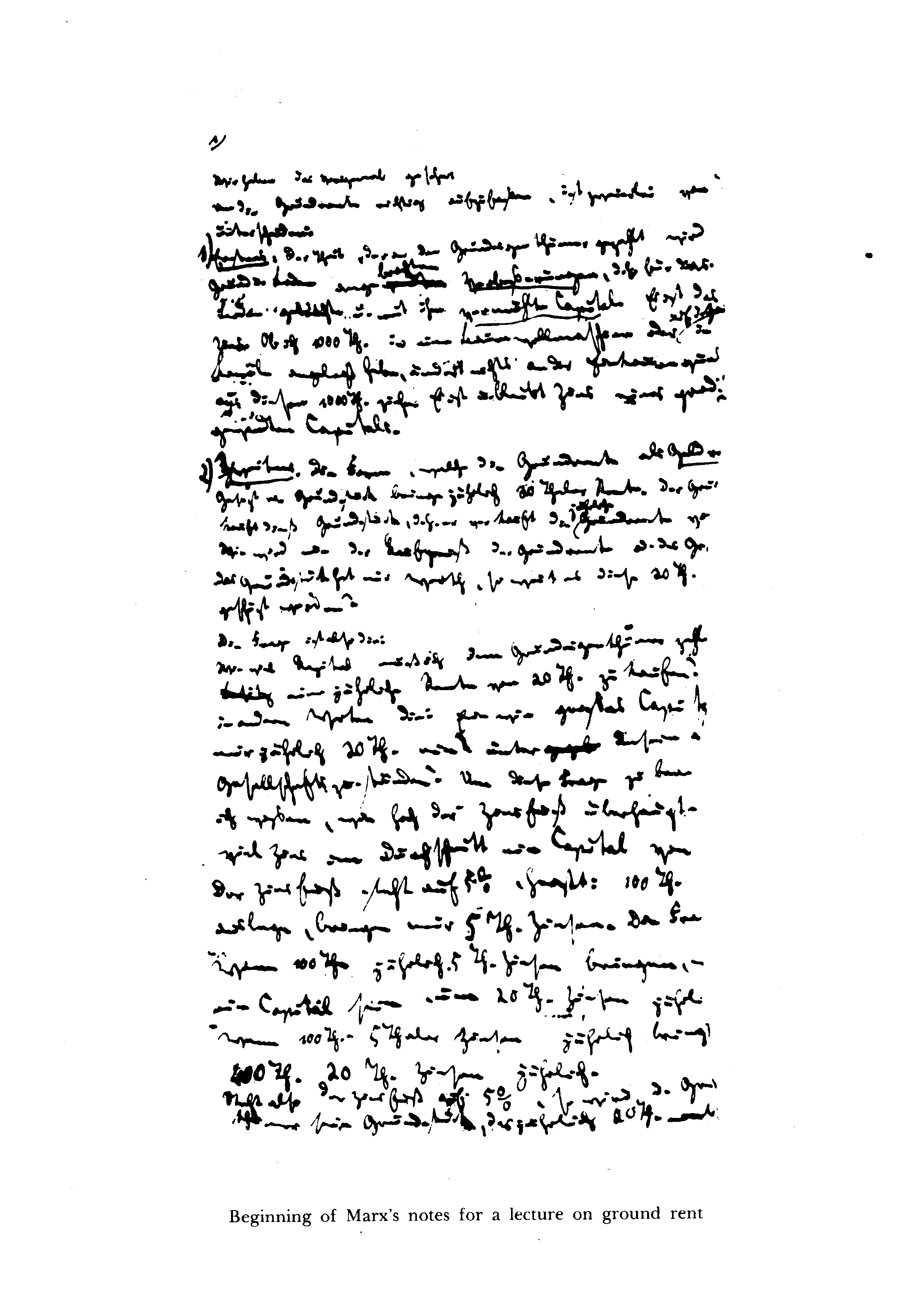
Beginning of Marx's notes for a lecture on ground rent
rate of interest on capital. If interest rates are 5%, I can recover my capital in 20 years. Thus, in order to capitalise the ground rent, i.e. to exchange it for capital, it must be multiplied by the number of years it takes, at the prevailing rate of interest, to replace the capital, to restore it to the lender.
c) The sale of land presupposes ground rent and hence does not explain it.
3) Thirdly. Ground rent is the annual sum paid to the landowner by the farmer or the manufacturer of the products of the earth. If a manufacturer, an industrial capitalist, is to invest his money in farming, it must bring him on average the same profits as any other industry. Otherwise no capitalist would cultivate the land. If the farmer, i.e. the manufacturer of farm produce, lays out a sum of 100 thalers annually to cultivate the land, to buy seed and manure, to make good the damage caused by the wear and tear to the instruments of labour or to replace them, to pay wages, etc., he will need to obtain 110 thalers from the sale of his produce, as interest and profit. Whatever the sale of his produce yields over and above 110 thalers goes to the landowner and constitutes the ground rent. Thus, if he obtains 120 thalers, the ground rent is equal to 10 thalers. Thus, ground rent is equal to the surplus of the market price of the produce of the land over its price of production. The price of production here includes the farmer's interest and profit.
Where does this surplus of the market price of the produce of the land over its price of production come from? What is it that enables the manufacturer of farm produce, apart from receiving interest and profit, paying wages and meeting the other costs of production, also to pay ground rent to the man who leases the land to him? How does it come about that the selling price of farm produce is sufficiently high to yield a rent in addition to the wages, interest and profit — something which is not the case in other branches of industry?
In the first place, it cannot be argued that this arises from the special productivity of agriculture or of the soil itself. Nor can it be said to stem from the fact that the land is limited in extent. To assert that agriculture is more productive than any other industry might mean nothing beyond the fact that in no other industry is it possible to extract more produce at the same cost. But, since the price of a product is governed basically by the cost of its production, this would imply that the price of farm produce should be lower than that of all the other products — a fact which cannot possibly help to explain the surplus of its market price over the price of production.
We come now to the question of the limited area of land.(2)
74. K. Marx. Biographical Notes on Wilhelm Wolff
1809, June 21. Born in Tarnau, Schweidnitz[3] District. 1813. Russians. 1834-38. 4V2 years in Silberberg?™ "Casemate Wolf[f]" wishes to see his dying father, even if accompanied by a gendarme. Refused.
1843-February 1846, in Breslau? 1846. Wolff flees because of press prosecution. Article on uprising of Silesian weavers.c
1846-48. Brussels. "Bureau de Correspondance".[331] Jailed in Brussels. (Arrested between February 26 and 28.)
1848, April to June, in Breslau. 1848, September, Cologne. Lupus presents himself [for trial].[332]
Warrant of arrest withdrawn.
October 22, 1848. Warrant of arrest issued by Hecker. Withdrawn March 8, 1849.
June 1848 to May 10, 1849, in Cologne. Thence to Frankfurt. May 26, 1849. Scene in German Parliament (Frankfurt).[333]
1849, with Lupus already in Switzerland, warrant of arrest issued in connection with Rump in Stuttgart.[334]
July 5, 1849, to Basle. Thence to Berne, interned. l[3]/[4] of year teacher in Zurich. March 31, 1851, written order of expulsion from Zurich. (September 10, 1850 in Zurich. Lupus protests against being assigned to Lucerne Canton in consequence of Federal Council decision on refugees.)
June 4, 1851-1853. Arrival(1) in London. Stays about 2 years there.
January 12, 1861. Prussian Amnesty Decree.[335] January 4, 1862, application to the Prussian government. No answer for 5 months. Another application on June 4, 1862. August 1, 1862 Schweidnitz Municipal Council requires him to name his last place of residence in Prussia.
September 5, 1862. Prussian government answers that amnesty implies resumption of investigation.[15]
APPENDICES
Endnotes
[2] This refers to the secession of the Southern slave states from the North American Union in late 1860 and early 1861. The armed rebellion of the secessionist States in April 1861 marked the beginning of the US Civil War (1861-65). In 1850 popular disturbances occurred in several southern provinces of China and developed into a large-scale peasant war. The rebels (called Taipings) established a state of their own embracing a considerable part of China's territory. Its leaders put forward a Utopian programme for the transformation of feudal China into a military-patriarchal state based on the egalitarian principle in production and consumption. The movement, which was also anti-colonial, was weakened by inner divisions and the rise of an aristocracy among the Taipings. The rebellion was suppressed in 1864, mainly as a result of British and French intervention.
[331] The Bureau de Correspondance, set up by the German democratic journalist Sebastian Seiler (later a member of the Communist League) in Brussels in 1845, gathered, translated and forwarded to German newspapers news items and articles from the British, French and Belgian press, giving them, as far as possible, a Social-Democratic tendency, a fact later noted by Engels in his article "Wilhelm Wolff" (present edition. Vol. 24). The Bureau maintained close links with the Brussels Communist Correspondence Committee established by Marx and Engels. In October 1847, when Seiler for unknown reasons withdrew from the Bureau, it was headed by Wolff and Louis Heilberg.
[332] Following the imposition of martial law in Cologne on September 26, 1848, publication of the Neue Rheinische Zeitung was suspended and a number of its editors (Engels, Wolff, Bürgers and others) were charged with sedition. To evade arrest Wolff went into hiding in Dürkheim, Palatinate, but soon secretly returned to Cologne and resumed his work with the newspaper.
[333] Addressing the Frankfurt National Assembly (see Note 258) on May 26, 1849, Wolff, a deputy for Silesia, demanded the outlawing of Archduke John (the Imperial Regent) and his Ministers as the worst traitors to the nation (see Engels's article "Wilhelm Wolff" in Vol. 24 of the present edition).
[334] See Note 258.
[4] 1 In July 1860 a pamphlet entitled MacMahon, King of the Irish appeared in France, where an anti-British campaign was in full swing. The pamphlet urged the Irish to end British rule and set up the French Marshal MacMahon, a descendant of Irish emigrants, as King of Ireland. Engels is probably referring to this pamphlet.
[335] S e e N o t e 257.
[15] 5 The Kansas-Nebraska Bill (An Act to Organise the Territories of Nebraska and Kansas), passed by the US Congress in May 1854 after a fierce debate, granted the white population of Kansas and Nebraska, which were being admitted to the Union, the right to permit or prohibit slavery within their boundaries. The Bill abolished the frontier line laid down by the Missouri Compromise between the free and slaveholding states (see Note 14) and allowed every state to introduce slavery, regardless of geographical position. The adoption of the Bill gave rise to an armed struggle in Kansas between the supporters and opponents of slavery (see Note 18).
[3] Construction of the Suez Canal was begun in 1859 and completed in 1869. The Fortress of Gae'ta, the last stronghold of Francis II, King of the Two Sicilies (the Kingdom of Naples), was seized by the Piedmont troops on February 12, 1861, as a result of which the Kingdom of the Two Sicilies became part of the united Kingdom of Italy.