Frederick Engels. Army
Frederick Engels. Army[109]
Army, the organized body of armed men which a state maintains for purposes of offensive or defensive war. Of the armies of ancient history the first of which we know any thing positive is that of Egypt. Its grand epoch of glory coincides with the reign of Rhamses II (Sesostris), and the paintings and inscriptions relating to his exploits on the numerous monuments of his reign, form the principal source of our knowledge on Egyptian military matters. The warrior caste of Egypt was divided into two classes, hermotybii and calasirii, the first 160,000, the other 250,000 strong, in their best times. It appears that these two classes were distinguished from each other merely by age or length of service, so that the calasirii, after a certain number of years, passed into the hermotybii or reserve. The whole army was settled in a sort of military colonies, an ample extent of land being set apart for each man as an equivalent for his services. These colonies were mostly situated in the lower part of the country, where attacks from the neighboring Asiatic states were to be anticipated; a few colonies only were established on the upper Nile, the Ethiopians not being very formidable opponents. The strength of the army lay in its infantry, and particularly in its archers. Beside these latter there were bodies of foot soldiers, variously armed and distributed into battalions,(1) according to their arms; spearmen, swordsmen, club-men, slingers, &c. The infantry was supported by numerous war-chariots, each manned by 2 men, one to drive and the other to use the bow. Cavalry does not figure on the monuments. One solitary drawing of a man on horseback is considered to belong to the Roman epoch, and it appears certain that the use of the horse for riding and of cavalry became known to the Egyptians through their Asiatic neighbors only. That at a later period they had a numerous cavalry, acting, like all cavalry in ancient times, on the wings of the infantry, is certain from the unanimity of the ancient historians on this point. The defensive armor of the Egyptians consisted of shields, helmets, and breastplates, or coats-of-mail, of various materials. Their mode of attacking a fortified position shows many of the means and artifices known to the Greeks and Romans. They had the testudo, or battering-ram, the vinea,[110] and scaling-ladder; that they, however, also knew the use of movable towers, and that they undermined walls, as Sir G. Wilkinson maintains,(2) is a mere supposition. From the time of Psammetichus a corps of Grecian mercenaries was maintained; they were also colonized in lower Egypt.
Assyria furnishes us with the earliest specimen of those Asiatic armies which, for above 1,000 years, struggled for the possession of the countries between the Mediterranean and the Indus. There, as in Egypt, the monuments are our principal source of information. The infantry appear armed similar to the Egyptian, though the bow seems less prominent, and the arms offensive and defensive are generally of better make and more tasteful appearance. There is, beside, more variety of armament, on account of the greater extent of the empire. Spear, bow, sword, and dagger, are the principal weapons. Assyrians in the army of Xerxes are also represented with iron-mounted clubs. The defensive armament consisted of a helmet (often very tastefully worked), a coat-of-mail of felt or leather, and a shield. The war-chariots still formed an important portion of the army; it had 2 occupants, and the driver had to shelter the bowman with his shield. Many of those who fight in chariots are represented in long coats-of-mail. Then there was the cavalry, which here we meet with for the first time. In the earliest sculptures the rider mounts the bare back of his horse; later on, a sort of pad is introduced, and in one sculpture a high saddle is depicted, similar to that now in use in the East. The cavalry can scarcely have been very different from that of the Persians and later eastern nations— light, irregular horse, attacking in disorderly swarms, easily repelled by a well-armed, solid infantry, but formidable to a disordered or beaten army. Accordingly, it figured in rank behind the charioteers, who appear to have formed the aristocratic arm of the service. In infantry tactics some progress toward regular movements and formations in ranks and files appears to have been made. The bowmen either fought in advance, where they were always covered, each of them, by a shield-bearer, or they formed the rear rank, the first and second ranks, armed with spears, stooping or kneeling to enable them to shoot. In sieges they certainly knew the use of movable towers and mining; and, from a passage in Ezekiel,(3) it would almost appear that they made some sort of mound or artificial hill to command the walls of the town — a rude beginning of the Roman agger.(4) Their movable and fixed towers, too, were elevated to the height of the besieged wall, and higher, so as to command it. The ram and vinea they used also; and, numerous as their armies were, they turned off whole arms of rivers into new beds in order to gain access to a weak front of the attacked place, or to use the dry bed of the river as a road into the fortress. The Babylonians seem to have had armies similar to those of the Assyrians, but special details are wanting. The Persian empire owed its greatness to its founders, the warlike nomads of the present Farsistan, a nation of horsemen, with whom cavalry took at once that predominant rank which it has since held in all eastern armies, up to the recent introduction of modern European drill. Darius Hystaspes established a standing army, in order to keep the conquered provinces in subjection, as well as to prevent the frequent revolts of the satraps, or civil governors. Every province thus had its garrison, under a separate commander; fortified towns, beside, were occupied by detachments. The provinces had to bear the expense of maintaining these troops. To this standing army also belonged the guards of the king, 10,000 chosen infantry (the Immortals, Athanatoi), resplendent with gold, followed on the march by long trains of carriages, with their harems and servants, and of camels with provisions, beside 1,000 halberdiers, 1,000 horse guards, and numerous war-chariots, some of them armed with scythes. For expeditions of magnitude this armament was considered insufficient, and a general levy from all the provinces of the empire took place. The mass of these various contingents formed a truly oriental army, composed of the most heterogeneous parts, varying among themselves in armament and mode of fighting, and accompanied by immense trains of baggage and innumerable camp-followers. It is to the presence of these latter that we must ascribe the enormous numbers of the Persian armies as estimated by the Greeks. The soldiers, according to their respective nationality, were armed with bows, javelins, spears, swords, clubs, daggers, slings, &c. The contingent of every province had its separate commander; they appear, from Herodotus, to have been divided by tens, hundreds, thousands, &c, with officers to command each decimal subdivision.(5) The commands of large corps or of the wings of the army were generally given to members of the royal family. Among the infantry the Persian and the other Aryan nations (Medes and Bactrians) formed the élite. They were armed with bows, spears of moderate size, and a short sword; the head was protected by a sort of turban, the body by a coat covered with iron scales; the shield was mostly of wicker-work. Yet this
élite, as well as the rest of the Persian infantry, was miserably beaten whenever it was opposed to even the smallest bodies of Greeks, and its unwieldy and disorderly crowds appear quite incapable of any but passive resistance against the incipient phalanx of Sparta and Athens; witness Marathon, Plataea, Mycale, and Thermopylae.[111] The war-chariots, which in the Persian army appear for the last time in history, might be useful on quite level ground against such a motley crowd as the Persian infantry themselves were, but against a solid mass of pikemen, such as the Greeks formed, or against light troops taking advantage of inequalities of ground, they were worse than useless. The least obstacle stopped them. In battle the horses got frightened, and, no longer under command, ran down their own infantry. As to the cavalry, the earlier periods of the empire give us little proof of its excellence. There were 10,000 horse on the plain of Marathon — a good cavalry country — yet they could not break the Athenian ranks. In later times it distinguished itself at the Granicus,[112]
where, formed in one line, it fell on the heads of the Macedonian columns as they emerged from the fords of the river, and upset them before they could deploy. It thus successfully opposed Alexander's advanced guard, under Ptolemy, for a long while, until the main body arrived and the light troops manoeuvred on its flanks, when, having no second line or reserve, it had to retire. But at this period the Persian army had been strengthened by the infusion of a Greek element, imported by the Greek mercenaries, who, soon after Xerxes, were taken into pay by the king; and the cavalry tactics displayed by Memnon on the Granicus are so thoroughly un-Asiatic that we may, in the absence of positive information, at once ascribe them to Greek influence.
The armies of Greece are the first of the detailed organization of which we have ample and certain information. With them the history of tactics, especially infantry tactics, may be said to begin. Without stopping to give an account of the warlike system of the heroic age of Greece, as described in Homer,(6) when cavalry was unknown, when the nobility and chiefs fought in war-chariots, or descended from them for a duel with an equally prominent enemy, and when the infantry appears to have been little better than that of the Asiatics, we at once pass to the military force of Athens in the time of her greatness. In Athens every free born man was liable to military service. The holders of certain public offices alone, and, in the earlier times, the fourth or poorest class of freemen, were exempt.[113] It was a militia system based upon slavery. Every youth on attaining his 18th year was obliged to do duty for 2 years, especially in watching the frontiers. During this time his military education was completed; afterward he remained liable to service up to his 60th year. In case of war the assembled citizens fixed the number of men to be called out; in extreme cases only the levées en masse (panstratia) were resorted to. The strategi, 10 of whom were annually elected by the people, had to levy these troops and to organize them, so that the men of each tribe, or phyle, formed a body under a separate phylarch. These officers, as well as the taxiarchs, or captains of companies, were equally elected by the people. The whole of this levy formed the heavy infantry (hoplitae) destined for the phalanx or deep line formation of spearmen, which originally formed the whole of the armed force, and subsequently, after the addition of light troops and cavalry, remained its mainstay — the corps which decided the battle. The phalanx was formed in various degrees of depth; we find mentioned phalanxes of 8, 12, 25 deep. The armature of the hoplitae consisted of a breastplate or corslet, helmet, oval target, spear, and short sword. The forte of the Athenian phalanx was attack; its charge was renowned for its furious impetus, especially after Miltiades, at Marathon, had introduced the quickening of the pace during the charge, so that they came down on the enemy with a run. On the defensive, the more solid and closer phalanx of Sparta was its superior. While at Marathon the whole force of the Athenians consisted of a heavy armed phalanx of 10,000 hoplitae, at Plataea they had, beside 8,000 hoplitae, an equal number of light infantry. The tremendous pressure of the Persian invasions necessitated an extension of the liability to service; the poorest class, that of the thetes, was enrolled. They were formed into light troops (gymnetae, psili); they had no defensive armor at all, or a target only, and were supplied with a spear and javelins. With the extension of the Athenian power, their light troops were reinforced by the contingents of their allies,[114] and even by mercenary troops. Acarnanians, iEtolians, and Cretans, celebrated as archers and slingers, were added. An intermediate class of troops, between them and the hoplitae, was formed, the peltastae, armed similar to the light infantry, but capable of occupying and maintaining a position. They were, however, of but little importance until after the Peloponnesian war,[115] when Iphicrates reorganized them. The light troops of the Athenians enjoyed a high reputation for intelligence and quickness both in resolution and in execution. On several occasions, probably in difficult ground, they even successfully opposed the Spartan phalanx. The Athenian cavalry was introduced at a time when the republic was already rich and powerful. The mountainous ground of Attica was unfavorable to this arm, but the neighborhood of Thessaly and Boeotia, countries rich in horses, and consequently the first to form cavalry, soon caused its introduction in the other states of Greece. The Athenian cavalry, first 300, then 600, and even 1,000 strong, was composed of the richest citizens, and formed a standing corps even in time of peace. They were a very effective body, extremely watchful, intelligent, and enterprising. Their position in battle, as well as that of the light troops, was generally on the wings of the phalanx. In later times, the Athenians also maintained a corps of 200 mercenary mounted archers (hippotox-otae). The Athenian soldier, up to the time of Pericles, received no pay. Afterward 2 oboli (beside 2 more for provisions, which the soldier had to find) were given, and sometimes even the hoplitae received as much as 2 drachms. Officers received double pay, cavalry soldiers three-fold, generals four-fold. The corps of heavy cavalry alone cost 40 talents ($40,000) per annum in time of peace, during war considerably more. The order of battle and mode of fighting were extremely simple; the phalanx formed the centre, the men locking their spears, and covering the whole front with their row of shields. They attacked the hostile phalanx in a parallel front. When the first onset was not sufficient to break the enemy's order, the struggle hand to hand with the sword decided the battle. In the mean time the light troops and cavalry either attacked the corresponding troops of the enemy, or attempted to operate on the flank and rear of the phalanx, and to take advantage of any disorder manifesting itself in it. In case of a victory they undertook the pursuit, in case of defeat they covered the retreat as much as possible. They were also used for reconnoitring expeditions and forays, they harassed the enemy on the march, especially when he had to pass a defile, and they tried to capture his convoys and stragglers. Thus the order of battle was extremely simple; the phalanx always operated as a whole; its subdivisions into smaller bodies had no tactical(7) significance; their commanders had no other task than to see that the order of the phalanx was not broken, or at least quickly restored. What the strength of Athenian armies was during the Persian wars, we have shown above by a few examples. At the beginning of the Peloponnesian war, the force mustered 13,000 hoplitae for field service, 16,000(8) (the youngest and the oldest soldiers) for garrison duty, 1,200 horsemen, and 1,600 archers. According to Boeckh's calculations the force sent against Syracuse numbered 38,560 men; reinforcements despatched afterward, 26,000 men; in all nearly 65,000 men.(9) After the complete ruin of this expedition,[116] indeed, Athens was as much exhausted as France after the Russian campaign of 1812.
Sparta was the military state, par excellence, of Greece. If the general gymnastic education of the Athenians developed the agility as much as the strength of the body, the Spartans directed their attention mostly to strength, endurance, and hardiness. They valued steadiness in the ranks, and military point of honor, more than intelligence. The Athenian was educated as if he was to fight among light troops, yet in war he was fitted into his fixed place in the heavy phalanx; the Spartan, on the contrary, was brought up for service in the phalanx, and nothing else. It is evident that as long as the phalanx decided the battle, the Spartan, in the long run, had the best of it. In Sparta, every freeman was enrolled in the army lists from his 20th to his 60th year. The ephori[117]
determined the number to be called out, which was generally chosen among the middle-aged men, from 30 to 40. As in Athens, the men belonging to the same tribe or locality were enrolled in the same body of troops. The organization of the army was based upon the confraternities (enomotiae) introduced by Lycurgus, 2 of which formed a pentecostys; 2 of these were united into a lochos, and 8, or 4 lochi, into a mora. This was the organization in Xenophon's time; in former periods it appears to have varied. The strength of a mora is variously stated at from 400 to 900 men, and their number at one time was said to be 600. These various bodies of free Spartans formed the phalanx; the hoplitae forming it were armed with a spear, a short sword, and a shield fastened round the neck. Later on, Cleomenes introduced the large Carian shield, fastened by a string on the left arm, and leaving both hands of the soldier free. The Spartans considered it disgraceful for their men to return, after a defeat, without their shields; the preservation of the shield proved the retreat to have been made in good order and a compact phalanx, while single fugitives, running for their lives, of course had to throw away the clumsy shield. The Spartan phalanx was generally 8 deep, but sometimes the depth was doubled by placing one wing behind the other. The men appear to have marched in step; some elementary evolutions were also in use, such as changing front to the rear by the half-turn of each man, advancing or retiring a wing by wheeling, &c, but they would seem to have been introduced at a later period only. In their best times, the Spartan phalanx, like that of Athens, knew the parallel front attack only. The ranks, on the march, were distant from each other 6 feet, in the charge 3 feet, and in a position receiving the charge, only 1 7[2] foot, from rank to rank. The army was commanded by one of the kings, who, with his suite (damosia), occupied a position in the centre of the phalanx. Afterward, the number of the free Spartans having considerably decreased, the strength of the phalanx was kept up by a selection from the subjected Periaeci.[118] The cavalry was never stronger than about 600 men, divided into troops (ulami) of 50 men. It merely covered the wings. There was, beside, a body of 300 mounted men, the élite of the Spartan youth, but they dismounted in battle, and formed a sort of body-guard of hoplitae around the king. Of light troops, there were the skiritae, inhabitants of the mountains near Arcadia, who generally covered the left wing; the hoplitae of the phalanx, beside, had Helot servants,[119] who were expected in battle to do duty as skirmishers; thus, the 5,000 hoplitae at Plataea brought 35,000 Helot light troops with them, but of the exploits of these latter we find nothing stated in history. The simple tactics of the Greeks underwent considerable changes after the Peloponnesian war. At the battle of Leuctra,[120]
Epaminondas had to oppose, with a small force of Thebans, the far more numerous, and hitherto invincible Spartan phalanx. The plain, parallel front attack, here, would have been equivalent to certain defeat, both wings being outflanked by the longer front of the enemy. Epaminondas, instead of advancing in line, formed his army into a deep column, and advanced against one wing of the Spartan phalanx, where the king(10) had taken his station. He succeeded in breaking through the Spartan line at this, the decisive point; he then wheeled his troops round, and moving on either hand, he himself outflanked the broken line, which could not form a new front without losing its tactical order. At the battle of M an tinea,[121] the Spartans formed their phalanx with a greater depth, but, nevertheless, the Theban column again broke through it. Agesilaus in Sparta, Timotheus, Iphicrates, Chabrias in Athens, also introduced changes in infantry tactics. Iphicrates improved the peltastae, a sort of light infantry, capable, however, in case of need, to fight in line. They were armed with a small round target, strong linen corslet, and long spear of wood. Chabrias made the first ranks of the phalanx, when on the defensive, kneel down to receive the enemy's charge. Full squares, and other columns, &c, were introduced, and accordingly deployments formed part of the elementary tactics. At the same time, greater attention was paid to light infantry of all kinds; several species of arms were borrowed from the barbarous and semi-barbarous neighbors of the Greeks, such as archers, mounted and on foot, slingers, &c. The majority of the soldiers of this period consisted of mercenaries. The wealthy citizens, instead of doing duty themselves, found it more convenient to pay for a substitute. The character of the phalanx, as the preeminently national portion of the army, in which the free citizens of the state only were admitted, thus suffered from this admixture of mercenaries, who had no right of citizenship. Toward the approach of the Macedonian epoch, Greece and her colonies were as much a mart for soldiers of fortune, and mercenaries, as Switzerland in the 18th and 19th centuries. The Egyptian kings had at an early time formed a corps of Greek troops. Afterward, the Persian king gave his army some steadiness by the admission of a body of Greek mercenaries. The chiefs of these bodies were regular condottieri, as much as those of Italy in the 16th century. During this period, warlike engines for throwing stones, darts, and incendiary projectiles, were introduced, especially by the Athenians. Pericles already used some similar machines at the siege of Samos.[122] Sieges were carried on by forming a line of contravallation, with ditch, or parapet, round the place, investing it, and by the attempt to place the war-engines in a commanding position near the walls. Mining was regularly made use of, to bring the walls down. At the assault, the column formed the synaspismus, the outer ranks holding their shields before them, and the inner ranks holding them over their heads, so as to form a roof (called by the Romans, testudo), against the projectiles of the enemy.
While Greek skill was thus mainly directed toward shaping the flexible material of the mercenary bands into all sorts of novel and artificial formations, and in adopting or inventing new species of light troops, to the detriment of the ancient Doric heavy phalanx, which at that time alone could decide battles, a monarchy grew up, which, adopting all real improvements, formed a body of heavy infantry of such colossal dimensions, that no army with which it came in contact could resist its shock. Philip of Macedon formed a standing army of about 30,000 infantry, and 3,000 cavalry. The main body of the army was an immense phalanx of some 16,000 or 18,000 men, formed upon the principle of the Spartan phalanx, but improved in armament. The small Grecian shield was replaced by the large oblong Carian buckler, and the moderately sized spear by the Macedonian pike (sarissa) of 24 feet in length. The depth of this phalanx varied, under Philip, from 8, to 10, 12, 24 men. With the tremendous length of the pikes, each of the 6 front ranks could, on levelling them, make the points project in front of the first rank. The regular advance of such a long front of from 1,000 to 2,000 men, presupposes a great perfection of elementary drill, which in consequence was continually practised. Alexander completed this organization. His phalanx was, normal-ly, 16,384 men strong, or 1,024 in front by 16 deep. The file of 16 (lochos) was conducted by a lochagos, who stood in the front rank. Two files formed a dilochy, 2 of which made a tetrarchy, 2 of which a taxiarchy, 2 of which a xenagy or syntagma, 16 men in front by 16 deep. This was the evolutionary unit, the march being made in columns of xenagies, 16 in front. Sixteen xenagies (equal to 8 pentecosiarchies, or 4 chiliarchies, or 2 telarchies) formed a small phalanx, 2 of which a diphalangarchy, and 4 a tetraphalangarchy or phalanx properly so called. Every one of these subdivisions had its corresponding officer. The diphalangar-chy of the right wing was called head, that of the left wing, tail, or rear. Whenever extraordinary solidity was required, the left wing took station behind the right, forming 512 men in front by 32 in depth. On the other hand, by deploying the 8 rear ranks on the left of the front ranks, the extent of front could be doubled, and the depth reduced to 8. The distances of ranks and files were similar to those of the Spartans, but the close order was so compact that the single soldier in the middle of the phalanx could not turn. Intervals between the subdivisions of the phalanx were not allowed in battle; the whole formed one continuous line, charging en muraille. The phalanx was formed by Macedonian volunteers exclusively; though, after the conquest of Greece, Greeks also could enter it.[123] The soldiers were all heavy armed hoplitae. Beside shield and pike, they carried a helmet and sword, although the hand-to-hand fight with the latter weapon cannot very often have been required after the charge of that forest of pikes. When the phalanx had to meet the Roman legion, the case indeed was different. The whole phalangite system, from the earliest Doric times down to the breaking up of the Macedonian empire, suffered from one great inconvenience; it wanted flexibility. Unless on a level and open plain, these long, deep lines, could not move with order and regularity. Every obstacle in front forced it to form column, in which shape it was not prepared to act. Moreover, it had no second line or reserve. As soon, therefore, as it was met by an army, formed in smaller bodies and adapted to turn obstacles of ground without breaking line, and disposed in several lines seconding each other, the phalanx could not help going into broken ground, where its new opponent completely cut it up. But to such opponents as Alexander had at Arbela,(11) his 2 large phalanxes must have appeared invincible. Beside this heavy infantry of the line, Alexander had a guard of 6,000 hyraspistae, still more heavily armed, with even larger bucklers and longer pikes. His light infantry consisted of argyraspides, with small silver-plated shields, and of numerous peltastae, both of which troops were organized in demi-phalanxes of normally 8,192 men, being able to fight either in extended order or in line, like the hoplitae; and their phalanx often had the same success. The Macedonian cavalry was composed of young Macedonian and Thessalian noblemen, with the addition, subsequently, of a body of horsemen from Greece proper. They were divided into squadrons (ilae), of which the Macedonian nobility alone formed 8. They belonged to what we should call heavy cavalry; they wore a helmet, cuirass with cuissarts of iron scales to protect the leg, and were armed with a long sword and pike. The horse, too, wore a frontlet of iron. This class of cavalry, the cataphracti, received great attention both from Philip and Alexander; the latter used it for his decisive manoeuvre at Arbela, when he first beat and pursued one wing of the Persians, and then, passing behind their centre, fell upon the rear of the other wing. They charged in various formations: in line, in common rectangu-lar column, in rhomboid or wedge-shaped column. The light cavalry had no defensive armor; it carried javelins and light short lances; there was also a corps of acrobalistae, or mounted archers. These troops served for outpost duty, patrols, reconnoitring, and irregular warfare generally. They were the contingents of Thra-cian and Illyrian tribes, which, beside, furnished some few thousands of irregular infantry. A new arm, invented by Alexander, claims our attention from the circumstance that it has been imitated in modern times, the dimachae, mounted troops, expected to fight either as cavalry or as infantry. The dragoons of the 16th and following centuries are a complete counterpart to these, as we shall see hereafter. We have, however, no information as to whether these hybrid troops of antiquity were more successful in their double task than the modern dragoons.
Thus was composed the army with which Alexander conquered the country between the Mediterranean, the Oxus, and the Sutledj. As to its strength, at Arbela, it consisted of 2 large phalanxes of hoplitae (say 30,000 men), 2 semi-phalanxes of peltastae (16,000), 4,000 cavalry, and 6,000 irregular troops, in all about 56,000 men. At the Granicus, his force of all arms was 35,000 men, of whom 5,000 were cavalry.
Of the Carthaginian army we know no details; even the strength of the force with which Hannibal passed the Alps, is disputed. The armies of the successors of Alexander show no improvements on his formations; the introduction of elephants was but of short duration; when terrified by fire, these animals were more formidable to their own troops than to the enemy. The later Greek armies (under the Achaean league [124]) were formed partly on the Macedonian, partly on the Roman system.
The Roman army presents us with the most perfect system of infantry tactics invented during the time when the use of gunpowder was unknown. It maintains the predominance of heavy infantry and compact bodies, but adds to it mobility of the separate smaller bodies, the possibility of fighting in broken ground, the disposition of several lines one behind the other, partly as supports and reliefs, partly as a powerful reserve, and finally a system of training the single soldier which was even more to the purpose than that of Sparta. The Romans, accordingly, overthrew every armament opposed to them, the Macedonian phalanx as well as the Numidian horse.
In Rome every citizen, from his 17th to his 45th or 50th year, was liable to serve, unless he belonged to the lowest class, or had served in 20 campaigns on foot, or 10 campaigns as a horseman. Generally the younger men only were selected. The drill of the soldier was very severe, and calculated to develop his bodily powers in every imaginable way. Running, jumping, vaulting, climbing, wrestling, swimming, first naked, then in full armament, were largely practised, beside the regular drill in the use of the arms and the various movements. Long marches in heavy marching order, every soldier carrying from 40 to 60 lbs., were kept up at the rate of 4 miles an hour. The use of the intrenching tools, and the throwing up of intrenched camps in a short time, also formed part of the military education; and not only the recruits, but even the legions of veterans, had to undergo all these exercises in order to keep their bodies fresh and supple, and to remain inured to fatigue and want. Such soldiers were, indeed, fit to conquer the world.
In the best times of the republic there were generally 2 consular armies, each consisting of 2 legions and the contingents of the allies (in infantry of equal strength, cavalry double the strength of the Romans). The levy of the troops was made in a general assembly of the citizens on the capitol or Campus Martius; an equal number of men was taken from every tribe,[125] which was again equally subdivided among the 4 legions, until the number was completed. Very often citizens, freed from service by age or their numerous campaigns, entered again as volunteers. The recruits were then sworn in and dismissed until required. When called in, the youngest and poorest were taken for the velites, the next in age and means for the hastati and principes, the oldest and wealthiest for the triarii. Every legion counted 1,200 velites, 1,200 hastati, 1,200 principes, 600 triarii, and 300 horsemen (knights),[126] in all 4,500. The hastati, principes, and triarii, were each divided into 10 manipuli or companies, and an equal number of velites attached to each. The velites (rorarii, accensi, ferentarii*) formed the light infantry of the legion, and stood on its wings along with the cavalry. The hastati formed the 1st, the principes the 2d line; they were originally armed with spears. The triarii formed the reserve, and were armed with the pilum, a short but extremely heavy and dangerous spear, which they threw into the front ranks of the enemy immediately before engaging him sword in hand. Every manipulus was commanded by a centurion, having a 2d centurion for his lieutenant. The centurions ranked through the whole of the legion, from the 2d centurion of the last or 10th manipulus of the hastati to the 1st centurion of the 1st manipulus of the triarii (primus pilus), who, in the absence of a superior officer, even took the command of the whole legion. Commonly, the primus pilus commanded all the triarii, the same as the primus princeps (1st centurion of 1st manipulus of principes), all the principes, and the primus hastatus, and all the hastati of the legion. The legion was commanded in the earlier times in turns by its 6 military tribunes; each of them held the command for 2 months. After the 1st civil war,[127] legates were placed as standing chiefs at the head of every legion; the tribunes now were mostly officers intrusted with the staff or administrative business. The difference of armament of the 3 lines had disappeared before the time of Marius. The pilum had been given to all 3 lines of the legion; it now was the national arm of the Romans. The qualitative distinction between the 3 lines, as far as it was based upon age and length of service, soon disappeared too. In the battle of Metellus against Jugurtha,[128] there appeared, according to Sallust,[3] for the last time hastati, principes, triarii. Marius now formed out of the 30 manipuli of the legion 10 cohorts, and disposed them in 2 lines of 5 cohorts each. At the same time, the normal strength of the cohort was raised to 600 men; the 1st cohort, under the primus pilus, carried the legionary eagle.[129] The cavalry remained formed in turmae of 30 rank and file and 3 decurions, the 1st of whom commanded the turma. The armature of the Roman infantry consisted of a shield of demi-cylindric shape, 4 feet by 2 yl%, made of wood, covered with leather and strengthened with iron fastenings; in the middle it had a boss (umbo) to parry off s pear-thrusts. The helmet was of brass, generally with a prolongation behind to protect the neck, and fastened on with leather bands covered with brass scales. The breastplate, about a foot square, was fastened on a leather corslet with scaled straps passing over the shoulder; for the centurions, in consisted of a coat-of-mail covered with brass scales. The right leg, exposed when advanced for the sword-thrust, was protected by a brass plate. Beside the short sword, which was used for thrusting more than for cutting, the soldiers carried the pilum, a heavy spear 4 l/[2] feet wood, with a projecting iron point of 1 V2 foot, or nearly 6 feet in all long, but 2 V2 inches square in the wood, and weighing about 10 or 11 lbs. When thrown at 10 or 15 paces distance, it often penetrated shields and breastplates, and almost every time threw down its man. The velites, lighdy equipped, carried light short javelins. In the later periods of the republic, when barbaric auxiliaries undertook the light service, this class of troops disappears entirely. The cavalry were provided with defensive armor similar to that of the infantry, a lance and a longer sword. But the Roman national cavalry was not very good, and preferred to fight dismounted. In later periods it was entirely done away with, and Numidian, Spanish, Gallic, and German horsemen, supplanted it.
The tactical disposition of the troops admitted of great mobility. The manipuli were formed with intervals equal to their extent of front; the depth varied from 5 or 6 to 10 men. The manipuli of the 2d line were placed behind the intervals of the 1st; the triarii still further to the rear, but in one unbroken line. According to circumstances, the manipuli of each line could close u p or form line without intervals, or those of the 2d line could march up to fill the intervals of the 1st; or else, where greater depth was required, the manipuli of the principes closed u p each in rear of the corresponding manipulus of the hastati, doubling its depth. When opposed to the elephants of Pyrrhus, [1 3 0] the 3 lines all formed with intervals, each manipulus covering the one in its front, so as to leave room for the animals to pass straight through the order of batde. In this formation the clumsiness of the phalanx was in every way successfully overcome. The legion could move and manoeuvre, without breaking its order of battle, in ground where the phalanx durst not venture without the utmost risk. One or two manipuli at most would have to shorten their front to defile past an obstacle; in a few moments, the front was restored. The legion could cover the whole of its front by light troops, as they could retire, on the advance of the line, through the intervals. But the principal advantage was the disposition in a plurality of lines, brought into action successively, according to the requirements of the moment. With the phalanx, one shock had to decide. No fresh troops were in reserve to take u p the fight in case of a reverse — in fact that case was never provided for. The legion could engage the enemy with its light troops and cavalry on the whole of his front — could oppose to the advance of his phalanx its first line of hastati, which was not so easily beaten, as at least 6 of the 10 manipuli had first to be broken singly — could wear out the strength of the enemy by the advance of the principes, and finally decide the victory by the triarii. Thus the troops and the progress of the battle remained in the hand of the general, while the phalanx, once engaged, was irretrievably engaged with all its strength, and had to see the battle out. If the Roman general desired to break off the combat, the legionary organization permitted him to take up a position with his reserves, while the troops engaged before retired through the intervals, and took up a position in their turn. Under all circumstances, there was always a portion of the troops in good order, for even if the triarii were repulsed, the 2 first lines had re-formed behind them. When the legions of Flamininus met Philip's phalanx in the plains of Thessaly,[131] their first attack was at once repulsed; but charge following charge, the Macedonians got tired and lost part of their compactness of formation; and wherever a sign of disorder manifested itself, there was a Roman manipulus to attempt an inroad into the clumsy mass. At last, 20 manipuli attacking the flanks and rear of the phalanx, tactical continuity could no longer be maintained; the deep line dissolved into a swarm of fugitives, and the battle was lost. Against cavalry, the legion formed the orbis, a sort of square with baggage in the centre. On the march, when an attack was to be apprehended, it formed the legio quadrata, a sort of lengthened column with a wide front, baggage in the centre. This was of course possible in the open plain, only where the line of march could go across the country.
In Caesar's time the legions were mostly recruited by voluntary enlistment in Italy. Since the Social war,[132] the right of citizenship, and with it liability for service, was extended to all Italy, and consequently there were far more men available than required. The pay was about equal to the earnings of a laborer; recruits, therefore, were plentiful, even without having recourse to the conscription. In exceptional cases only were legions recruited in the provinces; thus Caesar had his fifth legion recruited in Roman Gallia,[133] but afterward it received the Roman naturalization en masse. The legions were far from having the nominal strength of 4,500 men; those of Caesar were seldom much above 3,000. Levies of recruits were formed into new legions (legiones tironum), rather than mixed with the veterans in the old legions; these new legions were at first excluded from battles in the open field, and principally used for guarding the camp. The legion was divided into 10 cohorts of 3 manipuli each. The names of hastati, principes, triarii, were maintained as far as necessary to denote the rank of officers according to the system indicated above; as to the soldiers, these names had lost all significance. The 6 centurions of the first cohort of each legion were, by right, present at councils of war. The centurions rose from the ranks, and seldom attained higher command; the school for superior officers was in the personal staff of the general, consisting of young men of education, who soon advanced to the rank of tribuni militum, and later on to that of legati. The armament of the soldier remained the same: pilum and sword. Beside his accoutrements, the soldier carried his personal baggage, weighing from 35 to 60 pounds. The contrivance for carrying it was so clumsy that the baggage had first to be deposited before the soldier was ready for battle. The camp-utensils of the army were carried on the back of horses and mules, of which a legion required about 500. Every legion had its eagle, and every cohort its colors. For light infantry, Caesar drew from his legions a certain number of men (antesignani), men equally fit for light service and for close fight in line. Beside these, he had his provincial auxiliaries, Cretan archers, Balearic slingers, Gallic and Numidian contingents, and German mercenaries. His cavalry consisted partly of Gallic, partly of German troops. The Roman velites and cavalry had disappeared some time ago.
The staff of the army consisted of the legati, appointed by the senate, the lieutenants of the general, whom he employed to command detached corps, or portions of the order of battle. Caesar, for the first time, gave to every legion a legate as standing commander. If there were not legati enough, the quaestor, too, had to take the command of a legion. He was properly the paymaster of the army, and chief of the commissariat, and was assisted in this office by numerous clerks and orderlies. Attached to the staff were the tribuni militum, and the young volunteers above mentioned (contubernales, comités praetorii), doing duty as adjutants, orderly officers; but in battle they fought in line, the same as private soldiers, in the ranks of the cohors praetoria, consisting of the lictors, clerks, servants, guides (speculatores), and orderlies (appari-tores) of the head-quarters. The general, beside, had a sort of personal guard, consisting of veterans who voluntarily had reënlisted on the call of their former chief. This troop, mounted on the march, but fighting on foot, was considered the élite of the army; it carried and guarded the vexillum, the signal-banner for the whole army. In battle, Caesar generally fought in 3 lines, 4 cohorts per legion in the first, and 3 in the second and third lines each; the cohorts of the second line dressed on the intervals of the first. The second line had to relieve the first; the third line formed a general reserve for decisive manoeuvres against the front or flank of the enemy, or for parrying his decisive thrusts. Wherever the enemy so far outflanked the line that its prolongation became necessary, the army was disposed in two lines only. One single line
5* (acies simplex) was made use of in an extreme case of need only, and then without intervals between the cohorts; in the defence of a camp, however, it was the rule, as the line was still 8 to 10 deep, and could form a reserve from the men who had no room on the parapet.
Augustus completed the work of making the Roman troops a regular standing army. He had 25 legions distributed all over the empire, of which 8 were on the Rhine (considered the main strength, praecipium robur, of the army), 3 in Spain, 2 in Africa, 2 in Egypt, 4 in Syria and Asia Minor, 6 in the Danubian countries. Italy was garrisoned by chosen troops recruited exclusively in that country, and forming the imperial guard; this consisted of 12, later on, of 14 cohorts; beside these the city of Rome had 7 cohorts of municipal guards (vigiles), formed, originally, from emancipated slaves. Beside this regular army, the provinces had to furnish, as formerly, their light auxiliary troops, now mostly reduced to a sort of militia for garrison and police duty. On menaced frontiers, however, not only these auxiliary troops, but foreign mercenaries, too, were employed in active service. The number of legions increased under Trajan to 30, under Septimius Severus to 33. The legions, beside their numbers, had names, taken from their stations (L. Germanica, L. Italica), from emperors (L. Augusta), from gods (L. Primigenia, L. Apollinaris*), or conferred as honorary distinctions (L. fidelis, L. pia, L. invictah). The organization of the legion underwent some changes. The commander was now called praefectus. The first cohort was doubled in strength (cohors milliaria), and the normal strength of the legion raised to 6,100 infantry and 726 cavalry; this was to be the minimum, and in case of need one or more cohortes milliariae were to be added. The cohors milliaria was commanded by a military tribune, the others by tribunes or praepositi; the rank of centurio was thus confined to subalterns. The admission of liberated, or non-liberated slaves, natives of the provinces, and all sorts of people into the legions, became the rule; Roman citizenship being required for the praetorians in Italy only, and even there this was abandoned in later times. The Roman nationality of the army was thus very soon drowned in the influx of barbaric and semi-barbaric, Romanized and non-Romanized elements; the officers alone maintained the Roman character. This deterioration of the elements composing the army very soon reacted upon its armament and tactics. The heavy breastplate and pilum were thrown overboard; the toilsome system of drill, which had formed the conquerors of the world, was neglected; camp-followers and luxuries became necessary to the army, and the impedimenta (train of baggage) increased as strength and endurance decreased. As had been the case in Greece, the decline was marked by neglect of the heavy line infantry, by a foolish fancy for all sorts of light armament, and by the adoption of barbaric equipments and tactics. Thus we find innumerable classifications of light troops (auxiliatores, exculcatores, jaculatores, excursatores, praecursatores, scutati, funditores, balistarii, tragularii(12)), armed with all sorts of projectiles, and we are told by Vegetius that the cavalry had been improved in imitation of the Goths, Alani, and Huns.(13)
Finally, all distinction of equipment and armament between Romans and barbarians ceased, and the Germans, physically and morally superior, marched over the bodies of the un-Romanized legions.
The conquest of the Occident by the Germans thus was opposed by but a small remnant, a dim tradition of the ancient Roman tactics; but even this small remnant was now destroyed. The whole of the middle ages is as barren a period for the development of tactics as for that of any other science. The feudal system, though in its very origin a military organization, was essentially opposed to discipline. Rebellions and secessions of large vassals, with their contingents, were of regular occurrence. The distribution of orders to the chiefs turned generally into a tumultuous council of war, which rendered all extensive operations impossible. Wars, therefore, were seldom directed on decisive points; struggles for the possession of a single locality filled up entire campaigns. The only operations of magnitude occurring in all this period (passing over the confused times from the 6th to the 12th century), are the expeditions of the German emperors against Italy, and the crusades,[134] the one as resultless as the other.
The infantry of the middle ages, composed of the feudal retainers and part of the peasantry, was chiefly composed of pikemen, and mostly contemptible. It was great sport for the knights, covered as they were with iron all over, to ride singly into this unprotected rabble, and lay about them with a will. A portion of the infantry was armed, on the continent of Europe, with the crossbow, while in England the longbow became the national weapon of the peasantry. This longbow was a very formidable weapon, and secured the superiority of the English over the French at Crécy, Poitiers, and Agincourt.[135] Easily protected against rain, which rendered the crossbow unserviceable at times, it projected its arrow to distances above 200 yards, or not much less than the effective range of the old smooth-bored musket. The arrow penetrated a one-inch board, and would even pass through breastplates. Thus it long maintained its place even against the first small fire-arms, especially as six arrows could be shot off while the musket of that epoch could be loaded and fired once; and even as late as the end of the 16th century Queen Elizabeth attempted to reintroduce the national longbow as a weapon of war. It was especially effective against cavalry; the arrows, even if the armor of the men-at-arms was proof against them, wounded or killed the horses, and the unhorsed knights were thereby disabled, and generally made prisoners. The archers acted either in skirmishing order or in line.
Cavalry was the decisive arm of the middle ages. The knights in full armor formed the first effective body of heavy cavalry, charging in regular formation, which we meet with in history; for Alexander's cataphracti, though they decided the day at Arbela,(14)
were so much an exception that we hear nothing more of them after that day, and during the whole sequel of ancient history, infantry maintains its preeminent rank in battle. The only progress, then, which the middle ages have bequeathed to us, is the creation of a cavalry, from which our modern mounted service descends in a direct line. And yet, what a clumsy thing this cavalry was, is proved by the one fact, that during the whole middle ages the cavalry was the heavy, slow-moving arm, while all light service and quick movements were executed by infantry. The knights, however, did not always fight in close order. They preferred fighting duels with single opponents, or spurring their horses into the midst of the hostile infantry; thus the mode of fighting out a battle was carried back to the Homeric times. When they did act in close order, they charged either in line (one deep, the more lightly-armed esquires forming the second rank) or in deep column. Such a charge was undertaken, as a rule, against the knights (men-at-arms) only of the opposing army; upon its infantry it would have been wasted. The horses, heavily laden with their own as well as their rider's armor, could run but slowly and for short distances. During the crusades, therefore, and in the wars with the Mongolians in Poland and Silesia,[136] this immovable cavalry was constantly tired out, and, finally, worsted by the active light horsemen of the East. In the Austrian and Burgundian wars against Switzerland,[137] the men-at-arms, entangled in difficult ground, had to dismount and form a phalanx even more immovable than that of Macedon; in mountain defiles, rocks and stumps of trees were hurled down upon them, in consequence of which the phalanx lost its tactical order, and was scattered by a resolute attack.
Toward the 14th century a kind of lighter cavalry was introduced, and a portion of the archers were mounted to facilitate their manoeuvring; but these and other changes were soon rendered useless, abandoned, or turned to different account by the introduction of that new element, which was destined to change the whole system of warfare — gunpowder.
From the Arabs in Spain the knowledge of the composition and the use of gunpowder spread to France and the rest of Europe; the Arabs themselves had received it from nations further east, who again had it from the original inventors, the Chinese. In the first half of the 14th century cannon first was introduced into European armies; heavy, unwieldy pieces of ordnance, throwing stone balls, and unfit for any thing but the war of sieges. Small arms were, however, soon invented. The city of Perugia in Italy supplied itself in 1364, with 500 hand-guns, the barrels not more than eight inches long, they subsequently gave rise to the manufacture of pistols (so called from Pistoja in Tuscany). Not long afterward longer and heavier hand-guns {arquebuses) were manufactured, corresponding to our present musket; but short and heavy in the barrel, they had but a restricted range, and the matchlock was an almost absolute hindrance to correct aim, beside having nearly every other possible disadvantage. Toward the close of the 14th century there was no military force in western Europe without its artillery and arquebusiers. But the influence of the new arm on general tactics was very little perceptible. Both large and small fire-arms took a very long time in loading, and what with their clumsiness and costliness, they had not even superseded the crossbow by 1450.
In the mean time the general breaking up of the feudal system, and the rise of cities, contributed to change the composition of armies. The larger vassals were either subdued by central authority, as in France, or had become quasi-independent sovereigns, as in Germany and Italy. The power of the lesser nobility was broken by the central authority in conjunction with the cities. The feudal armies no longer existed; new armies were formed from the numerous mercenaries whom the ruin of feudalism had set free to serve those who would pay them. Thus, something approaching standing armies arose; but these mercenaries, men of all nations, difficult to keep in order, and not very regularly paid, committed very great excesses. In France, King Charles VII therefore formed a permanent force from native elements. In 1445 he levied 15 compagnies d'ordonnance of 600 men each; in all, 9,000 cavalry garrisoned in the towns of the kingdom, and paid with regularity. Every company was divided into 100 lances; a lance consisted of one man-at-arms, 3 archers, an esquire, and a page. Thus they formed a mixture of heavy cavalry with mounted archers, the 2 arms, in battle, acting of course separately. In 1448 he added 16,000 francs-archers, under 4 captains-general, each commanding 8 companies of 500 men. The whole of the archers had the crossbow. They were recruited and armed by the parishes, and free from all taxes. This may be considered the first standing army of modern times.
At the close of this first period of modern tactics, as they emerged from mediaeval confusion, the state of things may be summed up as follows: The main body of the infantry, consisting of mercenaries, was armed with pike and sword, breastplate and helmet. It fought in deep, close masses, but, better armed and drilled than the feudal infantry, it showed greater tenacity and order in combat. The standing levies and the mercenaries, soldiers by profession, were of course superior to the casual levies and disconnected bands of feudal retainers. The heavy cavalry now found it sometimes necessary to charge in close array against infantry. The light infantry was still principally composed of archers, but the use of the hand-gun for skirmishers gained ground. The cavalry remained, as yet, the principal arm; heavy cavalry, men-at-arms encased in iron, but no longer composed, in every case, of the nobility, and reduced from its former chivalrous and Homeric mode of fighting to the more prosaic necessity of charging in close order. But the unwieldiness of such cavalry was now generally felt, and many devices were planned to find a lighter kind of horse. Mounted archers, as has been stated, had in part to supply this want; in Italy and the neighboring countries the stradioti, light cavalry on the Turkish plan, composed of Bosnians and Albanian mercenaries, a sort of Bashi-Bozuks,[138]
found ready employment, and were much feared, especially in pursuits. Poland and Hungary had, beside the heavy cavalry adopted from the West, retained their own national light cavalry. The artillery was in its infancy. The heavy guns of the time were, indeed, taken into the field, but could not leave their position after it was once taken up; the powder was bad, the loading difficult and slow, and the range of the stone-balls short.
The close of the 15th and the beginning of the 16th century are marked by a double progress; the French improved the artillery, and the Spaniards gave a new character to the infantry. Charles VIII of France so far made his guns movable that, not only could he take them into the field, but make them change their position during battle and follow the other troops in their movements, which, however, were not very quick. He thereby became the founder of field artillery. His guns, mounted on wheeled carriages and plentifully horsed, proved immensely superior to the old-fashioned clumsy artillery of the Italians (drawn by bullocks), and did such execution in the deep columns of the Italian infantry, that Machiavelli wrote his "Art of War"(15) principally in order to propose formations, by which the effect of such artillery on infantry could be counteracted. In the battle of Marignano,[139]
Francis I of France defeated the Swiss pikemen by the effective fire and the mobility of this artillery, which, from flanking positions, enfiladed the Swiss order of battle. But the reign of the pike, for infantry, was on the decline. The Spaniards improved the common hand-gun (arquebuse) and introduced it into the regular heavy infantry. Their musket (hacquebutte) was a heavy, long-barrelled arm, bored for 2-ounce bullets, and fired from a rest formed by a forked pole. It sent its bullet through the strongest breastplate, and was therefore decisive against the heavy cavalry, which got into disorder as soon as the men began falling. Ten or 15 musketeers were placed with every company of pikemen, and the effect of their fire, at Pavia,[140]. astonished both allies and enemies. Frundsberg relates that, in that battle a single shot from such a musket used to bring down several men and horses. From that time dates the superiority of the Spanish infantry, which lasted for above 100 years.
The war consequent upon the rebellion of the Netherlands[141]
was of great influence on the formation of armies. Both Spaniards and Dutch improved all arms considerably. Hitherto, in the armies of mercenaries, every man offering for enlistment had to come fully equipped, armed, and acquainted with the use of his arms. But in this long war, carried on during 40 years on a small extent of country, the available recruits of this class soon became scarce. The Dutch had to put up with such able-bodied volunteers as they could get, and the government now was under the necessity of seeing them drilled. Maurice of Nassau composed the first drill-regulations of modern times, and thereby laid the foundation for the uniform instruction of a whole army. The infantry began again to march in step; it gained much in homogeneity and solidity. It was now formed into smaller bodies; the companies, hitherto 400 to 500, were reduced to 150 and 200 men, 10 companies forming a regiment. The improved musket gained ground upon the pike; one-third of the whole infantry consisted of musketeers, mixed in each company with the pikemen. These latter, being required for hand-to-hand fight only, retained their helmet, breastplate, and steel gauntlets; the musketeers threw away all defensive armor. The formation was generally 2 deep for the pikemen, and from 5 to 8 deep for the musketeers; as soon as the first rank had fired, it retired to load again. Still greater changes took place in cavalry, and here, too, Maurice of Nassau took the lead. In the impossibility of forming a heavy cavalry of men-at-arms, he organized a body of light-horse recruited in Germany, armed them with a helmet, cuirass, brassarts for the arms, steel gauntlets, and long boots, and as with the lance they would not have been a match for the heavy-armed Spanish cavalry, he gave them a sword and long pistols. This new class of horsemen, approaching our modern cuirassiers, soon proved superior to the far less numerous and less movable Spanish men-at-arms, whose horses they shot down before the slow mass broke in upon them. Maurice of Nassau had his cuirassiers drilled as well as his infantry; he so far succeeded, that he could venture to execute in battle, changes of front and other evolutions, with large and small bodies of them. Alva, too, soon found the necessity of improving his light horse; hitherto they had been fit for skirmishing and single combat only, but under his direction they soon learned to charge in a body, the same as the heavy cavalry. The formation of cavalry remained still 5 to 8 deep. About this time Henry IV of France introduced a new kind of mounted service, the dragoons, originally infantry, mounted on horses for quicker locomotion only; but very few years after their introduction, they were used as cavalry as well, and equipped for y this double service. They had neither defensive armor nor high boots, but a cavalry sword, and sometimes a lance; beside, they carried the infantry musket, or a shorter carbine. These troops did not, however, come up to the expectations which had led to their formation; they soon became a portion of the regular cavalry, and ceased to fight as infantry. (The emperor Nicholas of Russia attempted to revive the original dragoons by forming a body of 16,000 men strong, fit for dismounted as well as mounted service; they never found occasion to dismount in battle, always fought as cavalry, and are now broken up and incorporated, as cavalry dragoons, with the remaining Russian cavalry.) In artillery the French maintained the superiority they had gained. The prolonge was invented by them about this time, and case-shot introduced by Henry IV. T h e Spaniards and Dutch, too, lightened and simplified their artillery, but still it remained a clumsy concern, and light, movable pieces of effective calibre and range were still unknown.
With the 30 years' war [1 4 2] opens the period of Gustavus Adolphus, the great military reformer of the 17th century. His infantry regiments were composed of two-thirds musketeers, and one-third pikemen. Some regiments consisted of musketeers alone. The muskets were so much lightened, that the rest for firing them became unnecessary. He also introduced paper cartridges, by which loading was much facilitated. The deep formation was done away with; his pikemen stood 6, his musketeers only 3 deep. These latter were drilled in firing by platoons and ranks. The unwieldy regiments of 2,000 or 3,000 men were reduced to 1,300 or 1,400, in 8 companies, and 2 regiments formed into a brigade. With this formation he defeated the deep masses of his opponents, often disposed, like a column or full square, 30 deep, upon which his artillery played with terrible effect. The cavalry was reorganized upon similar principles. The men-at-arms were completely done away with. The cuirassiers lost the brassarts, and some other useless pieces of defensive armor; they were thus made considerably lighter and more movable. His dragoons fought nearly always as cavalry. Both cuirassiers and dragoons were formed only 3 deep, and had strict orders not to lose time with firing, but to charge at once sword in hand. They were divided into squadrons of 125 men. The artillery was improved by the addition of light guns. The leather guns of Gustavus Adolphus are celebrated, but were not long retained. They were replaced by cast-iron 4-pounders, so light that they could be drawn by 2 horses; they could be fired 6 times while a musketeer fired twice; 2 of these were attached to every regiment of infantry. Thus, the division of light and heavy field artillery was established; the light guns accompanied the infantry while the heavy ones remained in reserve, or took u p a position for the whole of the battle. The armies of this time begin to show the increasing preponderance of infantry over cavalry. At Leipsic, in 1631, Gustavus Adolphus had 19,000 infantry and 11,000 cavalry; Tilly had 31,000 infantry and 13,000 cavalry. At Liitzen, 1632, Wallenstein had 24,000 infantry and 16,000 cavalry (in 170 squadrons). The number of guns, too, increased with the introduction of light pieces; the Swedes often had from 5 to 12 guns for every 1,000 men; and at the battle of the Lech, Gustavus Adolphus forced the passage of that river under cover of the fire of 72 heavy guns.[143]
During the latter half of the 17th and the first half of the 18th century, the pike, and all defensive armor for infantry, was finally done away with by the general introduction of the bayonet. This weapon, invented in France about 1640, had to struggle 80 years against the pike. The Austrians first adopted it for all their infantry, the Prussians next; the French retained the pike till 1703, the Russians till 1721. The flint-lock, invented in France about the same time as the bayonet, was also gradually introduced, before the year 1700, into most armies. It materially abridged the operation of loading, protected, to some degree, the powder in the pan from rain, and thus contributed very much to the abolition of the pike. Yet firing was still so slow that a man was not expected to use more than from 24 to 36 cartridges in a battle; until in the latter half of this period improved regulations, better drill, and further improvement in the construction of small arms (especially the iron ramrod, first introduced in Prussia), enabled the soldier to fire with considerable rapidity. This necessitated a still further reduction of the depth of formation, and infantry was now formed only 4 deep. A species of élite infantry was created in the companies of grenadiers, originally intended to throw hand-grenades before coming to close quarters, but soon reduced to fight with the musket only. In some German armies riflemen had been formed as early as the 30 years' war; the rifle itself had been invented at Leipsic in 1498. This arm was now mixed with the musket, the best shots in each company being armed with it; but, out of Germany, the rifle found but little favor. The Austrians had also a sort of light infantry, called pandours: Croatian and Servian irregulars from the military frontier[144] against Turkey, useful in roving expeditions and pursuit, but, from the tactics of the day and their absolute want of drill, useless in battle. The French and Dutch created, for similar purposes, irregular infantry called compagnies franches. Cavalry, too, was lightened in all armies. There were no longer any men-at-arms; the cuirassiers maintained the breastplate and helmet only; in France and Sweden, the breastplate was done away with too. The increasing efficiency and rapidity of infantry fire told very much against cavalry. It was soon considered perfectly useless for this latter arm to charge infantry sword in hand; and the opinion of the irresistibility of a firing line became so prevalent that cavalry, too, was taught to rely more on its carbines than on the sword. Thus, during this period, it often occurs that 2 lines of cavalry maintain a firing fight against each other the same as if they were infantry; and it was considered very daring, to ride up to 20 yards from the enemy, fire a volley, and charge at a trot. Charles XII, however, stuck to the rule of his great predecessor.(16) His cavalry never stopped to fire; it always charged, sword in hand, against any thing opposing it, cavalry, infantry, batteries, and intrenchments; and always with success. The French, too, broke through the new system and recom-menced relying on the sword only. The depth of cavalry was still further reduced from 4 to 3. In artillery, the lightening of the guns, the use of cartridges and case-shot, became, now, general. Another great change was that of the incorporation of this arm with the army. Hitherto, though the guns belonged to the state, the men serving them were no proper soldiers, but formed a sort of guild, and artillery was considered not an arm but a handicraft. The officers had no rank in the army, and were considered more related to master-tailors and carpenters than to gentlemen with a commission in their pockets. About this time, however, artillery was made a component part of the army, and divided into companies and battalions; the men were converted into permanent soldiers, and the officers ranked with the infantry and cavalry. The centralization and permanence of the armed contingent upon this change, paved the way for the science of artillery, which, under the old system, could not develop itself.
The passage from deep formation to line, from the pike to the musket, from the supremacy of cavalry to that of infantry, had thus been gradually accomplished when Frederick the Great opened his campaigns, and, with them, the classical era of line tactics. He formed his infantry 3 deep, and got it to fire 5 times in 1 minute. In his very first battles at Mollwitz,[145] this infantry deployed in line, and repelled, by its rapid fire, all charges of the Austrian cavalry, which had just totally routed the Prussian horse; after finishing with the cavalry, the Prussian infantry attacked the Austrian infantry, defeated it, and thus won the battle. Formation of squares against cavalry was never attempted in great battles, but only when infantry, on the march, was surprised by hostile cavalry. In a battle, the extreme wings of the infantry stretched round en potence,(17) when menaced by cavalry, and this was generally found sufficient. To oppose the Austrian pandours, Frederick formed similar irregular troops, infantry and cavalry, but never relied on them in battle, where they seldom were engaged. The slow advance of the firing-line decided his battles. Cavalry, neglected under his predecessor,(18) was now made to undergo a complete revolution. It was formed only 2 deep, and firing, except on pursuit, was strictly prohibited. Horsemanship, considered, hitherto, of minor importance, was now cultivated with the greatest attention. All evolutions had to be practised at full speed, and the men were required to remain well closed up. By the exertions of Seydlitz, the cavalry of Frederick was made superior to any other then existing or ever existing before it; and its bold riding, close order, dashing charge, and quick rallying, have never yet been equalled by any that succeeded it. The artillery was considerably lightened, and, indeed, so much that some of the heavy-calibred guns were not able to stand full charges, and had, therefore, to be abolished afterward. Yet the heavy artillery was still very slow and clumsy in its movements, owing to inferior and heavy carriages and imperfect organization. In battle, it took up its position from the first, and sometimes changed it for a second position, more in advance, but manoeuvring, there was none. The light artillery, the regimental guns attached to the infantry, were placed in front of the infantry-line, 50 paces in advance of the intervals of the battalions; they advanced with the infantry, the guns dragged by the men, and opened fire with canister at 300 yards. The number of guns was very large, from 3 to 6 guns per 1,000 men. The infantry, as well as the cavalry, were divided into brigades and divisions, but as there was scarcely any manoeuvring after the battle had once begun, and every battalion had to remain in its proper place in the line, these subdivisions had no tactical influence; with the cavalry, a general of brigade might, during a charge, now and then, have to act upon his own responsibility; but with the infantry, such a case could never occur. This line-formation, infantry in 2 lines in the centre, cavalry in 2 or 3 lines on the wings, was a considerable progress upon the deep formation of former days; it developed the full effect of infantry fire, as well as of the charge of cavalry, by allowing as many men as possible to act simultaneously; but its very perfection in this point confined the whole army, as it were, in a strait-waistcoat. Every squadron, battalion, or gun, had its regulated place in the order of battle, which could not be inverted or in any way disturbed without affecting the efficiency of the whole. On the march, therefore, every thing had to be so arranged that when the army formed front again for encampment or battle, every subdivision got exactly into its correct place. Thus, any manoeuvres to be executed, had to be executed with the whole army; to detach a single portion of it for a flank attack, to form a particular reserve for the attack, with superior forces, of a weak point, would have been impracticable and faulty with such slow troops, fit, only, to fight in line, and with an order of battle of such stiffness. Then, the advance in battle of such long lines was executed with considerable slowness, in order to keep up with the alignment. Tents followed the army constantly, and were pitched every night; the camp was slightly intrenched. The troops were fed from magazines, the baking establishments accompanying the army as much as possible. In short, the baggage and other train of the army were enormous, and hampered its movements to a degree unknown nowadays. Yet, with all these drawbacks, the military organization of Frederick the Great was by far the best of its day, and was eagerly adopted by all other European governments. The recruiting of the forces was almost everywhere carried on by voluntary enlistments, assisted by kidnapping; and it was only after very severe losses that Frederick had recourse to forced levies from his provinces.
When the war of the coalition against the French republic[146]
began, the French army was disorganized by the loss of its officers, and numbered less than 150,000 men. The numbers of the enemy were far superior; new levies became necessary and were made, to an immense extent, in the shape of national volunteers, of which, in 1793, there must have been at least 500 battalions in existence. These troops were not drilled, nor was there time to drill them according to the complicated system of line-tactics, and to the degree of perfection required by movements in line. Every attempt to meet the enemy in line was followed by a signal defeat, though the French had far superior numbers. A new system of tactics became necessary. The American revolution [147] had shown the advantage to be gained, with undisciplined troops, from extended order and skirmishing fire. The French adopted it, and supported the skirmishers by deep columns, in which a little disorder was less objectionable, so long as the mass remained well together. In this formation, they launched their superior numbers against the enemy, and were generally successful. This new formation and the want of experience of their troops led them to fight in broken ground, in villages and woods, where they found shelter from the enemy's fire, and where his line was invariably disordered; their want of tents, field-bakeries, &c, compelled them to bivouac without shelter, and to live upon what the country afforded them. Thus they gained a mobility unknown to their enemies, who were encumbered with tents and all sorts of baggage. When the revolutionary war had produced, in Napoleon, the man who reduced this new mode of warfare to a regular system, combined it with what was still useful in the old system, and brought the new method at once to that degree of perfection which Frederick had given to line-tactics — then the French were almost invincible, until their opponents had learnt from them, and organized their armies upon the new model. The principal features of this new system are: the restoration of the old principle that every citizen is liable, in case of need, to be called out for the defence of the country, and the consequent formation of the army, by compulsory levies, of greater or less extent, from the whole of the inhabitants; a change by which the numeric force of armies was at once raised to three-fold the average of Frederick's time, and might, in case of need, be increased to larger proportions still. Then, the discarding of camp utensils, and of depending for provisions upon magazines, the introduction of the bivouac and of the rule that war feeds war; the celerity and independence of an army was hereby increased as much as its numeric force by the rule of general liability to serve. In tactical organization, the principle of mixing infantry, cavalry, and artillery in the smaller portions of an army, in corps and divisions, became the rule. Every division thus became a complete army on a reduced scale, fit to act independently, and capable of considerable power of resistance even against superior numbers. The order of battle, now, was based upon the column; it served as the reservoir, from which sallied and to which returned the swarms of skirmishers; as the wedgelike compact mass to be launched against a particular point of the enemy's line; as the form to approach the enemy and then to deploy, if the ground and the state of the engagement made it desirable to oppose firing-lines to the enemy. The mutual supporting of the 3 arms developed to its full extent by their combination in small bodies, and the combination of the 3 forms of fighting; skirmishers, line, and column, composed the great tactical superiority of modern armies. Any kind of ground, thereby, became fit for fighting in it; and the ability of rapidly judging the advantages and disadvantages of ground, and of at once disposing troops accordingly, became one of the chief requirements of a captain. And not only -in the commander-in-, chief, but in the subordinate officers, these qualities, and general aptness for independent command, were now a necessity. Corps, divisions, brigades, and detachments, were constantly placed in situations where their commanders had to act on their own responsibility; the battle-field no longer presented its long unbroken lines of infantry disposed in a vast plain with cavalry on the wings; but the single corps and divisions, massed in columns, stood hidden behind villages, roads, or hills, separated from each other by seemingly large intervals, while but a small portion of the troops appeared actually engaged in skirmishing and firing artillery, until the decisive moment approached. Lines of battle extended with the numbers and with this formation; it was not necessary actually to fill up every interval with a line visible to the enemy, so long as troops were at hand to come up when required. Turning of flanks now became generally a strategical operation, the stronger army placing itself completely between the weaker one and its communications, so that a single defeat could annihilate an army and decide a campaign. The favorite tactical manoeuvre was the breaking through the enemy's centre, with fresh troops, as soon as the state of affairs showed that his last reserves were engaged. Reserves, which in line-tactics would have been out of place and would have deducted from the efficiency of the army in the decisive moment, now became the chief means to decide an action. The order of battle, extending as it did in front, extended also in depth; from the skirmishing line to the position of the reserves the depth was very often 2 miles and more. In short, if the new system required less drill and parade-precision, it required far greater rapidity, exertions, and intelligence from every one, from the highest commander as well as the lowest skirmisher; and every fresh improvement made since Napoleon, tends in that direction.
The changes in the matériel of armies were but trifling during this period; constant wars left little time for such improvements the introduction of which requires time. Two very important innovations took place in the French army shortly before the revolution; the adoption of a new model of musket of reduced calibre and windage, and with a curved stock instead of the straight one hitherto in use. This weapon, more accurately worked, contributed a great deal toward the superiority of the French skirmishers, and remained the model upon which with trifling alterations the muskets in use in all armies up to the introduction of percussion locks, were constructed. The second was the simplification and improvement of the artillery by Gribeauval. The French artillery under Louis XV was completely neglected; the guns were of all sorts of calibres, the carriages were old-fashioned, and the models upon which they were constructed not even uniform. Gribeauval, who had served during the 7 years' war[148] with the Austrians, and there seen better models, succeeded in reducing the number of calibres, equalizing and improving the models, and greatly simplifying the whole system. It was with his guns and carriages that Napoleon fought his wars. The English artillery, which was in the worst possible state when the war with France broke out, was gradually, but slowly, considerably improved; with it originated the block-trail carriage, which has since been adopted by many continental armies, and the arrangement for mounting the foot artillerymen on the limbers and ammunition wagons. Horse-artillery, invented by Frederick the Great, was much cultivated during Napoleon's period, especially by himself, and its proper tactics were first developed. When the war was over, it was found that the British were the most efficient in this arm. Of all large European armies, the Austrian is the only one which supplies the place of horse-artillery by batteries in which the men are mounted on wagons provided for the purpose.
The German armies still kept up the especial class of infantry armed with rifles, and the new system of fighting in extended order gave a fresh importance to this arm. It was especially cultivated, and in 1838 taken up by the French, who felt the want of a long range musket for Algiers. The tirailleurs de Vincennes, afterward chasseurs à pied, were formed, and brought to a state of efficiency without parallel. This formation gave rise to great improvements in rifles, and by which both range and precision were increased to a wonderful degree. The names of Delvigne, Thouvenin, Minié, became celebrated thereby. For the totality of the infantry, the percussion lock was introduced between 1830 and 1840 in most armies; as usual, the English and the Russians were the last. In the mean time, great efforts were made in various quarters still further to improve small arms, and to produce a musket of superior range which could be given to the whole of the infantry. The Prussians introduced the needle gun, a rifle arm loaded at the breech, and capable of very rapid firing, and having a long range; the invention, originated in Belgium, was considerably improved by them. This gun has been given to all their light battalions; the remainder of the infantry have recently got their old muskets, by a very simple process, turned into Minié rifles. The English were the first this time to arm the whole of their infantry with a superior musket, viz., the Enfield rifle, a slight alteration of the Minié; its superiority was fully proved in the Crimea, and saved them at Inkermann.[149]
In tactical arrangements, no changes of importance have taken place for infantry and cavalry, if we except the great improvement of light infantry tactics by the French chasseurs, and the new Prussian system of columns of companies, which latter formation, with perhaps some variations, will no doubt soon become general from its great tactical advantages. The formation is still 3 deep with the Russians and Austrians, the English have formed 2 deep ever since Napoleon's time; the Prussians march 3 deep, but mostly fight 2 deep, the 3d rank forming the skirmishers and their supports; and the French, hitherto formed 3 deep, have fought 2 deep in the Crimea, and are introducing this formation in the whole army. As to cavalry, the Russian experiment of restoring the dragoons of the 17th century and its failure have been mentioned.
In artillery, considerable improvements of detail and simplification of calibres, and models for wheels, carriages, &c, have taken place in every army. The science of artillery has been greatly improved. Yet no considerable changes have taken place. Most continental armies carry 6 and 12-pounders; the Piedmontese 8 and 16-pounders; the Spanish 8 and 12-pounders; the French, who hitherto had 8 and 12-pounders, are now introducing Louis Napoleon's so-called howitzer gun, a simple light 12-pounder, from which small shells are also fired, and which is to replace every other kind of field gun. The British have 3 and 6-pounders in the colonies, but in their armies sent out from England, now only use 9-pounders, 12-pounders, and 18-pounders. In the Crimea they even had a field battery of 32-pounders, but it always stuck fast.
The general organization of modern armies is very much alike. With the exception of the British and American, they are recruited by compulsory levy, based either upon conscription, in which case the men, after serving their time, are dismissed for life, or upon the reserve system, in which the time of actual service is short, but the men remain liable to be called out again for a certain time afterward. France is the most striking example of the first, Prussia of the second system. Even in England, where both line and militia are generally recruited by voluntary enlistment, the conscription (or ballot) is by law established for the militia should volunteers be wanting. In Switzerland, no standing army exists; the whole force consists of militia drilled for a short time only. The enlistment of foreign mercenaries is still the rule in some countries; Naples and the Pope still have their Swiss regiments; the French their foreign legion; and England, in case of serious war, is regularly compelled to resort to this expedient. The time of actual service varies very much; from a couple of weeks with the Swiss, 18 months to 2 years with the smaller German states, and 3 years with the Prussians, to 5 or 6 years in France, 12 years in England, and 15 to 25 in Russia. The officers are recruited in various ways. In most armies there are now no legal impediments to advancement from the ranks, but the practical impediments vary very much. In France and Austria a portion of the officers must be taken from the sergeants; in Russia the insufficient number of educated candidates makes this a necessity. In Prussia the examination for officers' commissions, in peace, is a bar to uneducated men; in England advancement from the ranks is a rare exception. For the remainder of the officers, there are in most countries military schools, though with the exception of France, it is not necessary to pass through them. In military education the French, in general education the Prussian officers are ahead; the English and the Russians stand lowest in both. As to the horses required, we believe Prussia is the only country in which the equine population too is subject to compulsory levies, the owners being bought off at fixed rates. With the exceptions named above, the equipment and armament of modern armies is now everywhere nearly the same. There is, of course, a great difference in the quality and workmanship of the material. In this respect, the Russians stand lowest, the English, where the industrial advantages at their command are really made use of, stand highest.
The infantry of all armies is divided into line and light infantry. The 1st is the rule, and composes the mass of all infantry; real light infantry is everywhere the exception. Of this latter, the French have at present decidedly the best in quality and a considerable number: 21 battalions of chasseurs, 9 of Zouaves, and 6 of native Algerian tirailleurs. The Austrian light infantry, especially the rifles, are very good, too; there are 32 battalions of them. The Prussians have 9 battalions of rifles and 40 of light infantry; the latter, however, not sufficiently up in their special duty. The English have no real light infantry, except their 6 battalions of rifles, and are, next to the Russians, decidedly the least fit for that kind of duty. The Russians may be said to be without any real light infantry, for their 6 rifle battalions vanish in their enormous army.
Cavalry, too, is everywhere divided into heavy and light. Cuirassiers are always heavy, hussars, chasseurs, chevaux-legers, always light horse. Dragoons and lancers are in some armies light, in others heavy cavalry; and the Russians would also be without light cavalry were it not for the Cossacks. The best light cavalry is undoubtedly that of the Austrians, the national Hungarian hussars and Polish hussars. The same division holds good with artillery, with the exception of the French, who as stated now have only one calibre. In other armies there are still light and heavy batteries, according to the calibres attached to them. Light artillery is still subdivided in horse and foot, the 1st especially intended to act in company with cavalry. The Austrians, as stated, have no horse-artillery; the English and French have no proper foot-artillery, the men being carried on the limbers and ammunition wagons.
The infantry is formed into companies, battalions, and regiments. The battalion is the tactical unity; it is the form in which the troops fight, a few exceptional cases left aside. A battalion, therefore, must not be too strong to be commanded by the voice and eye of its chief, nor too weak to act as an independent body in battle, even after the losses of a campaign. The strength, therefore, varies from 600 to 1,400 men; 800 to 1,000 forms the average. The division of a battalion into companies has for its object the fixing of its evolutionary subdivisions, the efficiency of the men in the details of the drill, and the more commodious, economical administration. Practically, companies appear as separate bodies in skirmishing only, and with the Prussians, in the formation in columns of companies, where each of the 4 companies forms columns in 3 platoons; this formation presup-poses strong companies, and they are in Prussia 250 strong. The number of companies in a battalion varies as much as their strength. The English have 10, of from 90 to 120 men, the Russians and Prussians 4 of 250 men, the French and Austrians 6 of varying strength. Battalions are formed into regiments, more for administrative and disciplinarian purposes and to insure uniformity of drill, than for any tactical object; in formations for war, therefore, the battalions of one regiment are often separated. In Russia and Austria there are 4, in Prussia 3, in France 2 service battalions, beside depots to every regiment; in England, most regiments are formed, in peace, of but 1 battalion. Cavalry is divided into squadrons and regiments. The squadron, from 100 to 200 men, forms the tactical and administrative unity; the English alone subdivide the squadron, for administrative purposes, into 2 troops. There are from 3 to 10 service squadrons to a regiment; the British have, in peace, but 3 squadrons, of about 120 horse; the Prussians 4 of 150 horse; the French 5 of 180 to 200 horse; the Austrians 6 or 8 of 200 horse; the Russians 6 to 10 of 150 to 170 horse. With cavalry the regiment is a body of tactical significance, as a regiment offers the means to make an independent charge, the squadrons mutually supporting each other, and is for this purpose formed of sufficient strength, viz., between 500 and 1,600 horse. The British alone have such weak regiments that they are obliged to put 4 or 5 of them to 1 brigade; on the other hand, the Austrian and Russian regiments in many cases are as strong as an average brigade. The French have nominally very strong regiments, but have hitherto appeared in the field in considerably reduced numbers, owing to their poverty in horses. Artillery is formed in batteries; the formation in regiments or brigades in this arm is only for peace purposes, as almost in every case of actual service the batteries are sure to become separated, and are always used so. Four guns is the least number, and the Austrians have 8; the French and English 6 guns per battery. Riflemen or other real light infantry are generally organized in battalions and companies only, not in regiments; the nature of the arm is repugnant to its reunion in large masses. The same is the case with sappers and miners, they being, beside, but a very small portion of the army. The French alone make an exception in this latter case; but their 3 regiments, sappers and miners, count only 6 battalions in all. With the regiment the formation of most armies in time of peace is generally considered complete. The larger bodies, brigades, divisions, army-corps, are mostly formed when war breaks out. The Russians and Prussians alone have their army fully organized and the higher commands filled up, as if for actual war. But in Prussia this is completely illusory, unless at least a whole army-corps be mobilized, which supposes the calling in of the Landwehr[150] of a whole province; and if in Russia the troops are actually with the regiments, yet the late war(19) has shown that the original divisions and corps very soon got mixed, so that the advantage gained from such a formation is more for peace than for war.
In war, several battalions or squadrons are formed into a brigade; from 4 to 8 battalions for infantry, or from 6 to 20 squadrons for cavalry. With large cavalry regiments these latter may very well stand in lieu of brigade; but they are very generally reduced to smaller strength by the detachments they have to send to the divisions. Light and line infantry may with advantage be mixed in a brigade, but not light and heavy cavalry. The Austrians very generally add a battery to each brigade. A combination of brigades forms the division. In most armies, it is composed of all the 3 arms, say 2 brigades of infantry, 4 to 6 squadrons, and 1 to 3 batteries. The French and Russians have no cavalry to their divisions, the English form them of infantry exclusively. Unless, therefore, these nations wish to fight at a disadvantage, they are obliged to attach cavalry (and artillery respectively) to the divisions whenever the case occurs; which is easily overlooked or often inconvenient or impossible. The proportion of divisionary cavalry, however, is everywhere but small, and therefore the remainder of this arm is formed into cavalry divisions of 2 brigades each, for the purpose of reserve cavalry. Two or 3 divisions, sometimes 4, are, for larger armies, formed into an army-corps. Such a corps has everywhere its own cavalry and artillery, even where the divisions have none; and, where these latter are mixed bodies, there is still a reserve of cavalry and artillery placed at the disposal of the commander of the corps. Napoleon was the first to form these, and, not satisfied therewith, he organized the whole of the remaining cavalry into reserve cavalry-corps of 2 or 5 divisions of cavalry with horse-artillery attached. The Russians have retained this formation of their reserve cavalry, and the other armies are likely to take it up again in a war of importance, though the effect obtained has never yet been in proportion to the immense mass of horsemen thus concentrated on one point. Such is the modern organization of the fighting part of an army. But, in spite of the abolition of tents, magazines, field-bakeries, and bread-wagons, there is still a large train of non-combatants and of vehicles necessary to insure the efficiency of the army in a campaign. To give an idea of this, we will only state the train required, according to the existing regulations, for 1 army-corps of the Prussian service: — To enable the commanders of armies, army-corps and divisions to conduct, each in his sphere, the troops intrusted to him, a separate corps is formed in every army except the British, composed of officers exclusively, and called the staff. The functions of these officers are to reconnoitre and sketch the ground on which the army moves or may move; to assist in making out plans for operations, and to arrange them in detail so that no time is lost, no confusion arises, no useless fatigue is incurred by the troops. They are, therefore, in highly important positions, and ought to have a thoroughly finished military education, with a full knowledge of the capabilities of each arm on the march and in battle. They are accordingly taken in all countries from the most able subjects, and carefully trained in the highest military schools. The English alone imagine any subaltern or field-officer selected from the army at large is fit for such a position, and the consequence is that their staffs are inferior, and the army incapable of any but the slowest and simplest manoeuvres, while the commander, if at all conscientious, has to do all the staff work himself. A division can seldom have more than one staff-officer attached, an army-corps has a staff of its own under the direction of a superior or a staff-officer, and an army has a full staff, with several generals, under a chief who, in urgent cases, gives his orders in the name of the commander. The chief of the staff, in the British army, has an adjutant-general and a quartermaster-general under his orders; in other armies the adjutant-general is at the same time chief of the staff; in France the chief of the staff unites both capacities in himself, and has a different department for each under his orders. The adjutant-general is the chief of the personnel of the army, receives the reports of all subordinate departments and bodies of the army, and arranges all matters relative to discipline, instruction, formation, equipment, armament, &c. All subordinates correspond through him with the commander-in-chief. If chief of the staff at the same time, he cooperates with the commander in the formation and working out of plans of operation and movements for the army. The proper arrangement of these in detail is the department of the quartermaster-general; the details of marches, cantonments, encampments, are prepared by him. A sufficient number of staff-officers are attached to head-quarters for reconnoitring the ground, preparing projects as to the defence or attack of positions, 8cc. There is, beside, a commander-in-chief of the artillery, and a superior engineer-officer for their respective departments; a few.deputies to represent the chief of the staff on
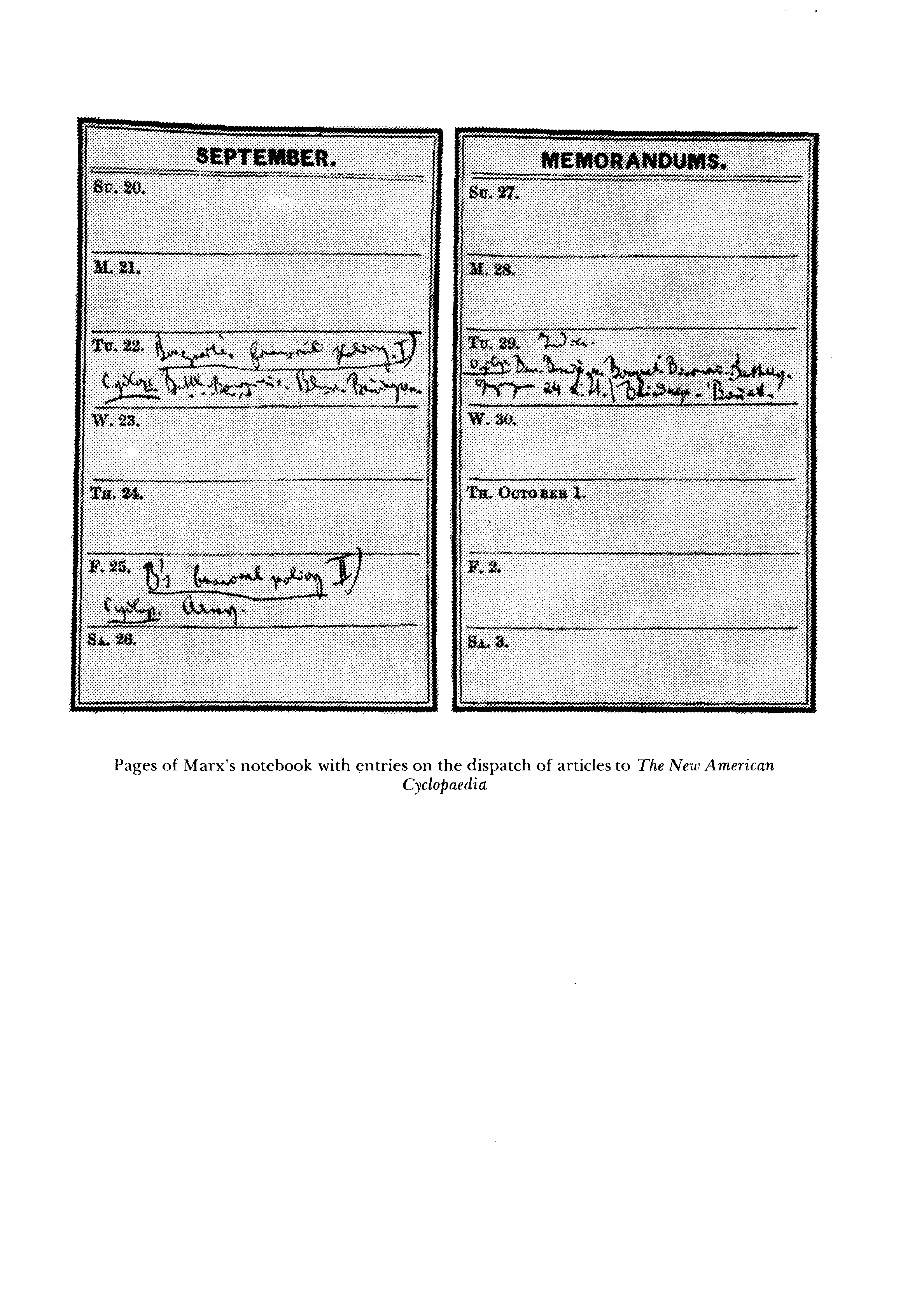
Pages of Marx's notebook with entries on the dispatch of articles to The New American
particular points of the battle-field, and a number of orderly officers and orderlies to carry orders and despatches. To the head-quarters are further attached the chief of the commissariat, with his clerks, the paymaster of the army, the chief of the medical department, and the judge-advocate, or director of the department of military justice. The staffs of the army-corps and divisions are regulated on the same model, but with greater simplicity and a reduced personnel; the staffs of brigades and regiments are still less numerous, and the staff of a battalion may consist merely of the commander, his adjutant, an officer as paymaster, a sergeant as clerk, and a drummer or bugleman.
To regulate and keep up the military force of a great nation, numerous establishments, beside those hitherto named, are required. There are recruiting and remounting commissioners, the latter often connected with the administration of national establishments for the breeding of horses, military schools for officers and non-commissioned officers, model battalions, squadrons, and batteries, normal riding schools, and schools for veterinary surgeons. There are in most countries national founderies and manufactories for small arms and gunpowder; there are the various barracks, arsenals, stores, the fortresses with their equipments and the staff of officers commanding them; finally, there are the commissariat and general staff of the army, which, for the whole of the armed force, are even more numerous and have more extensive duties to perform than the staff and commissariat of a single active army. The staff especially has very important duties. It is generally divided into a historical section (collecting materials relative to the history of war, the formation of armies, &c, past and present), a topographical section (intrusted with the collection of maps and the trigonometrical survey of the whole country), a statistical section, &c. At the head of all these establishments, as well as of the army, stands the ministry of war, organized differently in different countries, but comprising, as must be evident from the preceding observations, a vast variety of subjects. As an example we give the organization of the French ministry of war. It comprises 7 directions or divisions: 1, of the personnel; 2, of the artillery; 3, of the engineers and fortresses; 4, of administrative affairs; 5, of Algeria; 6, war depot (historical, topographical, &c, and sections of the staff); 7, finances of the war department. Immediately attached to the ministry are the following consultative commissions, composed of generals and field-officers and professional men, viz.: the committees of the staff of infantry, of cavalry, of artillery, of fortification, of medical affairs, and the commissions for veterinary science and for public works. Such is the vast machinery devoted to recruiting, remounting, feeding, directing, and always reproducing a modern first class army. The masses brought together correspond to such an organization. Though Napoleon's grand army of 1812, when he had 200,000 men in Spain, 200,000 in France, Italy, Germany, and Poland, and invaded Russia with 450,000 men and 1,300 guns, has never yet been equalled; though we shall most likely never see such an army again united for one operation as these 450,000 men, yet the large continental states of Europe, Prussia included, can each of them raise an armed and disciplined force of 500,000 men, and more; and their armies, though not more than from 1 V2 to 3 per ct. of their population, have never yet been reached at any former period of history.
The system of the United States bases the defence of the country substantially on the militia of the different states, and on volunteer armies raised as occasion demands; the standing military force, employed mainly in preserving order among the Indian tribes of the West, consisting, according to the report of the secretary of war(20) for 1857, of only about 18,000 men.[151]
Endnotes
[109] The " Army " was listed a m o n g the first articles which Dana requested for The New American Cyclopaedia and which Engels undertook to write. O n May 8, 1857 Dana wrote to Marx: "The principal article is that on Army. This should be historical, giving an account of the organization of the antique armies, and of the progressive changes made down to the present day, with notices of peculiarities in the different leading armies of the world. I have marked ten pages as the limit, but if it can be done in less so much the better. This article will not include the statistics of the military force of the different powers, as they will be given under the head of these powers,— Austria for instance. I have marked for you, while the remainder of that article has been given to another." It was all the more difficult to write such a comprehensive article within the time stipulated as Engels was still working on a number of articles beginning with A and had started on those beginning with B. Nevertheless, Engels began collecting the necessary material in July 1857, started writing the article in August and finished it not later than September 24. He kept Marx informed of the course of his work (see his letters of July 11, August 21, and September 8 and 22, 1857, present edition, Vol. 40). Marx did all he could to help Engels collect material for the article: he sent him books and excerpts from reference books and other works (see his letter to Engels of July 16 and Jenny Marx's letter to Engels sent in mid-August 1857). Engels made use of many sources, beginning with the works of ancient historians and military writers (Herodotus, Xenophon, Sallust, Polybius, Vegetius, and others) and ending with those of nineteenth-century authors (Wilkinson, Clausewitz, Jomini, Rüstow, and others), and consulted various reference books. He mentions some of these sources in the article itself. The following excerpts are extant: from Rüstow's Heerwesen und Kriegführung C. Julius Cäsars (Gotha, 1855) and from the article "Army" published in the seventh edition of the Encyclopaedia Britannica (1842, Vol. III). Marx, in his turn, also made excerpts on some aspects of the history of war, in particular from Pauly's Real-Encyclopädie der classischen Altertumswissenschaft in al-phabetischer Ordnung (vols. 2-6, Stuttgart, 1842-52), Allgemeine Encyclopädie der Wissenschaften und Künste. Herausgegeben von J. S. Ersch und J. G. Gruber (published in Leipzig from 1818), from Wilkinson's three-volume Manners and Customs of the Ancient Egyptians (London, 1837). In the article "Army" Engels summarised to a certain extent his long and thorough study of military science and history, and the experience of contemporary wars. Marx praised the article in his letter to Engels of September 25, 1857 and sent it off the same day to New York, as can be seen from an entry in his notebook (Dana acknowledged receipt in a letter of October 9, 1857). Marx also made some critical remarks to Engels concerning the origins of mercenary armies in antiquity (among the Carthaginians), the development of military science in fifteenth- and sixteenth-century Italy, and among the Eastern peoples. Marx thought these questions had not been adequately dealt with in the article. Engels took most of these remarks into consideration later when he wrote the articles "Artillery", "Cavalry", "Fortification" and "Infantry", which supplement his "Army".
[110] Testudo (literally: tortoise)—a shelter used to protect soldiers in siege operations. On the Roman testudo see this volume, p. 94. Vinea (literally: vineyard)—a wicker shelter covered with moist pelts or turf; used in antiquity by the besiegers of fortresses.
[111] On the battles of Marathon, Plataea and Thermopylae see Note 33. Greek troops landed on Mycale (Asia Minor) in 479 B.C., defeated the Persians and destroyed their ships which had been dragged on shore and used for erecting an entrenched camp. The Greek victories at Plataea and Mycale removed the threat of a Persian invasion of the Balkans.
[112] See Note 23.
[113] Solon's reforms (594 B.C.) divided the free citizens of the Athenian Republic into four groups according to the size of their annual income from their land. The first two groups enjoyed considerable political privileges but were liable to military service entailing great expenses (the first had to build warships and the second to supply mounted soldiers). The third group had restricted political rights, but it made up the backbone of the army, its heavy infantry. The fourth or poorest group, that of the "thetes", was for a long time deprived of the right to hold public offices and originally was exempt from military service; later on, however, light infantry was recruited from among it.
[114] By the allies of Athens Engels means the Greek city-states, mainly on the islands in the Aegean Sea and the coast of Asia Minor, which were members of the Athenian Naval Alliance (originally called Delian League) founded in 478 B.C., during the Greco-Persian wars. As Athens grew in power it subdued the allies and made them its tributaries. The Athenian Naval Alliance was dissolved in the late fifth century B.C. Athens managed to restore it partially in 378 B.C. but the new alliance existed only until 355.
[115] The Peloponnesian war (431-04 B.C.)—a war between two groups of Greek states: the Athenian Naval Alliance and the Peloponnesian Alliance headed by Sparta. It was caused by the struggle for hegemony in Greece, commercial rivalry among the Greek city-states and political contradictions between the Athenian slave-owning democracy and the aristocratic oligarchy of Sparta. The war was won by Sparta. Under the treaty of 404 B.C. Athens had to acknowledge Sparta's supremacy and surrender almost all its ships.
[116] The Sicilian expedition was undertaken by the Athenians in 415 B.C. to subdue the Greek city-states of Sicily, above all Syracuse. Athens hoped thus to establish its supremacy in the west of the Mediterranean and to increase its resources in order to deliver a blow at its main rival, Sparta. The military operations in Sicily continued until 413 B.C. and ended in a complete defeat for the Athenian naval and land forces unsuccessfully besieging Syracuse.
[117] Ephori—a body of five Spartan magistrates chosen annually by an assembly of free citizens. They were granted wide powers, including the right to dispose of the treasury, appoint military commanders and control the actions of the kings.
[118] Periaeci—a social group in Ancient Sparta. They possessed land and property, and the richest of them had slaves. Personally free, they even enjoyed self-government to some extent but were deprived of many political rights.
[119] Helots—agricultural population of Southern Peloponnesus enslaved by Sparta. Being the property of the Spartan state, the Helots cultivated plots of land granted to individual Spartans to whom they paid rent (usually half of the produce). They frequently raised revolts, which were brutally suppressed by the slave-owners.
[120] See Note 37.
[121] See Note 37.
[122] The town of Samos (on the Island of Samos, in the southeast of the Aegean Sea) was besieged by an Athenian naval expedition under Pericles in 440 B.C. The population of the island, which belonged to the Athenian Naval Alliance, had revolted with the intention of seceding from the Alliance. After, a siege of many months the town was forced to capitulate, and Athenian rule was restored on the island.
[123] By the conquest of Greece Engels means the subjugation of the Greek city-states by Philip II of Macedon, under whose rule Macedonia greatly increased its influence. An anti-Macedonian coalition headed by Athens was formed in 339 B.C., but its forces were defeated by Philip's army in 338 B.C. The all-Hellenic congress held in Corinth in 337 B.C. proclaimed the King of Macedon commander-in-chief of all the Greek armed forces and confirmed Macedonian rule over the Greek city-states, which continued to be formally regarded as independent.
[124] The Achaean League—a confederation of Peloponnesian city-states formed in 280 B.C. against Macedonia. It had considerable armed forces which were routed by the Romans in 146 B.C. and its territory was incorporated into Macedonia, which became a Roman province in 148 B.C.
[125] Tribe (Rom. Hist.)—a territorial-administrative unit. King Servius Tullius (6th cent. B.C.) introduced reforms under which the city of Rome was divided into four tribes on a territorial basis instead of the earlier division according to the clan or family principle. At the same time several country tribes were formed. All free citizens possessing land within the territory of a given tribe were included in that tribe.
[126] Horsemen (knights)—in early Roman history — équités, or rich citizens constituting a privileged class liable for service in the cavalry. Subsequently this name was given to Roman slave-owning merchants and usurers belonging to the class of équités.
[127] The First Civil War (88-82 B.C.) — a struggle for power between two antagonistic groups of Roman slave-owners. One group was headed by Lucius Cornelius Sulla, representing the slave-holding aristocracy (nobilitas), and the other by Gaius Marius who relied on merchants and usurers and tried to use the urban and rural plebeians. The war ended in the defeat of Marius' followers and the establishment of Sulla's dictatorship — a step towards the abolition of the Roman Republic and the founding of the empire.
[128] A reference to the battle of the Muthul (Northern Africa), 109 B.C., in which the Roman army under Quintus Caecilius Metellus defeated the army of King Jugurtha of Numidia. This was the first Roman victory in the Jugurthine war (111-05 B.C.). Rome proved victorious at the end.
[3] The defeat of the Austrian army at Abensberg was an episode in the five-day battle of Regensburg (from April 19 to 23) during the Austro-French war of 1809 (a war waged by France against the fifth European coalition: Austria, Britain, Portugal and Spain). It was followed by the Austrians' defeat at Landshut on April 21 and at Eckmühl on April 22, and their retreat from Regensburg on April 23 under pressure from French troops. Nevertheless, the Austrian army retained its fighting capacity and put up a stubborn resistance to the French advance on Vienna.
[129] Roman military units of each grade had their own badges. Thus since the time of Gaius Marius a silver eagle attached to the shaft was the badge of a legion.
[130] The war between Rome and Pyrrhus, King of Epirus (Northwestern Greece), over the Greek towns in the south of Italy took place in 280-75 B.C. At the beginning Rome suffered two major defeats but later, supported by Carthage, it crushed the mercenary army of Pyrrhus and drove him out of the Peninsula.
[131] A reference to the battle of Kynoskephalae (Thessaly) in 197 B.C., during the Second Macedonian war (200-197 B.C.), in which the Roman army under Titus Quinctius Flamininus routed the army of Philip V of Macedon. As a result, the Romans consolidated their influence in Greece, later establishing their rule there.
[132] T h e Social War (90-88 B.C.)—a war of Rome's Italian allies (socii) against the rule of the Roman Republic ("alliance" was a form by which the Roman slave-owners subjugated conquered tribes and peoples). The movement of the Italians who had seceded from Rome was suppressed but in the course of the war Rome was forced to grant them the rights of Roman citizens, initially with certain reservations.
[133] Roman Gallia (corresponding to Provence, a historical region in the south of France) — part of Gallia (Gaul) conquered by the Romans at the end of the second century B.C.
[134] T h e expeditions of the German emperors against Italy were started by King Otto I who was invested with the crown of the Holy Roman Empire in Rome in 962. These expeditions were especially frequent from the tenth to the thirteenth century and continued until the sixteenth century despite the decline of the Emperor's power and the increasing feudal dismemberment in Germany itself. On the crusades see Note 4. p. 103.
[135] On the battles of Crécy and Poitiers see Note 34; on the battle of Agincourt see Note 25.
[136] A reference to the wars against the Mongols during their invasion of Central Europe in 1241-42, after their incursions into the Russian lands in 1237-40. Apart from Poland, Moravia, Hungary and Dalmatia were the scene of these wars. The advanced detachments nearly reached Venice, but, weakened by the resistance of the Russian principalities, they were compelled to withdraw to their East-European and Asian territories. Habsburgs in the fourteenth and fifteenth centuries, and to the Swiss war of 1474-77 against Charles the Bold, Duke of Burgundy, who tried to seize lands belonging to the Swiss Confederation. The Swiss upheld their independence due to the superiority of their infantry of free peasants and townspeople over the knights.
[137] Engels refers to the liberation wars of the Swiss cantons against the Austrian
[138] Bashi-Bazouks—soldiers of Turkish irregular cavalry in the eighteenth and nineteenth centuries.
[139] At the battle of Marignano (Northern Italy) on September 13-14, 1515 the army of Francis I of France, supported by his Venetian allies, defeated the Swiss mercenary troops of the Duke of Milan. This was one of the major battles in the Italian wars of 1494-1559 (see Note 26).
[140] See Note 26.
[141] This refers to the bourgeois revolution of 1566-1609 (see Note 20).
[142] The Thirty Years' War (1618-48)—a general European war in which the Pope, the Spanish and Austrian Habsburgs and the Catholic German princes fought against the Protestant countries: Bohemia, Denmark, Sweden, the Republic of the Netherlands, and a number of German states. The rulers of Catholic France, being rivals of the Habsburgs, supported the Protestants. Germany was the main arena of the struggle, the object of pillage and territorial claims. The treaty of Westphalia (1648) sealed its political dismemberment,
[143] T h e battles of Leipzig, Lützen and the Lech were fought in the Thirty Years' War. At the battles of Leipzig (or Breitenfeld) on September 17, 1631 and of the Lech (Bavaria) on April 15, 1632 Gustavus Adolphus' army routed the Imperial-Catholic troops under Tilly. At Lützen (Saxony) Gustavus Adolphus defeated Wallenstein's Imperial army on November 16, 1632.
[144] T h e Military Frontier or the Military Border Area—the southern border regions of the Austrian Empire, where military settlements began to be set up in the sixteenth century for protection against Turkish invasions. The inhabitants of these regions — Serbs, Croats, Romanians, Szeklers, Saxons, and others — were allotted plots of land by the state, for which they had to serve in the army, pay taxes and perform certain public duties. The soldiers of these regions were called borderers.
[145] At Mollwitz (Malujowice, Silesia) Frederick H's army defeated the Austrians on April 10, 1741, during the War of the Austrian Succession (1740-48) (see Note 38). p. Ill
[146] Xhis was the first European coalition against revolutionary France. In February 1792, supported by Britain and Russia, Prussia and Austria concluded a military alliance and began intervention in France. After the proclamation of the French Republic and the execution of Louis XVI in January 1793, Britain, the Netherlands, Spain, Naples, Sardinia and several small German and Italian states openly joined the anti-French coalition. France's war against this coalition continued until 1797.
[147] See Note 60.
[148] See Note 85.
[149] At the battle of Inkerman on November 5, 1854, during the Crimean war of 1853-56, the Anglo-French forces defeated the Russian army, but the Russians' vigorous action prevented the enemy from storming Sevastopol and instead the city was besieged. Engels described the battle in detail in his article "The Battle of Inkerman" (see present edition, Vol. 13, pp. 528-35).
[150] Landwehr—the army second reserve formed in Prussia during the struggle against Napoleon. In the 1840s it consisted of men under forty who had done three years' active service and had been in the reserve not less than two years. In contrast to the regular army, the Landwehr was called up only in case of extreme necessity (war, or threat of war).
[151] This paragraph was apparently added by the editors of The New American Cyclopaedia.
[2] "Abensberg" is the first in the provisional list of articles for The New American Cyclopaedia written by Engels overleaf his letter to Marx of May 28, 1857, to be agreed on with Dana with respect to his initial request (see present edition, Vol. 40). Besides this theme Engels listed the following: Aboukir, Axle (artillery), Acre (St. Jean d'Acre, its siege), Actium (battle of). Adjutant, Afghanistan (invasion by English), Aland Isles — see Bomarsund, Albuera (battle of), Aldenhoven, Alessandria (fortress and sieges), Algeria (French conquest of and English bombardment of), Almeida (siege of in Peninsular war), Amusette (artillery), Anglesey (Marquis of), Attack (in battle and siege), Antwerp (fortress and sieges), Approaches, Arbela (battle of), Arquebuse, Aspern and Essling (battle of 1809), Augereau (Marshal), Advanced Guard. In his letter to Marx, July 11, 1857, Engels said that he had begun writing articles according to the list (by that time it had probably been slightly changed) and promised to send him by July 14 the articles "Abensberg", "Adjutant", "Alma" and "Ammunition" (the last two were not mentioned in the list), "and more such stuff, thus finishing off the whole of A (except 'Algeria' and 'Afghanistan') up to Ap and Aq". On July 14 Marx thanked Engels for the first, and on July 24 for the second, batch of articles he had received. Judging by an entry in Marx's notebook about the dispatch of the first batch, this material was sent off to New York on July 24. Some articles mentioned in the list ("Axle", "Approaches", "Advanced Guard") were not published in the Cyclopaedia and were probably not written by Engels. There is no indication that Engels wrote the articles "Anglesey" and "Augereau".