F. Engels. Mountain Warfare in the Past and Present
The recent possibility, not yet entirely removed, of an invasion of Switzerland, has naturally revived the public interest not only concerning the defensive resources of the mountain Republic, but with regard to mountain warfare in general. People generally incline to regard Switzerland as impregnable, and think of an invading force as of those Roman gladiators whose "Ave Caesar, morituri te salutant"3 has become so famous.b We are reminded of Sempach and Morgarten, Murten and Granson,[205] and we are told that it may be easy enough for a foreign army to get into Switzerland, but that, as the fool of Albert of Austria said, it will be difficult to get out again. Even military men will recite the names of a dozen mountain passes and defiles, where a handful of men might easily and successfully oppose a couple of thousands of the best soldiers/
This traditional impregnability of the so-called mountain-fortress of Switzerland dates from the time of the wars with
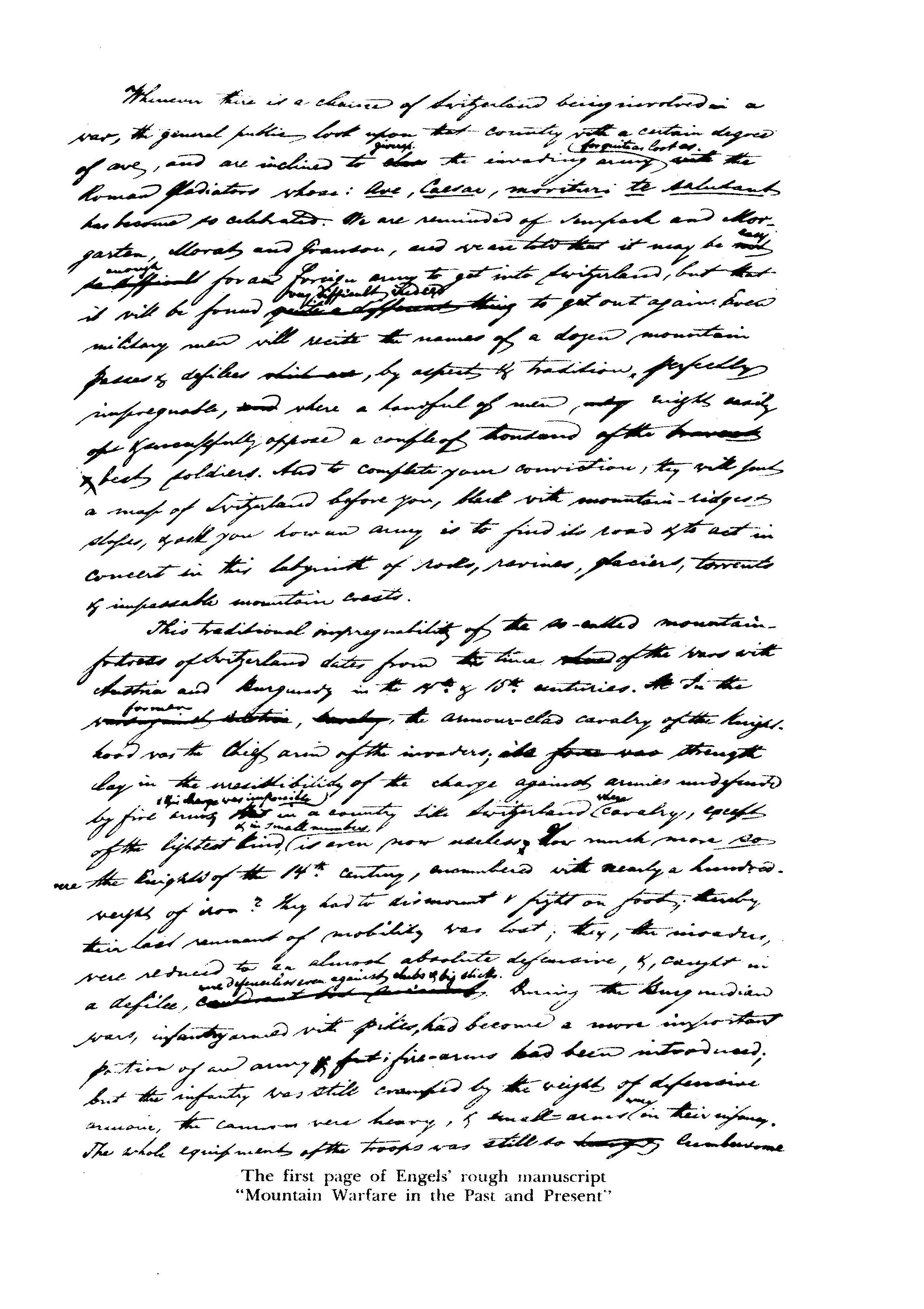
The first page of Engels' rough manuscript "Mountain Warfare in the Past and Present*'
Austria and Burgundy, in the fourteenth and fifteenth centuries.20b In the former the armor-clad cavalry of the chivalry was the chief arm of the invaders; its strength lay in the irresistible charge against armies undefended by firearms. Now, this charge was impossible in a country like Switzerland, where cavalry, except of the lightest kind, and in small numbers, is even now useless. How much more so were the knights of the fourteenth century, encumbered with nearly a hundred weight of iron. They had to dismount and fight on foot; thus, their last remnant of mobility was lost; and the invaders were reduced to the defensive, and when caught in a defile were defenseless even against clubs and sticks. During the Burgundian wars, infantry, armed with pikes, had become a more important portion of an army, and firearms had been introduced, but the infantry was still cramped by the weight of defensive armor, the cannon were heavy, and small arms clumsy and comparatively useless/ The whole equipment of the troops was still so cumbersome as to unfit them completely for mountain warfare, and especially at a time when roads can scarcely be said to have existed. The consequence was that, as soon as these slow-moving armies were once entangled in difficult ground, they stuck fast, while the lightly-armed Swiss peasants were enabled to act on the offensive, to out-maneuver, to surround, and finally to defeat their opponents.
For three centuries after the Burgundian wars, Switzerland was never seriously invaded. The tradition of Swiss invincibility grew venerable, until the French Revolution, an event which tore into shreds so many venerable traditions, destroyed this one too, at least for those acquainted with military history. Times had changed. The iron-clad cavalry and the heavy pikemen had passed away; tactics had been revolutionized a dozen times over; mobility was becoming the chief quality of armies; the line tactics of Marlborough, Eugene(1) and Frederick the Great were being upset by the columns and skirmishers of the revolutionary armies; and from the day that General Bonaparte passed, in 1796, the Col di Cadibone, threw himself between the scattered Austrian and Sardinian columns, defeated them in front, while at the same time intercepting their retreat in the narrow(2) valleys of the Maritime Alps, making the most of his opponents prisoners — from that day dates the new science of mountain warfare which has put an end to the impregnability of Switzerland.
During the period of line tactics, which immediately preceded that of modern warfare, all difficult ground was studiously avoided by either adversary.(3) The more level the plain, the better it was deemed for a battle-field, if it only afforded some obstacle to support one or both wings. But with the French revolutionary armies, a different system began. An obstacle before the front, covering ground for skirmishers, as well as for the reserves, was anxiously sought for in any defensive position. Difficult ground, upon the whole, was preferred by them; their troops were far lighter in their movements; and their formations, extended order and columns, admitted not only(4) of rapid movements in all directions, but even made it advantageous to them to profit by the shelter afforded by broken ground, at the same time that their opponents were quite lost in it. In fact, the term "impracticable ground" was all but erased from the military terminology.
The Swiss were made to feel this in 1798, when four French divisions, in spite of the obstinate resistance of part of the inhabitants, and of a three times repeated insurrection of the old forest cantons, made themselves masters of the country which, for the next three years, became one of the most important theaters of the war between the French Republic and the Coalition.[207] How little the French were afraid of the inaccessible mountains and narrow gorges of Switzerland, they showed as early as March, 1798, when Masséna at once marched upon the roughest and most mountainous canton, the Orisons, then occupied by the Austrians. The latter held the upper valley of the Rhine. In concentric columns Masséna's troops marched into that valley through mountain passes hardly passable to horses, occupied all the outlets, and after a short resistance forced the Austrians to lay down their arms. The Austrians very soon profited by this lesson; under Hotze, a General who gained considerable proficiency in mountain warfare, they returned to the charge, repeated the same maneuver, and drove out the French. Then came the retreat of Masséna to the defensive position of Zurich, where he defeated Korsakoff's Russians, the invasion of Switzerland over the St. Gott-hard by Souwaroff, his disastrous retreat, and finally another advance of the French through the Grisons into Tyrol, where Macdonald in the depth of winter passed over three mountain ridges then scarcely thought passable in single file.[208] The great Napoleonic campaigns which then followed were fought out in the great river-basins of the Danube and the Po; the grand strategical conceptions on which they were based, all tending to cut off the hostile army from the center of its resources, to destroy that army, and then to occupy the center itself, implied a less intercepted ground and the concentration of masses for decisive battles not to be obtained in Alpine countries. But from the first Alpine campaign of Napoleon in 1796, and his march across the Julian Alps to Vienna in 1797, up to 1801, the whole history of warfare proves that Alpine ridges and valleys have completely lost their terror for modern troops; nor have the Alps ever since, up to 1815, offered any defensive positions worth speaking of to either France or the Coalition.
When you pass through one of these deep ravines which wind up the roads that lead from the northern slope of the Ain« ^ their southern declivity, you firvj ±^ m ^ lurmidable defensive position? ;i_r ' c v e r v j u r n 0f the road. Take the well-known Via Mala, tor instance. There is not an officer but will tell you he might hold that defile with a battalion against an enemy, if he wras sure of not being turned. But that is precisely the point. There is no mountain pass, even in the highest ridge of the Alps, but can be turned. Napoleon's maxim for mountain warfare was: "Where a goat can pass, a man can pass; where a man, a battalion; where a battalion, an army." And Souwaroff had to do it, when he was closely shut up in the valley of the Reuss, and had to march his army along shepherds' tracks, where but one man could pass at a time, while Lecourbe, the best French General for mountain warfare, was at his heels.
It is this facility of turning an enemy which makes up and more for the strength of defensive positions, to attack which in front would often be perfect madness. To guard all roads by which a position can be turned would imply, in the defending party, such a dissemination of forces as must insure immediate defeat. They can, at best, be observed only, and the repulse of the turning movement must depend upon the judicious use of reserves and on the judgment and rapidity of the commanders of single detachments; and yet, if of three or four turning columns one only is successful, the defending party is placed in as bad a condition as if they had all succeeded. Thus, strategically speaking, the attack in mountain warfare is decidedly superior to the defense.
It is the same when we come to look at the subject in a purely tactical light. The defensive positions will always be narrow mountain-gorges, occupied by strong columns in the valley and protected by skirmishers on the hights. These positions may be turned either from the front, by skirmishing parties climbing up the sides of the valley and outflanking the sharp-shooters of the defense, or by parties marching along the top of the ridge where this is practicable, or by a parallel valley — the turning body profiting by a pass to fall on flank or rear of the defending post. In all these cases the turning parties have the advantage of command; they occupy the higher ground and overlook the valley occupied by their opponents. They may roll rocks and trees down upon them; for now-a-days no column is so foolish as to enter into a deep gorge before its sides are cleared; so that this late favorite mode of defense is now turned against the defenders. Another disadvantage of the defense is that the effect of firearms, on which it mainly rests, is very much reduced on mountainous ground. Artillery is either all but useless, or, where it is seriously used, is generally lost on a retreat. The so-called mountain artillery, consisting of light howitzers carried on the backs of mules, is of scarcely any effect, as the experience of the French in Algeria amply proves.[209] As to musketry and rifles, the cover offering itself everywhere in such ground deprives the defense of a very great advantage — that of having in front of the position open ground which the enemy must pass under fire. Tactically, then, as well as strategically, we arrive at the conclusion of the Archduke Charles of Austria, one of the best generals in mountain warfare and one of the most classical writers on that subject, that in this kind of war the attack is vastly superior to the defense.
Is it then perfectly useless to defend a mountainous country? Certainly not. It only follows that the defense must not be a merely passive one, that it must seek its strength in mobility, and act, wherever opportunity offers, on the offensive. In alpine countries battles can hardly occur; the whole war is one continuous series of small actions, of attempts, by the attacking party, to drive the thin end of the wedge in one point or the other of the enemy's position, and then to press forward. Both armies are necessarily scattered; both must expose themselves at every step to an advantageous attack; both must trust to the chapter of accidents. Now, the only advantage the defending army can take is to seek out these feeble points of the enemy and to throw itself between his divided columns. In that case the strong defensive positions on which a merely passive defense would alone rely, become so many traps for the enemy where he may be allured into taking the bull by the horns, while the main efforts of the defense are directed against the turning columns, each of which may in its turn be turned and brought into the same helpless condition into which it intended to bring the defending party. It is, however, at once evident that such an active defense presupposes active, experienced and skillful generals, highly disciplined and mobile troops, and above all very skillful and reliable leaders of brigades, battalions, and even companies; for, on the prompt, judicious action of detachments, everything depends in this case.
There is still another form of defensive mountain warfare which has become celebrated in modern times; it is that of national insurrection and the war of partisans, for which a mountainous country, at least in Europe, is absolutely required. We have four examples of it: the Tyrolese insurrection, the Spanish guerrilla war against Napoleon, the Carlist Basque insurrection,[210] and the war of the Caucasian tribes against Russia.[211] Though they have caused great trouble to the invaders, none of them, considered by itself, has proved successful. The Tyrolese insurrection was formidable only as long as it was supported, in 1809, by Austrian regular troops. The Spanish guerrillas, though they had the immense advantage of a very extensive country, owed the long continuance of their resistance chiefly to the Anglo-Portuguese army, against which the principal efforts of the French had always to be directed. The long duration of the Carlist war is explained by the degraded state to which the Spanish regular army had then been reduced, and by the constant negotiations between the Carlist and the Christina(5) generals; and it cannot be taken as a fair specimen. Finally, in the Caucasian struggle, the most glorious of all to the mountaineers, their relative success has been due to the offensive tactics predominant in the defense of their ground. Wherever the Russians — they and the British being of all troops the least fit for mountain warfare — attacked the Caucasians, the latter have generally been defeated, their villages destroyed, and their mountain-passes secured by Russian fortified posts. But their strength lay in continued sallies from their hills into the plains, in surprises of Russian stations or outposts, in rapid excursions far to the rear of the Russian advanced line, in ambushes laid for Russian columns on the march. In other words, they were lighter and more movable than the Russians, and profited by this advantage. In fact, in every instance, then, of even temporarily successful insurrections of mountaineers, this success has been owing to offensive operations. In this they totally differ from the Swiss insurrections of 1798 and 1799, where we find the insurgents taking up some apparently strong defensive position and there awaiting the French, who in every instance cut them to pieces.
Endnotes
[205] In the Battle of Sempach (Canton of Lucerne) on July 9, 1386 the Swiss defeated the Austrian troops of Prince Leopold III. The Battle of Morgarten between Swiss volunteers and the troops of Leopold of Habsburg on November 15, 1315 ended in victory for the volunteers. At Murten (Canton of Freiburg) on June 22, 1476 and at Granson (Canton Vaud) on March 2, 1476, the Swiss defeated the troops of Charles the Bold, Duke of Burgundy.
[207] The troops of the French Directory entered Switzerland in the spring of 1798 to support the economically advanced cantons which were for the abolition of the feudal relations in the country. On April 12, 1798 a Helvetian Republic was proclaimed in Switzerland, and a constitution modelled on the French constitution of 1795 was adopted. The measures introduced by the new constitution favoured the economically advanced cantons and provoked stubborn resistance from the agrarian cantons in the central and eastern parts of the country. By the insurrections of the old forest cantons Engels means their actions against the French in April, May and August 1798. The Helvetian Republic became fully dependent on France with the conclusion of a defensive-offensive union, which led to the republic's participation in the war against the Second Coalition on France's side. The coalition was formed in 1798 and included Austria, England, the Kingdom of Naples, Russia, Turkey and other countries.
[208] During the war of the Second Coalition (see Note 207) against France, the Russian and Austrian forces under the command of Alexander Suvorov freed almost the whole of Northern Italy from the French in the spring and summer of 1799. At the insistence of the Austrian Government Suvorov's army was then sent to Switzerland to link up with the Russian corps of Rimsky-Korsakov, which was being pressed by the forces of the French General Masséna. After the Russian army had heroically fought its way across the Saint Gotthard and several other mountain passes it was encircled by superior French forces, which had defeated Korsakov's corps at Zurich on September 25. Under extremely hard conditions Suvorov's troops succeeded in making their way through a number of Alpine mountain passes and on October 12 reached the upper Rhine. In his work Po and Rhine Engels wrote: "This passage was the most impressive of all Alpine crossings in modern times" (see present edition, Vol. 16, p. 222).
[209] In 1830 the French Government launched a colonial war in Algeria. The Algerian people put up a stubborn resistance to the colonialists; it took the French 40 years to turn Algeria into their colony.
[210] The Tyrolese insurrection—the insurrection of the Tyrol peasants which broke out in April 1809 and was headed by Andreas Hofer. It was directed against the French occupants and the Bavarian authorities. Under the Treaty of Pressburg of 1805 Tyrol was annexed from Austria to Bavaria by Napoleon I. The Austrian Government used the growing discontent of the Tyrolese with the new order in its own interests and supported the insurrection which at its initial stage.was successful. After the Treaty of Schönbrunn (1809) by which Austria recognised the annexation of Tyrol to Bavaria, Napoleon I moved considerable forces against the Tyrolese peasants. The insurrection was suppressed in 1810. On the Spanish guerrilla war see Note 142. On the Carlist Basque insurrection see Note 140.
[211] A reference to the war waged by the peoples of the North Caucasus (Adyghei, Chechens, Avars, Lezghins, etc.) against the Tsarist government. In the 1820s the liberation struggle of these peoples against the Tsarist colonialists and the arbitrary rule of the local feudal lords was headed by Shamyl, who was proclaimed Imam of Daghestan in 1834. The movement reached its peak in the 1840s and was suppressed in 1859.